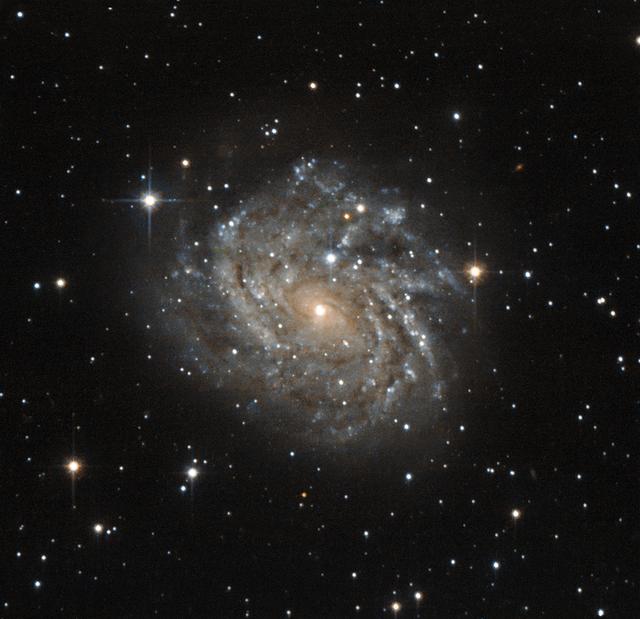
This little-known galaxy, officially named J04542829-6625280, but most often referred to as LEDA 89996, is a classic example of a spiral galaxy. The galaxy is much like our own galaxy, the Milky Way. The disk-shaped galaxy is seen face on, revealing the winding structure of the spiral arms. Dark patches in these spiral arms are in fact dust and gas — the raw materials for new stars. The many young stars that form in these regions make the spiral arms appear bright and bluish. The galaxy sits in a vibrant area of the night sky within the constellation of Dorado (The Swordfish), and appears very close to the Large Magellanic Cloud — one of the satellite galaxies of the Milky Way. The observations were carried out with the high resolution channel of Hubble’s Advanced Camera for Surveys. Image credit: ESA/Hubble & NASA, Acknowledgement: Flickr user C. Claude <b><a href="http://go.nasa.gov/1Tqugil" rel="nofollow">NASA image use policy.</a></b> <b><a href="http://go.nasa.gov/1Tqugin" rel="nofollow">NASA Goddard Space Flight Center</a></b> enables NASA’s mission through four scientific endeavors: Earth Science, Heliophysics, Solar System Exploration, and Astrophysics. Goddard plays a leading role in NASA’s accomplishments by contributing compelling scientific knowledge to advance the Agency’s mission. <b>Follow us on <a href="http://go.nasa.gov/1Tqugir" rel="nofollow">Twitter</a></b> <b>Like us on <a href="http://go.nasa.gov/1TqujdP" rel="nofollow">Facebook</a></b> <b>Find us on <a href="http://go.nasa.gov/1TqujdT" rel="nofollow">Instagram</a></b>