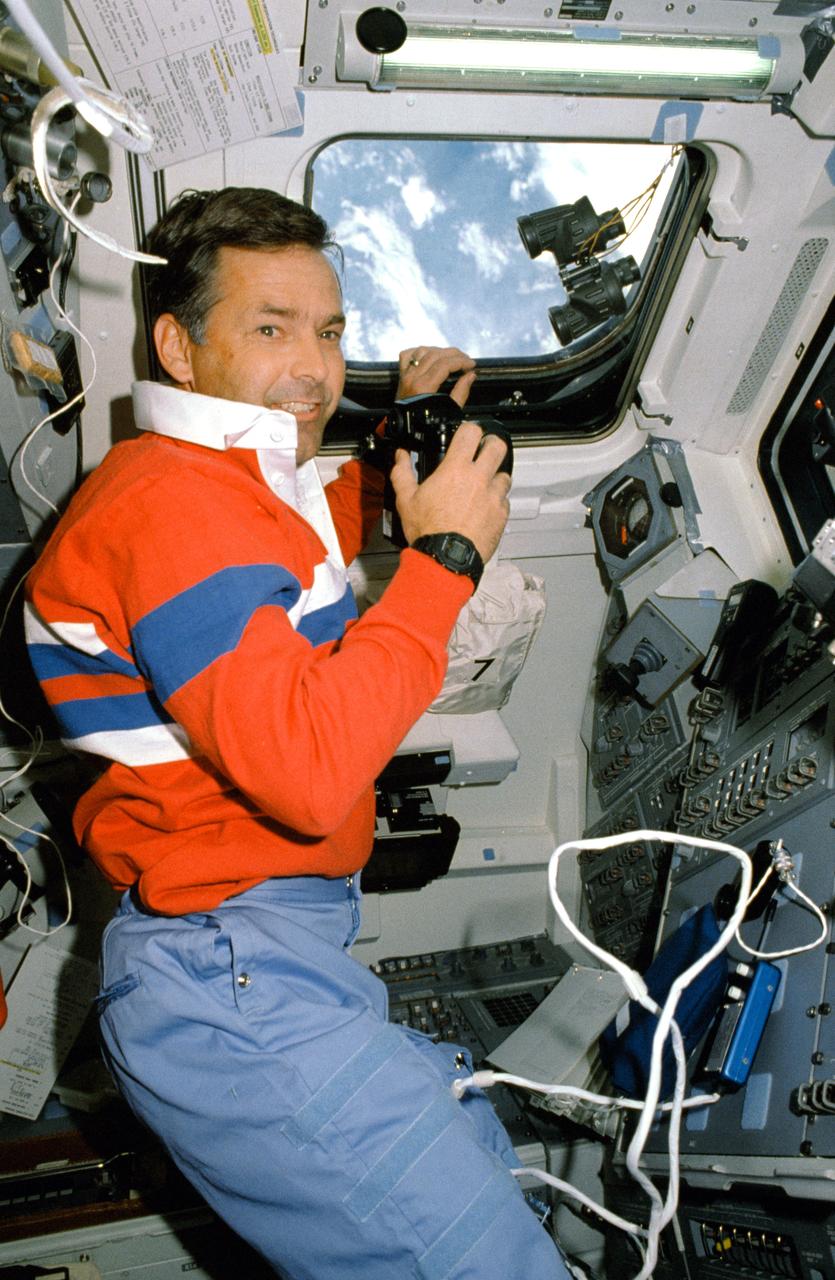
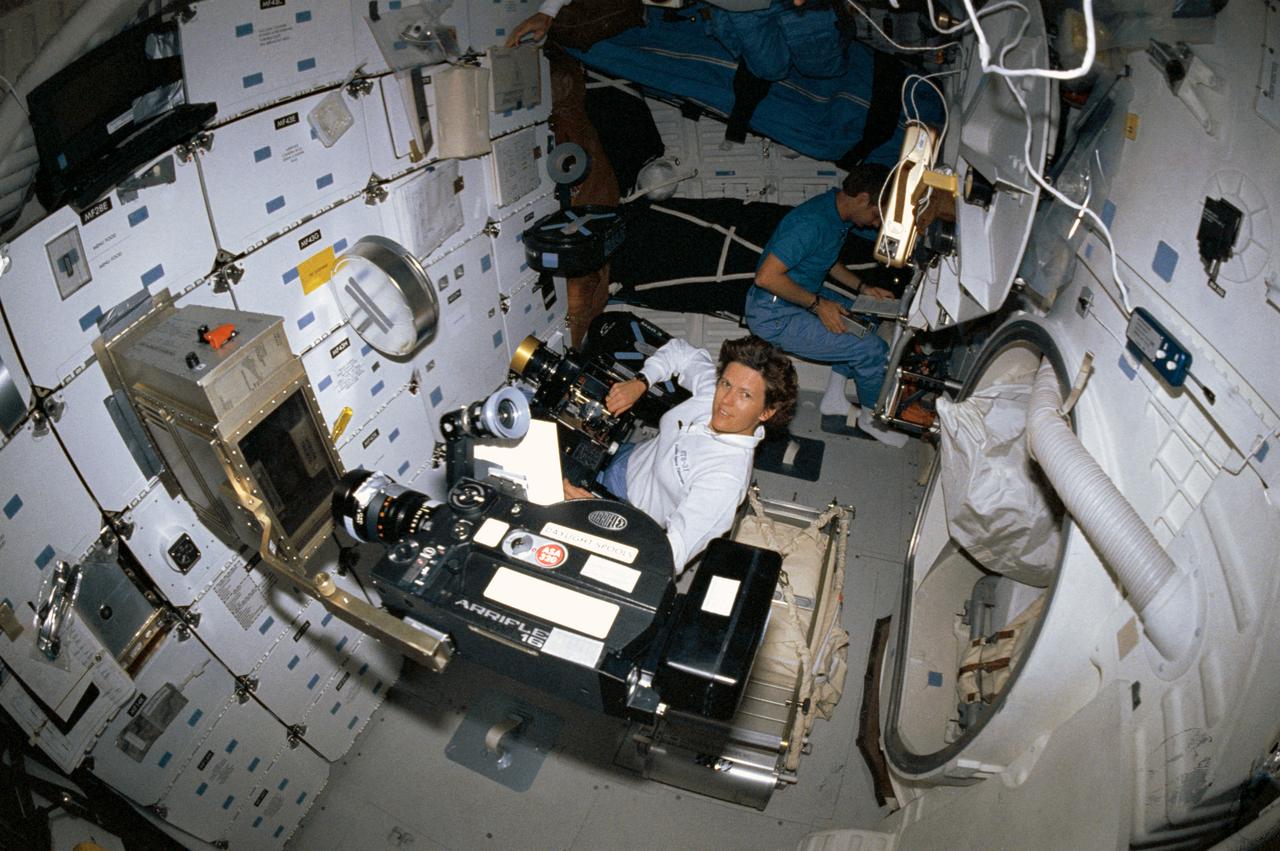
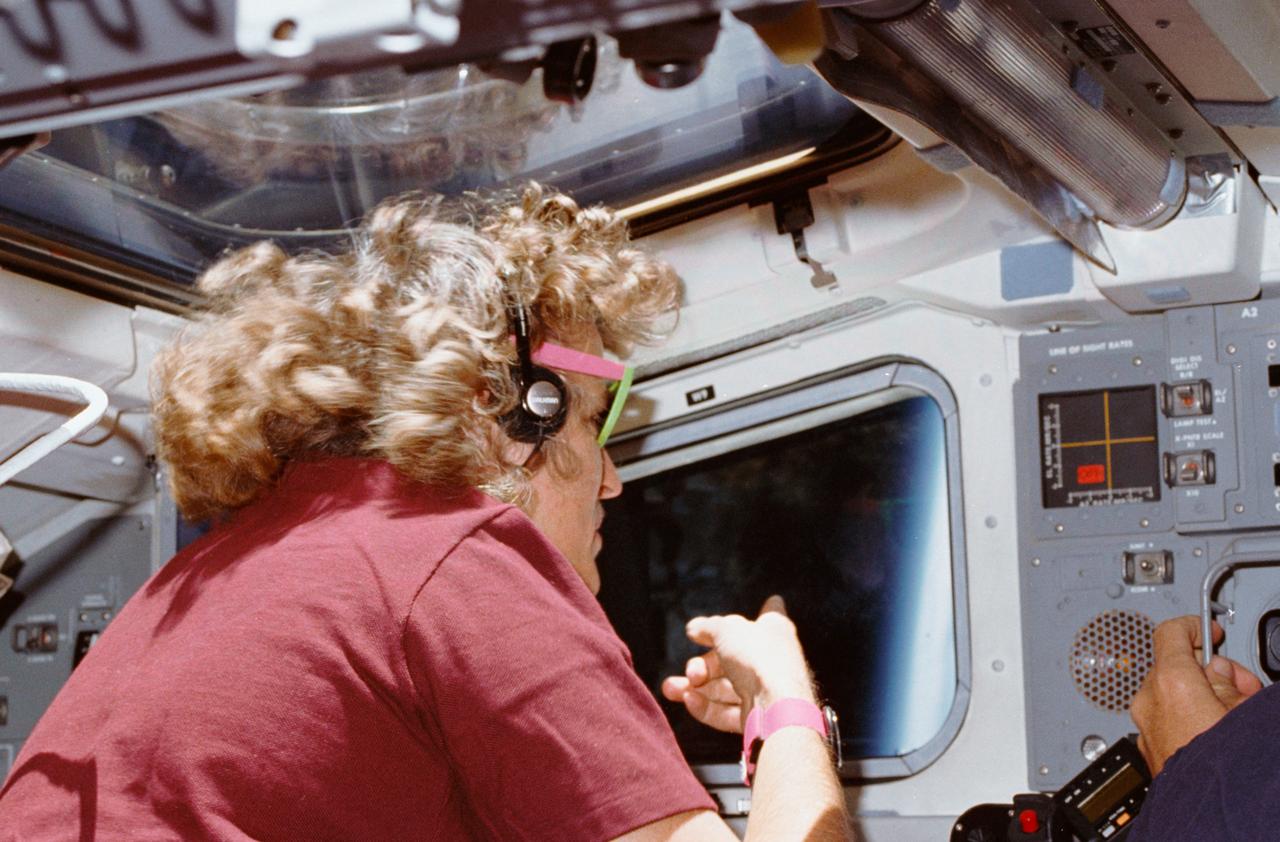
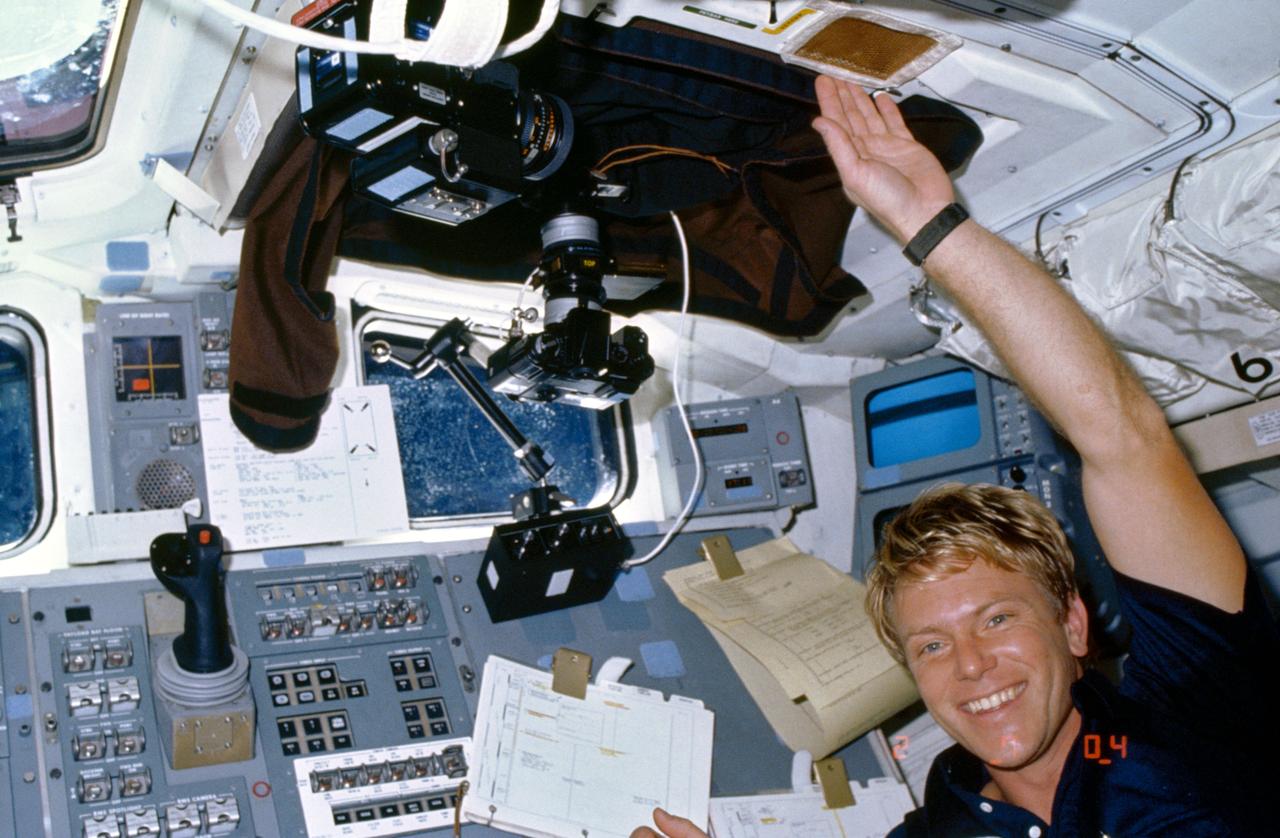
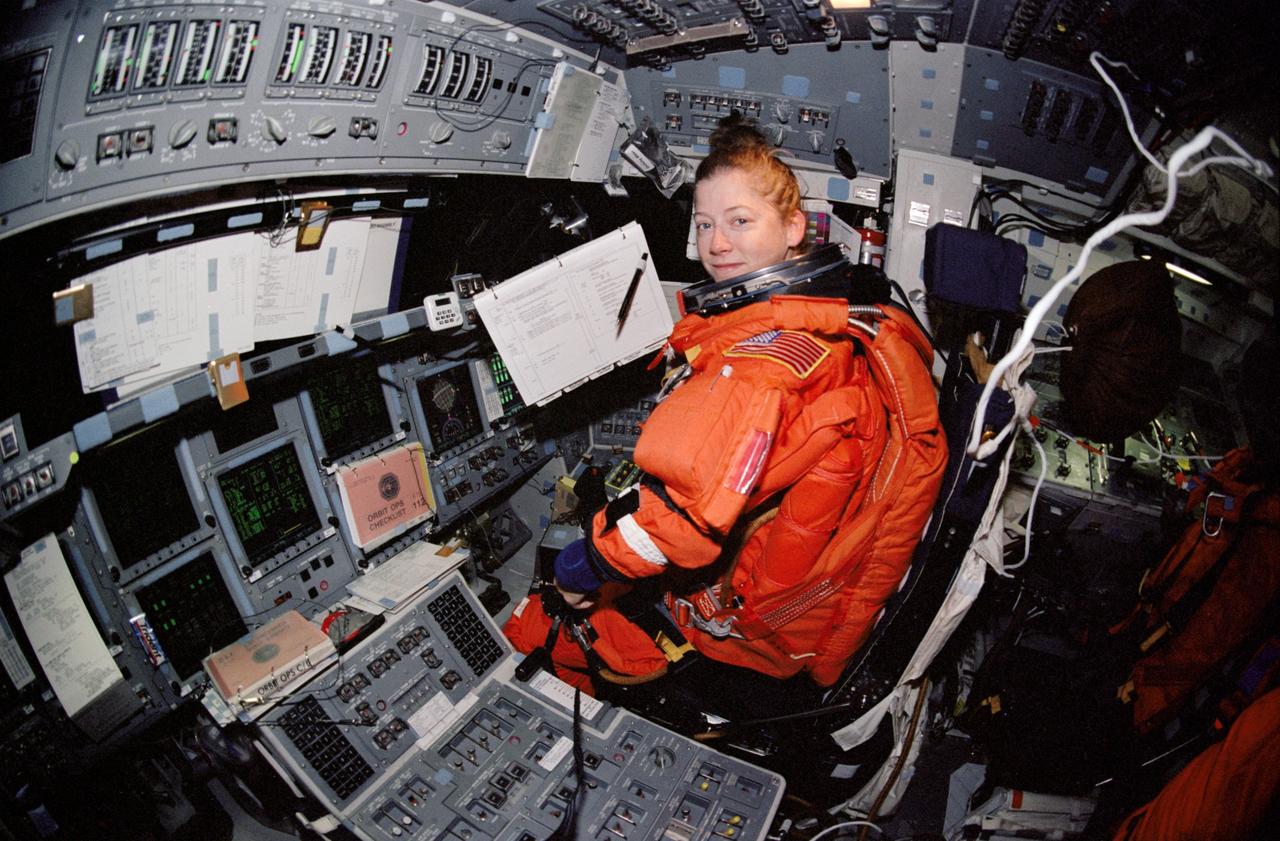
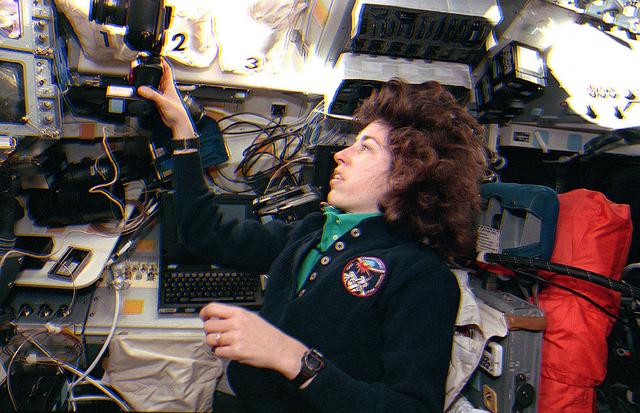
Space Shuttle Discovery (STS-56) Mission Specialist 3 (MS3) Ellen Ochoa handles a 35mm camera on the aft flight deck of the Orbiter. Ochoa is positioned next to the payload station and behind the commander's station.
Space Shuttle Project
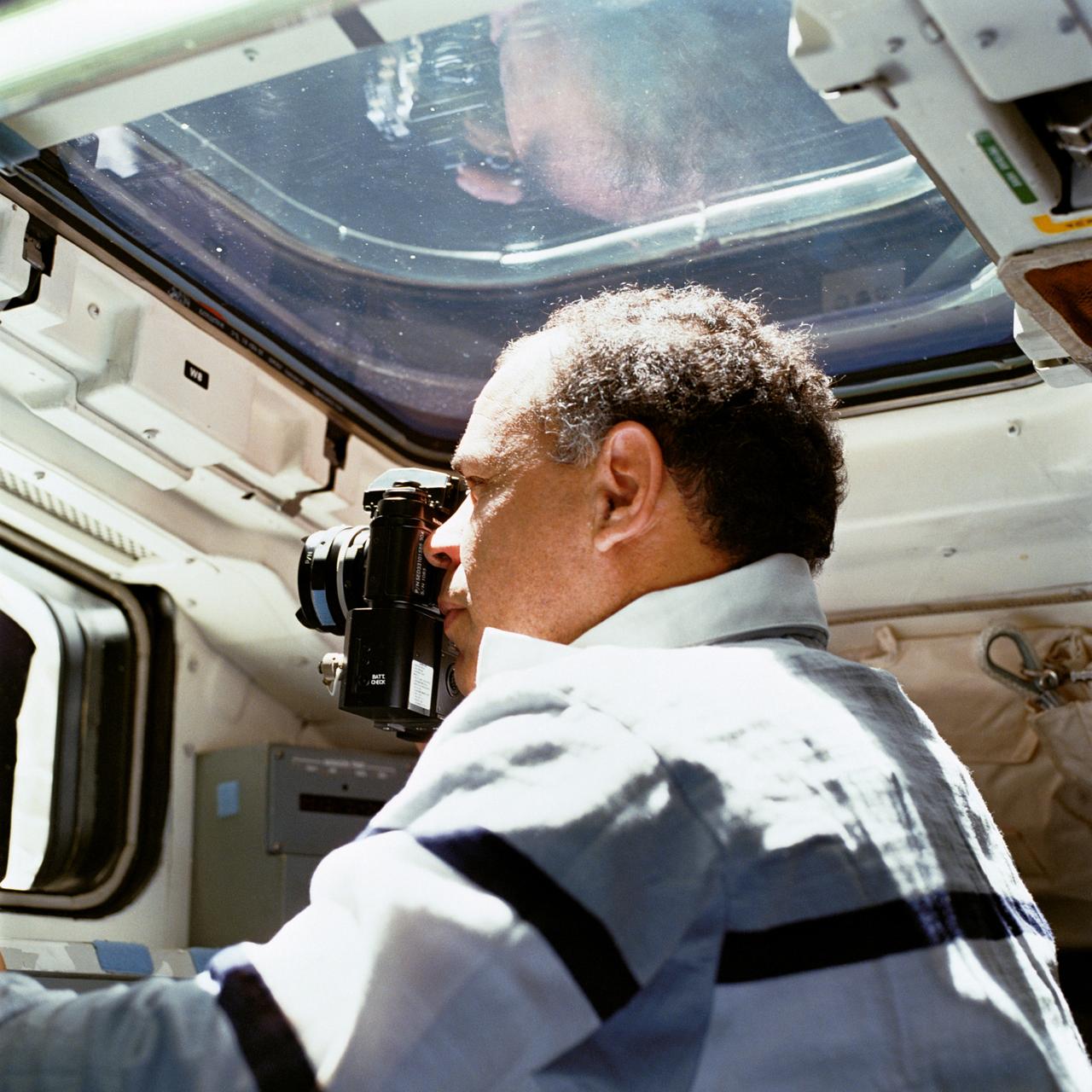
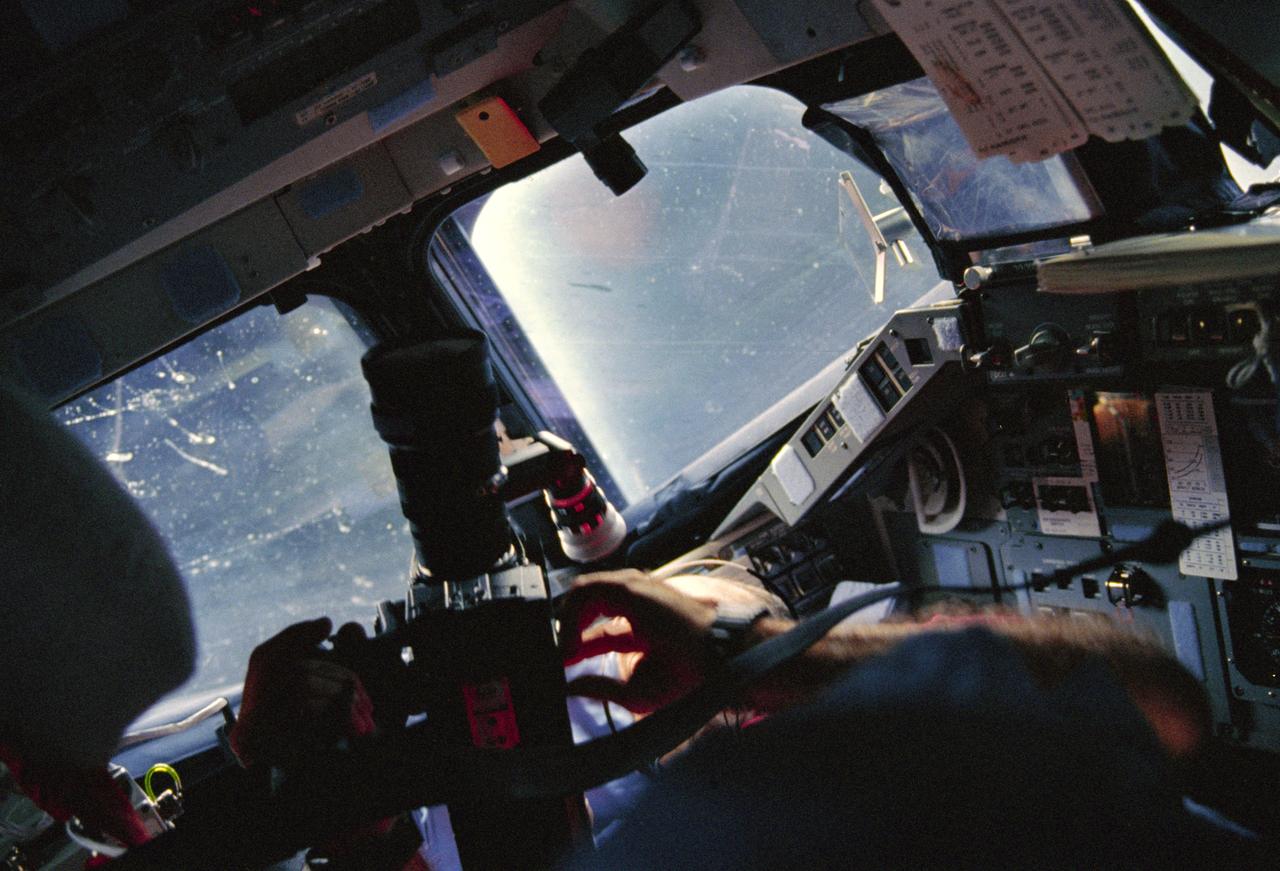
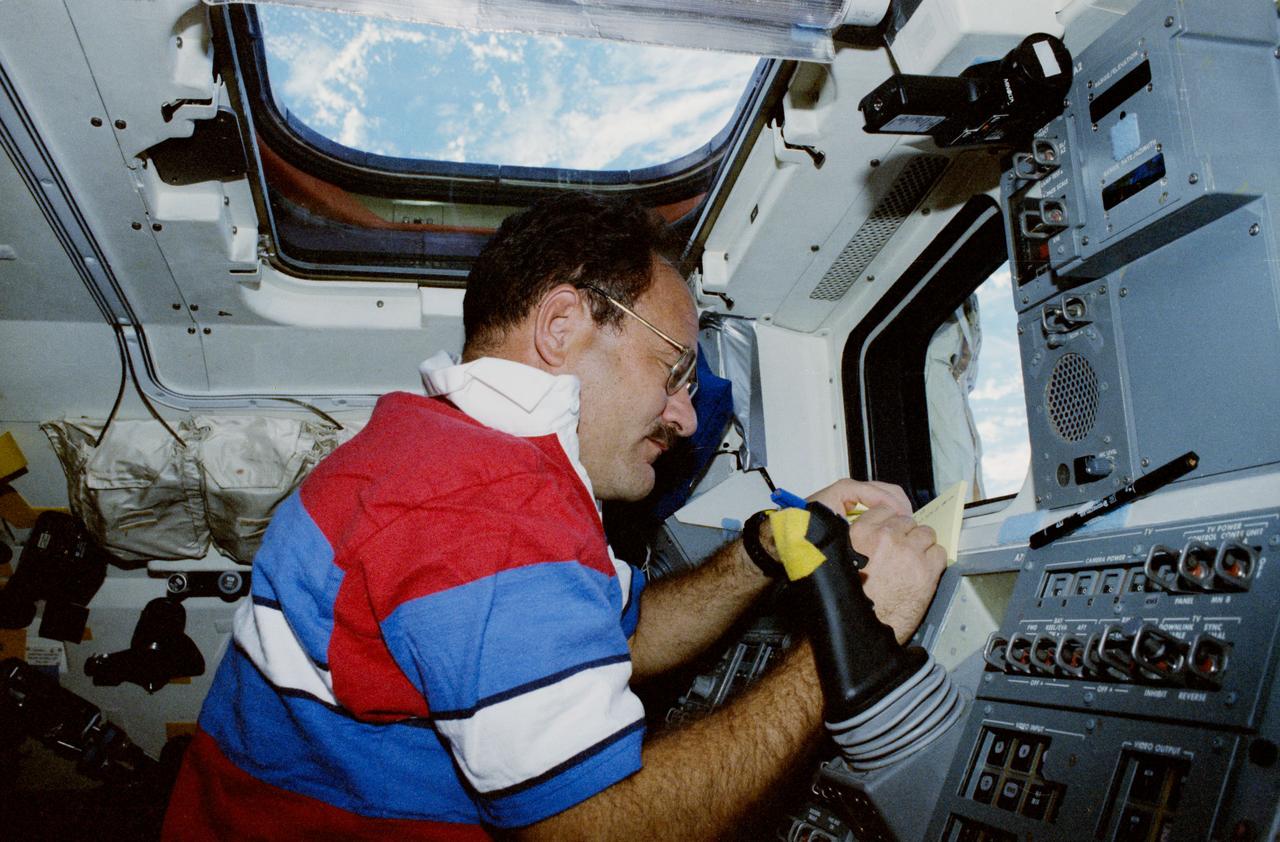
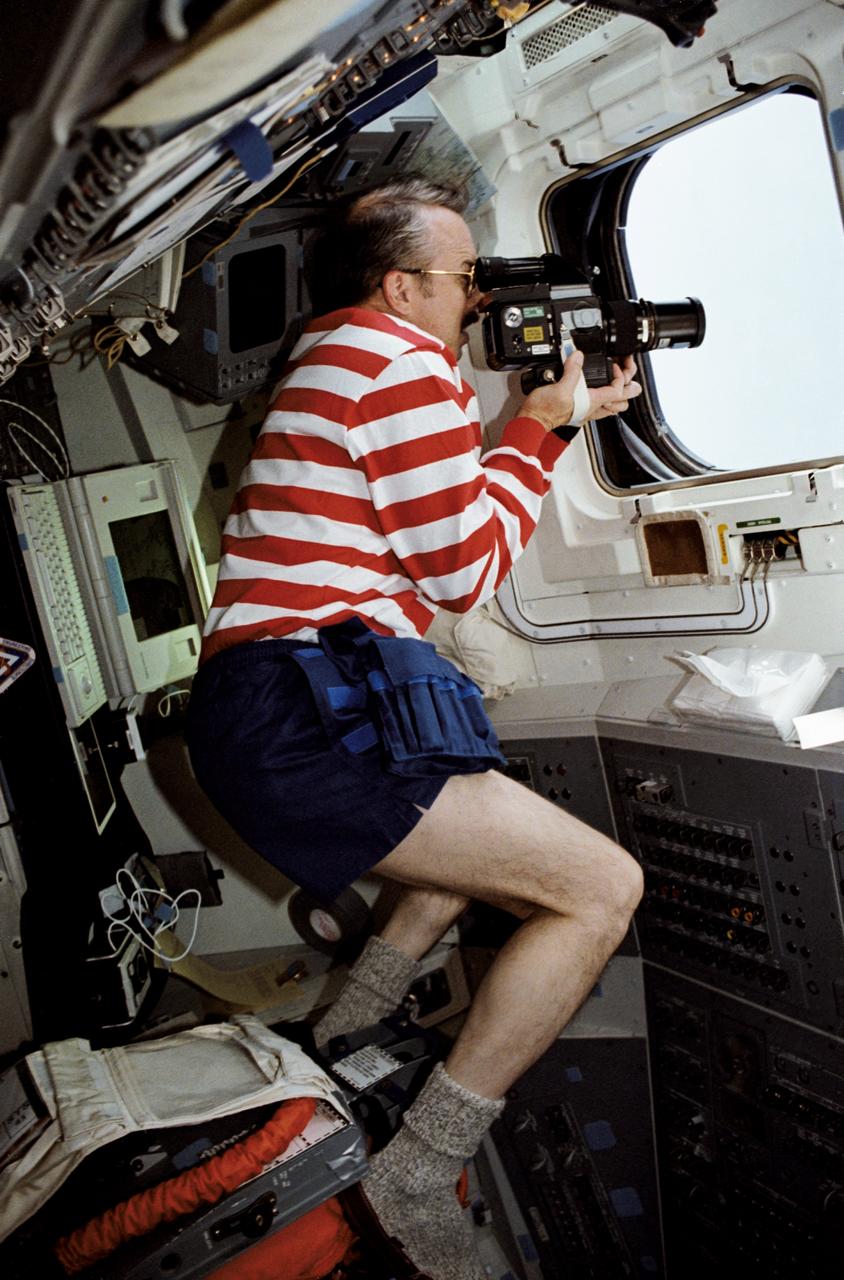
STS033-93-036 (22-27 Nov. 1989) --- Astronaut Frederick D. Gregory, STS-33 commander, aims a 35mm camera out an aft flight deck viewing window while onboard the Space Shuttle Discovery.
STS-33 Commander Gregory uses a NIKON 35mm camera on OV-103's aft flight deck
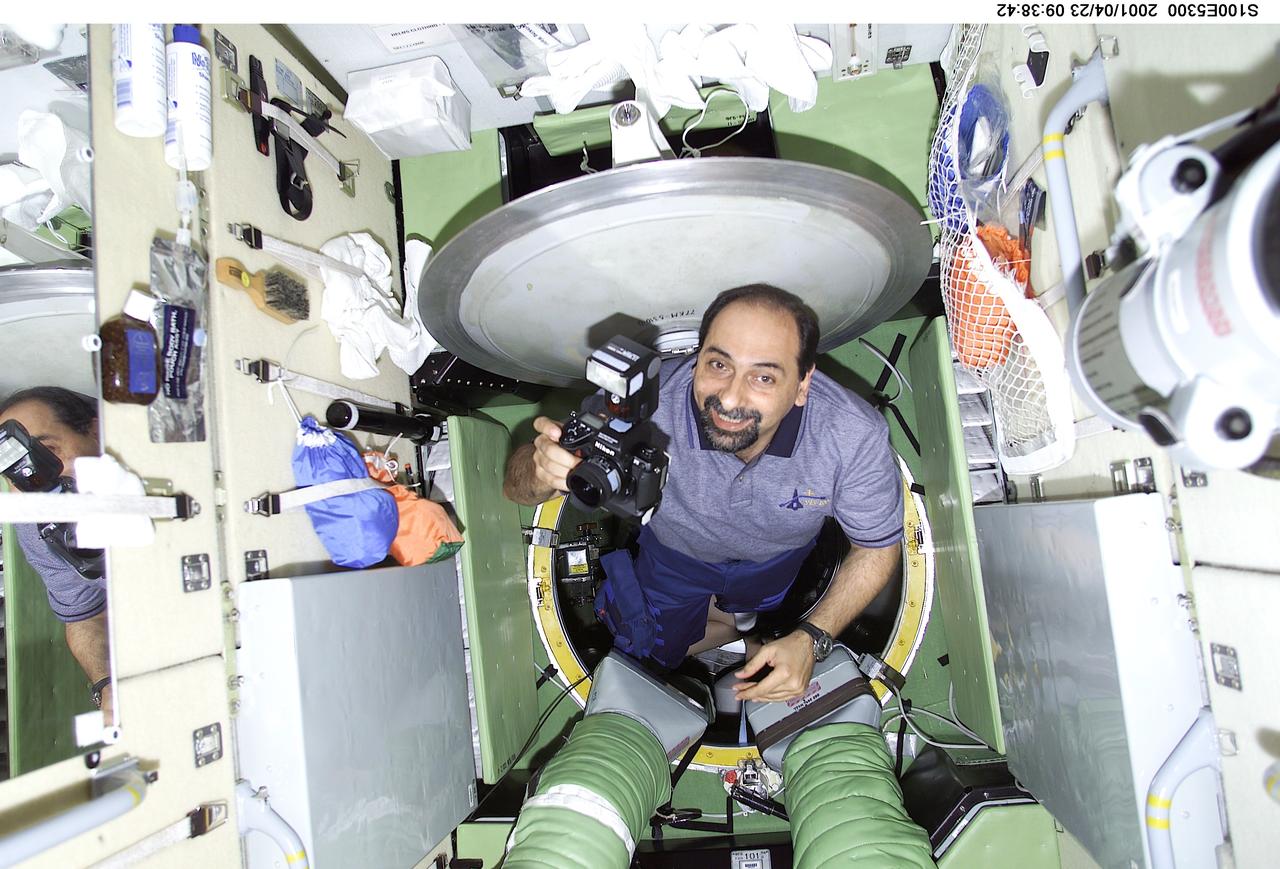
S100-E-5300 (23 April 2001) --- Astronaut Umberto Guidoni, STS-100 mission specialist representing the European Space Agency (ESA), records activity on the Zvezda Service Module  following hatch opening and the reunion of STS-100 crew members with the three members of the Expedition Two crew. This image was taken with a digital still camera.
MS Guidoni drifts through Zarya with a 35mm camera
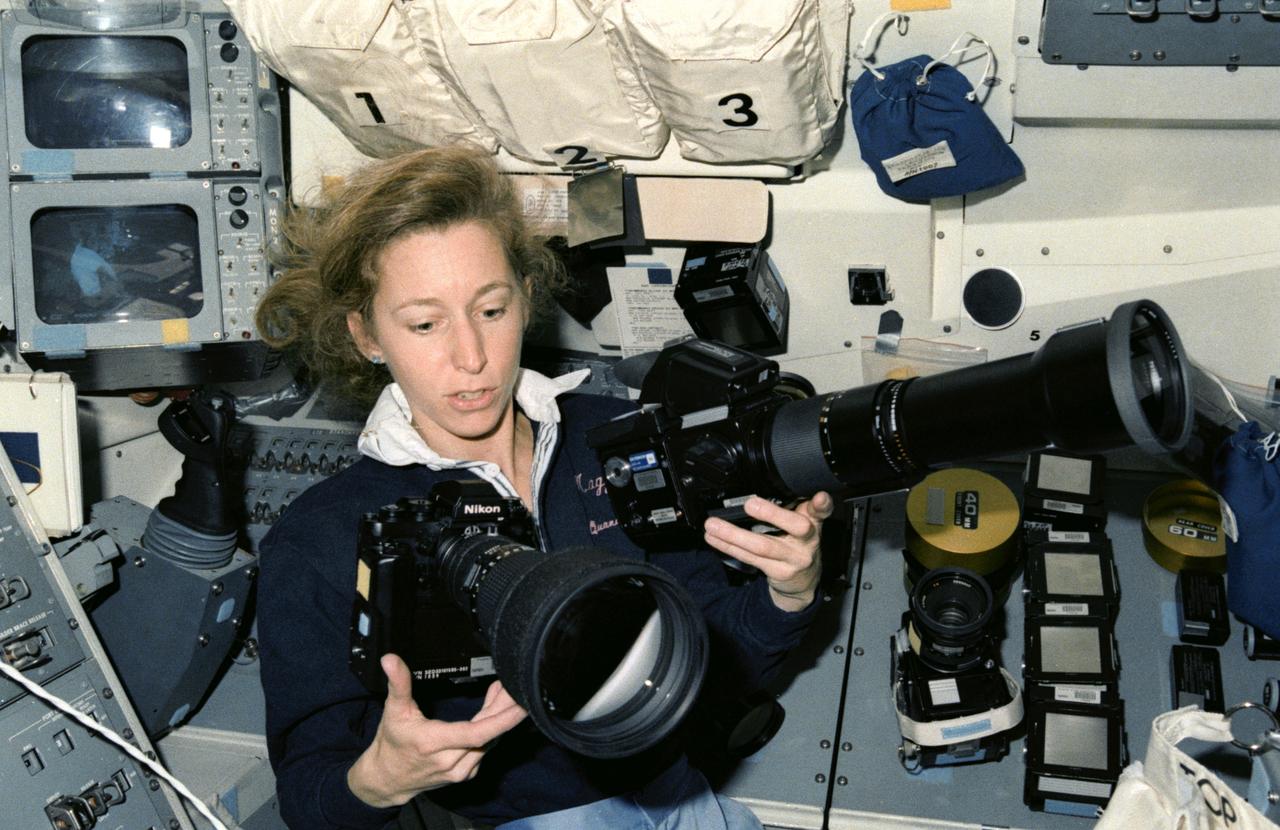
STS032-15-022 (9-20 Jan 1990)  --- A 35mm scene of Astronaut Marsha S. Ivins with 35mm and 70mm cameras and accessories on Columbia's aft flight deck. The photo depicts the role photography played on the record-setting 11-day STS-32 mission.
STS-32 Mission Specialist Ivins juggles camera equipment on aft flight deck
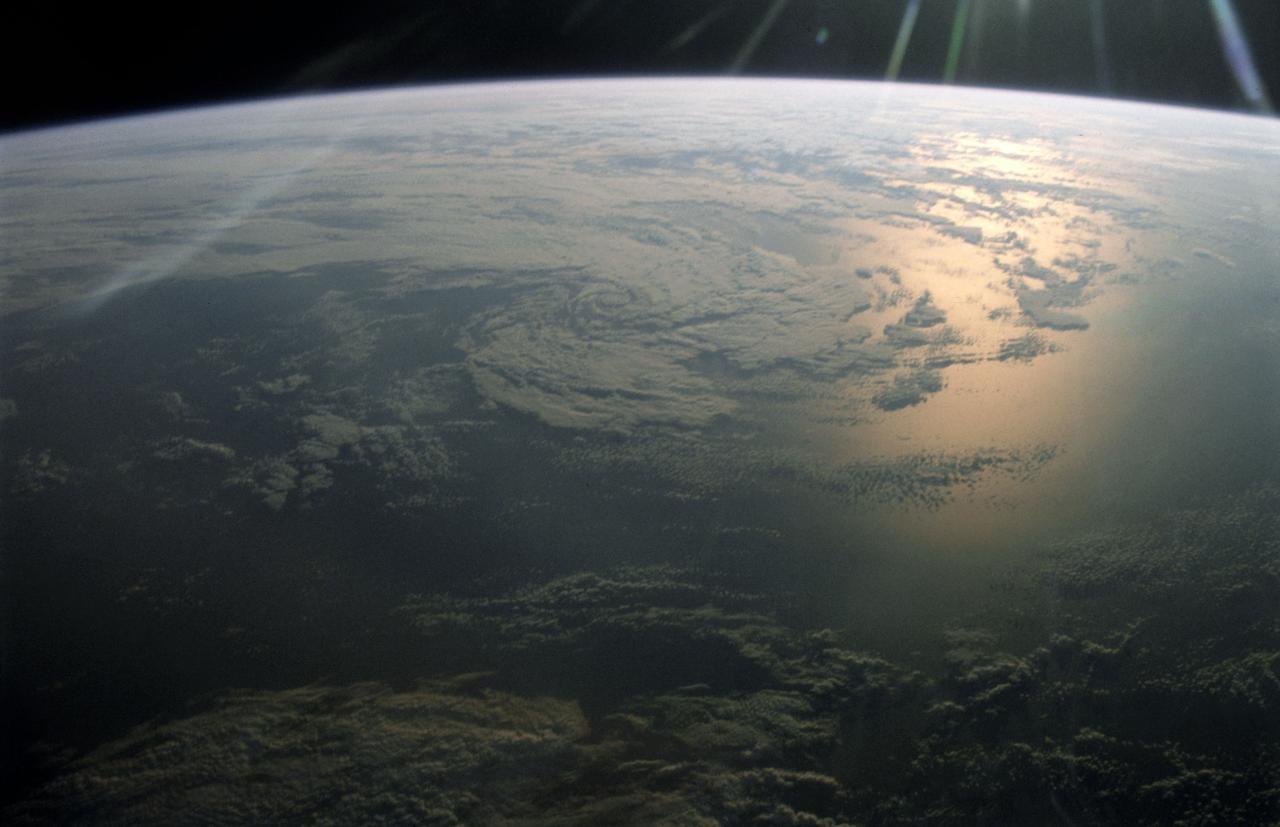
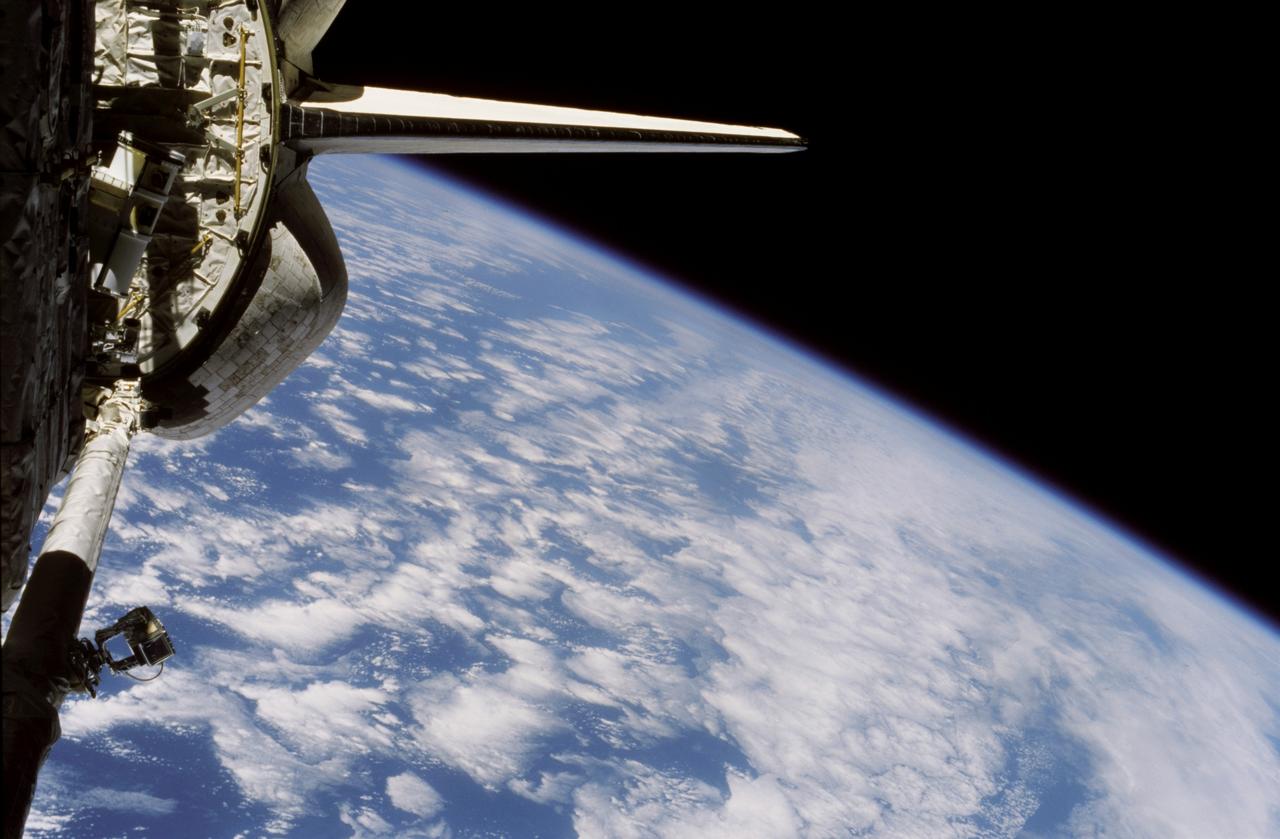
STS005-14-514 (11-16 Nov. 1982) --- This 35mm frame, taken against sunglint, shows clouds over the Pacific Ocean. A Nikon F-3 35mm modified camera and Type 5017, medium speed Ektachrome film were used to record the frame. Approximately 20 frames of 35mm and several dozen frames of 70mm photography of Earth were exposed on the week-long mission aboard the space shuttle Columbia (STS-5). Photo credit: NASA
Earth Observation of sun-glinted ocean and clouds
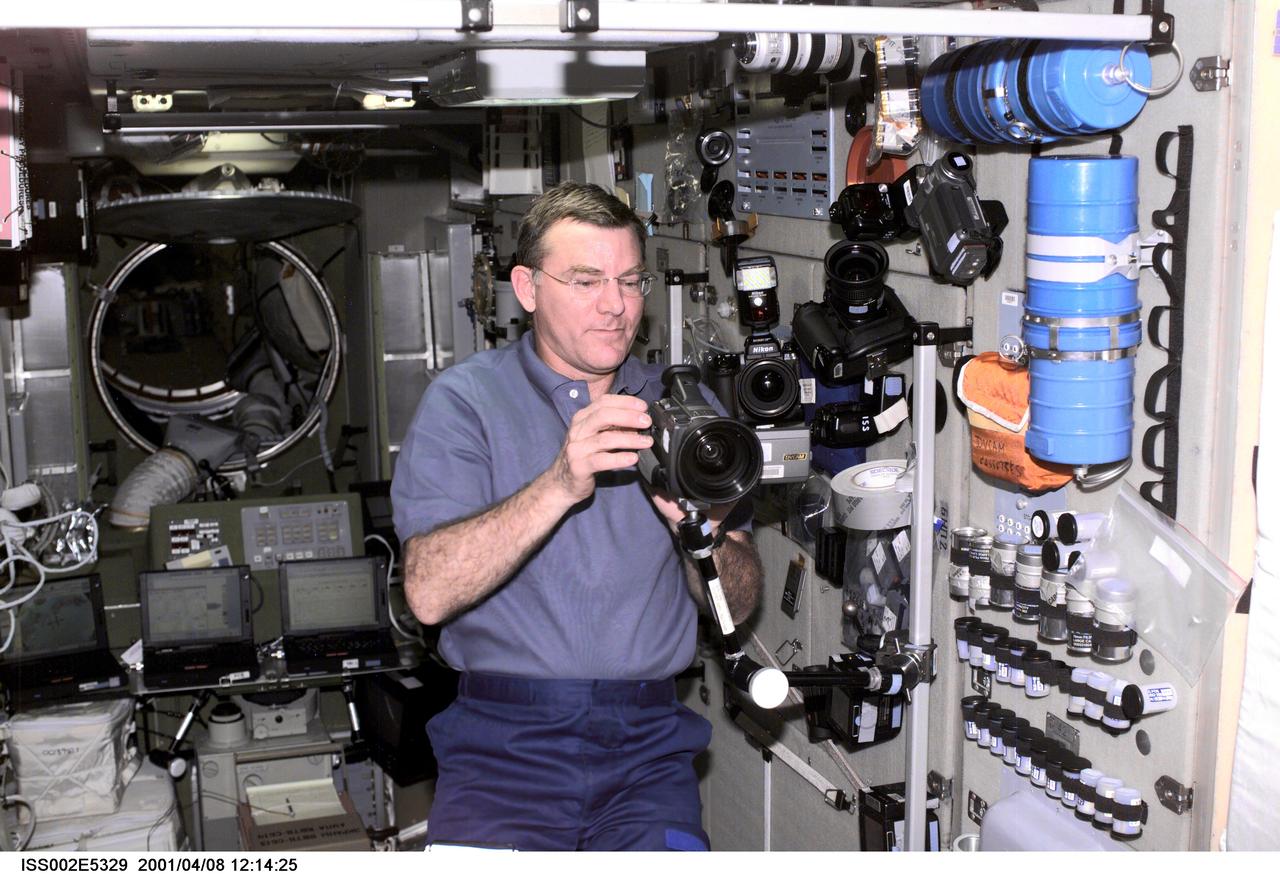
ISS002-E-5329 (08 April 2001) --- Astronaut James S. Voss, Expedition Two flight engineer, sets up a video camera on a mounting bracket in the Zvezda / Service Module of the International Space Station (ISS).  A 35mm camera and a digital still camera are also visible nearby.  This image was recorded with a digital still camera.
Voss with video camera in Service Module
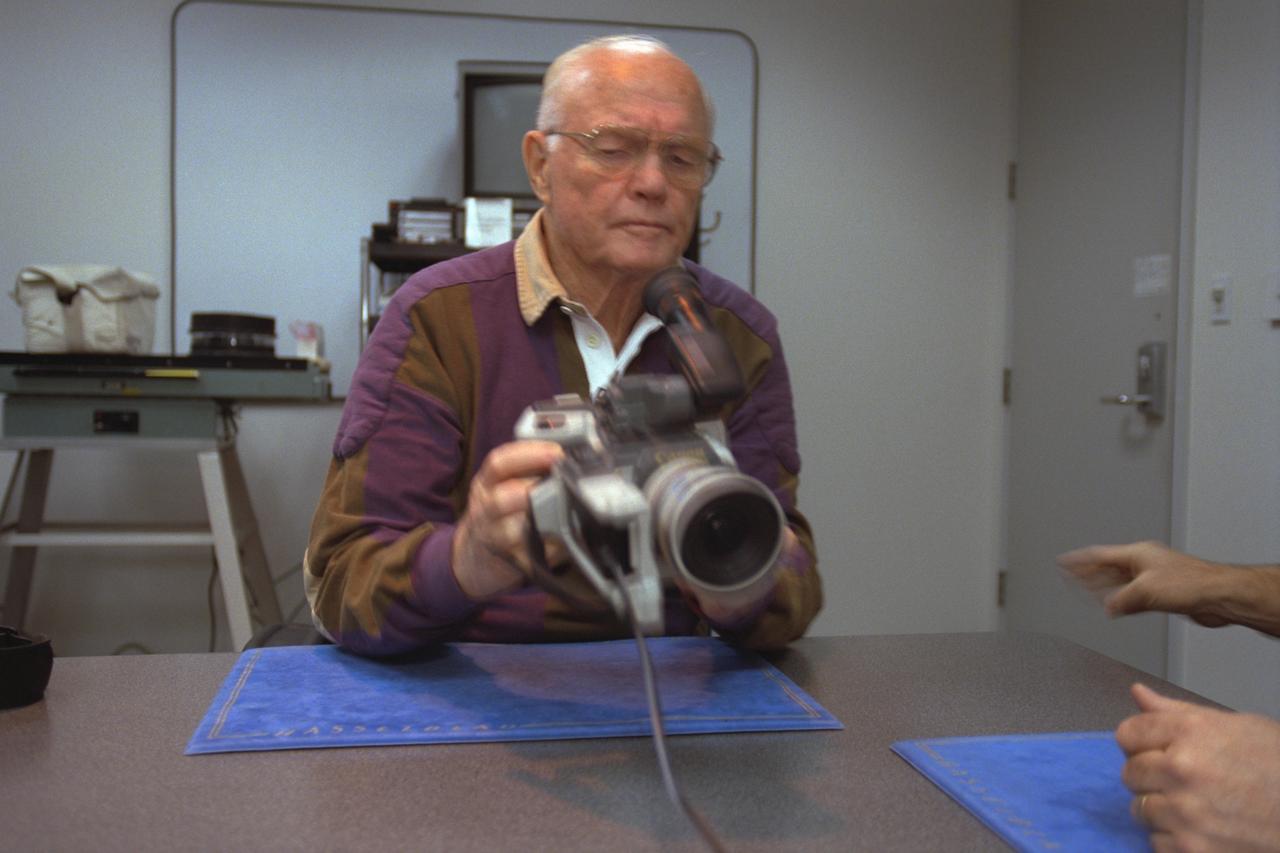
S98-08732 (9 April 1998) --- Holding a 35mm camera, U.S. Sen. John H. Glenn Jr. (D.-Ohio) gets a refresher course in photography from a JSC crew trainer (out of frame, right). The STS-95 payload specialist carried a 35mm camera on his historic MA-6 flight over 36 years ago. The photo was taken by Joe McNally, National Geographic, for NASA.
Various views of STS-95 Senator John Glenn during training
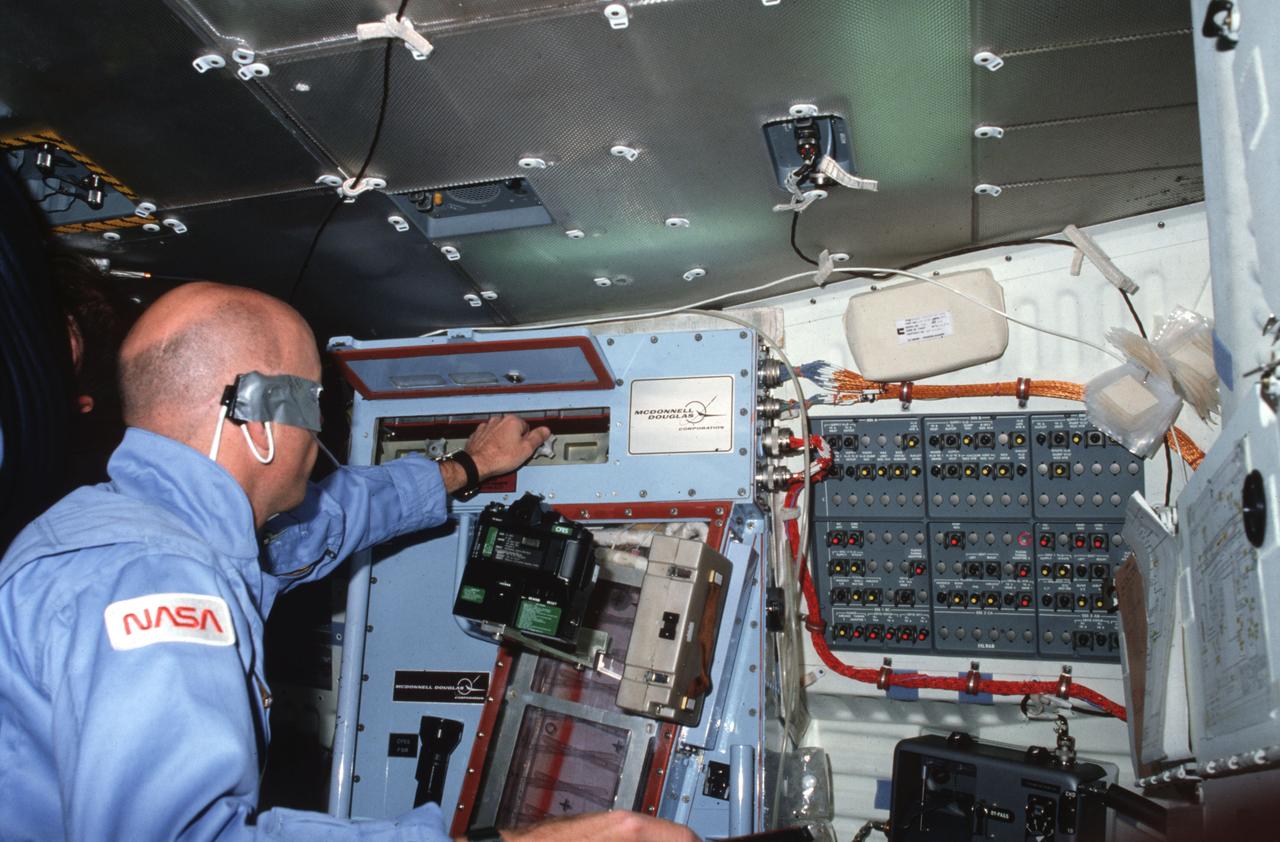
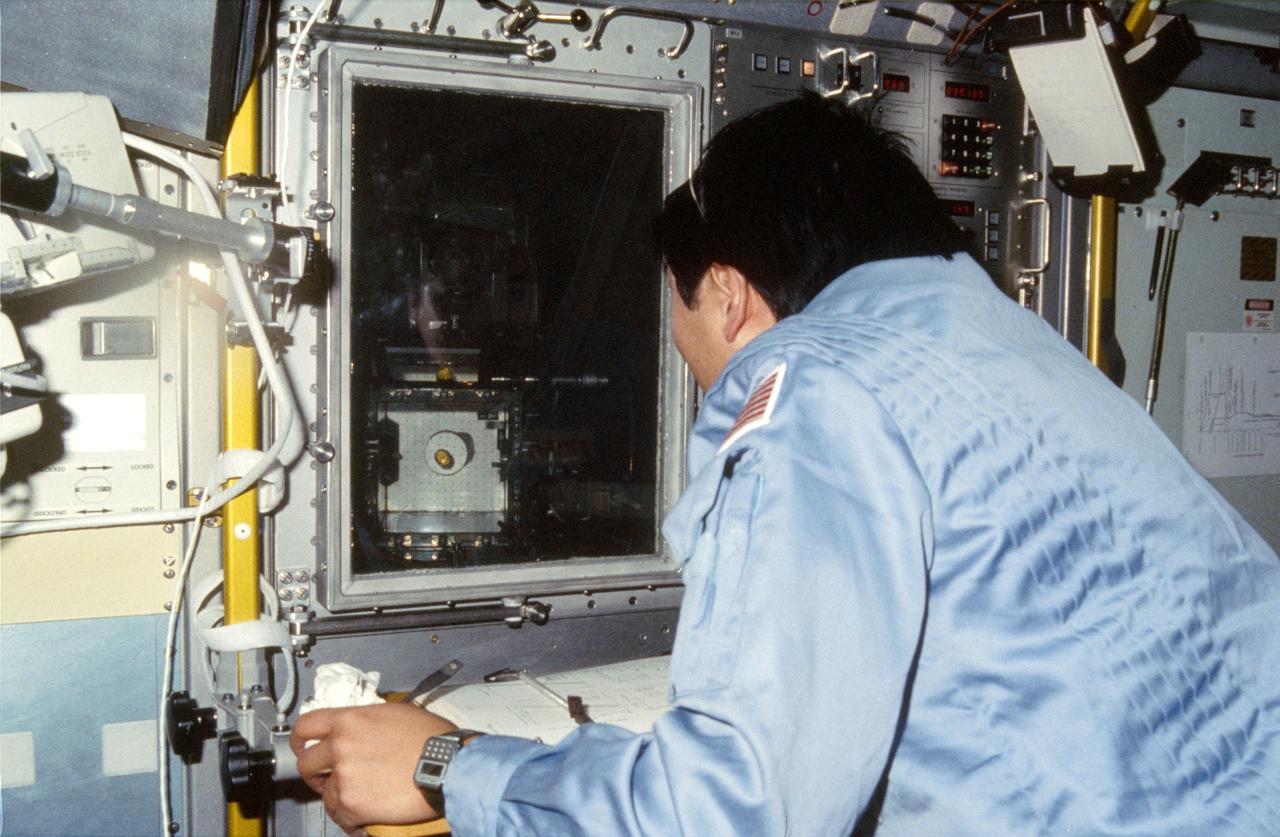
STS006-03-381 (4-9 April 1983) --- Astronaut F. Story Musgrave, STS-6 mission specialist, monitors the activity of a sample in the continuous flow electrophoresis system (CFES) aboard the Earth-orbiting space shuttle Challenger. Dr. Musgrave is in the middeck area of the spacecraft. He has mounted a 35mm camera to record the activity through the window of the experiment. This frame was also photographed with a 35mm camera. Photo credit: NASA
MS Musgrave conducts CFES experiment on middeck
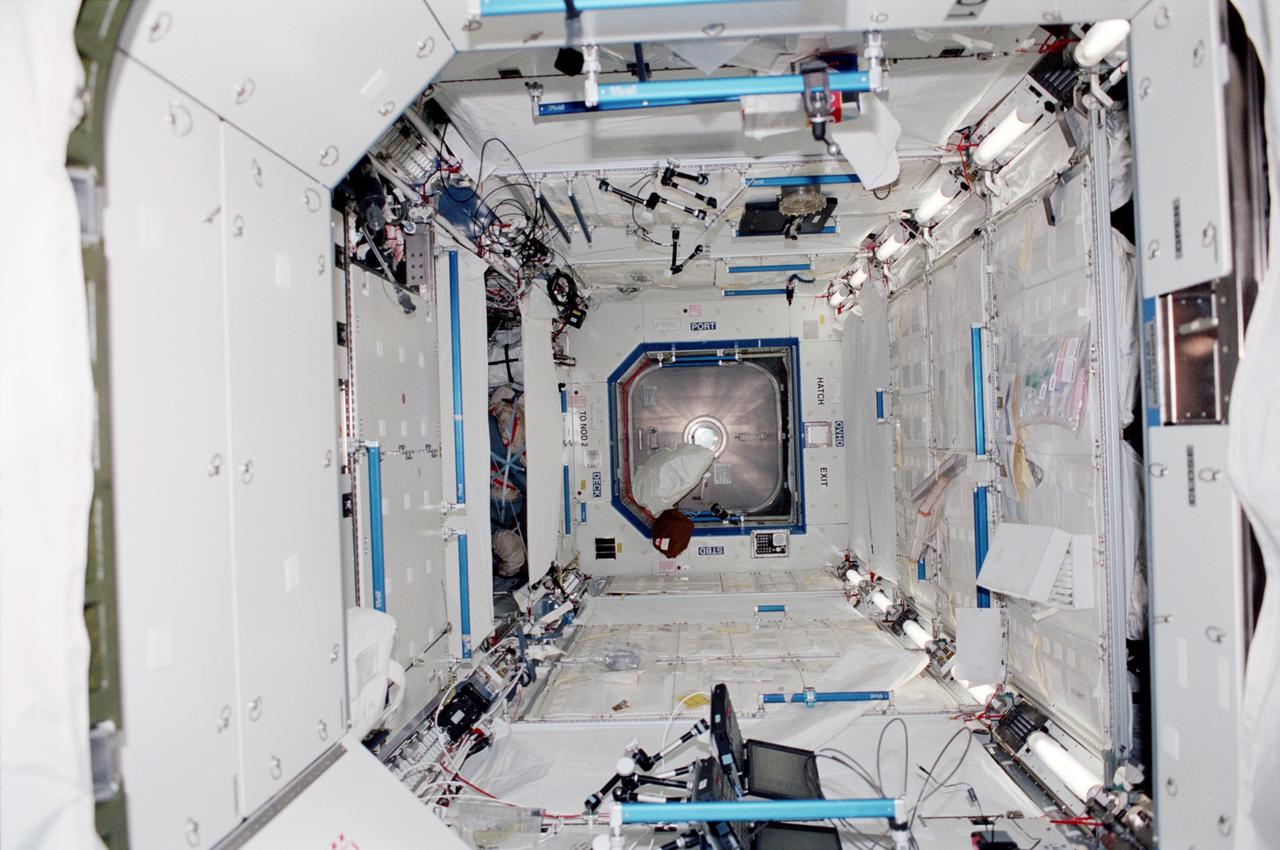
STS098-355-0008 (7-20 February 2001) ---  An overall shot of the newly attached Destiny laboratory was recorded with a 35mm camera during the early occupancy by astronauts and cosmonauts from the   Expedition One and STS-98 crews.
U.S. Lab
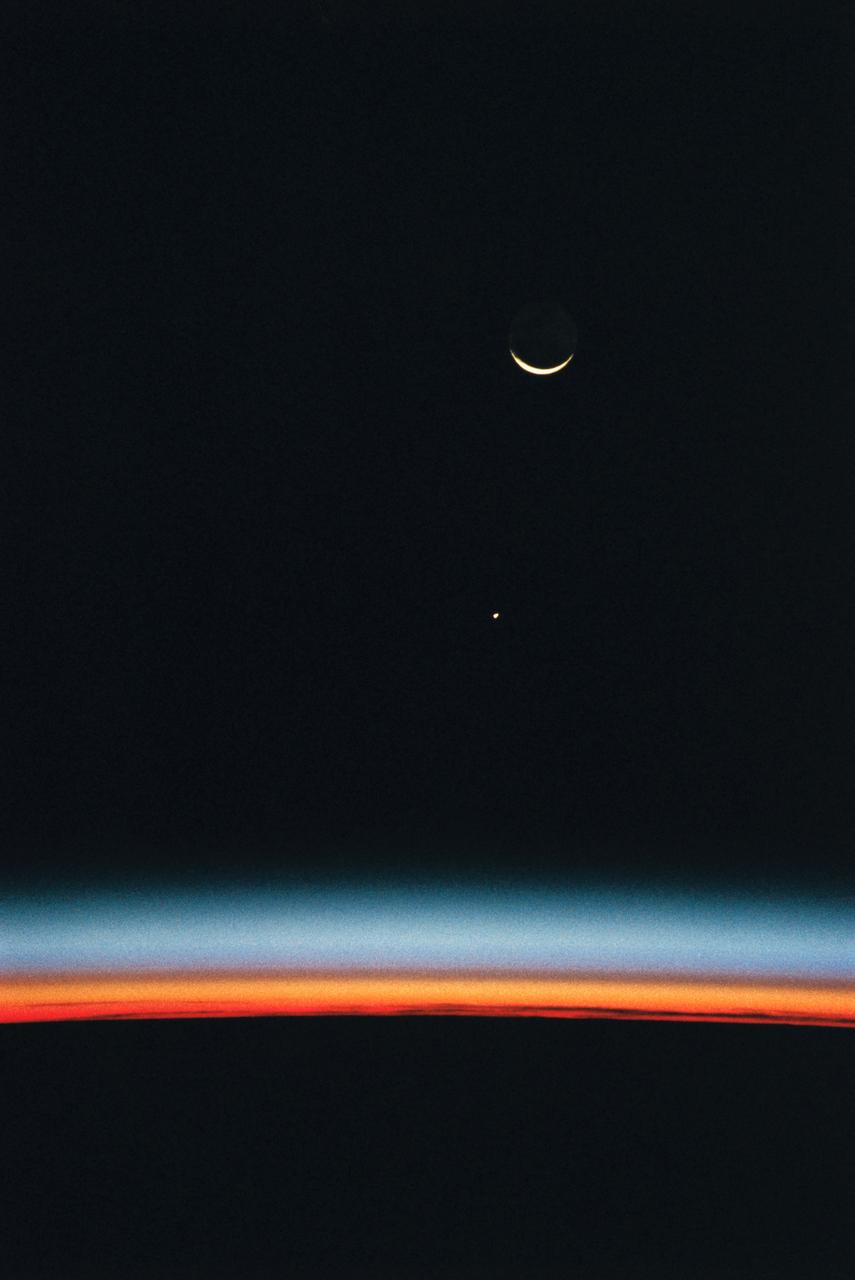
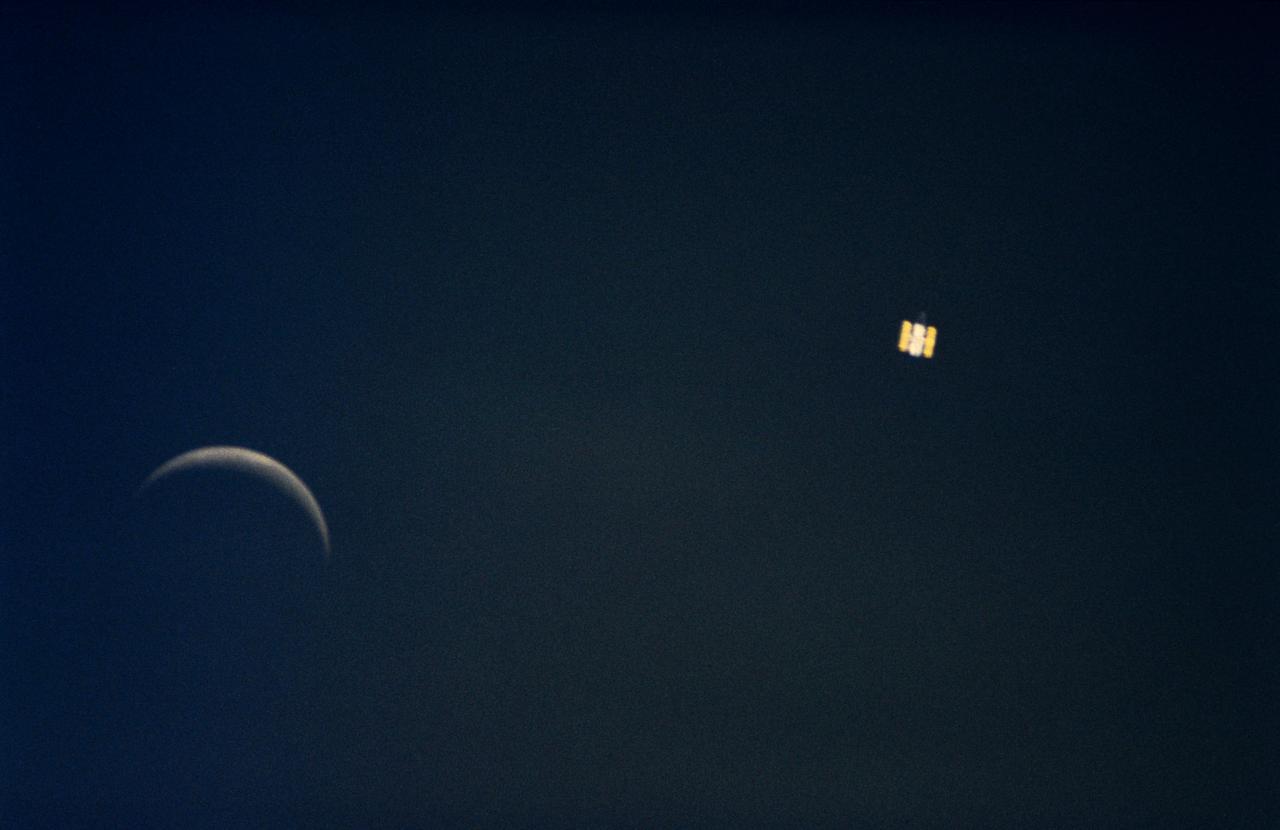
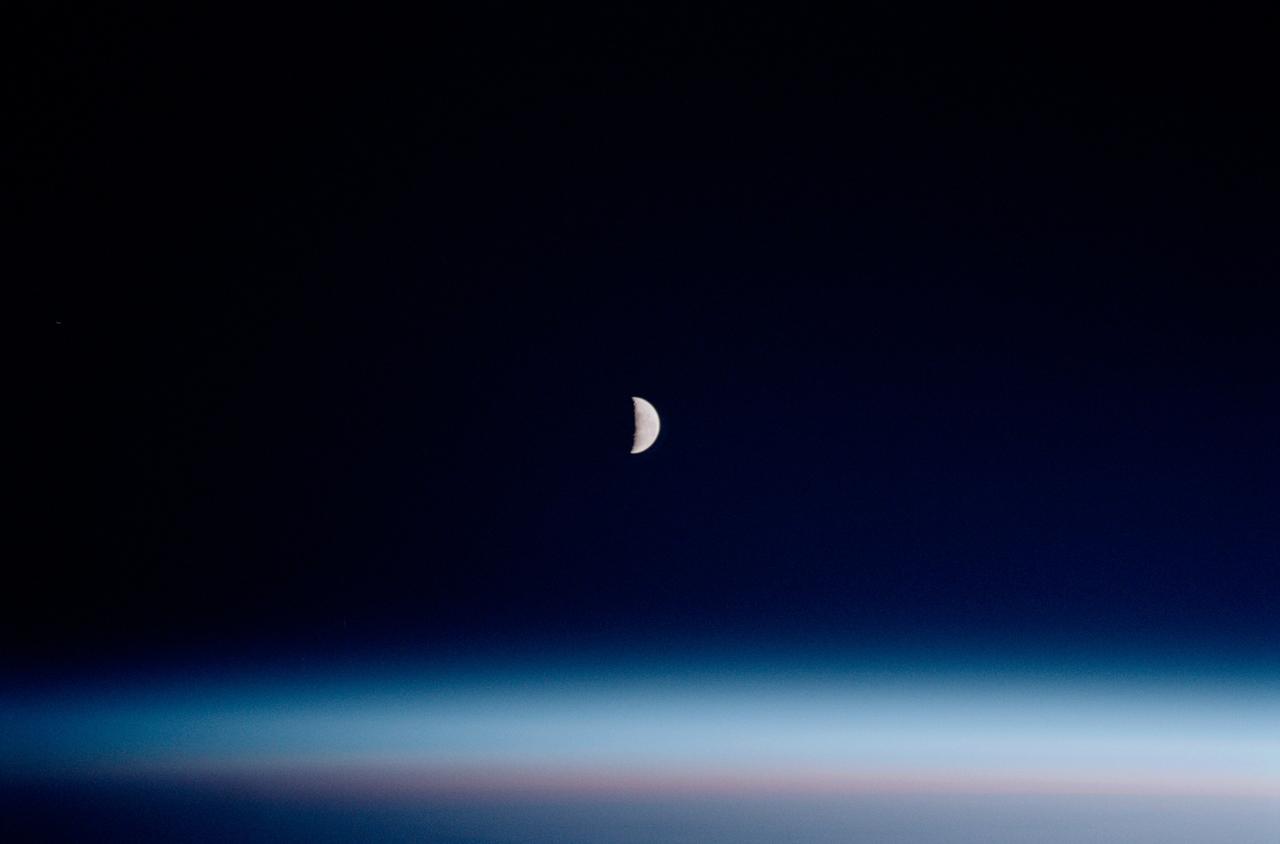
STS061-56-027 (2-13 Dec 1993) --- This scene, captured with a 35mm camera from inside the Space Shuttle Endeavour, shows Jupiter rising above the airglow over Earth's horizon.  The crescent Moon is at top frame.
Earth-orbiting HST, airglow over Earth's horizon, and crescent moon
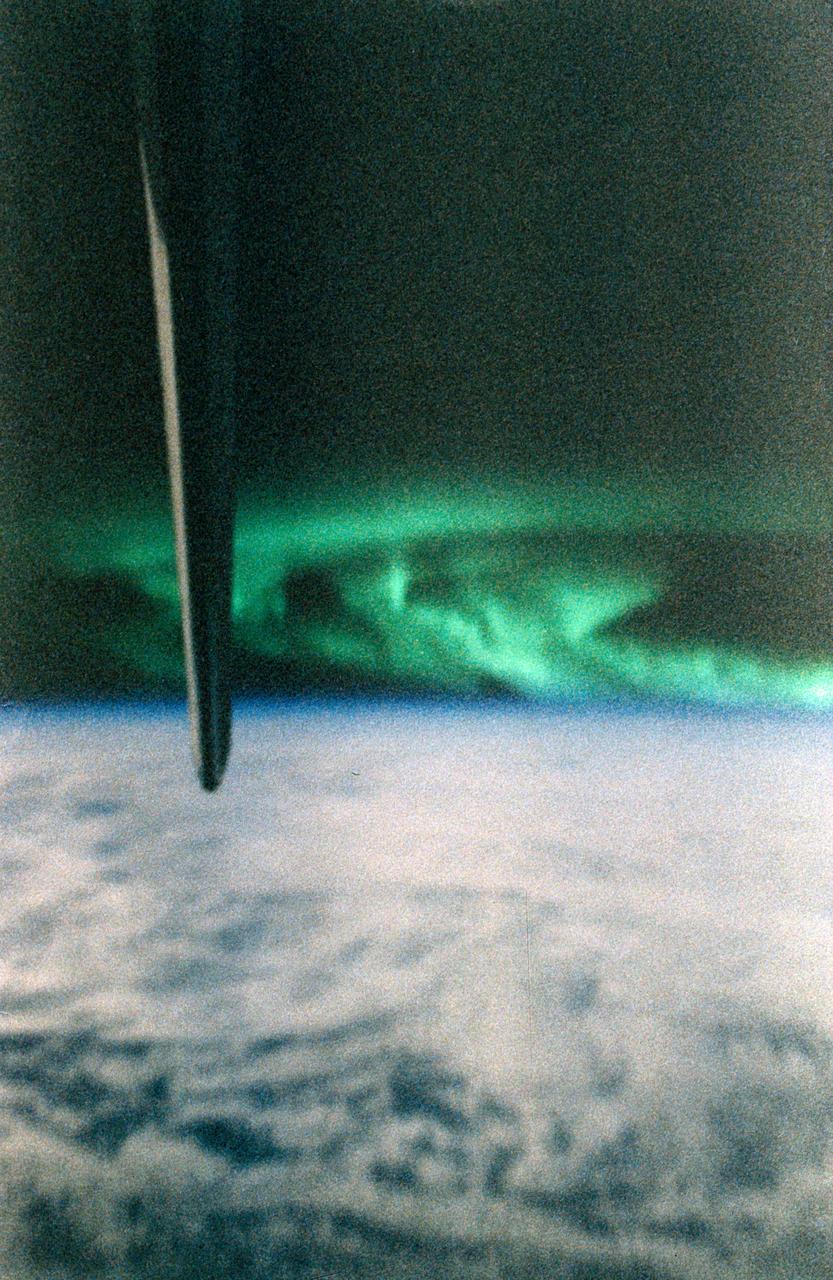
STS085-365-006 (7 - 19 August 1997) --- A 35mm camera with a time exposure was used to record this image of the southern lights or the aurora Australis.  The vertical stabilizer of the Space Shuttle Discovery appears in the foreground.
Aurora Australis taken from the shuttle Discovery during STS-85 mission
STS061-57-021 (2-12 Dec 1993) --- This scene, captured with a 35mm camera from inside the Space Shuttle Endeavour, shows the Earth-orbiting Hubble Space Telescope (HST) and the Moon together.
Onboard view from STS-61 of the Hubble Space Telescope and moon together
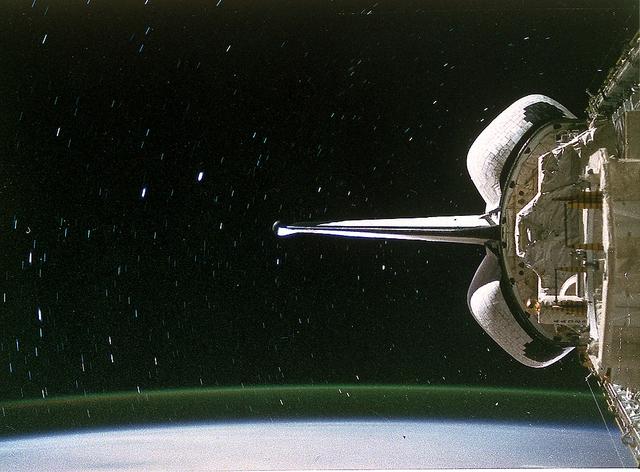
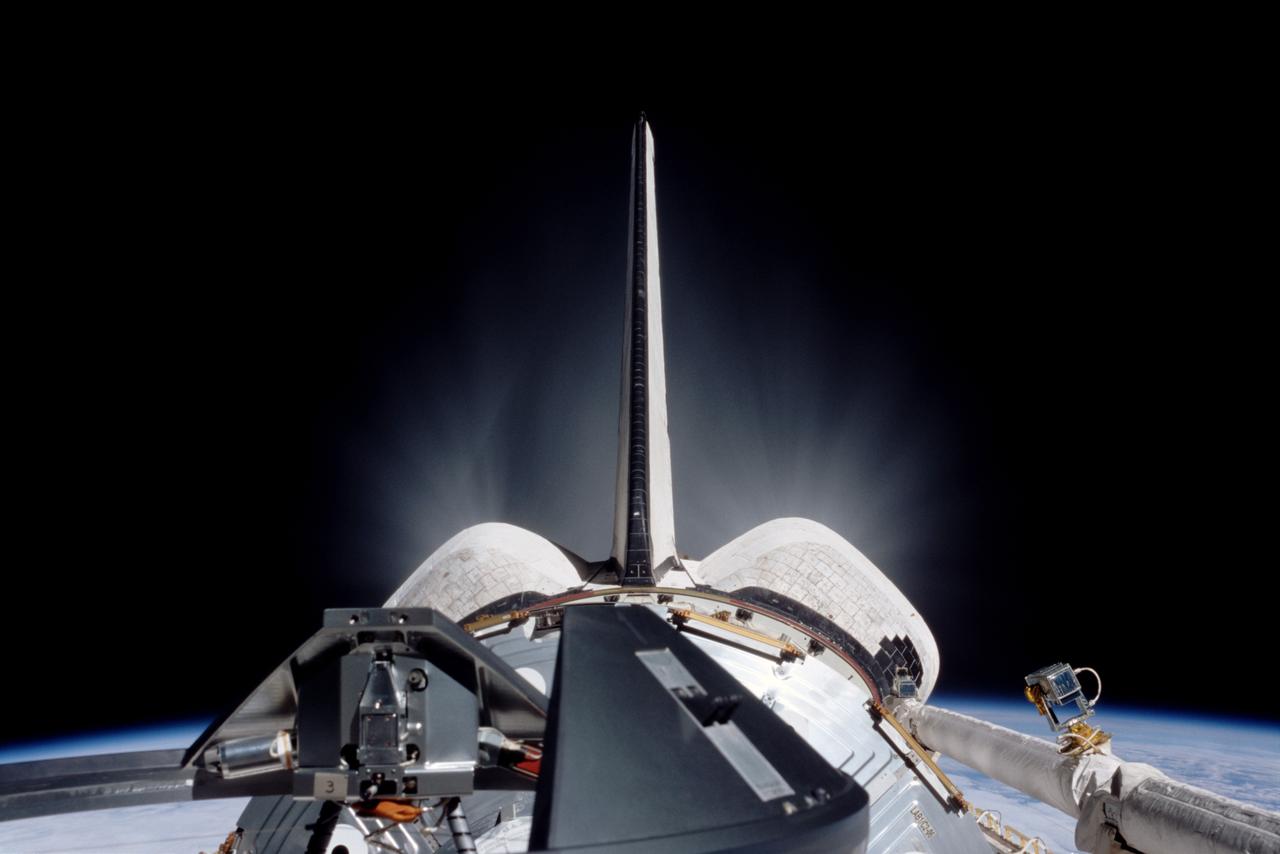
Onboard Space Shuttle Columbia (STS-75) the vertical stabilizer appears to point to the four stars of the Southern Cross. The scene was captured with a 35mm camera just prior to a sunrise.
Spacelab
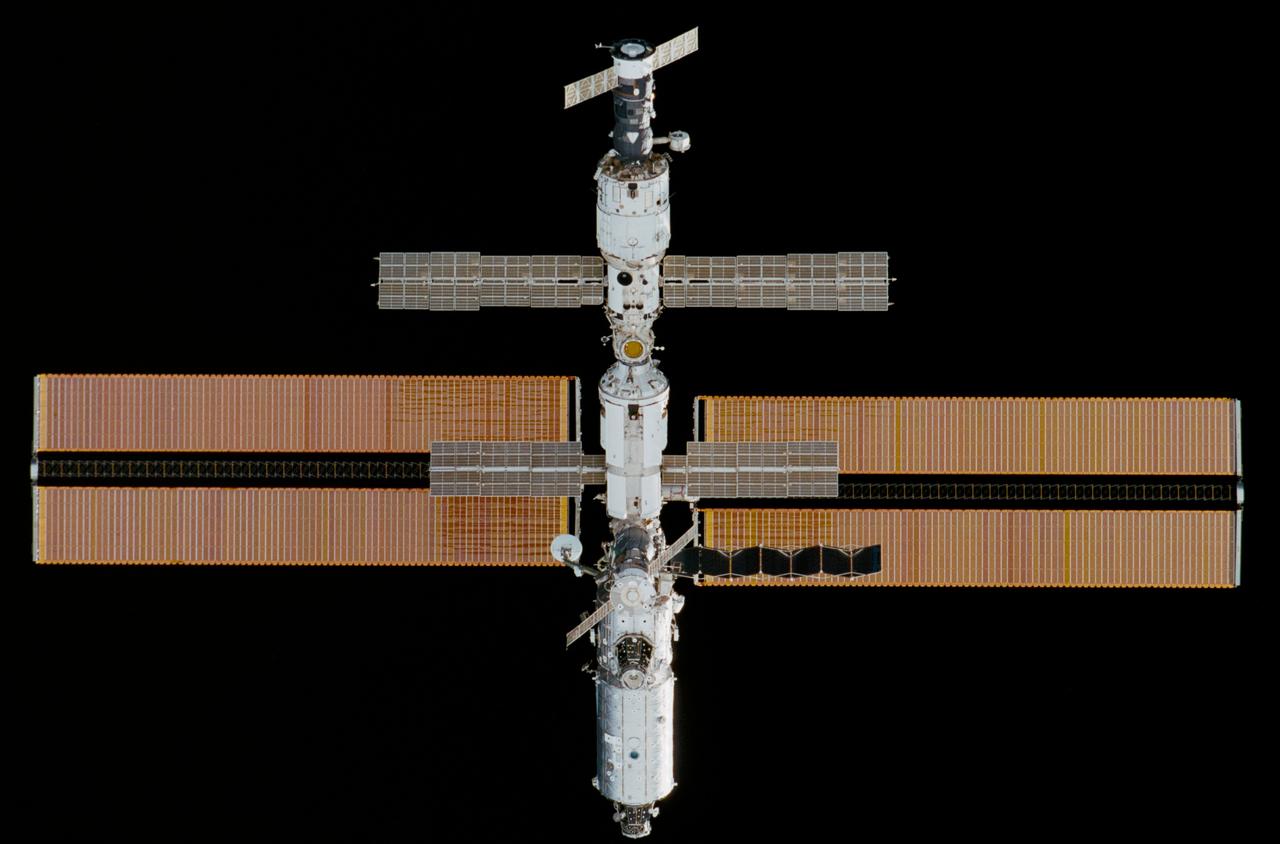
STS102-329-037 (8-21 March 2001)--- Backdropped against the blackness of space, the International Space Station (ISS) was photographed with a 35mm camera by one of the astronauts onboard the Discovery following separation of the station and the shuttle.
View of the ISS during rendezvous
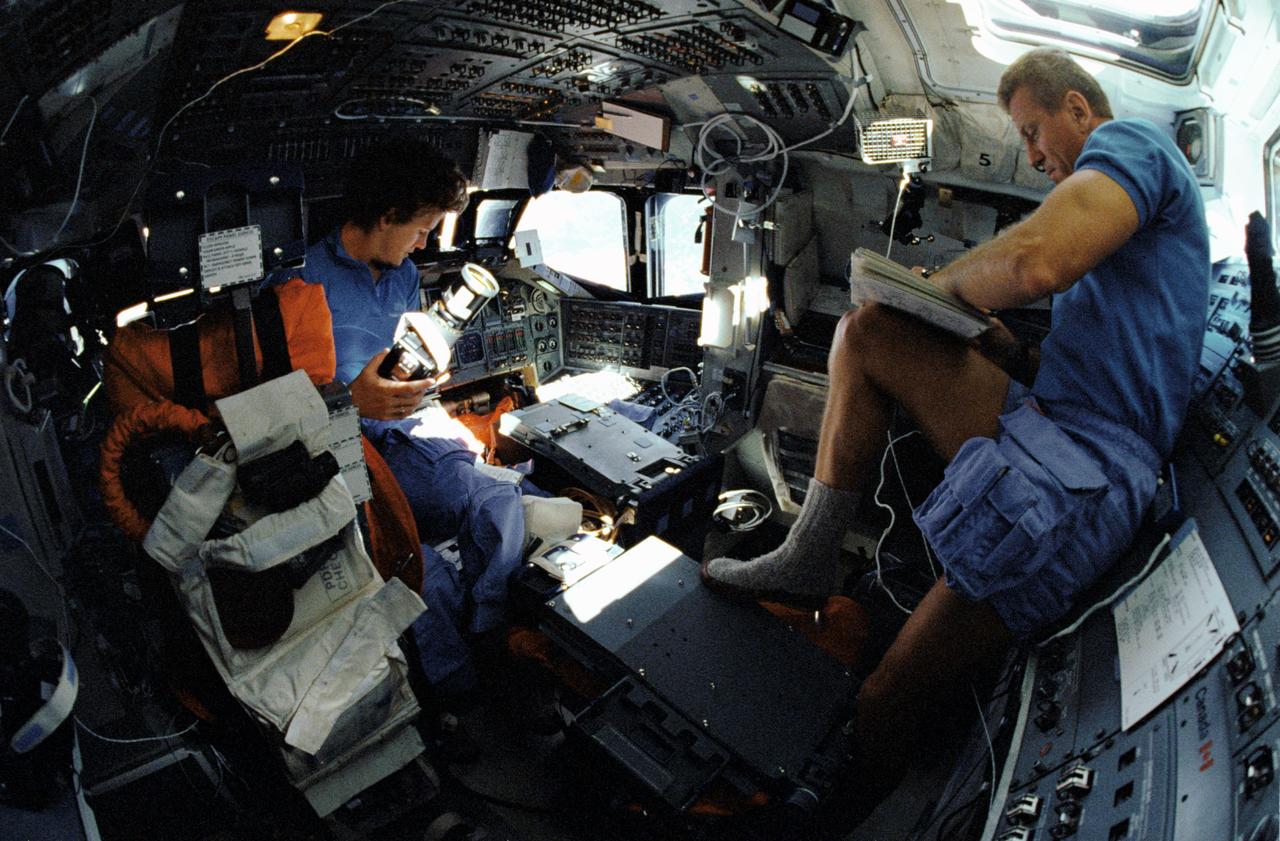
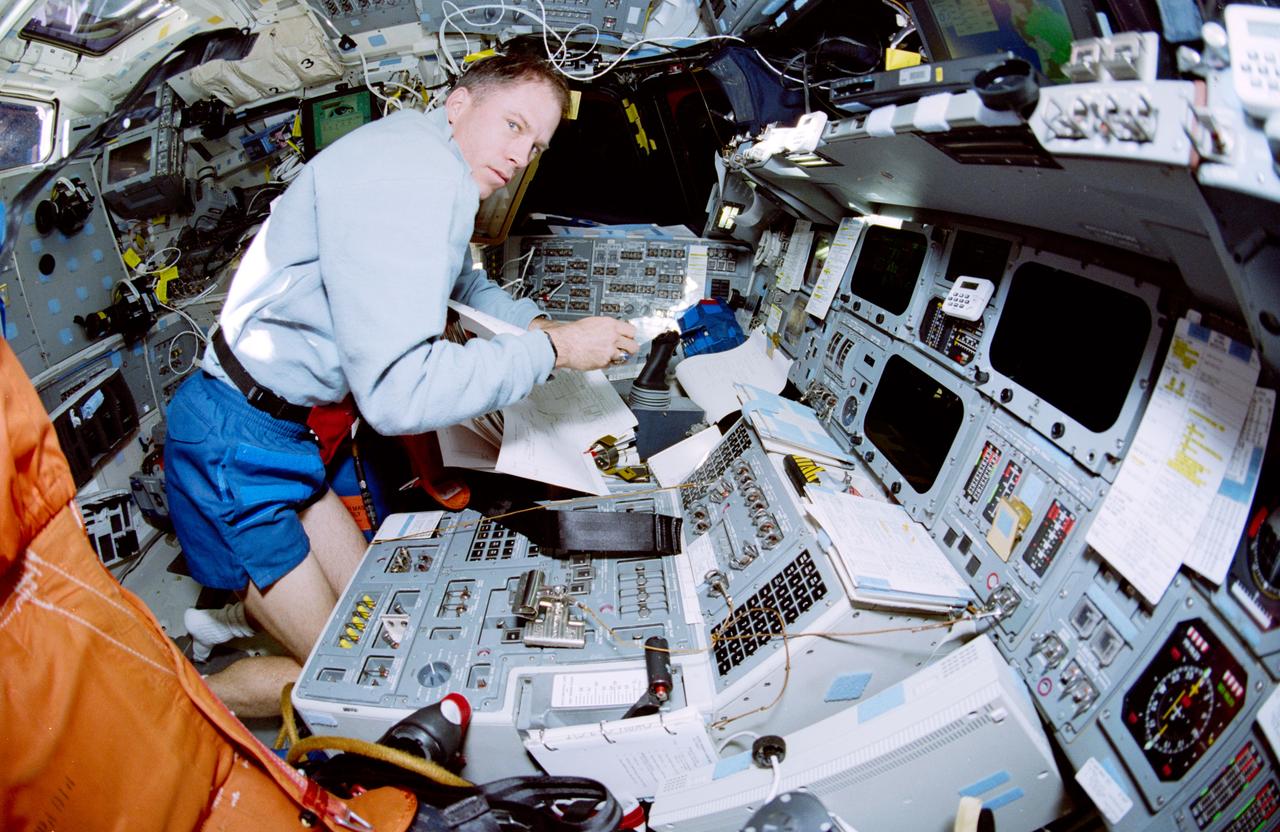
STS031-101-053 (24-29 April 199) --- A 35mm camera equipped with a "fish-eye" lens captured this view on Discovery's flight deck featuring astronaut Kathryn D. Sullivan with a Hasselblad camera on forward flight deck and astronaut Loren J. Shriver, pen in hand, amending flight data on aft flight deck.
STS-31 MS Sullivan and Commander Shriver work on the OV-103's flight deck
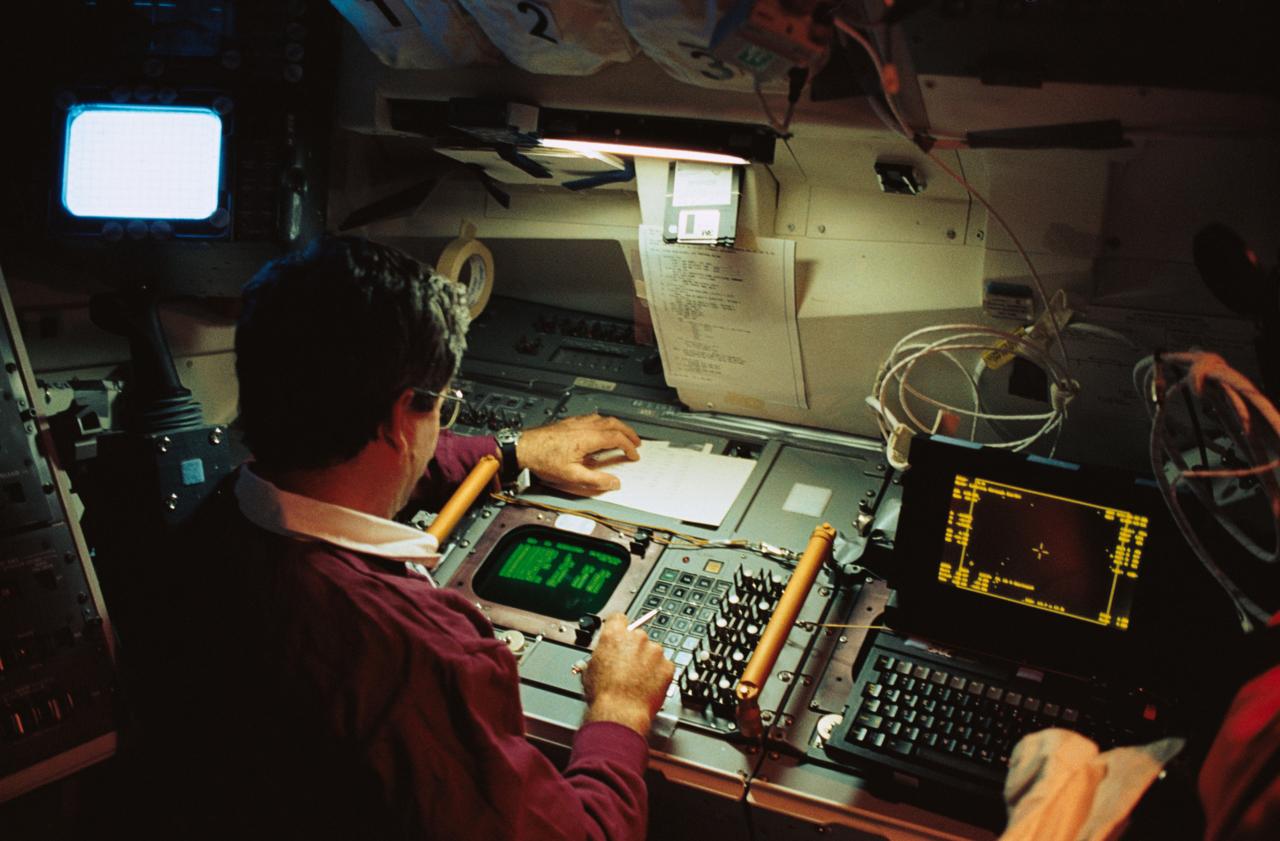
51F-17-011 (29 July-6 Aug 1985) --- Loren W. Acton, 51-F payload specialist, triggers a 35mm camera recording stellar imagery through the aft flight deck overhead windows aboard the Earth-orbiting Space Shuttle Challenger. The extension on the camera's lens is an image intensifier.
Payload specialist Loren Acton working at aft fligh deck station
STS030-03-038   (4-8 May 1989) --- Astronaut Ronald J. Grabe, STS- 30 pilot, typifies the working mode of the entire five- member crew as he observes and photographs Earth from 160 nautical miles above. Grabe is on the aft flight deck, making use of two large overhead viewing windows. The scene was shown by the crew at its May 18, 1989 post-flight press conference.
STS-30 Pilot Grabe uses 35mm camera on aft flight deck
STS029-06-015 (13-18 March 1989) --- This scene of an astronaut with a camera was a common one during the five-day flight of STS-29.  Astronaut James P. Bagian, STS-29 mission specialist, aims the Arriflex motion picture camera at Earth through one of Discovery's overhead windows.  The scene was recorded with a 35mm camera.
STS-29 Discovery, OV-103, MS Bagian uses video camera on forward flight deck
STS031-05-002 (24-29 April 1990) ---  A 35mm camera with a "fish eye" lens captured this high angle image on Discovery's middeck.   Astronaut Kathryn D. Sullivan works with the IMAX camera in foreground, while Astronaut Steven A. Hawley consults a checklist in corner.  An Arriflex motion picture camera records student ion arc experiment in apparatus mounted on stowage locker.  The experiment was the project of Gregory S. Peterson, currently a student at Utah State University.
STS-31 crew activity on the middeck of the Earth-orbiting Discovery, OV-103
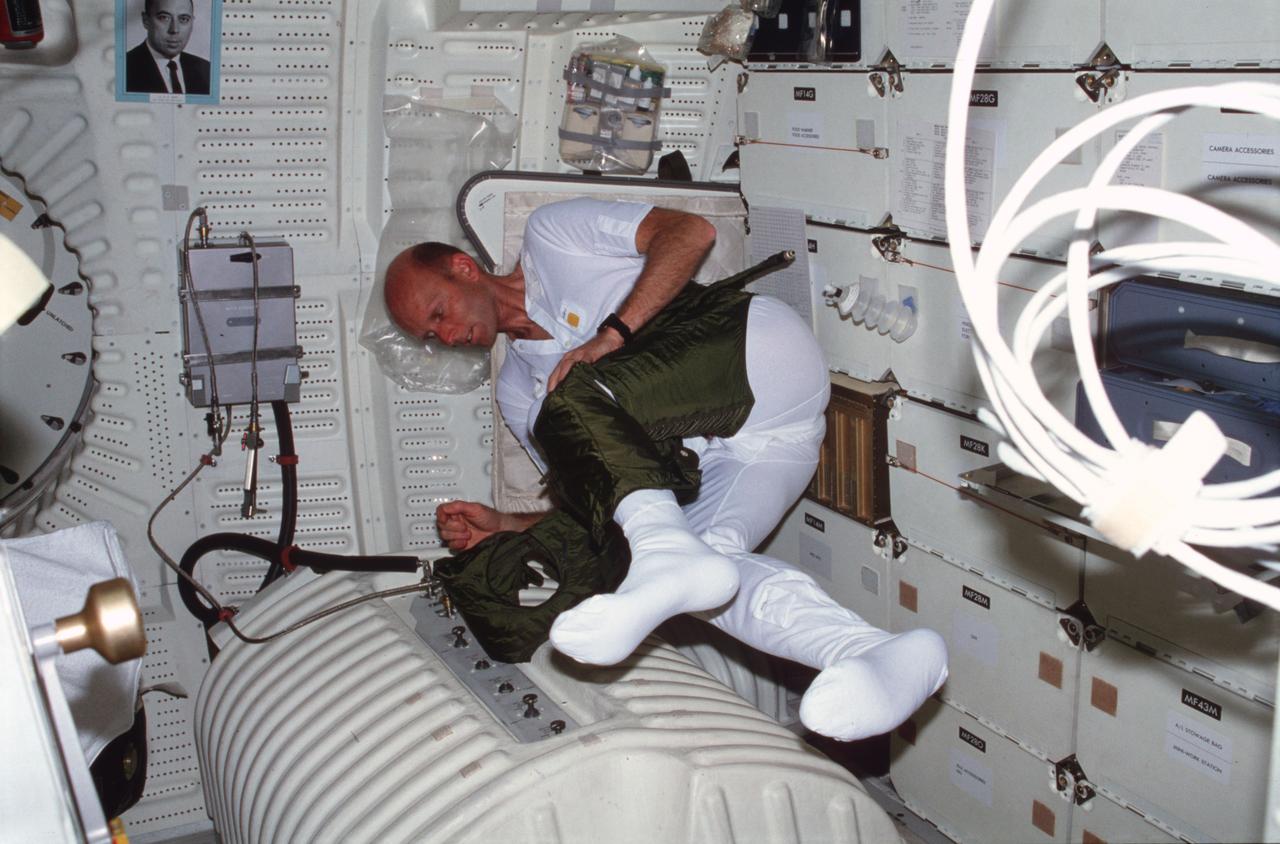
STS007-06-0314 (18-24 June 1983) --- Astronaut John M. Fabian, STS-7 mission specialist, sleeps in a zip-up blue sleep restraint device in the locker area of the Earth-orbiting space shuttle Challenger's middeck. The frame was exposed with a 35mm camera. Photo credit: NASA
Mission Specialist (MS) Fabian in middeck sleep restraint
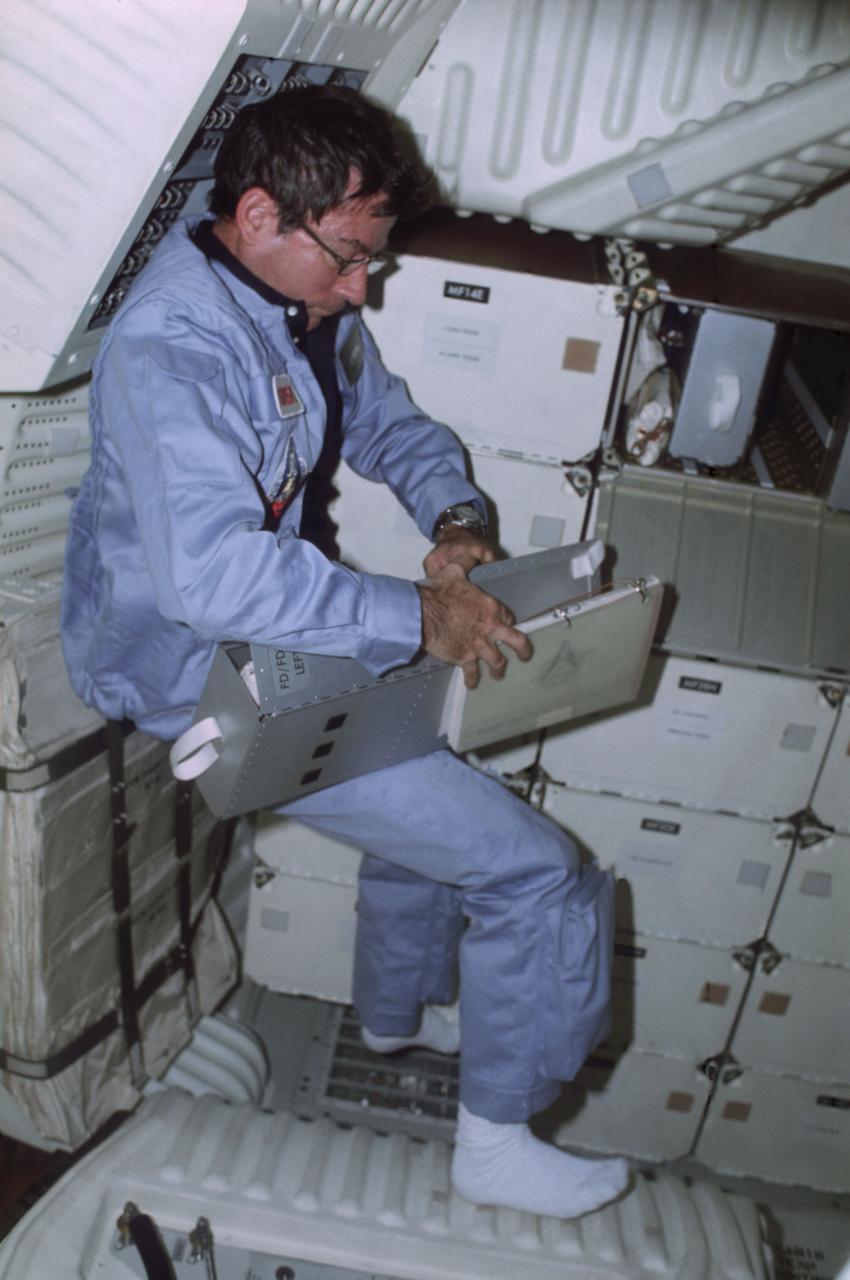
STS001-06-497 (12-14 April 1981) --- Astronaut John W. Young, STS-1 commander, opens one of the lockers in the space shuttle Columbia's middeck area. This photo was taken by astronaut Robert L. Crippen, pilot, using a 35mm camera. Photo credit: NASA
Commander Young removes CAP from FDF stowage locker on middeck
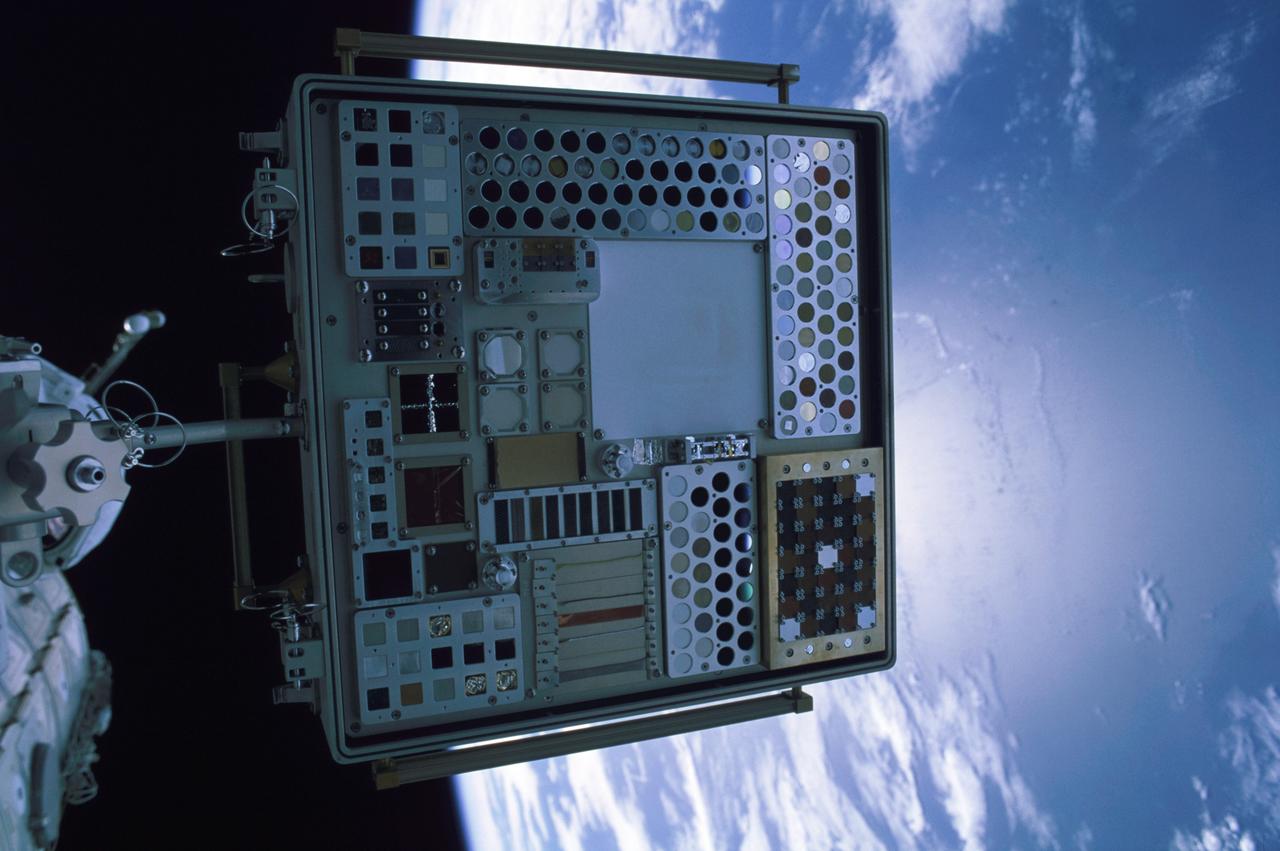
ISS006-348-019 (January 2003)  ---- Materials International Space Station Experiment (MISSE), a suitcase-sized experiment attached to the outside of the space station to expose hundreds of potential space construction materials to the environment, leading to stronger, more durable spacecraft construction. Photographed by one of the Expedition 6 crew members with a 35mm camera.
View of MISSE taken during Expedition Six
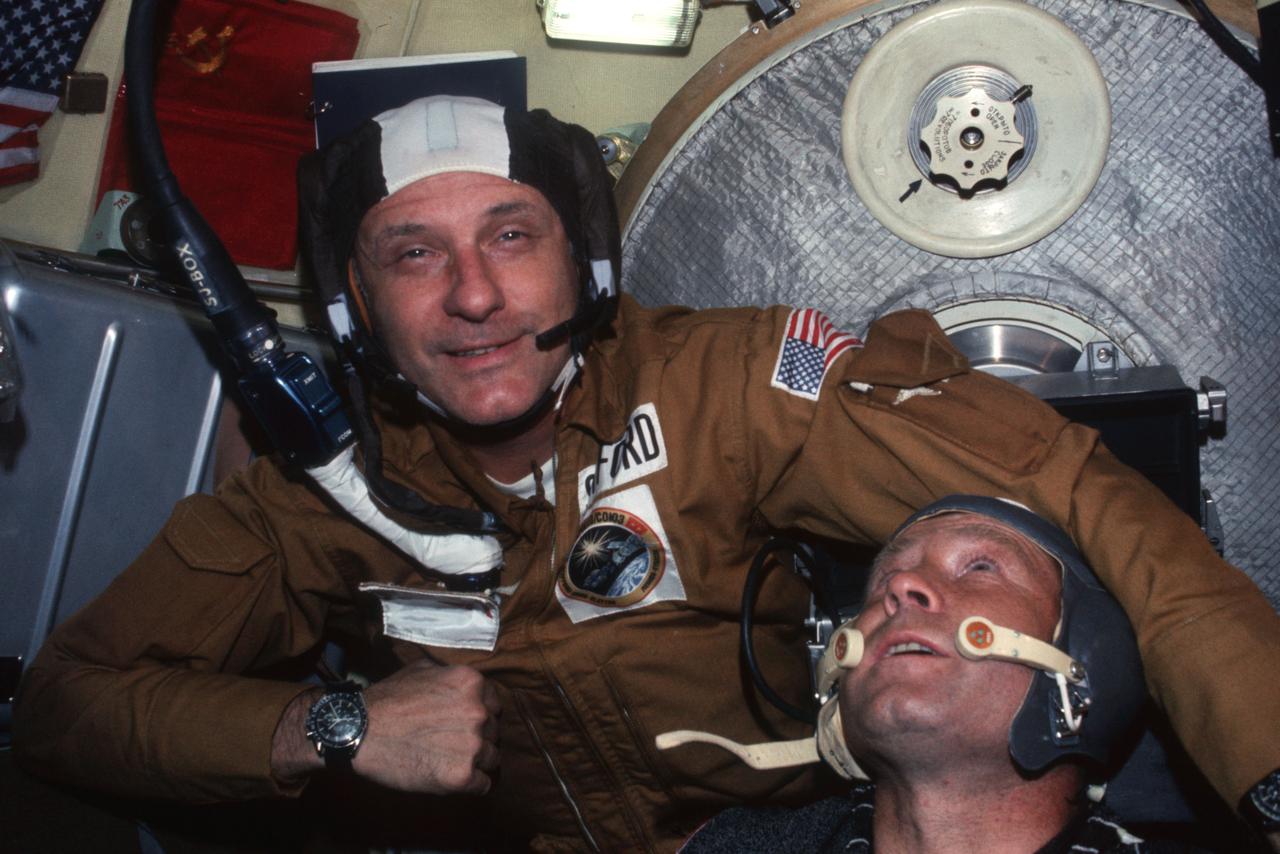
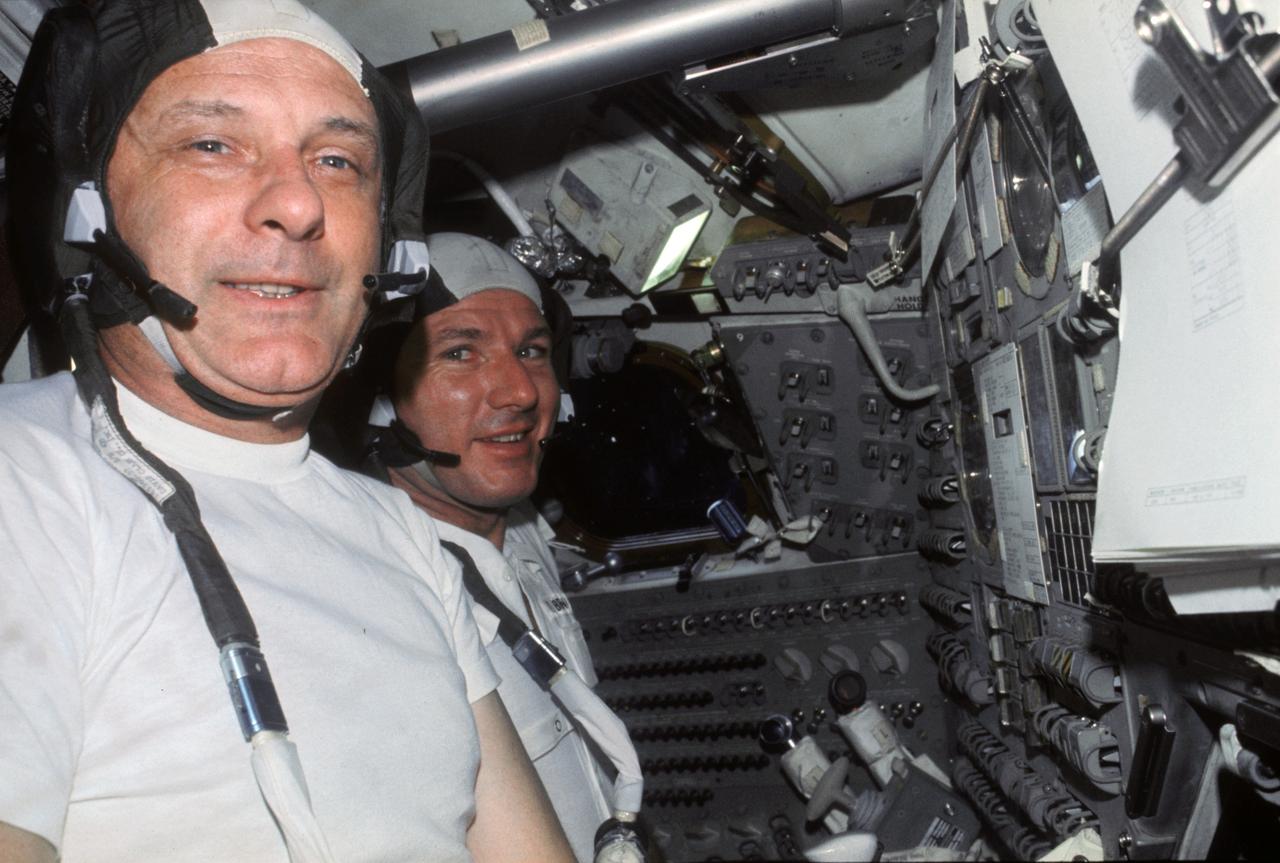
AST-06-344 (15-24 July 1975) --- Two American ASTP crewmen, astronauts Thomas P. Stafford (foreground) and Vance D. Brand are seen in the Apollo Command Module during the joint U.S.-USSR Apollo-Soyuz Test Project docking mission in Earth orbit. This picture was taken with a 35mm camera.
Astronauts Stafford and Brand at controls of Apollo Command Module
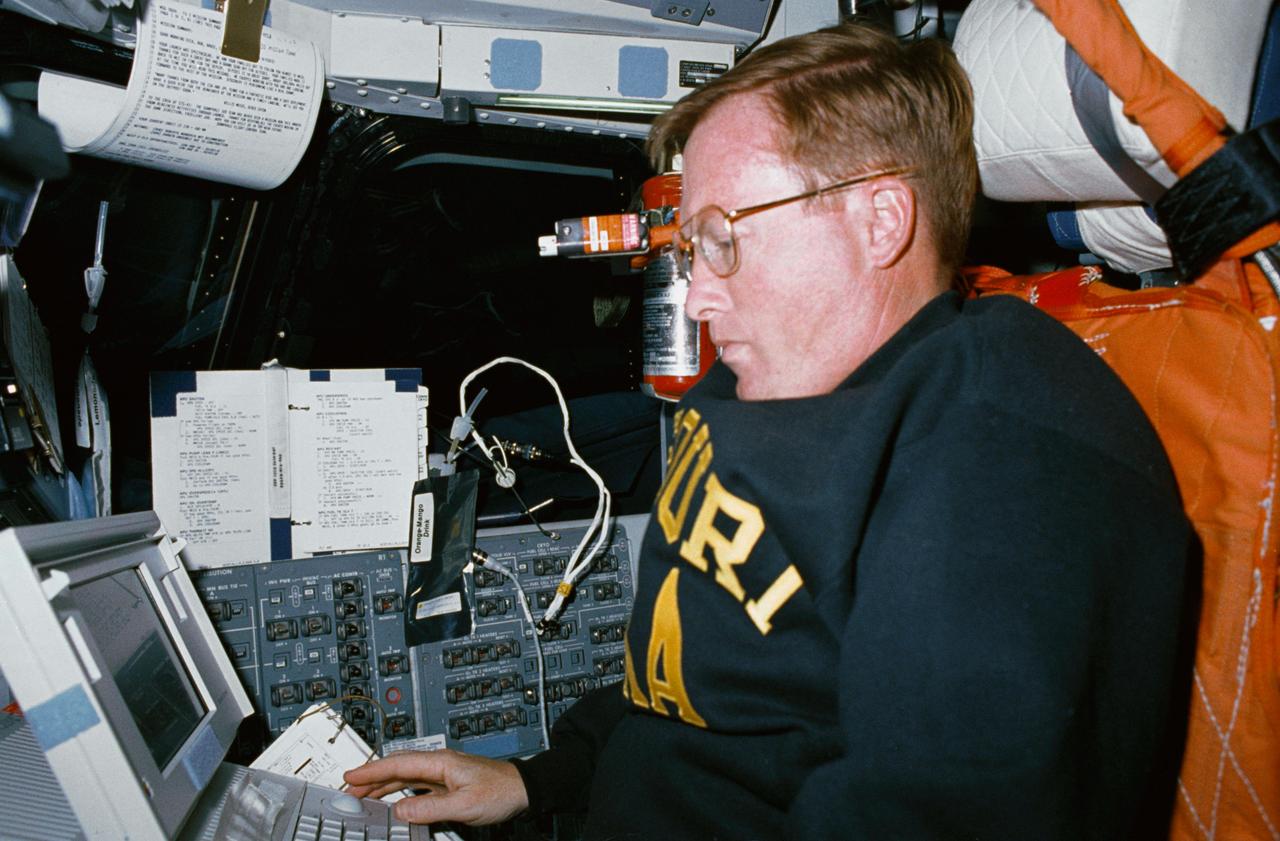
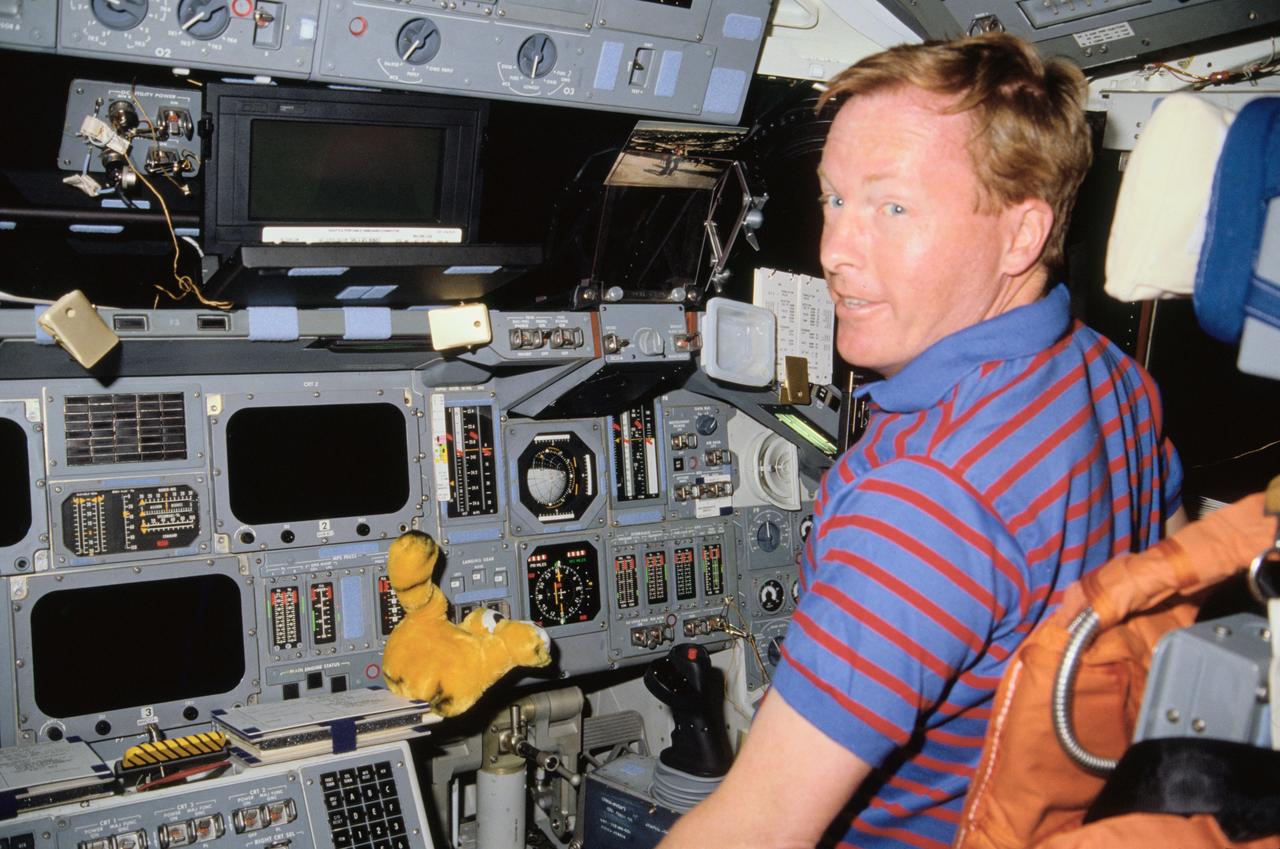
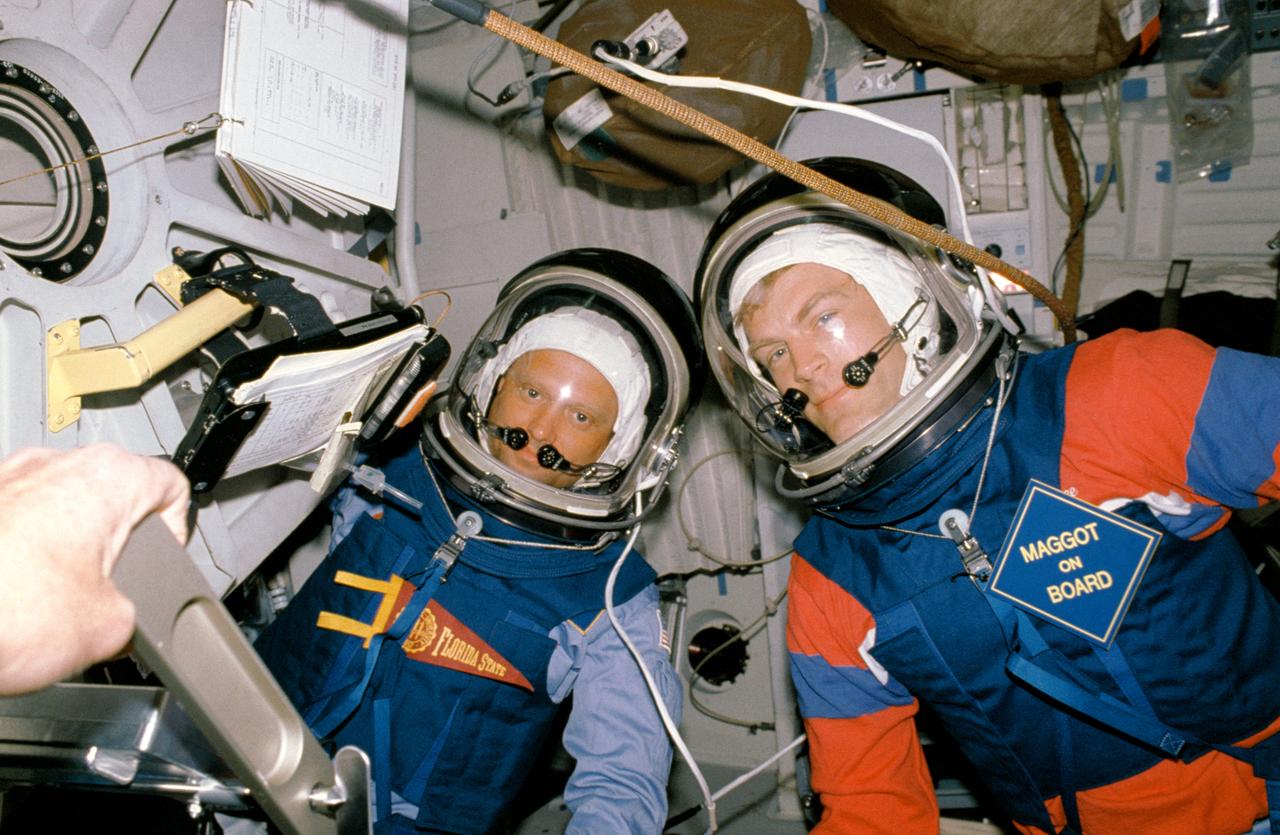
STS028-06-031 (August 1989) --- Astronaut Richard N.  Richards, pilot, is captured with a 35mm camera at the pilot's station on the flight deck of the space shuttle Columbia during the STS-28 flight.  Nearby is a tiger.  Richards is an alumnus of the University of Missouri, whose mascot is a tiger.
STS-28 Columbia, OV-102, Pilot Richards at forward flight deck pilots station
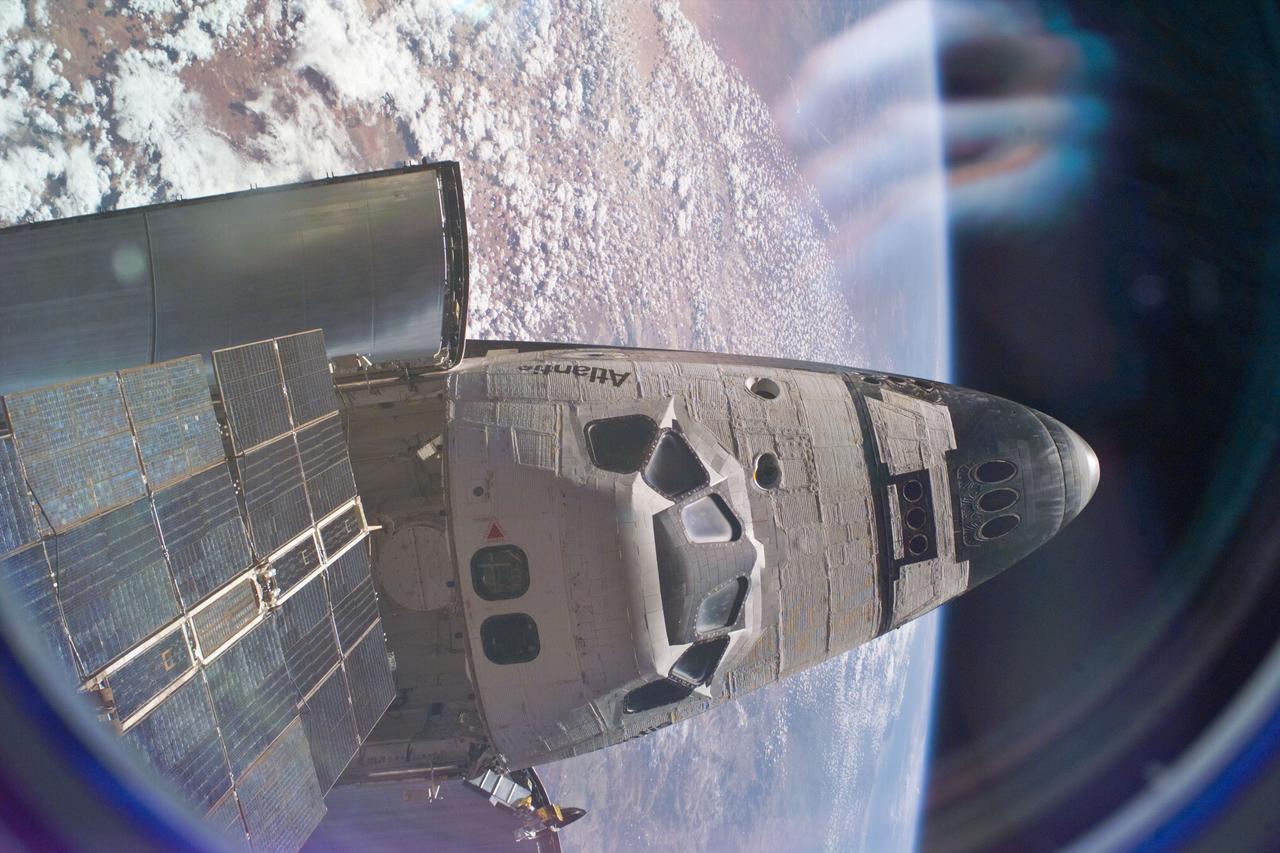
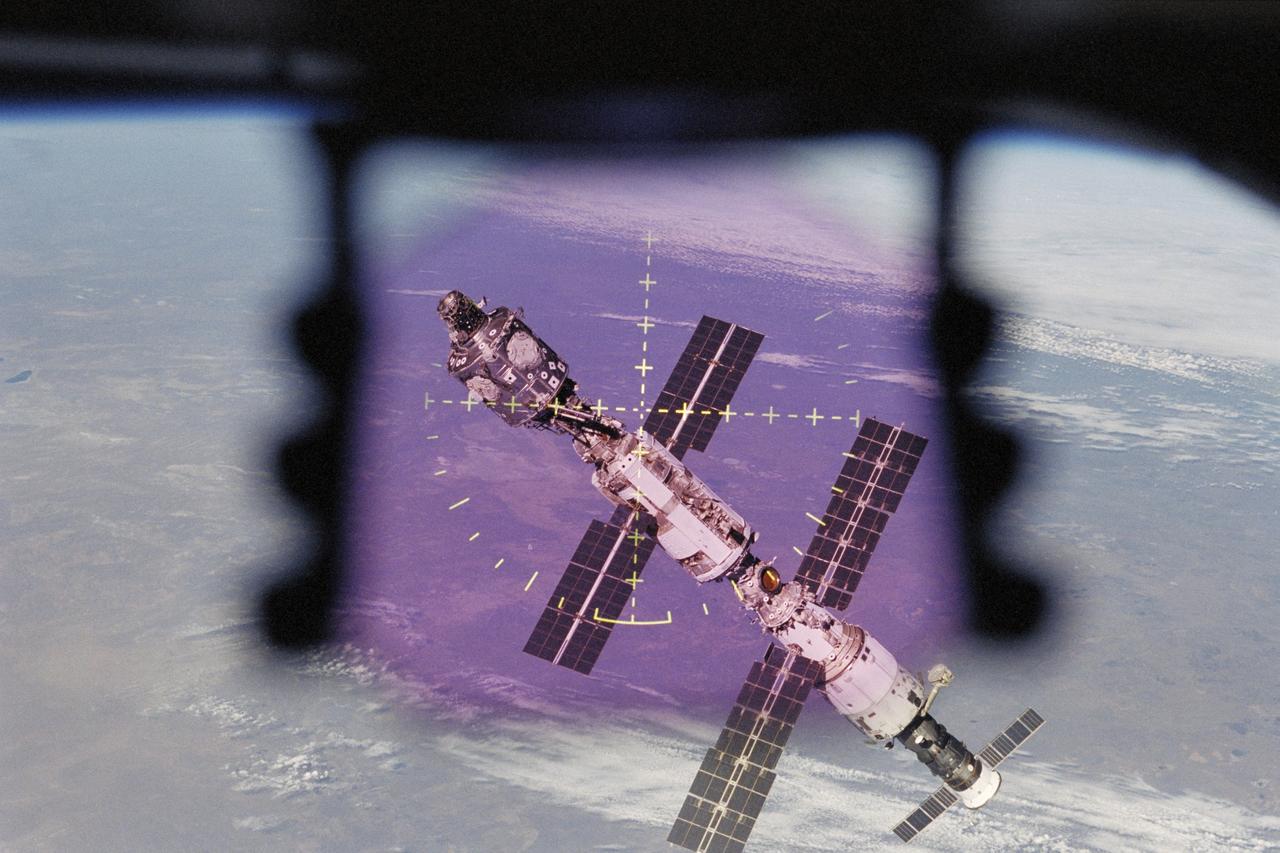
STS106-375-022 (17 September 2000) --- This view of the International Space Station (ISS) was captured with a 35mm handheld camera through the Space Shuttle Atlantis' crew optical alignment system (COAS) during undocking operations. The undocking took place at 10:46 p.m. (CDT) on September 17, 2000.
Flyaround view of the ISS taken from Atlantis during STS-106
S76-E-5138 (24 March 1996) --- Astronauts Kevin P. Chilton (left) and Richard A. Searfoss man the commander and pilot stations, respectively, for the rendezvous and docking procedures with Russia's Mir Space Station.  The image was recorded with a 35mm Electronic Still Camera (ESC) and downlinked at a later time to ground controllers in Houston, Texas.
Commander Kevin Chilton and Pilot Richard Searfoss in forward flight deck
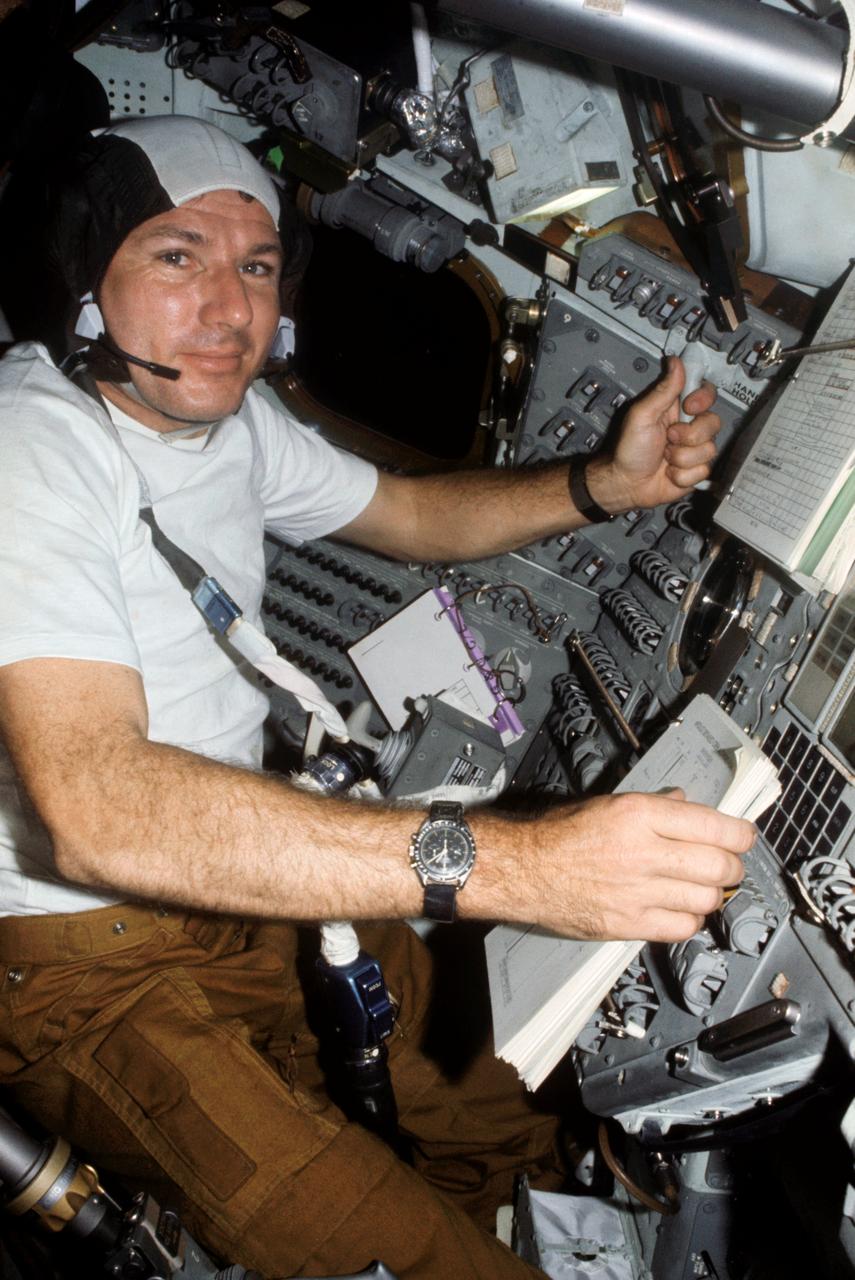
AST-08-499 (15-24 July 1975) --- Astronaut Vance D. Brand, command module pilot of the American ASTP crew, is seen at the controls of the Apollo Command Module during the joint U.S.-USSR Apollo-Soyuz Test Project docking mission in Earth orbit. This picture was taken with a 35mm camera.
Astronaut Vance Brand at controls of Apollo Command Module
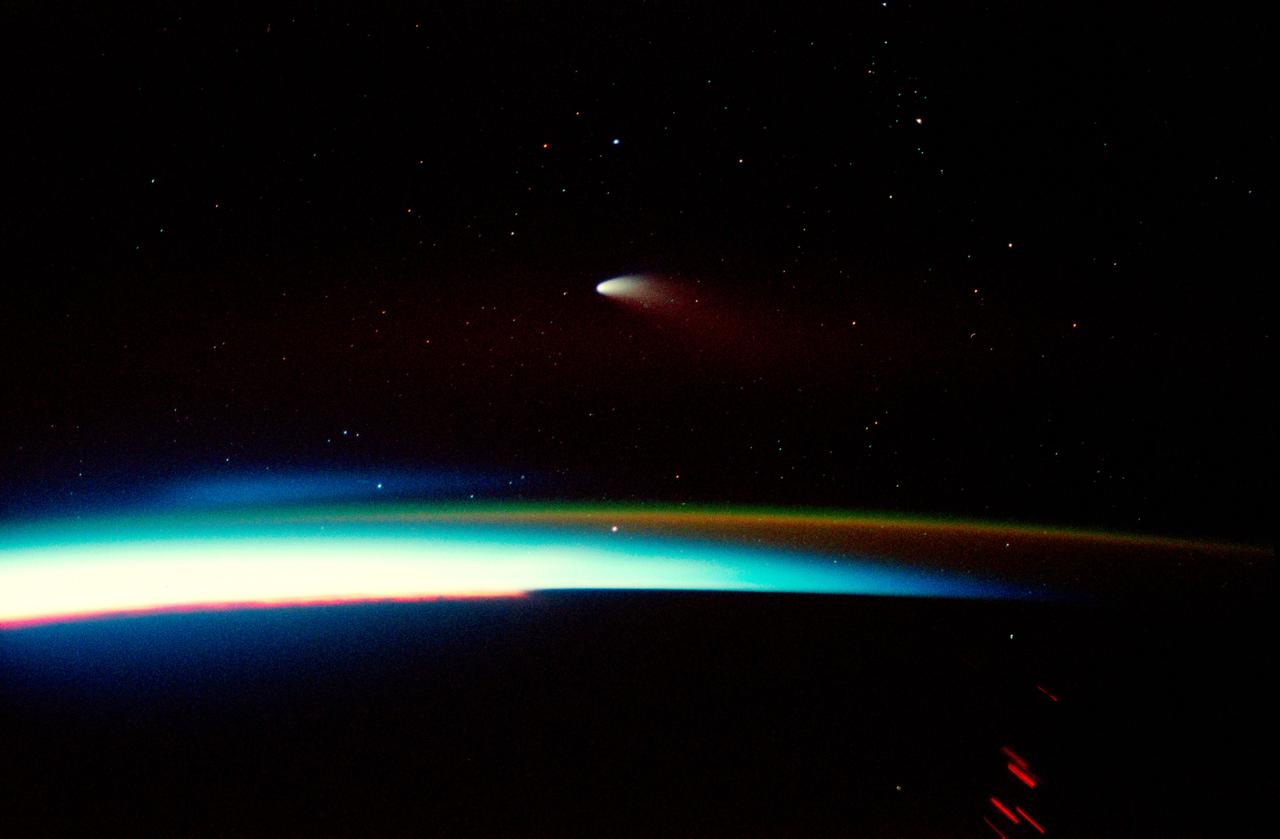
STS083-507-023 (4-8 April 1997)--- A 35mm camera was used to record this time-exposed image of Comet Hale-Bopp at sunset.  As a spin-off of the more lengthy time exposure, city lights and petroleum fires are seen as distorted streaks.
Hale Bopp comet seen during STS-83 mission
JOHNSON SPACE CENTER, HOUSTON, TEXAS-- STS-31 ONBOARD SCENE -- A medium closeup view photographed with fish-eye lens on a 35mm camera shooting the Hubble Space Telescope (HST) held above Discovery's cargo bay by the remote manipulator system prior to solar array and antennae deployment.
KSC-90pc-0707
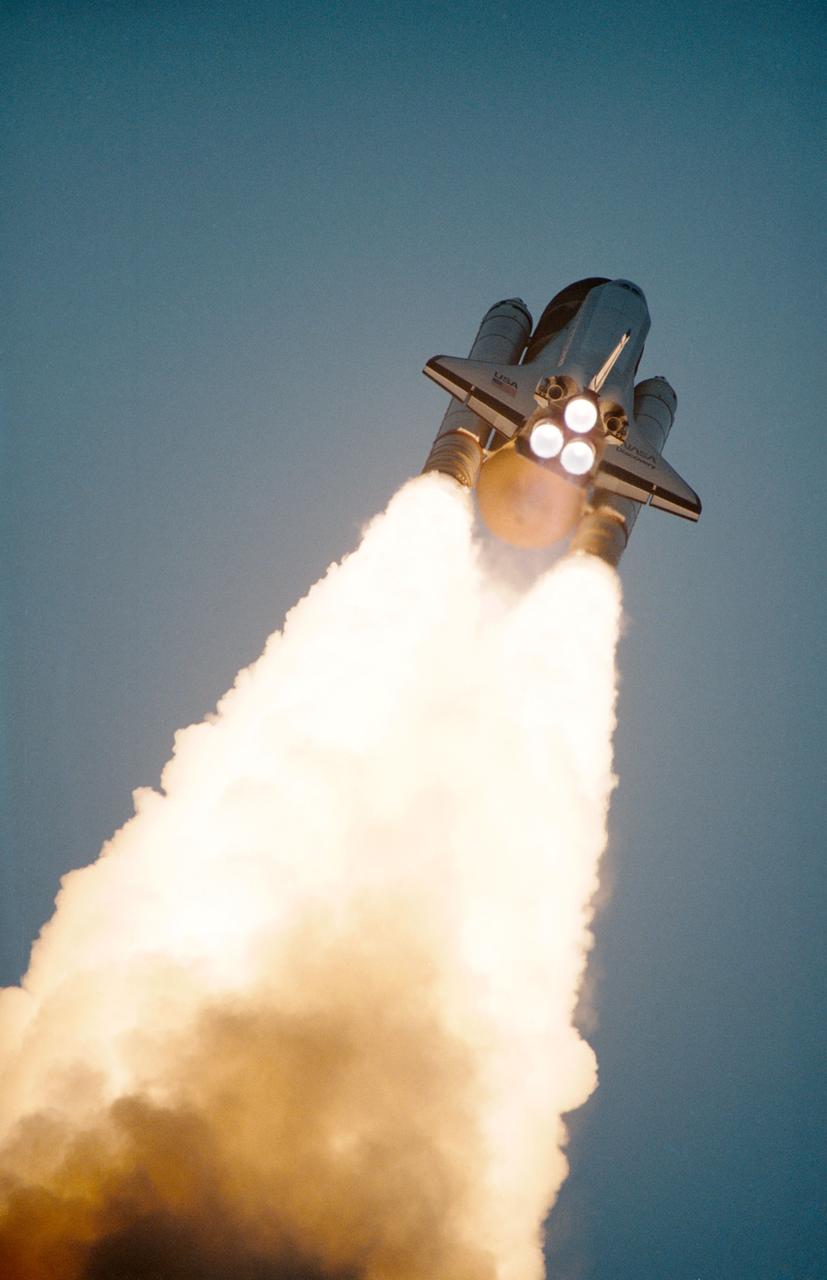
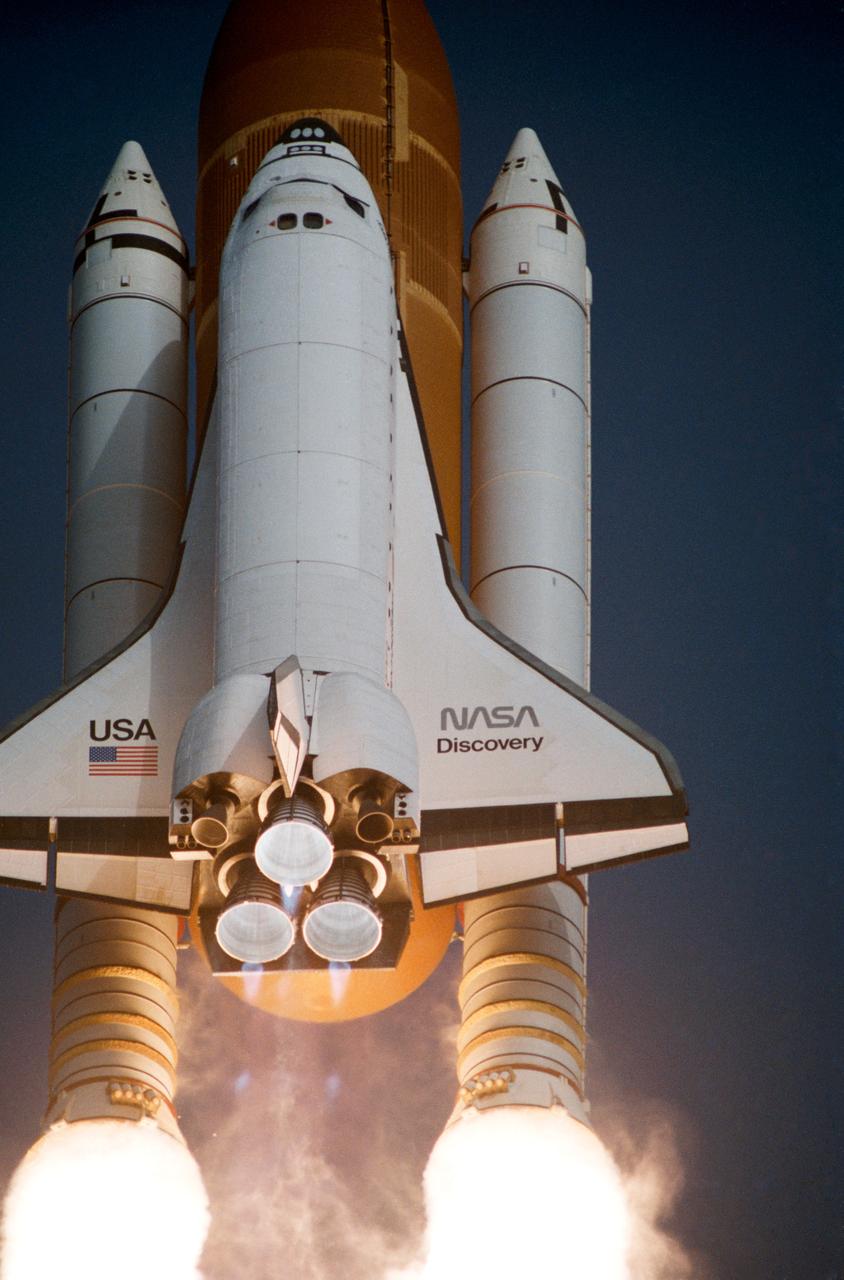
51D-9092 (12 April 1985) --- The Space Shuttle Discovery ascends the launch complex in Florida and heads through   Atlantic skies toward its 51-D mission.  The seven member crew lifted off at 8:59 a.m. (EST), April 12, 1985.  This picture was made with a 35mm camera.
View of the shuttle Discovery STS 51-D launch
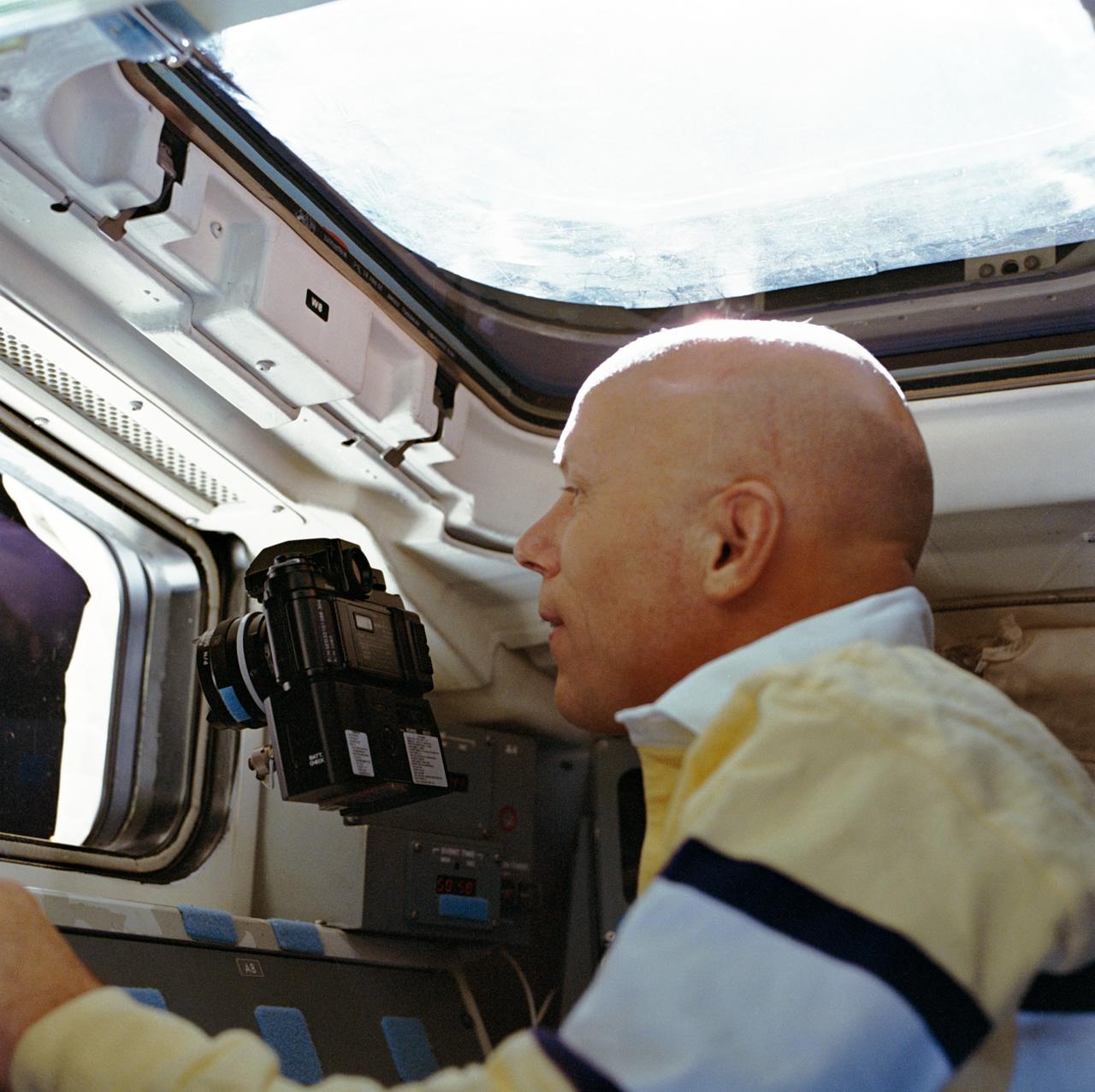
STS-33 Mission Specialist (MS) F. Story Musgrave views activity outside aft flight deck viewing window W10 as a 35mm camera freefloats in front of his face. Overhead window W8 appears above his head.
STS-33 Mission Specialist Musgrave points camera out aft flight deck window
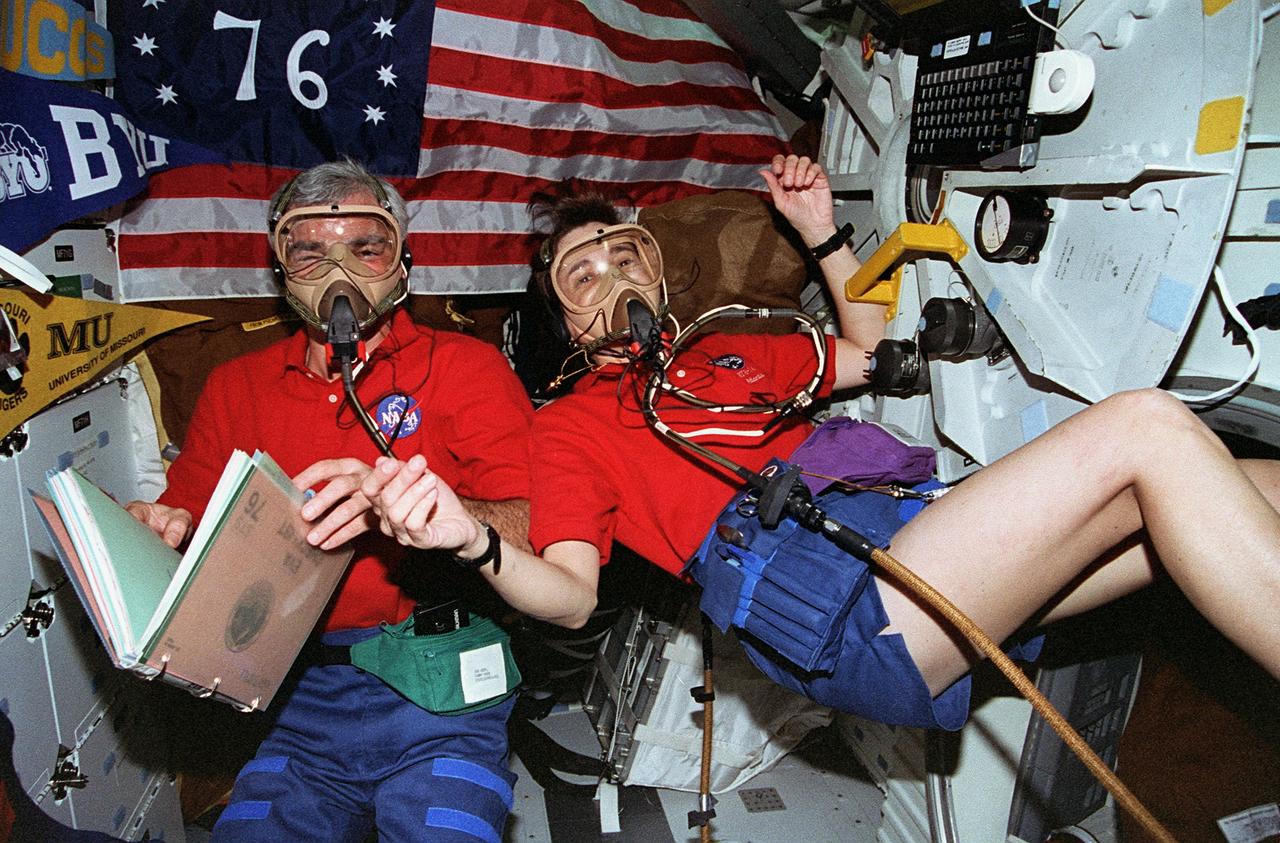
STS030-02-026 (6 May 1989) --- Two helmet-equipped STS-30 mission specialists participate in a 10.2 cabin depress test on mission day three aboard the earth-orbiting space shuttle Atlantis.  They are Norman E. Thagard, left, and Mark C. Lee.  The scene was made with a 35mm camera on Atlantis' middeck.
STS-30 crewmembers Thagard and Lee during onboard cabin depressurization test
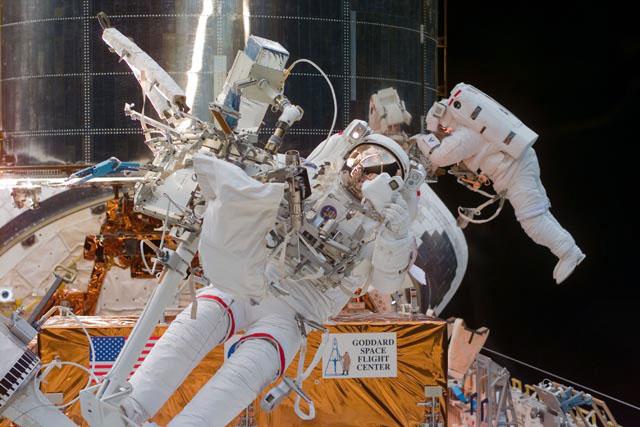
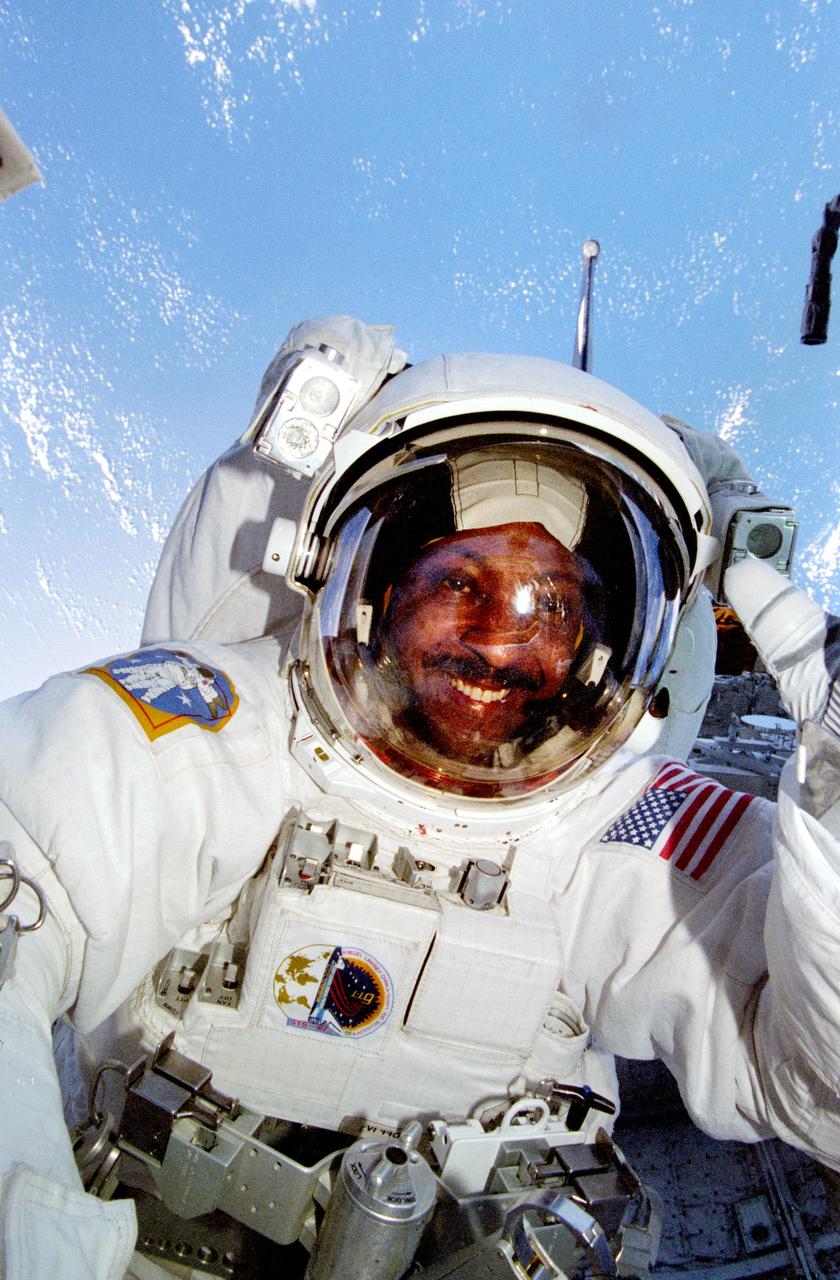
STS087-375-015 (19 November – 5 December 1997) --- Astronaut Winston E. Scott, mission specialist, during one of two extravehicular activities (EVA) in the cargo bay of the Earth-orbiting Space Shuttle Columbia, is backdropped against a blue “blanket” of ocean water.  This view was taken with a 35mm camera.
Scott and Doi conduct second EVA activities.
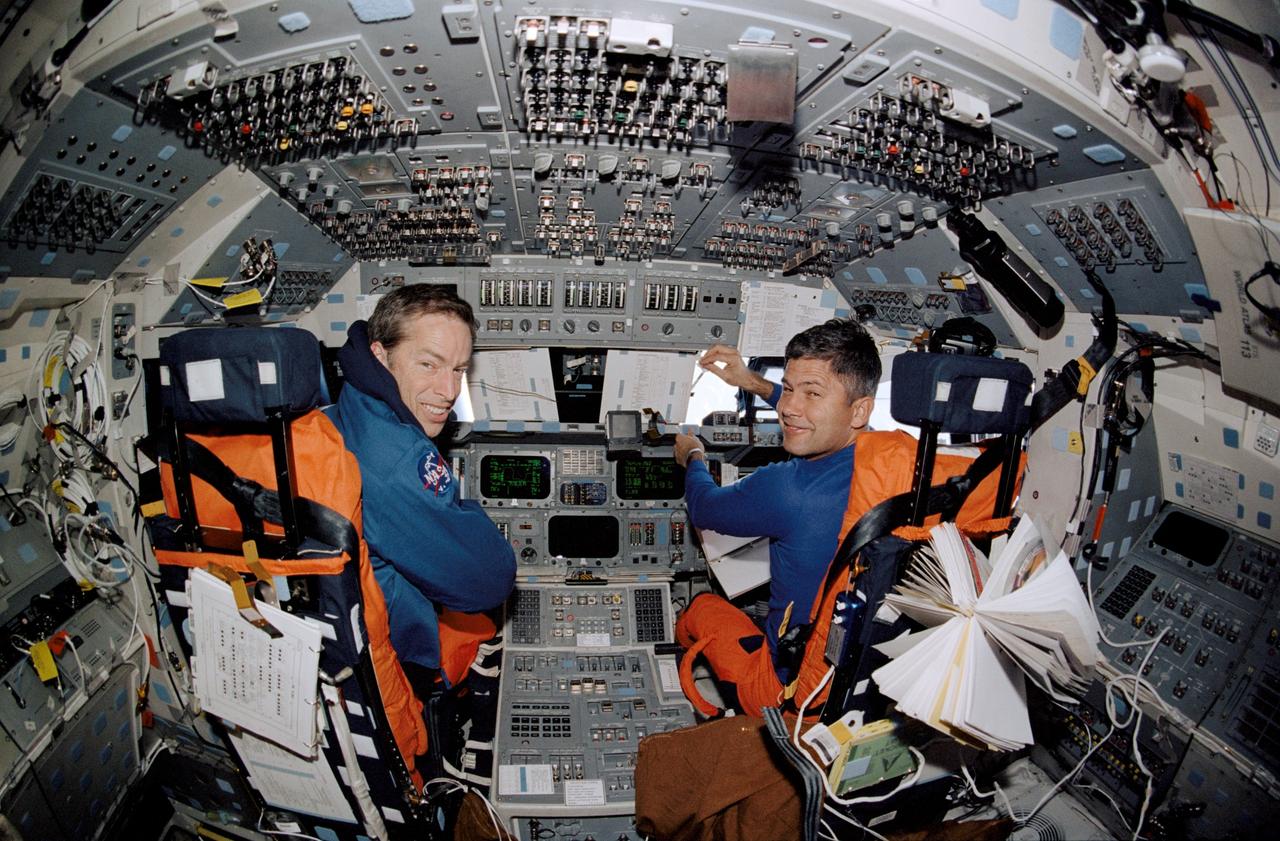
STS113-369-024 (6 December 2002) --- A “fish-eye” lens on a 35mm camera records astronauts James D. Wetherbee (left) and Paul S. Lockhart, STS-113 mission commander and pilot, respectively, on the forward flight deck of the Space Shuttle Endeavour.
CDR Wetherbee and PLT Lockhart on the FD for landing OPS during STS-113
STS054-30-022 (13-19 Jan 1993) --- Astronaut Donald R. McMonagle (right), pilot, shares the forward flight deck with astronaut John H. Casper, mission commander, as the pair performs a maneuver of the Shuttle Endeavour in Earth orbit.  The photograph was taken with a 35mm camera.
Crewmembers in the forward flight deck.
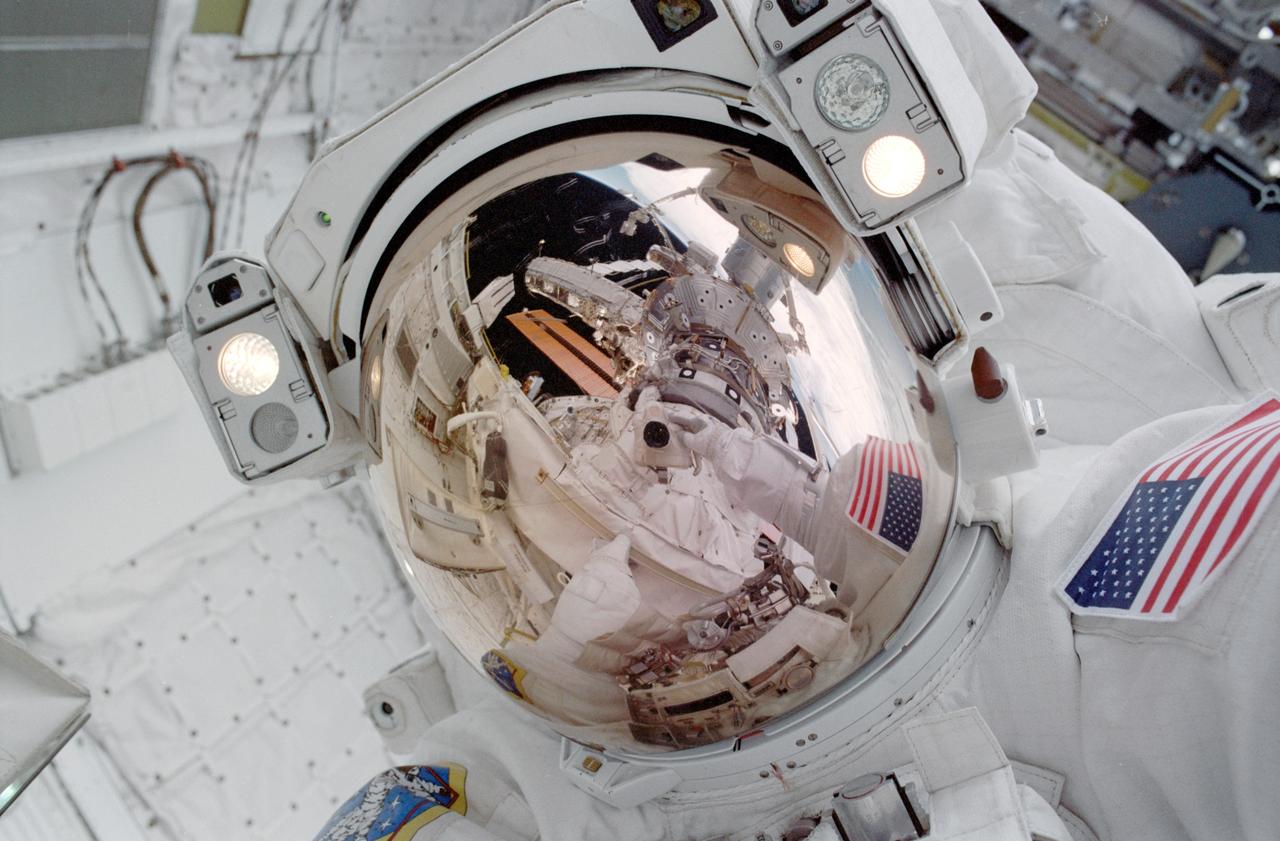
STS114-323-007 (30 July 2005) --- Astronaut Stephen K. Robinson, STS-114 mission specialist, used the pictured 35mm camera to expose a photo of his helmet visor during today’;s session of extravehicular activity (EVA). A portion of the International Space Station is also visible in the reflection.
Robinson during EVA 1
STS035-19-019 (2-11 Dec 1990) --- Astronaut John M. (Mike) Lounge, STS 35 mission specialist makes a notation as he observes telescopes (out of frame) at work in Columbia's cargo bay.  This aft flight deck scene was exposed with a 35mm camera.
STS-35 MS Lounge records his observations on OV-102's aft flight deck
STS072-320-014 (17 Jan. 1996) --- The end effect of the Space Shuttle Endeavour's Remote Manipulator System (RMS) is about to grapple the Office of Aeronautics and Space Technology's (OAST) -- Flyer satellite.  The view was recorded with a 35mm camera aimed through one of Endeavour's overheard windows on the aft flight deck.
OAST-Flyer is deployed by the Remote Manipulator System (RMS) as viewed from the flight deck
STS098-324-0004 (7-20 February 2001) ---  One of the astronauts on the aft flight deck of the Space Shuttle Atlantis used a 35mm camera to record this image of a thruster firing.  Part of Earth's limb can be seen on either side of the orbital maneuvering system (OMS) pods below frame center.
thruster firing
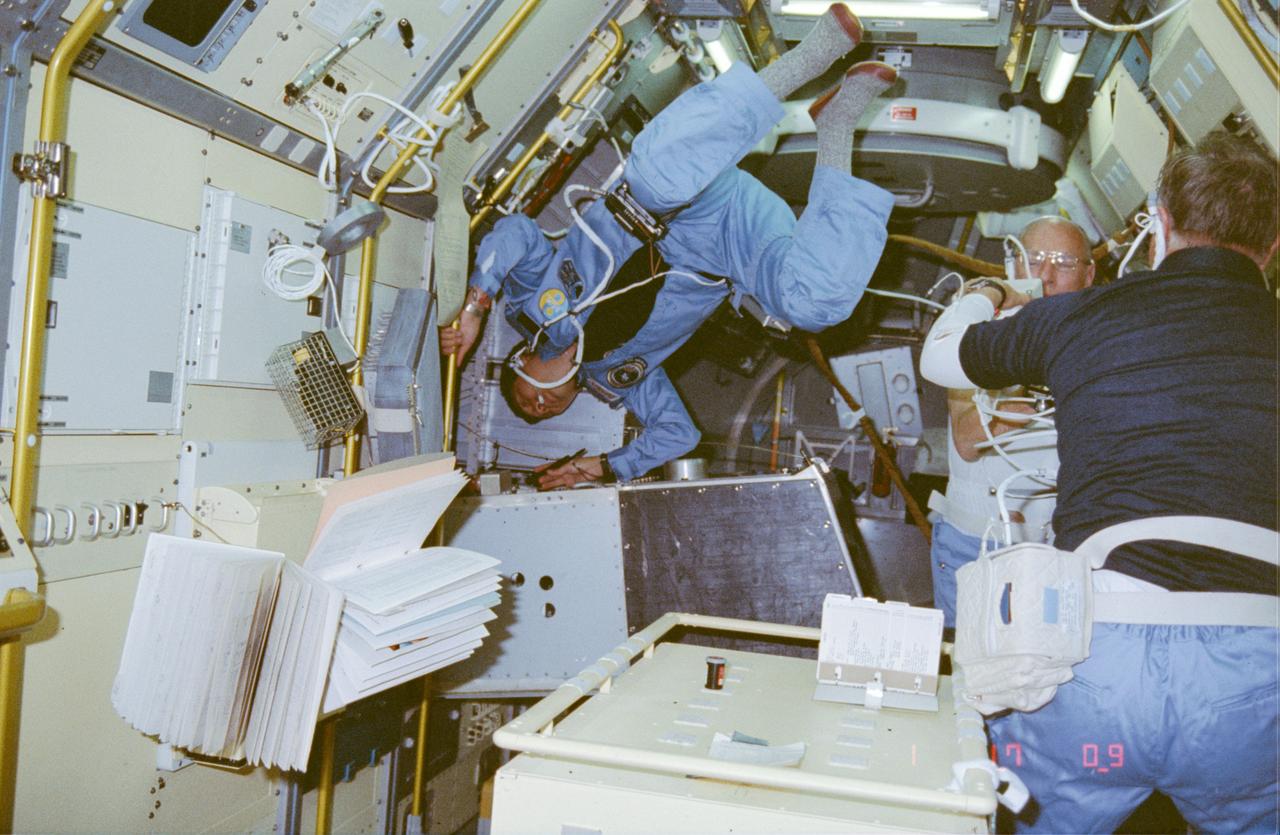
STS008-18-468 (30 Aug-5 Sept 1983) ---  Astronaut William E. Thornton, right conducts an audiometry test on Astronaut Dale A. Gardner in the mid deck of the Earth-orbiting Space Shuttle Challenger.  Both men are mission specialists for the reusable spacecraft’s second five-person crew.  This frame was shot with a 35mm camera.
MS Thornton and MS Gardner conduct DSO 410 on middeck
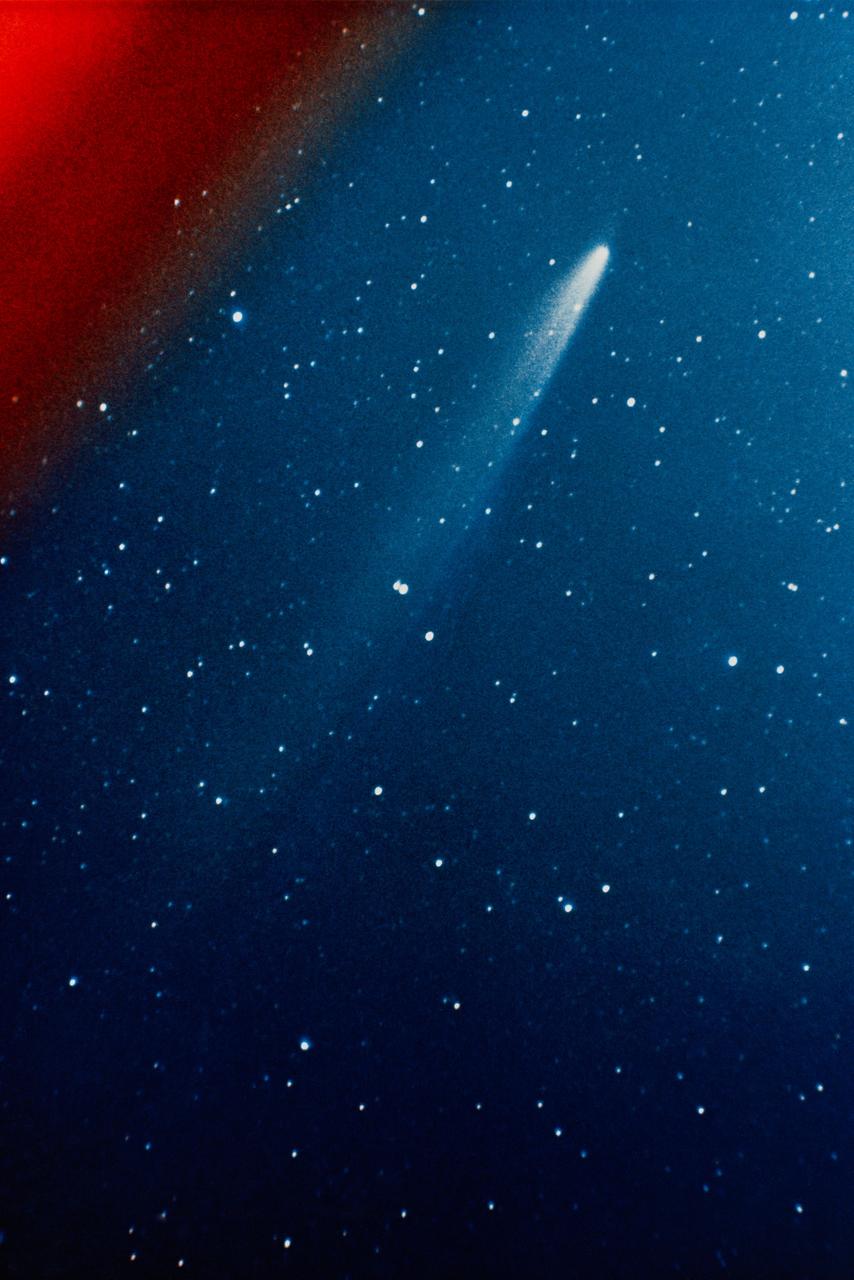
S74-17688 (11 Jan. 1974) --- This color photograph of the comet Kohoutek was taken by members of the lunar and planetary laboratory photographic team from the University of Arizona, at the Catalina Observatory with a 35mm camera on Jan. 11, 1974. Photo credit: NASA
COMETS - ASTRONOMY - KOHUTEK - CATALINA OBSERVATORY
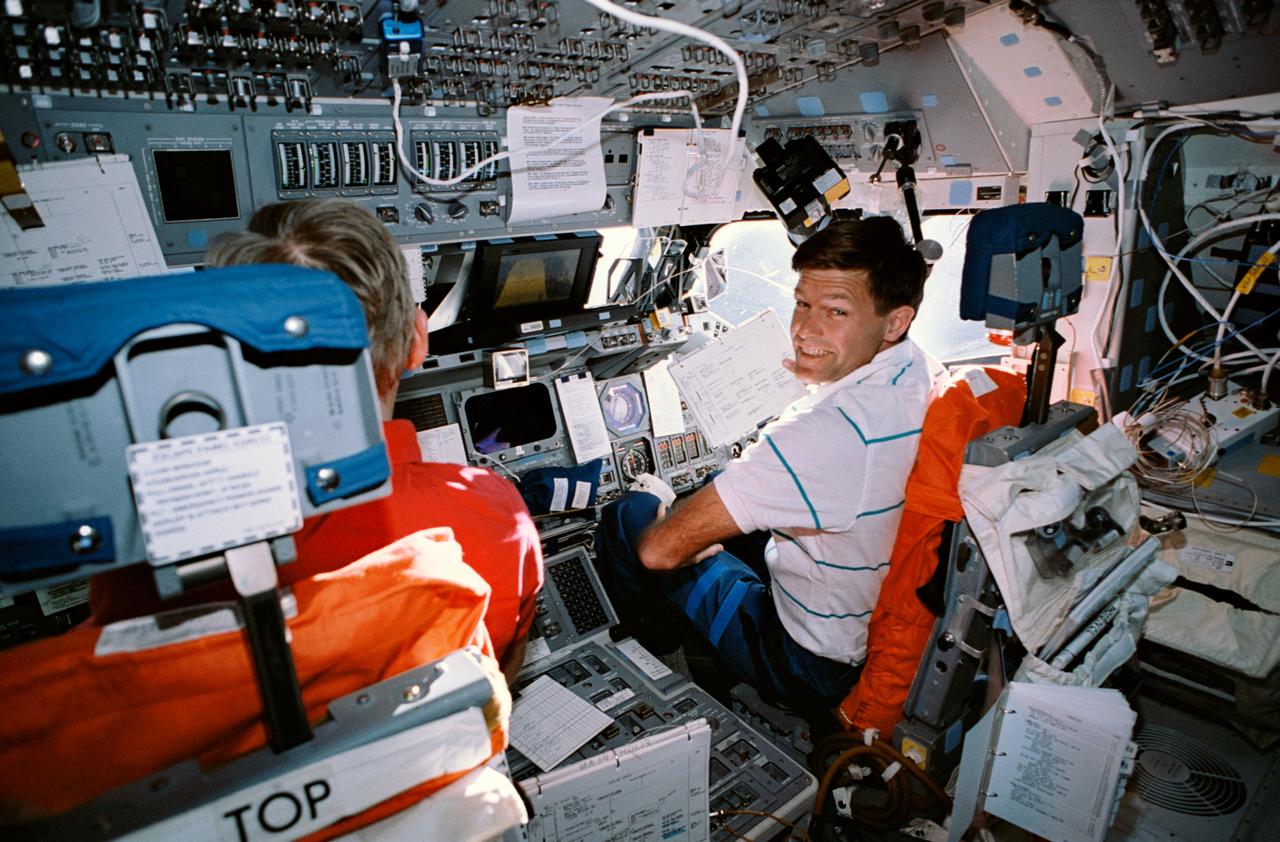
STS090-351-012 (17 April - 3 May 1998) --- A "fish-eye" lens on a 35mm camera records Richard A. Searfoss, mission commander, at the commander's station on forward flight deck of the Earth-orbiting Space Shuttle Columbia.  The pilot's station is in the foreground.
Searfoss on the forward flight deck
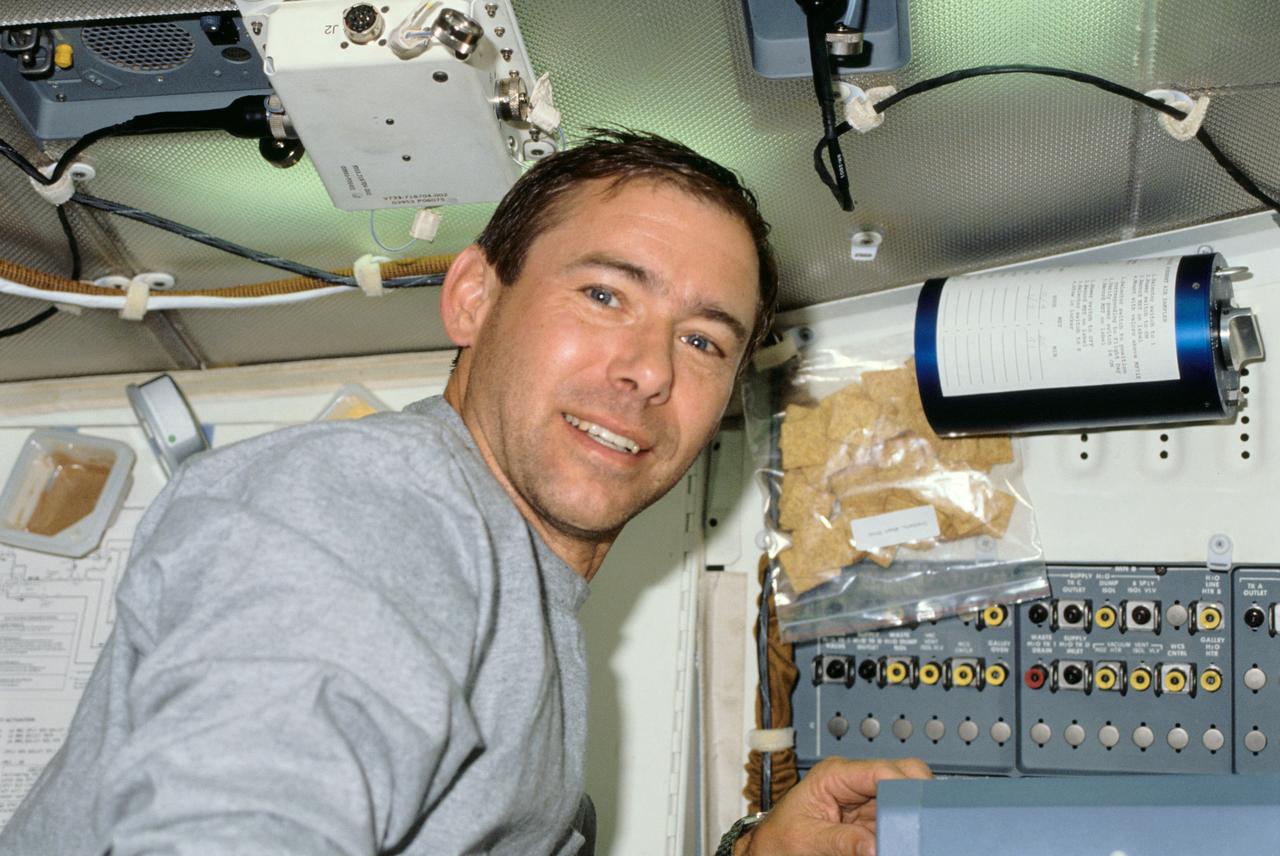
STS028-11-017 (August 1989) --- Astronaut Brewster H. Shaw Jr., mission commander, is captured with a 35mm camera on the middeck of the space shuttle Columbia during the STS-28 flight.  Nearby are a couple of beverage containers and a packet of wheat crackers.
STS-28 Columbia, OV-102, Commander Shaw on middeck
STS034-05-027 (18-23 Oct. 1989) --- Astronaut Shannon W. Lucid peers into Atlantis' cargo bay from the aft flight deck.  The spacecraft was in the midst of one of its many "days", a 50-odd minutes session of exposure to the sun.  The scene was recorded with a 35mm camera.
STS-34 Mission Specialist (MS) Lucid looks out aft flight deck viewing window
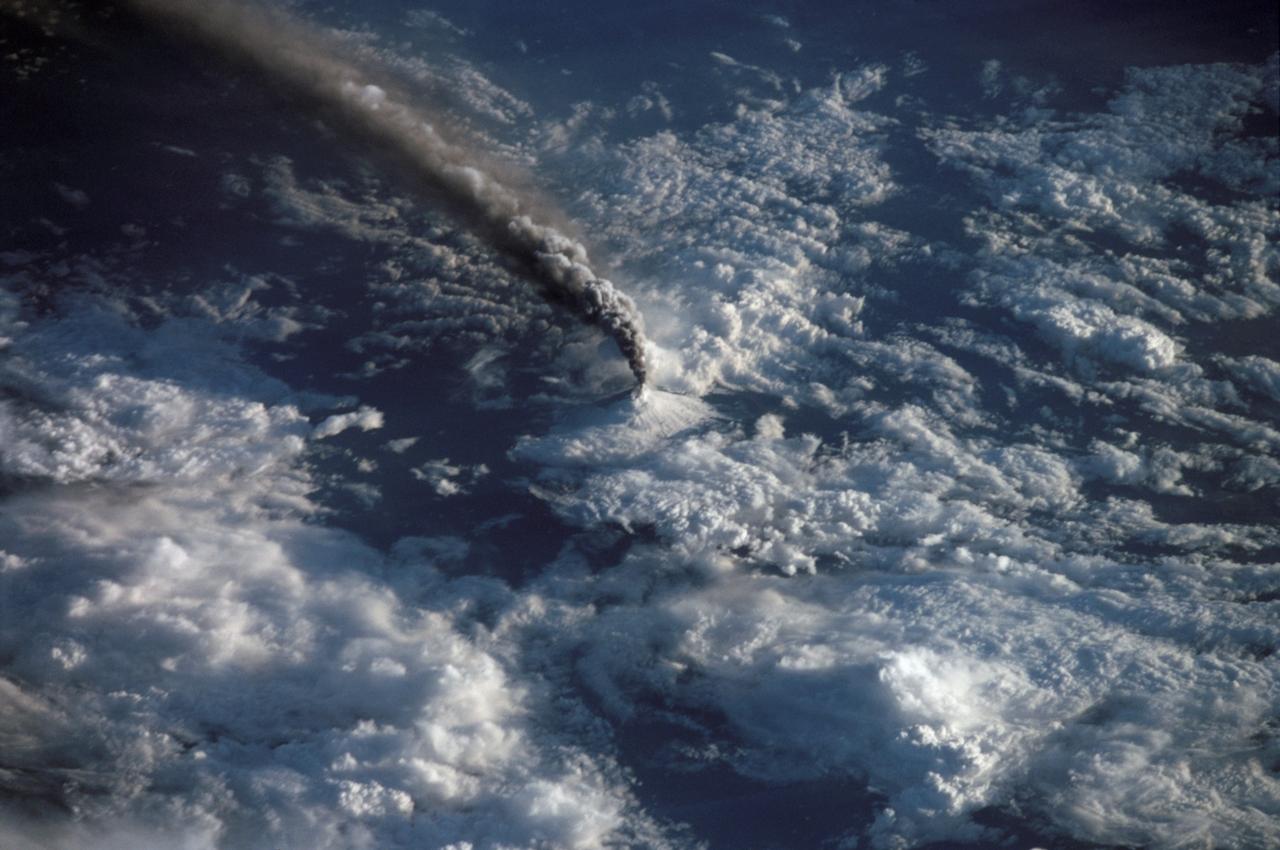
STS113-332-030  (14 December 2002) --- The STS-113 crewmembers used a 35mm still camera to record this image of Mt. Etna Volcano erupting on the island of Sicily.  The south-looking oblique sunset view shows snowy, winter-time Mt. Etna with a brown smutty ash plume.
Earth Observation during STS-113
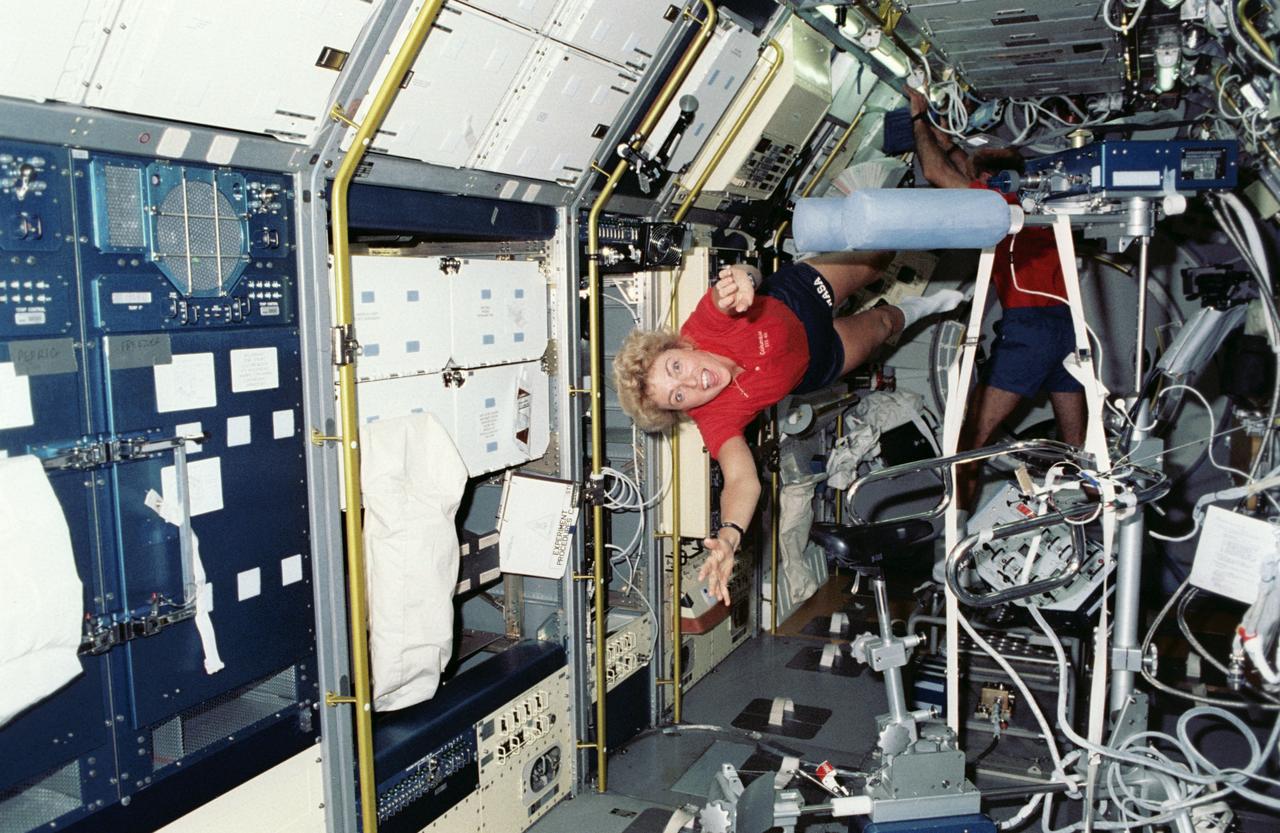
STS040-212-006 (5-14 June 1991) --- Payload specialist Millie Hughes-Fulford floats through the Spacelab Life Sciences (SLS-1) module aboard the Earth-orbiting Columbia.  Astronaut James P. Bagian, mission specialist, is at the blood draw station in the background.  The scene was photographed with a 35mm camera.
STS-40 Payload Specialist Hughes-Fulford "flies" through SLS-1 module
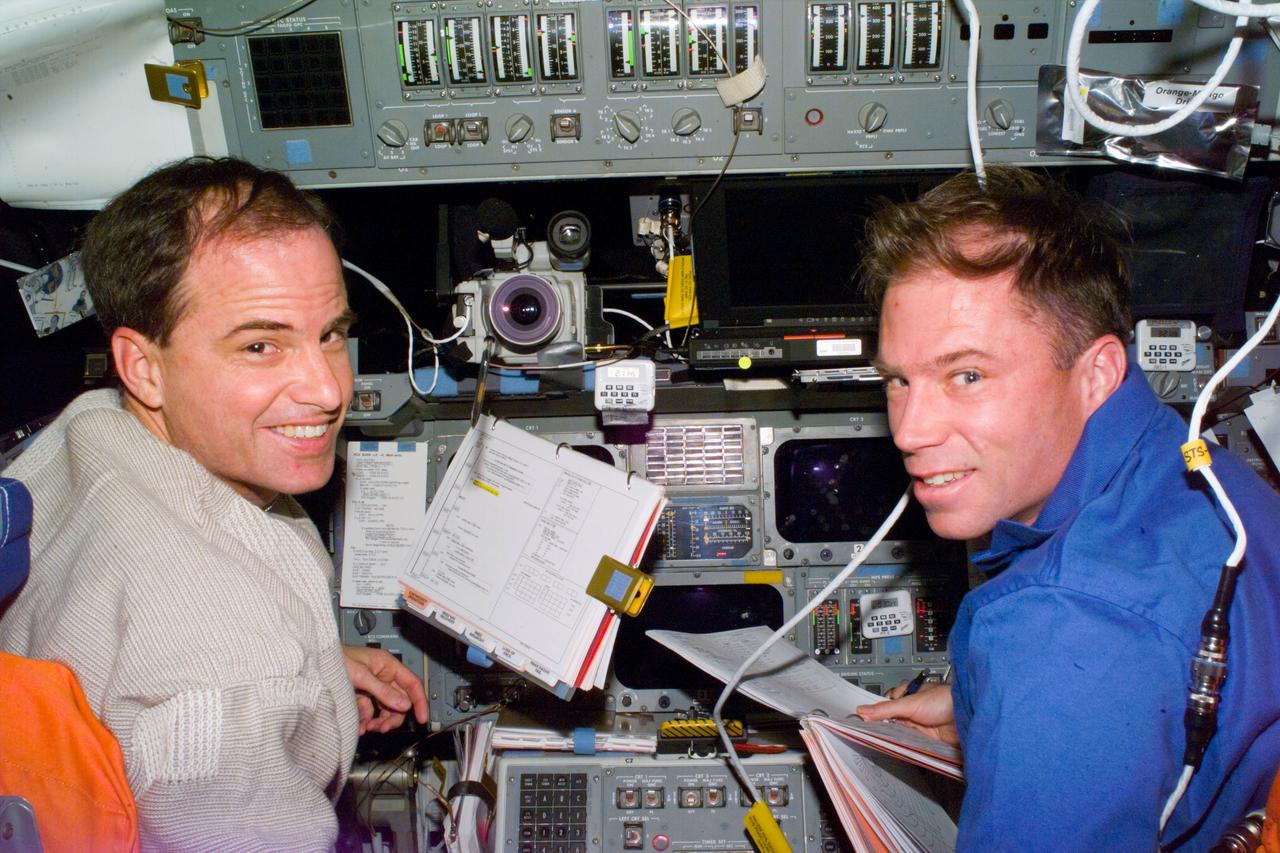
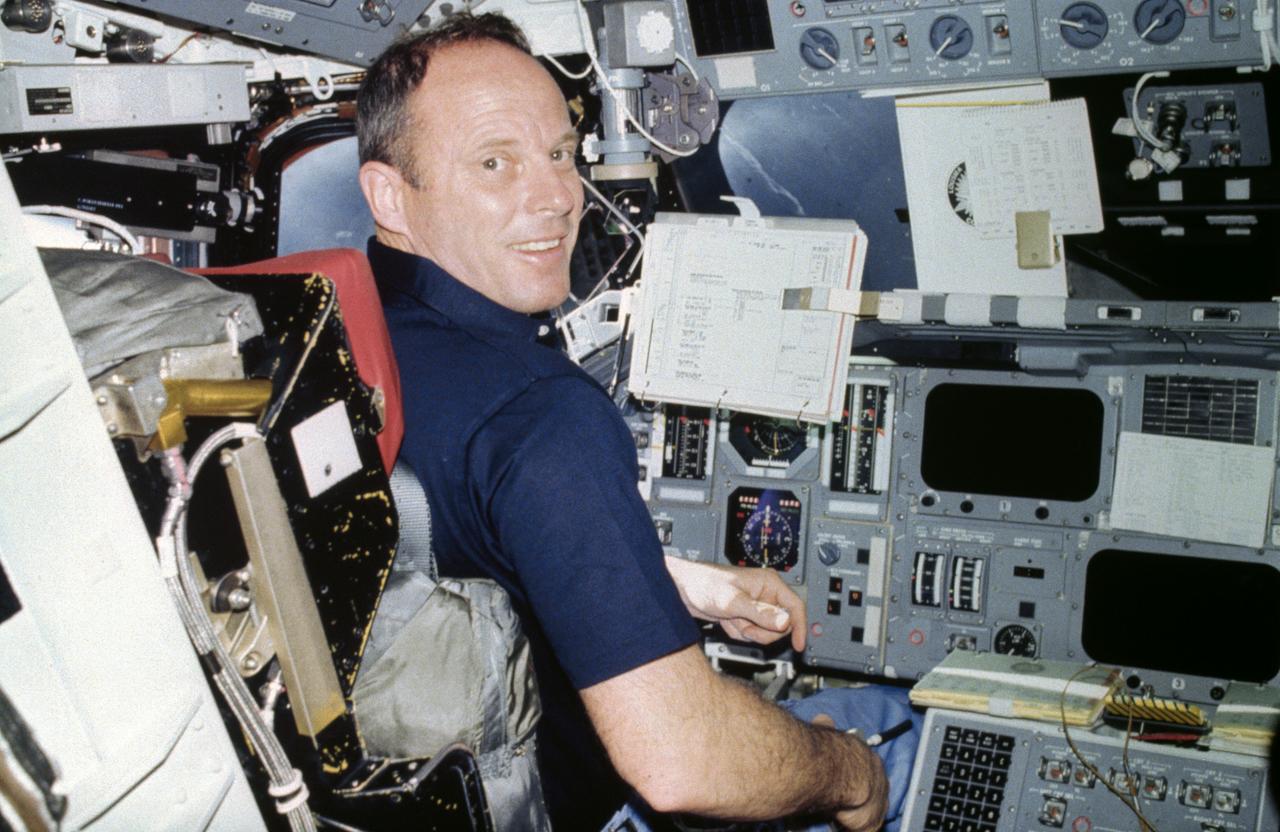
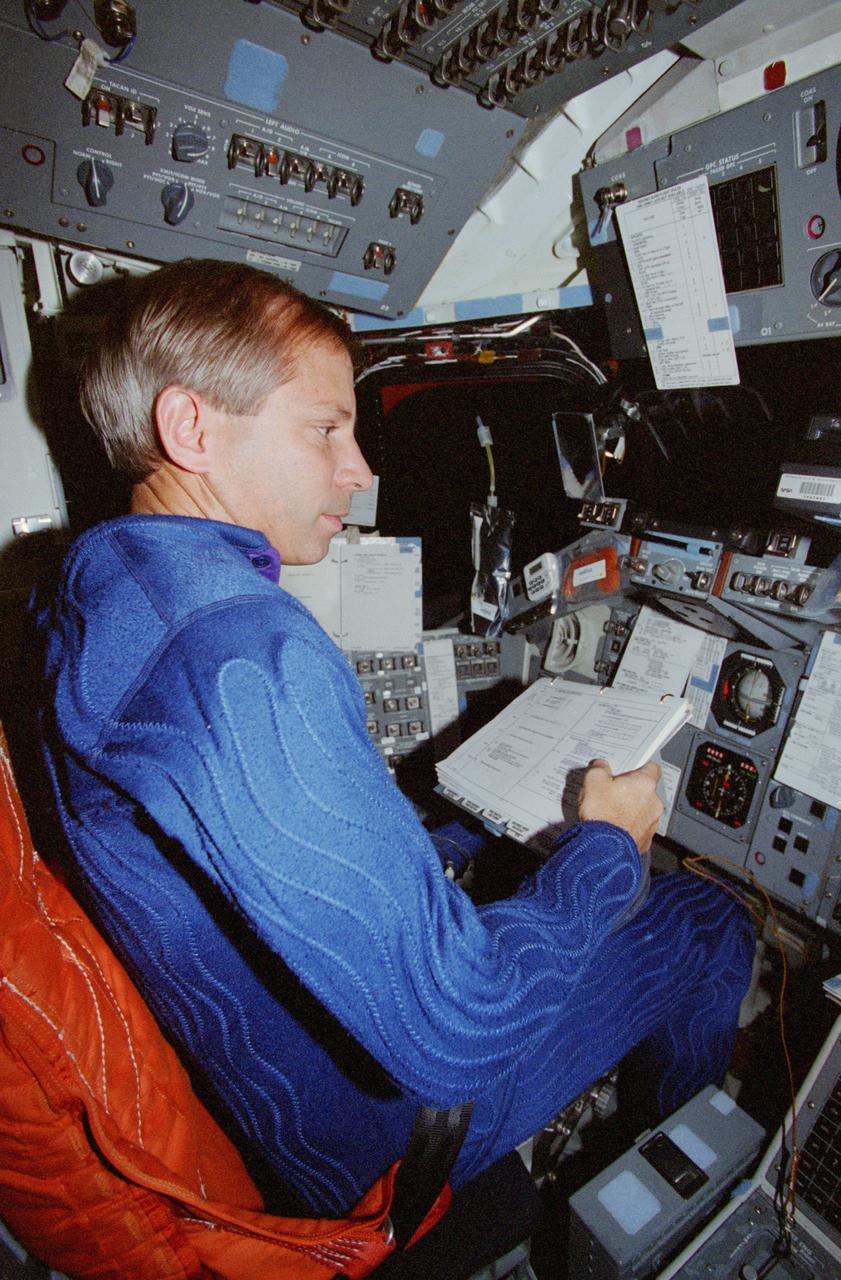
STS041-01-002 (6-10 Oct 1990) --- Astronaut Richard N. Richards, STS 41 mission commander, "borrows" the pilot's station to utilize a Shuttle portable onboard computer during the four-day flight.  The photo was made with a 35mm camera.
STS-41 Commander Richards uses DTO 1206 portable computer onboard OV-103
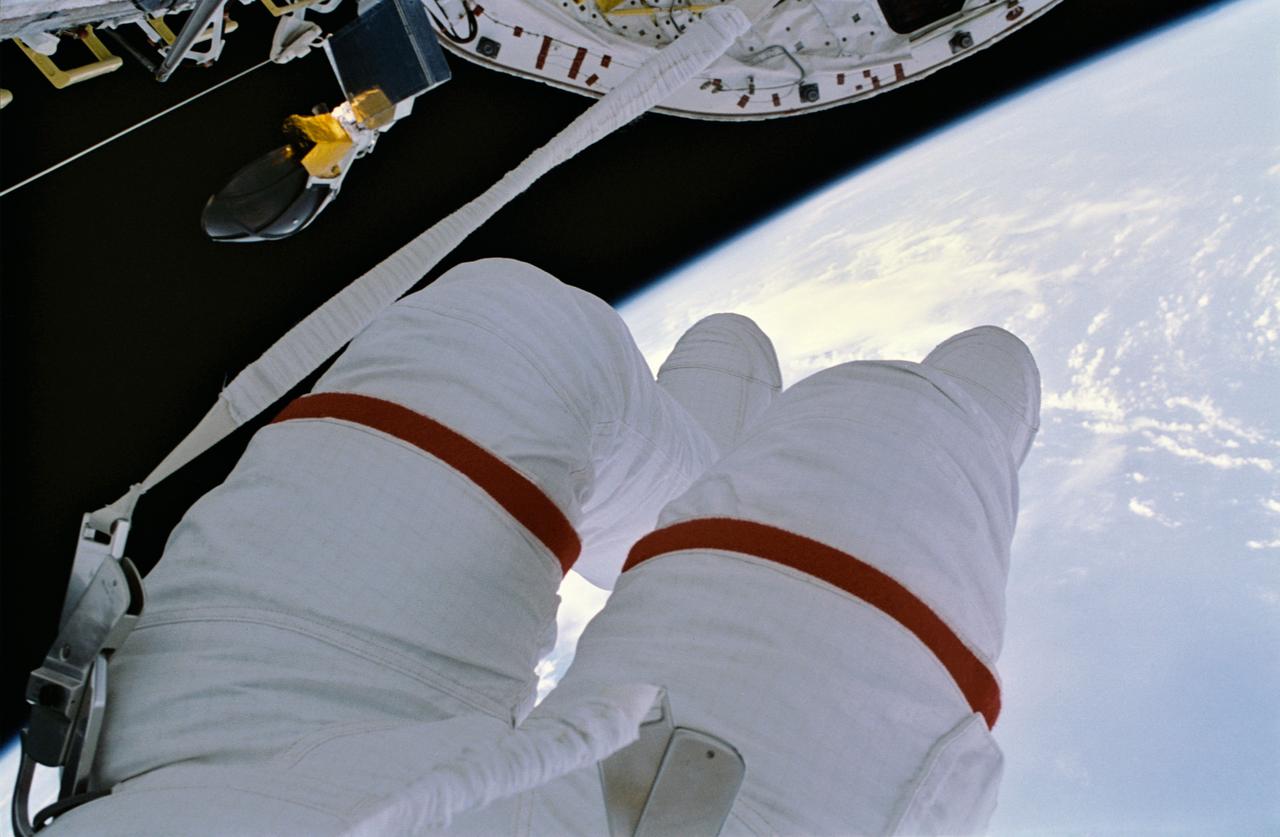
STS054-29-028 (17 Jan 1993) --- Astronaut Gregory J. Harbaugh, mission specialist, used a 35mm camera to photograph his legs and feet during the four-plus hours extravehicular activity (EVA) to depict the vast void below.  Harbaugh was joined on the EVA by astronaut Mario Runco Jr., mission specialist.
EVA crewmember's legs dangling over empty space and payload bay.
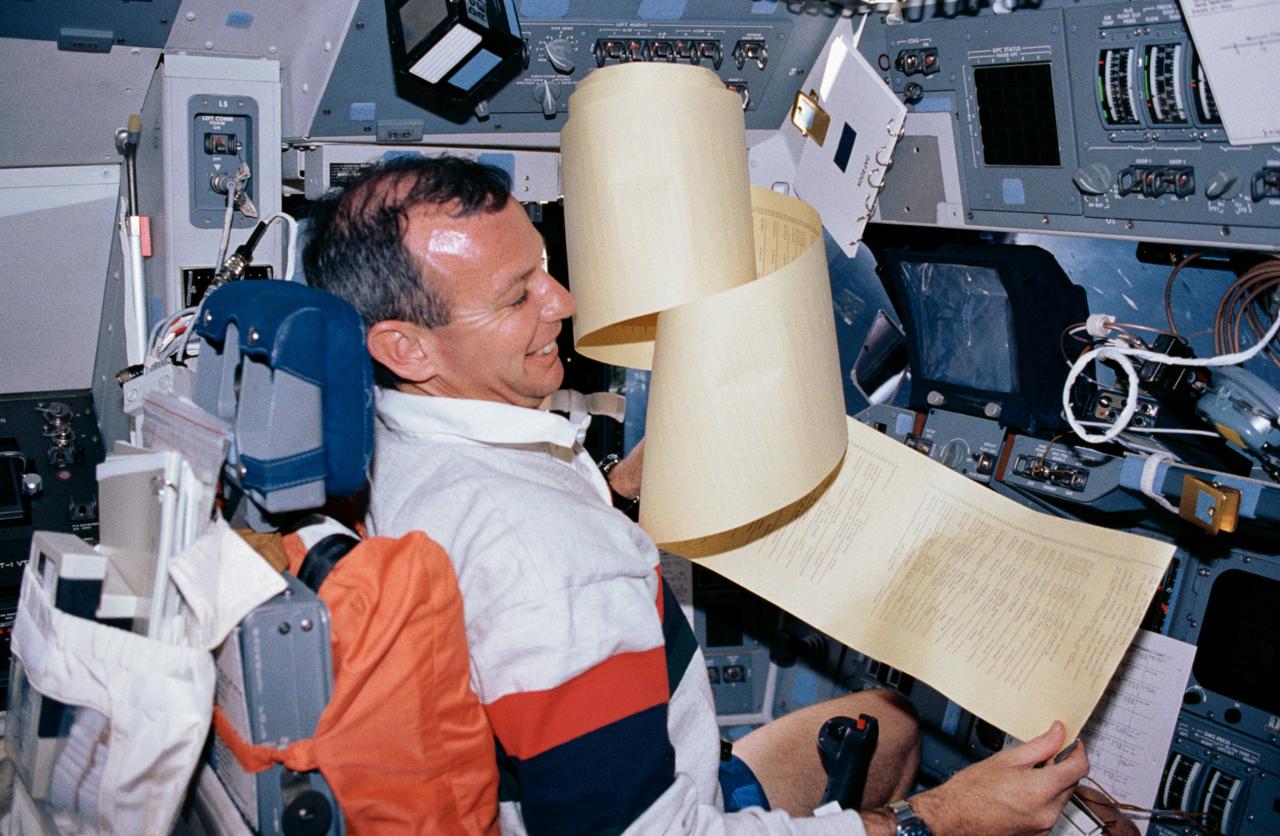
STS045-02-020 (24 March-2 April 1992) --- Brian Duffy, STS-45 pilot, struggles with a large volume of data printouts from the teleprinter system.  He is seated at the commander's station on the flight deck of the Earth-orbiting Atlantis during the nine-day mission.  This frame was taken with a 35mm camera.
STS-45 Pilot Duffy wrestles with a TAGS printout on OV-104's flight deck
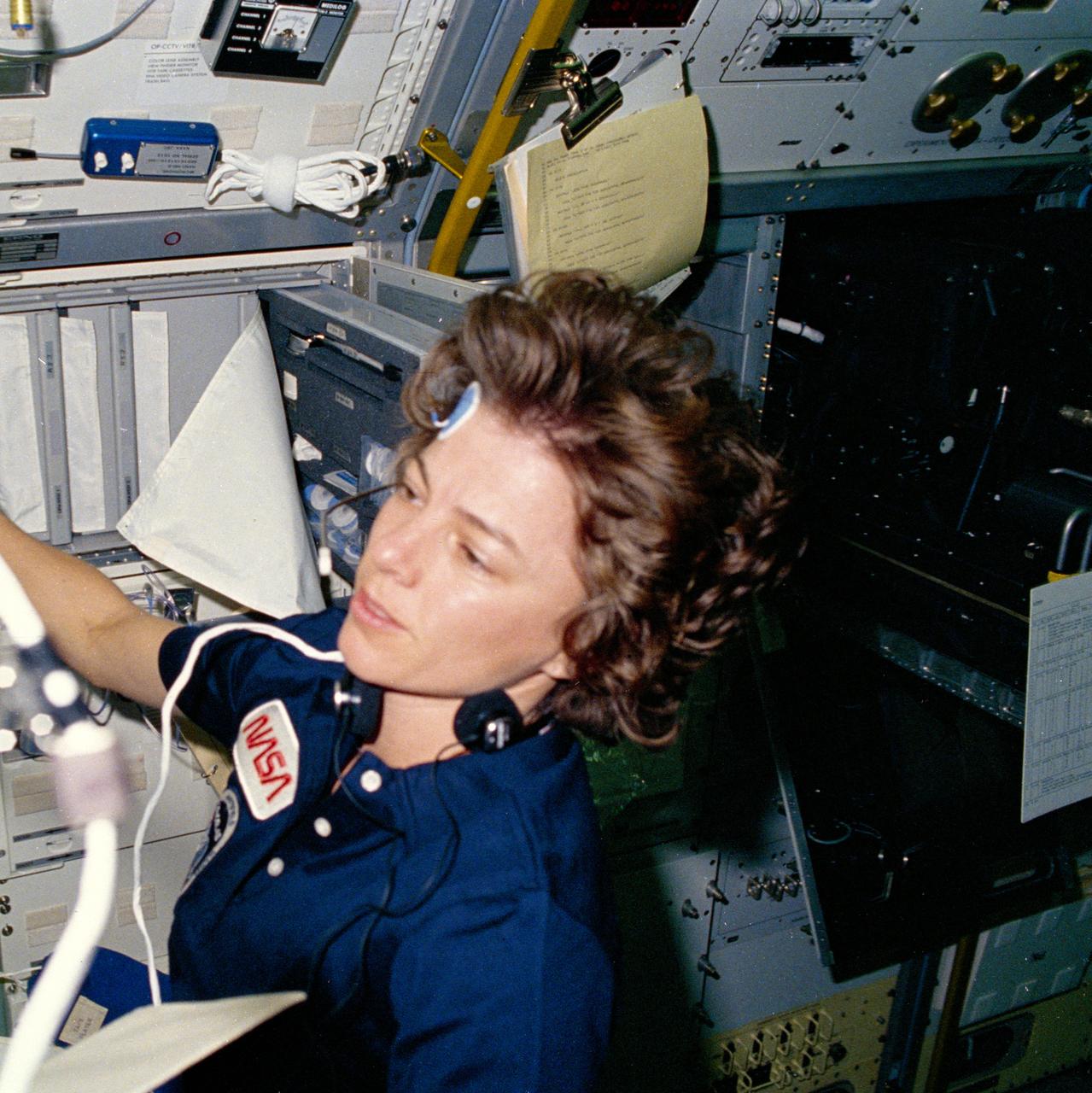
61A-18-001A (30 Oct-6 Nov 1985) --- Her head equipped with a sensor device, astronaut Bonnie J. Dunbar, 61-A mission specialist, talks to earthbound investigators  while participating in a bio-medical test.  A 35mm camera was used to expose the frame.
Astronaut Bonnie Dunbar preparing to perform bio-medical test
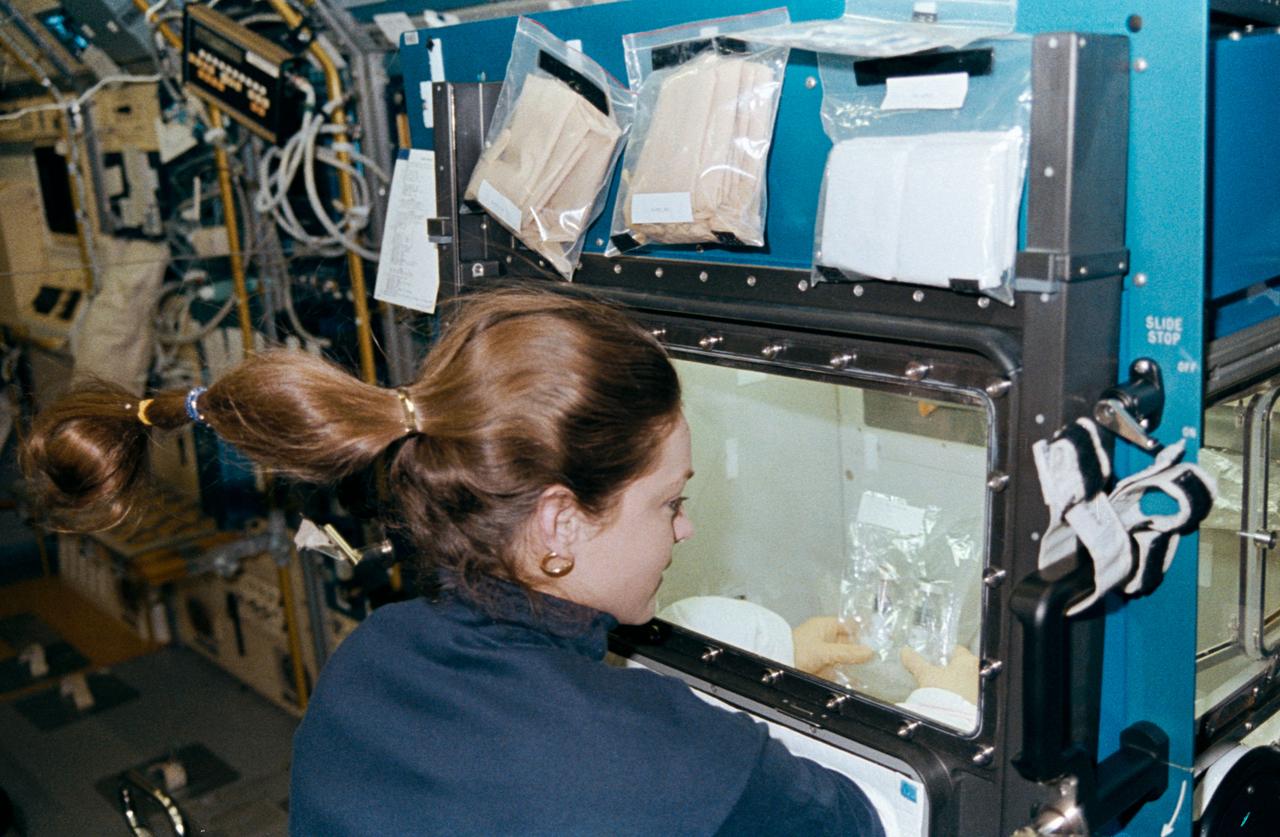
STS040-224-005 (5-14 June 1991) --- Astronaut Tamara E. Jernigan, STS-40 mission specialist, conducts an evaluation of the General Purpose Work Station (GPWS) in the Spacelab Life Sciences (SLS-1) module onboard the Earth-orbiting Space Shuttle Columbia.  The photograph was taken with a 35mm camera.
STS-40 Mission Specialist (MS) Jernigan uses the SLS-1 GPWS glovebox
S76-E-5156 (24 March 1996) --- The forward cargo bay and the entire top exterior of the crew cabin of the Space Shuttle Atlantis can be seen in this image, recorded with a 35mm Electronic Still Camera (ESC), positioned in one of the windows aboard Russia's Mir Space Station.
Space Shuttle Atlantis as seen from Mir space station during STS-76 mission
STS007-31-1614 & S83-35775 (24 June 1983) ---   Astronaut Robert L. Crippen is seen at the commander’s station of the Space Shuttle Challenger as it passes through the Earth’s atmosphere on re-entry.  The friction results in a pinkish glow visible through the forward windows on the flight deck.  The scene was exposed with a 35mm camera.
Commander Crippen at Forward Flight Deck Commanders Station
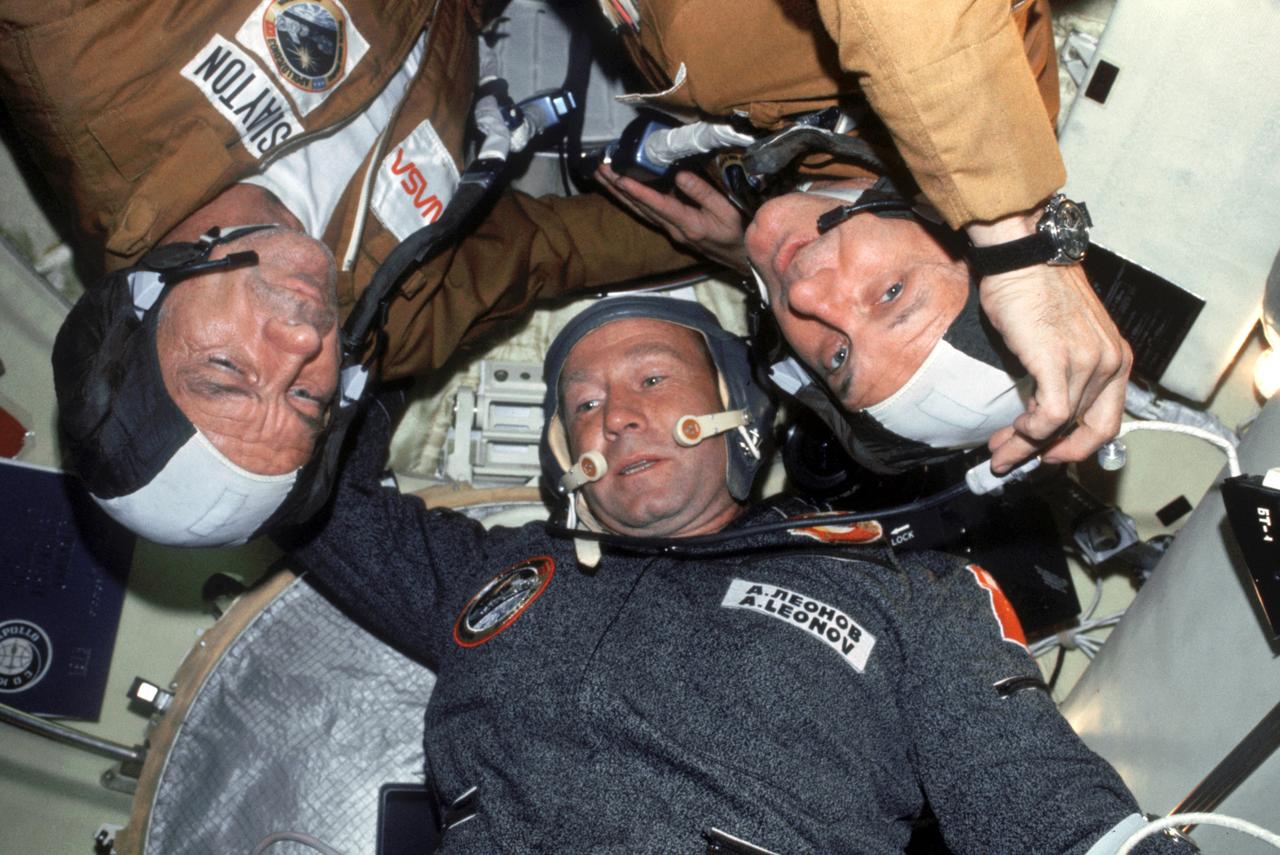
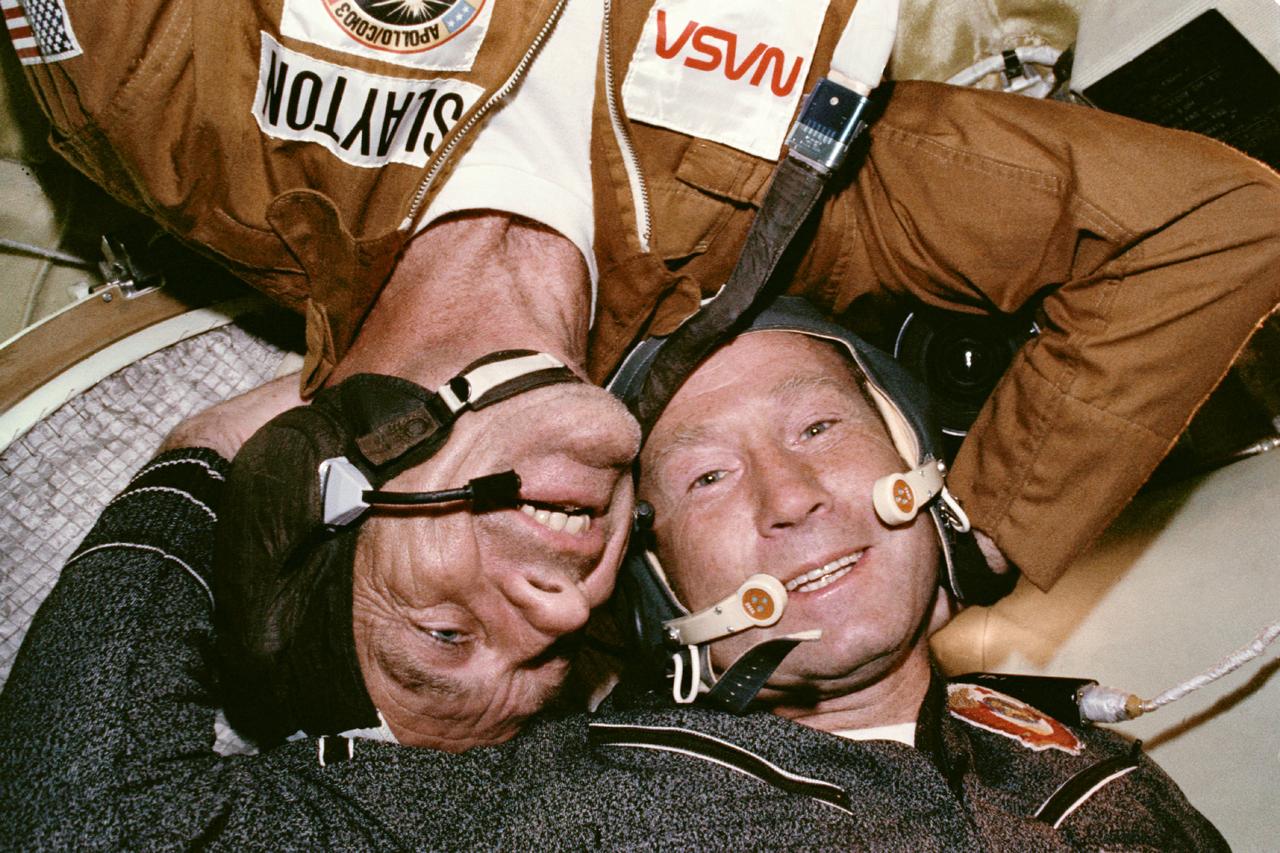
AST-05-301 (17-19 July 1975) --- Astronaut Donald K. Slayton, cosmonaut Aleksey A. Leonov and astronaut Thomas P. Stafford are photographed in the Soviet Soyuz during the Apollo-Soyuz Test Project docking mission in Earth orbit. This picture was taken with a 35mm camera.
Astronauts Stafford and Slayton and Cosmonaut Leonov in Soyuz Orbital Module
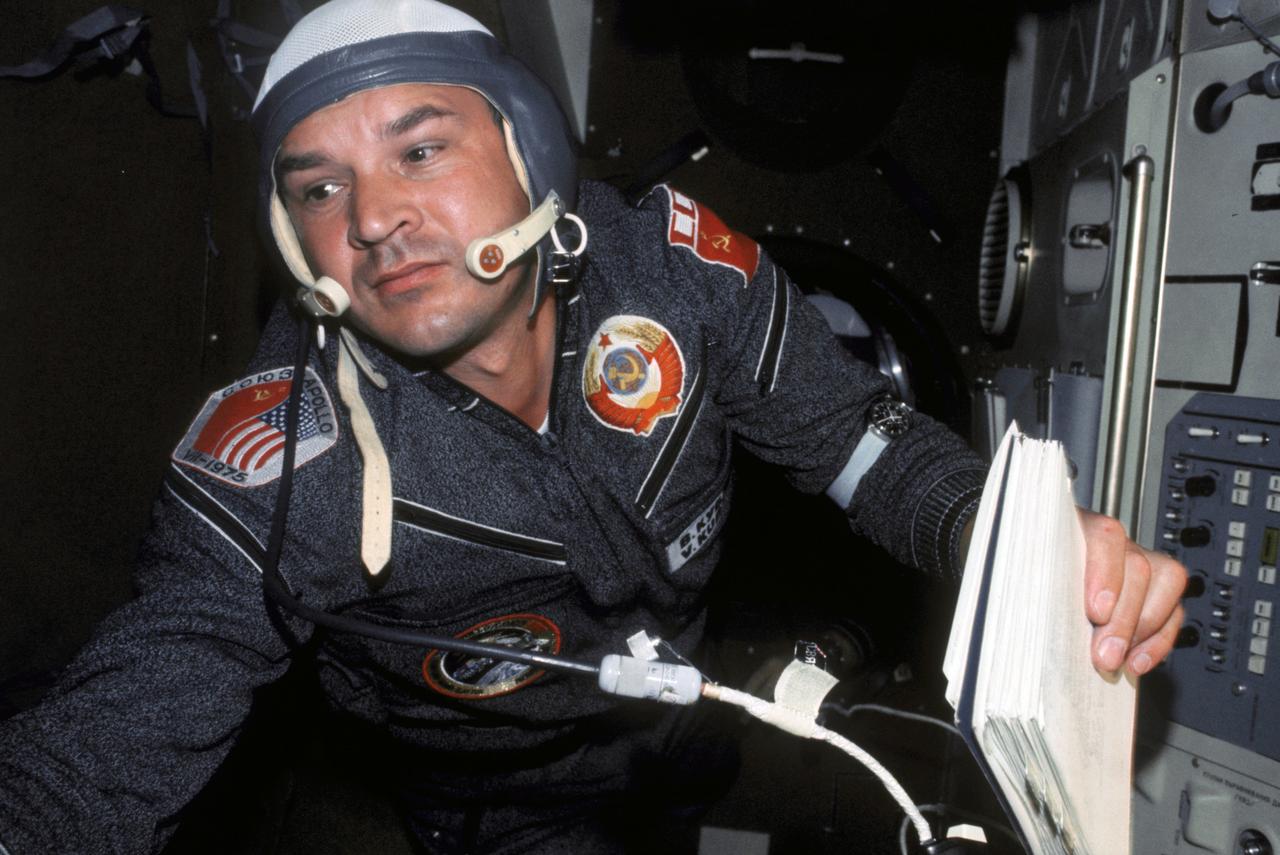
AST-05-305 (17-19 July 1975) --- Cosmonaut Valeriy N. Kubasov, engineer on the Soviet crew, is photographed in the Soyuz Orbital Module during the joint U.S.-USSR Apollo-Soyuz Test Project docking mission in Earth orbit. This picture was taken with a 35mm camera.
Cosmonauts Valeriy Kubasov in the Soyuz Orbital Module
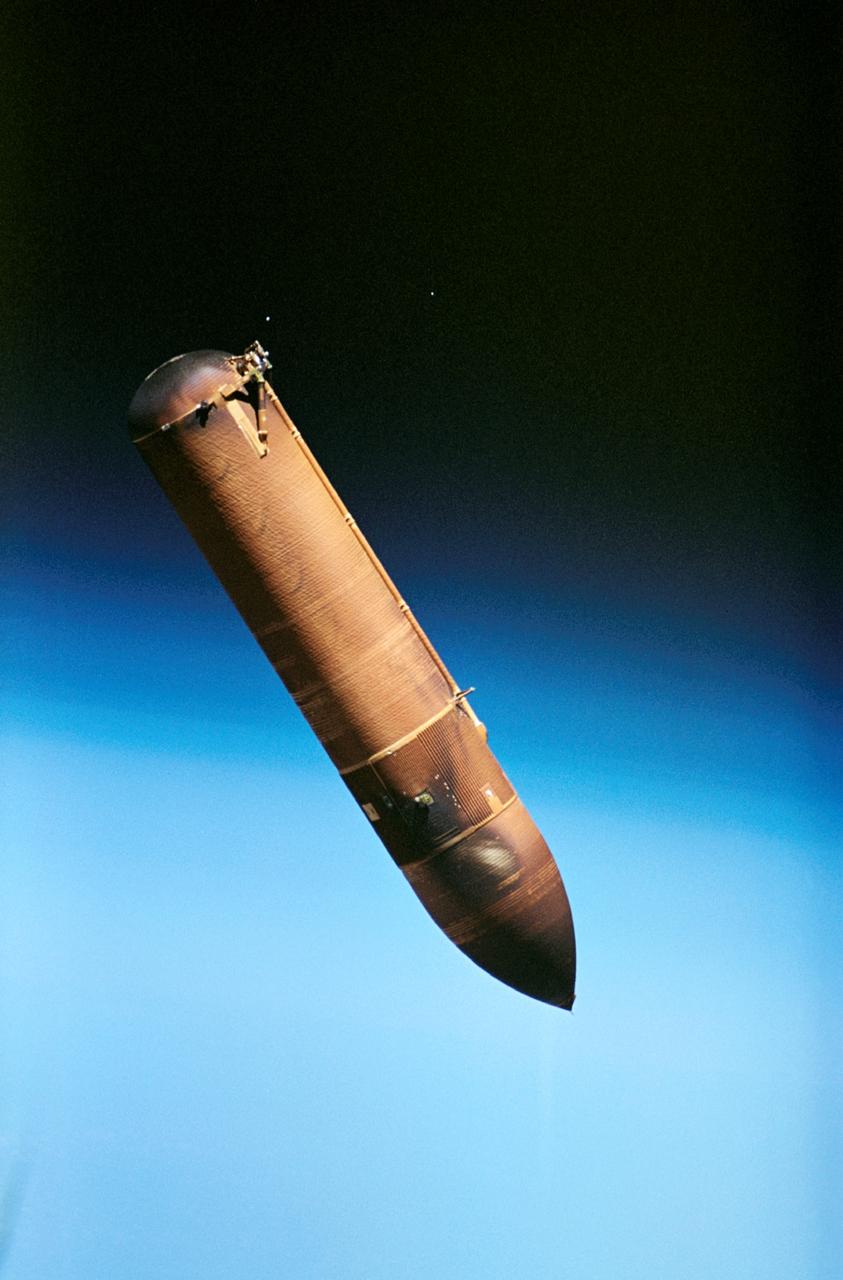
STS057-03-017 (21 June 1993) --- The external fuel tank falls toward Earth after being jettisoned from the Space Shuttle Endeavour as the spacecraft headed toward its ten-day stay in Earth orbit. A 35mm camera was used to record the ET jettison.
STS-57 external tank (ET) falls away from Endeavour, OV-105, after jettison
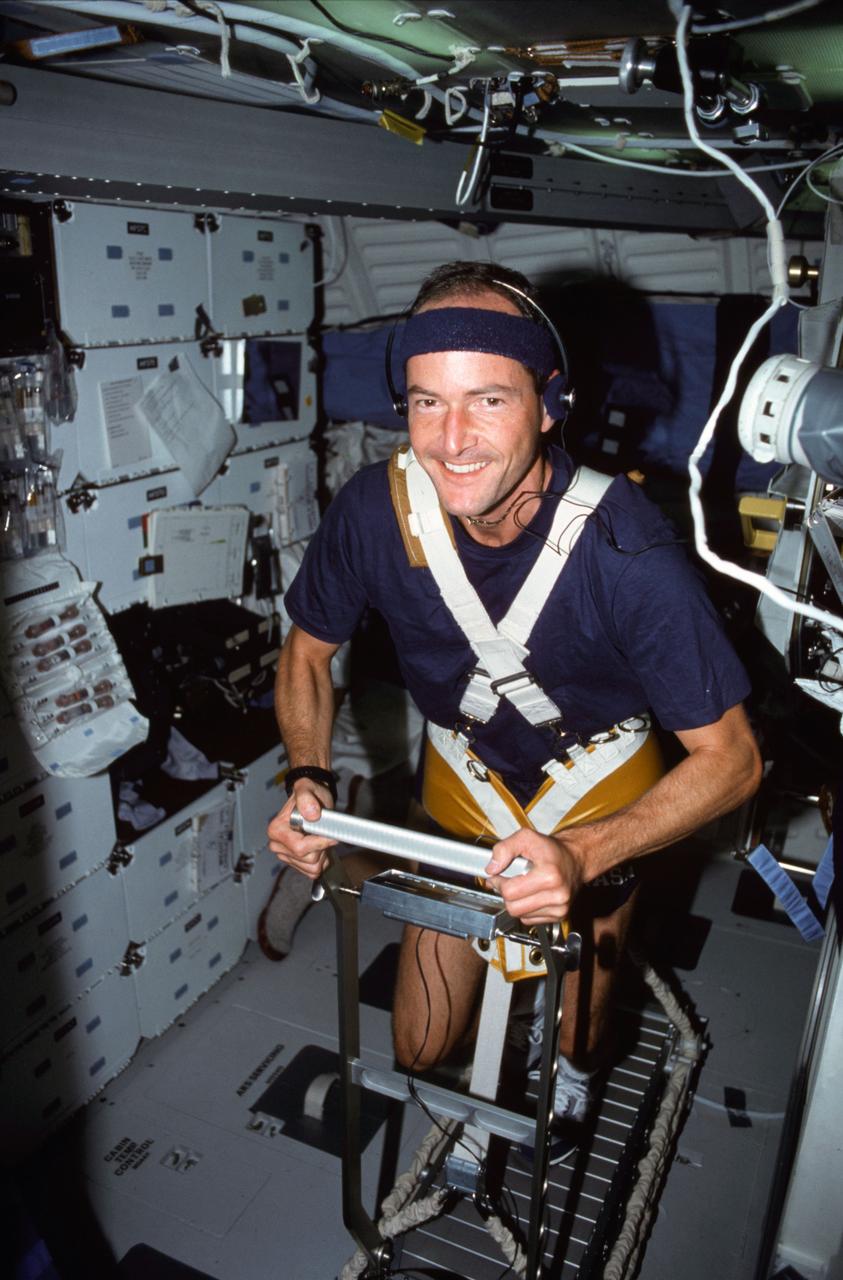
STS043-04-016 (2-11 Aug 1991) --- Astronaut G. David Low, STS-43 mission specialist, works out on a treadmill device which was used for medical testing on the nine-day flight.  The scene, photographed with a 35mm camera, is on Atlantis? flight deck.
STS-43 Mission Specialist (MS) Low exercises on OV-104's middeck treadmill
AST-05-296 (17-19 July 1975) --- Astronaut Thomas P. Stafford (left) and cosmonaut Aleksey A. Leonov are photographed together in the Soyuz Orbital Module during the joint U.S.-USSR Apollo-Soyuz Test Project docking mission in Earth orbit. They are respective commanders of their crews. This picture was taken with a 35mm camera.
Astronaut Stafford and Cosmonaut Leonov together in Soyuz Orbital Module
STS008-18-481 (30 Aug-5 Sept 1983) --- Astronaut Daniel C. Brandenstein, STS-8 pilot, communicates with ground controllers form the flight deck of the Earth orbiting Space Shuttle Challenger.  This frame was shot with a 35mm camera.
Pilot Brandenstein performs various procedures on flight deck
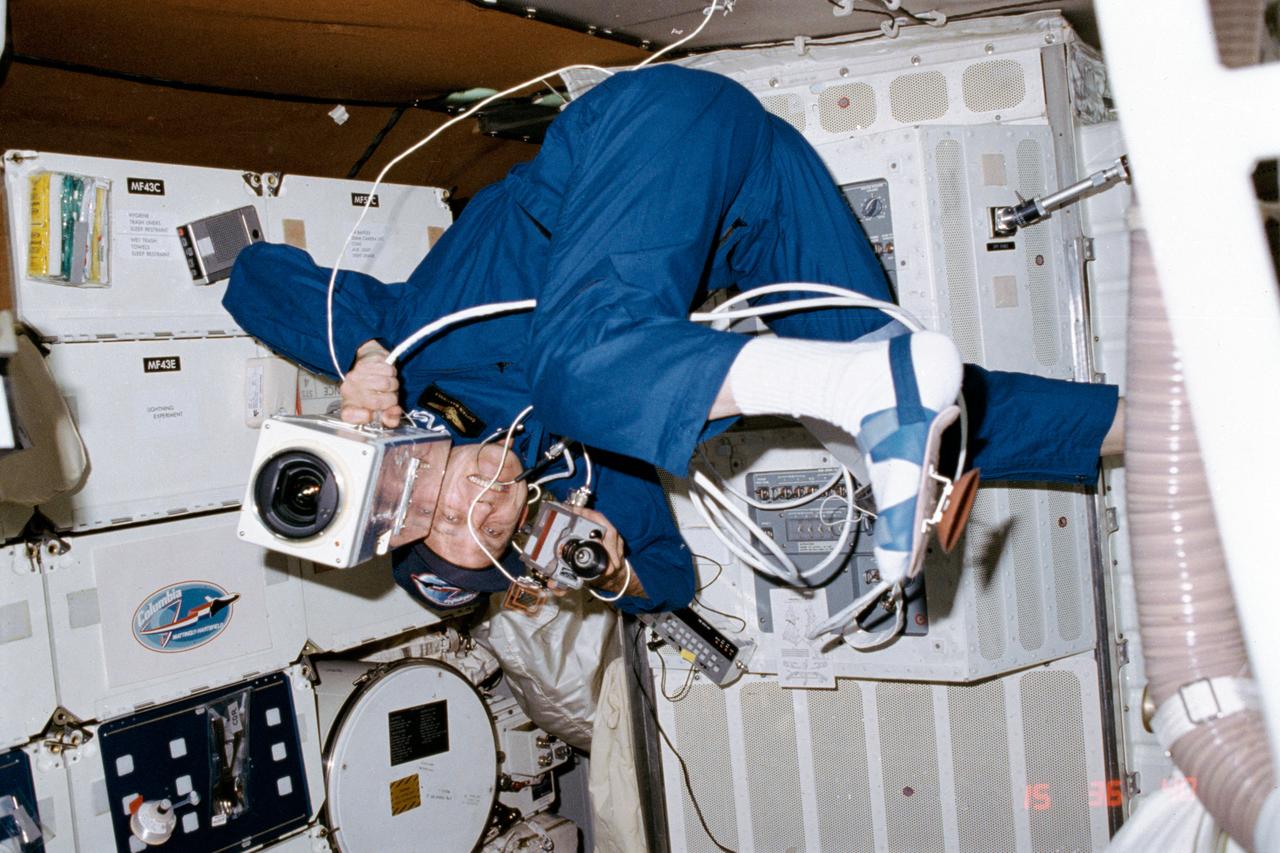
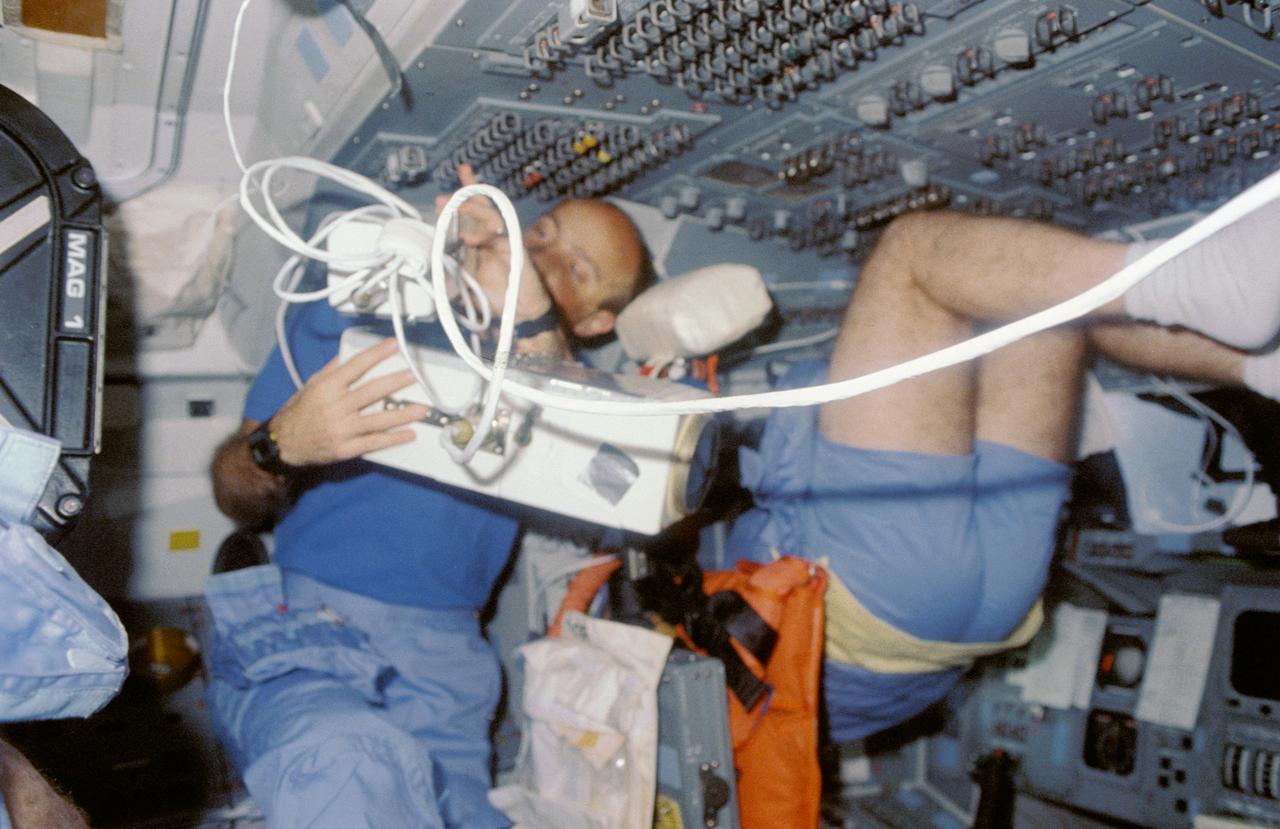
STS004-23-131 (27 June-4 July 1982) ---Astronaut Thomas K. Mattingly II, STS-4 commander, floats in the middeck area of the Earth-orbiting space shuttle Columbia. He handles two cameras at one time. In the commander’s right hand is a 16mm data acquisition camera (DAC), and in his left hand is a TV camera. Note the suction-cup equipped footwear which Mattingly revealed to the world via TV on one of his popular “cook’s tours” from crewmate Henry W. Hartsfield, pilot, operated a 35mm camera to expose this frame. Photo credit: NASA
Commander Mattingly uses 16mm DAC and FS crew cabin camera on middeck
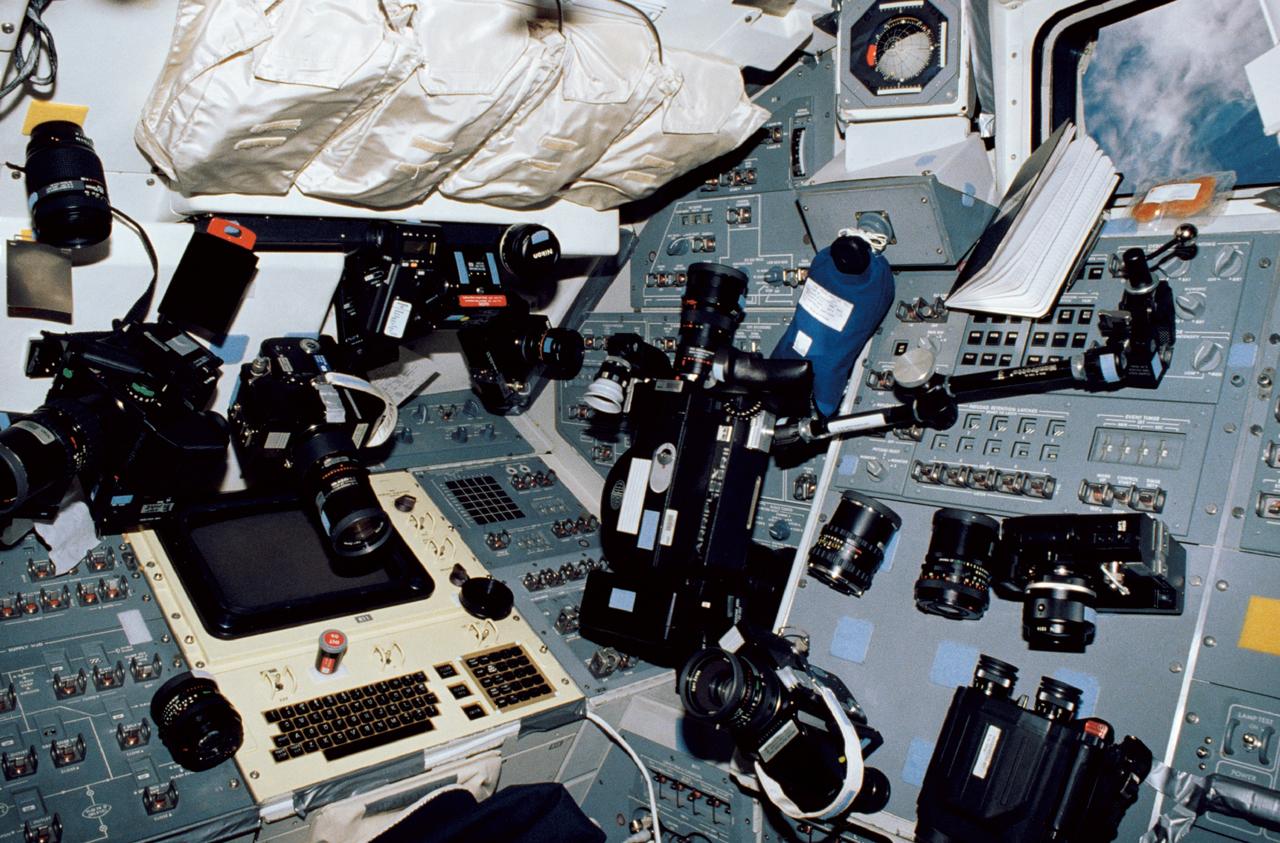
STS035-10-015 (2-10 Dec 1990) --- This busy scene shows cameras and supportive photographic gear temporarily stowed on Space Shuttle Columbia's aft flight deck. It was photographed with a 35mm camera by astronaut Jeffrey A. Hoffman, mission specialist, who called the cluster a "camera forest." The seven STS-35 crewmembers trained to record a wide variety of imagery with an equally broad range of equipment. In addition to cameras, a spot meter, film, a pair of binoculars, a bracket, lenses, lens cleaner and other photographic equipment are in the scene. Clouds over ocean waters are framed by an aft flight deck window at upper right.
STS-35 aft flight deck of Columbia, OV-102, with an array of camera equipment
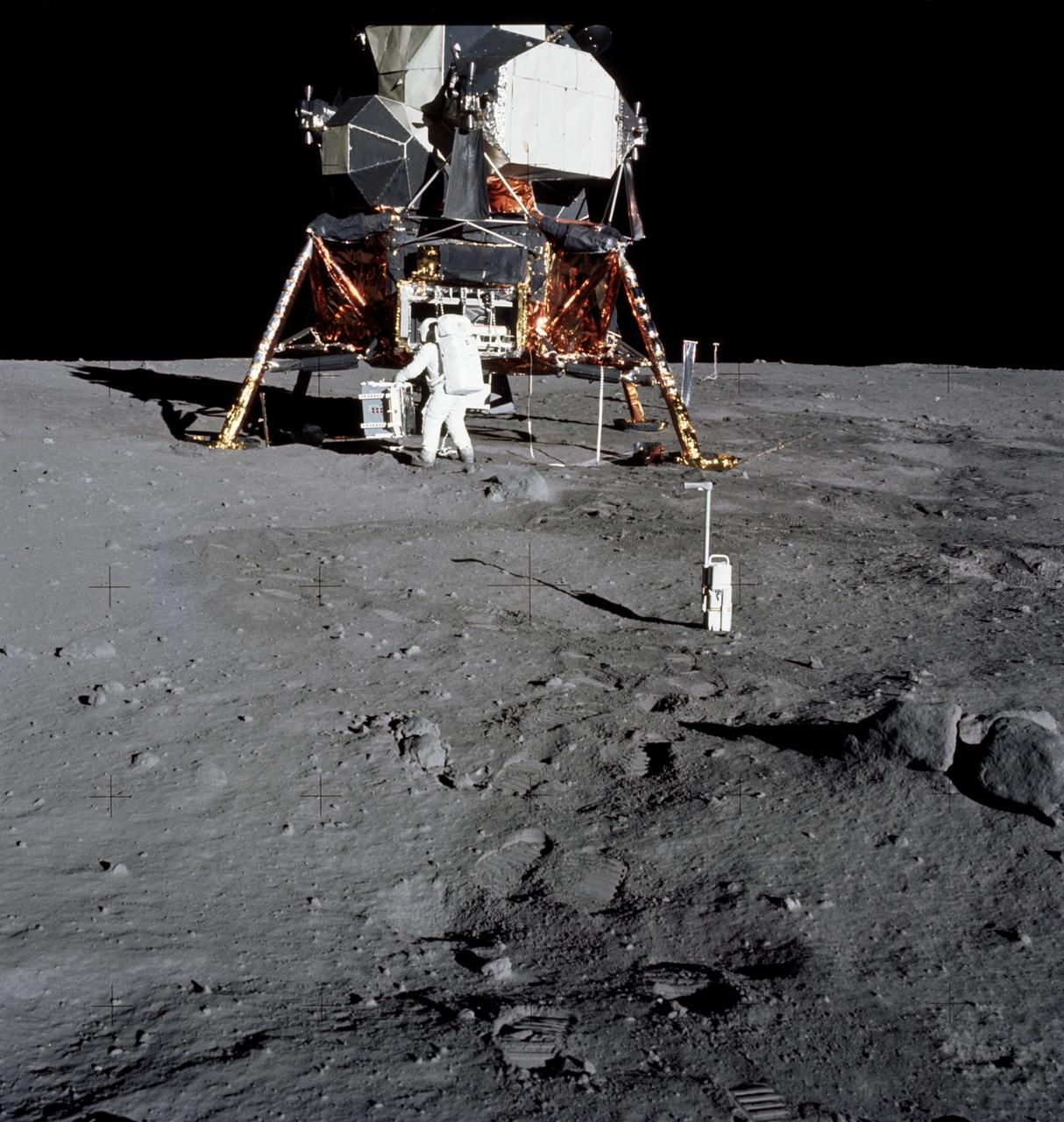
AS11-40-5931 (20 July 1969) --- Astronaut Edwin E. Aldrin Jr., lunar module pilot, prepares to deploy the Early Apollo Scientific Experiments Package (EASEP) on the surface of the moon during the Apollo 11 extravehicular activity. Astronaut Neil A. Armstrong, commander, took this photograph with a 70mm lunar surface camera. In the foreground is the Apollo 11 35mm stereo close-up camera.
Astronaut Edwin Aldrin prepares to deploy EASEP on surface of moon
STS043-21-013 (2-11 August 1991) --- As on previous missions, Earth observations/photography played an important role on NASA’s STS-43 mission. That role is depicted in this scene showing astronaut James C. Adamson, mission specialist, aiming a still camera toward Earth through an overhead window on Space Shuttle Atlantis’ aft flight deck. The scene was recorded by a fellow crewmember using a 35mm camera.
STS-43 Mission Specialist (MS) Adamson uses camera on aft flight deck
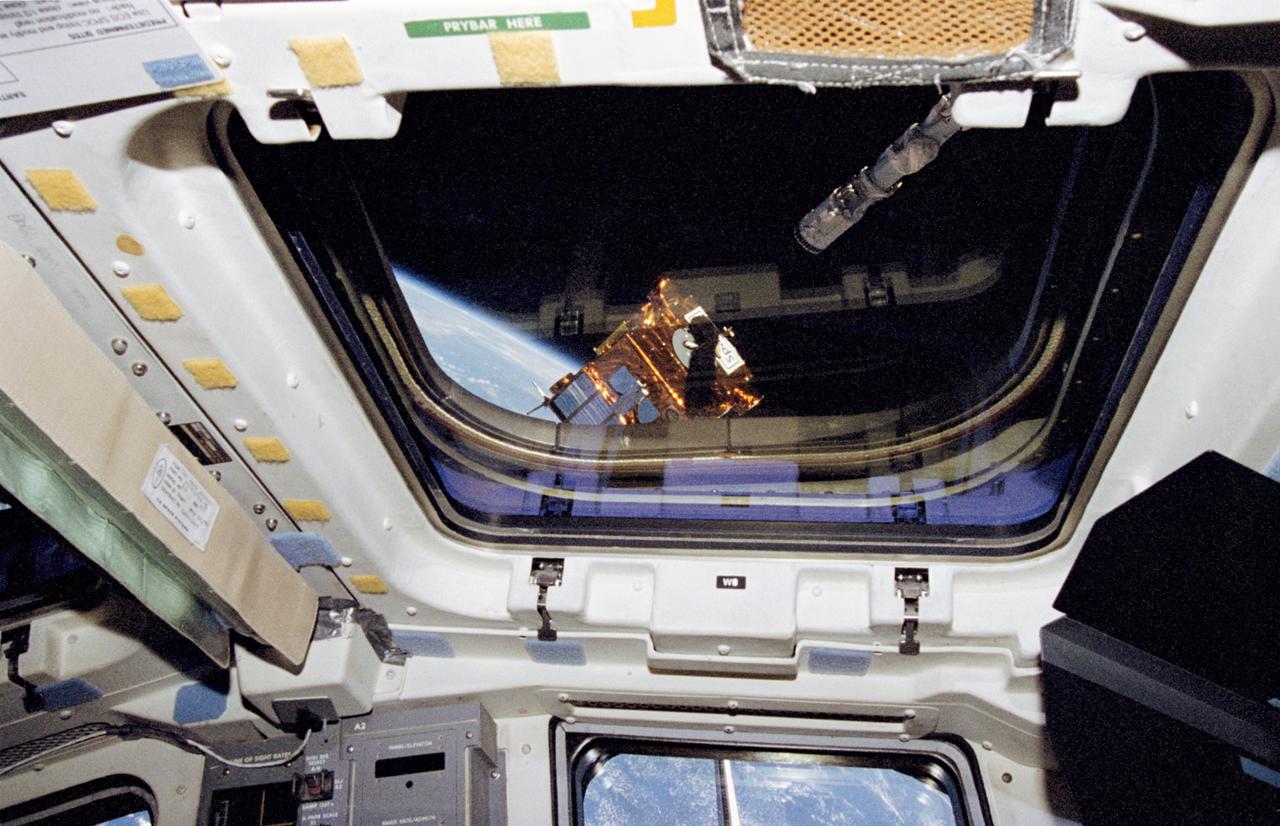
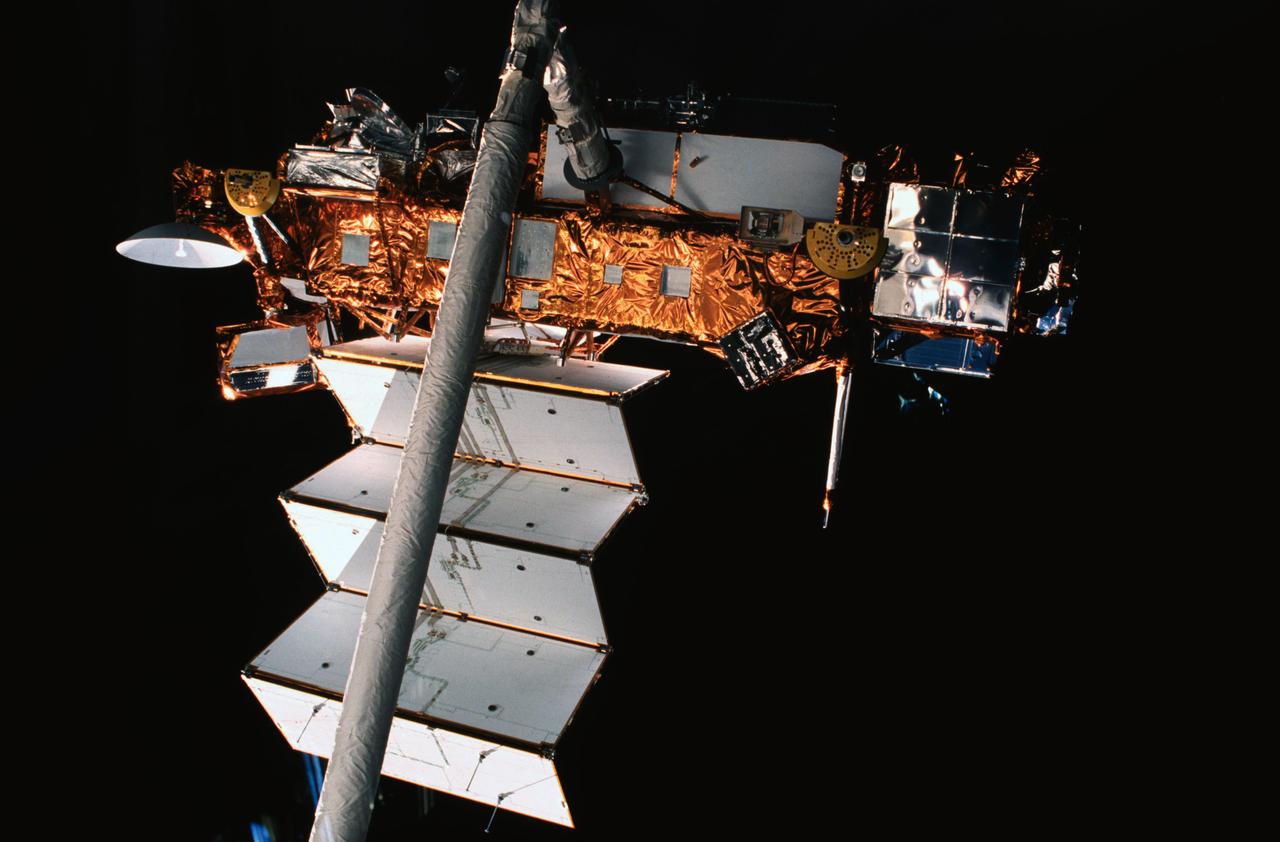
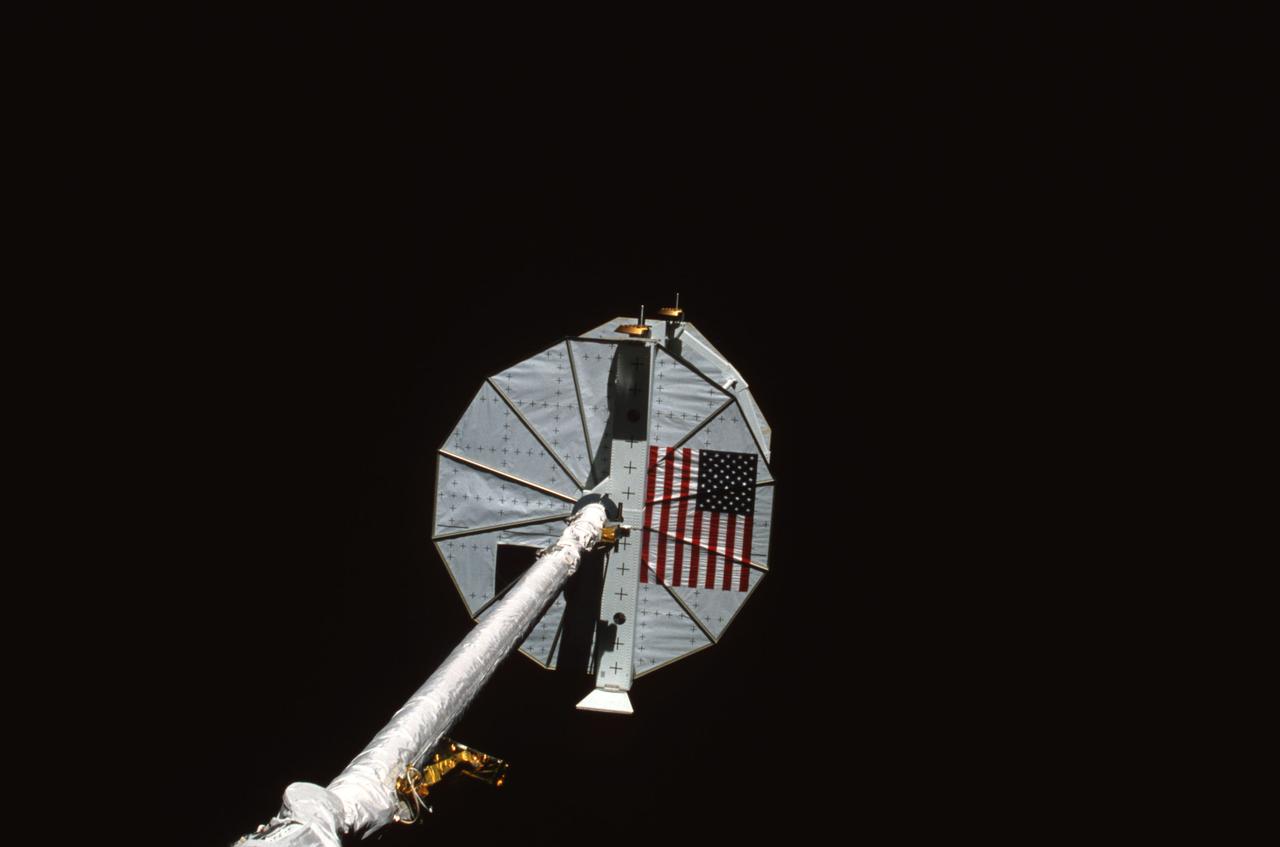
STS048-05-024 (15 Sept 1991) --- The Upper Atmosphere Research Satellite (UARS), in the grasp of the Remote Manipulator System (RMS), was captured on film by a camera aimed through one of the Space Shuttle Discovery's overhead windows.  At the time of the photo, deployment of UARS' solar array panel was in progress.  A few hours later, the huge satellite was free and on its way to a higher orbit.  Data from UARS will enable scientists to study ozone depletion in the stratosphere, or upper atmosphere.  The image was photographed with a 35mm camera.
STS-48 Upper Atmosphere Research Satellite (UARS) grappled by OV-103's RMS
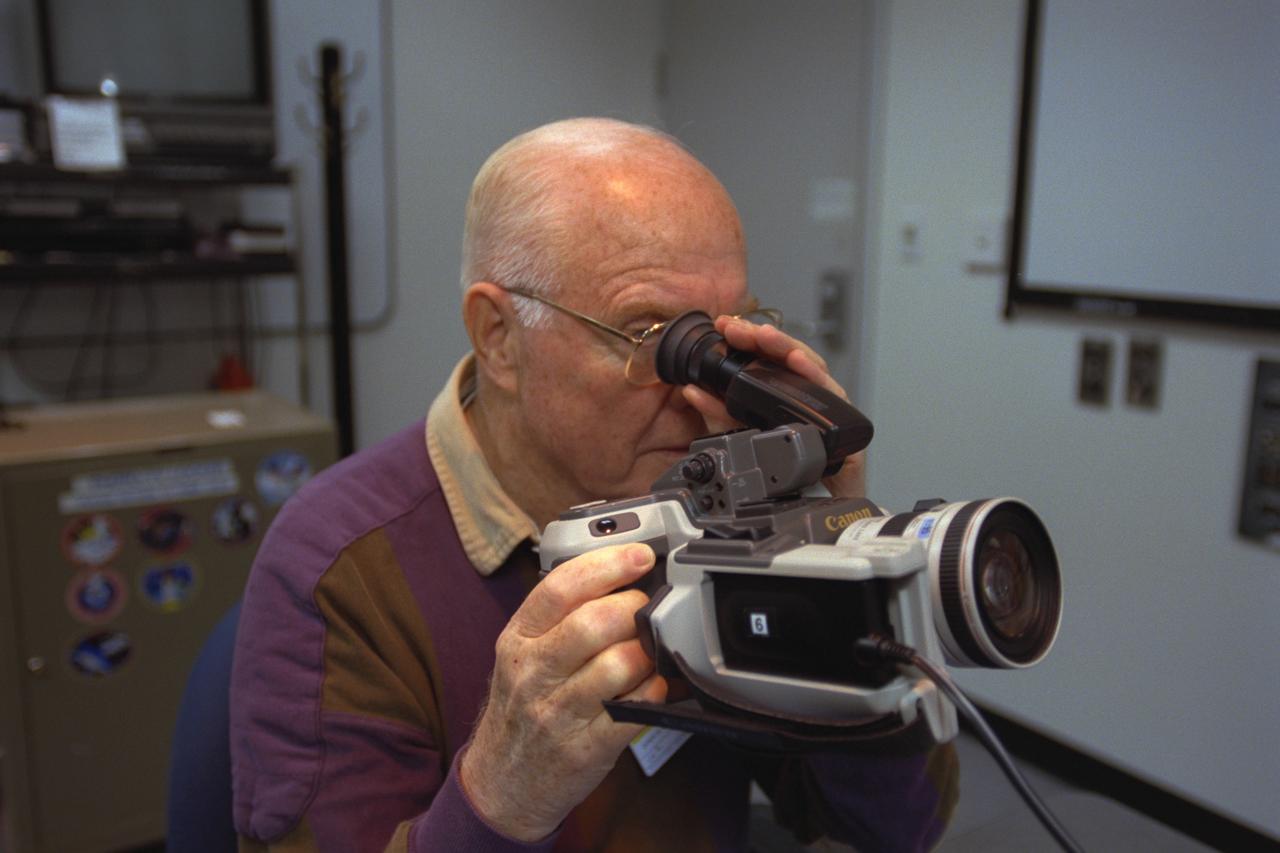
S98-08733 (9 April 1998) --- Looking through the view finder on a camera, U.S. Sen. John H. Glenn Jr. (D.-Ohio) gets a refresher course in photography from a JSC crew trainer (out of frame, right). The STS-95 payload specialist carried a 35mm camera on his historic MA-6 flight over 36 years ago. The photo was taken by Joe McNally, National Geographic, for NASA.
Various views of STS-95 Senator John Glenn during training
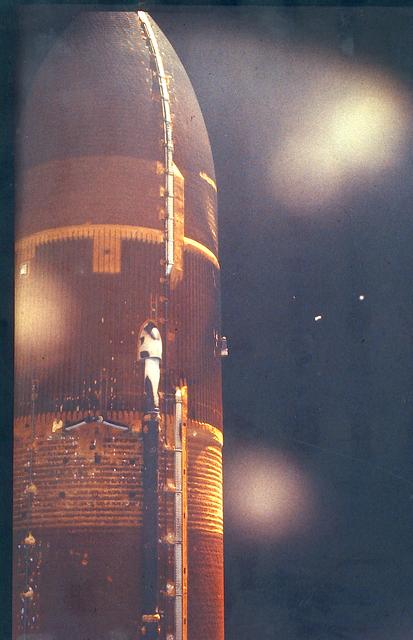
JSC2003-E-15408 (18 June 1983) --- A 35mm still camera located in the umbilical well of the space shuttle Challenger took this photograph of the external fuel tank (ET) after it was dropped from the launch stack as the shuttle headed for Earth orbit on June 18, 1983. The camera was located in the LO2 umbilical near the aft end of the orbiter (right side as you view the ET). Photo credit: NASA
jsc2003e15408
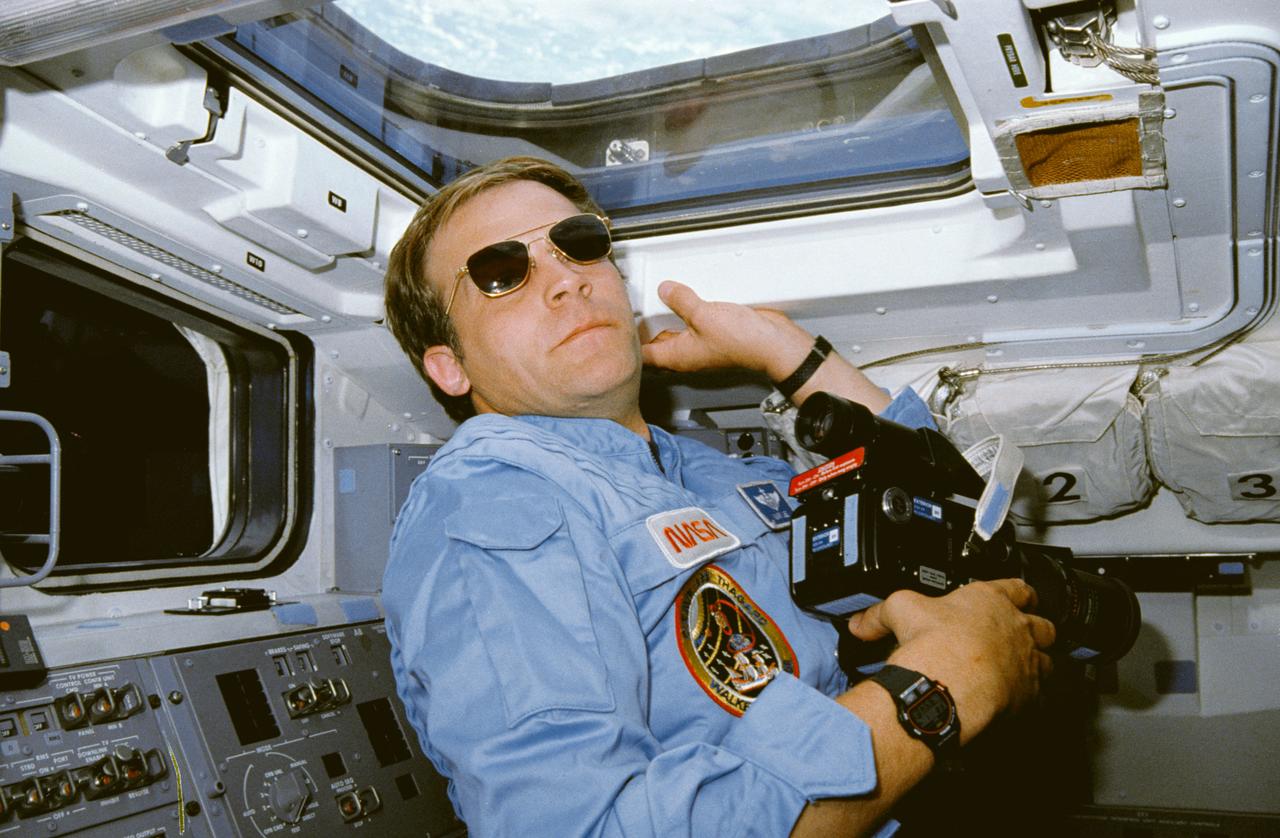
STS030-08-015 (4-8 May 1989) --- Astronaut Mark C. Lee, STS-30 mission specialist, pauses from a of Earth photography on Atlantis' aft flight deck.  He holds a 70mm camera. The scene was recorded with a 35mm camera.  The photo was in a group released by NASA following the completion of a four-day mission in space.
STS-30 MS Lee, wearing sunglasses, uses 70mm camera on aft flight deck
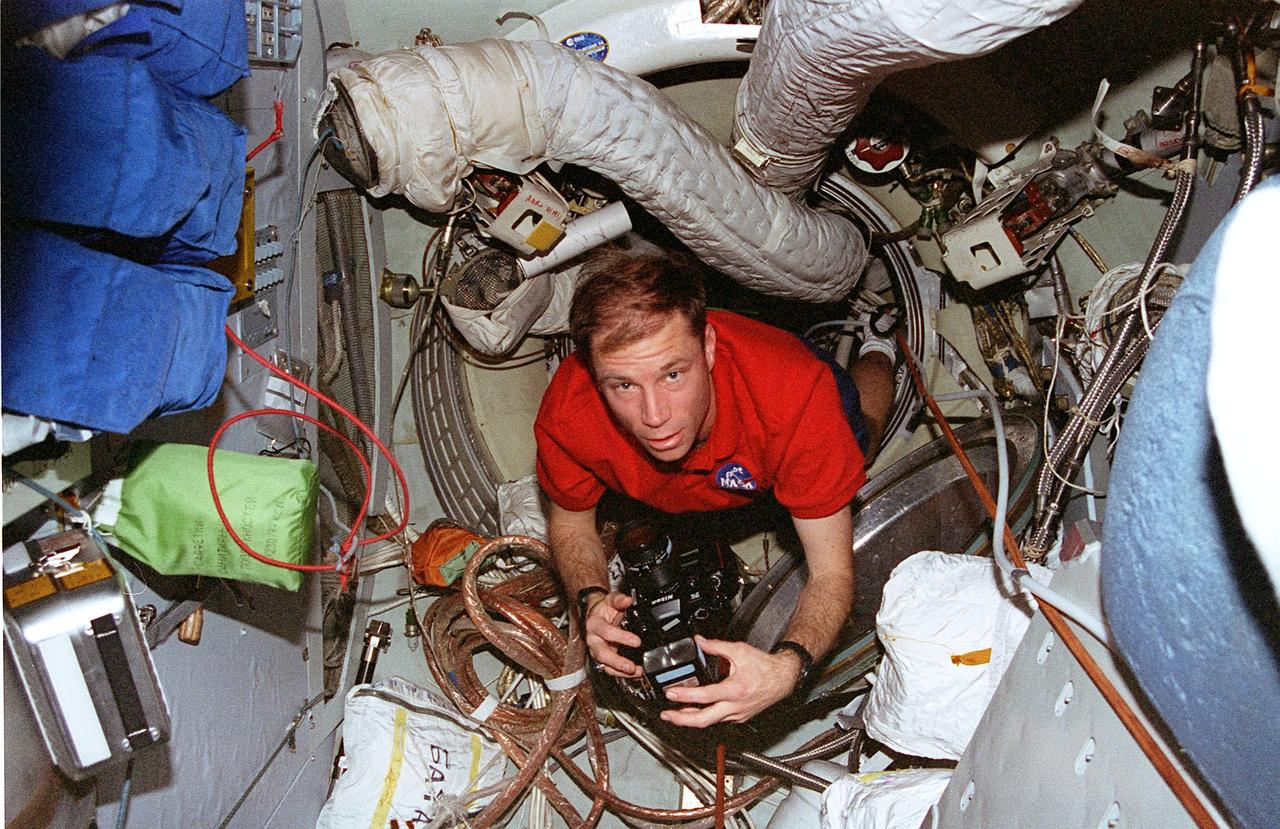
STS076-356-016 (22 - 31 March 1996) --- With camera in hand, astronaut Richard A. Searfoss, pilot, traverses the maze of modules on Russia's Mir Space Station.  The photograph was taken with a 35mm camera by one of Searfoss' crew mates.  The astronauts were aboard the Mir Space Station for a brief visit following the delivery of astronaut Shannon W. Lucid, cosmonaut guest researcher.
STS-76 crewmembers in Mir Space Station
STS081-E-05126 (13 Jan. 1997) --- Astronaut Michael A. Baker, mission commander, uses a 35mm camera to photograph a target of opportunity on Earth from the Space Shuttle Atlantis' aft flight deck.  Baker and five crew mates will dock with Russia's Mir Space Station around the middle of the week.  This image was recorded with an Electronic Still Camera (ESC) and was later downlinked to flight controllers in Houston, Texas.  A second ESC, devoted to an educational, geographic project called Kidsat, is mounted in the viewing port above Baker's head.
STS-81 commander Baker at aft flight deck window with camera
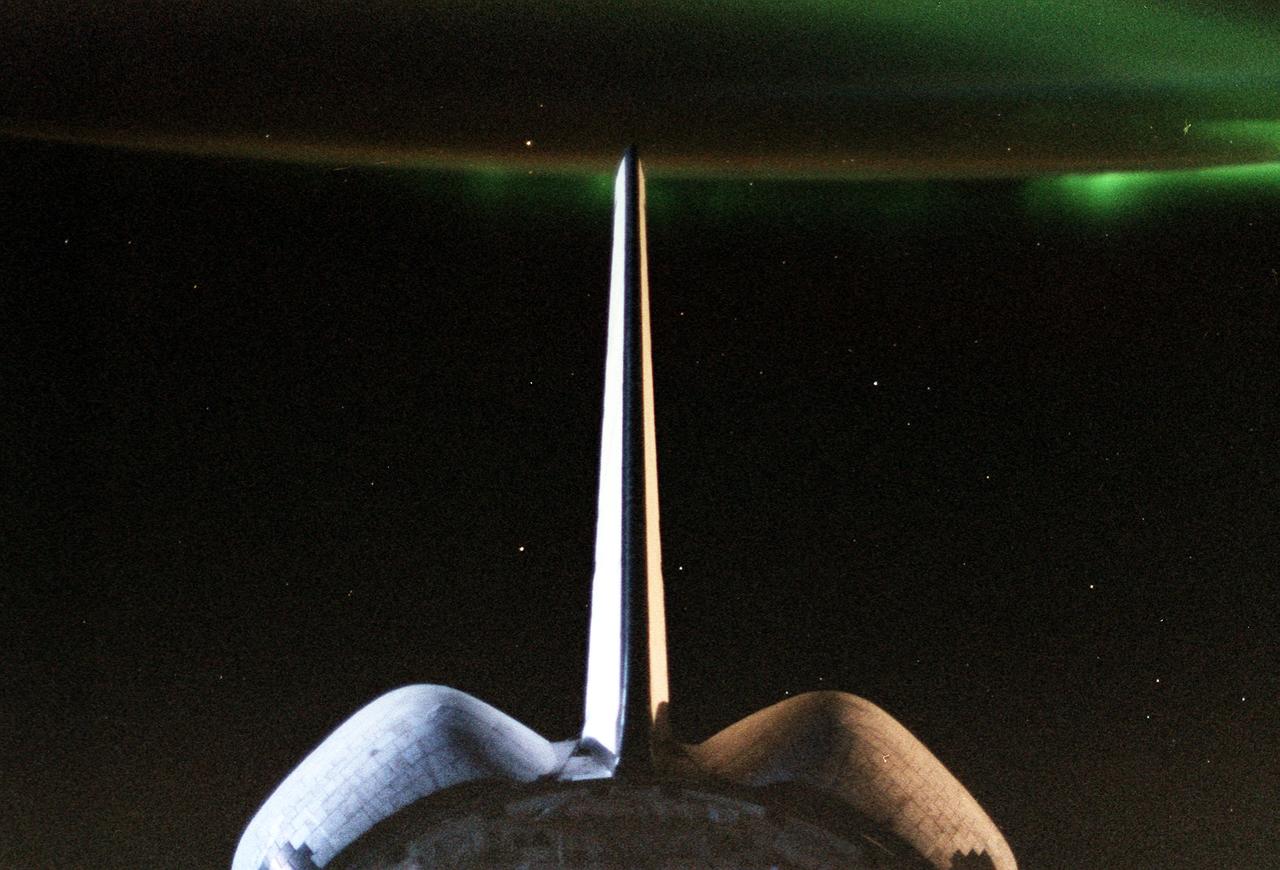
STS079-379-022 (16-26 Sept. 1996) --- If this moonlit picture is held with the Space Shuttle Atlantis' Orbital Maneuvering System (OMS) pods at top, a greenish aurora appears at left edge.  Thanks to a time exposure on a 35mm camera, a crew member was able to capture the phenomenon visually experienced frequently by Shuttle crews.  Several stars can be seen in the picture.  Many of them appear closer to the camera than Earth because they are seen through the thin line of atmosphere above Earth's horizon.
Sunrise reflected on the orbiter's vertical stabilizer
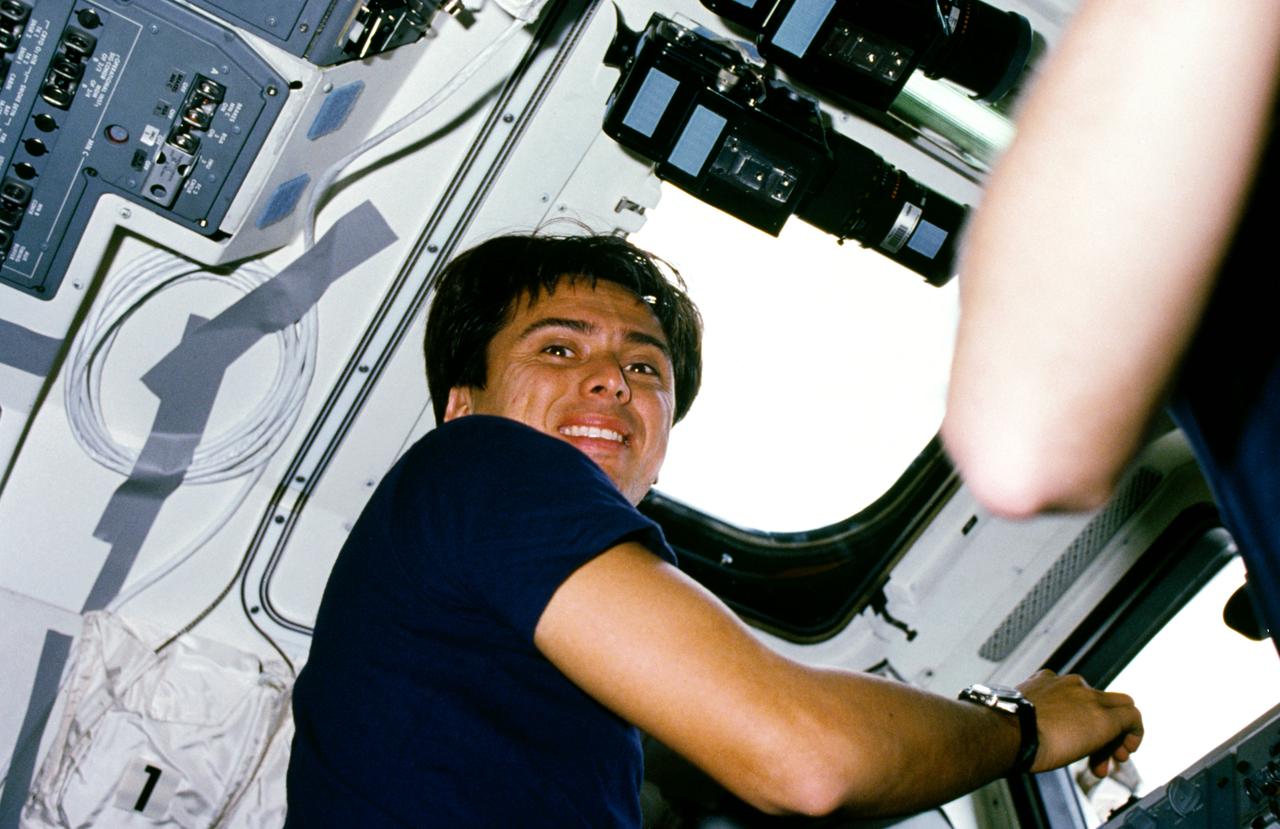
61C-02-032 (12-18 Jan. 1986) --- Astronaut Franklin R. Chang-Diaz, STS-61C mission specialist, while checking cargo in the space shuttle Columbia's payload bay, turns to smile at a fellow crew member using a 35mm camera.  Some of the prolific camera gear onboard the spacecraft is affixed above the mission specialist's right shoulder.
Astronaut Franklin Chang-Diaz checking payload bay through aft deck window
STS029-04-032 (13-18 March 1989) --- This scene was a common one during the five-day flight of STS-29. Astronaut John E. Blaha, STS-29 pilot, aims the IMAX camera at Earth through one of Discovery's  overhead windows.  The scene was recorded with a 35mm camera.  The photo was part of the first group of onboard photography from this flight released by NASA on Mar. 19, 1989.
STS-29 Discovery, OV-103, Pilot Blaha with IMAX camera on aft flight deck
S82-28907 (March 1982) --- Astronaut Jack R. Lousma turns toward astronaut C. Gordon Fullerton and smiles into the lens of the 35mm camera Fullerton used to expose this frame onboard the busy Earth-orbiting space shuttle Columbia. Lousma is at the commander's station of the forward flight deck on the Columbia.  His front window view is of Earth below (note river upper right center). Lousma is wearing the trouser and shirt of a three-piece (jacket temporarily not worn) constant-wear garment.  Except for entry and launch phases, shuttle crews wear the CWG throughout their awake hours. A data acquisition camera (DAC) is at upper left, along with a TV camera. Photo credit: NASA
Commander Lousma recieves FDF procedures on forward flight deck
STS008-07-149 (2 Sept 1983) --- Many hours were spent, by its crew members, running tests with the Payload Flight Test Article (PFTA) and the Remote Manipulator System (RMS).  The bar-bell shaped test device and the arm stand out brilliantly against the darkness of space.  The two TV cameras on the "wrist" and "elbow" of the Canadian-built robot arm provided some close-up scenes of the variegated testing with the PFTA.  This frame was exposed with a 35mm camera aimed through the windows on the flight deck of the Earth-orbiting Space Shuttle Challenger.
RMS / PFTA operations using grapple fixture number (no.) 5
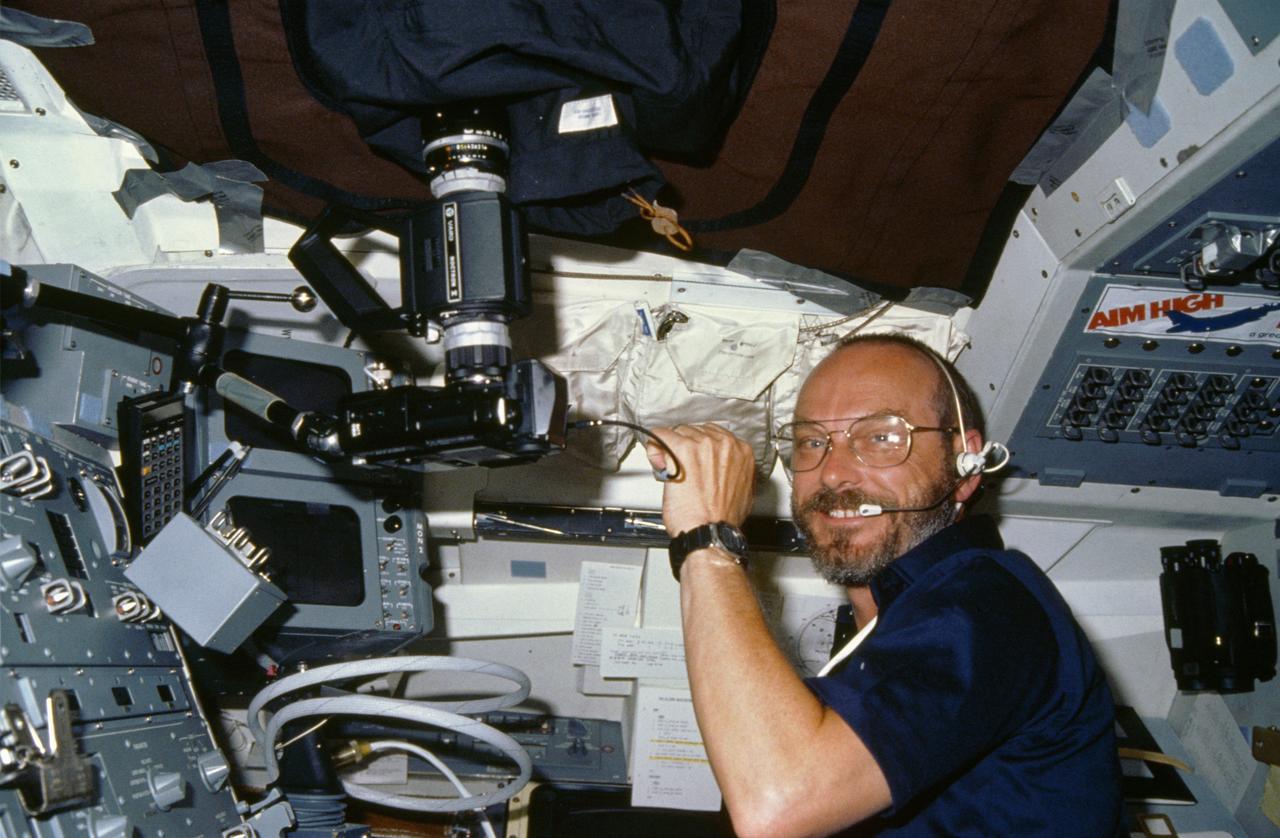
61C-05-026 (14 Jan. 1986) --- Astronaut George D. Nelson smiles for a fellow crew man's 35mm camera exposure while participating in the Comet Halley active monitoring program (CHAMP).  Camera equipment and a protective shroud used to eliminate all cabin light interference surround the mission specialist.  This is the first of three 1986 missions which are scheduled to monitor the rare visit by the comet.  The principal investigators for CHAMP are S. Alan Stern of the Laboratory for Atmospheric and Space Physics at the University of Colorado; and Dr. Stephen Mende of Lockheed Palo Alto Research Laboratory.
Astronaut George Nelson working on Comet Halley Active monitoring program
51G-S-100 (17 June 1985) --- A low-angle 35mm tracking view of the Space Shuttle Discovery, its external tank and two solid rocket boosters speeding from the KSC launch facility to begin NASA STS 51-G.  The camera has captured the diamond shock effect associated with the launch phase or orbiter vehicles.  Inside the Discovery are seven crewmembers and a variety of payloads representing international interests.  Liftoff for 51-G occurred at 7:33:043 a.m. (EDT), June 17, 1985.
Launching of the Shuttle Discovery and the STS 51-G mission
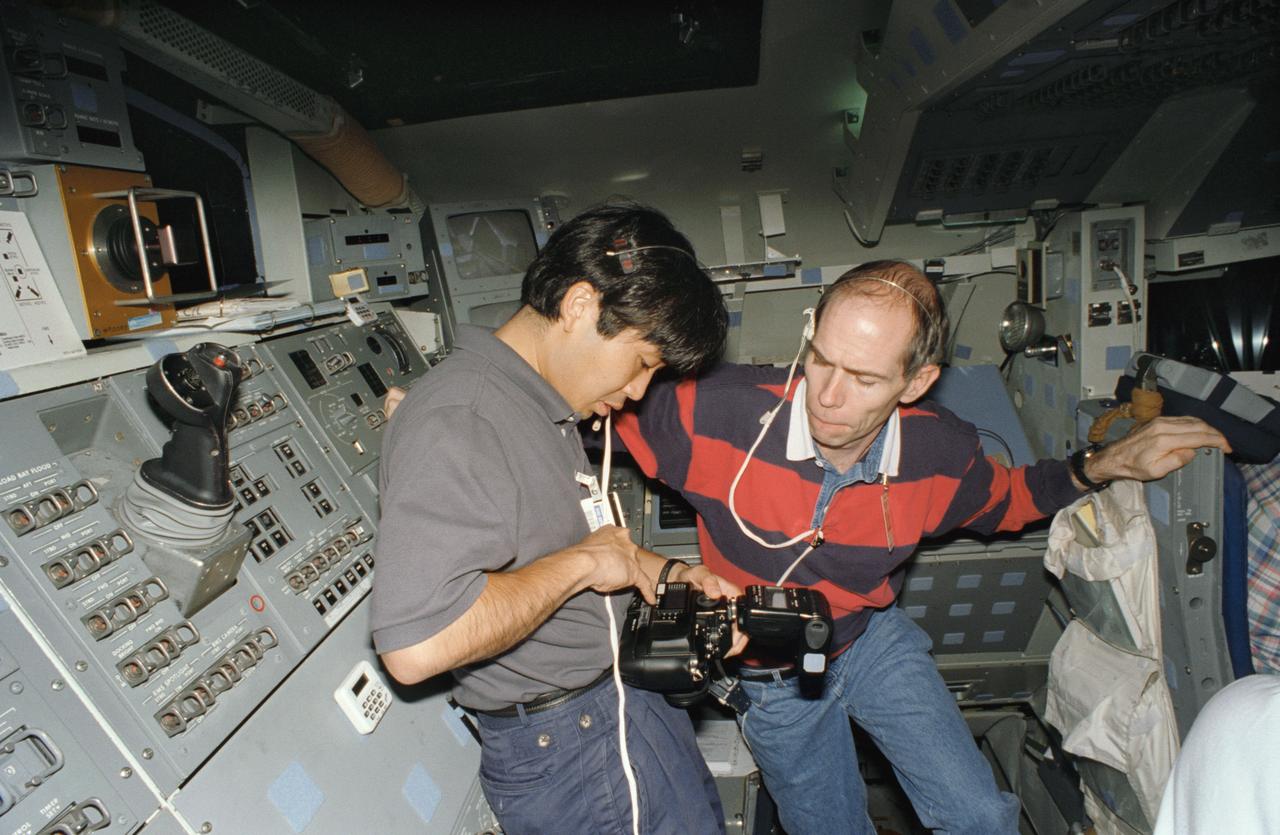
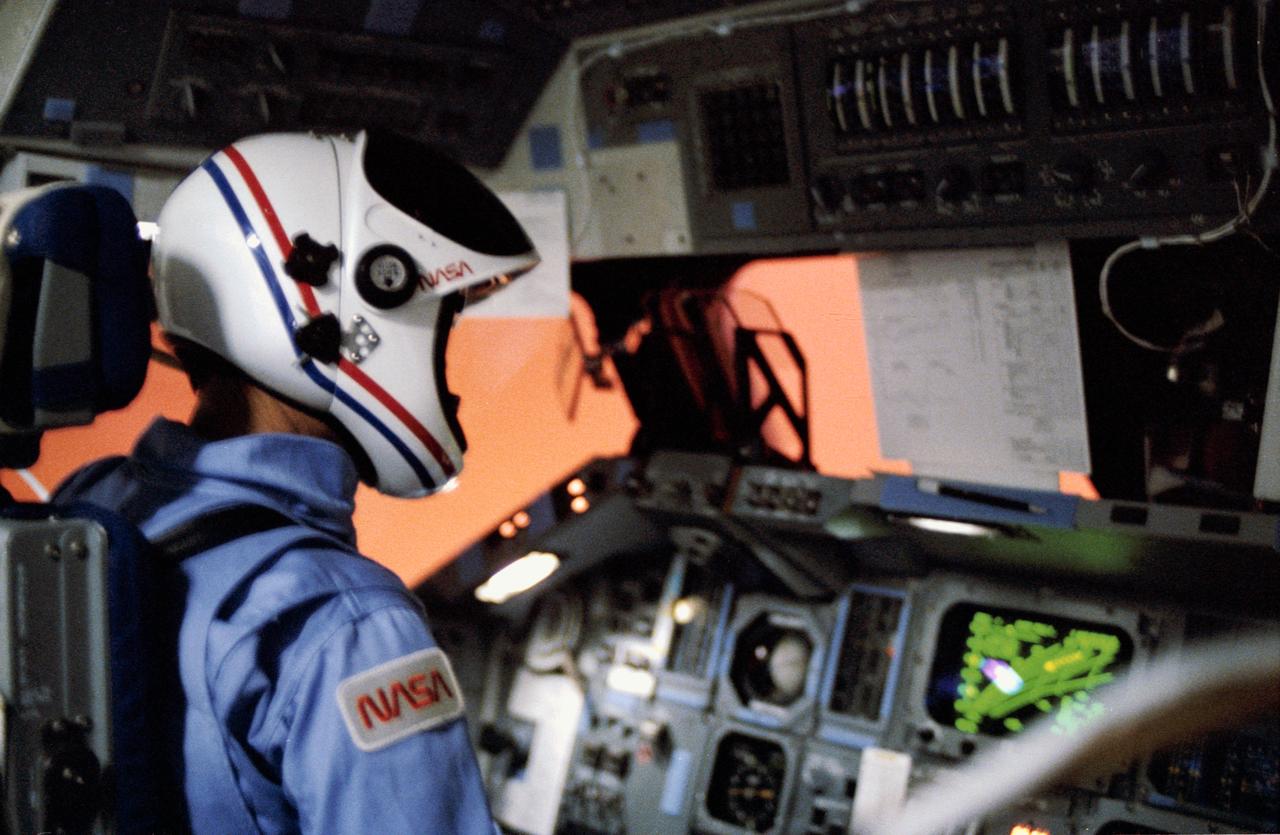
S95-12703 (May 1995) --- Astronauts Koichi Wakata (left) and Daniel T. Barry check the settings on a 35mm camera during an STS-72 training session. Wakata is a mission specialist, representing Japan's National Space Development Agency (NASDA) and Barry is a United States astronaut assigned as mission specialist for the same mission.  The two are on the aft flight deck of the fixed base Shuttle Mission Simulator (SMS) at the Johnson Space Center (JSC).
STS-72 crew trains in Fixed Base (FB) Shuttle Mission Simulator (SMS)
STS007-11-495 (18-24 June 1983) --- Astronaut Sally K. Ride, STS-7 mission specialist, communicates with ground controllers from the mid deck of the Earth-orbiting Space Shuttle Challenger.  She has just opened one of the large lockers during the operation and monitoring of the continuous flow electrophoresis system (CFES) experiment at left edge.  This photograph was made with a 35mm camera.
Mission Specialist (MS) Ride adjusts headset (HDST) on middeck
98-E-04404 (8 May 1998) --- U.S. Sen. John H. Glenn Jr. (D.-Ohio) takes a picture with a 35mm camera while standing in front of one of the Shuttle mockup/training facilities at the Johnson Space Center (JSC). Glenn, the first American to orbit Earth (over 36 years ago) and assigned to fly as a payload specialist aboard the Space Shuttle Discovery later this year, stands in front of the full fuselage trainer (FFT) in the systems integration facility.
STS-95 mission specialist Senator John Glenn in FFT on 05-08-98
AST-05-275 (17-19 July 1975) --- Cosmonaut Aleksey A. Leonov, commander of the Soviet ASTP crew, displays a drawing of astronaut Thomas P. Stafford during the joint U.S.-USSR Apollo-Soyuz Test Project docking mission in Earth orbit. He is in the Soyuz Orbital Module. This picture was taken by an American ASTP crewman with a 35mm camera.
Cosmonaut Aleksey Leonov displays drawing of Astronaut Thomas Stafford
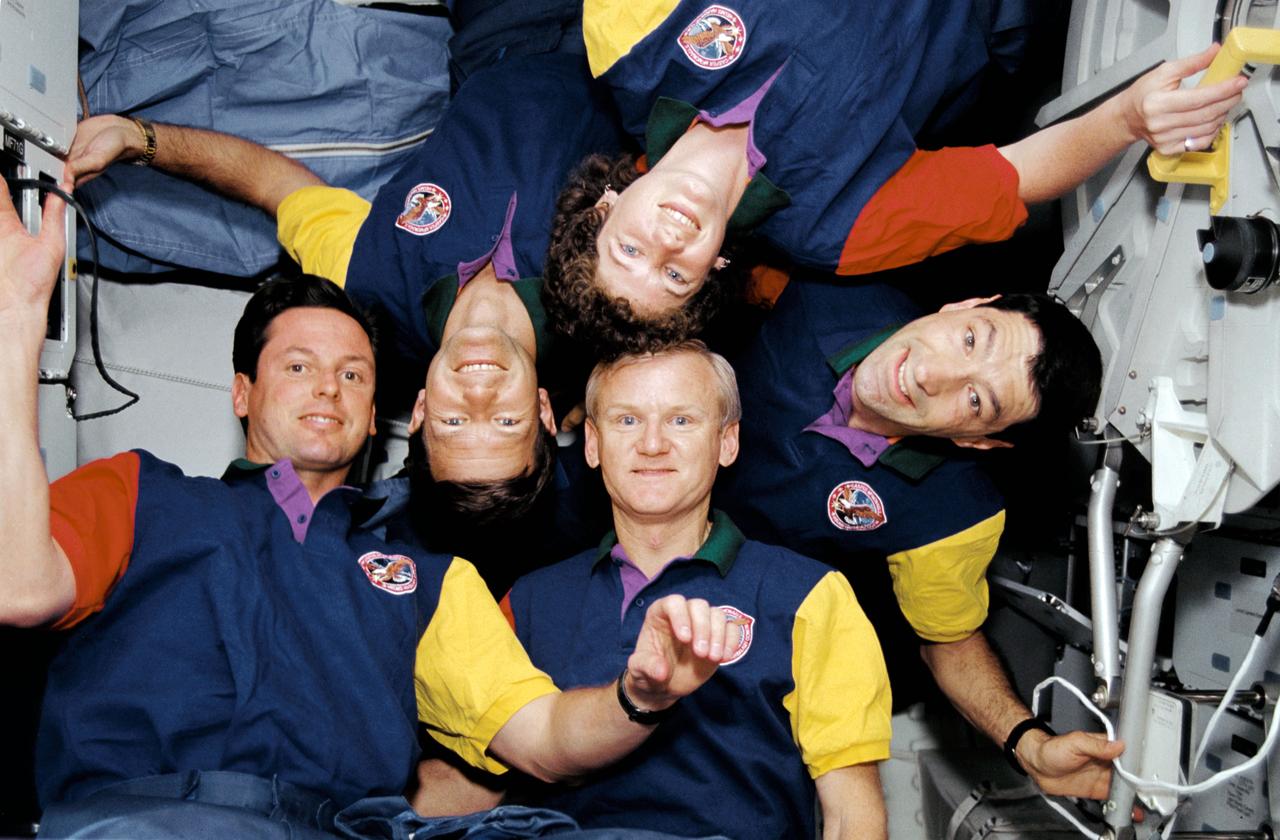
STS054-02-008 (13-19 Jan. 1993) --- The traditional inflight crew portrait has, (clockwise), Susan J. Helms, Mario Runco Jr., both mission specialists, John H. Casper, mission commander, Donald R. McMonagle, pilot, and Gregory J. Harbaugh, mission specialist.  This frame was taken with a 35mm camera aboard the Earth-orbiting Space Shuttle Endeavour during the six-day mission.
In orbit crew group portraits.
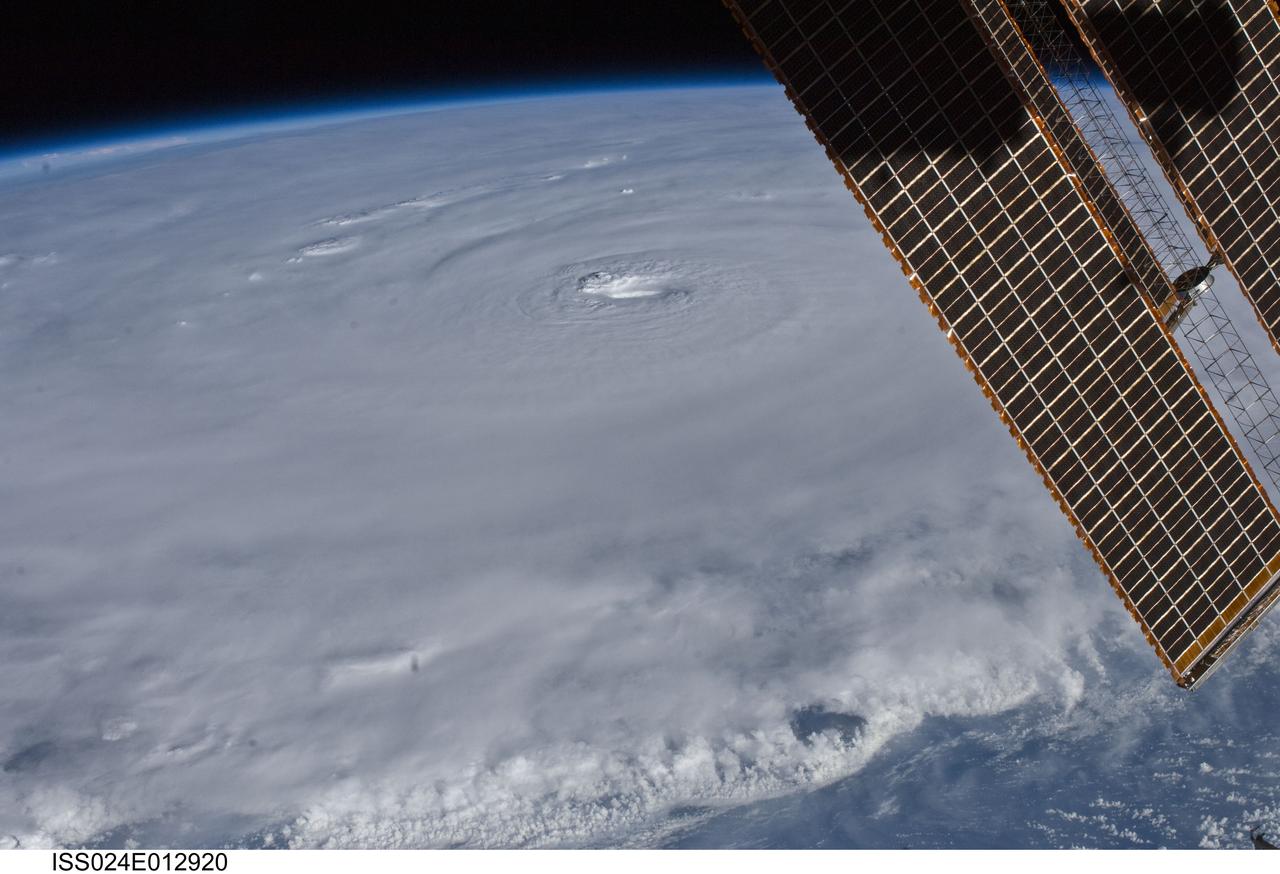
ISS024-E-012920  (30 Aug. 2010) --- Photographed by an Expedition 24 crew member on the International Space Station,   this is an oblique view of the eye (just above center frame) of Hurricane Earl (at this time a category 4 but later downgraded to a category 3), centered just north of the Virgin Islands near 19.3 north latitude and 64.7 west longitude packing 115-kilometer winds.  The photo was taken with a digital still camera using a 35mm lens.
Earth Observation - Hurricane Earl
41C-22-885 (8 April 1984) --- The 35mm camera was used to photograph this scene of Astronaut George D.  Nelson, STS-41C mission specialist, as he uses the manned maneuvering unit (MMU) to make an excursion to the plagued Solar Maximum, Mission Satellite (SMMS)._Astronaut James D. van Hoften remained in the Challenger's cargo bay during the April 8 extravehicular activity (EVA).
View of Astronaut Nelson using MMU to examine Solar Maximum Mission Satellite
AST-05-290 (17-19 July 1975) --- Astronaut Donald K. Slayton, docking module pilot of the American ASTP crew, is seen in the hatchway leading between the Apollo Docking Module and the Soyuz Orbital Module during the joint U.S.-USSR Apollo-Soyuz Test Project docking mission in Earth orbit. The 35mm camera was looking from the Soyuz into the Docking Module.
Astronaut Donald Slayton in hatchway between Apollo and Soyuz spacecraft
STS048-21-04 (15 Sept 1991) --- The five astronauts pose on the Space Shuttle Discovery's middeck for the traditional in-flight crew portrait.  Astronaut John O. Creighton, mission commander, is at center.  Others are (front row, left to right) Kenneth S. Reightler, pilot; and James F. Buchli, mission specialist; and (rear row, left to right) astronauts Mark N. Brown and Charles D. (Sam) Gemar, both mission specialists.  The image was photographed with a pre-set 35mm camera.
STS-48 crew poses for onboard (inflight) portrait on OV-103's middeck
STS076-344-013 (24 March 1996)--- Continuing an in-space tradition, astronaut Kevin P. Chilton (right), mission commander, shakes hands with cosmonaut Yury I. Onufrienko, Mir-21 commander, in the tunnel connecting the Space Shuttle Atlantis and Russia's Mir Space Station.  A short time earlier two crews successfully pulled off the third hard-docking of their respective spacecraft.  The image was made with a 35mm camera.
Opening the hatch and welcome ceremony in the Mir Space Station
STS084-318-035 (15-24 May 1997) --- Attired in the partial pressure launch and entry garment, astronaut Charles J. Precourt, commander, performs final checkout procedures prior to the re-entry phase of the STS-84 mission. The photo was taken with a 35mm camera by one of the Space Shuttle Atlantis' rear station-seated crewmembers.
Precourt prepares for entry seated at the commander's station
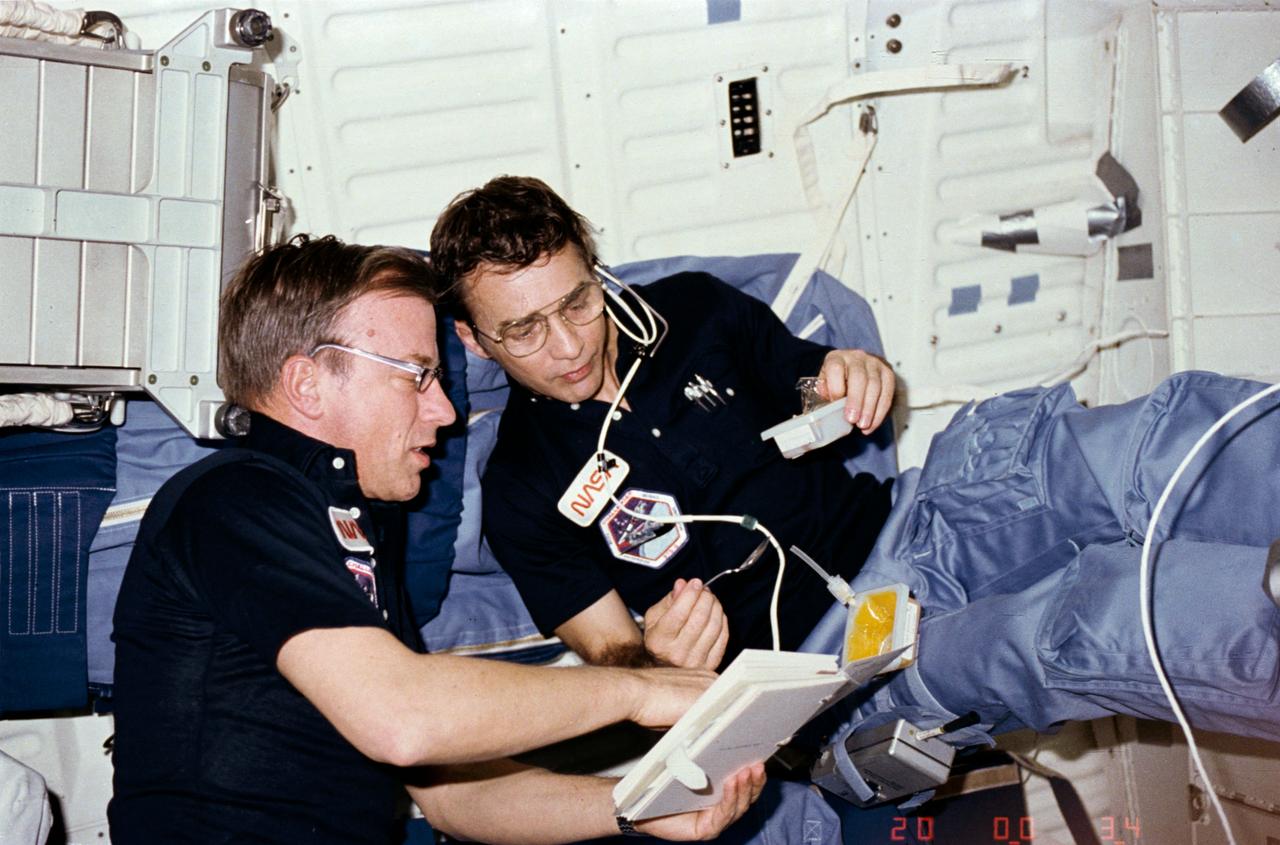
S82-28923 (March 1982) --- Astronaut C. Gordon Fullerton, STS-3 pilot, uses both hands to retrieve part of a meal from an orbital flight test food warmer in the middeck area of the Earth-orbiting space shuttle Columbia. The food warmer is a versatile briefcase-like device developed by life sciences personnel at the Johnson Space Center (JSC). Astronaut Jack R. Lousma, STS-3 commander, took this photograph with a 35mm camera. Photo credit: NASA
Pilot Fullerton prepares meal on middeck
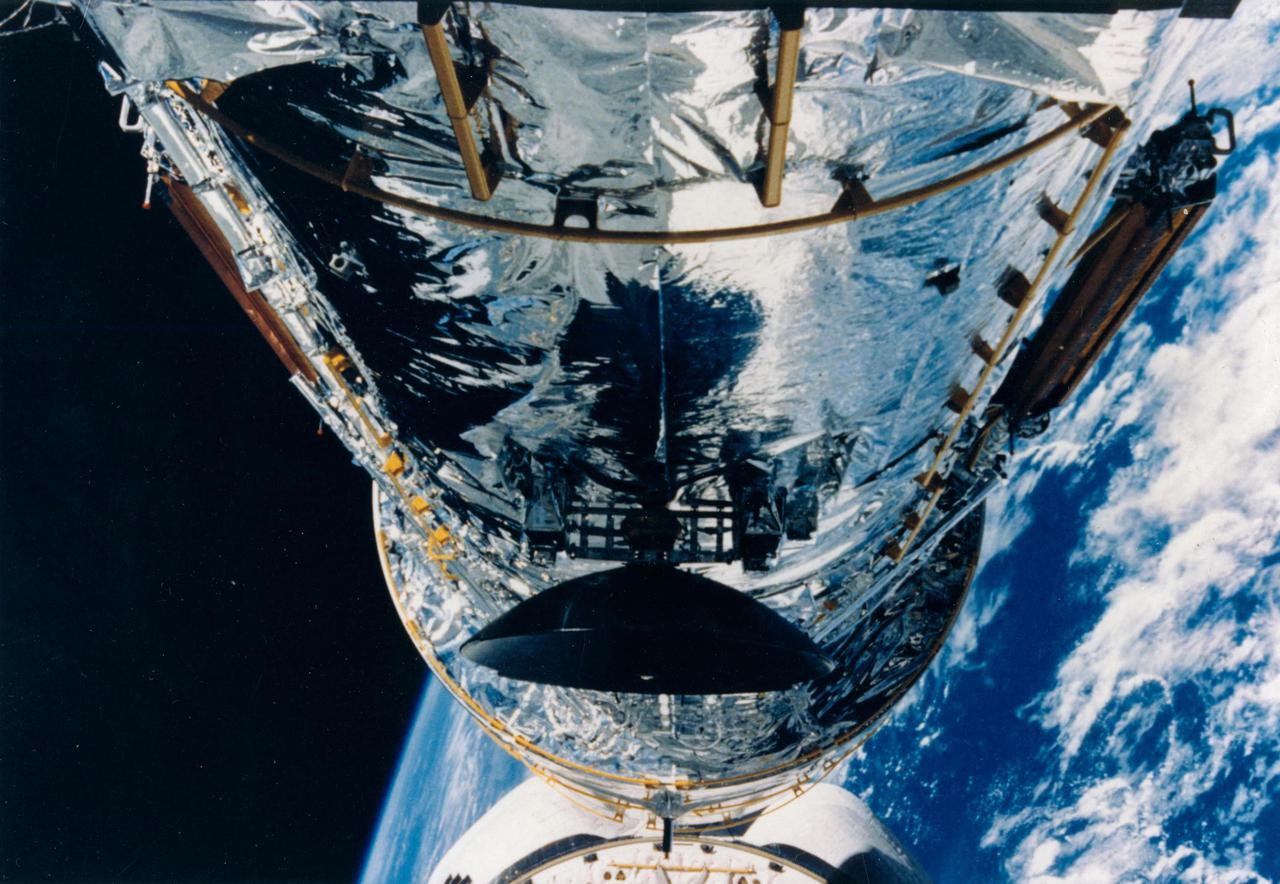
STS031-03-014 (25 April 1990) --- The Hubble Space Telescope (HST), still in the grasp of Discovery's Remote Manipulator System (RMS), is backdropped over Earth some 332 nautical miles below. In this scene, HST has deployed one of its solar array panels but is yet to have extended the second. This scene was captured with a 35mm camera aimed through an overhead window on aft the flight deck.
STS-31 Hubble Space Telescope (HST) appendage deploy aboard OV-103
SL3-107-1215 (27 Aug. 1973) --- Astronaut Alan L. Bean, Skylab 3 commander, flies the M509 Astronaut Maneuvering Equipment in the forward dome area of the Orbital Workshop (OWS) on the space station cluster in Earth orbit. One of his fellow crewmen took this photograph with a 35mm Nikon camera. Bean is strapped into the back mounted, hand-controlled Automatically Stabilized Maneuvering Unit (ASMU). The dome area is about 22 feet in diameter and 19 feet from top to bottom. Photo credit: NASA
Astronaut Alan Bean flies the Astronaut Maneuvering Equipment
STS083-410-008 (4-8 April 1997) --- A 35mm camera was used to record this time-exposed image of Comet Hale-Bopp at sunset.  Note that stars show up in this image because of the more lengthy exposure time, whereas the celestial features do not show in the majority of Space Shuttle pictures focused on Earth and its horizon.  As another spin-off of the more lengthy time exposure, city lights and petroleum fires are seen as distorted streaks.
Hale Bopp comet photographed from the orbiter Columbia
STS030-21-008 (4-8 May 1989) --- A traditional in-space crew portrait for STS-30 aboard the Atlantis.  Astronaut Mary L. Cleave is in front.  Others pictured, left to right, are astronauts Norman E. Thagard, Ronald J. Grabe, David M. Walker and Mark C. Lee.  An automatic, pre-set 35mm camera using color negative film recorded the scene.
STS-30 crewmembers pose for onboard portrait on OV-104's aft flight deck
STS084-389-024 (15-24 May 1997) --- Comet Hale Bopp, seen and photographed a month and a half ago by the STS-83 crew aboard the Space Shuttle Columbia, was also visible on this mission and the crew took advantage of several photo opportunities. A crewmember used an eight-second time exposure on a 35mm camera to expose this frame of the comet over Earth's horizon. Streaking of the stars, usually associated with time exposures, was avoided due to Space Shuttle Atlantis' inertial attitude with the stars.
Comet Hale-Bopp as seen over the Earth limb by STS-84 crew
JSC2003-E-15407 (9 Jan. 1990) --- A 35mm still camera located in the umbilical well of the Space Shuttle Columbia took this photograph of the external fuel tank (ET) after it was dropped from the launch stack as the shuttle headed for Earth-orbit on Jan. 9, 1990 for the STS-32 mission. Several large divots are visible near the forward ET/orbiter bipod and smaller divots are visible on the H2 tank acreage. The vertical streak and the horizontal bands were the results of repairs done prior to launch.
jsc2003e15407
S73-20716 (1 March 1973) --- Astronaut Paul J. Weitz, pilot of the first manned Skylab mission, works with the UV Stellar Astronomy Experiment S019 in the forward compartment of the Skylab Orbital Workshop (OWS) trainer during Skylab training at Johnson Space Center. The equipment consists of a reflecting telescope, a 35mm camera and an additional mirror. It is mounted in an anti-solar scientific airlock in the side of the OWS. Photo credit: NASA
Astronaut Paul Weitz works with UV Stellar Astronomy Experiment
STS031-03-009 (25 April 1990) --- The Hubble Space Telescope (HST), still in the grasp of Discovery's remote manipulator system (RMS), is backdropped over Earth some 332 nautical miles below.  In this scene, HST has deployed one of its solar array panels but is yet to have extended the second.  This scene was captured with a 35mm camera aimed through an overhead window on the aft flight deck.
STS-31 Hubble Space Telescope (HST) (SAs & HGAs deployed) is grappled by RMS
STS096-345-033 (3 June 1999) --- A STS-96 crew member aboard Discovery handling a 35mm camera recorded this image of the International Space Station (ISS) during a fly-around following separation of the two spacecraft.  A portion of the work performed on the May 30 space walk by astronauts Tamara E. Jernigan and Daniel T. Barry is evident in the photo, including the installation of the Russian-built  crane (called Strela).
View of the ISS taken during fly-around
STS083-410-011 (4-8 April 1997) --- A 35mm camera was used to record this time-exposed image of Comet Hale-Bopp at sunset. Note that stars show up in this image because of the more lengthy exposure time, whereas the celestial features do not show in the majority of space shuttle pictures focused on Earth and its horizon. As another spin-off of the more lengthy time exposure, city lights and petroleum fires are seen as distorted streaks. Photo credit: NASA
Hale Bopp comet photographed from the orbiter Columbia
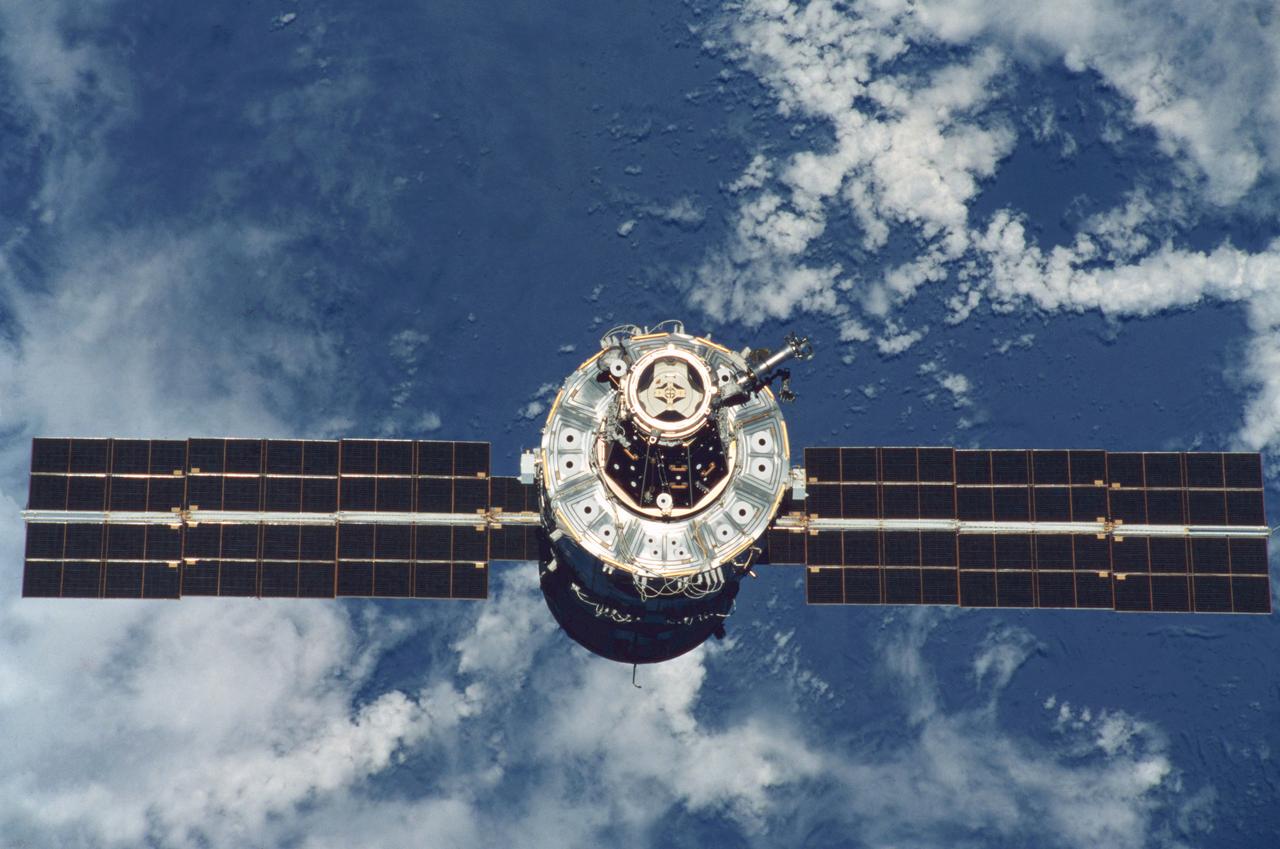
ISS003-E-5620 (16 September 2001) ---  The Russian Docking Compartment, named Pirs (the Russian word for pier), is only seconds away from docking with the International Space Station (ISS).  One of the Expedition Three crew members, using a digital still camera with a 35mm lens, recorded the image from onboard the orbital outpost. The vehicle was launched on September 14, 2001 and docking occurred on September 16.
View of the Pirs Docking Compartment approaching the ISS during Expedition Three
STS087-375-009 (19 November – 5 December 1997) --- Astronaut Takao Doi, mission specialist, during one of two extravehicular activities (EVA) in the cargo bay of the Earth-orbiting Space Shuttle Columbia, waves at fellow crewmembers in Columbia’s cabin.  Takao Doi, an international astronaut stationed at Johnson Space Center (JSC), represents Japan's National Space Development Agency (NASDA).  This view was taken with a 35mm camera.
Scott and Doi conduct second EVA activities.