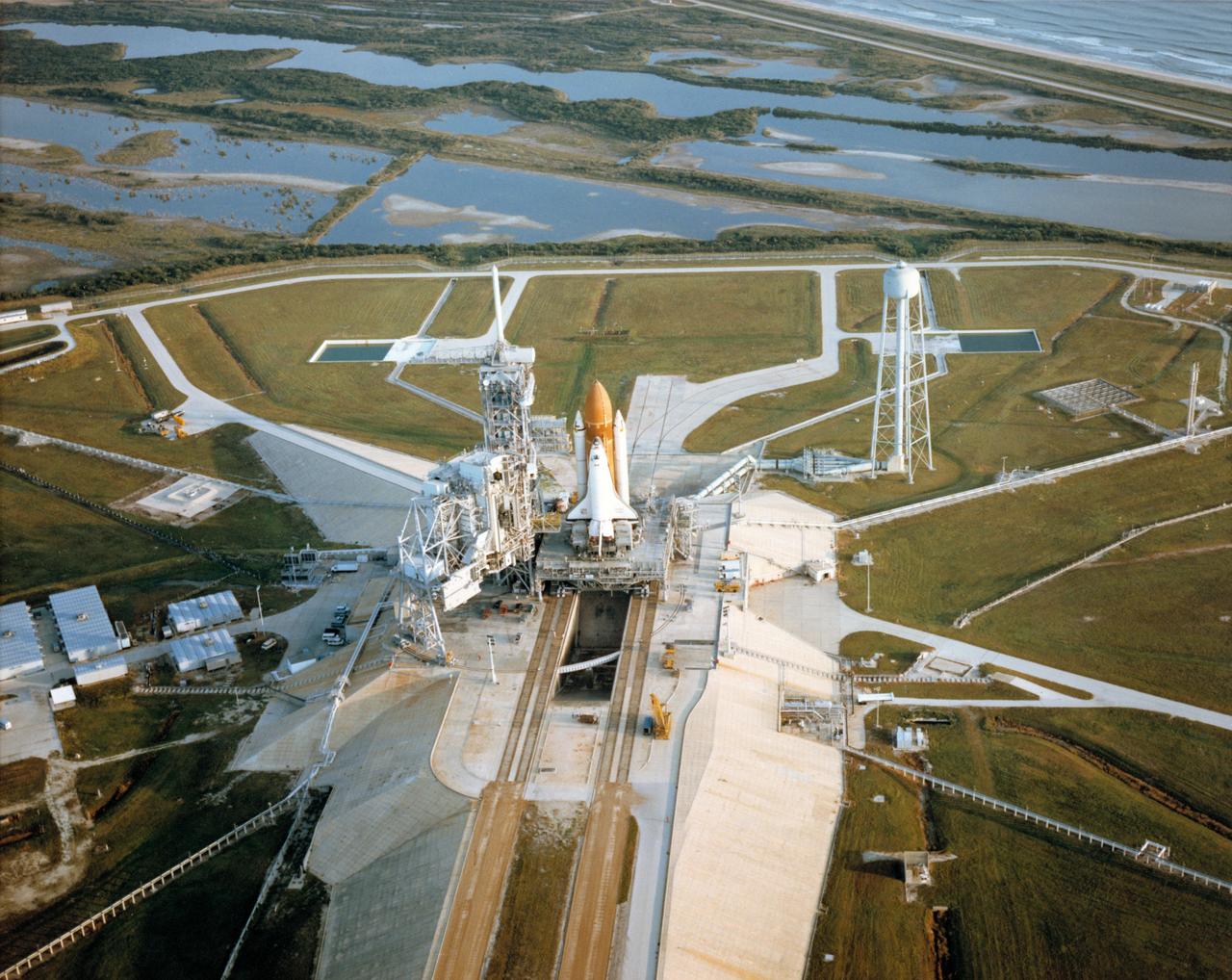
S86-38627 (9 Oct. 1986) --- The space shuttle Atlantis is rolled out to Launch Pad 39-B in the early morning of Oct. 9, 1986. Atlantis is scheduled to remain at Pad B for seven weeks where it will support checkout of new weather protection structures, a variety of special measurements, launch team proficiency exercises and emergency egress simulations. The 4.2 mile journey from the Vehicle Assembly Building to the launch pad is the first for the shuttle fleet since the space shuttle Challenger accident in January of this year. Photo credit: NASA

S73-34367 (16 Nov. 1973) --- A view at the Kennedy Space Center showing in the near distance the Skylab 4/Saturn 1B space vehicle on Pad B, Launch Complex 39, on the morning of the launch. Photo credit: NASA
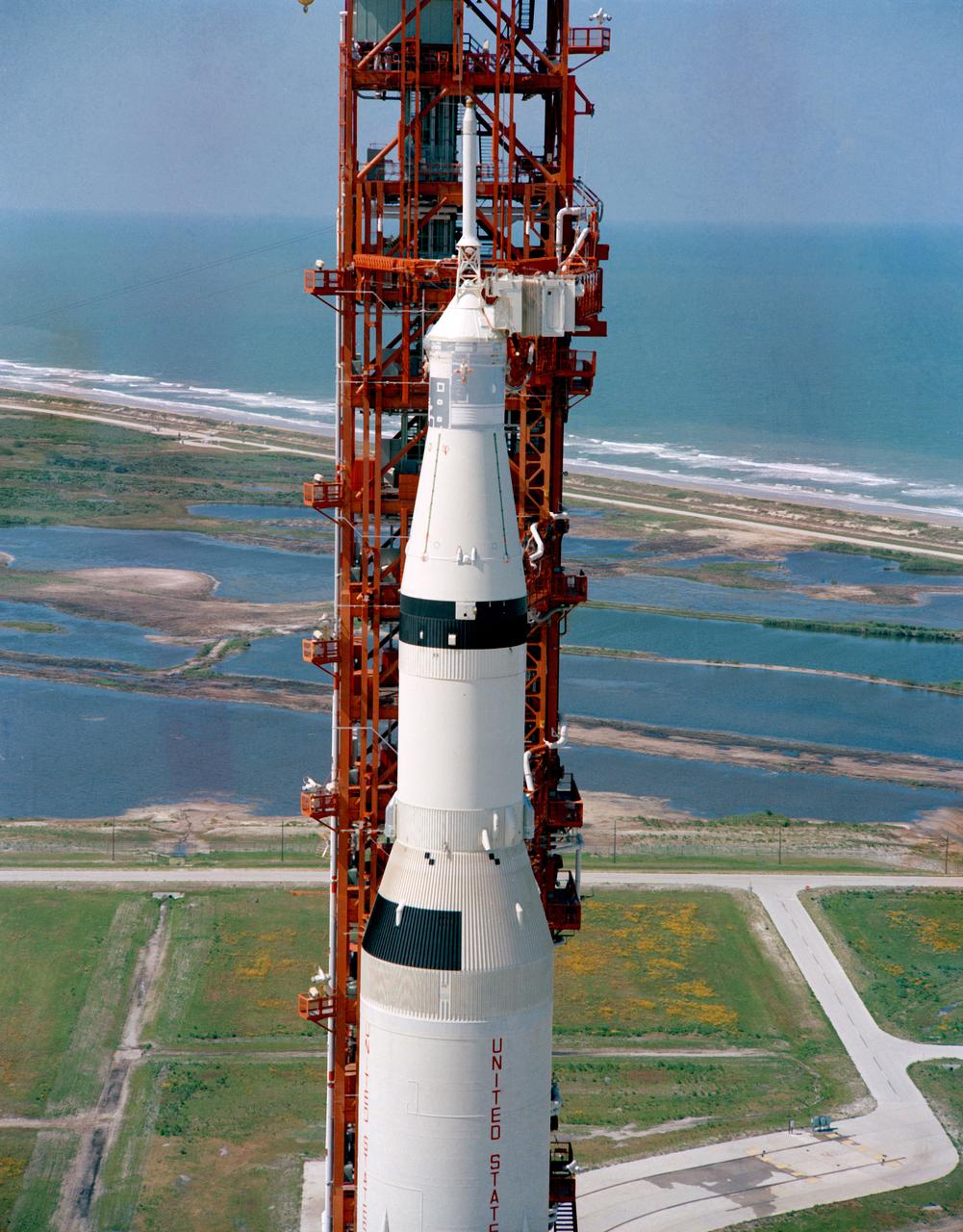
S69-33854 (4 May 1969) --- Aerial (high-angle, clasp) view of the Apollo 10 (Spacecraft 106/Lunar Module 4/Saturn 505) space vehicle on Pad B, Launch Complex 39, Kennedy Space Center. This photograph of the 363-feet tall Apollo/Saturn V stack was taken during pull back of the mobile service structure. The Apollo 10 crew will be astronauts Thomas P. Stafford, John W. Young, and Eugene A. Cernan.
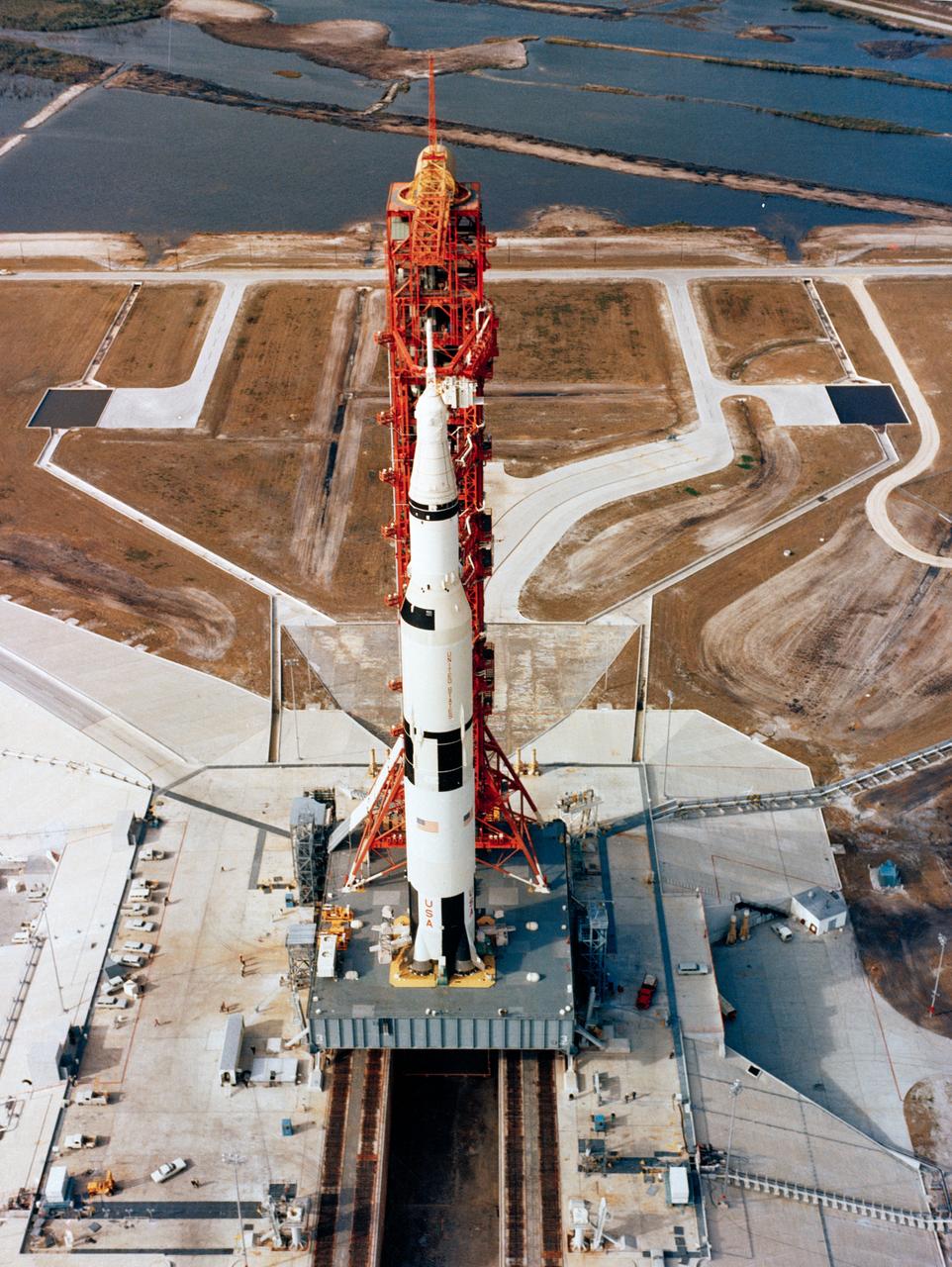
S69-34327 (13 May 1969) --- Aerial, high-angle, view of the Apollo 10 (Spacecraft 106/Lunar Module 4/Saturn 505) space vehicle at Pad B, Launch Complex 39, Kennedy Space Center, Florida. The crew of the Apollo 10 lunar orbit mission will be astronauts Thomas P. Stafford, commander; John W. Young, command module pilot; and Eugene A. Cernan, lunar module pilot.
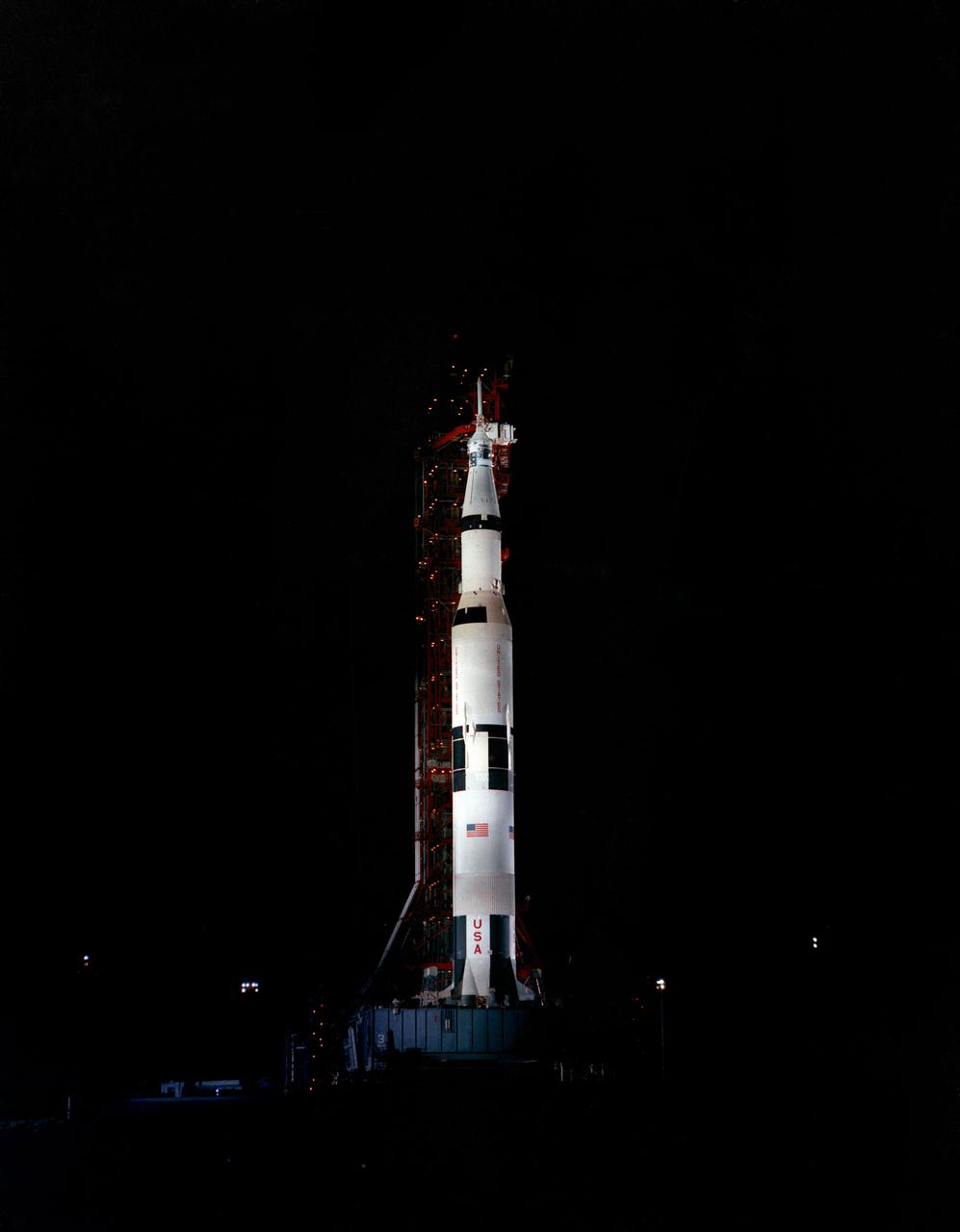
S69-33855 (4 May 1969) --- Nighttime, ground-level view of the Apollo 10 (Spacecraft 106/Lunar Module 4/Saturn 505) space vehicle on Pad B, Launch Complex 39, Kennedy Space Center. This photograph of the 363-feet tall Apollo/Saturn V stack was taken during pull back of the mobile service structure. The Apollo 10 crew will be astronauts Thomas P. Stafford, John W. Young, and Eugene A. Cernan.

S69-34328 (17 May 1969) --- Ground level view of the 363-feet tall Apollo 10 (Spacecraft 106/Lunar Module 4/Saturn 505) space vehicle on Pad B, Launch Complex 39, Kennedy Space Center. The Apollo 10 crew will be astronauts Thomas P. Stafford, commander; John W. Young, command module pilot; and Eugene A. Cernan, lunar module pilot.
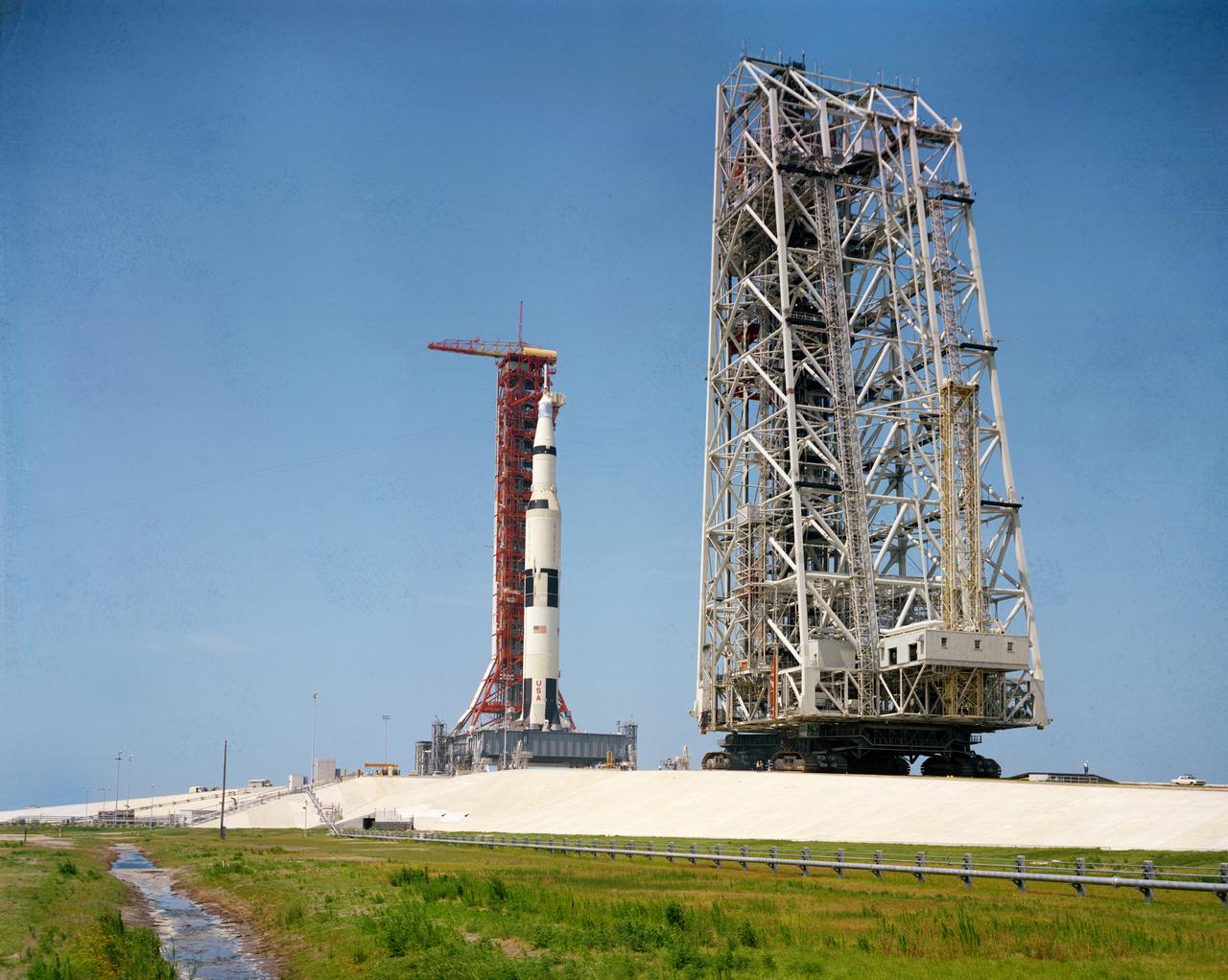
S69-34320 (17 May 1969) --- Ground level view of the 363-feet tall Apollo 10 (Spacecraft 106/Lunar Module 4/Saturn 505) space vehicle on Pad B, Launch Complex 39, Kennedy Space Center. The service structure is in the right foreground. The crew of the Apollo 10 lunar orbit mission will be astronauts Thomas P. Stafford, commander; John W. Young, command module pilot; and Eugene A. Cernan, lunar module pilot.

S69-27916 (11 March 1969) --- Aerial view at Launch Complex 39, Kennedy Space Center, showing the Apollo 10 (Spacecraft 106/Lunar Module-4/Saturn 505) space vehicle on its way to Pad B. The Saturn V stack and its mobile launch tower are atop a huge crawler-transporter. The Apollo 10 flight is scheduled as a lunar orbit mission. The Apollo 10 crew will be astronauts Thomas P. Stafford, commander; John W. Young, command module pilot; and Eugene A. Cernan, lunar module pilot.
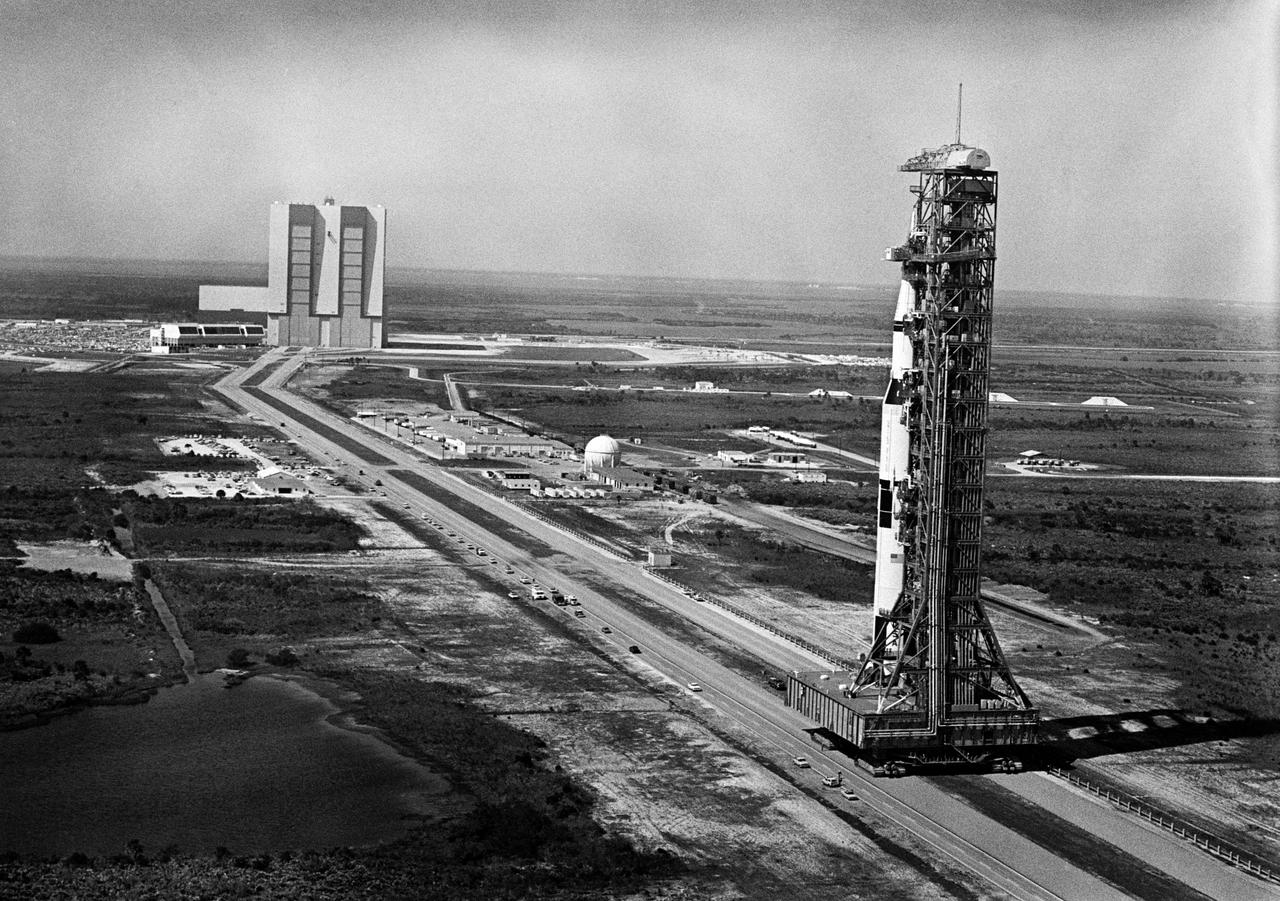
S69-27741 (11 March 1969) --- Aerial view at Launch Complex 39, Kennedy Space Center, showing the 363-feet tall Apollo 10 (Spacecraft 106/Lunar Module-4/Saturn 505) space vehicle on its way to Pad B. The Vehicle Assembly Building is in the background. The Saturn V stack and its mobile launch tower are atop a huge crawler-transporter. The Apollo 10 flight is schedule as a lunar orbit mission. The Apollo 10 crew will be astronauts Thomas P. Stafford, commander; John W. Young, command module pilot; and Eugene A. Cernan, lunar module pilot.

S73-32568 (20 July 1973) --- Floodlights illuminate this nighttime view of the Skylab 3/Saturn 1B space vehicle at Pad B, Launch Complex 39, Kennedy Space Center, Florida, during prelaunch preparations. The reflection is the water adds to the scene. In addition to the Command/Service Module and its launch escapte system, the Skylab 3 space vehicle consists of the Saturn 1B first (S-1B) stage and the Saturn 1B second (S-IVB) stage. The crew for the scheduled 59-day Skylab 3 mission in Earth orbit will be astronauts Alan L. Bean, Owen K. Garriott and Jack R. Lousma. Skylab 3 was launched on July 28, 1973. Photo credit: NASA
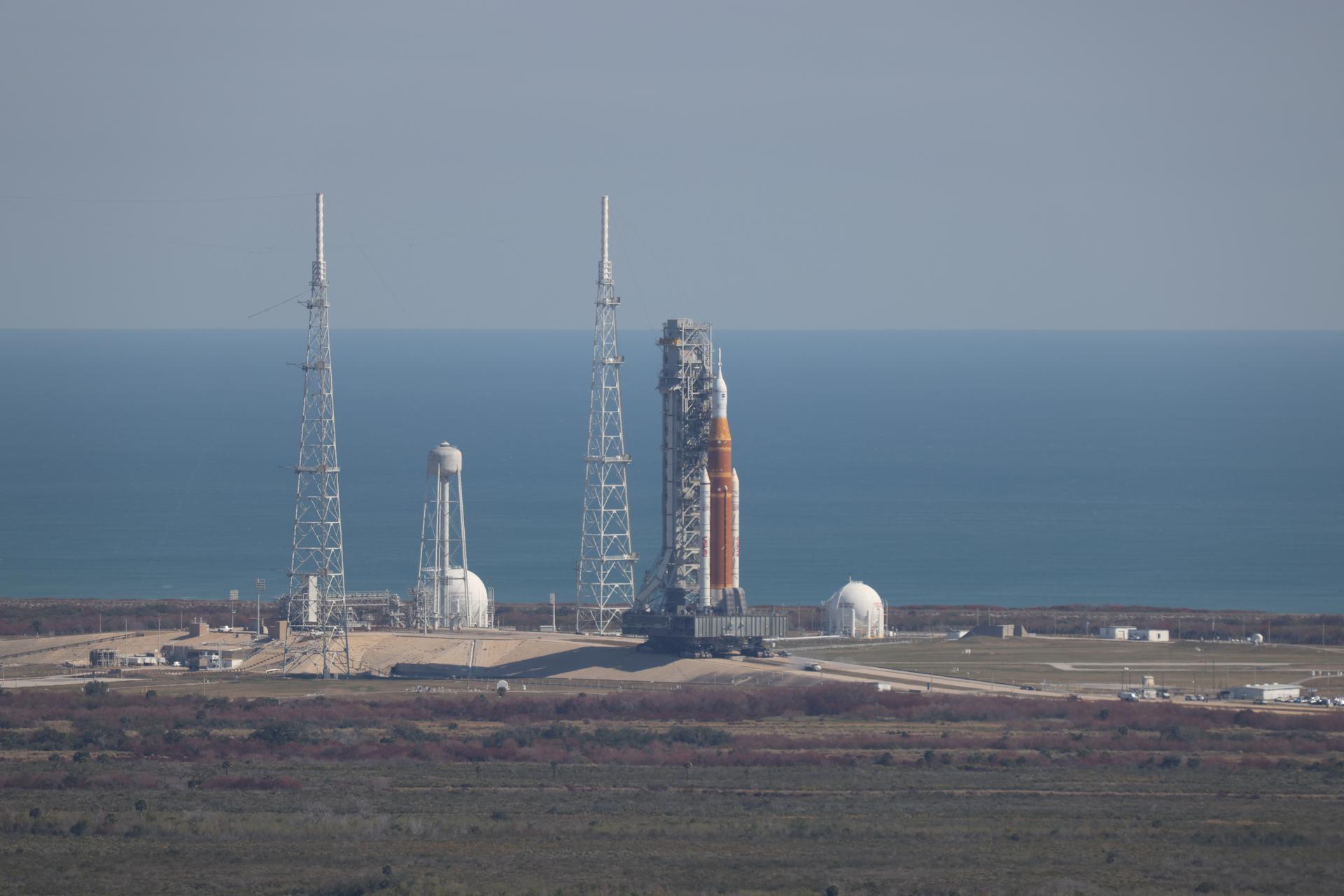
NASA’s crawler-transporter 2, carrying NASA’s Artemis II SLS (Space Launch System) rocket with the Orion spacecraft secured to mobile launcher 1, leaves Launch Complex 39B to roll back to the Vehicle Assembly Building at NASA’s Kennedy Space Center in Florida on Wednesday, Feb. 25, 2026, to troubleshoot the flow of helium to the rocket’s upper stage, the interim cryogenic propulsion stage. Once complete, the SLS rocket will roll back to Launch Complex 39B to prepare to launch four astronauts around the Moon and back for the Artemis II test flight.
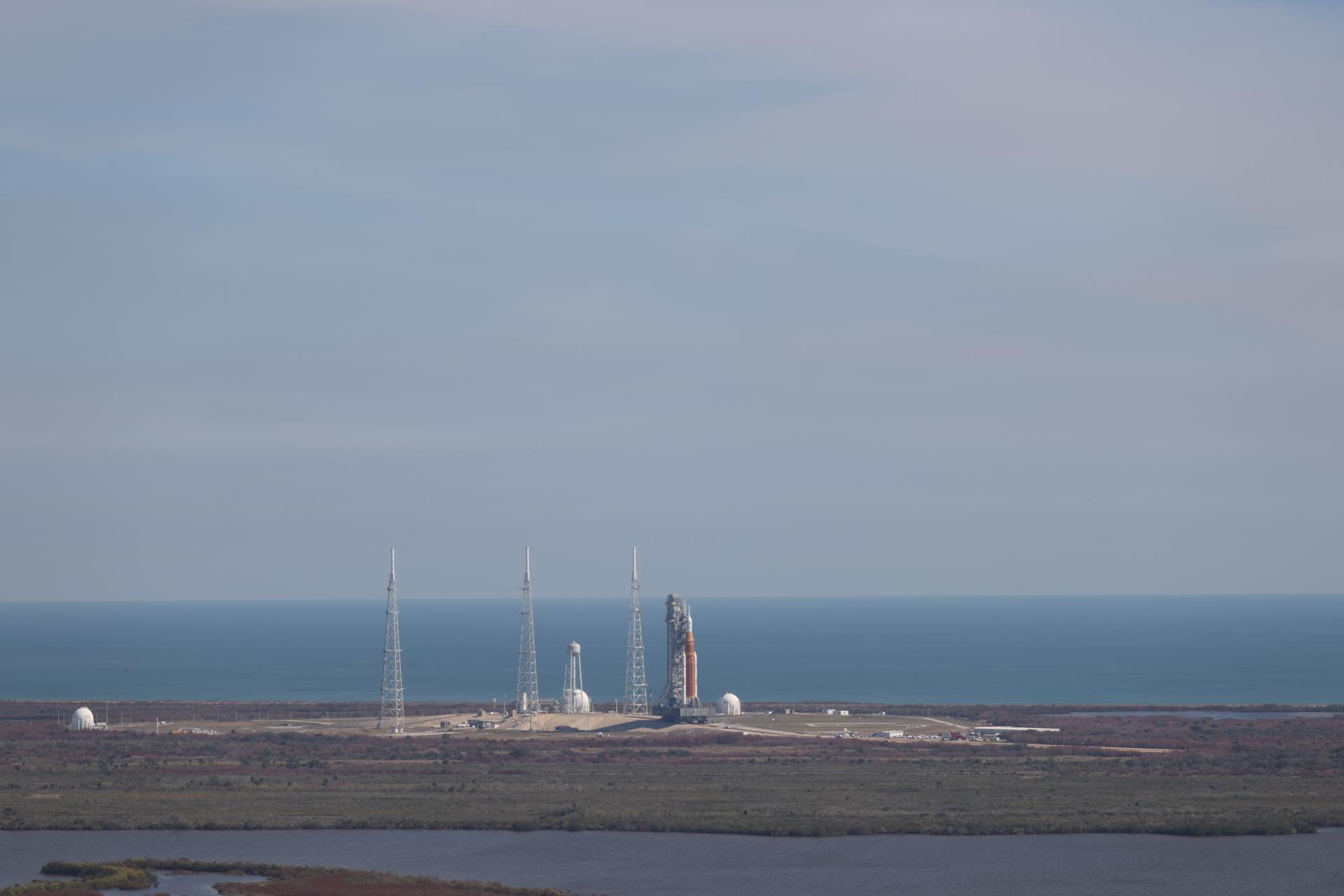
NASA’s crawler-transporter 2, carrying NASA’s Artemis II SLS (Space Launch System) rocket with the Orion spacecraft secured to mobile launcher 1, leaves Launch Complex 39B to roll back to the Vehicle Assembly Building at NASA’s Kennedy Space Center in Florida on Wednesday, Feb. 25, 2026, to troubleshoot the flow of helium to the rocket’s upper stage, the interim cryogenic propulsion stage. Once complete, the SLS rocket will roll back to Launch Complex 39B to prepare to launch four astronauts around the Moon and back for the Artemis II test flight.
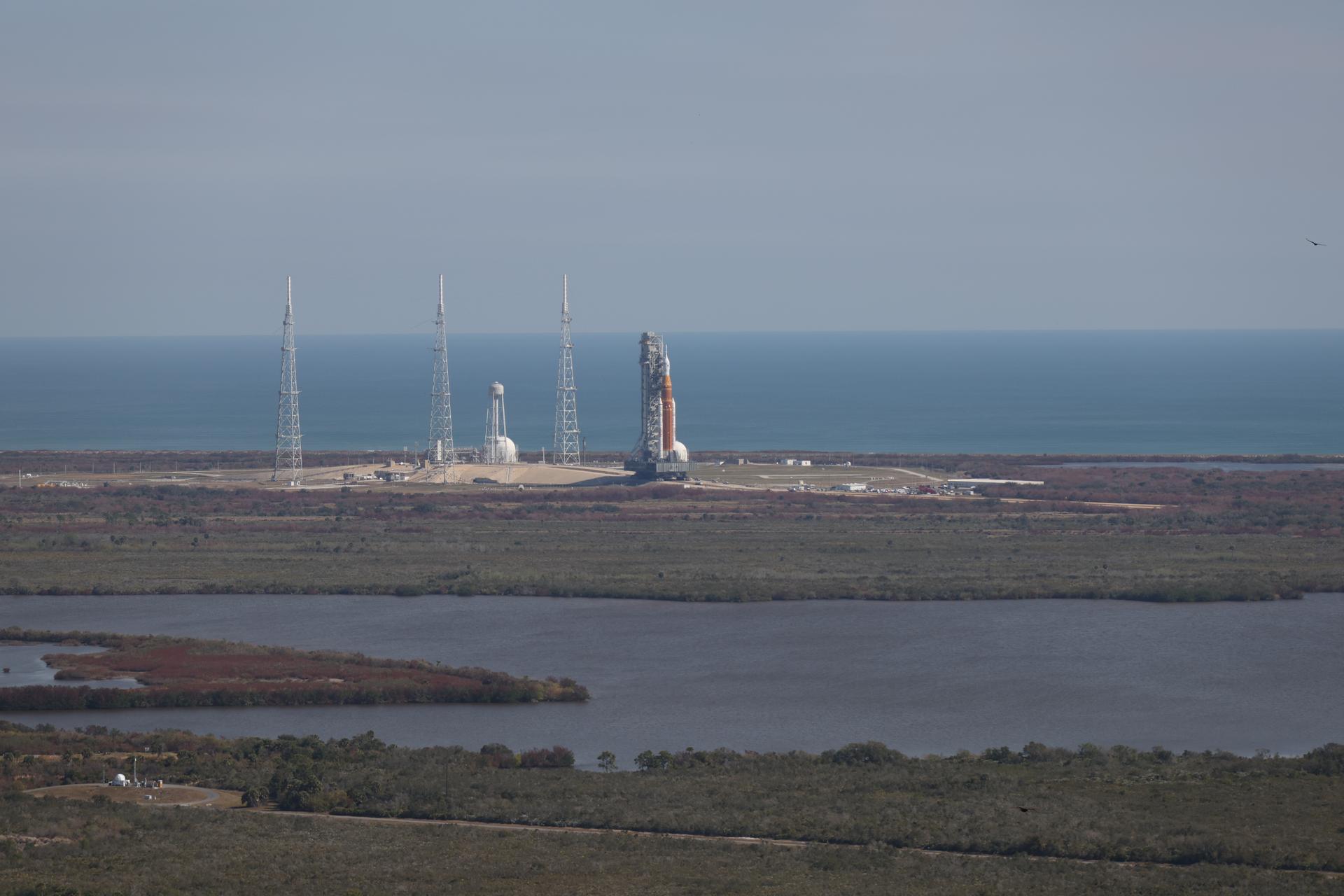
NASA’s crawler-transporter 2, carrying NASA’s Artemis II SLS (Space Launch System) rocket with the Orion spacecraft secured to mobile launcher 1, leaves Launch Complex 39B to roll back to the Vehicle Assembly Building at NASA’s Kennedy Space Center in Florida on Wednesday, Feb. 25, 2026, to troubleshoot the flow of helium to the rocket’s upper stage, the interim cryogenic propulsion stage. Once complete, the SLS rocket will roll back to Launch Complex 39B to prepare to launch four astronauts around the Moon and back for the Artemis II test flight.
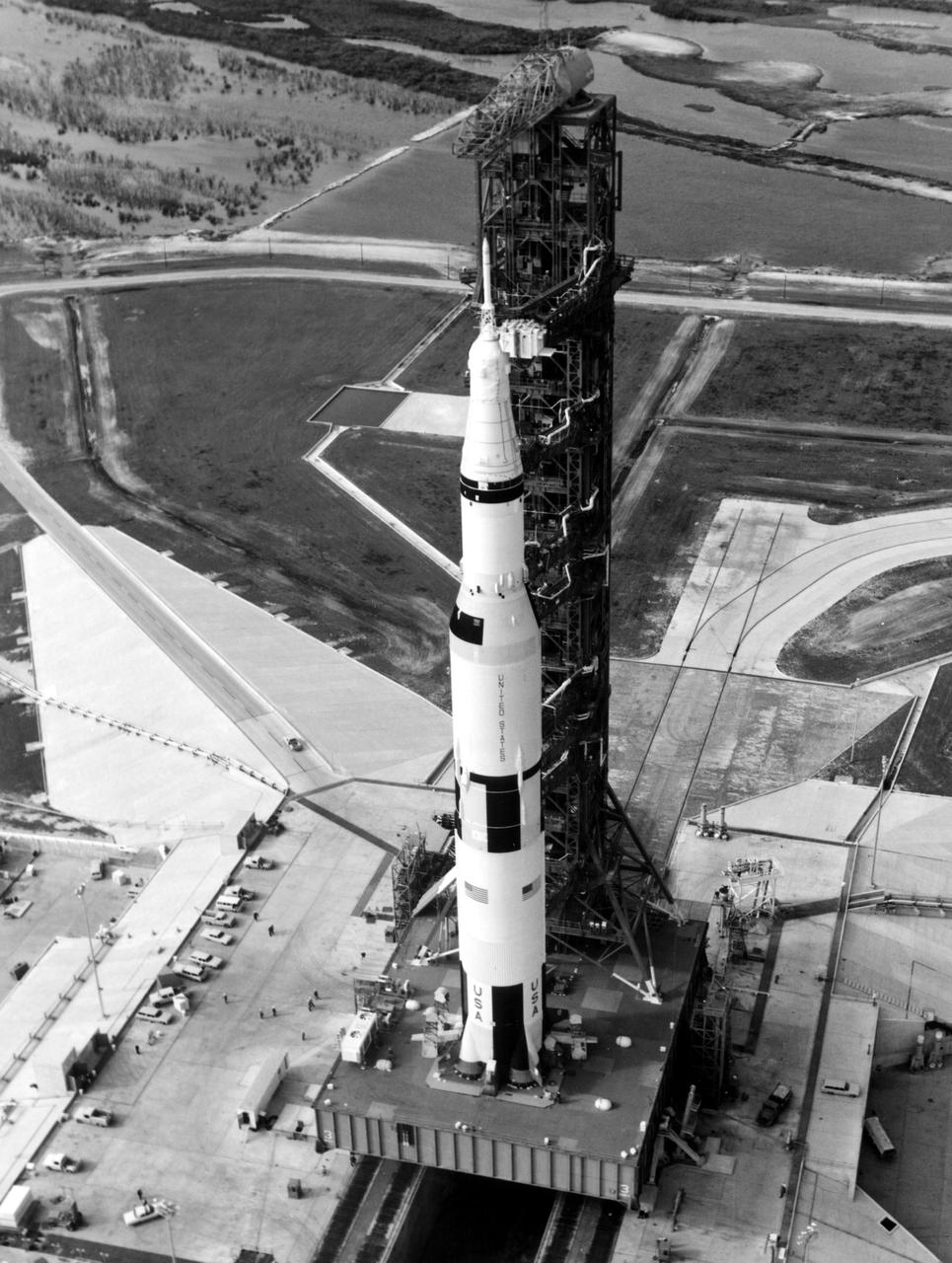
KENNEDY SPACE CENTER, FLA. -- Apollo 10 rollout to Complex 39-B.
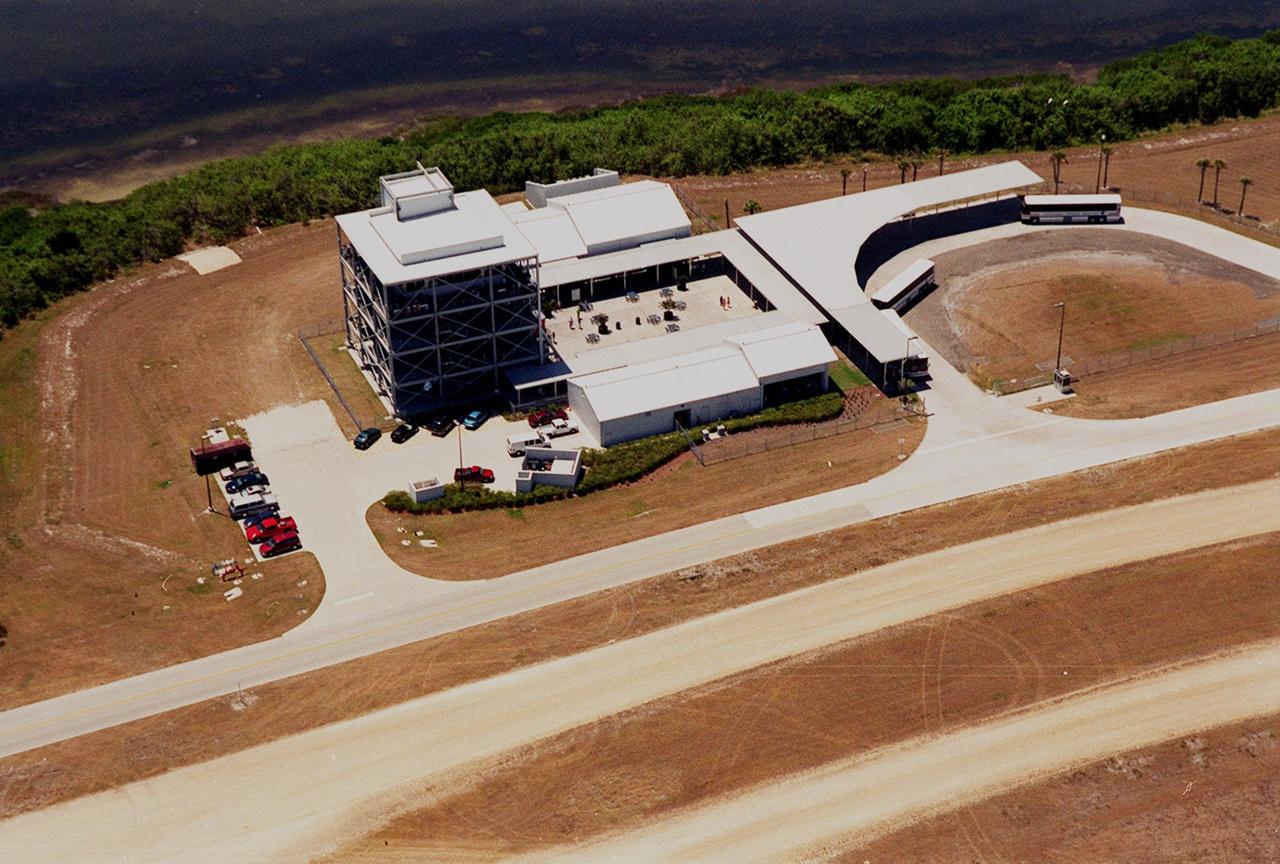
This aerial view is of a tour stop on the KSC bus tour, the Launch Complex 39 Observation Gantry. This stop allows visitors to view and photograph Pads A and B in Launch Complex 39 from an elevated vantage point. The roadway leading to the tour stop runs next to the crawlerway (foreground) which is used to transport Space Shuttles to the pads
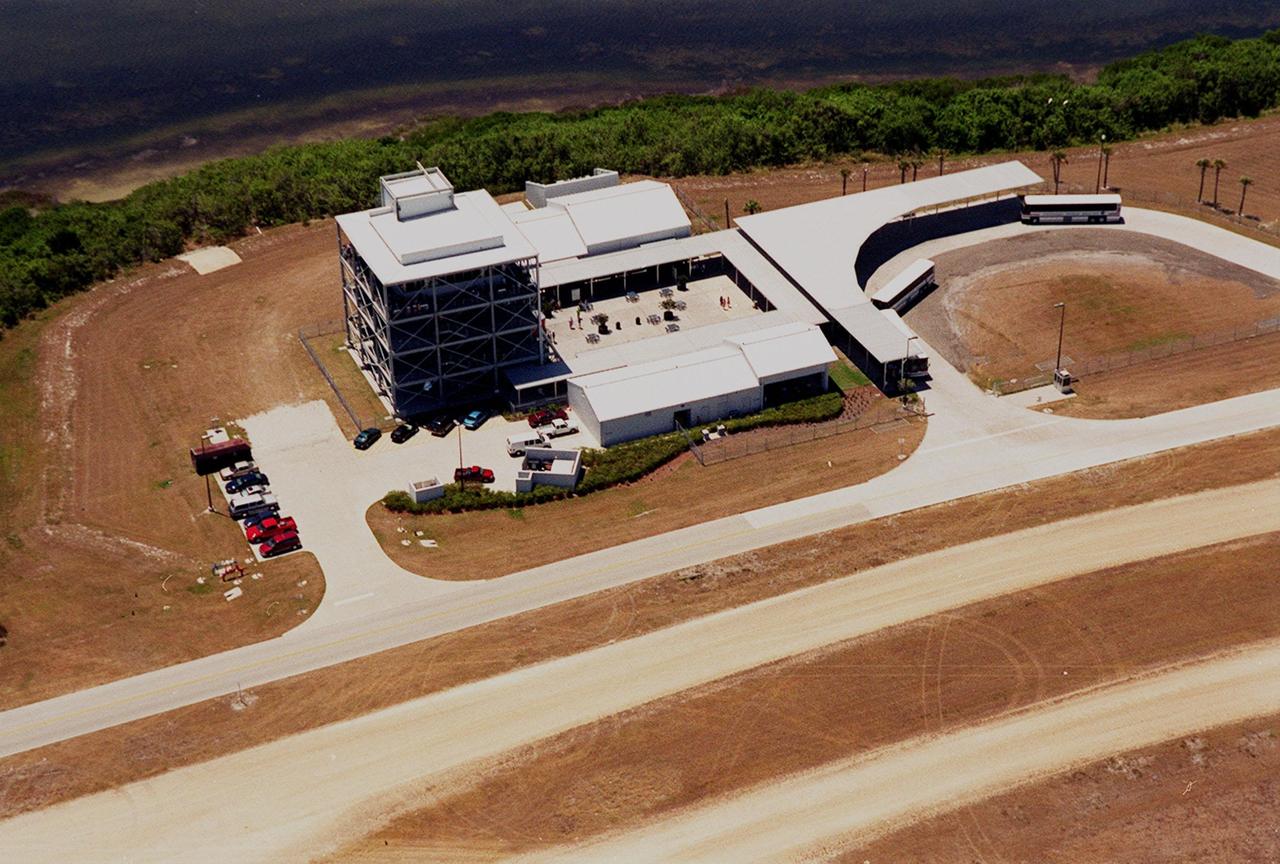
This aerial view is of a tour stop on the KSC bus tour, the Launch Complex 39 Observation Gantry. This stop allows visitors to view and photograph Pads A and B in Launch Complex 39 from an elevated vantage point. The roadway leading to the tour stop runs next to the crawlerway (foreground) which is used to transport Space Shuttles to the pads
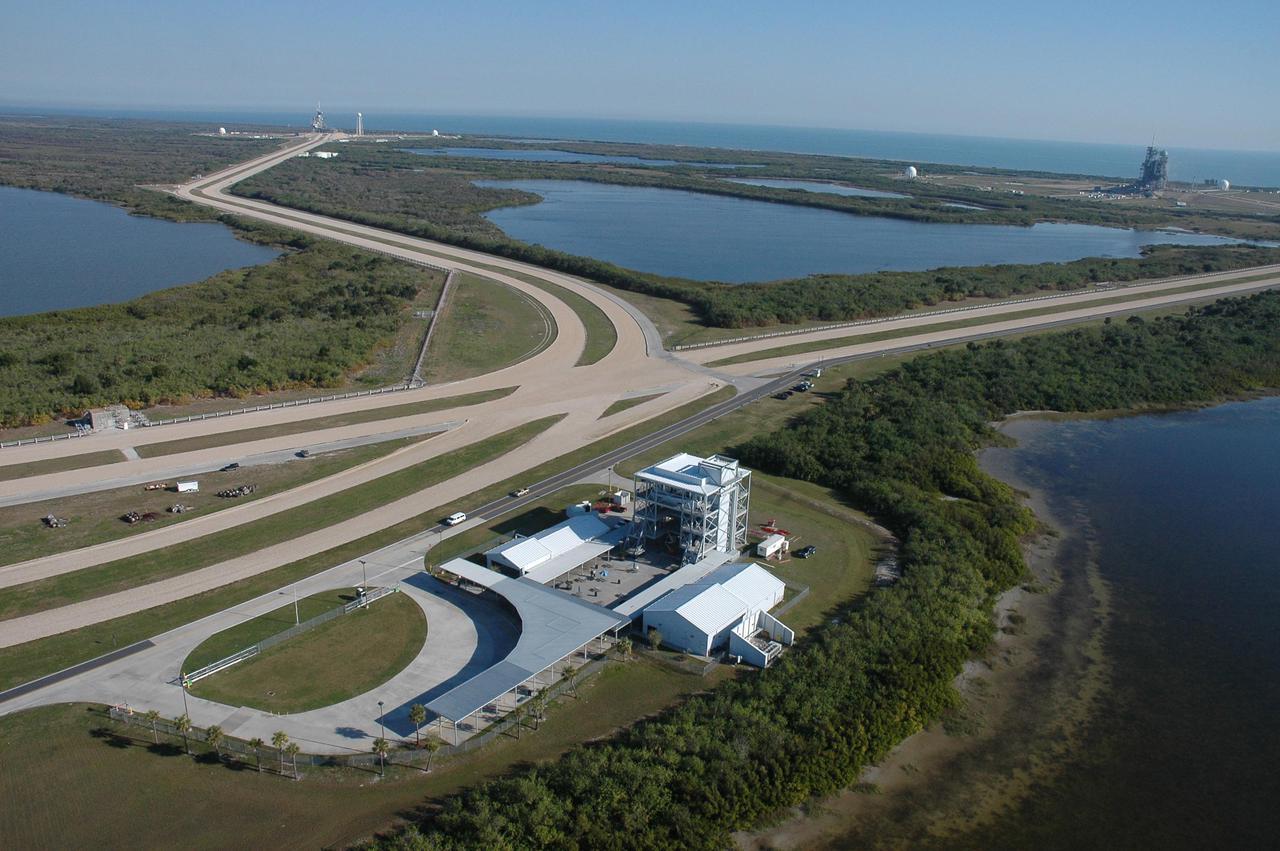
KENNEDY SPACE CENTER, FLA. - This aerial view on NASA's Kennedy Space Center shows the Launch Complex 39 Observation Gantry in the foreground, the crawlerways leading to the launch pads, and space shuttle Launch Complex 39 Pad A (left) and Pad B in the background, silhouetted by the Atlantic Ocean. Photo credit: Cory Huston
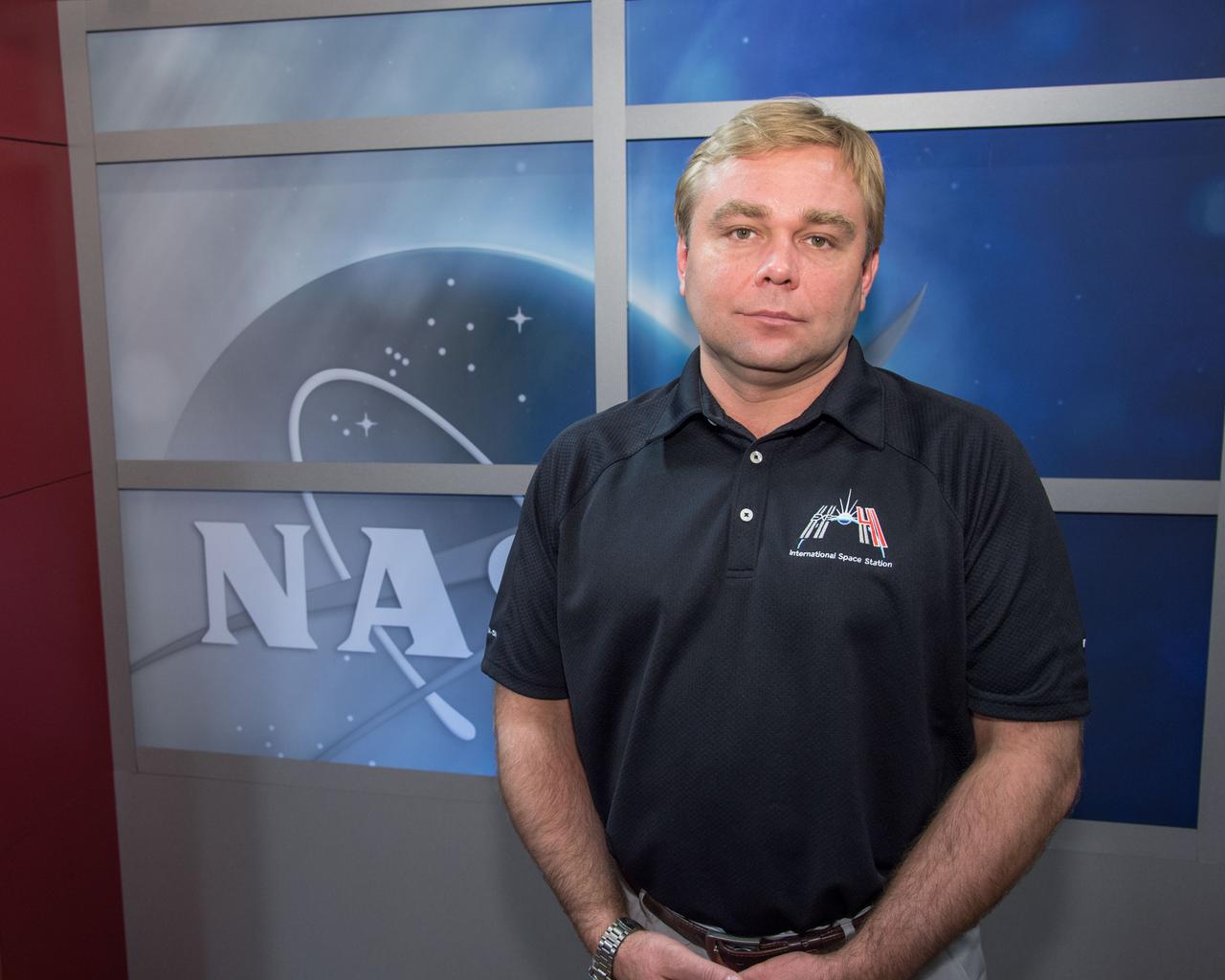
PHOTO DATE: 03-18-14 LOCATION: Bldg. 2s - PAO Studio B SUBJECT: Expedition 41 (Soyuz 39) press conference with Maxim Suraev, Alexander Gerst and Reid Wiseman. PHOTOGRAPHER: BILL STAFFORD
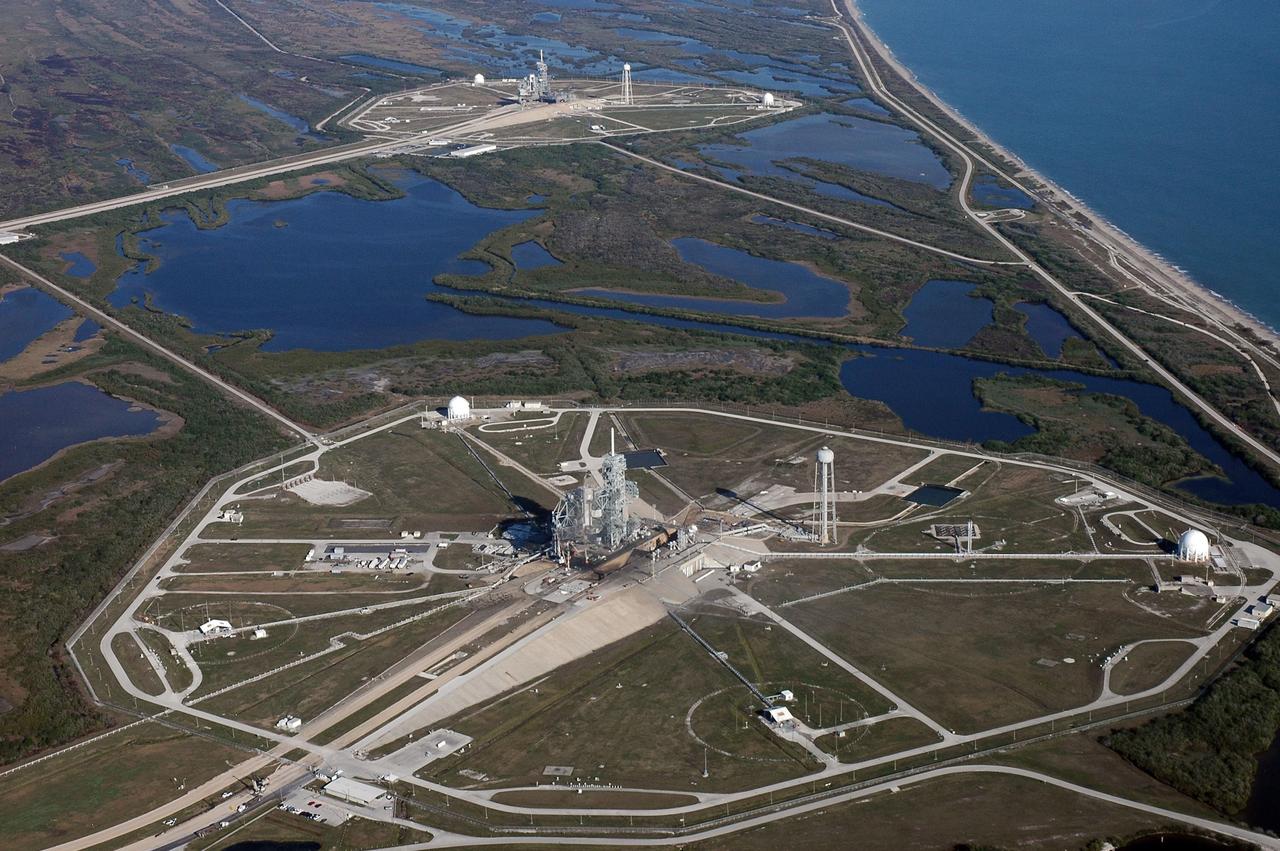
KENNEDY SPACE CENTER, FLA. - This aerial view looking north shows space shuttle Complex 39 Launch Pads A (foreground) and B at NASA's Kennedy Space Center. To the right is the Atlantic Ocean. Photo credit: Cory Huston
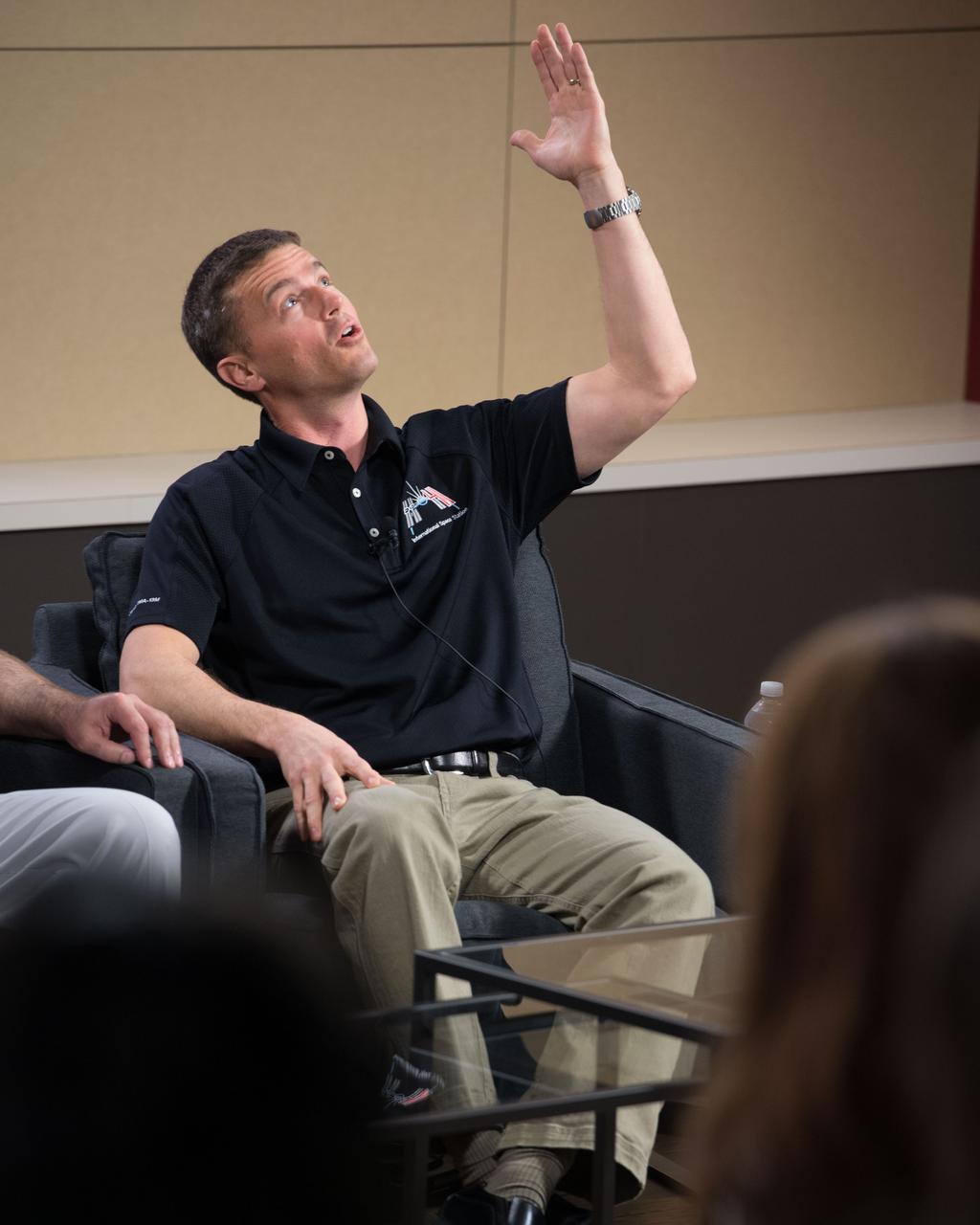
PHOTO DATE: 03-18-14 LOCATION: Bldg. 2s - PAO Studio B SUBJECT: Expedition 41 (Soyuz 39) press conference with Maxim Suraev, Alexander Gerst and Reid Wiseman. PHOTOGRAPHER: BILL STAFFORD
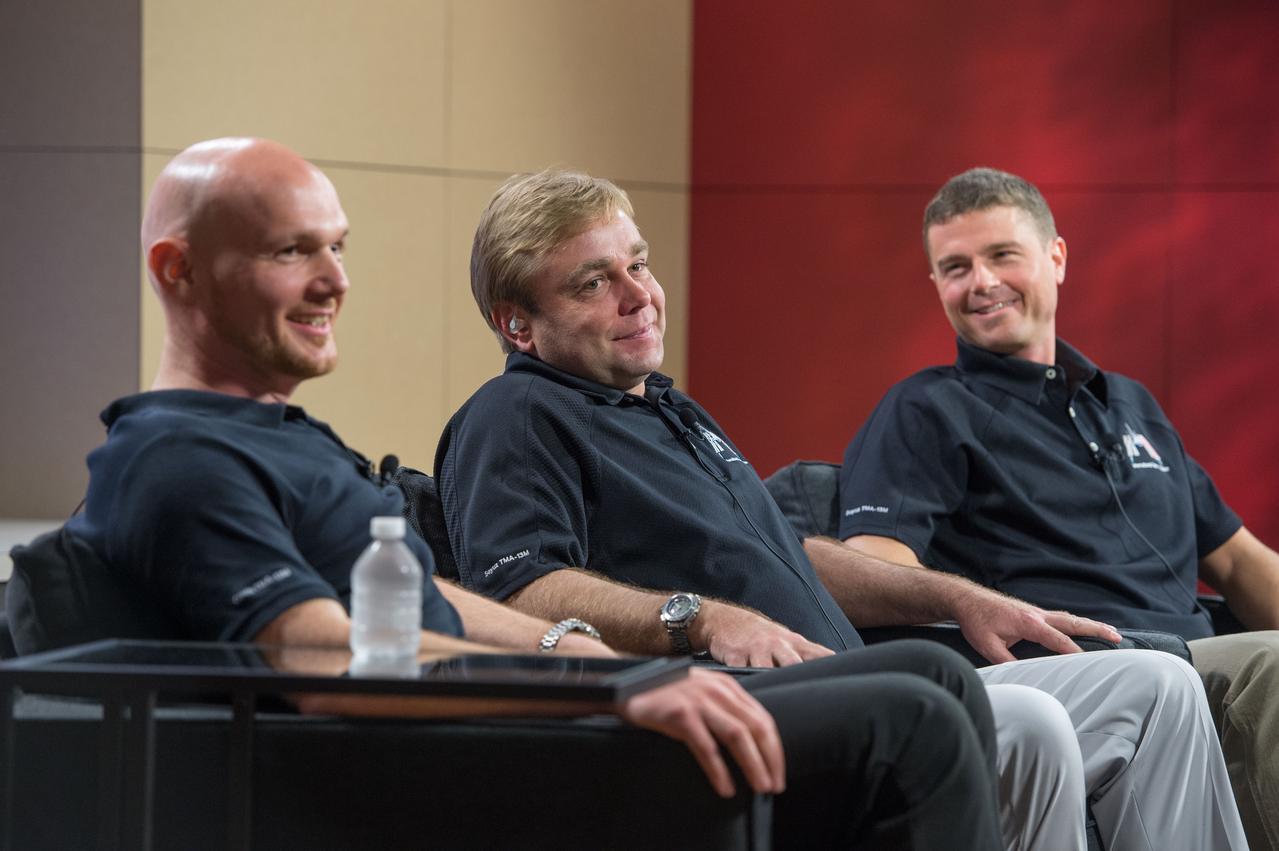
PHOTO DATE: 03-18-14 LOCATION: Bldg. 2s - PAO Studio B SUBJECT: Expedition 41 (Soyuz 39) press conference with Maxim Suraev, Alexander Gerst and Reid Wiseman. PHOTOGRAPHER: BILL STAFFORD
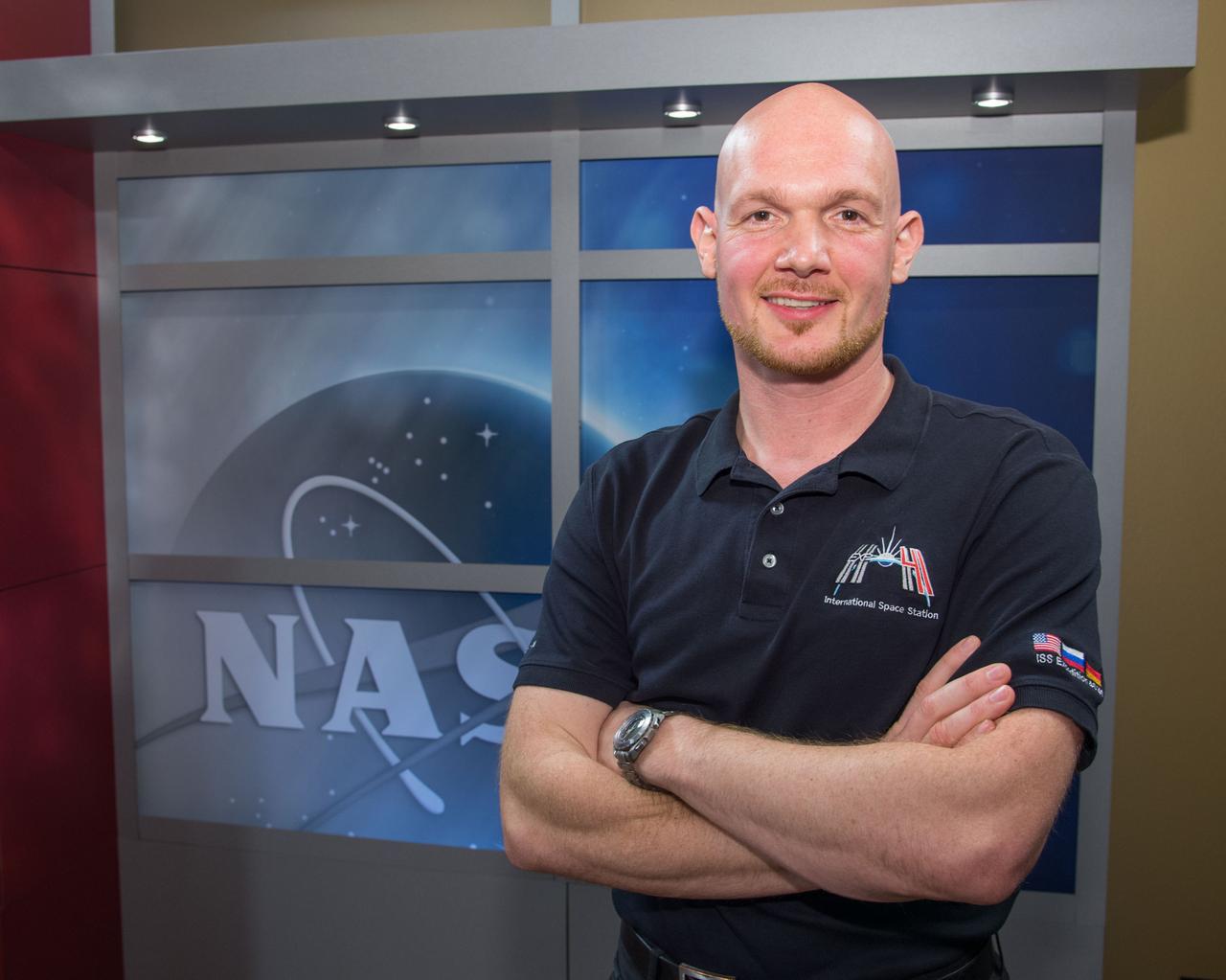
PHOTO DATE: 03-18-14 LOCATION: Bldg. 2s - PAO Studio B SUBJECT: Expedition 41 (Soyuz 39) press conference with Maxim Suraev, Alexander Gerst and Reid Wiseman. PHOTOGRAPHER: BILL STAFFORD
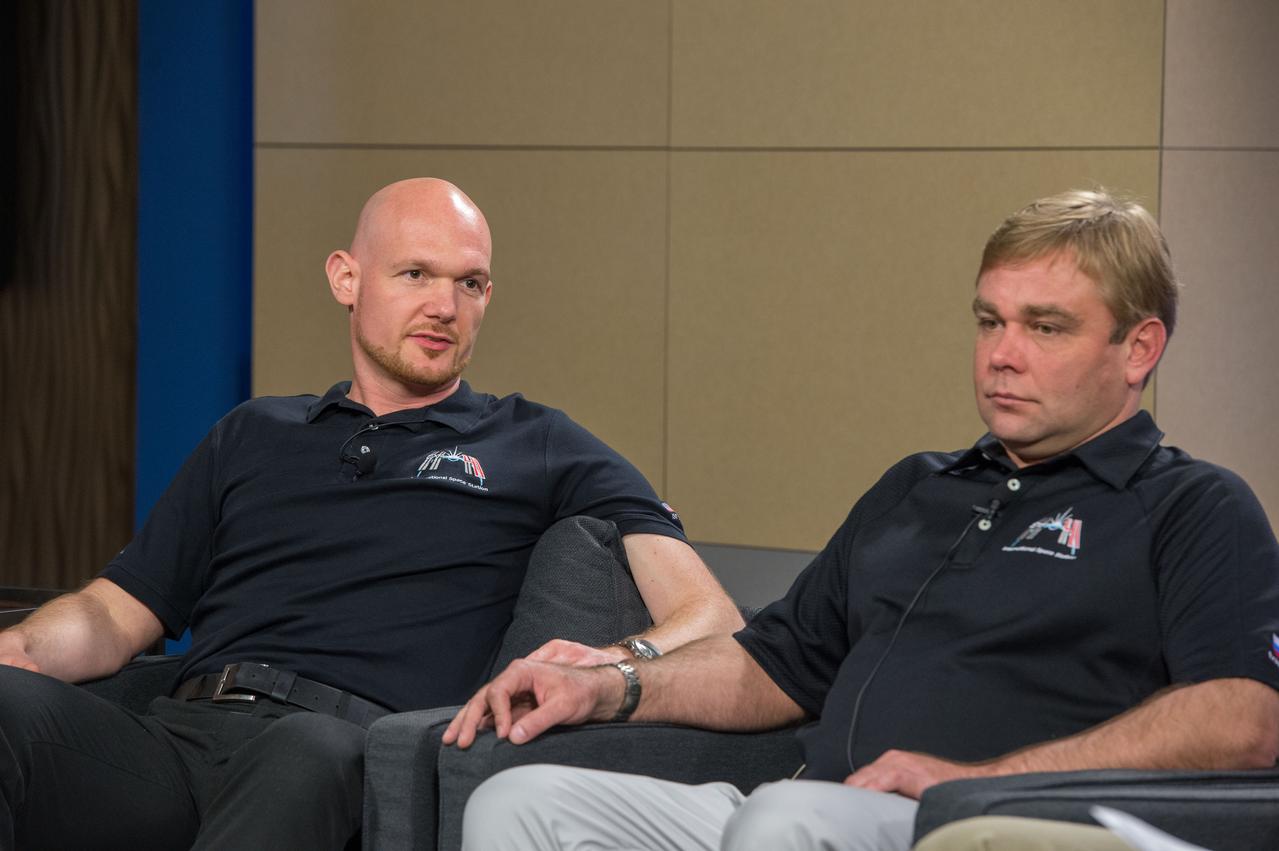
PHOTO DATE: 03-18-14 LOCATION: Bldg. 2s - PAO Studio B SUBJECT: Expedition 41 (Soyuz 39) press conference with Maxim Suraev, Alexander Gerst and Reid Wiseman. PHOTOGRAPHER: BILL STAFFORD
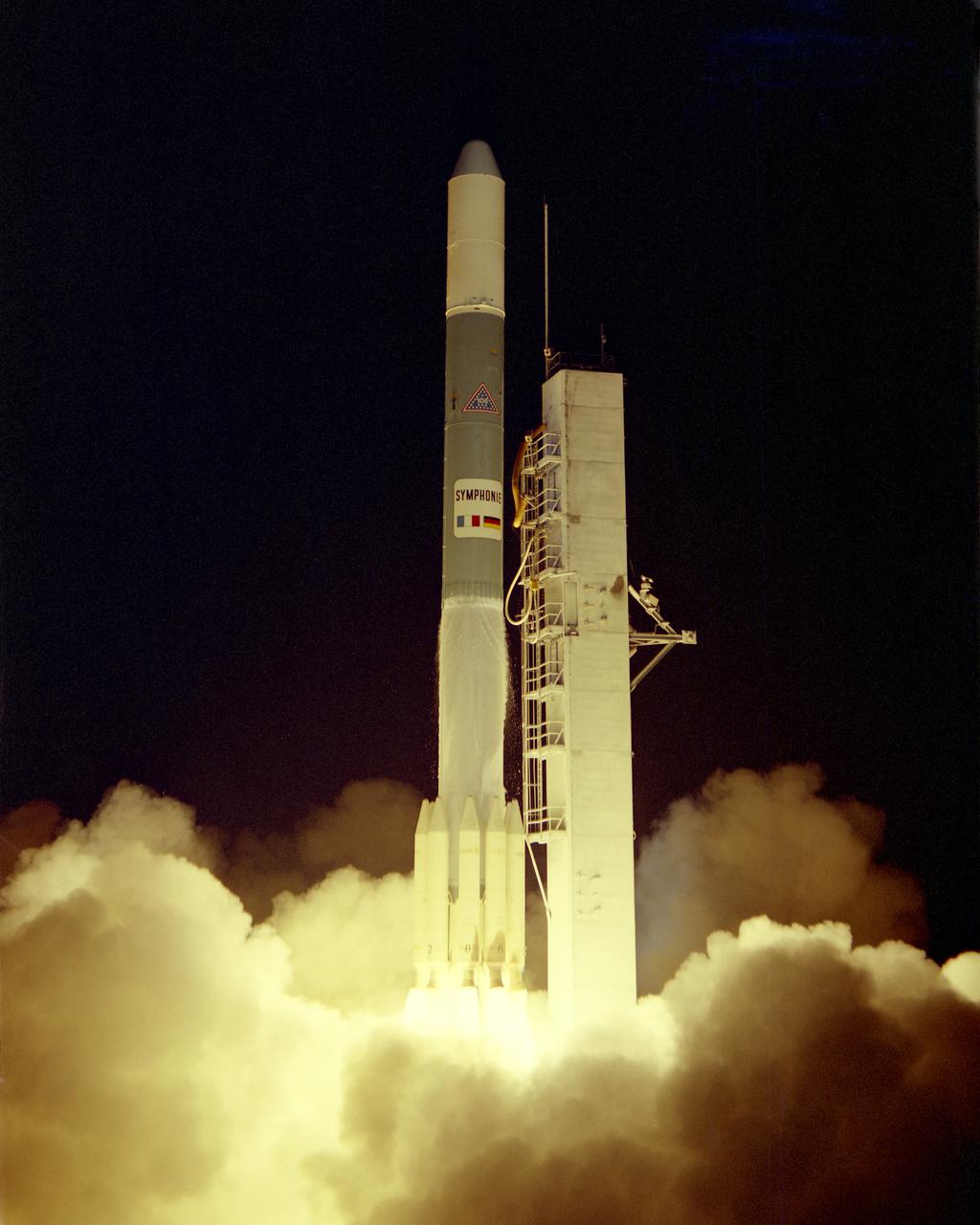
CAPE CANAVERAL, Fla. -- Launch of Symphonie-A on Complex 17-B at 9:39 p.m. EST. Symphonie-A is a communications satellite for a Franco-German industrial consortium. Photo credit: NASA
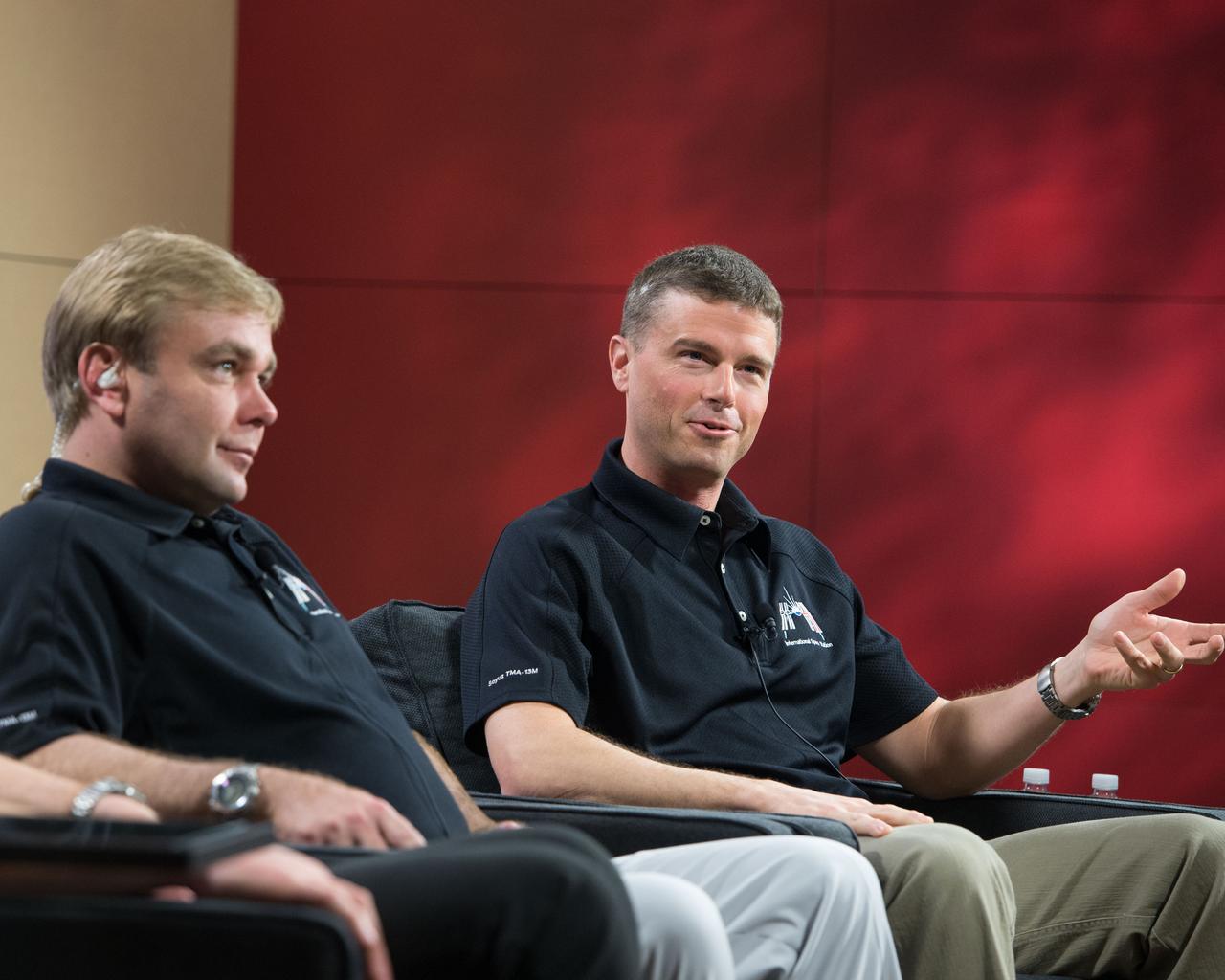
PHOTO DATE: 03-18-14 LOCATION: Bldg. 2s - PAO Studio B SUBJECT: Expedition 41 (Soyuz 39) press conference with Maxim Suraev, Alexander Gerst and Reid Wiseman. PHOTOGRAPHER: BILL STAFFORD
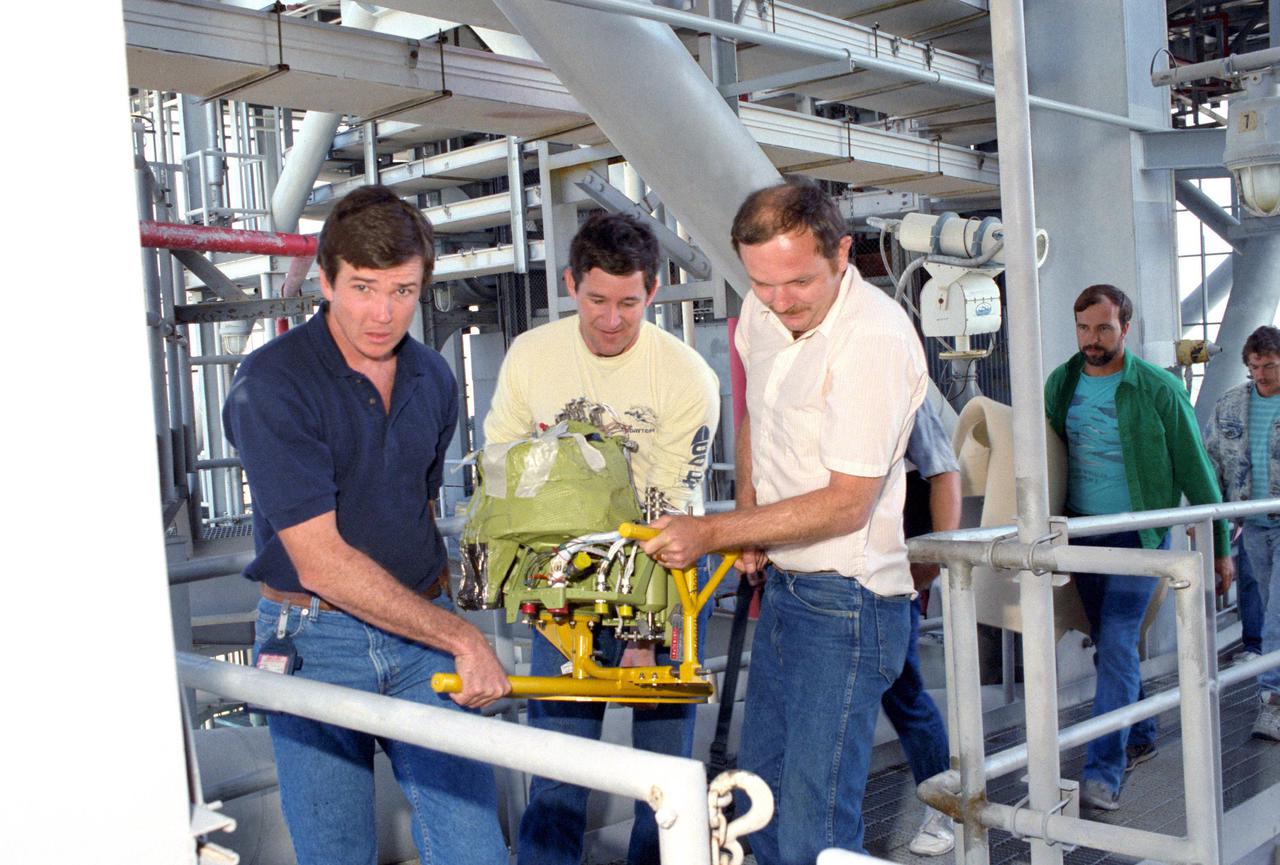
KENNEDY SPACE CENTER, FLA. -- Technicians at Pad 39-B carry a new Auxiliary Power Unit (APU) to be installed in the orbiter Discovery. It will replace APU #1 that failed during the STS-31 launch attempt on April 10.

PHOTO DATE: 03-18-14 LOCATION: Bldg. 2s - PAO Studio B SUBJECT: Expedition 41 (Soyuz 39) press conference with Maxim Suraev, Alexander Gerst and Reid Wiseman. PHOTOGRAPHER: BILL STAFFORD
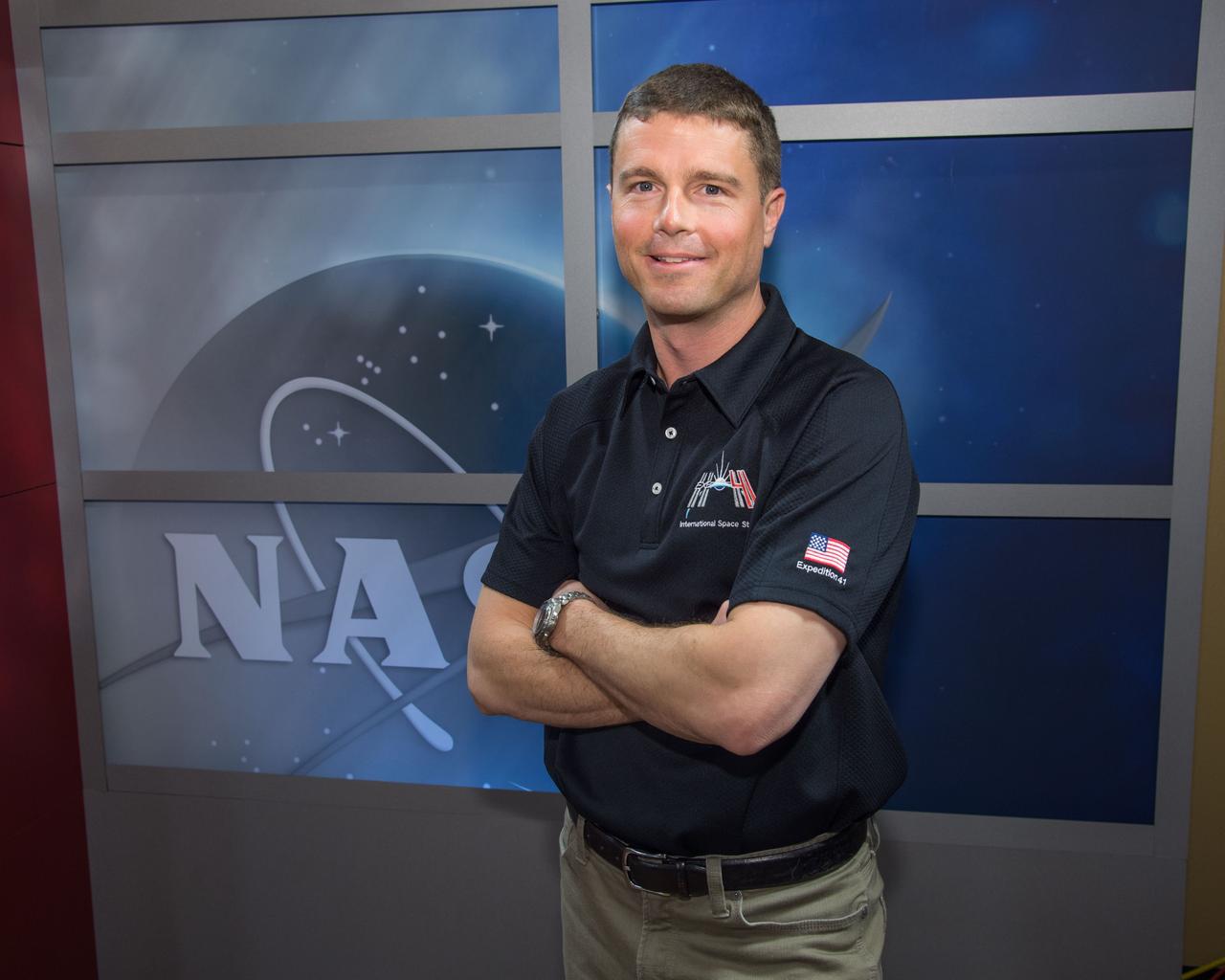
PHOTO DATE: 03-18-14 LOCATION: Bldg. 2s - PAO Studio B SUBJECT: Expedition 41 (Soyuz 39) press conference with Maxim Suraev, Alexander Gerst and Reid Wiseman. PHOTOGRAPHER: BILL STAFFORD
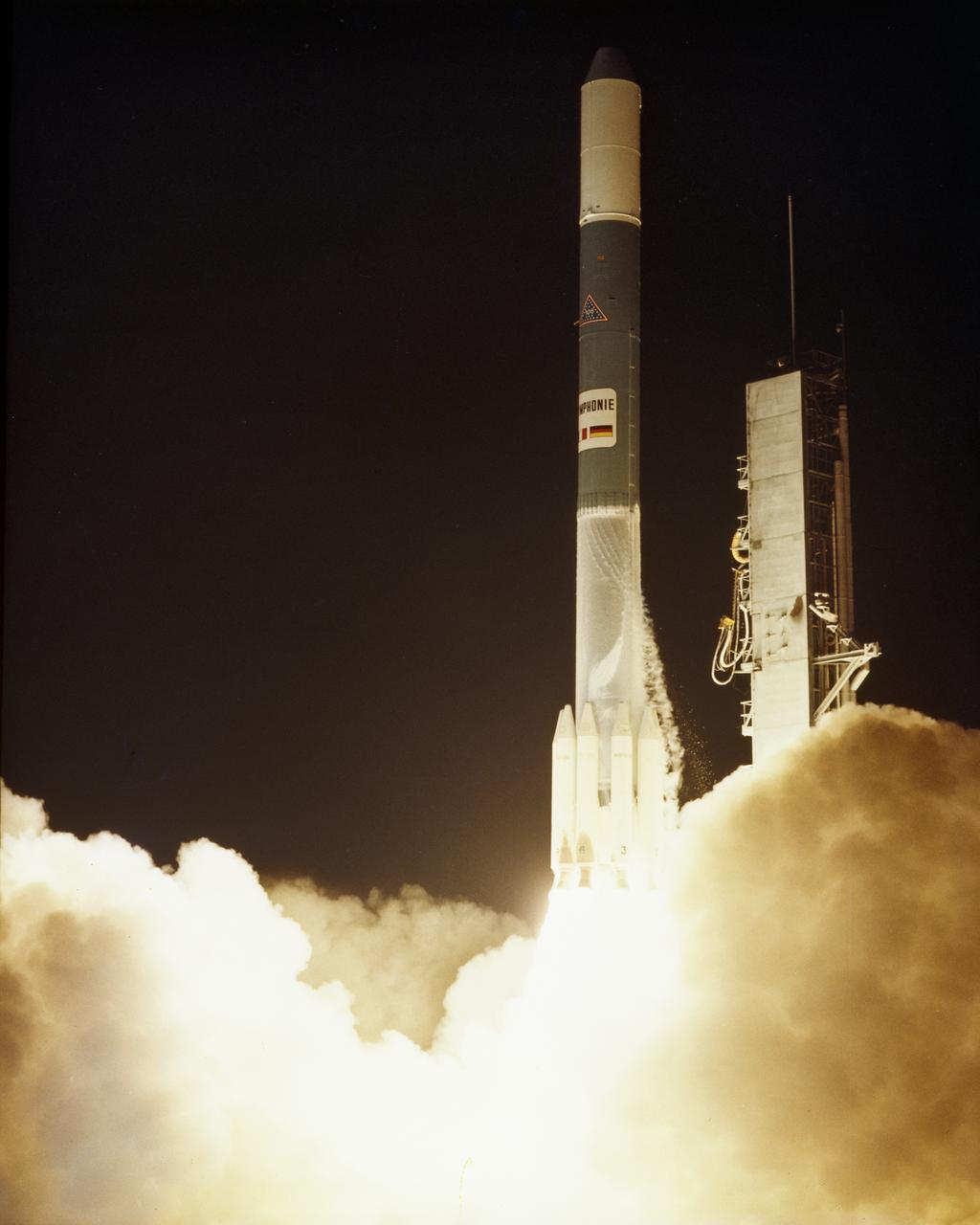
CAPE CANAVERAL, Fla. -- Launch of Symphonie-A on Complex 17-B at 9:39 p.m. EST. Symphonie-A is a communications satellite for a Franco-German industrial consortium. Photo credit: NASA
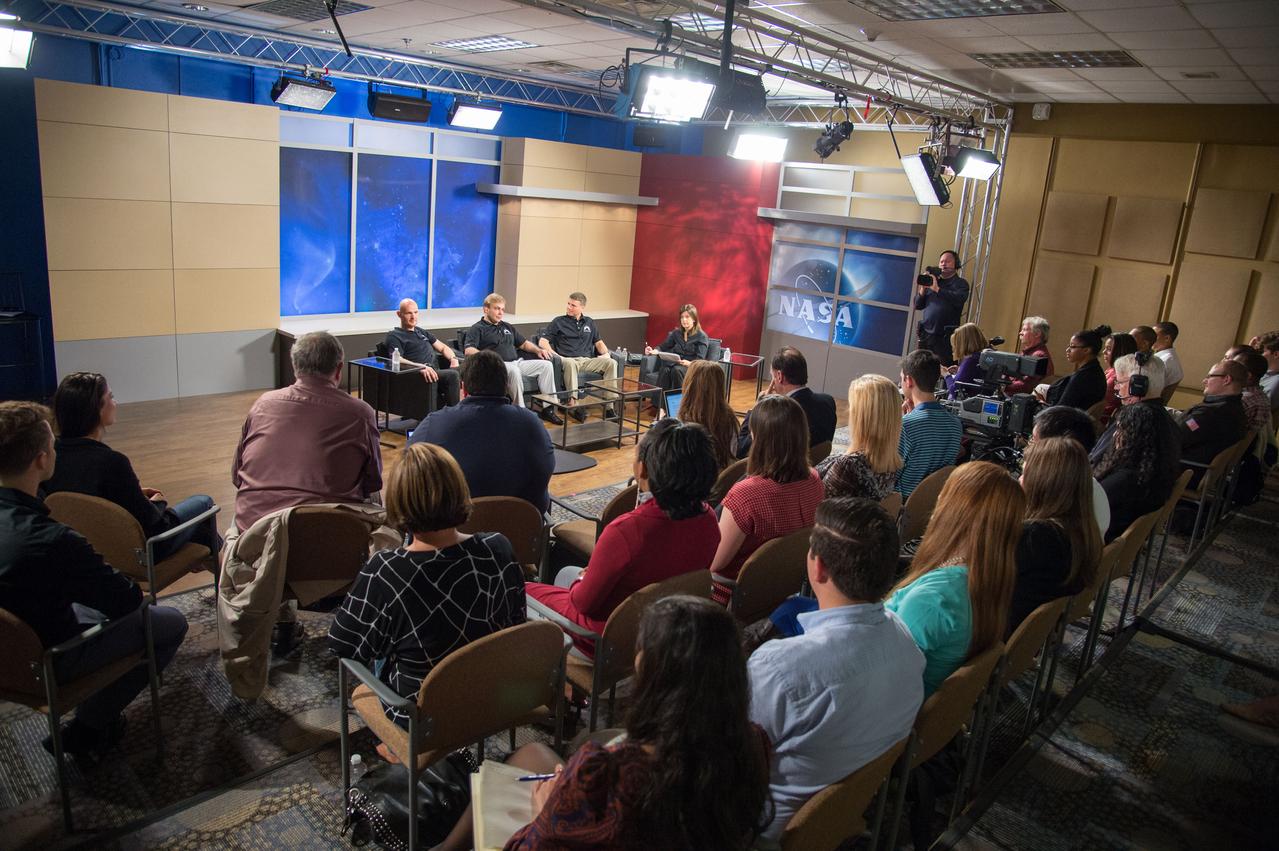
PHOTO DATE: 03-18-14 LOCATION: Bldg. 2s - PAO Studio B SUBJECT: Expedition 41 (Soyuz 39) press conference with Maxim Suraev, Alexander Gerst and Reid Wiseman. PHOTOGRAPHER: BILL STAFFORD
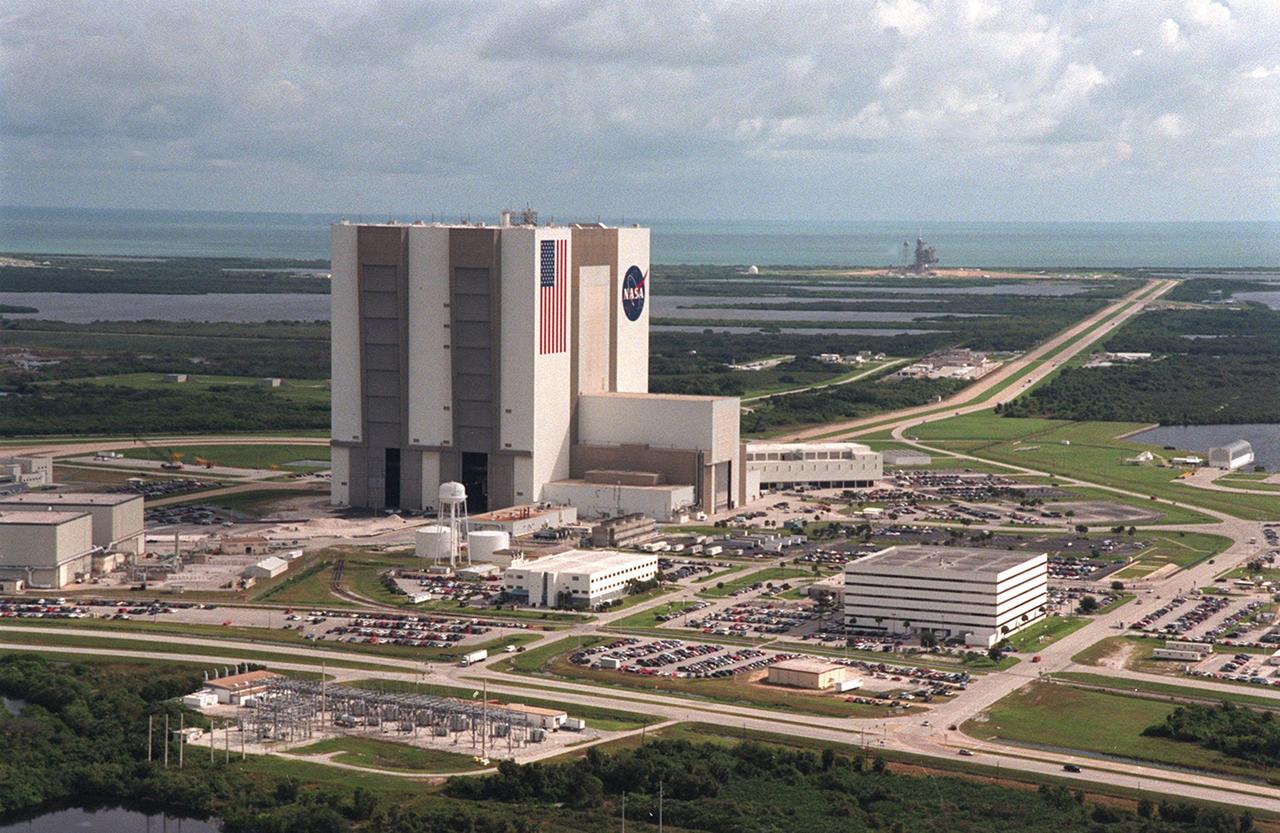
An aerial view of Launch Complex 39 area shows the Vehicle Assembly Building (center), with the Launch Control Center on its right. On the west side (lower end) are (left to right) the Orbiter Processing Facility, Process Control Center and Operations Support Building. Looking east (upper end) are Launch Pads 39-A (right) and 39-B (just above the VAB). The crawlerway stretches between the VAB and the launch pads toward the Atlantic Ocean, seen beyond them. At right is the turn basin where new external tanks are brought via ship, shown at its offloading site.
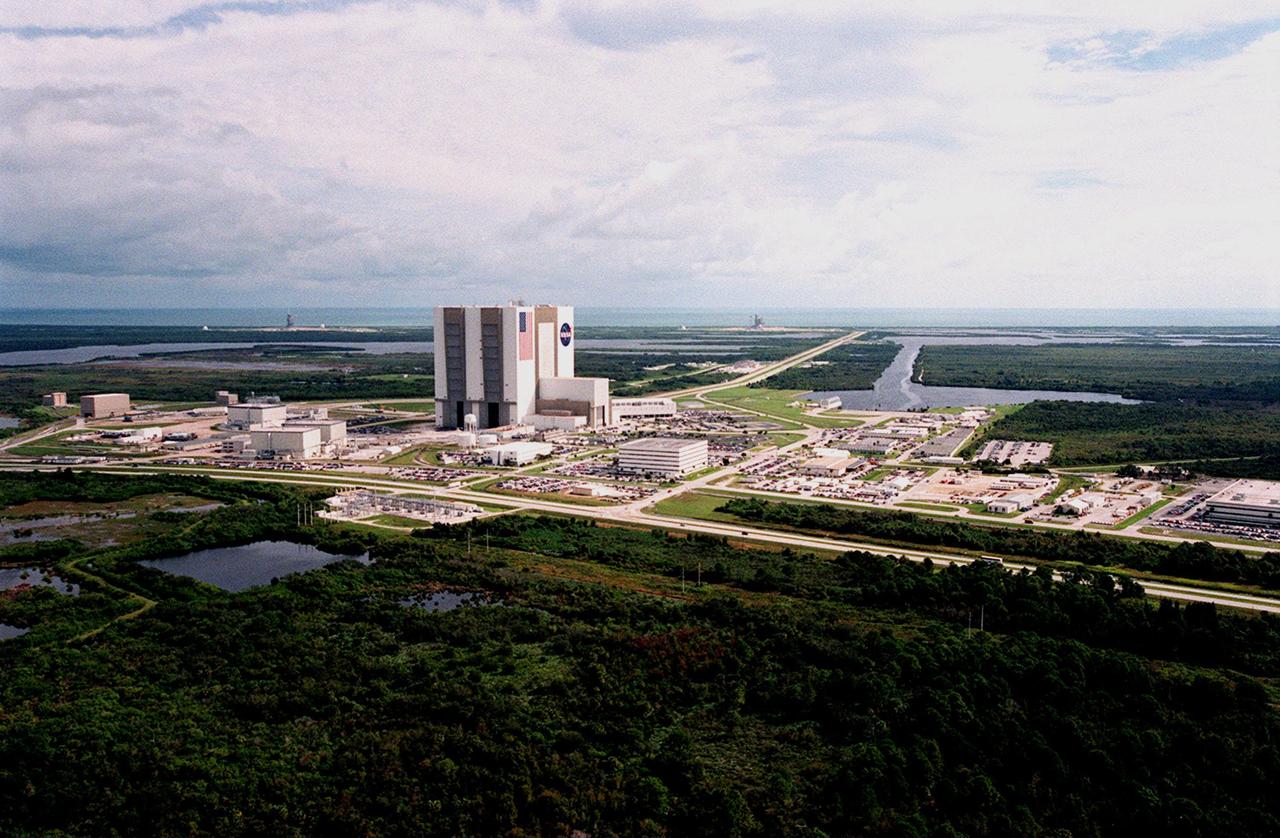
An aerial view of Launch Complex 39 Area shows the Vehicle Assembly Building (center), surrounded by (right) the Launch Control Center, (lower area, left to right) the Orbiter Processing Facility, Process Control Center and Operations Support Building. Looking toward the Atlantic Ocean (top) can be seen Launch Pads 39-A (right) and 39-B. The crawlerway stretches between the VAB and the launch pads. To the right of the crawlerway is the turn basin where new external tanks are brought from Louisiana via ship. The road bordering the buildings is Kennedy Parkway North.
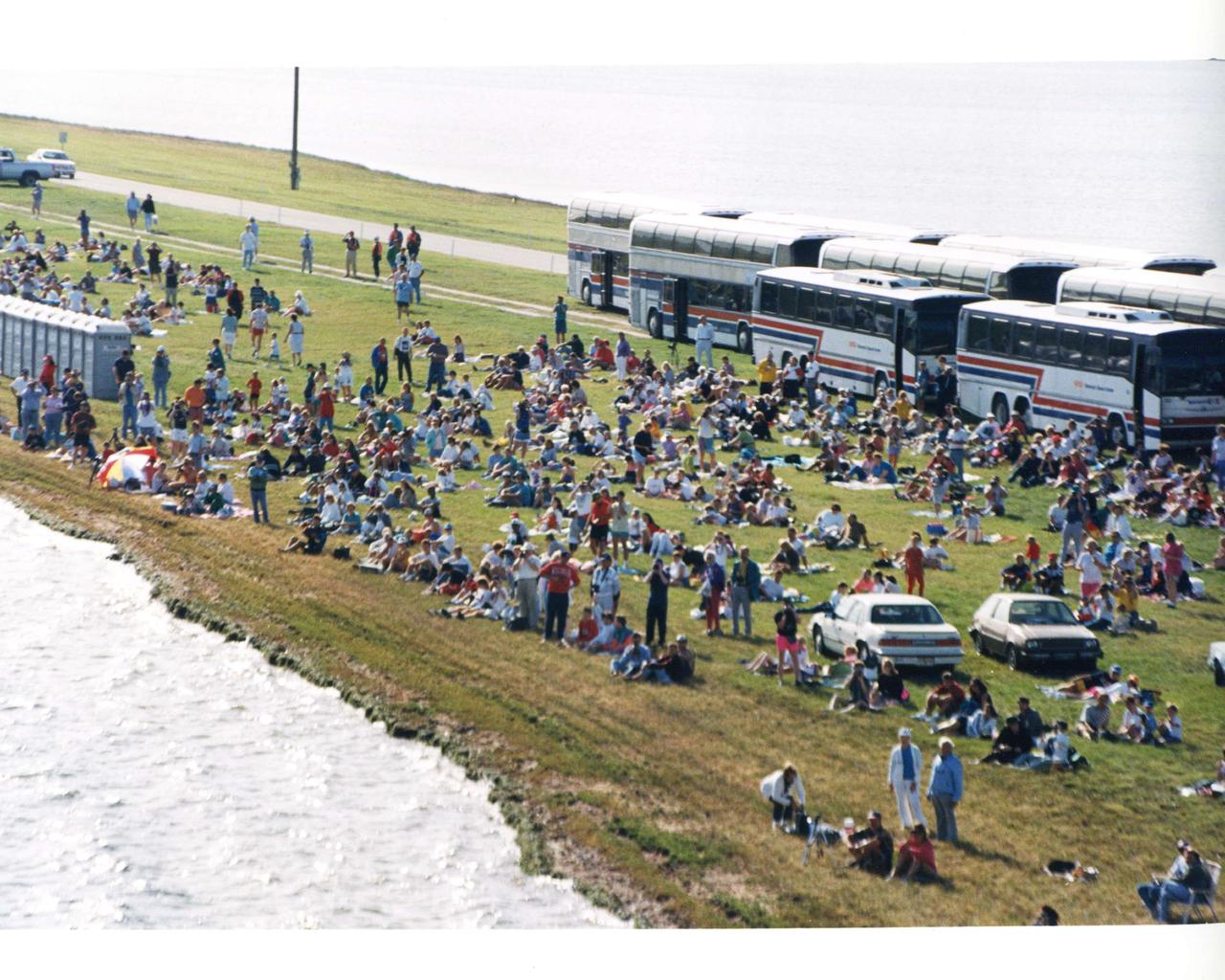
This aerial view is of a tour stop on the KSC bus tour, the Launch Complex 39 Observation Gantry. This stop allows visitors to view and photograph Pads A and B in Launch Complex 39 from an elevated vantage point. The roadway leading to the tour stop runs next to the crawlerway (left) which is used to transport Space Shuttles from the Vehicle Assembly Building to the pads. Pad A can be seen in the background.
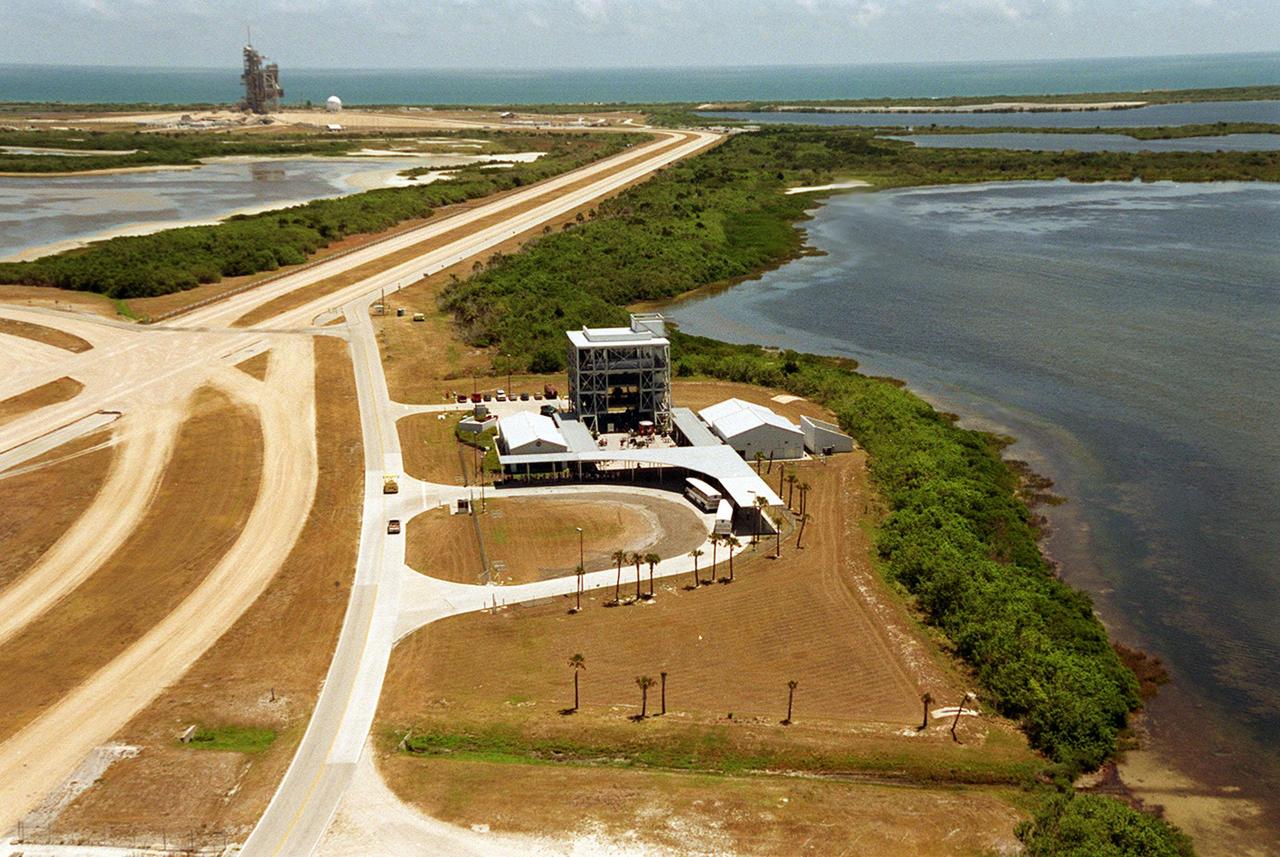
This aerial view is of a tour stop on the KSC bus tour, the Launch Complex 39 Observation Gantry. This stop allows visitors to view and photograph Pads A and B in Launch Complex 39 from an elevated vantage point. The roadway leading to the tour stop runs next to the crawlerway (left) which is used to transport Space Shuttles from the Vehicle Assembly Building to the pads. Pad A can be seen in the background.
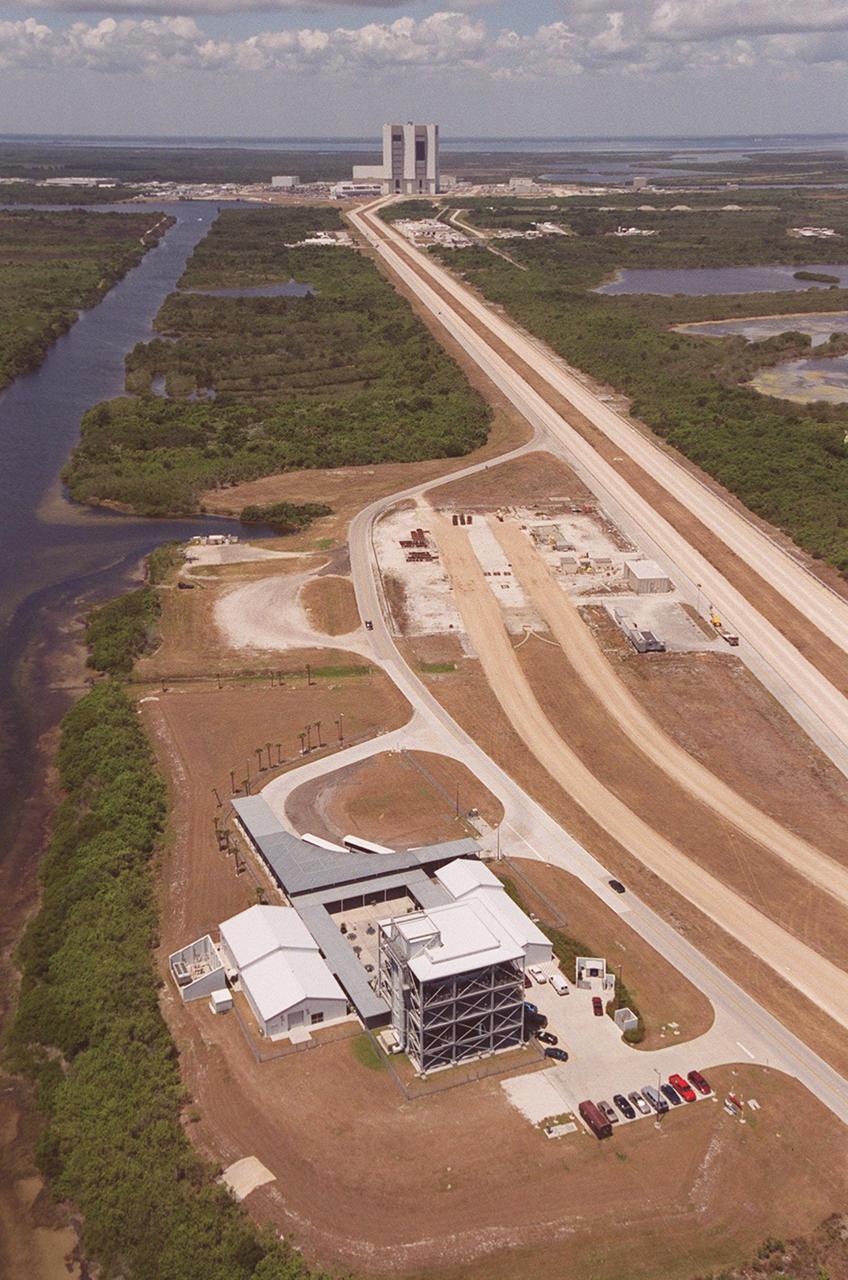
This aerial view is of a tour stop on the KSC bus tour, the Launch Complex 39 Observation Gantry. This stop allows visitors to view and photograph Pads A and B in Launch Complex 39 from an elevated vantage point. The roadway leading to the tour stop runs next to the crawlerway (right) which is used to transport Space Shuttles from the Vehicle Assembly Building (background) to the pads
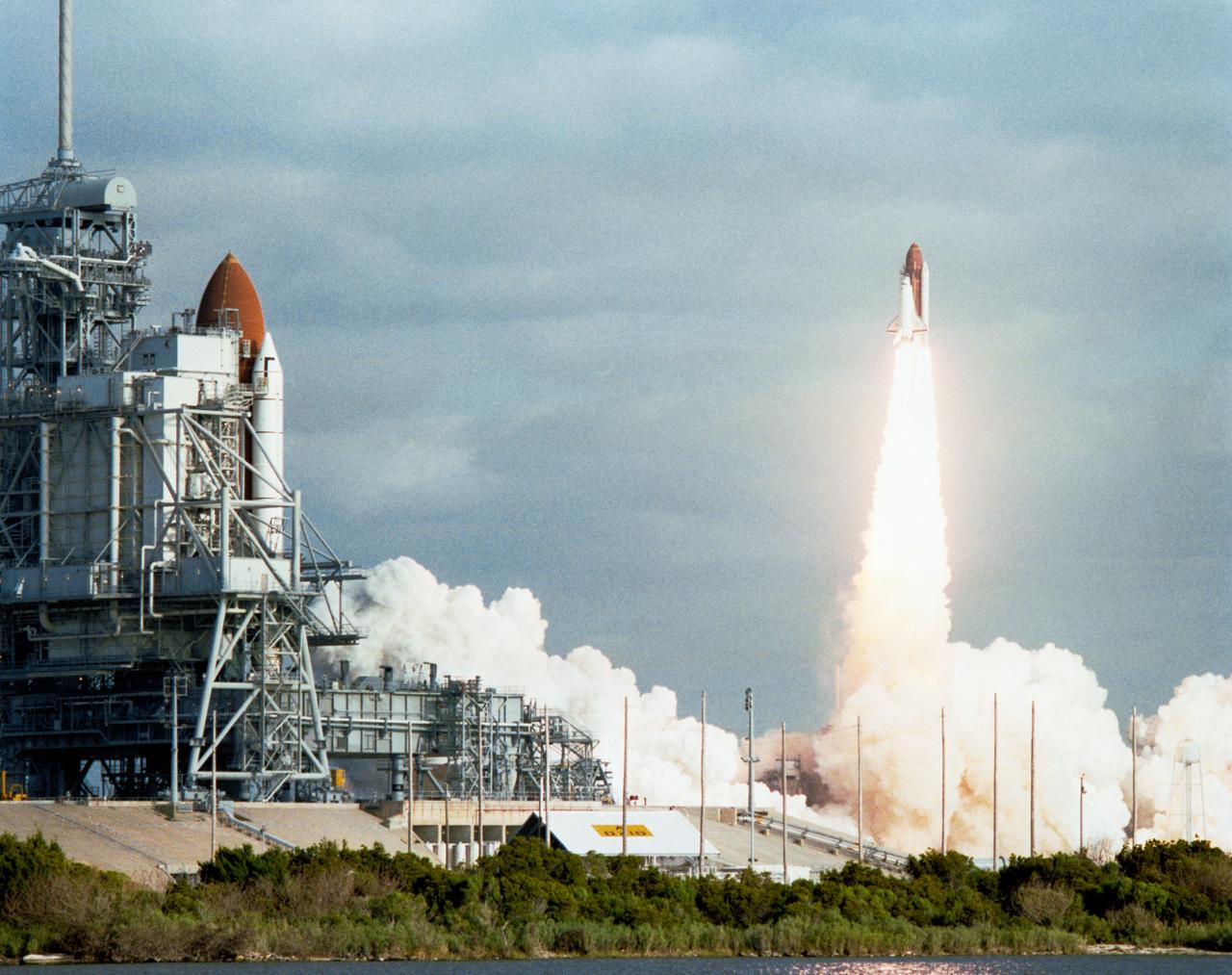
STS-31 Discovery, Orbiter Vehicle (OV) 103, lifts off from Kennedy Space Center (KSC) Launch Complex (LC) 39 Pad B. In the foreground STS-35 Columbia, OV-102, is visible on launch pad 39A. This event marked the first time since January 1986 that there was an orbiter on each pad. LC 39 pads are separated by 1.6 miles. View provided by KSC with alternate number KSC-90PC-610.
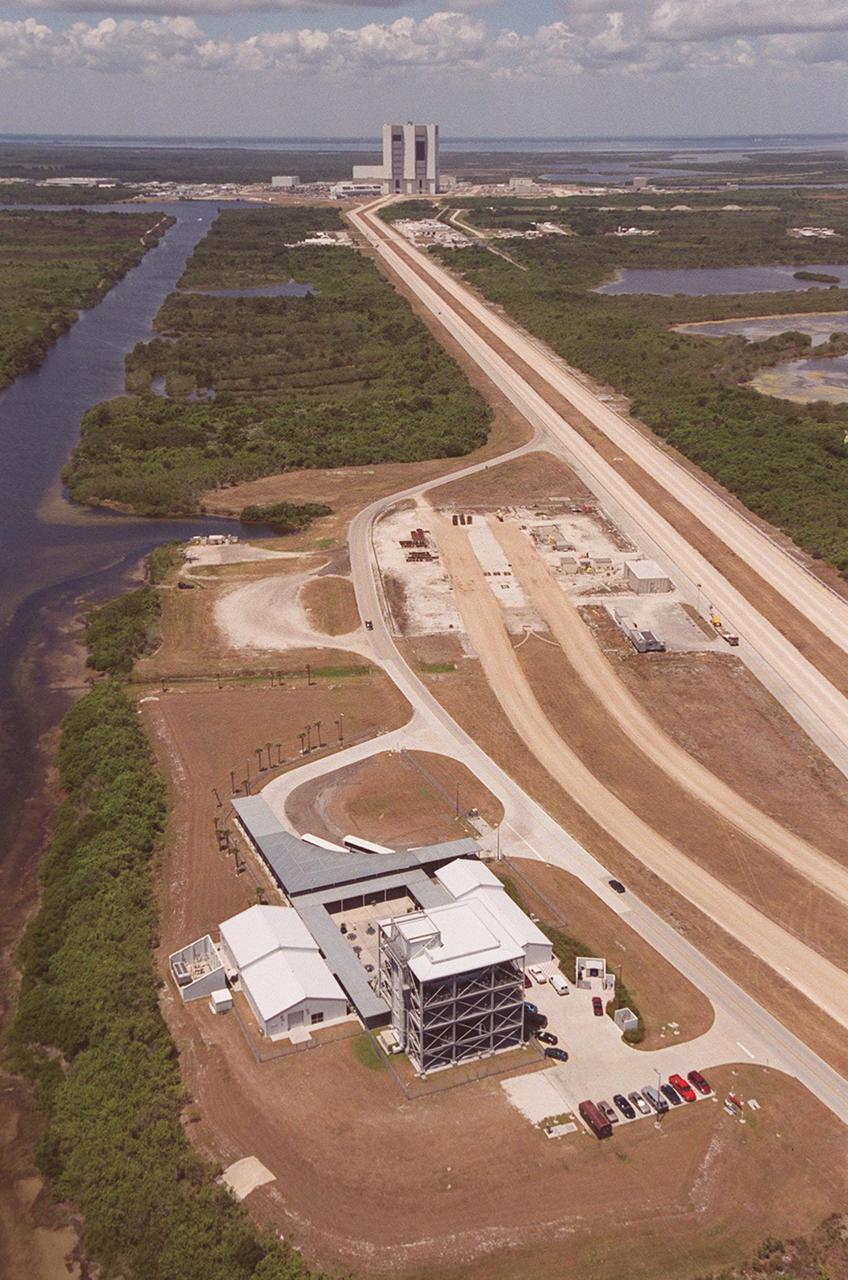
This aerial view is of a tour stop on the KSC bus tour, the Launch Complex 39 Observation Gantry. This stop allows visitors to view and photograph Pads A and B in Launch Complex 39 from an elevated vantage point. The roadway leading to the tour stop runs next to the crawlerway (right) which is used to transport Space Shuttles from the Vehicle Assembly Building (background) to the pads
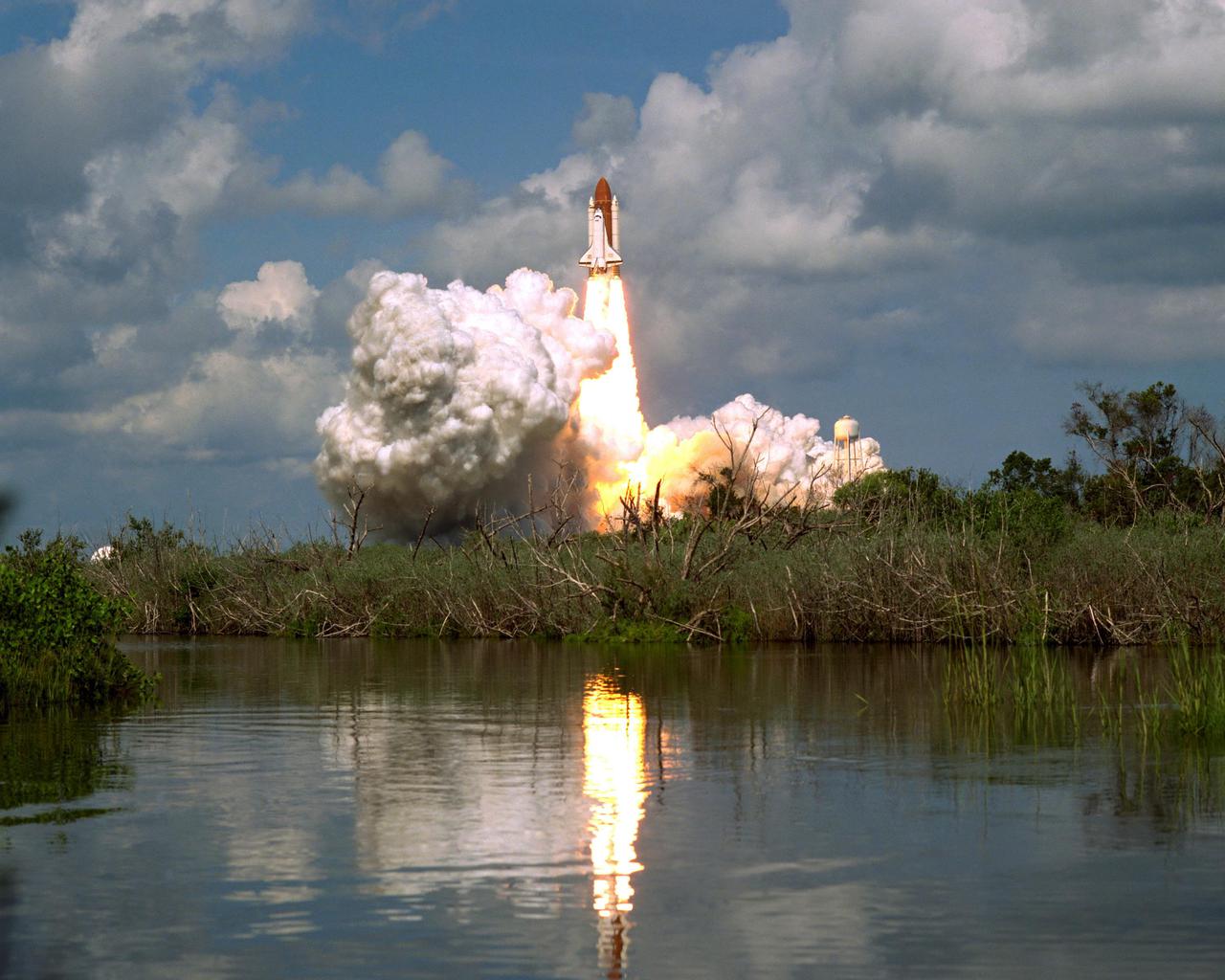
KENNEDY SPACE CENTER, FLA. -- The STS-34 Space Shuttle Atlantis lifts off from pad 39-B at 12:53 p.m. EDT, marking the beginning of a five-day mission in space. Atlantis is carrying a crew of five and the spacecraft Galileo, wich will be making a six-year trip to Jupiter..
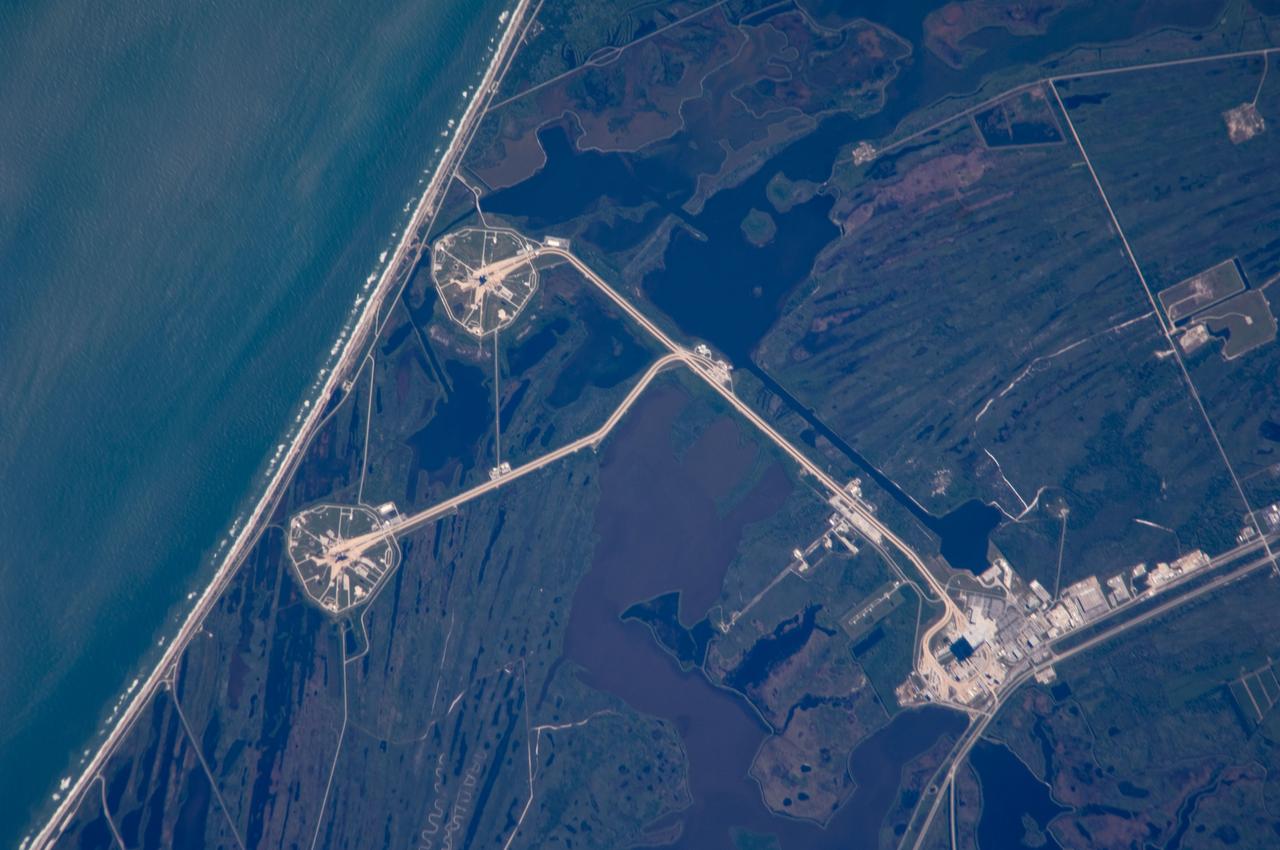
ISS018-E-006077 (29 Oct. 2008) --- Kennedy Space Center and Cape Canaveral, Florida are featured in this image photographed by an Expedition 18 crewmember on the International Space Station. Launch complex 39, with pads A and B, is visible at center left. The Vehicle Assembly Building (VAB) is visible at lower right.

61B-39-031 (27 Nov 1985) --- Deployment of Morelos-B satellite, the second in a series of communications satellites for Mexico, was initiated by Sherwood C. Spring, mission specialist, on November 27, 1985, and recorded on film by a fellow crew member using a 70mm camera.
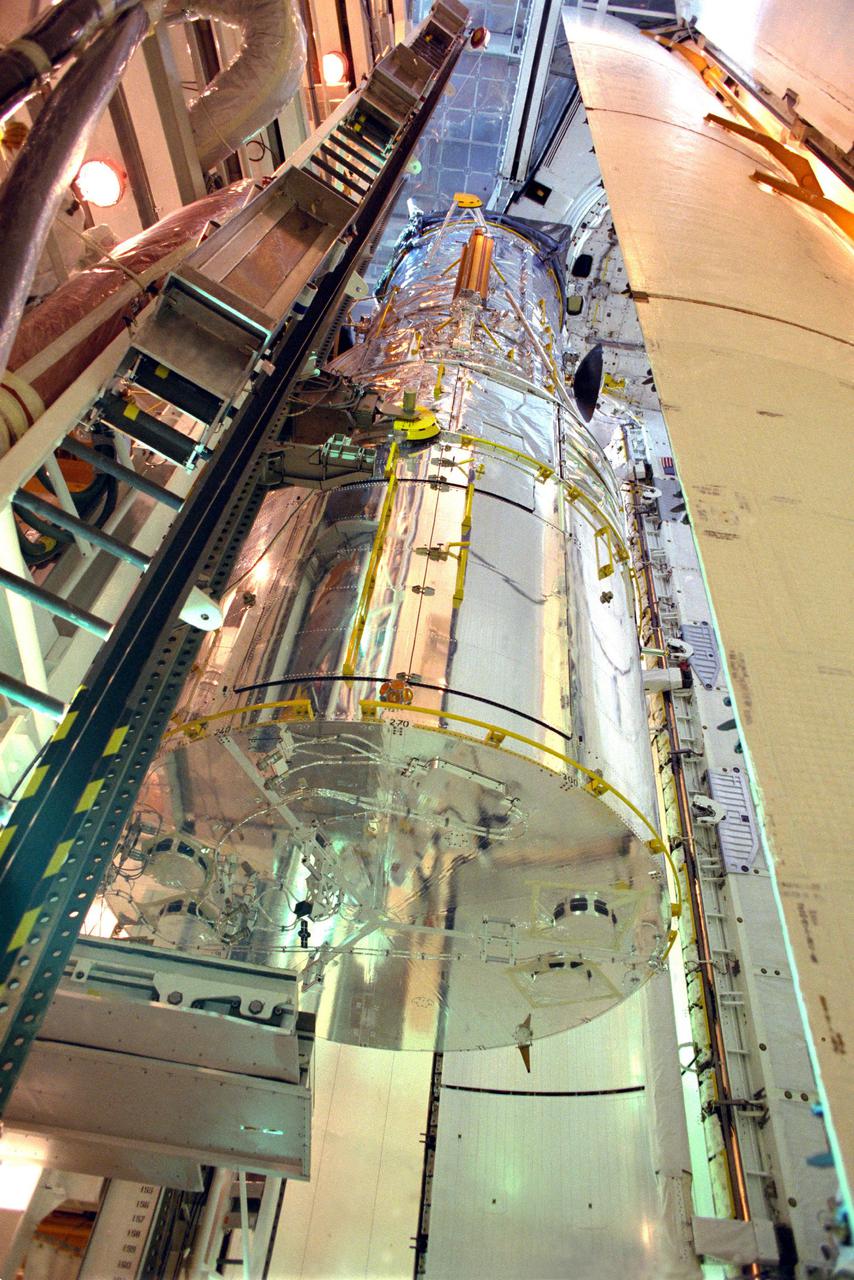
KENNEDY SPACE CENTER, FLA. -- The bus-size Hubble Space Telescope is carefully being transferred from the surgically clean Payload Changeout Room at Launch Pad 39-B into the cargo bay of the orbiter Discovery. The telescope is to be deployed during Space Shuttle Mission STS-31, currently scheduled for launch in April 1990.
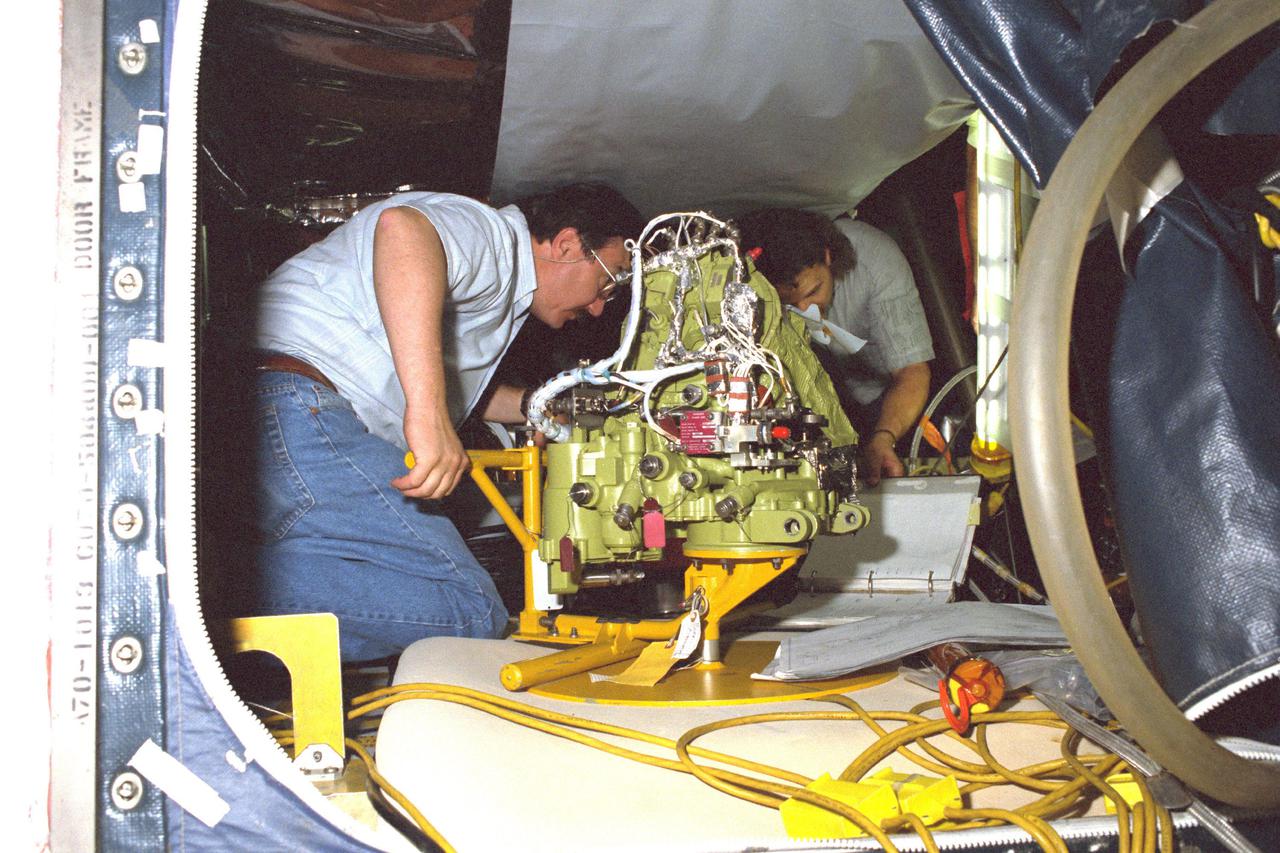
KENNEDY SPACE CENTER, FLA. -- Technicians install a new Auxiliary Power Unit (APU) in the aft compartment of the orbiter Discovery at Pad 39-B. The unit replaces APU #1 that failed during the STS-31 countdown on April 10.

Discovery was rolled out to Launch Pad 39-B on March 15-16 for final launch preparations for its 10th mission into space. Launch of the Hubble Space Telescope on the five-day STS-31 mission is targeted for April 12. Photo credit: NASA
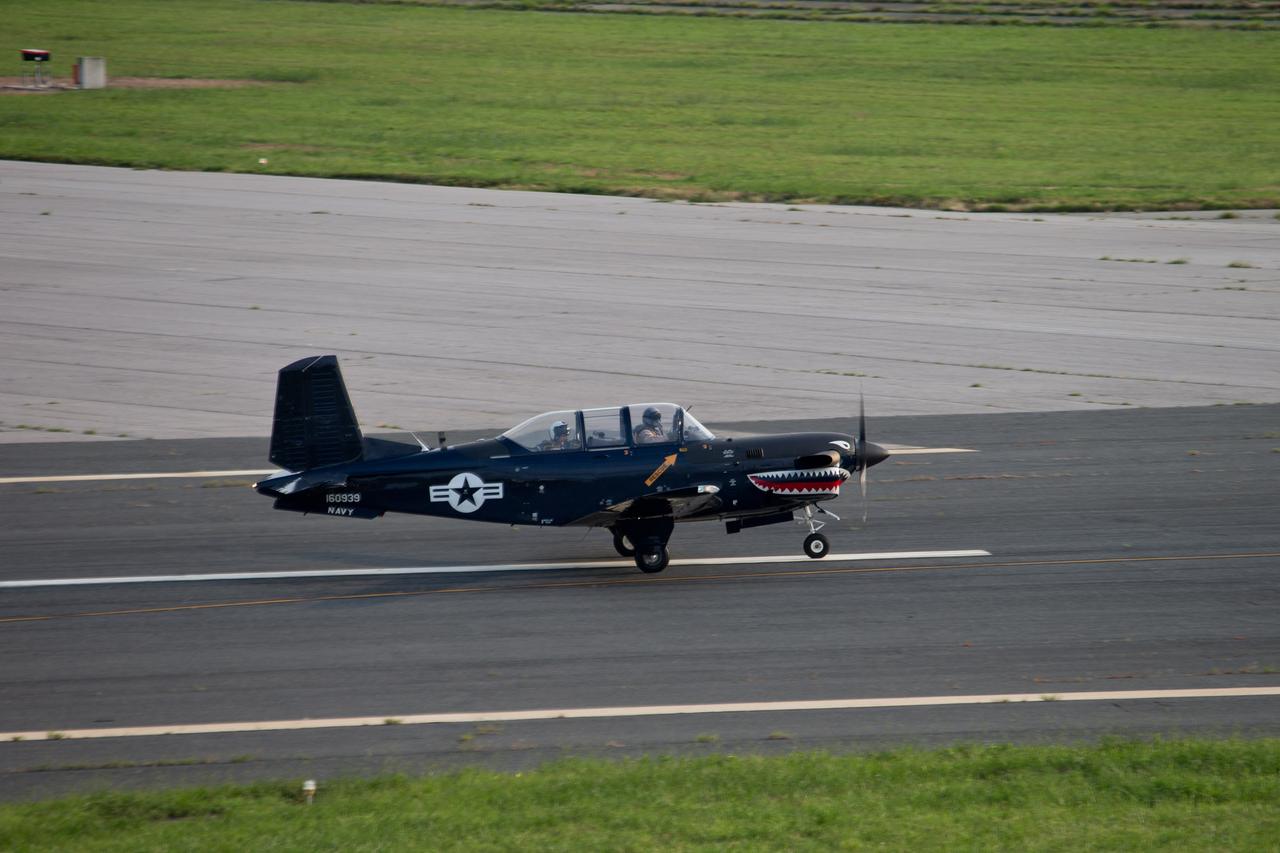
Photo of the chase plane landing at NASA's Wallops Flight Facility, Wallops Island, Va. at 7:39 a.m. today, Aug. 14, 2013. The chase plane was used during the landing of NASA's Global Hawk unmanned aerial vehicle. The Global Hawk will be used during the Hurricane Severe Storms Sentinel (HS3) mission. For more information, visit: <a href="http://www.nasa.gov/HS3. " rel="nofollow">www.nasa.gov/HS3. </a> Photo Credit: NASA Wallops Text: Keith Koehler/NASA Wallops Flight Facility <b><a href="http://www.nasa.gov/audience/formedia/features/MP_Photo_Guidelines.html" rel="nofollow">NASA image use policy.</a></b> <b><a href="http://www.nasa.gov/centers/goddard/home/index.html" rel="nofollow">NASA Goddard Space Flight Center</a></b> enables NASA’s mission through four scientific endeavors: Earth Science, Heliophysics, Solar System Exploration, and Astrophysics. Goddard plays a leading role in NASA’s accomplishments by contributing compelling scientific knowledge to advance the Agency’s mission. <b>Follow us on <a href="http://twitter.com/NASA_GoddardPix" rel="nofollow">Twitter</a></b> <b>Like us on <a href="http://www.facebook.com/pages/Greenbelt-MD/NASA-Goddard/395013845897?ref=tsd" rel="nofollow">Facebook</a></b> <b>Find us on <a href="http://instagram.com/nasagoddard?vm=grid" rel="nofollow">Instagram</a></b>
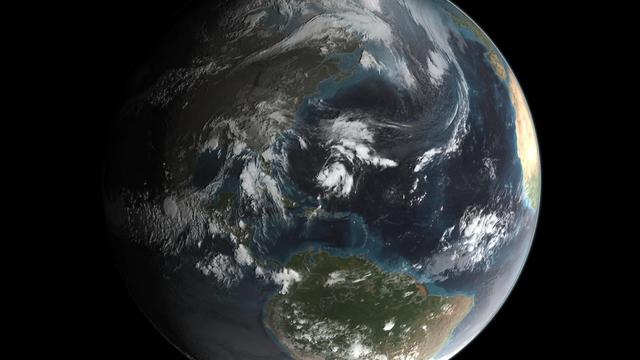
Joaquin became a tropical storm Monday evening (EDT) midway between the Bahamas and Bermuda and has now formed into Hurricane Joaquin, the 3rd of the season--the difference is Joaquin could impact the US East Coast. NASA's GPM satellite captured Joaquin Tuesday, September 29th at 21:39 UTC (5:39 pm EDT). Credit: NASA's Scientific Visualization Studio Data provided by the joint NASA/JAXA GPM mission. Download/read more: <a href="http://svs.gsfc.nasa.gov/cgi-bin/details.cgi?aid=4367" rel="nofollow">svs.gsfc.nasa.gov/cgi-bin/details.cgi?aid=4367</a> <b><a href="http://www.nasa.gov/audience/formedia/features/MP_Photo_Guidelines.html" rel="nofollow">NASA image use policy.</a></b> <b><a href="http://www.nasa.gov/centers/goddard/home/index.html" rel="nofollow">NASA Goddard Space Flight Center</a></b> enables NASA’s mission through four scientific endeavors: Earth Science, Heliophysics, Solar System Exploration, and Astrophysics. Goddard plays a leading role in NASA’s accomplishments by contributing compelling scientific knowledge to advance the Agency’s mission. <b>Follow us on <a href="http://twitter.com/NASAGoddardPix" rel="nofollow">Twitter</a></b> <b>Like us on <a href="http://www.facebook.com/pages/Greenbelt-MD/NASA-Goddard/395013845897?ref=tsd" rel="nofollow">Facebook</a></b> <b>Find us on <a href="http://instagrid.me/nasagoddard/?vm=grid" rel="nofollow">Instagram</a></b>
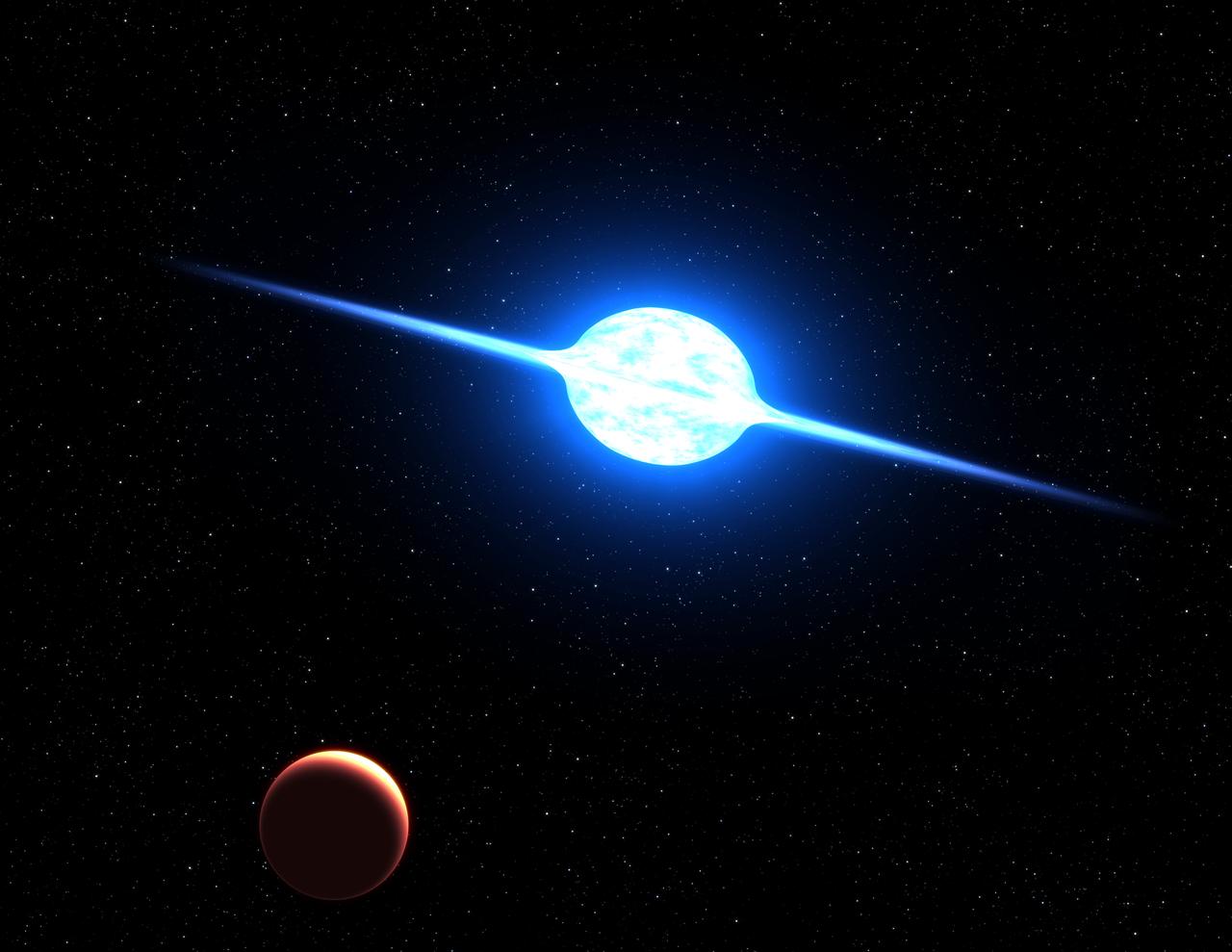
NASA image release December 5, 2011 This is an artist's concept of the fastest rotating star found to date. The massive, bright young star, called VFTS 102, rotates at a million miles per hour, or 100 times faster than our Sun does. Centrifugal forces from this dizzying spin rate have flattened the star into an oblate shape and spun off a disk of hot plasma, seen edge on in this view from a hypothetical planet. The star may have "spun up" by accreting material from a binary companion star. The rapidly evolving companion later exploded as a supernova. The whirling star lies 160,000 light-years away in the Large Magellanic Cloud, a satellite galaxy of our Milky Way. The team will use NASA's Hubble Space Telescope to make precise measurements of the star's proper motion across space. To read more go to: <a href="http://hubblesite.org/newscenter/archive/releases/2011/39/full/" rel="nofollow">hubblesite.org/newscenter/archive/releases/2011/39/full/</a> Image Type: Artwork Credit: NASA, ESA, and G. Bacon (STScI) <b><a href="http://www.nasa.gov/audience/formedia/features/MP_Photo_Guidelines.html" rel="nofollow">NASA image use policy.</a></b> <b><a href="http://www.nasa.gov/centers/goddard/home/index.html" rel="nofollow">NASA Goddard Space Flight Center</a></b> enables NASA’s mission through four scientific endeavors: Earth Science, Heliophysics, Solar System Exploration, and Astrophysics. Goddard plays a leading role in NASA’s accomplishments by contributing compelling scientific knowledge to advance the Agency’s mission. <b>Follow us on <a href="http://twitter.com/NASA_GoddardPix" rel="nofollow">Twitter</a></b> <b>Like us on <a href="http://www.facebook.com/pages/Greenbelt-MD/NASA-Goddard/395013845897?ref=tsd" rel="nofollow">Facebook</a></b> <b>Find us on <a href="http://instagrid.me/nasagoddard/?vm=grid" rel="nofollow">Instagram</a></b>
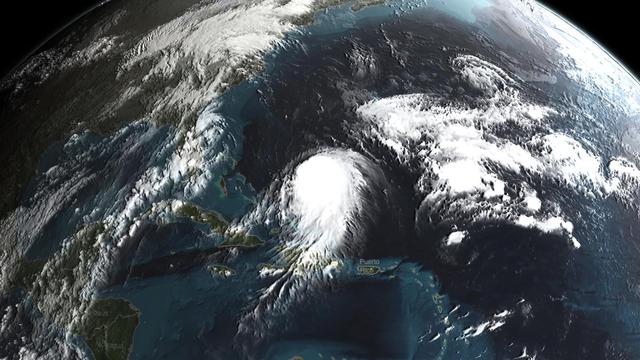
Joaquin became a tropical storm Monday evening (EDT) midway between the Bahamas and Bermuda and has now formed into Hurricane Joaquin, the 3rd of the season--the difference is Joaquin could impact the US East Coast. NASA's GPM satellite captured Joaquin Tuesday, September 29th at 21:39 UTC (5:39 pm EDT). Credit: NASA's Scientific Visualization Studio Data provided by the joint NASA/JAXA GPM mission. Download/read more: <a href="http://svs.gsfc.nasa.gov/cgi-bin/details.cgi?aid=4367" rel="nofollow">svs.gsfc.nasa.gov/cgi-bin/details.cgi?aid=4367</a> <b><a href="http://www.nasa.gov/audience/formedia/features/MP_Photo_Guidelines.html" rel="nofollow">NASA image use policy.</a></b> <b><a href="http://www.nasa.gov/centers/goddard/home/index.html" rel="nofollow">NASA Goddard Space Flight Center</a></b> enables NASA’s mission through four scientific endeavors: Earth Science, Heliophysics, Solar System Exploration, and Astrophysics. Goddard plays a leading role in NASA’s accomplishments by contributing compelling scientific knowledge to advance the Agency’s mission. <b>Follow us on <a href="http://twitter.com/NASAGoddardPix" rel="nofollow">Twitter</a></b> <b>Like us on <a href="http://www.facebook.com/pages/Greenbelt-MD/NASA-Goddard/395013845897?ref=tsd" rel="nofollow">Facebook</a></b> <b>Find us on <a href="http://instagrid.me/nasagoddard/?vm=grid" rel="nofollow">Instagram</a></b>
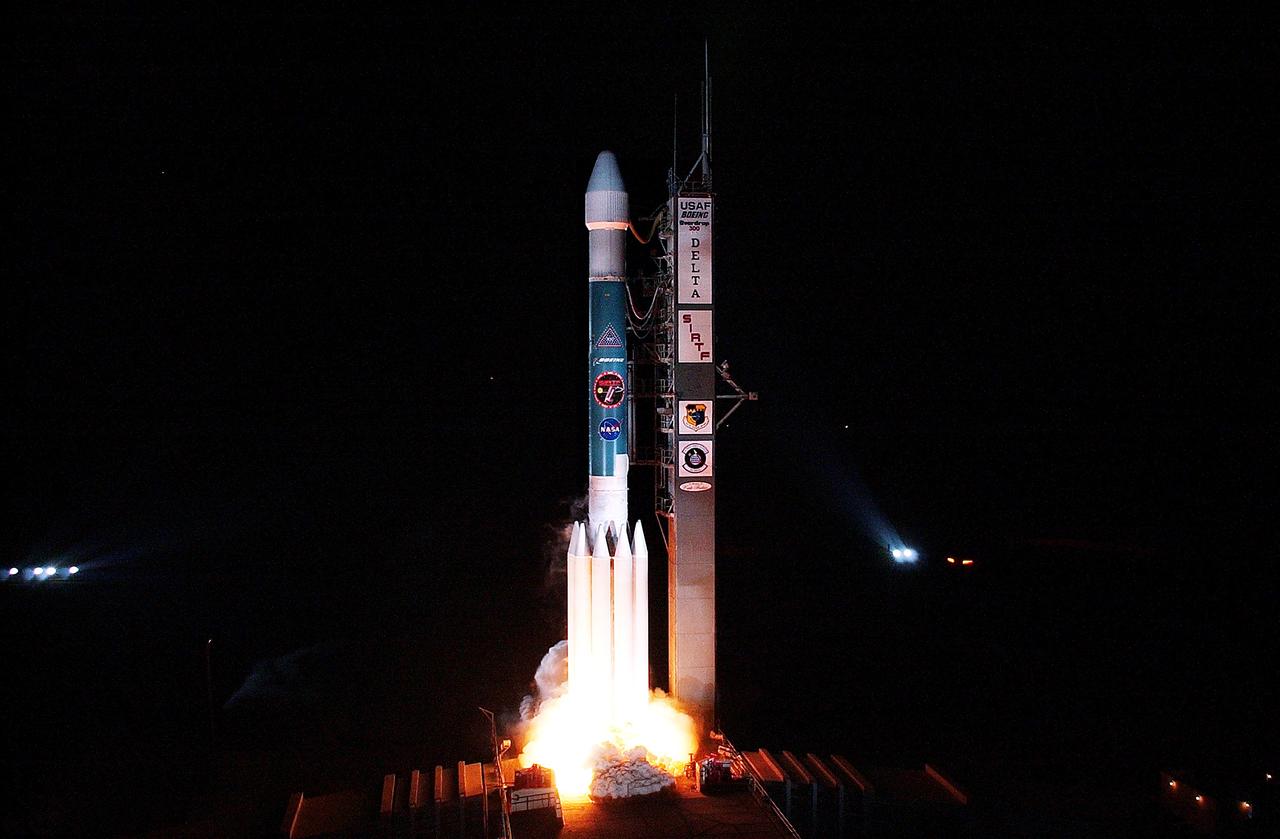
KENNEDY SPACE CENTER, FLA. - NASA's Space Infrared Telescope Facility (SIRTF) lifts off from Launch Pad 17-B, Cape Canaveral Air Force Station, on Aug. 25 at 1:35:39 a.m. EDT. SIRTF will obtain images and spectra by detecting the infrared energy, or heat, radiated by objects in space. Consisting of a 0.85-meter telescope and three cryogenically cooled science instruments, SIRTF will be the largest infrared telescope ever launched into space. It is the fourth and final element in NASA’s family of orbiting “Great Observatories.” Its highly sensitive instruments will give a unique view of the Universe and peer into regions of space that are hidden from optical telescopes.
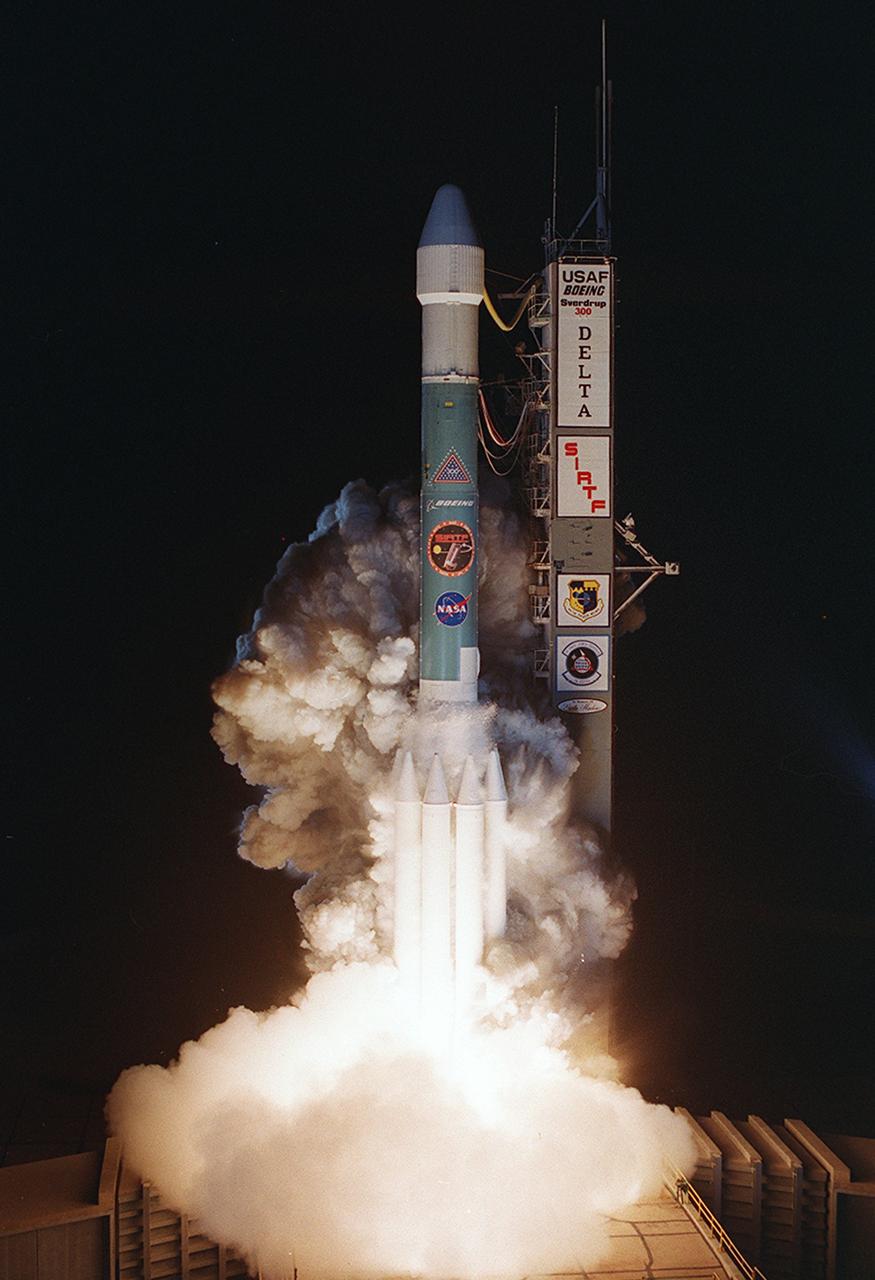
KENNEDY SPACE CENTER, FLA. - NASA's Space Infrared Telescope Facility (SIRTF) lifts off from Launch Pad 17-B, Cape Canaveral Air Force Station, on Aug. 25 at 1:35:39 a.m. EDT. SIRTF will obtain images and spectra by detecting the infrared energy, or heat, radiated by objects in space. Consisting of a 0.85-meter telescope and three cryogenically cooled science instruments, SIRTF will be the largest infrared telescope ever launched into space. It is the fourth and final element in NASA’s family of orbiting “Great Observatories.” Its highly sensitive instruments will give a unique view of the Universe and peer into regions of space that are hidden from optical telescopes.
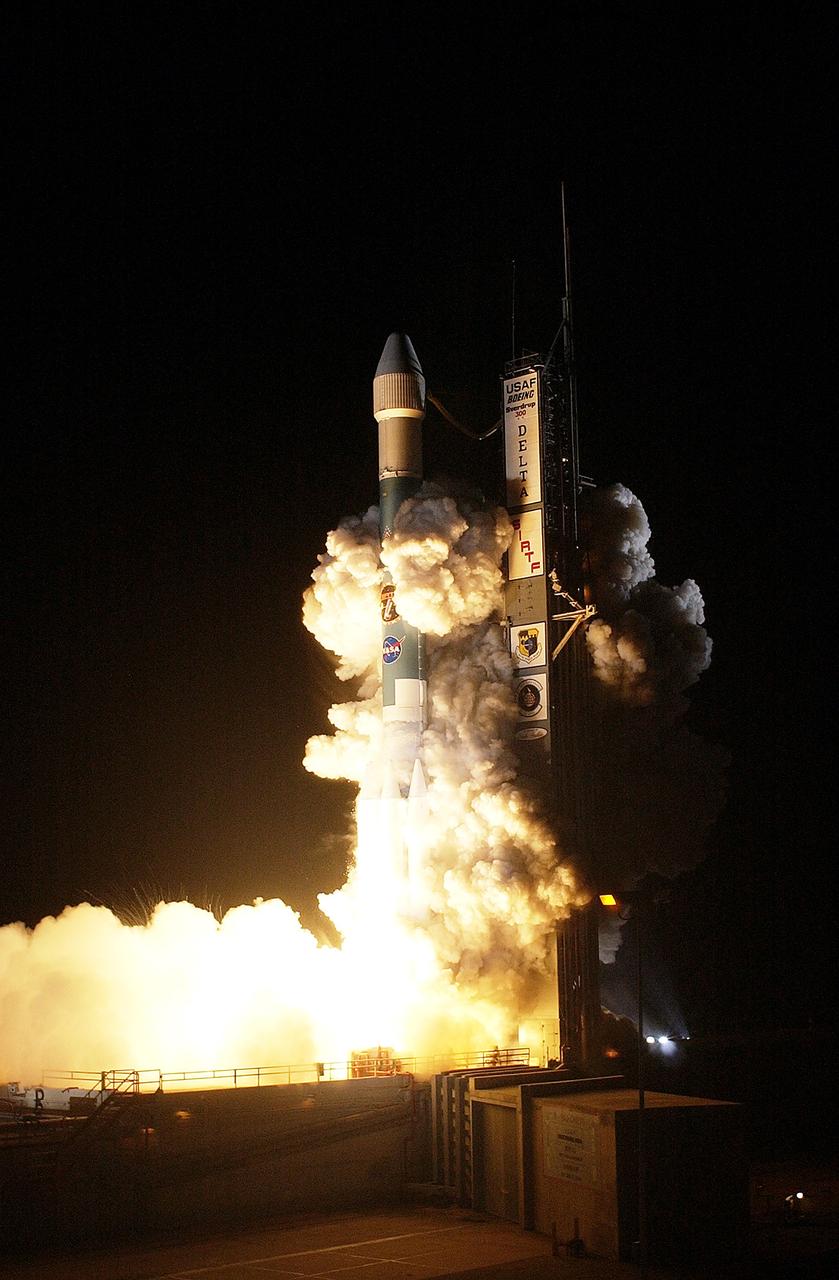
KENNEDY SPACE CENTER, FLA. - NASA's Space Infrared Telescope Facility (SIRTF) lifts off from Launch Pad 17-B, Cape Canaveral Air Force Station, on Aug. 25 at 1:35:39 a.m. EDT. SIRTF will obtain images and spectra by detecting the infrared energy, or heat, radiated by objects in space. Consisting of a 0.85-meter telescope and three cryogenically cooled science instruments, SIRTF will be the largest infrared telescope ever launched into space. It is the fourth and final element in NASA’s family of orbiting “Great Observatories.” Its highly sensitive instruments will give a unique view of the Universe and peer into regions of space that are hidden from optical telescopes.
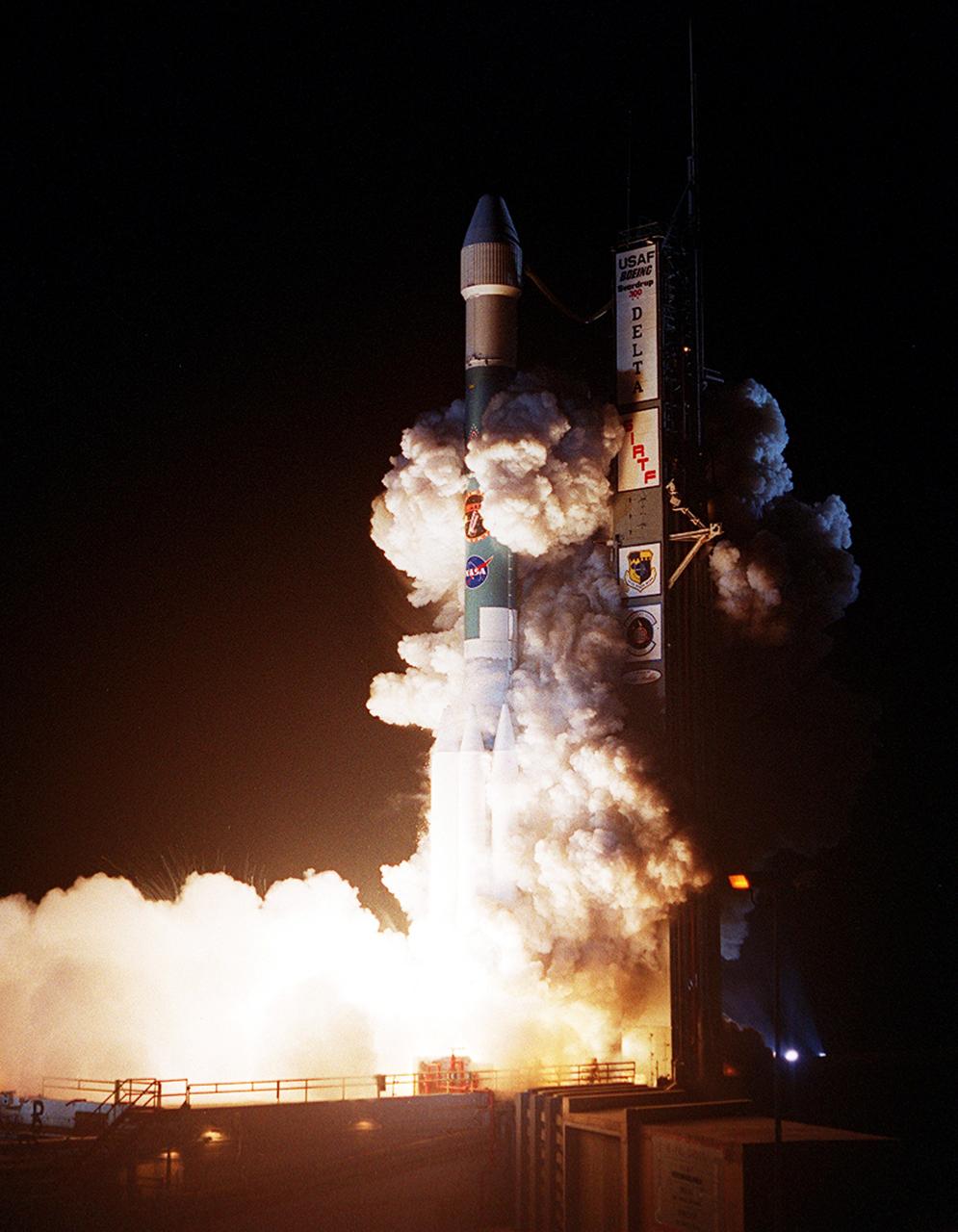
KENNEDY SPACE CENTER, FLA. - NASA's Space Infrared Telescope Facility (SIRTF) lifts off from Launch Pad 17-B, Cape Canaveral Air Force Station, on Aug. 25 at 1:35:39 a.m. EDT. SIRTF will obtain images and spectra by detecting the infrared energy, or heat, radiated by objects in space. Consisting of a 0.85-meter telescope and three cryogenically cooled science instruments, SIRTF will be the largest infrared telescope ever launched into space. It is the fourth and final element in NASA’s family of orbiting “Great Observatories.” Its highly sensitive instruments will give a unique view of the Universe and peer into regions of space that are hidden from optical telescopes.
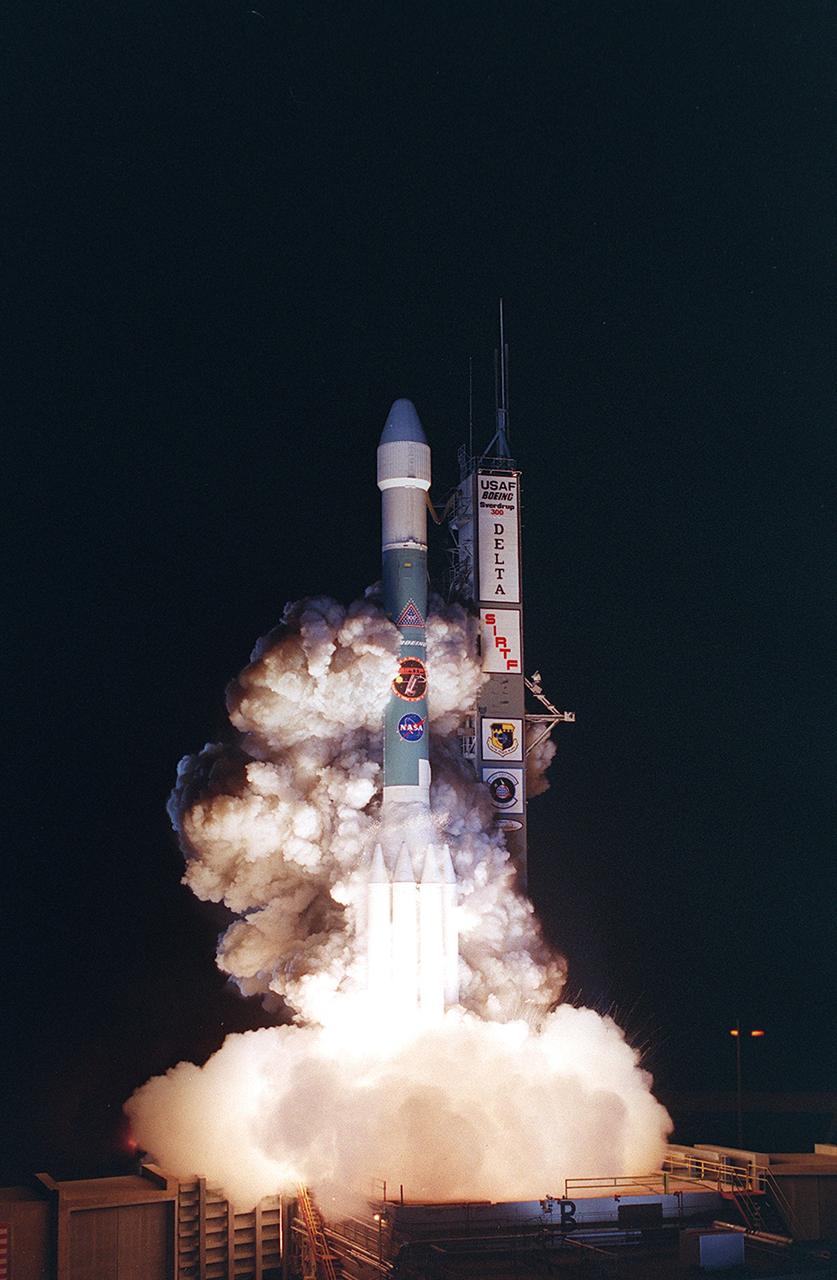
KENNEDY SPACE CENTER, FLA. - NASA's Space Infrared Telescope Facility (SIRTF) lifts off from Launch Pad 17-B, Cape Canaveral Air Force Station, on Aug. 25 at 1:35:39 a.m. EDT. SIRTF will obtain images and spectra by detecting the infrared energy, or heat, radiated by objects in space. Consisting of a 0.85-meter telescope and three cryogenically cooled science instruments, SIRTF will be the largest infrared telescope ever launched into space. It is the fourth and final element in NASA’s family of orbiting “Great Observatories.” Its highly sensitive instruments will give a unique view of the Universe and peer into regions of space that are hidden from optical telescopes.
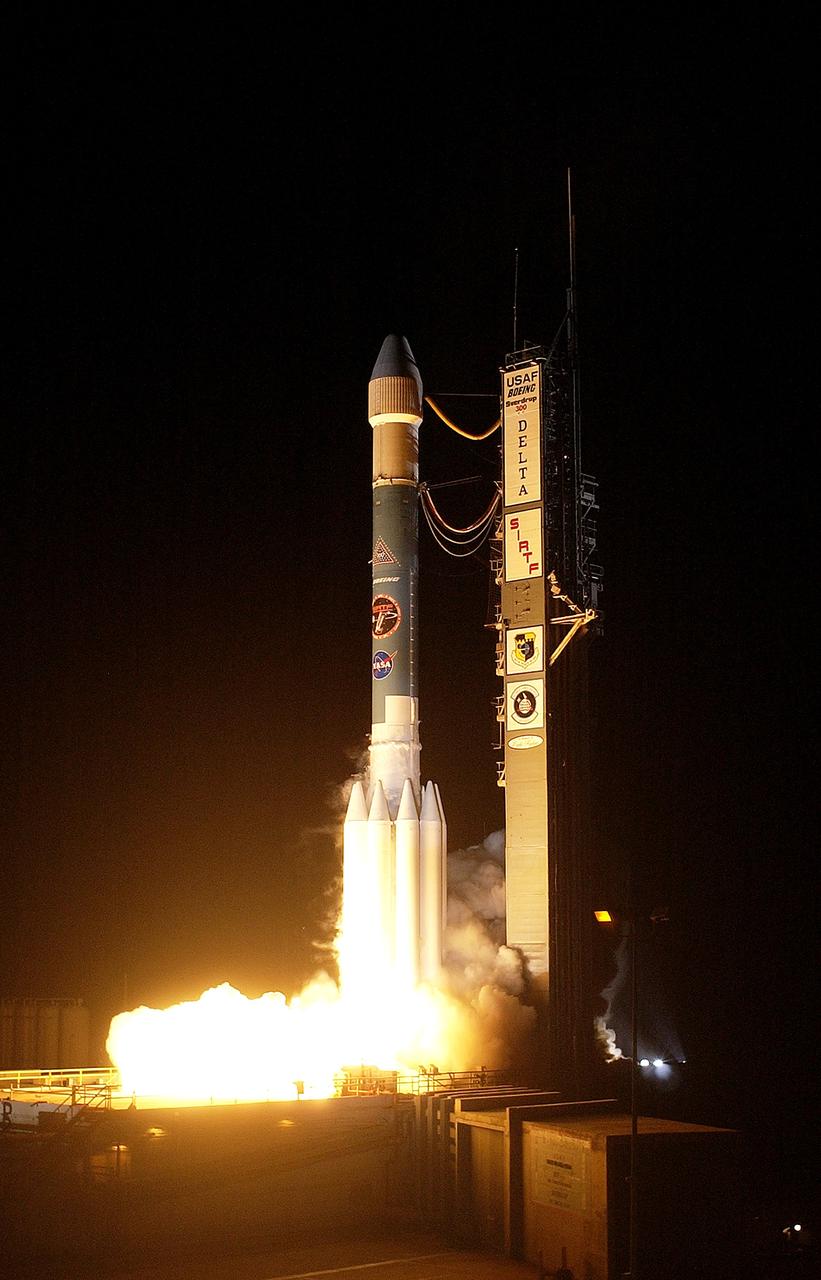
KENNEDY SPACE CENTER, FLA. - NASA's Space Infrared Telescope Facility (SIRTF) lifts off from Launch Pad 17-B, Cape Canaveral Air Force Station, on Aug. 25 at 1:35:39 a.m. EDT. SIRTF will obtain images and spectra by detecting the infrared energy, or heat, radiated by objects in space. Consisting of a 0.85-meter telescope and three cryogenically cooled science instruments, SIRTF will be the largest infrared telescope ever launched into space. It is the fourth and final element in NASA’s family of orbiting “Great Observatories.” Its highly sensitive instruments will give a unique view of the Universe and peer into regions of space that are hidden from optical telescopes.
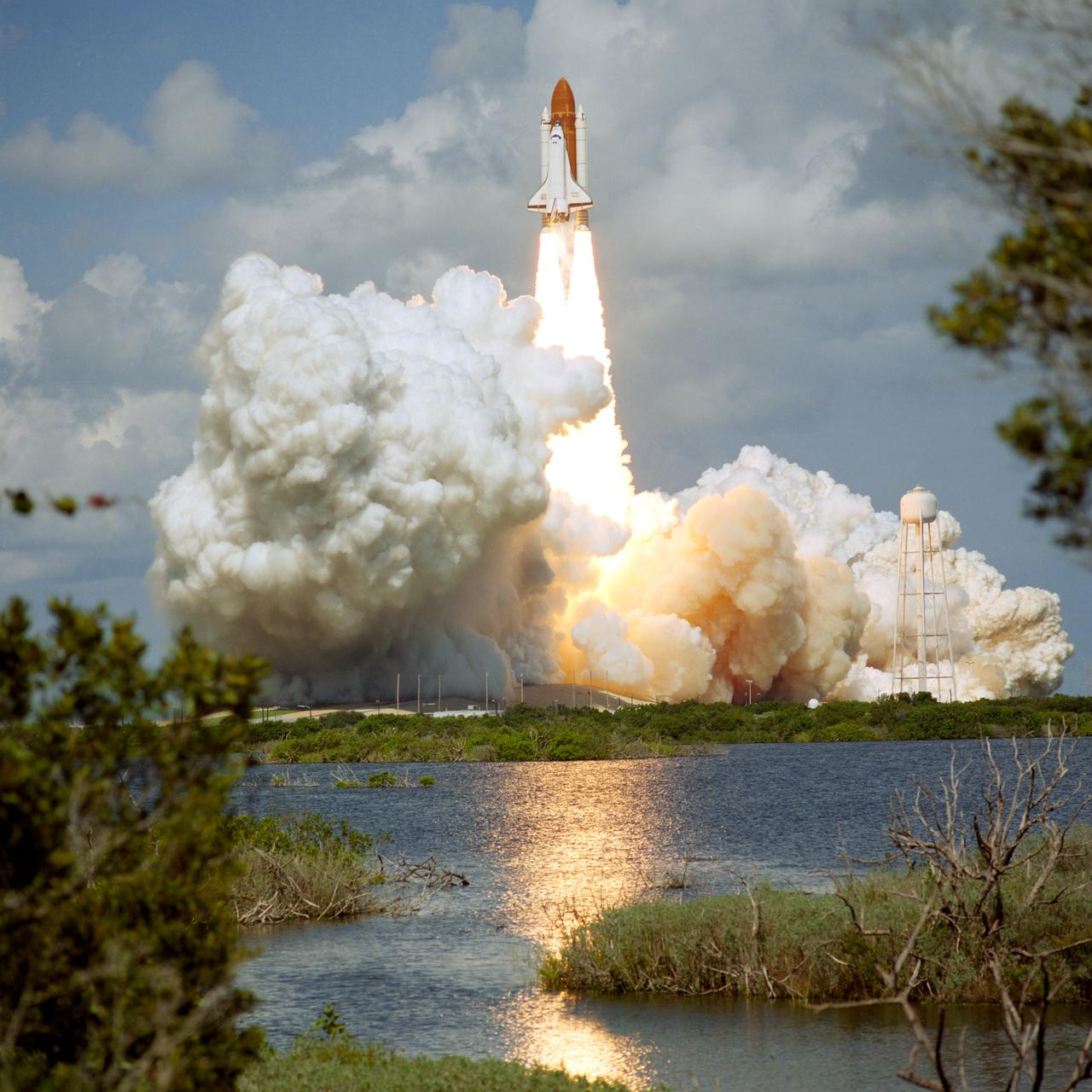
STS034-S-025 (18 Oct 1989) --- The STS-34 Space Shuttle Atlantis lifts off from Launch Pad 39-B at 2:53:39:983 p.m. (EDT), marking the beginning of a five-day mission in space. Atlantis carries a crew of five and the spacecraft Galileo, along with a number of other scientific experiments. The Jupiter-bound probe will be deployed from Atlantis some six hours after launch. The journey to the giant planet is expected to take over six years. Crewmembers for the mission are astronauts Donald E. Williams, Michael J. McCulley, Shannon W. Lucid, Franklin R. Chang-Diaz and Ellen S. Baker. The scene was recorded with a 70mm camera.
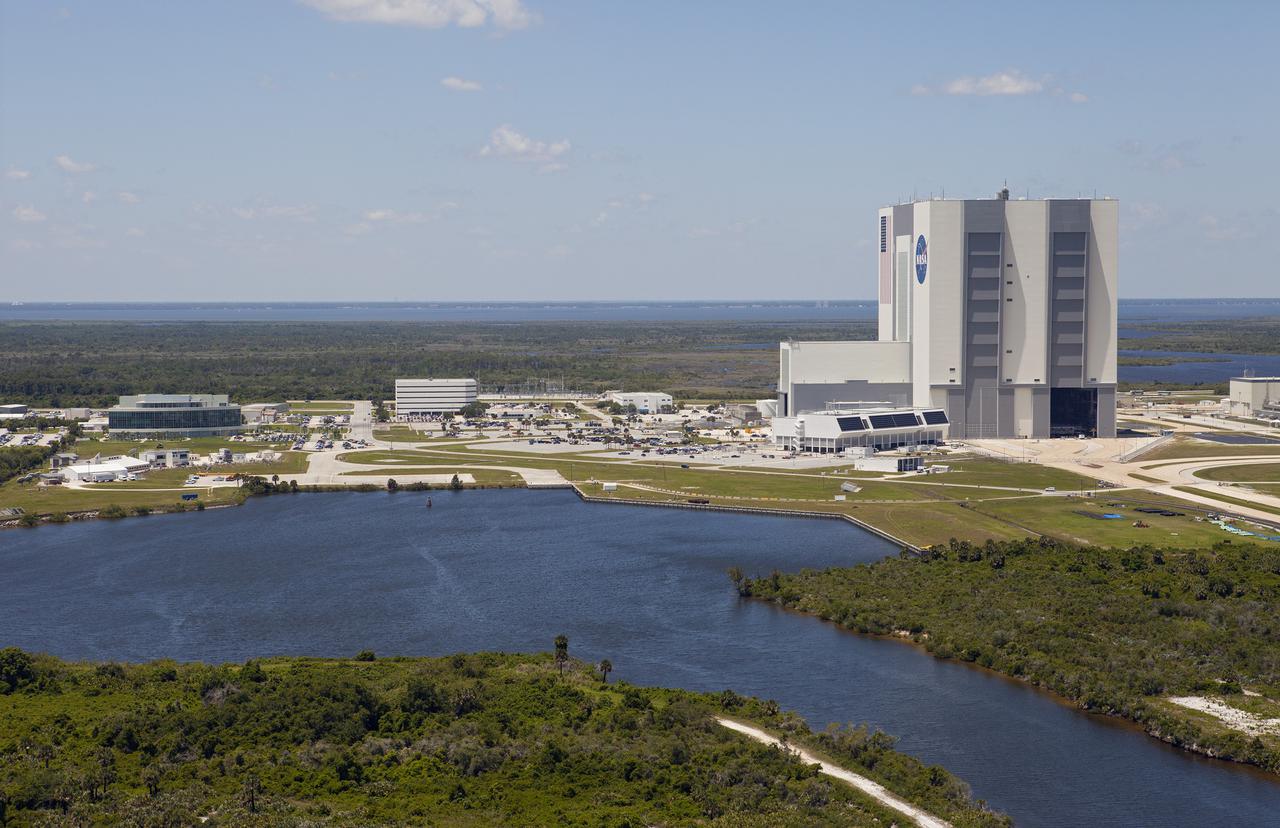
CAPE CANAVERAL, Fla. – An up close aerial view of the Vehicle Assembly Building and other facilities in the Launch Complex 39 area at NASA’s Kennedy Space Center in Florida. In front of the VAB is the Launch Control Center. To the left are the Operations Support Buildings I and II. Upgrades are underway at Pad B and other facilities in the Launch Complex 39 area. The Ground Systems Development and Operations, or GSDO, Program office at Kennedy is leading the center’s transformation from a historically government-only launch complex to a spaceport that can safely handle a variety of rockets and spacecraft, including NASA’s Space Launch System. For more information about GSDO, visit: http:__go.nasa.gov_groundsystems. Photo credit: NASA_Kim Shiflett
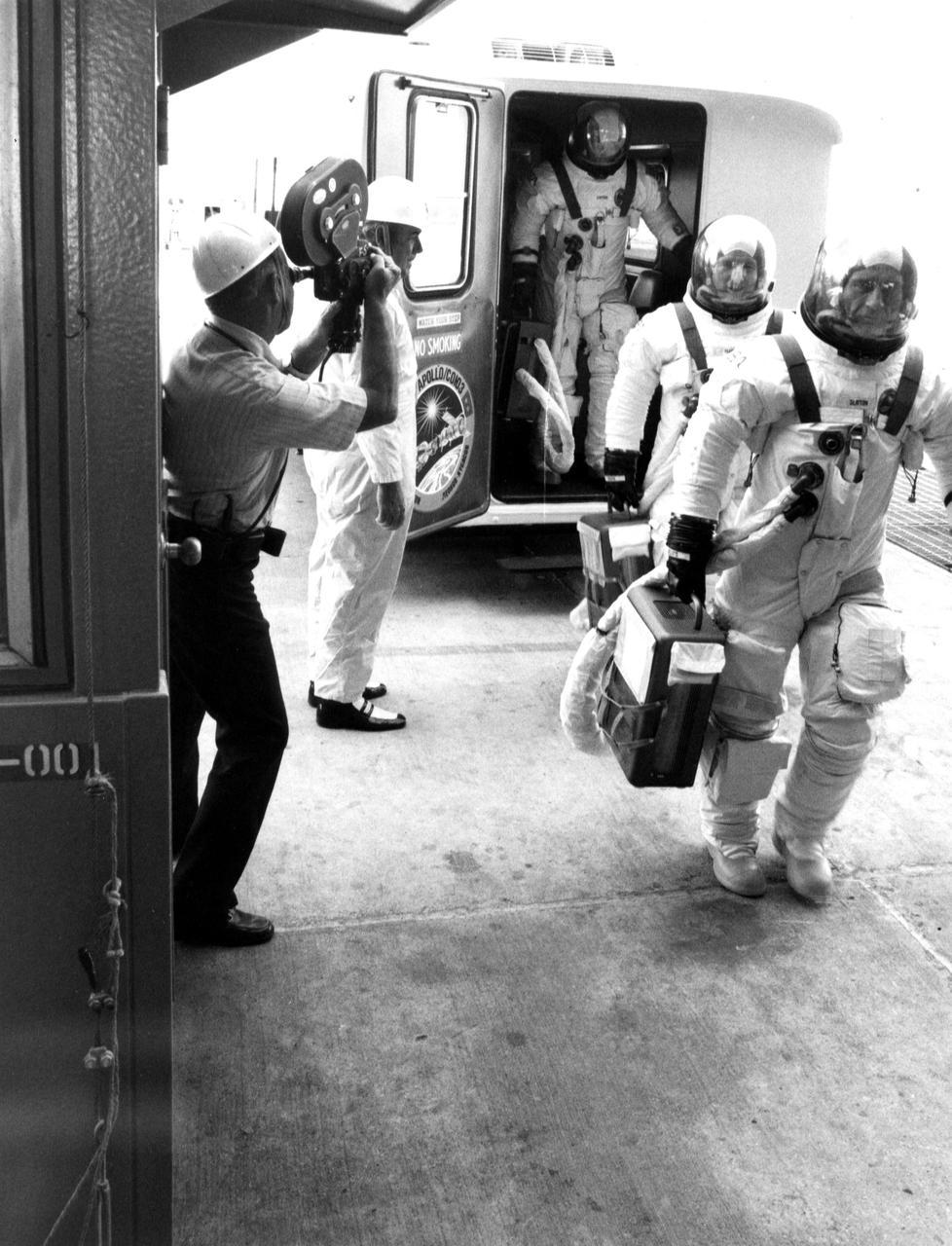
KENNEDY SPACE CENTER, FLA. -- ASTP asstronauts Donald slayton, Vance Brand and Thomas Stafford leave the transfer van at Complex 39's Pad B and enter the pad elevator during the Countdown Demonstration Test. The test, a step-by-step dress rehearsal for the July 15 launch, simulates the actual countdown but without the propellants in the Saturn IB launch vehicle's fuel tanks. The fueled portion of the test was conducted yesterday.
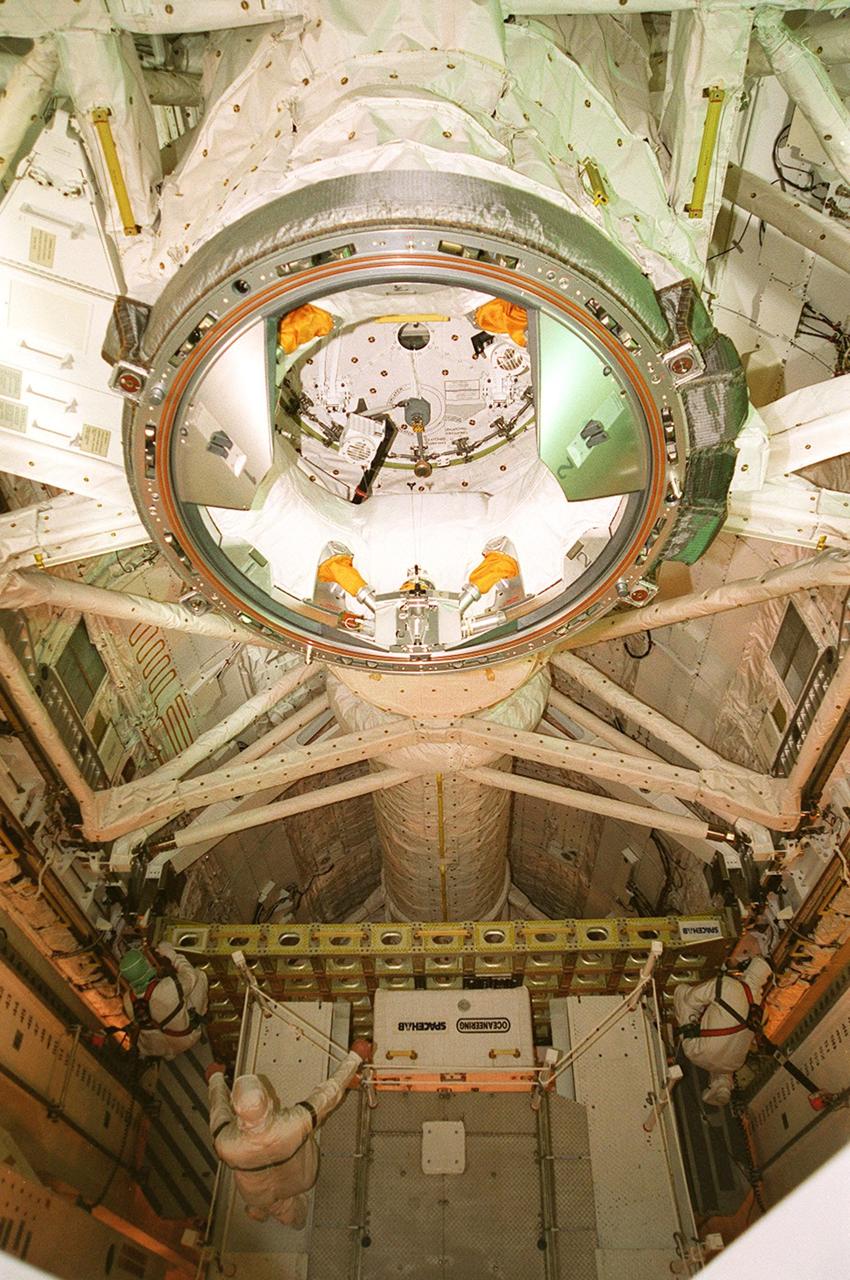
KENNEDY SPACE CENTER, FLA. -- Technicians facilitate the transfer the STS-106 payload to Atlantis on Launch Pad 39-B using the Payload Ground Handling Mechanism (PGHM). The circular structure shown is the docking adapter. The PGHM (pronounced pigem) is located inside the Payload Changeout Room (PCR) of each shuttle launch pad’s Rotating Service Structure. The PGHM removes payloads from a transportation canister and installs them into the orbiter. It is essentially NASA’s largest fork-lift
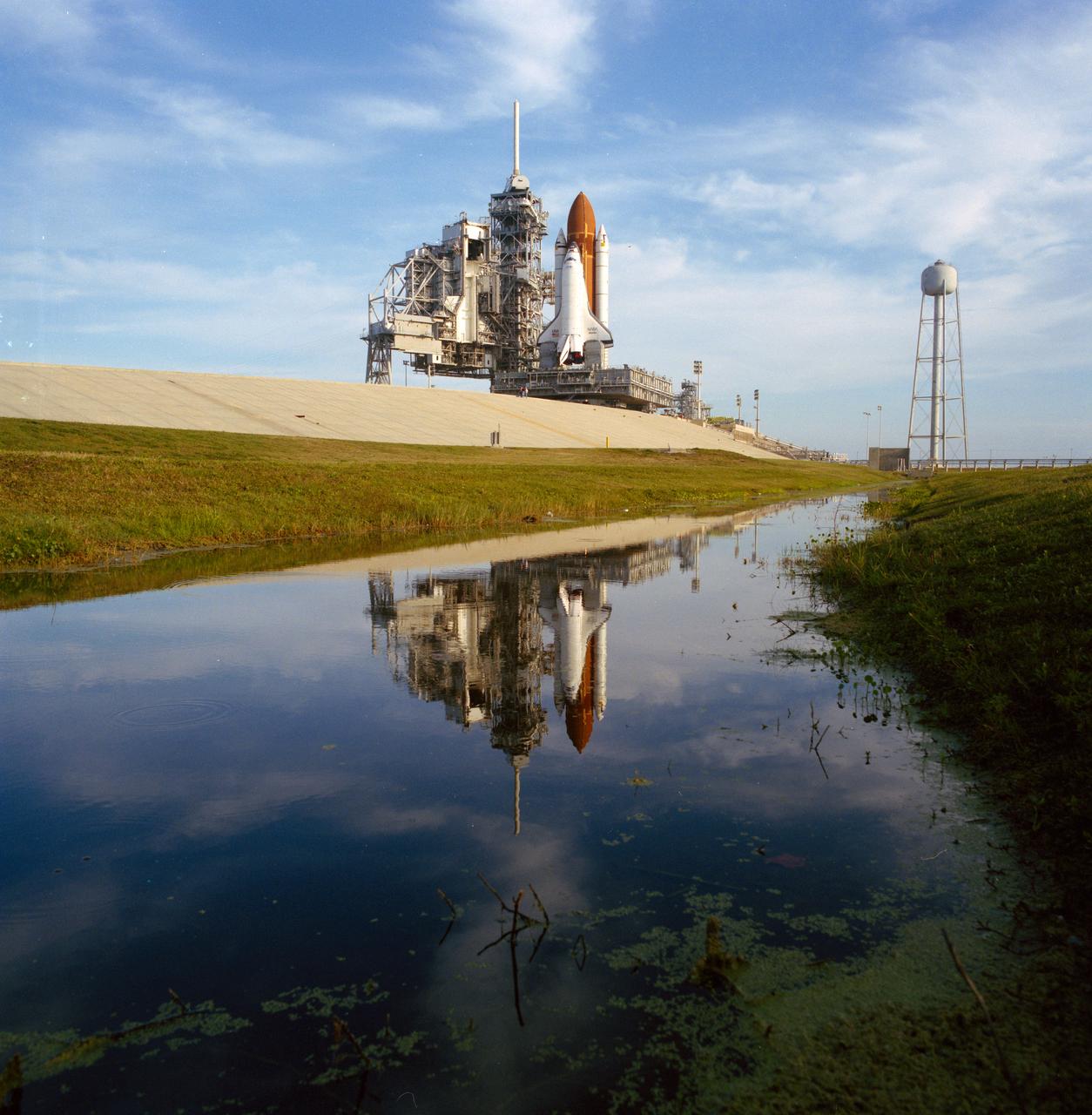
S89-30719 (22 March 1989) --- Space shuttle Atlantis is seen soon in duplicate, thanks to reflection in nearby water, after arriving at Pad 39-B. The spacecraft left the vehicle assembly building (VAB) at 12:01A.M. and arrived to this point at 7 A.M. Atlantis is scheduled for NASA STS-30 mission on which the Magellan will be deployed to orbit planet Venus and map its topographic features. Launch is scheduled for April 28.
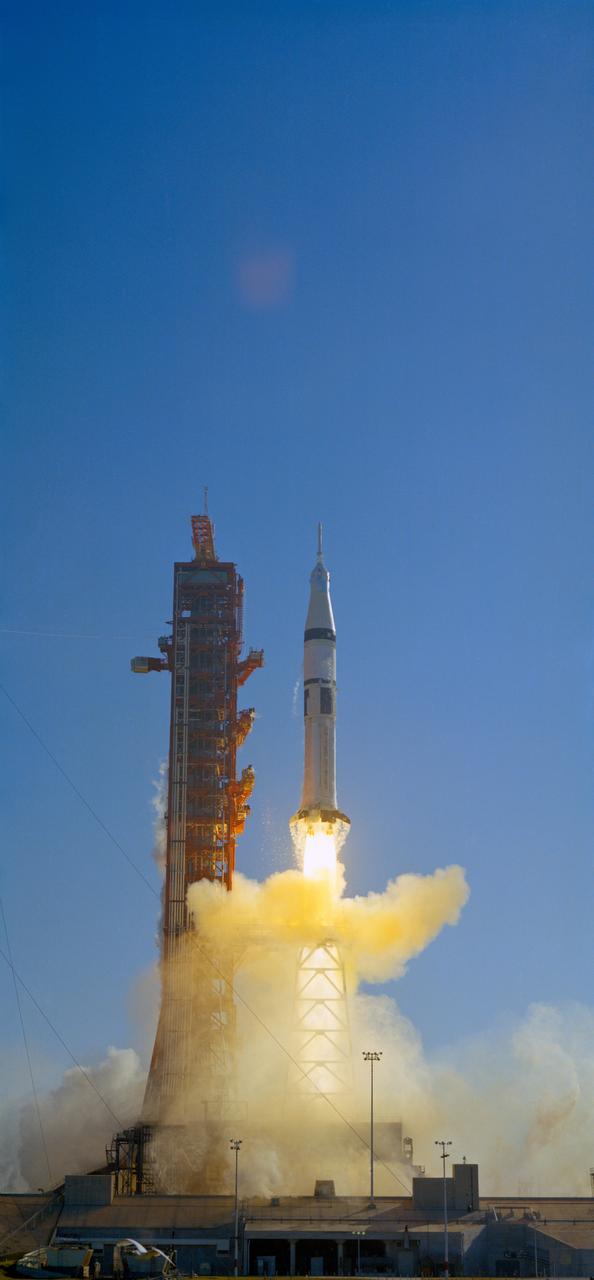
S73-37287 (16 Nov. 1973) --- The Skylab 4/Saturn 1B space vehicle is launched from Pad B, Launch Complex 39, Kennedy Space Center, Florida, at 9:01:23 a.m., Friday, Nov. 16, 1973. Skylab 4 is the third and last of three scheduled manned Skylab missions. Photo credit: NASA
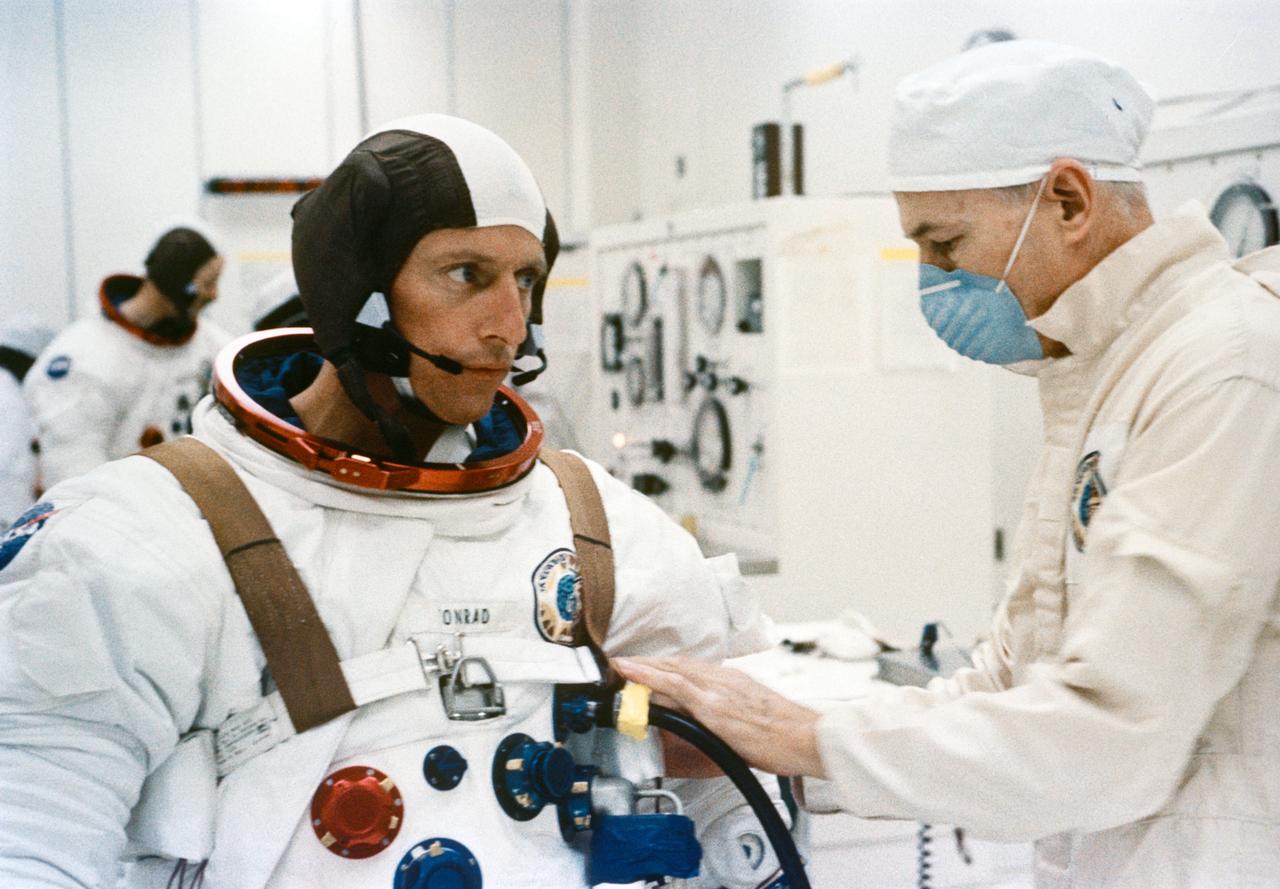
S73-25901 (25 May 1973) --- Astronaut Charles Conrad Jr., commander of the Skylab 2 mission, is suited up in the Manned Spacecraft Operations Building at the Kennedy Space Center during Skylab 2 prelaunch preparations. Skylab 2, with astronauts Conrad, Joseph P. Kerwin and Paul J. Weitz aboard, was launched from KSC's Pad B, Launch Complex 39, at 9:00 a.m. (EDT), May 25, 1973. Photo credit: NASA
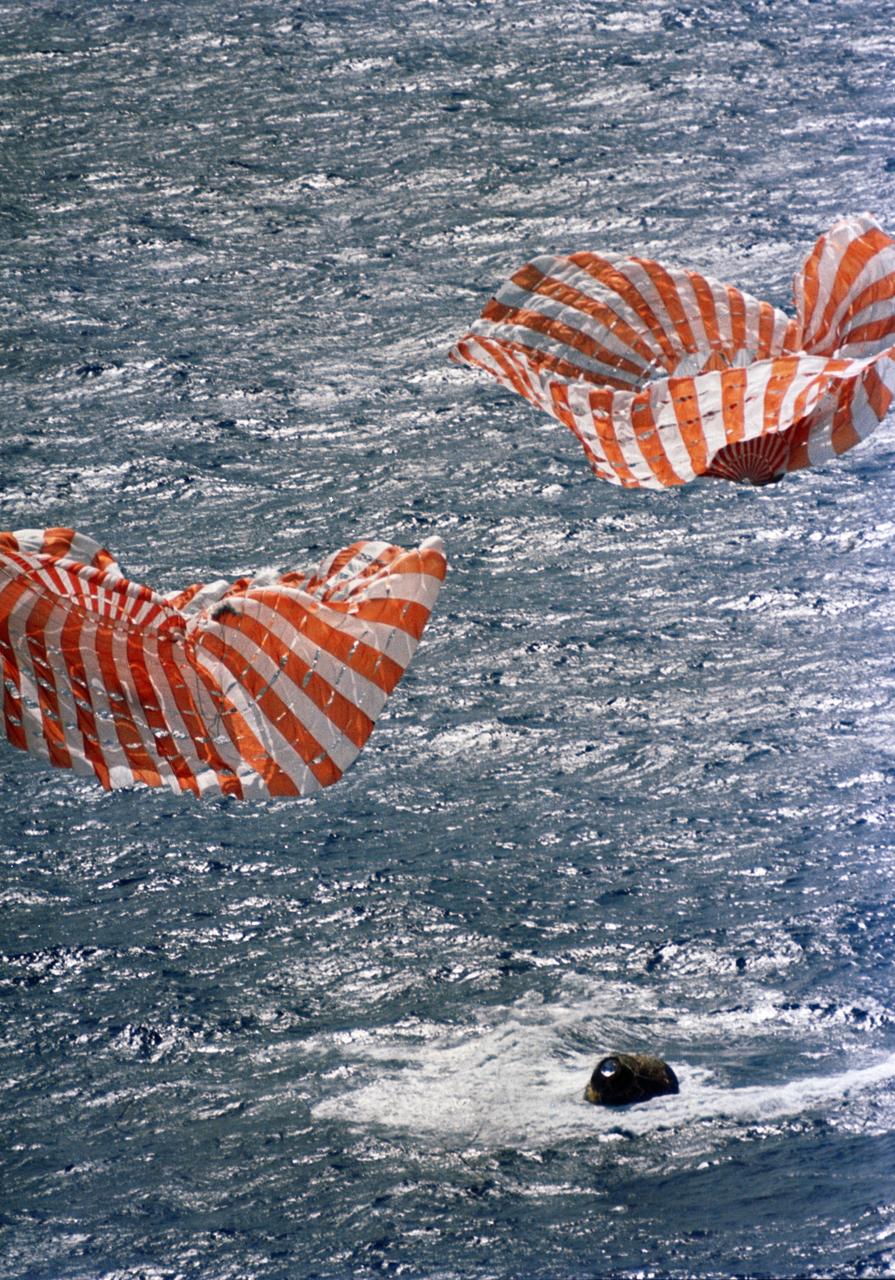
S71-19472 (9 Feb. 1971) --- The Apollo 14 Command Module (CM) splashes down and two of its three main parachutes can be seen collapsing, as the 10-day mission comes to a safe and successful end. The Apollo 14 spacecraft, with astronauts Alan B. Shepard Jr., commander; Stuart A. Roosa, command module pilot; and Edgar D. Mitchell, lunar module pilot, aboard, splashed down at 3:04:39 p.m. (CST) approximately 765 nautical miles southeast of American Samoa.
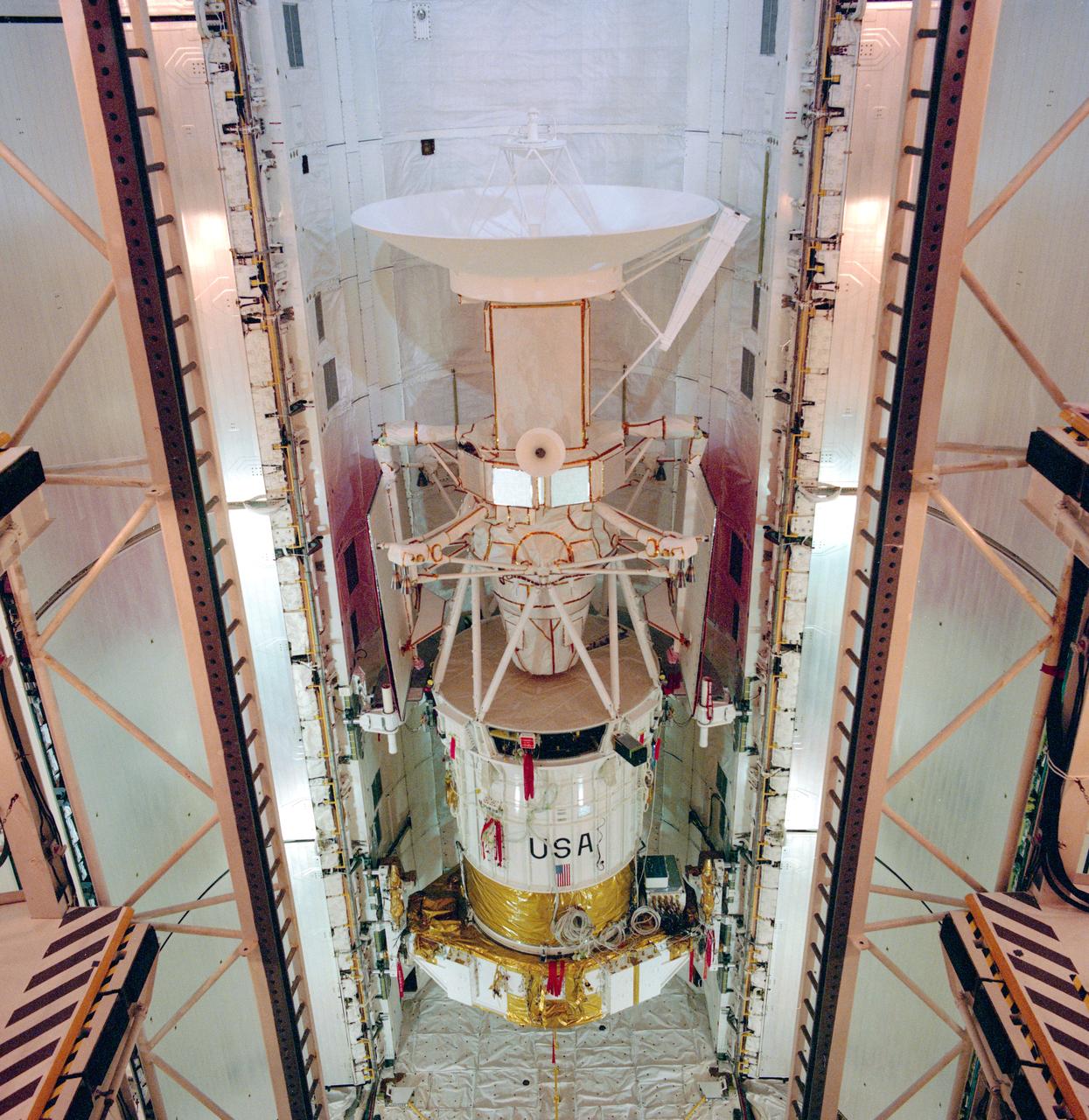
S89-30720 (29 March 1989) --- The spacecraft Magellan is in the payload bay of the orbiter Atlantis at launch pad 39-B. Magellan is scheduled to be released from Atlantis April 28, 1989, on NASA's STS-30 mission. Its mission will be the first U.S. planetary probe in over 10 years and it is the first deployed by the shuttle. The mission calls for the spacecraft to make the approximately 15-month journey to the planet Venus and perform radar mapping operations, transmitting the information back to NASA's Jet Propulsion Laboratory (JPL) in California.
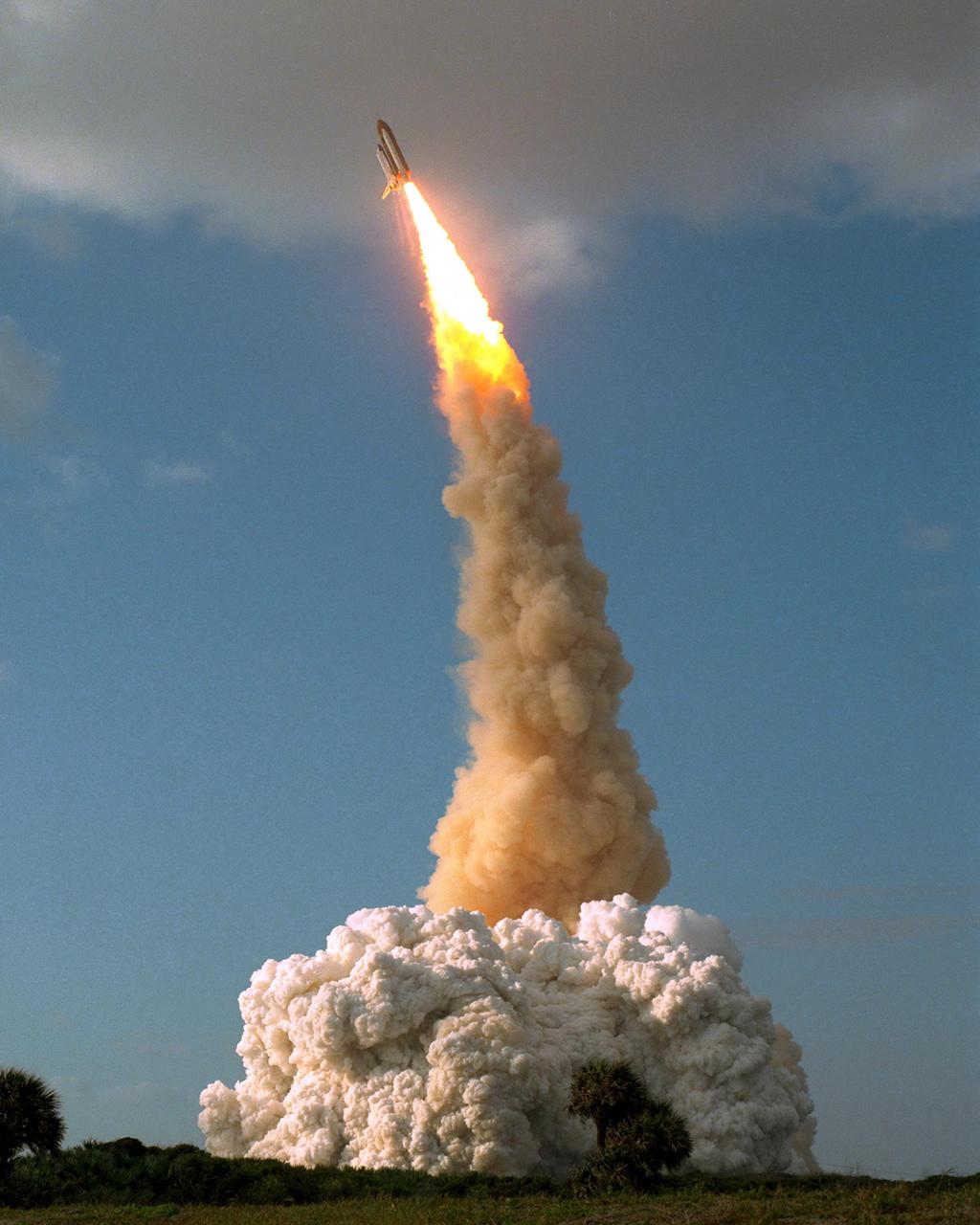
KENNEDY SPACE CENTER, FLA. -- The Space Shuttle Discovery lifts off from Pad 39-B at 8:33 a.m. EDT carrying a crew of five and the Hubble Space Telescope. STS-31 crew members are Commander Loren Shriver, Pilot Charles Bolden and Mission Specialists Steven Hawley, Bruce McCandless II and Kathryn Sullivan.
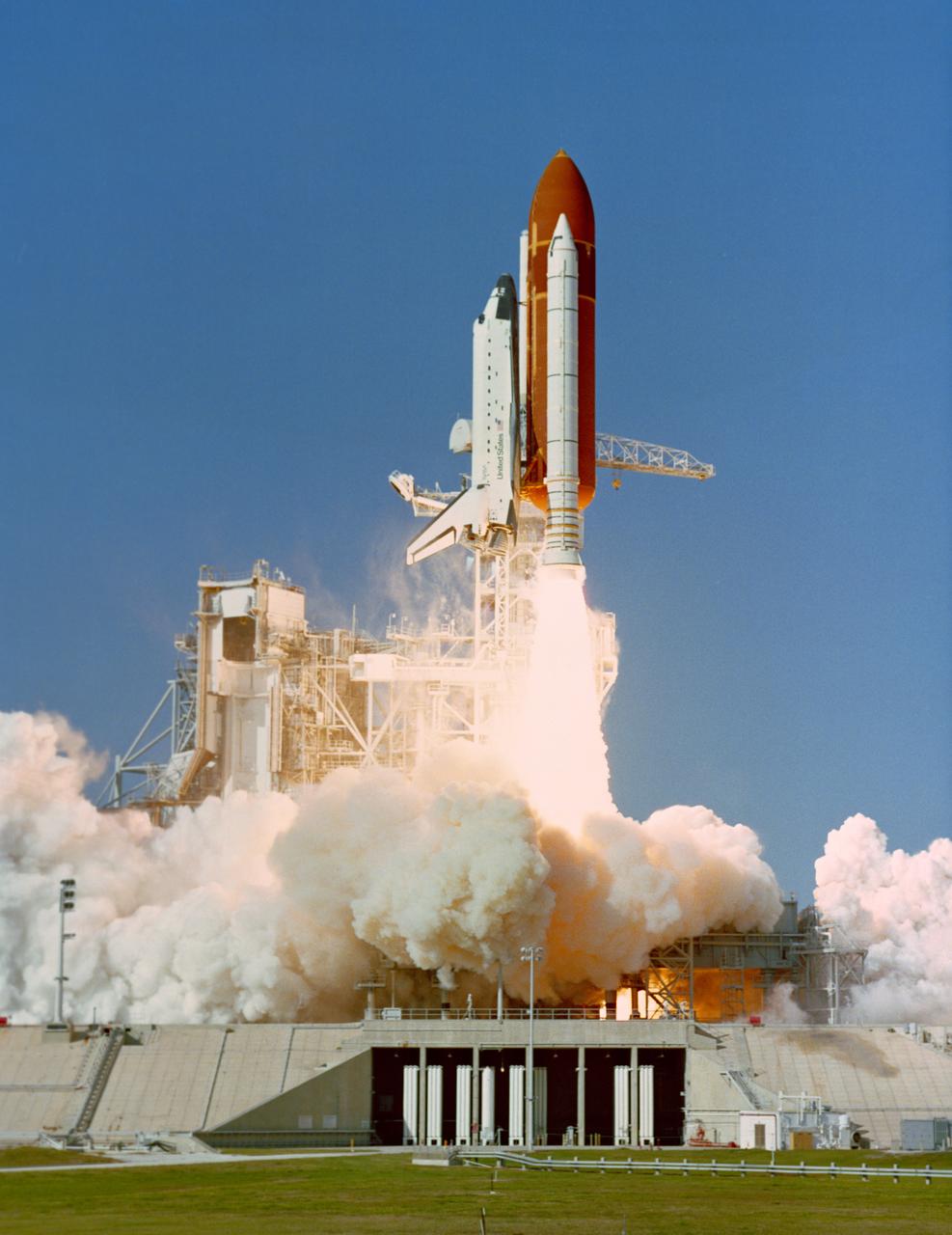
STS027-S-005 (Dec 2, 1988) --- Space Shuttle Atlantis is launched from Kennedy Space Center's (KSC) Pad 39-B at 9:30 a.m. EST, on a Department of Defense (DOD) dedicated mission. This is the third mission for the orbiter Atlantis. Crew members are: Commander Robert L. "Hoot" Gibson; Pilot Guy S. Gardner; and Mission Specialists Jerry L. Ross, William M. Shepherd and Richard M. (Mike) Mullane.
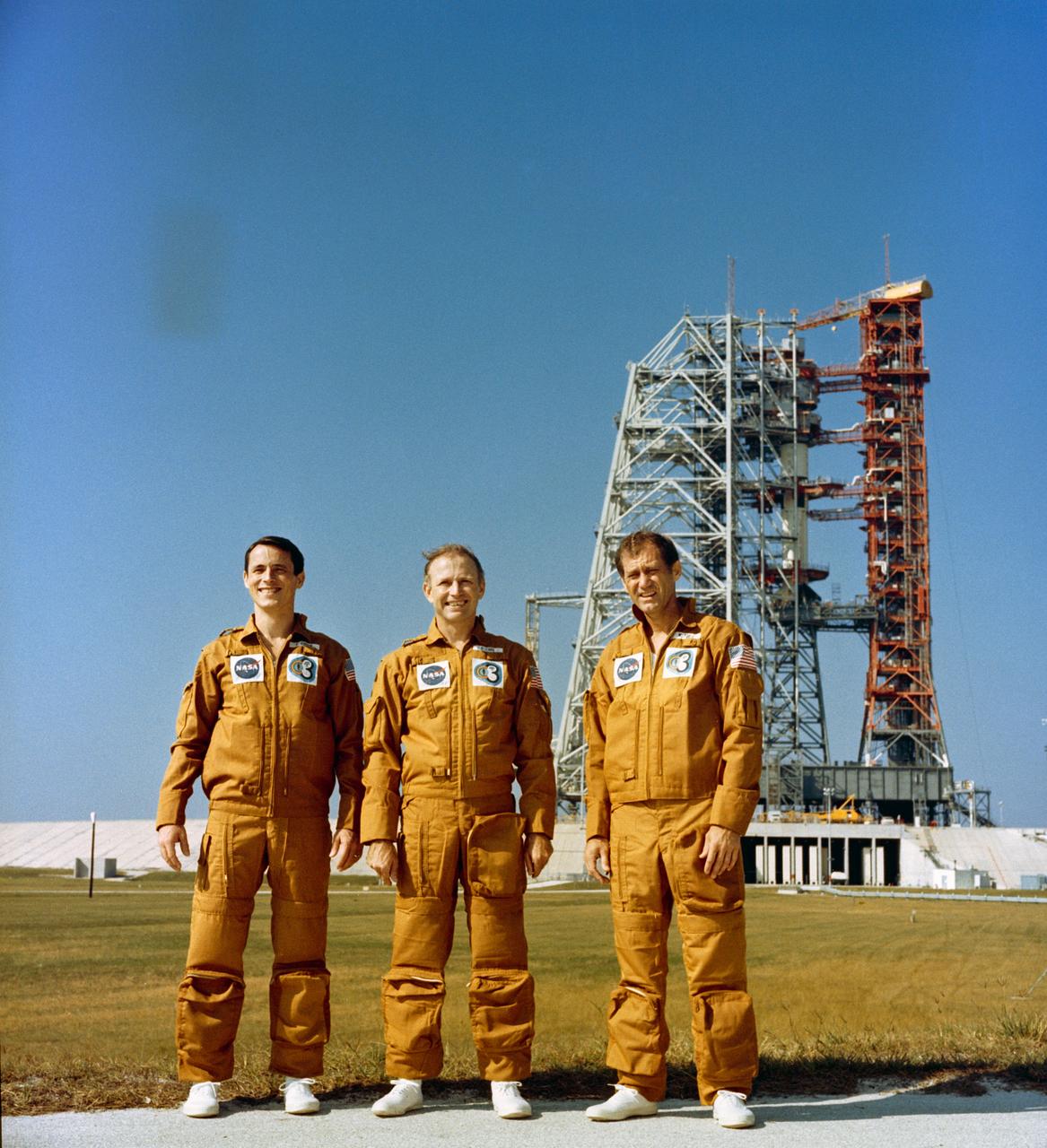
S73-36904 (8 Nov. 1973) --- The three members of the Skylab 4 crew are photographed standing near Pad B, Launch Complex 39, Kennedy Space Cneter, Florida, during the preflight activity. They are, left to right, scientist-astronaut Edward G. Gibson, science pilot; astronaut Gerald P. Carr, commander; and astronaut William R. Pogue, pilot. Photo credit: NASA
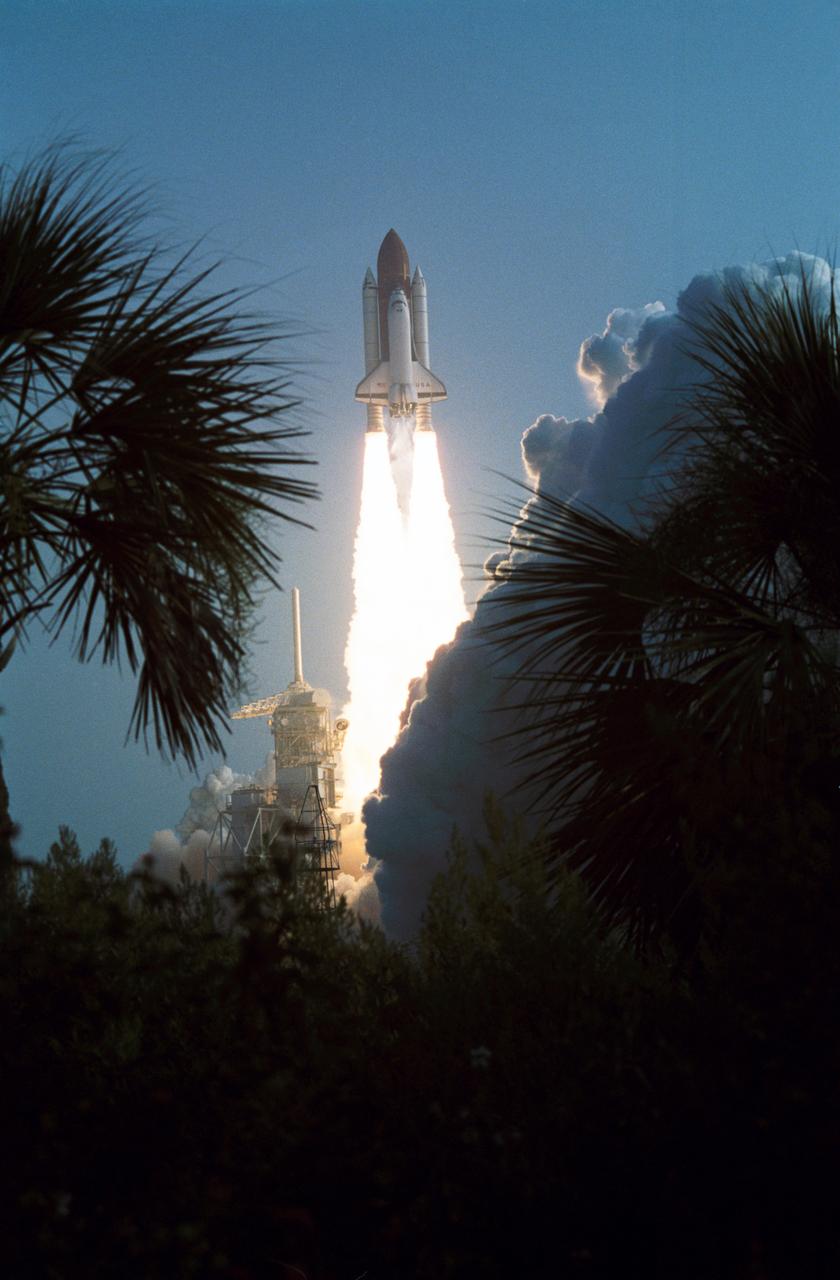
STS028-S-004 (8 Aug. 1989) --- Framed by Florida vegetation, Space Shuttle Columbia soars toward space for the STS-28 mission from Launch Pad 39-B. The spacecraft renews flight after a period of three and a half years, this time with five crewmembers aboard. Onboard the spacecraft are astronauts Brewster H. Shaw Jr., Richard N. Richards, David C. Leestma, James C. Adamson and Mark N. Brown. The last time Columbia was in space was in January of 1986.
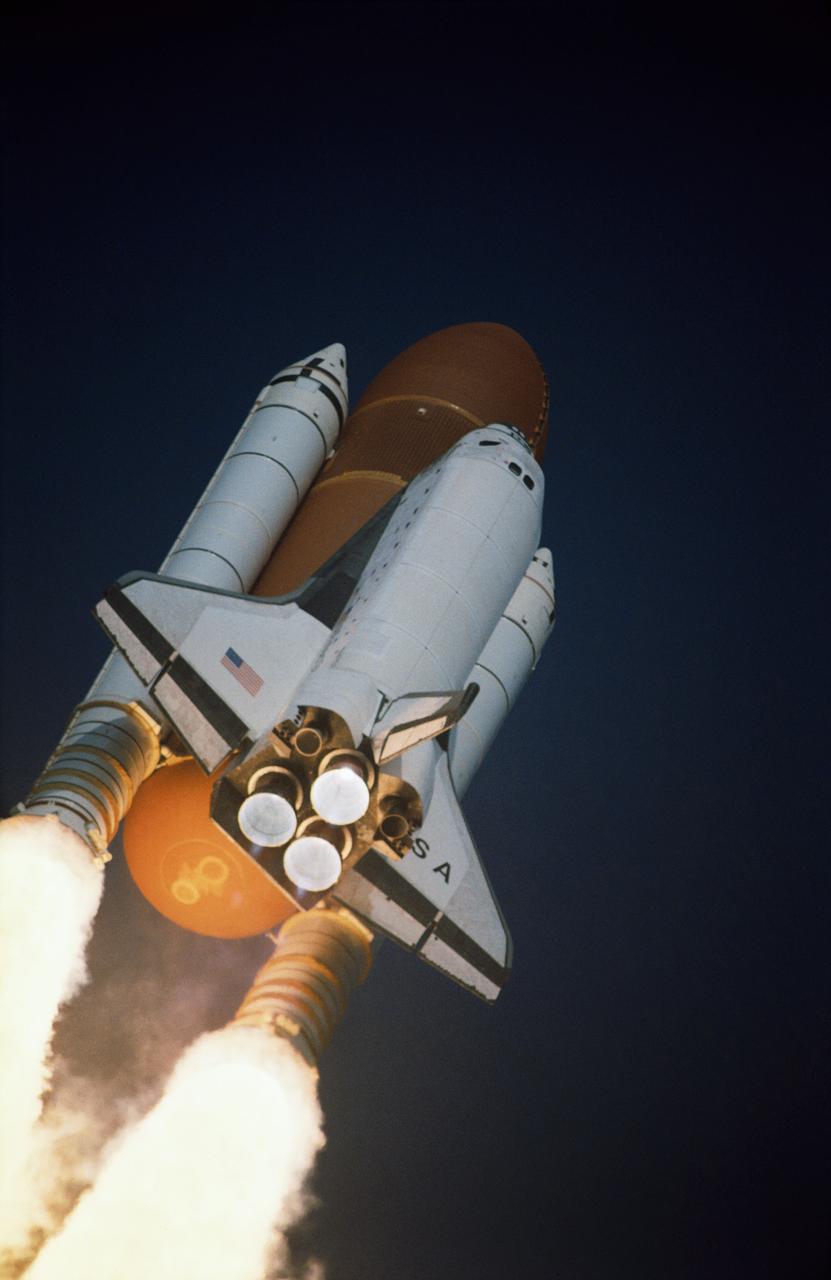
STS028-S-006 (8 Aug 1989) --- A low-angle view shows Columbia soaring toward space just after clearing the tower at Launch Pad 39-B for the STS-28 mission. The spacecraft renews flight after a period of three and a half years, this time with five crewmembers aboard. Onboard the spacecraft are Astronauts Brewster H. Shaw Jr., Richard N. Richards, David C. Leestma, James C. Adamson and Mark N. Brown. The last time Columbia was in space was in January of 1986.

The space shuttle Discovery lifts off from Launch Pad 39-B at 8:33 a.m. EDT carrying a crew of five and the Hubble Space Telescope. STS-31 crew members are Commander Loren Shriver, Pilot Charles Bolden and Mission Specialists Steven Hawley, Bruce McCandless II and Kathryn Sullivan. Photo credit: NASA
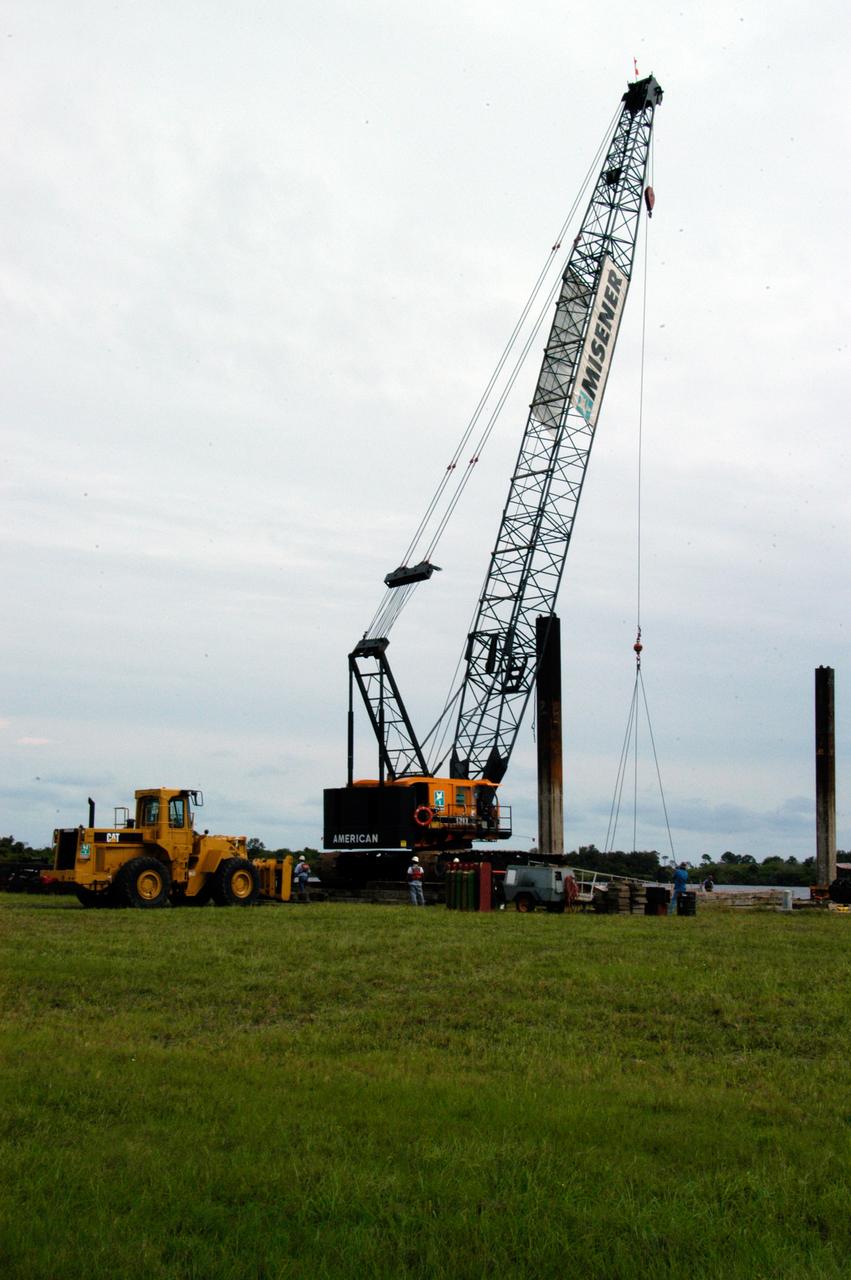
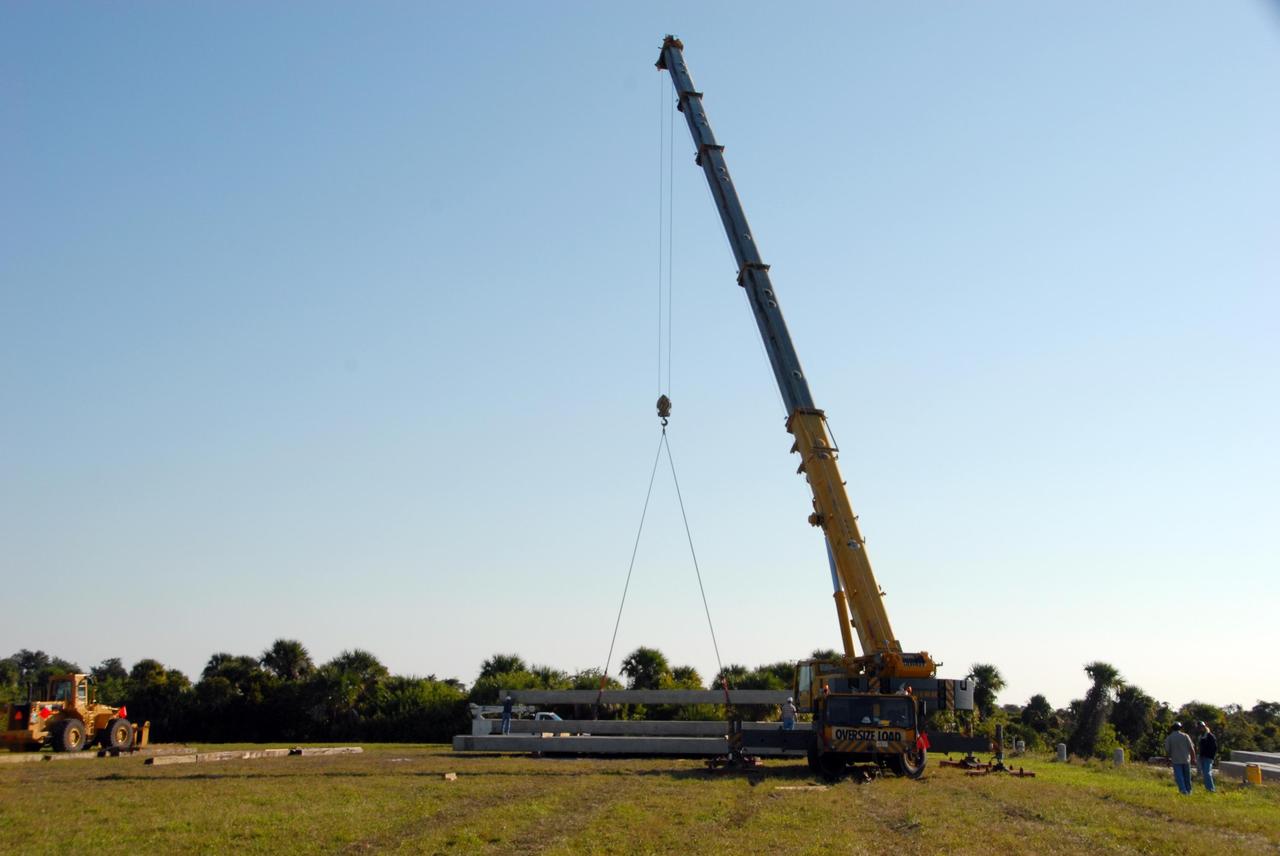
A large crawler crane arrives at the turn basin at the Launch Complex 39 Area on NASA's Kennedy Space Center. The crane with its 70-foot boom will be moved to Launch Pad 39B and used to construct a new lightning protection system for the Constellation Program and Ares/Orion launches. Pad B will be the site of the first Ares vehicle launch, including Ares I-X which is scheduled for April 2009.

KENNEDY SPACE CENTER, FLA. -- During the transfer the STS-106 payload to Atlantis on Launch Pad 39-B, a technician turns a switch to move the Payload Ground Handling Mechanism (PGHM). The mechanism is located inside the Payload Changeout Room (PCR) of each shuttle launch pad’s Rotating Service Structure. The PGHM (pronounced pigem) removes payloads from a transportation canister and installs them into the orbiter. It is essentially NASA’s largest fork-lift
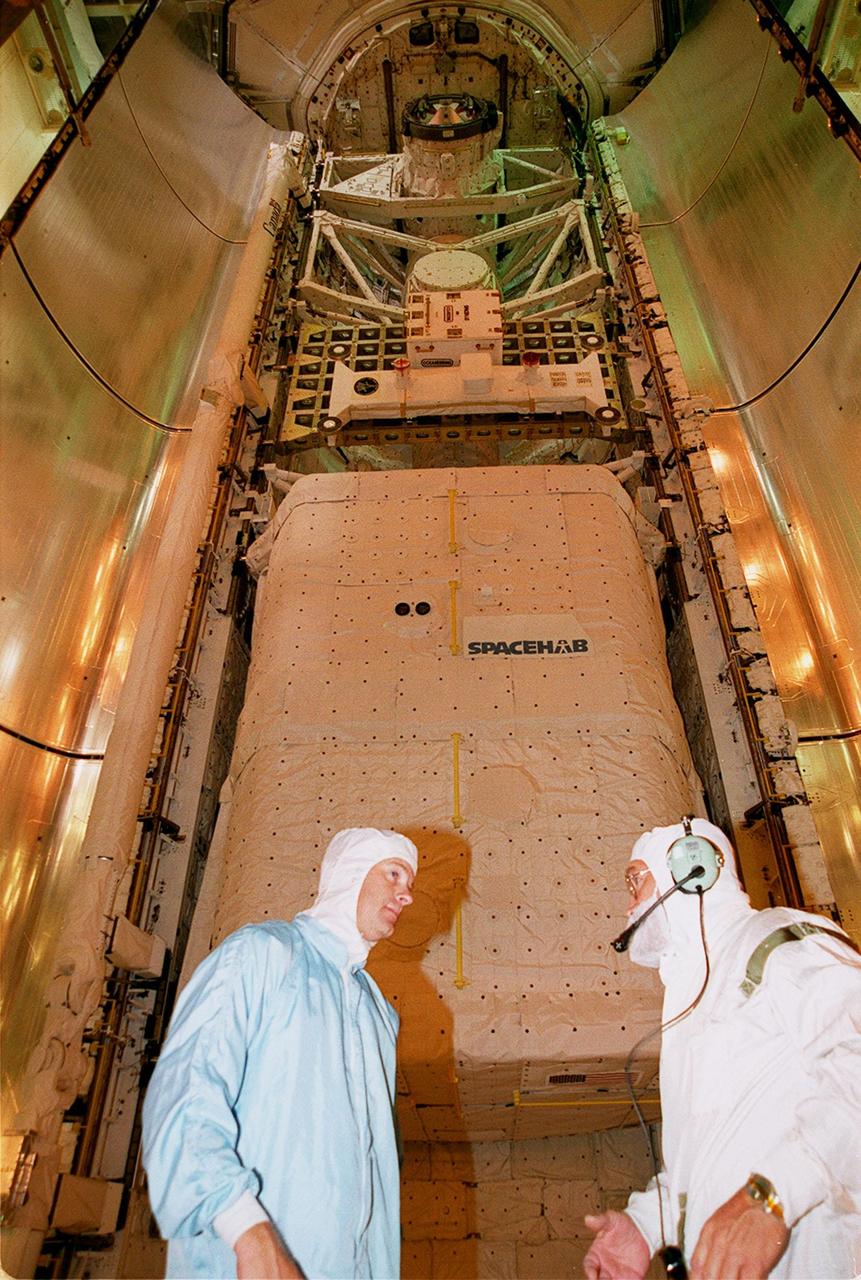
KENNEDY SPACE CENTER, FLA. -- Technicians facilitate the transfer the STS-106 payload to Atlantis on Launch Pad 39-B using the Payload Ground Handling Mechanism (PGHM). The payload within the SPACEHAB module is shown just after being loaded in the payload bay of Atlantis. The PGHM (pronounced pigem) is located inside the Payload Changeout Room (PCR) of each shuttle launch pad Rotating Service Structure. The PGHM removes payloads from a transportation canister and installs them into the orbiter. It is essentially NASA’s largest fork-lift
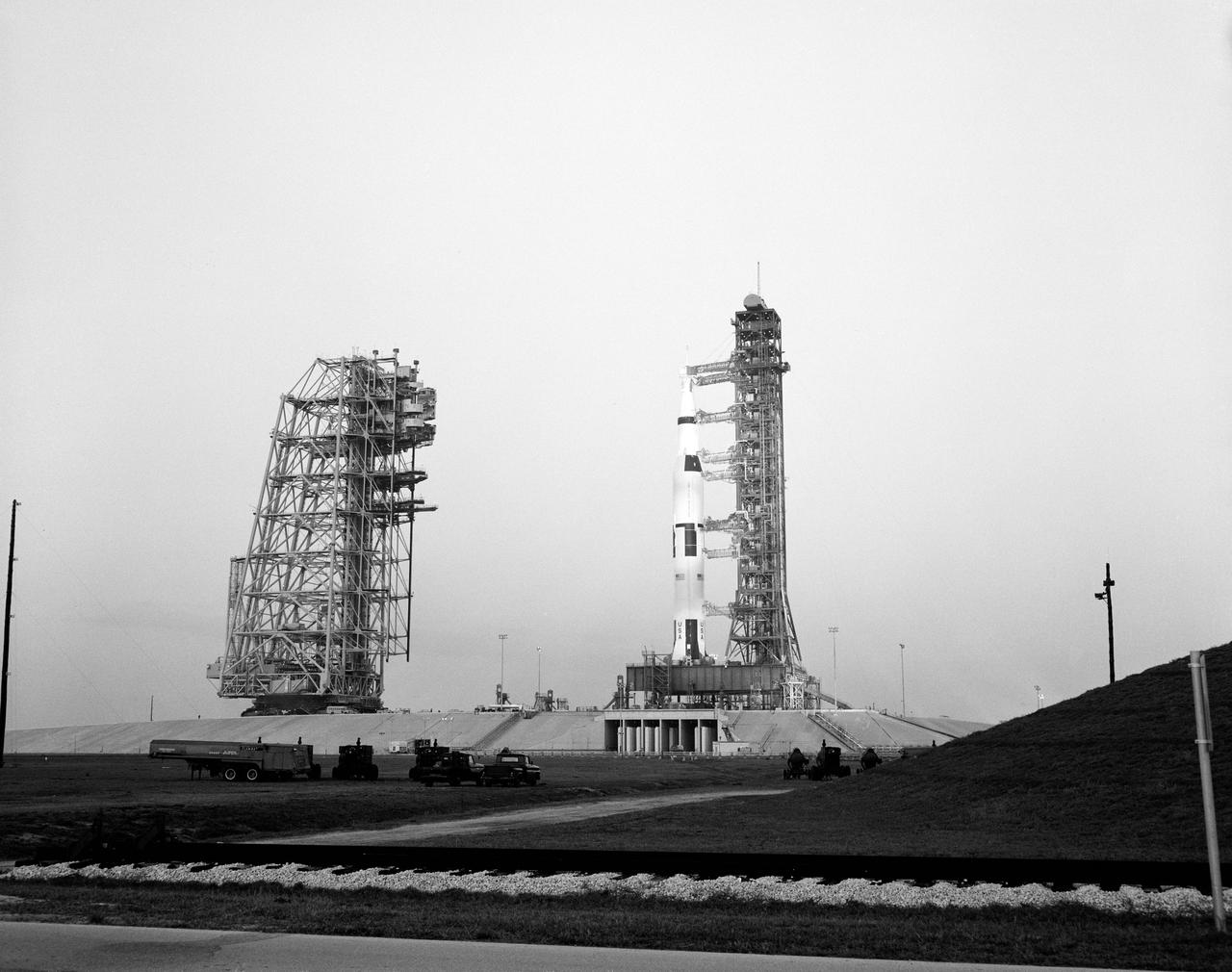
S69-27089 (11 March 1969) --- Overall view of Pad B, Launch Complex 39, Kennedy Space Center, showing the Apollo 10 (Spacecraft 106/Lunar Module-4/Saturn 505) space vehicle during a Countdown Demonstration Test. The Apollo 10 flight is scheduled as a lunar orbit mission. The Apollo 10 crew will be astronauts Thomas P. Stafford, commander; John W. Young, command module pilot; and Eugene A. Cernan, lunar module pilot.
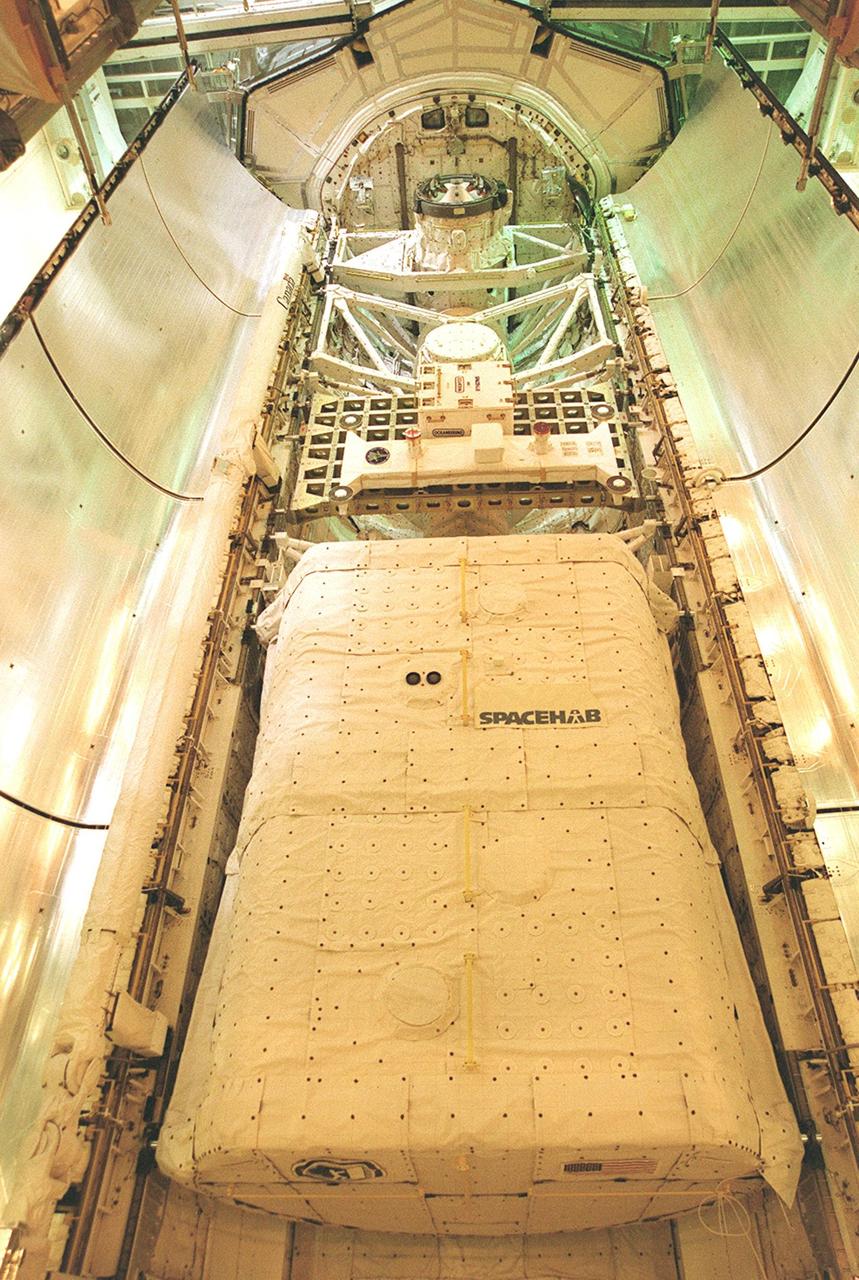
KENNEDY SPACE CENTER, FLA. -- The STS-106 payload within the SPACEHAB Module is shown after being loaded onto Atlantis on Launch Pad 39-B using the Payload Ground Handling Mechanism (PGHM). The PGHM (pronounced pigem) is located inside the Payload Changeout Room (PCR) of each shuttle launch pad’s Rotating Service Structure. The PGHM removes payloads from a transportation canister and installs them into the orbiter. It is essentially NASA’s largest fork-lift
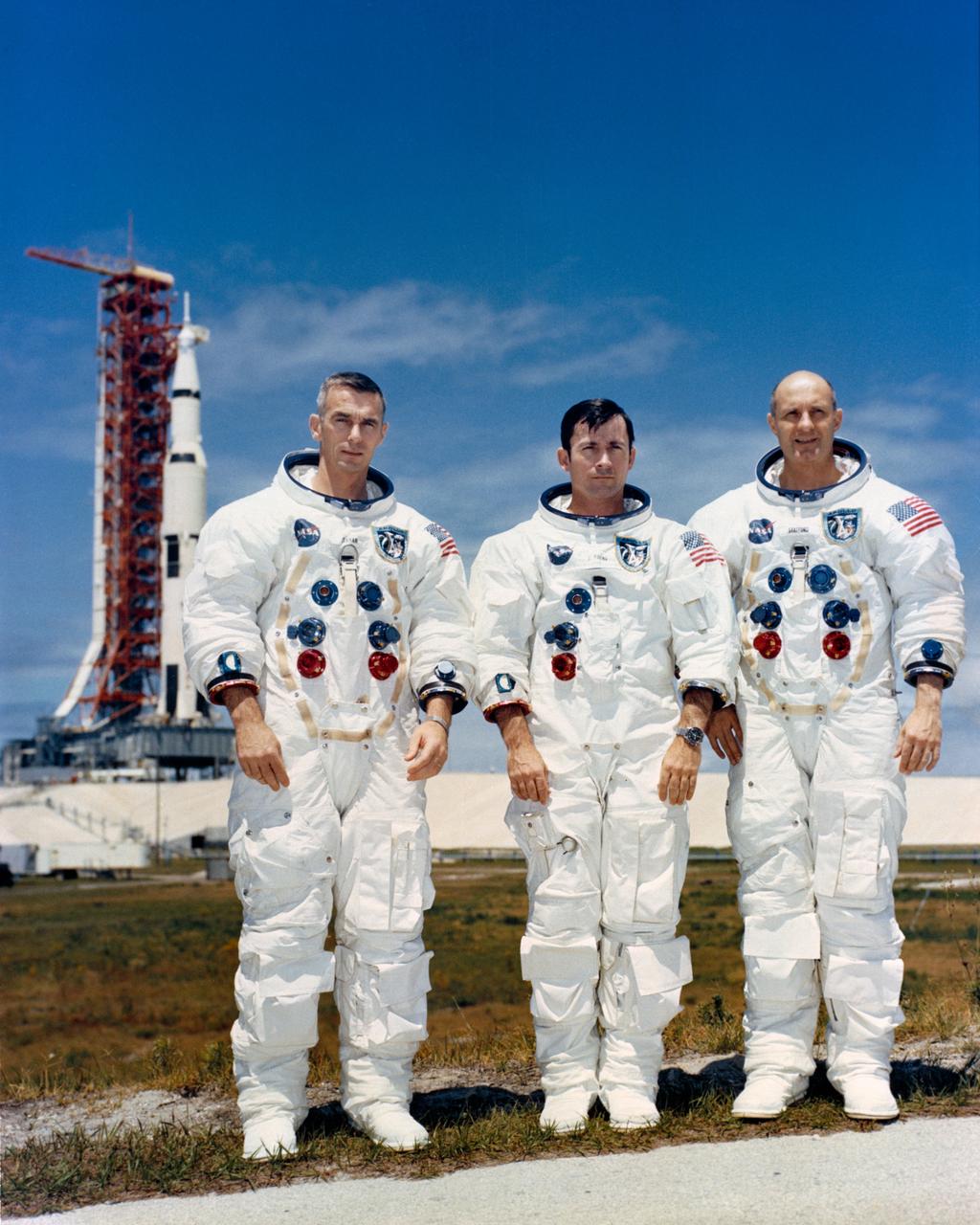
S69-34329 (13 May 1969) --- The prime crew of the Apollo 10 lunar orbit mission sits for photograph while at the Kennedy Space Center for preflight training. Left to right are astronauts Eugene A. Cernan, lunar module pilot; John W. Young, command module pilot; and Thomas P. Stafford, commander. In the left background is the Apollo 10 space vehicle on Pad B, Launch Complex 39, Kennedy Space Center. The three crewmen had just completed a Countdown Demonstration Test exercise.
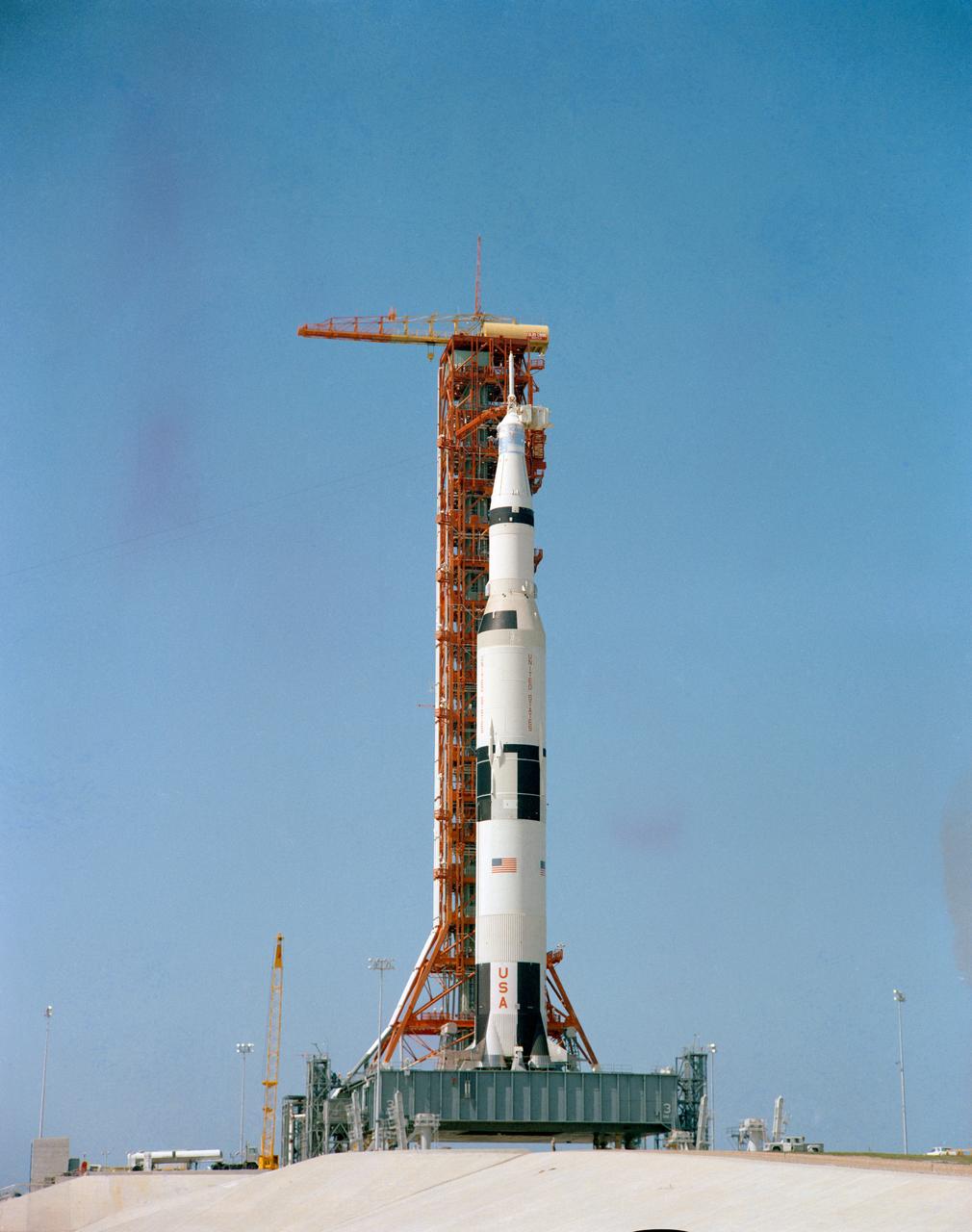
S69-33853 (4 May 1969) --- Ground-level view of the Apollo 10 (Spacecraft 106/Lunar Module 4/Saturn 505) space vehicle on Pad B, Launch Complex 39, Kennedy Space Center, Florida. This photograph of the 363-feet tall Apollo/Saturn V stack was taken during Countdown Demonstration Test (CDDT) activity. The Apollo 10 crew will be astronauts Thomas P. Stafford, commander; John W. Young, command module pilot; and Eugene A. Cernan, lunar module pilot.
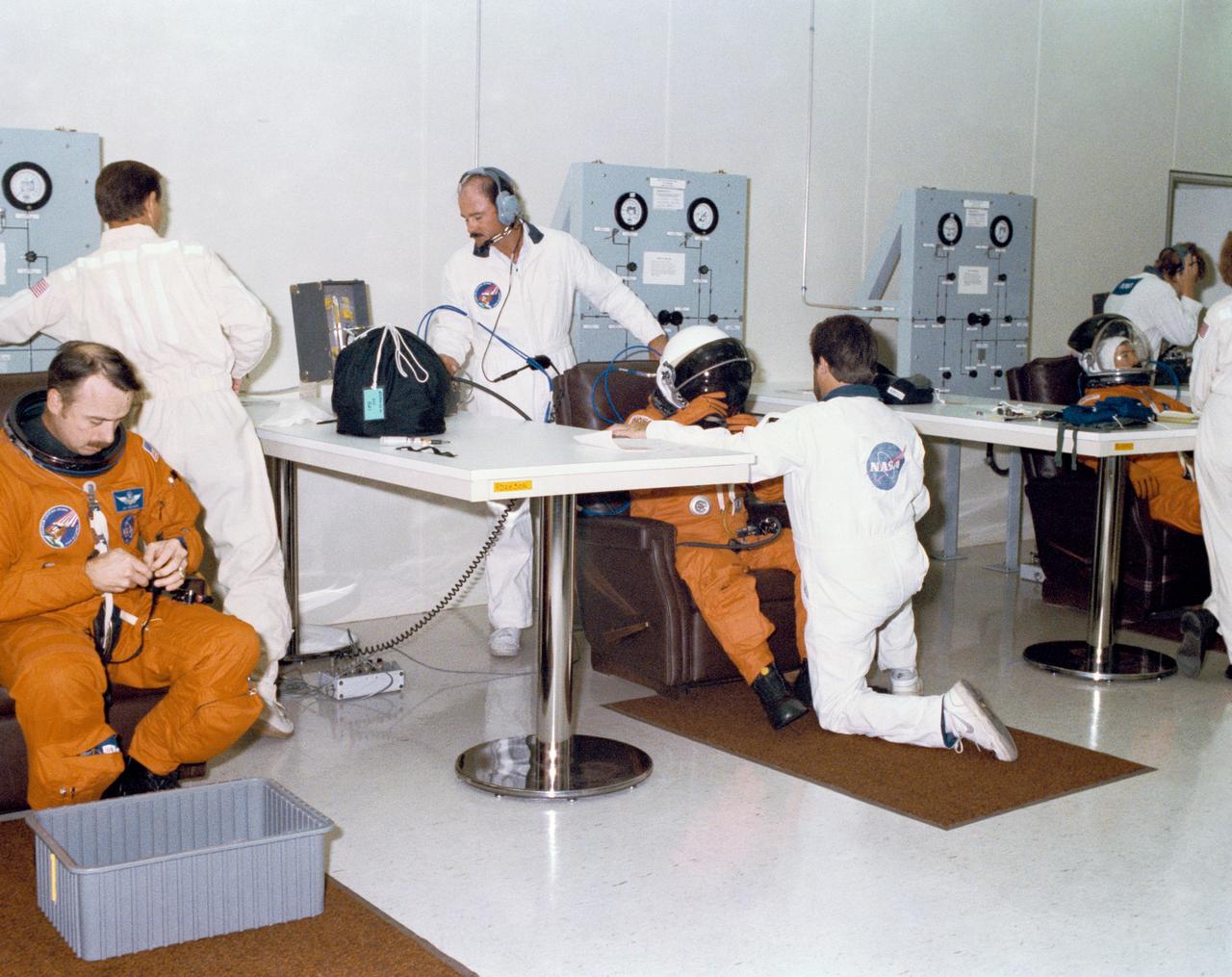
S89-41091 (18 July 1989) --- During the Terminal Countdown Demonstration Test (TCDT), STS-28 crew members are assisted with suiting up in the Operations and Checkout Building prior to departing for pad 39-B. STS-28 and the Space Shuttle Columbia are scheduled to be launched in early August on a Department of Defense dedicated mission. The crew for STS-28 are Commander Brewster H. Shaw; Pilot Richard N. Richards; and Mission Specialists Mark N. Brown, James C. Adamson, and David C. Leestma.
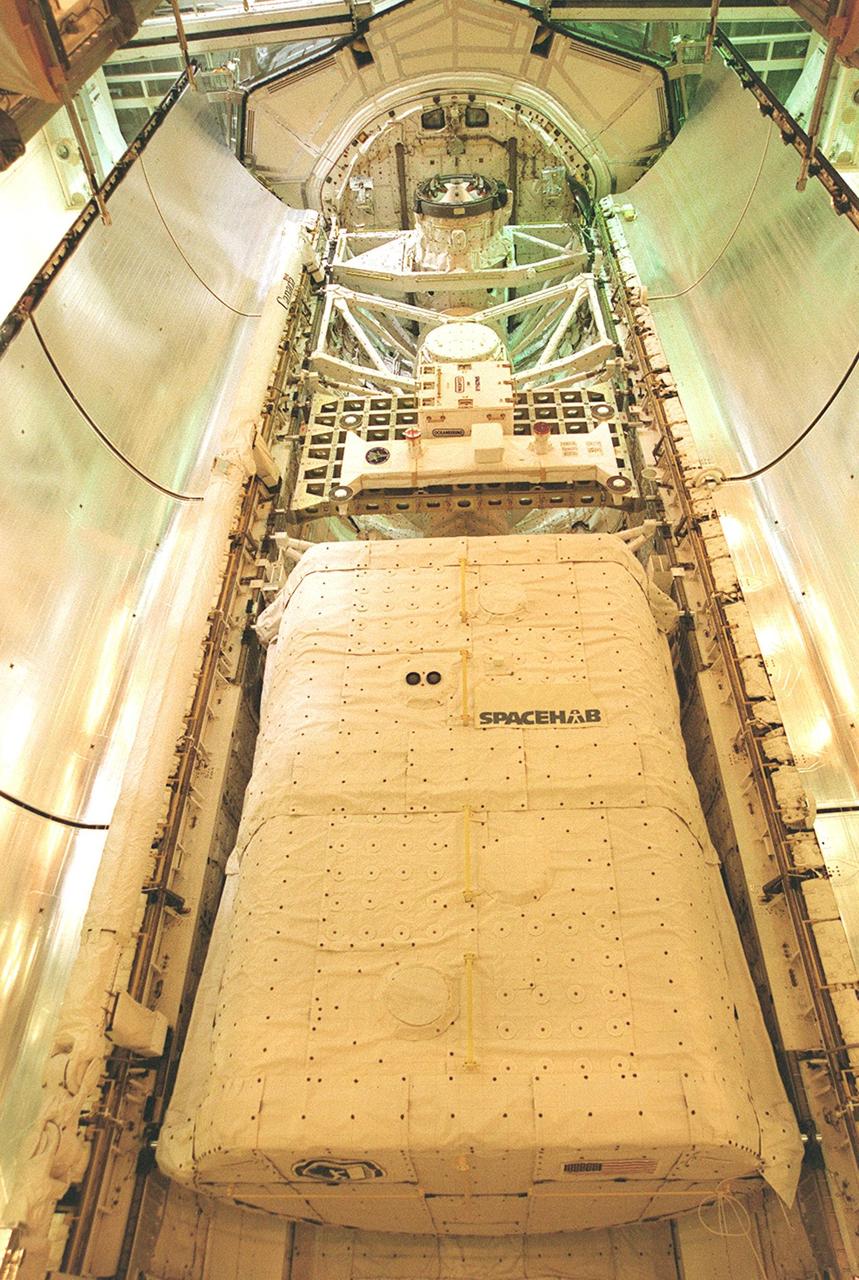
KENNEDY SPACE CENTER, FLA. -- The STS-106 payload within the SPACEHAB Module is shown after being loaded onto Atlantis on Launch Pad 39-B using the Payload Ground Handling Mechanism (PGHM). The PGHM (pronounced pigem) is located inside the Payload Changeout Room (PCR) of each shuttle launch pad’s Rotating Service Structure. The PGHM removes payloads from a transportation canister and installs them into the orbiter. It is essentially NASA’s largest fork-lift
KENNEDY SPACE CENTER, FLA. -- In the Launch Complex 39 Area turn basin at NASA's Kennedy Space Center, the crane crawler moves pilings it lifted from the barge. The pilings will be used to help construct new lightning towers on Launch Pad 39B for the Constellation Program and Ares/Orion launches. Pad B will be the site of the first Ares vehicle launch, including Ares I-X which is scheduled for April 2009. Photo credit: NASA/George Shelton
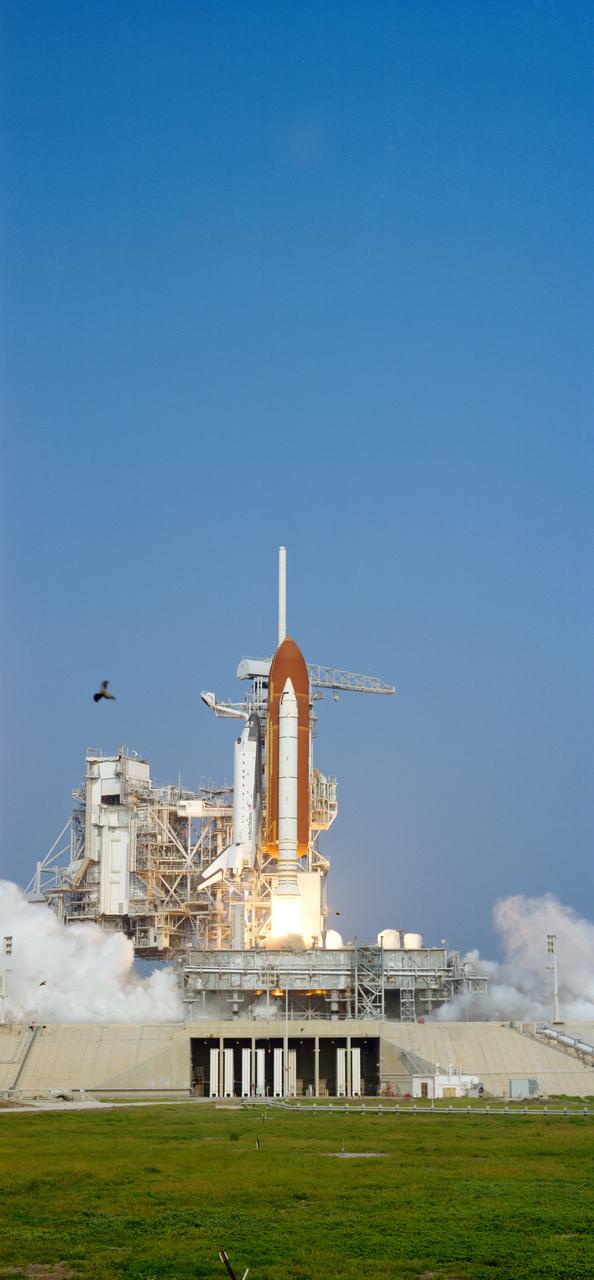
STS028-S-007 (8 Aug 1989) --- Columbia is pictured just prior to clearing the tower at Launch Pad 39-B. The spacecraft renews flight after a period of three and a half years, this time with five crewmembers aboard for STS-28. Onboard the spacecraft are Astronauts Brewster H. Shaw Jr., Richard N. Richards, David C. Leestma, James C. Adamson and Mark N. Brown. The last time Columbia was in space was in January of 1986.
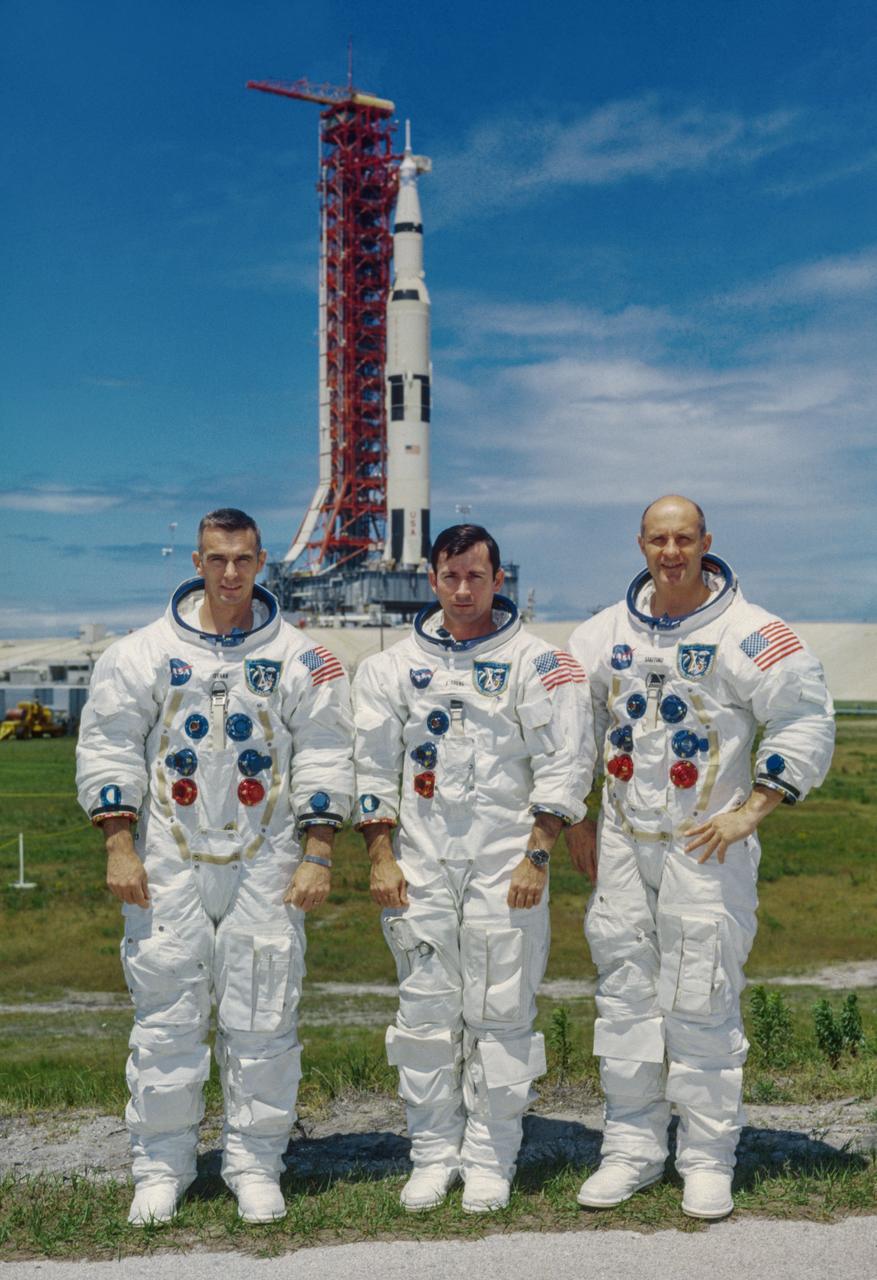
S69-34385 (13 May 1969) --- These three astronauts are the prime crew of the Apollo 10 lunar orbit mission. Left to right, are Eugene A. Cernan, lunar module pilot; John W. Young, command module pilot; and Thomas P. Stafford, commander. In the background is the Apollo 10 space vehicle on Pad B, Launch Complex 39, Kennedy Space Center, Florida.
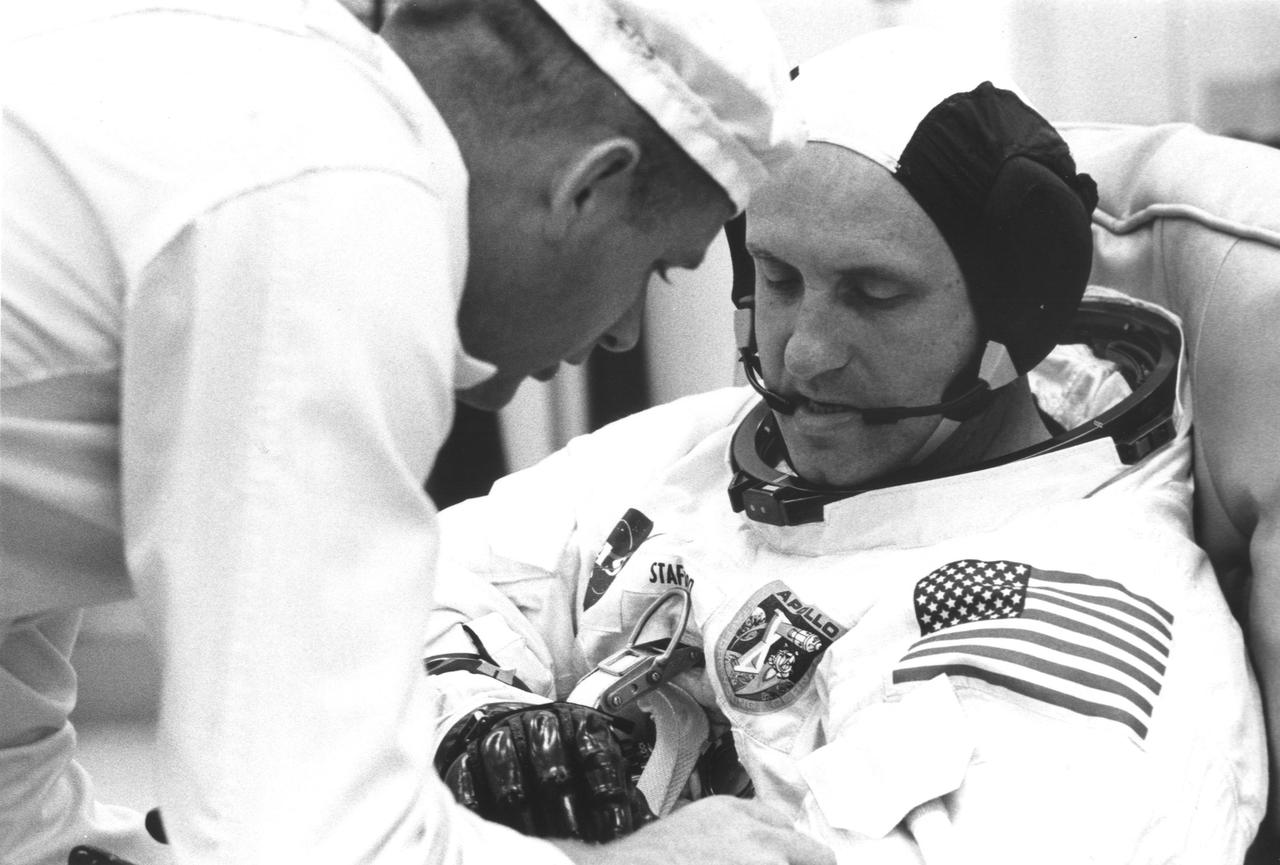
KENNEDY SPACE CENTER, FLA. -- A technician helps astronaut Thomas P. Stafford, Apollo 10 commander, suit up for the Countdown Demonstration Test (CDDT) which ended successfully at 1:01 p.m. today. The CDDT is a dress rehearsal for the launch of Apollo 10 from Pad B at Launch Complex 39 May 18 at 12:49 p.m.
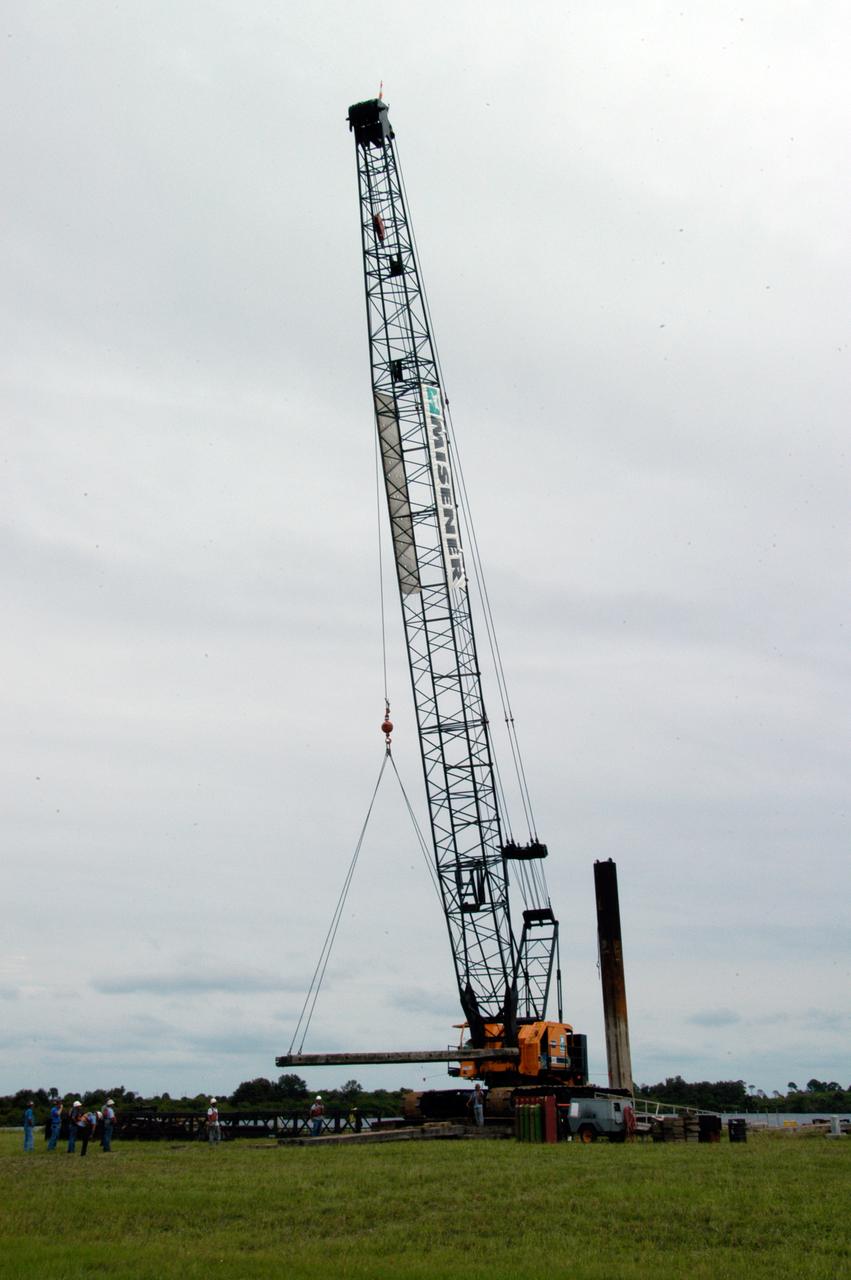
A large crawler crane arrives at the turn basin at the Launch Complex 39 Area on NASA's Kennedy Space Center. The crane with its 70-foot boom will be moved to Launch Pad 39B and used to construct a new lightning protection system for the Constellation Program and Ares/Orion launches. Pad B will be the site of the first Ares vehicle launch, including Ares I-X which is scheduled for April 2009.
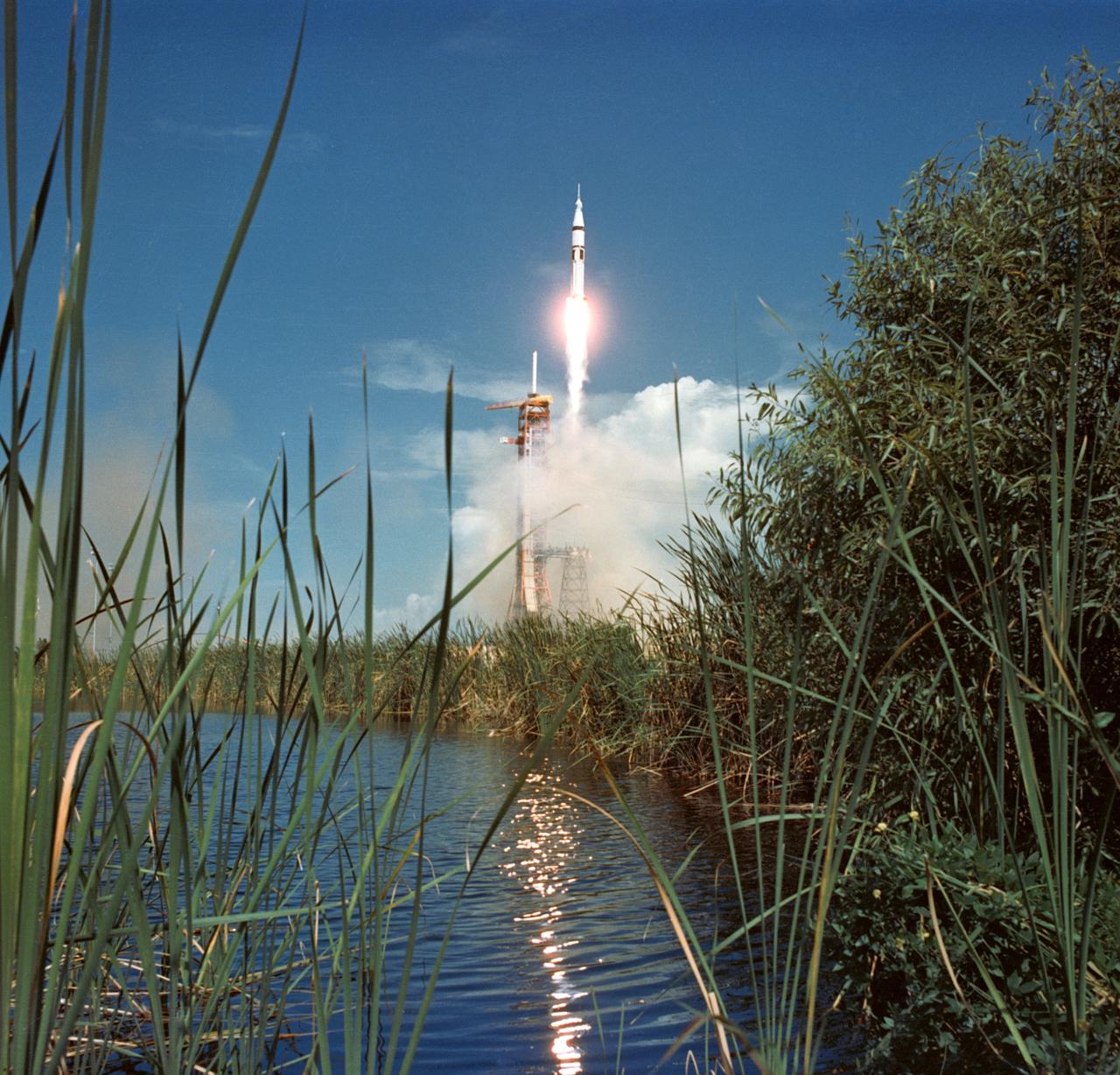
S75-28547 (15 July 1975) --- The Apollo-Soyuz Test Project's (ASTP) NASA Apollo/Saturn 1B space vehicle is launched from Pad B, Launch Complex 39, Kennedy Space Center (KSC), Florida, at 3:50 p.m. (EDT), July 15, 1975, to begin Apollo's catch-up journey toward the already Earth-orbiting Soviet Soyuz spacecraft. Aboard the Apollo spacecraft were astronauts Thomas P. Stafford, Vance D. Brand and Donald K. (Deke) Slayton.
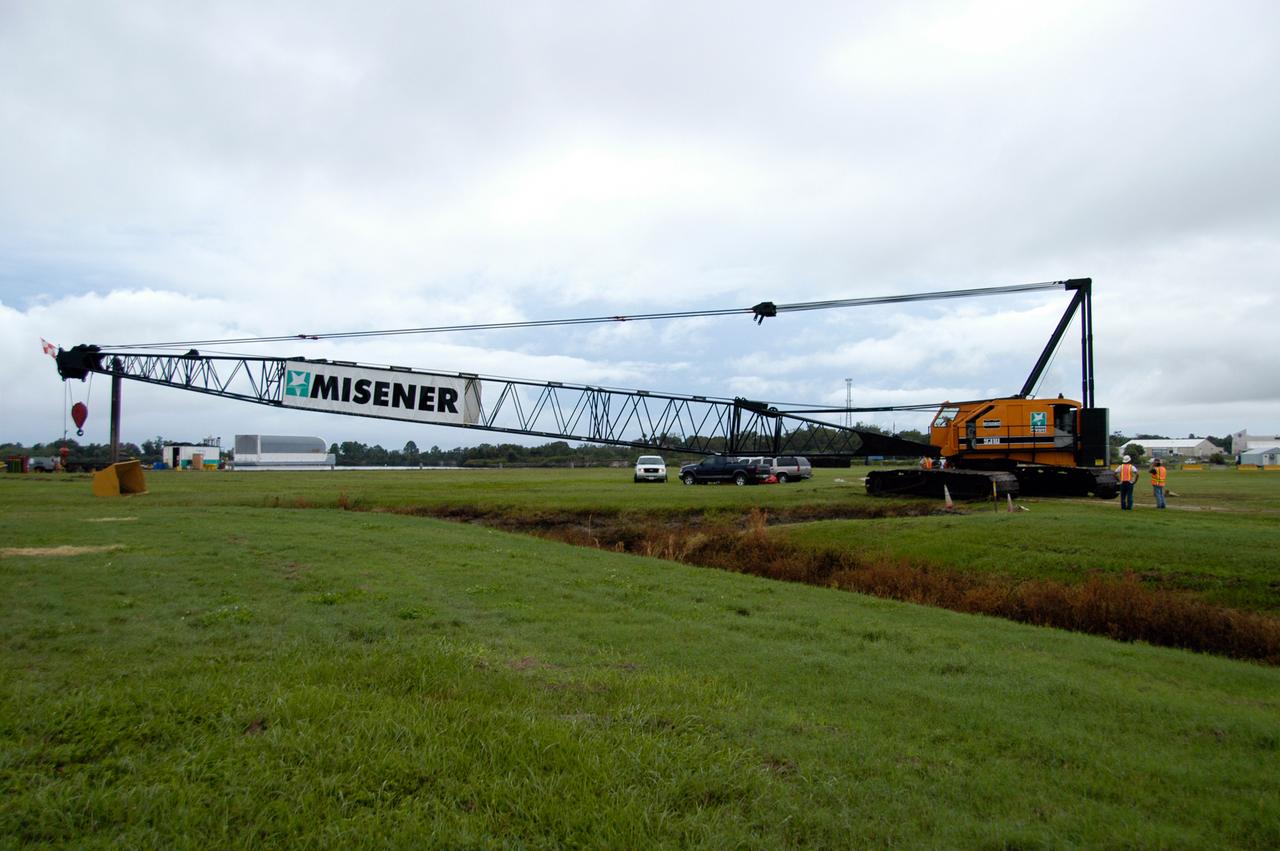
A large crawler crane begins moving away from the turn basin at the Launch Complex 39 Area on NASA's Kennedy Space Center. The crane with its 70-foot boom will be moved to Launch Pad 39B and used to construct a new lightning protection system for the Constellation Program and Ares/Orion launches. Pad B will be the site of the first Ares vehicle launch, including Ares I-X which is scheduled for April 2009.
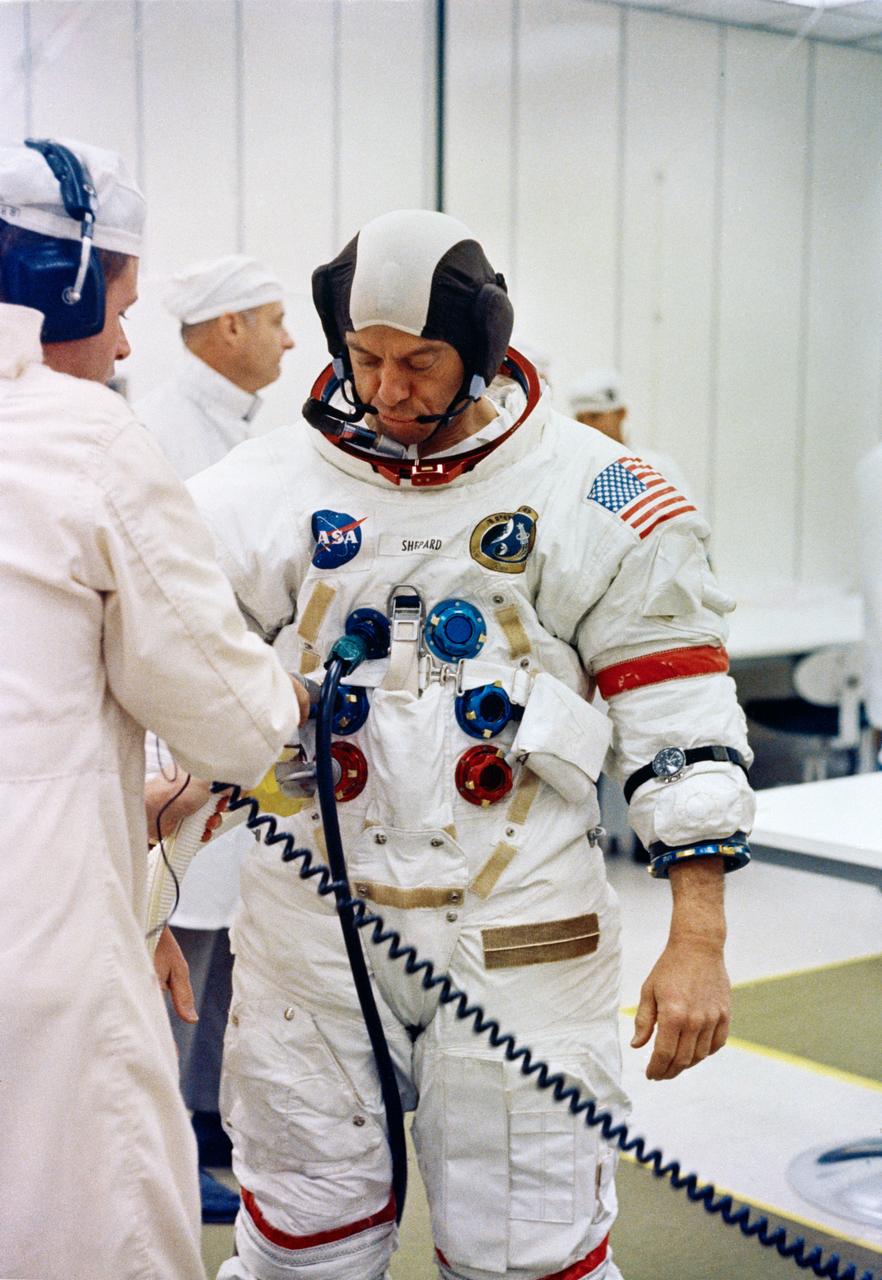
S71-16638 (31 Jan. 1971) --- Astronaut Alan B. Shepard Jr., commander, undergoes suiting up operations at the Kennedy Space Center (KSC) during the Apollo 14 prelaunch countdown. Apollo 14, with astronauts Shepard; Edgar D. Mitchell, lunar module pilot; and Stuart A. Roosa, command module pilot; aboard was launched from Pad A, Launch Complex 39 at 4:03:02 p.m. (EST), Jan. 31, 1971.
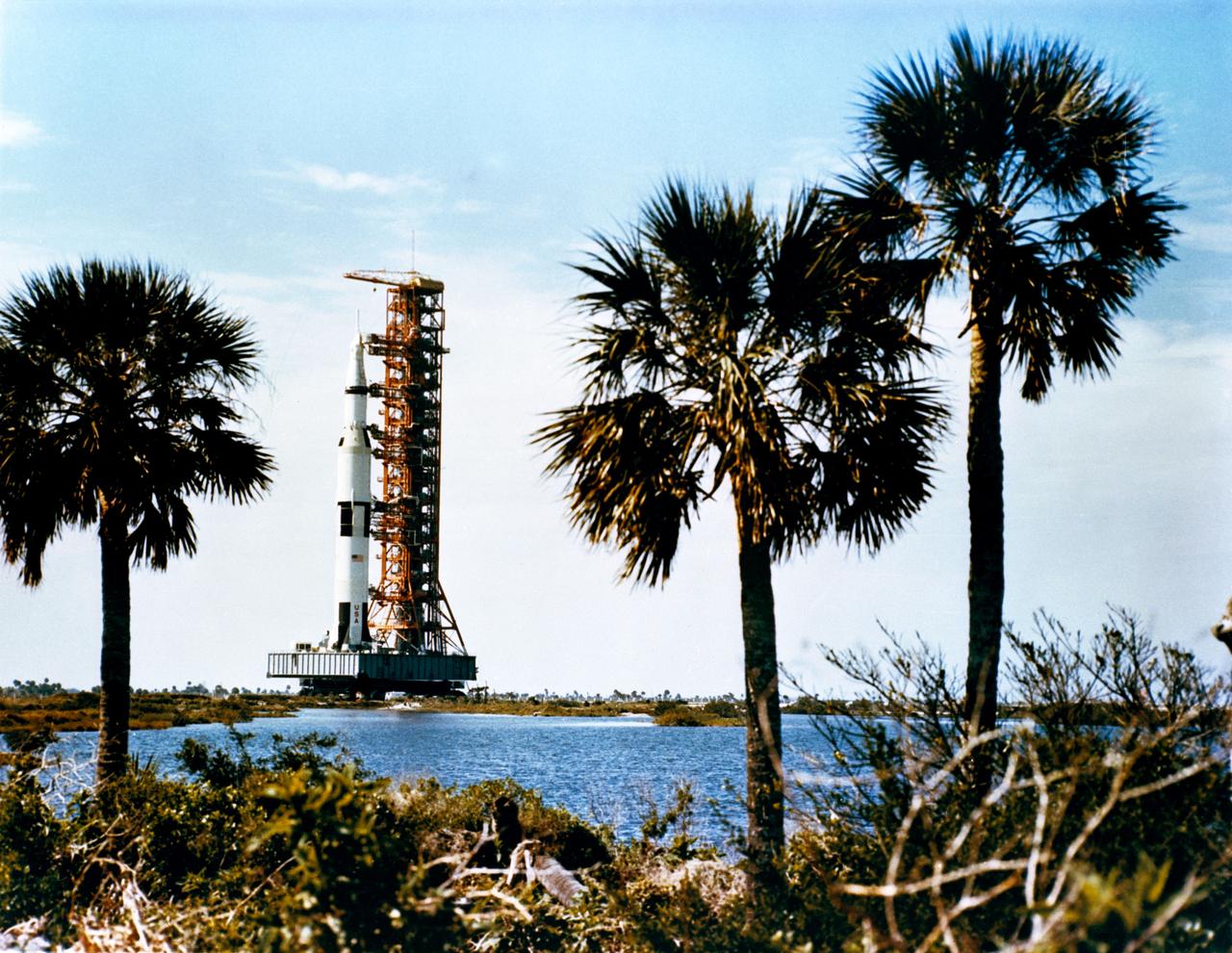
S69-34319 (11 March 1969) --- The 363-feet tall Apollo 10 (Spacecraft 106/Lunar Module 4/Saturn 505) space vehicle on the way from the Vehicle Assembly Building to Pad B, Launch Complex 39, Kennedy Space Center. The Saturn V stack and its mobile launch tower are atop a huge crawler-transporter.
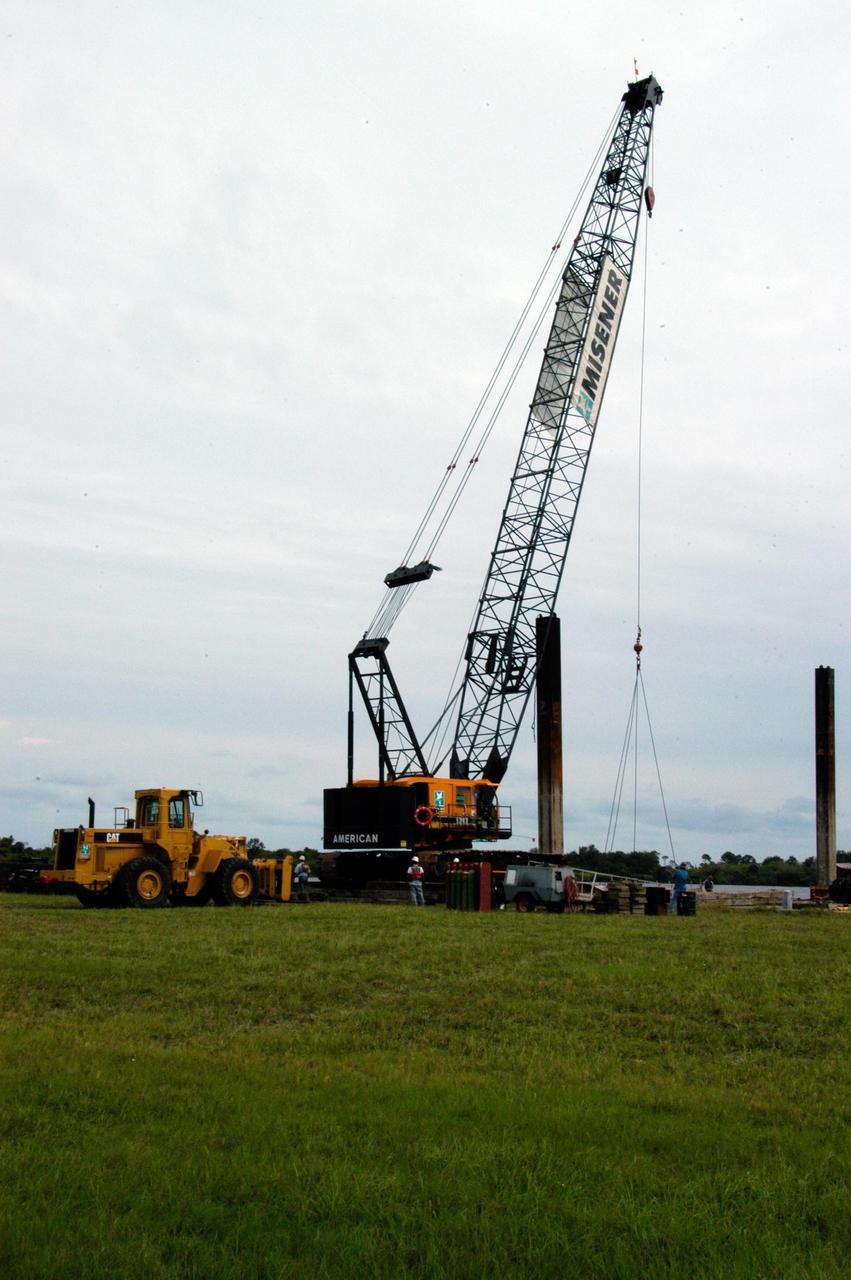
KENNEDY SPACE CENTER, FLA. -- A large crawler crane arrives at the turn basin at the Launch Complex 39 Area on NASA's Kennedy Space Center. The crane with its 70-foot boom will be moved to Launch Pad 39B and used to construct a new lightning protection system for the Constellation Program and Ares/Orion launches. Pad B will be the site of the first Ares vehicle launch, including Ares I-X which is scheduled for April 2009. Photo credit: NASA/George Shelton
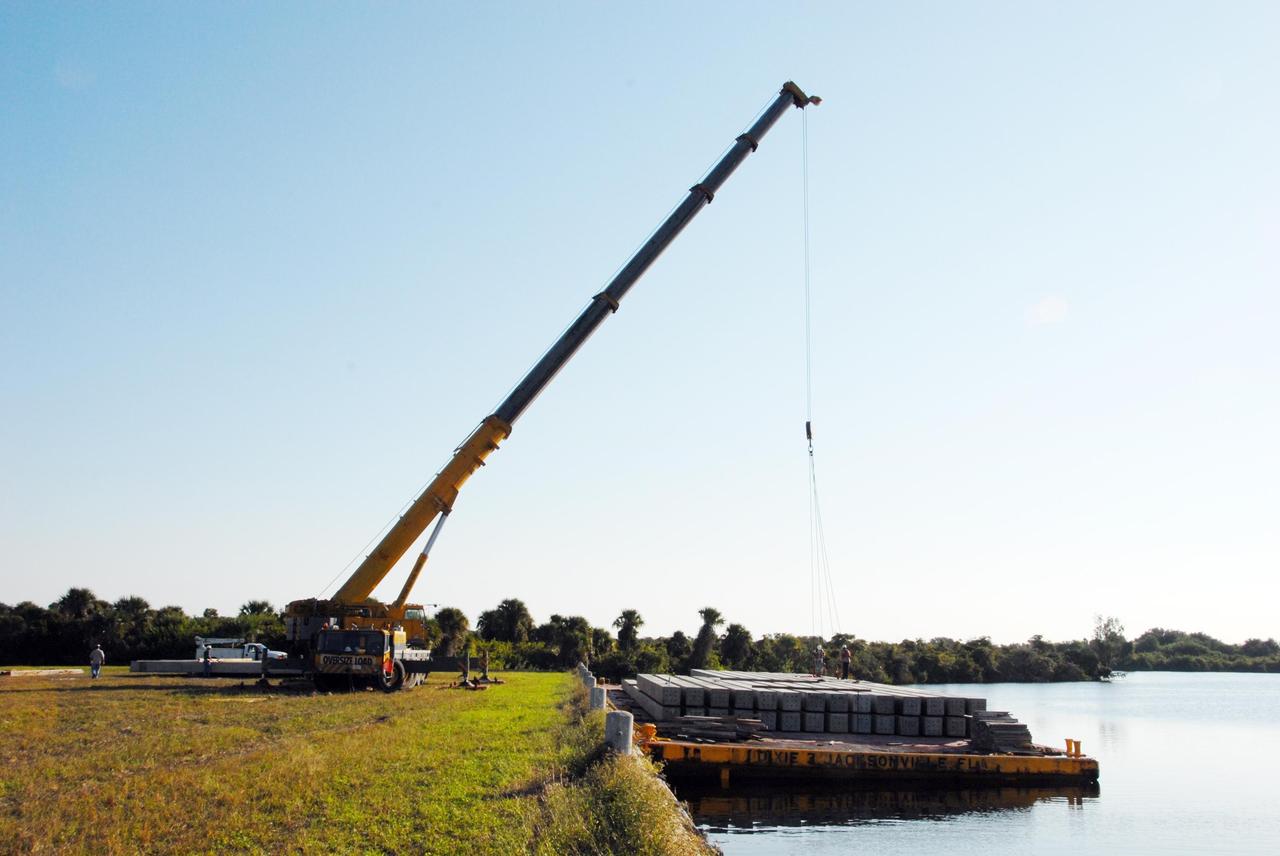
KENNEDY SPACE CENTER, FLA. -- In the Launch Complex 39 Area turn basin at NASA's Kennedy Space Center, the crane crawler is being used to lift pilings from a barge. The pilings will be used to help construct new lightning towers on Launch Pad 39B for the Constellation Program and Ares/Orion launches. Pad B will be the site of the first Ares vehicle launch, including Ares I-X which is scheduled for April 2009. Photo credit: NASA/George Shelton
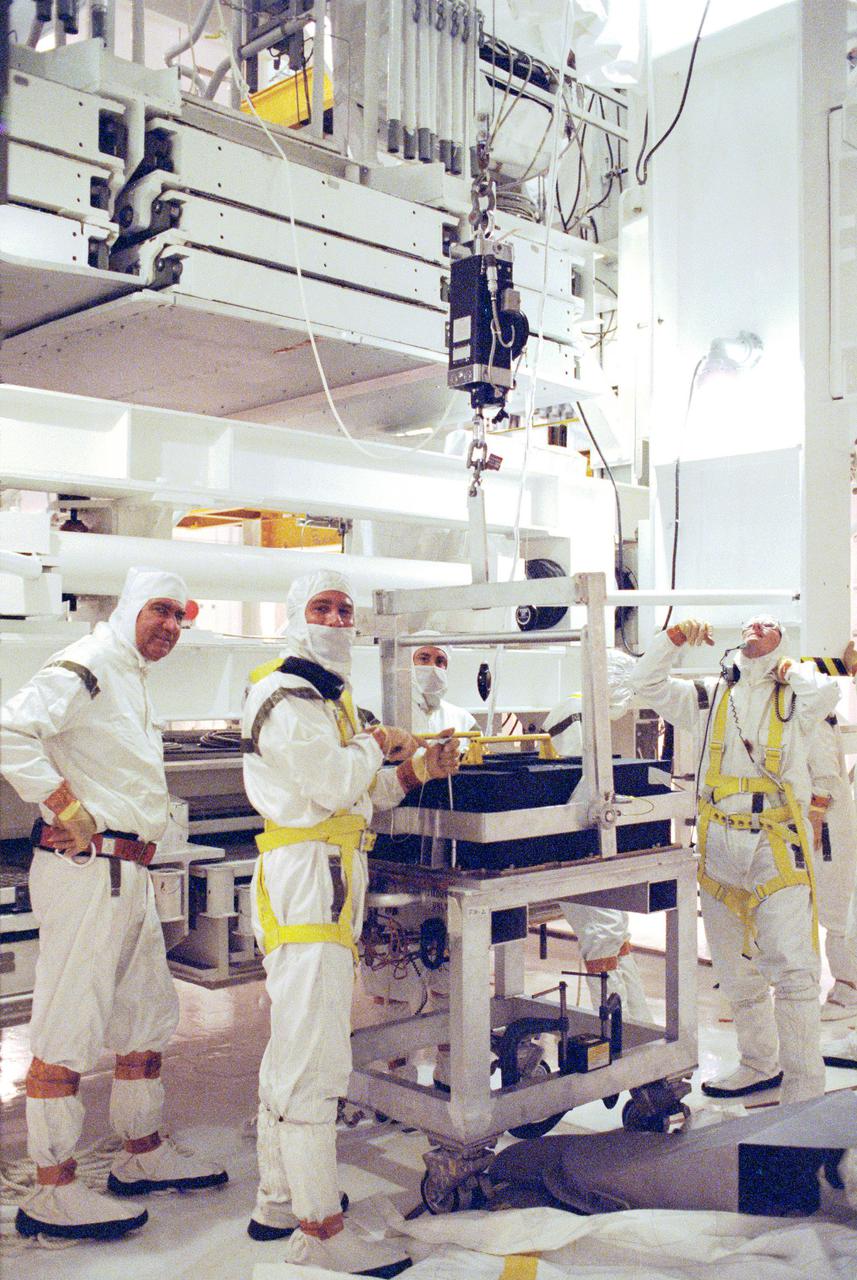
KENNEDY SPACE CENTER, FLA. -- Technicians in the Payload Changeout Room at Pad 39-B are removing the batteries from the Hubble Space Telescope for recharging. The two sets of six batteries apiece will be taken to the battery lab inside the Vehicle Assembly Building for 130 hours of recharging, and then reinstalled in the telescope. Recharging became necessary when the first launch attempt of Space Shuttle Mission STS-31 was scrubbed April 10. A second try is set for April 24 at 8:30 a.m. EDT.
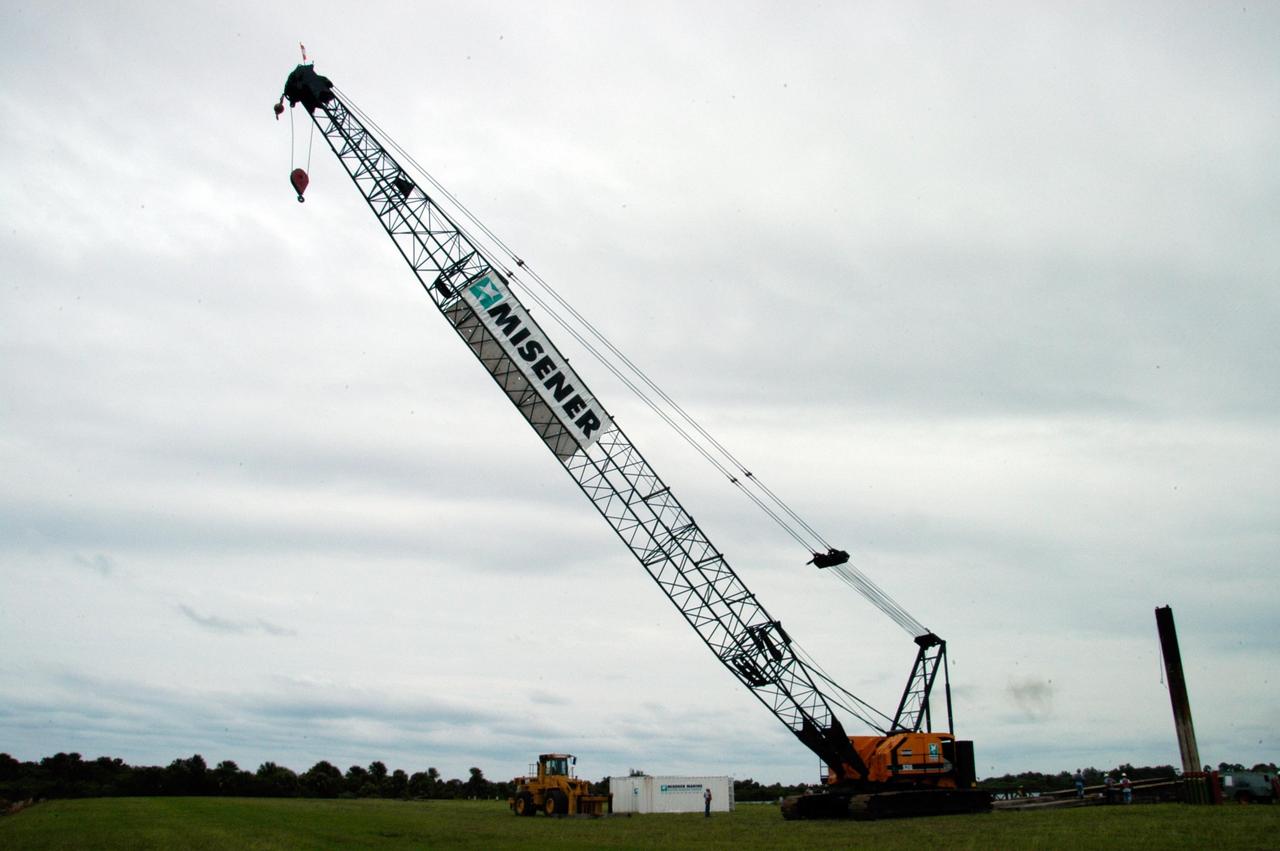
KENNEDY SPACE CENTER, FLA. -- A large crawler crane begins moving away from the turn basin at the Launch Complex 39 Area on NASA's Kennedy Space Center. The crane with its 70-foot boom will be moved to Launch Pad 39B and used to construct a new lightning protection system for the Constellation Program and Ares/Orion launches. Pad B will be the site of the first Ares vehicle launch, including Ares I-X which is scheduled for April 2009. Photo credit: NASA/George Shelton
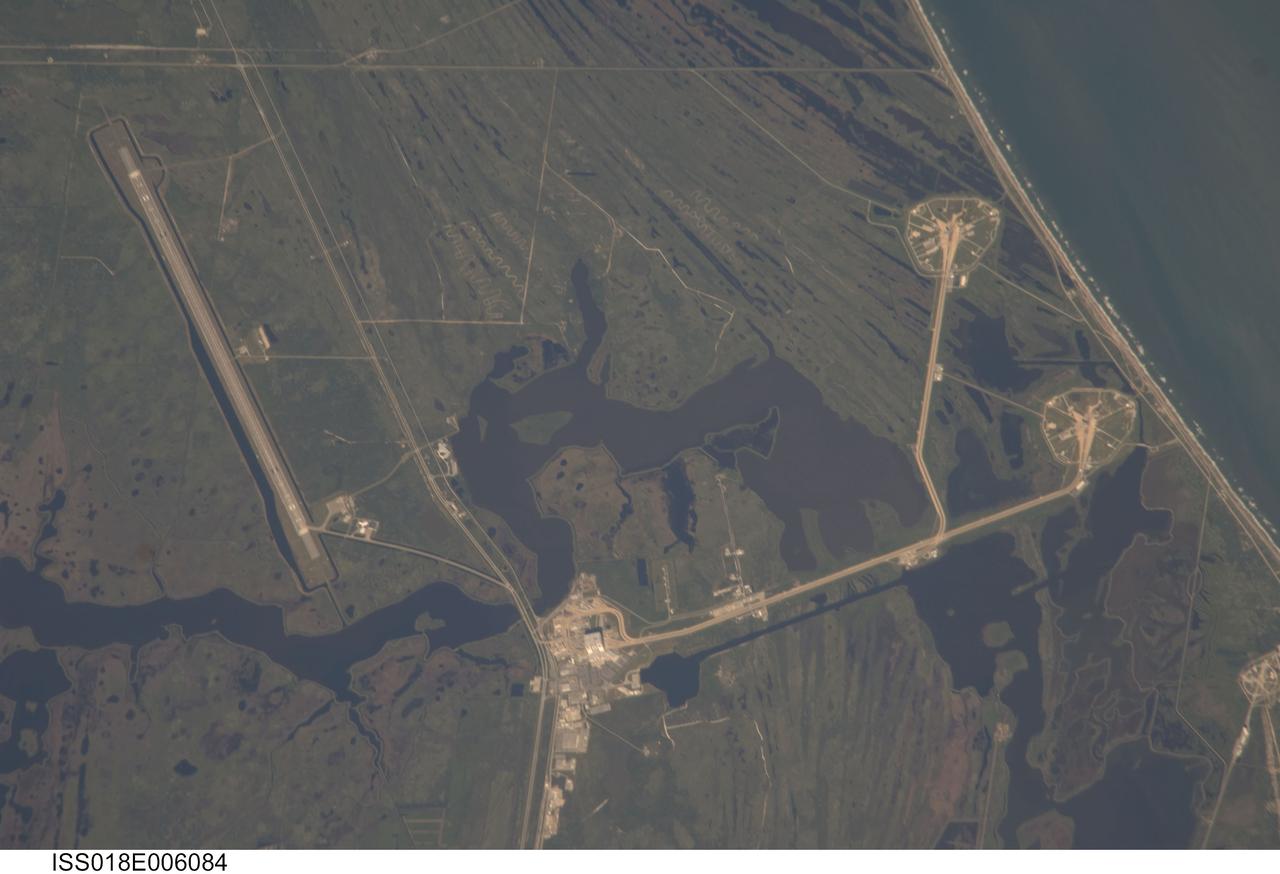
ISS018-E-006084 (29 Oct. 2008) --- Kennedy Space Center and Cape Canaveral, Florida are featured in this image photographed by an Expedition 18 crewmember on the International Space Station. Launch complex 39, with pads A and B, is visible at right. The Vehicle Assembly Building (VAB) is visible at bottom center. The Shuttle Landing Facility appears as a long thin strip at left.
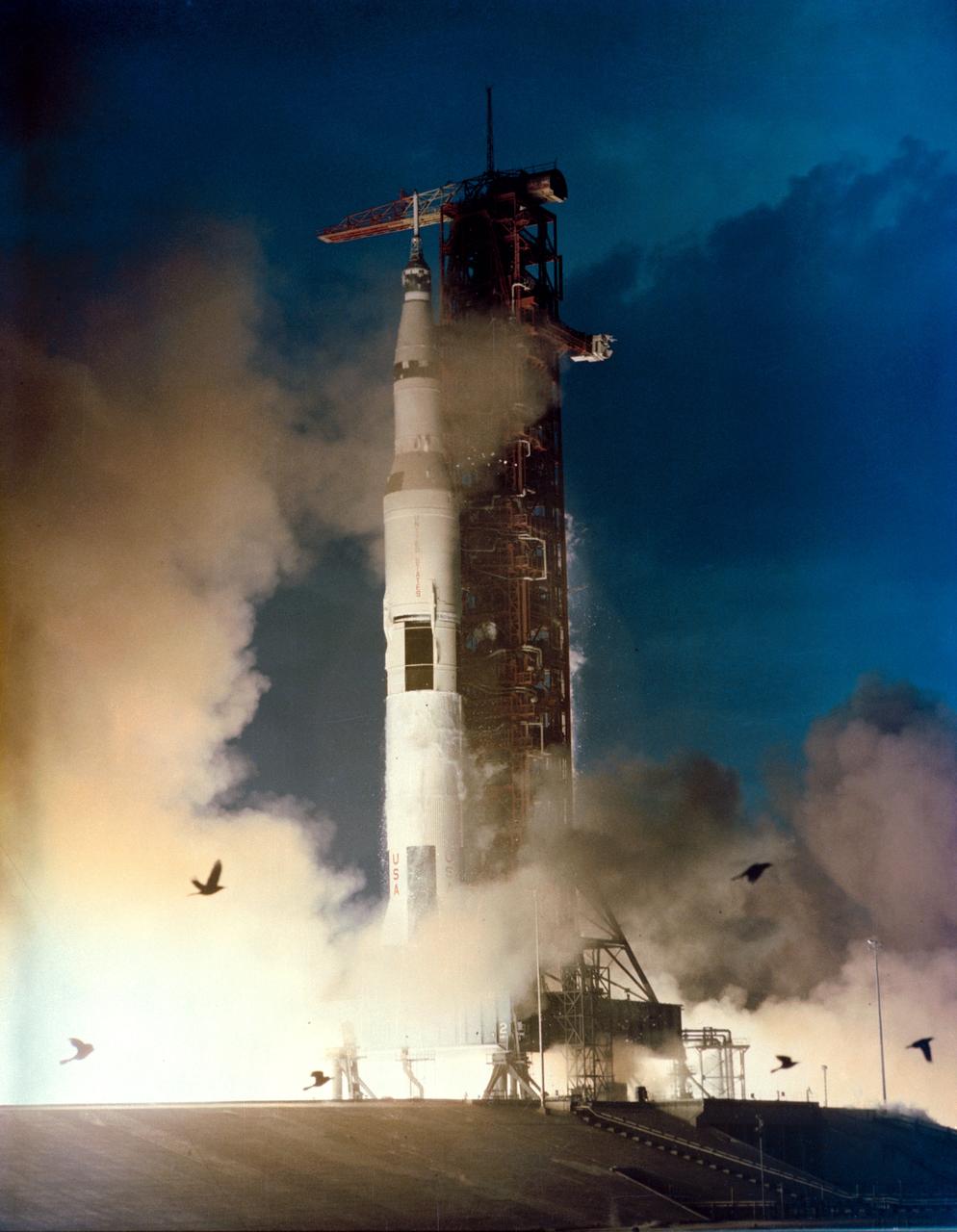
S71-18395 (31 Jan. 1971) --- The huge, 363-feet tall Apollo 14 (Spacecraft 110/Lunar Module 8/Saturn 509) space vehicle is launched from Pad A, Launch Complex 39, Kennedy Space Center (KSC), Florida at 4:03:02 p.m. (EST), Jan. 31, 1971, on a lunar landing mission. Aboard the Apollo 14 spacecraft were astronauts Alan B. Shepard Jr., commander; Stuart A. Roosa, command module pilot; and Edgar D. Mitchell, lunar module pilot.
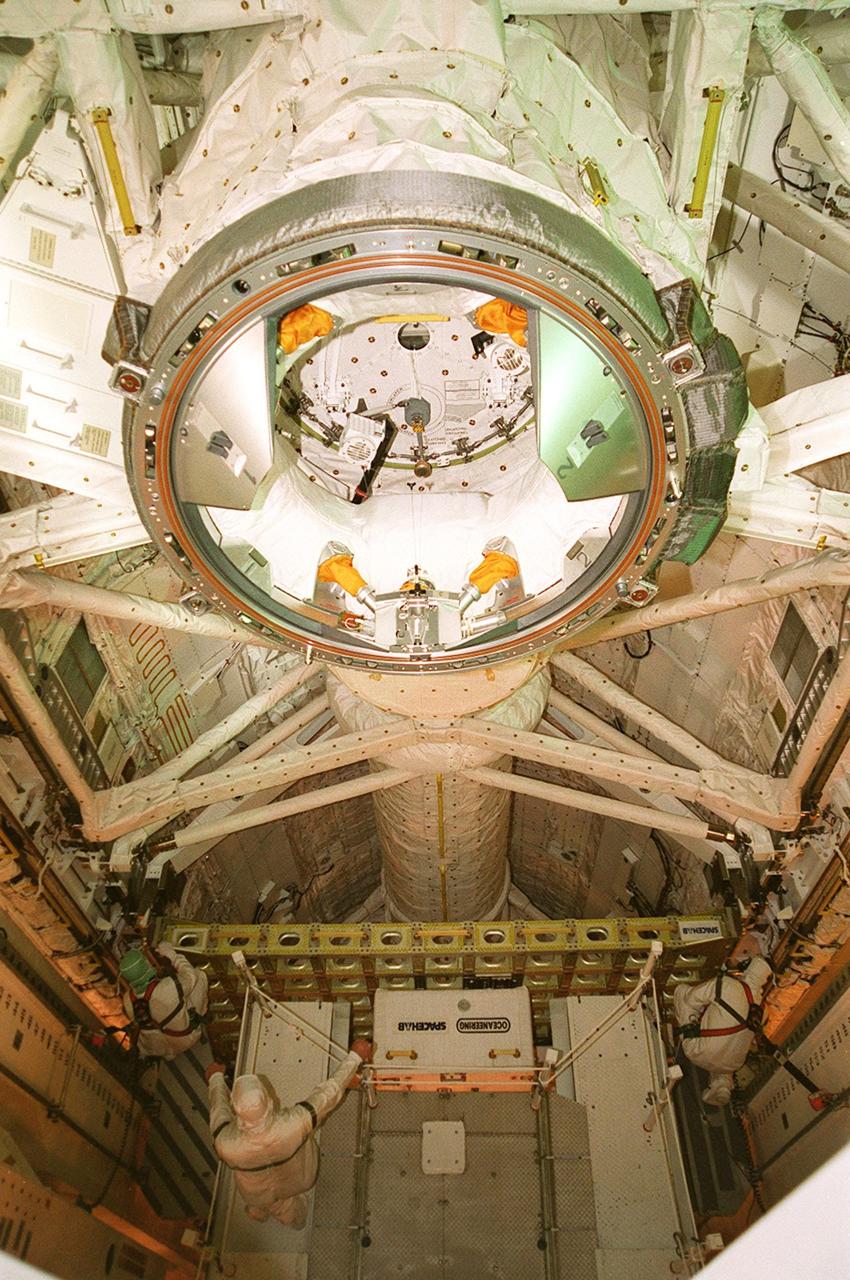
KENNEDY SPACE CENTER, FLA. -- Technicians facilitate the transfer the STS-106 payload to Atlantis on Launch Pad 39-B using the Payload Ground Handling Mechanism (PGHM). The circular structure shown is the docking adapter. The PGHM (pronounced pigem) is located inside the Payload Changeout Room (PCR) of each shuttle launch pad’s Rotating Service Structure. The PGHM removes payloads from a transportation canister and installs them into the orbiter. It is essentially NASA’s largest fork-lift
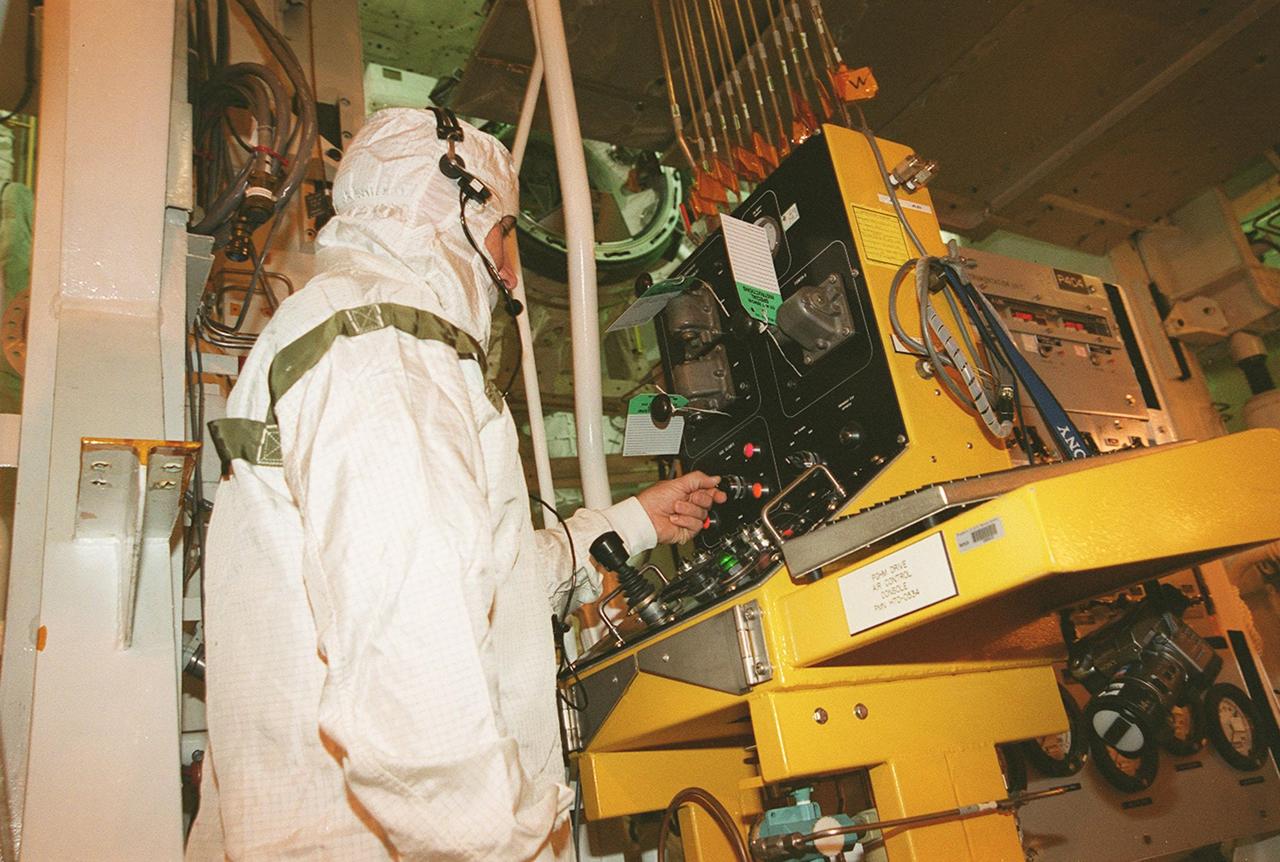
KENNEDY SPACE CENTER, FLA. -- During the transfer the STS-106 payload to Atlantis on Launch Pad 39-B, a technician turns a switch to move the Payload Ground Handling Mechanism (PGHM). The mechanism is located inside the Payload Changeout Room (PCR) of each shuttle launch pad’s Rotating Service Structure. The PGHM (pronounced pigem) removes payloads from a transportation canister and installs them into the orbiter. It is essentially NASA’s largest fork-lift
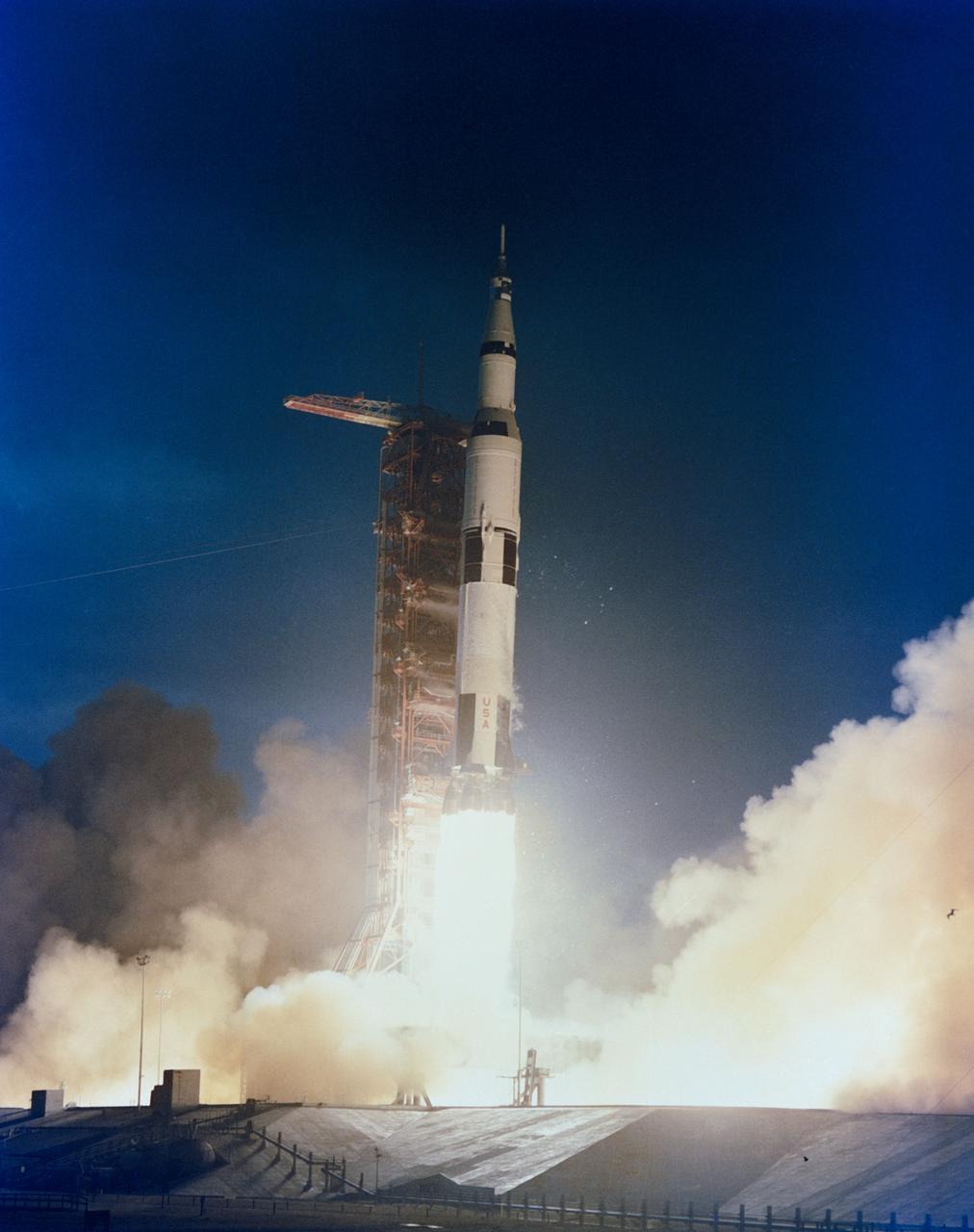
S71-17621 (31 Jan. 1971) --- The huge, 363-feet tall Apollo 14 (Spacecraft 110/Lunar Module 8/Saturn 509) space vehicle is launched from Pad A, Launch Complex 39, Kennedy Space Center, Florida, at 4:03:02 p.m. (EST), Jan. 31, 1981, on a lunar landing mission. Aboard the Apollo 14 spacecraft were astronauts Alan B. Shepard Jr., commander; Stuart A. Roosa, command module pilot; and Edgar D. Mitchell, lunar module pilot.
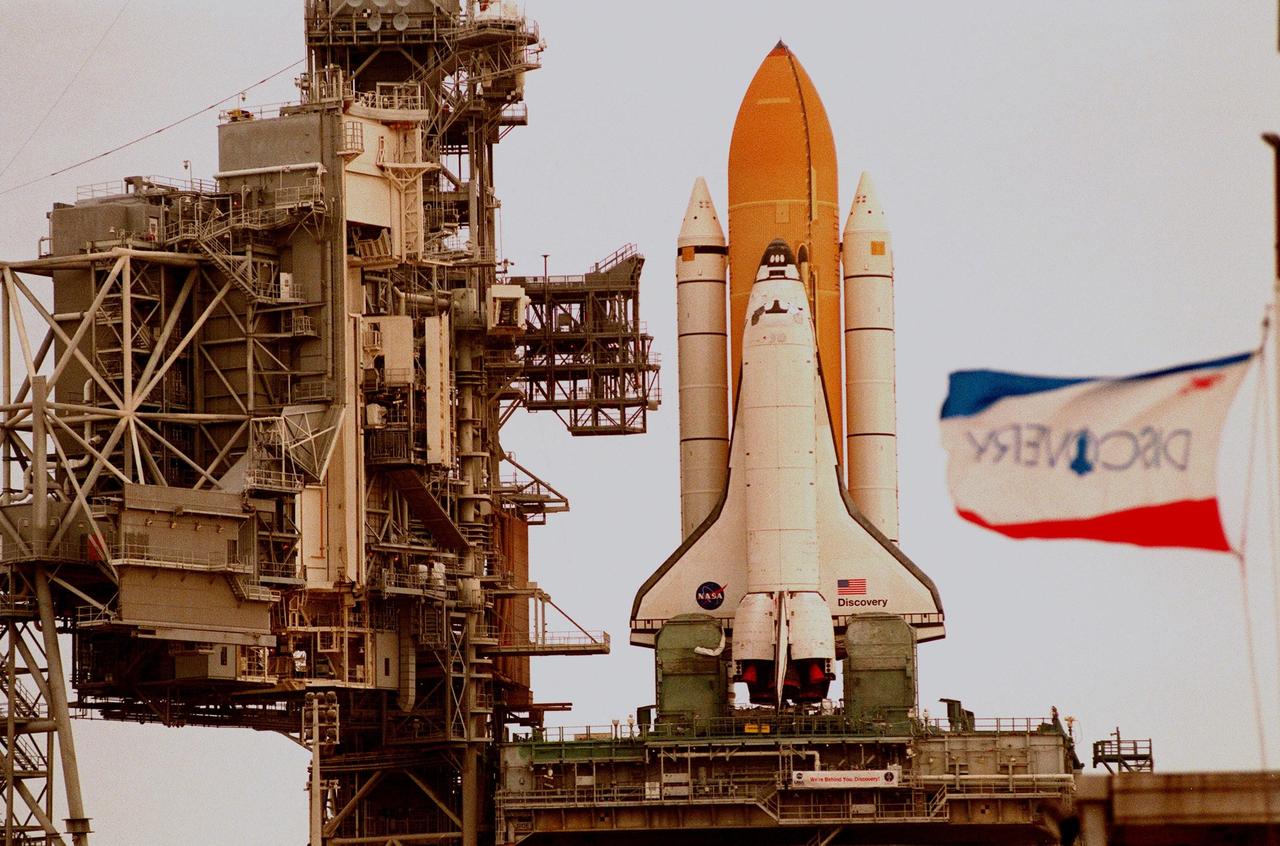
In this close-up, Space Shuttle Discovery sits atop the Mobile Launch Platform on Launch Pad 39-B, with the Rotating Service Structure moved back, to await rollback decision. The flag at right shows the increased wind blowing out of the south. KSC managers developed a precautionary plan to roll back Discovery to the Vehicle Assembly Building in the event that Hurricane Georges threatens Central Florida. The decision was made in order to minimize risk and provide protection to the Space Shuttle, a national asset
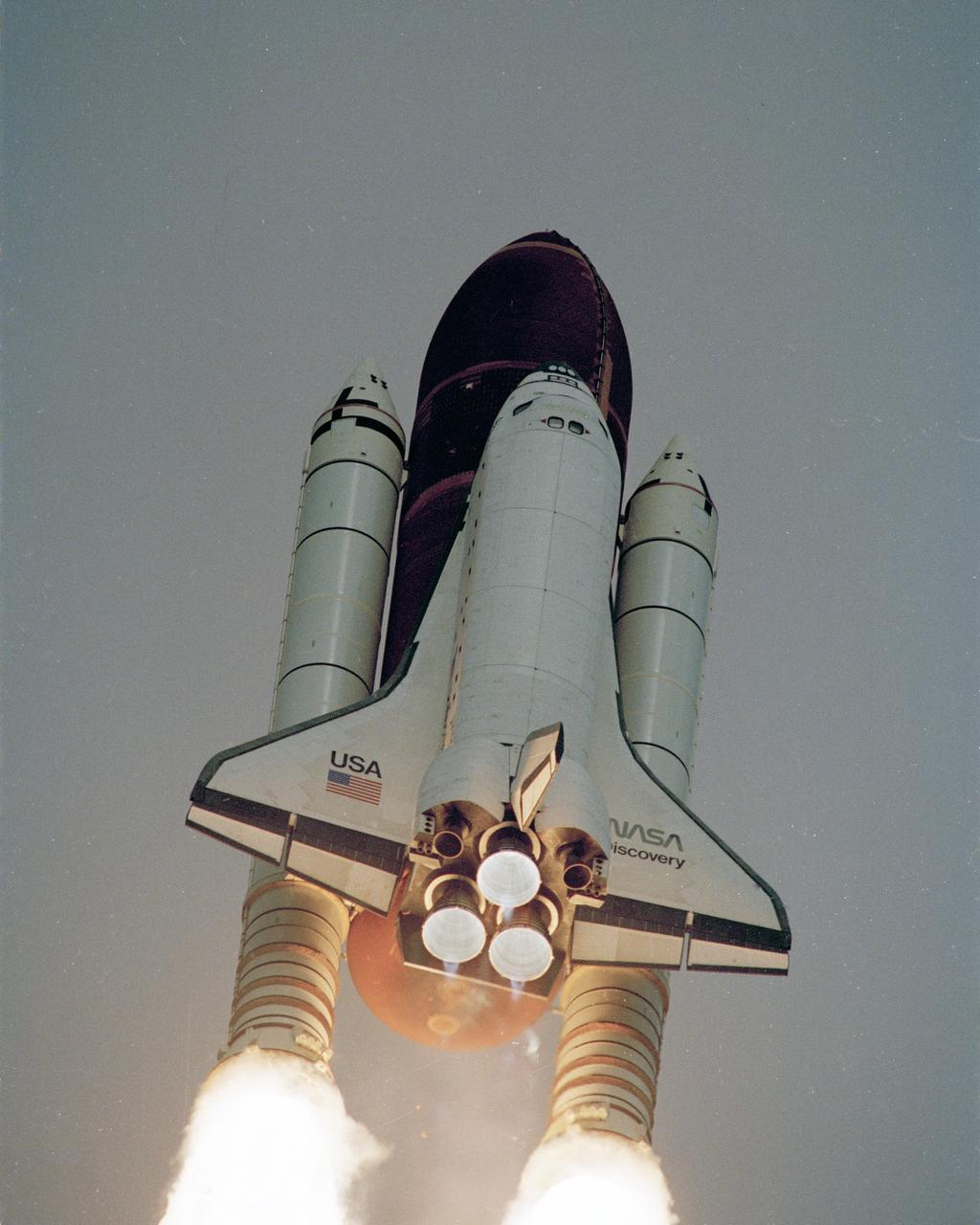
The space shuttle Discovery lifts off from Launch Pad 39-B at 8:33 a.m. EDT carrying a crew of five and the Hubble Space Telescope. STS-31 crew members are Commander Loren Shriver, Pilot Charles Bolden and Mission Specialists Steven Hawley, Bruce McCandless II and Kathryn Sullivan. Photo credit: NASA
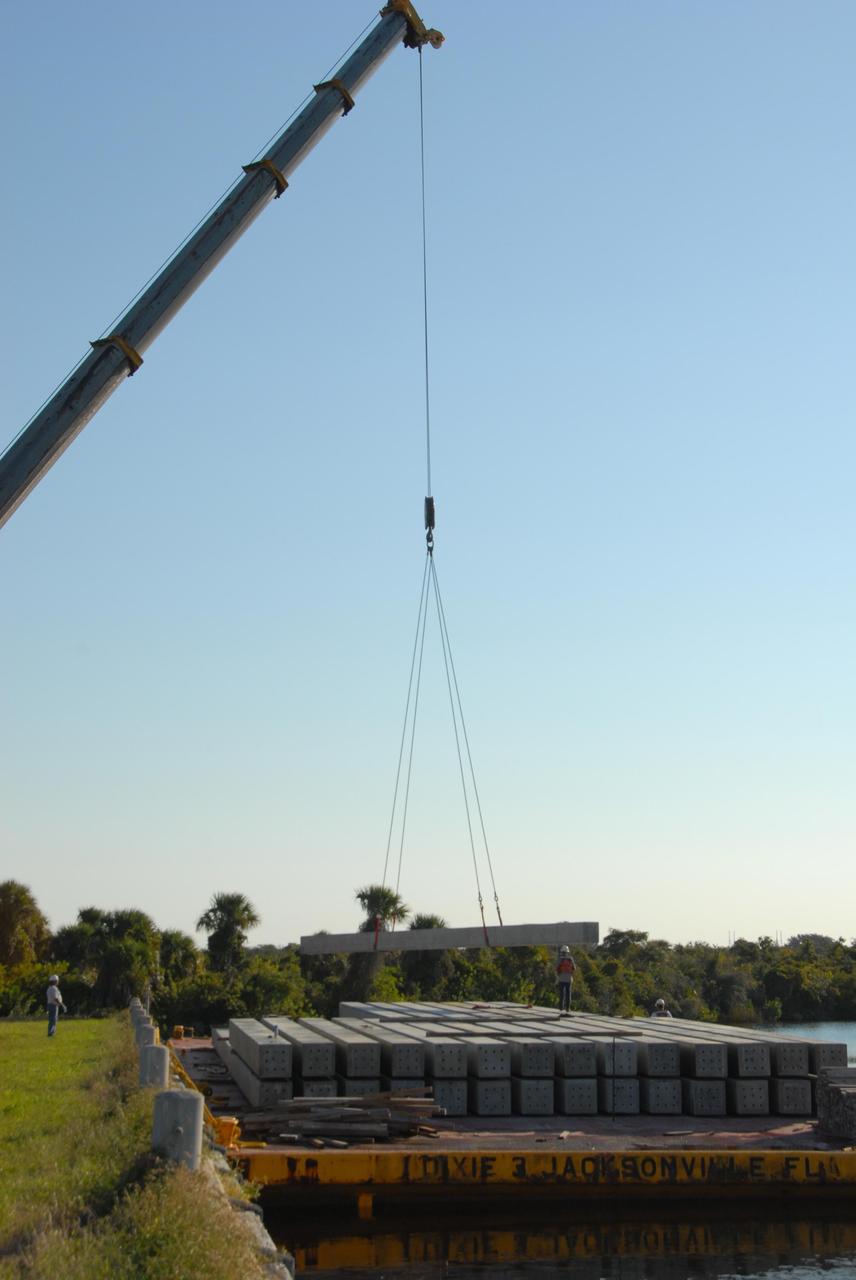
KENNEDY SPACE CENTER, FLA. -- In the Launch Complex 39 Area turn basin at NASA's Kennedy Space Center, the crane crawler begins lifting pilings from the barge. The pilings will be used to help construct new lightning towers on Launch Pad 39B for the Constellation Program and Ares/Orion launches. Pad B will be the site of the first Ares vehicle launch, including Ares I-X which is scheduled for April 2009. Photo credit: NASA/George Shelton
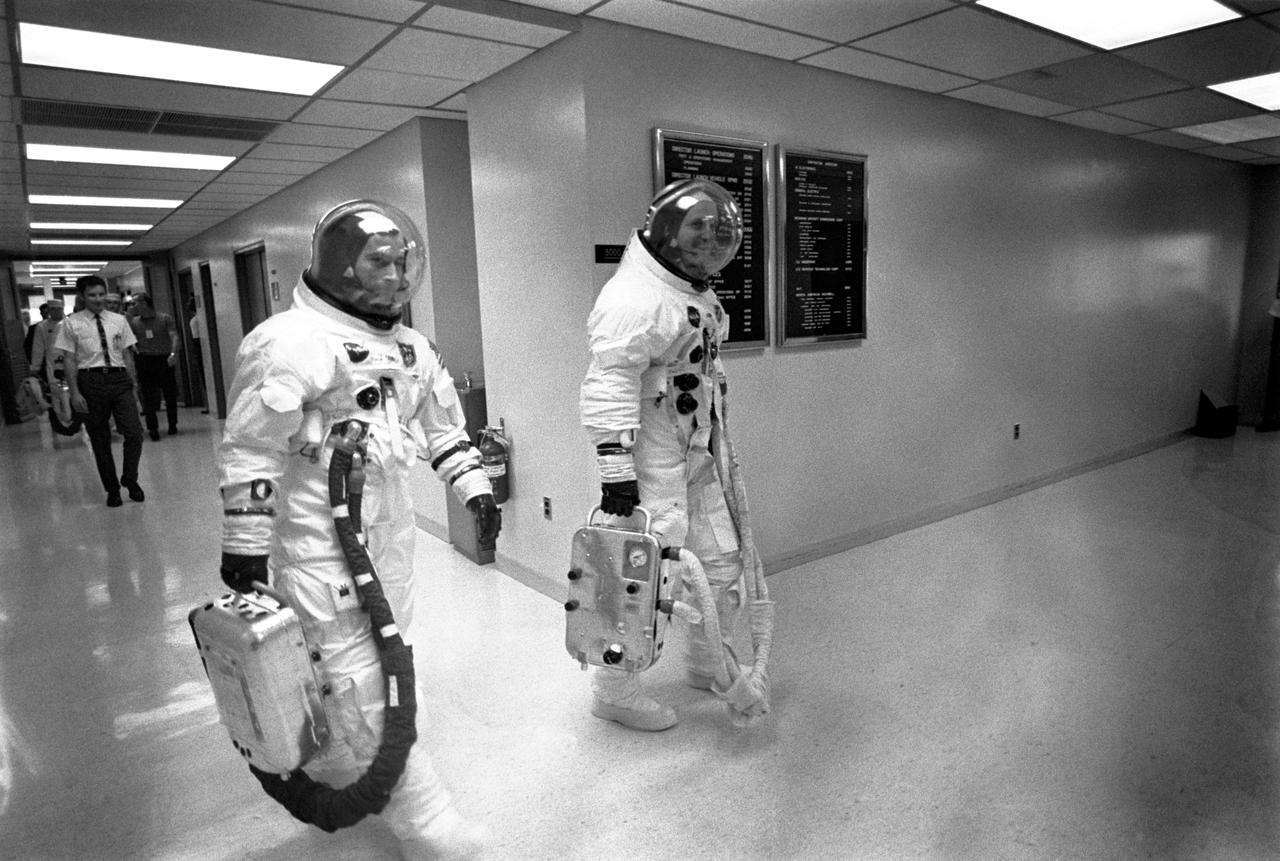
S69-34337 (6 May 1969) --- Apollo 10 astronauts John W. Young (left), command module pilot; and Thomas P. Stafford, commander, leave the Kennedy Space Center's (KSC) Manned Spacecraft Operations Building for Pad B, Launch Complex 39, where they participated in dry portion of Countdown Demonstration Test. Apollo 10, with astronauts Stafford, Young and Eugene A. Cernan aboard, is scheduled for launch on May 13, 1969. Cernan is the lunar module pilot.
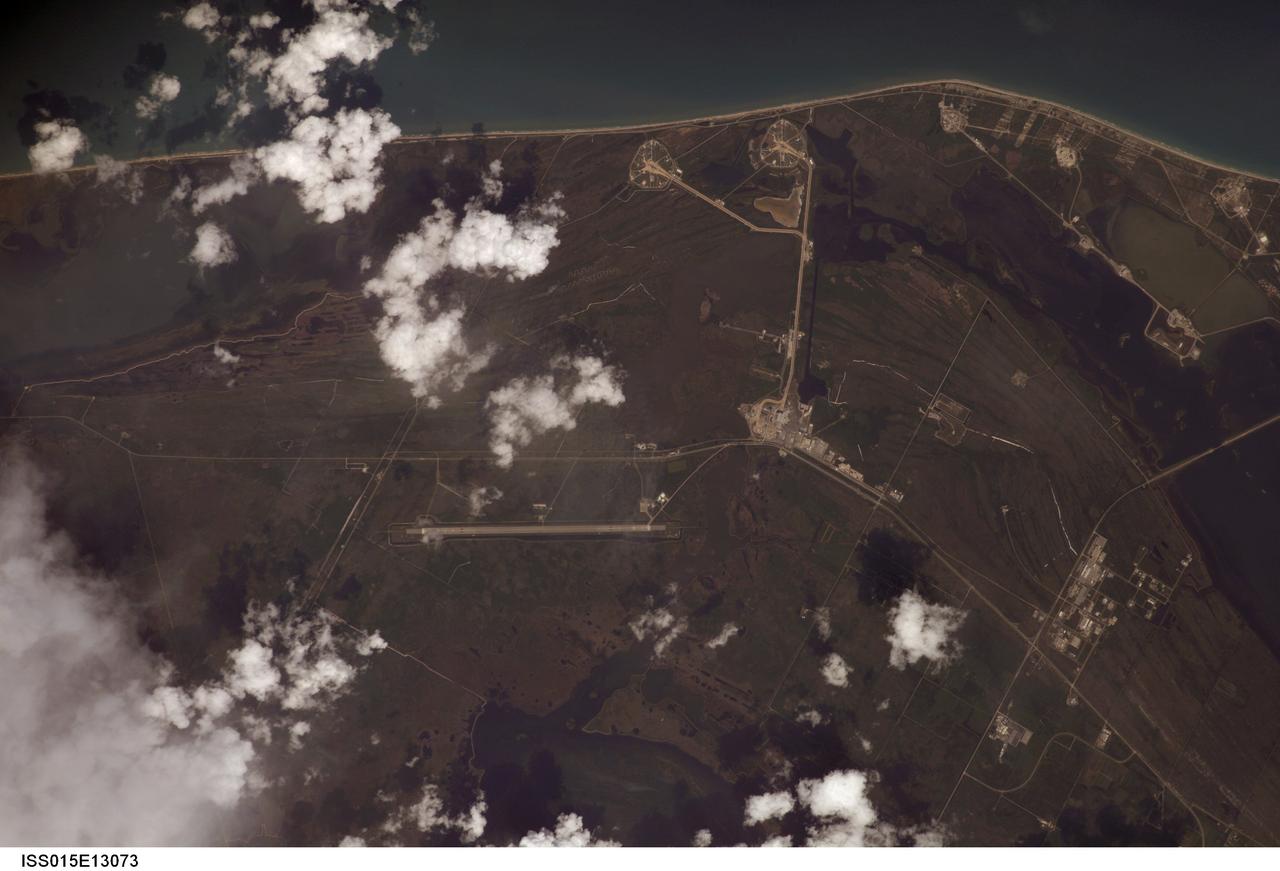
ISS015-E-13073 (20 June 2007) --- Kennedy Space Center and Cape Canaveral, Florida are featured in this image photographed by an Expedition 15 crewmember on the International Space Station. Launch complex 39, with pads A and B, is visible at top center. The Vehicle Assembly Building (VAB) is visible near center. The Shuttle Landing Facility appears as a long thin strip just below center.