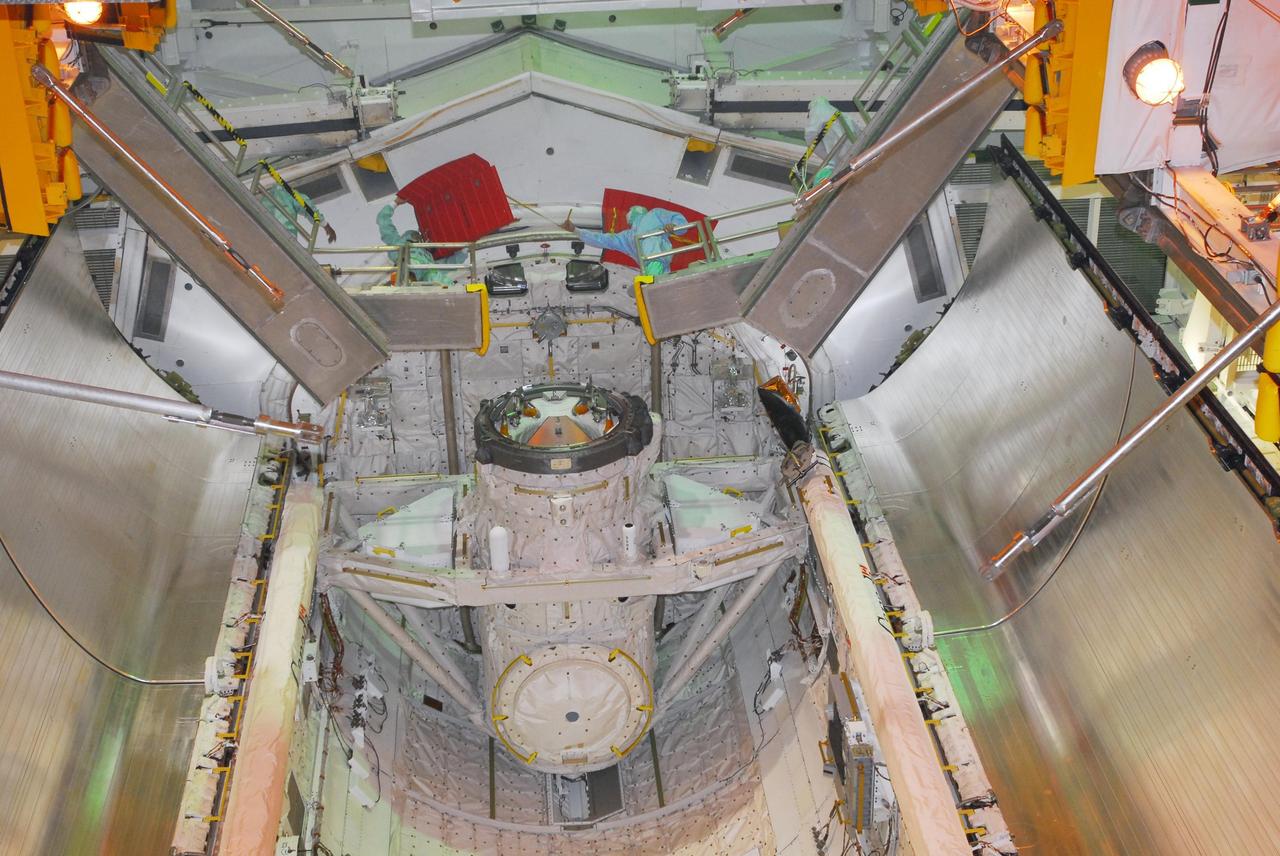
KENNEDY SPACE CENTER, FLA. -- On Launch Pad 39A, workers remove the rain gutters from space shuttle Discovery's payload bay. The gutters prevent leaks into the bay from rain while the shuttle is on the pad. Beneath is the orbital docking system. Mission STS-120 will bring the Harmony module that will provide attachment points for European and Japanese laboratory modules to the International Space Station. Launch of Discovery is targeted for Oct. 23. Photo credit: NASA/George Shelton
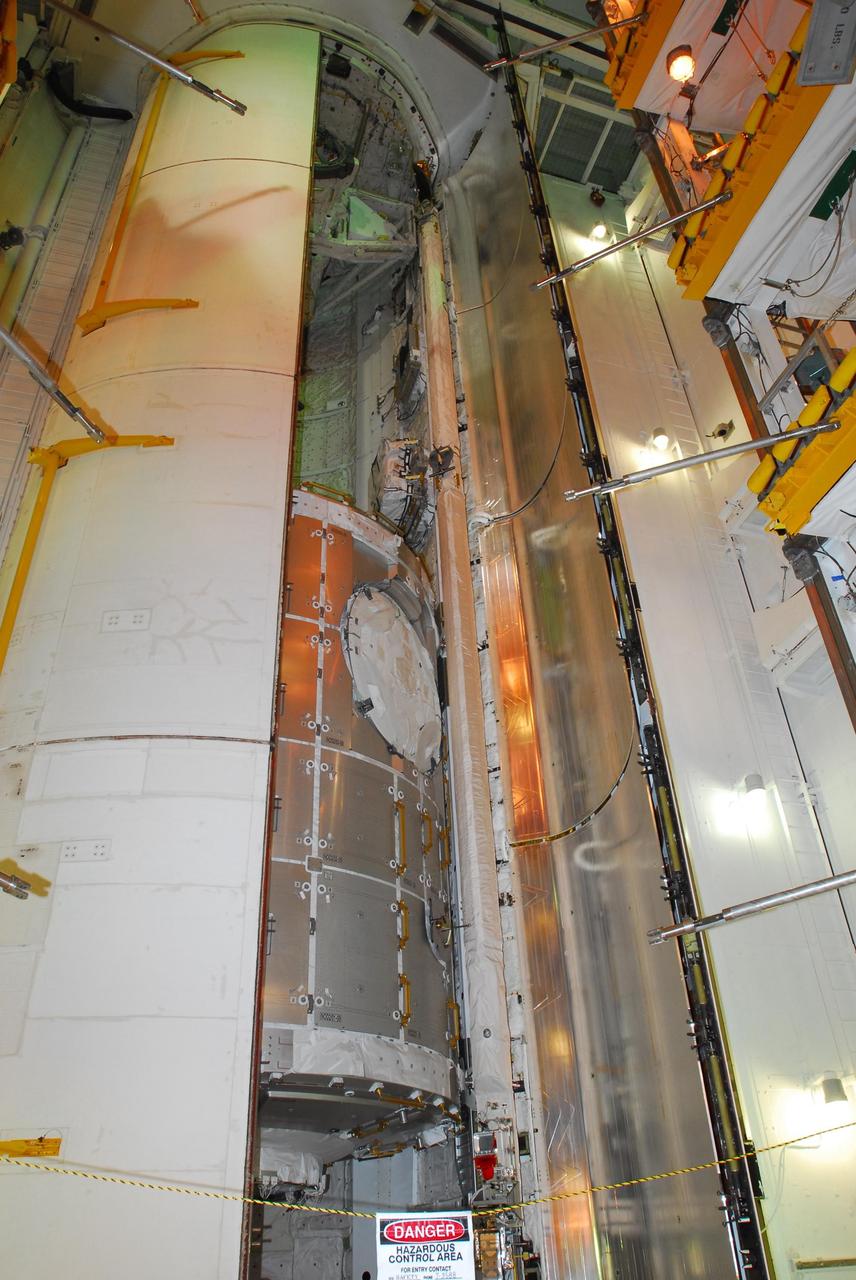
KENNEDY SPACE CENTER, FLA. -- On Launch Pad 39A, one of space shuttle Discovery's payload bay doors is closed. Inside can still be seen the payloads, the U.S. Node 2, named Harmony (lower), and orbital docking system (upper). Mission STS-120 will bring the Harmony module that will provide attachment points for European and Japanese laboratory modules to the International Space Station. Launch of Discovery is targeted for Oct. 23. Photo credit: NASA/George Shelton
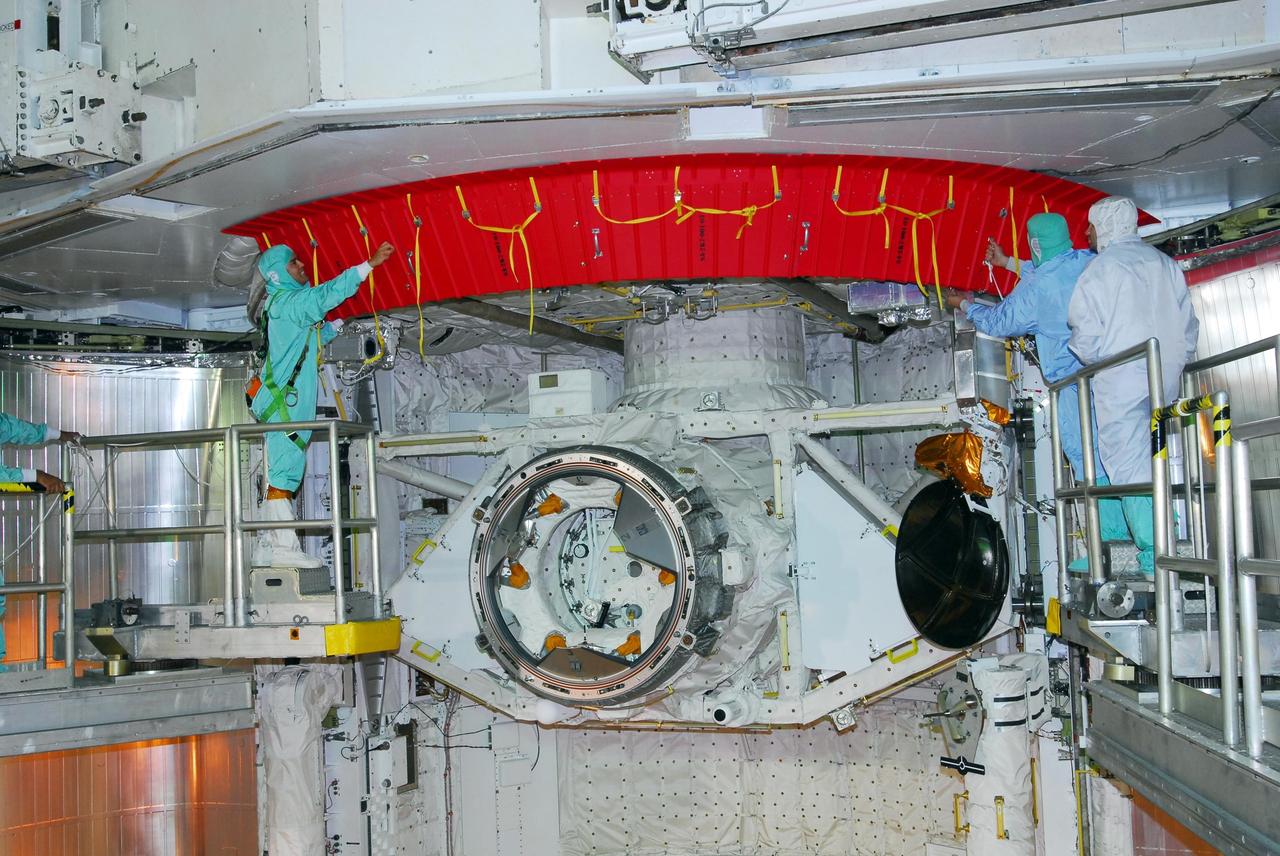
KENNEDY SPACE CENTER, FLA. -- On Launch Pad 39A, workers are removing the rain gutters from space shuttle Discovery's payload bay. The gutters prevent leaks into the bay from rain while the shuttle is on the pad. Beneath is the orbital docking system. Mission STS-120 will bring the Harmony module that will provide attachment points for European and Japanese laboratory modules to the International Space Station. Launch of Discovery is targeted for Oct. 23. Photo credit: NASA/George Shelton
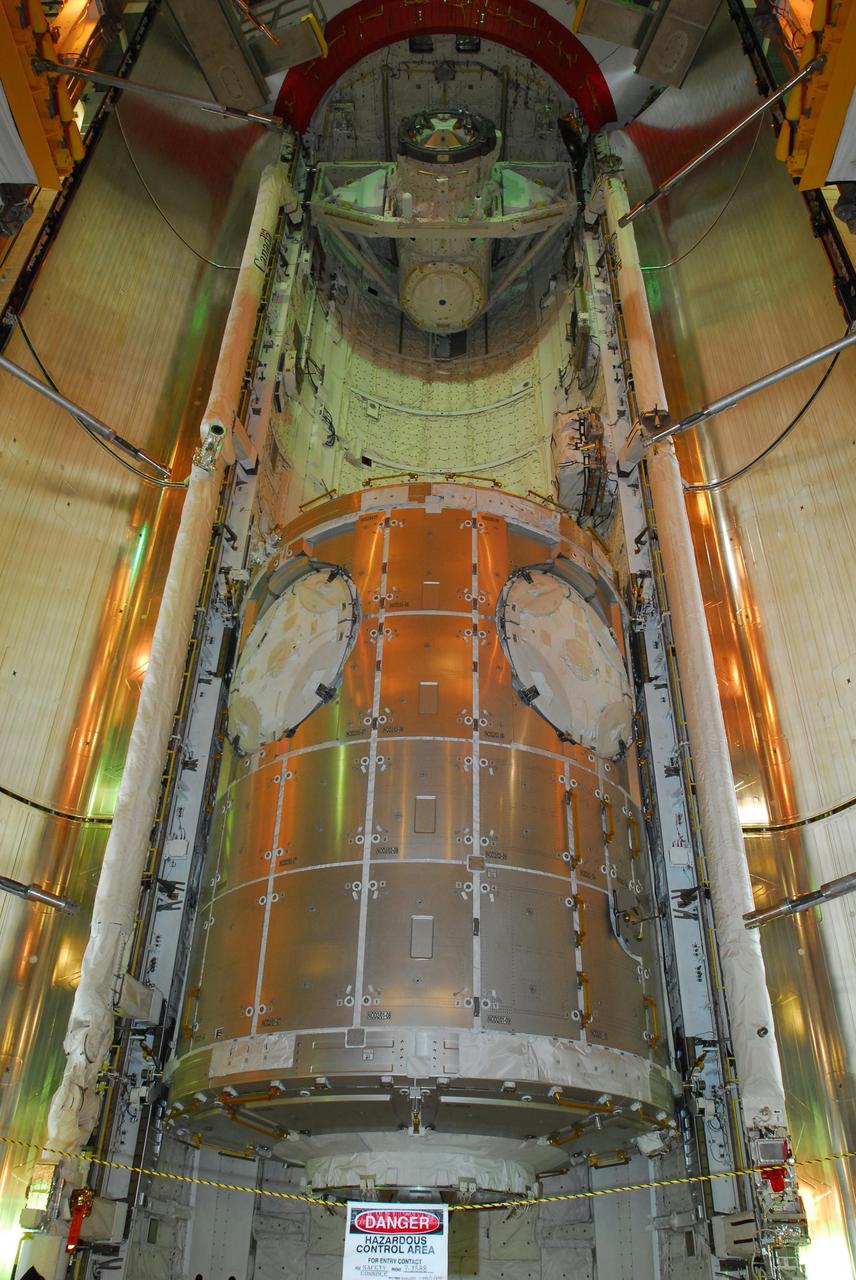
KENNEDY SPACE CENTER, FLA. -- From the payload changeout room on Launch Pad 39A, the payloads for mission STS-120 have been transferred into space shuttle Discovery's payload bay. Seen at the lower end is the Italian-built U.S. Node 2 module, named Harmony. At the top is the orbital docking system. The red ring at top comprises rain gutters to prevent leaks into the bay from rain while the shuttle is on the pad. Mission STS-120 will bring the Harmony module that will provide attachment points for European and Japanese laboratory modules to the International Space Station. Launch of Discovery is targeted for Oct. 23. Photo credit: NASA/George Shelton
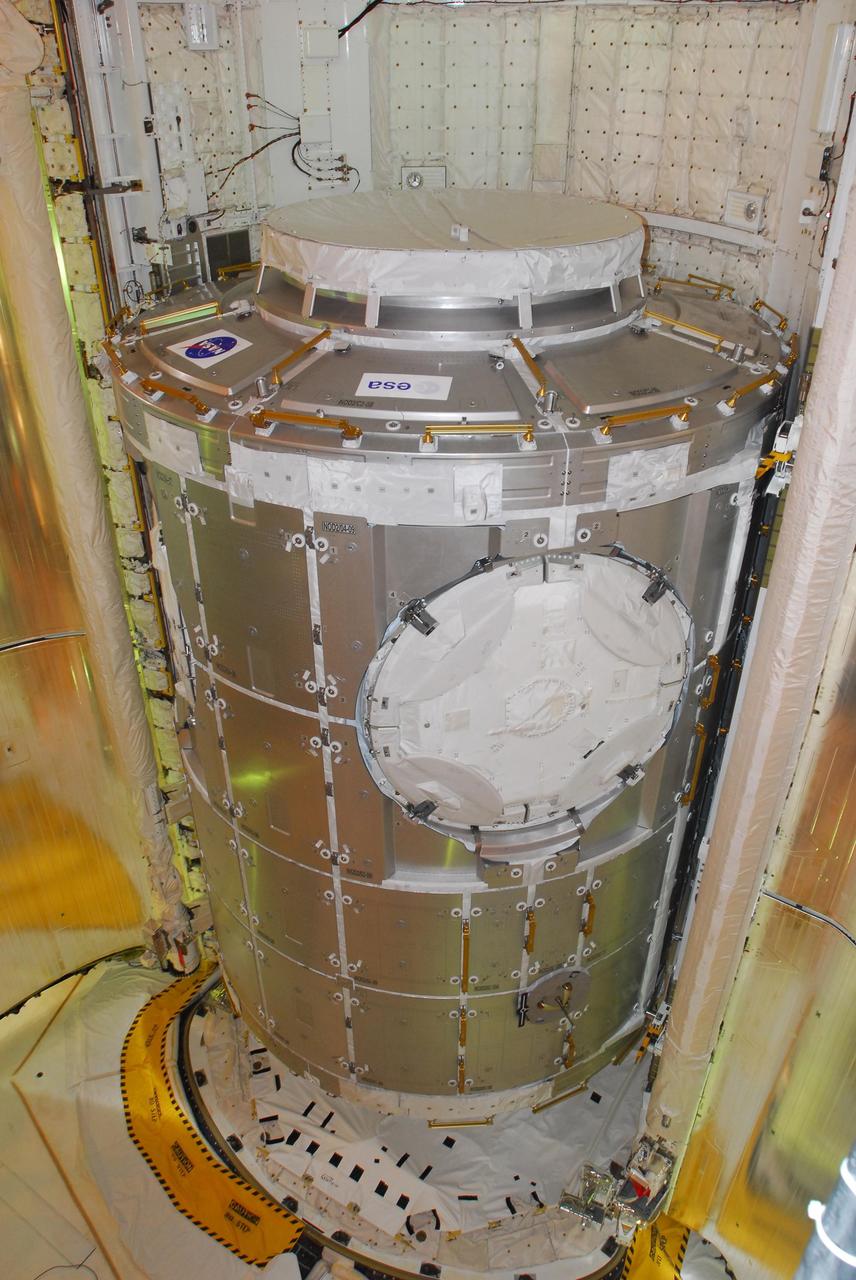
KENNEDY SPACE CENTER, FLA. -- From the payload changeout room on Launch Pad 39A, the payloads for mission STS-120 have been transferred into space shuttle Discovery's payload bay. Seen here is the Italian-built U.S. Node 2 module, named Harmony. Mission STS-120 will bring the Harmony module that will provide attachment points for European and Japanese laboratory modules to the International Space Station. Launch of Discovery is targeted for Oct. 23. Photo credit: NASA/George Shelton
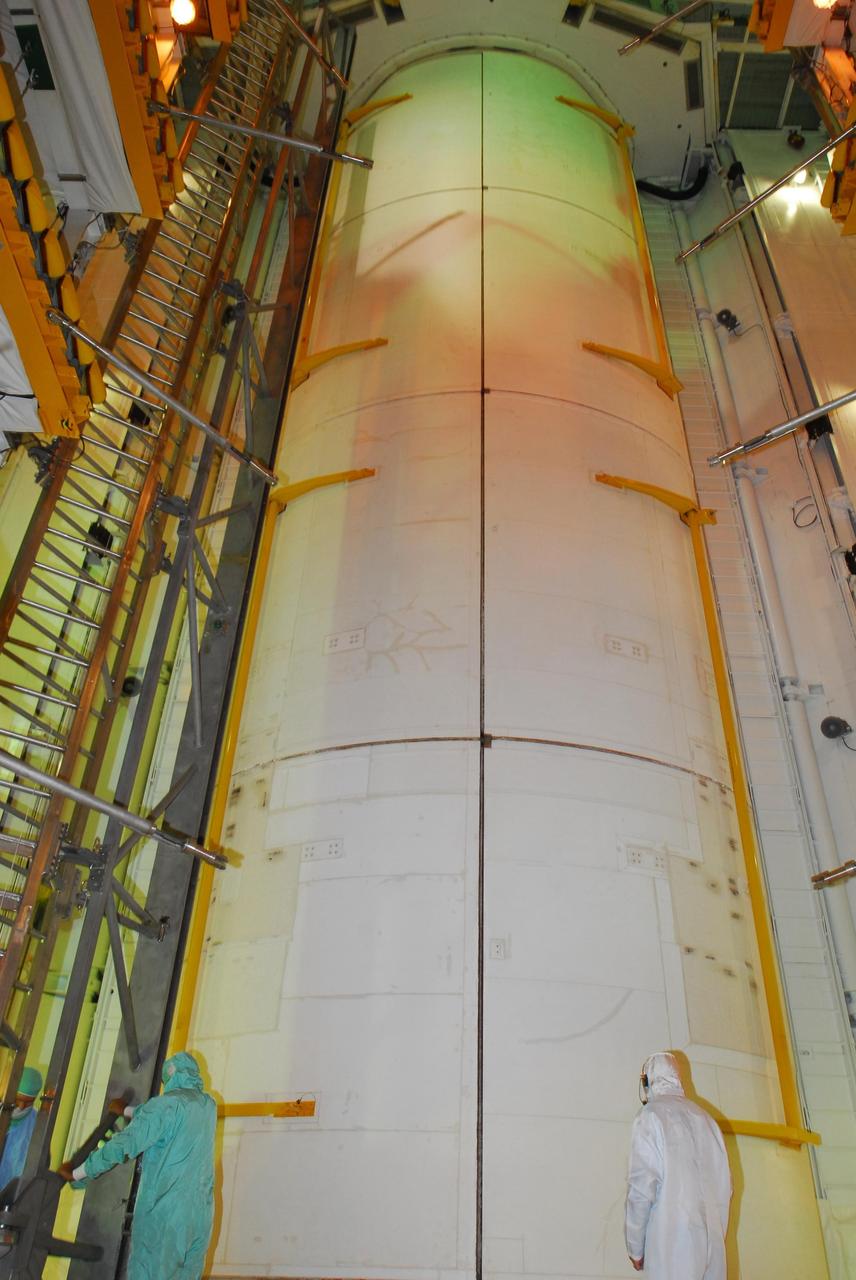
KENNEDY SPACE CENTER, FLA. -- On Launch Pad 39A, space shuttle Discovery's payload bay doors are closed for launch. Inside are the payloads, the U.S. Node 2, named Harmony and orbital docking system. Mission STS-120 will bring the Harmony module that will provide attachment points for European and Japanese laboratory modules to the International Space Station. Launch of Discovery is targeted for Oct. 23. Photo credit: NASA/George Shelton
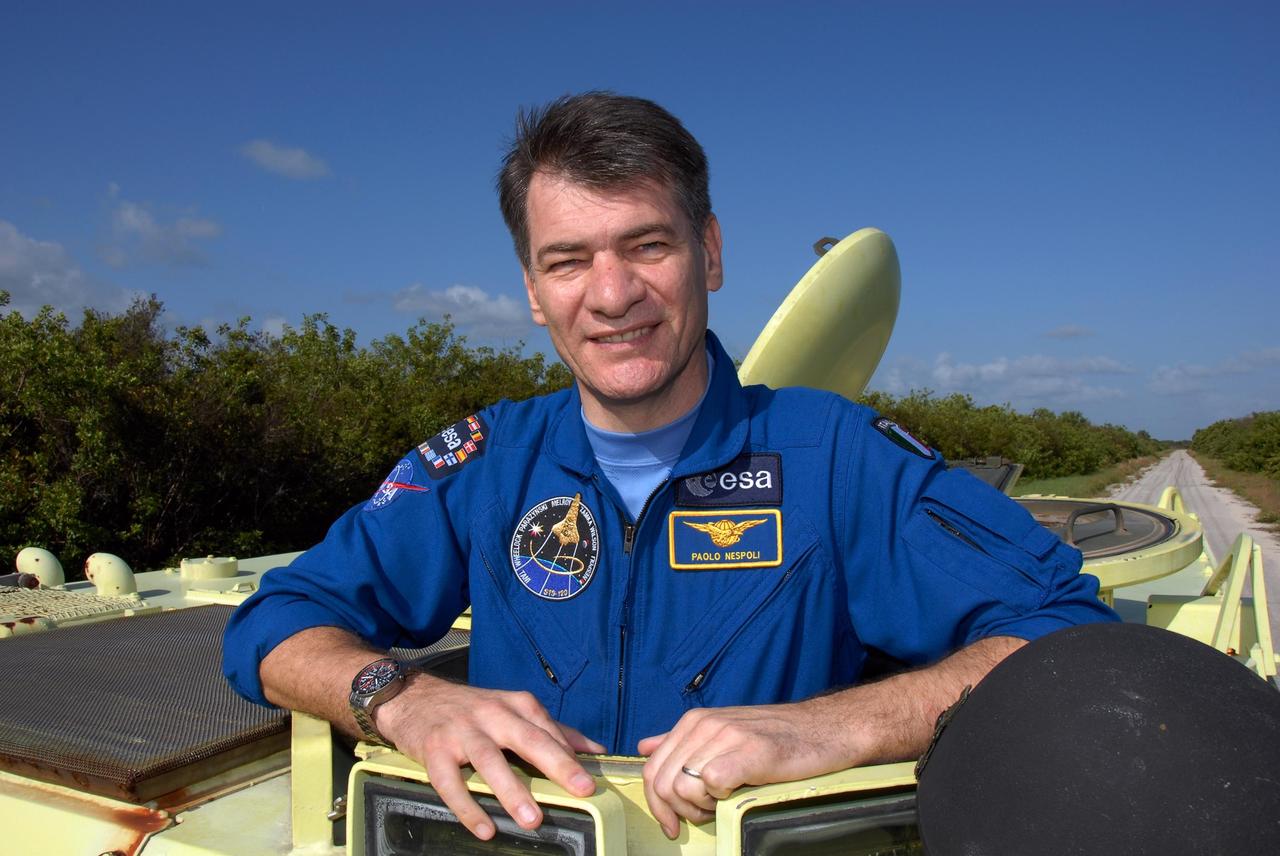
KENNEDY SPACE CENTER, FLA. -- STS-120 Mission Specialist Paolo Nespoli, who represents the European Space Agency, gets ready in the driver's seat for driving practice in the M-113 armored personnel carrier. The M-113 is part of emergency exit procedures from Launch Pad 39A. The training is part of terminal countdown demonstration test, or TCDT, activities the crew is undertaking at NASA's Kennedy Space Center. The TCDT also includes equipment familiarization and a simulated launch countdown. Mission STS-120, which will carry the Italian-built U.S. Node 2 to the International Space Station, is targeted for launch on Oct. 23. Photo credit: NASA/Kim Shiflett
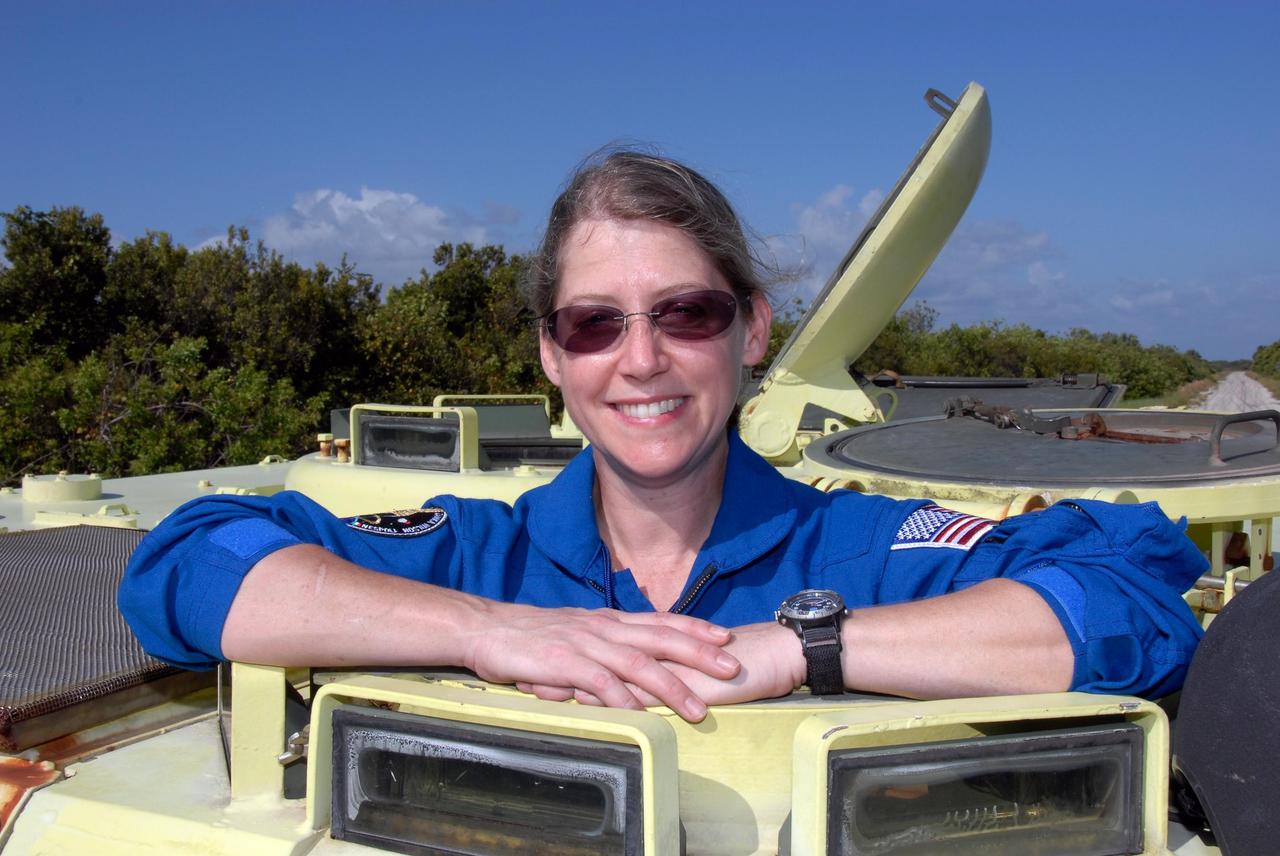
KENNEDY SPACE CENTER, FLA. -- STS-120 Commander Pamela Melroy is ready for her turn at driving practice in the M-113 armored personnel carrier. The M-113 is part of emergency exit procedures from Launch Pad 39A. The training is part of terminal countdown demonstration test, or TCDT, activities the crew is undertaking at NASA's Kennedy Space Center. The TCDT also includes equipment familiarization and a simulated launch countdown. Mission STS-120, which will carry the Italian-built U.S. Node 2 to the International Space Station, is targeted for launch on Oct. 23. Photo credit: NASA/Kim Shiflett
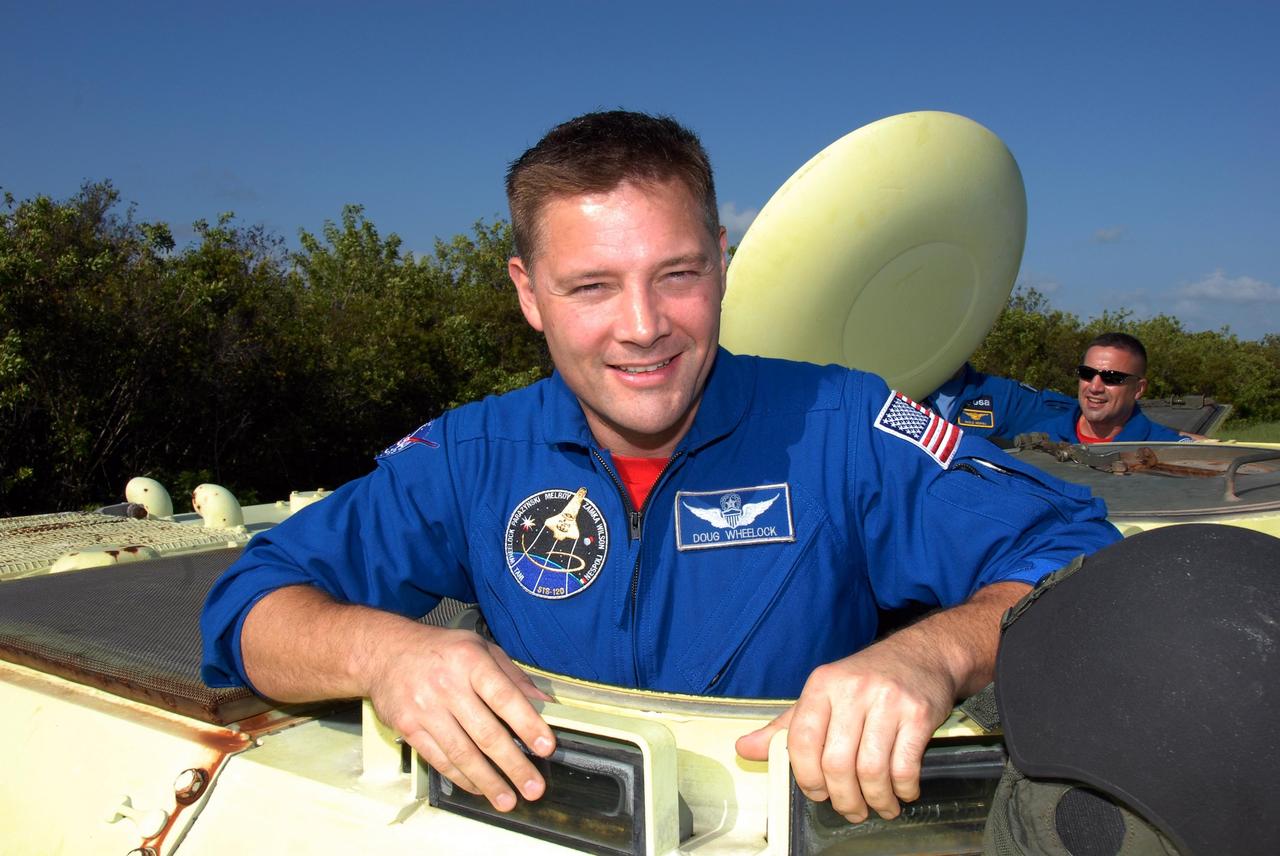
KENNEDY SPACE CENTER, FLA. -- STS-120 Mission Specialist Doug Wheelock gets ready in the driver's seat for driving practice in the M-113 armored personnel carrier. The M-113 is part of emergency exit procedures from Launch Pad 39A. Behind him, at right, is Pilot George Zamka. The training is part of terminal countdown demonstration test, or TCDT, activities the crew is undertaking at NASA's Kennedy Space Center. The TCDT also includes equipment familiarization and a simulated launch countdown. Mission STS-120, which will carry the Italian-built U.S. Node 2 to the International Space Station, is targeted for launch on Oct. 23. Photo credit: NASA/Kim Shiflett

KENNEDY SPACE CENTER, FLA. -- STS-120 Commander Pamela Melroy poses for another photo after driving practice in the M-113 armored personnel carrier. The M-113 is part of emergency exit procedures from Launch Pad 39A. The training is part of terminal countdown demonstration test, or TCDT, activities the crew is undertaking at NASA's Kennedy Space Center. The TCDT also includes equipment familiarization and a simulated launch countdown. Mission STS-120, which will carry the Italian-built U.S. Node 2 to the International Space Station, is targeted for launch on Oct. 23. Photo credit: NASA/Kim Shiflett
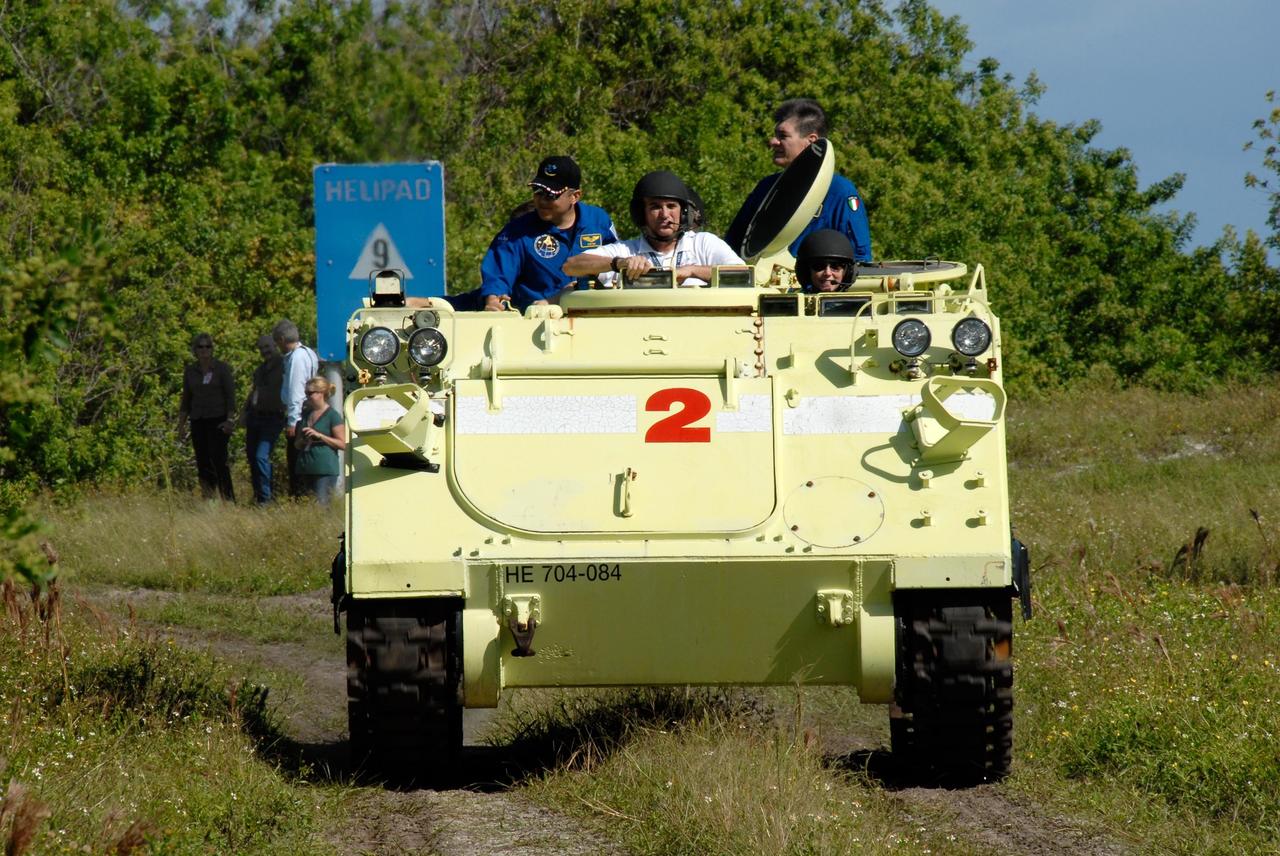
KENNEDY SPACE CENTER, FLA. -- STS-120 Commander Pamela Melroy drives the M-113 armored personnel carrier near Launch Pad 39A as part of emergency exit procedures. Beside her in front is the trainer. In the rear are Mission Specialists Daniel Tani and Paolo Nespoli, who represents the European Space Agency. The training is part of terminal countdown demonstration test, or TCDT, activities the crew is undertaking at NASA's Kennedy Space Center. The TCDT also includes equipment familiarization and a simulated launch countdown. Mission STS-120, which will carry the Italian-built U.S. Node 2 to the International Space Station, is targeted for launch on Oct. 23. Photo credit: NASA/Kim Shiflett
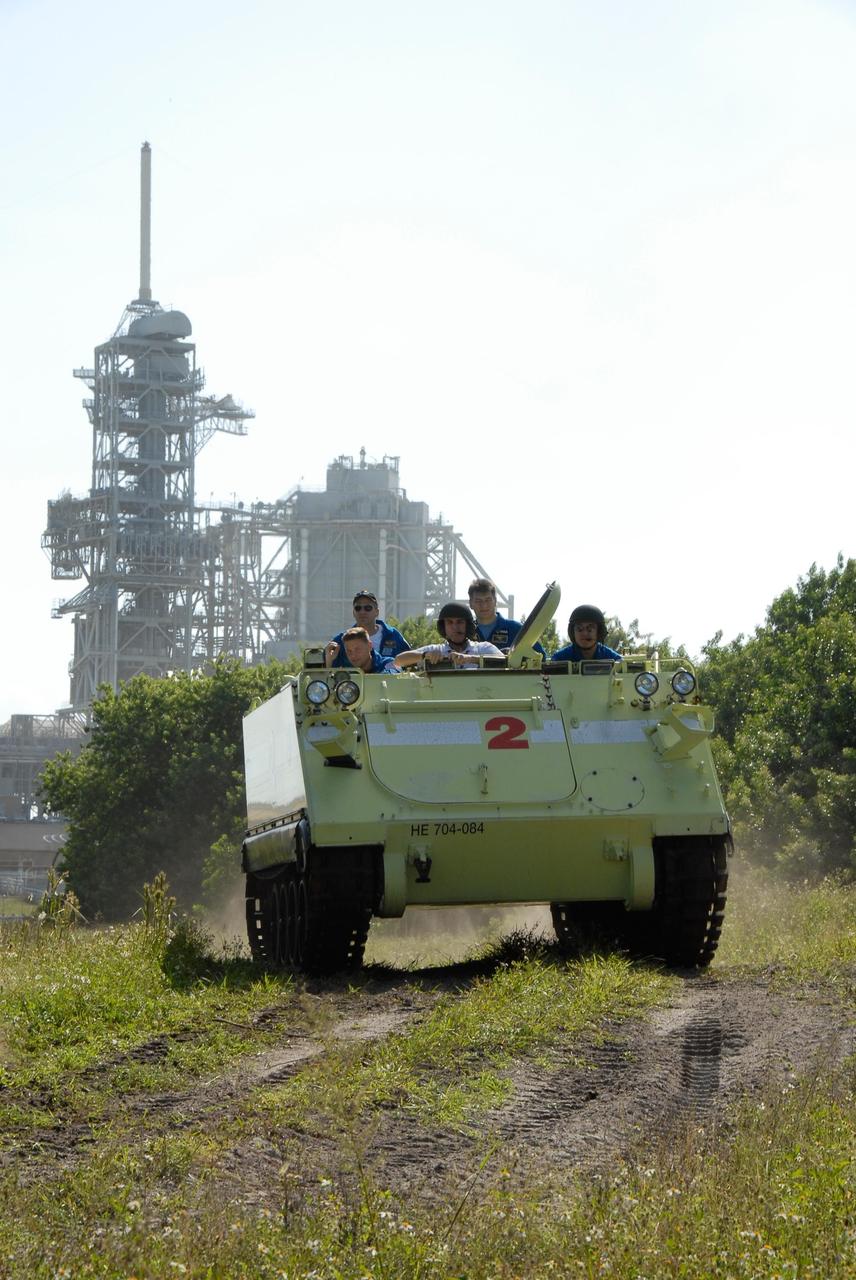
KENNEDY SPACE CENTER, FLA. -- Driven by Mission Specialist Daniel Tani, the M-113 armored personnel carrier moves through the underbrush near Launch Pad 39A. The M-113 is part of emergency exit procedures from Launch Pad 39A. Also in front is the trainer. In the rear are Mission Specialists Doug Wheelock, Scott Parazynski and Paolo Nespoli, who represents the European Space Agency. The training is part of terminal countdown demonstration test, or TCDT, activities the crew is undertaking at NASA's Kennedy Space Center. The TCDT also includes equipment familiarization and a simulated launch countdown. Mission STS-120, which will carry the Italian-built U.S. Node 2 to the International Space Station, is targeted for launch on Oct. 23. Photo credit: NASA/Kim Shiflett
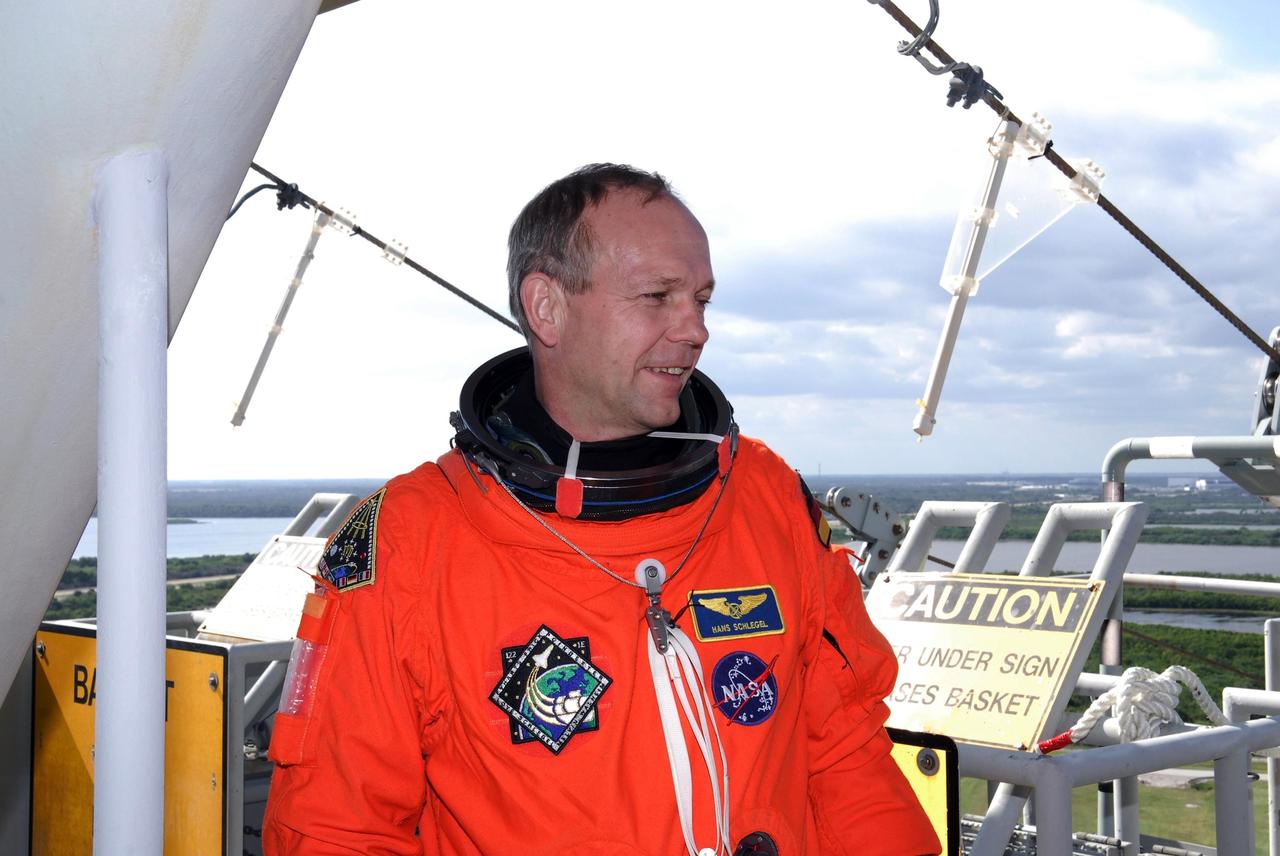
KENNEDY SPACE CENTER, FLA. -- Space shuttle Atlantis STS-122 Mission Specialist Hans Schlegel relaxes for a moment following a simulated launch countdown at Launch Pad 39A. The exercise is part of terminal countdown demonstration test, or TCDT, activities at NASA's Kennedy Space Center. The TCDT is a dress rehearsal for launch and also provides astronauts and ground crews with equipment familiarization and emergency egress training. On mission STS-122, Atlantis will deliver the Columbus module to the International Space Station. The European Space Agency's largest single contribution to the station, Columbus is a multifunctional, pressurized laboratory that will be permanently attached to U.S. Node 2, called Harmony. The laboratory will expand the research facilities aboard the station, providing crew members and scientists from around the world the ability to conduct a variety of experiments in the physical, materials and life sciences. Atlantis' launch is targeted for Dec. 6. Photo credit: NASA/Kim Shiflett
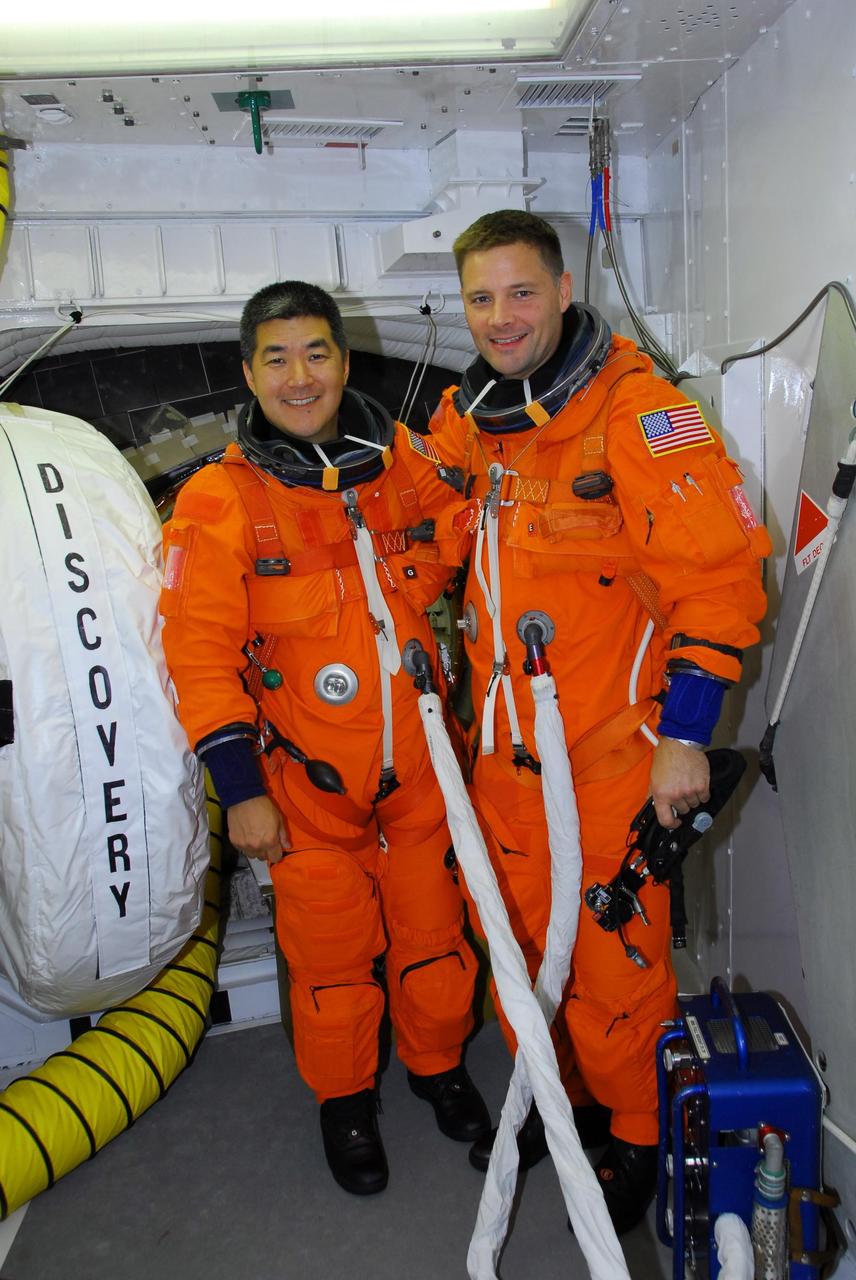
KENNEDY SPACE CENTER, FLA. -- In the white room on Launch Pad 39A, STS-120 Mission Specialists Daniel Tani (left) and Doug Wheelock are ready to enter space shuttle Discovery for a simulated launch countdown. The countdown is the culmination of the prelaunch terminal countdown demonstration test, or TCDT. The TCDT at NASA's Kennedy Space Center provides astronauts and ground crews an opportunity to participate in various launch preparation activities, including equipment familiarization and emergency training. The STS-120 mission will deliver the U.S. Node 2 module, named Harmony, aboard space shuttle Discovery to the International Space Station. Discovery is targeted to launch on its 14-day mission at 11:38 a.m. EDT on Oct. 23. Photo credit: NASA/George Shelton

KENNEDY SPACE CENTER, FLA. -- In the white room on Launch Pad 39A, STS-120 Mission Specialist Scott Parazynski gets ready to enter space shuttle Discovery for a simulated launch countdown. The countdown is the culmination of the prelaunch terminal countdown demonstration test, or TCDT. The TCDT at NASA's Kennedy Space Center provides astronauts and ground crews an opportunity to participate in various launch preparation activities, including equipment familiarization and emergency training. The STS-120 mission will deliver the U.S. Node 2 module, named Harmony, aboard space shuttle Discovery to the International Space Station. Discovery is targeted to launch on its 14-day mission at 11:38 a.m. EDT on Oct. 23. Photo credit: NASA/George Shelton
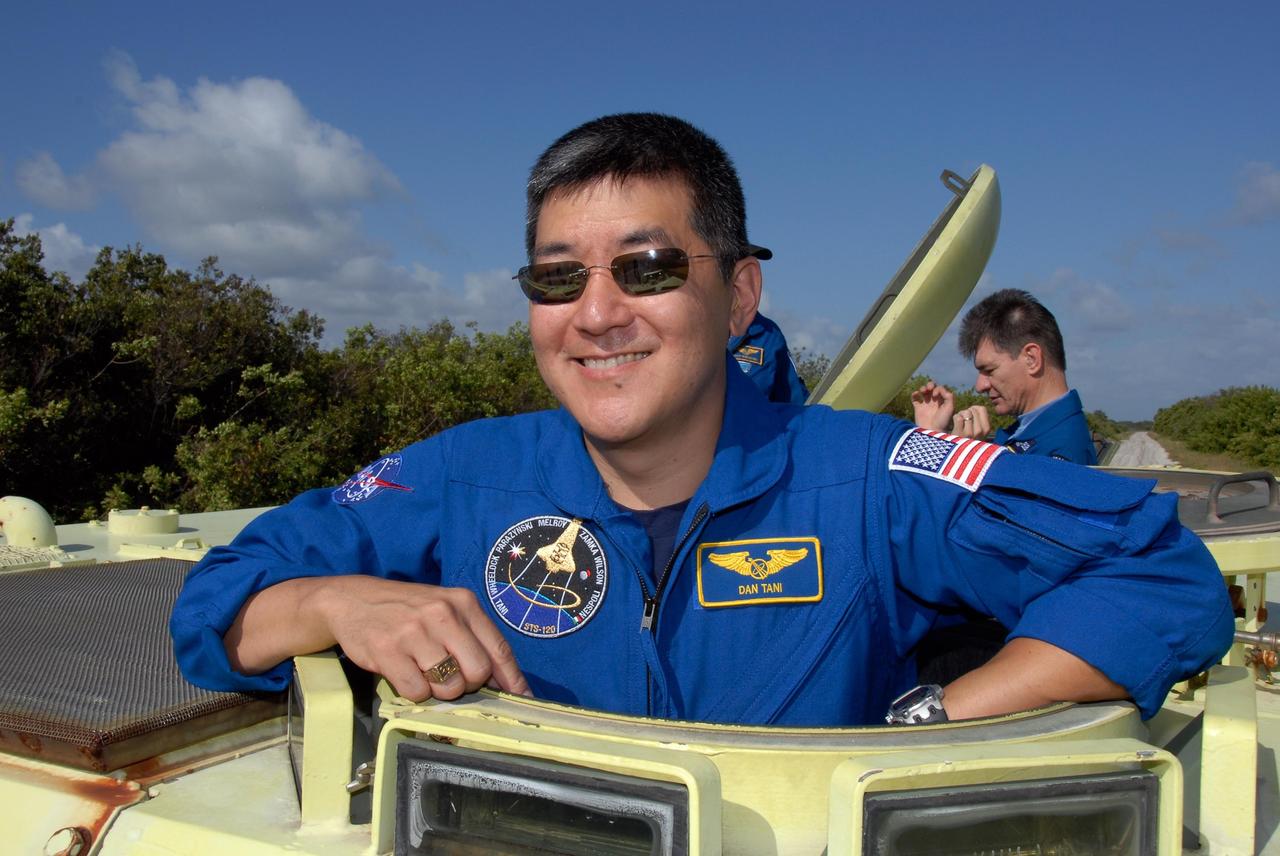
KENNEDY SPACE CENTER, FLA. -- STS-120 Mission Specialist Daniel Tani is ready for his turn at driving the M-113 armored personnel carrier. The M-113 is part of emergency exit procedures from Launch Pad 39A. Behind him, at right, is Mission Specialist Paolo Nespoli, who represents the European Space Agency. The training is part of terminal countdown demonstration test, or TCDT, activities the crew is undertaking at NASA's Kennedy Space Center. The TCDT also includes equipment familiarization and a simulated launch countdown. Mission STS-120, which will carry the Italian-built U.S. Node 2 to the International Space Station, is targeted for launch on Oct. 23. Photo credit: NASA/Kim Shiflett
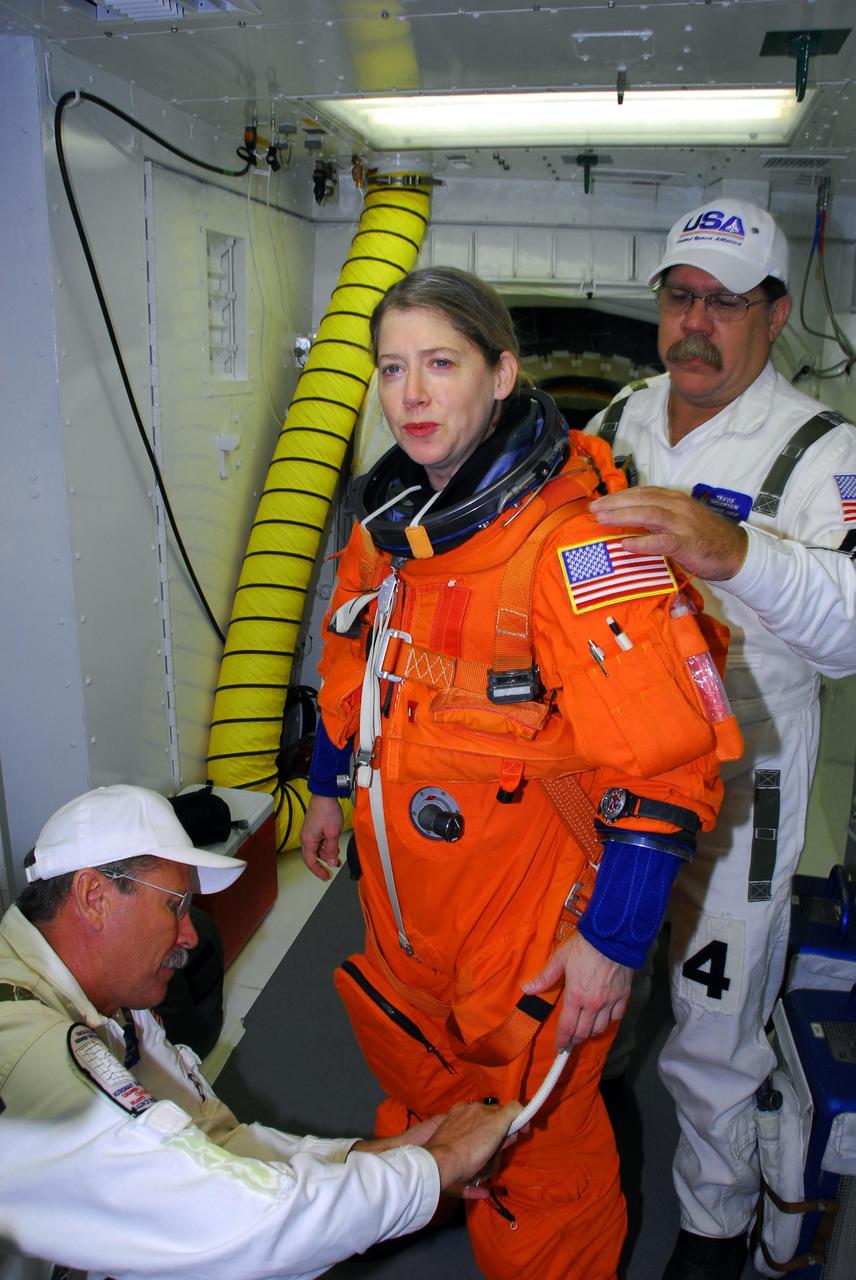
KENNEDY SPACE CENTER, FLA. -- In the white room on Launch Pad 39A, STS-120 Commander Pamela Melroy is helped by the closeout crew in donning a parachute pack before she crawls through the open hatch into space shuttle Discovery for a simulated launch countdown. The countdown is the culmination of the prelaunch terminal countdown demonstration test, or TCDT. Her name patch reflects the nicknames the crew gave each other for the event. The TCDT at NASA's Kennedy Space Center provides astronauts and ground crews an opportunity to participate in various launch preparation activities, including equipment familiarization and emergency training. The STS-120 mission will deliver the U.S. Node 2 module, named Harmony, aboard space shuttle Discovery to the International Space Station. Discovery is targeted to launch on its 14-day mission at 11:38 a.m. EDT on Oct. 23. Photo credit: NASA/George Shelton
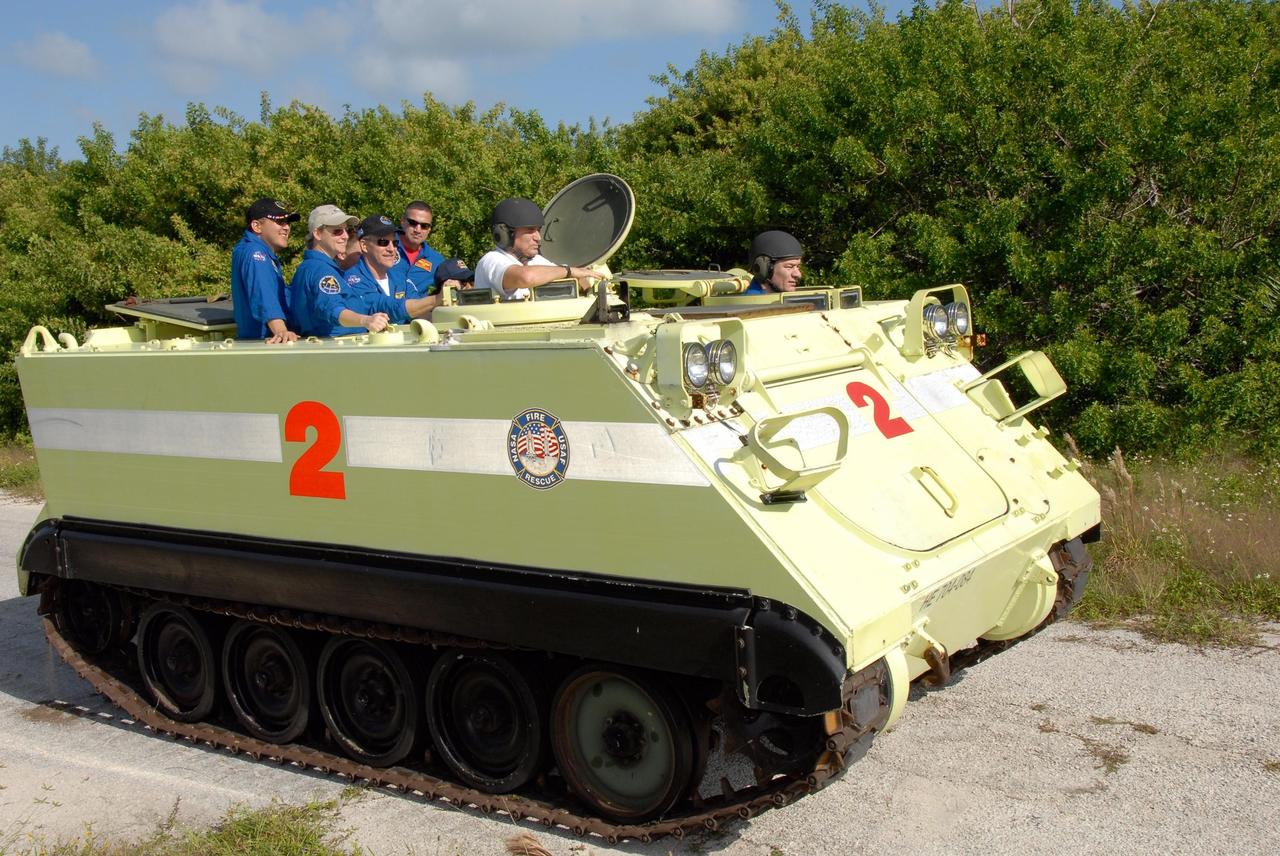
KENNEDY SPACE CENTER, FLA. -- STS-120 Mission Specialist Paolo Nespoli, who represents the European Space Agency, practices driving the M-113 armored personnel carrier, which is part of emergency exit procedures from Launch Pad 39A. Also in front is the trainer. Passenger crew members in the rear are (from left) Mission Specialists Daniel Tani, Commander Pamela Melroy, Mission Specialist Scott Parazynski and Pilot George Zamka. The training is part of terminal countdown demonstration test, or TCDT, activities the crew is undertaking at NASA's Kennedy Space Center. The TCDT also includes equipment familiarization and a simulated launch countdown. Mission STS-120, which will carry the Italian-built U.S. Node 2 to the International Space Station, is targeted for launch on Oct. 23. Photo credit: NASA/Kim Shiflett
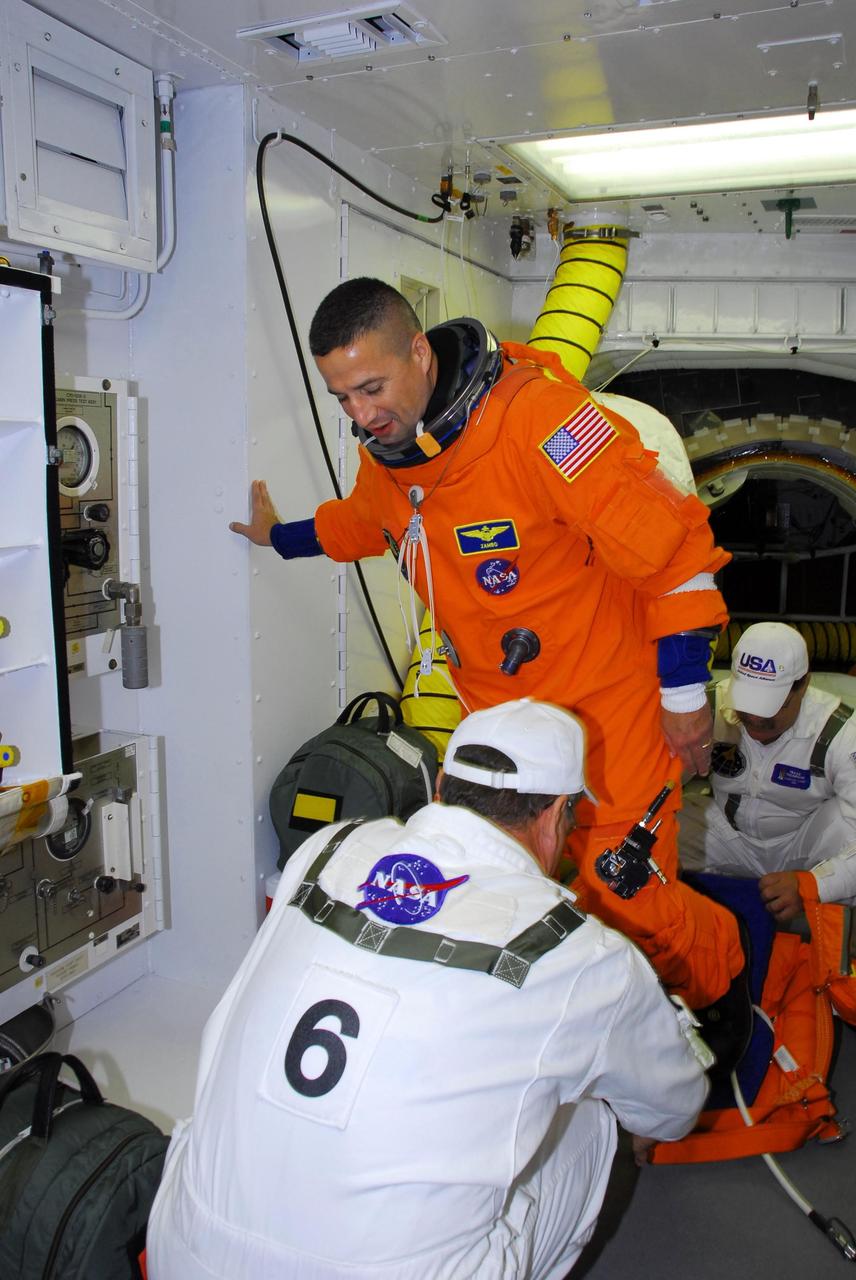
KENNEDY SPACE CENTER, FLA. -- In the white room on Launch Pad 39A, the closeout crew helps STS-120 Pilot George Zamka to get into a parachute pack before entering space shuttle Discovery for a simulated launch countdown. The countdown is the culmination of the prelaunch terminal countdown demonstration test, or TCDT. His name patch reflects the nicknames the crew gave each other for the event. The TCDT at NASA's Kennedy Space Center provides astronauts and ground crews an opportunity to participate in various launch preparation activities, including equipment familiarization and emergency training. The STS-120 mission will deliver the U.S. Node 2 module, named Harmony, aboard space shuttle Discovery to the International Space Station. Discovery is targeted to launch on its 14-day mission at 11:38 a.m. EDT on Oct. 23. Photo credit: NASA/George Shelton
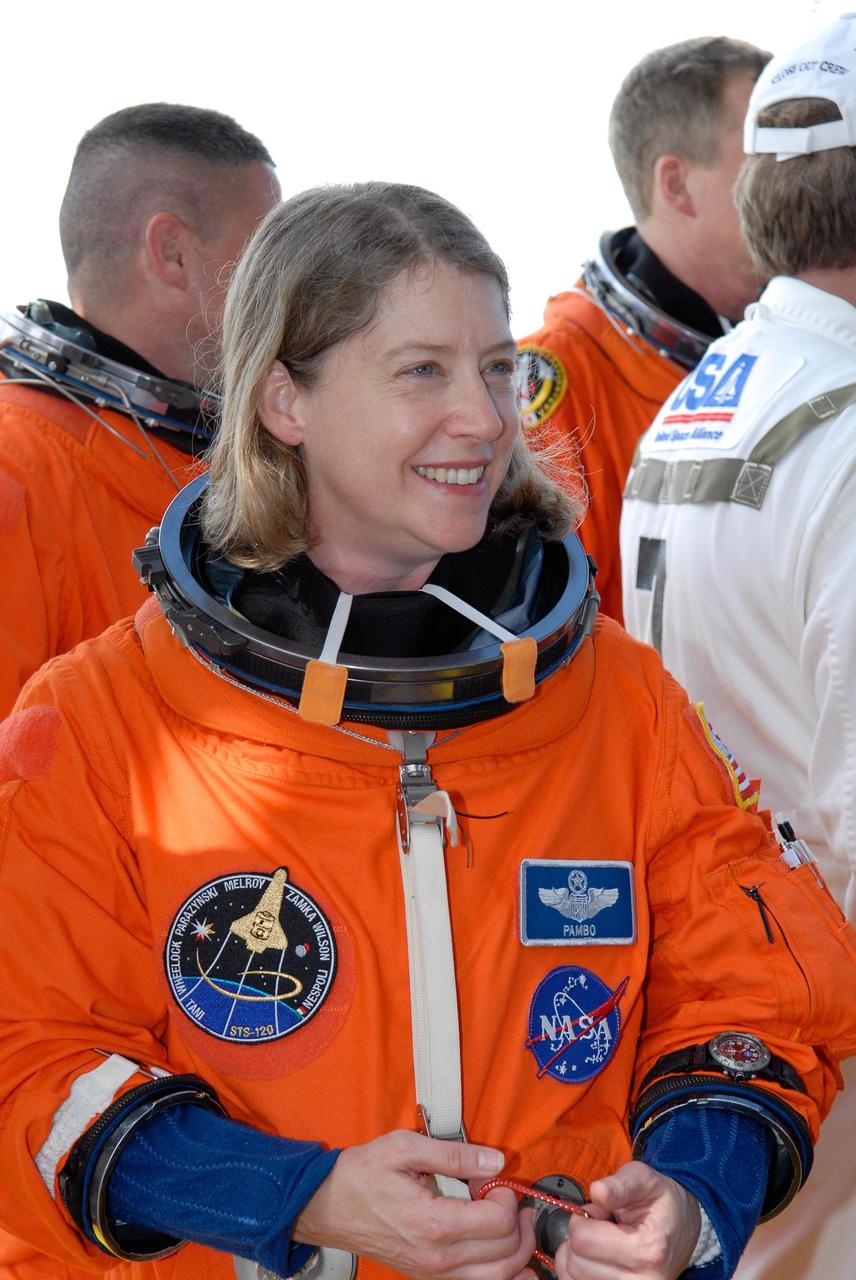
KENNEDY SPACE CENTER, FLA. -- The STS-120 crew gathers at the slidewire basket area on Launch Pad 39A after practicing emergency egress, part of the prelaunch terminal countdown demonstration test, or TCDT. Seen here in their launch and entry suits are (from left) Pilot George Zamka, Commander Pamela Melroy and Mission Specialist Scott Parazynski. Their name patches reflect the nicknames the crew gave each other for the event. The TCDT at NASA's Kennedy Space Center provides astronauts and ground crews an opportunity to participate in various launch preparation activities, including equipment familiarization and emergency training. The STS-120 mission will deliver the U.S. Node 2 module, named Harmony, aboard space shuttle Discovery to the International Space Station. Discovery is targeted to launch on its 14-day mission at 11:38 a.m. EDT on Oct. 23. Photo credit: NASA/Kim Shiflett
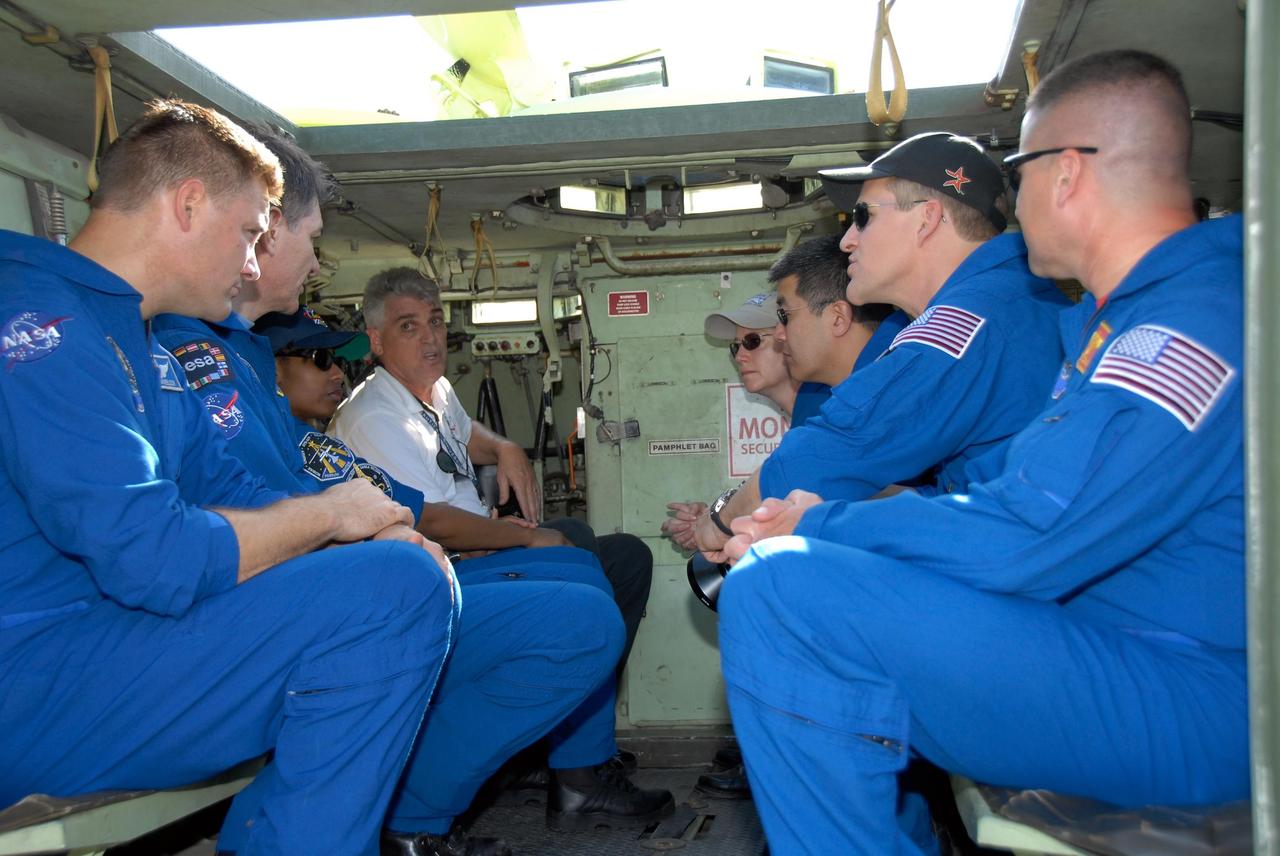
KENNEDY SPACE CENTER, FLA. -- STS-120 crew members listen to instructions about the use of the M-113 armored personnel carrier for emergency exit procedures from Launch Pad 39A. From the front, on the left, are Mission Specialists Doug Wheelock, Paolo Nespoli and Stephanie Wilson; at right are Pilot George Zamka, Mission Specialists Scott Parazynski and Daniel Tani, and Commander Pamela Melroy. Nespoli represents the European Space Agency. The training is part of terminal countdown demonstration test, or TCDT, activities the crew is undertaking at NASA's Kennedy Space Center. The TCDT also includes equipment familiarization and a simulated launch countdown. Mission STS-120, which will carry the Italian-built U.S. Node 2 to the International Space Station, is targeted for launch on Oct. 23. Photo credit: NASA/Kim Shiflett
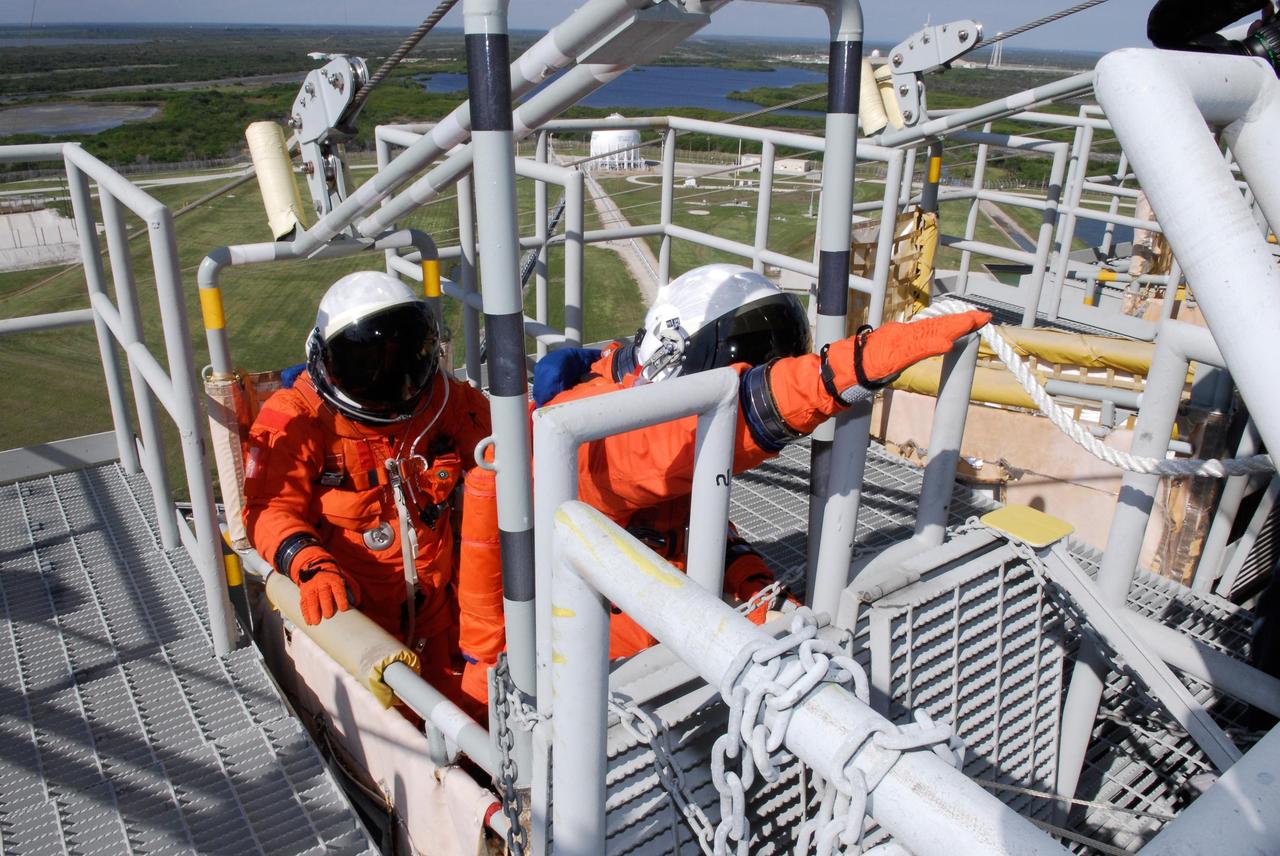
KENNEDY SPACE CENTER, FLA. -- Members of space shuttle Atlantis' STS-122 crew practice emergency exit procedures in a slidewire basket at Launch Pad 39A following a simulated launch countdown. The exercise is part of terminal countdown demonstration test, or TCDT, activities at NASA's Kennedy Space Center. The TCDT is a dress rehearsal for launch and also provides astronauts and ground crews with equipment familiarization and emergency egress training. On mission STS-122, Atlantis will deliver the Columbus module to the International Space Station. The European Space Agency's largest single contribution to the station, Columbus is a multifunctional, pressurized laboratory that will be permanently attached to U.S. Node 2, called Harmony. The laboratory will expand the research facilities aboard the station, providing crew members and scientists from around the world the ability to conduct a variety of experiments in the physical, materials and life sciences. Atlantis' launch is targeted for Dec. 6. Photo credit: NASA/Kim Shiflett

KENNEDY SPACE CENTER, FLA. -- In the white room on Launch Pad 39A, STS-120 Pilot George Zamka (left) and Mission Specialist Scott Parazynski are ready to enter space shuttle Discovery for a simulated launch countdown. The countdown is the culmination of the prelaunch terminal countdown demonstration test, or TCDT. The TCDT at NASA's Kennedy Space Center provides astronauts and ground crews an opportunity to participate in various launch preparation activities, including equipment familiarization and emergency training. The STS-120 mission will deliver the U.S. Node 2 module, named Harmony, aboard space shuttle Discovery to the International Space Station. Discovery is targeted to launch on its 14-day mission at 11:38 a.m. EDT on Oct. 23. Photo credit: NASA/George Shelton
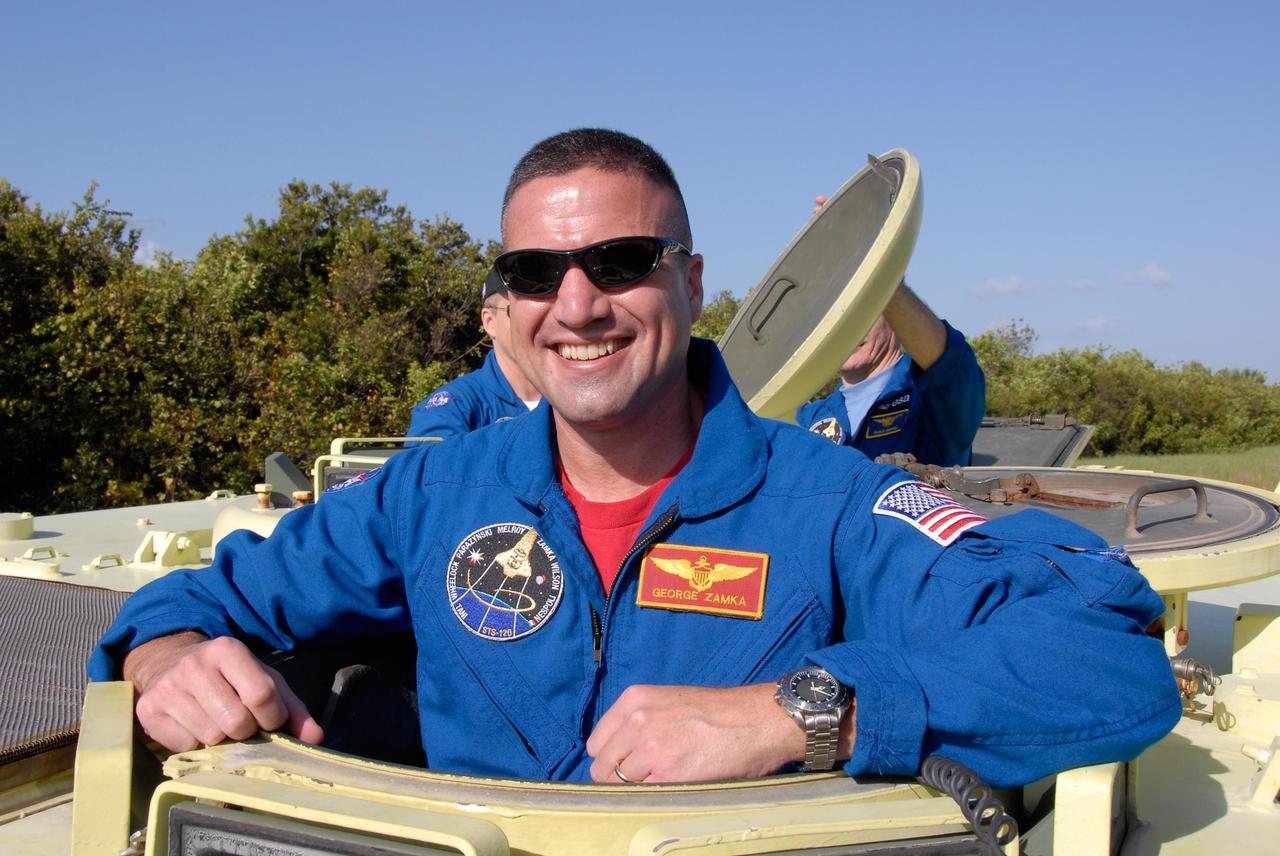
KENNEDY SPACE CENTER, FLA. -- STS-120 Pilot George Zamka gets ready in the driver's seat for driving practice in the M-113 armored personnel carrier. The M-113 is part of emergency exit procedures from Launch Pad 39A. Behind Zamka, half hidden, is Mission Specialist Paolo Nespoli, who represents the European Space Agency. The training is part of terminal countdown demonstration test, or TCDT, activities the crew is undertaking at NASA's Kennedy Space Center. The TCDT also includes equipment familiarization and a simulated launch countdown. Mission STS-120, which will carry the Italian-built U.S. Node 2 to the International Space Station, is targeted for launch on Oct. 23. Photo credit: NASA/Kim Shiflett
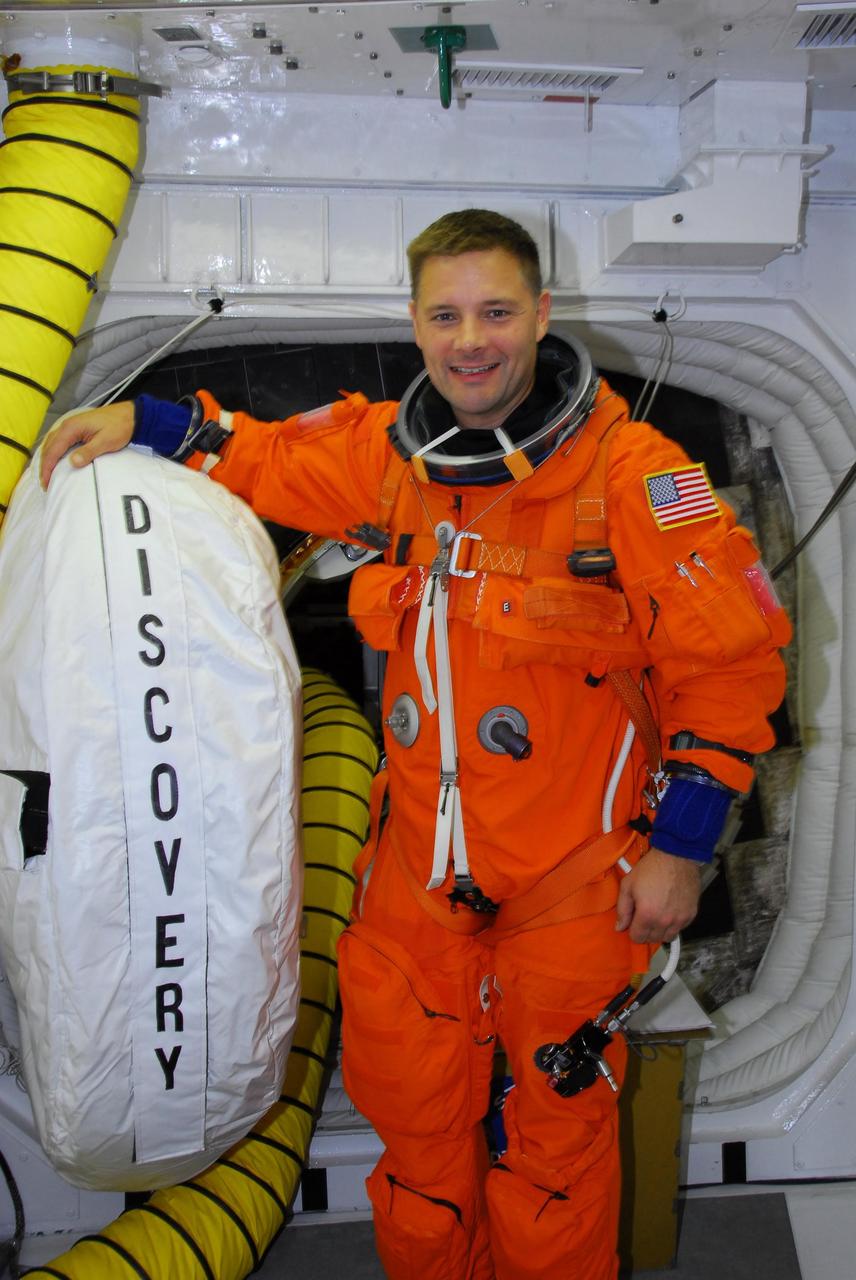
KENNEDY SPACE CENTER, FLA. -- In the white room on Launch Pad 39A, STS-120 Mission Specialist Doug Wheelock is ready to enter space shuttle Discovery for a simulated launch countdown. The countdown is the culmination of the prelaunch terminal countdown demonstration test, or TCDT. The TCDT at NASA's Kennedy Space Center provides astronauts and ground crews an opportunity to participate in various launch preparation activities, including equipment familiarization and emergency training. The STS-120 mission will deliver the U.S. Node 2 module, named Harmony, aboard space shuttle Discovery to the International Space Station. Discovery is targeted to launch on its 14-day mission at 11:38 a.m. EDT on Oct. 23. Photo credit: NASA/George Shelton
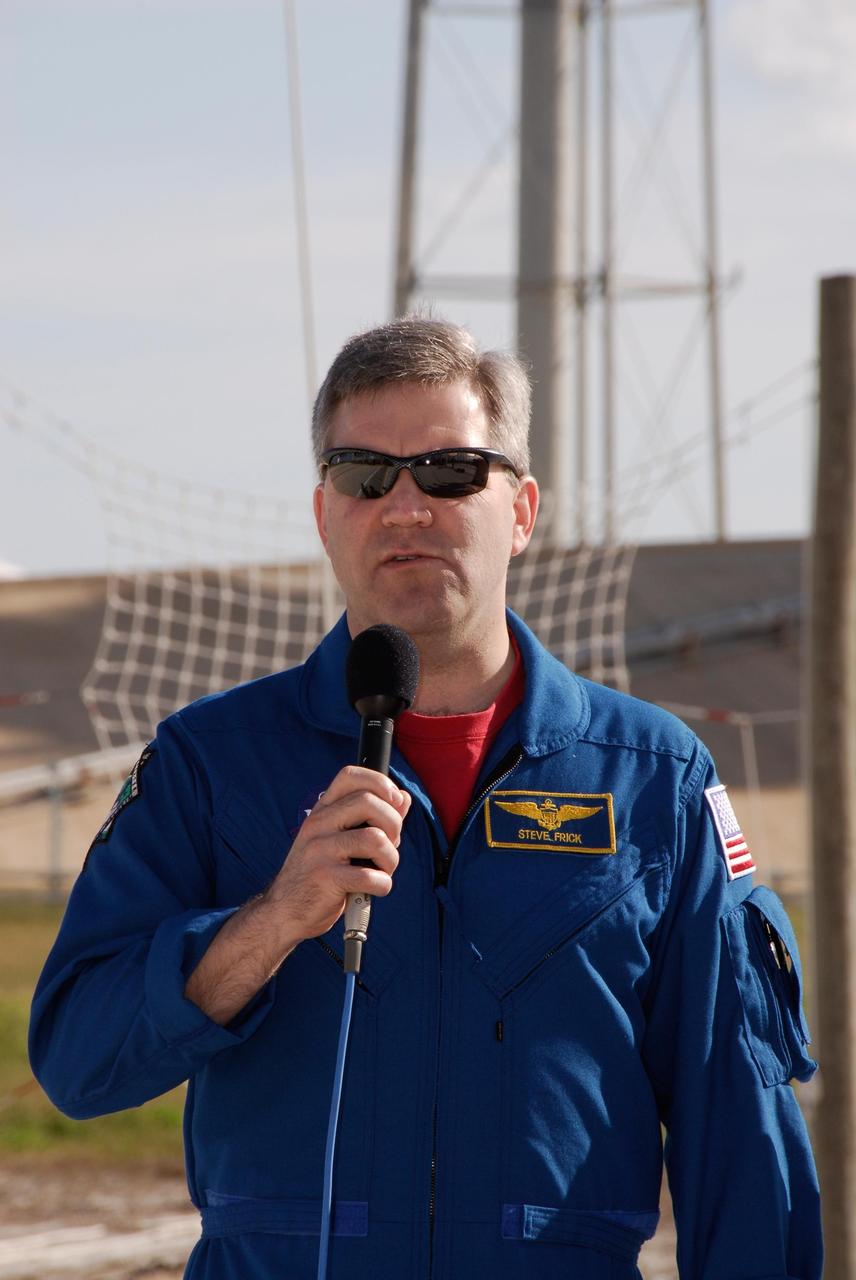
KENNEDY SPACE CENTER, FLA. -- Space shuttle Atlantis STS-122 Commander Steve Frick responds to a question from the media during a press conference at the slidewire basket landing on Launch Pad 39A. The STS-122 crew is at NASA's Kennedy Space Center to take part in terminal countdown demonstration test, or TCDT, activities, a standard part of launch preparations. The TCDT provides astronauts and ground crews with equipment familiarization, emergency egress training and a simulated launch countdown. On mission STS-122, Atlantis will deliver the European Space Agency's Columbus module to the International Space Station. Columbus is a multifunctional, pressurized laboratory that will be permanently attached to U.S. Node 2, called Harmony, and will expand the research facilities aboard the station. Launch is targeted for Dec. 6. Photo credit: NASA/Kim Shiflett

KENNEDY SPACE CENTER, FLA. -- During emergency egress from Launch Pad 39A, STS-120 Pilot George Zamka and Commander Pamela Melroy are in one of the slidewire baskets. Zamka, at left, reaches for the release lever. The basket can carry them to a safe landing site below, if needed. The activity is part of the prelaunch terminal countdown demonstration test, or TCDT. The TCDT at NASA's Kennedy Space Center provides astronauts and ground crews an opportunity to participate in various launch preparation activities, including equipment familiarization and emergency training. The STS-120 mission will deliver the U.S. Node 2 module, named Harmony, aboard space shuttle Discovery to the International Space Station. Discovery is targeted to launch on its 14-day mission at 11:38 a.m. EDT on Oct. 23. Photo credit: NASA/Kim Shiflett

KENNEDY SPACE CENTER, FLA. -- During emergency egress from Launch Pad 39A, STS-120 Mission Specialists Stephanie Wilson (left) and Doug Wheelock settle in the slidewire basket. The basket can carry them to a safe landing site below, if needed. The activity is part of the prelaunch terminal countdown demonstration test, or TCDT. The TCDT at NASA's Kennedy Space Center provides astronauts and ground crews an opportunity to participate in various launch preparation activities, including equipment familiarization and emergency training. The STS-120 mission will deliver the U.S. Node 2 module, named Harmony, aboard space shuttle Discovery to the International Space Station. Discovery is targeted to launch on its 14-day mission at 11:38 a.m. EDT on Oct. 23. Photo credit: NASA/Kim Shiflett
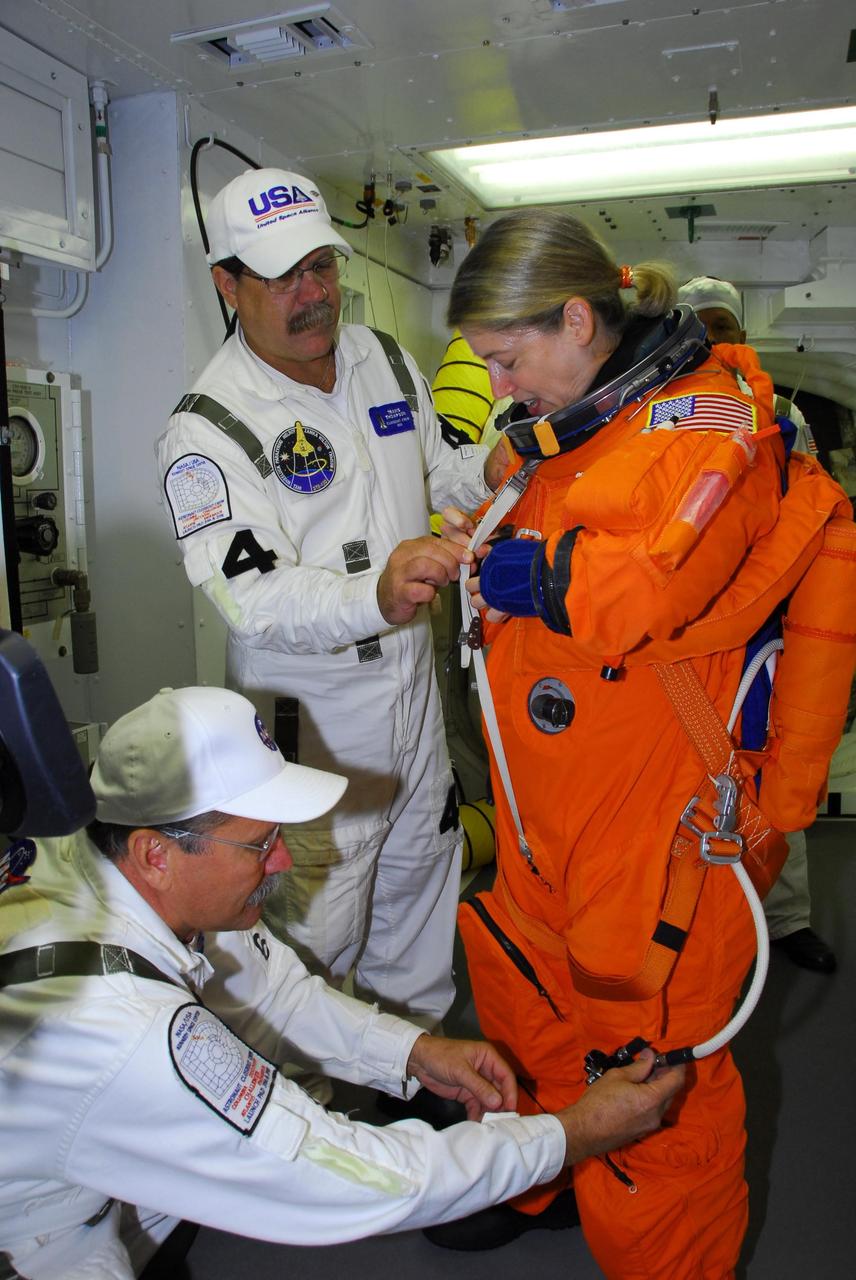
KENNEDY SPACE CENTER, FLA. -- In the white room on Launch Pad 39A, STS-120 Commander Pamela Melroy is helped by the closeout crew in donning a parachute pack before she crawls through the open hatch into space shuttle Discovery for a simulated launch countdown. The countdown is the culmination of the prelaunch terminal countdown demonstration test, or TCDT. The TCDT at NASA's Kennedy Space Center provides astronauts and ground crews an opportunity to participate in various launch preparation activities, including equipment familiarization and emergency training. The STS-120 mission will deliver the U.S. Node 2 module, named Harmony, aboard space shuttle Discovery to the International Space Station. Discovery is targeted to launch on its 14-day mission at 11:38 a.m. EDT on Oct. 23. Photo credit: NASA/George Shelton
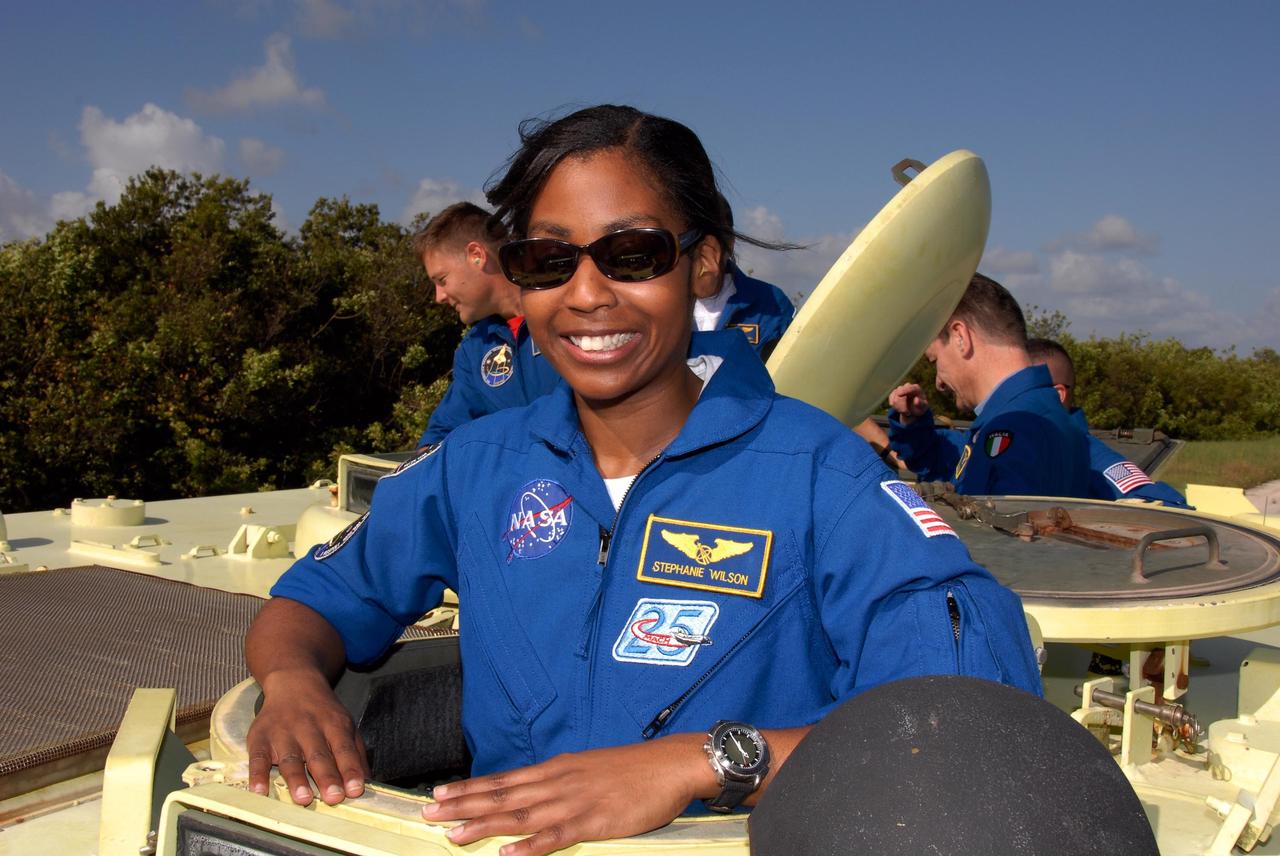
KENNEDY SPACE CENTER, FLA. -- STS-120 Mission Specialist Stephanie Wilson is ready for her turn at driving the M-113 armored personnel carrier. The M-113 is part of emergency exit procedures from Launch Pad 39A. Behind her are Mission Specialists Doug Wheelock, at left) and Paolo Nespoli, who represents the European Space Agency. The training is part of terminal countdown demonstration test, or TCDT, activities the crew is undertaking at NASA's Kennedy Space Center. The TCDT also includes equipment familiarization and a simulated launch countdown. Mission STS-120, which will carry the Italian-built U.S. Node 2 to the International Space Station, is targeted for launch on Oct. 23. Photo credit: NASA/Kim Shiflett
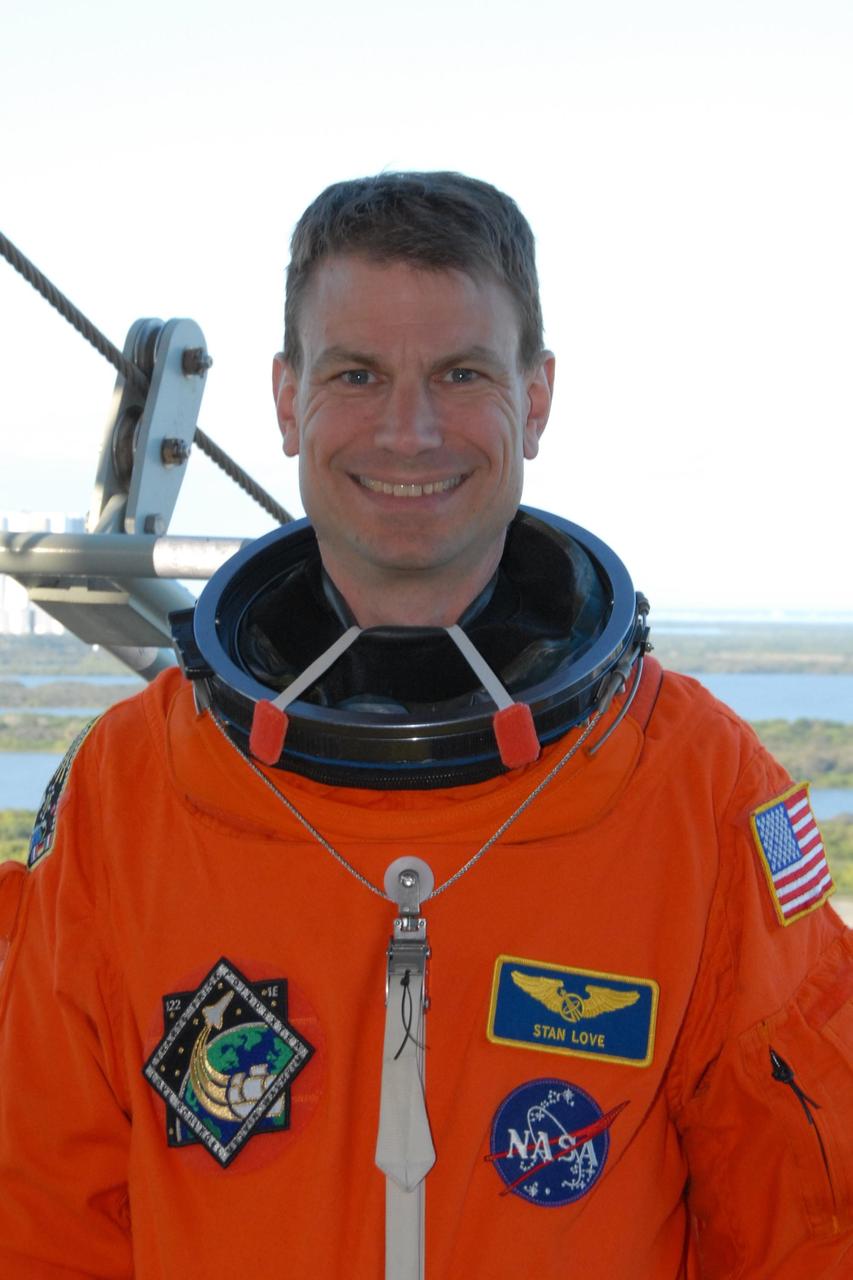
KENNEDY SPACE CENTER, FLA. -- Space shuttle Atlantis STS-122 Mission Specialist Stanley Love arrives at Launch Pad 39A, dressed in his launch and entry suit, to participate in a simulated launch countdown aboard Atlantis. The exercise is part of terminal countdown demonstration test, or TCDT, activities at NASA's Kennedy Space Center. The TCDT is a dress rehearsal for launch and also provides astronauts and ground crews with equipment familiarization and emergency egress training. On mission STS-122, Atlantis will deliver the Columbus module to the International Space Station. The European Space Agency's largest single contribution to the station, Columbus is a multifunctional, pressurized laboratory that will be permanently attached to U.S. Node 2, called Harmony. The laboratory will expand the research facilities aboard the station, providing crew members and scientists from around the world the ability to conduct a variety of experiments in the physical, materials and life sciences. Atlantis' launch is targeted for Dec. 6. Photo credit: NASA/George Shelton
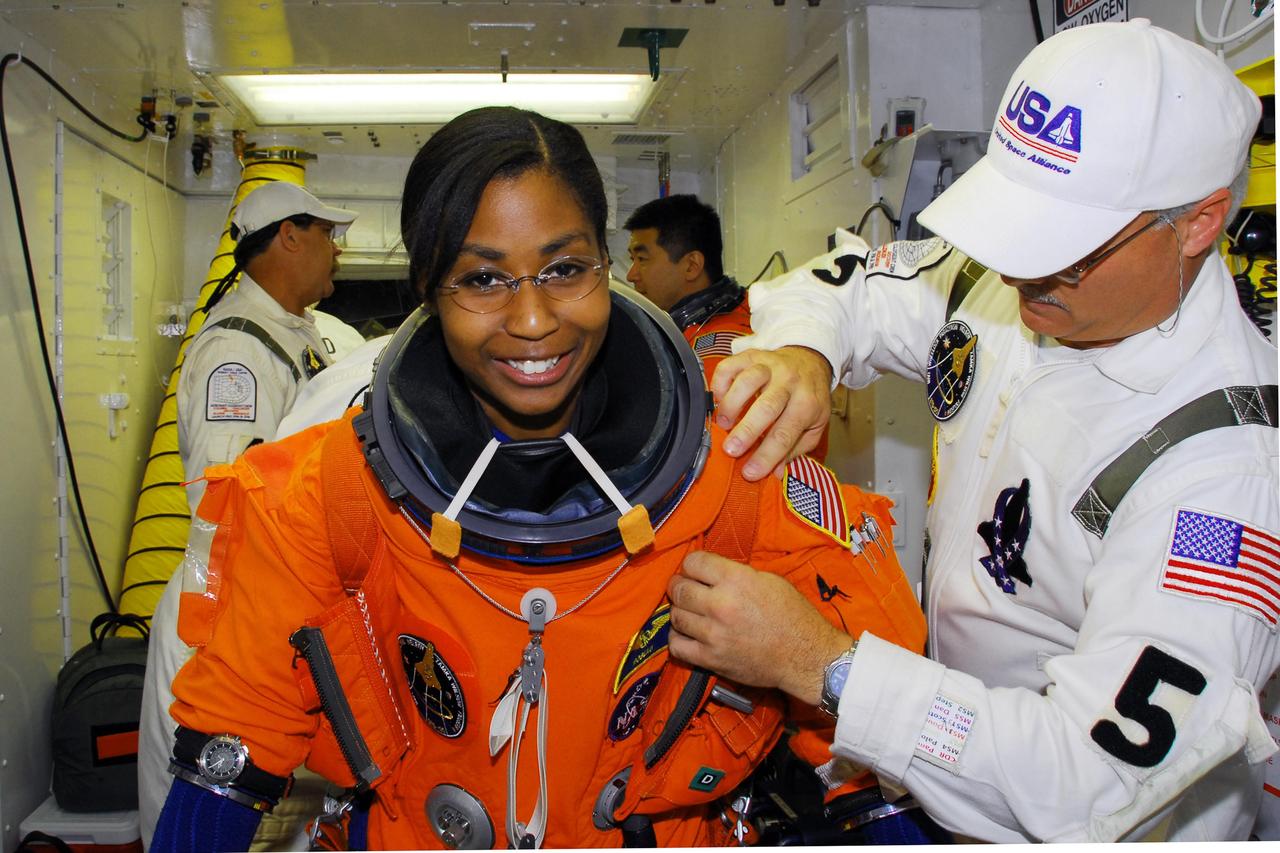
KENNEDY SPACE CENTER, FLA. -- In the white room on Launch Pad 39A, the closeout crew helps STS-120 Mission Specialist Stephanie Wilson with her parachute pack before entering space shuttle Discovery for a simulated launch countdown. The countdown is the culmination of the prelaunch terminal countdown demonstration test, or TCDT. The TCDT at NASA's Kennedy Space Center provides astronauts and ground crews an opportunity to participate in various launch preparation activities, including equipment familiarization and emergency training. The STS-120 mission will deliver the U.S. Node 2 module, named Harmony, aboard space shuttle Discovery to the International Space Station. Discovery is targeted to launch on its 14-day mission at 11:38 a.m. EDT on Oct. 23. Photo credit: NASA/George Shelton
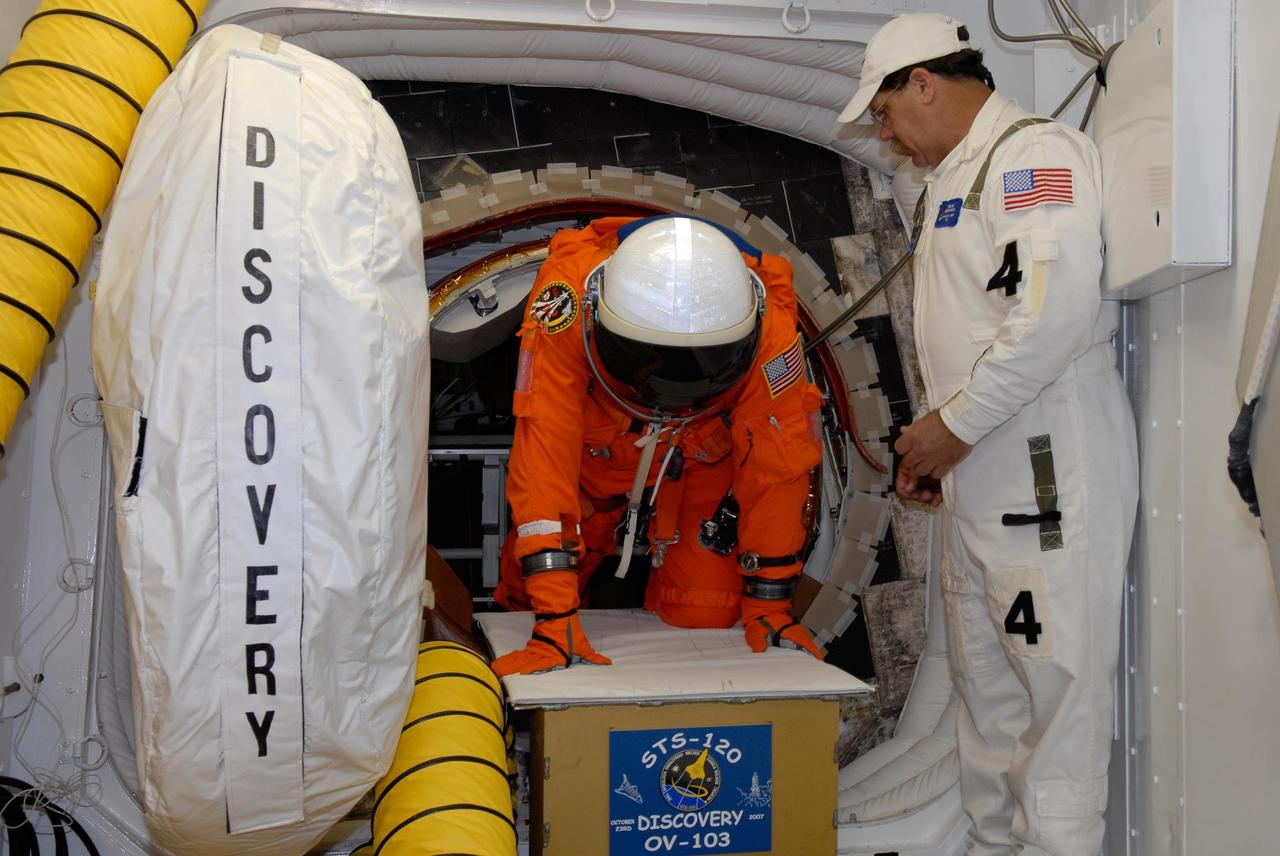
KENNEDY SPACE CENTER, FLA. -- In the white room on Launch Pad 39A, an STS-120 crew member crawls through the hatch after the simulated launch countdown, culmination of the prelaunch terminal countdown demonstration test, or TCDT. The crew will also practice emergency egress from the pad. The TCDT at NASA's Kennedy Space Center provides astronauts and ground crews an opportunity to participate in various launch preparation activities, including equipment familiarization and emergency training. The STS-120 mission will deliver the U.S. Node 2 module, named Harmony, aboard space shuttle Discovery to the International Space Station. Discovery is targeted to launch on its 14-day mission at 11:38 a.m. EDT on Oct. 23. Photo credit: NASA/Kim Shiflett
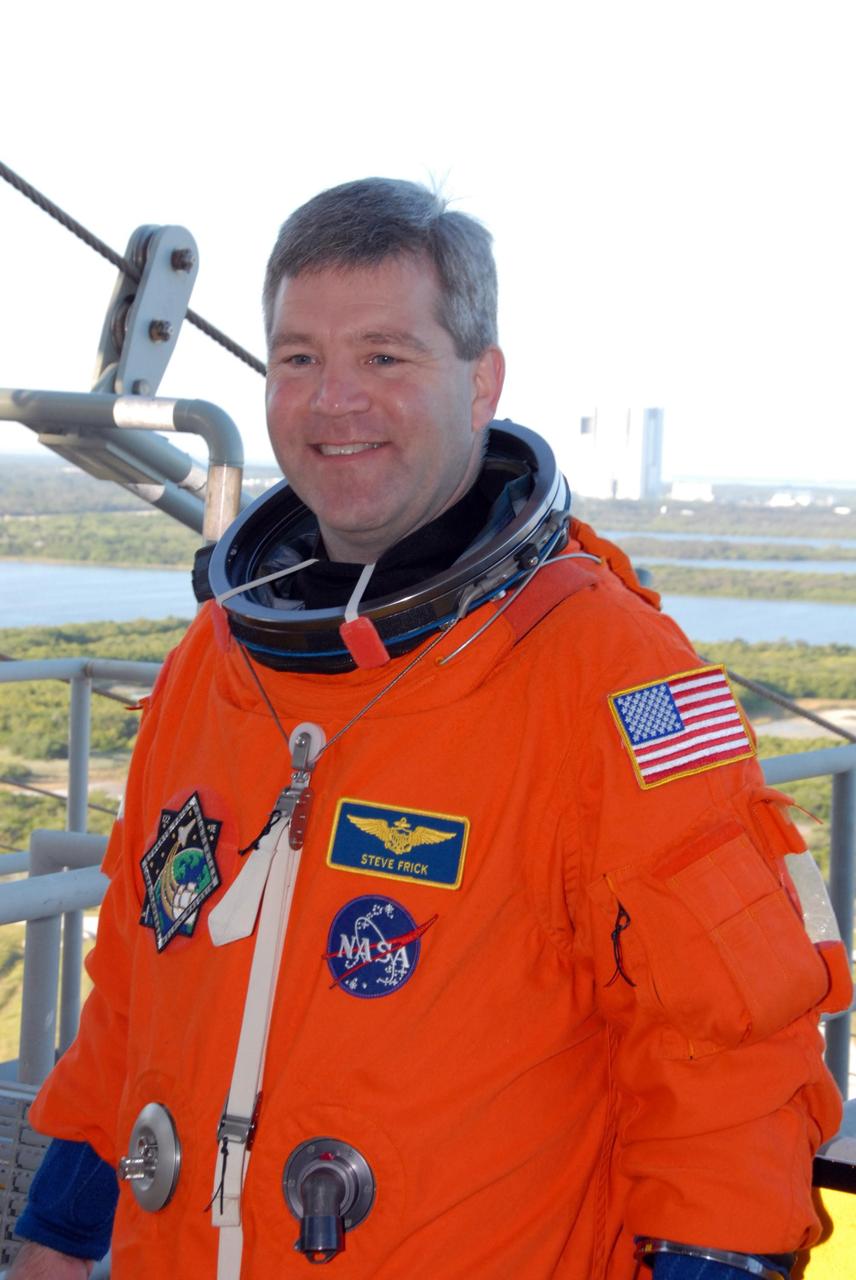
KENNEDY SPACE CENTER, FLA. -- Space shuttle Atlantis STS-122 Commander Steve Frick arrives at Launch Pad 39A, dressed in his launch and entry suit, to participate in a simulated launch countdown aboard Atlantis. The exercise is part of terminal countdown demonstration test, or TCDT, activities at NASA's Kennedy Space Center. The TCDT is a dress rehearsal for launch and also provides astronauts and ground crews with equipment familiarization and emergency egress training. On mission STS-122, Atlantis will deliver the Columbus module to the International Space Station. The European Space Agency's largest single contribution to the station, Columbus is a multifunctional, pressurized laboratory that will be permanently attached to U.S. Node 2, called Harmony. The laboratory will expand the research facilities aboard the station, providing crew members and scientists from around the world the ability to conduct a variety of experiments in the physical, materials and life sciences. Atlantis' launch is targeted for Dec. 6. Photo credit: NASA/George Shelton
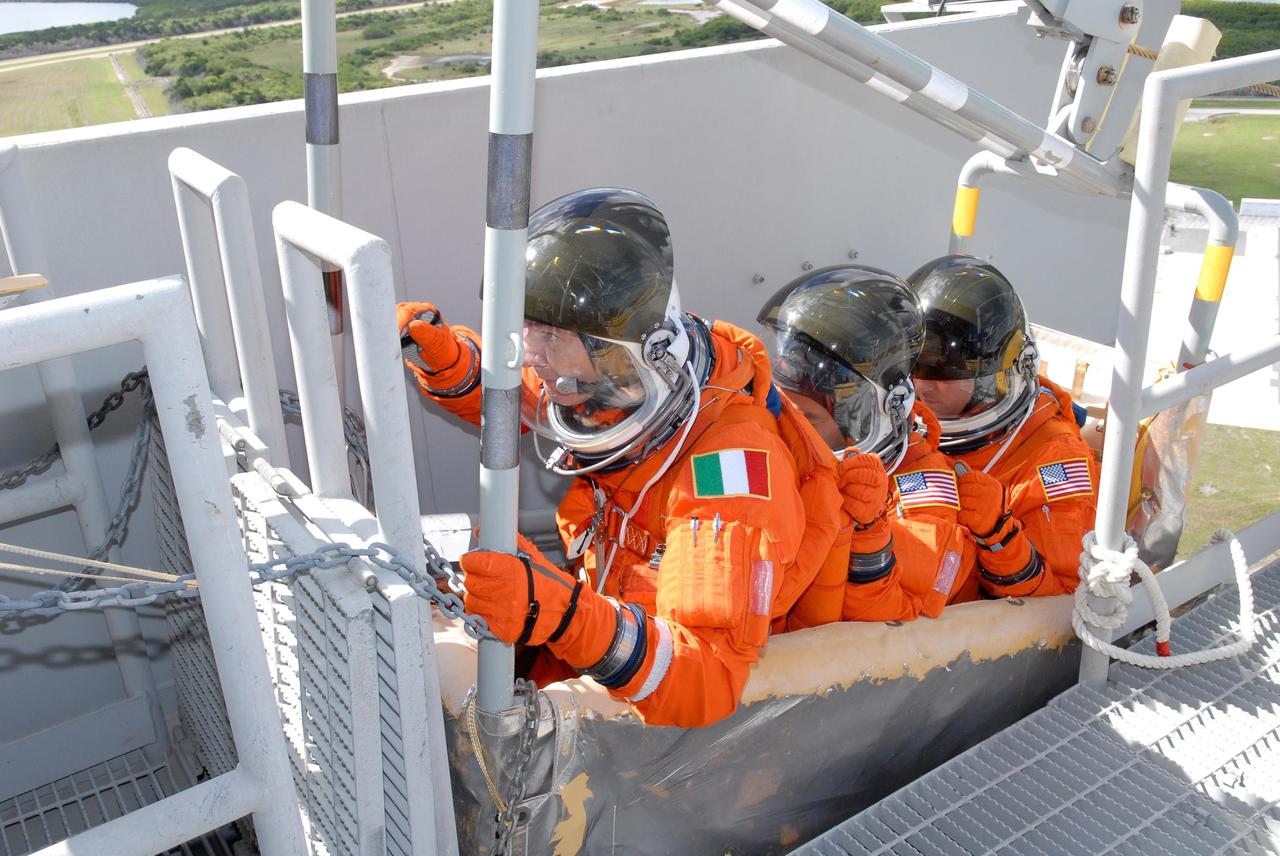
KENNEDY SPACE CENTER, FLA. -- During emergency egress from Launch Pad 39A, STS-120 crew members are in the slidewire basket. In front, Mission Specialist Paolo Nespoli holds the release lever. Behind him are Mission Specialists Daniel Tani and Scott Parazynski. The basket can carry them to a safe landing site below, if needed. Nespoli represents the European Space Agency. The activity is part of the prelaunch terminal countdown demonstration test, or TCDT. The TCDT at NASA's Kennedy Space Center provides astronauts and ground crews an opportunity to participate in various launch preparation activities, including equipment familiarization and emergency training. The STS-120 mission will deliver the U.S. Node 2 module, named Harmony, aboard space shuttle Discovery to the International Space Station. Discovery is targeted to launch on its 14-day mission at 11:38 a.m. EDT on Oct. 23. Photo credit: NASA/Kim Shiflett
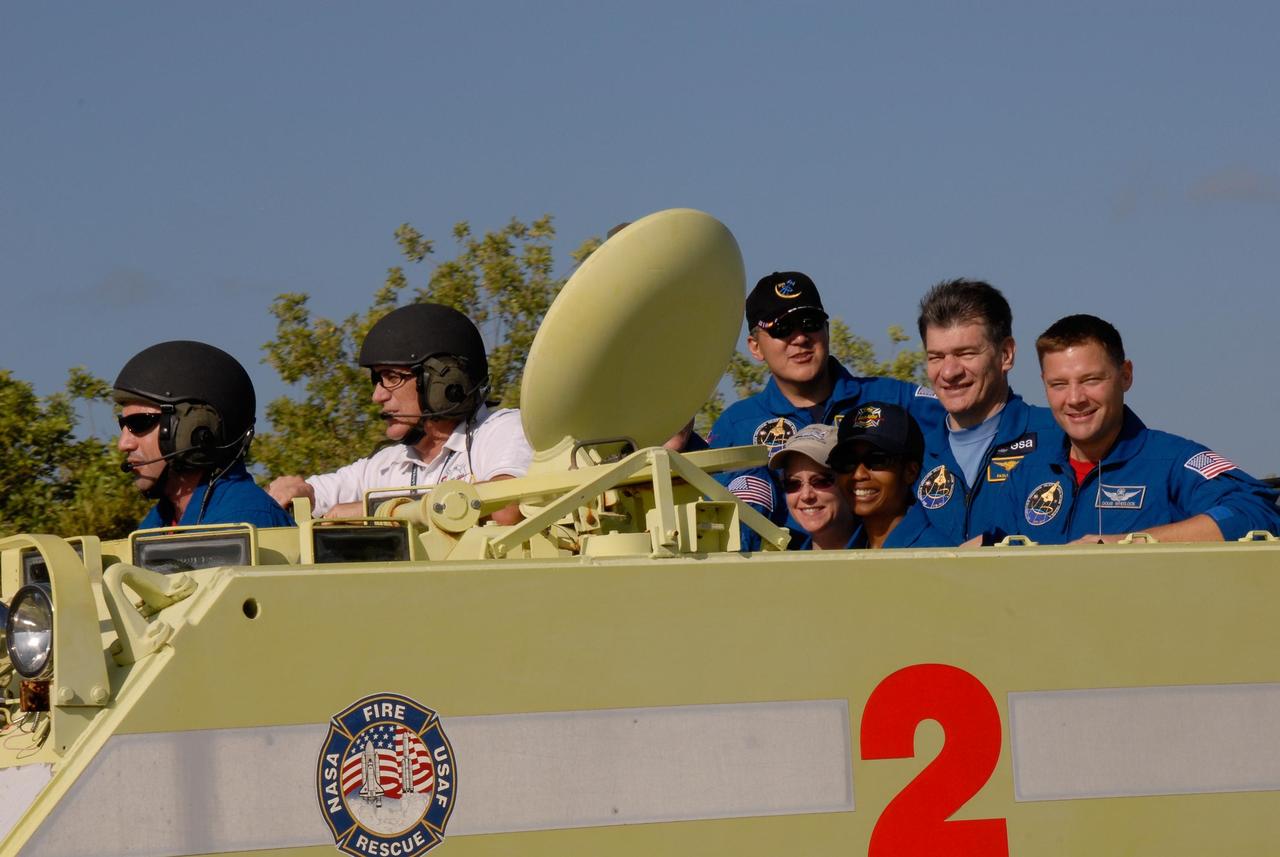
KENNEDY SPACE CENTER, FLA. -- STS-120 Pilot George Zamka practices driving the M-113 armored personnel carrier, part of emergency exit procedures from Launch Pad 39A. Alongside is the trainer. In the rear of the M-113 are Mission Specialists Daniel Tani, Commander Pamela Melroy and Mission Specialists Stephanie Wilson, Paolo Nespoli and Doug Wheelock. Nespoli represents the European Space Agency. The training is part of terminal countdown demonstration test, or TCDT, activities the crew is undertaking at NASA's Kennedy Space Center. The TCDT also includes equipment familiarization and a simulated launch countdown. Mission STS-120, which will carry the Italian-built U.S. Node 2 to the International Space Station, is targeted for launch on Oct. 23. Photo credit: NASA/Kim Shiflett
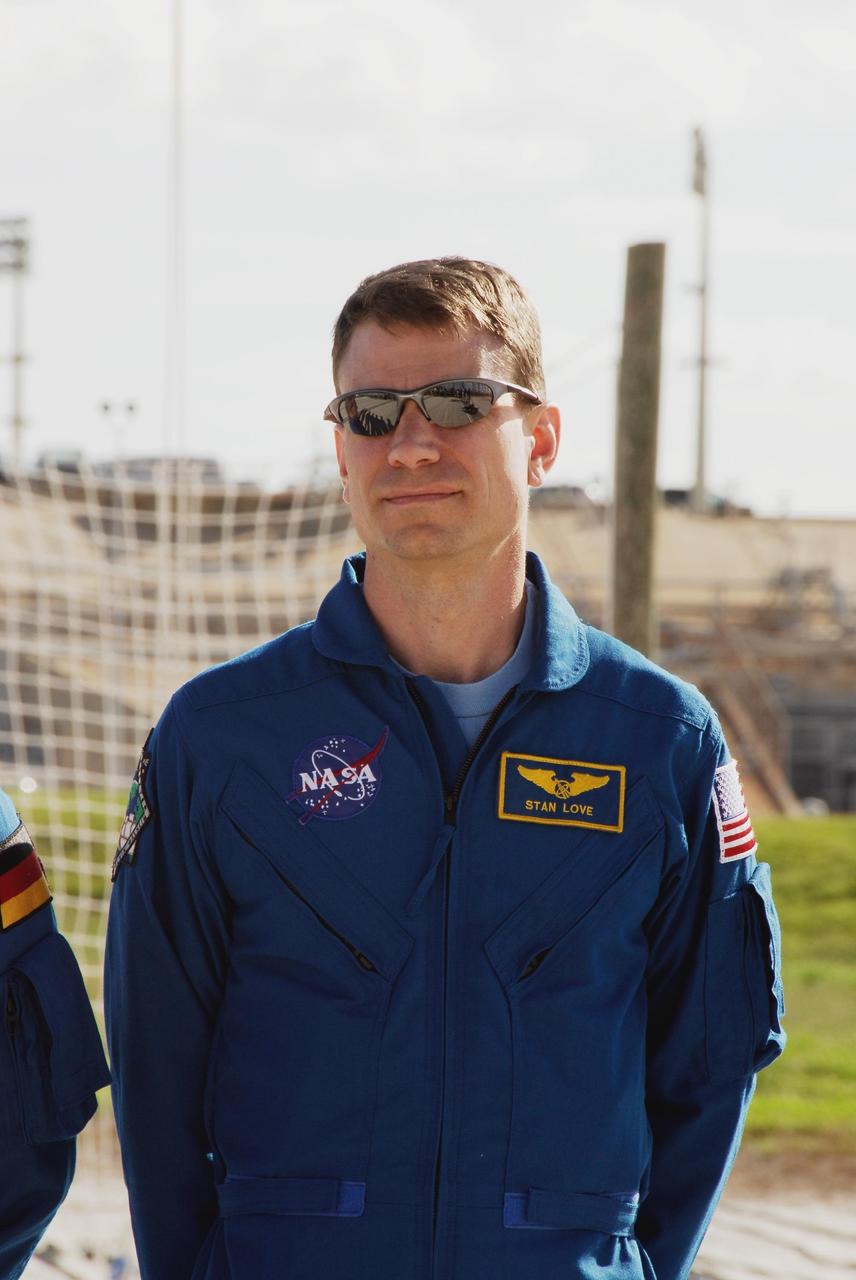
KENNEDY SPACE CENTER, FLA. -- Space shuttle Atlantis STS-122 Mission Specialist Stanley Love takes part in a press conference at the slidewire basket landing on Launch Pad 39A. The STS-122 crew is at NASA's Kennedy Space Center to take part in terminal countdown demonstration test, or TCDT, activities, a standard part of launch preparations. The TCDT provides astronauts and ground crews with equipment familiarization, emergency egress training and a simulated launch countdown. On mission STS-122, Atlantis will deliver the European Space Agency's Columbus module to the International Space Station. Columbus is a multifunctional, pressurized laboratory that will be permanently attached to U.S. Node 2, called Harmony, and will expand the research facilities aboard the station. Launch is targeted for Dec. 6. Photo credit: NASA/Kim Shiflett
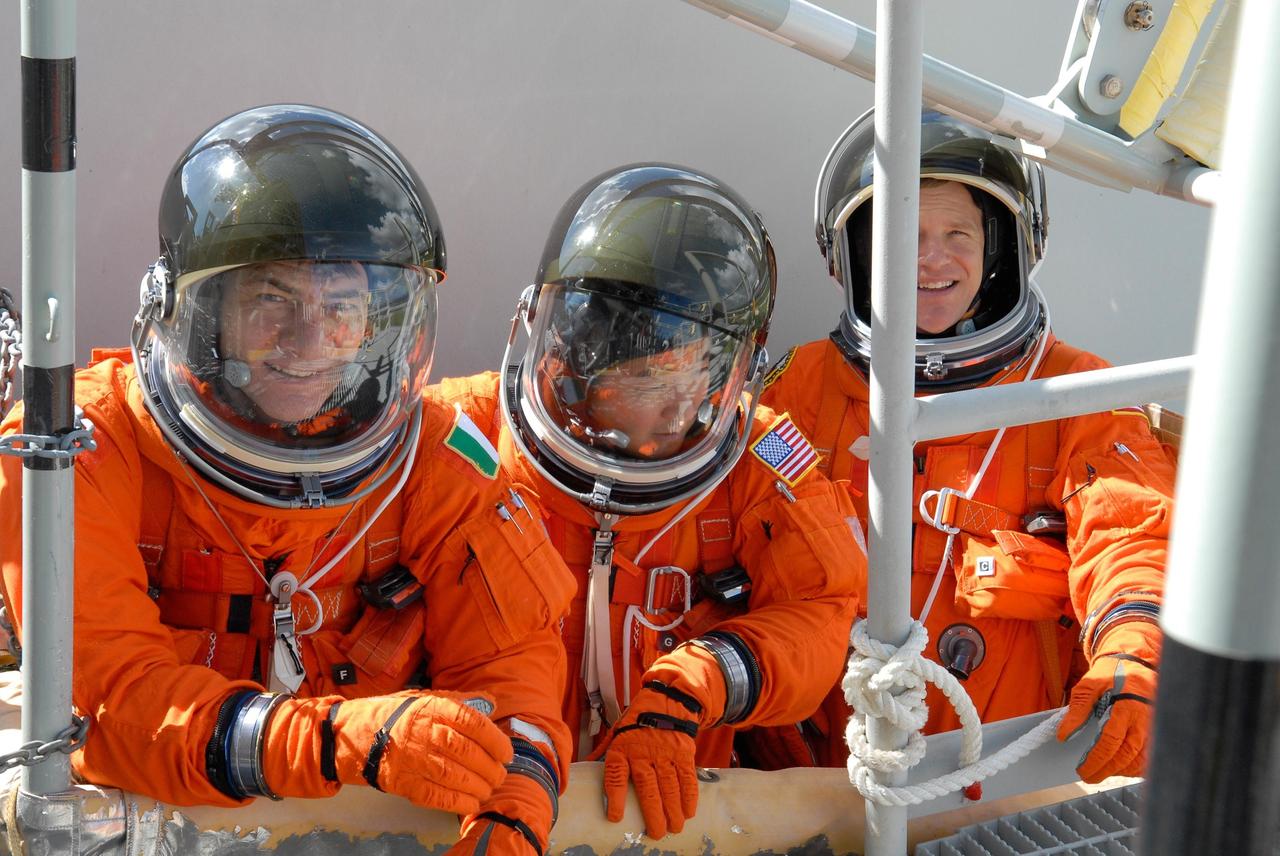
KENNEDY SPACE CENTER, FLA. -- During emergency egress from Launch Pad 39A, STS-120 Mission Specialists relax inside the slidewire basket. From left are Mission Specialists Paolo Nespoli, Daniel Tani and Scott Parazynski. The basket can carry them to a safe landing site below, if needed. The activity is part of the prelaunch terminal countdown demonstration test, or TCDT. The TCDT at NASA's Kennedy Space Center provides astronauts and ground crews an opportunity to participate in various launch preparation activities, including equipment familiarization and emergency training. The STS-120 mission will deliver the U.S. Node 2 module, named Harmony, aboard space shuttle Discovery to the International Space Station. Discovery is targeted to launch on its 14-day mission at 11:38 a.m. EDT on Oct. 23. Photo credit: NASA/Kim Shiflett
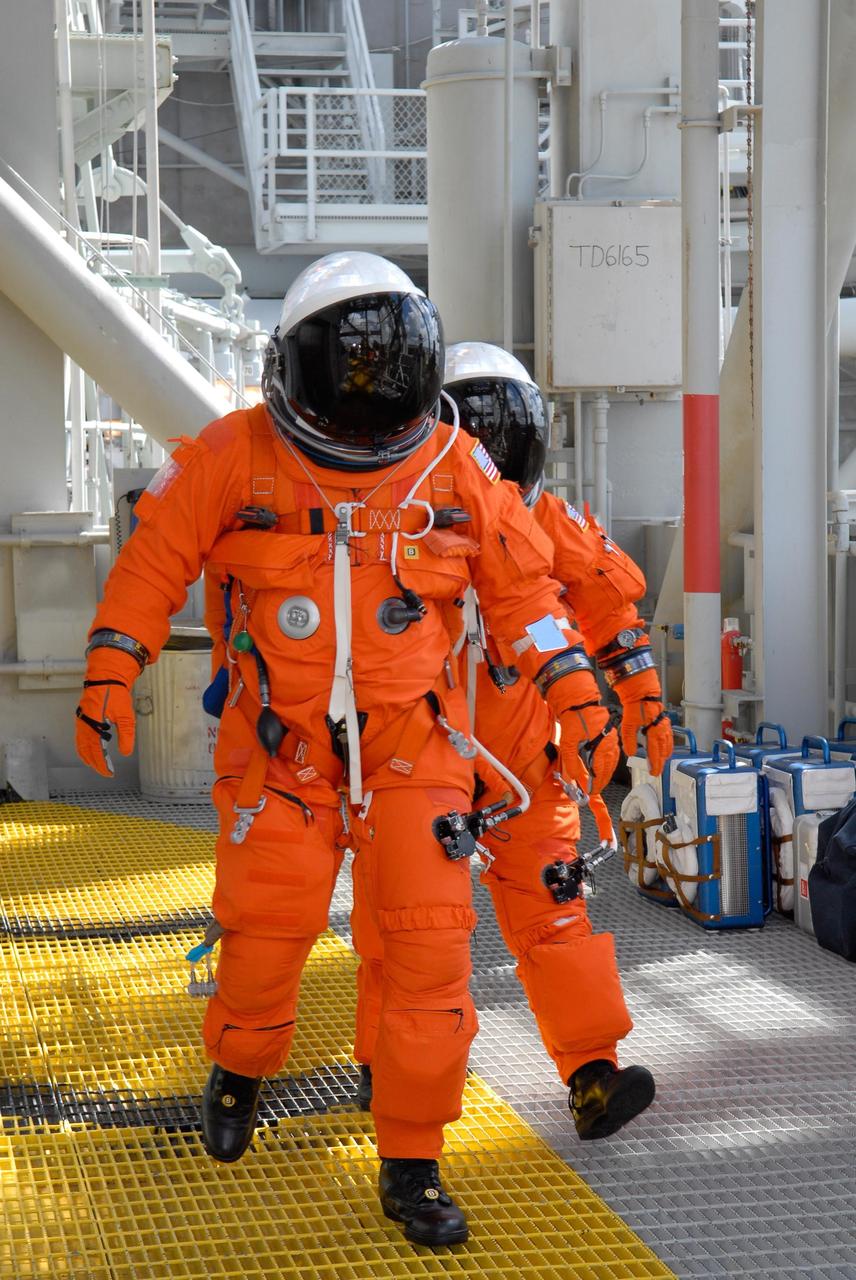
KENNEDY SPACE CENTER, FLA. -- During emergency egress from Launch Pad 39A, STS-120 Pilot George Zamka and Commander Pamela Melroy head for the slidewire baskets. The basket can carry them to a safe landing site below, if needed. The activity is part of the prelaunch terminal countdown demonstration test, or TCDT. The TCDT at NASA's Kennedy Space Center provides astronauts and ground crews an opportunity to participate in various launch preparation activities, including equipment familiarization and emergency training. The STS-120 mission will deliver the U.S. Node 2 module, named Harmony, aboard space shuttle Discovery to the International Space Station. Discovery is targeted to launch on its 14-day mission at 11:38 a.m. EDT on Oct. 23. Photo credit: NASA/Kim Shiflett
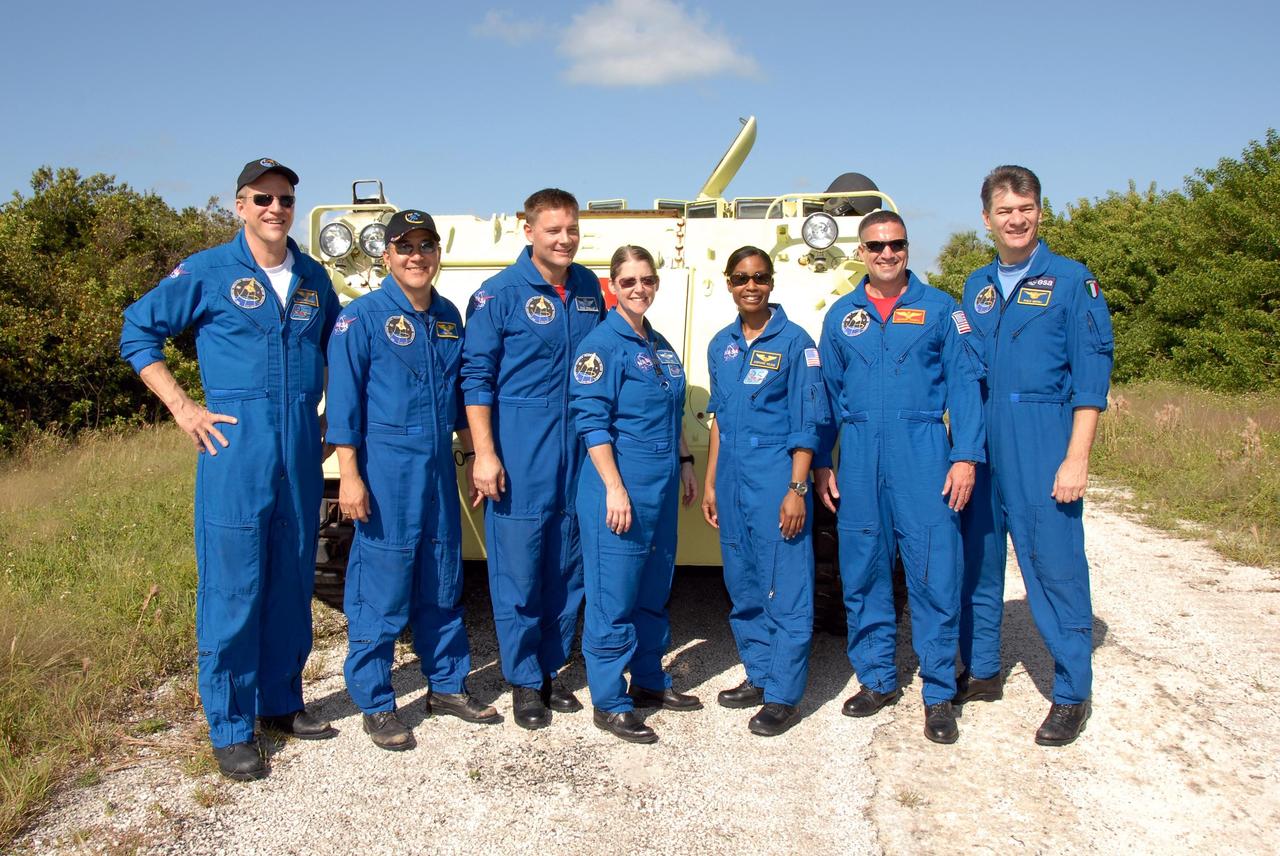
KENNEDY SPACE CENTER, FLA. -- After driving practice on the M-113 armored personnel carrier, the STS-120 crew pauses for a group photo. From left are Mission Specialists Scott Parazynski, Daniel Tani and Doug Wheelock, Commander Pamela Melroy, Mission Specialist Stephanie Wilson, Pilot George Zamka and Mission Specialist Paolo Nespoli, who represents the European Space Agency. The M-113 is part of emergency exit procedures from Launch Pad 39A. The training is part of terminal countdown demonstration test, or TCDT, activities the crew is undertaking at NASA's Kennedy Space Center. The TCDT also includes equipment familiarization and a simulated launch countdown. Mission STS-120, which will carry the Italian-built U.S. Node 2 to the International Space Station, is targeted for launch on Oct. 23. Photo credit: NASA/Kim Shiflett
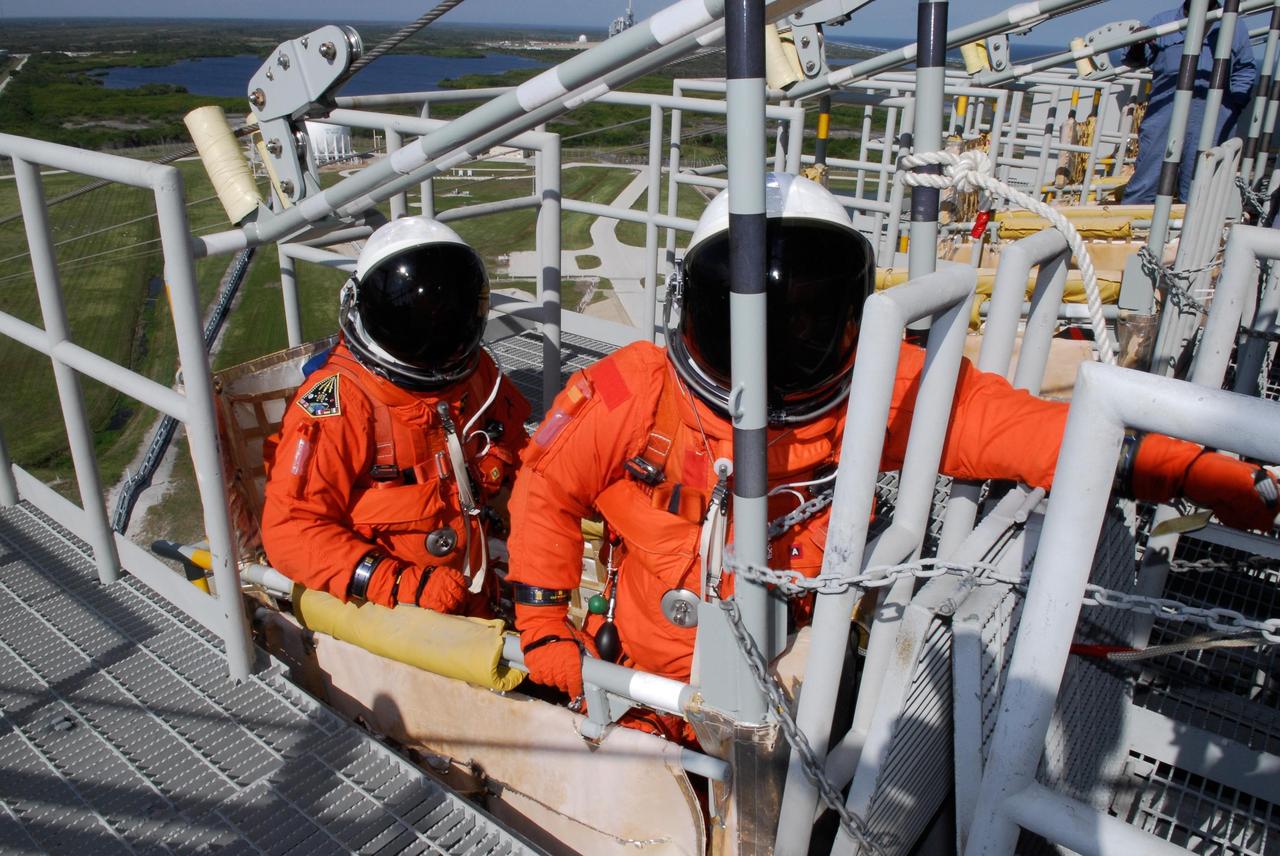
KENNEDY SPACE CENTER, FLA. -- Members of space shuttle Atlantis' STS-122 crew practice emergency exit procedures in a slidewire basket at Launch Pad 39A following a simulated launch countdown. The exercise is part of terminal countdown demonstration test, or TCDT, activities at NASA's Kennedy Space Center. The TCDT is a dress rehearsal for launch and also provides astronauts and ground crews with equipment familiarization and emergency egress training. On mission STS-122, Atlantis will deliver the Columbus module to the International Space Station. The European Space Agency's largest single contribution to the station, Columbus is a multifunctional, pressurized laboratory that will be permanently attached to U.S. Node 2, called Harmony. The laboratory will expand the research facilities aboard the station, providing crew members and scientists from around the world the ability to conduct a variety of experiments in the physical, materials and life sciences. Atlantis' launch is targeted for Dec. 6. Photo credit: NASA/Kim Shiflett
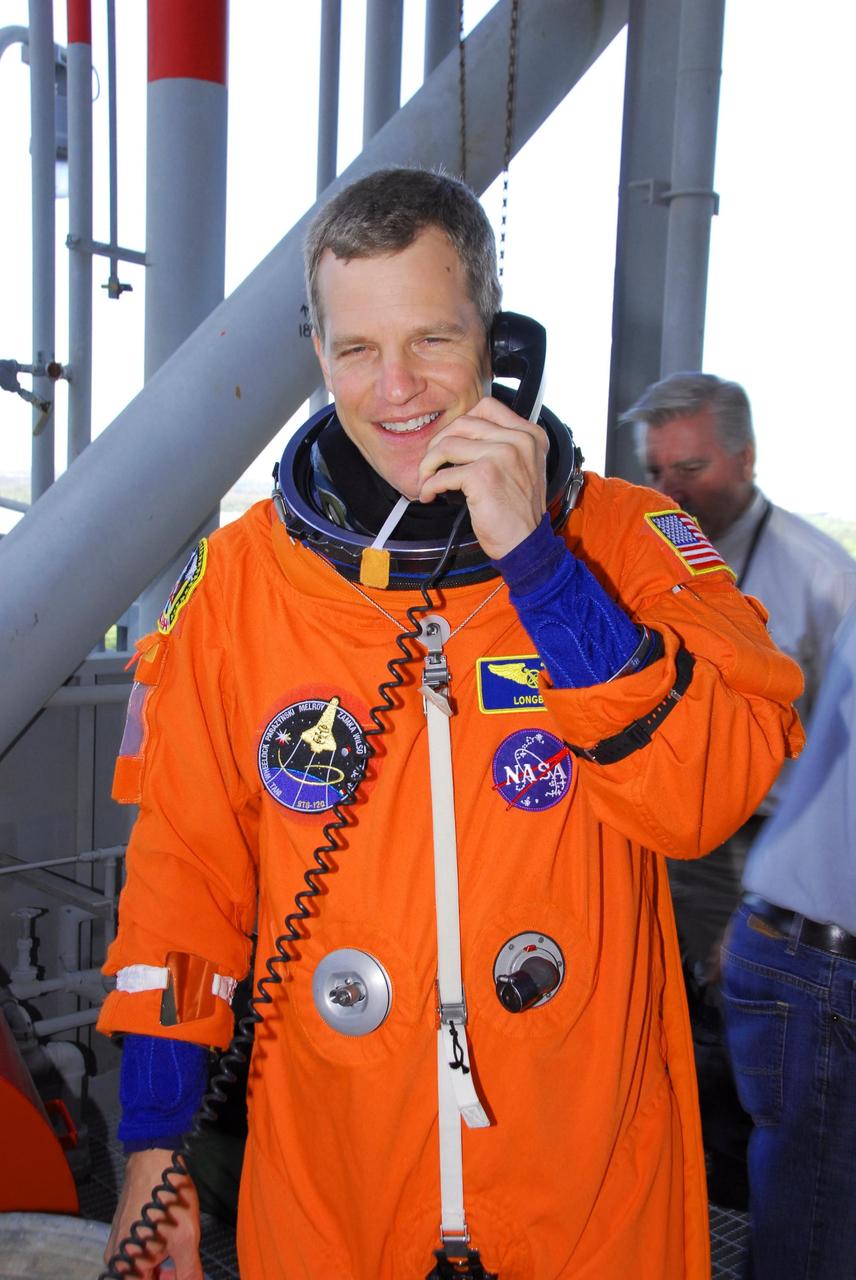
KENNEDY SPACE CENTER, FLA. -- STS-120 Mission Specialist Scott Parazynski arrives on Launch Pad 39A to start a simulated launch countdown, culmination of the prelaunch terminal countdown demonstration test, or TCDT. His name patch reflects the nicknames the crew gave each other for the event. The TCDT at NASA's Kennedy Space Center provides astronauts and ground crews an opportunity to participate in various launch preparation activities, including equipment familiarization and emergency training. The STS-120 mission will deliver the U.S. Node 2 module, named Harmony, aboard space shuttle Discovery to the International Space Station. Discovery is targeted to launch on its 14-day mission at 11:38 a.m. EDT on Oct. 23. Photo credit: NASA/George Shelton

KENNEDY SPACE CENTER, FLA. -- During emergency egress from Launch Pad 39A, STS-120 Mission Specialists Stephanie Wilson (left) and Doug Wheelock head for the slidewire baskets. The basket can carry them to a safe landing site below, if needed. The activity is part of the prelaunch terminal countdown demonstration test, or TCDT. The TCDT at NASA's Kennedy Space Center provides astronauts and ground crews an opportunity to participate in various launch preparation activities, including equipment familiarization and emergency training. The STS-120 mission will deliver the U.S. Node 2 module, named Harmony, aboard space shuttle Discovery to the International Space Station. Discovery is targeted to launch on its 14-day mission at 11:38 a.m. EDT on Oct. 23. Photo credit: NASA/Kim Shiflett
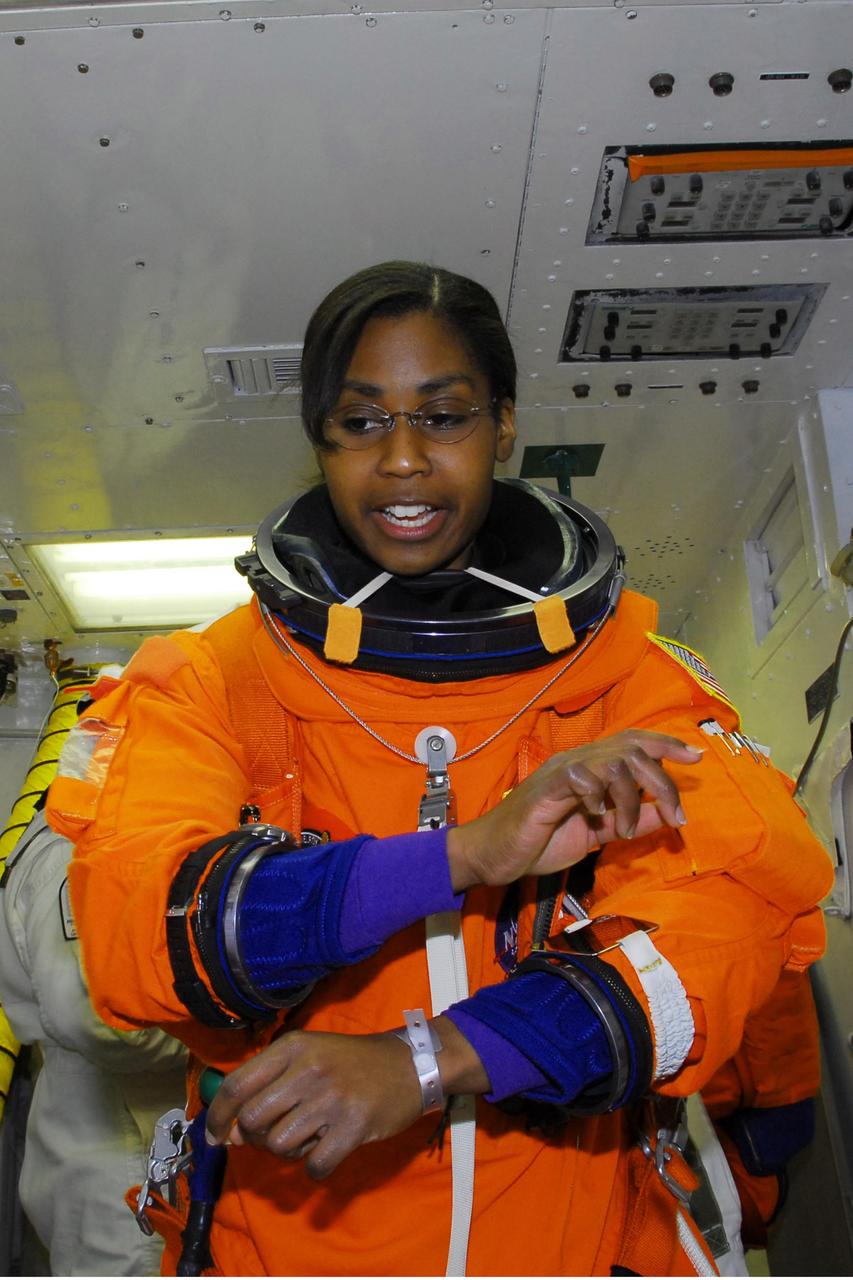
KENNEDY SPACE CENTER, FLA. -- In the white room on Launch Pad 39A, STS-120 Mission Specialist Stephanie Wilson adjusts her launch suit before entering space shuttle Discovery for a simulated launch countdown. The countdown is the culmination of the prelaunch terminal countdown demonstration test, or TCDT. The TCDT at NASA's Kennedy Space Center provides astronauts and ground crews an opportunity to participate in various launch preparation activities, including equipment familiarization and emergency training. The STS-120 mission will deliver the U.S. Node 2 module, named Harmony, aboard space shuttle Discovery to the International Space Station. Discovery is targeted to launch on its 14-day mission at 11:38 a.m. EDT on Oct. 23. Photo credit: NASA/George Shelton
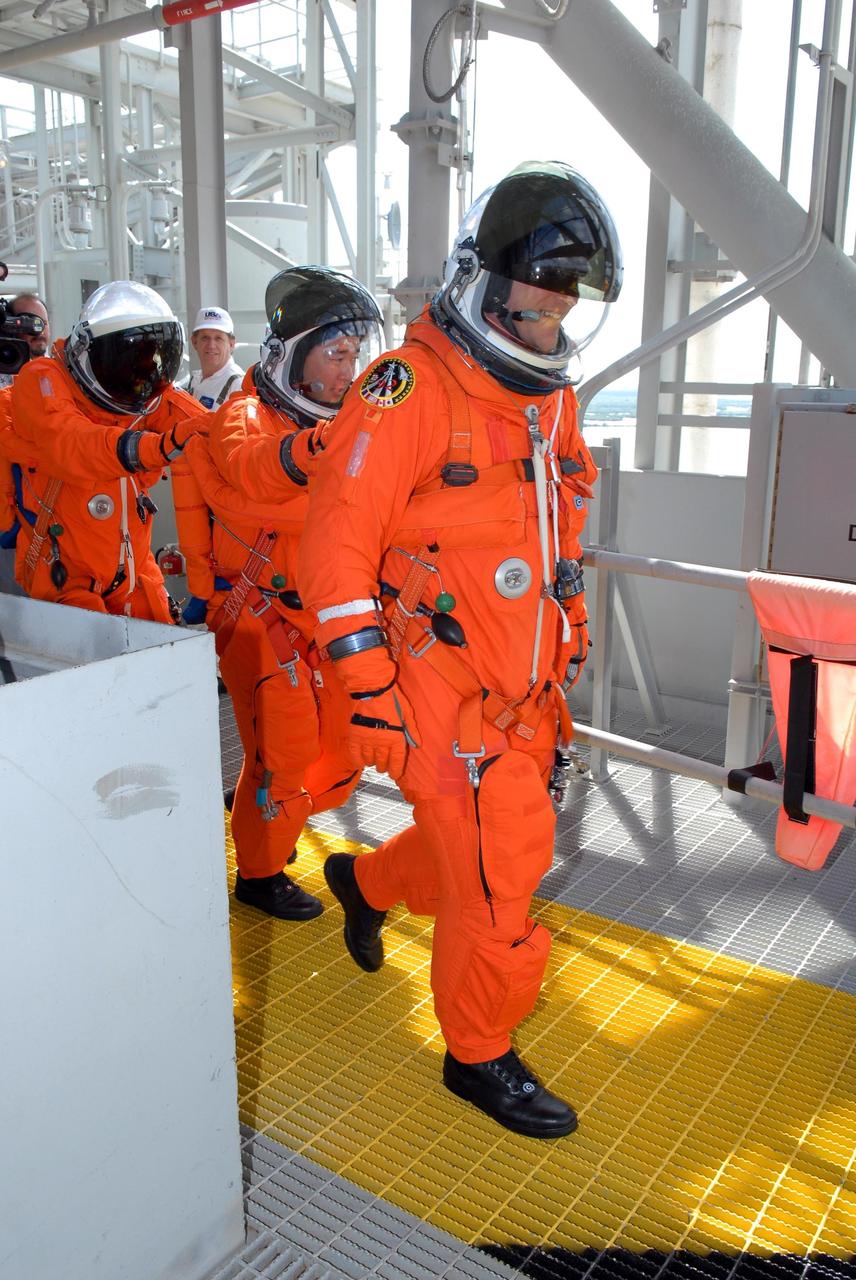
KENNEDY SPACE CENTER, FLA. -- STS-120 crew members practice emergency egress from Launch Pad 39A after completing a simulated launch countdown, culmination of the prelaunch terminal countdown demonstration test, or TCDT. Leading the way to the slidewire baskets is Mission Specialist Scott Parazynski, with Mission Specialist Daniel Tani and others behind him. The TCDT at NASA's Kennedy Space Center provides astronauts and ground crews an opportunity to participate in various launch preparation activities, including equipment familiarization and emergency training. The STS-120 mission will deliver the U.S. Node 2 module, named Harmony, aboard space shuttle Discovery to the International Space Station. Discovery is targeted to launch on its 14-day mission at 11:38 a.m. EDT on Oct. 23. Photo credit: NASA/Kim Shiflett
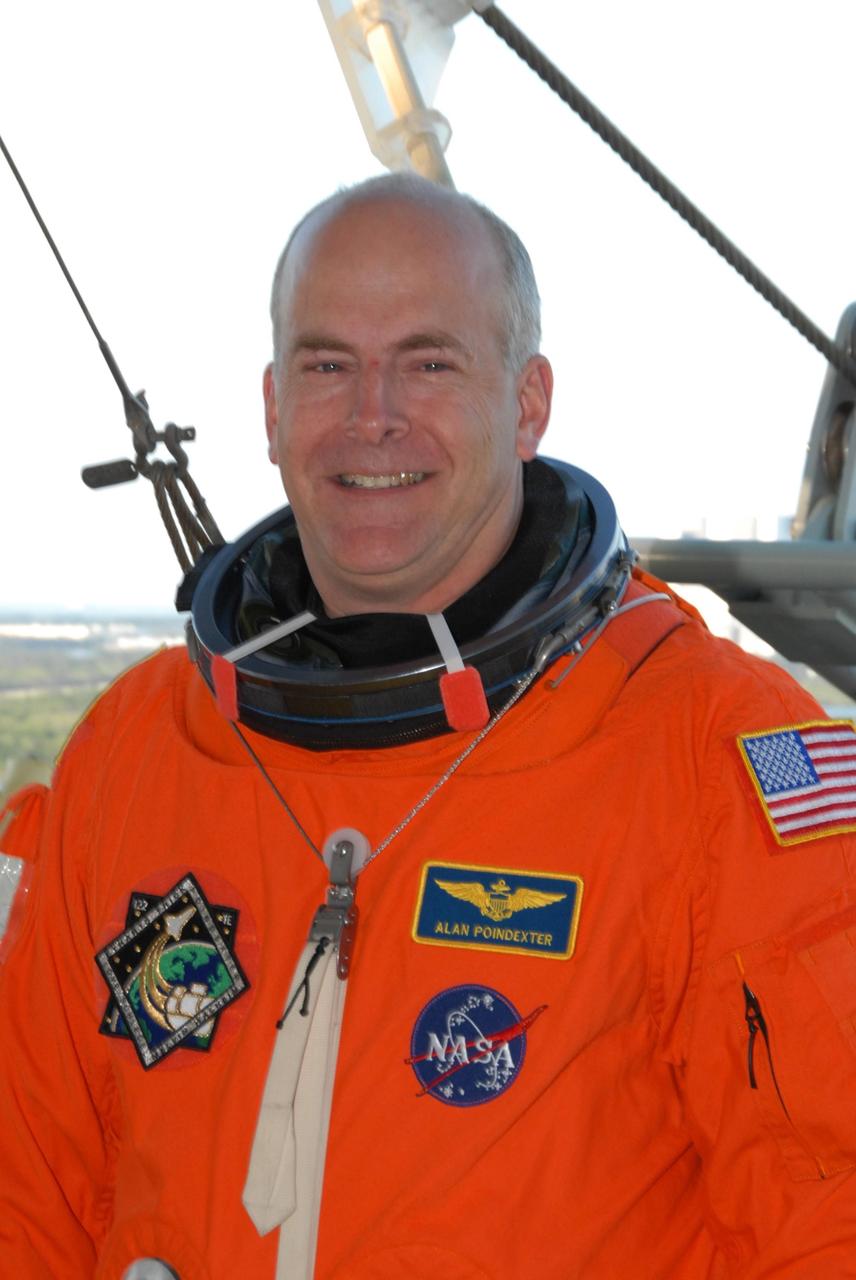
KENNEDY SPACE CENTER, FLA. -- Space shuttle Atlantis STS-122 Pilot Alan Poindexter arrives at Launch Pad 39A, dressed in his launch and entry suit, to participate in a simulated launch countdown aboard Atlantis. The exercise is part of terminal countdown demonstration test, or TCDT, activities at NASA's Kennedy Space Center. The TCDT is a dress rehearsal for launch and also provides astronauts and ground crews with equipment familiarization and emergency egress training. On mission STS-122, Atlantis will deliver the Columbus module to the International Space Station. The European Space Agency's largest single contribution to the station, Columbus is a multifunctional, pressurized laboratory that will be permanently attached to U.S. Node 2, called Harmony. The laboratory will expand the research facilities aboard the station, providing crew members and scientists from around the world the ability to conduct a variety of experiments in the physical, materials and life sciences. Atlantis' launch is targeted for Dec. 6. Photo credit: NASA/George Shelton
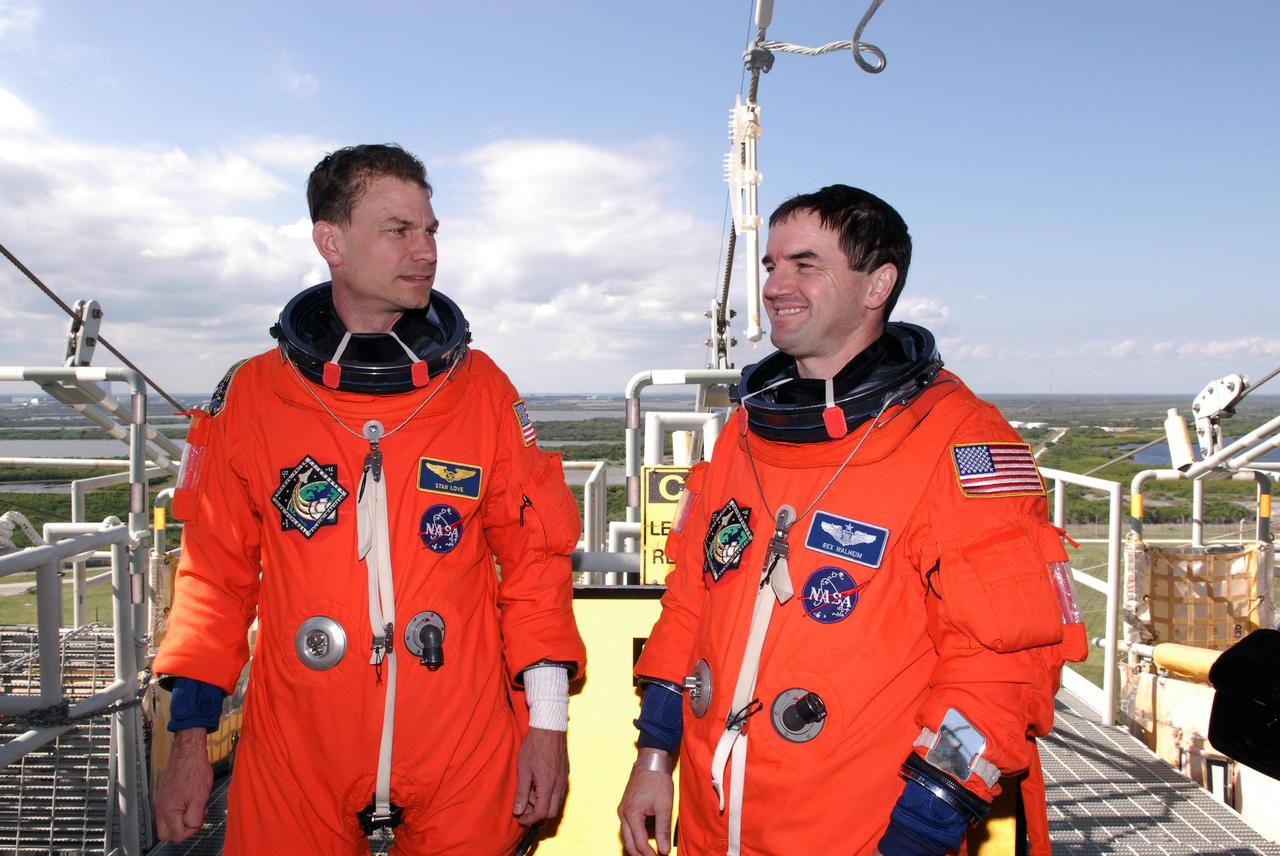
KENNEDY SPACE CENTER, FLA. -- Space shuttle Atlantis STS-122 Mission Specialists Stanley Love, left, and Rex Walheim relax for a moment following a simulated launch countdown at Launch Pad 39A. The exercise is part of terminal countdown demonstration test, or TCDT, activities at NASA's Kennedy Space Center. The TCDT is a dress rehearsal for launch and also provides astronauts and ground crews with equipment familiarization and emergency egress training. On mission STS-122, Atlantis will deliver the Columbus module to the International Space Station. The European Space Agency's largest single contribution to the station, Columbus is a multifunctional, pressurized laboratory that will be permanently attached to U.S. Node 2, called Harmony. The laboratory will expand the research facilities aboard the station, providing crew members and scientists from around the world the ability to conduct a variety of experiments in the physical, materials and life sciences. Atlantis' launch is targeted for Dec. 6. Photo credit: NASA/Kim Shiflett
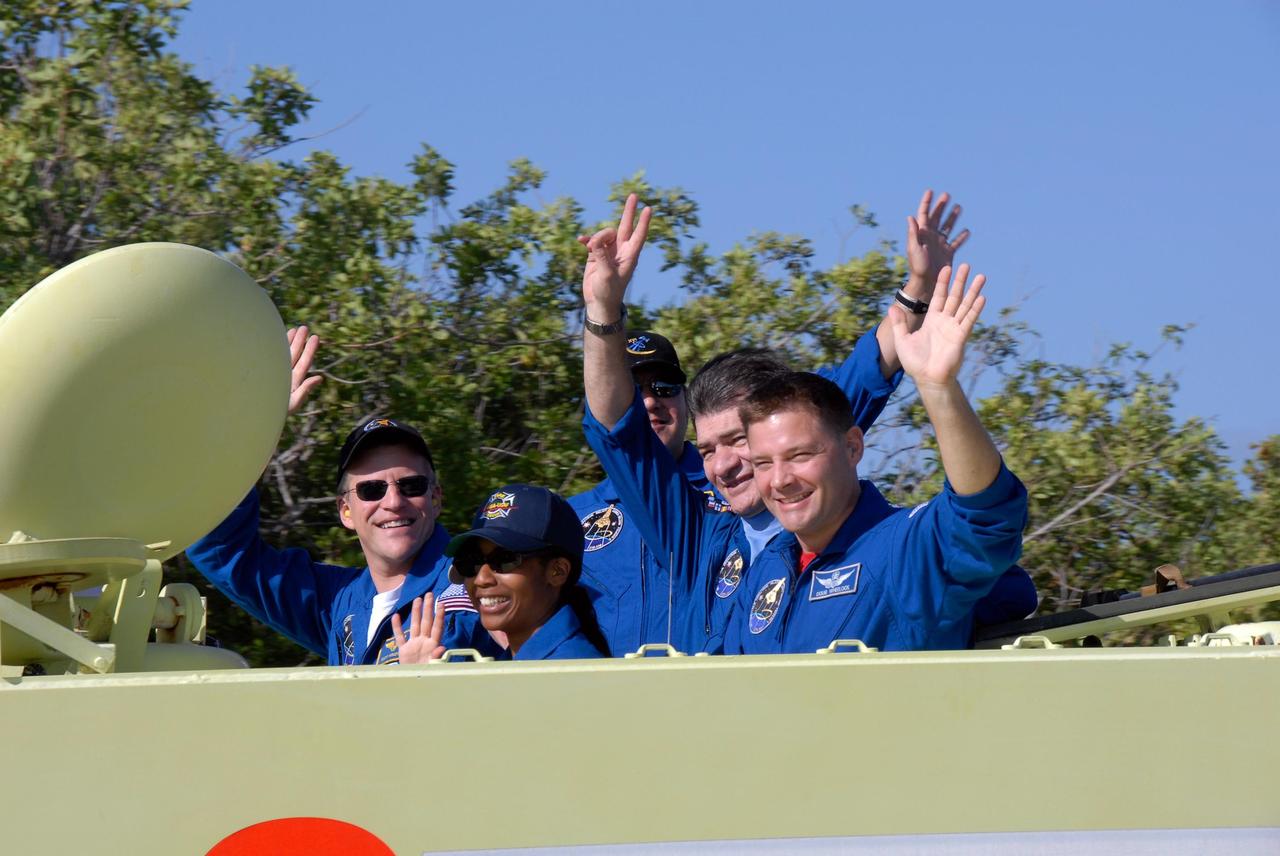
KENNEDY SPACE CENTER, FLA. -- STS-120 crew members signal their pleasure in participating in M-113 driving practice, part of emergency exit procedures from Launch Pad 39A. Seen here on the M-113 are Mission Specialists Scott Parazynski, Stephanie Wilson, Daniel Tani, Paolo Nespoli and Doug Wheelock. Nespoli represents the European Space Agency. The training is part of terminal countdown demonstration test, or TCDT, activities the crew is undertaking at NASA's Kennedy Space Center. The TCDT also includes equipment familiarization and a simulated launch countdown. Mission STS-120, which will carry the Italian-built U.S. Node 2 to the International Space Station, is targeted for launch on Oct. 23. Photo credit: NASA/Kim Shiflett
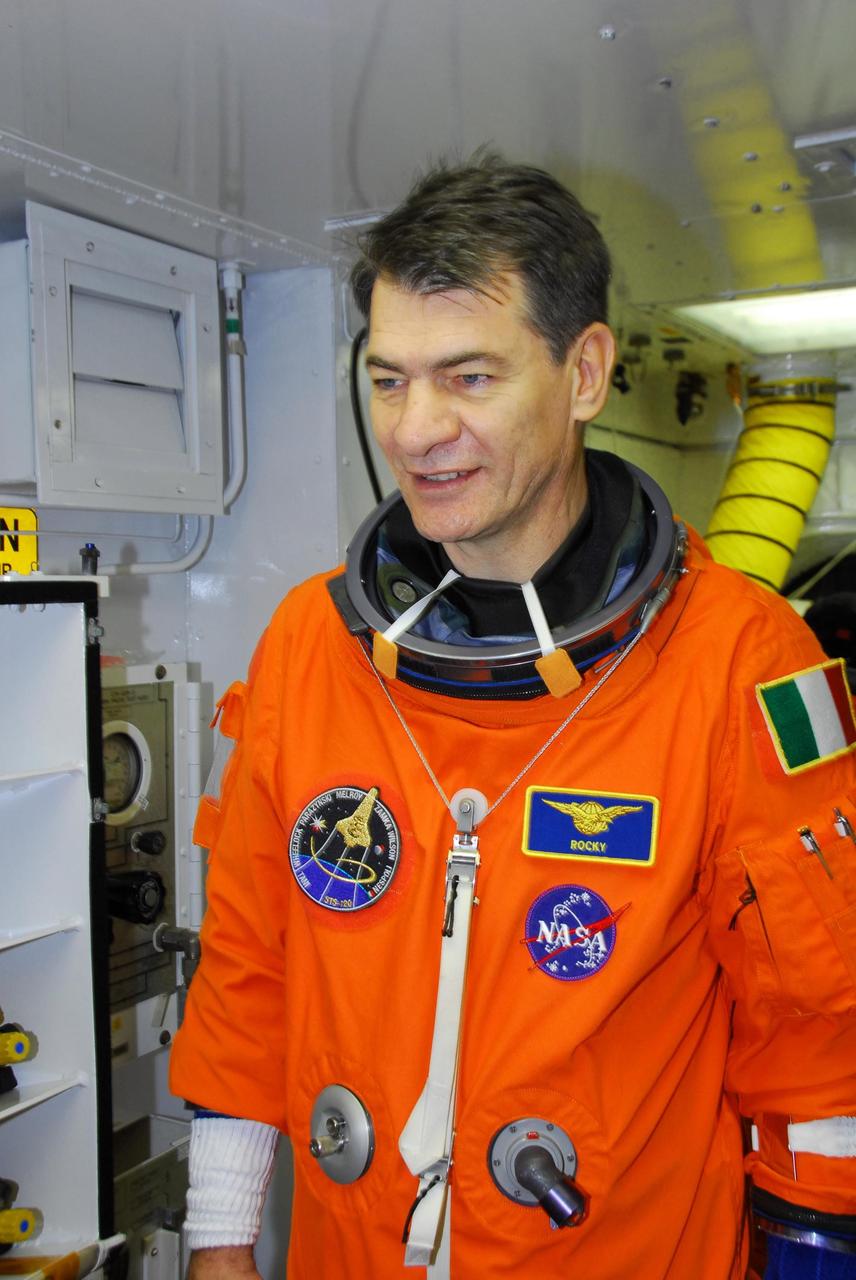
KENNEDY SPACE CENTER, FLA. -- STS-120 Mission Specialist Paolo Nespoli arrives in the white room on Launch Pad 39A. After donning a parachute pack, he will enter space shuttle Discovery for a simulated launch countdown. The countdown is the culmination of the prelaunch terminal countdown demonstration test, or TCDT. The TCDT at NASA's Kennedy Space Center provides astronauts and ground crews an opportunity to participate in various launch preparation activities, including equipment familiarization and emergency training. The STS-120 mission will deliver the U.S. Node 2 module, named Harmony, aboard space shuttle Discovery to the International Space Station. Discovery is targeted to launch on its 14-day mission at 11:38 a.m. EDT on Oct. 23. Photo credit: NASA/George Shelton

KENNEDY SPACE CENTER, FLA. -- In the white room on Launch Pad 39A, STS-120 Mission Specialist Doug Wheelock dons his parachute pack before entering space shuttle Discovery for a simulated launch countdown. The countdown is the culmination of the prelaunch terminal countdown demonstration test, or TCDT. The TCDT at NASA's Kennedy Space Center provides astronauts and ground crews an opportunity to participate in various launch preparation activities, including equipment familiarization and emergency training. The STS-120 mission will deliver the U.S. Node 2 module, named Harmony, aboard space shuttle Discovery to the International Space Station. Discovery is targeted to launch on its 14-day mission at 11:38 a.m. EDT on Oct. 23. Photo credit: NASA/George Shelton
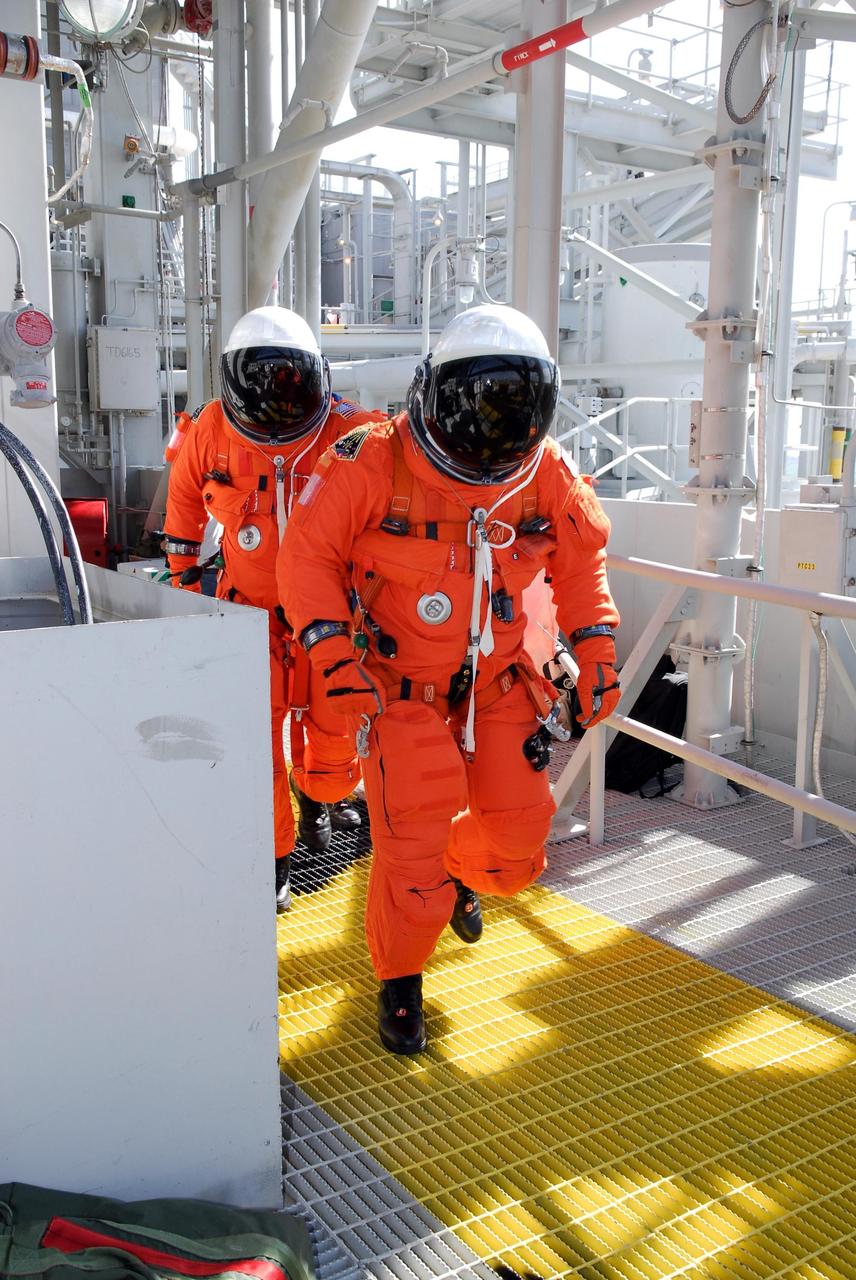
KENNEDY SPACE CENTER, FLA. -- Members of space shuttle Atlantis' STS-122 crew exit Atlantis' fight deck following a simulated launch countdown at Launch Pad 39A. The exercise is part of terminal countdown demonstration test, or TCDT, activities at NASA's Kennedy Space Center. The TCDT is a dress rehearsal for launch and also provides astronauts and ground crews with equipment familiarization and emergency egress training. On mission STS-122, Atlantis will deliver the Columbus module to the International Space Station. The European Space Agency's largest single contribution to the station, Columbus is a multifunctional, pressurized laboratory that will be permanently attached to U.S. Node 2, called Harmony. The laboratory will expand the research facilities aboard the station, providing crew members and scientists from around the world the ability to conduct a variety of experiments in the physical, materials and life sciences. Atlantis' launch is targeted for Dec. 6. Photo credit: NASA/Kim Shiflett
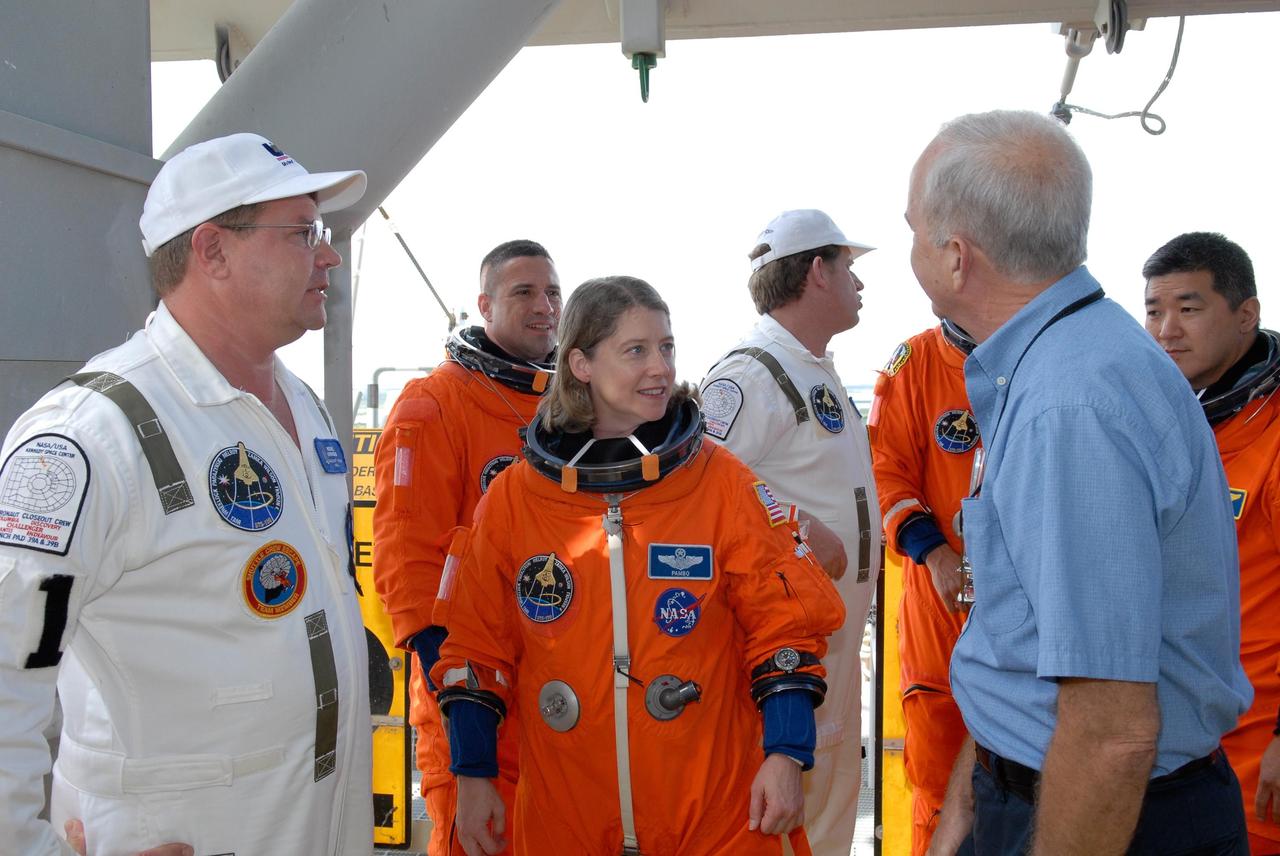
KENNEDY SPACE CENTER, FLA. -- The STS-120 crew gathers at the slidewire basket area on Launch Pad 39A after practicing emergency egress, part of the prelaunch terminal countdown demonstration test, or TCDT. Seen here in their launch and entry suits are (from left) Pilot George Zamka, Commander Pamela Melroy and (far right) Mission Specialist Daniel Tani. Their name patches reflect the nicknames the crew gave each other for the event. The TCDT at NASA's Kennedy Space Center provides astronauts and ground crews an opportunity to participate in various launch preparation activities, including equipment familiarization and emergency training. The STS-120 mission will deliver the U.S. Node 2 module, named Harmony, aboard space shuttle Discovery to the International Space Station. Discovery is targeted to launch on its 14-day mission at 11:38 a.m. EDT on Oct. 23. Photo credit: NASA/Kim Shiflett
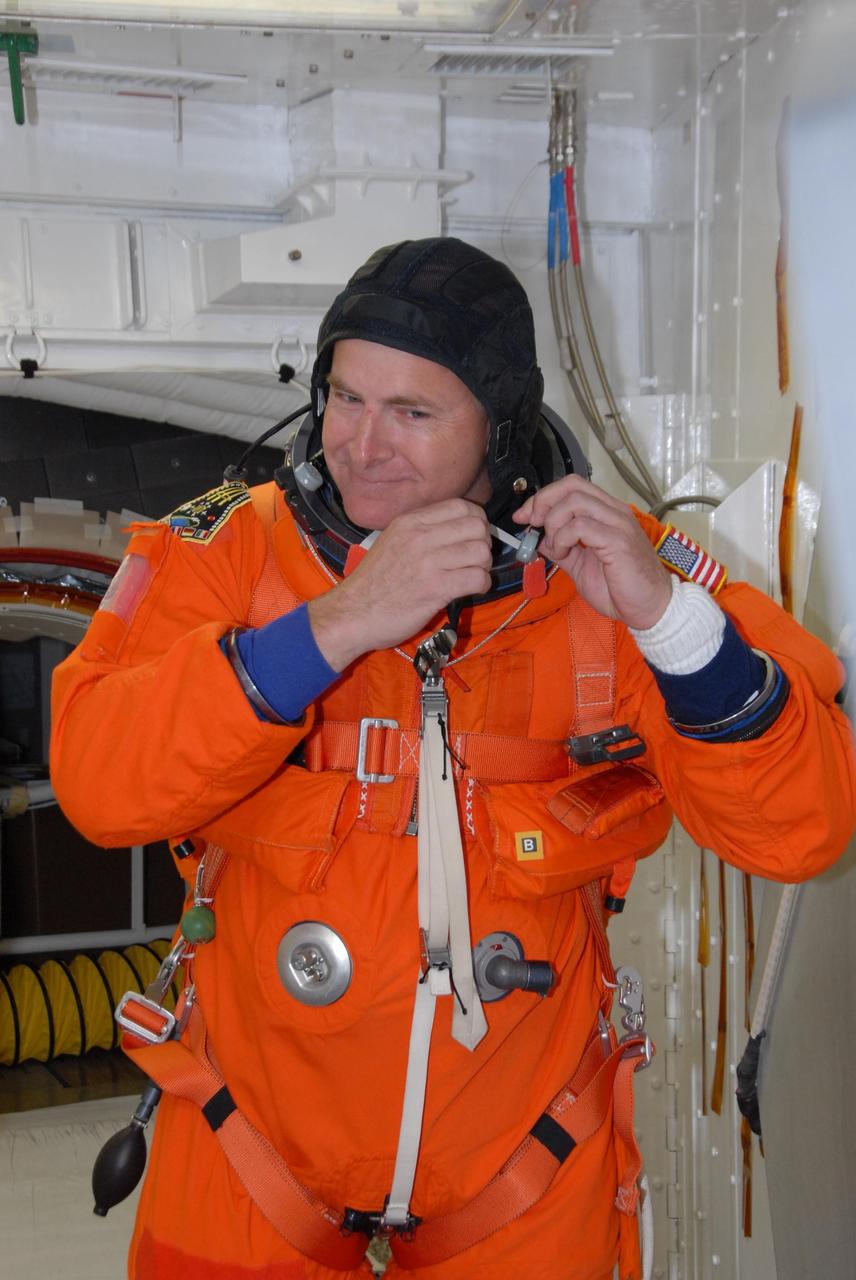
KENNEDY SPACE CENTER, FLA. -- In the White Room on Launch Pad 39A, space shuttle Atlantis STS-122 Pilot Alan Poindexter suits up for his entry into Atlantis' cockpit, through the hatch behind him. The exercise is part of terminal countdown demonstration test, or TCDT, activities at NASA's Kennedy Space Center. The TCDT is a dress rehearsal for launch and also provides astronauts and ground crews with equipment familiarization and emergency egress training. On mission STS-122, Atlantis will deliver the Columbus module to the International Space Station. The European Space Agency's largest single contribution to the station, Columbus is a multifunctional, pressurized laboratory that will be permanently attached to U.S. Node 2, called Harmony. The laboratory will expand the research facilities aboard the station, providing crew members and scientists from around the world the ability to conduct a variety of experiments in the physical, materials and life sciences. Atlantis' launch is targeted for Dec. 6. Photo credit: NASA/George Shelton
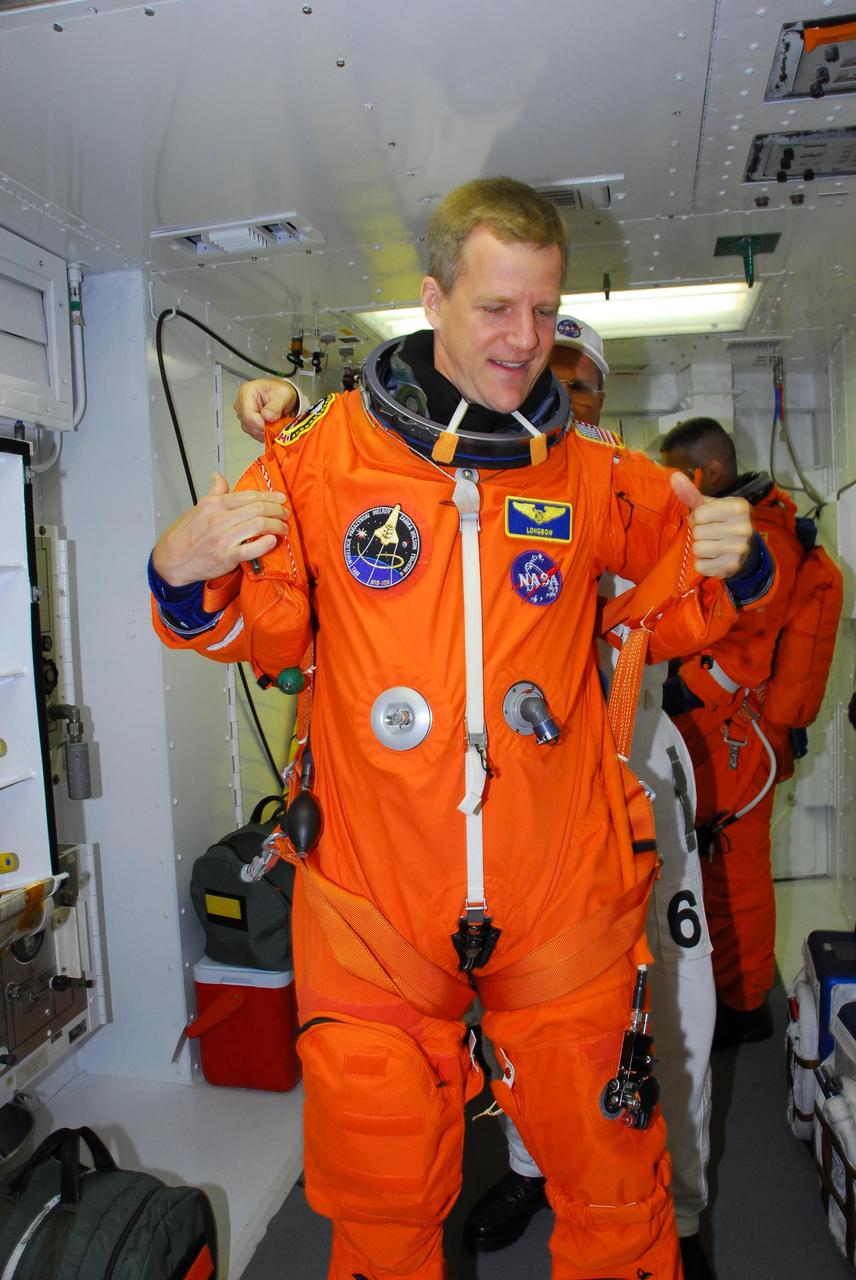
KENNEDY SPACE CENTER, FLA. -- In the white room on Launch Pad 39A, STS-120 Mission Specialist Scott Parazynski dons his parachute pack before entering space shuttle Discovery for a simulated launch countdown. The countdown is the culmination of the prelaunch terminal countdown demonstration test, or TCDT. His name patch reflects the nicknames the crew gave each other for the event. The TCDT at NASA's Kennedy Space Center provides astronauts and ground crews an opportunity to participate in various launch preparation activities, including equipment familiarization and emergency training. The STS-120 mission will deliver the U.S. Node 2 module, named Harmony, aboard space shuttle Discovery to the International Space Station. Discovery is targeted to launch on its 14-day mission at 11:38 a.m. EDT on Oct. 23. Photo credit: NASA/George Shelton
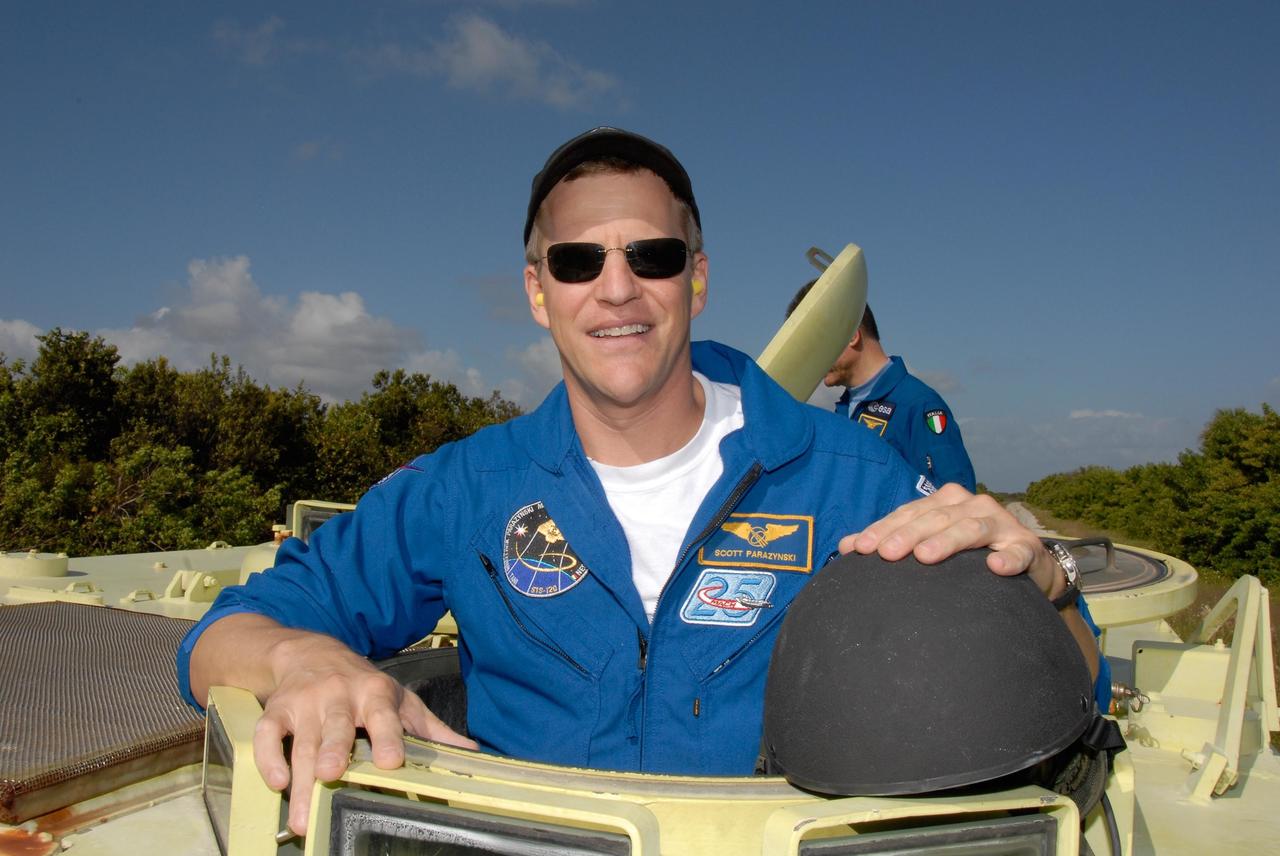
KENNEDY SPACE CENTER, FLA. -- STS-120 Mission Specialist Scott Parazynski is ready for his turn at driving the M-113 armored personnel carrier. The M-113 is part of emergency exit procedures from Launch Pad 39A. Behind Parazynski is Mission Specialist Paolo Nespoli, who represents the European Space Agency. The training is part of terminal countdown demonstration test, or TCDT, activities the crew is undertaking at NASA's Kennedy Space Center. The TCDT also includes equipment familiarization and a simulated launch countdown. Mission STS-120, which will carry the Italian-built U.S. Node 2 to the International Space Station, is targeted for launch on Oct. 23. Photo credit: NASA/Kim Shiflett

KENNEDY SPACE CENTER, FLA. -- During emergency egress from Launch Pad 39A, STS-120 Mission Specialists Stephanie Wilson (foreground) and Doug Wheelock settle in the slidewire basket. Wilson reaches for the release lever. The basket can carry them to a safe landing site below, if needed. The activity is part of the prelaunch terminal countdown demonstration test, or TCDT. The TCDT at NASA's Kennedy Space Center provides astronauts and ground crews an opportunity to participate in various launch preparation activities, including equipment familiarization and emergency training. The STS-120 mission will deliver the U.S. Node 2 module, named Harmony, aboard space shuttle Discovery to the International Space Station. Discovery is targeted to launch on its 14-day mission at 11:38 a.m. EDT on Oct. 23. Photo credit: NASA/Kim Shiflett
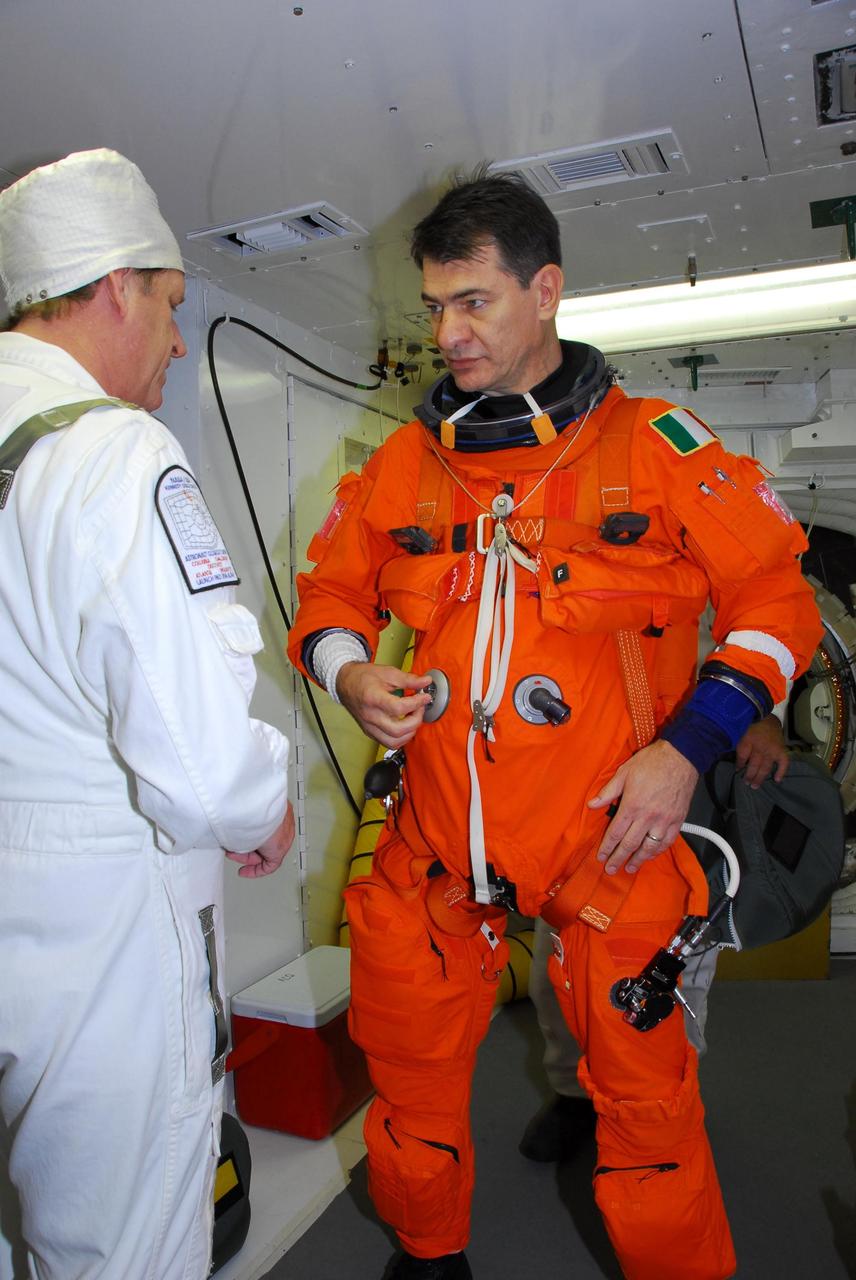
KENNEDY SPACE CENTER, FLA. -- In the white room on Launch Pad 39A, STS-120 Mission Specialist Paolo Nespoli dons a parachute pack before entering space shuttle Discovery for a simulated launch countdown. The countdown is the culmination of the prelaunch terminal countdown demonstration test, or TCDT. The TCDT at NASA's Kennedy Space Center provides astronauts and ground crews an opportunity to participate in various launch preparation activities, including equipment familiarization and emergency training. The STS-120 mission will deliver the U.S. Node 2 module, named Harmony, aboard space shuttle Discovery to the International Space Station. Discovery is targeted to launch on its 14-day mission at 11:38 a.m. EDT on Oct. 23. Photo credit: NASA/George Shelton
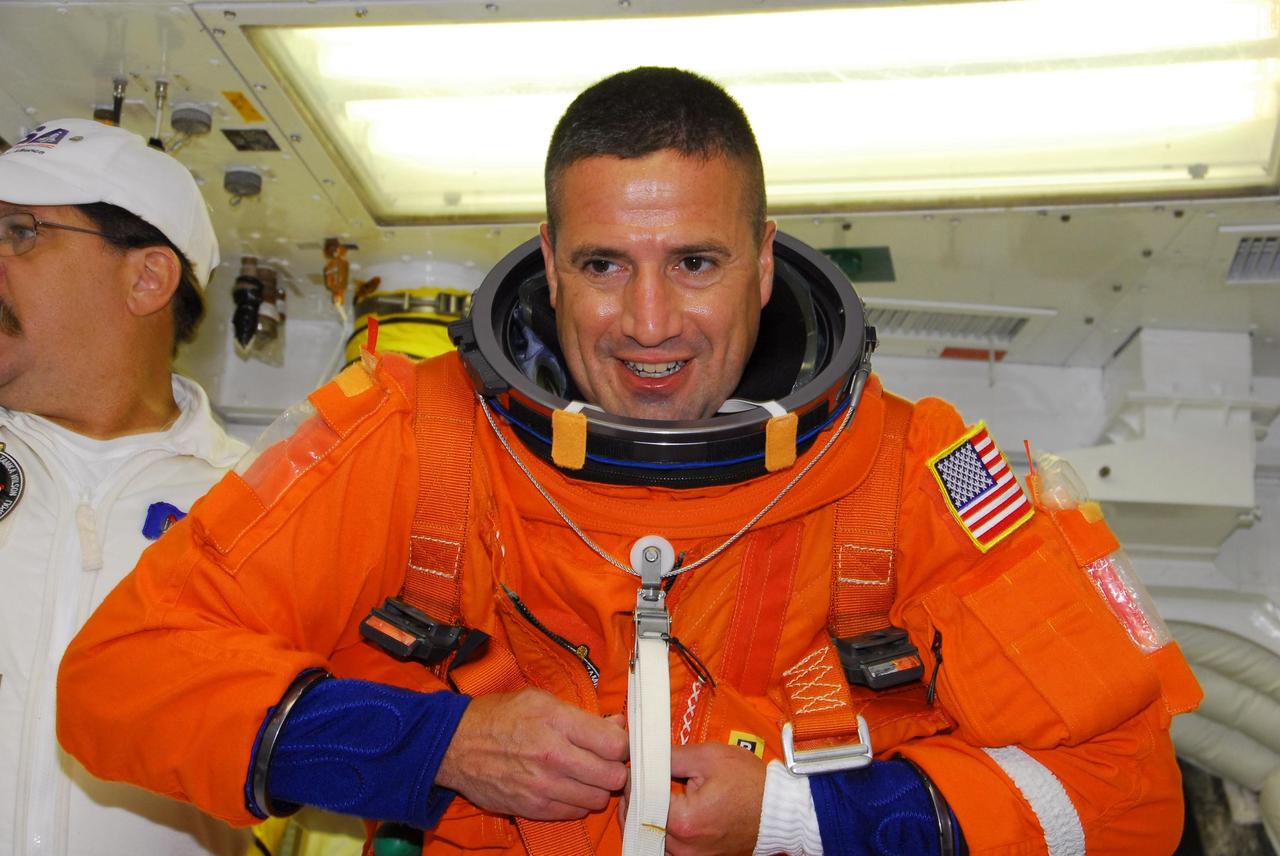
KENNEDY SPACE CENTER, FLA. -- In the white room on Launch Pad 39A, STS-120 Pilot George Zamka finishes getting into his parachute pack before entering space shuttle Discovery for a simulated launch countdown. The countdown is the culmination of the prelaunch terminal countdown demonstration test, or TCDT. The TCDT at NASA's Kennedy Space Center provides astronauts and ground crews an opportunity to participate in various launch preparation activities, including equipment familiarization and emergency training. The STS-120 mission will deliver the U.S. Node 2 module, named Harmony, aboard space shuttle Discovery to the International Space Station. Discovery is targeted to launch on its 14-day mission at 11:38 a.m. EDT on Oct. 23. Photo credit: NASA/George Shelton
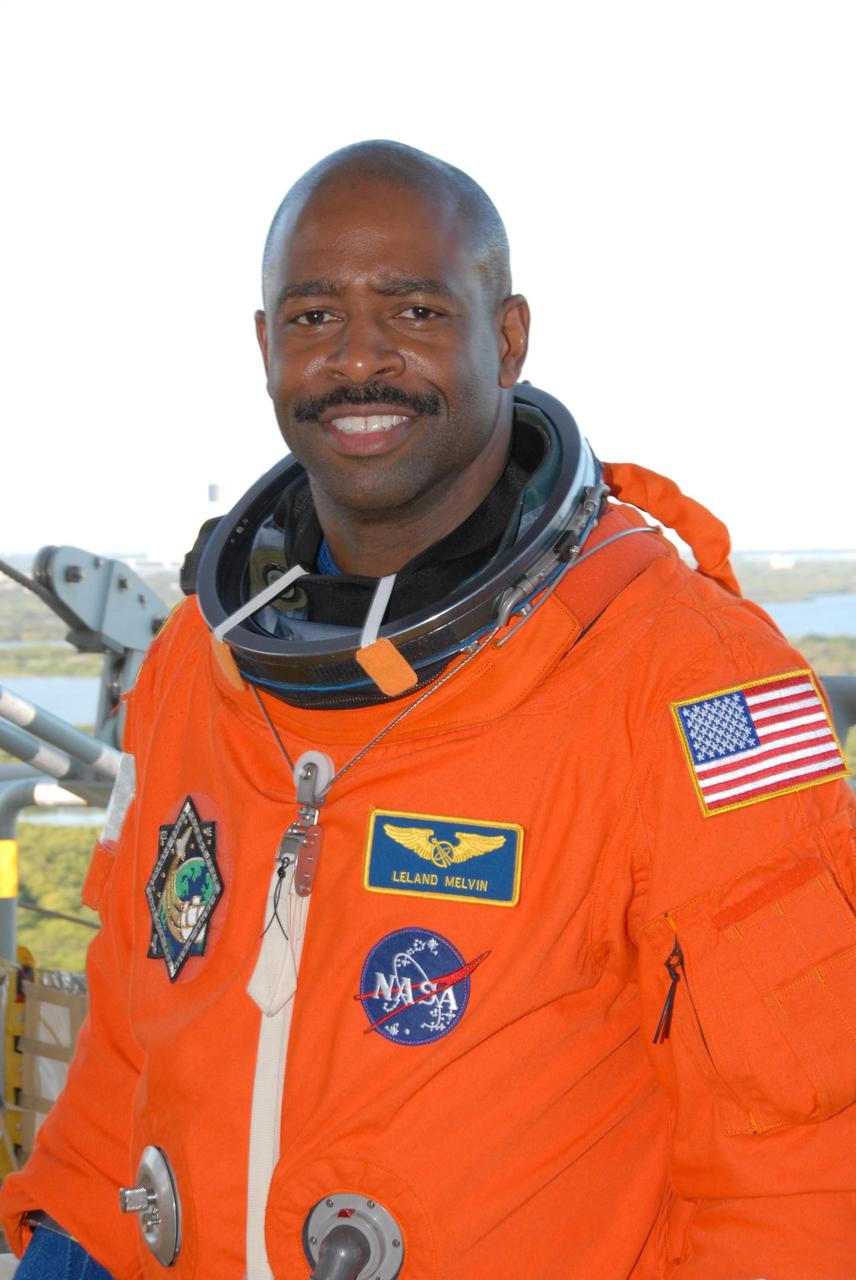
KENNEDY SPACE CENTER, FLA. -- Space shuttle Atlantis STS-122 Mission Specialist Leland Melvin arrives at Launch Pad 39A, dressed in his launch and entry suit, to participate in a simulated launch countdown aboard Atlantis. The exercise is part of terminal countdown demonstration test, or TCDT, activities at NASA's Kennedy Space Center. The TCDT is a dress rehearsal for launch and also provides astronauts and ground crews with equipment familiarization and emergency egress training. On mission STS-122, Atlantis will deliver the Columbus module to the International Space Station. The European Space Agency's largest single contribution to the station, Columbus is a multifunctional, pressurized laboratory that will be permanently attached to U.S. Node 2, called Harmony. The laboratory will expand the research facilities aboard the station, providing crew members and scientists from around the world the ability to conduct a variety of experiments in the physical, materials and life sciences. Atlantis' launch is targeted for Dec. 6. Photo credit: NASA/George Shelton
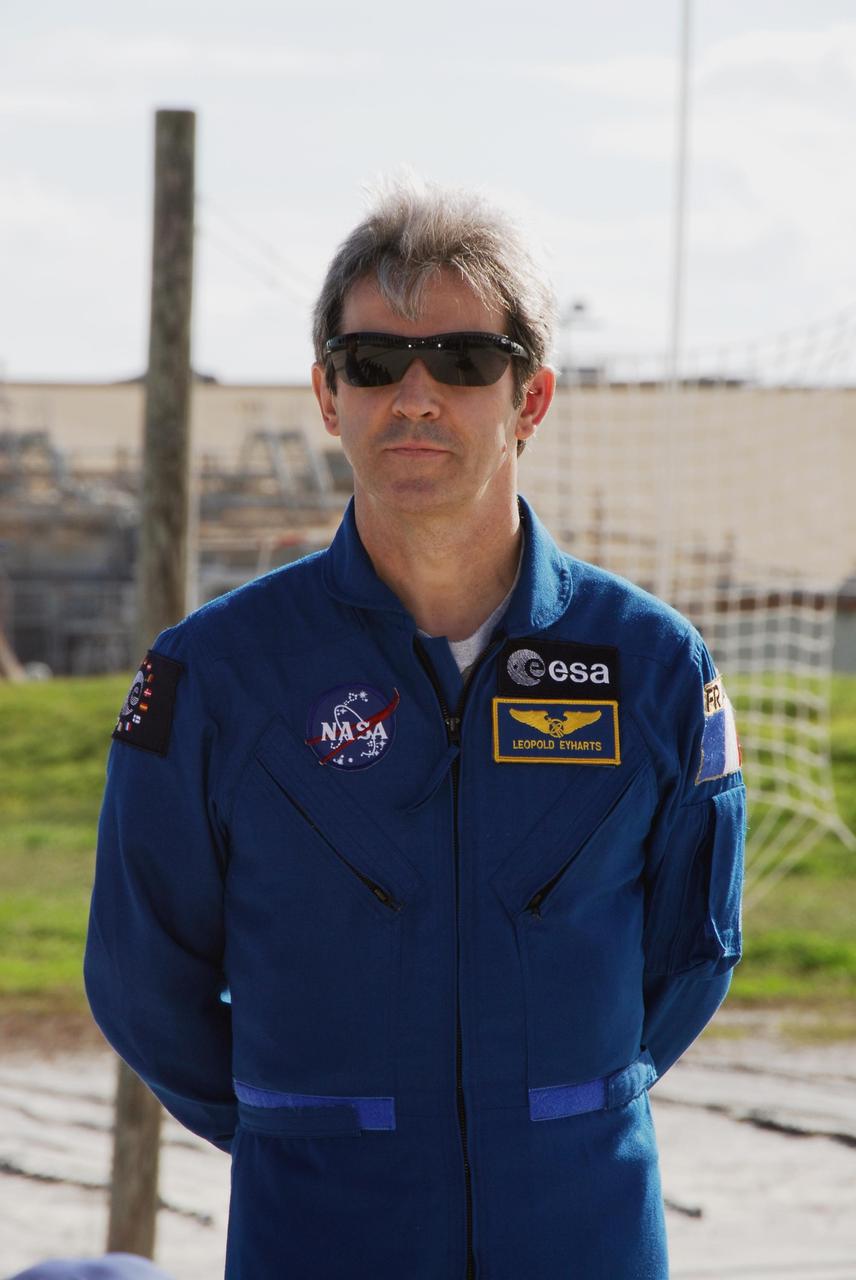
KENNEDY SPACE CENTER, FLA. -- Space shuttle Atlantis STS-122 Mission Specialist Leopold Eyharts takes part in a press conference at the slidewire basket landing on Launch Pad 39A. Eyharts is with the European Space Agency and will remain on the International Space Station as a flight engineer for Expedition 16 following the STS-122 mission. The STS-122 crew is at NASA's Kennedy Space Center to take part in terminal countdown demonstration test, or TCDT, activities, a standard part of launch preparations. The TCDT provides astronauts and ground crews with equipment familiarization, emergency egress training and a simulated launch countdown. On mission STS-122, Atlantis will deliver the European Space Agency's Columbus module to the International Space Station. Columbus is a multifunctional, pressurized laboratory that will be permanently attached to U.S. Node 2, called Harmony, and will expand the research facilities aboard the station. Launch is targeted for Dec. 6. Photo credit: NASA/Kim Shiflett
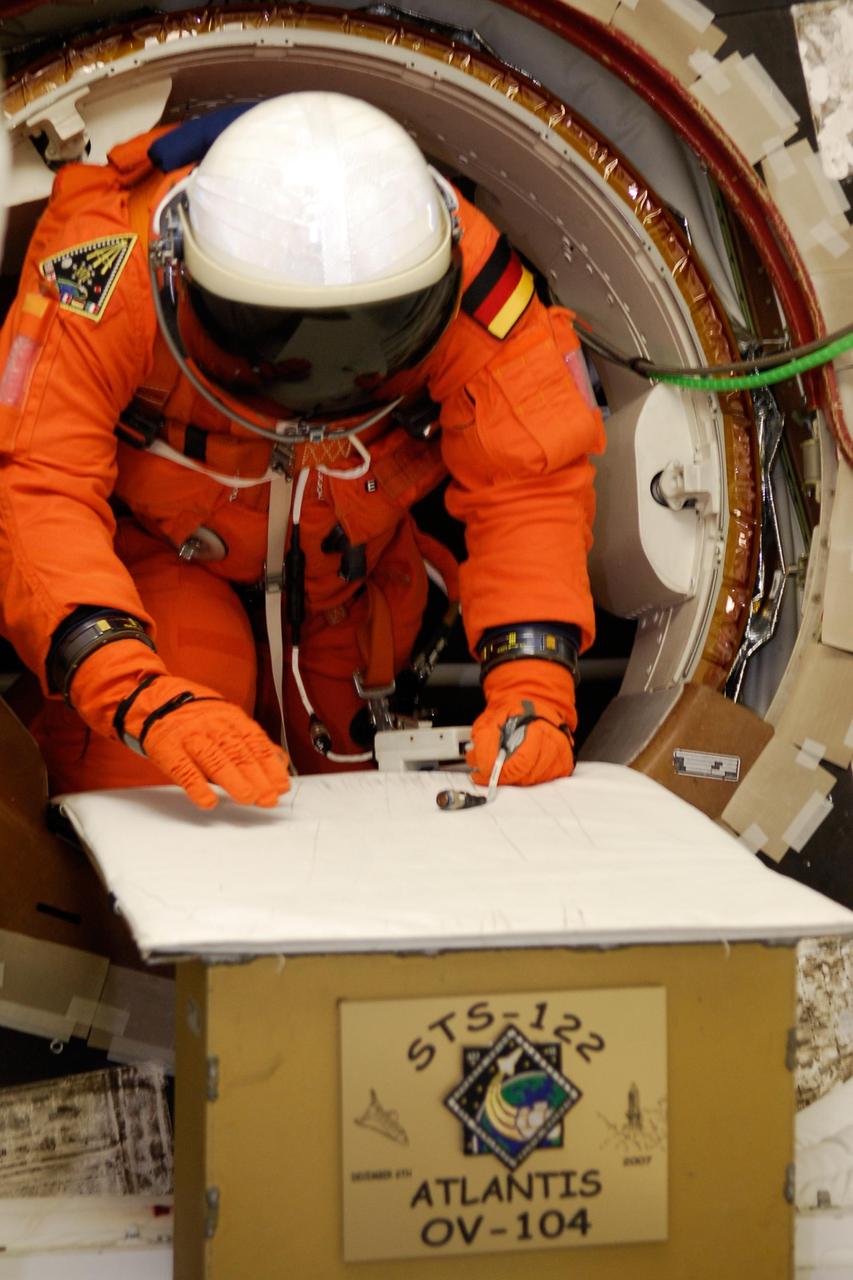
KENNEDY SPACE CENTER, FLA. -- Space shuttle Atlantis STS-122 Mission Specialist Hans Schlegel exits Atlantis' fight deck following a simulated launch countdown at Launch Pad 39A. Schlegel is with the European Space Agency. The exercise is part of terminal countdown demonstration test, or TCDT, activities at NASA's Kennedy Space Center. The TCDT is a dress rehearsal for launch and also provides astronauts and ground crews with equipment familiarization and emergency egress training. On mission STS-122, Atlantis will deliver the Columbus module to the International Space Station. The European Space Agency's largest single contribution to the station, Columbus is a multifunctional, pressurized laboratory that will be permanently attached to U.S. Node 2, called Harmony. The laboratory will expand the research facilities aboard the station, providing crew members and scientists from around the world the ability to conduct a variety of experiments in the physical, materials and life sciences. Atlantis' launch is targeted for Dec. 6. Photo credit: NASA/Kim Shiflett
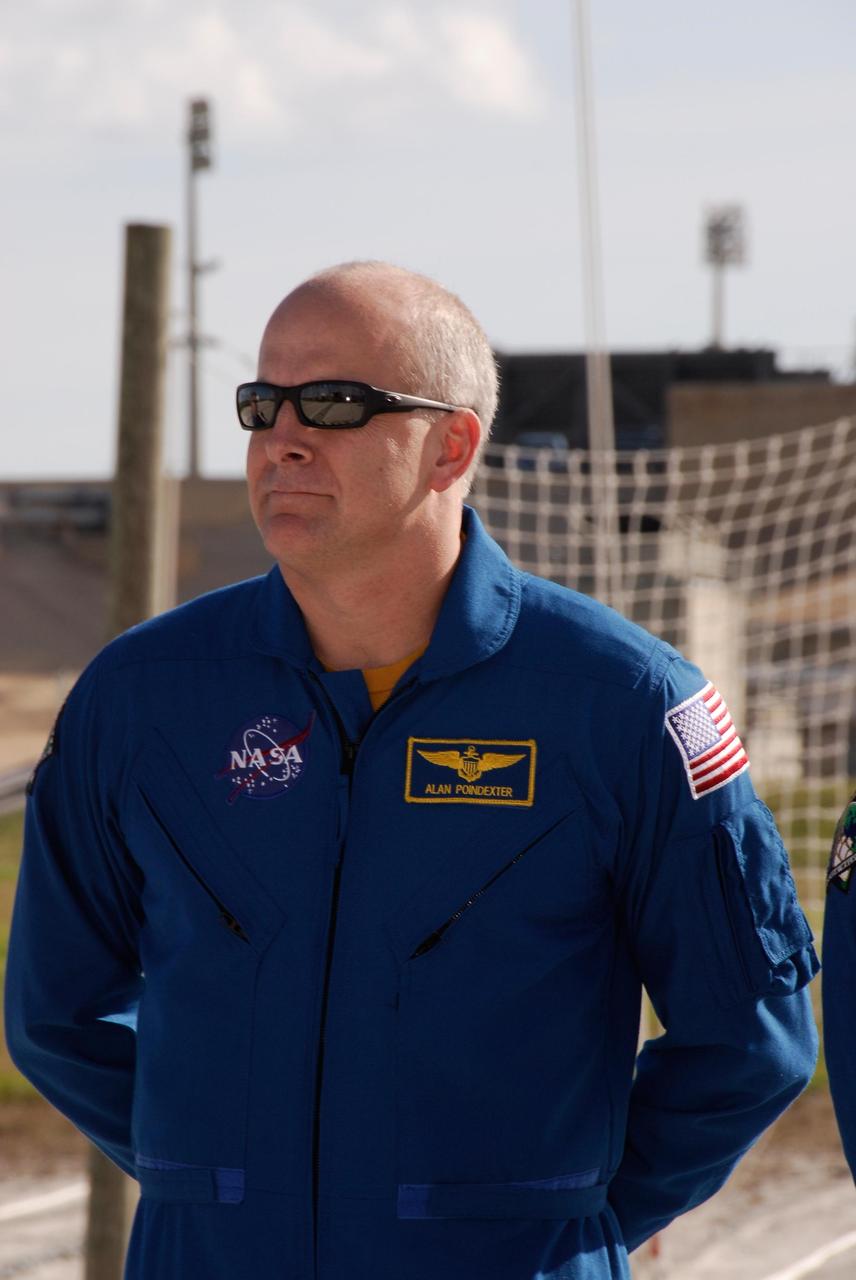
KENNEDY SPACE CENTER, FLA. -- Space shuttle Atlantis STS-122 Pilot Alan Poindexter takes part in a press conference at the slidewire basket landing on Launch Pad 39A. The STS-122 crew is at NASA's Kennedy Space Center to take part in terminal countdown demonstration test, or TCDT, activities, a standard part of launch preparations. The TCDT provides astronauts and ground crews with equipment familiarization, emergency egress training and a simulated launch countdown. On mission STS-122, Atlantis will deliver the European Space Agency's Columbus module to the International Space Station. Columbus is a multifunctional, pressurized laboratory that will be permanently attached to U.S. Node 2, called Harmony, and will expand the research facilities aboard the station. Launch is targeted for Dec. 6. Photo credit: NASA/Kim Shiflett

KENNEDY SPACE CENTER, FLA. -- In the white room on Launch Pad 39A, STS-120 Mission Specialist Daniel Tani (foreground) is helped with his launch suit preparations before entering space shuttle Discovery for a simulated launch countdown. In the background is Mission Specialist Doug Wheelock. The countdown is the culmination of the prelaunch terminal countdown demonstration test, or TCDT. The TCDT at NASA's Kennedy Space Center provides astronauts and ground crews an opportunity to participate in various launch preparation activities, including equipment familiarization and emergency training. The STS-120 mission will deliver the U.S. Node 2 module, named Harmony, aboard space shuttle Discovery to the International Space Station. Discovery is targeted to launch on its 14-day mission at 11:38 a.m. EDT on Oct. 23. Photo credit: NASA/George Shelton
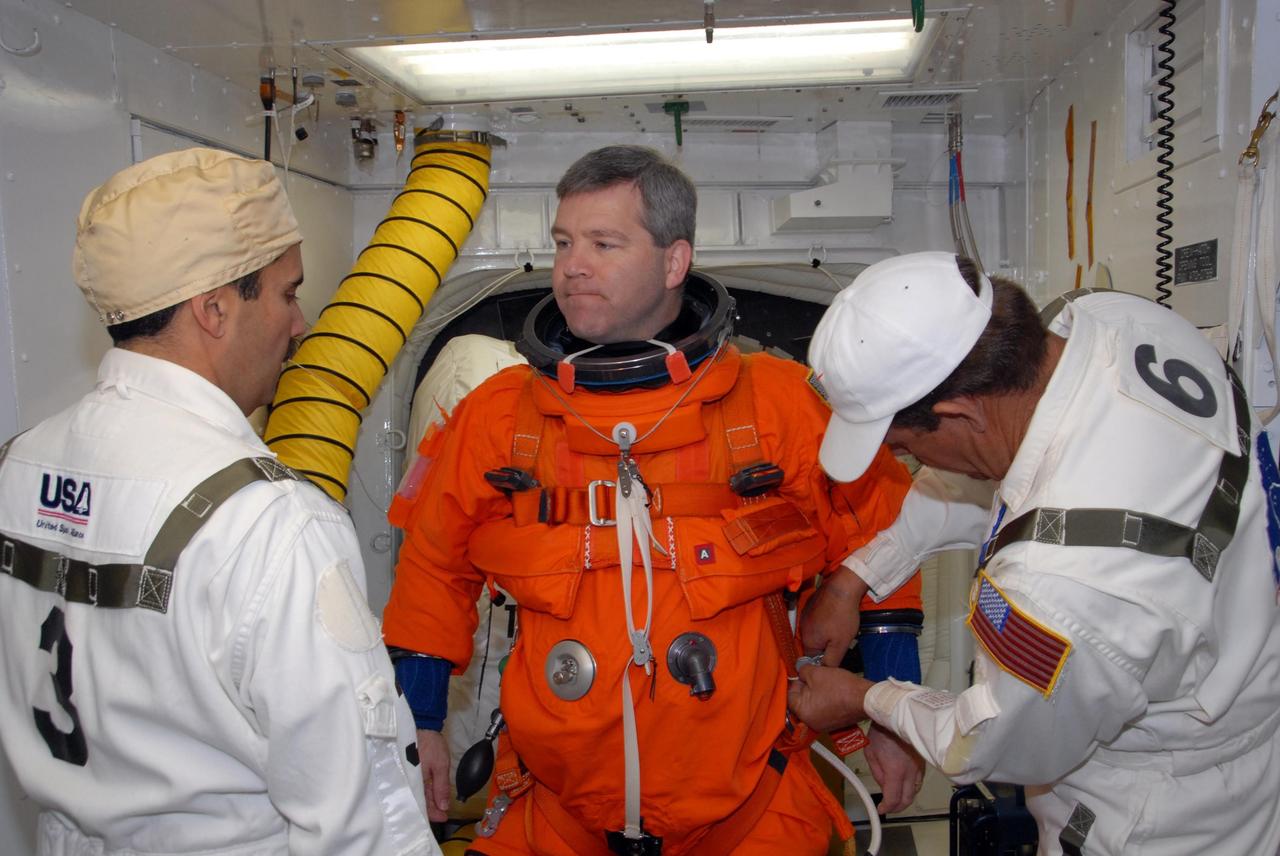
KENNEDY SPACE CENTER, FLA. -- In the White Room on Launch Pad 39A, suit technicians prepare space shuttle Atlantis STS-122 Commander Steve Frick for entry into Atlantis' cockpit, through the hatch behind him. The exercise is part of terminal countdown demonstration test, or TCDT, activities at NASA's Kennedy Space Center. The TCDT is a dress rehearsal for launch and also provides astronauts and ground crews with equipment familiarization and emergency egress training. On mission STS-122, Atlantis will deliver the Columbus module to the International Space Station. The European Space Agency's largest single contribution to the station, Columbus is a multifunctional, pressurized laboratory that will be permanently attached to U.S. Node 2, called Harmony. The laboratory will expand the research facilities aboard the station, providing crew members and scientists from around the world the ability to conduct a variety of experiments in the physical, materials and life sciences. Atlantis' launch is targeted for Dec. 6. Photo credit: NASA/George Shelton
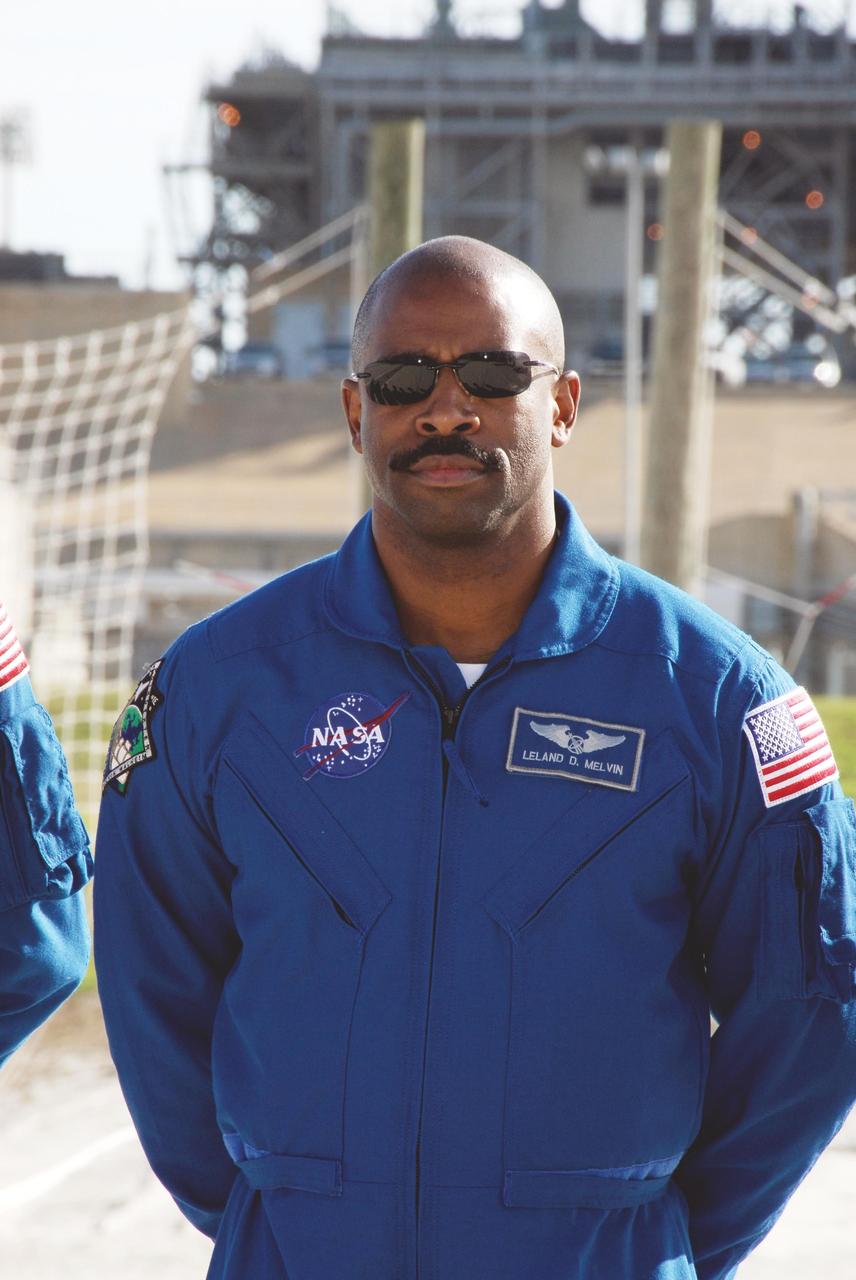
KENNEDY SPACE CENTER, FLA. -- Space shuttle Atlantis STS-122 Mission Specialist Leland Melvin takes part in a press conference at the slidewire basket landing on Launch Pad 39A. The STS-122 crew is at NASA's Kennedy Space Center to take part in terminal countdown demonstration test, or TCDT, activities, a standard part of launch preparations. The TCDT provides astronauts and ground crews with equipment familiarization, emergency egress training and a simulated launch countdown. On mission STS-122, Atlantis will deliver the European Space Agency's Columbus module to the International Space Station. Columbus is a multifunctional, pressurized laboratory that will be permanently attached to U.S. Node 2, called Harmony, and will expand the research facilities aboard the station. Launch is targeted for Dec. 6. Photo credit: NASA/Kim Shiflett
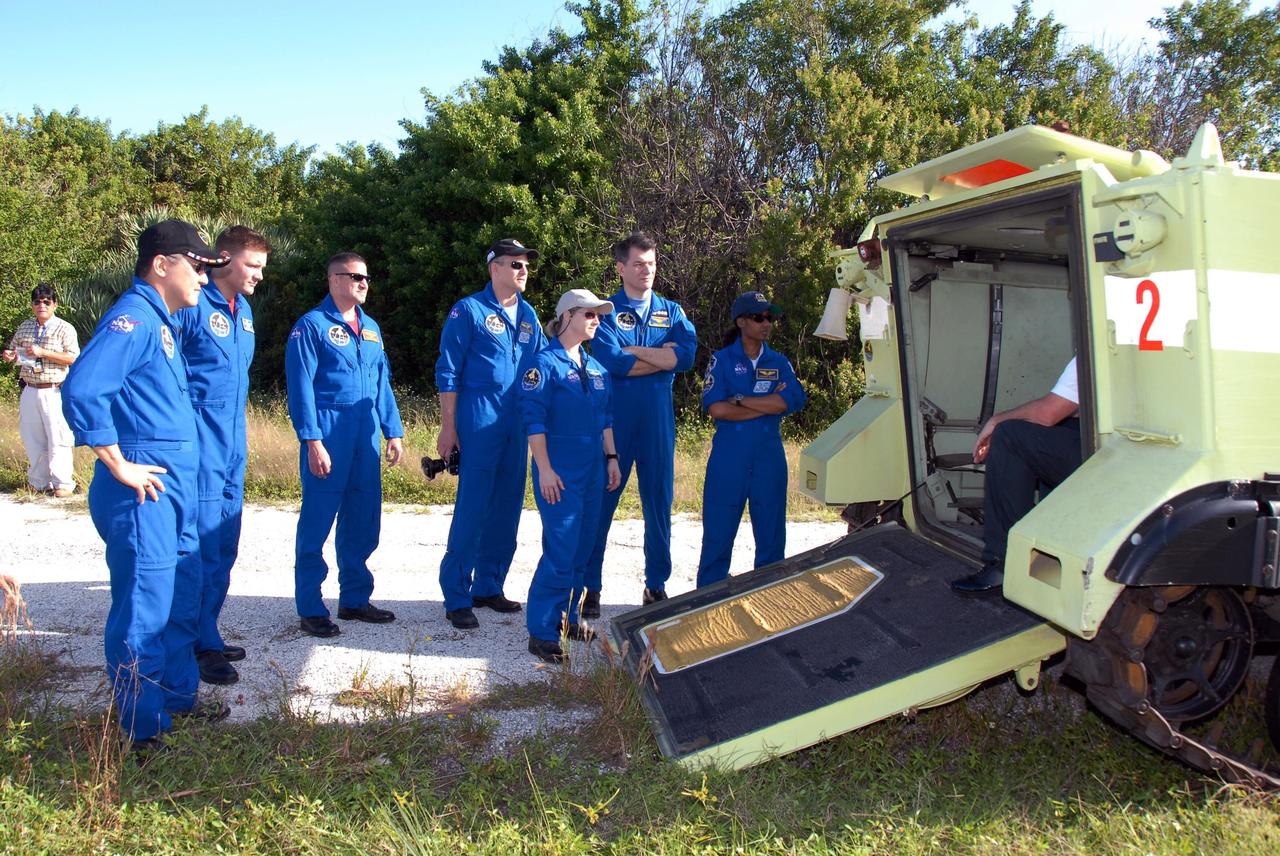
KENNEDY SPACE CENTER, FLA. -- Outside the M-113 armored personnel carrier, STS-120 crew members listen to instructions on its use for emergency exit procedures from Launch Pad 39A. From left are Mission Specialists Daniel Tani and Doug Wheelock, Pilot George Zamka, Mission Specialist Scott Parazynski, Commander Pamela Melroy, and Mission Specialists Paolo Nespoli and Stephanie Wilson. Nespoli represents the European Space Agency. The training is part of terminal countdown demonstration test, or TCDT, activities the crew is undertaking at NASA's Kennedy Space Center. The TCDT also includes equipment familiarization and a simulated launch countdown. Mission STS-120, which will carry the Italian-built U.S. Node 2 to the International Space Station, is targeted for launch on Oct. 23. Photo credit: NASA/Kim Shiflett
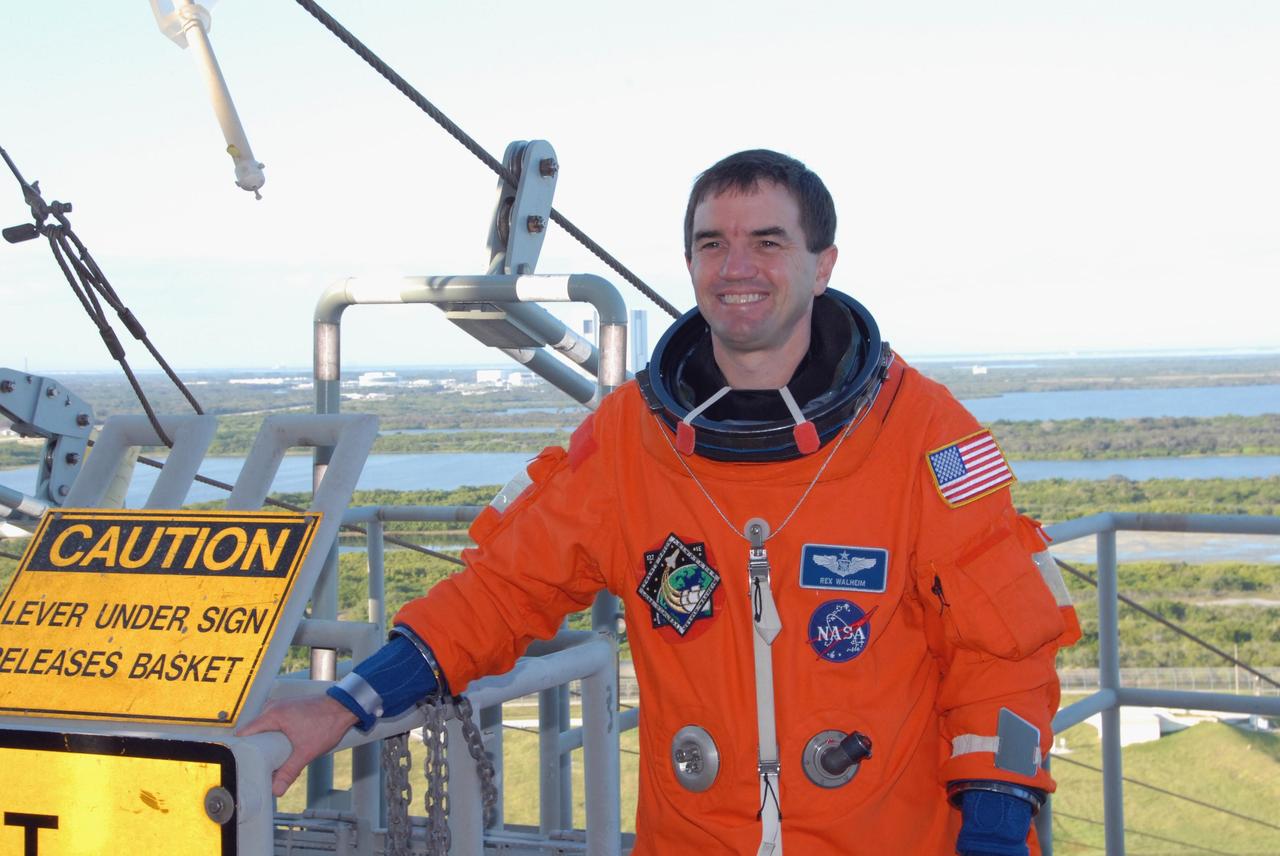
KENNEDY SPACE CENTER, FLA. -- Space shuttle Atlantis STS-122 Mission Specialist Rex Walheim arrives at Launch Pad 39A, dressed in his launch and entry suit, to participate in a simulated launch countdown aboard Atlantis. The exercise is part of terminal countdown demonstration test, or TCDT, activities at NASA's Kennedy Space Center. The TCDT is a dress rehearsal for launch and also provides astronauts and ground crews with equipment familiarization and emergency egress training. On mission STS-122, Atlantis will deliver the Columbus module to the International Space Station. The European Space Agency's largest single contribution to the station, Columbus is a multifunctional, pressurized laboratory that will be permanently attached to U.S. Node 2, called Harmony. The laboratory will expand the research facilities aboard the station, providing crew members and scientists from around the world the ability to conduct a variety of experiments in the physical, materials and life sciences. Atlantis' launch is targeted for Dec. 6. Photo credit: NASA/George Shelton
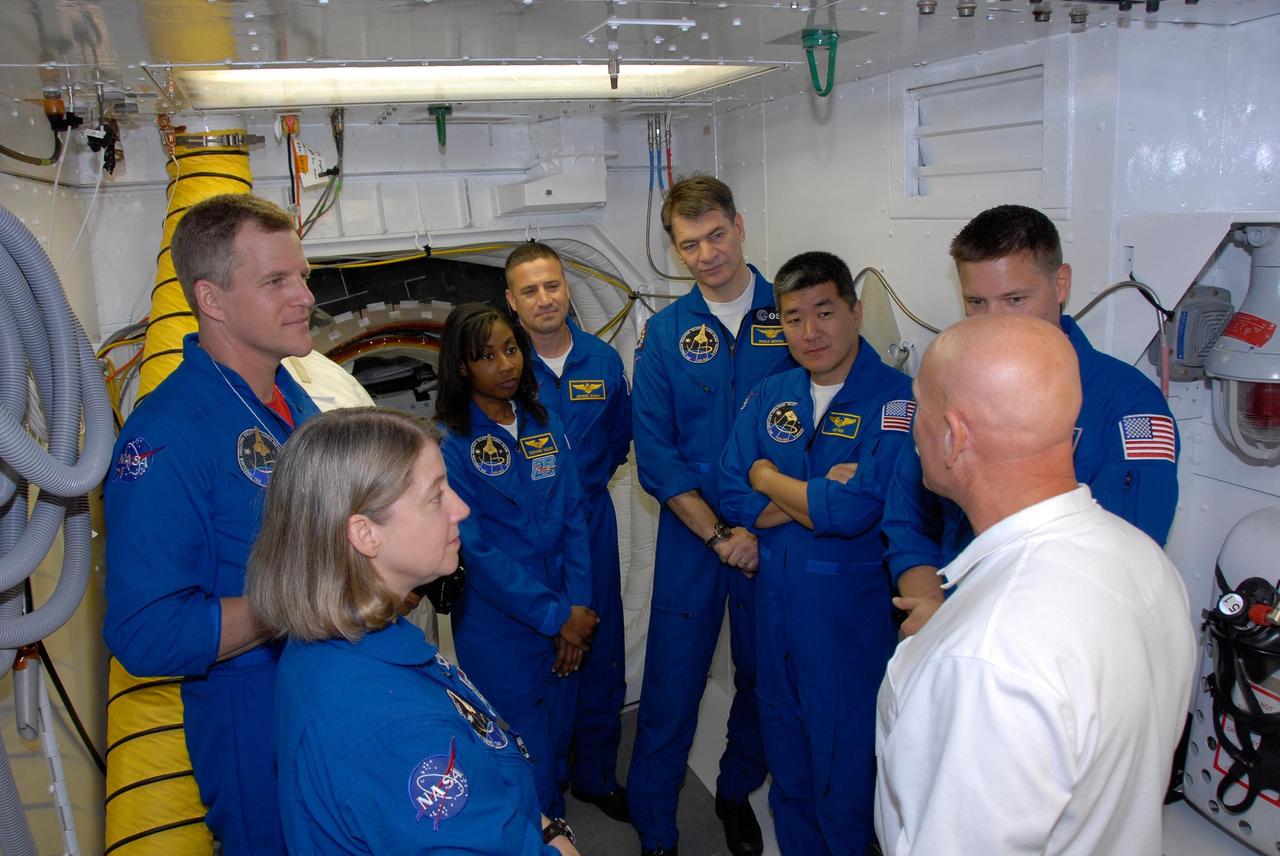
KENNEDY SPACE CENTER, FLA. -- The STS-120 crew is at NASA's Kennedy Space Center for the pre-launch terminal countdown demonstration test, or TCDT. Gathered in the white room on Launch Pad 39A, the crew gets instructions on emergency egress from the space shuttle. Clockwise from lower left are Commander Pamela Melroy, Mission Specialists Scott Parazynski and Stephanie Wilson, Pilot George Zamka, and Mission Specialists Paolo Nespoli, Daniel Tani and Doug Wheelock. Nespoli represents the European Space Agency. Tani will remain aboard the International Space Station and return with the STS-122 crew, targeted to launch Dec. 6. The TCDT provides astronauts and ground crews an opportunity to participate in various simulated countdown activities, including equipment familiarization and emergency training. The STS-120 mission will deliver the U.S. Node 2 module, named Harmony, aboard space shuttle Discovery to the International Space Station. Launch of Discovery on mission STS-120 is targeted for Oct. 23 at 11:38 a.m. EDT on a 14-day mission. Photo credit: NASA/Kim Shiflett
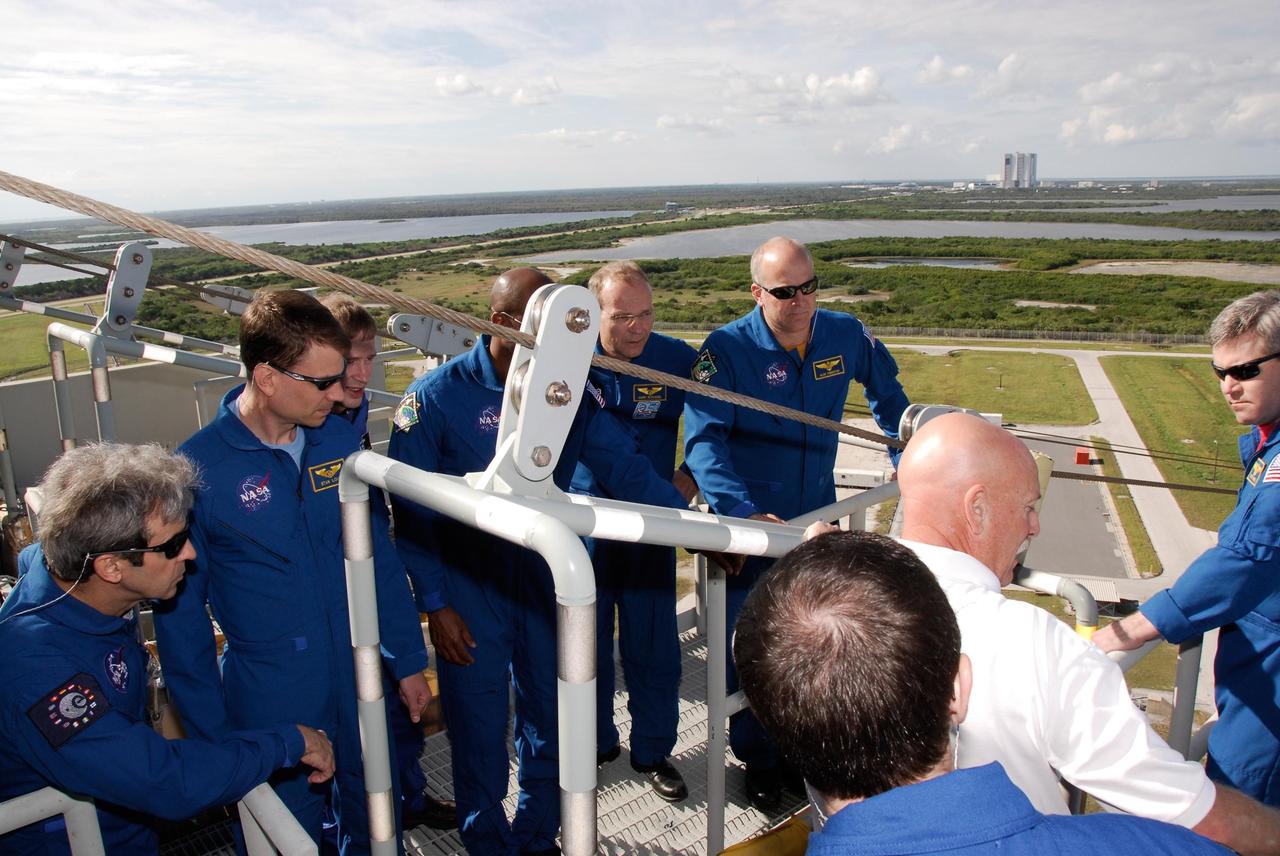
KENNEDY SPACE CENTER, FLA. -- The space shuttle Atlantis STS-122 crew receives instruction on emergency exit from the fixed service structure on Launch Pad 39A. Clockwise, from left, are Mission Specialists Leopold Eyharts and Stanley Love, Eyharts' backup Frank De Winne, Mission Specialists Leland Melvin and Hans Schlegel, Pilot Alan Poindexter, Commander Steve Frick and Mission Specialist Rex Walheim with his back to the camera. Schlegel, Eyharts and De Winne are with the European Space Agency. Eyharts will remain on the International Space Station as a flight engineer for Expedition 16 following the STS-122 mission. The STS-122 crew is at NASA's Kennedy Space Center to take part in terminal countdown demonstration test, or TCDT, activities, a standard part of launch preparations. The TCDT provides astronauts and ground crews with equipment familiarization and a simulated launch countdown before launch. On mission STS-122, Atlantis will deliver the European Space Agency's Columbus module to the International Space Station. Columbus is a multifunctional, pressurized laboratory that will be permanently attached to U.S. Node 2, called Harmony, and will expand the research facilities aboard the station. Launch is targeted for Dec. 6. Photo credit: NASA/Kim Shiflett
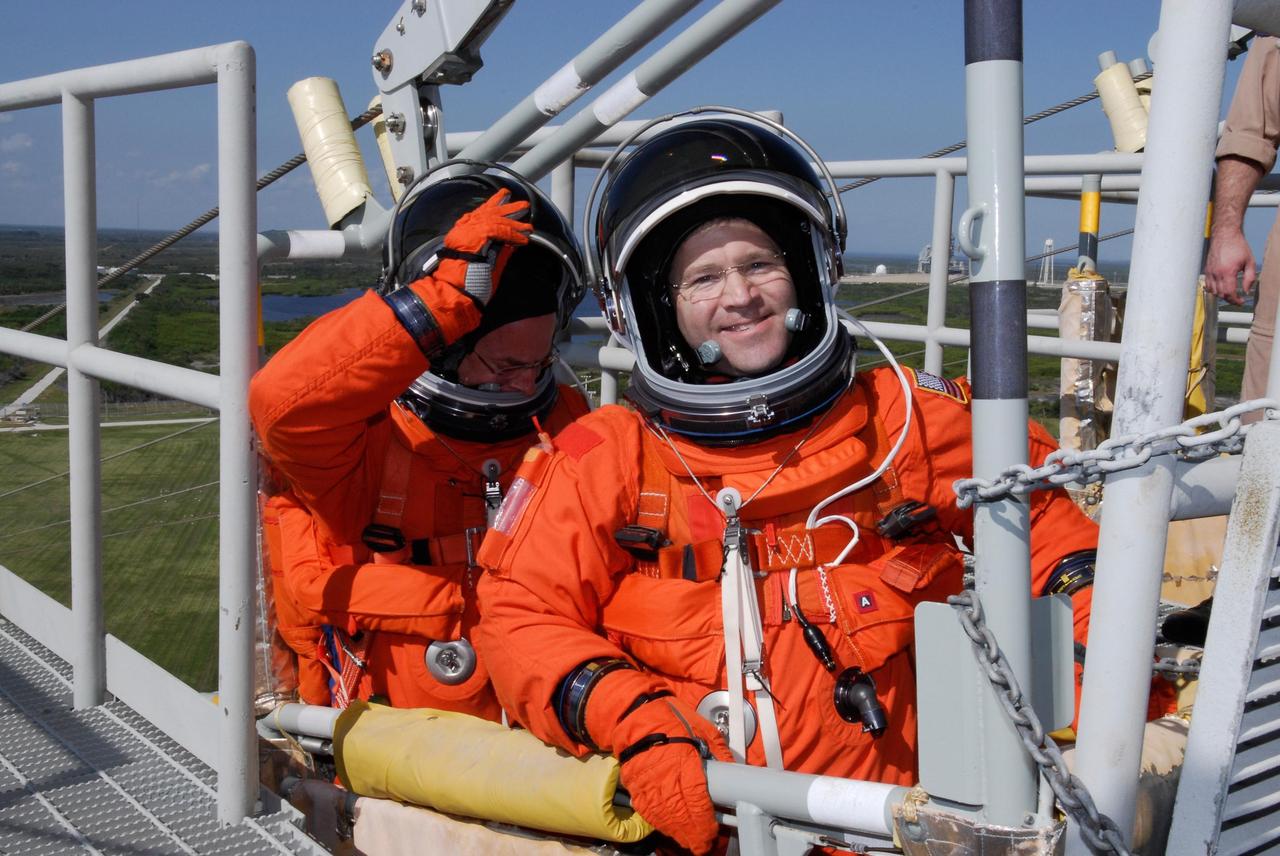
KENNEDY SPACE CENTER, FLA. -- Space shuttle Atlantis STS-122 Pilot Alan Poindexter, left, and Commander Steve Frick practice emergency exit procedures in a slidewire basket at Launch Pad 39A following a simulated launch countdown. The exercise is part of terminal countdown demonstration test, or TCDT, activities at NASA's Kennedy Space Center. The TCDT is a dress rehearsal for launch and also provides astronauts and ground crews with equipment familiarization and emergency egress training. On mission STS-122, Atlantis will deliver the Columbus module to the International Space Station. The European Space Agency's largest single contribution to the station, Columbus is a multifunctional, pressurized laboratory that will be permanently attached to U.S. Node 2, called Harmony. The laboratory will expand the research facilities aboard the station, providing crew members and scientists from around the world the ability to conduct a variety of experiments in the physical, materials and life sciences. Atlantis' launch is targeted for Dec. 6. Photo credit: NASA/Kim Shiflett

KENNEDY SPACE CENTER, FLA. -- At the slidewire basket landing on Launch Pad 39A, the space shuttle Atlantis STS-122 crew poses for a group photo following a press conference. From left are Commander Steve Frick; Pilot Alan Poindexter; and Mission Specialists Leland Melvin, Rex Walheim, Hans Schlegel, Stanley Love and Leopold Eyharts. Schlegel and Eyharts are with the European Space Agency. Eyharts will remain on the International Space Station as a flight engineer for Expedition 16 following the STS-122 mission. The STS-122 crew is at NASA's Kennedy Space Center to take part in terminal countdown demonstration test, or TCDT, activities, a standard part of launch preparations. The TCDT provides astronauts and ground crews with equipment familiarization, emergency egress training and a simulated launch countdown. On mission STS-122, Atlantis will deliver the European Space Agency's Columbus module to the International Space Station. Columbus is a multifunctional, pressurized laboratory that will be permanently attached to U.S. Node 2, called Harmony, and will expand the research facilities aboard the station. Launch is targeted for Dec. 6. Photo credit: NASA/Kim Shiflett
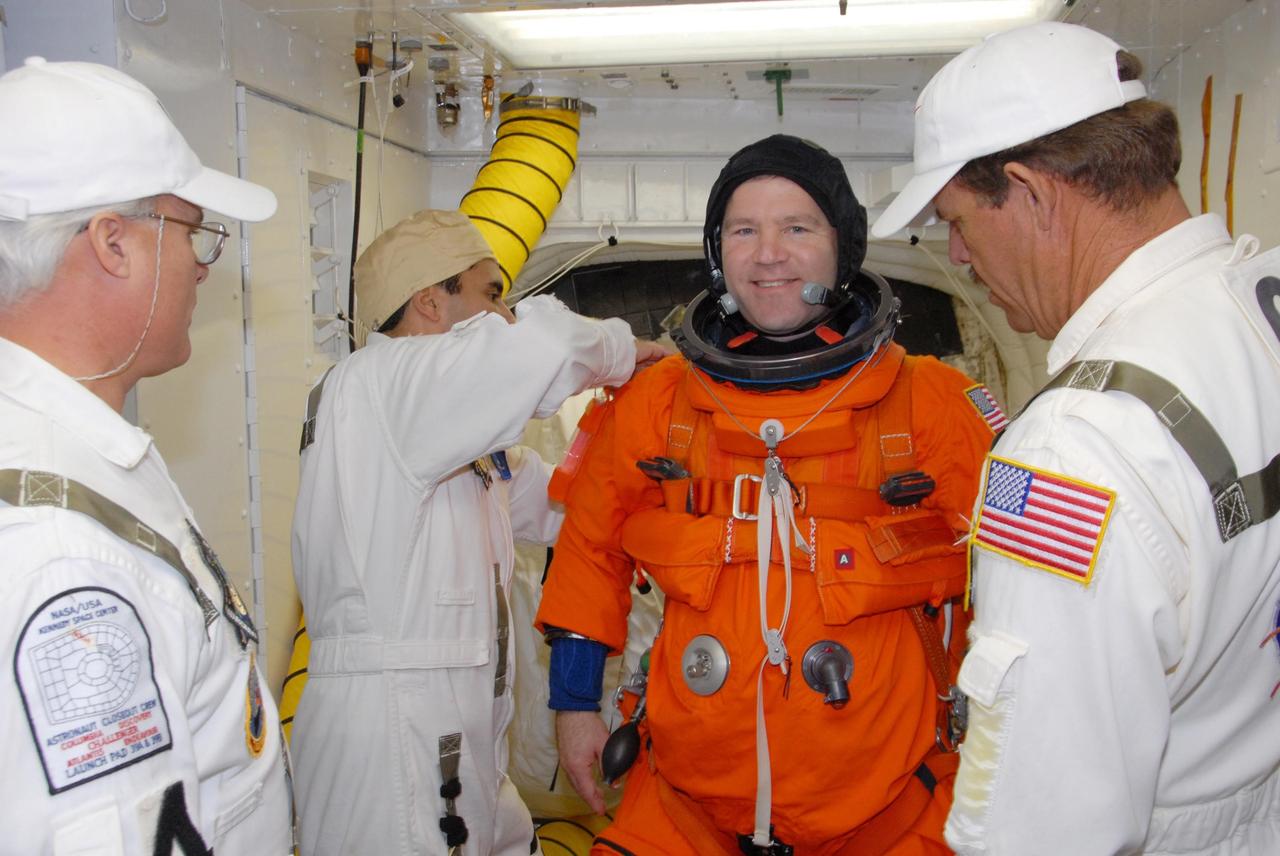
KENNEDY SPACE CENTER, FLA. -- In the White Room on Launch Pad 39A, suit technicians put the finishing touches on the flight and entry suit of space shuttle Atlantis STS-122 Commander Steve Frick for his entry into Atlantis' cockpit, through the hatch behind him. The exercise is part of terminal countdown demonstration test, or TCDT, activities at NASA's Kennedy Space Center. The TCDT is a dress rehearsal for launch and also provides astronauts and ground crews with equipment familiarization and emergency egress training. On mission STS-122, Atlantis will deliver the Columbus module to the International Space Station. The European Space Agency's largest single contribution to the station, Columbus is a multifunctional, pressurized laboratory that will be permanently attached to U.S. Node 2, called Harmony. The laboratory will expand the research facilities aboard the station, providing crew members and scientists from around the world the ability to conduct a variety of experiments in the physical, materials and life sciences. Atlantis' launch is targeted for Dec. 6. Photo credit: NASA/George Shelton
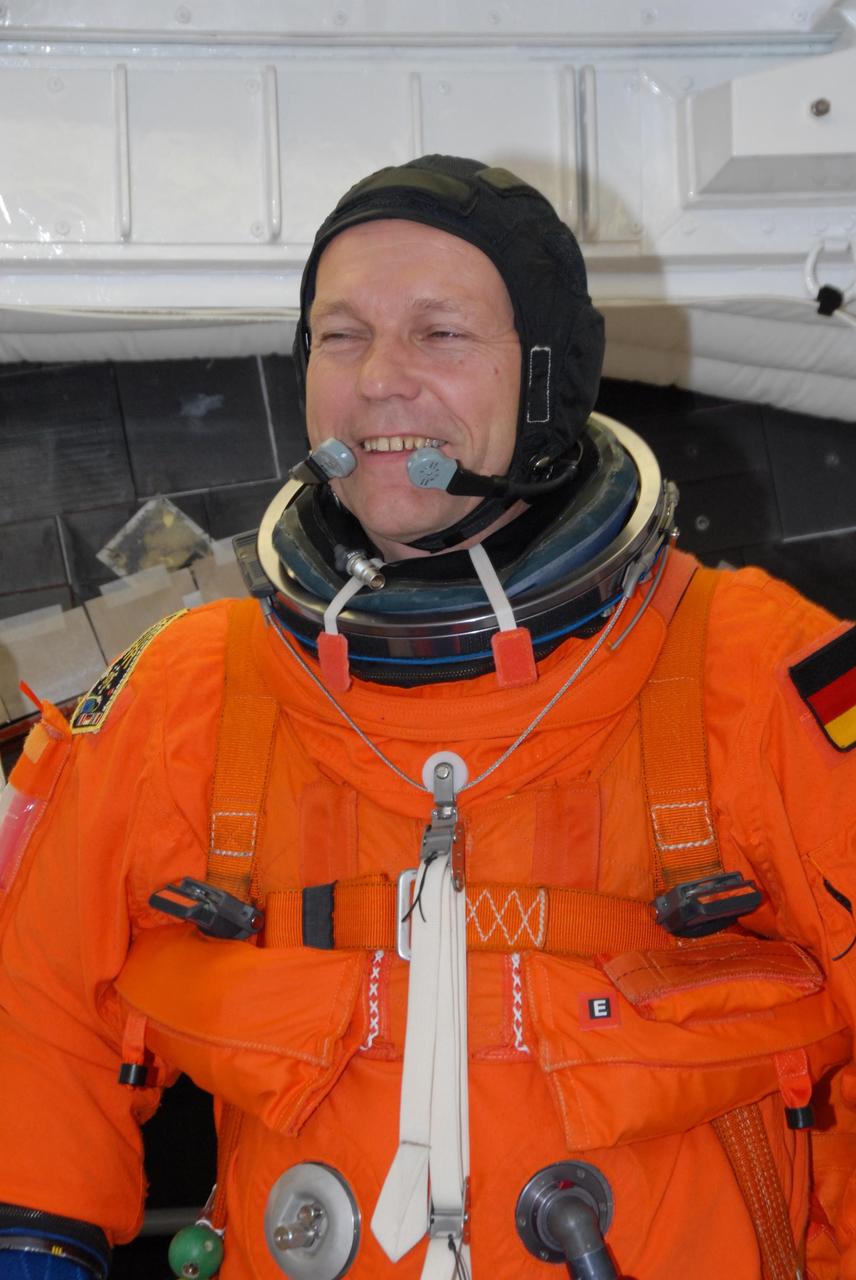
KENNEDY SPACE CENTER, FLA. -- In the White Room on Launch Pad 39A, space shuttle Atlantis STS-122 Mission Specialist Hans Schlegel prepares for his entry onto Atlantis' flight deck. Schlegel is with the European Space Agency. The exercise is part of terminal countdown demonstration test, or TCDT, activities at NASA's Kennedy Space Center. The TCDT is a dress rehearsal for launch and also provides astronauts and ground crews with equipment familiarization and emergency egress training. On mission STS-122, Atlantis will deliver the Columbus module to the International Space Station. The European Space Agency's largest single contribution to the station, Columbus is a multifunctional, pressurized laboratory that will be permanently attached to U.S. Node 2, called Harmony. The laboratory will expand the research facilities aboard the station, providing crew members and scientists from around the world the ability to conduct a variety of experiments in the physical, materials and life sciences. Atlantis' launch is targeted for Dec. 6. Photo credit: NASA/George Shelton
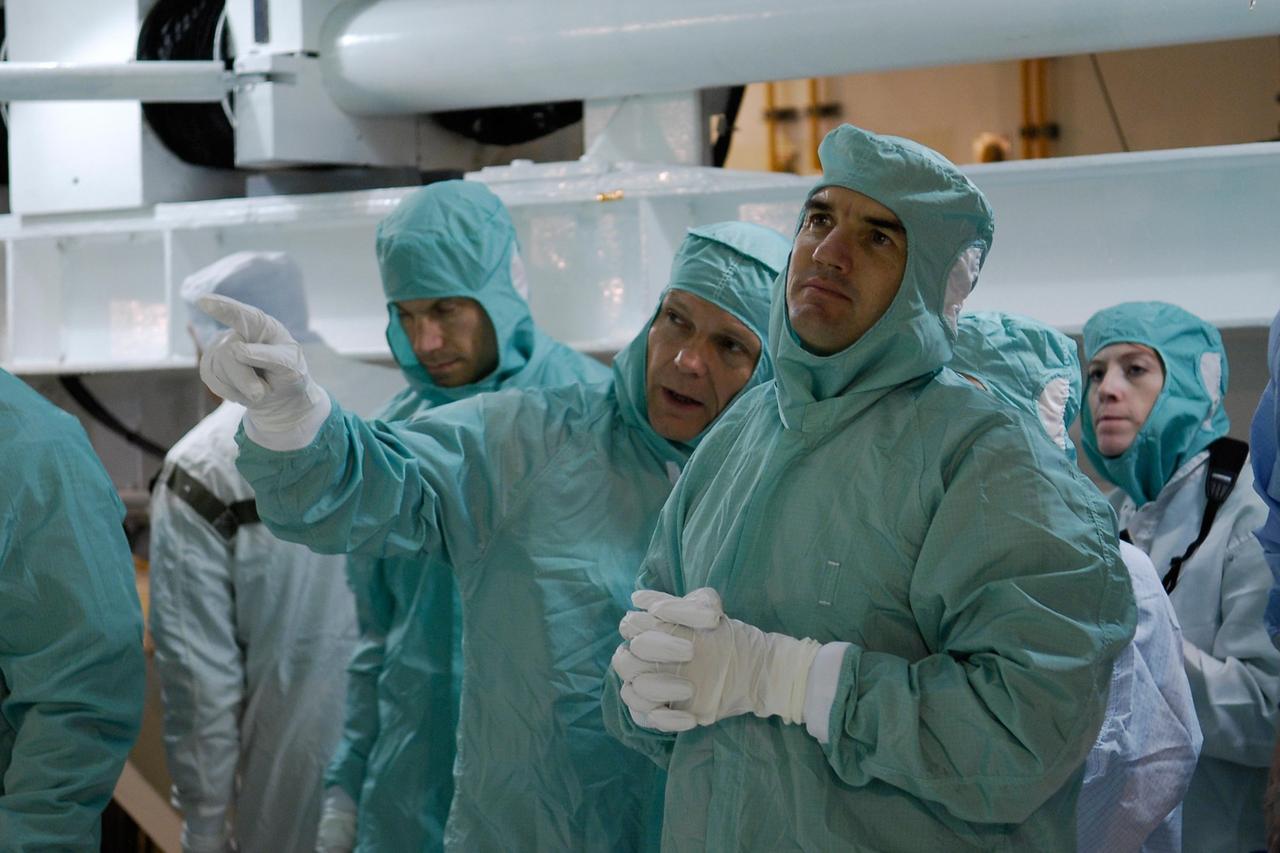
KENNEDY SPACE CENTER, FLA. -- At Launch Pad 39A, members of the space shuttle Atlantis STS-122 crew get a close look at the Columbus module during terminal countdown demonstration test, or TCDT, activities. Columbus was installed in the orbiter's payload bay on Nov. 11. From left, in clean room attire, are Mission Specialists Stanley Love, Hans Schlegel of the European Space Agency and Rex Walheim. The TCDT provides astronauts and ground crews with equipment familiarization, emergency egress training and a simulated launch countdown. On mission STS-122, Atlantis will deliver the Columbus module to the International Space Station. The European Space Agency's largest single contribution to the station, Columbus is a multifunctional, pressurized laboratory that will be permanently attached to U.S. Node 2, called Harmony. The module is approximately 23 feet long and 15 feet wide, allowing it to hold 10 large racks of experiments. The laboratory will expand the research facilities aboard the station, providing crew members and scientists from around the world the ability to conduct a variety of experiments in the physical, materials and life sciences. Launch is targeted for Dec. 6. Photo credit: NASA/Kim Shiflett
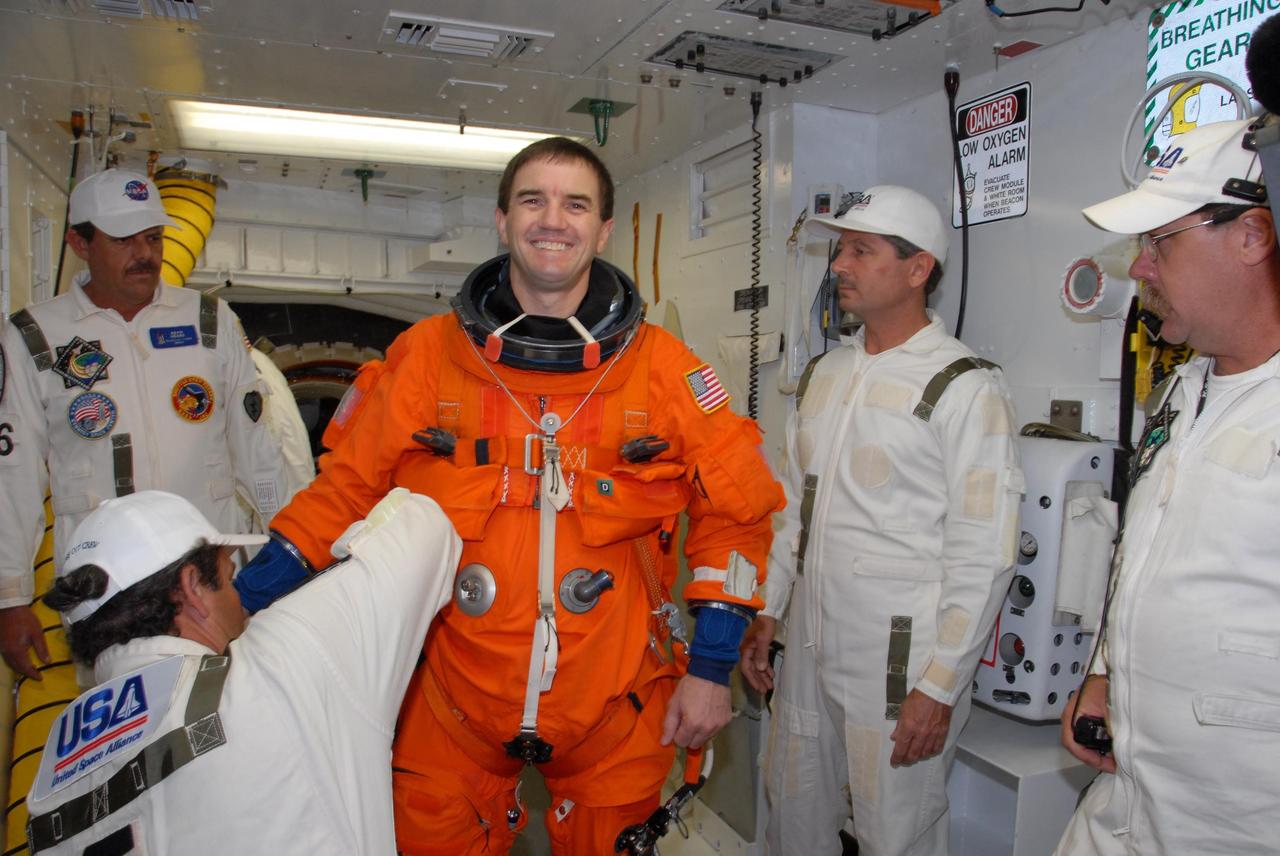
KENNEDY SPACE CENTER, FLA. -- In the White Room on Launch Pad 39A, suit technicians help space shuttle Atlantis STS-122 Mission Specialist Rex Walheim with his flight and entry suit before his entry onto Atlantis' flight deck, through the hatch behind him. The exercise is part of terminal countdown demonstration test, or TCDT, activities at NASA's Kennedy Space Center. The TCDT is a dress rehearsal for launch and also provides astronauts and ground crews with equipment familiarization and emergency egress training. On mission STS-122, Atlantis will deliver the Columbus module to the International Space Station. The European Space Agency's largest single contribution to the station, Columbus is a multifunctional, pressurized laboratory that will be permanently attached to U.S. Node 2, called Harmony. The laboratory will expand the research facilities aboard the station, providing crew members and scientists from around the world the ability to conduct a variety of experiments in the physical, materials and life sciences. Atlantis' launch is targeted for Dec. 6. Photo credit: NASA/George Shelton
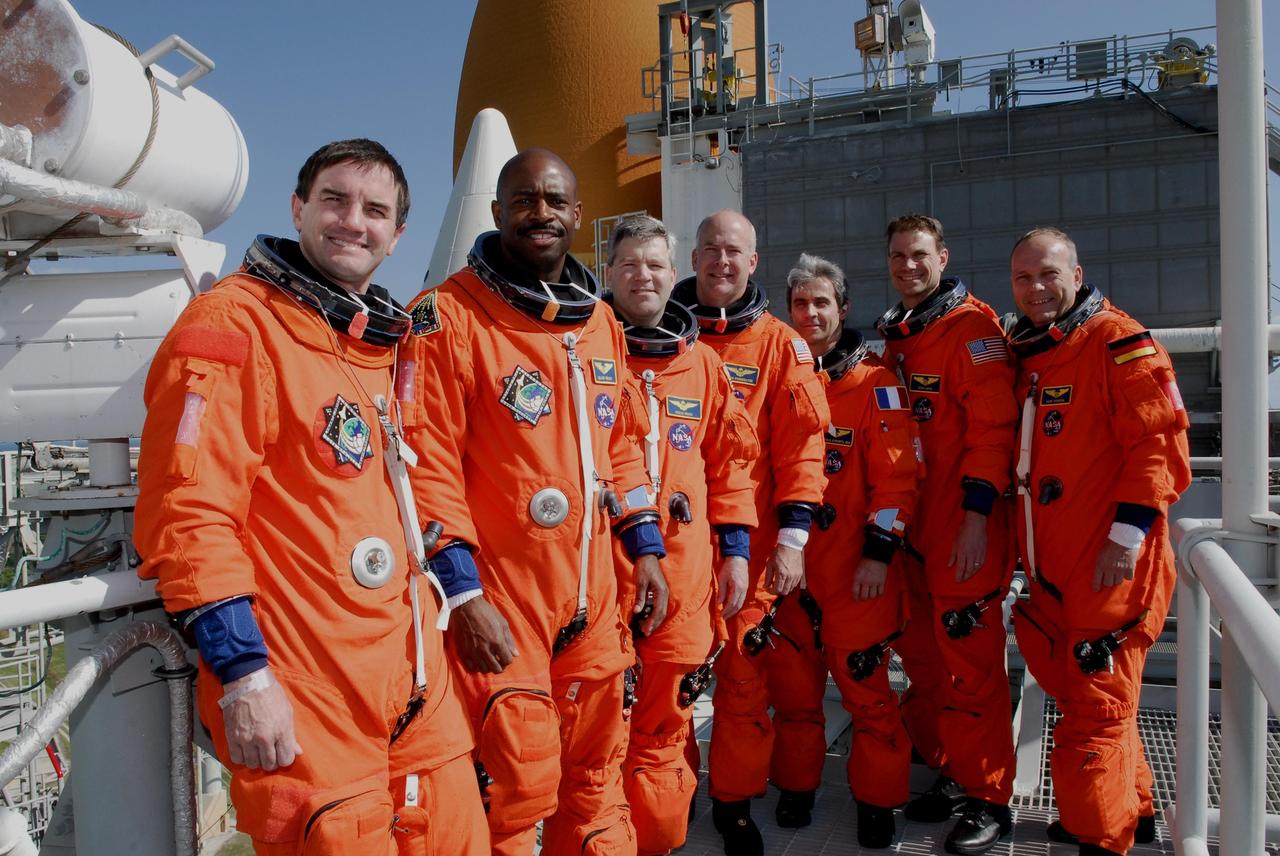
KENNEDY SPACE CENTER, FLA. -- Members of space shuttle Atlantis' STS-122 crew pose for a group portrait in front of Atlantis' external tank following a simulated launch countdown at Launch Pad 39A. From left are Mission Specialists Rex Walheim and Leland Melvin; Commander Steve Frick; Pilot Alan Poindexter; and Mission Specialists Leopold Eyharts, Stanley Love and Hans Schlegel. Schlegel and Eyharts are with the European Space Agency. Eyharts will remain on the International Space Station as a flight engineer for Expedition 16 following the STS-122 mission. The exercise is part of terminal countdown demonstration test, or TCDT, activities at NASA's Kennedy Space Center. The TCDT is a dress rehearsal for launch and also provides astronauts and ground crews with equipment familiarization and emergency egress training. On mission STS-122, Atlantis will deliver the Columbus module to the International Space Station. The European Space Agency's largest single contribution to the station, Columbus is a multifunctional, pressurized laboratory that will be permanently attached to U.S. Node 2, called Harmony. The laboratory will expand the research facilities aboard the station, providing crew members and scientists from around the world the ability to conduct a variety of experiments in the physical, materials and life sciences. Atlantis' launch is targeted for Dec. 6. Photo credit: NASA/Kim Shiflett
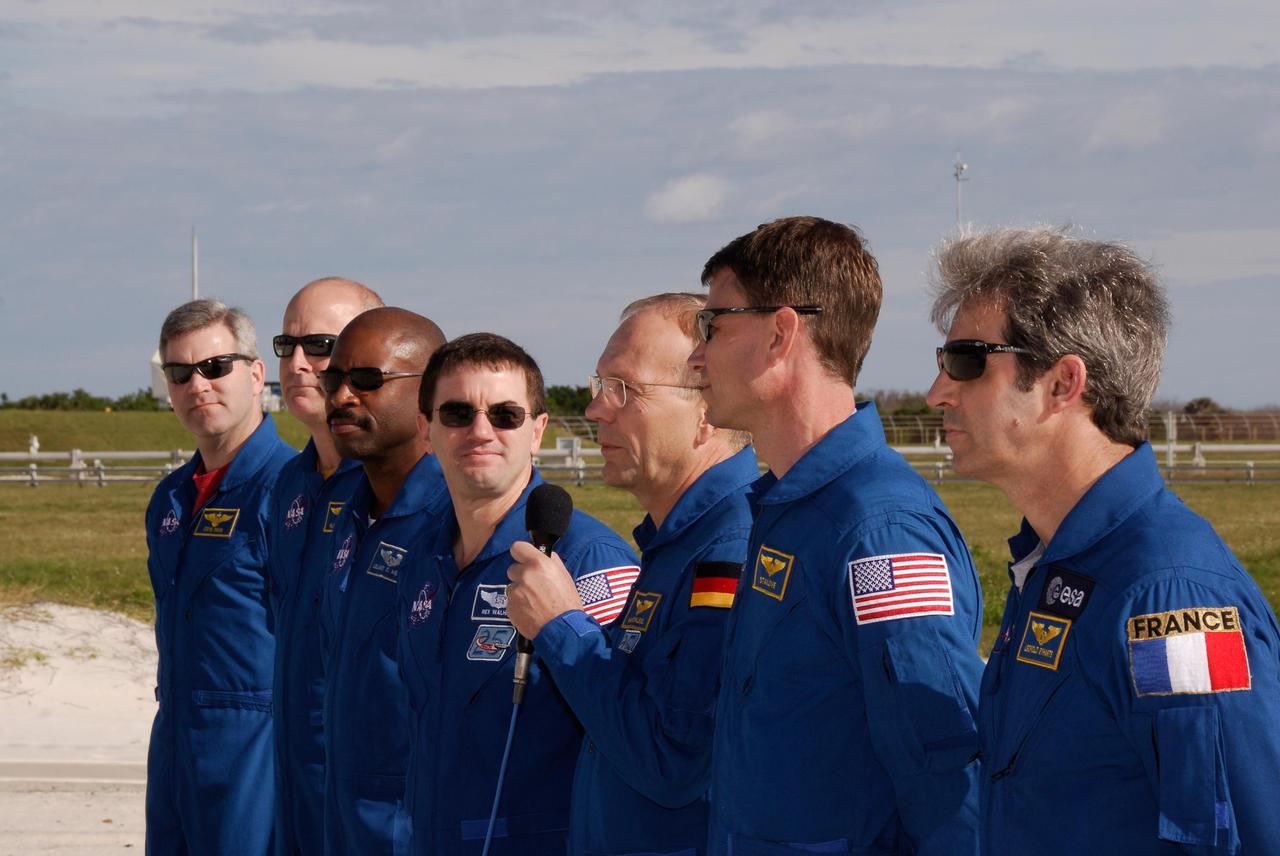
KENNEDY SPACE CENTER, FLA. -- At the slidewire basket landing on Launch Pad 39A, the space shuttle Atlantis STS-122 crew responds to questions from the media. From left are Commander Steve Frick; Pilot Alan Poindexter; and Mission Specialists Leland Melvin, Rex Walheim, Hans Schlegel (with the microphone), Stanley Love and Leopold Eyharts. Schlegel and Eyharts are with the European Space Agency. Eyharts will remain on the International Space Station as a flight engineer for Expedition 16 following the STS-122 mission. The STS-122 crew is at NASA's Kennedy Space Center to take part in terminal countdown demonstration test, or TCDT, activities, a standard part of launch preparations. The TCDT provides astronauts and ground crews with equipment familiarization, emergency egress training and a simulated launch countdown. On mission STS-122, Atlantis will deliver the European Space Agency's Columbus module to the International Space Station. Columbus is a multifunctional, pressurized laboratory that will be permanently attached to U.S. Node 2, called Harmony, and will expand the research facilities aboard the station. Launch is targeted for Dec. 6. Photo credit: NASA/Kim Shiflett
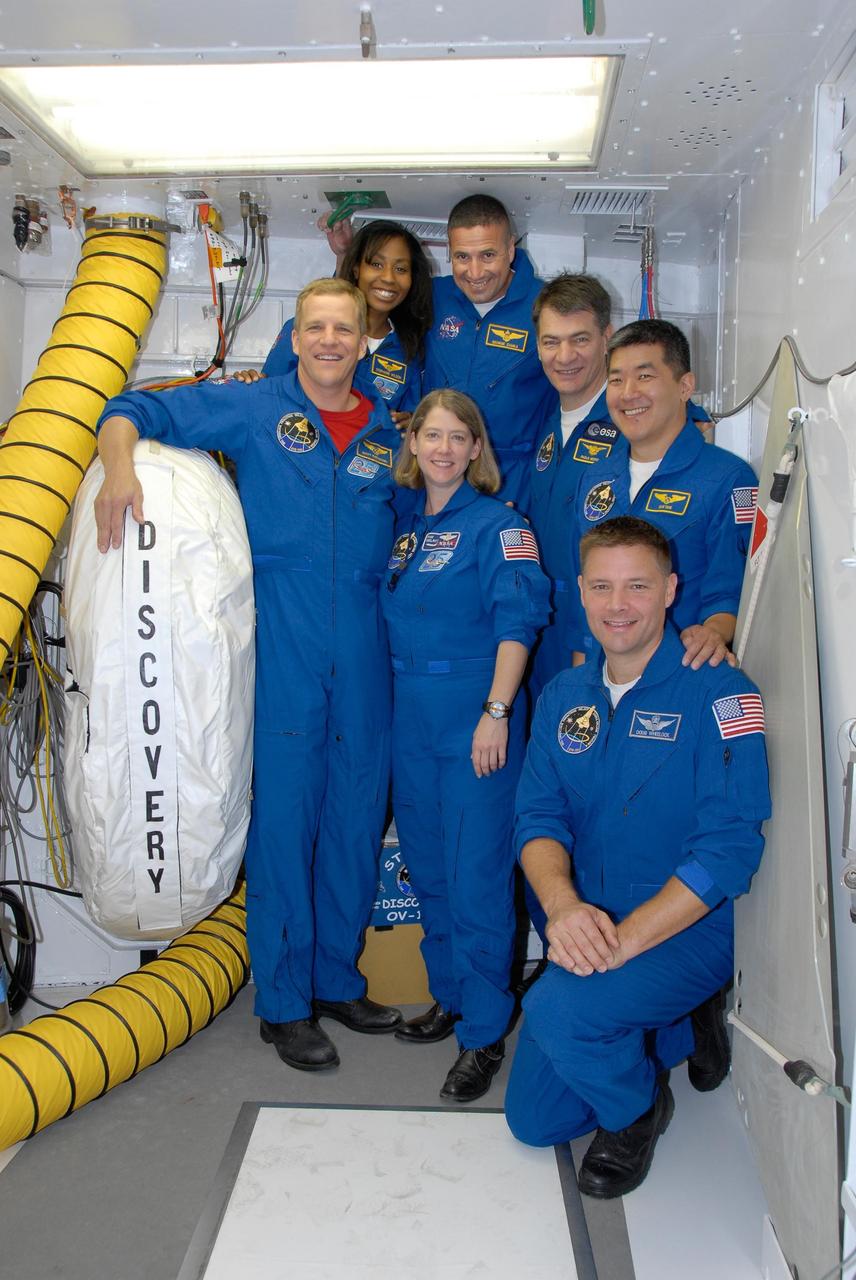
KENNEDY SPACE CENTER, FLA. -- Gathered in the white room on Launch Pad 39A, alongside space shuttle Discovery, the STS-120 crew pauses for a photo. Clockwise from the bottom are Commander Pamela Melroy, Mission Specialists Scott Parazynski and Stephanie Wilson, Pilot George Zamka, Mission Specialists Paolo Nespoli, Daniel Tani and Doug Wheelock (kneeling). Nespoli represents the European Space Agency. After the mission, Tani will remain aboard the International Space Station and return with the STS-122 crew, targeted to launch Dec. 6. The crew is at NASA's Kennedy Space Center for the pre-launch terminal countdown demonstration test, or TCDT. The TCDT provides astronauts and ground crews an opportunity to participate in various simulated countdown activities, including equipment familiarization and emergency training. The STS-120 mission will deliver the U.S. Node 2 module, named Harmony, aboard space shuttle Discovery to the International Space Station. Launch of Discovery on mission STS-120 is targeted for Oct. 23 at 11:38 a.m. EDT on a 14-day mission. Photo credit: NASA/Kim Shiflett
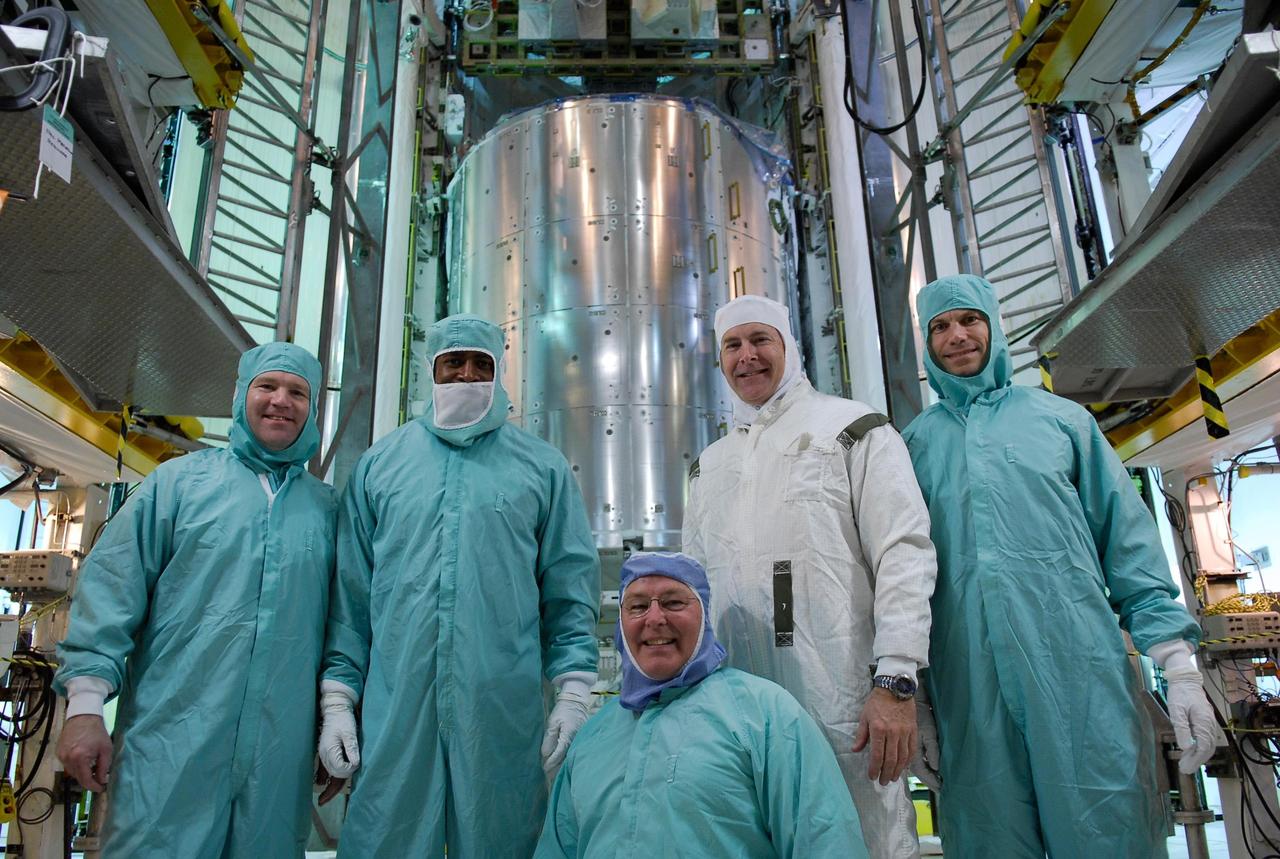
KENNEDY SPACE CENTER, FLA. -- At Launch Pad 39A, members of the space shuttle Atlantis STS-122 crew pose for a photo in front of the Columbus module during terminal countdown demonstration test, or TCDT, activities. Columbus was installed in the orbiter's payload bay on Nov. 11. From left, in clean room attire, are Commander Steve Frick; Mission Specialist Leland Melvin; former astronaut Jerry Ross, kneeling, chief of the Vehicle Integration Test Office at NASA Johnson Space Center; Pilot Alan Poindexter; and Mission Specialist Stanley Love. The TCDT provides astronauts and ground crews with equipment familiarization, emergency egress training and a simulated launch countdown. On mission STS-122, Atlantis will deliver the Columbus module to the International Space Station. The European Space Agency's largest single contribution to the station, Columbus is a multifunctional, pressurized laboratory that will be permanently attached to U.S. Node 2, called Harmony. The module is approximately 23 feet long and 15 feet wide, allowing it to hold 10 large racks of experiments. The laboratory will expand the research facilities aboard the station, providing crew members and scientists from around the world the ability to conduct a variety of experiments in the physical, materials and life sciences. Launch is targeted for Dec. 6. Photo credit: NASA/Kim Shiflett
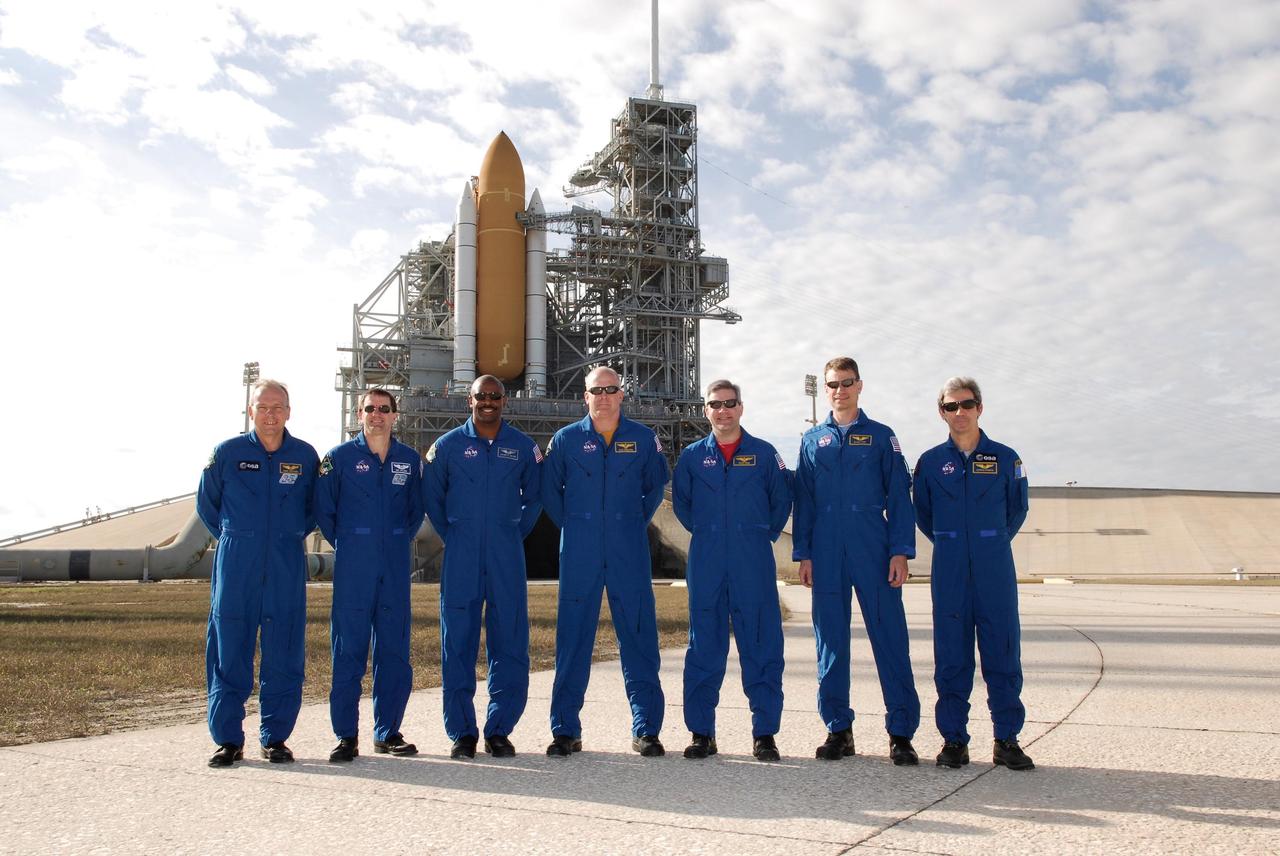
KENNEDY SPACE CENTER, FLA. -- The space shuttle Atlantis STS-122 crew poses for a group portrait at Launch Pad 39A as Atlantis undergoes final preparations for launch behind them. From left are Mission Specialists Hans Schlegel, Rex Walheim and Leland Melvin; Pilot Alan Poindexter; Commander Steve Frick; and Mission Specialists Stanley Love and Leopold Eyharts. Schlegel and Eyharts are with the European Space Agency. Eyharts will remain on the International Space Station as a flight engineer for Expedition 16 following the STS-122 mission. The STS-122 crew is at NASA's Kennedy Space Center to take part in terminal countdown demonstration test, or TCDT, activities, a standard part of launch preparations. The TCDT provides astronauts and ground crews with equipment familiarization, emergency egress training and a simulated launch countdown. On mission STS-122, Atlantis will deliver the European Space Agency's Columbus module to the International Space Station. Columbus is a multifunctional, pressurized laboratory that will be permanently attached to U.S. Node 2, called Harmony, and will expand the research facilities aboard the station. Launch is targeted for Dec. 6. Photo credit: NASA/Kim Shiflett
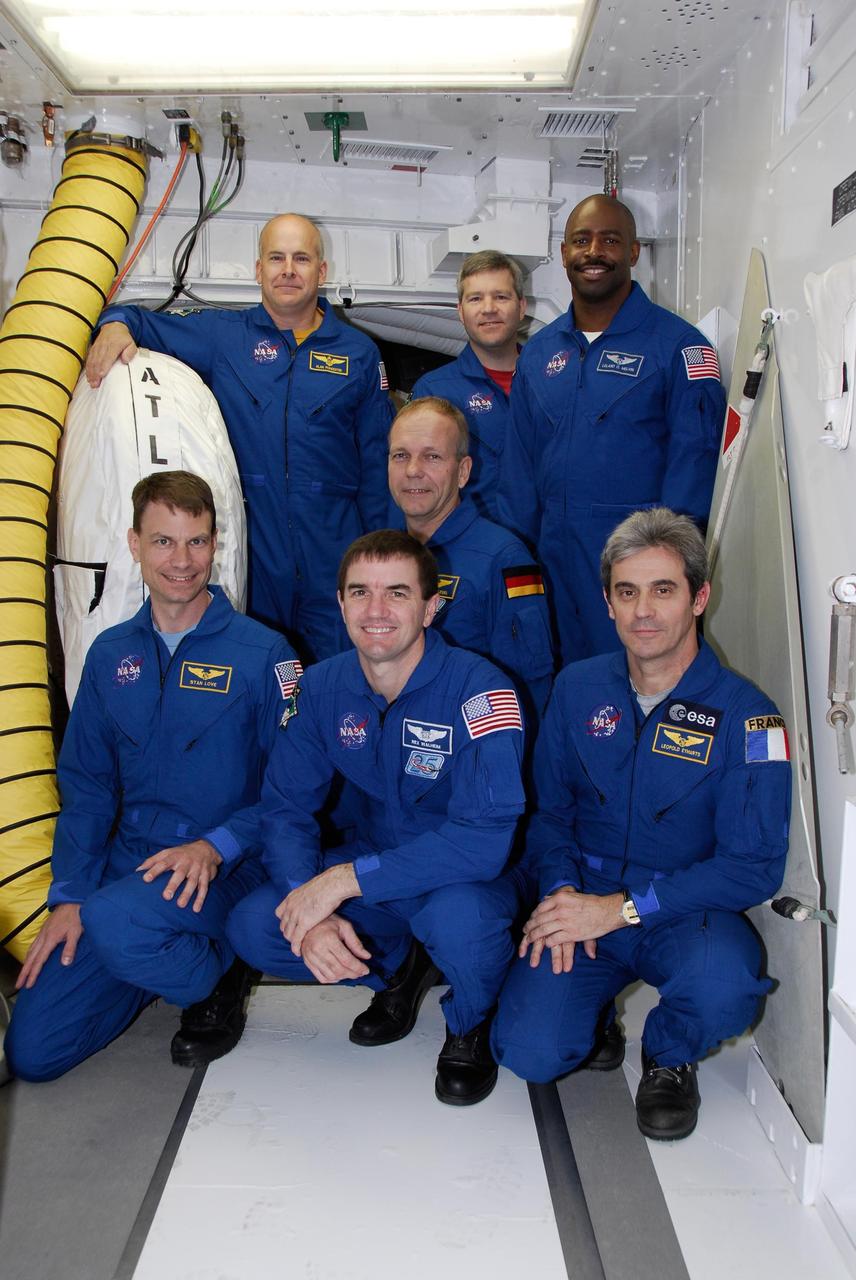
KENNEDY SPACE CENTER, FLA. -- Gathered in the white room on Launch Pad 39A, the space shuttle Atlantis STS-122 crew pauses for a photo. Standing, from left, are Pilot Alan Poindexter, Commander Steve Frick and Mission Specialist Leland Melvin. Kneeling, center, is Mission Specialist Hans Schlegel. In the bottom row, from left, are Stanley Love, Rex Walheim and Leopold Eyharts. Schlegel and Eyharts are with the European Space Agency. Eyharts will remain on the International Space Station as a flight engineer for Expedition 16 following the STS-122 mission. The STS-122 crew is at NASA's Kennedy Space Center to take part in terminal countdown demonstration test, or TCDT, activities, a standard part of launch preparations. The TCDT provides astronauts and ground crews with equipment familiarization and a simulated launch countdown before launch. On mission STS-122, Atlantis will deliver the European Space Agency's Columbus module to the International Space Station. Columbus is a multifunctional, pressurized laboratory that will be permanently attached to U.S. Node 2, called Harmony, and will expand the research facilities aboard the station. Launch is targeted for Dec. 6. Photo credit: NASA/Kim Shiflett
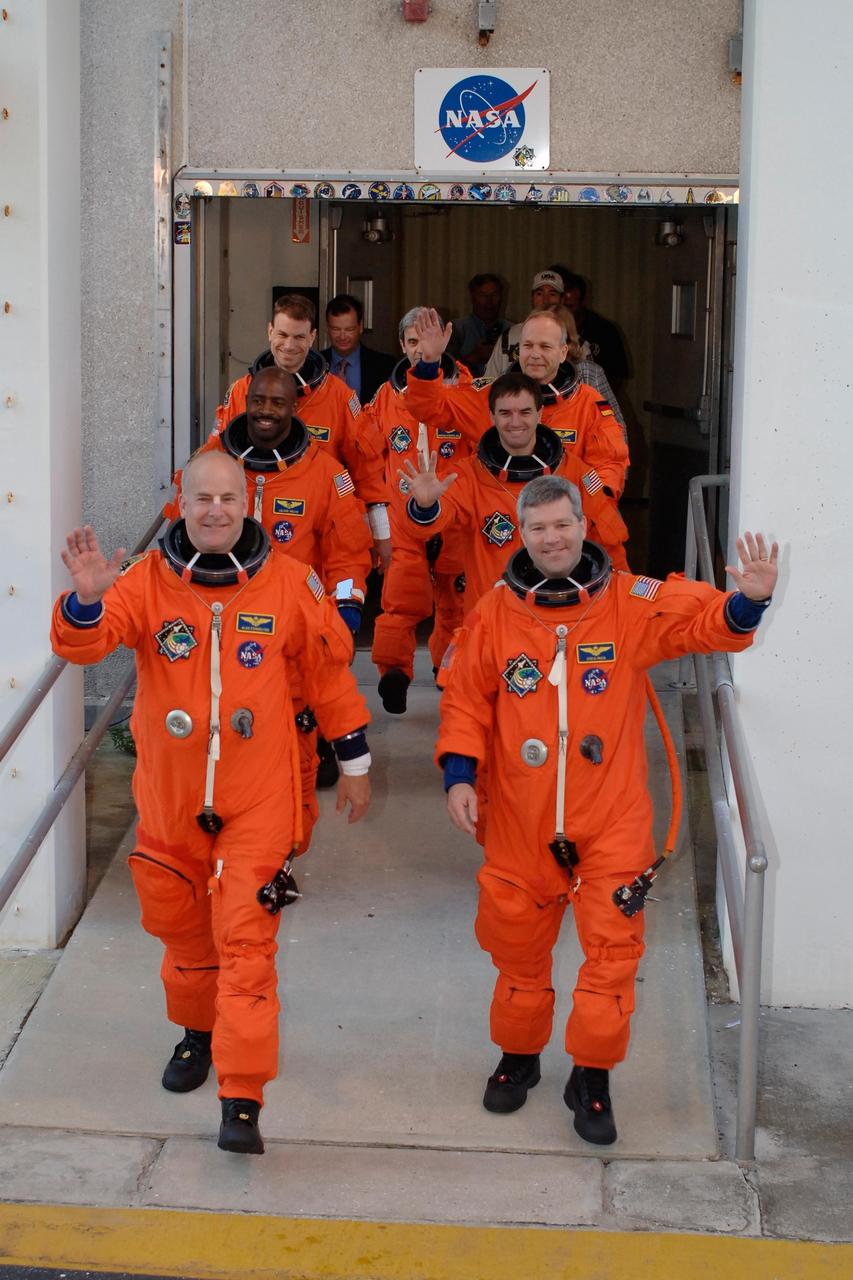
KENNEDY SPACE CENTER, FLA. -- Dressed in their launch and entry suits, the space shuttle Atlantis STS-122 crew greet the media and employees on hand to cheer them on as the leave the Operations and Checkout Building for Launch Pad 39A. Clockwise, from left front, are Pilot Alan Poindexter; Mission Specialists Leland Melvin, Stanley Love, Leopold Eyharts, Hans Schlegel, and Rex Walheim; and Commander Steve Frick. Eyharts and Schlegel are with the European Space Agency. Eyharts will remain on the International Space Station as a flight engineer for Expedition 16 following the STS-122 mission. The STS-122 crew is preparing for a simulated launch countdown aboard Atlantis, part of terminal countdown demonstration test, or TCDT, activities at NASA's Kennedy Space Center. The TCDT is a dress rehearsal for launch and also provides astronauts and ground crews with equipment familiarization and emergency egress training. On mission STS-122, Atlantis will deliver the Columbus module to the International Space Station. The European Space Agency's largest single contribution to the station, Columbus is a multifunctional, pressurized laboratory that will be permanently attached to U.S. Node 2, called Harmony. The laboratory will expand the research facilities aboard the station, providing crew members and scientists from around the world the ability to conduct a variety of experiments in the physical, materials and life sciences. Launch is targeted for Dec. 6. Photo credit: NASA/Kim Shiflett
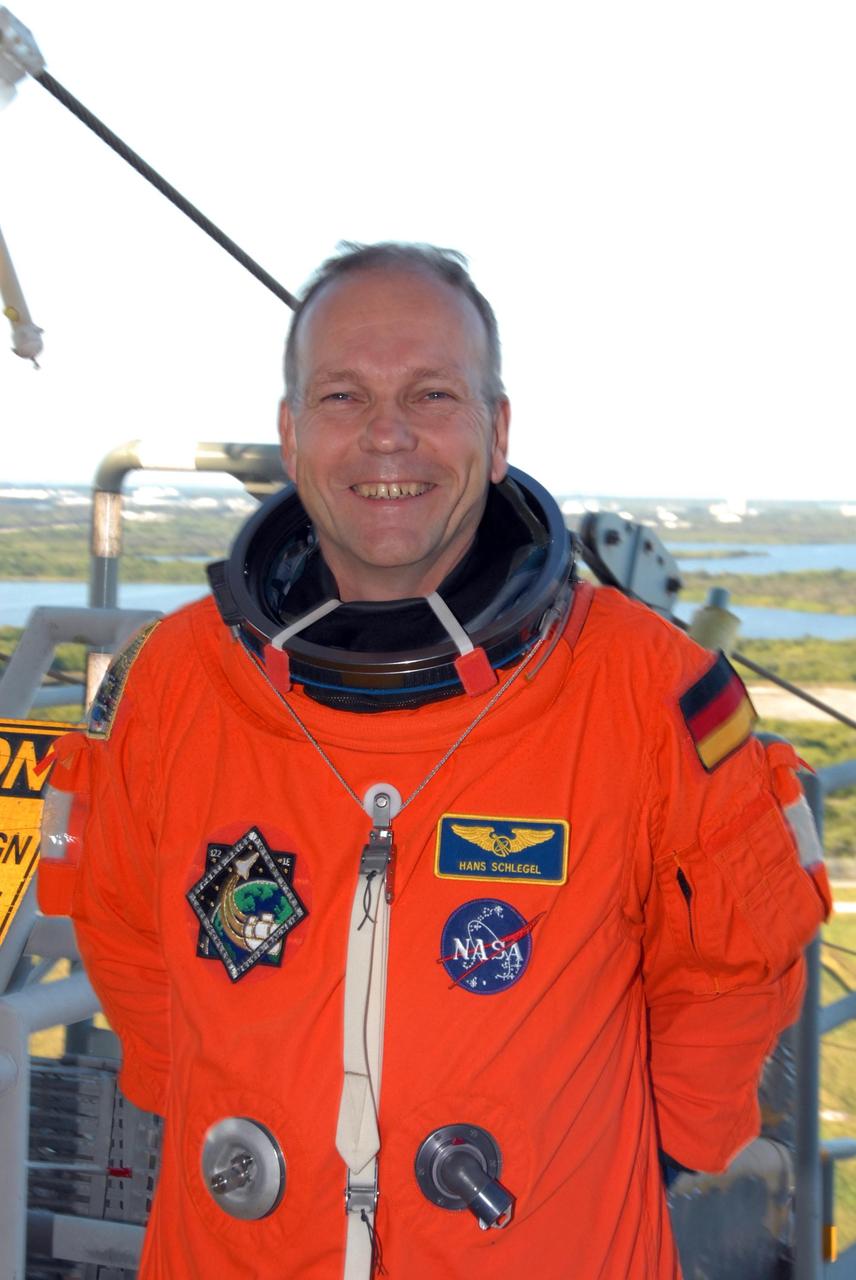
KENNEDY SPACE CENTER, FLA. -- Space shuttle Atlantis STS-122 Mission Specialist Hans Schlegel arrives at Launch Pad 39A, dressed in his launch and entry suit, to participate in a simulated launch countdown aboard Atlantis. Schlegel is with the European Space Agency. The exercise is part of terminal countdown demonstration test, or TCDT, activities at NASA's Kennedy Space Center. The TCDT is a dress rehearsal for launch and also provides astronauts and ground crews with equipment familiarization and emergency egress training. On mission STS-122, Atlantis will deliver the Columbus module to the International Space Station. The European Space Agency's largest single contribution to the station, Columbus is a multifunctional, pressurized laboratory that will be permanently attached to U.S. Node 2, called Harmony. The laboratory will expand the research facilities aboard the station, providing crew members and scientists from around the world the ability to conduct a variety of experiments in the physical, materials and life sciences. Atlantis' launch is targeted for Dec. 6. Photo credit: NASA/George Shelton
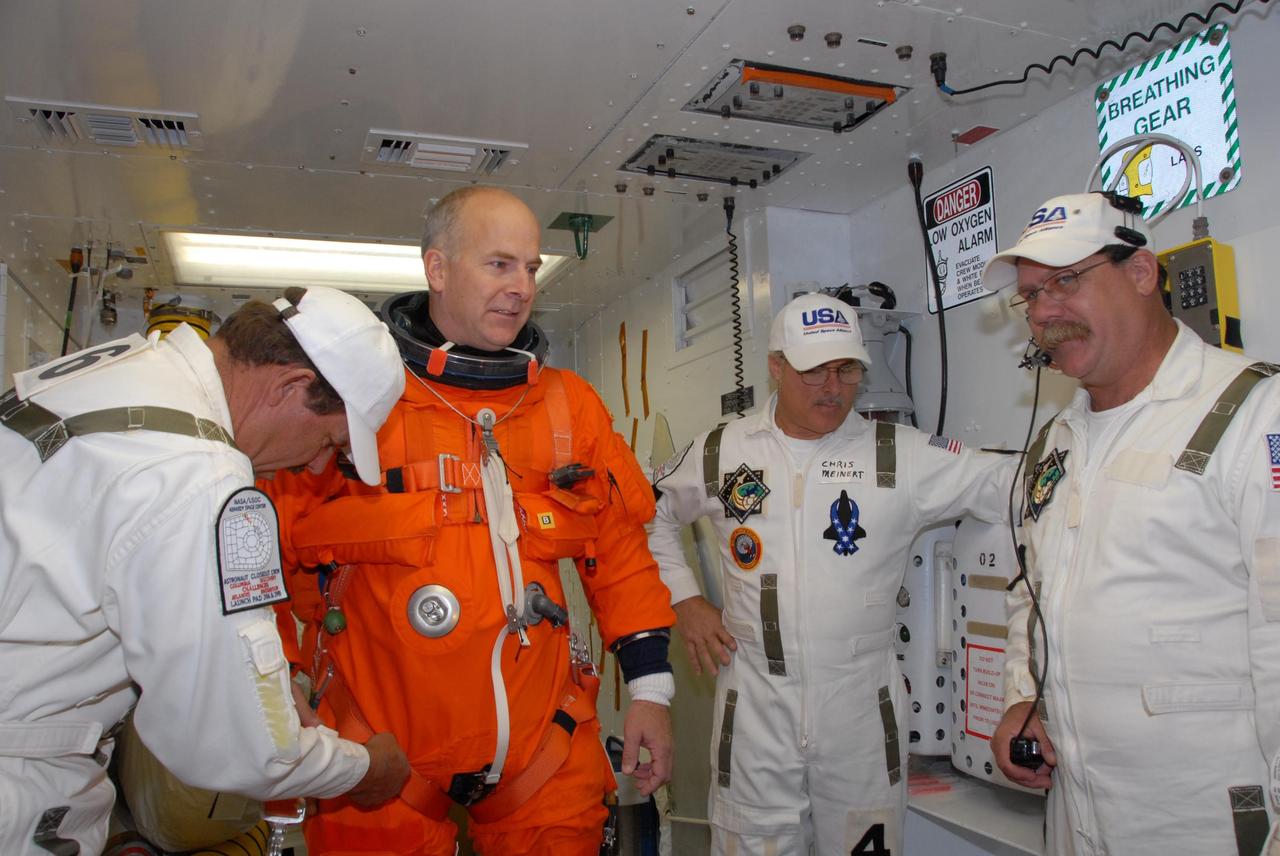
KENNEDY SPACE CENTER, FLA. -- In the White Room on Launch Pad 39A, suit technicians put the finishing touches on the flight and entry suit of space shuttle Atlantis STS-122 Pilot Alan Poindexter for his entry into Atlantis' cockpit. The exercise is part of terminal countdown demonstration test, or TCDT, activities at NASA's Kennedy Space Center. The TCDT is a dress rehearsal for launch and also provides astronauts and ground crews with equipment familiarization and emergency egress training. On mission STS-122, Atlantis will deliver the Columbus module to the International Space Station. The European Space Agency's largest single contribution to the station, Columbus is a multifunctional, pressurized laboratory that will be permanently attached to U.S. Node 2, called Harmony. The laboratory will expand the research facilities aboard the station, providing crew members and scientists from around the world the ability to conduct a variety of experiments in the physical, materials and life sciences. Atlantis' launch is targeted for Dec. 6. Photo credit: NASA/George Shelton
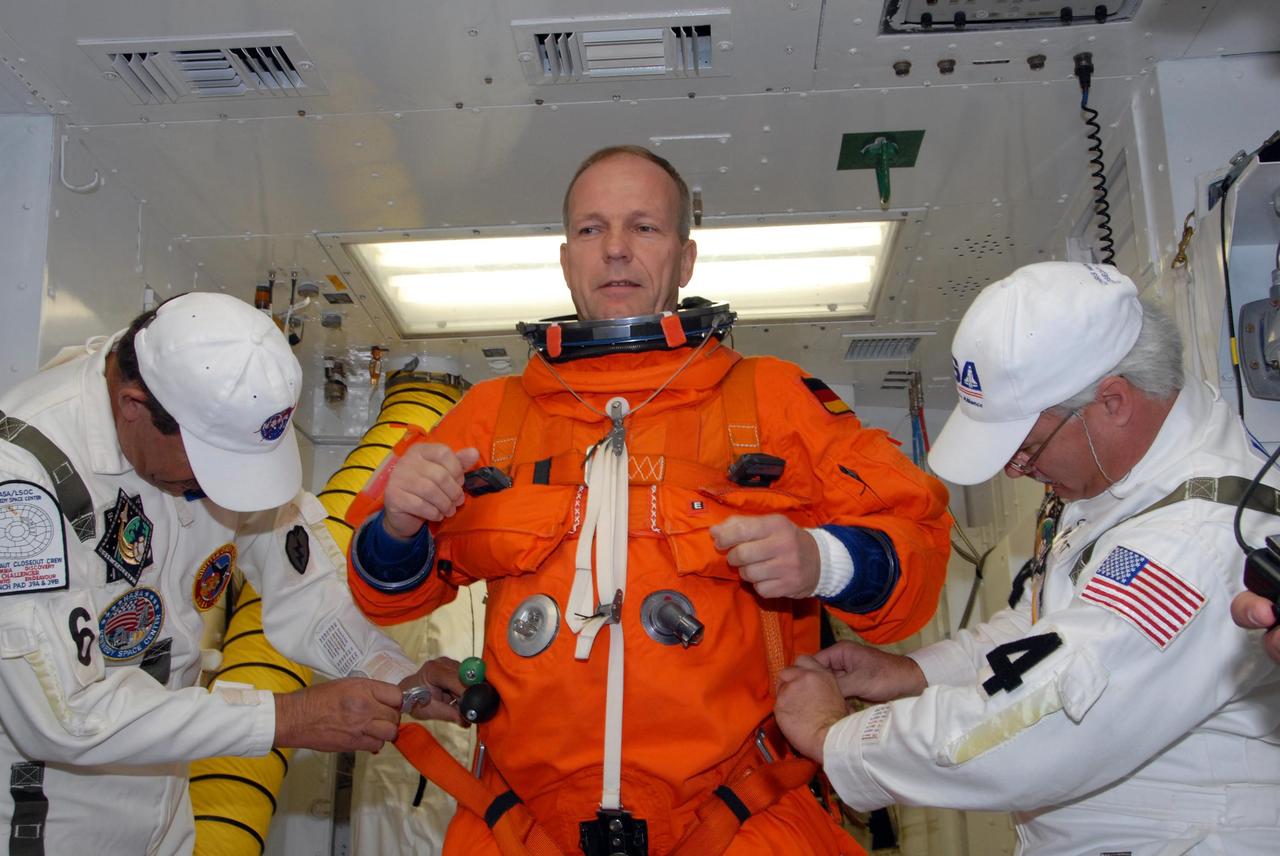
KENNEDY SPACE CENTER, FLA. -- In the White Room on Launch Pad 39A, suit technicians help space shuttle Atlantis STS-122 Mission Specialist Hans Schlegel with his flight and entry suit before his entry onto Atlantis' flight deck. Schlegel is with the European Space Agency. The exercise is part of terminal countdown demonstration test, or TCDT, activities at NASA's Kennedy Space Center. The TCDT is a dress rehearsal for launch and also provides astronauts and ground crews with equipment familiarization and emergency egress training. On mission STS-122, Atlantis will deliver the Columbus module to the International Space Station. The European Space Agency's largest single contribution to the station, Columbus is a multifunctional, pressurized laboratory that will be permanently attached to U.S. Node 2, called Harmony. The laboratory will expand the research facilities aboard the station, providing crew members and scientists from around the world the ability to conduct a variety of experiments in the physical, materials and life sciences. Atlantis' launch is targeted for Dec. 6. Photo credit: NASA/George Shelton
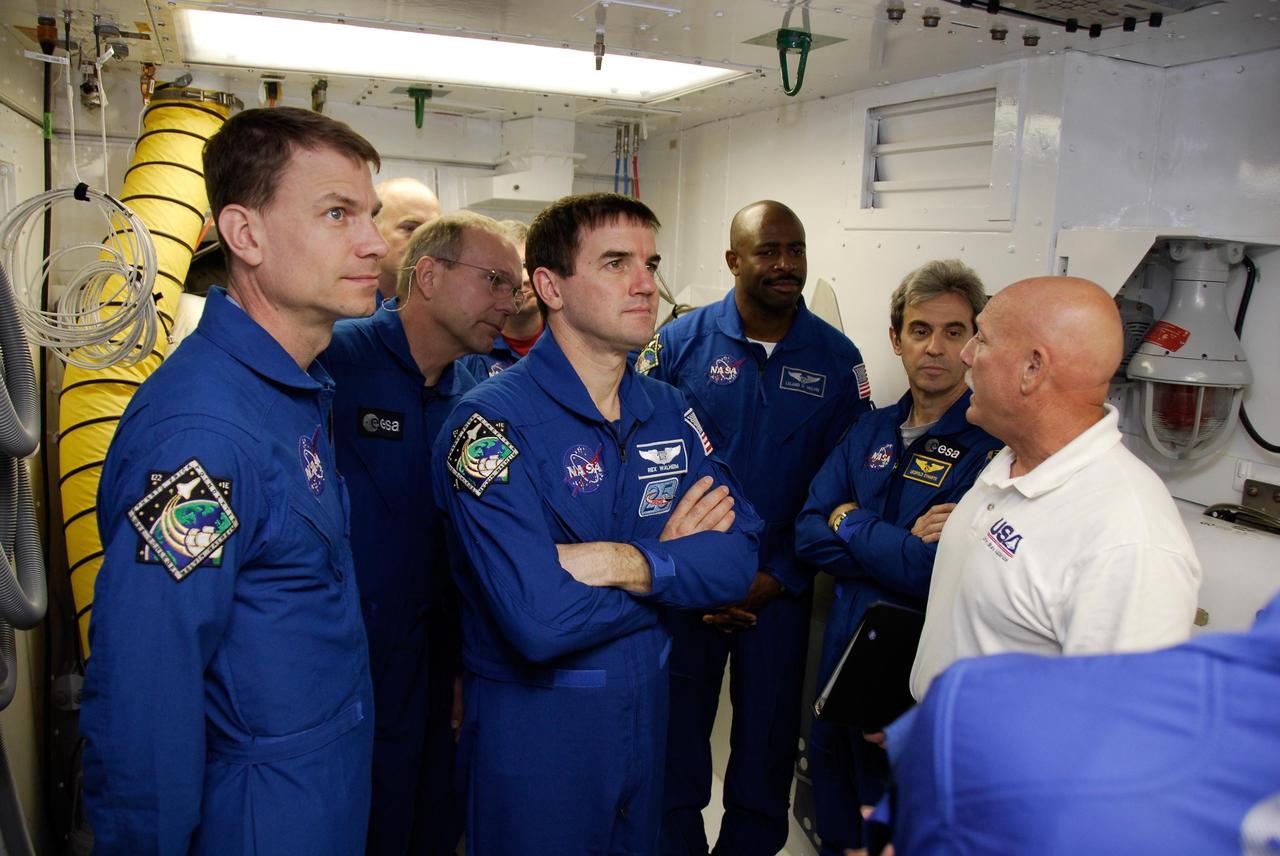
KENNEDY SPACE CENTER, FLA. -- Gathered in the white room on Launch Pad 39A, the space shuttle Atlantis STS-122 crew members listen to an instructor explain space shuttle emergency exit procedures. From left are Mission Specialists Stanley Love, Hans Schlegel, Rex Walheim, Leland Melvin and Leopold Eyharts. Pilot Alan Poindexter and Commander Steve Frick are standing behind them. The STS-122 crew is at NASA's Kennedy Space Center to take part in terminal countdown demonstration test, or TCDT, activities, a standard part of launch preparations. The TCDT provides astronauts and ground crews with equipment familiarization and a simulated launch countdown before launch. On mission STS-122, Atlantis will deliver the European Space Agency's Columbus module to the International Space Station. Columbus is a multifunctional, pressurized laboratory that will be permanently attached to U.S. Node 2, called Harmony, and will expand the research facilities aboard the station. Launch is targeted for Dec. 6. Photo credit: NASA/Kim Shiflett

KENNEDY SPACE CENTER, FLA. -- Dressed in their launch and entry suits, the space shuttle Atlantis STS-122 crew exits the Operations and Checkout Building for their ride to Launch Pad 39A. Clockwise, from left front, are Pilot Alan Poindexter; Mission Specialists Leland Melvin, Stanley Love, Leopold Eyharts, Hans Schlegel, and Rex Walheim; and Commander Steve Frick. Eyharts and Schlegel are with the European Space Agency. Eyharts will remain on the International Space Station as a flight engineer for Expedition 16 following the STS-122 mission. The STS-122 crew is preparing for a simulated launch countdown aboard Atlantis, part of terminal countdown demonstration test, or TCDT, activities at NASA's Kennedy Space Center. The TCDT is a dress rehearsal for launch and also provides astronauts and ground crews with equipment familiarization and emergency egress training. On mission STS-122, Atlantis will deliver the Columbus module to the International Space Station. The European Space Agency's largest single contribution to the station, Columbus is a multifunctional, pressurized laboratory that will be permanently attached to U.S. Node 2, called Harmony. The laboratory will expand the research facilities aboard the station, providing crew members and scientists from around the world the ability to conduct a variety of experiments in the physical, materials and life sciences. Launch is targeted for Dec. 6. Photo credit: NASA/Kim Shiflett
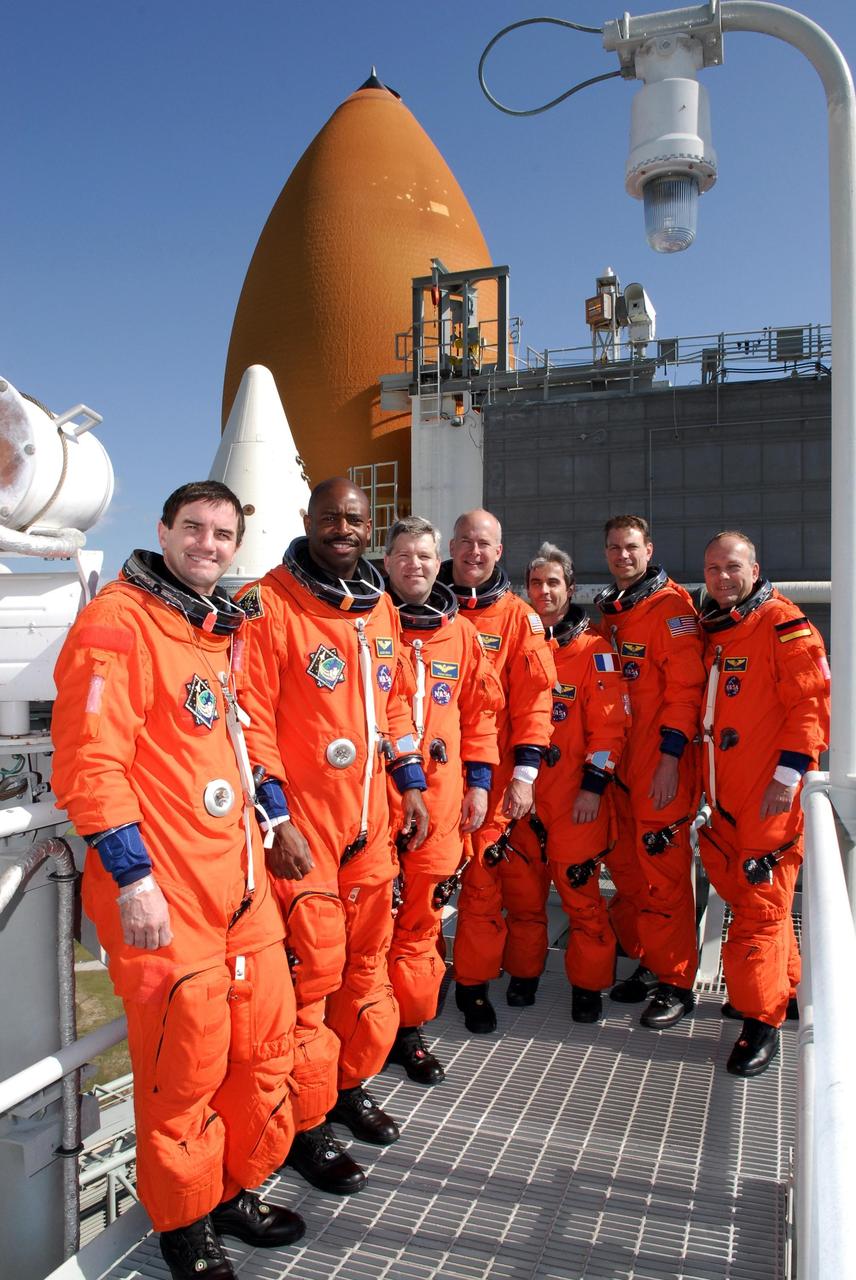
KENNEDY SPACE CENTER, FLA. -- Members of space shuttle Atlantis' STS-122 crew pose for a group portrait with the tip of Atlantis' external tank in the background following a simulated launch countdown at Launch Pad 39A. From left are Mission Specialists Rex Walheim and Leland Melvin; Commander Steve Frick; Pilot Alan Poindexter; and Mission Specialists Leopold Eyharts, Stanley Love and Hans Schlegel. Schlegel and Eyharts are with the European Space Agency. Eyharts will remain on the International Space Station as a flight engineer for Expedition 16 following the STS-122 mission. The exercise is part of terminal countdown demonstration test, or TCDT, activities at NASA's Kennedy Space Center. The TCDT is a dress rehearsal for launch and also provides astronauts and ground crews with equipment familiarization and emergency egress training. On mission STS-122, Atlantis will deliver the Columbus module to the International Space Station. The European Space Agency's largest single contribution to the station, Columbus is a multifunctional, pressurized laboratory that will be permanently attached to U.S. Node 2, called Harmony. The laboratory will expand the research facilities aboard the station, providing crew members and scientists from around the world the ability to conduct a variety of experiments in the physical, materials and life sciences. Atlantis' launch is targeted for Dec. 6. Photo credit: NASA/Kim Shiflett
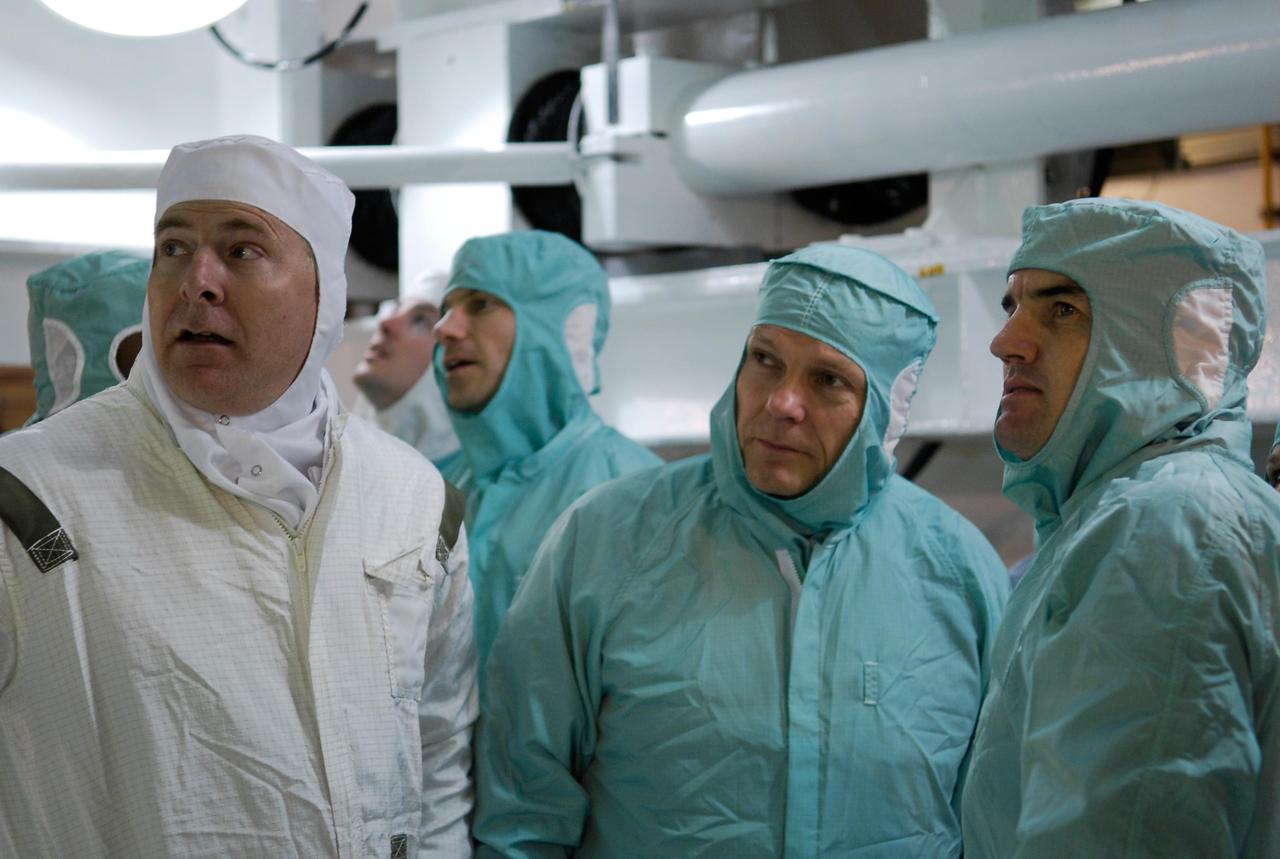
KENNEDY SPACE CENTER, FLA. -- At Launch Pad 39A, members of the space shuttle Atlantis STS-122 crew view the Columbus module during terminal countdown demonstration test, or TCDT, activities. Columbus was installed in the orbiter's payload bay on Nov. 11. From left, in clean room attire, are Pilot Alan Poindexter and Mission Specialists Stanley Love, Hans Schlegel of the European Space Agency and Rex Walheim. The TCDT provides astronauts and ground crews with equipment familiarization, emergency egress training and a simulated launch countdown. On mission STS-122, Atlantis will deliver the Columbus module to the International Space Station. The European Space Agency's largest single contribution to the station, Columbus is a multifunctional, pressurized laboratory that will be permanently attached to U.S. Node 2, called Harmony. The module is approximately 23 feet long and 15 feet wide, allowing it to hold 10 large racks of experiments. The laboratory will expand the research facilities aboard the station, providing crew members and scientists from around the world the ability to conduct a variety of experiments in the physical, materials and life sciences. Launch is targeted for Dec. 6. Photo credit: NASA/Kim Shiflett

KENNEDY SPACE CENTER, FLA. -- In the White Room on Launch Pad 39A, suit technicians help space shuttle Atlantis STS-122 Mission Specialist Leopold Eyharts with his flight and entry suit before his entry onto Atlantis' flight deck, through the hatch behind him. Eyharts is with the European Space Agency and will remain on the International Space Station as a flight engineer for Expedition 16 following the STS-122 mission. The exercise is part of terminal countdown demonstration test, or TCDT, activities at NASA's Kennedy Space Center. The TCDT is a dress rehearsal for launch and also provides astronauts and ground crews with equipment familiarization and emergency egress training. On mission STS-122, Atlantis will deliver the Columbus module to the International Space Station. The European Space Agency's largest single contribution to the station, Columbus is a multifunctional, pressurized laboratory that will be permanently attached to U.S. Node 2, called Harmony. The laboratory will expand the research facilities aboard the station, providing crew members and scientists from around the world the ability to conduct a variety of experiments in the physical, materials and life sciences. Atlantis' launch is targeted for Dec. 6. Photo credit: NASA/George Shelton
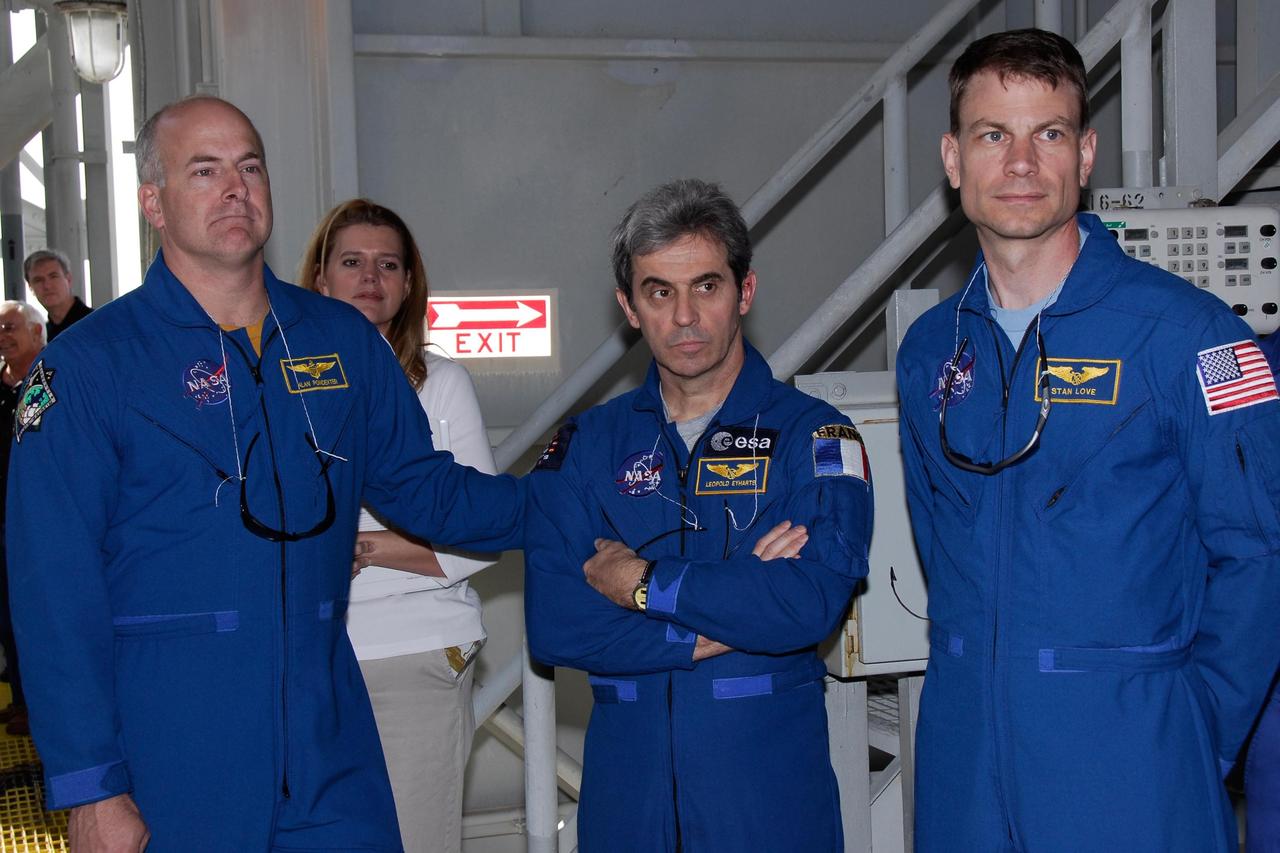
KENNEDY SPACE CENTER, FLA. -- The space shuttle Atlantis STS-122 crew receives instruction on emergency exit from the fixed service structure on Launch Pad 39A. From left are Pilot Alan Poindexter and Mission Specialists Leopold Eyharts and Stanley Love. Eyharts is with the European Space Agency and will remain on the International Space Station as a flight engineer for Expedition 16 following the STS-122 mission. The STS-122 crew is at NASA's Kennedy Space Center to take part in terminal countdown demonstration test, or TCDT, activities, a standard part of launch preparations. The TCDT provides astronauts and ground crews with equipment familiarization and a simulated launch countdown before launch. On mission STS-122, Atlantis will deliver the European Space Agency's Columbus module to the International Space Station. Columbus is a multifunctional, pressurized laboratory that will be permanently attached to U.S. Node 2, called Harmony, and will expand the research facilities aboard the station. Launch is targeted for Dec. 6. Photo credit: NASA/Kim Shiflett
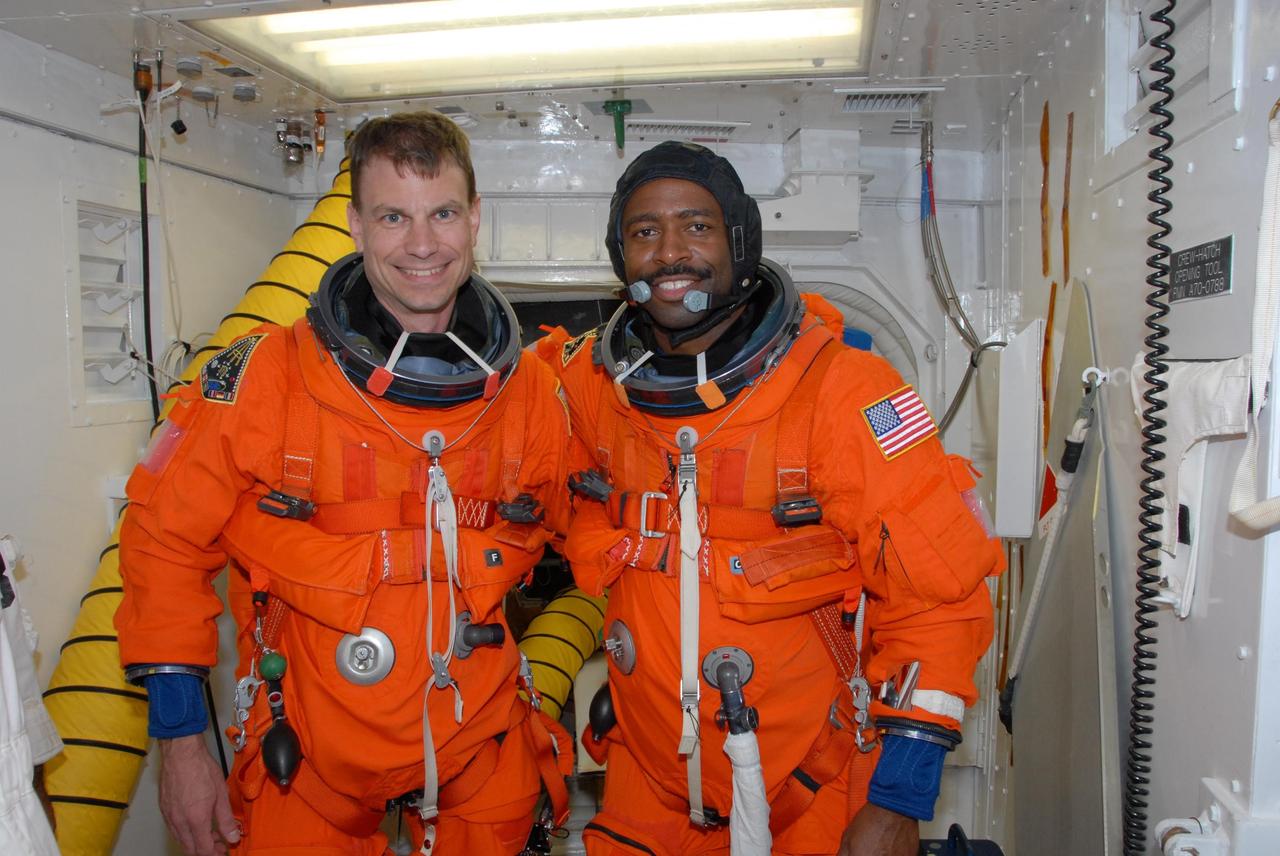
KENNEDY SPACE CENTER, FLA. -- In the White Room on Launch Pad 39A, space shuttle Atlantis STS-122 Mission Specialists Stanley Love and Leland Melvin take time out for a photo during their preparations for entry onto Atlantis' flight deck. The exercise is part of terminal countdown demonstration test, or TCDT, activities at NASA's Kennedy Space Center. The TCDT is a dress rehearsal for launch and also provides astronauts and ground crews with equipment familiarization and emergency egress training. On mission STS-122, Atlantis will deliver the Columbus module to the International Space Station. The European Space Agency's largest single contribution to the station, Columbus is a multifunctional, pressurized laboratory that will be permanently attached to U.S. Node 2, called Harmony. The laboratory will expand the research facilities aboard the station, providing crew members and scientists from around the world the ability to conduct a variety of experiments in the physical, materials and life sciences. Atlantis' launch is targeted for Dec. 6. Photo credit: NASA/George Shelton
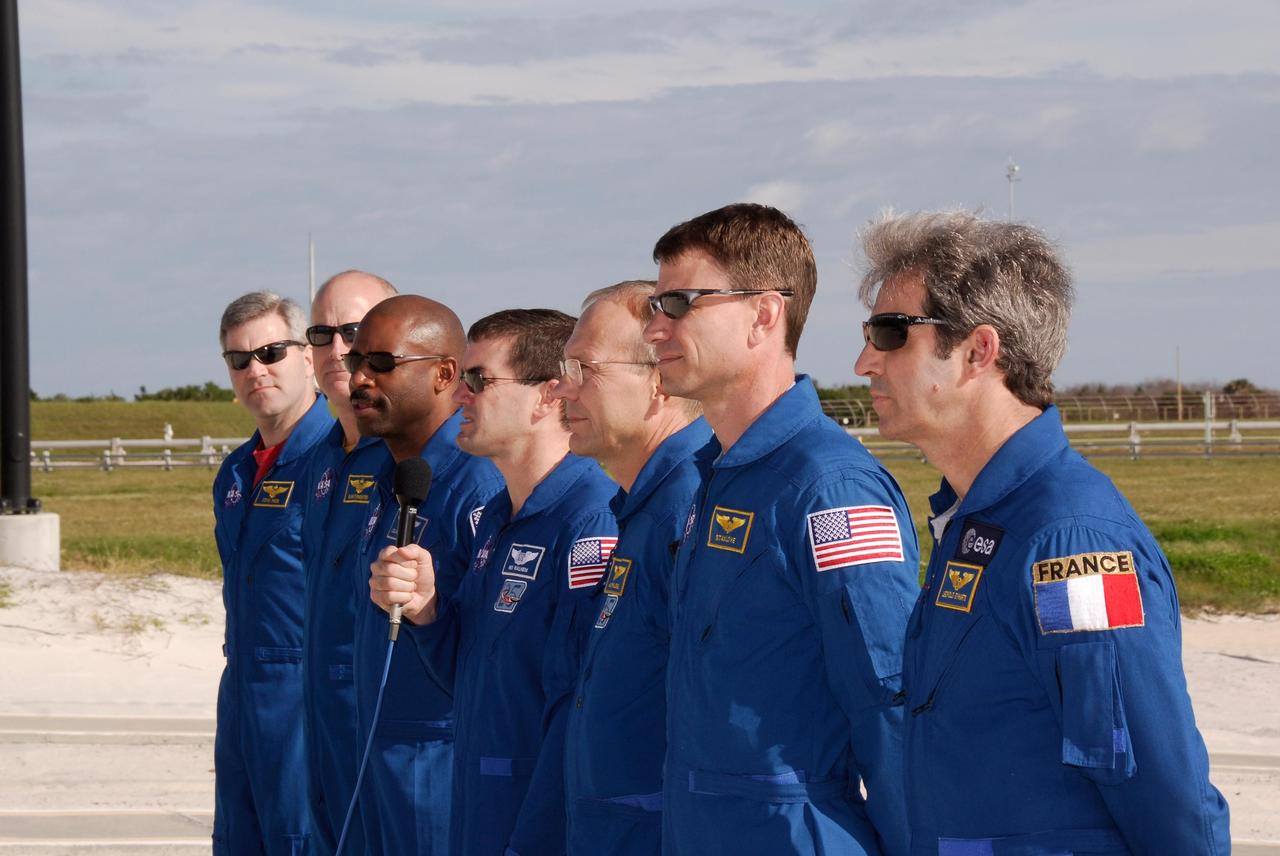
KENNEDY SPACE CENTER, FLA. -- At the slidewire basket landing on Launch Pad 39A, the space shuttle Atlantis STS-122 crew responds to questions from the media. From left are Commander Steve Frick; Pilot Alan Poindexter; and Mission Specialists Leland Melvin, Rex Walheim (with the microphone), Hans Schlegel, Stanley Love and Leopold Eyharts. Schlegel and Eyharts are with the European Space Agency. Eyharts will remain on the International Space Station as a flight engineer for Expedition 16 following the STS-122 mission. The STS-122 crew is at NASA's Kennedy Space Center to take part in terminal countdown demonstration test, or TCDT, activities, a standard part of launch preparations. The TCDT provides astronauts and ground crews with equipment familiarization, emergency egress training and a simulated launch countdown. On mission STS-122, Atlantis will deliver the European Space Agency's Columbus module to the International Space Station. Columbus is a multifunctional, pressurized laboratory that will be permanently attached to U.S. Node 2, called Harmony, and will expand the research facilities aboard the station. Launch is targeted for Dec. 6. Photo credit: NASA/Kim Shiflett
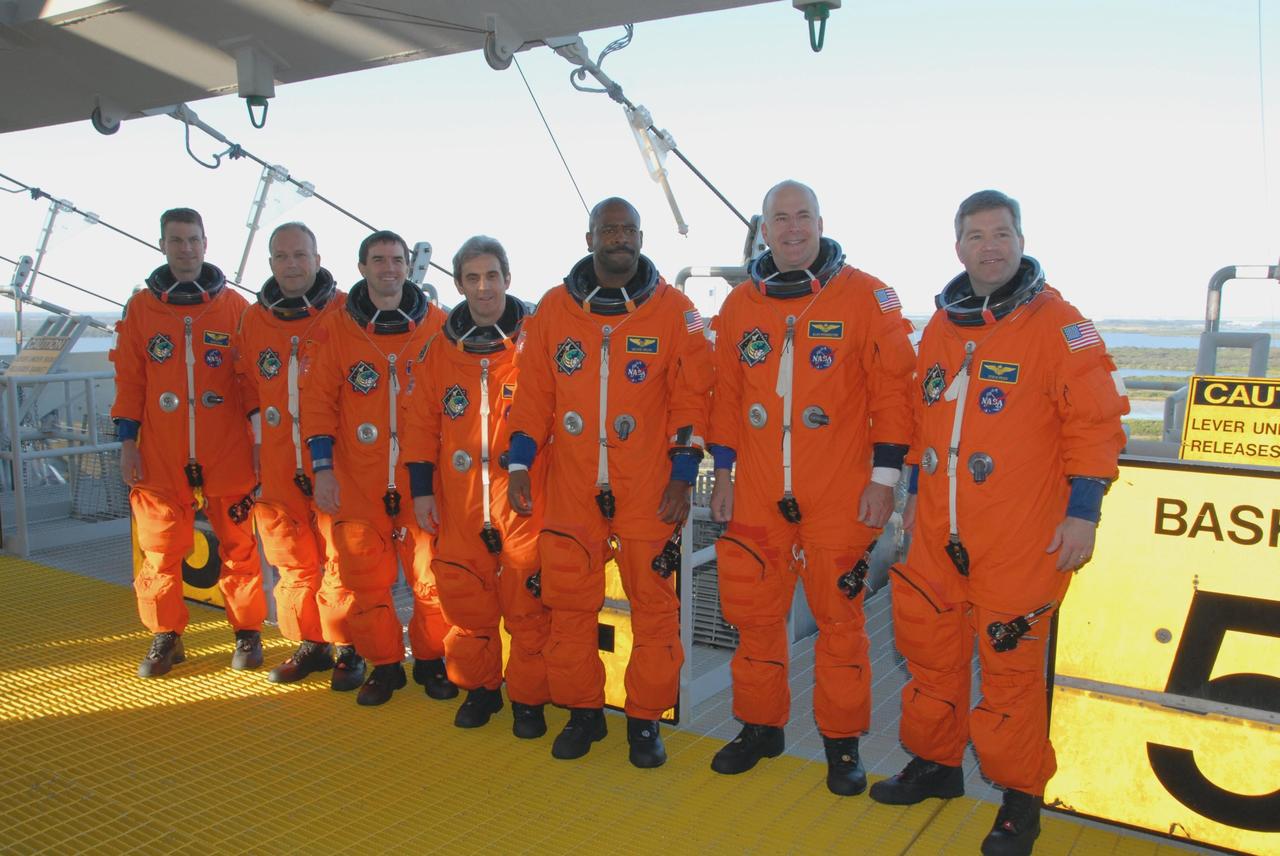
KENNEDY SPACE CENTER, FLA. -- The space shuttle Atlantis STS-122 crew arrives at Launch Pad 39A, dressed in launch and entry suits, to participate in a simulated launch countdown aboard Atlantis. From left are Mission Specialists Stanley Love, Hans Schlegel, Rex Walheim, Leopold Eyharts and Leland Melvin; Pilot Alan Poindexter; and Commander Steve Frick. Schlegel and Eyharts are with the European Space Agency. Eyharts will remain on the International Space Station as a flight engineer for Expedition 16 following the STS-122 mission. The exercise is part of terminal countdown demonstration test, or TCDT, activities at NASA's Kennedy Space Center. The TCDT is a dress rehearsal for launch and also provides astronauts and ground crews with equipment familiarization and emergency egress training. On mission STS-122, Atlantis will deliver the Columbus module to the International Space Station. The European Space Agency's largest single contribution to the station, Columbus is a multifunctional, pressurized laboratory that will be permanently attached to U.S. Node 2, called Harmony. The laboratory will expand the research facilities aboard the station, providing crew members and scientists from around the world the ability to conduct a variety of experiments in the physical, materials and life sciences. Atlantis' launch is targeted for Dec. 6. Photo credit: NASA/George Shelton
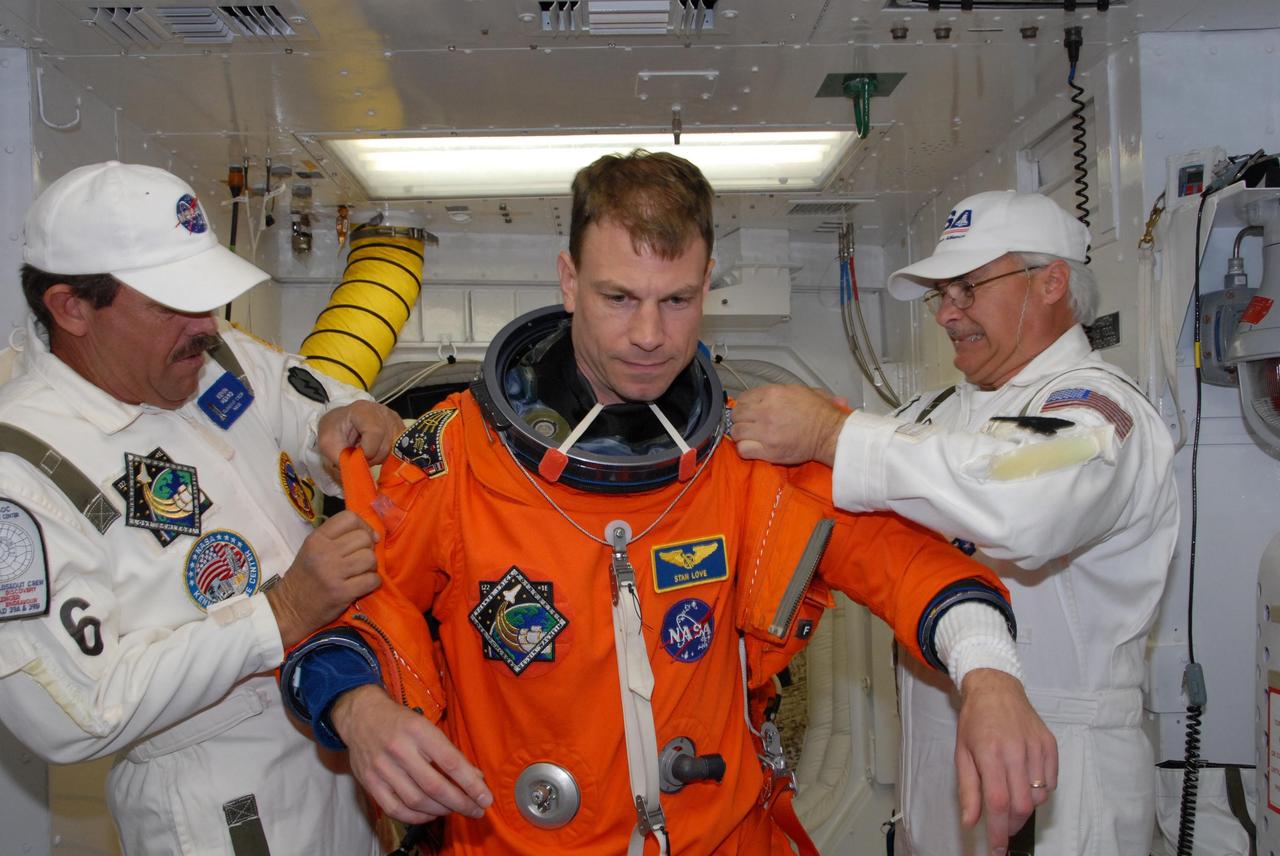
KENNEDY SPACE CENTER, FLA. -- In the White Room on Launch Pad 39A, suit technicians help space shuttle Atlantis STS-122 Mission Specialist Stanley Love with his flight and entry suit before his entry onto Atlantis' flight deck, through the hatch behind him. The exercise is part of terminal countdown demonstration test, or TCDT, activities at NASA's Kennedy Space Center. The TCDT is a dress rehearsal for launch and also provides astronauts and ground crews with equipment familiarization and emergency egress training. On mission STS-122, Atlantis will deliver the Columbus module to the International Space Station. The European Space Agency's largest single contribution to the station, Columbus is a multifunctional, pressurized laboratory that will be permanently attached to U.S. Node 2, called Harmony. The laboratory will expand the research facilities aboard the station, providing crew members and scientists from around the world the ability to conduct a variety of experiments in the physical, materials and life sciences. Atlantis' launch is targeted for Dec. 6. Photo credit: NASA/George Shelton

KENNEDY SPACE CENTER, FLA. -- Dressed in their launch and entry suits, the space shuttle Atlantis STS-122 crew poses for a group portrait in front of the astronaut van as they leave the Operations and Checkout Building for Launch Pad 39A. From left are Mission Specialists Leopold Eyharts, Stanley Love, Hans Schlegel, Rex Walheim, and Leland Melvin; Pilot Alan Poindexter; and Commander Steve Frick. Eyharts and Schlegel are with the European Space Agency. Eyharts will remain on the International Space Station as a flight engineer for Expedition 16 following the STS-122 mission. The STS-122 crew is preparing for a simulated launch countdown aboard Atlantis, part of terminal countdown demonstration test, or TCDT, activities at NASA's Kennedy Space Center. The TCDT is a dress rehearsal for launch and also provides astronauts and ground crews with equipment familiarization and emergency egress training. On mission STS-122, Atlantis will deliver the Columbus module to the International Space Station. The European Space Agency's largest single contribution to the station, Columbus is a multifunctional, pressurized laboratory that will be permanently attached to U.S. Node 2, called Harmony. The laboratory will expand the research facilities aboard the station, providing crew members and scientists from around the world the ability to conduct a variety of experiments in the physical, materials and life sciences. Launch is targeted for Dec. 6. Photo credit: NASA/Kim Shiflett
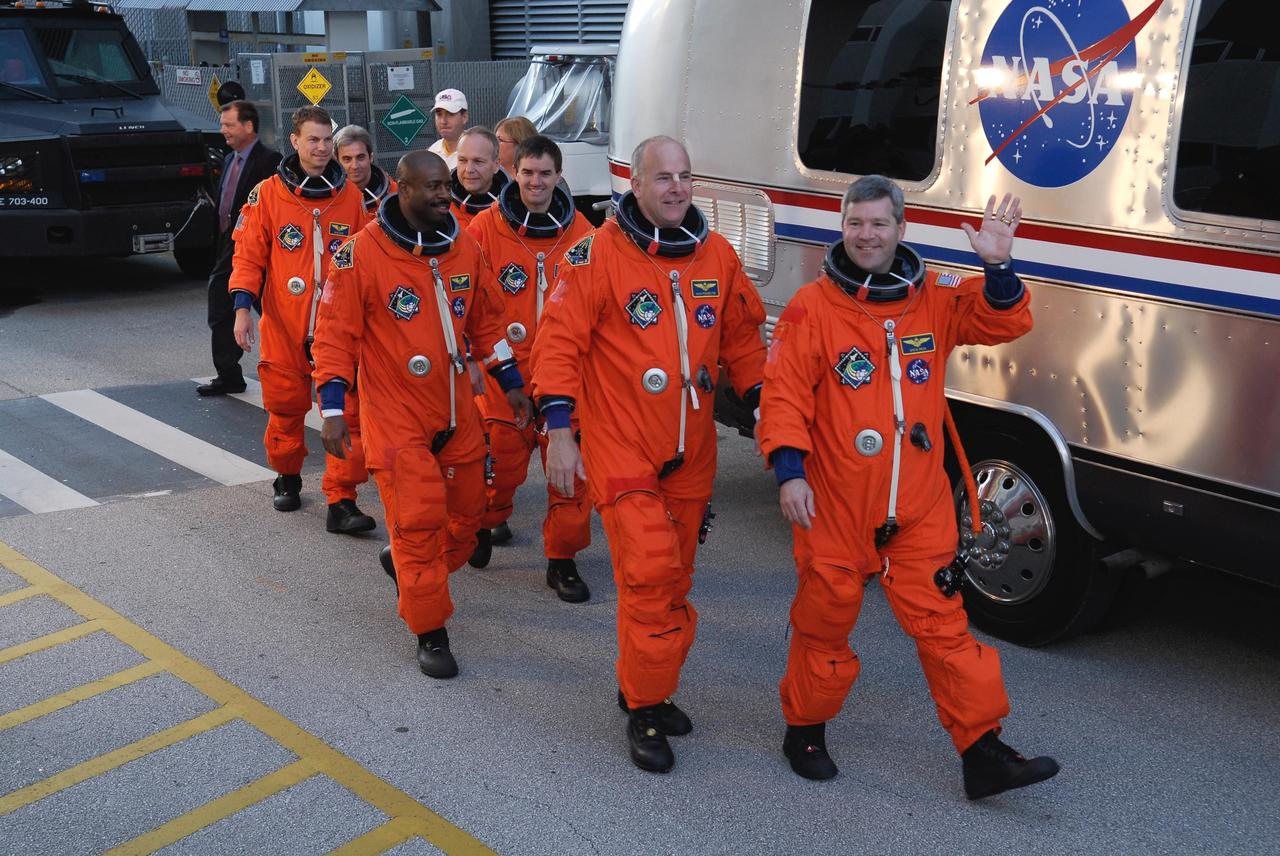
KENNEDY SPACE CENTER, FLA. -- Dressed in their launch and entry suits, the space shuttle Atlantis STS-122 crew leaves the Operations and Checkout Building for their trip to Launch Pad 39A aboard the astronaut van. From left are Mission Specialists Stanley Love, Leopold Eyharts, Leland Melvin, Hans Schlegel, and Rex Walheim; Pilot Alan Poindexter; and Commander Steve Frick. Eyharts and Schlegel are with the European Space Agency. Eyharts will remain on the International Space Station as a flight engineer for Expedition 16 following the STS-122 mission. The STS-122 crew is preparing for a simulated launch countdown aboard Atlantis, part of terminal countdown demonstration test, or TCDT, activities at NASA's Kennedy Space Center. The TCDT is a dress rehearsal for launch and also provides astronauts and ground crews with equipment familiarization and emergency egress training. On mission STS-122, Atlantis will deliver the Columbus module to the International Space Station. The European Space Agency's largest single contribution to the station, Columbus is a multifunctional, pressurized laboratory that will be permanently attached to U.S. Node 2, called Harmony. The laboratory will expand the research facilities aboard the station, providing crew members and scientists from around the world the ability to conduct a variety of experiments in the physical, materials and life sciences. Launch is targeted for Dec. 6. Photo credit: NASA/Kim Shiflett
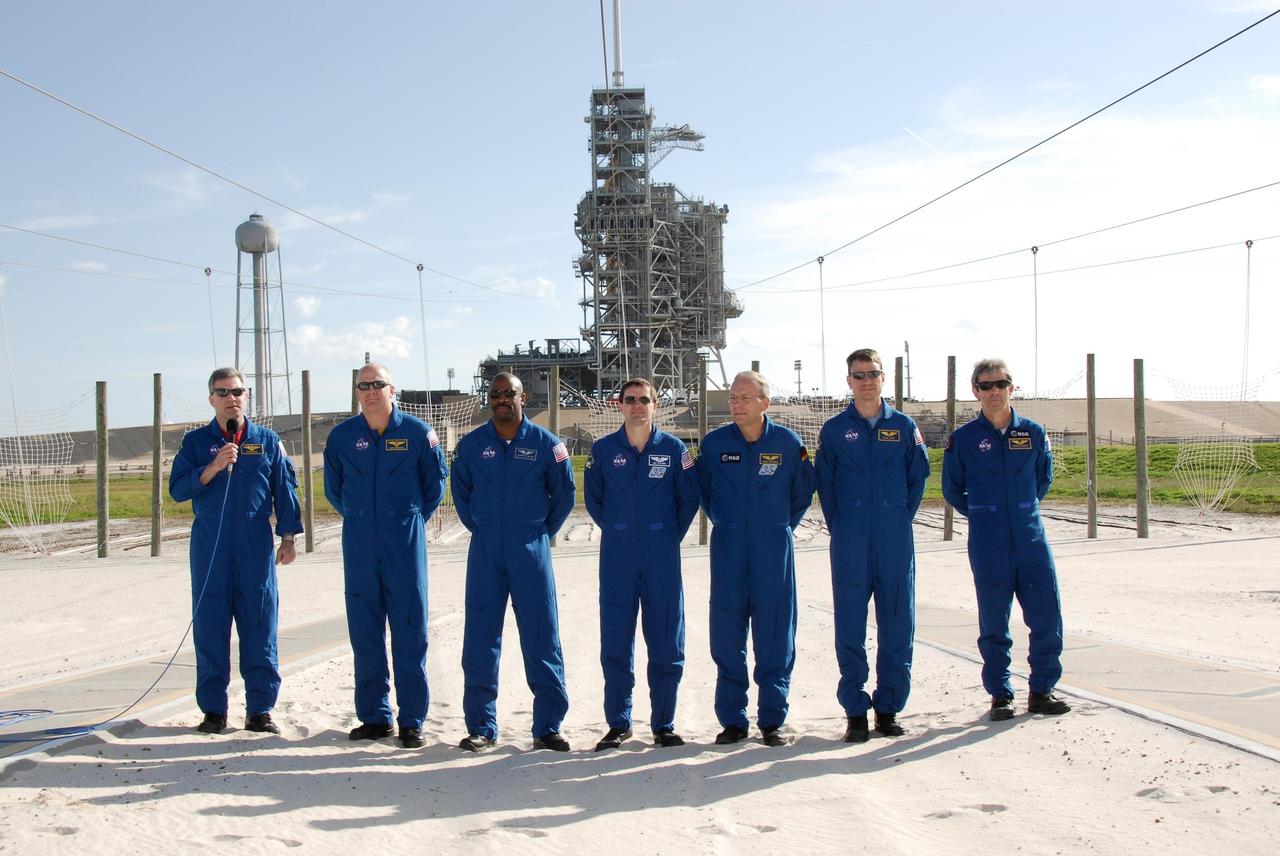
KENNEDY SPACE CENTER, FLA. -- At the slidewire basket landing on Launch Pad 39A, the space shuttle Atlantis STS-122 crew responds to questions from the media. From left are Commander Steve Frick (with the microphone); Pilot Alan Poindexter; and Mission Specialists Leland Melvin, Rex Walheim, Hans Schlegel, Stanley Love and Leopold Eyharts. Schlegel and Eyharts are with the European Space Agency. Eyharts will remain on the International Space Station as a flight engineer for Expedition 16 following the STS-122 mission. The STS-122 crew is at NASA's Kennedy Space Center to take part in terminal countdown demonstration test, or TCDT, activities, a standard part of launch preparations. The TCDT provides astronauts and ground crews with equipment familiarization, emergency egress training and a simulated launch countdown. On mission STS-122, Atlantis will deliver the European Space Agency's Columbus module to the International Space Station. Columbus is a multifunctional, pressurized laboratory that will be permanently attached to U.S. Node 2, called Harmony, and will expand the research facilities aboard the station. Launch is targeted for Dec. 6. Photo credit: NASA/Kim Shiflett
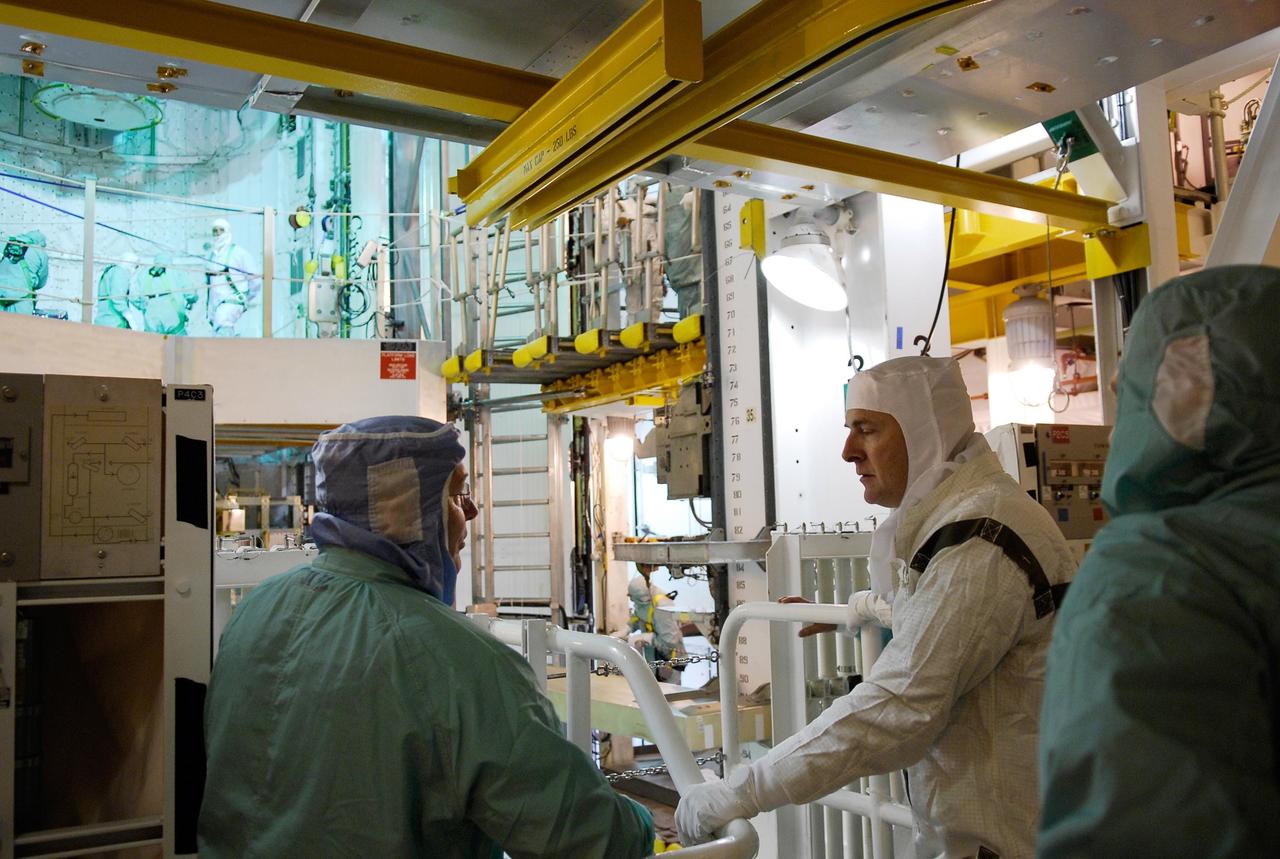
KENNEDY SPACE CENTER, FLA. -- At Launch Pad 39A, members of the space shuttle Atlantis STS-122 crew view the Columbus module during terminal countdown demonstration test, or TCDT, activities. Columbus was installed in the orbiter's payload bay on Nov. 11. From left, in clean room attire, are former astronaut Jerry Ross, chief of the Vehicle Integration Test Office at NASA Johnson Space Center, Pilot Alan Poindexter and Commander Steve Frick. The TCDT provides astronauts and ground crews with equipment familiarization, emergency egress training and a simulated launch countdown. On mission STS-122, Atlantis will deliver the Columbus module to the International Space Station. The European Space Agency's largest single contribution to the station, Columbus is a multifunctional, pressurized laboratory that will be permanently attached to U.S. Node 2, called Harmony. The module is approximately 23 feet long and 15 feet wide, allowing it to hold 10 large racks of experiments. The laboratory will expand the research facilities aboard the station, providing crew members and scientists from around the world the ability to conduct a variety of experiments in the physical, materials and life sciences. Launch is targeted for Dec. 6. Photo credit: NASA/Kim Shiflett
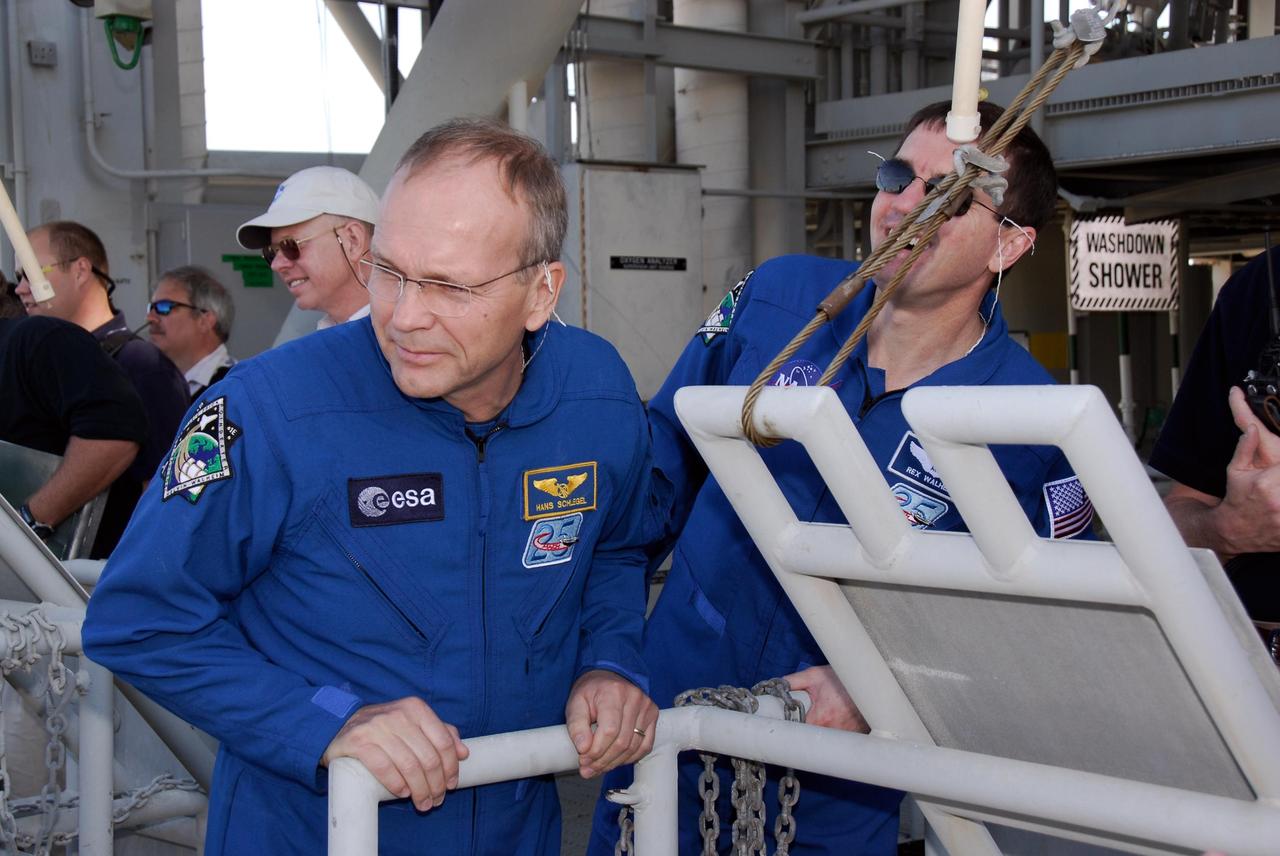
KENNEDY SPACE CENTER, FLA. -- During a training session on emergency exit from the fixed service structure on Launch Pad 39A, space shuttle Atlantis STS-122 Mission Specialists Hans Schlegel, left, and Rex Walheim watch a slidewire basket descend to the landing zone. Schlegel is with the European Space Agency. Seven slidewire baskets are available to carry the crew from the level of the pad's Orbiter Access Arm to a safe landing site below, if needed. Each basket can hold up to three people. A braking system catch net and drag chain slow, and then halt, the baskets as they travel down the wire at approximately 55 miles per hour. The journey takes about half a minute. A bunker is located in the landing zone 1,200 feet west of the pad, with an M-113 armored personnel carrier stationed nearby. The STS-122 crew is at NASA's Kennedy Space Center to take part in terminal countdown demonstration test, or TCDT, activities, a standard part of launch preparations. The TCDT provides astronauts and ground crews with equipment familiarization and a simulated launch countdown before launch. On mission STS-122, Atlantis will deliver the European Space Agency's Columbus module to the International Space Station. Columbus is a multifunctional, pressurized laboratory that will be permanently attached to U.S. Node 2, called Harmony, and will expand the research facilities aboard the station. Launch is targeted for Dec. 6. Photo credit: NASA/Kim Shiflett