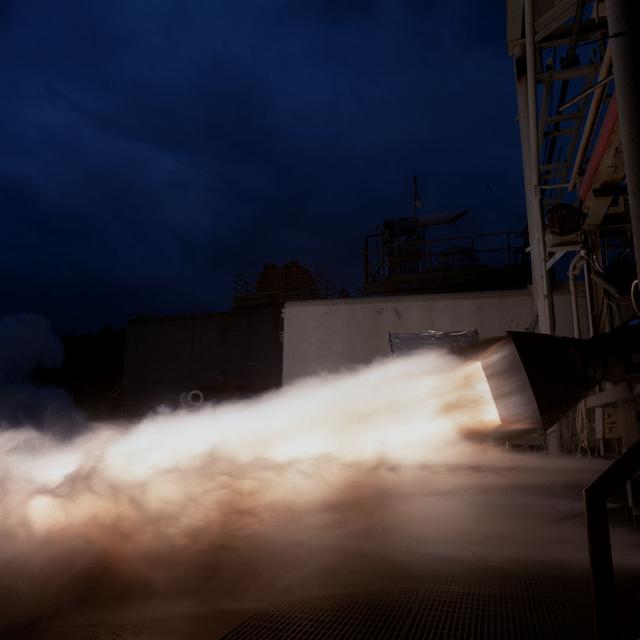
A close-up view of Bantam duration testing of the 40K Fastrac II Engine for X-34 at Marshall Space Flight Center's (MSFC) test stand 116. The Bantam test refers to the super lightweight engines of the Fastrac program. The engines were designed as part of the low cost X-34 Reusable Launch Vehicle (RLV). The testing of these engines at MSFC allowed the engineers to determine the capabilities of these engines and the metal alloys that were used in their construction. The Fastrac and X-34 programs were cancelled in 2001.
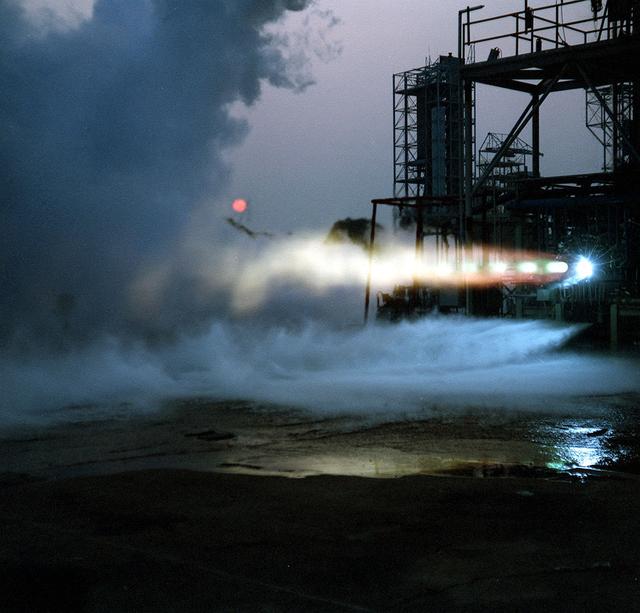
A 40K Pratt Whitney engine for the National Launch System is test fired at Marshall's Test Stand 116.
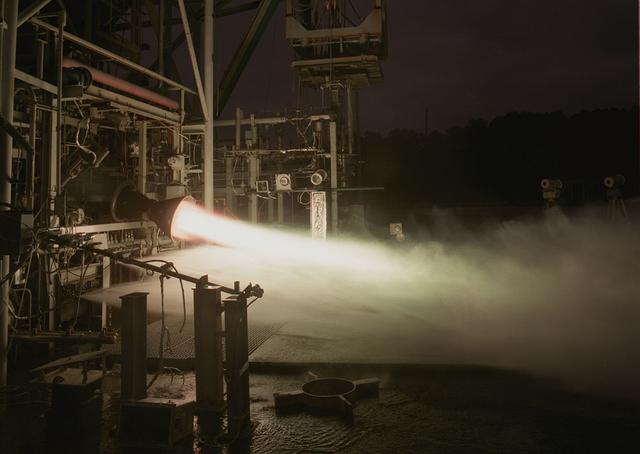
This is a photo of an X-34 40K Fastrac II duration test performed at the Marshall Space Flight Center test stand 116 (TS116) in June 1997. Engine ignition is started with Tea-Gas which makes the start burn green. The X-34 program was cancelled in 2001.
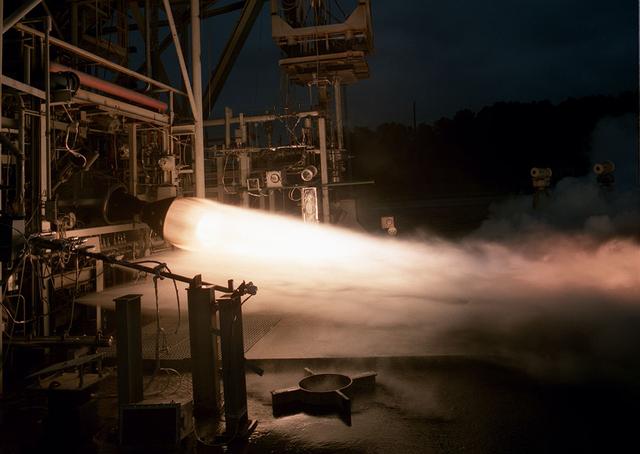
A 40 K Fastrac II duration test performed at Marshall Test Stand 116. The purpose of this test was to gauge the length of time between contact of TEA (Triethylenealuminum) and LOX (liquid oxygen) as an ignitor for the Fastrac engine.
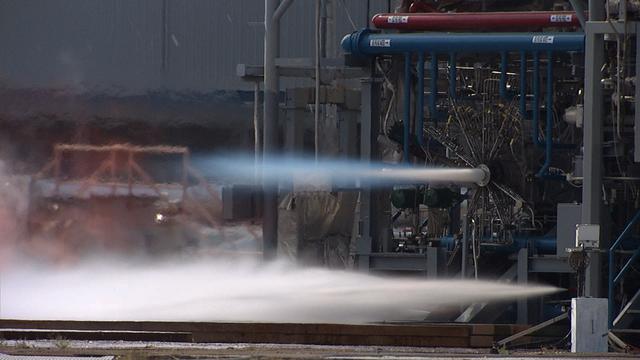
Under the goals of the Vision for Space Exploration, Ares I is a chief component of the cost-effective space transportation infrastructure being developed by NASA's Constellation Program. This transportation system will safely and reliably carry human explorers back to the moon, and then onward to Mars and other destinations in the solar system. The Ares I effort includes multiple project element teams at NASA centers and contract organizations around the nation, and is managed by the Exploration Launch Projects Office at NASA's Marshall Space Flight Center (MFSC). ATK Launch Systems near Brigham City, Utah, is the prime contractor for the first stage booster. ATK's subcontractor, United Space Alliance of Houston, is designing, developing and testing the parachutes at its facilities at NASA's Kennedy Space Center in Florida. NASA's Johnson Space Center in Houston hosts the Constellation Program and Orion Crew Capsule Project Office and provides test instrumentation and support personnel. Together, these teams are developing vehicle hardware, evolving proven technologies, and testing components and systems. Their work builds on powerful, reliable space shuttle propulsion elements and nearly a half-century of NASA space flight experience and technological advances. Ares I is an inline, two-stage rocket configuration topped by the Crew Exploration Vehicle, its service module, and a launch abort system. The launch vehicle's first stage is a single, five-segment reusable solid rocket booster derived from the Space Shuttle Program's reusable solid rocket motor that burns a specially formulated and shaped solid propellant called polybutadiene acrylonitrile (PBAN). The second or upper stage will be propelled by a J-2X main engine fueled with liquid oxygen and liquid hydrogen. This HD video image depicts a test firing of a 40k subscale J2X injector at MSFC's test stand 115. (Highest resolution available)