The super-Earth exoplanet 55 Cancri e, depicted with its star in this artist's concept, likely has an atmosphere thicker than Earth's, with ingredients that could be similar to those of Earth's atmosphere, according to a 2017 study using data from NASA's Spitzer Space Telescope. Scientists say the planet may be entirely covered in lava. The planet is so close to its star that one face of the planet consistently faces the star, resulting in a dayside and a nightside.   https://photojournal.jpl.nasa.gov/catalog/PIA22069
55 Cancri e with Atmosphere (Artist's Concept)
This plot tells astronomers that a fifth planet is in orbit around the star 55 Cancri, making the star the record-holder for hosting the most known exoplanets.
Wave of a Planet
This artist concept shows four of the five planets that orbit 55 Cancri, a star much like our own. The most recently discovered planet, and the fourth out from the star, looms large in the foreground.
Plentiful Planetary System Artist Concept
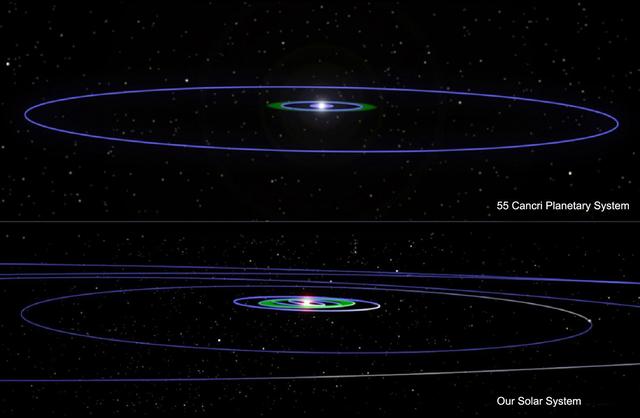
This artist concept illustrates two planetary systems -- 55 Cancri top and our own. Blue lines show the orbits of planets, including the dwarf planet Pluto in our solar system.
Our Solar System Cousin? Artist Concept
This artist concept takes us on a journey to 55 Cancri, a star with a family of five known planets - the most planets discovered so far around a star besides our own.
Journey to a Star Rich with Planets Artist Concept
The varying brightness of an exoplanet called 55 Cancri e is shown in this plot of infrared data captured by NASA Spitzer Space Telescope.
Hot N Hotter Planet Measured by Spitzer
Artist concept compares a hypothetical solar system centered around a tiny un to a known solar system centered around a star 55 Cancri.
Itsy Bitsy Solar System Artist Concept
This plot of data from NASA Spitzer Space Telescope reveals the light from a uper Earth called 55 Cancri e. The planet is the smallest yet, beyond our solar system, to reveal its direct light.
Magician of a Planet Disappears to Reveal Itself
This illustration shows one possible scenario for the hot, rocky exoplanet called 55 Cancri e, which is nearly two times as wide as Earth. New data from NASA Spitzer Space Telescope show that the planet has extreme temperature swings.
Hot-Lava World Illustration
This artist concept depicts 55 Cancri e as it orbits its star. NASA Spitzer Space Telescope has, for the first time, captured the light emanating from a distant super Earth, a planet more massive than Earth but lighter than Neptune.
Super Earth Reveals Itself to Spitzer Artist Animation
This graphic illuminates the process by which astronomers using NASA Spitzer Space Telescope have, for the first time, detected the light from a super Earth planet.
Measuring Brightness of Super Earth 55 Cancri e