
Pluto has long been a mystery, a dot at our solar system’s margins. The best images, even with NASA’s Hubble Space Telescope, were fuzzy and pixelated. In July 2015, NASA’s New Horizons spacecraft flew past Pluto and captured the sharpest views of the dwarf planet to date. One of the most striking areas, informally named "Sputnik Planum," is a sweeping, frozen plain the size of Texas and ringed by mountains of ice. Its smooth deposits are unmarred by impact craters, a stark contrast to the rest of Pluto’s battered surface. As a result, scientists believe the region formed recently, within the last few hundred million years. This contradicts past depictions of Pluto as an unchanging world. By analyzing images taken during the flyby, scientists hope to unravel more of the dwarf planet’s history. Watch the video for an up-close look at Pluto. Credit: NASA's Goddard Space Flight Center Video courtesy of NASA/Johns Hopkins University Applied Physics Laboratory/Southwest Research Institute/S. Robbins

Two different versions of an image of Pluto's haze layers, taken by New Horizons as it looked back at Pluto's dark side nearly 16 hours after close approach, from a distance of 480,000 miles (770,000 kilometers), at a phase angle of 166 degrees. Pluto's north is at the top, and the sun illuminates Pluto from the upper right. These images are much higher quality than the digitally compressed images of Pluto's haze downlinked and released shortly after the July 14 encounter, and allow many new details to be seen. The left version has had only minor processing, while the right version has been specially processed to reveal a large number of discrete haze layers in the atmosphere. In the left version, faint surface details on the narrow sunlit crescent are seen through the haze in the upper right of Pluto's disk, and subtle parallel streaks in the haze may be crepuscular rays- shadows cast on the haze by topography such as mountain ranges on Pluto, similar to the rays sometimes seen in the sky after the sun sets behind mountains on Earth. http://photojournal.jpl.nasa.gov/catalog/PIA19880

This dramatic view of the Pluto system is as NASA's New Horizons spacecraft saw it in July 2015. The animation, made with real images taken by New Horizons, begins with Pluto flying in for its close-up on July 14; we then pass behind Pluto and see the atmosphere glow in sunlight before the sun passes behind Pluto's largest moon, Charon. The movie ends with New Horizons' departure, looking back on each body as thin crescents. http://photojournal.jpl.nasa.gov/catalog/PIA19873

KENNEDY SPACE CENTER, FLA. - At Kennedy Space Center, the container holding the radioisotope thermoelectric generator (RTG) is removed from a truck. The RTG is the baseline power supply for the NASA’s New Horizons spacecraft, scheduled to launch in January 2006 on a journey to Pluto and its moon, Charon. The RTG is the baseline power supply for the NASA’s New Horizons spacecraft, scheduled to launch in January 2006 on a journey to Pluto and its moon, Charon. As it approaches Pluto, the spacecraft will look for ultraviolet emission from Pluto's atmosphere and make the best global maps of Pluto and Charon in green, blue, red and a special wavelength that is sensitive to methane frost on the surface. It will also take spectral maps in the near infrared, telling the science team about Pluto's and Charon's surface compositions and locations and temperatures of these materials. When the spacecraft is closest to Pluto or its moon, it will take close-up pictures in both visible and near-infrared wavelengths. It is expected to reach Pluto in July 2015.
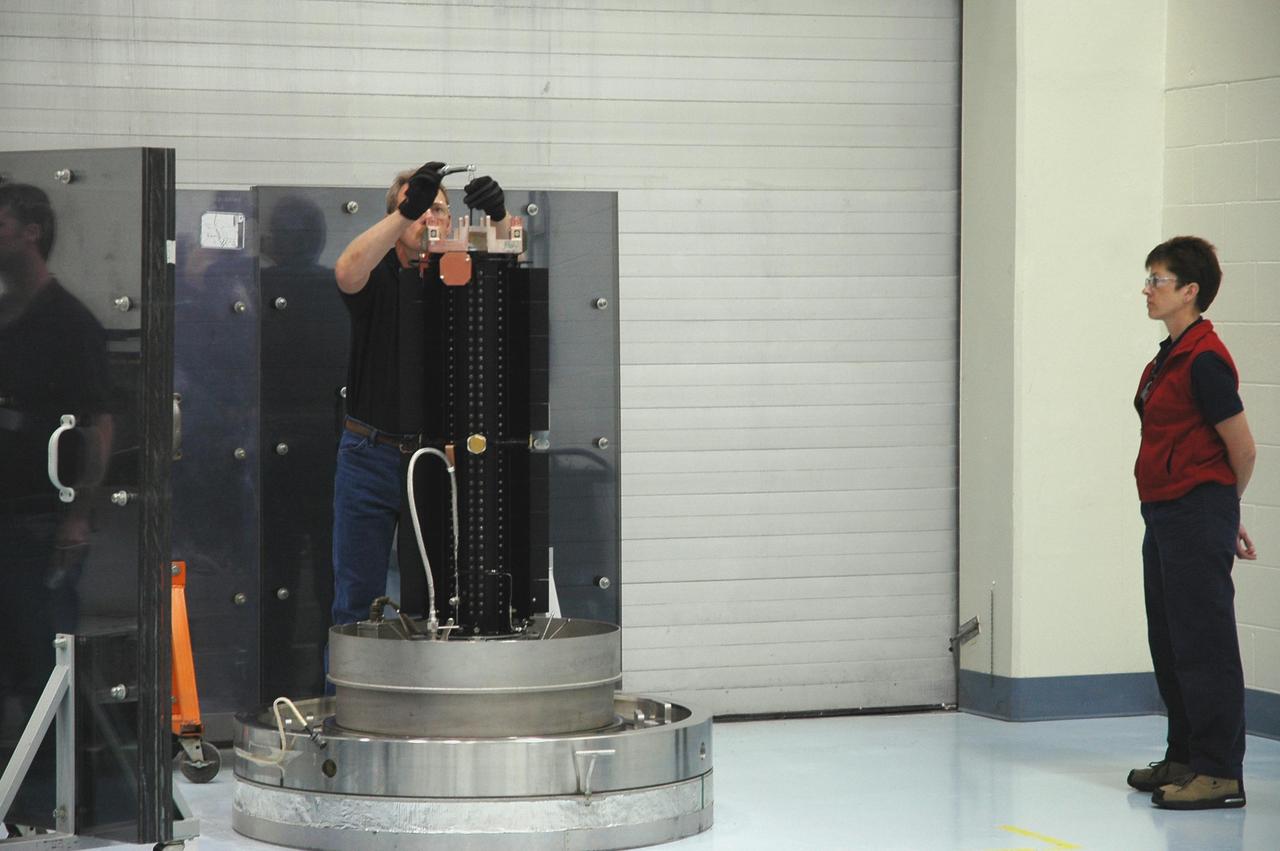
KENNEDY SPACE CENTER, FLA. - In the RTG Facility at Kennedy Space Center, Dan Brunson places a lift attachment onto the radioisotope thermoelectric generator (RTG) so it can be lifted off the stand. Watching at right is Amy Powell. The RTG is the baseline power supply for the NASA’s New Horizons spacecraft, scheduled to launch in January 2006 on a journey to Pluto and its moon, Charon. As it approaches Pluto, the spacecraft will look for ultraviolet emission from Pluto's atmosphere and make the best global maps of Pluto and Charon in green, blue, red and a special wavelength that is sensitive to methane frost on the surface. It will also take spectral maps in the near infrared, telling the science team about Pluto's and Charon's surface compositions and locations and temperatures of these materials. When the spacecraft is closest to Pluto or its moon, it will take close-up pictures in both visible and near-infrared wavelengths. It is expected to reach Pluto in July 2015.
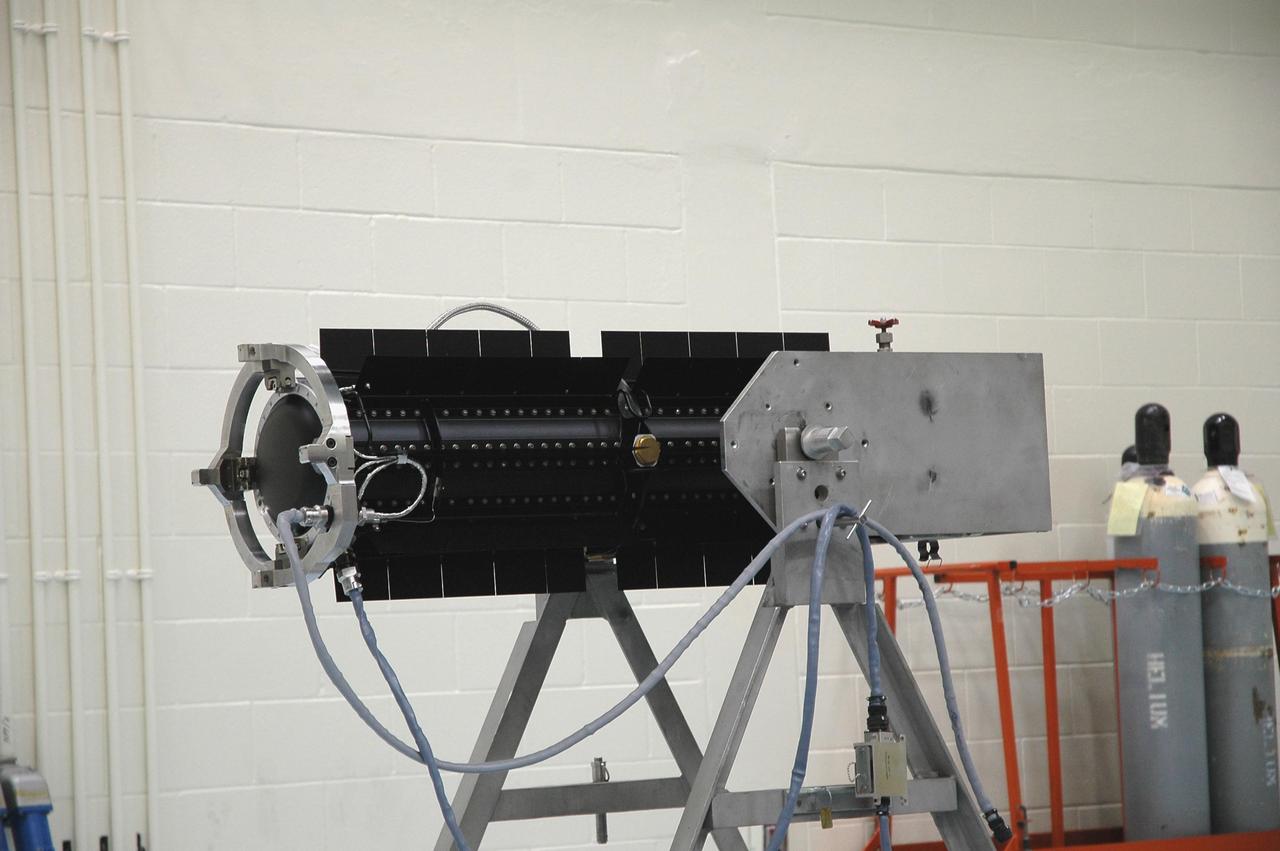
KENNEDY SPACE CENTER, FLA. - In the RTG Facility at Kennedy Space Center, the radioisotope thermoelectric generator (RTG) rests in a horizontal position. The RTG is the baseline power supply for the NASA’s New Horizons spacecraft, scheduled to launch in January 2006 on a journey to Pluto and its moon, Charon. As it approaches Pluto, the spacecraft will look for ultraviolet emission from Pluto's atmosphere and make the best global maps of Pluto and Charon in green, blue, red and a special wavelength that is sensitive to methane frost on the surface. It will also take spectral maps in the near infrared, telling the science team about Pluto's and Charon's surface compositions and locations and temperatures of these materials. When the spacecraft is closest to Pluto or its moon, it will take close-up pictures in both visible and near-infrared wavelengths. It is expected to reach Pluto in July 2015.
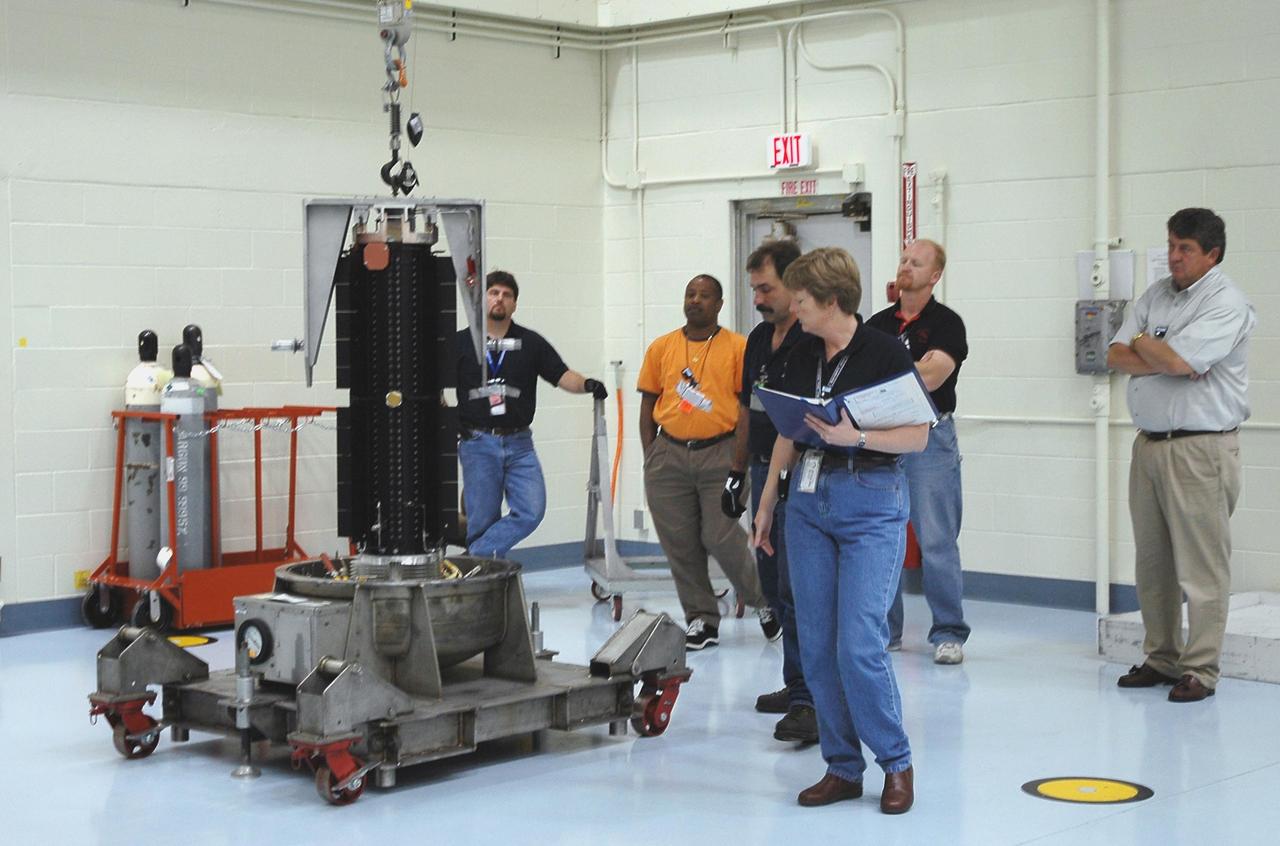
KENNEDY SPACE CENTER, FLA. - In the RTG Facility at Kennedy Space Center, officials check the radioisotope thermoelectric generator (RTG) after being lowered onto a transporter. The RTG is the baseline power supply for the NASA’s New Horizons spacecraft, scheduled to launch in January 2006 on a journey to Pluto and its moon, Charon. As it approaches Pluto, the spacecraft will look for ultraviolet emission from Pluto's atmosphere and make the best global maps of Pluto and Charon in green, blue, red and a special wavelength that is sensitive to methane frost on the surface. It will also take spectral maps in the near infrared, telling the science team about Pluto's and Charon's surface compositions and locations and temperatures of these materials. When the spacecraft is closest to Pluto or its moon, it will take close-up pictures in both visible and near-infrared wavelengths. It is expected to reach Pluto in July 2015.
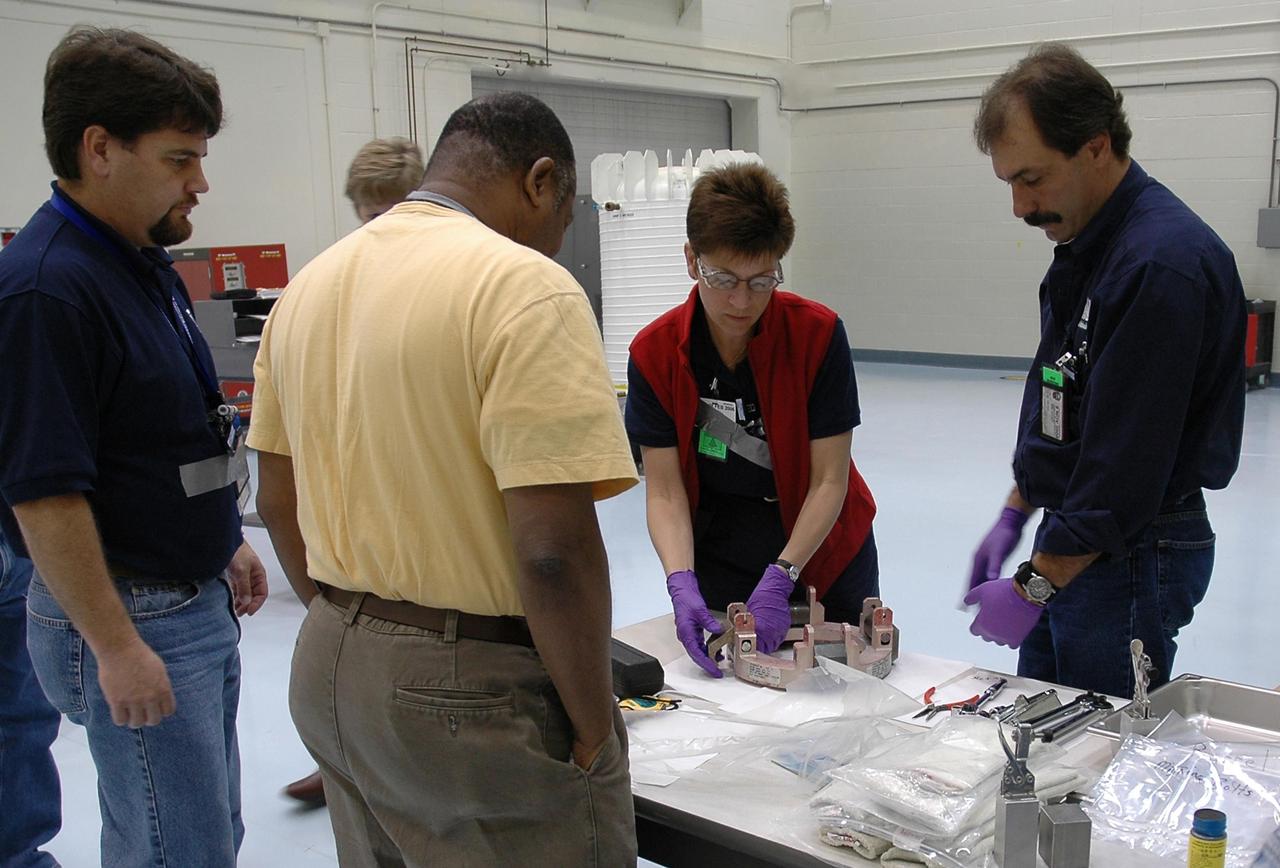
KENNEDY SPACE CENTER, FLA. - In the RTG Facility at Kennedy Space Center, Rhett Rovig, Mervin Smith, Amy Powell and June Wojciechowski inspect a clamping ring that will be installed on the radioisotope thermoelectric generator (RTG). The RTG is the baseline power supply for the NASA’s New Horizons spacecraft, scheduled to launch in January 2006 on a journey to Pluto and its moon, Charon. As it approaches Pluto, the spacecraft will look for ultraviolet emission from Pluto's atmosphere and make the best global maps of Pluto and Charon in green, blue, red and a special wavelength that is sensitive to methane frost on the surface. It will also take spectral maps in the near infrared, telling the science team about Pluto's and Charon's surface compositions and locations and temperatures of these materials. When the spacecraft is closest to Pluto or its moon, it will take close-up pictures in both visible and near-infrared wavelengths. It is expected to reach Pluto in July 2015.
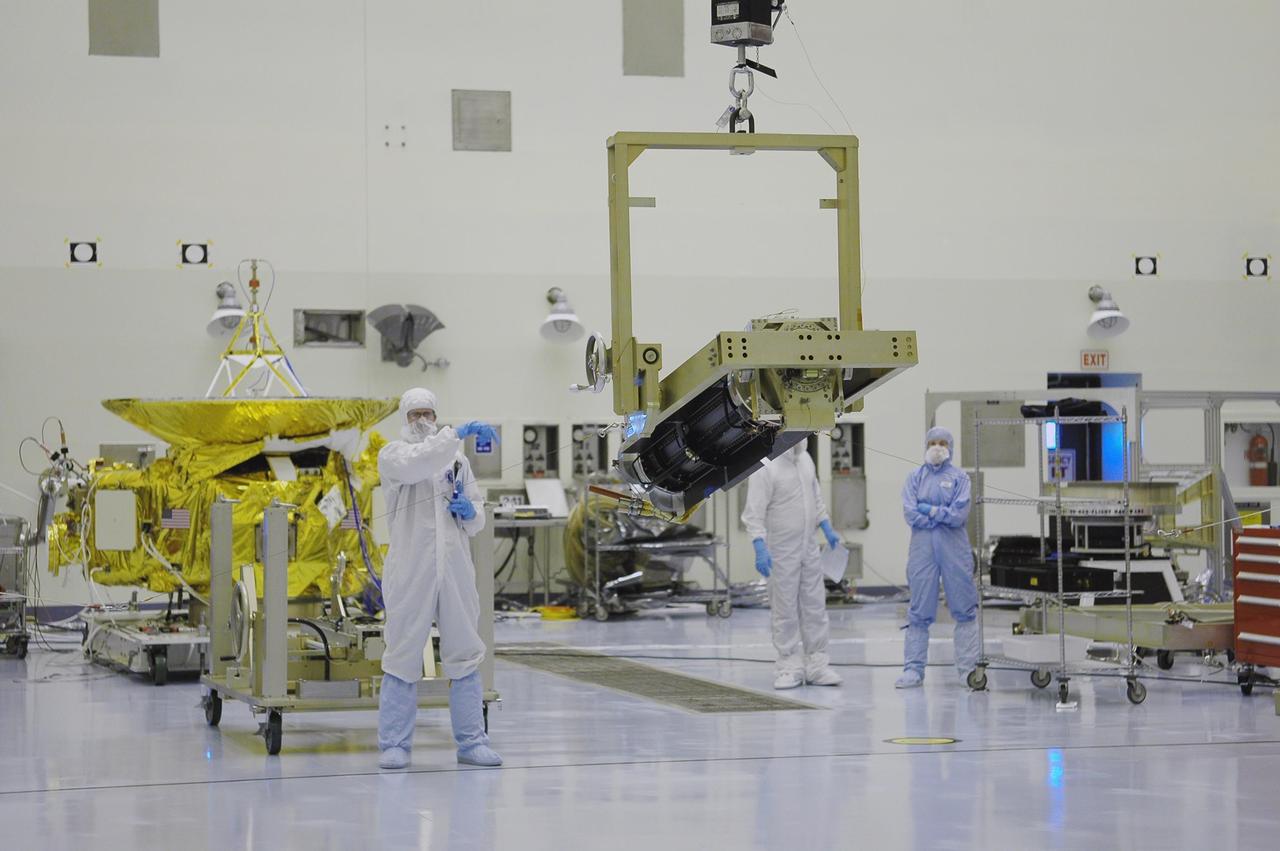
KENNEDY SPACE CENTER, FLA. - Supported by a crane in the Payload Hazardous Servicing Facility, the radioisotope thermoelectric generator (RTG) is rotated to vertical. The RTG is being returned to the RTG facility after completing a fit check with the spacecraft. The RTG is the baseline power supply for the New Horizons, scheduled to launch in January 2006 on a journey to Pluto and its moon, Charon. As it approaches Pluto, the spacecraft will look for ultraviolet emission from Pluto's atmosphere and make the best global maps of Pluto and Charon in green, blue, red and a special wavelength that is sensitive to methane frost on the surface. It will also take spectral maps in the near infrared, telling the science team about Pluto's and Charon's surface compositions and locations and temperatures of these materials. When the spacecraft is closest to Pluto or its moon, it will take close-up pictures in both visible and near-infrared wavelengths. It is expected to reach Pluto in July 2015.
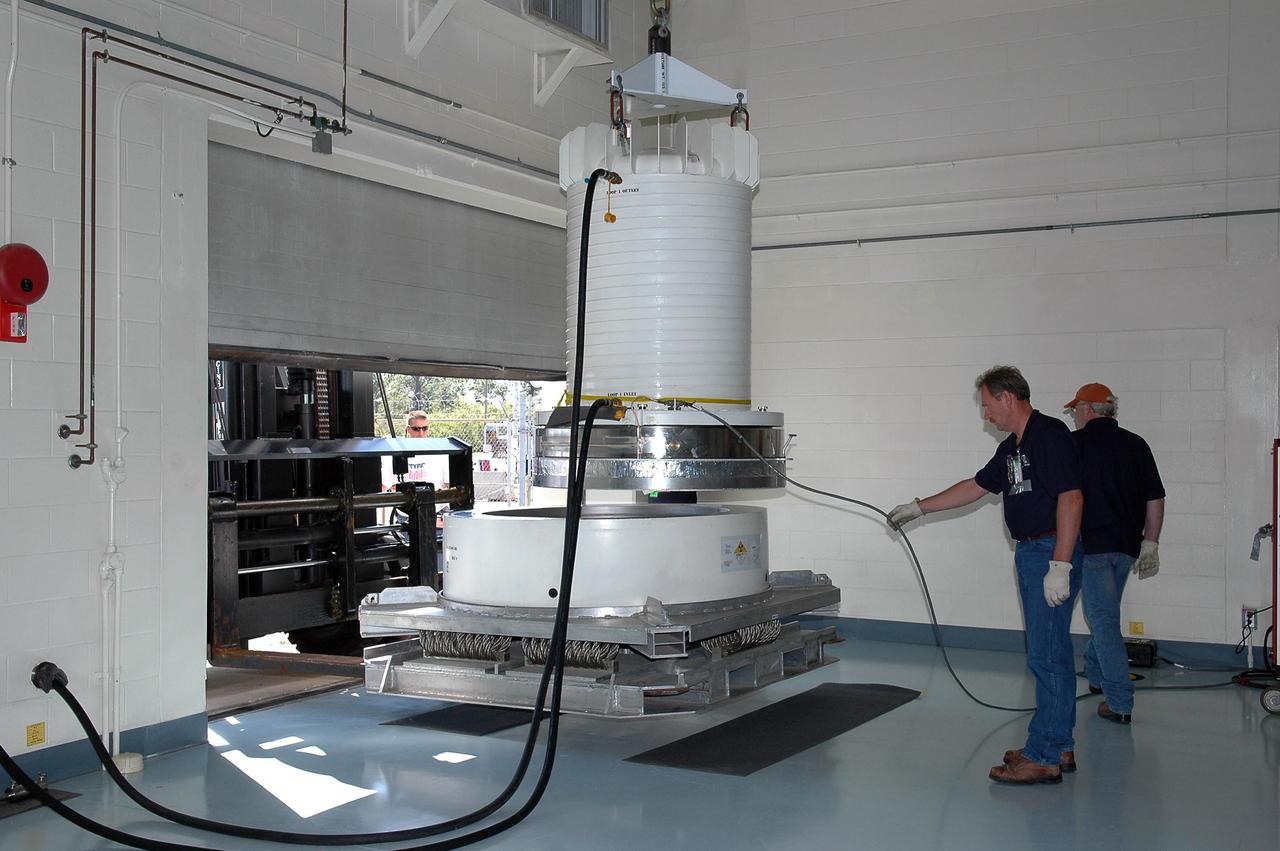
KENNEDY SPACE CENTER, FLA. - Bob Tessmer and Dave Nobles lift the radioisotope thermoelectric generator (RTG) container after its move inside the RTG facility at Kennedy Space Center. The RTG is the baseline power supply for the NASA’s New Horizons spacecraft, scheduled to launch in January 2006 on a journey to Pluto and its moon, Charon. As it approaches Pluto, the spacecraft will look for ultraviolet emission from Pluto's atmosphere and make the best global maps of Pluto and Charon in green, blue, red and a special wavelength that is sensitive to methane frost on the surface. It will also take spectral maps in the near infrared, telling the science team about Pluto's and Charon's surface compositions and locations and temperatures of these materials. When the spacecraft is closest to Pluto or its moon, it will take close-up pictures in both visible and near-infrared wavelengths. It is expected to reach Pluto in July 2015.

KENNEDY SPACE CENTER, FLA. - Jamie Gurney makes a zero adjustment of a personal dosimeter for officials handling the radioisotope thermoelectric generator (RTG) before its move to the RTG facility at Kennedy Space Center. The RTG is the baseline power supply for the NASA’s New Horizons spacecraft, scheduled to launch in January 2006 on a journey to Pluto and its moon, Charon. As it approaches Pluto, the spacecraft will look for ultraviolet emission from Pluto's atmosphere and make the best global maps of Pluto and Charon in green, blue, red and a special wavelength that is sensitive to methane frost on the surface. It will also take spectral maps in the near infrared, telling the science team about Pluto's and Charon's surface compositions and locations and temperatures of these materials. When the spacecraft is closest to Pluto or its moon, it will take close-up pictures in both visible and near-infrared wavelengths. It is expected to reach Pluto in July 2015.
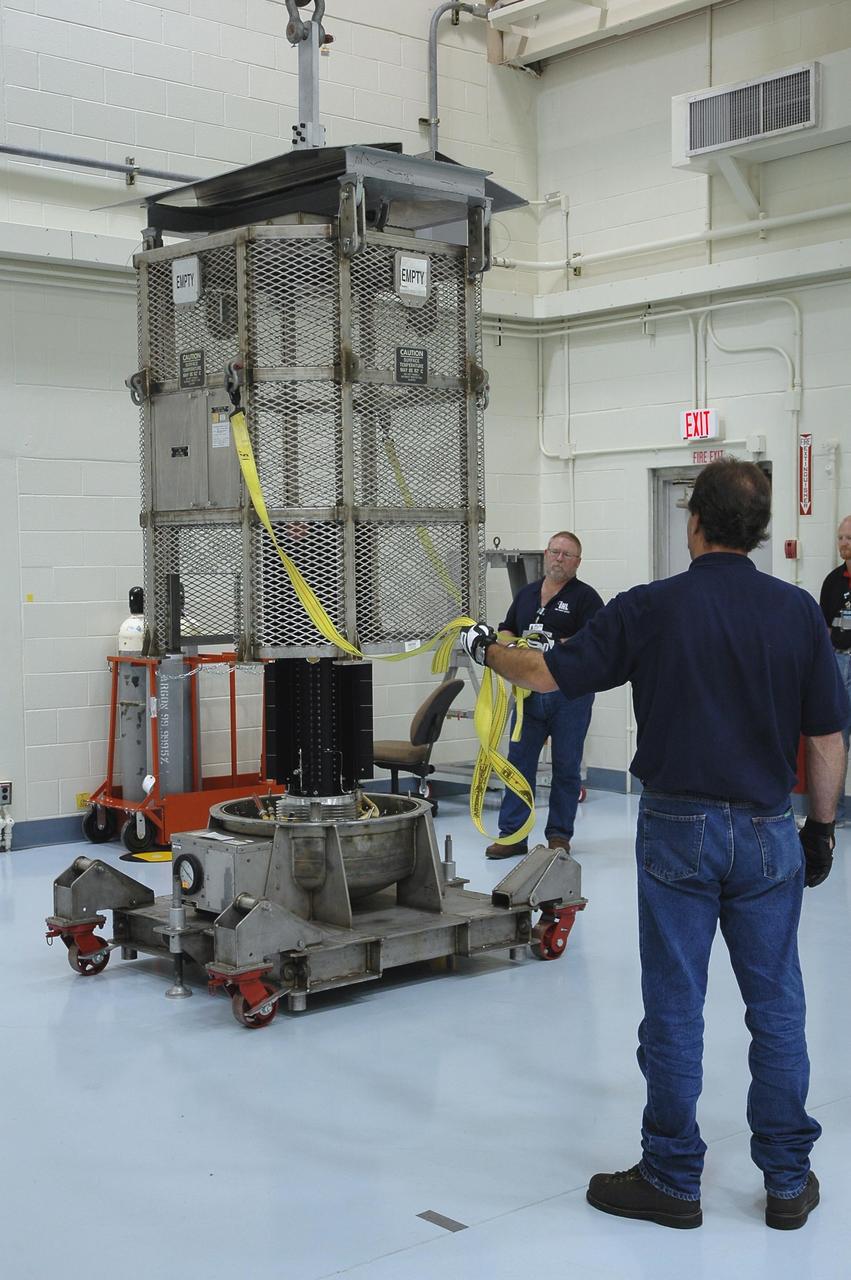
KENNEDY SPACE CENTER, FLA. -In the RTG Facility at Kennedy Space Center, Jim Wojciechowski and Dan Brunson lower a metal canister over the radioisotope thermoelectric generator (RTG). The canister will protect the RTG when it is moved. The RTG is the baseline power supply for the NASA’s New Horizons spacecraft, scheduled to launch in January 2006 on a journey to Pluto and its moon, Charon. As it approaches Pluto, the spacecraft will look for ultraviolet emission from Pluto's atmosphere and make the best global maps of Pluto and Charon in green, blue, red and a special wavelength that is sensitive to methane frost on the surface. It will also take spectral maps in the near infrared, telling the science team about Pluto's and Charon's surface compositions and locations and temperatures of these materials. When the spacecraft is closest to Pluto or its moon, it will take close-up pictures in both visible and near-infrared wavelengths. It is expected to reach Pluto in July 2015.
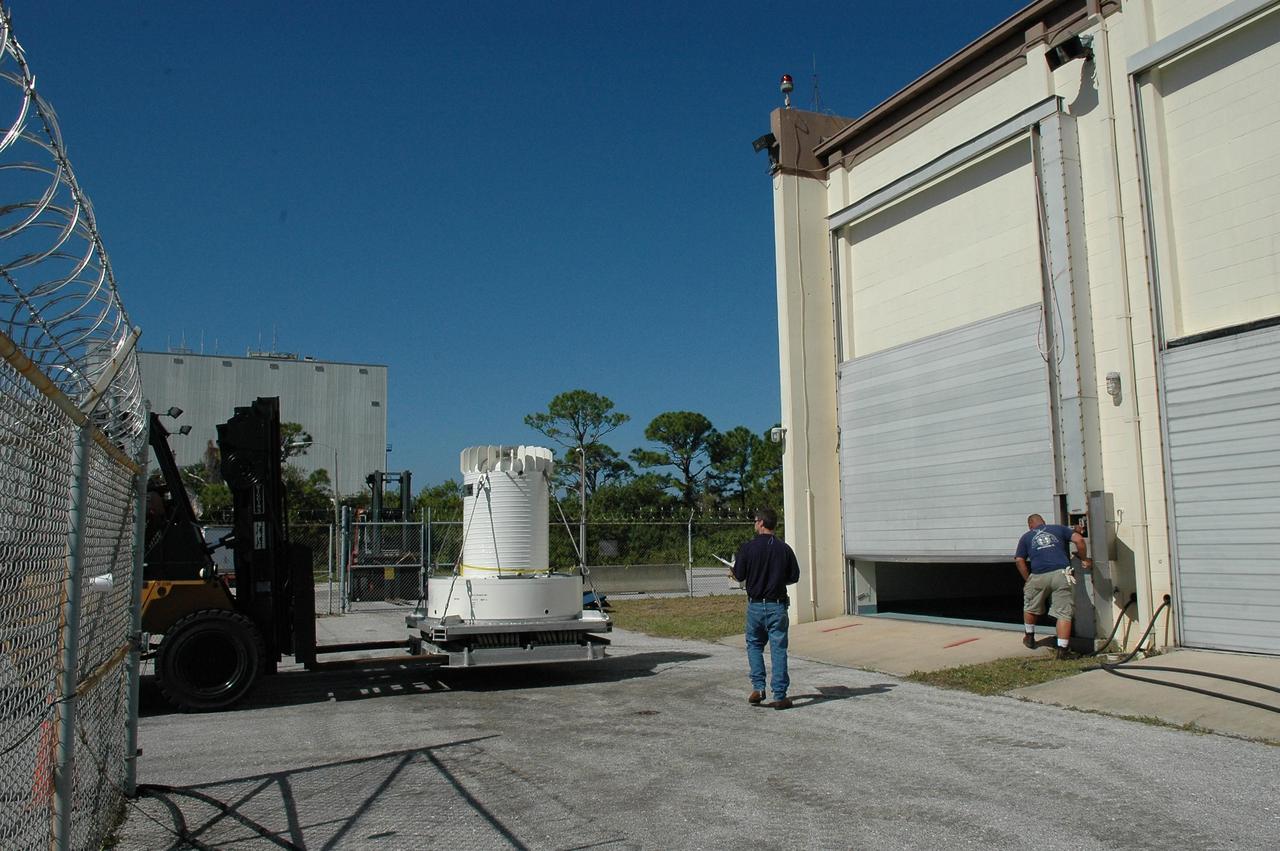
KENNEDY SPACE CENTER, FLA. - The container holding the radioisotope thermoelectric generator (RTG) is moved toward the door of the RTG facility at Kennedy Space Center. The RTG is the baseline power supply for the NASA’s New Horizons spacecraft, scheduled to launch in January 2006 on a journey to Pluto and its moon, Charon. As it approaches Pluto, the spacecraft will look for ultraviolet emission from Pluto's atmosphere and make the best global maps of Pluto and Charon in green, blue, red and a special wavelength that is sensitive to methane frost on the surface. It will also take spectral maps in the near infrared, telling the science team about Pluto's and Charon's surface compositions and locations and temperatures of these materials. When the spacecraft is closest to Pluto or its moon, it will take close-up pictures in both visible and near-infrared wavelengths. It is expected to reach Pluto in July 2015.
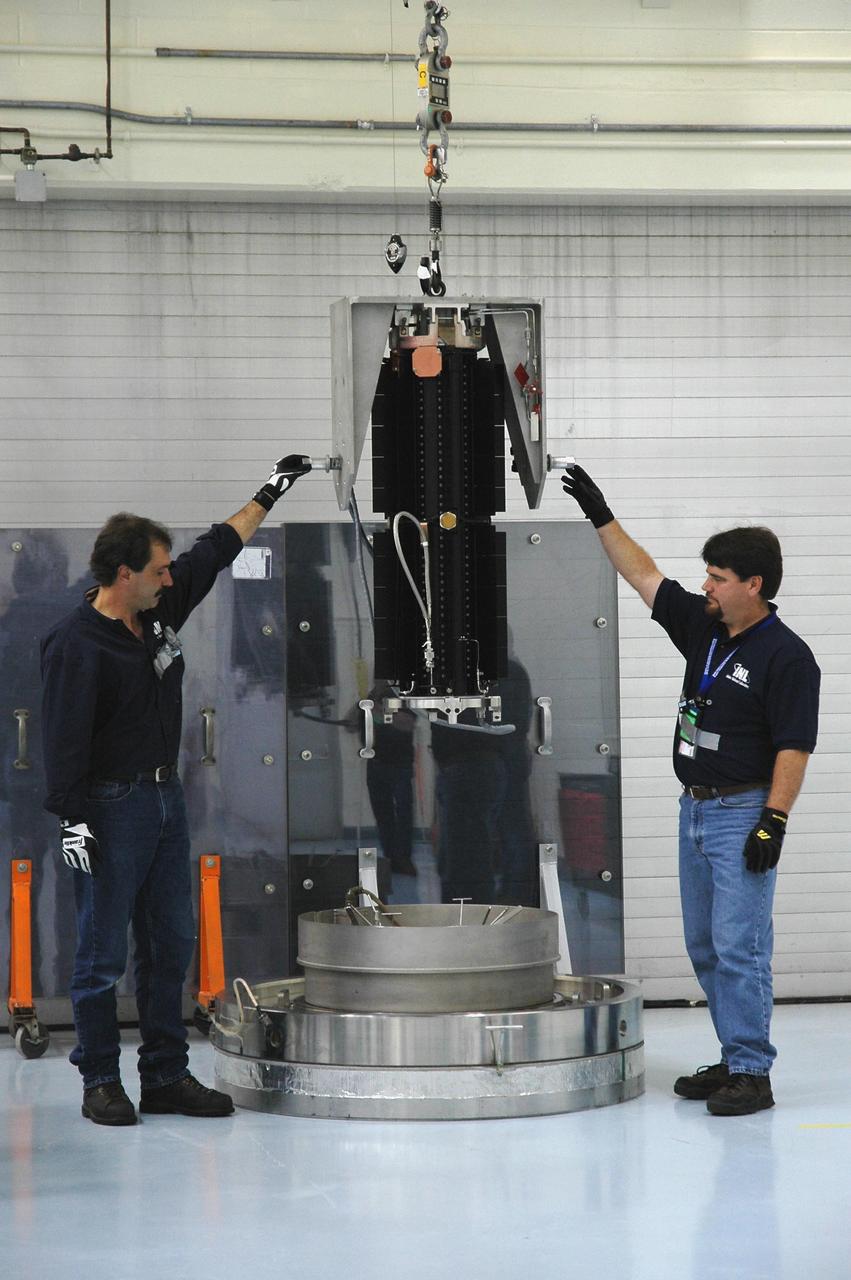
KENNEDY SPACE CENTER, FLA. - In the RTG Facility at Kennedy Space Center, Jim Wojciechowski (left) and Rhett Rovig lift the radioisotope thermoelectric generator (RTG) from its stand to place it on a cart. It will then be maneuvered to a horizontal position. The RTG is the baseline power supply for the NASA’s New Horizons spacecraft, scheduled to launch in January 2006 on a journey to Pluto and its moon, Charon. As it approaches Pluto, the spacecraft will look for ultraviolet emission from Pluto's atmosphere and make the best global maps of Pluto and Charon in green, blue, red and a special wavelength that is sensitive to methane frost on the surface. It will also take spectral maps in the near infrared, telling the science team about Pluto's and Charon's surface compositions and locations and temperatures of these materials. When the spacecraft is closest to Pluto or its moon, it will take close-up pictures in both visible and near-infrared wavelengths. It is expected to reach Pluto in July 2015.
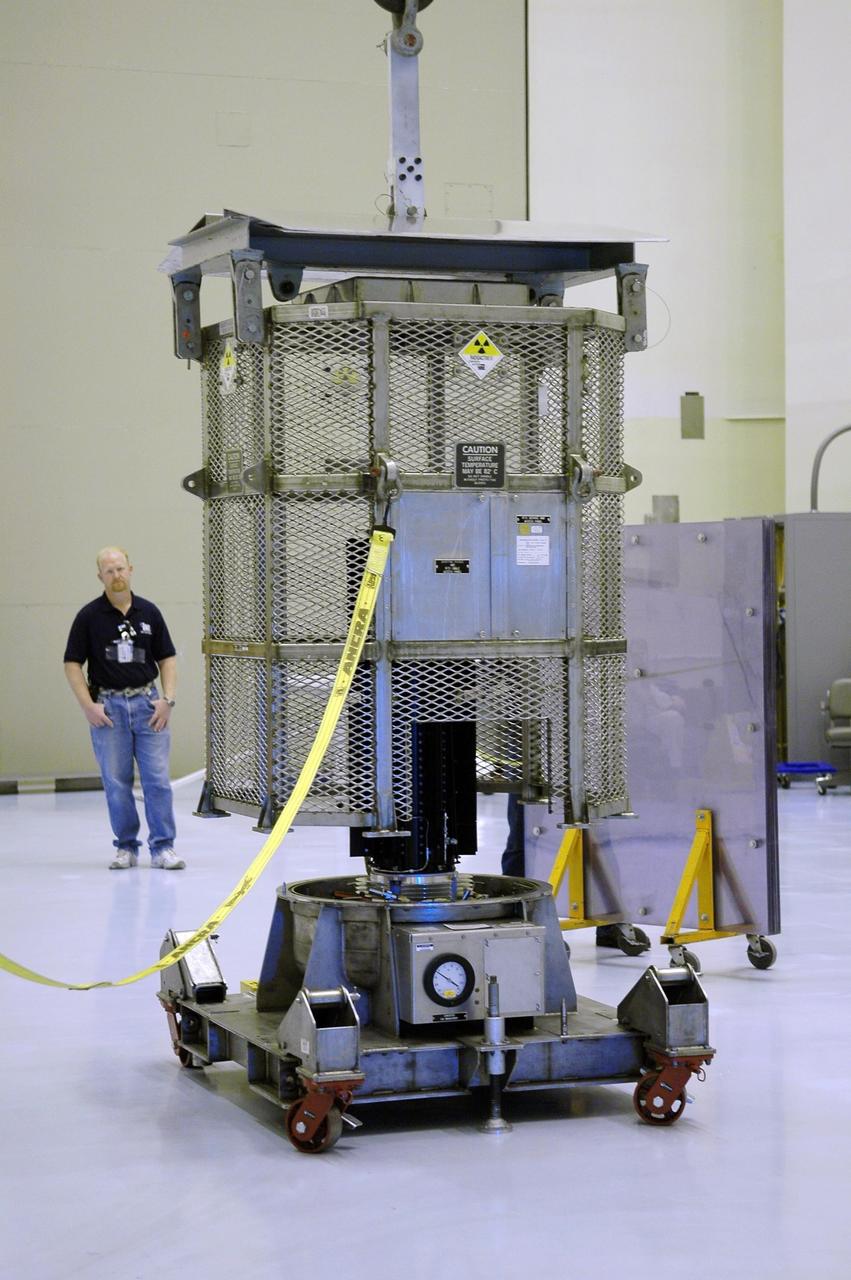
KENNEDY SPACE CENTER, FLA. - In the Payload Hazardous Servicing Facility, a metal canister is lowered over the radioisotope thermoelectric generator (RTG). The canister will protect the RTG while it is being moved to the RTG facility. The RTG underwent a fit check with the spacecraft. The RTG is the baseline power supply for the New Horizons, scheduled to launch in January 2006 on a journey to Pluto and its moon, Charon. As it approaches Pluto, the spacecraft will look for ultraviolet emission from Pluto's atmosphere and make the best global maps of Pluto and Charon in green, blue, red and a special wavelength that is sensitive to methane frost on the surface. It will also take spectral maps in the near infrared, telling the science team about Pluto's and Charon's surface compositions and locations and temperatures of these materials. When the spacecraft is closest to Pluto or its moon, it will take close-up pictures in both visible and near-infrared wavelengths. It is expected to reach Pluto in July 2015.

KENNEDY SPACE CENTER, FLA. - Jamie Gurney reads a personal dosimeter that will be used by officials handling the radioisotope thermoelectric generator (RTG) before its move to the RTG facility at Kennedy Space Center. The RTG is the baseline power supply for the NASA’s New Horizons spacecraft, scheduled to launch in January 2006 on a journey to Pluto and its moon, Charon. As it approaches Pluto, the spacecraft will look for ultraviolet emission from Pluto's atmosphere and make the best global maps of Pluto and Charon in green, blue, red and a special wavelength that is sensitive to methane frost on the surface. It will also take spectral maps in the near infrared, telling the science team about Pluto's and Charon's surface compositions and locations and temperatures of these materials. When the spacecraft is closest to Pluto or its moon, it will take close-up pictures in both visible and near-infrared wavelengths. It is expected to reach Pluto in July 2015.
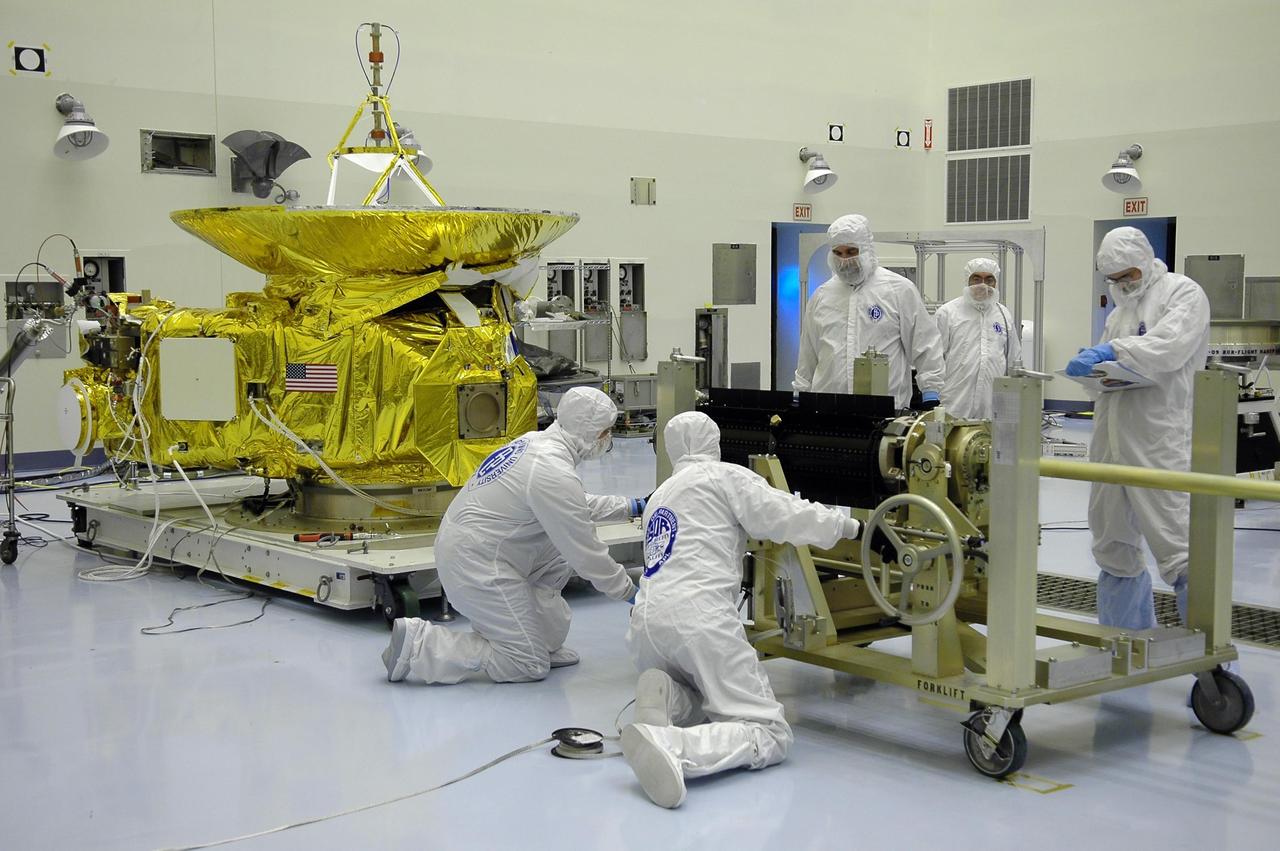
KENNEDY SPACE CENTER, FLA. - In the Payload Hazardous Servicing Facility, engineers move the radioisotope thermoelectric generator (RTG) away from NASA’s New Horizons spacecraft. The RTG is being returned to the RTG facility after completing a fit check with the spacecraft. The RTG is the baseline power supply for the New Horizons, scheduled to launch in January 2006 on a journey to Pluto and its moon, Charon. As it approaches Pluto, the spacecraft will look for ultraviolet emission from Pluto's atmosphere and make the best global maps of Pluto and Charon in green, blue, red and a special wavelength that is sensitive to methane frost on the surface. It will also take spectral maps in the near infrared, telling the science team about Pluto's and Charon's surface compositions and locations and temperatures of these materials. When the spacecraft is closest to Pluto or its moon, it will take close-up pictures in both visible and near-infrared wavelengths. It is expected to reach Pluto in July 2015.
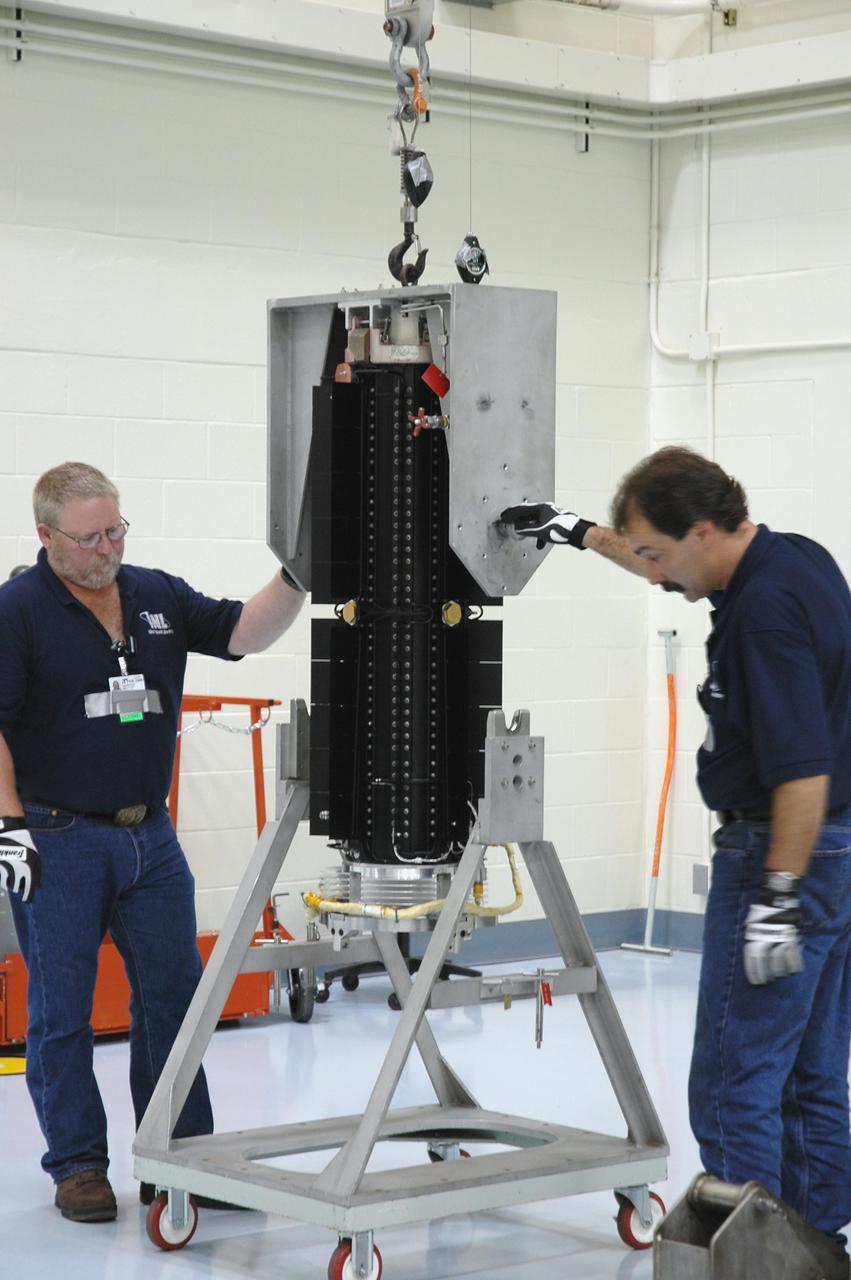
KENNEDY SPACE CENTER, FLA. - In the RTG Facility at Kennedy Space Center, Dan Brunson and Jim Wojciechowski carefully lower the radioisotope thermoelectric generator (RTG) into a t-cart. The RTG is the baseline power supply for the NASA’s New Horizons spacecraft, scheduled to launch in January 2006 on a journey to Pluto and its moon, Charon. As it approaches Pluto, the spacecraft will look for ultraviolet emission from Pluto's atmosphere and make the best global maps of Pluto and Charon in green, blue, red and a special wavelength that is sensitive to methane frost on the surface. It will also take spectral maps in the near infrared, telling the science team about Pluto's and Charon's surface compositions and locations and temperatures of these materials. When the spacecraft is closest to Pluto or its moon, it will take close-up pictures in both visible and near-infrared wavelengths. It is expected to reach Pluto in July 2015.
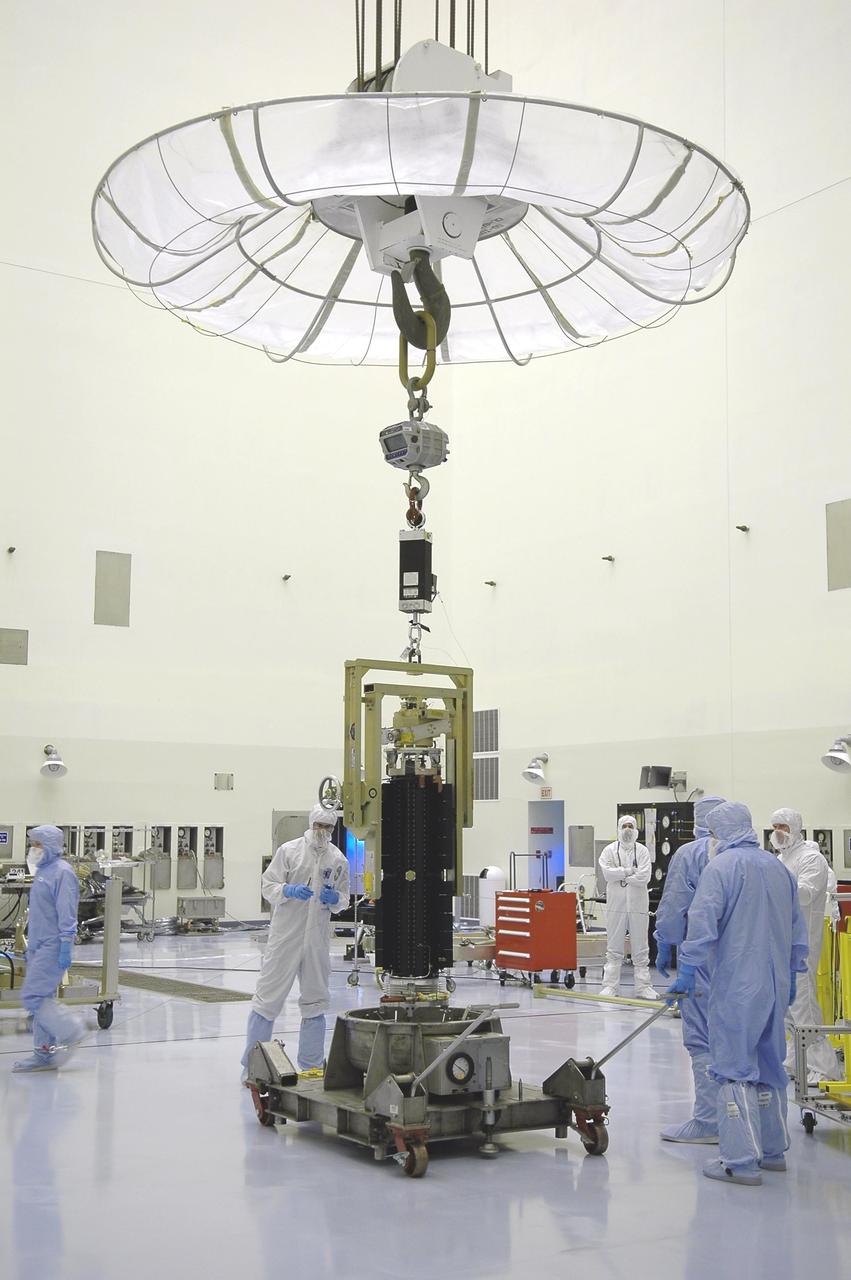
KENNEDY SPACE CENTER, FLA. - Supported by a crane in the Payload Hazardous Servicing Facility, the radioisotope thermoelectric generator (RTG) is lowered onto a transporter. The RTG is being returned to the RTG facility. The RTG is the baseline power supply for the New Horizons, scheduled to launch in January 2006 on a journey to Pluto and its moon, Charon. As it approaches Pluto, the spacecraft will look for ultraviolet emission from Pluto's atmosphere and make the best global maps of Pluto and Charon in green, blue, red and a special wavelength that is sensitive to methane frost on the surface. It will also take spectral maps in the near infrared, telling the science team about Pluto's and Charon's surface compositions and locations and temperatures of these materials. When the spacecraft is closest to Pluto or its moon, it will take close-up pictures in both visible and near-infrared wavelengths. It is expected to reach Pluto in July 2015.

KENNEDY SPACE CENTER, FLA. - Inside the RTG facility at Kennedy Space Center, Tim Frazier, Mervin Smith and Tim Hoye inspect the radioisotope thermoelectric generator (RTG) after its arrival. Frazier is with the Department of Energy, which has provided the radioisotope, and Hoye is with Lockheed Martin. The RTG is the baseline power supply for the NASA’s New Horizons spacecraft, scheduled to launch in January 2006 on a journey to Pluto and its moon, Charon. As it approaches Pluto, the spacecraft will look for ultraviolet emission from Pluto's atmosphere and make the best global maps of Pluto and Charon in green, blue, red and a special wavelength that is sensitive to methane frost on the surface. It will also take spectral maps in the near infrared, telling the science team about Pluto's and Charon's surface compositions and locations and temperatures of these materials. When the spacecraft is closest to Pluto or its moon, it will take close-up pictures in both visible and near-infrared wavelengths. It is expected to reach Pluto in July 2015.

KENNEDY SPACE CENTER, FLA. - Outside of the Payload Hazardous Servicing Facility, the enclosed radioisotope thermoelectric generator (RTG) is moved into a waiting truck. The RTG is being returned to the RTG facility after completing a fit check with the spacecraft. The RTG is the baseline power supply for the New Horizons, scheduled to launch in January 2006 on a journey to Pluto and its moon, Charon. As it approaches Pluto, the spacecraft will look for ultraviolet emission from Pluto's atmosphere and make the best global maps of Pluto and Charon in green, blue, red and a special wavelength that is sensitive to methane frost on the surface. It will also take spectral maps in the near infrared, telling the science team about Pluto's and Charon's surface compositions and locations and temperatures of these materials. When the spacecraft is closest to Pluto or its moon, it will take close-up pictures in both visible and near-infrared wavelengths. It is expected to reach Pluto in July 2015.
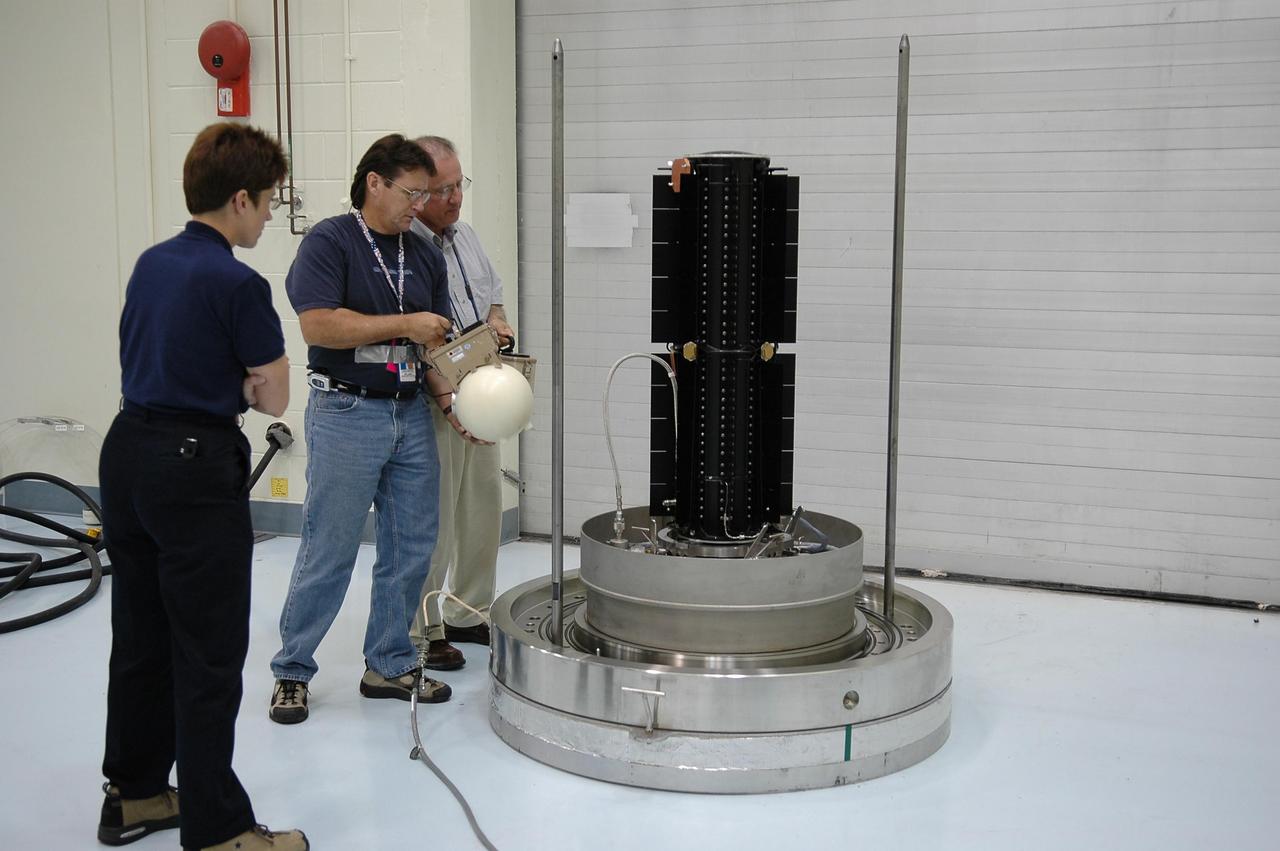
KENNEDY SPACE CENTER, FLA. - Inside the RTG facility at Kennedy Space Center, Amy Powell, Ennis Shelton and Ed Provost check the radioisotope thermoelectric generator (RTG) after removal of the outside container. The RTG is the baseline power supply for the NASA’s New Horizons spacecraft, scheduled to launch in January 2006 on a journey to Pluto and its moon, Charon. As it approaches Pluto, the spacecraft will look for ultraviolet emission from Pluto's atmosphere and make the best global maps of Pluto and Charon in green, blue, red and a special wavelength that is sensitive to methane frost on the surface. It will also take spectral maps in the near infrared, telling the science team about Pluto's and Charon's surface compositions and locations and temperatures of these materials. When the spacecraft is closest to Pluto or its moon, it will take close-up pictures in both visible and near-infrared wavelengths. It is expected to reach Pluto in July 2015.
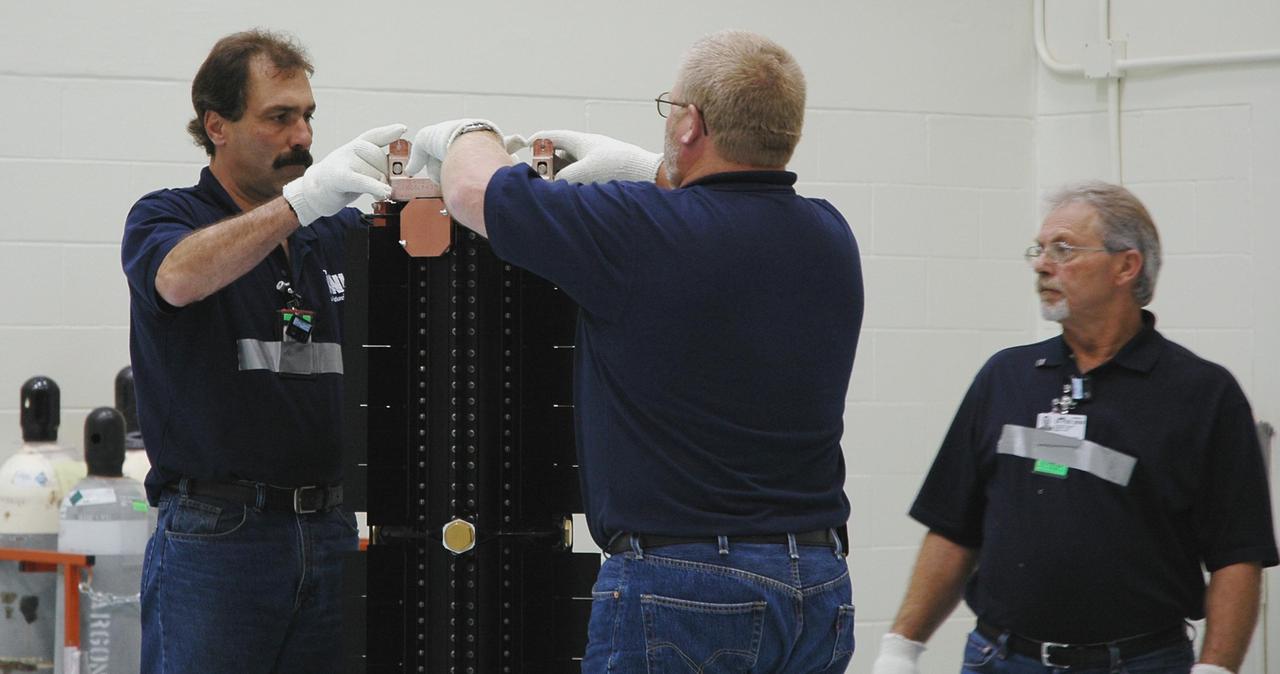
KENNEDY SPACE CENTER, FLA. - In the RTG Facility at Kennedy Space Center, Jim Wojciechowski and Dan Brunson install a clamping ring onto the radioisotope thermoelectric generator (RTG). Watching at right is Steve Killian. The RTG is the baseline power supply for the NASA’s New Horizons spacecraft, scheduled to launch in January 2006 on a journey to Pluto and its moon, Charon. As it approaches Pluto, the spacecraft will look for ultraviolet emission from Pluto's atmosphere and make the best global maps of Pluto and Charon in green, blue, red and a special wavelength that is sensitive to methane frost on the surface. It will also take spectral maps in the near infrared, telling the science team about Pluto's and Charon's surface compositions and locations and temperatures of these materials. When the spacecraft is closest to Pluto or its moon, it will take close-up pictures in both visible and near-infrared wavelengths. It is expected to reach Pluto in July 2015.
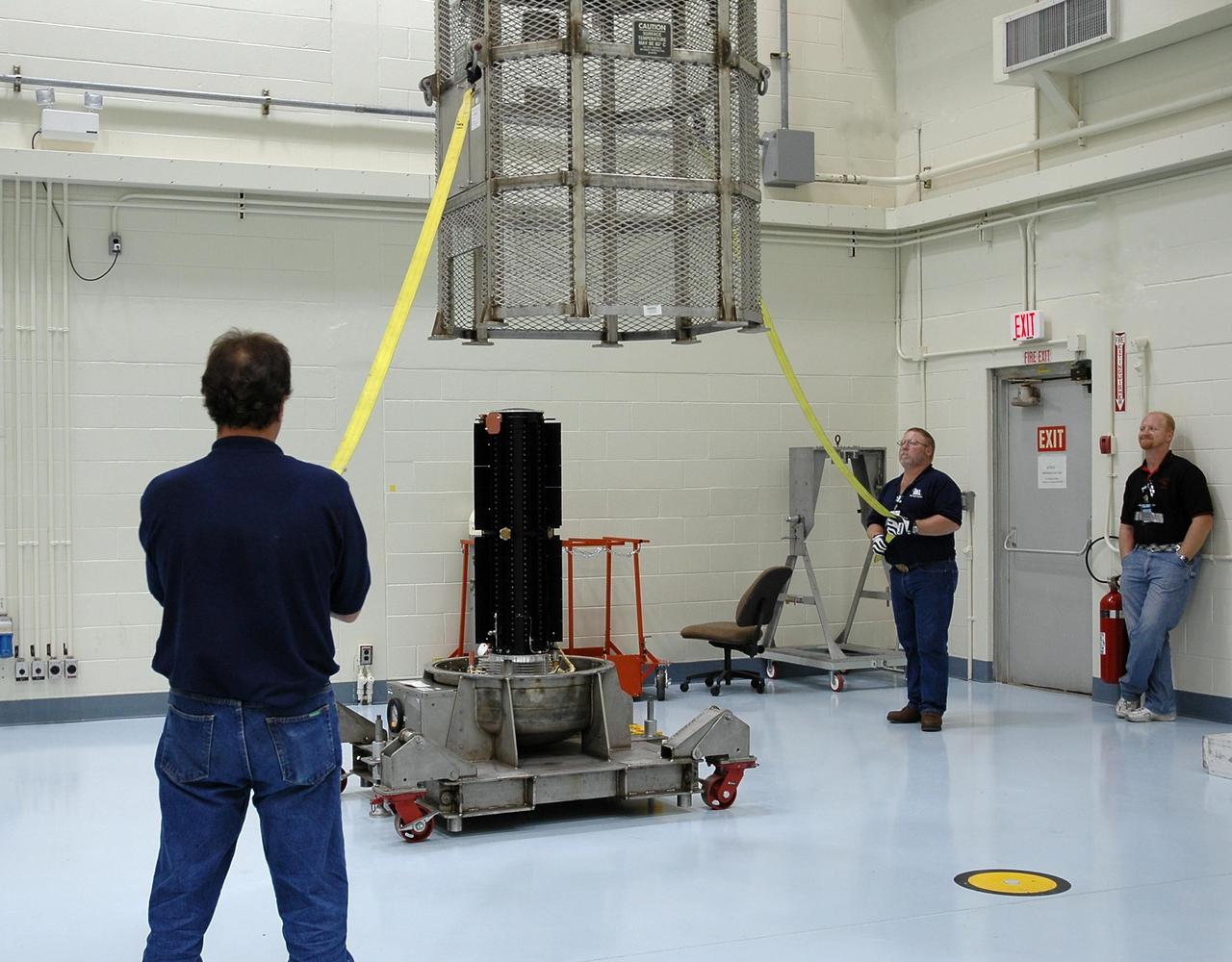
KENNEDY SPACE CENTER, FLA. - n the RTG Facility at Kennedy Space Center, Jim Wojciechowski and Dan Brunson move a metal canister toward the radioisotope thermoelectric generator (RTG). The canister will protect the RTG when it is moved. The RTG is the baseline power supply for the NASA’s New Horizons spacecraft, scheduled to launch in January 2006 on a journey to Pluto and its moon, Charon. As it approaches Pluto, the spacecraft will look for ultraviolet emission from Pluto's atmosphere and make the best global maps of Pluto and Charon in green, blue, red and a special wavelength that is sensitive to methane frost on the surface. It will also take spectral maps in the near infrared, telling the science team about Pluto's and Charon's surface compositions and locations and temperatures of these materials. When the spacecraft is closest to Pluto or its moon, it will take close-up pictures in both visible and near-infrared wavelengths. It is expected to reach Pluto in July 2015.

KENNEDY SPACE CENTER, FLA. - Inside the RTG facility at Kennedy Space Center, Dave Nobles oversees the operation as the container is lifted away from the radioisotope thermoelectric generator (RTG). The RTG is the baseline power supply for the NASA’s New Horizons spacecraft, scheduled to launch in January 2006 on a journey to Pluto and its moon, Charon. As it approaches Pluto, the spacecraft will look for ultraviolet emission from Pluto's atmosphere and make the best global maps of Pluto and Charon in green, blue, red and a special wavelength that is sensitive to methane frost on the surface. It will also take spectral maps in the near infrared, telling the science team about Pluto's and Charon's surface compositions and locations and temperatures of these materials. When the spacecraft is closest to Pluto or its moon, it will take close-up pictures in both visible and near-infrared wavelengths. It is expected to reach Pluto in July 2015.
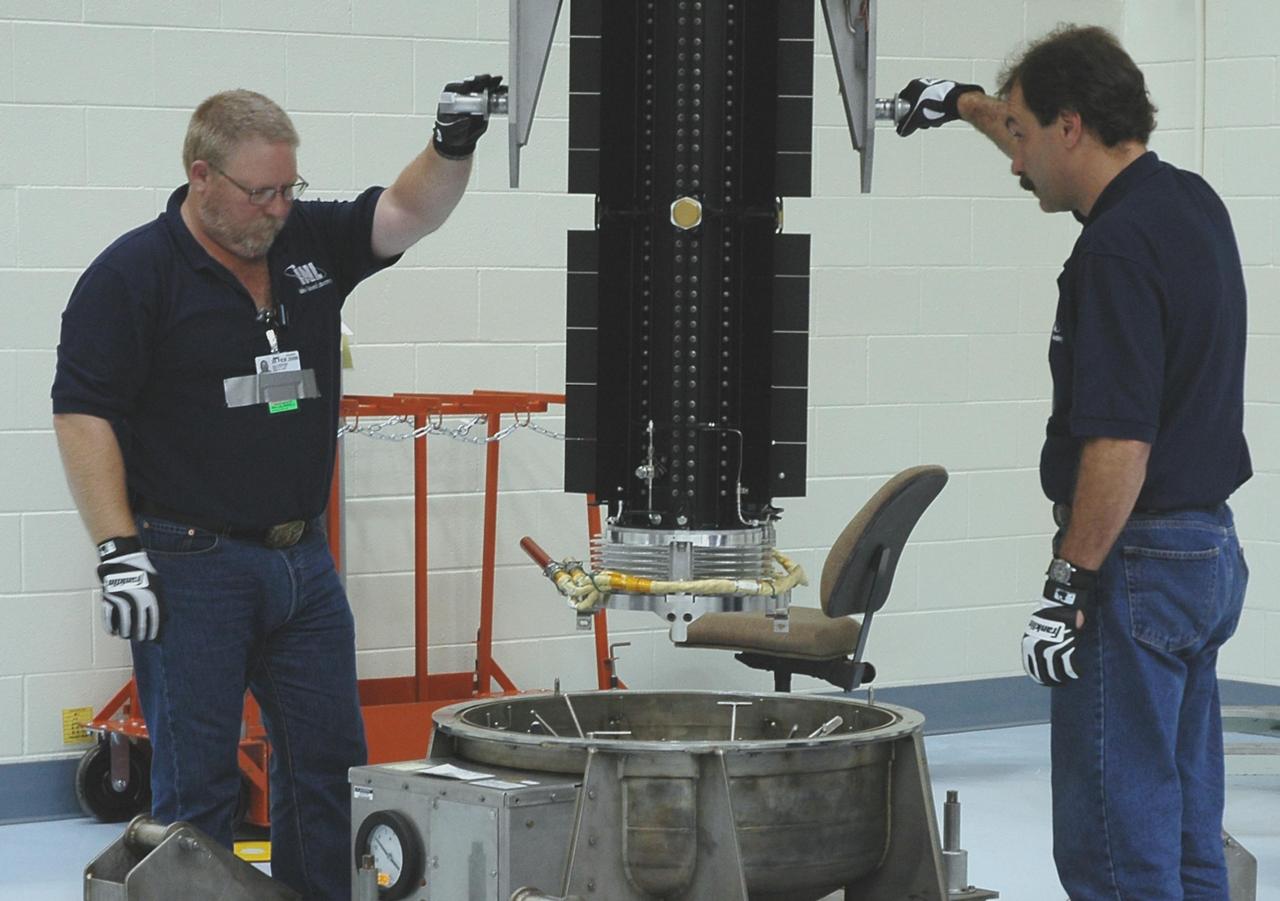
KENNEDY SPACE CENTER, FLA. - In the RTG Facility at Kennedy Space Center, Dan Brunson and Jim Wojciechowski lower the radioisotope thermoelectric generator (RTG) onto a transporter. The RTG is the baseline power supply for the NASA’s New Horizons spacecraft, scheduled to launch in January 2006 on a journey to Pluto and its moon, Charon. As it approaches Pluto, the spacecraft will look for ultraviolet emission from Pluto's atmosphere and make the best global maps of Pluto and Charon in green, blue, red and a special wavelength that is sensitive to methane frost on the surface. It will also take spectral maps in the near infrared, telling the science team about Pluto's and Charon's surface compositions and locations and temperatures of these materials. When the spacecraft is closest to Pluto or its moon, it will take close-up pictures in both visible and near-infrared wavelengths. It is expected to reach Pluto in July 2015.
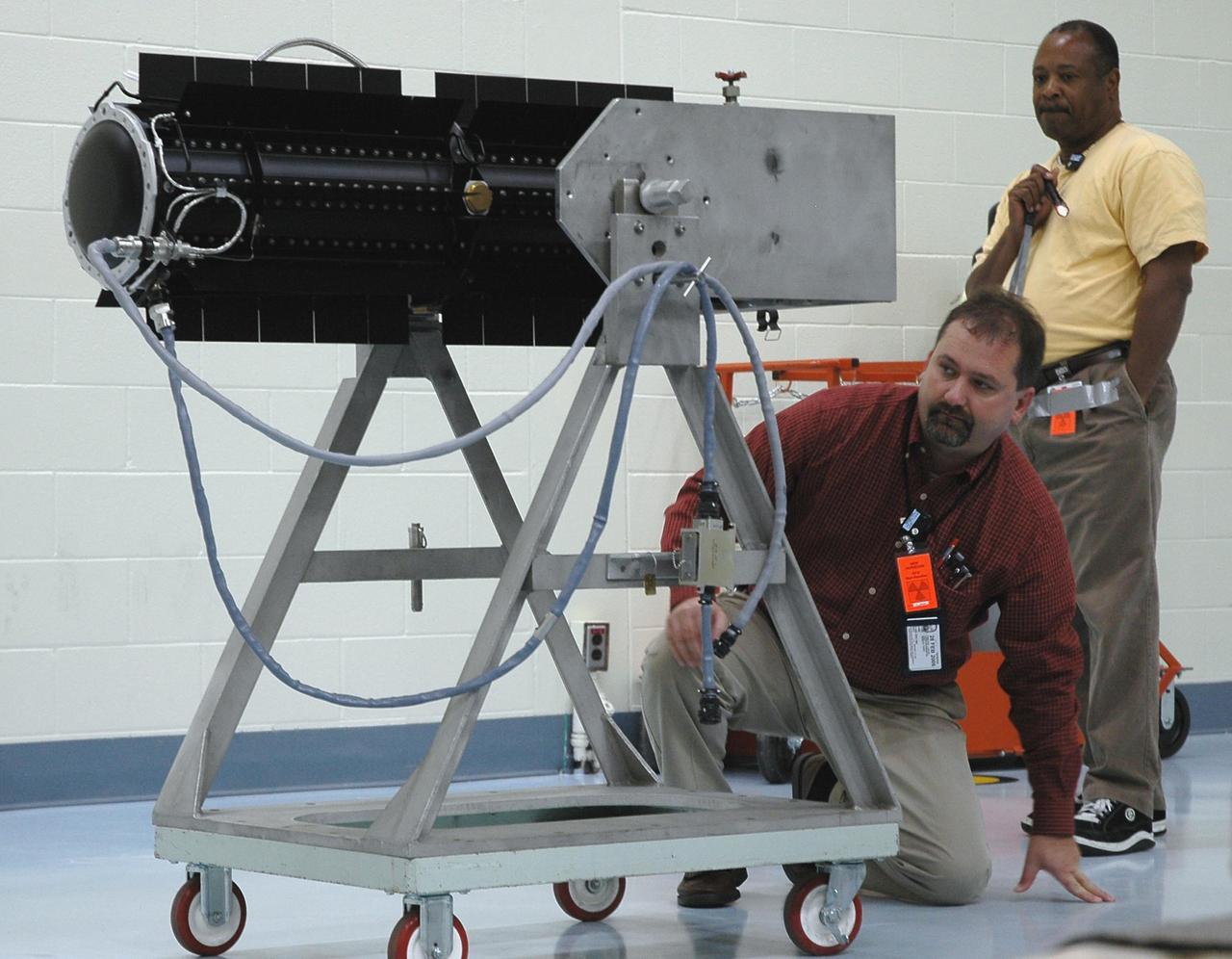
KENNEDY SPACE CENTER, FLA. - In the RTG Facility at Kennedy Space Center, Tim Hoyle and Mervin Smith check the cable on the radioisotope thermoelectric generator (RTG). The RTG is the baseline power supply for the NASA’s New Horizons spacecraft, scheduled to launch in January 2006 on a journey to Pluto and its moon, Charon. As it approaches Pluto, the spacecraft will look for ultraviolet emission from Pluto's atmosphere and make the best global maps of Pluto and Charon in green, blue, red and a special wavelength that is sensitive to methane frost on the surface. It will also take spectral maps in the near infrared, telling the science team about Pluto's and Charon's surface compositions and locations and temperatures of these materials. When the spacecraft is closest to Pluto or its moon, it will take close-up pictures in both visible and near-infrared wavelengths. It is expected to reach Pluto in July 2015.
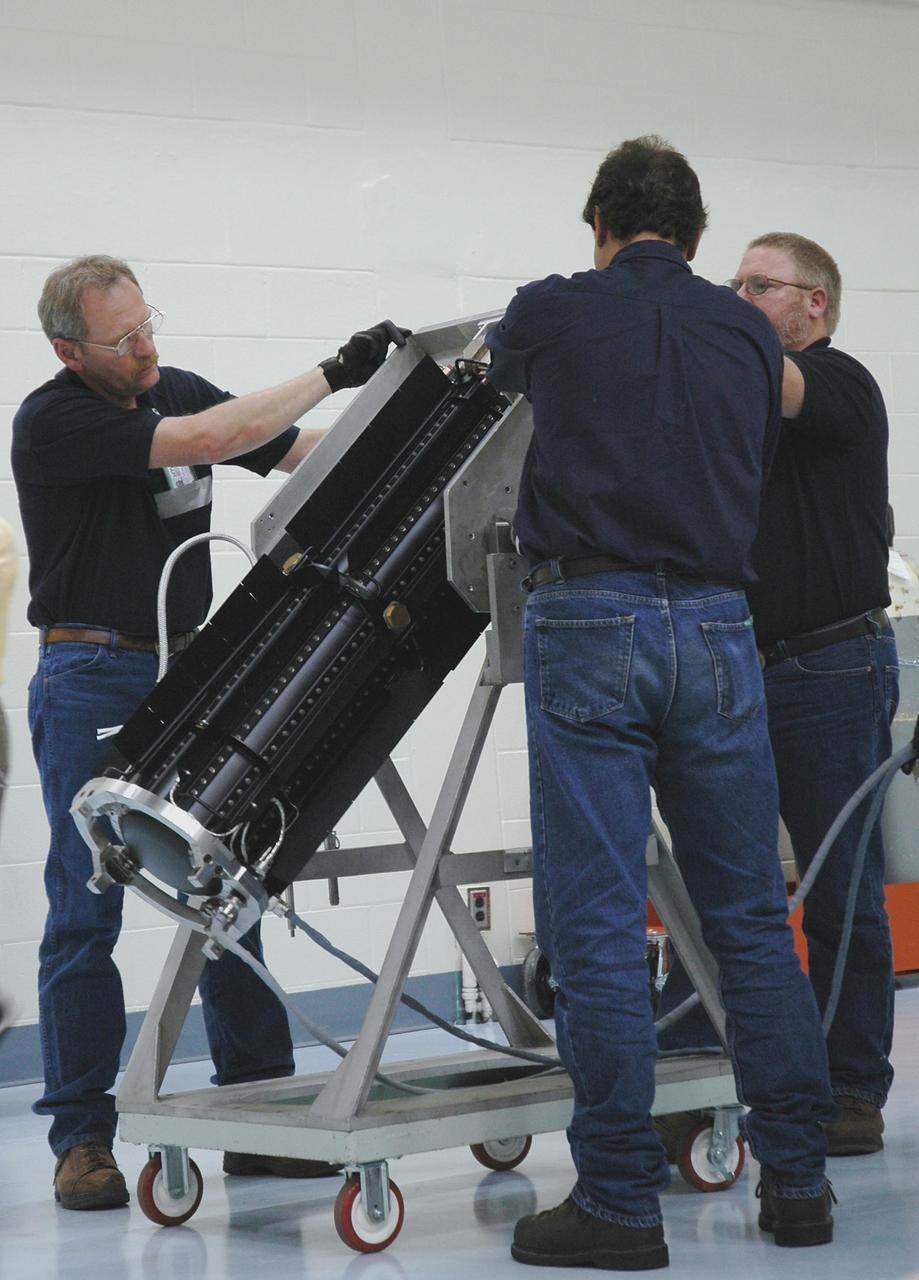
KENNEDY SPACE CENTER, FLA. - In the RTG Facility at Kennedy Space Center, Steve Killian, Jim Wojciechowski and Dan Brunson tilt the radioisotope thermoelectric generator (RTG) to a horizontal position. The RTG is the baseline power supply for the NASA’s New Horizons spacecraft, scheduled to launch in January 2006 on a journey to Pluto and its moon, Charon. As it approaches Pluto, the spacecraft will look for ultraviolet emission from Pluto's atmosphere and make the best global maps of Pluto and Charon in green, blue, red and a special wavelength that is sensitive to methane frost on the surface. It will also take spectral maps in the near infrared, telling the science team about Pluto's and Charon's surface compositions and locations and temperatures of these materials. When the spacecraft is closest to Pluto or its moon, it will take close-up pictures in both visible and near-infrared wavelengths. It is expected to reach Pluto in July 2015.

KENNEDY SPACE CENTER, FLA. - In the Payload Hazardous Servicing Facility, engineers lower a metal canister toward the radioisotope thermoelectric generator (RTG) below it. The RTG is being returned to the RTG facility after completing a fit check with the spacecraft. The RTG is the baseline power supply for the New Horizons, scheduled to launch in January 2006 on a journey to Pluto and its moon, Charon. As it approaches Pluto, the spacecraft will look for ultraviolet emission from Pluto's atmosphere and make the best global maps of Pluto and Charon in green, blue, red and a special wavelength that is sensitive to methane frost on the surface. It will also take spectral maps in the near infrared, telling the science team about Pluto's and Charon's surface compositions and locations and temperatures of these materials. When the spacecraft is closest to Pluto or its moon, it will take close-up pictures in both visible and near-infrared wavelengths. It is expected to reach Pluto in July 2015.

KENNEDY SPACE CENTER, FLA. - In the Payload Hazardous Servicing Facility, engineers move the radioisotope thermoelectric generator (RTG) away from NASA’s New Horizons spacecraft. The RTG is being returned to the RTG facility after completing a fit check with the spacecraft. The RTG is the baseline power supply for the New Horizons, scheduled to launch in January 2006 on a journey to Pluto and its moon, Charon. As it approaches Pluto, the spacecraft will look for ultraviolet emission from Pluto's atmosphere and make the best global maps of Pluto and Charon in green, blue, red and a special wavelength that is sensitive to methane frost on the surface. It will also take spectral maps in the near infrared, telling the science team about Pluto's and Charon's surface compositions and locations and temperatures of these materials. When the spacecraft is closest to Pluto or its moon, it will take close-up pictures in both visible and near-infrared wavelengths. It is expected to reach Pluto in July 2015.
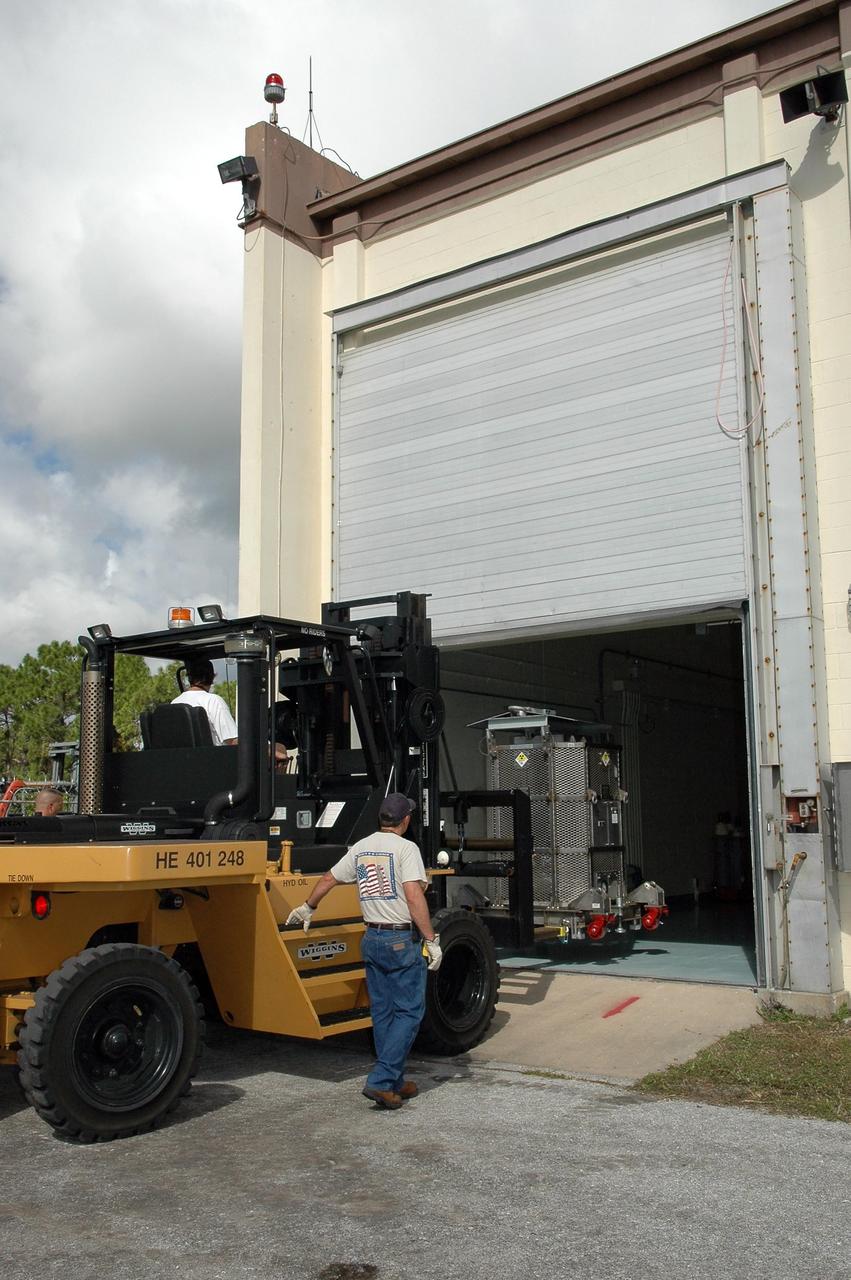
KENNEDY SPACE CENTER, FLA. - The radioisotope thermoelectric generator (RTG), enclosed in a metal canister, is moved into the RTG Facility. The RTG is being returned from the Payload Hazardous Servicing Facility where it underwent a fit check with the spacecraft. The RTG is the baseline power supply for the New Horizons, scheduled to launch in January 2006 on a journey to Pluto and its moon, Charon. As it approaches Pluto, the spacecraft will look for ultraviolet emission from Pluto's atmosphere and make the best global maps of Pluto and Charon in green, blue, red and a special wavelength that is sensitive to methane frost on the surface. It will also take spectral maps in the near infrared, telling the science team about Pluto's and Charon's surface compositions and locations and temperatures of these materials. When the spacecraft is closest to Pluto or its moon, it will take close-up pictures in both visible and near-infrared wavelengths. It is expected to reach Pluto in July 2015.
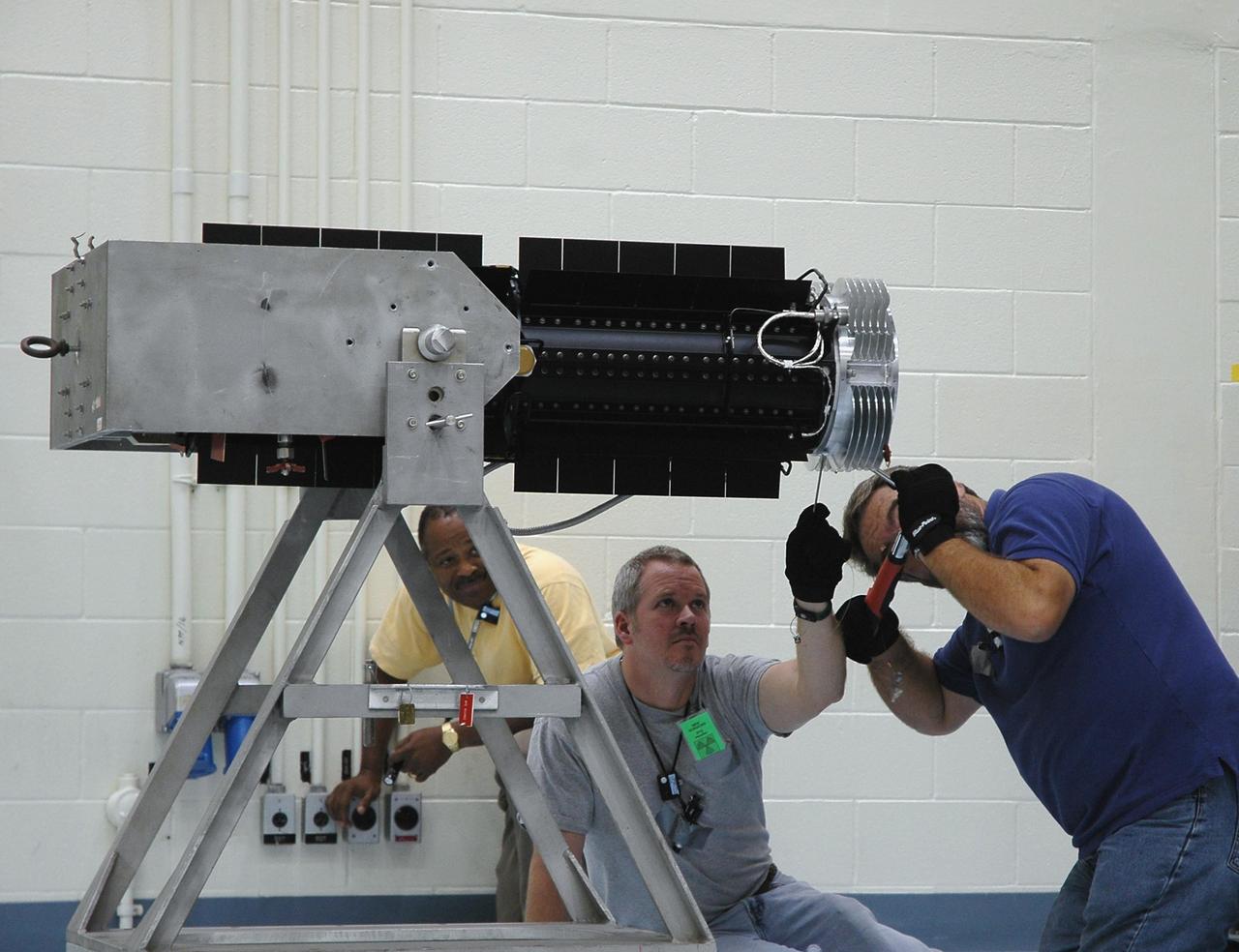
KENNEDY SPACE CENTER, FLA. - In the RTG Facility at Kennedy Space Center, Mervin Smith watches as technicians install a flight adapter on the radioisotope thermoelectric generator (RTG). The RTG is the baseline power supply for the NASA’s New Horizons spacecraft, scheduled to launch in January 2006 on a journey to Pluto and its moon, Charon. As it approaches Pluto, the spacecraft will look for ultraviolet emission from Pluto's atmosphere and make the best global maps of Pluto and Charon in green, blue, red and a special wavelength that is sensitive to methane frost on the surface. It will also take spectral maps in the near infrared, telling the science team about Pluto's and Charon's surface compositions and locations and temperatures of these materials. When the spacecraft is closest to Pluto or its moon, it will take close-up pictures in both visible and near-infrared wavelengths. It is expected to reach Pluto in July 2015.

KENNEDY SPACE CENTER, FLA. - The container holding the radioisotope thermoelectric generator (RTG) is moved inside the RTG facility at Kennedy Space Center. The RTG is the baseline power supply for the NASA’s New Horizons spacecraft, scheduled to launch in January 2006 on a journey to Pluto and its moon, Charon. The RTG is the baseline power supply for the NASA’s New Horizons spacecraft, scheduled to launch in January 2006 on a journey to Pluto and its moon, Charon. The RTG is the baseline power supply for the NASA’s New Horizons spacecraft, scheduled to launch in January 2006 on a journey to Pluto and its moon, Charon. As it approaches Pluto, the spacecraft will look for ultraviolet emission from Pluto's atmosphere and make the best global maps of Pluto and Charon in green, blue, red and a special wavelength that is sensitive to methane frost on the surface. It will also take spectral maps in the near infrared, telling the science team about Pluto's and Charon's surface compositions and locations and temperatures of these materials. When the spacecraft is closest to Pluto or its moon, it will take close-up pictures in both visible and near-infrared wavelengths. It is expected to reach Pluto in July 2015.
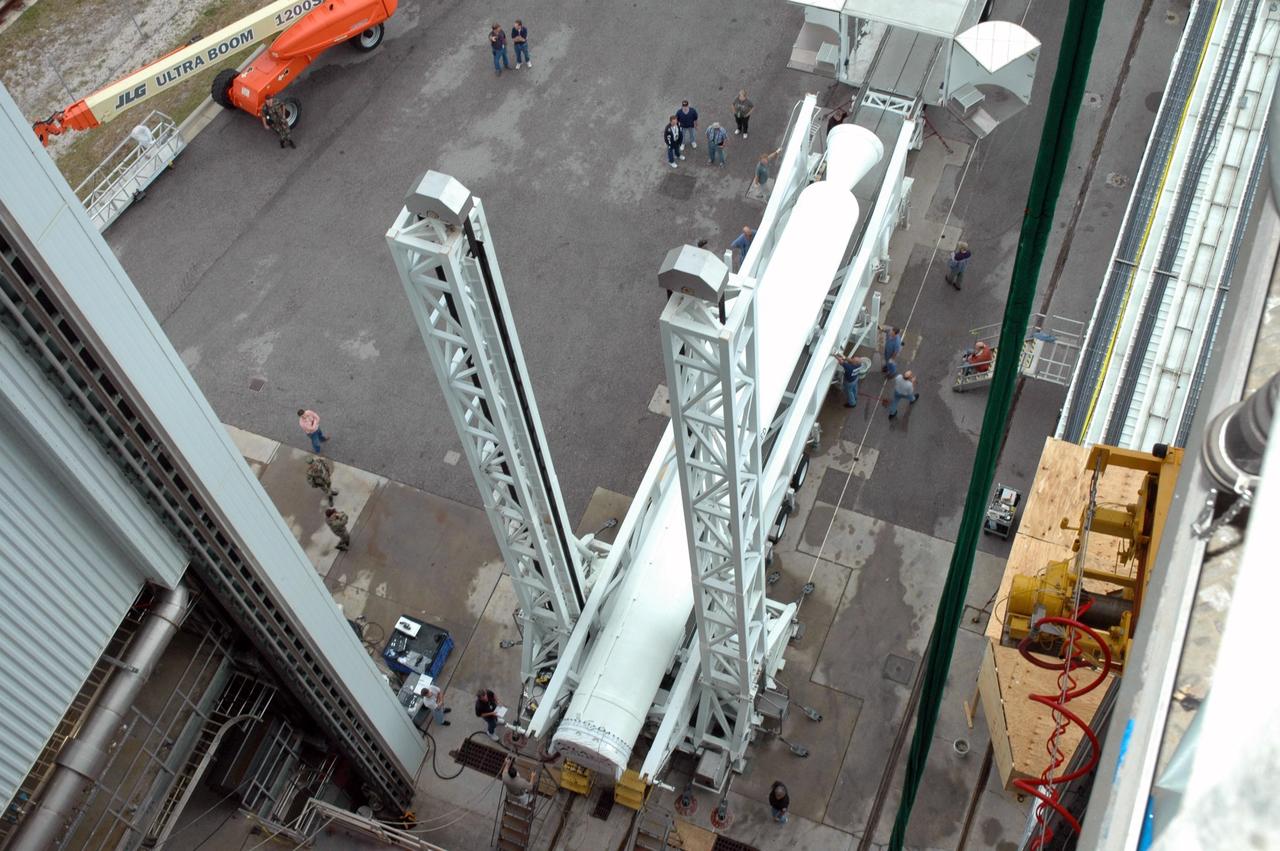
KENNEDY SPACE CENTER, FLA. - Viewed from high in the Vertical Integration Facility on Launch Complex 41 at Cape Canaveral Air Force Station in Florida, the fifth and final solid rocket booster is ready to be raised to vertical and lifted into the facility. It will be added to the other four already mated to the Lockheed Martin Atlas V rocket in the facility. The Atlas V is the launch vehicle for the Pluto-bound New Horizons spacecraft that will make the first reconnaissance of Pluto and its moon, Charon - a "double planet" and the last planet in our solar system to be visited by spacecraft. As it approaches Pluto, the spacecraft will look for ultraviolet emission from Pluto's atmosphere and make the best global maps of Pluto and Charon in green, blue, red and a special wavelength that is sensitive to methane frost on the surface. It will also take spectral maps in the near infrared, telling the science team about Pluto's and Charon’s surface compositions and locations and temperatures of these materials. When the spacecraft is closest to Pluto or its moon, it will take close-up pictures in both visible and near-infrared wavelengths. The mission will then visit one or more objects in the Kuiper Belt region beyond Neptune. New Horizons is scheduled to launch in January 2006, swing past Jupiter for a gravity boost and scientific studies in February or March 2007, and reach Pluto and Charon in July 2015.

KENNEDY SPACE CENTER, FLA. - The fifth and final solid rocket booster arrives at the Vertical Integration Facility on Launch Complex 41 at Cape Canaveral Air Force Station in Florida. It will be added to the other four already mated to the Lockheed Martin Atlas V rocket, seen in the background. The Atlas V is the launch vehicle for the Pluto-bound New Horizons spacecraft that will make the first reconnaissance of Pluto and its moon, Charon - a "double planet" and the last planet in our solar system to be visited by spacecraft. As it approaches Pluto, the spacecraft will look for ultraviolet emission from Pluto's atmosphere and make the best global maps of Pluto and Charon in green, blue, red and a special wavelength that is sensitive to methane frost on the surface. It will also take spectral maps in the near infrared, telling the science team about Pluto's and Charon’s surface compositions and locations and temperatures of these materials. When the spacecraft is closest to Pluto or its moon, it will take close-up pictures in both visible and near-infrared wavelengths. The mission will then visit one or more objects in the Kuiper Belt region beyond Neptune. New Horizons is scheduled to launch in January 2006, swing past Jupiter for a gravity boost and scientific studies in February or March 2007, and reach Pluto and Charon in July 2015.
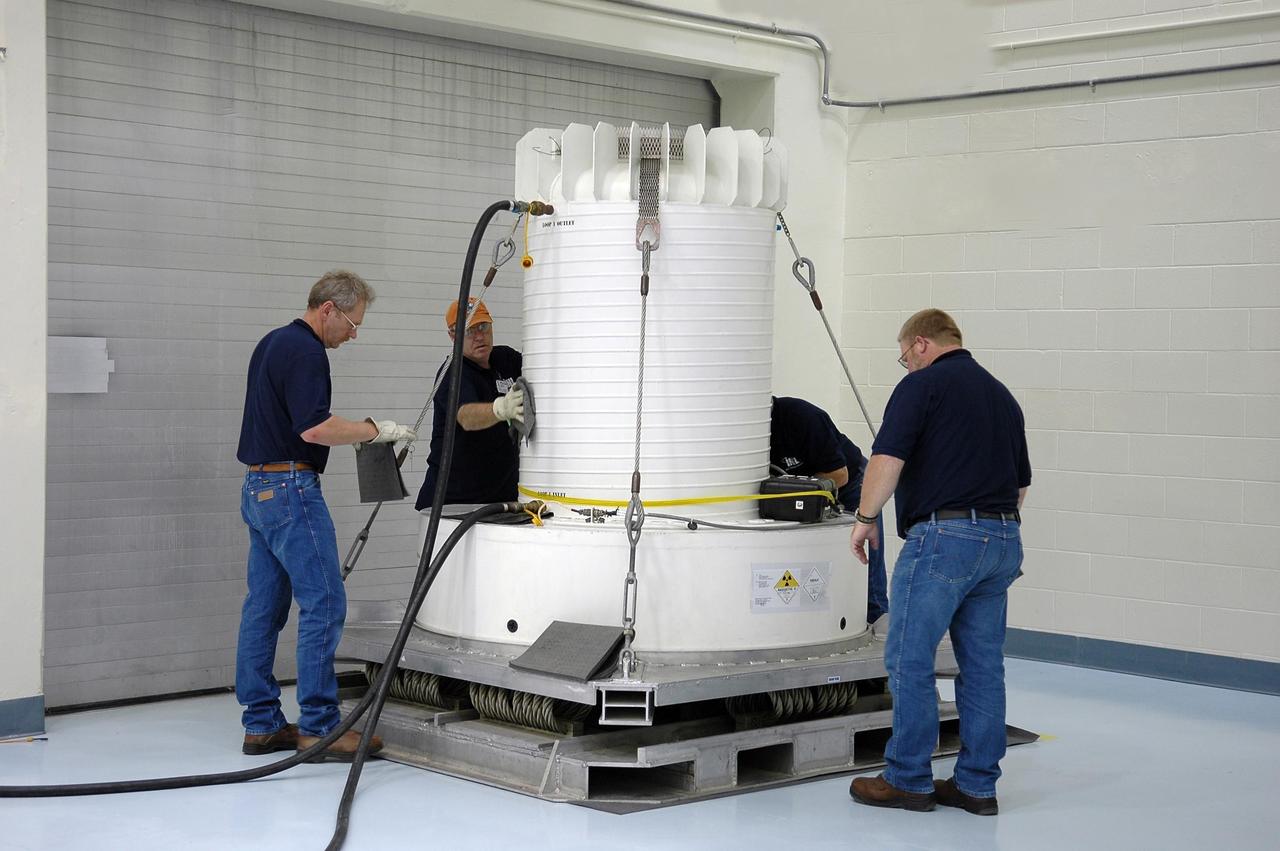
KENNEDY SPACE CENTER, FLA. - Bob Tessmer, Dave Nobles and Dan Brunson check the radioisotope thermoelectric generator (RTG) container after its move inside the RTG facility at Kennedy Space Center. The RTG is the baseline power supply for the NASA’s New Horizons spacecraft, scheduled to launch in January 2006 on a journey to Pluto and its moon, Charon. The RTG is the baseline power supply for the NASA’s New Horizons spacecraft, scheduled to launch in January 2006 on a journey to Pluto and its moon, Charon. As it approaches Pluto, the spacecraft will look for ultraviolet emission from Pluto's atmosphere and make the best global maps of Pluto and Charon in green, blue, red and a special wavelength that is sensitive to methane frost on the surface. It will also take spectral maps in the near infrared, telling the science team about Pluto's and Charon's surface compositions and locations and temperatures of these materials. When the spacecraft is closest to Pluto or its moon, it will take close-up pictures in both visible and near-infrared wavelengths. It is expected to reach Pluto in July 2015.
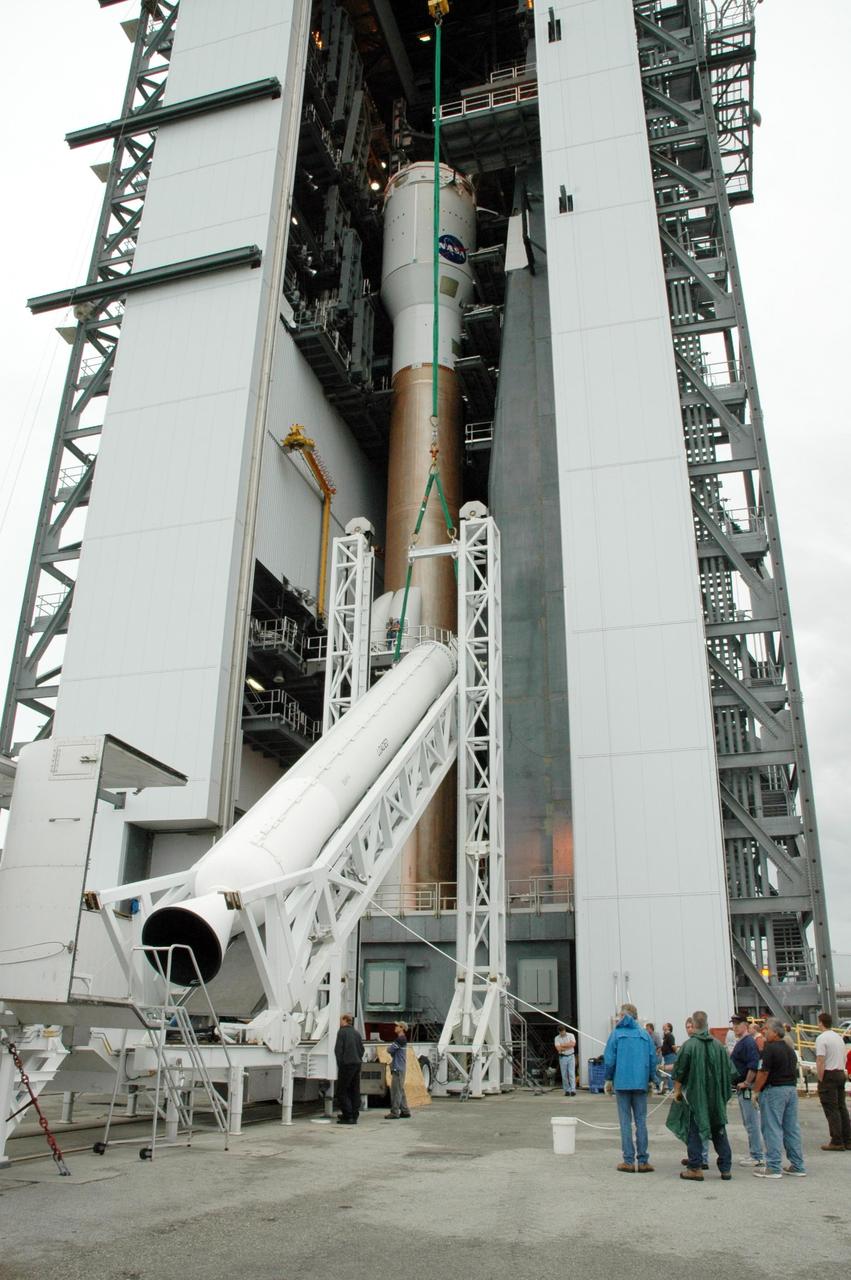
KENNEDY SPACE CENTER, FLA. - On Launch Complex 41 at Cape Canaveral Air Force Station in Florida, the fifth and final solid rocket booster is being raised to a vertical position. It will be lifted and added to the other four already mated to the Lockheed Martin Atlas V rocket in the Vertical Integration Facility. The Atlas V is the launch vehicle for the Pluto-bound New Horizons spacecraft that will make the first reconnaissance of Pluto and its moon, Charon - a "double planet" and the last planet in our solar system to be visited by spacecraft. As it approaches Pluto, the spacecraft will look for ultraviolet emission from Pluto's atmosphere and make the best global maps of Pluto and Charon in green, blue, red and a special wavelength that is sensitive to methane frost on the surface. It will also take spectral maps in the near infrared, telling the science team about Pluto's and Charon’s surface compositions and locations and temperatures of these materials. When the spacecraft is closest to Pluto or its moon, it will take close-up pictures in both visible and near-infrared wavelengths. The mission will then visit one or more objects in the Kuiper Belt region beyond Neptune. New Horizons is scheduled to launch in January 2006, swing past Jupiter for a gravity boost and scientific studies in February or March 2007, and reach Pluto and Charon in July 2015.

KENNEDY SPACE CENTER, FLA. - On Launch Complex 41 at Cape Canaveral Air Force Station, workers prepare the Lockheed Martin Atlas V rocket for mating of the solid rocket boosters. In the foreground is the trailer used to transport the boosters to the pad. The Atlas V is the launch vehicle for the Pluto-bound New Horizons spacecraft that will make the first reconnaissance of Pluto and its moon, Charon - a "double planet" and the last planet in our solar system to be visited by spacecraft. As it approaches Pluto, the spacecraft will look for ultraviolet emission from Pluto's atmosphere and make the best global maps of Pluto and Charon in green, blue, red and a special wavelength that is sensitive to methane frost on the surface. It will also take spectral maps in the near infrared, telling the science team about Pluto's and Charon’s surface compositions and locations and temperatures of these materials. When the spacecraft is closest to Pluto or its moon, it will take close-up pictures in both visible and near-infrared wavelengths. The mission will then visit one or more objects in the Kuiper Belt region beyond Neptune. New Horizons is scheduled to launch in January 2006, swing past Jupiter for a gravity boost and scientific studies in February or March 2007, and reach Pluto and Charon in July 2015.
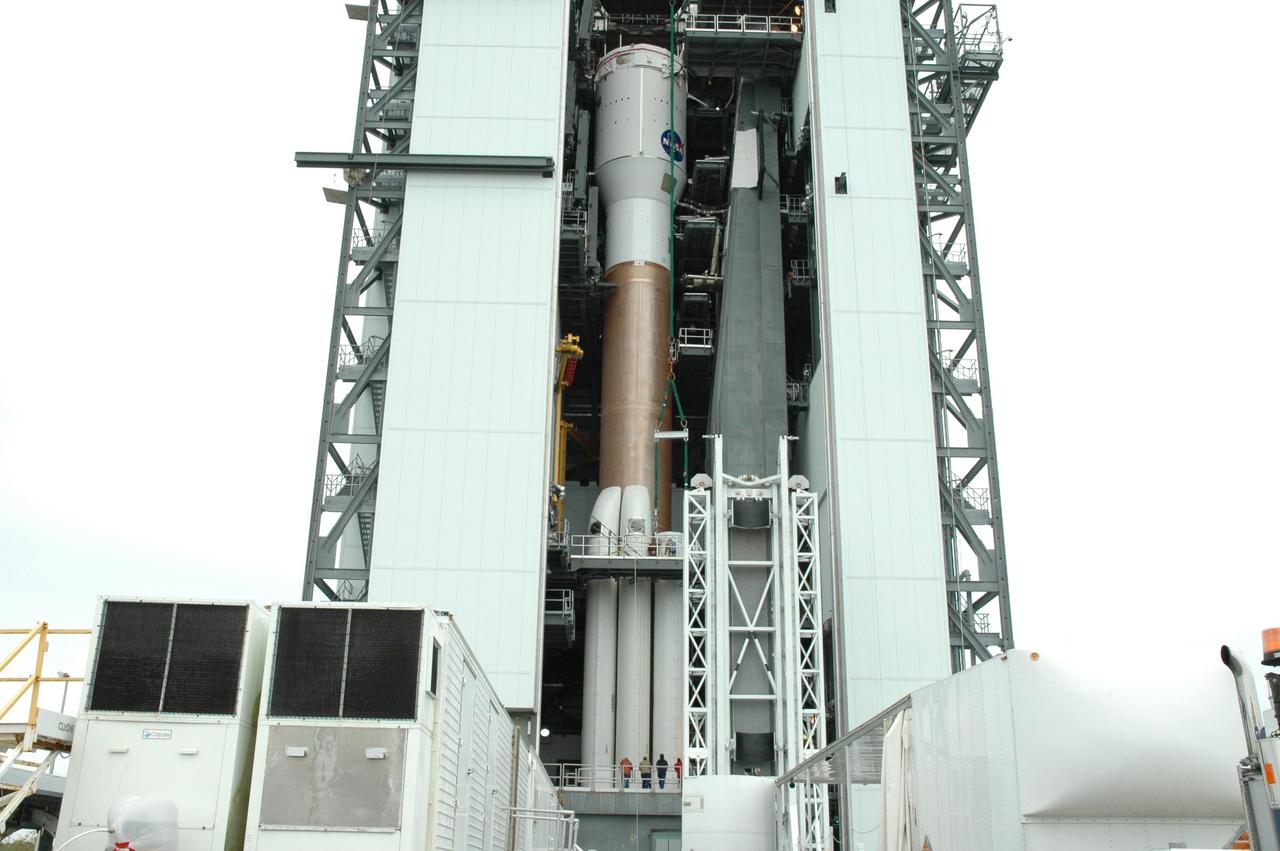
KENNEDY SPACE CENTER, FLA. - On Launch Complex 41 at Cape Canaveral Air Force Station in Florida, the five solid rocket boosters are now mated with the Lockheed Martin Atlas V rocket in the Vertical Integration Facility. The Atlas V is the launch vehicle for the Pluto-bound New Horizons spacecraft that will make the first reconnaissance of Pluto and its moon, Charon - a "double planet" and the last planet in our solar system to be visited by spacecraft. As it approaches Pluto, the spacecraft will look for ultraviolet emission from Pluto's atmosphere and make the best global maps of Pluto and Charon in green, blue, red and a special wavelength that is sensitive to methane frost on the surface. It will also take spectral maps in the near infrared, telling the science team about Pluto's and Charon’s surface compositions and locations and temperatures of these materials. When the spacecraft is closest to Pluto or its moon, it will take close-up pictures in both visible and near-infrared wavelengths. The mission will then visit one or more objects in the Kuiper Belt region beyond Neptune. New Horizons is scheduled to launch in January 2006, swing past Jupiter for a gravity boost and scientific studies in February or March 2007, and reach Pluto and Charon in July 2015.

KENNEDY SPACE CENTER, FLA. - On Launch Complex 41 at Cape Canaveral Air Force Station in Florida, the fifth and final solid rocket booster is raised to a vertical position. It will be lifted into the Vertical Integration Facility and added to the other four already mated to the Lockheed Martin Atlas V rocket there. The Atlas V is the launch vehicle for the Pluto-bound New Horizons spacecraft that will make the first reconnaissance of Pluto and its moon, Charon - a "double planet" and the last planet in our solar system to be visited by spacecraft. As it approaches Pluto, the spacecraft will look for ultraviolet emission from Pluto's atmosphere and make the best global maps of Pluto and Charon in green, blue, red and a special wavelength that is sensitive to methane frost on the surface. It will also take spectral maps in the near infrared, telling the science team about Pluto's and Charon’s surface compositions and locations and temperatures of these materials. When the spacecraft is closest to Pluto or its moon, it will take close-up pictures in both visible and near-infrared wavelengths. The mission will then visit one or more objects in the Kuiper Belt region beyond Neptune. New Horizons is scheduled to launch in January 2006, swing past Jupiter for a gravity boost and scientific studies in February or March 2007, and reach Pluto and Charon in July 2015.
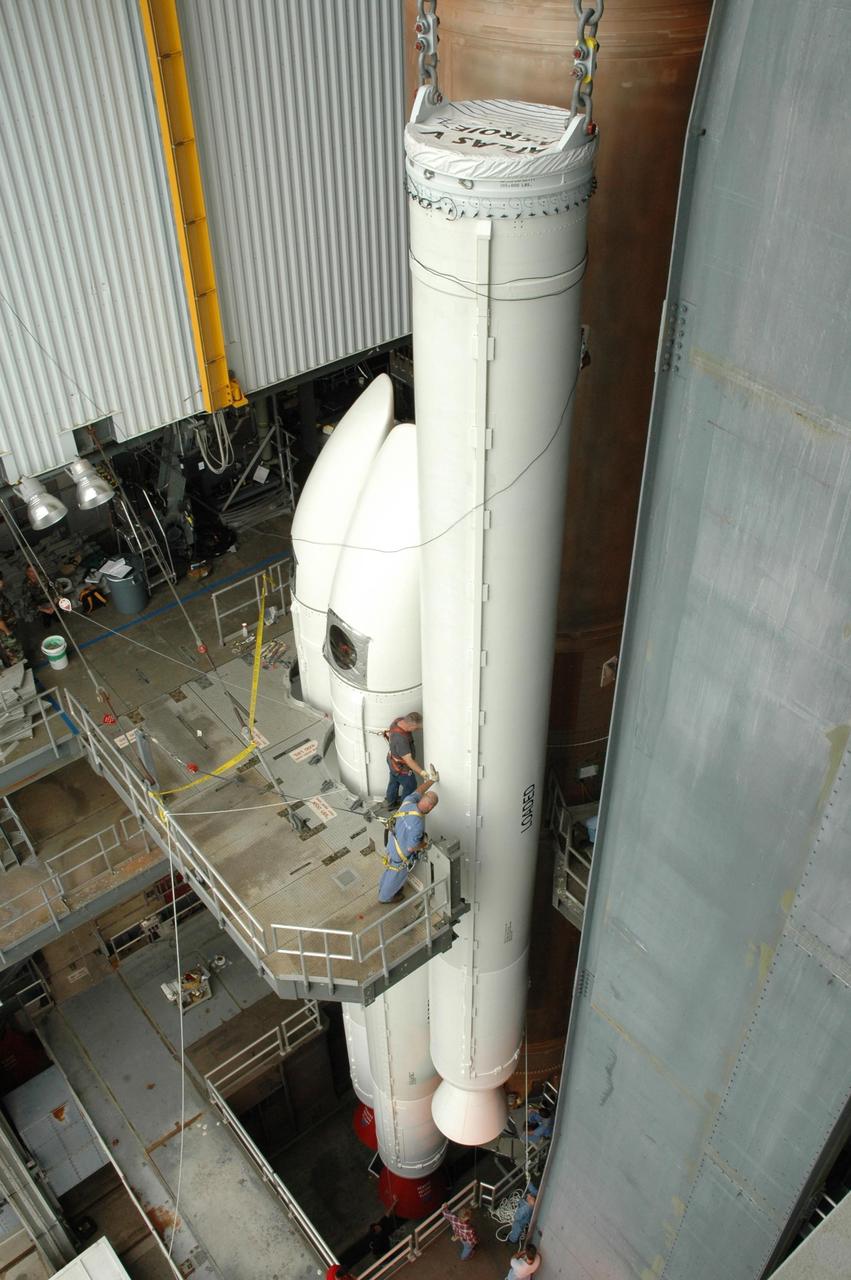
KENNEDY SPACE CENTER, FLA. - In the Vertical Integration Facility on Launch Complex 41 at Cape Canaveral Air Force Station in Florida, workers maneuver the fifth and final solid rocket booster into place for mating to the Lockheed Martin Atlas V rocket. Two of the other four rockets are seen at left. The Atlas V is the launch vehicle for the Pluto-bound New Horizons spacecraft that will make the first reconnaissance of Pluto and its moon, Charon - a "double planet" and the last planet in our solar system to be visited by spacecraft. As it approaches Pluto, the spacecraft will look for ultraviolet emission from Pluto's atmosphere and make the best global maps of Pluto and Charon in green, blue, red and a special wavelength that is sensitive to methane frost on the surface. It will also take spectral maps in the near infrared, telling the science team about Pluto's and Charon’s surface compositions and locations and temperatures of these materials. When the spacecraft is closest to Pluto or its moon, it will take close-up pictures in both visible and near-infrared wavelengths. The mission will then visit one or more objects in the Kuiper Belt region beyond Neptune. New Horizons is scheduled to launch in January 2006, swing past Jupiter for a gravity boost and scientific studies in February or March 2007, and reach Pluto and Charon in July 2015.

KENNEDY SPACE CENTER, FLA. - On Launch Complex 41 at Cape Canaveral Air Force Station in Florida, the fifth and final solid rocket booster is being lifted into the Vertical Integration Facility. It will be added to the other four already mated to the Lockheed Martin Atlas V rocket there. The Atlas V is the launch vehicle for the Pluto-bound New Horizons spacecraft that will make the first reconnaissance of Pluto and its moon, Charon - a "double planet" and the last planet in our solar system to be visited by spacecraft. As it approaches Pluto, the spacecraft will look for ultraviolet emission from Pluto's atmosphere and make the best global maps of Pluto and Charon in green, blue, red and a special wavelength that is sensitive to methane frost on the surface. It will also take spectral maps in the near infrared, telling the science team about Pluto's and Charon’s surface compositions and locations and temperatures of these materials. When the spacecraft is closest to Pluto or its moon, it will take close-up pictures in both visible and near-infrared wavelengths. The mission will then visit one or more objects in the Kuiper Belt region beyond Neptune. New Horizons is scheduled to launch in January 2006, swing past Jupiter for a gravity boost and scientific studies in February or March 2007, and reach Pluto and Charon in July 2015.

KENNEDY SPACE CENTER, FLA. - In front of the mobile service tower on Launch Complex 41 at Cape Canaveral Air Force Station in Florida, the Lockheed Martin Atlas V Centaur stage is raised off the transporter. Once vertical, the Centaur, the second stage of the launch vehicle for the New Horizons spacecraft, will be lifted up the tower and mated with the waiting first stage, seen at left. New Horizons will make the first reconnaissance of Pluto and its moon, Charon - a "double planet" and the last planet in our solar system to be visited by spacecraft. As it approaches Pluto, the spacecraft will look for ultraviolet emission from Pluto's atmosphere and make the best global maps of Pluto and Charon in green, blue, red and a special wavelength that is sensitive to methane frost on the surface. It will also take spectral maps in the near infrared, telling the science team about Pluto's and Charon's surface compositions and locations and temperatures of these materials. When the spacecraft is closest to Pluto or its moon, it will take close-up pictures in both visible and near-infrared wavelengths. The mission will then visit one or more objects in the Kuiper Belt region beyond Neptune. New Horizons is scheduled to launch in January 2006, swing past Jupiter for a gravity boost and scientific studies in February or March 2007, and reach Pluto and Charon in July 2015.
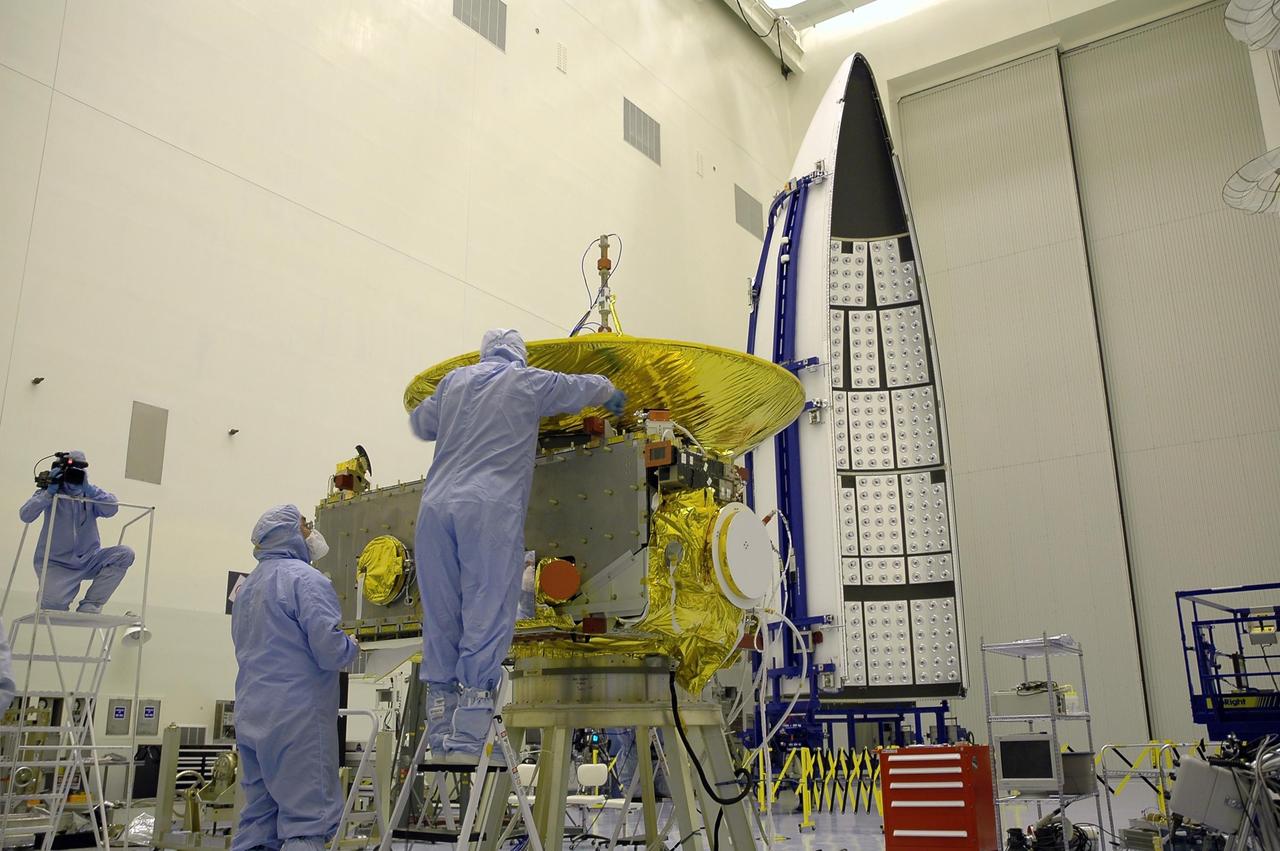
KENNEDY SPACE CENTER, FLA. - At NASA Kennedy Space Center’s Payload Hazardous Servicing Facility, technicians from the Applied Physics Laboratory install another panel on the New Horizons spacecraft. A series of interconnecting panels will enclose the spacecraft beneath the antenna to maintain safe operating temperatures in space. New Horizons will make the first reconnaissance of Pluto and its moon, Charon - a "double planet" and the last planet in our solar system to be visited by spacecraft. As it approaches Pluto, the spacecraft will look for ultraviolet emission from Pluto's atmosphere and make the best global maps of Pluto and Charon in green, blue, red and a special wavelength that is sensitive to methane frost on the surface. It will also take spectral maps in the near infrared, telling the science team about Pluto's and Charon's surface compositions and locations and temperatures of these materials. When the spacecraft is closest to Pluto or its moon, it will take close-up pictures in both visible and near-infrared wavelengths. The mission will then visit one or more objects in the Kuiper Belt region beyond Neptune. New Horizons is scheduled to launch in January 2006, swing past Jupiter for a gravity boost and scientific studies in February or March 2007, and reach Pluto and Charon in July 2015.

KENNEDY SPACE CENTER, FLA. - In front of the mobile service tower on Launch Complex 41 at Cape Canaveral Air Force Station in Florida, workers complete the raising of the Lockheed Martin Atlas V Centaur stage to a vertical position. The second stage of the launch vehicle for the New Horizons spacecraft, the Centaur will be mated with the waiting first stage, seen behind it at left. New Horizons will make the first reconnaissance of Pluto and its moon, Charon - a "double planet" and the last planet in our solar system to be visited by spacecraft. As it approaches Pluto, the spacecraft will look for ultraviolet emission from Pluto's atmosphere and make the best global maps of Pluto and Charon in green, blue, red and a special wavelength that is sensitive to methane frost on the surface. It will also take spectral maps in the near infrared, telling the science team about Pluto's and Charon's surface compositions and locations and temperatures of these materials. When the spacecraft is closest to Pluto or its moon, it will take close-up pictures in both visible and near-infrared wavelengths. The mission will then visit one or more objects in the Kuiper Belt region beyond Neptune. New Horizons is scheduled to launch in January 2006, swing past Jupiter for a gravity boost and scientific studies in February or March 2007, and reach Pluto and Charon in July 2015.
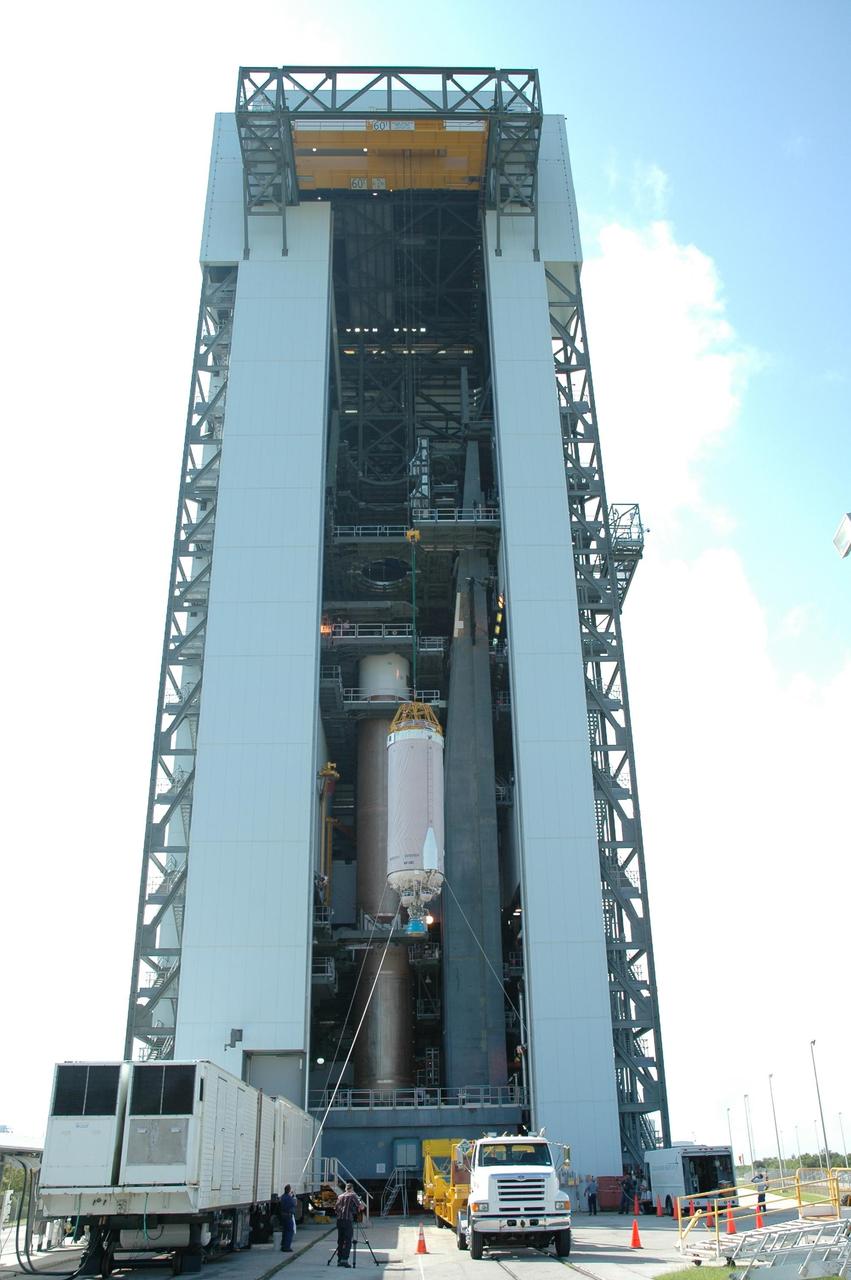
KENNEDY SPACE CENTER, FLA. - On Launch Complex 41 at Cape Canaveral Air Force Station in Florida, the Lockheed Martin Atlas V Centaur stage is lifted up the mobile service tower where it will be mated with the waiting first stage, seen behind it at left. New Horizons will make the first reconnaissance of Pluto and its moon, Charon - a "double planet" and the last planet in our solar system to be visited by spacecraft. As it approaches Pluto, the spacecraft will look for ultraviolet emission from Pluto's atmosphere and make the best global maps of Pluto and Charon in green, blue, red and a special wavelength that is sensitive to methane frost on the surface. It will also take spectral maps in the near infrared, telling the science team about Pluto's and Charon's surface compositions and locations and temperatures of these materials. When the spacecraft is closest to Pluto or its moon, it will take close-up pictures in both visible and near-infrared wavelengths. The mission will then visit one or more objects in the Kuiper Belt region beyond Neptune. New Horizons is scheduled to launch in January 2006, swing past Jupiter for a gravity boost and scientific studies in February or March 2007, and reach Pluto and Charon in July 2015.
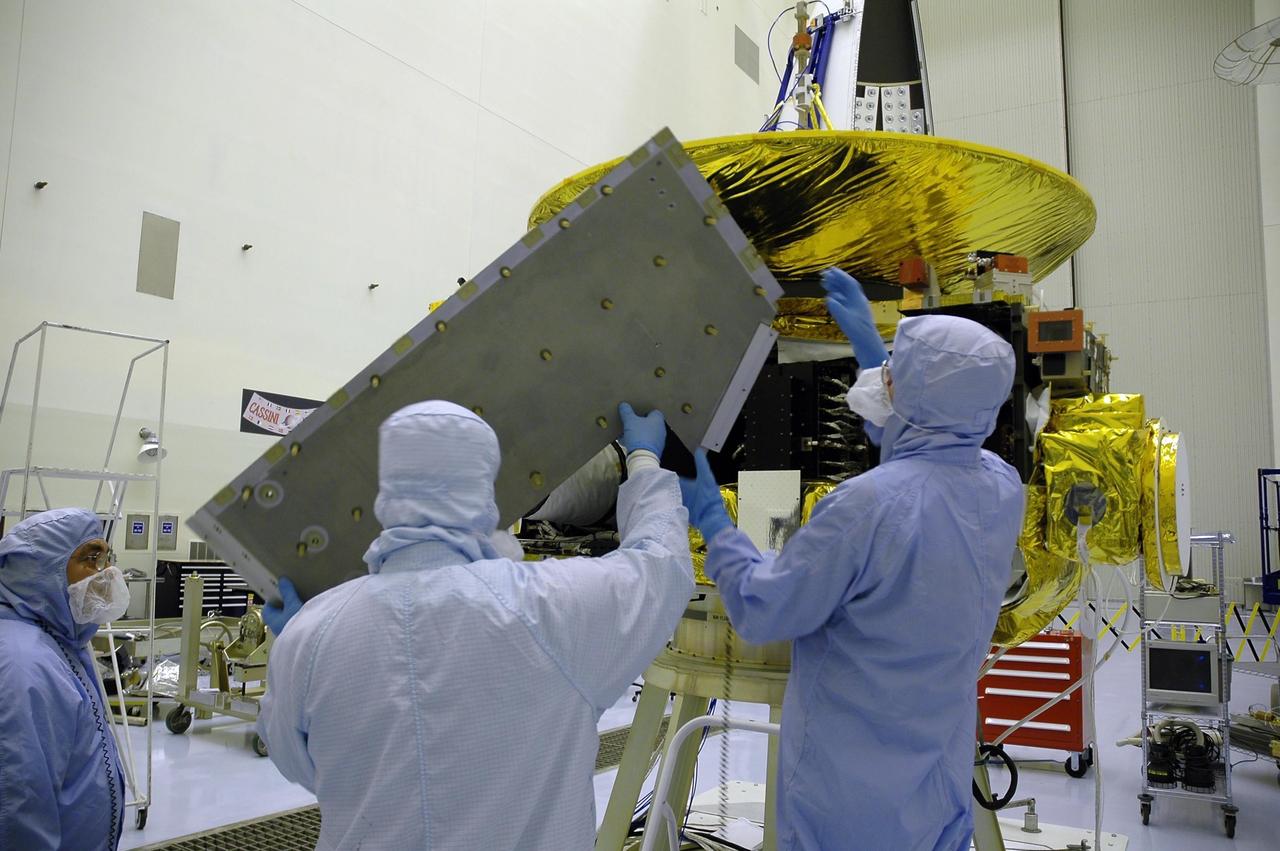
KENNEDY SPACE CENTER, FLA. - At NASA Kennedy Space Center’s Payload Hazardous Servicing Facility, a technician from the Applied Physics Laboratory works on the New Horizons spacecraft before installing one of the panels. A series of interconnecting panels will enclose the spacecraft beneath the antenna to maintain safe operating temperatures in space. New Horizons will make the first reconnaissance of Pluto and its moon, Charon - a "double planet" and the last planet in our solar system to be visited by spacecraft. As it approaches Pluto, the spacecraft will look for ultraviolet emission from Pluto's atmosphere and make the best global maps of Pluto and Charon in green, blue, red and a special wavelength that is sensitive to methane frost on the surface. It will also take spectral maps in the near infrared, telling the science team about Pluto's and Charon's surface compositions and locations and temperatures of these materials. When the spacecraft is closest to Pluto or its moon, it will take close-up pictures in both visible and near-infrared wavelengths. The mission will then visit one or more objects in the Kuiper Belt region beyond Neptune. New Horizons is scheduled to launch in January 2006, swing past Jupiter for a gravity boost and scientific studies in February or March 2007, and reach Pluto and Charon in July 2015.
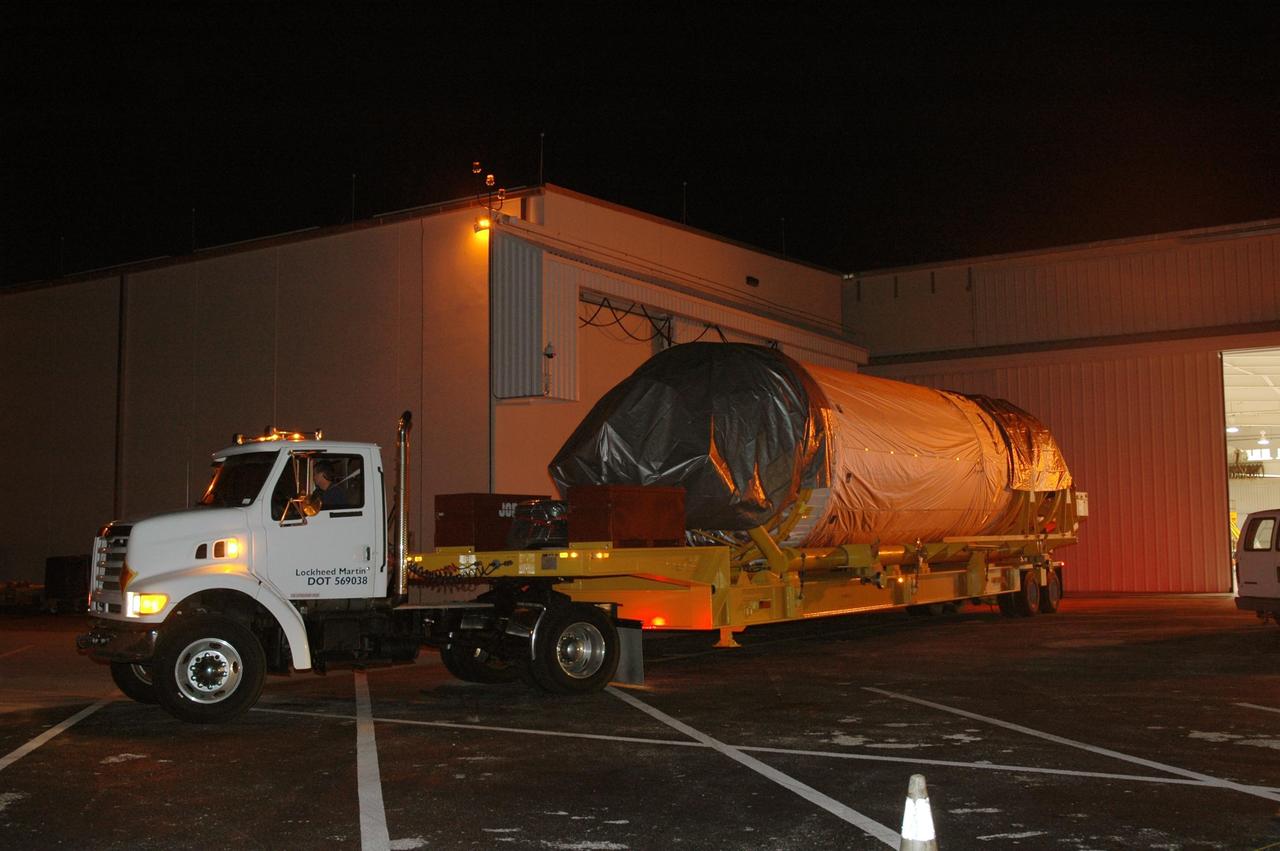
KENNEDY SPACE CENTER, FLA. - The Lockheed Martin Atlas V Centaur stage leaves the Astrotech Space Operations Center in Titusville, Fla., for the short journey to Launch Complex 41 at Cape Canaveral Air Force Station. The Centaur is the second stage of the launch vehicle for the New Horizons spacecraft. New Horizons will make the first reconnaissance of Pluto and its moon, Charon - a "double planet" and the last planet in our solar system to be visited by spacecraft. As it approaches Pluto, the spacecraft will look for ultraviolet emission from Pluto's atmosphere and make the best global maps of Pluto and Charon in green, blue, red and a special wavelength that is sensitive to methane frost on the surface. It will also take spectral maps in the near infrared, telling the science team about Pluto's and Charon's surface compositions and locations and temperatures of these materials. When the spacecraft is closest to Pluto or its moon, it will take close-up pictures in both visible and near-infrared wavelengths. The mission will then visit one or more objects in the Kuiper Belt region beyond Neptune. New Horizons is scheduled to launch in January 2006, swing past Jupiter for a gravity boost and scientific studies in February or March 2007, and reach Pluto and Charon in July 2015.
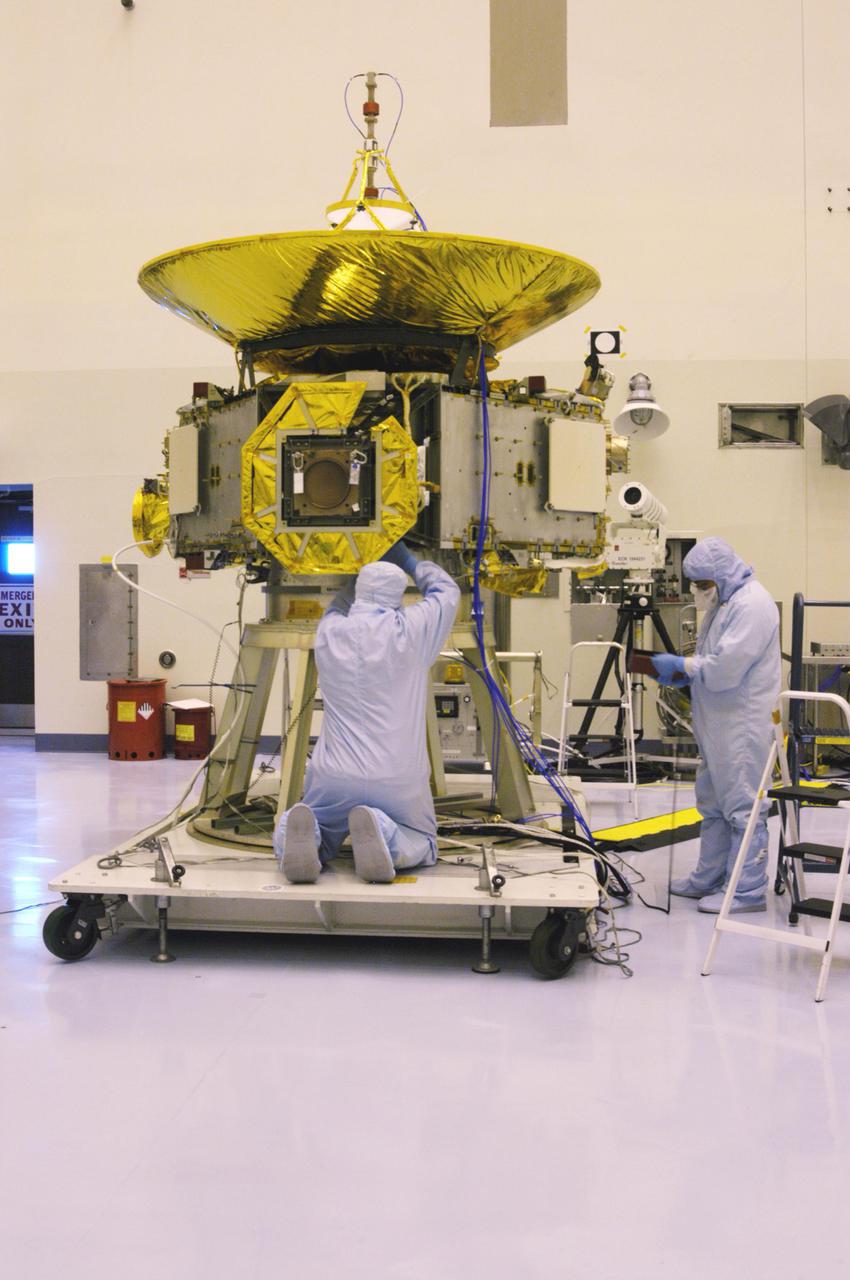
KENNEDY SPACE CENTER, FLA. - At NASA Kennedy Space Center’s Payload Hazardous Servicing Facility, technicians from the Applied Physics Laboratory work on the New Horizons spacecraft. They have been installing side panels on the spacecraft. A series of interconnecting panels will enclose the spacecraft beneath the antenna to maintain safe operating temperatures in space. New Horizons will make the first reconnaissance of Pluto and its moon, Charon - a 'double planet' and the last planet in our solar system to be visited by spacecraft. As it approaches Pluto, the spacecraft will look for ultraviolet emission from Pluto's atmosphere and make the best global maps of Pluto and Charon in green, blue, red and a special wavelength that is sensitive to methane frost on the surface. It will also take spectral maps in the near infrared, telling the science team about Pluto's and Charon's surface compositions and locations and temperatures of these materials. When the spacecraft is closest to Pluto or its moon, it will take close-up pictures in both visible and near-infrared wavelengths. The mission will then visit one or more objects in the Kuiper Belt region beyond Neptune. New Horizons is scheduled to launch in January 2006, swing past Jupiter for a gravity boost and scientific studies in February or March 2007, and reach Pluto and Charon in July 2015.
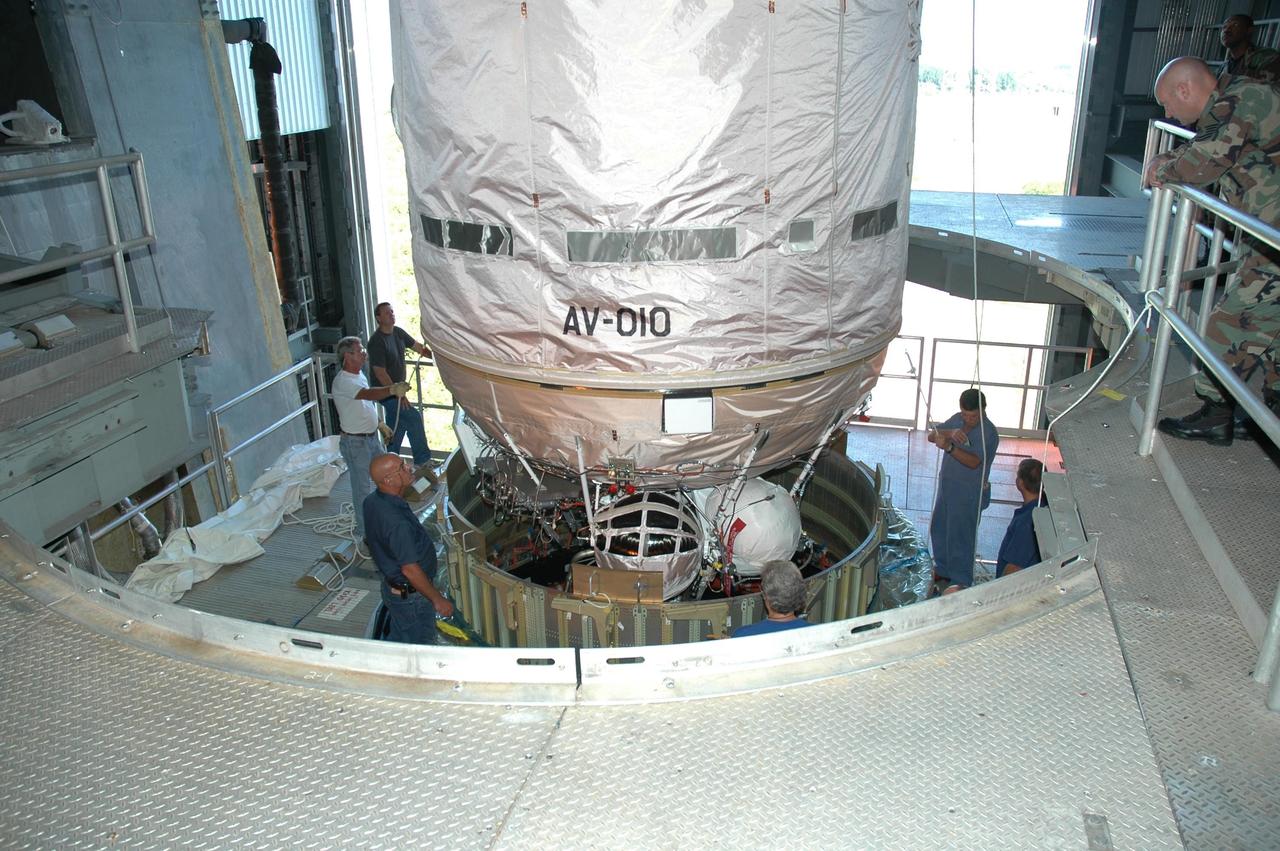
KENNEDY SPACE CENTER, FLA. - Inside the mobile service tower on Launch Complex 41 at Cape Canaveral Air Force Station in Florida, workers oversee the lowering of the Lockheed Martin Atlas V Centaur stage (above) toward the first stage. The two stages will be mated. The Atlas V is the launch vehicle for the New Horizons spacecraft. New Horizons will make the first reconnaissance of Pluto and its moon, Charon - a "double planet" and the last planet in our solar system to be visited by spacecraft. As it approaches Pluto, the spacecraft will look for ultraviolet emission from Pluto's atmosphere and make the best global maps of Pluto and Charon in green, blue, red and a special wavelength that is sensitive to methane frost on the surface. It will also take spectral maps in the near infrared, telling the science team about Pluto's and Charon's surface compositions and locations and temperatures of these materials. When the spacecraft is closest to Pluto or its moon, it will take close-up pictures in both visible and near-infrared wavelengths. The mission will then visit one or more objects in the Kuiper Belt region beyond Neptune. New Horizons is scheduled to launch in January 2006, swing past Jupiter for a gravity boost and scientific studies in February or March 2007, and reach Pluto and Charon in July 2015.
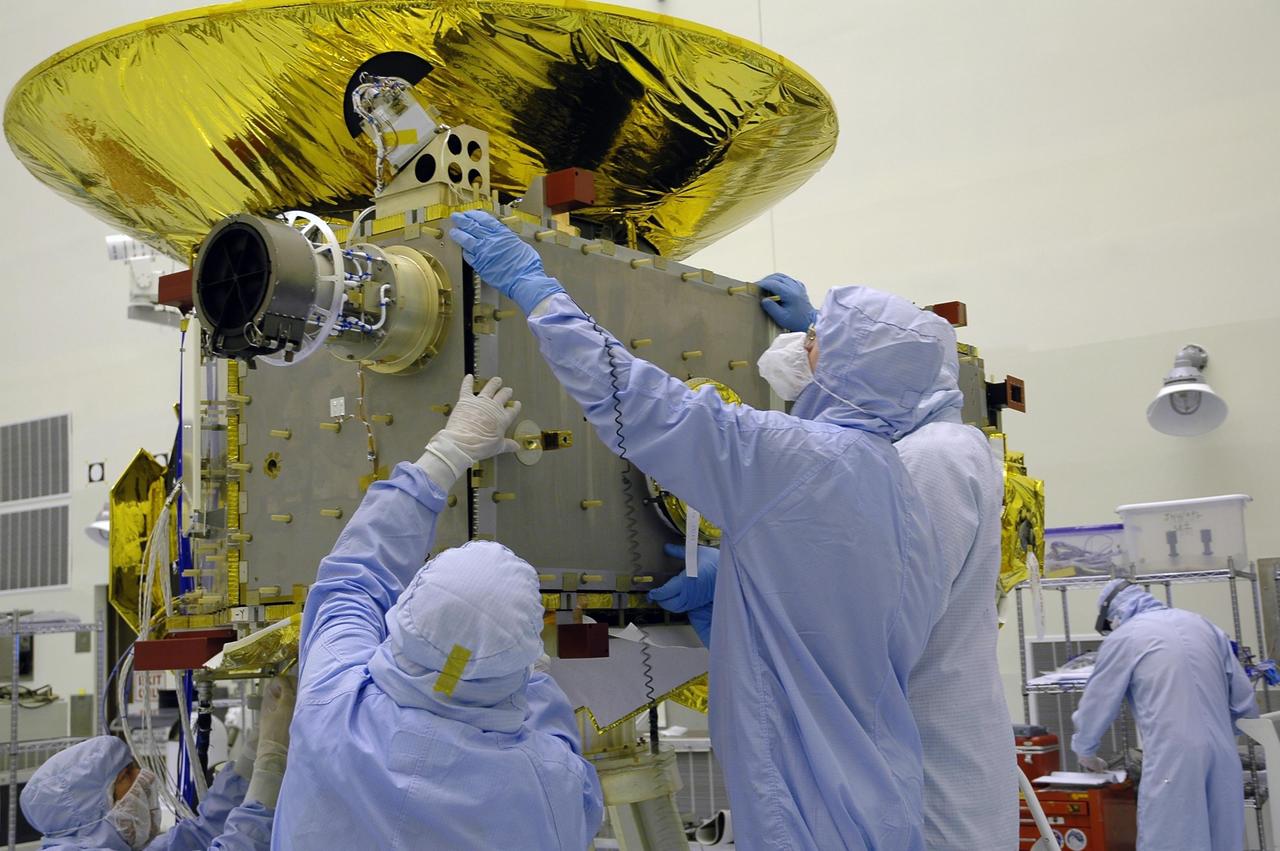
KENNEDY SPACE CENTER, FLA. - At NASA Kennedy Space Center’s Payload Hazardous Servicing Facility, technicians from the Applied Physics Laboratory install another panel on the New Horizons spacecraft. A series of interconnecting panels will enclose the spacecraft beneath the antenna to maintain safe operating temperatures in space. New Horizons will make the first reconnaissance of Pluto and its moon, Charon - a "double planet" and the last planet in our solar system to be visited by spacecraft. As it approaches Pluto, the spacecraft will look for ultraviolet emission from Pluto's atmosphere and make the best global maps of Pluto and Charon in green, blue, red and a special wavelength that is sensitive to methane frost on the surface. It will also take spectral maps in the near infrared, telling the science team about Pluto's and Charon's surface compositions and locations and temperatures of these materials. When the spacecraft is closest to Pluto or its moon, it will take close-up pictures in both visible and near-infrared wavelengths. The mission will then visit one or more objects in the Kuiper Belt region beyond Neptune. New Horizons is scheduled to launch in January 2006, swing past Jupiter for a gravity boost and scientific studies in February or March 2007, and reach Pluto and Charon in July 2015.
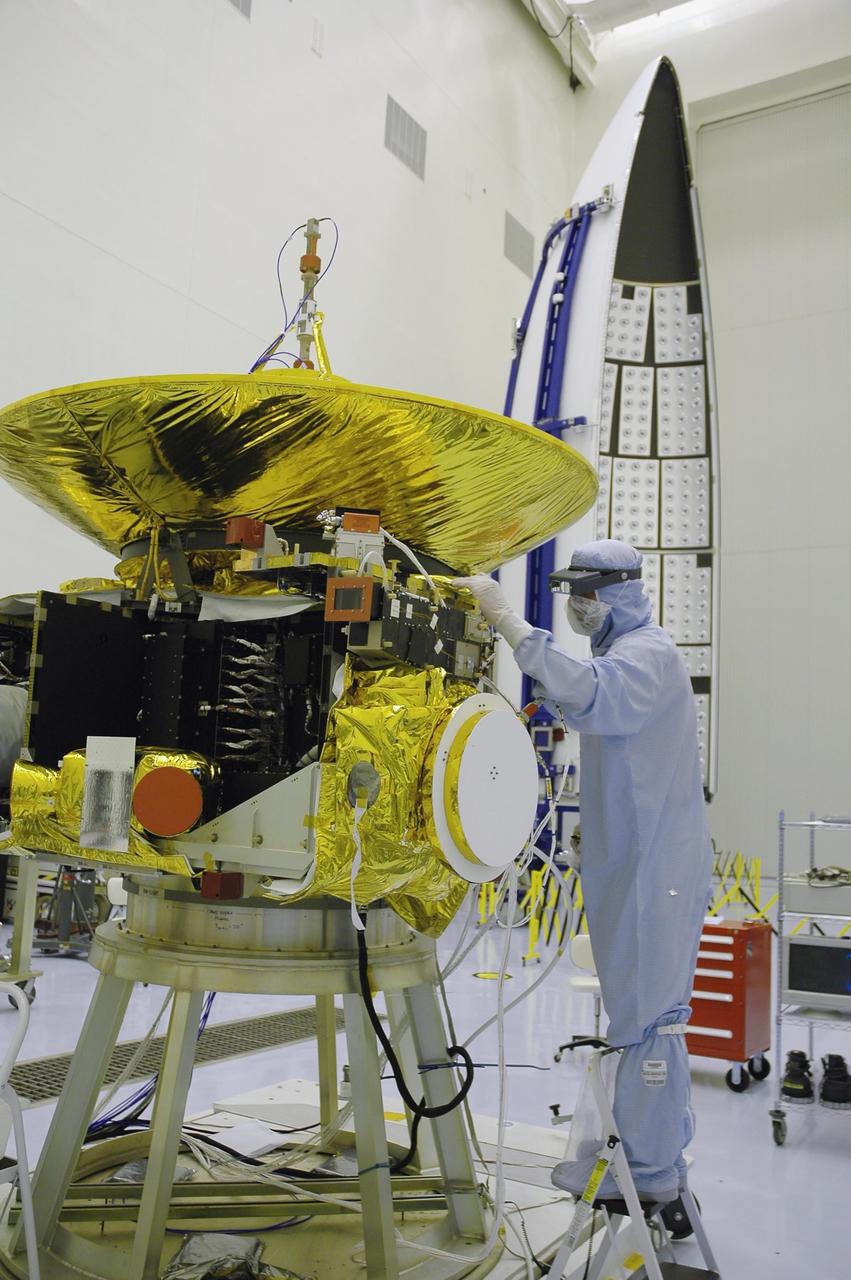
KENNEDY SPACE CENTER, FLA. - At NASA Kennedy Space Center’s Payload Hazardous Servicing Facility, technicians from the Applied Physics Laboratory work on a panel they are installing on the New Horizons spacecraft. A series of interconnecting panels will enclose the spacecraft beneath the antenna to maintain safe operating temperatures in space. New Horizons will make the first reconnaissance of Pluto and its moon, Charon - a "double planet" and the last planet in our solar system to be visited by spacecraft. As it approaches Pluto, the spacecraft will look for ultraviolet emission from Pluto's atmosphere and make the best global maps of Pluto and Charon in green, blue, red and a special wavelength that is sensitive to methane frost on the surface. It will also take spectral maps in the near infrared, telling the science team about Pluto's and Charon's surface compositions and locations and temperatures of these materials. When the spacecraft is closest to Pluto or its moon, it will take close-up pictures in both visible and near-infrared wavelengths. The mission will then visit one or more objects in the Kuiper Belt region beyond Neptune. New Horizons is scheduled to launch in January 2006, swing past Jupiter for a gravity boost and scientific studies in February or March 2007, and reach Pluto and Charon in July 2015.
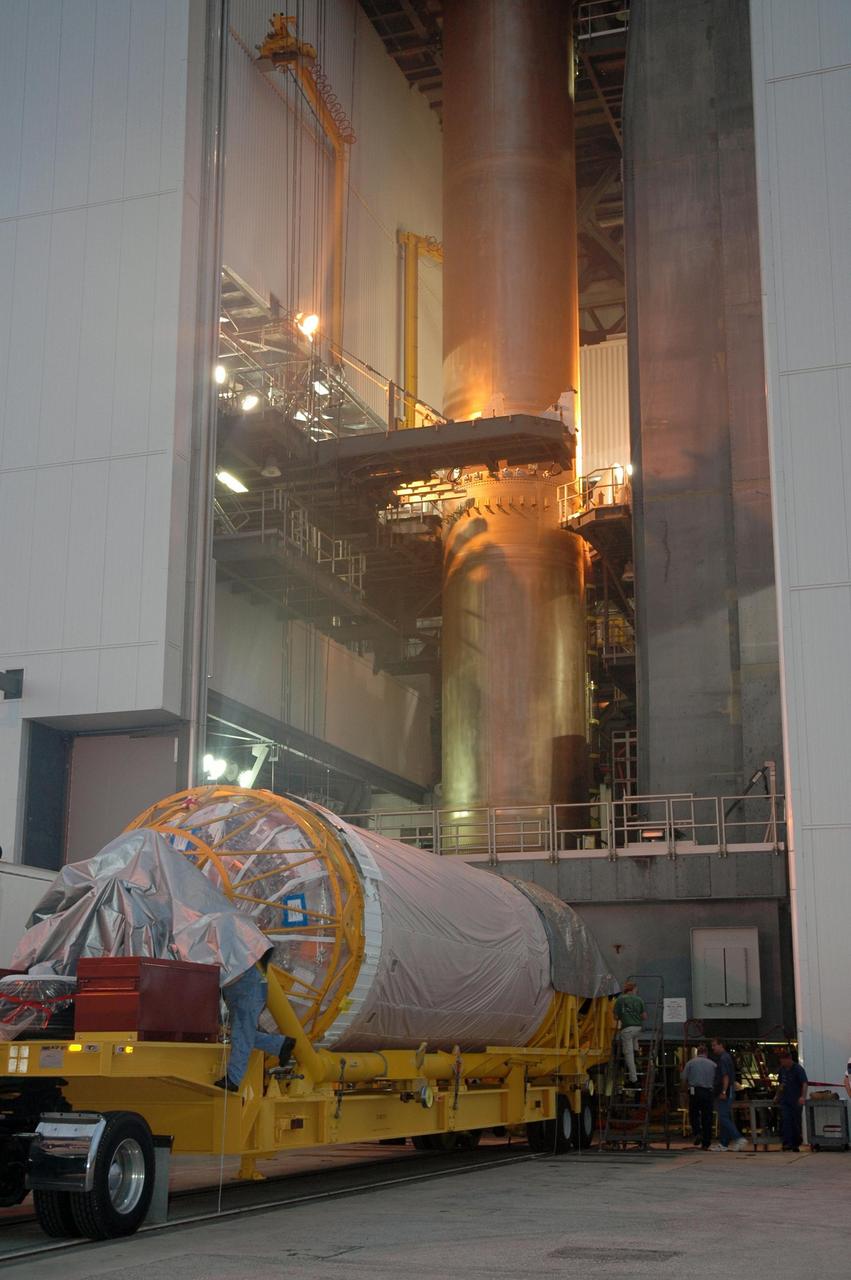
KENNEDY SPACE CENTER, FLA. - The Lockheed Martin Atlas V Centaur stage arrives at the mobile service tower on Launch Complex 41 at Cape Canaveral Air Force Station in Florida. The Centaur is the second stage of the launch vehicle for the New Horizons spacecraft. Seen in the tower is the first stage. New Horizons will make the first reconnaissance of Pluto and its moon, Charon - a "double planet" and the last planet in our solar system to be visited by spacecraft. As it approaches Pluto, the spacecraft will look for ultraviolet emission from Pluto's atmosphere and make the best global maps of Pluto and Charon in green, blue, red and a special wavelength that is sensitive to methane frost on the surface. It will also take spectral maps in the near infrared, telling the science team about Pluto's and Charon's surface compositions and locations and temperatures of these materials. When the spacecraft is closest to Pluto or its moon, it will take close-up pictures in both visible and near-infrared wavelengths. The mission will then visit one or more objects in the Kuiper Belt region beyond Neptune. New Horizons is scheduled to launch in January 2006, swing past Jupiter for a gravity boost and scientific studies in February or March 2007, and reach Pluto and Charon in July 2015.
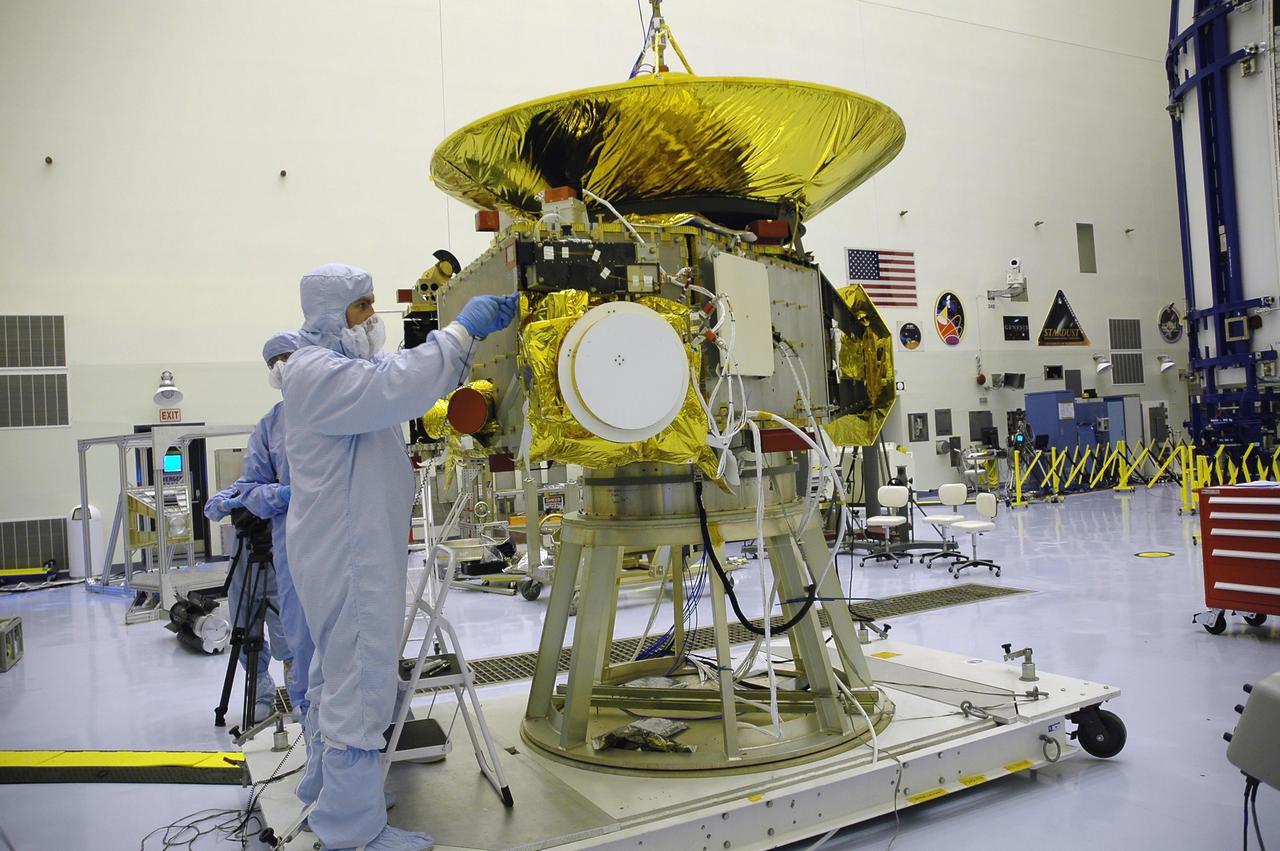
KENNEDY SPACE CENTER, FLA. - At NASA Kennedy Space Center’s Payload Hazardous Servicing Facility, technicians work on a panel they are installing on the New Horizons spacecraft. A series of interconnecting panels will enclose the spacecraft beneath the antenna to maintain safe operating temperatures in space. New Horizons will make the first reconnaissance of Pluto and its moon, Charon - a "double planet" and the last planet in our solar system to be visited by spacecraft. As it approaches Pluto, the spacecraft will look for ultraviolet emission from Pluto's atmosphere and make the best global maps of Pluto and Charon in green, blue, red and a special wavelength that is sensitive to methane frost on the surface. It will also take spectral maps in the near infrared, telling the science team about Pluto's and Charon's surface compositions and locations and temperatures of these materials. When the spacecraft is closest to Pluto or its moon, it will take close-up pictures in both visible and near-infrared wavelengths. The mission will then visit one or more objects in the Kuiper Belt region beyond Neptune. New Horizons is scheduled to launch in January 2006, swing past Jupiter for a gravity boost and scientific studies in February or March 2007, and reach Pluto and Charon in July 2015.
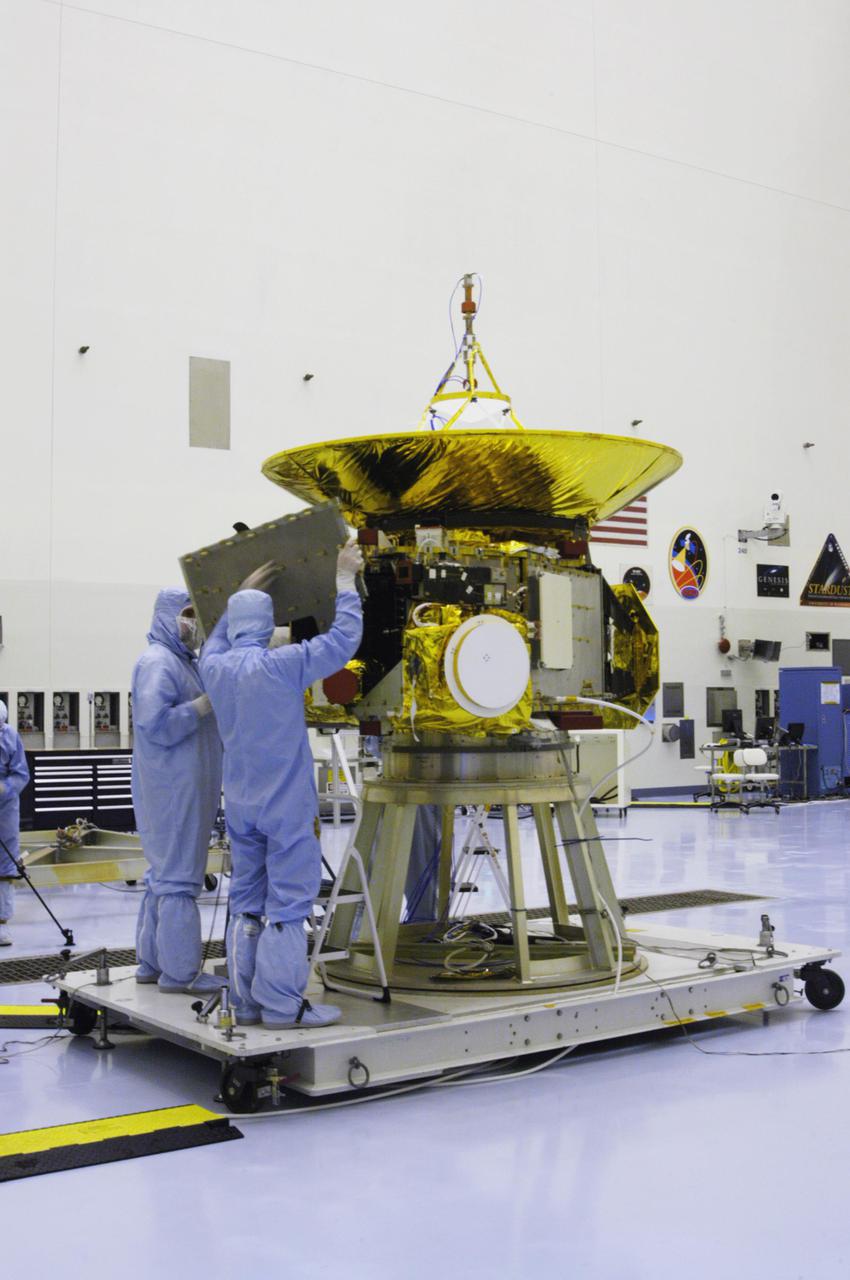
KENNEDY SPACE CENTER, FLA. - At NASA Kennedy Space Center’s Payload Hazardous Servicing Facility, technicians from the Applied Physics Laboratory hold a panel they are installing on the New Horizons spacecraft. A series of interconnecting panels will enclose the spacecraft beneath the antenna to maintain safe operating temperatures in space. New Horizons will make the first reconnaissance of Pluto and its moon, Charon - a 'double planet' and the last planet in our solar system to be visited by spacecraft. As it approaches Pluto, the spacecraft will look for ultraviolet emission from Pluto's atmosphere and make the best global maps of Pluto and Charon in green, blue, red and a special wavelength that is sensitive to methane frost on the surface. It will also take spectral maps in the near infrared, telling the science team about Pluto's and Charon's surface compositions and locations and temperatures of these materials. When the spacecraft is closest to Pluto or its moon, it will take close-up pictures in both visible and near-infrared wavelengths. The mission will then visit one or more objects in the Kuiper Belt region beyond Neptune. New Horizons is scheduled to launch in January 2006, swing past Jupiter for a gravity boost and scientific studies in February or March 2007, and reach Pluto and Charon in July 2015.
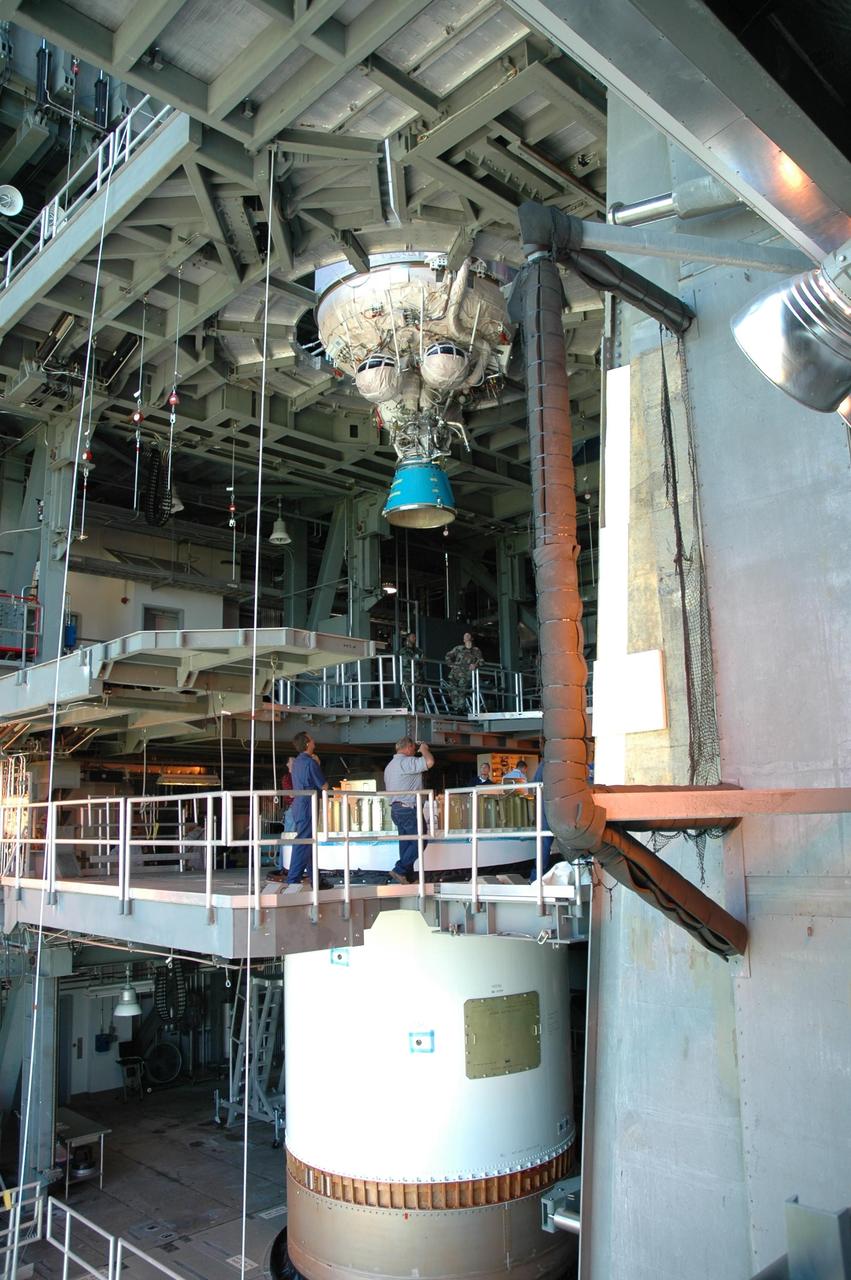
KENNEDY SPACE CENTER, FLA. - Inside the mobile service tower on Launch Complex 41 at Cape Canaveral Air Force Station in Florida, workers wait for the Lockheed Martin Atlas V Centaur stage (above) to be lowered to the first stage for installation. The Atlas V is the launch vehicle for the New Horizons spacecraft. New Horizons will make the first reconnaissance of Pluto and its moon, Charon - a "double planet" and the last planet in our solar system to be visited by spacecraft. As it approaches Pluto, the spacecraft will look for ultraviolet emission from Pluto's atmosphere and make the best global maps of Pluto and Charon in green, blue, red and a special wavelength that is sensitive to methane frost on the surface. It will also take spectral maps in the near infrared, telling the science team about Pluto's and Charon's surface compositions and locations and temperatures of these materials. When the spacecraft is closest to Pluto or its moon, it will take close-up pictures in both visible and near-infrared wavelengths. The mission will then visit one or more objects in the Kuiper Belt region beyond Neptune. New Horizons is scheduled to launch in January 2006, swing past Jupiter for a gravity boost and scientific studies in February or March 2007, and reach Pluto and Charon in July 2015.
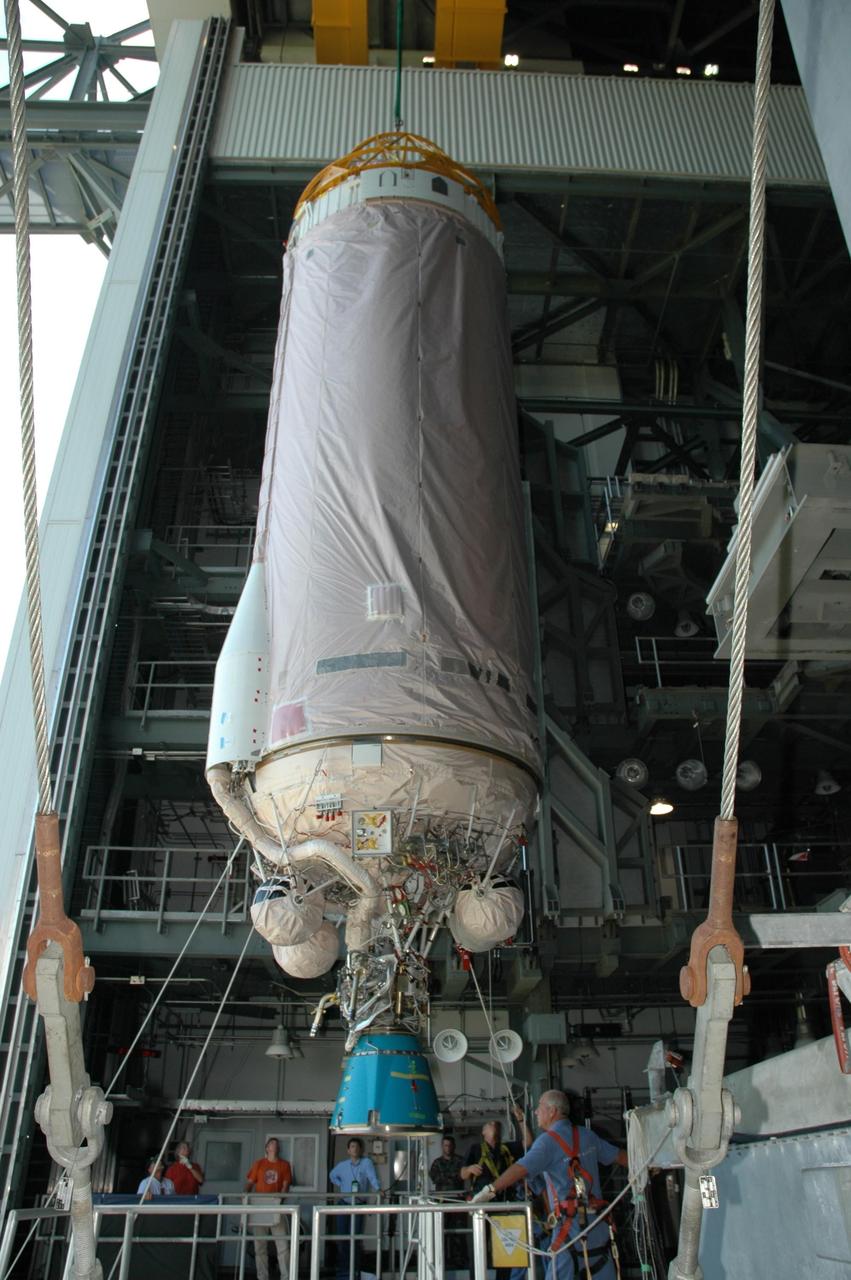
KENNEDY SPACE CENTER, FLA. - Inside the mobile service tower on Launch Complex 41 at Cape Canaveral Air Force Station in Florida, the Lockheed Martin Atlas V Centaur stage is moved into place over the waiting first stage below it. The launch vehicle for the New Horizon spacecraft, the Atlas V first and second stages will be mated. New Horizons will make the first reconnaissance of Pluto and its moon, Charon - a "double planet" and the last planet in our solar system to be visited by spacecraft. As it approaches Pluto, the spacecraft will look for ultraviolet emission from Pluto's atmosphere and make the best global maps of Pluto and Charon in green, blue, red and a special wavelength that is sensitive to methane frost on the surface. It will also take spectral maps in the near infrared, telling the science team about Pluto's and Charon's surface compositions and locations and temperatures of these materials. When the spacecraft is closest to Pluto or its moon, it will take close-up pictures in both visible and near-infrared wavelengths. The mission will then visit one or more objects in the Kuiper Belt region beyond Neptune. New Horizons is scheduled to launch in January 2006, swing past Jupiter for a gravity boost and scientific studies in February or March 2007, and reach Pluto and Charon in July 2015.
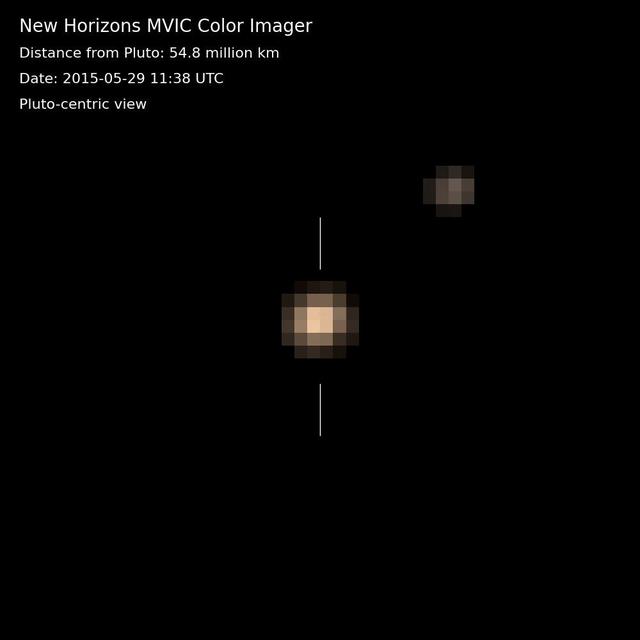
The first color movies from NASA's New Horizons mission show Pluto and its largest moon, Charon, and the complex orbital dance of the two bodies, known as a double planet. A near-true color movie were assembled from images made in three colors -- blue, red and near-infrared -- by the Multispectral Visible Imaging Camera on the instrument known as Ralph. The images were taken on nine different occasions from May 29-June 3, 2015. The movie is "Pluto-centric," meaning that Charon is shown as it moves in relation to Pluto, which is digitally centered in the movie. (The North Pole of Pluto is at the top.) Pluto makes one turn around its axis every 6 days, 9 hours and 17.6 minutes-the same amount of time that Charon rotates in its orbit. Looking closely at the images in this movie, one can detect a regular shift in Pluto's brightness-due to the brighter and darker terrains on its differing faces. http://photojournal.jpl.nasa.gov/catalog/PIA19689
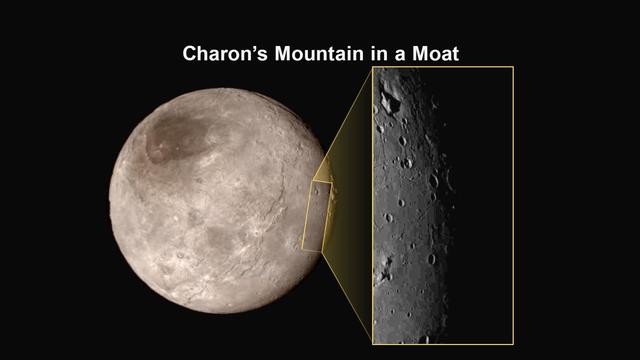
This image of an area on Pluto's largest moon Charon has a captivating feature -- a depression with a peak in the middle, shown here in the upper left corner of the inset. The image shows an area approximately 240 miles (390 kilometers) from top to bottom, including few visible craters. This image gives a preview of what the surface of this large moon will look like in future close-ups from NASA's New Horizons spacecraft. This image is heavily compressed; sharper versions are anticipated when the full-fidelity data from New Horizons' Long Range Reconnaissance Imager (LORRI) are returned to Earth. The rectangle superimposed on the global view of Charon shows the approximate location of this close-up view. The image was taken at approximately 6:30 a.m. EDT (10:30 UTC) on July 14, 2015, about 1.5 hours before closest approach to Pluto, from a range of 49,000 miles (79,000 kilometers). http://photojournal.jpl.nasa.gov/catalog/PIA19713

Imagine a future spacecraft following New Horizons' trailblazing path to Pluto, but instead of flying past its target -- as New Horizons needed to do to explore Pluto and the Kuiper Belt beyond -- the next visitor touches down near the tall mountains on the frozen icy, plains of Pluto's heart. A video produced by New Horizons scientists that offers that very perspective. Made from more than 100 New Horizons images taken over six weeks of approach and close flyby, the video offers a trip in to Pluto -- starting with a distant spacecraft's-eye view of Pluto and its largest moon, Charon, to an eventual ride in for a "landing" on the shoreline of Pluto's informally named Sputnik Planum. The video shows what it would be like to ride aboard an approaching spacecraft and see Pluto grow from a "dot" to become a world, and then to swoop down over Pluto's spectacular terrains. New Horizons scientists had to interpolate some of the frames in the movie based on what they know Pluto looks like to make it as smooth and seamless as possible. After a 9.5-year voyage covering more than three billion miles, New Horizons flew through the Pluto system on July 14, 2015, coming within 7,800 miles (12,500 kilometers) of Pluto itself. Carrying powerful telescopic cameras that could spot features smaller than a football field, New Horizons has sent back hundreds of images of Pluto and its moons that show how dynamic and fascinating their surfaces are - and what great targets they'd make for follow-up mission one day. http://photojournal.jpl.nasa.gov/catalog/PIA20742
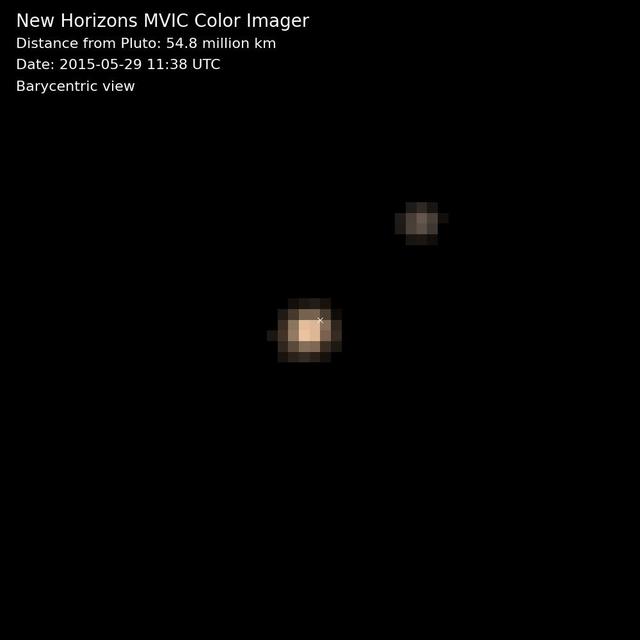
The first color movies from NASA's New Horizons mission show Pluto and its largest moon, Charon, and the complex orbital dance of the two bodies, known as a double planet. A near-true color movie was assembled from images made in three colors -- blue, red and near-infrared -- by the Multispectral Visible Imaging Camera on the instrument known as Ralph. The images were taken on nine different occasions from May 29-June 3, 2015. The movie is barycentric, meaning that both Pluto and Charon are shown in motion around the binary's barycenter -- the shared center of gravity between the two bodies as they do a planetary jig. Because Pluto is much more massive than Charon, the barycenter (marked by a small "x" in the movie) is much closer to Pluto than to Charon. Looking closely at the images in this movie, one can detect a regular shift in Pluto's brightness-due to the brighter and darker terrains on its differing faces. http://photojournal.jpl.nasa.gov/catalog/PIA19688