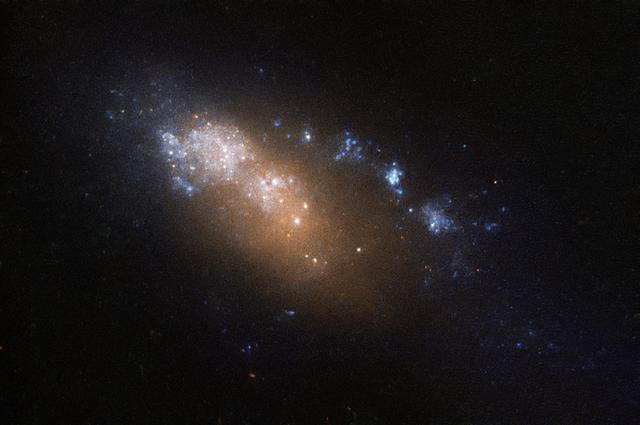
The galaxy, NGC 178 may be small, but it packs quite a punch. Measuring around 40,000 light-years across, its diameter is less than half that of the Milky Way, and it is accordingly classified as a dwarf galaxy. Despite its diminutive size, NGC 178 is busy forming new stars. On average, the galaxy forms stars totaling around half the mass of the Sun per year — enough to label it a starburst galaxy. The galaxy’s discovery is an interesting, and somewhat confusing, story. It was originally discovered by American astronomer Ormond Stone in 1885 and dubbed NGC 178, but its position in the sky was recorded incorrectly — by accident the value for the galaxy’s right ascension (which can be thought of as the celestial equivalent of terrestrial longitude) was off by a considerable amount. In the years that followed NGC 178 was spotted again, this time by French astronomer Stéphane Javelle. As no cataloged object occupied that position in the sky, Javelle believed he had discovered a new galaxy and entered it into the expanded Index Catalog under the name IC 39. Later, American astronomer Herbert Howe also observed the object and corrected Stone’s initial mistake. Many years later, astronomers finally noticed that NGC 178 and IC 39 were actually the same object! This image of NGC 178 comprises data gathered by the Wide Field Planetary Camera 2 aboard the NASA/ESA Hubble Space Telescope. Credit: ESA/Hubble & NASA
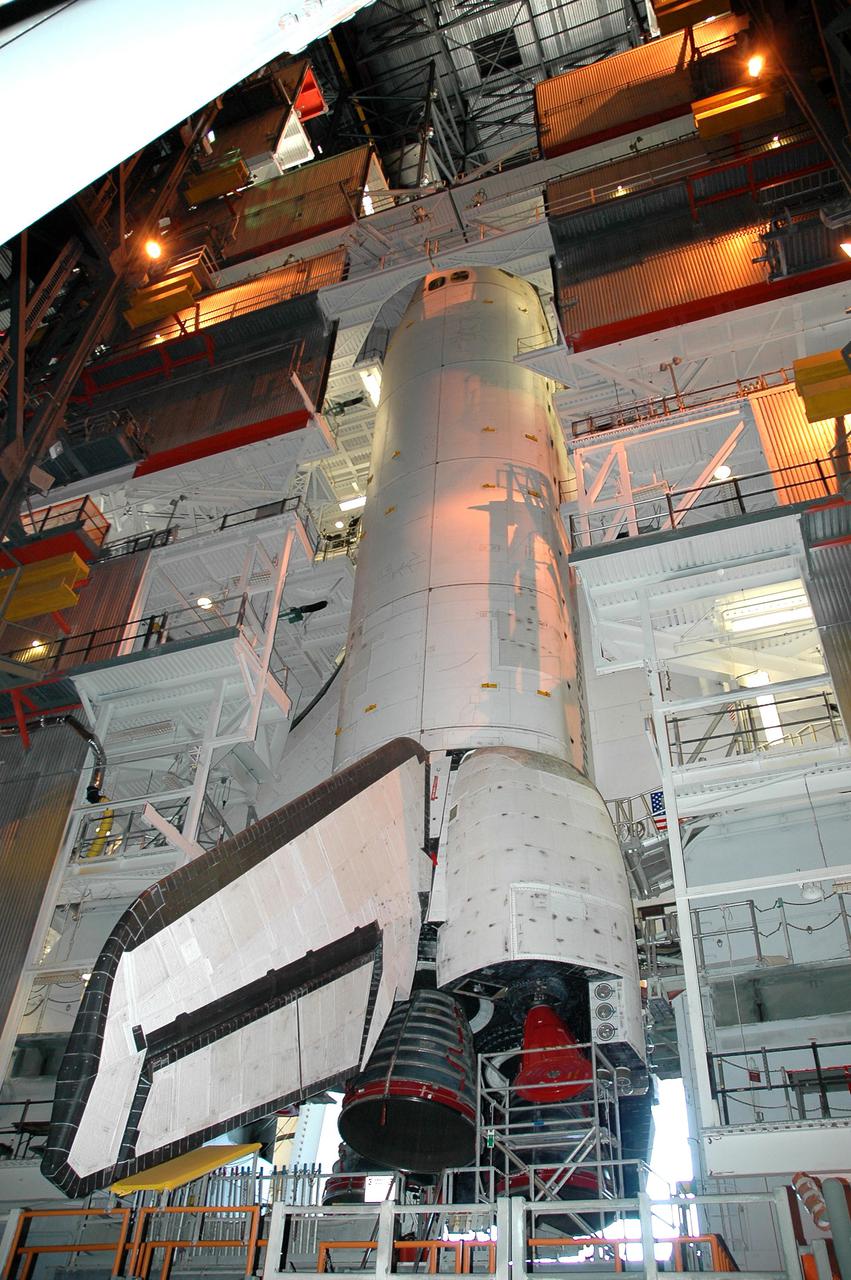
KENNEDY SPACE CENTER, FLA. - In the Vehicle Assembly Building at NASA’s Kennedy Space Center, Space Shuttle Discovery is surrounded by work platforms as it awaits rollout to Launch Pad 39B for Return to Flight mission STS-114 to the International Space Station. It rests on the Mobile Launcher Platform, which will be moved to the pad by the double-tracked Crawler-Transporter. This launch will be Discovery’s 31st flight. The launch window is May 15 to June 3.
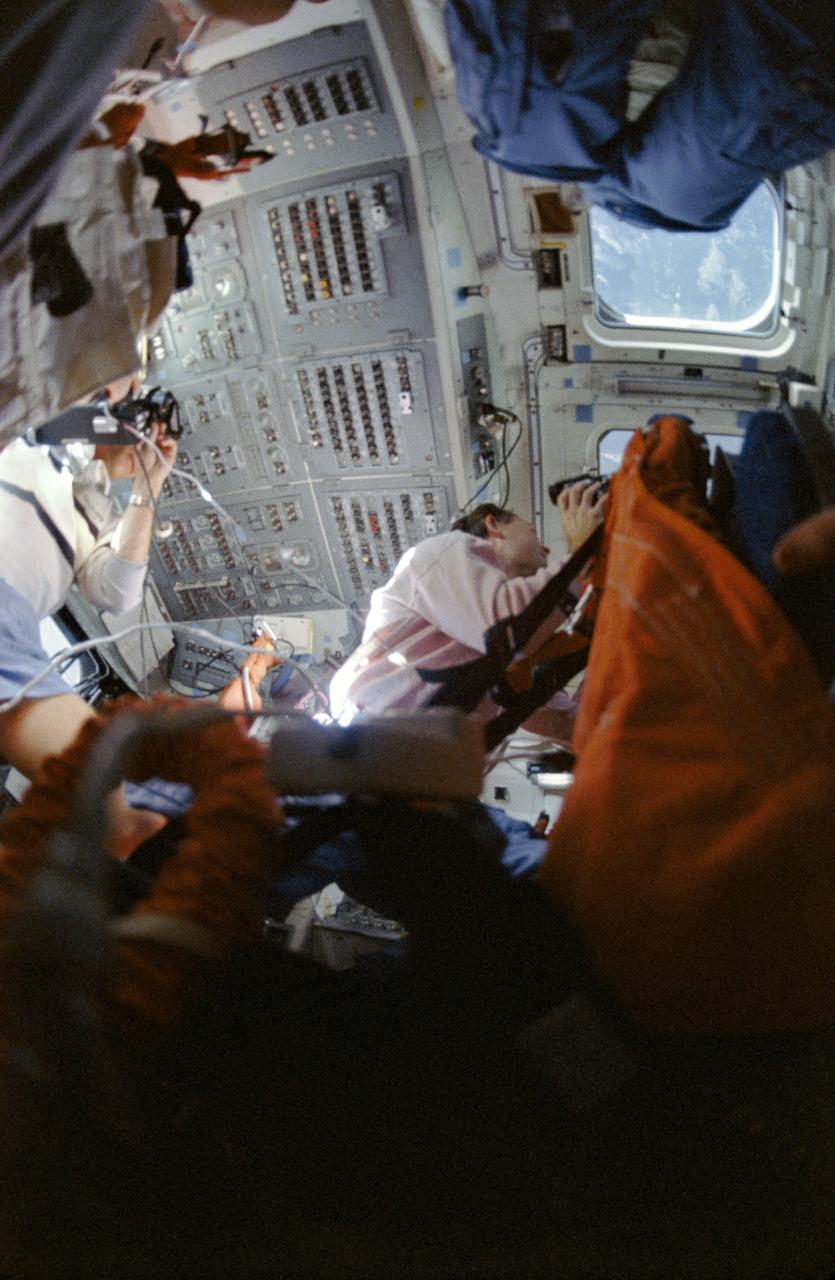
STS033-05-014A (22-27 Nov 1989) --- A low-angle view of STS-33's two astronaut medical doctors doubling as photographers and Earth observers on the flight deck of the Earth-orbiting Space Shuttle Discovery. Astronauts Story Musgrave, left, and Manley L. Carter and three other crewmembers shared five days aboard the Discovery for this DOD-devoted mission.
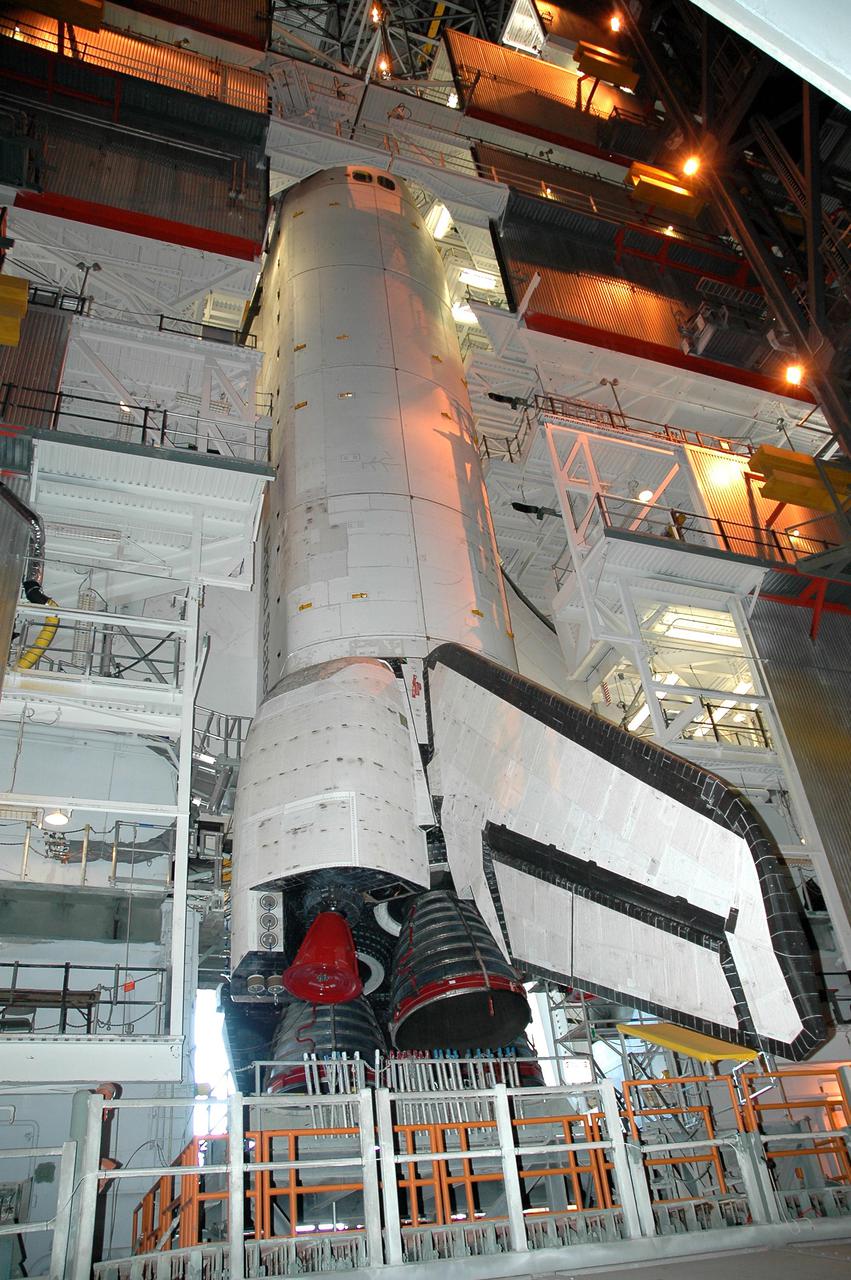
KENNEDY SPACE CENTER, FLA. - In the Vehicle Assembly Building at NASA’s Kennedy Space Center, Space Shuttle Discovery is surrounded by work platforms as it awaits rollout to Launch Pad 39B for Return to Flight mission STS-114 to the International Space Station. It rests on the Mobile Launcher Platform, which will be moved to the pad by the double-tracked Crawler-Transporter. This launch will be Discovery’s 31st flight. The launch window is May 15 to June 3.
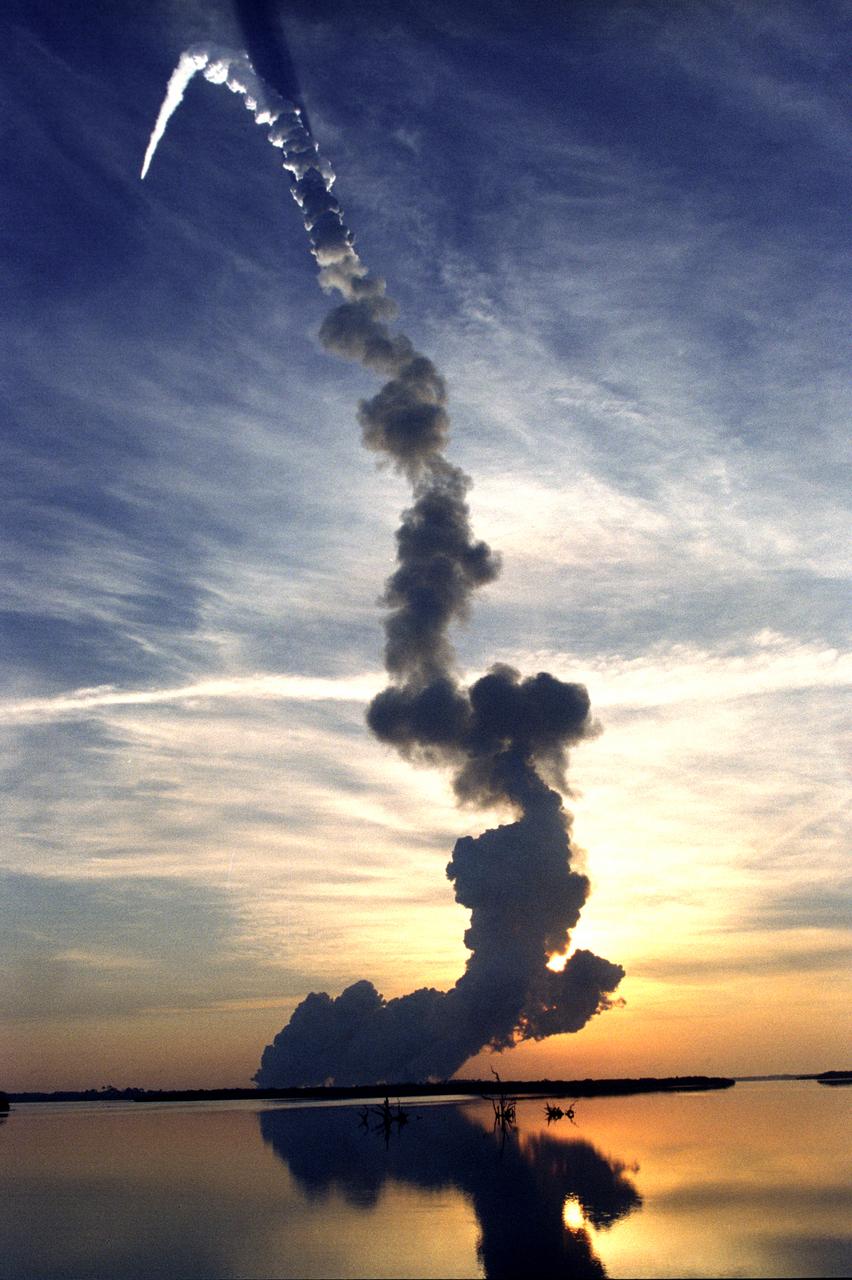
This spectacular photo is of the May 27, 1999 liftoff of the Orbiter Discovery (STS-96). The STS-96 mission, of almost 10 days, was the second International Space Station (ISS) assembly and resupply flight and the first flight to dock with the station. The crew installed foot restraints and the Russian built crane, STRELA. The Shuttle's SPACEHAB double module carried internal and resupply cargo for station outfitting and the Russian cargo crane was carried aboard the shuttle in the integrated Cargo Carrier (ICC).
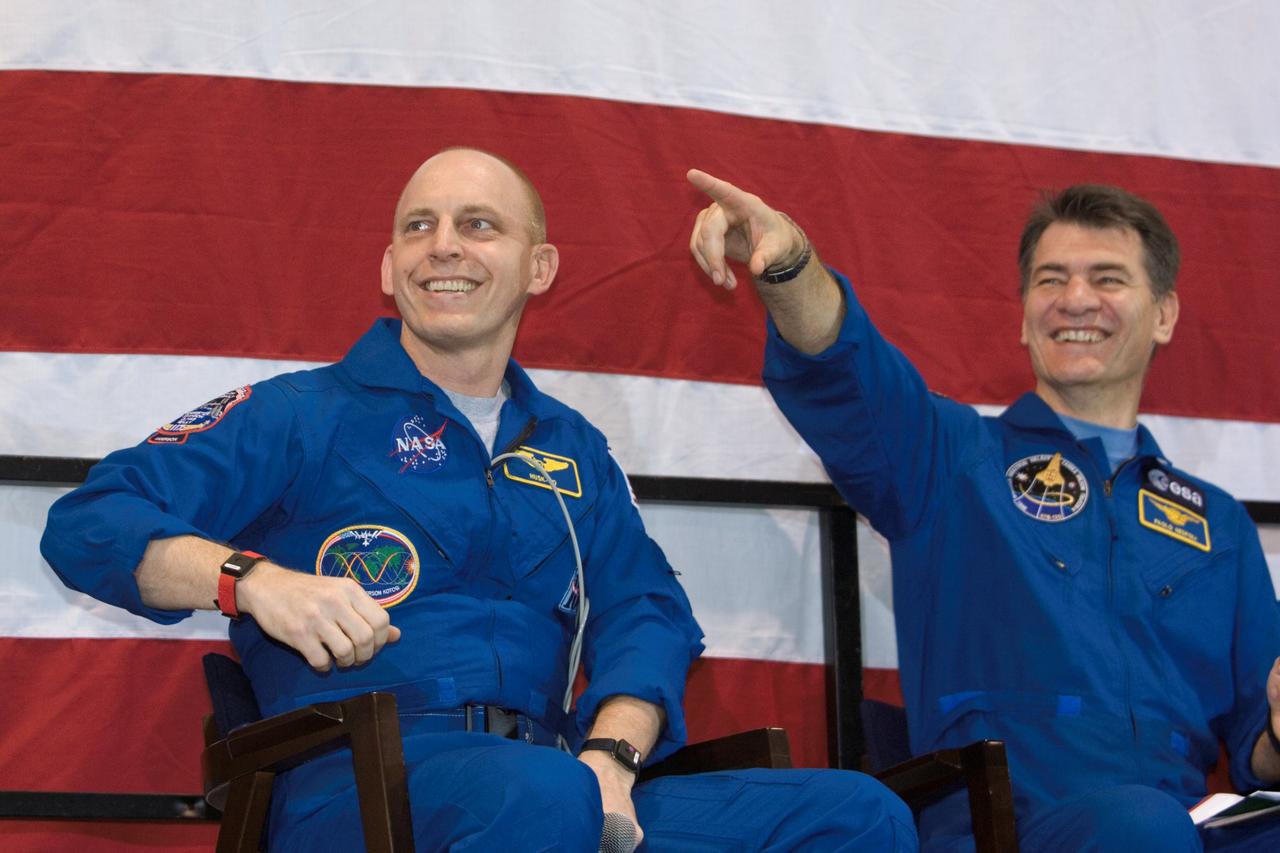
JSC2007-E-098010 (8 Nov. 2007) --- "Look, I'm seeing double," European Space Agency astronaut Paolo Nespoli appears to be saying as he points toward a life size photo cutout (out of frame) of astronaut Clay Anderson, seated to his right, during the Discovery crew's Nov. 8 welcome home ceremony at Houston's Ellington Field. The two mission specialists were joined by their five STS-120 crewmates on the stage of Ellington's hangars.
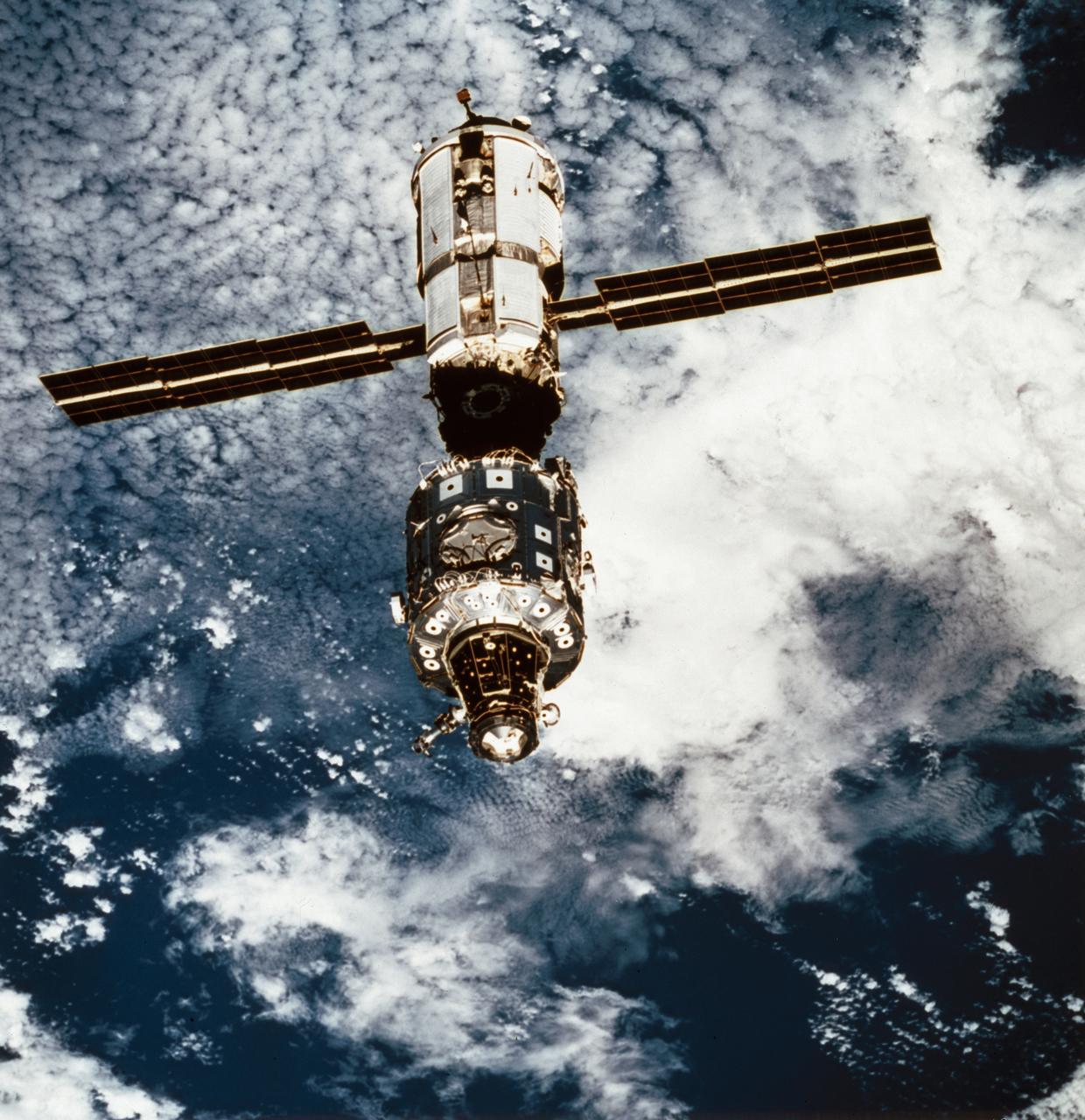
This STS-96 onboard photo of the International Space Station (ISS) was taken from Orbiter Discovery during a fly-around following separation of the two spacecraft. STS-96, the second Space Station assembly and resupply flight, launched on May 27, 1999 for an almost 10 day mission. The Shuttle's SPACEHAB double module carried internal and resupply cargo for station outfitting. Evident in the photo is the newly mounted Russian cargo crane, known as STRELA, which was carried aboard the shuttle in the integrated Cargo Carrir (ICC). The STS-96 flight was the first to perform docking with the ISS.
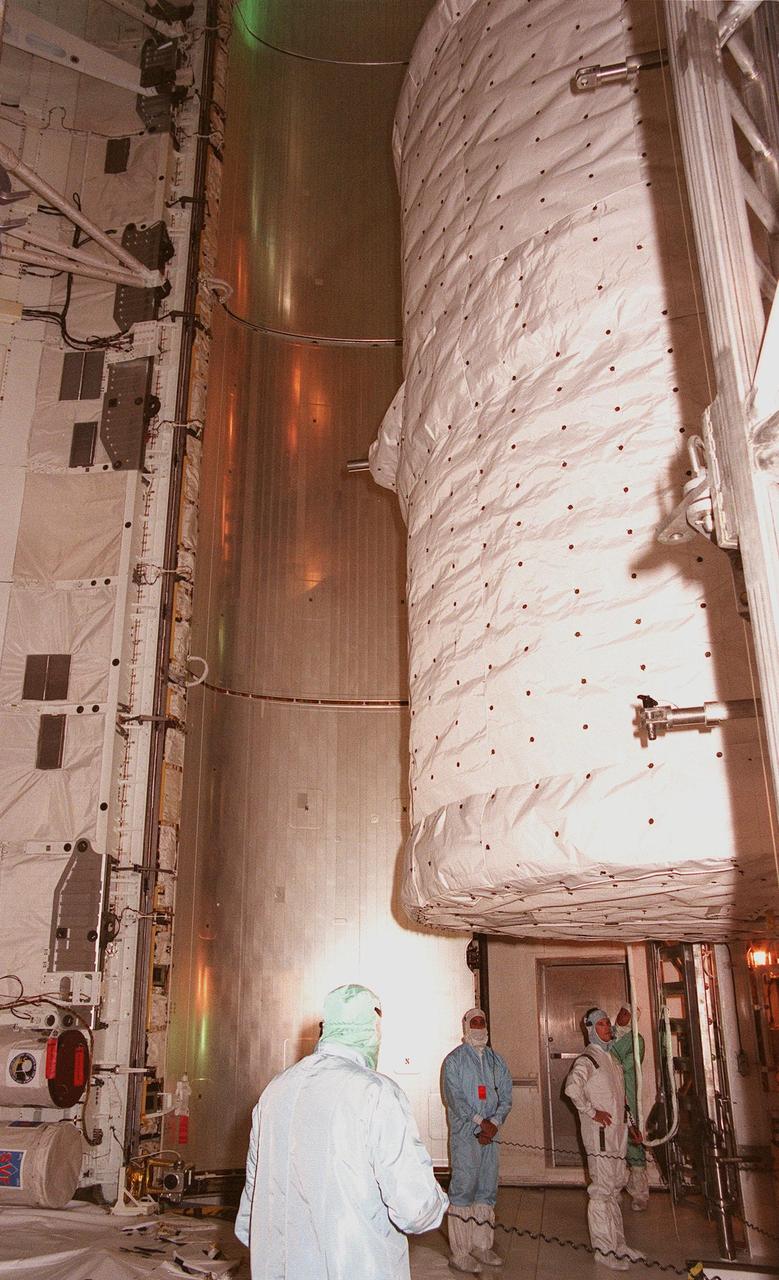
KENNEDY SPACE CENTER, FLA. -- In the payload changeout room at Launch Pad 39B, the SPACEHAB Double module is moved from the payload canister before being placed in Space Shuttle Discovery's payload bay for mission STS-96. The second flight supporting construction of the International Space Station, STS-96 is a logistics and resupply mission, carrying more than 5,000 pounds of supplies, a Russian-built crane and a U.S.-built crane, plus experiments such as STARSHINE, which was developed by and for students. Comprising the crew are Commander Kent V. Rominger, Pilot Rick Douglas Husband, and Mission Specialists Ellen Ochoa (Ph.D.), Tamara E. Jernigan (Ph.D.), Daniel Barry (M.D., Ph.D.), Julie Payette, with the Canadian Space Agency, and Valery Ivanovich Tokarev, with the Russian Space Agency. Liftoff is scheduled for May 20 at 9:32 a.m. EDT
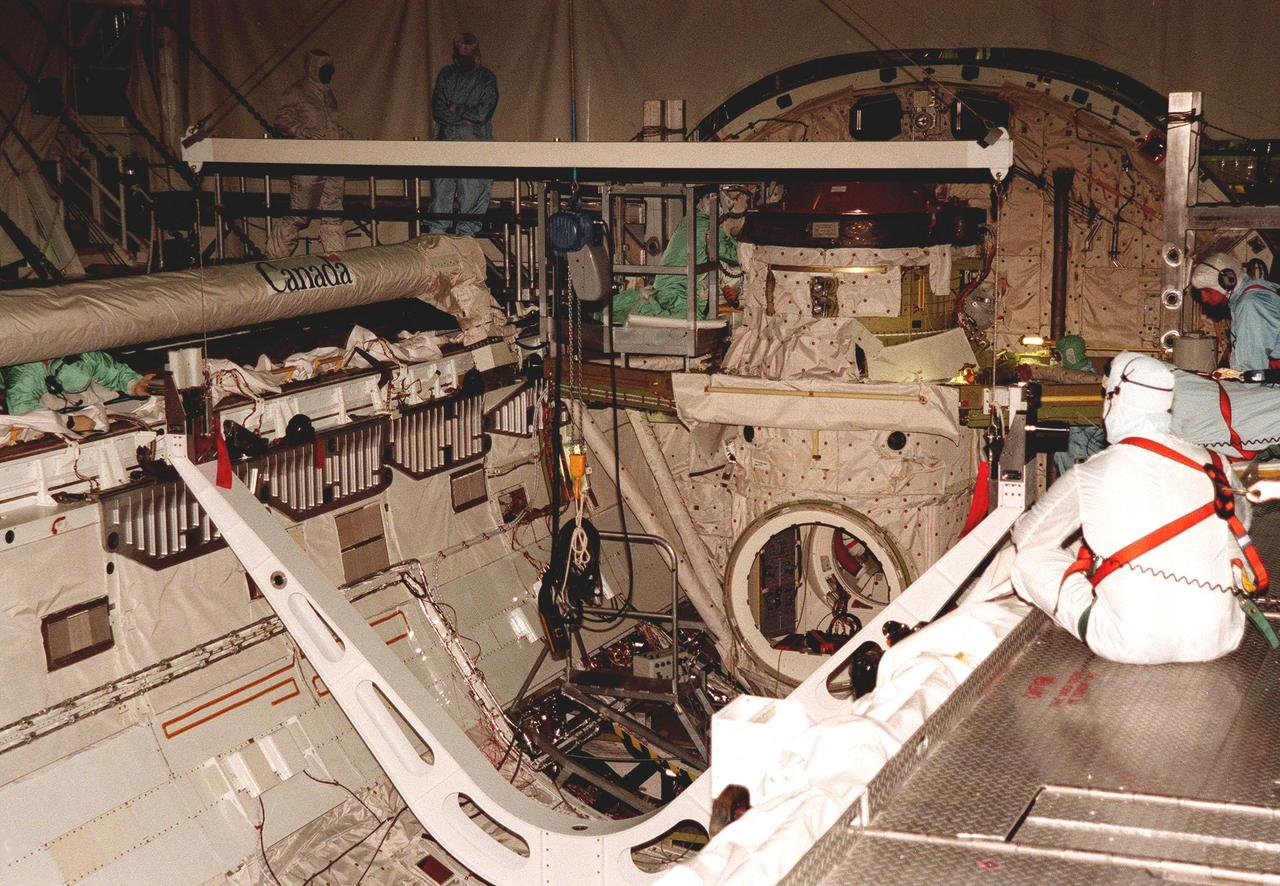
KENNEDY SPACE CENTER, FLA. -- Workers in the Orbiter Processing Facility (OPF) Bay 1 check the Keel Yoke Device (KYD) installed in the orbiter Discovery. The KYD will support the International Cargo Carrier (ICC) to be fitted in the orbiter for mission STS-96. The ICC will carry unpressurized cargo such as the external Russian cargo crane known as STRELA, the SPACEHAB Oceaneering Space System Box (SHOSS), which is a logistics items carrier, and an ORU Transfer Device (OTD), a U.S.-built crane that will be stowed on the station for use during future ISS assembly missions. The primary payload of STS-96 is the SPACEHAB Double Module, an element of the International Space Station. STS-96 is targeted for launch on May 20 at 9:32 a.m. from Launch Pad 39B
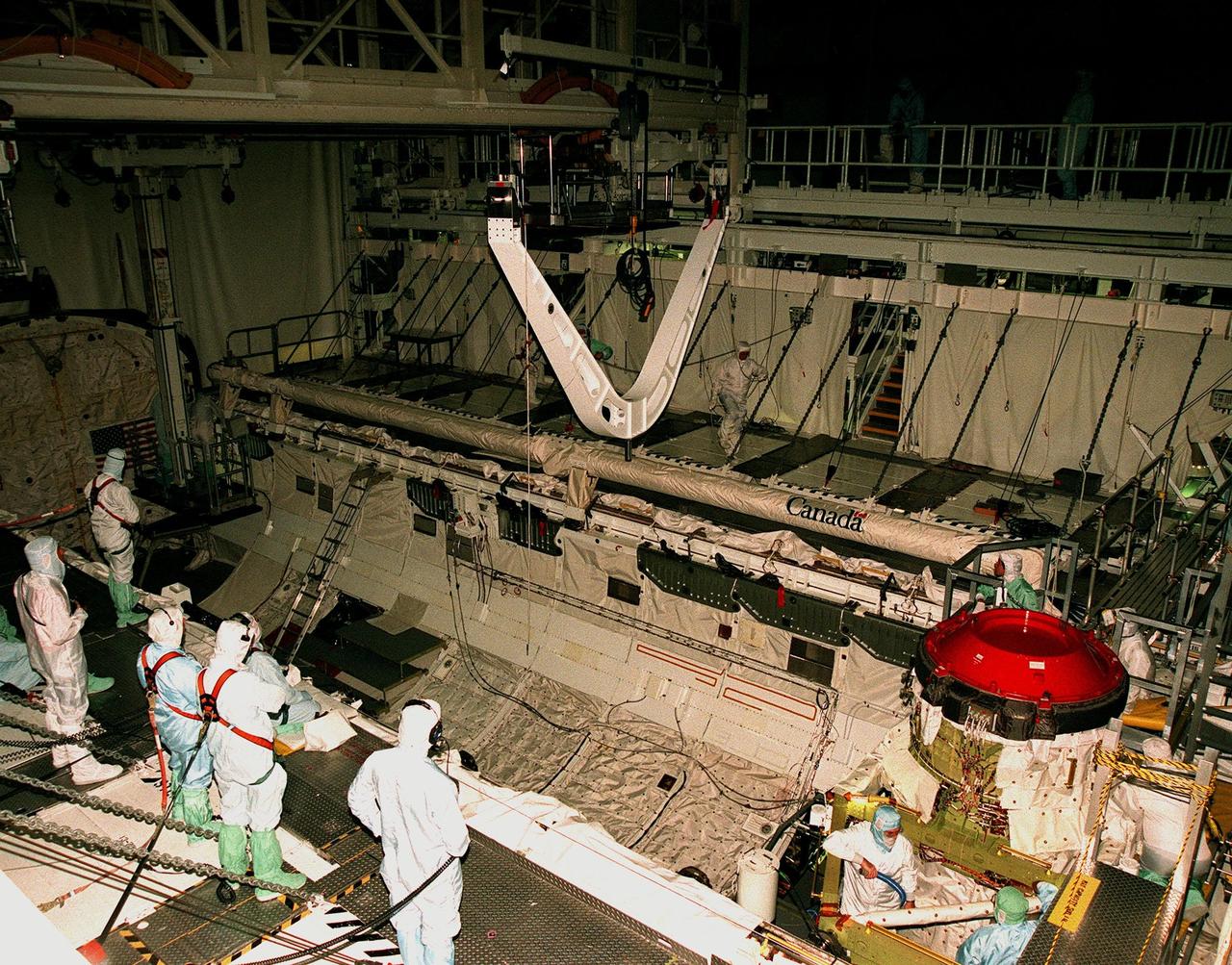
KENNEDY SPACE CENTER, FLA. -- Workers in the Orbiter Processing Facility (OPF) Bay 1 watch as the Keel Yoke Device (KYD) is lowered by crane into the open payload bay of the orbiter Discovery. The KYD will support the International Cargo Carrier (ICC) to be installed in the orbiter for mission STS-96. The ICC will carry unpressurized cargo such as the external Russian cargo crane known as STRELA, the SPACEHAB Oceaneering Space System Box (SHOSS), which is a logistics items carrier, and an ORU Transfer Device (OTD), a U.S.-built crane that will be stowed on the station for use during future ISS assembly missions. The primary payload of STS-96 is the SPACEHAB Double Module, an element of the International Space Station. . STS-96 is targeted for launch on May 20 at 9:32 a.m. from Launch Pad 39B
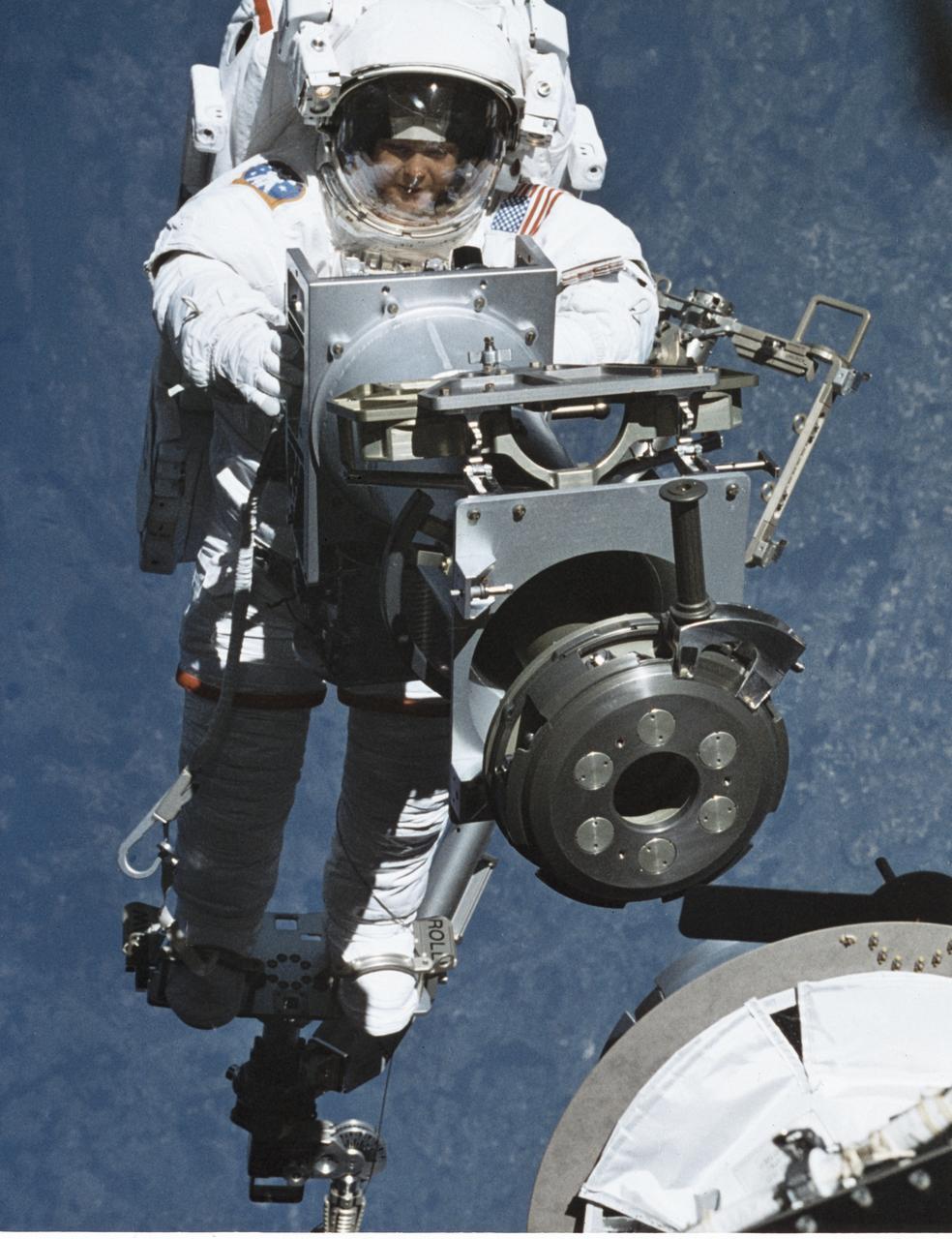
The STS-96 mission, the second International Space Station (ISS) assembly and resupply flight, launched on May 27, 1999 aboard the Orbiter Discovery for an almost 10 day mission. The Shuttle's SPACEHAB double module carried internal and resupply cargo for station outfitting and the Russian cargo crane, STRELA, was carried aboard the shuttle in the integrated Cargo Carrier (ICC). In this STS-96 onboard photo of the first Extra Vehicular Activity (EVA), Mission Specialist Tamara Jernigan totes part of the Russian built crane. Jernigans' feet are anchored on a mobile foot restraint cornected to the Shuttle's Remote Manipulator System (RMS) operated by Mission Specialist Ellen Ochoa. The STS-96 flight was the first to perform docking with the ISS.

KENNEDY SPACE CENTER, FLA. -- This fish-eye view shows the SPACEHAB Double module being moved into the payload changeout room at Launch Pad 39B before being transferred to Space Shuttle Discovery's payload bay for mission STS-96. The second flight supporting construction of the International Space Station, STS-96 is a logistics and resupply mission, carrying more than 5,000 pounds of supplies, a Russian-built crane and a U.S.-built crane, plus experiments such as STARSHINE, which was developed by and for students. Comprising the crew are Commander Kent V. Rominger, Pilot Rick Douglas Husband, and Mission Specialists Ellen Ochoa (Ph.D.), Tamara E. Jernigan (Ph.D.), Daniel Barry (M.D., Ph.D.), Julie Payette, with the Canadian Space Agency, and Valery Ivanovich Tokarev, with the Russian Space Agency. Liftoff is scheduled for May 20 at 9:32 a.m. EDT
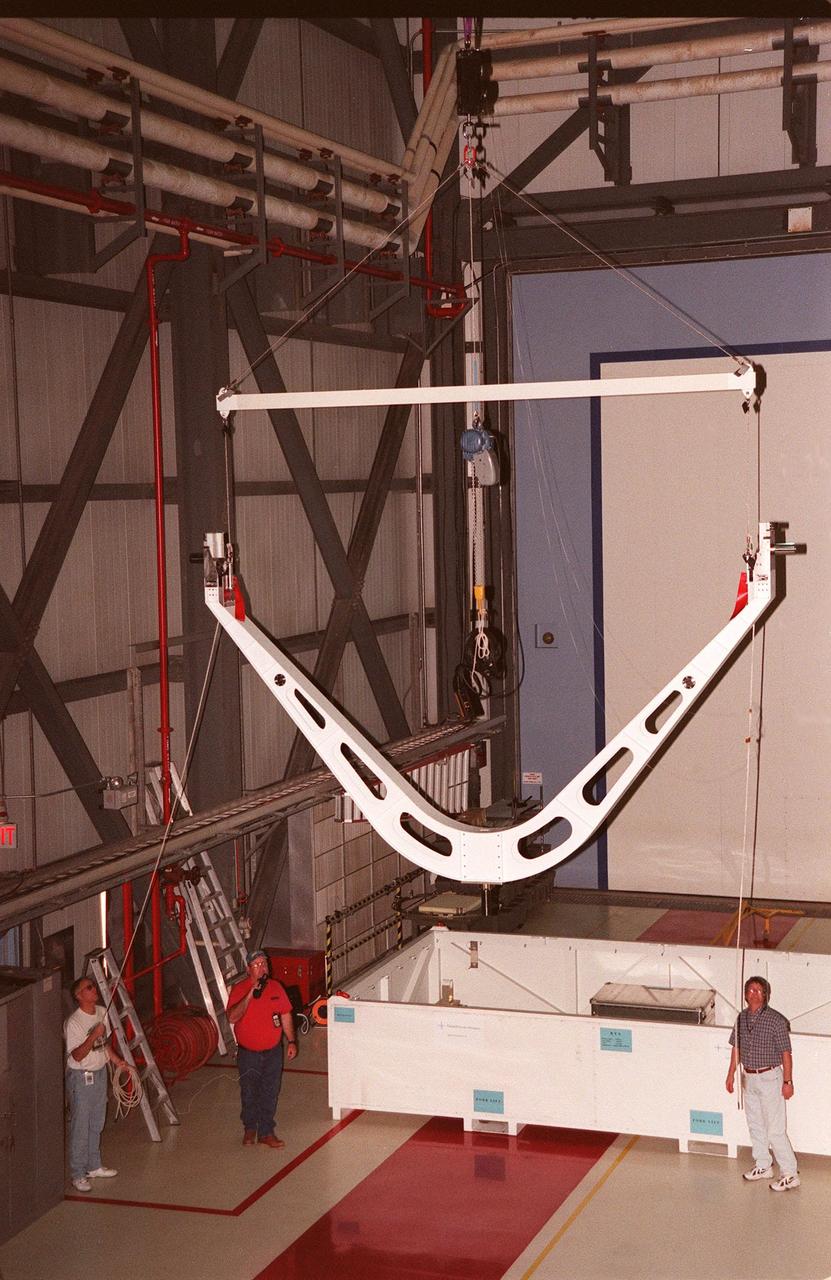
KENNEDY SPACE CENTER, FLA. -- In the Orbiter Processing Facility (OPF) Bay 1, workers lift the Keel Yoke Device (KYD) that will be fitted inside the payload bay of orbiter Discovery. The KYD will support the International Cargo Carrier (ICC) to be installed in the orbiter for mission STS-96. The ICC will carry unpressurized cargo such as the external Russian cargo crane known as STRELA, the SPACEHAB Oceaneering Space System Box (SHOSS), which is a logistics items carrier, and an ORU Transfer Device (OTD), a U.S.-built crane that will be stowed on the station for use during future ISS assembly missions. The primary payload of STS-96 is the SPACEHAB Double Module, an element of the International Space Station. STS-96 is targeted for launch on May 20 at 9:32 a.m. from Launch Pad 39B
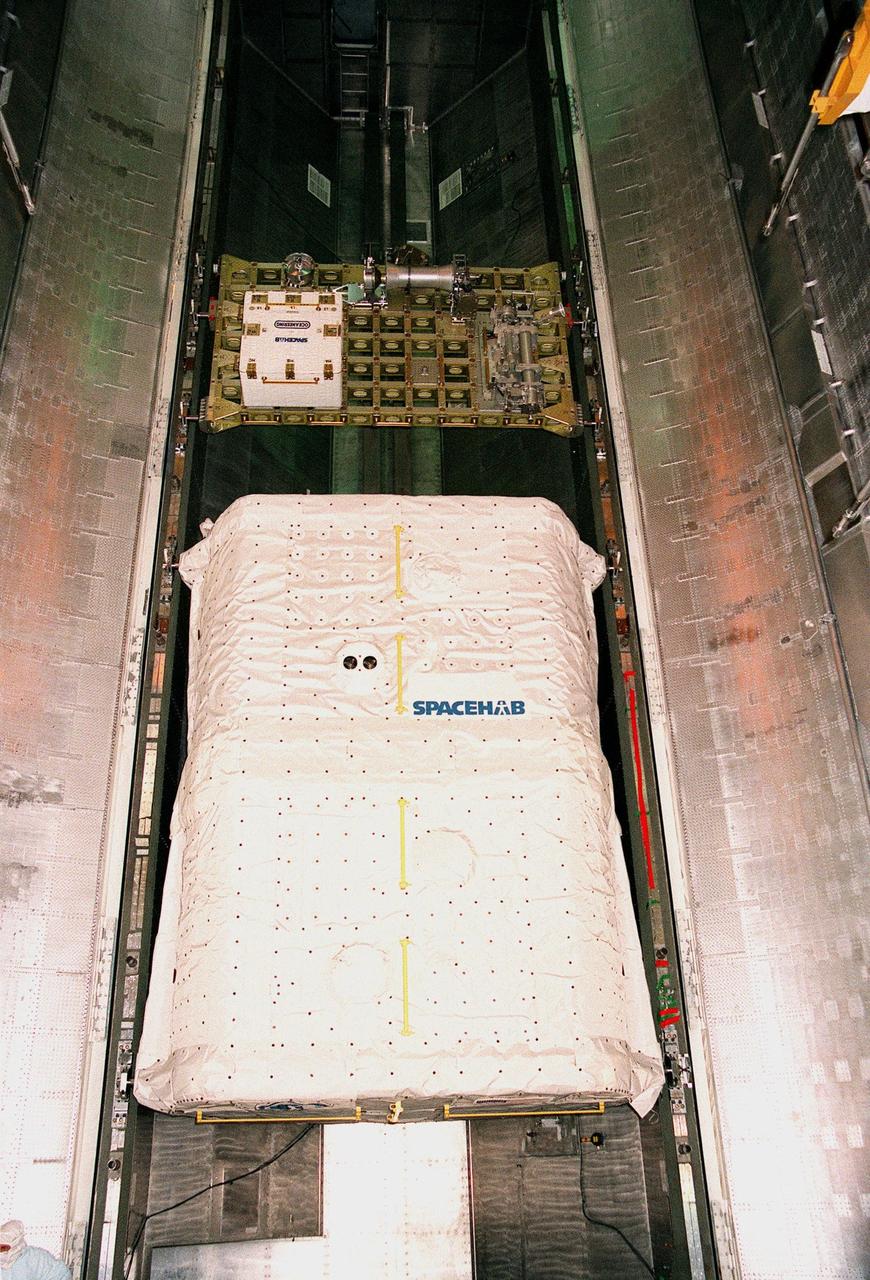
KENNEDY SPACE CENTER, FLA. -- The SPACEHAB Double module arrives at the payload changeout room at Launch Pad 39B before being transferred to Space Shuttle Discovery's payload bay for mission STS-96. Above it is the Integrated Cargo Carrier, which holds nonpressurized payloads such as a Russian crane, the Strela, and a U.S.-built crane. The second flight supporting construction of the International Space Station, STS-96 is a logistics and resupply mission, carrying more than 5,000 pounds of supplies, plus experiments such as STARSHINE, which was developed by and for students. The crew of seven are Commander Kent V. Rominger, Pilot Rick Douglas Husband, and Mission Specialists Ellen Ochoa (Ph.D.), Tamara E. Jernigan (Ph.D.), Daniel Barry (M.D., Ph.D.), Julie Payette, with the Canadian Space Agency, and Valery Ivanovich Tokarev, with the Russian Space Agency. Liftoff is scheduled for May 20 at 9:32 a.m. EDT

KENNEDY SPACE CENTER, FLA. -- Workers in the Orbiter Processing Facility (OPF) Bay 1 make final adjustments to the Keel Yoke Device (KYD) being installed in the orbiter Discovery. The KYD will support the International Cargo Carrier (ICC) to be fitted in the orbiter for mission STS-96. The ICC will carry unpressurized cargo such as the external Russian cargo crane known as STRELA, the SPACEHAB Oceaneering Space System Box (SHOSS), which is a logistics items carrier, and an ORU Transfer Device (OTD), a U.S.-built crane that will be stowed on the station for use during future ISS assembly missions. The primary payload of STS-96 is the SPACEHAB Double Module, an element of the International Space Station. STS-96 is targeted for launch on May 20 at 9:32 a.m. from Launch Pad 39B
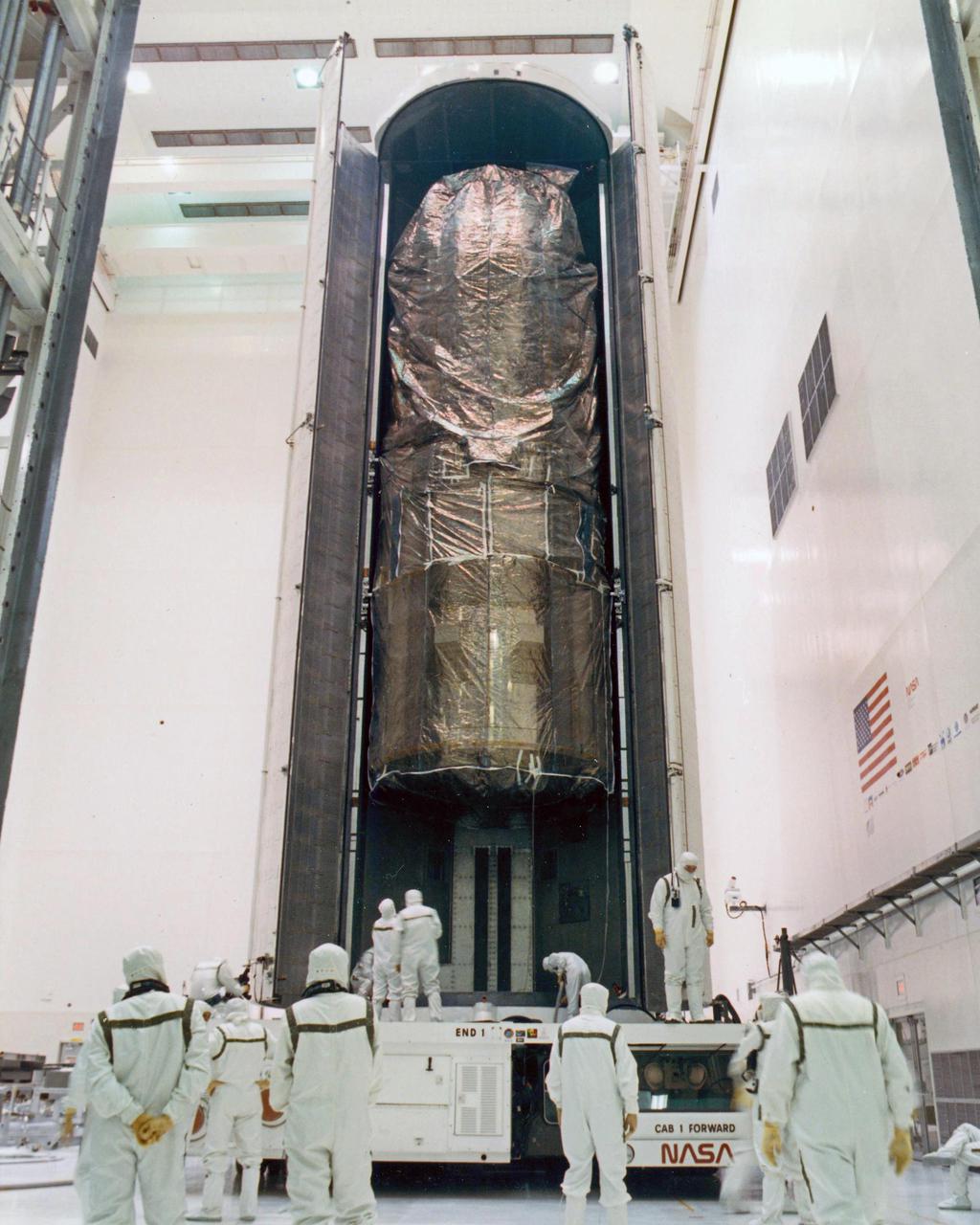
KENNEDY SPACE CENTER, FLA. -- In the Vertical Processing Facility, the Hubble Space Telescope (HST) has been installed in the payload canister and will ride atop the associated payload transporter for a 10-mile trip to Pad B on Launch Complex 39. The telescope is contained within a protective cocoon which is a double bag sanitary liner. This provides added cleanliness and protection and has been on HST since its arrival at KSC in October 1989. It was removed immediately prior to installation of the telescope into the payload bay of the Space Shuttle Discovery. With HST, astronomers will be able to view 97 percent of the known universe, and will be able to get pictures unlimited and undistorted by the Earth's atmosphere. Compared with earth-based observatories, the HST will be able to view celestial objects that are 50 times fainter, provide images that are 10 times sharper, and see objects that are seven times farther away. .
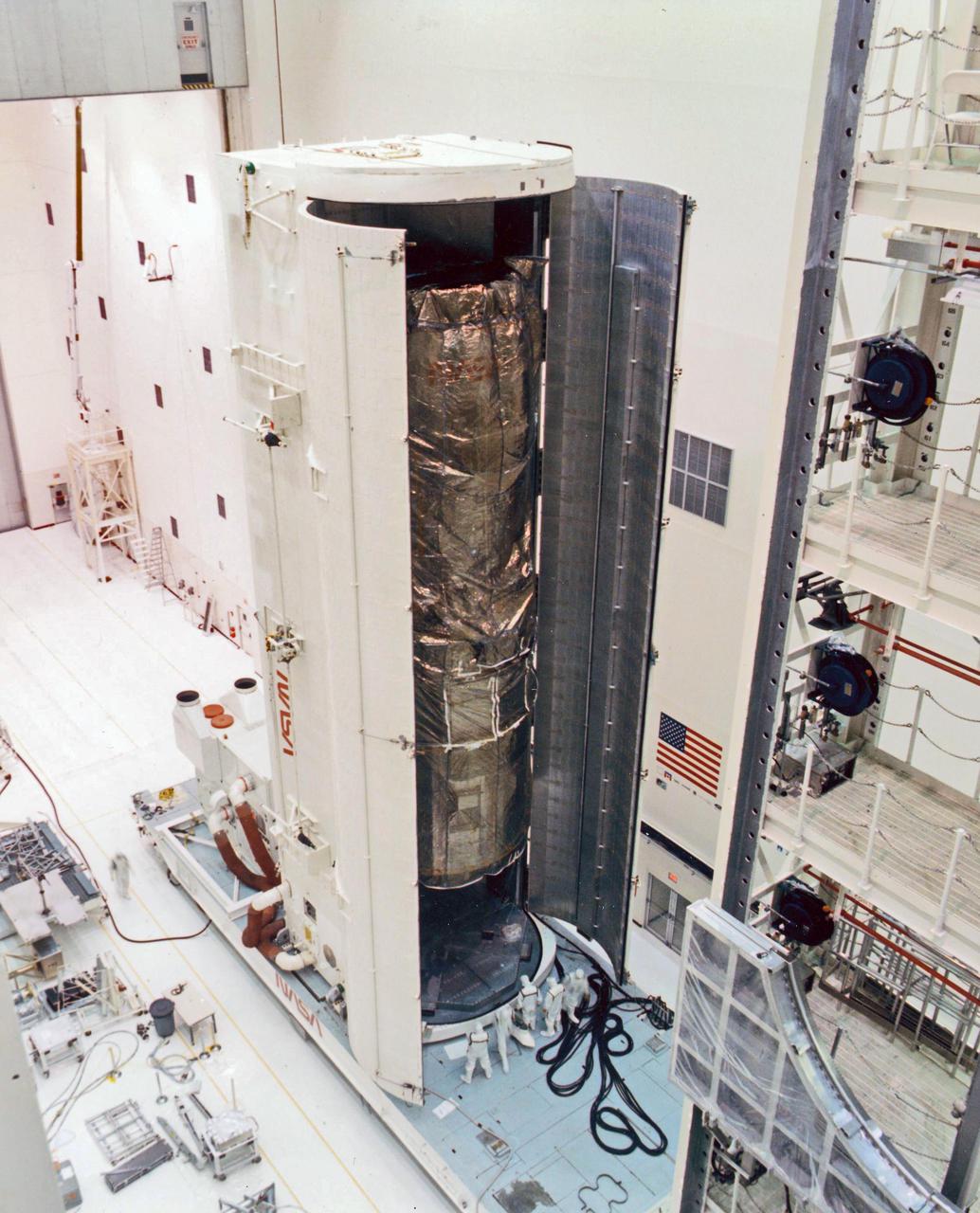
KENNEDY SPACE CENTER, FLA. -- In the Vertical Processing Facility, the Hubble Space Telescope (HST) has been installed in the payload canister and will ride atop the associated payload transporter for a 10-mile trip to Pad B on Launch Complex 39. The telescope is contained within a protective cocoon which is a double bag sanitary liner. This provides added cleanliness and protection and has been on HST since its arrival at KSC in October 1989. It was removed immediately prior to installation of the telescope into the payload bay of the Space Shuttle Discovery. With HST, astronomers will be able to view 97 percent of the known universe, and will be able to get pictures unlimited and undistorted by the Earth's atmosphere. Compared with earth-based observatories, the HST will be able to view celestial objects that are 50 times fainter, provide images that are 10 times sharper, and see objects that are seven times farther away. .
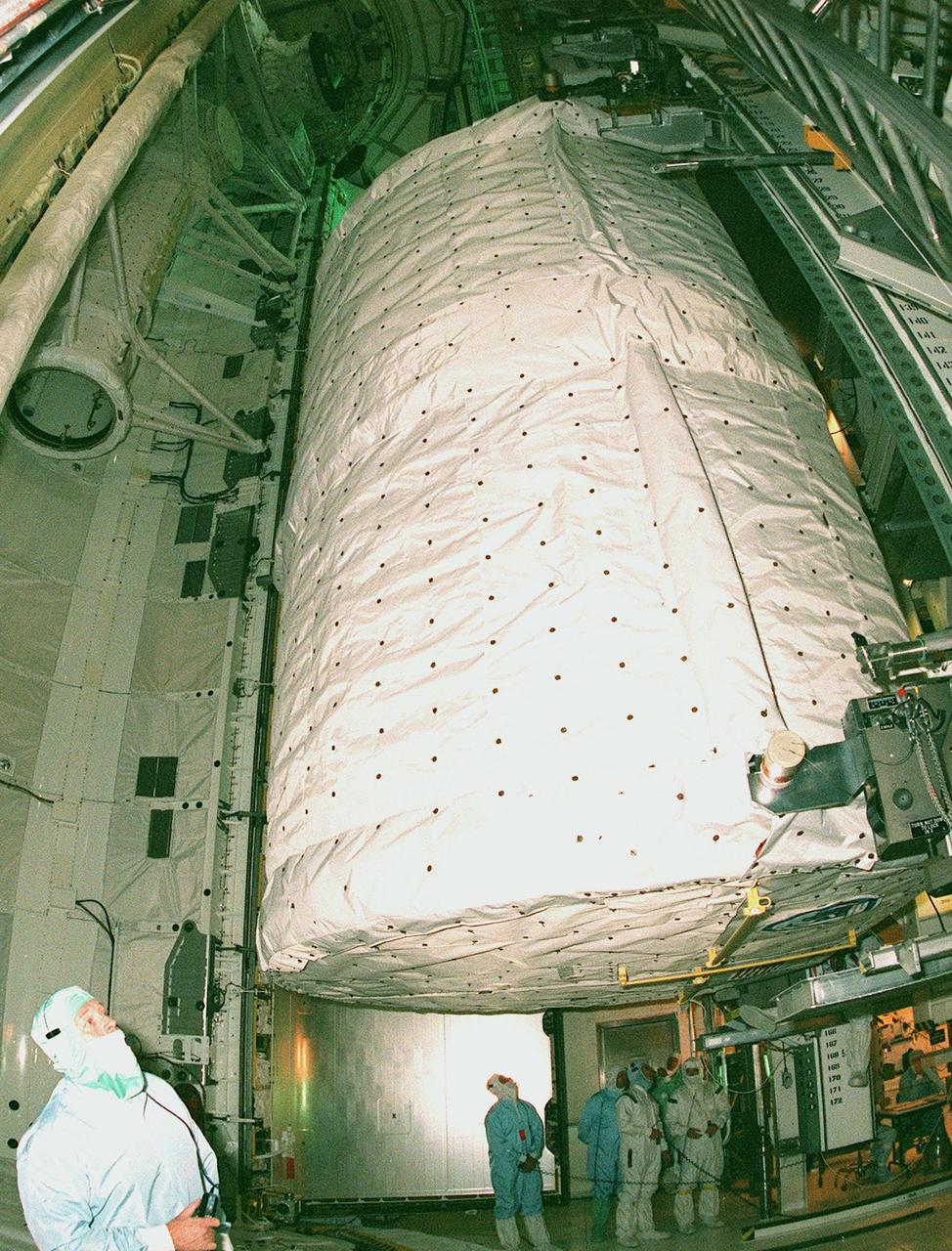
KENNEDY SPACE CENTER, FLA. -- In the payload changeout room at Launch Pad 39B, technicians move the SPACEHAB Double module from the payload canister before placing it in Space Shuttle Discovery's payload bay for mission STS-96. The second flight supporting construction of the International Space Station, STS-96 is a logistics and resupply mission, carrying more than 5,000 pounds of supplies, a Russian-built crane and a U.S.-built crane, plus experiments such as STARSHINE, which was developed by and for students. Comprising the crew are Commander Kent V. Rominger, Pilot Rick Douglas Husband, and Mission Specialists Ellen Ochoa (Ph.D.), Tamara E. Jernigan (Ph.D.), Daniel Barry (M.D., Ph.D.), Julie Payette, with the Canadian Space Agency, and Valery Ivanovich Tokarev, with the Russian Space Agency. Liftoff is scheduled for May 20 at 9:32 a.m. EDT
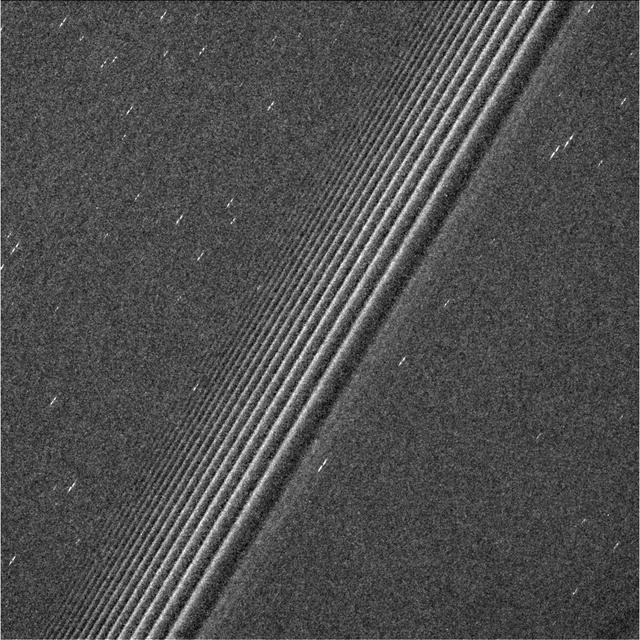
This view from NASA's Cassini spacecraft is the sharpest ever taken of belts of the features called propellers in the middle part of Saturn's A ring. The propellers are the small, bright features that look like double dashes, visible on both sides of the wave pattern that crosses the image diagonally from top to bottom. The original discovery of propellers in this region in Saturn's rings was made using several images taken from very close to the rings during Cassini's 2004 arrival at Saturn. Those discovery images were of low resolution and were difficult to interpret, and there were few clues as to how the small propellers seen in those images were related to the larger propellers Cassini observed later in the mission. This image, for the first time, shows swarms of propellers of a wide range of sizes, putting the ones Cassini observed in its Saturn arrival images in context. Scientists will use this information to derive a "particle size distribution" for propeller moons, which is an important clue to their origins. The image was taken using the Cassini spacecraft's narrow-angle camera on April 19. The view was has an image scale of 0.24 mile (385 meters) per pixel, and was taken at a sun-ring-spacecraft angle, or phase angle, of 108 degrees. The view looks toward a point approximately 80,000 miles (129,000 kilometers) from Saturn's center. https://photojournal.jpl.nasa.gov/catalog/PIA21448

In the Orbiter Processing Facility bay 1, STS-96 Mission Specialist Julie Payette, with the Canadian Space Agency, poses next to the Canadian arm in the payload bay of the orbiter Discovery. The STS-96 crew is at KSC for a Crew Equipment Interface Test. Other crew members are Commander Kent V. Rominger, Pilot Rick Douglas Husband, and Mission Specialists Ellen Ochoa (Ph.D), Tamara E. Jernigan (Ph.D.), Daniel Barry (M.D., Ph.D.), and Valery Ivanovich Tokarev, who represents the Russian Space Agency. The primary payload of STS-96 is the SPACEHAB Double Module. In addition, the Space Shuttle will carry unpressurized cargo such as the external Russian cargo crane known as STRELA; the Spacehab Oceaneering Space System Box (SHOSS), which is a logistics items carrier; and an ORU Transfer Device (OTD), a U.S.-built crane that will be stowed on the station for use during future ISS assembly missions. These cargo items will be stowed on the International Cargo Carrier, fitted inside the payload bay behind the SPACEHAB module. STS-96 is targeted for launch on May 24 from Launch Pad 39B

CAPE CANAVERAL, Fla. -- In bay 1 of the Orbiter Processing Facility at NASA's Kennedy Space Center in Florida, STS-96 mission specialist Julie Payette of the Canadian Space Agency poses next to the Canadian arm in the payload bay of the space shuttle Discovery. The STS-96 crew is at Kennedy for a Crew Equipment Interface Test. Other crew members are Commander Kent Rominger, Pilot Rick Douglas Husband, and Mission Specialists Ellen Ochoa, Tamara Jernigan, Daniel Barry, and Valery Tokarev of the Russian Space Agency. The primary payload of STS-96 is the SPACEHAB Double Module. In addition, the space shuttle will carry unpressurized cargo such as the external Russian cargo crane known as STRELA the Spacehab Oceaneering Space System Box, which is a logistics items carrier and an ORU Transfer Device, a U.S.-built crane that will be stowed on the station for use during future ISS assembly missions. These cargo items will be stowed on the International Cargo Carrier, fitted inside the payload bay behind the SPACEHAB module. STS-96 is targeted for launch on May 24, from Launch Pad 39B. Photo Credit: NASA
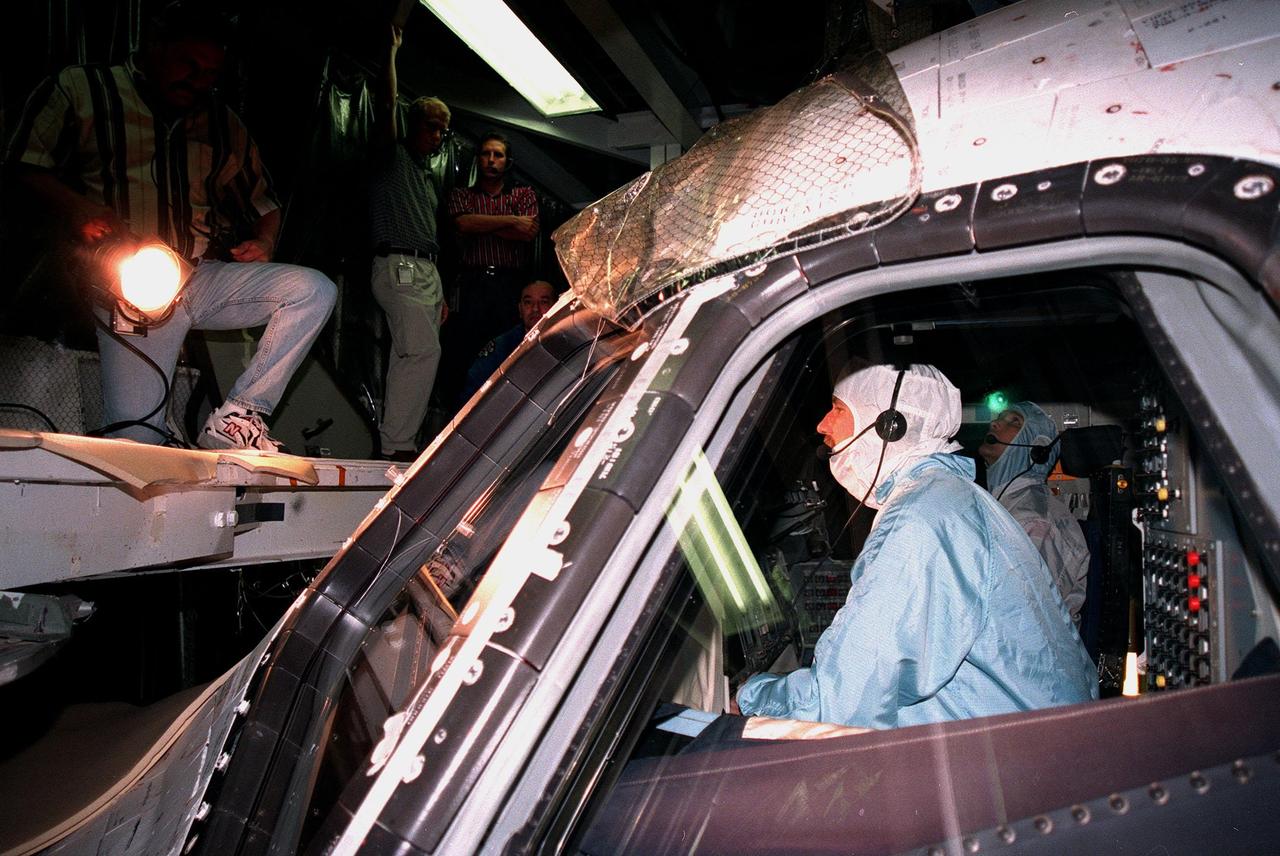
In the Orbiter Processing Facility bay 1, STS-96 Commander Kent V. Rominger checks the windows of the orbiter Discovery as a worker shines a bright light through them. The STS-96 crew is at KSC to take part in a Crew Equipment Interface Test. The other crew members are Pilot Rick Douglas Husband and Mission Specialists Ellen Ochoa (Ph.D.), Tamara E. Jernigan (Ph.D.), Daniel T. Barry (M.D., Ph.D.), Julie Payette and Valery Ivanovich Tokarev. Payette represents the Canadian Space Agency and Tokarev the Russian Space Agency. The primary payload of STS-96 is the SPACEHAB Double Module. In addition, the Space Shuttle will carry unpressurized cargo such as the external Russian cargo crane known as STRELA; the Spacehab Oceaneering Space System Box (SHOSS), which is a logistics items carrier; and an ORU Transfer Device (OTD), a U.S.-built crane that will be stowed on the station for use during future ISS assembly missions. These cargo items will be stowed on the International Cargo Carrier, fitted inside the payload bay behind the SPACEHAB module. STS-96 is targeted for launch on May 24 from Launch Pad 39B
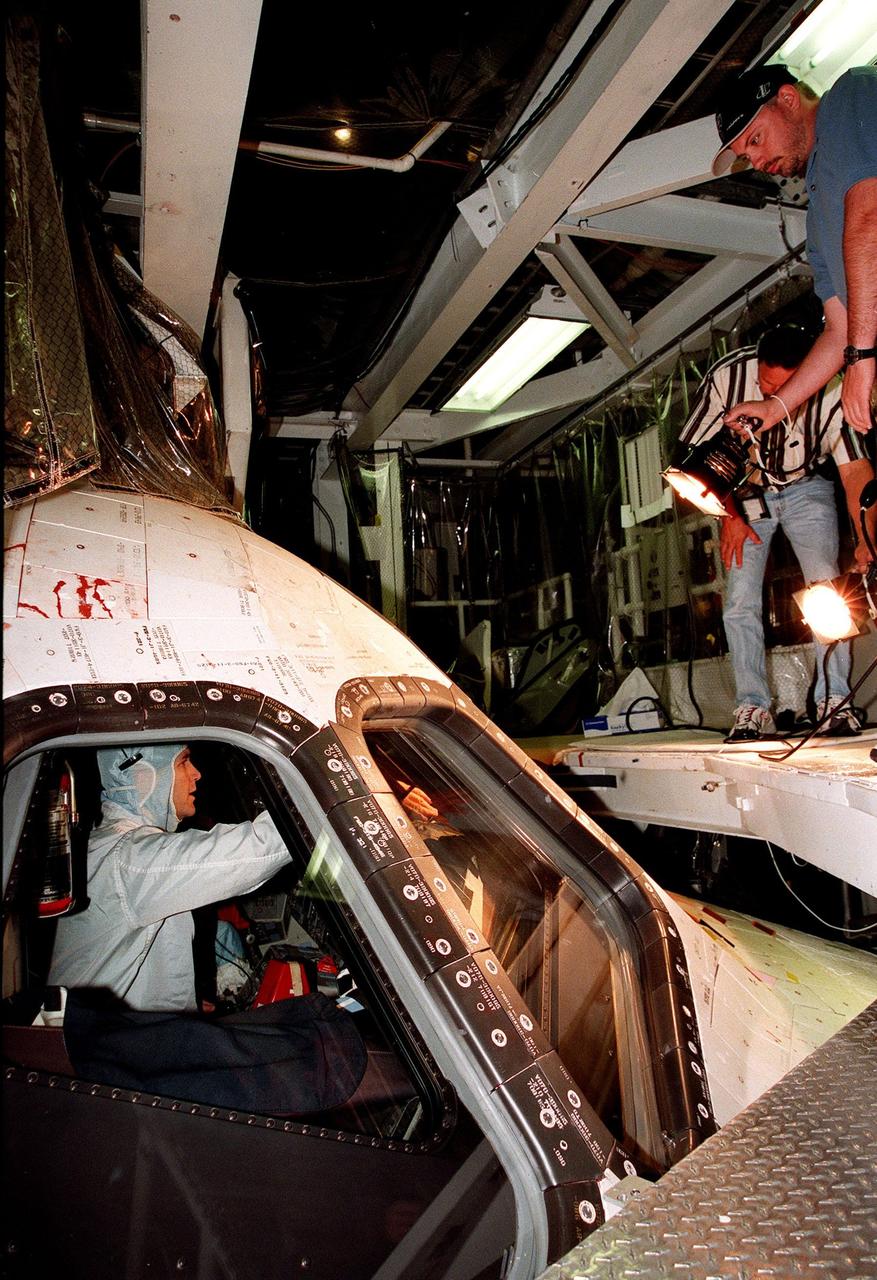
STS-96 Pilot Rick Douglas Husband checks the windows of the orbiter Discovery in the Orbiter Processing Facility bay 1 as a worker shines a light through them. The STS-96 crew is at KSC to take part in a Crew Equipment Interface Test. The other crew members are Pilot Rick Douglas Husband and Mission Specialists Ellen Ochoa (Ph.D.), Tamara E. Jernigan (Ph.D.), Daniel Barry (M.D., Ph.D.), Julie Payette and Valery Ivanovich Tokarev. Payette represents the Canadian Space Agency and Tokarev the Russian Space Agency. The primary payload of STS-96 is the SPACEHAB Double Module. In addition, the Space Shuttle will carry unpressurized cargo such as the external Russian cargo crane known as STRELA; the Spacehab Oceaneering Space System Box (SHOSS), which is a logistics items carrier; and an ORU Transfer Device (OTD), a U.S.-built crane that will be stowed on the station for use during future ISS assembly missions. These cargo items will be stowed on the International Cargo Carrier, fitted inside the payload bay behind the SPACEHAB module. STS-96 is targeted for launch on May 24 from Launch Pad 39B
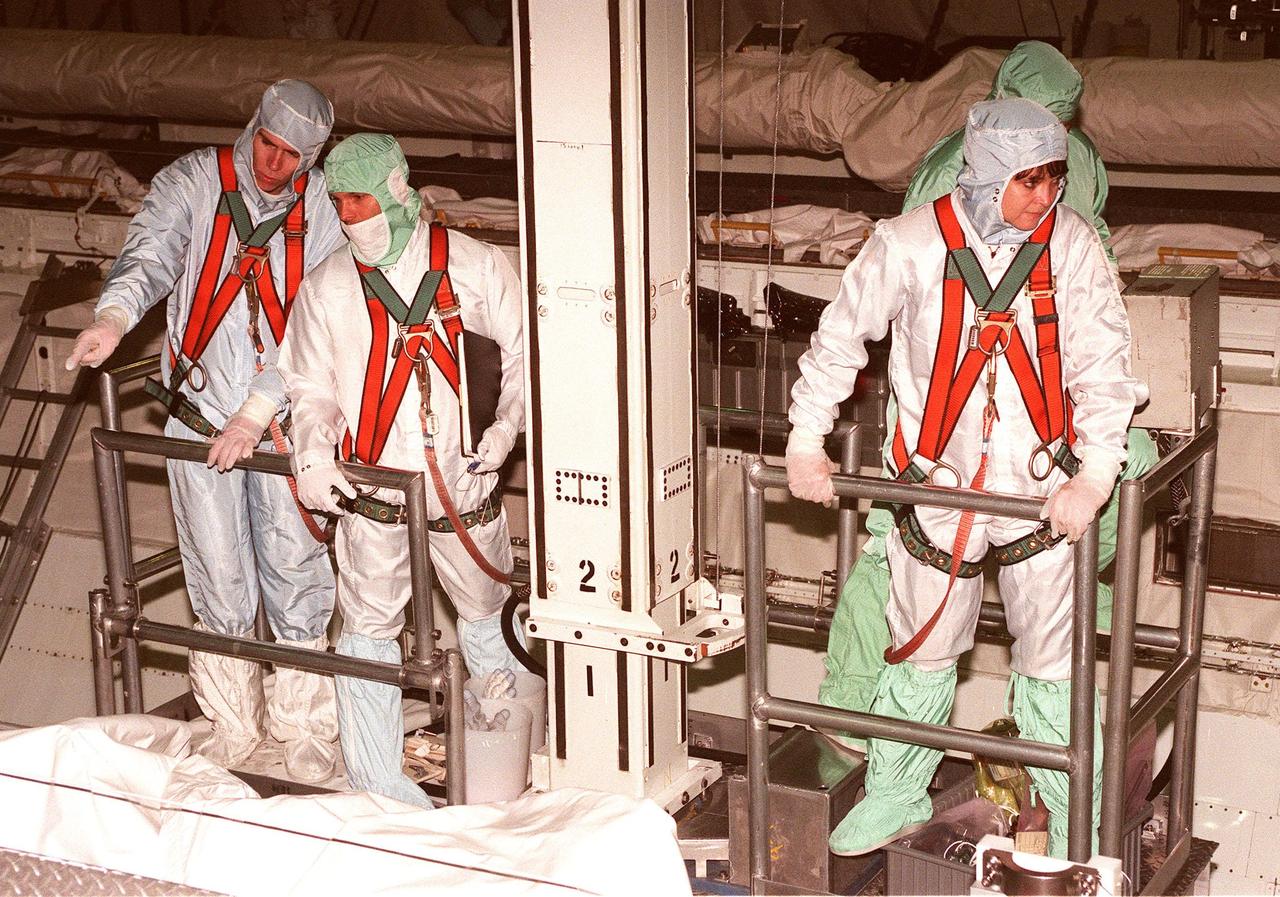
In the Orbiter Processing Facility bay 1, STS-96 Mission Specialists Daniel Barry (M.D., Ph.D.), Valery Ivanovich Tokarev and Tamara E. Jernigan (Ph.D.) look into the payload bay of the orbiter Discovery. The STS-96 crew is at KSC for a Crew Equipment Interface Test. Other crew members participating are Commander Kent V. Rominger, Pilot Rick Douglas Husband, and Mission Specialists Ellen Ochoa (Ph.D.) and Julie Payette, with the Canadian Space Agency. The primary payload of STS-96 is the SPACEHAB Double Module. In addition, the Space Shuttle will carry unpressurized cargo such as the external Russian cargo crane known as STRELA; the Spacehab Oceaneering Space System Box (SHOSS), which is a logistics items carrier; and an ORU Transfer Device (OTD), a U.S.-built crane that will be stowed on the station for use during future ISS assembly missions. These cargo items will be stowed on the International Cargo Carrier, fitted inside the payload bay behind the SPACEHAB module. STS-96 is targeted for launch on May 24 from Launch Pad 39B
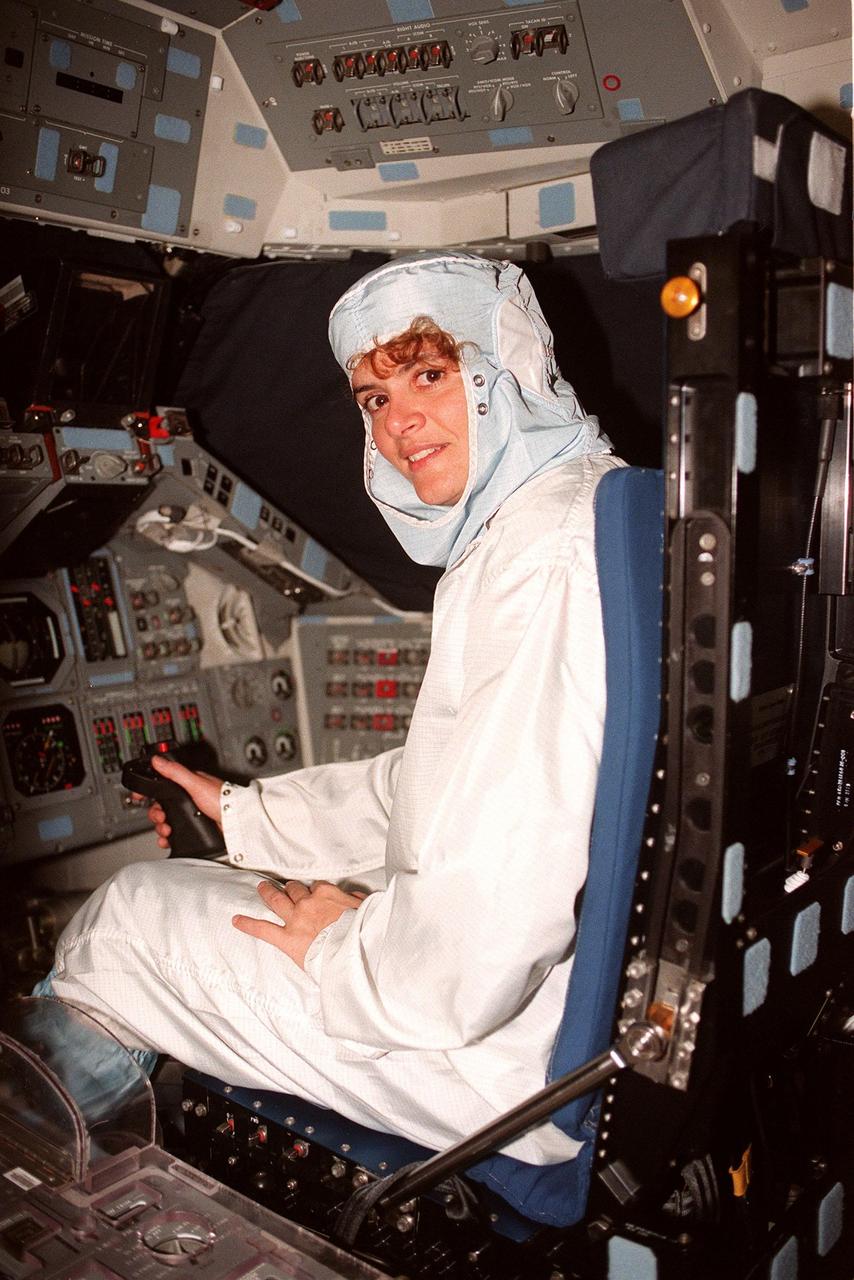
In the Orbiter Processing Facility bay 1, STS-96 Mission Specialist Julie Payette, with the Canadian Space Agency, sits in the pilot's seat inside the orbiter Discovery. The STS-96 crew is at KSC to take part in a Crew Equipment Interface Test. Other members participating are Commander Kent V. Rominger, Pilot Rick Douglas Husband and Mission Specialists Ellen Ochoa (Ph.D.), Tamara E. Jernigan (Ph.D.), Daniel Barry (M.D., Ph.D.) and Valery Ivanovich Tokarev, who represents the Russian Space Agency. The primary payload of STS-96 is the SPACEHAB Double Module. In addition, the Space Shuttle will carry unpressurized cargo such as the external Russian cargo crane known as STRELA; the Spacehab Oceaneering Space System Box (SHOSS), which is a logistics items carrier; and an ORU Transfer Device (OTD), a U.S.-built crane that will be stowed on the station for use during future ISS assembly missions. These cargo items will be stowed on the International Cargo Carrier, fitted inside the payload bay behind the SPACEHAB module. STS-96 is targeted for launch on May 24 from Launch Pad 39B
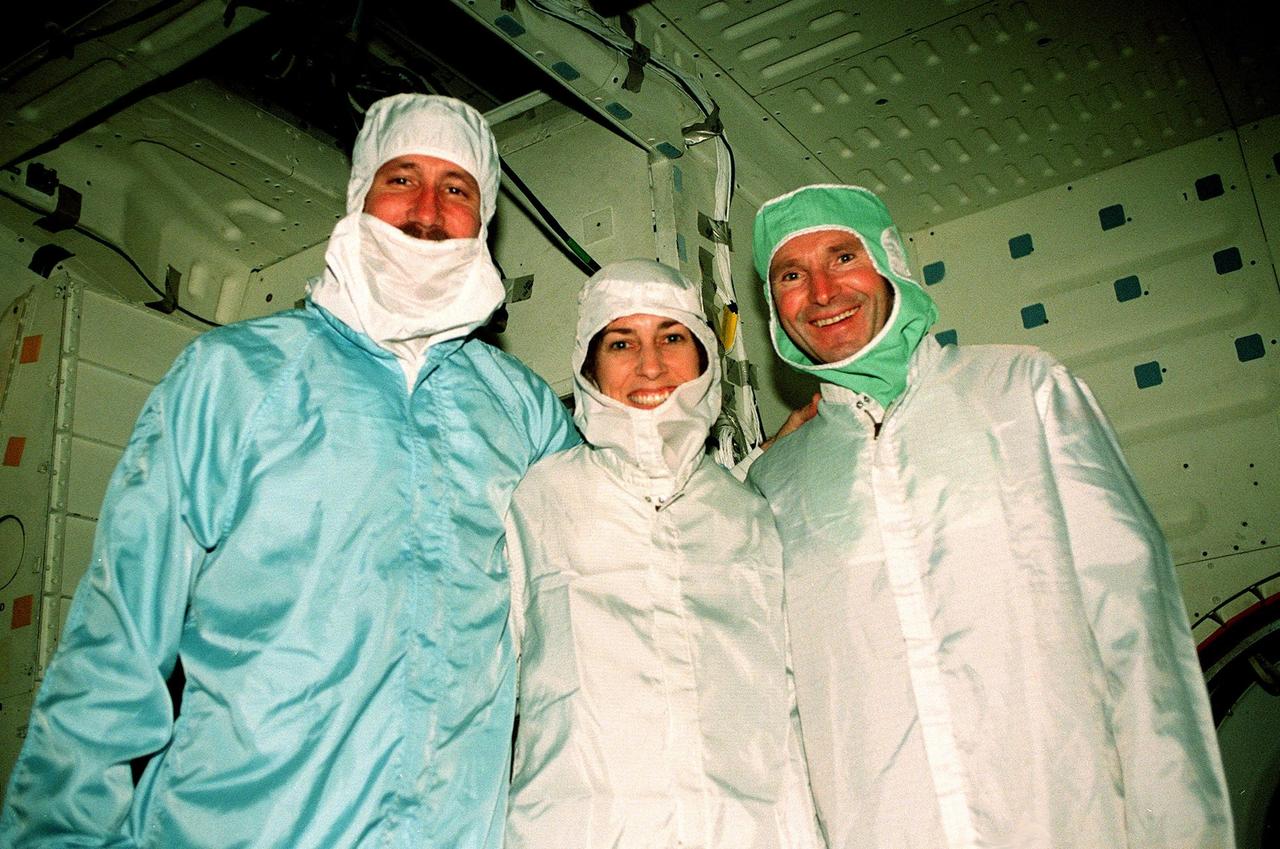
In the Orbiter Processing Facility bay 1, STS-96 Commander Kent V. Rominger and Mission Specialists Ellen Ochoa (Ph.D.) and Valery Ivanovich Tokarev pose inside the orbiter Discovery. The STS-96 crew is at KSC to take part in a Crew Equipment Interface Test. Other members participating are Pilot Rick Douglas Husband and Mission Specialists Tamara E. Jernigan (Ph.D.), Daniel Barry (M.D., Ph.D.) and Julie Payette, who is with the Canadian Space Agency. Tokarev represents the Russian Space Agency. The primary payload of STS-96 is the SPACEHAB Double Module. In addition, the Space Shuttle will carry unpressurized cargo such as the external Russian cargo crane known as STRELA; the Spacehab Oceaneering Space System Box (SHOSS), which is a logistics items carrier; and an ORU Transfer Device (OTD), a U.S.-built crane that will be stowed on the station for use during future ISS assembly missions. These cargo items will be stowed on the International Cargo Carrier, fitted inside the payload bay behind the SPACEHAB module. STS-96 is targeted for launch on May 24 from Launch Pad 39B
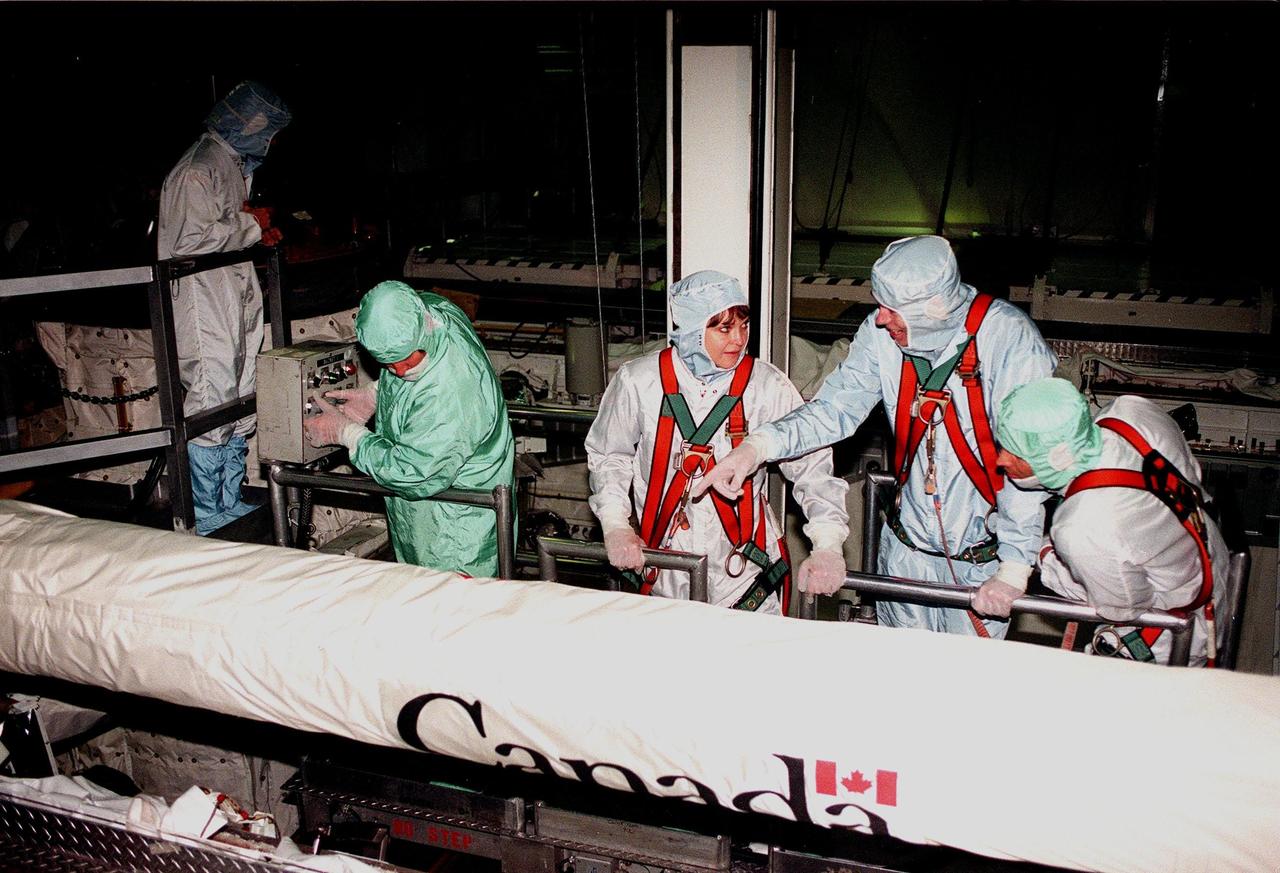
In the Orbiter Processing Facility bay 1, STS-96 crew members look at the Canadian arm in the payload bay of the orbiter Discovery. Standing in a bucket controlled by a KSC worker, are (from left) Mission Specialist Tamara E. Jernigan (Ph.D), Daniel Barry (M.D., Ph.D.), and Valery Ivanovich Tokarev, who represents the Russian Space Agency. The STS-96 crew is at KSC to take part in a Crew Equipment Interface Test. The other crew members are Commander Kent V. Rominger, Pilot Rick Douglas Husband and Mission Specialists Ellen Ochoa (Ph.D.) and Julie Payette, with the Canadian Space Agency. The primary payload of STS-96 is the SPACEHAB Double Module. In addition, the Space Shuttle will carry unpressurized cargo such as the external Russian cargo crane known as STRELA; the Spacehab Oceaneering Space System Box (SHOSS), which is a logistics items carrier; and an ORU Transfer Device (OTD), a U.S.-built crane that will be stowed on the station for use during future ISS assembly missions. These cargo items will be stowed on the International Cargo Carrier, fitted inside the payload bay behind the SPACEHAB module. STS-96 is targeted for launch on May 24 from Launch Pad 39B

In the Orbiter Processing Facility bay 1, the STS-96 crew (foreground) looks into the payload bay of the orbiter Discovery. Standing in the bucket in the foreground are (left to right) Mission Specialists Daniel Barry (M.D., Ph.D.), Valery Ivanovich Tokarev, and Tamara E. Jernigan (Ph.D.), with a KSC worker at the controls of the bucket. In the background (center) pointing is Mission Specialist Julie Payette. Tokarev represents the Russian Space Agency and Payette the Canadian Space Agency. They are at KSC for a Crew Equipment Interface Test. The other crew members participating in the test are Commander Kent V. Rominger, Pilot Rick Douglas Husband and Mission Specialist Ellen Ochoa (Ph.D.). The primary payload of STS-96 is the SPACEHAB Double Module. In addition, the Space Shuttle will carry unpressurized cargo such as the external Russian cargo crane known as STRELA; the Spacehab Oceaneering Space System Box (SHOSS), which is a logistics items carrier; and an ORU Transfer Device (OTD), a U.S.-built crane that will be stowed on the station for use during future ISS assembly missions. These cargo items will be stowed on the International Cargo Carrier, fitted inside the payload bay behind the SPACEHAB module. STS-96 is targeted for launch on May 24 from Launch Pad 39B

NASA image release July 12, 2011 Neptune: 23:09 UT (June 25, 2011) Today, Neptune has arrived at the same location in space where it was discovered nearly 165 years ago. To commemorate the event, NASA's Hubble Space Telescope has taken these "anniversary pictures" of the blue-green giant planet. Neptune is the most distant major planet in our solar system. German astronomer Johann Galle discovered the planet on September 23, 1846. At the time, the discovery doubled the size of the known solar system. The planet is 2.8 billion miles (4.5 billion kilometers) from the Sun, 30 times farther than Earth. Under the Sun's weak pull at that distance, Neptune plods along in its huge orbit, slowly completing one revolution approximately every 165 years. <b>To read more go <a href="http://www.nasa.gov/mission_pages/hubble/science/neptune-circuit.html" rel="nofollow"> here</a></b> <b><a href="http://www.nasa.gov/centers/goddard/home/index.html" rel="nofollow">NASA Goddard Space Flight Center</a></b> enables NASA’s mission through four scientific endeavors: Earth Science, Heliophysics, Solar System Exploration, and Astrophysics. Goddard plays a leading role in NASA’s accomplishments by contributing compelling scientific knowledge to advance the Agency’s mission. <b>Follow us on <a href="http://twitter.com/NASA_GoddardPix" rel="nofollow">Twitter</a></b> <b>Like us on <a href="http://www.facebook.com/pages/Greenbelt-MD/NASA-Goddard/395013845897?ref=tsd" rel="nofollow">Facebook</a></b> <b>Find us on <a href="http://web.stagram.com/n/nasagoddard/?vm=grid" rel="nofollow">Instagram</a></b>
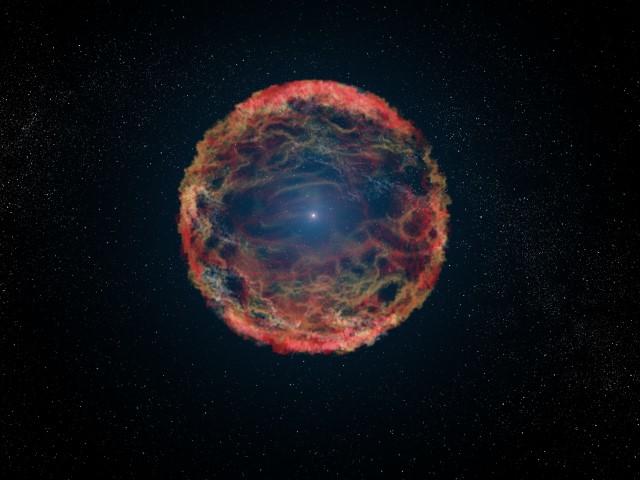
This is an artist's impression of supernova 1993J, an exploding star in the galaxy M81 whose light reached us 21 years ago. The supernova originated in a double-star system where one member was a massive star that exploded after siphoning most of its hydrogen envelope to its companion star. After two decades, astronomers have at last identified the blue helium-burning companion star, seen at the center of the expanding nebula of debris from the supernova. The Hubble Space Telescope identified the ultraviolet glow of the surviving companion embedded in the fading glow of the supernova. More info: Using NASA’s Hubble Space Telescope, astronomers have discovered a companion star to a rare type of supernova. The discovery confirms a long-held theory that the supernova, dubbed SN 1993J, occurred inside what is called a binary system, where two interacting stars caused a cosmic explosion. "This is like a crime scene, and we finally identified the robber," said Alex Filippenko, professor of astronomy at University of California (UC) at Berkeley. "The companion star stole a bunch of hydrogen before the primary star exploded." SN 1993J is an example of a Type IIb supernova, unusual stellar explosions that contains much less hydrogen than found in a typical supernova. Astronomers believe the companion star took most of the hydrogen surrounding the exploding main star and continued to burn as a super-hot helium star. “A binary system is likely required to lose the majority of the primary star’s hydrogen envelope prior to the explosion. The problem is that, to date, direct observations of the predicted binary companion star have been difficult to obtain since it is so faint relative to the supernova itself,” said lead researcher Ori Fox of UC Berkeley. Read more: <a href="http://1.usa.gov/1Az5Qb9" rel="nofollow">1.usa.gov/1Az5Qb9</a> Credit: NASA, ESA, G. Bacon (STScI) <b><a href="http://www.nasa.gov/audience/formedia/features/MP_Photo_Guidelines.html" rel="nofollow">NASA image use policy.</a></b> <b><a href="http://www.nasa.gov/centers/goddard/home/index.html" rel="nofollow">NASA Goddard Space Flight Center</a></b> enables NASA’s mission through four scientific endeavors: Earth Science, Heliophysics, Solar System Exploration, and Astrophysics. Goddard plays a leading role in NASA’s accomplishments by contributing compelling scientific knowledge to advance the Agency’s mission. <b>Follow us on <a href="http://twitter.com/NASAGoddardPix" rel="nofollow">Twitter</a></b> <b>Like us on <a href="http://www.facebook.com/pages/Greenbelt-MD/NASA-Goddard/395013845897?ref=tsd" rel="nofollow">Facebook</a></b> <b>Find us on <a href="http://instagram.com/nasagoddard?vm=grid" rel="nofollow">Instagram</a></b>

Just in time for the release of the movie “Star Wars Episode VII: The Force Awakens,” NASA’s Hubble Space Telescope has photographed what looks like a cosmic, double-bladed lightsaber. In the center of the image, partially obscured by a dark, Jedi-like cloak of dust, a newborn star shoots twin jets out into space as a sort of birth announcement to the universe. “Science fiction has been an inspiration to generations of scientists and engineers, and the film series Star Wars is no exception,” said John Grunsfeld, astronaut and associate administrator for the NASA Science Mission directorate. “There is no stronger case for the motivational power of real science than the discoveries that come from the Hubble Space Telescope as it unravels the mysteries of the universe." This celestial lightsaber does not lie in a galaxy far, far away, but rather inside our home galaxy, the Milky Way. It’s inside a turbulent birthing ground for new stars known as the Orion B molecular cloud complex, located 1,350 light-years away. When stars form within giant clouds of cool molecular hydrogen, some of the surrounding material collapses under gravity to form a rotating, flattened disk encircling the newborn star. Though planets will later congeal in the disk, at this early stage the protostar is feeding on the disk with a Jabba-like appetite. Gas from the disk rains down onto the protostar and engorges it. Superheated material spills away and is shot outward from the star in opposite directions along an uncluttered escape route — the star’s rotation axis. Shock fronts develop along the jets and heat the surrounding gas to thousands of degrees Fahrenheit. The jets collide with the surrounding gas and dust and clear vast spaces, like a stream of water plowing into a hill of sand. The shock fronts form tangled, knotted clumps of nebulosity and are collectively known as Herbig-Haro (HH) objects. The prominent HH object shown in this image is HH 24. Just to the right of the cloaked star, a couple of bright points are young stars peeking through and showing off their own faint lightsabers — including one that has bored a tunnel through the cloud towards the upper-right side of the picture. Overall, just a handful of HH jets have been spotted in this region in visible light, and about the same number in the infrared. Hubble’s observations for this image were performed in infrared light, which enabled the telescope to peer through the gas and dust cocooning the newly forming stars and capture a clear view of the HH objects. These young stellar jets are ideal targets for NASA’s upcoming James Webb Space Telescope, which will have even greater infrared wavelength vision to see deeper into the dust surrounding newly forming stars. The Hubble Space Telescope is a project of international cooperation between NASA and the European Space Agency. NASA’s Goddard Space Flight Center in Greenbelt, Maryland, manages the telescope. The Space Telescope Science Institute (STScI) in Baltimore, Maryland, conducts Hubble science operations. STScI is operated for NASA by the Association of Universities for Research in Astronomy, in Washington, D.C. Credits: NASA/ESA <b><a href="http://www.nasa.gov/audience/formedia/features/MP_Photo_Guidelines.html" rel="nofollow">NASA image use policy.</a></b> <b><a href="http://www.nasa.gov/centers/goddard/home/index.html" rel="nofollow">NASA Goddard Space Flight Center</a></b> enables NASA’s mission through four scientific endeavors: Earth Science, Heliophysics, Solar System Exploration, and Astrophysics. Goddard plays a leading role in NASA’s accomplishments by contributing compelling scientific knowledge to advance the Agency’s mission. <b>Follow us on <a href="http://twitter.com/NASAGoddardPix" rel="nofollow">Twitter</a></b> <b>Like us on <a href="http://www.facebook.com/pages/Greenbelt-MD/NASA-Goddard/395013845897?ref=tsd" rel="nofollow">Facebook</a></b> <b>Find us on <a href="http://instagrid.me/nasagoddard/?vm=grid" rel="nofollow">Instagram</a></b>