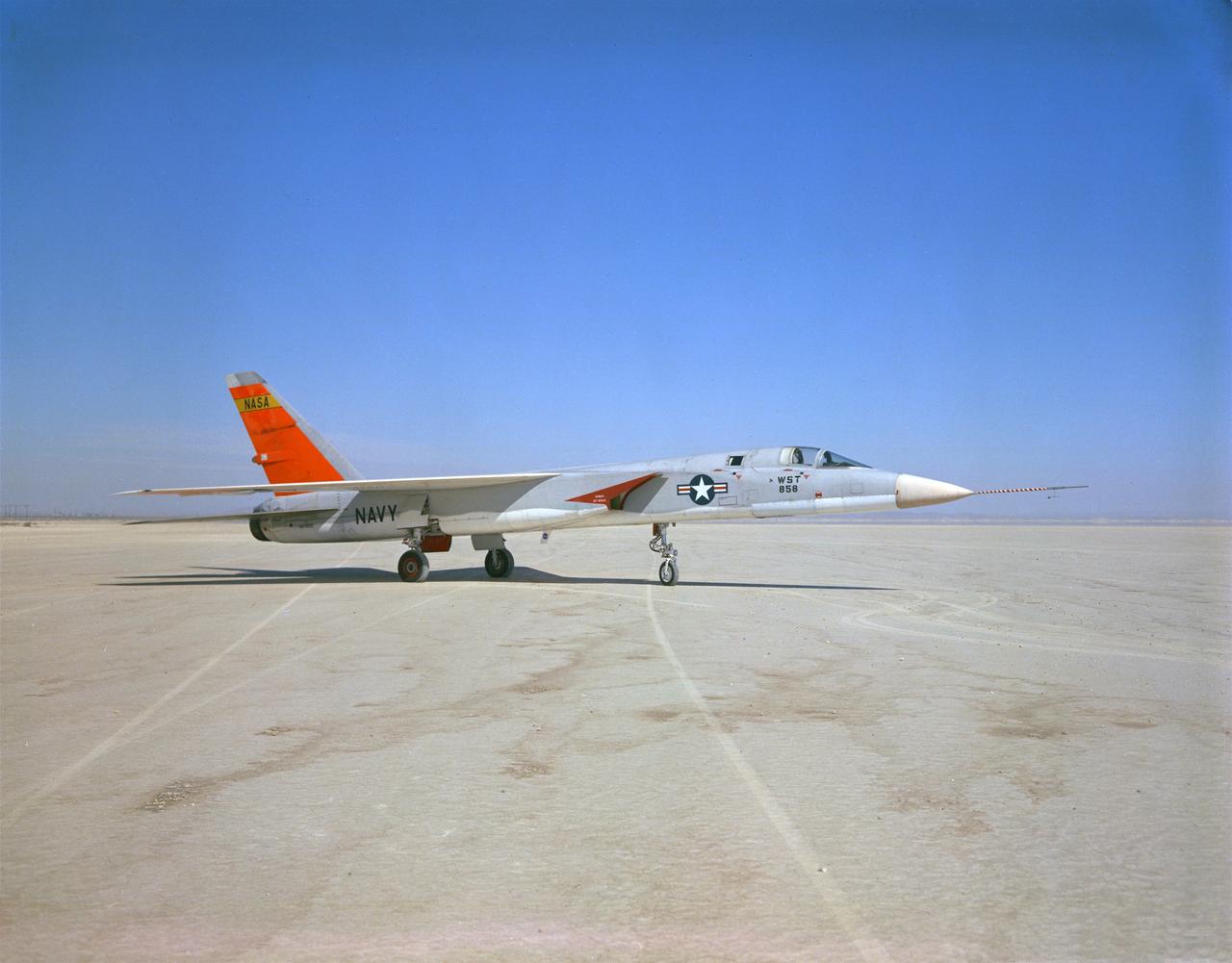
A North American Aviation A-5A Vigilante (Navy serial number 147858/NASA tail number 858) arrived from the Naval Air Test Center, Patuxent River, MD, on December 19, 1962, at the NASA Flight Research Center (now, Dryden Flight Research Center, Edwards, CA). The Center flew the A-5A in a year-long series of flights in support of the U.S. supersonic transport program. The Center flew the aircraft to determine the let-down and approach conditions of a supersonic transport flying into a dense air traffic network. With the completion of the research flights, the Center sent the A-5A back to the Navy on December 20, 1963.
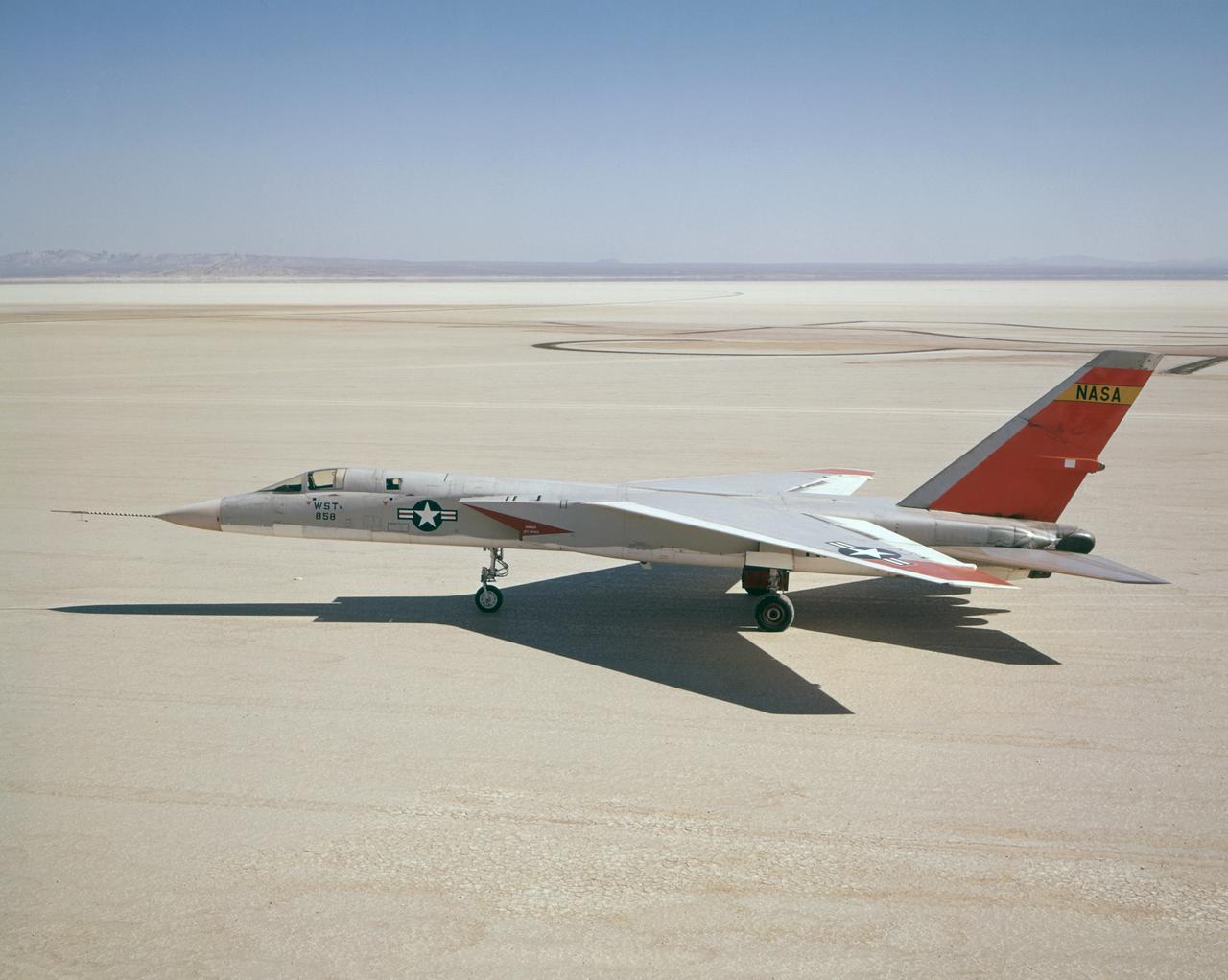
A North American Aviation A-5A Vigilante (Navy serial number 147858/NASA tail number 858) arrived from the Naval Air Test Center, Patuxent River, MD, on December 19, 1962, at the NASA Flight Research Center (now, Dryden Flight Research Center, Edwards, CA). The Center flew the A-5A in a year-long series of flights in support of the U.S. supersonic transport program. The Center flew the aircraft to determine the let-down and approach conditions of a supersonic transport flying into a dense air traffic network. With the completion of the research flights, the Center sent the A-5A back to the Navy on December 20, 1963.
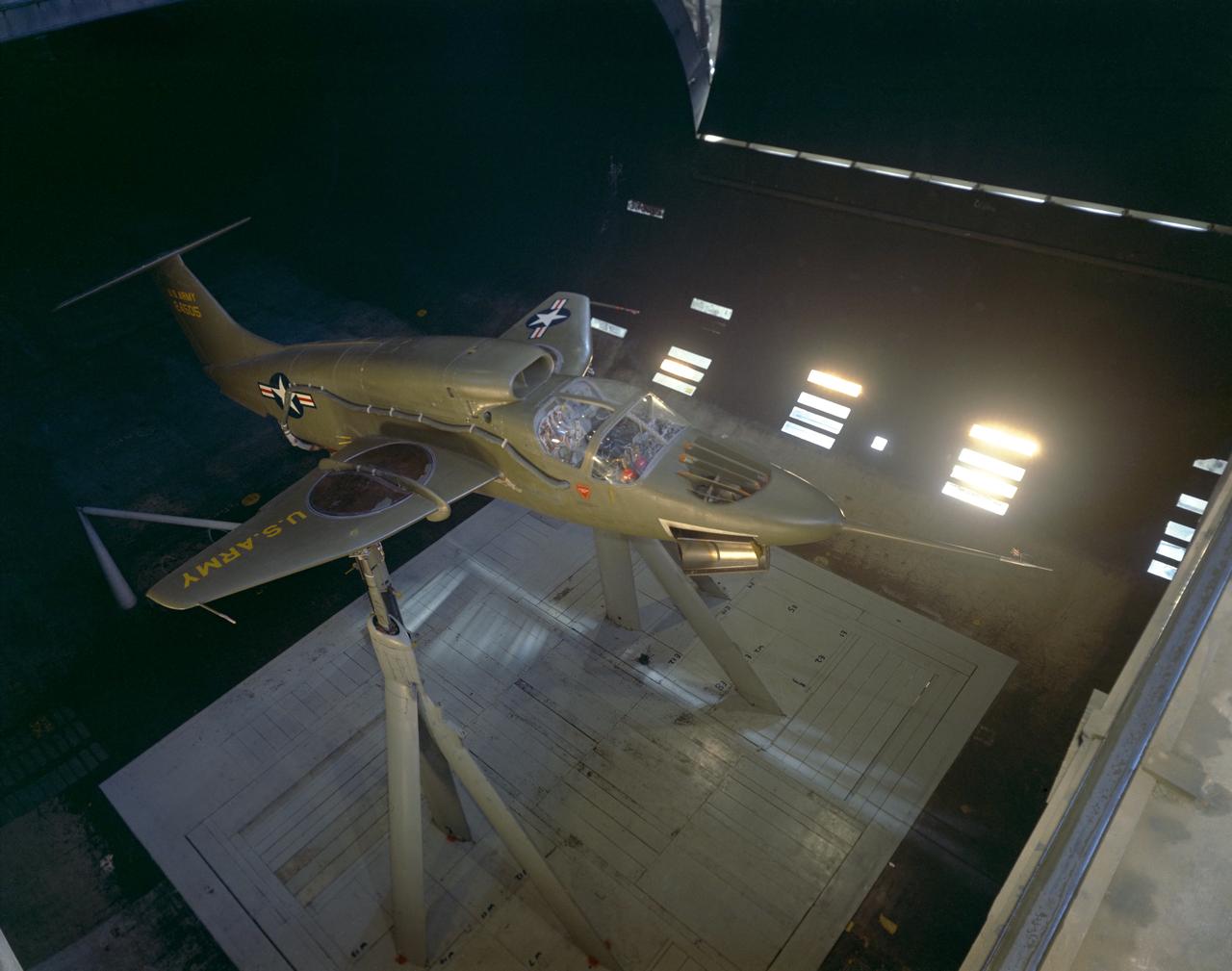
Overhead view of Ryan XV-5A lift-fan VSTOL airplane.

XV-5A airplane installed in 40x80ft Subsonic Wind Tunnel at NASA Ames Research Center with Tom Mills. The propulsive lift system was tested to determine power-on performance characteristics in preparation for flight tests.
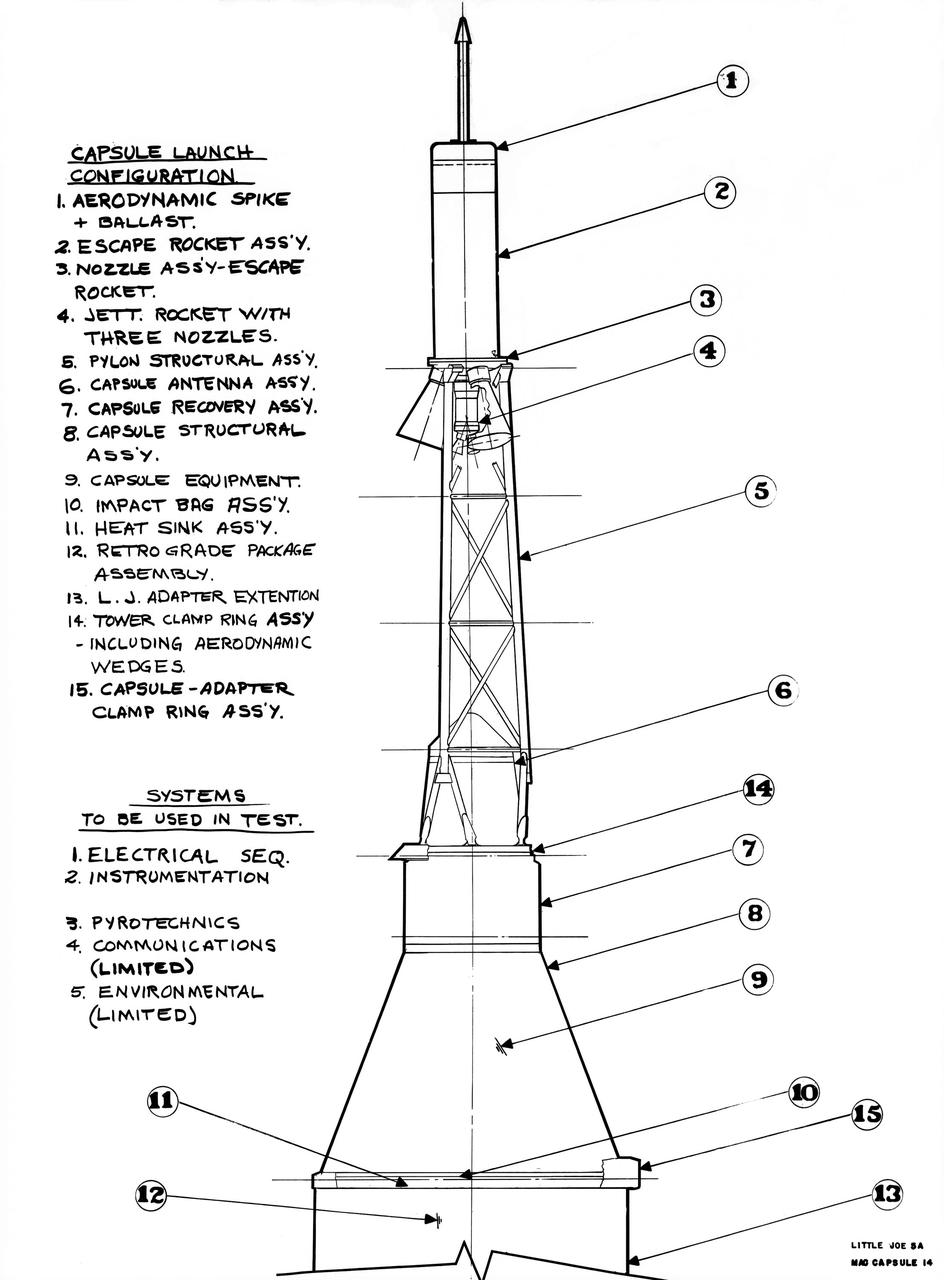
S61-01600 (11 March 1961) --- This is the G2498 Little Joe 5A mission preparedness chart. Photo credit: NASA
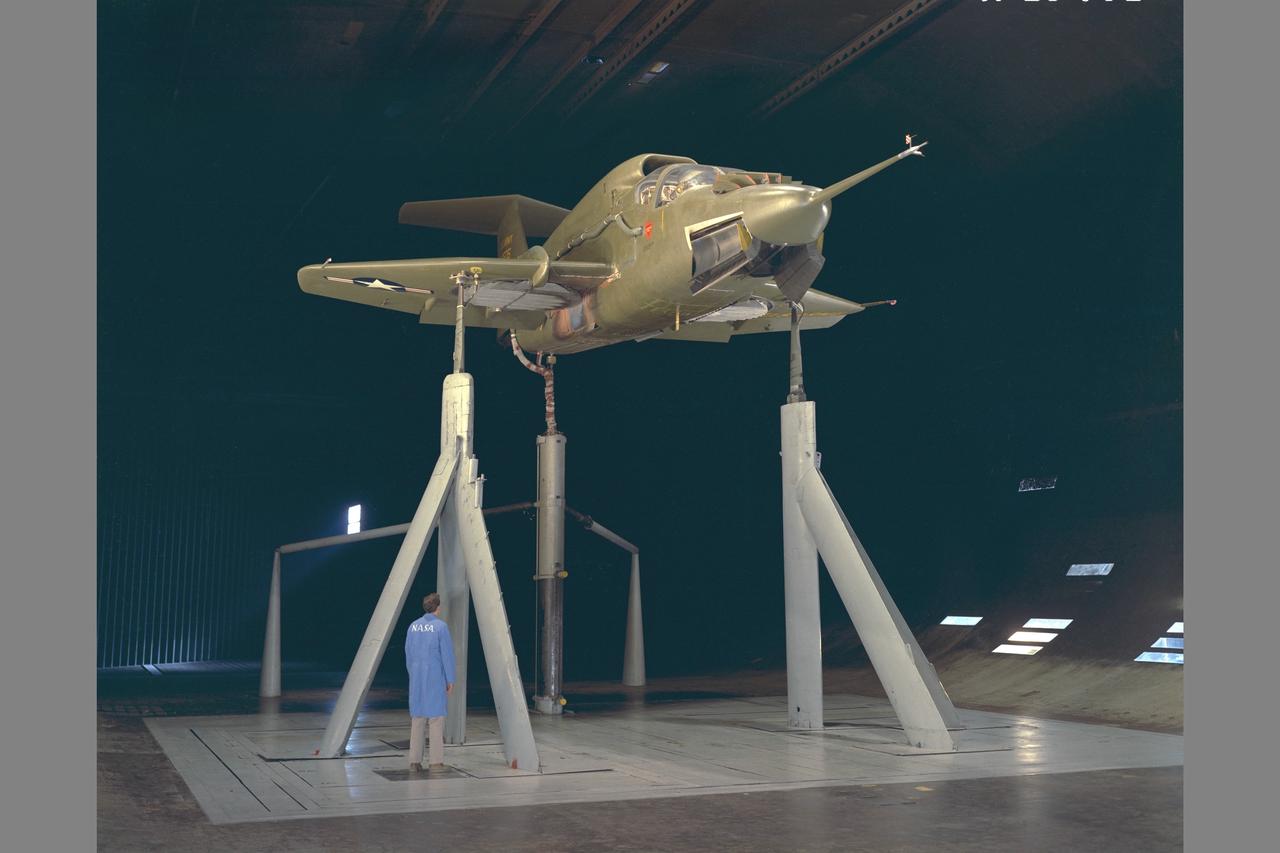
XV-5A airplane installed in 40x80ft Subsonic Wind Tunnel at NASA Ames Research Center with Tom Mills. The propulsive lift system was tested to determine power-on performance characteristics in preparation for flight tests. Used in Memoiors of an Aeronautical Engineer, Flight Tests at Ames Research Center 1940-1970 NASA-SP-2002-4526 (Seth B. Anderson)
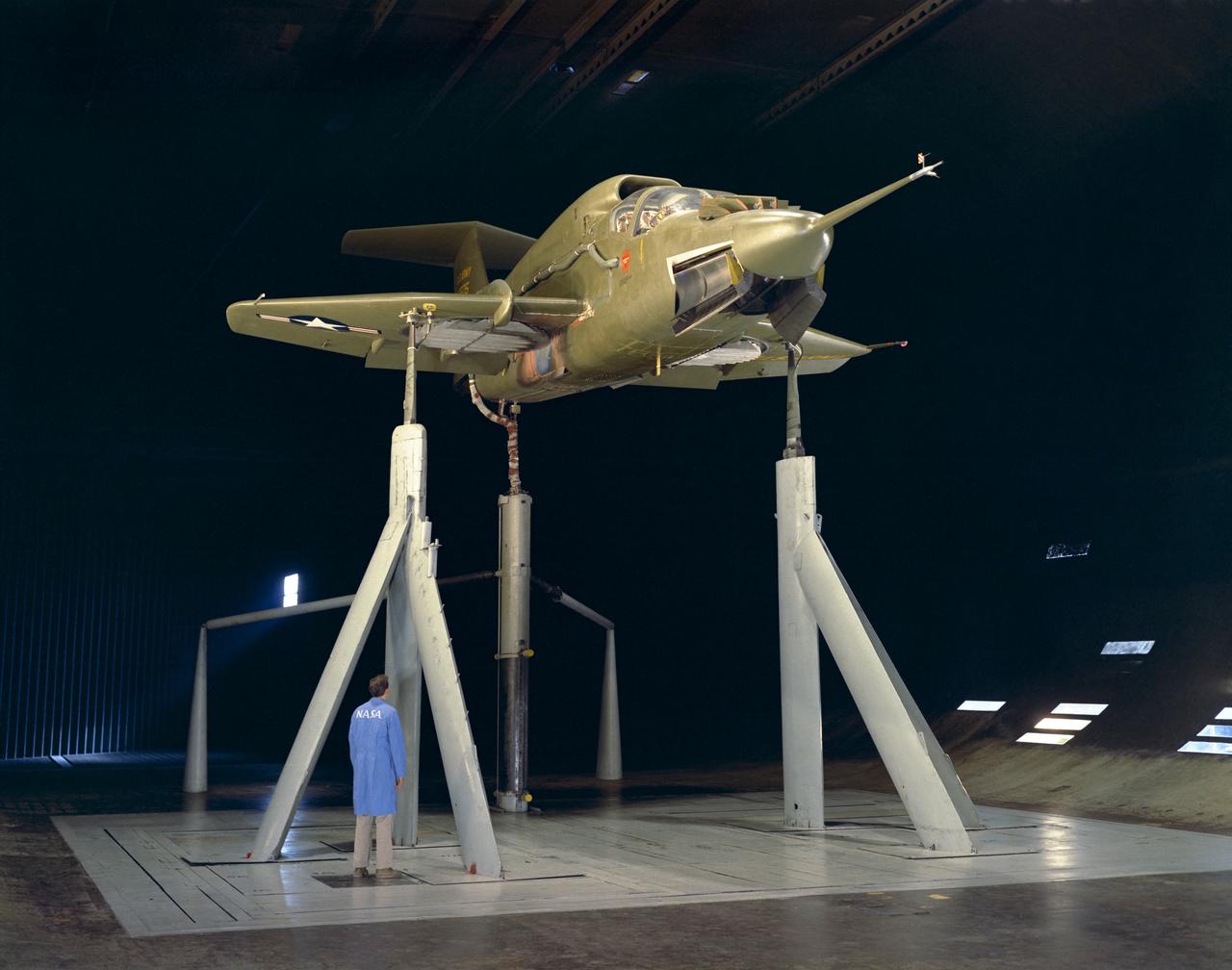
3/4 front view Ryan XV-5A lift-fan VSTOL airplane. Pictured with Tom Wills.
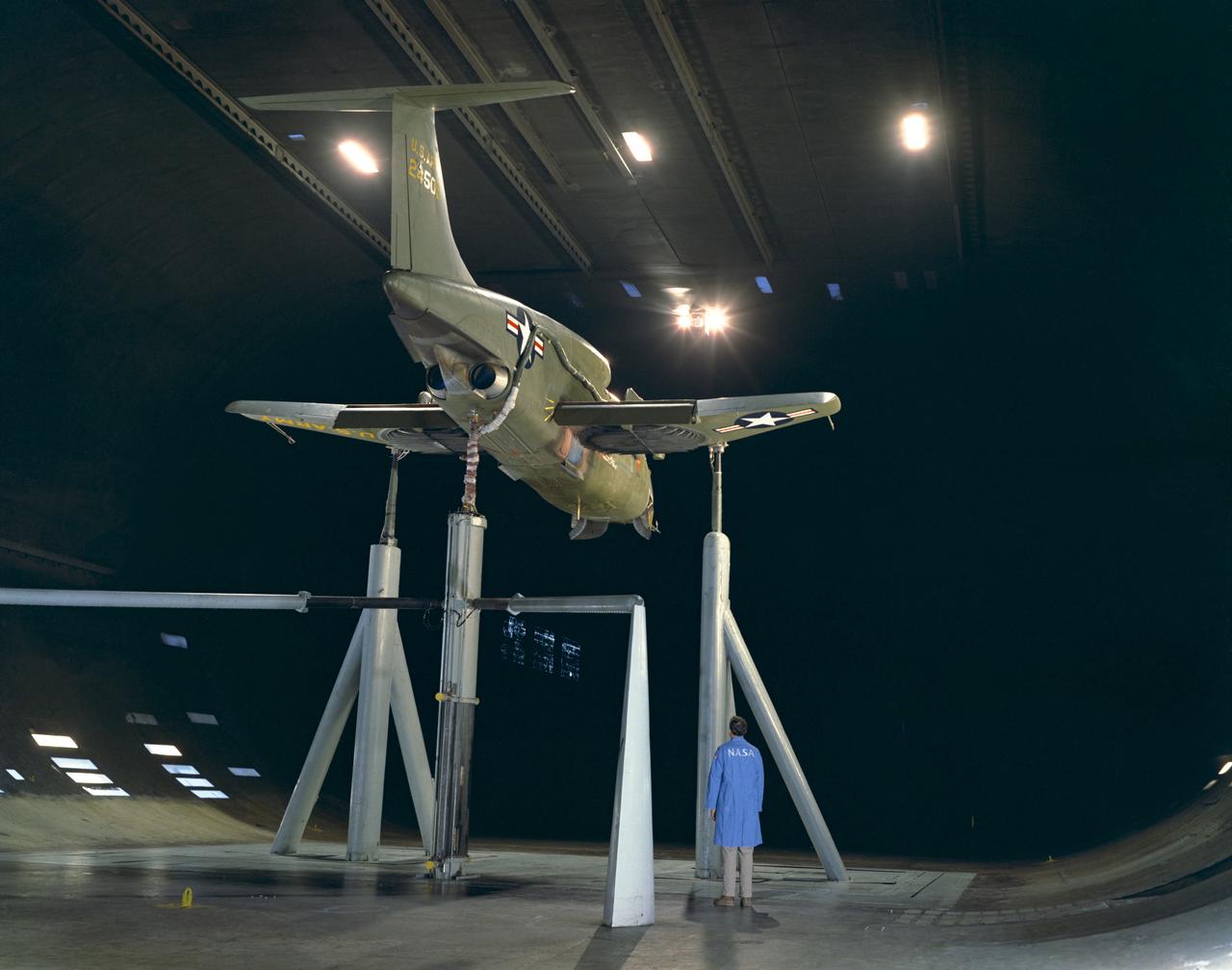
3/4 rear view Ryan XV-5A lift-fan VSTOL airplane. Pictured with Tom Wills.
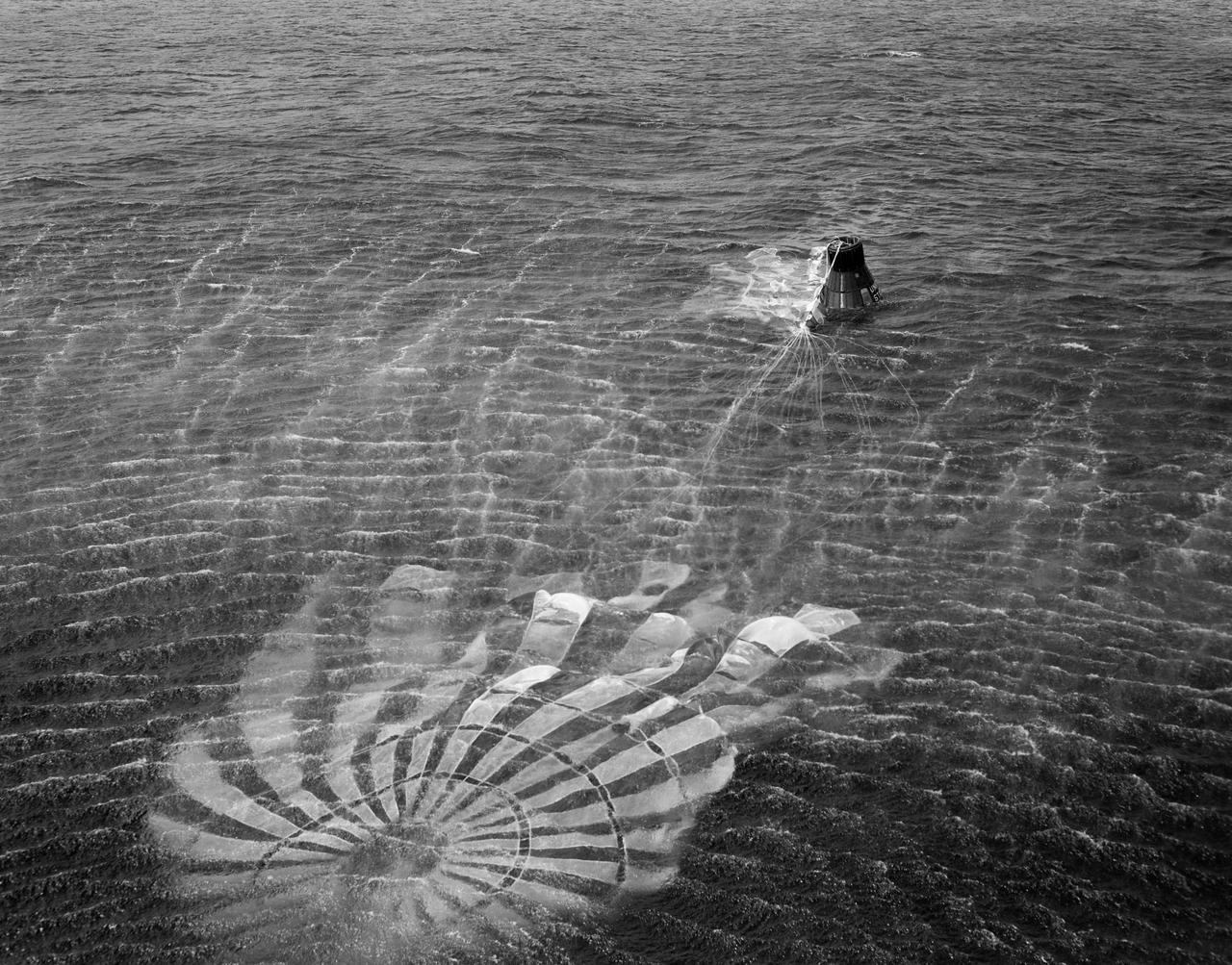
S61-01398 (18 March 1961) --- View of the recovery of the Little Joe-5A spacecraft which lifted off on March 18, 1961 from Wallops Island. The photo was taken from the recovery helicopter and shows the craft's parachute still attached and floating in the water next to the capsule. Little Joe-5A was a suborbital flight to test the Mercury capsule. The escape rocket motor fired prematurely and prior to capsule release. Photo credit: NASA
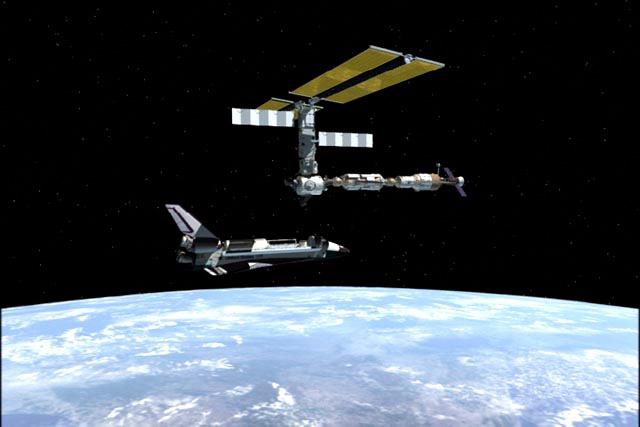
JSC2001-E-00356 (January 2001) --- Artist's rendering of early STS-98/ISS 5A with the Space Shuttle Atlantis in view during rendezvous and docking operations.
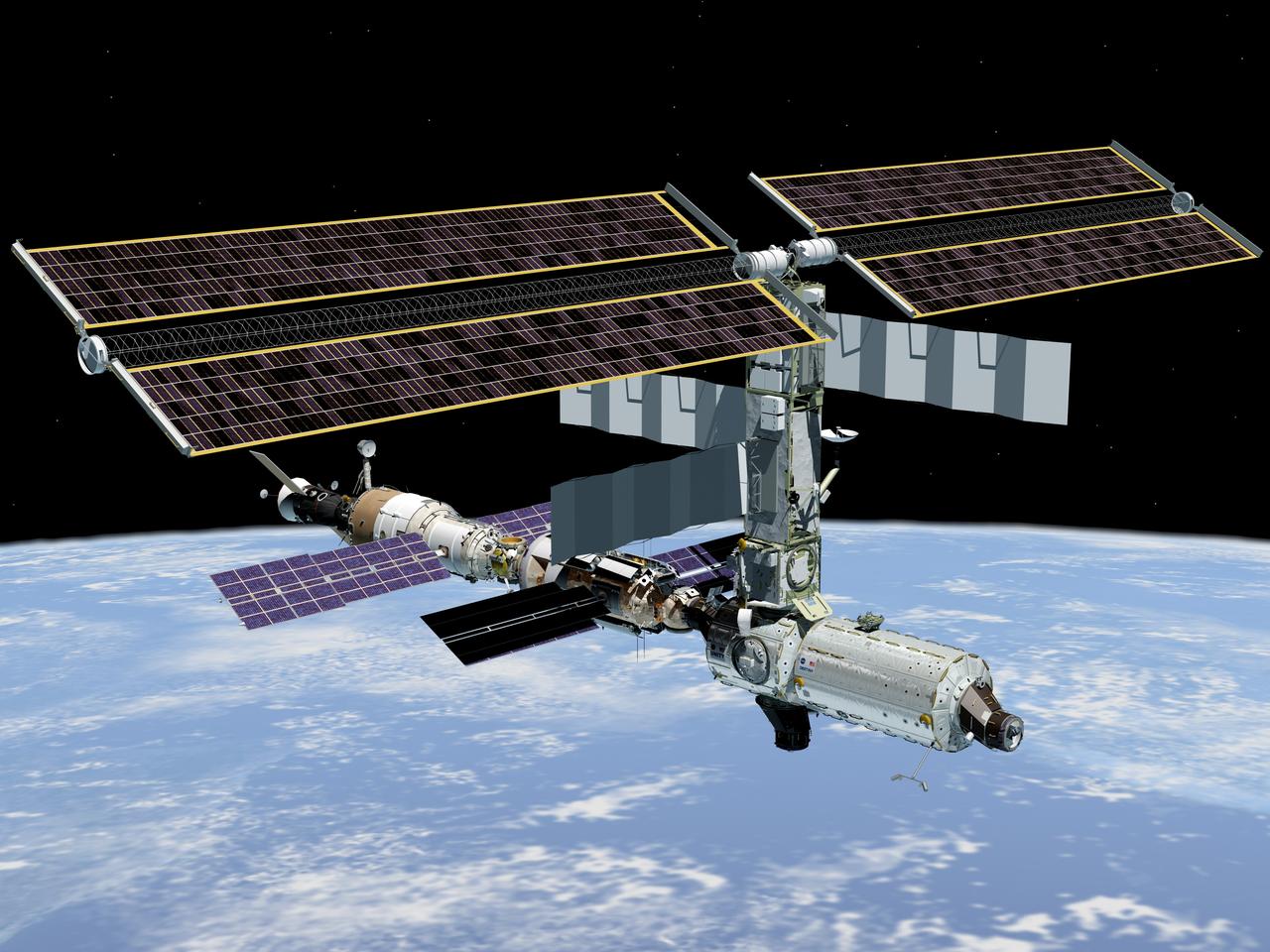
JSC2001-E-00360 (January 2001) --- Artist's rendering of the International Space Station (ISS) following the undocking of the Space Shuttle Atlantis, representing the completion of 5A. Note new position of U.S. Laboratory Destiny.
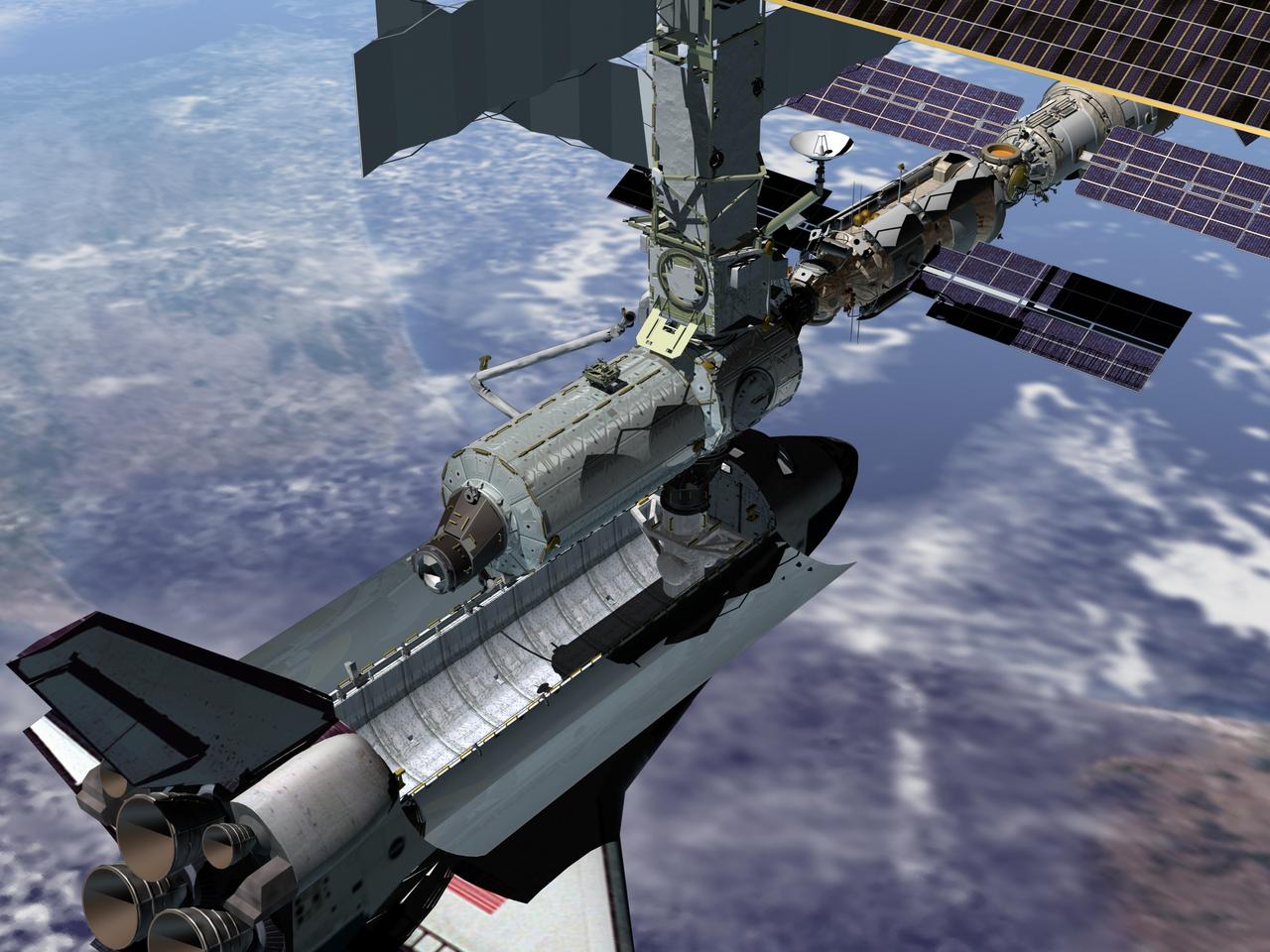
JSC2001-E-00359 (January 2001) --- Artist's rendering of Space Shuttle Atlantis (STS-98) docked with International Space Station (ISS) during 5A. Note new position of U.S. Laboratory Destiny.
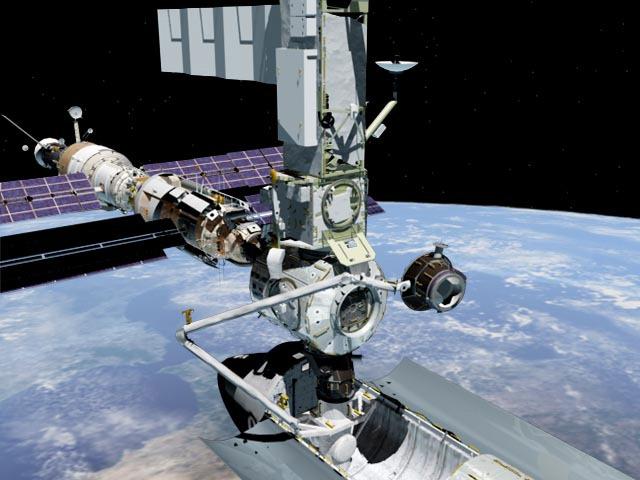
JSC2001-E-00357 (January 2001) --- Artist's rendering of Space Shuttle Atlantis (STS-98) docked with International Space Station (ISS) during 5A. Remote Manipulator System (RMS) has removed the Pressurized Mating Adapter (PMA) from Unity. U.S. Laboratory Destiny is partially visible (lower right) in shuttle cargo bay.
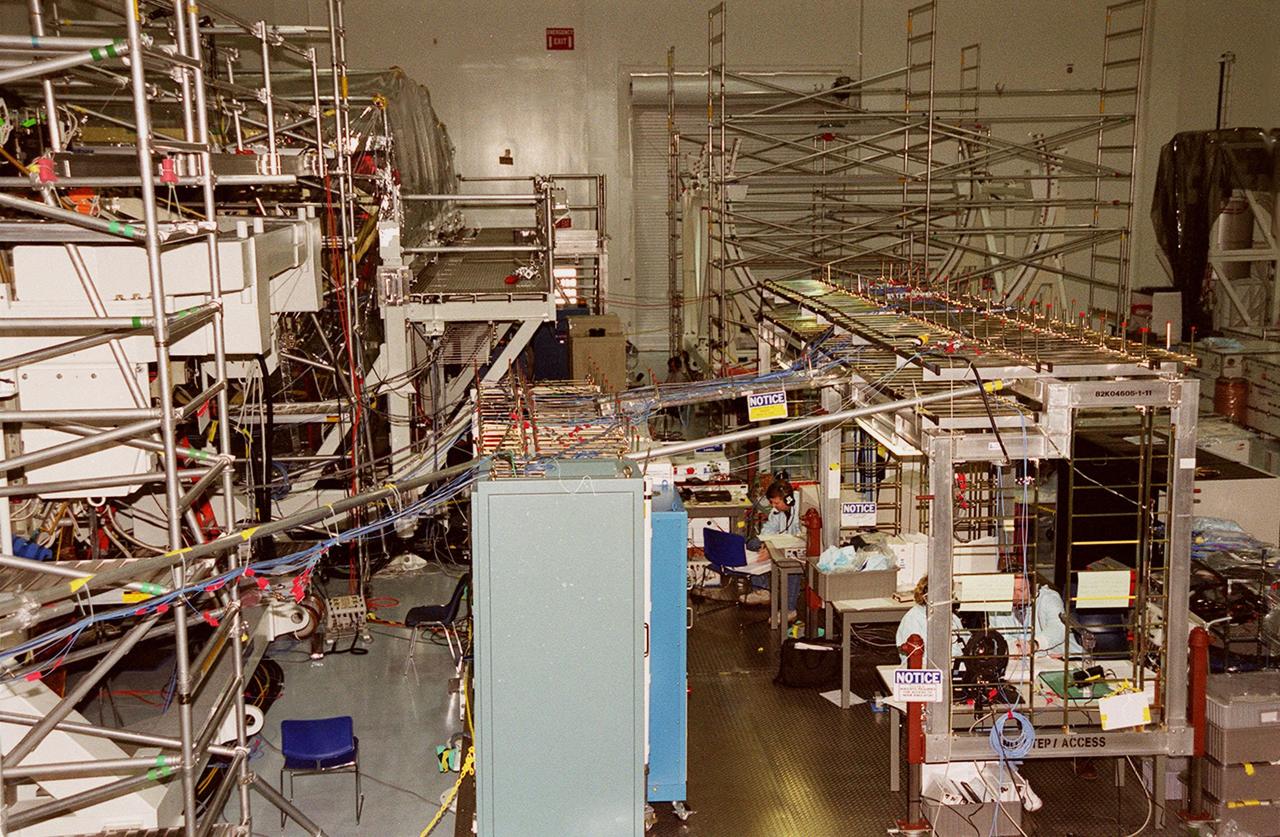
The Space Station Processing Facility (SSPF) appears overflowing with racks and wires being used to support work on elements of the International Space Station. Currently housed in the SSPF are the U.S. Lab Destiny and the Multi-Purpose Logistics Modules Leonardo and Raffaello. Destiny, element 5A of the station, is scheduled for launch on mission STS-98 in August; Leonardo, element 5A.1, on mission STS-102 in October; and Raffaello, element 6A, on mission STS-100 in November
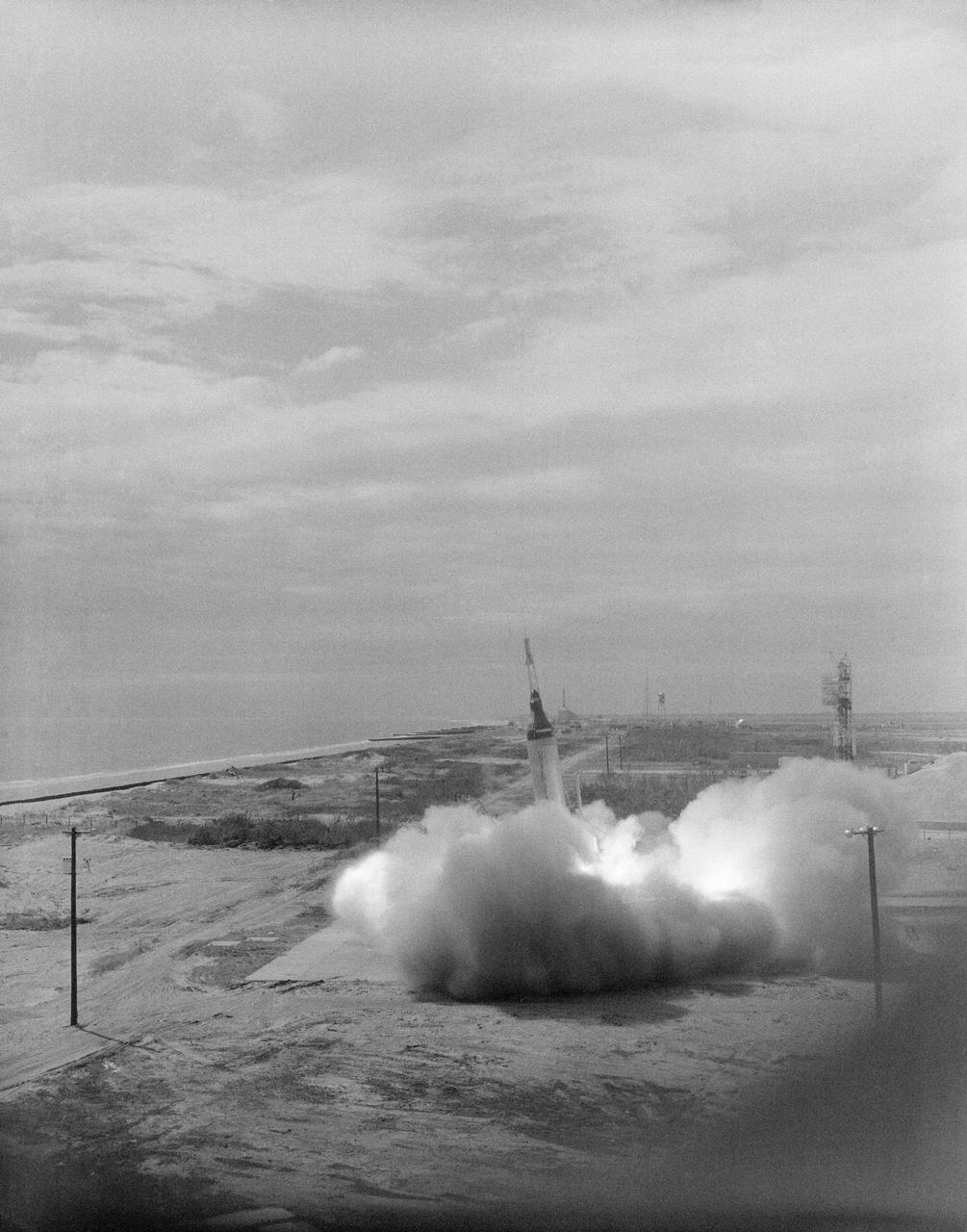
S61-01372 (21 Feb. 1961) --- Launch of the unmanned Mercury-Atlas 2 (MA-2) vehicle for a suborbital test flight of the Mercury capsule. The upper part of Atlas is stengthened by an eight-inch wide stainless steel band. The capsule was recovered less than one hour after launch. The altitude was 108 miles. Speed was 13,000 mph. Recovered 1,425 miles downrange. Photo credit: NASA
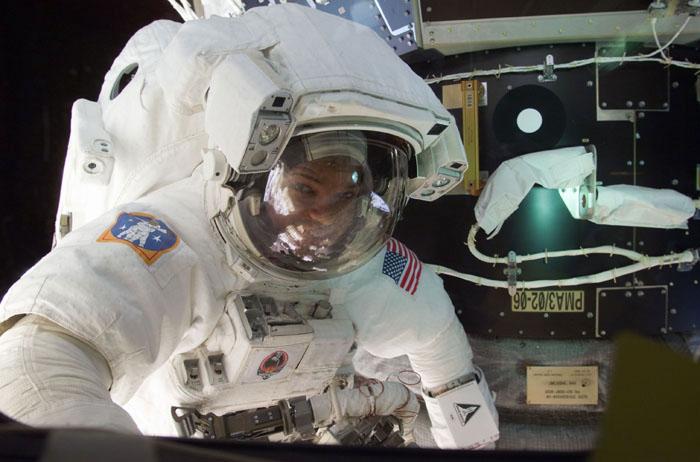
STS98-E-5193 (12 February 2001) --- Astronaut Robert L. Curbeam, STS-98 mission specialist, is pictured near Pressurized Mating Adapter (PMA-3) during the second of three scheduled space walks on 5a. The scene was recorded with a digital still camera.

JSC2001-00310 (February 2001) --- These sixty-plus flight controllers support the STS-98/5a mission's orbit 1 shift from various consoles in the shuttle flight control room in the Johnson Space Center's Mission Control Center (MCC). Flight director Robert Castle holds the crew insignia near center frame.
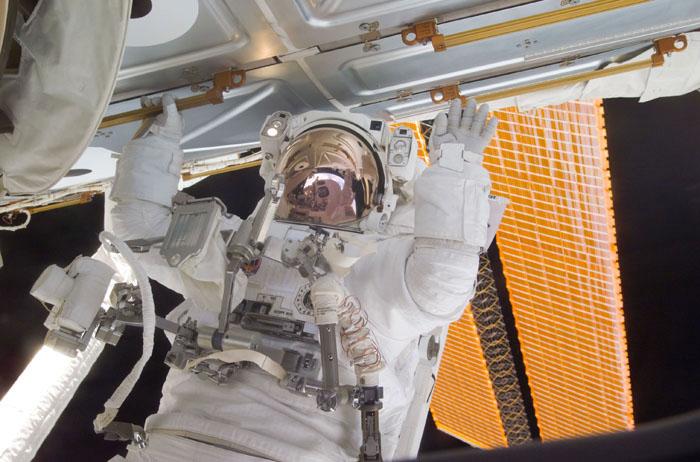
STS98-E-5231 (14 February 2001) --- Astronaut Robert L. Curbeam, mission specialist, participates in the final of three STS-98/5a space walks to perform work on the International Space Station (ISS). The scene was photographed from the Space Shuttle Atlantis' crew cabin with a digital still camera.
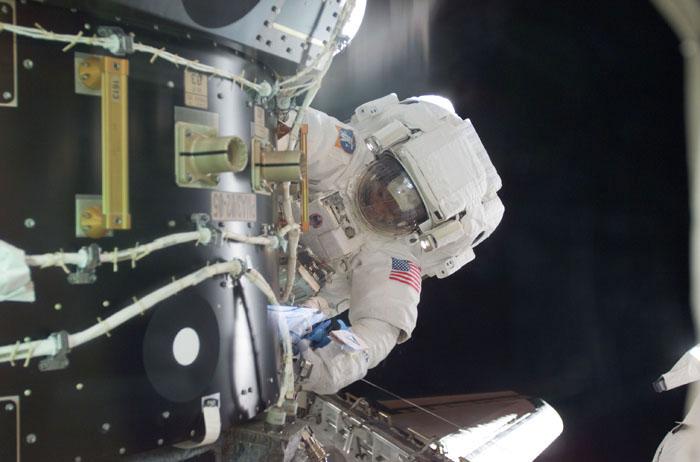
STS98-E-5189 (12 February 2001) --- Astronaut Robert L. Curbeam, STS-98 mission specialist, holds onto a hand rail on Pressurized Mating Adapter (PMA-3) during the second of three scheduled space walks on 5a. The scene was recorded with a digital still camera.
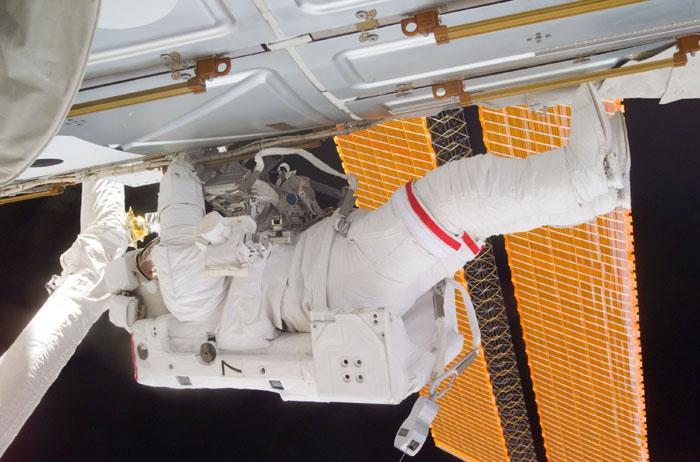
STS98-E-5229 (14 February 2001) --- Astronaut Thomas D. Jones, mission specialist, participates in the final of three STS-98/5a space walks to perform work on the International Space Station (ISS). The scene was photographed from the Space Shuttle Atlantis' crew cabin with a digital still camera.
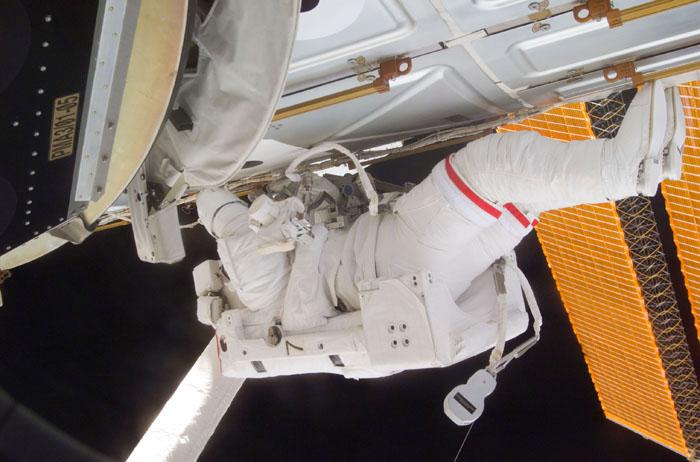
STS98-E-5230 (14 February 2001) --- Astronaut Thomas D. Jones, mission specialist, participates in the final of three STS-98/5a space walks to perform work on the International Space Station (ISS). The scene was photographed from the Space Shuttle Atlantis' crew cabin with a digital still camera.
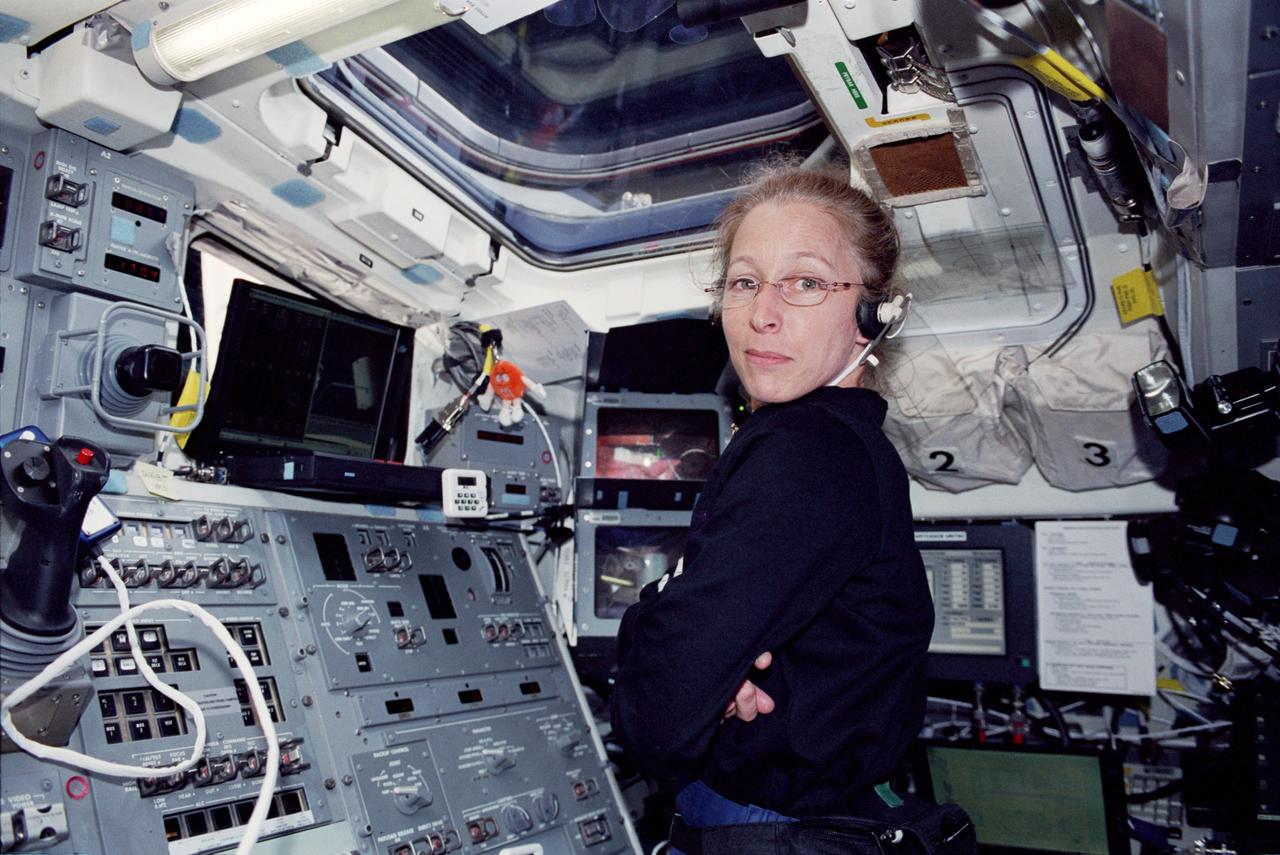
STS098-351-0013 (7-20 February 2001) --- Astronaut Marsha S. Ivins, mission specialist, spent a great deal of time on the aft flight deck of the Space Shuttle Atlantis during space walks and other important activities of the STS-98/5a mission.
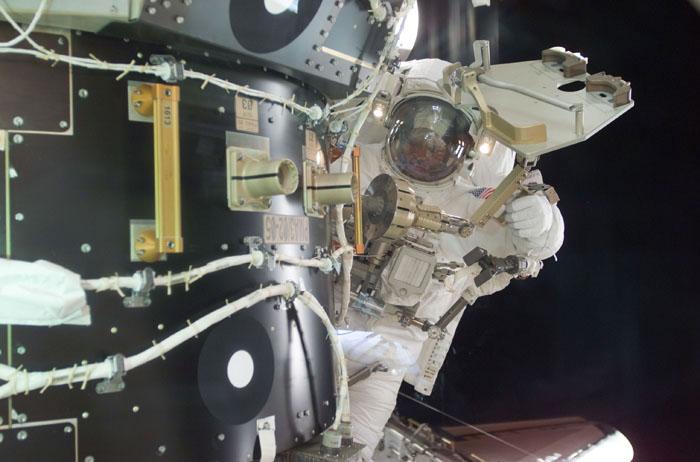
STS98-E-5191 (12 February 2001) --- Astronaut Robert L. Curbeam, STS-98 mission specialist, is pictured near Pressurized Mating Adapter (PMA-3) during the second of three scheduled space walks on 5a. The scene was recorded with a digital still camera.
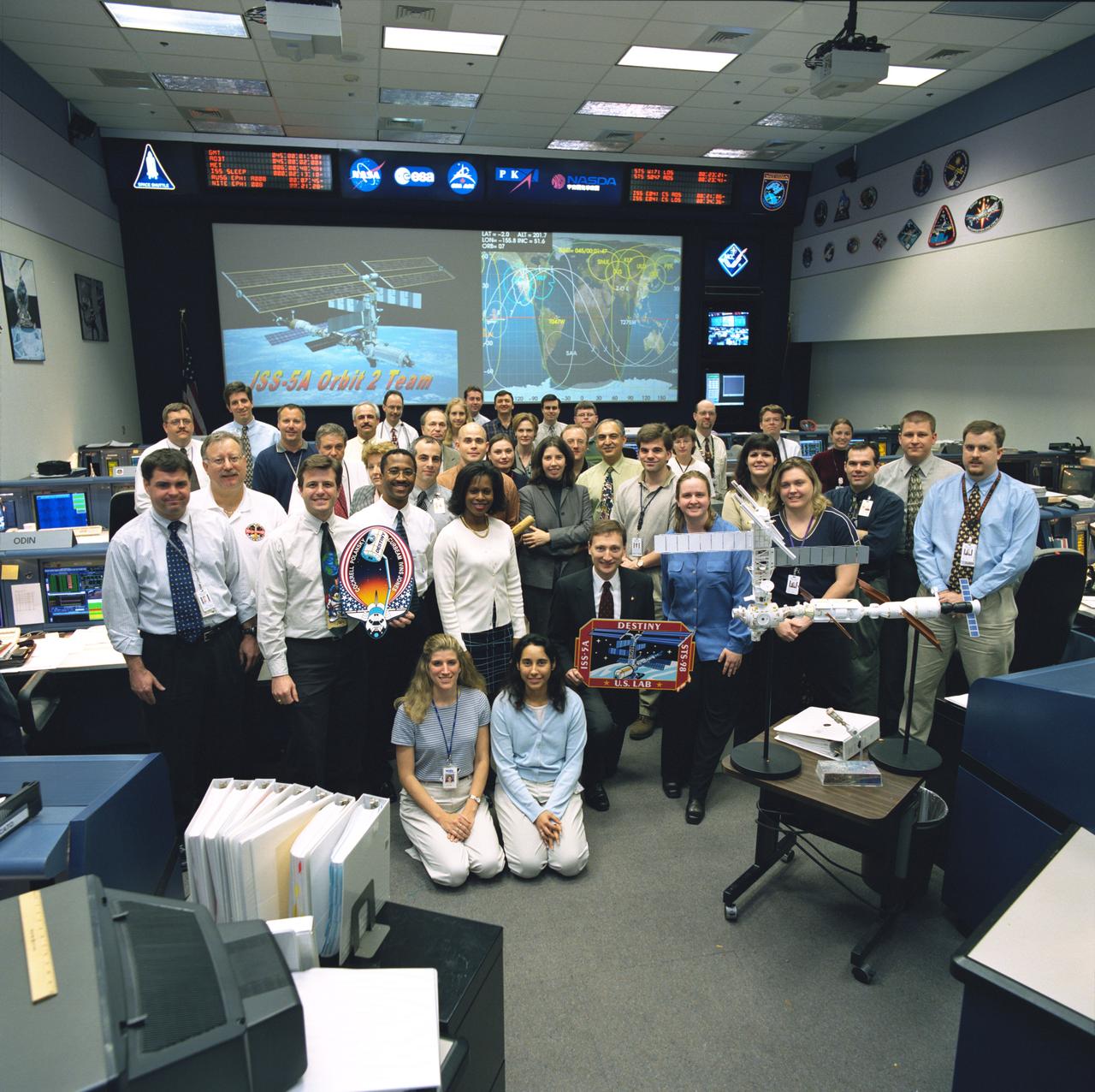
JSC2001-00308 (February 2001) --- These forty-plus flight controllers support the International Space Station (ISS) 5a mission's orbit 2 shift from various consoles in the station flight control room in the Johnson Space Center's Mission Control Center (MCC).
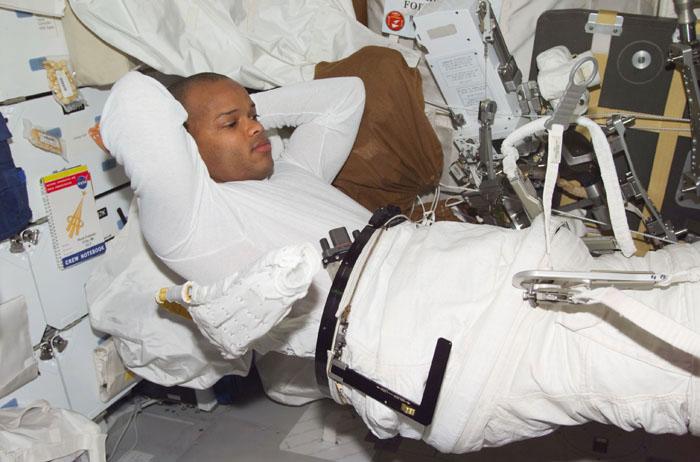
SS98-E-5214 (14 February 2001) --- Astronaut Robert L. Curbeam, STS-98 mission specialist, dons his extravehicular mobility unit (EMU) for the final of three space walks he shared with astonaut Thomas D. Jones on mission 5a. The scene was recorded with a digital still camera.
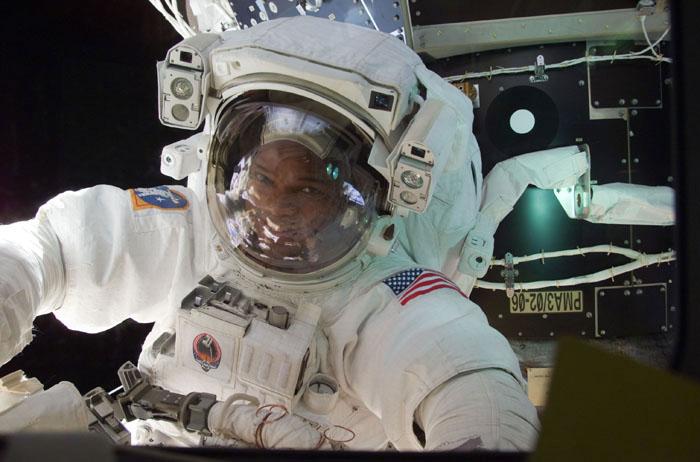
STS98-E-5192 (12 February 2001) --- Astronaut Robert L. Curbeam, STS-98 mission specialist, is pictured near Pressurized Mating Adapter (PMA-3) during the second of three scheduled space walks on 5a. The scene was recorded with a digital still camera.
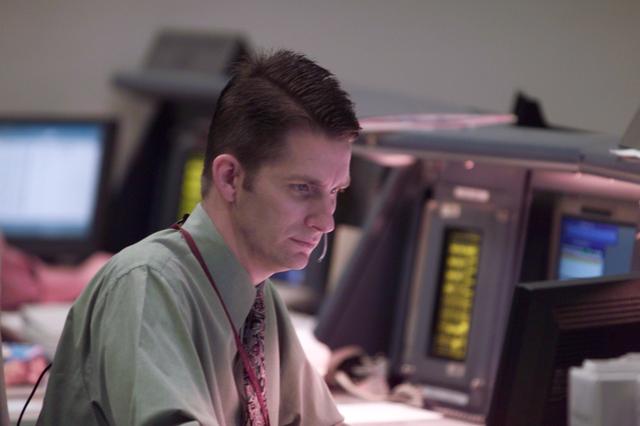
JSC2001-E-04270 (7-20 February 2001) --- Assembly and checkout officer (ACO) Thomas C. Miglin monitors data at his console in the station flight control room (BFCR) in Houston's Mission Control Center (MCC) during the STS-98/5A mission.
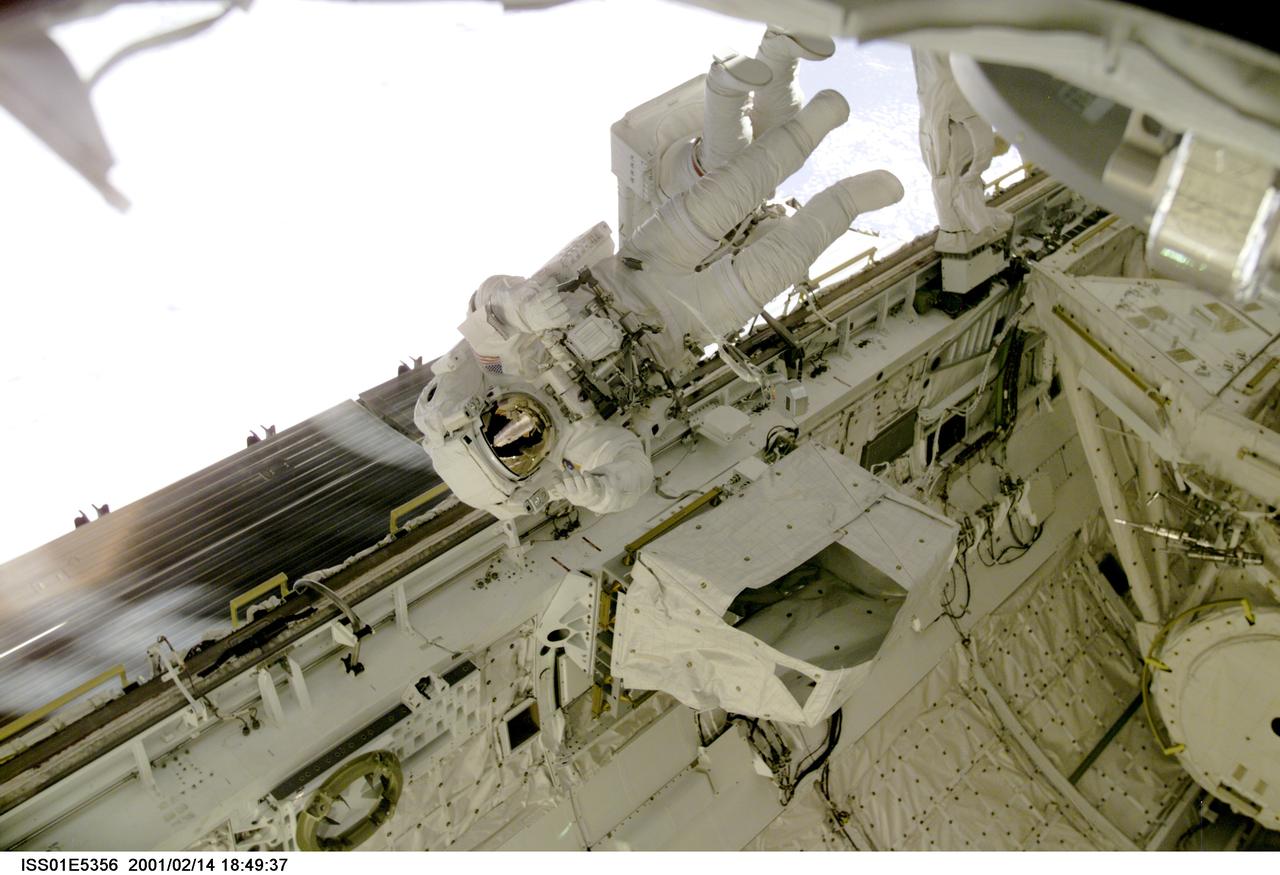
ISS01-E-5356 (14 February 2001) --- Astronaut Robert L. Curbeam, STS-98 mission specialist, floats above the longerons of the cargo bay on the Space Shuttle Atlantis during the final of three STS-98/5a space walks. Partially obscured behind Curbeam is astronaut Thomas D. Jones, his colleague and partner for all three walks. The scene was recorded with a digital still camera.
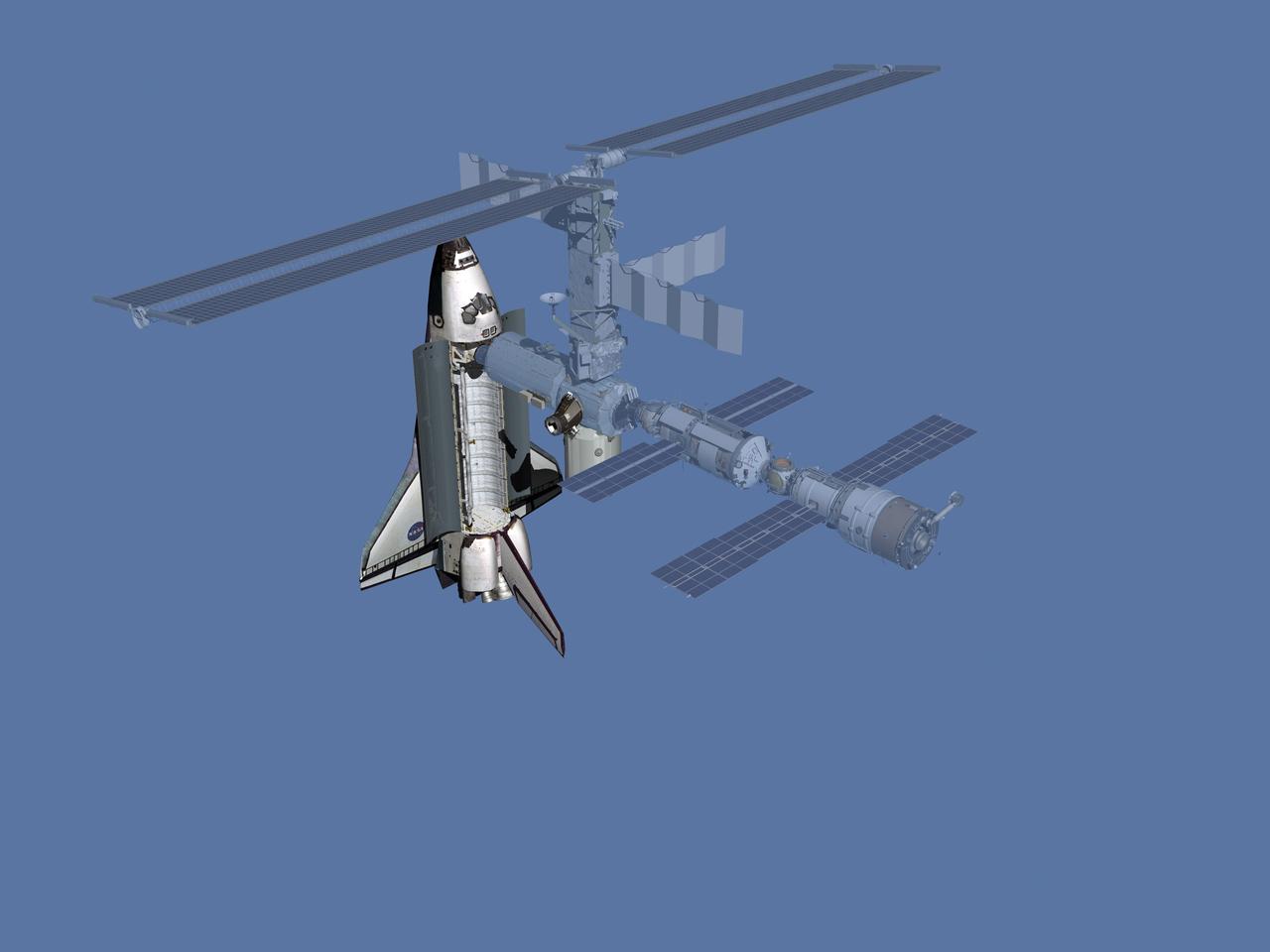
JSC2006-E-43486 (March 2001) --- Computer-generated artist's rendering of the International Space Station after flight STS-102/5A.1. Space Shuttle Discovery re-supplied the station with cargo from the Italian-built Leonardo Multi-Purpose Logistics Module (MPLM). The shuttle also arrived with the Expedition Two crew and returned with the Expedition One crew. The Pressurized Mating Adapter-3 (PMA-3) was relocated to the port side of the Unity node and the External Stowage Platform-1 was installed on the Destiny laboratory.
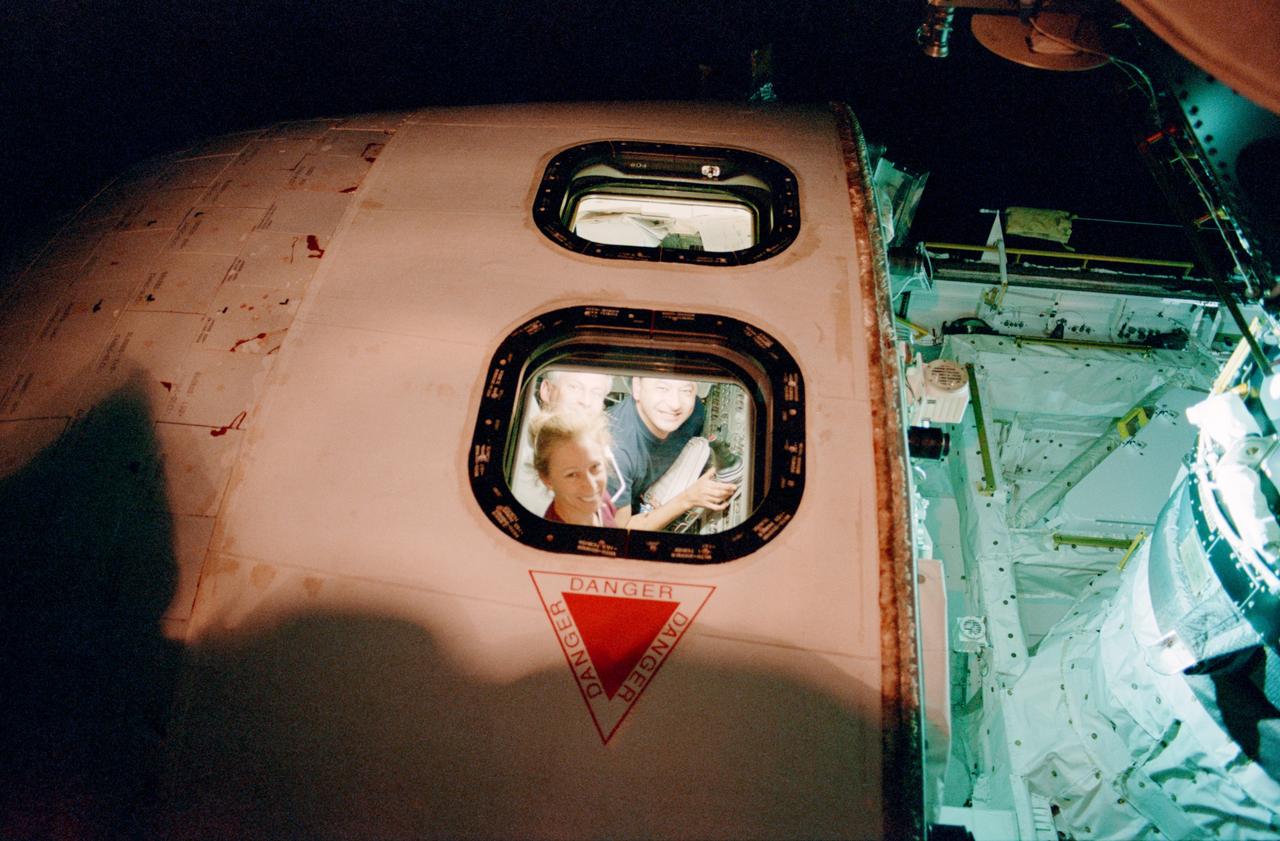
STS098-335-0028 (7-20 February 2001) --- From the aft flight deck of the Space Shuttle Atlantis, astronaut Marsha S. Ivins, STS-98 mission specialist, looks through an overhead window toward her space walking colleagues, who exposed this 35mm frame. Also visible in the window are astronauts Kenneth D. Cockrell and Mark L. Polansky, commander and pilot for the STS-98/5a mission.
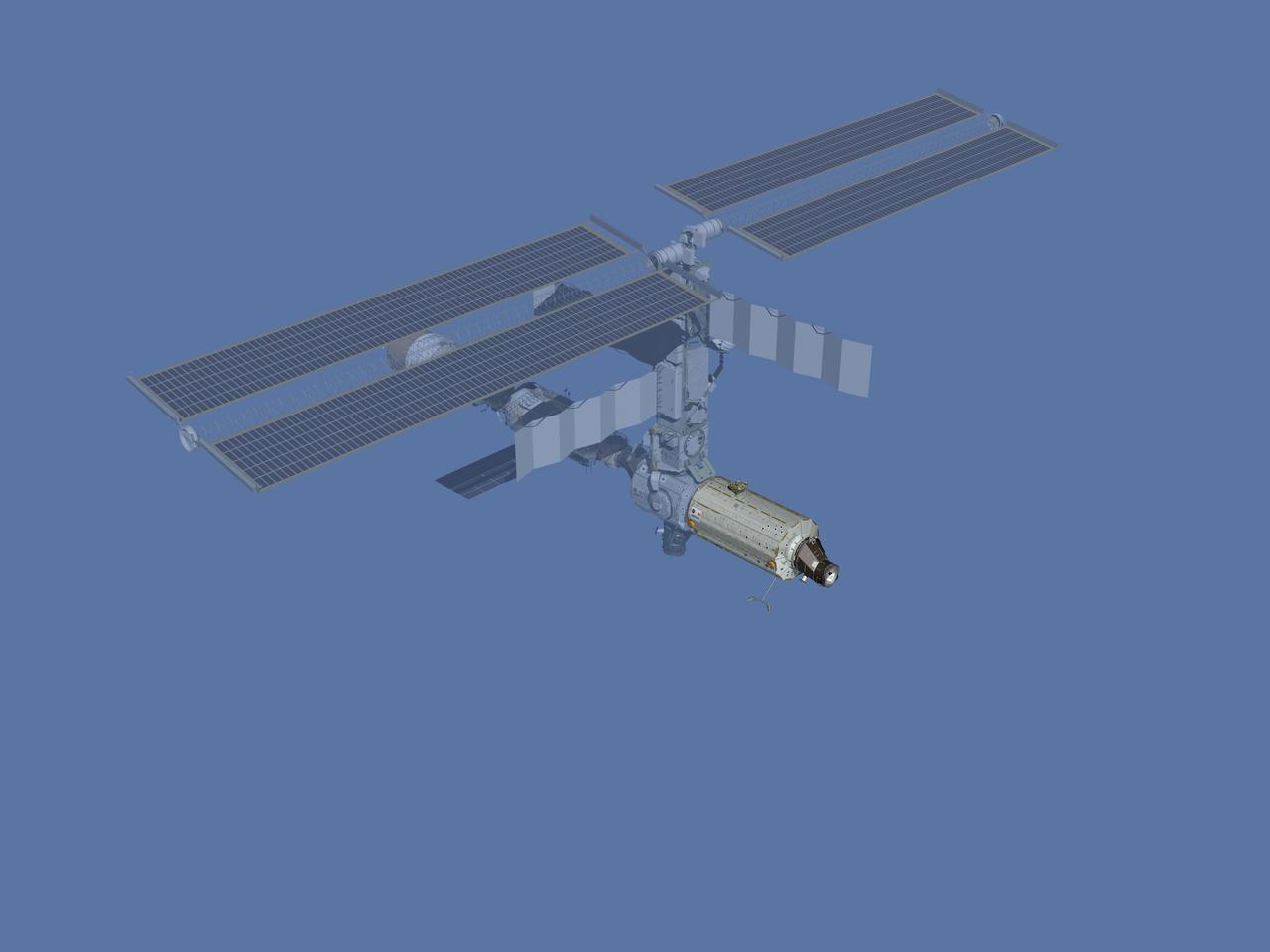
JSC2006-E-43485 (February 2001) --- Computer-generated artist's rendering of the International Space Station after flight STS-98/5A. The STS-98 crew installed the new Destiny laboratory module after removing it from Space Shuttle Atlantis payload bay. Pressurized Mating Adapter-2 (PMA-2) is relocated to the front of Destiny.
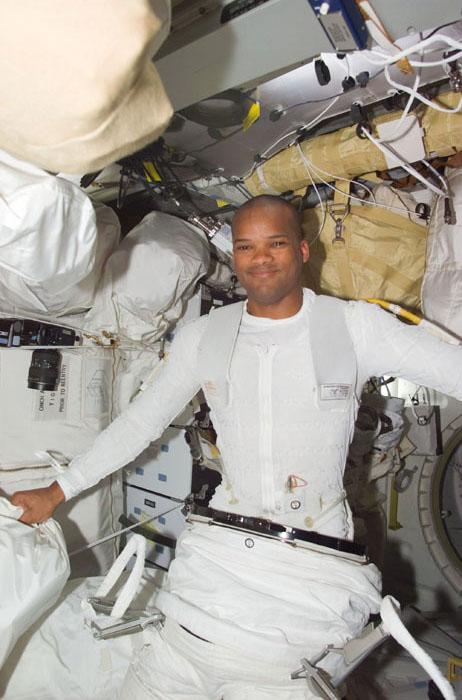
STS98-E-5075 (10 February 2001) --- Pictured on the mid deck the Space Shuttle Atlantis, astronaut Robert L. Curbeam, STS-98 mission specialist, will be repeating this scene of suit donning (and doffing) a number of times as he will be participating in three separate space walks during the ISS 5a flight. The scene was recorded with a digital still camera during Flight Day 4 activity.
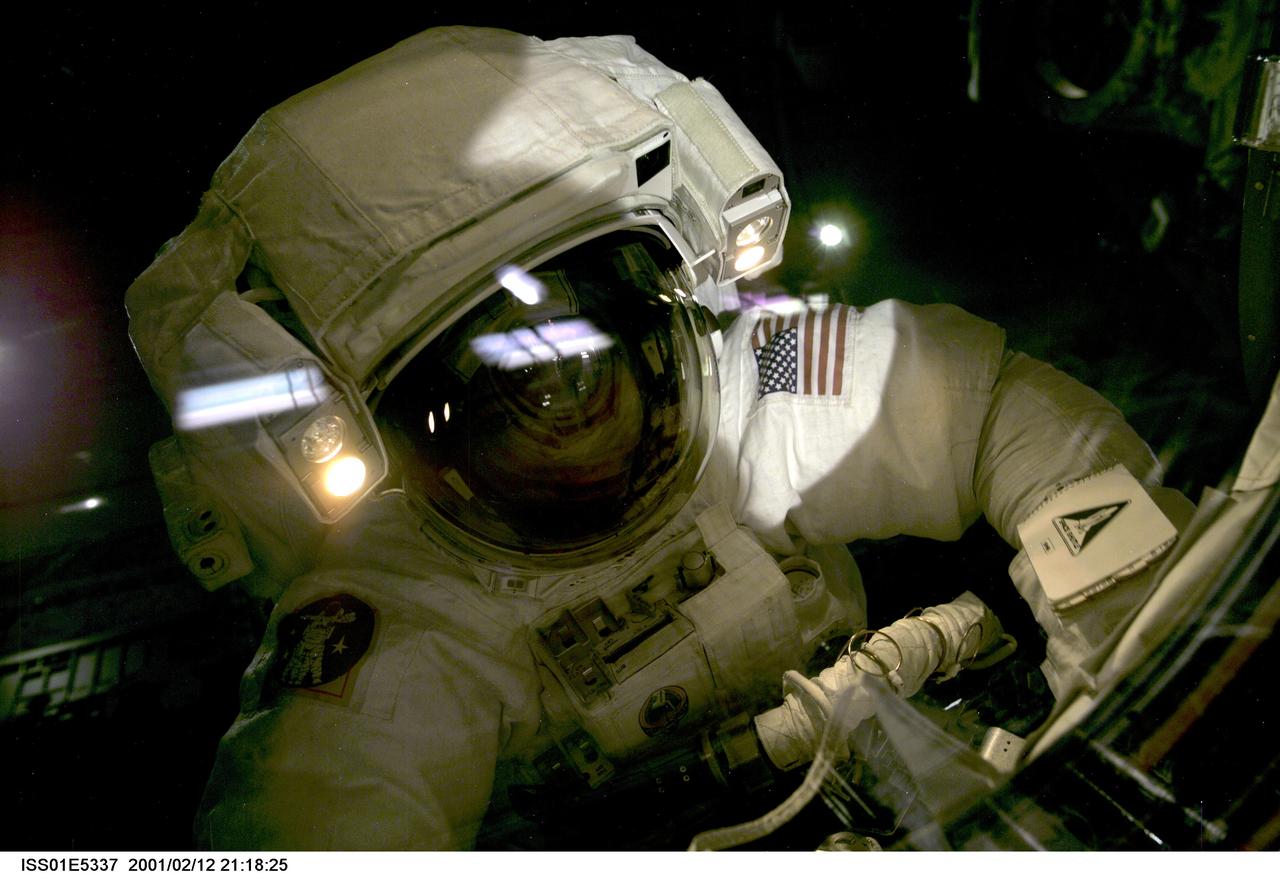
ISS01-E-5337 (12 February 2001) --- Astronaut Robert L. Curbeam, mission specialist, is pictured above the cargo bay of the Space Shuttle Atlantis during the second of three scheduled STS-98/5a space walks. The photo was taken with a digital still camera from inside the Destiny laboratory, newly added to the components of the International Space Station (ISS).
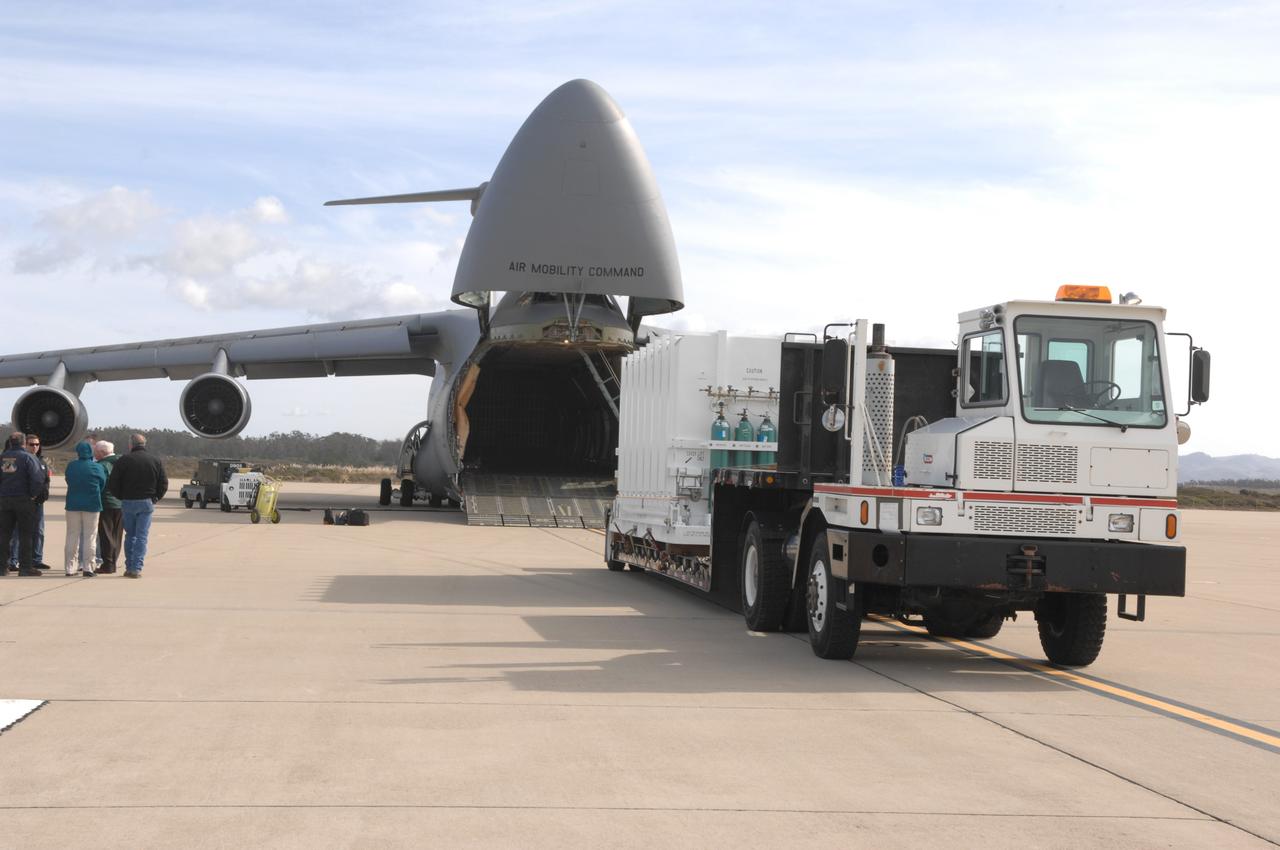
VANDENBERG AIR FORCE BASE, Calif. – The latest polar-orbiting operational environmental weather satellite developed by NASA for the National Oceanic and Atmospheric Administration, called NOAA-N Prime, is offloaded from the C-5A military cargo aircraft at Vandenberg Air Force Base, Calif., in preparation for a Feb. 4 launch. NOAA-N Prime, built by Lockheed Martin, is similar to NOAA-N launched on May 20, 2005.
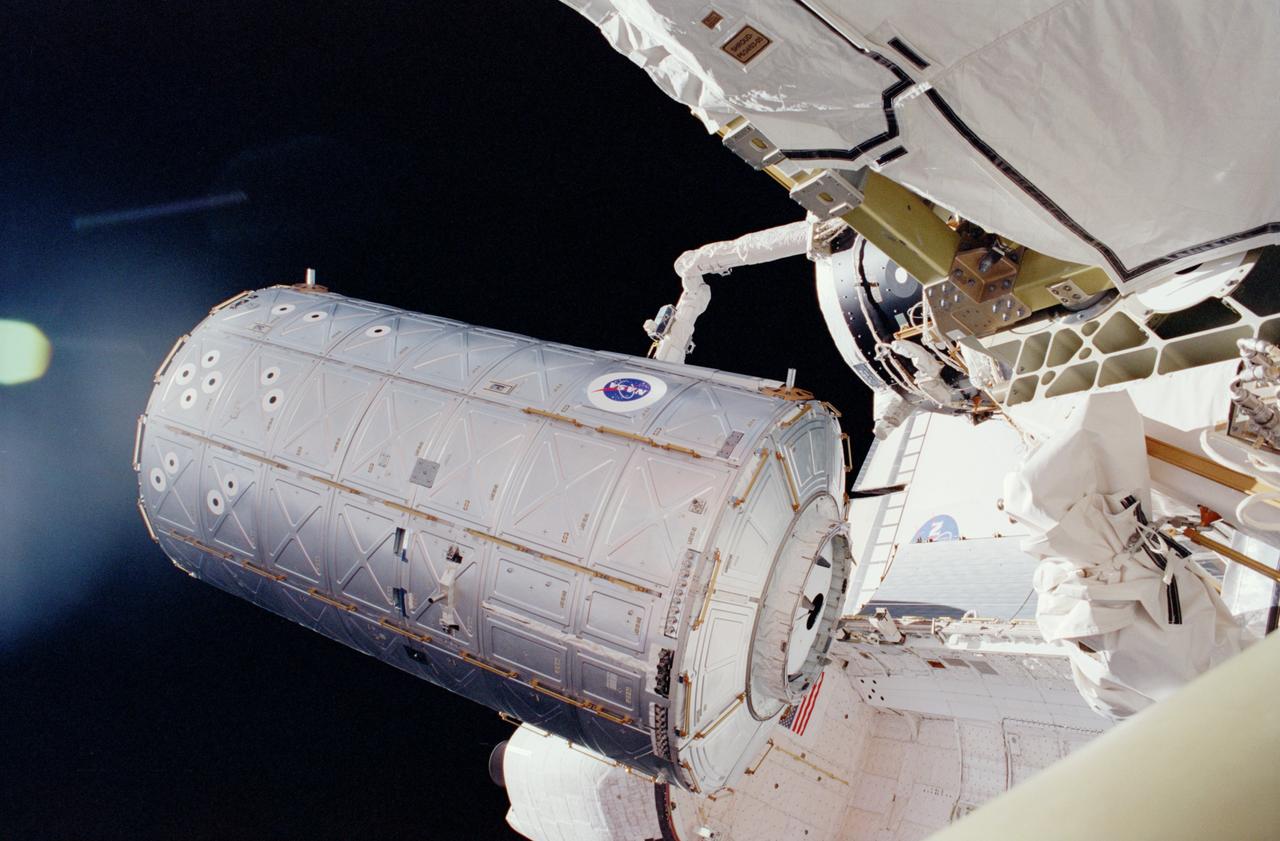
STS098-331-0017 (7-20 February 2001) --- In the grasp of the shuttle's remote manipulator system (RMS) robot arm, the Destiny laboratory is moved from its stowage position in the cargo bay of the Space Shuttle Atlantis. The photo was taken by astronaut Thomas D. Jones, who was participating in one of three STS-98/5a space walks at the time. Astronaut Robert L. Curbeam (out of frame) also made the three space walks.
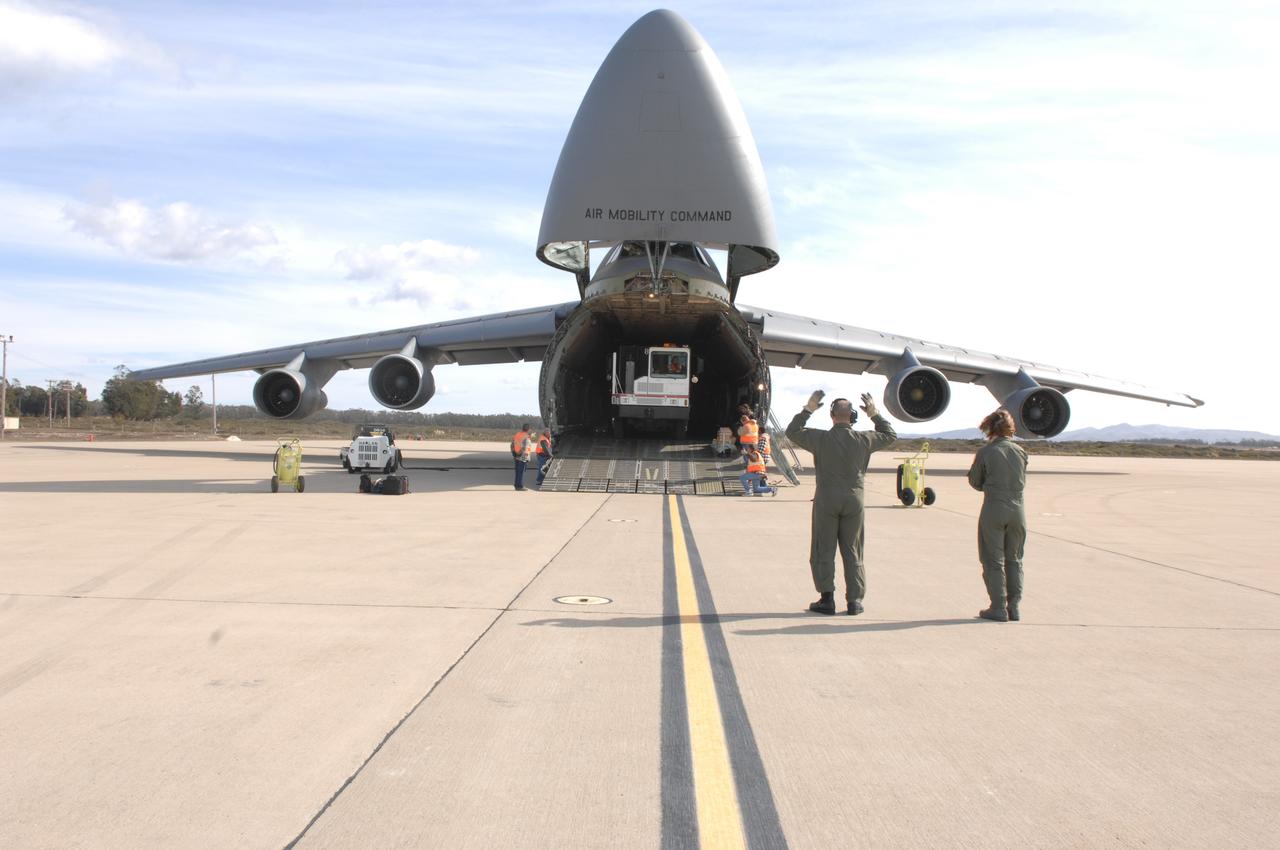
VANDENBERG AIR FORCE BASE, Calif. – The latest polar-orbiting operational environmental weather satellite developed by NASA for the National Oceanic and Atmospheric Administration, called NOAA-N Prime, is being offloaded from the C-5A military cargo aircraft at Vandenberg Air Force Base, Calif., in preparation for a Feb. 4 launch. NOAA-N Prime, built by Lockheed Martin, is similar to NOAA-N launched on May 20, 2005.
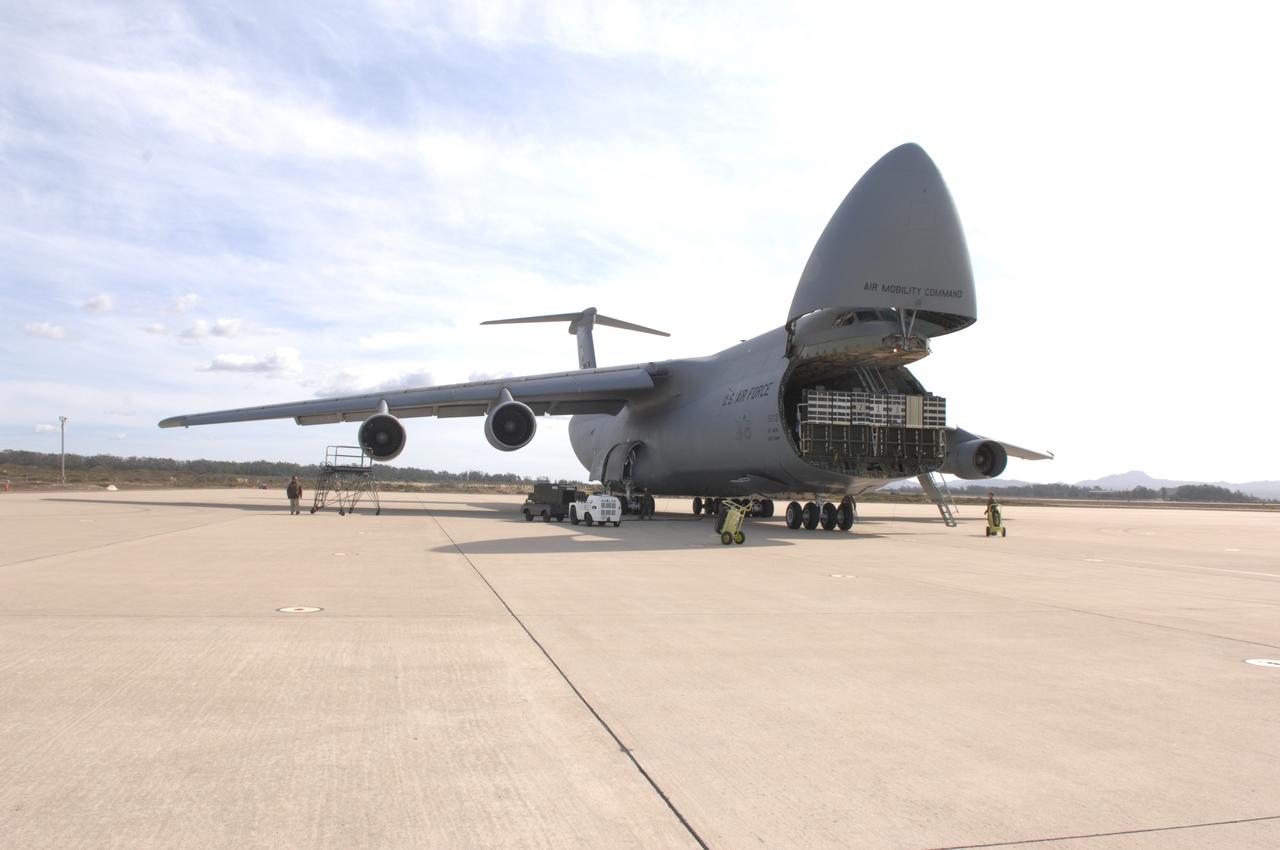
VANDENBERG AIR FORCE BASE, Calif. – The latest polar-orbiting operational environmental weather satellite developed by NASA for the National Oceanic and Atmospheric Administration, called NOAA-N Prime, arrived by C-5A military cargo aircraft at Vandenberg Air Force Base, Calif., in preparation for a Feb. 4 launch. NOAA-N Prime, built by Lockheed Martin, is similar to NOAA-N launched on May 20, 2005.
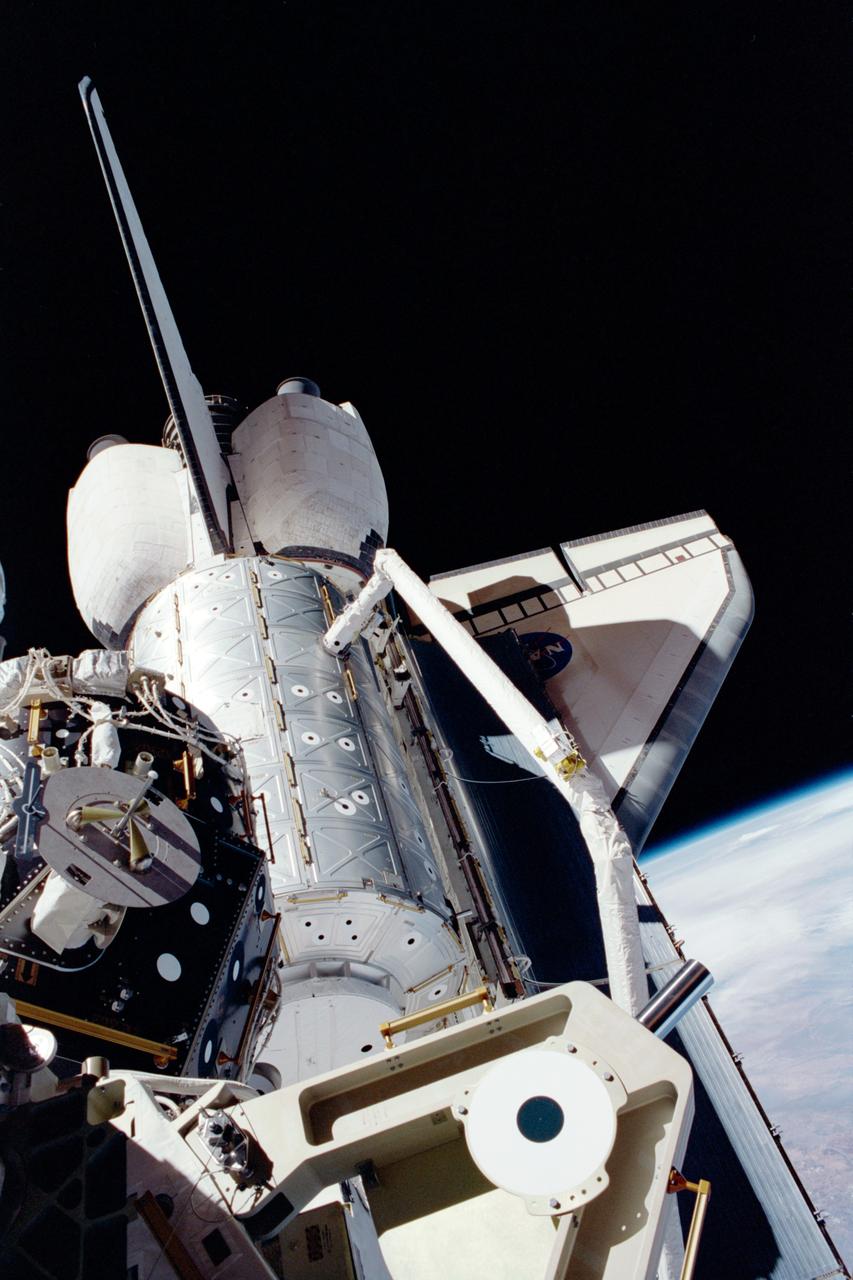
STS098-331-005 (7-20 February 2001) --- In the grasp of the shuttle’s remote manipulator system (RMS) robot arm, the Destiny laboratory is moved from its stowage position in the cargo bay of the Space Shuttle Atlantis. The photo was taken by astronaut Thomas D. Jones, who was participating in one of three STS-98/5a spacewalks at the time. Astronaut Robert L. Curbeam (out of frame) also made the three spacewalks.
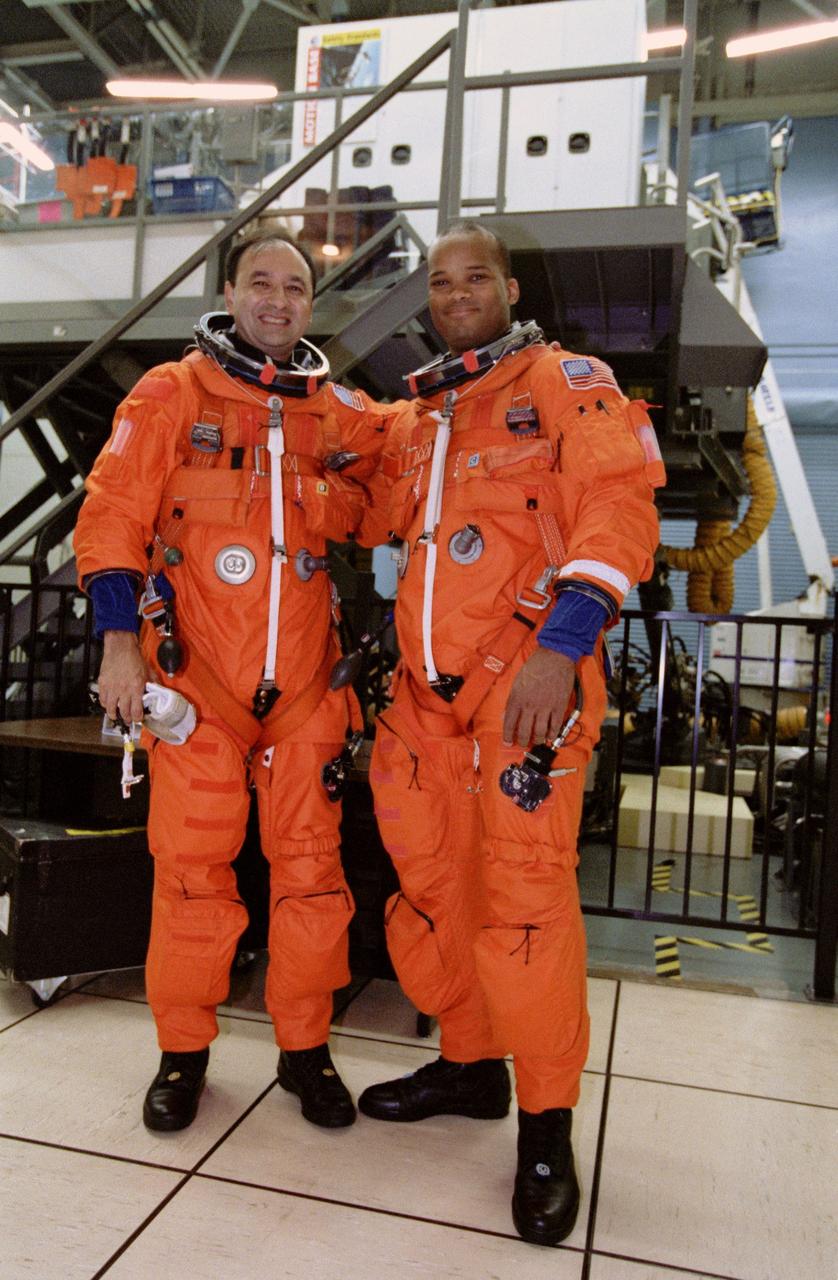
JSC2000-04778 (16 June 2000) --- Attired in training versions of the shuttle launch and entry garment, astronauts Mark Polansky (left) and Robert L. Curbeam take a break from a simulation exercise in the motion-base shuttle mission simulator (seen in the background) at the Johnson Space Center (JSC). Polansky is STS-98 pilot and Curbeam doubles as a mission specialist and flight engineer for the scheduled January 2000 5a mission to the International Space Station (ISS).
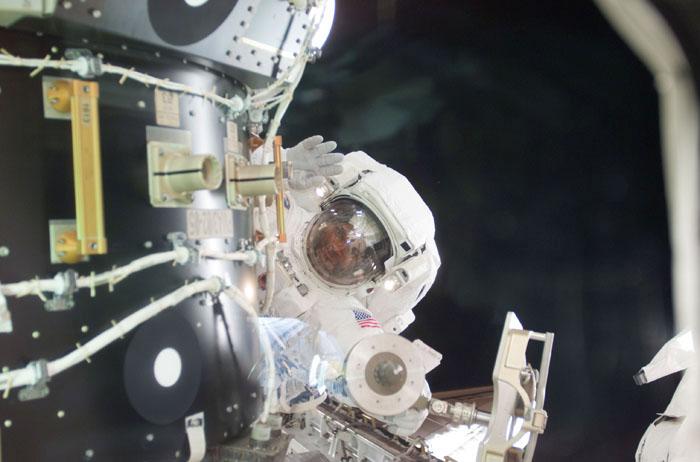
STS98-E-5190 (12 February 2001) --- Astronaut Robert L. Curbeam, STS-98 mission specialist, waves to a crew mate inside the Space Shuttle Atlantis' crew cabin from his position near Pressurized Mating Adapter (PMA-3) during the second of three scheduled space walks on 5a. The scene was recorded with a digital still camera.
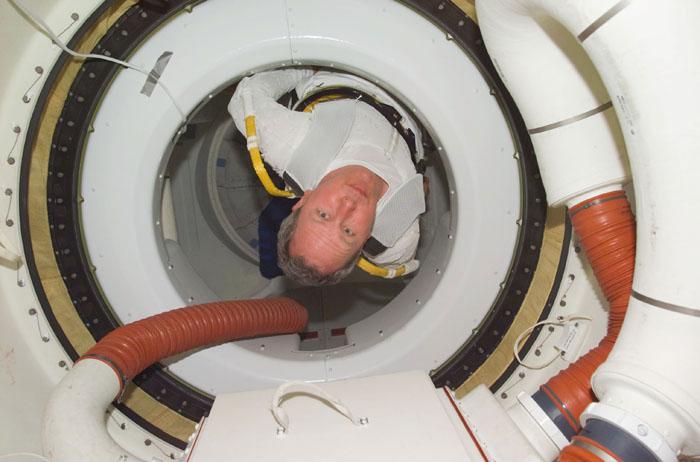
STS98-E-5223 (14 February 2001) --- Astronaut Thomas D. Jones, mission specialist, dons his extravehicular mobility unit (EMU) space garment in the airlock of the Space Shuttle Atlantis in this high-angle view photographed with a digital still camera. Jones was about to participate in the final of three space walks scheduled for the STS-98/5a mission.
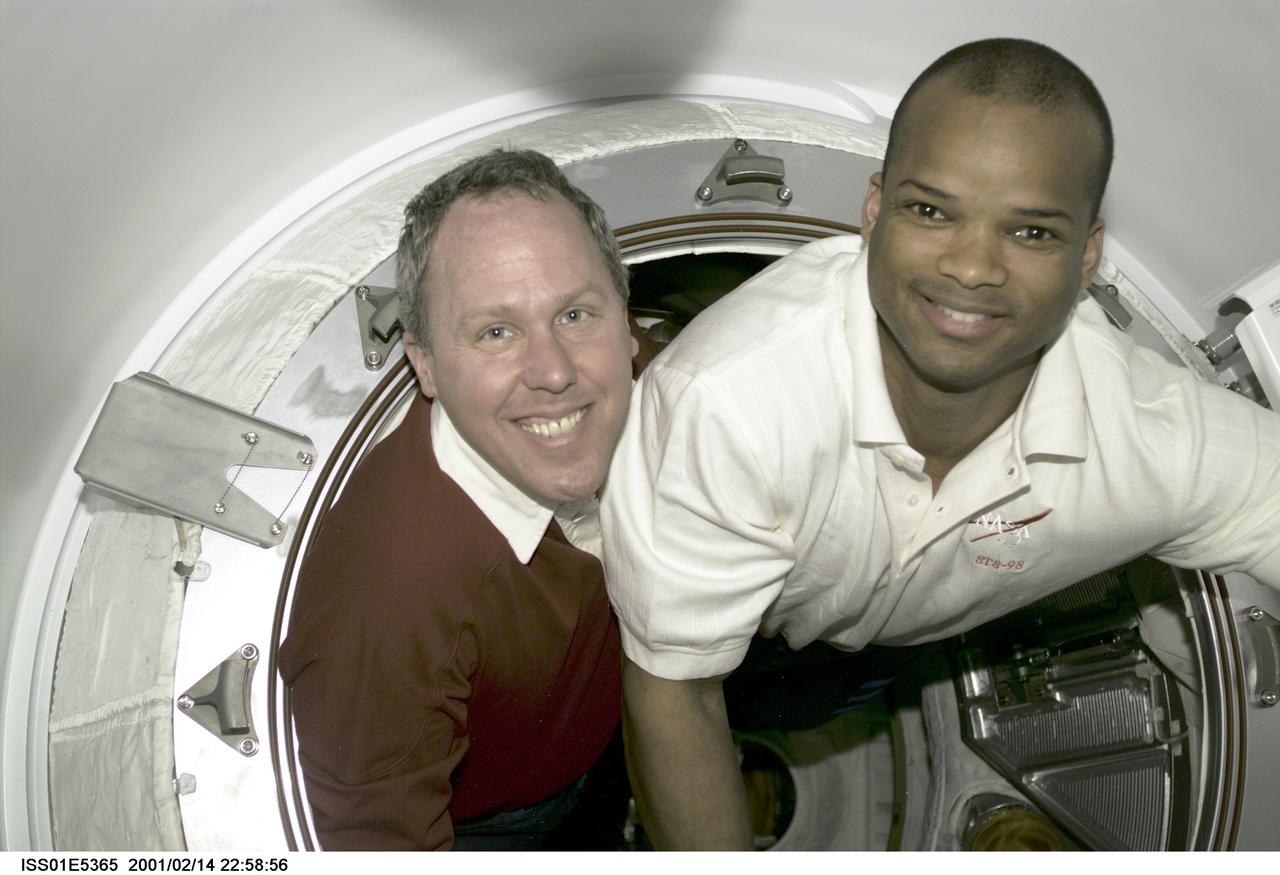
ISS01-E-5365 (14 February 2001) --- Astronauts Thomas D. Jones (left) and Robert L. Curbeam, STS-98 mission specialists who will accomplish three lengthy space walks during the STS-98/5a mission, share space in a small hatch during break time. The scene was recorded with a digital still camera.
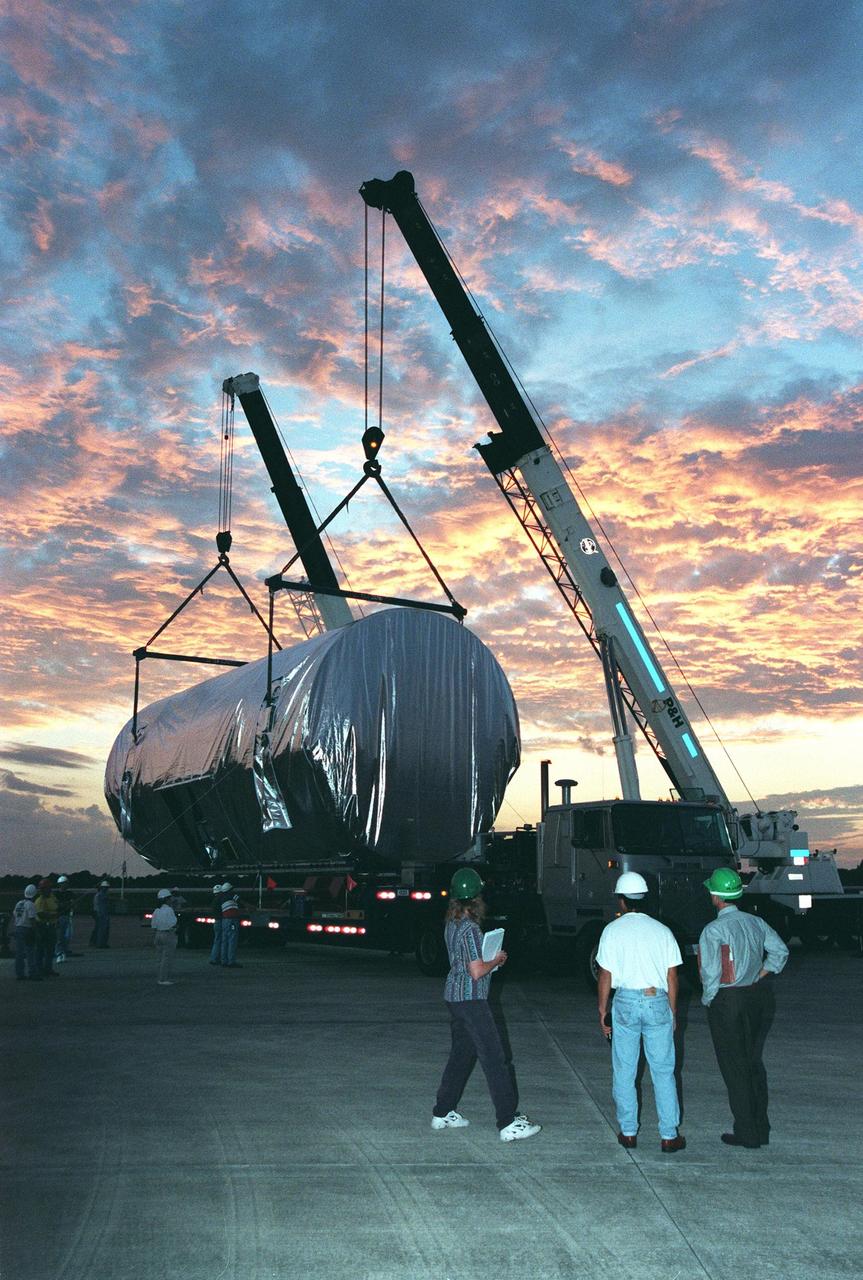
KENNEDY SPACE CENTER, FLA. -- In the growing dark of night, cranes maneuver the canister containing the U.S. laboratory module onto the bed of a trailer, waiting with its lights on for the move to the Space Station Processing Facility. Intended for the International Space Station, the lab is scheduled to undergo pre-launch preparations before its launch aboard the Shuttle Endeavour on mission STS-98. The laboratory comprises three cylindrical sections with two end cones. Each end-cone contains a hatch opening for entering and exiting the lab. The lab will provide a shirtsleeve environment for research in the areas of life science, microgravity science, Earth science and space science. Designated Flight 5A, this mission is targeted for launch in early 2000

In the Orbiter Processing Facility bay 1, the Pressurized Mating Adapter -3 (PMA-3) is lifted out of the payload canister for its transfer to the orbiter Discovery. A component of the International Space Station, the PMA-3 is part of the payload on Shuttle mission STS-92, scheduled to launch Oct. 5. The mission will be the fifth flight to the Space Station, and the 100th Shuttle flight overall. PMA-3 provides shuttle docking port for solar array installation on flight 4A (mission STS-97 scheduled for Nov. 30), and Lab installation on flight 5A (mission STS-98, scheduled for Jan. 18, 2001)

KENNEDY SPACE CENTER, FLA. - Workers in the Orbiter Processing Facility bay 1 watch the progress of the Pressurized Mating Adapter-3 (PMA-3) as it is transferred to the payload bay of the orbiter Discovery. A component of the International Space Station, the PMA-3 will fly on Shuttle mission STS-92, scheduled to launch October 5. The mission will be the fifth flight to the Space Station, and the 100th Shuttle flight overall. PMA-3 provides shuttle docking port for solar array installation on flight 4A (mission STS-97 scheduled for November 30), and Lab installation on flight 5A (mission STS-98, scheduled for January 18, 2001).
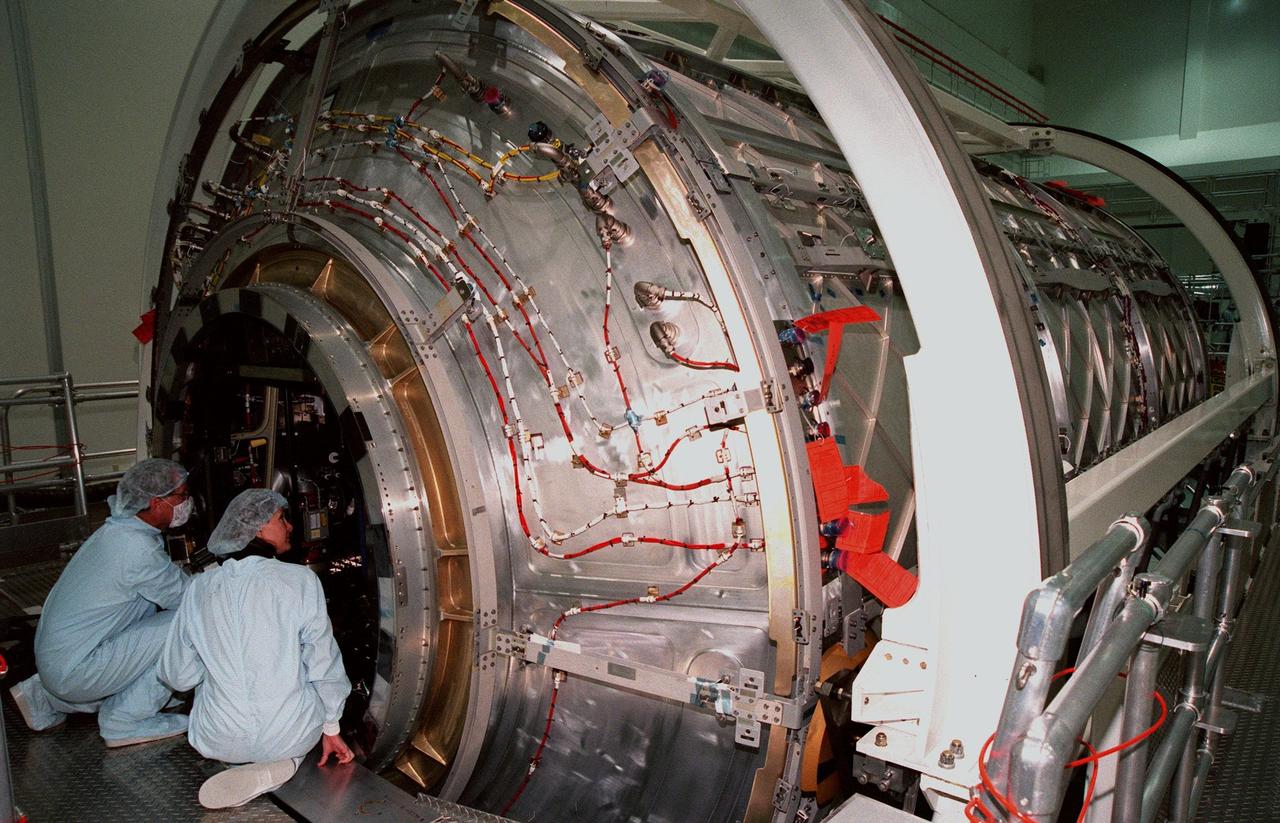
KENNEDY SPACE CENTER, FLA. -- Workers peer through the hatch of an end-cone on the U.S. laboratory module, an element of the International Space Station. The lab is undergoing pre-launch preparations before its launch aboard the Shuttle Endeavour on mission STS-98. The laboratory comprises three cylindrical sections with two end cones. Each end-cone contains a hatch opening for entering and exiting the lab. The lab will provide a shirtsleeve environment for research in the areas of life science, microgravity science, Earth science and space science. Designated Flight 5A, this mission is targeted for launch in early 2000
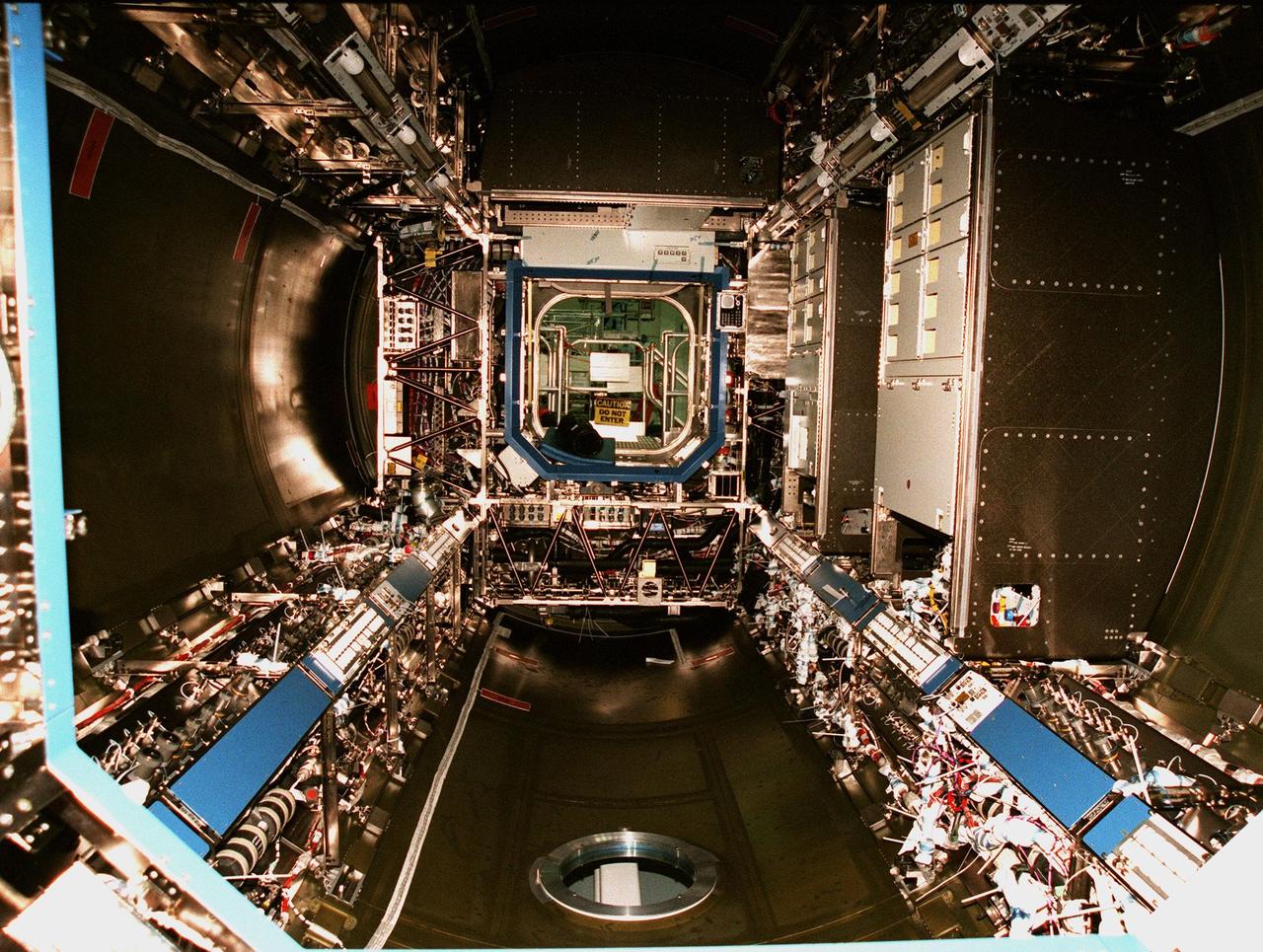
KENNEDY SPACE CENTER, FLA. -- The inside of the U.S. laboratory module is seen after the opening of a hatch on one end. An element of the International Space Station, the lab is undergoing pre-launch preparations before its launch aboard the Shuttle Endeavour on mission STS-98. The laboratory comprises three cylindrical sections with two end cones. Each end-cone contains a hatch opening for entering and exiting the lab. The lab will provide a shirtsleeve environment for research in the areas of life science, microgravity science, Earth science and space science. Designated Flight 5A, this mission is targeted for launch in early 2000
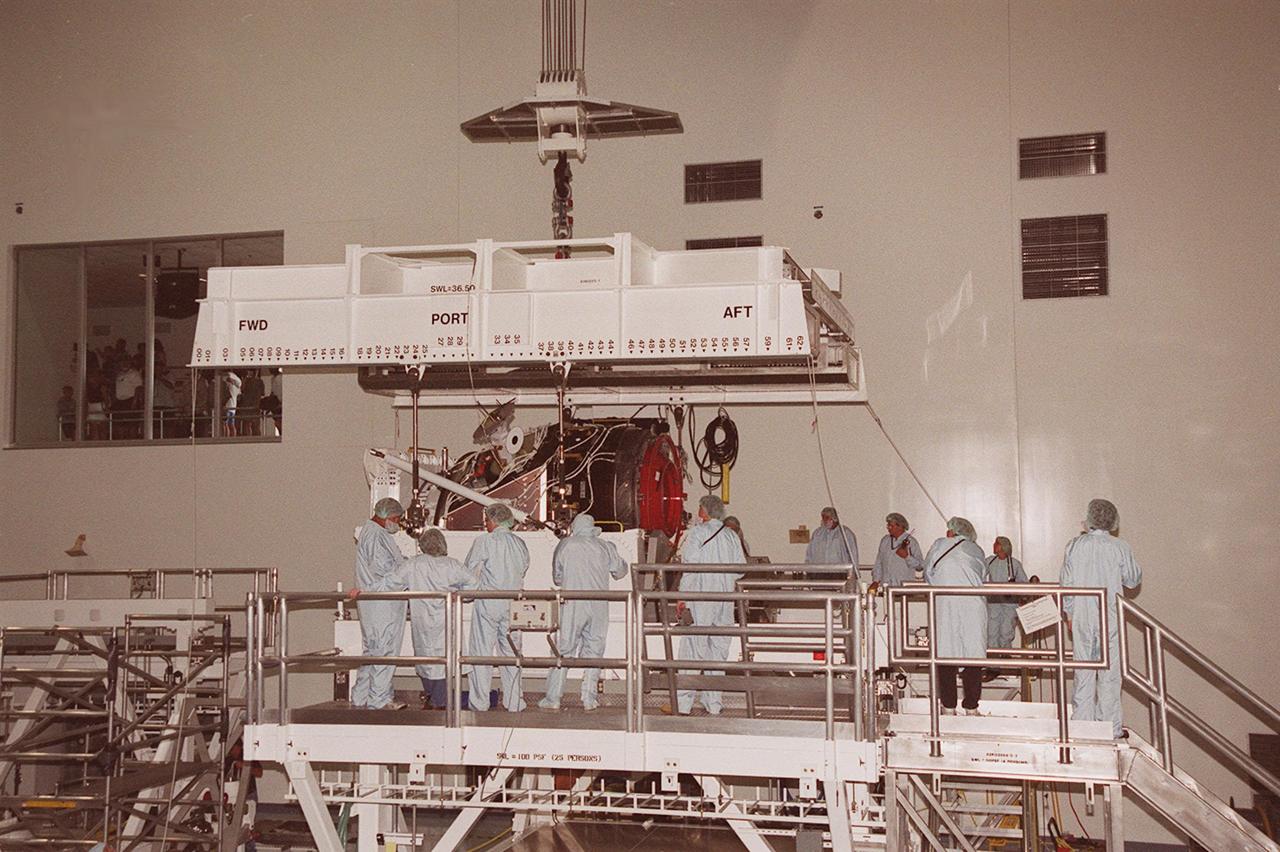
Workers in the Space Station Processing Facility gather around the Pressurized Mating Adapter -3 (PMA-3) as an overhead crane is set to lift and move it. The PMA-3, a component of the International Space Station, is being transported to the Orbiter Processing Facility. PMA-3 is part of the payload on Space Shuttle mission STS-92, scheduled to launch Oct. 5. The mission will be the fifth flight to the Space Station, and the 100th Shuttle flight overall. PMA-3 provides shuttle docking port for solar array installation on flight 4A (mission STS-97 scheduled for Nov. 30), and Lab installation on flight 5A (mission STS-98, scheduled for Jan. 18, 2001)
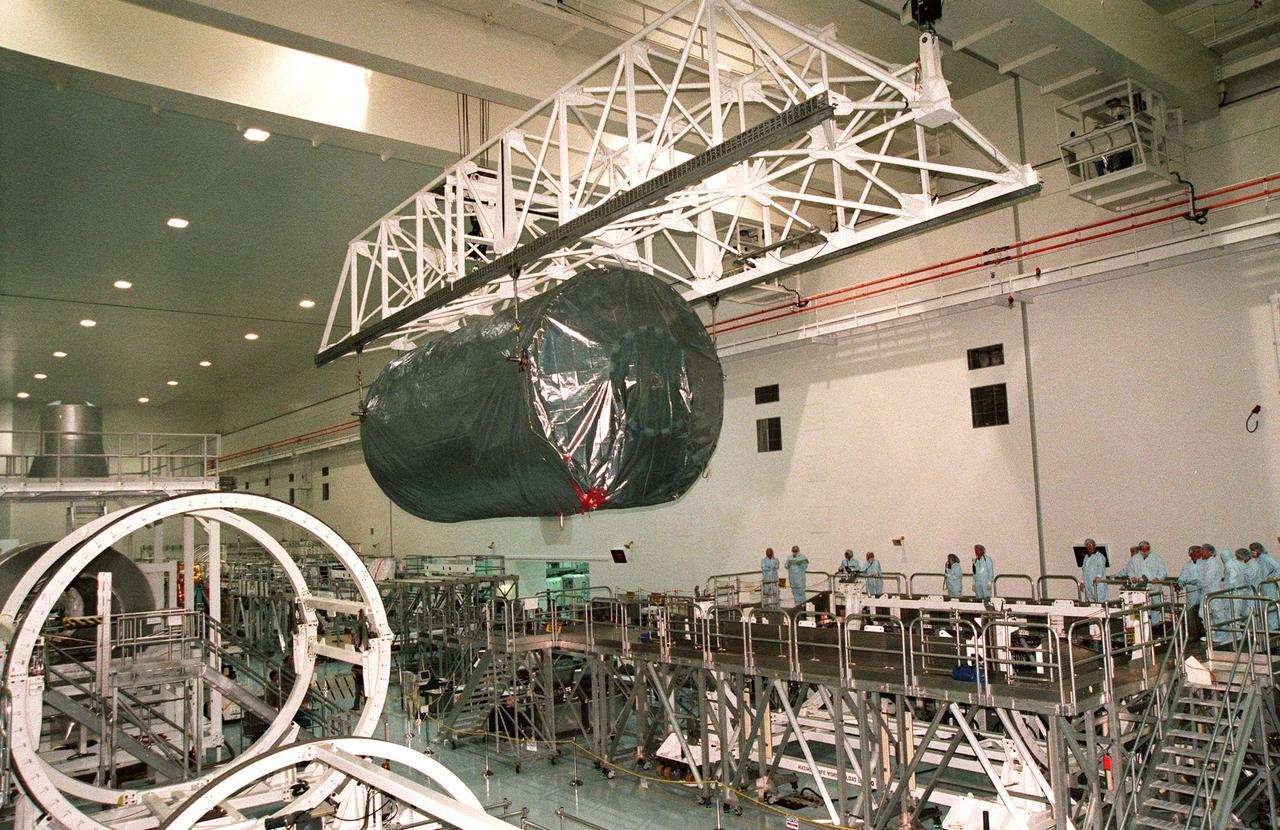
KENNEDY SPACE CENTER, FLA. -- An overhead crane in the high bay of the Space Station Processing Facility moves the U.S. laboratory module, an element of the International Space Station, toward the workstand on the right. KSC workers watch its movement. The lab will undergo pre-launch preparations before its launch aboard the Shuttle Endeavour on mission STS-98. The laboratory comprises three cylindrical sections with two end cones. Each end-cone contains a hatch opening for entering and exiting the lab. The lab will provide a shirtsleeve environment for research in the areas of life science, microgravity science, Earth science and space science. Designated Flight 5A, this mission is targeted for launch in early 2000
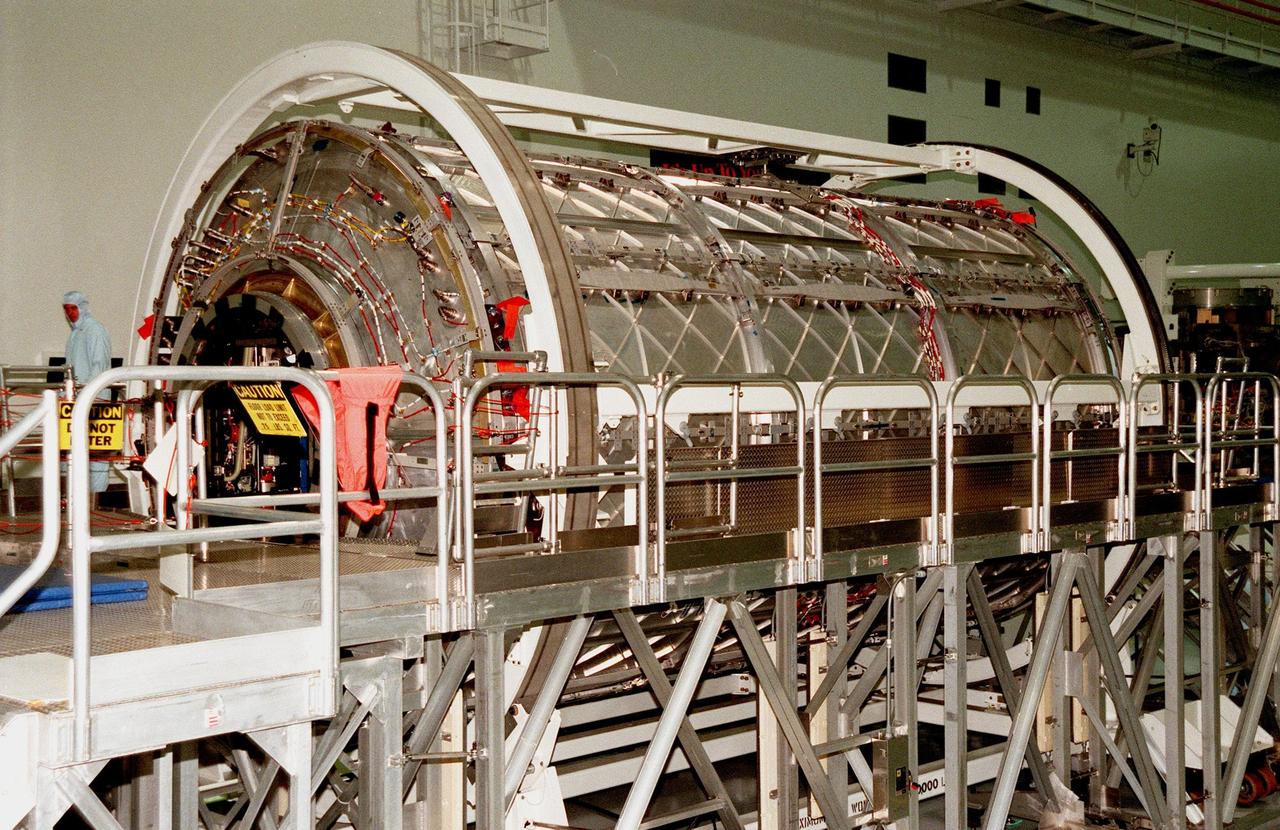
KENNEDY SPACE CENTER, FLA. -- On a workstand in the Space Station Processing Facility, the U.S. laboratory module, an element of the International Space Station, is ready for pre-launch preparations before its launch aboard the Shuttle Endeavour on mission STS-98. The laboratory comprises three cylindrical sections with two end cones. Each end-cone contains a hatch opening for entering and exiting the lab. The lab will provide a shirtsleeve environment for research in the areas of life science, microgravity science, Earth science and space science. Designated Flight 5A, this mission is targeted for launch in early 2000
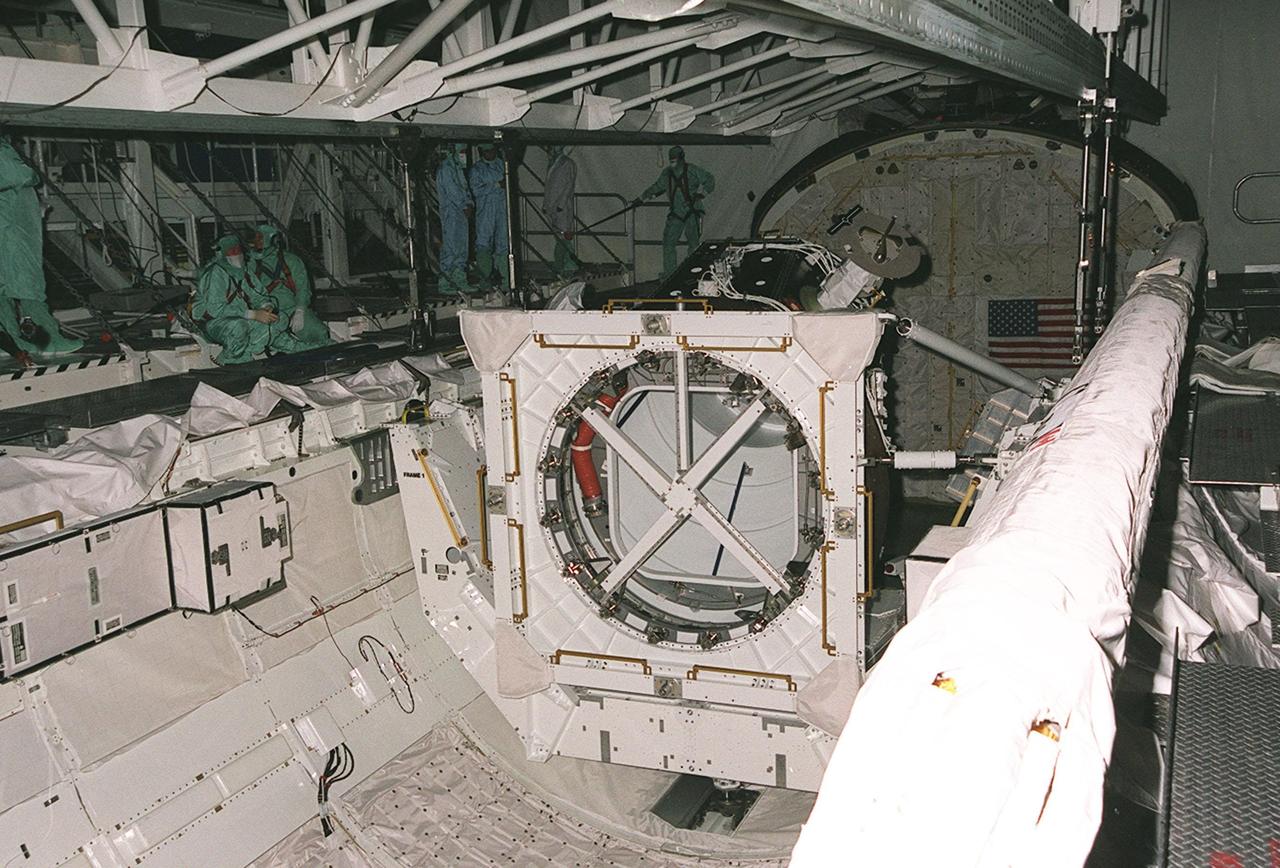
KENNEDY SPACE CENTER, FLA. -- The Pressurized Mating Adapter -3 (PMA-3) sits in the payload bay of the orbiter Discovery after being transported from the Space Station Processing Facility. A component of the International Space Station, the PMA-3 will fly on Shuttle mission STS-92, scheduled to launch Oct. 5. The mission will be the fifth flight to the Space Station, and the 100th Shuttle flight overall. PMA-3 provides shuttle docking port for solar array installation on flight 4A (mission STS-97 scheduled for Nov. 30), and Lab installation on flight 5A (mission STS-98, scheduled for Jan. 18, 2001)
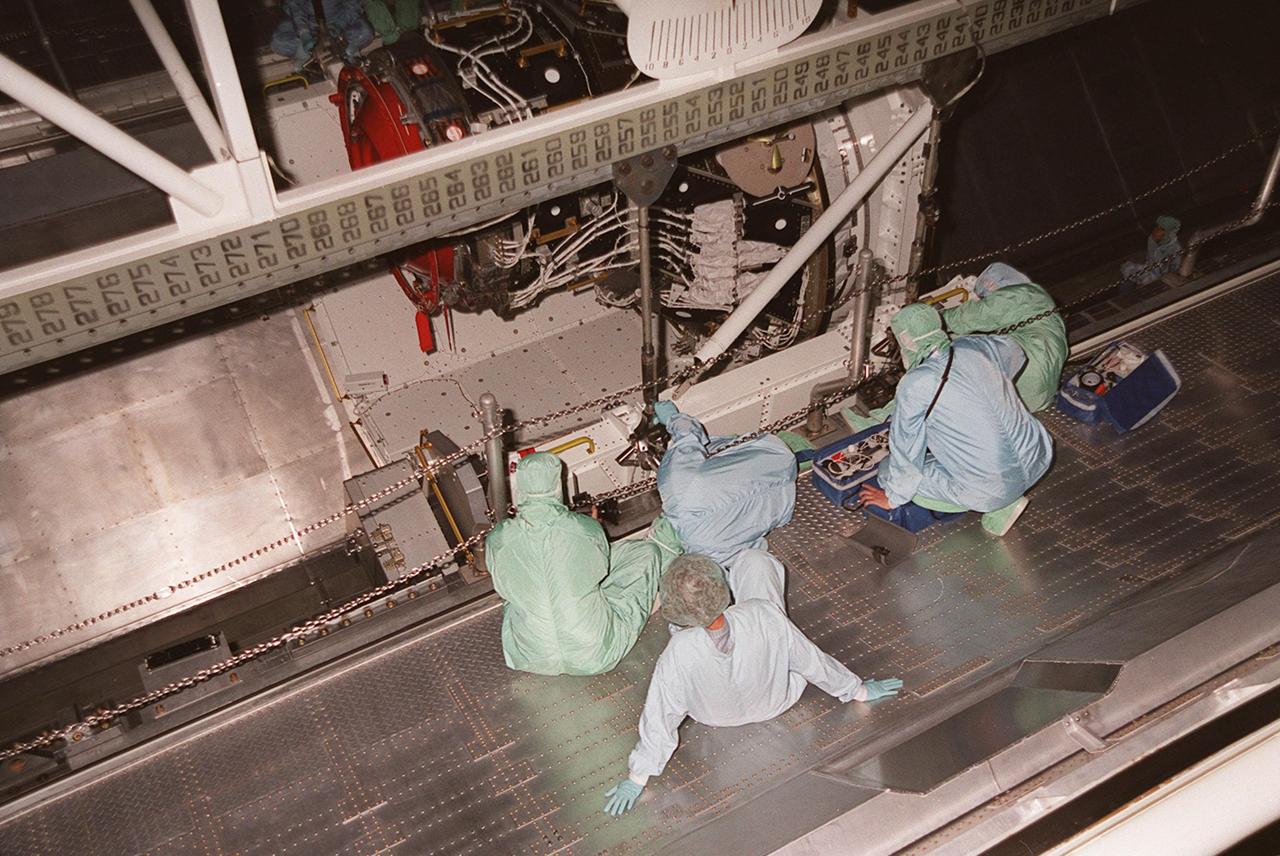
KENNEDY SPACE CENTER, FLA. -- Workers in the Orbiter Processing Facility check the placement of cables on the Pressurized Mating Adapter -3 (PMA-3) for its transfer to the orbiter Discovery. A component of the International Space Station, the PMA-3 is part of the payload on Space Shuttle mission STS-92, scheduled to launch Oct. 5. The mission will be the fifth flight to the Space Station, and the 100th Shuttle flight overall. PMA-3 provides shuttle docking port for solar array installation on flight 4A (mission STS-97 scheduled for Nov. 30), and Lab installation on flight 5A (mission STS-98, scheduled for Jan. 18, 2001)
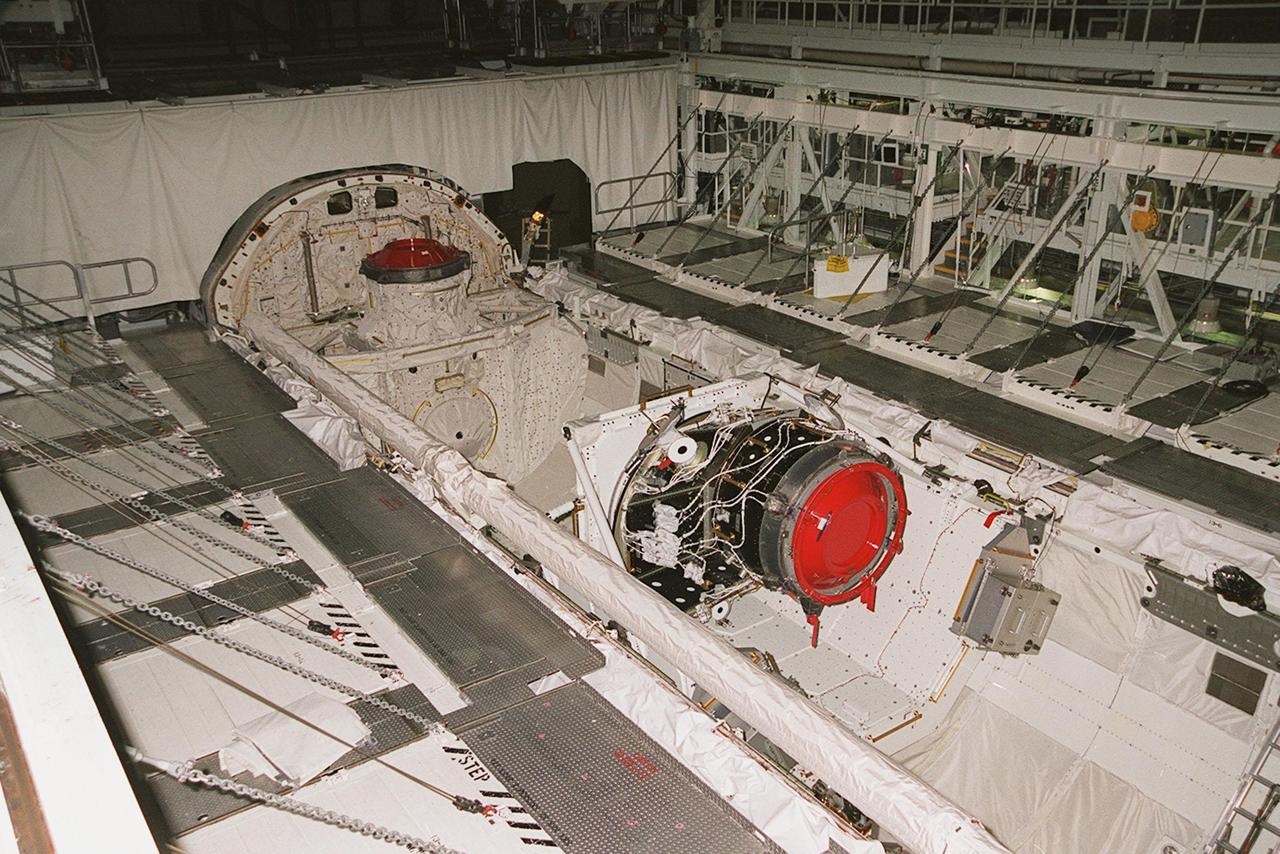
KENNEDY SPACE CENTER, FLA. -- The Pressurized Mating Adapter -3 (PMA-3) sits in the payload bay of the orbiter Discovery after being transported from the Space Station Processing Facility. A component of the International Space Station, the PMA-3 will fly on Shuttle mission STS-92, scheduled to launch Oct. 5. The mission will be the fifth flight to the Space Station, and the 100th Shuttle flight overall. PMA-3 provides shuttle docking port for solar array installation on flight 4A (mission STS-97 scheduled for Nov. 30), and Lab installation on flight 5A (mission STS-98, scheduled for Jan. 18, 2001)
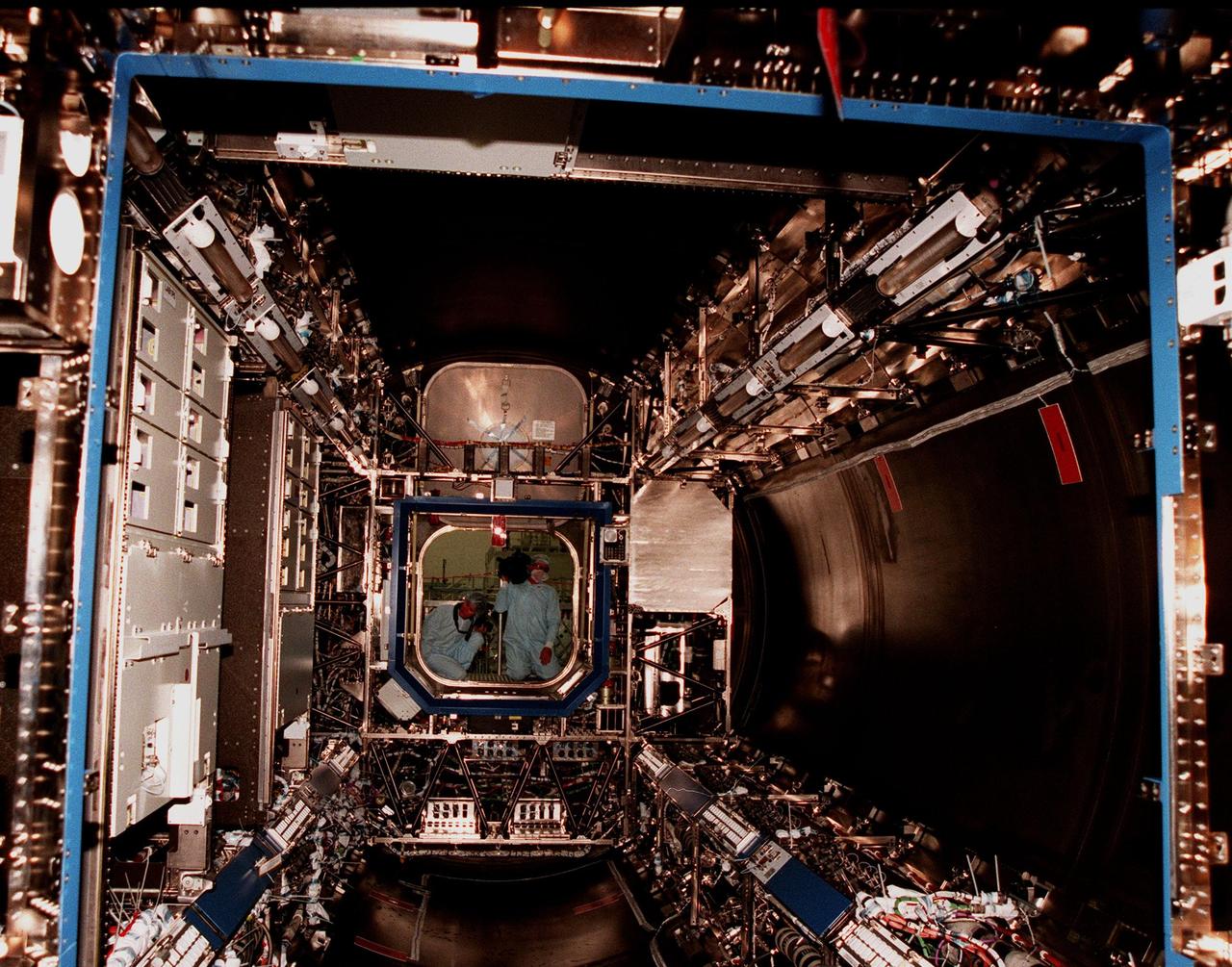
KENNEDY SPACE CENTER, FLA. -- Workers peer inside after opening an end-cone of the U.S. laboratory module, an element of the International Space Station. The lab is undergoing pre-launch preparations before its launch aboard the Shuttle Endeavour on mission STS-98. The laboratory comprises three cylindrical sections with two end cones. Each end-cone contains a hatch opening for entering and exiting the lab. The lab will provide a shirtsleeve environment for research in the areas of life science, microgravity science, Earth science and space science. Designated Flight 5A, this mission is targeted for launch in early 2000
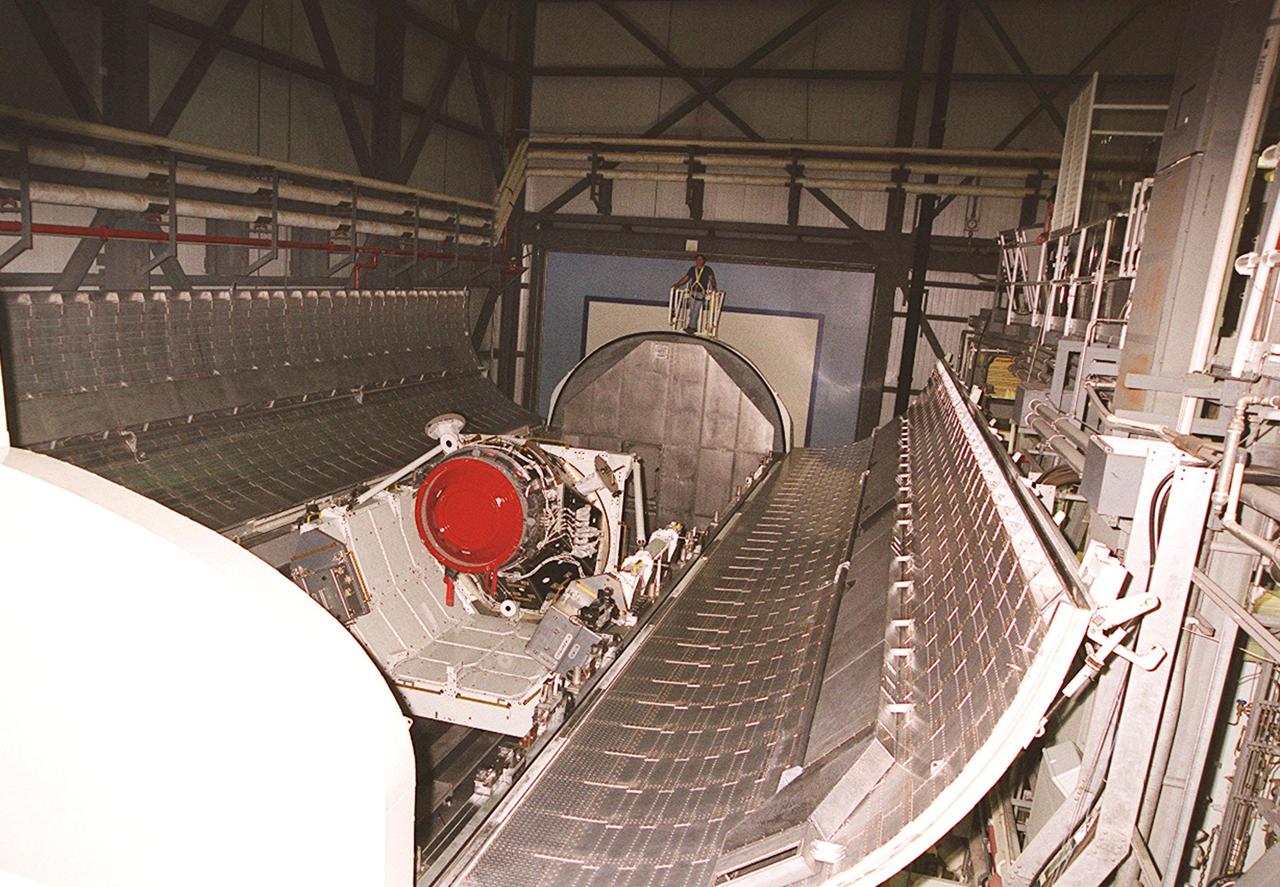
KENNEDY SPACE CENTER, FLA. -- In the Space Station Processing Facility, the Pressurized Mating Adapter -3 (PMA-3) sits in a payload canister for transport to the Orbiter Processing Facility. Workers at the sides and below watch the process. The PMA-3, a component of the International Space Station, is part of the payload on Space Shuttle mission STS-92, scheduled to launch Oct. 5. The mission will be the fifth flight to the Space Station, and the 100th Shuttle flight overall. PMA-3 provides shuttle docking port for solar array installation on flight 4A (mission STS-97 scheduled for Nov. 30), and Lab installation on flight 5A (mission STS-98, scheduled for Jan. 18, 2001)
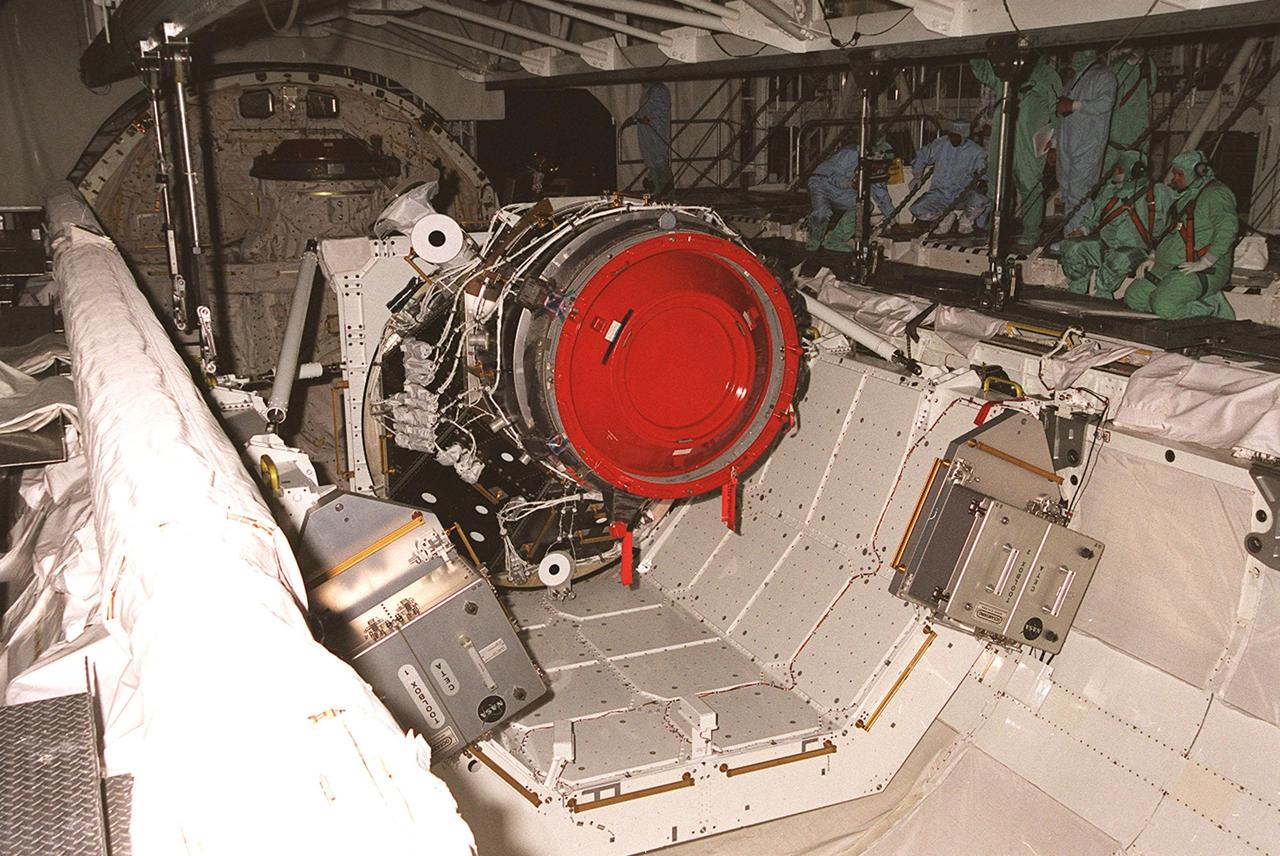
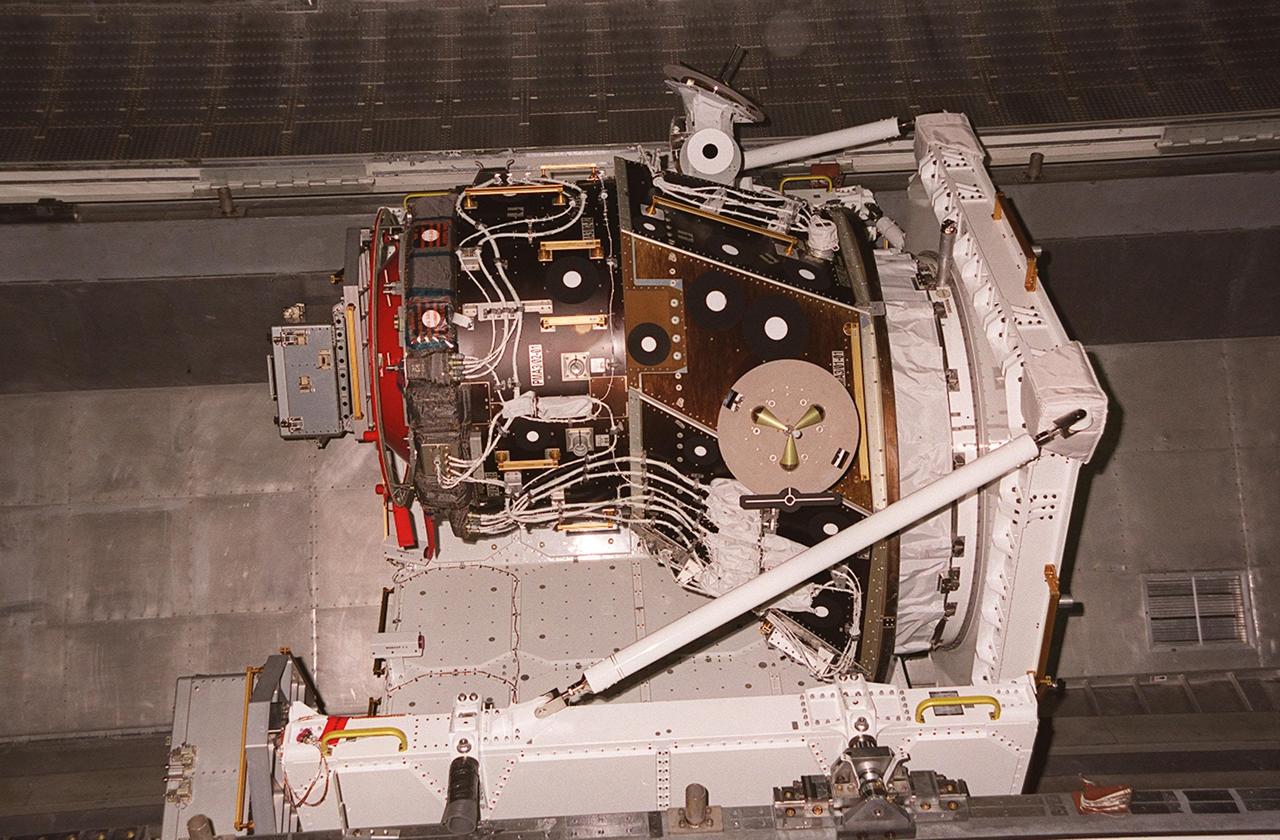
KENNEDY SPACE CENTER, FLA. -- In the Orbiter Processing Facility bay 1, workers detach the overhead crane from the Pressurized Mating Adapter -3 (PMA-3), which sits in the payload bay of the orbiter Discovery. A component of the International Space Station, the PMA-3 will fly on Shuttle mission STS-92, scheduled to launch Oct. 5. The mission will be the fifth flight to the Space Station, and the 100th Shuttle flight overall. PMA-3 provides shuttle docking port for solar array installation on flight 4A (mission STS-97 scheduled for Nov. 30), and Lab installation on flight 5A (mission STS-98, scheduled for Jan. 18, 2001)
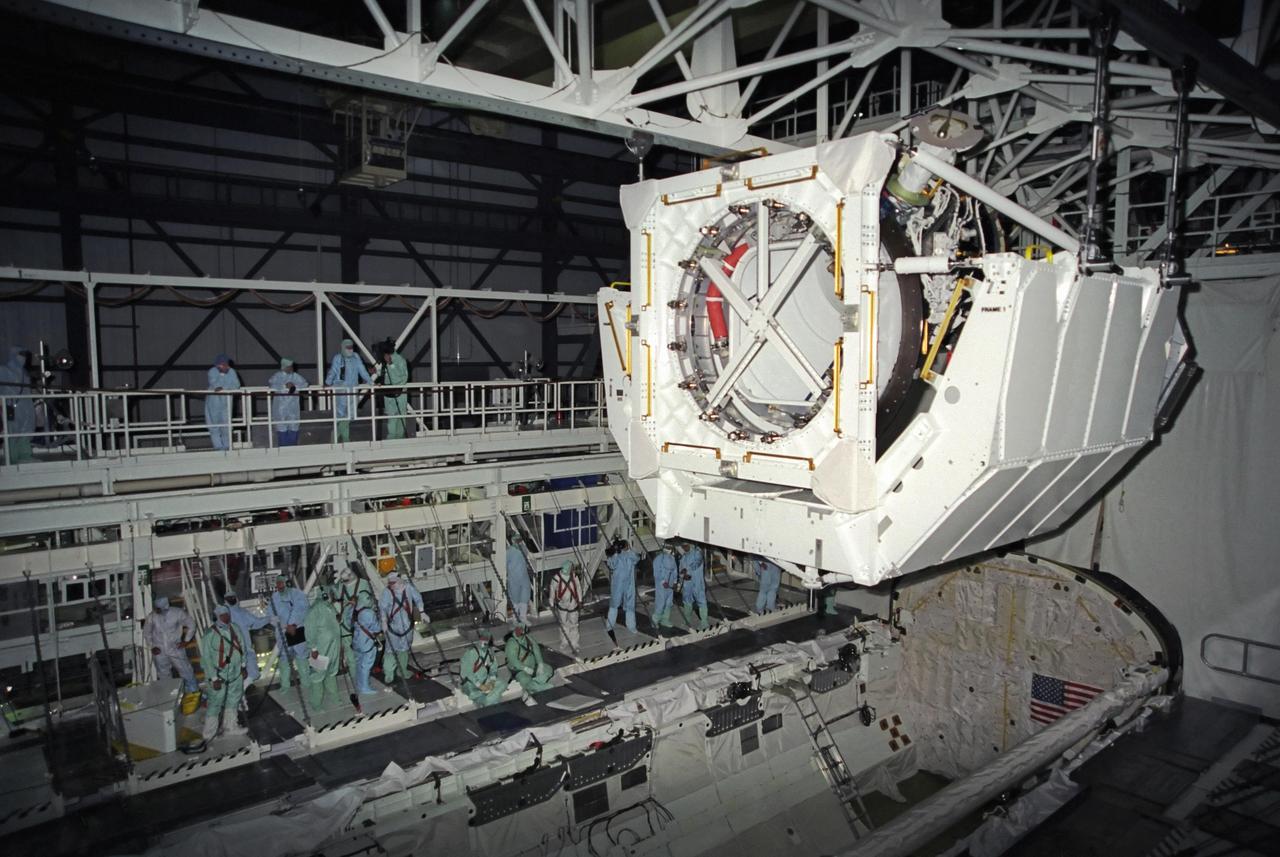
KENNEDY SPACE CENTER, FLA. - Workers in the Orbiter Processing Facility bay 1 watch the progress of the Pressurized Mating Adapter-3 (PMA-3) as it is transferred to the payload bay of the orbiter Discovery. A component of the International Space Station, the PMA-3 will fly on Shuttle mission STS-92, scheduled to launch October 5. The mission will be the fifth flight to the Space Station, and the 100th Shuttle flight overall. PMA-3 provides shuttle docking port for solar array installation on flight 4A (mission STS-97 scheduled for November 30), and Lab installation on flight 5A (mission STS-98, scheduled for January 18, 2001).
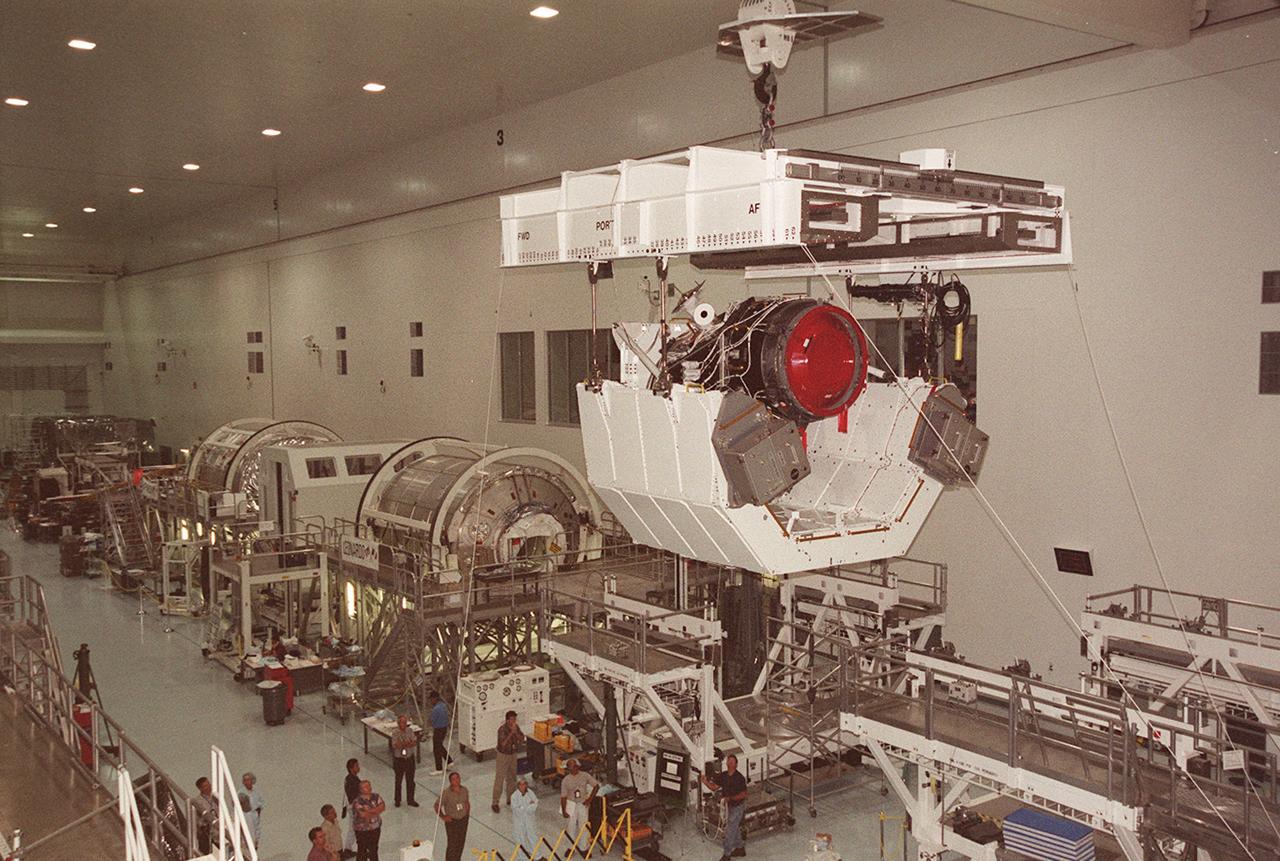
KENNEDY SPACE CENTER, FLA. -- In the Space Station Processing Facility, an overhead crane moves the Pressurized Mating Adapter-3 (PMA-3) to a payload canister for transport to the Orbiter Processing Facility. The PMA-3, a component of the International Space Station, is part of the payload on Space Shuttle mission STS-92, scheduled to launch Oct. 5. The mission will be the fifth flight to the Space Station, and the 100th Shuttle flight overall. PMA-3 provides the Shuttle docking port for solar array installation on flight 4A (mission STS-97, scheduled for Nov. 30) and Lab installation on flight 5A (mission STS-98), scheduled for Jan. 18, 2001.)
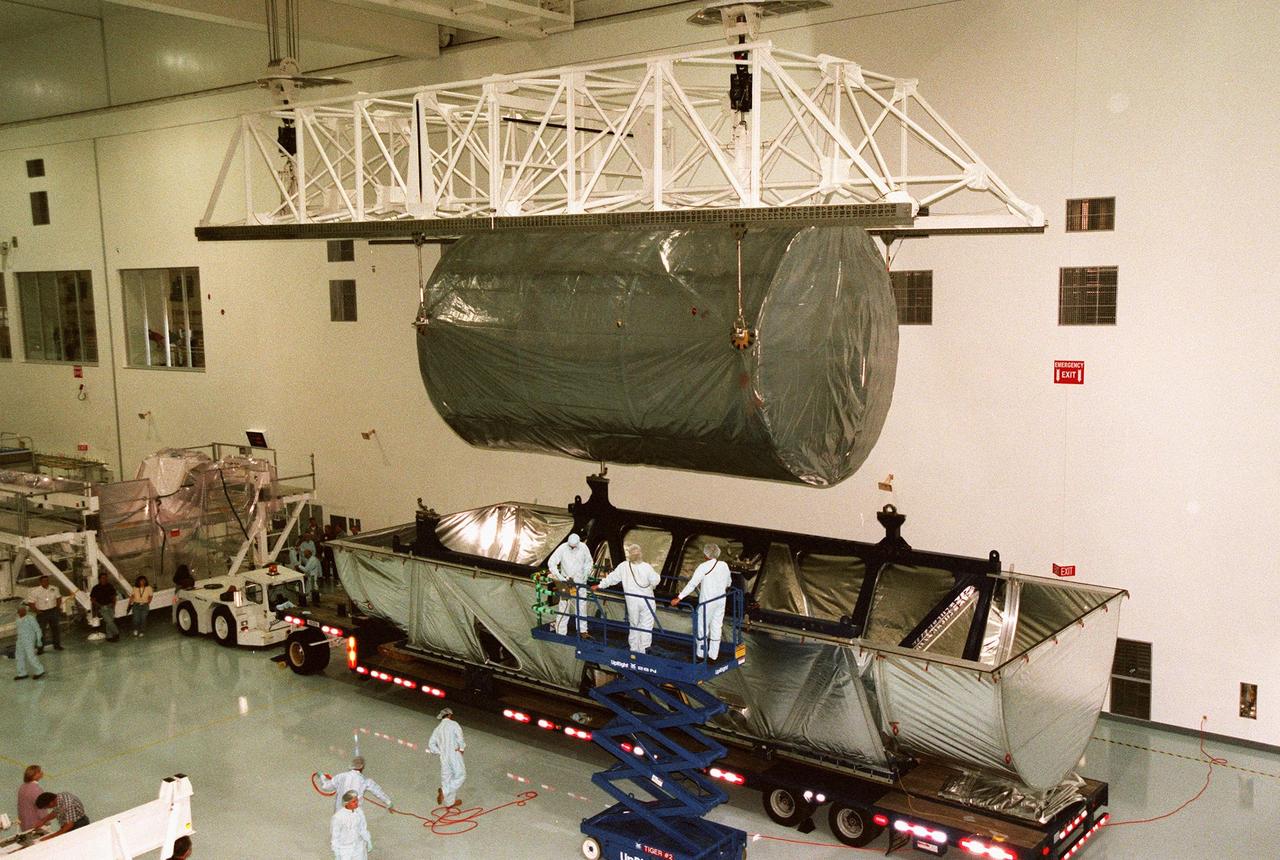
KENNEDY SPACE CENTER, FLA. -- The U.S. laboratory module, an element of the International Space Station, is lifted by a crane from its canister in the Space Station Processing Facility. The lab will undergo pre-launch preparations before its launch aboard the Shuttle Endeavour on mission STS-98. The laboratory comprises three cylindrical sections with two end cones. Each end-cone contains a hatch opening for entering and exiting the lab. The lab will provide a shirtsleeve environment for research in the areas of life science, microgravity science, Earth science and space science. Designated Flight 5A, this mission is targeted for launch in early 2000
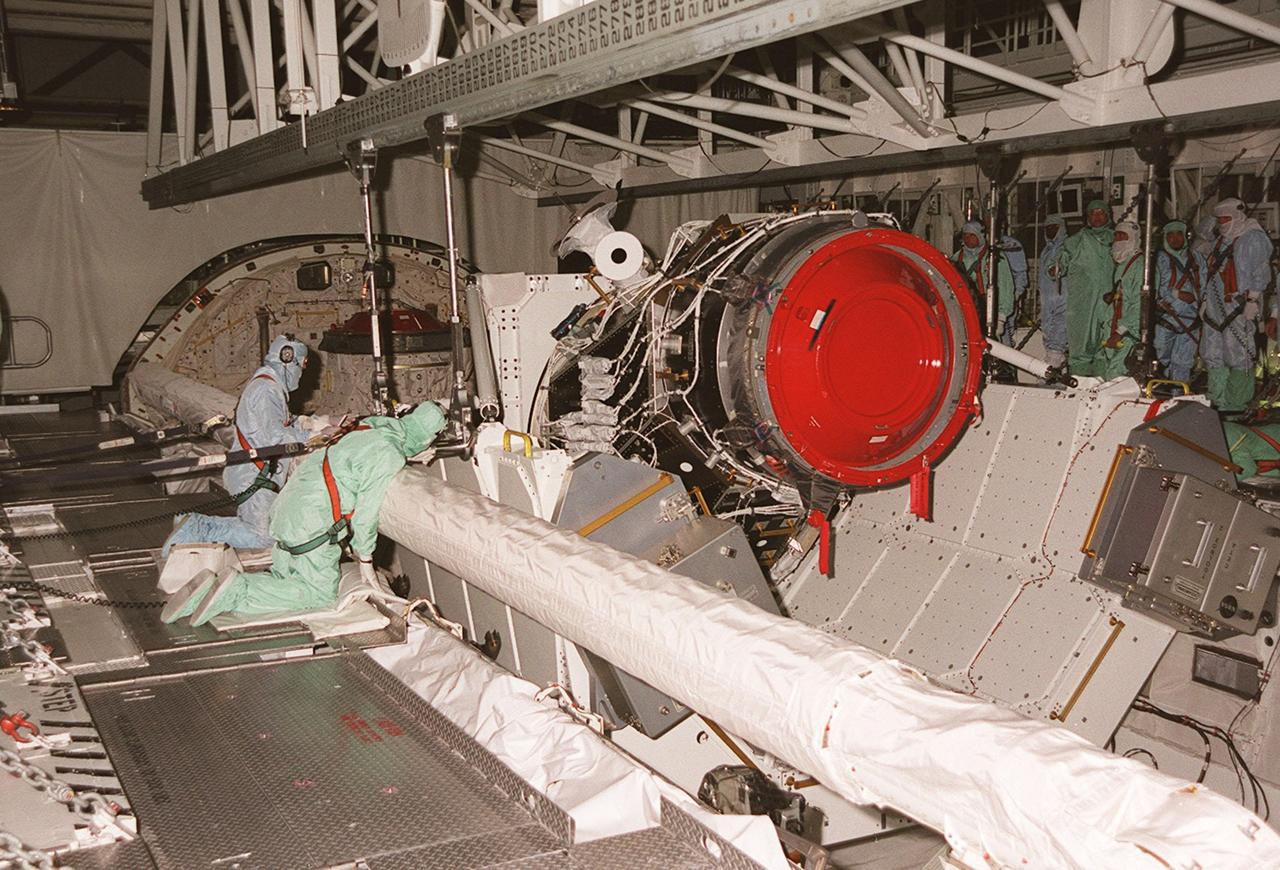
KENNEDY SPACE CENTER, FLA. -- In the Orbiter Processing Facility bay 1, workers check the placement of the Pressurized Mating Adapter -3 (PMA-3) as the overhead crane places it in the payload bay of the orbiter Discovery. A component of the International Space Station, the PMA-3 will fly on Shuttle mission STS-92, scheduled to launch Oct. 5. The mission will be the fifth flight to the Space Station, and the 100th Shuttle flight overall. PMA-3 provides shuttle docking port for solar array installation on flight 4A (mission STS-97 scheduled for Nov. 30), and Lab installation on flight 5A (mission STS-98, scheduled for Jan. 18, 2001)
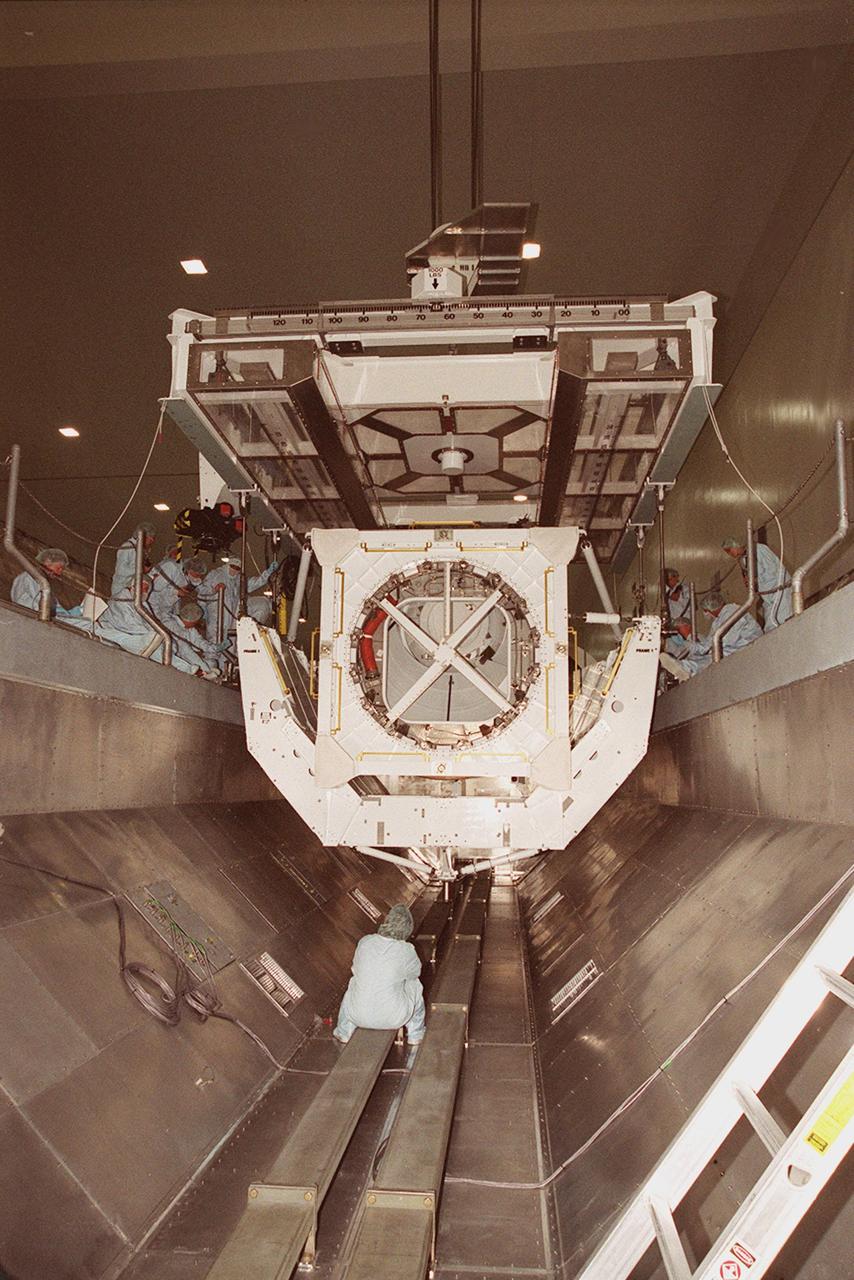
KENNEDY SPACE CENTER, FLA. -- In the Space Station Processing Facility, an overhead crane lowers the Pressurized Mating Adapter -3 (PMA-3) into a payload canister for transport to the Orbiter Processing Facility. Workers at the sides and below watch the process. The PMA-3, a component of the International Space Station, is part of the payload on Space Shuttle mission STS-92, scheduled to launch Oct. 5. The mission will be the fifth flight to the Space Station, and the 100th Shuttle flight overall. PMA-3 provides shuttle docking port for solar array installation on flight 4A (mission STS-97 scheduled for Nov. 30), and Lab installation on flight 5A (mission STS-98, scheduled for Jan. 18, 2001)
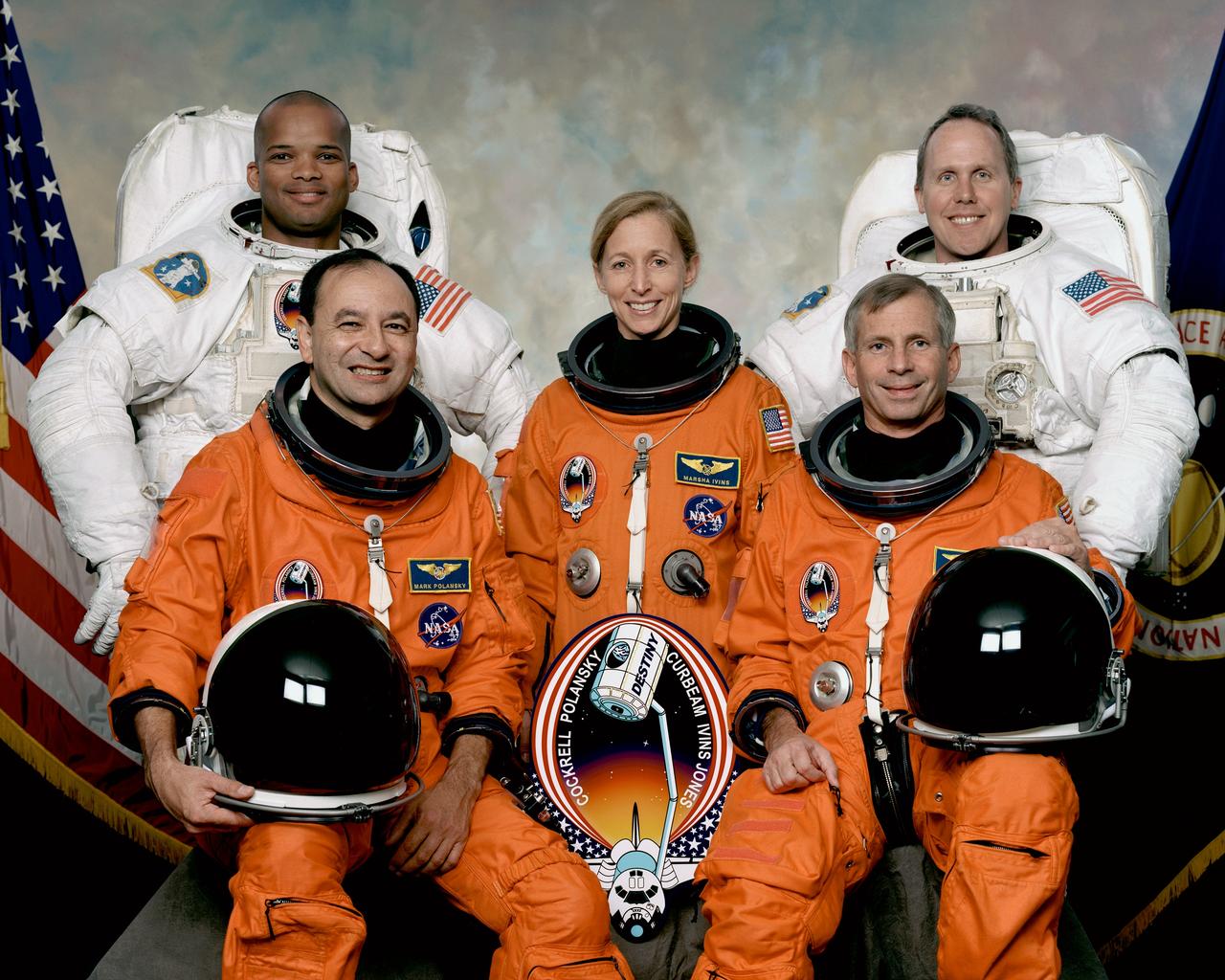
STS098-S-002 (December 2000) --- These five astronauts have been in training for the STS-98 mission, scheduled for launch aboard the Space Shuttle Atlantis in January of 2001. The crew is composed of astronauts Kenneth D. Cockrell (right front), mission commander; and Mark L. Polansky (left front), pilot; along with astronauts Marsha S. Ivins, Robert L. Curbeam, Jr., (left rear) and Thomas D. Jones (right rear), all mission specialists. Curbeam and Jones are the scheduled extravehicular activity (EVA) participants for the International Space Station's 5a mission.
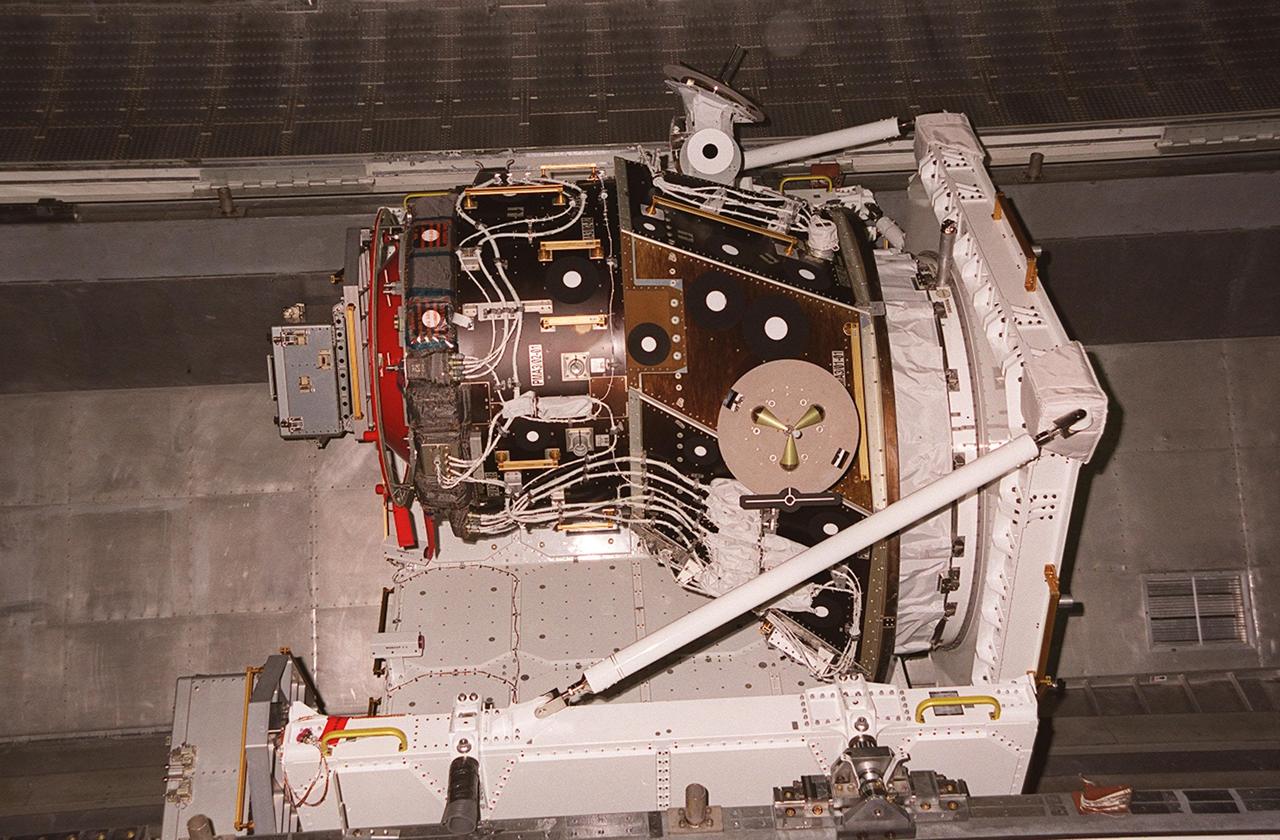
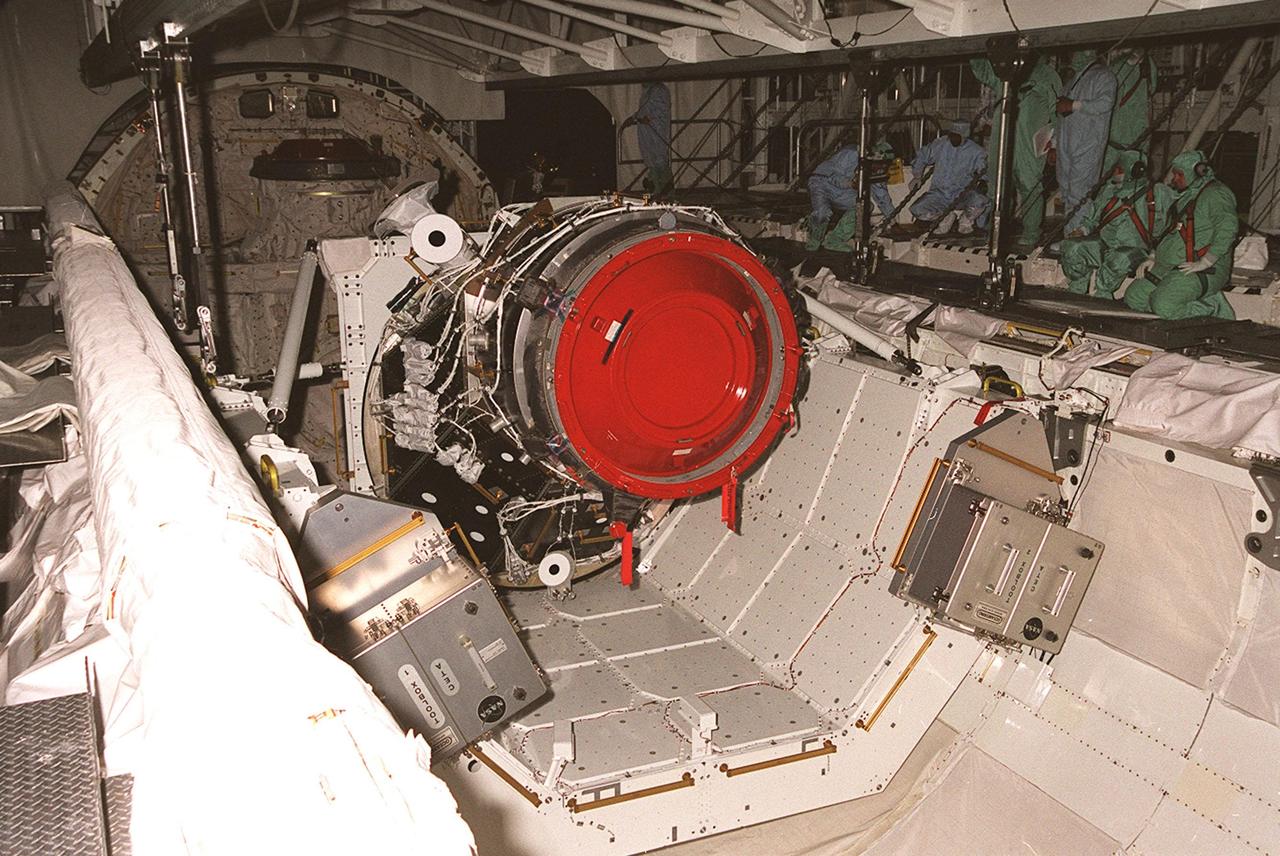
KENNEDY SPACE CENTER, FLA. -- This closeup shows the Pressurized Mating Adapter -3 (PMA-3) after transport to the Orbiter Processing Facility. A component of the International Space Station, the PMA-3 is being transferred to the payload bay of the orbiter Discovery, for mission STS-92, scheduled to launch Oct. 5. The mission will be the fifth flight to the Space Station, and the 100th Shuttle flight overall. PMA-3 provides shuttle docking port for solar array installation on flight 4A (mission STS-97 scheduled for Nov. 30), and Lab installation on flight 5A (mission STS-98, scheduled for Jan. 18, 2001)

KENNEDY SPACE CENTER, FLA. -- In the Space Station Processing Facility, an overhead crane moves the Pressurized Mating Adapter-3 (PMA-3) to a payload canister for transport to the Orbiter Processing Facility. The PMA-3, a component of the International Space Station, is part of the payload on Space Shuttle mission STS-92, scheduled to launch Oct. 5. The mission will be the fifth flight to the Space Station, and the 100th Shuttle flight overall. PMA-3 provides the Shuttle docking port for solar array installation on flight 4A (mission STS-97, scheduled for Nov. 30) and Lab installation on flight 5A (mission STS-98), scheduled for Jan. 18, 2001.)
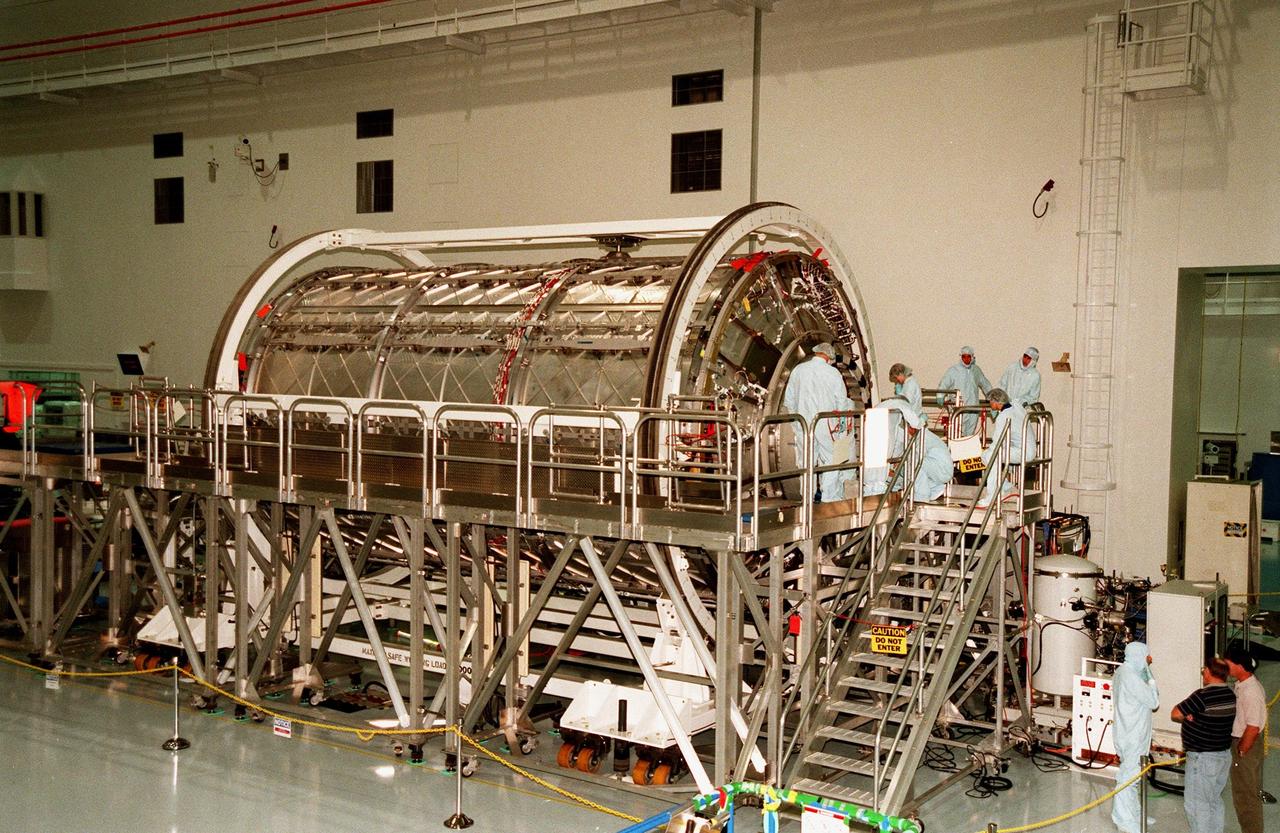
KENNEDY SPACE CENTER, FLA. -- On a workstand in the Space Station Processing Facility, KSC workers take a look at the U.S. laboratory module, an element of the International Space Station, after its protective cover has been removed. The lab will undergo pre-launch preparations before its launch aboard the Shuttle Endeavour on mission STS-98. The laboratory comprises three cylindrical sections with two end cones. Each end-cone contains a hatch opening for entering and exiting the lab. The lab will provide a shirtsleeve environment for research in the areas of life science, microgravity science, Earth science and space science. Designated Flight 5A, this mission is targeted for launch in early 2000

KENNEDY SPACE CENTER, FLA. -- In the Space Station Processing Facility, an overhead crane lowers the Pressurized Mating Adapter -3 (PMA-3) into a payload canister for transport to the Orbiter Processing Facility. Workers at the sides and below watch the process. The PMA-3, a component of the International Space Station, is part of the payload on Space Shuttle mission STS-92, scheduled to launch Oct. 5. The mission will be the fifth flight to the Space Station, and the 100th Shuttle flight overall. PMA-3 provides shuttle docking port for solar array installation on flight 4A (mission STS-97 scheduled for Nov. 30), and Lab installation on flight 5A (mission STS-98, scheduled for Jan. 18, 2001)
KENNEDY SPACE CENTER, FLA. -- In the Orbiter Processing Facility bay 1, workers detach the overhead crane from the Pressurized Mating Adapter -3 (PMA-3), which sits in the payload bay of the orbiter Discovery. A component of the International Space Station, the PMA-3 will fly on Shuttle mission STS-92, scheduled to launch Oct. 5. The mission will be the fifth flight to the Space Station, and the 100th Shuttle flight overall. PMA-3 provides shuttle docking port for solar array installation on flight 4A (mission STS-97 scheduled for Nov. 30), and Lab installation on flight 5A (mission STS-98, scheduled for Jan. 18, 2001)

KENNEDY SPACE CENTER, FLA. -- In the Space Station Processing Facility, the Pressurized Mating Adapter -3 (PMA-3) sits in a payload canister for transport to the Orbiter Processing Facility. Workers at the sides and below watch the process. The PMA-3, a component of the International Space Station, is part of the payload on Space Shuttle mission STS-92, scheduled to launch Oct. 5. The mission will be the fifth flight to the Space Station, and the 100th Shuttle flight overall. PMA-3 provides shuttle docking port for solar array installation on flight 4A (mission STS-97 scheduled for Nov. 30), and Lab installation on flight 5A (mission STS-98, scheduled for Jan. 18, 2001)

KENNEDY SPACE CENTER, FLA. -- A crane is attached to the U.S. laboratory module in order to transfer it to a truck. Intended for the International Space Station, the lab is being moved to the Space Station Processing Facility for pre-launch preparations. Scheduled for launch aboard the Shuttle Endeavour on mission STS-98, the laboratory comprises three cylindrical sections with two end cones. Each end-cone contains a hatch opening for entering and exiting the lab. The lab will provide a shirtsleeve environment for research in the areas of life science, microgravity science, Earth science and space science. Designated Flight 5A, this mission is targeted for launch in early 2000
KENNEDY SPACE CENTER, FLA. -- This closeup shows the Pressurized Mating Adapter -3 (PMA-3) after transport to the Orbiter Processing Facility. A component of the International Space Station, the PMA-3 is being transferred to the payload bay of the orbiter Discovery, for mission STS-92, scheduled to launch Oct. 5. The mission will be the fifth flight to the Space Station, and the 100th Shuttle flight overall. PMA-3 provides shuttle docking port for solar array installation on flight 4A (mission STS-97 scheduled for Nov. 30), and Lab installation on flight 5A (mission STS-98, scheduled for Jan. 18, 2001)
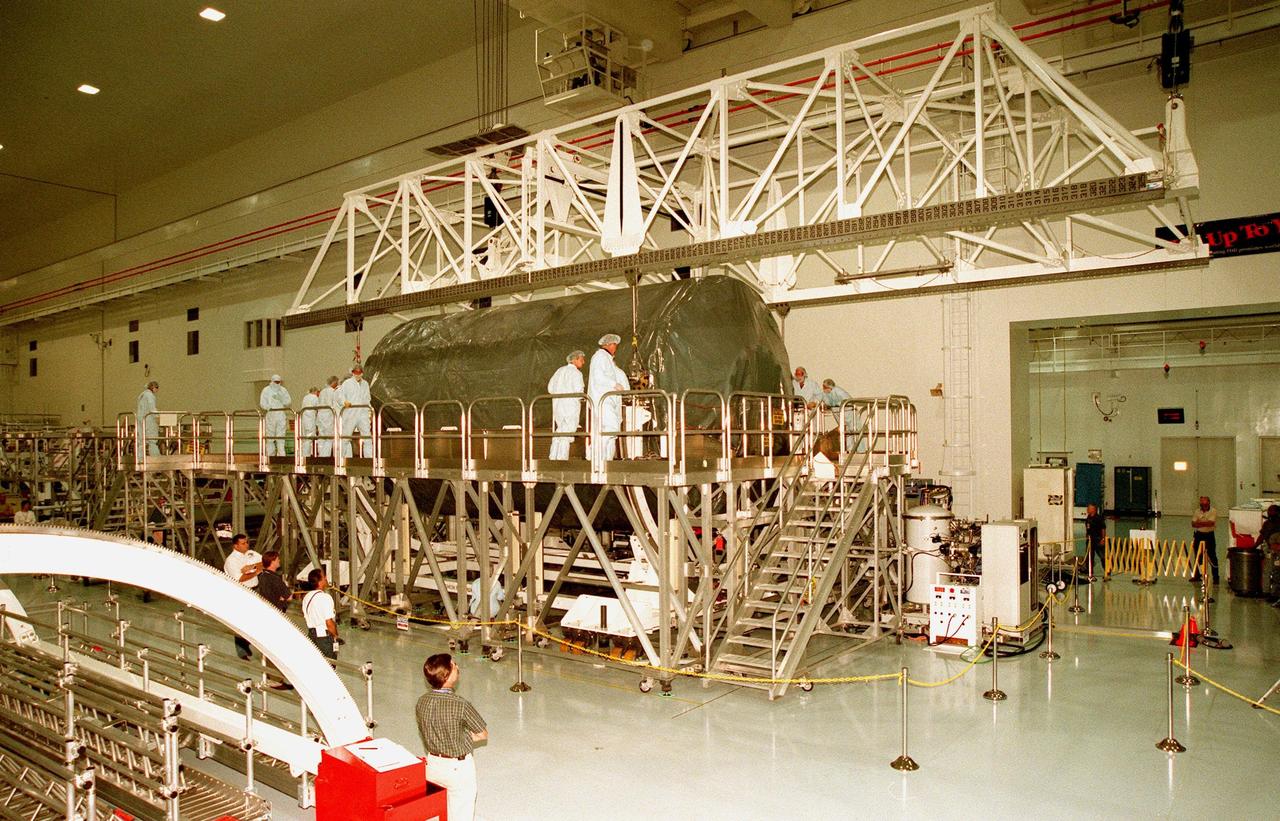
KENNEDY SPACE CENTER, FLA. -- KSC workers watch as an overhead crane in the high bay of the Space Station Processing Facility lowers the U.S. laboratory module, an element of the International Space Station, onto the workstand. The lab will undergo pre-launch preparations before its launch aboard the Shuttle Endeavour on mission STS-98. The laboratory comprises three cylindrical sections with two end cones. Each end-cone contains a hatch opening for entering and exiting the lab. The lab will provide a shirtsleeve environment for research in the areas of life science, microgravity science, Earth science and space science. Designated Flight 5A, this mission is targeted for launch in early 2000
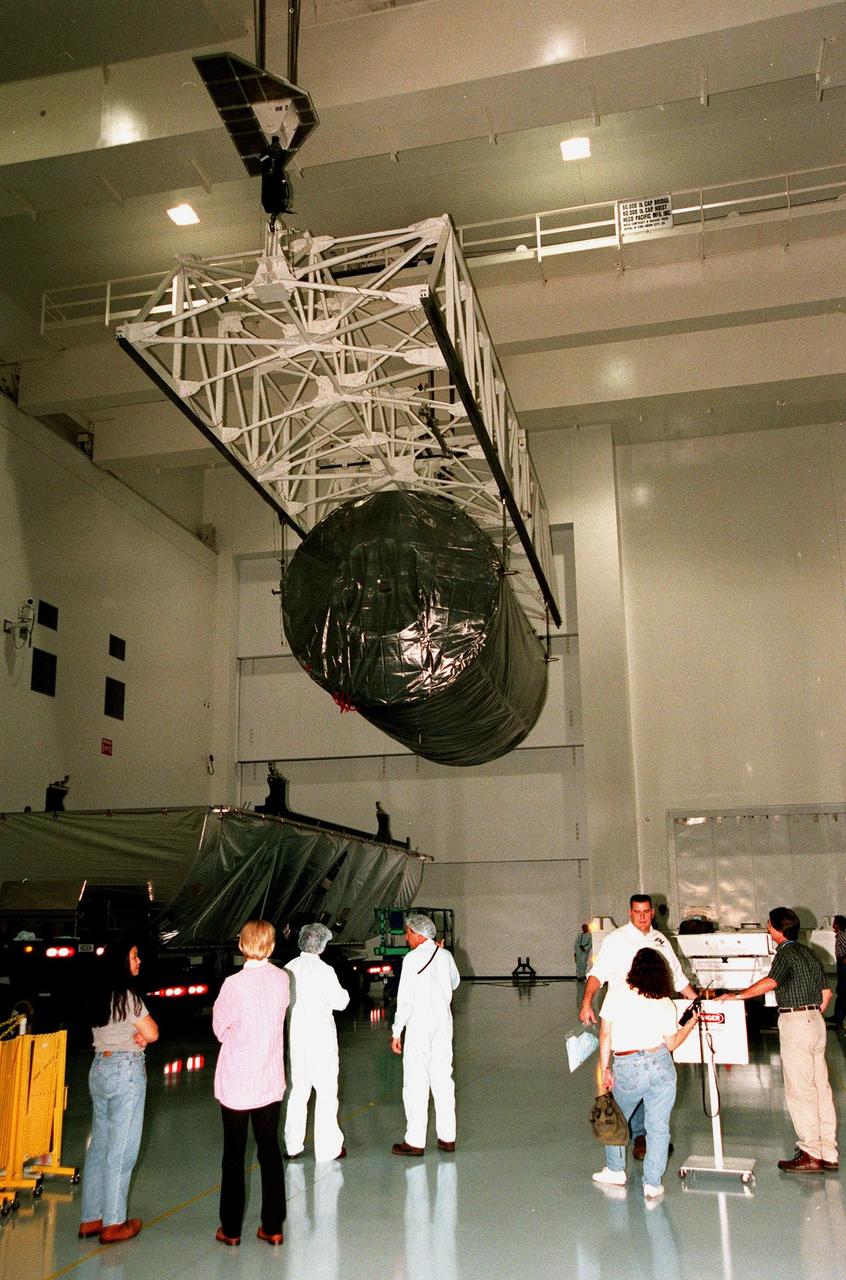
KENNEDY SPACE CENTER, FLA. -- An overhead crane in the high bay of the Space Station Processing Facility moves the U.S. laboratory module, an element of the International Space Station, toward its workstand. The lab will undergo pre-launch preparations before its launch aboard the Shuttle Endeavour on mission STS-98. The laboratory comprises three cylindrical sections with two end cones. Each end-cone contains a hatch opening for entering and exiting the lab. The lab will provide a shirtsleeve environment for research in the areas of life science, microgravity science, Earth science and space science. Designated Flight 5A, this mission is targeted for launch in early 2000
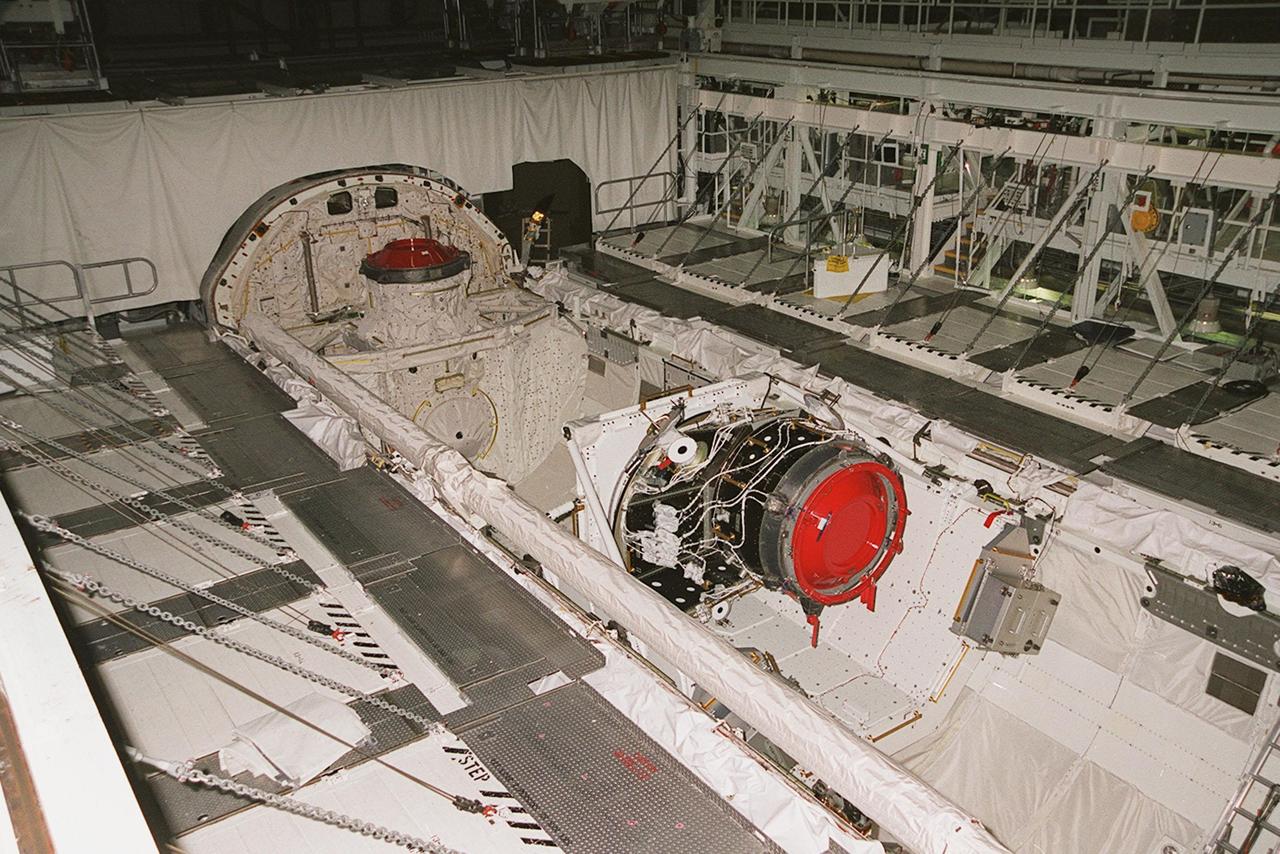
KENNEDY SPACE CENTER, FLA. -- The Pressurized Mating Adapter -3 (PMA-3) sits in the payload bay of the orbiter Discovery after being transported from the Space Station Processing Facility. A component of the International Space Station, the PMA-3 will fly on Shuttle mission STS-92, scheduled to launch Oct. 5. The mission will be the fifth flight to the Space Station, and the 100th Shuttle flight overall. PMA-3 provides shuttle docking port for solar array installation on flight 4A (mission STS-97 scheduled for Nov. 30), and Lab installation on flight 5A (mission STS-98, scheduled for Jan. 18, 2001)
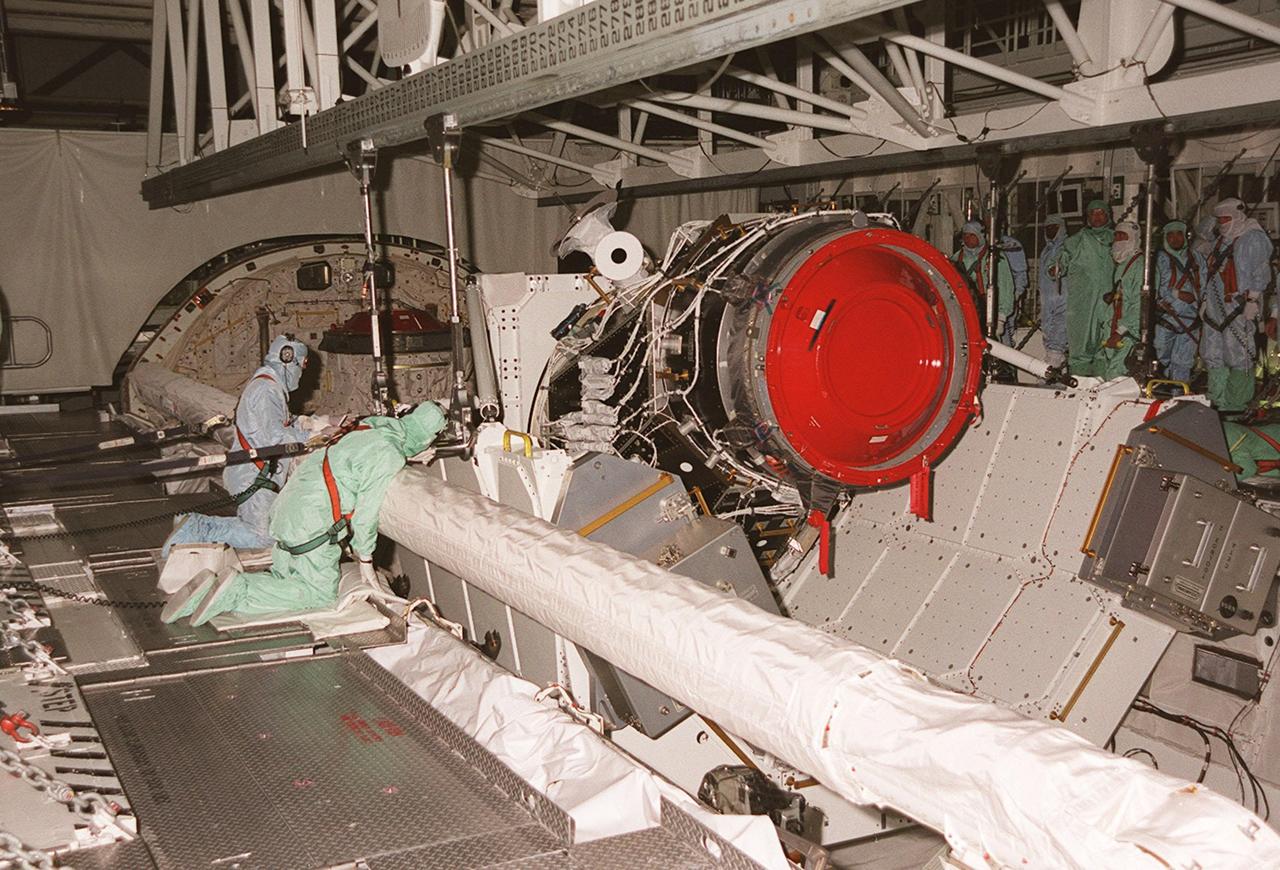
KENNEDY SPACE CENTER, FLA. -- In the Orbiter Processing Facility bay 1, workers check the placement of the Pressurized Mating Adapter -3 (PMA-3) as the overhead crane places it in the payload bay of the orbiter Discovery. A component of the International Space Station, the PMA-3 will fly on Shuttle mission STS-92, scheduled to launch Oct. 5. The mission will be the fifth flight to the Space Station, and the 100th Shuttle flight overall. PMA-3 provides shuttle docking port for solar array installation on flight 4A (mission STS-97 scheduled for Nov. 30), and Lab installation on flight 5A (mission STS-98, scheduled for Jan. 18, 2001)
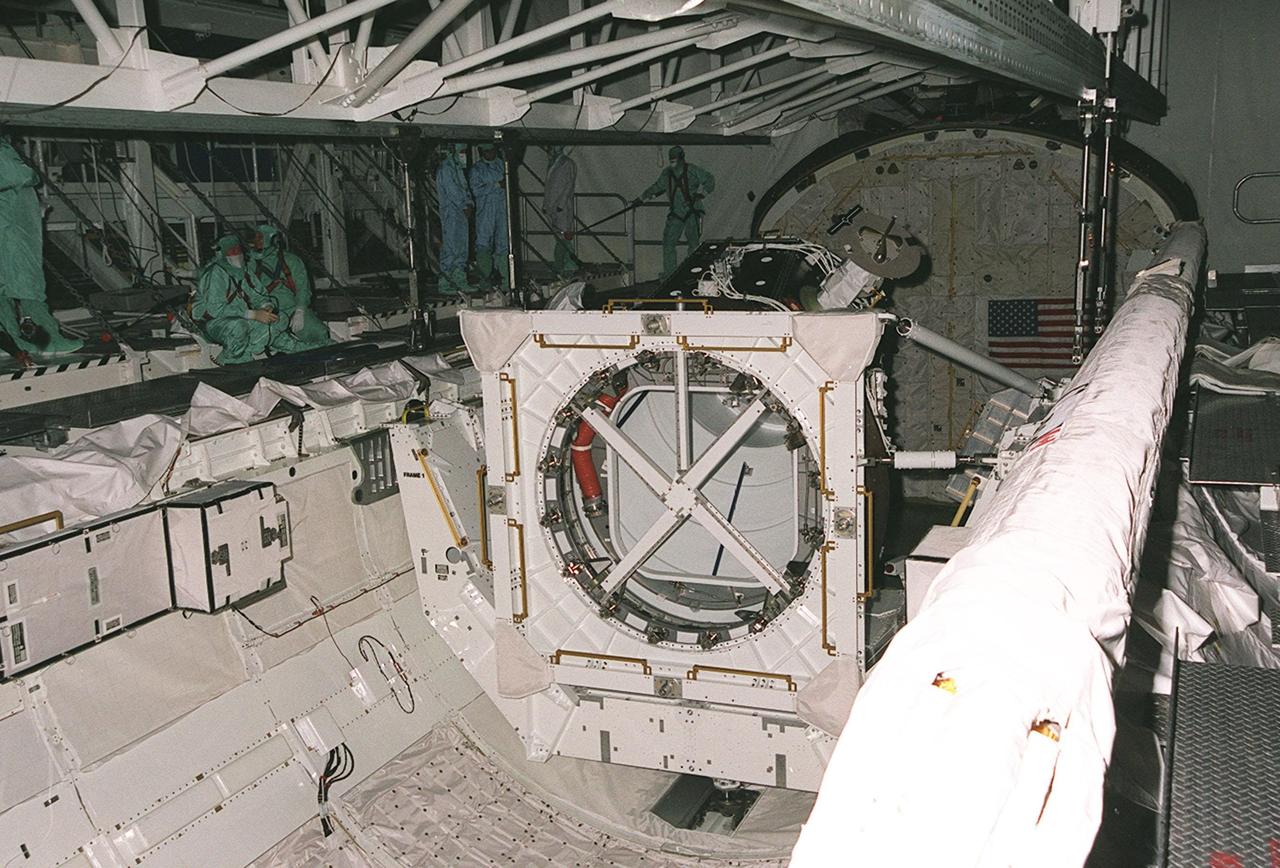
KENNEDY SPACE CENTER, FLA. -- The Pressurized Mating Adapter -3 (PMA-3) sits in the payload bay of the orbiter Discovery after being transported from the Space Station Processing Facility. A component of the International Space Station, the PMA-3 will fly on Shuttle mission STS-92, scheduled to launch Oct. 5. The mission will be the fifth flight to the Space Station, and the 100th Shuttle flight overall. PMA-3 provides shuttle docking port for solar array installation on flight 4A (mission STS-97 scheduled for Nov. 30), and Lab installation on flight 5A (mission STS-98, scheduled for Jan. 18, 2001)
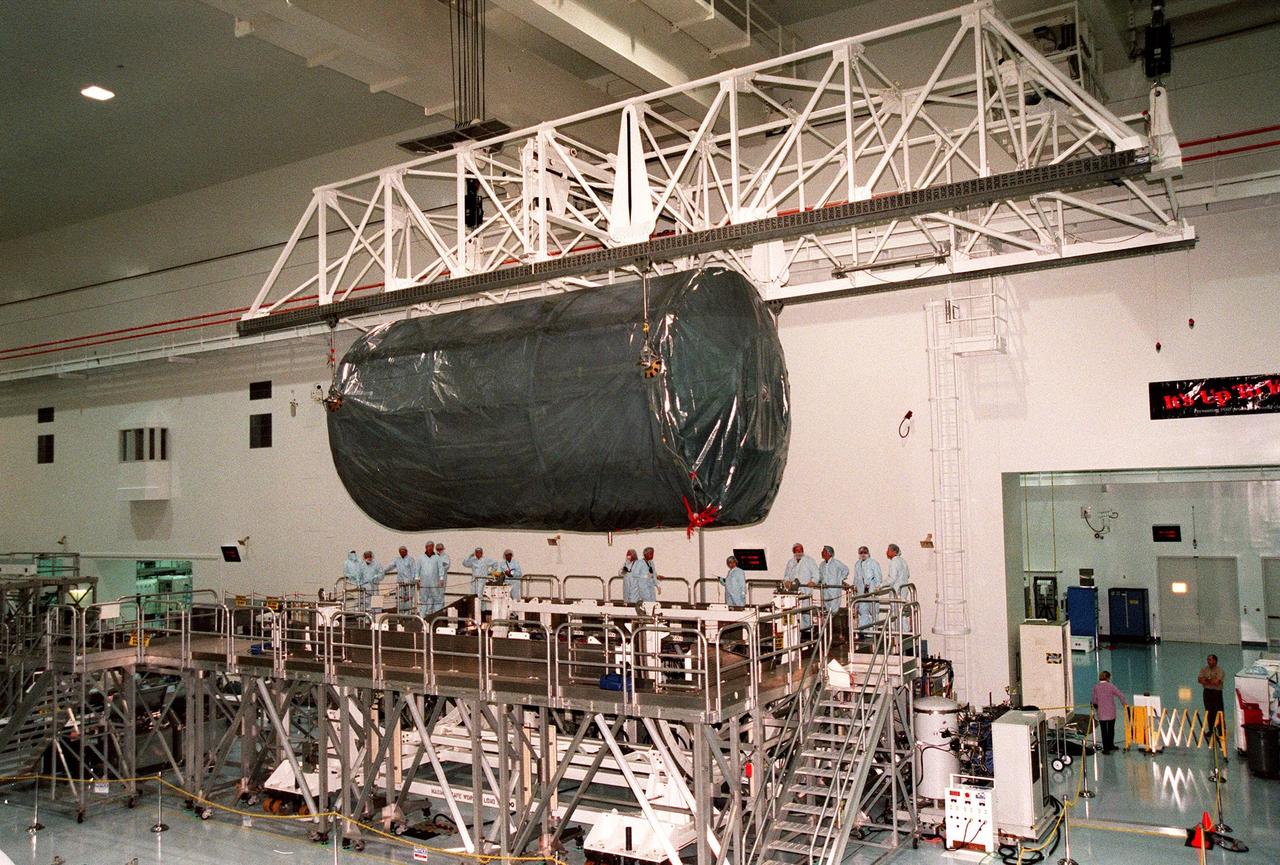
KENNEDY SPACE CENTER, FLA. -- An overhead crane in the high bay of the Space Station Processing Facility lowers the U.S. laboratory module, an element of the International Space Station, onto the workstand as KSC workers watch. The lab will undergo pre-launch preparations before its launch aboard the Shuttle Endeavour on mission STS-98. The laboratory comprises three cylindrical sections with two end cones. Each end-cone contains a hatch opening for entering and exiting the lab. The lab will provide a shirtsleeve environment for research in the areas of life science, microgravity science, Earth science and space science. Designated Flight 5A, this mission is targeted for launch in early 2000
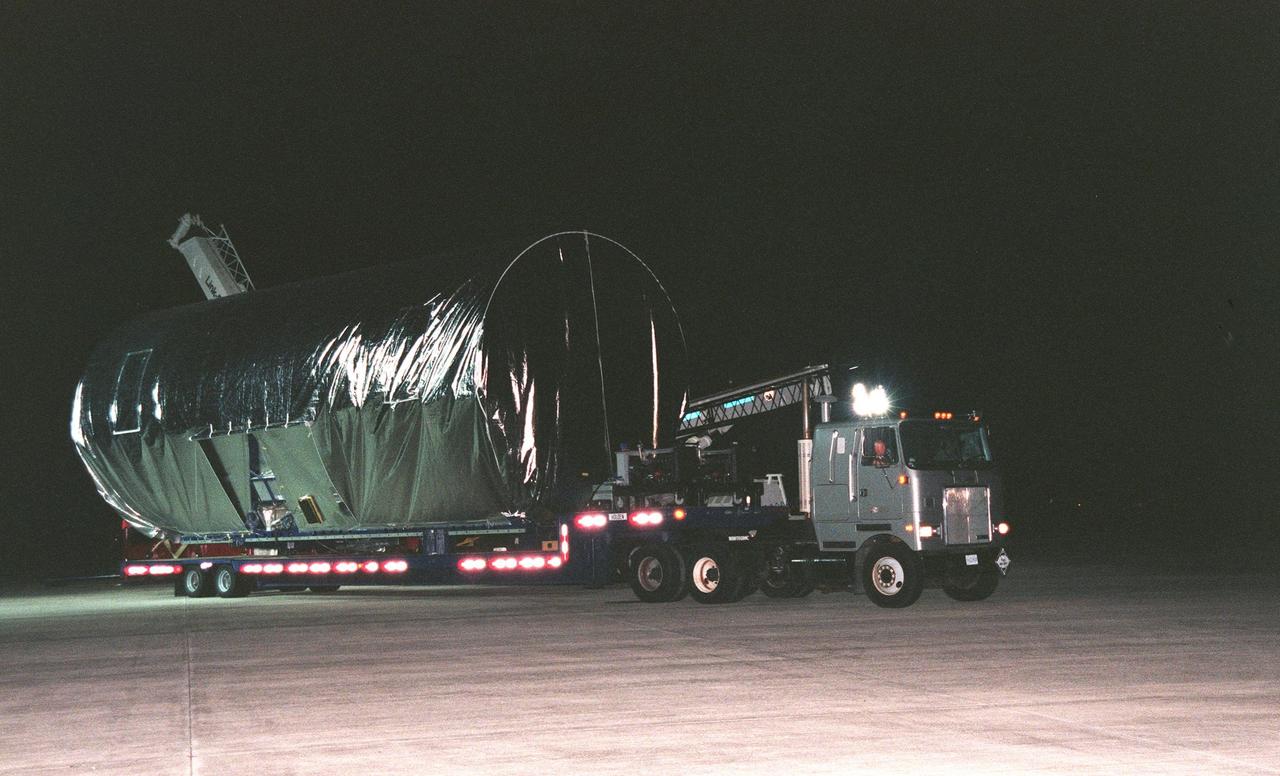
KENNEDY SPACE CENTER, FLA. -- After nightfall, a truck carrying the container that holds the U.S. laboratory module begins the trip from the Shuttle Landing Facility to the Space Station Processing Facility. Intended for the International Space Station, the lab is scheduled to undergo pre-launch preparations before its launch aboard the Shuttle Endeavour on mission STS-98. The laboratory comprises three cylindrical sections with two end cones. Each end-cone contains a hatch opening for entering and exiting the lab. The lab will provide a shirtsleeve environment for research in the areas of life science, microgravity science, Earth science and space science. Designated Flight 5A, this mission is targeted for launch in early 2000
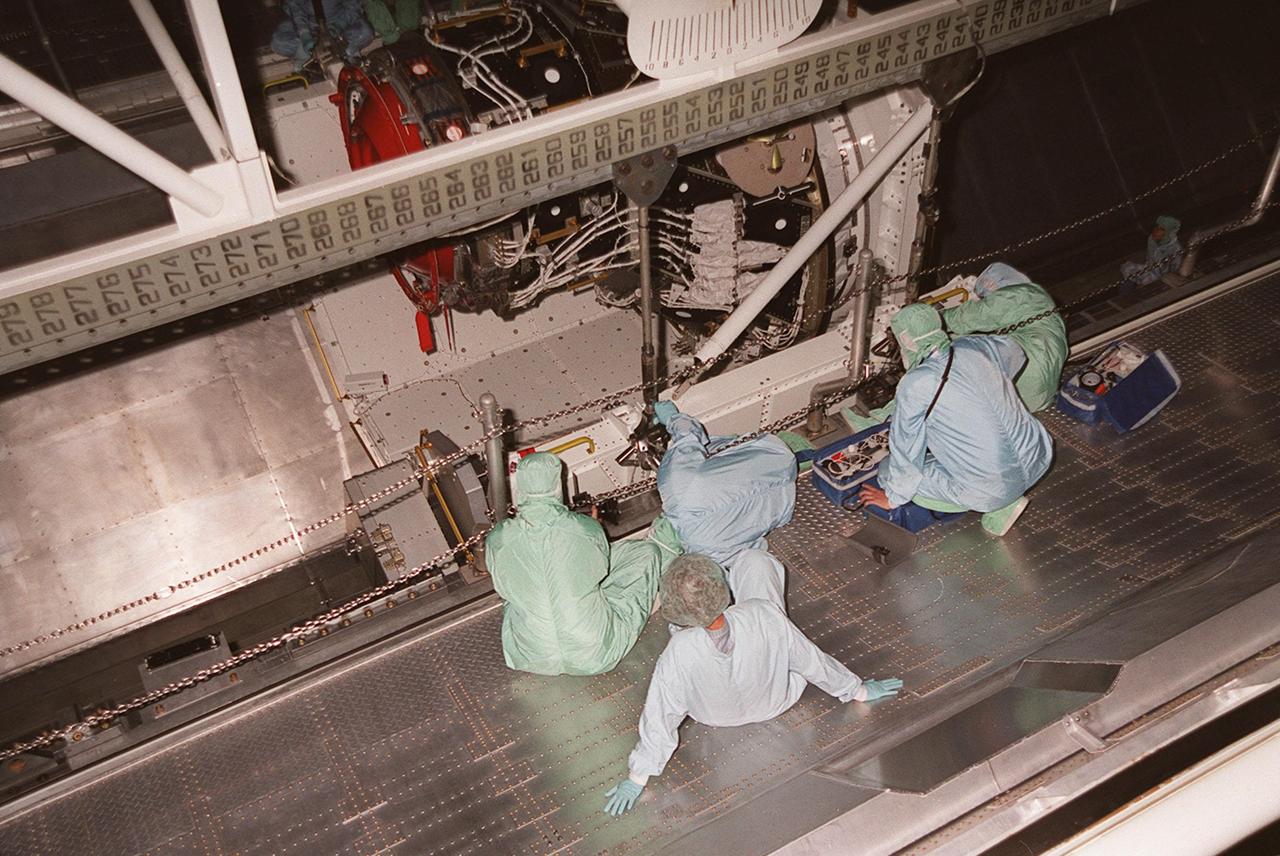
KENNEDY SPACE CENTER, FLA. -- Workers in the Orbiter Processing Facility check the placement of cables on the Pressurized Mating Adapter -3 (PMA-3) for its transfer to the orbiter Discovery. A component of the International Space Station, the PMA-3 is part of the payload on Space Shuttle mission STS-92, scheduled to launch Oct. 5. The mission will be the fifth flight to the Space Station, and the 100th Shuttle flight overall. PMA-3 provides shuttle docking port for solar array installation on flight 4A (mission STS-97 scheduled for Nov. 30), and Lab installation on flight 5A (mission STS-98, scheduled for Jan. 18, 2001)
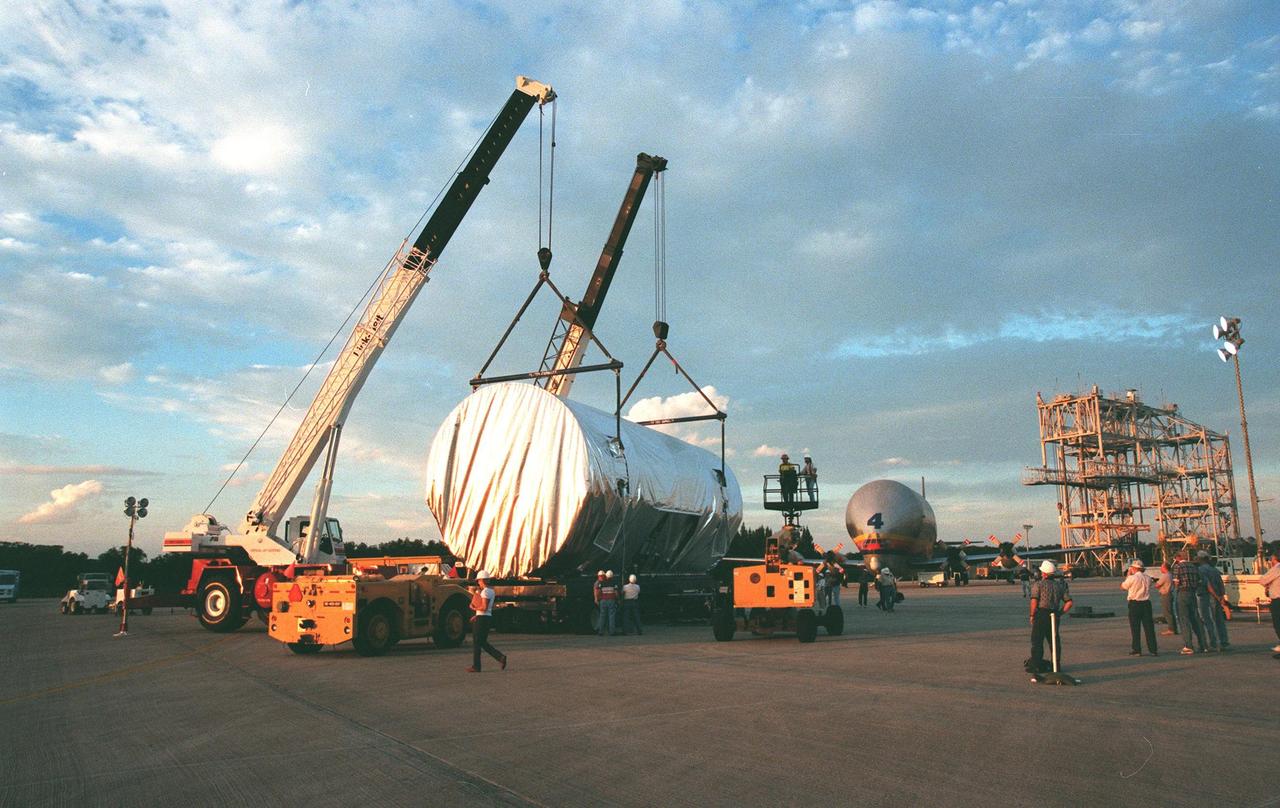
KENNEDY SPACE CENTER, FLA. -- A second crane is attached to the canister containing the U.S. laboratory module in order to transfer it to a truck. Intended for the International Space Station, the lab is being moved to the Space Station Processing Facility for pre-launch preparations. Scheduled for launch aboard the Shuttle Endeavour on mission STS-98, the laboratory comprises three cylindrical sections with two end cones. Each end-cone contains a hatch opening for entering and exiting the lab. The lab will provide a shirtsleeve environment for research in the areas of life science, microgravity science, Earth science and space science. Designated Flight 5A, this mission is targeted for launch in early 2000
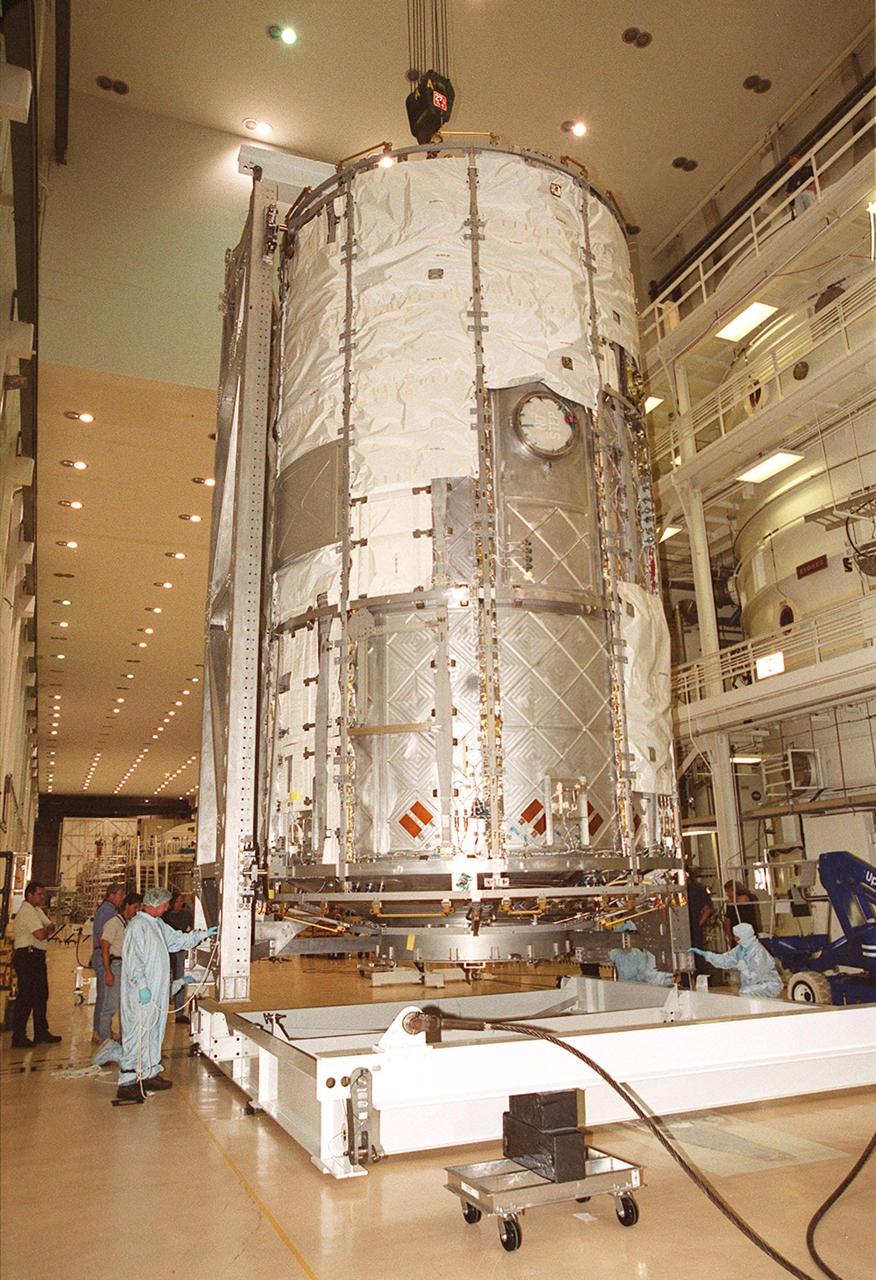
KENNEDY SPACE CENTER, FLA. -- In the Operations and Checkout Building, the U.S. Lab reaches the open floor after being lifted out of the vacuum chamber where it was tested for leaks. The test was very successful. The 32,000-pound scientific research lab, named Destiny, is the first Space Station element to spend seven days in the renovated vacuum chamber. Destiny is scheduled to be launched on Shuttle mission STS-98, the 5A assembly mission, targeted for Jan. 18, 2001. During the mission, the crew will install the Lab in the Space Station during a series of three space walks. The STS-98 mission will provide the Station with science research facilities and expand its power, life support and control capabilities. The U.S. Lab module continues a long tradition of microgravity materials research, first conducted by Skylab and later Shuttle and Spacelab missions. Destiny is expected to be a major feature in future research, providing facilities for biotechnology, fluid physics, combustion, and life sciences research
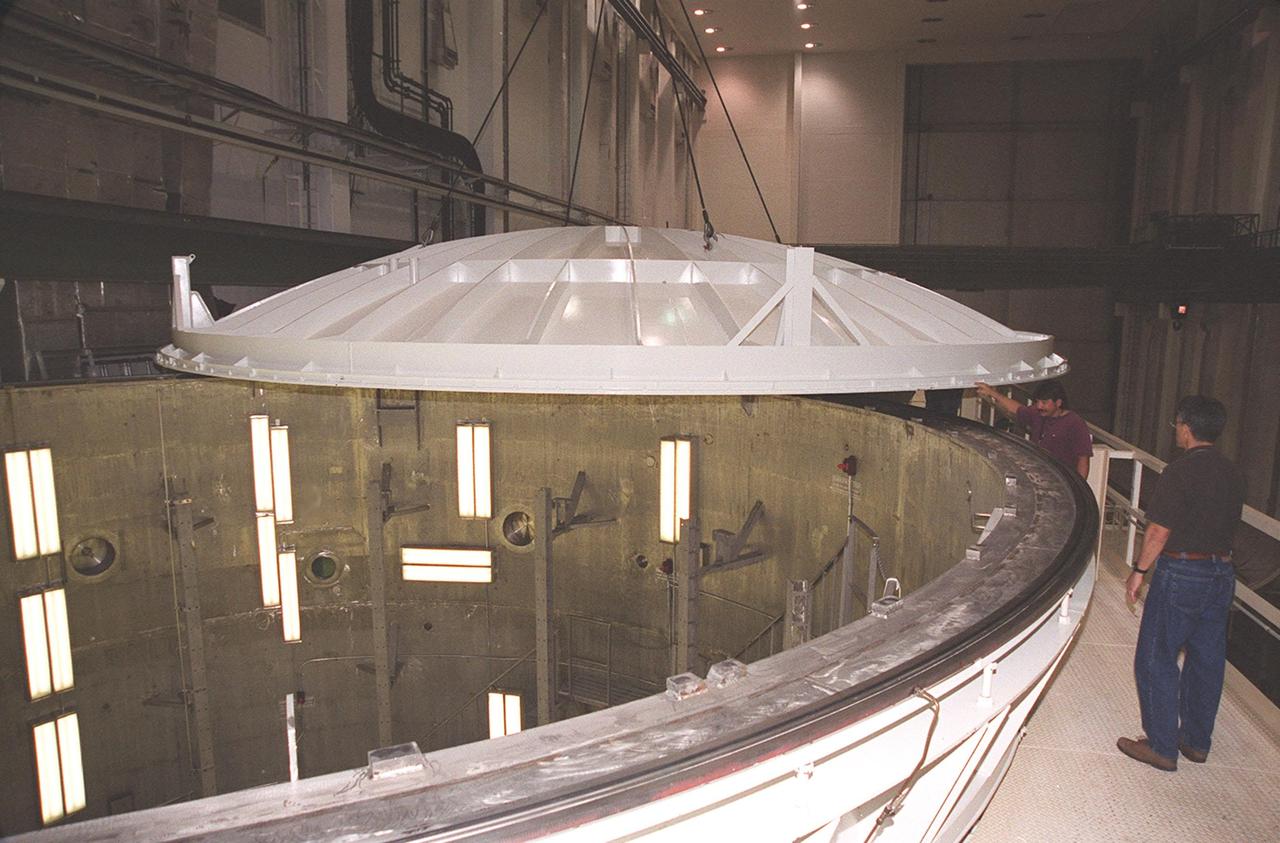
KENNEDY SPACE CENTER, FLA. -- An overhead crane moves the lid over the vacuum chamber containing the U.S. Lab, a component of the International Space Station. The 32,000-pound scientific research lab, named Destiny, is the first Space Station element to spend seven days in the renovated vacuum chamber for a leak test. Destiny is scheduled to be launched on Shuttle mission STS-98, the 5A assembly mission, targeted for Jan. 18, 2001. During the mission, the crew will install the Lab in the Space Station during a series of three space walks. The STS-98 mission will provide the Station with science research facilities and expand its power, life support and control capabilities. The U.S. Lab module continues a long tradition of microgravity materials research, first conducted by Skylab and later Shuttle and Spacelab missions. Destiny is expected to be a major feature in future research, providing facilities for biotechnology, fluid physics, combustion, and life sciences research

KENNEDY SPACE CENTER, FLA. -- NASA's "Super Guppy" aircraft arrives at the KSC Shuttle Landing Facility after leaving Marshall Space Flight Center in Huntsville, Ala. The gargantuan plane carries the U.S. Laboratory module, considered the centerpiece of the International Space Station. The module will undergo final pre-launch preparations at KSC's Space Station Processing Facility. Scheduled for launch aboard the Shuttle Endeavour on mission STS-98, the laboratory comprises three cylindrical sections with two end cones. Each end-cone contains a hatch opening for entering and exiting the lab. The lab will provide a shirtsleeve environment for research in such areas as life science, microgravity science, Earth science and space science. Designated Flight 5A, this mission is targeted for launch in early 2000
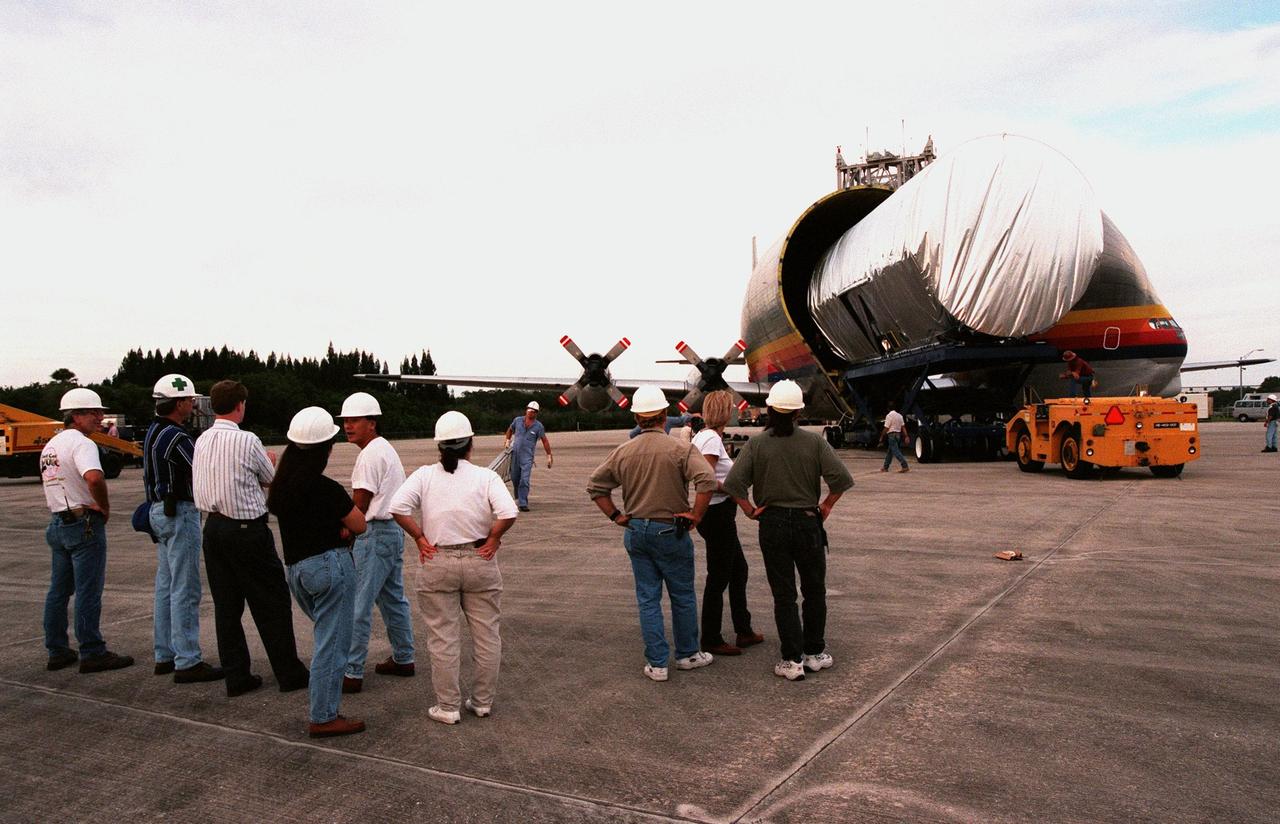
KENNEDY SPACE CENTER, FLA. -- Workers at the Shuttle Landing Facility watch as the canister carrying the U.S. laboratory module, intended for the International Space Station, is moved out of NASA's "Super Guppy" aircraft that brought it from Marshall Space Flight Center, Huntsville. The lab is being transferred to the Space Station Processing Facility for pre-launch preparations. Scheduled for launch aboard the Shuttle Endeavour on mission STS-98, the laboratory comprises three cylindrical sections with two end cones. Each end-cone contains a hatch opening for entering and exiting the lab. The lab will provide a shirtsleeve environment for research in the areas of life science, microgravity science, Earth science and space science. Designated Flight 5A, this mission is targeted for launch in early 2000
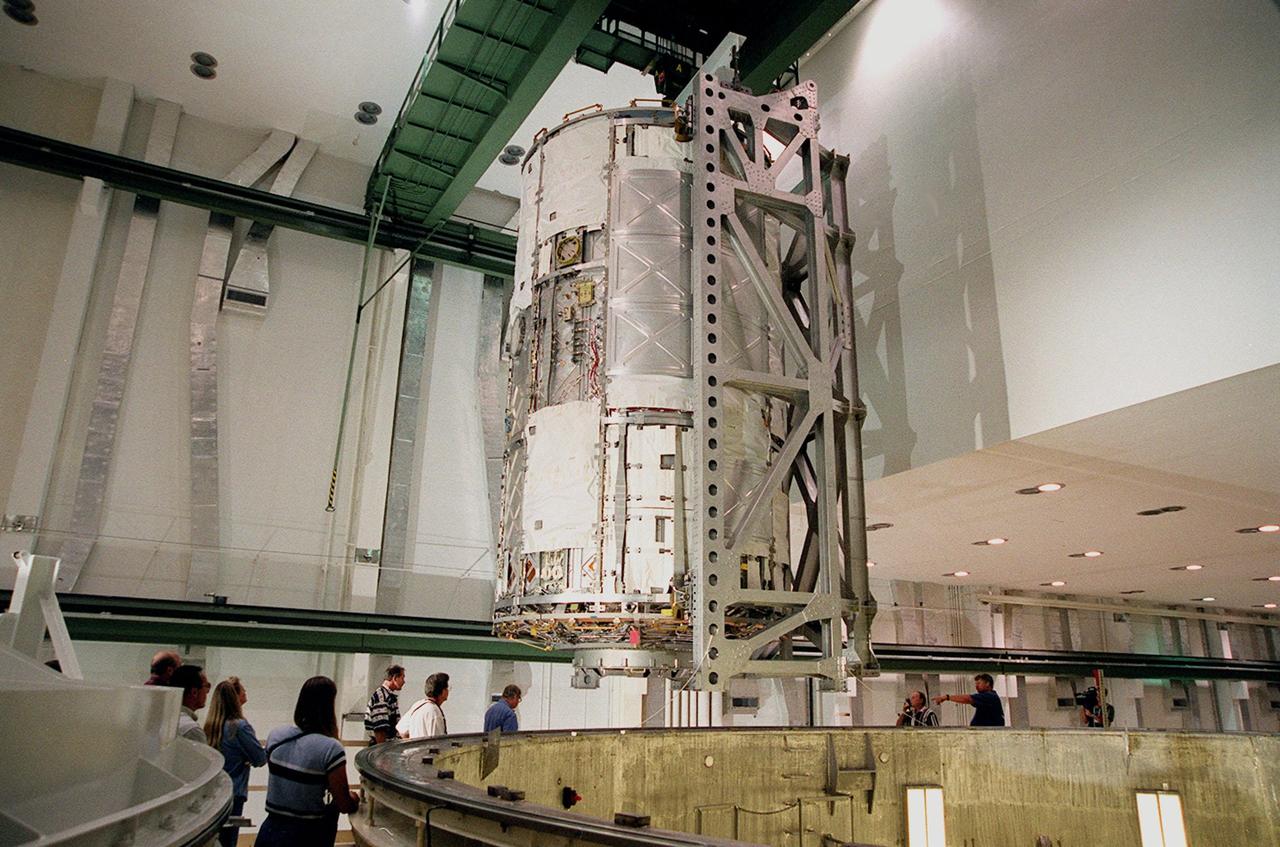
KENNEDY SPACE CENTER, FLA. -- The U.S. Lab, a component of the International Space Station, is moved toward the center over the three-story vacuum chamber in which the Lab will be placed. The 32,000-pound scientific research lab, named Destiny, is the first Space Station element to spend seven days in the renovated vacuum chamber for a leak test. Destiny is scheduled to be launched on Shuttle mission STS-98, the 5A assembly mission, targeted for Jan. 18, 2001. During the mission, the crew will install the Lab in the Space Station during a series of three space walks. The STS-98 mission will provide the Station with science research facilities and expand its power, life support and control capabilities. The U.S. Lab module continues a long tradition of microgravity materials research, first conducted by Skylab and later Shuttle and Spacelab missions. Destiny is expected to be a major feature in future research, providing facilities for biotechnology, fluid physics, combustion, and life sciences research
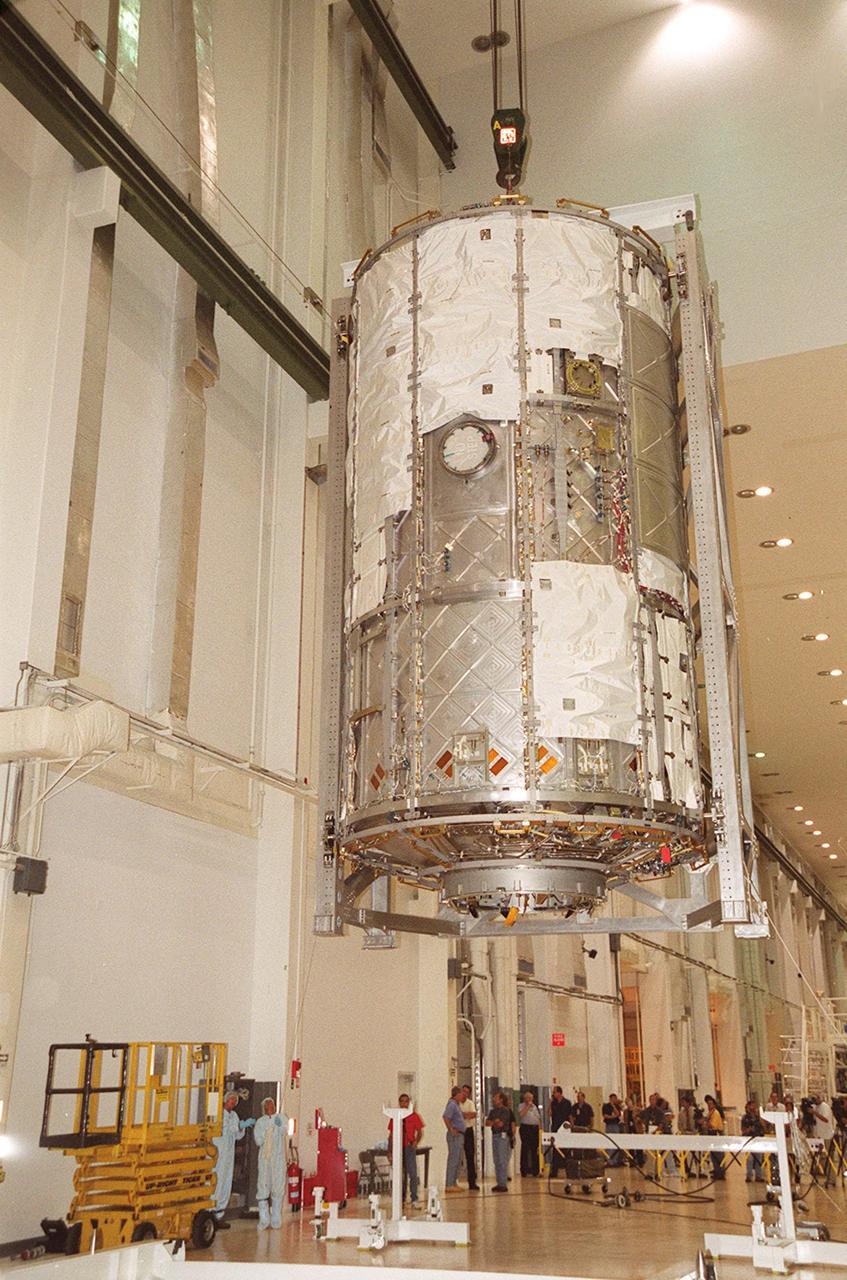
KENNEDY SPACE CENTER, FLA. -- In the Operations and Checkout Building, the U.S. Lab is lowered toward the floor after being lifted out of the vacuum chamber where it was tested for leaks. The test was very successful. The 32,000-pound scientific research lab, named Destiny, is the first Space Station element to spend seven days in the renovated vacuum chamber. Destiny is scheduled to be launched on Shuttle mission STS-98, the 5A assembly mission, targeted for Jan. 18, 2001. During the mission, the crew will install the Lab in the Space Station during a series of three space walks. The STS-98 mission will provide the Station with science research facilities and expand its power, life support and control capabilities. The U.S. Lab module continues a long tradition of microgravity materials research, first conducted by Skylab and later Shuttle and Spacelab missions. Destiny is expected to be a major feature in future research, providing facilities for biotechnology, fluid physics, combustion, and life sciences research
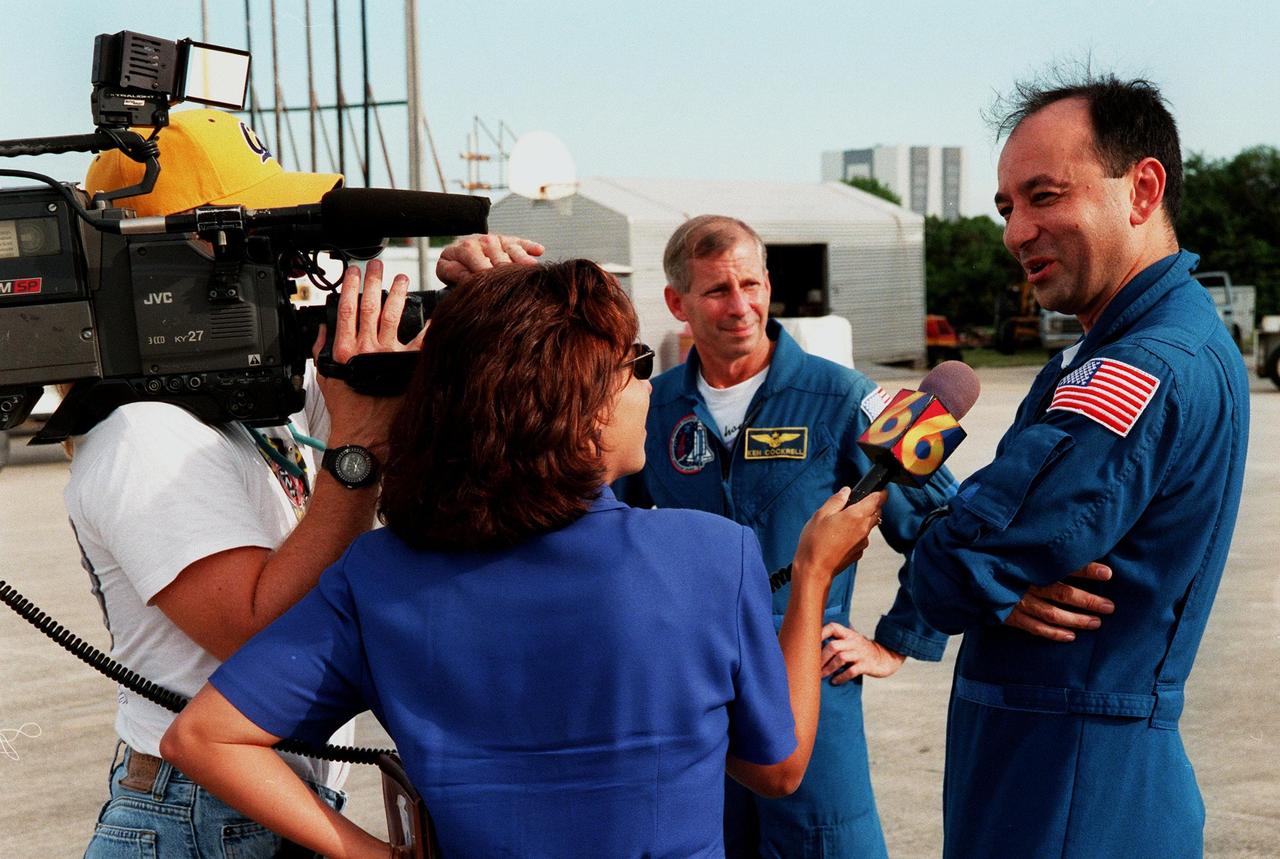
KENNEDY SPACE CENTER, FLA. -- After landing at the Shuttle Landing Facility aboard T-38 trainers, STS-98 Pilot Mark Polansky (right) and Mission Commander Ken Cockrell (center, background) are interviewed by media representatives. Polansky, Cockrell and Mission Specialist Marsha Ivins (not shown) accompanied the U.S. Laboratory module on its transport from Marshall Space Flight Center, Huntsville, to Kennedy aboard NASA's "Super Guppy" aircraft. Scheduled for launch aboard the Shuttle Endeavour on mission STS-98, the laboratory comprises three cylindrical sections with two end cones. Each end-cone contains a hatch opening for entering and exiting the lab. The lab will provide a shirtsleeve environment for research in the areas of life science, microgravity science, Earth science and space science. Designated Flight 5A, this mission is targeted for launch in early 2000
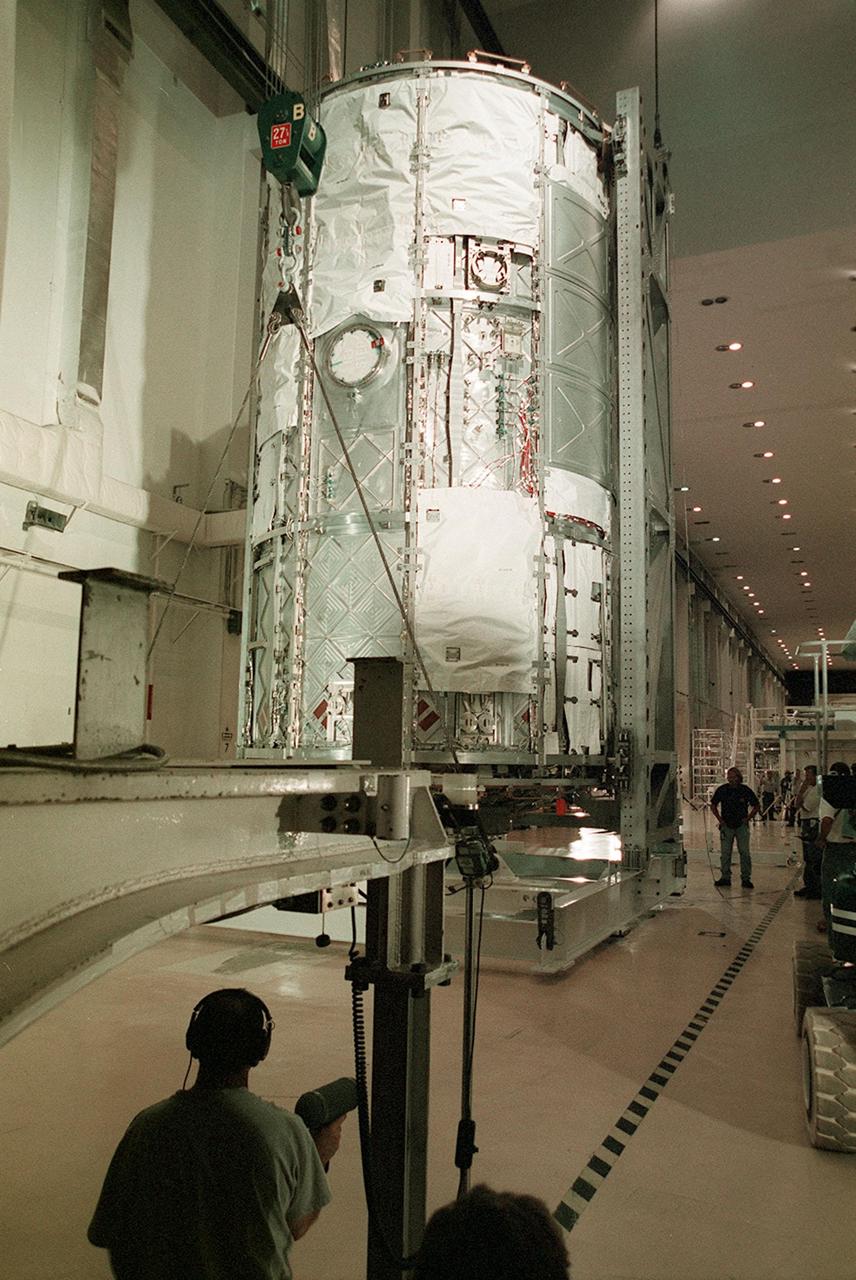
KENNEDY SPACE CENTER, FLA. -- The U.S. Lab, a component of the International Space Station, is moved to the vacuum chamber in the Operations and Checkout Building for testing. The 32,000-pound scientific research lab, named Destiny, is the first Space Station element to spend seven days in the renovated vacuum chamber for a leak test. Destiny is scheduled to be launched on Shuttle mission STS-98, the 5A assembly mission, targeted for Jan. 18, 2001. During the mission, the crew will install the Lab in the Space Station during a series of three space walks. The STS-98 mission will provide the Station with science research facilities and expand its power, life support and control capabilities. The U.S. Lab module continues a long tradition of microgravity materials research, first conducted by Skylab and later Shuttle and Spacelab missions. Destiny is expected to be a major feature in future research, providing facilities for biotechnology, fluid physics, combustion, and life sciences research.
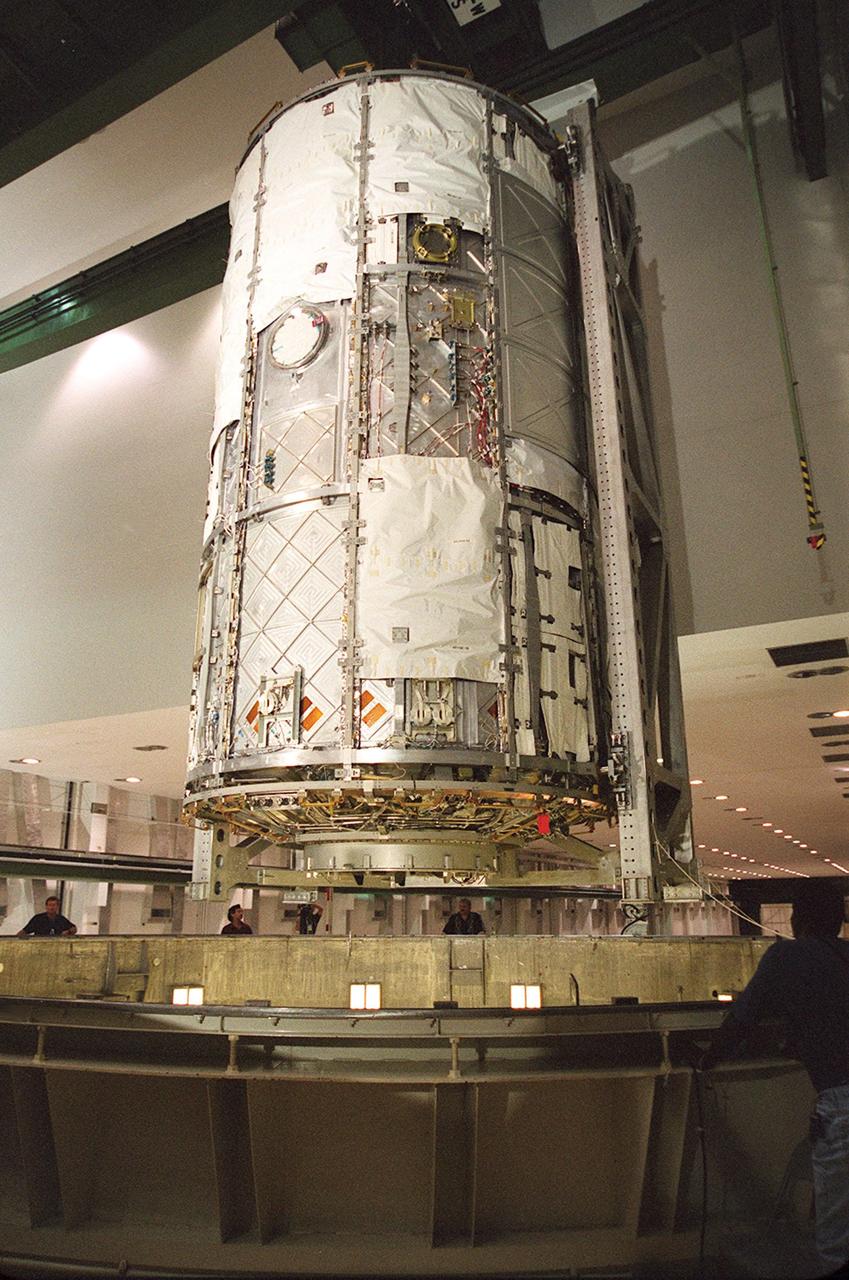
KENNEDY SPACE CENTER, FLA. -- The U.S. Lab, a component of the International Space Station, is centered over the three-story vacuum chamber in which the Lab will be placed. The 32,000-pound scientific research lab, named Destiny, is the first Space Station element to spend seven days in the renovated vacuum chamber for a leak test. Destiny is scheduled to be launched on Shuttle mission STS-98, the 5A assembly mission, targeted for Jan. 18, 2001. During the mission, the crew will install the Lab in the Space Station during a series of three space walks. The STS-98 mission will provide the Station with science research facilities and expand its power, life support and control capabilities. The U.S. Lab module continues a long tradition of microgravity materials research, first conducted by Skylab and later Shuttle and Spacelab missions. Destiny is expected to be a major feature in future research, providing facilities for biotechnology, fluid physics, combustion, and life sciences research
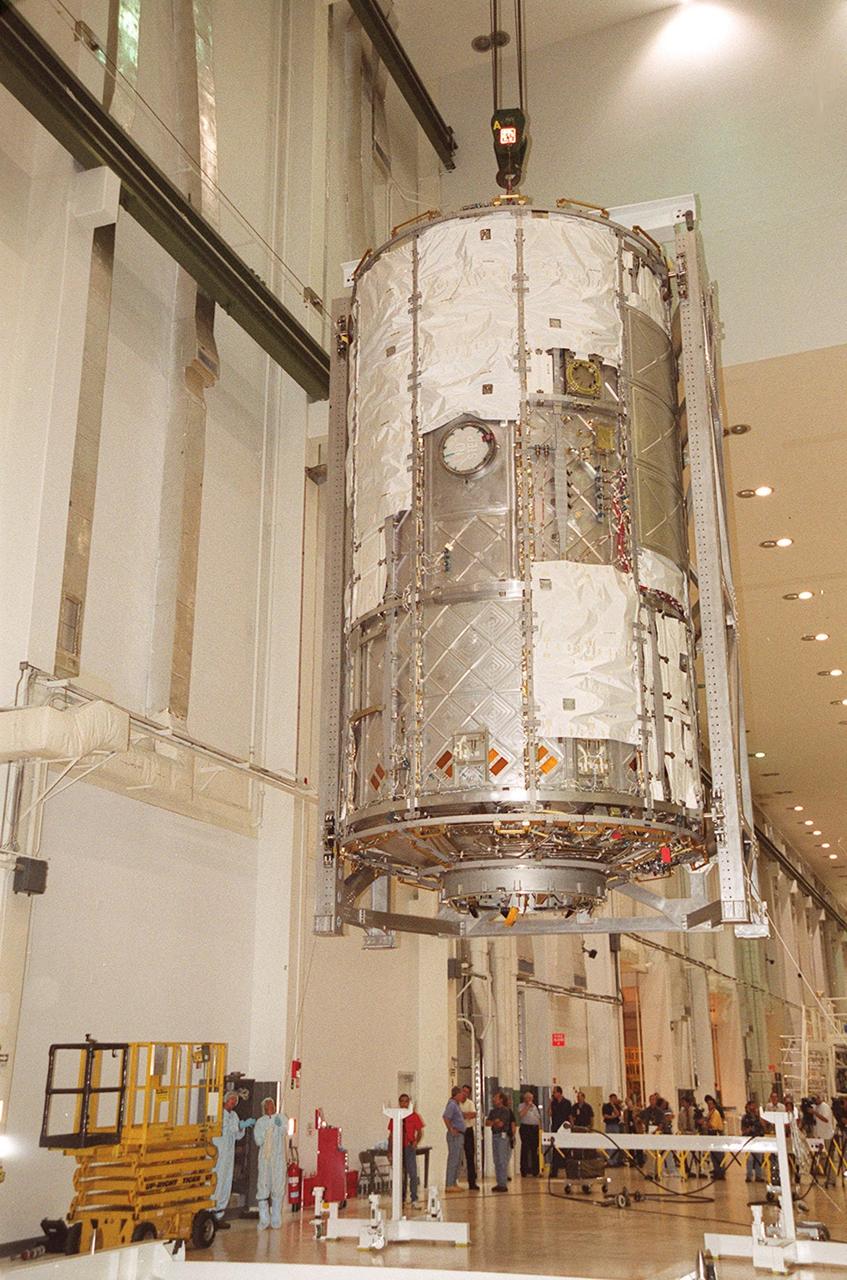
KENNEDY SPACE CENTER, FLA. -- In the Operations and Checkout Building, the U.S. Lab is lowered toward the floor after being lifted out of the vacuum chamber where it was tested for leaks. The test was very successful. The 32,000-pound scientific research lab, named Destiny, is the first Space Station element to spend seven days in the renovated vacuum chamber. Destiny is scheduled to be launched on Shuttle mission STS-98, the 5A assembly mission, targeted for Jan. 18, 2001. During the mission, the crew will install the Lab in the Space Station during a series of three space walks. The STS-98 mission will provide the Station with science research facilities and expand its power, life support and control capabilities. The U.S. Lab module continues a long tradition of microgravity materials research, first conducted by Skylab and later Shuttle and Spacelab missions. Destiny is expected to be a major feature in future research, providing facilities for biotechnology, fluid physics, combustion, and life sciences research
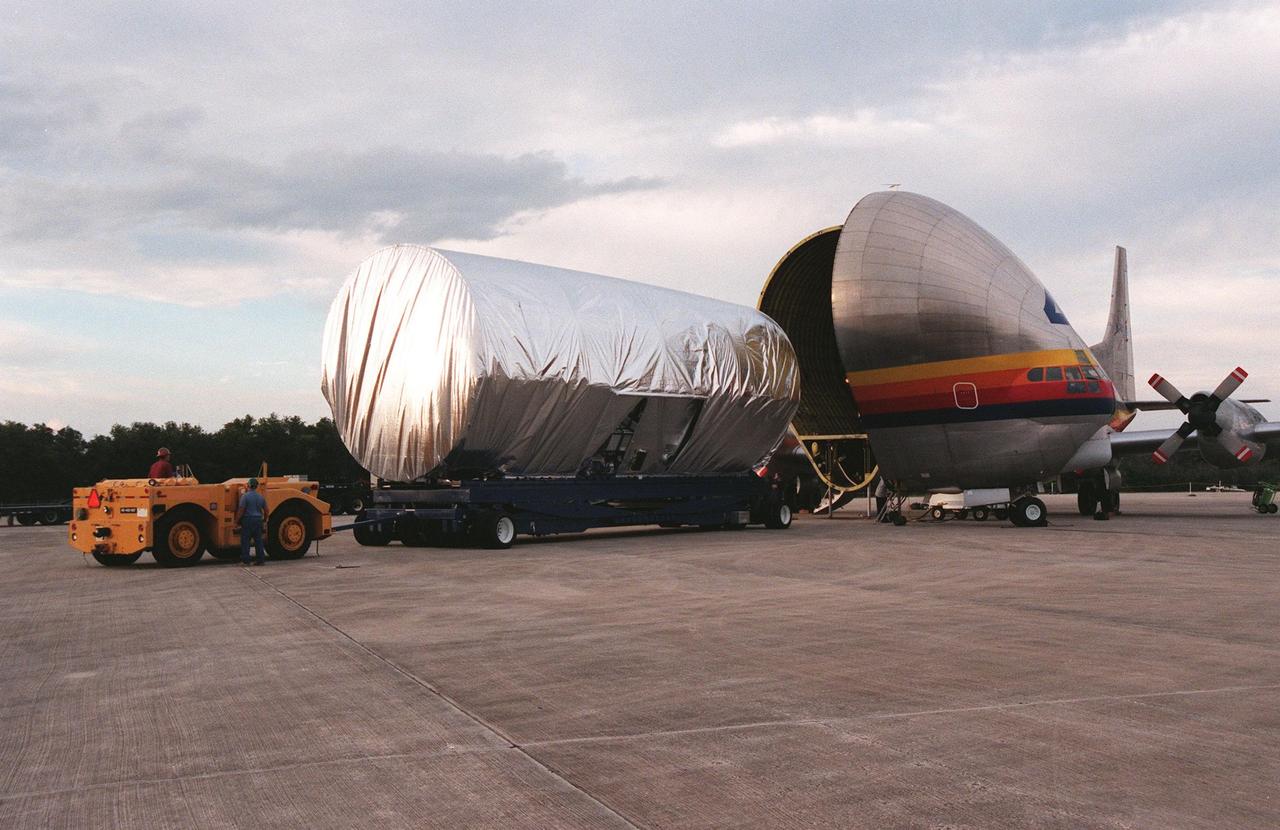
KENNEDY SPACE CENTER, FLA. -- The canister containing the U.S. laboratory module, intended for the International Space Station, sits on a flatbed trailer after being removed from NASA's "Super Guppy" aircraft that brought it from Marshall Space Flight Center, Huntsville. The lab is being transferred to the Space Station Processing Facility for pre-launch preparations. Scheduled for launch aboard the Shuttle Endeavour on mission STS-98, the laboratory comprises three cylindrical sections with two end cones. Each end-cone contains a hatch opening for entering and exiting the lab. The lab will provide a shirtsleeve environment for research in the areas of life science, microgravity science, Earth science and space science. Designated Flight 5A, this mission is targeted for launch in early 2000
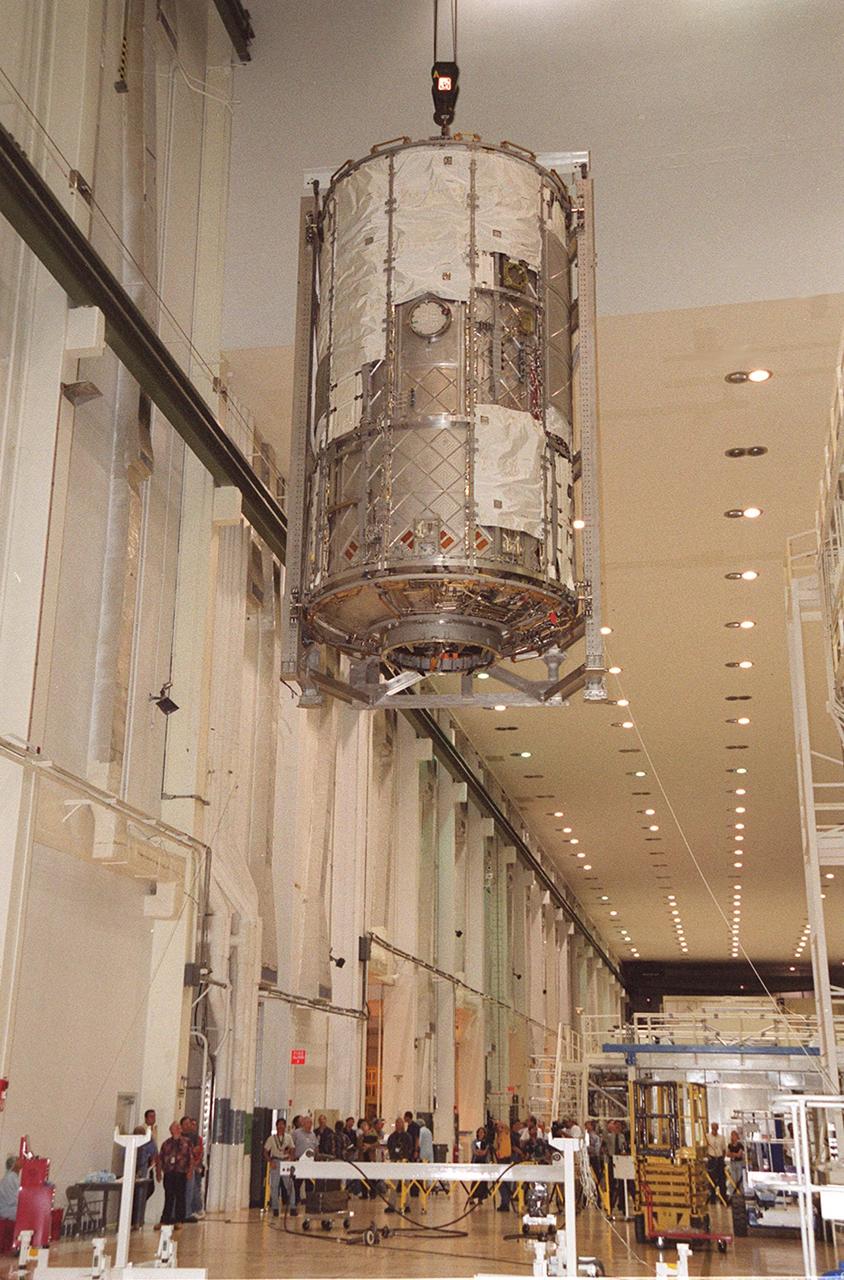
KENNEDY SPACE CENTER, FLA. -- In the Operations and Checkout Building, the U.S. Lab is lowered toward the floor after being lifted out of the vacuum chamber where it was tested for leaks. The test was very successful. The 32,000-pound scientific research lab, named Destiny, is the first Space Station element to spend seven days in the renovated vacuum chamber. Destiny is scheduled to be launched on Shuttle mission STS-98, the 5A assembly mission, targeted for Jan. 18, 2001. During the mission, the crew will install the Lab in the Space Station during a series of three space walks. The STS-98 mission will provide the Station with science research facilities and expand its power, life support and control capabilities. The U.S. Lab module continues a long tradition of microgravity materials research, first conducted by Skylab and later Shuttle and Spacelab missions. Destiny is expected to be a major feature in future research, providing facilities for biotechnology, fluid physics, combustion, and life sciences research

KENNEDY SPACE CENTER, FLA. -- NASA's "Super Guppy" aircraft maneuvers into place at the KSC Shuttle Landing Facility to offload its cargo. The gargantuan plane carries the U.S. Laboratory module, considered the centerpiece of the International Space Station. The module will undergo final pre-launch preparations at KSC's Space Station Processing Facility. Scheduled for launch aboard the Shuttle Endeavour on mission STS-98, the laboratory comprises three cylindrical sections with two end cones. Each end-cone contains a hatch opening for entering and exiting the lab. The lab will provide a shirtsleeve environment for research in such areas as life science, microgravity science, Earth science and space science. Designated Flight 5A, this mission is targeted for launch in early 2000
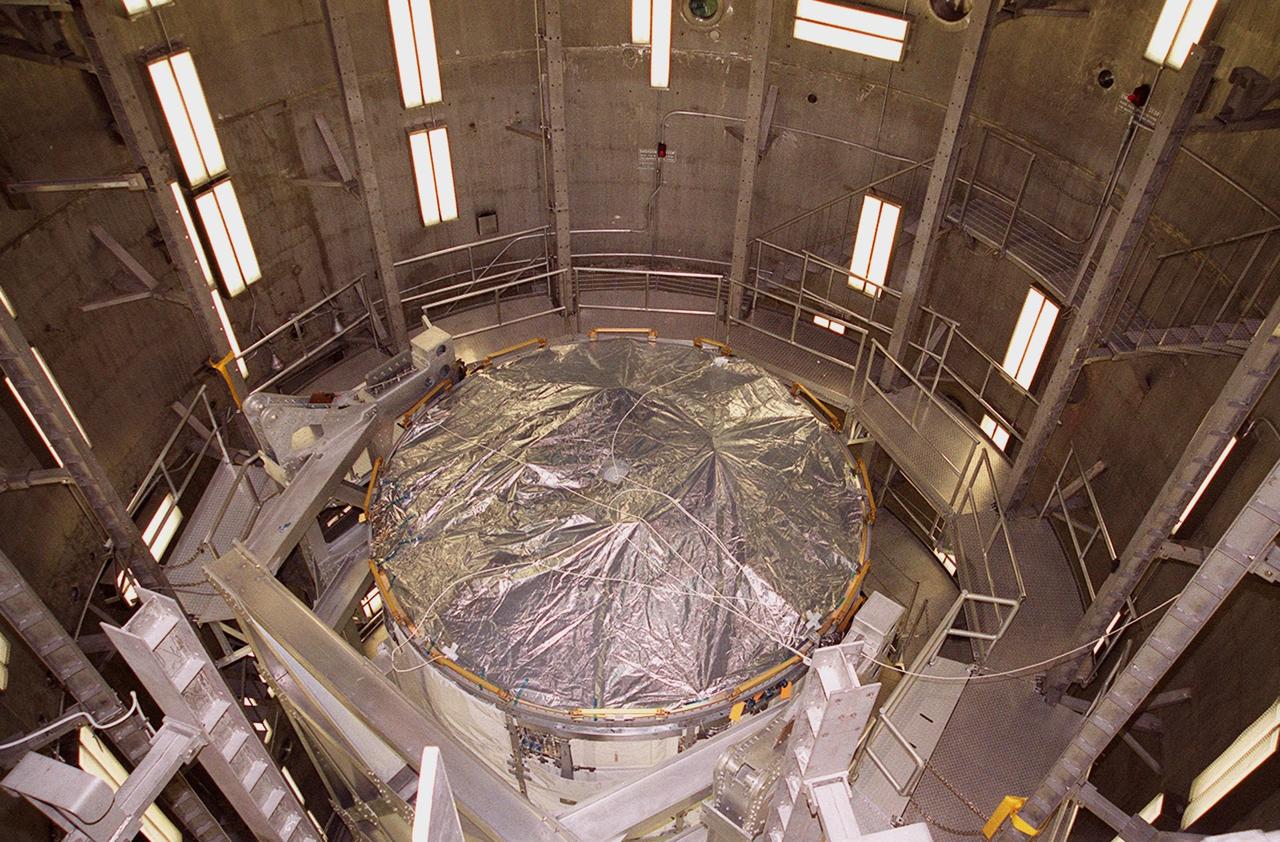
KENNEDY SPACE CENTER, FLA. -- The U.S. Lab, a component of the International Space Station, is lowered inside the three-story vacuum chamber in the Operations and Checkout Building. The 32,000-pound scientific research lab, named Destiny, is the first Space Station element to spend seven days in the renovated vacuum chamber for a leak test. Destiny is scheduled to be launched on Shuttle mission STS-98, the 5A assembly mission, targeted for Jan. 18, 2001. During the mission, the crew will install the Lab in the Space Station during a series of three space walks. The STS-98 mission will provide the Station with science research facilities and expand its power, life support and control capabilities. The U.S. Lab module continues a long tradition of microgravity materials research, first conducted by Skylab and later Shuttle and Spacelab missions. Destiny is expected to be a major feature in future research, providing facilities for biotechnology, fluid physics, combustion, and life sciences research
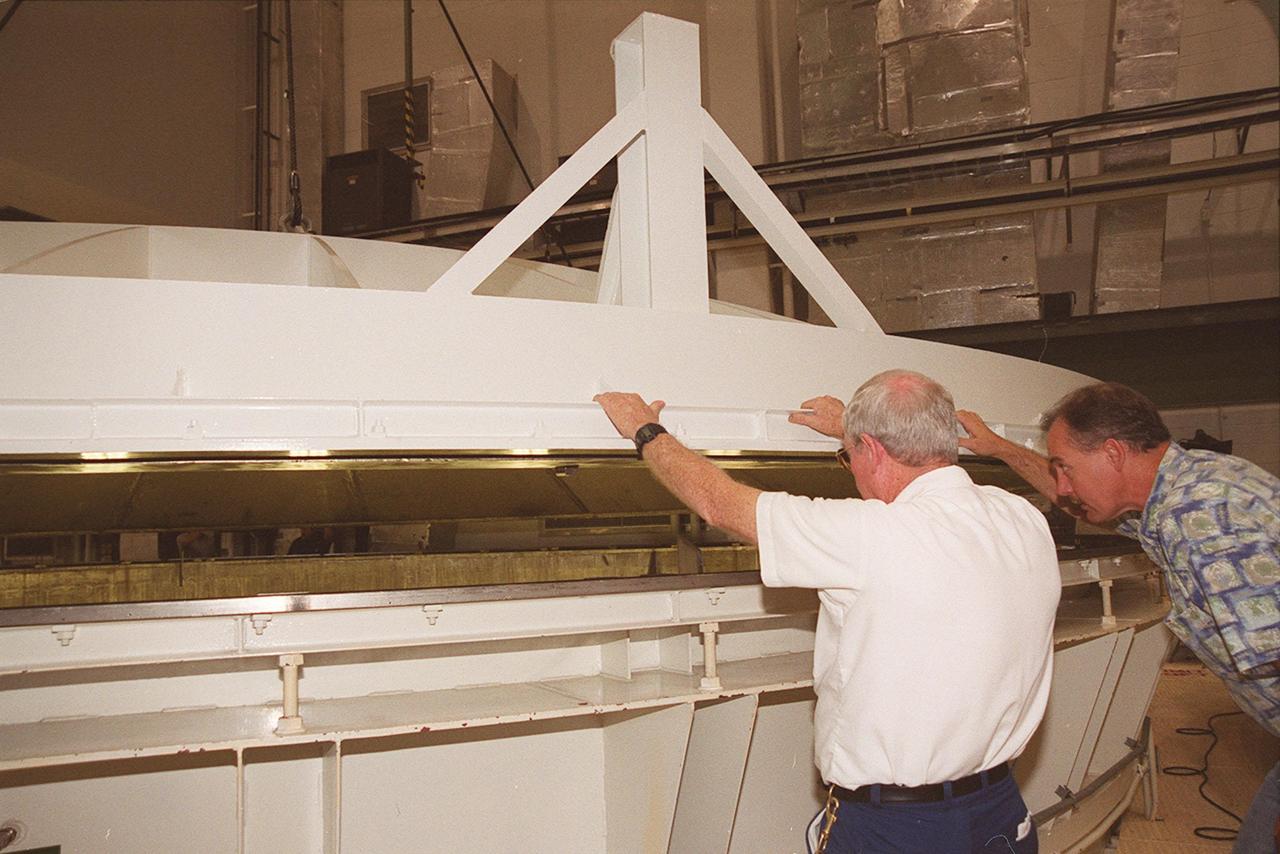
KENNEDY SPACE CENTER, FLA. -- Workers in the Operations and Checkout Building check the placement of the lid on the vacuum chamber containing the U.S. Lab, a component of the International Space Station. The 32,000-pound scientific research lab, named Destiny, is the first Space Station element to spend seven days in the renovated vacuum chamber for a leak test. Destiny is scheduled to be launched on Shuttle mission STS-98, the 5A assembly mission, targeted for Jan. 18, 2001. During the mission, the crew will install the Lab in the Space Station during a series of three space walks. The STS-98 mission will provide the Station with science research facilities and expand its power, life support and control capabilities. The U.S. Lab module continues a long tradition of microgravity materials research, first conducted by Skylab and later Shuttle and Spacelab missions. Destiny is expected to be a major feature in future research, providing facilities for biotechnology, fluid physics, combustion, and life sciences research
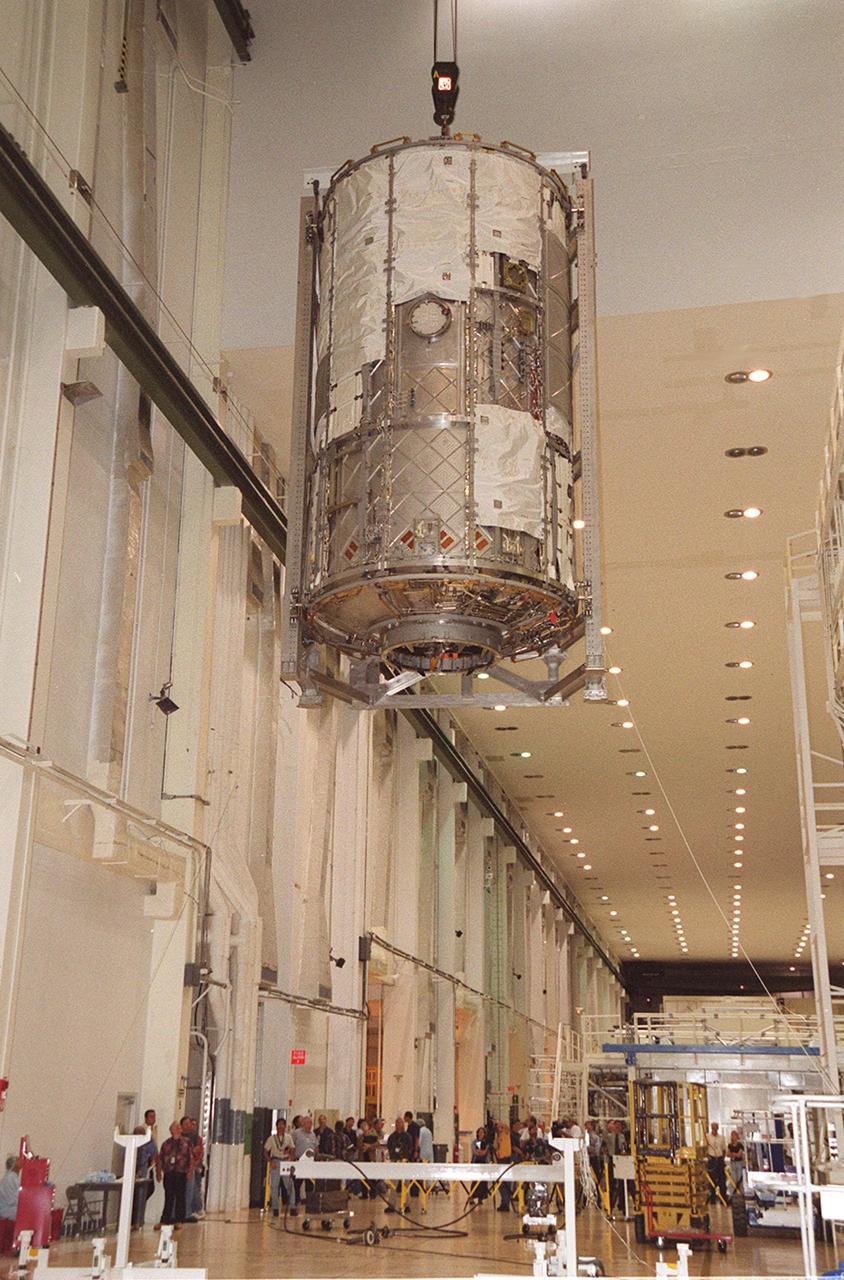
KENNEDY SPACE CENTER, FLA. -- In the Operations and Checkout Building, the U.S. Lab is lowered toward the floor after being lifted out of the vacuum chamber where it was tested for leaks. The test was very successful. The 32,000-pound scientific research lab, named Destiny, is the first Space Station element to spend seven days in the renovated vacuum chamber. Destiny is scheduled to be launched on Shuttle mission STS-98, the 5A assembly mission, targeted for Jan. 18, 2001. During the mission, the crew will install the Lab in the Space Station during a series of three space walks. The STS-98 mission will provide the Station with science research facilities and expand its power, life support and control capabilities. The U.S. Lab module continues a long tradition of microgravity materials research, first conducted by Skylab and later Shuttle and Spacelab missions. Destiny is expected to be a major feature in future research, providing facilities for biotechnology, fluid physics, combustion, and life sciences research
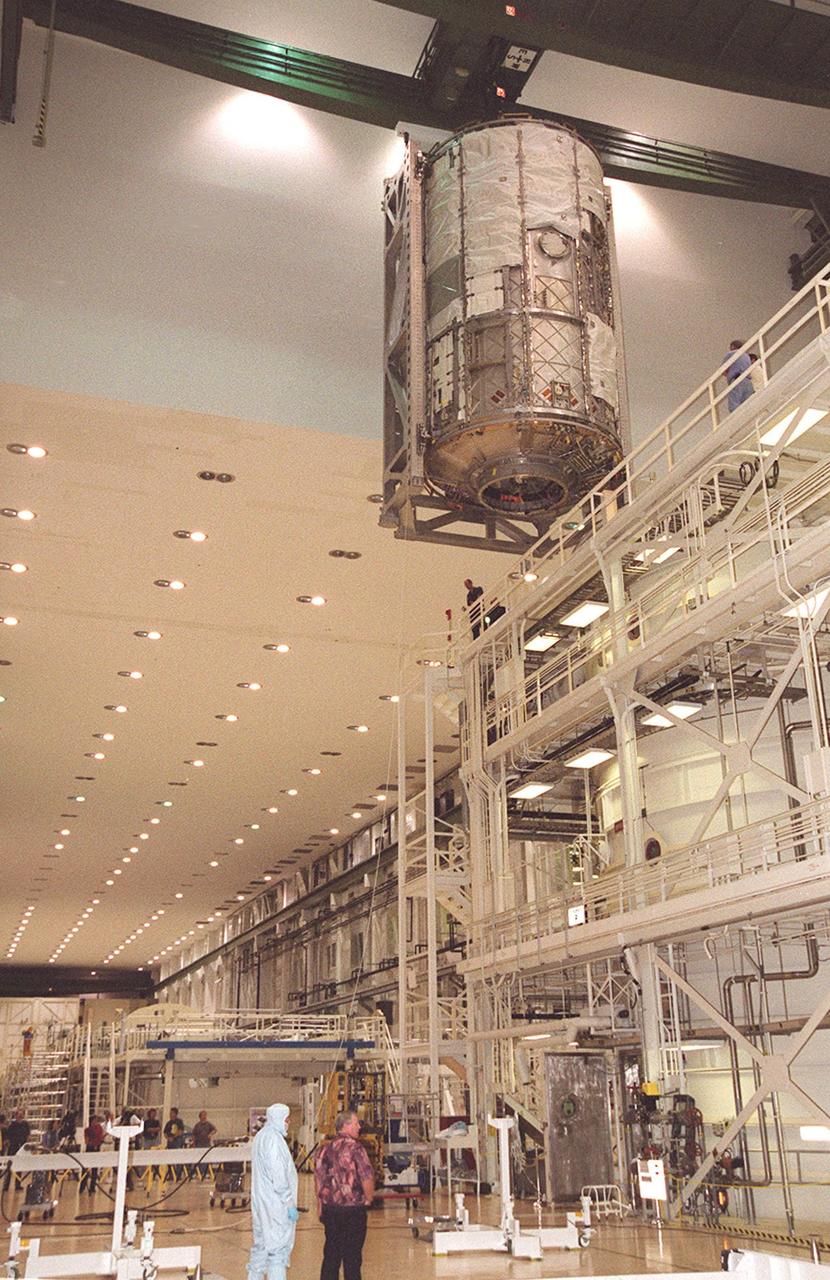
KENNEDY SPACE CENTER, FLA. -- In the Operations and Checkout Building, the U.S. Lab moves overhead after being lifted out of the vacuum chamber where it was tested for leaks. The test was very successful. The 32,000-pound scientific research lab, named Destiny, is the first Space Station element to spend seven days in the renovated vacuum chamber. Destiny is scheduled to be launched on Shuttle mission STS-98, the 5A assembly mission, targeted for Jan. 18, 2001. During the mission, the crew will install the Lab in the Space Station during a series of three space walks. The STS-98 mission will provide the Station with science research facilities and expand its power, life support and control capabilities. The U.S. Lab module continues a long tradition of microgravity materials research, first conducted by Skylab and later Shuttle and Spacelab missions. Destiny is expected to be a major feature in future research, providing facilities for biotechnology, fluid physics, combustion, and life sciences research

KENNEDY SPACE CENTER, FLA. -- The U.S. Lab, a component of the International Space Station, is lifted above the three-story vacuum chamber into which the Lab will be placed. The 32,000-pound scientific research lab, named Destiny, is the first Space Station element to spend seven days in the renovated vacuum chamber for a leak test. Destiny is scheduled to be launched on Shuttle mission STS-98, the 5A assembly mission, targeted for Jan. 18, 2001. During the mission, the crew will install the Lab in the Space Station during a series of three space walks. The STS-98 mission will provide the Station with science research facilities and expand its power, life support and control capabilities. The U.S. Lab module continues a long tradition of microgravity materials research, first conducted by Skylab and later Shuttle and Spacelab missions. Destiny is expected to be a major feature in future research, providing facilities for biotechnology, fluid physics, combustion, and life sciences research
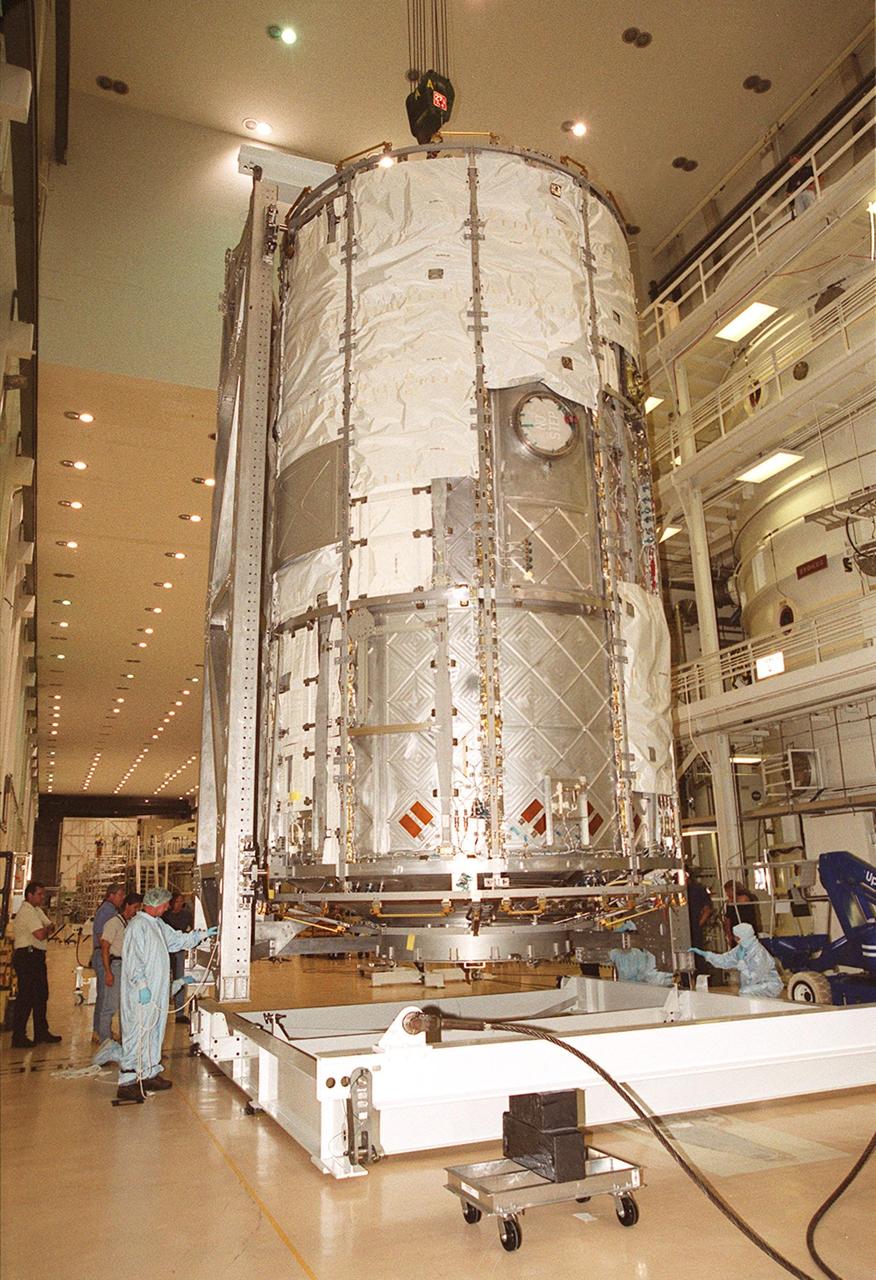
KENNEDY SPACE CENTER, FLA. -- In the Operations and Checkout Building, the U.S. Lab reaches the open floor after being lifted out of the vacuum chamber where it was tested for leaks. The test was very successful. The 32,000-pound scientific research lab, named Destiny, is the first Space Station element to spend seven days in the renovated vacuum chamber. Destiny is scheduled to be launched on Shuttle mission STS-98, the 5A assembly mission, targeted for Jan. 18, 2001. During the mission, the crew will install the Lab in the Space Station during a series of three space walks. The STS-98 mission will provide the Station with science research facilities and expand its power, life support and control capabilities. The U.S. Lab module continues a long tradition of microgravity materials research, first conducted by Skylab and later Shuttle and Spacelab missions. Destiny is expected to be a major feature in future research, providing facilities for biotechnology, fluid physics, combustion, and life sciences research
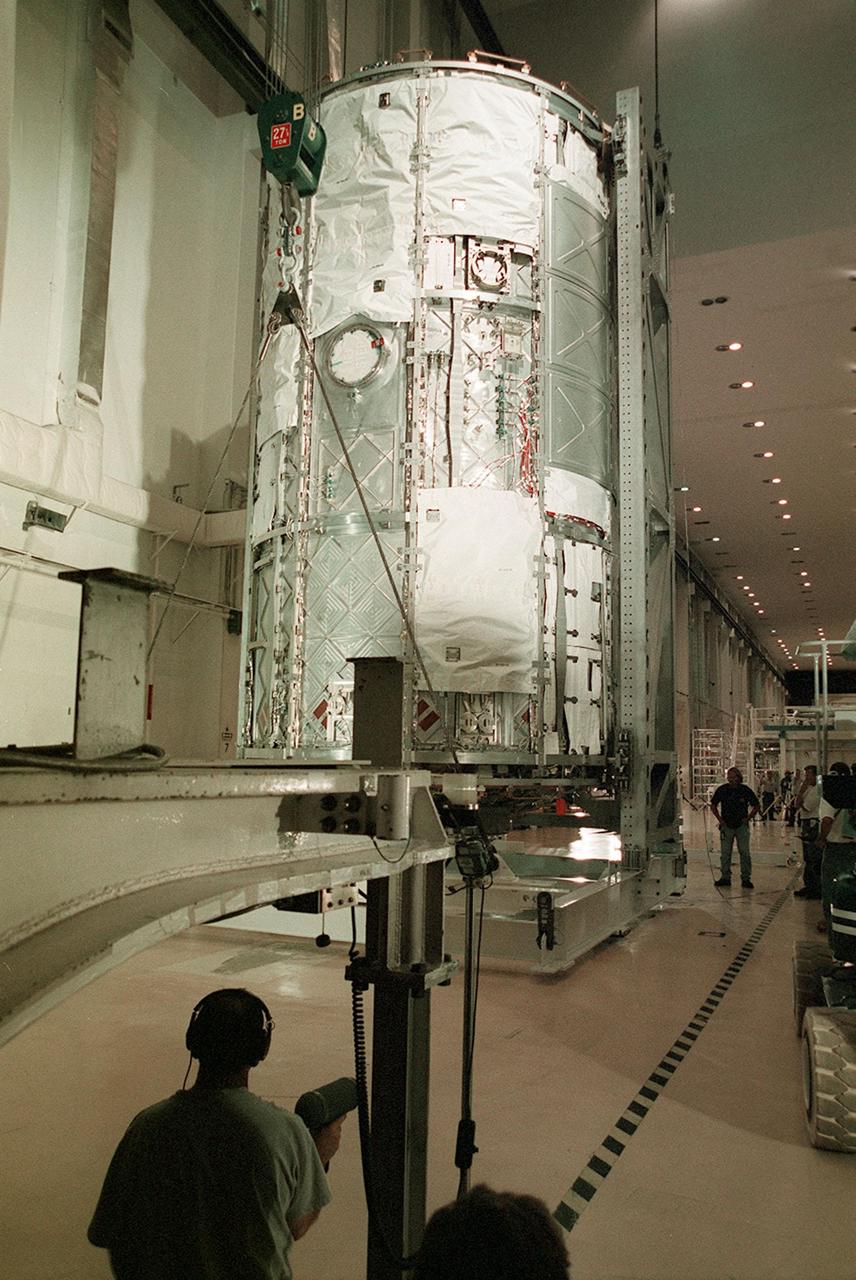
KENNEDY SPACE CENTER, FLA. -- The U.S. Lab, a component of the International Space Station, is moved to the vacuum chamber in the Operations and Checkout Building for testing. The 32,000-pound scientific research lab, named Destiny, is the first Space Station element to spend seven days in the renovated vacuum chamber for a leak test. Destiny is scheduled to be launched on Shuttle mission STS-98, the 5A assembly mission, targeted for Jan. 18, 2001. During the mission, the crew will install the Lab in the Space Station during a series of three space walks. The STS-98 mission will provide the Station with science research facilities and expand its power, life support and control capabilities. The U.S. Lab module continues a long tradition of microgravity materials research, first conducted by Skylab and later Shuttle and Spacelab missions. Destiny is expected to be a major feature in future research, providing facilities for biotechnology, fluid physics, combustion, and life sciences research.
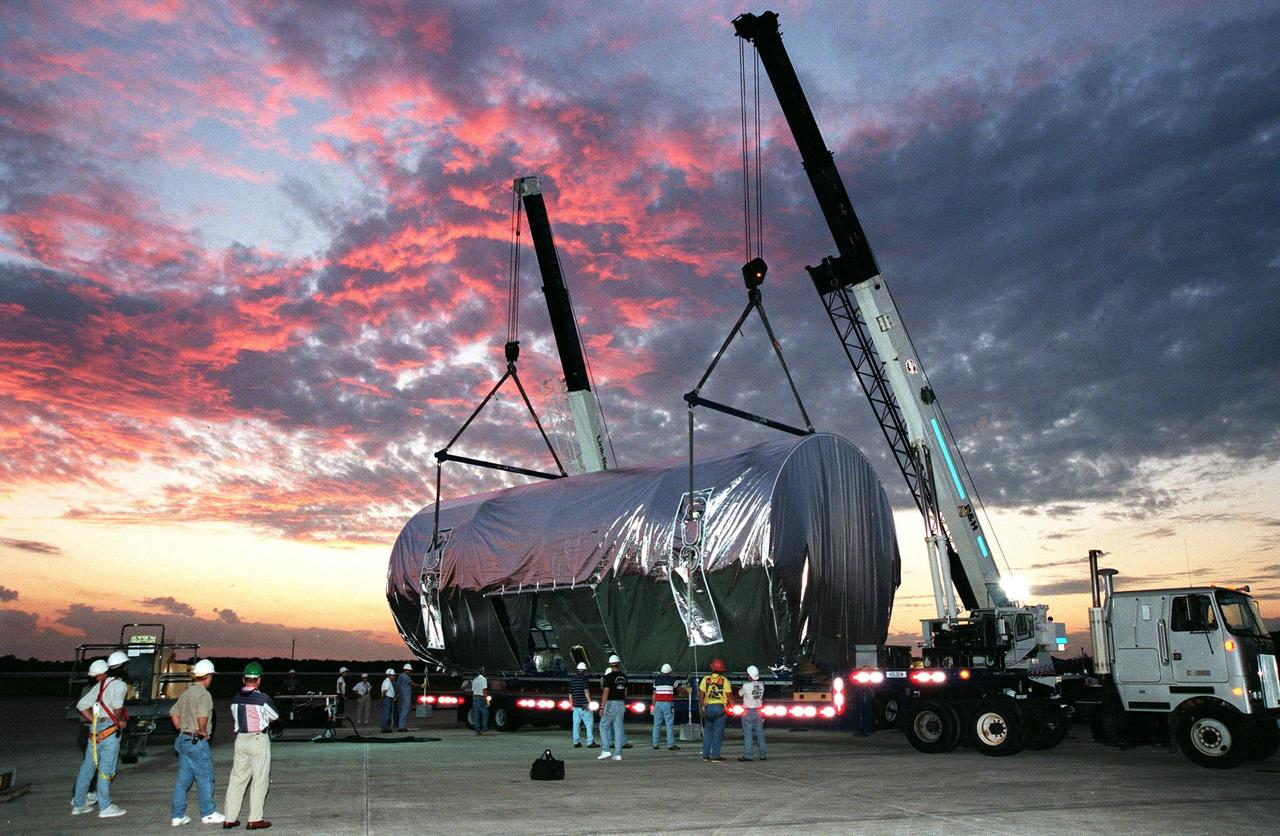
KENNEDY SPACE CENTER, FLA. -- In the last light before nightfall, workers watch as others check the fittings on the cranes lowering the container that encases U.S. laboratory module onto the bed of a trailer, waiting with its lights on for the move to the Space Station Processing Facility. Intended for the International Space Station, the lab is scheduled to undergo pre-launch preparations before its launch aboard the Shuttle Endeavour on mission STS-98. The laboratory comprises three cylindrical sections with two end cones. Each end-cone contains a hatch opening for entering and exiting the lab. The lab will provide a shirtsleeve environment for research in the areas of life science, microgravity science, Earth science and space science. Designated Flight 5A, this mission is targeted for launch in early 2000