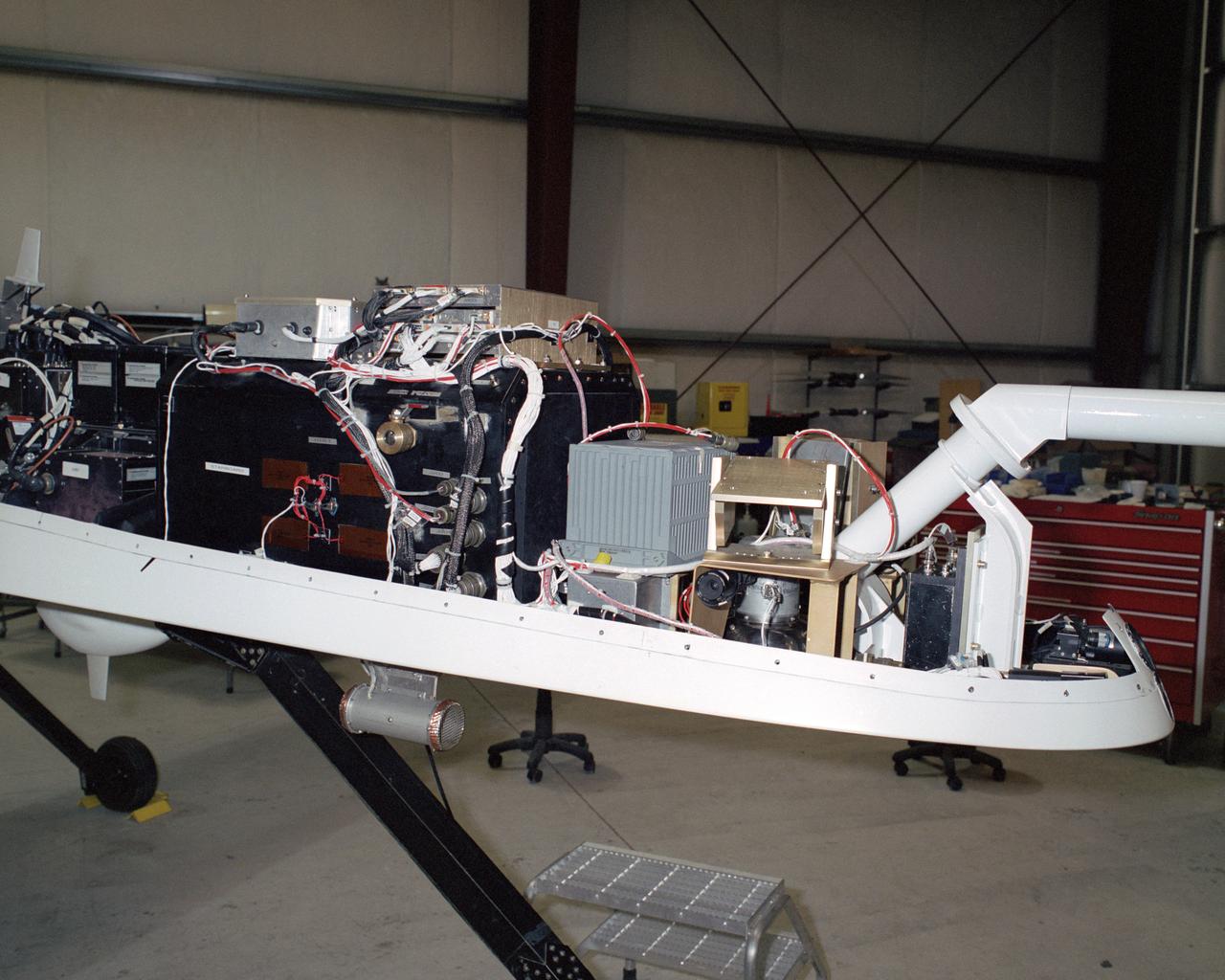
A NASA team studying the causes of electrical storms and their effects on our home planet achieved a milestone on August 21, 2002, completing the study's longest-duration research flight and monitoring four thunderstorms in succession. Based at the Naval Air Station Key West, Florida, researchers with the Altus Cumulus Electrification Study (ACES) used the Altus II remotely-piloted aircraft to study thunderstorms in the Atlantic Ocean off Key West and the west of the Everglades. Using special equipment aboard the Altus II, scientists in ACES will gather electric, magnetic, and optical measurements of the thunderstorms, gauging elements such as lightning activity and the electrical environment in and around the storms. With dual goals of gathering weather data safely and testing the adaptability of the uninhabited aircraft, the ACES study is a collaboration among the Marshall Space Flight Center, the University of Alabama in Huntsville, NASA's Goddard Space Flight Center in Greenbelt, Maryland, Pernsylvania State University in University Park, and General Atomics Aeronautical Systems, Inc.
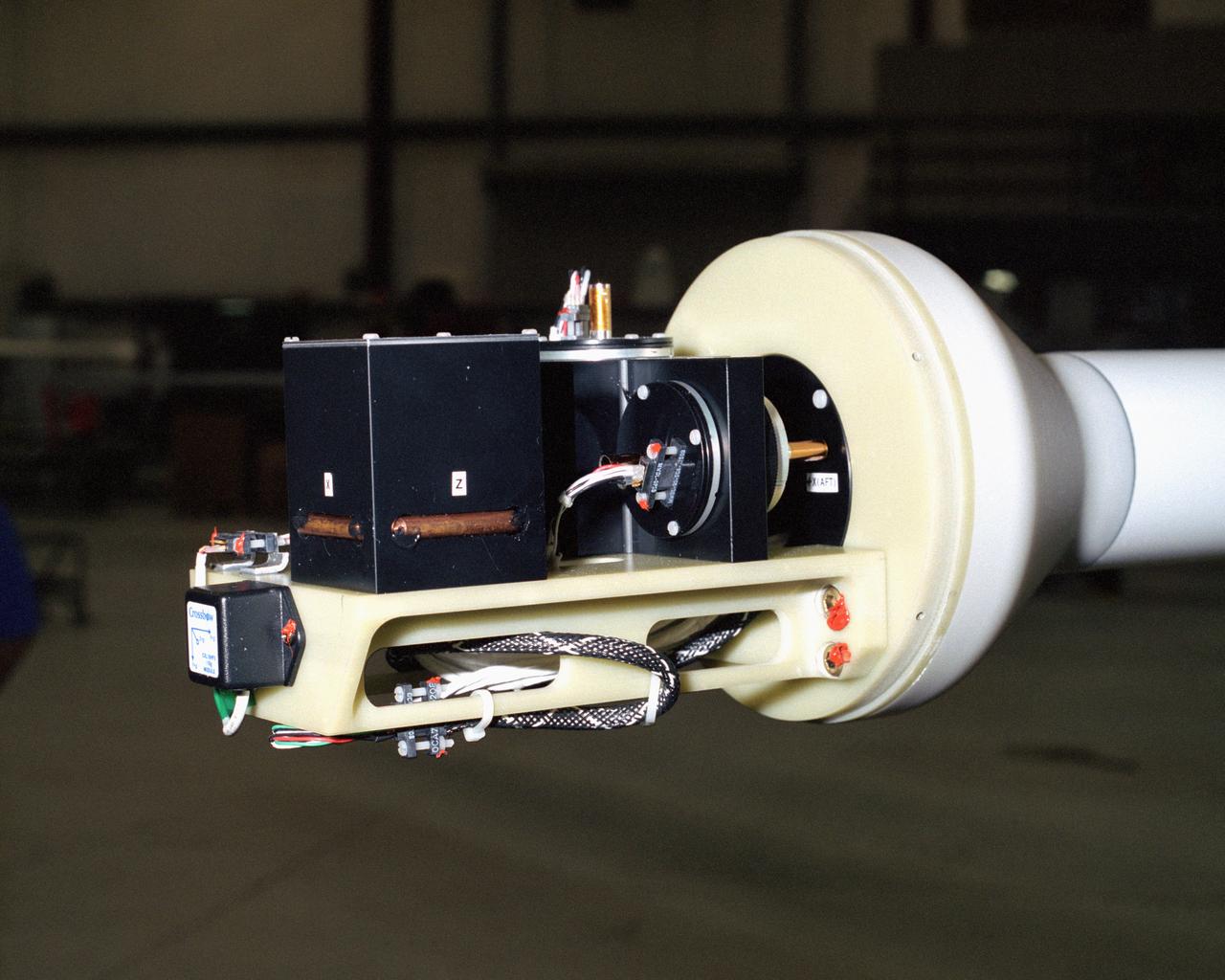
A NASA team studying the causes of electrical storms and their effects on our home planet achieved a milestone on August 21, 2002, completing the study's longest-duration research flight and monitoring four thunderstorms in succession. Based at the Naval Air Station Key West, Florida, researchers with the Altus Cumulus Electrification Study (ACES) used the Altus II remotely-piloted aircraft to study thunderstorms in the Atlantic Ocean off Key West and the west of the Everglades. Data obtained through sensors mounted to the aircraft will allow researchers in ACES to gauge elements such as lightning activity and the electrical environment in and around storms. By learning more about individual storms, scientists hope to better understand the global water and energy cycle, as well as climate variability. Contained in one portion of the aircraft is a three-axis magnetic search coil, which measures the AC magnetic field; a three-axis electric field change sensor; an accelerometer; and a three-axis magnetometer, which measures the DC magnetic field. With dual goals of gathering weather data safely and testing the adaptability of the uninhabited aircraft, the ACES study is a collaboration among the Marshall Space Flight Center, the University of Alabama in Huntsville, NASA's Goddard Space Flight Center in Greenbelt, Maryland, Pernsylvania State University in University Park, and General Atomics Aeronautical Systems, Inc.
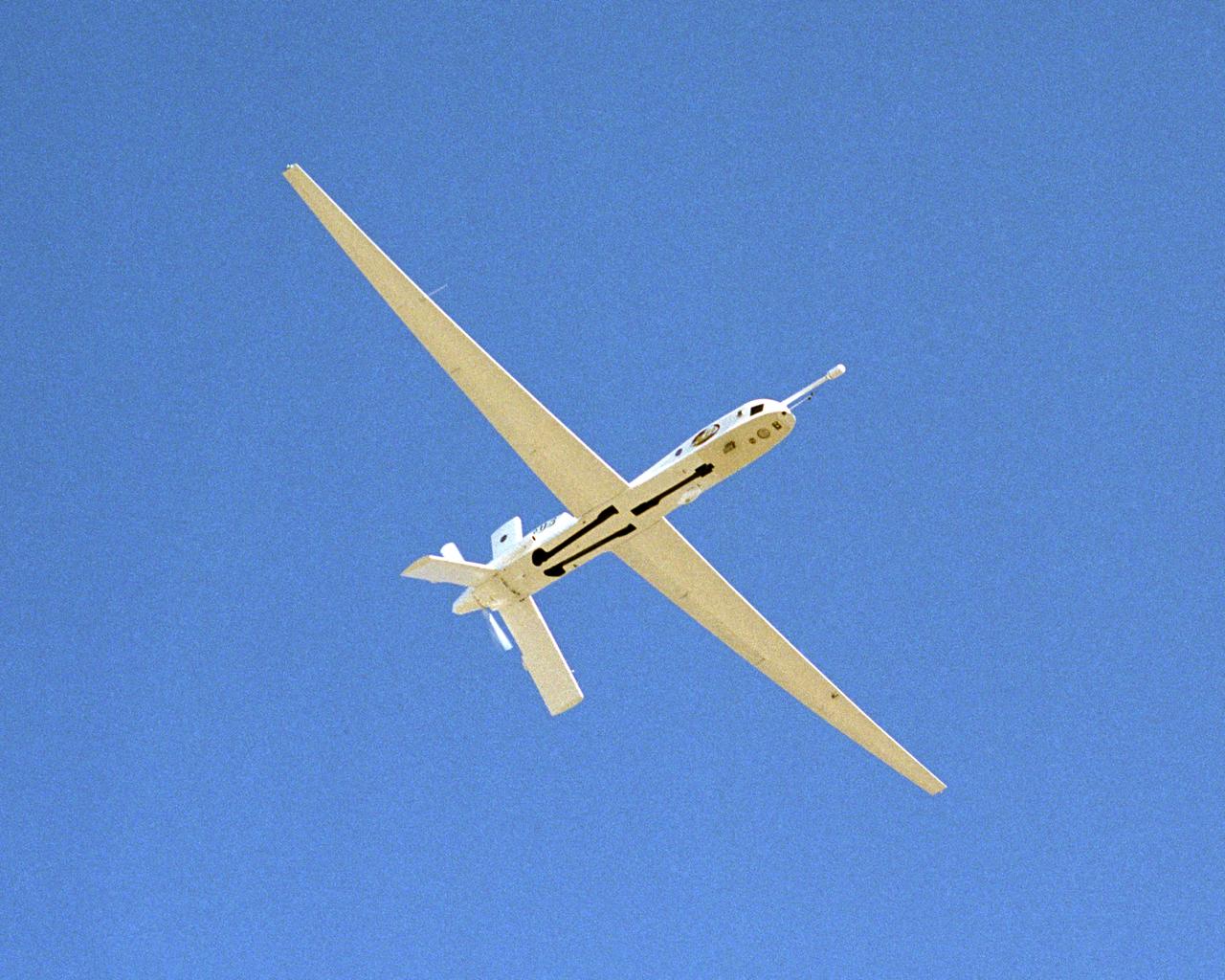
A NASA team studying the causes of electrical storms and their effects on our home planet achieved a milestone on August 21, 2002, completing the study's longest-duration research flight and monitoring four thunderstorms in succession. Based at the Naval Air Station Key West, Florida, researchers with the Altus Cumulus Electrification Study (ACES) used the Altus II remotely piloted aircraft to study thunderstorms in the Atlantic Ocean off Key West and the west of the Everglades. The ACES lightning study used the Altus II twin turbo uninhabited aerial vehicle, built by General Atomics Aeronautical Systems, Inc. of San Diego. The Altus II was chosen for its slow flight speed of 75 to 100 knots (80 to 115 mph), long endurance, and high-altitude flight (up to 65,000 feet). These qualities gave the Altus II the ability to fly near and around thunderstorms for long periods of time, allowing investigations to be conducted over the entire life cycle of storms. The vehicle has a wing span of 55 feet and a payload capacity of over 300 lbs. With dual goals of gathering weather data safely and testing the adaptability of the uninhabited aircraft, the ACES study is a collaboration among the Marshall Space Flight Center, the University of Alabama in Huntsville, NASA's Goddard Space Flight Center in Greenbelt, Maryland, Pernsylvania State University in University Park, and General Atomics Aeronautical Systems, Inc.
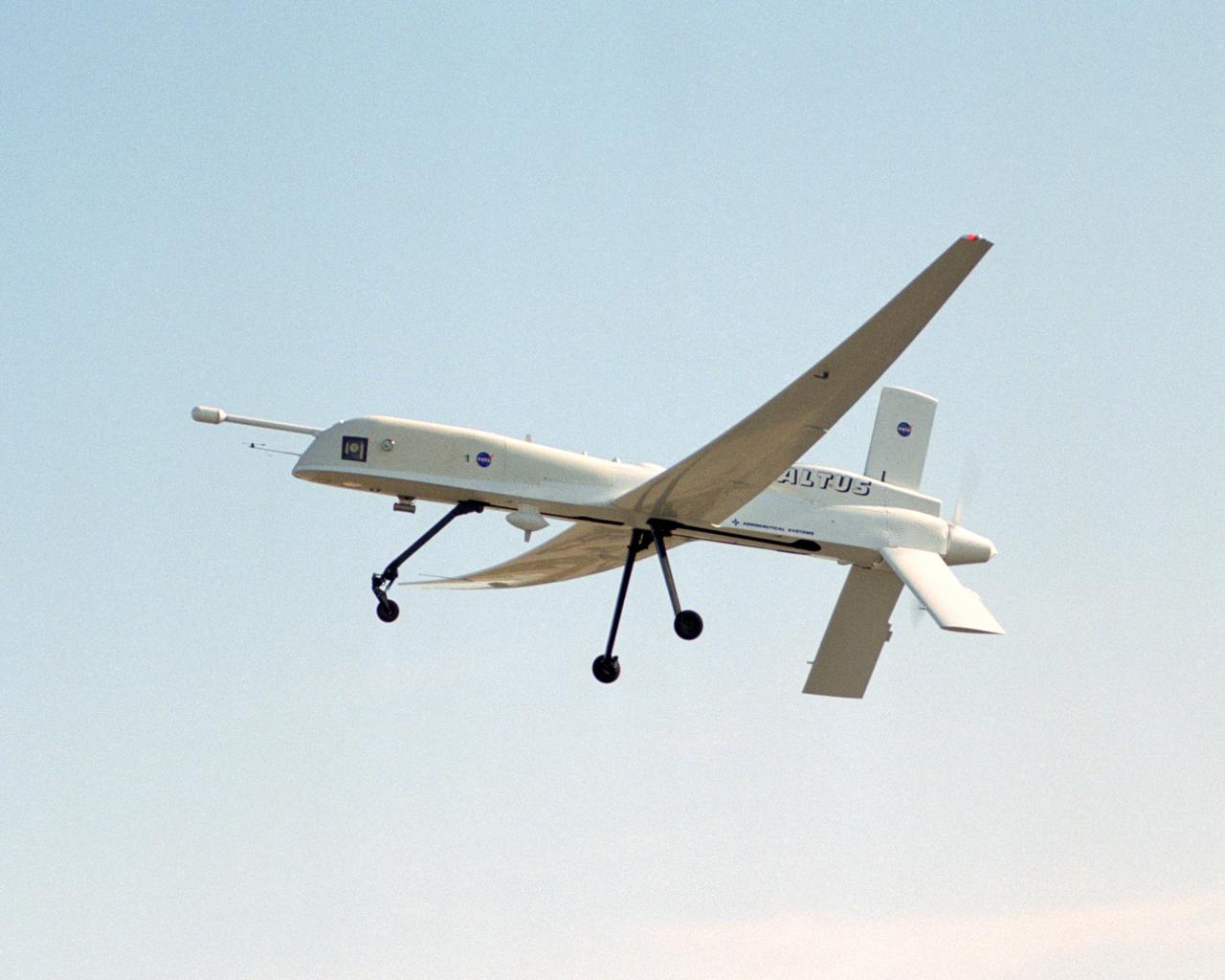
A NASA team studying the causes of electrical storms and their effects on our home planet achieved a milestone on August 21, 2002, completing the study's longest-duration research flight and monitoring four thunderstorms in succession. Based at the Naval Air Station Key West, Florida, researchers with the Altus Cumulus Electrification Study (ACES) used the Altus II remotely-piloted aircraft to study thunderstorms in the Atlantic Ocean off Key West and the west of the Everglades. The ACES lightning study used the Altus II twin turbo uninhabited aerial vehicle, built by General Atomics Aeronautical Systems, Inc. of San Diego. The Altus II was chosen for its slow flight speed of 75 to 100 knots (80 to 115 mph), long endurance, and high-altitude flight (up to 65,000 feet). These qualities gave the Altus II the ability to fly near and around thunderstorms for long periods of time, allowing investigations to be to be conducted over the entire life cycle of storms. The vehicle has a wing span of 55 feet and a payload capacity of over 300 lbs. With dual goals of gathering weather data safely and testing the adaptability of the uninhabited aircraft, the ACES study is a collaboration among the Marshall Space Flight Center, the University of Alabama in Huntsville, NASA,s Goddard Space Flight Center in Greenbelt, Maryland, Pernsylvania State University in University Park, and General Atomics Aeronautical Systems, Inc.
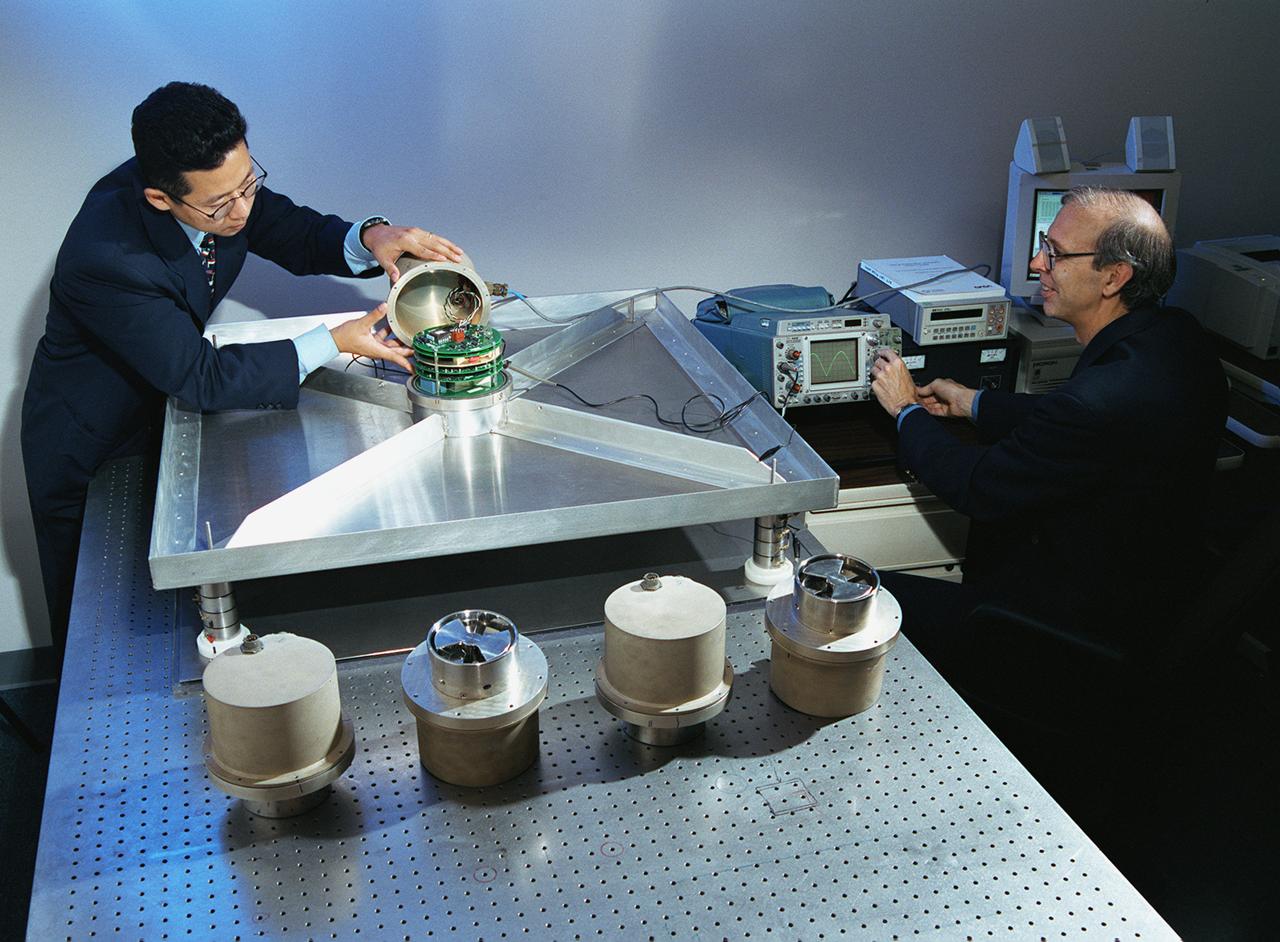
A NASA team studying the causes of electrical storms and their effects on our home planet achieved a milestone on August 21, 2002, completing the study's longest-duration research flight and monitoring four thunderstorms in succession. Radio news media can talk with Dr. Richard Blakeslee, the project's principal investigator, and Tony Kim, project manager at the Marshall Space Flight Center (MSFC), about their results and how their work will help improve future weather forecasting ability. Based at the Naval Air Station Key West, Florida, researchers with the Altus Cumulus Electrification Study (ACES) used the Altus II remotely- piloted aircraft to study a thunderstorm in the Atlantic Ocean off Key West, two storms at the western edge of the Everglades, and a large storm over the northwestern corner of the Everglades. This photograph shows Tony Kim And Dr. Richard Blakeslee of MSFC testing aircraft sensors that would be used to measure the electric fields produced by thunderstorm as part of NASA's ACES. With dual goals of gathering weather data safely and testing the adaptability of the uninhabited aircraft, the ACES study is a collaboration among the MSFC, the University of Alabama in Huntsville, NASA's Goddard Space Flight Center in Greenbelt, Maryland, Pernsylvania State University in University Park, and General Atomics Aeronautical Systems, Inc.
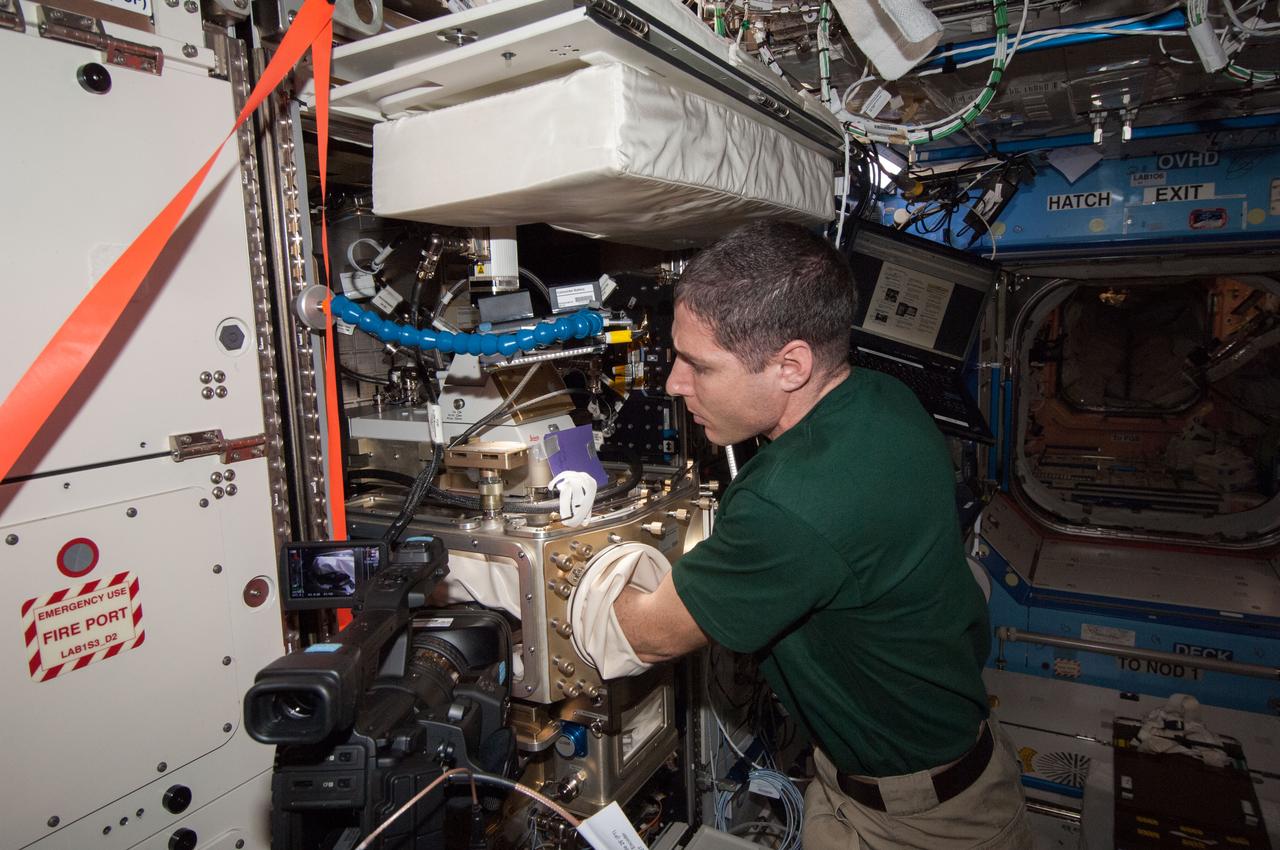
ISS038-E-055240 (24 Feb. 2014) --- In the International Space Station's Destiny laboratory, NASA astronaut Mike Hopkins, Expedition 38 flight engineer, sets up the Advanced Colloids Experiment (ACE) housed in the Light Microscopy Module (LMM) inside the Fluids Integrated Rack. ACE studies microscopic particles suspended in a liquid.

iss059e101468 (6/12/2019) — Photo documentation aboard the International Space Station (ISS) of the ACE modules taken in the the Light Microscopy Module (LMM) during the ACE-T10 Module Configuration. The Advanced Colloids Experiment-Temperature-10 (ACE-T-10) investigates the growth kinetics, microscopic dynamics, and restructuring processes in ordered and disordered structures such as colloidal crystals, glasses and gels. The investigation studies crystal nucleation in colloidal fluids, the origin of ageing in glasses and gels, as well as the heterogeneous nature of the microscopic dynamics in these structures. The study must be conducted in microgravity, as gravitational stresses affect the structure and growth of these solids from colloids.
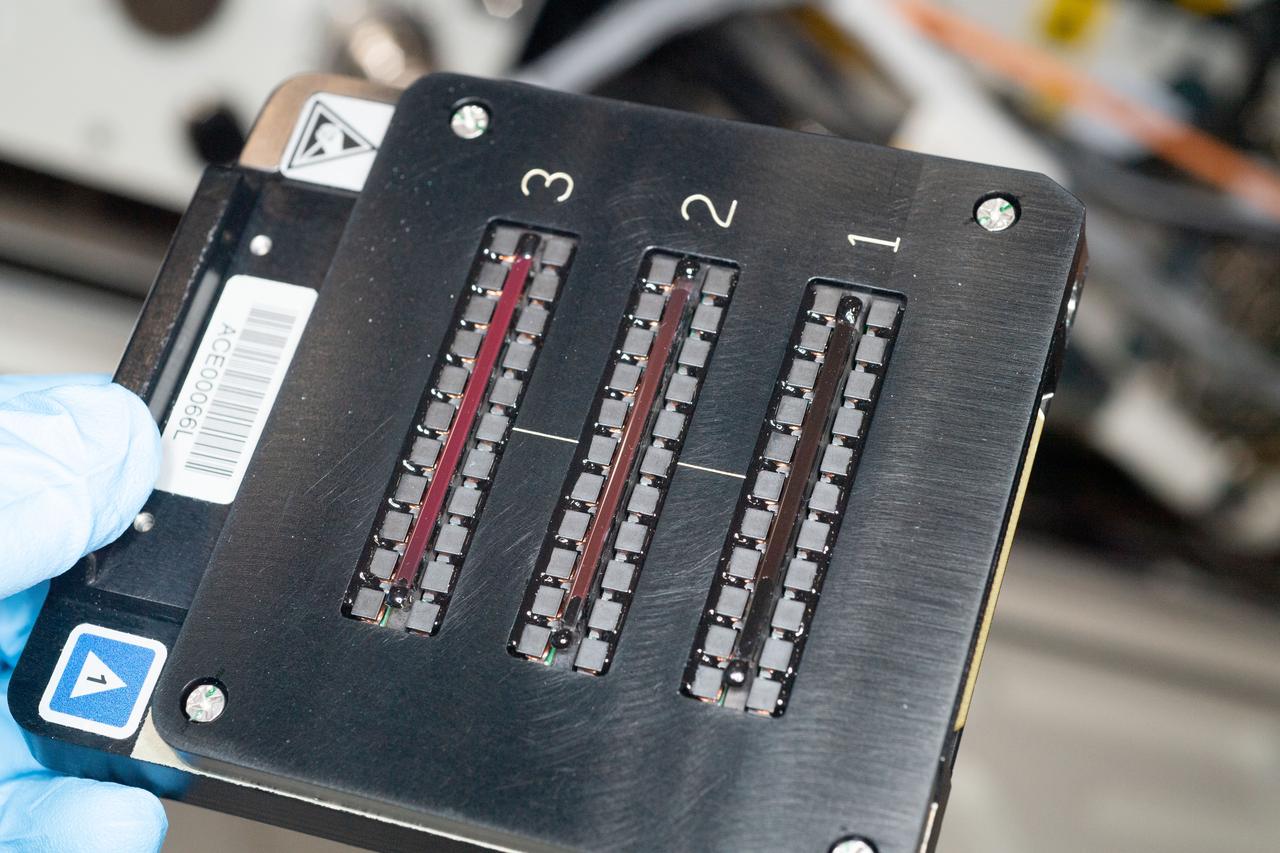
iss059e101463 (6/12/2019) --- Photo documentation aboard the International Space Station (ISS) of the ACE Modules taken during the ACE-T10 Module Configuration. The Advanced Colloids Experiment-Temperature-10 (ACE-T-10) investigates the growth kinetics, microscopic dynamics, and restructuring processes in ordered and disordered structures such as colloidal crystals, glasses and gels. The investigation studies crystal nucleation in colloidal fluids, the origin of ageing in glasses and gels, as well as the heterogeneous nature of the microscopic dynamics in these structures. The study must be conducted in microgravity, as gravitational stresses affect the structure and growth of these solids from colloids.
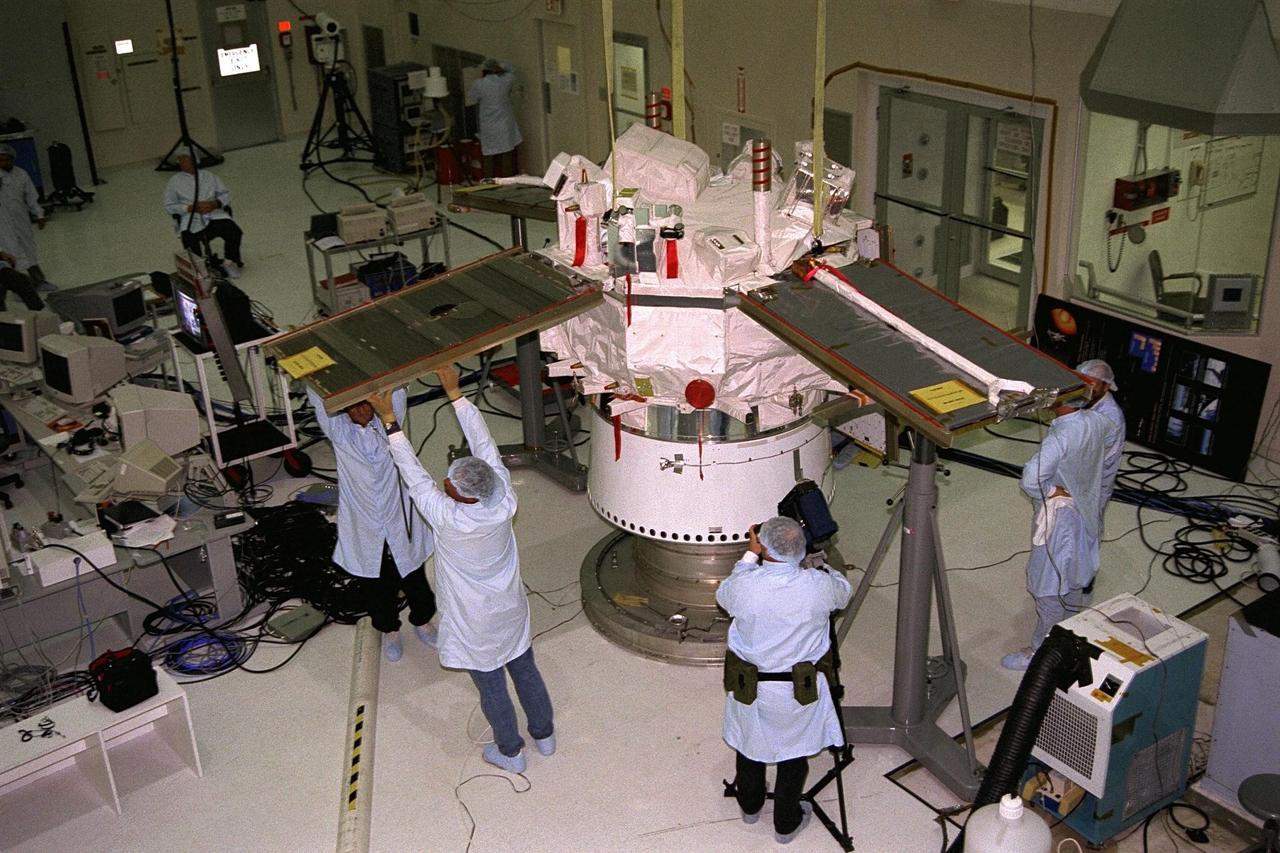
Extension of the solar panels is tested on the Advanced Composition Explorer (ACE) spacecraft in KSC’s Spacecraft Assembly and Encapsulation Facility-II (SAEF-II). Scheduled for launch on a Delta II rocket from Cape Canaveral Air Station on Aug. 25, ACE will study low-energy particles of solar origin and high-energy galactic particles. The collecting power of instruments aboard ACE is 10 to 1,000 times greater than anything previously flown to collect similar data by NASA
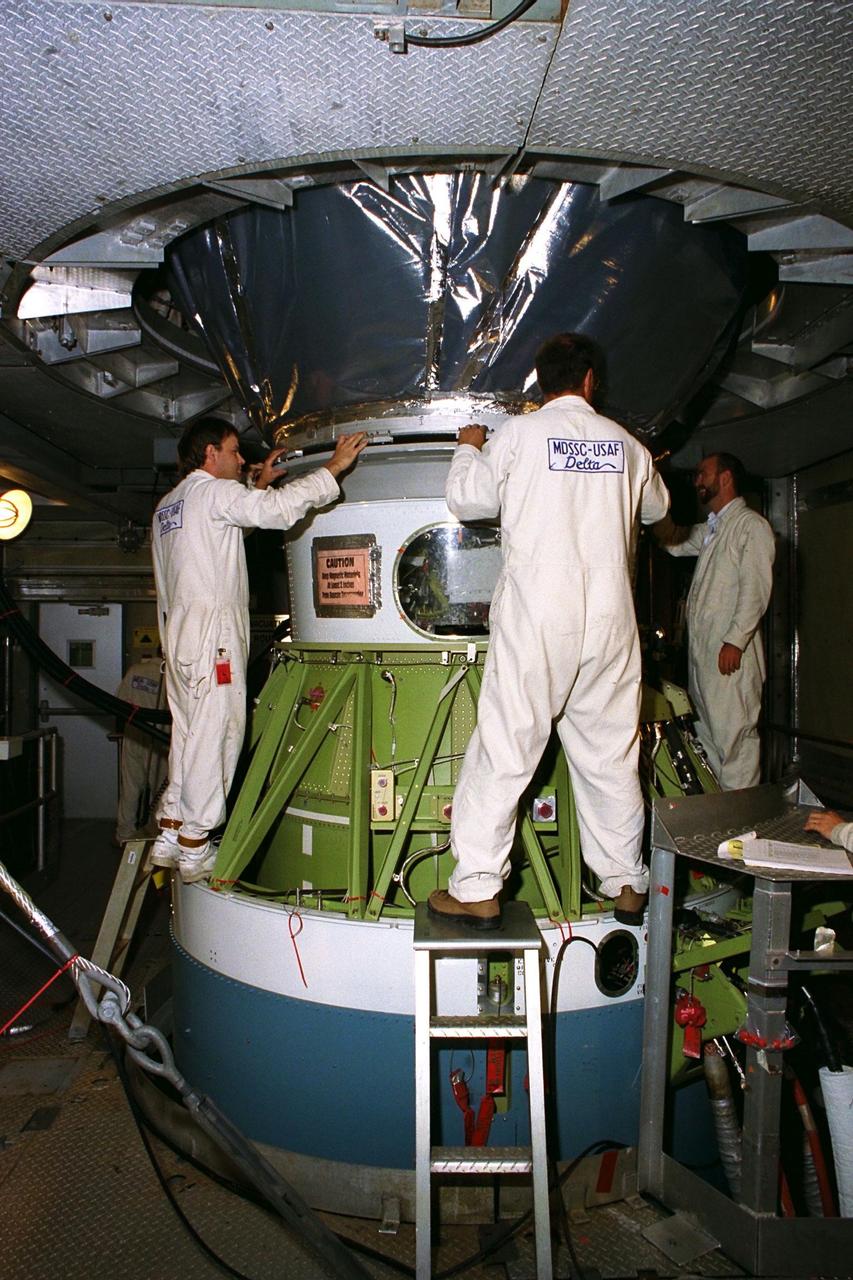
The Advanced Composition Explorer (ACE) spacecraft is placed atop its launch vehicle at Launch Complex 17A. Scheduled for launch on a Delta II rocket from Cape Canaveral Air Station on Aug. 24, ACE will study low-energy particles of solar origin and high-energy galactic particles. The collecting power of instruments aboard ACE is 10 to 1,000 times greater than anything previously flown to collect similar data by NASA
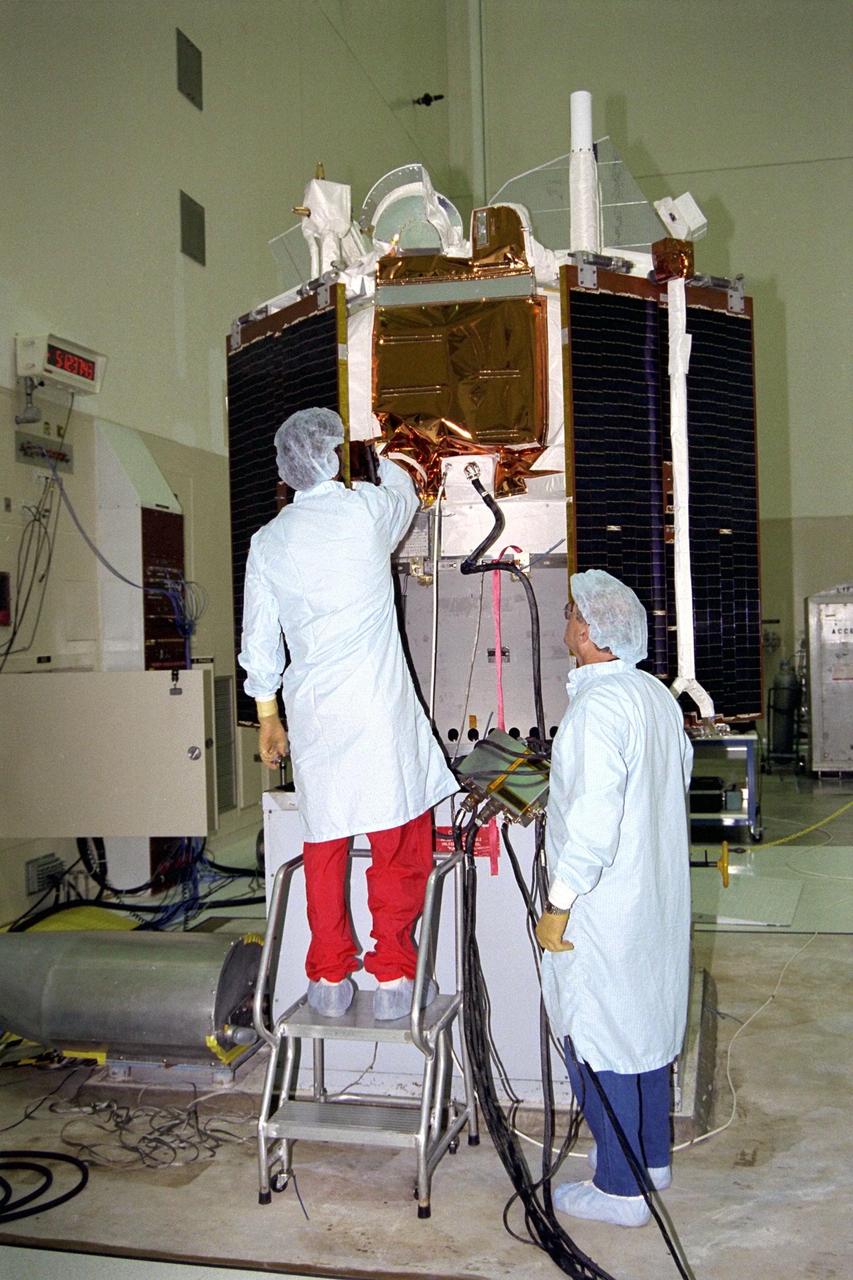
The Advanced Composition Explorer (ACE) spacecraft undergoes a spin test in KSC’s Spacecraft Assembly and Encapsulation Facility-II (SAEF-II). Scheduled for launch on a Delta II rocket from Cape Canaveral Air Station on Aug. 25, ACE will study low-energy particles of solar origin and high-energy galactic particles. The collecting power of instruments aboard ACE is 10 to 1,000 times greater than anything previously flown to collect similar data by NASA
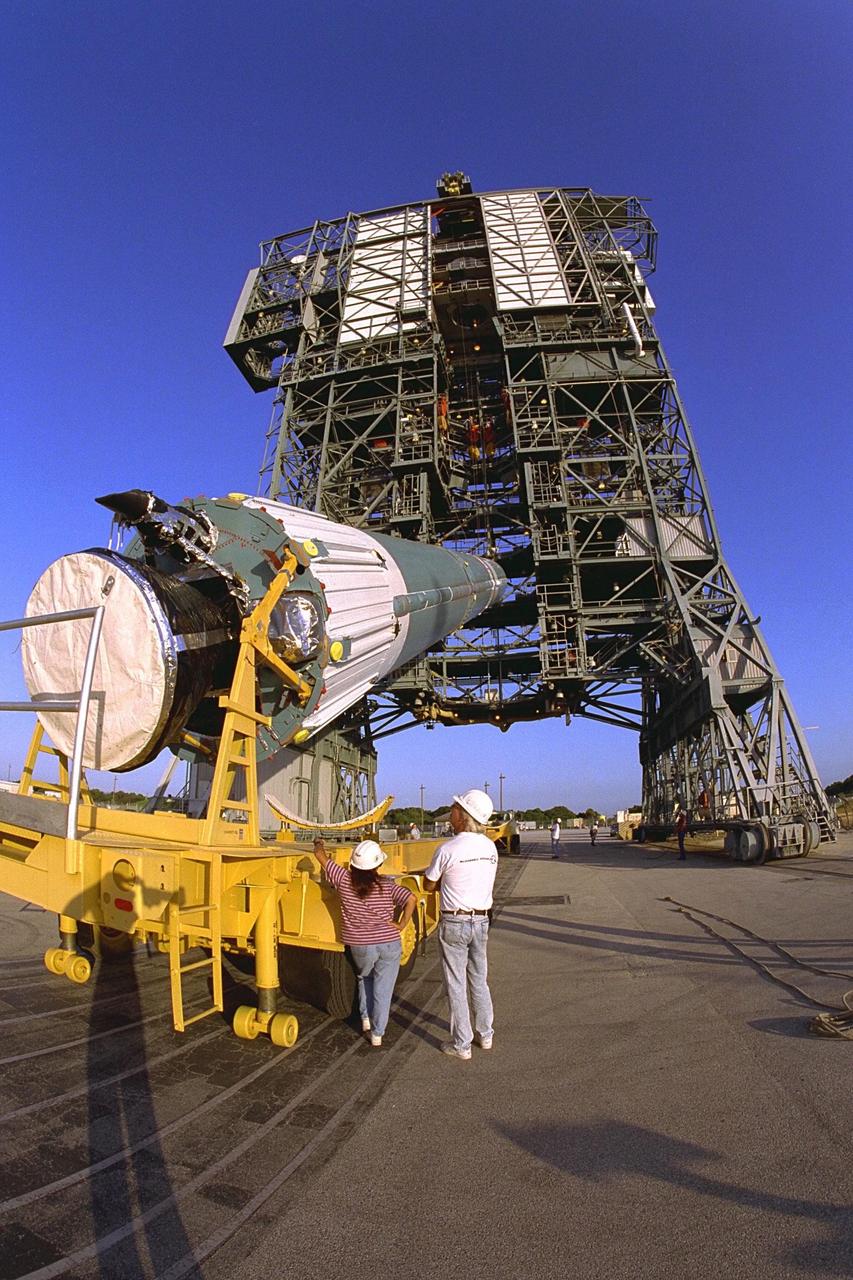
The first stage of the Delta II rocket which will to be used to launch the Advanced Composition Explorer (ACE) spacecraft is erected at Launch Complex 17A at Cape Canaveral Air Station. Scheduled for launch on Aug. 25, ACE will study low-energy particles of solar origin and high-energy galactic particles. The ACE observatory will be placed into an orbit almost a million miles (1.5 million kilometers) away from the Earth, about 1/100 the distance from the Earth to the Sun
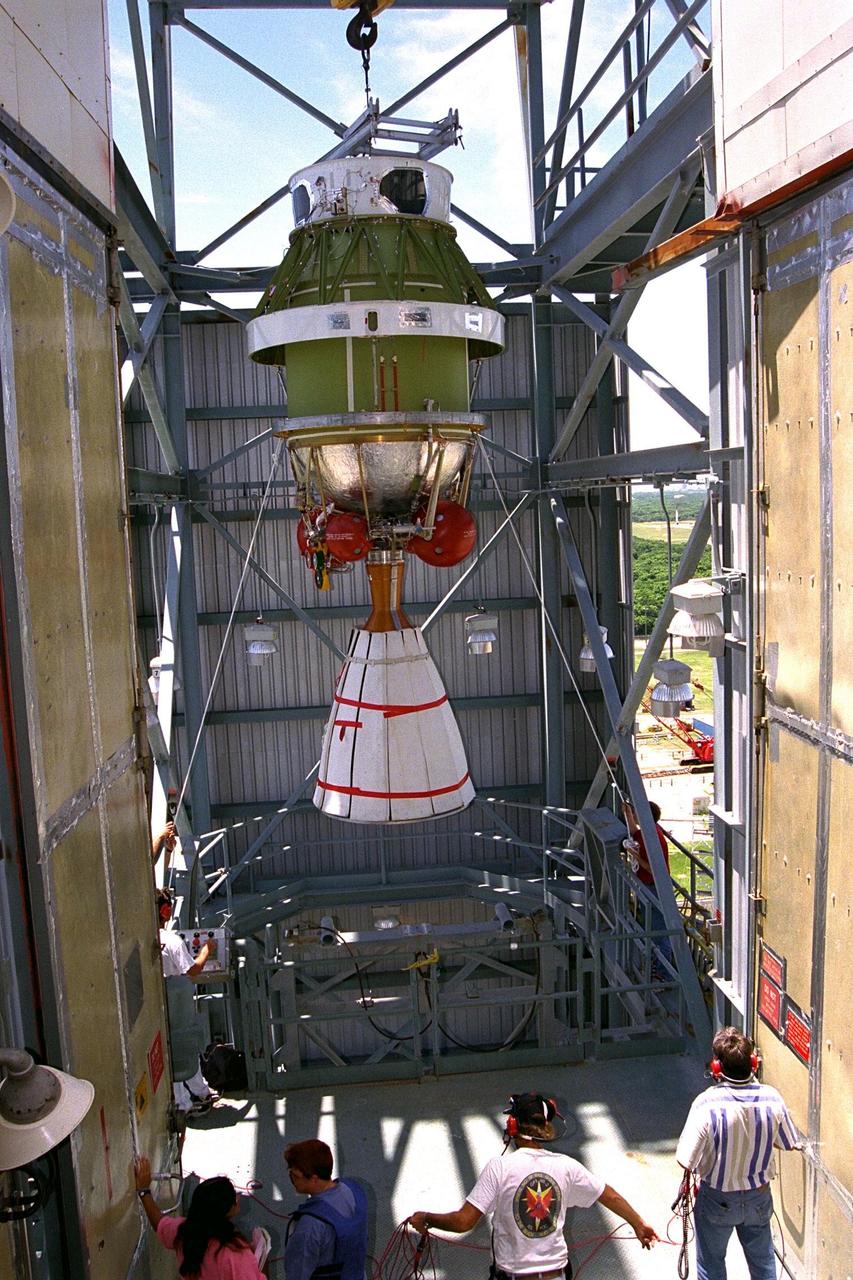
The second stage of the Delta II rocket which will to be used to launch the Advanced Composition Explorer (ACE) spacecraft is erected at Launch Complex 17A at Cape Canaveral Air Station. Scheduled for launch on Aug. 25, ACE will study low-energy particles of solar origin and high-energy galactic particles. The ACE observatory will be placed into an orbit almost a million miles (1.5 million kilometers) away from the Earth, about 1/100 the distance from the Earth to the Sun
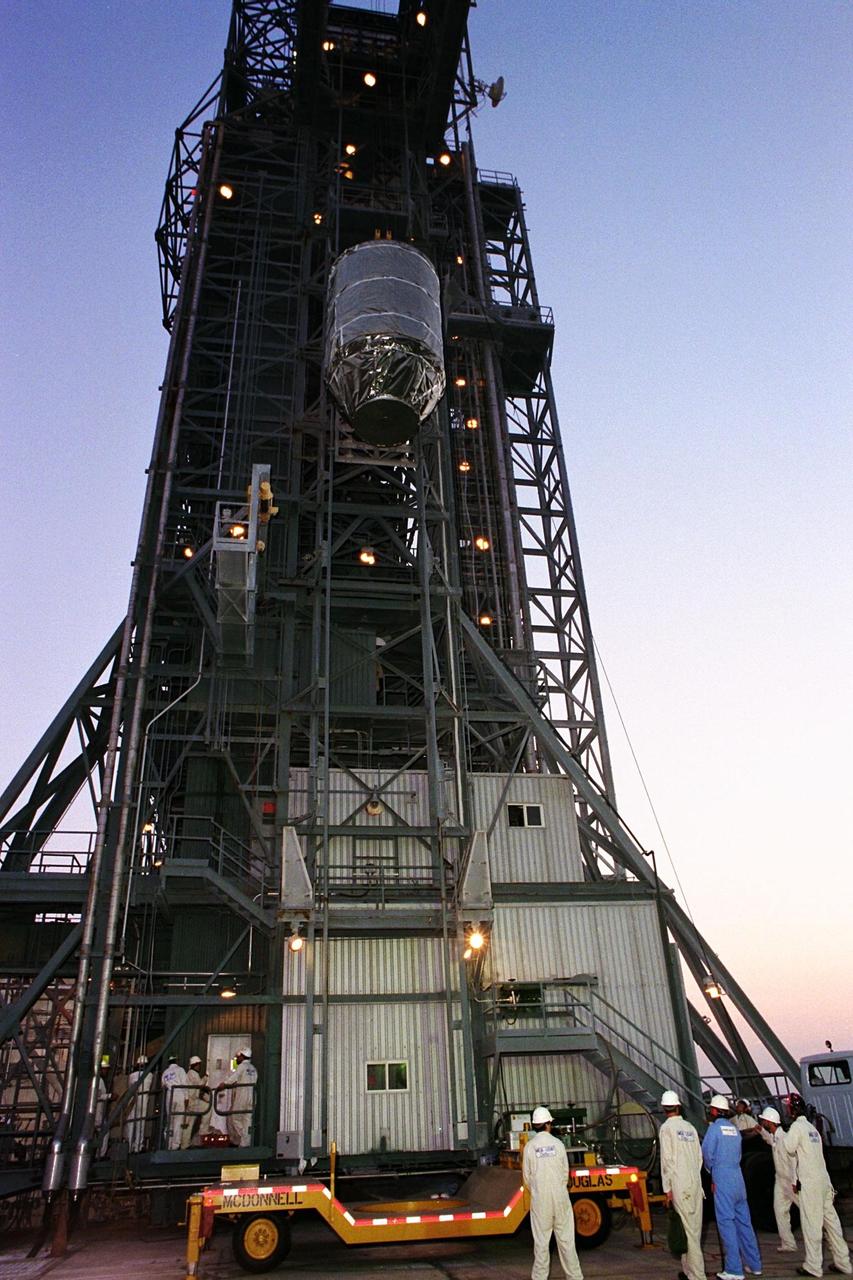
The Advanced Composition Explorer (ACE) spacecraft is placed atop its launch vehicle at Launch Complex 17A. Scheduled for launch on a Delta II rocket from Cape Canaveral Air Station on Aug. 24, ACE will study low-energy particles of solar origin and high-energy galactic particles. The collecting power of instruments aboard ACE is 10 to 1,000 times greater than anything previously flown to collect similar data by NASA
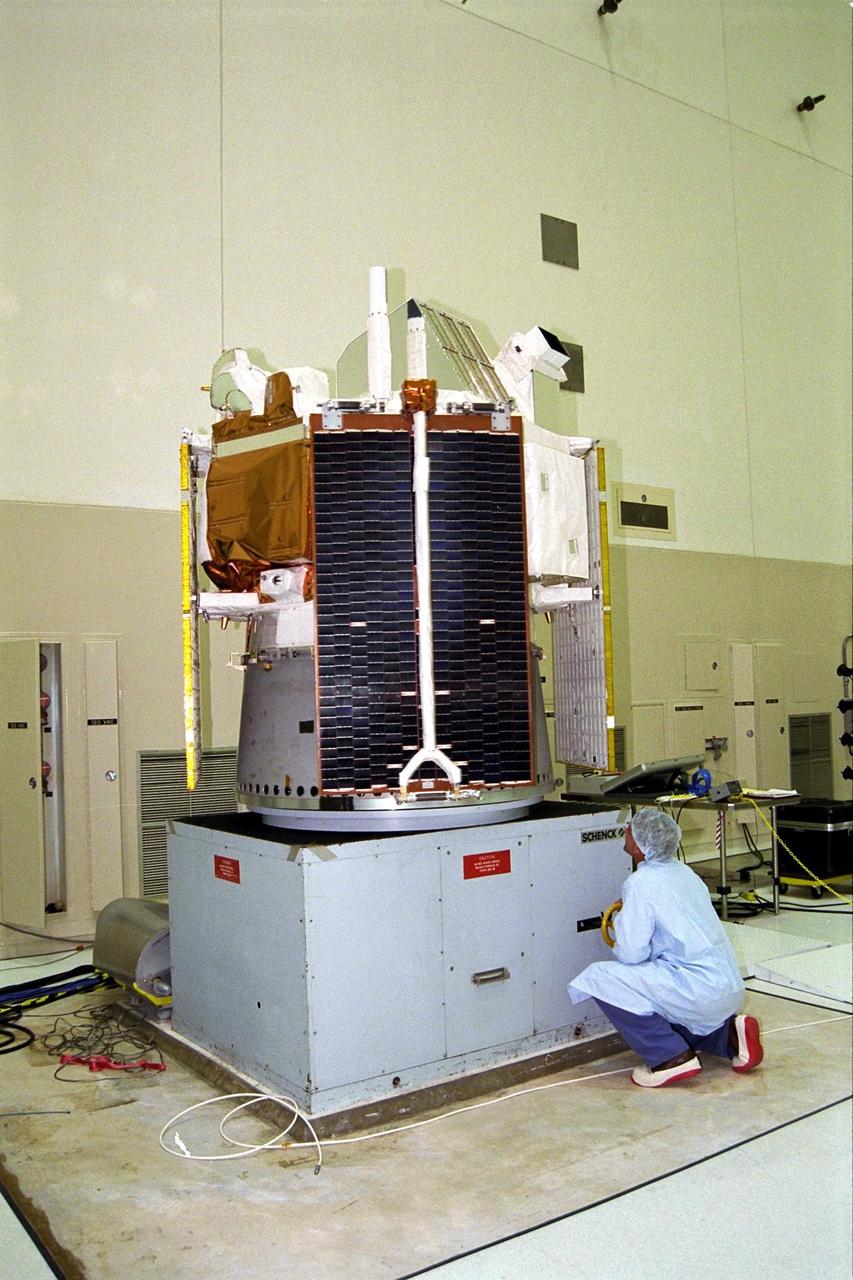
The Advanced Composition Explorer (ACE) spacecraft undergoes a spin test in KSC’s Spacecraft Assembly and Encapsulation Facility-II (SAEF-II). Scheduled for launch on a Delta II rocket from Cape Canaveral Air Station on Aug. 25, ACE will study low-energy particles of solar origin and high-energy galactic particles. The collecting power of instruments aboard ACE is 10 to 1,000 times greater than anything previously flown to collect similar data by NASA
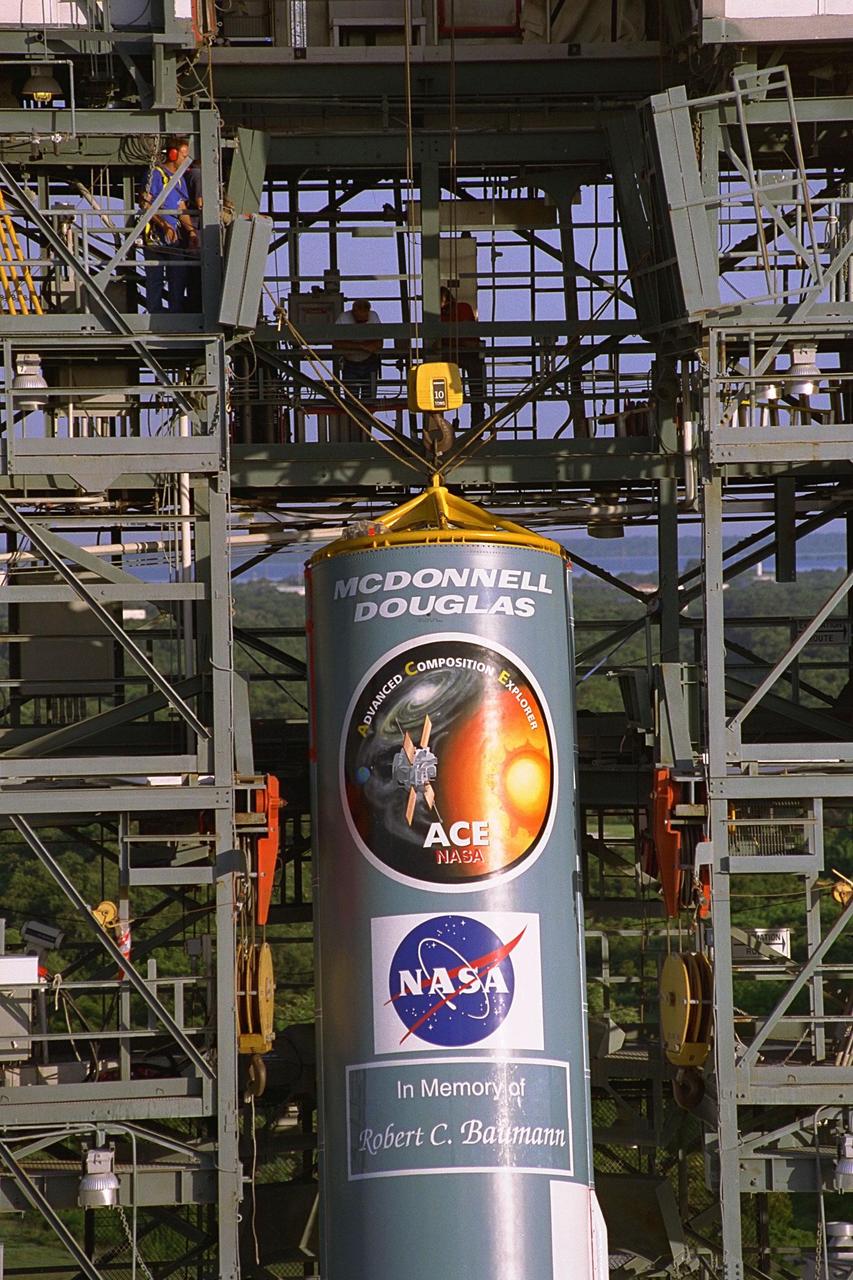
The first stage of the Delta II rocket which will to be used to launch the Advanced Composition Explorer (ACE) spacecraft is erected at Launch Complex 17A at Cape Canaveral Air Station. Scheduled for launch on Aug. 25, ACE will study low-energy particles of solar origin and high-energy galactic particles. The ACE observatory will be placed into an orbit almost a million miles (1.5 million kilometers) away from the Earth, about 1/100 the distance from the Earth to the Sun
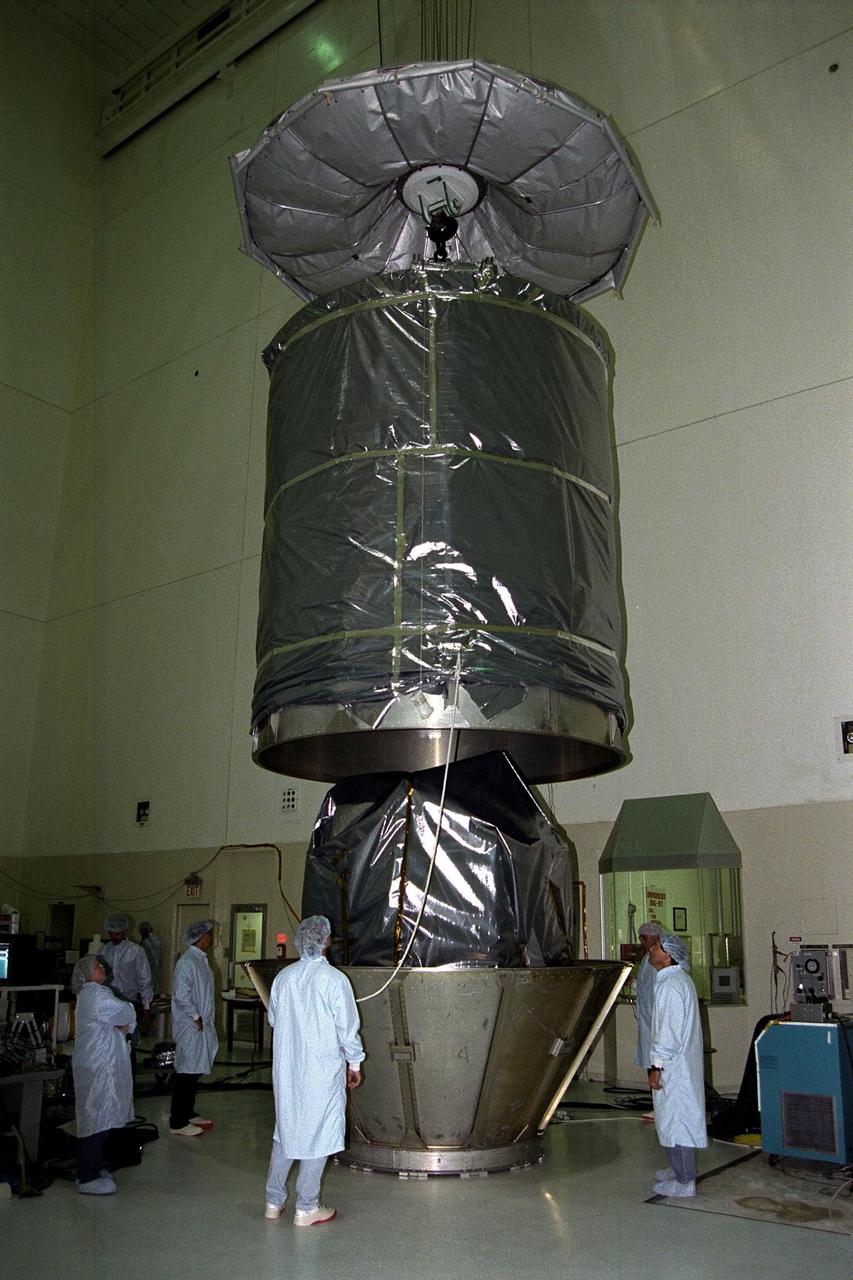
In KSC’s Spacecraft Assembly and Encapsulation Facility-II (SAEF-II), the Advanced Composition Explorer (ACE) spacecraft is encapsulated and placed into the transporter which will move it to Launch Complex 17A. Scheduled for launch on a Delta II rocket from Cape Canaveral Air Station on Aug. 24, ACE will study low-energy particles of solar origin and high-energy galactic particles. The collecting power of instruments aboard ACE is 10 to 1,000 times greater than anything previously flown to collect similar data by NASA
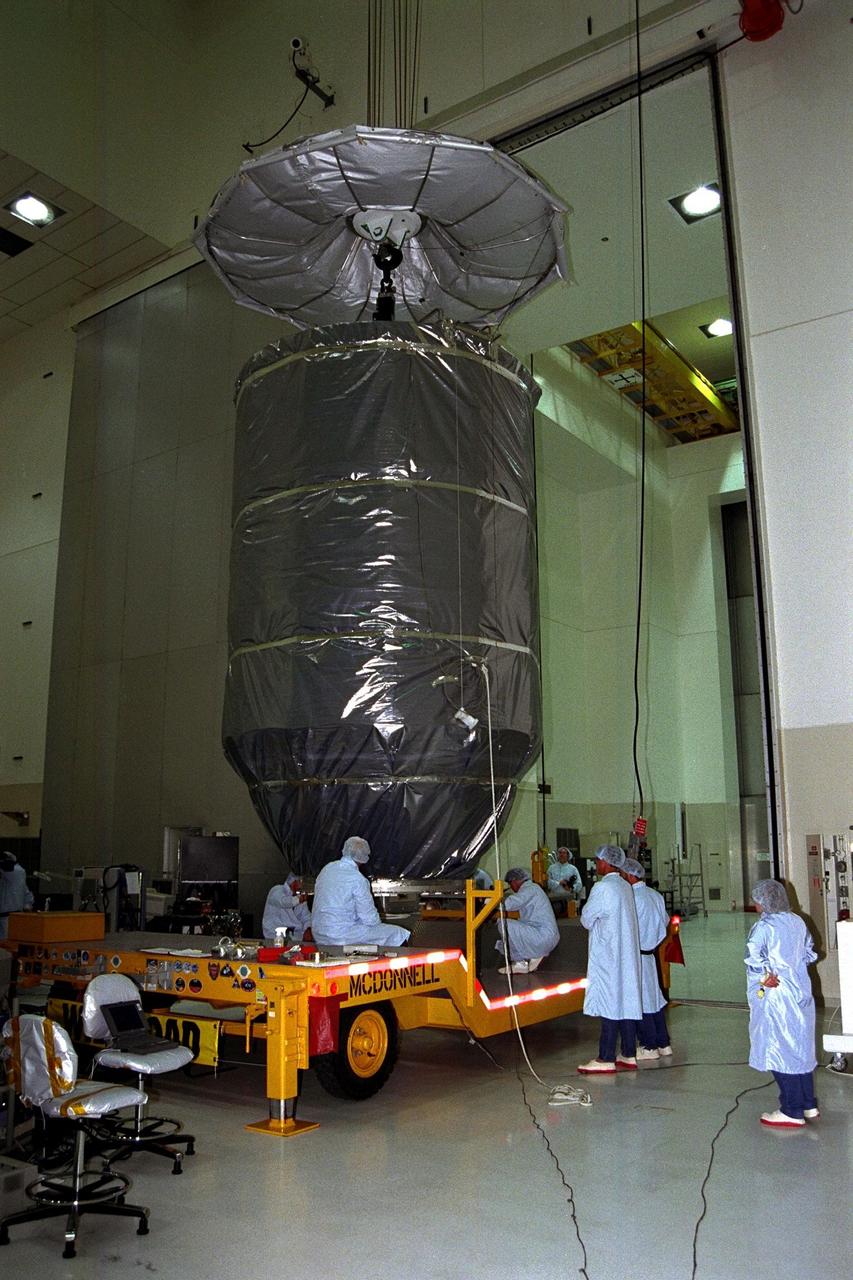
In KSC’s Spacecraft Assembly and Encapsulation Facility-II (SAEF-II), the Advanced Composition Explorer (ACE) spacecraft is encapsulated and placed into the transporter which will move it to Launch Complex 17A. Scheduled for launch on a Delta II rocket from Cape Canaveral Air Station on Aug. 24, ACE will study low-energy particles of solar origin and high-energy galactic particles. The collecting power of instruments aboard ACE is 10 to 1,000 times greater than anything previously flown to collect similar data by NASA
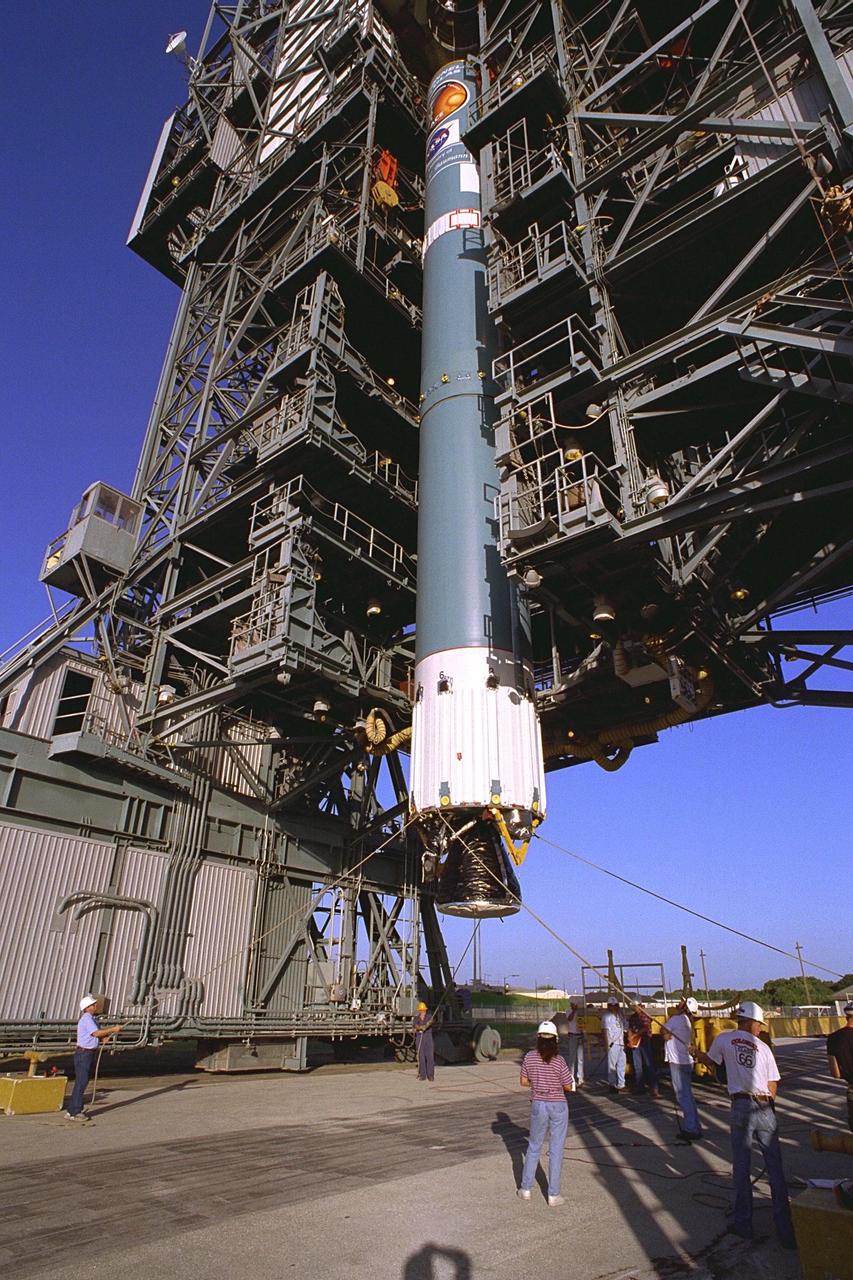
The first stage of the Delta II rocket which will to be used to launch the Advanced Composition Explorer (ACE) spacecraft is erected at Launch Complex 17A at Cape Canaveral Air Station. Scheduled for launch on Aug. 25, ACE will study low-energy particles of solar origin and high-energy galactic particles. The ACE observatory will be placed into an orbit almost a million miles (1.5 million kilometers) away from the Earth, about 1/100 the distance from the Earth to the Sun
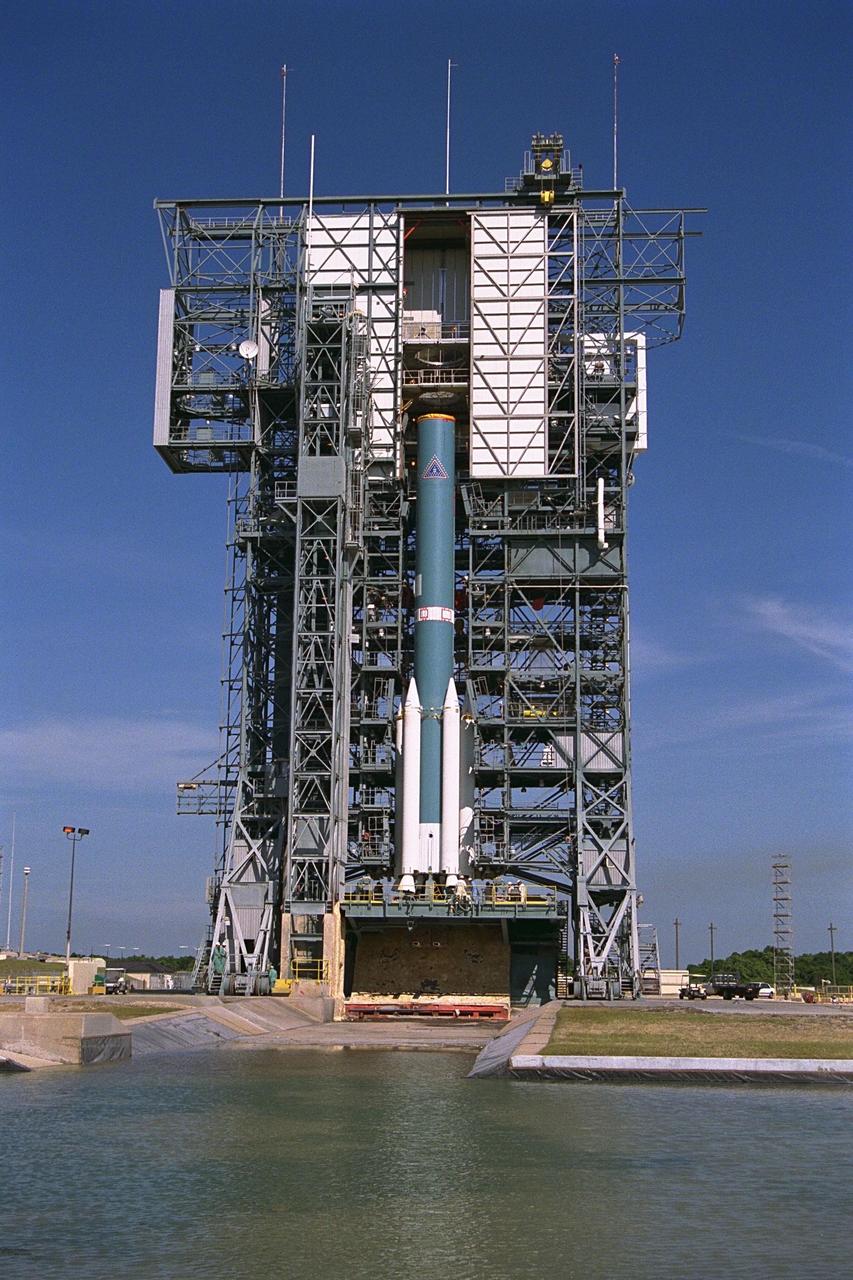
The solid rocket motors of the Delta II rocket which will to be used to launch the Advanced Composition Explorer (ACE) spacecraft are erected at Launch Complex 17A at Cape Canaveral Air Station. Scheduled for launch on Aug. 25, ACE will study low-energy particles of solar origin and high-energy galactic particles. The ACE observatory will be placed into an orbit almost a million miles (1.5 million kilometers) away from the Earth, about 1/100 the distance from the Earth to the Sun
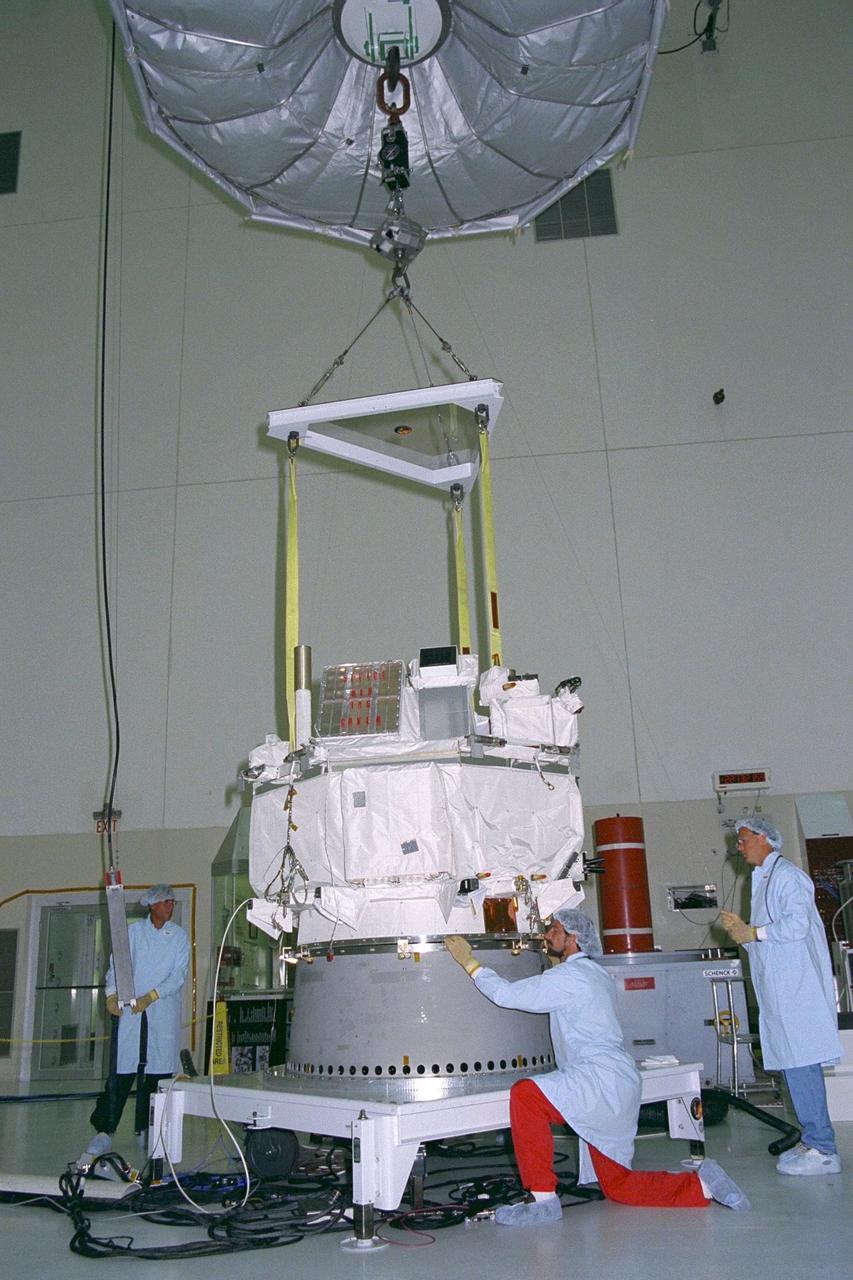
Applied Physics Laboratory engineers and technicians from Johns Hopkins University assist in leveling and orienting the Advanced Composition Explorer (ACE) as it is seated on a platform for solar array installation in KSC’s Spacecraft Assembly and Encapsulation Facility-II. Scheduled for launch on a Delta II rocket from Cape Canaveral Air Station on Aug. 25, ACE will study low-energy particles of solar origin and high-energy galactic particles. The ACE observatory has six high-resolution particle detection sensors and three monitoring instruments. The collecting power of instrumentation aboard ACE is at least 100 times more sensitive than anything previously flown to collect similar data by NASA
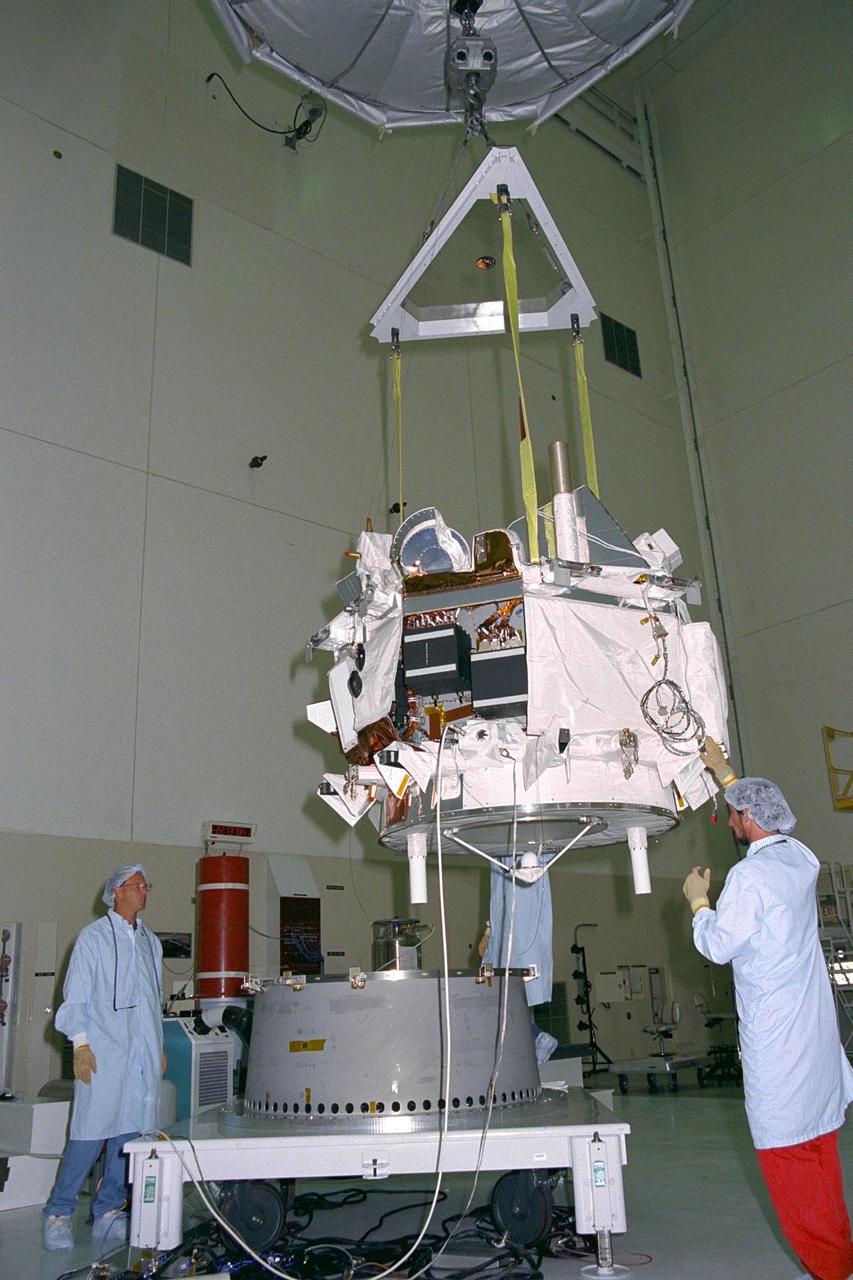
Applied Physics Laboratory engineers and technicians from Johns Hopkins University assist in guiding the Advanced Composition Explorer (ACE) as it is hoisted over a platform for solar array installation in KSC’s Spacecraft Assembly and Encapsulation Facility-II. Scheduled for launch on a Delta II rocket from Cape Canaveral Air Station on Aug. 25, ACE will study low-energy particles of solar origin and high-energy galactic particles. The ACE observatory will contribute to the understanding of the formation and evolution of the solar system as well as the astrophysical processes involved. The collecting power of instruments aboard ACE is 10 to 1,000 times greater than anything previously flown to collect similar data by NASA
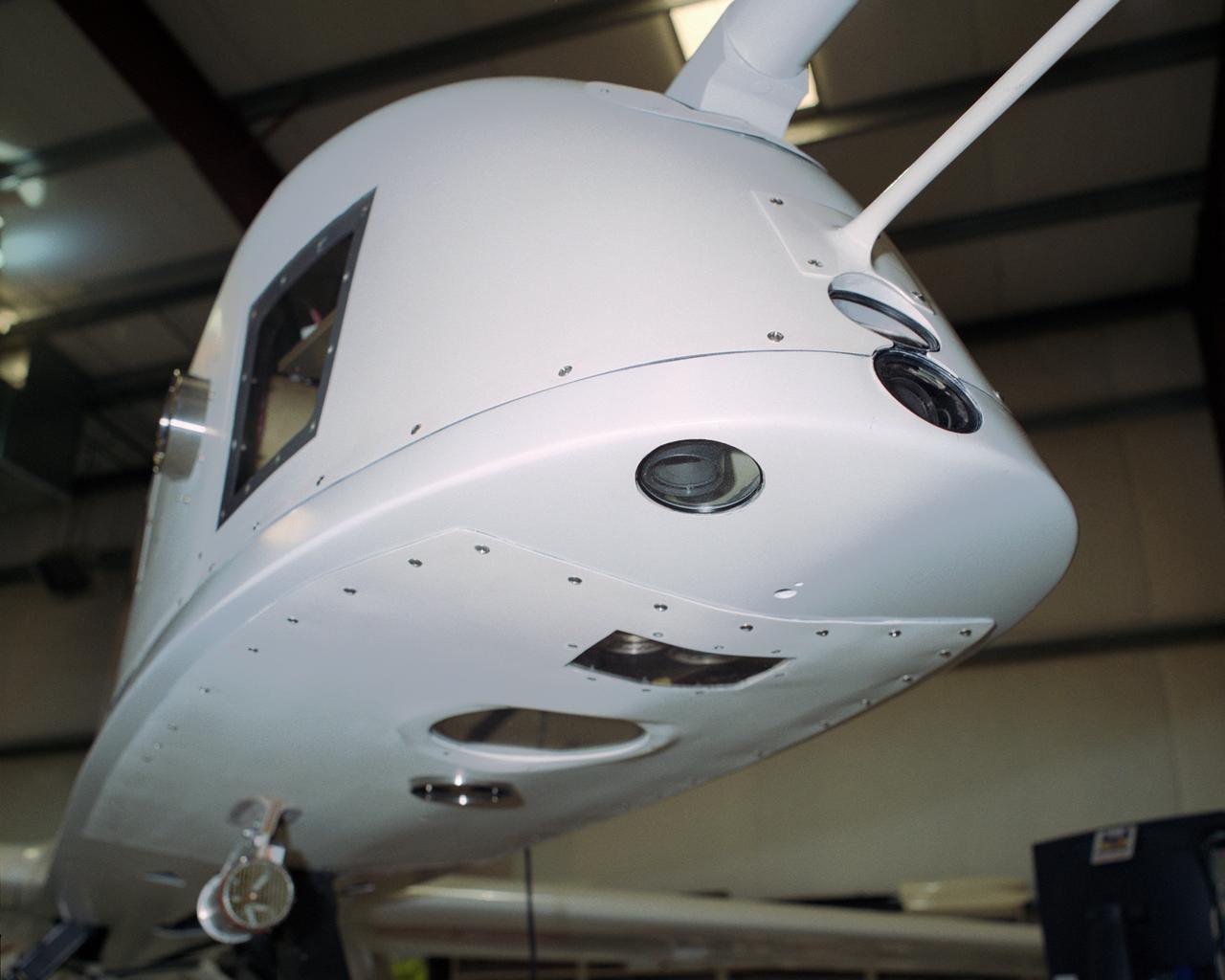
Looking ever so much like an alien spacecraft, the Altus II remotely piloted aircraft shows off some of the instruments and camera lenses mounted in its nose for a lightning study over Florida flown during the summer of 2002.
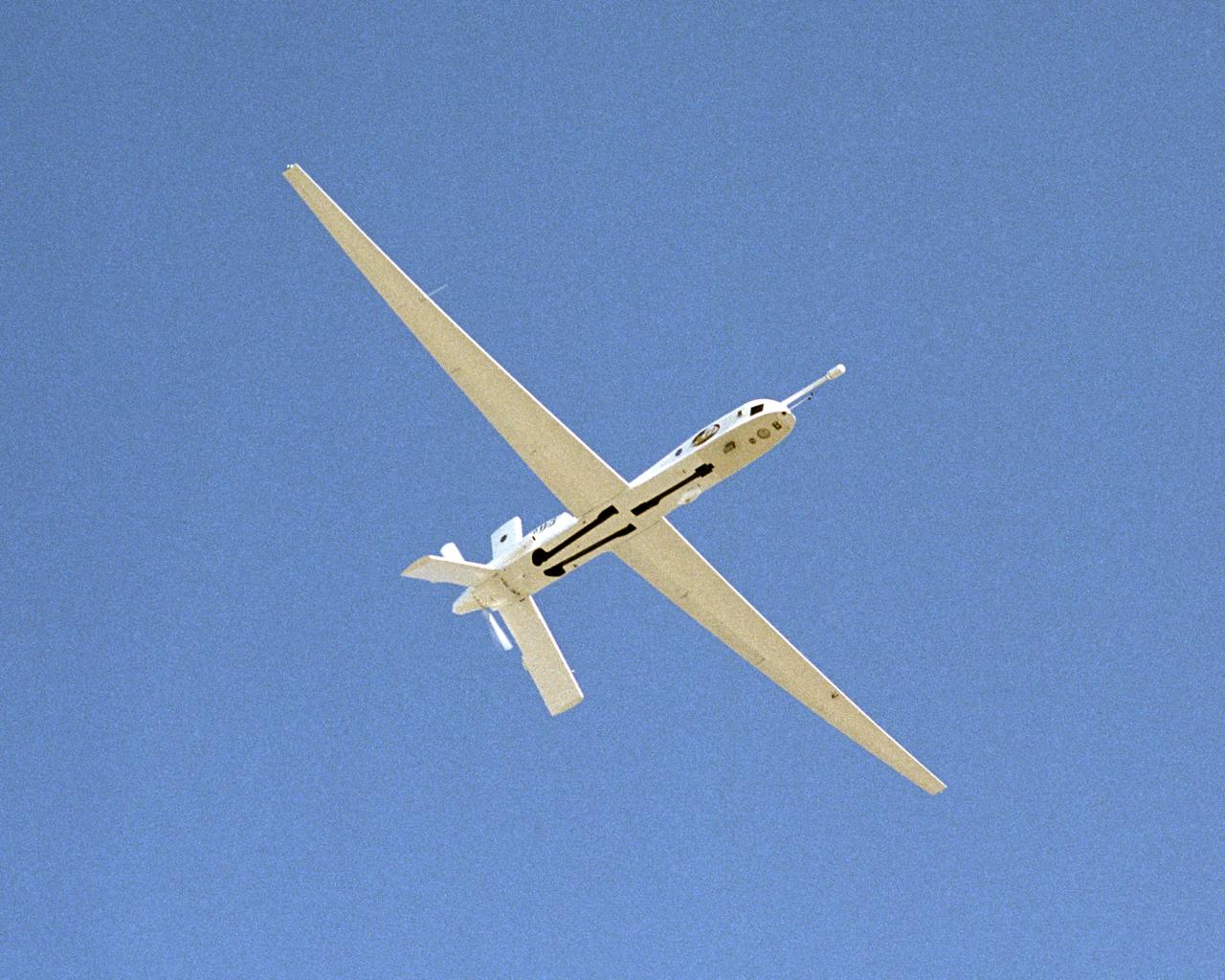
The Altus II remotely piloted aircraft carried a variety of specialized instruments and cameras during a lightning study over Florida during the summer of 2002.
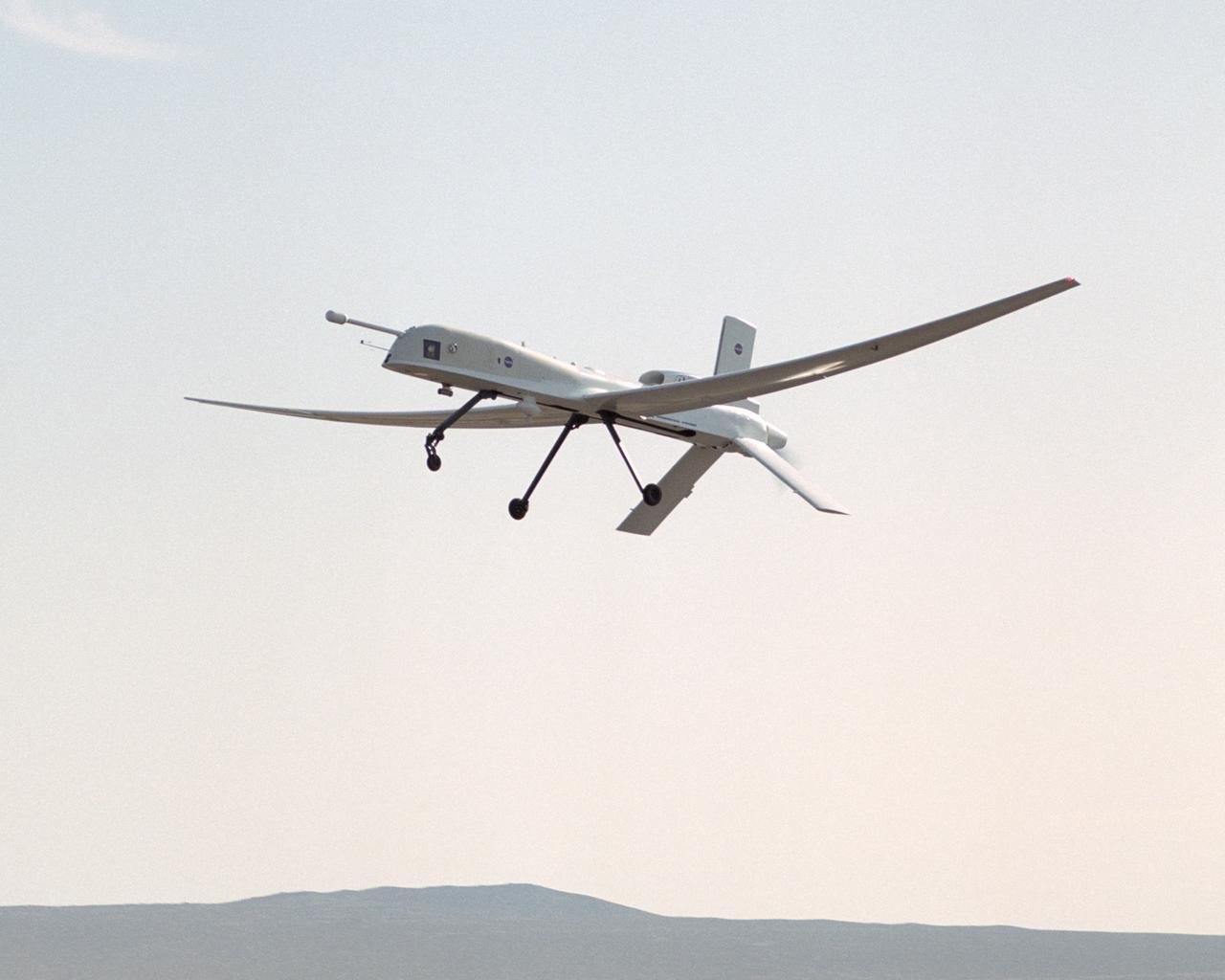
The remotely piloted Altus II aircraft probed lightning development with a variety of specialized instruments and cameras during a month-long study over Florida during the summer of 2002.
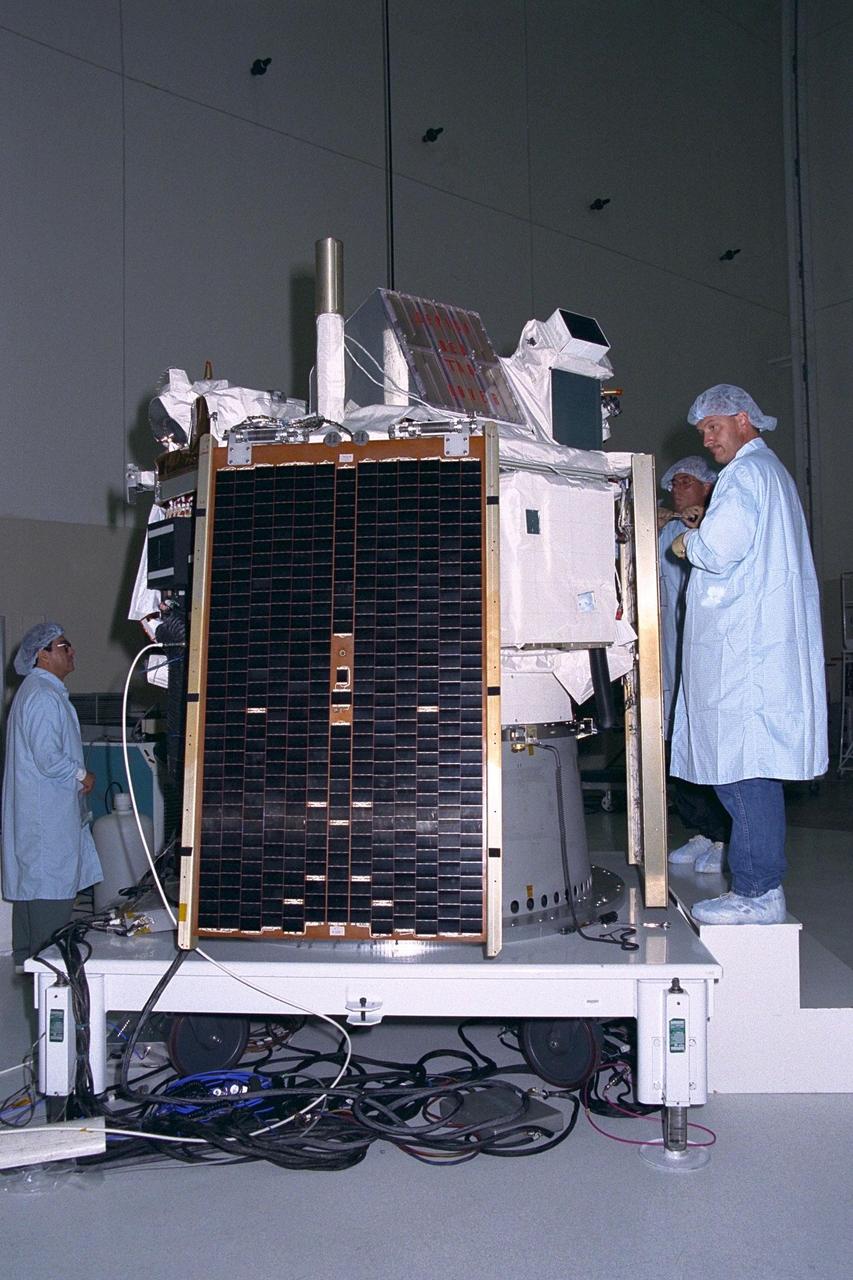
Applied Physics Laboratory engineers and technicians from Johns Hopkins University install solar array panels on the Advanced Composition Explorer (ACE) in KSC’s Spacecraft Assembly and Encapsulation Facility-II. The panel on which they are working is identical to the panel (one of four) seen in the foreground on the ACE spacecraft. Scheduled for launch on a Delta II rocket from Cape Canaveral Air Station on Aug. 25, ACE will study low-energy particles of solar origin and high-energy galactic particles for a better understanding of the formation and evolution of the solar system as well as the astrophysical processes involved. The ACE observatory will be placed into an orbit almost a million miles (1.5 million kilometers) away from the Earth, about 1/100 the distance from the Earth to the Sun. The collecting power of instrumentation aboard ACE is at least 100 times more sensitive than anything previously flown to collect similar data by NASA
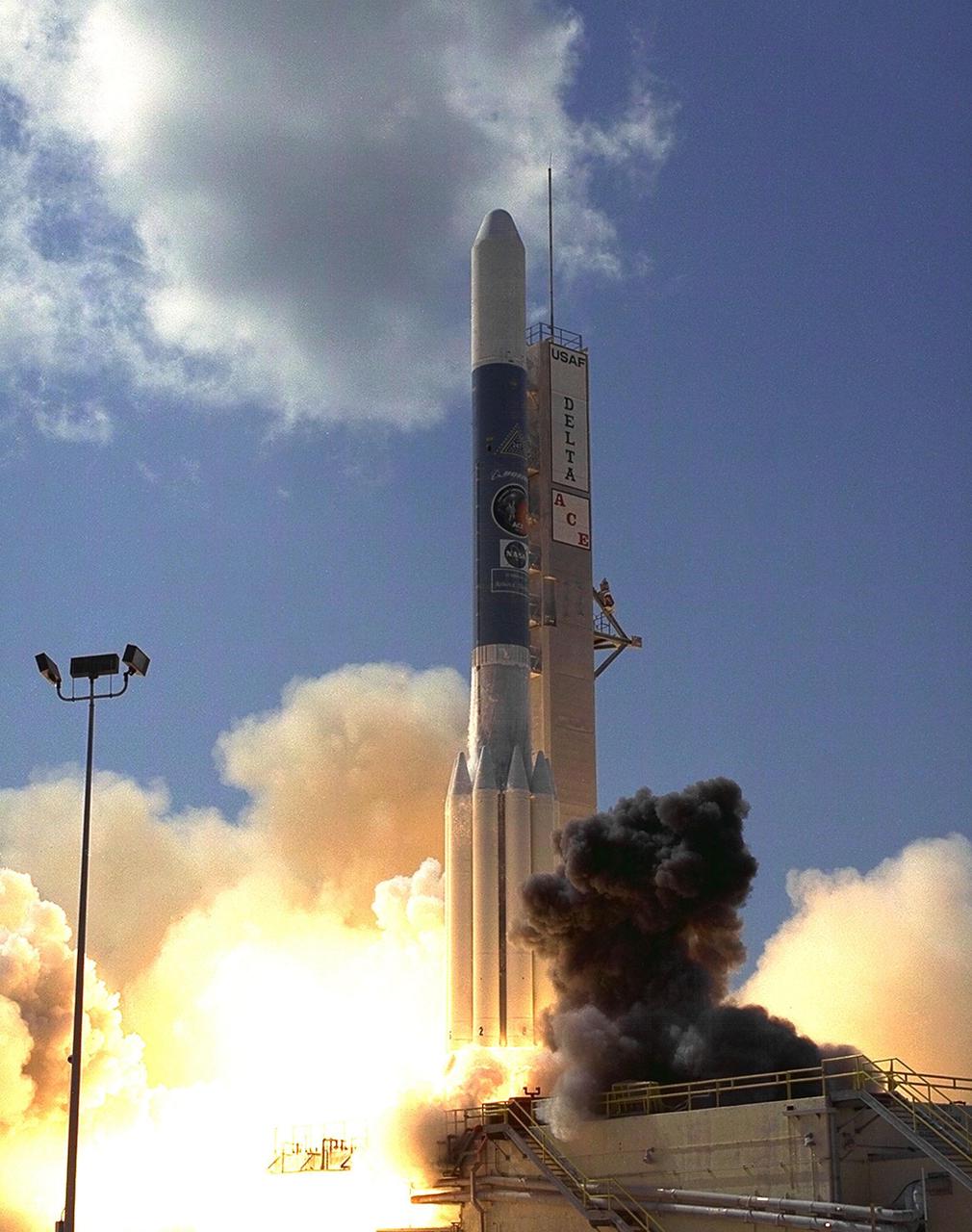
A Boeing Delta II expendable launch vehicle lifts off with NASA’s Advanced Composition Explorer (ACE) observatory at 10:39 a.m. EDT, on Aug. 25, 1997, from Launch Complex 17A, Cape Canaveral Air Station. This is the second Delta launch under the Boeing name and the first from Cape Canaveral. Launch was scrubbed one day by Air Force range safety personnel because two commercial fishing vessels were within the Delta’s launch danger area. The ACE spacecraft will study low-energy particles of solar origin and high-energy galactic particles on its one-million-mile journey. The collecting power of instruments aboard ACE is 10 to 1,000 times greater than anything previously flown to collect similar data by NASA. Study of these energetic particles may contribute to our understanding of the formation and evolution of the solar system. ACE has a two-year minimum mission lifetime and a goal of five years of service. ACE was built for NASA by the Johns Hopkins Applied Physics Laboratory and is managed by the Explorer Project Office at NASA's Goddard Space Flight Center. The lead scientific institution is the California Institute of Technology (Caltech) in Pasadena, Calif

Photographers and other onlookers watch as a Boeing Delta II expendable launch vehicle lifts off with NASA’s Advanced Composition Explorer (ACE) observatory at 10:39 a.m. EDT, on Aug. 25, 1997, from Launch Complex 17A, Cape Canaveral Air Station. This is the second Delta launch under the Boeing name and the first from Cape Canaveral. Liftoff had been scheduled for Aug. 24, but was scrubbed one day by Air Force range safety personnel because two commercial fishing vessels were within the Delta’s launch danger area. The ACE spacecraft will study low-energy particles of solar origin and high-energy galactic particles on its one-million-mile journey. The collecting power of instruments aboard ACE is 10 to 1,000 times greater than anything previously flown to collect similar data by NASA. Study of these energetic particles may contribute to our understanding of the formation and evolution of the solar system. ACE has a two-year minimum mission lifetime and a goal of five years of service. ACE was built for NASA by the Johns Hopkins Applied Physics Laboratory and is managed by the Explorer Project Office at NASA's Goddard Space Flight Center. The lead scientific institution is the California Institute of Technology (Caltech) in Pasadena, Calif
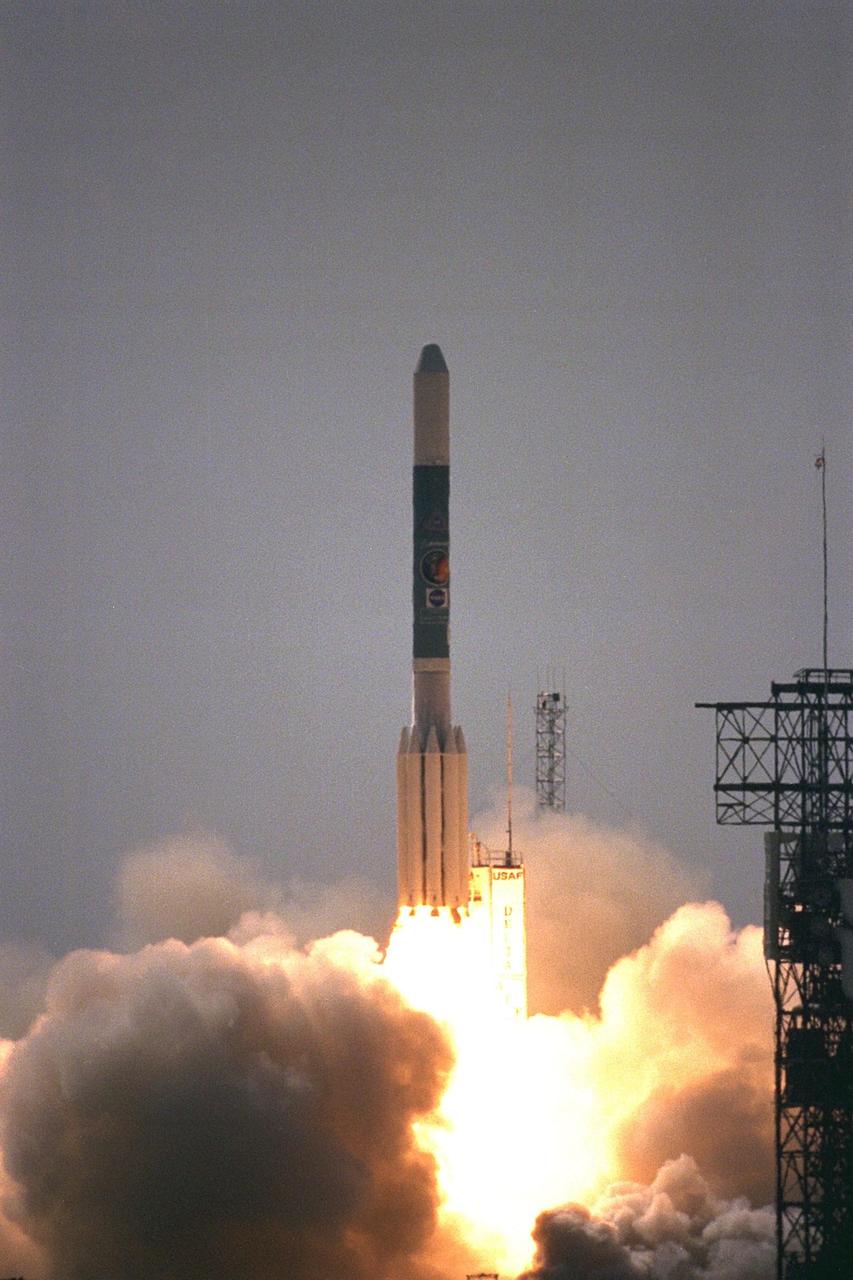
A Boeing Delta II expendable launch vehicle lifts off with NASA’s Advanced Composition Explorer (ACE) observatory at 10:39 a.m. EDT, on Aug. 25, 1997, from Launch Complex 17A, Cape Canaveral Air Station. This is the second Delta launch under the Boeing name and the first from Cape Canaveral. Launch was scrubbed one day by Air Force range safety personnel because two commercial fishing vessels were within the Delta’s launch danger area. The ACE spacecraft will study low-energy particles of solar origin and high-energy galactic particles on its one-million-mile journey. The collecting power of instruments aboard ACE is 10 to 1,000 times greater than anything previously flown to collect similar data by NASA. Study of these energetic particles may contribute to our understanding of the formation and evolution of the solar system. ACE has a two-year minimum mission lifetime and a goal of five years of service. ACE was built for NASA by the Johns Hopkins Applied Physics Laboratory and is managed by the Explorer Project Office at NASA's Goddard Space Flight Center. The lead scientific institution is the California Institute of Technology (Caltech) in Pasadena, Calif
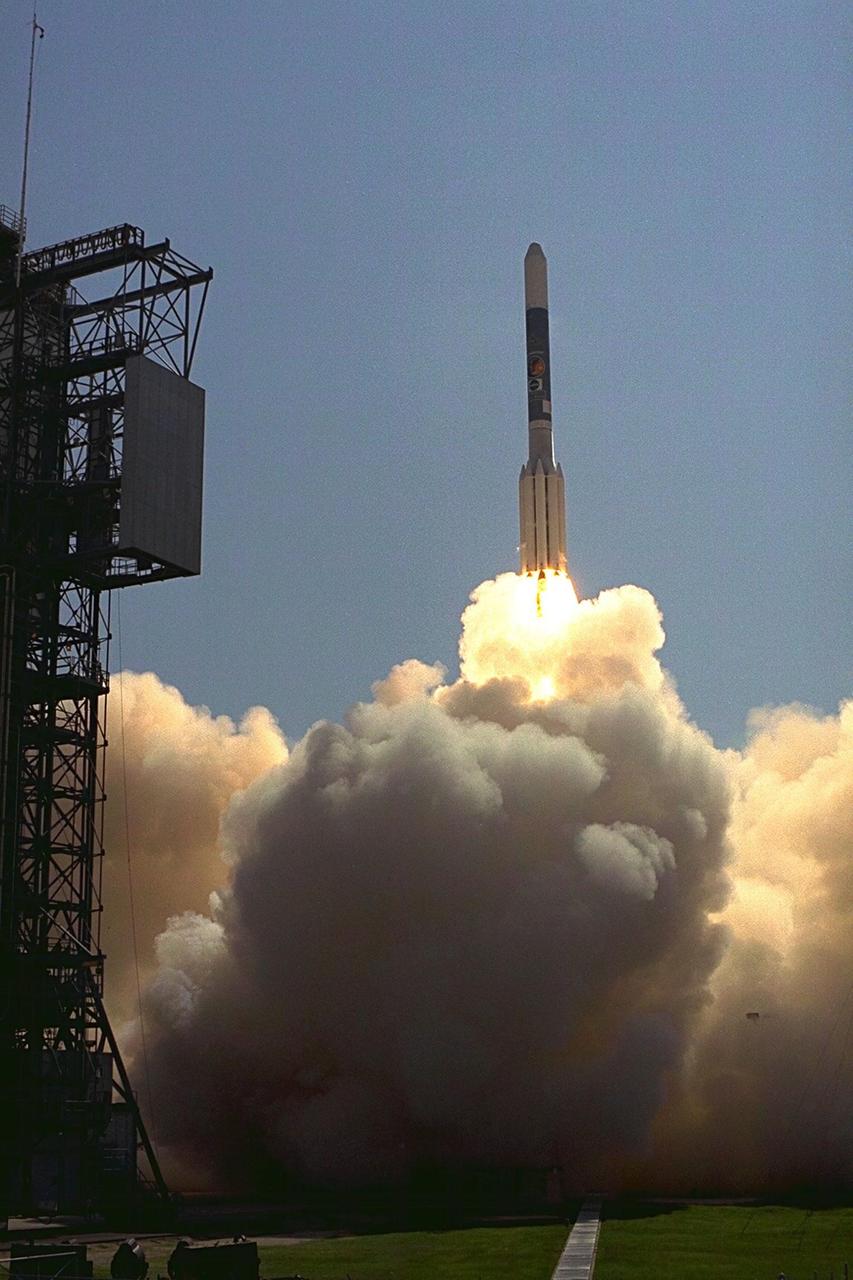
A Boeing Delta II expendable launch vehicle lifts off with NASA’s Advanced Composition Explorer (ACE) observatory at 10:39 a.m. EDT, on Aug. 25, 1997, from Launch Complex 17A, Cape Canaveral Air Station. This is the second Delta launch under the Boeing name and the first from Cape Canaveral. Launch was scrubbed one day by Air Force range safety personnel because two commercial fishing vessels were within the Delta’s launch danger area. The ACE spacecraft will study low-energy particles of solar origin and high-energy galactic particles on its one-million-mile journey. The collecting power of instruments aboard ACE is 10 to 1,000 times greater than anything previously flown to collect similar data by NASA. Study of these energetic particles may contribute to our understanding of the formation and evolution of the solar system. ACE has a two-year minimum mission lifetime and a goal of five years of service. ACE was built for NASA by the Johns Hopkins Applied Physics Laboratory and is managed by the Explorer Project Office at NASA's Goddard Space Flight Center. The lead scientific institution is the California Institute of Technology (Caltech) in Pasadena, Calif
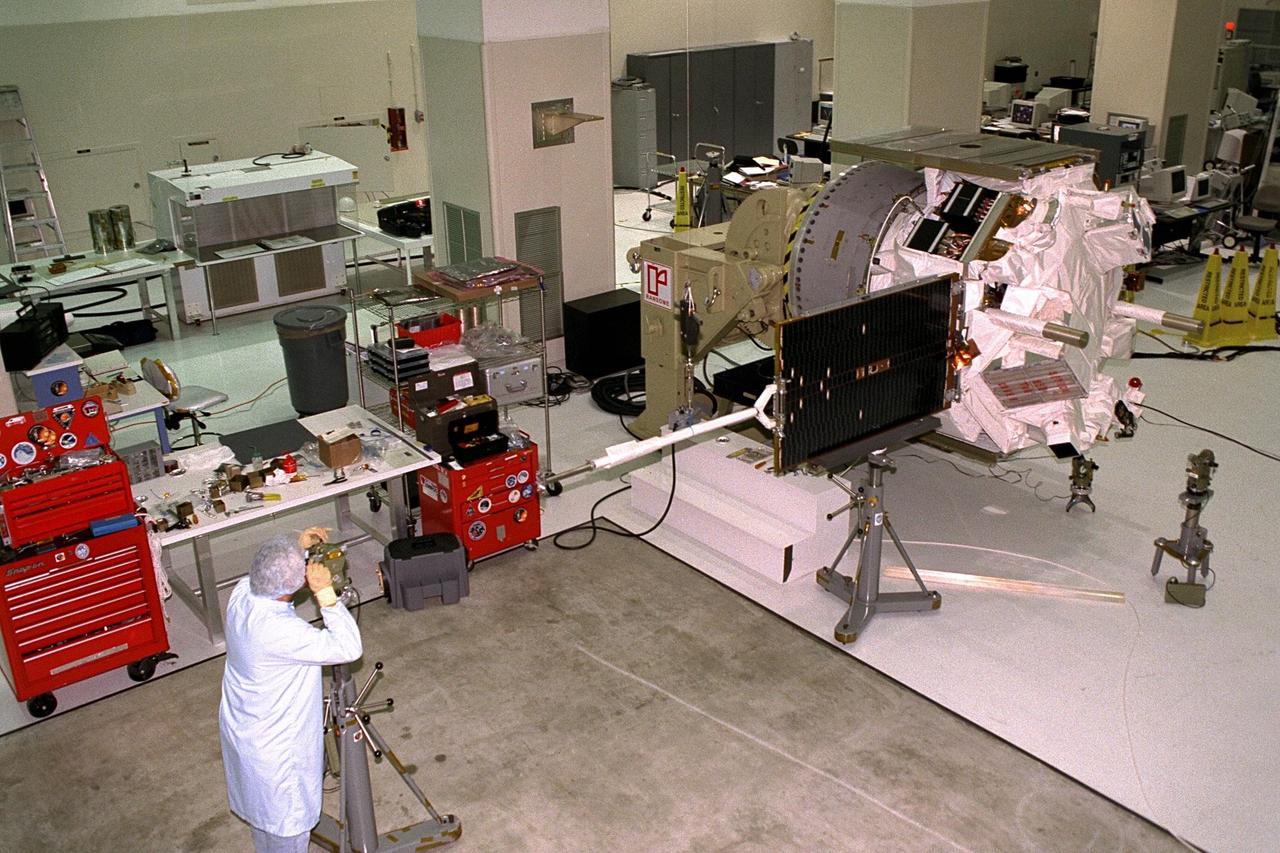
An Applied Physics Laboratory engineer from Johns Hopkins University tests for true perpendicular solar array deployment of the Advanced Composition Explorer (ACE) in KSC’s Spacecraft Assembly and Encapsulation Facility-II (SAEF-II). The white magnetometer boom seen across the solar array panel will deploy the panel once in space. Scheduled for launch on a Delta II rocket from Cape Canaveral Air Station on Aug. 25, ACE will study low-energy particles of solar origin and high-energy galactic particles. The ACE observatory will be placed into an orbit almost a million miles (1.5 million kilometers) away from the Earth, about 1/100 the distance from the Earth to the Sun
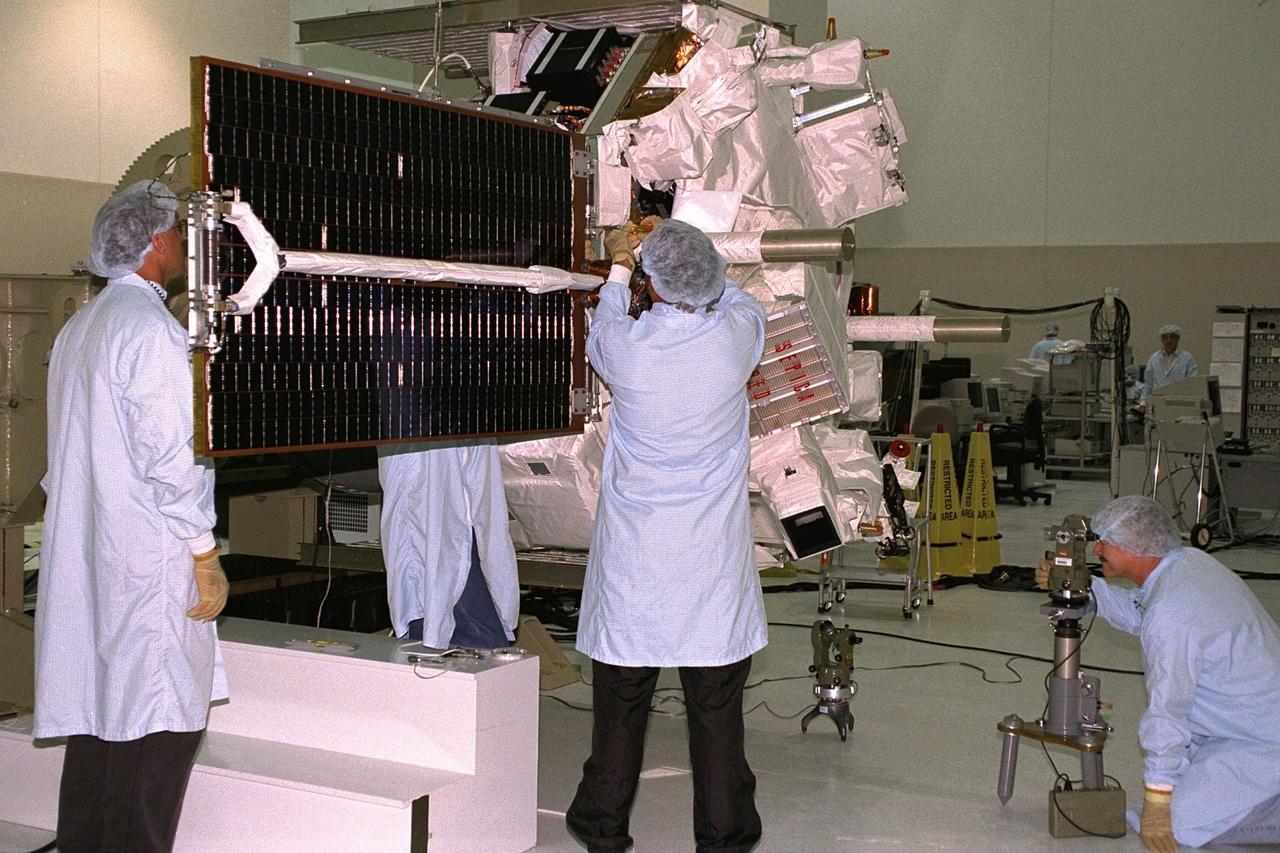
Applied Physics Laboratory engineers and technicians from Johns Hopkins University test for true perpendicular solar array deployment of the Advanced Composition Explorer (ACE) in KSC’s Spacecraft Assembly and Encapsulation Facility-II (SAEF-II). The white magnetometer boom seen across the solar array panel will deploy the panel once in space. Scheduled for launch on a Delta II rocket from Cape Canaveral Air Station on Aug. 25, ACE will study low-energy particles of solar origin and high-energy galactic particles. The ACE observatory will be placed into an orbit almost a million miles (1.5 million kilometers) away from the Earth, about 1/100 the distance from the Earth to the Sun
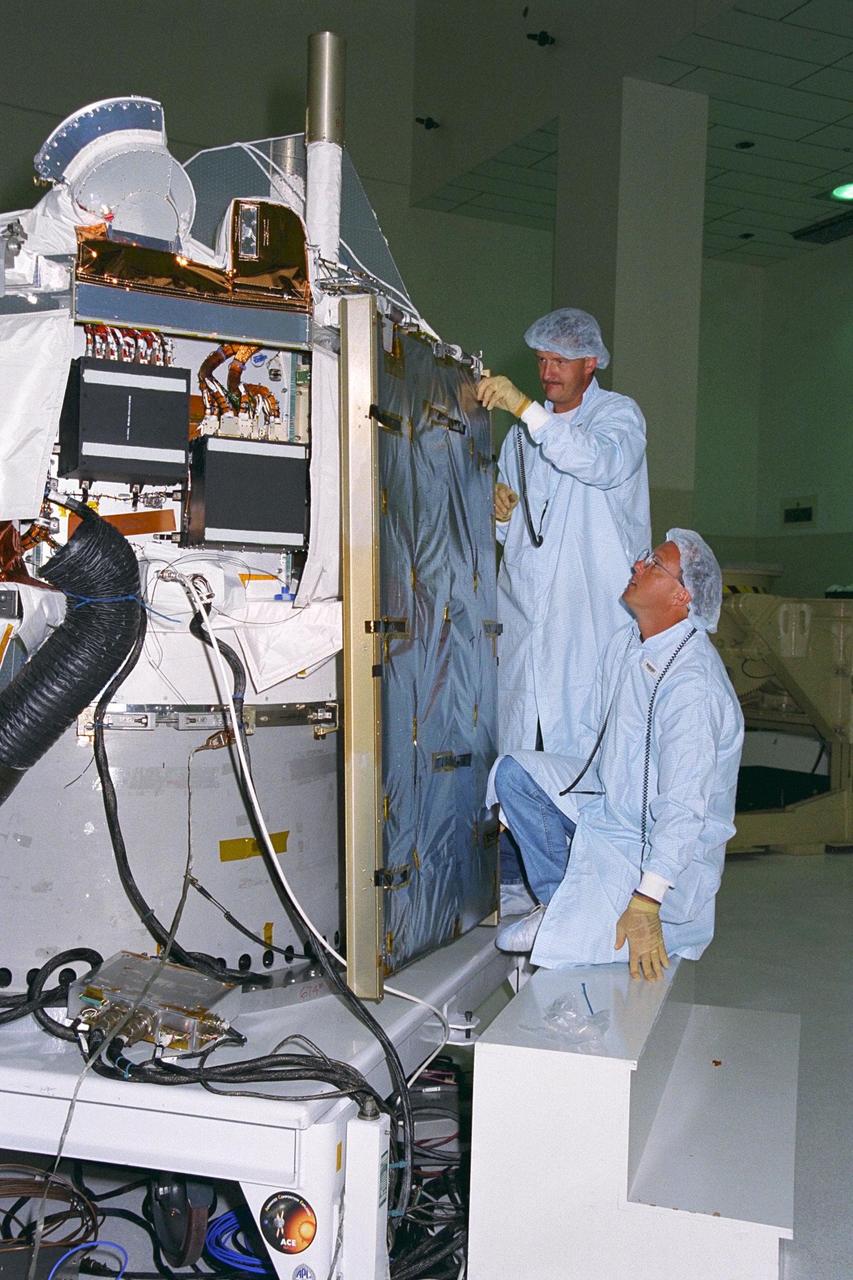
Applied Physics Laboratory Engineer Cliff Willey (kneeling) and Engineering Assistant Jim Hutcheson from Johns Hopkins University install solar array panels on the Advanced Composition Explorer (ACE) in KSC’s Spacecraft Assembly and Encapsulation Facility-II. Scheduled for launch on a Delta II rocket from Cape Canaveral Air Station on Aug. 25, ACE will study low-energy particles of solar origin and high-energy galactic particles for a better understanding of the formation and evolution of the solar system as well as the astrophysical processes involved. The ACE observatory will be placed into an orbit almost a million miles (1.5 million kilometers) away from the Earth, about 1/100 the distance from the Earth to the Sun. The collecting power of instrumentation aboard ACE is at least 100 times more sensitive than anything previously flown to collect similar data by NASA
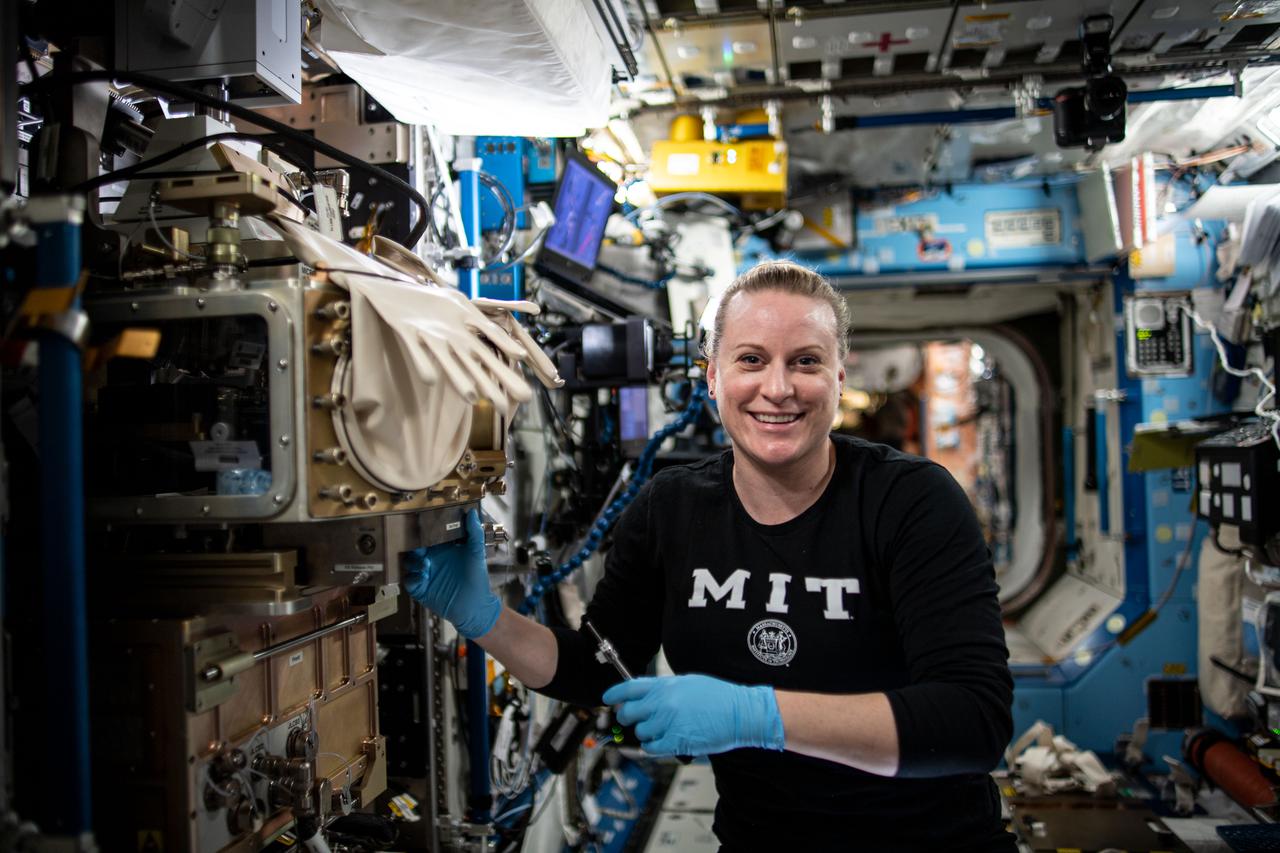
iss064e023935 (Jan. 14, 2021) --- NASA astronaut and Expedition 64 Flight Engineer Kate Rubins sets up the ACE-T-Ellipsoids study inside the Light Microscopy Module. The investigation designs and assembles complex three-dimensional colloids – small particles suspended within a fluid medium – and controls density and behavior of the particles with temperature.
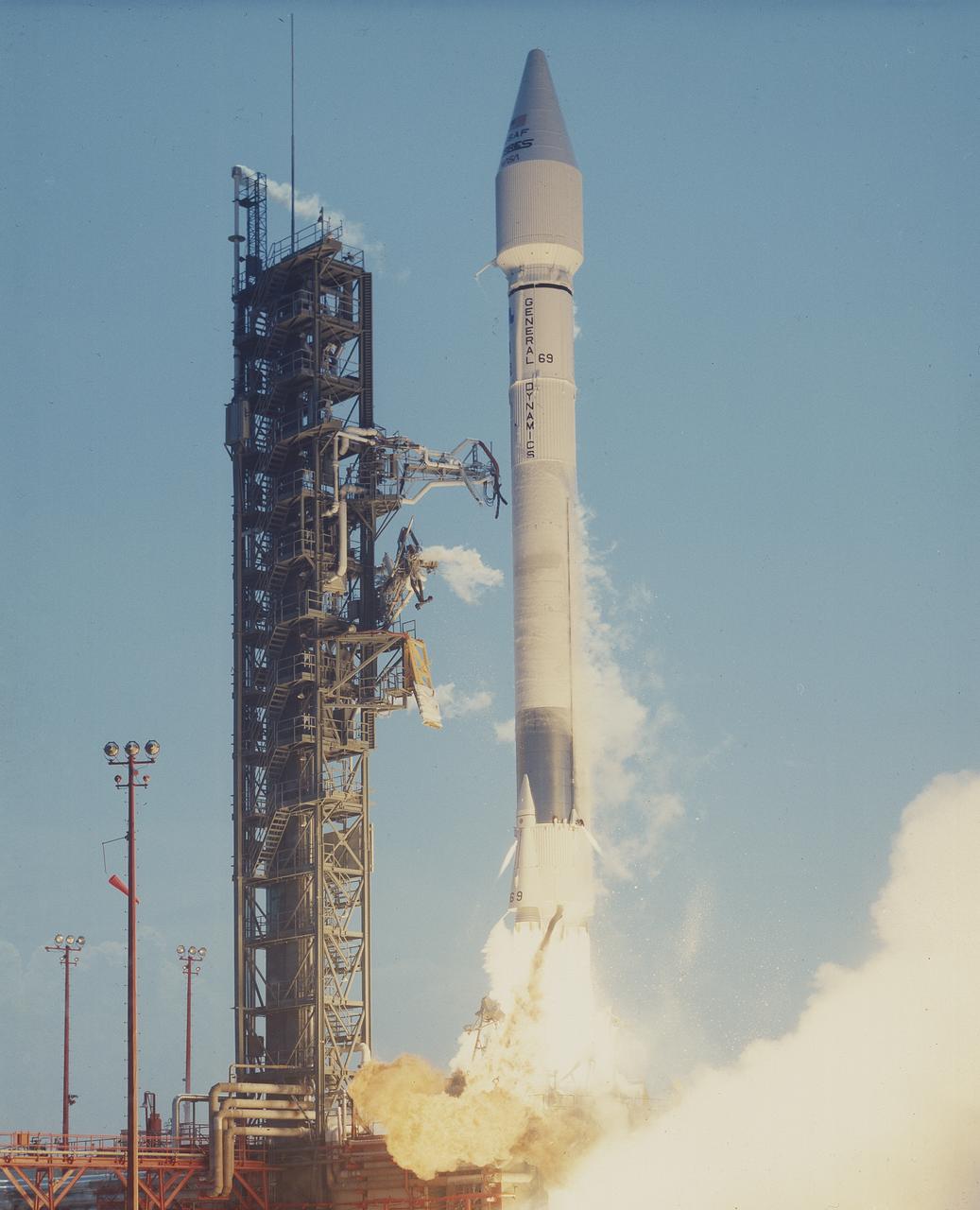
An Atlas Centaur rocket (AC-S9) was launched from Cape Canaveral Air Force Station complex 36B carrying into orbit the Combined Release and Radiation Effects Satellite (CRRES) spacecraft. CRRES was a joint NASA/Air Force mission to study the effects of chemical release on the Earth’s atmosphere and magnetosphere.
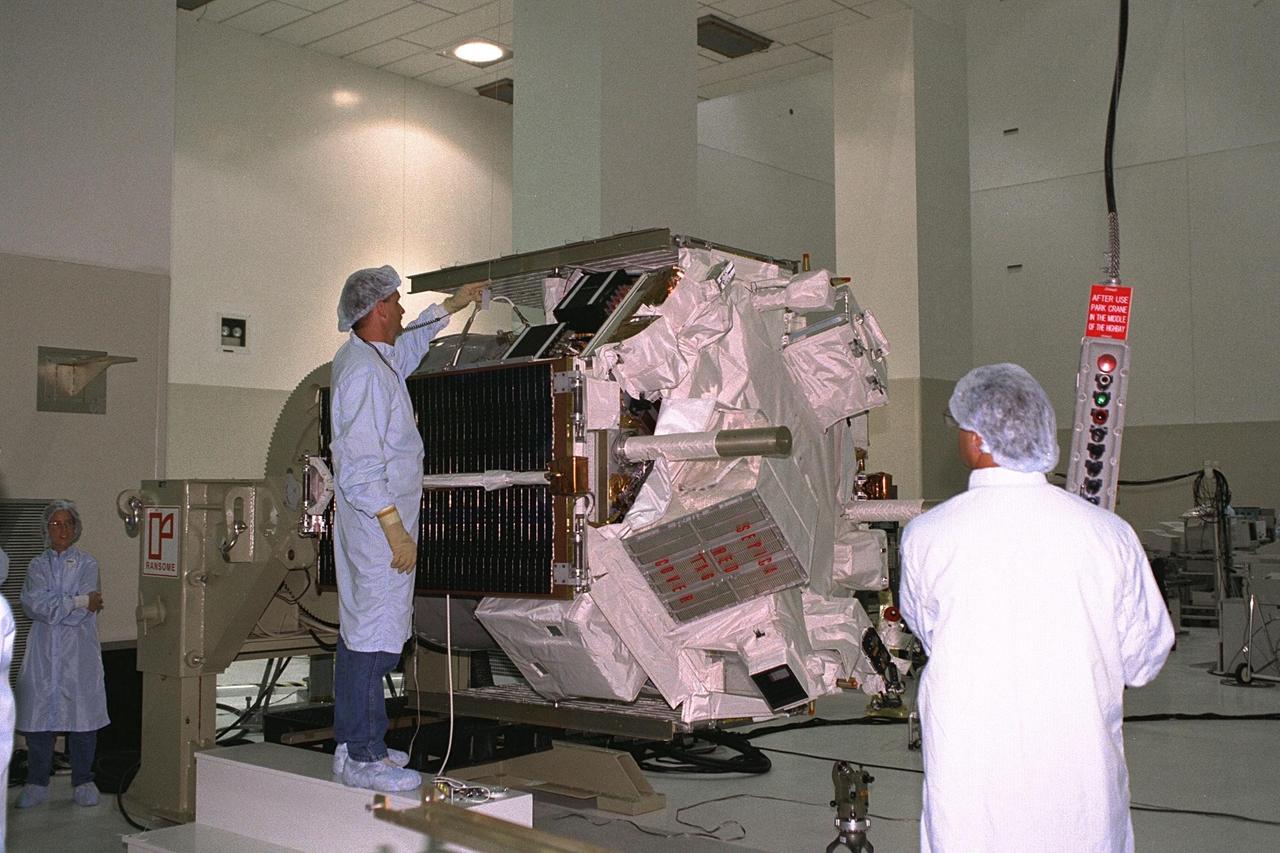
Applied Physics Laboratory engineers and technicians from Johns Hopkins University test solar array deployment of the Advanced Composition Explorer (ACE) in KSC’s Spacecraft Assembly and Encapsulation Facility-II (SAEF-II). The wire hanging from the ceiling above the black solar array panel is used for "g-negation," which takes the weight off of the panel’s hinges to simulate zero gravity, mimicking deployment in space. Scheduled for launch on a Delta II rocket from Cape Canaveral Air Station on Aug. 25, ACE will study low-energy particles of solar origin and high-energy galactic particles. The collecting power of instruments aboard ACE is 10 to 1,000 times greater than anything previously flown to collect similar data by NASA
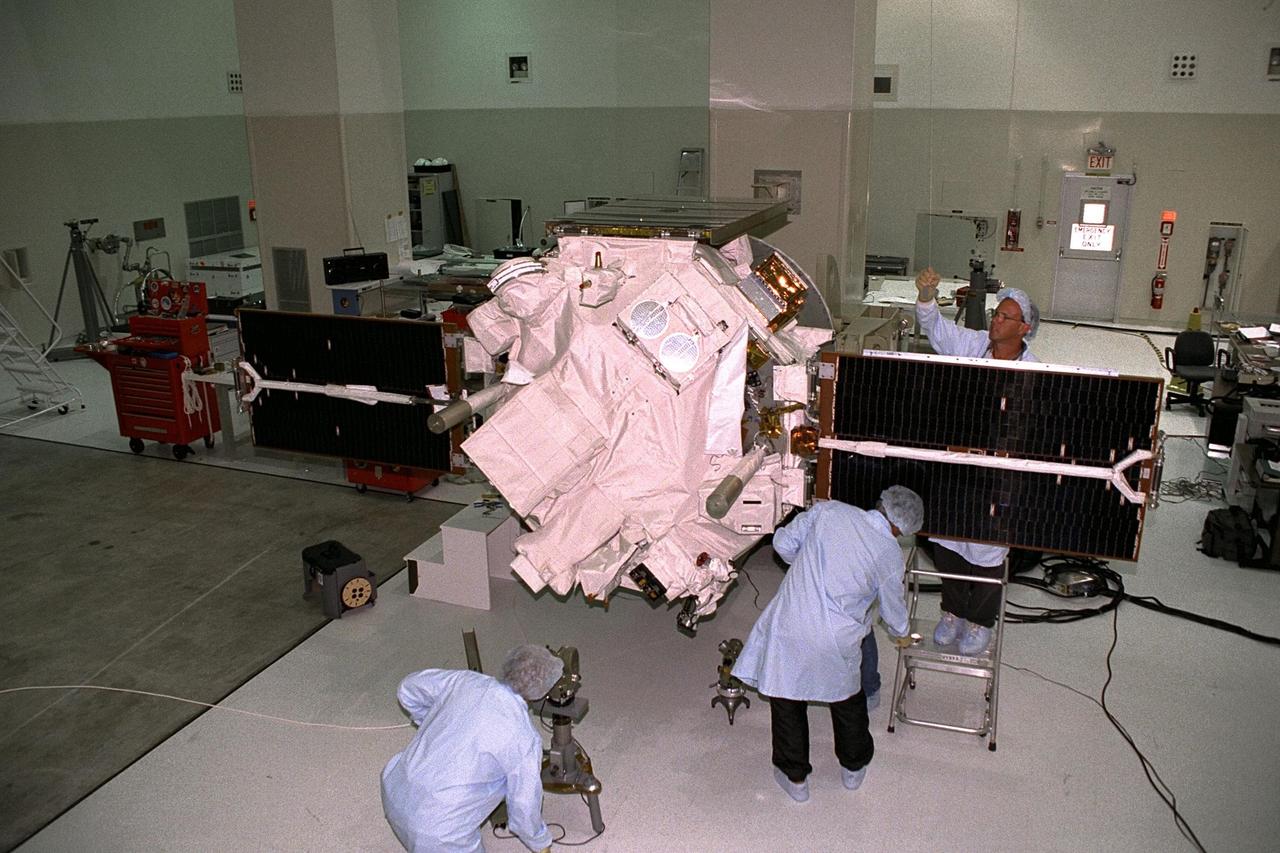
Applied Physics Laboratory engineers and technicians from Johns Hopkins University test solar array deployment of the Advanced Composition Explorer (ACE) in KSC’s Spacecraft Assembly and Encapsulation Facility-II (SAEF-II). The wire hanging from the ceiling above the black solar array panel is used for "g-negation," which takes the weight off of the panel’s hinges to simulate zero gravity, mimicking deployment in space. Scheduled for launch on a Delta II rocket from Cape Canaveral Air Station on Aug. 25, ACE will study low-energy particles of solar origin and high-energy galactic particles for a better understanding of the formation and evolution of the solar system as well as the astrophysical processes involved. The collecting power of instrumentation aboard ACE is at least 100 times more sensitive than anything previously flown to collect similar data by NASA
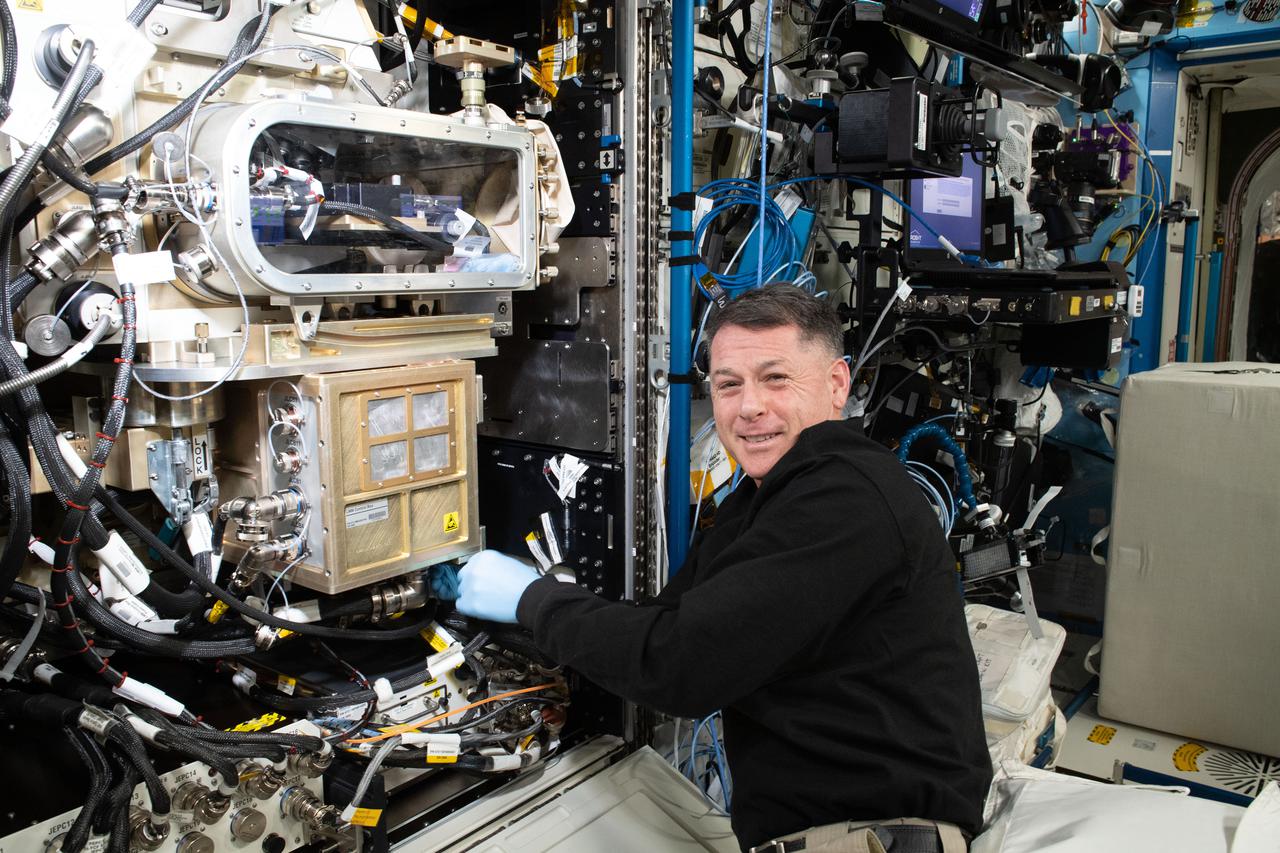
iss065e257486 (Aug. 17, 2021) --- NASA astronaut and Expedition 65 Flight Engineer Shane Kimbrough installs and configures a new Advanced Colloids Experiment module inside the U.S. Destiny laboratory module's Fluids Integrated Rack (FIR). The work supports the ACE-T9 fluid physics study that uses the FIR's Light Microscopy Module to image colloidal molecules for insights into the development of advanced materials not possible to produce in Earth's gravity.

This image was captured by the NASA/ESA Hubble Space Telescope’s Advanced Camera for Surveys (ACS), a highly efficient wide-field camera covering the optical and near-infrared parts of the spectrum. While this lovely image contains hundreds of distant stars and galaxies, one vital thing is missing — the object Hubble was actually studying at the time! This is not because the target has disappeared. The ACS actually uses two detectors: the first captures the object being studied — in this case an open star cluster known as NGC 299 — while the other detector images the patch of space just ‘beneath’ it. This is what can be seen here. Technically, this picture is merely a sidekick of the actual object of interest — but space is bursting with activity, and this field of bright celestial bodies offers plenty of interest on its own. It may initially seem to show just stars, but a closer look reveals many of these tiny objects to be galaxies. The spiral galaxies have arms curving out from a bright center. The fuzzier, less clearly shaped galaxies might be ellipticals. Some of these galaxies contain millions or even billions of stars, but are so distant that all of their starry residents are contained within just a small pinprick of light that appears to be the same size as a single star! The bright blue dots are very hot stars, sometimes distorted into crosses by the struts supporting Hubble’s secondary mirror. The redder dots are cooler stars, possibly in the red giant phase when a dying star cools and expands. Credit: ESA/Hubble & NASA <b><a href="http://www.nasa.gov/audience/formedia/features/MP_Photo_Guidelines.html" rel="nofollow">NASA image use policy.</a></b> <b><a href="http://www.nasa.gov/centers/goddard/home/index.html" rel="nofollow">NASA Goddard Space Flight Center</a></b> enables NASA’s mission through four scientific endeavors: Earth Science, Heliophysics, Solar System Exploration, and Astrophysics. Goddard plays a leading role in NASA’s accomplishments by contributing compelling scientific knowledge to advance the Agency’s mission. <b>Follow us on <a href="http://twitter.com/NASAGoddardPix" rel="nofollow">Twitter</a></b> <b>Like us on <a href="http://www.facebook.com/pages/Greenbelt-MD/NASA-Goddard/395013845897?ref=tsd" rel="nofollow">Facebook</a></b> <b>Find us on <a href="http://instagrid.me/nasagoddard/?vm=grid" rel="nofollow">Instagram</a></b>
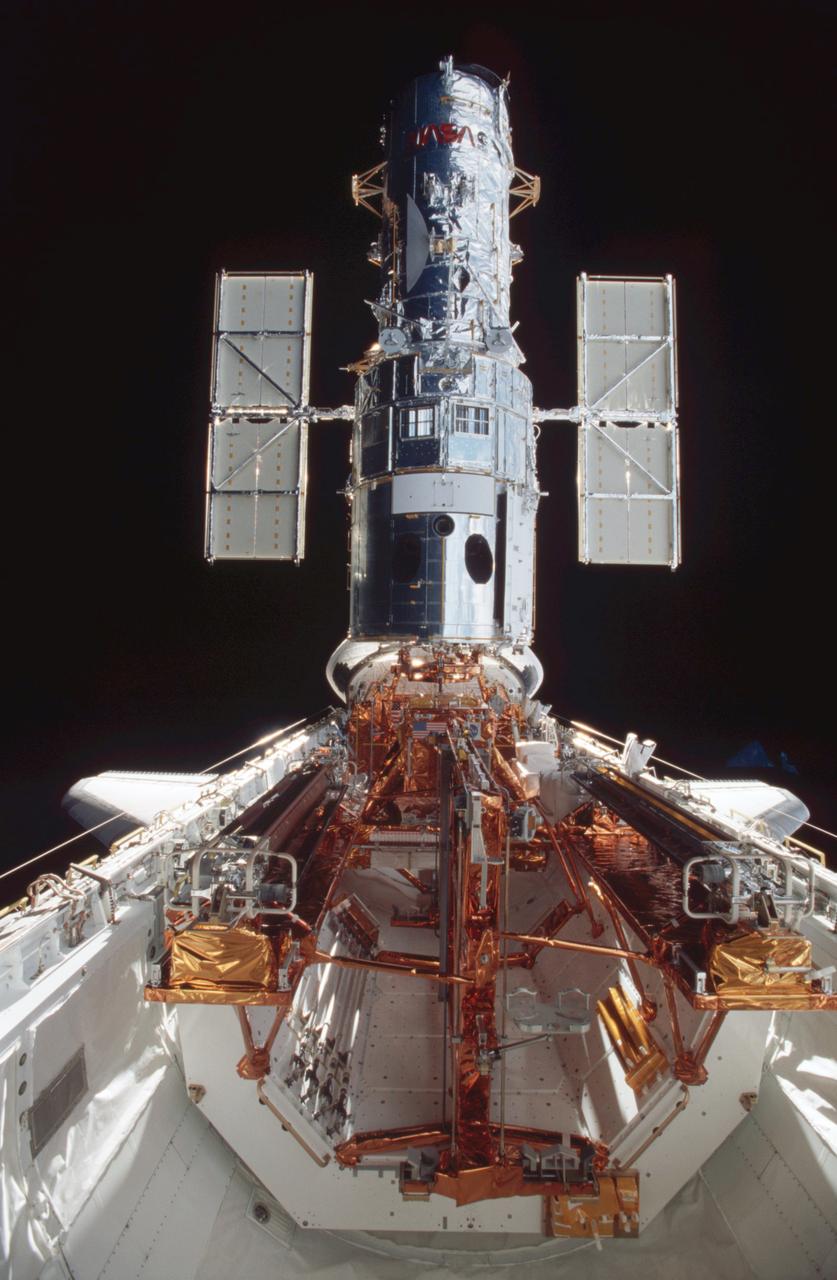
After five days of service and upgrade work on the Hubble Space Telescope (HST), the STS-109 crew photographed the giant telescope in the shuttle's cargo bay. The telescope was captured and secured on a work stand in Columbia's payload bay using Columbia's robotic arm, where 4 of the 7-member crew performed 5 space walks completing system upgrades to the HST. Included in those upgrades were: The replacement of the solar array panels; replacement of the power control unit (PCU); replacement of the Faint Object Camera (FOC) with a new advanced camera for Surveys (ACS); and installation of the experimental cooling system for the Hubble's Near-Infrared Camera and Multi-object Spectrometer (NICMOS), which had been dormant since January 1999 when its original coolant ran out. The Marshall Space Flight Center had the responsibility for the design, development, and construction of the the HST, which is the most complex and sensitive optical telescope ever made, to study the cosmos from a low-Earth orbit. Launched March 1, 2002, the STS-109 HST servicing mission lasted 10 days, 22 hours, and 11 minutes. It was the 108th flight overall in NASA's Space Shuttle Program.
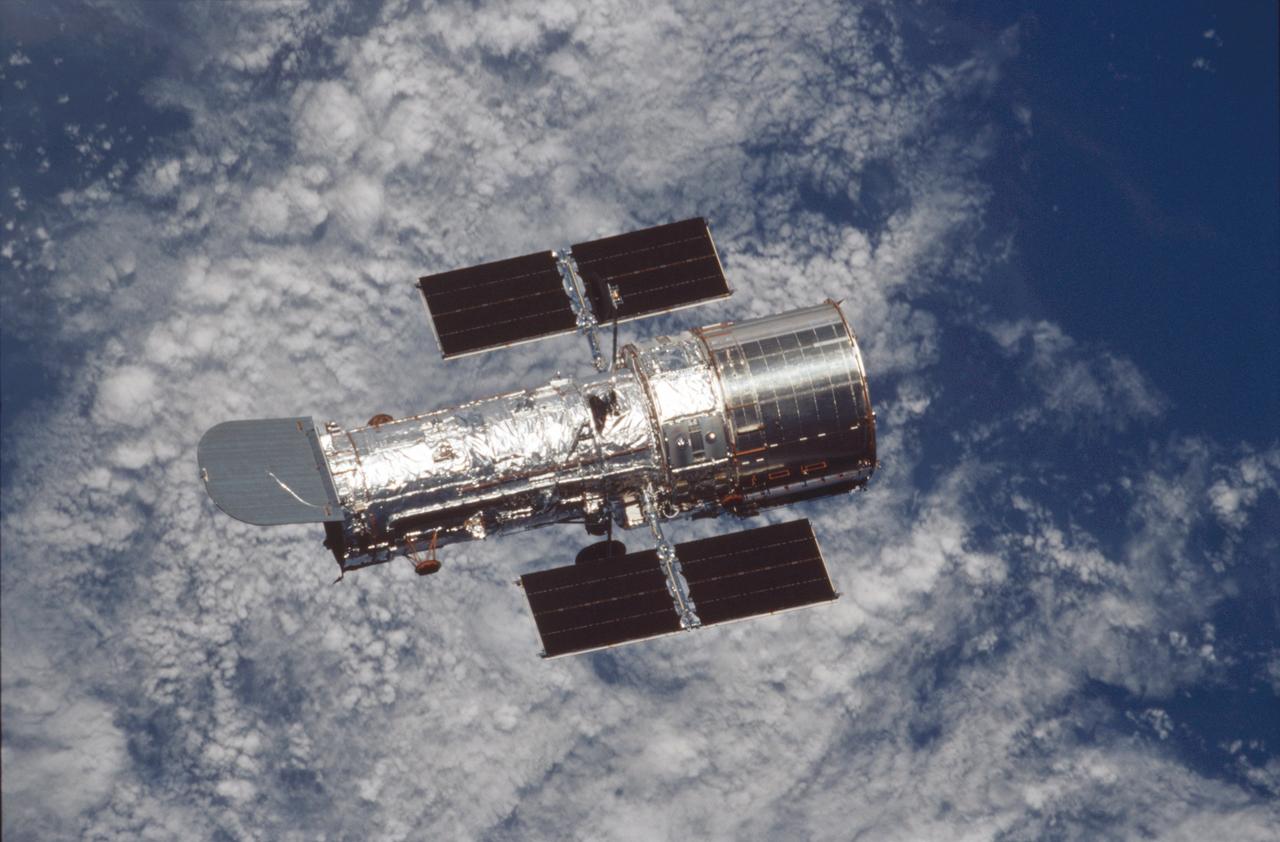
After five days of service and upgrade work on the Hubble Space Telescope (HST), the STS-109 crew photographed the giant telescope returning to its normal routine. The telescope was captured and secured on a work stand in Columbia's payload bay using Columbia's robotic arm, where 4 of the 7-member crew performed 5 space walks completing system upgrades to the HST. Included in those upgrades were: The replacement of the solar array panels; replacement of the power control unit (PCU); replacement of the Faint Object Camera (FOC) with a new advanced camera for Surveys (ACS); and installation of the experimental cooling system for the Hubble's Near- Infrared Camera and Multi-object Spectrometer (NICMOS), which had been dormant since January 1999 when its original coolant ran out. The Marshall Space Flight Center had the responsibility for the design, development, and construction of the the HST, which is the most complex and sensitive optical telescope ever made, to study the cosmos from a low-Earth orbit. Launched March 1, 2002, the STS-109 HST servicing mission lasted 10 days, 22 hours, and 11 minutes. It was the 108th flight overall in NASA's Space Shuttle Program.
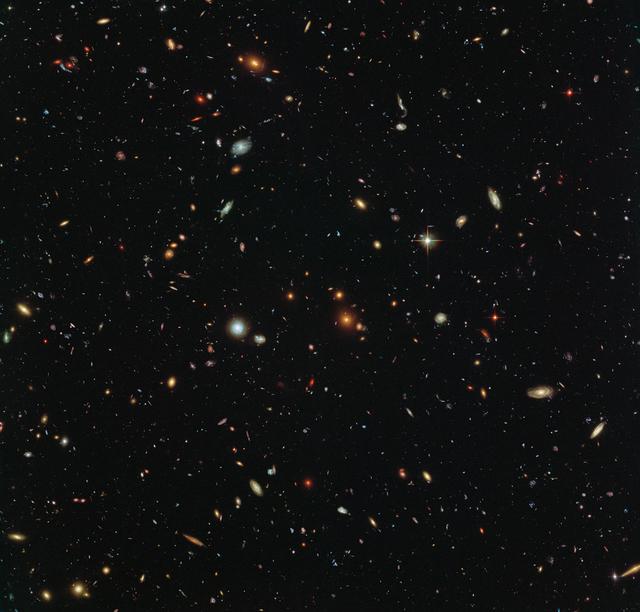
Peering deep into the early Universe, this picturesque parallel field observation from the NASA/ESA Hubble Space Telescope reveals thousands of colourful galaxies swimming in the inky blackness of space. A few foreground stars from our own galaxy, the Milky Way, are also visible. In October 2013 Hubble’s Wide Field Camera 3 (WFC3) and Advanced Camera for Surveys (ACS) began observing this portion of sky as part of the Frontier Fields programme. This spectacular skyscape was captured during the study of the giant galaxy cluster Abell 2744, otherwise known as Pandora’s Box. While one of Hubble’s cameras concentrated on Abell 2744, the other camera viewed this adjacent patch of sky near to the cluster. Containing countless galaxies of various ages, shapes and sizes, this parallel field observation is nearly as deep as the Hubble Ultra-Deep Field. In addition to showcasing the stunning beauty of the deep Universe in incredible detail, this parallel field — when compared to other deep fields — will help astronomers understand how similar the Universe looks in different directions
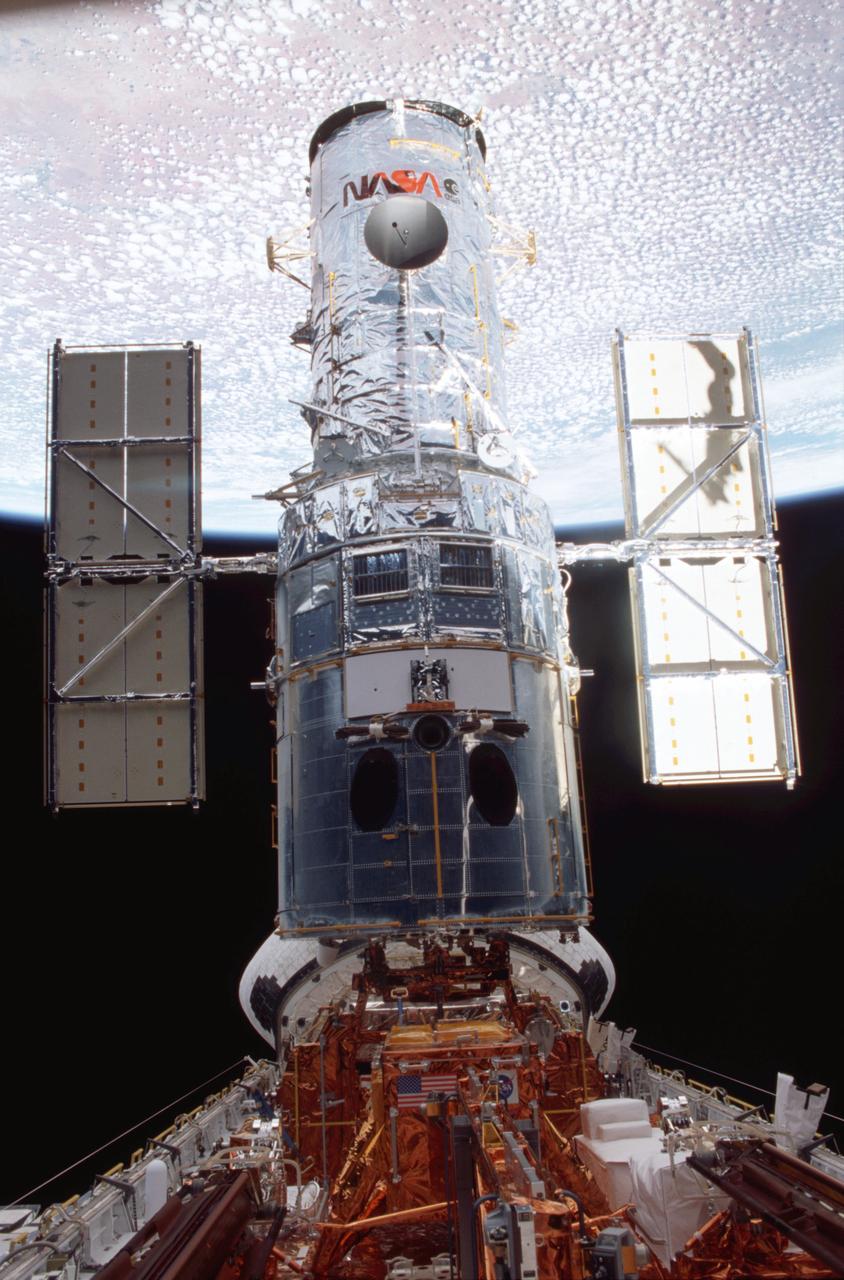
After five days of service and upgrade work on the Hubble Space Telescope (HST), the STS-109 crew photographed the giant telescope in the shuttle's cargo bay. The telescope was captured and secured on a work stand in Columbia's payload bay using Columbia's robotic arm, where 4 of the 7-member crew performed 5 space walks completing system upgrades to the HST. Included in those upgrades were: The replacement of the solar array panels; replacement of the power control unit (PCU); replacement of the Faint Object Camera (FOC) with a new advanced camera for Surveys (ACS); and installation of the experimental cooling system for the Hubble's Near-Infrared Camera and Multi-object Spectrometer (NICMOS), which had been dormant since January 1999 when its original coolant ran out. The Marshall Space Flight Center had the responsibility for the design, development, and construction of the the HST, which is the most complex and sensitive optical telescope ever made, to study the cosmos from a low-Earth orbit. Launched March 1, 2002, the STS-109 HST servicing mission lasted 10 days, 22 hours, and 11 minutes. It was the 108th flight overall in NASA's Space Shuttle Program.
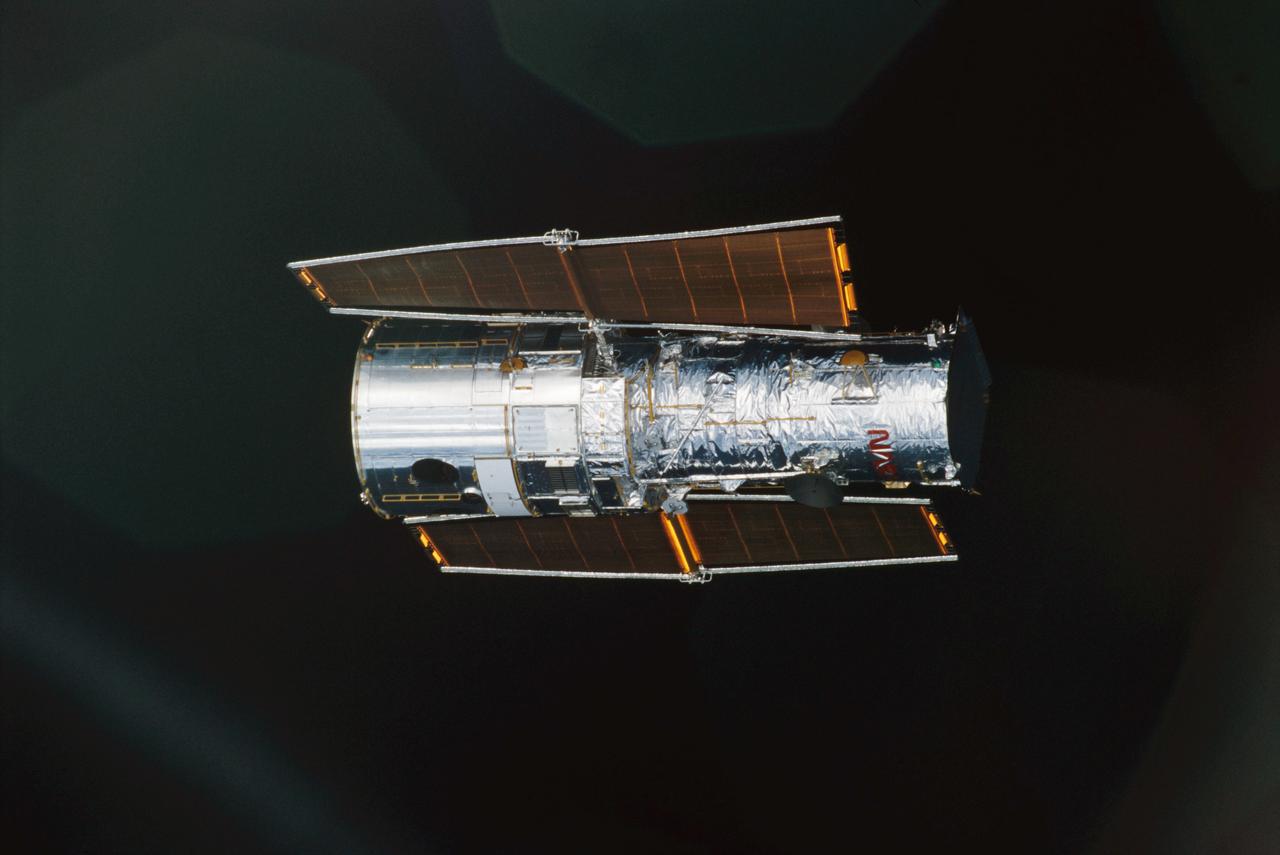
The Hubble Space Telescope (HST), with its normal routine temporarily interrupted, is about to be captured by the Space Shuttle Columbia prior to a week of servicing and upgrading by the STS-109 crew. The telescope was captured by the shuttle's Remote Manipulator System (RMS) robotic arm and secured on a work stand in Columbia's payload bay where 4 of the 7-member crew performed 5 space walks completing system upgrades to the HST. Included in those upgrades were: The replacement of the solar array panels; replacement of the power control unit (PCU); replacement of the Faint Object Camera (FOC) with a new advanced camera for Surveys (ACS); and installation of the experimental cooling system for the Hubble's Near-Infrared Camera and Multi-object Spectrometer (NICMOS), which had been dormant since January 1999 when its original coolant ran out. The Marshall Space Flight Center had the responsibility for the design, development, and construction of the the HST, which is the most complex and sensitive optical telescope ever made, to study the cosmos from a low-Earth orbit. Launched March 1, 2002, the STS-109 HST servicing mission lasted 10 days, 22 hours, and 11 minutes. It was the 108th flight overall in NASA's Space Shuttle Program.
![This new Hubble image showcases a remarkable variety of objects at different distances from us, extending back over halfway to the edge of the observable Universe. The galaxies in this image mostly lie about five billion light-years from Earth but the field also contains other objects, both significantly closer and far more distant. Studies of this region of the sky have shown that many of the objects that appear to lie close together may actually be billions of light-years apart. This is because several groups of galaxies lie along our line of sight, creating something of an optical illusion. Hubble’s cross-section of the Universe is completed by distorted images of galaxies in the very distant background. These objects are sometimes distorted due to a process called gravitational lensing, an extremely valuable technique in astronomy for studying very distant objects [1]. This lensing is caused by the bending of the space-time continuum by massive galaxies lying close to our line of sight to distant objects. One of the lens systems visible here is called CLASS B1608+656, which appears as a small loop in the centre of the image. It features two foreground galaxies distorting and amplifying the light of a distant quasar the known as QSO-160913+653228. The light from this bright disc of matter, which is currently falling into a black hole, has taken nine billion years to reach us — two thirds of the age of the Universe. As well as CLASS B1608+656, astronomers have identified two other gravitational lenses within this image. Two galaxies, dubbed Fred and Ginger by the researchers who studied them, contain enough mass to visibly distort the light from objects behind them. Fred, also known more prosaically as [FMK2006] ACS J160919+6532, lies near the lens galaxies in CLASS B1608+656, while Ginger ([FMK2006] ACS J160910+6532) is markedly closer to us. Despite their different distances from us, both can be seen near to CLASS B1608+656 in the central region of this Hubble image. To capture distant and dim objects like these, Hubble required a long exposure. The image is made up of visible and infrared observations with a total exposure time of 14 hours. More info: <a href="http://www.spacetelescope.org/news/heic1408/" rel="nofollow">www.spacetelescope.org/news/heic1408/</a> Credit: NASA/ESA/Hubble <b><a href="http://www.nasa.gov/audience/formedia/features/MP_Photo_Guidelines.html" rel="nofollow">NASA image use policy.</a></b> <b><a href="http://www.nasa.gov/centers/goddard/home/index.html" rel="nofollow">NASA Goddard Space Flight Center</a></b> enables NASA’s mission through four scientific endeavors: Earth Science, Heliophysics, Solar System Exploration, and Astrophysics. Goddard plays a leading role in NASA’s accomplishments by contributing compelling scientific knowledge to advance the Agency’s mission. <b>Follow us on <a href="http://twitter.com/NASAGoddardPix" rel="nofollow">Twitter</a></b> <b>Like us on <a href="http://www.facebook.com/pages/Greenbelt-MD/NASA-Goddard/395013845897?ref=tsd" rel="nofollow">Facebook</a></b> <b>Find us on <a href="http://instagram.com/nasagoddard?vm=grid" rel="nofollow">Instagram</a></b>](https://images-assets.nasa.gov/image/GSFC_20171208_Archive_e001152/GSFC_20171208_Archive_e001152~medium.jpg)
This new Hubble image showcases a remarkable variety of objects at different distances from us, extending back over halfway to the edge of the observable Universe. The galaxies in this image mostly lie about five billion light-years from Earth but the field also contains other objects, both significantly closer and far more distant. Studies of this region of the sky have shown that many of the objects that appear to lie close together may actually be billions of light-years apart. This is because several groups of galaxies lie along our line of sight, creating something of an optical illusion. Hubble’s cross-section of the Universe is completed by distorted images of galaxies in the very distant background. These objects are sometimes distorted due to a process called gravitational lensing, an extremely valuable technique in astronomy for studying very distant objects [1]. This lensing is caused by the bending of the space-time continuum by massive galaxies lying close to our line of sight to distant objects. One of the lens systems visible here is called CLASS B1608+656, which appears as a small loop in the centre of the image. It features two foreground galaxies distorting and amplifying the light of a distant quasar the known as QSO-160913+653228. The light from this bright disc of matter, which is currently falling into a black hole, has taken nine billion years to reach us — two thirds of the age of the Universe. As well as CLASS B1608+656, astronomers have identified two other gravitational lenses within this image. Two galaxies, dubbed Fred and Ginger by the researchers who studied them, contain enough mass to visibly distort the light from objects behind them. Fred, also known more prosaically as [FMK2006] ACS J160919+6532, lies near the lens galaxies in CLASS B1608+656, while Ginger ([FMK2006] ACS J160910+6532) is markedly closer to us. Despite their different distances from us, both can be seen near to CLASS B1608+656 in the central region of this Hubble image. To capture distant and dim objects like these, Hubble required a long exposure. The image is made up of visible and infrared observations with a total exposure time of 14 hours. More info: <a href="http://www.spacetelescope.org/news/heic1408/" rel="nofollow">www.spacetelescope.org/news/heic1408/</a> Credit: NASA/ESA/Hubble <b><a href="http://www.nasa.gov/audience/formedia/features/MP_Photo_Guidelines.html" rel="nofollow">NASA image use policy.</a></b> <b><a href="http://www.nasa.gov/centers/goddard/home/index.html" rel="nofollow">NASA Goddard Space Flight Center</a></b> enables NASA’s mission through four scientific endeavors: Earth Science, Heliophysics, Solar System Exploration, and Astrophysics. Goddard plays a leading role in NASA’s accomplishments by contributing compelling scientific knowledge to advance the Agency’s mission. <b>Follow us on <a href="http://twitter.com/NASAGoddardPix" rel="nofollow">Twitter</a></b> <b>Like us on <a href="http://www.facebook.com/pages/Greenbelt-MD/NASA-Goddard/395013845897?ref=tsd" rel="nofollow">Facebook</a></b> <b>Find us on <a href="http://instagram.com/nasagoddard?vm=grid" rel="nofollow">Instagram</a></b>

A lone source shines out brightly from the dark expanse of deep space, glowing softly against a picturesque backdrop of distant stars and colorful galaxies. Captured by the NASA/ESA Hubble Space Telescope’s Advanced Camera for Surveys (ACS), this scene shows PGC 83677, a lenticular galaxy — a galaxy type that sits between the more familiar elliptical and spiral varieties. It reveals both the relatively calm outskirts and intriguing core of PGC 83677. Here, studies have uncovered signs of a monstrous black hole that is spewing out high-energy X-rays and ultraviolet light. Credit: NASA/ESA/Hubble; acknowledgements: Judy Schmidt (Geckzilla) <b><a href="http://www.nasa.gov/audience/formedia/features/MP_Photo_Guidelines.html" rel="nofollow">NASA image use policy.</a></b> <b><a href="http://www.nasa.gov/centers/goddard/home/index.html" rel="nofollow">NASA Goddard Space Flight Center</a></b> enables NASA’s mission through four scientific endeavors: Earth Science, Heliophysics, Solar System Exploration, and Astrophysics. Goddard plays a leading role in NASA’s accomplishments by contributing compelling scientific knowledge to advance the Agency’s mission. <b>Follow us on <a href="http://twitter.com/NASAGoddardPix" rel="nofollow">Twitter</a></b> <b>Like us on <a href="http://www.facebook.com/pages/Greenbelt-MD/NASA-Goddard/395013845897?ref=tsd" rel="nofollow">Facebook</a></b> <b>Find us on <a href="http://instagrid.me/nasagoddard/?vm=grid" rel="nofollow">Instagram</a></b>
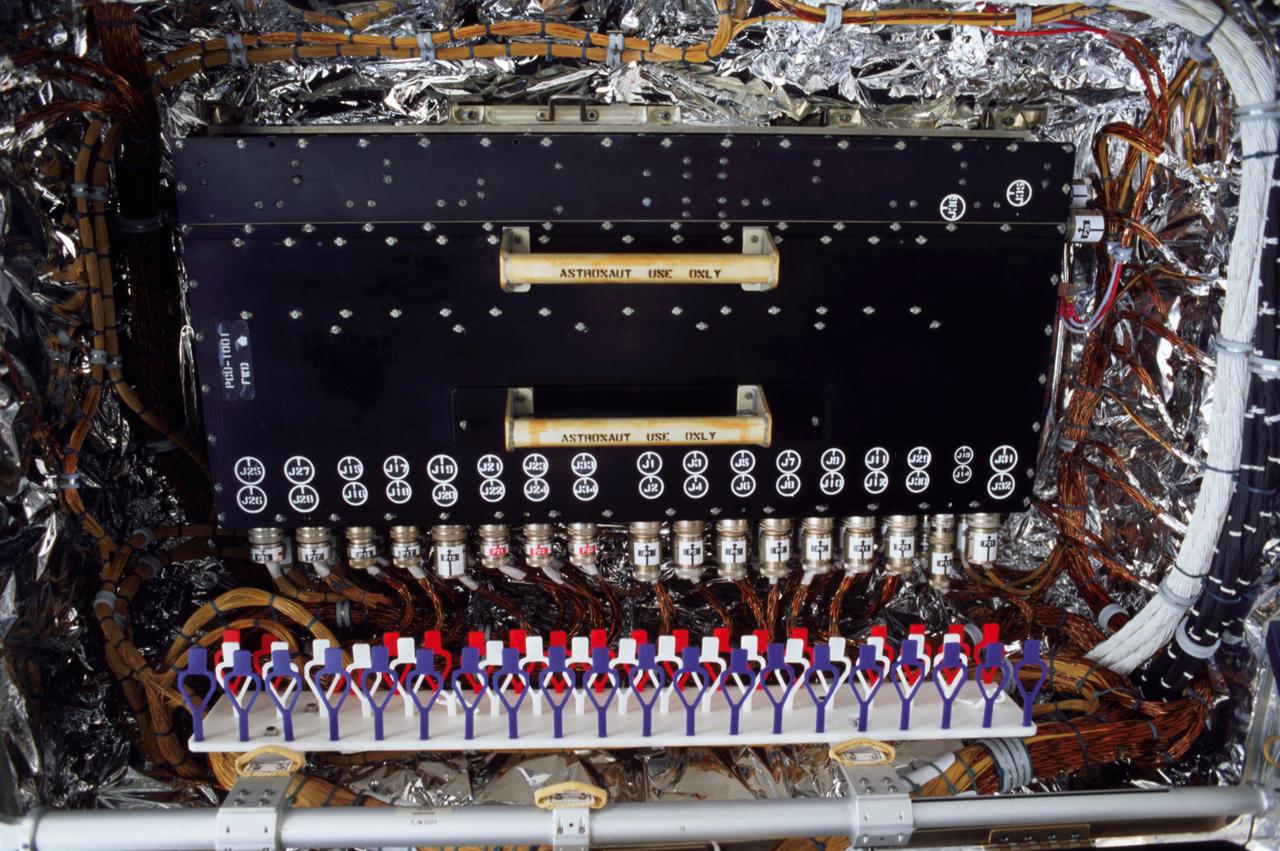
This is an onboard photo of the Hubble Space Telescope (HST) power control unit (PCU), the heart of the HST's power system. STS-109 payload commander John M. Grunsfeld, joined by Astronaut Richard M. Lirnehan, turned off the telescope in order to replace its PCU while participating in the third of five spacewalks dedicated to servicing and upgrading the HST. Other upgrades performed were: replacement of the solar array panels; replacement of the Faint Object Camera (FOC) with a new advanced camera for Surveys (ACS); and installation of the experimental cooling system for the Hubble's Near-Infrared Camera and Multi-Object Spectrometer (NICMOS), which had been dormant since January 1999 when its original coolant ran out. The telescope was captured and secured on a work stand in Columbia's payload bay using Columbia's robotic arm, where crew members completed the system upgrades. The Marshall Space Flight Center had the responsibility for the design, development, and construction of the HST, which is the most complex and sensitive optical telescope ever made, to study the cosmos from a low-Earth orbit. The HST detects objects 25 times fainter than the dimmest objects seen from Earth and provides astronomers with an observable universe 250 times larger than is visible from ground-based telescopes, perhaps as far away as 14 billion light-years. Launched March 1, 2002 the STS-109 HST servicing mission lasted 10 days, 22 hours, and 11 minutes. It was the 108th flight overall in NASA's Space Shuttle Program.
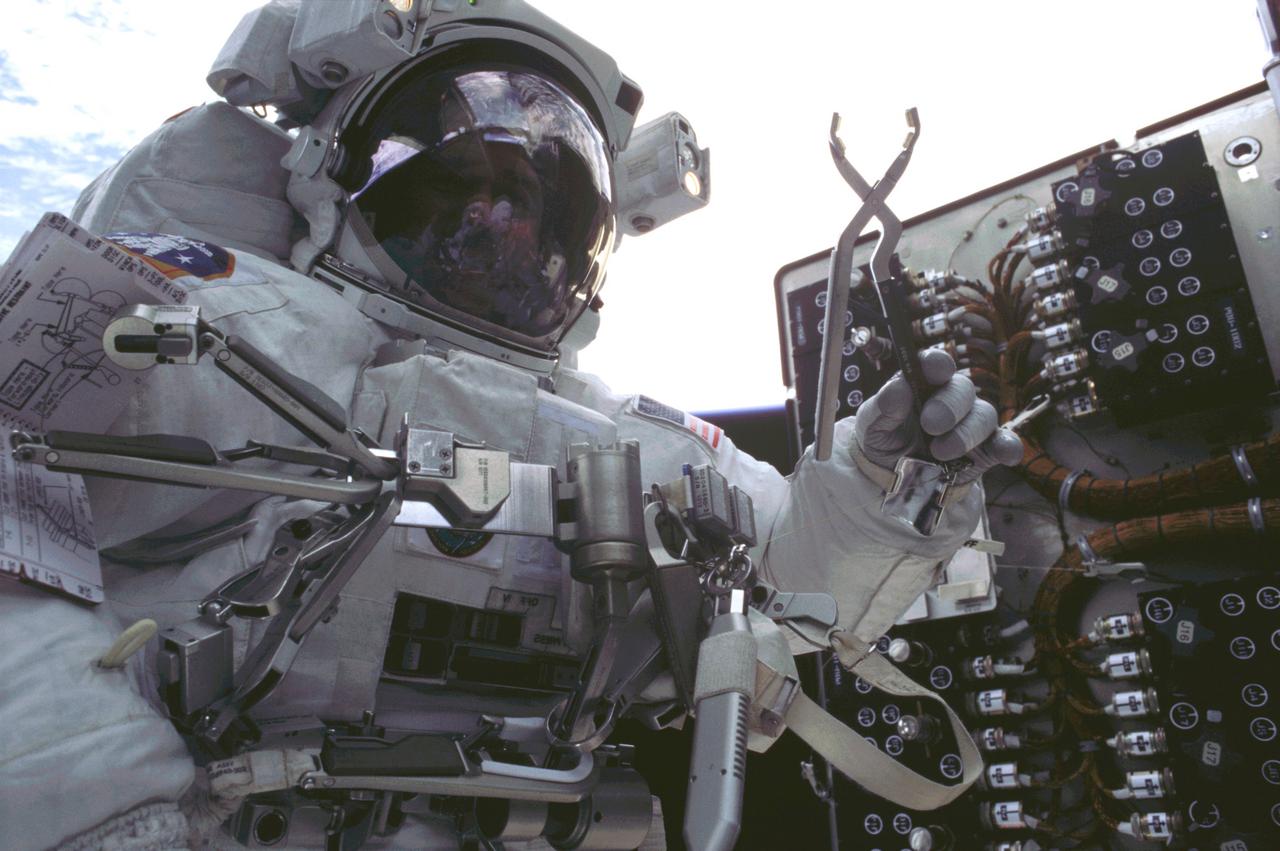
This is an onboard photo of Astronaut John M. Grunsfield, STS-109 payload commander, participating in the third of five spacewalks to perform work on the Hubble Space Telescope (HST). On this particular walk, Grunsfield, joined by Astronaut Richard M. Lirnehan, turned off the telescope in order to replace its power control unit (PCU), the heart of the HST's power system. The telescope was captured and secured on a work stand in Columbia's payload bay using Columbia's robotic arm, where crew members completed system upgrades to the HST. Included in those upgrades were: replacement of the solar array panels; replacement of the power control unit (PCU); replacement of the Faint Object Camera (FOC) with a new advanced camera for Surveys (ACS); and installation of the experimental cooling system for the Hubble's Near-Infrared Camera and Multi-object Spectrometer (NICMOS), which had been dormant since January 1999 when its original coolant ran out. The Marshall Space Flight Center had the responsibility for the design, development, and construction of the HST, which is the most complex and sensitive optical telescope ever made, to study the cosmos from a low-Earth orbit. The HST detects objects 25 times fainter than the dimmest objects seen from Earth and provides astronomers with an observable universe 250 times larger than is visible from ground-based telescopes, perhaps as far away as 14 billion light-years. The HST views galaxies, stars, planets, comets, possibly other solar systems, and even unusual phenomena such as quasars, with 10 times the clarity of ground-based telescopes. Launched March 1, 2002 the STS-109 HST servicing mission lasted 10 days, 22 hours, and 11 minutes. It was the 108th flight overall in NASA's Space Shuttle Program.
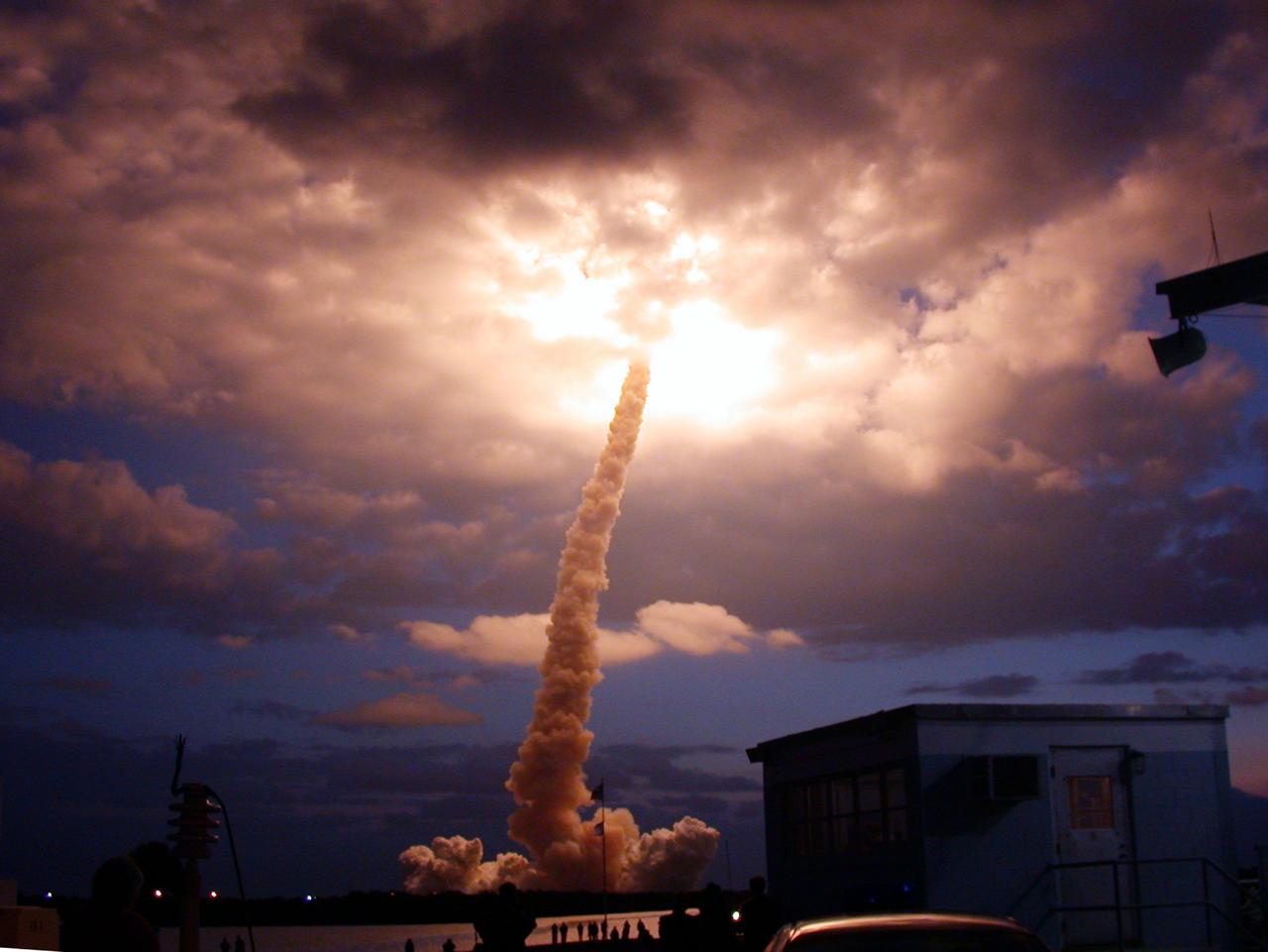
Carrying a crew of seven, the Space Shuttle Orbiter Columbia soared through some pre-dawn clouds into the sky as it began its 27th flight, STS-109. Launched March 1, 2002, the goal of the mission was the maintenance and upgrade of the Hubble Space Telescope (HST). The Marshall Space Flight Center had the responsibility for the design, development, and construction of the HST, which is the most complex and sensitive optical telescope ever made, to study the cosmos from a low-Earth orbit. The HST detects objects 25 times fainter than the dimmest objects seen from Earth and provides astronomers with an observable universe 250 times larger than is visible from ground-based telescopes, perhaps as far away as 14 billion light-years. The HST views galaxies, stars, planets, comets, possibly other solar systems, and even unusual phenomena such as quasars, with 10 times the clarity of ground-based telescopes. During the STS-109 mission, the telescope was captured and secured on a work stand in Columbia's payload bay using Columbia's robotic arm. Here four members of the crew performed five spacewalks completing system upgrades to the HST. Included in those upgrades were: replacement of the solar array panels; replacement of the power control unit (PCU); replacement of the Faint Object Camera (FOC) with a new advanced camera for Surveys (ACS); and installation of the experimental cooling system for the Hubble's Near-Infrared Camera and Multi-object Spectrometer (NICMOS), which had been dormant since January 1999 when it original coolant ran out. Lasting 10 days, 22 hours, and 11 minutes, the STS-109 mission was the 108th flight overall in NASA's Space Shuttle Program.
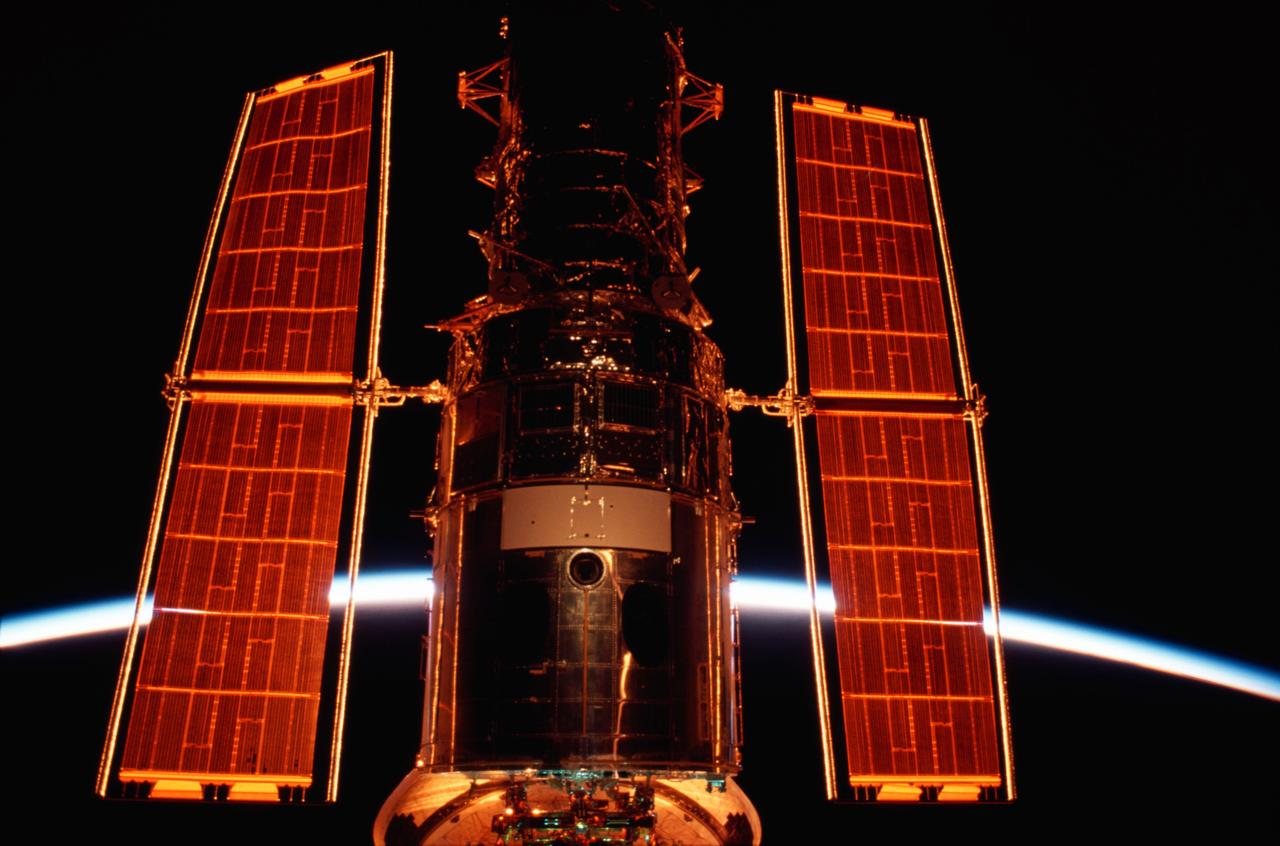
This is a photo of the Hubble Space Telescope (HST),in its origianl configuration, berthed in the cargo bay of the Space Shuttle Columbia during the STS-109 mission silhouetted against the airglow of the Earth's horizon. The telescope was captured and secured on a work stand in Columbia's payload bay using Columbia's robotic arm, where 4 of the 7-member crew performed 5 spacewalks completing system upgrades to the HST. Included in those upgrades were: replacement of the solar array panels; replacement of the power control unit (PCU); replacement of the Faint Object Camera (FOC) with a new advanced camera for Surveys (ACS); and installation of the experimental cooling system for the Hubble's Near-Infrared Camera and Multi-object Spectrometer (NICMOS), which had been dormant since January 1999 when its original coolant ran out. The Marshall Space Flight Center had the responsibility for the design, development, and construction of the the HST, which is the most complex and sensitive optical telescope ever made, to study the cosmos from a low-Earth orbit. The HST detects objects 25 times fainter than the dimmest objects seen from Earth and provides astronomers with an observable universe 250 times larger than is visible from ground-based telescopes, perhaps as far away as 14 billion light-years. The HST views galaxies, stars, planets, comets, possibly other solar systems, and even unusual phenomena such as quasars, with 10 times the clarity of ground-based telescopes. Launched March 1, 2002 the STS-109 HST servicing mission lasted 10 days, 22 hours, and 11 minutes. It was the 108th flight overall in NASA's Space Shuttle Program.
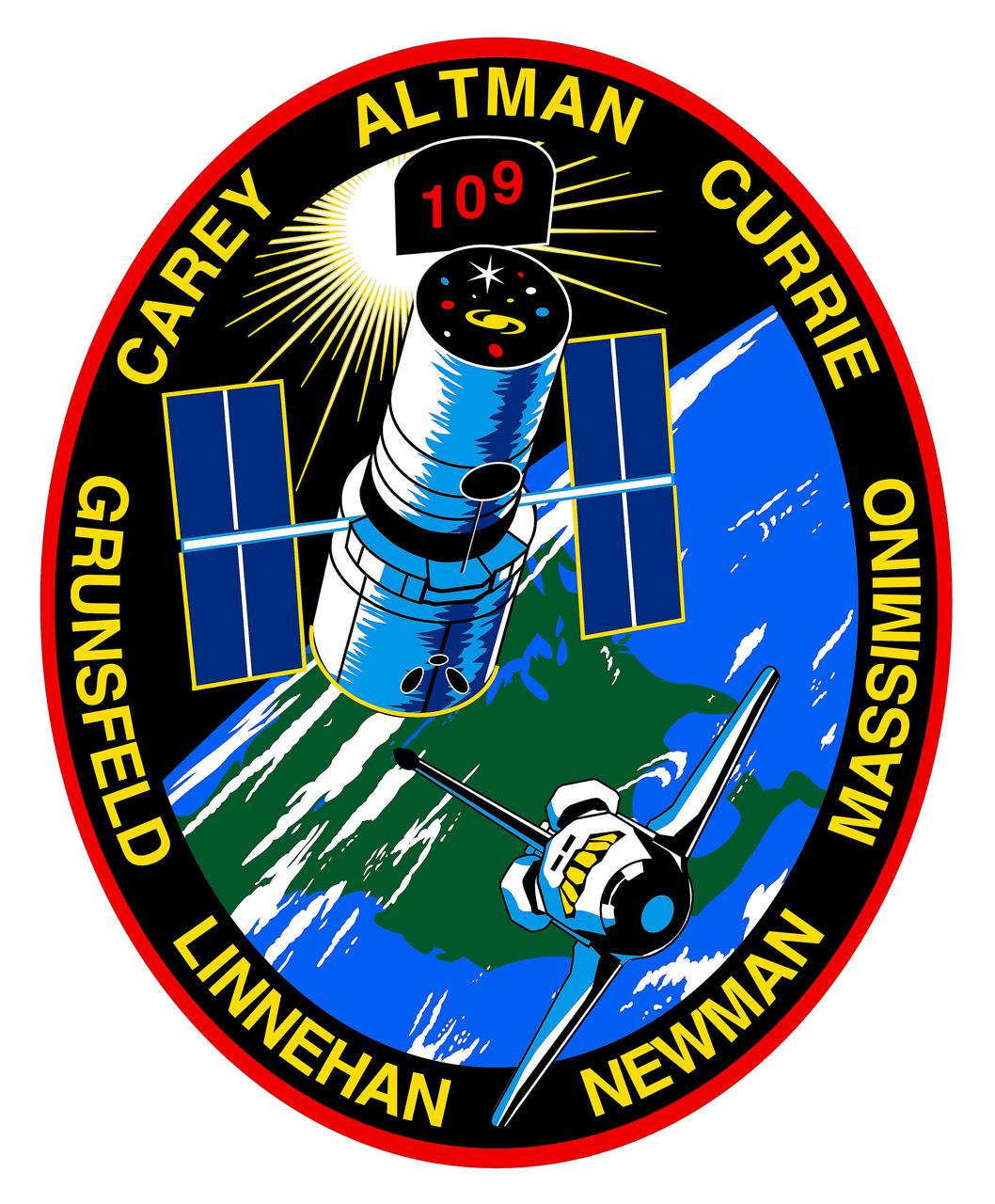
This is the insignia of the STS-109 Space Shuttle mission. Carrying a crew of seven, the Space Shuttle Orbiter Columbia was launched with goals of maintenance and upgrades to the Hubble Space Telescope (HST). The Marshall Space Flight Center had the responsibility for the design, development, and construction of the HST, which is the most complex and sensitive optical telescope ever made, to study the cosmos from a low-Earth orbit. The HST detects objects 25 times fainter than the dimmest objects seen from Earth and provides astronomers with an observable universe 250 times larger than is visible from ground-based telescopes, perhaps as far away as 14 billion light-years. The HST views galaxies, stars, planets, comets, possibly other solar systems, and even unusual phenomena such as quasars, with 10 times the clarity of ground-based telescopes. During the STS-109 mission, the telescope was captured and secured on a work stand in Columbia's payload bay using Columbia's robotic arm where four members of the crew performed five spacewalks completing system upgrades to the HST. Included in those upgrades were: The replacement of the solar array panels; replacement of the power control unit (PCU); replacement of the Faint Object Camera (FOC) with a new advanced camera for Surveys (ACS); and installation of the experimental cooling system for the Hubble's Near-Infrared Camera and Multi-object Spectrometer (NICMOS), which had been dormant since January 1999 when it original coolant ran out. Lasting 10 days, 22 hours, and 11 minutes, the STS-109 mission was the 27th flight of the Orbiter Columbia and the 108th flight overall in NASA's Space Shuttle Program.

Peering deep into the early universe, this picturesque parallel field observation from the NASA/ESA Hubble Space Telescope reveals thousands of colorful galaxies swimming in the inky blackness of space. A few foreground stars from our own galaxy, the Milky Way, are also visible. In October 2013 Hubble’s Wide Field Camera 3 (WFC3) and Advanced Camera for Surveys (ACS) began observing this portion of sky as part of the Frontier Fields program. This spectacular skyscape was captured during the study of the giant galaxy cluster Abell 2744, otherwise known as Pandora’s Box. While one of Hubble’s cameras concentrated on Abell 2744, the other camera viewed this adjacent patch of sky near to the cluster. Containing countless galaxies of various ages, shapes and sizes, this parallel field observation is nearly as deep as the Hubble Ultra-Deep Field. In addition to showcasing the stunning beauty of the deep universe in incredible detail, this parallel field — when compared to other deep fields — will help astronomers understand how similar the universe looks in different directions. Image credit: NASA, ESA and the HST Frontier Fields team (STScI), <b><a href="http://www.nasa.gov/audience/formedia/features/MP_Photo_Guidelines.html" rel="nofollow">NASA image use policy.</a></b> <b><a href="http://www.nasa.gov/centers/goddard/home/index.html" rel="nofollow">NASA Goddard Space Flight Center</a></b> enables NASA’s mission through four scientific endeavors: Earth Science, Heliophysics, Solar System Exploration, and Astrophysics. Goddard plays a leading role in NASA’s accomplishments by contributing compelling scientific knowledge to advance the Agency’s mission. <b>Follow us on <a href="http://twitter.com/NASAGoddardPix" rel="nofollow">Twitter</a></b> <b>Like us on <a href="http://www.facebook.com/pages/Greenbelt-MD/NASA-Goddard/395013845897?ref=tsd" rel="nofollow">Facebook</a></b> <b>Find us on <a href="http://instagrid.me/nasagoddard/?vm=grid" rel="nofollow">Instagram</a></b>
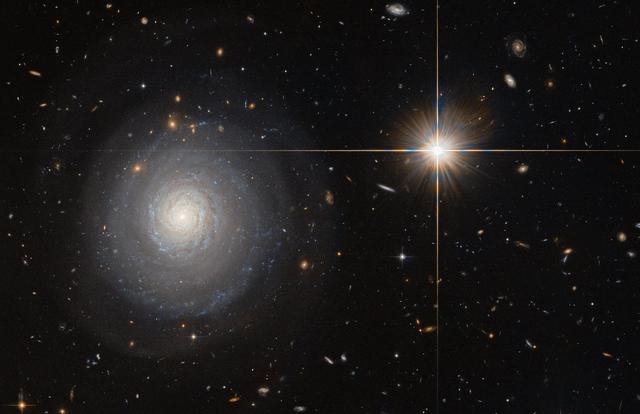
This image was taken by the NASA/ESA Hubble Space Telescope’s Advanced Camera for Surveys (ACS) and shows a starburst galaxy named MCG+07-33-027. This galaxy lies some 300 million light-years away from us, and is currently experiencing an extraordinarily high rate of star formation — a starburst. Normal galaxies produce only a couple of new stars per year, but starburst galaxies can produce a hundred times more than that. As MCG+07-33-027 is seen face-on, the galaxy’s spiral arms and the bright star-forming regions within them are clearly visible and easy for astronomers to study. In order to form newborn stars, the parent galaxy has to hold a large reservoir of gas, which is slowly depleted to spawn stars over time. For galaxies in a state of starburst, this intense period of star formation has to be triggered somehow — often this happens due to a collision with another galaxy. MCG+07-33-027, however, is special; while many galaxies are located within a large cluster of galaxies, MCG+07-33-027 is a field galaxy, which means it is rather isolated. Thus, the triggering of the starburst was most likely not due to a collision with a neighboring or passing galaxy and astronomers are still speculating about the cause. The bright object to the right of the galaxy is a foreground star in our own galaxy. Image credit: ESA/Hubble & NASA and N. Grogin (STScI)
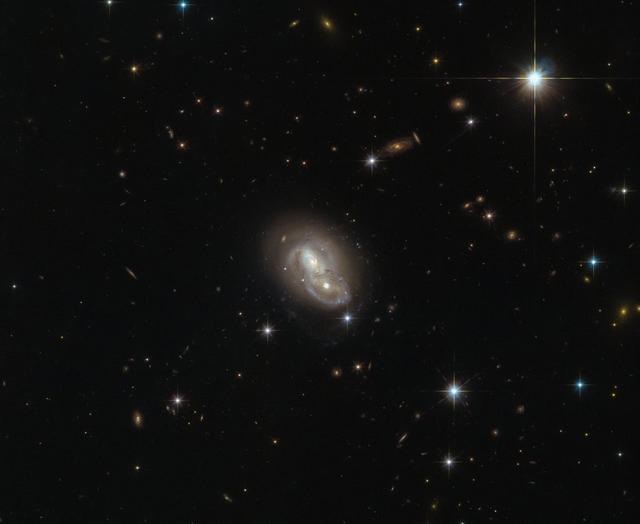
This image from the NASA/ESA Hubble Space Telescope shows the unusual galaxy IRAS 06076-2139, found in the constellation Lepus (The Hare). Hubble’s Wide Field Camera 3 (WFC3) and Advanced Camera for Surveys (ACS) instruments observed the galaxy from a distance of 500 million light-years. This particular object stands out from the crowd by actually being composed of two separate galaxies rushing past each other at about 2 million kilometers (1,243,000 miles) per hour. This speed is most likely too fast for them to merge and form a single galaxy. However, because of their small separation of only about 20,000 light-years, the galaxies will distort one another through the force of gravity while passing each other, changing their structures on a grand scale. Such galactic interactions are a common sight for Hubble, and have long been a field of study for astronomers. The intriguing behaviors of interacting galaxies take many forms; galactic cannibalism, galaxy harassment and even galaxy collisions. The Milky Way itself will eventually fall victim to the latter, merging with the Andromeda Galaxy in about 4.5 billion years. The fate of our galaxy shouldn’t be alarming though: while galaxies are populated by billions of stars, the distances between individual stars are so large that hardly any stellar collisions will occur. Credit: ESA/Hubble & NASA <b><a href="http://www.nasa.gov/audience/formedia/features/MP_Photo_Guidelines.html" rel="nofollow">NASA image use policy.</a></b> <b><a href="http://www.nasa.gov/centers/goddard/home/index.html" rel="nofollow">NASA Goddard Space Flight Center</a></b> enables NASA’s mission through four scientific endeavors: Earth Science, Heliophysics, Solar System Exploration, and Astrophysics. Goddard plays a leading role in NASA’s accomplishments by contributing compelling scientific knowledge to advance the Agency’s mission. <b>Follow us on <a href="http://twitter.com/NASAGoddardPix" rel="nofollow">Twitter</a></b> <b>Like us on <a href="http://www.facebook.com/pages/Greenbelt-MD/NASA-Goddard/395013845897?ref=tsd" rel="nofollow">Facebook</a></b> <b>Find us on <a href="http://instagrid.me/nasagoddard/?vm=grid" rel="nofollow">Instagram</a></b>
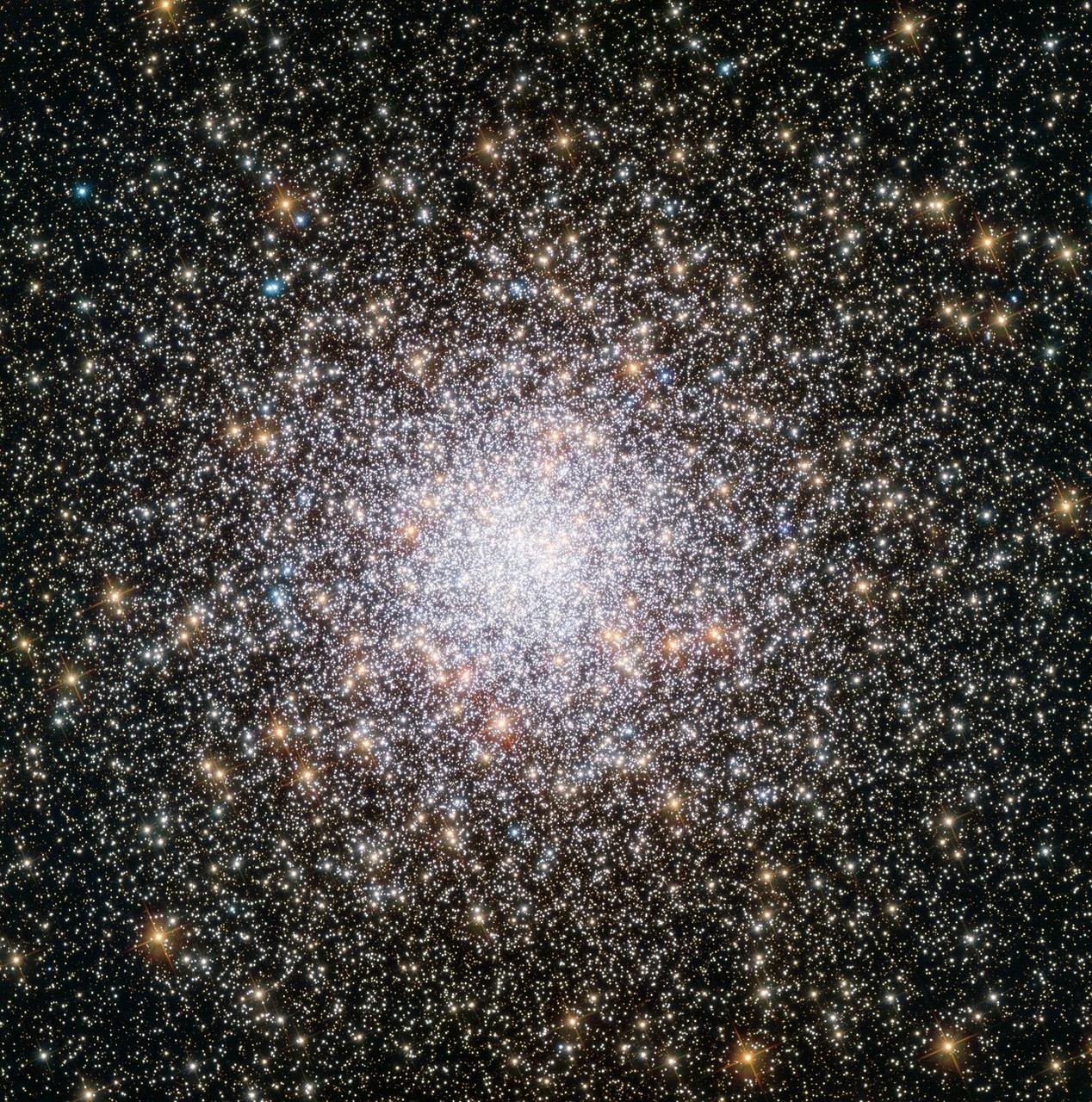
Hubble sees an unusal global cluster that is enriching the interstellar medium with metals Globular clusters offer some of the most spectacular sights in the night sky. These ornate spheres contain hundreds of thousands of stars, and reside in the outskirts of galaxies. The Milky Way contains over 150 such clusters — and the one shown in this NASA/ESA Hubble Space Telescope image, named NGC 362, is one of the more unusual ones. As stars make their way through life they fuse elements together in their cores, creating heavier and heavier elements — known in astronomy as metals — in the process. When these stars die, they flood their surroundings with the material they have formed during their lifetimes, enriching the interstellar medium with metals. Stars that form later therefore contain higher proportions of metals than their older relatives. By studying the different elements present within individual stars in NGC 362, astronomers discovered that the cluster boasts a surprisingly high metal content, indicating that it is younger than expected. Although most globular clusters are much older than the majority of stars in their host galaxy, NGC 362 bucks the trend, with an age lying between 10 and 11 billion years old. For reference, the age of the Milky Way is estimated to be above 13 billion years. This image, in which you can view NGC 362’s individual stars, was taken by Hubble’s Advanced Camera for Surveys (ACS). Credit: ESA/Hubble& NASA <b><a href="http://www.nasa.gov/audience/formedia/features/MP_Photo_Guidelines.html" rel="nofollow">NASA image use policy.</a></b> <b><a href="http://www.nasa.gov/centers/goddard/home/index.html" rel="nofollow">NASA Goddard Space Flight Center</a></b> enables NASA’s mission through four scientific endeavors: Earth Science, Heliophysics, Solar System Exploration, and Astrophysics. Goddard plays a leading role in NASA’s accomplishments by contributing compelling scientific knowledge to advance the Agency’s mission. <b>Follow us on <a href="http://twitter.com/NASAGoddardPix" rel="nofollow">Twitter</a></b> <b>Like us on <a href="http://www.facebook.com/pages/Greenbelt-MD/NASA-Goddard/395013845897?ref=tsd" rel="nofollow">Facebook</a></b> <b>Find us on <a href="http://instagrid.me/nasagoddard/?vm=grid" rel="nofollow">Instagram</a></b>