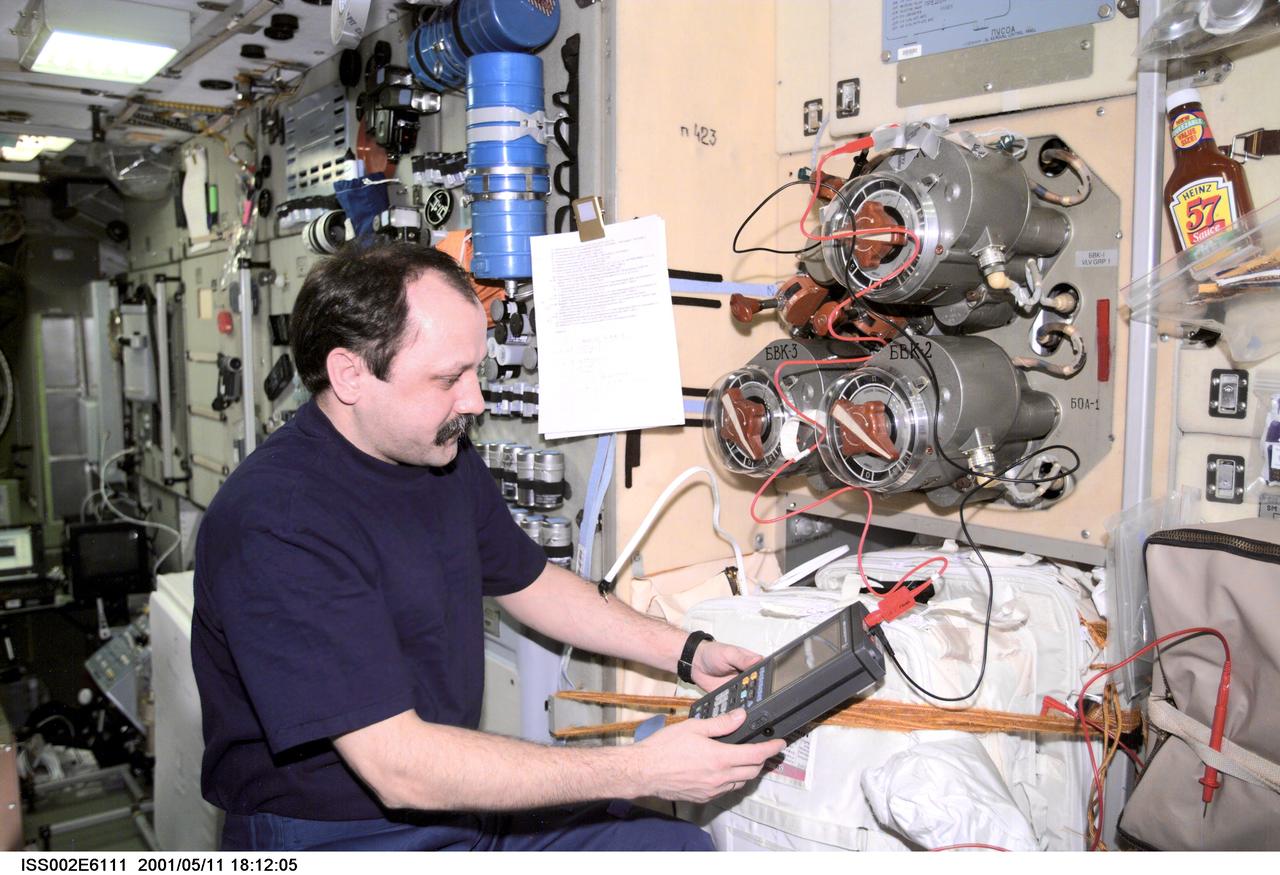
ISS002-E-6111 (11 May 2001) --- Yury V. Usachev of Rosaviakosmos, Expedition Two mission commander, tests the Vozdukh Air Purification System in the Zvezda Service Module. The image was taken with a digital still camera.
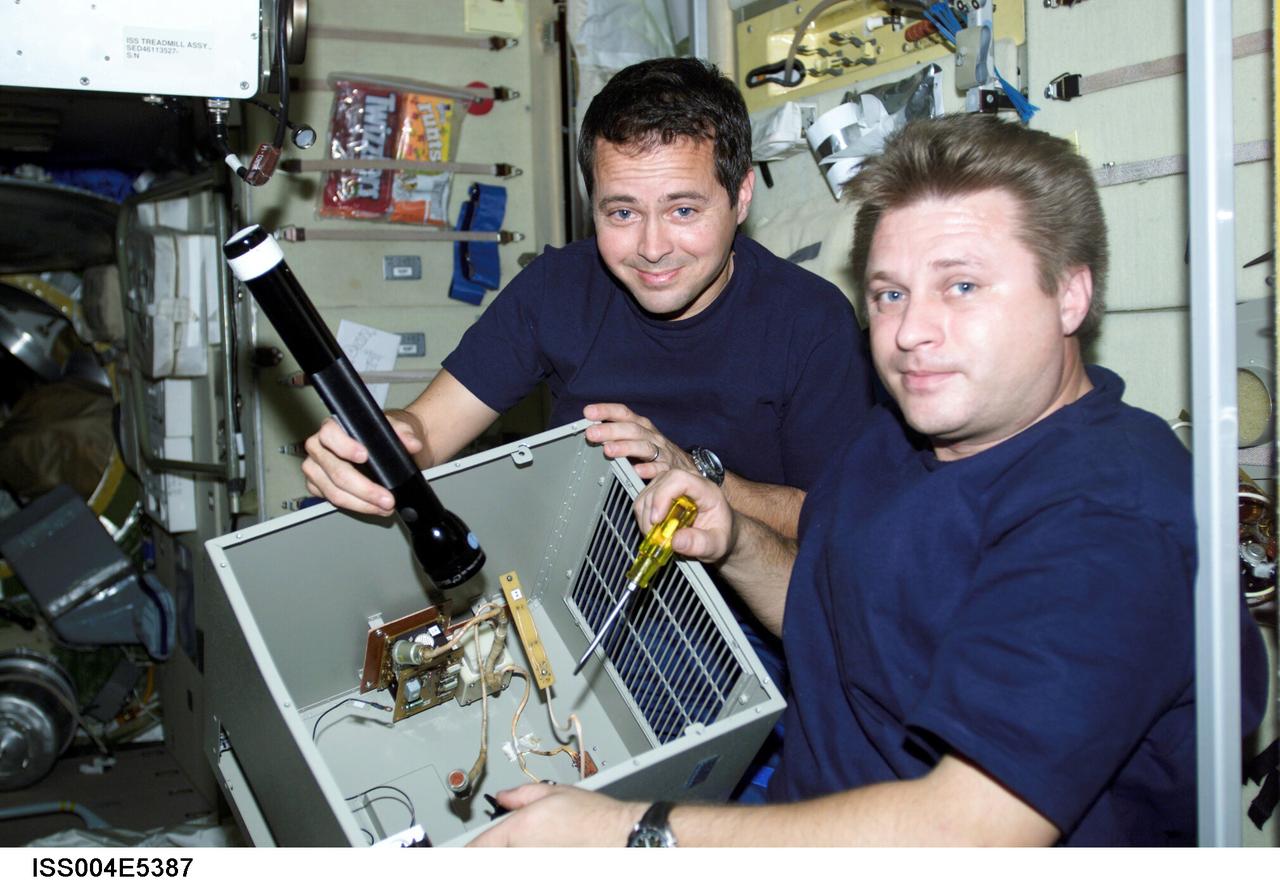
ISS004-E-5387 (January 2002) --- Cosmonaut Yuri I. Onufrienko (right), Expedition Four mission commander, and astronaut Daniel W. Bursch, flight engineer, perform maintenance on equipment in the Zvezda Service Module on the International Space Station (ISS). Onufrienko represents Rosaviakosmos. The image was taken with a digital still camera.
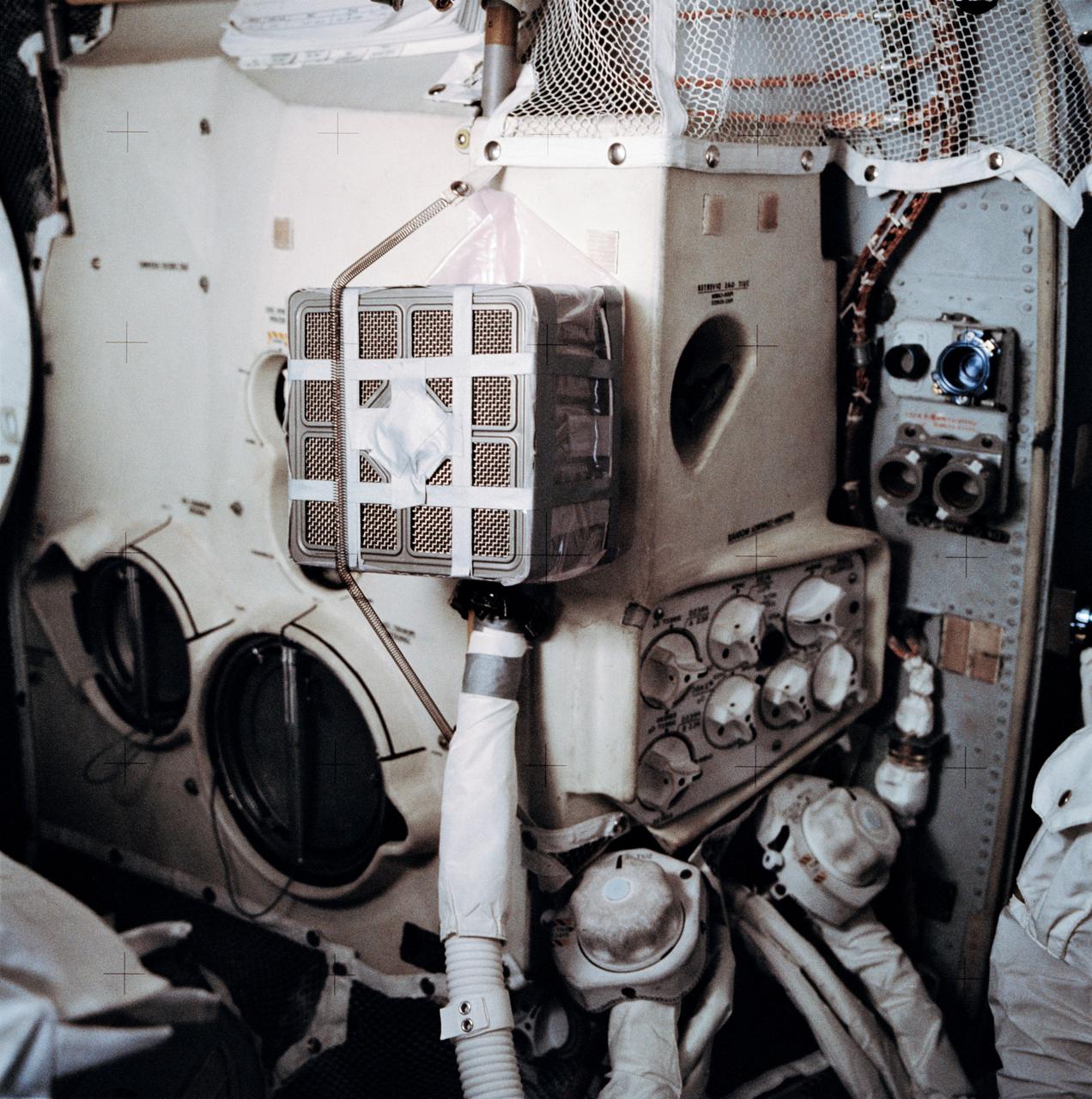
AS13-62-8929 (11-17 April 1970) --- Interior view of the Apollo 13 Lunar Module (LM) showing the "mail box," a jury-rigged arrangement which the Apollo 13 astronauts built to use the Command Module (CM) lithium hydroxide canisters to purge carbon dioxide from the LM. Lithium hydroxide is used to scrub CO2 from the spacecraft's atmosphere. Since there was a limited amount of lithium hydroxide in the LM, this arrangement was rigged up to utilize the canisters from the CM. The "mail box" was designed and tested on the ground at the Manned Spacecraft Center (MSC) before it was suggested to the problem-plagued Apollo 13 crew men. Because of the explosion of one of the oxygen tanks in the Service Module (SM), the three crew men had to use the LM as a "lifeboat".
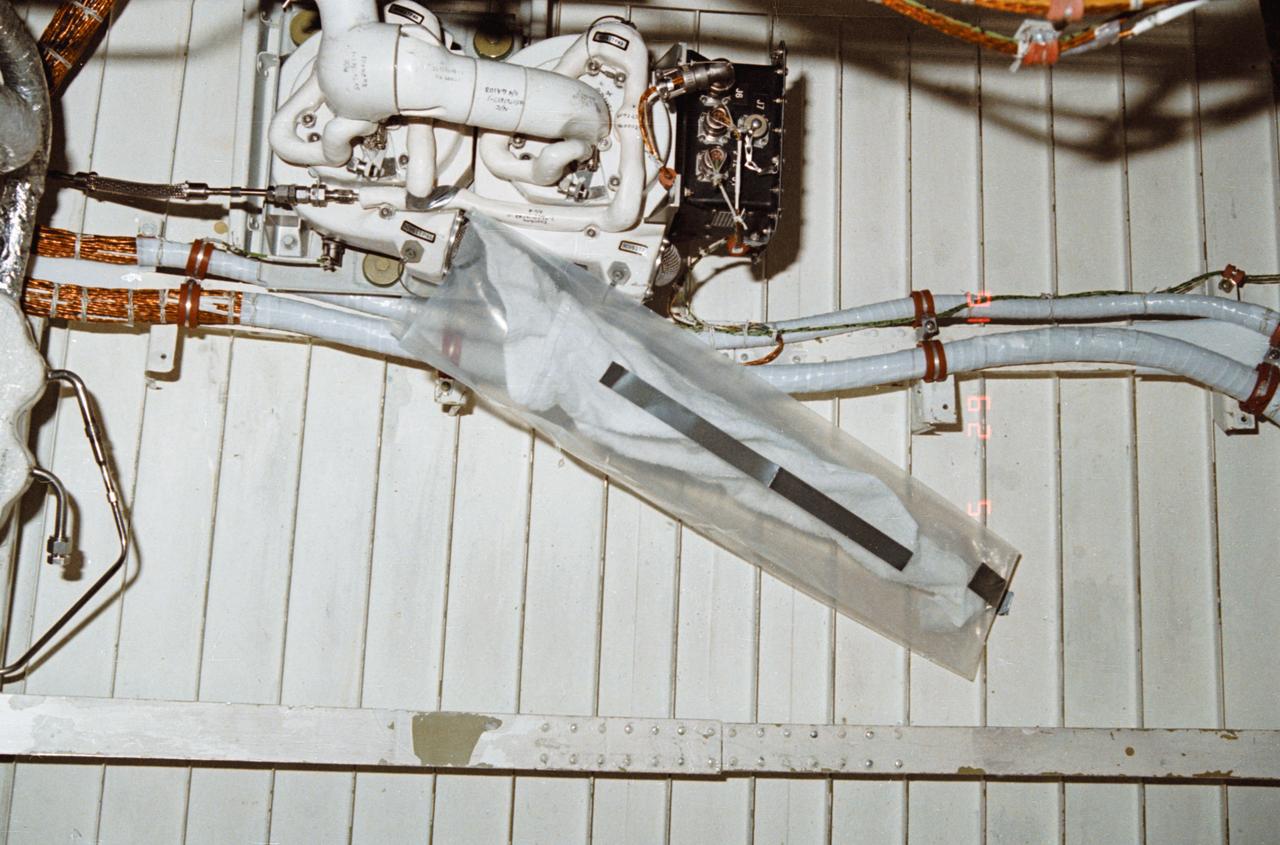
During STS-32, onboard Columbia, Orbiter Vehicle (OV) 102, a leakage problem at environmental control and life support system (ECLSS) air revitalization system (ARS) humidity separator A below the middeck is solved with a plastic bag and a towel. The towel inserted inside a plastic bag absorbed the water that had collected at the separator inlet.
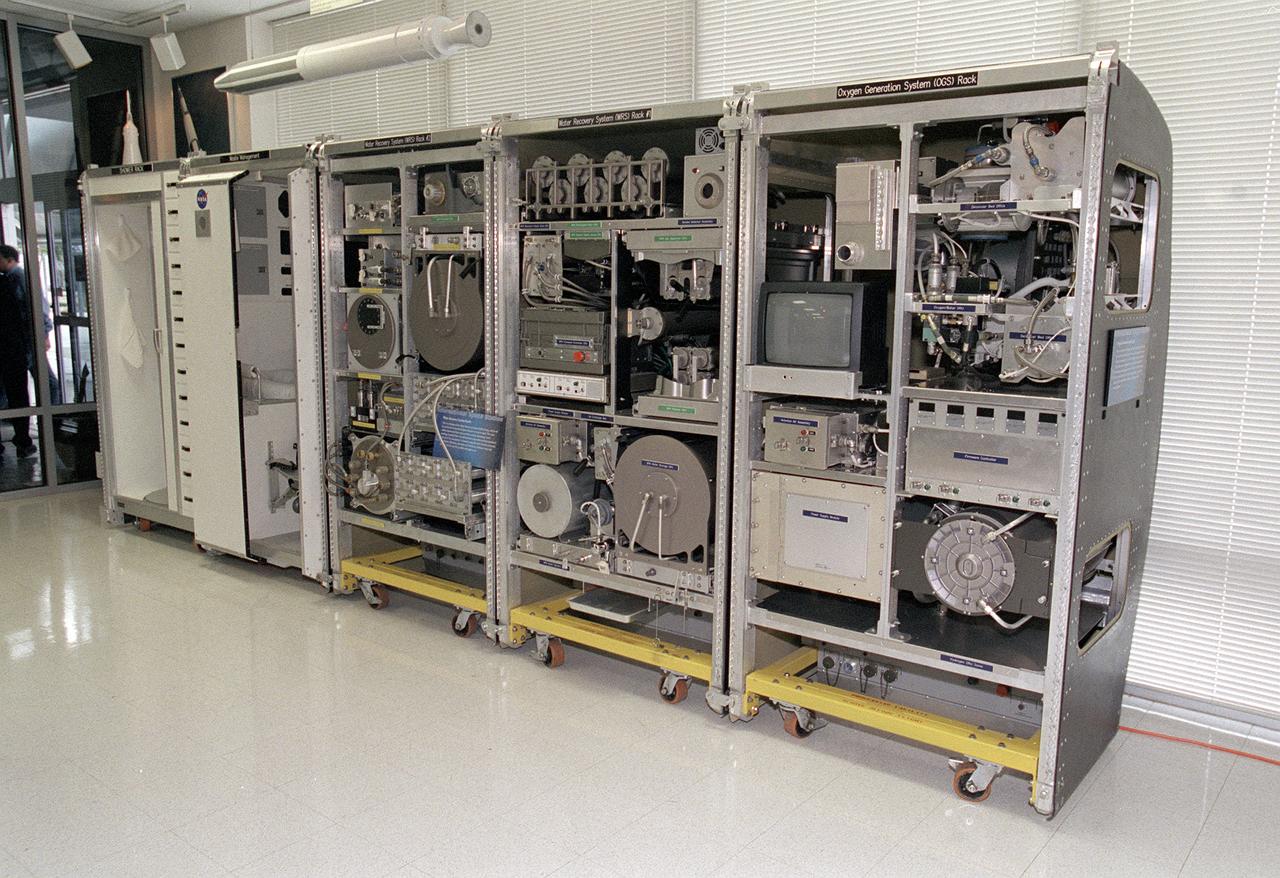
The Environmental Control and Life Support System (ECLSS) Group of the Flight Projects Directorate at the Marshall Space Flight Center in Huntsville, Alabama, is responsible for designing and building the life support systems that will provide the crew of the International Space Station (ISS) a comfortable environment in which to live and work. This photograph shows the mockup of the the ECLSS to be installed in the Node 3 module of the ISS. From left to right, shower rack, waste management rack, Water Recovery System (WRS) Rack #2, WRS Rack #1, and Oxygen Generation System (OGS) rack are shown. The WRS provides clean water through the reclamation of wastewaters and is comprised of a Urine Processor Assembly (UPA) and a Water Processor Assembly (WPA). The UPA accepts and processes pretreated crewmember urine to allow it to be processed along with other wastewaters in the WPA. The WPA removes free gas, organic, and nonorganic constituents before the water goes through a series of multifiltration beds for further purification. The OGS produces oxygen for breathing air for the crew and laboratory animals, as well as for replacing oxygen loss. The OGS is comprised of a cell stack, which electrolyzes (breaks apart the hydrogen and oxygen molecules) some of the clean water provided by the WRS, and the separators that remove the gases from the water after electrolysis.
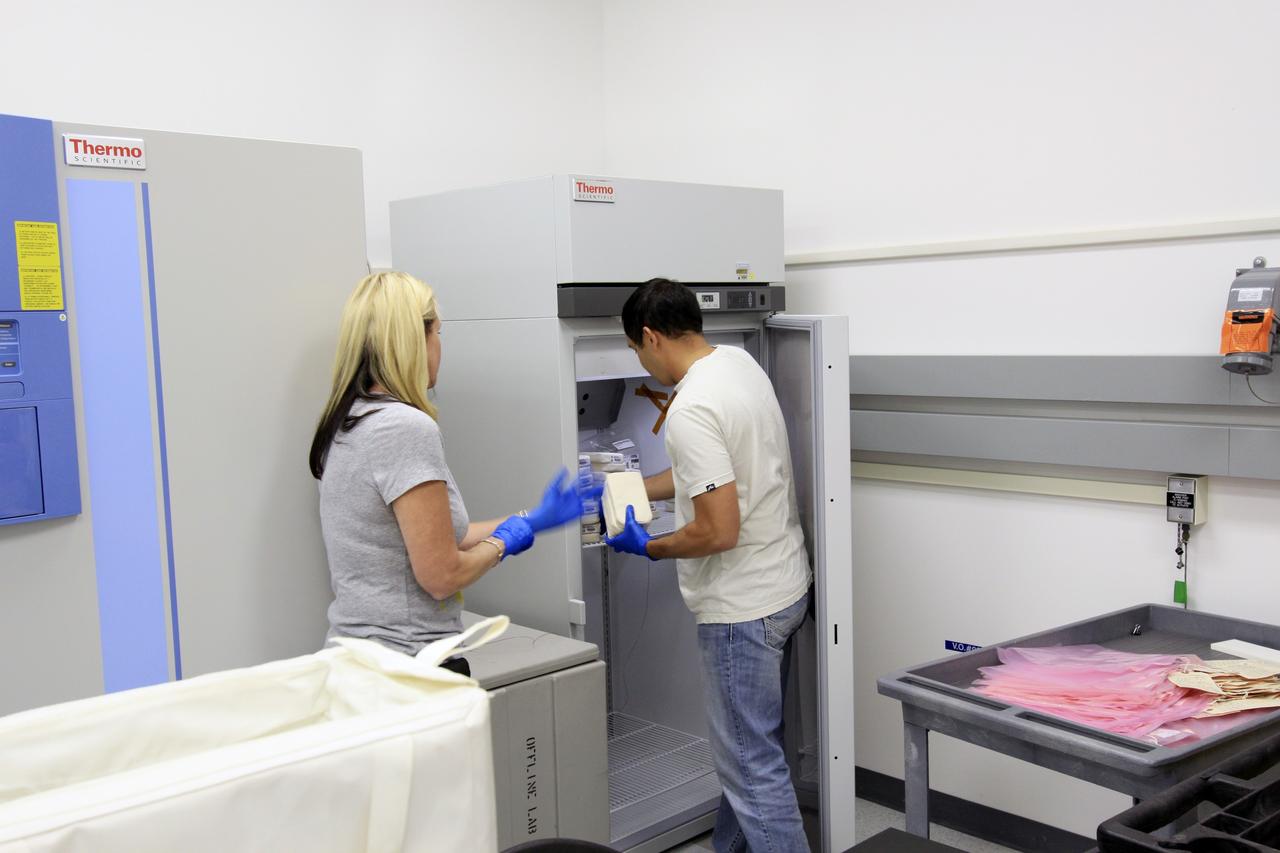
CAPE CANAVERAL, Fla. – In the Space Station Processing Facility at NASA’s Kennedy Space Center in Florida, refrigerated NanoRacks-CubeLabs Module-9 experiments are being prepared for transport to Space Launch Complex-40 on nearby Cape Canaveral Air Force Station. There, the bags will be loaded into the Space Exploration Technologies Dragon capsule in preparation for its scheduled April 30 liftoff aboard a Falcon 9 rocket. NanoRacks-CubeLabs Module-9 uses a two-cube unit box for student competition investigations using 15 liquid mixing tube assemblies that function similar to commercial glow sticks. The investigations range from microbial growth to water purification in microgravity. Known as SpaceX, the launch will be the company's second demonstration test flight for NASA's Commercial Orbital Transportation Services program, or COTS. During the flight, the capsule will conduct a series of check-out procedures to test and prove its systems, including rendezvous and berthing with the International Space Station. If the capsule performs as planned, the module and other cargo will be transferred to the station. The cargo includes food, water and provisions for the station’s Expedition crews, such as clothing, batteries and computer equipment. Under COTS, NASA has partnered with two private companies to launch cargo safely to the station. For more information, visit http://www.nasa.gov/spacex. Photo credit: NASA/Jim Grossmann
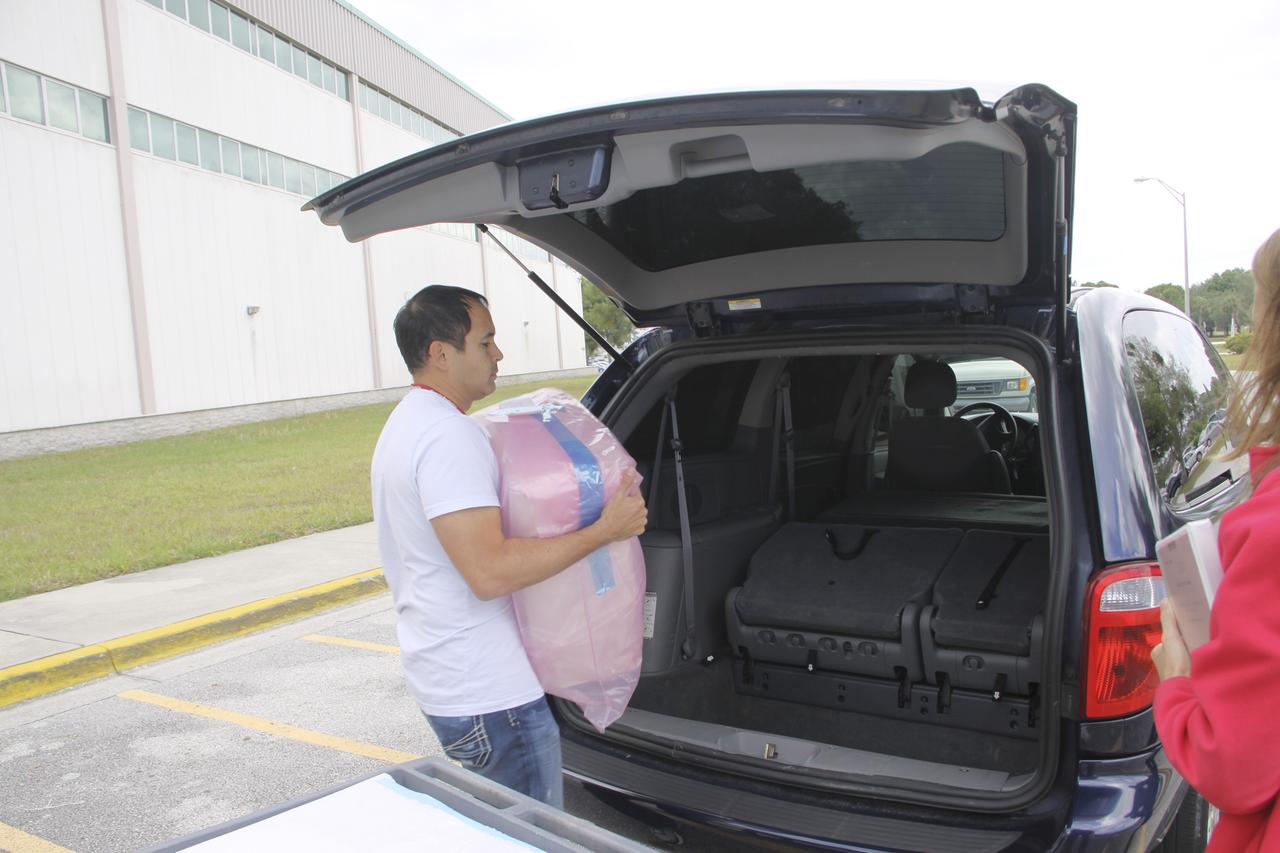
CAPE CANAVERAL, Fla. – A cargo bag designed to keep its contents cool, packed with NanoRacks-CubeLabs Module-9 experiments, is loaded into a van at the Space Station Processing Facility at NASA’s Kennedy Space Center in Florida for its trip to Space Launch Complex-40 on nearby Cape Canaveral Air Force Station. There, the bag will be loaded into the Space Exploration Technologies Dragon capsule in preparation for its scheduled April 30 liftoff aboard a Falcon 9 rocket. NanoRacks-CubeLabs Module-9 uses a two-cube unit box for student competition investigations using 15 liquid mixing tube assemblies that function similar to commercial glow sticks. The investigations range from microbial growth to water purification in microgravity. Known as SpaceX, the launch will be the company's second demonstration test flight for NASA's Commercial Orbital Transportation Services program, or COTS. During the flight, the capsule will conduct a series of check-out procedures to test and prove its systems, including rendezvous and berthing with the International Space Station. If the capsule performs as planned, the module and other cargo will be transferred to the station. The cargo includes food, water and provisions for the station’s Expedition crews, such as clothing, batteries and computer equipment. Under COTS, NASA has partnered with two private companies to launch cargo safely to the station. For more information, visit http://www.nasa.gov/spacex. Photo credit: NASA/Jim Grossmann

CAPE CANAVERAL, Fla. – In the Space Station Processing Facility at NASA’s Kennedy Space Center in Florida, a cargo bag designed to keep its contents cool is packed with NanoRacks-CubeLabs Module-9 experiments in preparation to transport it to Space Launch Complex-40 on nearby Cape Canaveral Air Force Station. There, the bag will be loaded into the Space Exploration Technologies Dragon capsule in preparation for its scheduled April 30 liftoff aboard a Falcon 9 rocket. NanoRacks-CubeLabs Module-9 uses a two-cube unit box for student competition investigations using 15 liquid mixing tube assemblies that function similar to commercial glow sticks. The investigations range from microbial growth to water purification in microgravity. Known as SpaceX, the launch will be the company's second demonstration test flight for NASA's Commercial Orbital Transportation Services program, or COTS. During the flight, the capsule will conduct a series of check-out procedures to test and prove its systems, including rendezvous and berthing with the International Space Station. If the capsule performs as planned, the module and other cargo will be transferred to the station. The cargo includes food, water and provisions for the station’s Expedition crews, such as clothing, batteries and computer equipment. Under COTS, NASA has partnered with two private companies to launch cargo safely to the station. For more information, visit http://www.nasa.gov/spacex. Photo credit: NASA/Jim Grossmann
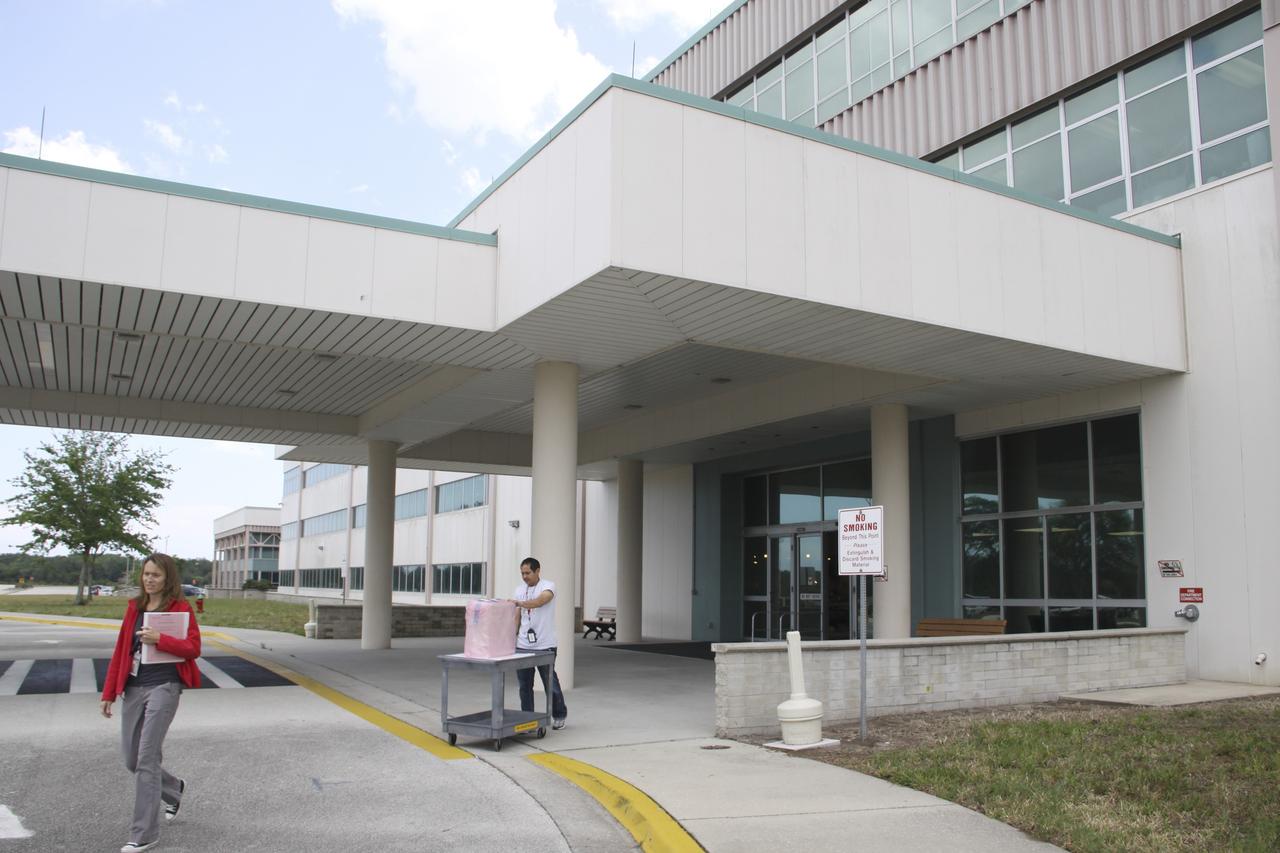
CAPE CANAVERAL, Fla. – A cargo bag designed to keep its contents cool, packed with NanoRacks-CubeLabs Module-9 experiments, departs the Space Station Processing Facility at NASA’s Kennedy Space Center in Florida for its trip to Space Launch Complex-40 on nearby Cape Canaveral Air Force Station. There, the bag will be loaded into the Space Exploration Technologies Dragon capsule in preparation for its scheduled April 30 liftoff aboard a Falcon 9 rocket. NanoRacks-CubeLabs Module-9 uses a two-cube unit box for student competition investigations using 15 liquid mixing tube assemblies that function similar to commercial glow sticks. The investigations range from microbial growth to water purification in microgravity. Known as SpaceX, the launch will be the company's second demonstration test flight for NASA's Commercial Orbital Transportation Services program, or COTS. During the flight, the capsule will conduct a series of check-out procedures to test and prove its systems, including rendezvous and berthing with the International Space Station. If the capsule performs as planned, the module and other cargo will be transferred to the station. The cargo includes food, water and provisions for the station’s Expedition crews, such as clothing, batteries and computer equipment. Under COTS, NASA has partnered with two private companies to launch cargo safely to the station. For more information, visit http://www.nasa.gov/spacex. Photo credit: NASA/Jim Grossmann
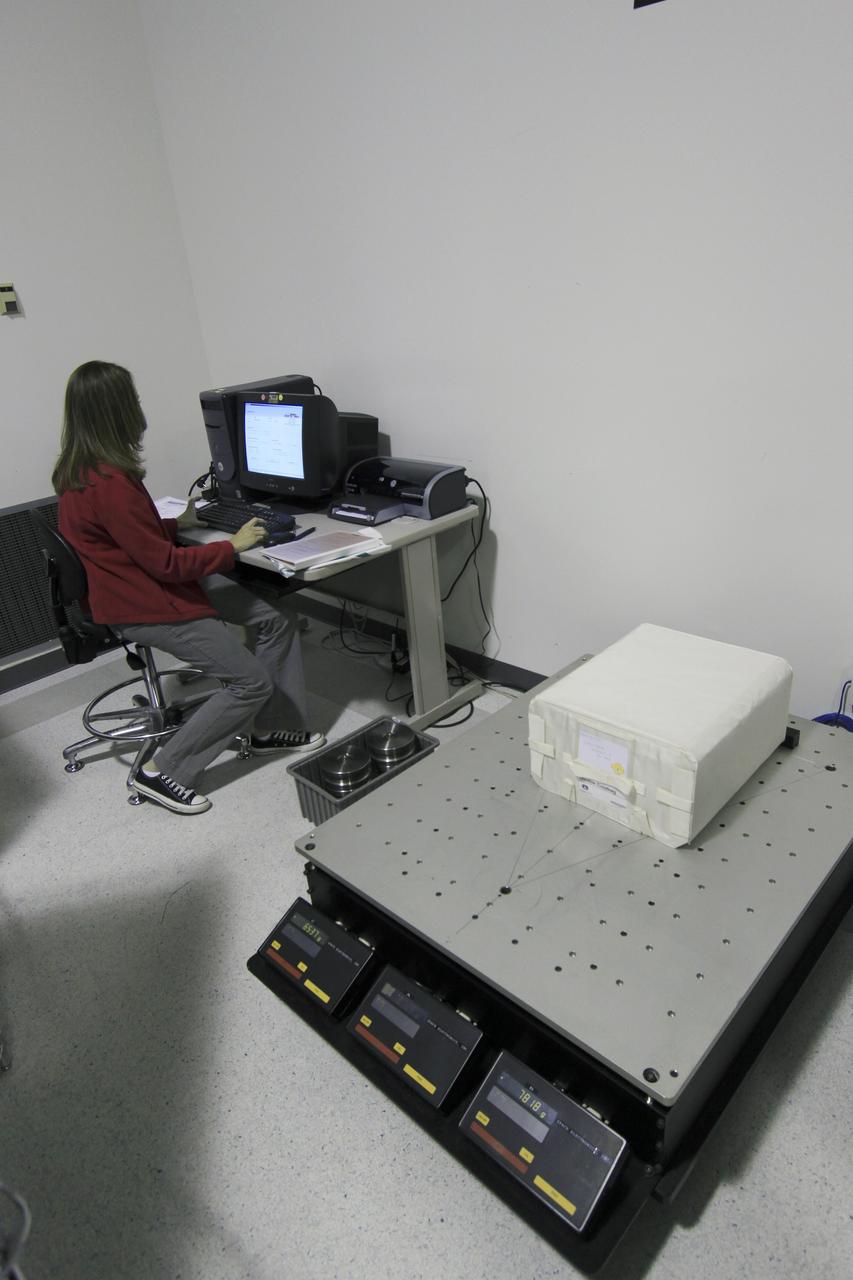
CAPE CANAVERAL, Fla. – In the Space Station Processing Facility at NASA’s Kennedy Space Center in Florida, a cargo bag packed with NanoRacks-CubeLabs Module-9 experiments is weighed before it is transported to Space Launch Complex-40 on nearby Cape Canaveral Air Force Station for cold stowage. There, the bag will be loaded into the Space Exploration Technologies Dragon capsule in preparation for its scheduled April 30 liftoff aboard a Falcon 9 rocket. NanoRacks-CubeLabs Module-9 uses a two-cube unit box for student competition investigations using 15 liquid mixing tube assemblies that function similar to commercial glow sticks. The investigations range from microbial growth to water purification in microgravity. Known as SpaceX, the launch will be the company's second demonstration test flight for NASA's Commercial Orbital Transportation Services program, or COTS. During the flight, the capsule will conduct a series of check-out procedures to test and prove its systems, including rendezvous and berthing with the International Space Station. If the capsule performs as planned, the module and other cargo will be transferred to the station. The cargo includes food, water and provisions for the station’s Expedition crews, such as clothing, batteries and computer equipment. Under COTS, NASA has partnered with two private companies to launch cargo safely to the station. For more information, visit http://www.nasa.gov/spacex. Photo credit: NASA/Jim Grossmann
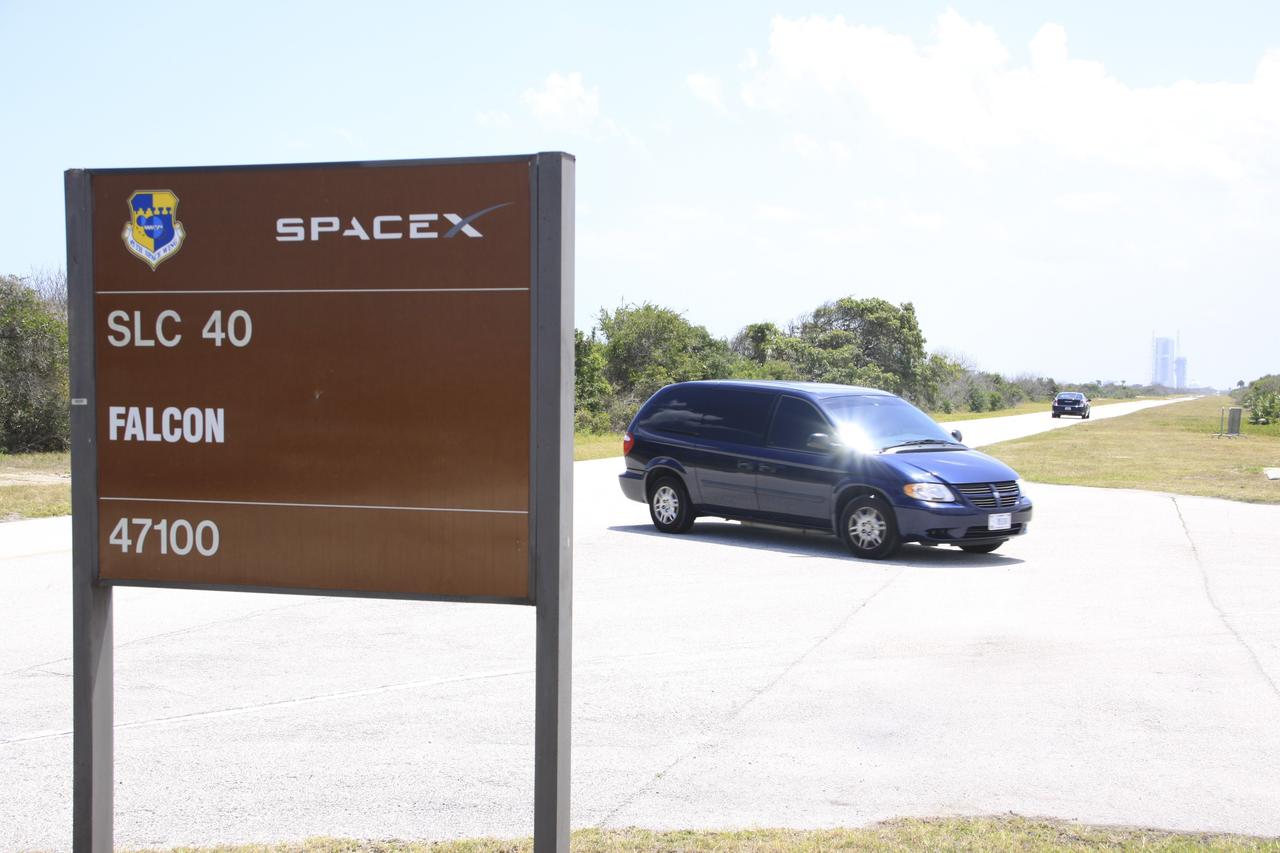
CAPE CANAVERAL, Fla. – The van transporting the cargo bag packed with NanoRacks-CubeLabs Module-9 experiments, arrives at Space Launch Complex-40 on Cape Canaveral Air Force Station in Florida for cold stowage. The bag will be loaded into the Space Exploration Technologies Dragon capsule in preparation for its scheduled April 30 liftoff aboard a Falcon 9 rocket. NanoRacks-CubeLabs Module-9 uses a two-cube unit box for student competition investigations using 15 liquid mixing tube assemblies that function similar to commercial glow sticks. The investigations range from microbial growth to water purification in microgravity. Known as SpaceX, the launch will be the company's second demonstration test flight for NASA's Commercial Orbital Transportation Services program, or COTS. During the flight, the capsule will conduct a series of check-out procedures to test and prove its systems, including rendezvous and berthing with the International Space Station. If the capsule performs as planned, the module and other cargo will be transferred to the station. The cargo includes food, water and provisions for the station’s Expedition crews, such as clothing, batteries and computer equipment. Under COTS, NASA has partnered with two private companies to launch cargo safely to the station. For more information, visit http://www.nasa.gov/spacex. Photo credit: NASA/Jim Grossmann
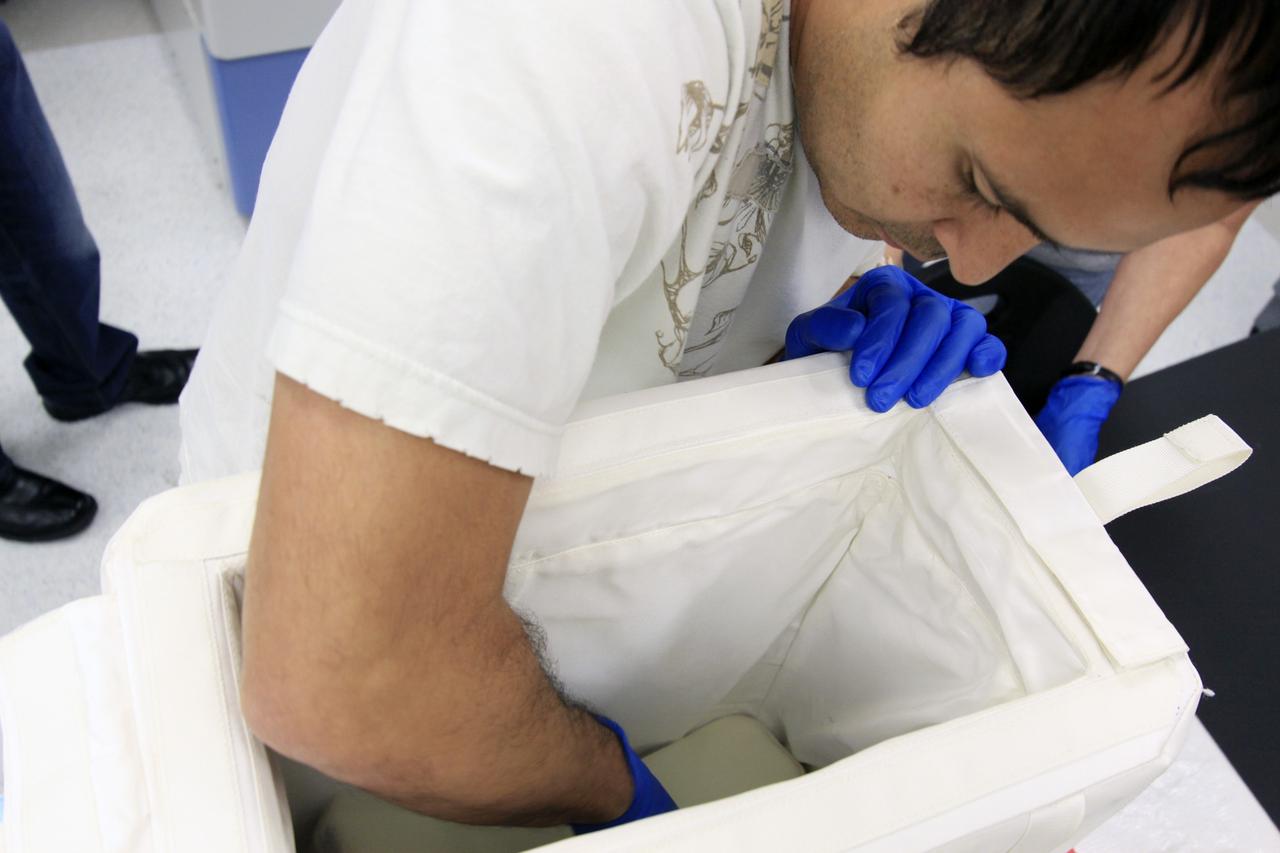
CAPE CANAVERAL, Fla. – In the Space Station Processing Facility at NASA’s Kennedy Space Center in Florida, a cargo bag designed to keep its contents cool is readied to receive the NanoRacks-CubeLabs Module-9 experiments. The module’s experiments requiring cold stowage are being prepared for transport to Space Launch Complex-40 on nearby Cape Canaveral Air Force Station. There, the bags will be loaded into the Space Exploration Technologies Dragon capsule in preparation for its scheduled April 30 liftoff aboard a Falcon 9 rocket. NanoRacks-CubeLabs Module-9 uses a two-cube unit box for student competition investigations using 15 liquid mixing tube assemblies that function similar to commercial glow sticks. The investigations range from microbial growth to water purification in microgravity. Known as SpaceX, the launch will be the company's second demonstration test flight for NASA's Commercial Orbital Transportation Services program, or COTS. During the flight, the capsule will conduct a series of check-out procedures to test and prove its systems, including rendezvous and berthing with the International Space Station. If the capsule performs as planned, the module and other cargo will be transferred to the station. The cargo includes food, water and provisions for the station’s Expedition crews, such as clothing, batteries and computer equipment. Under COTS, NASA has partnered with two private companies to launch cargo safely to the station. For more information, visit http://www.nasa.gov/spacex. Photo credit: NASA/Jim Grossmann
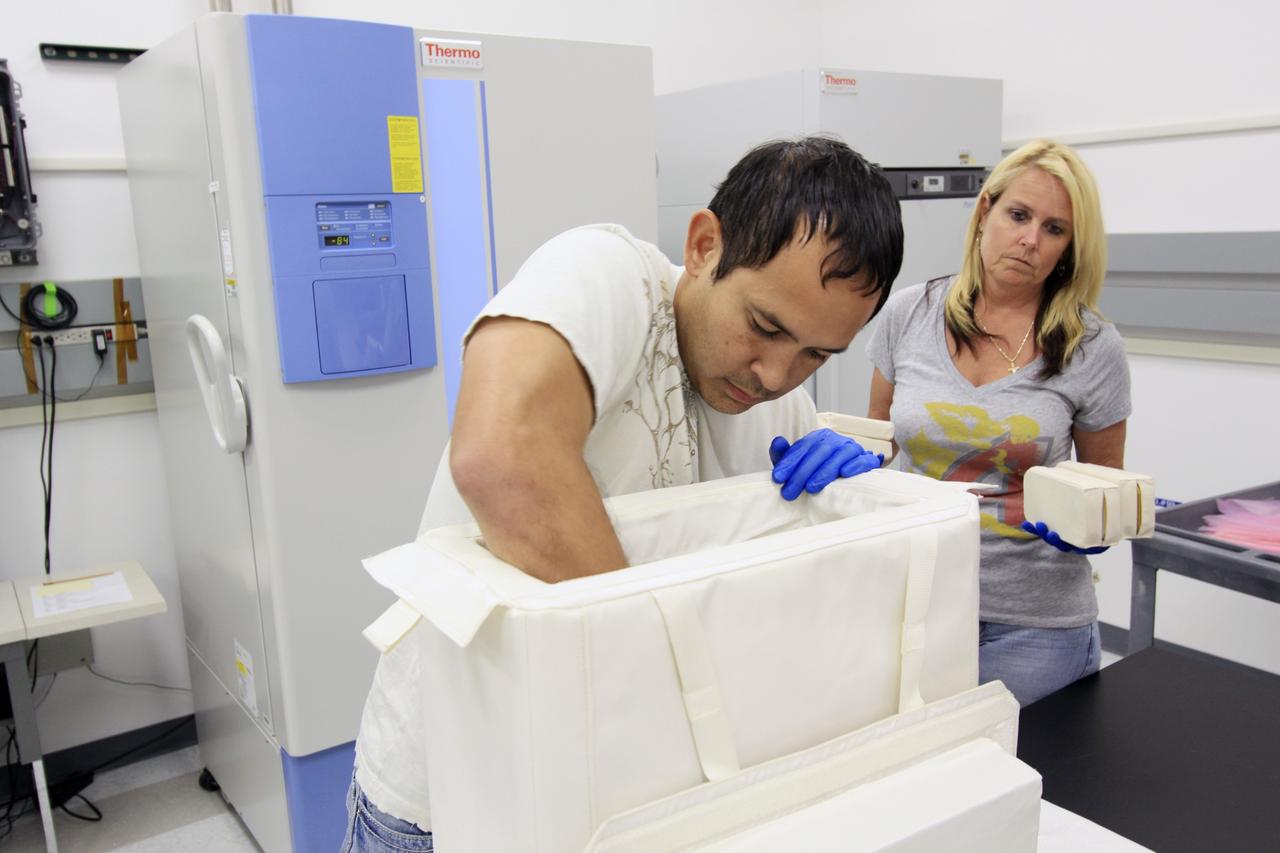
CAPE CANAVERAL, Fla. – In the Space Station Processing Facility at NASA’s Kennedy Space Center in Florida, the NanoRacks-CubeLabs Module-9 experiments requiring refrigeration are placed in a cargo bag designed to keep its contents cool. The module’s experiments requiring cold stowage are being prepared for transport to Space Launch Complex-40 on nearby Cape Canaveral Air Force Station. There, the bags will be loaded into the Space Exploration Technologies Dragon capsule in preparation for its scheduled April 30 liftoff aboard a Falcon 9 rocket. NanoRacks-CubeLabs Module-9 uses a two-cube unit box for student competition investigations using 15 liquid mixing tube assemblies that function similar to commercial glow sticks. The investigations range from microbial growth to water purification in microgravity. Known as SpaceX, the launch will be the company's second demonstration test flight for NASA's Commercial Orbital Transportation Services program, or COTS. During the flight, the capsule will conduct a series of check-out procedures to test and prove its systems, including rendezvous and berthing with the International Space Station. If the capsule performs as planned, the module and other cargo will be transferred to the station. The cargo includes food, water and provisions for the station’s Expedition crews, such as clothing, batteries and computer equipment. Under COTS, NASA has partnered with two private companies to launch cargo safely to the station. For more information, visit http://www.nasa.gov/spacex. Photo credit: NASA/Jim Grossmann
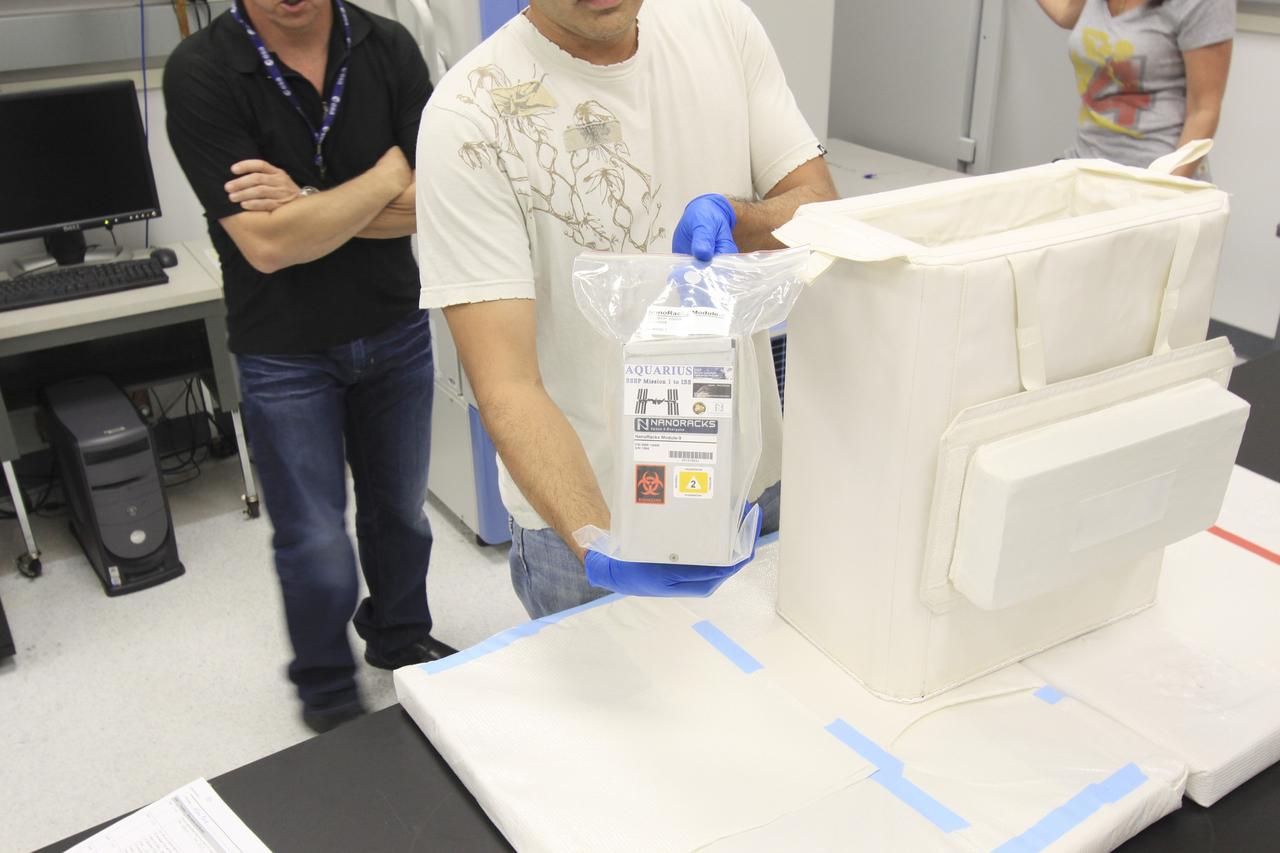
CAPE CANAVERAL, Fla. – In the Space Station Processing Facility at NASA’s Kennedy Space Center in Florida, the NanoRacks-CubeLabs Module-9 experiments requiring refrigeration are prepared for placement in a cargo bag designed to keep its contents cool. The module’s experiments requiring cold stowage are being prepared for transport to Space Launch Complex-40 on nearby Cape Canaveral Air Force Station. There, the bags will be loaded into the Space Exploration Technologies Dragon capsule in preparation for its scheduled April 30 liftoff aboard a Falcon 9 rocket. NanoRacks-CubeLabs Module-9 uses a two-cube unit box for student competition investigations using 15 liquid mixing tube assemblies that function similar to commercial glow sticks. The investigations range from microbial growth to water purification in microgravity. Known as SpaceX, the launch will be the company's second demonstration test flight for NASA's Commercial Orbital Transportation Services program, or COTS. During the flight, the capsule will conduct a series of check-out procedures to test and prove its systems, including rendezvous and berthing with the International Space Station. If the capsule performs as planned, the module and other cargo will be transferred to the station. The cargo includes food, water and provisions for the station’s Expedition crews, such as clothing, batteries and computer equipment. Under COTS, NASA has partnered with two private companies to launch cargo safely to the station. For more information, visit http://www.nasa.gov/spacex. Photo credit: NASA/Jim Grossmann