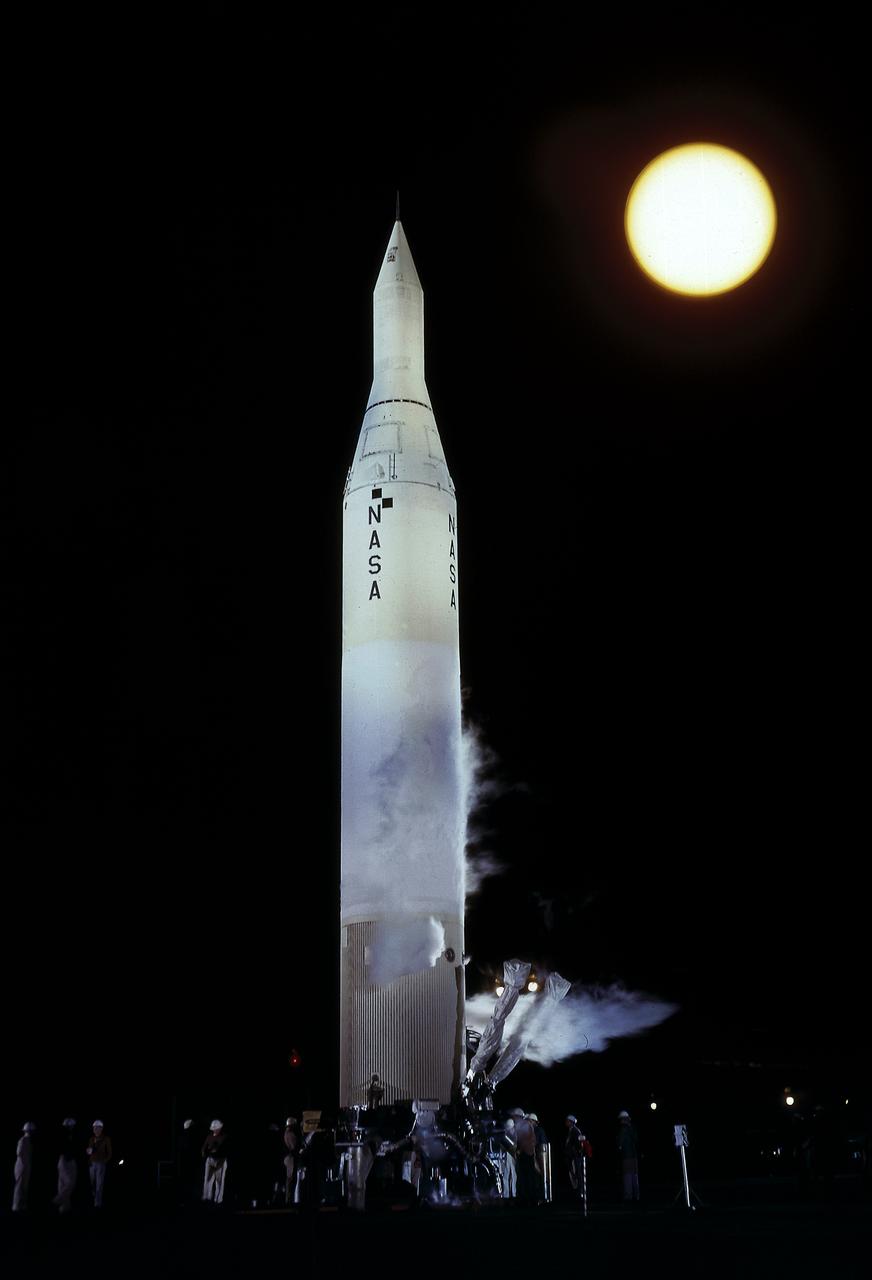
Juno II (AM-14) on the launch pad just prior to launch, March 3, 1959. The payload of AM-14 was Pioneer IV, America's first successful lunar mission. The Juno II was a modification of Jupiter ballistic missile
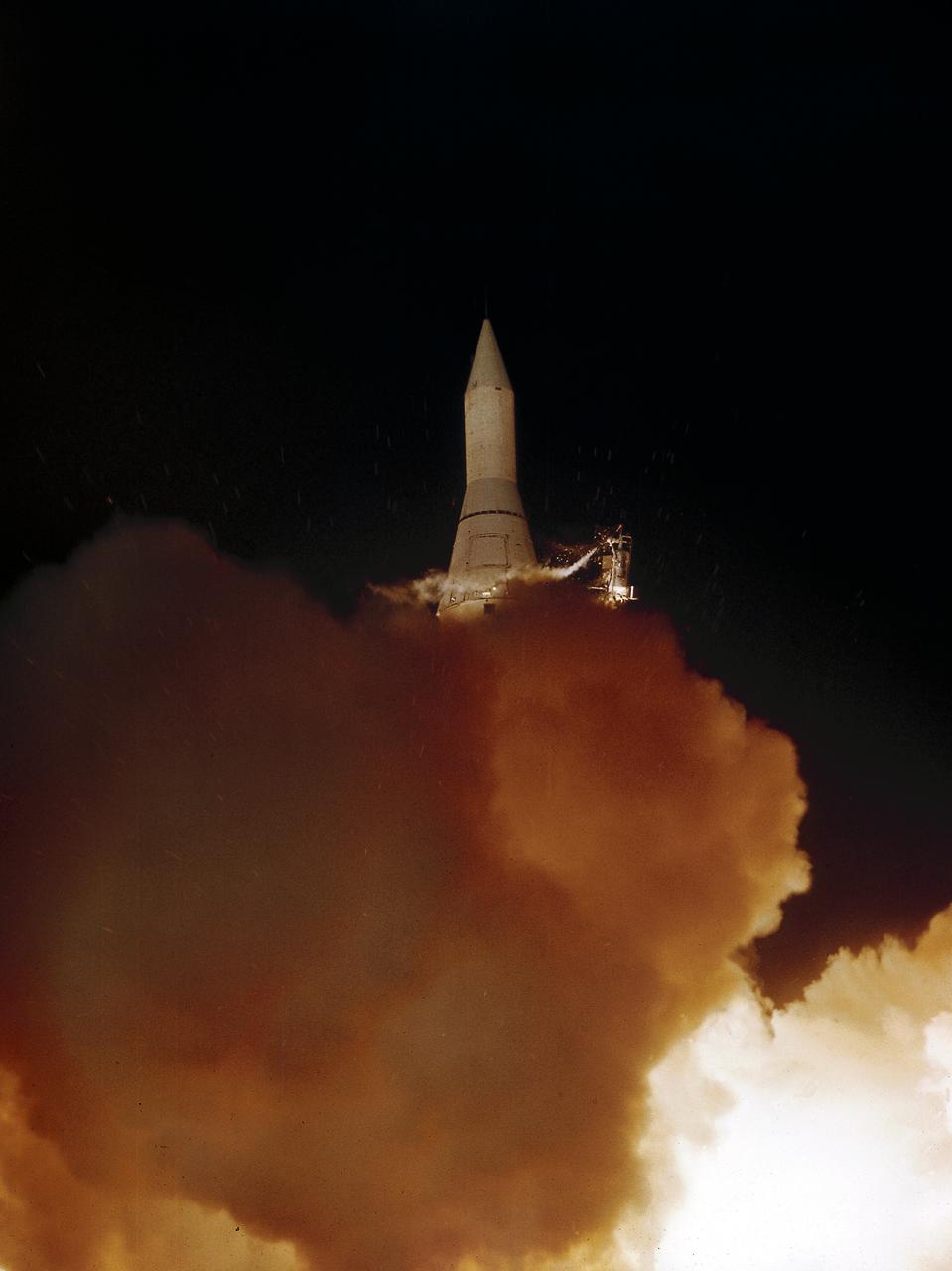
The launch of Juno II (AM-14), carrying the lunar and planetary exploration satellite in orbit, Pioneer IV, on March 3, 1959. the Pioneer IV probe was the first U.S. satellite to orbit the Sun.
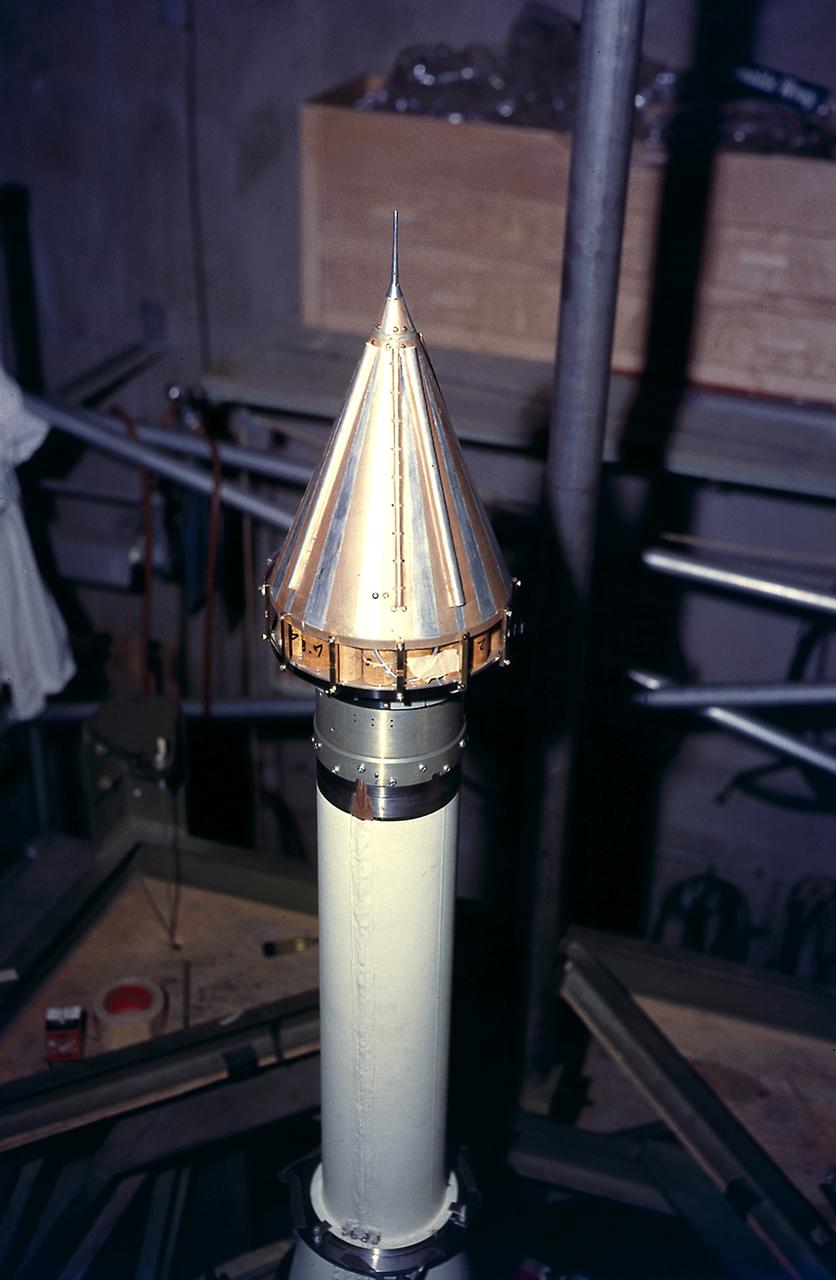
Installing Pioneer IV, payload for AM-14 (Juno II) onto the fourth stage on the cluster before a spin test, February 16, 1959. The Pioneer IV, lunar and planetary exploration satellite, was the first U.S. satellite to orbit the Sun.
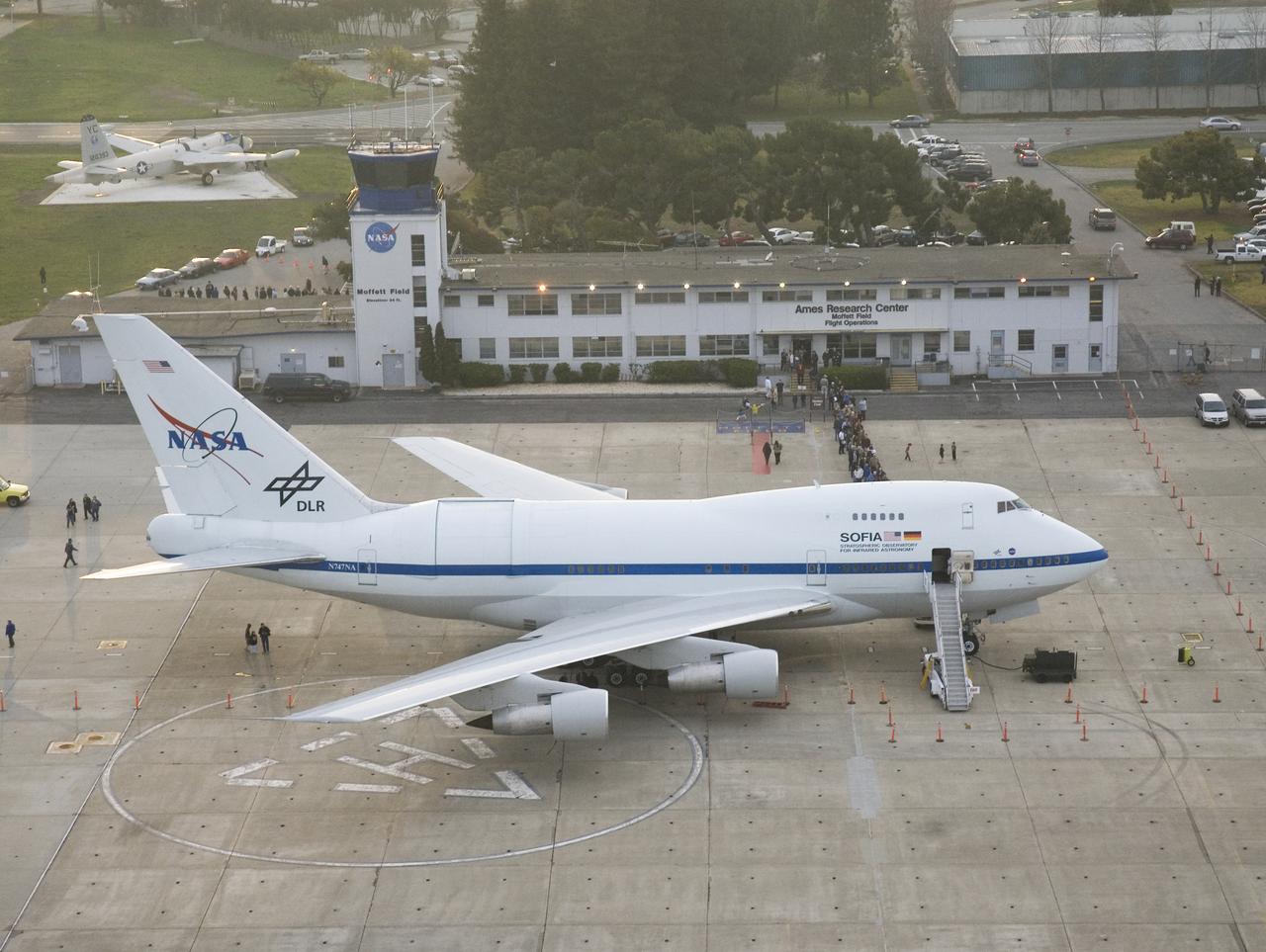
Thousands of NASA Ames employees and their families toured NASA's SOFIA flying observatory during its first visit to NASA Ames Research Center, Jan. 14, 2008.

NASA's Stratospheric Observatory for Infrared Astronomy touches down at Moffett Field, Calif., for its first visit to NASA Ames Research Center, Jan. 14, 2008.
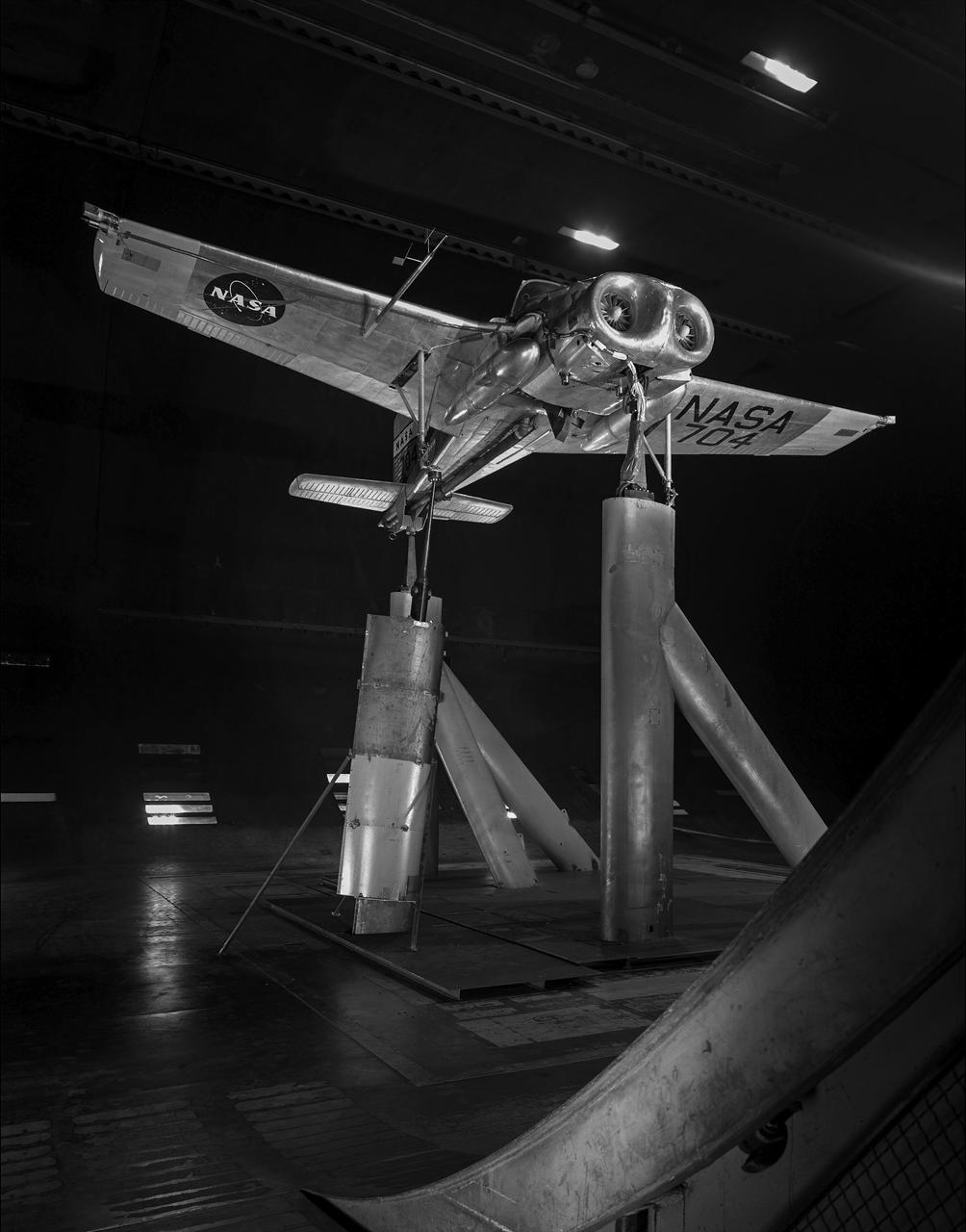
Bell V/STOL X-14 airplane mounted at 90 degrees yaw in 40x80 foot wind tunnel.
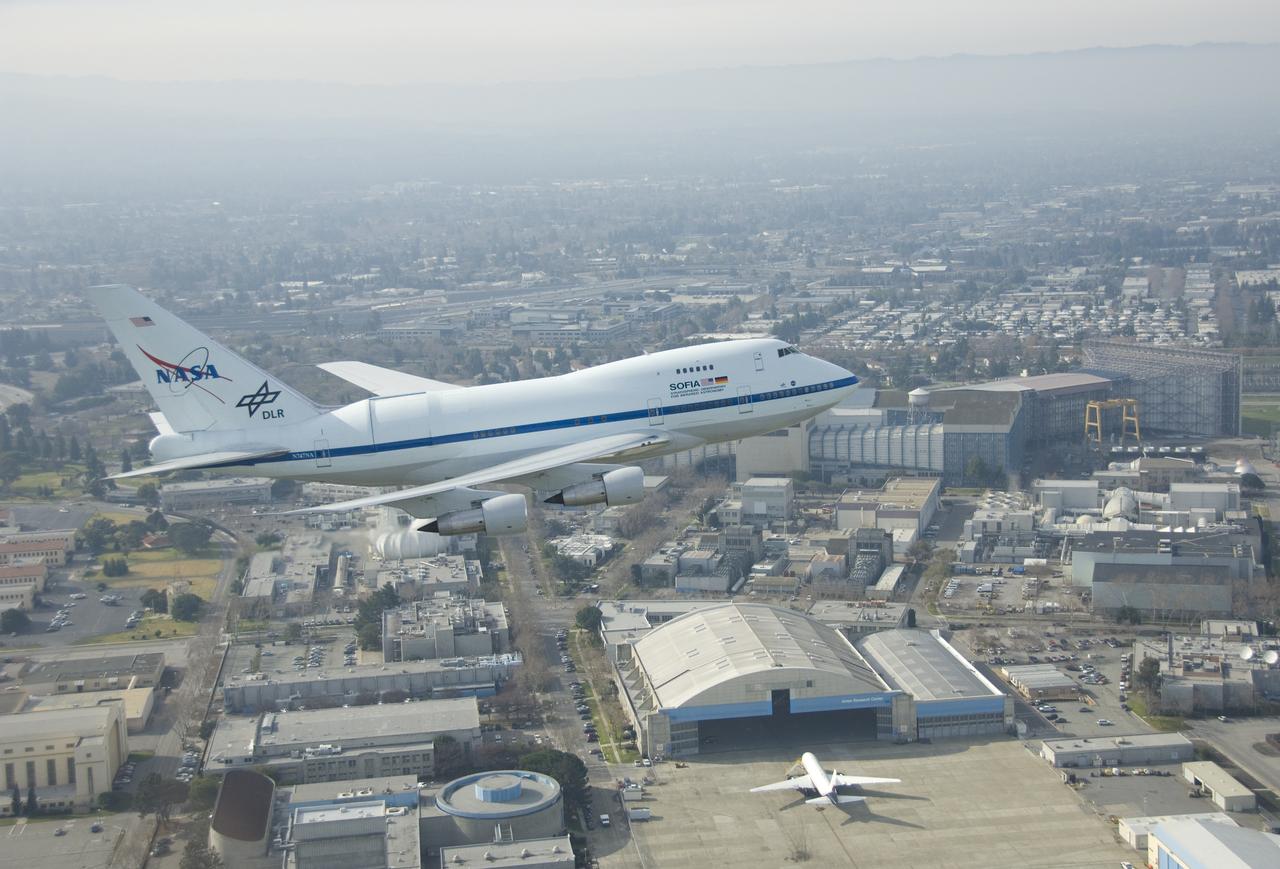
NASA's SOFIA flying observatory makes a low pass over NASA Ames Research Center prior to landing at Moffett Field for a brief visit on Jan. 14, 2008.
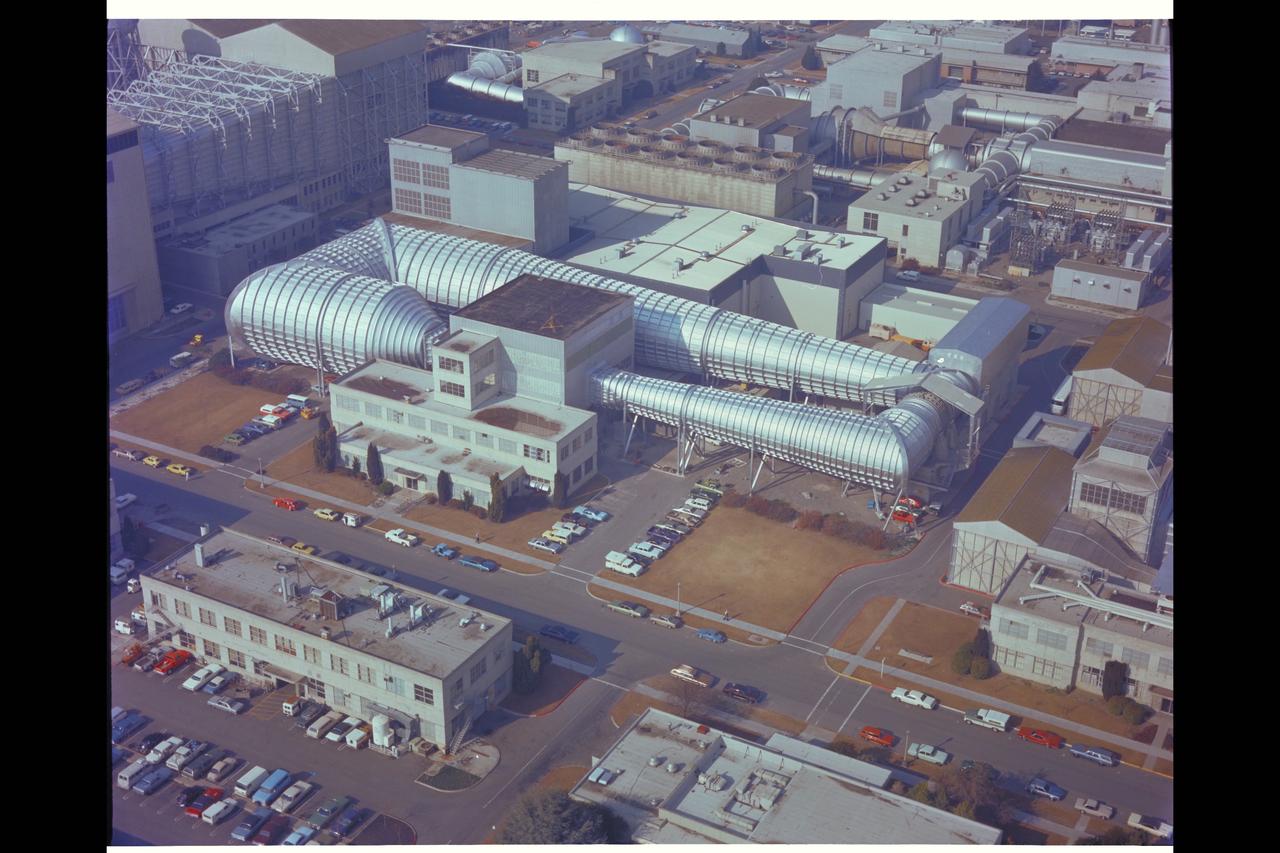
NASA Ames Research Center 14-foot Transonic Wind Tunnel
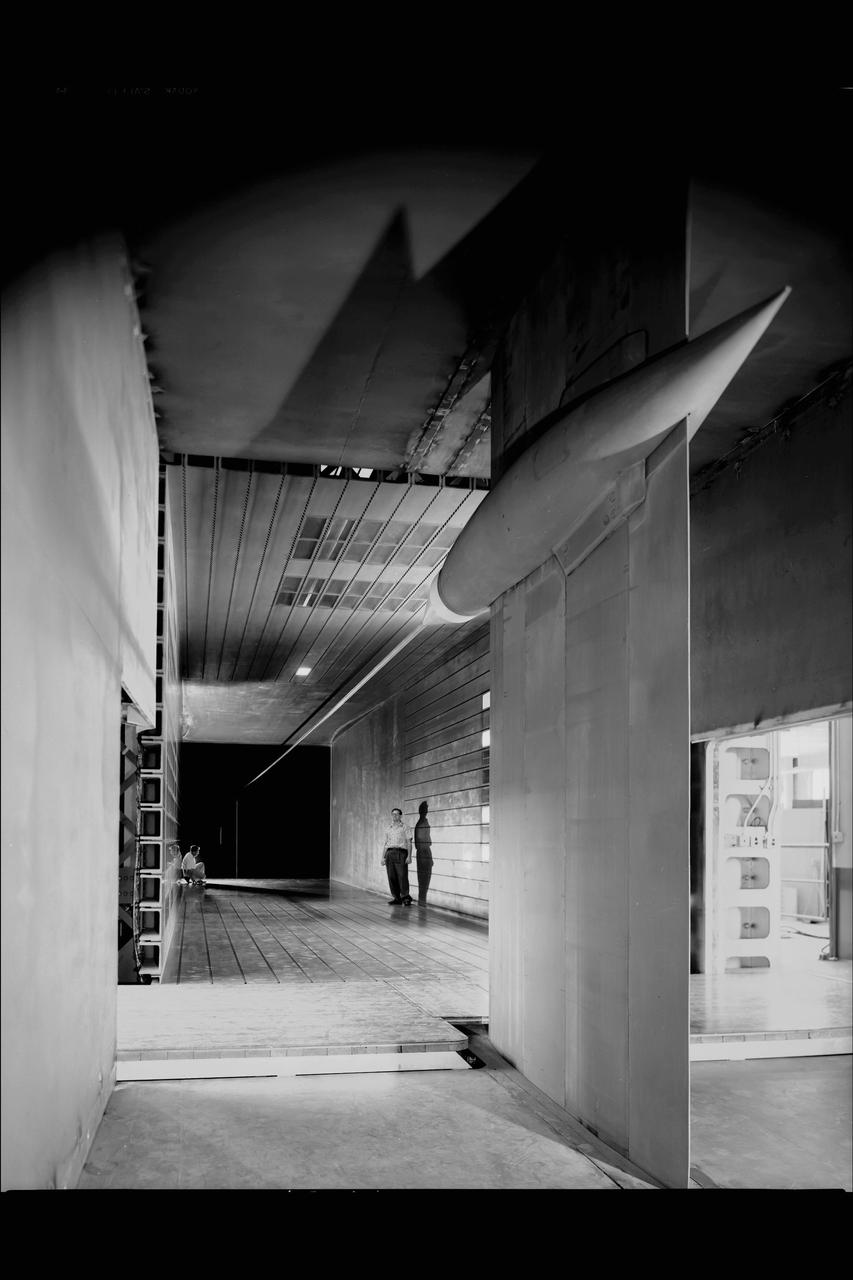
NACA Ames Research Center 14' TRANSONIC WIND TUNNEL SURVEY TUBE.
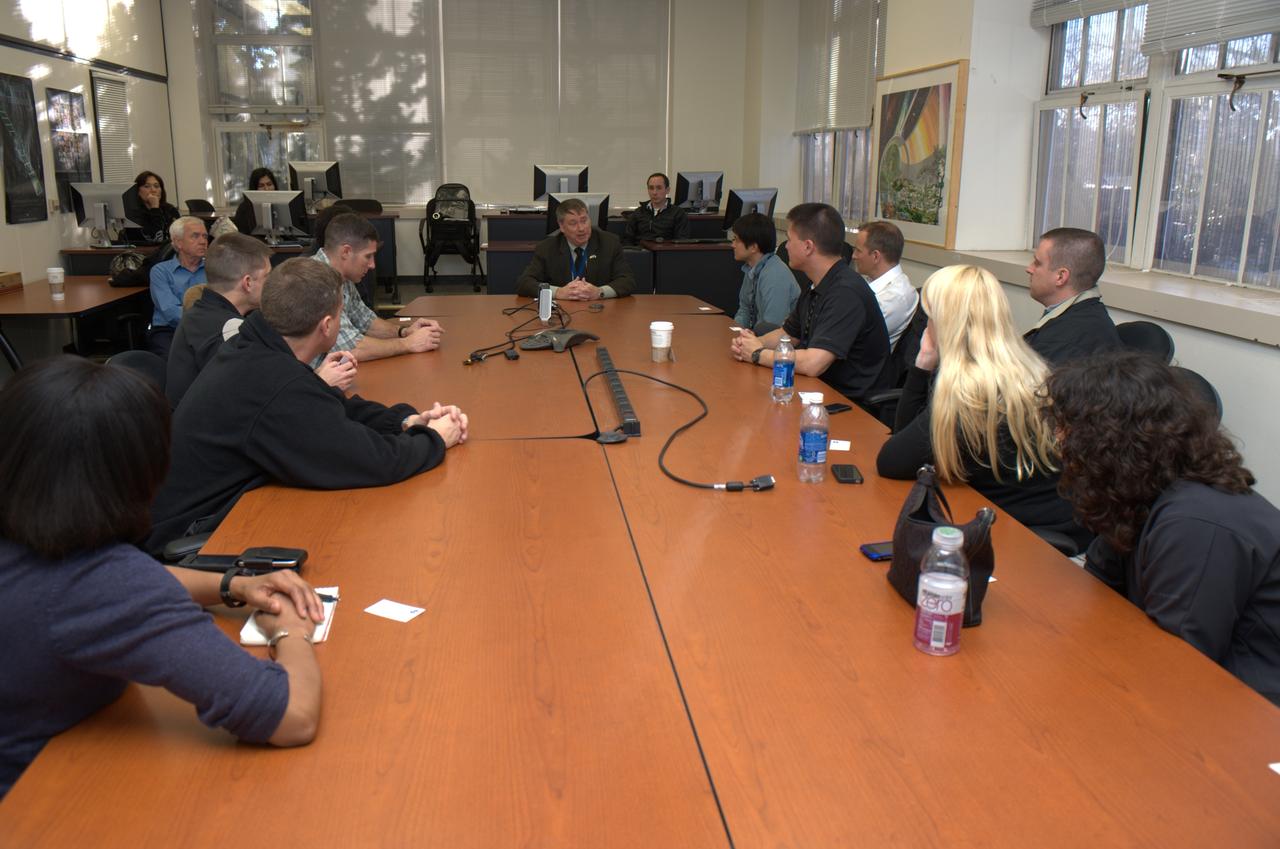
The 14 member 2009 class of NASA astronauts, Japan Aerospace Explortion Agency (JAXA) astronauts and Canadian Space Agency astronauts visit Ames Research Center. Pete Worden, Ames Center Director joins the candidates during the round table.
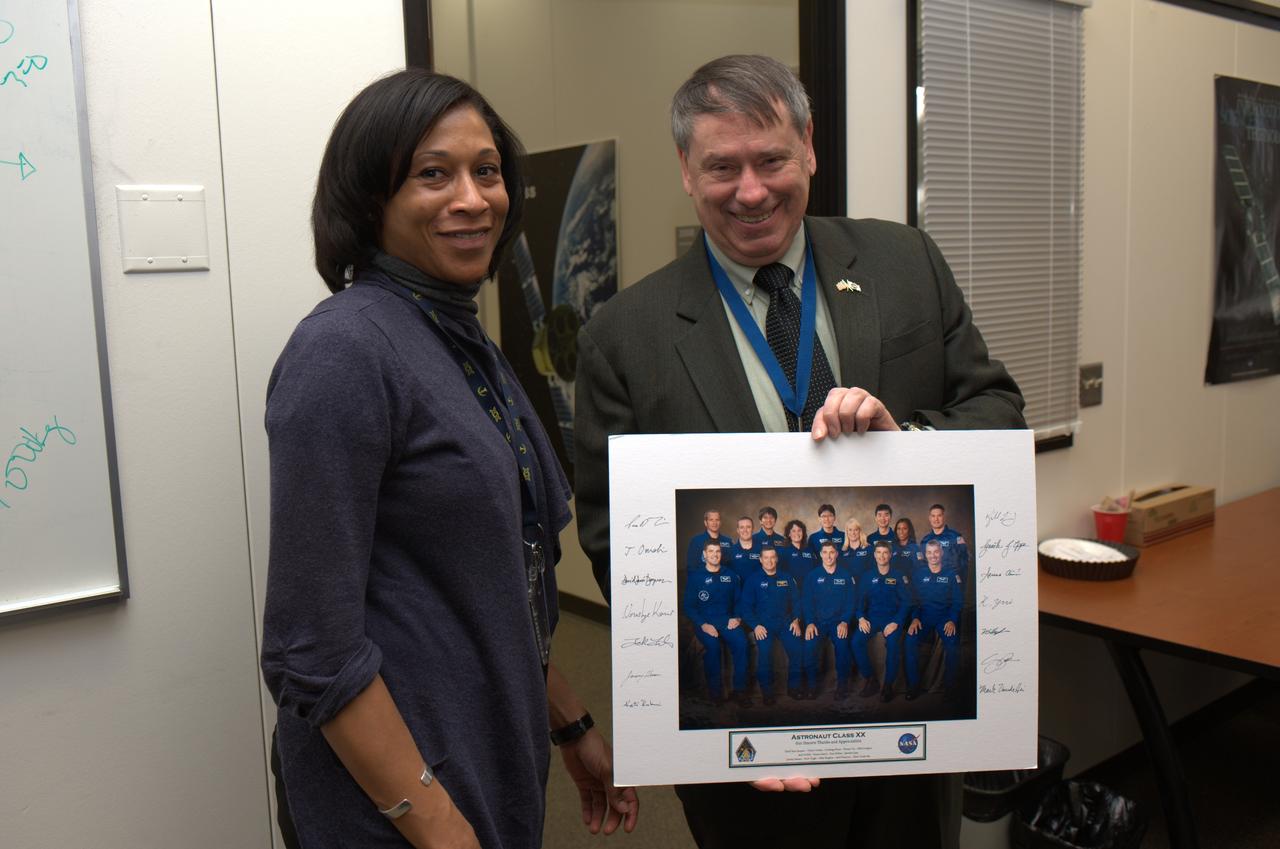
The 14 member 2009 class of NASA astronauts, Japan Aerospace Explortion Agency (JAXA) astronauts and Canadian Space Agency astronauts visit Ames Research Center. Astronaut candidate Jeanette Epps presents photo to Pete Worden, Ames Center Director.
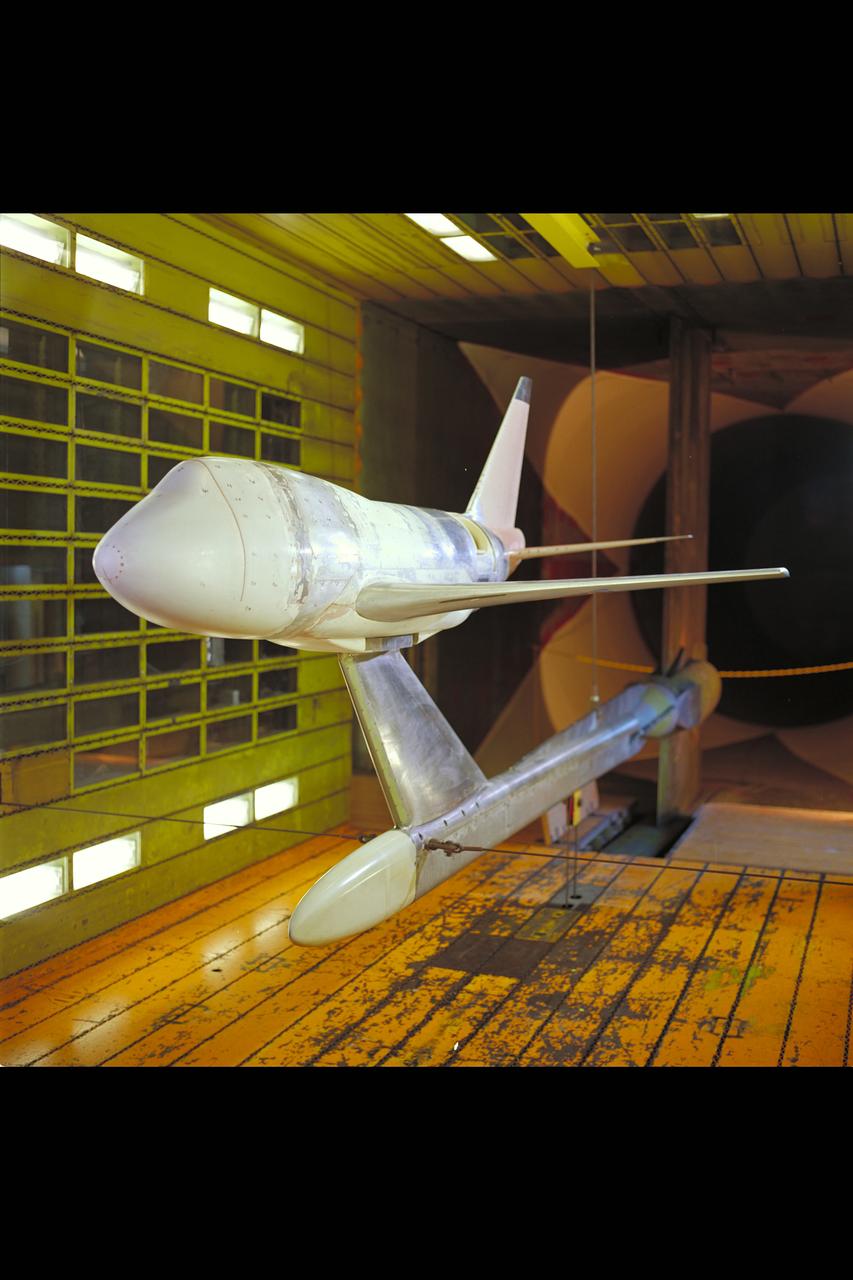
SOFIA (Stratospheric Observatory for Infrared Astronomy) with telescope postition to the rear model prepares for testing in the NASA Ames Research Center 14ft Transonic Wind Tunnel. Test-208-1-14
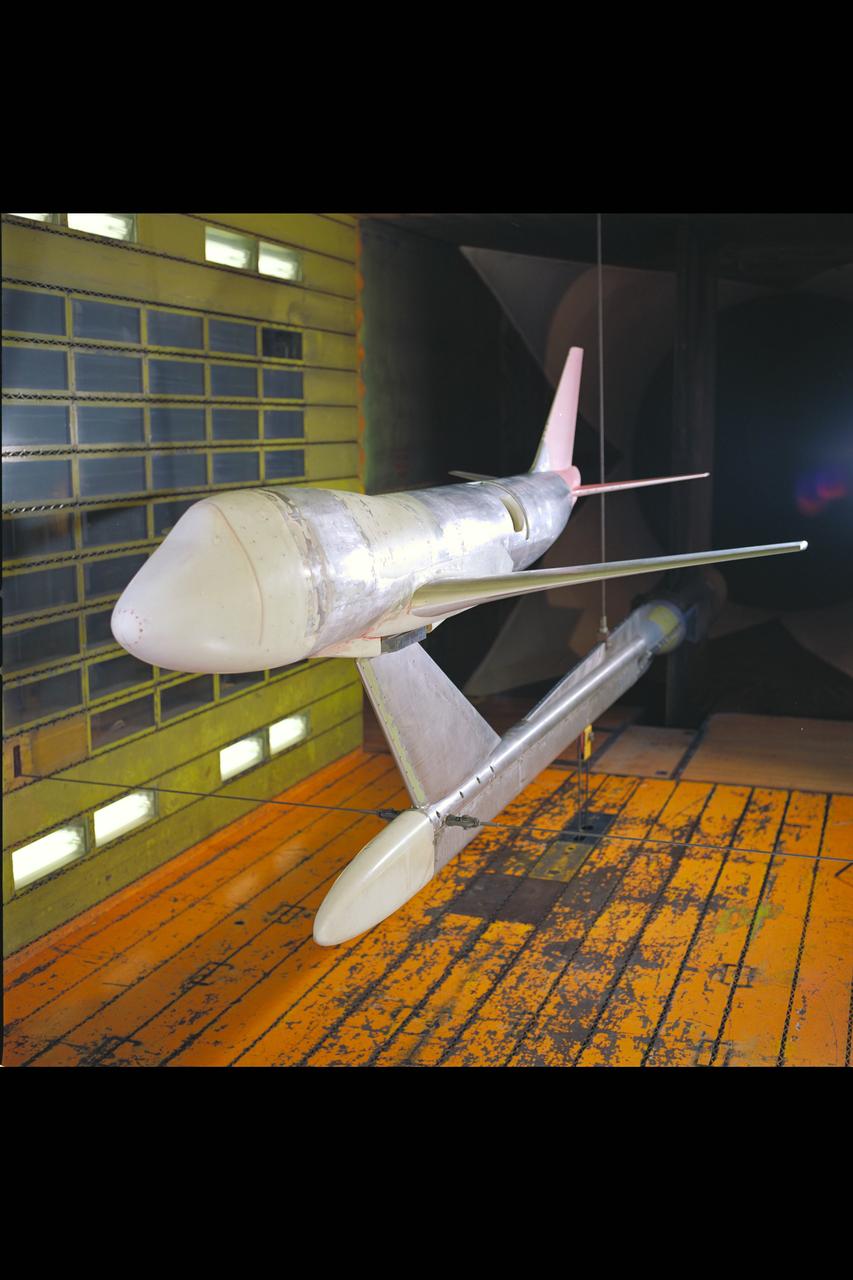
SOFIA (Stratospheric Observatory for Infrared Astronomy) with telescope postition to the rear model prepares for testing in the NASA Ames Research Center 14ft Transonic Wind Tunnel. Test-208-1-14
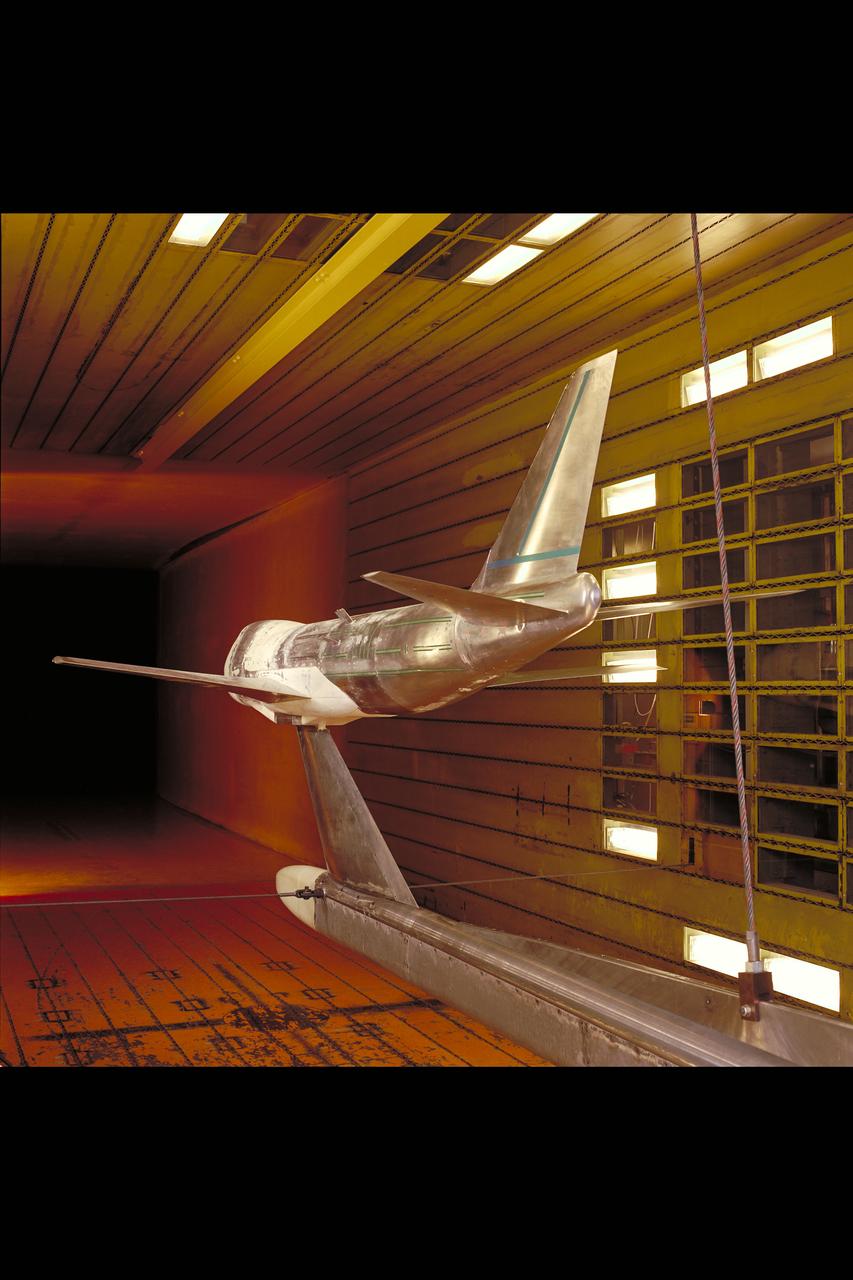
SOFIA (Stratospheric Observatory for Infrared Astronomy) with telescope postition to the rear model prepares for testing in the NASA Ames Research Center 14ft Transonic Wind Tunnel. Test-208-1-14
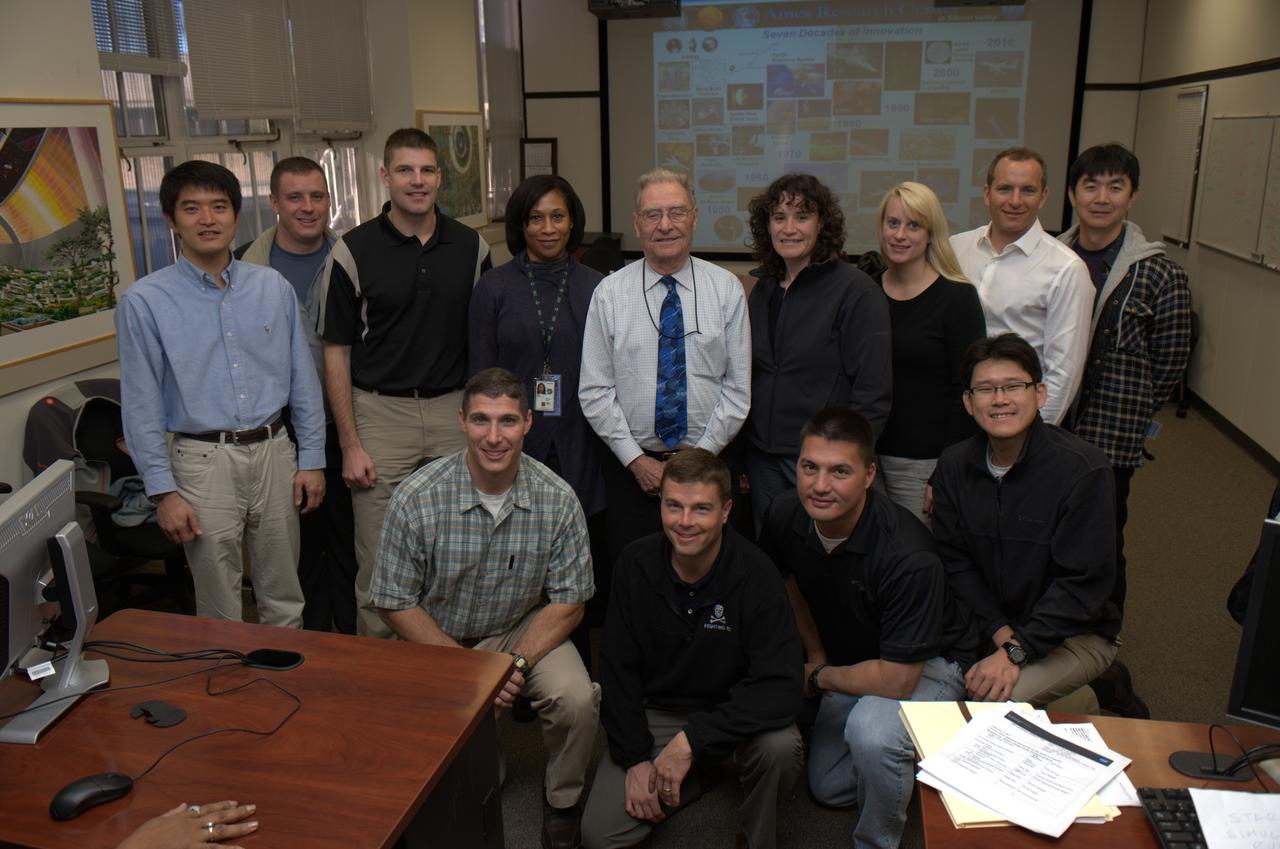
The 14 member 2009 class of NASA astronauts, Japan Aerospace Explortion Agency (JAXA) astronauts and Canadian Space Agency astronauts visit Ames Research Center. From left to right back row are Takuya Onishi (JAXA), Scott Tingle, Jeremy Hansen, Jeanette Epps, Jack Boyd (Ames), Serena Aunon, Kathleen (Kate) Rubins, David Saint-Jacques (CSA) Kimiya Yui (JAXA), Michael Hopkins, Gregory (Reid) Wiseman, Kjell Lundgren, Norishige Kanai (JAXA).
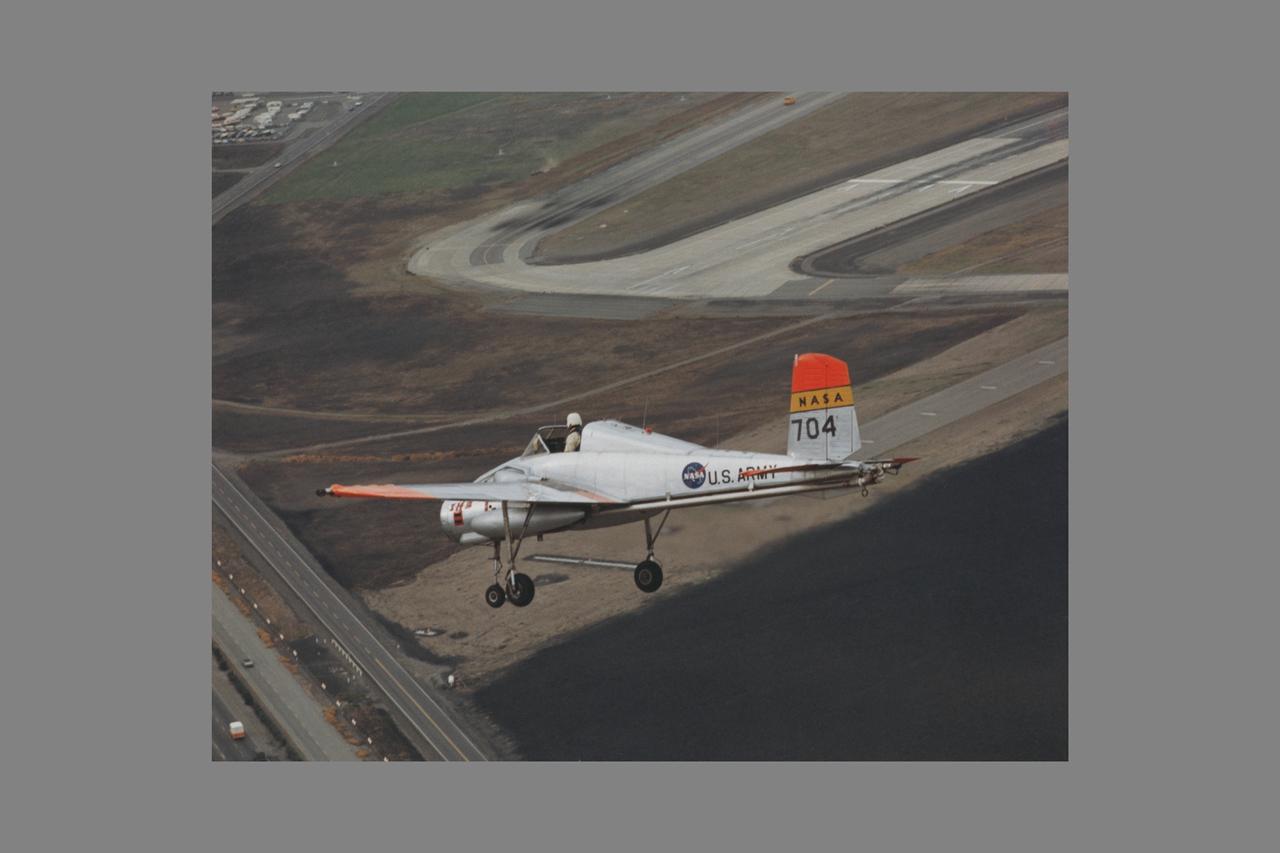
X-14B NASA-704: A Bell single-place, open cockpit, twin-engine, jet-lift VTOL aircraft over Highway 101 in approach to Moffett Field, California. The X-14 was used by NASA Ames Research Center to advance state-of-the-art jet-powered VTOL aircraft.

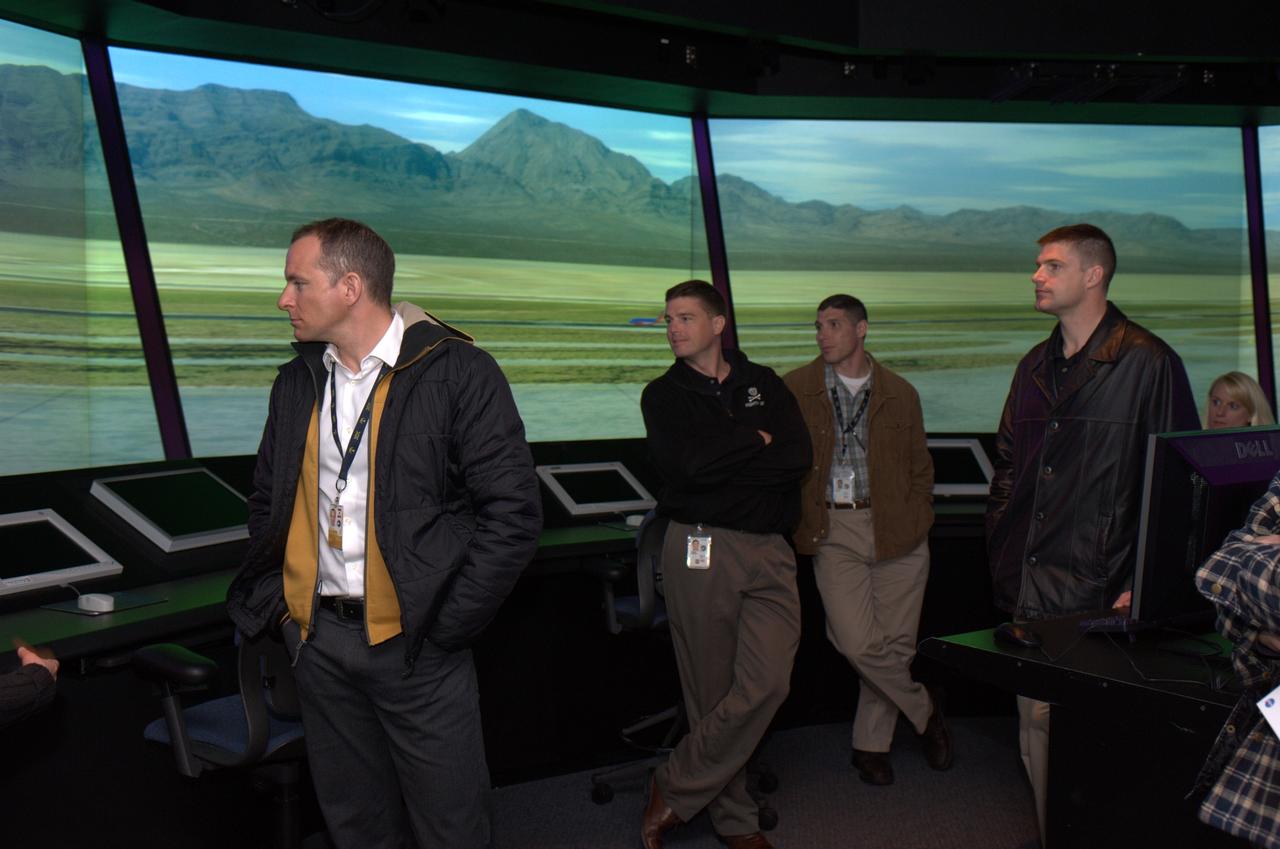
The 14 member 2009 class of NASA astronauts, Japan Aerospace Explortion Agency (JAXA) astronauts and Canadian Space Agency astronauts visit Ames Research Center. From left to right Serena Aunon, Jeanette Epps, Kimiya Yui (JAXA) in foreground and Scott Tingle during a tour of Future Flgiht Central (FFC) Simulator.
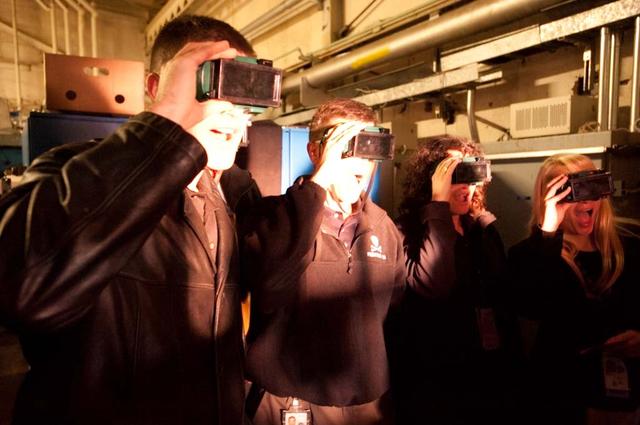
The 14 member 2009 class of NASA astronauts, Japan Aerospace Explortion Agency (JAXA) astronauts and Canadian Space Agency astronauts visit the Arc Jet Facilities at Ames Research Center. Jeremy Hansen, Gregory 'Reid' Wiseman, Serna Aunon, Kathleen (Kate) Rubins watch the test artical burn durning a test run.
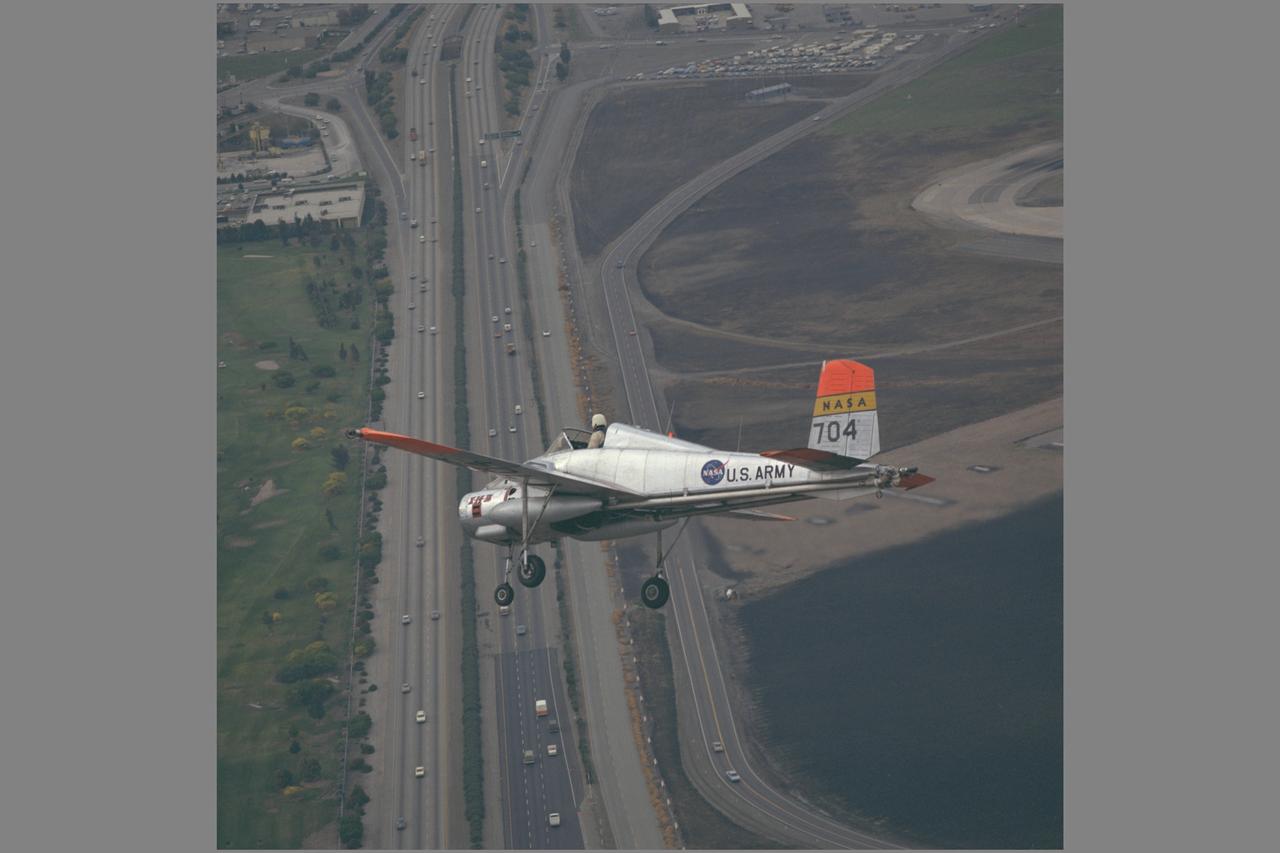
X-14B NASA-704: A Bell single-place, open cockpit, twin-engine, jet-lift VTOL aircraft over Highway 101 in approach to Moffett Field, California. The X-14 was used by NASA Ames Research Center to advance state-of-the-art jet-powered VTOL aircraft.
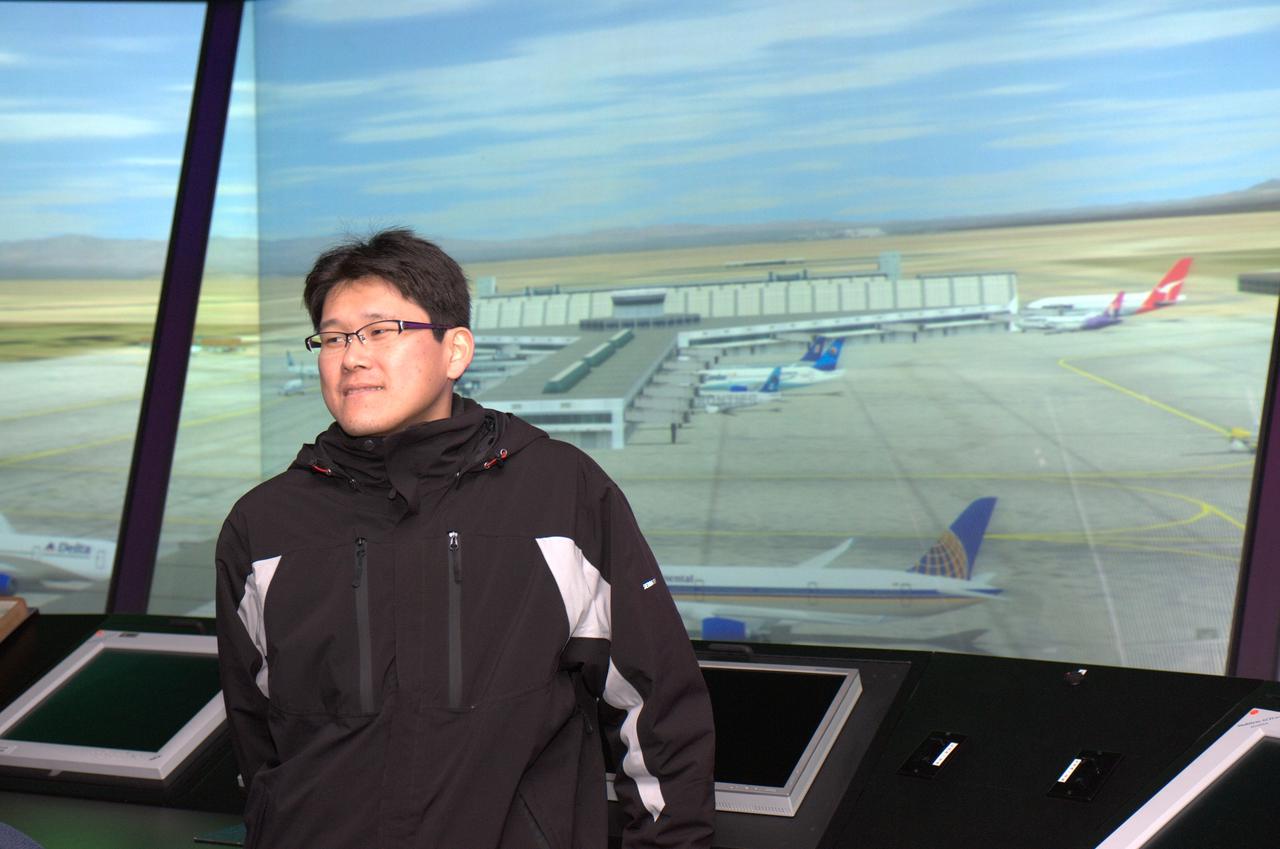
The 14 member 2009 class of NASA astronauts, Japan Aerospace Explortion Agency (JAXA) astronauts and Canadian Space Agency astronauts visit Ames Research Center. Norishige Kanai (JAXA) during a tour of the Future Flgiht Central (FFC) Simulator.
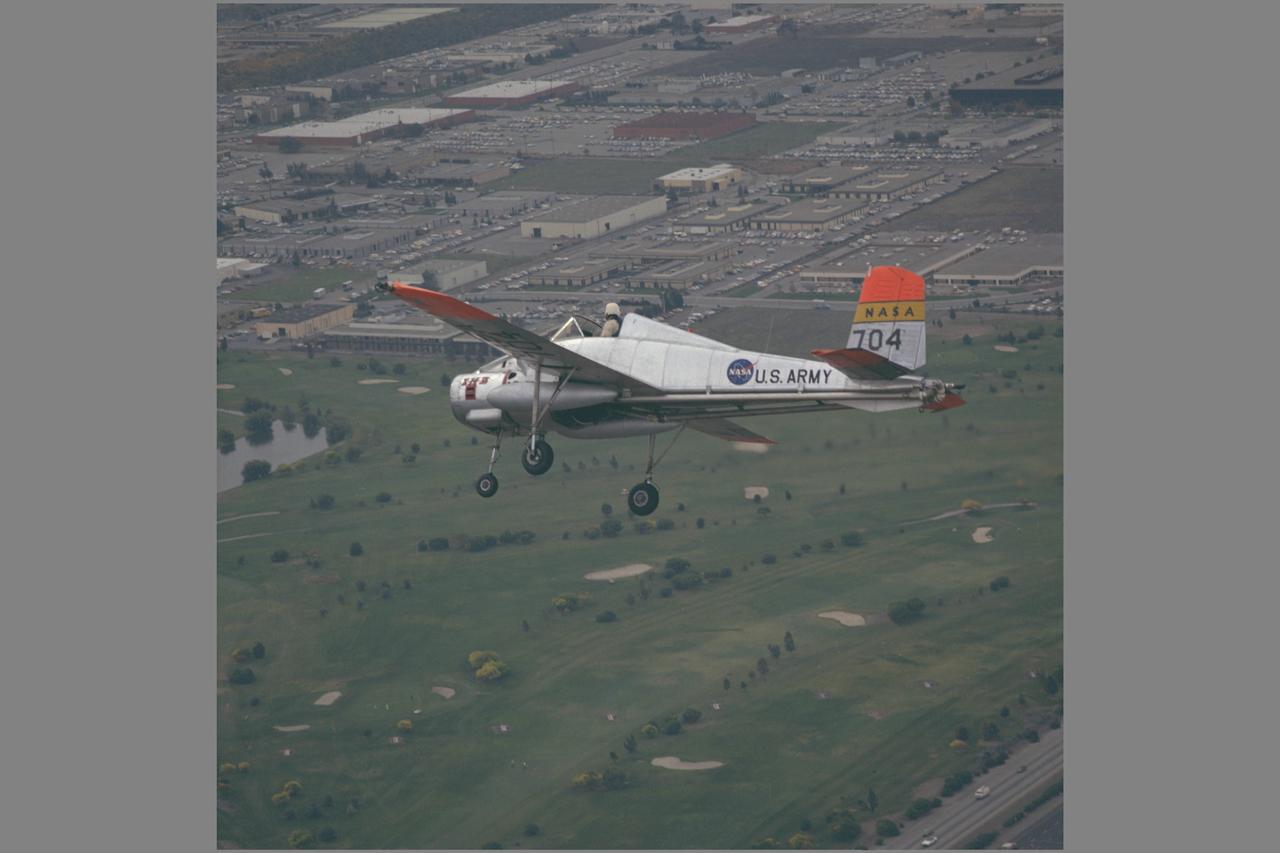
X-14B NASA-704: A Bell single-place, open cockpit, twin-engine, jet-lift VTOL aircraft in flight over Sunnyvale golf course. The X-14 was used by NASA Ames Research Center to advance state-of-the-art jet-powered VTOL aircraft.
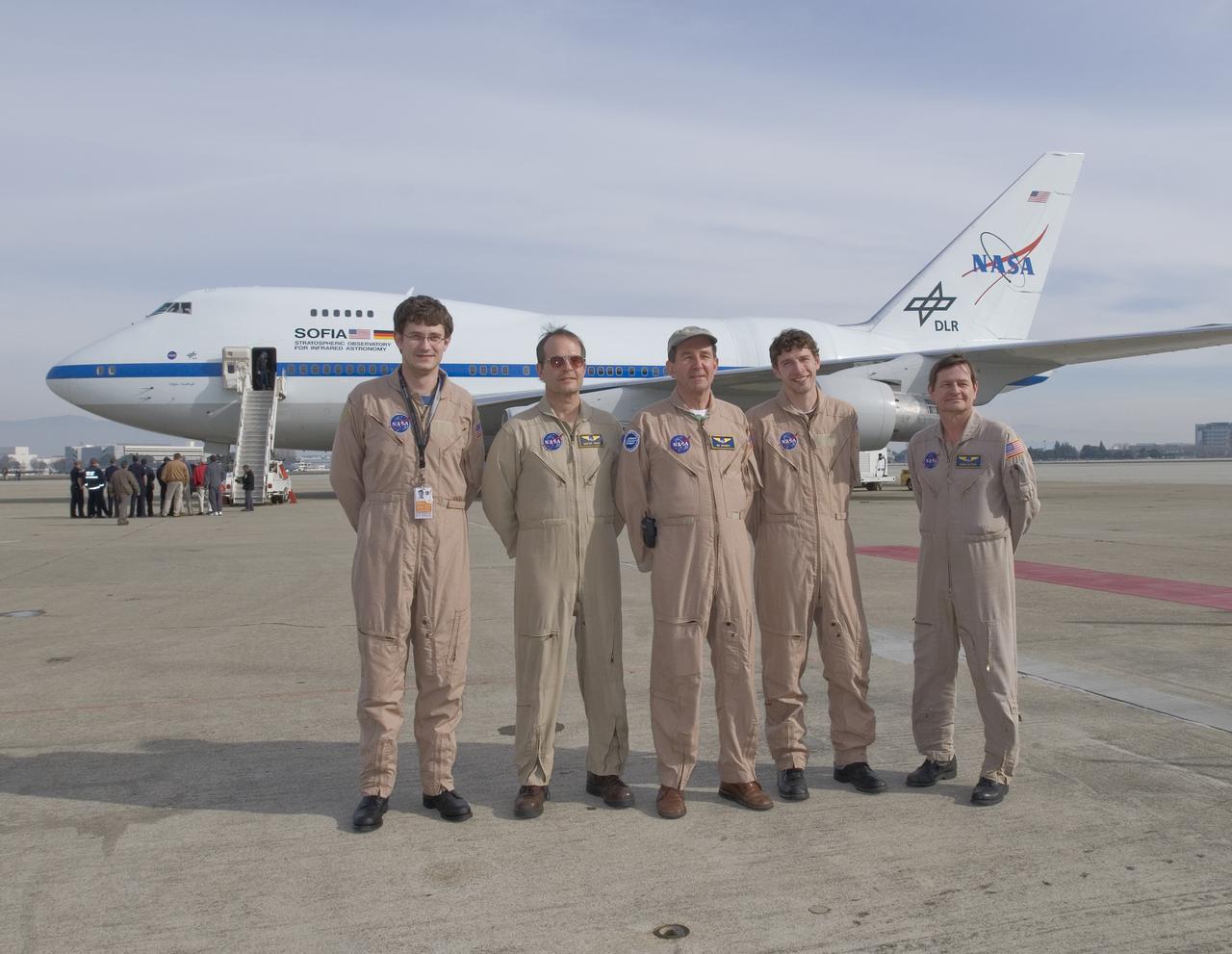
The flight crew of NASA's SOFIA airborne observatory and DLR telescope engineers who operated the system during its visit to NASA Ames Research Center on Jan. 14, 2008 included (from left), DLR telescope engineer Ulli Lampater, flight engineer Marty Trout, pilot Bill Brockett, telescope engineer Andres Reinacher and pilot Frank Batteas.
The 14 member 2009 class of NASA astronauts, Japan Aerospace Explortion Agency (JAXA) astronauts and Canadian Space Agency astronauts visit Ames Research Center. From left to right David Saint-Jacques (CSA) Gregory (Reid) Wiseman, Michael Hopkins, Jeremy Hanson during a tour of the Future Flgiht Central (FFC) Simulator.
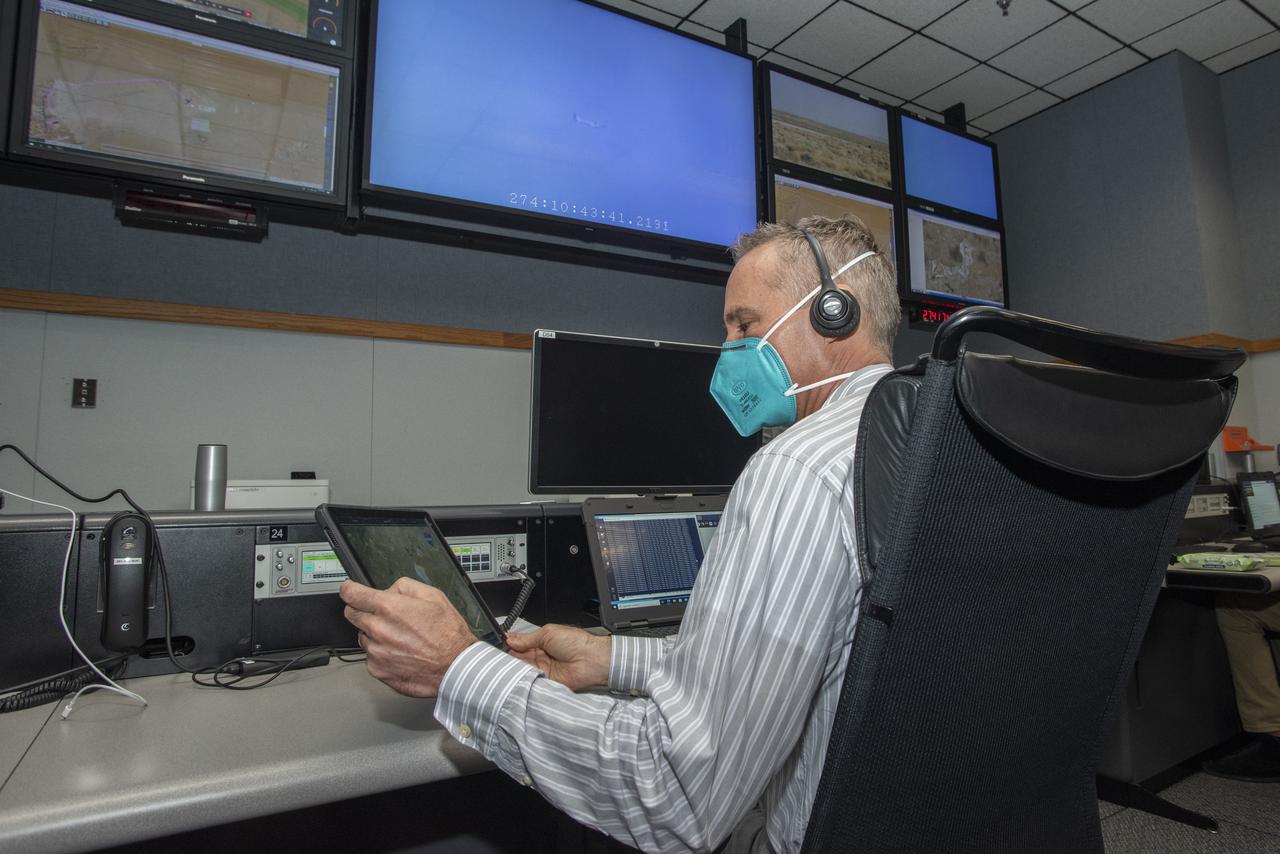
Mark Snycerski, senior research associate at NASA's Ames Research Center in California, monitored inbound telemetry data through collection servers during the Advanced Air Mobility National Campaign's connectivity and infrastructure flight tests. The test used a NASA TG-14 glider aircraft based at NASA's Armstrong Flight Research Center in California Sept. 30-Oct. 1, 2020. The exercise was in preparation for the NC Integrated Dry Run Test in December.
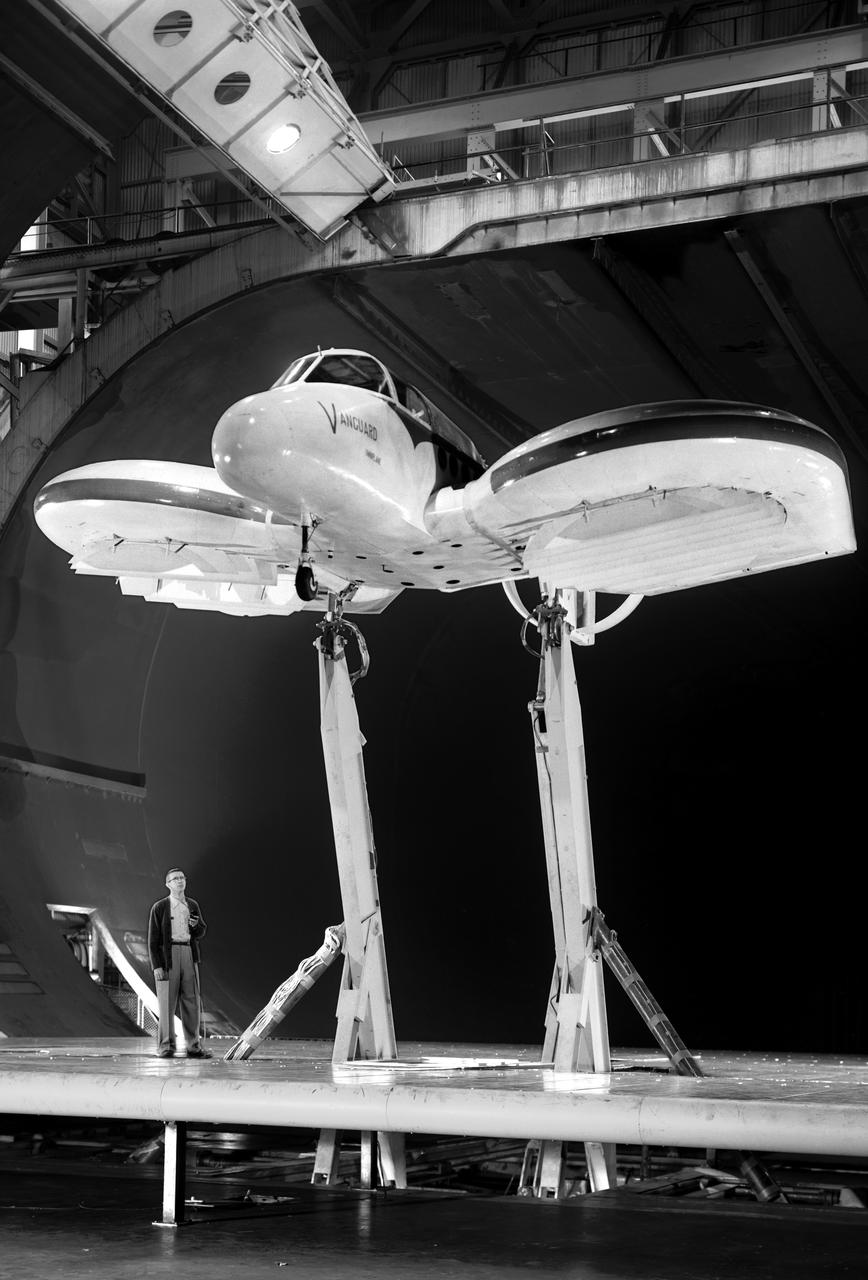
Vanguard 2C vertical take-off and landing (VTOL) airplane, wind tunnel test. Front view from below, model 14 1/2 feet high disk off. Nasa Ames engineer Ralph Maki in photo. Variable height struts and ground plane, low pressure ratio, fan in wing. 02/01/1960.
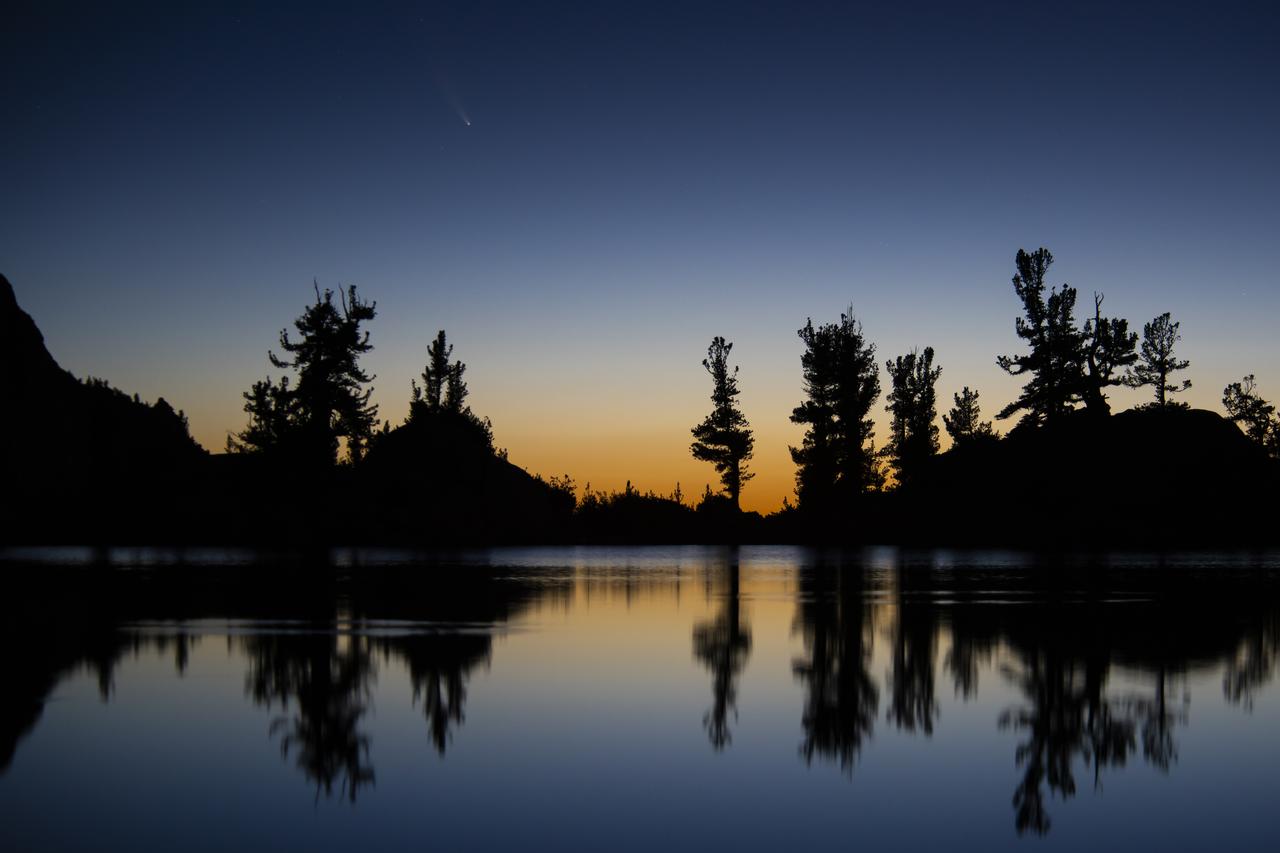
An image of the Comet C/2020 F3 NEOWISE (Comet NEOWISE) captured above the tree line of Lone Pine Lake, located on the Mount Whitney Trail in the Eastern Sierra Nevada Mountains in California. The photo was taken at 4:59 am on July 14, 2020. Visiting from the distant parts of the solar system, it’s characterized by a glowing tail and is visible during the month of July. The comet returns in 6,800 years.
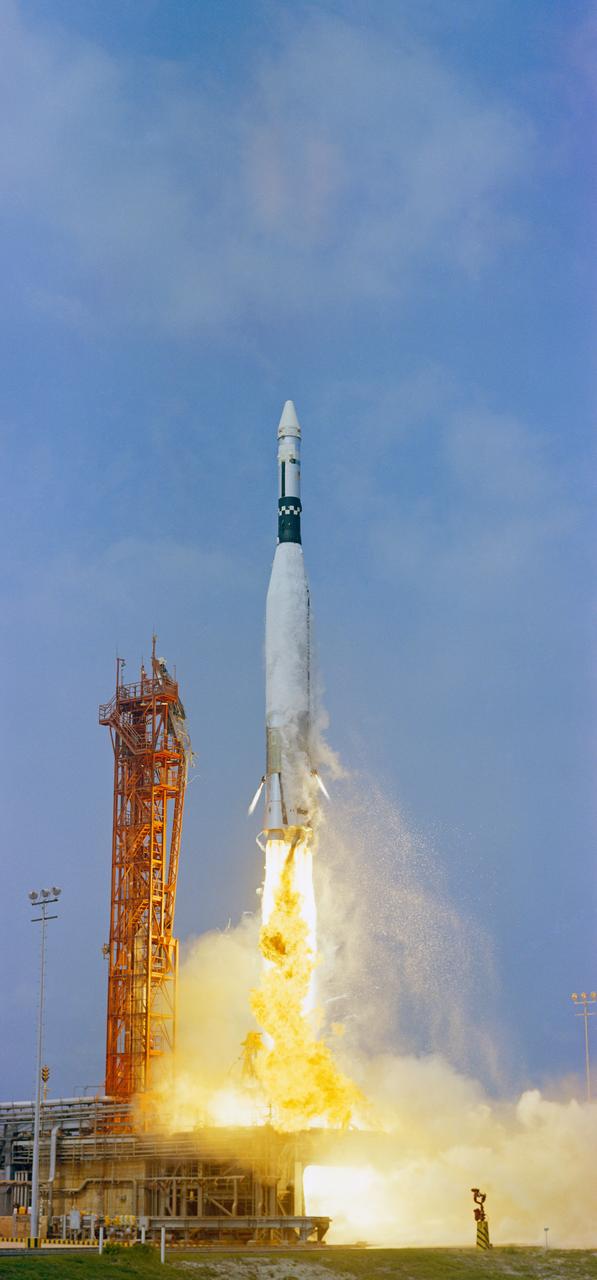
S66-34610 (17 May 1966) --- An Agena Target Vehicle atop its Atlas Launch vehicle is launched from the Kennedy Space Center (KSC) Launch Complex 14 at 10:15 am., May 17, 1966. The Agena was intended as a rendezvous and docking vehicle for the Gemini-9 spacecraft. However, since the Agena failed to achieve orbit, the Gemini-9 mission was postponed. Photo credit: NASA
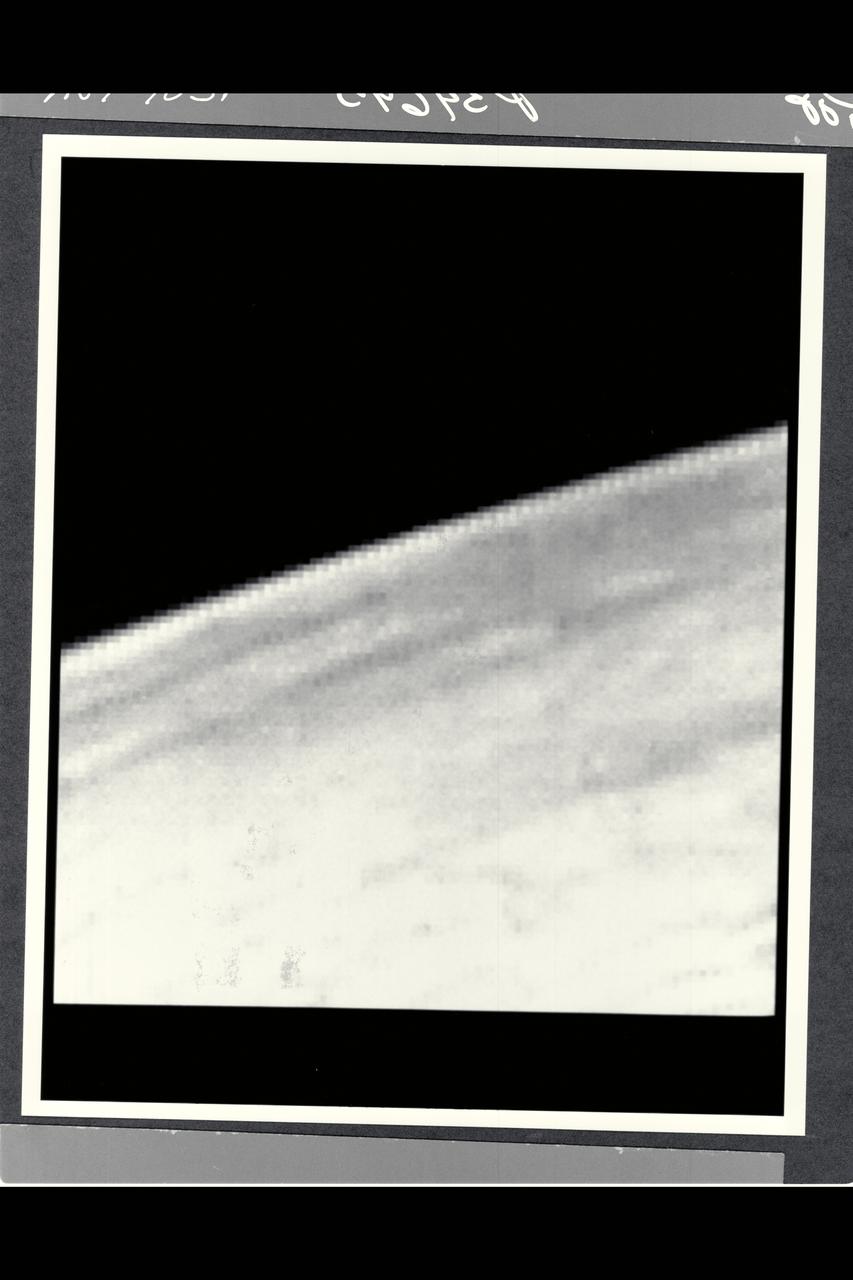
Range : 168,694 km (105,000 mi.) Voyager 2 discovered detached limb hazes in the atmosphere of Triton in Pictures that arrived at Earth between 3:30 am and 5:30 am. The principal layer seen here begins about three km (2 miles) above the surface, and is about 3 km thick. Fainter upward extension of the haze has been seen to an altitude of at least 14 km (9 mi.). The haze must be comoposed of tiny particles in order to be supported in Trition's thin atmosphere. Composition of the haze is currently unknown, but may be either condensed atmospheric gases or complex orgainc molecules produced by irradiation of the methane in Triton's atmosphere. The vaguely linear mottling on the surface may be shadows of other haze striations. Other features of the haze layer should be appaarent in images of Triton taken at higher phase angles (including crescent phase). The image shows features as small as 2 km (1.2 mi) wide.

CAPE CANAVERAL, Fla. – Sharmila Bhattacharya, principal investigator, Ames Student Fruit-Fly Experiment, NASA Ames Research Center, briefs media representatives in Kennedy Space Center’s Press Site auditorium in preparation for the launch of the SpaceX CRS-4 mission to resupply the International Space Station. Bhattacharya is a member of the ISS Science Panel on Model Organisms. The mission is the fourth of 12 SpaceX flights NASA contracted with the company to resupply the space station. It will be the fifth trip by a Dragon spacecraft to the orbiting laboratory. The spacecraft’s 2.5 tons of supplies, science experiments, and technology demonstrations include critical materials to support 255 science and research investigations that will occur during the station's Expeditions 41 and 42. Liftoff is targeted for an instantaneous window at 2:14 a.m. EDT. To learn more about the mission, visit http://www.nasa.gov/mission_pages/station/structure/launch/index.html. Photo credit: NASA/Jim Grossmann
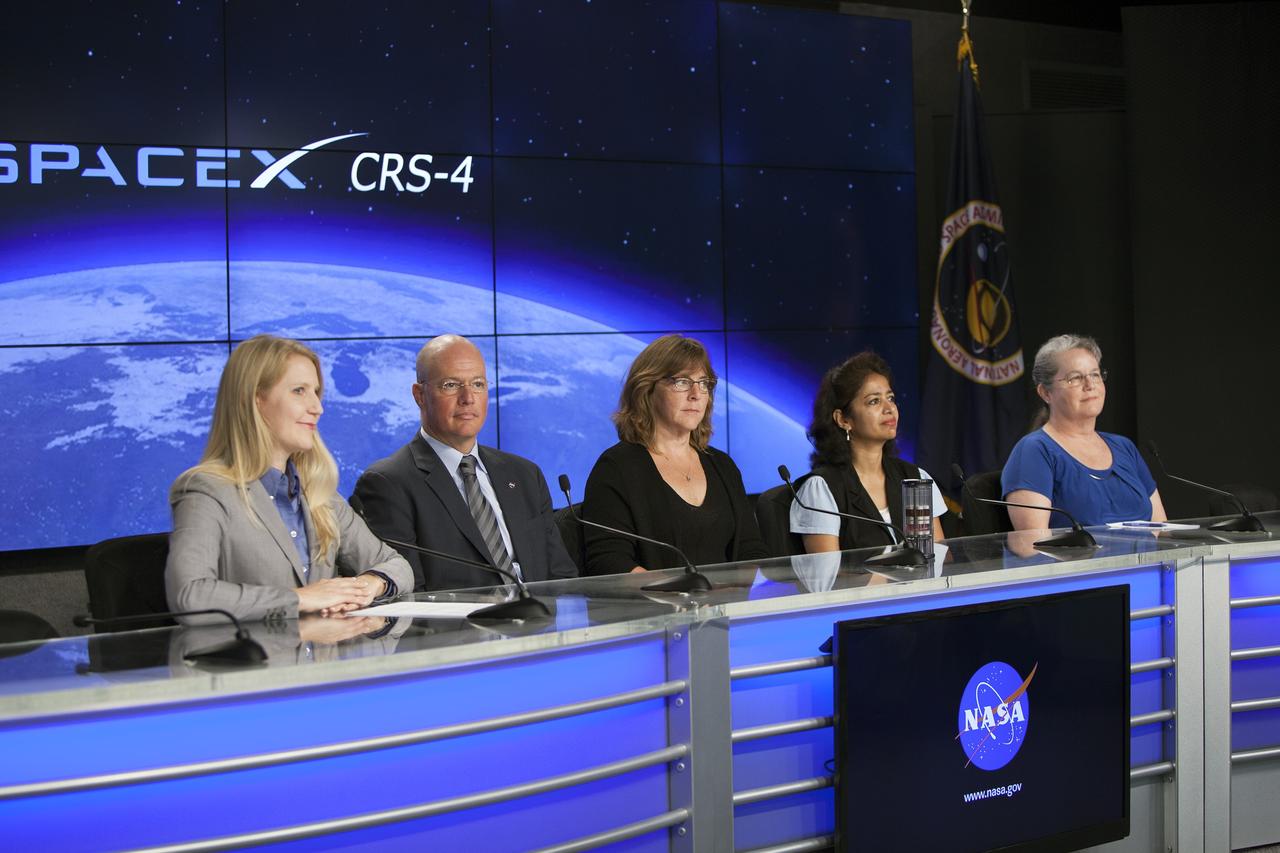
CAPE CANAVERAL, Fla. – Members of an ISS Science Panel on Model Organisms brief media representatives in Kennedy Space Center’s Press Site auditorium in preparation for the launch of the SpaceX CRS-4 mission to resupply the International Space Station. From left are Stephanie Schierholz, NASA Public Affairs, Marshall Porterfield, division director, Space Life and Physical Sciences, HEOMD, Shiela Neilsen, principal investigator, Micro-8, University of Montana, Sharmila Bhattacharya, principal investigator, Ames Student Fruit-Fly Experiment, NASA Ames Research Center, and Ruth Globus, project scientist, Rodent Habitat/Rodent Research-1, NASA Ames. The mission is the fourth of 12 SpaceX flights NASA contracted with the company to resupply the space station. It will be the fifth trip by a Dragon spacecraft to the orbiting laboratory. The spacecraft’s 2.5 tons of supplies, science experiments, and technology demonstrations include critical materials to support 255 science and research investigations that will occur during the station's Expeditions 41 and 42. Liftoff is targeted for an instantaneous window at 2:14 a.m. EDT. To learn more about the mission, visit http://www.nasa.gov/mission_pages/station/structure/launch/index.html. Photo credit: NASA/Jim Grossmann
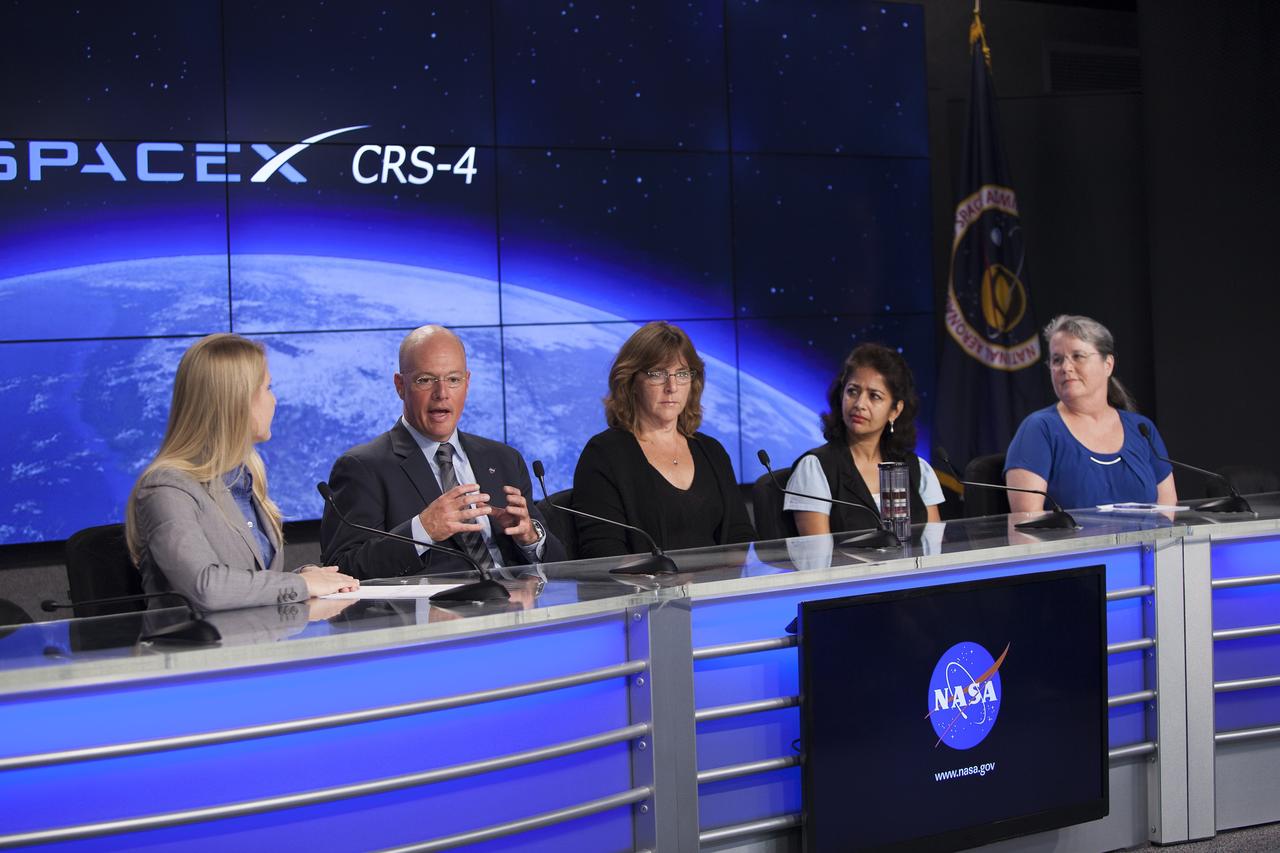
CAPE CANAVERAL, Fla. – Members of an ISS Science Panel on Model Organisms brief media representatives in Kennedy Space Center’s Press Site auditorium in preparation for the launch of the SpaceX CRS-4 mission to resupply the International Space Station. From left are Stephanie Schierholz, NASA Public Affairs, Marshall Porterfield, division director, Space Life and Physical Sciences, HEOMD, Shiela Neilsen, principal investigator, Micro-8, University of Montana, Sharmila Bhattacharya, principal investigator, Ames Student Fruit-Fly Experiment, NASA Ames Research Center, and Ruth Globus, project scientist, Rodent Habitat/Rodent Research-1, NASA Ames. The mission is the fourth of 12 SpaceX flights NASA contracted with the company to resupply the space station. It will be the fifth trip by a Dragon spacecraft to the orbiting laboratory. The spacecraft’s 2.5 tons of supplies, science experiments, and technology demonstrations include critical materials to support 255 science and research investigations that will occur during the station's Expeditions 41 and 42. Liftoff is targeted for an instantaneous window at 2:14 a.m. EDT. To learn more about the mission, visit http://www.nasa.gov/mission_pages/station/structure/launch/index.html. Photo credit: NASA/Jim Grossmann
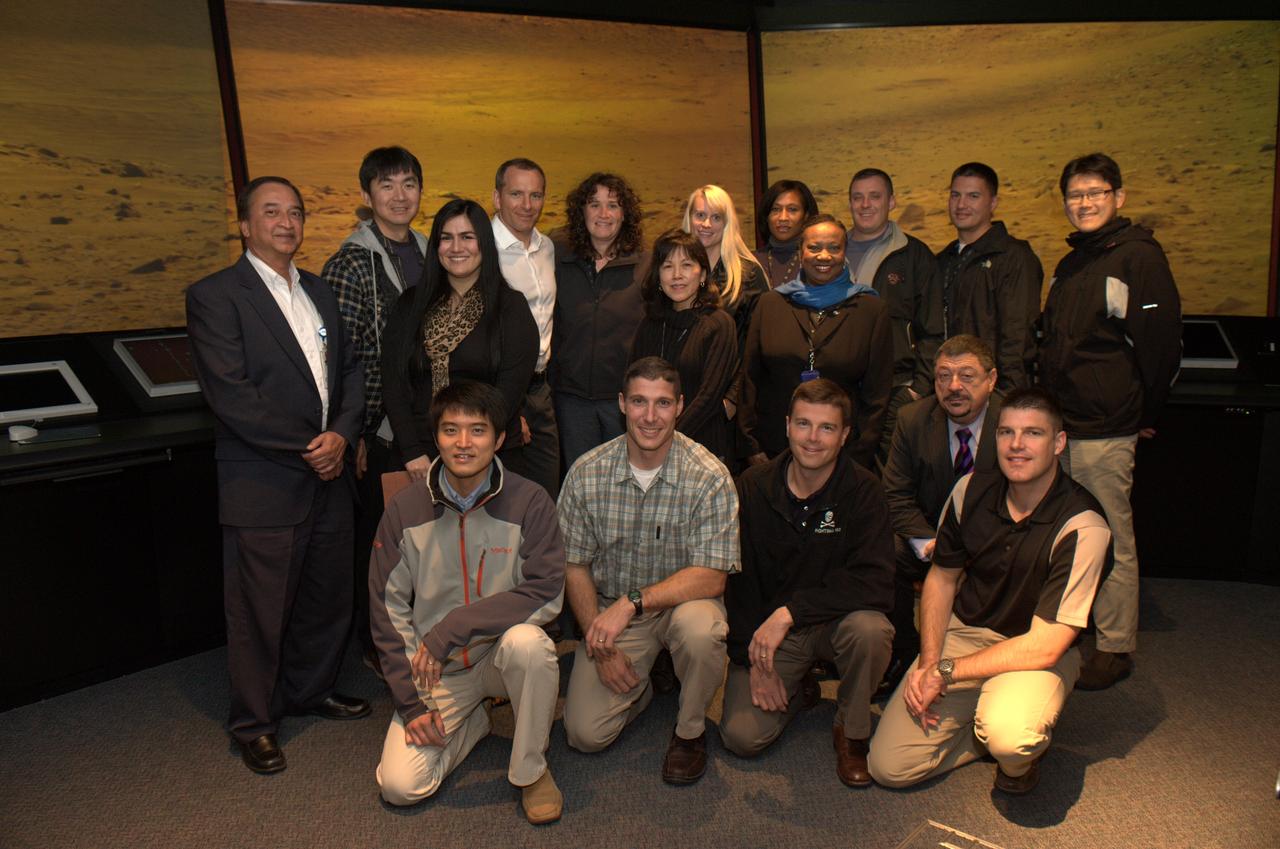
The 14 member 2009 class of NASA astronauts, Japan Aerospace Explortion Agency (JAXA) astronauts and Canadian Space Agency astronauts visit the Future Flgiht Central (FFC) at Ames Research Center. From left to right top row; unknown, Kimiya Yui (JAXA) David Saint-Jacques (CSA) Serena Aunon, Kathleen (Kate) Rubins, Jeanette Epps, Scott Tingle, Kjell, Landgren, Norishige Kanai (JAXA): Middle row left to right; Sahar Leaupepe, unknown, Sheila Johnson: Front Row, left to right Takuya Onishi (JAXA), Michael Hopkins, Gregory (Reid) Wiseman, Jeremy Hansen.
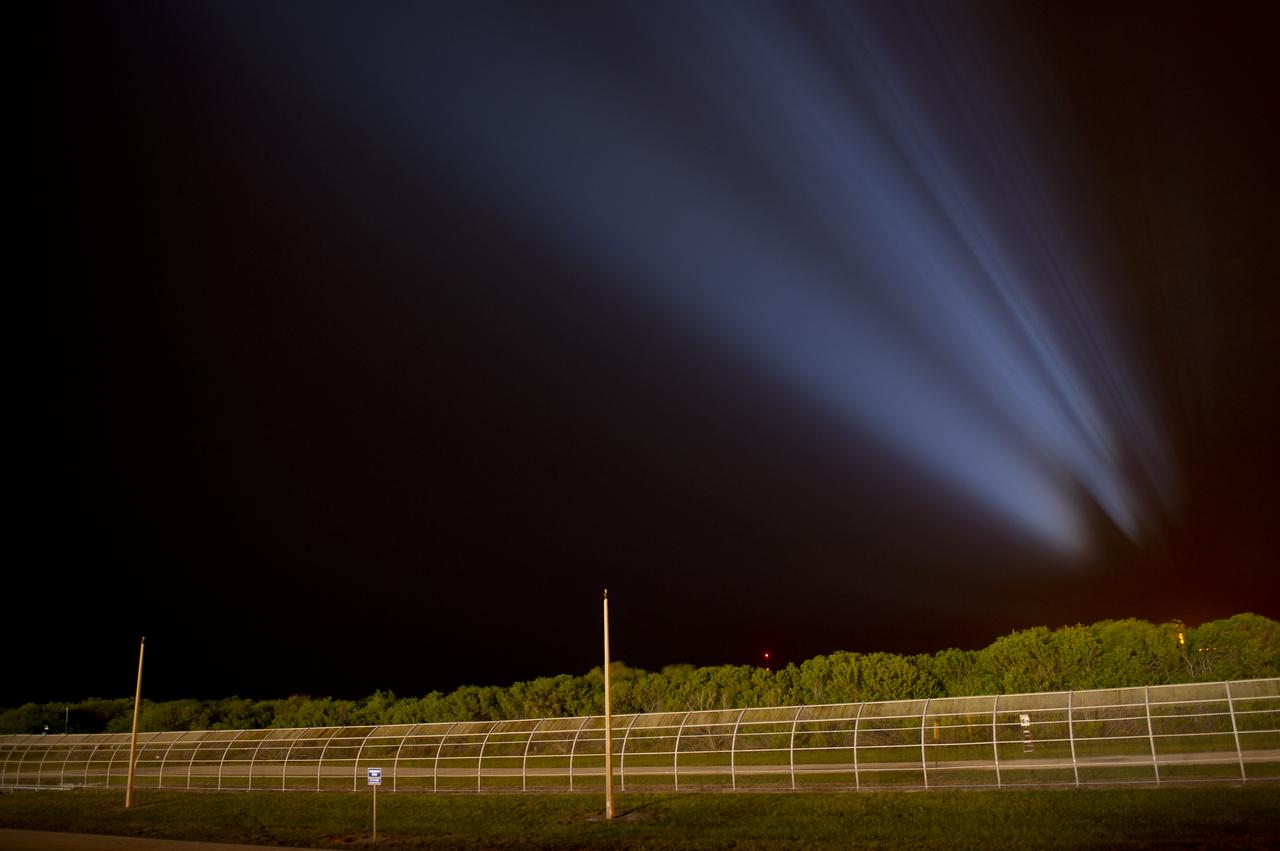
An faint profile outline of the space shuttle Endeavour is seen projected in the sky as powerful xenon lights illuminate launch pad 39a shortly after the rollback of the Rotating Service Structure (RSS) from Endeavour, Thursday, April 28, 2011, at Kennedy Space Center in Cape Canaveral, Fla. During the 14-day mission, Endeavour and the STS-134 crew will deliver the Alpha Magnetic Spectrometer (AMS) and spare parts including two S-band communications antennas, a high-pressure gas tank and additional spare parts for Dextre. Launch is targeted for Friday, April 29 at 3:47 p.m. EDT. Photo credit: (NASA/Bill Ingalls)
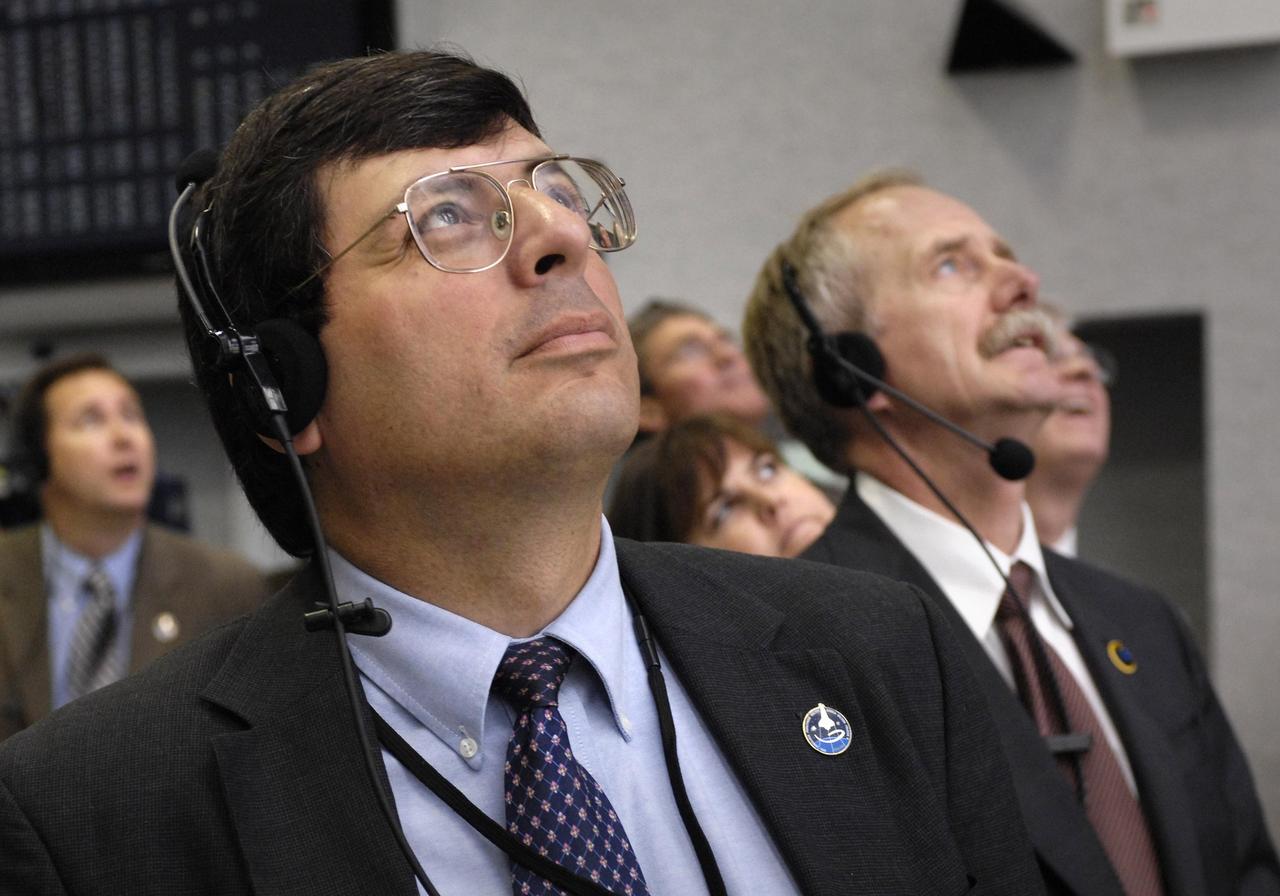
KENNEDY SPACE CENTER, FLA. -- In the firing room at NASA's Kennedy Space Center, NASA Associate Administrator Chris Scolese (left) and associate administrator for NASA Space Operations Bill Gerstenmaier (right) watch the space shuttle Discovery launch on mission STS-120. Liftoff was on time at 11:38:19 am. EDT. Discovery carries the Italian-built U.S. Node 2, called Harmony. During the 14-day STS-120 mission, the crew will install Harmony and move the P6 solar arrays to their permanent position and deploy them. Discovery is expected to complete its mission and return home at 4:47 a.m. EST on Nov. 6. Photo credit: NASA/Bill Ingalls

CAPE CANAVERAL, Fla. - At NASA's Kennedy Space Center in Florida, space shuttle Endeavour rolls toward Launch Pad 39A, at right. The shuttle earlier moved off Launch Pad 39B starting at 8:28 am. EDT to head for pad 39A. Endeavour is targeted to launch Nov. 14 on the STS-126 mission. On this 27th mission to the International Space Station, Endeavour will carry the Lightweight Multi-Purpose Experiment Support Structure Carrier and the Multi-Purpose Logistics Module Leonardo that will hold supplies and equipment, including additional crew quarters, additional exercise equipment, spare hardware and equipment for the regenerative life support system. Photo credit: NASA/Kim Shiflett
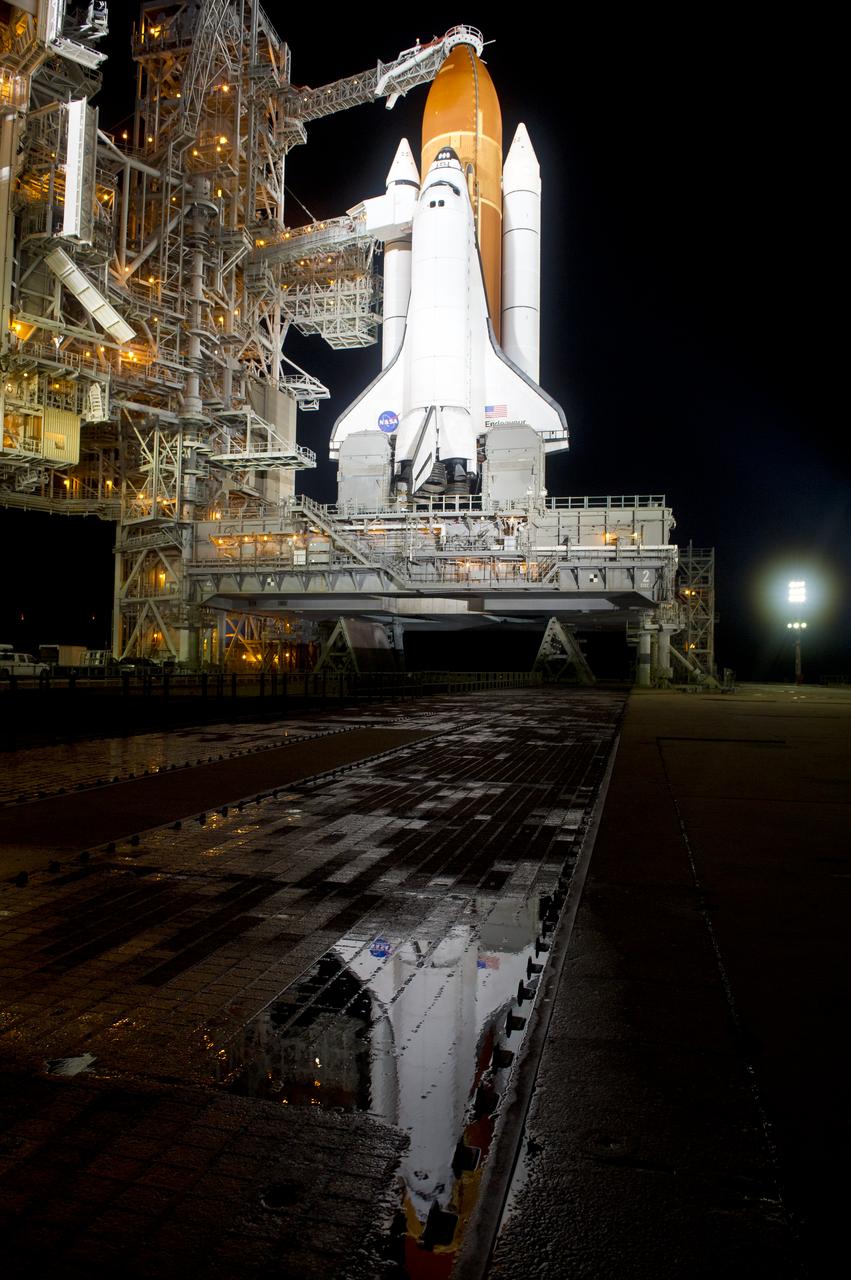
The space shuttle Endeavour is seen on launch pad 39a after the rollback of the Rotating Service Structure (RSS), Thursday, April 28, 2011, at Kennedy Space Center in Cape Canaveral, Fla. During the 14-day mission, Endeavour and the STS-134 crew will deliver the Alpha Magnetic Spectrometer (AMS) and spare parts including two S-band communications antennas, a high-pressure gas tank and additional spare parts for Dextre. Launch is targeted for Friday, April 29 at 3:47 p.m. EDT. Photo credit: (NASA/Bill Ingalls)
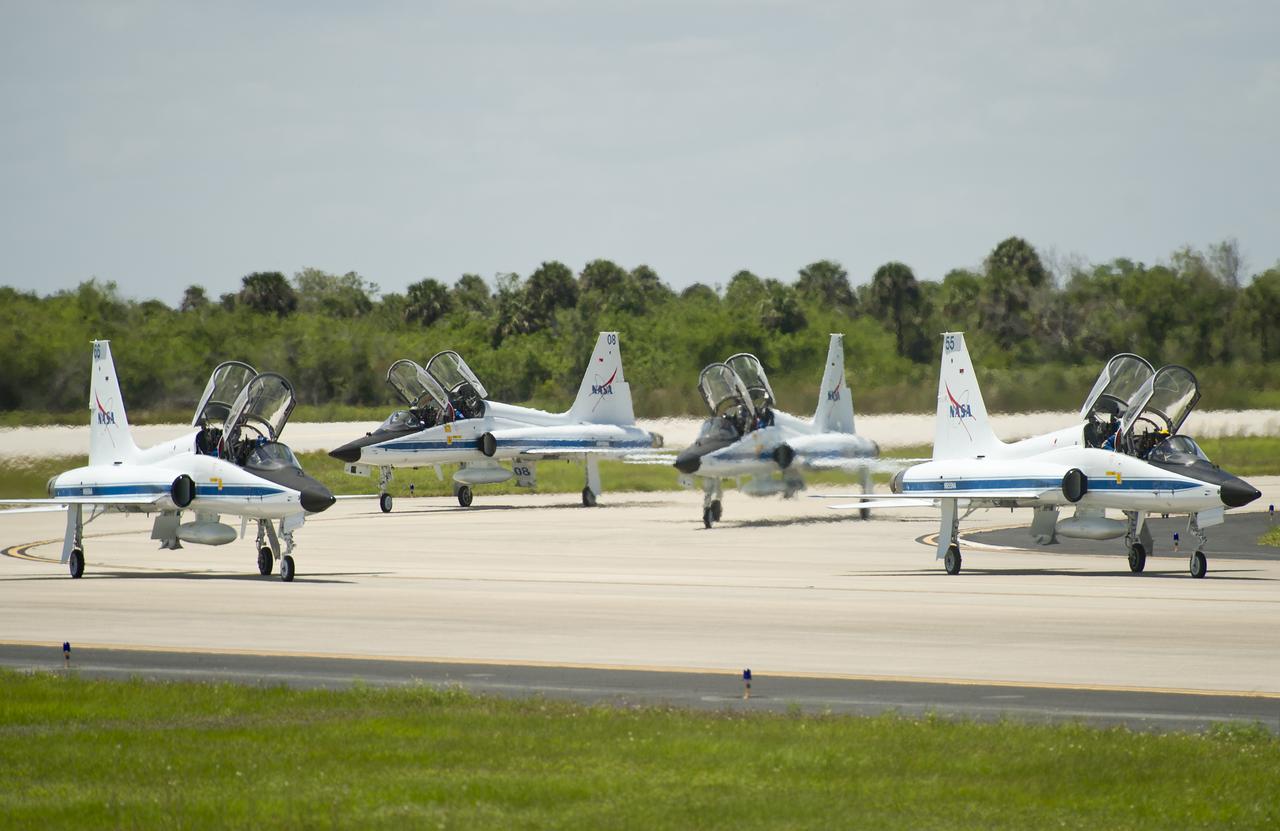
The STS-134 crew arrives in T-38 jets on Tuesday, April 26, 2011 at the NASA Kennedy Space Center Shuttle Landing Facility (SLF) in Cape Canaveral, Fla. During the 14-day mission, the space shuttle Endeavour and its crew will deliver the Alpha Magnetic Spectrometer (AMS) and spare parts including two S-band communications antennas, a high-pressure gas tank and additional spare parts for Dextre. Launch is targeted for Friday, April 29 at 3:47 p.m. EDT. Photo credit: (NASA/Bill Ingalls)
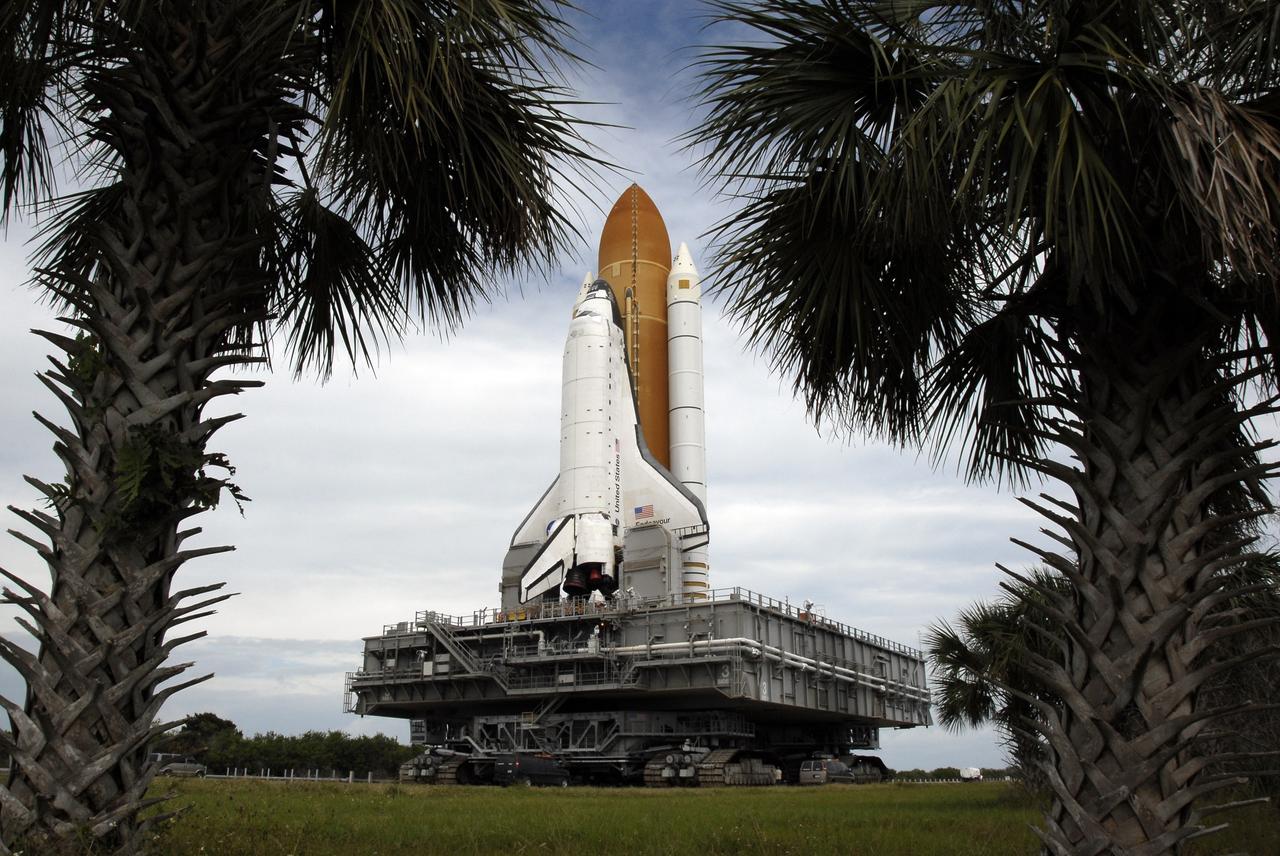
CAPE CANAVERAL, Fla. - Palmettos appear to frame space shuttle Endeavour as it rolls toward Launch Pad 39A on NASA's Kennedy Space Center in Florida. The shuttle earlier moved off Launch Pad 39B starting at 8:28 am. EDT and headed for pad 39A. Endeavour is targeted to launch Nov. 14 on the STS-126 mission. On this 27th mission to the International Space Station, Endeavour will carry the Lightweight Multi-Purpose Experiment Support Structure Carrier and the Multi-Purpose Logistics Module Leonardo that will hold supplies and equipment, including additional crew quarters, additional exercise equipment, spare hardware and equipment for the regenerative life support system. Photo credit: NASA/Kim Shiflett
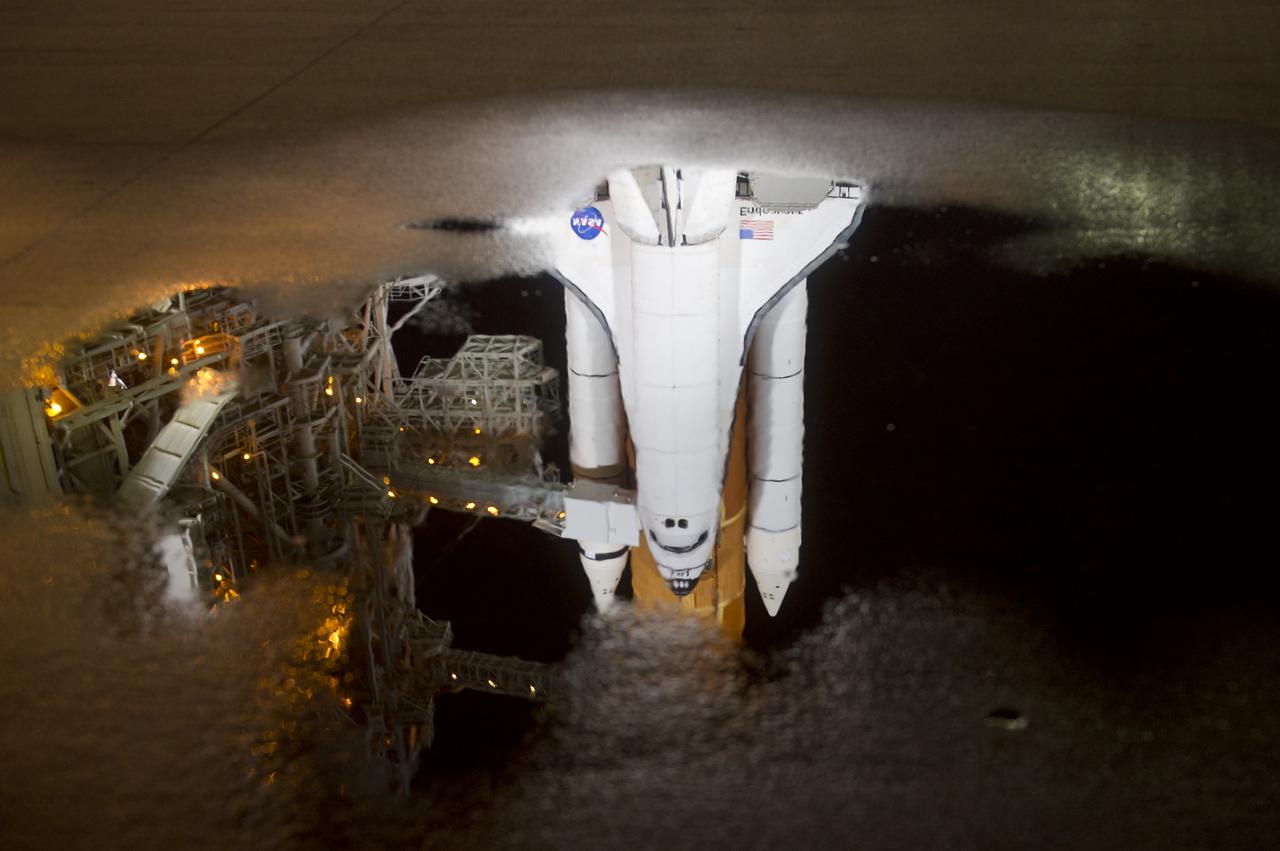
The space shuttle Endeavour is seen reflected in a puddle of water on launch pad 39a after the rollback of the Rotating Service Structure (RSS), Thursday, April 28, 2011, at Kennedy Space Center in Cape Canaveral, Fla. During the 14-day mission, Endeavour and the STS-134 crew will deliver the Alpha Magnetic Spectrometer (AMS) and spare parts including two S-band communications antennas, a high-pressure gas tank and additional spare parts for Dextre. Launch is targeted for Friday, April 29 at 3:47 p.m. EDT. Photo credit: (NASA/Bill Ingalls)
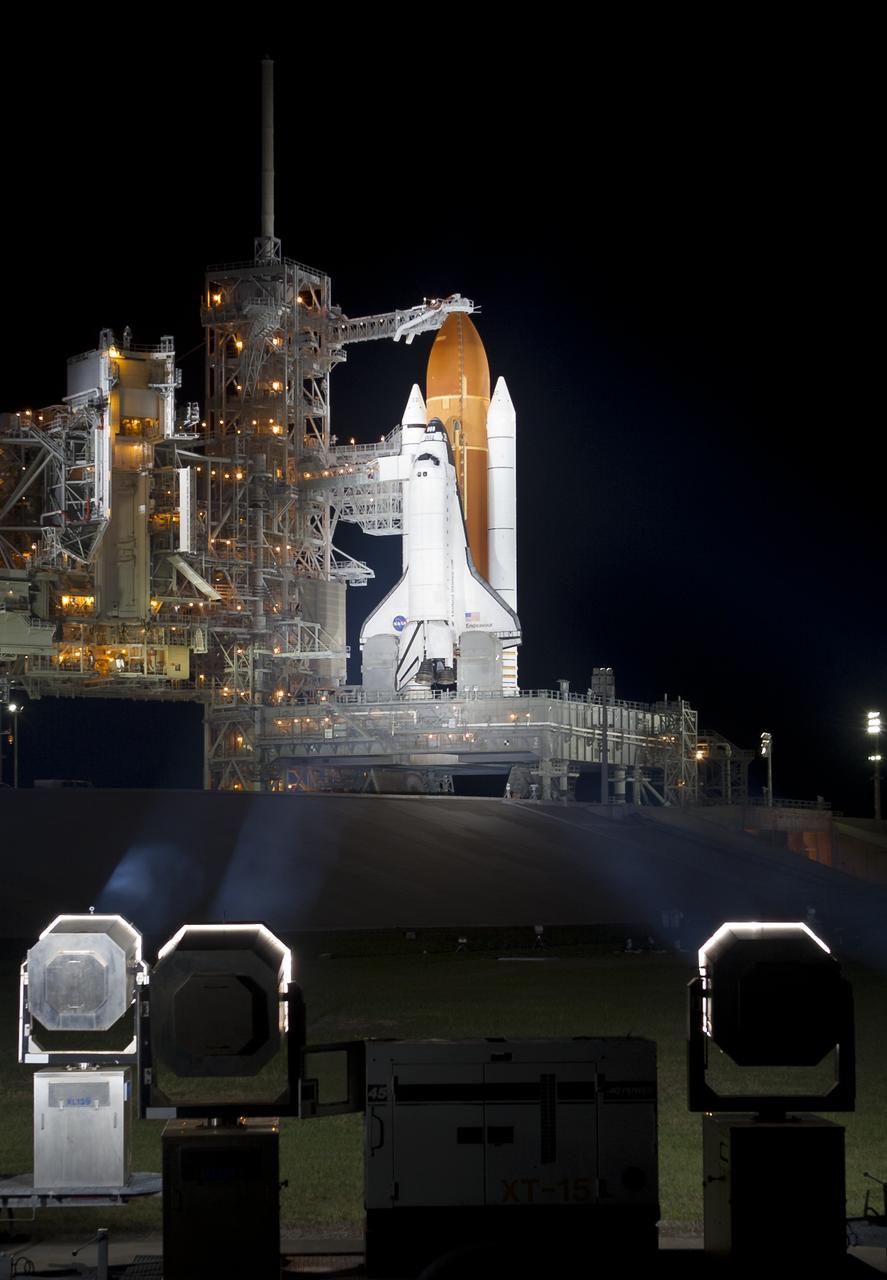
The space shuttle Endeavour is seen on launch pad 39a after the rollback of the Rotating Service Structure (RSS), Thursday, April 28, 2011, at Kennedy Space Center in Cape Canaveral, Fla. During the 14-day mission, Endeavour and the STS-134 crew will deliver the Alpha Magnetic Spectrometer (AMS) and spare parts including two S-band communications antennas, a high-pressure gas tank and additional spare parts for Dextre. Launch is targeted for Friday, April 29 at 3:47 p.m. EDT. Photo credit: (NASA/Bill Ingalls)
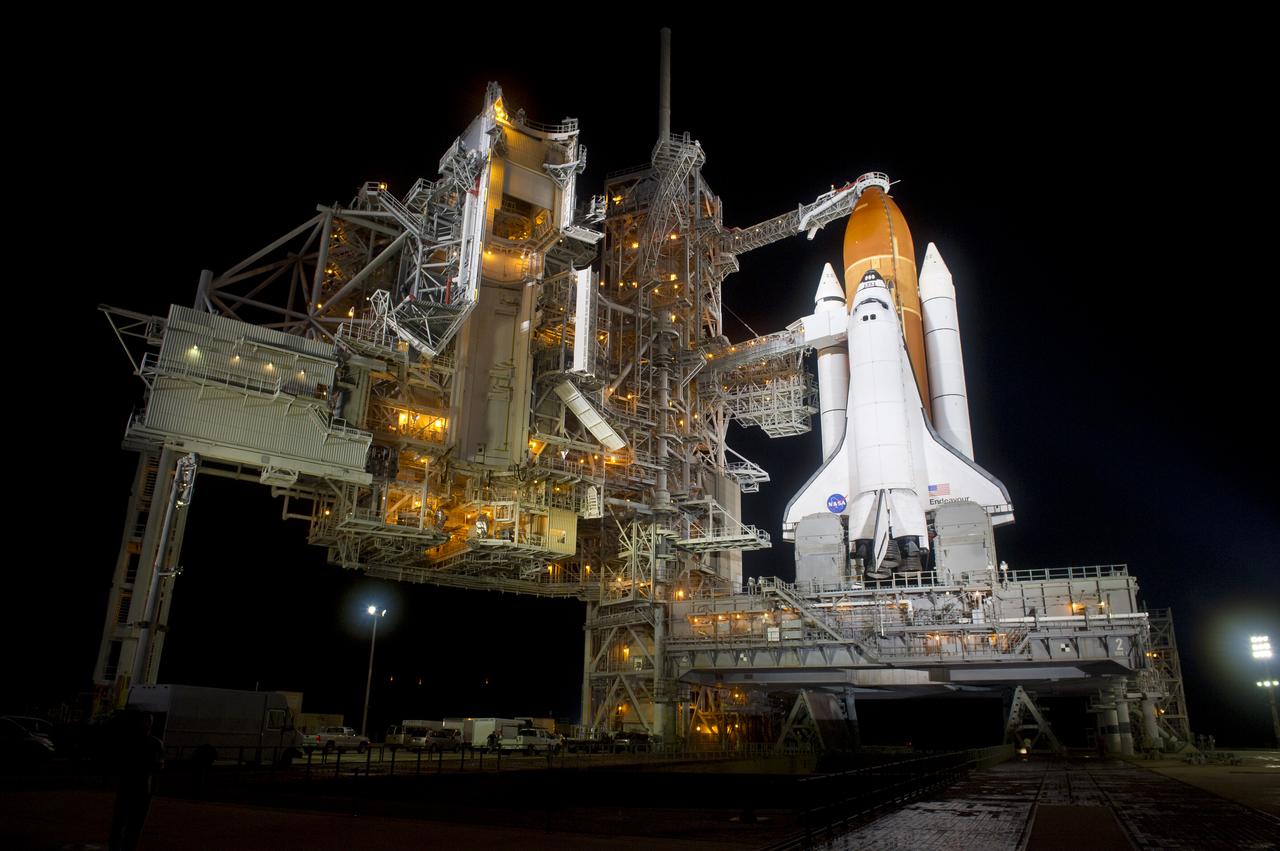
The space shuttle Endeavour is seen on launch pad 39a after the rollback of the Rotating Service Structure (RSS), Thursday, April 28, 2011, at Kennedy Space Center in Cape Canaveral, Fla. During the 14-day mission, Endeavour and the STS-134 crew will deliver the Alpha Magnetic Spectrometer (AMS) and spare parts including two S-band communications antennas, a high-pressure gas tank and additional spare parts for Dextre. Launch is targeted for Friday, April 29 at 3:47 p.m. EDT. Photo credit: (NASA/Bill Ingalls)
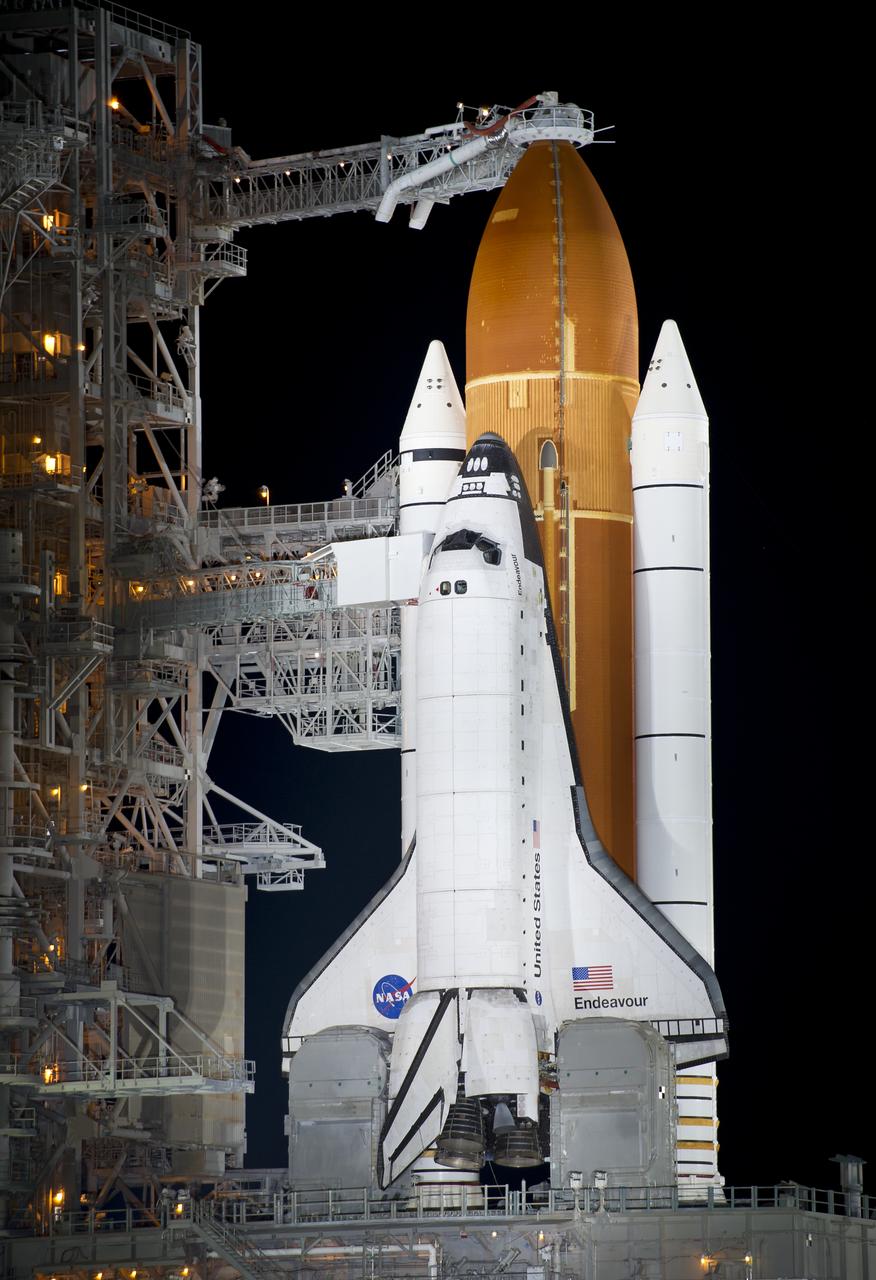
The space shuttle Endeavour is seen on launch pad 39a after the rollback of the Rotating Service Structure (RSS), Thursday, April 28, 2011, at Kennedy Space Center in Cape Canaveral, Fla. During the 14-day mission, Endeavour and the STS-134 crew will deliver the Alpha Magnetic Spectrometer (AMS) and spare parts including two S-band communications antennas, a high-pressure gas tank and additional spare parts for Dextre. Launch is targeted for Friday, April 29 at 3:47 p.m. EDT. Photo credit: (NASA/Bill Ingalls)

The space shuttle Endeavour is seen on launch pad 39a after the rollback of the Rotating Service Structure (RSS), Thursday, April 28, 2011, at Kennedy Space Center in Cape Canaveral, Fla. During the 14-day mission, Endeavour and the STS-134 crew will deliver the Alpha Magnetic Spectrometer (AMS) and spare parts including two S-band communications antennas, a high-pressure gas tank and additional spare parts for Dextre. Launch is targeted for Friday, April 29 at 3:47 p.m. EDT. Photo credit: (NASA/Bill Ingalls)
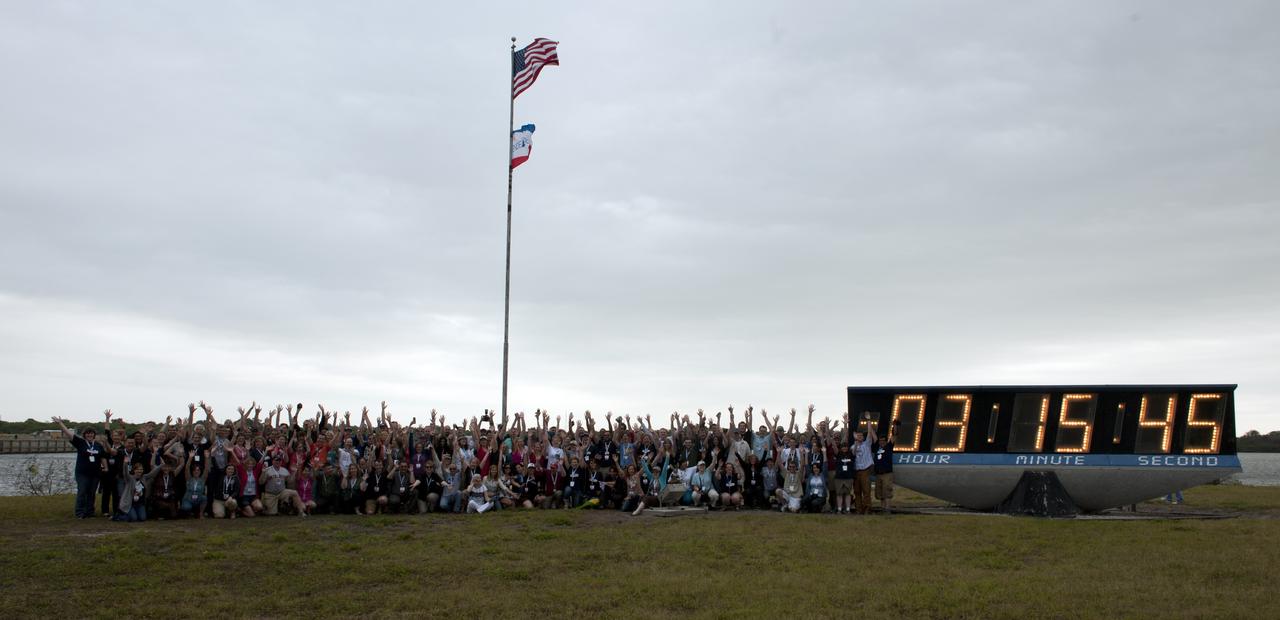
NASA Twitter followers, who particiapted in the STS-134 Tweetup are seen together by the launch clock, Friday, April 29, 2011, at Kennedy Space Center in Cape Canaveral, Fla. About 150 NASA Twitter followers attended the event. Later the group will watch the launch of Endeavour as it heads to the International Space Station on a 14-day mission to deliver the Alpha Magnetic Spectrometer (AMS) and spare parts including two S-band communications antennas, a high-pressure gas tank and additional spare parts for Dextre. Liftoff is targeted for 3:47 pm. Photo Credit: (NASA/Paul E. Alers)
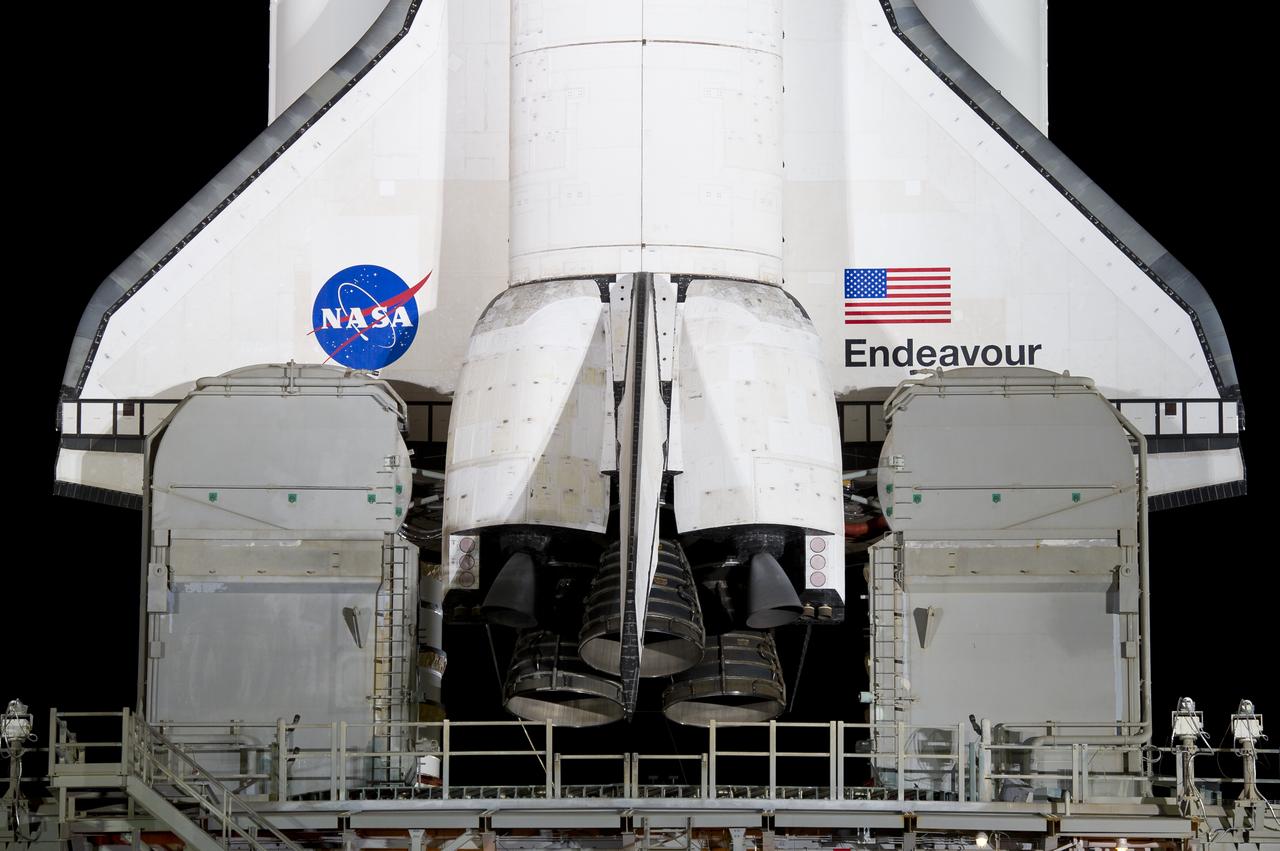
The space shuttle Endeavour is seen on launch pad 39a after the rollback of the Rotating Service Structure (RSS), Thursday, April 28, 2011, at Kennedy Space Center in Cape Canaveral, Fla. During the 14-day mission, Endeavour and the STS-134 crew will deliver the Alpha Magnetic Spectrometer (AMS) and spare parts including two S-band communications antennas, a high-pressure gas tank and additional spare parts for Dextre. Launch is targeted for Friday, April 29 at 3:47 p.m. EDT. Photo credit: (NASA/Bill Ingalls)

The space shuttle Endeavour is seen on launch pad 39a as a storm passes by prior to the rollback of the Rotating Service Structure (RSS), Thursday, April 28, 2011, at Kennedy Space Center in Cape Canaveral, Fla. During the 14-day mission, Endeavour and the STS-134 crew will deliver the Alpha Magnetic Spectrometer (AMS) and spare parts including two S-band communications antennas, a high-pressure gas tank and additional spare parts for Dextre. Launch is targeted for Friday, April 29 at 3:47 p.m. EDT. Photo credit: (NASA/Bill Ingalls)
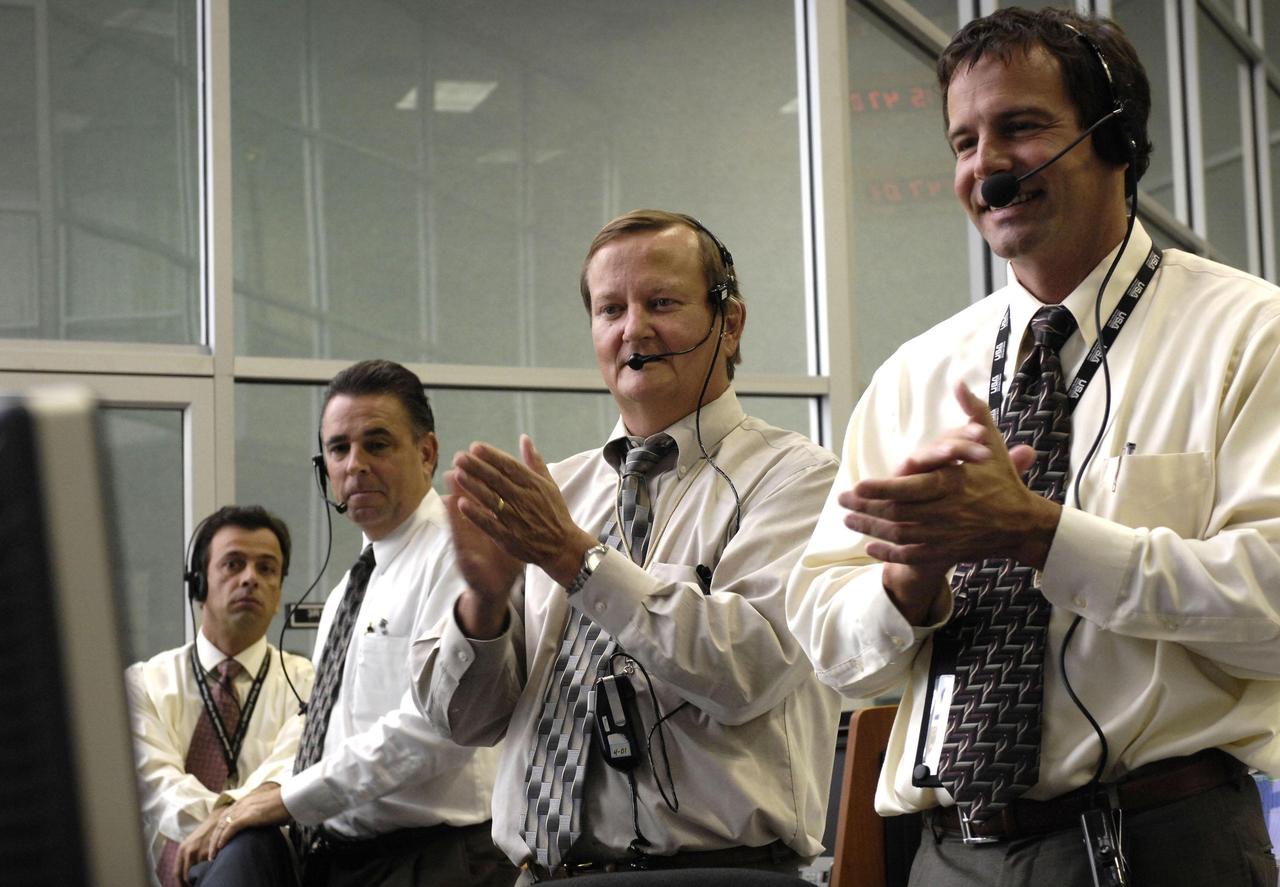
KENNEDY SPACE CENTER, FLA. -- In the firing room at NASA's Kennedy Space Center, Shuttle Launch Director Mike Leinbach (second from right) and Assistant Launch Director Doug Lyons (right) applaud the on-time launch of space shuttle Discovery on mission STS-120. Liftoff was at 11:38:19 am. EDT. Discovery carries the Italian-built U.S. Node 2, called Harmony. During the 14-day STS-120 mission, the crew will install Harmony and move the P6 solar arrays to their permanent position and deploy them. Discovery is expected to complete its mission and return home at 4:47 a.m. EST on Nov. 6. Photo credit: NASA/Bill Ingalls
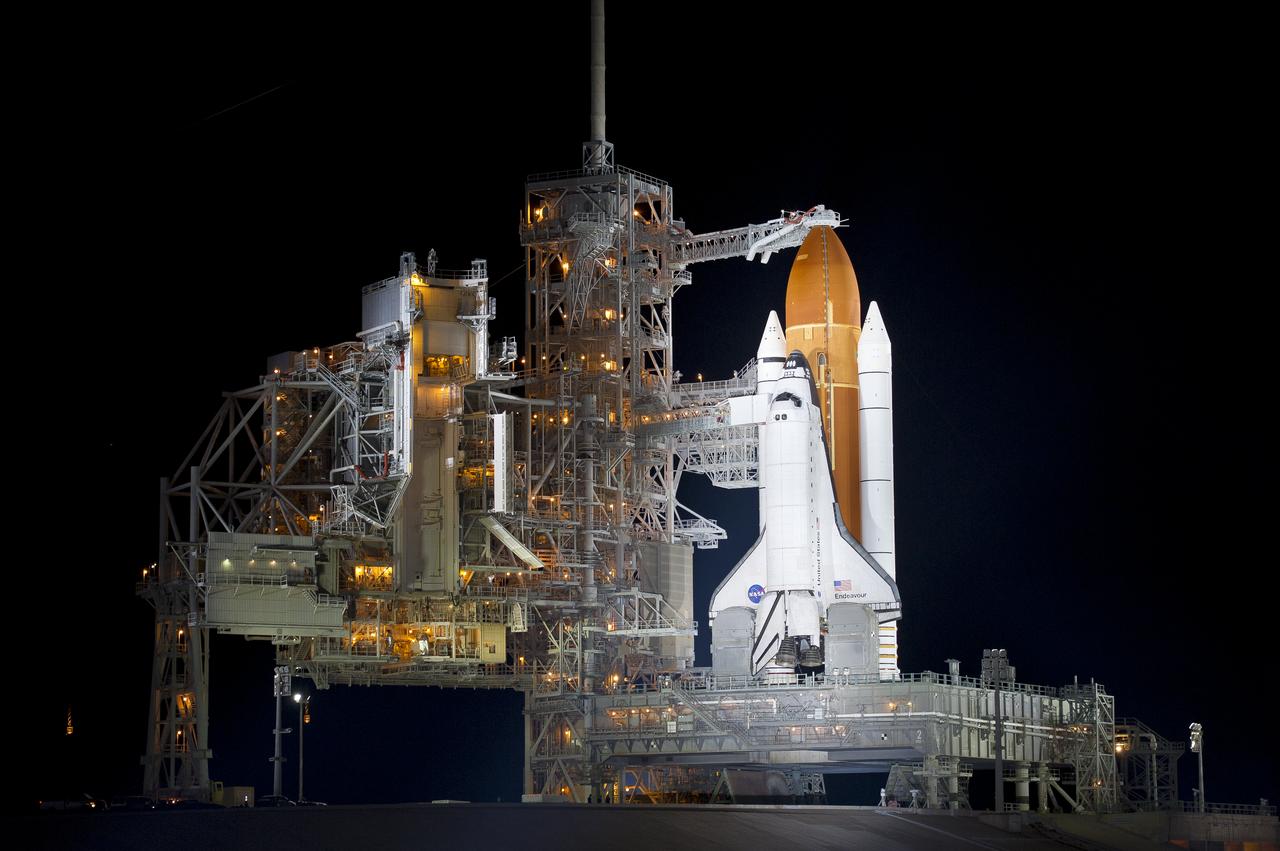
The space shuttle Endeavour is seen on launch pad 39a after the rollback of the Rotating Service Structure (RSS), Thursday, April 28, 2011, at Kennedy Space Center in Cape Canaveral, Fla. During the 14-day mission, Endeavour and the STS-134 crew will deliver the Alpha Magnetic Spectrometer (AMS) and spare parts including two S-band communications antennas, a high-pressure gas tank and additional spare parts for Dextre. Launch is targeted for Friday, April 29 at 3:47 p.m. EDT. Photo credit: (NASA/Bill Ingalls)

The space shuttle Endeavour is seen on launch pad 39a as a storm passes by prior to the rollback of the Rotating Service Structure (RSS), Thursday, April 28, 2011, at Kennedy Space Center in Cape Canaveral, Fla. During the 14-day mission, Endeavour and the STS-134 crew will deliver the Alpha Magnetic Spectrometer (AMS) and spare parts including two S-band communications antennas, a high-pressure gas tank and additional spare parts for Dextre. Launch is targeted for Friday, April 29 at 3:47 p.m. EDT. Photo credit: (NASA/Bill Ingalls)
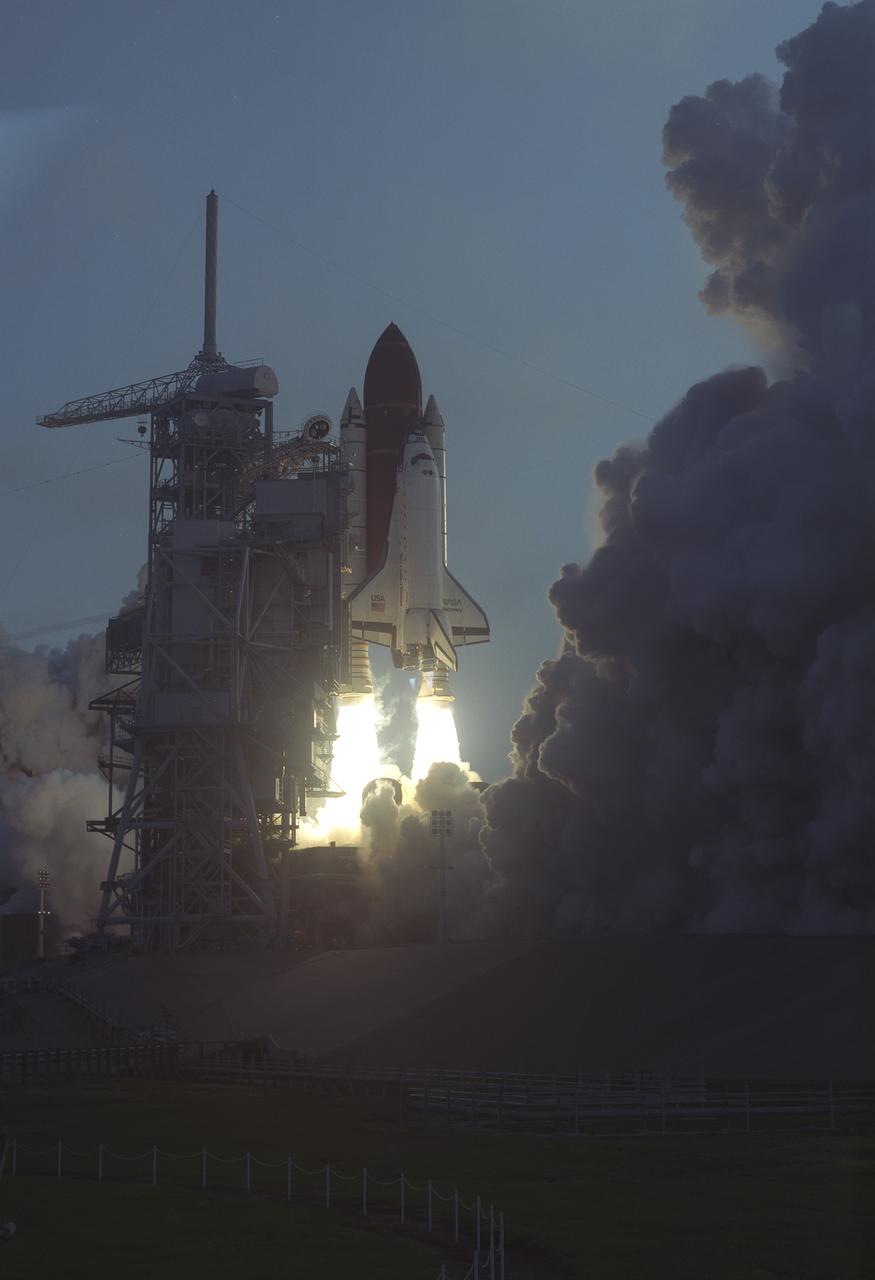
Launched aboard the Space Shuttle Discovery on April 28, 1991 at 7:33:14 am (EDT), STS-39 was a Department of Defense (DOD) mission. The crew included seven astronauts: Michael L. Coats, commander; L. Blaine Hammond, pilot; Guion S. Buford, Jr., mission specialist 1; Gregory J. Harbaugh, mission specialist 2; Richard J. Hieb, mission specialist 3; Donald R. McMonagle, mission specialist 4; and Charles L. Veach, mission specialist 5. The primary unclassified payload included the Air Force Program 675 (AFP-675), the Infrared Background Signature Survey (IBSS), and the Shuttle Pallet Satellite II (SPAS II).
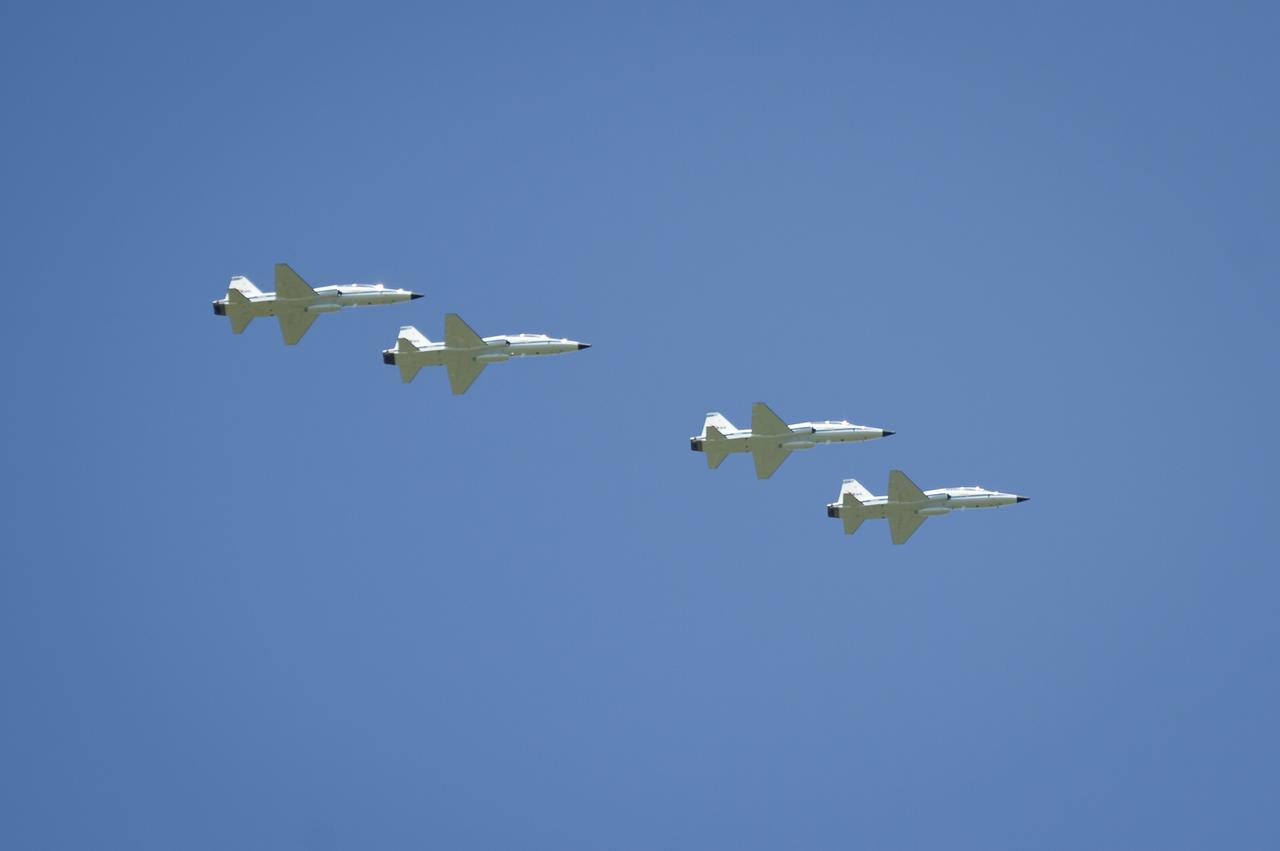
The STS-134 crew flies over the Shuttle Landing Facility (SLF) in T-38 jets on Tuesday, April 26, 2011 at NASA's Kennedy Space Center in Cape Canaveral, Fla., as they arrive for their upcoming mission. During the 14-day mission, the space shuttle Endeavour and its crew will deliver the Alpha Magnetic Spectrometer (AMS) and spare parts including two S-band communications antennas, a high-pressure gas tank and additional spare parts for Dextre. Launch is targeted for Friday, April 29 at 3:47 p.m. EDT. Photo credit: (NASA/Bill Ingalls)
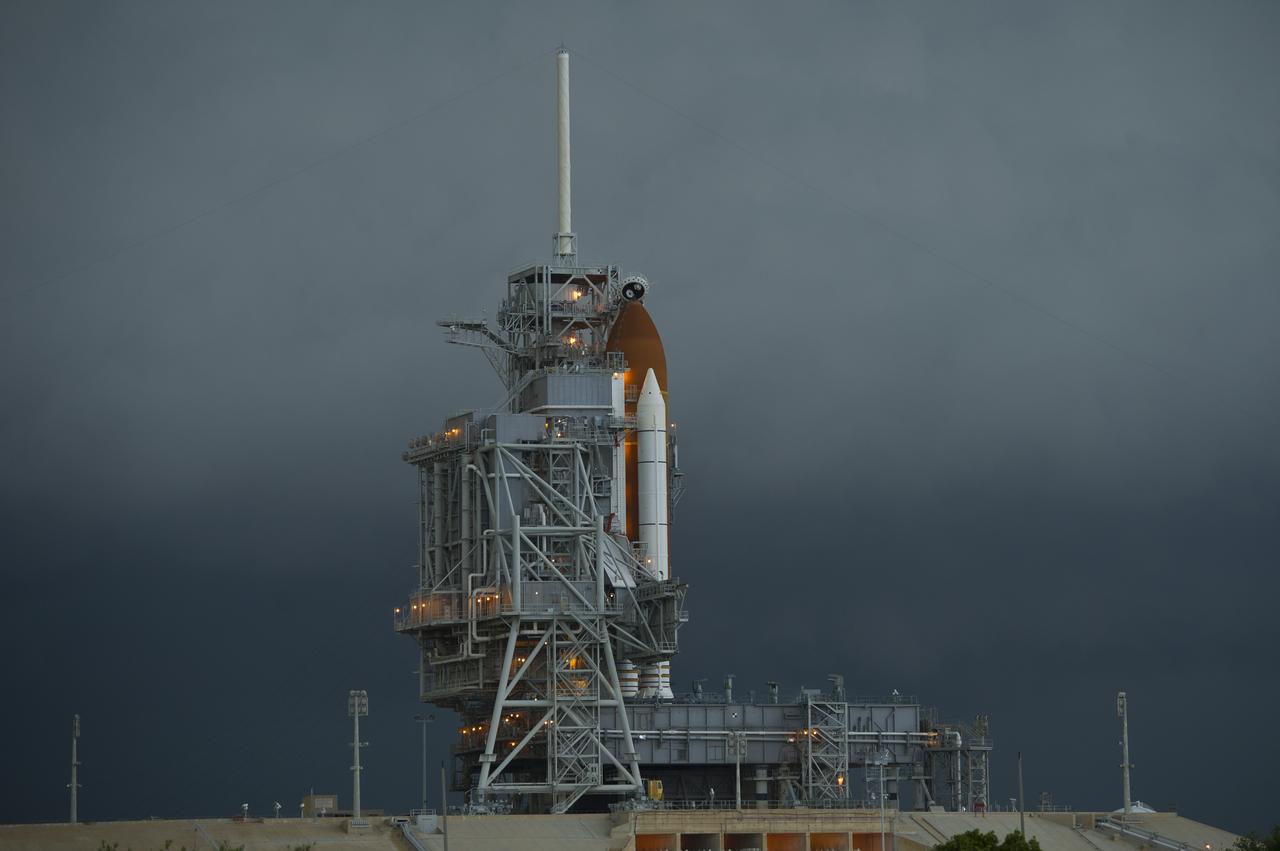
The space shuttle Endeavour is seen on launch pad 39a as a storm passes by prior to the rollback of the Rotating Service Structure (RSS), Thursday, April 28, 2011, at Kennedy Space Center in Cape Canaveral, Fla. During the 14-day mission, Endeavour and the STS-134 crew will deliver the Alpha Magnetic Spectrometer (AMS) and spare parts including two S-band communications antennas, a high-pressure gas tank and additional spare parts for Dextre. Launch is targeted for Friday, April 29 at 3:47 p.m. EDT. Photo credit: (NASA/Bill Ingalls)
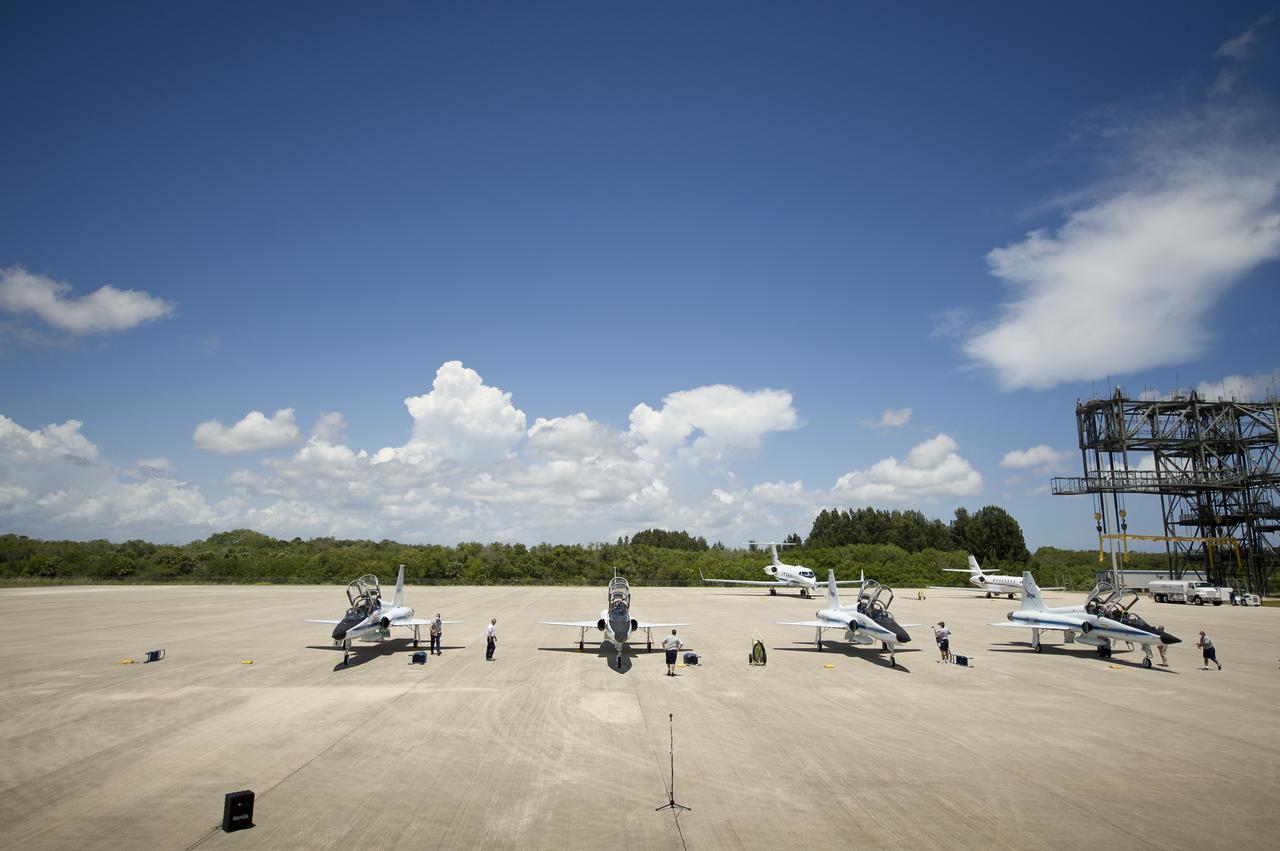
The STS-134 crew arrives in T-38 jets on Tuesday, April 26, 2011 at the NASA Kennedy Space Center Shuttle Landing Facility (SLF) in Cape Canaveral, Fla. During the 14-day mission, the space shuttle Endeavour and its crew will deliver the Alpha Magnetic Spectrometer (AMS) and spare parts including two S-band communications antennas, a high-pressure gas tank and additional spare parts for Dextre. Launch is targeted for Friday, April 29 at 3:47 p.m. EDT. Photo credit: (NASA/Bill Ingalls)
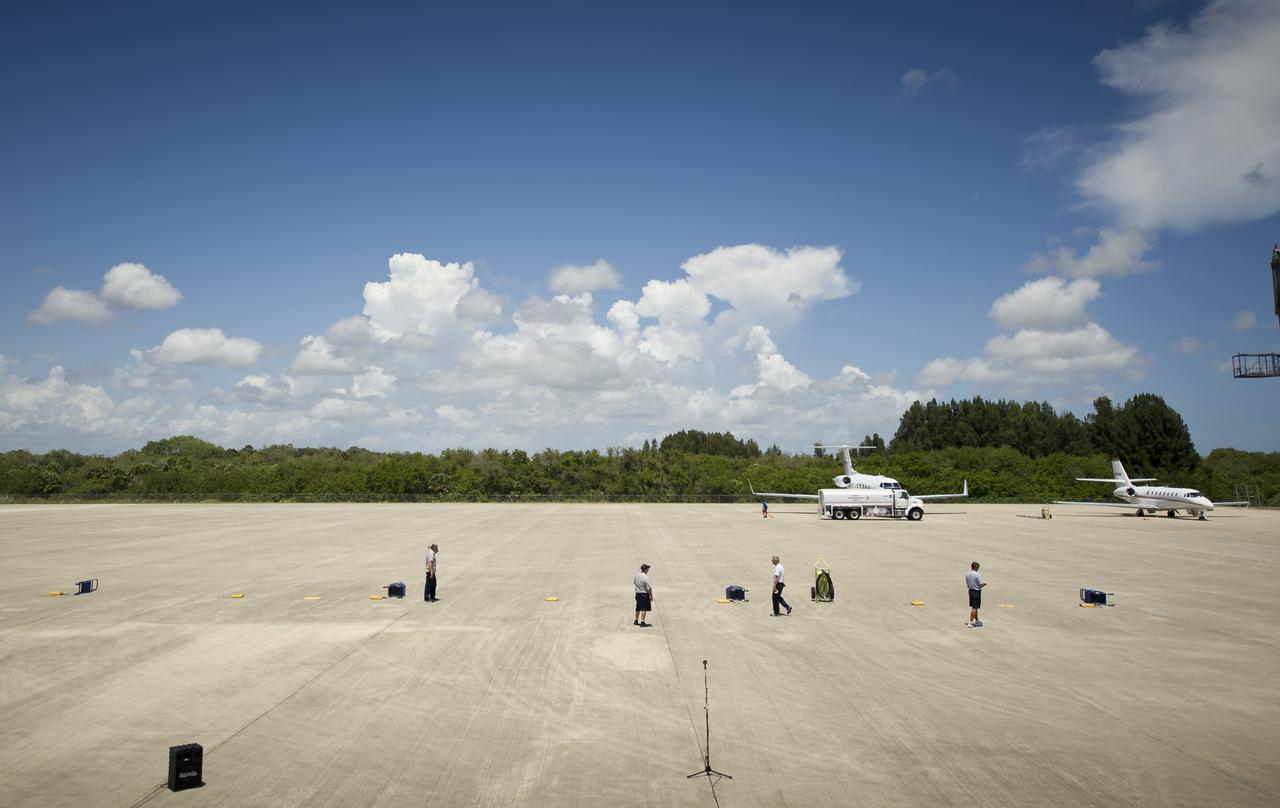
NASA Shuttle Landing Facility (SLF) ground crew prepare for the arrival of the STS-134 crew in T-38 jets on Tuesday, April 26, 2011 at NASA's Kennedy Space Center in Cape Canaveral, Fla. During the 14-day mission, the space shuttle Endeavour and its crew will deliver the Alpha Magnetic Spectrometer (AMS) and spare parts including two S-band communications antennas, a high-pressure gas tank and additional spare parts for Dextre. Launch is targeted for Friday, April 29 at 3:47 p.m. EDT. Photo credit: (NASA/Bill Ingalls)
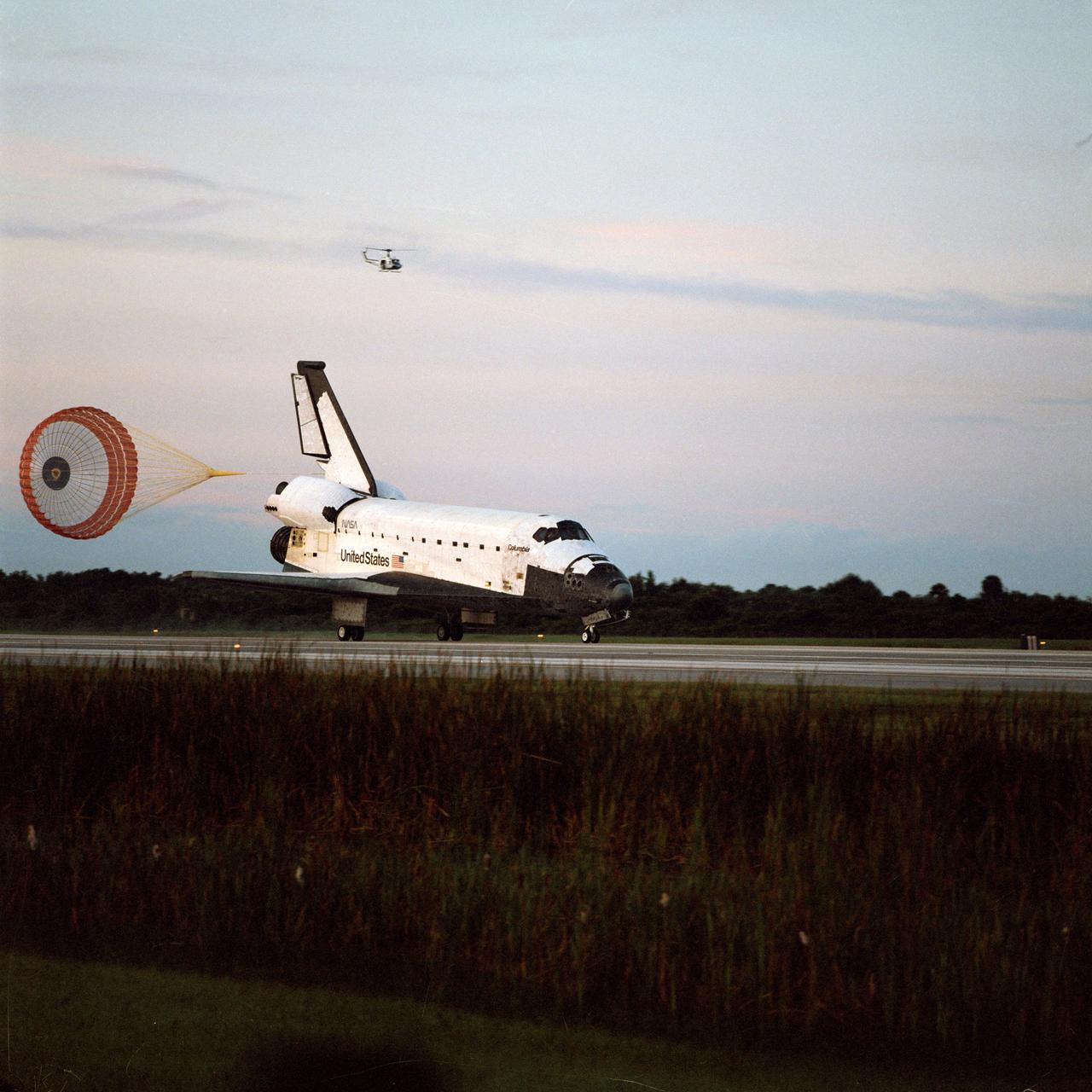
The Space Shuttle Columbia, Orbiter Vehicle (OV) 102, its drag chute fully deployed, completes a record duration mission as it lands on Runway 33 at the Kennedy Space Center (KSC) Shuttle Landing Facility (SLF). A helicopter flying overhead observes as OV-102's nose landing gear (NLG) and main landing gear (MLG) roll along the runway. Landing occurred at 6:38 am (Eastern Daylight Time (EDT)). STS-65 mission duration was 14 days 17 hours and 56 minutes. Onboard were six NASA astronauts and a Japanese payload specialist who conducted experiments in support of the International Microgravity Laboratory 2 (IML-2) during the mission.
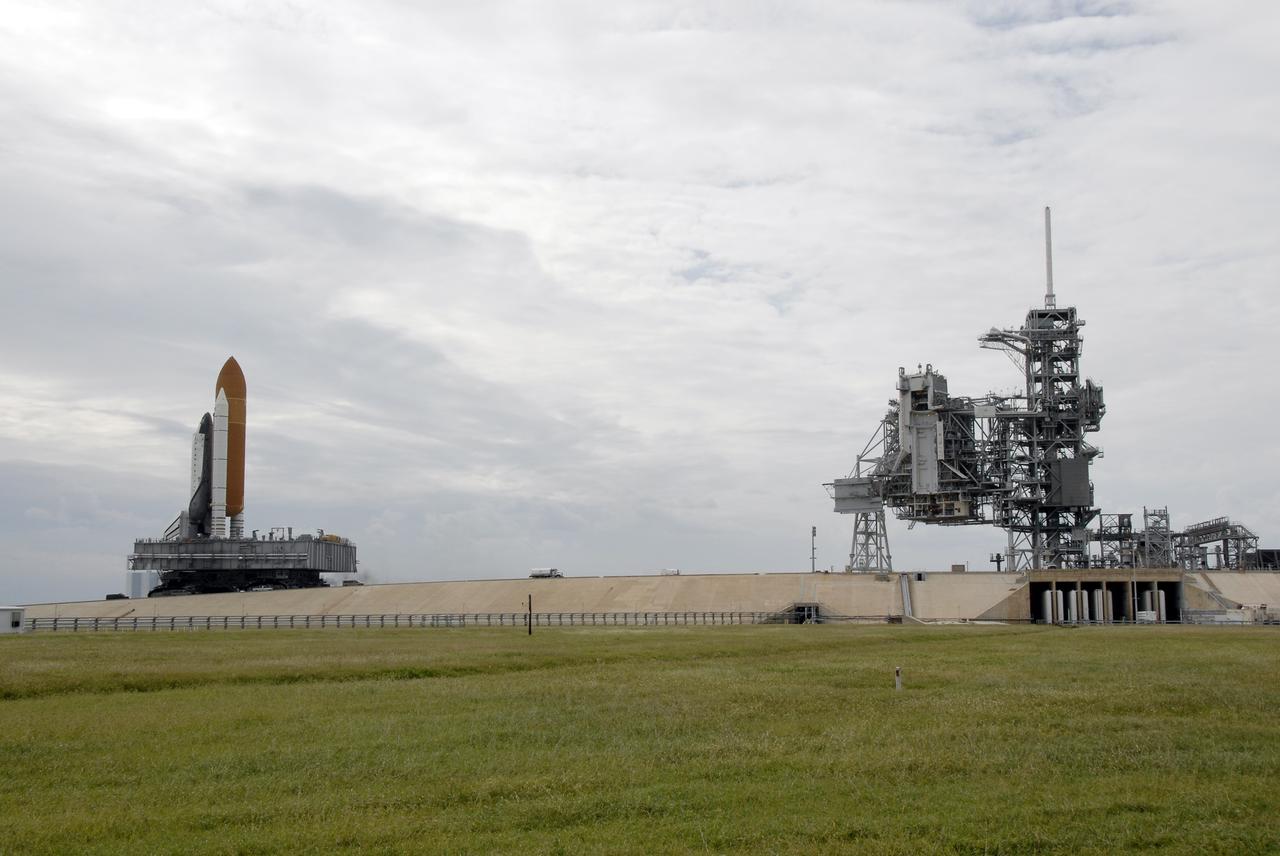
CAPE CANAVERAL, Fla. - At NASA's Kennedy Space Center in Florida, space shuttle Endeavour rolls up the ramp toward Launch Pad 39A. The shuttle moved off Launch Pad 39B starting at 8:28 am. EDT and completed its move to Launch Pad 39A at 4:37 p.m. Endeavour is targeted to launch Nov. 14 on the STS-126 mission. On this 27th mission to the International Space Station, Endeavour will carry the Lightweight Multi-Purpose Experiment Support Structure Carrier and the Multi-Purpose Logistics Module Leonardo that will hold supplies and equipment, including additional crew quarters, additional exercise equipment, spare hardware and equipment for the regenerative life support system. Photo credit: NASA/Kim Shiflett
CAPE CANAVERAL, Fla. - At NASA's Kennedy Space Center in Florida, space shuttle Endeavour is hard down on Launch Pad 39A after rolling around from launch Pad 39B. The shuttle moved off Launch Pad 39B starting at 8:28 am. EDT and completed its move to Launch Pad 39A at 4:37 p.m. Endeavour is targeted to launch Nov. 14 on the STS-126 mission. On this 27th mission to the International Space Station, Endeavour will carry the Lightweight Multi-Purpose Experiment Support Structure Carrier and the Multi-Purpose Logistics Module Leonardo that will hold supplies and equipment, including additional crew quarters, additional exercise equipment, spare hardware and equipment for the regenerative life support system. Photo credit: NASA/Kim Shiflett
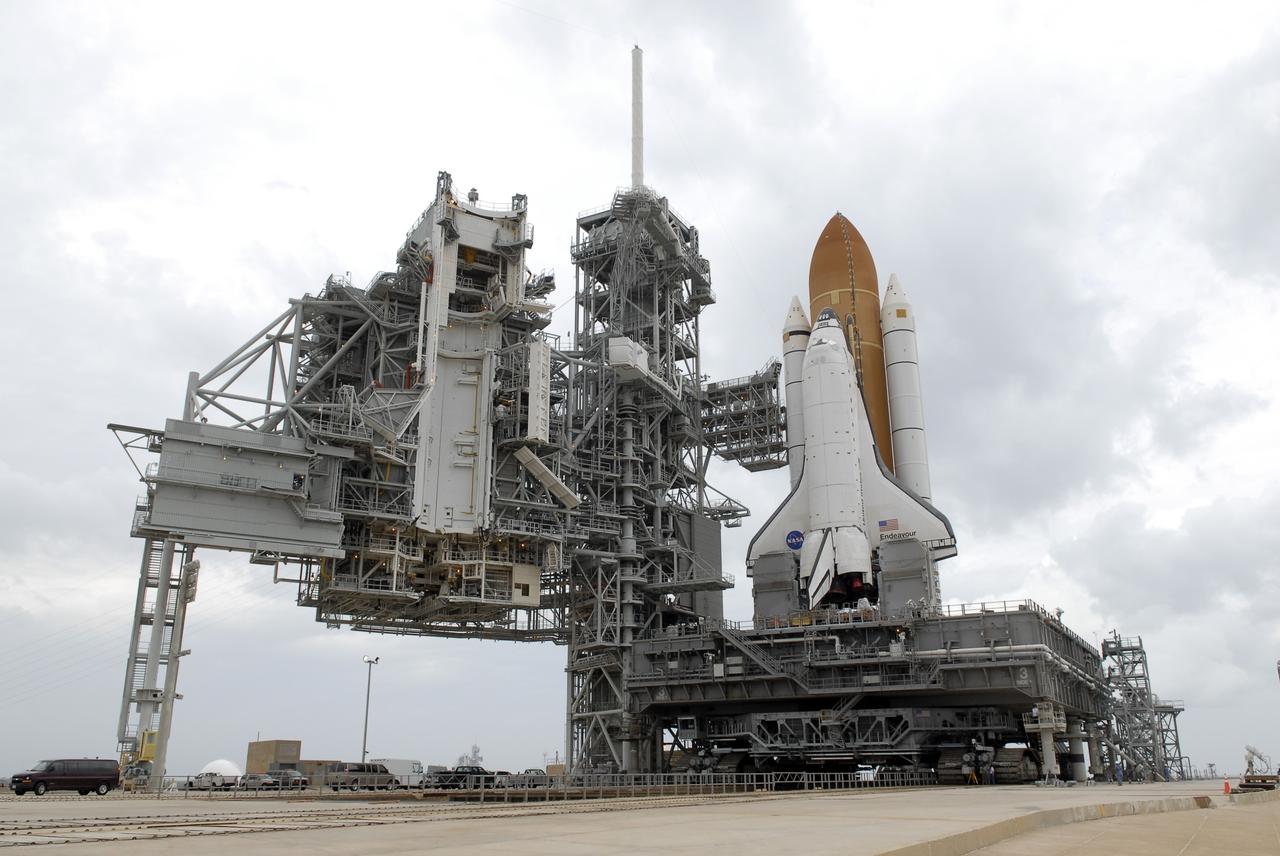
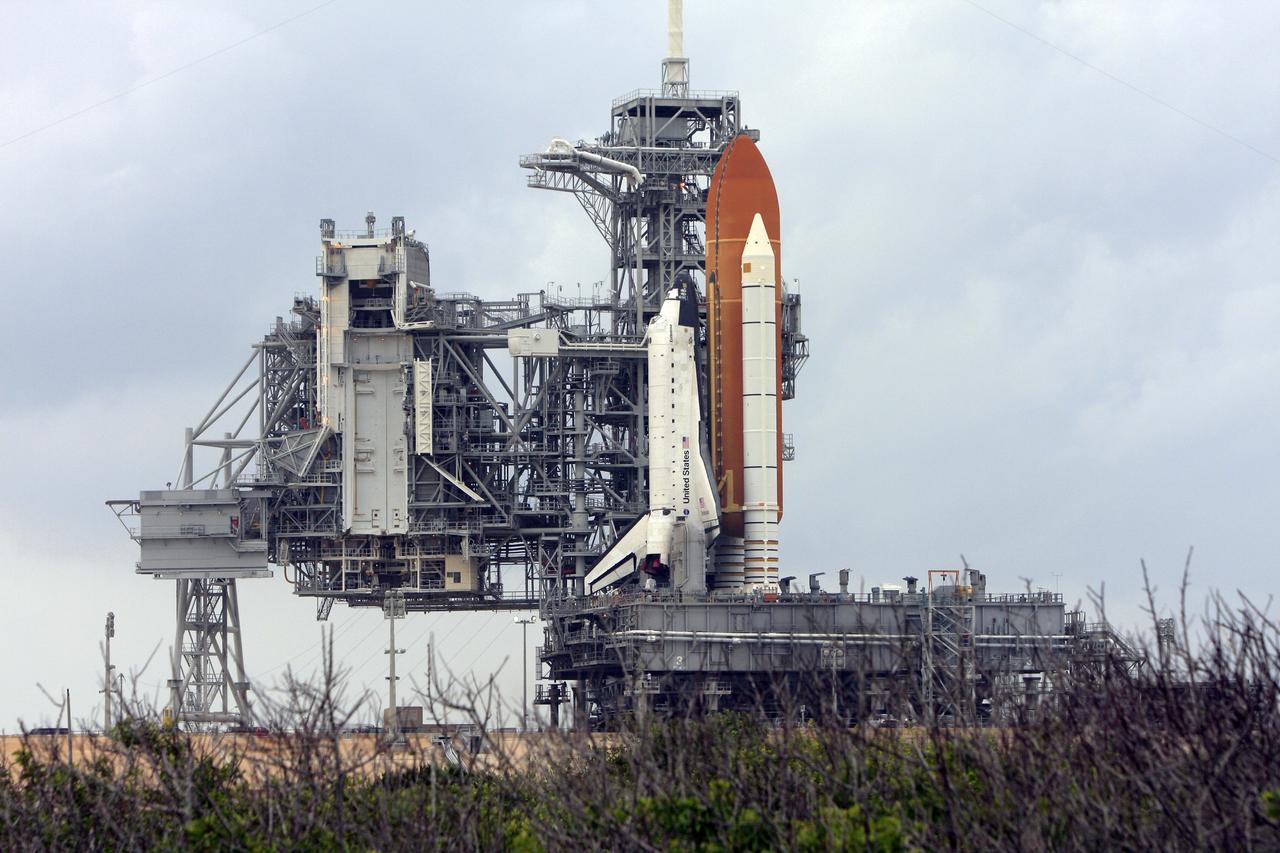
CAPE CANAVERAL, Fla. - At NASA's Kennedy Space Center in Florida, space shuttle Endeavour, atop the mobile launcher platform, comes to rest on Launch Pad 39A after rolling around from launch Pad 39B. At left are the open rotating service structure and the fixed service structure with the 80-foot-tall lightning mast on top. The shuttle moved off Launch Pad 39B starting at 8:28 am. EDT and completed its move to Launch Pad 39A at 4:37 p.m. Endeavour is targeted to launch Nov. 14 on the STS-126 mission. On this 27th mission to the International Space Station, Endeavour will carry the Lightweight Multi-Purpose Experiment Support Structure Carrier and the Multi-Purpose Logistics Module Leonardo that will hold supplies and equipment, including additional crew quarters, additional exercise equipment, spare hardware and equipment for the regenerative life support system. Photo credit: NASA/Kim Shiflett
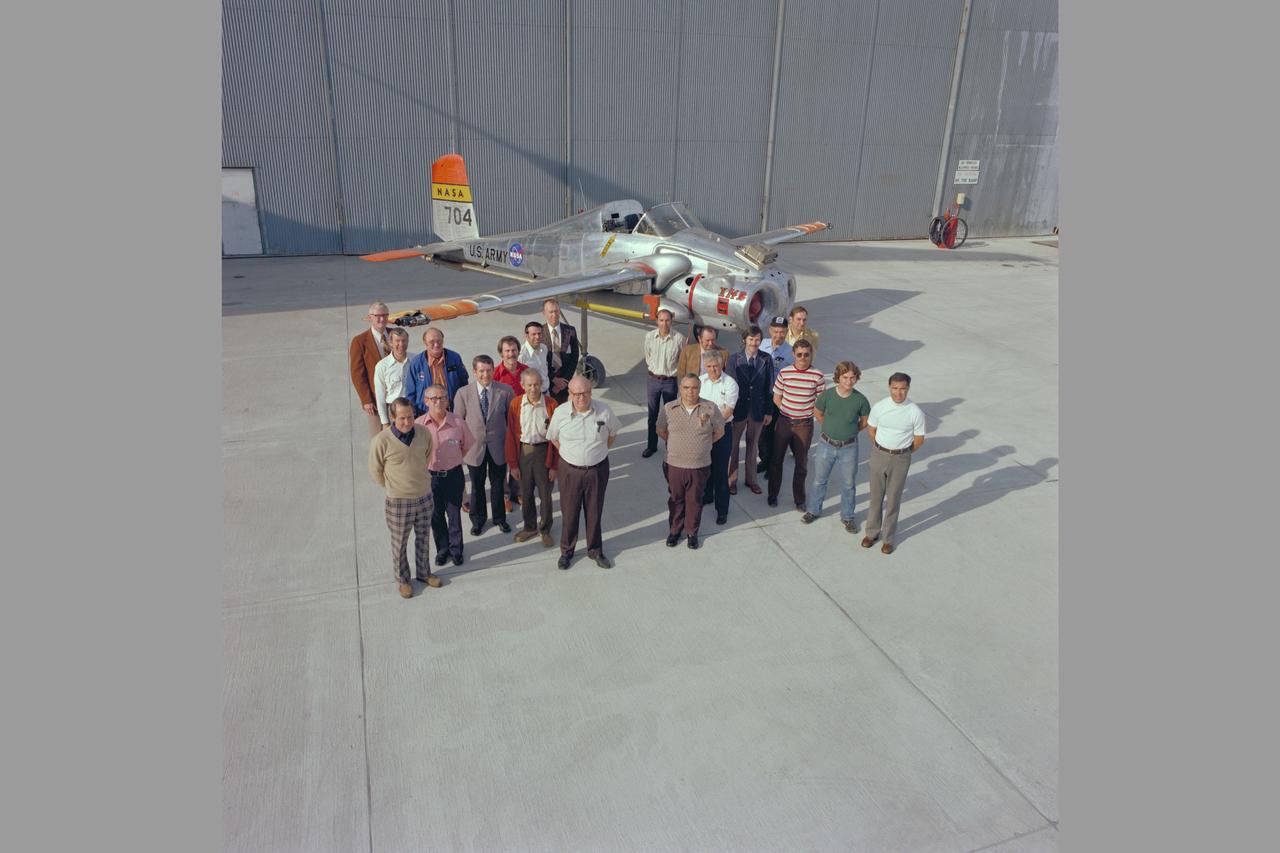
Olczak Bell X-14 AIRCRAFT TWENTIETH ANNIVERSARY. Research Team: Front Row: Fred Drinkwater, Jim Meeks, Lonnie Phillips, Jim Kozalski, Vic Bravo. Second Row: Bill Carpenter, Sid Selan, Dick Gallant, Terry Stoeffler. Third row: Ron Gerdes, Lloyd Corliss. Fourth row: Cy Sewell, Dick Greif, Ed Vernon, Lee Jones. Fifth Row: Dan Dugan, Jim Rogers, Dave Walton, Terry Feistel. Back Row: Frank Pauli, Seth Anderson. Not pictured: Terry Gossett, Bob Innis, Stew Rolls, Lawson Williamson. Note: Used in publication in Flight Research at Ames; 57 Years of Development and Validation of Aeronautical Technology NASA SP-1998-3300 fig. 118
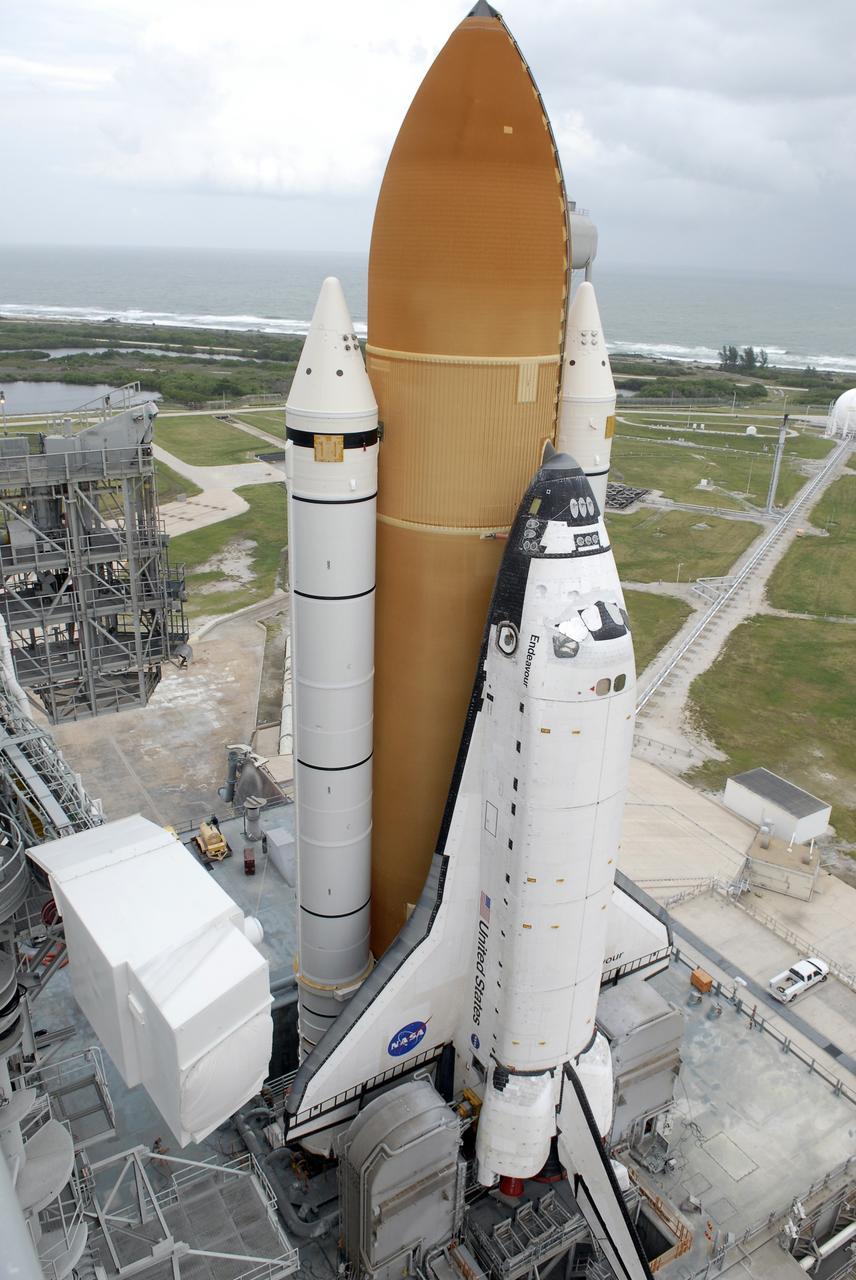
CAPE CANAVERAL, Fla. - At NASA's Kennedy Space Center in Florida, space shuttle Endeavour comes to rest on Launch Pad 39A after rolling around from launch Pad 39B. The shuttle moved off Launch Pad 39B starting at 8:28 am. EDT and completed its move to Launch Pad 39A at 4:37 p.m. Endeavour is targeted to launch Nov. 14 on the STS-126 mission. On this 27th mission to the International Space Station, Endeavour will carry the Lightweight Multi-Purpose Experiment Support Structure Carrier and the Multi-Purpose Logistics Module Leonardo that will hold supplies and equipment, including additional crew quarters, additional exercise equipment, spare hardware and equipment for the regenerative life support system. Photo credit: NASA/Kim Shiflett
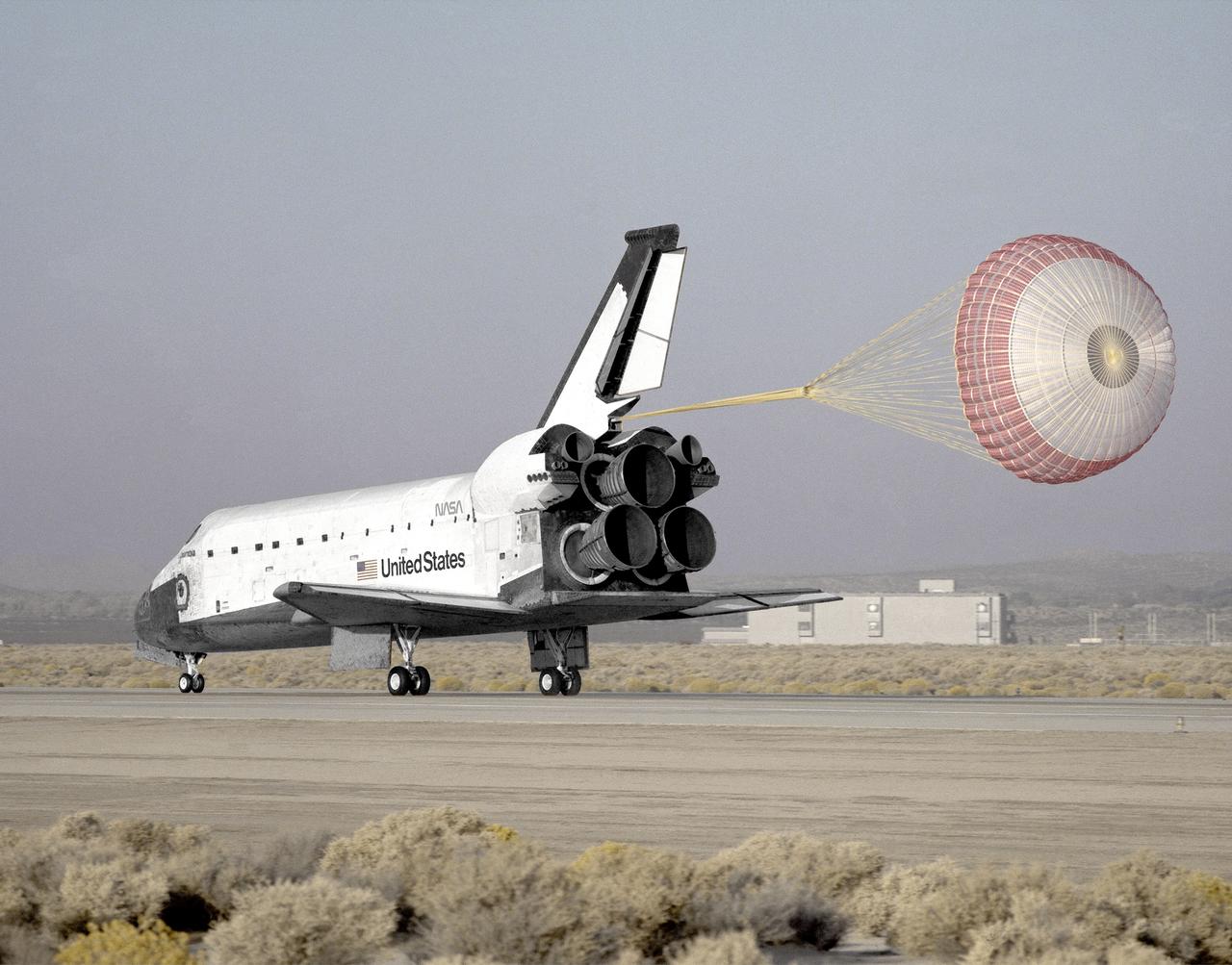
A drag chute slows the space shuttle Columbia as it rolls to a perfect landing concluding NASA's longest mission at that time, STS-58, at the Ames-Dryden Flight Research Facility (later redesignated the Dryden Flight Research Center), Edwards, California, with a 8:06 a.m. (PST) touchdown 1 November 1993 on Edward's concrete runway 22. The planned 14 day mission, which began with a launch from Kennedy Space Center, Florida, at 7:53 a.m. (PDT), October 18, was the second spacelab flight dedicated to life sciences research. Seven Columbia crewmembers performed a series of experiments to gain more knowledge on how the human body adapts to the weightless environment of space. Crewmembers on this flight included: John Blaha, commander; Rick Searfoss, pilot; payload commander Rhea Seddon; mission specialists Bill MacArthur, David Wolf, and Shannon Lucid; and payload specialist Martin Fettman.

CAPE CANAVERAL, Fla. - At NASA's Kennedy Space Center in Florida, space shuttle Endeavour, atop the mobile launcher platform, comes to rest on Launch Pad 39A after rolling around from launch Pad 39B. The shuttle moved off Launch Pad 39B starting at 8:28 am. EDT and completed its move to Launch Pad 39A at 4:37 p.m. Endeavour is targeted to launch Nov. 14 on the STS-126 mission. On this 27th mission to the International Space Station, Endeavour will carry the Lightweight Multi-Purpose Experiment Support Structure Carrier and the Multi-Purpose Logistics Module Leonardo that will hold supplies and equipment, including additional crew quarters, additional exercise equipment, spare hardware and equipment for the regenerative life support system. Photo credit: NASA/Kim Shiflett
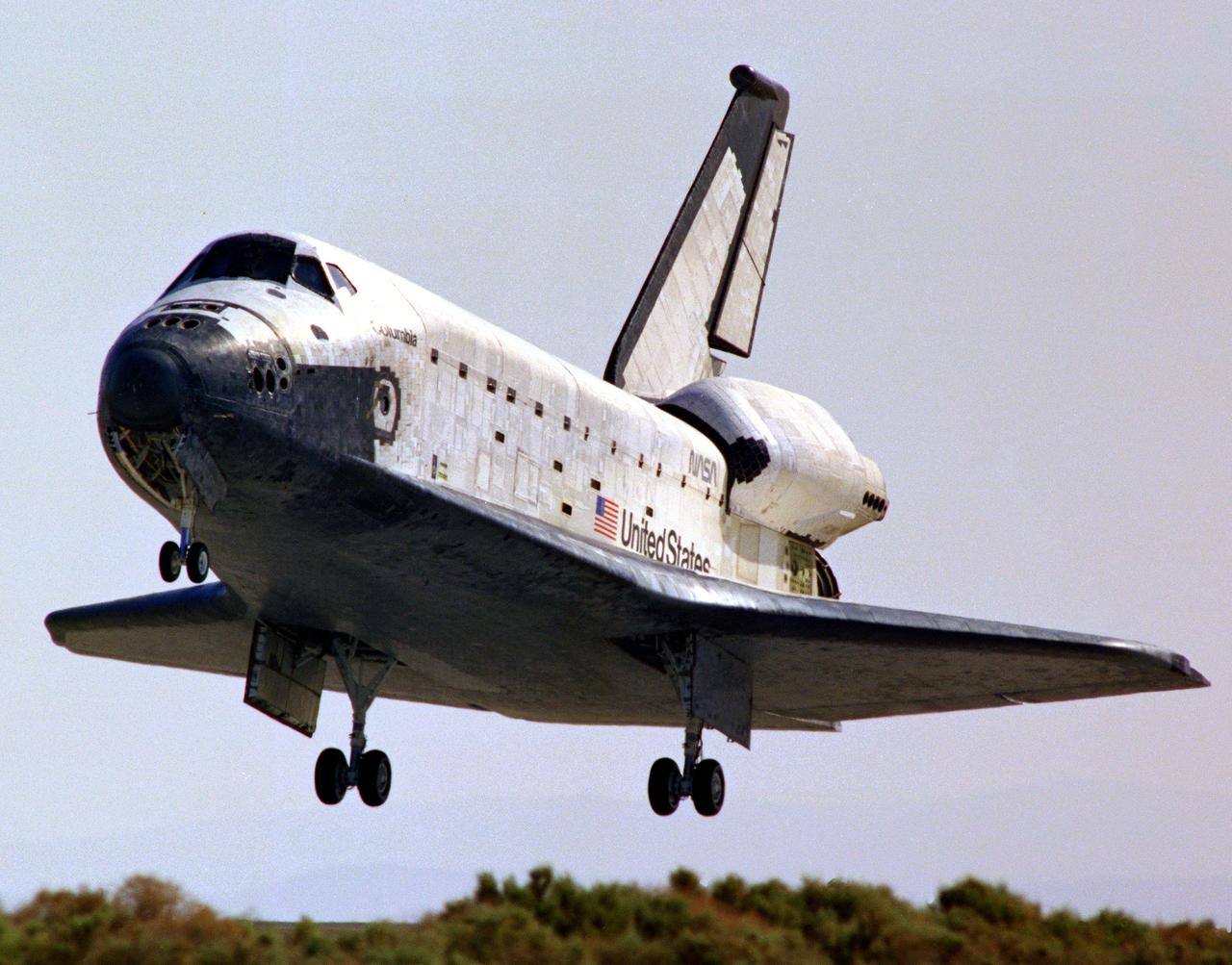
Space Shuttle Columbia nears its touchdown on Runway 22 at Edwards, California, at 8:39 a.m., 14 June 1991, as the STS-40 life sciences mission comes to an end at NASA's Ames-Dryden Flight Research Facility (later redesignated Dryden Flight Research Center) after nine days of orbital flight. Aboard Columbia during the extended mission were Bryan D. O'Connor, mission commander; Sidney M. Gutierrez, pilot; mission specialists James P. Bagian, Tamara E. Jernigan, and Margaret Rhea Seddon; and payload specialists Francis Andrew Gaffney and Millie Hughes-Fulford. STS-40 was the first space shuttle mission dedicated to life sciences research to explore how the body reacts to a weightless environment and how it readjusts to gravity on return to earth. Columbia was launched on the STS-40 mission 5 June 1991, from Kennedy Space Center in Florida.
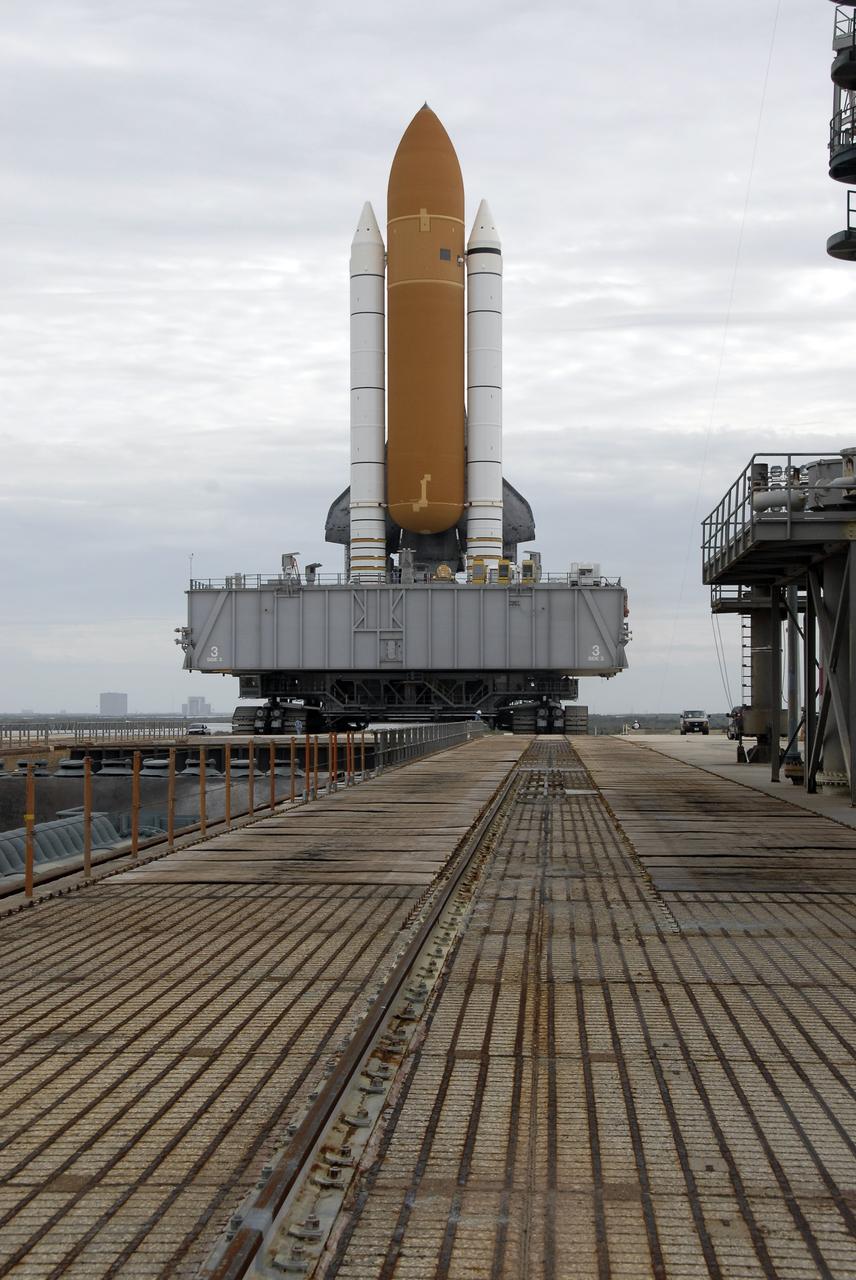
CAPE CANAVERAL, Fla. - At NASA's Kennedy Space Center in Florida, space shuttle Endeavour rolls onto Launch Pad 39A after rolling around from launch Pad 39B. The shuttle moved off Launch Pad 39B starting at 8:28 am. EDT and completed its move to Launch Pad 39A at 4:37 p.m. Endeavour is targeted to launch Nov. 14 on the STS-126 mission. On this 27th mission to the International Space Station, Endeavour will carry the Lightweight Multi-Purpose Experiment Support Structure Carrier and the Multi-Purpose Logistics Module Leonardo that will hold supplies and equipment, including additional crew quarters, additional exercise equipment, spare hardware and equipment for the regenerative life support system. Photo credit: NASA/Kim Shiflett
CAPE CANAVERAL, Fla. - At NASA's Kennedy Space Center in Florida, space shuttle Endeavour reaches the top of Launch Pad 39A after rolling around from launch Pad 39B. The shuttle moved off Launch Pad 39B starting at 8:28 am. EDT and completed its move to Launch Pad 39A at 4:37 p.m. Endeavour is targeted to launch Nov. 14 on the STS-126 mission. On this 27th mission to the International Space Station, Endeavour will carry the Lightweight Multi-Purpose Experiment Support Structure Carrier and the Multi-Purpose Logistics Module Leonardo that will hold supplies and equipment, including additional crew quarters, additional exercise equipment, spare hardware and equipment for the regenerative life support system. Photo credit: NASA/Troy Cryder
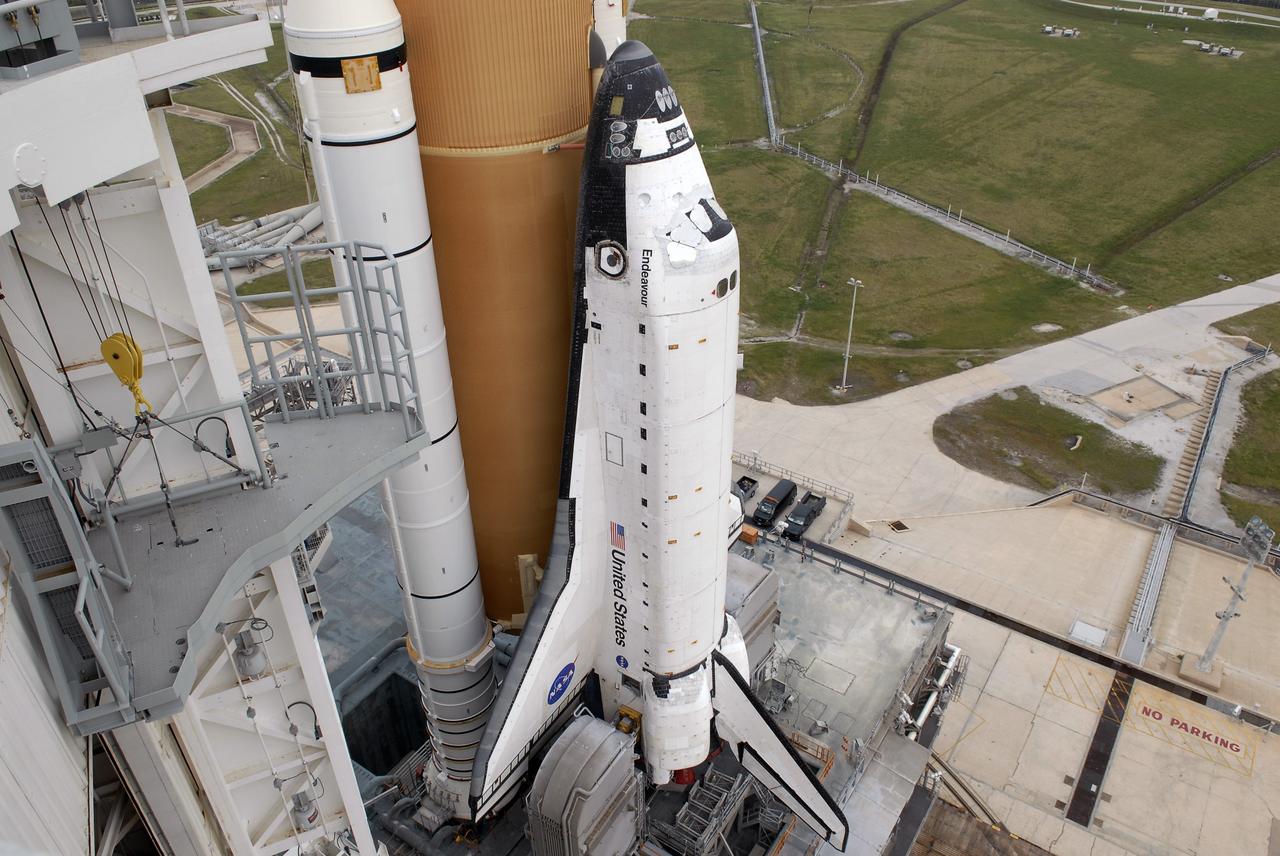
CAPE CANAVERAL, Fla. - At NASA's Kennedy Space Center in Florida, space shuttle Endeavour comes to rest on Launch Pad 39A after rolling around from launch Pad 39B. The shuttle moved off Launch Pad 39B starting at 8:28 am. EDT and completed its move to Launch Pad 39A at 4:37 p.m. Endeavour is targeted to launch Nov. 14 on the STS-126 mission. On this 27th mission to the International Space Station, Endeavour will carry the Lightweight Multi-Purpose Experiment Support Structure Carrier and the Multi-Purpose Logistics Module Leonardo that will hold supplies and equipment, including additional crew quarters, additional exercise equipment, spare hardware and equipment for the regenerative life support system. Photo credit: NASA/Kim Shiflett
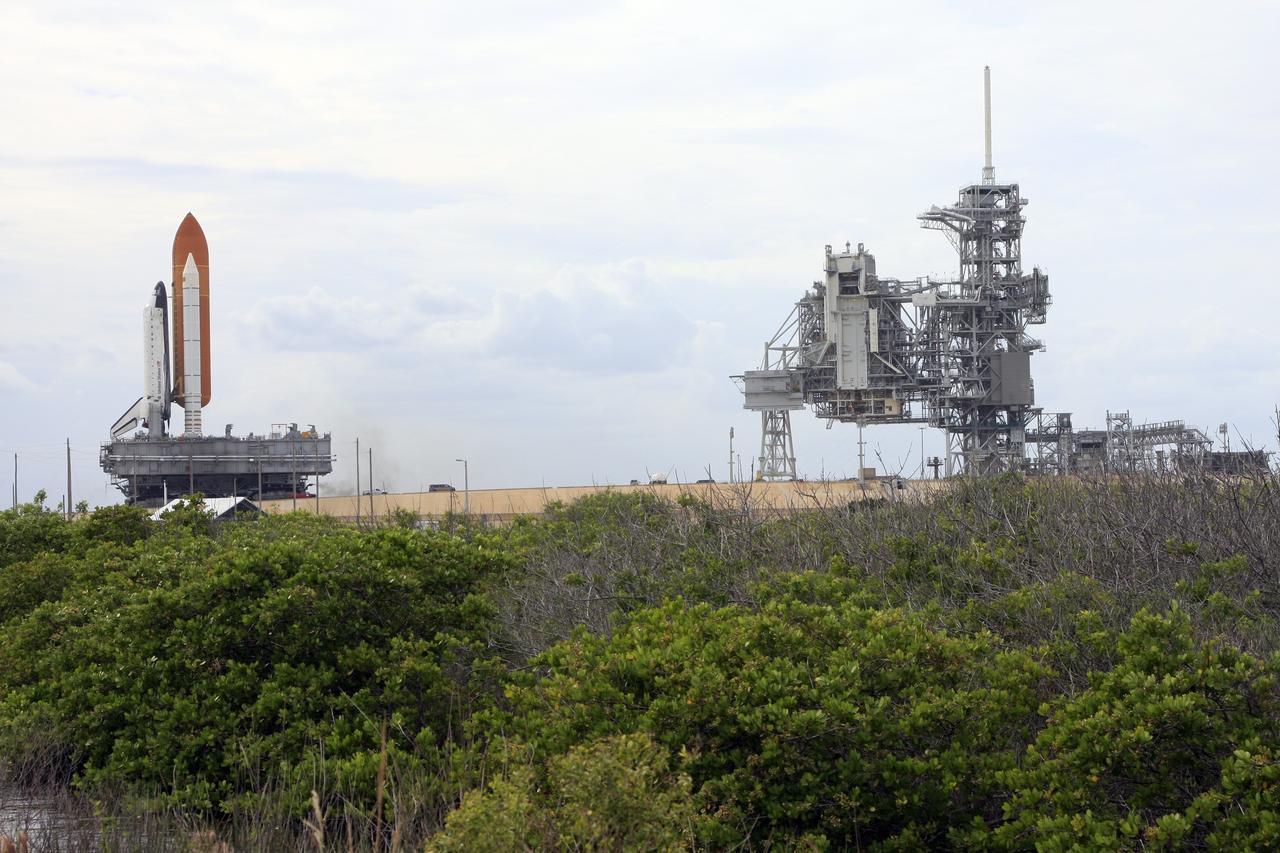
CAPE CANAVERAL, Fla. - At NASA's Kennedy Space Center in Florida, space shuttle Endeavour rolls up the ramp toward Launch Pad 39A. At right are the open rotating service structure and the fixed service structure with the 80-foot-tall lightning mast on top. The shuttle moved off Launch Pad 39B starting at 8:28 am. EDT and completed its move to Launch Pad 39A at 4:37 p.m. Endeavour is targeted to launch Nov. 14 on the STS-126 mission. On this 27th mission to the International Space Station, Endeavour will carry the Lightweight Multi-Purpose Experiment Support Structure Carrier and the Multi-Purpose Logistics Module Leonardo that will hold supplies and equipment, including additional crew quarters, additional exercise equipment, spare hardware and equipment for the regenerative life support system. Photo credit: NASA/Troy Cryder
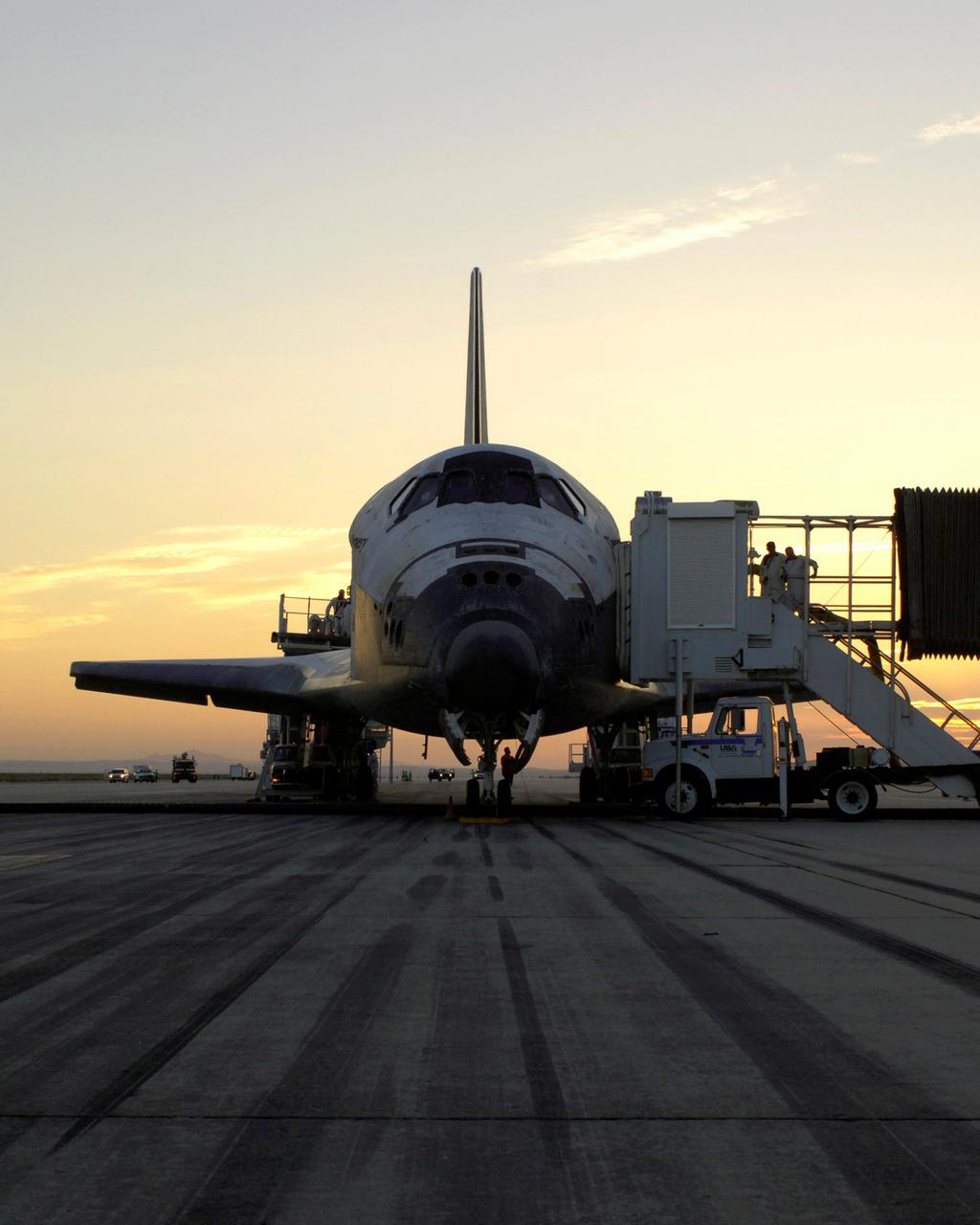
The sun rises on the Space Shuttle Discovery as it rests on the runway at Edward’s Air Force Base in California after a safe landing at 5:11 am (PDT) on August 9, 2005. The STS-114 landing concluded a historic 14 day return to flight mission to the International Space Station (ISS) after nearly a two and one half year delay in flight after the Space Shuttle Columbia tragedy in February 2003. Three successful space walks performed during the mission included a demonstration of repair techniques to the Shuttle’s thermal tiles known as the Thermal Protection System, the replacement of a failed Control Moment Gyroscope which helps keep the station oriented properly, and the installation of the External Stowage Platform, a space “shelf” for holding spare parts during Station construction. The shuttle’s heat shield repair was a first for Shuttle repair while still in space.
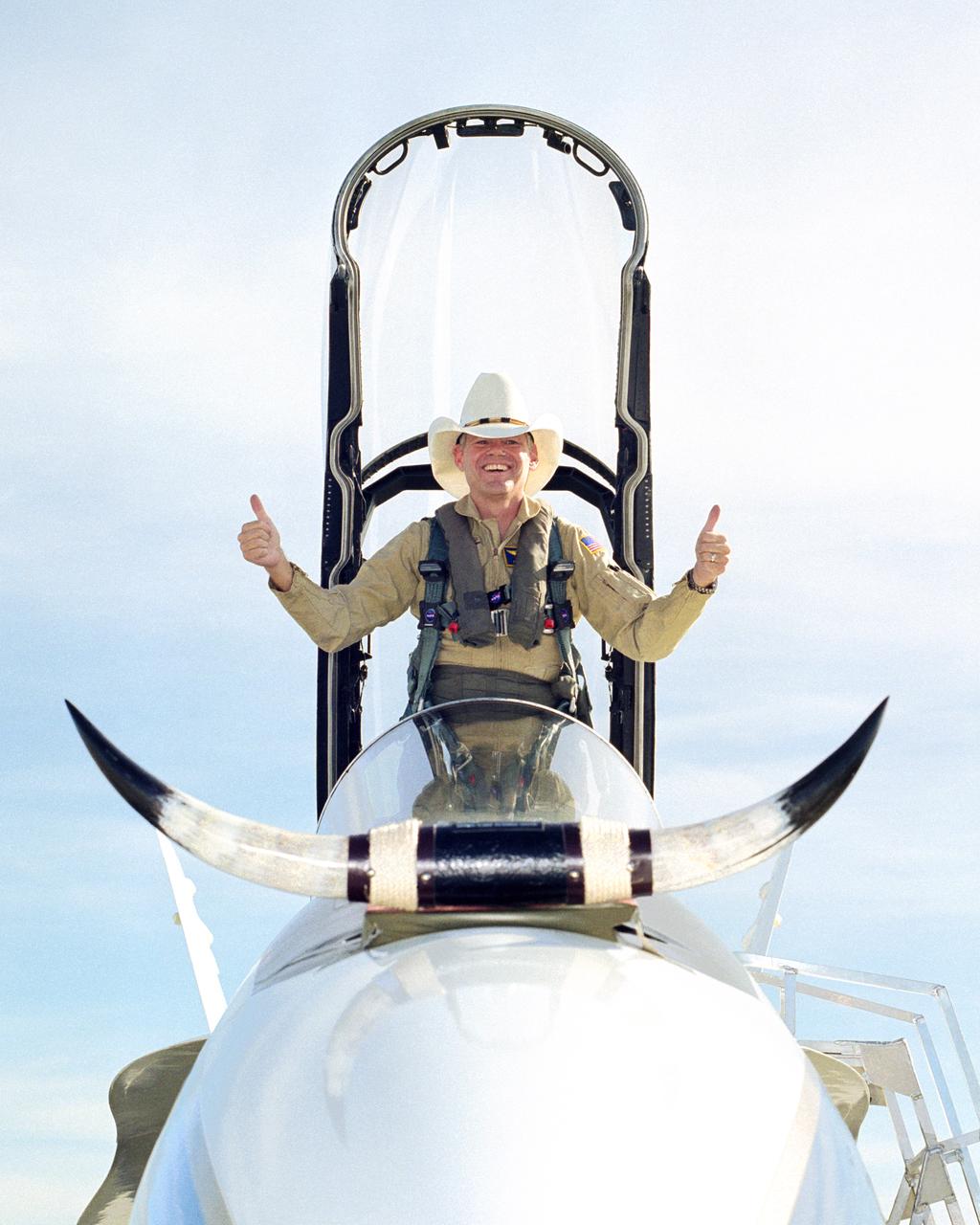
In a lighter mood, Ed Schneider gives a "thumbs-up" after his last flight at the Dryden Flight Research Center on September 19, 2000. Schneider arrived at the NASA Ames-Dryden Flight Research Facility on July 5, 1982, as a Navy Liaison Officer, becoming a NASA research pilot one year later. He has been project pilot for the F-18 High Angle-of-Attack program (HARV), the F-15 aeronautical research aircraft, the NASA B-52 launch aircraft, and the SR-71 "Blackbird" aircraft. He also participated in such programs as the F-8 Digital Fly-By-Wire, the FAA/NASA 720 Controlled Impact Demonstration, the F-14 Automatic Rudder Interconnect and Laminar Flow, and the F-104 Aeronautical Research and Microgravity projects.
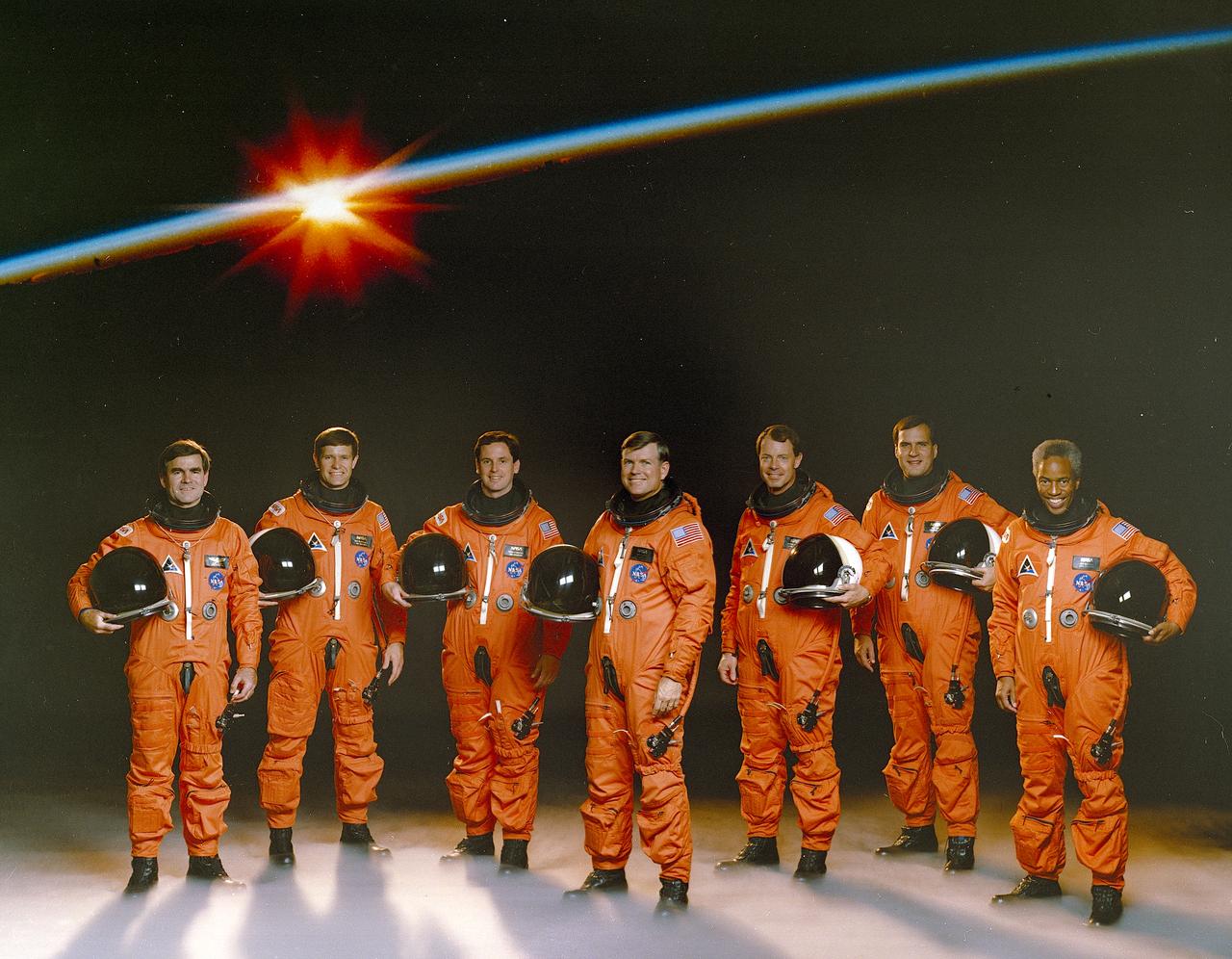
The STS-39 crew portrait includes 7 astronauts. Pictured are Charles L. Veach, mission specialist 5; Michael L. Coats, commander; Gregory J. Harbaugh, mission specialist 2; Donald R. McMonagle, mission specialist 4; L. Blaine Hammond, pilot; Richard J. Hieb, mission specialist 3; and Guion S. Buford, Jr., mission specialist 1. Launched aboard the Space Shuttle Discovery on April 28, 1991 at 7:33:14 am (EDT), STS-39 was a Department of Defense (DOD) mission. The primary unclassified payload included the Air Force Program 675 (AFP-675), the Infrared Background Signature Survey (IBSS), and the Shuttle Pallet Satellite II (SPAS II).
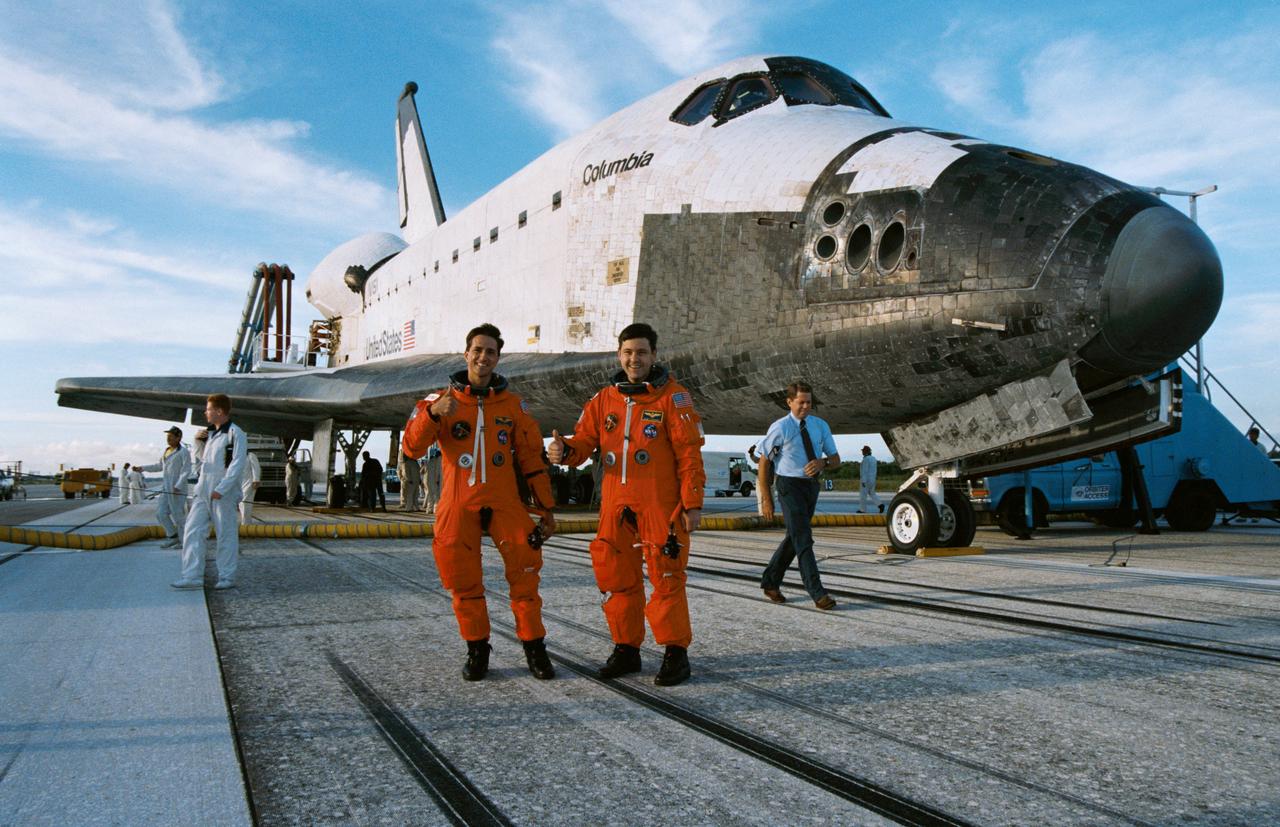
STS-65 Commander Robert D. Cabana (right) and Mission Specialist Donald A. Thomas, wearing launch and entry suits (LESs), signal mission success with a "thumbs up" gesture as they stand in front of Columbia, Orbiter Vehicle (OV) 102. The two crewmembers are all smiles after OV-102's landing at the Kennedy Space Center (KSC) Shuttle Landing Facility (SLF). The two, along with four other NASA astronauts and a Japanese payload specialist, had just broken a Shuttle duration record as they ran almost 18 hours over two weeks in space in support of the International Microgravity Laboratory 2 (IML-2) mission. Landing occurred at 6:38 am (Eastern Daylight Time (EDT)). Mission duration was 14 days, 17 hours and 56 minutes. In the background, KSC personnel conduct postflight servicing of the vehicle.
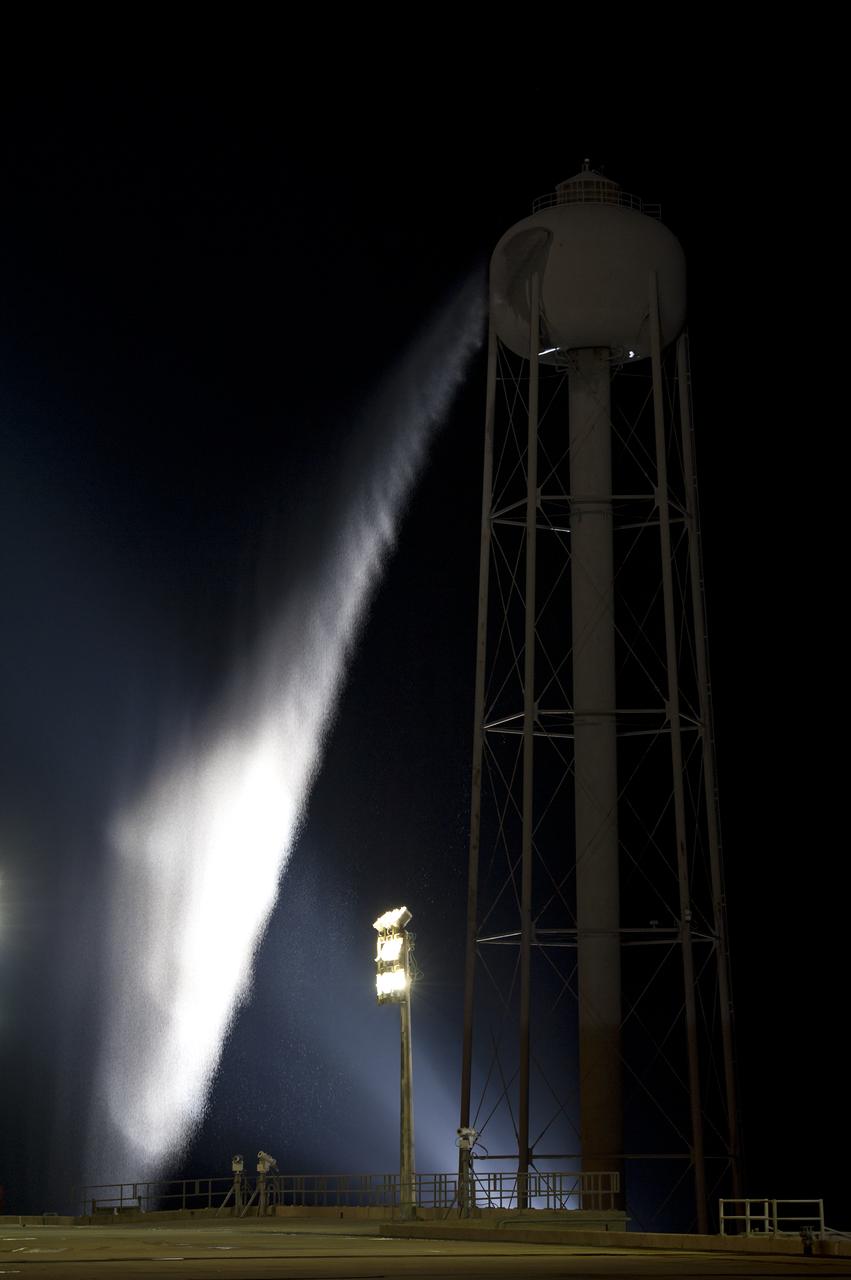
Water pours out of the 290-foot-high tower that holds 300,000 gallons of water used for sound suppression during shuttle launches on launch pad 39a shortly after the rollback of the Rotating Service Structure (RSS) from the space shuttle Endeavour, Thursday, April 28, 2011, at Kennedy Space Center in Cape Canaveral, Fla. During the 14-day mission, Endeavour and the STS-134 crew will deliver the Alpha Magnetic Spectrometer (AMS) and spare parts including two S-band communications antennas, a high-pressure gas tank and additional spare parts for Dextre. Launch is targeted for Friday, April 29 at 3:47 p.m. EDT. Photo credit: (NASA/Bill Ingalls)
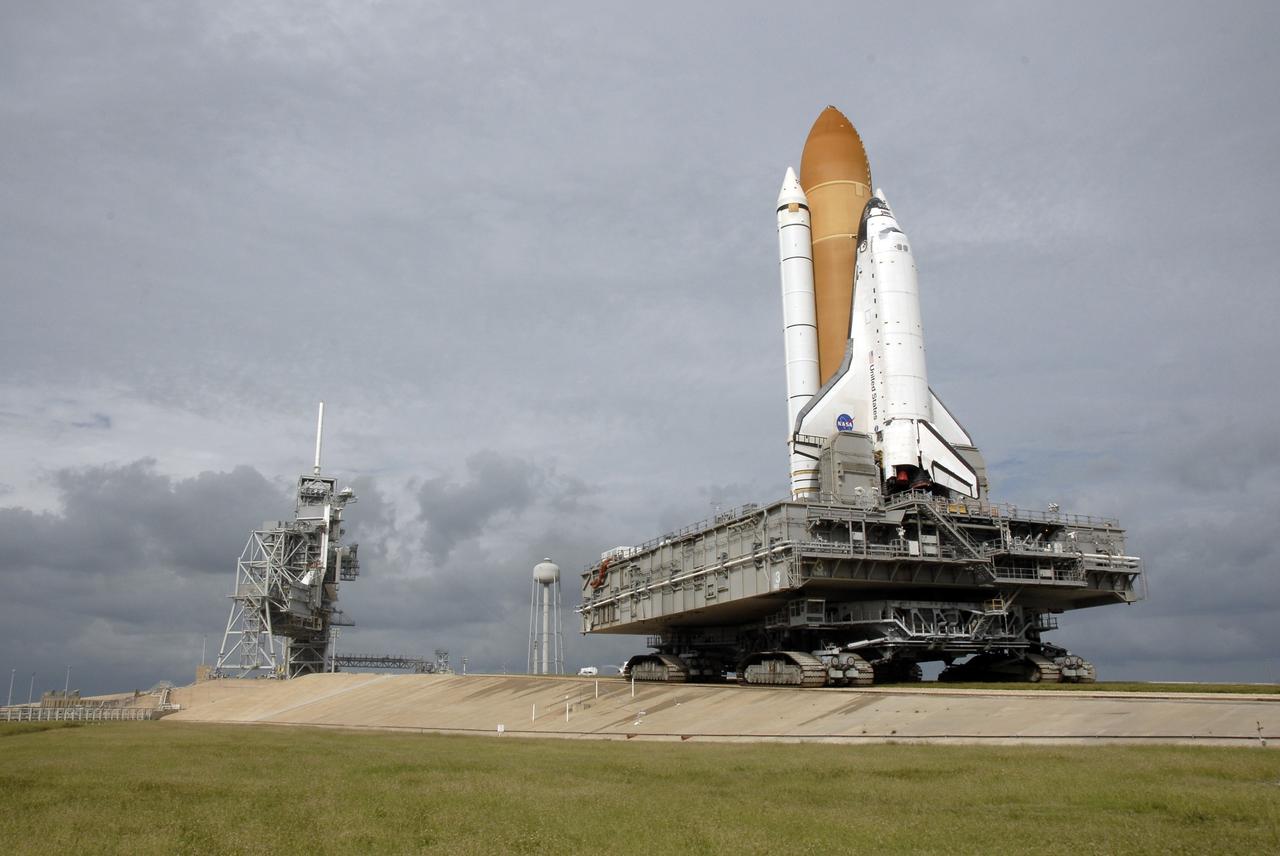
CAPE CANAVERAL, Fla. - At NASA's Kennedy Space Center in Florida, space shuttle Endeavour rolls up the ramp toward Launch Pad 39A. The shuttle moved off Launch Pad 39B starting at 8:28 am. EDT and completed its move to Launch Pad 39A at 4:37 p.m. Endeavour is targeted to launch Nov. 14 on the STS-126 mission. On this 27th mission to the International Space Station, Endeavour will carry the Lightweight Multi-Purpose Experiment Support Structure Carrier and the Multi-Purpose Logistics Module Leonardo that will hold supplies and equipment, including additional crew quarters, additional exercise equipment, spare hardware and equipment for the regenerative life support system. Photo credit: NASA/Kim Shiflett
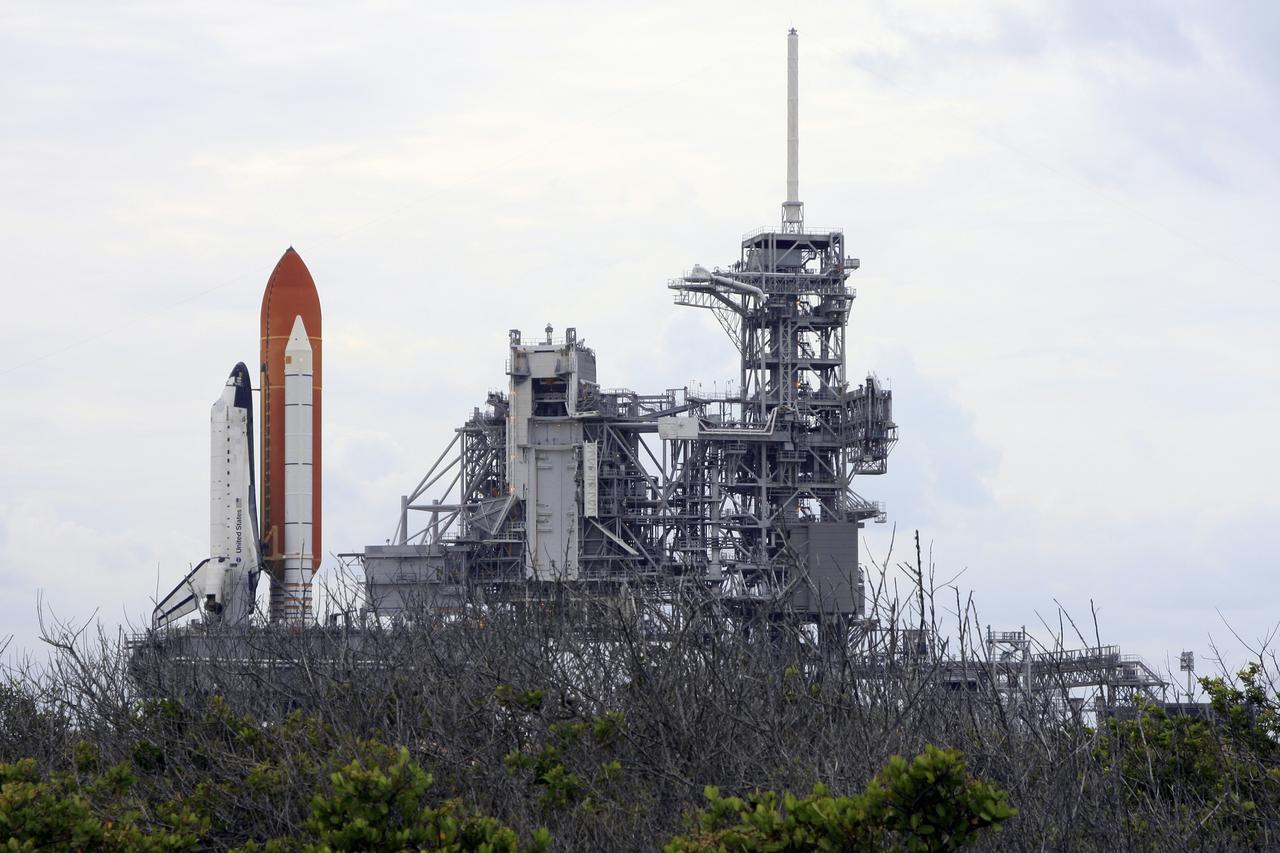
CAPE CANAVERAL, Fla. – At NASA's Kennedy Space Center in Florida, space shuttle Endeavour rolls to the top of Launch Pad 39A. At right are the open rotating service structure and the fixed service structure with the 80-foot-tall lightning mast on top. The shuttle moved off Launch Pad 39B starting at 8:28 am. EDT and completed its move to Launch Pad 39A at 4:37 p.m. Endeavour is targeted to launch Nov. 14 on the STS-126 mission. On this 27th mission to the International Space Station, Endeavour will carry the Lightweight Multi-Purpose Experiment Support Structure Carrier and the Multi-Purpose Logistics Module Leonardo that will hold supplies and equipment, including additional crew quarters, additional exercise equipment, spare hardware and equipment for the regenerative life support system. Photo credit: NASA/Troy Cryder
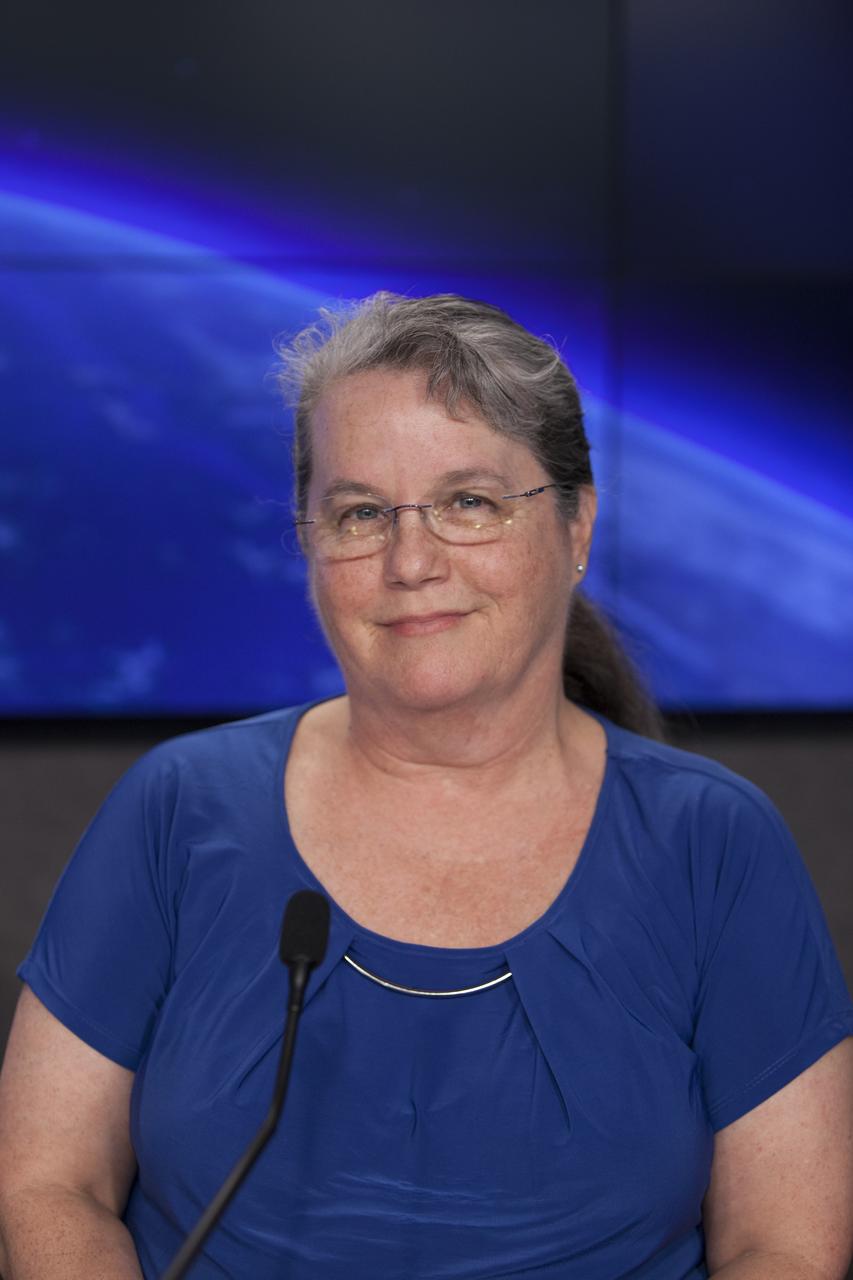
CAPE CANAVERAL, Fla. – Ruth Globus, project scientist, Rodent Habitat/Rodent Research-1, NASA Ames Research Center, briefs media representatives in Kennedy Space Center’s Press Site auditorium in preparation for the launch of the SpaceX CRS-4 mission to resupply the International Space Station. Globus is a member of the ISS Science Panel on Model Organisms. The mission is the fourth of 12 SpaceX flights NASA contracted with the company to resupply the space station. It will be the fifth trip by a Dragon spacecraft to the orbiting laboratory. The spacecraft’s 2.5 tons of supplies, science experiments, and technology demonstrations include critical materials to support 255 science and research investigations that will occur during the station's Expeditions 41 and 42. Liftoff is targeted for an instantaneous window at 2:14 a.m. EDT. To learn more about the mission, visit http://www.nasa.gov/mission_pages/station/structure/launch/index.html. Photo credit: NASA/Jim Grossmann
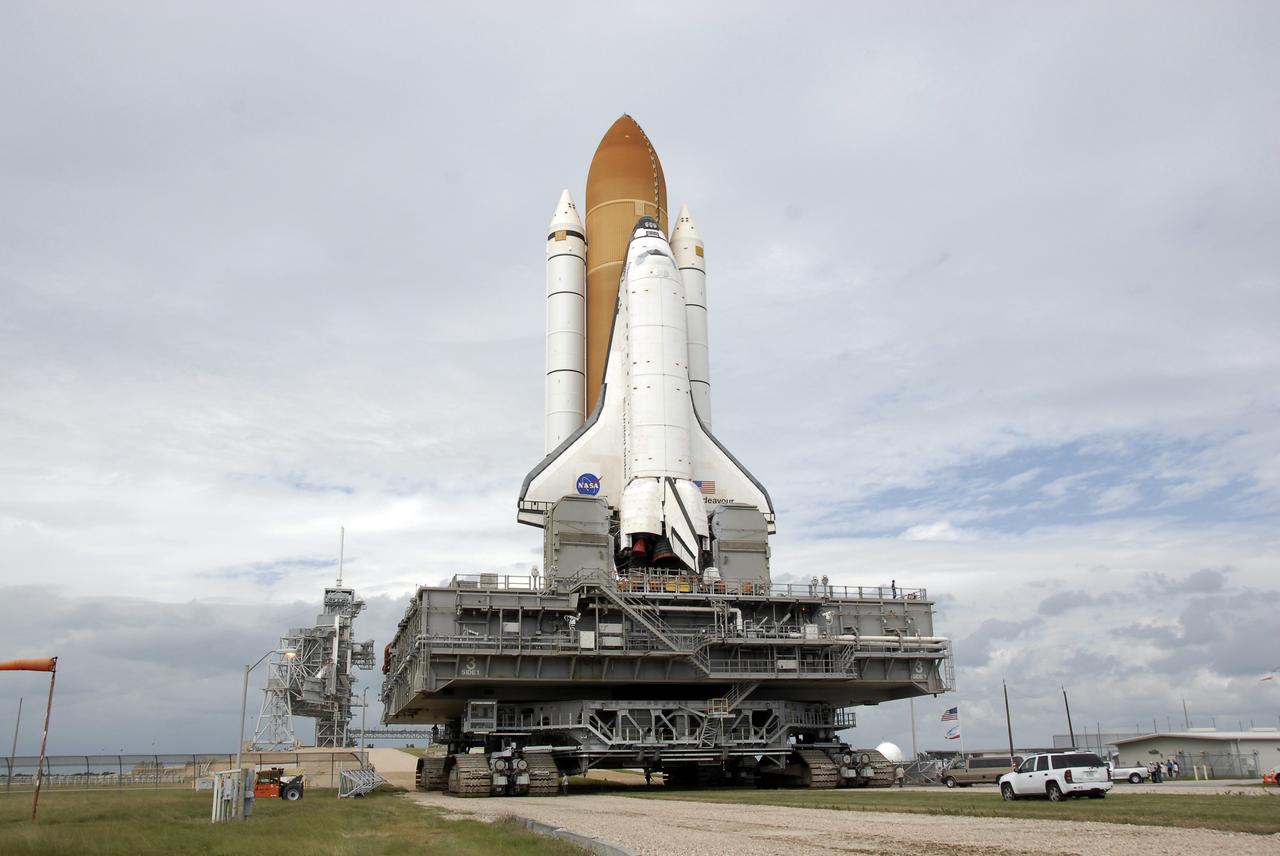
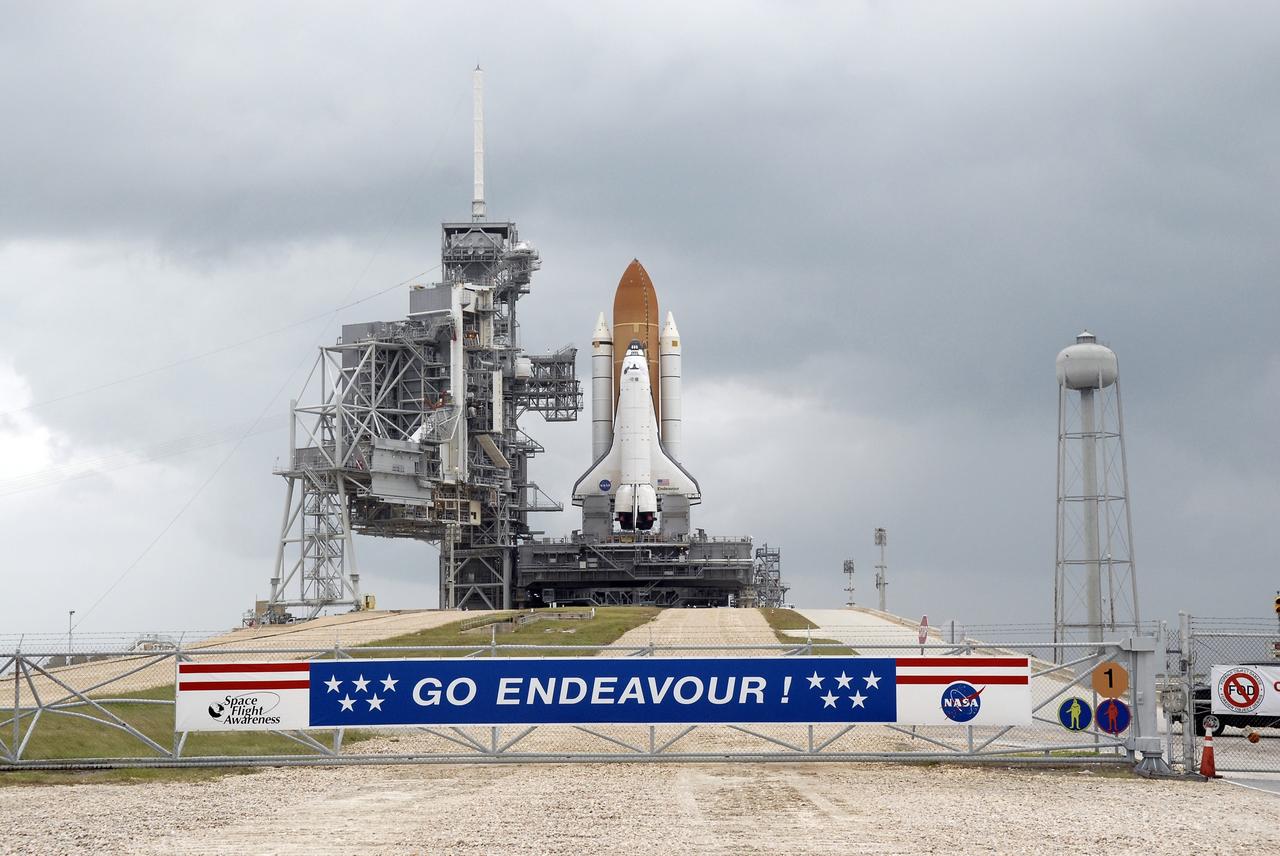
CAPE CANAVERAL, Fla. - At NASA's Kennedy Space Center in Florida, space shuttle Endeavour rolls through the gate at Launch Pad 39A. The shuttle earlier moved off Launch Pad 39B starting at 8:28 am. EDT to head for pad 39A. Endeavour completed its move to Launch Pad 39A at 4:37 p.m. Endeavour is targeted to launch Nov. 14 on the STS-126 mission. On this 27th mission to the International Space Station, Endeavour will carry the Lightweight Multi-Purpose Experiment Support Structure Carrier and the Multi-Purpose Logistics Module Leonardo that will hold supplies and equipment, including additional crew quarters, additional exercise equipment, spare hardware and equipment for the regenerative life support system. Photo credit: NASA/Kim Shiflett
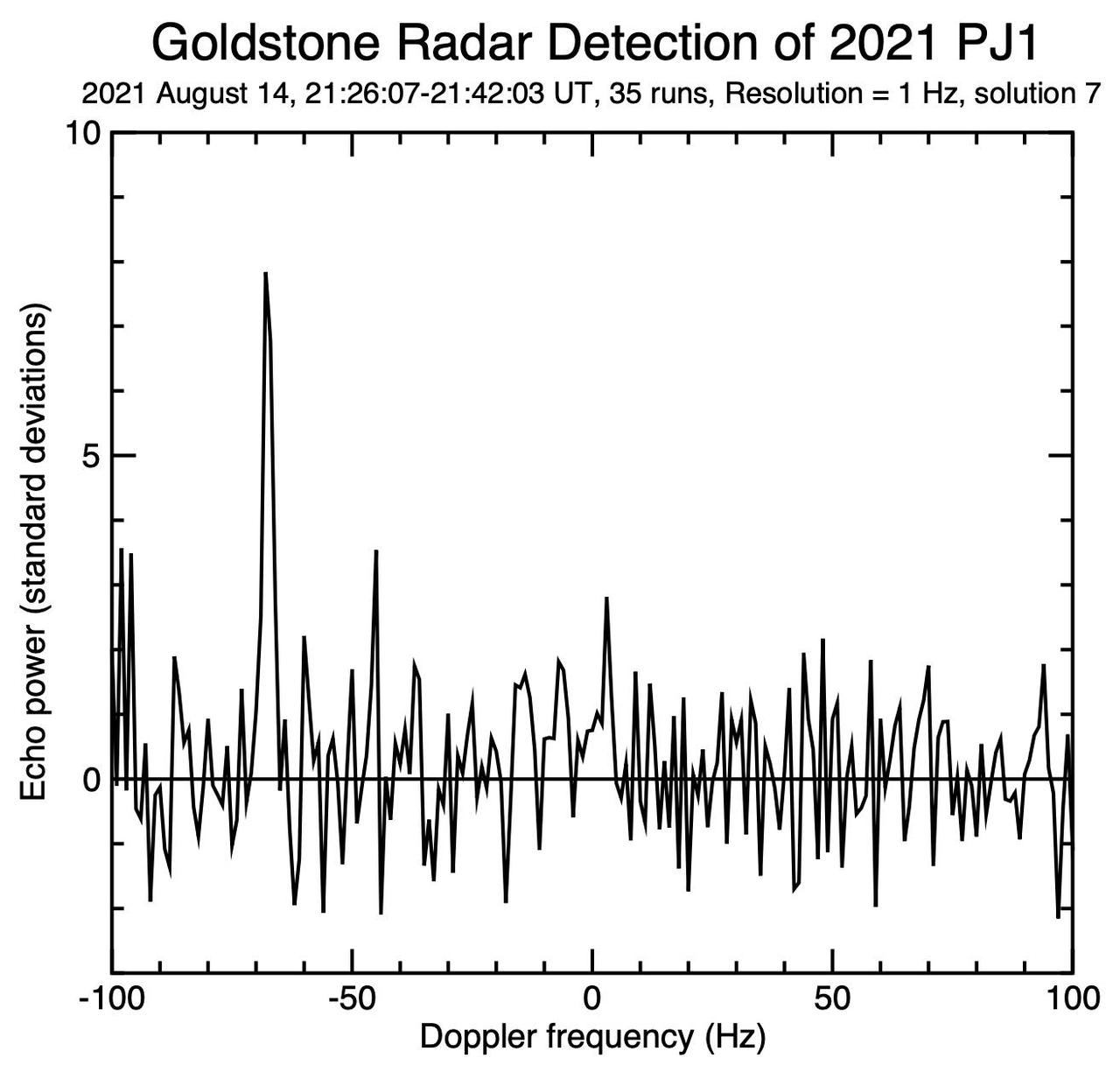
This figure represents the 1,000th near-Earth asteroid (NEA) to be detected by planetary radar since 1968. Being only 65 to 100 feet (20 to 30 meters) wide, asteroid 2021 PJ1 was too small to be imaged in any detail, but the powerful 70-meter (230-foot) Deep Space Station 14 (DSS-14) antenna at the Deep Space Network's Goldstone Deep Space Complex near Barstow, California, was able to measure the Doppler frequency of the radio waves that reflected off the object's surface. The data was recorded for 16 minutes between 2:26 p.m. and 2:42 p.m. PDT on Aug. 14, 2021. The figure shows radar echo signal strength on the vertical axis versus Doppler frequency (in units of hertz, or Hz) on the horizontal axis. The strong spike at a value of minus 70 Hz is the reflected signal (or "echo") from 2021 PJ1; the other, smaller spikes are receiver noise, which is like the static on an AM radio if there aren't any nearby stations. Using this information, scientists at NASA's Jet Propulsion Laboratory in Southern California could more accurately calculate the asteroid's velocity, its distance from Earth and its future motion around the Sun. These observations used a prediction – known as an "ephemeris" – that had relatively large uncertainties because the asteroid had been discovered only a few days earlier. If the original prediction had been perfect, the radar echo would appear at zero Hz. The fact that the radar echo is at minus 70 Hz indicates a correction could be made to the predicted velocity of minus 2.7 miles per hour (minus 1.2 meters per second). This measurement also reduced the uncertainty in the asteroid's distance from Earth from 1,300 miles (2,100 kilometers) to 5.2 miles (8.3 kilometers) – a reduction of a factor of about 250. https://photojournal.jpl.nasa.gov/catalog/PIA24563
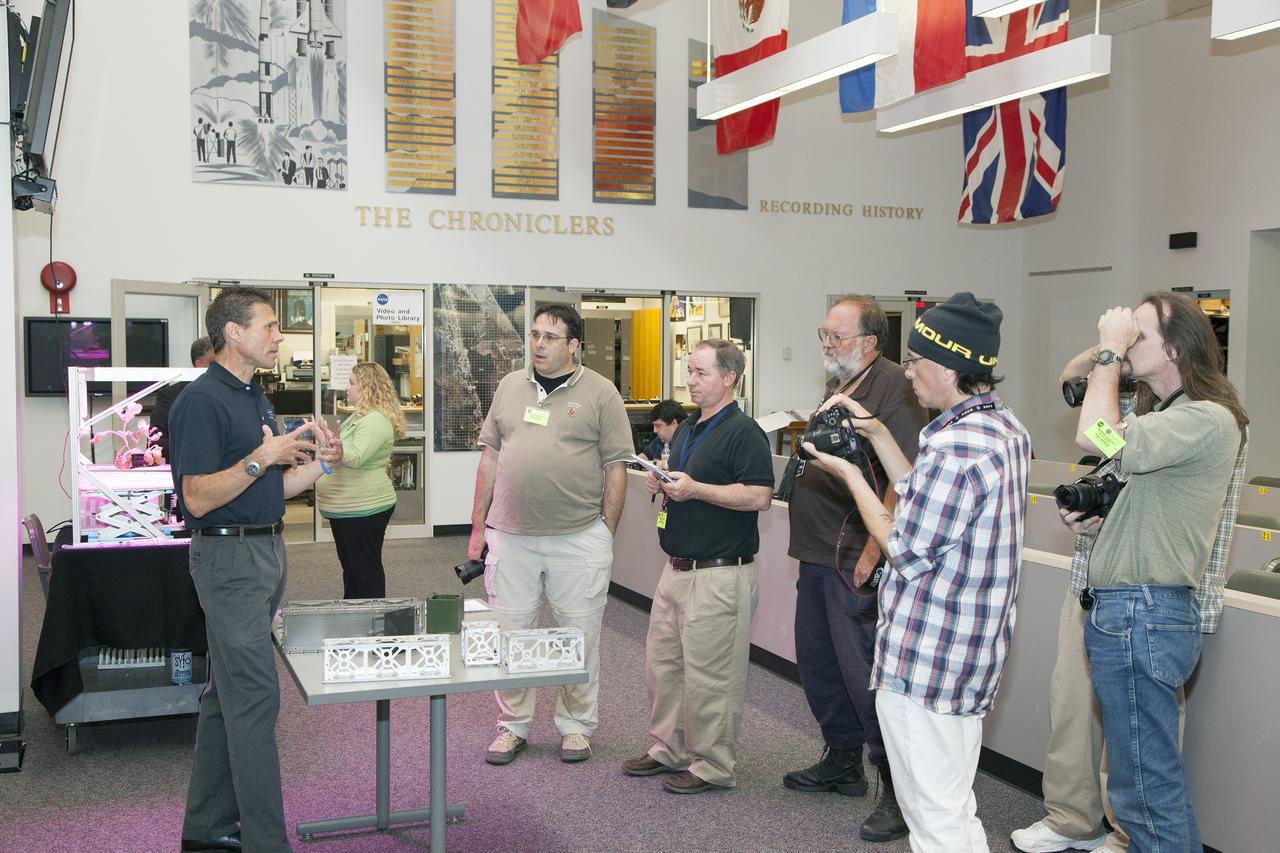
CAPE CANAVERAL, Fla. - Scott Higginbotham, left, mission manager for ELaNa V, discusses the concepts behind the design and deployment of the CubeSats flying on the ELaNa V mission with media representatives in the NASA Newsroom at Kennedy Space Center in Florida, using models of the Poly-Picosatellite Orbital Deployer, or P-POD, and various CubeSat canisters. NASA selected five small research satellites, or CubeSats, for the ELaNa V mission launching on SpaceX-3. Four P-PODs aboard the SpaceX Falcon 9 rocket will ferry them to space. The CubeSats were designed by three universities and the agency's Ames Research Center in California. Launch is scheduled at about 4:58 p.m. EDT April 14. The SpaceX-3 mission, carrying almost 2.5 tons of supplies, technology and science experiments, is the third of 12 flights under NASA's Commercial Resupply Services contract to resupply the orbiting laboratory. For more information about NASA's CubeSat Launch Initiative, visit http://go.nasa.gov/CubeSat_initiative. Photo credit: NASA/Glenn Benson
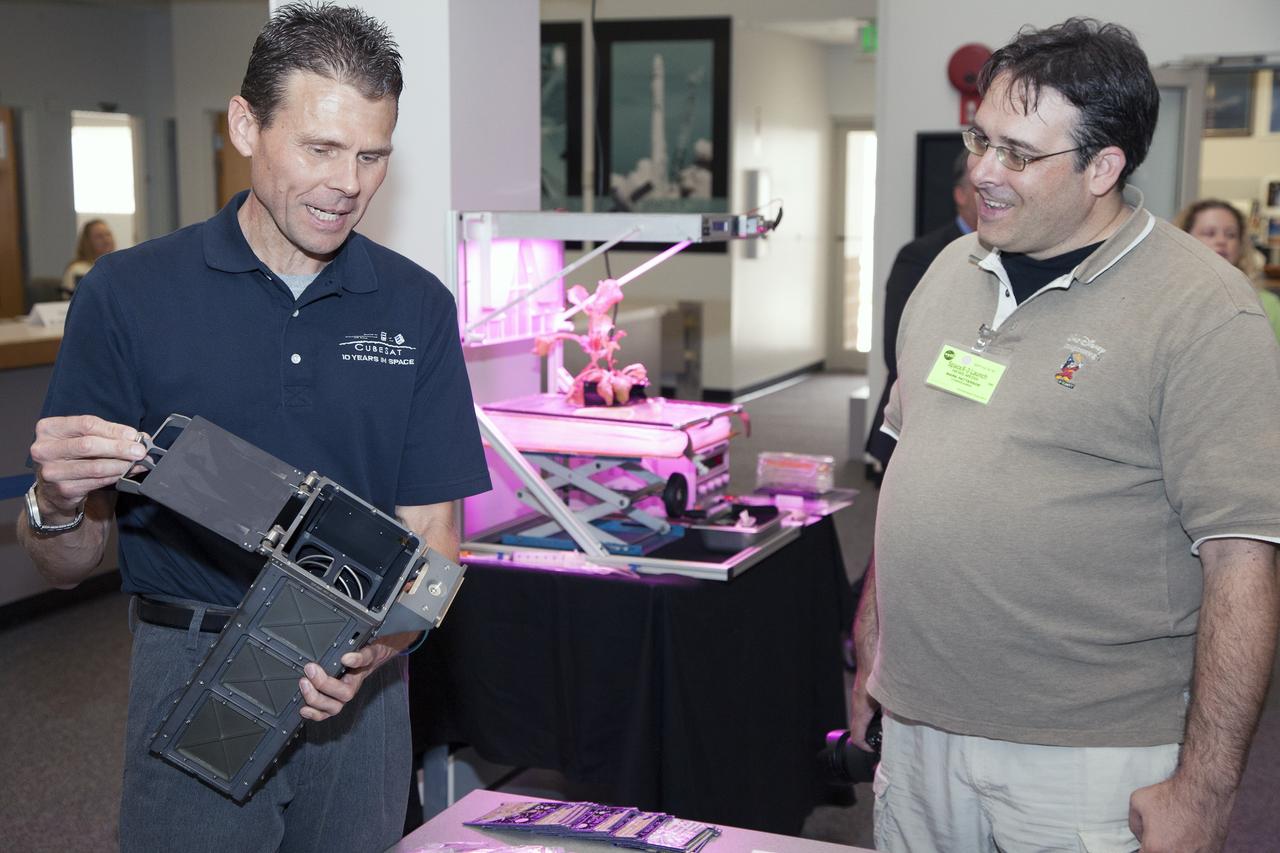
CAPE CANAVERAL, Fla. - Scott Higginbotham, left, mission manager for ELaNa V, demonstrates the concepts behind the design and deployment of the CubeSats flying on the ELaNa V mission with a media representative in the NASA Newsroom at Kennedy Space Center in Florida, using a model of the Poly-Picosatellite Orbital Deployer, or P-POD. NASA selected five small research satellites, or CubeSats, for the ELaNa V mission launching on SpaceX-3. Four P-PODs aboard the SpaceX Falcon 9 rocket will ferry them to space. The CubeSats were designed by three universities and the agency's Ames Research Center in California. Launch is scheduled at about 4:58 p.m. EDT April 14. The SpaceX-3 mission, carrying almost 2.5 tons of supplies, technology and science experiments, is the third of 12 flights under NASA's Commercial Resupply Services contract to resupply the orbiting laboratory. For more information about NASA's CubeSat Launch Initiative, visit http://go.nasa.gov/CubeSat_initiative. Photo credit: NASA/Glenn Benson
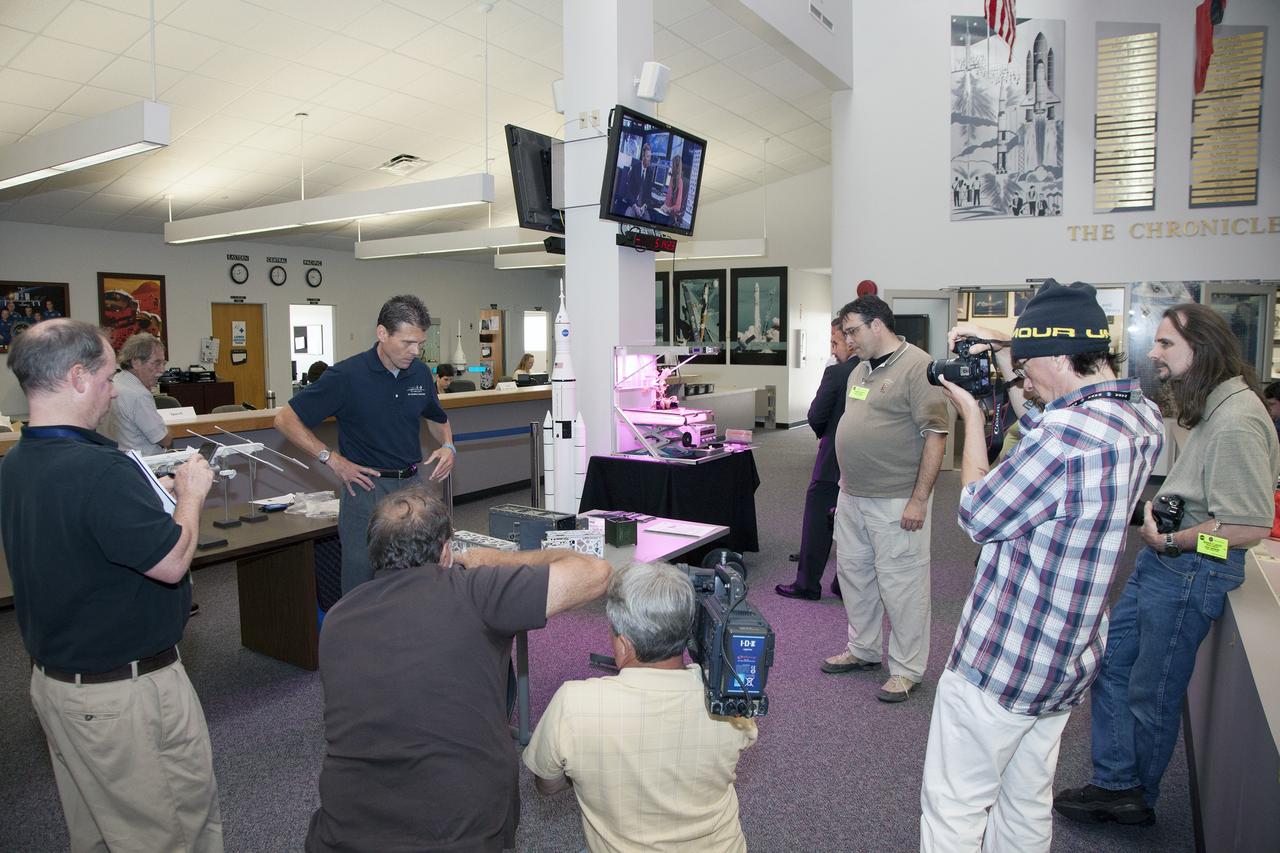
CAPE CANAVERAL, Fla. - Scott Higginbotham, center, mission manager for ELaNa V, discusses the concepts behind the design and deployment of the CubeSats flying on the ELaNa V mission with media representatives in the NASA Newsroom at Kennedy Space Center in Florida, using models of the Poly-Picosatellite Orbital Deployer, or P-POD, and various CubeSat canisters. NASA selected five small research satellites, or CubeSats, for the ELaNa V mission launching on SpaceX-3. Four P-PODs aboard the SpaceX Falcon 9 rocket will ferry them to space. The CubeSats were designed by three universities and the agency's Ames Research Center in California. Launch is scheduled at about 4:58 p.m. EDT April 14. The SpaceX-3 mission, carrying almost 2.5 tons of supplies, technology and science experiments, is the third of 12 flights under NASA's Commercial Resupply Services contract to resupply the orbiting laboratory. For more information about NASA's CubeSat Launch Initiative, visit http://go.nasa.gov/CubeSat_initiative. Photo credit: NASA/Glenn Benson
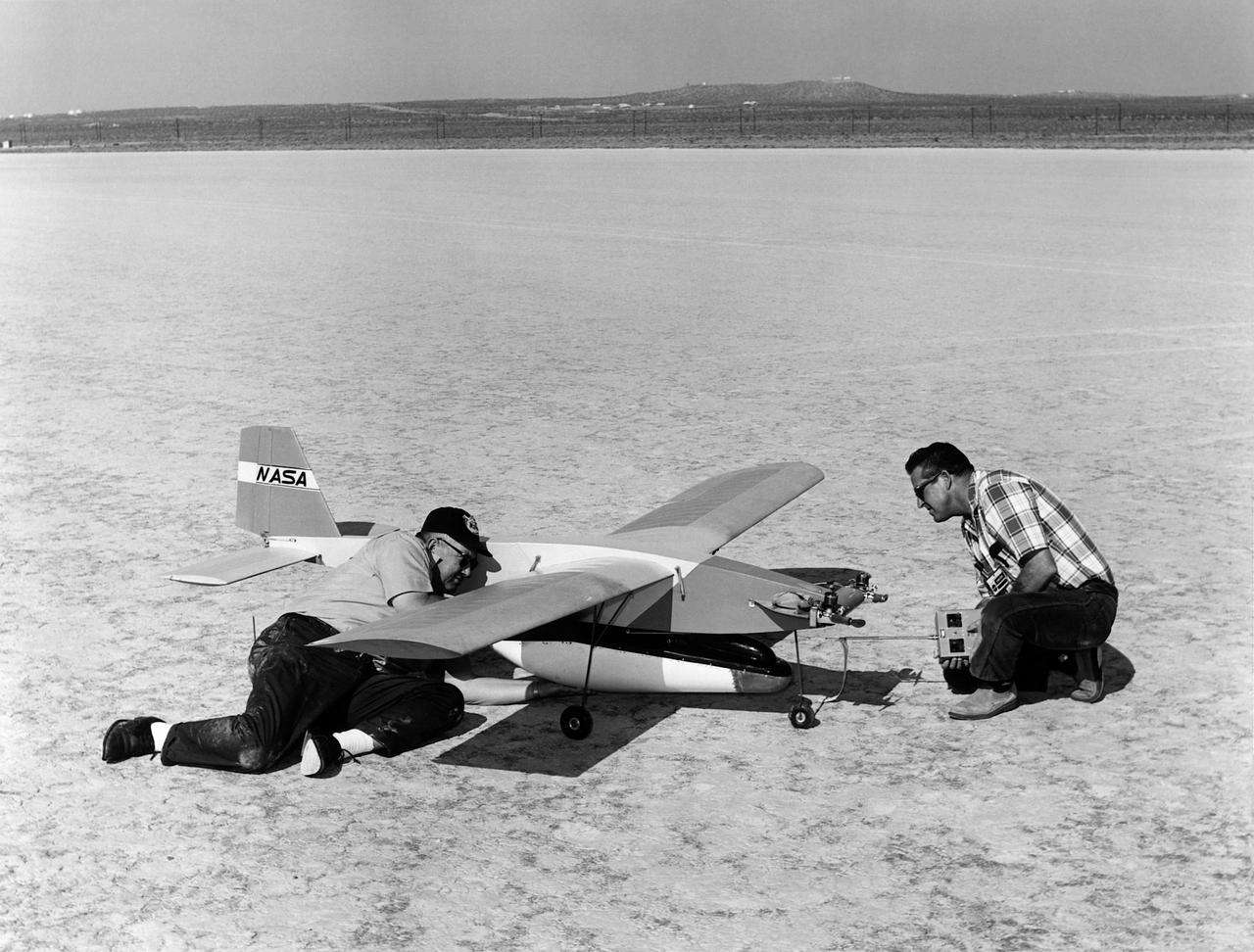
A photo of model airplane builders James B. Newman and Robert L. McDonald preparing for a flight with models of the M2-F2 and a “Mothership”. In 1968 a test flight was made on the Rosamond dry lakebed, Rosamond, California. The original idea of lifting bodies was conceived about 1957 by Dr. Alfred J. Eggers, Jr., then the assistant director for Research and Development Analysis and Planning at the National Advisory Committee for Aeronautics' Ames Aeronautical Laboratory, Moffett Field, California. Nose cone studies led to the design known as the M-2, a modified half-cone, rounded on the bottom and flat on top, with a blunt, rounded nose and twin tail fins. To gather flight data on this configuration, models were found to be an effective method. A special twin-engined, 14-foot model “mothership” was used for carrying the M2-F2 model to altitude and a launch, much as was being done with the B-52 for the full-scale lifting bodies. Jim (on the left) will fly the “mothership” and Bob will take control of the M2-F2 at launch and fly it to a landing on the lakebed.
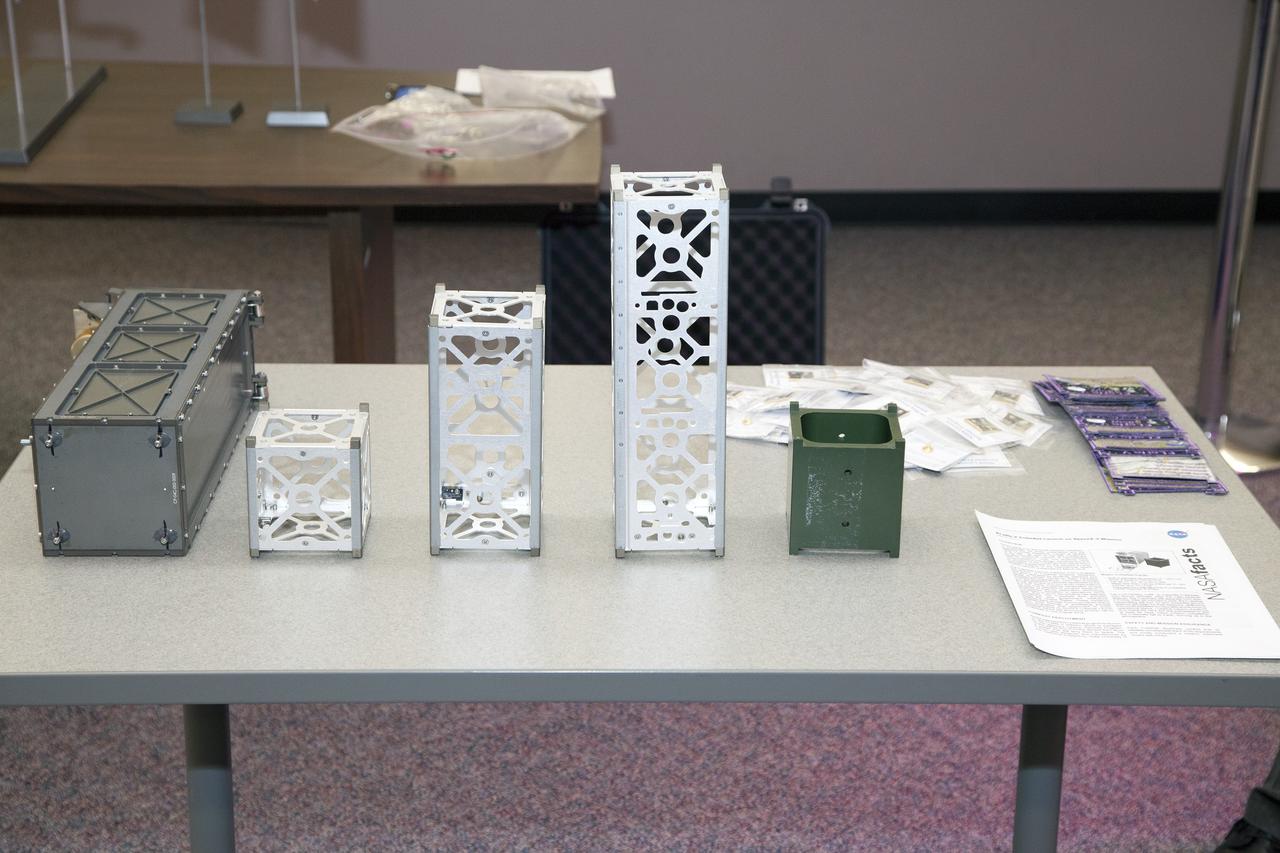
CAPE CANAVERAL, Fla. - Models of the hardware used to support the CubeSats flying on the ELaNa V mission are displayed in the NASA Newsroom at Kennedy Space Center in Florida. At left is a model of the Poly-Picosatellite Orbital Deployer, or P-POD, next to models of the various CubeSat canisters. NASA selected five small research satellites, or CubeSats, for the ELaNa V mission launching on SpaceX-3. Four P-PODs aboard the SpaceX Falcon 9 rocket will ferry them to space. The CubeSats were designed by three universities and the agency's Ames Research Center in California. Launch is scheduled at about 4:58 p.m. EDT April 14. The SpaceX-3 mission, carrying almost 2.5 tons of supplies, technology and science experiments, is the third of 12 flights under NASA's Commercial Resupply Services contract to resupply the orbiting laboratory. For more information about NASA's CubeSat Launch Initiative, visit http://go.nasa.gov/CubeSat_initiative. Photo credit: NASA/Glenn Benson
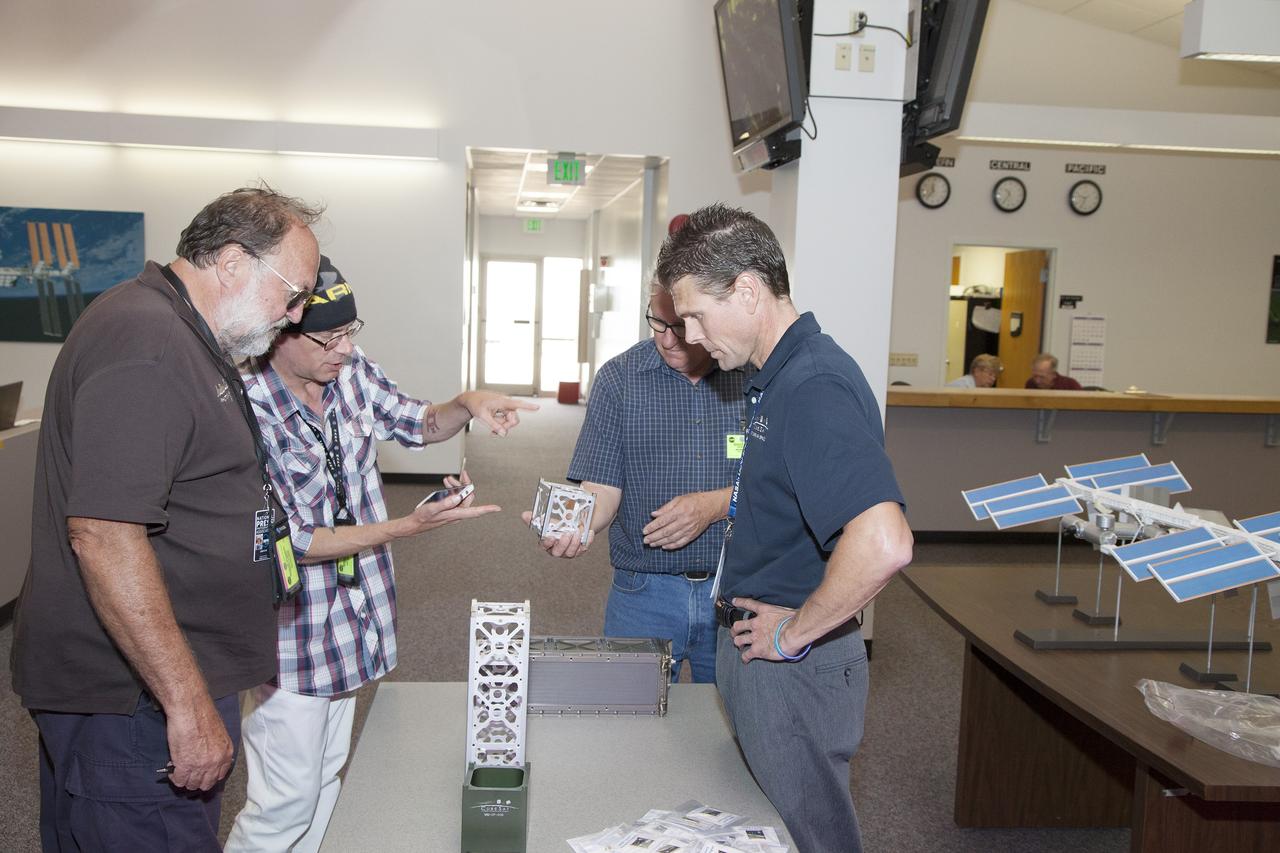
CAPE CANAVERAL, Fla. - Scott Higginbotham, right, mission manager for ELaNa V, discusses the concepts behind the design and deployment of the CubeSats flying on the ELaNa V mission with media representatives in the NASA Newsroom at Kennedy Space Center in Florida, using models of the Poly-Picosatellite Orbital Deployer, or P-POD, and various CubeSat canisters. NASA selected five small research satellites, or CubeSats, for the ELaNa V mission launching on SpaceX-3. Four P-PODs aboard the SpaceX Falcon 9 rocket will ferry them to space. The CubeSats were designed by three universities and the agency's Ames Research Center in California. Launch is scheduled at about 4:58 p.m. EDT April 14. The SpaceX-3 mission, carrying almost 2.5 tons of supplies, technology and science experiments, is the third of 12 flights under NASA's Commercial Resupply Services contract to resupply the orbiting laboratory. For more information about NASA's CubeSat Launch Initiative, visit http://go.nasa.gov/CubeSat_initiative. Photo credit: NASA/Glenn Benson
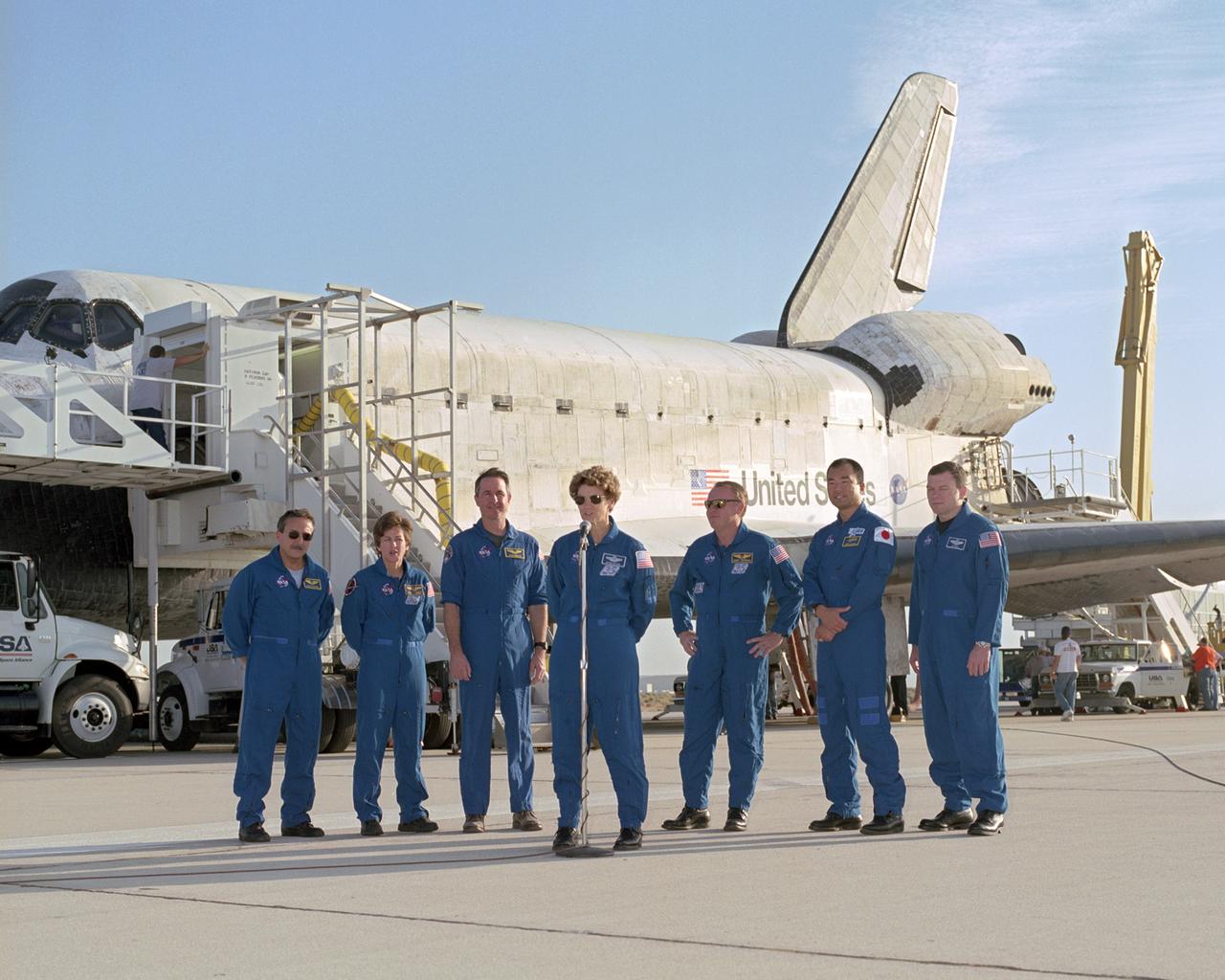
The crew of Space Shuttle mission STS-114 gathered for a press brief following landing at Edwards Air Force Base, California, 5:11 am, August 9, 2005. Left to right: Mission Specialists Charles Camarda, Wendy Lawrence and Stephen Robinson, Commander Eileen Collins at microphone, Mission Specialists Andrew Thomas and Soichi Noguchi, and Pilot James Kelly. Space Shuttle Discovery landed safely at NASA's Dryden Flight Research Center at Edwards Air Force Base in California at 5:11:22 a.m. PDT this morning, following the very successful 14-day STS-114 return to flight mission. During their two weeks in space, Commander Eileen Collins and her six crewmates tested out new safety procedures and delivered supplies and equipment the International Space Station. Discovery spent two weeks in space, where the crew demonstrated new methods to inspect and repair the Shuttle in orbit. The crew also delivered supplies, outfitted and performed maintenance on the International Space Station. A number of these tasks were conducted during three spacewalks. In an unprecedented event, spacewalkers were called upon to remove protruding gap fillers from the heat shield on Discovery's underbelly. In other spacewalk activities, astronauts installed an external platform onto the Station's Quest Airlock and replaced one of the orbital outpost's Control Moment Gyroscopes. Inside the Station, the STS-114 crew conducted joint operations with the Expedition 11 crew. They unloaded fresh supplies from the Shuttle and the Raffaello Multi-Purpose Logistics Module. Before Discovery undocked, the crews filled Raffeallo with unneeded items and returned to Shuttle payload bay. Discovery launched on July 26 and spent almost 14 days on orbit.
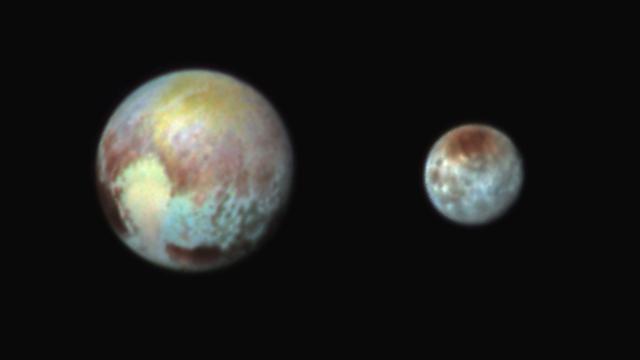
**This image was taken at 3:38 a.m. EDT on July 13, one day before New Horizons’ closest approach to Pluto.** New Horizons has obtained impressive new images of Pluto and its large moon Charon that highlight their compositional diversity. These are not actual color images of Pluto and Charon—they are shown here in exaggerated colors that make it easy to note the differences in surface material and features on each planetary body. The images were obtained using three of the color filters of the “Ralph” instrument on July 13 at 3:38 am EDT. New Horizons has seven science instruments on board the spacecraft—including “Ralph” and “Alice”, whose names are a throwback to the “Honeymooners,” a popular 1950s sitcom. “These images show that Pluto and Charon are truly complex worlds. There's a whole lot going on here,” said New Horizons co-investigator Will Grundy, Lowell Observatory, Flagstaff, Arizona. “Our surface composition team is working as fast as we can to identify the substances in different regions on Pluto and unravel the processes that put them where they are.” The color data helps scientists understand the molecular make-up of ices on the surfaces of Pluto and Charon, as well as the age of geologic features such as craters. They can also tell us about surface changes caused by space “weather,” such as radiation. The new color images reveal that the “heart” of Pluto actually consists of two remarkably different-colored regions. In the false-color image, the heart consists of a western lobe shaped like an ice cream cone that appears peach color in this image. A mottled area on the right (east) side looks bluish. A mid-latitude band appears in shades ranging from pale blue through red. Even within the northern polar cap, in the upper part of the image, various shades of yellow-orange indicate subtle compositional differences. This image was obtained using three of the color filters of the Ralph instrument on July 13 at 3:38 am EDT and received on the ground on at 12:25 pm. Charon is Just as Colorful The surface of Charon is viewed using the same exaggerated color. The red on the dark northern polar cap of Charon is attributed to hydrocarbon and other molecules, a class of chemical compounds called tholins. The mottled colors at lower latitudes point to the diversity of terrains on Charon. This image was obtained using three of the color filters of the Ralph instrument on July 13 at 3:38 am EDT and received on the ground on at 12:25 pm. “We make these color images to highlight the variety of surface environments present in the Pluto system,” said Dennis Reuter, co-investigator with the New Horizons Composition Team. “They show us in an intuitive way that there is much still to learn from the data coming down.” Due to the three-billion-mile distance to Pluto, data takes 4 ½ hours to come to Earth, even at the speed of light. It will take 16 months for all of New Horizons’ science data to be received, and the treasure trove from this mission will be studied for decades to come. Image Caption: Pluto and Charon in False Color Show Compositional Diversity This July 13, 2015, image of Pluto and Charon is presented in false colors to make differences in surface material and features easy to see. It was obtained by the Ralph instrument on NASA's New Horizons spacecraft, using three filters to obtain color information, which is exaggerated in the image. These are not the actual colors of Pluto and Charon, and the apparent distance between the two bodies has been reduced for this side-by-side view. The image reveals that the bright heart-shaped region of Pluto includes areas that differ in color characteristics. The western lobe, shaped like an ice-cream cone, appears peach color in this image. A mottled area on the right (east) appears bluish. Even within Pluto's northern polar cap, in the upper part of the image, various shades of yellow-orange indicate subtle compositional differences. The surface of Charon is viewed using the same exaggerated color. The red on the dark northern polar cap of Charon is attributed to hydrocarbon materials including a class of chemical compounds called tholins. The mottled colors at lower latitudes point to the diversity of terrains on Charon. --- At 7:49 AM EDT on Tuesday, July 14 New Horizons sped past Pluto at 30,800 miles per hour (49,600 kilometers per hour), with a suite of seven science instruments. As planned, New Horizons went incommunicado as it hurtled through the Pluto-Charon system busily gathering data. The New Horizons team will breathe a sigh of relief when New Horizons “phones home” at approximately 9:02 p.m. EDT on July 14. The mission to the icy dwarf planet completes the initial reconnaissance of the solar system. Stay in touch with the New Horizons mission with #PlutoFlyby and on Facebook at: <a href="https://www.facebook.com/new.horizons1" rel="nofollow">www.facebook.com/new.horizons1</a>
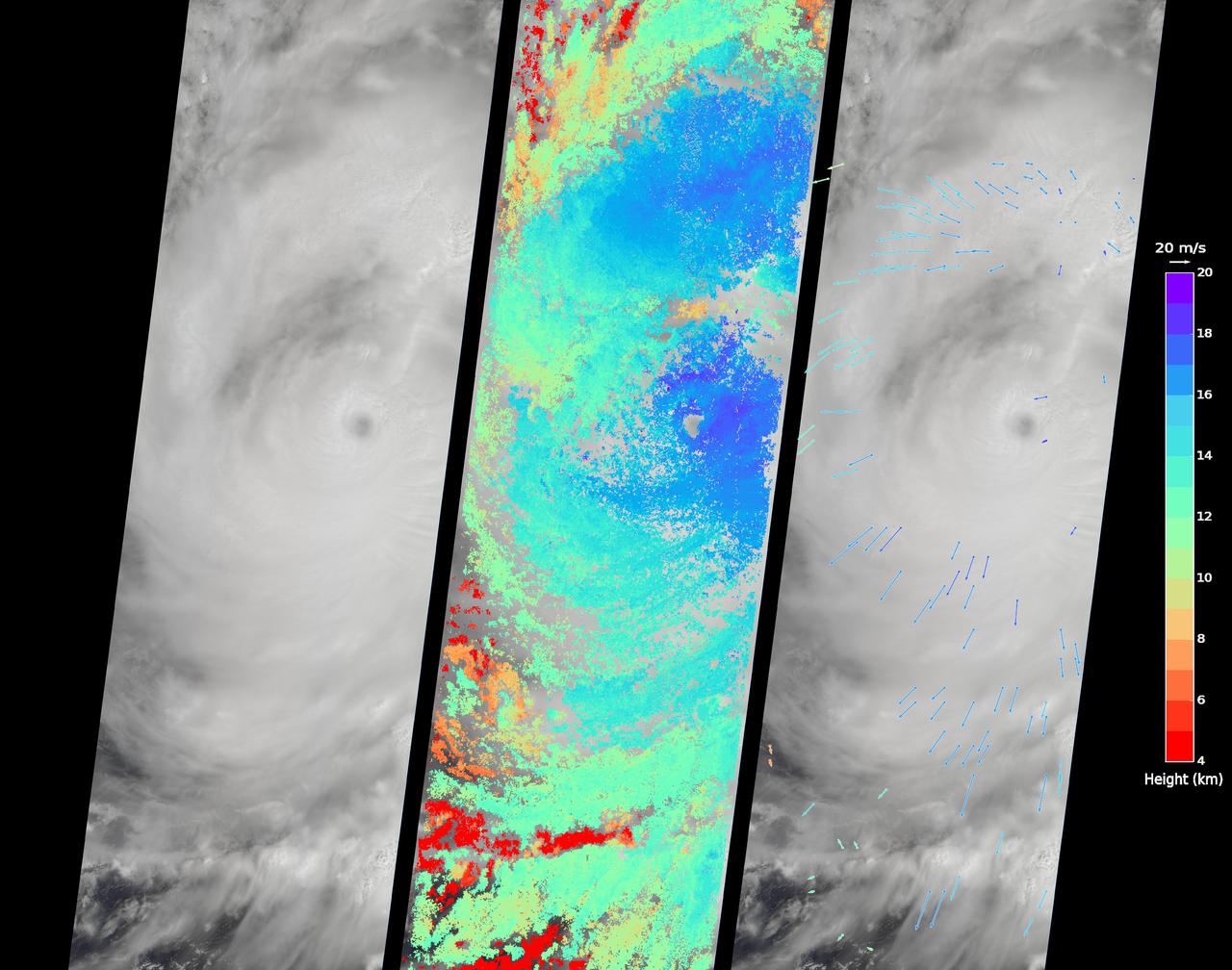
On Sept. 14, 2016, the eye of Super Typhoon Meranti passed just south of Taiwan. The enormous storm, classified as a Category 5 typhoon at the time, still caused much disruption on the island. Nearly 500,000 homes lost power, schools were closed, and most flights were cancelled. Maximum wind speeds were 180 miles per hour (290 kilometers per hour) as the storm passed, and more than 25 inches (64 centimeters) of rain fell on some areas of the country. However, the storm did not pass over Taiwan's mountainous landscape, which would have weakened it. That means it will remain strong as it heads toward mainland China, unlike Super Typhoon Nepartak in July, which weakened from a Category 5 typhoon to a tropical storm after crossing Taiwan. Meranti is currently maintaining Category 4 strength and is expected to make landfall near Shantou, Guangdong province, on Thursday, September 15. The coast of China is more vulnerable to storm surges than Taiwan due to shallower coastal waters and recent rainfall. There is risk of substantial flooding. On Sept. 14, at 10:45 AM local time, the Multi-angle Imaging SpectroRadiometer (MISR) instrument aboard NASA's Terra satellite passed directly over the eye of Meranti. On the left is a natural-color image from MISR's nadir-pointing camera. At this time the eye of Meranti was just off the southern tip of Taiwan, which is invisible under the clouds. The coast of China is barely visible through the clouds in the upper left portion of the image. The small eye and dense high clouds are both markers of the storm's power. MISR's nine cameras, each pointed at a different angle, can be used to determine the heights of clouds based on geometric shifts among the nine images. The middle panel shows these stereo-derived cloud top heights superimposed on the natural color image. The clouds of the central core of Typhoon Meranti have heights ranging between 16 and 20 kilometers (10 and 12.5 miles). It takes about seven minutes for all nine cameras to image the same location on the ground, and wind velocity can be calculated from the motion of the clouds over this seven-minute period. The right panel plots these wind velocities as vectors which indicate both direction and speed. The length of the arrow corresponds to the wind speed, which can be compared to the reference 20 meters per second (45 miles per hour) arrow in the key. Hurricanes and typhoons in the Northern Hemisphere rotate counterclockwise due to the Earth's rotation, but these wind vectors mainly show motion outward from the eye at the storm tops. This is due to the fact that hurricanes draw in moist air at low altitudes, which then flows upwards and outwards around the eye reversing direction. These data were acquired during Terra orbit 88865. http://photojournal.jpl.nasa.gov/catalog/PIA17309
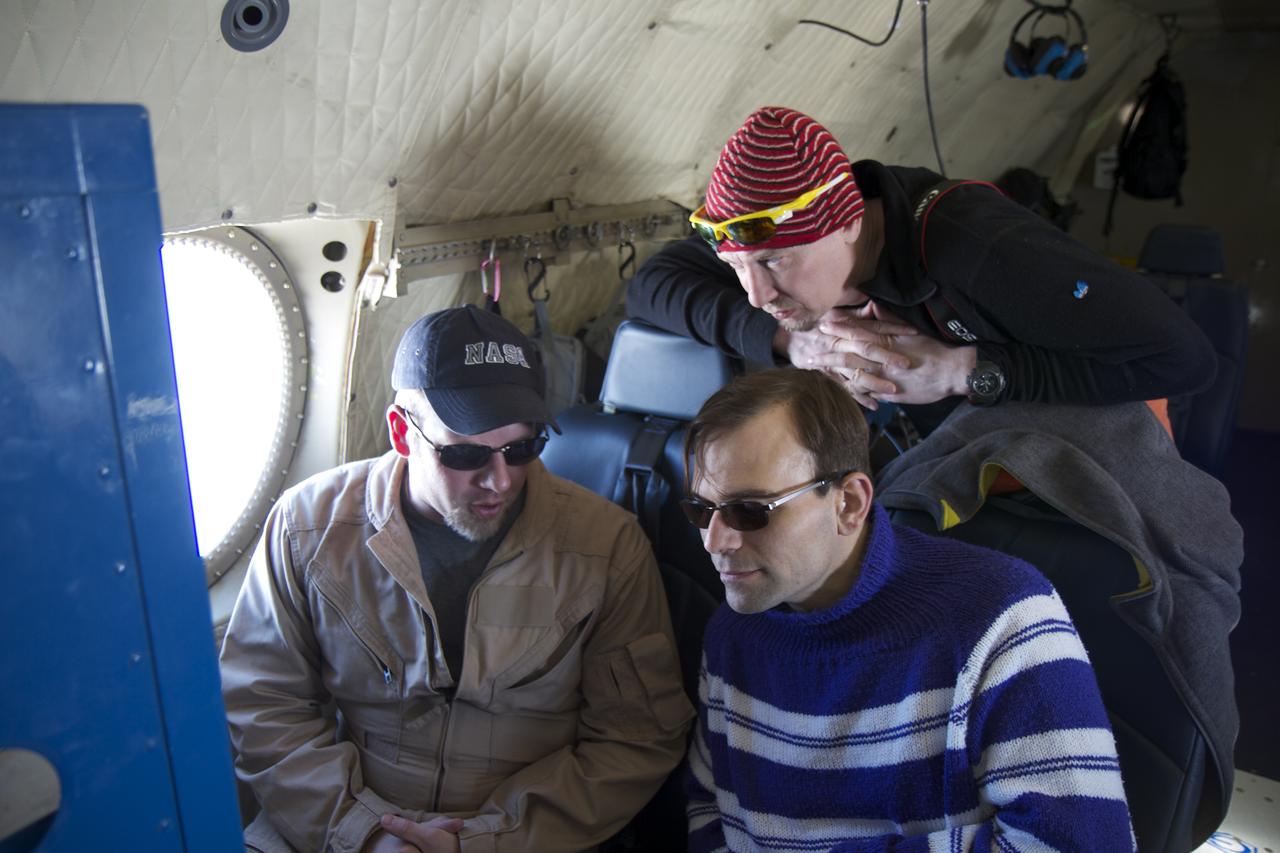
James Jacobson, a Data Analyst based out of Ames Research Center, explains his Digital Mapping System instrument to two teachers flying with Operation IceBridge, (top to bottom) Tom Koch Svennesen, of Greenland, and Peter Gross, of Denmark, on April 14, 2012. Credit: NASA/Jefferson Beck ============= IceBridge, a six-year NASA mission, is the largest airborne survey of Earth's polar ice ever flown. It will yield an unprecedented three-dimensional view of Arctic and Antarctic ice sheets, ice shelves and sea ice. These flights will provide a yearly, multi-instrument look at the behavior of the rapidly changing features of the Greenland and Antarctic ice. To read more about this mission go to: <a href="http://www.nasa.gov/mission_pages/icebridge/index.html" rel="nofollow">www.nasa.gov/mission_pages/icebridge/index.html</a> <b><a href="http://www.nasa.gov/audience/formedia/features/MP_Photo_Guidelines.html" rel="nofollow">NASA image use policy.</a></b> <b><a href="http://www.nasa.gov/centers/goddard/home/index.html" rel="nofollow">NASA Goddard Space Flight Center</a></b> enables NASA’s mission through four scientific endeavors: Earth Science, Heliophysics, Solar System Exploration, and Astrophysics. Goddard plays a leading role in NASA’s accomplishments by contributing compelling scientific knowledge to advance the Agency’s mission. <b>Follow us on <a href="http://twitter.com/NASA_GoddardPix" rel="nofollow">Twitter</a></b> <b>Like us on <a href="http://www.facebook.com/pages/Greenbelt-MD/NASA-Goddard/395013845897?ref=tsd" rel="nofollow">Facebook</a></b> <b>Find us on <a href="http://instagrid.me/nasagoddard/?vm=grid" rel="nofollow">Instagram</a></b>
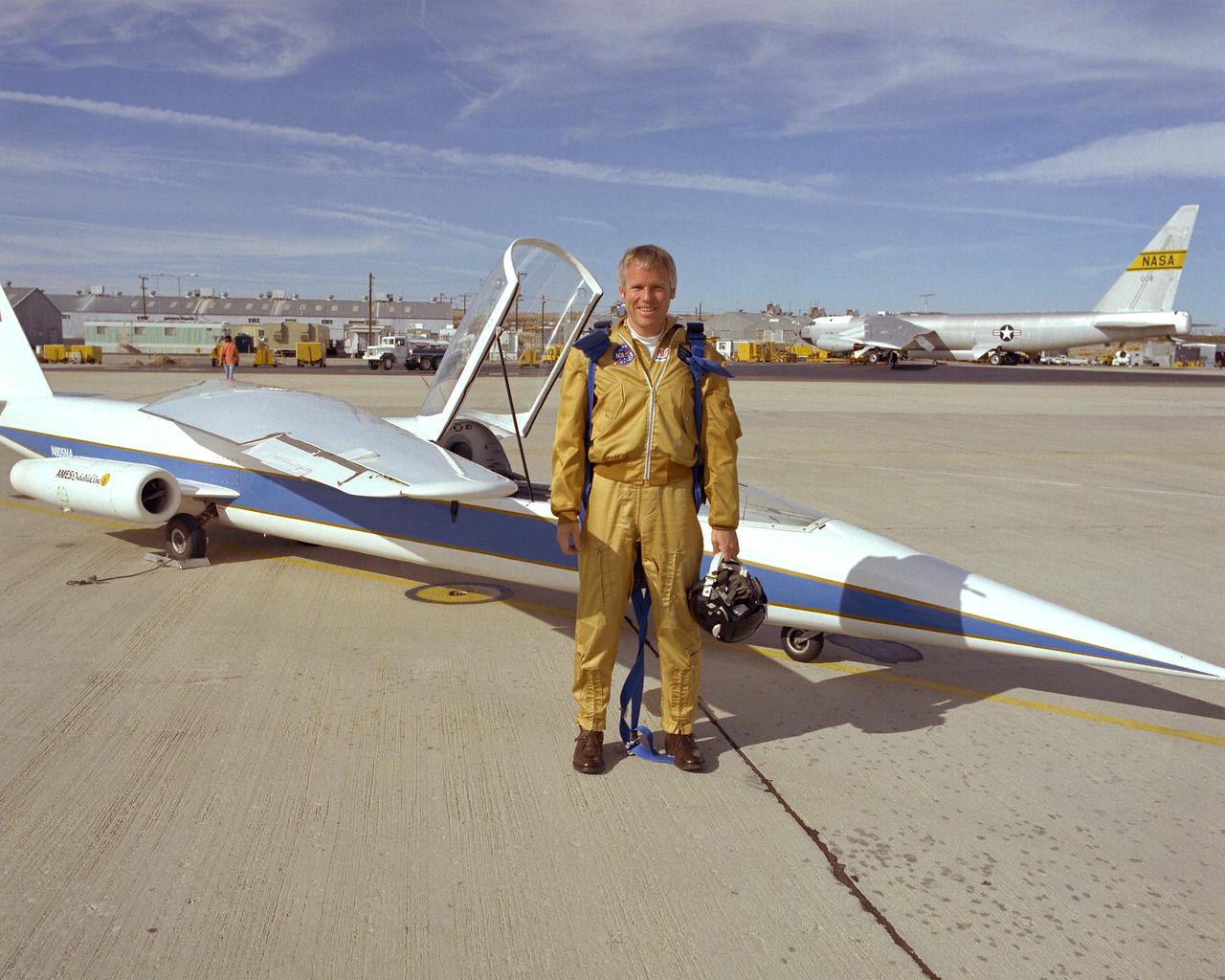
Research pilot Richard E. Gray, standing in front of the AD-1 Oblique Wing research aircraft.
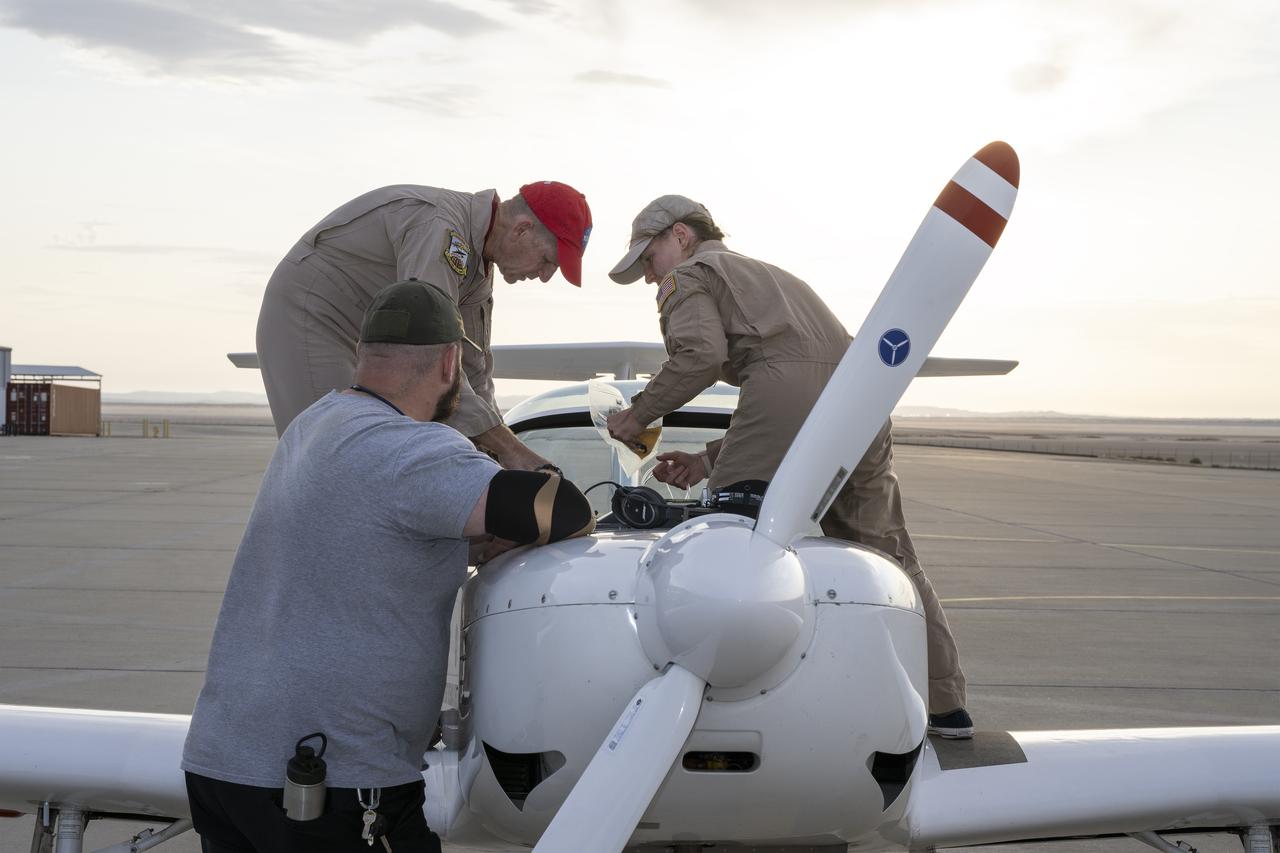
A NASA TG-14 glider aircraft is prepared for flight at NASA’s Armstrong Flight Research Center in Edwards, California, in support of the agency’s Quesst mission. The aircraft is equipped with onboard microphones to capture sonic boom noise generated during rehearsal flights, helping researchers measure the acoustic signature of supersonic aircraft closer to the ground.
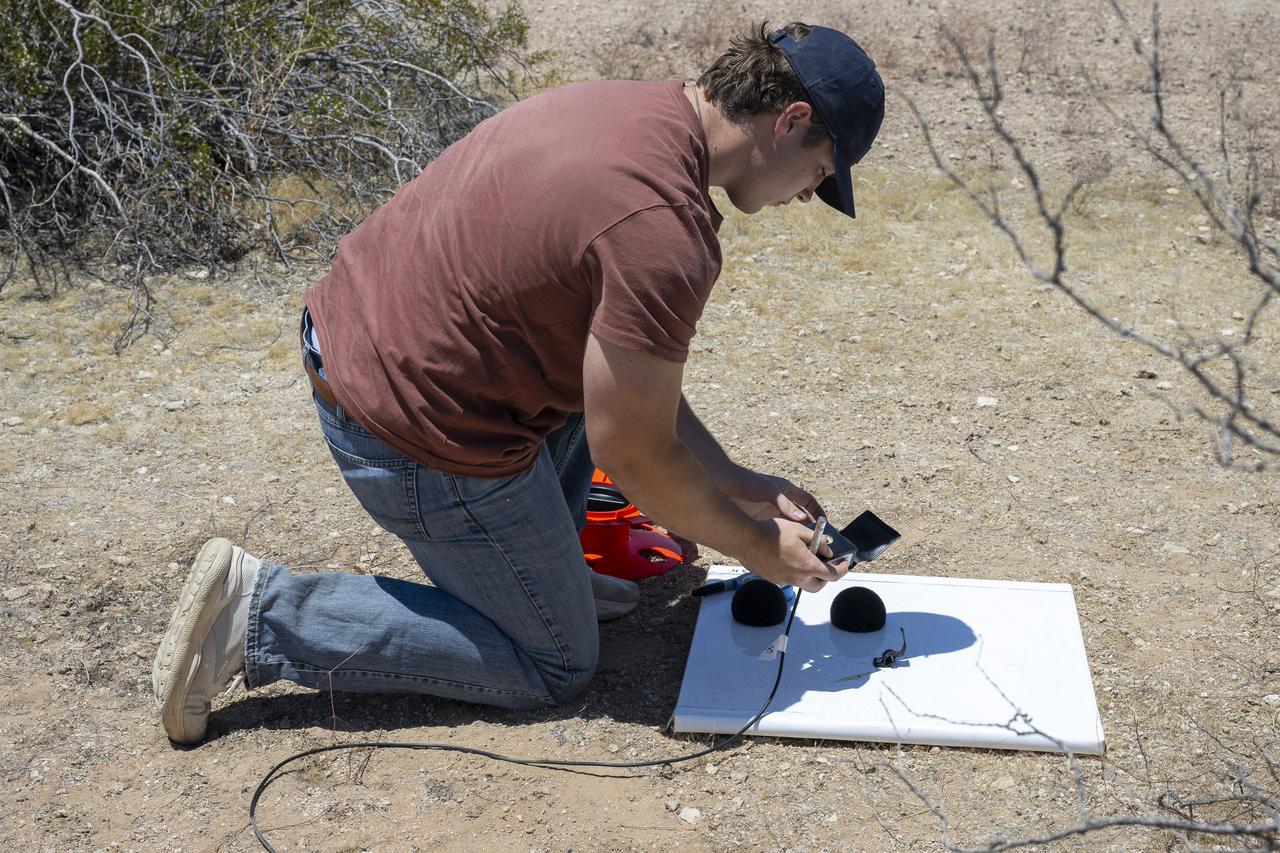
A NASA intern sets up ground recording system (GRS) units in California’s Mojave Desert during a Phase 2 rehearsal of the agency’s Quesst mission. The GRS units were placed across miles of desert terrain to capture the acoustic signature of supersonic aircraft during rehearsal flights and in preparation for the start of the actual tests.
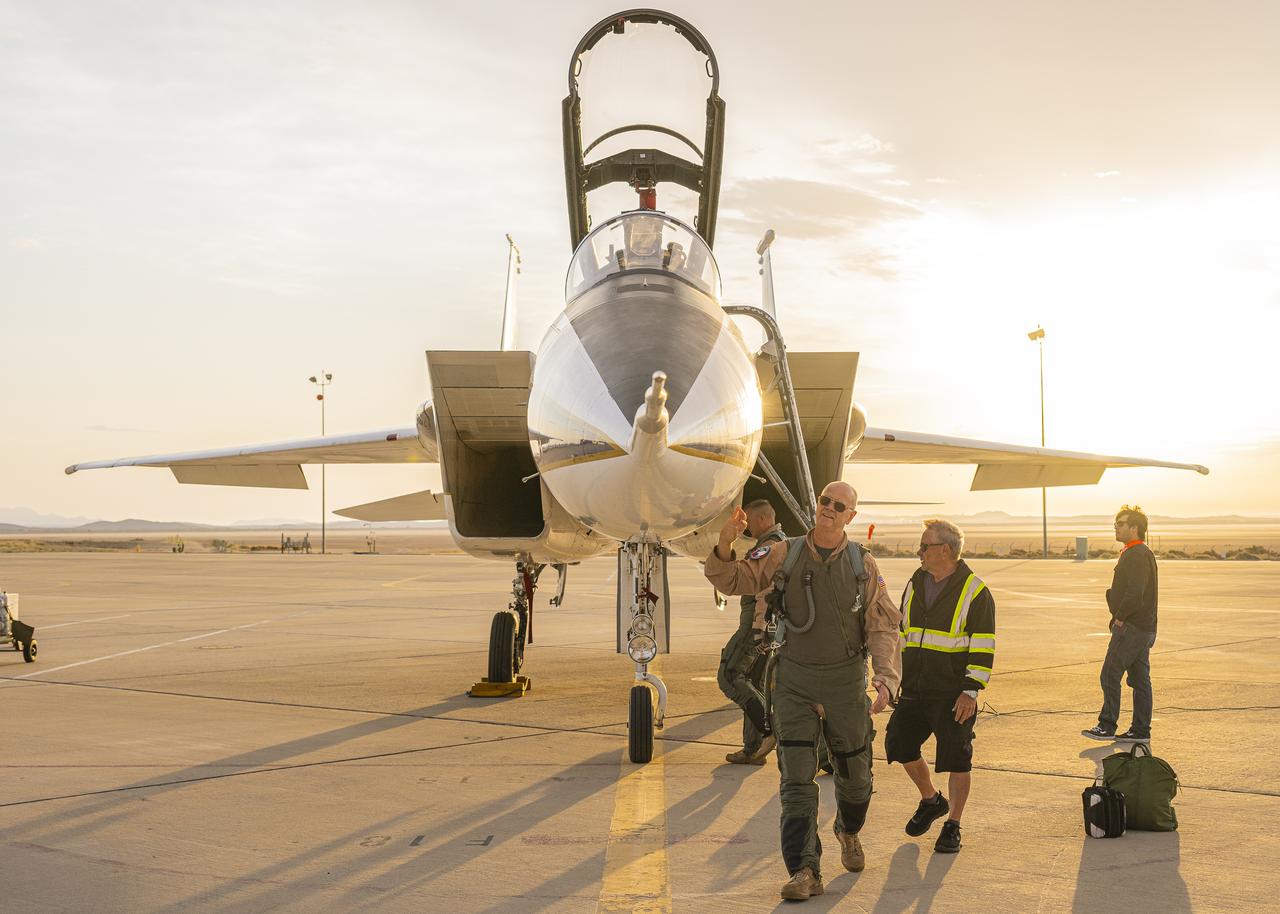
NASA test pilot Nils Larson walks around an F-15B research aircraft for a rehearsal flight supporting the agency’s Quesst mission at NASA’s Armstrong Flight Research Center in Edwards, California. The flight was part of a full-scale dress rehearsal for Phase 2 of the mission, which will eventually measure quiet sonic thumps generated by the X-59. The flight series helped NASA teams refine procedures and practice data collection ahead of future X-59 flights.