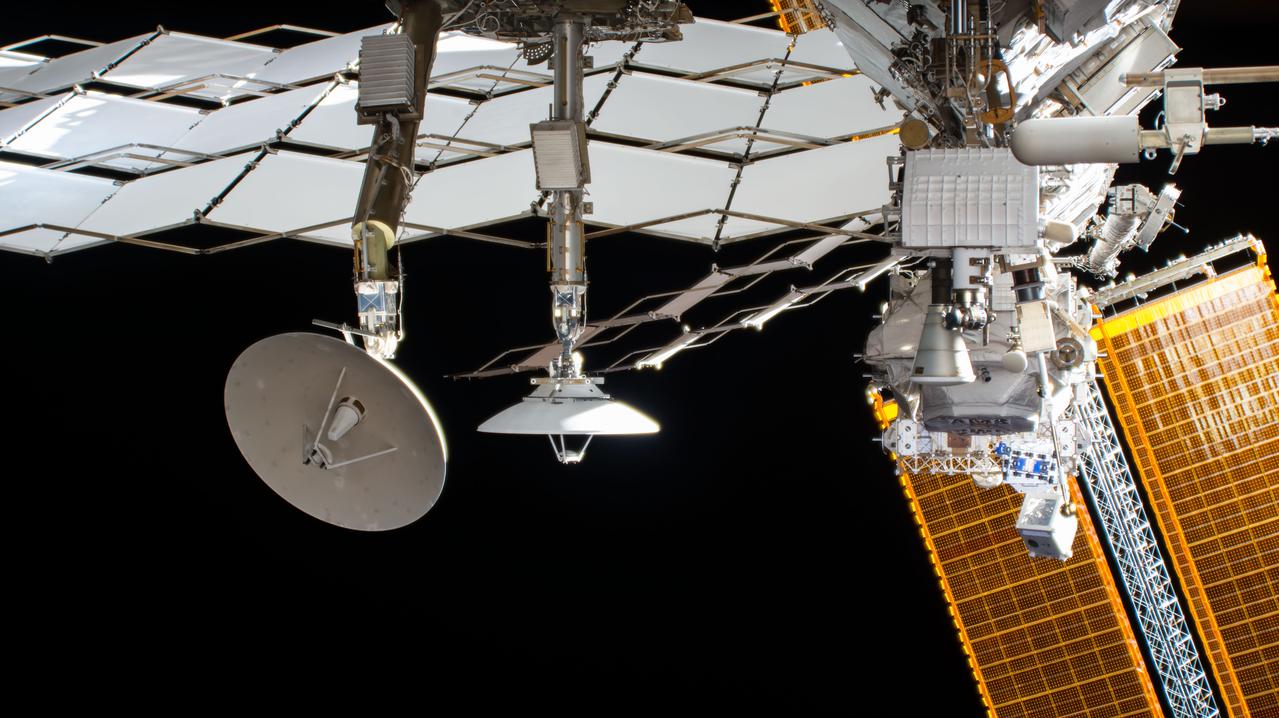
iss055e024025 (4/15/2018) - View of a radiator pane, solar array and the Alpha Magnetic Spectrometer - 02 (AMS-02) as seen by the External High Definition Camera (EHDC1). Also visible are Neutron Star Interior Composition Explorer (NICER) and Materials ISS Experiment Flight Facility (MISSE-FF).
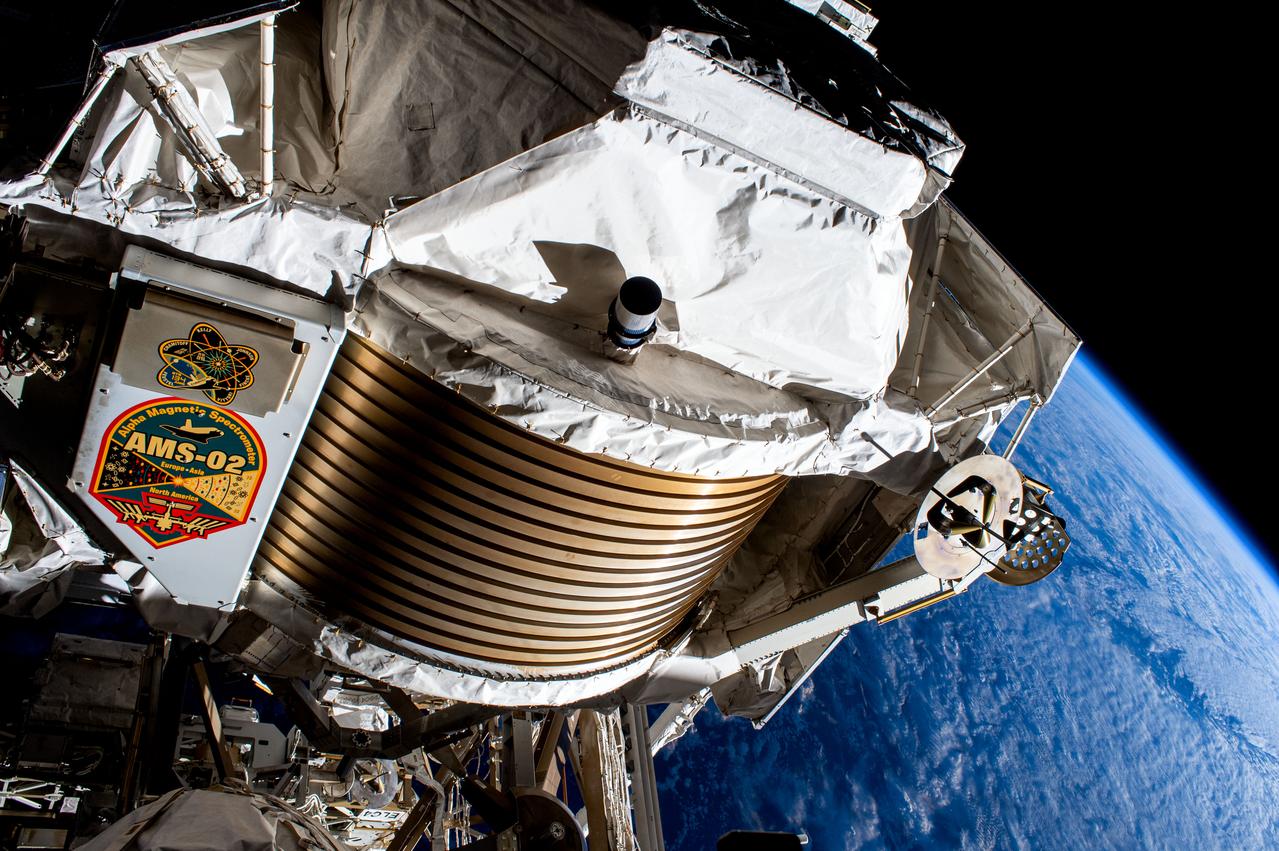
The Alpha Magnetic Spectrometer was photographed during a spacewalk in January 2017. NASA astronauts Shane Kimbrough and Peggy Whitson successfully installed three new adapter plates and hooked up electrical connections for three of the six new lithium-ion batteries on the International Space Station. They also accomplished several get-ahead tasks, including a photo survey of the Alpha Magnetic Spectrometer.

iss028e016135 (7/12/2011) --- Exterior view of the International Space Station (ISS) taken during a session of Extravehicular Activity (EVA) with a fisheye camera. The Alpha Magnetic Spectrometer - 2 (AMS-2) is visible in the right foreground and a Soyuz spacecraft is visible docked to the Pirs Docking Compartment (DC1/CO1). The Alpha Magnetic Spectrometer - 02 (AMS-02) is a high profile space-based particle physics experiment. As the largest and most advanced magnetic spectrometer in space, AMS-02 will collect information from cosmic sources emanating from stars and galaxies millions of light years beyond the Milky Way.
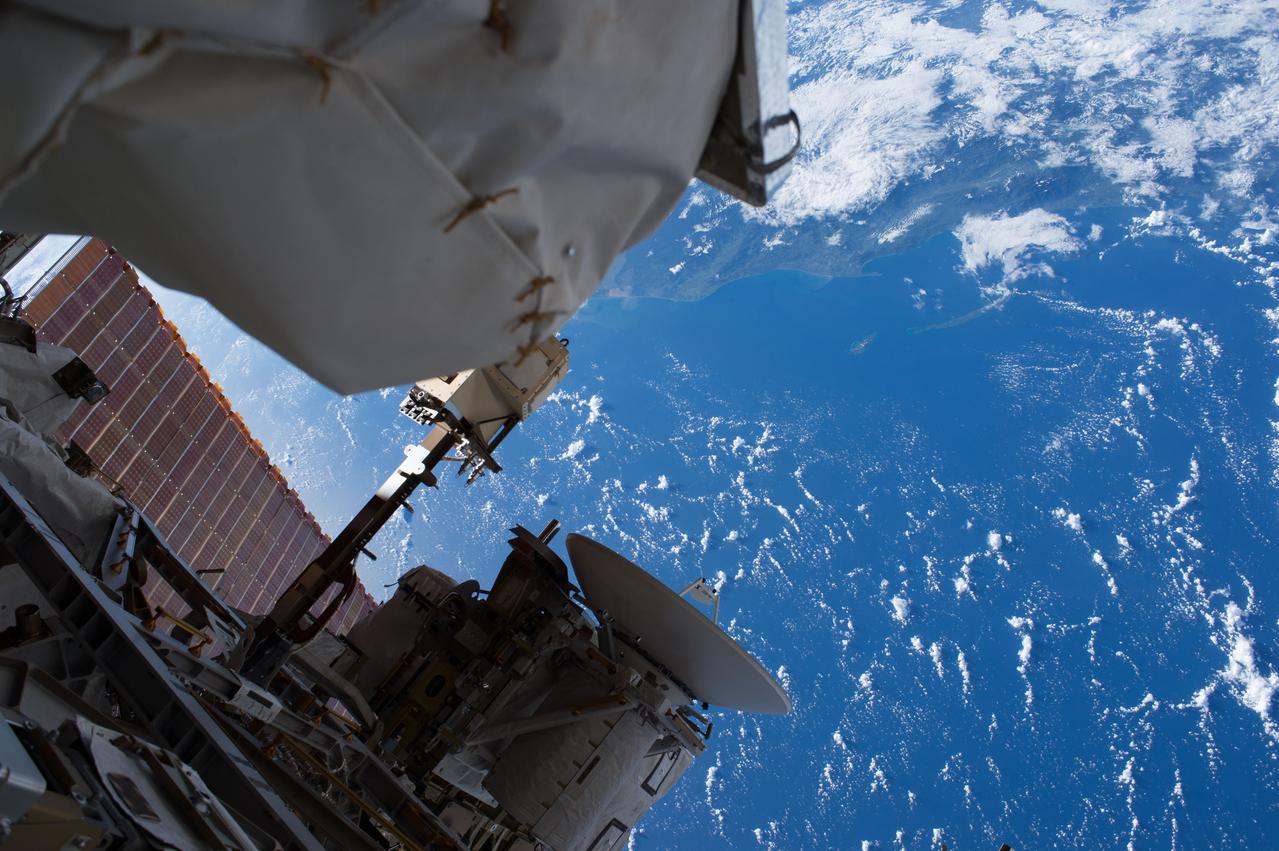
Close-up view of the Alpha Magnetic Spectrometer-02 (AMS-02), in the area where the Tracker Thermal Control System (TTCS) wedge will be installed. Image was taken by Extravehicular Crewmember 2 (EV2) during Extravehicular Activity 32 (EVA 32) and released on social media.
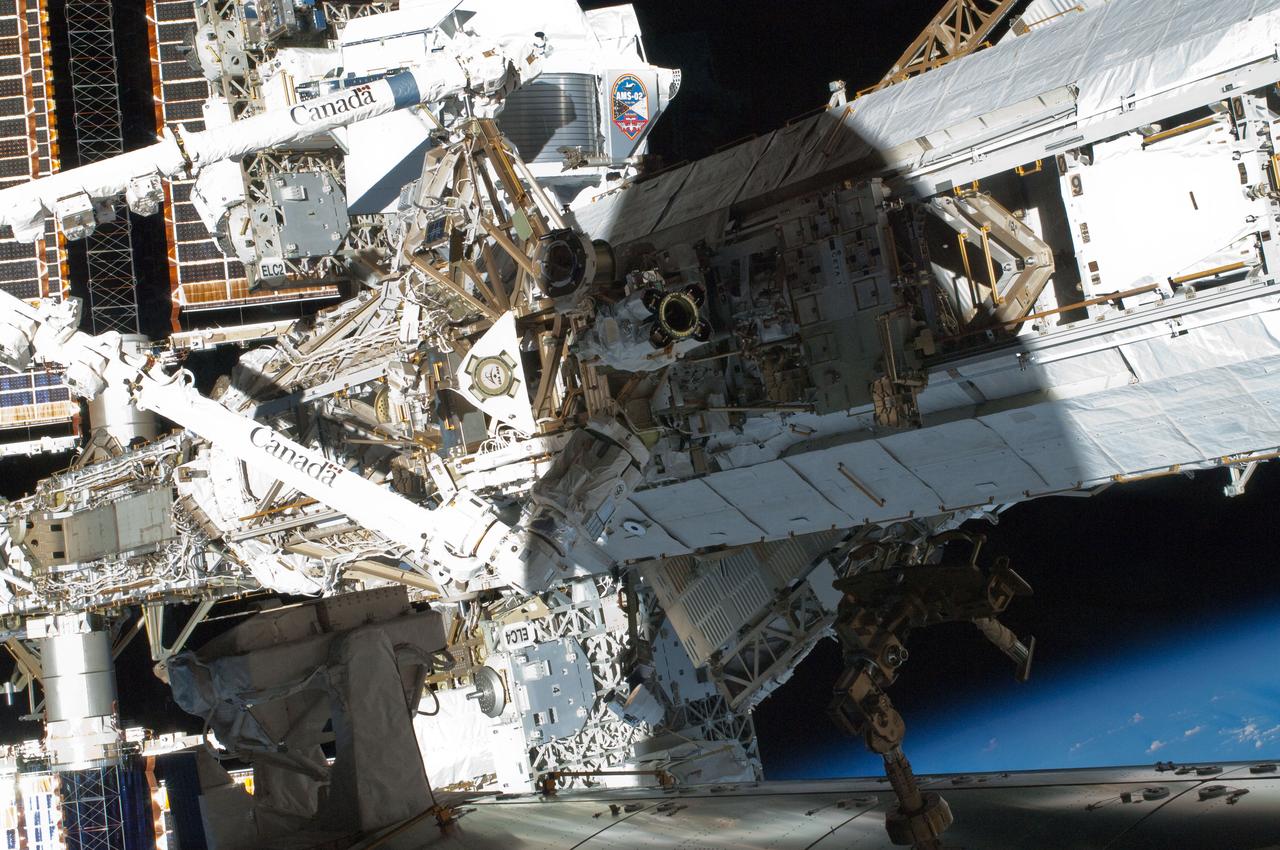
S134-E-009255 (19 May 2011) --- One of the STS-134 crew members recorded this high angle view of the starboard side truss segments on the International Space Station. The Alpha Magnetic Spectrometer (AMS-02) is being installed on the S3 truss segment next to the ExPRESS Logistics Carrier (ELC2). The AMS is still grappled by the Space Station Remote Manipulator System (Canadarm2), which is attached to the Mobile Transporter. Photo credit: NASA
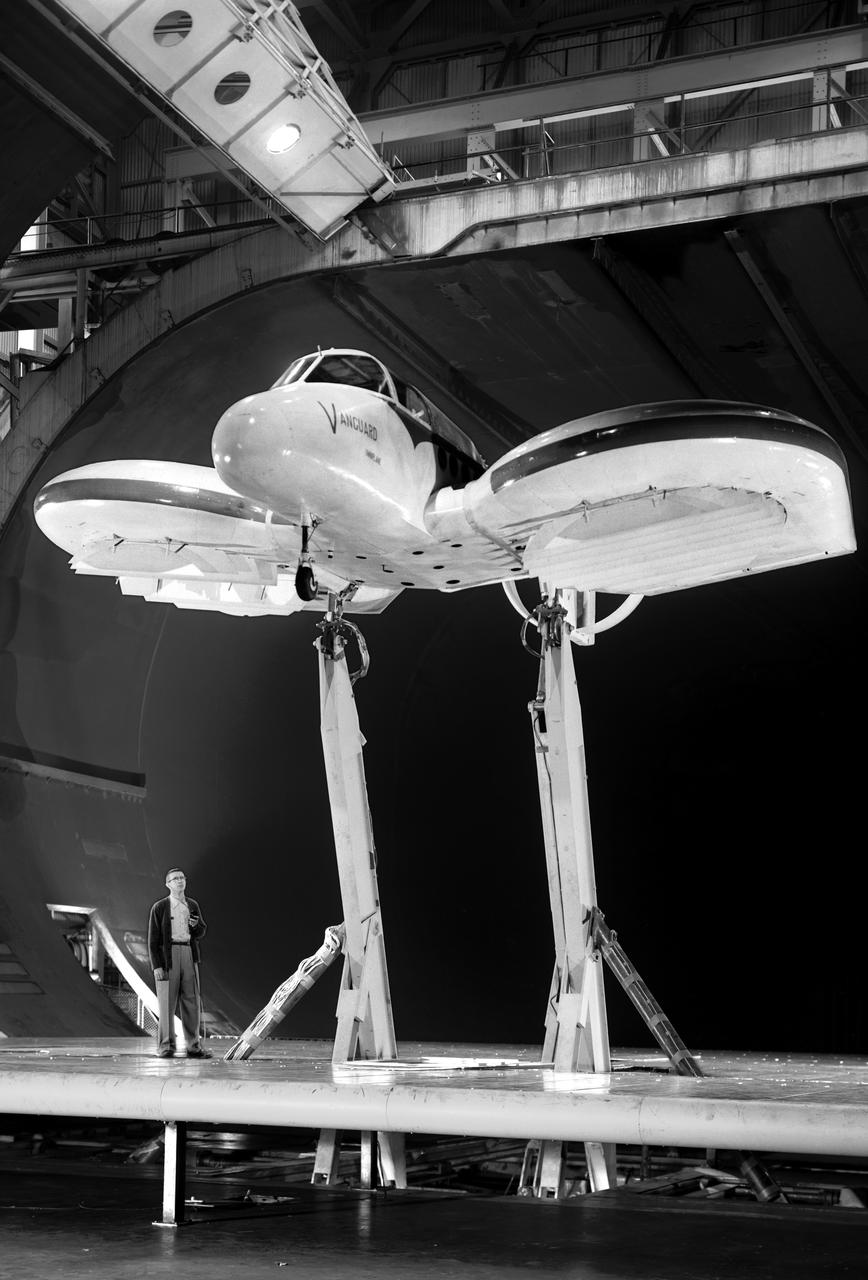
Vanguard 2C vertical take-off and landing (VTOL) airplane, wind tunnel test. Front view from below, model 14 1/2 feet high disk off. Nasa Ames engineer Ralph Maki in photo. Variable height struts and ground plane, low pressure ratio, fan in wing. 02/01/1960.
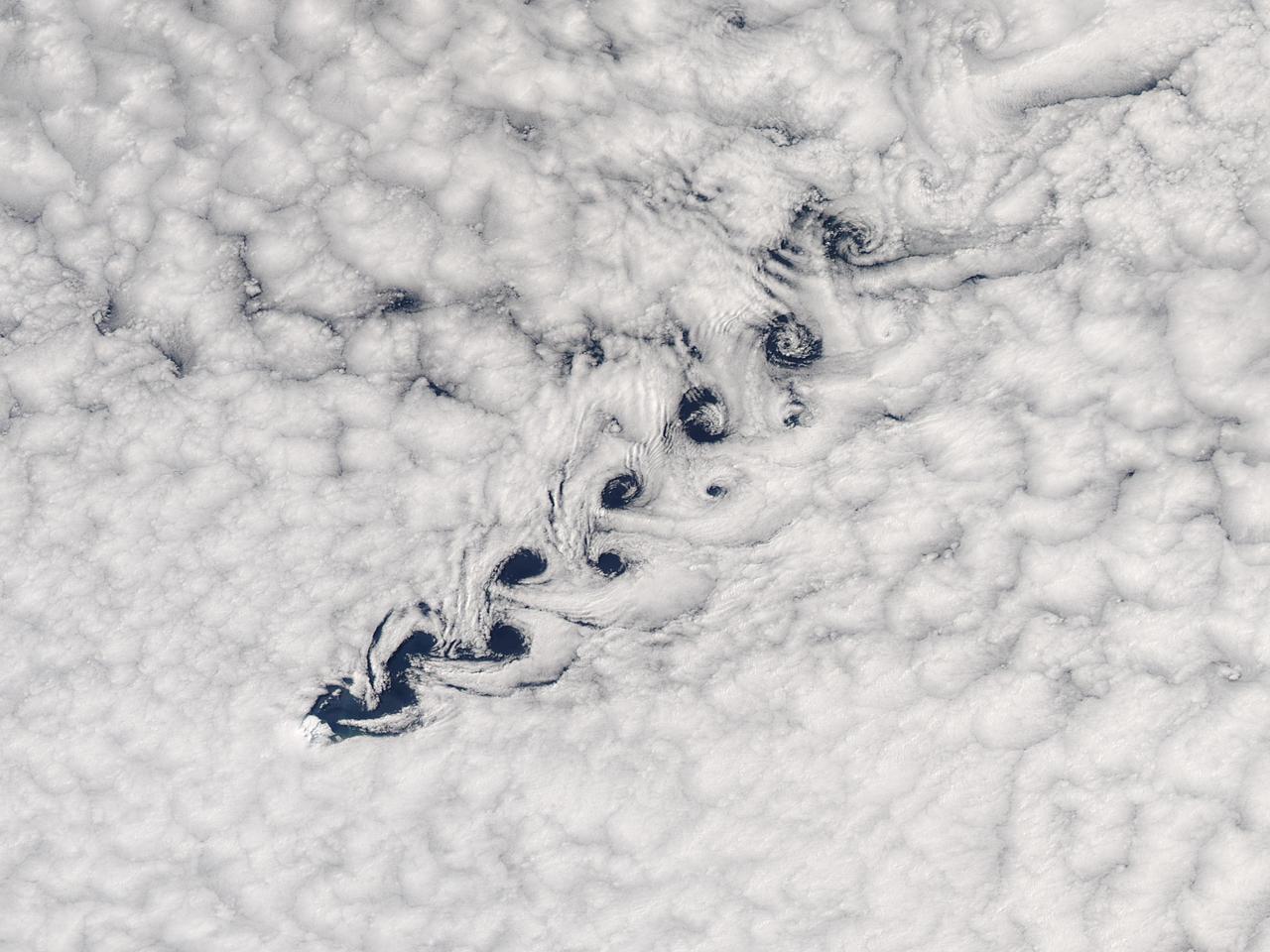
Cloud vortices off Heard Island, south Indian Ocean. The Moderate Resolution Imaging Spectroradiometer (MODIS) aboard NASA’s Aqua satellite captured this true-color image of sea ice off Heard Island on Nov 2, 2015 at 5:02 AM EST (09:20 UTC). Credit: NASA/GSFC/Jeff Schmaltz/MODIS Land Rapid Response Team

iss066e079170 (Nov. 8, 2021) --- The International Space Station's U.S. segment and portions of the Russian segment are pictured from the SpaceX Crew Dragon Endeavour during a fly around of the orbiting lab that took place following its undocking from the Harmony module’s space-facing port on Nov. 8, 2021. In addition to the modules where astronauts live and work, several external structures are visible including large white radiators extending from its integrated truss structure and the Alpha Magnetic Spectrometer-2 (AMS-02) seen on the far left.
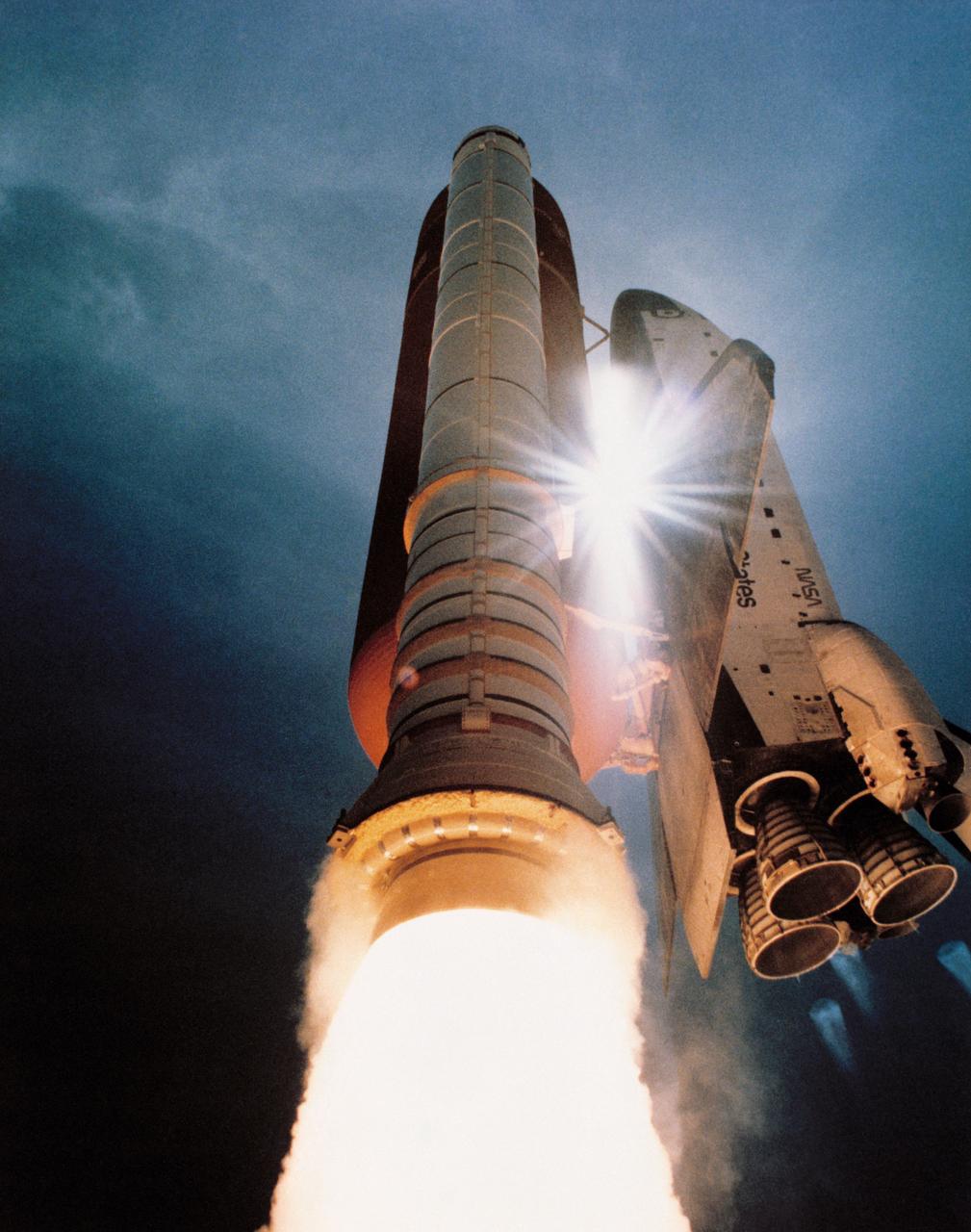
STS-43 Atlantis, Orbiter Vehicle (OV) 104, soars toward space after liftoff from Kennedy Space Center (KSC) Launch Complex (LC) Pad 39A at 11:02: 00 am (Eastern Daylight Time (EDT)). This low angle view captures OV-104 as it begins its roll maneuver. A burst of sunlight shines through the mated hardware elements supporting the Space Shuttle Atlantis for the STS-43 mission's launch phase. Exhaust plumes billow from the solid rocket booster (SRB) skirts. All three space shuttle main engines (SSMEs) glow as they power OV-104 into orbit. The bottom of external tank (ET) is highlighted by the SRB/SSME firings. This image was selected by the Public Affairs Office (PAO) for public release.
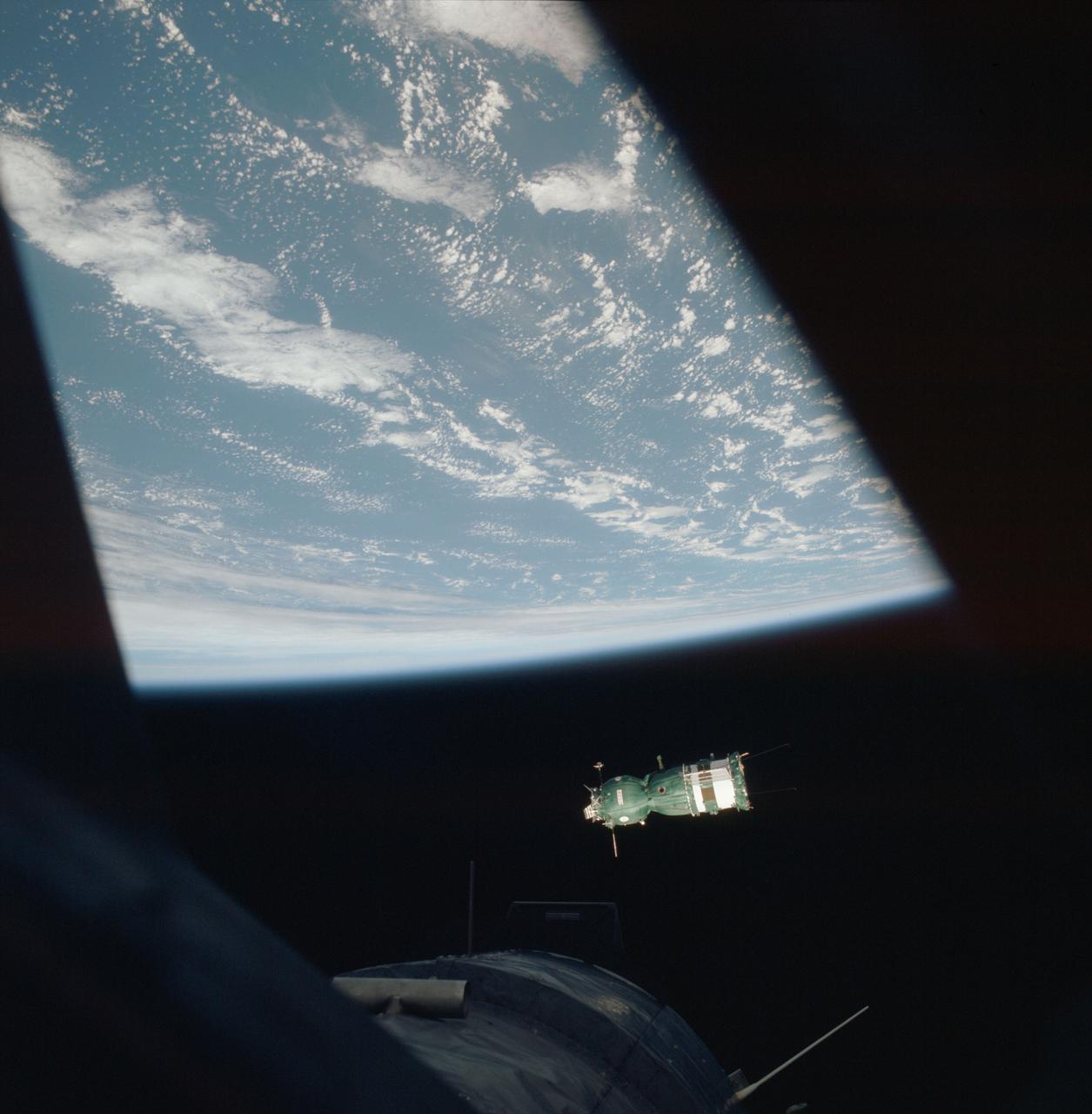
AST-02-093 (18 July 1975) --- This scene photographed with a hand-held 70mm camera from a rendezvous window of the American Apollo spacecraft in Earth orbit shows the Soviet Soyuz spacecraft contrasted against a black-sky background with Earth's horizon below. The three major components of the Soyuz are the spherical-shaped Orbital Module (OM), the bell-shaped Descent Vehicle (DV) and the cylindrical-shaped instrument Assembly Module (AM). The docking system on the Orbital Module was specially designed to interface with the docking system on the Apollo's Docking Module (DM). The DM is visible very faintly at the bottom of the picture. The ASTP astronauts and cosmonauts visited each other's spacecraft while the Soyuz and Apollo were docked in Earth orbit for two days.
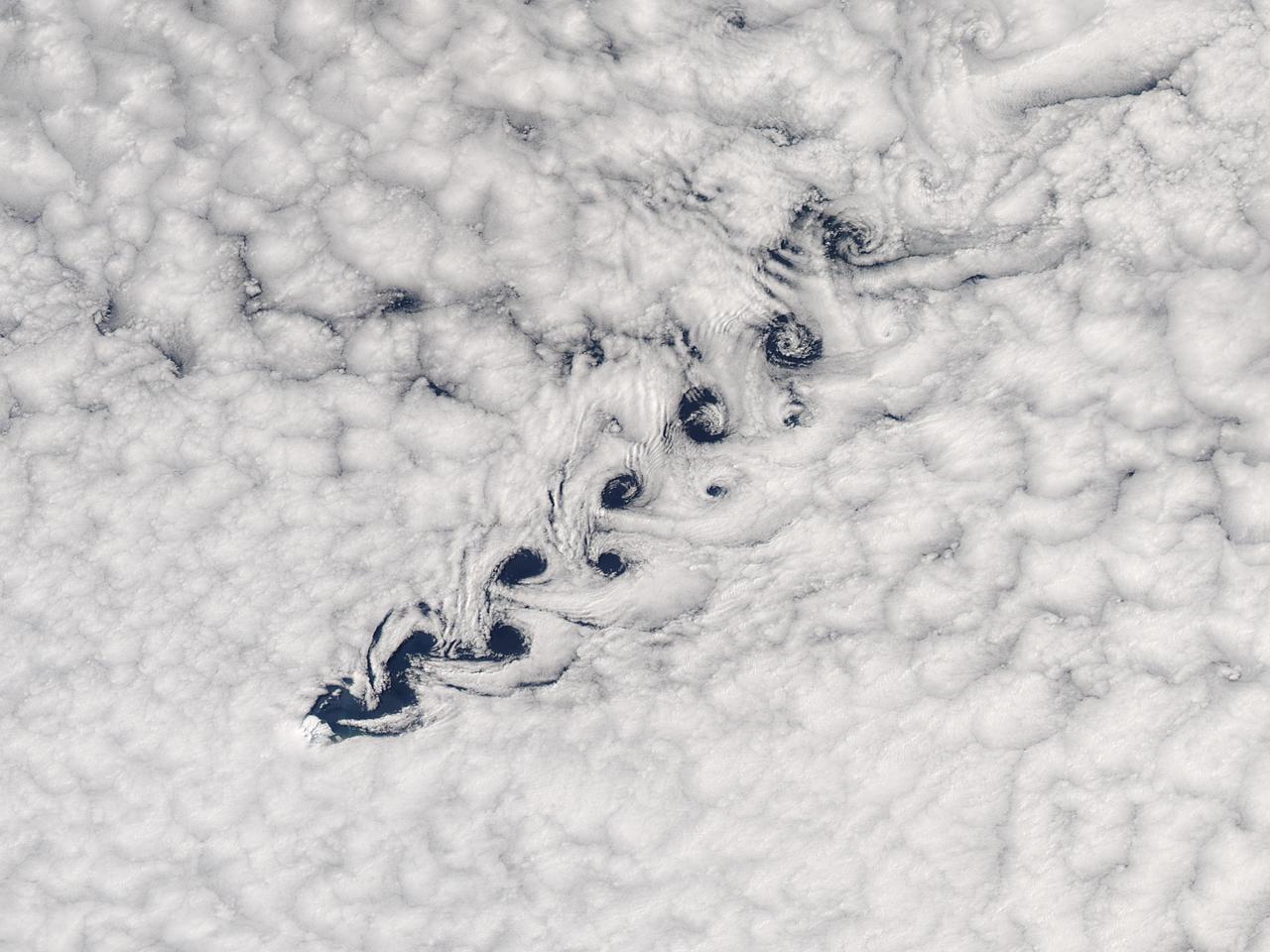
Cloud vortices off Heard Island, south Indian Ocean. The Moderate Resolution Imaging Spectroradiometer (MODIS) aboard NASA’s Aqua satellite captured this true-color image of sea ice off Heard Island on Nov 2, 2015 at 5:02 AM EST (09:20 UTC). Credit: NASA/GSFC/Jeff Schmaltz/MODIS Land Rapid Response Team <b><a href="http://www.nasa.gov/audience/formedia/features/MP_Photo_Guidelines.html" rel="nofollow">NASA image use policy.</a></b> <b><a href="http://www.nasa.gov/centers/goddard/home/index.html" rel="nofollow">NASA Goddard Space Flight Center</a></b> enables NASA’s mission through four scientific endeavors: Earth Science, Heliophysics, Solar System Exploration, and Astrophysics. Goddard plays a leading role in NASA’s accomplishments by contributing compelling scientific knowledge to advance the Agency’s mission. <b>Follow us on <a href="http://twitter.com/NASAGoddardPix" rel="nofollow">Twitter</a></b> <b>Like us on <a href="http://www.facebook.com/pages/Greenbelt-MD/NASA-Goddard/395013845897?ref=tsd" rel="nofollow">Facebook</a></b> <b>Find us on <a href="http://instagrid.me/nasagoddard/?vm=grid" rel="nofollow">Instagram</a></b>
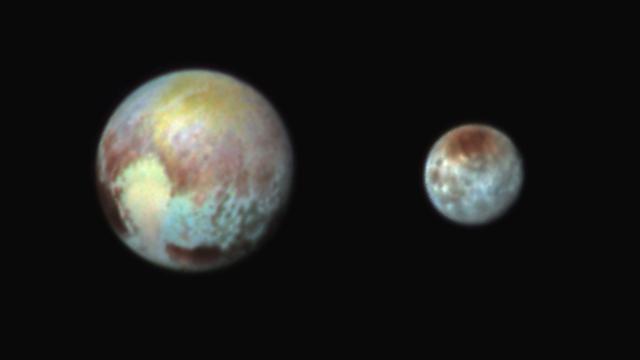
**This image was taken at 3:38 a.m. EDT on July 13, one day before New Horizons’ closest approach to Pluto.** New Horizons has obtained impressive new images of Pluto and its large moon Charon that highlight their compositional diversity. These are not actual color images of Pluto and Charon—they are shown here in exaggerated colors that make it easy to note the differences in surface material and features on each planetary body. The images were obtained using three of the color filters of the “Ralph” instrument on July 13 at 3:38 am EDT. New Horizons has seven science instruments on board the spacecraft—including “Ralph” and “Alice”, whose names are a throwback to the “Honeymooners,” a popular 1950s sitcom. “These images show that Pluto and Charon are truly complex worlds. There's a whole lot going on here,” said New Horizons co-investigator Will Grundy, Lowell Observatory, Flagstaff, Arizona. “Our surface composition team is working as fast as we can to identify the substances in different regions on Pluto and unravel the processes that put them where they are.” The color data helps scientists understand the molecular make-up of ices on the surfaces of Pluto and Charon, as well as the age of geologic features such as craters. They can also tell us about surface changes caused by space “weather,” such as radiation. The new color images reveal that the “heart” of Pluto actually consists of two remarkably different-colored regions. In the false-color image, the heart consists of a western lobe shaped like an ice cream cone that appears peach color in this image. A mottled area on the right (east) side looks bluish. A mid-latitude band appears in shades ranging from pale blue through red. Even within the northern polar cap, in the upper part of the image, various shades of yellow-orange indicate subtle compositional differences. This image was obtained using three of the color filters of the Ralph instrument on July 13 at 3:38 am EDT and received on the ground on at 12:25 pm. Charon is Just as Colorful The surface of Charon is viewed using the same exaggerated color. The red on the dark northern polar cap of Charon is attributed to hydrocarbon and other molecules, a class of chemical compounds called tholins. The mottled colors at lower latitudes point to the diversity of terrains on Charon. This image was obtained using three of the color filters of the Ralph instrument on July 13 at 3:38 am EDT and received on the ground on at 12:25 pm. “We make these color images to highlight the variety of surface environments present in the Pluto system,” said Dennis Reuter, co-investigator with the New Horizons Composition Team. “They show us in an intuitive way that there is much still to learn from the data coming down.” Due to the three-billion-mile distance to Pluto, data takes 4 ½ hours to come to Earth, even at the speed of light. It will take 16 months for all of New Horizons’ science data to be received, and the treasure trove from this mission will be studied for decades to come. Image Caption: Pluto and Charon in False Color Show Compositional Diversity This July 13, 2015, image of Pluto and Charon is presented in false colors to make differences in surface material and features easy to see. It was obtained by the Ralph instrument on NASA's New Horizons spacecraft, using three filters to obtain color information, which is exaggerated in the image. These are not the actual colors of Pluto and Charon, and the apparent distance between the two bodies has been reduced for this side-by-side view. The image reveals that the bright heart-shaped region of Pluto includes areas that differ in color characteristics. The western lobe, shaped like an ice-cream cone, appears peach color in this image. A mottled area on the right (east) appears bluish. Even within Pluto's northern polar cap, in the upper part of the image, various shades of yellow-orange indicate subtle compositional differences. The surface of Charon is viewed using the same exaggerated color. The red on the dark northern polar cap of Charon is attributed to hydrocarbon materials including a class of chemical compounds called tholins. The mottled colors at lower latitudes point to the diversity of terrains on Charon. --- At 7:49 AM EDT on Tuesday, July 14 New Horizons sped past Pluto at 30,800 miles per hour (49,600 kilometers per hour), with a suite of seven science instruments. As planned, New Horizons went incommunicado as it hurtled through the Pluto-Charon system busily gathering data. The New Horizons team will breathe a sigh of relief when New Horizons “phones home” at approximately 9:02 p.m. EDT on July 14. The mission to the icy dwarf planet completes the initial reconnaissance of the solar system. Stay in touch with the New Horizons mission with #PlutoFlyby and on Facebook at: <a href="https://www.facebook.com/new.horizons1" rel="nofollow">www.facebook.com/new.horizons1</a>
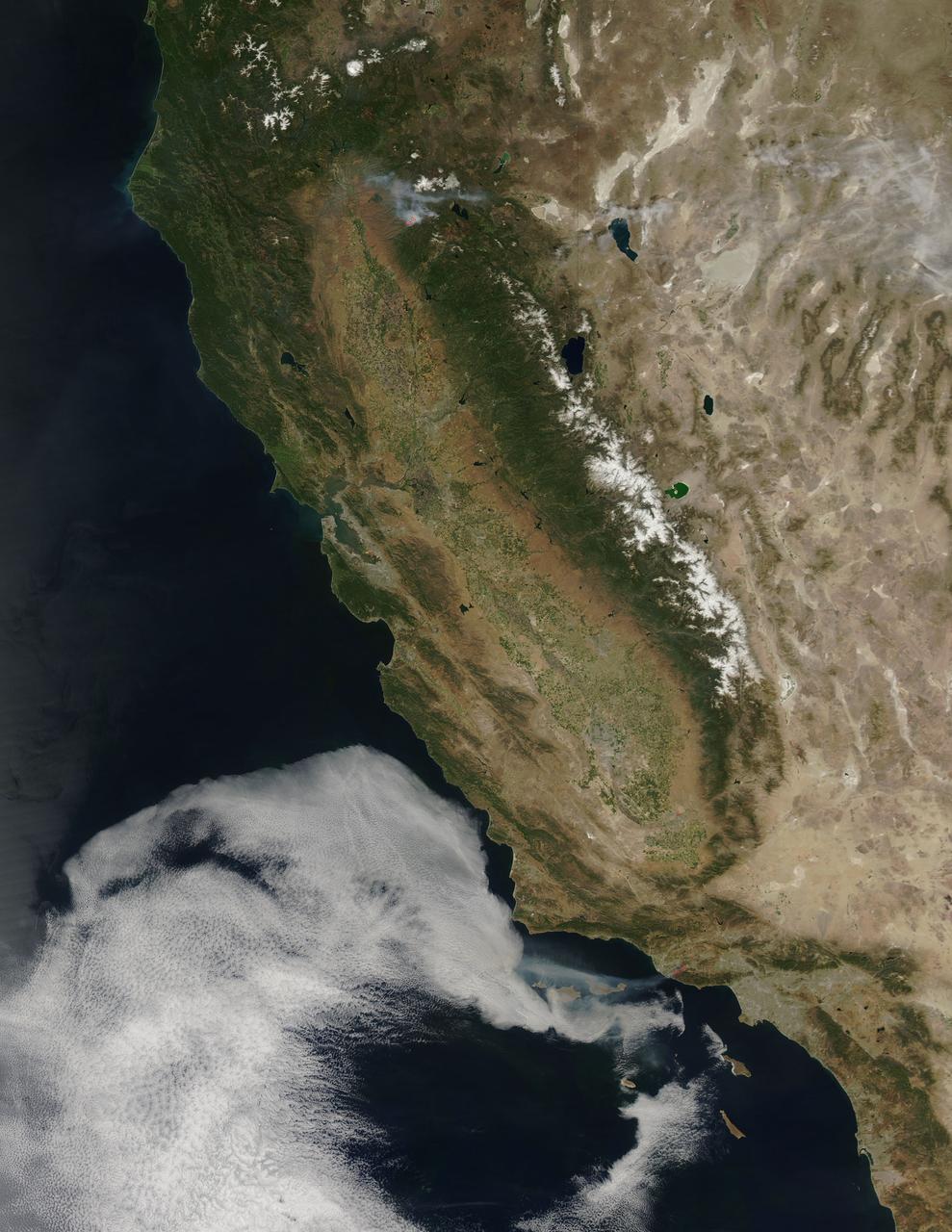
According to the NBCnews.com, Southern California firefighters were battling a growing, brush-fueled wildfire early Friday that had reached the beach in Ventura County and was pushing toward the upscale city of Malibu, officials said. Dubbed the Springs Fire, this "monster" of a wildfire has been made worse by howling Santa Ana winds and unusually dry vegetation. As of 2 am local time in California on Friday the 3rd, it was within "seven or eight miles" of Malibu, Ventura County Fire Department spokesman Bill Nash said. Weather conditions are not cooperating in the containment of this fire. The Weather Channel has predicted dry winds from offshore that will bring gusts of 40 to 50 miles per hour to the Southern California region on Friday the 3rd which could easily spread the fire. A complication to the winds is the extremely dry plant life left from a season in which only about five inches of rain fell in the area. The Springs Fire grew to 10,000 acres and was ten percent contained as of early Friday morning, according to the California Department of Forestry and Fire Prevention. Evacuations took place Thursday, and as of Friday morning 15 homes had been damaged. More than 2,000 homes and 100 commercial properties were under threat from the fire and those numbers could grow with weather conditions today (May 3). Currently the fire is burning in a rural area outside of Malibu, but it doesn't have to go very far to get to some expensive homes and more populated areas. It's current direction has it burning down the mountainside toward Malibu. Firefighters expect to receive help from tankers and helicopters in the air Friday morning, according to a release from the Ventura County Fire Department. The cause of the fire remained under investigation Friday. There had been no lightning or other natural fire-starting phenomenon in the area when the blaze began, Nash said. This natural-color satellite image was collected by the Moderate Resolution Imaging Spectroradiometer (MODIS) aboard the Aqua satellite on May 02, 2013. Actively burning areas, detected by MODIS’s thermal bands, are outlined in red. NASA image courtesy Jeff Schmaltz LANCE/EOSDIS MODIS Rapid Response Team, GSFC. Caption by Lynn Jenner with information from NBCnews.com <b><a href="http://www.nasa.gov/audience/formedia/features/MP_Photo_Guidelines.html" rel="nofollow">NASA image use policy.</a></b> <b><a href="http://www.nasa.gov/centers/goddard/home/index.html" rel="nofollow">NASA Goddard Space Flight Center</a></b> enables NASA’s mission through four scientific endeavors: Earth Science, Heliophysics, Solar System Exploration, and Astrophysics. Goddard plays a leading role in NASA’s accomplishments by contributing compelling scientific knowledge to advance the Agency’s mission. <b>Follow us on <a href="http://twitter.com/NASA_GoddardPix" rel="nofollow">Twitter</a></b> <b>Like us on <a href="http://www.facebook.com/pages/Greenbelt-MD/NASA-Goddard/395013845897?ref=tsd" rel="nofollow">Facebook</a></b> <b>Find us on <a href="http://instagram.com/nasagoddard?vm=grid" rel="nofollow">Instagram</a></b>