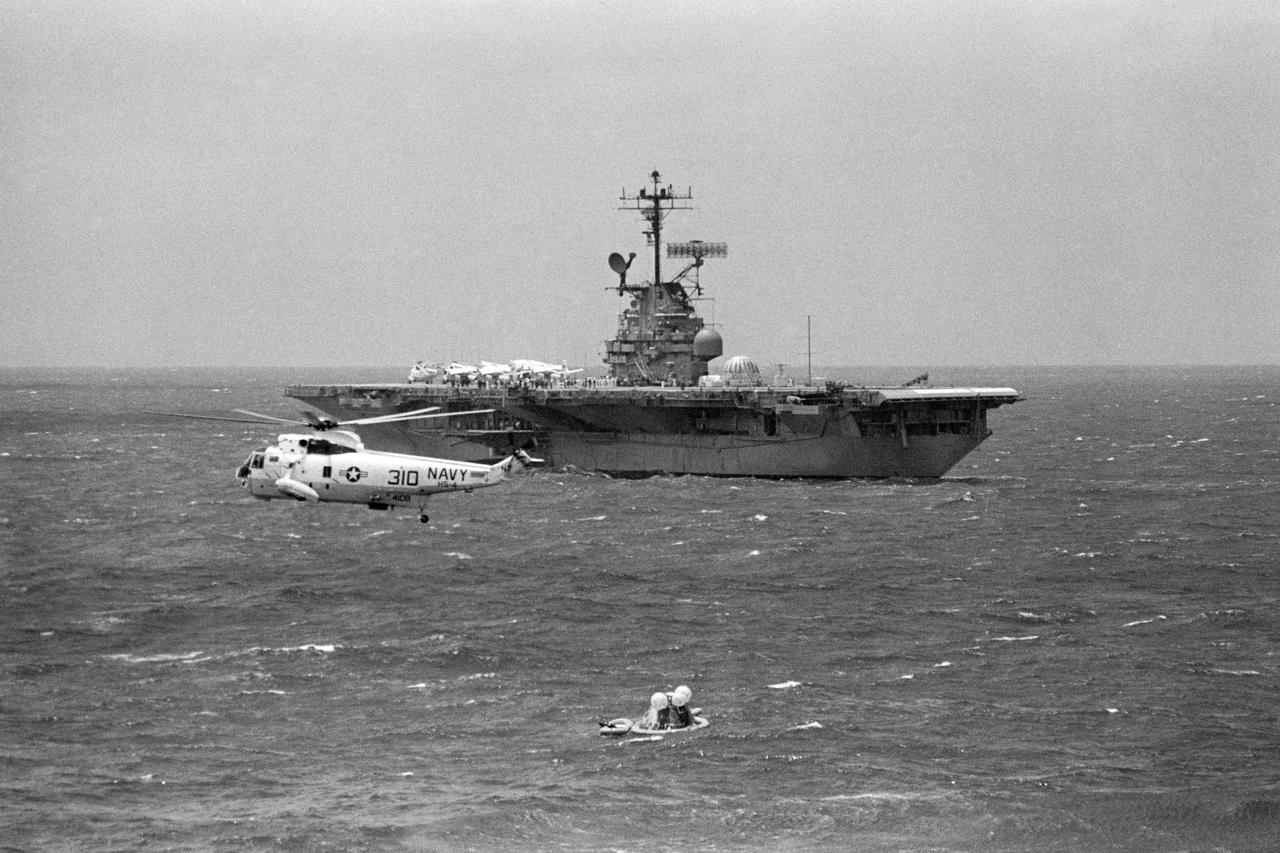
U.S.S. Hornet, prime recovery vessel for the Apollo 12 lunar landing mission, moves toward the Apollo 12 Command Module to retrieve the spacecraft. A helicopter from the recovery ship, which took part in the recovery operations, hovers over the scene of the splashdown.
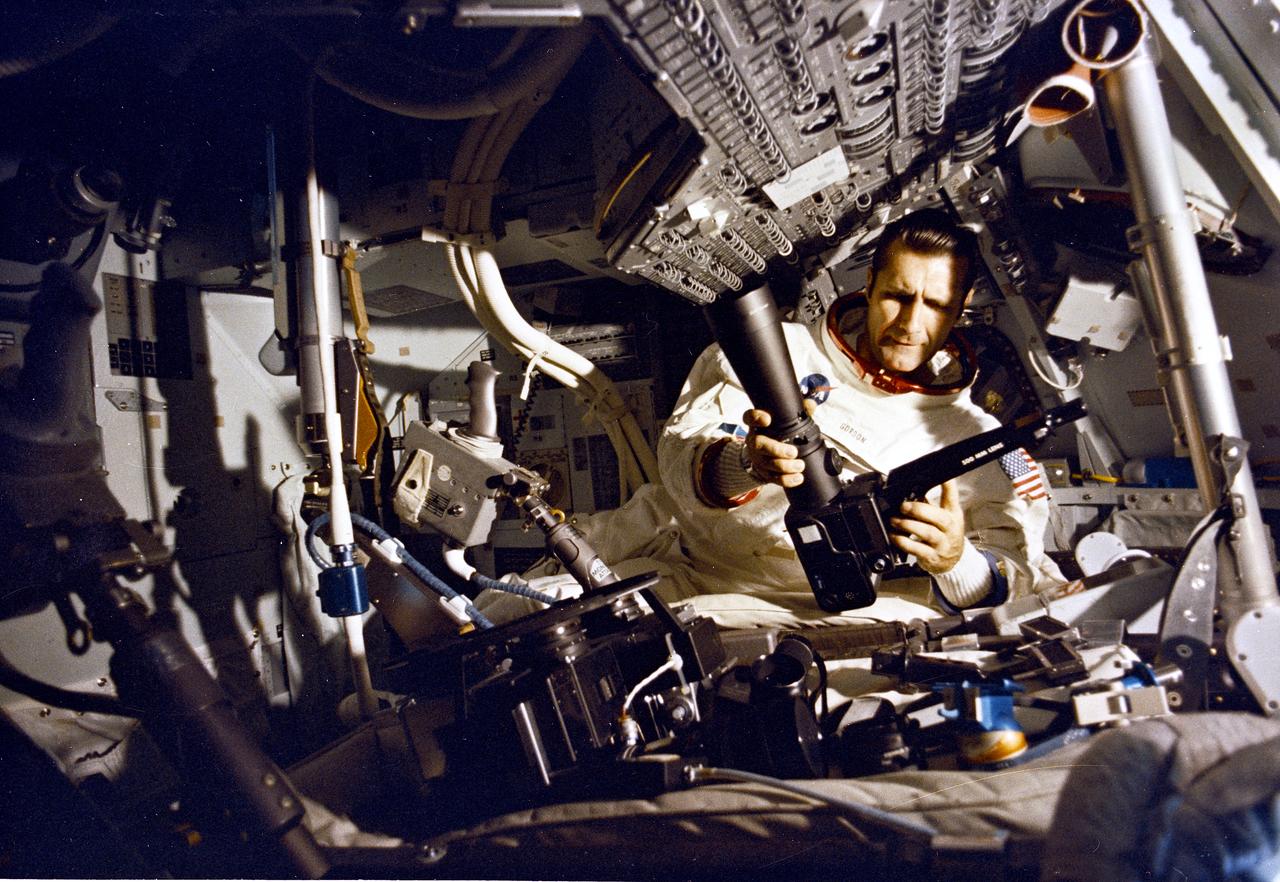
This is a view of astronaut Richard F. Gordon attaching a high resolution telephoto lens to a camera aboard the Apollo 12 Command Module (CM) Yankee Clipper. The second manned lunar landing mission, Apollo 12 launched from launch pad 39-A at Kennedy Space Center in Florida on November 14, 1969 via a Saturn V launch vehicle. The Saturn V vehicle was developed by the Marshall Space Flight Center (MSFC) under the direction of Dr. Wernher von Braun. Aboard Apollo 12 was a crew of three astronauts: Alan L. Bean, pilot of the Lunar Module (LM), Intrepid; Richard Gordon, pilot of the Command Module (CM), Yankee Clipper; and Spacecraft Commander Charles Conrad. The LM, Intrepid, landed astronauts Conrad and Bean on the lunar surface in what’s known as the Ocean of Storms. Their lunar soil activities included the deployment of the Apollo Lunar Surface Experiments Package (ALSEP), finding the unmanned Surveyor 3 that landed on the Moon on April 19, 1967, and collecting 75 pounds (34 kilograms) of rock samples. Astronaut Richard Gordon piloted the CM, Yankee Clipper, in a parking orbit around the Moon. Apollo 12 safely returned to Earth on November 24, 1969.
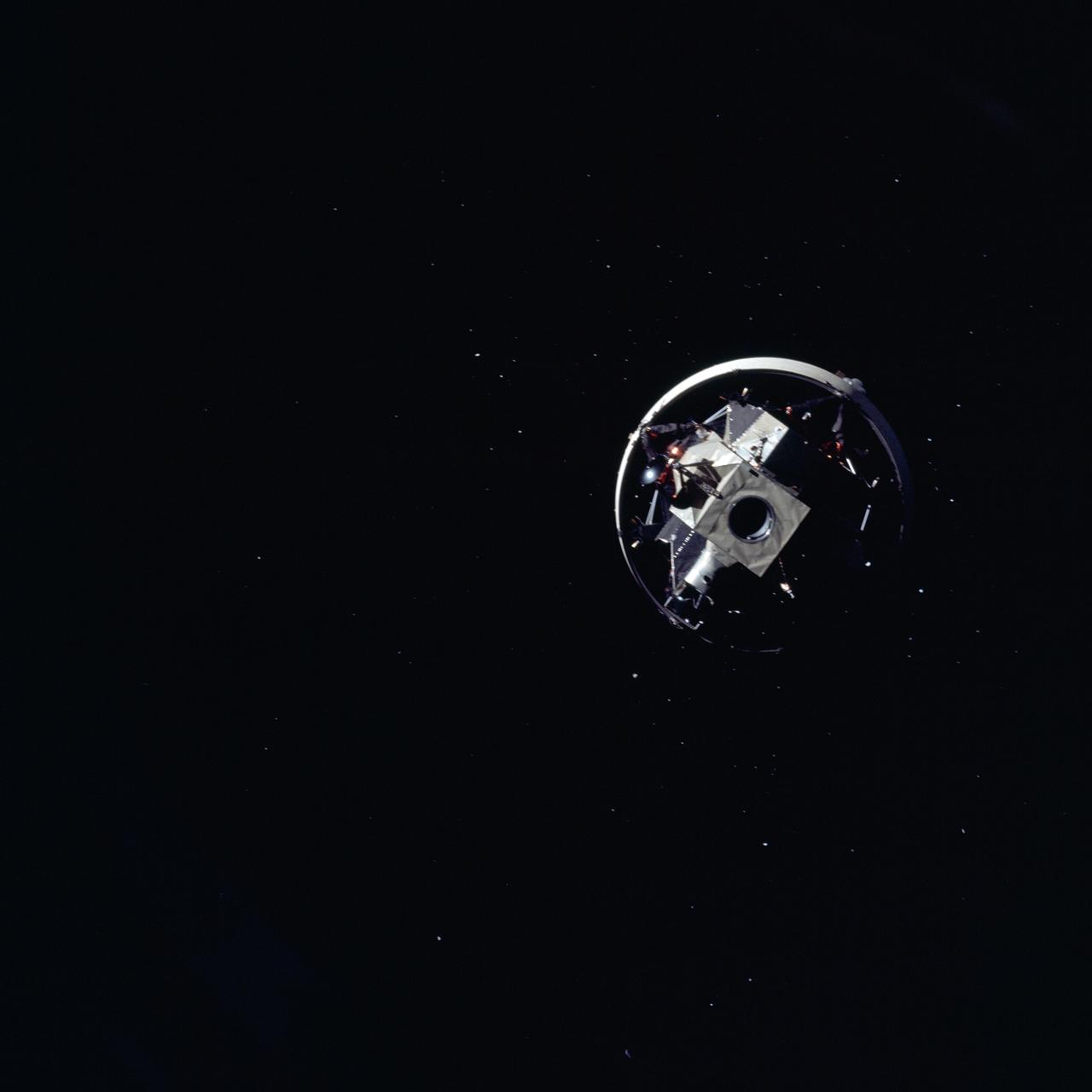
AS12-50-7328 (14 Nov. 1969) --- Apollo 12 Lunar Module (LM), still attached to the Saturn V third (S-IVB) stage, is pictured as seen from Apollo 12 Command and Service Modules (CSM) on the first day of the Apollo 12 lunar landing mission. This photograph was taken following CSM separation from LM/S-IVB and prior to Lunar Module extraction from the S-IVB stage. The Spacecraft Lunar Module Adapter (SLA) panels have already been jettisoned.
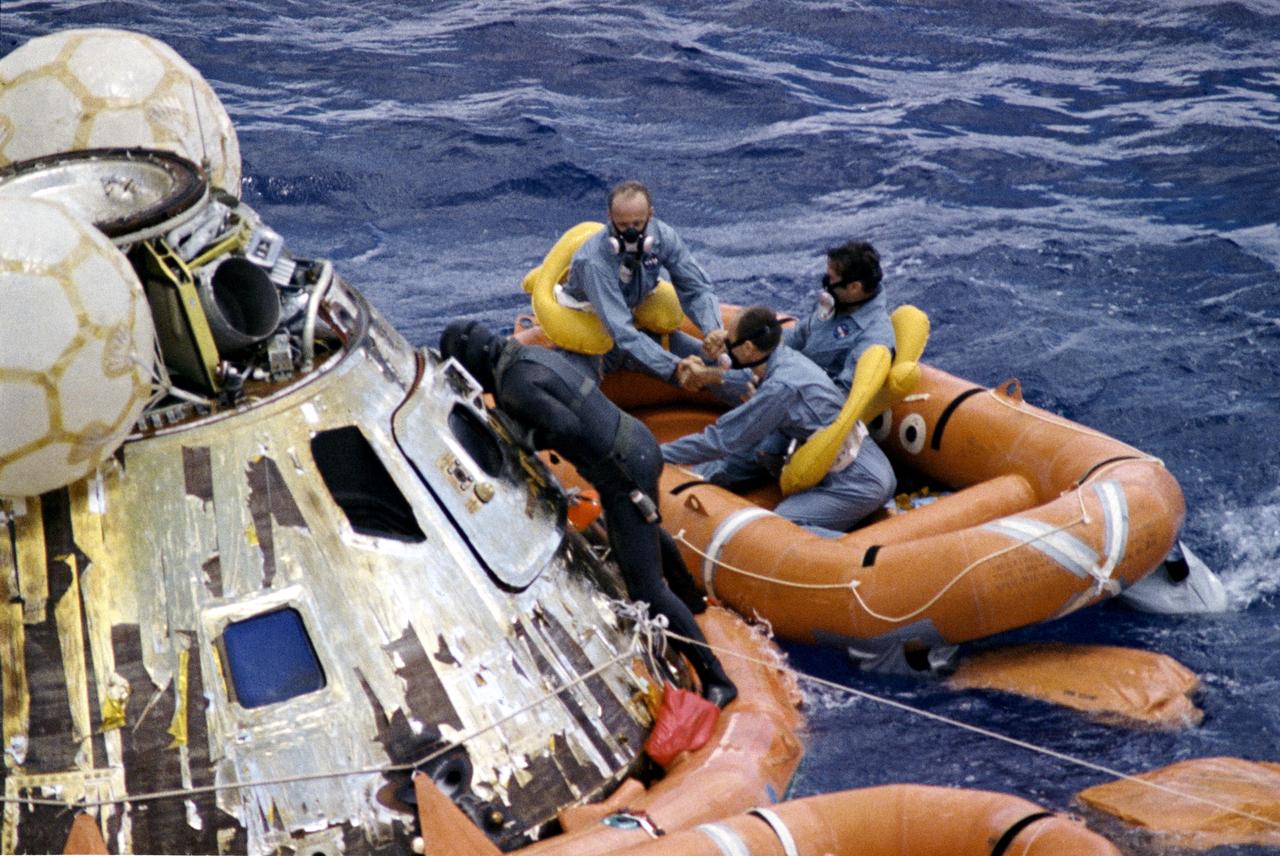
S69-22271 (24 Nov. 1969) --- A United States Navy Underwater Demolition Team swimmer assists the Apollo 12 crew during recovery operations in the Pacific Ocean. In the life raft are astronauts Charles Conrad Jr. (facing camera), commander; Richard F. Gordon Jr. (middle), command module pilot; and Alan L. Bean (nearest camera), lunar module pilot. The three crew men of the second lunar landing mission were picked up by helicopter and flown to the prime recovery ship, USS Hornet. Apollo 12 splashed down at 2:58 p.m. (CST), Nov. 24, 1969, near American Samoa. While astronauts Conrad and Bean descended in the Lunar Module (LM) "Intrepid" to explore the Ocean of Storms region of the moon, astronaut Gordon remained with the Command and Service Modules (CSM) "Yankee Clipper" in lunar orbit.
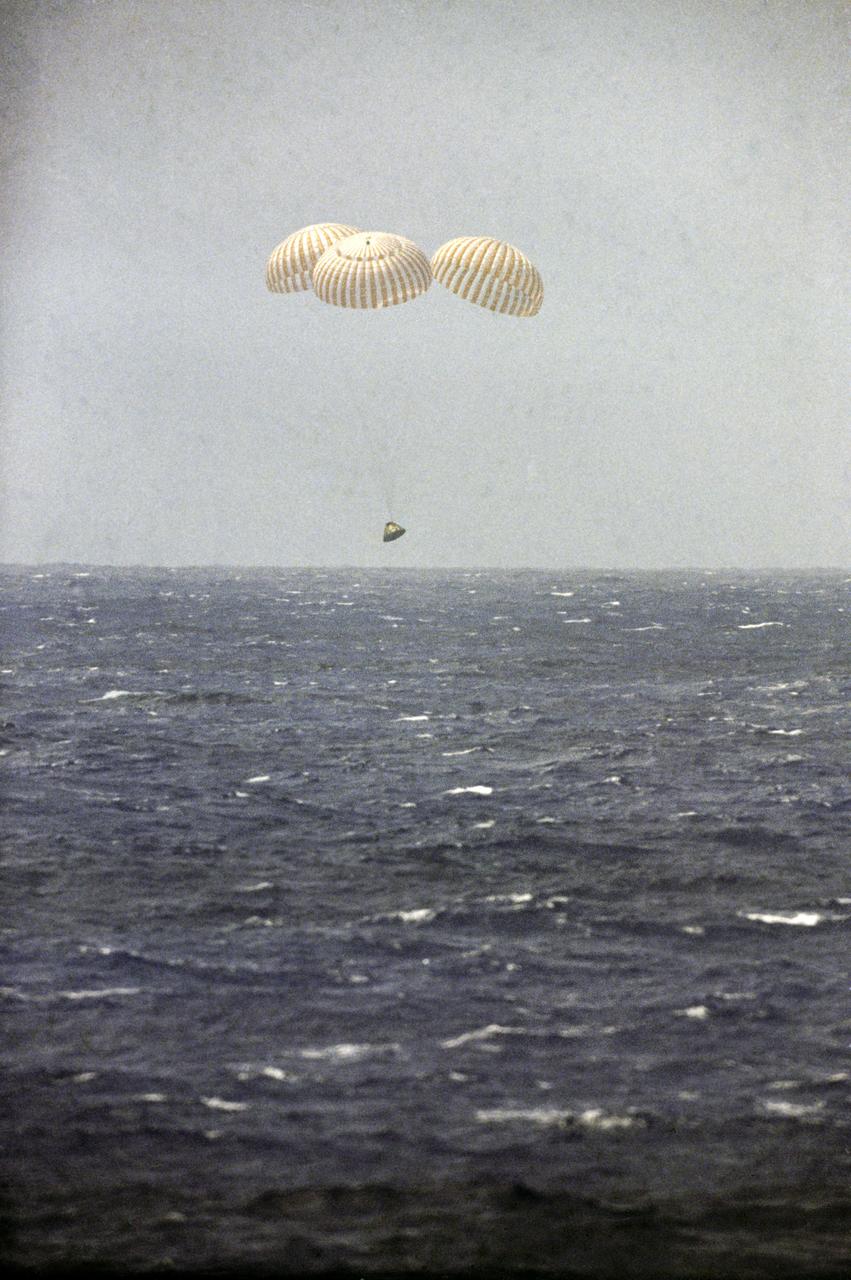
S69-22728 (24 Nov. 1969) --- The Apollo 12 Command Module, with astronauts Charles Conrad Jr., Richard F. Gordon Jr., and Alan L. Bean aboard, nears splashdown in the Pacific Ocean to conclude the second lunar landing mission. The Apollo 12 splashdown occurred at 2:58 p.m., Nov. 24, 1969, near American Samoa.
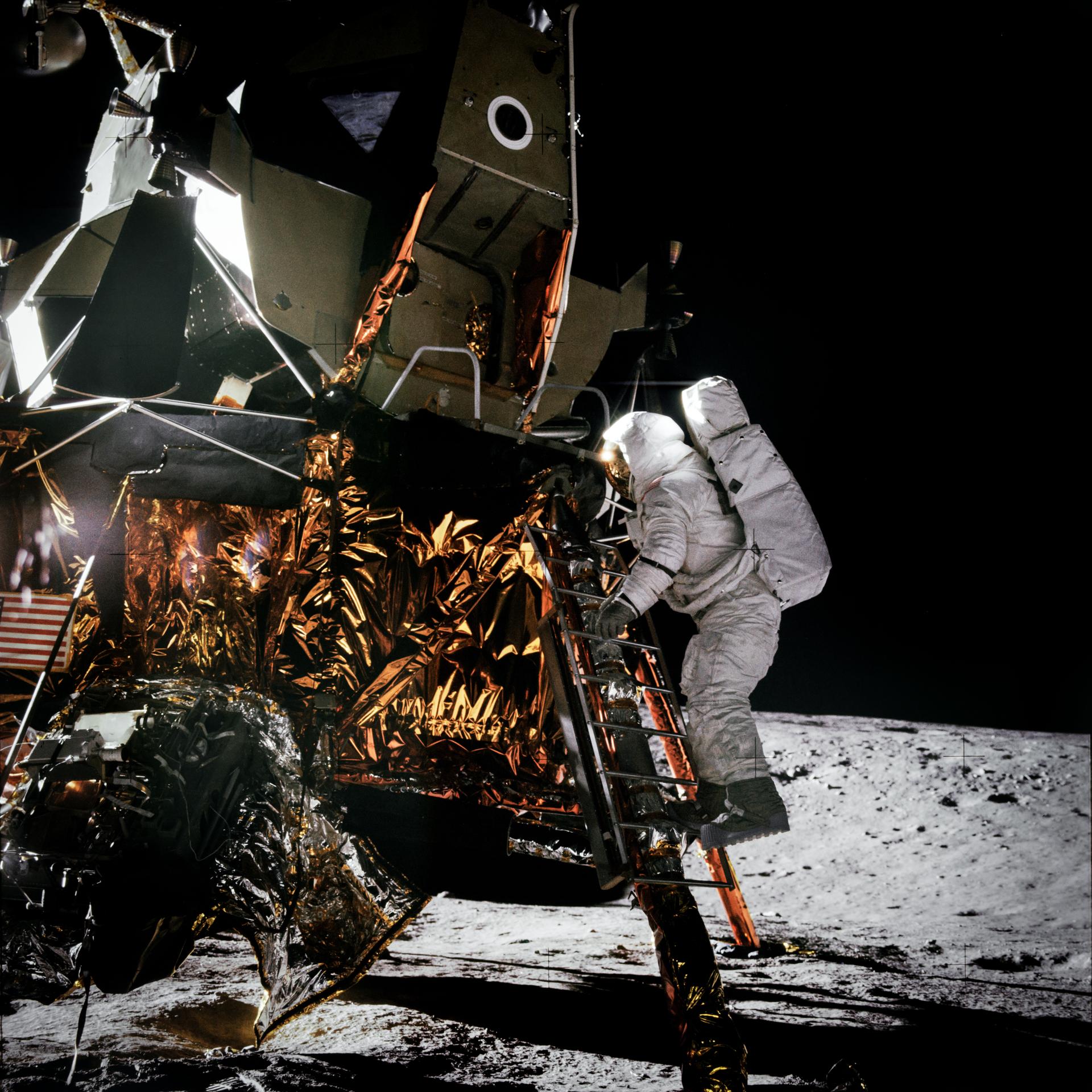
AS12-46-6728 (19 Nov. 1969) --- Astronaut Alan L. Bean, lunar module pilot for the Apollo 12 mission, is about to step off the ladder of the Lunar Module to join astronaut Charles Conrad Jr., mission commander, in extravehicular activity (EVA). Conrad and Bean descended in the Apollo 12 LM to explore the moon while astronaut Richard F. Gordon Jr., command module pilot, remained with the Command and Service Modules in lunar orbit.
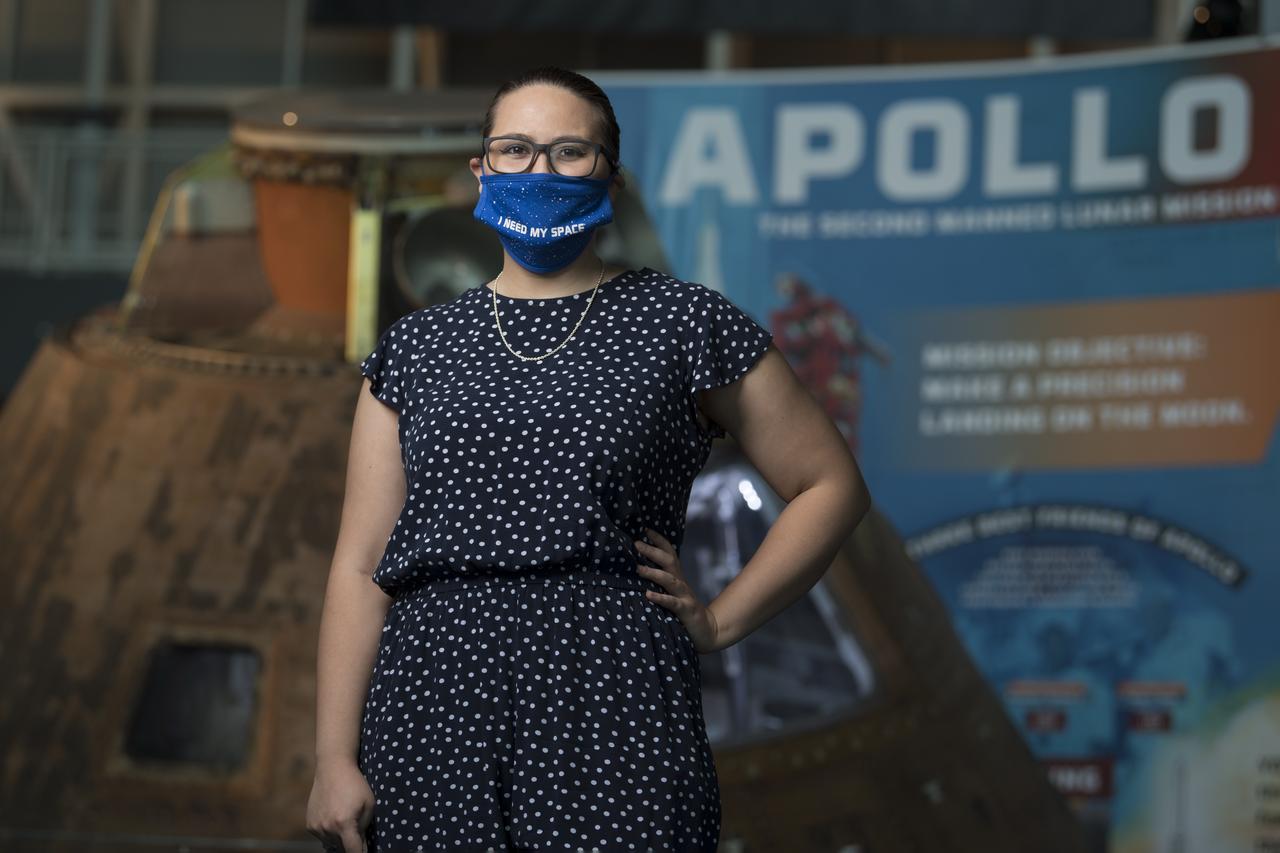
Portrait of Casey Denham in front of the Apollo 12 Command Module "Yankee Clipper" display at the Virginia Air and Space Center in Hampton, Virginia. Due to the COVID-19 pandemic, masks were mandated by Governor Northam in Virginia in public settings. This was for the faces of NASA project. "Now my whole family likes to brag that they have a rocket scientist daughter who works at NASA.” — Casey Denham, Pathways Intern, Langley Research Center
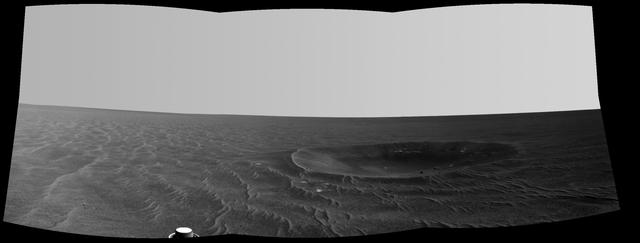
This mosaic is a view from NASA Mars Exploration Rover Opportunity of Yankee Clipper crater which carries the name of the command and service module of NASA 1969 Apollo 12 mission to the moon.
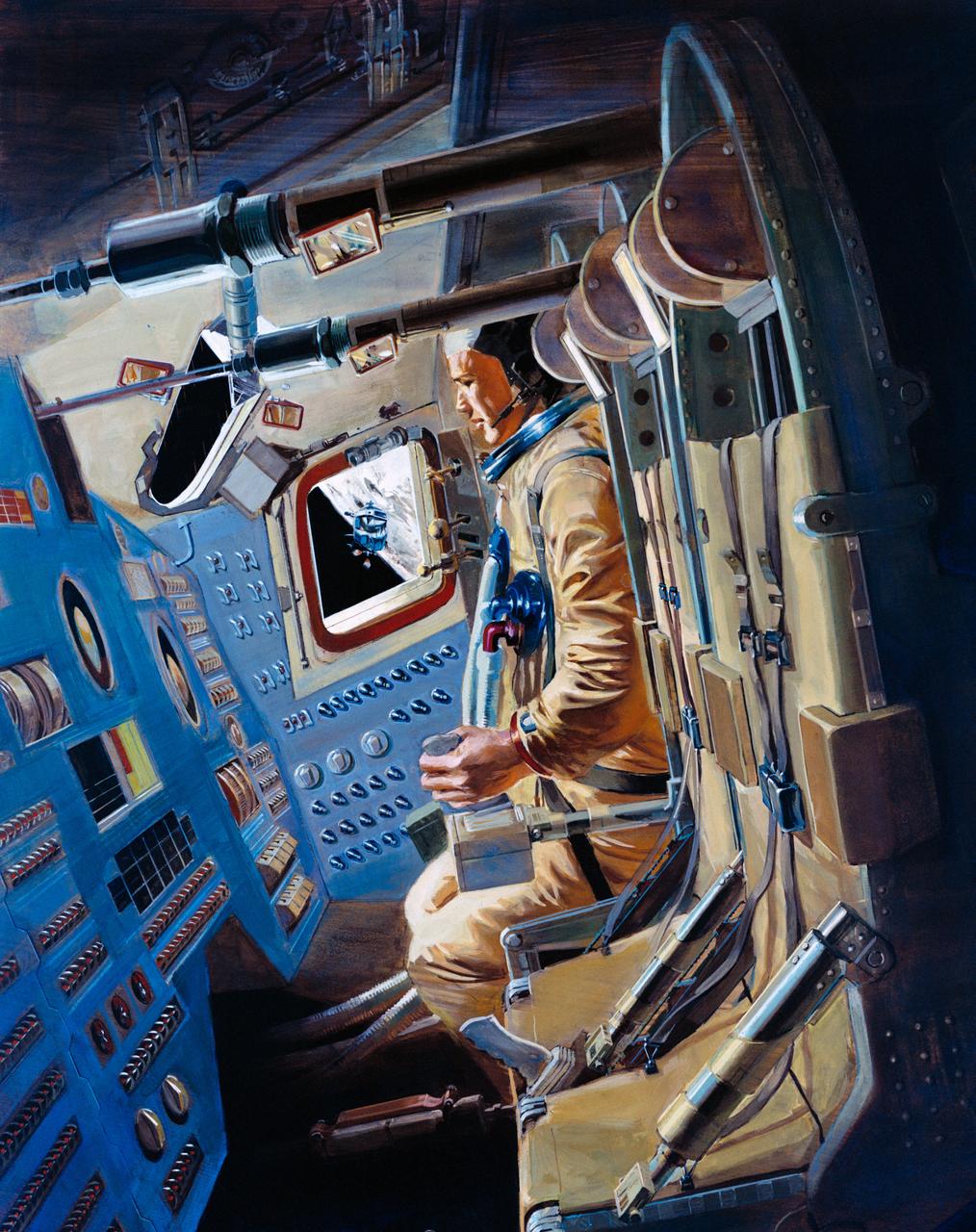
S69-58005 (10 Nov. 1969) --- An artist's concept of the Apollo 12 Command Module's (CM) interior, with the command module pilot at the controls. The Apollo 12 Lunar Module (LM) and a portion of the lunar surface are seen out of the window. Astronaut Richard F. Gordon Jr. will maneuver the Apollo 12 Command and Service Modules (CSM) in lunar orbit while astronauts Charles Conrad Jr., commander, and Alan L. Bean, lunar module pilot, explore the moon.
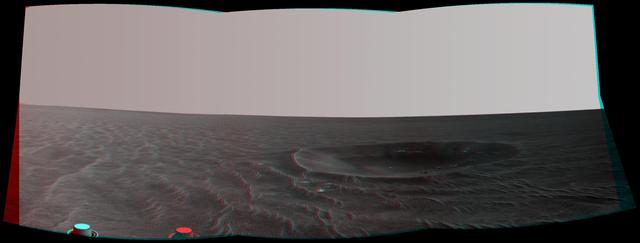
Yankee Clipper crater on Mars carries the name of the command and service module of NASA 1969 Apollo 12 mission to the moon. NASA Mars Exploration Rover Opportunity recorded this stereo view on Nov. 4, 2010. 3D glasses are necessary.
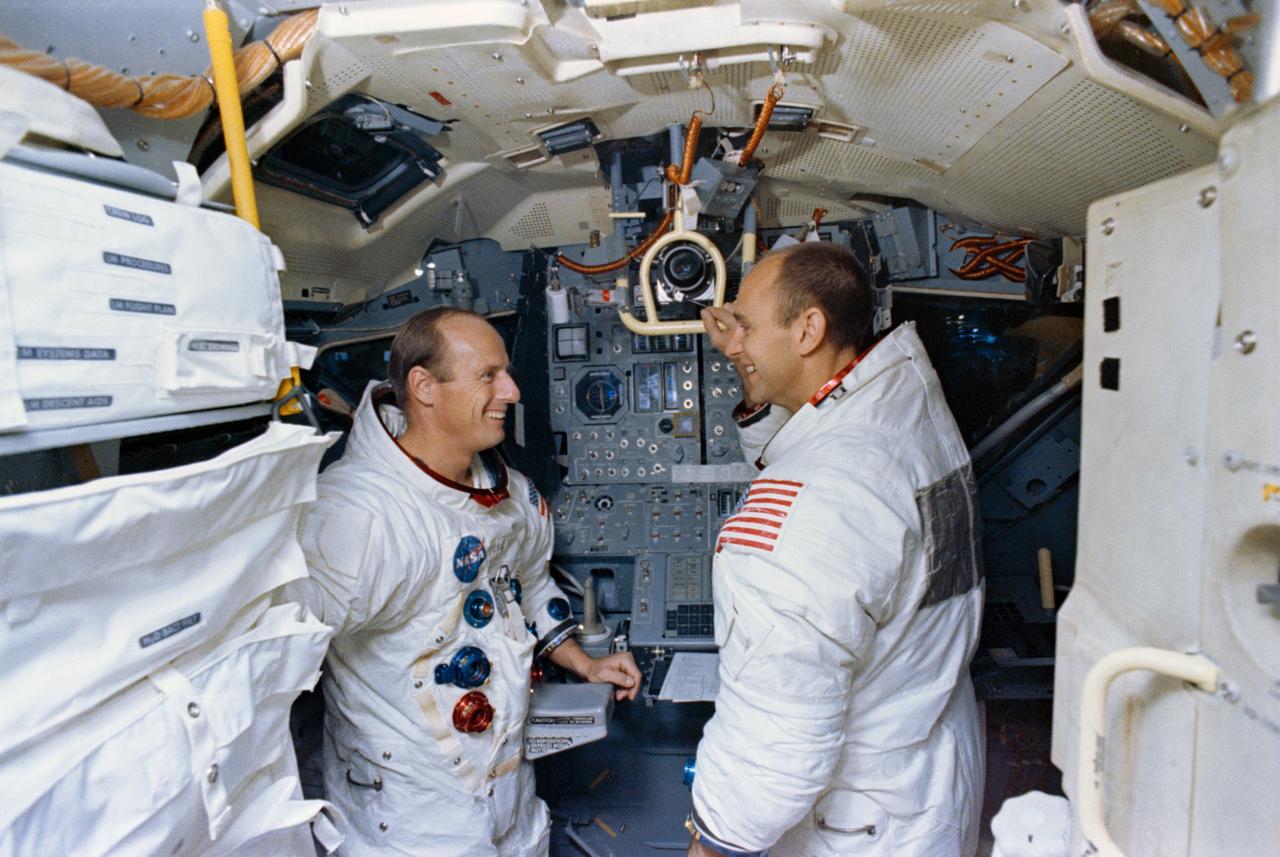
S69-56699 (22 Oct. 1969) --- Astronauts Charles Conrad Jr. (left), Apollo 12 commander; and Alan L. Bean, lunar module pilot, are shown in the Apollo Lunar Module Mission Simulator during simulator training at the Kennedy Space Center (KSC). Apollo 12 will be the National Aeronautics and Space Administration's (NASA) second lunar landing mission. The third Apollo 12 crewmember will be astronaut Richard F. Gordon Jr., command module pilot.
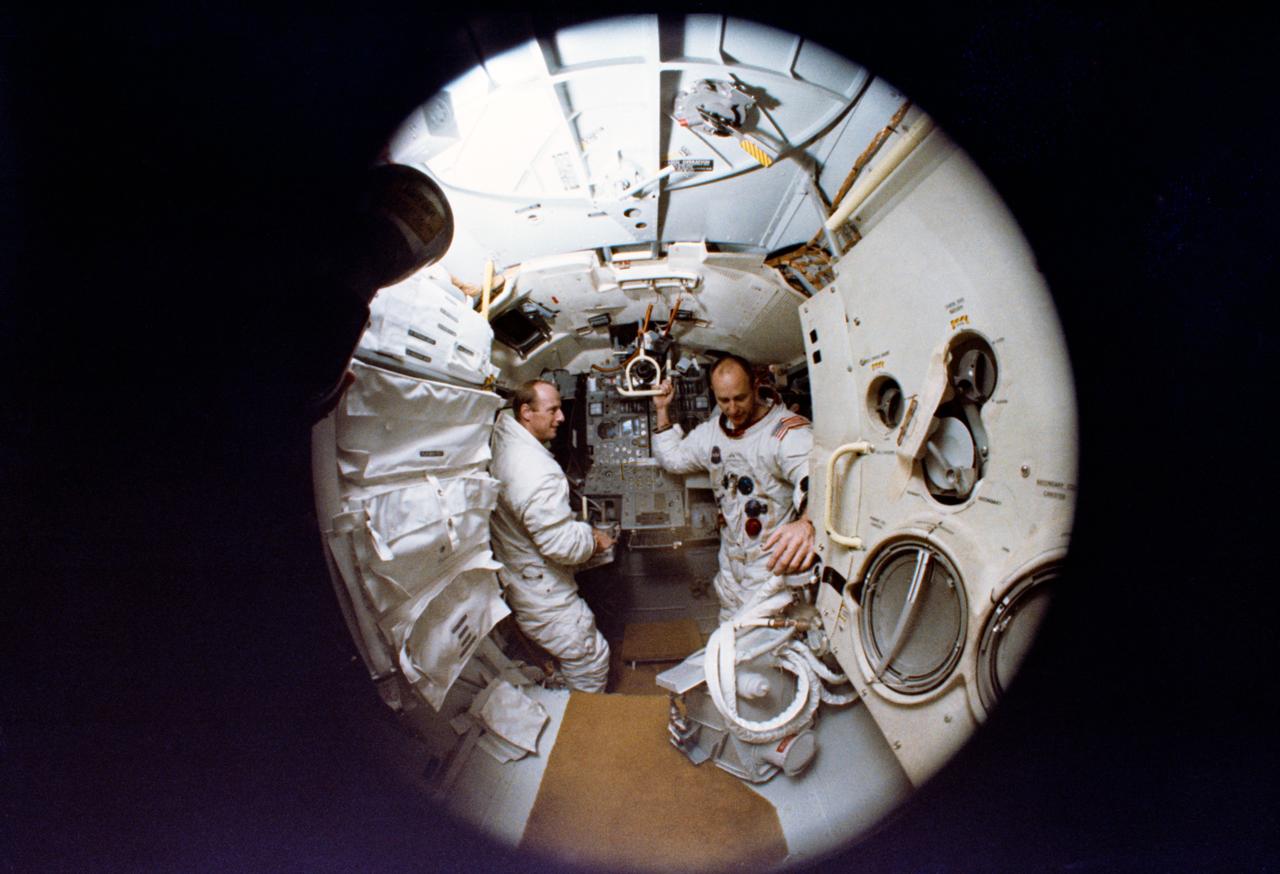
S69-56700 (22 Oct. 1969) --- A fish-eye lens view of astronauts Charles Conrad Jr. (on left), Apollo 12 commander, and Alan L. Bean, lunar module pilot, inside the Apollo Lunar Module Mission Simulator during simulator training at the Kennedy Space Center (KSC). Apollo 12 will be the National Aeronautics and Space Administration's (NASA) second lunar landing mission. The third Apollo 12 crewmember will be astronaut Richard F. Gordon Jr., command module pilot.
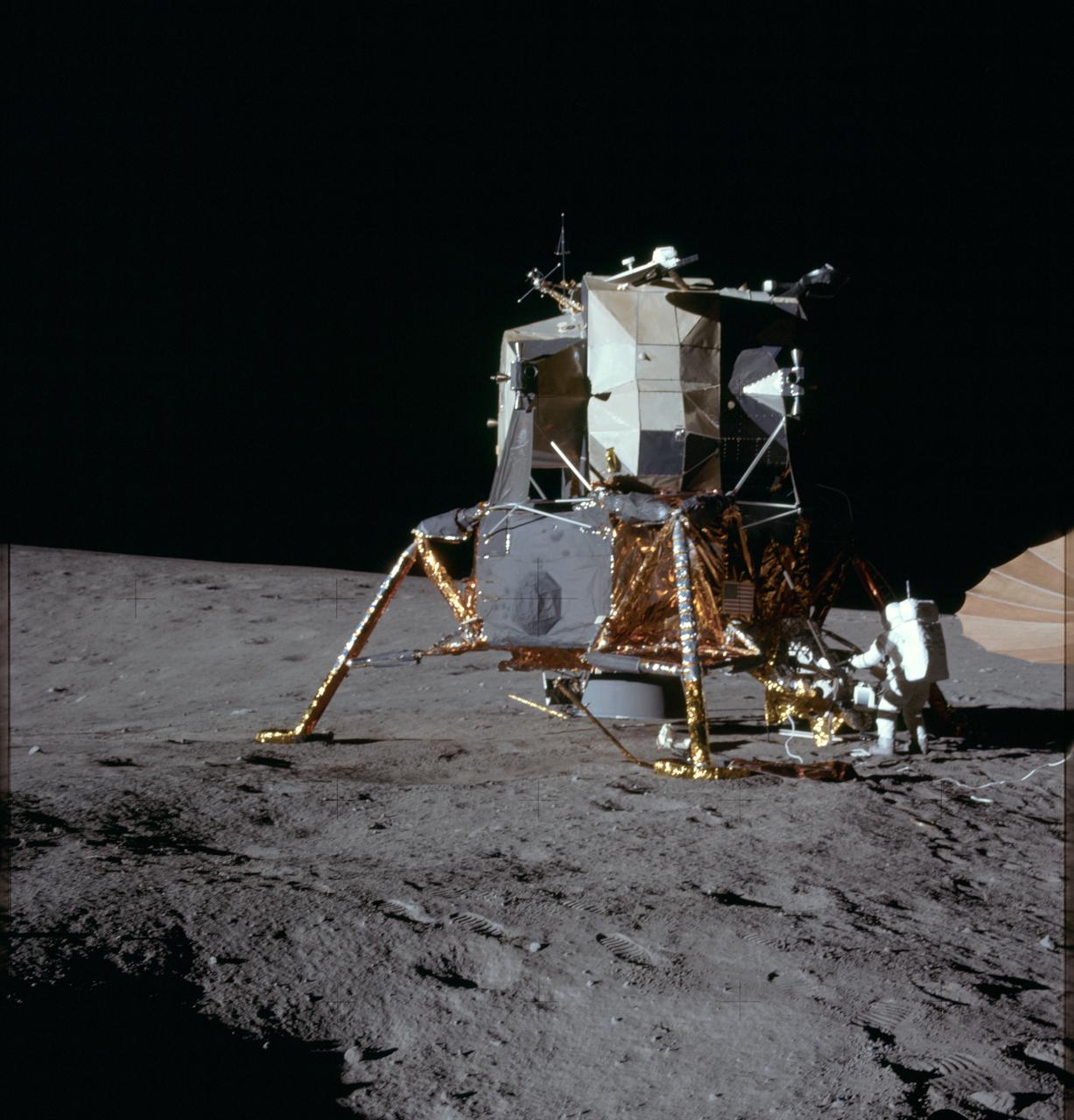
AS12-46-6749 (19 Nov. 1969) --- Astronaut Alan L. Bean, lunar module pilot for the Apollo 12 lunar landing mission, works at the Modular Equipment Stowage Assembly (MESA) on the Apollo 12 Lunar Module (LM) during the mission's first extravehicular activity, (EVA) on Nov. 19, 1969. Astronaut Charles Conrad Jr., commander, and Bean descended in the Apollo 12 LM to explore the moon while astronaut Richard F. Gordon Jr., command module pilot, remained with the Command and Service Modules (CSM) in lunar orbit.

Astronaut Richard F. Gordon Jr., Apollo 12 command module pilot, suits up in the Kennedy Space Center's Manned Spacecraft Operations Building during the Apollo 12 prelaunch countdown.
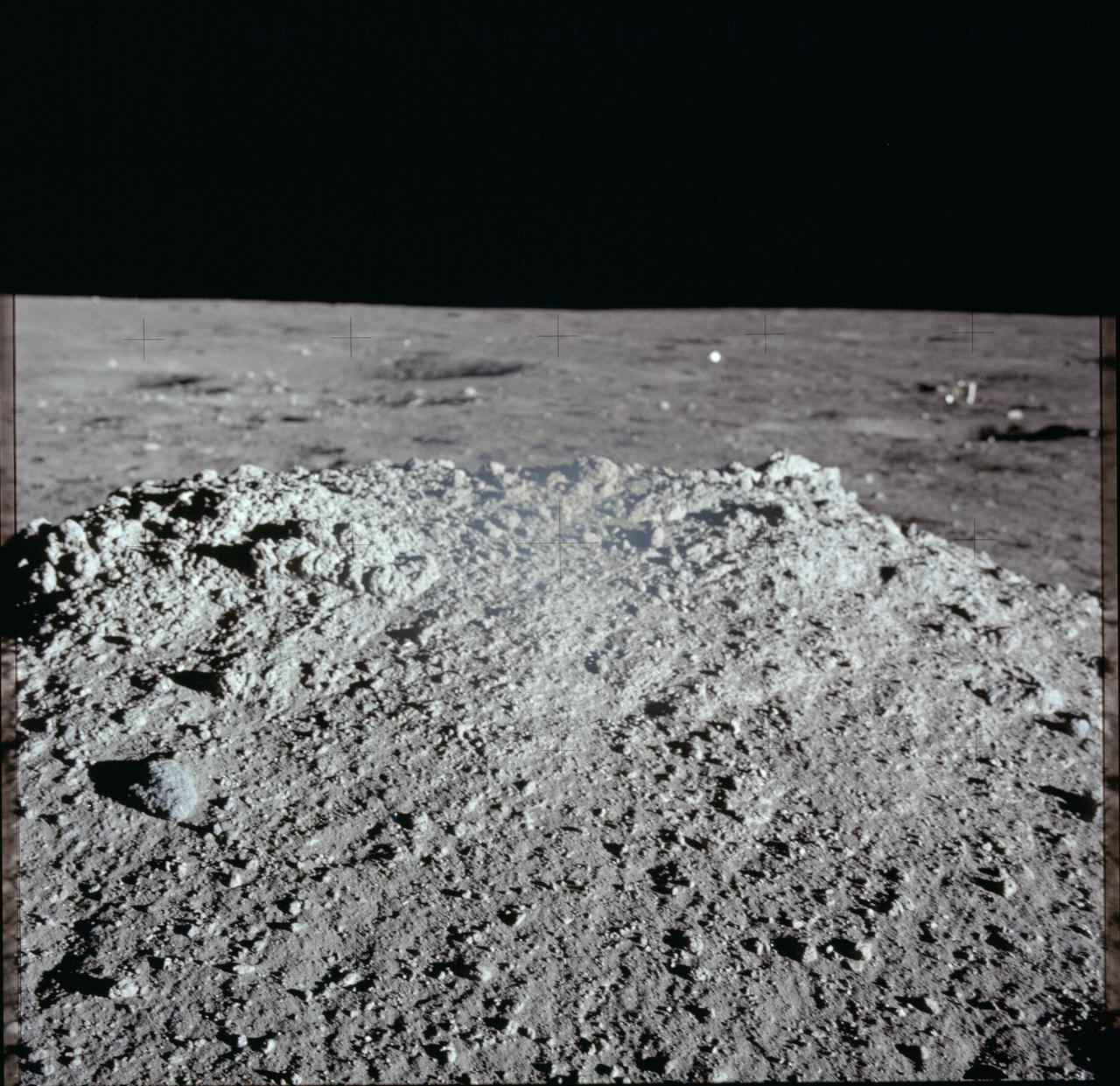
AS12-46-6832 (19 Nov. 1969) --- A close-up view of a lunar mound as photographed during the Apollo 12 extravehicular activity (EVA) on the lunar surface. Astronaut Richard F. Gordon Jr., command module pilot, remained with the Apollo 12 Command and Service Modules (CSM) in lunar orbit while astronauts Charles Conrad Jr., commander, and Alan L. Bean, lunar module pilot, descended in the Lunar Module (LM) to explore the moon.
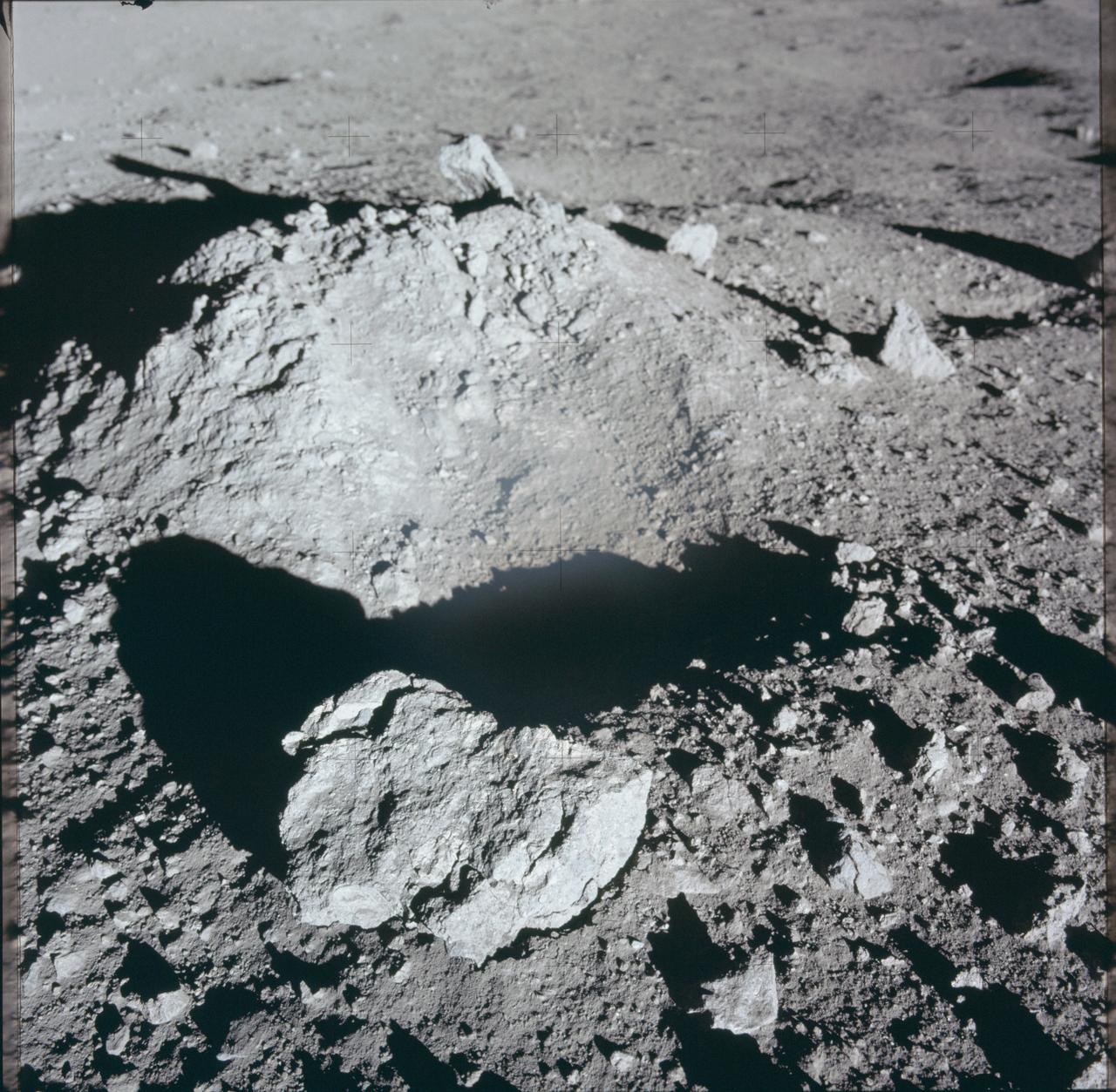
AS12-46-6825 (19 Nov. 1969) --- Close-up view of a lunar rock, small crater, and lunar mound as photographed during the Apollo 12 extravehicular activity (EVA). Astronaut Richard F. Gordon Jr., command module pilot, remained with the Apollo 12 Command and Service Modules (CSM) in lunar orbit while astronauts Charles Conrad Jr., commander, and Alan L. Bean, lunar module pilot, descended in the Lunar Module (LM) to explore the moon.

S69-58881 (14 Nov. 1969) --- The three Apollo 12 crew men leave the Kennedy Space Center's (KSC) Manned Spacecraft Operations Building (MSOB) during the Apollo 12 prelaunch countdown. Leading is astronaut Charles Conrad Jr., commander; followed by astronauts Richard F. Gordon Jr., command module pilot; and Alan L. Bean, lunar module pilot. They rode a special transport van over the Pad A, Launch Complex 39, where their spacecraft awaited. The Apollo 12 liftoff occurred at 11:22 a.m. (EST), Nov. 14, 1969. Apollo 12 is the United States' second lunar landing mission.
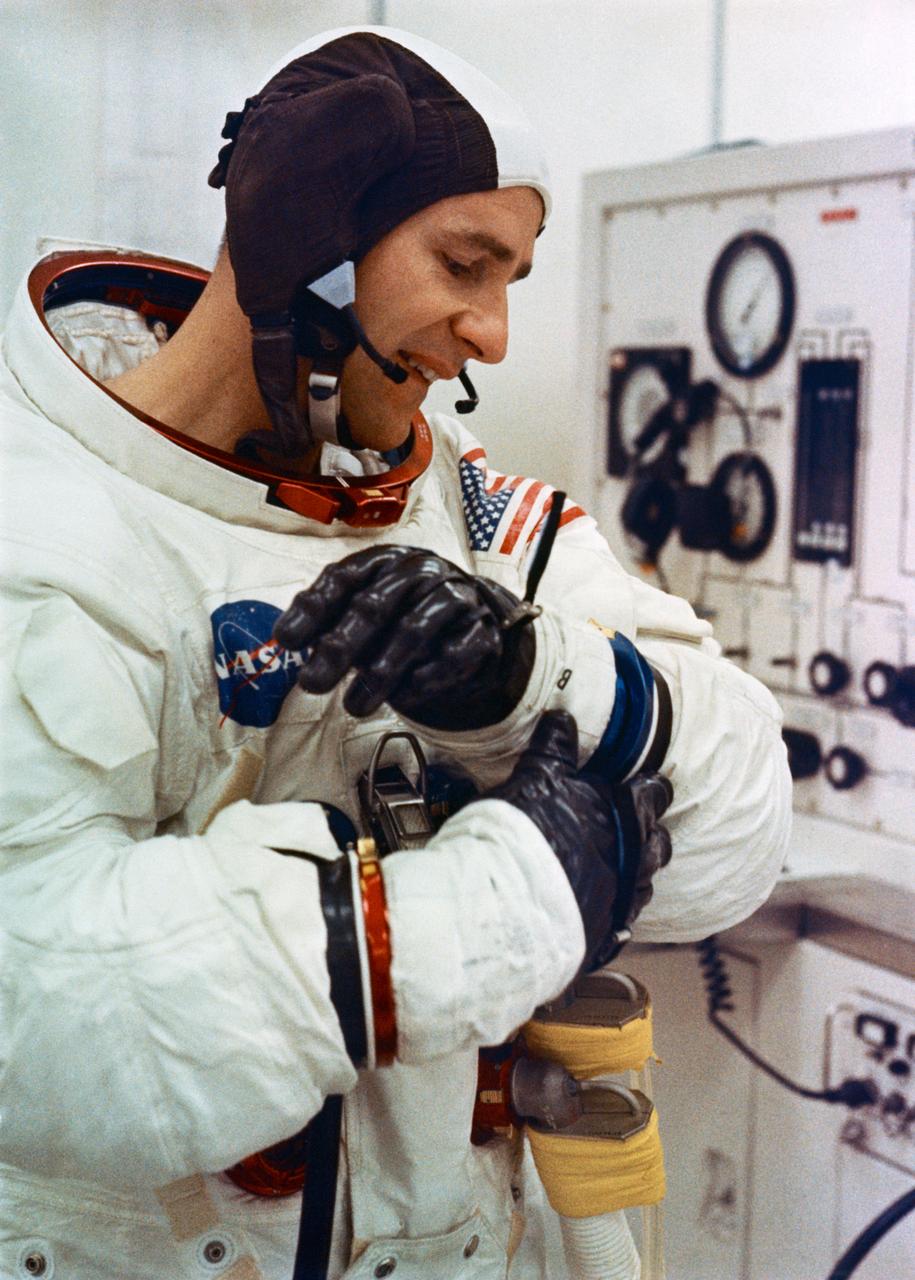
S69-58880 (14 Nov. 1969) --- Astronaut Alan L. Bean, Apollo 12 lunar module pilot, suits up in the Kennedy Space Center's (KSC) Manned Spacecraft Operations Building during the Apollo 12 prelaunch countdown. Minutes later astronauts Bean; Charles Conrad Jr., commander; and Richard F. Gordon Jr., command module pilot, rode a special transport van over to Pad A, Launch Complex 39, where their spacecraft awaited. The Apollo 12 liftoff occurred at 11:22 a.m. (EST), Nov. 14, 1969. Apollo 12 is the United States' second lunar landing mission.
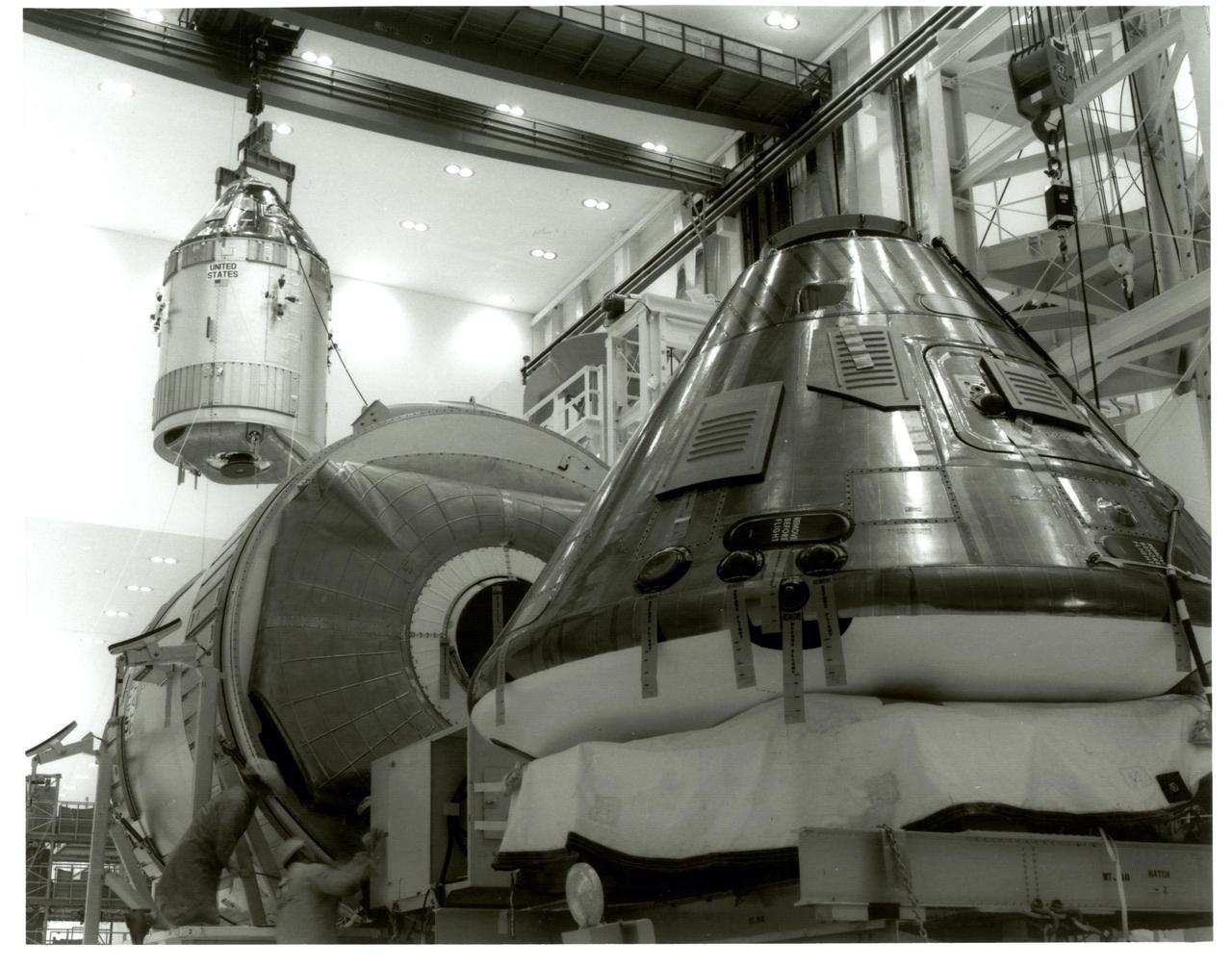
KENNEDY SPACE CENTER, FLA. - The Command Module 107 and Service Module, which are going to be used for the Apollo 11 mission, are moved from Chamber "L" to the work stand in preparation for the first manned lunar landing. Also shown in the background is the Command Module 108, which is going to be used for the Apollo 12 lunar landing mission.
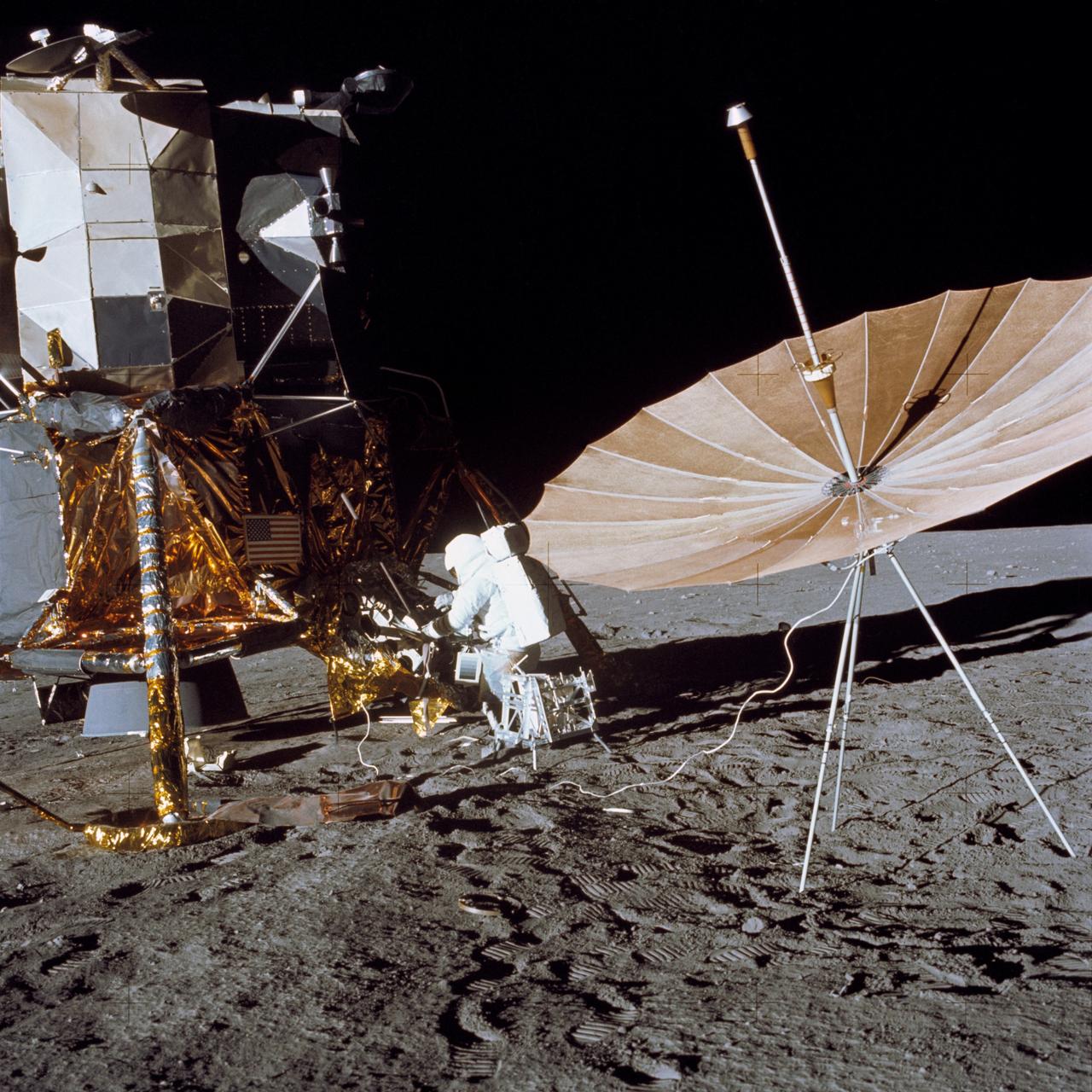
AS12-47-6988 (19 Nov. 1969) --- Astronaut Charles Conrad Jr., commander of the Apollo 12 lunar landing mission, stands at the Module Equipment Stowage Assembly (MESA) on the Lunar Module (LM) following the first Apollo 12 extravehicular activity (EVA) on the lunar surface. The erectable S-band antenna is already deployed at right. The carrier for the Apollo Lunar Hand Tools (ALHT) is near Conrad. While astronauts Conrad and Alan L. Bean, lunar module pilot, descended in the LM to explore the lunar surface, astronaut Richard F. Gordon Jr., command module pilot, remained with the Command and Service Modules (CSM) in lunar orbit.

S69-38862 (September 1969) --- Astronaut Richard F. Gordon Jr., Apollo 12 command module pilot.
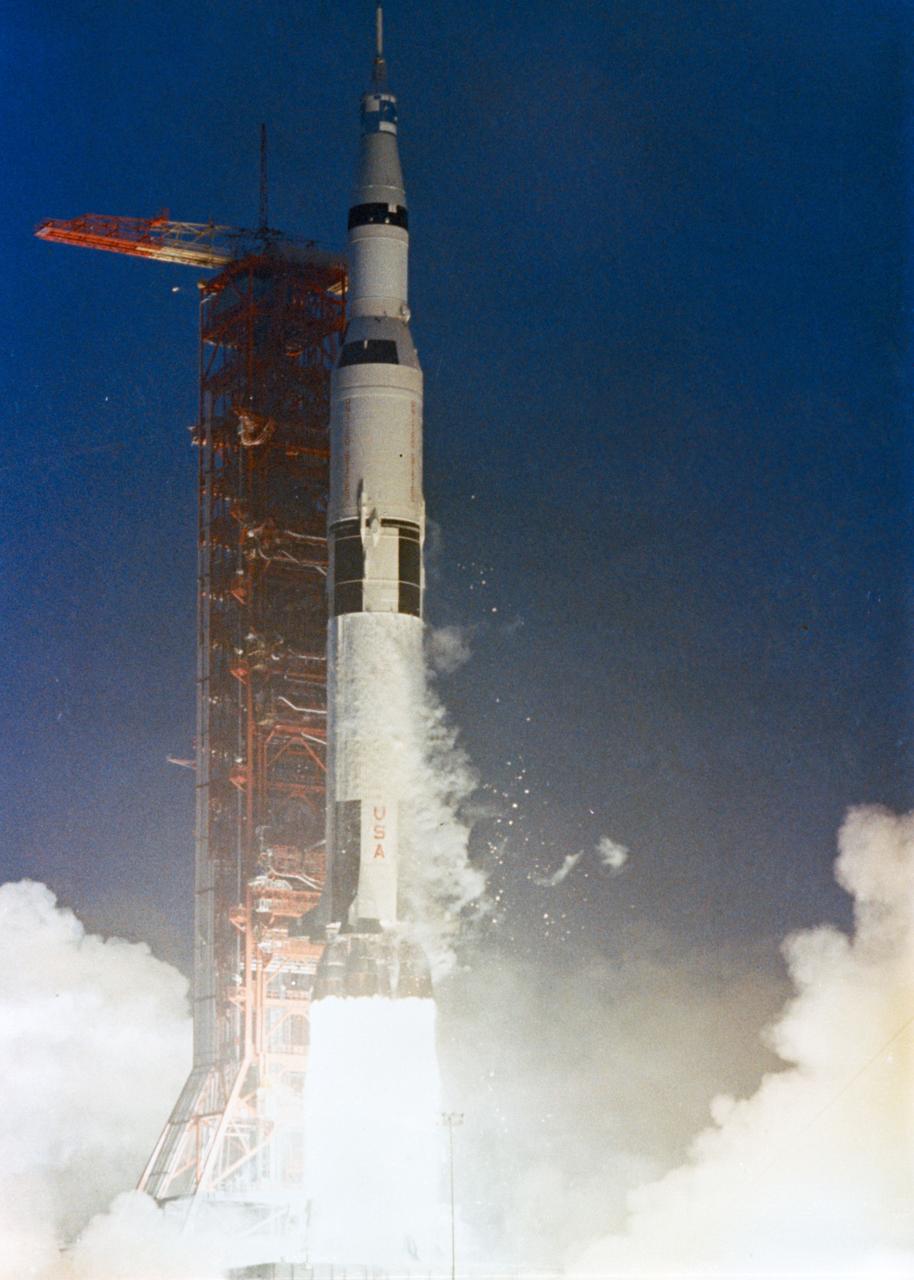
S69-58883 (14 Nov. 1969) --- The huge, 363-feet tall Apollo 12 (Spacecraft 108/Lunar Module 6/Saturn 507) space vehicle is launched from Pad A, Launch Complex 39, Kennedy Space Center (KSC), at 11:22 a.m. (EST), Nov. 14, 1969. Aboard the Apollo 12 spacecraft were astronauts Charles Conrad Jr., commander; Richard F. Gordon Jr., command module pilot; and Alan L. Bean, lunar module pilot. Apollo 12 is the United States' second lunar landing mission.

S69-58884 (14 Nov. 1969) --- The huge, 363-feet tall Apollo 12 (Spacecraft 108/Lunar Module 6/Saturn 507) space vehicle is launched from Pad A, Launch Complex 39, Kennedy Space Center (KSC), at 11:22 a.m. (EST), Nov. 14, 1969. Aboard the Apollo 12 spacecraft were astronauts Charles Conrad Jr., commander; Richard F. Gordon Jr., command module pilot; and Alan L. Bean, lunar module pilot. Apollo 12 is the United States' second lunar landing mission.
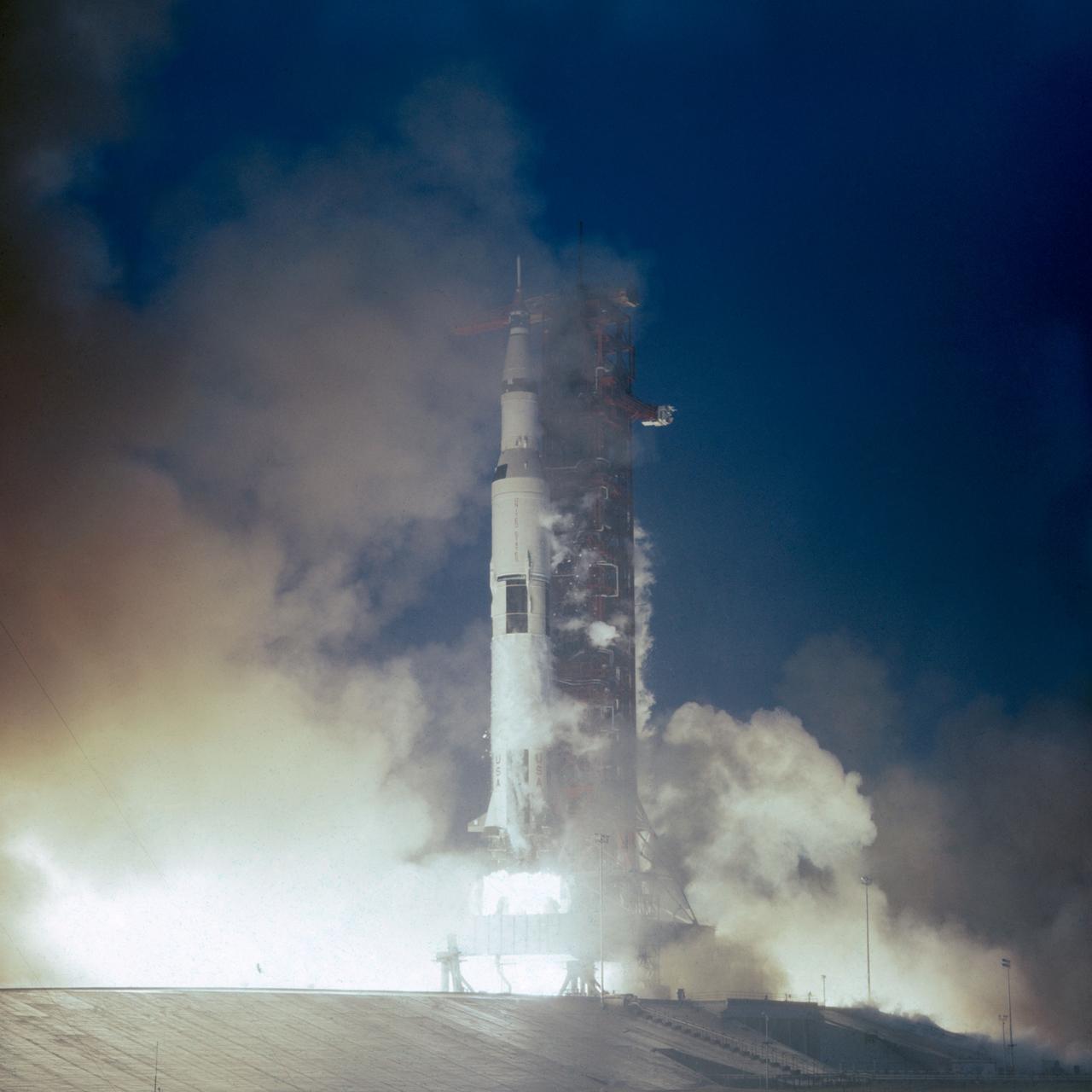
S69-58879 (14 Nov. 1969) --- The huge, 363-feet tall Apollo 12 (Spacecraft 108/Lunar Module 6/Saturn 507) space vehicle is launched from Pad A, Launch Complex 39, Kennedy Space Center (KSC), at 11:22 a.m. (EST), Nov. 14, 1969. Aboard the Apollo 12 spacecraft were astronauts Charles Conrad Jr., commander; Richard F. Gordon Jr., command module pilot, and Alan L. Bean, lunar module pilot. Apollo 12 is the United States' second lunar landing mission.
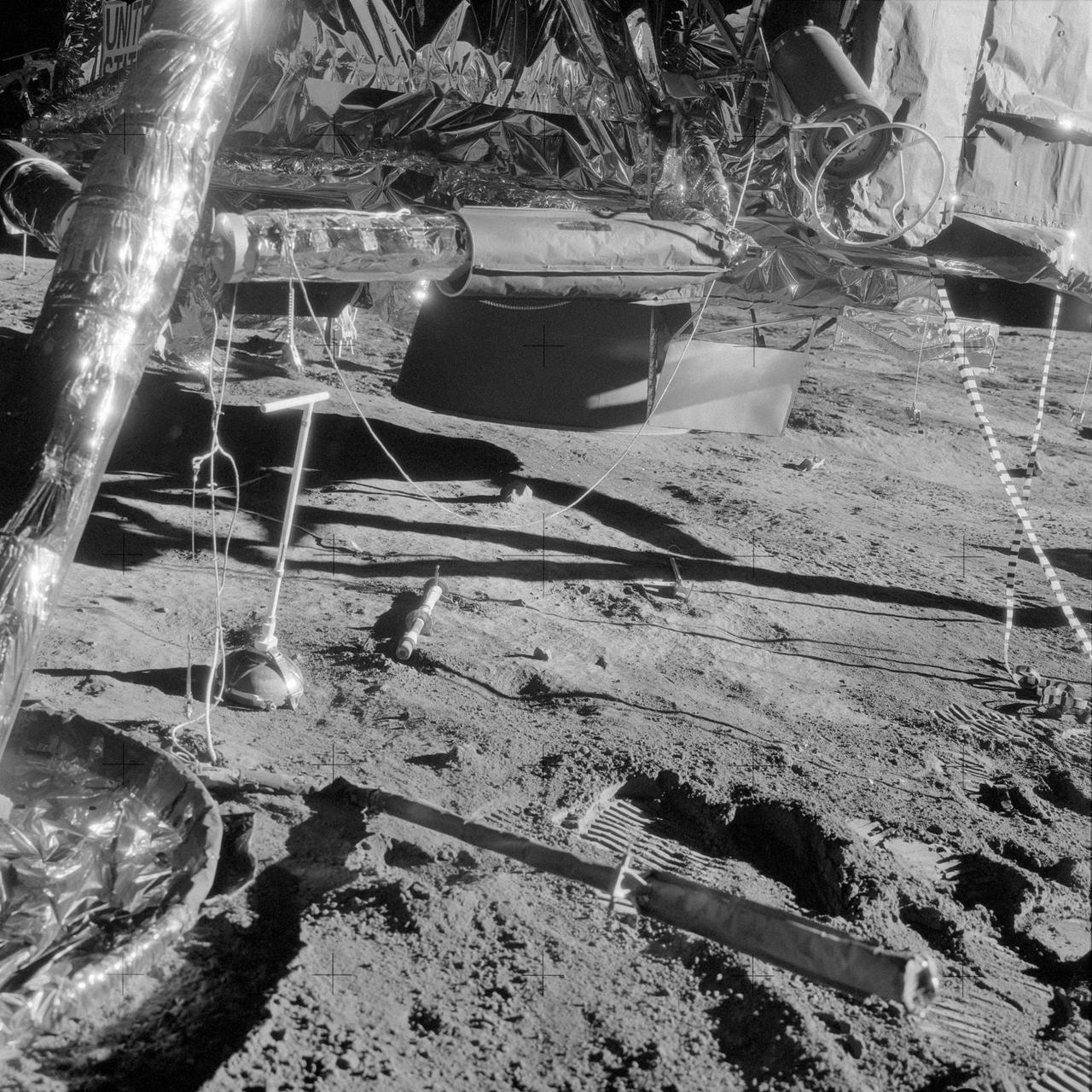
AS12-48-7034 (19 Nov. 1969) --- A close-up view of a portion of quadrant II of the descent stage of the Apollo 12 Lunar Module (LM), photographed during the Apollo 12 extravehicular activity (EVA). At lower left is the LM's Y footpad. The empty Radioisotope Thermoelectric Generator (RTG) fuel cask is at upper right. The fuel capsule has already been removed and placed in the RTG. The RTG furnishes power for the Apollo Lunar Surface Experiments Package (ALSEP) which the Apollo 12 astronauts deployed on the moon. The LM's descent engine skirt is in the center background. The rod-like object protruding out from under the footpad is a lunar surface sensing probe. Astronaut Richard F. Gordon Jr., command module pilot, remained with the Command and Service Modules (CSM) in lunar orbit while astronauts Charles Conrad Jr., commander; and Alan L. Bean, lunar module pilot, descended in the LM to explore the moon.
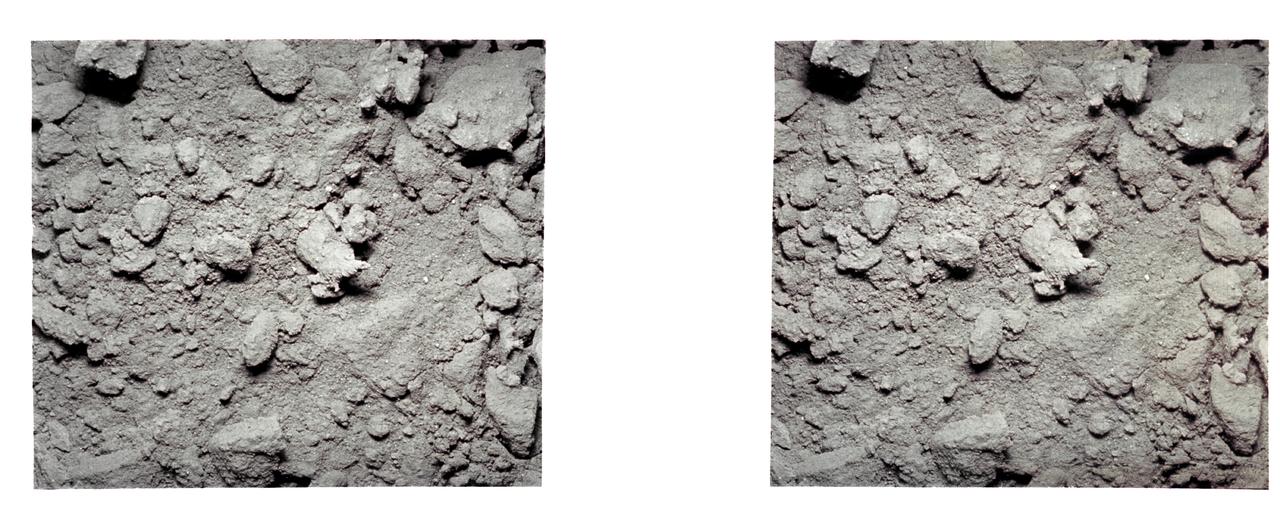
AS12-57-8455 (19-20 Nov. 1969) --- An Apollo 12 stereo view showing a three-inch square of the lunar surface. The exposure was made with an Apollo 35mm stereo close-up camera during extravehicular activity of the Apollo 12 lunar landing mission. The camera was developed to get the highest possible resolution of a small area. The three-inch square is photographed with a flash illumination and at a fixed distance. The camera is mounted on a walking stick, and the astronauts use it by holding it up against the object to be photographed and pulling the trigger. Astronauts Charles Conrad Jr., commander, and Alan L. Bean, lunar module pilot, descended in the Apollo 12 Lunar Module to explore the moon while astronaut Richard F. Gordon Jr. remained with the Command and Service Modules in lunar orbit in the capacity of command module pilot.
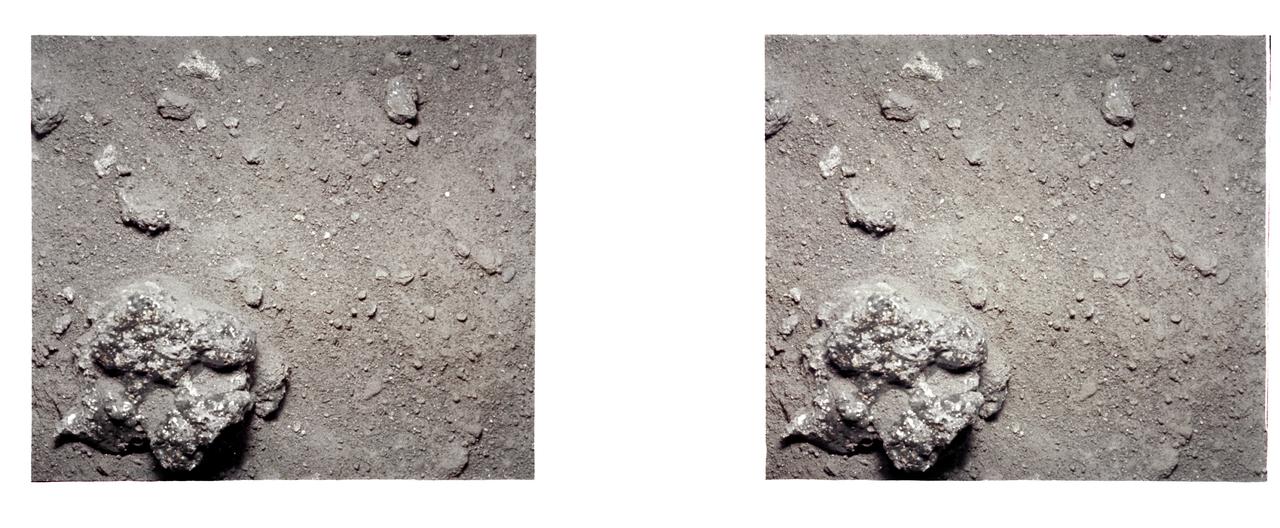
AS12-57-8452 (19-20 Nov. 1969) --- An Apollo 12 stereo view showing a three-inch square of the lunar surface. The exposure was made with an Apollo 35mm stereo close-up camera during extravehicular activity of the Apollo 12 lunar landing mission. The camera was developed to get the highest possible resolution of a small area. The three-inch square is photographed with a flash illumination and at a fixed distance. The camera is mounted on a walking stick, and the astronauts use it by holding it up against the object to be photographed and pulling the trigger. Astronauts Charles Conrad Jr., commander, and Alan L. Bean, lunar module pilot, descended in the Apollo 12 Lunar Module to explore the moon while astronaut Richard F. Gordon Jr. remained with the Command and Service Modules in lunar orbit in the capacity of command module pilot.
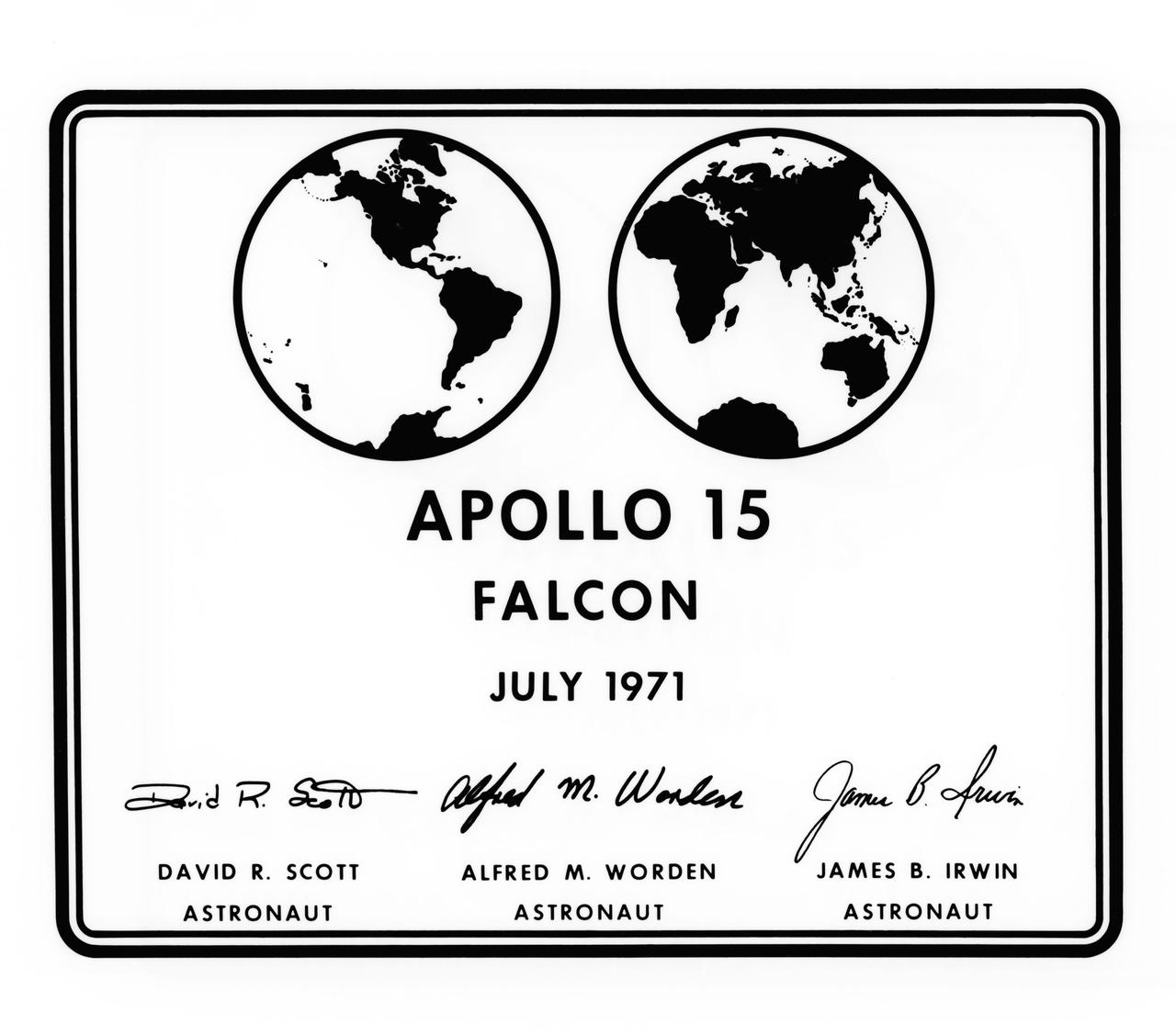
S71-39357 (July 1971) --- A photographic replica of the plaque which the Apollo 15 astronauts will leave behind on the moon during their lunar landing mission. Astronauts David R. Scott, commander; and James B. Irwin, lunar module pilot; will descend to the lunar surface in the Lunar Module (LM) "Falcon". Astronaut Alfred M. Worden, command module pilot, will remain with the Command and Service Modules (CSM) in lunar orbit. The seven by nine inch stainless steel plaque will be attached to the ladder on the landing gear strut on the LM's descent stage. Commemorative plaques were also left on the moon by the Apollo 11, Apollo 12 and Apollo 14 astronauts.
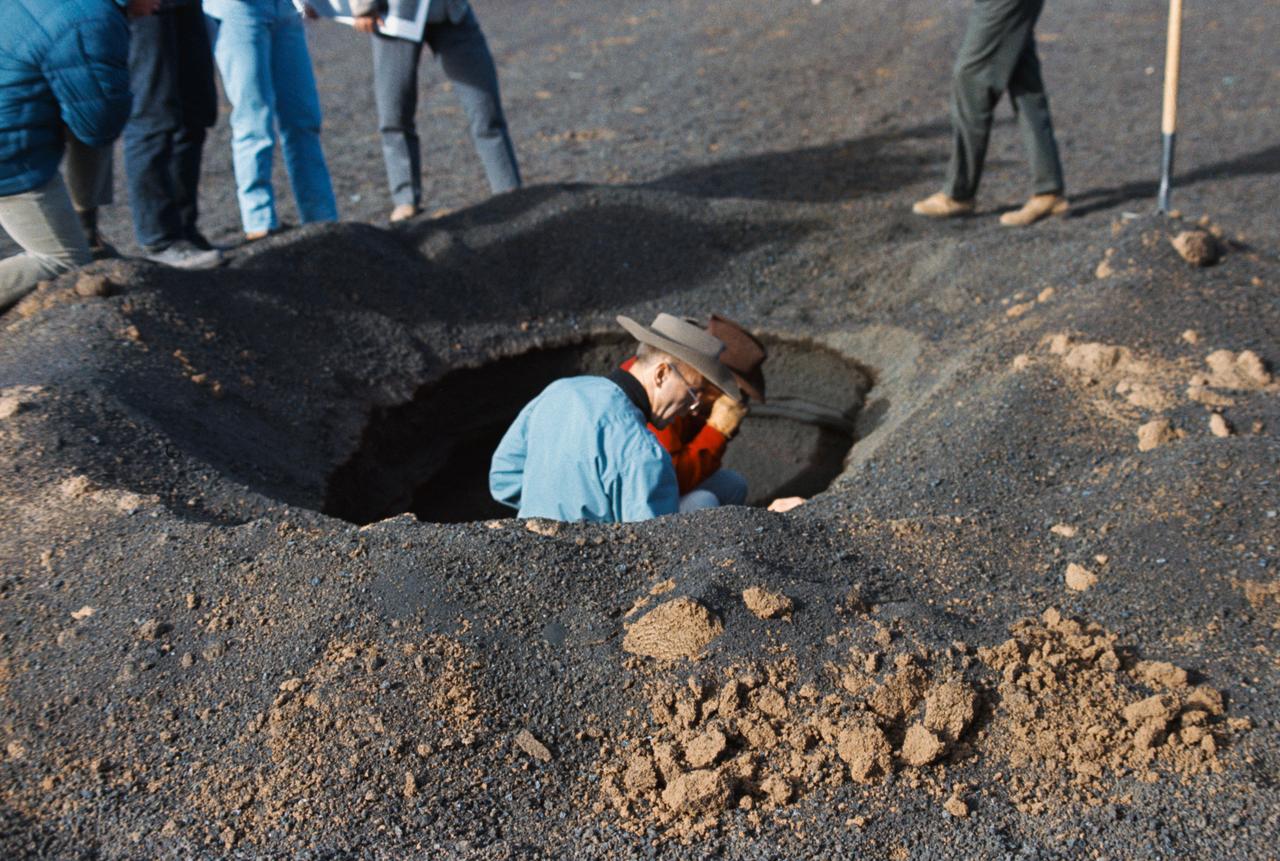
S69-55662 (10 Oct. 1969) --- Astronauts Alan L. Bean (left) and Charles Conrad Jr., the two crewmen of the Apollo 12 lunar landing mission who are scheduled to participate in two lengthy periods of extravehicular activity (EVA) on the lunar surface, are pictured during a geological field trip and training at a simulated lunar surface area near Flagstaff, Arizona. Here Conrad, the Apollo 12 commander, gets a close look through hand lens at the stratigraphy (study of strata or layers beneath the surface) of a man-dug hole, while Bean, the Apollo 12 mission's lunar module pilot, looks on. The topography in this area, with several man-made modifications, resembles very closely much of the topography found on the lunar surface. While Conrad and Bean explore the lunar surface (plans call for Apollo 12 spacecraft to land in the Sea of Storms), astronaut Richard F. Gordon Jr., command module pilot for the Apollo 12 mission, will remain with the Command and Service Modules (CSM) in lunar orbit. The Apollo 12 mission is scheduled to lift off from Cape Kennedy on Nov. 14, 1969.
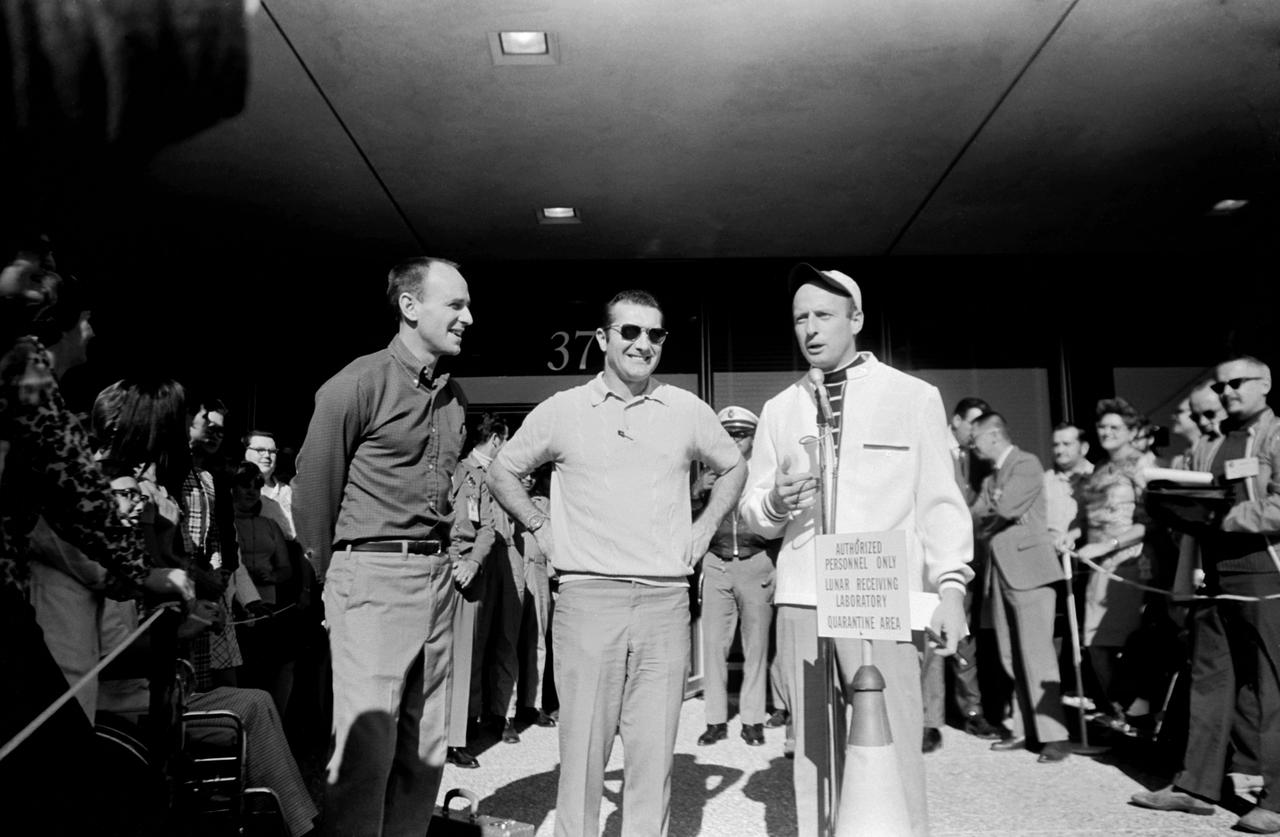
S69-62884 (10 Dec. 1969) --- Astronaut Charles Conrad Jr., commander of the Apollo 12 lunar landing mission, makes several remarks publicly in response to the welcome given him and other members of the Apollo 12 crew upon their release from post-mission isolation in the Manned Spacecraft Center's (MSC) Lunar Receiving Laboratory (LRL). Pictured with Conrad outside Building 37, which houses the LRL, are his fellow crewmembers for the Apollo 12 mission, astronauts Alan L. Bean (left), lunar module pilot; and Richard F. Gordon Jr. (center), command module pilot.
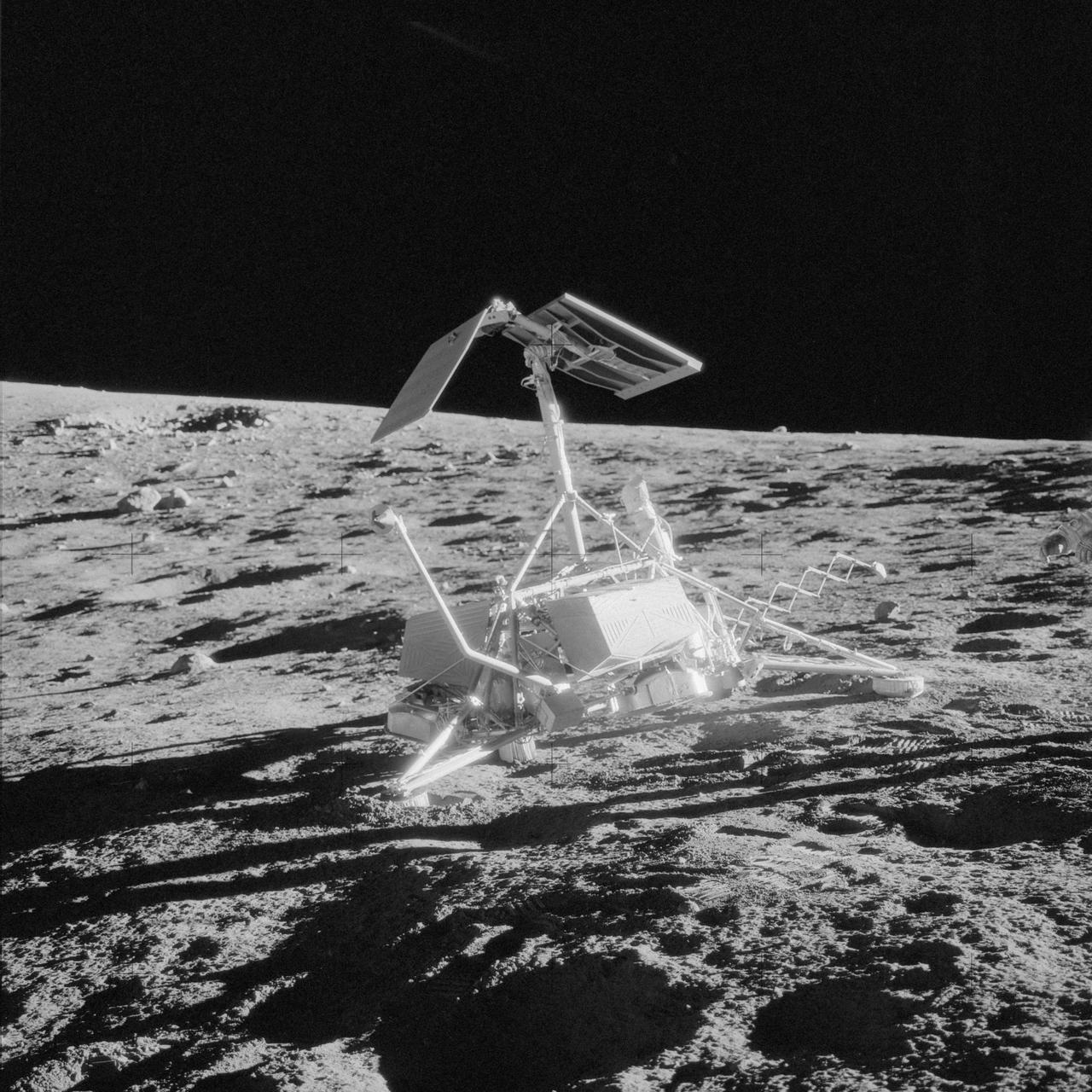
AS12-48-7121 (20 Nov. 1969) --- An excellent view of the unmanned Surveyor 3 spacecraft which was photographed during the Apollo 12 second extravehicular activity (EVA) on the surface of the moon. The Apollo 12 Lunar Module (LM), with astronauts Charles Conrad Jr., commander, and Alan L. Bean, lunar module pilot, aboard landed within 600 feet of Surveyor 3 in the Ocean of Storms. The television camera and several other pieces were taken from Surveyor 3 and brought back to Earth for scientific examination. Surveyor 3 landed on the side of this small crater in the Ocean of Storms on April 19, 1967. Astronaut Richard F. Gordon Jr., command module pilot, remained with the Apollo 12 Command and Service Modules (CSM) in lunar orbit while Conrad and Bean descended to explore the moon.
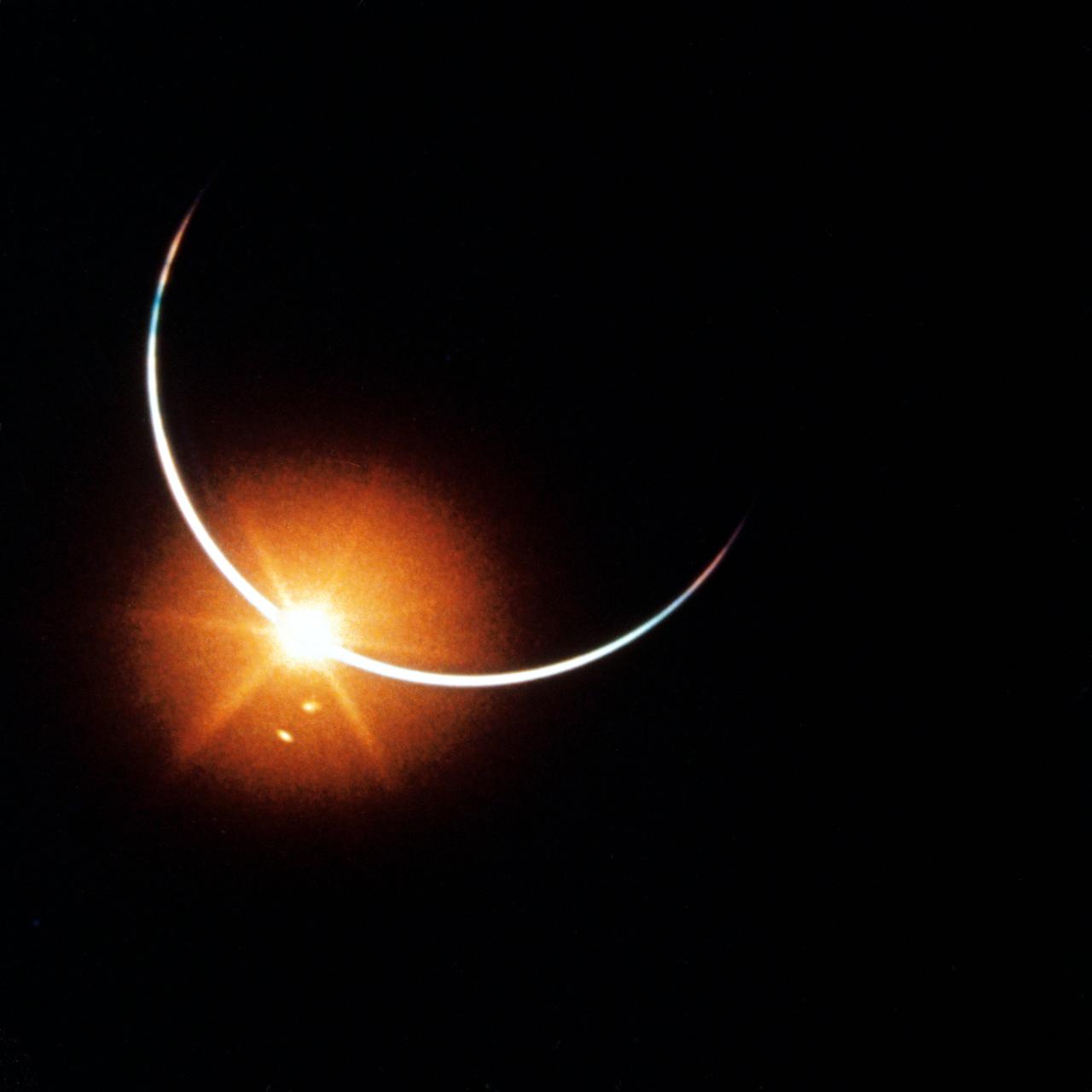
S80-37406 (14-24 Nov. 1969) --- This photograph of the eclipse of the sun was taken with a 16mm motion picture camera from the Apollo 12 spacecraft during its trans-Earth journey home from the moon. The fascinating view was created when the Earth moved directly between the sun and the Apollo 12 spacecraft. Aboard Apollo 12 were astronauts Charles Conrad Jr., commander; Richard F. Gordon Jr., command module pilot; and Alan L. Bean, lunar module pilot. While astronauts Conrad and Bean descended in the Lunar Module (LM) "Intrepid" to explore the Ocean of Storms region of the moon, astronaut Gordon remained with the Command and Service Modules (CSM) "Yankee Clipper" in lunar orbit.
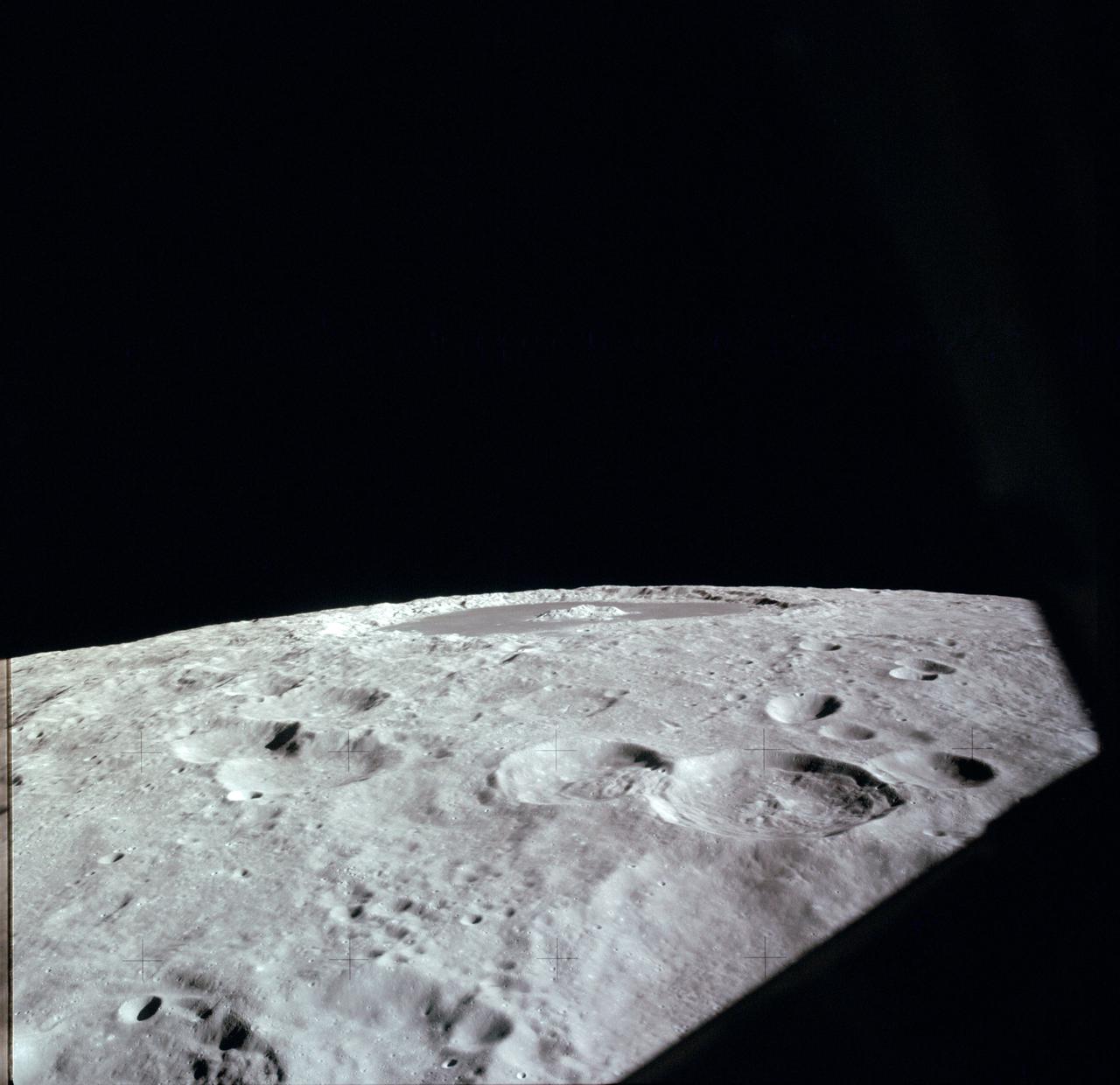
AS12-47-6870 (November 1969) --- An Apollo 12 high-oblique view of the crater Tsiolkovsky (in center of horizon) on the lunar farside, as photographed from lunar orbit. The crew men of the Apollo 12 lunar landing mission were astronauts Charles Conrad Jr., commander; Richard F. Gordon Jr., command module pilot; and Alan L. Bean, lunar module pilot. Tsiolkovsky is centered at 128.5 degrees east longitude and 20.5 degrees south latitude. This view is looking south.
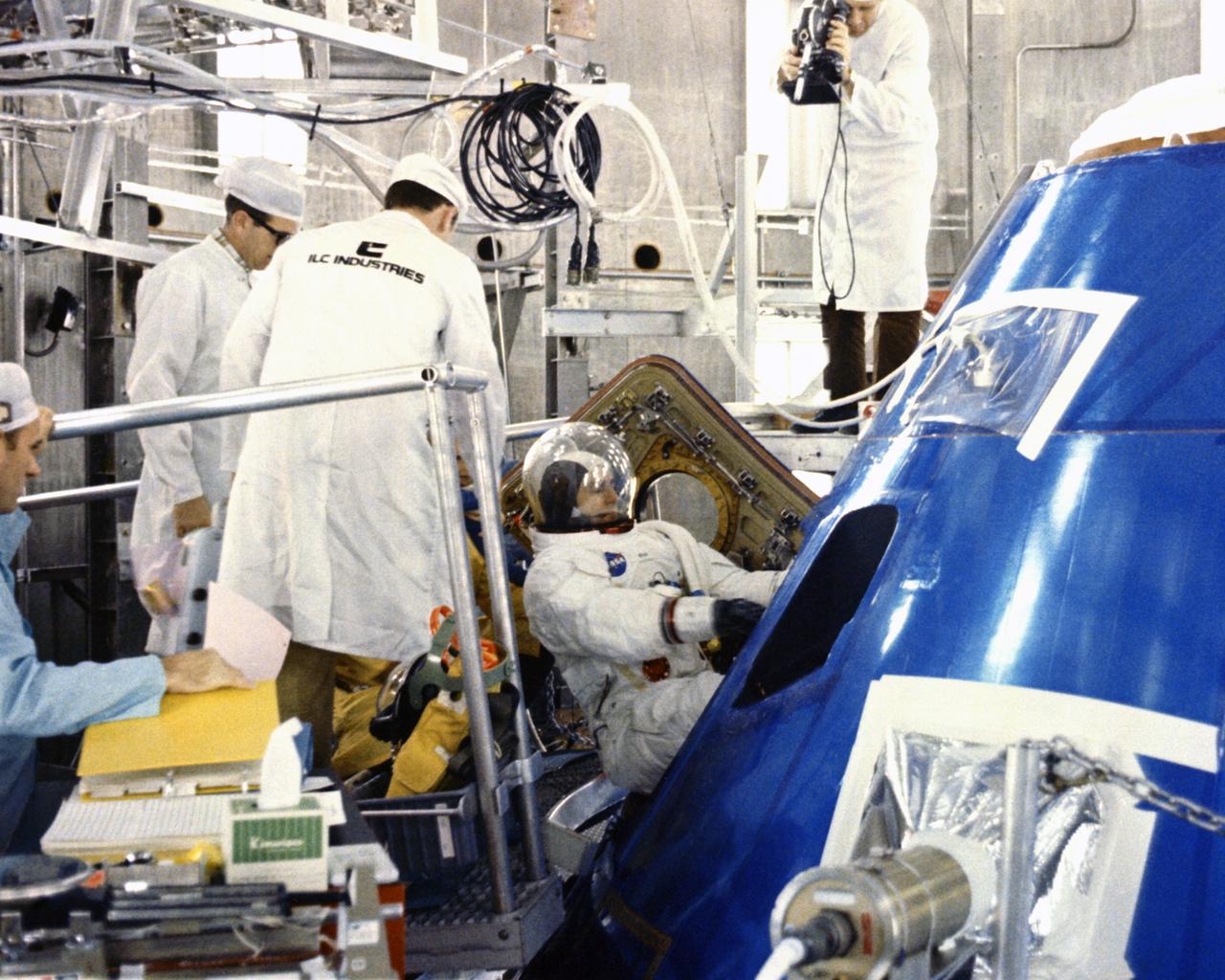
CAPE CANAVERAL, Fla. -- Apollo 12 Lunar Module pilot Alan L. Bean enters spacecraft in preparation for altitude chamber test with mission commander Charles Conrad Jr. and Richard F. Gordon Jr., command module pilot. Air was pumped out of the chamber to simulate a space environment. The Apollo 12 astronauts are scheduled to perform the nation’s second manned lunar landing. Photo credit: NASA
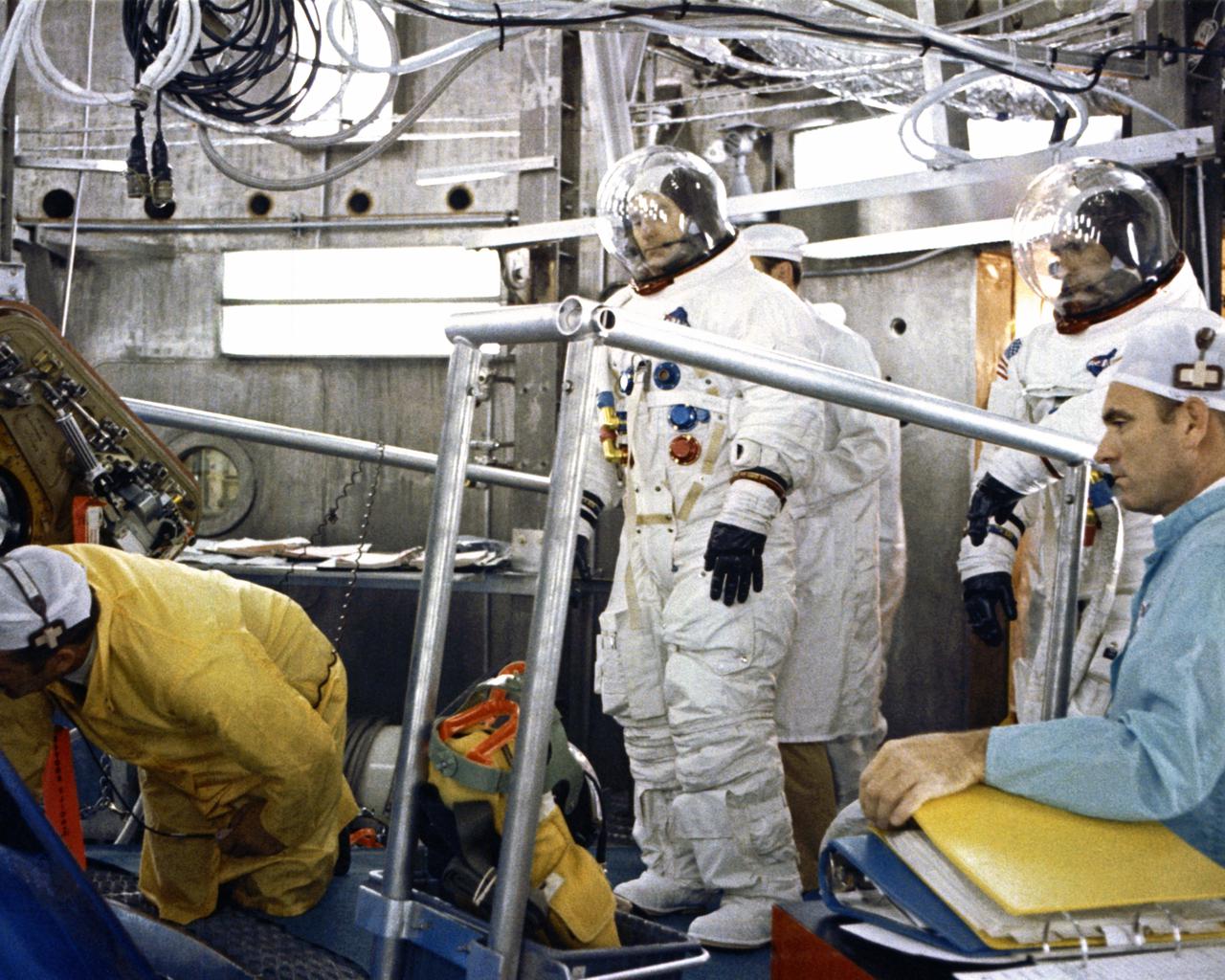
CAPE CANAVERAL, Fla. -- Apollo 12 lunar module pilot Alan L. Bean enters spacecraft in preparation for altitude chamber test with mission commander Charles Conrad Jr. and Richard F. Gordon Jr., command module pilot. Air was pumped out of the chamber to simulate a space environment. The Apollo 12 astronauts are scheduled to perform the nation’s second manned lunar landing. Photo credit: NASA
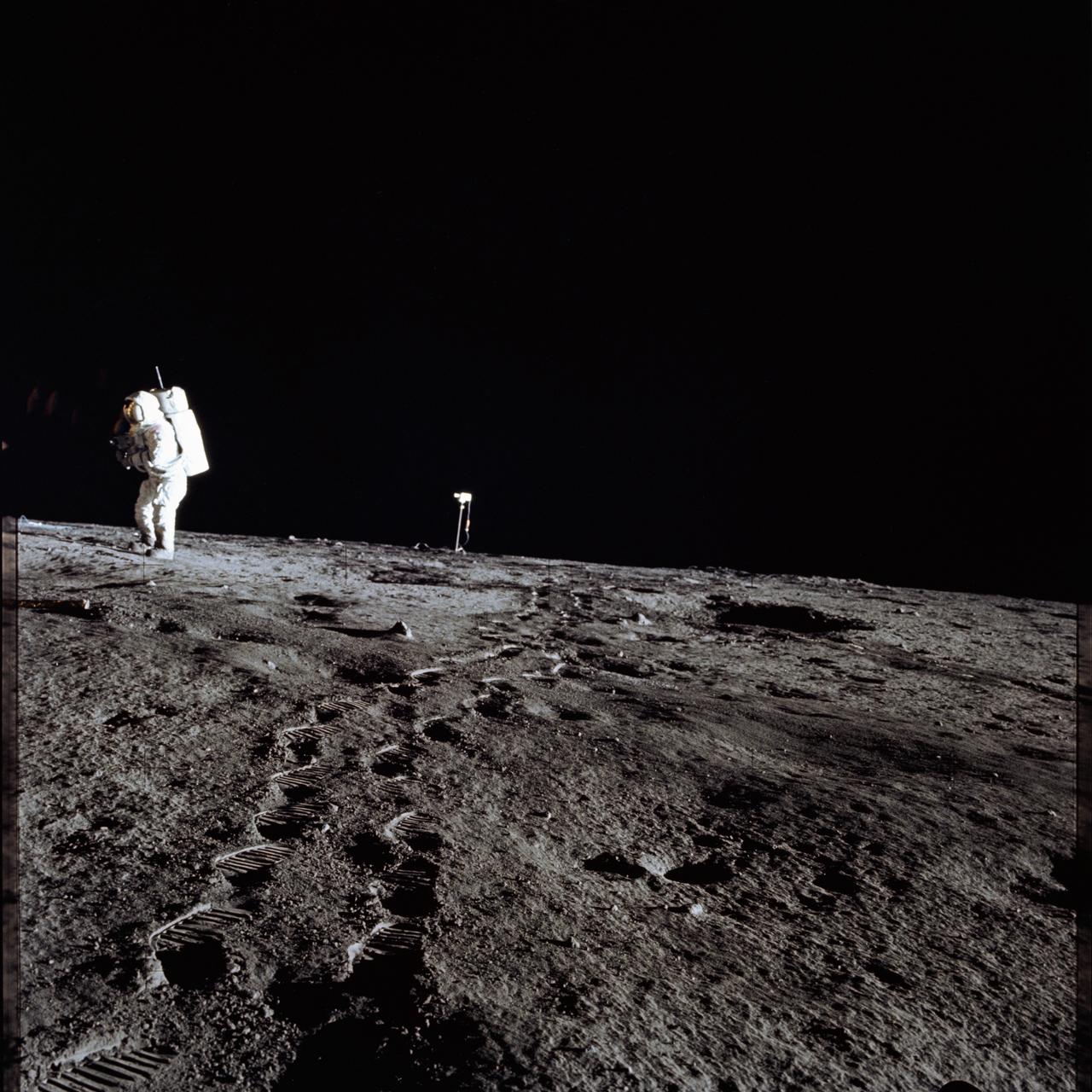
AS12-46-6780 (19 Nov. 1969) --- Astronaut Alan L. Bean, lunar module pilot for the Apollo 12 lunar landing mission, walks from the color lunar surface television camera (center) toward the Apollo 12 Lunar Module (LM - out of frame). The photograph was taken by astronaut Charles Conrad Jr., commander, during the first extravehicular activity (EVA) of the mission. While astronauts Conrad and Bean descended in the LM "Intrepid" to explore the Ocean of Storms region of the moon, astronaut Richard F. Gordon Jr., command module pilot, remained with the Command and Service Modules (CSM) "Yankee Clipper" in lunar orbit.
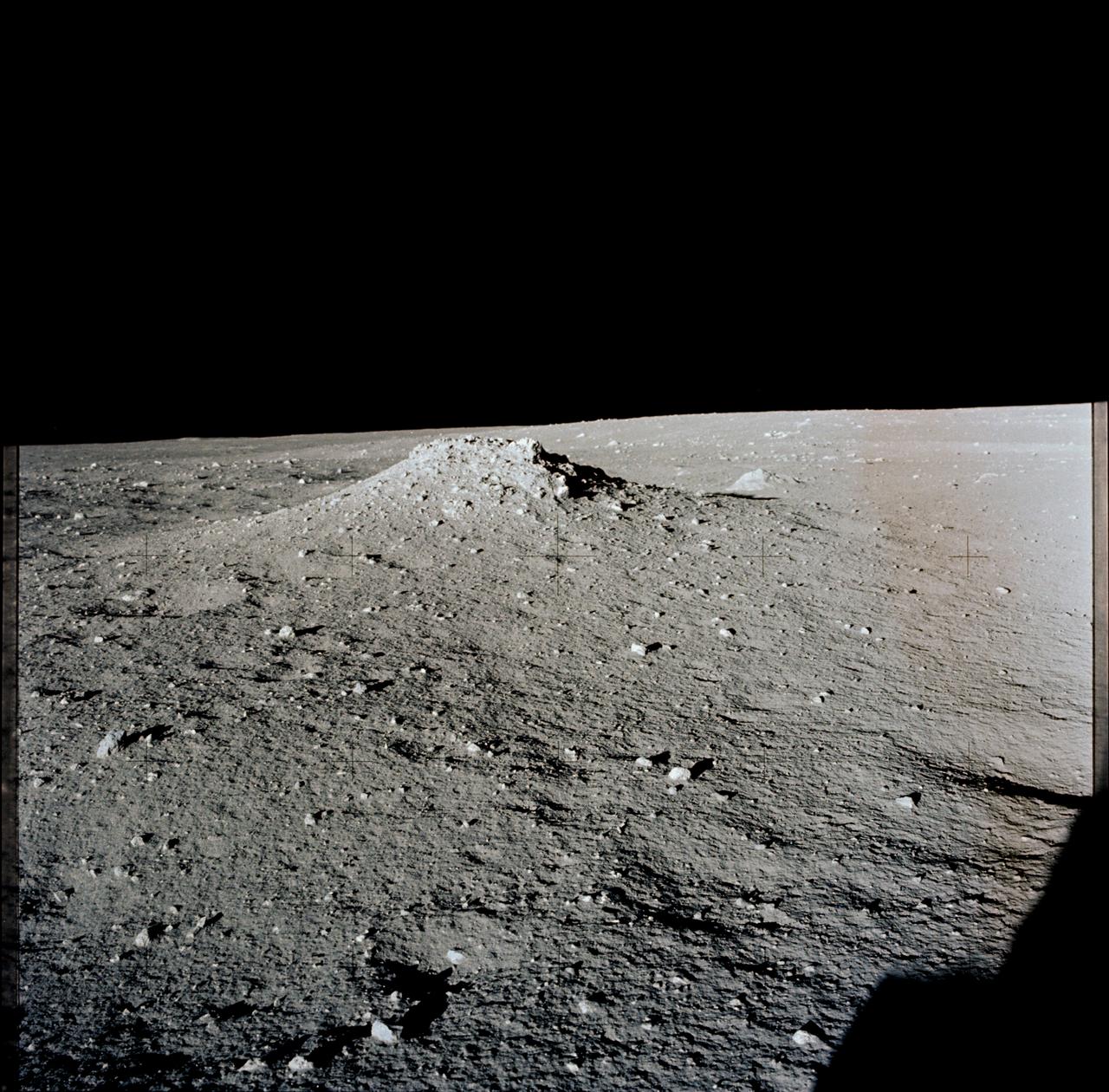
AS12-46-6795 (19-20 Nov. 1969) --- A view of the lunar surface in the vicinity of the Apollo 12 lunar landing site, photographed during the extravehicular activity (EVA) of astronauts Charles Conrad Jr., commander, and Alan L. Bean, lunar module pilot. Conrad and Bean encountered the odd, anthill-shaped mound during their lunar traverse. The two descended in the Apollo 12 Lunar Module (LM) to explore the moon, while astronaut Richard F. Gordon Jr., command module pilot, remained with the Command and Service Modules (CSM) in lunar orbit.
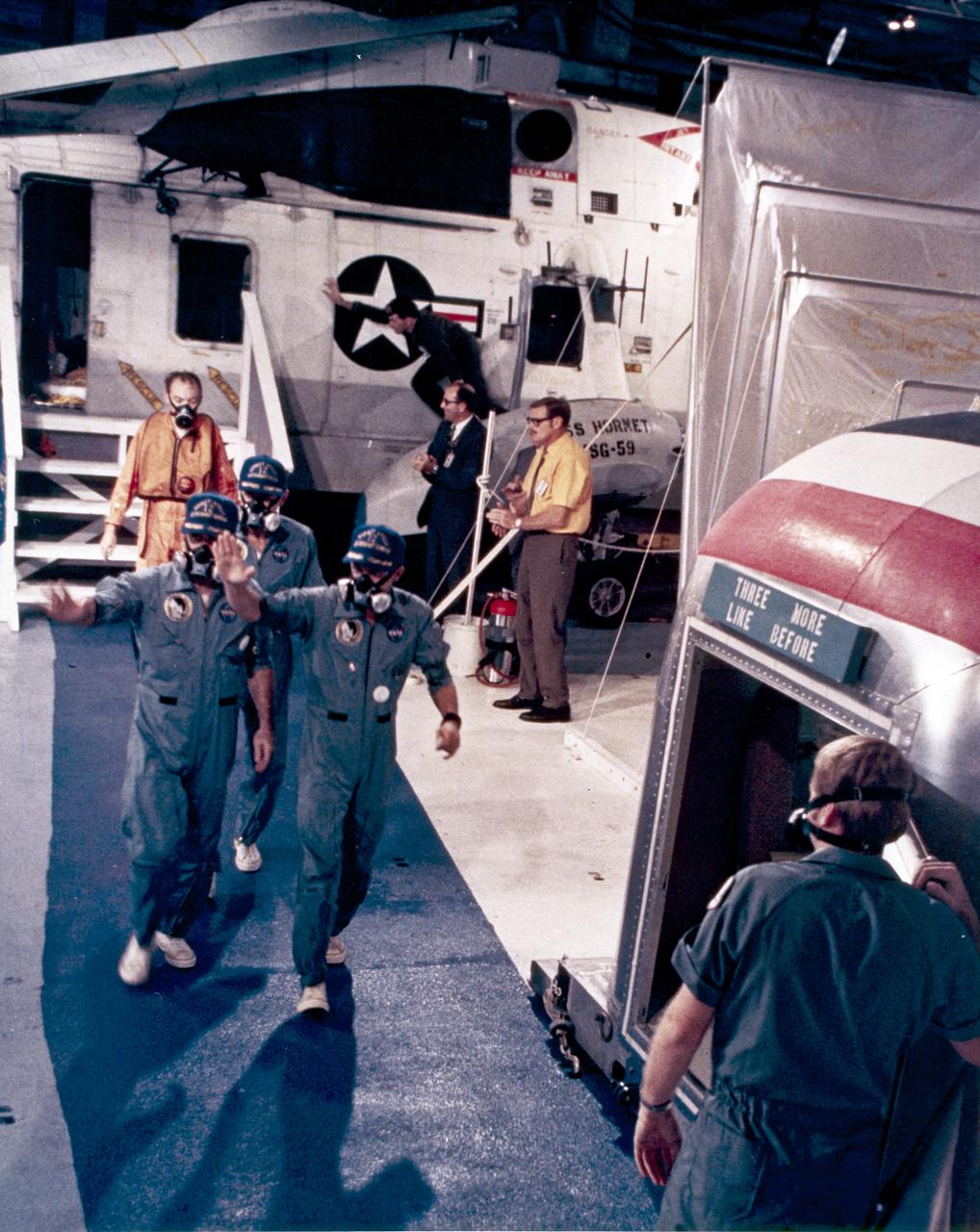
Aboard the recovery ship, USS Hornet, Apollo 12 astronauts wave to the crowd as they enter the mobile quarantine facility. The recovery operation took place in the Pacific Ocean after the splashdown of the Command Module capsule. Navy para-rescue men recovered the capsule housing the 3-man Apollo 12 crew. The second manned lunar landing mission, Apollo 12 launched from launch pad 39-A at Kennedy Space Center in Florida on November 14, 1969 via a Saturn V launch vehicle. The Saturn V was developed by the Marshall Space Flight Center (MSFC) under the direction of Dr. Wernher von Braun. Aboard Apollo 12 was a crew of three astronauts: Alan L. Bean, pilot of the Lunar Module (LM), Intrepid; Richard Gordon, pilot of the Command Module (CM), Yankee Clipper; and Spacecraft Commander Charles Conrad. The LM, Intrepid, landed astronauts Conrad and Bean on the lunar surface in what’s known as the Ocean of Storms while astronaut Richard Gordon piloted the CM, Yankee Clipper, in a parking orbit around the Moon. Lunar soil activities included the deployment of the Apollo Lunar Surface Experiments Package (ALSEP), finding the unmanned Surveyor 3 that landed on the Moon on April 19, 1967, and collecting 75 pounds (34 kilograms) of rock samples. Apollo 12 safely returned to Earth on November 24, 1969.
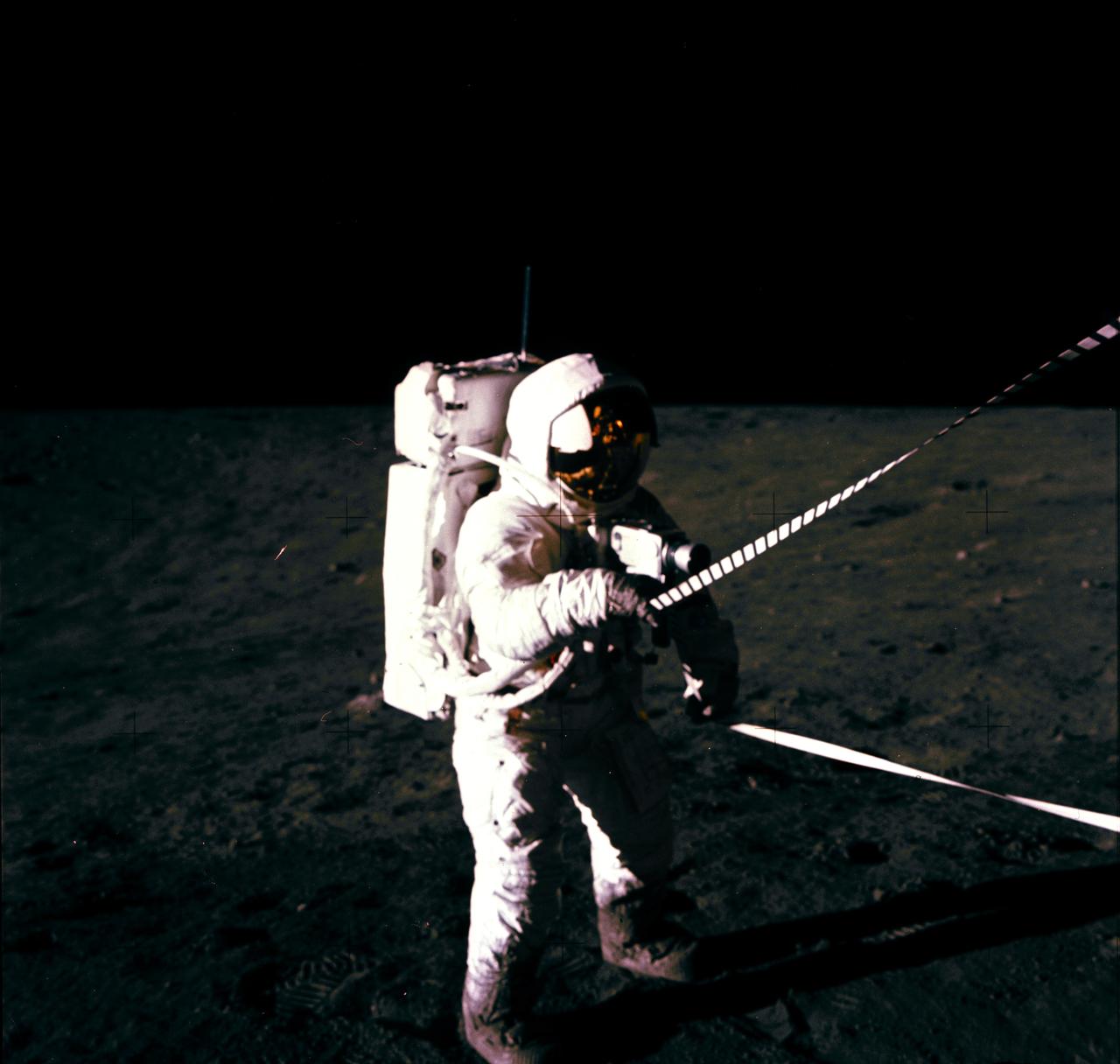
Astronaut Charles Conrad Jr., commander, uses the lunar equipment conveyer (LEC) at the Lunar Module during the Apollo 12 extravehicular activity on the lunar surface. This photograph was taken by Astronaut Alan L. Bean, lunar module pilot.
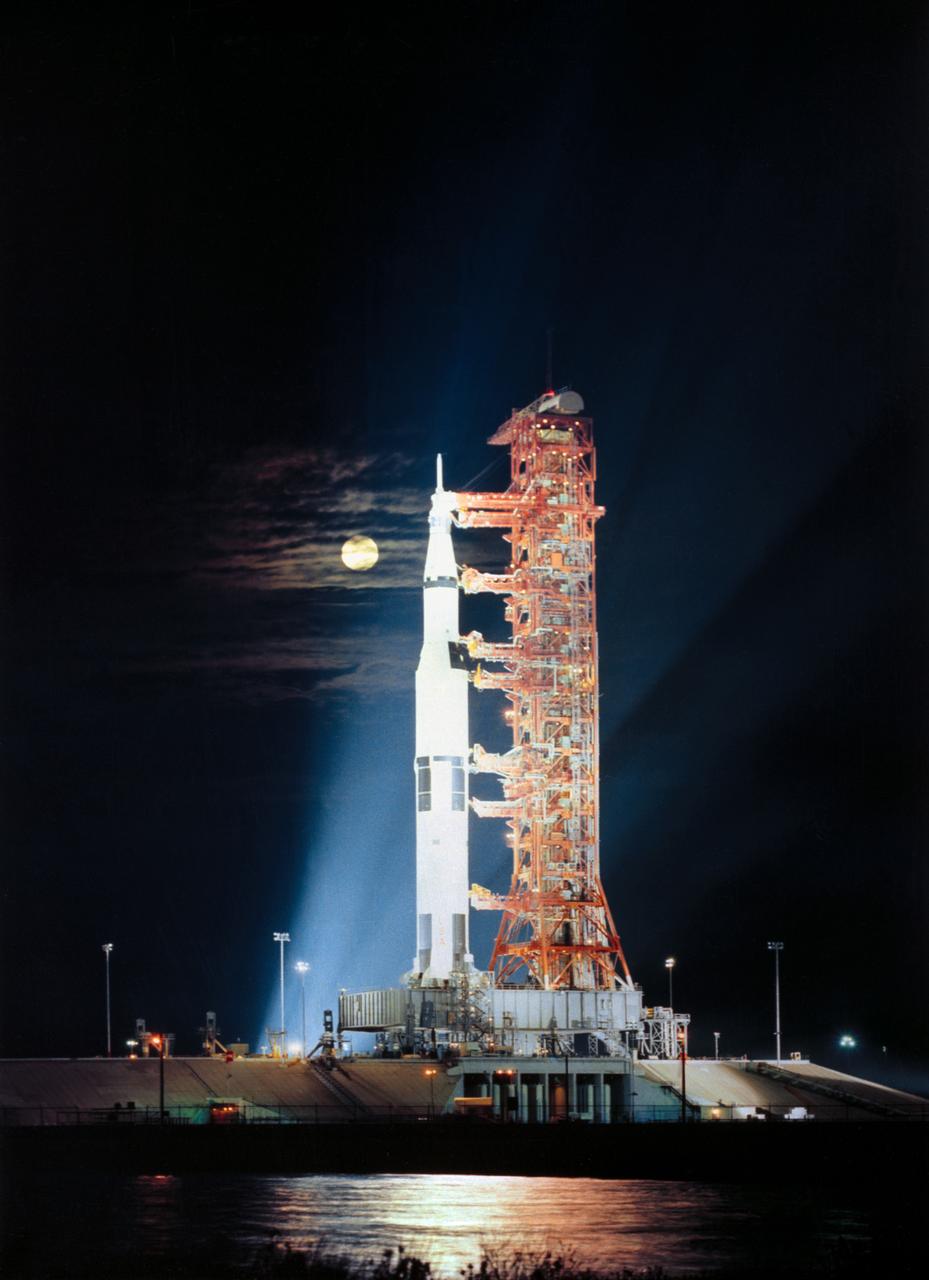
S72-54813 (November 1972) --- Searchlights illuminate this nighttime scene at Pad A, Launch Complex 39, Kennedy Space Center, Florida, showing the Apollo 17 (Spacecraft 114/Lunar Module 12/Saturn 512) space vehicle during prelaunch preparations. Apollo 17, the final lunar landing mission in NASA's Apollo program, will be the first nighttime liftoff of the huge Saturn V launch vehicle. Apollo 17 is scheduled for launching on the night of Dec. 6, 1972. Aboard the Apollo 17 spacecraft will be astronaut Eugene A. Cernan, commander; astronaut Ronald E. Evans, command module pilot; and scientist-astronaut Harrison H. Schmitt, lunar module pilot. Note the full moon in the background.
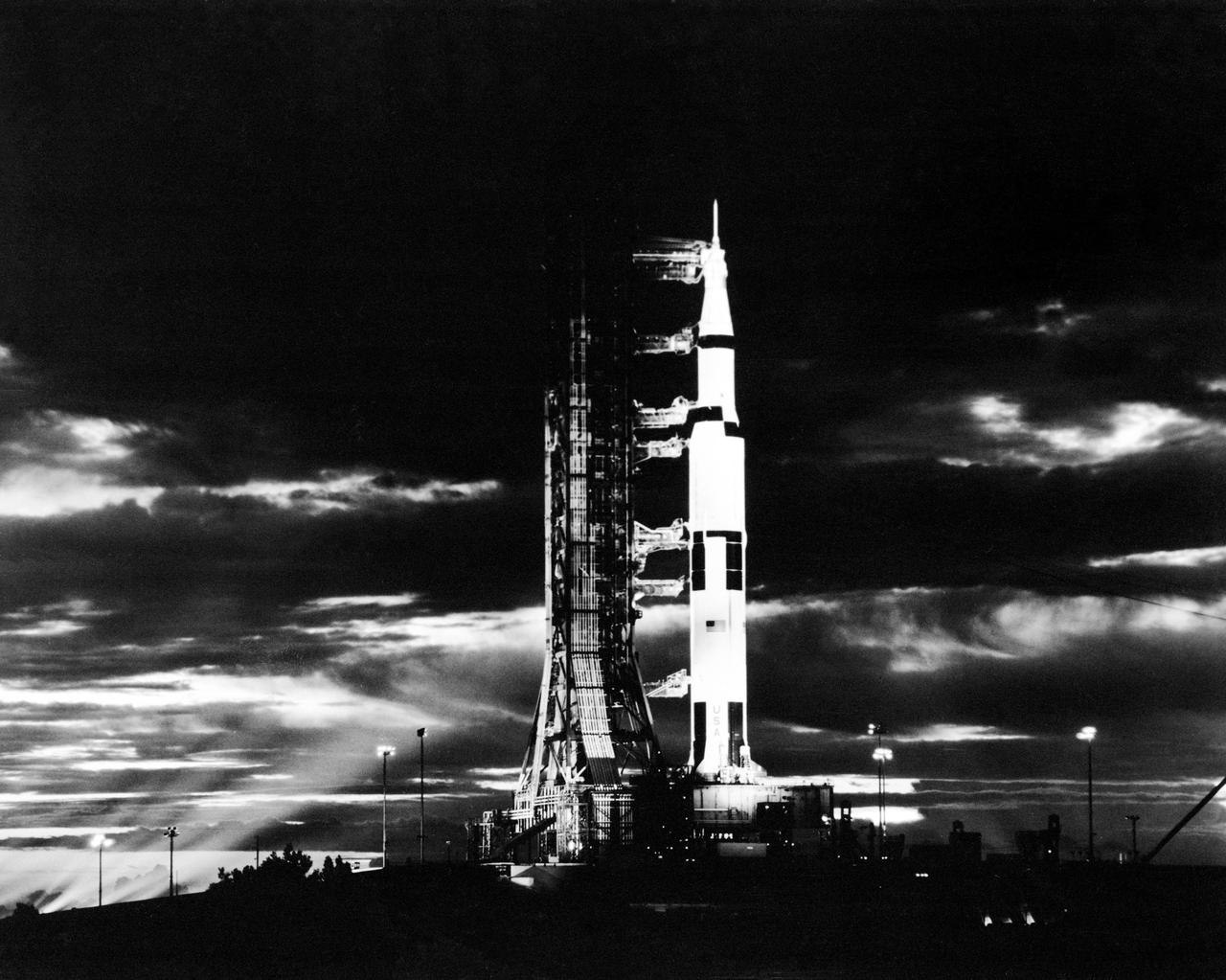
S72-54814 (November 1972) --- Searchlights illuminate this nighttime scene at Pad A, Launch Complex 39, Kennedy Space Center, Florida, showing the Apollo 17 (Spacecraft 114/Lunar Module 12/Saturn 512) space vehicle during prelaunch preparations. Apollo 17, the final lunar landing mission in NASA's Apollo program, will be the first nighttime liftoff of the huge Saturn V launch vehicle. Apollo 17 is scheduled for launching on the night of Dec. 6, 1972. Aboard the Apollo 17 spacecraft will be astronaut Eugene A. Cernan, commander; astronaut Ronald E. Evans, command module pilot; and scientist-astronaut Harrison H. Schmitt, lunar module pilot.
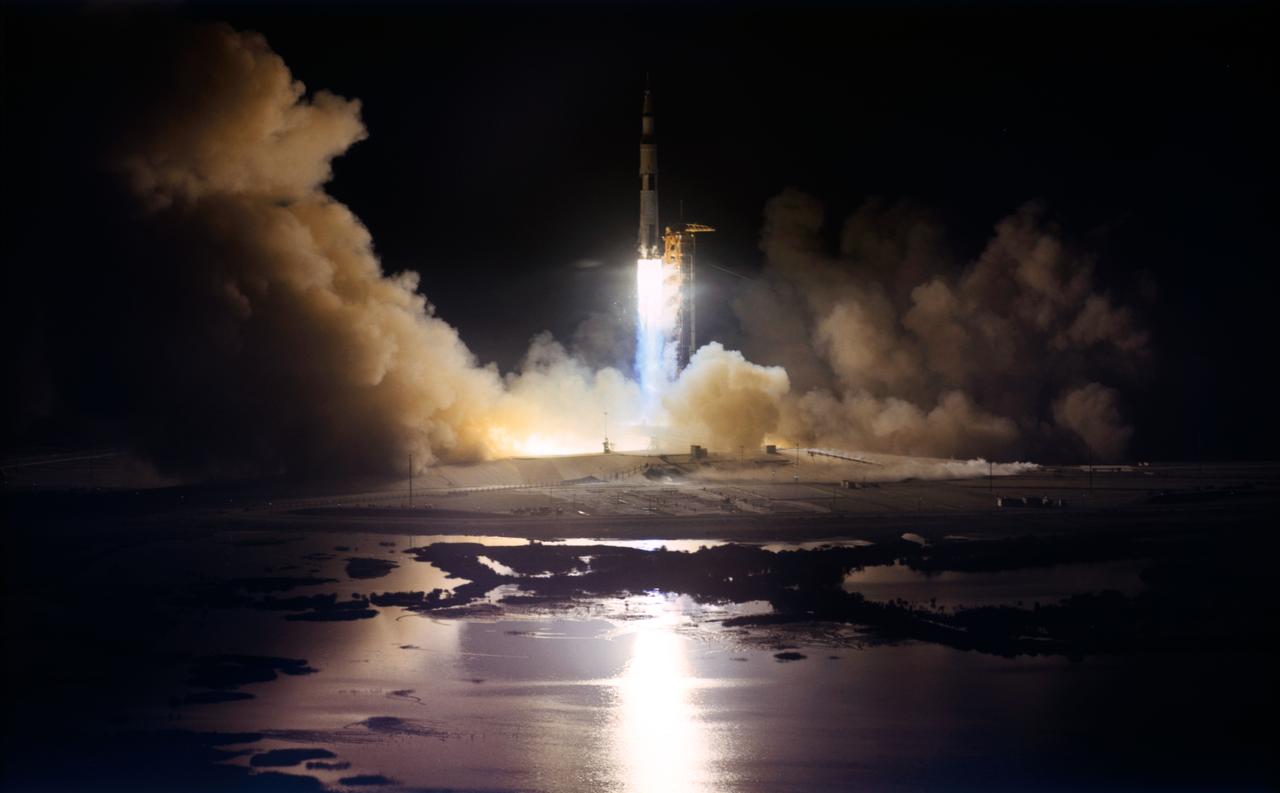
S72-55070 (7 Dec. 1972) --- The huge, 363-feet tall Apollo 17 (Spacecraft 114/Lunar Module 12/Saturn 512) space vehicle is launched from Pad A, Launch Complex 39, Kennedy Space Center (KSC), Florida, at 12:33 a.m. (EST), Dec. 7, 1972. Apollo 17, the final lunar landing mission in NASA's Apollo program, was the first nighttime liftoff of the Saturn V launch vehicle. Aboard the Apollo 17 spacecraft were astronaut Eugene A. Cernan, commander; astronaut Ronald E. Evans, command module pilot; and scientist-astronaut Harrison H. Schmitt, lunar module pilot. Flame from the five F-1 engines of the Apollo/Saturn first (S-1C) stage illuminates the nighttime scene. A two-hour and 40-minute hold delayed the Apollo 17 launching.
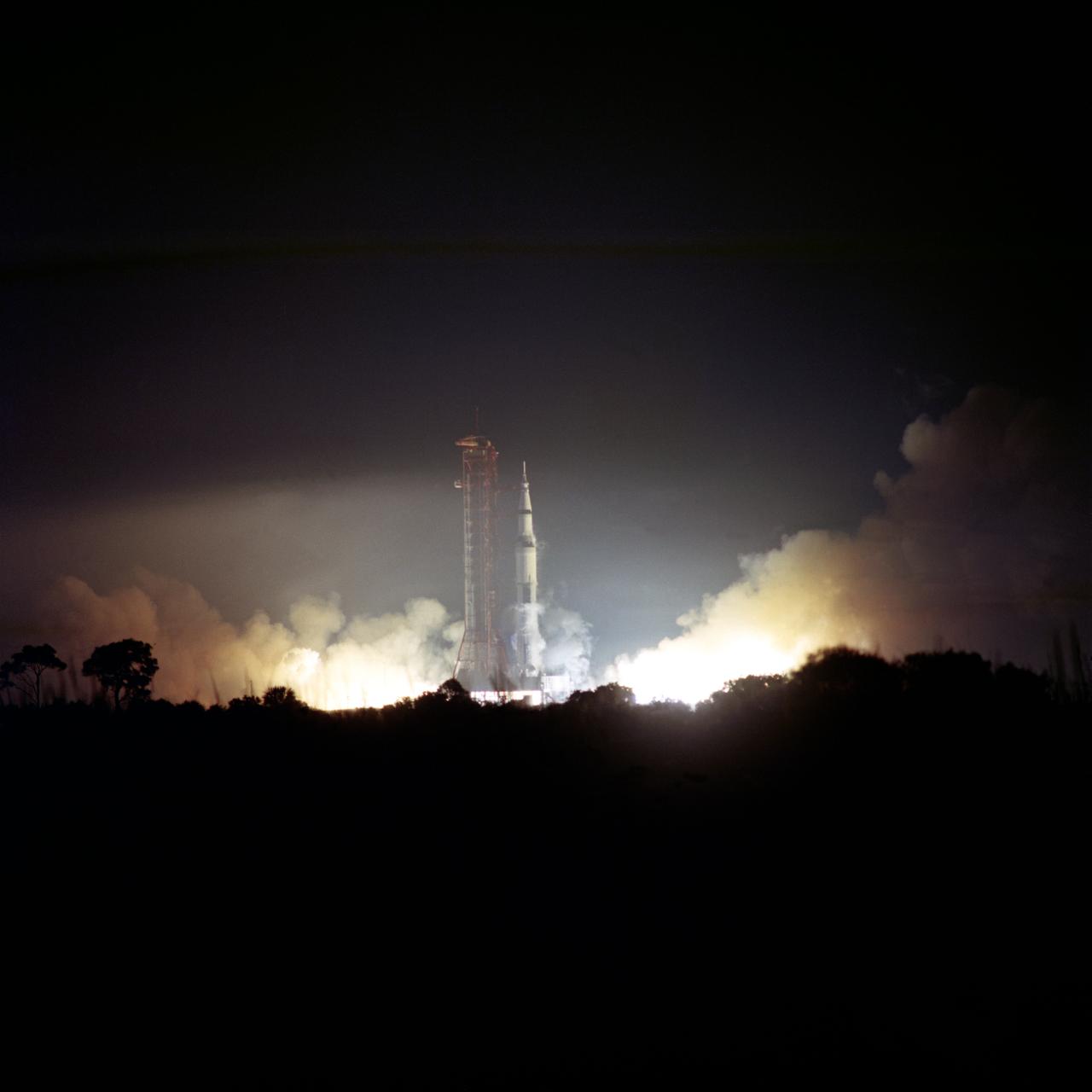
S72-55482 (7 Dec. 1972) --- The huge, 363-feet tall Apollo 17 (Spacecraft 114/Lunar Module 12/Saturn 512) space vehicle is launched from Pad A., Launch Complex 39, Kennedy Space Center (KSC), Florida, at 12:33 a.m. (EST), Dec. 7, 1972. Apollo 17, the final lunar landing mission in NASA's Apollo program, was the first nighttime liftoff of the Saturn V launch vehicle. Aboard the Apollo 17 spacecraft were astronaut Eugene A. Cernan, commander; astronaut Ronald E. Evans, command module pilot; and scientist-astronaut Harrison H. Schmitt, lunar module pilot. Flame from the five F-1 engines of the Apollo/Saturn first (S-1C) stage illuminates the nighttime scene. A two-hour and 40-minute hold delayed the Apollo 17 launching.
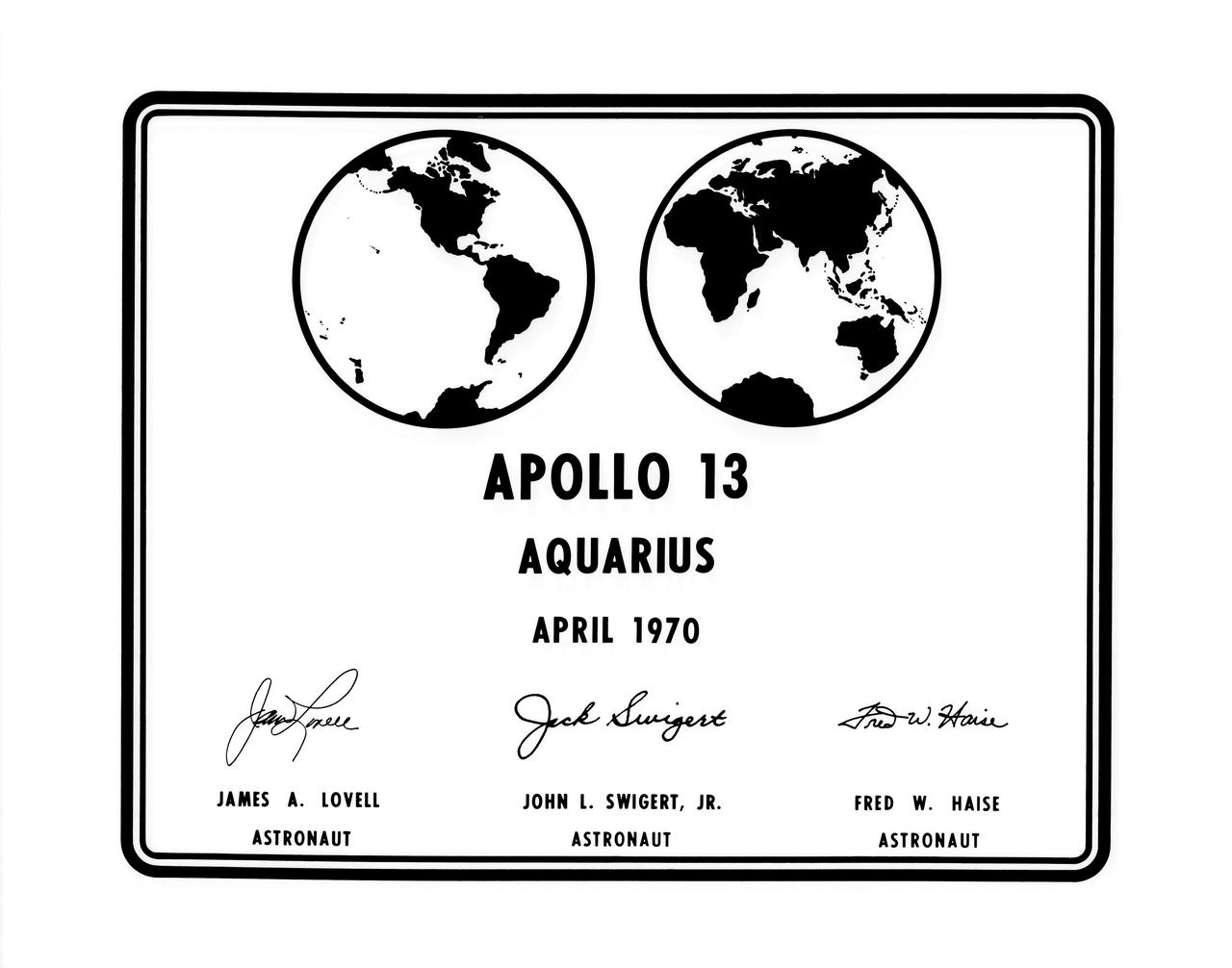
S70-34685 (April 1970) --- A photographic replica of the plaque which the Apollo 13 astronauts will leave behind on the moon during their lunar landing mission. Astronauts James A. Lovell Jr., commander; and Fred W. Haise Jr., lunar module pilot, will descend to the lunar surface in the Lunar Module (LM) "Aquarius". Astronaut John L. Swigert Jr., command module pilot, will remain with the Command and Service Modules (CSM) in lunar orbit. The plaque will be attached to the ladder of the landing gear strut on the LM?s descent stage. Commemorative plaques were also left on the moon by the Apollo 11 and Apollo 12 astronauts.
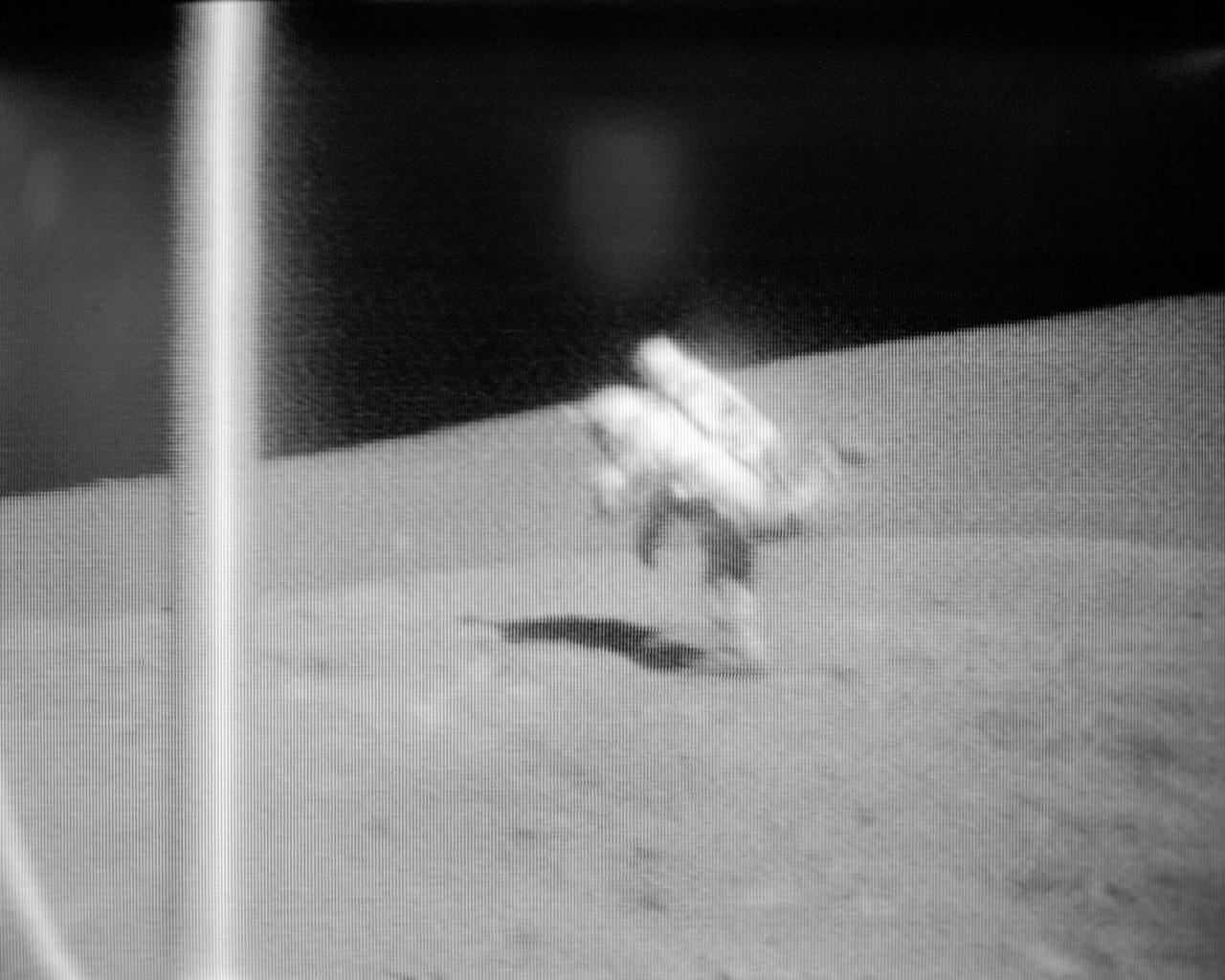
S72-55166 (12 Dec. 1972) --- Scientist-astronaut Harrison H. Schmitt loses his balance and heads for a fall during the second Apollo 17 extravehicular activity (EVA) at the Taurus-Littrow landing site, as seen in this black and white reproduction taken from a color television transmission made by the color RCA TV camera mounted on the Lunar Roving Vehicle. Schmitt is lunar module pilot of the Apollo 17 lunar landing mission. Astronaut Ronald E. Evans, command module pilot, remained with Apollo 17 Command and Service Modules in lunar orbit while astronauts Schmitt and Eugene A. Cernan, commander, descended in the Lunar Module "Challenger" to explore the moon.
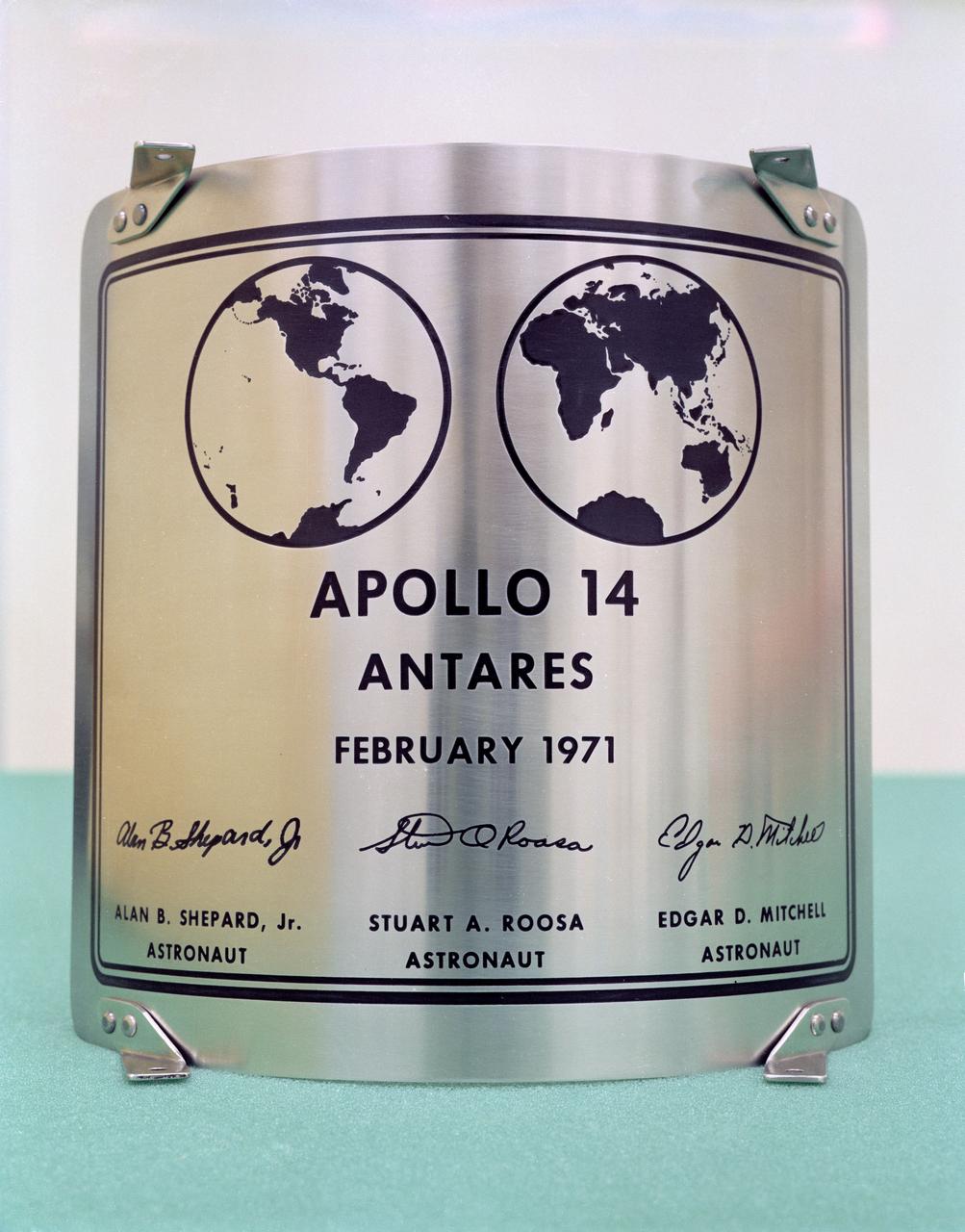
S71-16637 (January 1971) --- A close-up view of the plaque which the Apollo 14 astronauts will leave behind on the moon during their lunar landing mission. Astronauts Alan B. Shepard Jr., commander, and Edgar D. Mitchell, lunar module pilot, will descend to the lunar surface in the Lunar Module (LM) "Antares". Astronaut Stuart A. Roosa, command module pilot, will remain with the Command and Service Modules (CSM) in lunar orbit. The seven by nine inch stainless steel plaque will be attached to the ladder on the landing gear strut on the LM's descent stage. Commemorative plaques were also left on the moon by the Apollo 11 and Apollo 12 astronauts.
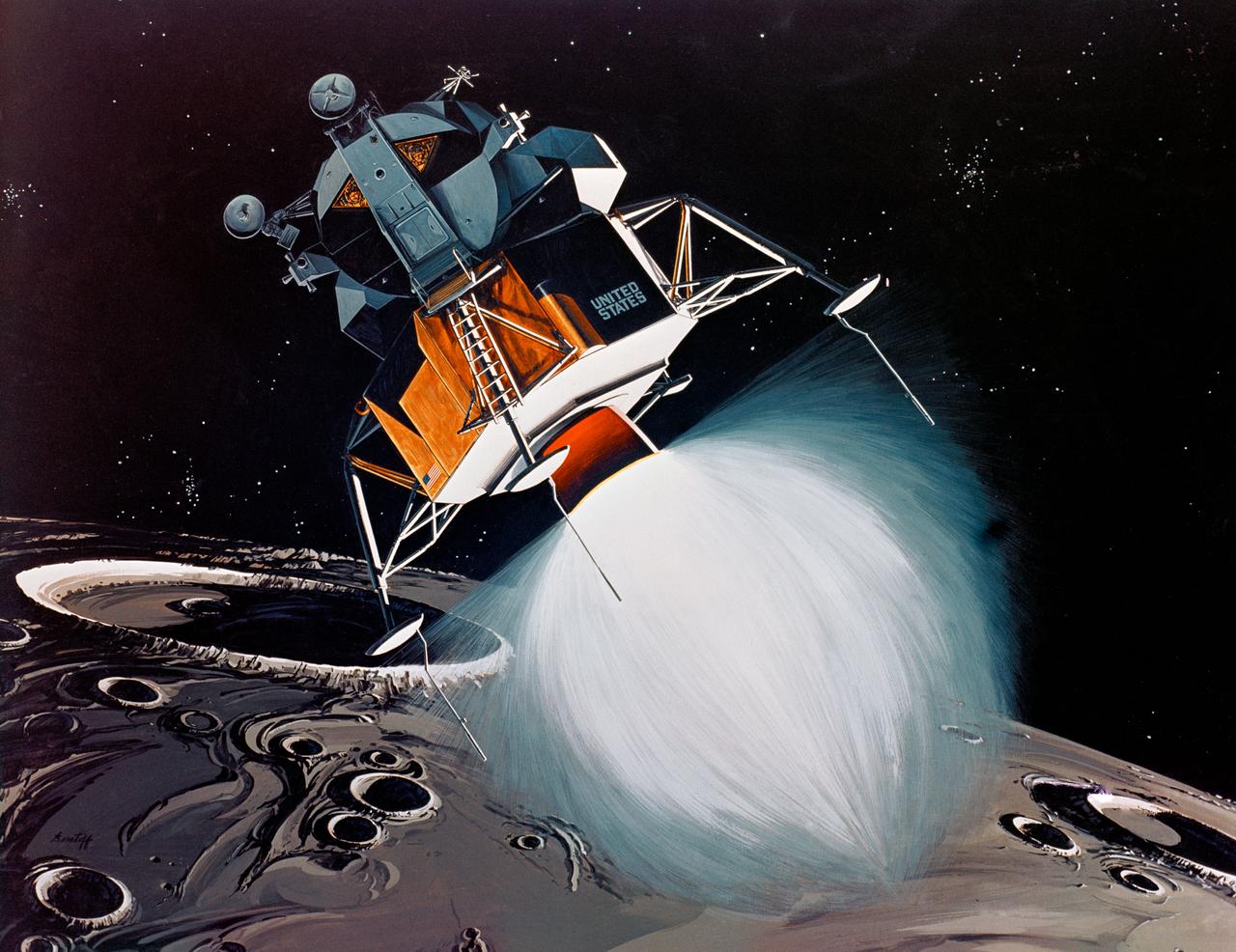
S69-33765 (12 May 1969) --- Artist's concept depicting the firing of the Apollo 10 Lunar Module descent engine for 42 seconds to propel "Snoopy" back into a higher lunar orbit for rendezvous and docking with the Command and Service Modules. Earlier, the LM descent engine will be fired for 27 seconds to take astronauts Thomas P. Stafford, Apollo 10 commander; and Eugene A. Cernan, lunar module pilot, to within 10 miles of the moon's surface. Astronauts John W. Young, command module pilot, will remain in the Command Module, "Charlie Brown," in lunar orbit. Developed by TRW's Systems Group at Redondo Beach, California, under Grumman subcontract, the throttleable descent engine will be used to soft land the LM on the lunar surface during Apollo 11 and subsequent Apollo missions.
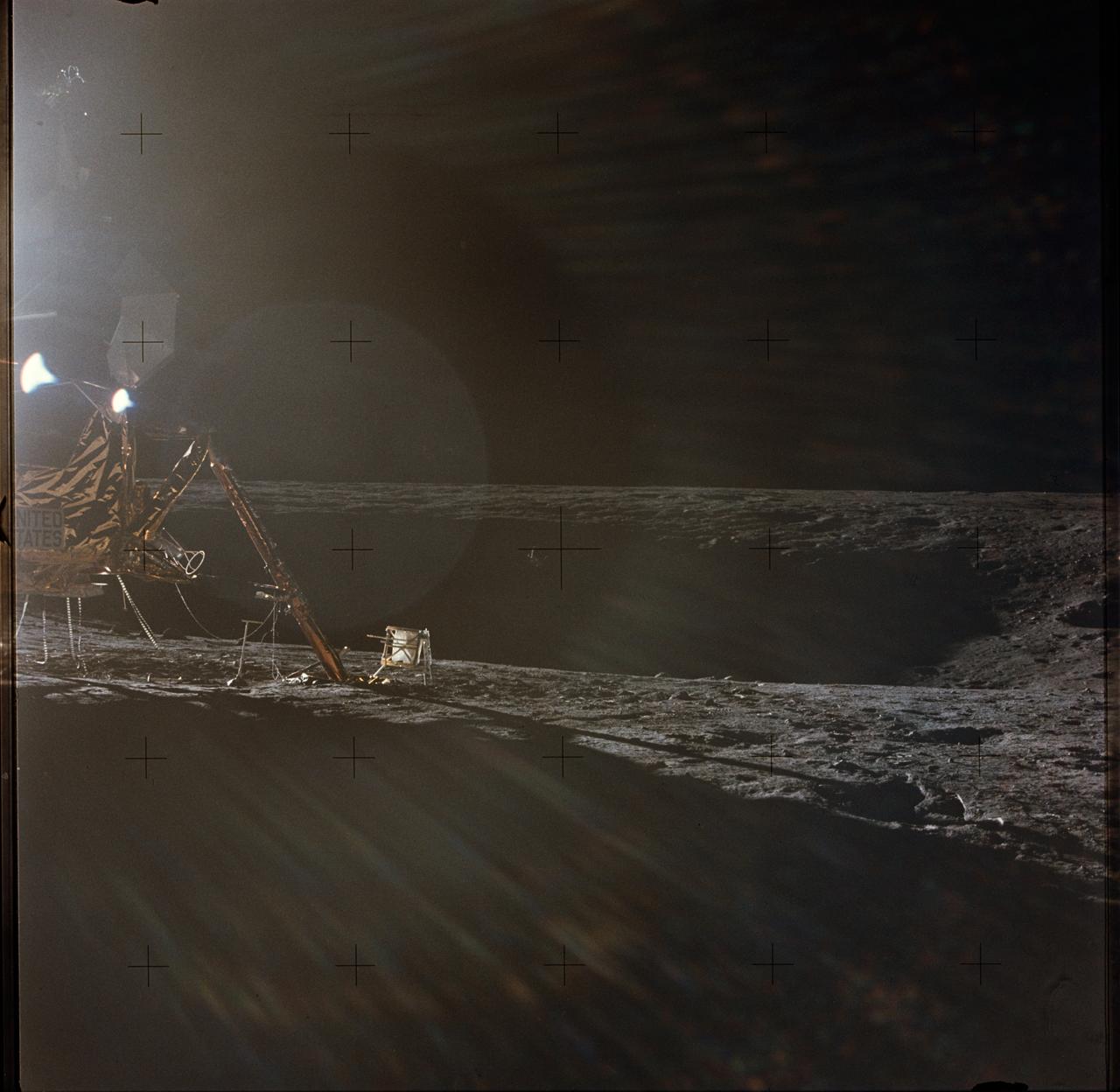
AS12-47-6949 (19-20 Nov. 1969) --- A photograph of the Apollo 12 lunar landing site taken during the extravehicular activity (EVA) of astronauts Charles Conrad Jr., commander; and Alan L. Bean, lunar module pilot. The Apollo 12 Lunar Module (LM) is on the left. Barely visible in the center of the picture, in the shadows on the farside of the crater, is the Surveyor 3 spacecraft. The two spacecraft are about 600 feet apart. Conrad and Bean walked over to Surveyor 3 during their second EVA. The television camera and several other pieces were taken from Surveyor 3 and brought back to Earth for scientific examination. Astronaut Richard F. Gordon Jr., command module pilot, remained with the Command and Service Modules (CSM) in lunar orbit, while astronauts Conrad and Bean descended in the LM to explore the moon. The considerable glare in the picture is caused by the position of the sun. The Apollo tool carrier is the object next to the LM footpad.
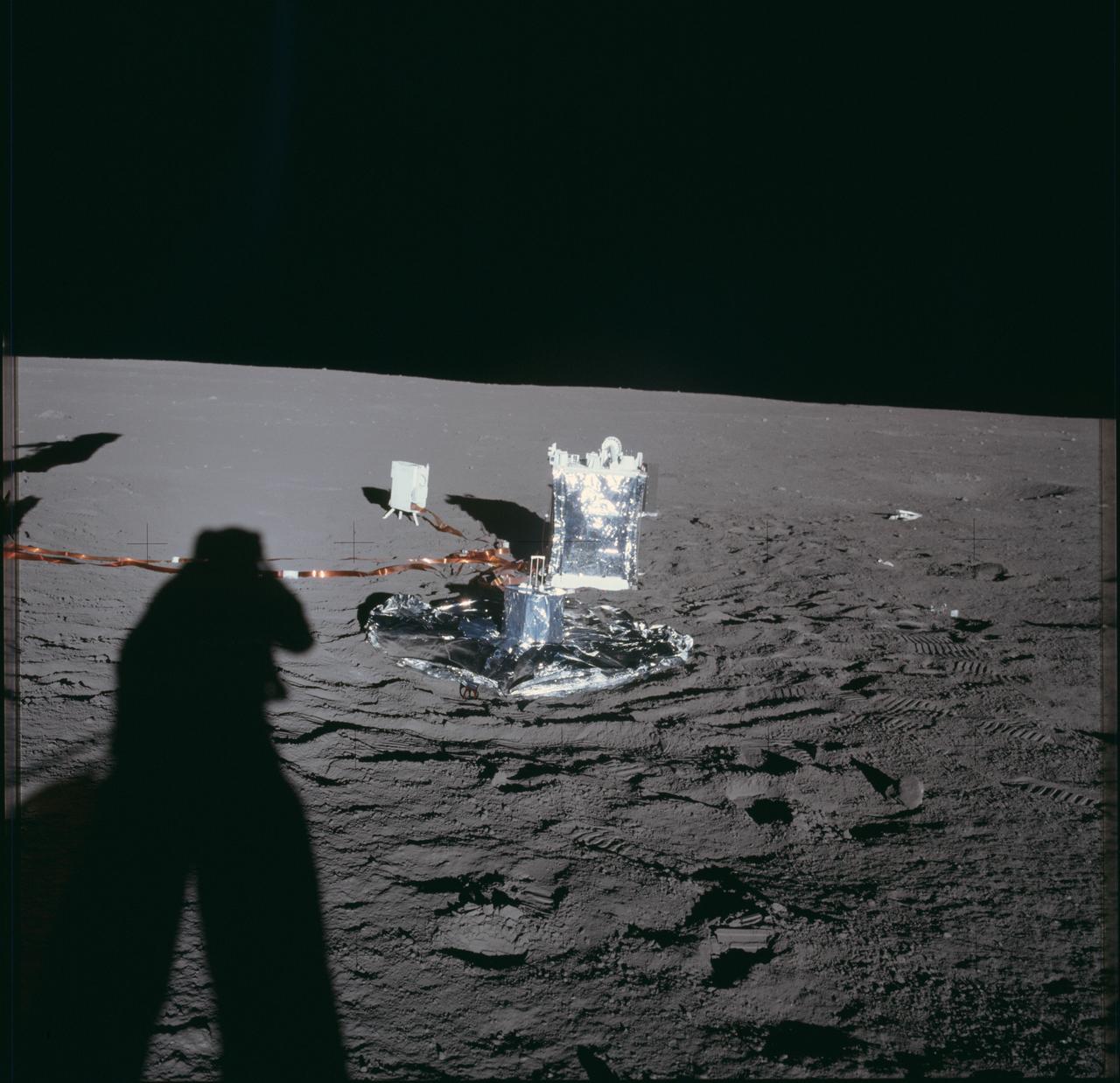
AS12-47-6918 (19 Nov. 1969) --- Astronaut Alan L. Bean, lunar module pilot, took this photograph of three of the components of the Apollo Lunar Surface Experiments Package (ALSEP) which was deployed on the moon during the first Apollo 12 extravehicular activity (EVA). The Passive Seismic Experiment (PSE) is in the center foreground. The largest object is the Central Station; and the white object on legs is the Suprathermal Ion Detector Experiment (SIDE). A portion of the shadow of astronaut Charles Conrad Jr., commander, can be seen at the left center edge of the picture. Astronaut Richard F. Gordon Jr., command module pilot, remained with the Apollo 12 Command and Service Modules (CSM) in lunar orbit while Conrad and Bean descended in the Lunar Module (LM) to explore the moon.
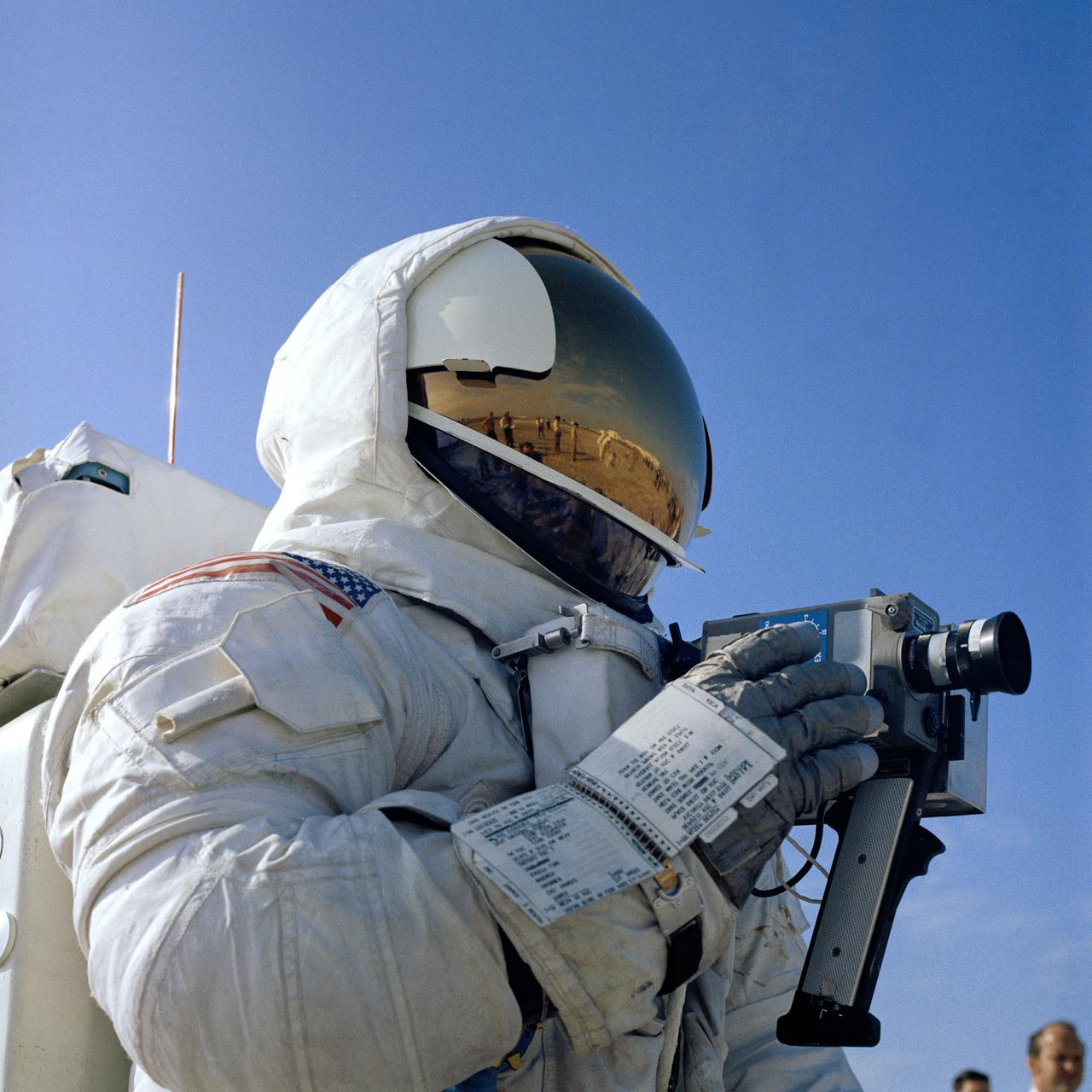
CAPE CANAVERAL, Fla. - Astronaut Fred W. Haise Jr., Apollo 13 lunar module pilot, practices operation of the 16-millimeter motion picture camera to be used on the lunar surface during the Apollo 13 mission. The Apollo 13 landing is scheduled for the Fra Mauro, a highlands area approximately 95 miles east of the Apollo 12 landing site in November 1969. Apollo 13, scheduled for launch from Kennedy Space Center on April 11, has a prime crew composed of Haise, James A. Lovell Jr., commander, and Thomas K. Mattingly II, command module pilot. Photo credit: NASA
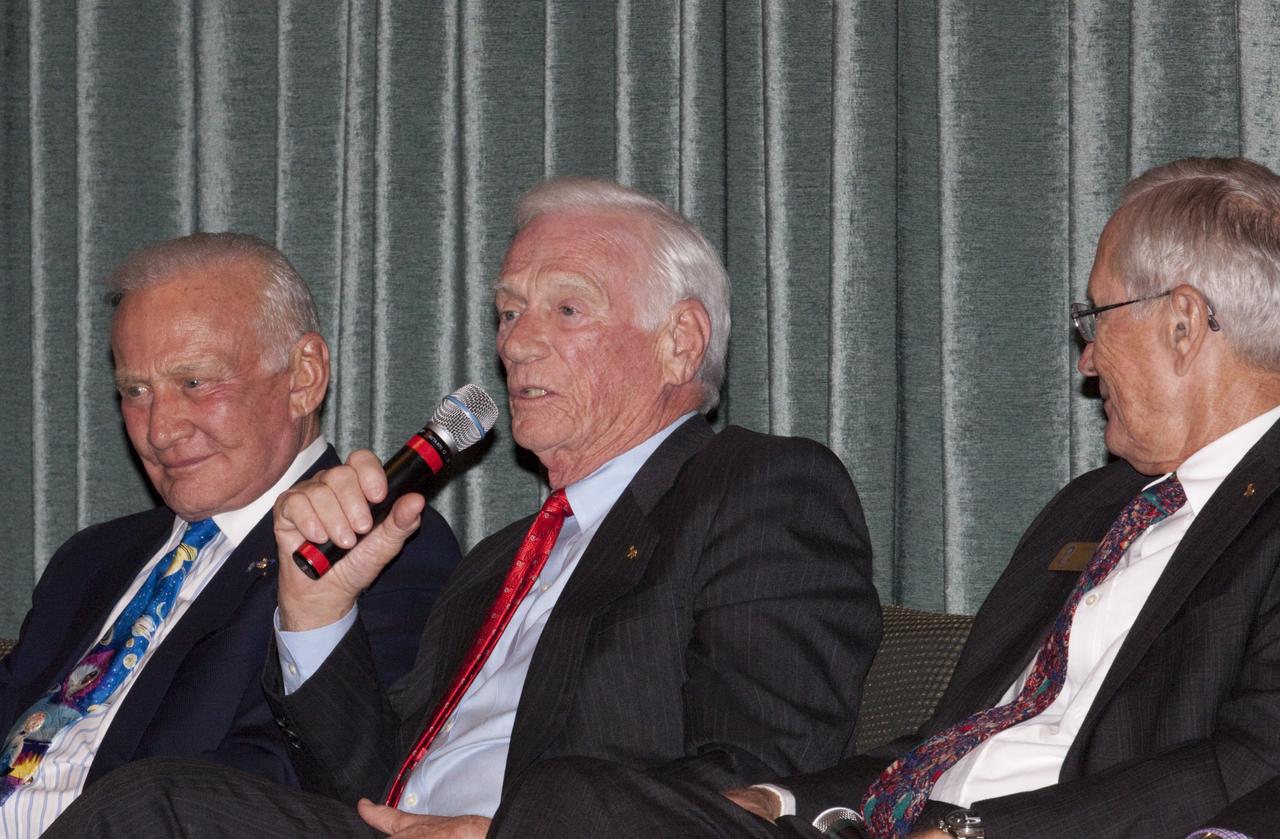
CAPE CANAVERAL, Fla. – Gemini 9, Apollo 10 and 17 astronaut Eugene Cernan speaks to guests gathered for the Astronaut Scholarship Foundation's dinner at the Radisson Resort at the Port in Cape Canaveral celebrating the 40th anniversary of Apollo 17. Listening on the left is Gemini 12 and Apollo 11 astronaut Buzz Aldrin, along with Apollo 16 astronaut Charles Duke. The gala commemorating the anniversary of Apollo 17 included mission commander Eugene Cernan and other astronauts who flew Apollo missions. Launched Dec. 7, 1972, Cernan and lunar module pilot Harrison Schmitt landed in the moon's Taurus-Littrow highlands while command module pilot Ronald Evans remained in lunar orbit operating a scientific instrument module. For more information, visit http://www-pao.ksc.nasa.gov/history/apollo/apollo-17/apollo-17.htm Photo credit: NASA/Kim Shiflett
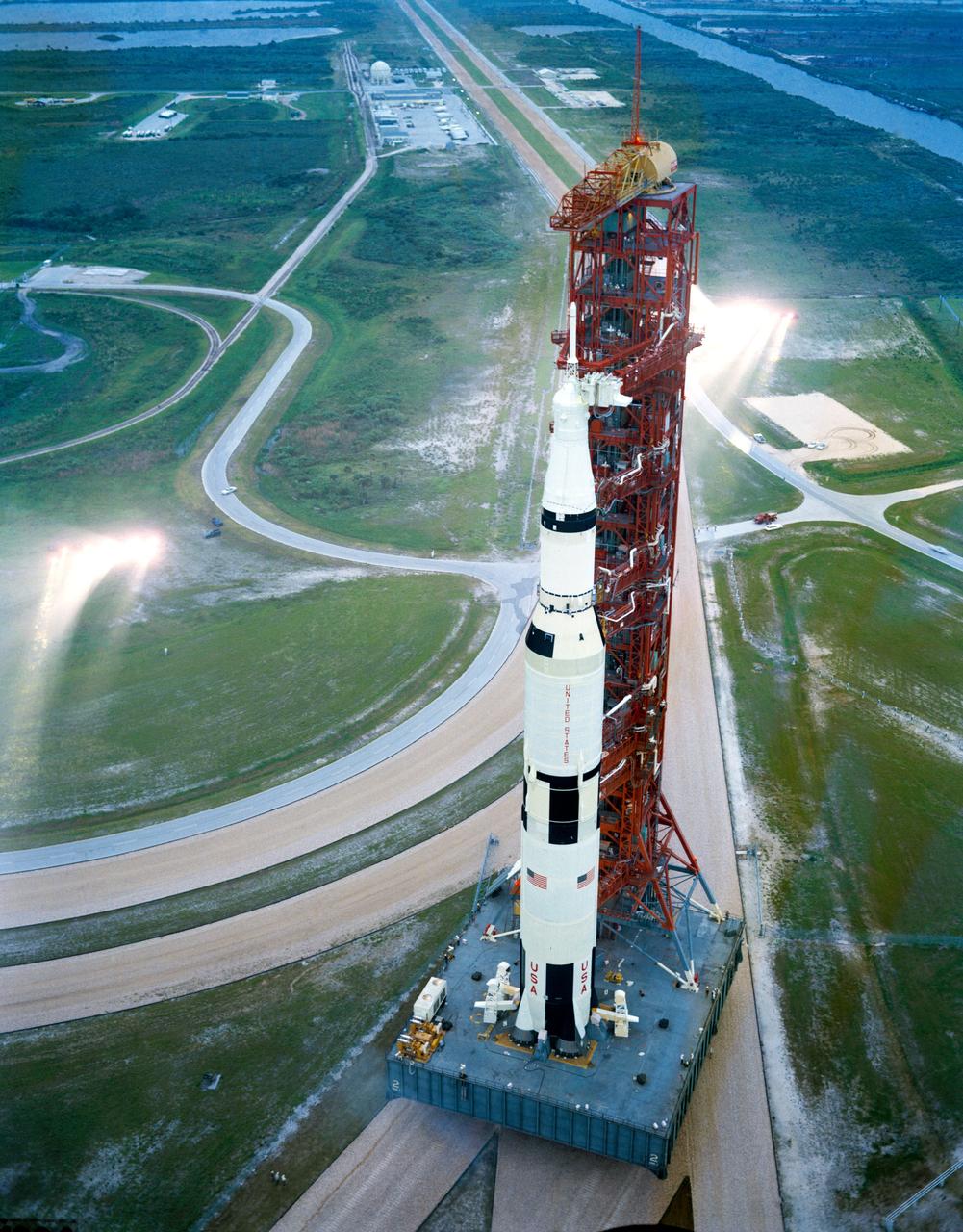
S69-51309 (8 Sept. 1969) --- High-angle view at Launch Complex 39, Kennedy Space Center (KSC), showing the Apollo 12 (Spacecraft 108/Lunar Module 6/Saturn 507) space vehicle on the way from the Vehicle Assembly Building (VAB) to Pad A. The Saturn V stack and its mobile launch tower are atop a huge crawler-transporter. Apollo 12 is scheduled as the second lunar landing mission. The crew will be astronauts Charles Conrad Jr., commander; Richard F. Gordon Jr., command module pilot; and Alan L. Bean, lunar module pilot.

S69-51299 (8 Sept. 1969) --- Ground-level view at Launch Complex 39, Kennedy Space Center (KSC), showing the Apollo 12 (Spacecraft 108/ Lunar Module 6/ Saturn 507) space vehicle on the way from the Vehicle Assembly Building (VAB) to Pad A. The Saturn V stack and its mobile launch tower are atop a huge crawler-transporter. The Launch Complex 39 service structure is on the right. Apollo 12 is scheduled as the second lunar landing mission. The crew will be astronauts Charles Conrad Jr., commander; Richard F. Gordon Jr., command module pilot; and Alan L. Bean, lunar module pilot.
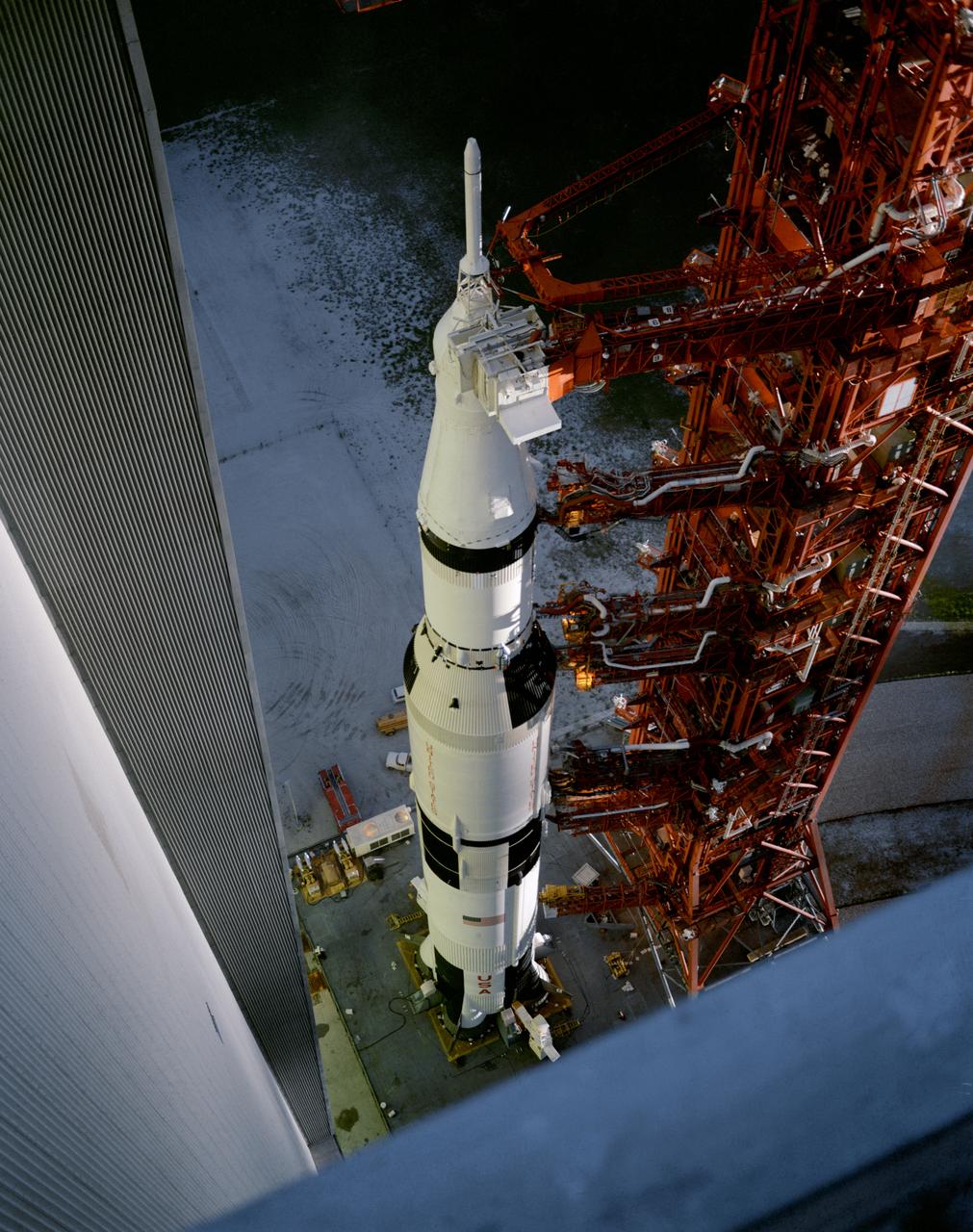
S69-51308 (8 Sept. 1969) --- High-angle view at Launch Complex 39, Kennedy Space Center (KSC), showing the Apollo 12 (Spacecraft 108/ Lunar Module 6/ Saturn 507) space vehicle leaving the Vehicle Assembly Building (VAB) on the way to Pad A. The Saturn V stack and its mobile launch tower are atop a huge crawler-transporter. Apollo 12 is scheduled as the second lunar landing mission. The crew will be astronauts Charles Conrad Jr., commander; Richard F. Gordon Jr., command module pilot; and Alan L. Bean, lunar module pilot.
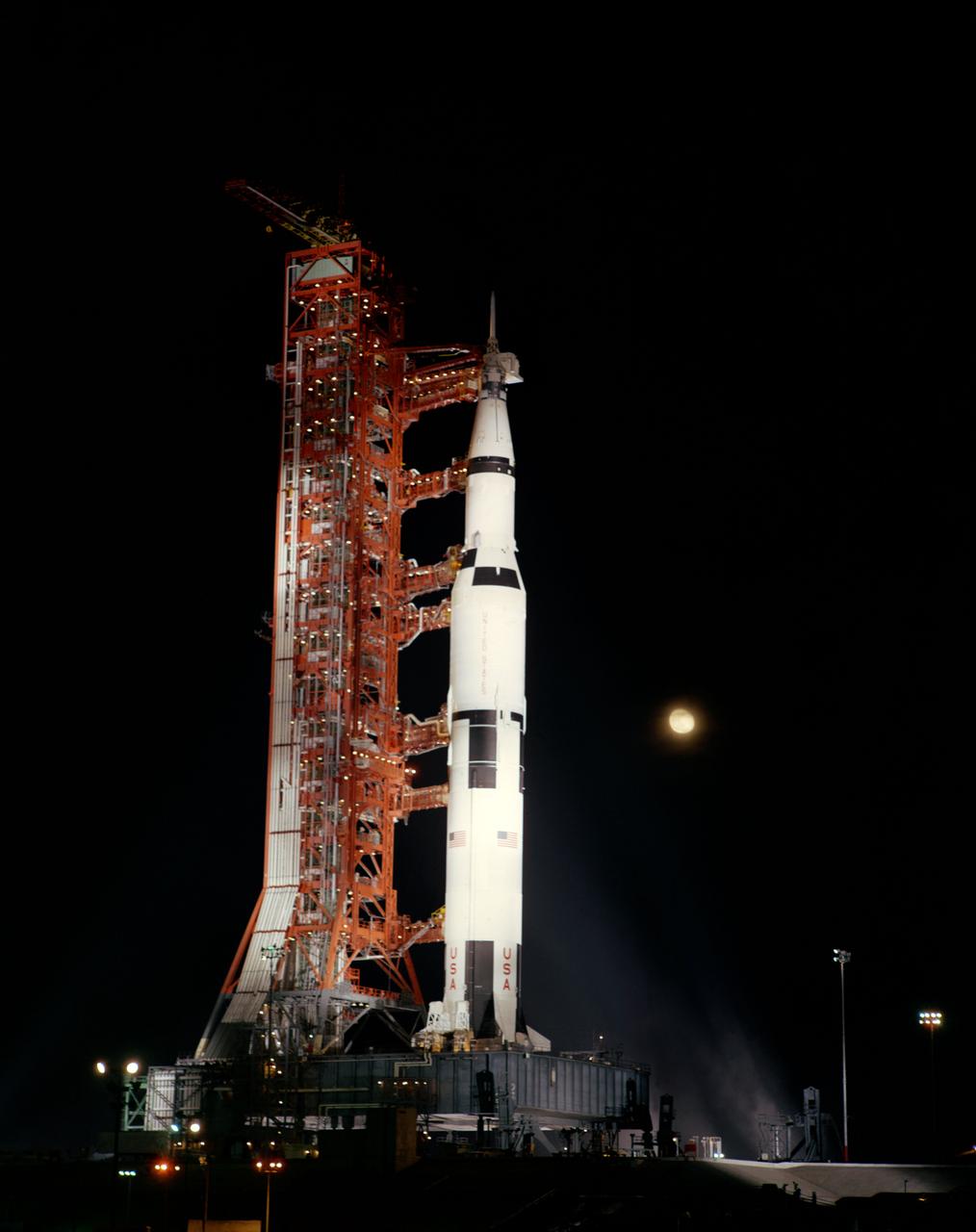
S69-56596 (28 Oct. 1969) --- A nighttime, ground-level view of Pad A, Launch Complex 39, Kennedy Space Center (KSC) showing the Apollo 12 (Spacecraft 108/Lunar Module 6/Saturn 507) space vehicle, during the terminal phase of a Countdown Demonstration Test (CDDT). The crew of the National Aeronautics and Space Administration's (NASA) second lunar landing mission will be astronauts Charles Conrad Jr., commander; Richard F. Gordon Jr., command module pilot; and Alan L. Bean, lunar module pilot. The Apollo 12 launch has been scheduled for 11:22 a.m. (EST) on Nov. 14, 1969.
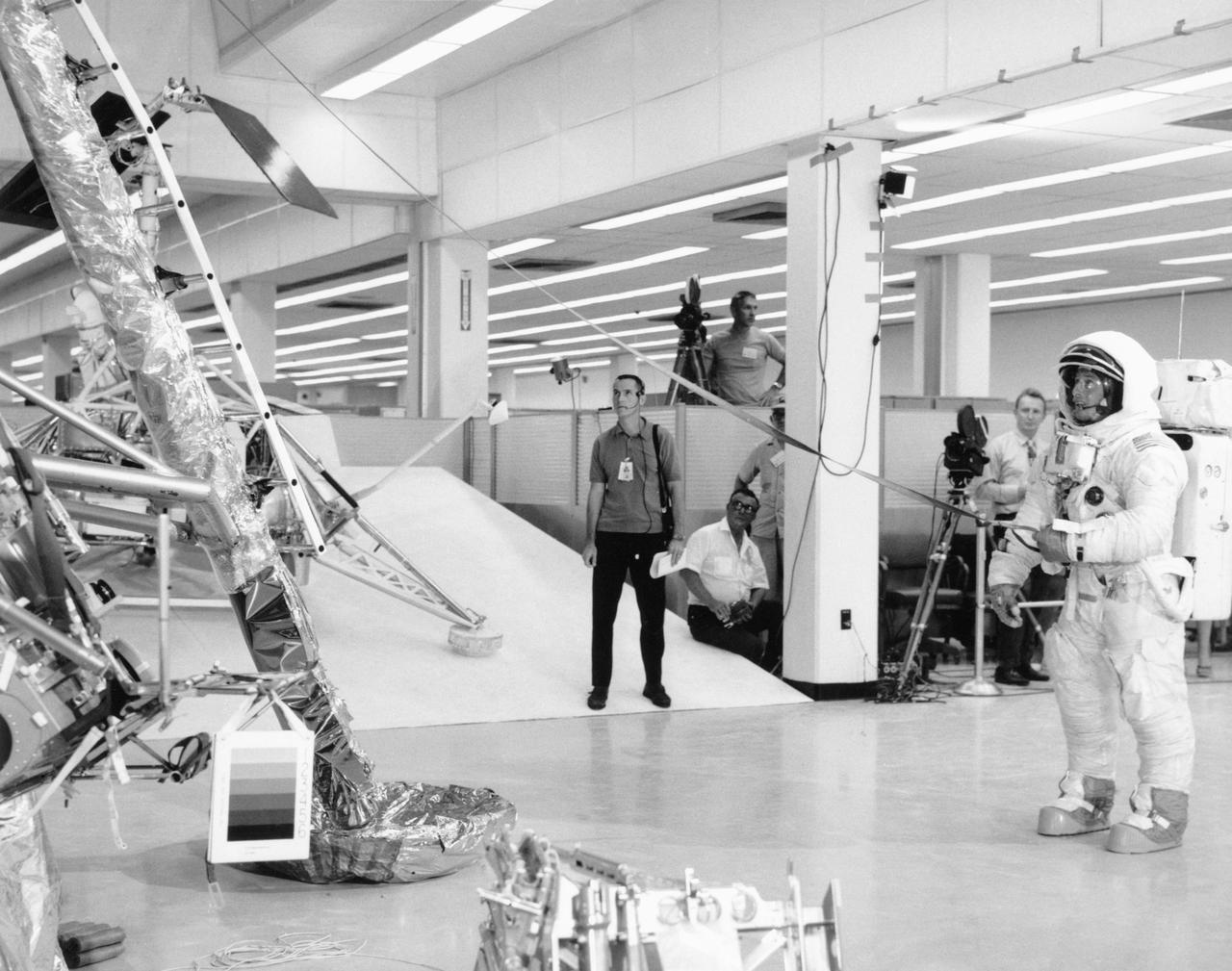
S69-54147 (October 1969) --- Two members of the Apollo 12 lunar landing mission participates in lunar surface extravehicular activity (EVA) simulations in the Kennedy Space Center's (KSC) Flight Crew Training Building. Here, astronauts Charles Conrad Jr., commander, is holding the bottom end of the lunar equipment conveyor. Inside the Lunar Module (LM) and out of view is astronaut Alan L. Bean, lunar module pilot. The simulations were part of a run-through of the Apollo 12 lunar surface "timeline".
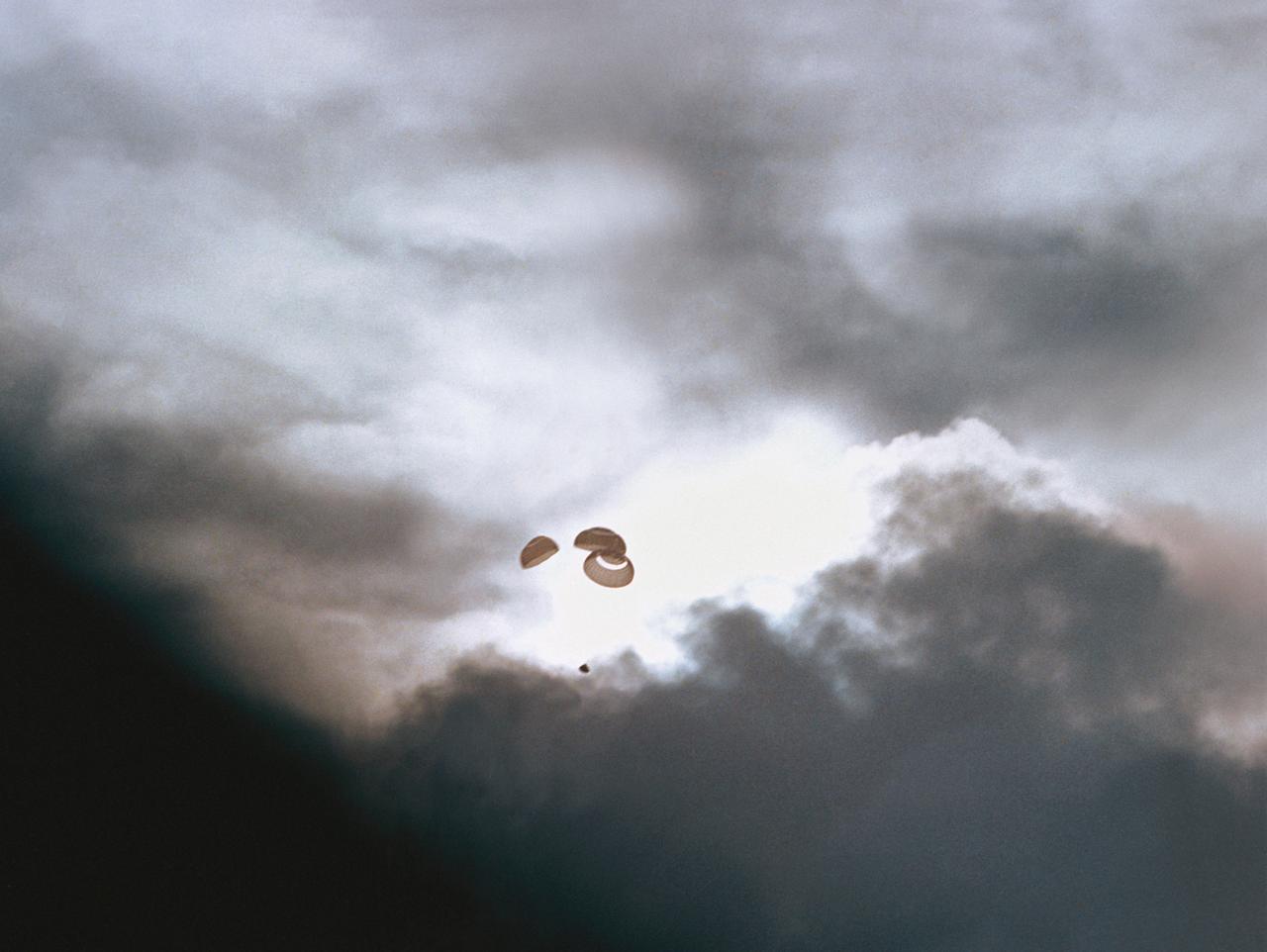
S70-35652 (17 April 1970) --- The Apollo 13 spacecraft heads toward a splashdown in the South Pacific Ocean. The Apollo 13 Command Module splashed down in the South Pacific at 12:07:44 p.m., April 17, 1970. Note the capsule and its parachutes just visible against a gap in the dark clouds.
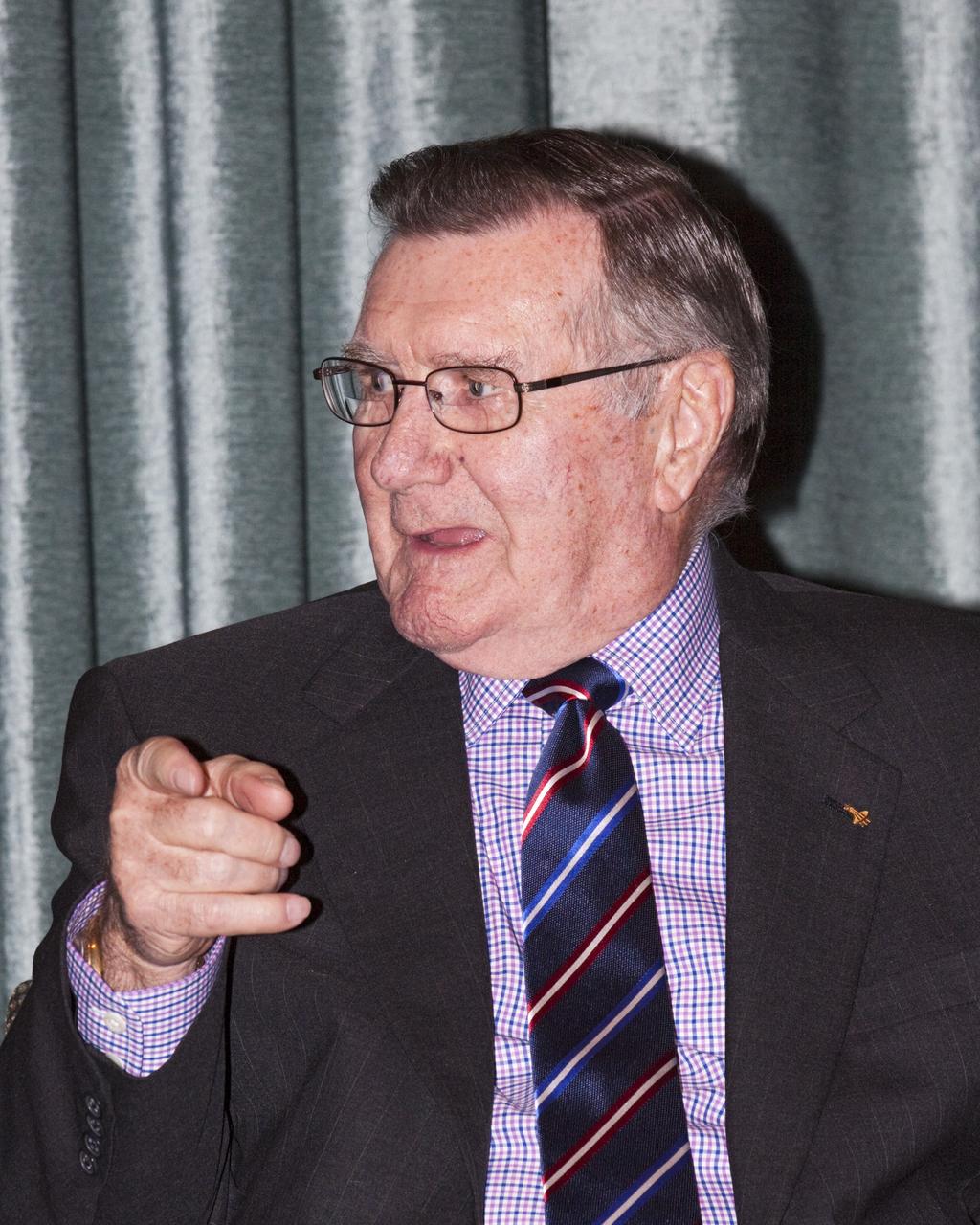
CAPE CANAVERAL, Fla. – Gemini 11 and Apollo 12 astronaut Richard Gordon speaks to guests gathered for the Astronaut Scholarship Foundation's dinner at the Radisson Resort at the Port in Cape Canaveral celebrating the 40th anniversary of Apollo 17. The gala commemorating the anniversary of Apollo 17 included mission commander Eugene Cernan and other astronauts who flew Apollo missions. Launched Dec. 7, 1972, Cernan and lunar module pilot Harrison Schmitt landed in the moon's Taurus-Littrow highlands while command module pilot Ronald Evans remained in lunar orbit operating a scientific instrument module. For more information, visit http://www-pao.ksc.nasa.gov/history/apollo/apollo-17/apollo-17.htm Photo credit: NASA/Kim Shiflett
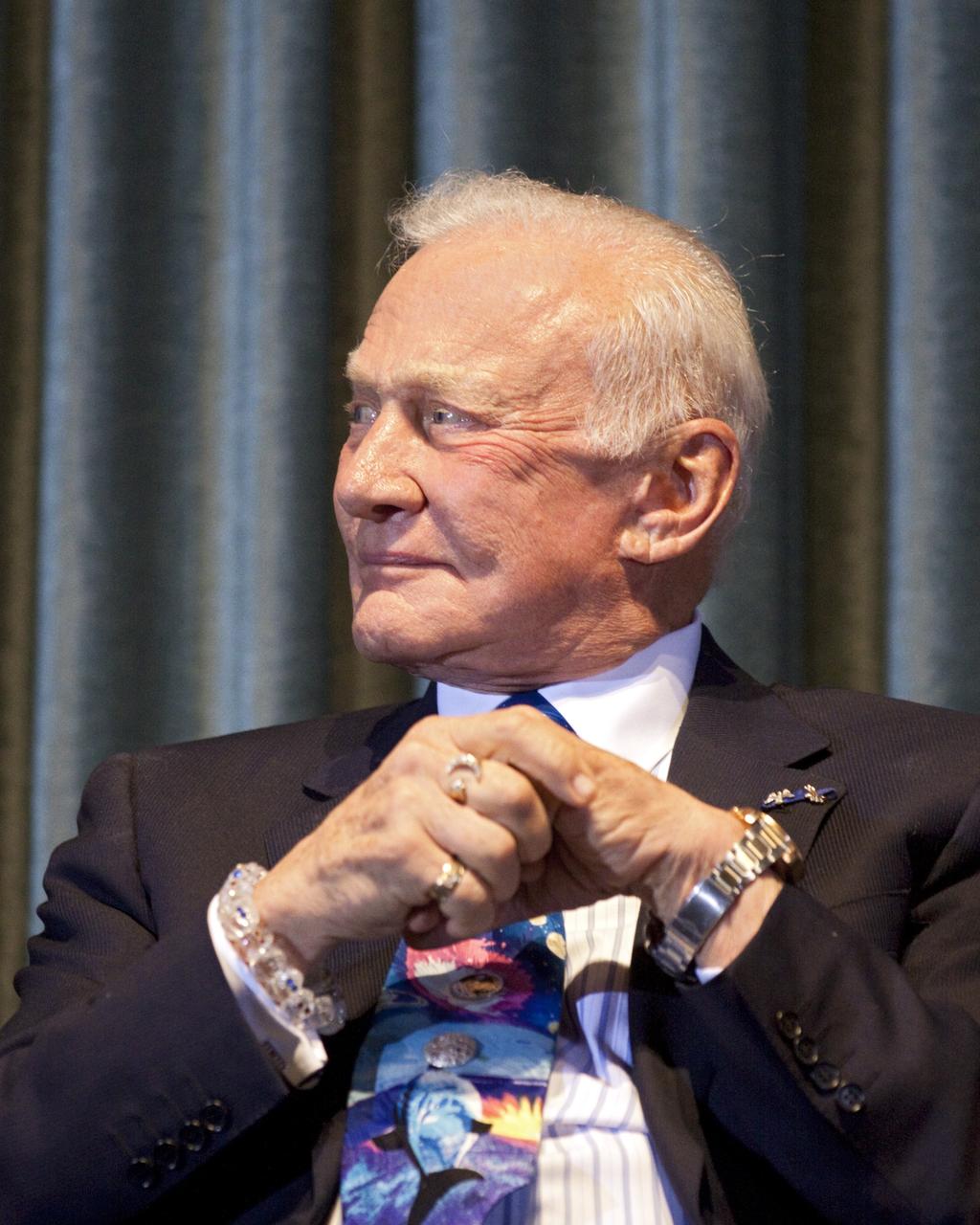
CAPE CANAVERAL, Fla. – Gemini 12 and Apollo 11 astronaut Buzz Aldrin participates in a presentation to guests gathered for the Astronaut Scholarship Foundation's dinner at the Radisson Resort at the Port in Cape Canaveral celebrating the 40th anniversary of Apollo 17. The gala commemorating the anniversary of Apollo 17 included mission commander Eugene Cernan and other astronauts who flew Apollo missions. Launched Dec. 7, 1972, Cernan and lunar module pilot Harrison Schmitt landed in the moon's Taurus-Littrow highlands while command module pilot Ronald Evans remained in lunar orbit operating a scientific instrument module. For more information, visit http://www-pao.ksc.nasa.gov/history/apollo/apollo-17/apollo-17.htm Photo credit: NASA/Kim Shiflett
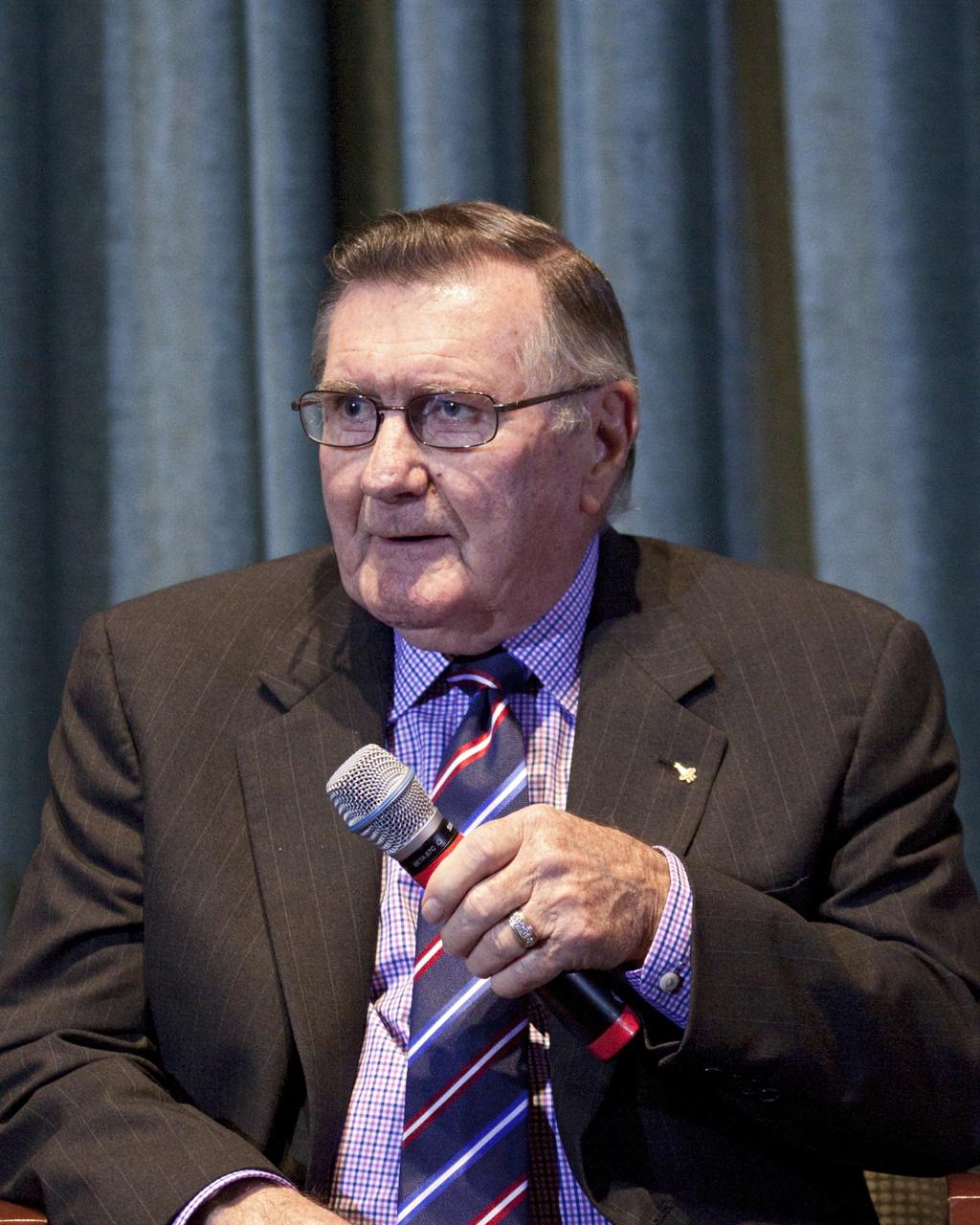
CAPE CANAVERAL, Fla. – Gemini 11 and Apollo 12 astronaut Richard Gordon speaks to guests gathered for the Astronaut Scholarship Foundation's dinner at the Radisson Resort at the Port in Cape Canaveral celebrating the 40th anniversary of Apollo 17. The gala commemorating the anniversary of Apollo 17 included mission commander Eugene Cernan and other astronauts who flew Apollo missions. Launched Dec. 7, 1972, Cernan and lunar module pilot Harrison Schmitt landed in the moon's Taurus-Littrow highlands while command module pilot Ronald Evans remained in lunar orbit operating a scientific instrument module. For more information, visit http://www-pao.ksc.nasa.gov/history/apollo/apollo-17/apollo-17.htm Photo credit: NASA/Kim Shiflett
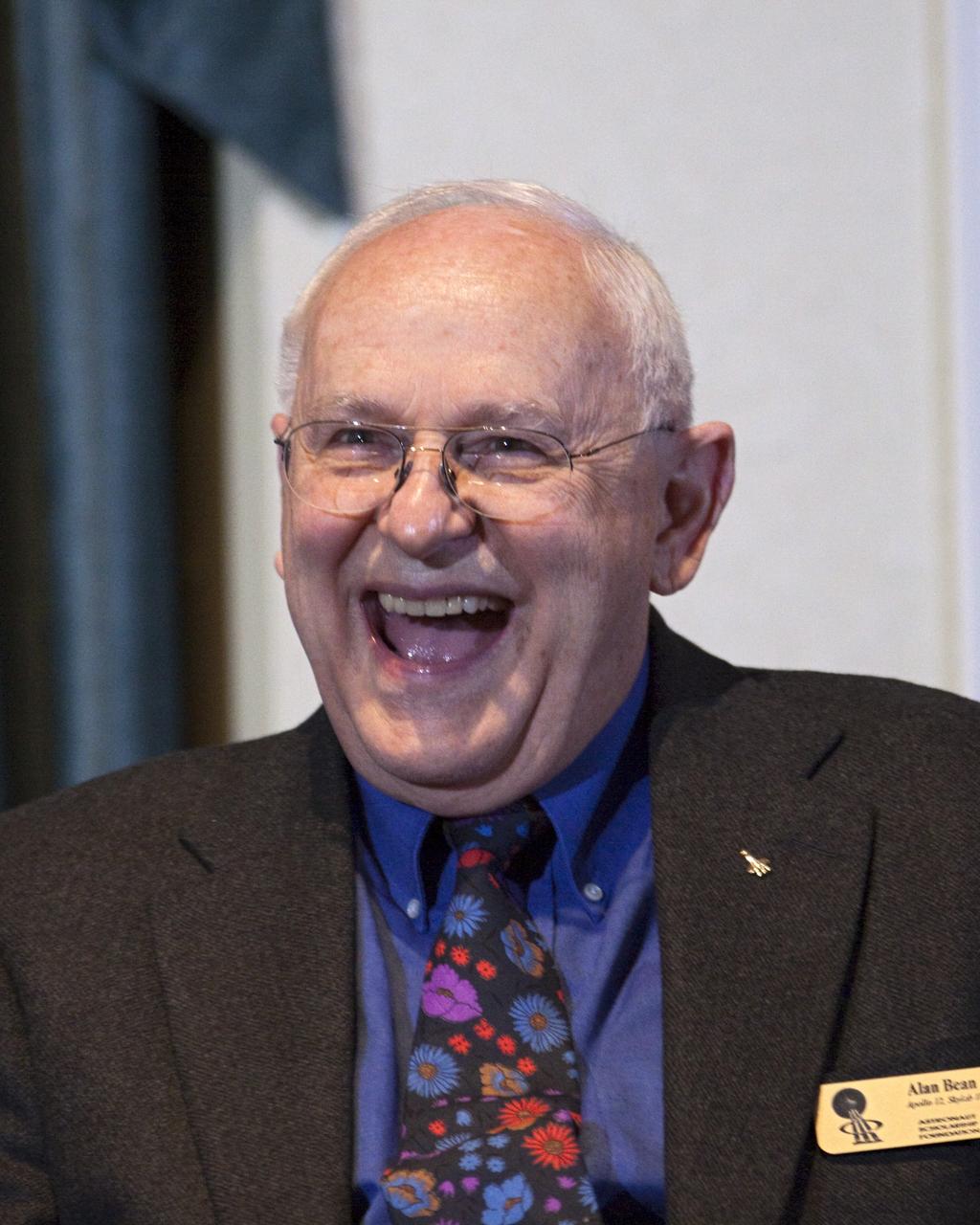
CAPE CANAVERAL, Fla. – Apollo 12 and Skylab 3 astronaut Alan Bean enjoys a light moment during a presentation to guests gathered for the Astronaut Scholarship Foundation's dinner at the Radisson Resort at the Port in Cape Canaveral celebrating the 40th anniversary of Apollo 17. The gala commemorating the anniversary of Apollo 17 included mission commander Eugene Cernan and other astronauts who flew Apollo missions. Launched Dec. 7, 1972, Cernan and lunar module pilot Harrison Schmitt landed in the moon's Taurus-Littrow highlands while command module pilot Ronald Evans remained in lunar orbit operating a scientific instrument module. For more information, visit http://www-pao.ksc.nasa.gov/history/apollo/apollo-17/apollo-17.htm Photo credit: NASA/Kim Shiflett
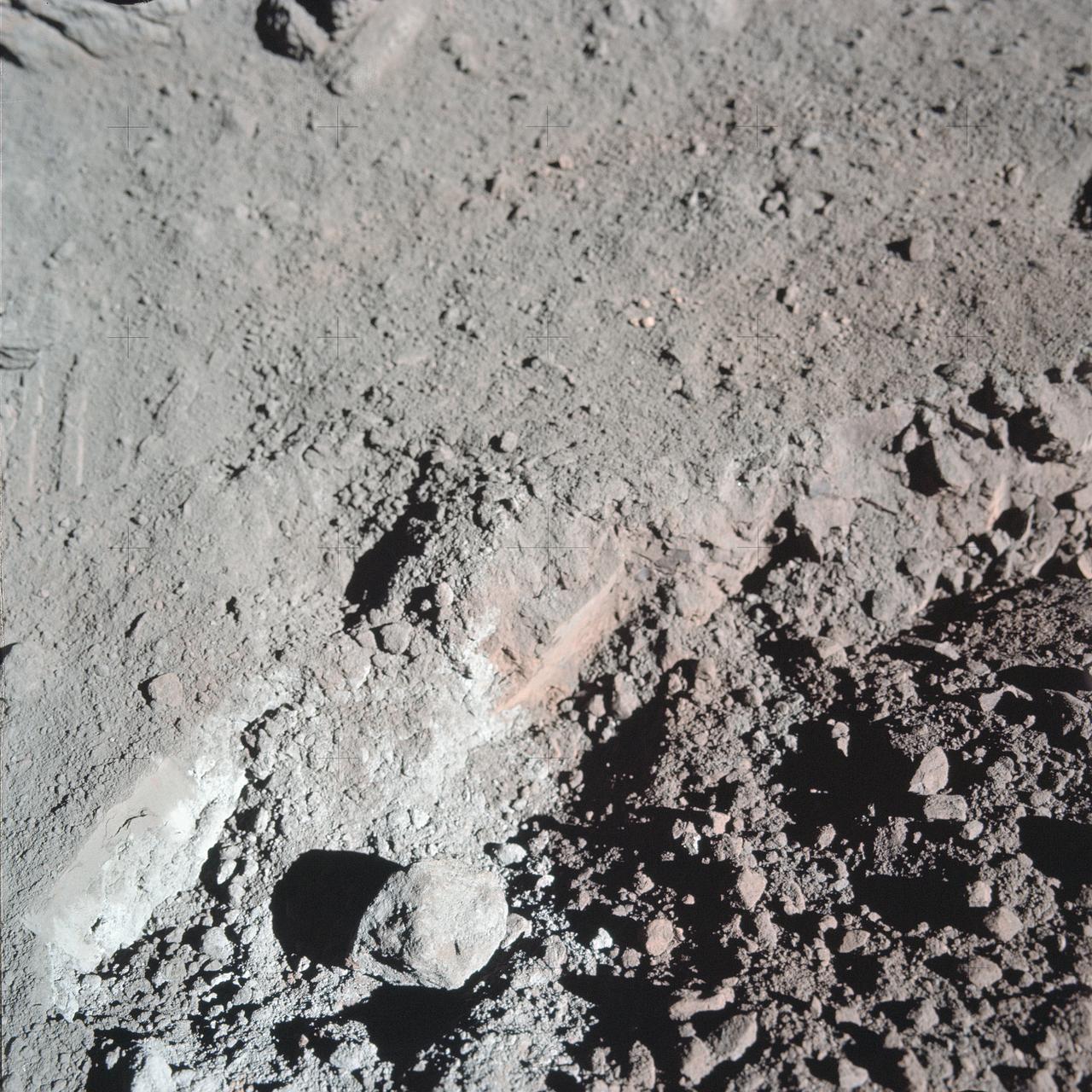
AS17-137-20989 (12 Dec. 1972) --- A close-up view of the much-publicized orange soil which the Apollo 17 crewmen found at Station 4 (Shorty Crater) during the second Apollo 17 extravehicular activity (EVA) at the Taurus-Littrow landing site. The orange soil was first spotted by scientist-astronaut Harrison H. Schmitt. While astronauts Schmitt and Eugene A. Cernan descended in the Lunar Module (LM) "Challenger" to explore the lunar surface, astronaut Ronald E. Evans remained with the Apollo 17 Command and Service Modules (CSM) in lunar orbit. The orange soil was never seen by the crewmen of the other lunar landing missions - Apollo 11 (Sea of Tranquility); Apollo 12 (Ocean of Storms); Apollo 14 (Fra Mauro); Apollo 15 (Hadley-Apennines); and Apollo 16 (Descartes).
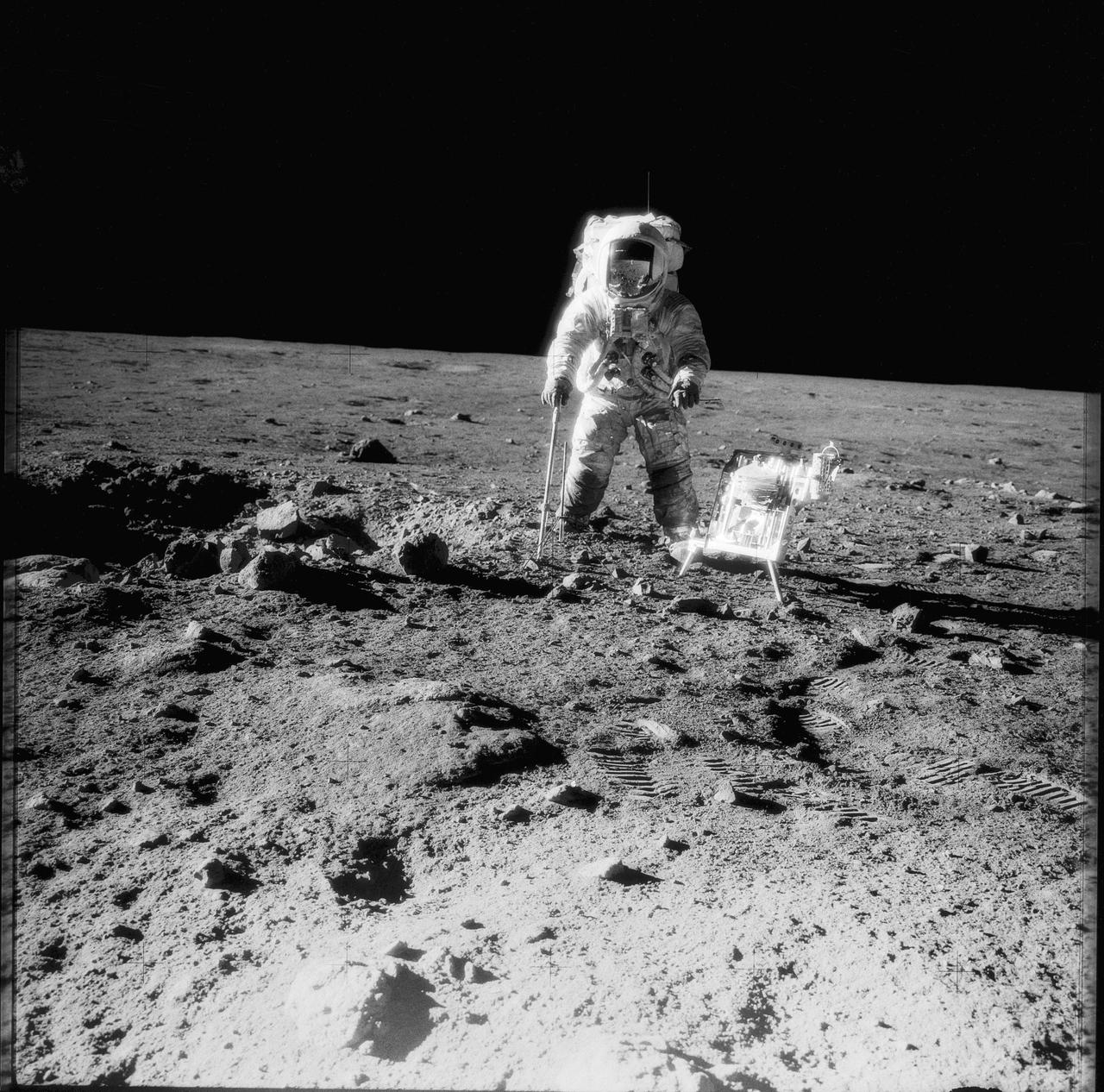
AS12-49-7318 (19-20 Nov. 1969) --- One of the Apollo 12 crew members is photographed with the tools and carrier of the Apollo Lunar Hand Tools (ALHT) during extravehicular activity (EVA) on the surface of the moon. Several footprints made by the two crew members during their EVA are seen in the foreground. While astronauts Charles Conrad Jr., commander, and Alan L. Bean, lunar module pilot, descended in the Lunar Module (LM) "Intrepid" to explore the Ocean of Storms region of the moon, astronaut Richard F. Gordon Jr., command module pilot, remained with the Command and Service Modules (CSM) "Yankee Clipper" in lunar orbit.
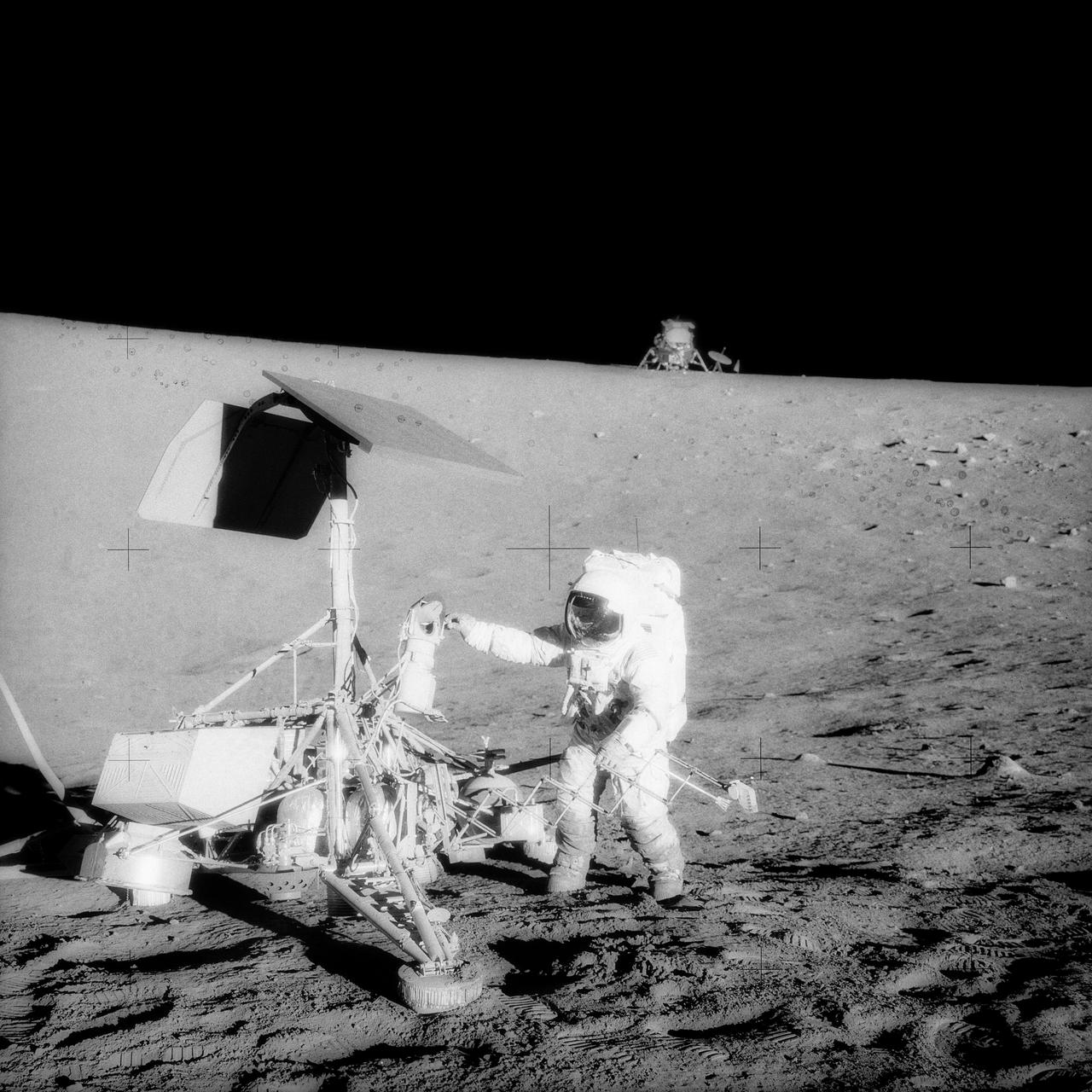
AS12-48-7134 (20 Nov. 1969) --- This unusual photograph, taken during the second Apollo 12 extravehicular activity (EVA), shows two U.S. spacecraft on the surface of the moon. The Apollo 12 Lunar Module (LM) is in the background. The unmanned Surveyor 3 spacecraft is in the foreground. The Apollo 12 LM, with astronauts Charles Conrad Jr. and Alan L. Bean aboard, landed about 600 feet from Surveyor 3 in the Ocean of Storms. The television camera and several other pieces were taken from Surveyor 3 and brought back to Earth for scientific examination. Here, Conrad examines the Surveyor's TV camera prior to detaching it. Astronaut Richard F. Gordon Jr. remained with the Apollo 12 Command and Service Modules (CSM) in lunar orbit while Conrad and Bean descended in the LM to explore the moon. Surveyor 3 soft-landed on the moon on April 19, 1967.
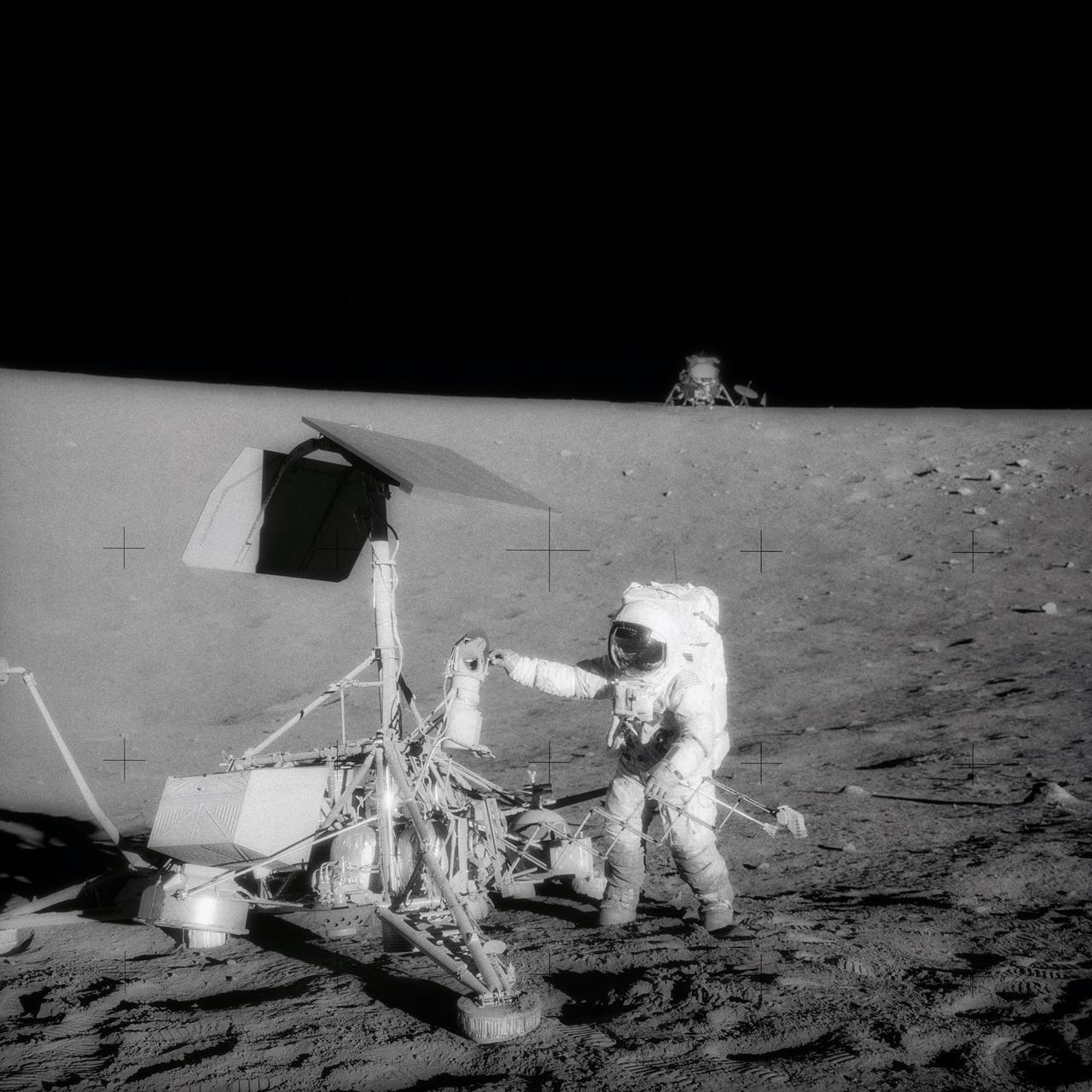
AS12-48-7133 (20 Nov. 1969) --- This unusual photograph, taken during the second Apollo 12 extravehicular activity (EVA), shows two U.S. spacecraft on the surface of the moon. The Apollo 12 Lunar Module (LM) is in the background. The unmanned Surveyor 3 spacecraft is in the foreground. The Apollo 12 LM, with astronauts Charles Conrad Jr. and Alan L. Bean aboard, landed about 600 feet from Surveyor 3 in the Ocean of Storms. The television camera and several other pieces were taken from Surveyor 3 and brought back to Earth for scientific examination. Here, Conrad examines the Surveyor's TV camera prior to detaching it. Astronaut Richard F. Gordon Jr. remained with the Apollo 12 Command and Service Modules (CSM) in lunar orbit while Conrad and Bean descended in the LM to explore the moon. Surveyor 3 soft-landed on the moon on April 19, 1967.
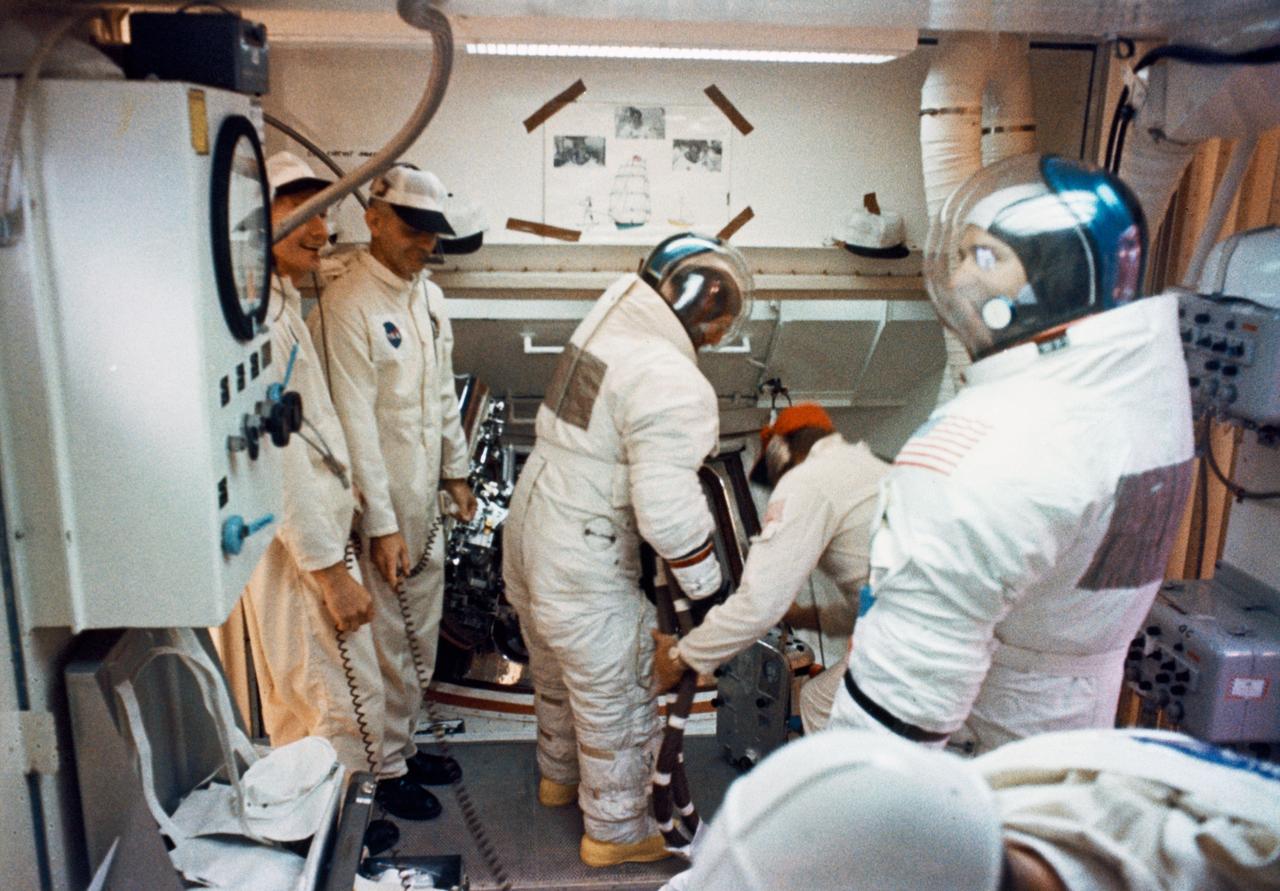
S69-58885 (14 Nov. 1969) --- Interior view of the White Room atop Pad A, Launch Complex 39, Kennedy Space Center (KSC), during the insertion of the Apollo 12 crew. In the center background preparing to ingress the spacecraft is astronaut Charles Conrad Jr., commander. Astronaut Alan L. Bean, lunar module pilot, stands in the right foreground. Awaiting his turn to ingress, but out of view, is astronaut Richard F. Gordon Jr., command module pilot. The Apollo 12 is the United States' second lunar landing mission.
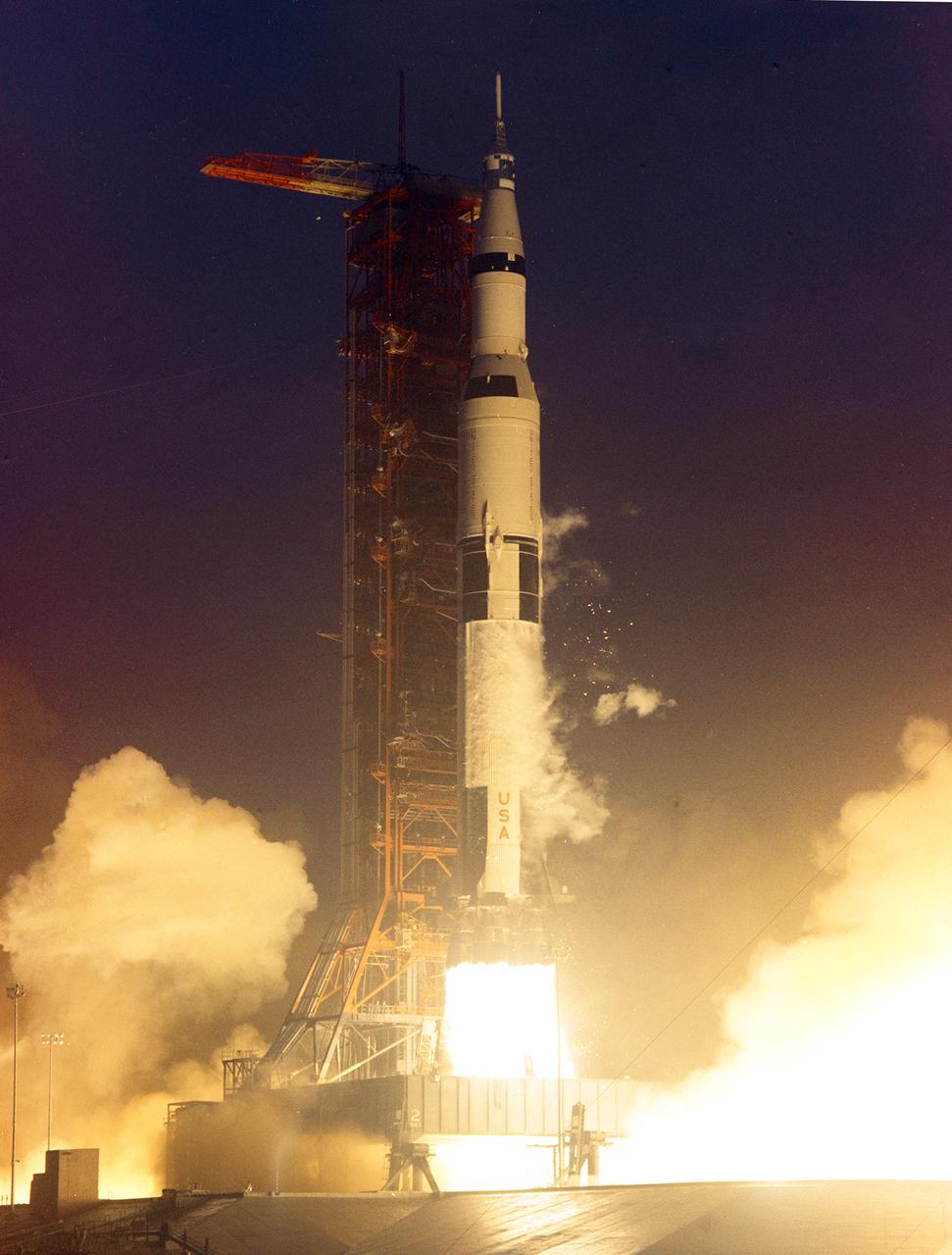
This image depicts the liftoff of the Apollo 12 on November 14, 1969. The second mission of the marned lunar landing and return to Earth, Apollo 12, carried a crew of three astronauts: Alan L. Bean, pilot of the Lunar Module, Intrepid; Richard Gordon, pilot of the Command Module, Yankee Clipper; and Spacecraft Commander Charles Conrad. Activities of astronauts Conrad and Bean on the lunar soil included setting out experiments, finding the unmanned Surveyor 3 that landed on the Moon on April 19, 1967, and collecting 75 pounds (34 kilograms) of rock samples.
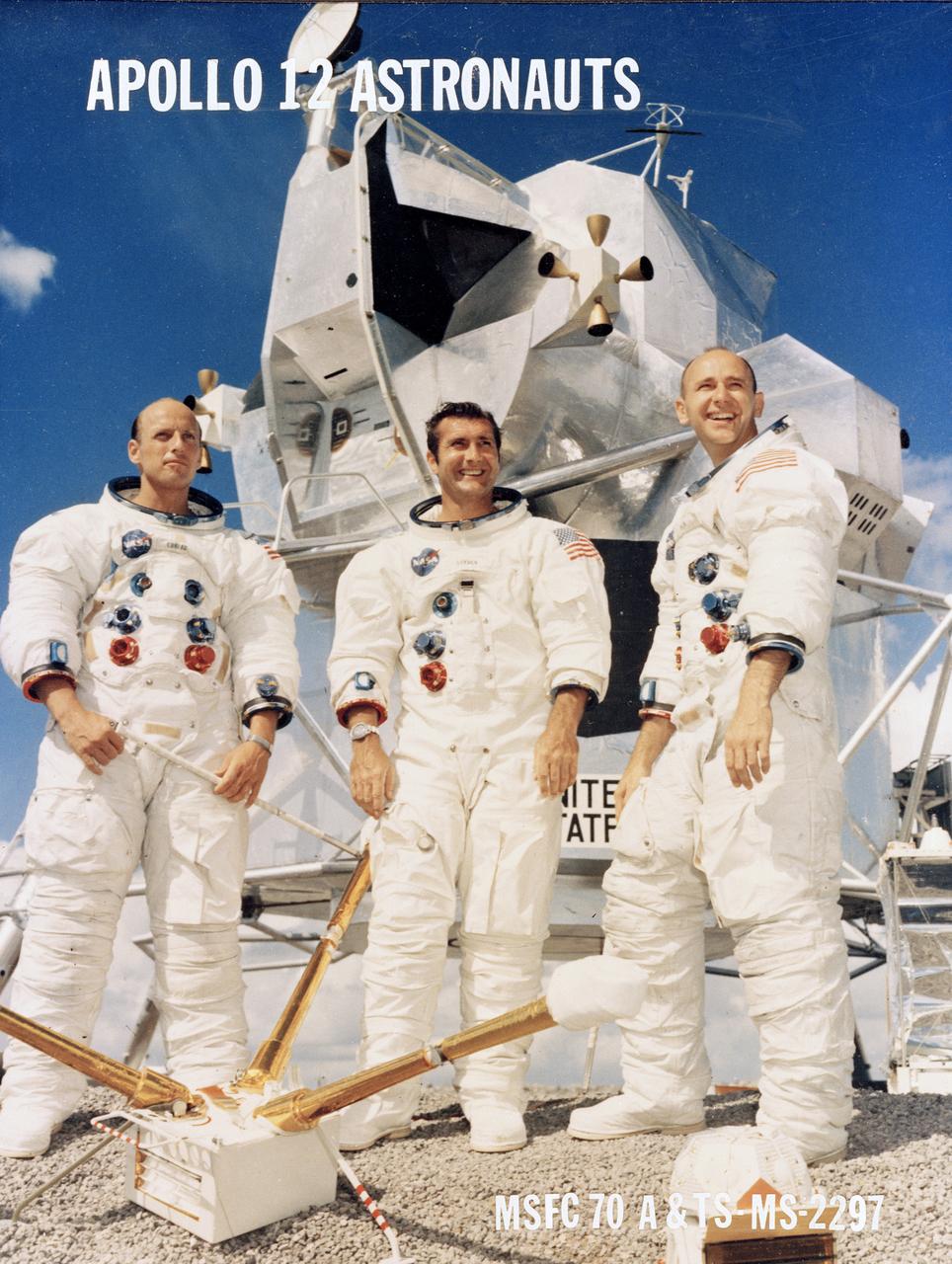
The Apollo 12 three-man crew pictured left to right are: Astronauts Charles Conrad, Spacecraft Commander; Richard F. Gordon, pilot of the Command Module `Yankee Clipper'; and Alan L. Bean, pilot of the Lunar Module `Intrepid'. Activities of astronauts Conrad and Bean on the lunar soil included setting out experiments, finding the unmarned Surveyor 3 that landed on the Moon on April 19, 1967, and collecting 75 pounds (34 kilograms) of rock samples. The second mission of the manned lunar landing and return to Earth, Apollo 12 lifted off on November 14, 1969.
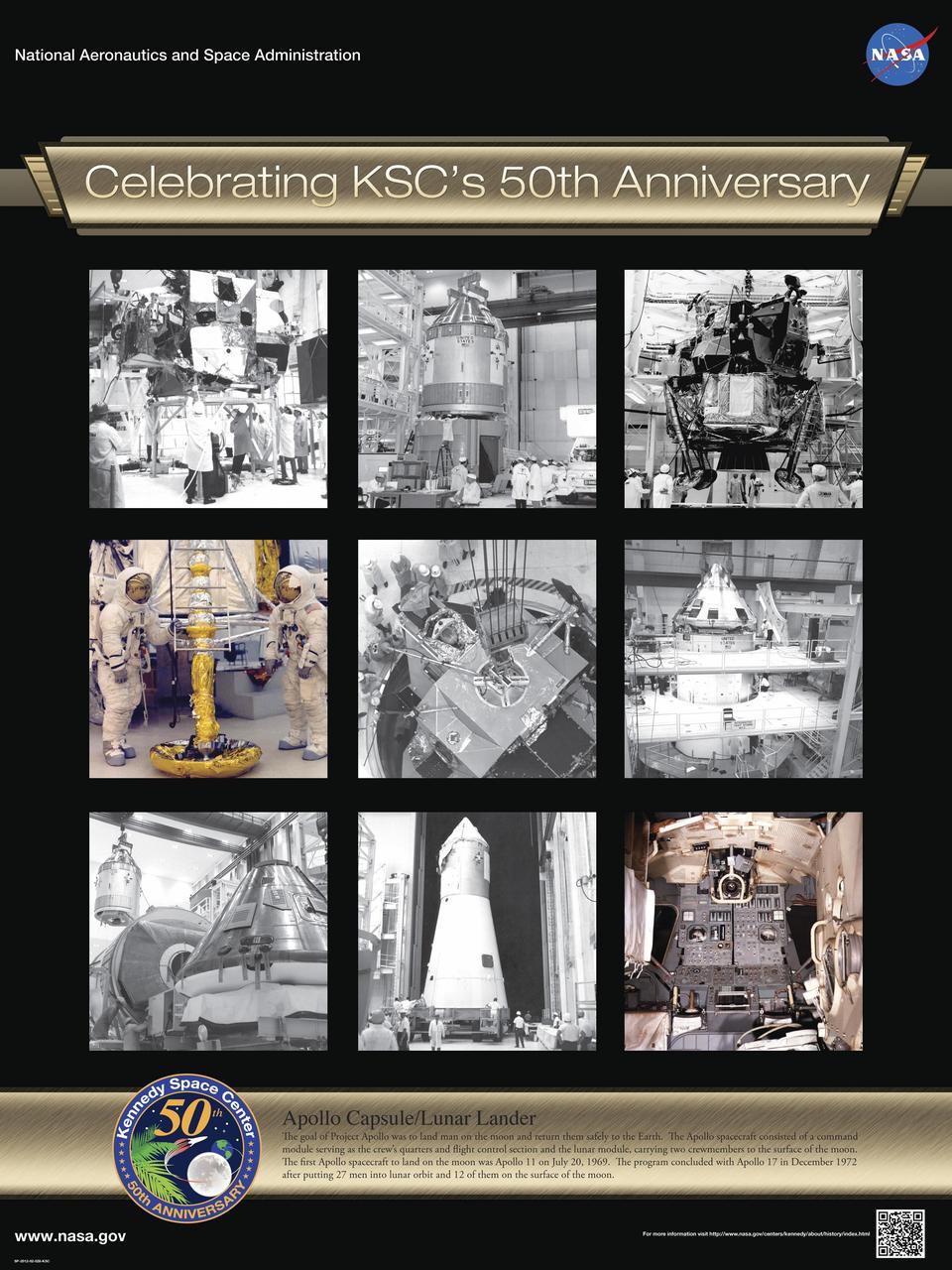
Apollo Capsule/Lunar Lander: The goal of Project Apollo was to land man on the moon and return them safely to the Earth. The Apollo spacecraft consisted of a command module serving as the crew’s quarters and flight control section and the lunar module, carrying two crewmembers to the surface of the moon. The first Apollo spacecraft to land on the moon was Apollo 11 on July 20, 1969. The program concluded with Apollo 17 in December 1972 after putting 27 men into lunar orbit and 12 of them on the surface of the moon. Poster designed by Kennedy Space Center Graphics Department/Greg Lee. Credit: NASA
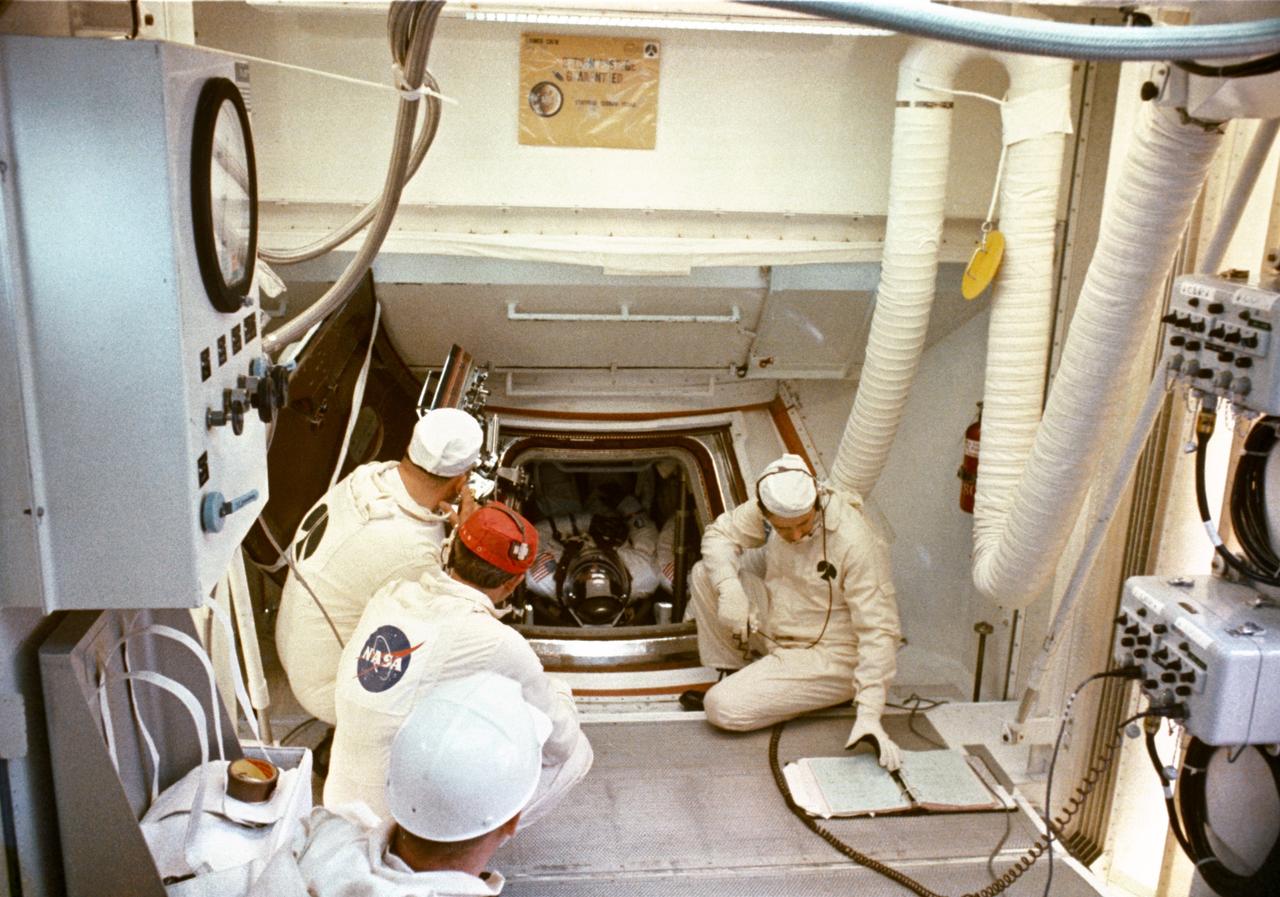
S69-35316 (18 May 1969) --- Interior view of the White Room at Pad B, Launch Complex 39, Kennedy Space Center, during the Apollo 10 prelaunch countdown. When this picture was taken the Apollo 10 crew had already been inserted into the spacecraft, and final checks were being made prior to closing of the hatch. Inside the Command Module were astronauts Thomas P. Stafford, commander; John W. Young, command module pilot; and Eugene A. Cernan, lunar module pilot. Liftoff for the lunar orbit mission was at 12:49 p.m. (EDT), May 18, 1969.
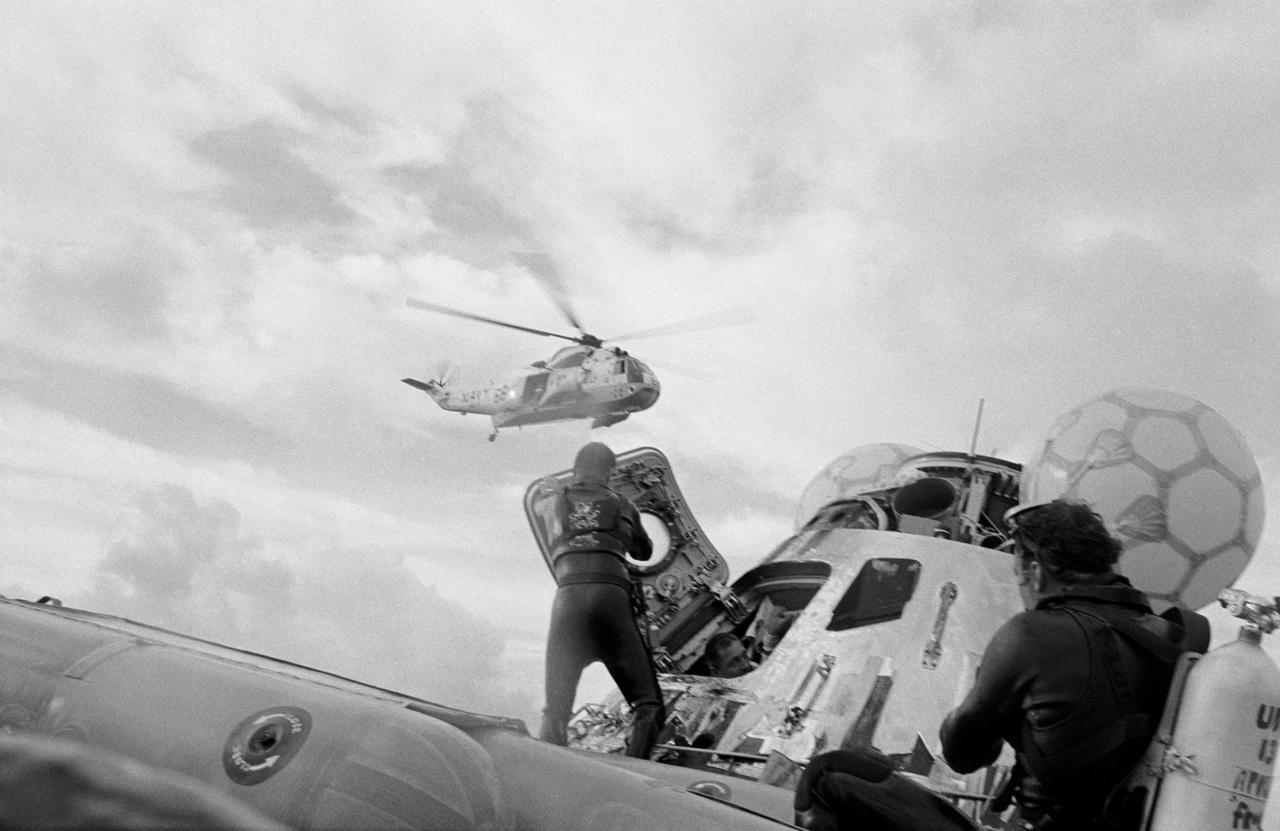
S70-35622 (17 April 1970) --- United States Navy underwater demolition team swimmers assist in the recovery operations of the Apollo 13 crewmembers, shortly after splashdown. The divers prepare to assist the astronauts out of their crippled Command Module (CM), into an awaiting life raft. Astronaut John L. Swigert Jr., command module pilot, is preparing to exit the CM. A Navy helicopter is waiting to take the astronauts to the prime recovery ship, the USS Iwo Jima. Apollo 13 splashed down at 12:07:44 p.m. (CST), April 17, 1970. Still aboard the CM are astronauts James A. Lovell Jr., commander; and Fred W. Haise Jr., lunar module pilot.

S72-55167 (12 Dec. 1972) --- The two moon-exploring Apollo 17 crew men are seen facing the TV camera during the second extravehicular activity (EVA) at the Taurus -Littrow landing site, in this black and white reproduction taken from a color television transmission made by the color TV camera mounted on the Lunar Roving Vehicle (LRV). They are astronauts Eugene A Cernan, on left , commander, and scientist-astronaut Harrison H. Schmitt, lunar module pilot. Astronaut Ronald E. Evans, command module pilot, remained with the Apollo 17 Command and Service Modules (CSM) in lunar orbit.

S69-52990 (20 Sept. 1969) --- The three prime crew men of the Apollo 12 lunar landing mission participate in water egress training in the Gulf of Mexico. They have just egressed the Apollo Command Module (CM) trainer. The man standing at left is a Manned Spacecraft Center's (MSC) swimmer. The crew men await in life raft for helicopter pickup. All four persons are wearing biological isolation garments. Participating in the training exercise were astronauts Charles Conrad Jr., commander; Richard F. Gordon Jr., command module pilot; and Alan L. Bean, lunar module pilot.
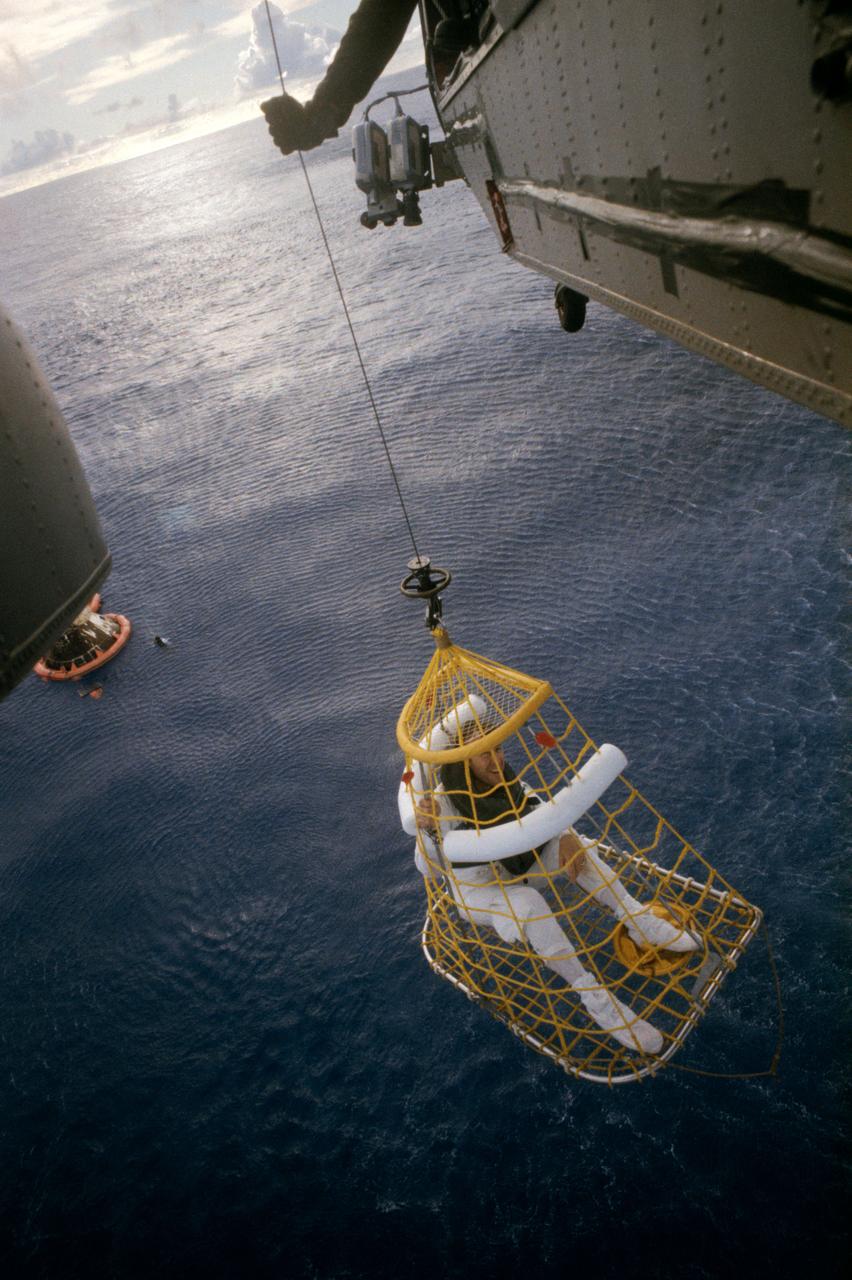
S70-35645 (17 April 1970) --- Astronaut James A. Lovell Jr., commander, is hoisted aboard a helicopter from the USS Iwo Jima, prime recovery vessel for the mission. Lovell was the last of the three Apollo 13 crewmembers to egress the Command Module (CM) and the last to be lifted aboard the helicopter. He was preceded by astronauts John L. Swigert Jr., command module pilot; and Fred W. Haise Jr., lunar module pilot. The CM and a U.S. Navy underwater demolition team swimmer can be seen in the ocean background. Apollo 13 splashed down at 12:07:44 p.m. (CST), April 17, 1970.
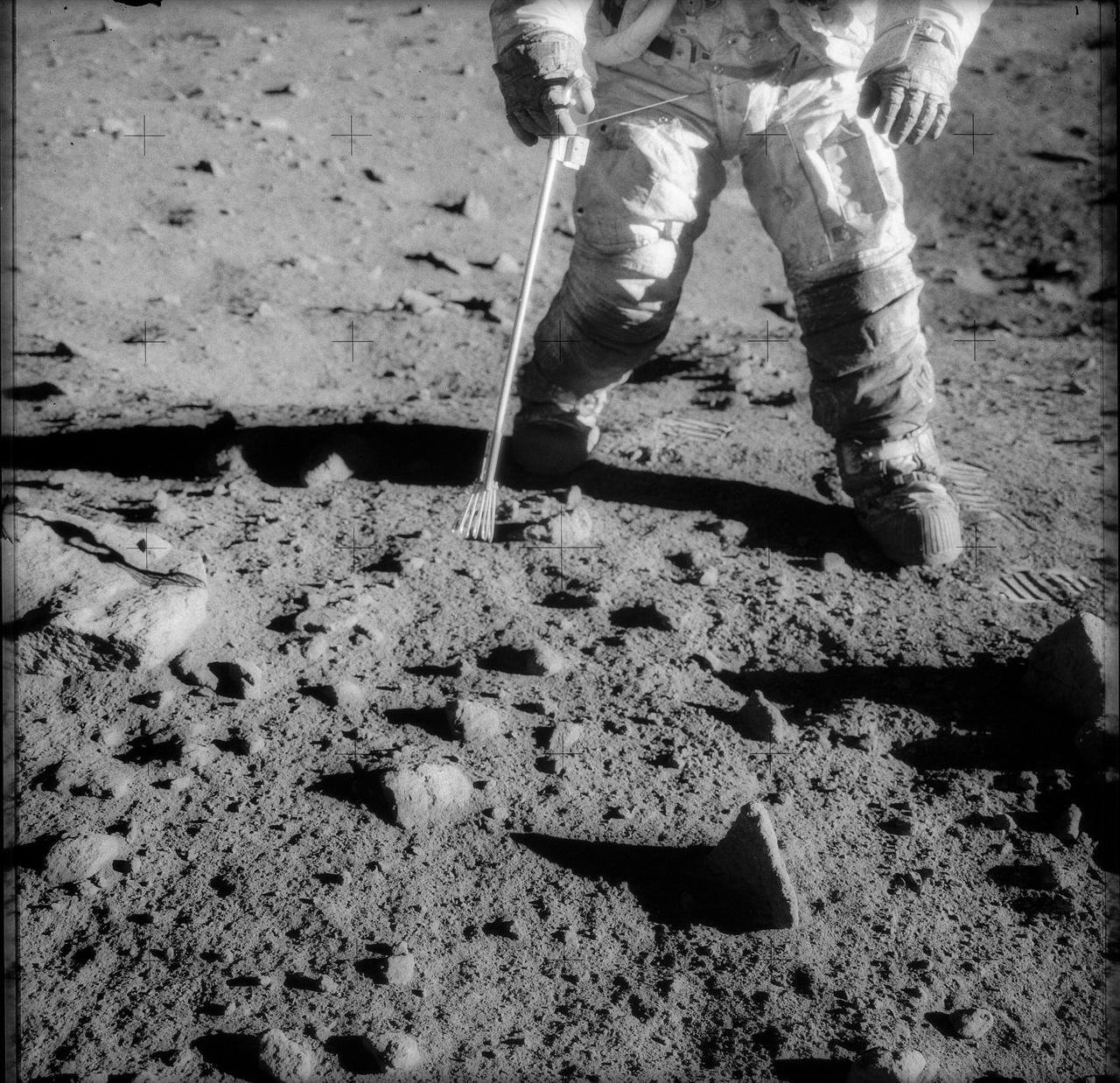
AS12-48-7149 (20 Nov. 1969) --- A close-up view of astronaut Charles Conrad Jr., commander of the Apollo 12 lunar landing mission, photographed during the extravehicular activity (EVA) on the surface of the moon. An EVA checklist is on Conrad's left wrist. A set of tongs, an Apollo Lunar Hand Tool (ALHT), is held in his right hand. Several footprints can be seen. Astronaut Richard F. Gordon Jr., command module pilot, remained with the Command and Service Modules (CSM) in lunar orbit while astronauts Conrad and Alan L. Bean, lunar module pilot, descended in the LM to explore the moon. Note lunar soil on the suit of Conrad, especially around the knees and below.
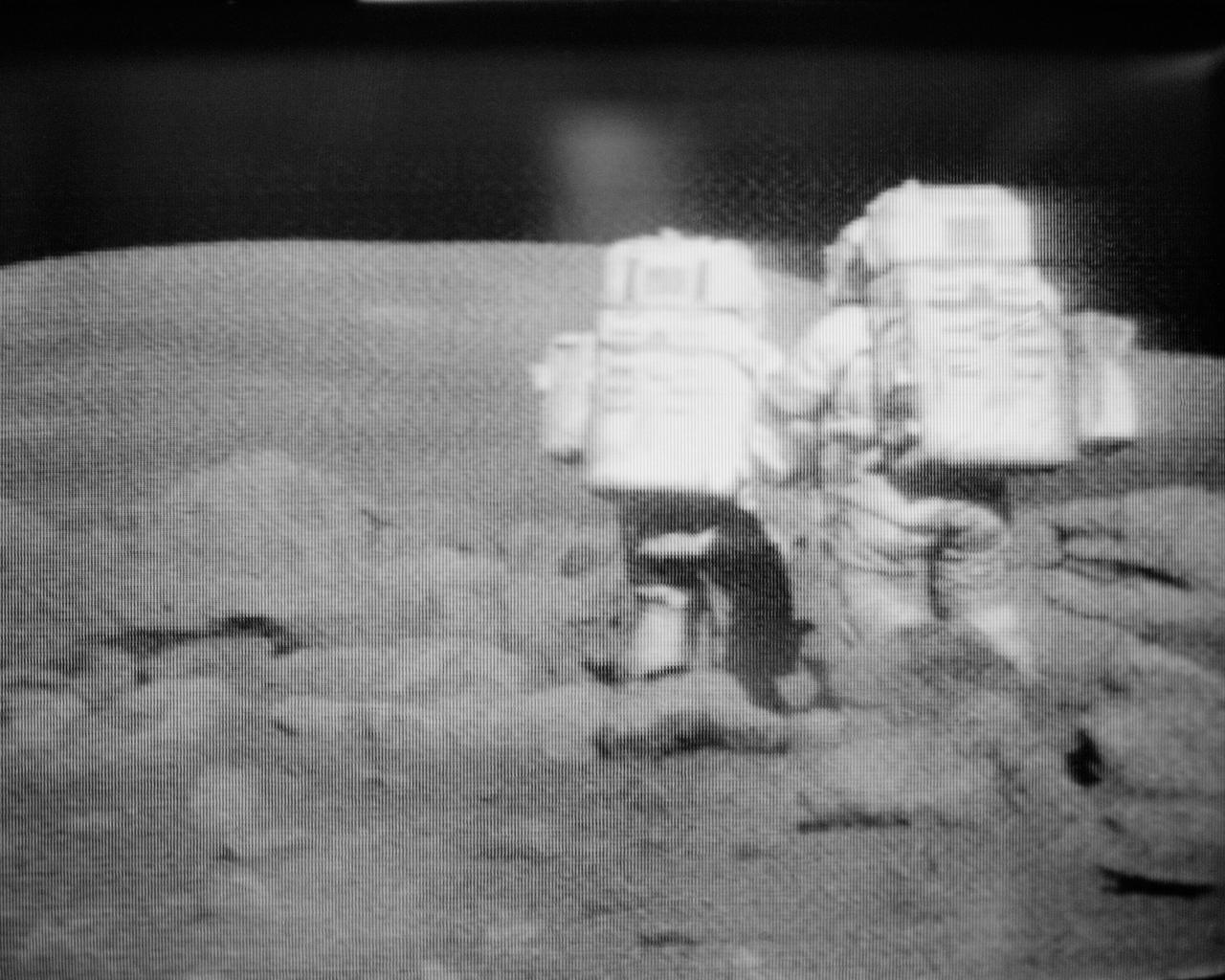
S72-55168 (12 Dec. 1972) --- Astronaut Eugene A. Cernan (on left) and scientist-astronaut Harrison H. Schmitt walk through a field of small boulders during the second Apollo 17 extravehicular activity (EVA) at the Taurus-Littrow landing site, as seen in this black and white reproduction taken from a color television transmission made by the color RCA TV camera mounted on the Lunar Roving Vehicle. Cernan is the Apollo 17 commander; and Schmitt is the lunar module pilot. Astronaut Ronald E. Evans, command module pilot, remained with the Command and Service Modules in lunar orbit. (Their backs are toward the camera)
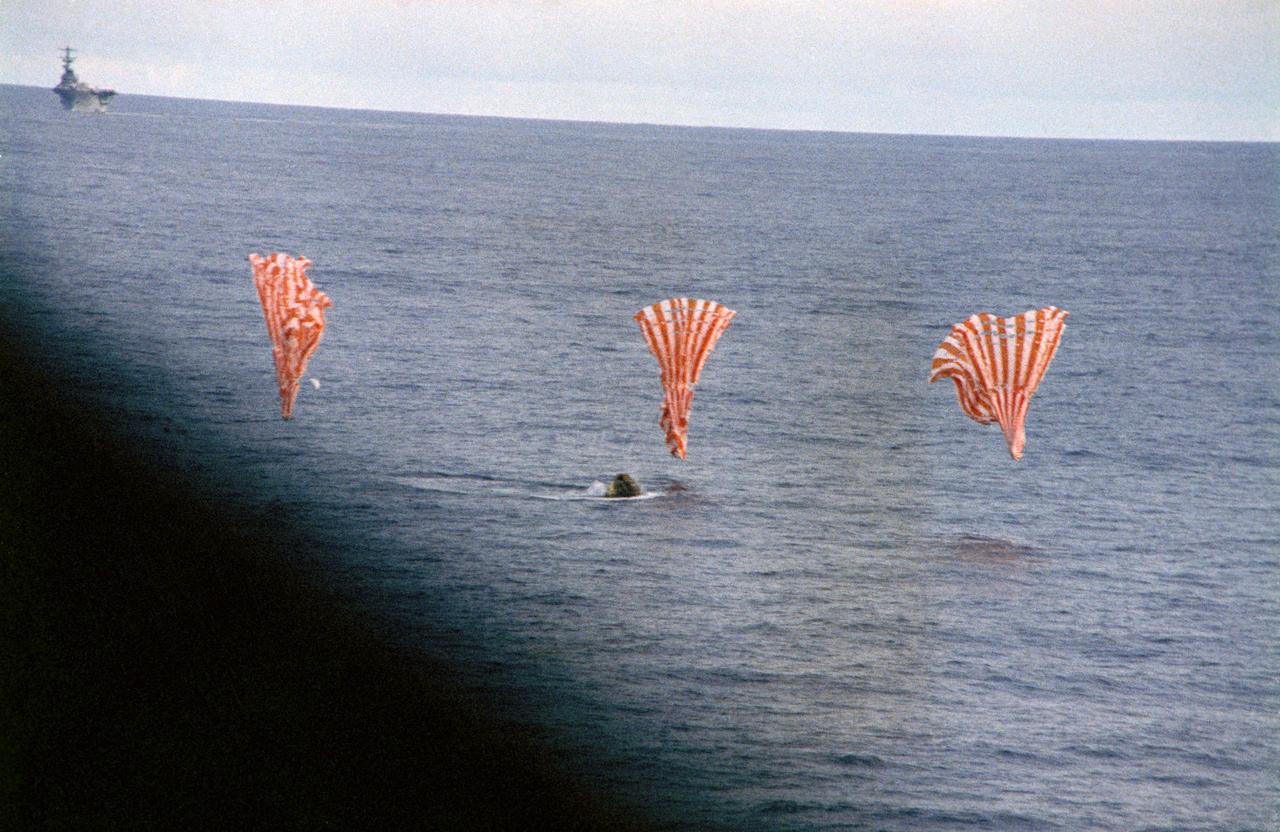
S70-35644 (17 April 1970) --- The Apollo 13 Command Module (CM) splashes down and its three main parachutes collapse, as the week-long problem-plagued Apollo 13 mission comes to a premature, but safe end. The spacecraft, with astronauts James A. Lovell Jr., commander; John L. Swigert Jr., command module pilot; and Fred W. Haise Jr., lunar module pilot, aboard splashed down at 12:07:44 p.m. (CST) April 17, 1970, in the South Pacific Ocean, only about four miles from the USS Iwo Jima, prime recovery ship.
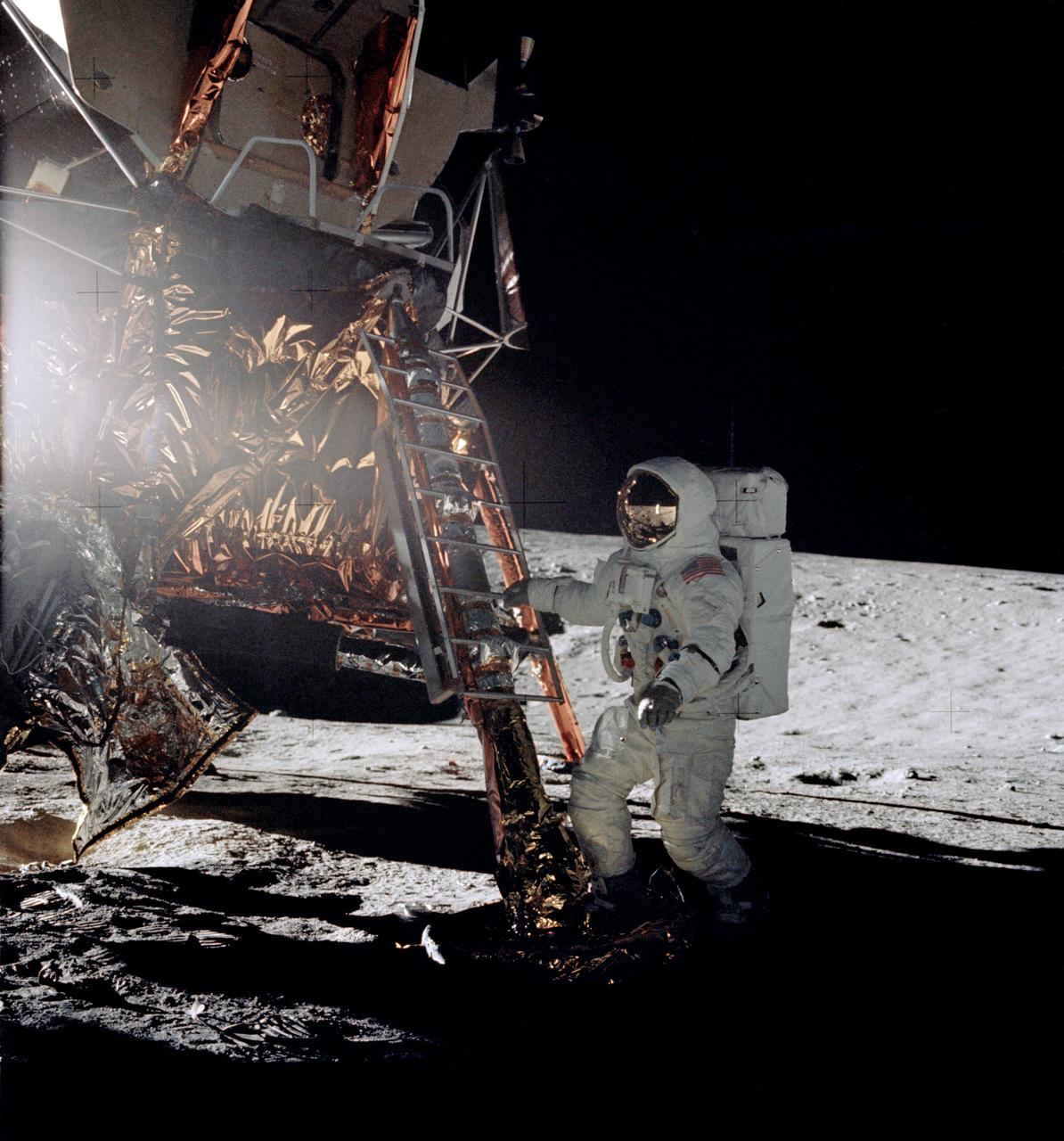
AS12-46-6729 (19 Nov. 1969) --- Astronaut Alan L. Bean, lunar module pilot for the Apollo 12 lunar landing mission, steps from the ladder of the Lunar Module to join astronaut Charles Conrad Jr., commander, in extravehicular activity on Nov. 19, 1969. Astronaut Richard F. Gordon Jr., command module pilot, remained with the Command and Service Modules in lunar orbit.
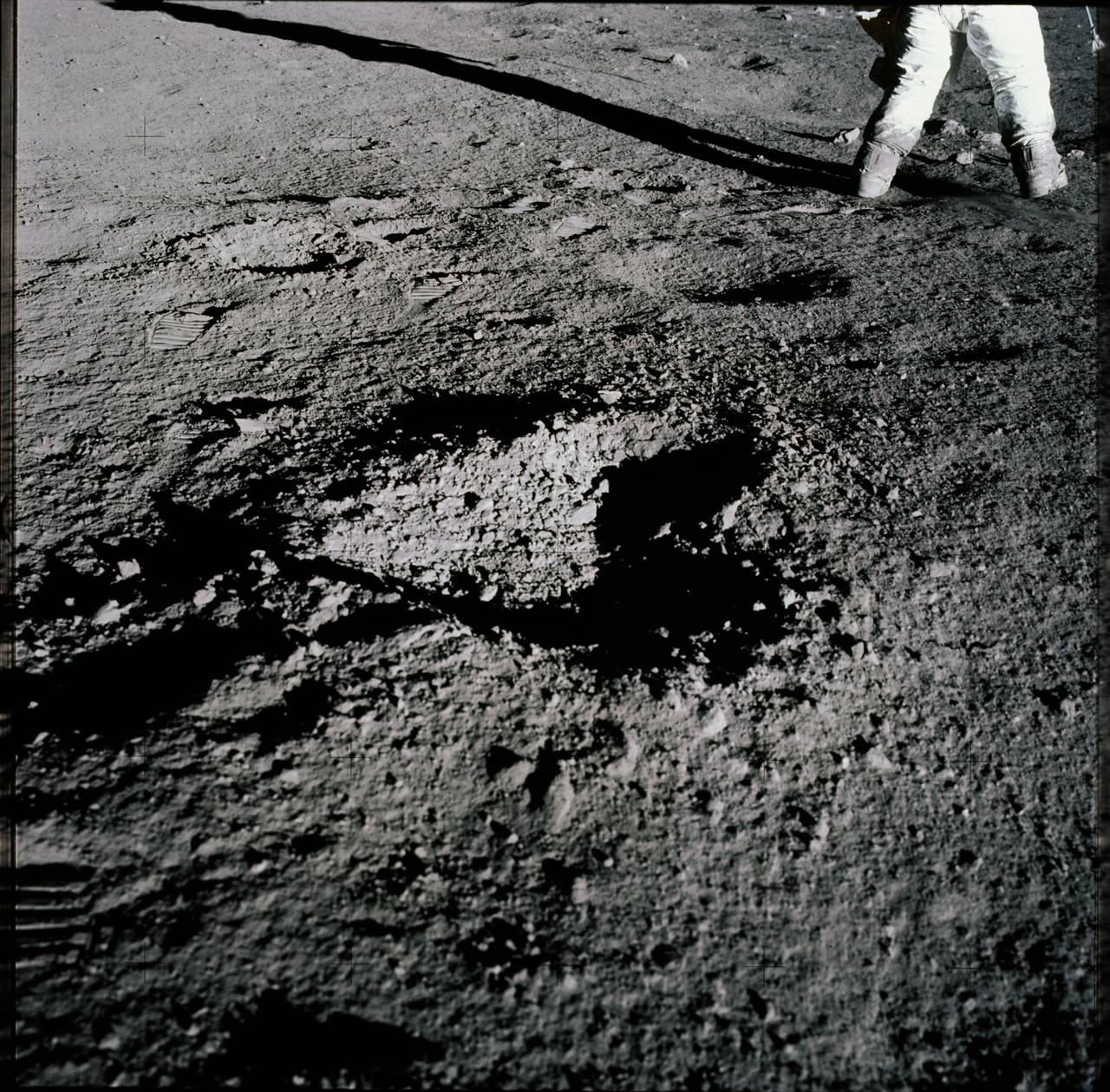
AS12-47-6938 (19 Nov. 1969) --- A close-up view of a heart-shaped depression (crater) in the lunar surface, as photographed during the Apollo 12 extravehicular activity (EVA). The legs of astronaut Charles Conrad Jr., commander, can be seen in the background. Astronaut Richard F. Gordon Jr., command module pilot, remained with the Command and Service Modules (CSM) in lunar orbit while astronauts Conrad and Alan L. Bean, lunar module pilot, descended in the Lunar Module (LM) to explore the moon.
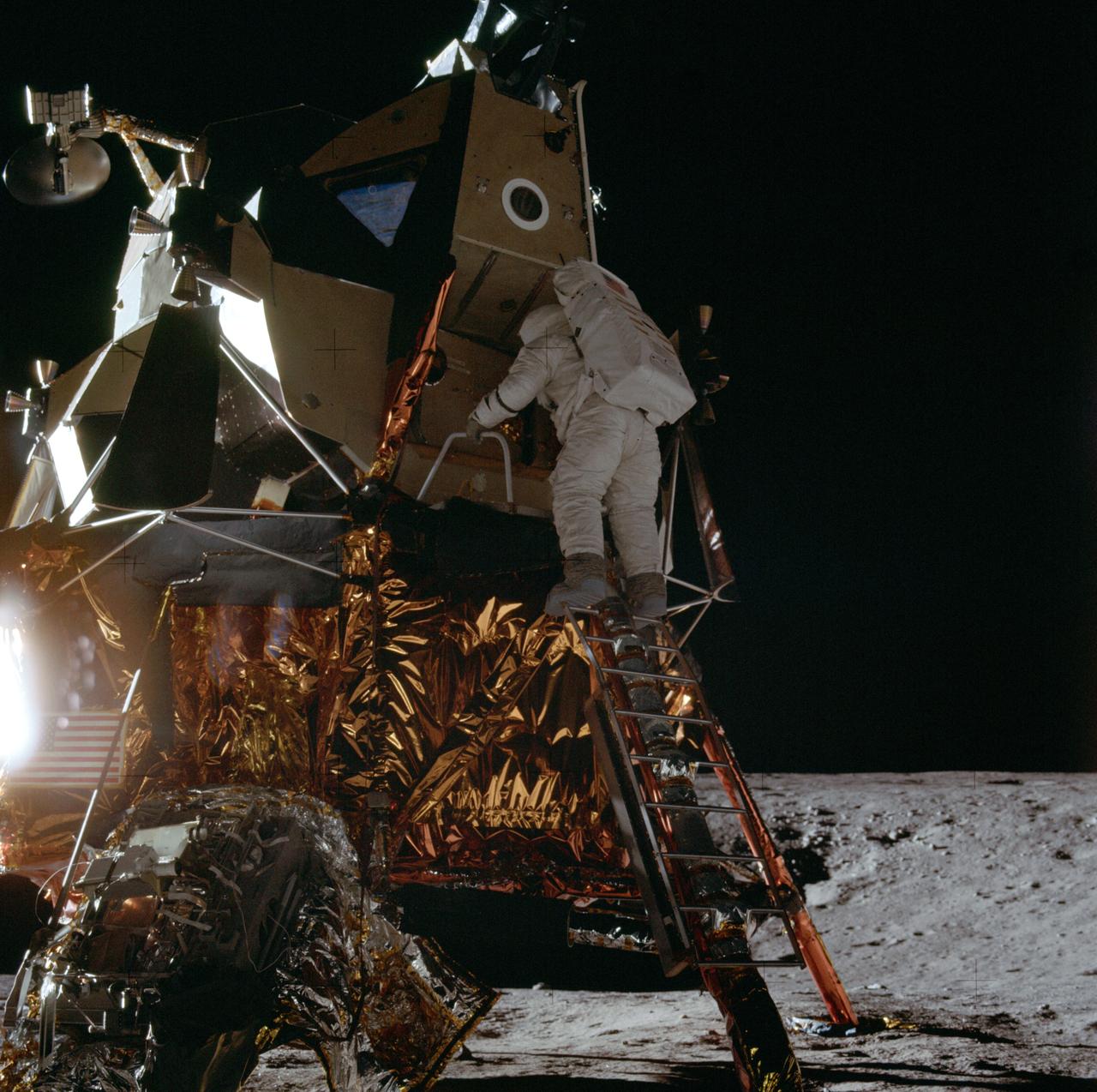
AS12-46-6726 (19 Nov. 1969) --- Astronaut Alan L. Bean, lunar module pilot for the Apollo 12 mission, starts down the ladder of the Lunar Module (LM) to join astronaut Charles Conrad Jr., mission commander, in extravehicular activity (EVA). While astronauts Conrad and Bean descended in the LM "Intrepid" to explore the Ocean of Storms region of the moon, astronaut Richard F. Gordon Jr., command module pilot, remained with the Command and Service Modules (CSM) "Yankee Clipper" in lunar orbit.
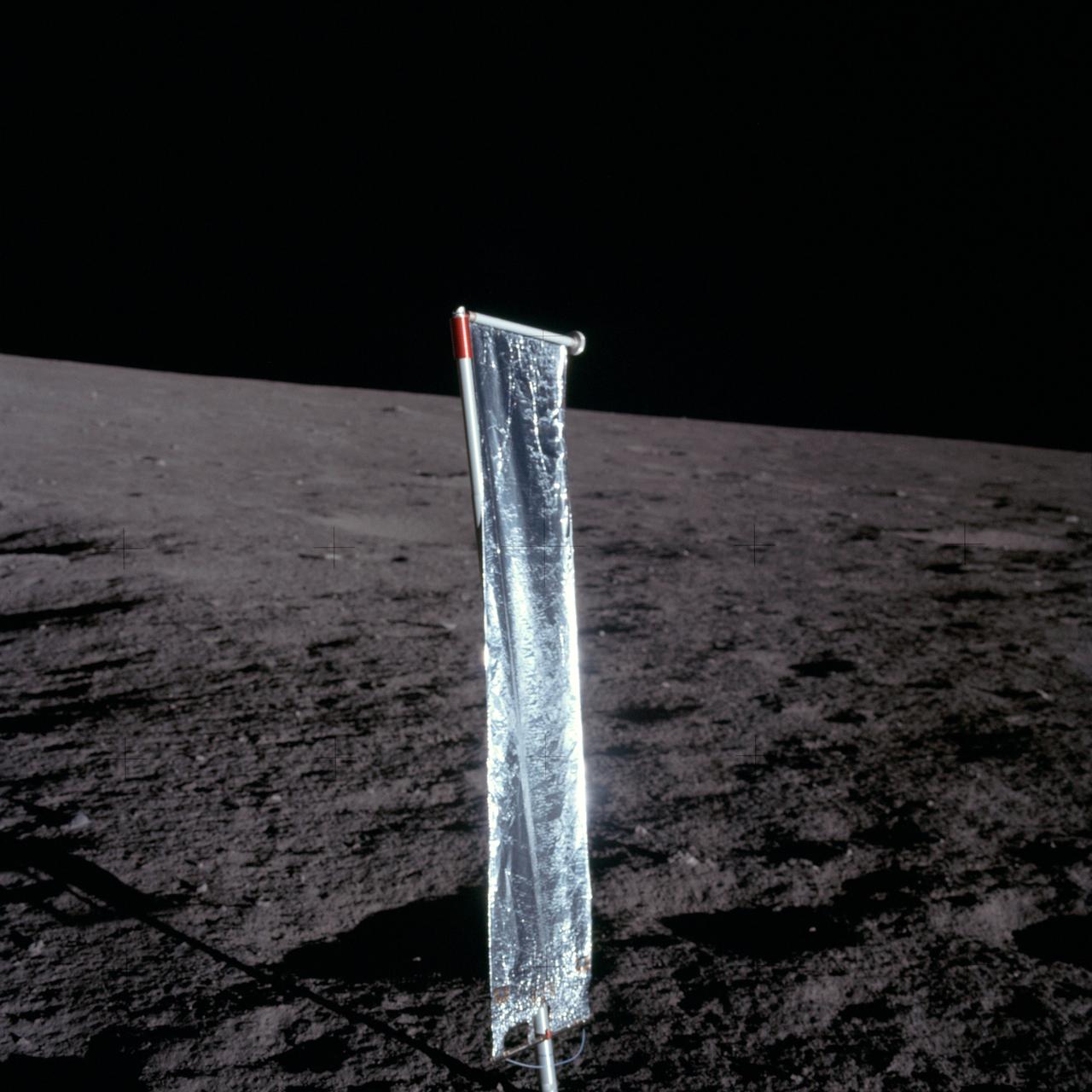
AS12-47-6898 (19 Nov. 1969) --- A close-up view of the Solar Wind Composition device. Astronaut Alan L. Bean, lunar module pilot, took this photograph, after having deployed the device. Astronauts Charles Conrad Jr., commander, and Bean descended in the Apollo 12 Lunar Module (LM) to explore the moon, while astronaut Richard F. Gordon Jr., command module pilot, remained in lunar orbit with the Command and Service Modules (CSM).
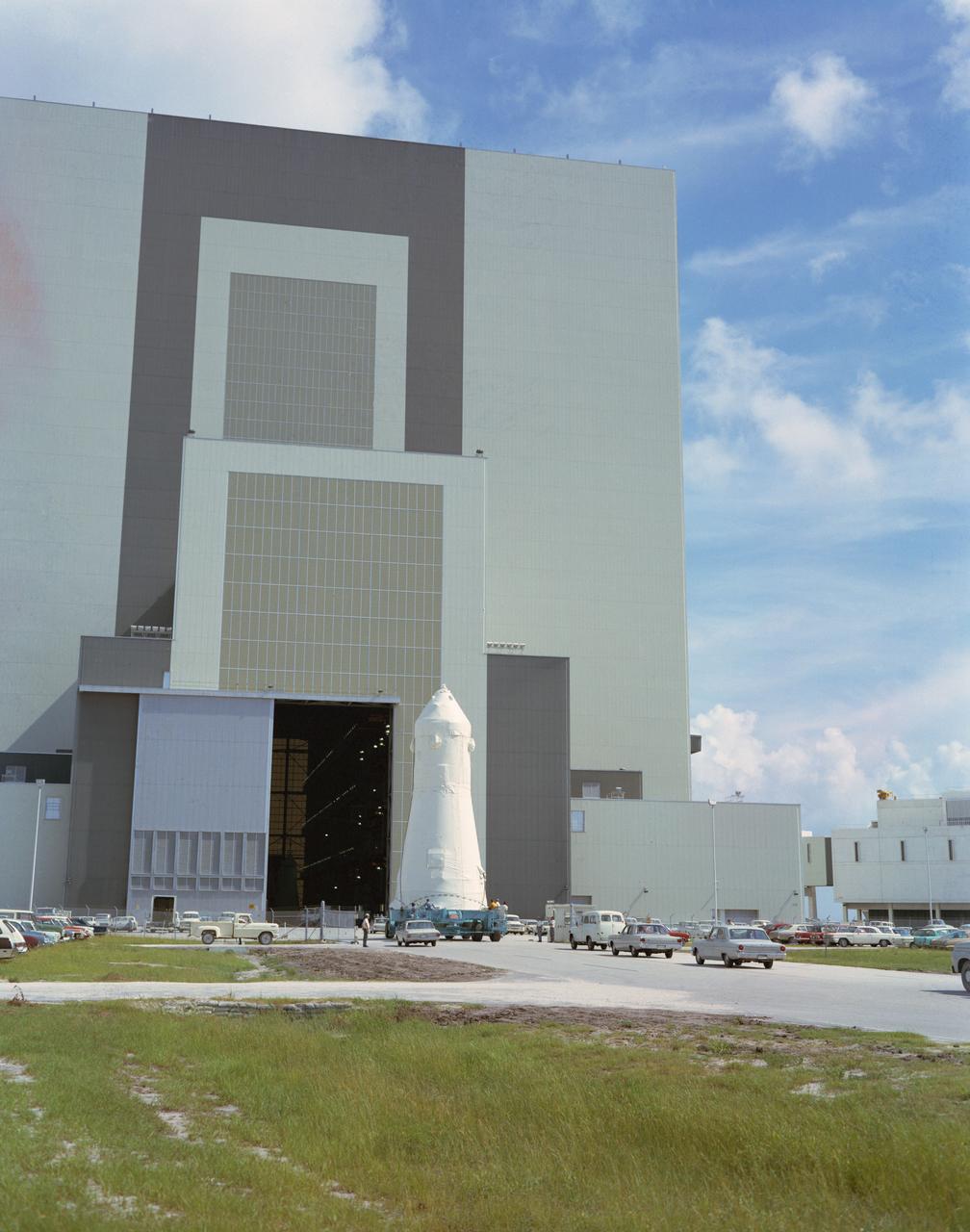
S69-39323 (1969) --- The Apollo 12 spacecraft (Command and Service Modules 108/Lunar Module 6) arrives at the Kennedy Space Center's Vehicle Assembly Building (VAB) during preflight preparations. The spacecraft had just been moved from the Manned Spacecraft Operations Building.
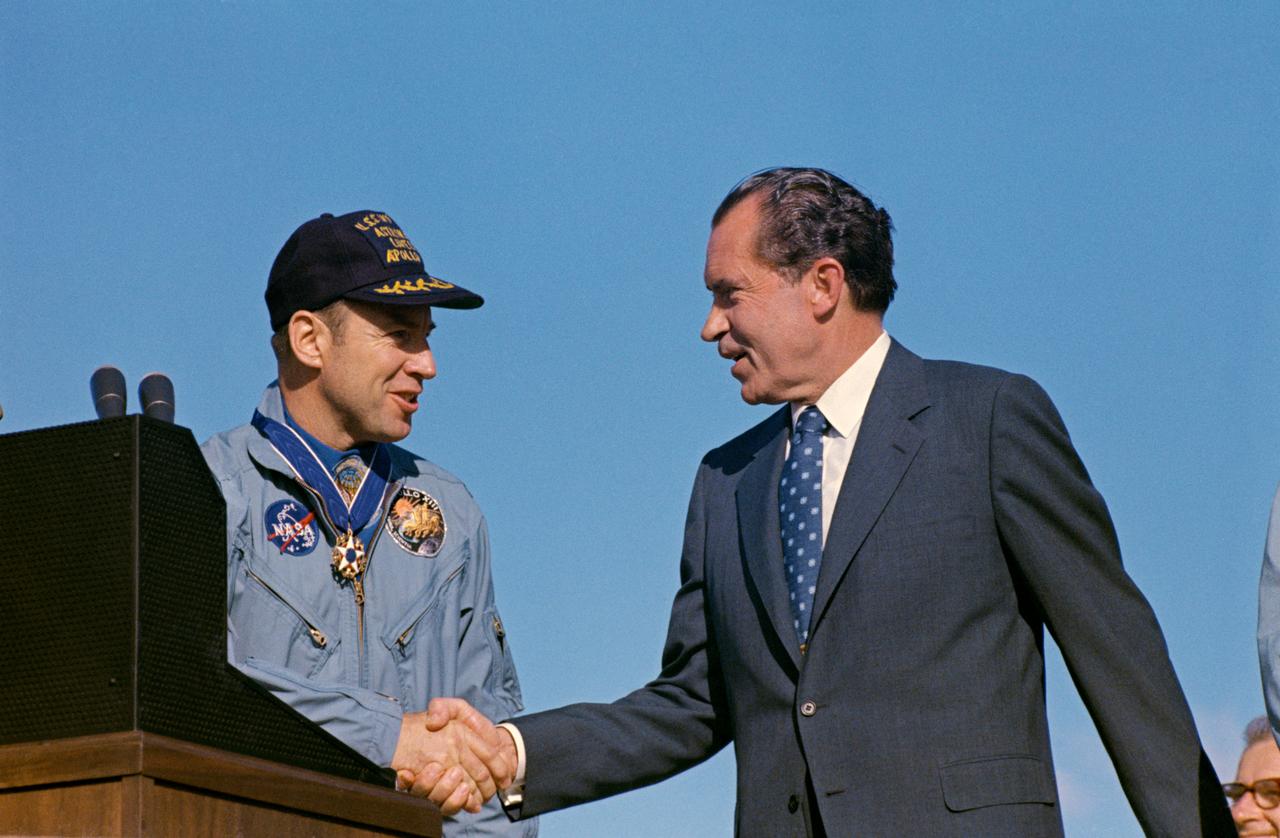
S70-15506 (18 April 1970) --- President Richard M. Nixon and astronaut James A. Lovell Jr., Apollo 13 commander, shake hands at special ceremonies at Hickam Air Force Base, Hawaii. President Nixon was in Hawaii to present the Apollo 13 crew with the Presidential Medal of Freedom, the nation's highest civilian honor. The wives of astronauts Lovell and Fred W. Haise Jr., lunar module pilot; and the parents of astronaut John L. Swigert Jr., command module pilot, flew with the Chief Executive to Hickam Air Force Base. The Apollo 13 splashdown occurred at 12:07:44 p.m. (CST), April 17, 1970, a day and a half prior to the awards ceremony.
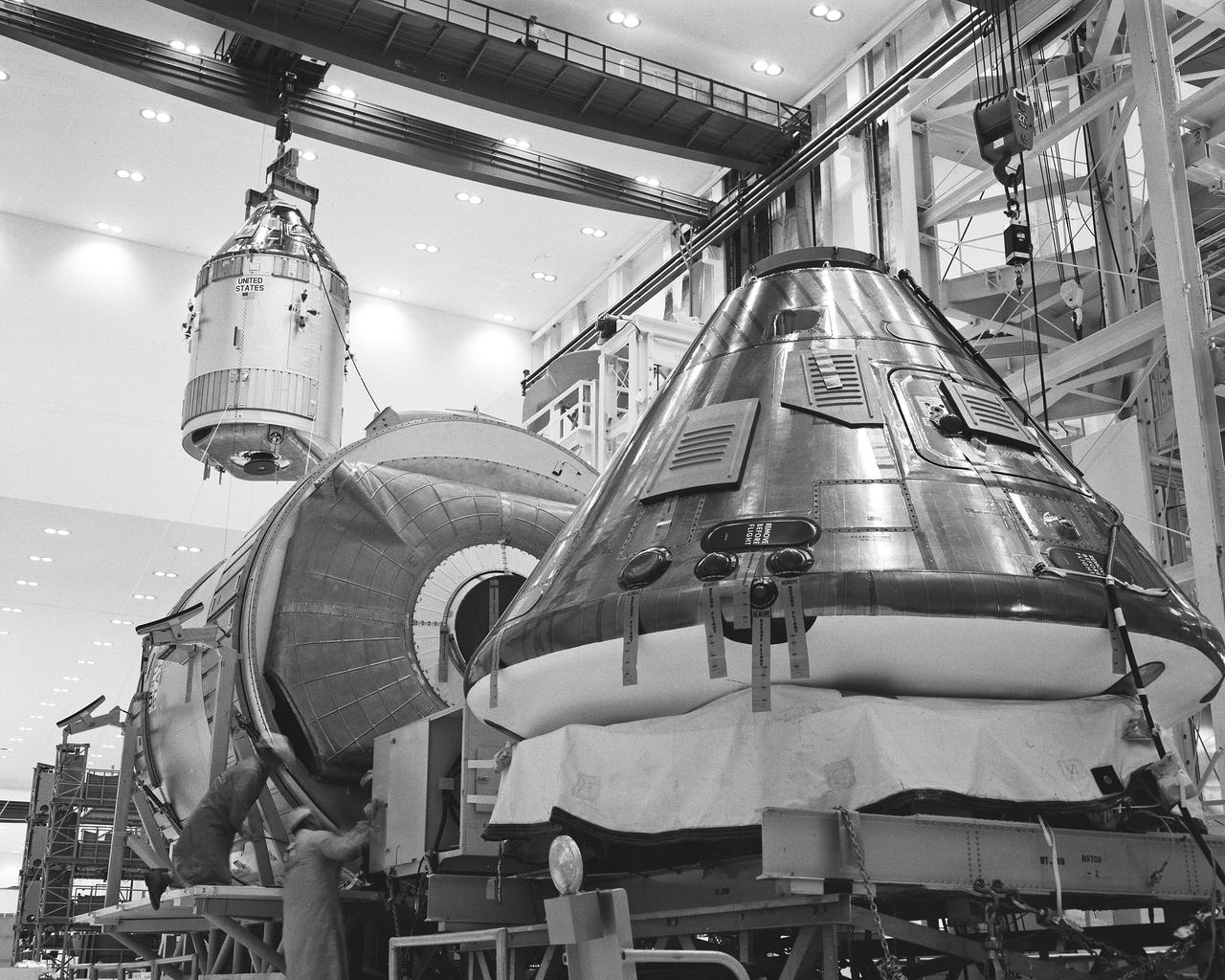
CAPE CANAVERAL, Fla. – Apollo command and service modules scheduled for manned landing missions on the moon cross paths in the Manned Spacecraft Operations Building at the spaceport. The meeting occurred last night when the CSM for Apollo 11 was being hoisted out of a test chamber and the CSM for Apollo 12, which recently arrived at Kennedy Space Center, was getting its initial checkouts in the aisle. Apollo 11 is scheduled for the first manned lunar landing mission this summer. Photo credit: NASA
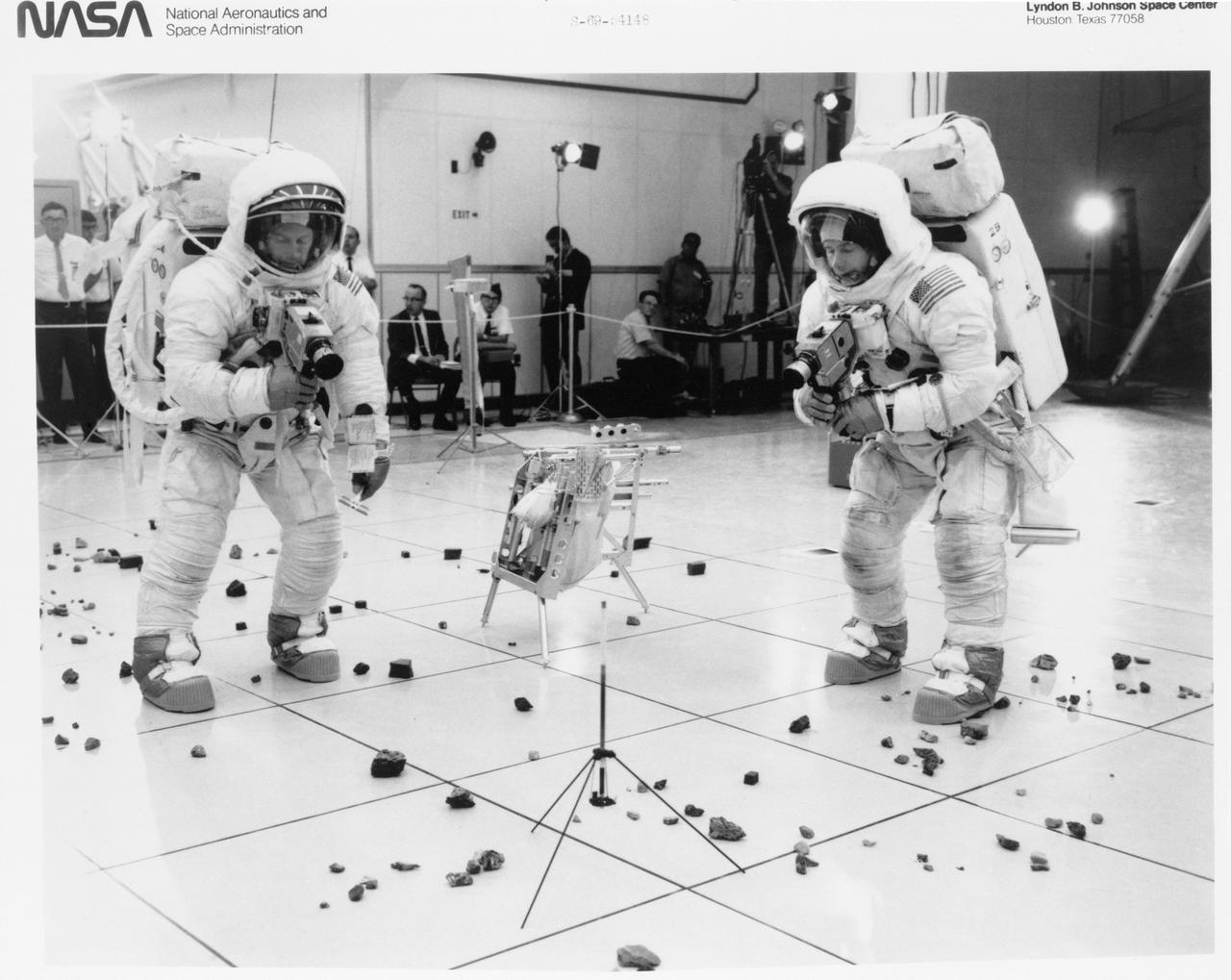
S69-54148 (October 1969) --- Two members of the Apollo 12 lunar landing mission participates in lunar surface extravehicular activity (EVA) simulations in the Kennedy Space Center's (KSC) Flight Crew Training Building. Here, astronauts Charles Conrad Jr. (on left), commander, and Alan L. Bean, lunar module pilot, simulate the photographic documentation of lunar rock samples. The simulations were part of a run-through of the Apollo 12 lunar surface "timeline".
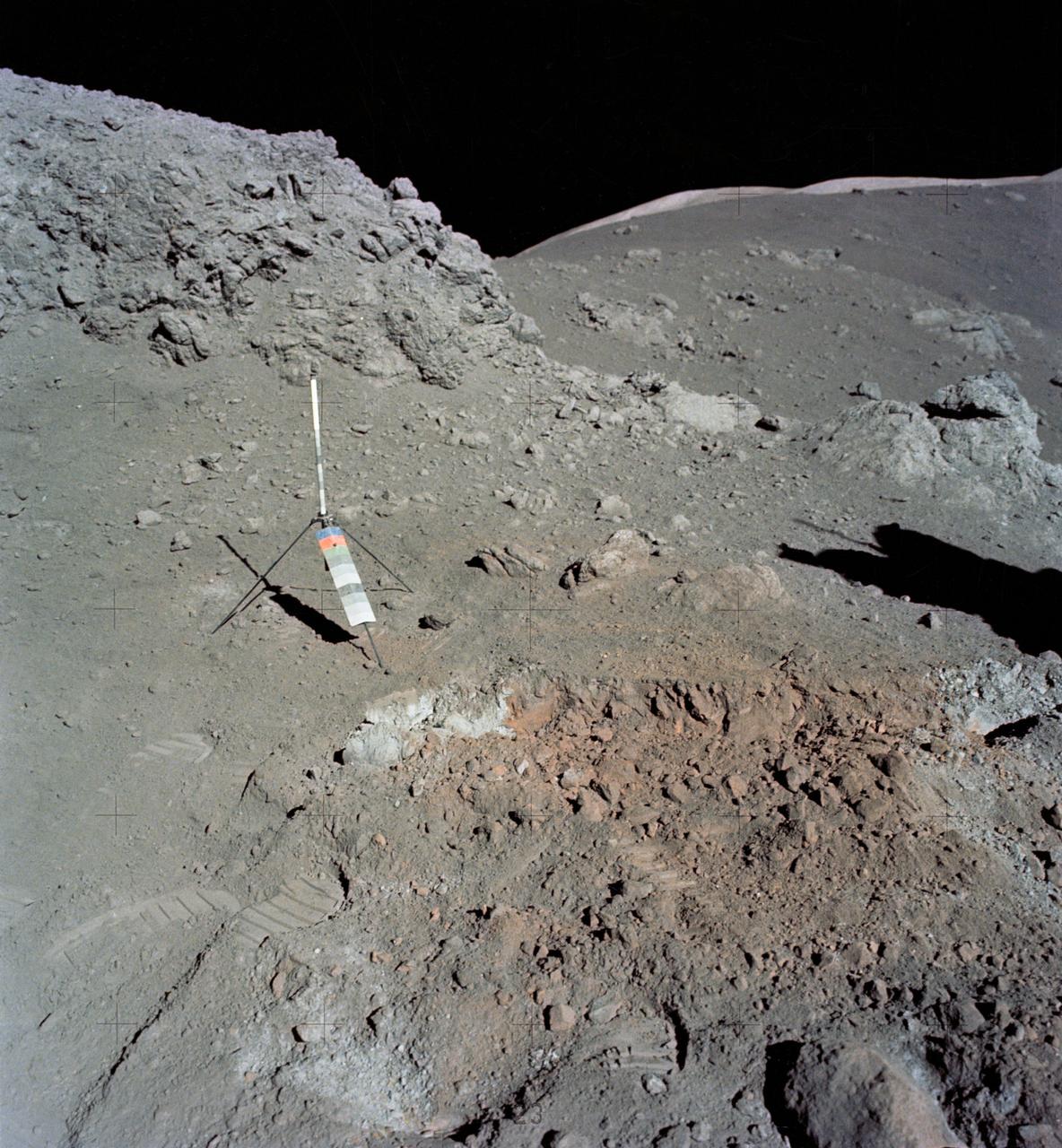
AS17-137-20990 (12 Dec. 1972) --- A view of the area at Station 4 (Shorty Crater) showing the now highly-publicized orange soil which the Apollo 17 crew members found on the moon during the second Apollo 17 extravehicular activity (EVA) at the Taurus-Littrow landing site. The tripod-like object is the gnomon and photometric chart assembly which is used as a photographic reference to establish local vertical sun angle, scale and lunar color. The gnomon is one of the Apollo lunar geology hand tools. While astronauts Eugene A. Cernan, commander, and Harrison H. Schmitt, lunar module pilot, descended in the Lunar Module (LM) "Challenger" to explore the Taurus-Littrow region of the moon, astronaut Ronald E. Evans, command module pilot, remained with the Command and Service Modules (CSM) "America" in lunar orbit. Schmitt was the crew man who first spotted the orange soil.

S69-21698 (24 July 1969) --- The three Apollo 11 crew men await pickup by a helicopter from the USS Hornet, prime recovery ship for the historic Apollo 11 lunar landing mission. The fourth man in the life raft is a United States Navy underwater demolition team swimmer. All four men are wearing biological isolation garments. Apollo 11, with astronauts Neil A. Armstrong, commander; Michael Collins, command module pilot; and Edwin E. Aldrin Jr., lunar module pilot, onboard, splashed down at 11:49 a.m. (CDT), July 24, 1969, about 812 nautical miles southwest of Hawaii and only 12 nautical miles from the USS Hornet. While astronauts Armstrong and Aldrin descended in the Lunar Module (LM) "Eagle" to explore the Sea of Tranquility region of the moon, astronaut Collins remained with the Command and Service Modules (CSM) "Columbia" in lunar orbit.
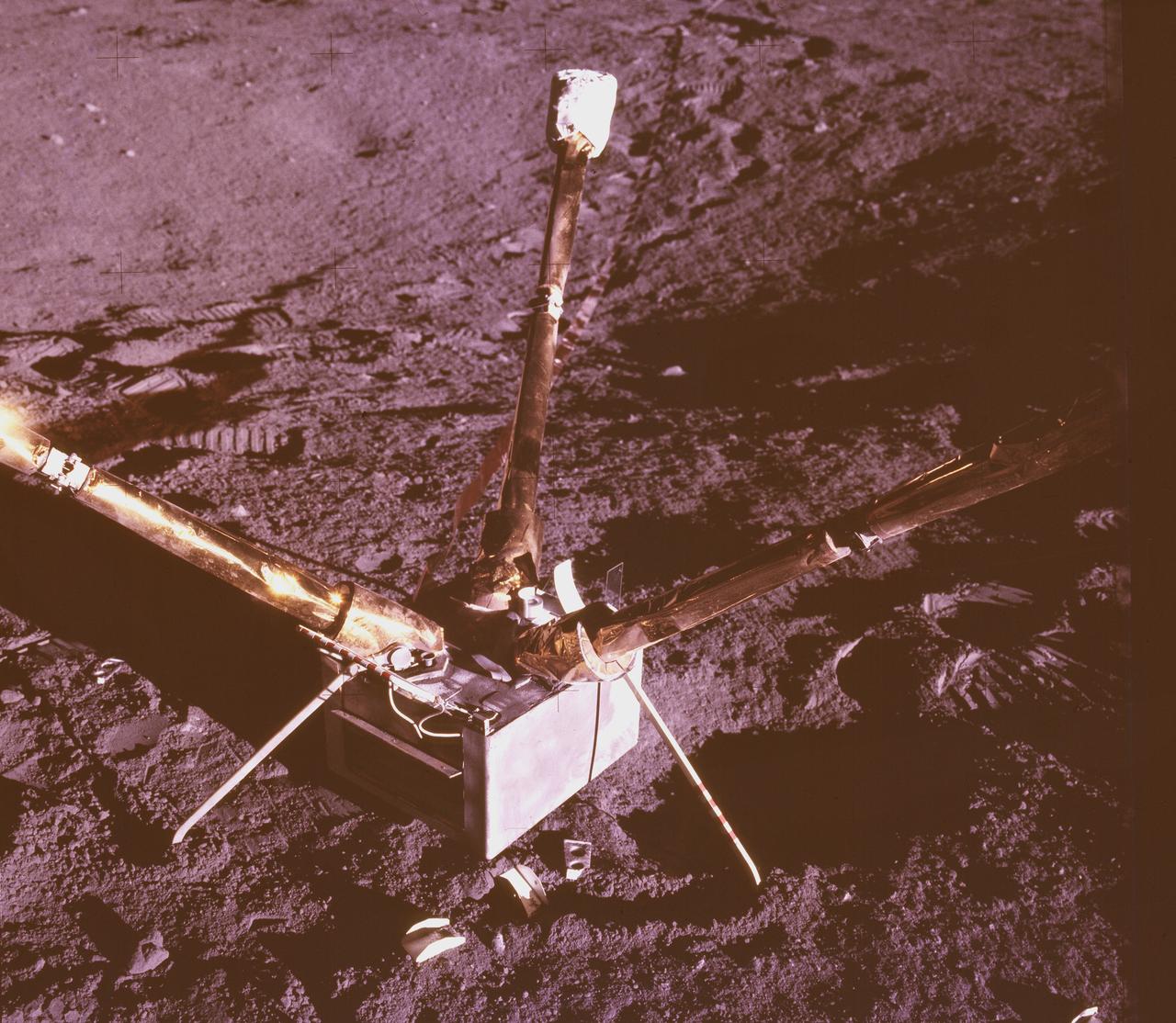
Sitting on the lunar surface, this magnetometer provided new data on the Moon’s magnetic field. This was one of the instruments used during the Apollo 12 mission. The second manned lunar landing mission, Apollo 12 launched from launch pad 39-A at Kennedy Space Center in Florida on November 14, 1969 via a Saturn V launch vehicle. The Saturn V vehicle was developed by the Marshall Space Flight Center (MSFC) under the direction of Dr. Wernher von Braun. Aboard Apollo 12 was a crew of three astronauts: Alan L. Bean, pilot of the Lunar Module (LM), Intrepid; Richard Gordon, pilot of the Command Module (CM), Yankee Clipper; and Spacecraft Commander Charles Conrad. The LM, Intrepid, landed astronauts Conrad and Bean on the lunar surface in what’s known as the Ocean of Storms while astronaut Richard Gordon piloted the CM, Yankee Clipper, in a parking orbit around the Moon. Lunar soil activities included the deployment of the Apollo Lunar Surface Experiments Package (ALSEP), finding the unmanned Surveyor 3 that landed on the Moon on April 19, 1967, and collecting 75 pounds (34 kilograms) of rock samples. Apollo 12 safely returned to Earth on November 24, 1969.

Sitting on the lunar surface, this Solar Wind Spectrometer is measuring the energies of the particles that make up the solar wind. This was one of the instruments used during the Apollo 12 mission. The second manned lunar landing mission, Apollo 12 launched from launch pad 39-A at Kennedy Space Center in Florida on November 14, 1969 via a Saturn V launch vehicle. The Saturn V vehicle was developed by the Marshall Space Flight Center (MSFC) under the direction of Dr. Wernher von Braun. Aboard Apollo 12 was a crew of three astronauts: Alan L. Bean, pilot of the Lunar Module (LM), Intrepid; Richard Gordon, pilot of the Command Module (CM), Yankee Clipper; and Spacecraft Commander Charles Conrad. The LM, Intrepid, landed astronauts Conrad and Bean on the lunar surface in what’s known as the Ocean of Storms while astronaut Richard Gordon piloted the CM, Yankee Clipper, in a parking orbit around the Moon. Lunar soil activities included the deployment of the Apollo Lunar Surface Experiments Package (ALSEP), finding the unmanned Surveyor 3 that landed on the Moon on April 19, 1967, and collecting 75 pounds (34 kilograms) of rock samples. Apollo 12 safely returned to Earth on November 24, 1969.
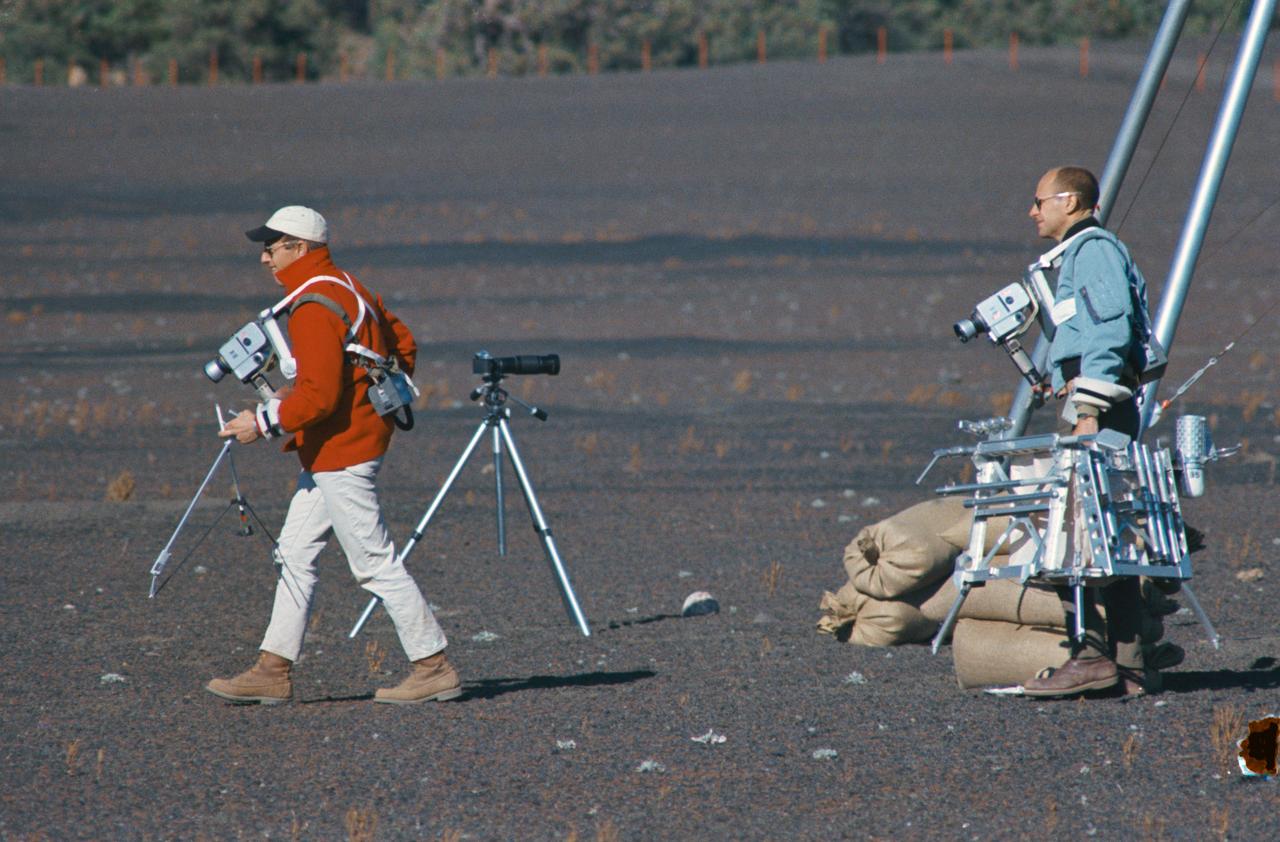
S69-55667 (10 Oct. 1969) --- Astronauts Charles Conrad Jr. and Alan L. Bean train for their upcoming Apollo 12 lunar landing mission. Here they are entering a simulated lunar surface area near Flagstaff, Arizona. Both are wearing lunar surface cameras strapped to their bodies. Conrad (left), the Apollo 12 mission commander, is carrying some of the tools from the geological tool container. The geological tool container, being carried here by Bean, the lunar module pilot, is similar to the one which will be used during scheduled extravehicular activity (EVA) periods on Nov. 19 and 20, 1969, on the lunar surface. While astronauts Conrad and Bean conduct their scheduled EVA on the moon's surface, astronaut Richard F. Gordon Jr., command module pilot, will man the Command and Service Modules (CSM) in lunar orbit.
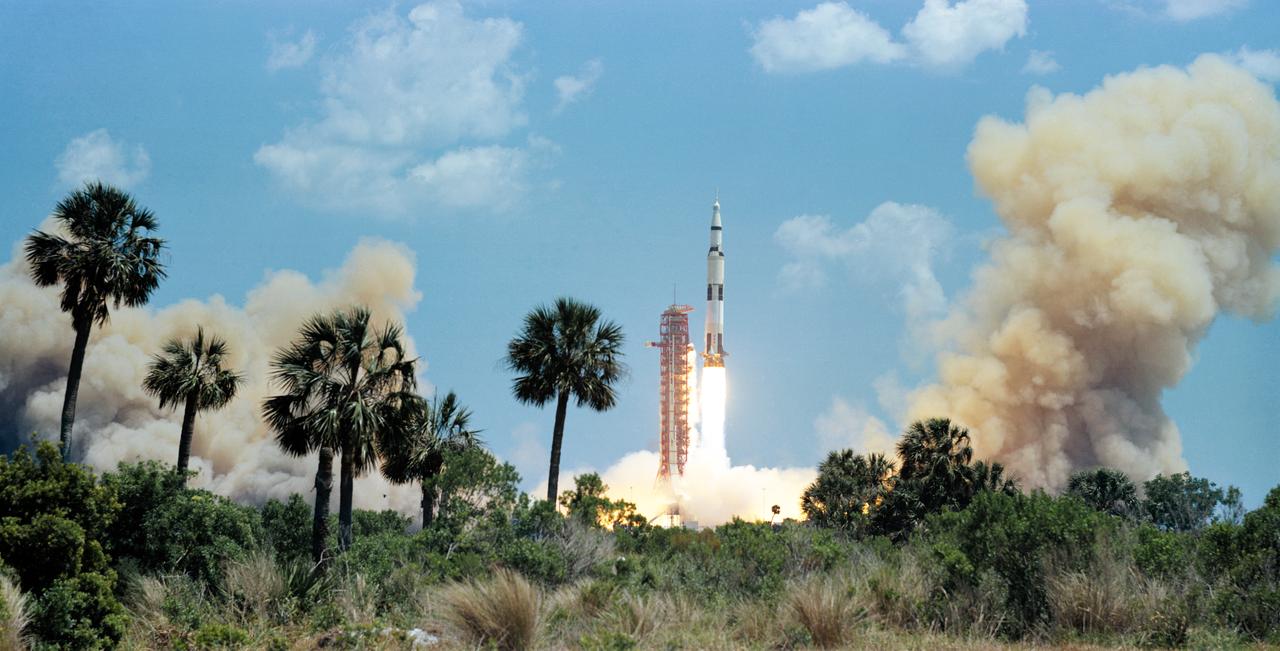
S72-35345 (16 April 1972) --- The huge, 363-feet tall Apollo 16 (Spacecraft 113/Lunar Module 11/Saturn 511) space vehicle is launched from Pad A, Launch Complex 39, Kennedy Space Center (KSC), Florida, at 12:54:00.569 p.m.(EST), April 16, 1972, on a lunar landing mission. Aboard the Apollo 16 spacecraft were astronauts John W. Young, commander; Thomas K. Mattingly II, command module pilot; and Charles M. Duke Jr., lunar module pilot.
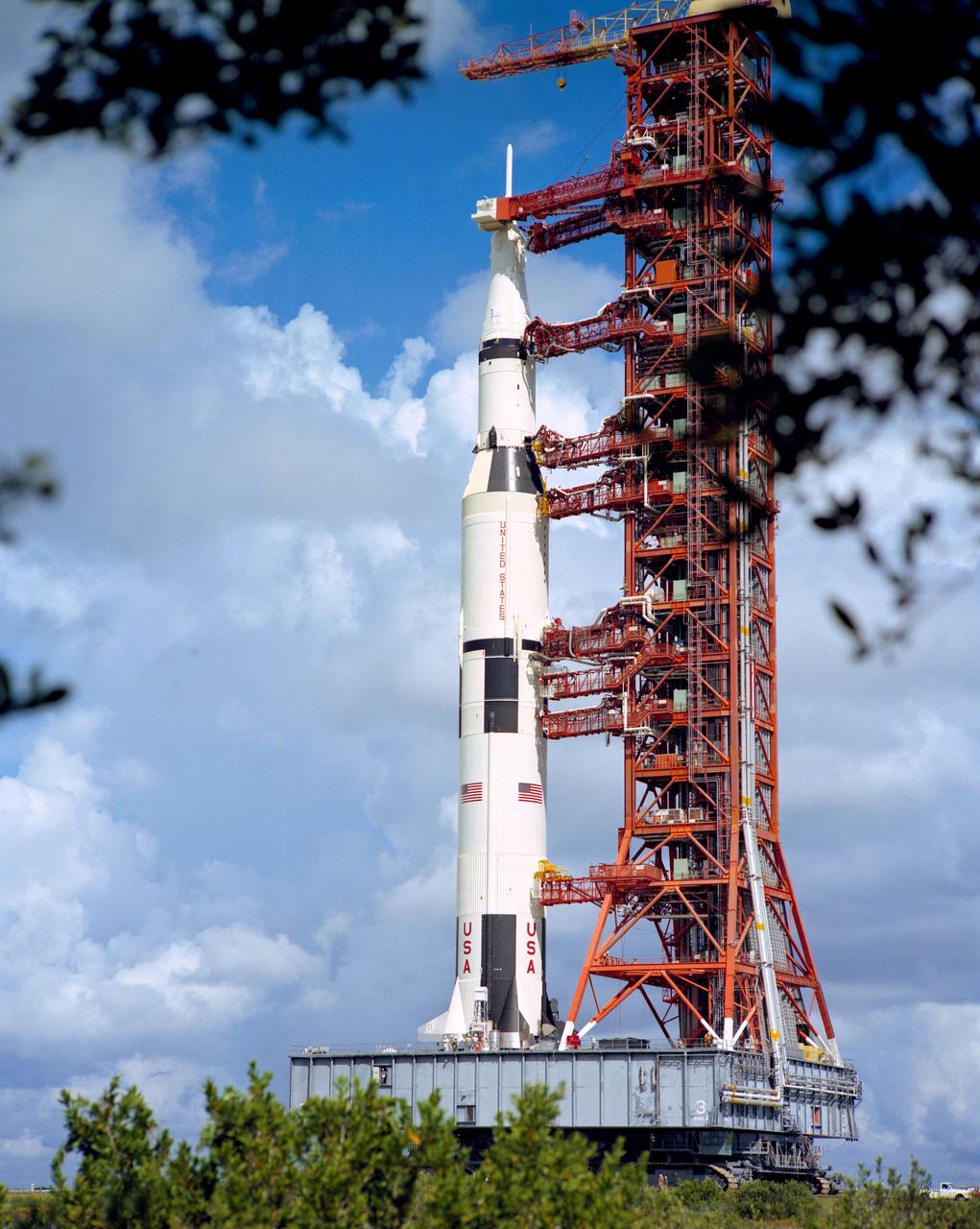
S72-48729 (28 Aug. 1972) --- A ground-level view of the huge Apollo 17 (Spacecraft 114/Lunar Module 12/ Saturn 512) space vehicle on its way to Pad A, Launch Complex 39, Kennedy Space Center (KSC). The Saturn V stack and its mobile launch tower are atop a mammoth crawler-transporter. The prime crew for the Apollo 17 lunar landing mission will be astronauts Eugene A. Cernan, commander; Ronald E. Evans, command module pilot; and scientist-astronaut Harrison H. Schmitt, lunar module pilot.
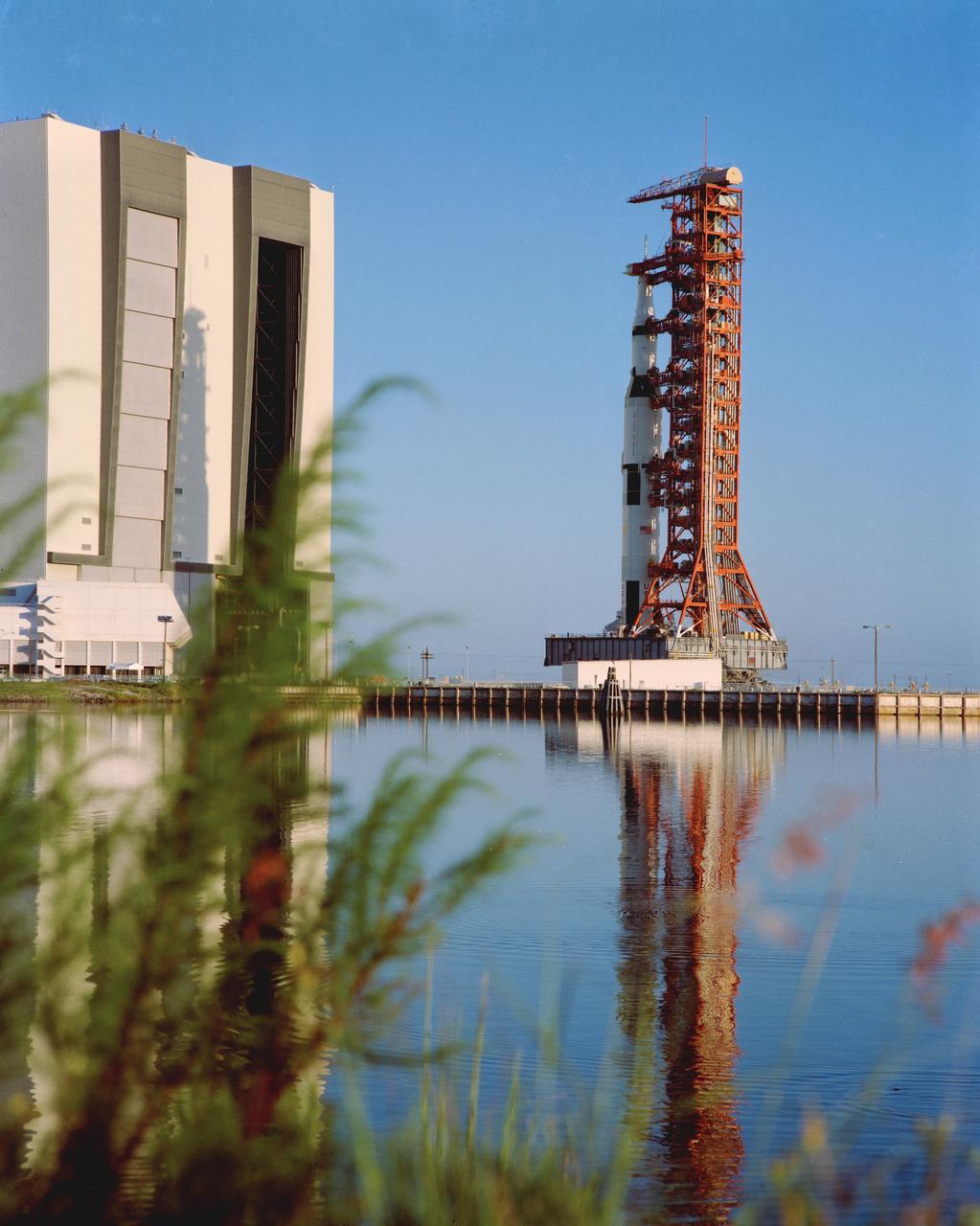
S72-48730 (28 Aug. 1972) --- A ground-level view of the huge Apollo 17 (Spacecraft 114/Lunar Module 12/Saturn 512) space vehicle leaving the Vehicle Assembly Building on its way to Pad A, Launch Complex 39, Kennedy Space Center. The Saturn V stack and its mobile launch tower are atop a mammoth crawler-transporter. The prime crew for the Apollo 17 lunar landing mission will be astronauts Eugene A. Cernan, commander; Ronald E. Evans, command module pilot; and scientist-astronaut Harrison H. Schmitt, lunar module pilot.
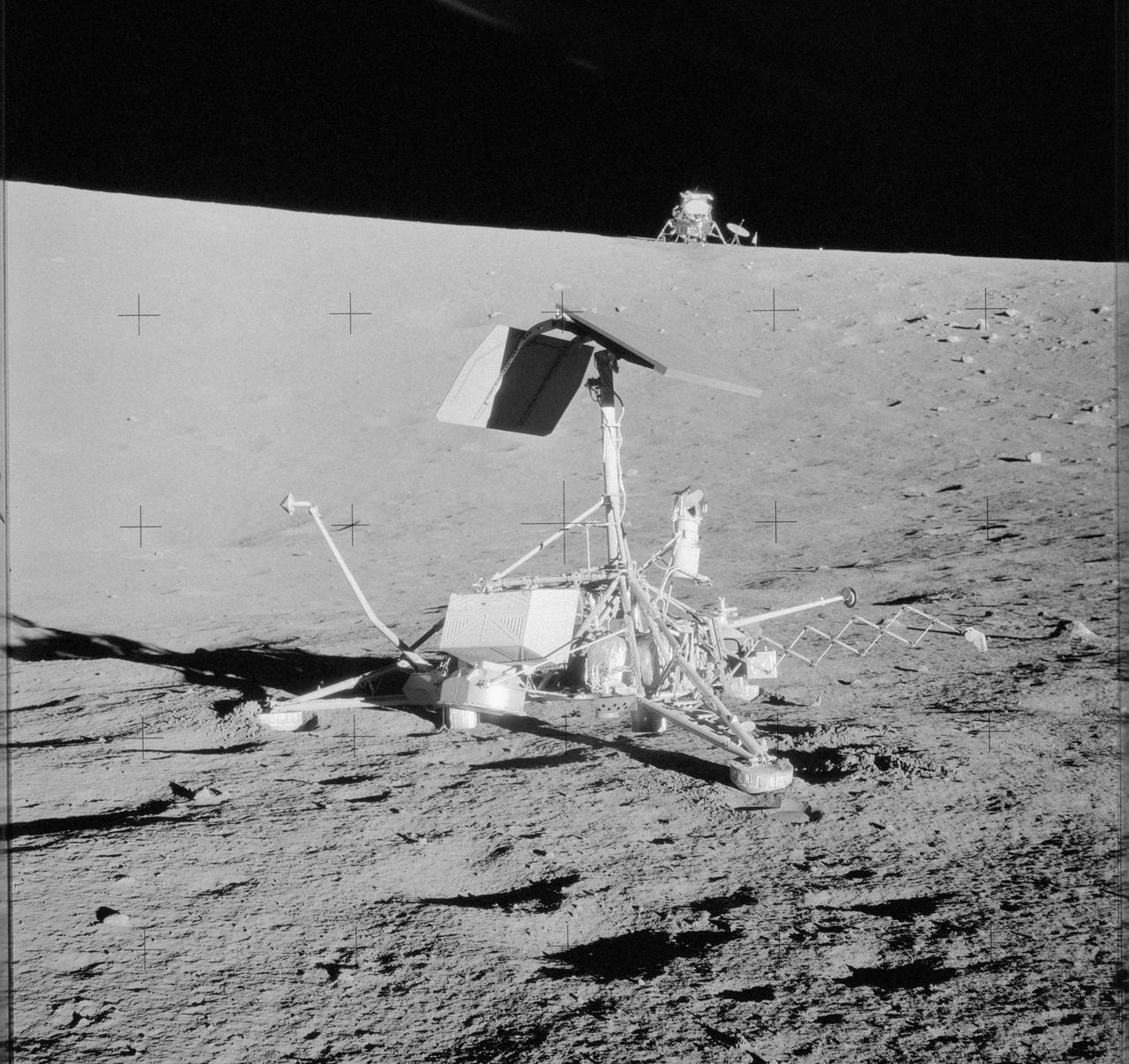
AS12-48-7099 (20 Nov. 1969) --- This unusual view shows two National Aeronautics and Space Administration (NASA) spacecraft on the surface of the moon. In the center foreground is the unmanned Surveyor 3 spacecraft, which soft landed on the lunar surface on April 19, 1967. Just 600 feet away from the Surveyor 3 spacecraft, pictured here in the background, is the Apollo 12 Lunar Module (LM), which landed on the lunar surface on Nov. 19, 1969. This photograph was taken the following day, during the second Apollo 12 extravehicular activity (EVA) in which astronauts Charles Conrad Jr., commander, and Alan L. Bean, lunar module pilot, participated. Pictured to the right of the LM are the deployed S-Band antenna and the United States flag, which was unfurled on Nov. 19, 1969. While Conrad and Bean descended from lunar orbit in their Apollo 12 LM, astronaut Richard F. Gordon Jr., command module pilot, remained with the Command and Service Modules (CSM).
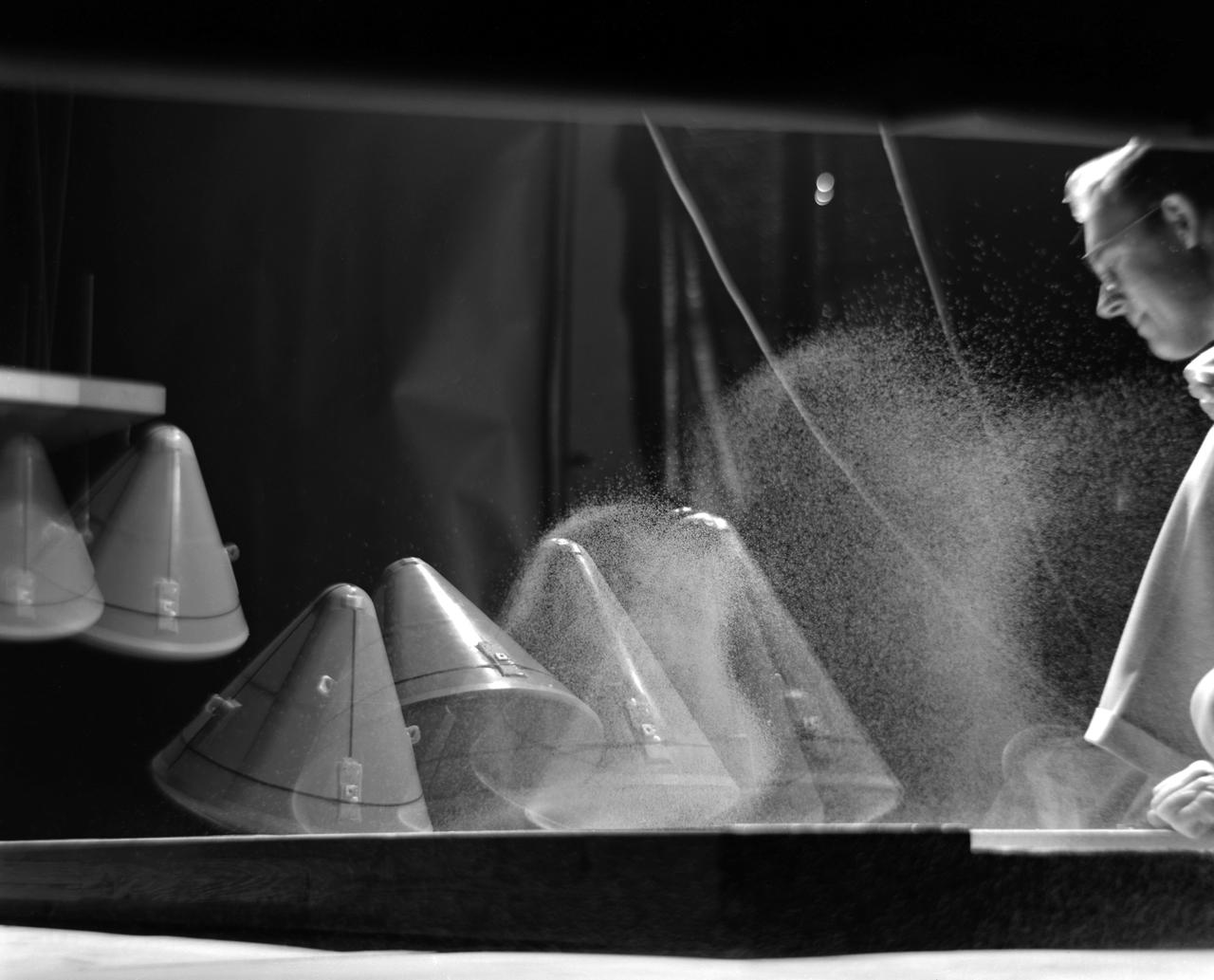
Image L61-8036 is available as an electronic file from the photo lab. See URL. -- Photographed on 12/05/1961. -- Multiple exposure of an impact test of the Apollo command module. In this test the Apollo capsule was tested making a sand landing. -- Published in James R. Hansen, Spaceflight Revolution: NASA Langley Research Center From Sputnik to Apollo, (Washington: NASA, 1995), pp. 361-366.
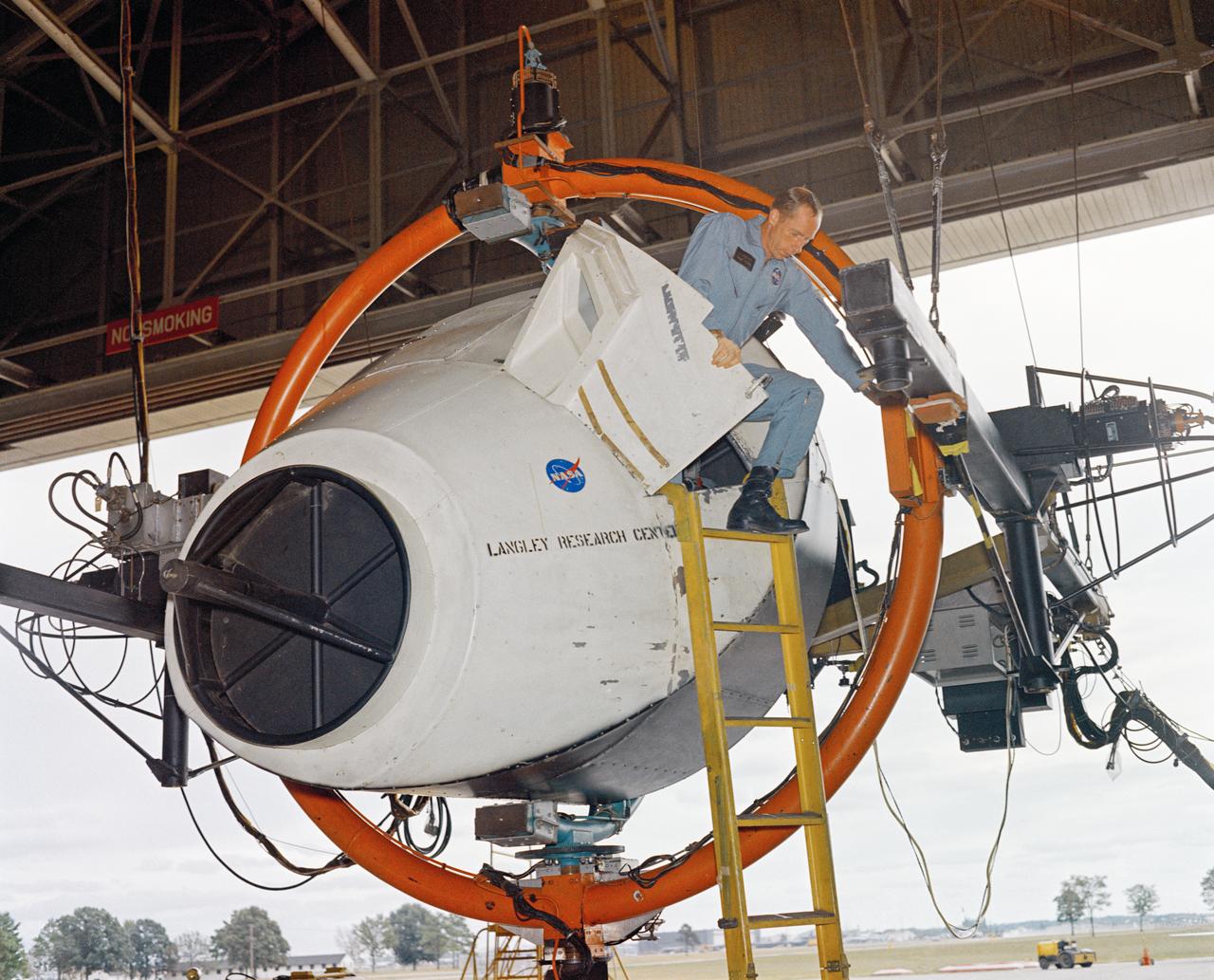
Astronauts Stuart A. Roosa, and Alfred M. Worden training a tRendezvous Docking Simulator NASA Langley. Worden was one of the 19 astronauts selected by NASA in April 1966. He served as a member of the astronaut support crew for the Apollo 9 flight and as backup command module pilot for the Apollo 12 flight. Colonel Roosa was one of the 19 astronauts selected by NASA in April 1966. He was a member of the astronaut support crew for the Apollo 9 flight.
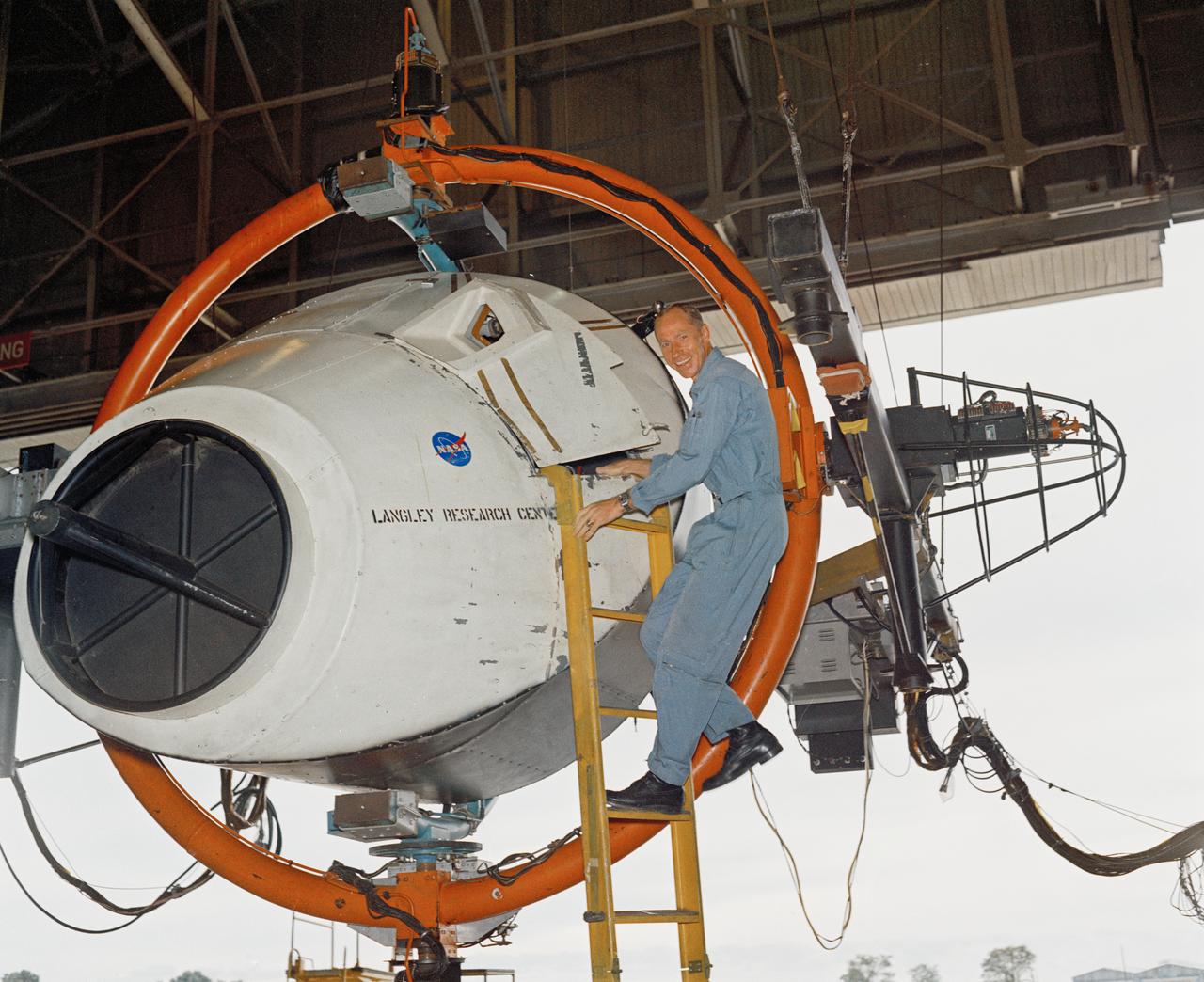
Astronauts Stuart A. Roosa, and Alfred M. Worden training a tRendezvous Docking Simulator NASA Langley. Worden was one of the 19 astronauts selected by NASA in April 1966. He served as a member of the astronaut support crew for the Apollo 9 flight and as backup command module pilot for the Apollo 12 flight. Colonel Roosa was one of the 19 astronauts selected by NASA in April 1966. He was a member of the astronaut support crew for the Apollo 9 flight.
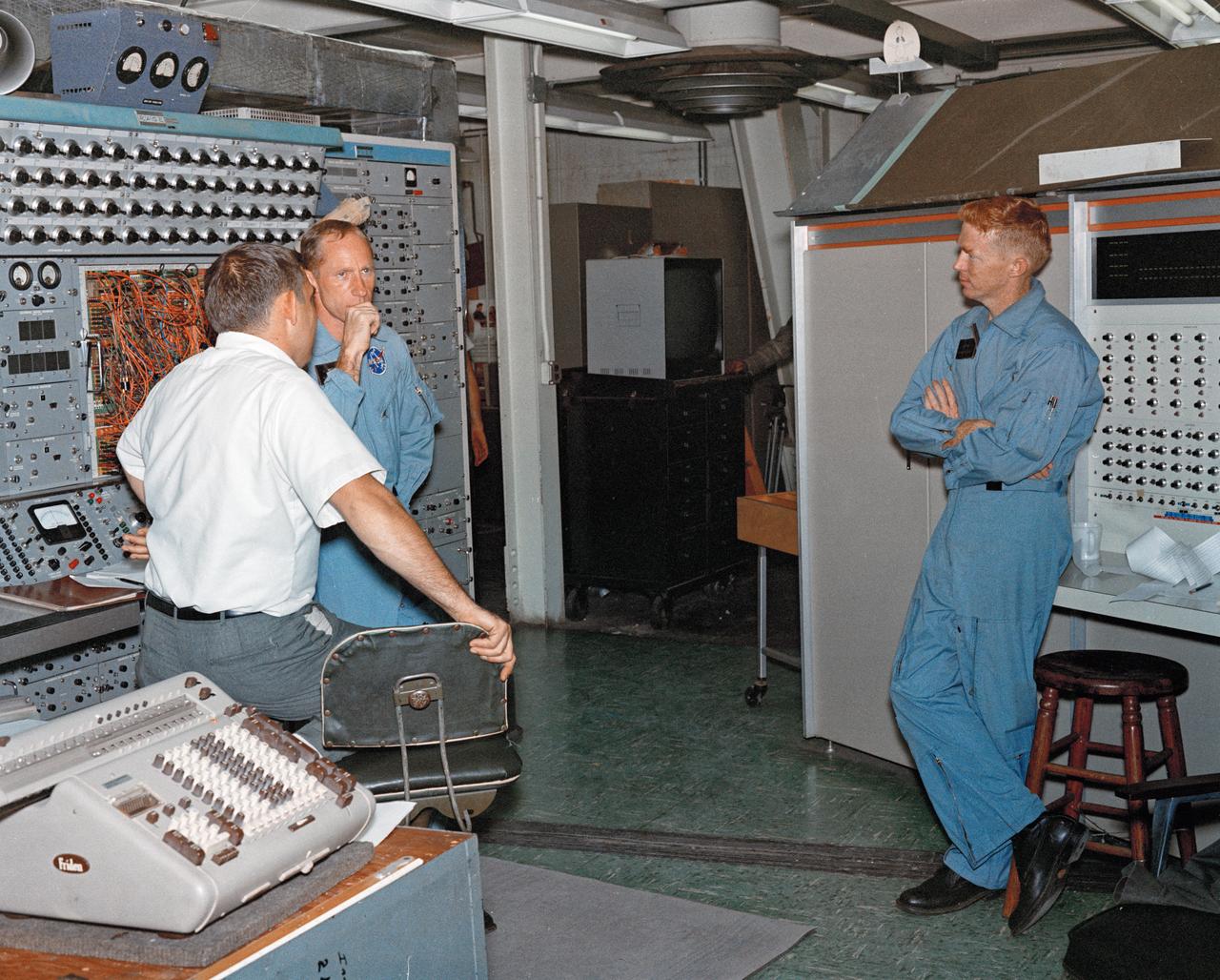
Astronauts Stuart A. Roosa, and Alfred M. Worden training a tRendezvous Docking Simulator NASA Langley. Worden was one of the 19 astronauts selected by NASA in April 1966. He served as a member of the astronaut support crew for the Apollo 9 flight and as backup command module pilot for the Apollo 12 flight. Colonel Roosa was one of the 19 astronauts selected by NASA in April 1966. He was a member of the astronaut support crew for the Apollo 9 flight.
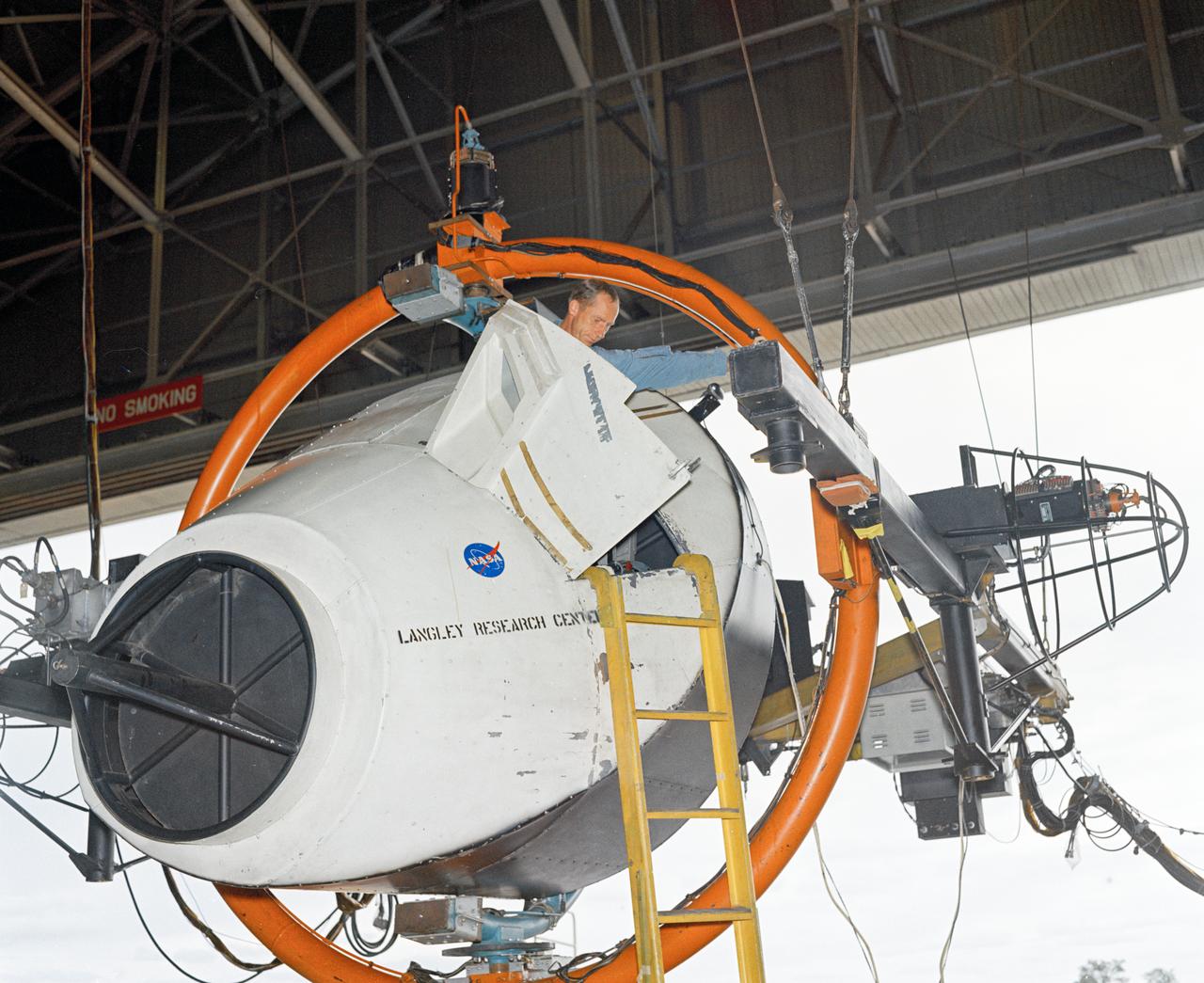
Astronauts Stuart A. Roosa, and Alfred M. Worden training a tRendezvous Docking Simulator NASA Langley. Worden was one of the 19 astronauts selected by NASA in April 1966. He served as a member of the astronaut support crew for the Apollo 9 flight and as backup command module pilot for the Apollo 12 flight. Colonel Roosa was one of the 19 astronauts selected by NASA in April 1966. He was a member of the astronaut support crew for the Apollo 9 flight.
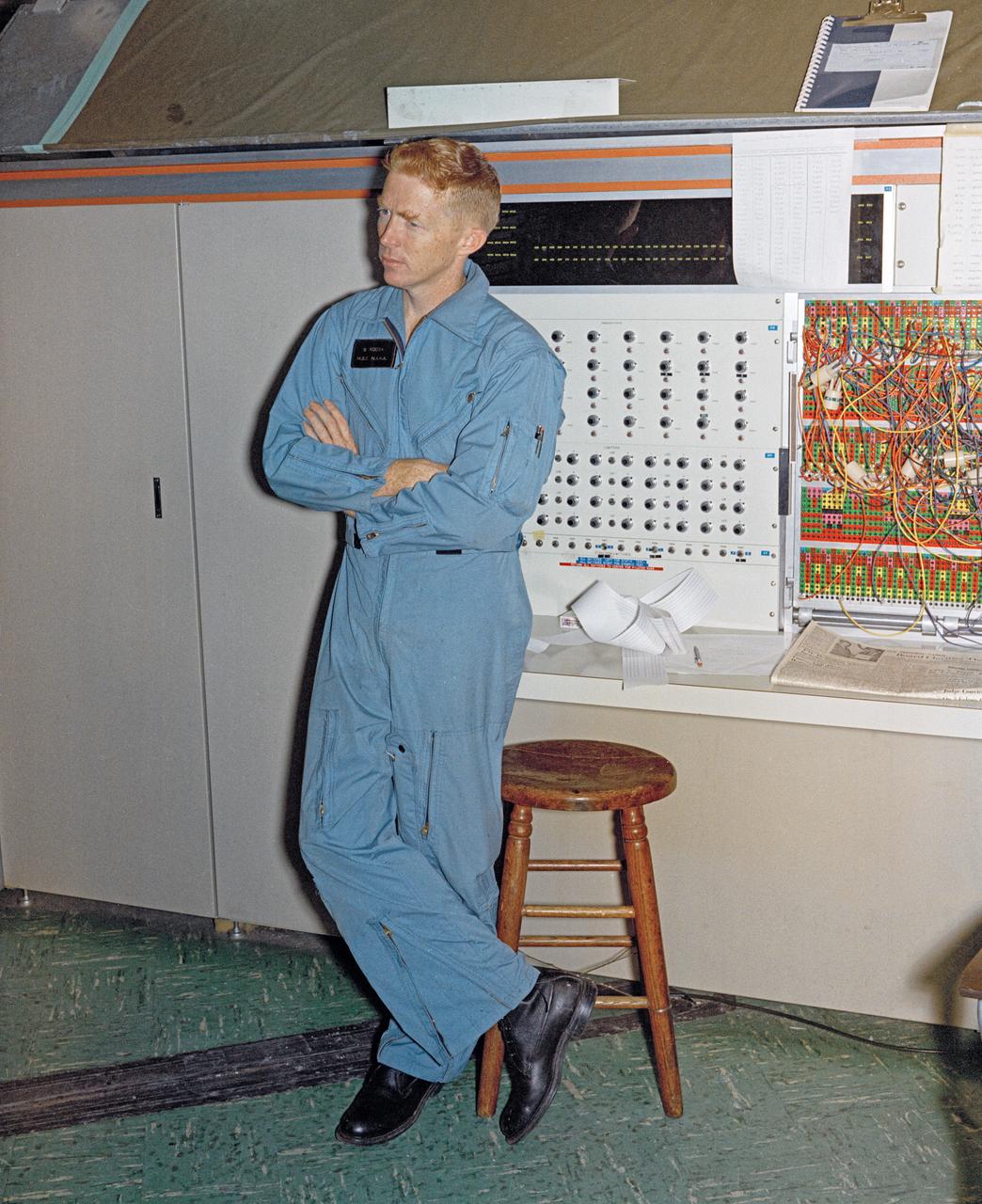
Astronauts Stuart A. Roosa, and Alfred M. Worden training a tRendezvous Docking Simulator NASA Langley. Worden was one of the 19 astronauts selected by NASA in April 1966. He served as a member of the astronaut support crew for the Apollo 9 flight and as backup command module pilot for the Apollo 12 flight. Colonel Roosa was one of the 19 astronauts selected by NASA in April 1966. He was a member of the astronaut support crew for the Apollo 9 flight.