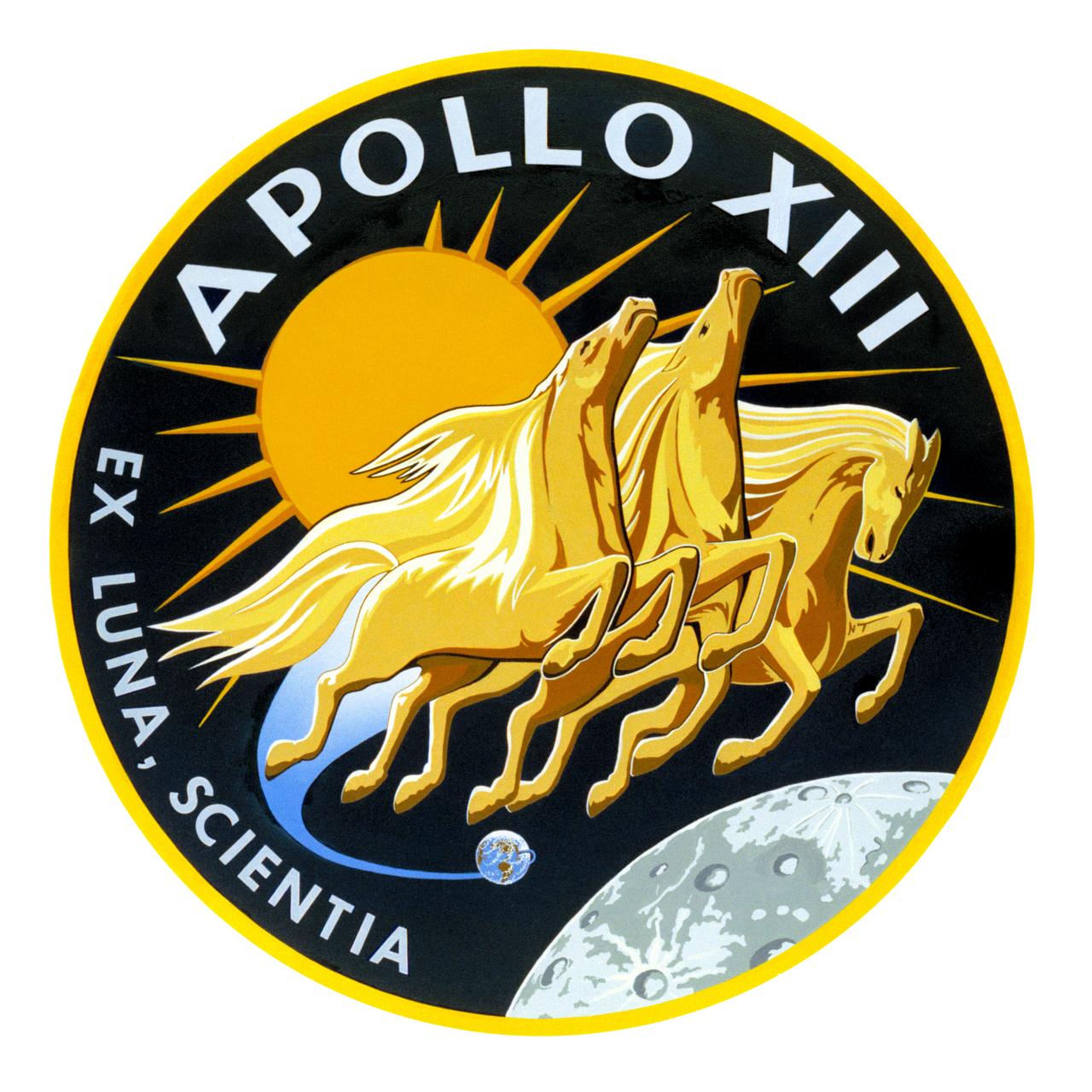
S69-60662 (December 1969) --- This is the insignia of the Apollo 13 lunar landing mission. The Apollo 13 prime crew will be astronauts James A. Lovell Jr., commander; Thomas K. Mattingly II, command module pilot; and Fred W. Haise Jr., lunar module pilot. Represented in the Apollo 13 emblem is Apollo, the sun god of Greek mythology, symbolizing how the Apollo flights have extended the light of knowledge to all mankind. The Latin phrase Ex Luna, Scientia means "From the Moon, Knowledge." Apollo 13 will be the National Aeronautics and Space Administration's (NASA) third lunar landing mission.
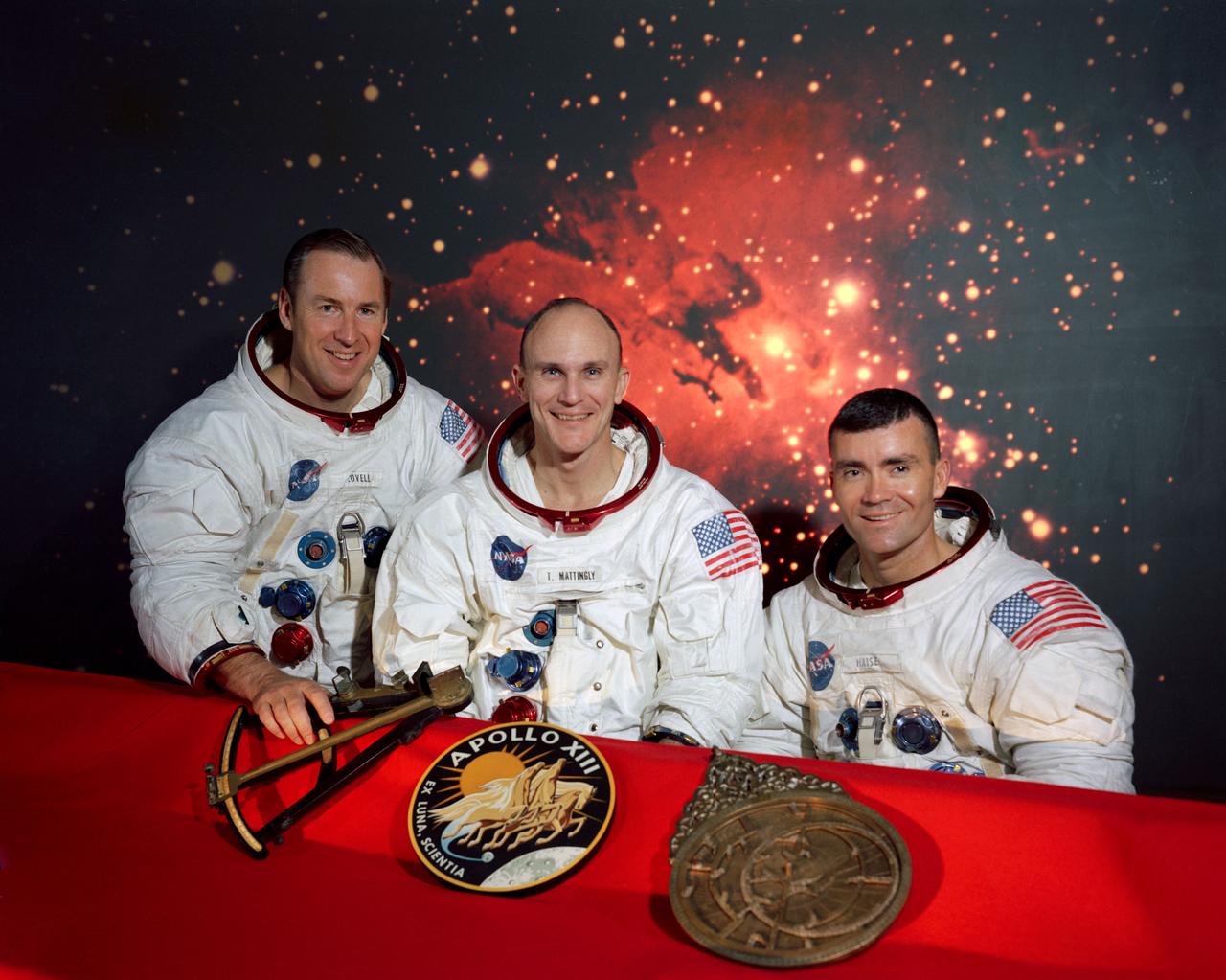
S69-62224 (December 1969) --- The members of the prime crew of the Apollo 13 lunar landing mission (left to right) are astronauts James A. Lovell Jr., commander; Thomas K. Mattingly II, command module pilot; and Fred W. Haise Jr., lunar module pilot. They are seated in front of a scene of the Lagoon Nebula, with the mission insignia and two items of early navigation in the foreground. Represented in the Apollo 13 emblem (center) is Apollo, the sun god of Greek mythology, symbolizing that the Apollo flights have extended the light of knowledge to all mankind. The Latin phrase Ex Luna, Scientia means "From the Moon, Knowledge." The Hindu astrolabe in Sanskrit (on right) was used to predict the position of celestial bodies before the invention of the octant (on left) was used in 1790 to determine the altitude of celestial bodies from aboard ship.
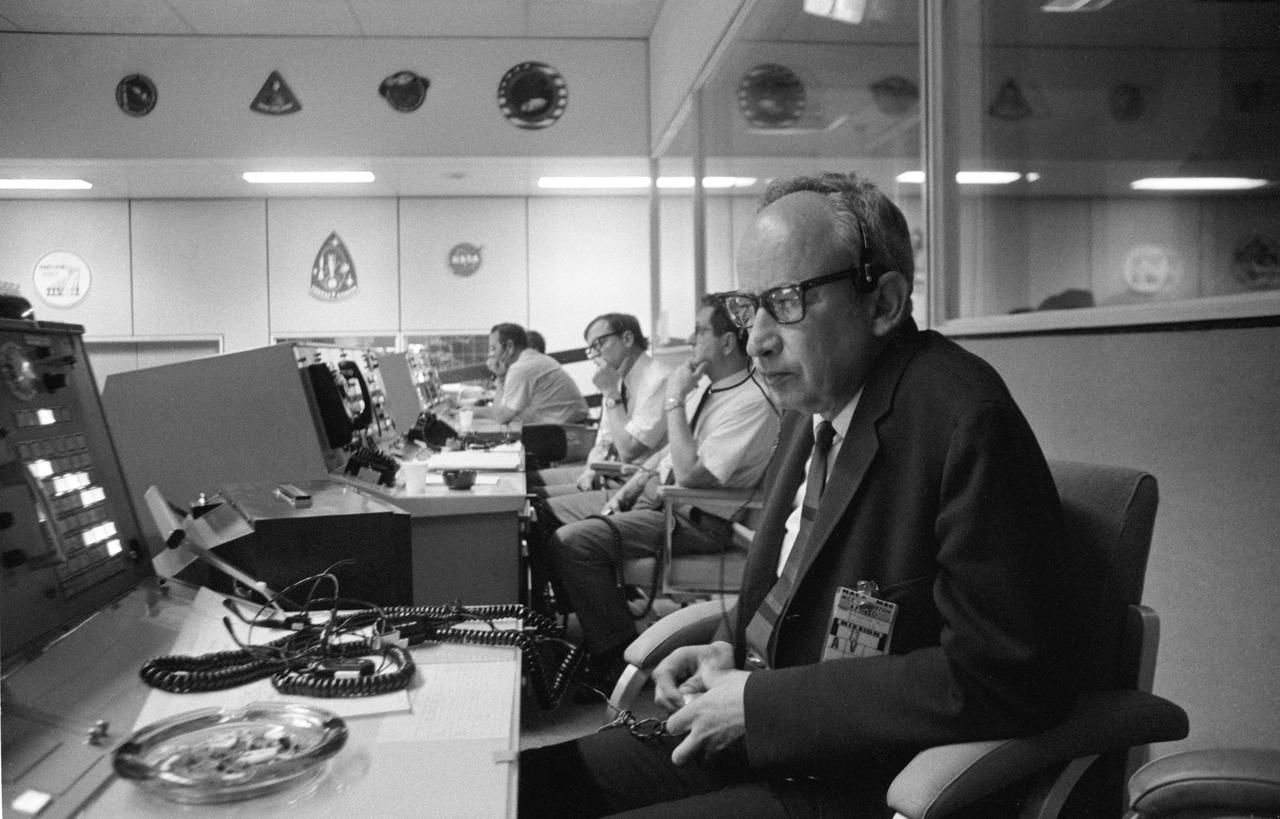
S70-34627 (11 April 1970) --- Sigurd A. Sjoberg, director of flight operations, at the Manned Spacecraft Center (MSC), views the Apollo 13 liftoff from a console in the MSC Mission Control Center (MCC), Building 30. Apollo 13 lifted off at 1:13 p.m. (CST) April 11, 1970. Photo credit: NASA

S70-35368 (16 April 1970) --- Overall view showing some of the feverish activity in the Mission Operations Control Room (MOCR) of the Mission Control Center (MCC) during the final 24 hours of the problem-plagued Apollo 13 mission. Here, flight controllers and several NASA/MSC officials confer at the flight director's console. When this picture was made, the Apollo 13 lunar landing had already been canceled, and the Apollo 13 crewmembers were in trans-Earth trajectory attempting to bring their crippled spacecraft back home.
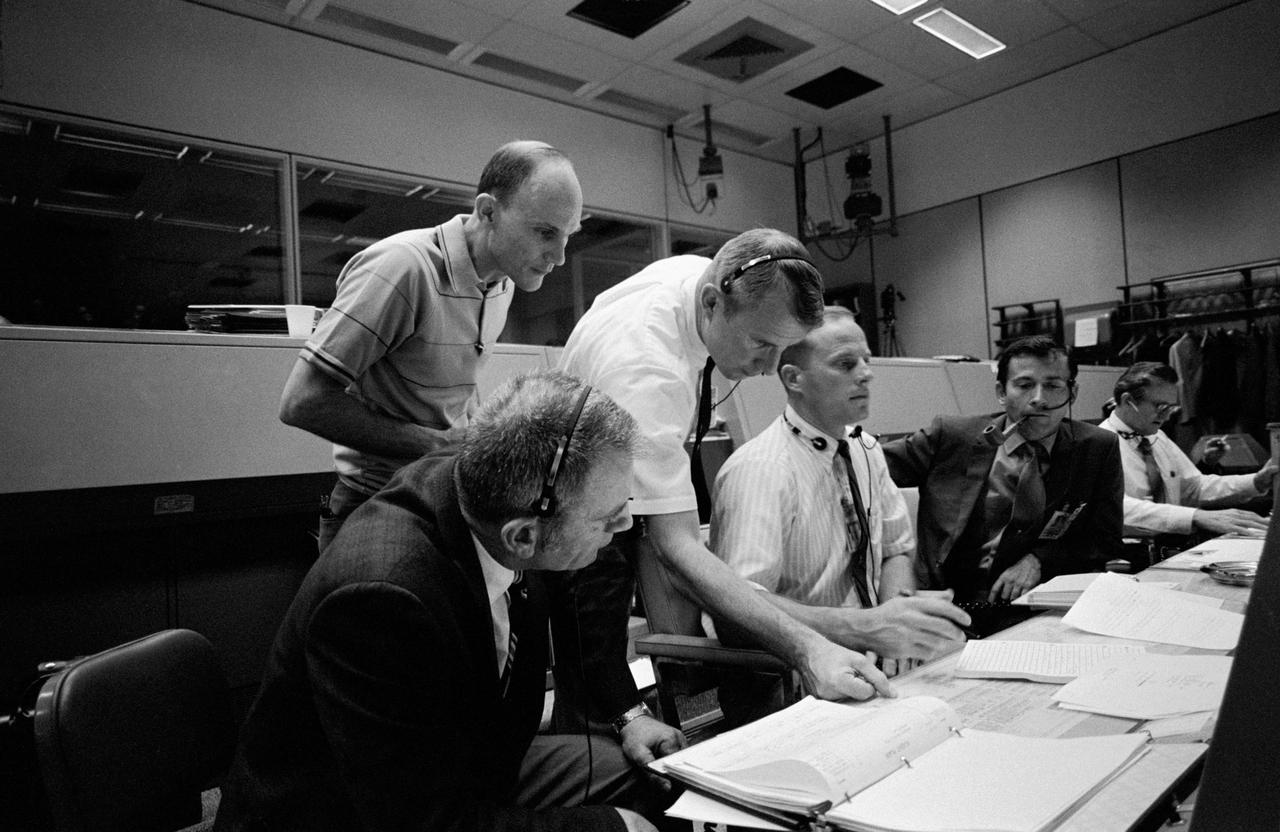
S70-34902 (14 April 1970) --- Several persons important to the Apollo 13 mission, at consoles in the Mission Operations Control Room (MOCR) of the Mission Control Center (MCC). Seated at consoles, from left to right, are astronauts Donald K. Slayton, director of flight crew operations; astronaut Jack R. Lousma, Shift 3 spacecraft communicator; and astronaut John W. Young, commander of the Apollo 13 backup crew. Standing, left to right, are astronaut Tom K. Mattingly II, who was replaced as Apollo 13 command module pilot after it was learned he may come down with measles, and astronaut Vance D. Brand, Shift 2 spacecraft communicator. Several hours earlier, in the late evening hours of April 13, crew members of the Apollo 13 mission reported to MCC that trouble had developed with an oxygen cell on their spacecraft.
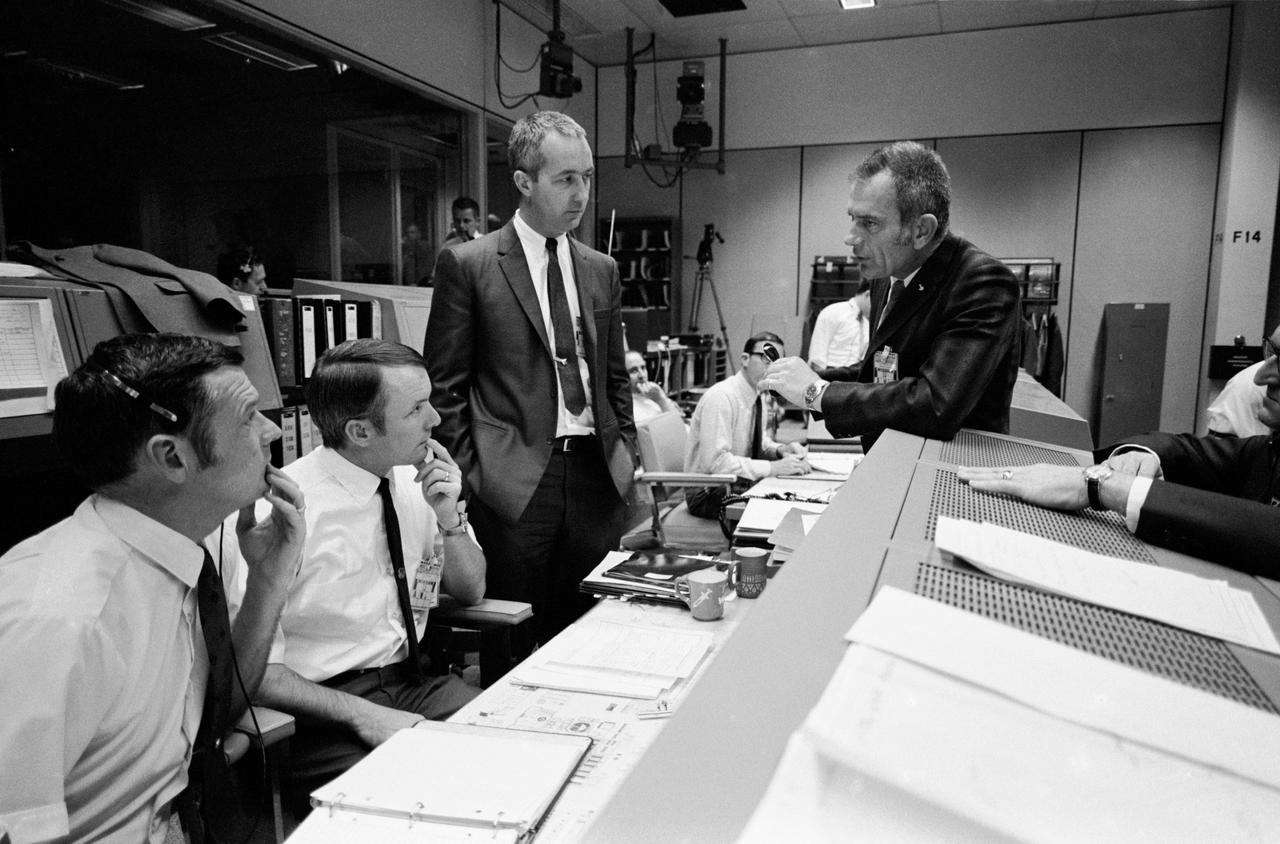
S70-35369 (16 April 1970) --- Discussion in the Mission Operations Control Room (MOCR) dealing with the Apollo 13 crewmen during their final day in space. From left to right are Glynn S. Lunney, Shift 4 flight director; Gerald D. Griffin, Shift 2 flight director; astronaut James A. McDivitt, manager, Apollo Spacecraft Program, MSC; Dr. Donald K. Slayton, director of Flight Crew Operations, MSC; and Dr. Willard R. Hawkins, M.D., Shift 1 flight surgeon.
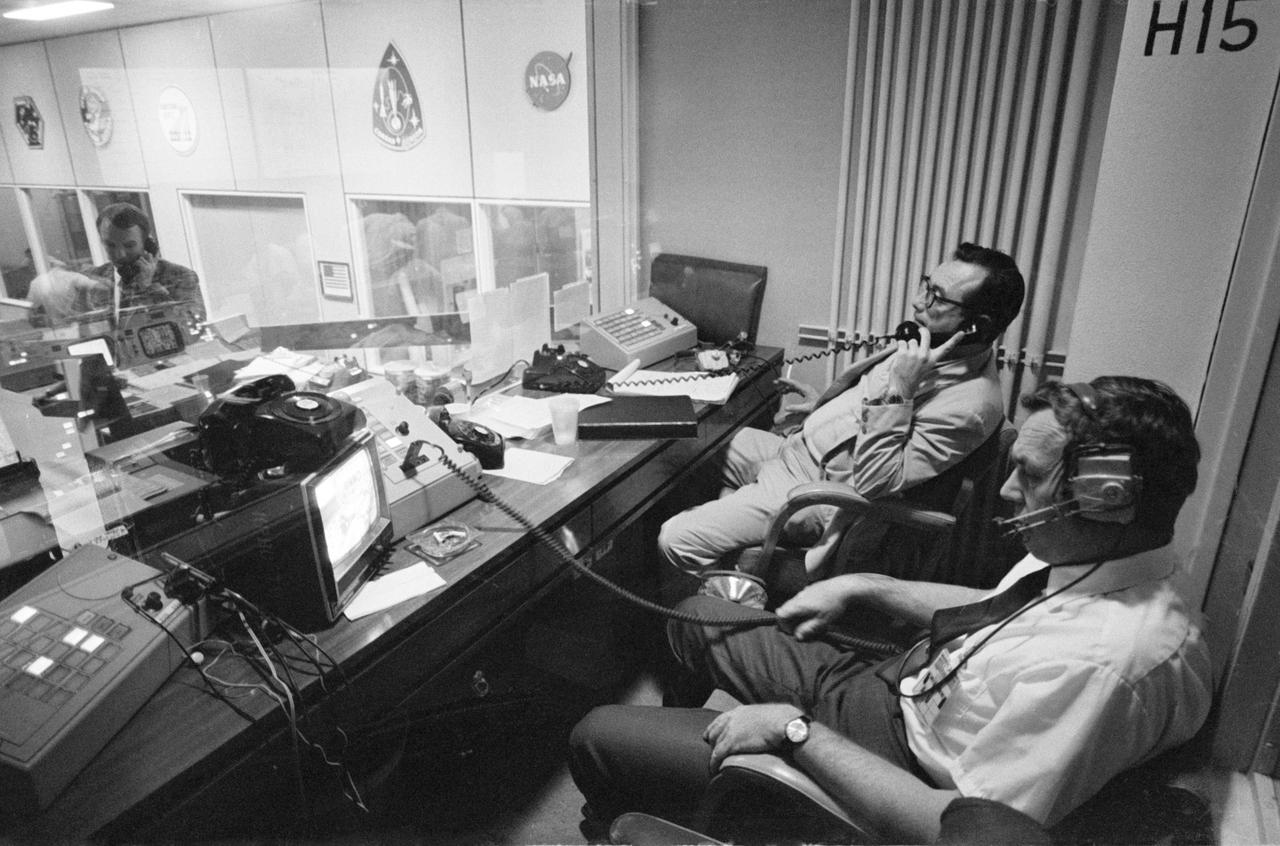
S70-35012 (15 April 1970) --- Two phases of busy activity during critical moments of the Apollo 13 mission are reflected in this view in the Mission Control Center, Building 30, Manned Spacecraft Center. In the foreground, Henry Simmons (left) of Newsweek magazine and John E. Riley, public information specialist, Public Affairs Office, MSC, man their positions in the Press Room. At extreme left of photo, Gerald D. Griffin, Shift 2 flight director, talks on telephone in Mission Operations Control Room. When this photograph was taken, the Apollo 13 lunar landing had been canceled, and the problem-plagued Apollo 13 crewmen were in trans-Earth trajectory attempting to bring their crippled spacecraft back home.
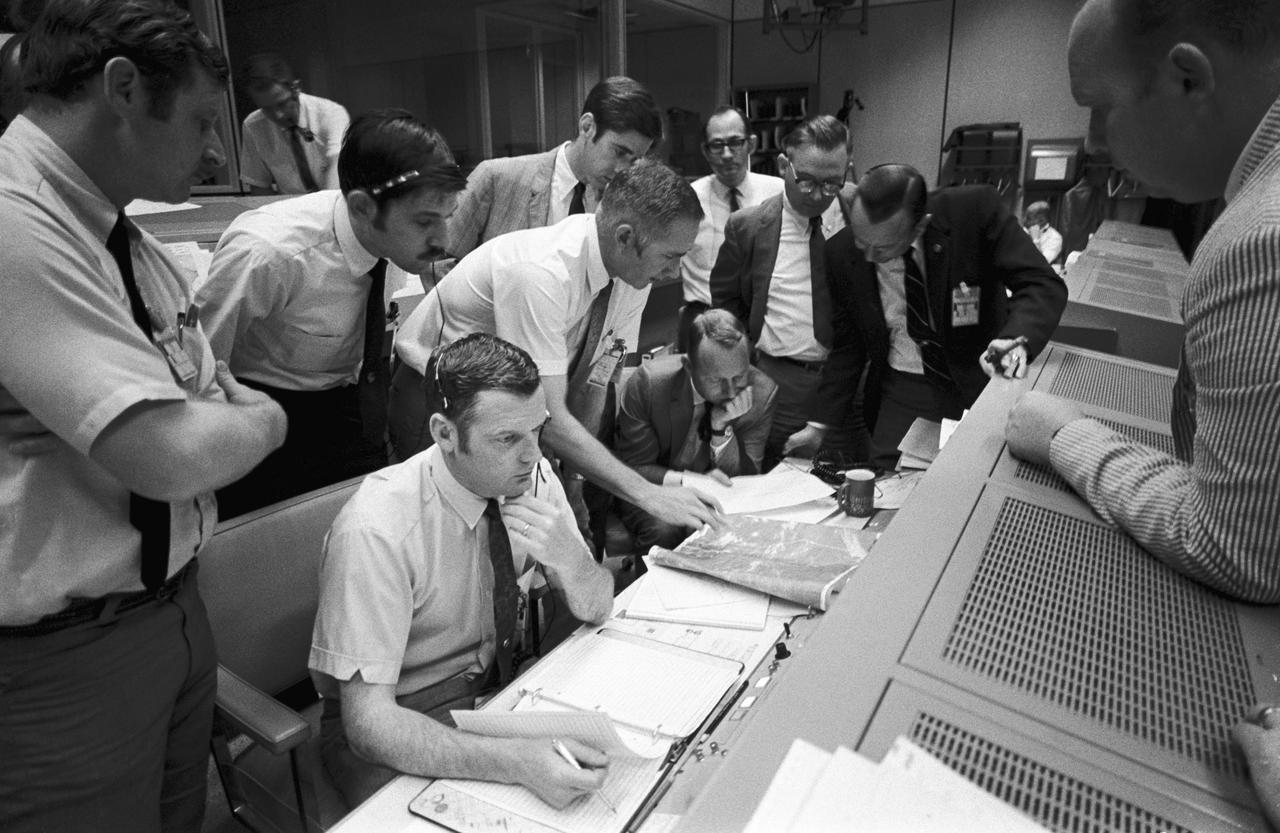
S70-35014 (15 April 1970) --- A group of flight controllers gathers around the console of Glenn S. Lunney (seated, nearest camera), Shift 4 flight director, in the Mission Operations Control Room (MOCR) of Mission Control Center (MCC), located in Building 30 at the Manned Spacecraft Center (MSC). Their attention is drawn to a weather map of the proposed landing site in the South Pacific Ocean. Among those looking on is Dr. Christopher C. Kraft, deputy director, MSC, standing in black suit, on right. When this photograph was taken, the Apollo 13 lunar landing mission had been canceled, and the problem-plagued Apollo 13 crew members were in trans-Earth trajectory attempting to bring their crippled spacecraft back home.
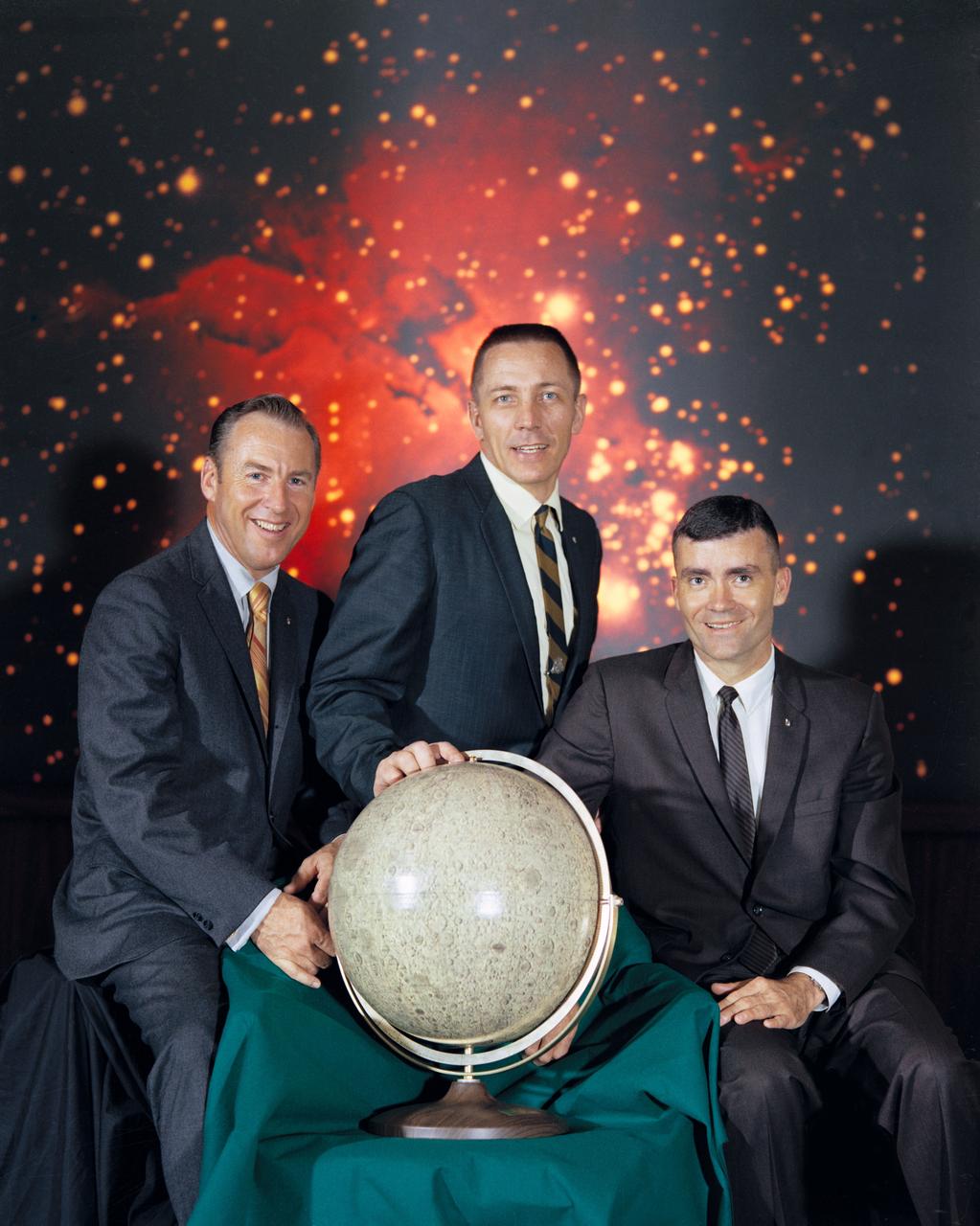
S70-36485 (April 1970) --- These three astronauts are the prime crew of the National Aeronautics and Space Administration's (NASA) Apollo 13 lunar landing mission. Left to right, are James A. Lovell Jr., commander; John L. Swigert Jr., command module pilot; and Fred W. Haise Jr., lunar module pilot. Apollo 13 will be the United States' third lunar landing mission.
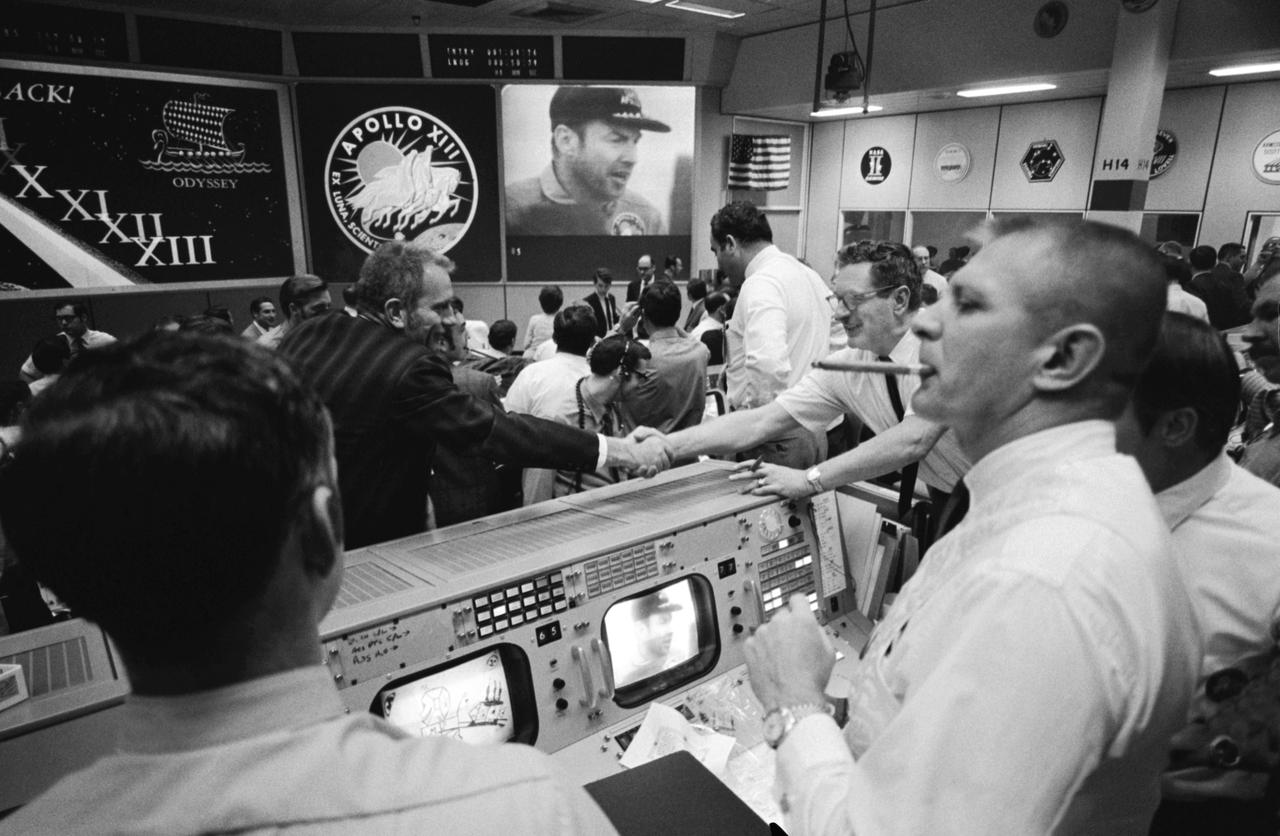
S70-35145 (17 April 1970) --- Overall view of Mission Operations Control Room in Mission Control Center at the Manned Spacecraft Center (MSC) during the ceremonies aboard the USS Iwo Jima, prime recovery ship for the Apollo 13 mission. Dr. Donald K. Slayton (in black shirt, left of center), director of Flight Crew Operations at MSC, and Chester M. Lee of the Apollo Program Directorate, Office of Manned Space Flight, NASA Headquarters, shake hands, while Dr. Rocco A. Petrone, Apollo program director, Office of Manned Space Flight, NASA Headquarters (standing, near Lee), watches the large screen showing astronaut James A. Lovell Jr., Apollo 13 commander, during the onboard ceremonies. In the foreground, Glynn S. Lunney (extreme left) and Eugene F. Kranz (smoking a cigar), two Apollo 13 flight directors, view the activity from their consoles.
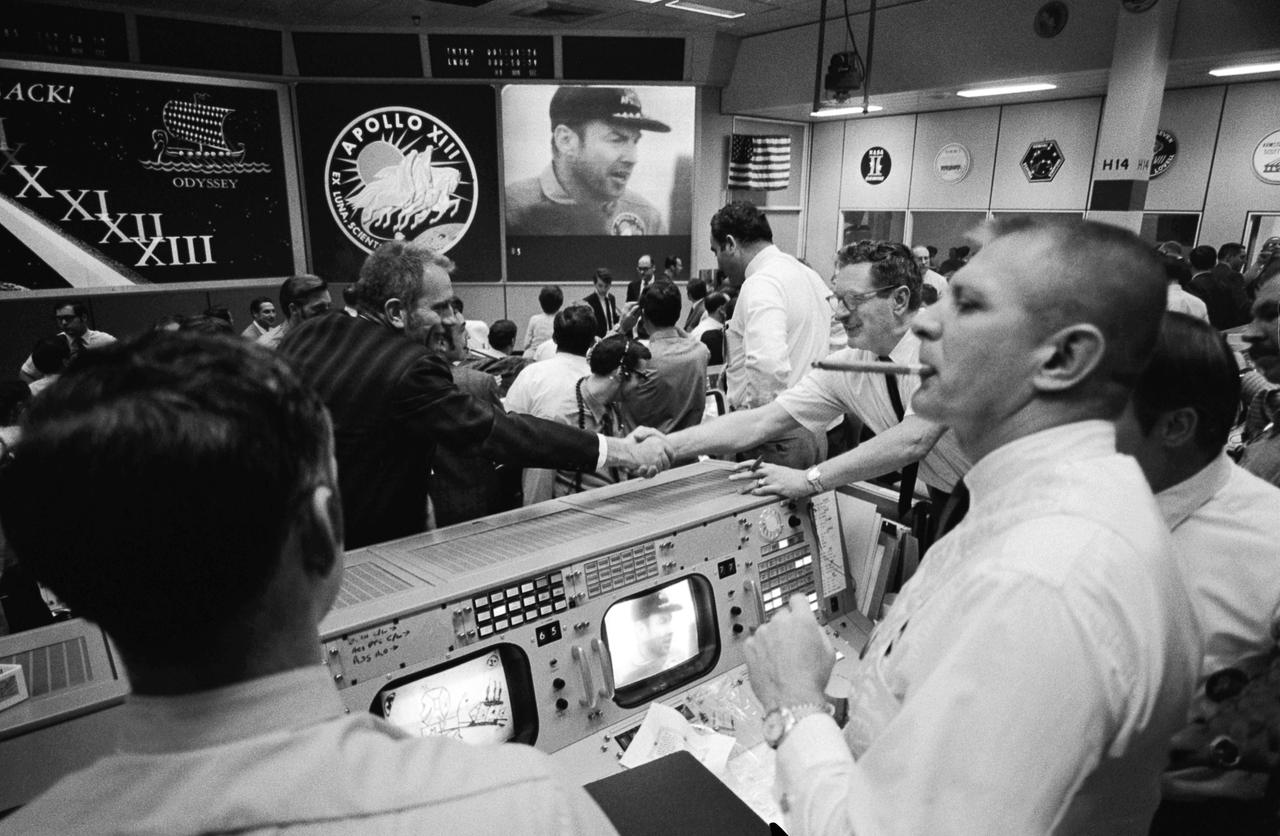
S70-35145 (17 April 1970) --- Overall view of Mission Operations Control Room in Mission Control Center at the Manned Spacecraft Center (MSC) during the ceremonies aboard the USS Iwo Jima, prime recovery ship for the Apollo 13 mission. Dr. Donald K. Slayton (in black shirt, left of center), director of Flight Crew Operations at MSC, and Chester M. Lee of the Apollo Program Directorate, Office of Manned Space Flight, NASA Headquarters, shake hands, while Dr. Rocco A. Petrone, Apollo program director, Office of Manned Space Flight, NASA Headquarters (standing, near Lee), watches the large screen showing astronaut James A. Lovell Jr., Apollo 13 commander, during the onboard ceremonies. In the foreground, Glynn S. Lunney (extreme left) and Eugene F. Kranz (smoking a cigar), two Apollo 13 flight directors, view the activity from their consoles.
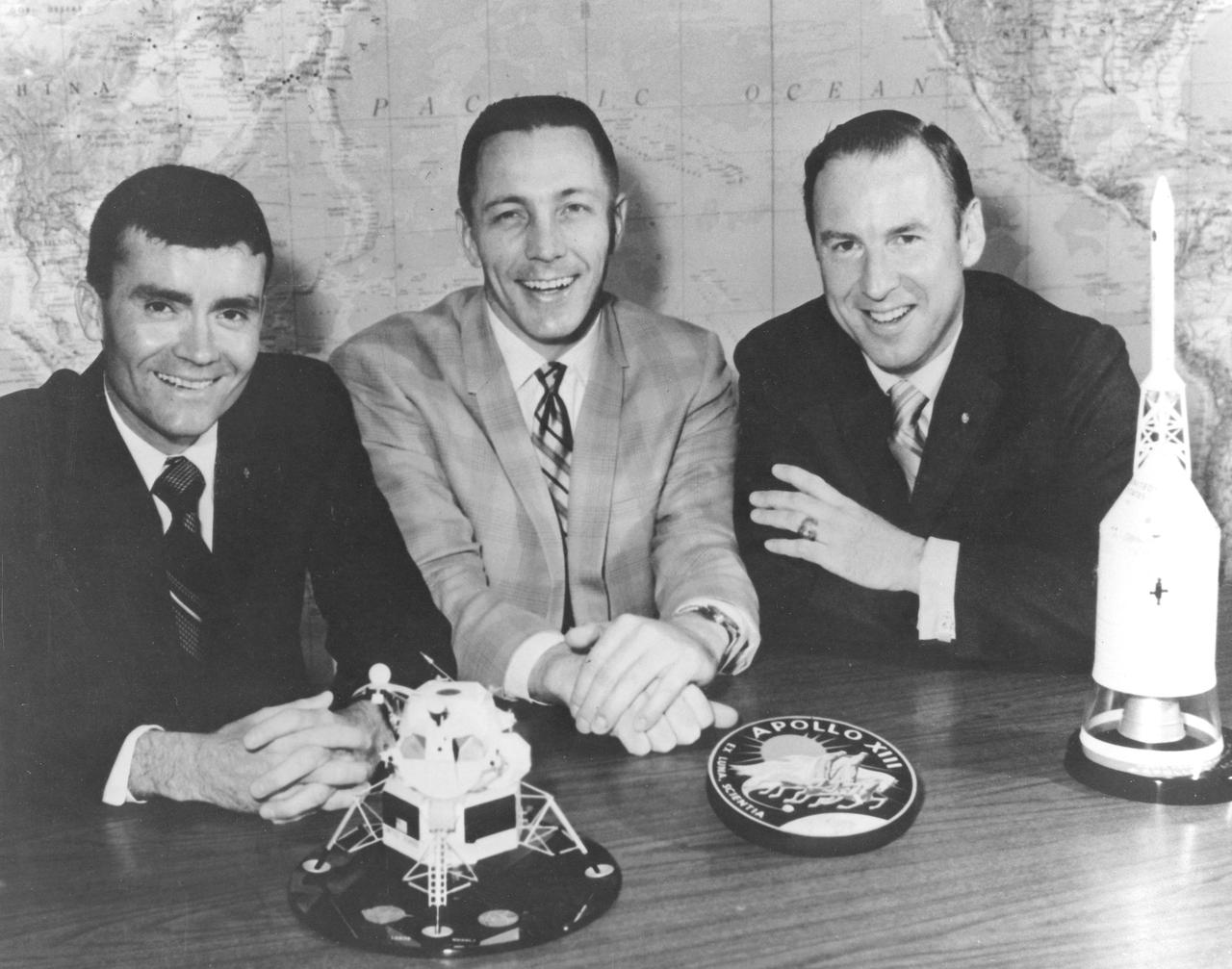
Apollo 13 astronauts Fred Haise, John Swigert, and James Lovell are pictured during the press conference after their ill-fated mission. The Apollo 13 mission (the third lunar landing mission) was aborted after 56 hours of flight, 205,000 miles from Earth, when an oxygen tank in the service module exploded.
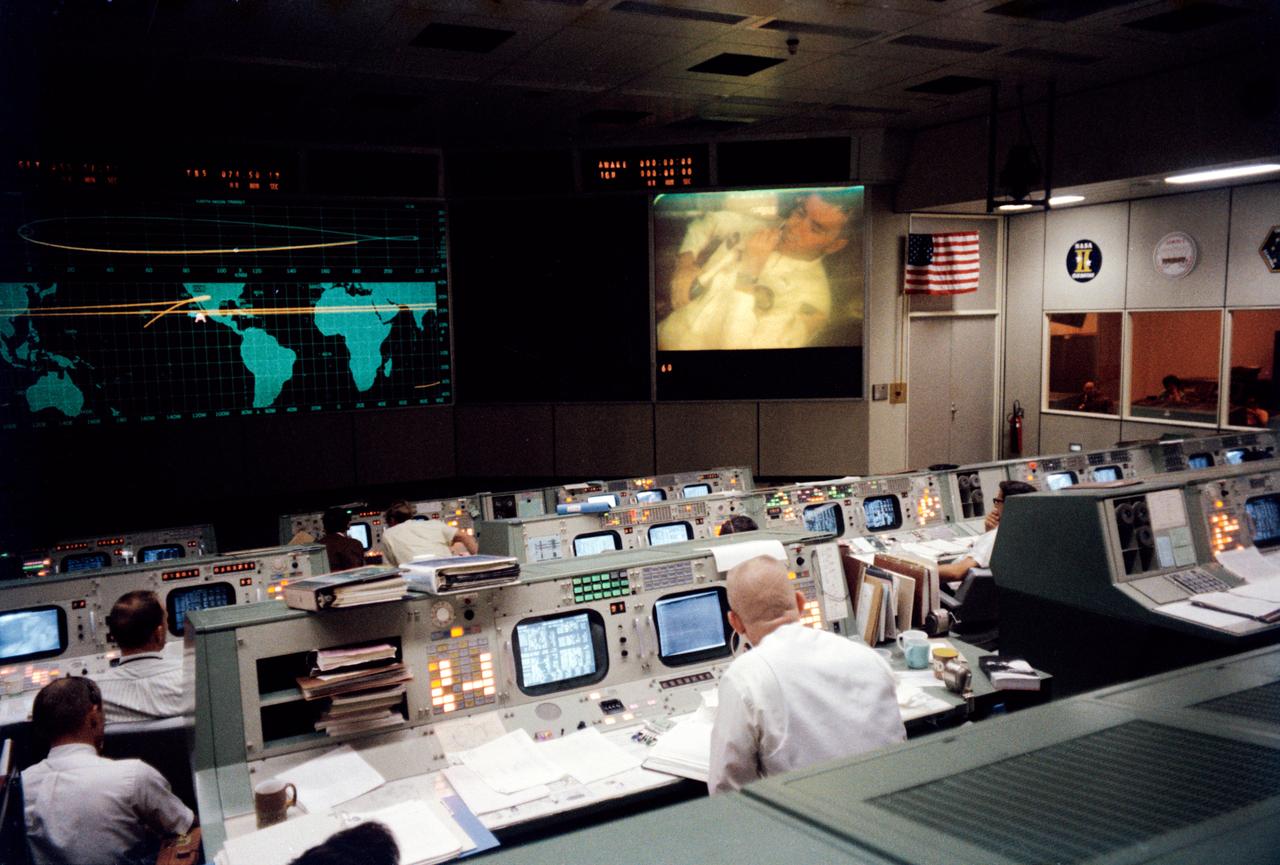
S70-35139 (13 April 1970) --- Overall view of the Mission Operations Control Room (MOCR) in the Mission Control Center (MCC) at Manned Spacecraft Center (MSC), during the fourth television transmission from the Apollo 13 mission in space. Eugene F. Kranz (foreground, back to camera), one of four Apollo 13 flight directors, views the large screen at front of MOCR, astronaut Fred W. Haise Jr., lunar module pilot, is seen on the screen. The fourth TV transmission from the Apollo 13 mission was on the evening of April 13, 1970.
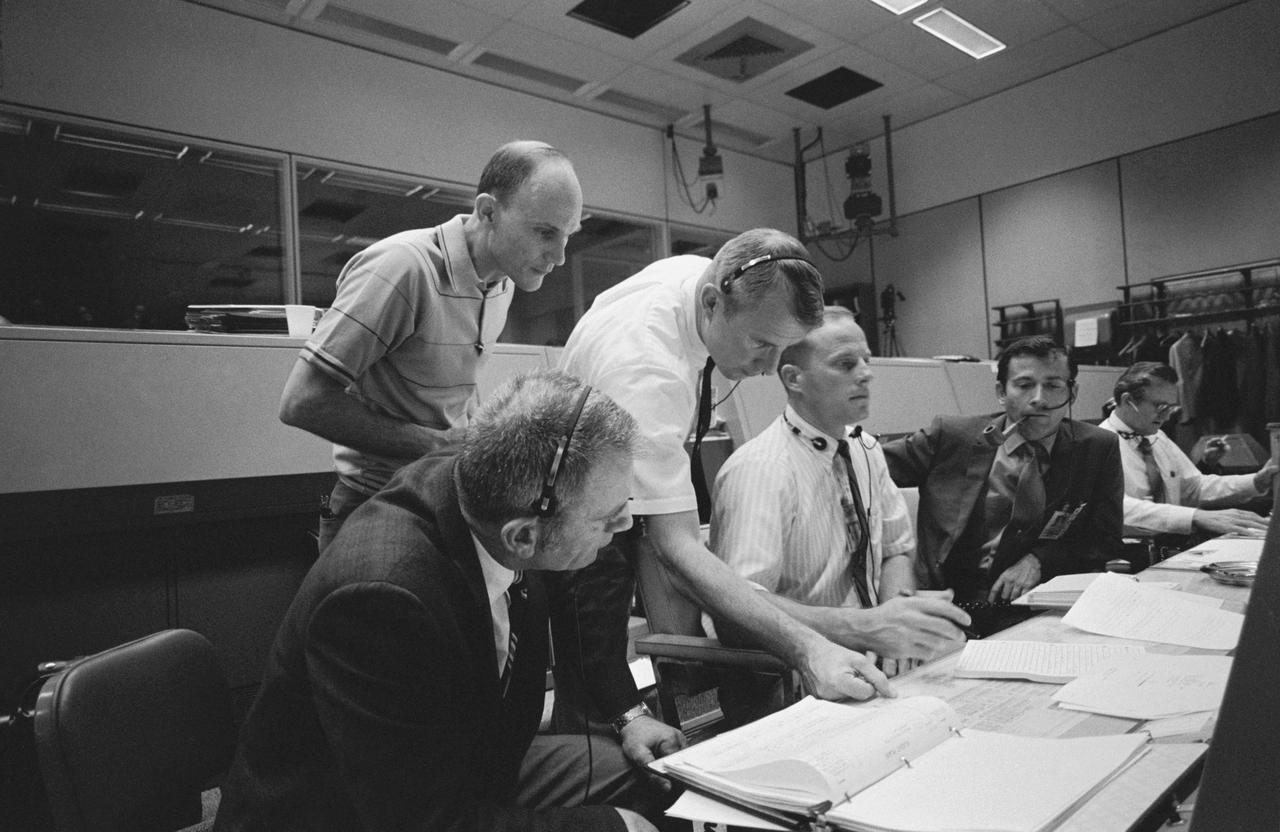
S70-34902 (14 April 1970) --- Several persons important to the Apollo 13 mission, at consoles in the Mission Operations Control Room (MOCR) of the Mission Control Center (MCC). Seated at consoles, from left to right, are astronauts Donald K. Slayton, director of flight crew operations; astronaut Jack R. Lousma, Shift 3 spacecraft communicator; and astronaut John W. Young, commander of the Apollo 13 backup crew. Standing, left to right, are astronaut Tom K. Mattingly II, who was replaced as Apollo 13 command module pilot after it was learned he may come down with measles, and astronaut Vance D. Brand, Shift 2 spacecraft communicator. Several hours earlier, in the late evening hours of April 13, crew members of the Apollo 13 mission reported to MCC that trouble had developed with an oxygen cell on their spacecraft.
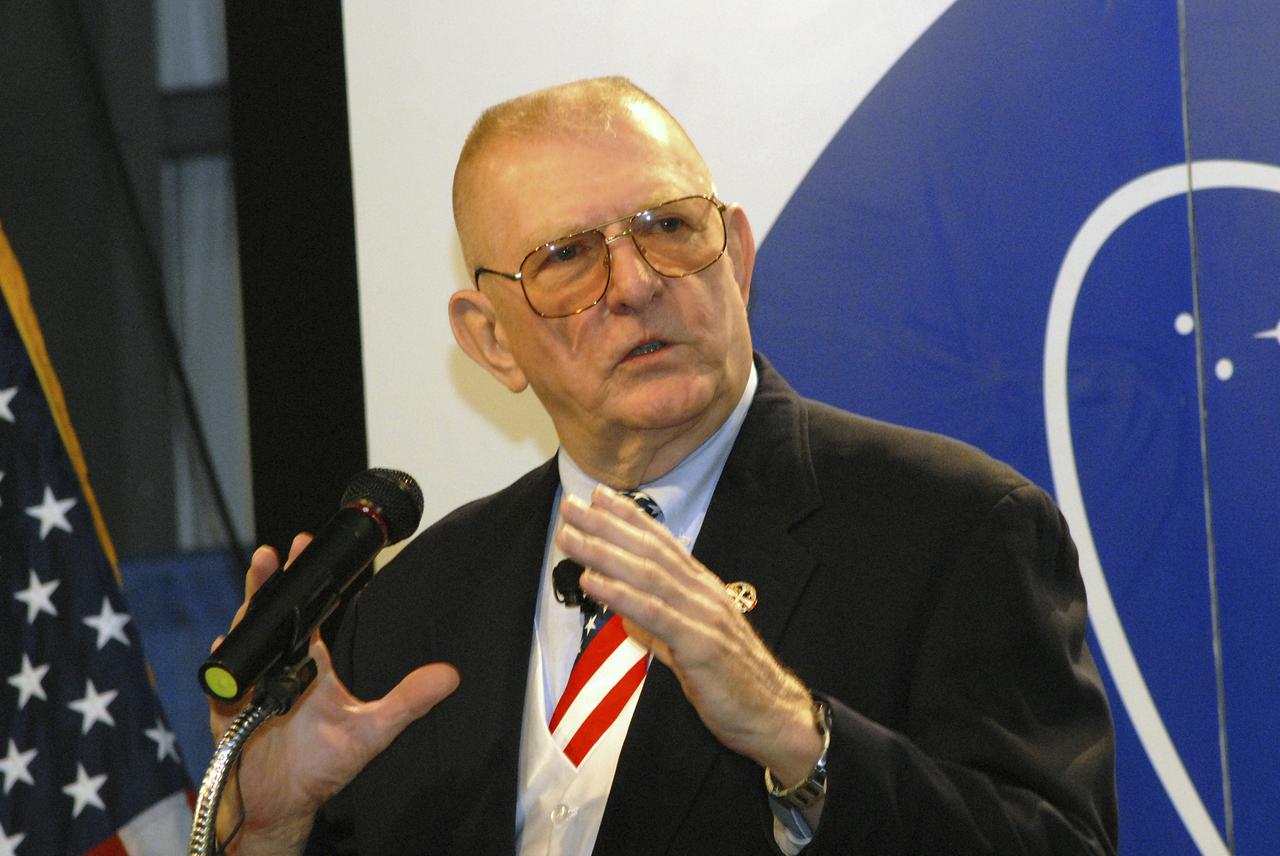
On October 19, 2006, former NASA director of Mission Operations Gene Kranz was a keynote speaker at the Marshall Space Flight Center’s (MSFC’s) 2006 Annual Safety Day program. The best selling author of “Failure Is Not An Option” and past Apollo flight director was featured during a morning session called “Coffee and Kranz”. Marshall employees hung on his every word as he told the fascinating story of Apollo 13. Kranz was the acting flight director during the Apollo 13 mission, a mission that seemed doomed to fail due to an onboard explosion. Kranz and his flight control team worked around the clock relentlessly, solving problem after problem, until the crew was returned safely to Earth.
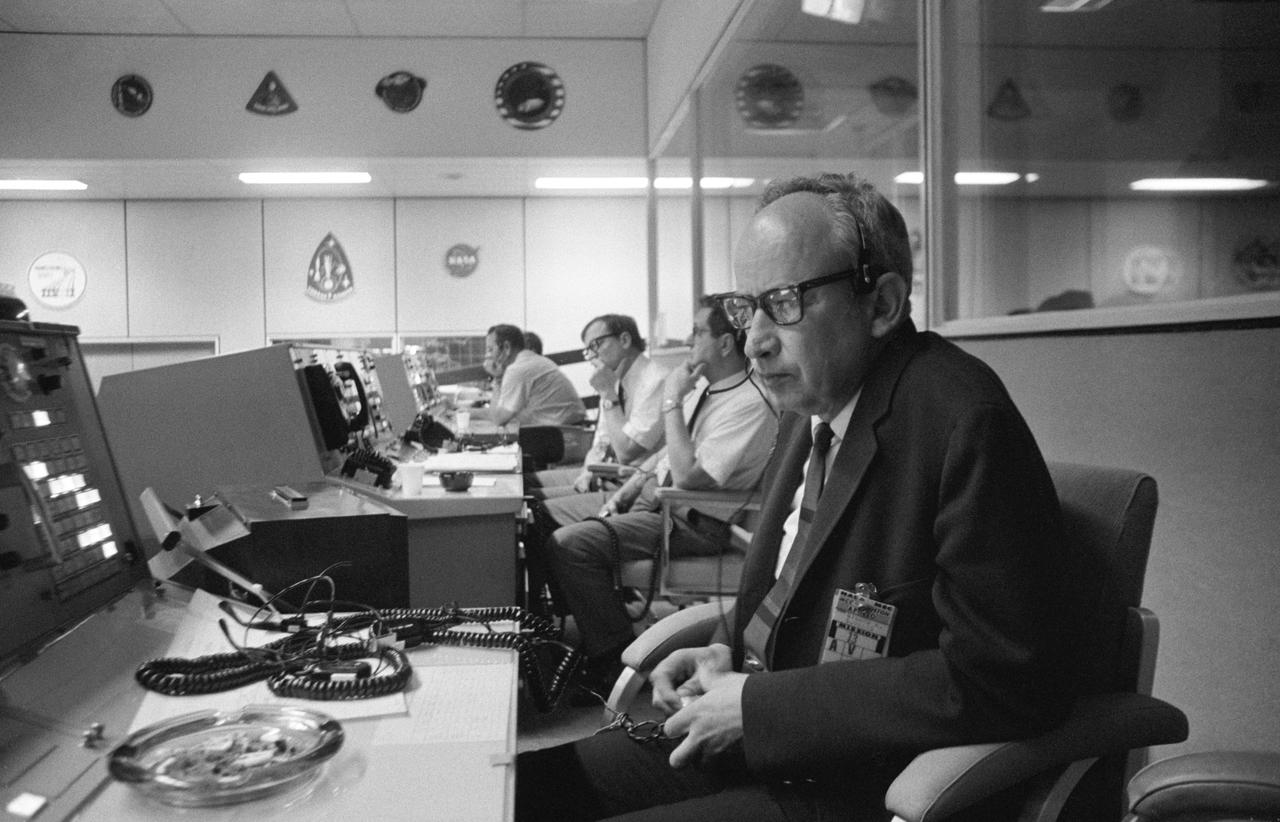
S70-34627 (11 April 1970) --- Sigurd A. Sjoberg, director of flight operations, at the Manned Spacecraft Center (MSC), views the Apollo 13 liftoff from a console in the MSC Mission Control Center (MCC), Building 30. Apollo 13 lifted off at 1:13 p.m. (CST) April 11, 1970. Photo credit: NASA
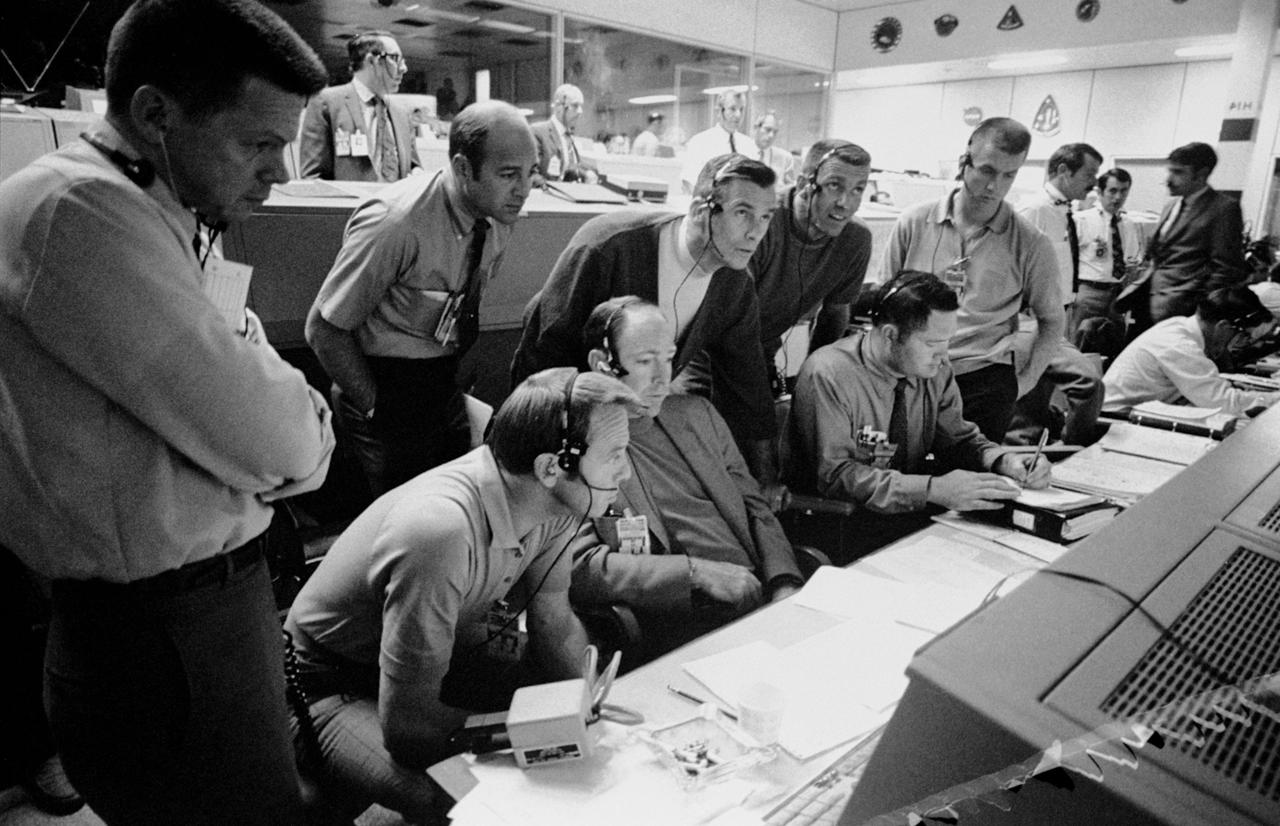
S70-34986 (14 April 1970) --- A group of six astronauts and two flight controllers monitor the console activity in the Mission Operations Control Room (MOCR) of the Mission Control Center (MCC) during the problem-plagued Apollo 13 lunar landing mission. Seated, left to right, are MOCR Guidance Officer Raymond F. Teague; astronaut Edgar D. Mitchell, Apollo 14 prime crew lunar module pilot; and astronaut Alan B. Shepard Jr., Apollo 14 prime crew commander. Standing, left to right, are scientist-astronaut Anthony W. England; astronaut Joe H. Engle, Apollo 14 backup crew lunar module pilot; astronaut Eugene A. Cernan, Apollo 14 backup crew commander; astronaut Ronald E. Evans, Apollo 14 backup crew command module pilot; and M.P. Frank, a flight controller. When this picture was made, the Apollo 13 moon landing had already been canceled, and the Apollo 13 crew men were in trans-Earth trajectory attempting to bring their damaged spacecraft back home.
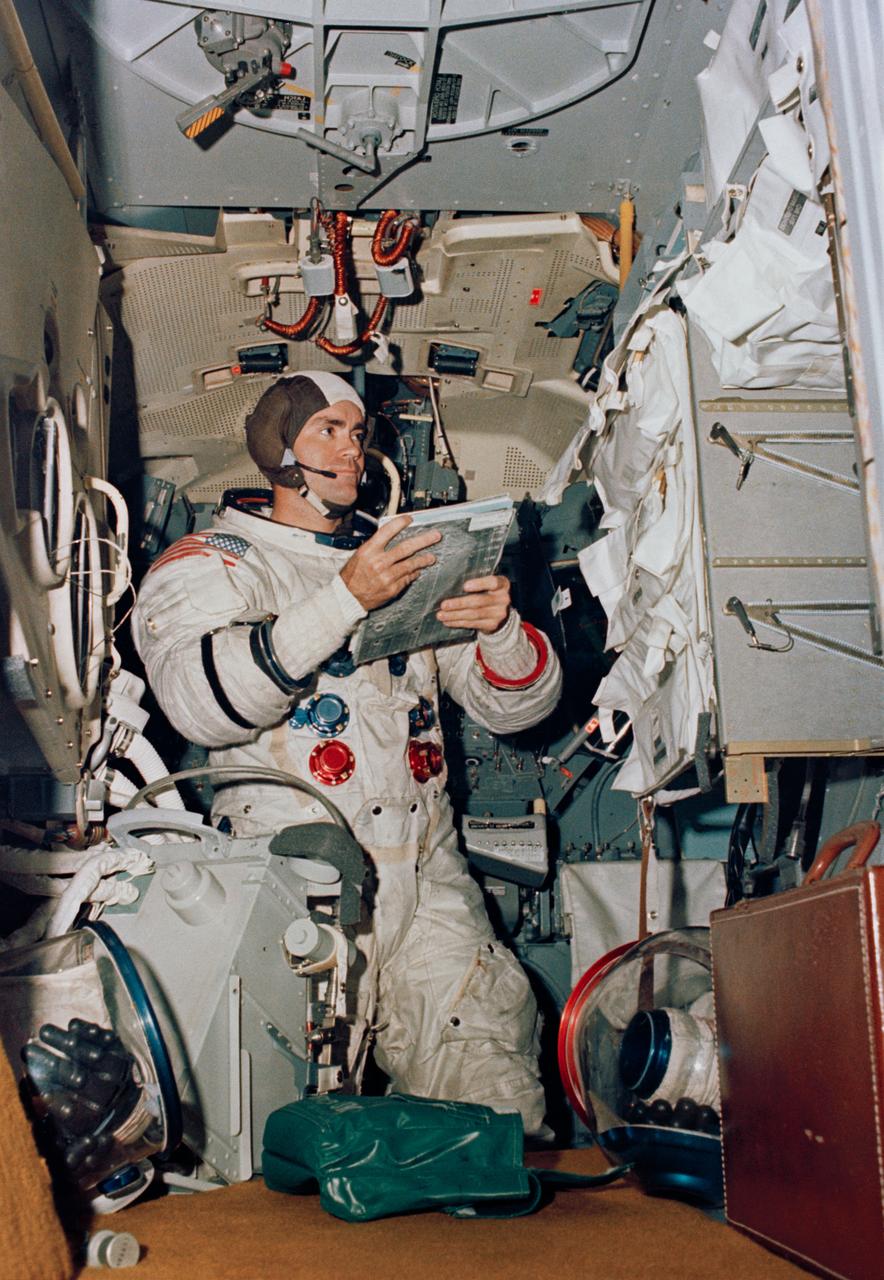
S70-34412 (4 April 1970) --- Astronaut Fred W. Haise Jr., Apollo 13 lunar module pilot, participates in simulation training in preparation for the scheduled lunar landing mission. He is in the Apollo Lunar Module Mission Simulator in the Kennedy Space Center's Flight Crew Training building.
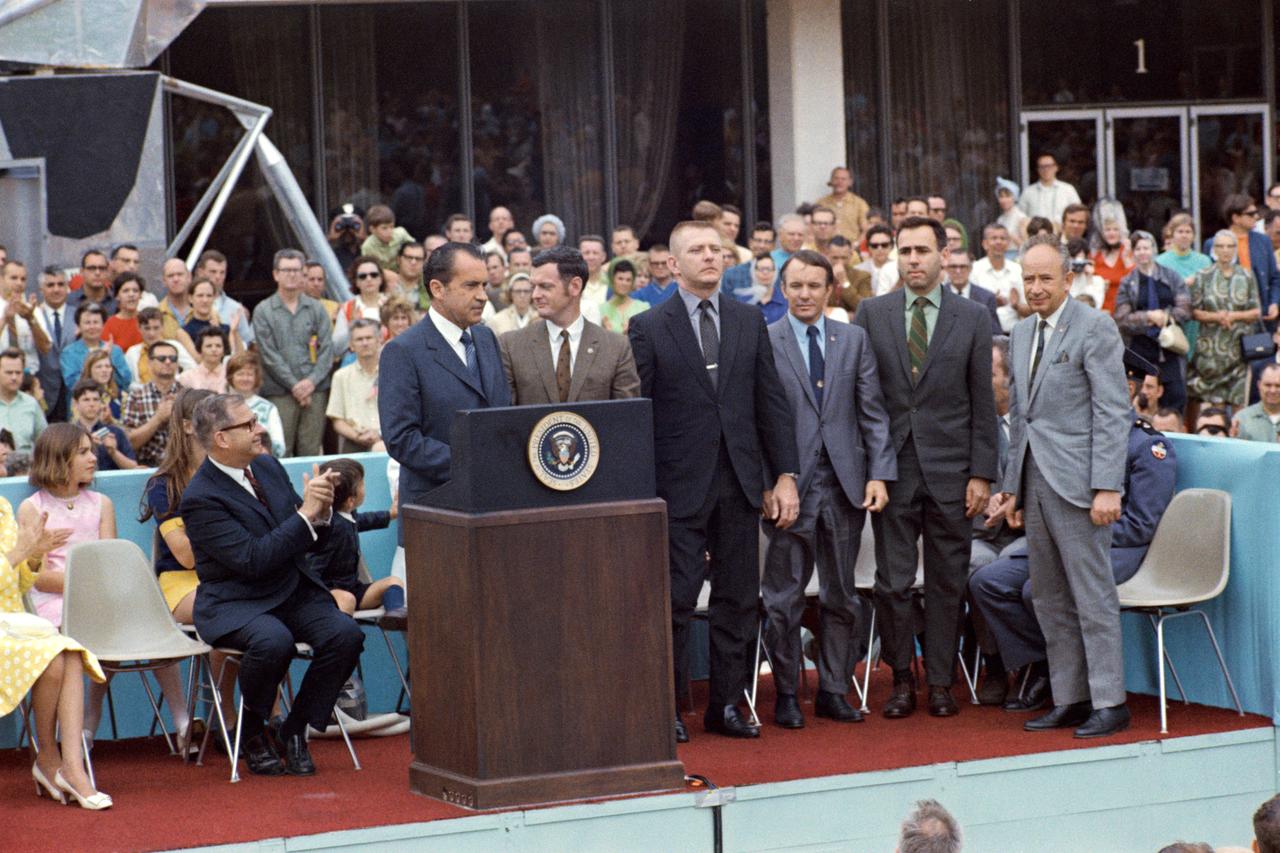
S70-35600 (18 April 1970) --- President Richard M. Nixon introduces Sigurd A. Sjoberg (far right), director of Flight Operations at Manned Spacecraft Center, and the four Apollo 13 flight directors during the President?s post-mission visit to the Manned Spacecraft Center. The flight directors are, from left to right, Glynn S. Lunney, Eugene A. Kranz, Gerald D. Griffin and Milton L. Windler. Dr. Thomas O. Paine, Administrator, National Aeronautics and Space Administration, is seated at left. President Nixon was on the site to present the Presidential Medal of Freedom - the nation?s highest civilian honor -to the Apollo 13 Mission Operations Team.
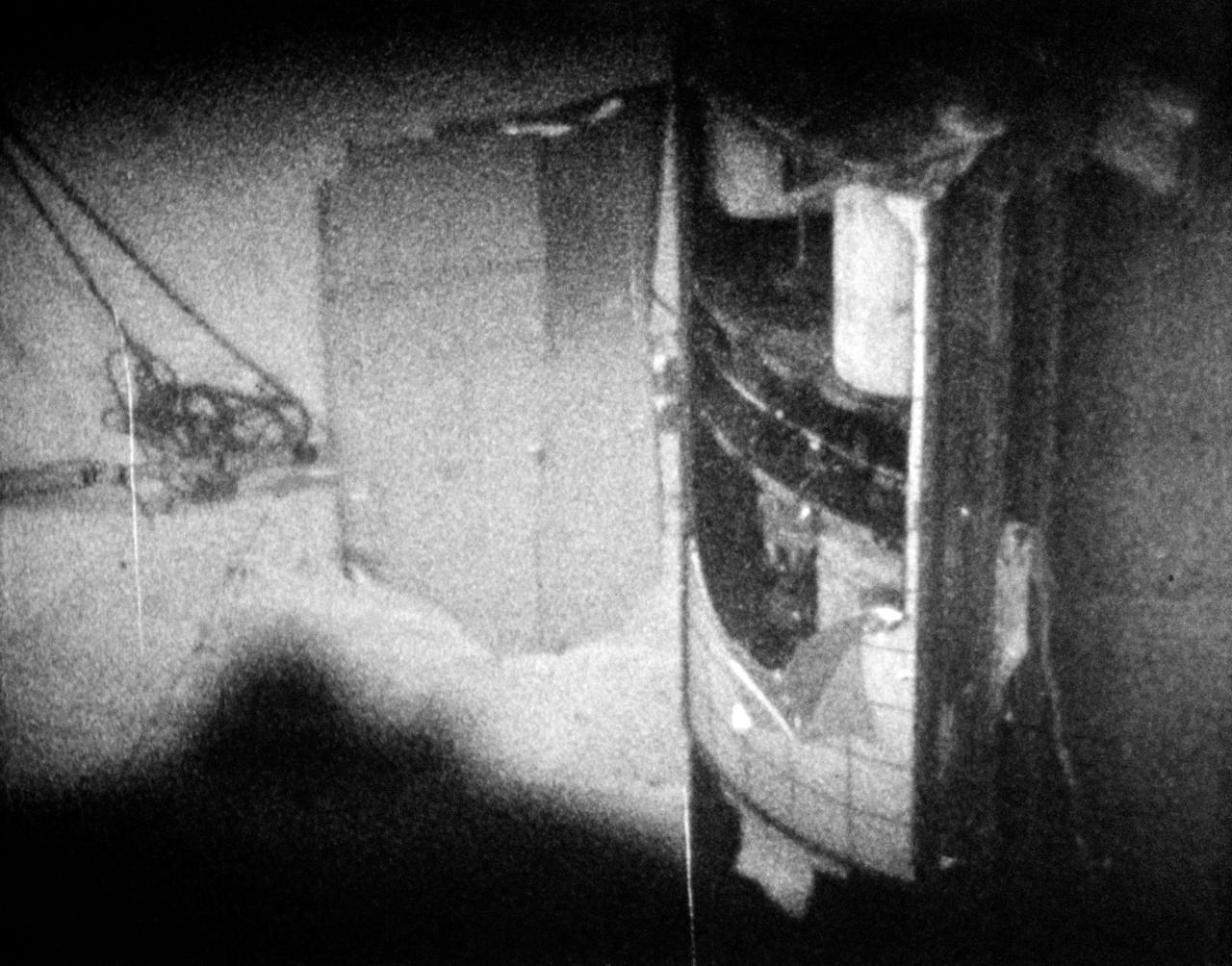
S70-41983 (June 1970) --- Second photograph in sequence of three of panel separation test at Langley Research Center. The test was part of the Apollo 13 post flight investigation of the Service Module explosion incident. Photo credit: NASA
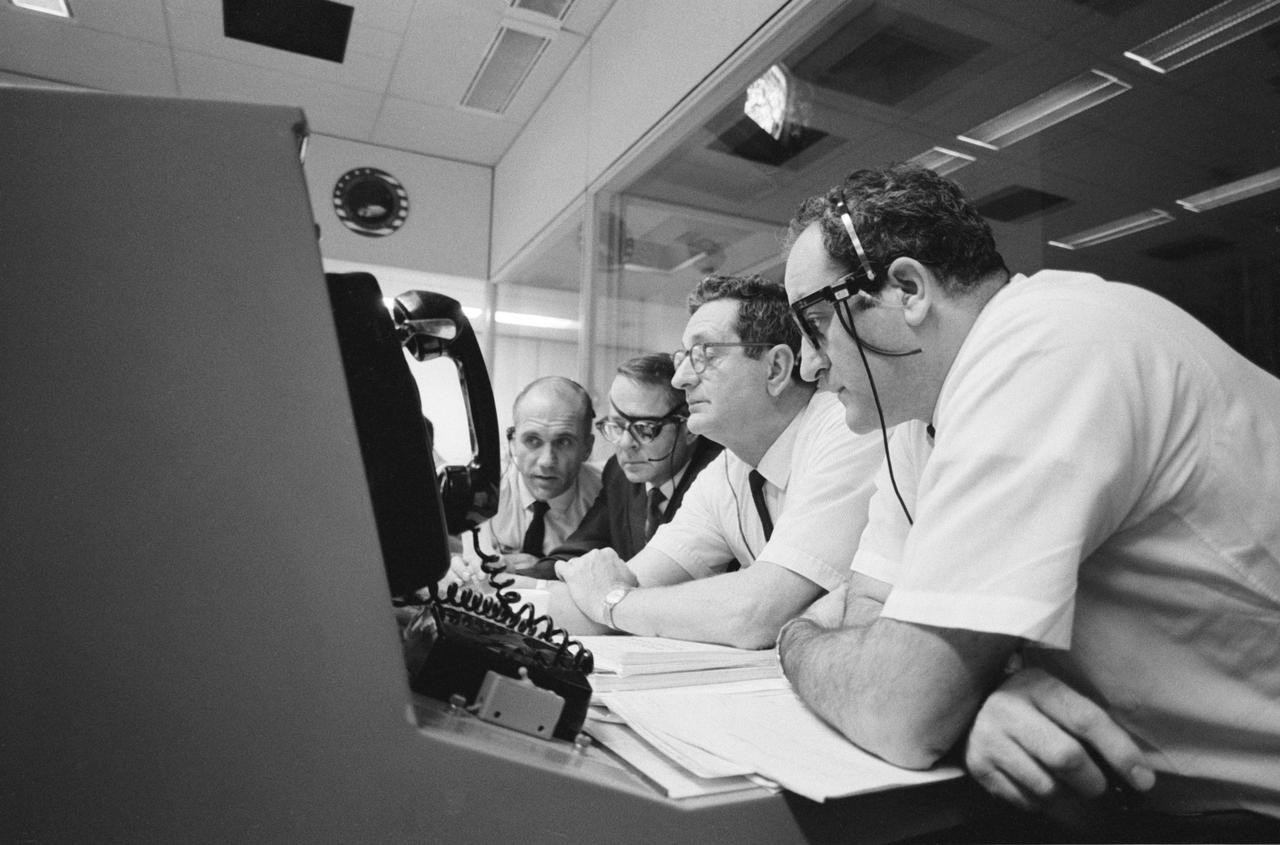
S70-35096 (16 April 1970) --- As the problem-plagued Apollo 13 crewmen entered their final 24 hours in space, several persons important to the mission remained attentive at consoles in the Mission Operations Control Room of the Mission Control Center at Manned Spacecraft Center. Among those monitoring communications and serving in supervisory capacities were these four officials from National Aeronautics and Space Administration Headquarters, Washington, D.C.: (from left) Thomas H. McMullen, Office of Manned Space Flight, who served as Shift 1 mission director; Dale Myers, associate administrator, Manned Space Flight; Chester M. Lee of the Apollo Program Directorate, OMSF, Apollo 13 mission director; and Dr. Rocco A. Petrone, Apollo program director, OMSF.
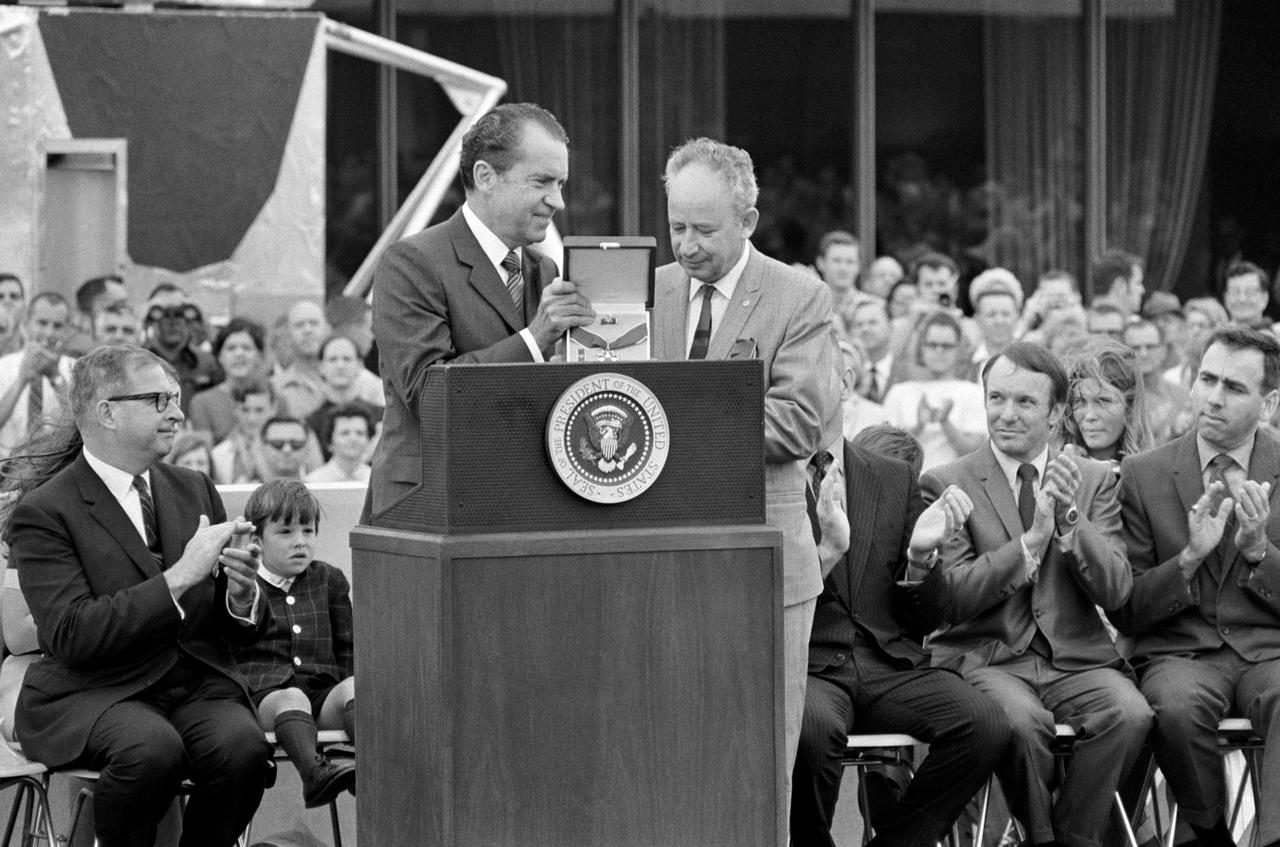
S70-35594 (18 April 1970) --- President Richard M. Nixon presents the Presidential Medal of Freedom to the Apollo 13 Mission Operations Team at Manned Spacecraft Center (MSC). Accepting for the team is Sigurd A. Sjoberg, director of Flight Operations at MSC. Dr. Thomas O. Paine, Administrator, National Aeronautics and Space Administration (NASA), is at left. Also seen here on the speaker's platform are Jeffrey C. Lovell, son of astronaut James A. Lovell Jr., commander of the Apollo 13 mission; Gerald D. Griffin (second from right) and Milton L. Windler, two of four flight directors who worked around the clock during the mission.

S70-30534 (9 March 1970) --- A Lunar Landing Training Vehicle (LLTV), piloted by astronaut James A. Lovell Jr., sets down on the runway at the conclusion of a test flight at Ellington Air Force Base. Lovell is the commander of the Apollo 13 lunar landing mission. Lovell used the LLTV to practice lunar landing techniques in preparation for his scheduled mission. Lovell will be at the controls of the Apollo 13 Lunar Module (LM) when it lands on the moon in the highlands just north of Fra Mauro. Astronaut Thomas K. Mattingly II, command module pilot, will remain with the Apollo 13 Command and Service Modules (CSM) in lunar orbit while astronauts Lovell and Fred W. Haise Jr., lunar module pilot, descend in the LM to explore the moon. A hovering helicopter watches the LLTV landing.
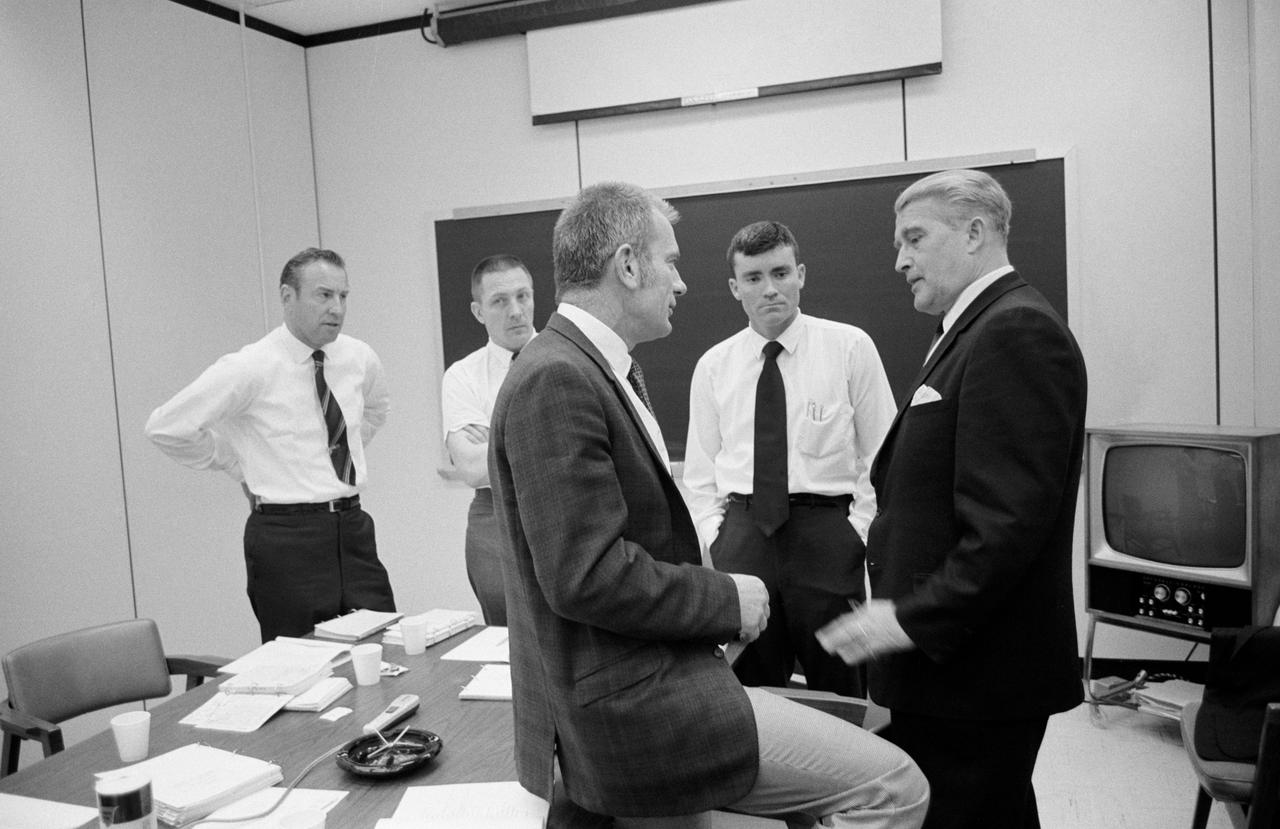
S70-35748 (20 April 1970) --- Dr. Donald K. Slayton (center foreground), MSC director of flight crew operations, talks with Dr. Wernher von Braun (right), famed rocket expert, at an Apollo 13 postflight debriefing session. The three crewmen of the problem-plagued Apollo 13 mission (left to right) in the background are astronauts James A Lovell Jr., commander; John L. Swigert Jr., command module pilot; and Fred W. Haise Jr., lunar module pilot. The apparent rupture of oxygen tank number two in the Apollo 13 Service Module (SM) and the subsequent damage forced the three astronauts to use the Lunar Module (LM) as a "lifeboat" to return home safely after their moon landing was canceled. Dr. von Braun is the deputy associate administrator for planning of the National Aeronautics and Space Administration (NASA).
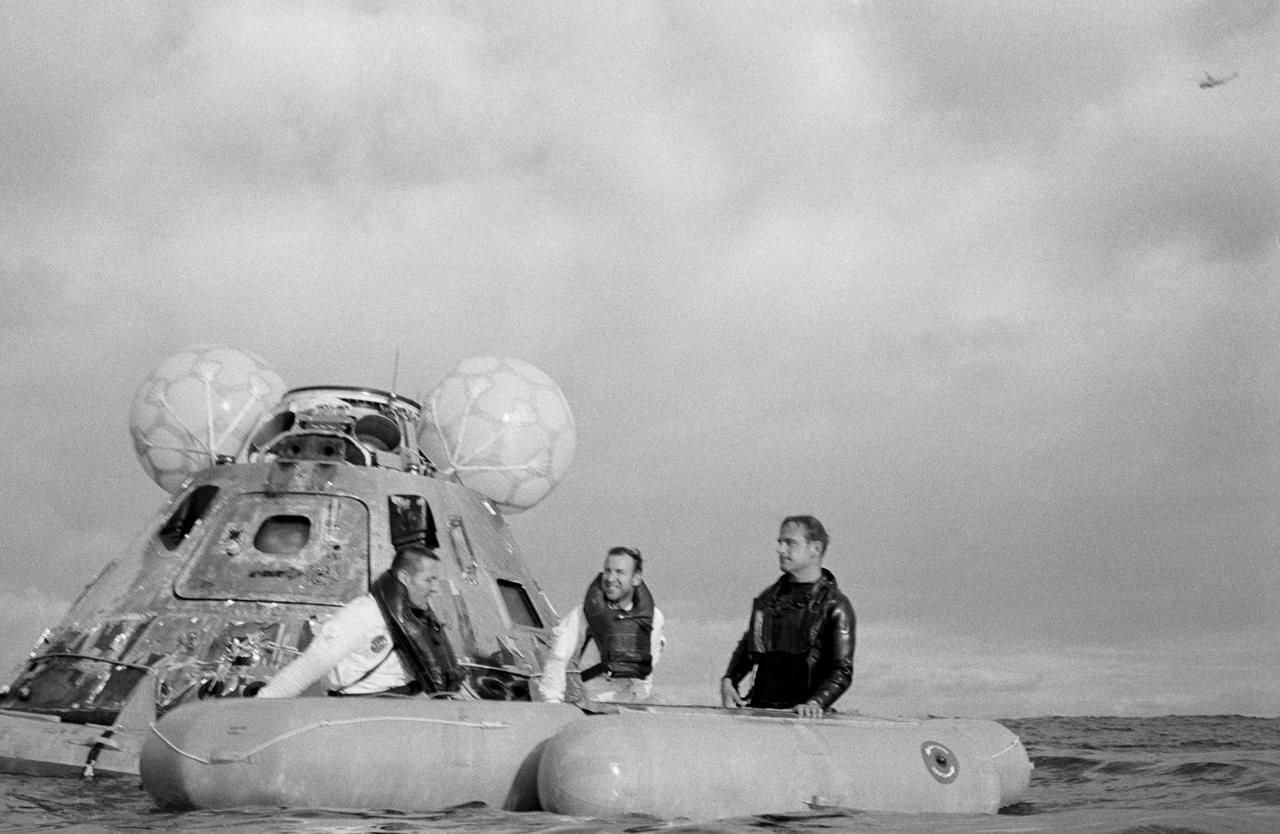
S70-35615 (17 April 1970) --- A water level view of the Apollo 13 recovery operations in the South Pacific Ocean. The three astronauts have egressed their spacecraft, and astronaut Fred W. Haise Jr., lunar module pilot, has already ascended to the helicopter. The other two crewmembers await the return of the "Billy Pugh" net. Astronaut James A. Lovell Jr. (center), commander, will remain in the life raft until astronaut John L. Swigert Jr., command module pilot, has boarded the helicopter. A United States Navy underwater demolition team swimmer assist with the recovery operations. The three Apollo 13 crewmembers were flown to the USS Iwo Jima, prime recovery ship. Apollo 13 splashed down at 12:07:44 p.m. (CST), April 17, 1970, to safely conclude a perilous space flight.
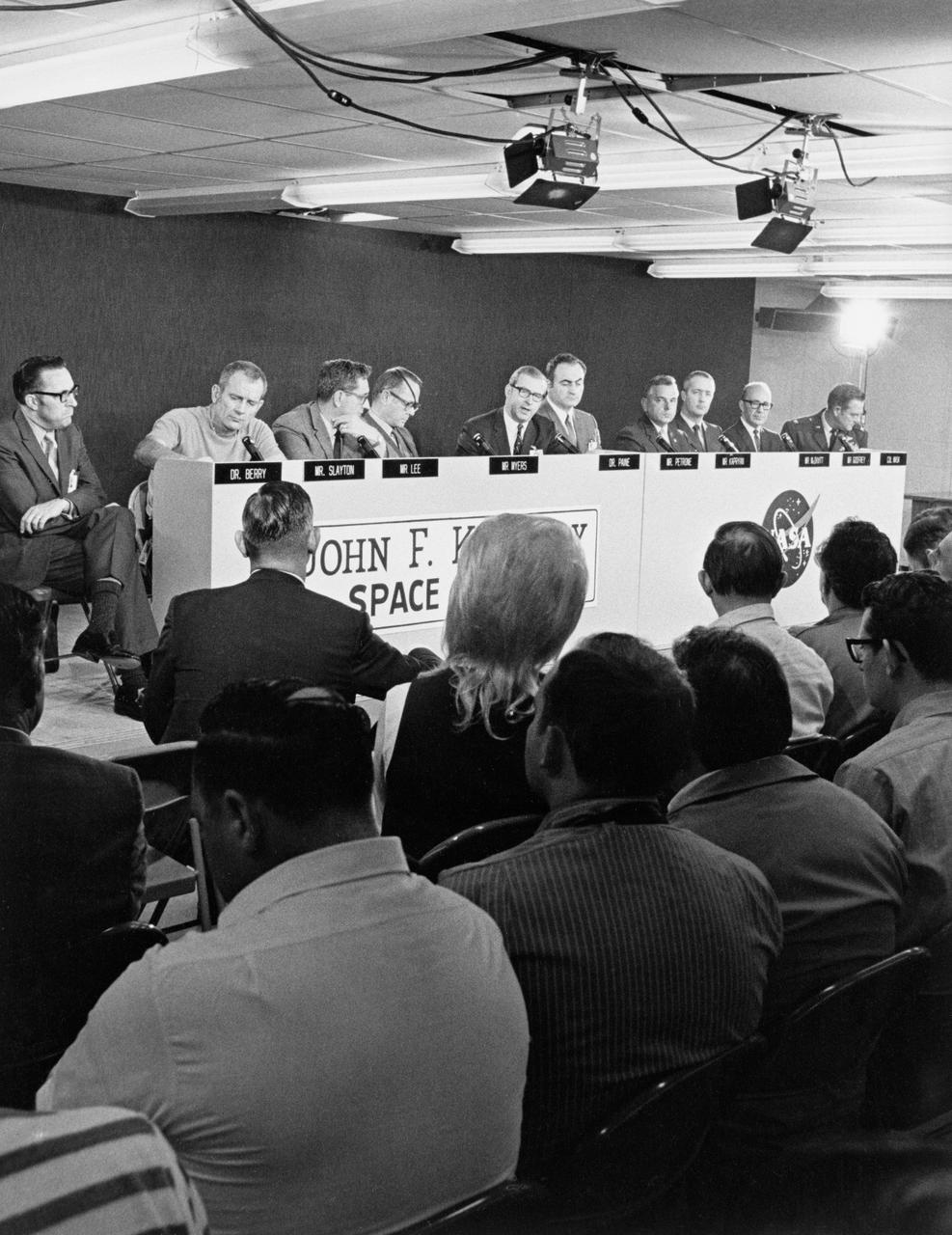
S70-36782 (10 April 1970) --- Several NASA and military officials (background at dais) meet the press on April 10, 1970, during a scheduled a T-1 prelaunch briefing for the Apollo 13 mission in the Apollo News Center at the Kennedy Space Center. The briefing participants, from the left, are Dr. Charles A. Berry, Director, Medical Research and Operations Directorate, Manned Spacecraft Center (MSC); Dr. Donald K. (Deke) Slayton, director of flight crew operations, MSC; Chester M. Lee of the Apollo Program Directorate, Office Manned Space Flight (OMSF),NASA Hq. and Apollo 13 Mission Director; Dale Myers, Associate Administrator, OMSF,NASA Hq.; Dr. Thomas O. Paine, NASA Administrator; Dr. Rocco A. Petrone, Apollo Program Director, OMSF,NASA Hq.; Walter J. Kapryan, NASA's Director of Launch Operations; James A. McDivitt, Manager of the Apollo Spacecraft Program Office; Roy E. Godfrey, Manager, Saturn Program Office; and Col. Kenneth J. Mask, USAF, DOD Manned Space Flight Support Office. Photo credit: NASA
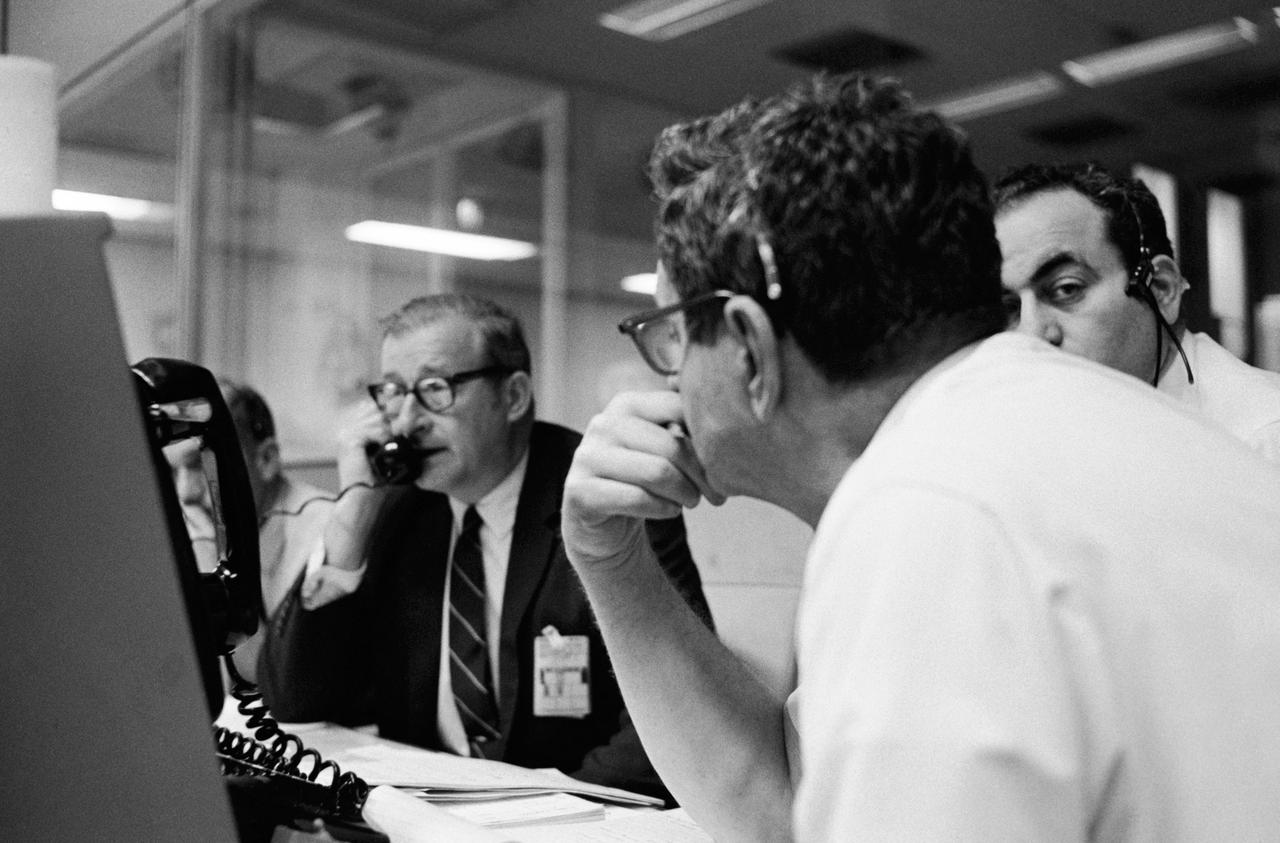
S70-34903 (14 April 1970) --- Dr. Thomas O. Paine, Administrator, National Aeronautics and Space Administration (NASA), talks on the telephone to President Richard M. Nixon. Dr. Paine is seated at his console in the Mission Operations Control Room (MOCR) at the Mission Control Center (MCC), Manned Spacecraft Center (MSC). Also pictured are Dr. Rocco Petrone, Apollo program director, Office Manned Spaceflight, NASA Headquarters (facing camera); and Chester M. Lee, Apollo mission director, Office of Manned Spaceflight, NASA Headquarters (HQ). Dr. Paine and the President were discussing the revised Apollo 13 flight plan following discovery of an oxygen cell failure in the Apollo 13 spacecraft several hours earlier.
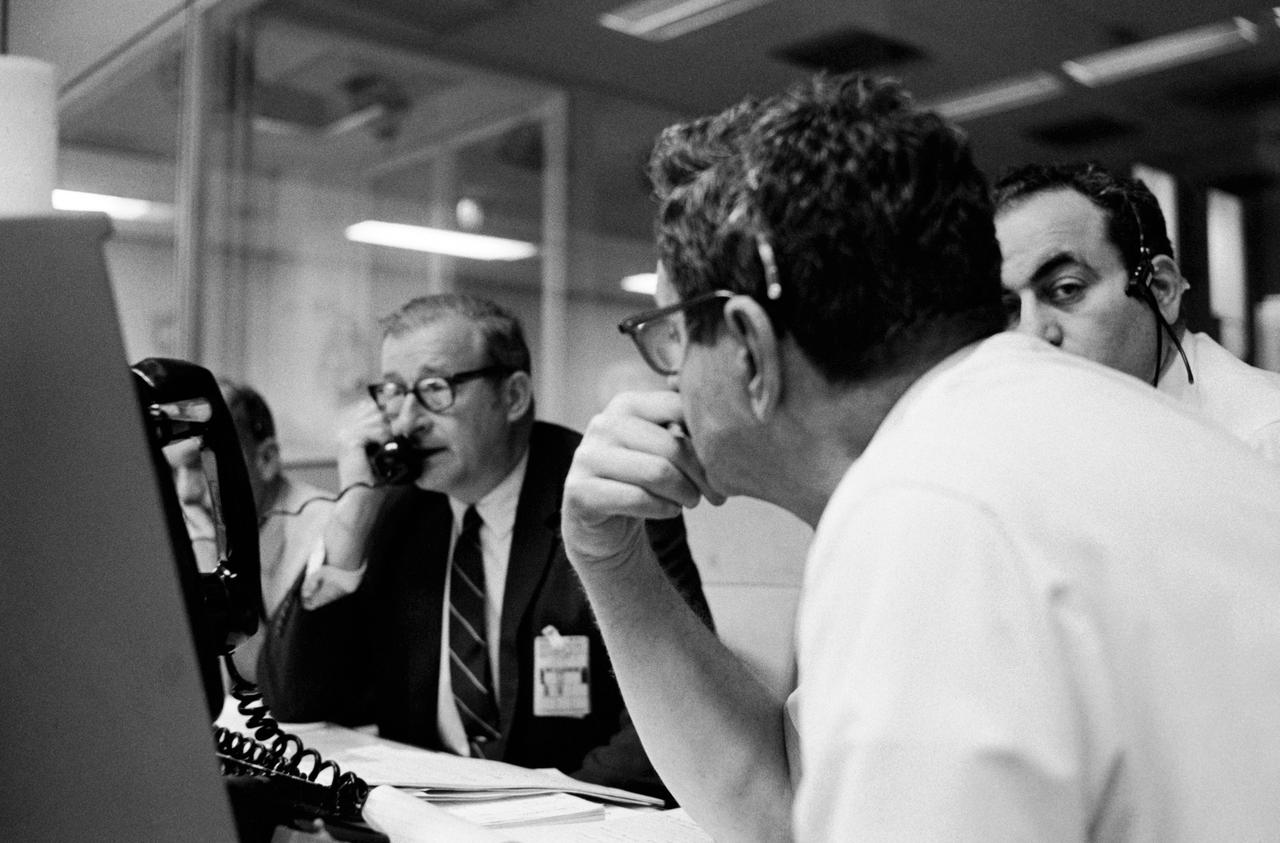
S70-34903 (14 April 1970) --- Dr. Thomas O. Paine, Administrator, National Aeronautics and Space Administration (NASA), talks on the telephone to President Richard M. Nixon. Dr. Paine is seated at his console in the Mission Operations Control Room (MOCR) at the Mission Control Center (MCC), Manned Spacecraft Center (MSC). Also pictured are Dr. Rocco Petrone, Apollo program director, Office Manned Spaceflight, NASA Headquarters (facing camera); and Chester M. Lee, Apollo mission director, Office of Manned Spaceflight, NASA Headquarters (HQ). Dr. Paine and the President were discussing the revised Apollo 13 flight plan following discovery of an oxygen cell failure in the Apollo 13 spacecraft several hours earlier.
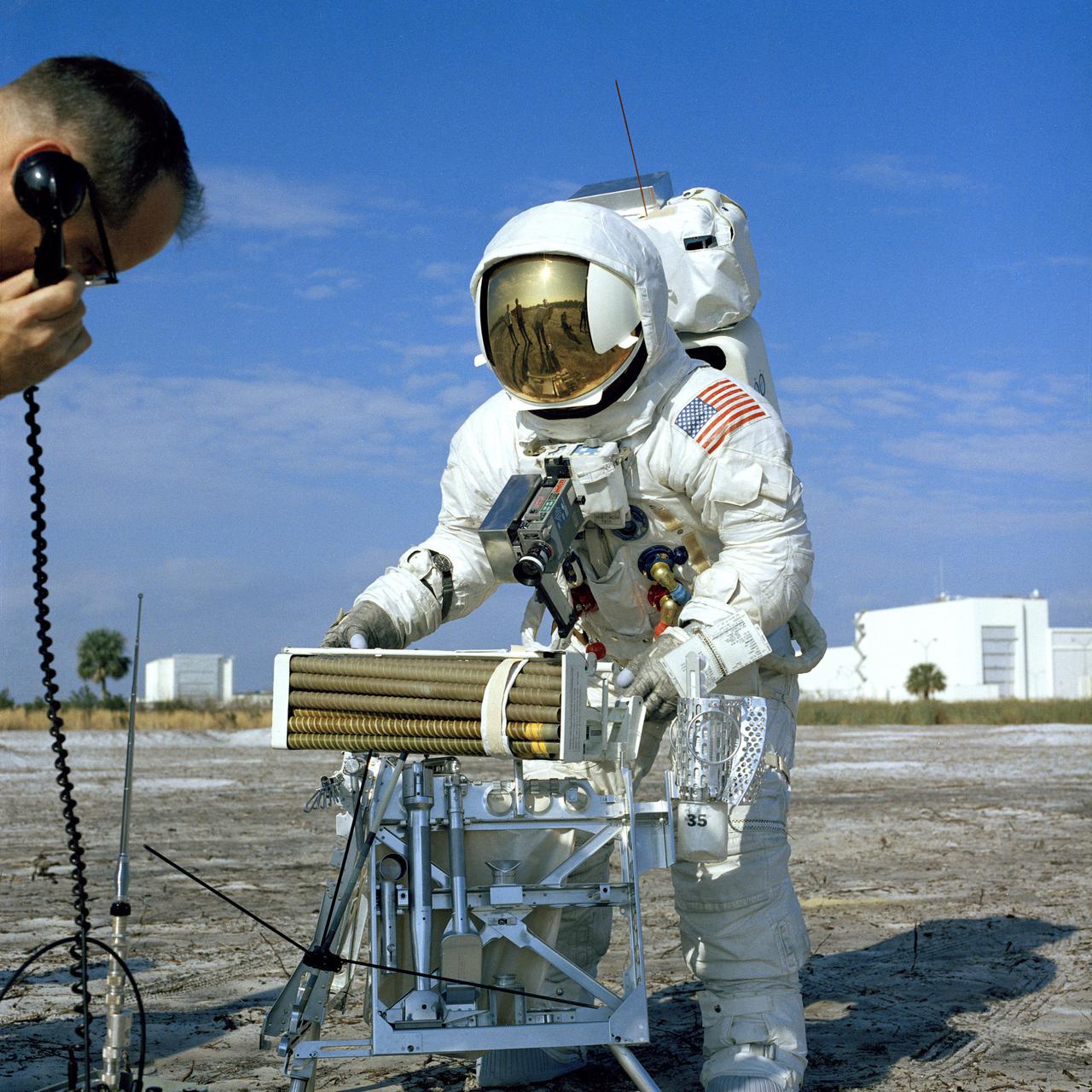
CAPE CANAVERAL, Fla. - Fred W. Haise Jr., Apollo 13 lunar module pilot, participated in a walk-through of the extravehicular activity timeline near the Flight Crew Training Building here today. In the foreground is the lunar surface tool carrier topped by auger-like pipes to be used with a motorized device to obtain soil sample cores in the moon's rugged Fra Mauro region. Apollo 13 is scheduled for launch from Complex 39A no earlier than April 11. The other crew members are James A. Lovell Jr., commander, and Thomas K. Mattingly II, command module pilot. Photo credit: NASA
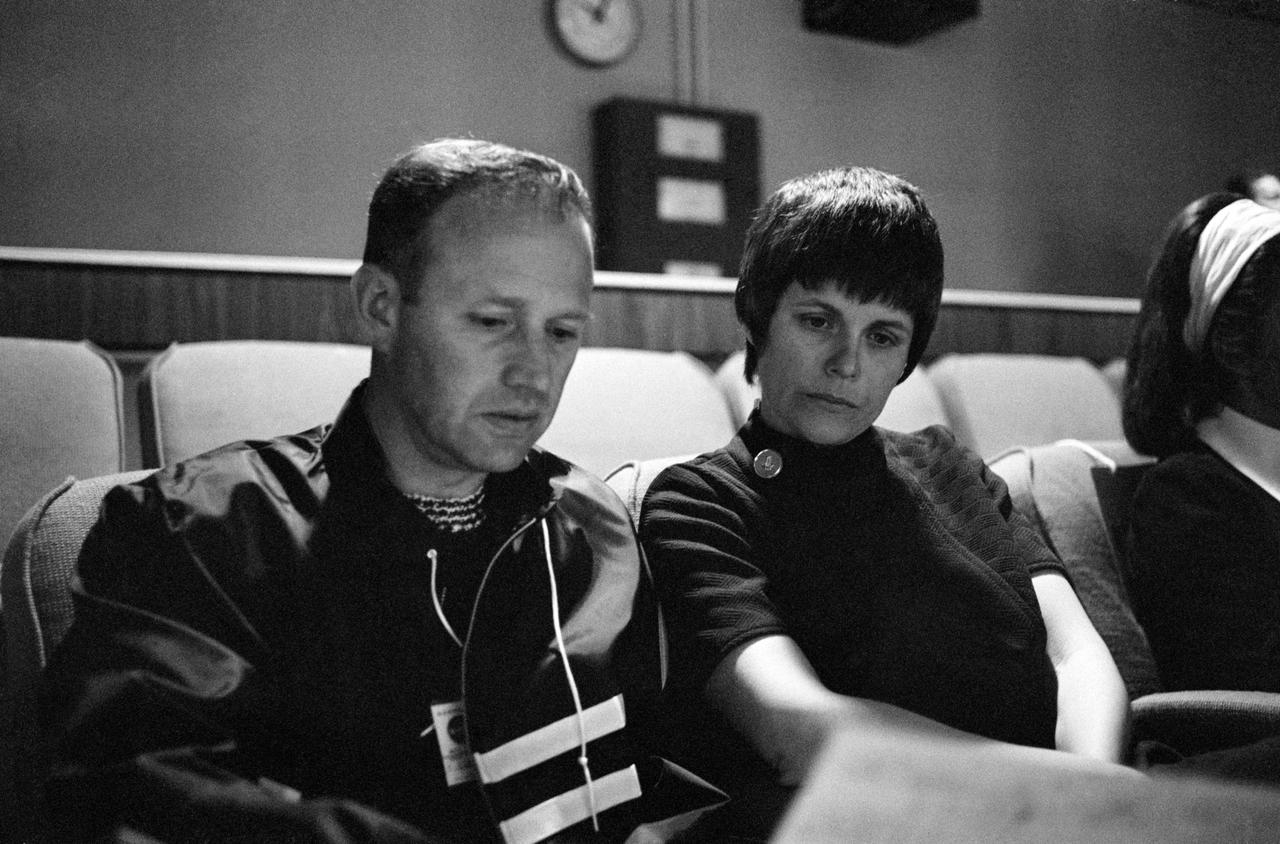
S70-34900 (14 April 1970) --- Mrs. Mary Haise receives an explanation of the revised flight plan of the Apollo 13 mission from astronaut Gerald P. Carr in the viewing room of the Mission Control Center (MCC), Building 30, at the Manned Spacecraft Center (MSC). Her husband, astronaut Fred W. Haise Jr., lunar module pilot for the Apollo 13 mission, was joining fellow crew members, astronauts James A. Lovell Jr., and John L. Swigert Jr. in making correction in their spacecraft following discovery of an oxygen cell failure several hours earlier.
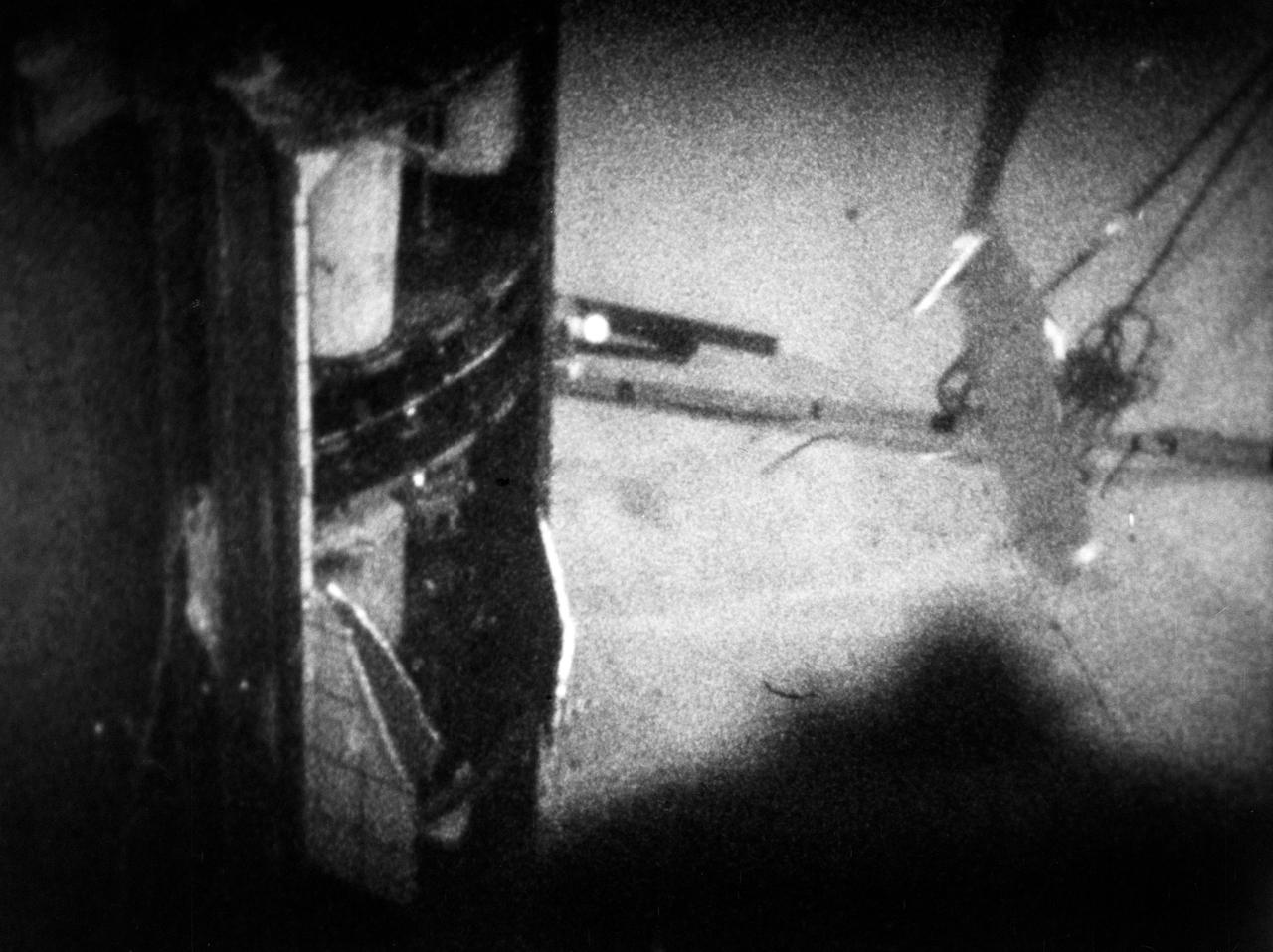
S70-41985 (15 June 1970) --- The third photograph in sequence of three showing panel separation test at Langley Research Center (LRC). The test was part of the Apollo 13 post flight investigation of the Service Module explosion incident. Photo credit: NASA
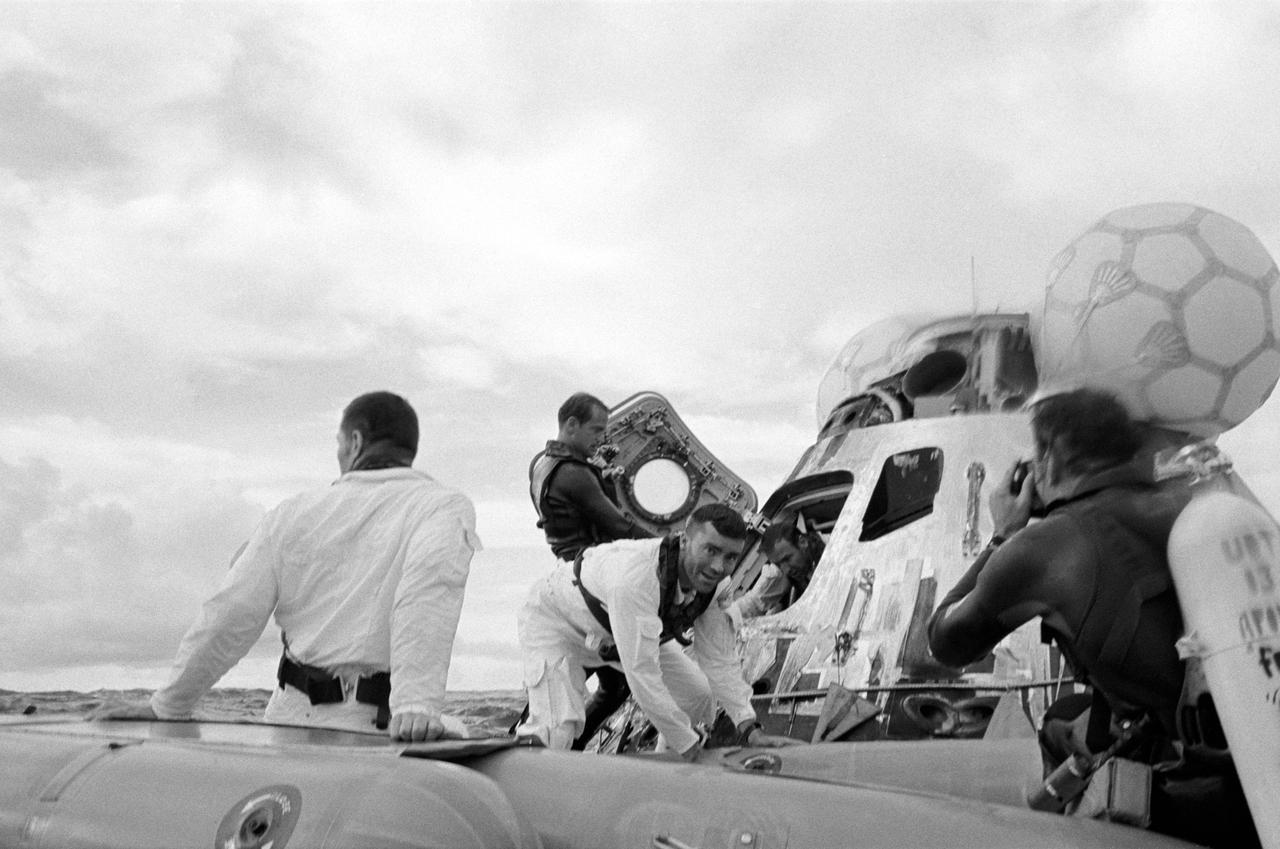
S70-35610 (17 April 1970) --- A water level view of the Apollo 13 recovery operations in the South Pacific Ocean. The three astronauts as seen egressing their spacecraft. John L. Swigert Jr. (back to camera), command module pilot, is already in the life raft. Fred W. Haise Jr., lunar module pilot, facing camera, is stepping into the life raft. James A. Lovell Jr., commander, is leaving the spacecraft in the background. A United States Navy underwater demolition team assists with the recovery operations. The three crewmembers were picked up by helicopter and flown to the prime recovery ship, USS Iwo Jima. The Apollo 13 Command Module (CM) splashed down at 12:07:44 p.m. (CST), April 17, 1970, to conclude safely a perilous space flight. Though the Apollo lunar landing mission was canceled, a disastrous loss of three astronauts was averted.
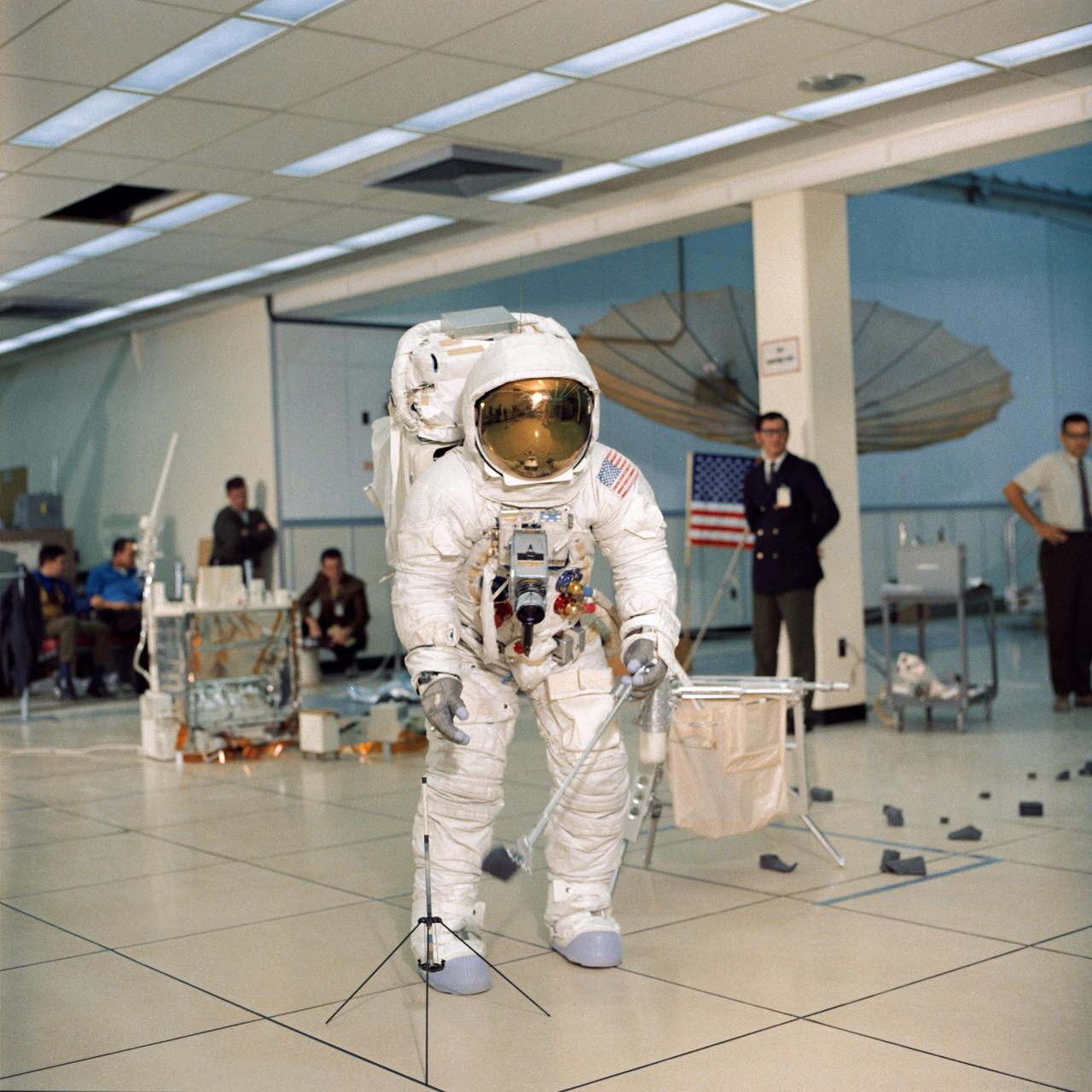
S70-27037 (4 Feb. 1970) --- Astronaut James A. Lovell Jr., commander of the Apollo 13 lunar landing mission, simulates lunar surface extravehicular activity during training exercises in the Kennedy Space Center’s Flight Crew Training Building. Lovell, wearing an Extravehicular Mobility Unit (EMU), is holding an Apollo Lunar Hand Tool (a set of tongs) in his left hand. A gnomon is in front of his right foot. A tool carrier is in the right background.
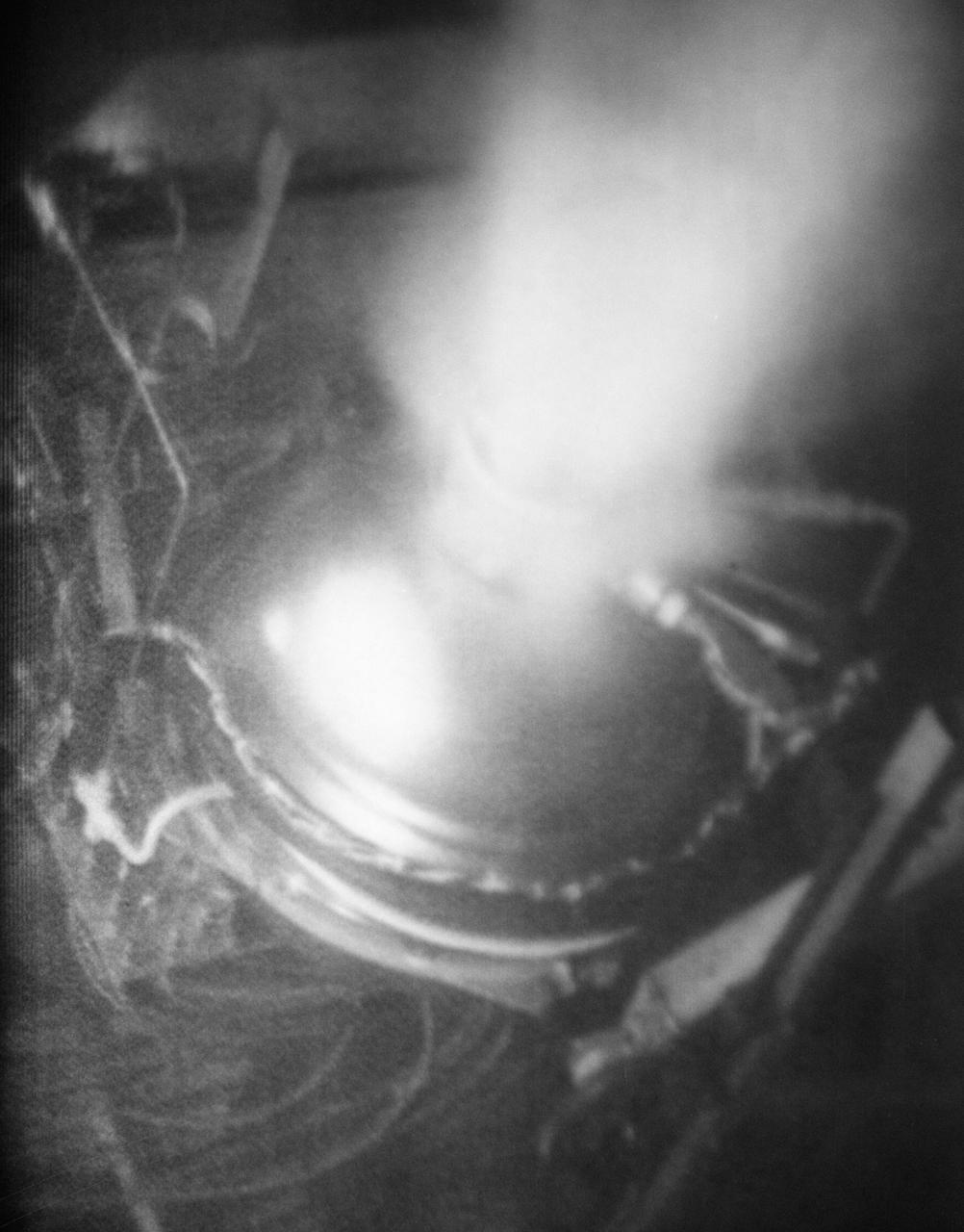
S70-41984 (June 1970) --- Full-scale propagation test at the NASA Manned Spacecraft Center (MSC) of fire inside an Apollo Service Module (SM) oxygen tank. The photograph from a motion picture sequence taken from outside the vessel shows failure of tank conduit with abrupt loss of oxygen pressure. The test was part of the Apollo 13 post flight investigation of the Service Module explosion incident. Photo credit: NASA
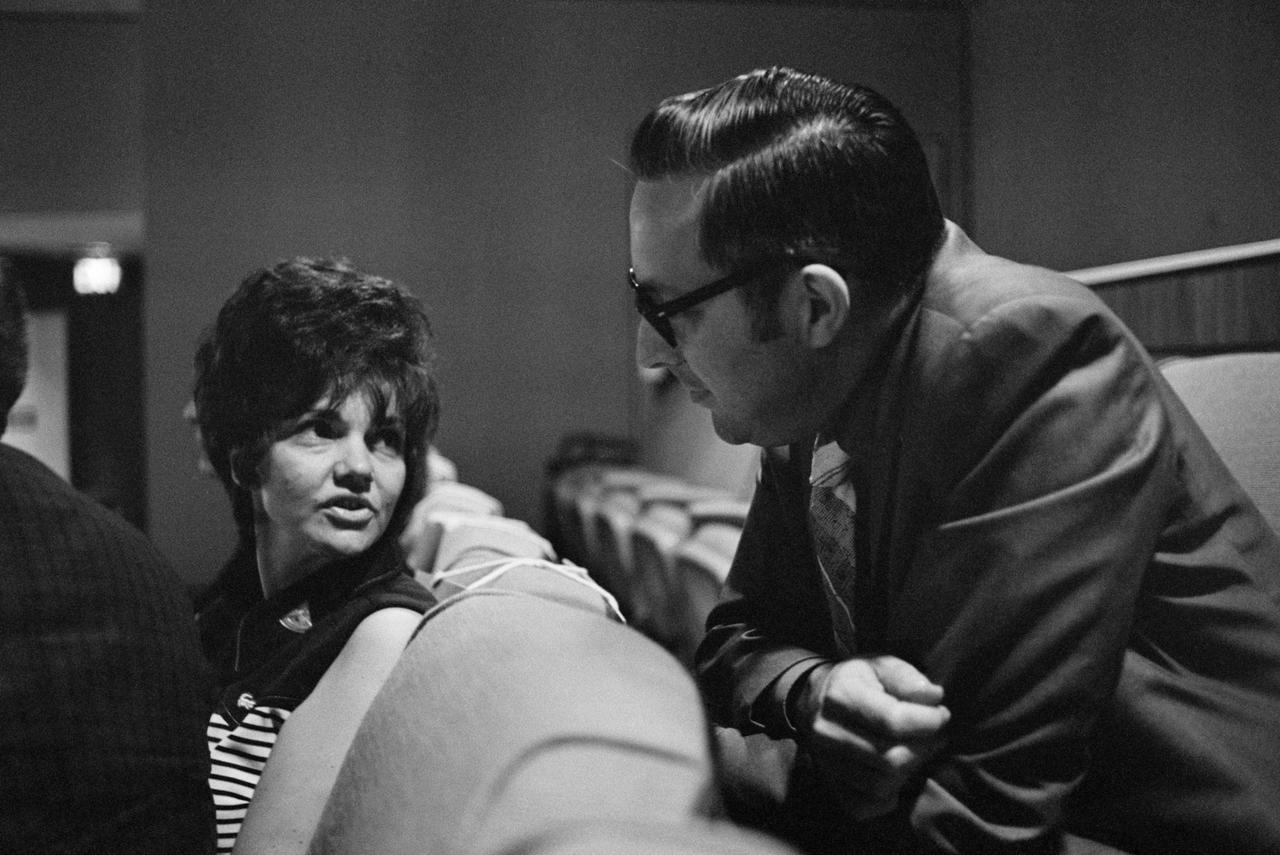
S70-34901 (14 April 1970) --- Mrs. Marilyn Lovell, wife of astronaut James A. Lovell, Apollo 13 mission commander, discusses the flight with Dr. Charles A. Berry, flight surgeon. The two are in a special viewing area overlooking the Flight Control Room (FCR), staffed with flight controllers who were supporting the planned lunar landing mission. EDITOR?S NOTE: After this picture was taken, an explosion occurred aboard the Service Module (SM), causing cancellation of the lunar landing phase of the mission.

S70-34901 (14 April 1970) --- Mrs. Marilyn Lovell, wife of astronaut James A. Lovell, Apollo 13 mission commander, discusses the flight with Dr. Charles A. Berry, flight surgeon. The two are in a special viewing area overlooking the Flight Control Room (FCR), staffed with flight controllers who were supporting the planned lunar landing mission. EDITOR?S NOTE: After this picture was taken, an explosion occurred aboard the Service Module (SM), causing cancellation of the lunar landing phase of the mission.
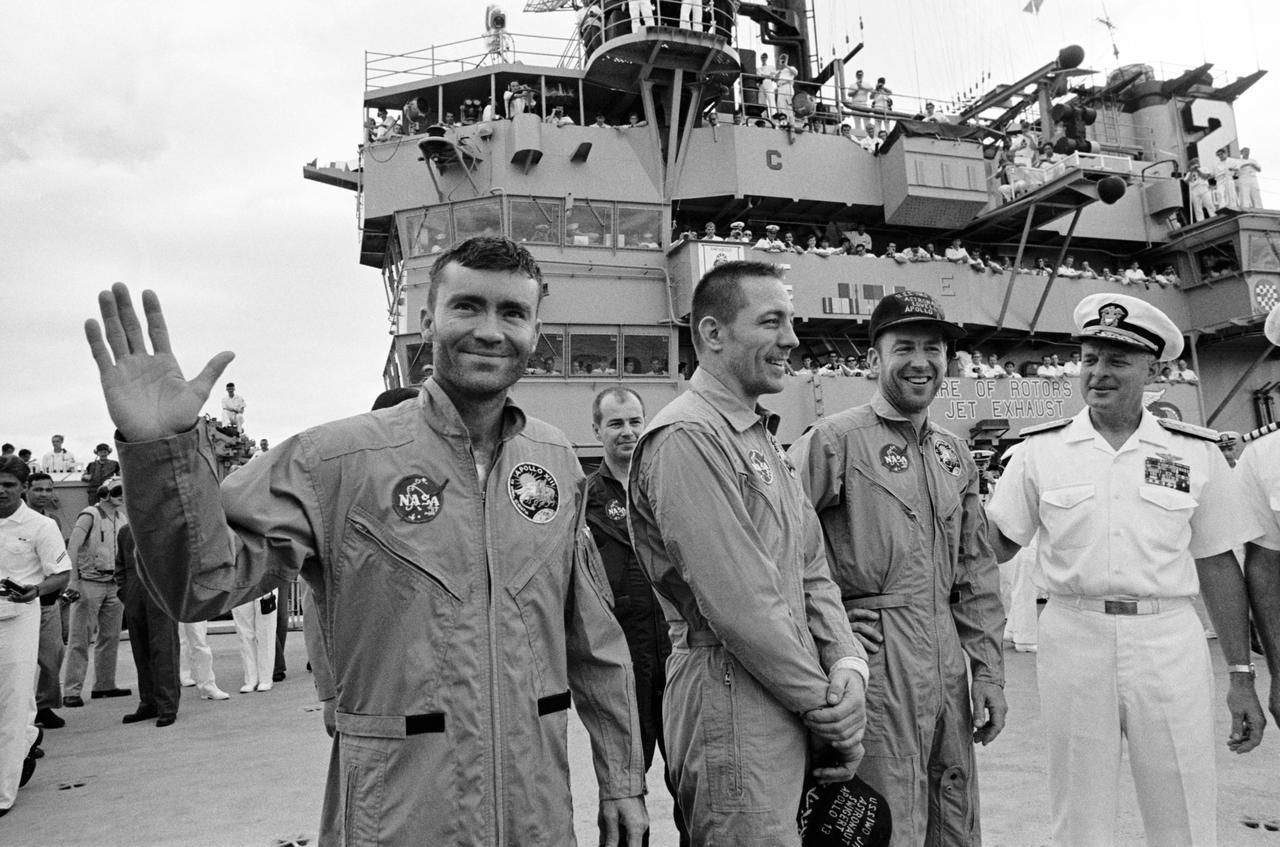
S70-35606 (17 April 1970) --- Rear Admiral Donald C. Davis, Commanding Officer of Task Force 130, the Pacific Recovery Forces for the Manned Spacecraft Missions, welcomes the Apollo 13 crewmembers aboard the USS Iwo Jima, prime recovery ship for the Apollo 13 mission. The crewmembers (from the left) astronauts Fred W. Haise Jr. (waving), lunar module pilot; John L. Swigert Jr., command module pilot; and James A. Lovell Jr., commander; were transported by helicopter to the ship following a smooth splashdown only about four miles from the USS Iwo Jima. Splashdown occurred at 12:07:44 p.m. (CST), April 17, 1970, to conclude safely a perilous space flight.
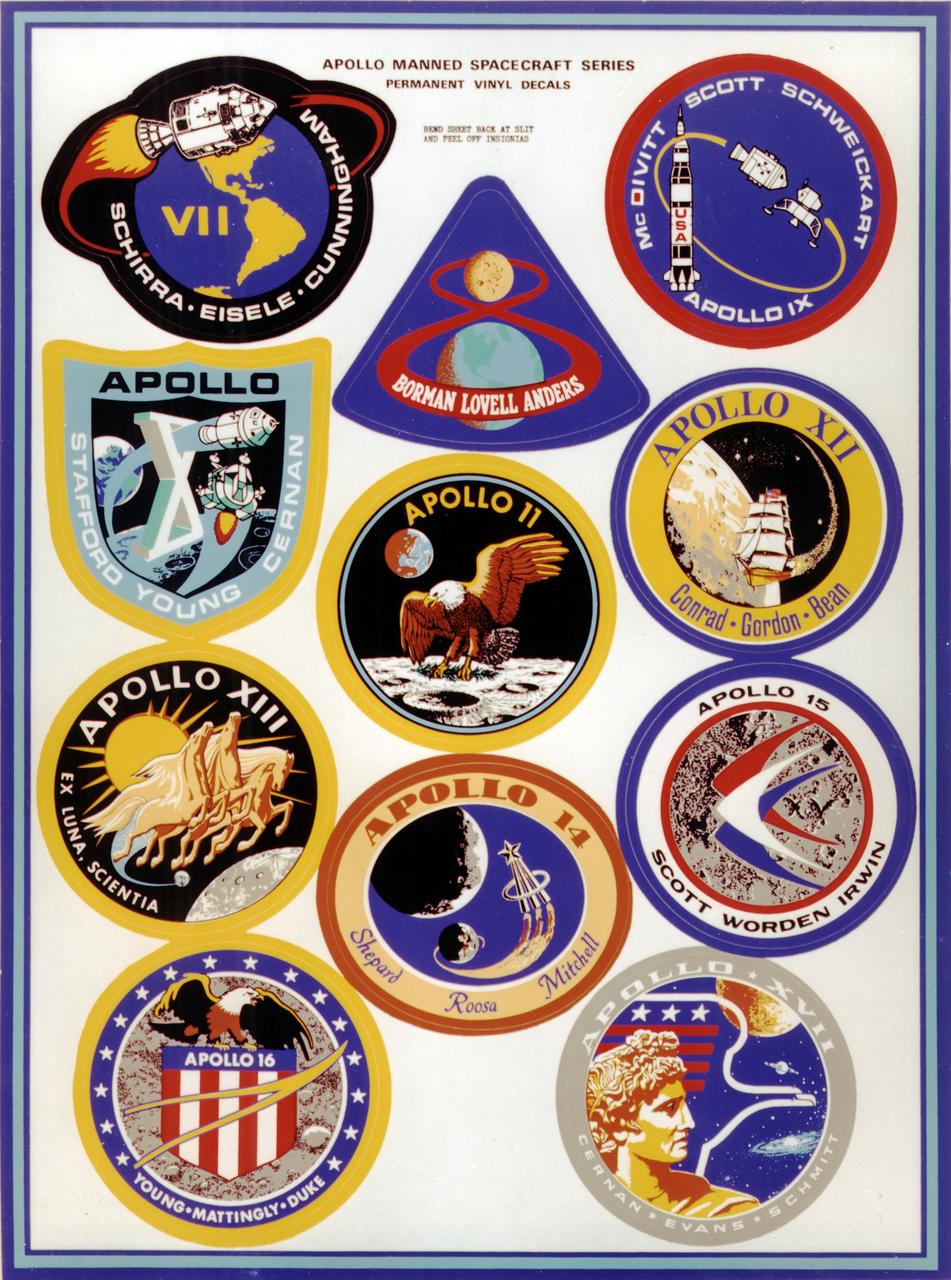
This montage depicts the flight crew patches for the manned Apollo 7 thru Apollo 17 missions. The Apollo 7 through 10 missions were basically manned test flights that paved the way for lunar landing missions. Primary objectives met included the demonstration of the Command Service Module (CSM) crew performance; crew/space vehicle/mission support facilities performance and testing during a manned CSM mission; CSM rendezvous capability; translunar injection demonstration; the first manned Apollo docking, the first Apollo Extra Vehicular Activity (EVA), performance of the first manned flight of the lunar module (LM); the CSM-LM docking in translunar trajectory, LM undocking in lunar orbit, LM staging in lunar orbit, and manned LM-CSM docking in lunar orbit. Apollo 11 through 17 were lunar landing missions with the exception of Apollo 13 which was forced to circle the moon without landing due to an onboard explosion. The craft was,however, able to return to Earth safely. Apollo 11 was the first manned lunar landing mission and performed the first lunar surface EVA. Landing site was the Sea of Tranquility. A message for mankind was delivered, the U.S. flag was planted, experiments were set up and 47 pounds of lunar surface material was collected for analysis back on Earth. Apollo 12, the 2nd manned lunar landing mission landed in the Ocean of Storms and retrieved parts of the unmanned Surveyor 3, which had landed on the Moon in April 1967. The Apollo Lunar Surface Experiments Package (ALSEP) was deployed, and 75 pounds of lunar material was gathered. Apollo 14, the 3rd lunar landing mission landed in Fra Mauro. ALSEP and other instruments were deployed, and 94 pounds of lunar materials were gathered, using a hand cart for first time to transport rocks. Apollo 15, the 4th lunar landing mission landed in the Hadley-Apennine region. With the first use of the Lunar Roving Vehicle (LRV), the crew was bale to gather 169 pounds of lunar material. Apollo 16, the 5th lunar landing mission, landed in the Descartes Highlands for the first study of highlands area. Selected surface experiments were deployed, the ultraviolet camera/spectrograph was used for first time on the Moon, and the LRV was used for second time for a collection of 213 pounds of lunar material. The Apollo program came to a close with Apollo 17, the 6th and final manned lunar landing mission that landed in the Taurus-Littrow highlands and valley area. This mission hosted the first scientist-astronaut, Schmitt, to land on the Moon. The 6th automated research station was set up, and 243 ponds of lunar material was gathered using the LRV.
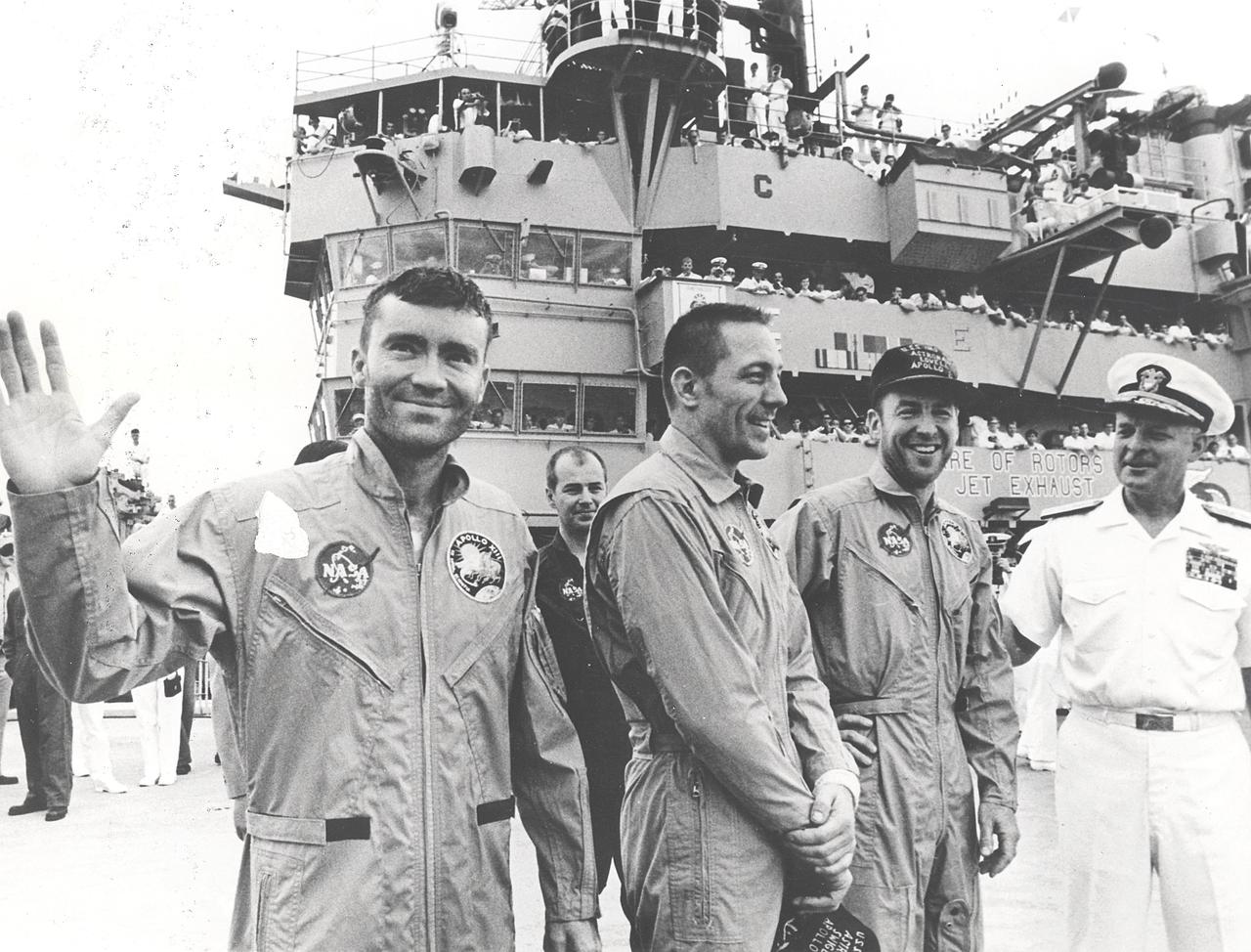
This photograph shows Apollo 13 astronauts Fred Haise, John Swigert, and James Lovell aboard the recovery ship, USS Iwo Jima after safely touching down in the Pacific Ocean at the end of their ill-fated mission. The mission was aborted after 56 hours of flight, 205,000 miles from Earth, when an oxygen tank in the service module exploded. The command module, Odyssey, brought the three astronauts back home safely.
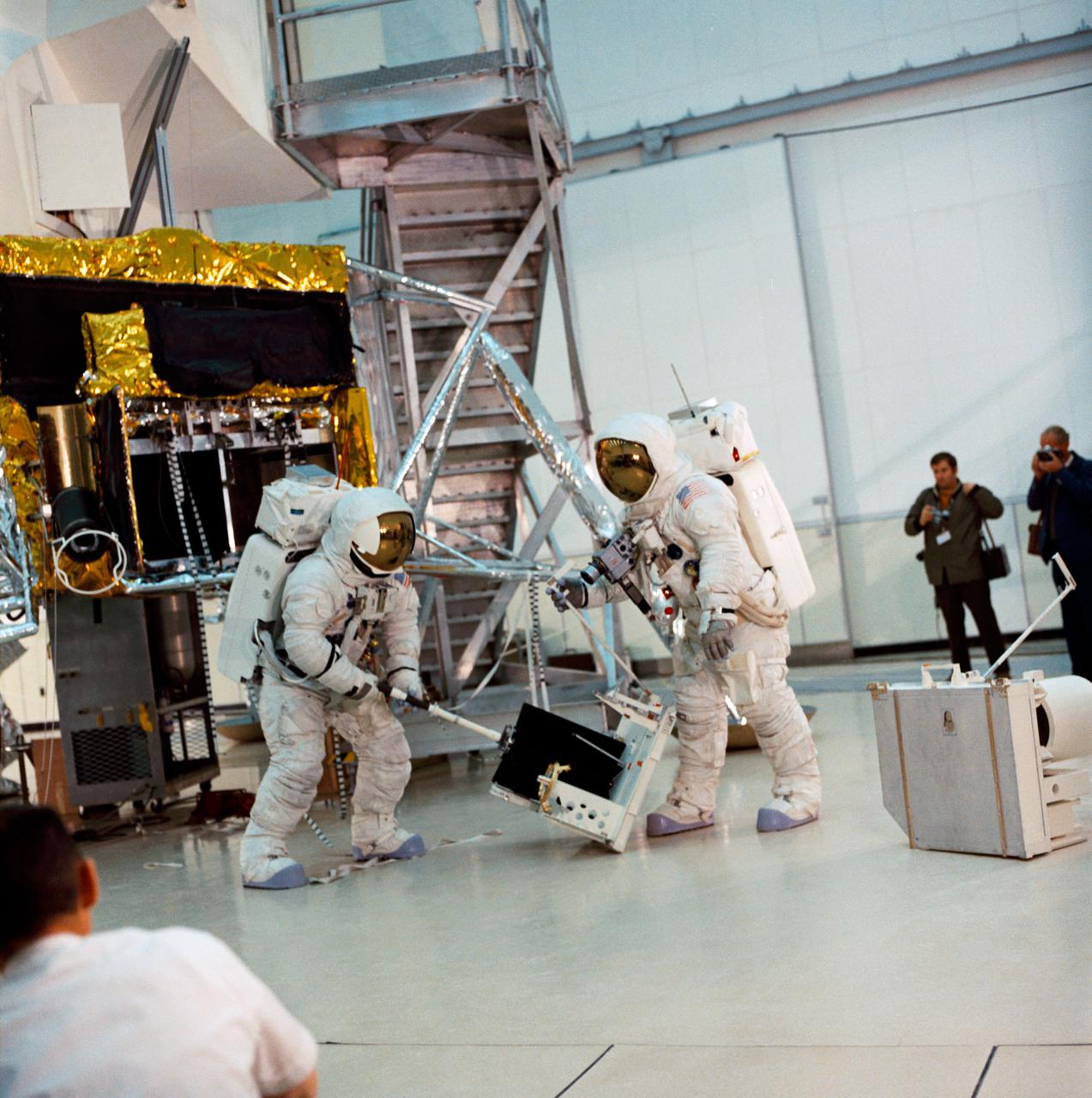
S70-27036 (4 Feb. 1970) --- Two crew men of the Apollo 13 lunar landing mission simulate lunar surface extravehicular activity (EVA) during training exercises in the Kennedy Space Center's (KSC) Flight Crew Training Building. They are astronauts James A. Lovell Jr. commander; and Fred W. Haise Jr., lunar module pilot.
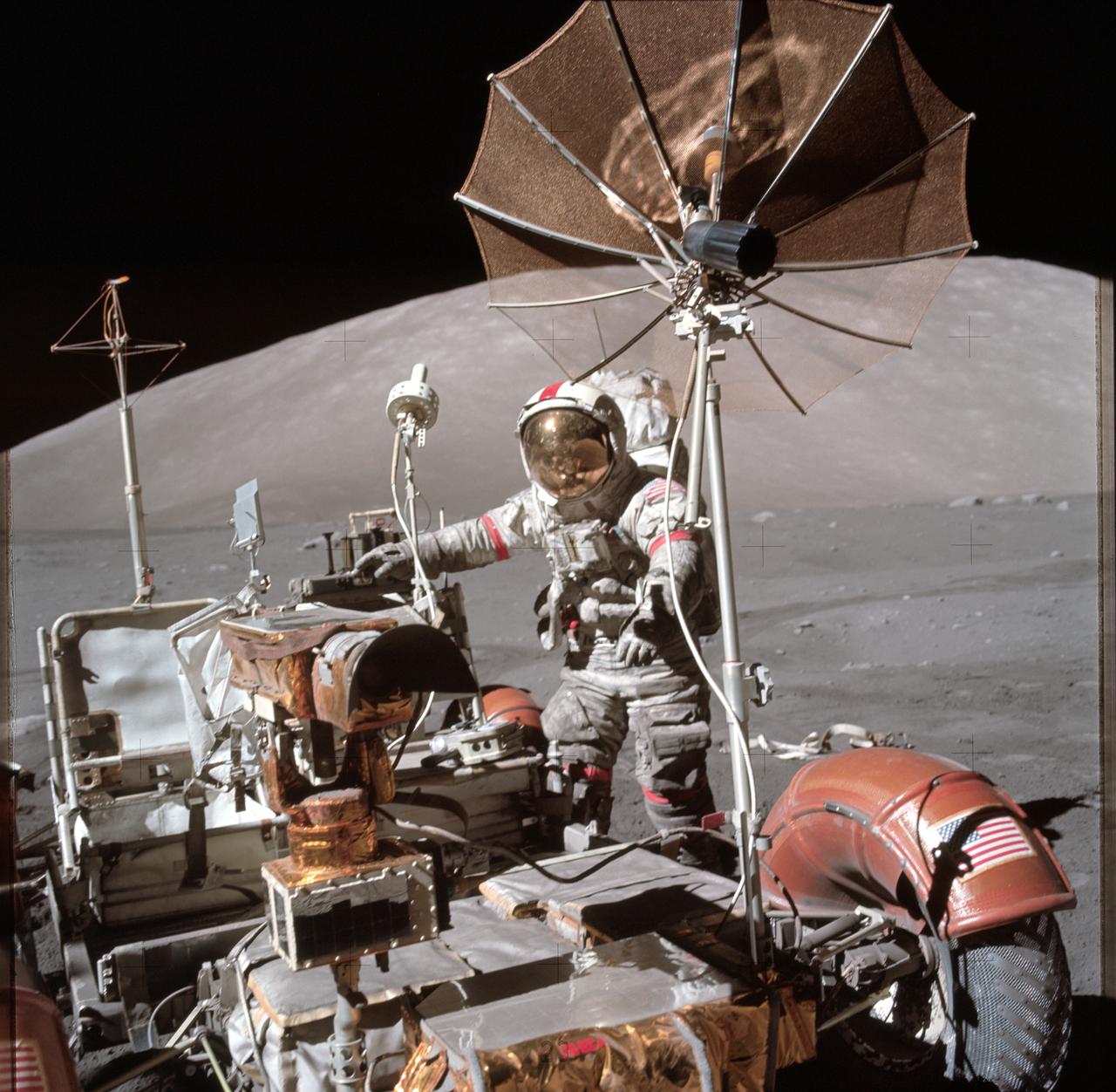
AS17-134-20476 (13 Dec. 1972) --- Astronaut Eugene A. Cernan, Apollo 17 commander, approaches the parked Lunar Roving Vehicle (LRV) on the lunar surface during the flight's third period of extravehicular activity (EVA). South Massif can be seen in the background. The photograph was taken with a hand-held Hasselblad camera by scientist-astronaut Harrison H. Schmitt, lunar module pilot. While the two explored the surface of the moon, astronaut Ronald E. Evans remained with the Command and Service Modules (CSM) in lunar orbit.
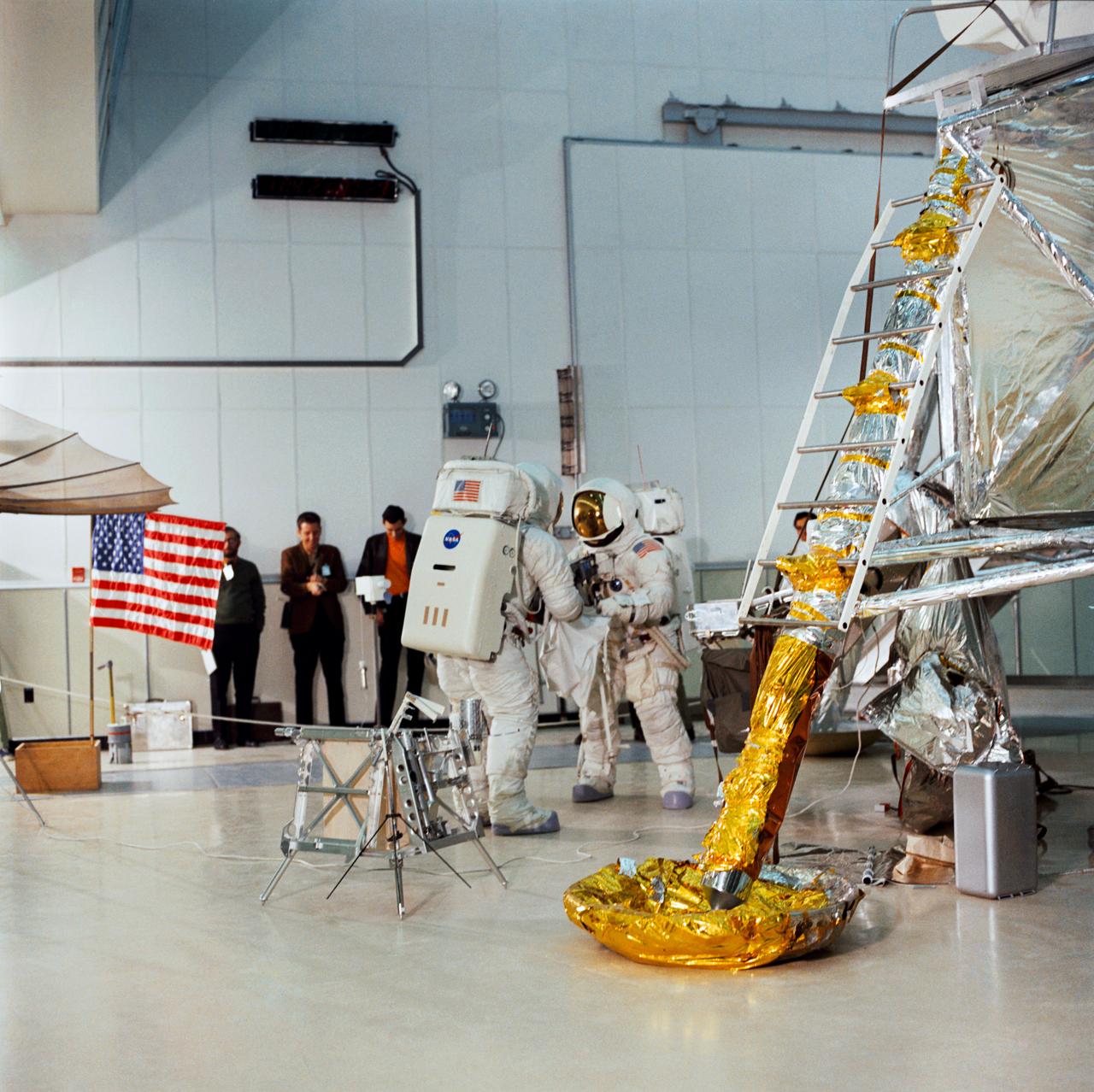
S70-27038 (4 Feb. 1970) --- Two crew men of the Apollo 13 lunar landing mission simulate lunar surface Extravehicular Activity (EVA) during training exercises in the Kennedy Space Center's (KSC) Flight Crew Training Building. They are astronauts James A. Lovell Jr. (on left, back to camera) commander; and Fred W. Haise Jr., lunar module pilot.
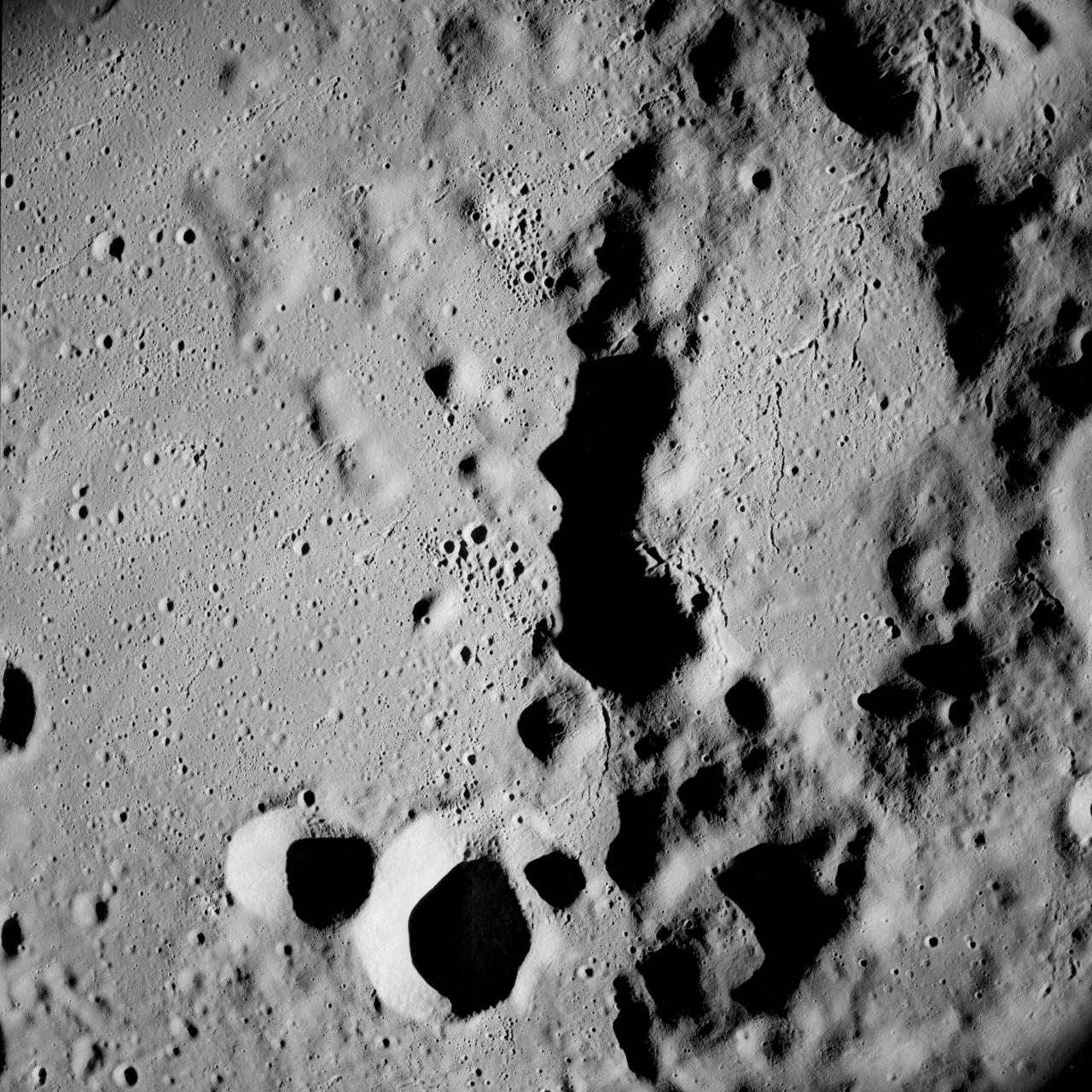
Apollo 8,Farside of Moon. Image taken on Revolution 4. Camera Tilt Mode: Vertical Stereo. Sun Angle: 13. Original Film Magazine was labeled D. Camera Data: 70mm Hasselblad. Lens: 80mm; F-Stop: F/2.8; Shutter Speed: 1/250 second. Film Type: Kodak SO-3400 Black and White,ASA 40. Flight Date: December 21-27,1968.
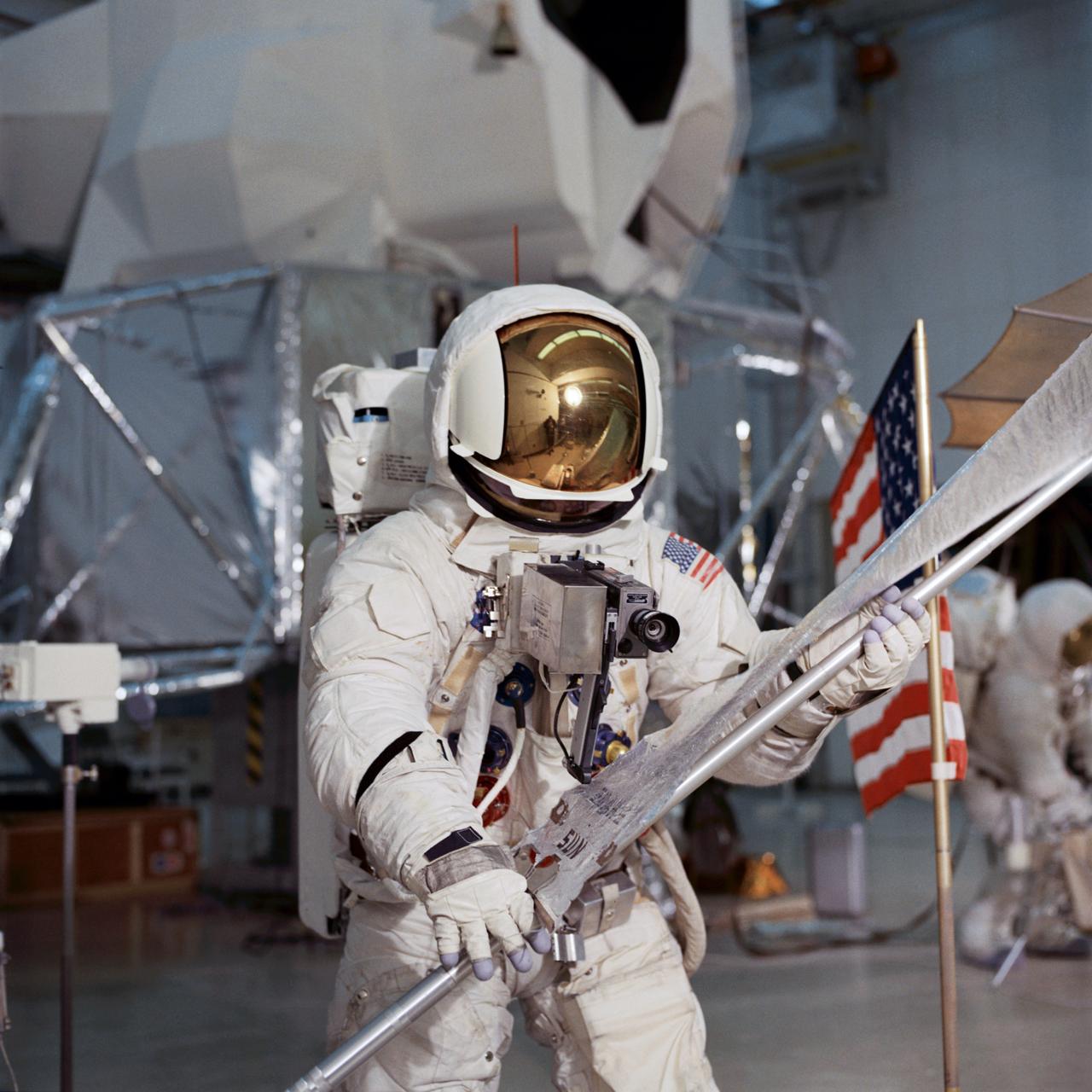
S70-27034 (4 Feb. 1970) --- Astronaut Fred W. Haise Jr., lunar module pilot of the Apollo 13 lunar landing mission, simulates lunar surface extravehicular activity (EVA) during training exercises in the Kennedy Space Center's (KSC) Flight Crew Training Building (FCTB). Haise, wearing an Extravehicular Mobility Unit (EMU), is holding a Solar Wind Composition (SWC) experiment.
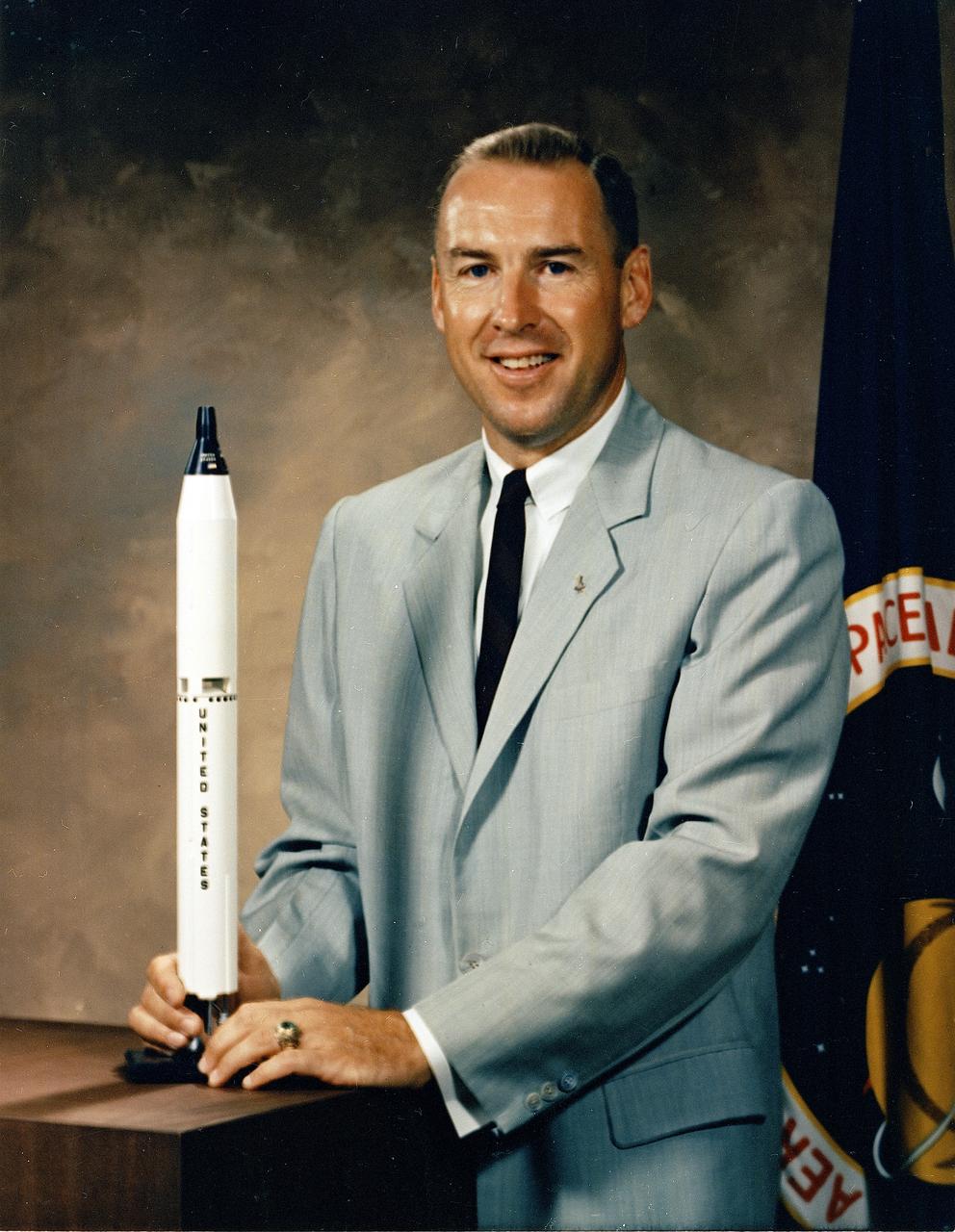
This is the official NASA portrait of astronaut James Lovell. Captain Lovell was selected as an Astronaut by NASA in September 1962. He has since served as backup pilot for the Gemini 4 flight and backup Commander for the Gemini 9 flight, as well as backup Commander to Neil Armstrong for the Apollo 11 lunar landing mission. On December 4, 1965, he and Frank Borman were launched into space on the history making Gemini 7 mission. The flight lasted 330 hours and 35 minutes and included the first rendezvous of two manned maneuverable spacecraft. The Gemini 12 mission, commanded by Lovell with Pilot Edwin Aldrin, began on November 11, 1966 for a 4-day, 59-revolution flight that brought the Gemini program to a successful close. Lovell served as Command Module Pilot and Navigator on the epic six-day journey of Apollo 8, the first manned Saturn V liftoff responsible for allowing the first humans to leave the gravitational influence of Earth. He completed his fourth mission as Spacecraft Commander of the Apollo 13 flight, April 11-17, 1970, and became the first man to journey twice to the moon. The Apollo 13 mission was cut short due to a failure of the Service Module cryogenic oxygen system. Aborting the lunar course, Lovell and fellow crewmen, John L. Swigert and Fred W. Haise, working closely with Houston ground controllers, converted their lunar module, Aquarius, into an effective lifeboat that got them safely back to Earth. Captain Lovell held the record for time in space with a total of 715 hours and 5 minutes until surpassed by the Skylab flights. On March 1, 1973, Captain Lovell retired from the Navy and the Space Program.
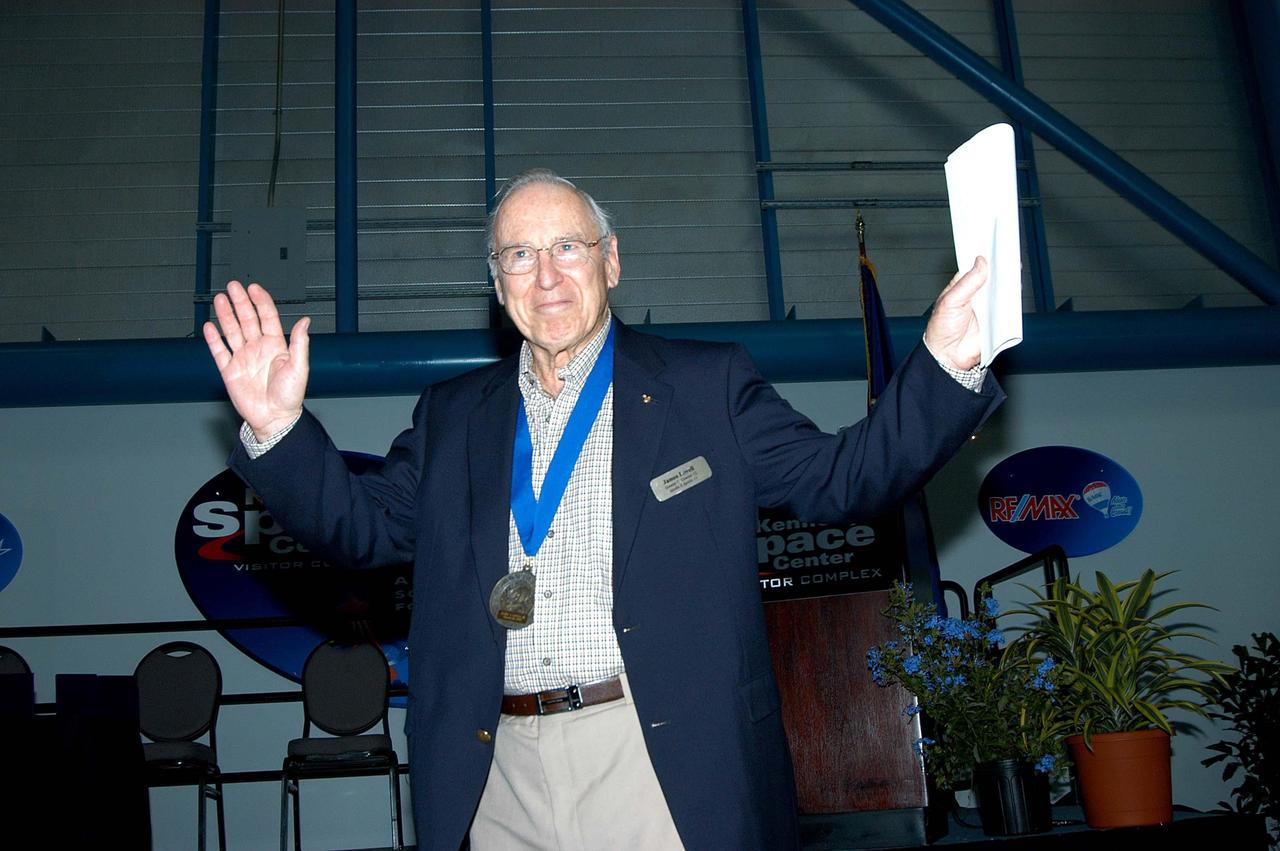
KENNEDY SPACE CENTER, FLA. -- Former astronaut Jim Lovell acknowledges the applause as he is introduced as a previous inductee into the U.S. Astronaut Hall of Fame. He and other Hall of Fame members were present for the induction of five new space program heroes into the U.S. Astronaut Hall of Fame: Richard O. Covey, commander of the Hubble Space Telescope repair mission; Norman E. Thagard, the first American to occupy Russia’s Mir space station; the late Francis R. "Dick" Scobee, commander of the ill-fated 1986 Challenger mission; Kathryn D. Sullivan, the first American woman to walk in space; and Frederick D. Gregory, the first African-American to command a space mission and the current NASA deputy administrator. Lovell piloted Gemini 7, commanded Gemini 12, orbited the Moon on Apollo 8 and commanded the aborted Apollo 13 moon flight. The induction ceremony was held at the Apollo/Saturn V Center at KSC. The U.S. Astronaut Hall of Fame opened in 1990 to provide a place where space travelers could be remembered for their participation and accomplishments in the U.S. space program. The five inductees join 52 previously honored astronauts from the ranks of the Gemini, Apollo, Skylab, Apollo-Soyuz, and Space Shuttle programs.
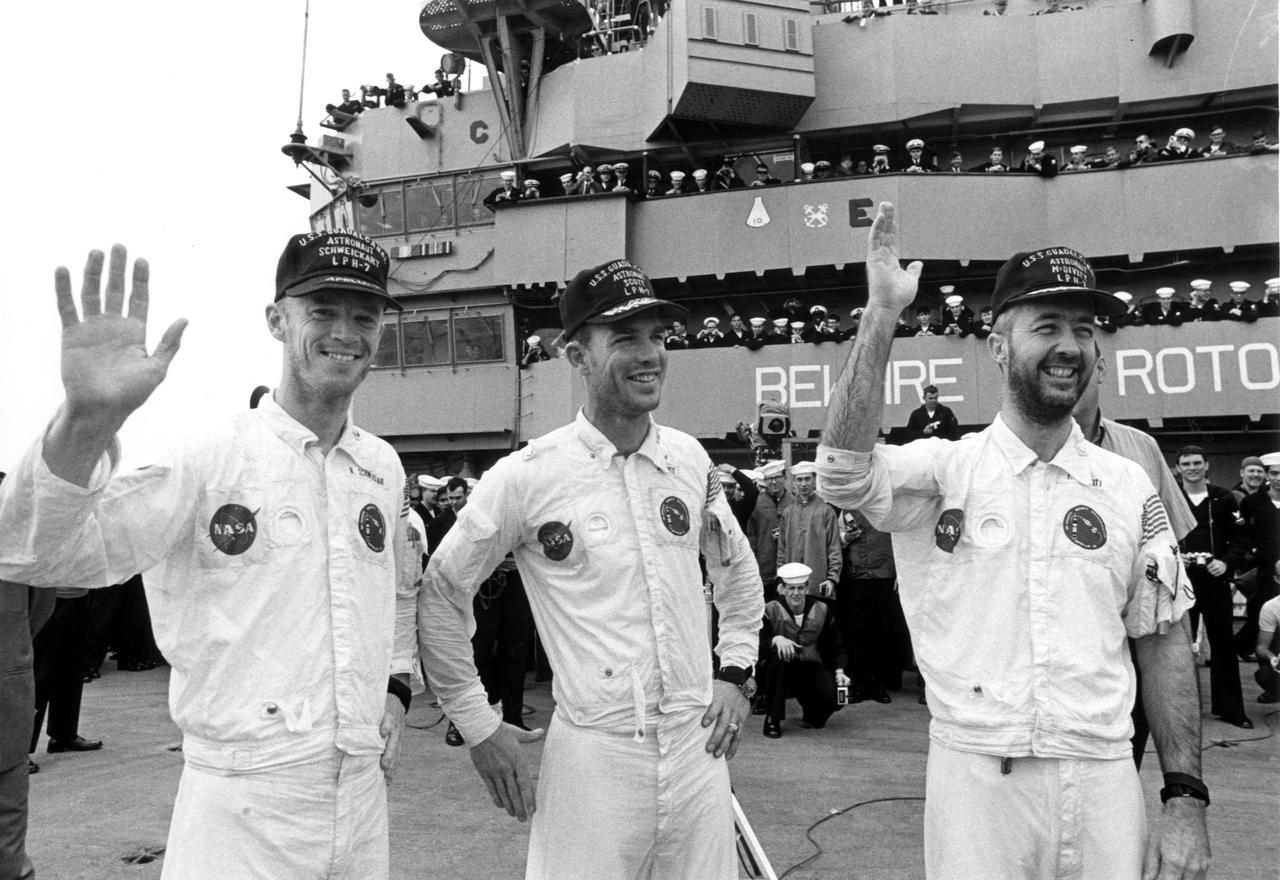
KENNEDY SPACE CENTER, FLA. -- Wearing flight caps presented to them by the crew of the USS Guadalcanal, bearded Apollo 9 astronauts (left to right) Russell L. Schweickart, David R. Scott and James A. McDivitt, wave to well-wishers aboard the recovery ship at the completion of their 10-day Earth orbital mission. Their spacecraft splashed down 780 nautical miles southeast of Cape Kennedy at 12:01 p.m. EST, March 13, 1969. During the textbook mission, the space pilots verified a lunar module spacecraft similar to the one that is to land Americans on the Moon later this year. Their flight began March 3 when they were launched by an Apollo_Saturn V rocket from the Kennedy Space Center. The National Aeronautics and Space Administration directs the Apollo program.
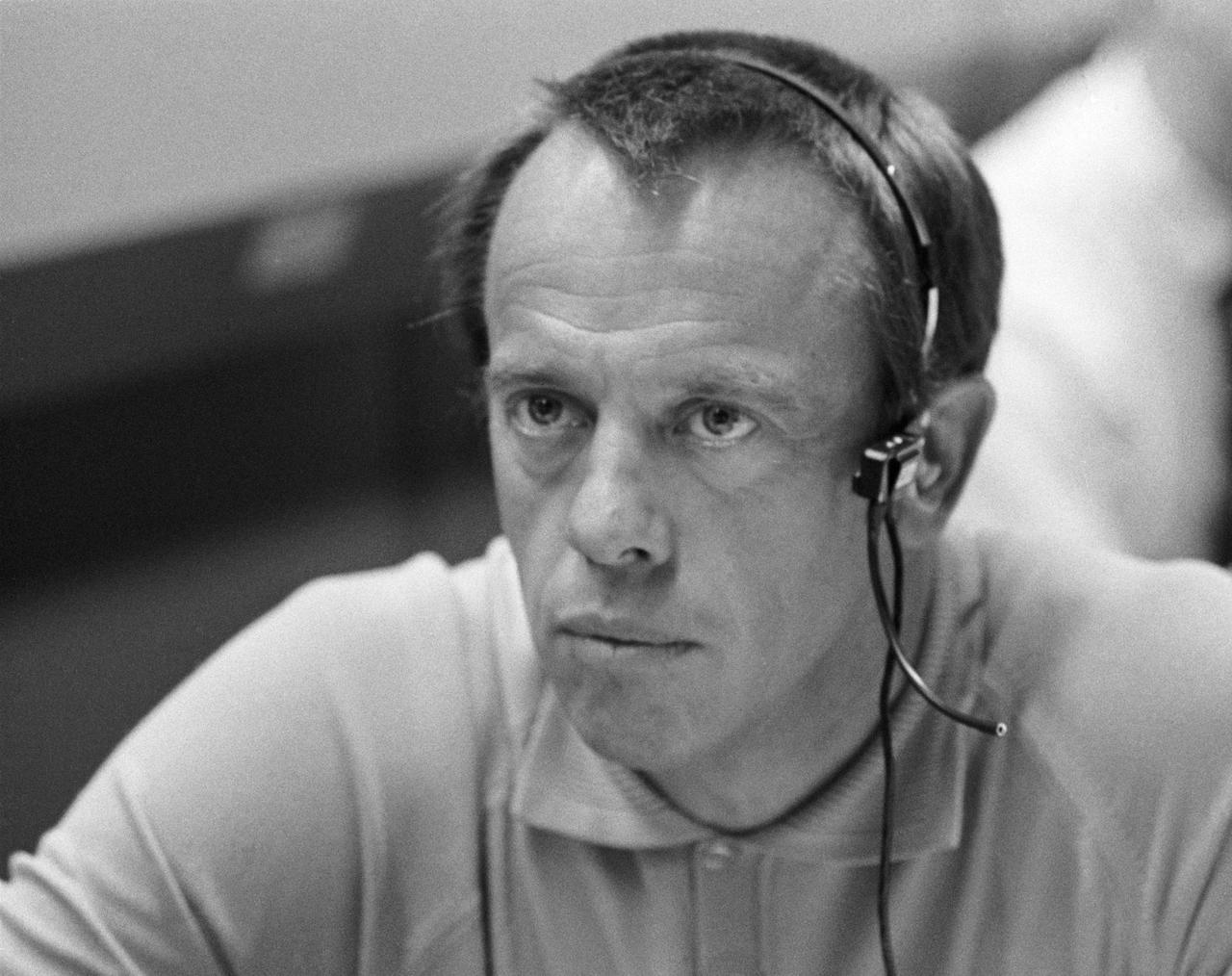
S70-34904 (14 April 1970) --- Astronaut Alan B. Shepard Jr., prime crew commander of the Apollo 14 mission, monitors communications between the Apollo 13 spacecraft and Mission Control Center. He is seated at a console in the Mission Operations Control Room of the MCC, Manned Spacecraft Center. The main concern of the moment was action taken by the three Apollo 13 crewmen - astronauts James A. Lovell Jr., John L. Swigert Jr. and Fred W. Haise Jr. - to make corrections inside the spacecraft following discovery of an oxygen cell failure several hours earlier.
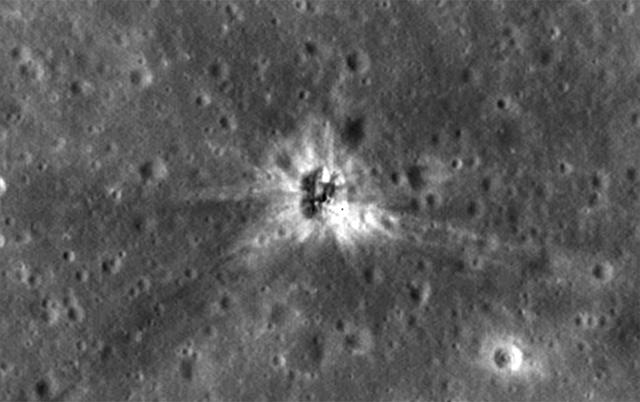
After decades of uncertainty, the Apollo 16 S-IVB impact site on the lunar surface has been identified. S-IVBs were portions of the Saturn V rockets that brought astronauts to the moon. The site was identified in imagery from the high-resolution LROC Narrow Angle Camera aboard NASA's Lunar Reconnaissance Orbiter. Beginning with Apollo 13, the S-IVB rocket stages were deliberately impacted on the lunar surface after they were used. Seismometers placed on the moon by earlier Apollo astronauts measured the energy of these impacts to shed light on the internal lunar structure. Locations of the craters that the boosters left behind were estimated from tracking data collected just prior to the impacts. Earlier in the LRO mission, the Apollo 13, 14, 15 and 17 impact sites were successfully identified, but Apollo 16's remained elusive. In the case of Apollo 16, radio contact with the booster was lost before the impact, so the location was only poorly known. Positive identification of the Apollo 16 S-IVB site took more time than the other four impact craters because the location ended up differing by about 30 km (about 19 miles) from the Apollo-era tracking estimate. (For comparison, the other four S-IVB craters were all within 7 km -- about four miles -- of their estimated locations.) Apollo 16's S-IVB stage is on Mare Insularum, about 160 miles southwest of Copernicus Crater (more precisely: 1.921 degrees north, 335.377 degrees east, minus 1,104 meters elevation). Credit: NASA/Goddard/Arizona State University <b><a href="http://www.nasa.gov/audience/formedia/features/MP_Photo_Guidelines.html" rel="nofollow">NASA image use policy.</a></b> <b><a href="http://www.nasa.gov/centers/goddard/home/index.html" rel="nofollow">NASA Goddard Space Flight Center</a></b> enables NASA’s mission through four scientific endeavors: Earth Science, Heliophysics, Solar System Exploration, and Astrophysics. Goddard plays a leading role in NASA’s accomplishments by contributing compelling scientific knowledge to advance the Agency’s mission. <b>Follow us on <a href="http://twitter.com/NASAGoddardPix" rel="nofollow">Twitter</a></b> <b>Like us on <a href="http://www.facebook.com/pages/Greenbelt-MD/NASA-Goddard/395013845897?ref=tsd" rel="nofollow">Facebook</a></b> <b>Find us on <a href="http://instagrid.me/nasagoddard/?vm=grid" rel="nofollow">Instagram</a></b>
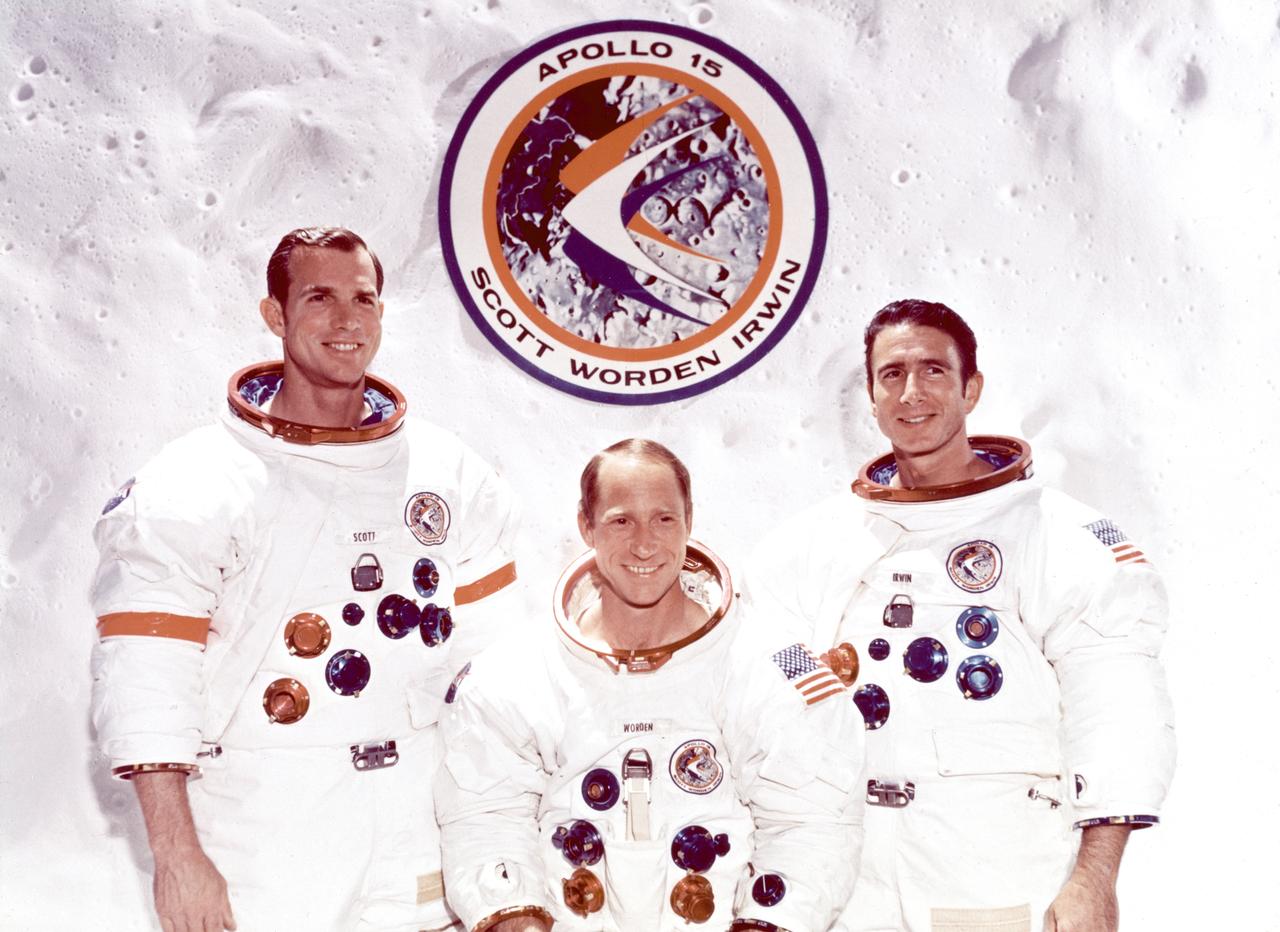
This is the official three-member crew portrait of the Apollo 15 (SA-510). Pictured from left to right are: David R. Scott, Mission Commander; Alfred M. Worden Jr., Command Module pilot; and James B. Irwin, Lunar Module pilot. The fifth marned lunar landing mission, Apollo 15 (SA-510), lifted off on July 26, 1971. Astronauts Scott and Irwin were the first to use a wheeled surface vehicle, the Lunar Roving Vehicle (LRV), or the Rover, which was designed and developed by the Marshall Space Flight Center, and built by the Boeing Company. The astronauts spent 13 days, nearly 67 hours, on the Moon's surface to inspect a wide variety of its geological features.

During the Apollo 15 launch activities in the launch control center's firing room 1 at Kennedy Space Center, Dr. Wernher von Braun, NASA's Deputy Associate Administrator for planning, takes a closer look at the launch pad through binoculars. The fifth manned lunar landing mission, Apollo 15 (SA-510), carrying a crew of three astronauts: Mission commander David R. Scott, Lunar Module pilot James B. Irwin, and Command Module pilot Alfred M. Worden Jr., lifted off on July 26, 1971. Astronauts Scott and Irwin were the first to use a wheeled surface vehicle, the Lunar Roving Vehicle, or the Rover, which was designed and developed by the Marshall Space Flight Center, and built by the Boeing Company. Astronauts spent 13 days, nearly 67 hours, on the Moon's surface to inspect a wide variety of its geological features.
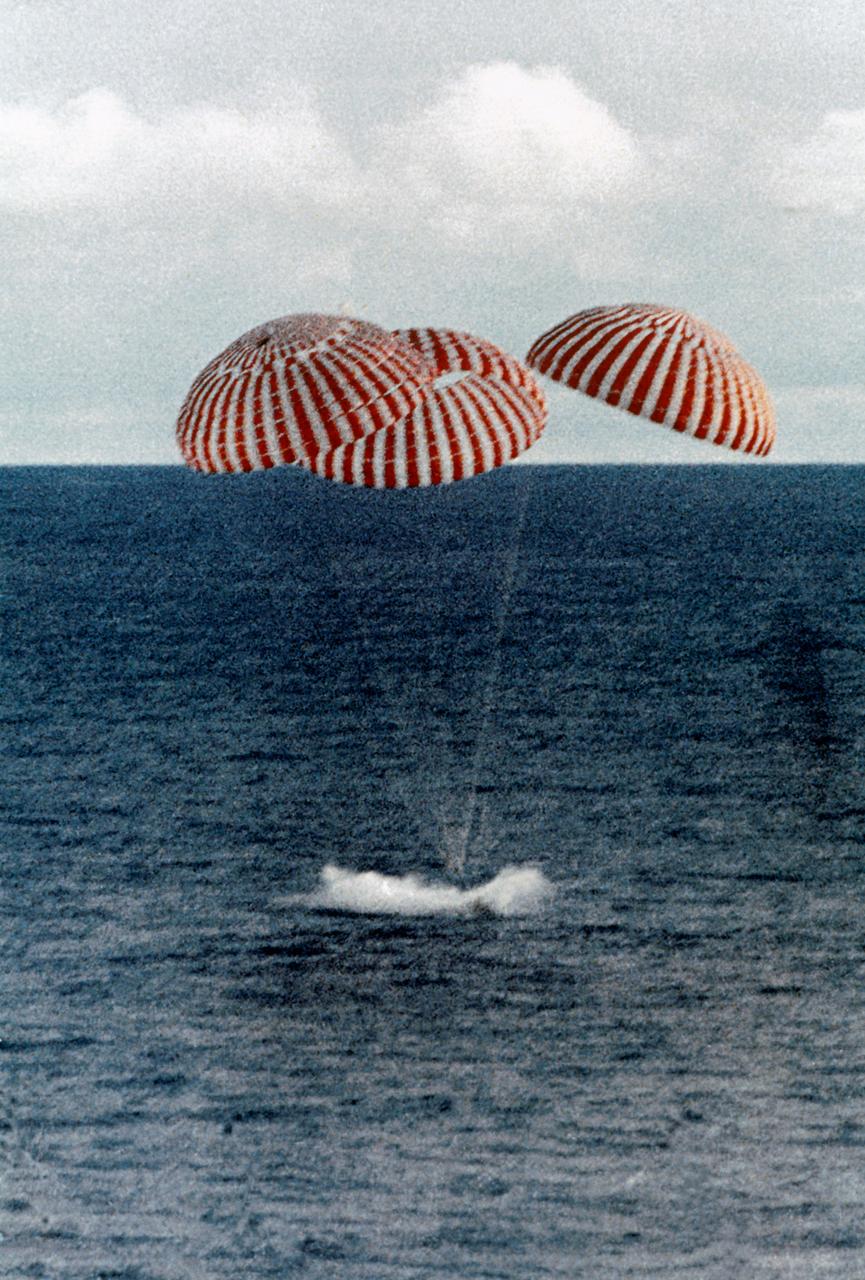
S70-35638 (17 April 1970) --- A perilous space mission comes to a smooth ending with the safe splashdown of the Apollo 13 Command Module (CM) in the South Pacific, only four miles from the prime recovery ship. The spacecraft with astronauts James A. Lovell Jr., John L. Swigert Jr., and Fred W. Haise Jr. aboard, splashed down at 12:07:44 p.m. (CST) April 17, 1970, to conclude safely the problem-plagued flight. The crewmen were transported by helicopter from the immediate recovery area to the USS Iwo Jima, prime recovery vessel.
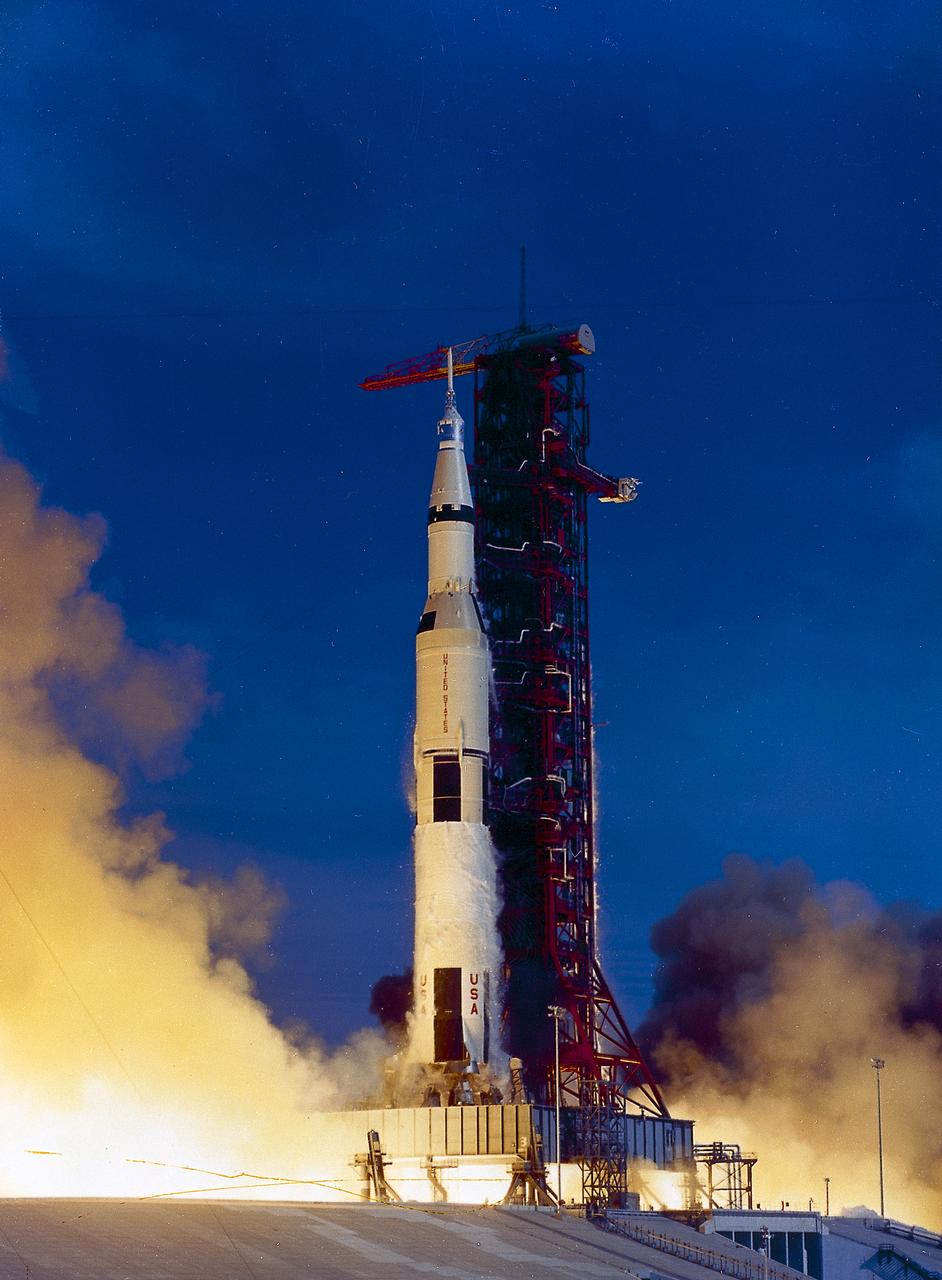
The fifth marned lunar landing mission, Apollo 15 (SA-510), carrying a crew of three astronauts: Mission commander David R. Scott, Lunar Module pilot James B. Irwin, and Command Module pilot Alfred M. Worden Jr., lifted off on July 26, 1971. Astronauts Scott and Irwin were the first to use a wheeled surface vehicle, the Lunar Roving Vehicle, or the Rover, which was designed and developed by the Marshall Space Flight Center, and built by the Boeing Company. Astronauts spent 13 days, nearly 67 hours, on the Moon's surface to inspect a wide variety of its geological features.
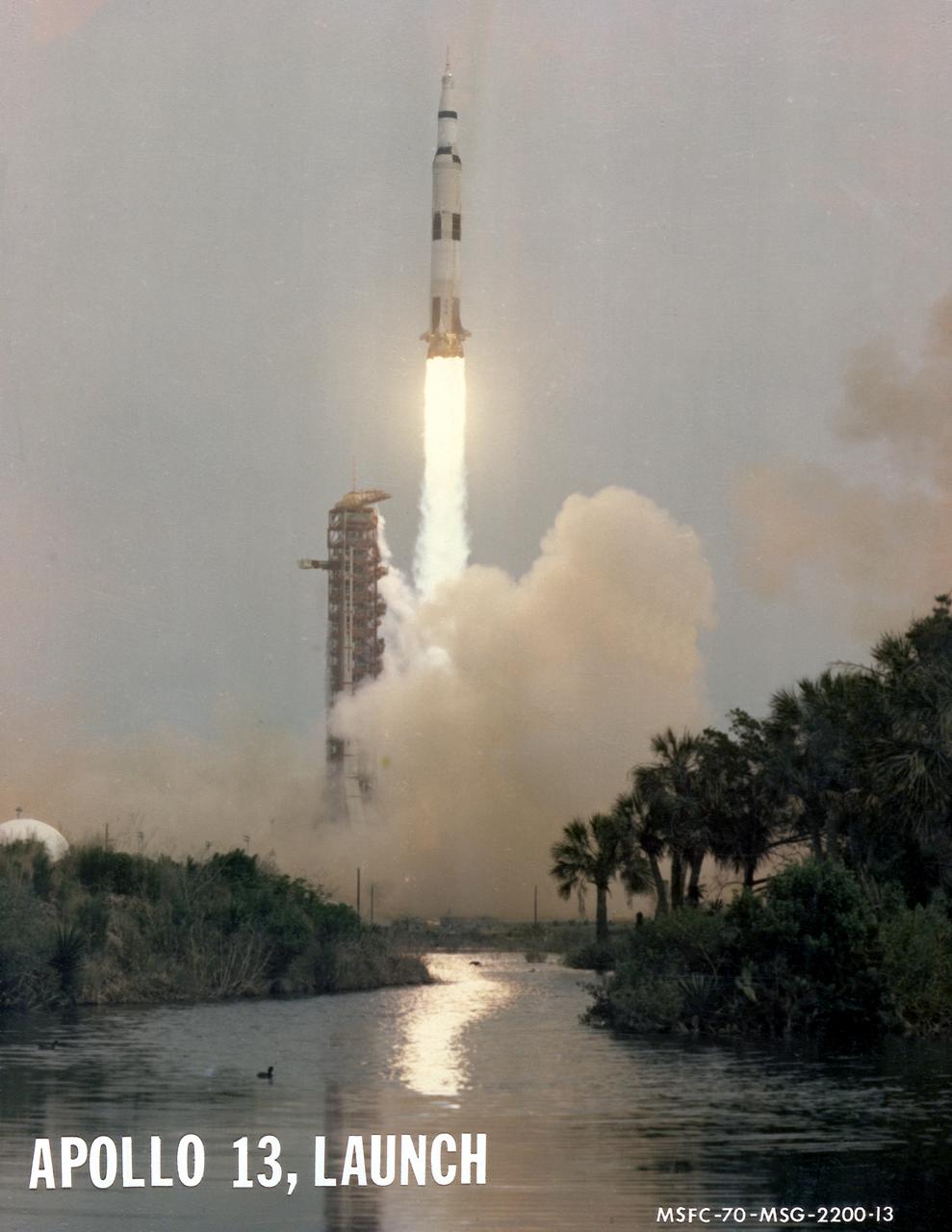
The third marned lunar landing mission, Apollo 13 (SA-508), with three astronauts: Mission commander James A. Lovell Jr., Lunar Module pilot Fred W. Haise Jr., and Command Module pilot John L. Swigert Jr., lifted off from the Kennedy Space Center launch complex 39A on April 11, 1970. The mission was aborted after 56 hours of flight, 205,000 miles from Earth, when an oxygen tank in the service module exploded. The Command Module, Odyssey, carrying the three astronauts, safely splashed down in the Pacific Ocean at 1:08 p.m. EST, April 17, 1970.
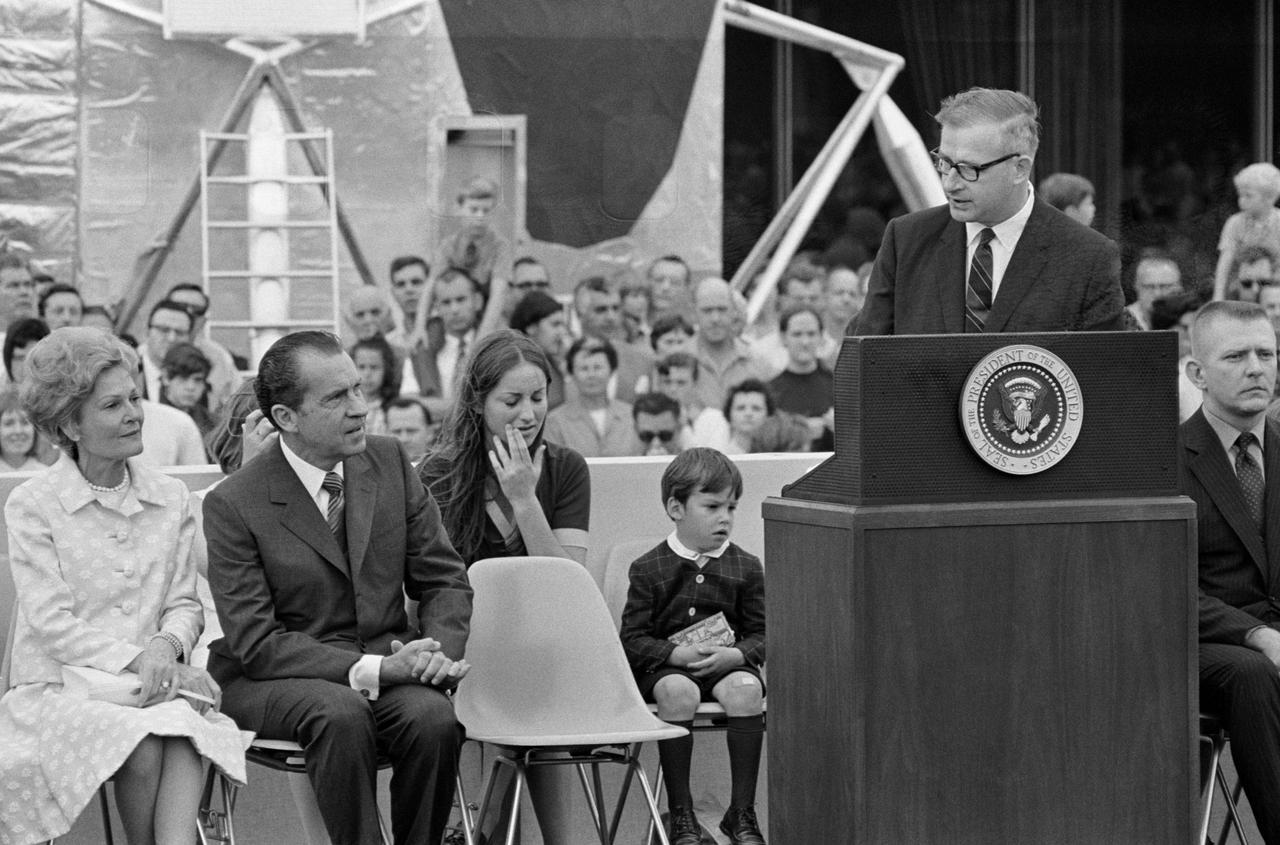
S70-35595 (18 April 1970) --- President Richard M. Nixon is welcomed to Manned Spacecraft Center (MSC) and introduced by Dr. Thomas O. Paine, Administrator, National Aeronautics and Space Administration (NASA). The First Lady is at extreme left. Others on the speakers platform in this view are Barbara and Jeffrey C. Lovell, children of astronaut James A. Lovell Jr., commander; and Eugene F. Kranz (extreme right), one of four flight directors on duty around the clock during the mission. President Nixon was on the site to present the Presidential Medal of Freedom to the Apollo 13 Mission Operations Team.
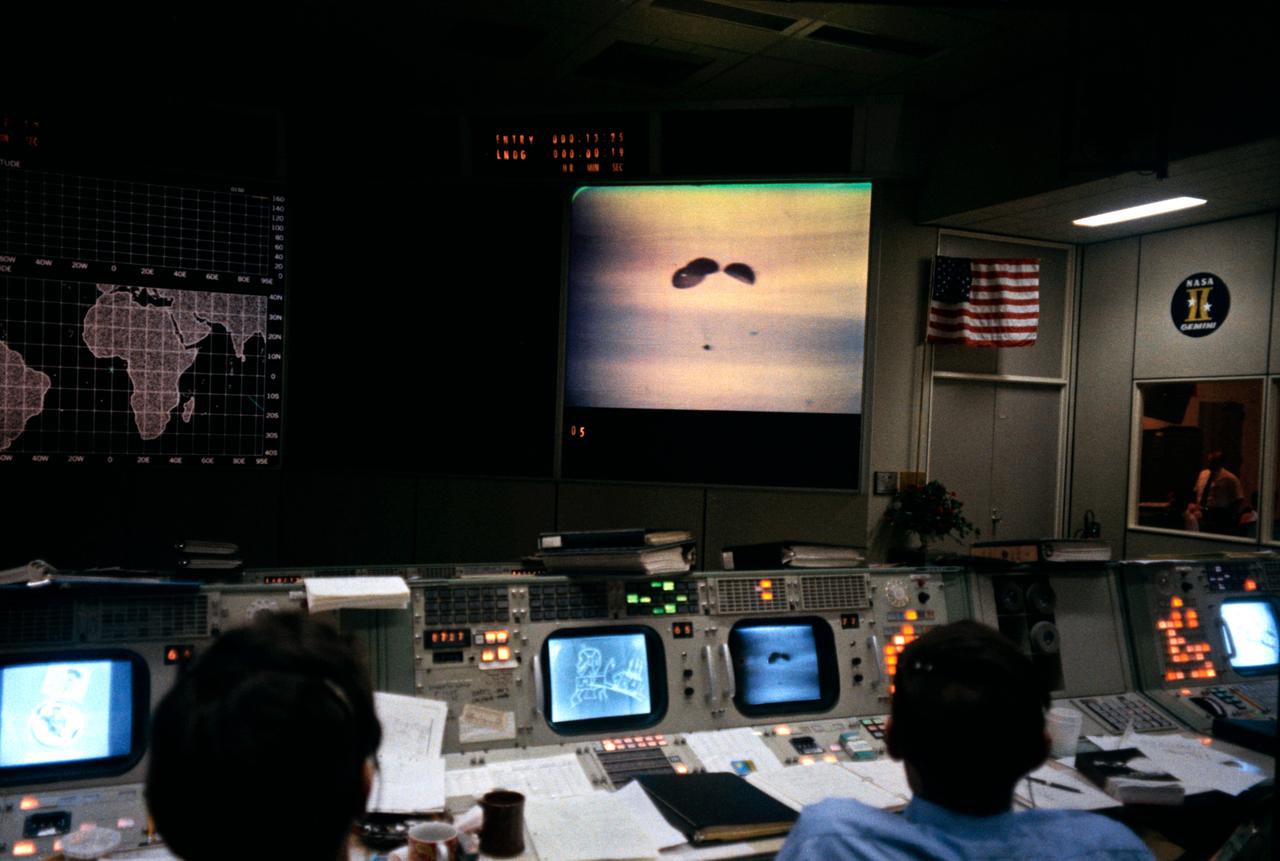
S70-35471 (17 April 1970) --- Two flight controllers man consoles in the Missions Operations Control Room (MOCR) of the Mission Control Center (MCC) at the Manned Spacecraft Center (MSC), Houston, Texas, just before splashdown occurred in the south Pacific Ocean. Though the MOCR does not appear to be crowded in this photo, there was a very large crowd of persons on hand for the splashdown and recovery operations coverage. Most of the group crowded around in the rear of the room. Apollo 13 splashdown occurred at 12:07:44 p.m. (CST), April 17, 1970.
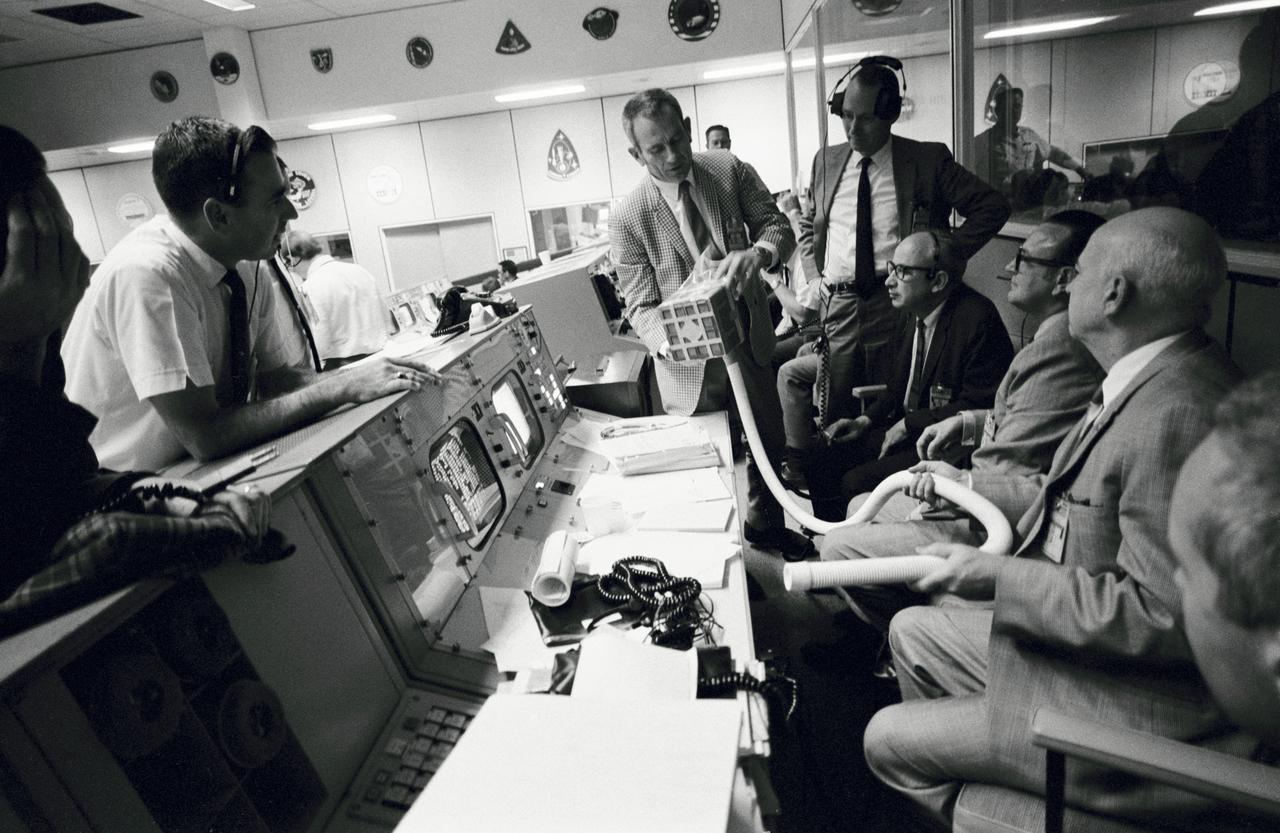
S70-35013 (15 April 1970) --- Prototype of the "mail box" constructed at the Manned Spacecraft Center (MSC) to remove carbon dioxide from the Apollo 13 Command Module (CM) is displayed in the Mission Control Center (MCC). The "mail box" was constructed when it became apparent CO2 was prevalent in the CM and the spacecraft's lithium hydroxide system was not removing it sufficiently. A space suit exhaust hose is connected to a lithium hydroxide canister to purge the cabin air. There are 16 such canisters in the CM and each will last approximately 12 hours. Looking at the "mail box" are (from the left): Milton L. Windler, shift 1 flight director; Dr. Donald K. (Deke) Slayton, director of flight crew operations, MSC; Howard W. Tindall, deputy director, flight operations, MSC; Sigurd A. Sjoberg, director, flight operations, MSC; Dr. Christopher C. Kraft, deputy director, MSC; and Dr. Robert R. Gilruth, director, MSC.
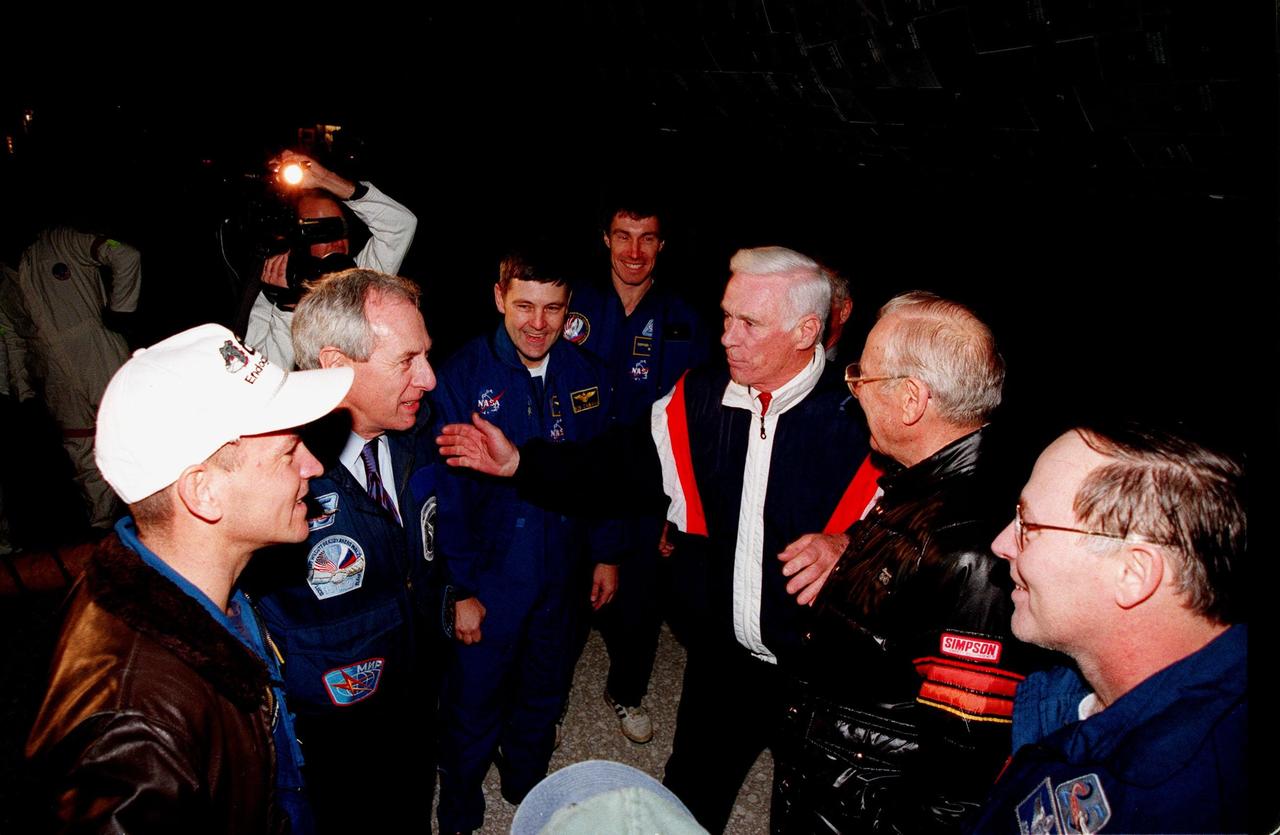
Following their touchdown on Runway 15 at 10:53:29 p.m. EST, STS-88 crew members are greeted by NASA Administrator Daniel Goldin and former astronauts Eugene A. Cernan and James A. Lovell Jr. From left are Pilot Frederick W. "Rick" Sturckow, Goldin , Commander Robert D. Cabana, Mission Specialist Sergei Konstantinovich Krikalev, Cernan, Lovell and Mission Specialist Jerry L. Ross. Cernan flew on Gemini 9, Apollo 10 and 17 and has more than 566 cumulative hours of space flight. Lovell flew on Gemini 7 and 12, Apollo 8 and 13. His cumulative hours of space flight are more than 715. On the 4.6-million-mile, nearly 12-day STS-88 mission, Endeavour carried the U.S.-built Unity connecting module to begin construction of the International Space Station. The crew successfully mated Unity with the Russian-built Zarya control module during three space walks. With this mission, Ross completed seven space walks totaling 44 hours and 9 minutes, more than any other American space walker. Newman moved into third place for U.S. space walks with a total of 28 hours and 27 minutes on four excursions
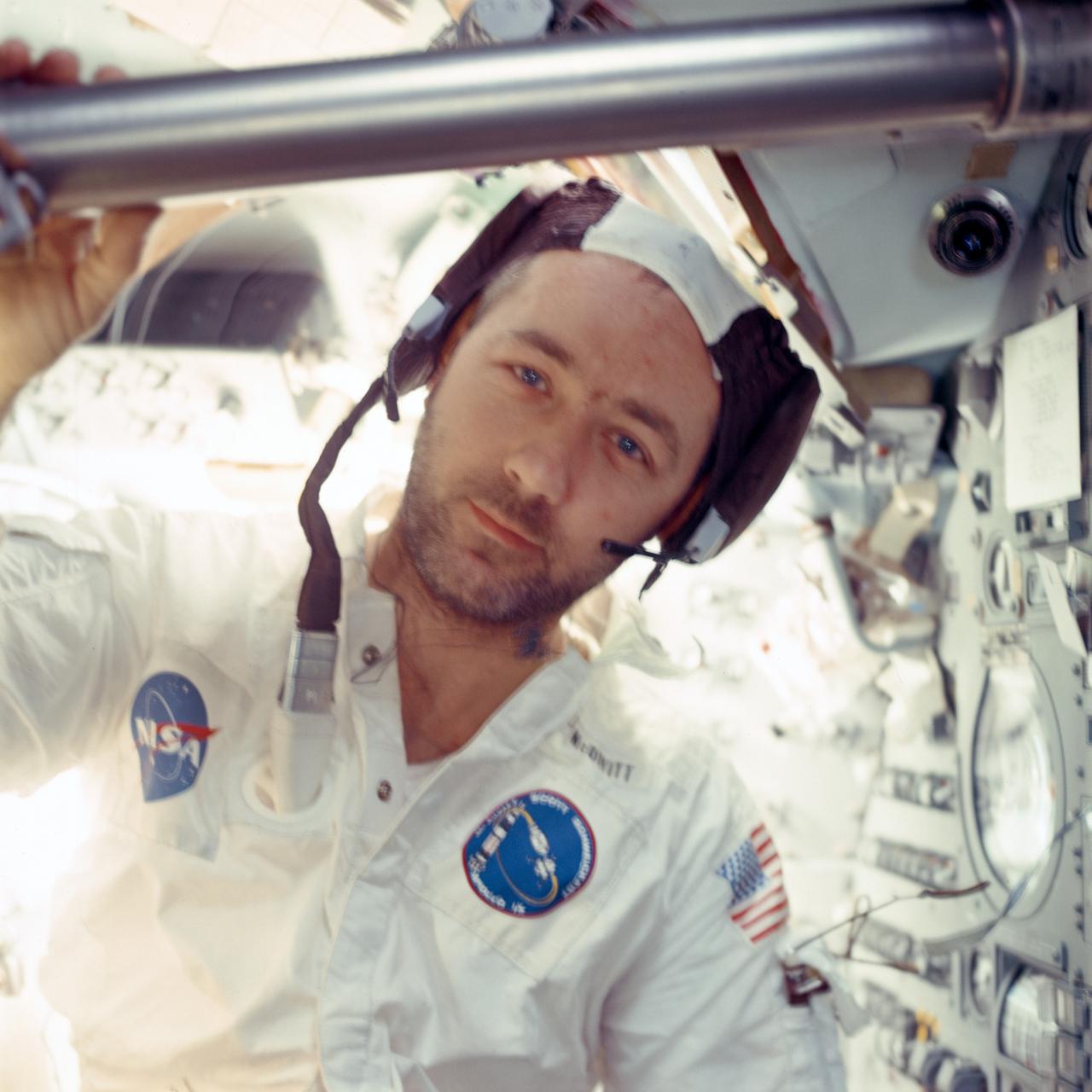
AS09-20-3154 (3-13 March 1969) --- This close-up view of astronaut James A. McDivitt shows several days' beard growth. The Apollo 9 mission commander was onboard the Lunar Module (LM) "Spider" in Earth orbit, near the end of the flight. He was joined on the mission by astronauts David R. Scott, command module pilot, and Russell L. Schweickart, lunar module pilot. Schweickart took this picture while Scott remained in the Command Module (CM) "Gumdrop." In Earth orbit, the three tested the transposition and docking systems of the lunar module and command module. On a scheduled lunar landing mission later this year, a team of three astronauts and ground controllers will use what this crew and its support staff have learned in handling the systems of the two spacecraft.
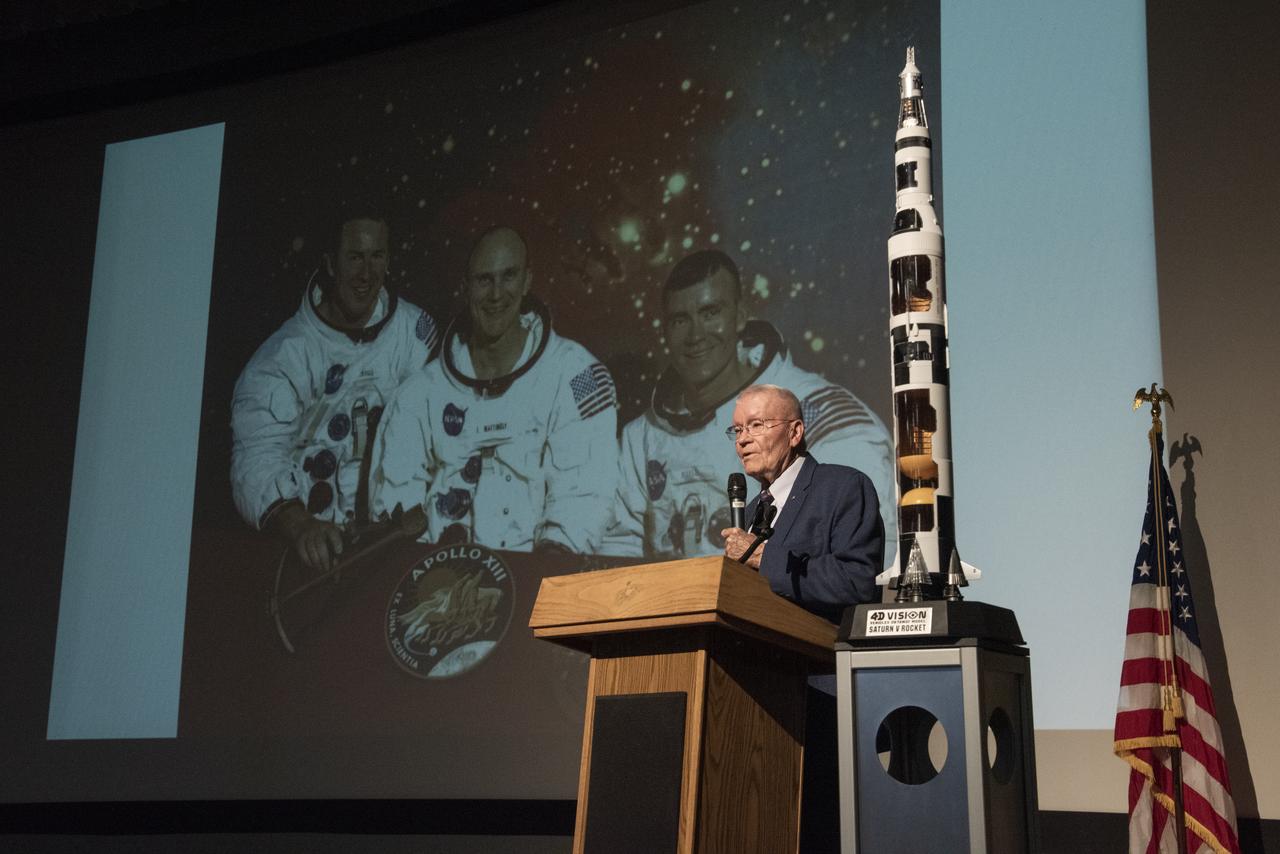
Apollo Astronaut Fred Haise speaks to a crowd of NASA and U.S Air Force employees at the Edwards Air Force Base theater about his career with NASA and as a military pilot. Haise stands on stage with a photo of former astronauts Jim Lovell and Jack Swigert who accompanied him on the Apollo 13 lunar mission in the background with a model of the Saturn V rocket.
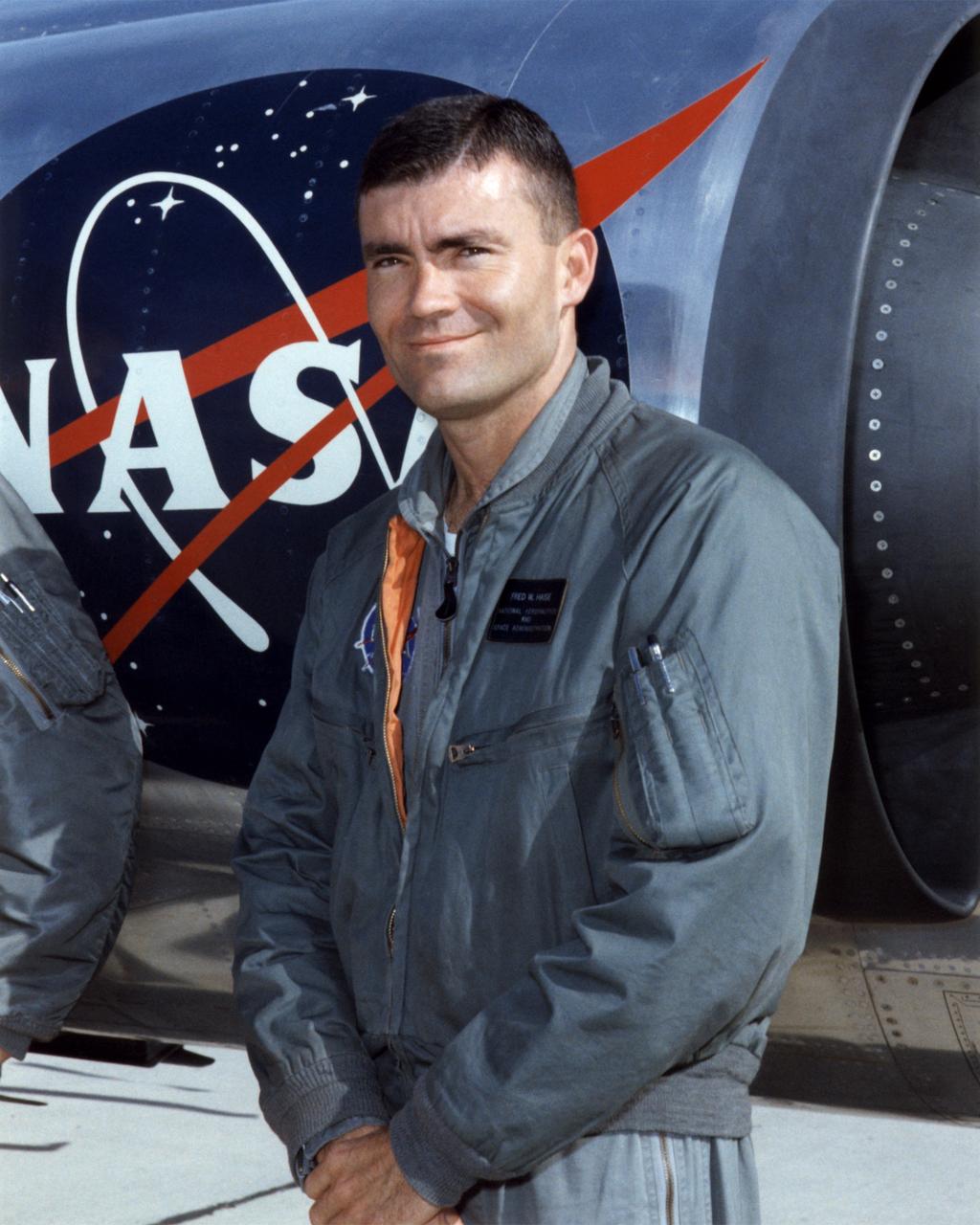
Fred W. Haise Jr. was a research pilot and an astronaut for the National Aeronautics and Space Administration from 1959 to 1979. He began flying at the Lewis Research Center in Cleveland, Ohio (today the Glenn Research Center), in 1959. He became a research pilot at the NASA Flight Research Center (FRC), Edwards, Calif., in 1963, serving NASA in that position for three years until being selected to be an astronaut in 1966 His best-known assignment at the FRC (later redesignated the Dryden Flight Research Center) was as a lifting body pilot. Shortly after flying the M2-F1 on a car tow to about 25 feet on April 22, 1966, he was assigned as an astronaut to the Johnson Space Center in Houston, Texas. While at the FRC he had also flown a variety of other research and support aircraft, including the variable-stability T-33A to simulate the M2-F2 heavyweight lifting body, some light aircraft including the Piper PA-30 to evaluate their handling qualities, the Apache helicopter, the Aero Commander, the Cessna 310, the Douglas F5D, the Lockheed F-104 and T-33, the Cessna T-37, and the Douglas C-47. After becoming an astronaut, Haise served as a backup crewmember for the Apollo 8, 11, and 16 missions. He flew on the aborted Apollo 13 lunar mission in 1970, spending 142 hours and 54 minutes in space before returning safely to Earth. In 1977, he was the commander of three free flights of the Space Shuttle prototype Enterprise when it flew its Approach and Landing Tests at Edwards Air Force Base, Calif. Meanwhile, from April 1973 to January 1976, Haise served as the Technical Assistant to the Manager of the Space Shuttle Orbiter Project. In 1979, he left NASA to become the Vice President for Space Programs with the Grumman Aerospace Corporation. He then served as President of Grumman Technical Services, an operating division of Northrop Grumman Corporation, from January 1992 until his retirement. Haise was born in Biloxi, Miss., on November 14, 1933. He underwent flight traini
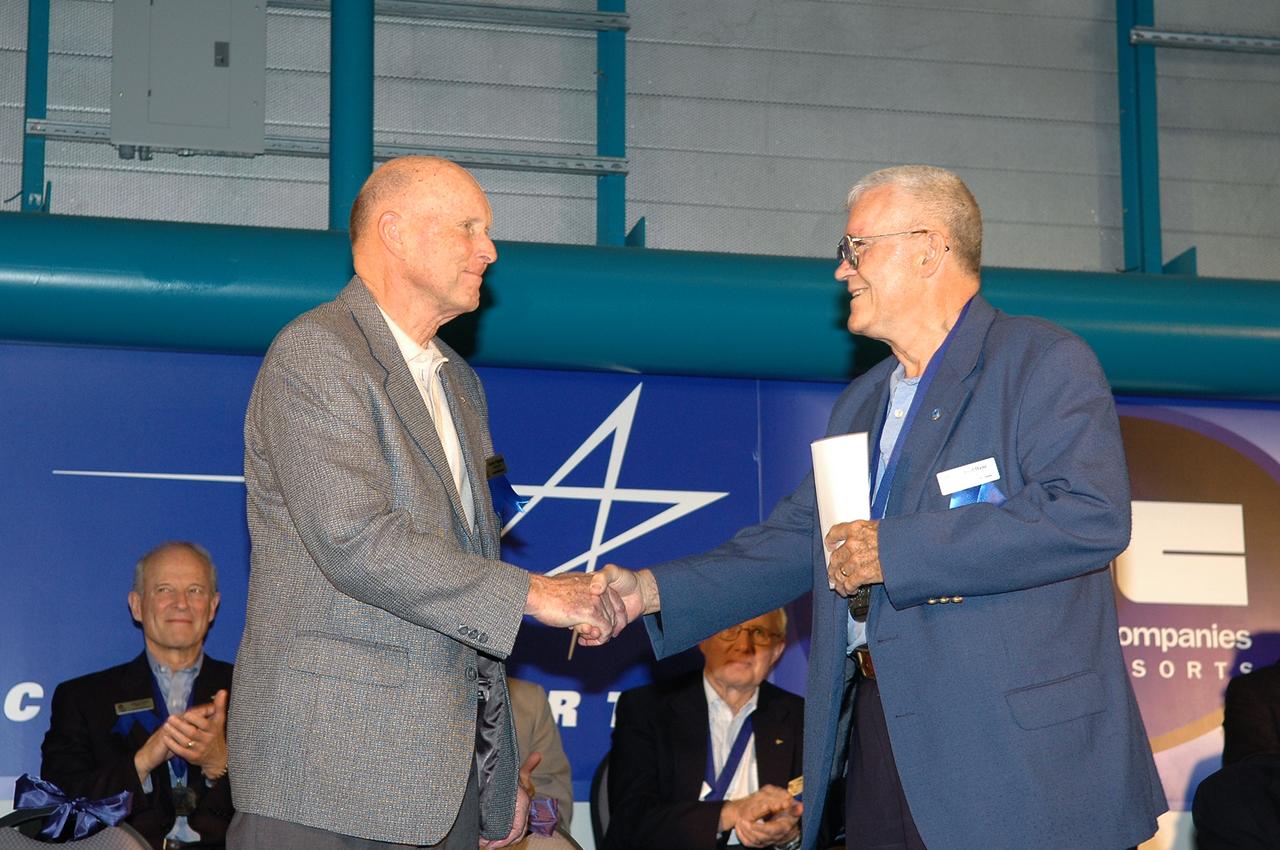
Former astronaut Gordon Fullerton (left), currently chief research pilot at NASA's Dryden Flight Research Center at Edwards Air Force Base, is congratulated by former astronaut Fred Haise (right) upon Fullerton's induction into the Astronaut Hall of Fame at the Kennedy Space Center (KSC) in Florida on April 30, 2005. Fullerton and Haise were one of two flight crews who flew the Approach and Landing Tests of the prototype Space Shuttle orbiter Enterprise at Dryden in 1977. Fullerton, who had served on the support crews for four Apollo moon landing missions in the early 1970s, went on to fly two Shuttle missions, STS-3 in 1982 and STS-51F in 1985. STS-3 became the only Shuttle mission to date to land at White Sands, N.M., and STS-51F was completed successfully despite the failure of one of the Shuttle's main engines during ascent to orbit. Haise, a member of the crew on the ill-fated Apollo 13 mission, was also a research pilot at NASA Dryden during his pre-astronaut career. Former astronauts Joseph Allen and Bruce McCandless were also inducted during the 2005 ceremonies at the KSC Visitor Center. In addition to honoring former members of NASA's astronaut corps who have made significant contributions to the advancement of space flight, the annual induction ceremonies serve as a fund-raiser for the Astronaut Scholarship Foundation. The foundation funded 17 $10,000 scholarships to college students studying science and engineering in 2004.
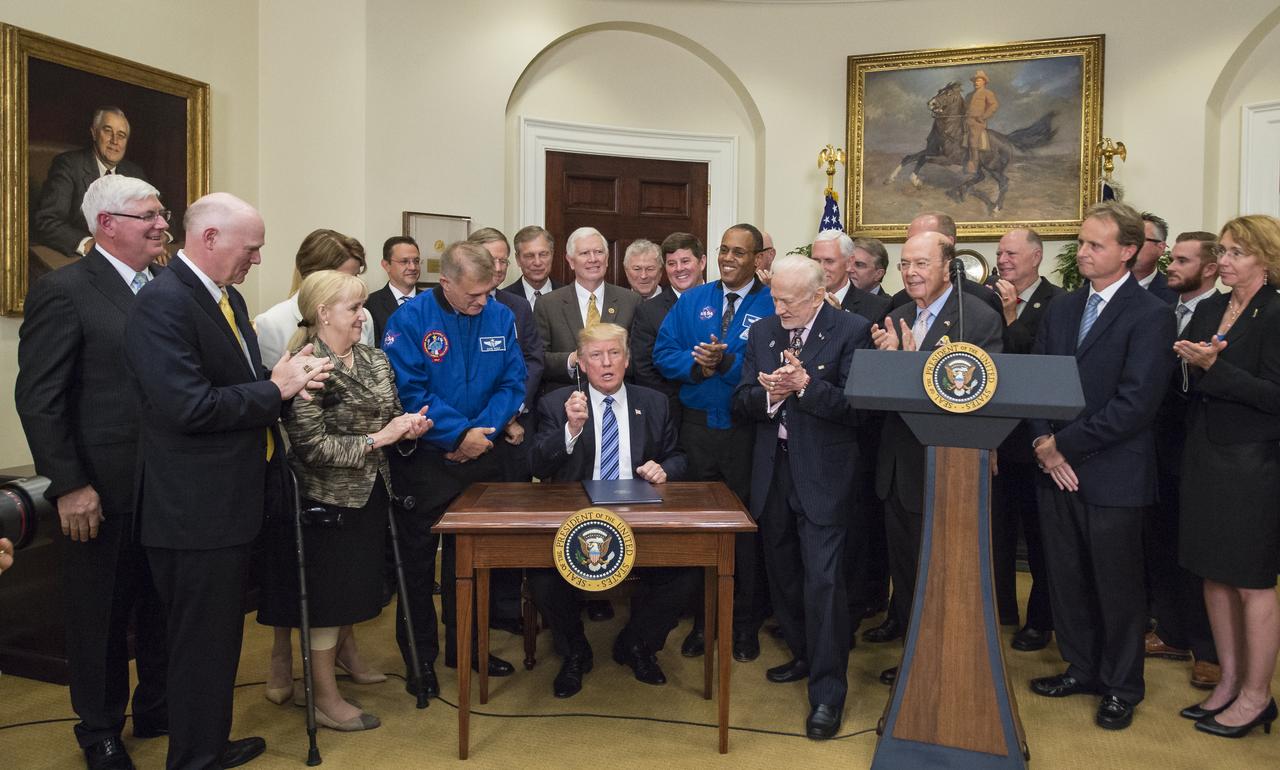
President Donald Trump, center, asks who should receive the pen after signing an Executive Order to reestablish the National Space Council, alongside members of the Congress, National Aeronautics and Space Administration, and Commercial Space Companies in the Roosevelt room of the White House in Washington, Friday, June 30, 2017. Retired astronaut Buzz Aldrin was given the pen. Also pictured are, Vice President Mike Pence, Rep. Bill Posey, R-Florida, Rep. Lamar Smith, R-Texas, Rep. John Culberson, R-Texas, Rep. Steven Palazzo, R-Miss., Rep. Brian Babin, R-Texas, Rep. Mo Brooks, R-Alabama, Rep. Dana Rohrbacher, R-California, Former Rep. Bob Walker, R-Pennsylvania, Sandy Magnus, executive director, American Institute of Aeronautics and Astronautics, David Melcher, executive director, Aerospace Industries Association, Tory Bruno, CEO, United Launch Alliance, Michal Riley, CEO, AMRO Fabricating Corporation, John Couch, president, Futuramic, Mike Cain, owner, Cain Tubular Products, Mary Lynne Dittmar, executive director, Coalition for Deep Space Exploration, Dennis Muilenburg, CEO Boeing Company, Marilyn Hewson, CEO, Lockheed Martin, Wes Bush, CEO, Northrop Grumman, NASA Astronaut Alvin Drew, retired NASA astronaut David Wolf, Apollo 13 flight director, Gene Kranz, Secretary of Commerce Wilbur Ross, Under Secretary of the Air Force Lisa Disbrow, and Acting Deputy Director of National Intelligence, Dawn Eilengerger. Photo Credit: (NASA/Aubrey Gemignani)
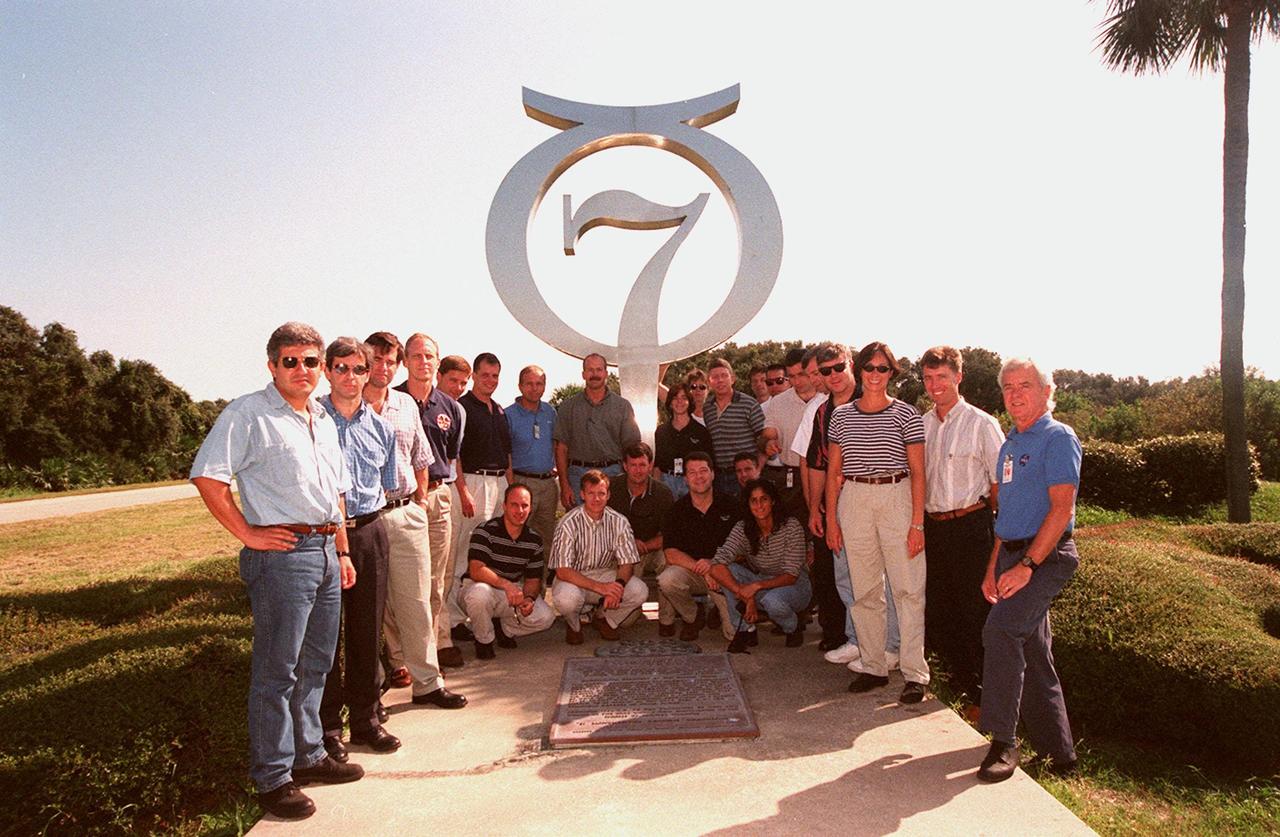
At Cape Canaveral Air Station, members of the 1998 astronaut candidate class (Group 17) pose in front of the Project Mercury monument at Launch Complex 14 during a tour of the station's facilities. This 13-foot-high astronomical symbol for the planet Mercury was constructed by General Dynamics, the Atlas airframe contractor, and dedicated in 1964 in honor of those who flew in the Mercury 7 capsule. The class is at Kennedy Space Center taking part in training activities, including a flight awareness program, as well as touring the OPF, VAB, SSPF, SSME Processing Facility, launch pads, SLF, Apollo/Saturn V Center, and the crew quarters. The U.S. candidates in the '98 class are Clayton C. Anderson, Lee J. Archambault, Tracy E. Caldwell (Ph.D.), Gregory E. Chamitoff (Ph.D.), Timothy J. Creamer, Christopher J. Ferguson, Michael J. Foreman, Michael E. Fossum, Kenneth T. Ham, Patricia C. Hilliard (M.D.), Gregory C. Johnson, Gregory H. Johnson, Stanley G. Love (Ph.D.), Leland D. Melvin, Barbara R. Morgan, William A. Oefelein, John D. Olivas (Ph.D.), Nicholas J.M. Patrick (Ph.D.), Alan G. Poindexter, Garrett E. Reisman (Ph.D.), Steven R. Swanson, Douglas H. Wheelock, Sunita L. Williams, Neil W. Woodward III, George D. Zamka; and the international candidates are Leopold Eyharts, Paolo Nespoli, Hans Schlegel, Roberto Vittori, Bjarni V. Tryggvason, and Marcos Pontes
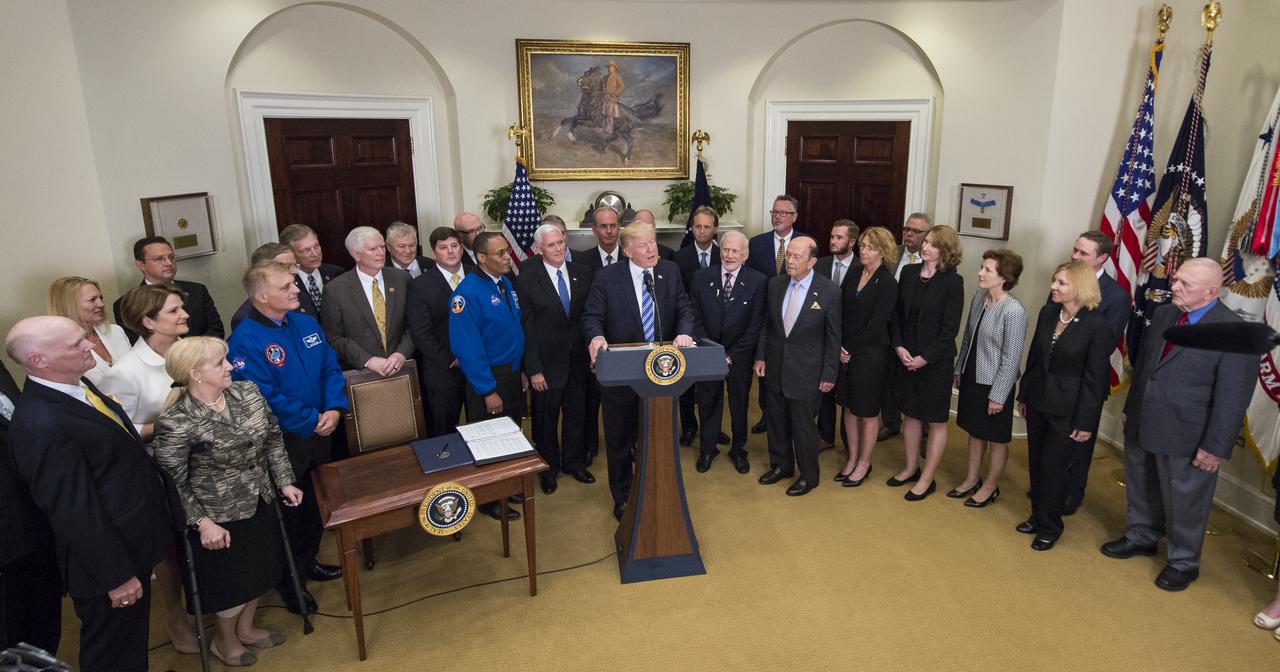
President Donald Trump, center, speaks before signing an Executive Order to reestablish the National Space Council, alongside members of the Congress, National Aeronautics and Space Administration, and Commercial Space Companies in the Roosevelt room of the White House in Washington, Friday, June 30, 2017. Vice President Mike Pence, also in attendance, will chair the council. Also pictured are, Rep. Bill Posey, R-Florida, Rep. Lamar Smith, R-Texas, Rep. John Culberson, R-Texas, Rep. Steven Palazzo, R-Miss., Rep. Brian Babin, R-Texas, Rep. Mo Brooks, R-Alabama, Rep. Dana Rohrbacher, R-California, Former Rep. Bob Walker, R-Pennsylvania, Sandy Magnus, executive director, American Institute of Aeronautics and Astronautics, David Melcher, executive director, Aerospace Industries Association, Tory Bruno, CEO, United Launch Alliance, Michal Riley, CEO, AMRO Fabricating Corporation, John Couch, president, Futuramic, Mike Cain, owner, Cain Tubular Products, Mary Lynne Dittmar, executive director, Coalition for Deep Space Exploration, Dennis Muilenburg, CEO Boeing Company, Marilyn Hewson, CEO, Lockheed Martin, Wes Bush, CEO, Northrop Grumman, retired NASA astronaut Buzz Aldrin, NASA astronaut Alvin Drew, retired NASA astronaut David Wolf, Apollo 13 flight director, Gene Kranz, Secretary of Commerce Wilbur Ross, Under Secretary of the Air Force Lisa Disbrow, and Acting Deputy Director of National Intelligence, Dawn Eilengerger. Photo Credit: (NASA/Aubrey Gemignani)