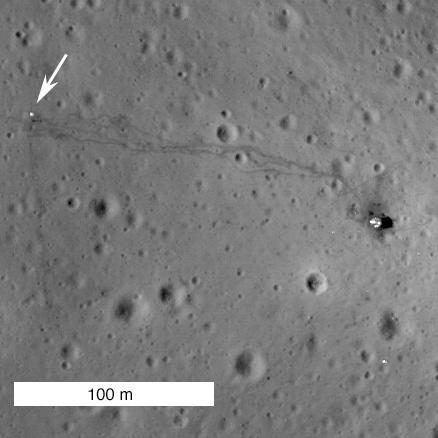
New View of Apollo 14
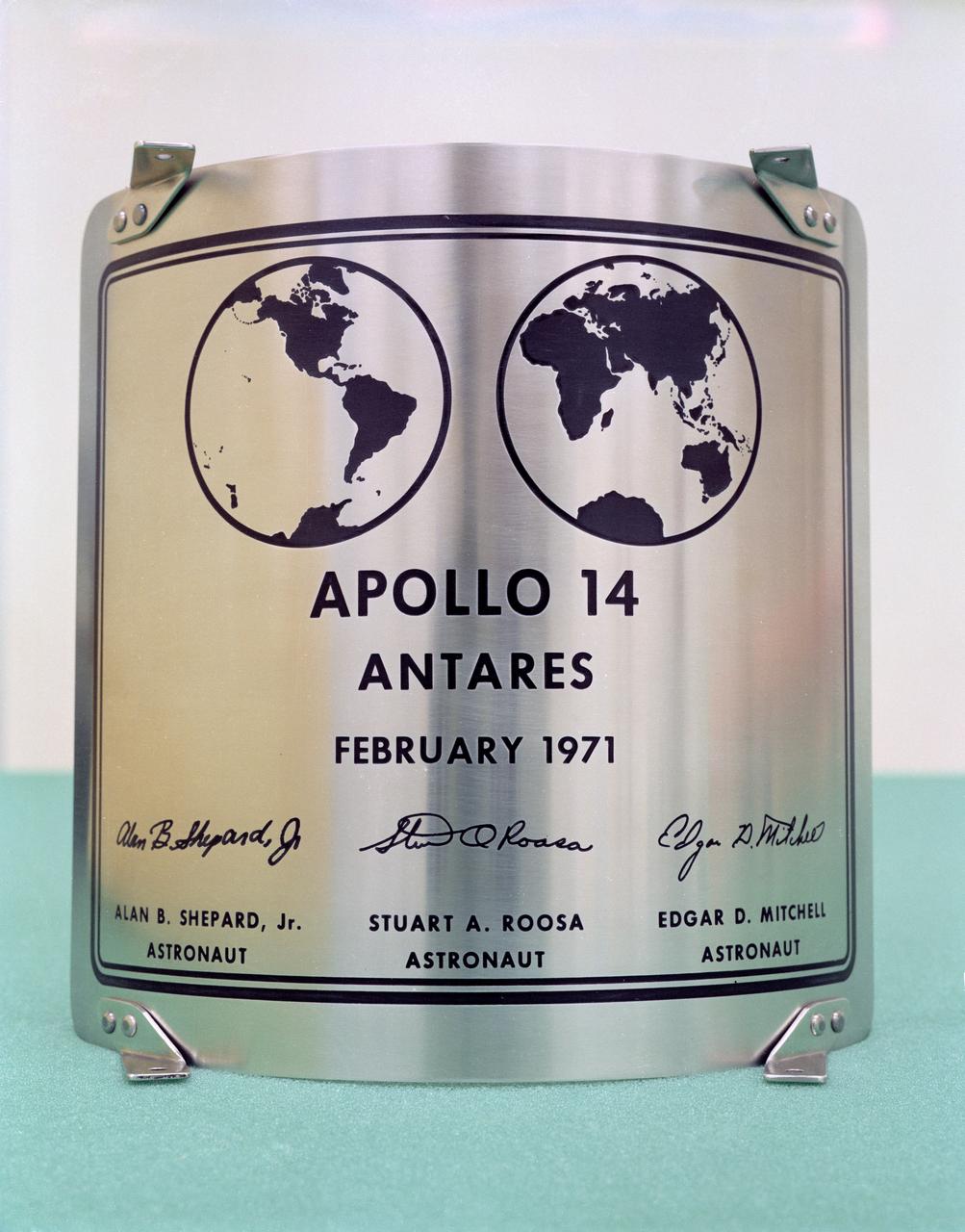
S71-16637 (January 1971) --- A close-up view of the plaque which the Apollo 14 astronauts will leave behind on the moon during their lunar landing mission. Astronauts Alan B. Shepard Jr., commander, and Edgar D. Mitchell, lunar module pilot, will descend to the lunar surface in the Lunar Module (LM) "Antares". Astronaut Stuart A. Roosa, command module pilot, will remain with the Command and Service Modules (CSM) in lunar orbit. The seven by nine inch stainless steel plaque will be attached to the ladder on the landing gear strut on the LM's descent stage. Commemorative plaques were also left on the moon by the Apollo 11 and Apollo 12 astronauts.
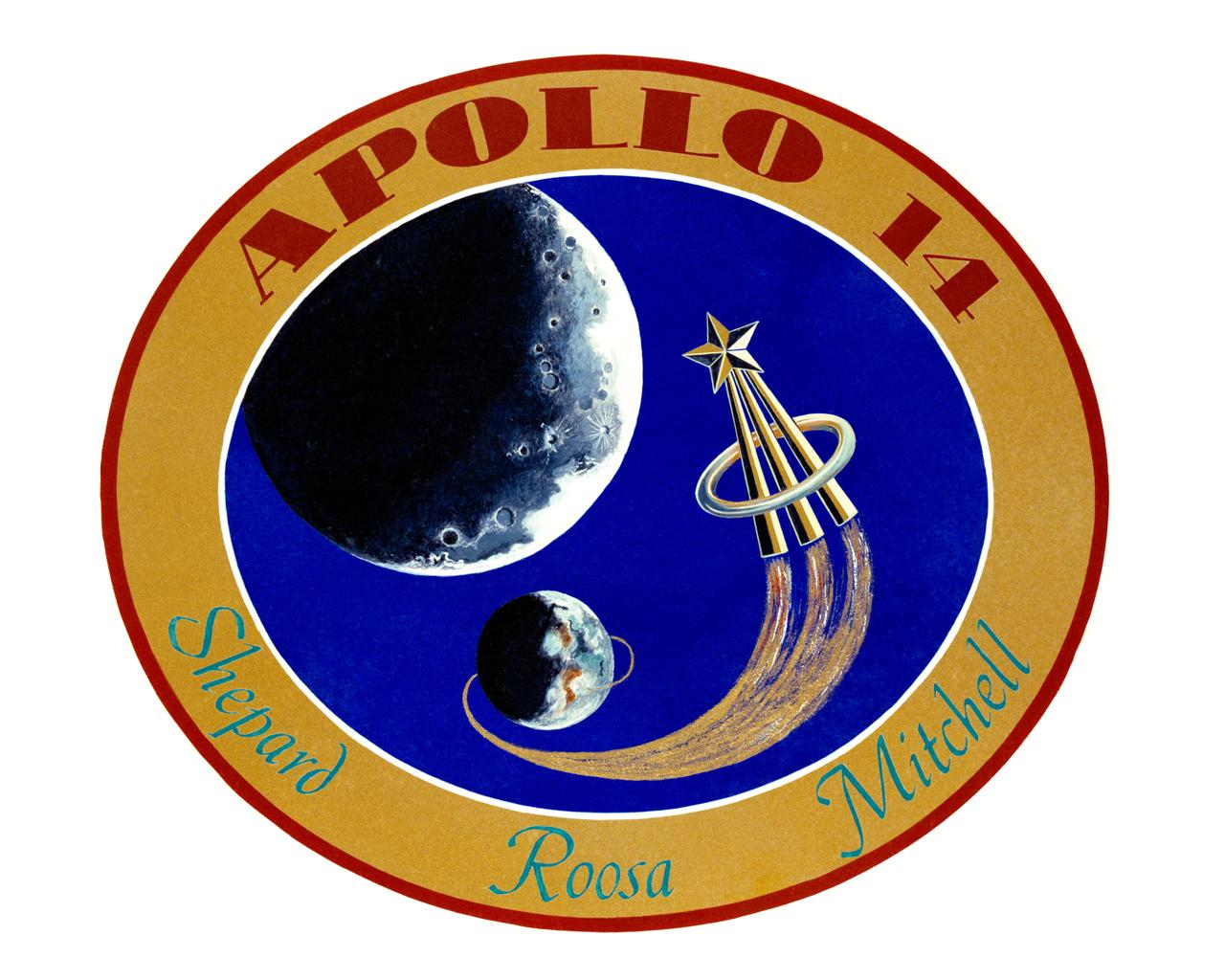
S70-17851 (September 1970) --- This is the Apollo 14 crew patch designed by astronauts Alan B. Shepard Jr., commander; Stuart A. Roosa, command module pilot; and Edgar D. Mitchell, lunar module pilot. It features the astronaut lapel pin approaching the moon and leaving a comet trail from the liftoff point on Earth. The pin design was adopted by the astronaut corps several years ago. Astronauts who have not yet flown in space wear silver pins. Those who have flown wear gold pins. The NASA insignia design for Apollo flights is reserved for use by the astronauts and for other official use as the NASA Administrator may authorize. Public availability has been approved only in the form of illustrations by the various news media. When and if there is any change in this policy, which we do not anticipate, it will be publicly announced.
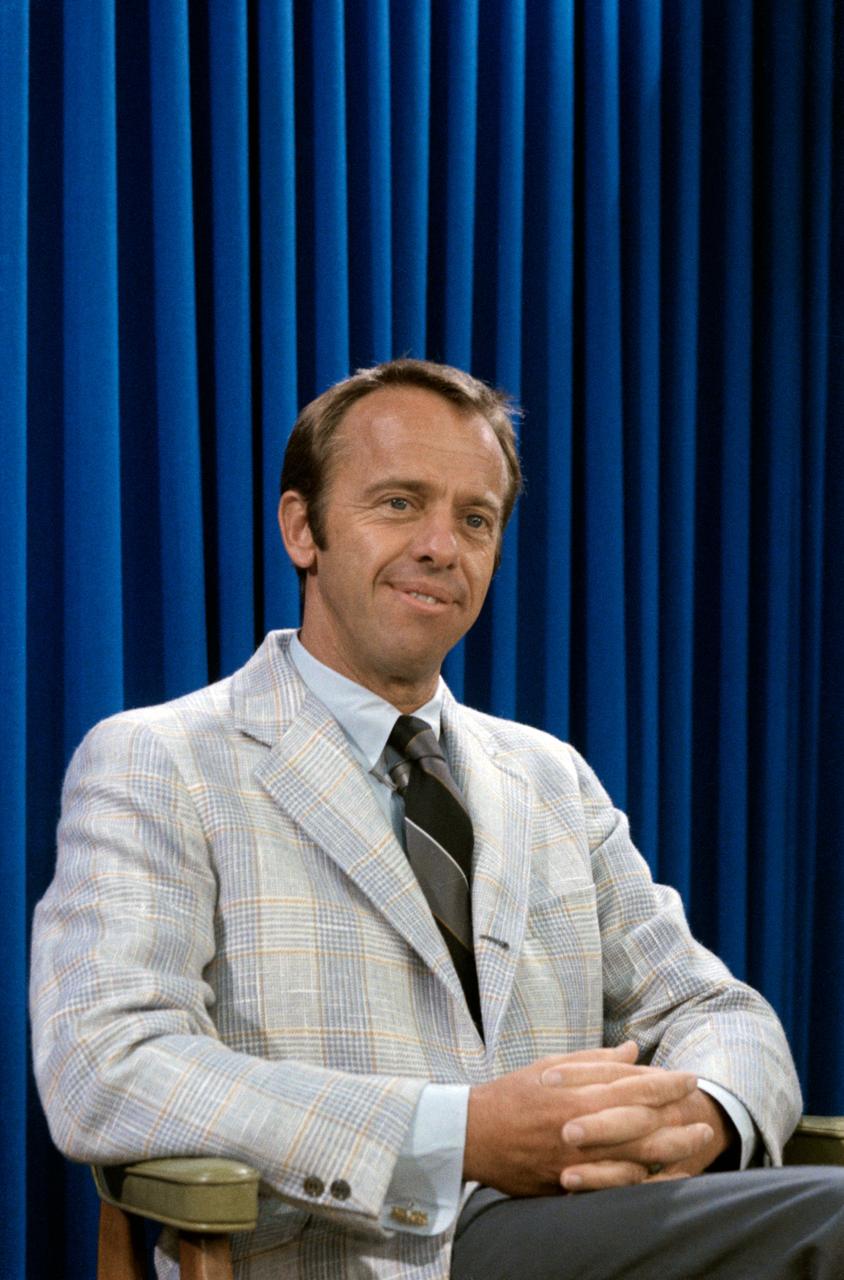
S70-45232 (14 July 1970) --- Astronaut Alan B. Shepard Jr., commander of the Apollo 14 lunar landing mission. Photo credit: NASA
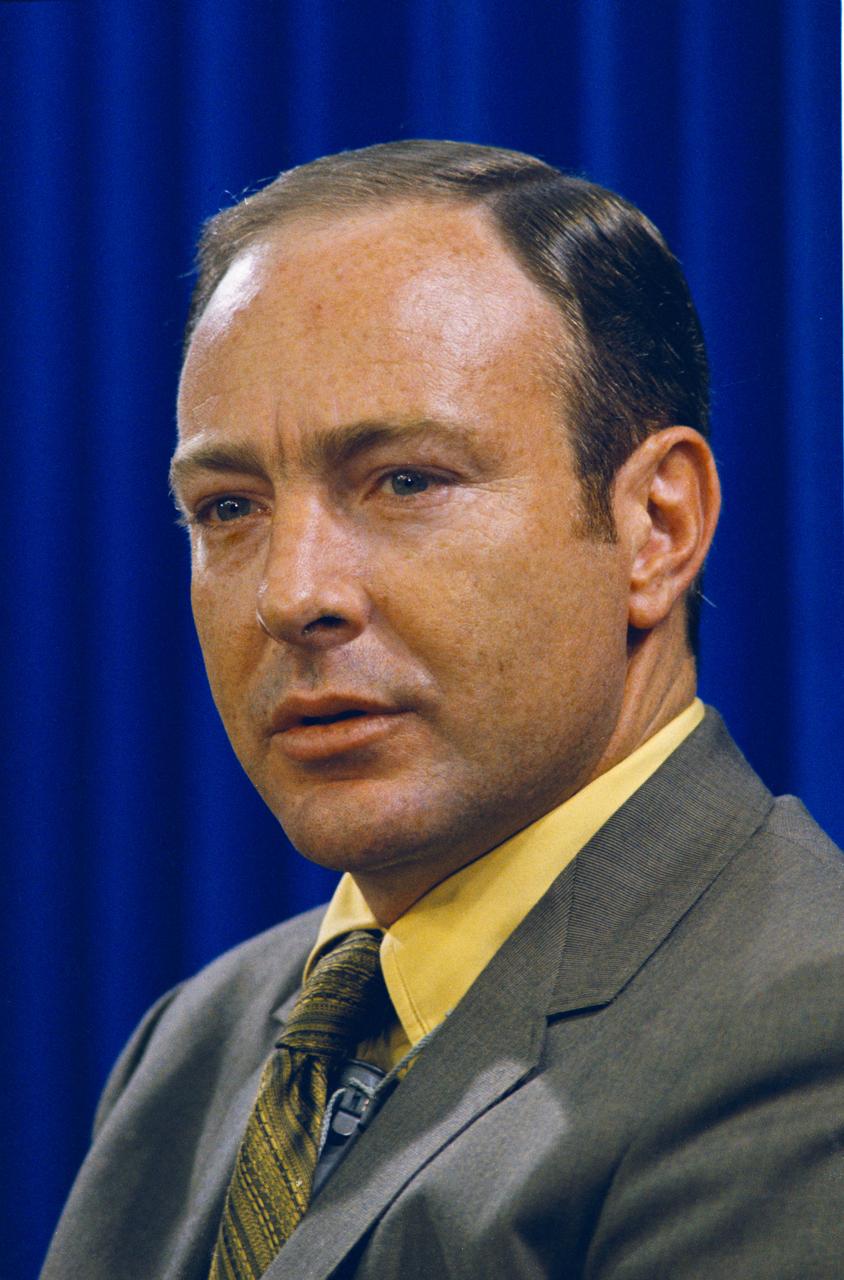
S70-45210 (14 July 1970) --- A candid portrait in civilian suit of astronaut Edgar D. Mitchell, lunar module pilot of the Apollo 14 lunar landing mission. Photo credit: NASA
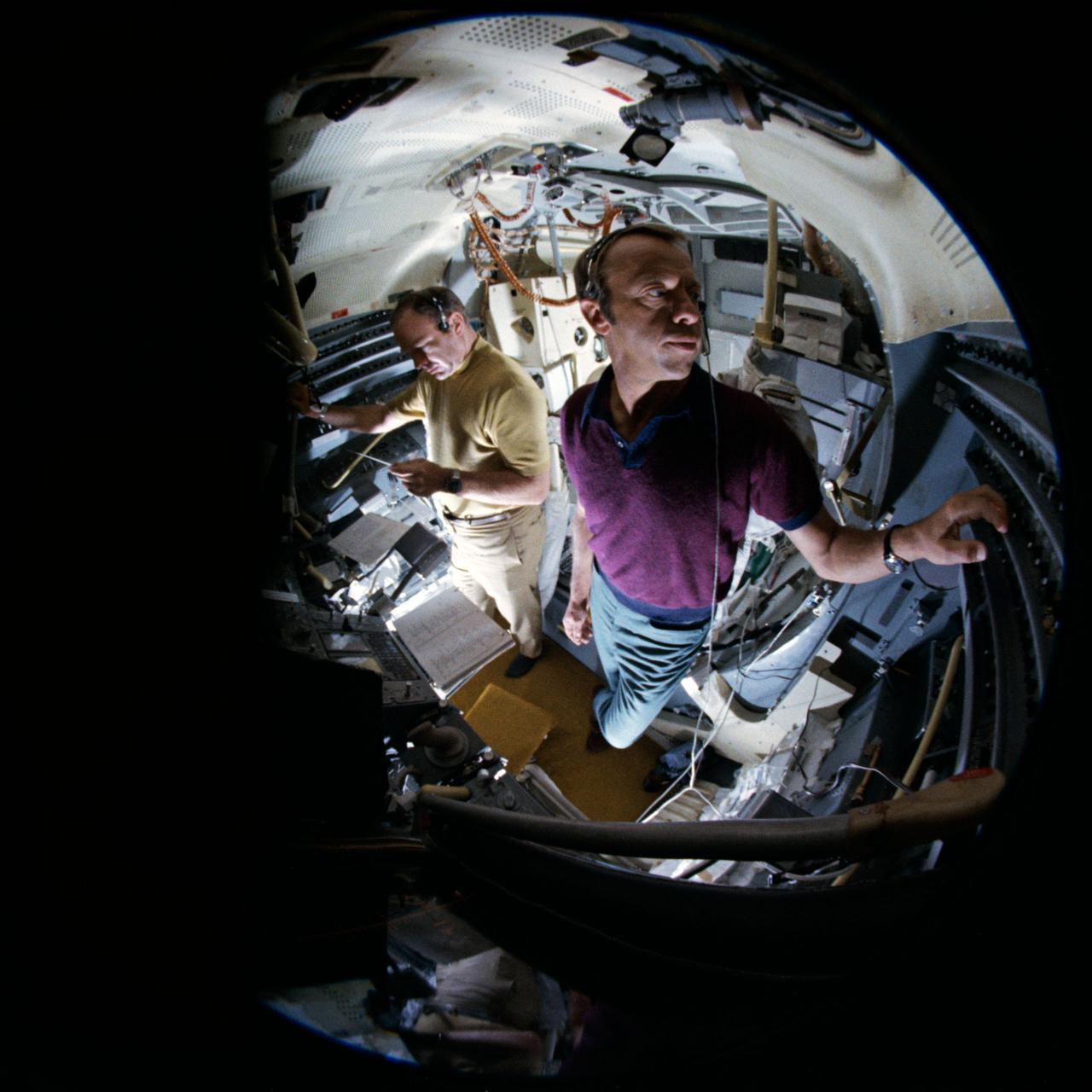
Portrait of Astronaut Stuart A. Roosa, Apollo 14 lunar landing mission Command Module pilot in civilian clothes.
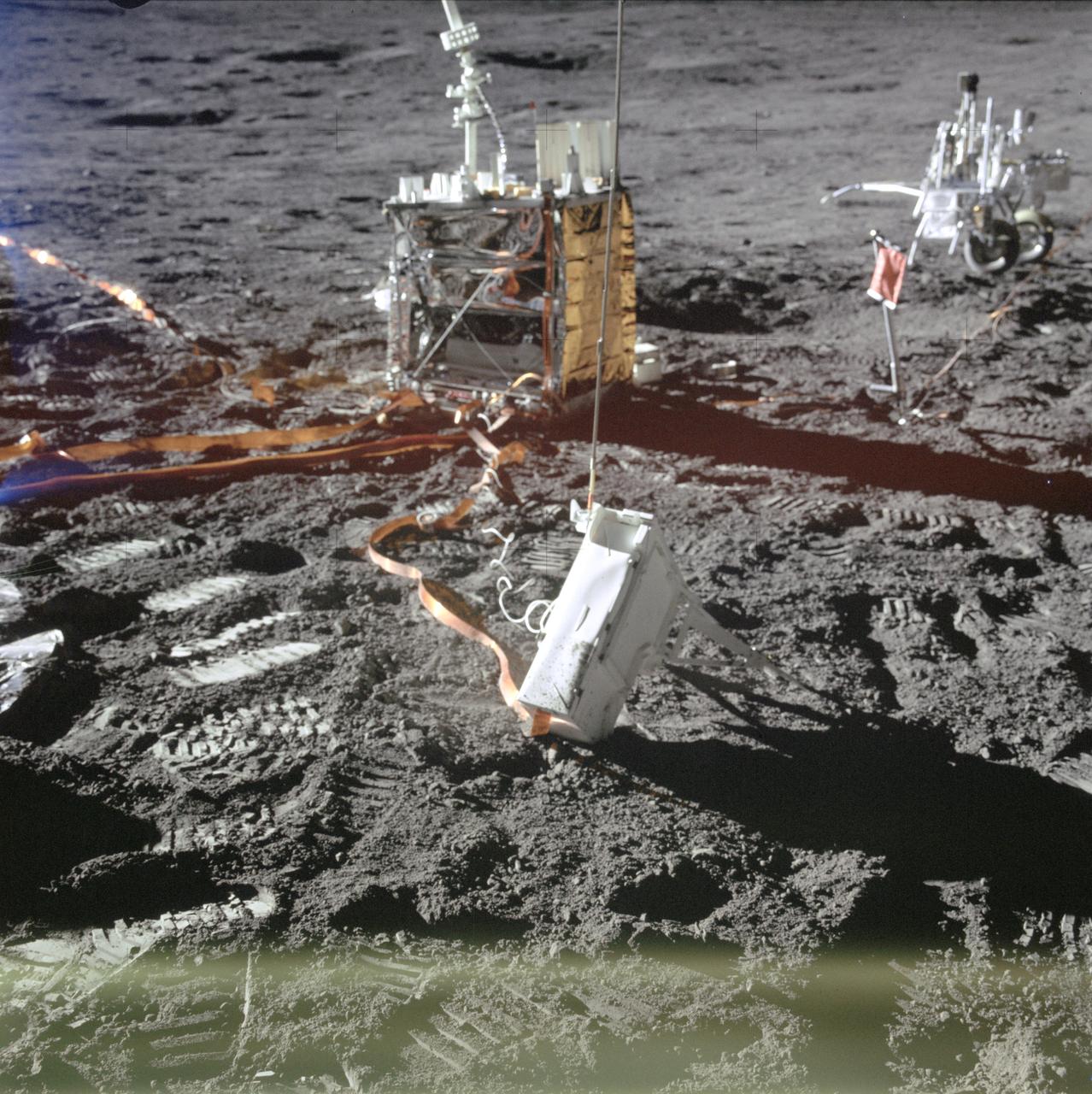
AS14-67-9361 (5 Feb. 1971) --- A close-up view of two components of the Apollo lunar surface experiments package (ALSEP) which the Apollo 14 astronauts deployed on the moon during their first extravehicular activity (EVA). In the center background is the ALSEP's central station (CS); and in the foreground is the mortar package assembly of the ALSEP's active seismic experiment (ASE). The modularized equipment transporter (MET) can be seen in the right background. While astronauts Alan B. Shepard Jr., commander, and Edgar D. Mitchell, lunar module pilot, descended in the Lunar Module (LM) to explore the moon, astronaut Stuart A. Roosa, command module pilot, remained with the Command and Service Modules (CSM) in lunar orbit.
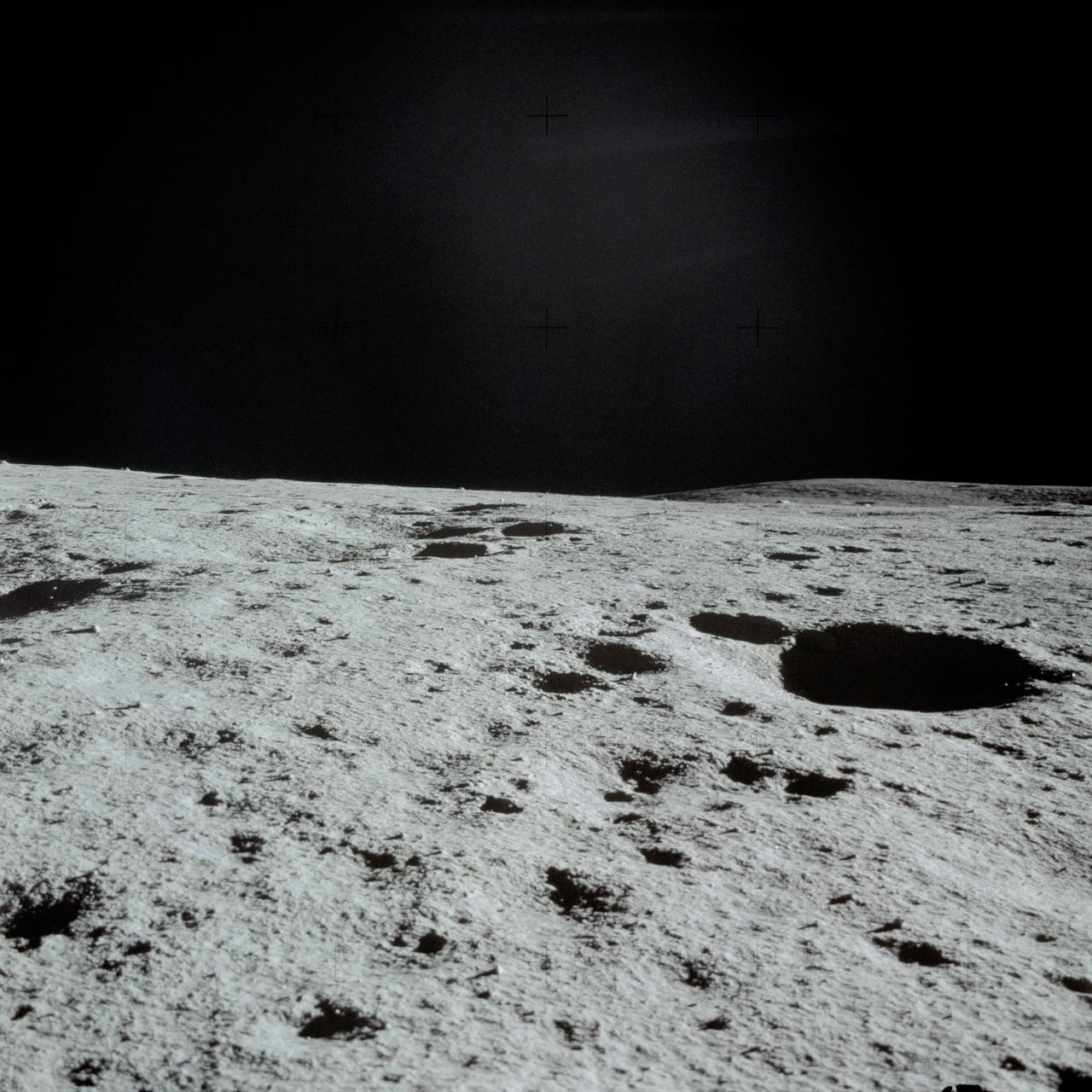
AS14-66-9244 (5-6 Feb. 1971) --- An excellent view of the lunar terrain looking through the right window of the Lunar Module (LM), photographed by one of the Apollo 14 astronauts during their stay on the lunar surface. Pothole-sized craters can be seen in the foreground. While astronauts Alan B. Shepard Jr., commander, and Edgar D. Mitchell, lunar module pilot, descended in the LM to explore the moon, astronaut Stuart A. Roosa, command module pilot, remained with the Command and Service Modules (CSM) in lunar orbit.
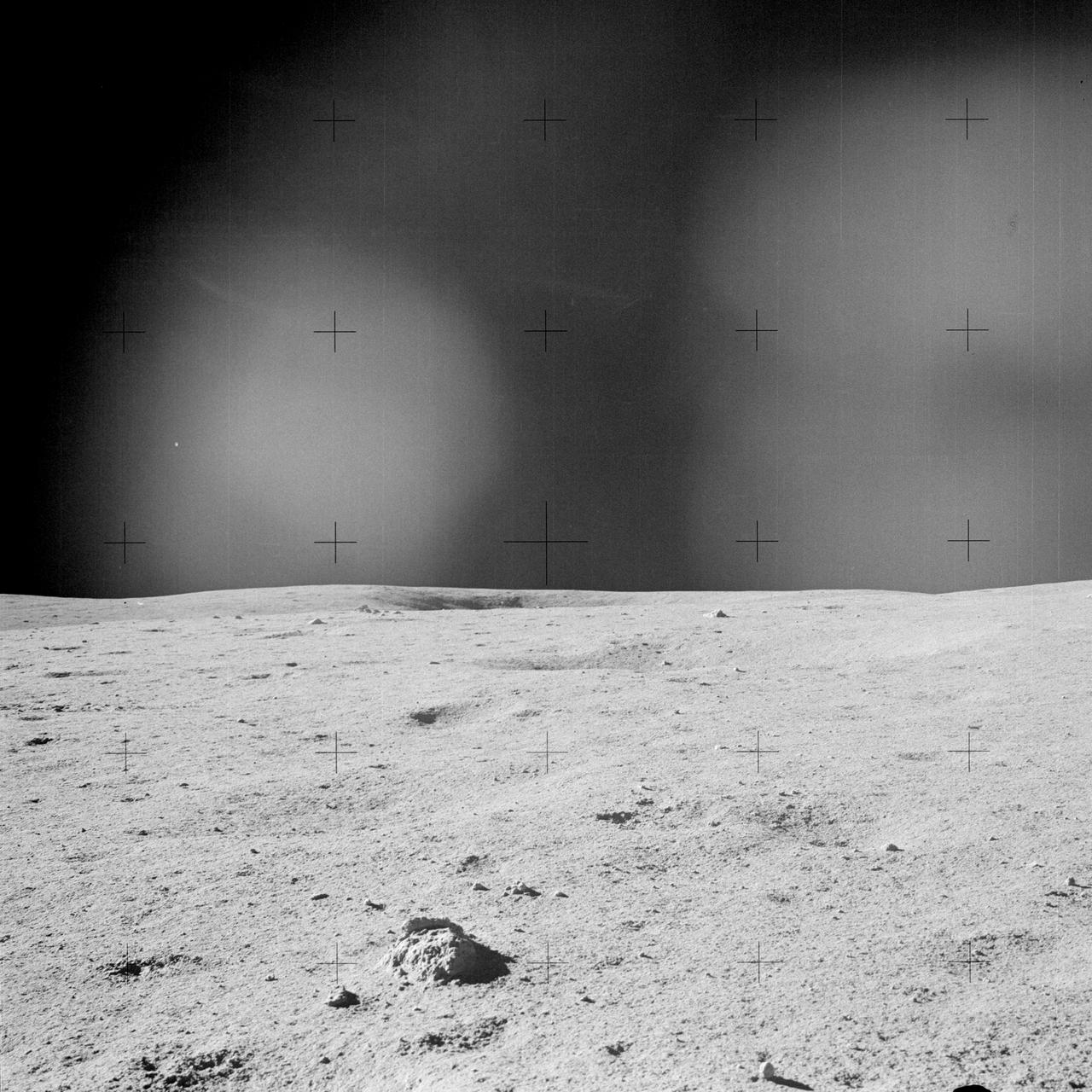
AS14-64-9181 (5-6 Feb. 1971) --- A view of the lunar terrain at the Apollo 14 Fra Mauro landing site as photographed through the left window of the Lunar Module (LM). Note the clump of lunar soil in the foreground, and a crater in the center on the horizon. While astronauts Alan B. Shepard Jr., commander; and Edgar D. Mitchell, lunar module pilot; descended in the LM to explore the moon, astronaut Stuart A. Roosa, command module pilot, remained with the Command and Service Modules (CSM) in lunar orbit.
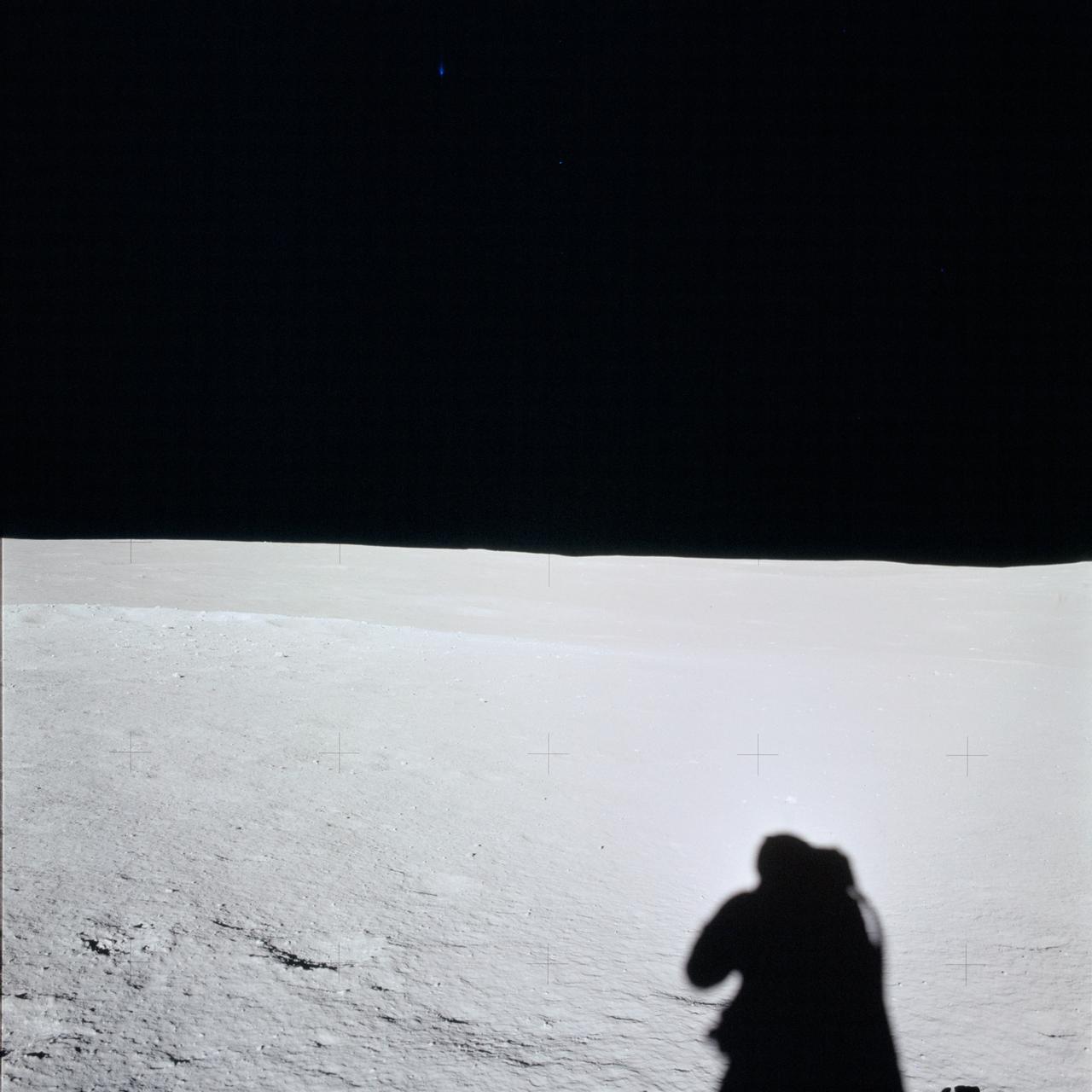
AS14-66-9293 (5 Feb. 1971) --- A portion of the Fra Mauro landing site as photographed by one of the Apollo 14 astronauts, standing slightly southwest of the Lunar Module (LM), during the early minutes of their first extravehicular activity (EVA) on the moon. The shadow of the astronaut taking the picture is at lower right. Photographs numbered AS14-66-9271 through AS14-66-9293 comprise a 360 degree panoramic view.
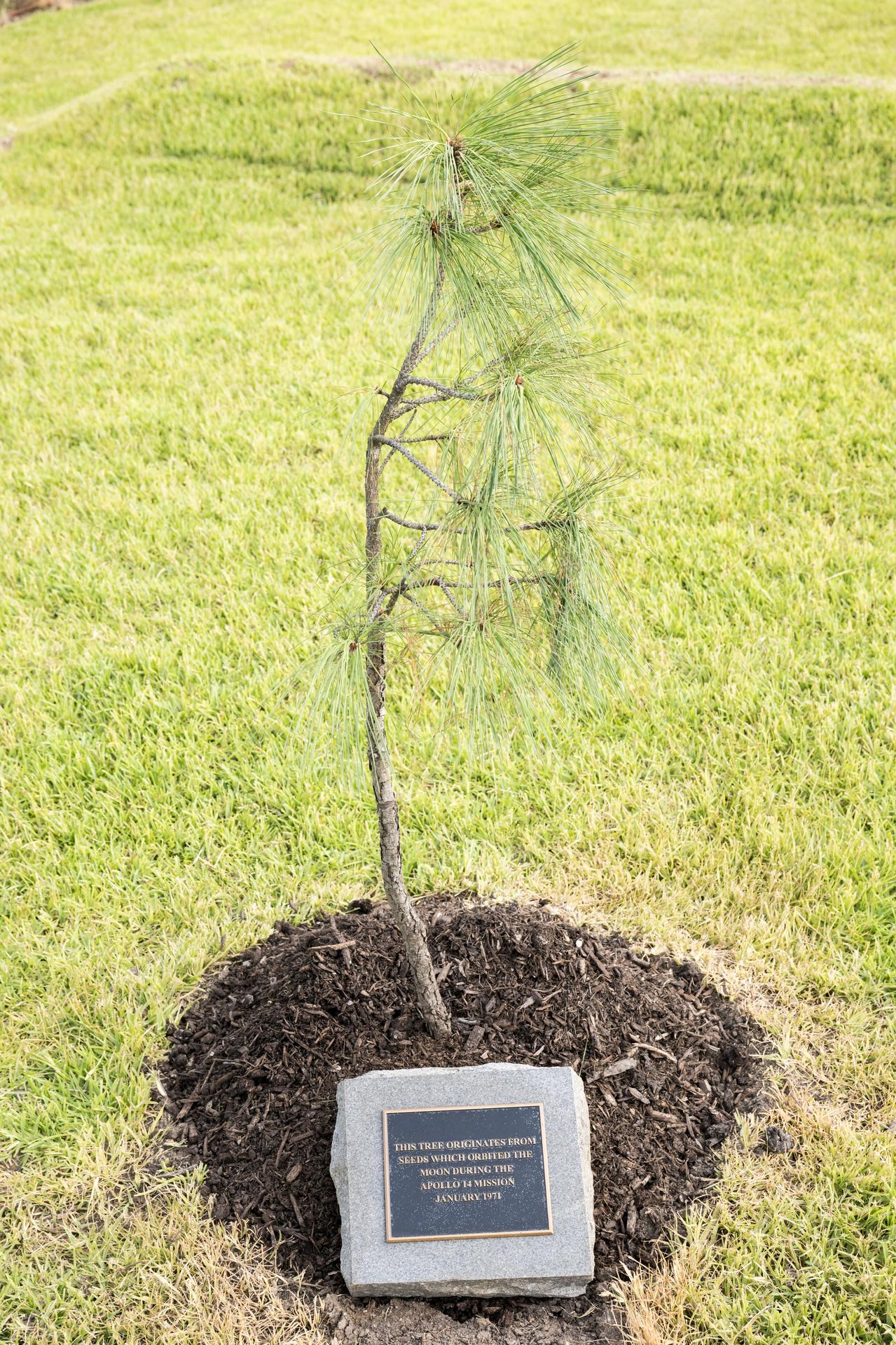
jsc2026e396708 (June 25, 2026) - An Apollo Moon tree dedicated by the Artemis II crew at the Lunar Receiving Park at NASA's Johnson Space Center. This tree is a second-generation Apollo Moon tree of the loblolly pine species. The original Apollo Moon trees were grown from seeds carried aboard Apollo 14 by NASA astronaut Stuart Roosa, a former U.S. Forest Service smoke jumper. Upon return to Earth, the seeds were germinated by the Forest Service, and the resulting seedlings were planted throughout the United States and around the world. Credit: NASA
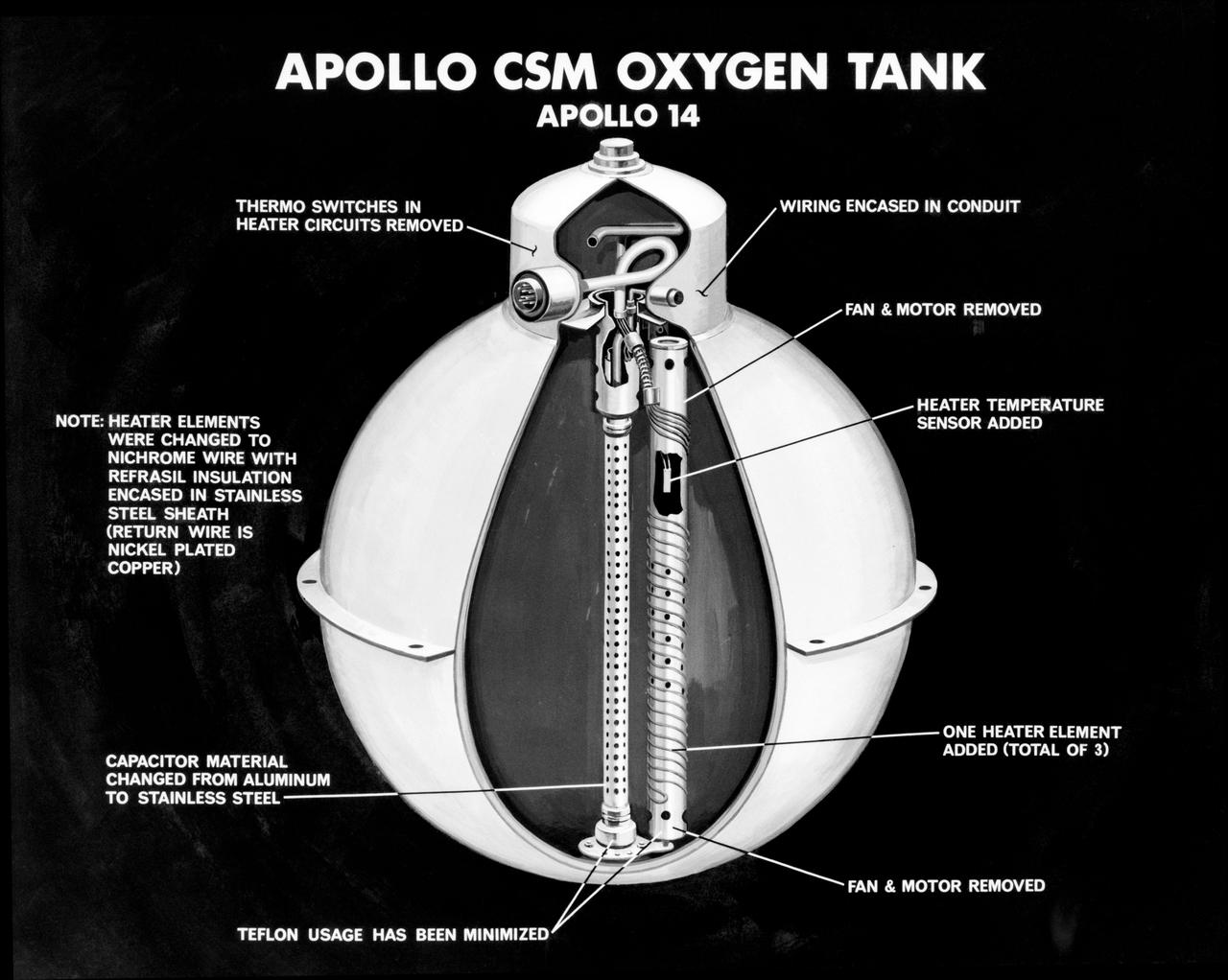
S71-16745 (January 1971) --- An artist's concept illustrating a cutaway view of one of the three oxygen tanks of the Apollo 14 spacecraft. This is the new Apollo oxygen tank design, developed since the Apollo 13 oxygen tank explosion. Apollo 14 has three oxygen tanks redesigned to eliminate ignition sources, minimize the use of combustible materials, and simplify the fabrication process. The third tank has been added to the Apollo 14 Service Module, located in the SM's sector one, apart from the pair of oxygen tanks in sector four. Arrows point out various features of the oxygen tank.
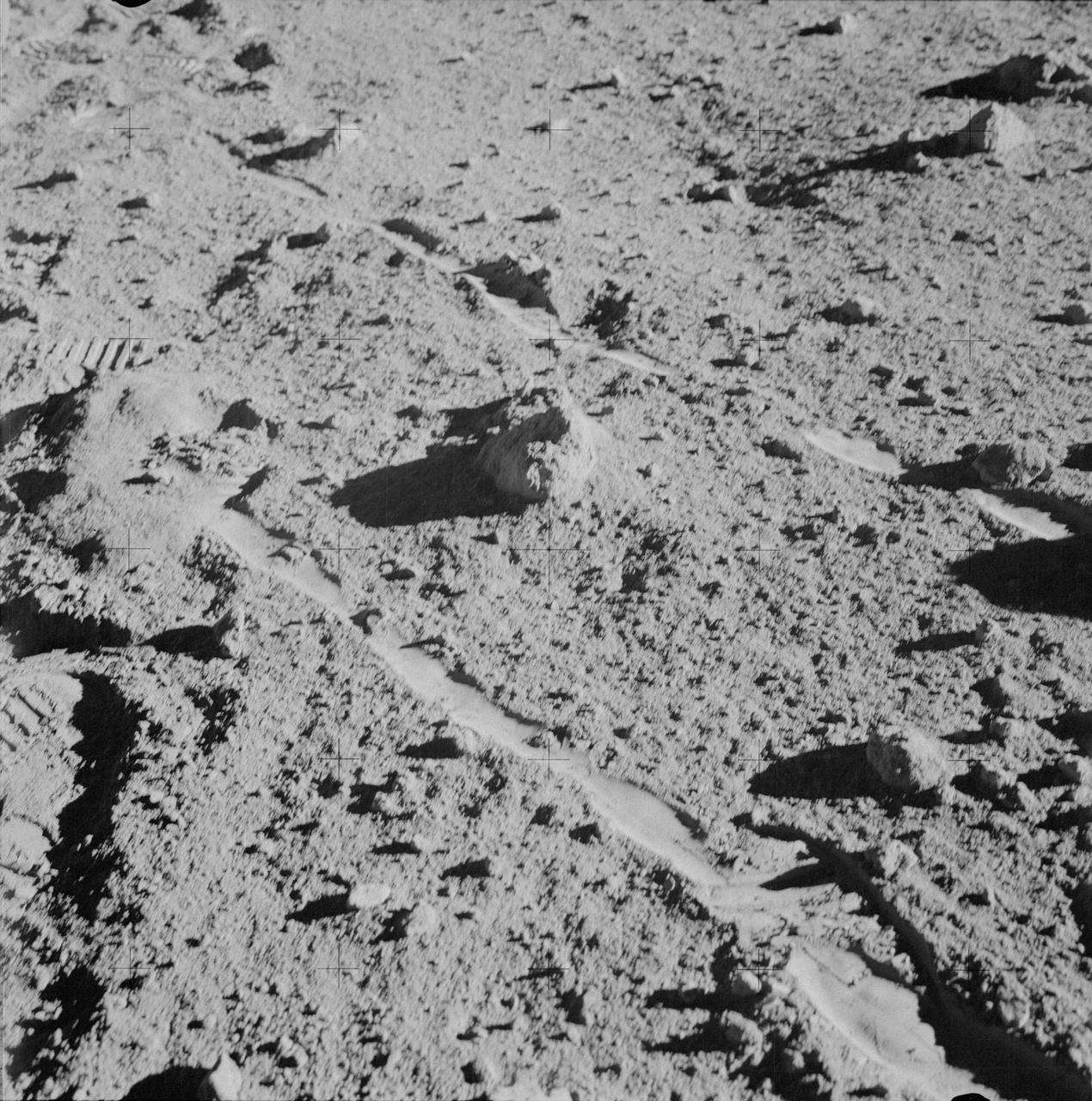
AS14-64-9129 (6 Feb. 1971) --- The two moon-exploring crew men of the Apollo 14 lunar landing mission, photographed and collected the large rock pictured just above the exact center of this picture. (Hold picture with the NASA photographic number at lower right hand corner.) The rock, casting a shadow off to the left, is lunar sample number 14321, referred to as a basketball-sized rock by newsmen and nicknamed "Big Bertha" by principal investigators. It lies between the wheel tracks made by the modular equipment transporter (MET) or rickshaw-type portable workbench. A few prints of the lunar overshoes of the crew members are at the left. This photo was made near the boulder field near the rim of Cone Crater.

AS14-66-9278 (5 Feb. 1971) --- An excellent view of the Apollo 14 Lunar Module (LM) on the moon, as photographed during the first Apollo 14 extravehicular activity (EVA) on the lunar surface. While astronauts Alan B. Shepard Jr., commander, and Edgar D. Mitchell, lunar module pilot, descended in the LM to explore the moon, astronaut Stuart A. Roosa, command module pilot, remained with the Command and Service Modules (CSM) in lunar orbit.
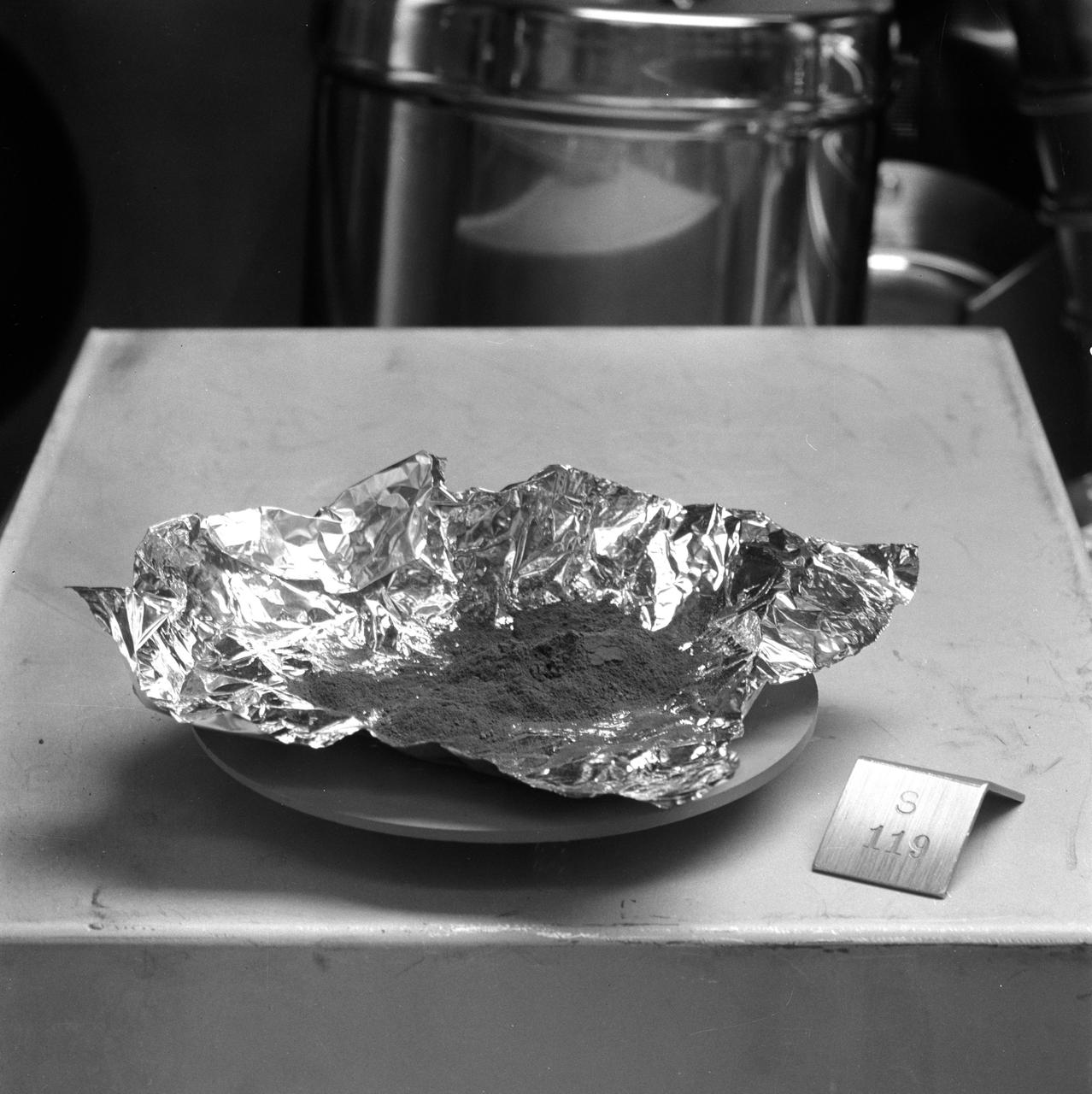
S71-19269 (12 Feb. 1971) --- A close-up view of Apollo 14 sample number 14414 & 14412, a fine lunar powder-like material under examination in the Sterile Nitrogen Atmospheric Processing (SNAP) line in the Lunar Receiving Laboratory (LRL) at the Manned Spacecraft Center (MSC). Scientists are currently making preliminary analyses of material brought back from the moon by the crew of Apollo 14 lunar landing mission.

S71-19473 (9 Feb. 1971) --- The Apollo 14 crew members step aboard the USS New Orleans, after exiting a U.S. Navy helicopter which retrieved the three from their splashdown site not far away. From left to right, are astronauts Stuart A. Roosa, command module pilot; Edgar D. Mitchell, lunar module pilot; and Alan B. Shepard Jr., commander. They will be sealed inside a Mobile Quarantine Facility (MQF) aboard the prime recovery ship. Apollo 14 splashdown occurred at 3:04:39 p.m. (CST) in the South Pacific Ocean, approximately 765 nautical miles from American Samoa.
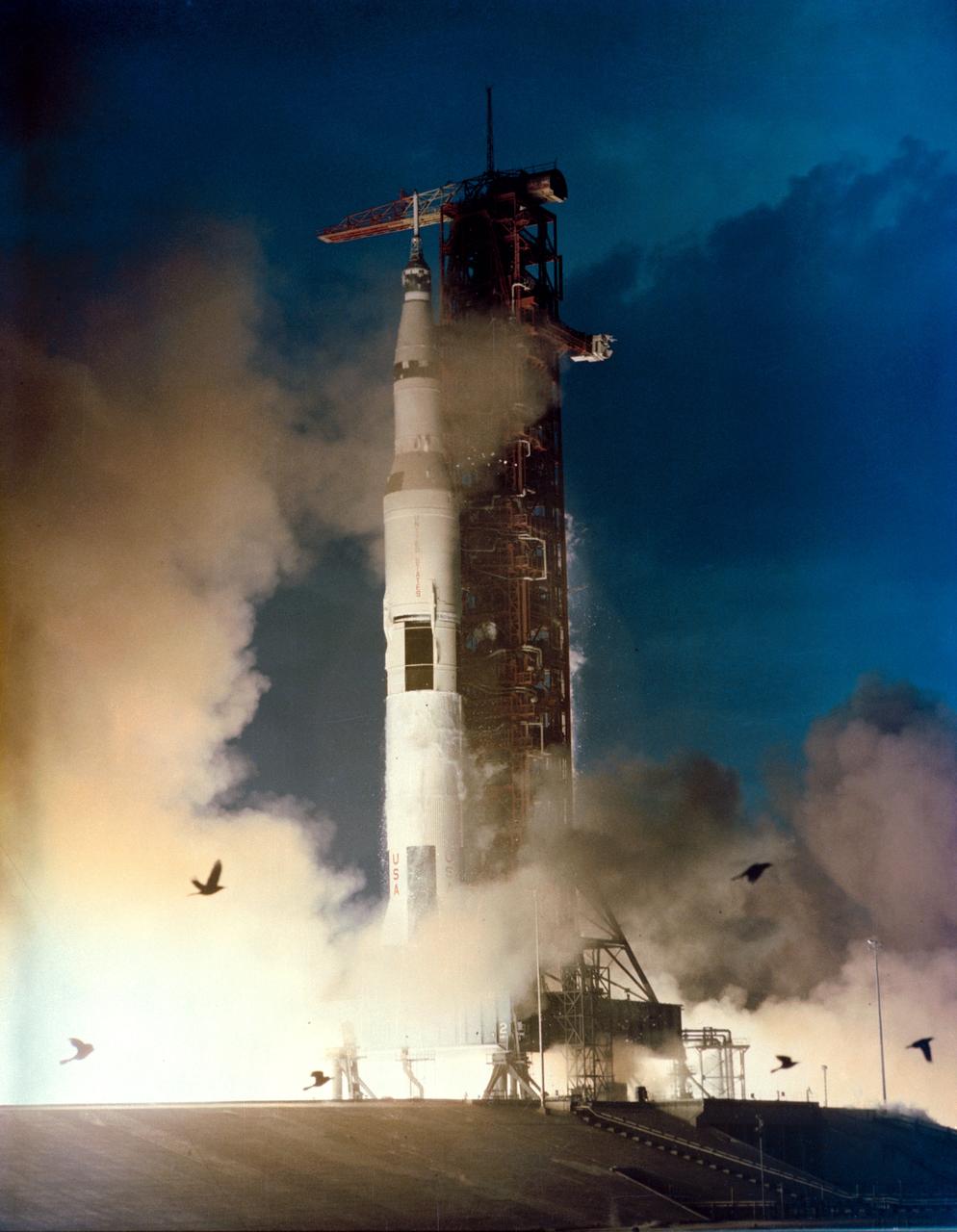
S71-18395 (31 Jan. 1971) --- The huge, 363-feet tall Apollo 14 (Spacecraft 110/Lunar Module 8/Saturn 509) space vehicle is launched from Pad A, Launch Complex 39, Kennedy Space Center (KSC), Florida at 4:03:02 p.m. (EST), Jan. 31, 1971, on a lunar landing mission. Aboard the Apollo 14 spacecraft were astronauts Alan B. Shepard Jr., commander; Stuart A. Roosa, command module pilot; and Edgar D. Mitchell, lunar module pilot.
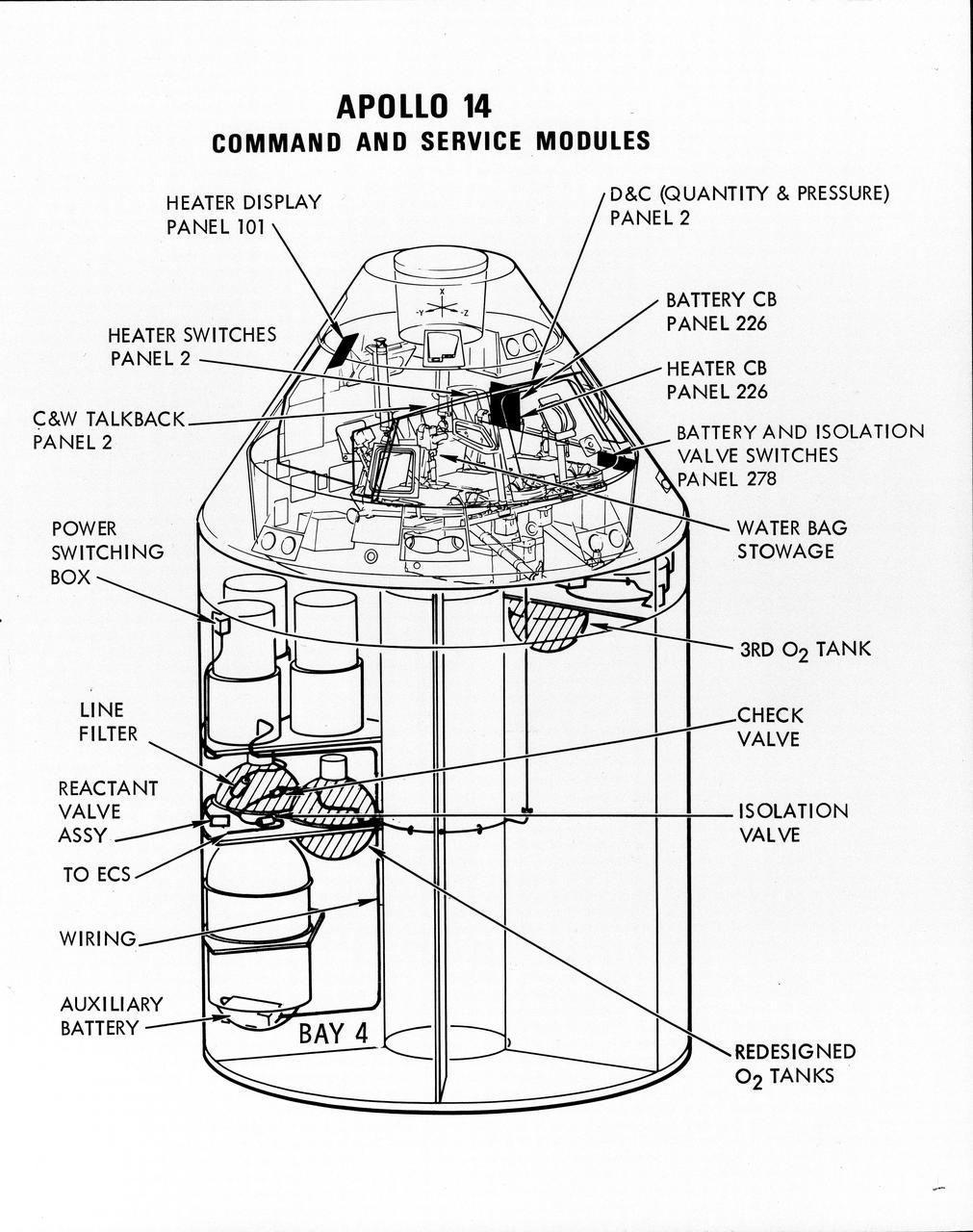
S71-16823 (January 1971) --- A line drawing illustrating a cutaway view of the Apollo 14 Command and Service Modules, showing the engineering changes in the CSM which were recommended by the Apollo 13 Review Board. (The Apollo 13 abort was caused by a short circuit and wiring overheating in one of the SM cryogenic oxygen tanks.) The major changes to the Apollo 14 CSM include adding a third cryogenic oxygen tank installed in a heretofore empty bay (in sector one) of the SM, addition of an auxiliary battery in the SM as a backup in case of fuel cell failure, and removal of destratification fans in the cryogenic oxygen tanks and removal of thermostat switches from the oxygen tank heater circuits. Provision for stowage of an emergency five-gallon supply of drinking water has been added to the CM.
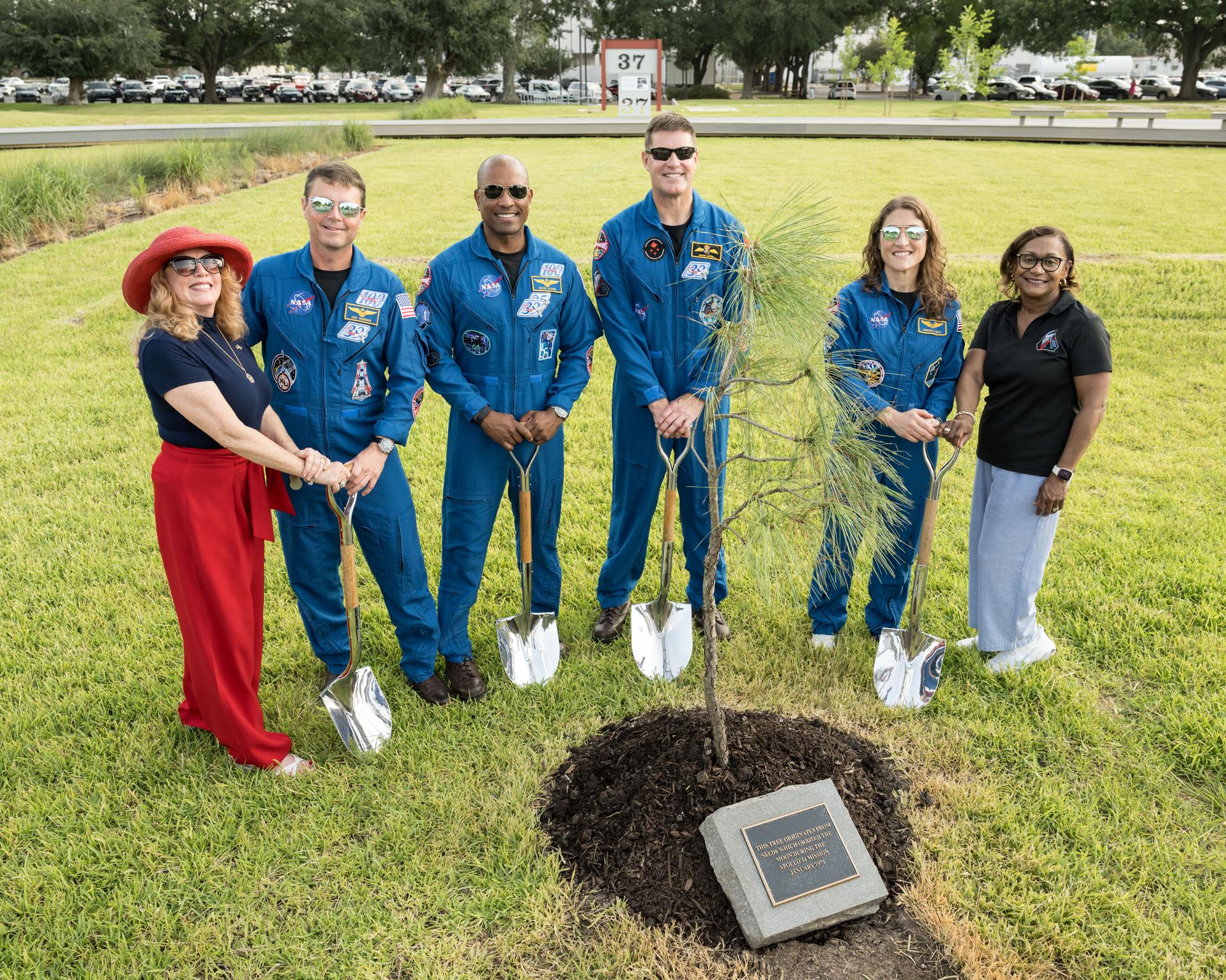
jsc2026e396762 (June 25, 2026) - From left to right, Rosemary Roosa, president of The Moon Tree Foundation and daughter of late Apollo 14 astronaut Stuart Roosa, and Vanessa Wyche, director of NASA's Johnson Space Center, participate in the dedication of the Apollo 14 Moon tree alongside the Artemis II crew. This tree is a second-generation Apollo Moon tree of the loblolly pine species. The original Apollo Moon trees were grown from seeds carried aboard Apollo 14 by NASA astronaut Stuart Roosa, a former U.S. Forest Service smoke jumper. Upon return to Earth, the seeds were germinated by the Forest Service, and the resulting seedlings were planted throughout the United States and around the world. Credit: NASA
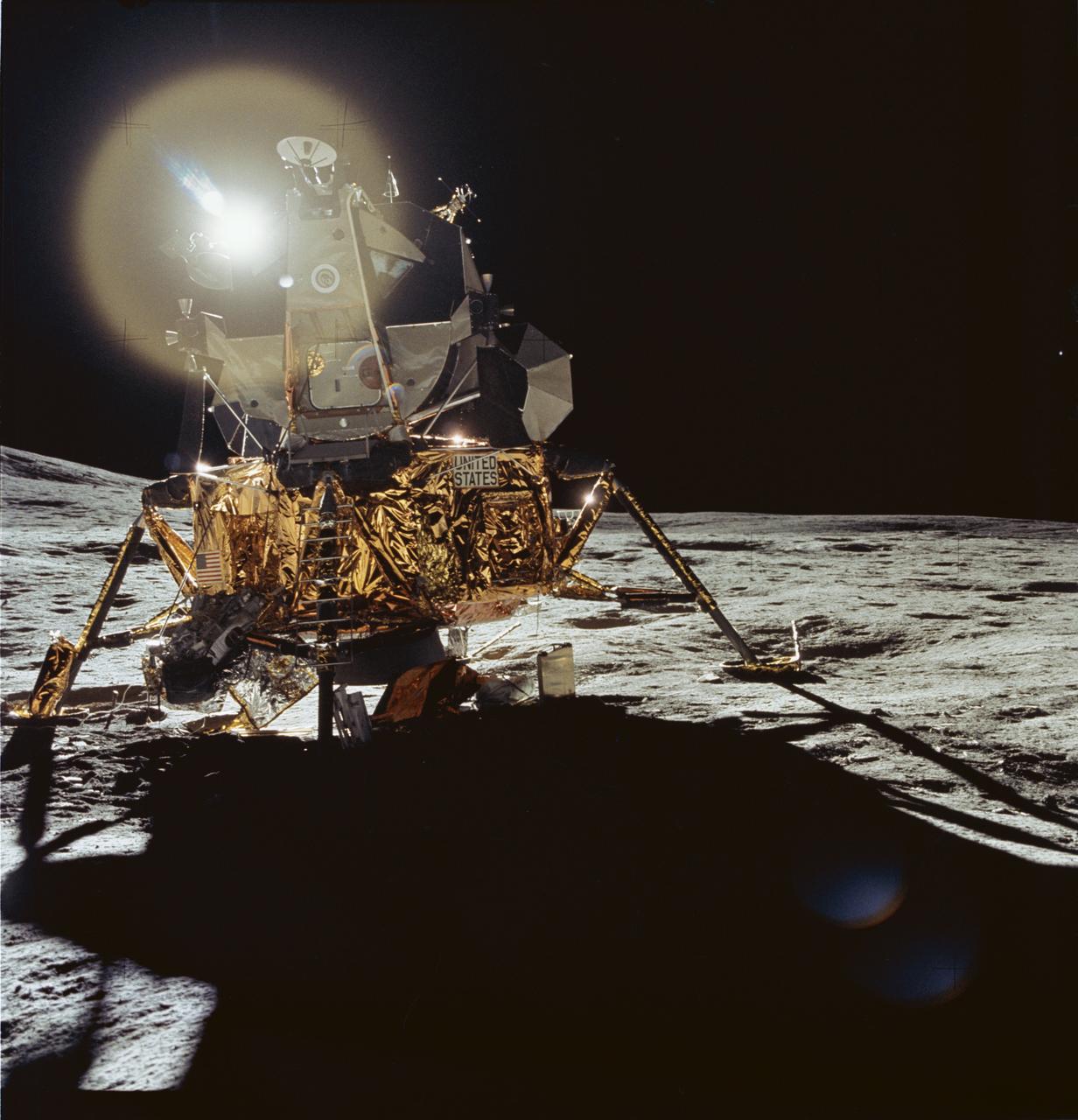
AS14-66-9306 (5 Feb. 1971) --- A front view of the Apollo 14 Lunar Module (LM), which reflects a circular flare caused by the brilliant sun, as seen by the two moon-exploring crew men of the Apollo 14 lunar landing mission during their first extravehicular activity (EVA). The unusual ball of light was said by the astronauts to have a jewel-like appearance. At the extreme left the lower slope of Cone Crater can be seen. Astronauts Alan B. Shepard Jr., commander; and Edgar D. Mitchell, lunar module pilot; descended in the LM, while astronaut Stuart A. Roosa, command module pilot; remained with the Command and Service Modules (CSM) in lunar orbit.
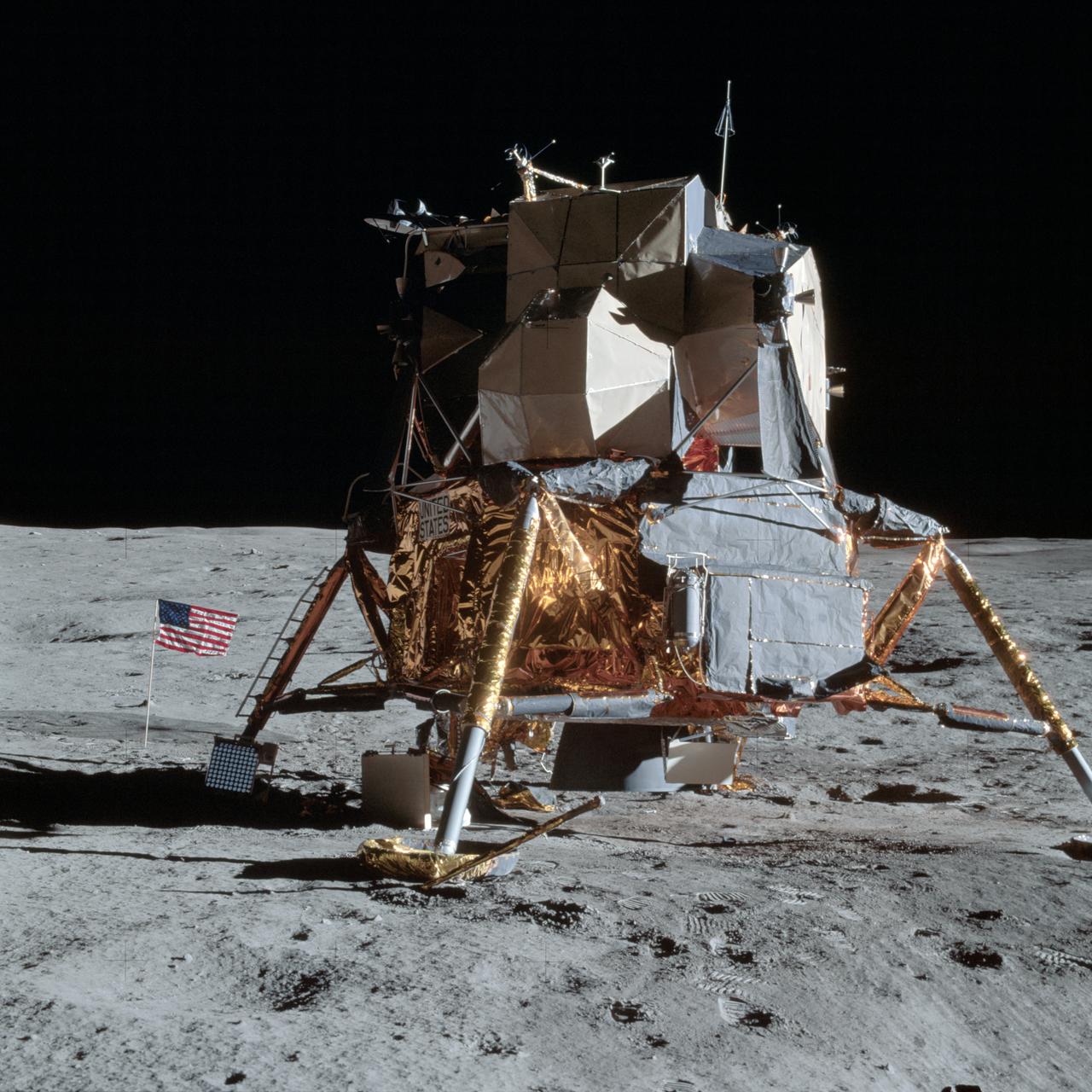
AS14-66-9277 (5 Feb. 1971) --- An excellent view of the Apollo 14 Lunar Module (LM) on the moon, as photographed during the first Apollo 14 extravehicular activity (EVA) on the lunar surface. The astronauts have already deployed the U.S. flag. Note the laser ranging retro reflector (LR-3) at the foot of the LM ladder. The LR-3 was deployed later. While astronauts Alan B. Shepard Jr., commander, and Edgar D. Mitchell, lunar module pilot, descended in the LM to explore the moon, astronaut Stuart A. Roosa, command module pilot, remained with the Command and Service Modules (CSM) in lunar orbit.
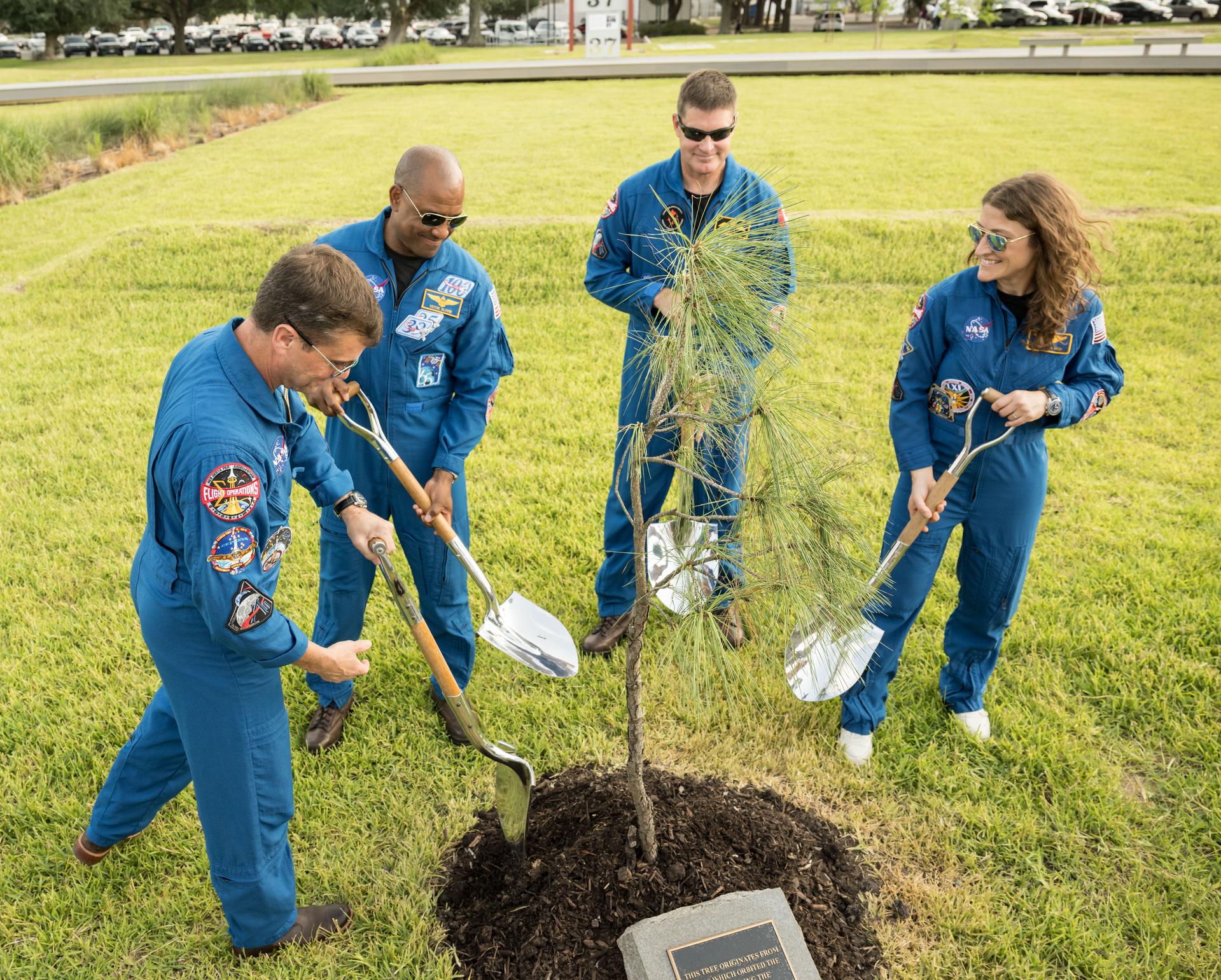
jsc2026e396761 (June 25, 2026) - The Artemis II crew participates in the dedication of the Apollo 14 Moon tree at the Lunar Receiving Park at NASA's Johnson Space Center. This tree is a second-generation Apollo Moon tree of the loblolly pine species. The original Apollo Moon trees were grown from seeds carried aboard Apollo 14 by NASA astronaut Stuart Roosa, a former U.S. Forest Service smoke jumper. Upon return to Earth, the seeds were germinated by the Forest Service, and the resulting seedlings were planted throughout the United States and around the world. Credit: NASA
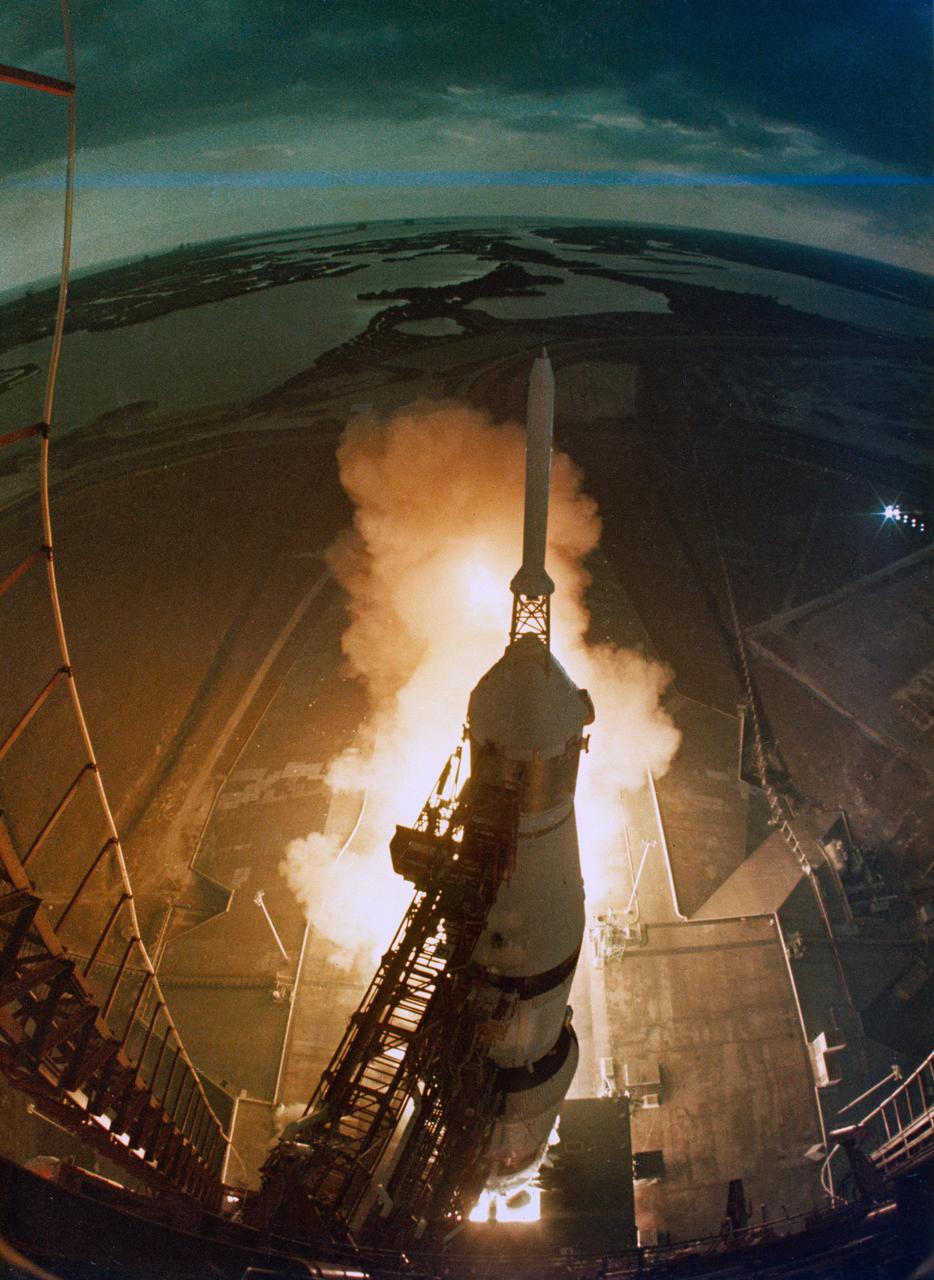
S71-17620 (31 Jan. 1971) --- The huge, 363-feet tall Apollo 14 (Spacecraft 110/Lunar Module 8/Saturn 509) space vehicle is launched from Pad A, Launch Complex 39, Kennedy Space Center, Florida, at 4:03:02 p.m. (EST), Jan. 31, 1981, on a lunar landing mission. This view of the liftoff was taken by a camera mounted on the mobile launch tower. Aboard the Apollo 14 spacecraft were astronauts Alan B. Shepard Jr., commander; Stuart A. Roosa, command module pilot; and Edgar D. Mitchell, lunar module pilot.
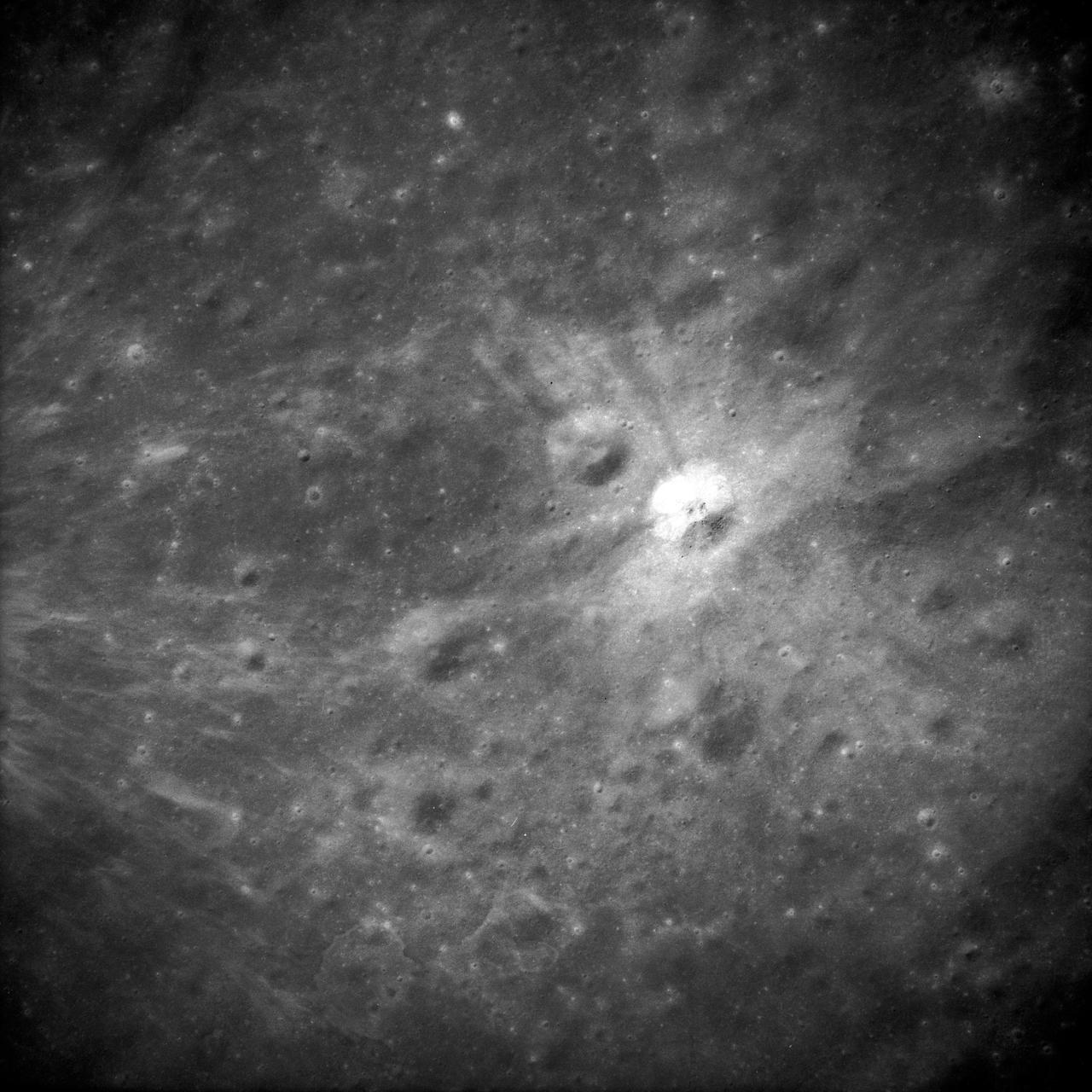
AS14-69-9560 (February 1971) --- This 500mm vertical frame taken from the Apollo 14 spacecraft is of the Apollo 16 proposed landing site "Descartes". The actual location of the target area is near the upper left. This photograph was taken with a 56 degree sun angle. The large bright crater is approximately one kilometer in diameter and has a distinctive ray pattern which serves as an excellent landmark.

AS14-68-9448 (6 Feb. 1971) --- A close-up view of a large multi-colored boulder in the boulder field located on the rim of Cone Crater, as photographed by the moon-exploring crew members of the Apollo 14 lunar landing mission. This view is looking west by southwest. The Lunar Module (LM) can be seen in the background. While astronauts Alan B. Shepard Jr., commander, and Edgar D. Mitchell, lunar module pilot, were exploring the moon, after descending in the LM, astronaut Stuart A. Roosa, command module pilot, remained with the Command and Service Modules (CSM) in lunar orbit.
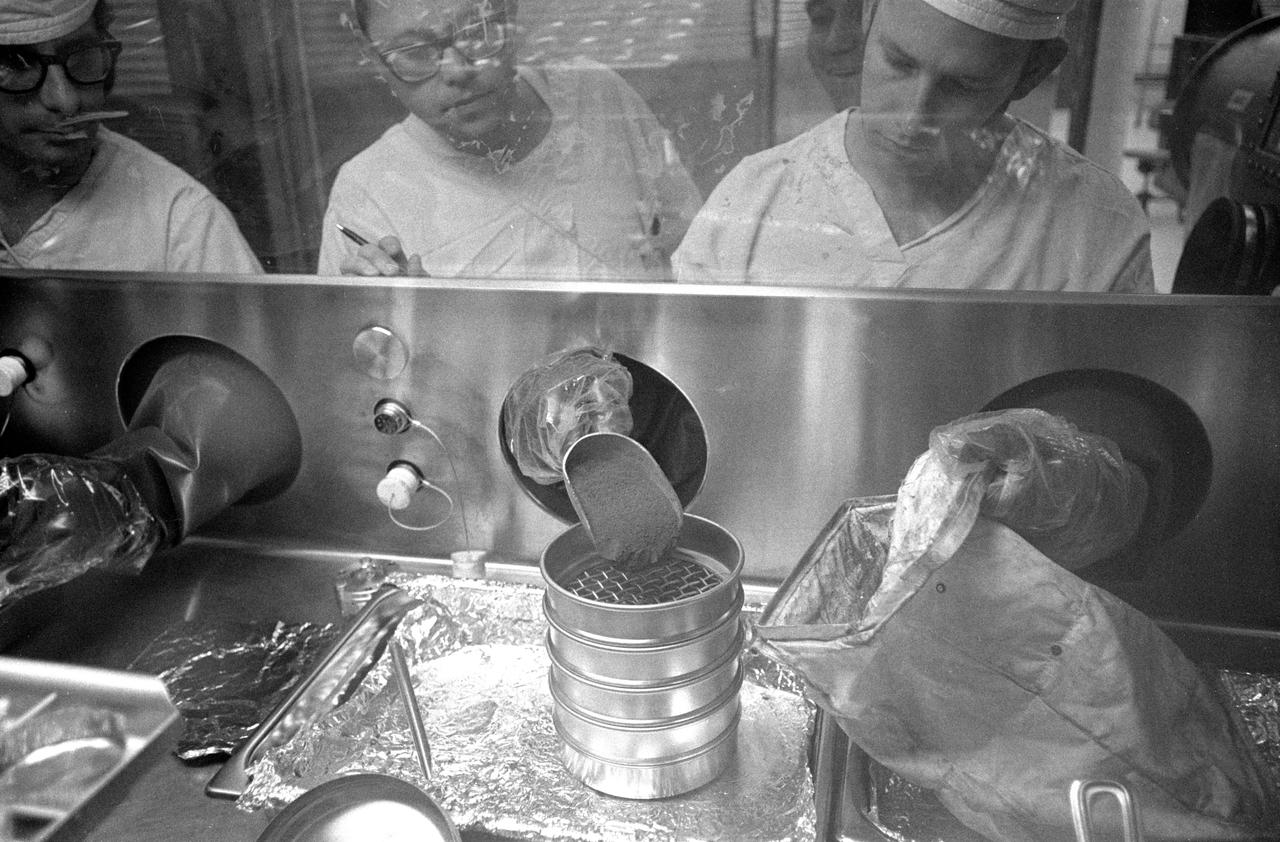
S71-19489 (18 Feb. 1971) --- Glove handlers work with freshly opened Apollo 14 lunar sample material in modularized cabinets in the Lunar Receiving Laboratory at the Manned Spacecraft Center. The glove operator on the right starts to pour fine lunar material which he has just taken from a tote bag. The powdery sample was among the last to be revealed of the 90-odd pounds of material brought back to Earth by the Apollo 14 crew members.
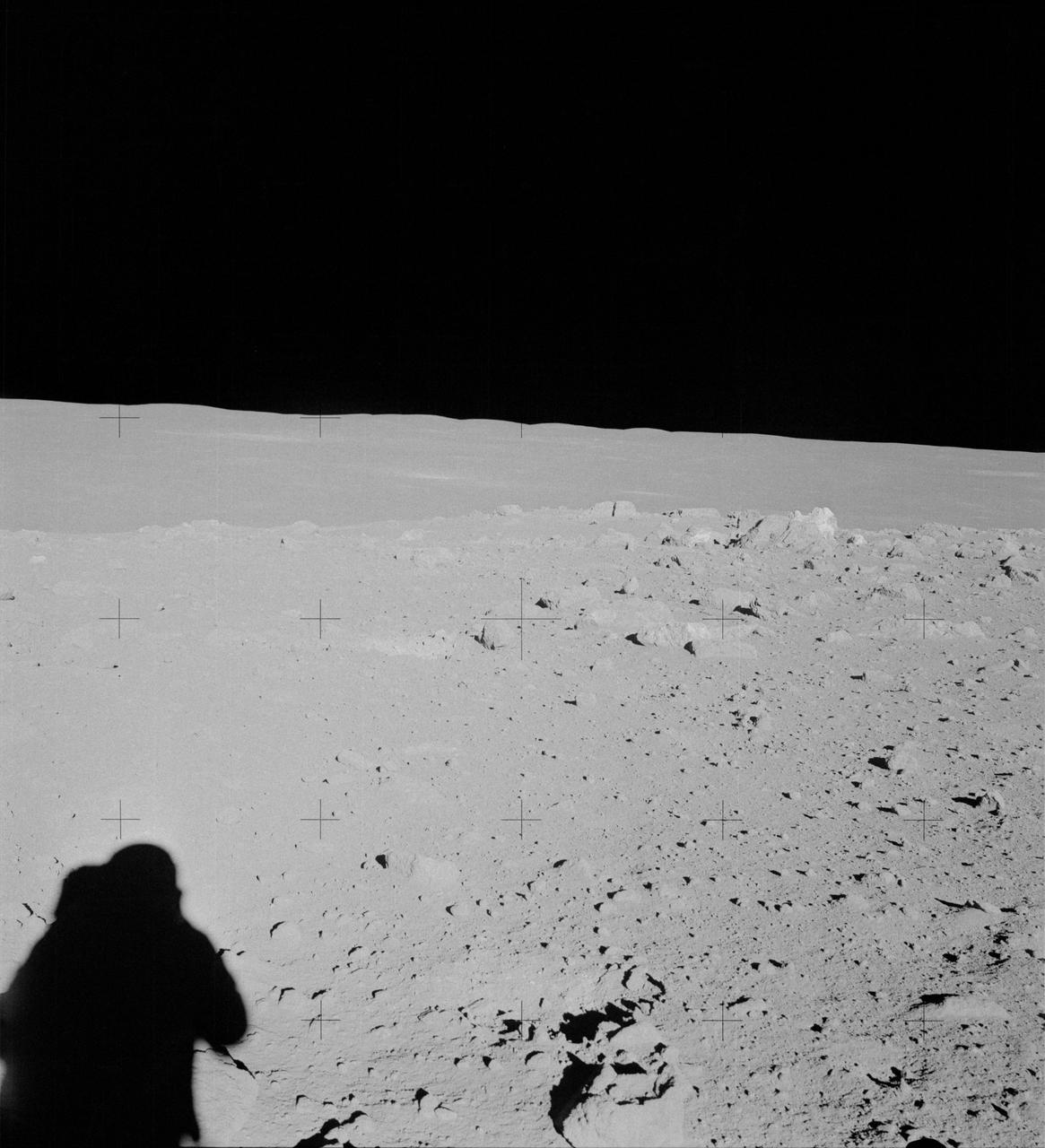
AS14-64-9099 (6 Feb. 1971) --- An Apollo 14 crew member (note shadow) photographs this field of boulders located on the flank of Cone Crater during the second extravehicular activity (EVA). This view is looking just north of west. While astronauts Alan B. Shepard Jr., commander, and Edgar D. Mitchell, lunar module pilot, were exploring the moon, astronaut Stuart A. Roosa, command module pilot, was maneuvering the Apollo 14 Command and Service Modules (CSM) in lunar orbit.
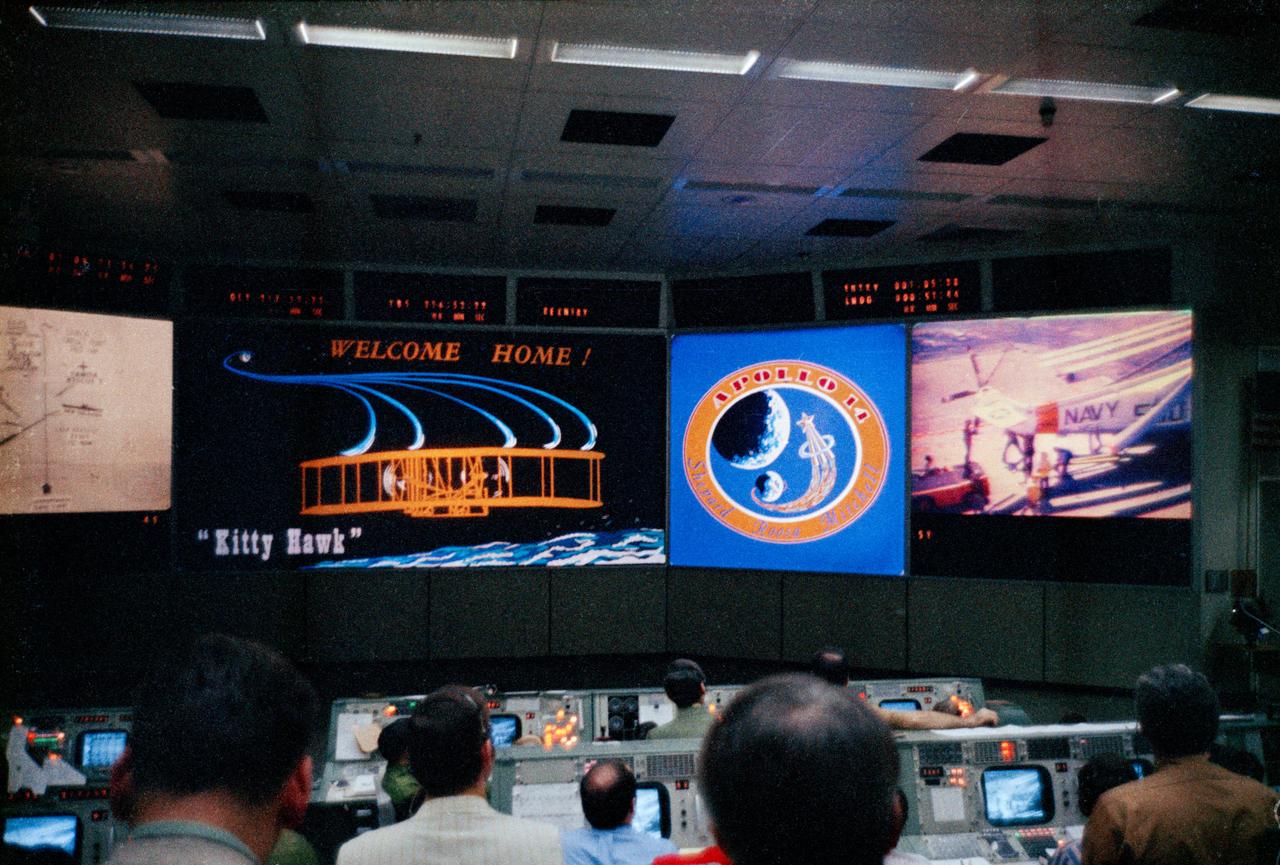
S71-18400 (9 Feb. 1971) --- Flight controllers in the Mission Operations Control Room (MOCR) of the Mission Control Center (MCC) view a colorful display which signals the successful splashdown and recovery of the crew of the Apollo 14 lunar landing mission. The MOCR's large screen at right shows a television shot aboard the USS New Orleans, Apollo 14 prime recovery ship.
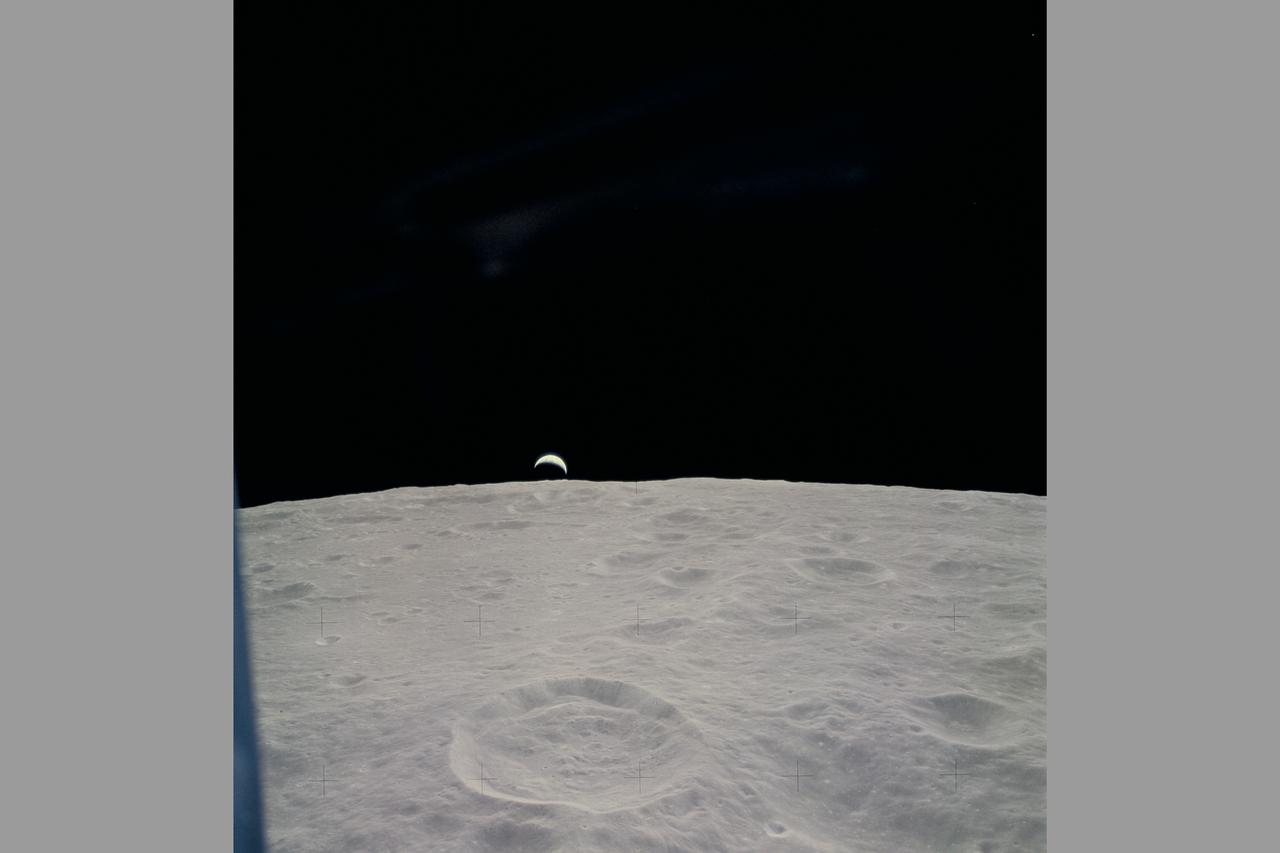
Photo by Apollo Crew The Apollo 14 crew catch a cresent view of the Earth as it raises above the lunar horizon during one moon orbit
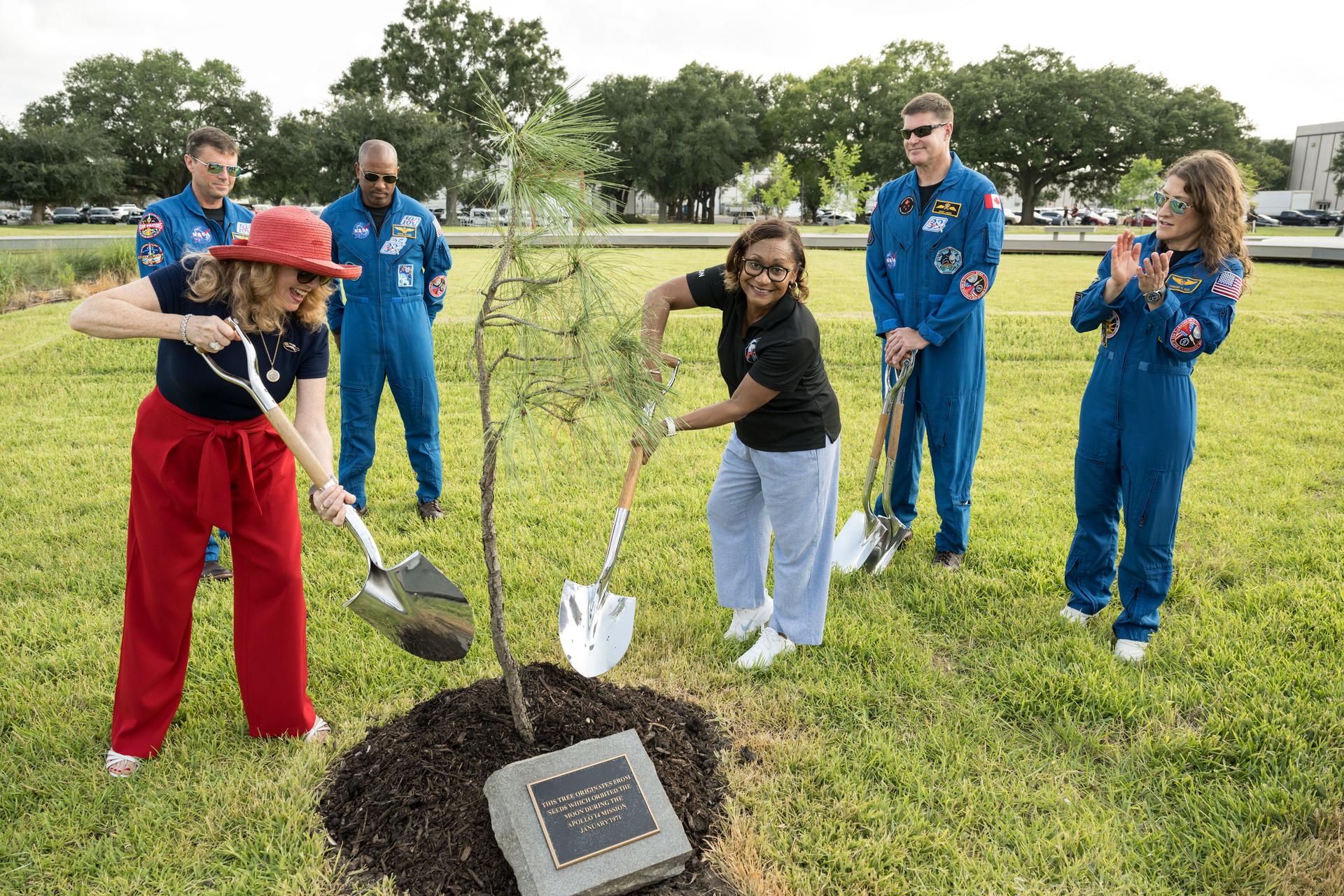
jsc2026e396760 (June 25, 2026) - From left to right, Rosemary Roosa, president of The Moon Tree Foundation and daughter of late Apollo 14 astronaut Stuart Roosa, and Vanessa Wyche, director of NASA's Johnson Space Center, participate in the dedication of the Apollo 14 Moon tree alongside the Artemis II crew. This tree is a second-generation Apollo Moon tree of the loblolly pine species. The original Apollo Moon trees were grown from seeds carried aboard Apollo 14 by NASA astronaut Stuart Roosa, a former U.S. Forest Service smoke jumper. Upon return to Earth, the seeds were germinated by the Forest Service, and the resulting seedlings were planted throughout the United States and around the world. Credit: NASA
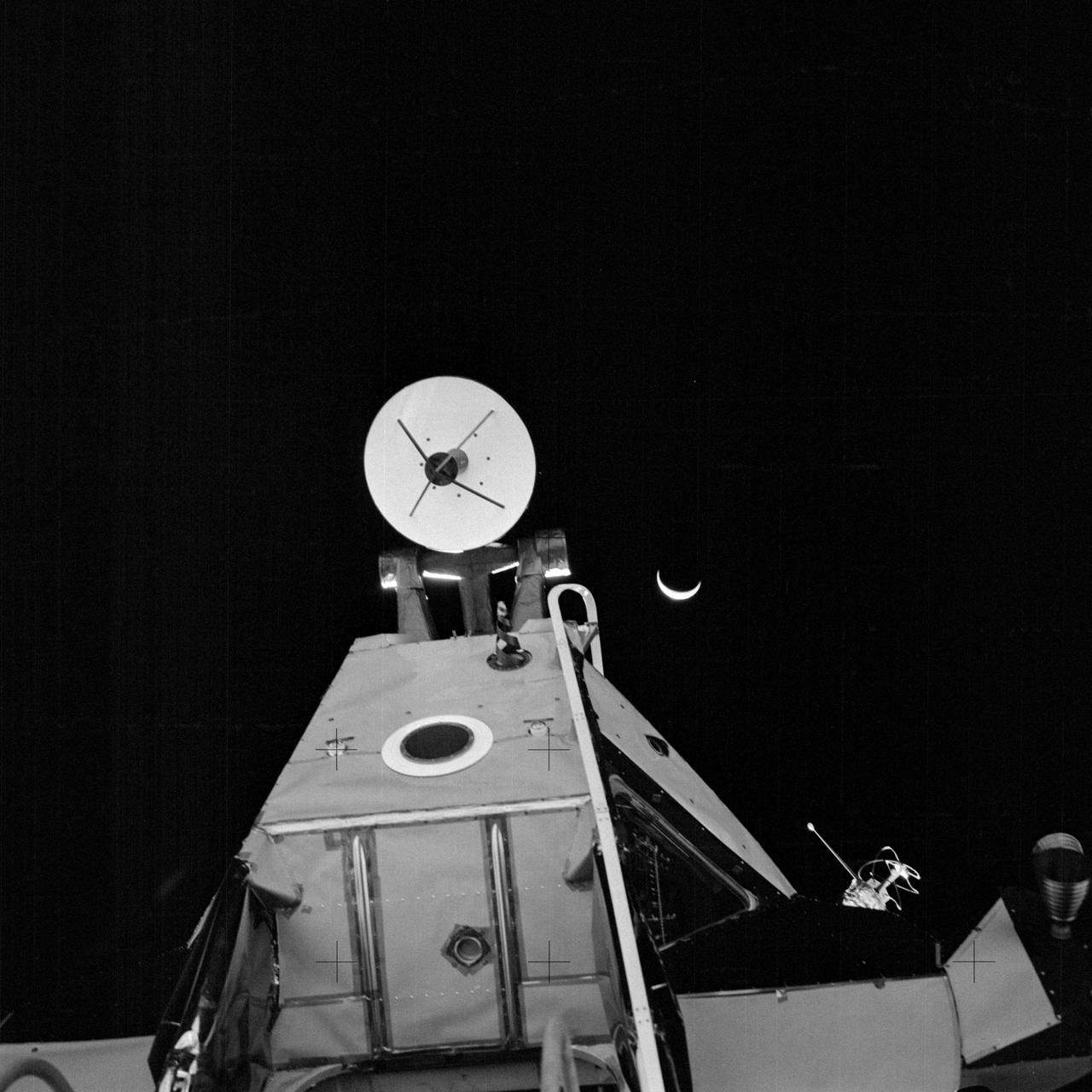
AS14-64-9193 (5 Feb. 1971) --- A close-up view of the forward section of the Apollo 14 Lunar Module (LM) ascent stage, looking upward from the LM ladder. This photograph was taken by one of the Apollo 14 astronauts at the close of their first extravehicular activity (EVA). The LM's ingress/egress hatch is just out of view at the bottom, near center. At the top center is the rendezvous radar antenna. An RCS thruster is visible at the far right. One of the two VHF antennas is on the right. The LM's optical alignment telescope is located at the black circle which has a wide, white ring around it. The crescent Earth can be seen in the far distant background.
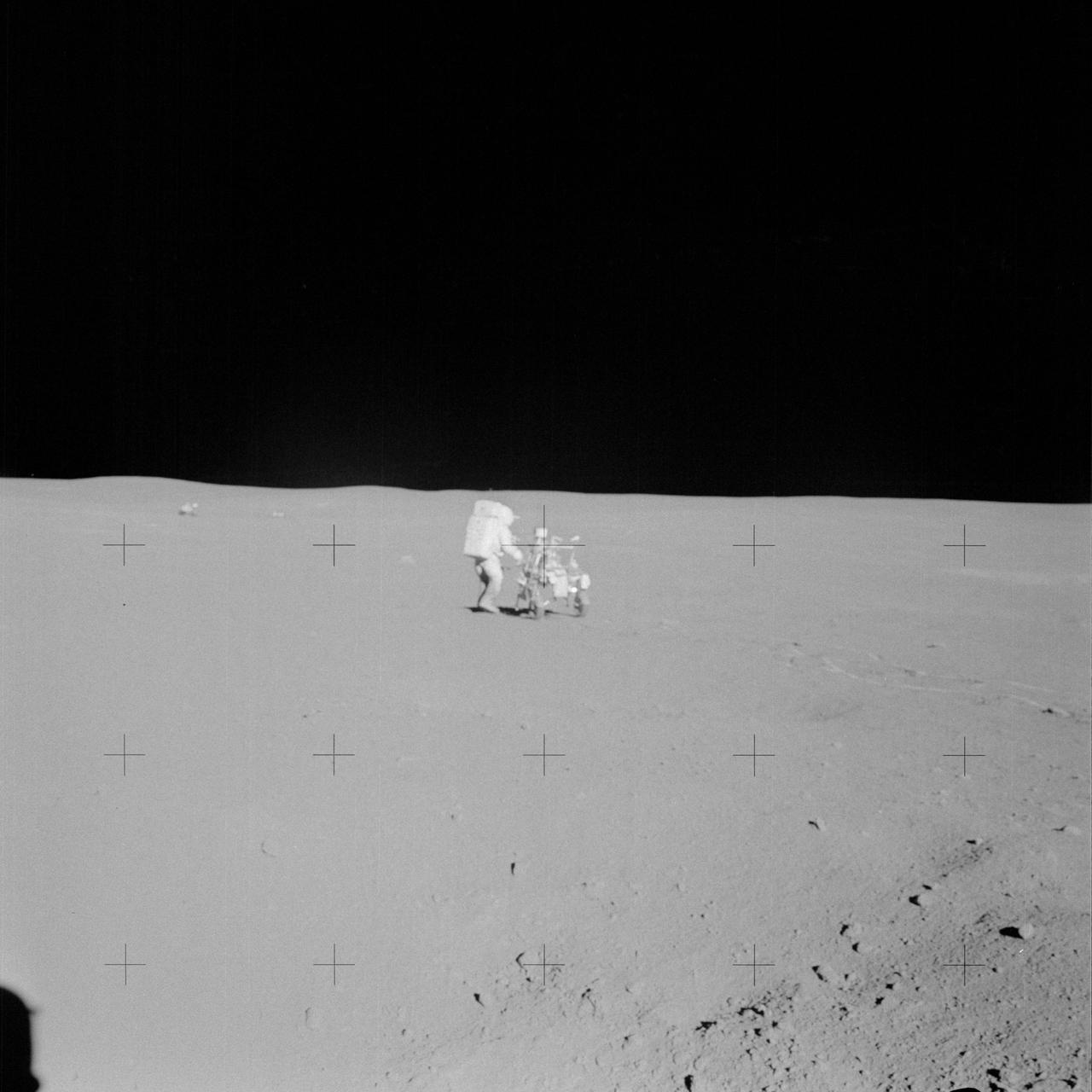
AS14-64-9140 (6 Feb. 1971) --- Astronaut Edgar D. Mitchell, lunar module pilot, participates in the mission's second extravehicular activity (EVA). He is standing near the modularized equipment transporter (MET). While astronauts Alan B. Shepard Jr., commander, and Mitchell descended in the Apollo 14 LM to explore the moon, astronaut Stuart A. Roosa, command module pilot, remained with the Command and Service Modules (CSM) in lunar orbit.
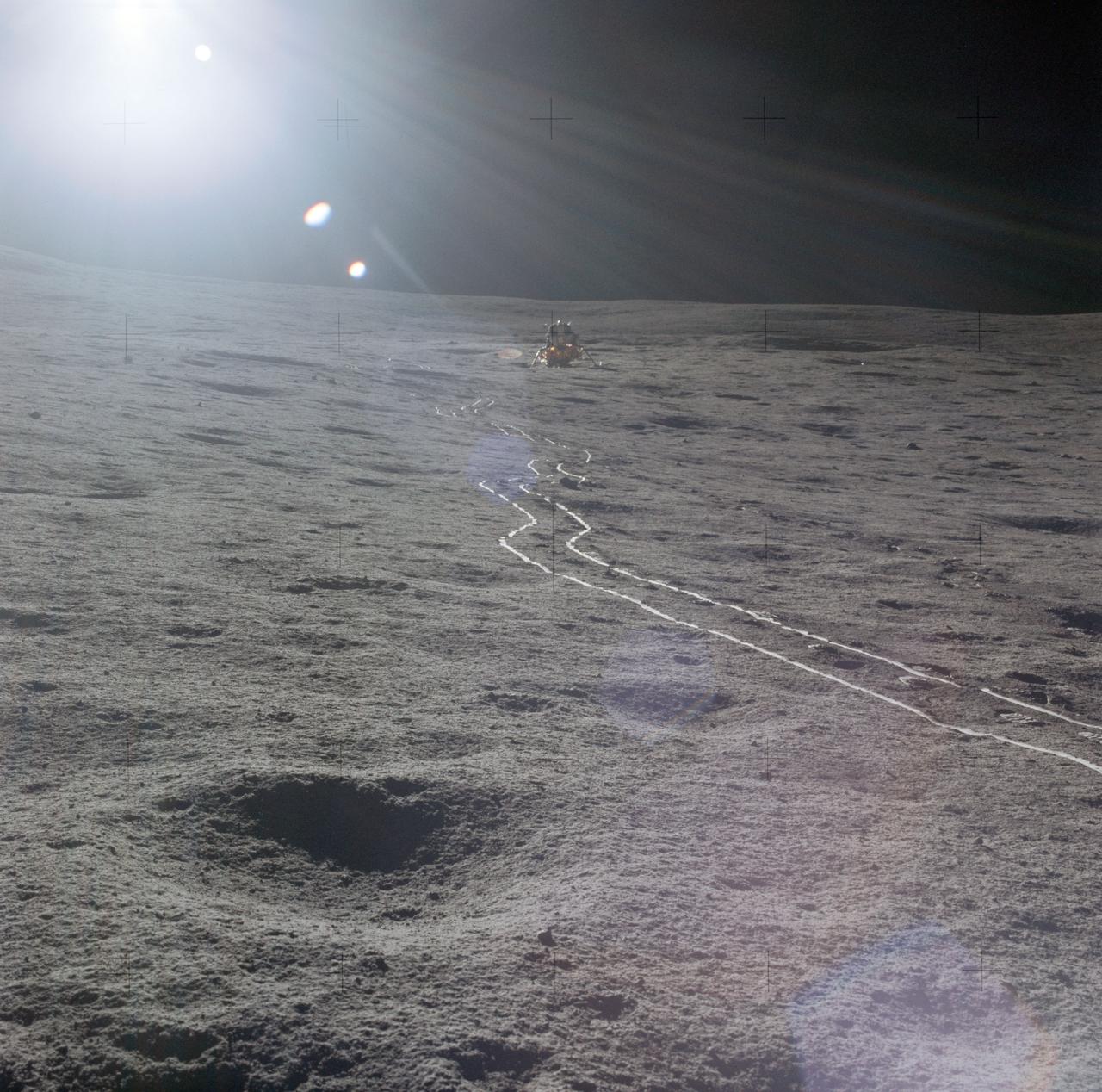
AS14-67-9367 (5 Feb. 1971) --- The Apollo 14 Lunar Module (LM) as seen by the two moon-exploring crewmen of the Apollo 14 lunar landing mission, photographed against a brilliant sun glare during the first extravehicular activity (EVA). A bright trail left in the lunar soil by the two-wheeled modularized equipment transporter (MET) leads from the LM. While astronauts Alan B. Shepard Jr., commander, and Edgar D. Mitchell, lunar module pilot, were exploring the moon, astronaut Stuart A. Roosa, command module pilot, was maneuvering the Command and Service Modules (CSM) in lunar orbit.
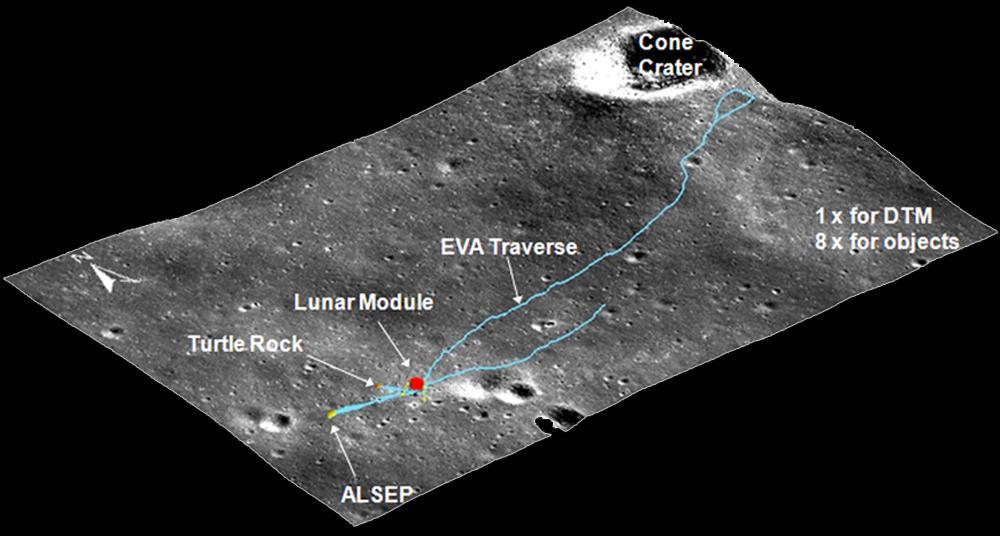
Precise 3D Measurements of Objects at Apollo 14 Landing Site
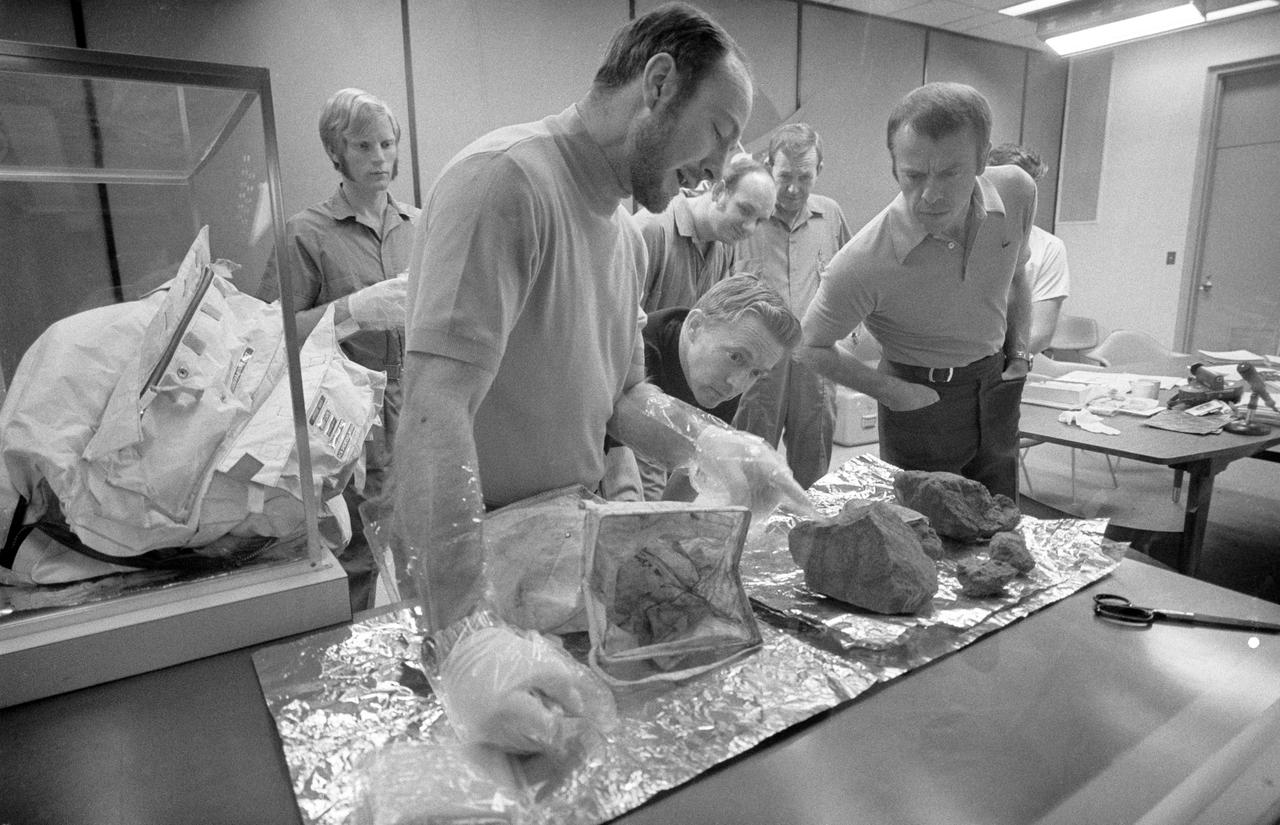
S71-20373 (19 Feb. 1971) --- The Apollo 14 crew men show off some of the largest of the lunar rocks which they brought back from the moon during a through-the-glass meeting with news men in the Crew Reception Area of the Lunar Receiving Laboratory (LRL) at the Manned Spacecraft Center (MSC). Astronaut Alan B. Shepard Jr. (right), mission commander, leans over to view a large basketball-size rock which astronaut Edgar D. Mitchell, lunar module pilot, points out. Astronaut Stuart A. Roosa, command module pilot, who circled the moon in the Command and Service Modules (CSM) while his two fellow crewmembers explored the moon, looks on (near the center of the photograph). Four of the 14 men quarantined with the Apollo 14 crew look on in the background.
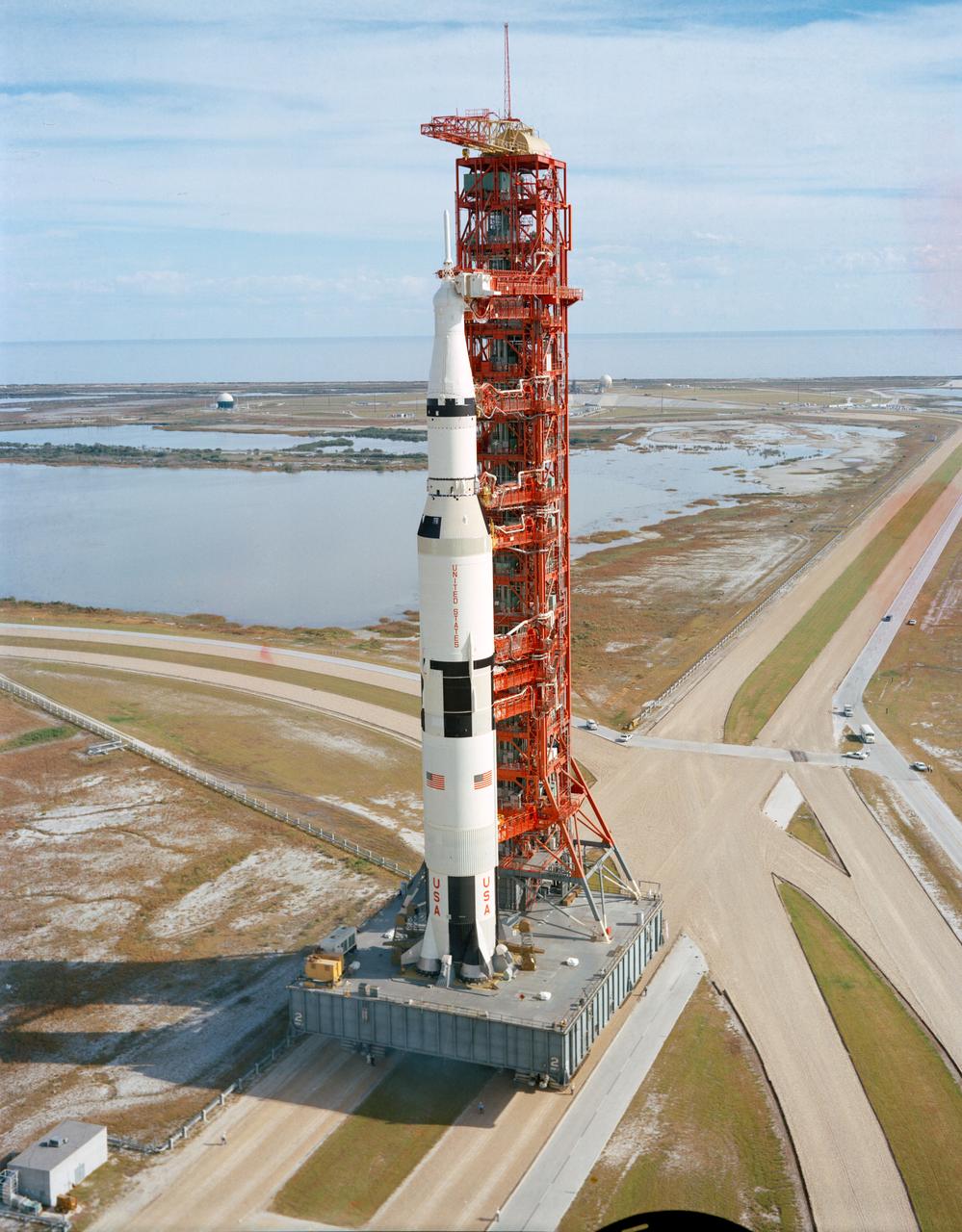
S70-54127 (9 Nov. 1970) --- A high-angle view at Launch Complex 39, Kennedy Space Center (KSC), showing the Apollo 14 (Spacecraft 110/Lunar Module 8/Saturn 509) space vehicle on the way from the Vehicle Assembly Building (VAB) to Pad A. The Saturn V stack and its mobile launch tower sit atop a huge crawler-transporter. The Apollo 14 crewmen will be astronauts Alan B. Shepard Jr., commander; Stuart A. Roosa, command module pilot; and Edgar D. Mitchell, lunar module pilot.
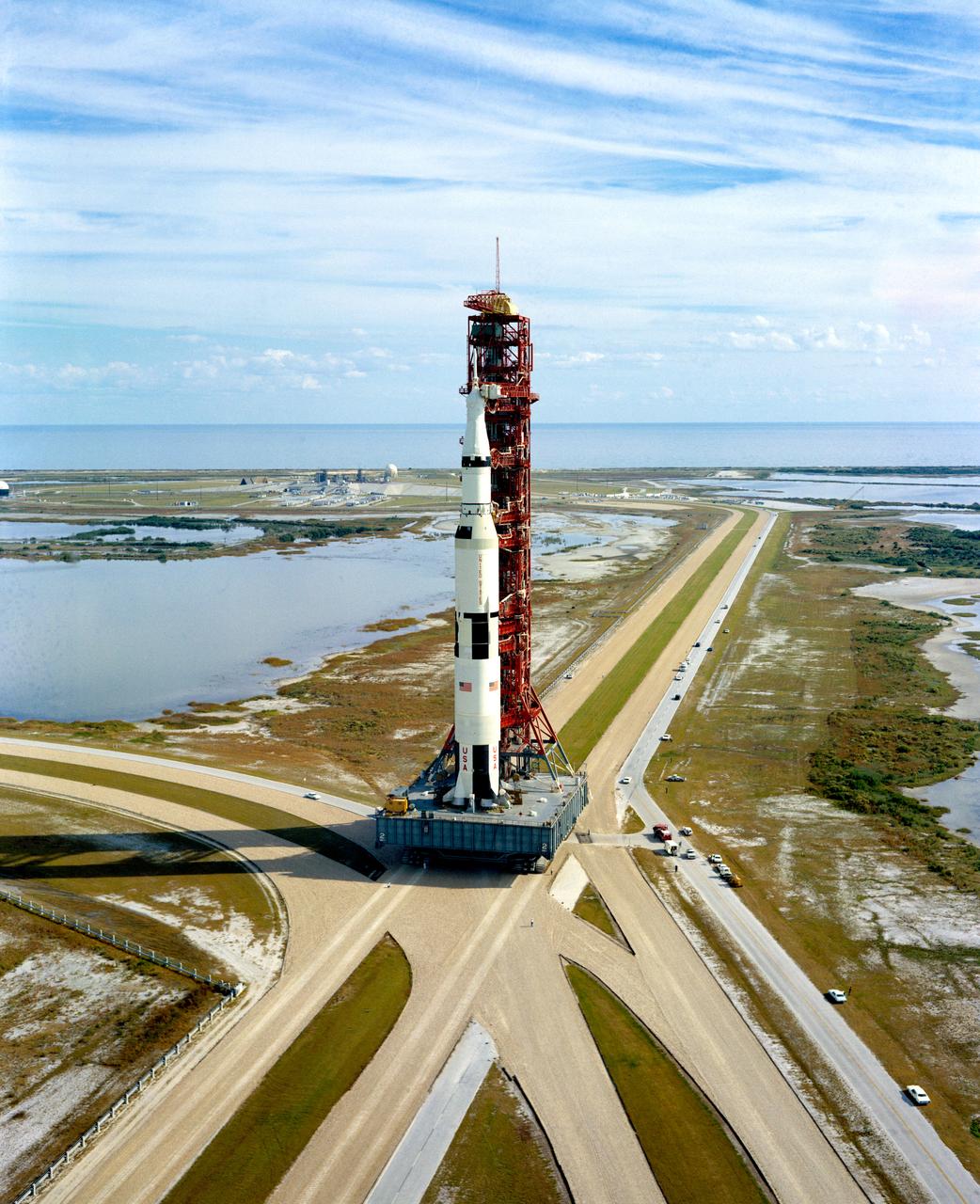
S70-54119 (9 Nov. 1970) --- A high-angle view at Launch Complex 39, Kennedy Space Center (KSC), showing the Apollo 14 (Spacecraft 110/Lunar Module 8/Saturn 509) space vehicle on the way from the Vehicle Assembly Building (VAB) to Pad A. The Saturn V stack and its mobile launch tower sit atop a huge crawler-transporter. The Apollo 14 crewmen will be astronauts Alan B. Shepard Jr., commander; Stuart A. Roosa, command module pilot; and Edgar D. Mitchell, lunar module pilot.
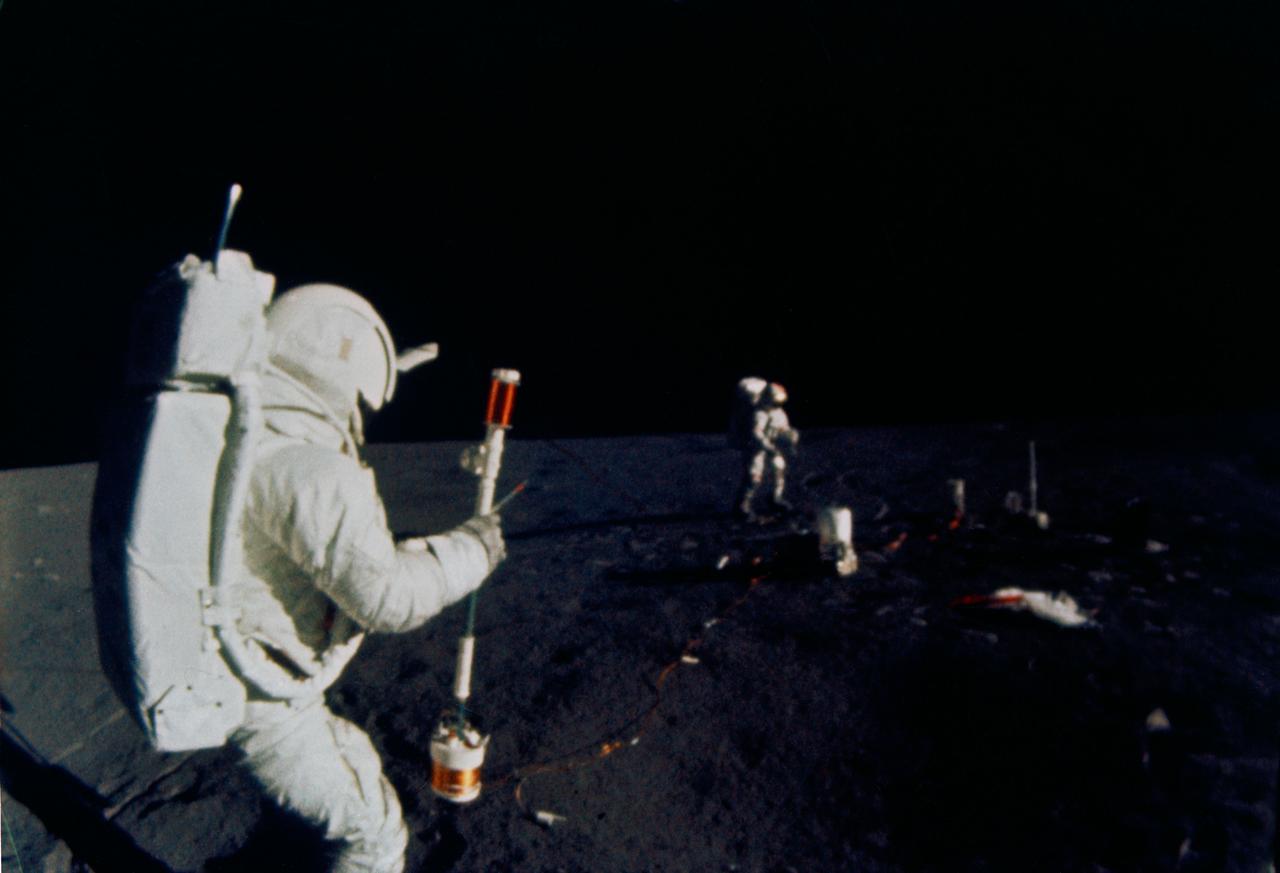
S71-19509 (5 Feb. 1971) --- Astronaut Edgar D. Mitchell, lunar module pilot, operates the Active Seismic Experiment's (ASE) thumper during the first Apollo 14 extravehicular activity (EVA) on the moon. Astronaut Alan B. Shepard Jr., commander, walks near deployed components of the Apollo Lunar Surface Experiments Package (ALSEP) in the background. This photograph was taken by an automatic 16mm camera mounted on the Apollo lunar hand tool carrier aboard the Modularized Equipment Transporter (MET). While astronauts Shepard and Mitchell descended in the LM to explore the moon, astronaut Stuart A. Roosa, command module pilot, remained with the Command and Service Modules (CSM) in lunar orbit.
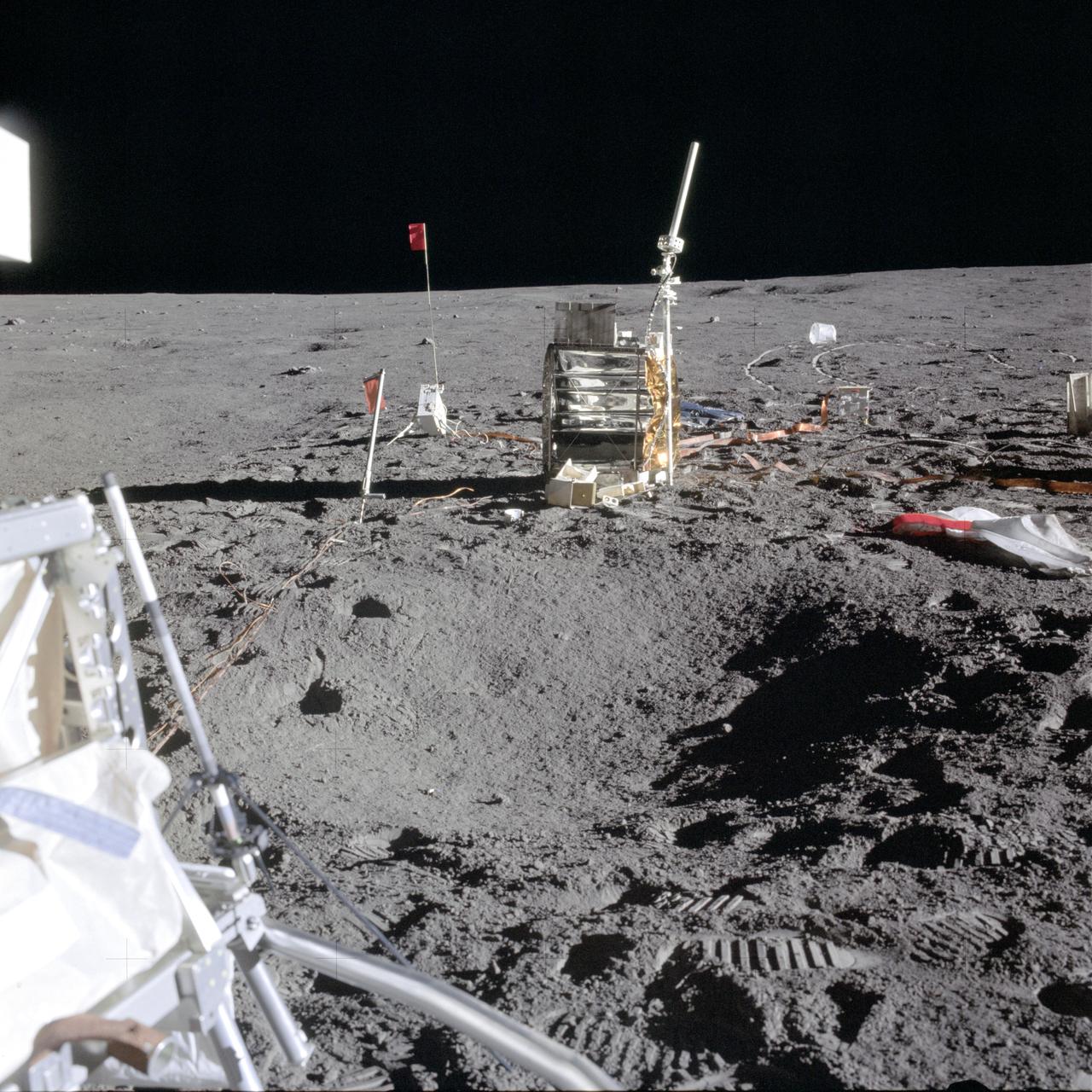
AS14-67-9376 (5 Feb. 1971) --- Several components of the Apollo lunar surface experiments package (ASLEP) are deployed in this photograph taken during the first Apollo 14 extravehicular activity (EVA). The larger object with antenna is the ALSEP central station (CS). The active seismic experiment (ASE) mortar package assembly is to the rear left of the CS. The charged particle lunar environment experiment (CPLEE) is to the right rear of the CS. A portion of the modularized equipment transporter (MET) can be seen in the left foreground.
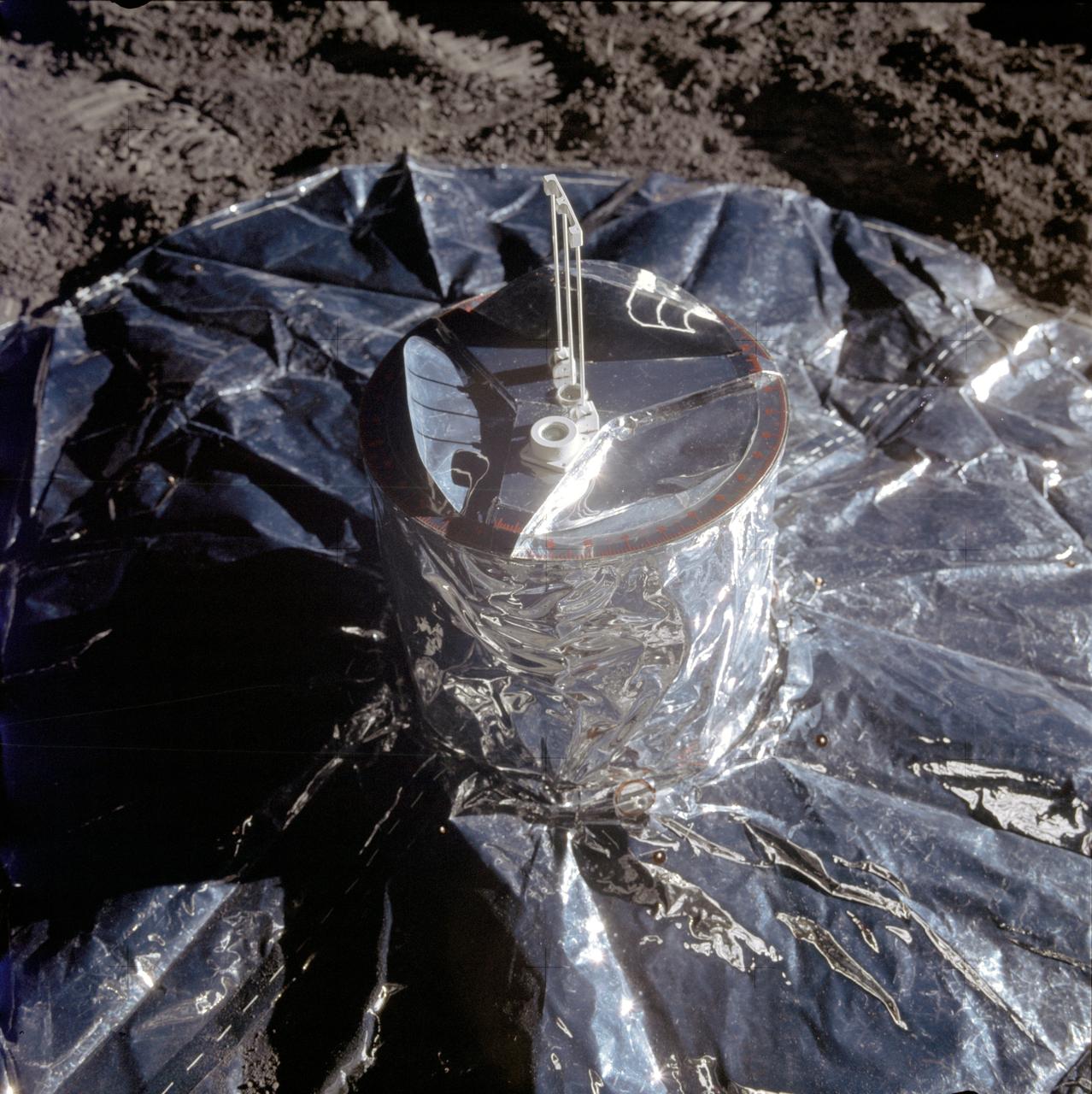
AS14-67-9362 (5 Feb. 1971) --- A close-up view of the passive seismic experiment (PSE), a component of the Apollo lunar surface experiments package (ALSEP), which was deployed on the moon by the Apollo 14 astronauts during their first extravehicular activity (EVA). While astronauts Alan B. Shepard Jr., commander, and Edgar D. Mitchell, lunar module pilot, descended in the Lunar Module (LM) to explore the moon, astronaut Stuart A. Roosa, command module pilot, remained with the Command and Service Modules (CSM) in lunar orbit.
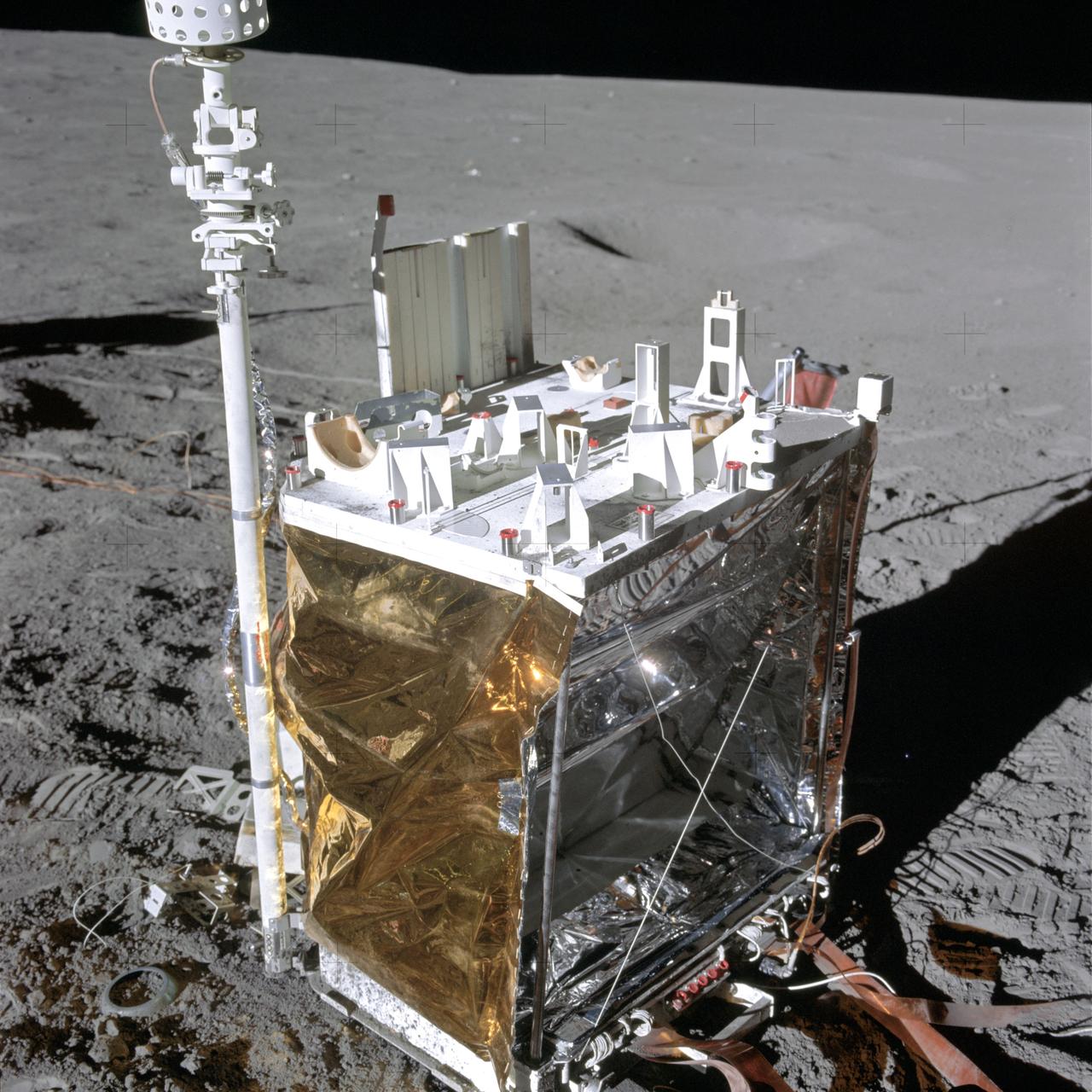
AS14-67-9379 (5 Feb. 1971) --- A close-up view of the central station (CS) of the Apollo lunar surface experiments package (ALSEP), which was deployed on the moon by the Apollo 14 astronauts during their first extravehicular activity (EVA). While astronauts Alan B. Shepard Jr., commander, and Edgar D. Mitchell, lunar module pilot, descended in the Lunar Module (LM) to explore the moon, astronaut Stuart A. Roosa, command module pilot, remained with the Command and Service Modules (CSM) in lunar orbit.
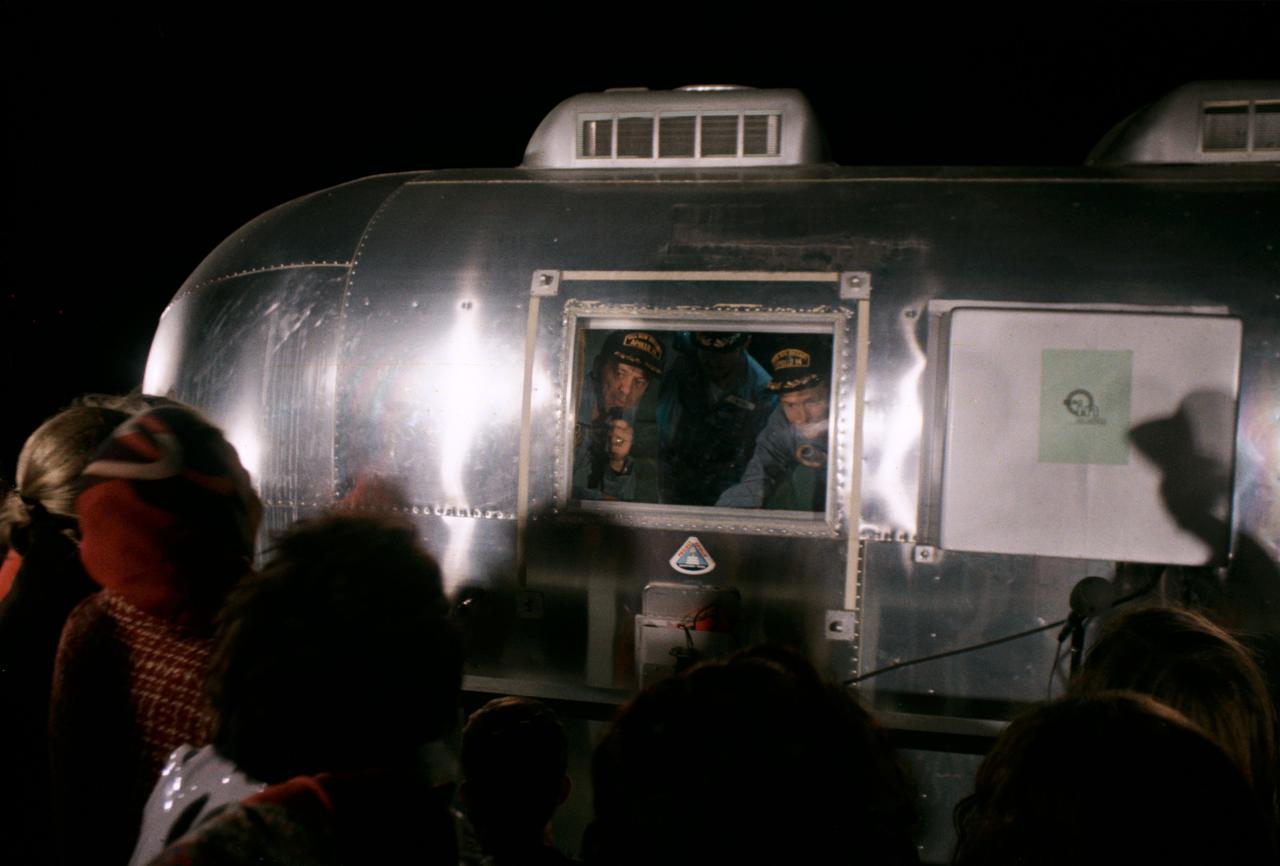
S71-19508 (12 Feb. 1971) --- Separated by aluminum and glass of their Mobile Quarantine Facility (MQF), the Apollo 14 crew members visit with their families and friends upon arriving at Ellington Air Force Base in the early morning hours of Feb. 12, 1971. Looking through the MQF window are astronauts Alan B. Shepard Jr. (left), commander; Stuart A. Roosa (right), command module pilot; and Edgar D. Mitchell, lunar module pilot. The crew men were brought to Houston aboard a C-141 transport plane from Pago Pago, American Samoa. The USS New Orleans had transported the crew to American Samoa from the recovery site in the South Pacific.
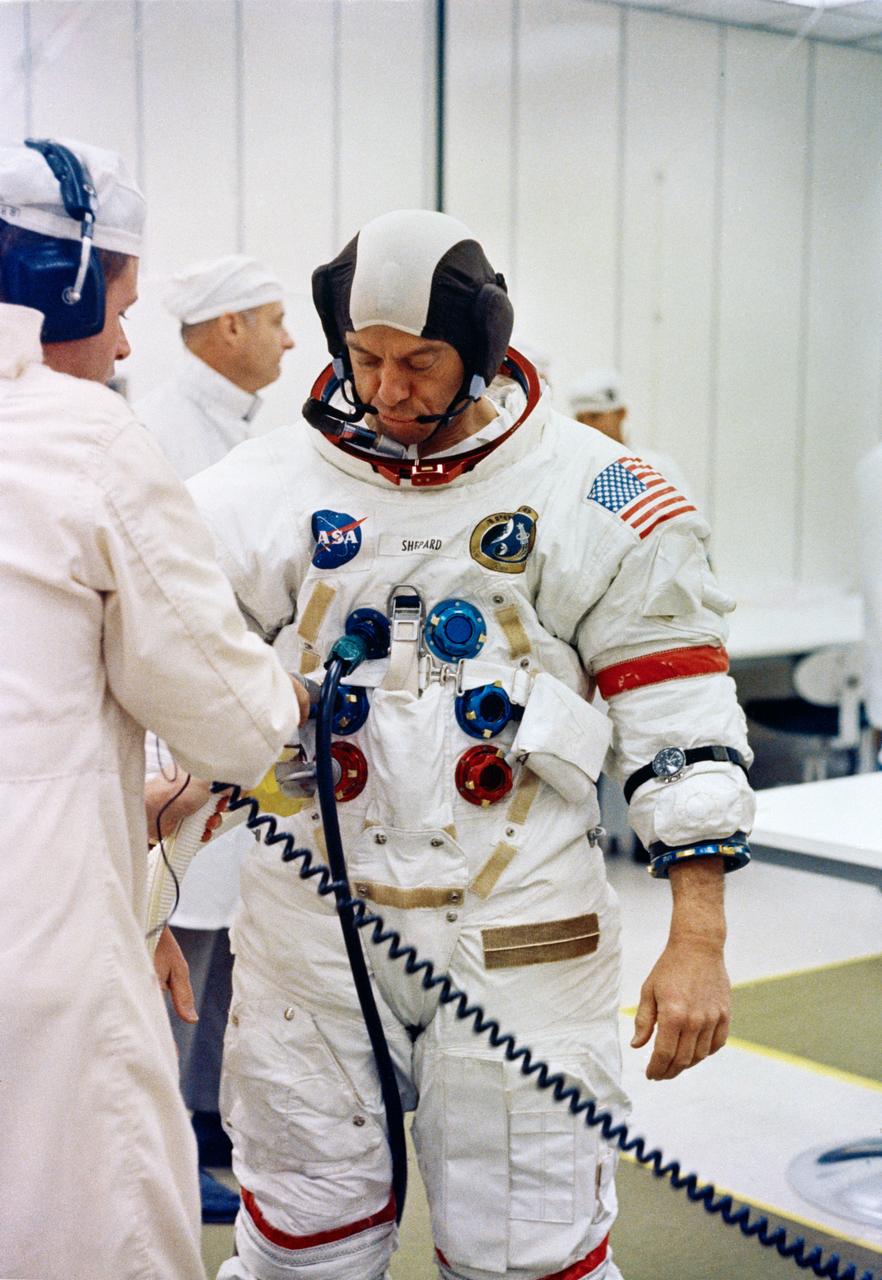
S71-16638 (31 Jan. 1971) --- Astronaut Alan B. Shepard Jr., commander, undergoes suiting up operations at the Kennedy Space Center (KSC) during the Apollo 14 prelaunch countdown. Apollo 14, with astronauts Shepard; Edgar D. Mitchell, lunar module pilot; and Stuart A. Roosa, command module pilot; aboard was launched from Pad A, Launch Complex 39 at 4:03:02 p.m. (EST), Jan. 31, 1971.
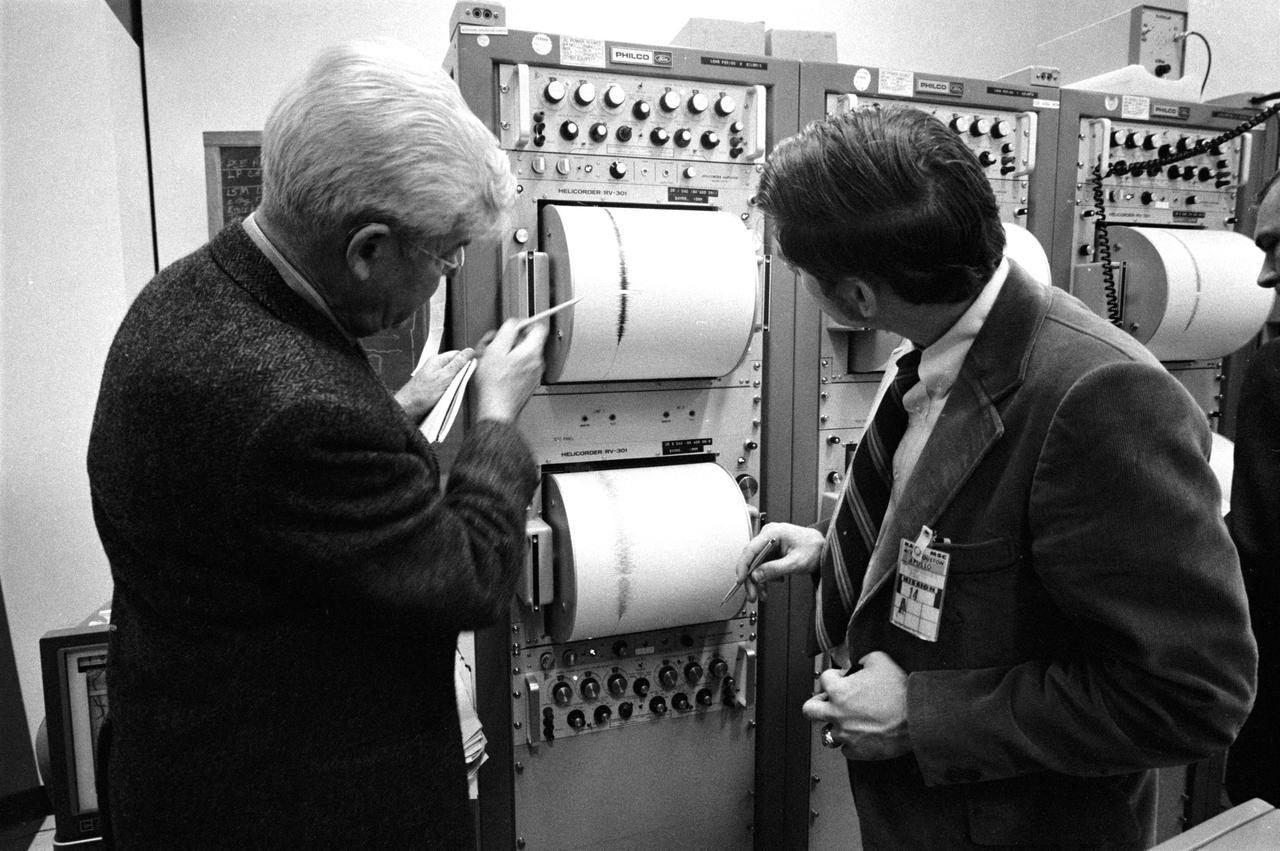
S71-17609 (4 Feb. 1971) --- These two individuals are examining a seismic reading in the Mission Control Center's ALSEP Room during the Apollo 14 S-IVB impact on the moon. Dr. Maurice Ewing (left) is the director of the Lamont-Doherty Geological Observatory at Columbia University. David Lammlein, a Columbia graduate student, is on the right. The Apollo 14 Saturn IVB stage impacted on the lunar surface at 1:40:54 a.m. (CST), Feb. 4, 1971, about 90 nautical miles south-southwest of the Apollo 12 passive seismometer. The energy release was comparable to 11 tons of TNT. Dr. Gary Latham of the Lamont-Doherty Geological Observatory is the principal investigator for the Passive Seismic Experiment, a component of the Apollo Lunar Surface Experiments Package.

AS14-66-9305 (5 Feb. 1971) --- A front view of the Apollo 14 Lunar Module (LM), which reflects a circular flare caused by the brilliant sun, as seen by the two moon-exploring crew men (out of frame) of the Apollo 14 lunar landing mission during their first extravehicular activity (EVA). The unusual ball of light was said by the astronauts to have a jewel-like appearance. In the left background Cone Crater can be seen. In the left foreground are the erectable S-Band antenna and the United States flag. Astronauts Alan B. Shepard Jr., commander, and Edgar D. Mitchell, lunar module pilot, descended in the LM, while astronaut Stuart A. Roosa, command module pilot, remained with the Command and Service Modules (CSM) in lunar orbit.
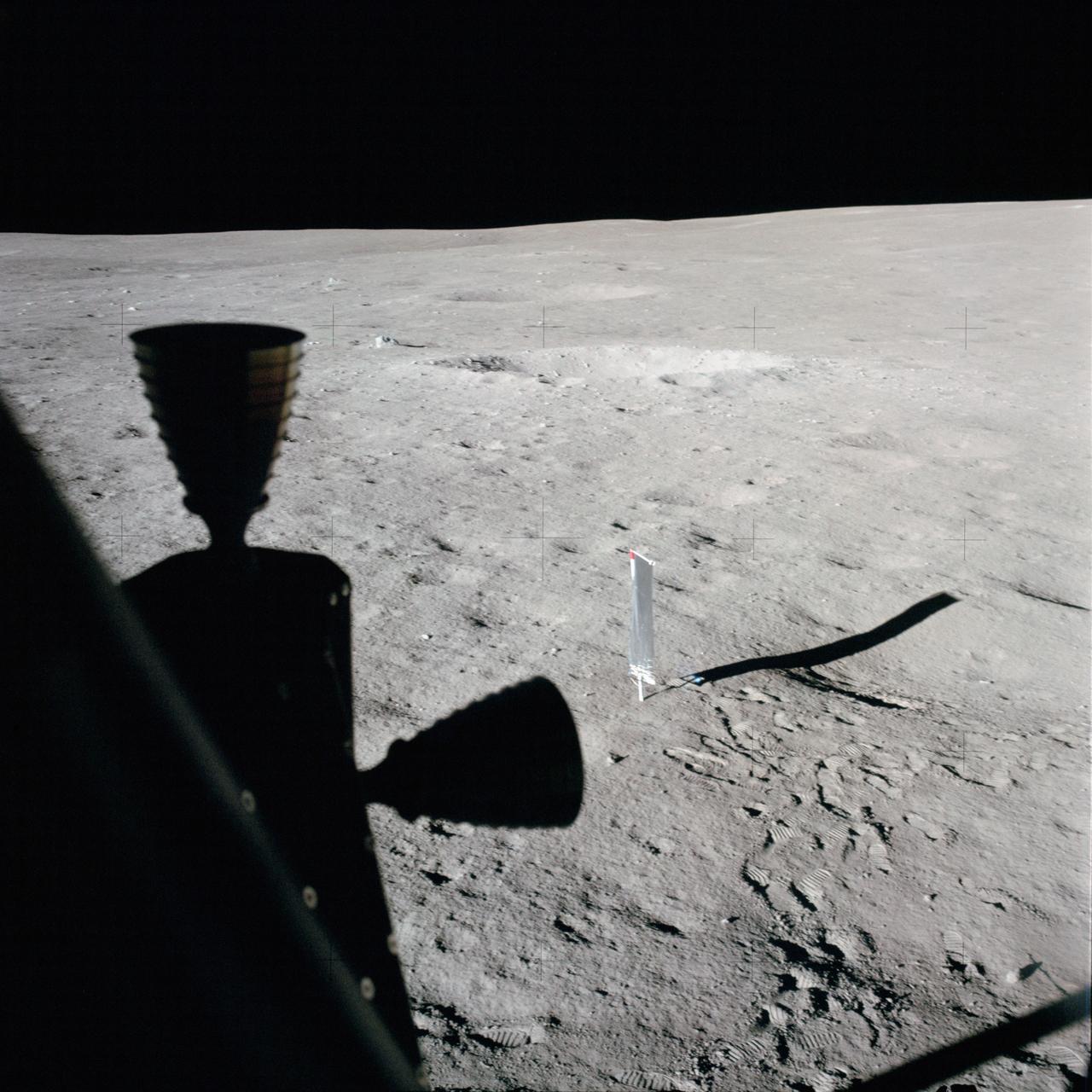
AS14-66-9322 (5-6 Feb. 1971) --- This photograph taken through a window of the Apollo 14 Lunar Module (LM), on the moon, shows an excellent view of the nearby terrain. In the center background is the deployed solar wind composition (SWC) experiment. Two LM RCS thrusters are silhouetted in the left foreground. While astronauts Alan B. Shepard Jr., commander; and Edgar D. Mitchell, lunar module pilot; descended in the LM, astronaut Stuart A. Roosa, command module pilot, remained with the Command and Service Modules (CSM) in lunar orbit.
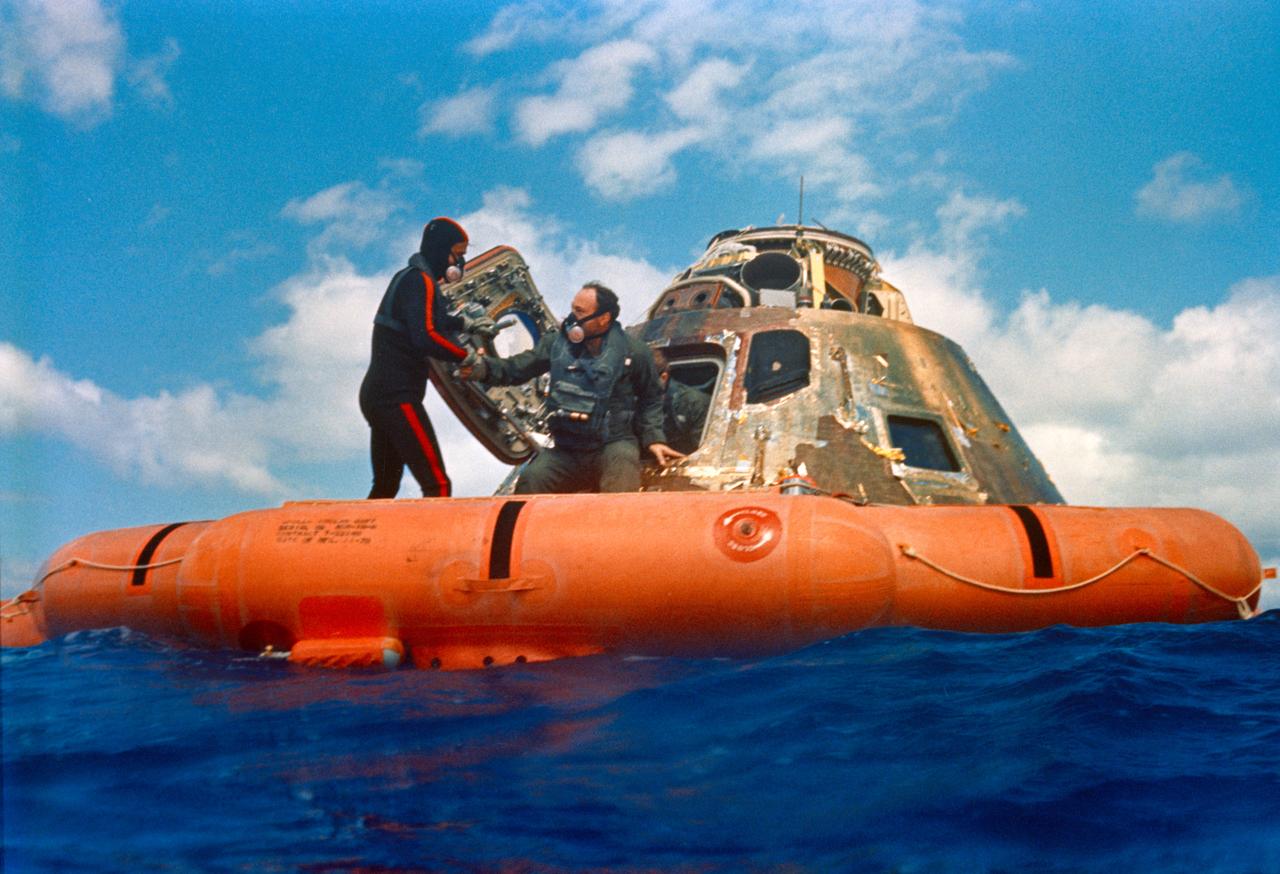
S71-19474 (9 Feb. 1971) --- Astronaut Edgar D. Mitchell, lunar module pilot, is assisted out of the Command Module (CM) by a U.S. Navy underwater demolition team swimmer during the Apollo 14 recovery operations in the South Pacific Ocean. Mitchell was followed out of the spacecraft by astronauts Alan B. Shepard Jr., commander; and Stuart A. Roosa, command module pilot. Roosa is partially visible behind Mitchell. The Apollo 14 splashdown occurred at 3:04:39 p.m. (CST), Feb. 9, 1971, in the South Pacific Ocean, approximately 765 nautical miles from American Samoa. They were transported by U.S. Navy helicopter to the USS New Orleans, prime recovery vessel.
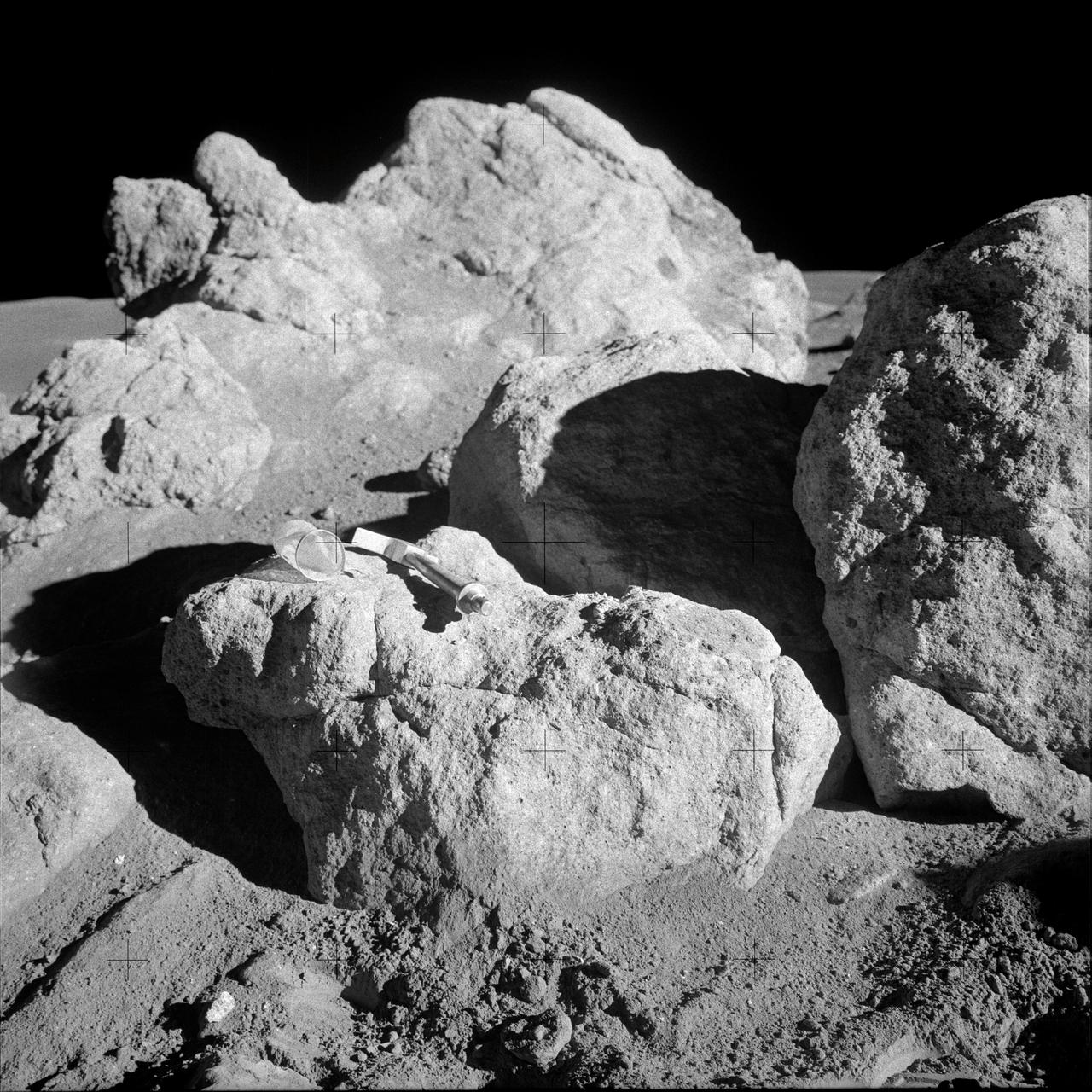
AS14-68-9452 (5-6 Feb. 1971) --- A hammer and a small collection bag lie atop a lunar boulder to give some indication of size in this view of several boulders clustered together. This is one of the white rocks from which samples were taken by the two moon-exploring crew men of the Apollo 14 lunar landing mission. While astronauts Alan B. Shepard Jr., commander, and Edgar D. Mitchell, lunar module pilot, were exploring the moon, astronaut Stuart A. Roosa, command module pilot, remained with the Command and Service Modules (CSM) in lunar orbit.

Stuart A. Roosa, Apollo 14 Command Module pilot, undergoes a final space suit check prior to liftoff. The Apollo 14, carrying a crew of three astronauts: Roosa; Alan B. Shepard, Jr., Mission Commander; and Edgar D. Mitchell, Lunar Module pilot, lifted off from launch complex 39A at KSC on January 31, 1971. It was the third manned lunar landing, the first manned landing in exploration of the lunar highlands, and it demonstrated pinpoint landing capability. The major goal of Apollo 14 was the scientific exploration of the Moon in the foothills of the rugged Fra Mauro region. The lunar surface extravehicular activity (EVA) of astronauts Shepard and Mitchell included setting up an automated scientific laboratory called Apollo Lunar Scientific Experiments Package (ALSEP), and collecting a total of about 95 pounds (43 kilograms) of Moon rock and soil for a geological investigation back on the Earth. Apollo 14 safely returned to Earth on February 9, 1971.
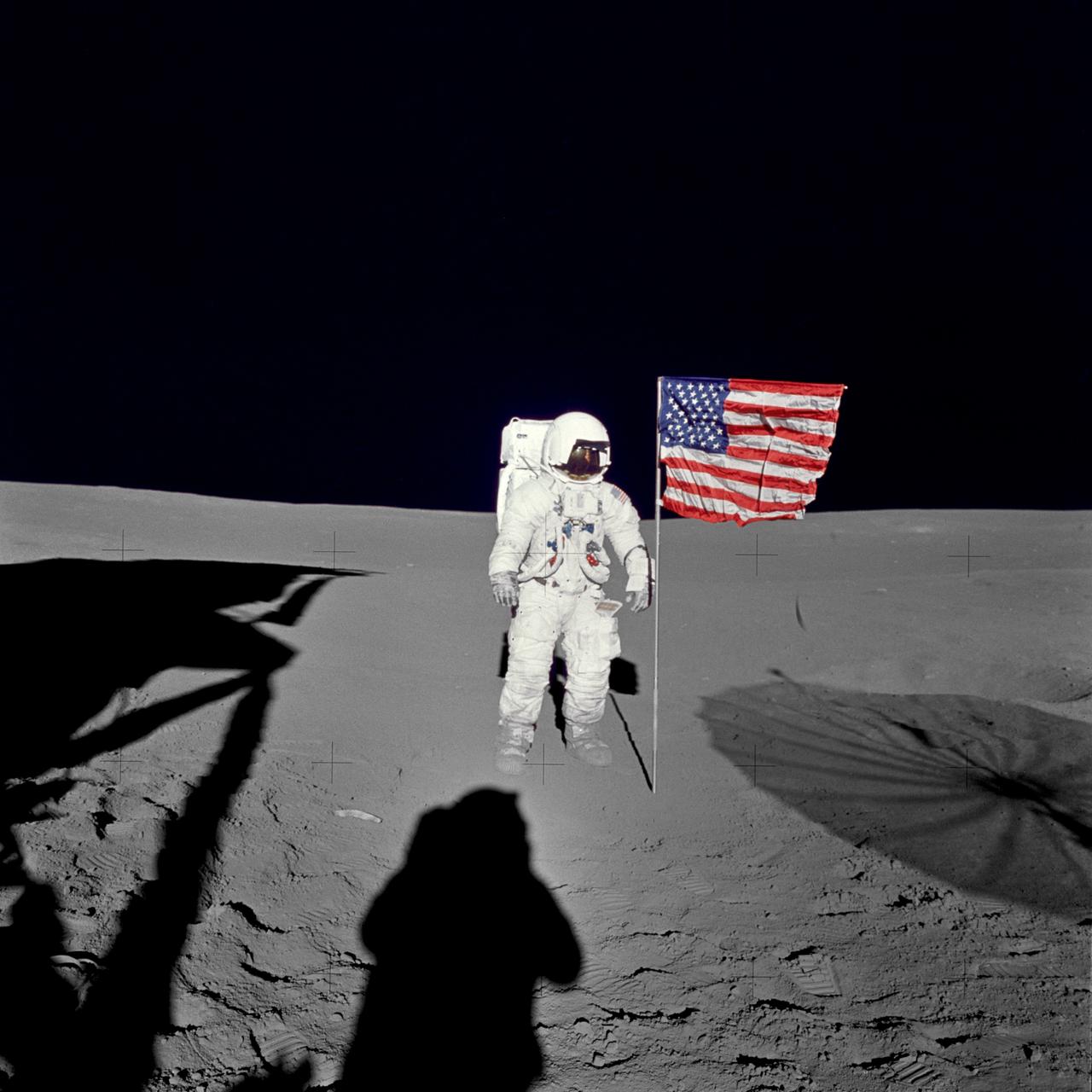
AS14-66-9233 (5 Feb. 1971) --- Astronaut Edgar D. Mitchell, lunar module pilot for the Apollo 14 lunar landing mission, stands by the deployed U.S. flag on the lunar surface during the early moments of the first extravehicular activity (EVA) of the mission. He was photographed by astronaut Alan B. Shepard Jr., mission commander, using a 70mm modified lunar surface Hasselblad camera. While astronauts Shepard and Mitchell descended in the Lunar Module (LM) "Antares" to explore the Fra Mauro region of the moon, astronaut Stuart A. Roosa, command module pilot, remained with the Command and Service Modules (CSM) "Kitty Hawk" in lunar orbit.
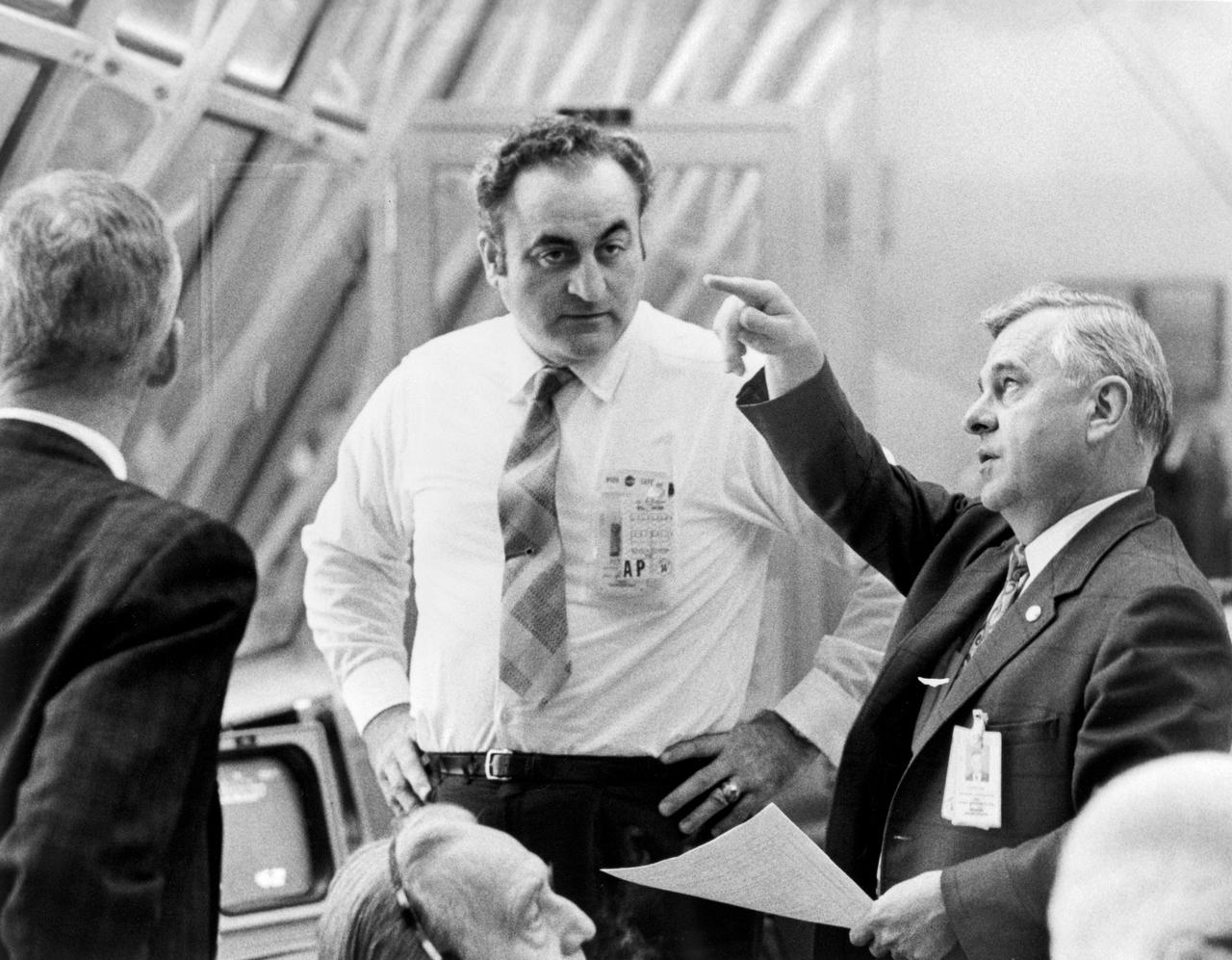
In the launch control center at Kennedy Space Flight Center (KSC), Walter J. Kapryan, Director of Launch Operations (center), discusses an aspect of the Apollo 14 flight with Marshall Space Flight Center’s (MSFC) Dr. Rocco A. Petrone, Apollo Program Director (right). The Apollo 14, carrying a crew of three astronauts: Mission commander Alan B. Shepard Jr., Command Module pilot Stuart A. Roosa, and Lunar Module pilot Edgar D. Mitchell, lifted off from launch complex 39A at KSC on January 31, 1971. It was the third manned lunar landing, the first manned landing in exploration of the lunar highlands, and it demonstrated pinpoint landing capability. The major goal of Apollo 14 was the scientific exploration of the Moon in the foothills of the rugged Fra Mauro region. The extravehicular activity (EVA) of astronauts Shepard and Mitchell included setting up an automated scientific laboratory called Apollo Lunar Scientific Experiments Package (ALSEP), and collecting a total of about 95 pounds (43 kilograms) of Moon rock and soil for a geological investigation back on the Earth. Apollo 14 safely returned to Earth on February 9, 1971.
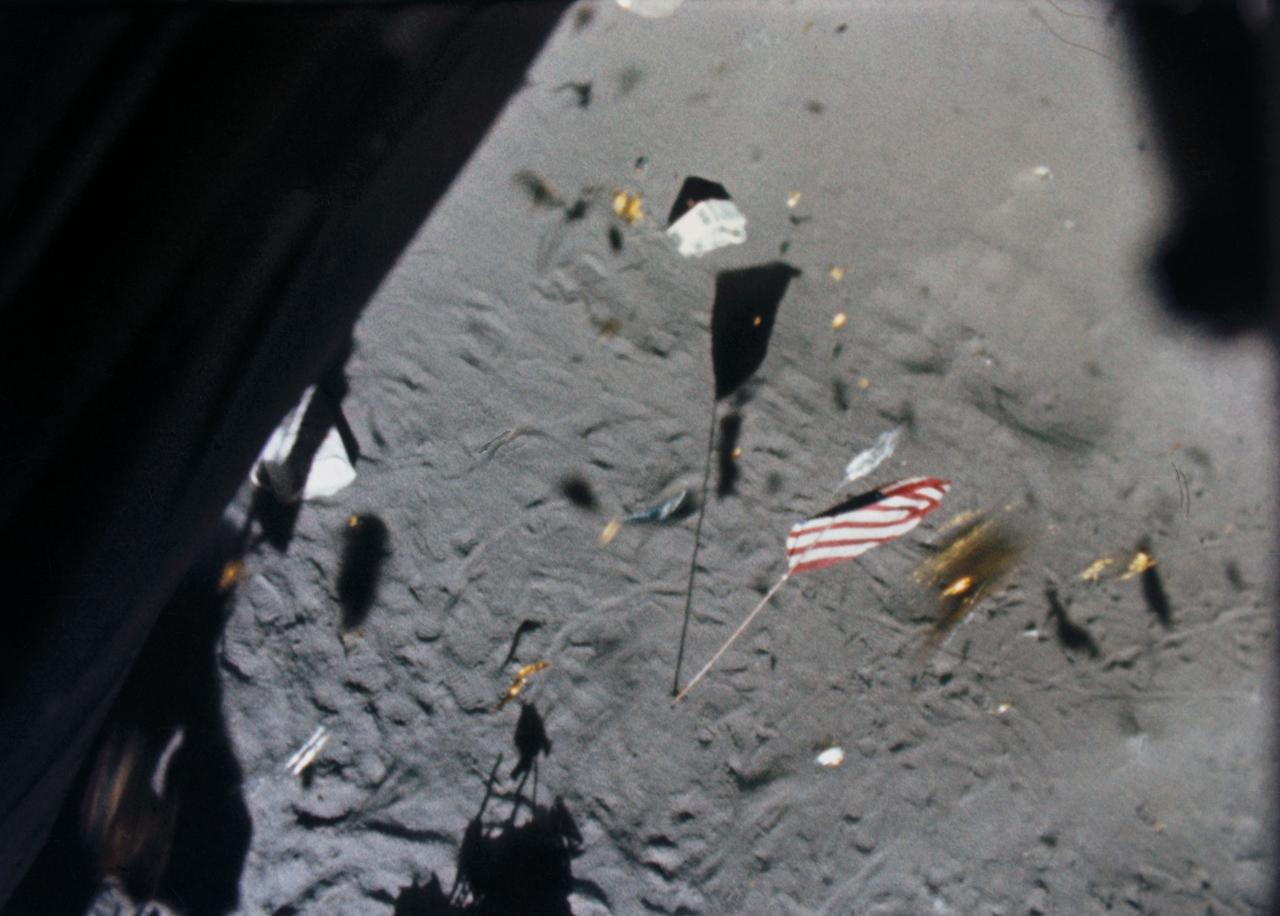
S71-19500 (6 Feb. 1971) --- The Apollo 14 Lunar Module (LM) ascent stage lifts off the lunar surface and the powerful LM engine causes a brief force of wind which scatters gold-colored foil, covering the LM, and disturbs the U.S. flag. This picture was taken from film exposed by the 16mm data acquisition camera - which was mounted inside the LM.
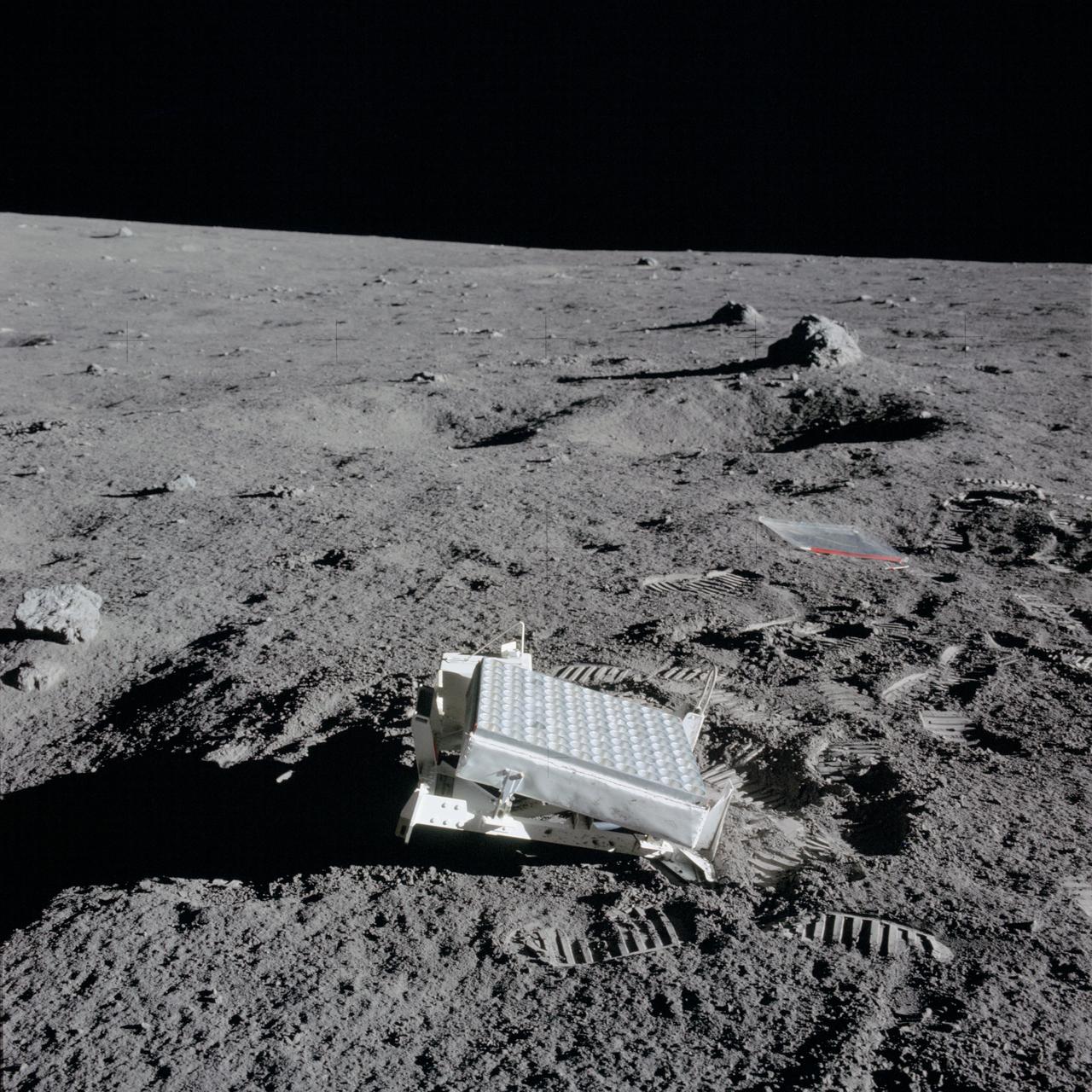
AS14-67-9386 (5 Feb. 1971) --- A close-up view of the laser ranging retro reflector (LR3) which the Apollo 14 astronauts deployed on the moon during their lunar surface extravehicular activity (EVA). While astronauts Alan B. Shepard Jr., commander, and Edgar D. Mitchell, lunar module pilot, descended in the Lunar Module (LM) to explore the moon, astronaut Stuart A. Roosa, command module pilot, remained with the Command and Service Modules (CSM) in lunar orbit.
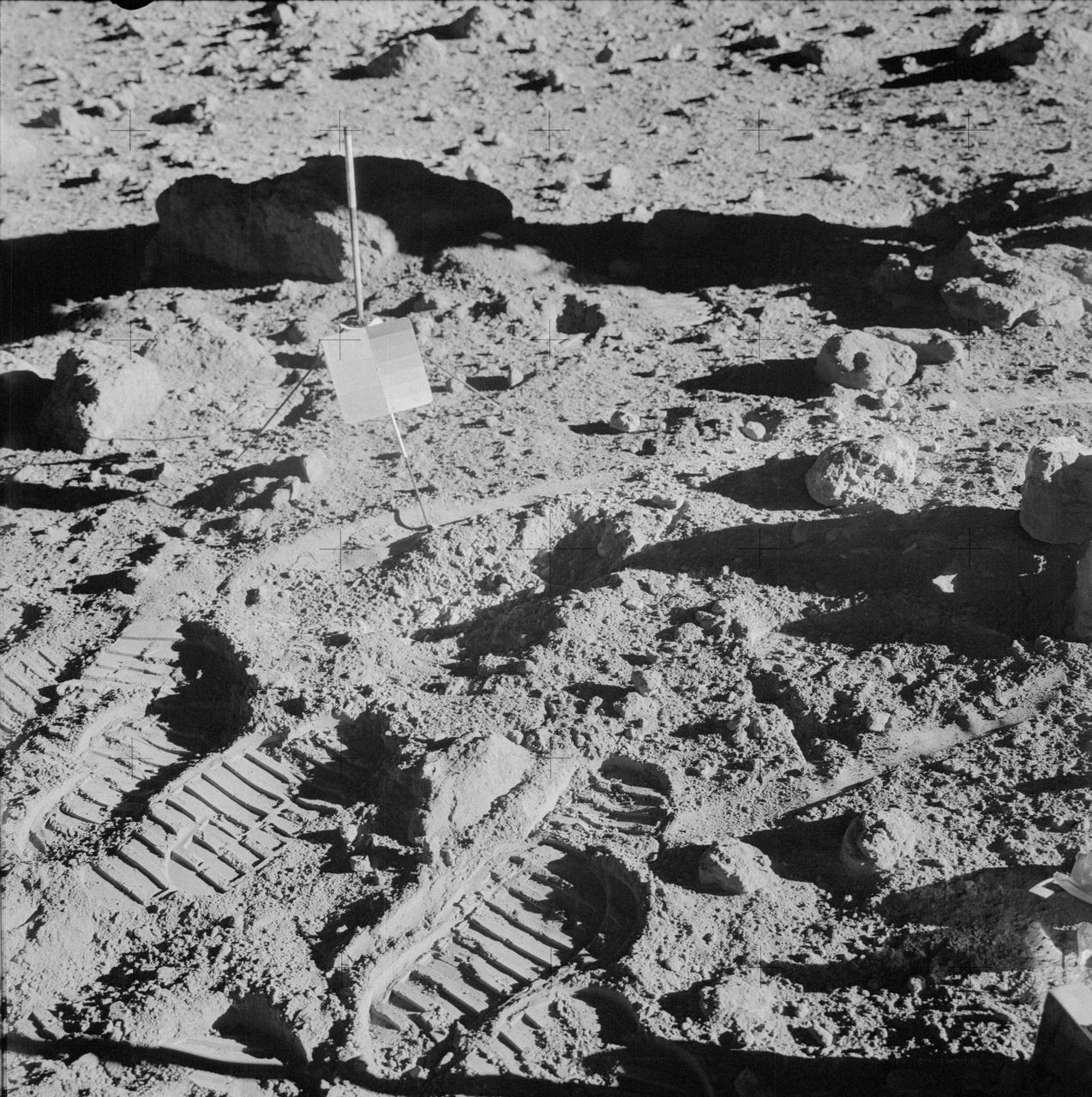
AS14-64-9127 (5-6 Feb. 1971) --- A close-up view of lunar soil, showing bootprints made by the Apollo 14 astronauts during extravehicular activity (EVA) on the lunar surface. Also visible are tracks made by the modularized equipment transporter (MET) and deployed gnomon. Astronauts Alan B. Shepard Jr., commander, and Edgar D. Mitchell, lunar module pilot, descended in the Apollo 14 Lunar Module (LM) to explore the moon, while astronaut Stuart A. Roosa, command module pilot, remained with the Command and Service Modules (CSM) in lunar orbit.
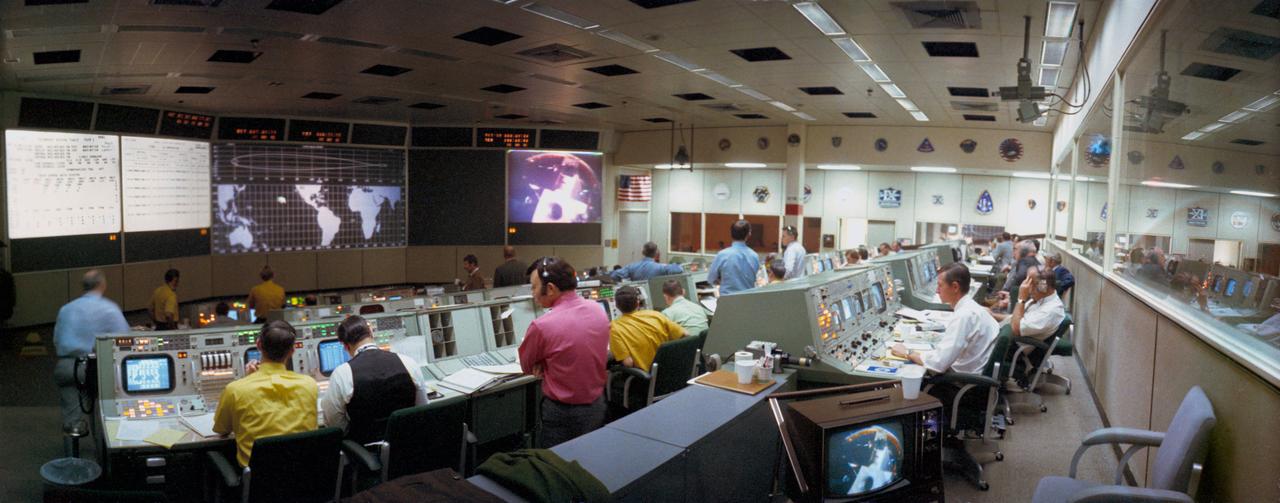
S71-17122 (31 Jan. 1971) --- A wide angle overall view of the Mission Operations Control Room (MOCR) in the Mission Control Center at the Manned spacecraft Center. This view was photographed during the first color television transmission from the Apollo 14 Command Module. Projected on the large screen at the right front of the MOCR is a view of the Apollo 14 Lunar Module, still attached to the Saturn IVB stage. The Command and Service Modules were approaching the LM/S-IVB during transposition and docking maneuvers.
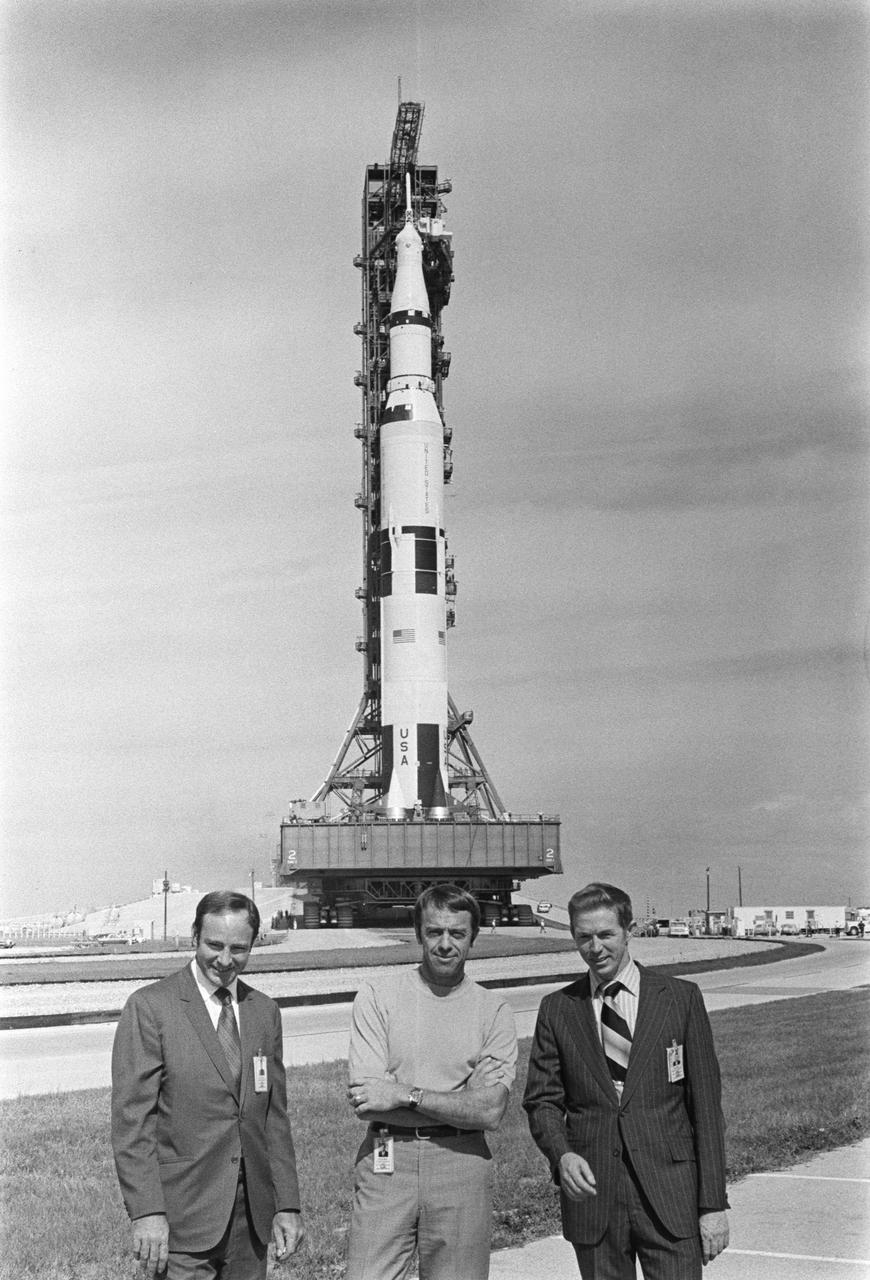
S70-55689 (9 Nov. 1970) --- The Apollo 14 (Spacecraft 110/Lunar Module 8/Saturn 509) space vehicle arrives at Pad A, Launch Complex 39, during the Apollo 14 roll out from the Kennedy Space Center's Vehicle Assembly Building. The Saturn V stack and its mobile launch tower atop a huge crawler-transporter. The three members of the Apollo 14 prime crew are in the foreground. They are (left to right) astronauts Edgar D. Mitchell, lunar module pilot; Alan B. Shepard Jr., commander; and Stuart A. Roosa, command module pilot.
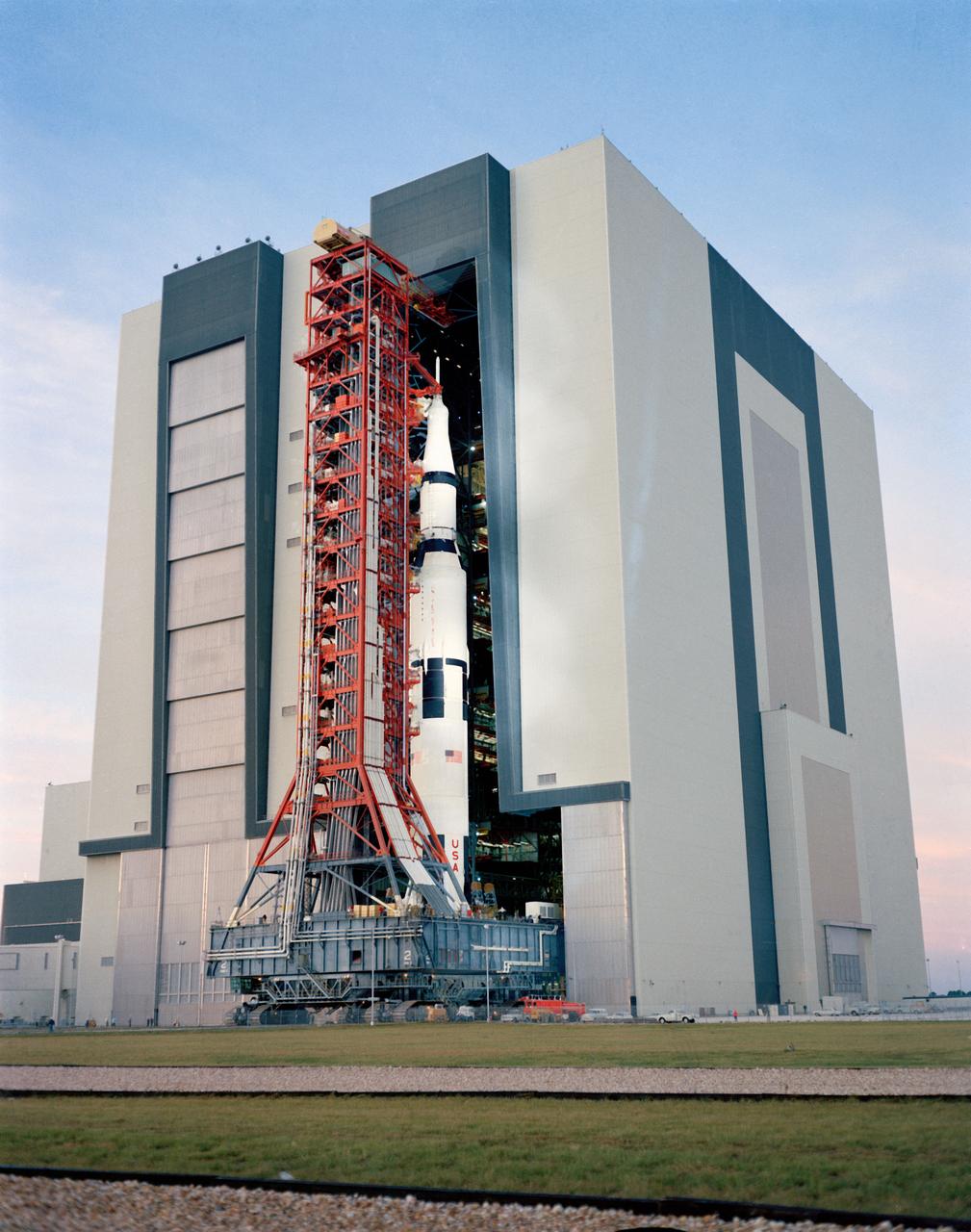
S70-54121 (9 Nov. 1970) --- A ground level view at Launch Complex 39, Kennedy Space Center (KSC), showing the Apollo 14 (Spacecraft 110/Lunar Module 8/Saturn 509) space vehicle leaving the Vehicle Assembly Building (VAB). The Saturn V stack and its mobile launch tower, atop a huge crawler-transporter, were rolled out to Pad A. The Apollo 14 crewmen will be astronauts Alan B. Shepard Jr., commander; Stuart A. Roosa, command module pilot; and Edgar D. Mitchell, lunar module pilot.
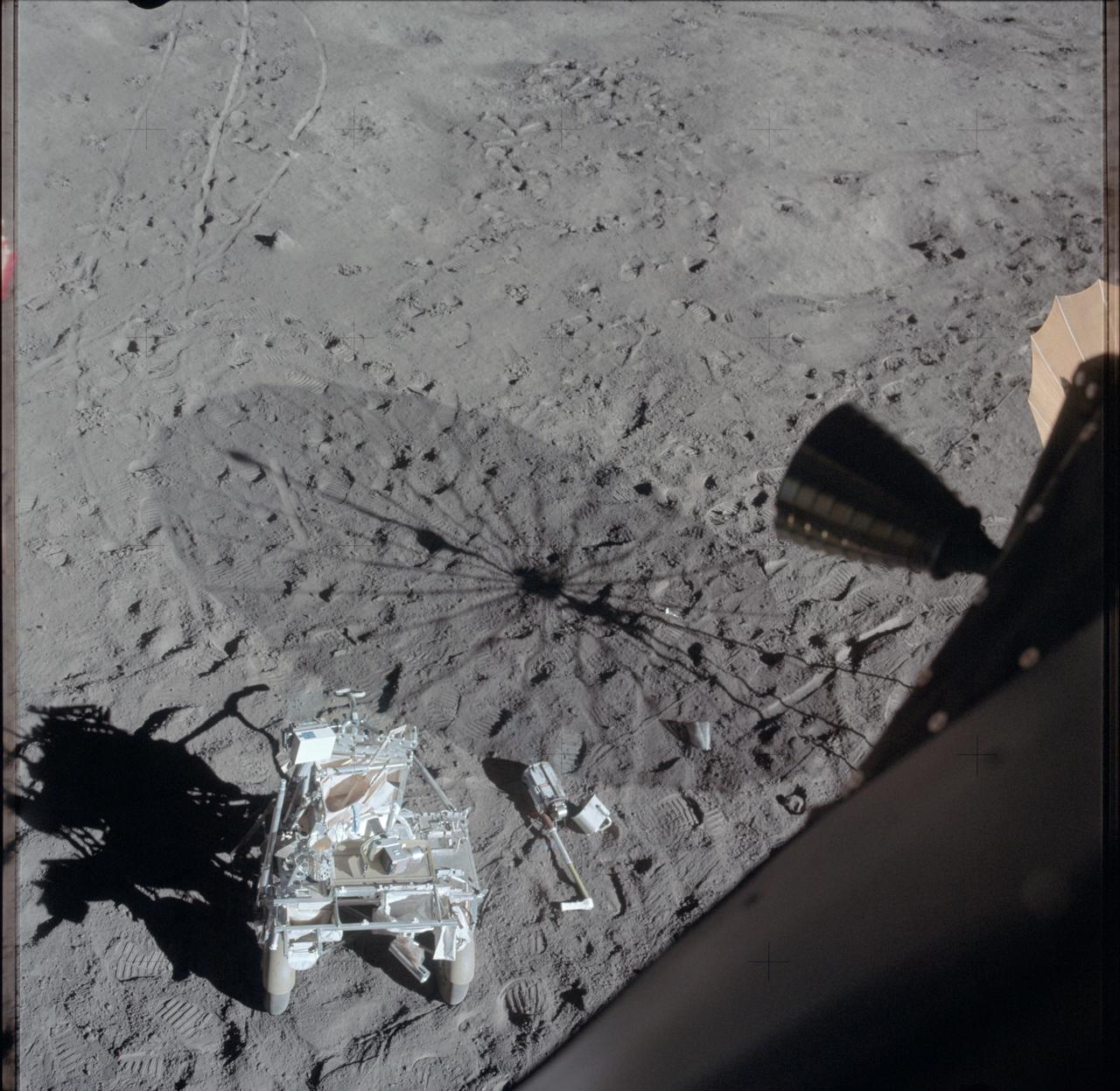
AS14-66-9340 (6 Feb. 1971) --- A view from inside the Lunar Module (LM) following the second Apollo 14 extravehicular activity (EVA). At the left foreground is the modularized equipment transporter (MET). Tracks made by the two-wheeled "Rickshaw"-type cart can be seen in the left background. The Apollo 35mm stereo close-up camera lies next to the MET, near a huge shadow of the erectable S-Band antenna. The area is largely covered with bootprints made by astronauts Alan B. Shepard Jr., commander, and Edgar D. Mitchell, lunar module pilot. While the pair explored the moon, astronaut Stuart A. Roosa, command module pilot, remained with the Command and Service Modules (CSM) in lunar orbit.
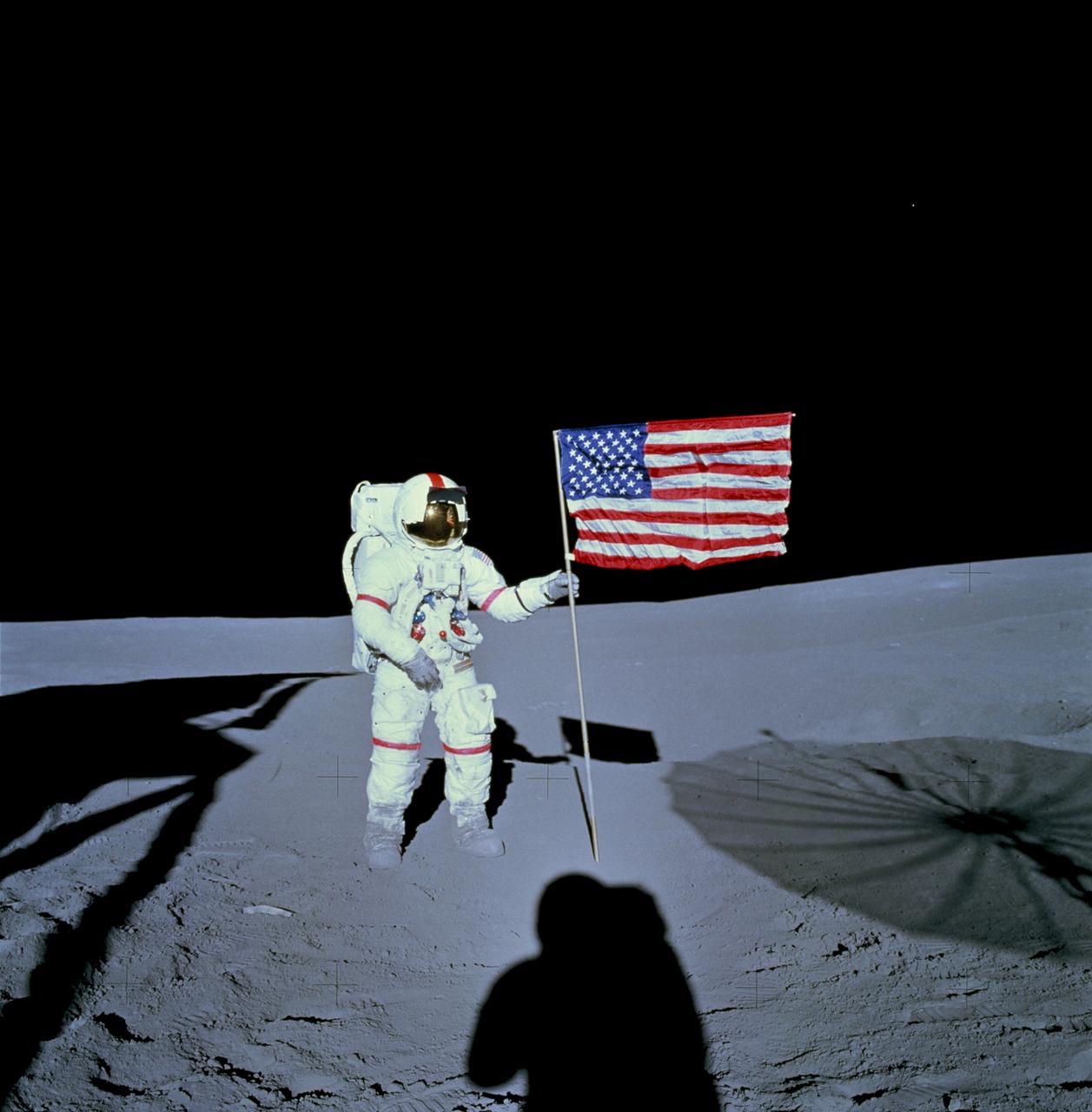
AS14-66-9232 (5 Feb. 1971) --- Astronaut Alan B. Shepard Jr., commander of the Apollo 14 lunar landing mission, stands by the deployed United States flag on the lunar surface during the early moments of the first extravehicular activity (EVA) of the mission. Shadows of the Lunar Module (LM), astronaut Edgar D. Mitchell, lunar module pilot, and the erectable S-Band Antenna surround the scene of the third flag implanting to be performed on the lunar surface. While astronauts Shepard and Mitchell descended in the LM ?Antares? to explore the Fra Mauro region of the moon, astronaut Stuart A. Roosa, command module pilot, remained with the Command and Service Modules (CSM) ?Kitty Hawk? in lunar orbit.
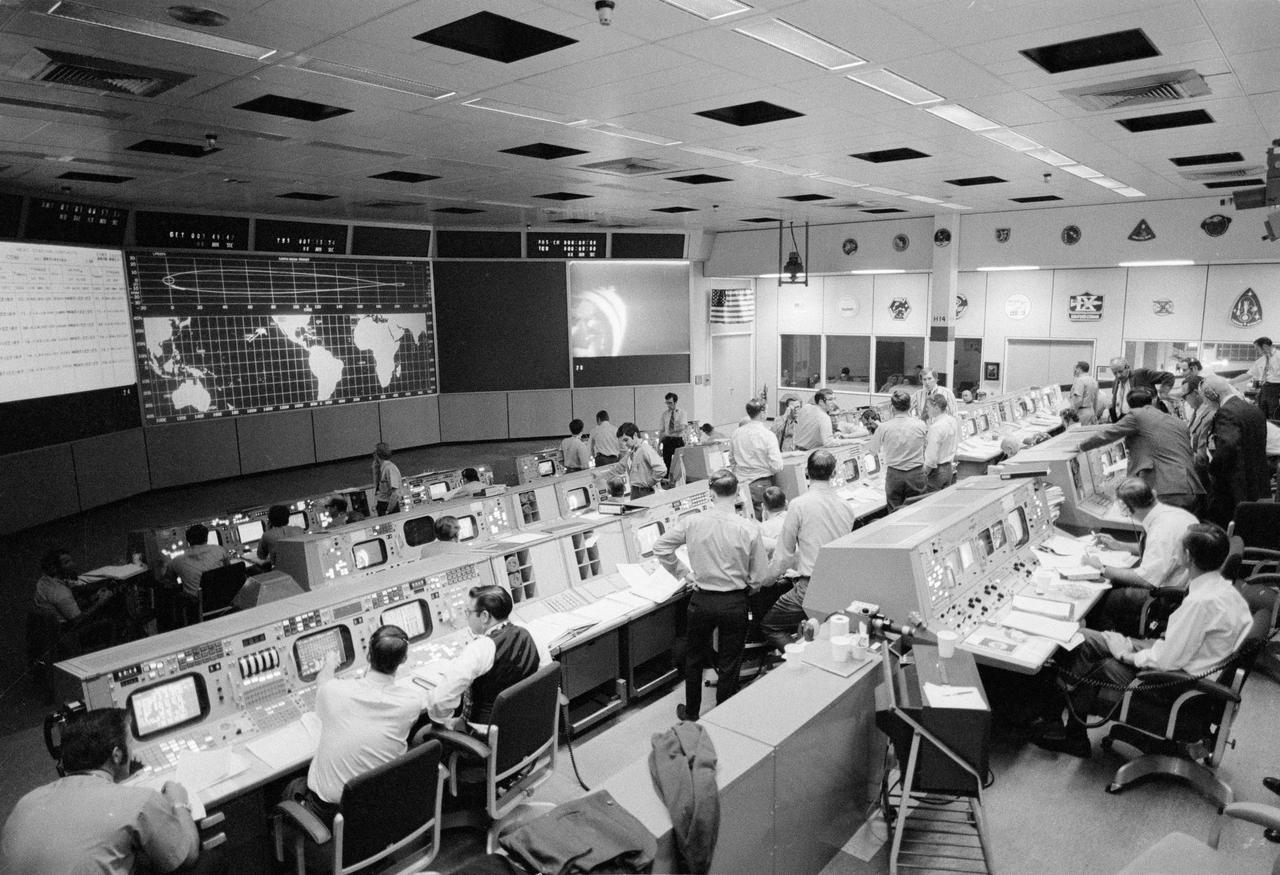
S71-16879 (31 Jan. 1971) --- Overall view of activity in the Mission Operations Control Room in the Mission Control Center during the Apollo 14 transposition and docking maneuvers. The Apollo 14 Lunar Module, still attached to the Saturn IVB stage, can be seen on the large television monitor. Due to difficulty with the docking mechanism six attempts were made before a successful "hard dock" of the Command Module with the Lunar Module was accomplished. Aboard the Command Module were astronauts Alan B. Shepard Jr., Stuart A. Roosa, and Edgar D. Mitchell.

This image acquired by NASA Lunar Reconnaissance Orbiter shows a crater center of image formed by impact of the Apollo 14 Saturn IVB booster.
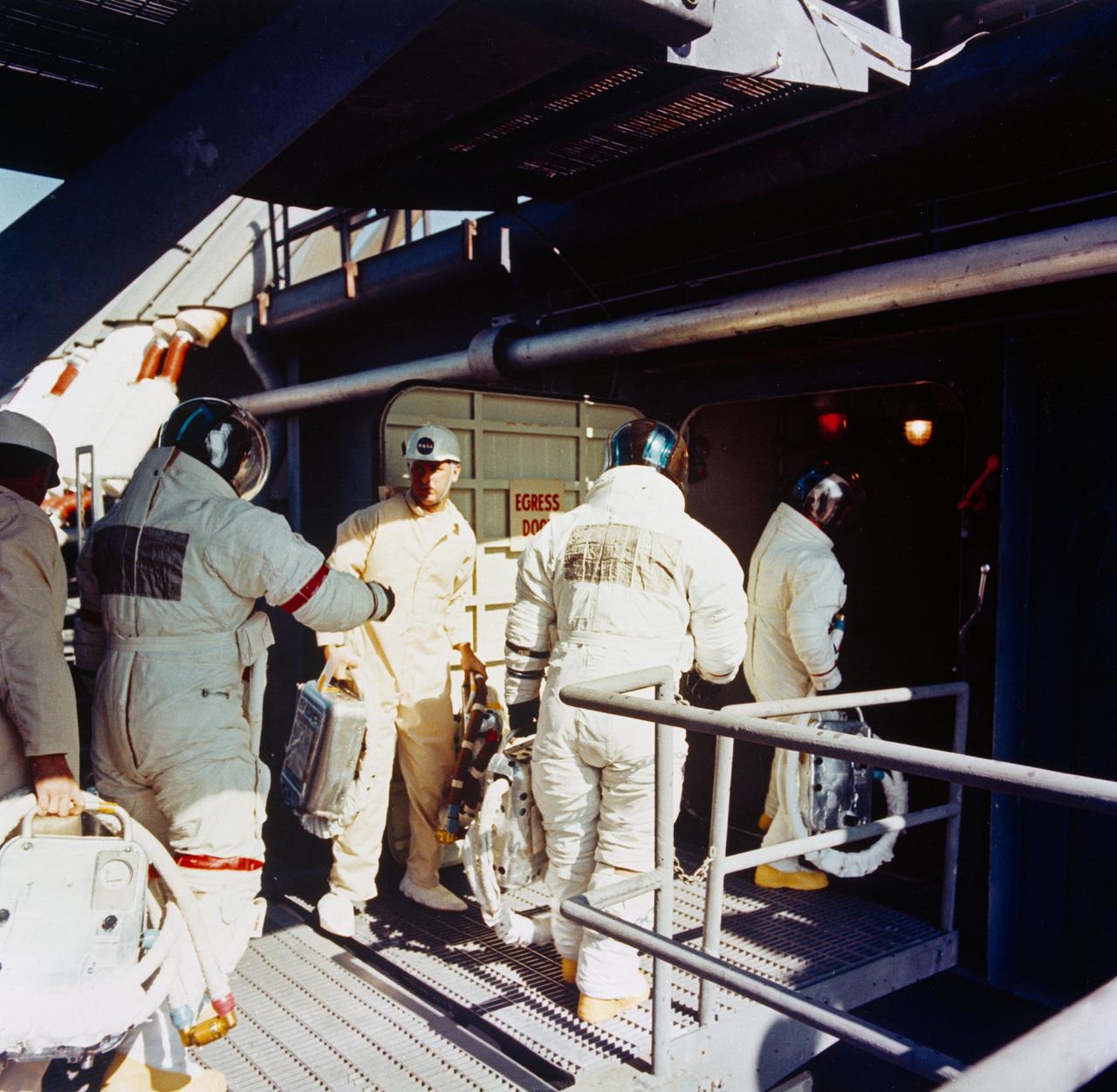
S71-16635 (31 Jan. 1971) --- The three Apollo 14 astronauts arrive at the White Room atop Pad A, Launch Complex 39, during the Apollo 14 prelaunch countdown. Apollo 14, with Alan B. Shepard Jr., commander; Stuart A. Roosa, command module pilot; and Edgar D. Mitchell, lunar module pilot, aboard was launched at 4:03:02 p.m. (EST), Jan. 31, 1971, on a lunar landing mission. Note identifying bands on the sleeve and leg of Shepard. Standing in the center foreground is astronaut Thomas P. Stafford, chief of the MSC Astronaut Office.
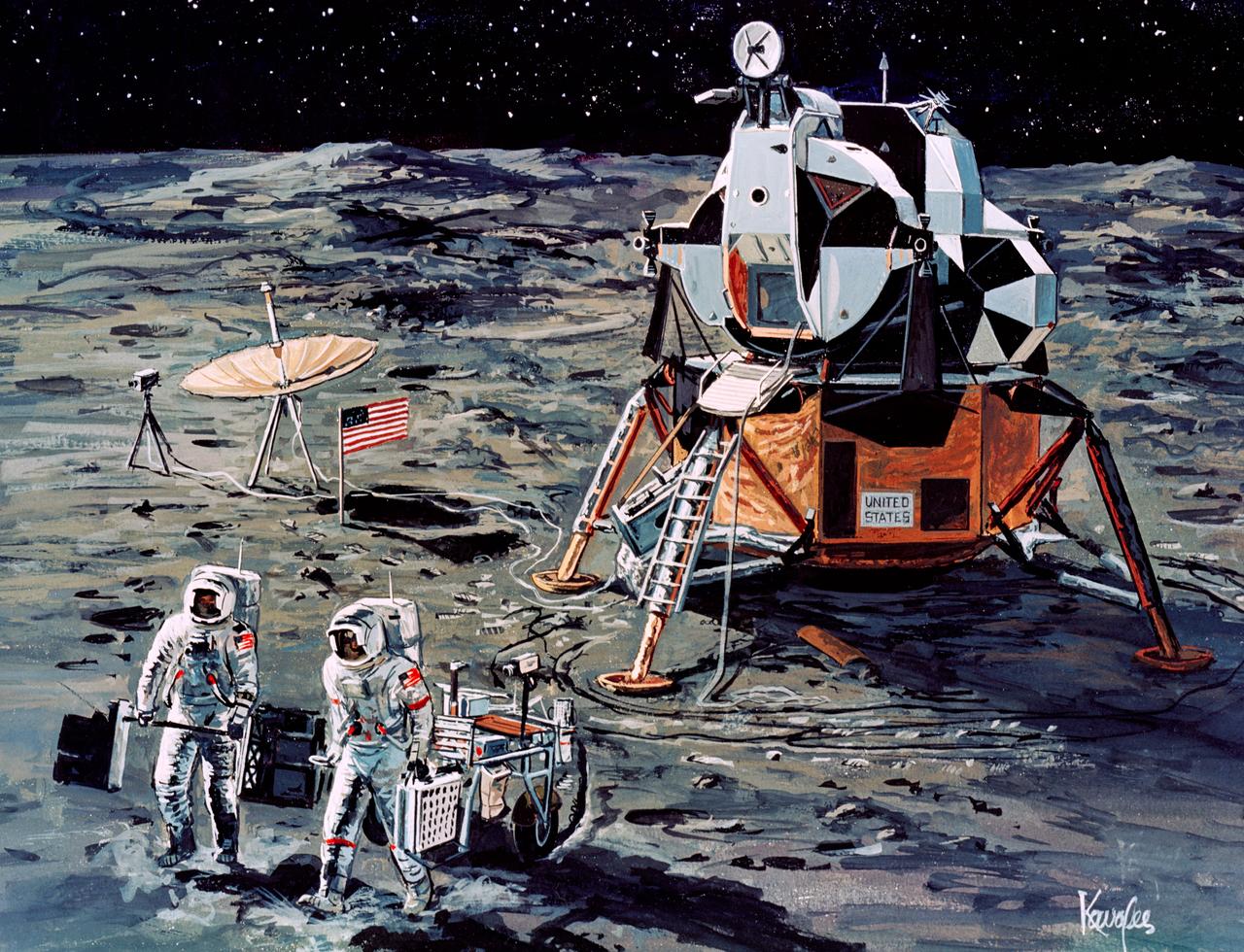
S71-16101 (January 1971) --- A Grumman Aerospace Corporation artist's concept of Apollo 14 crewmen, astronauts Alan B. Shepard Jr., commander, and Edgar D. Mitchell, lunar module pilot, as they set out on their first traverse. Shepard is pulling the Modularized Equipment Transporter (MET) which contains cameras, lunar sample bags, tools and other paraphernalia. Shepard has the Laser Ranging Retro-Reflector (LR-3) in his other hand. Mitchell is carrying the Apollo Lunar Surface Experiments Package (ALSEP) barbell mode.
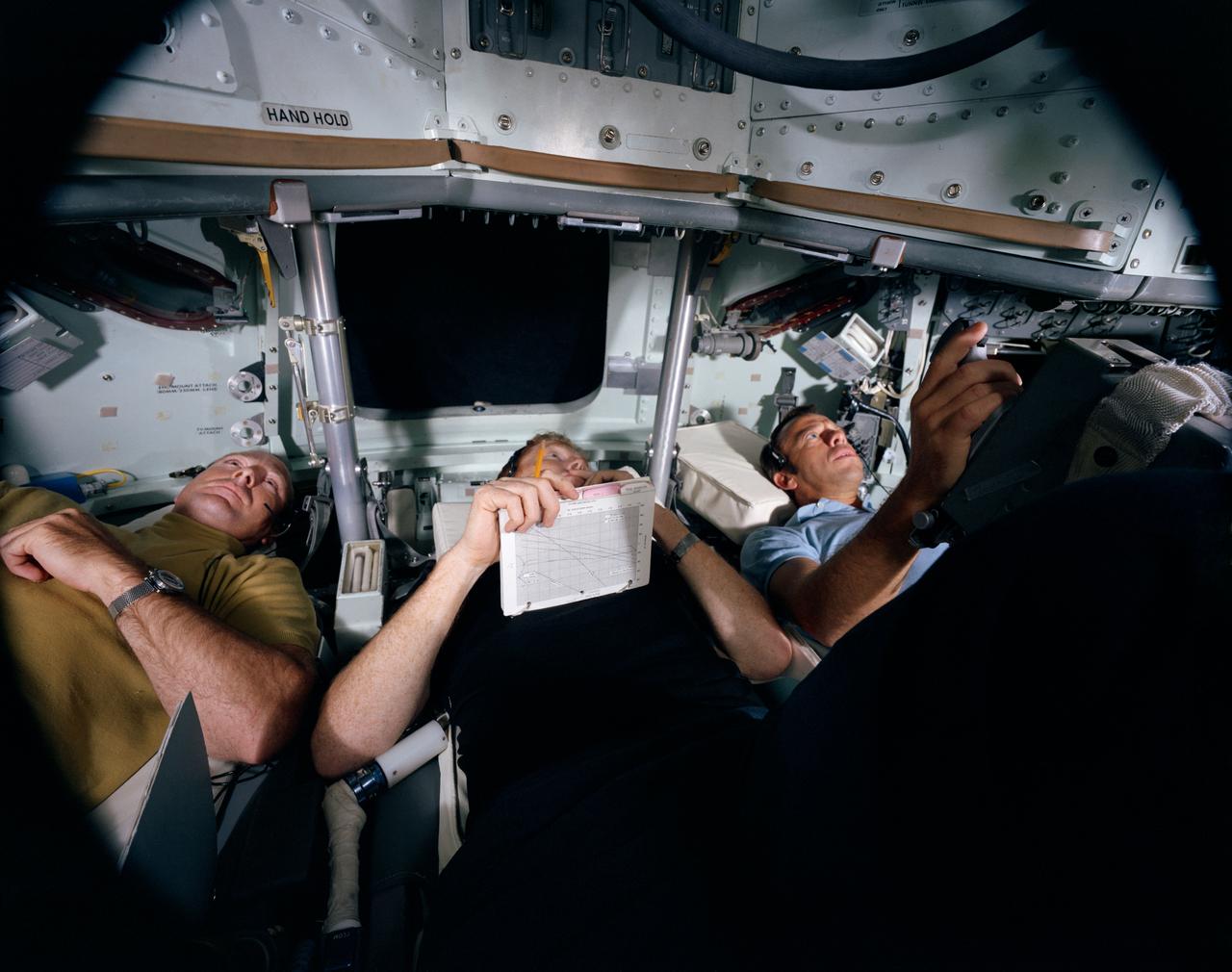
S70-45580 (July 1970) --- The members of the prime crew of the Apollo 14 lunar landing mission participate in Command Module (CM) simulation training at the Kennedy Space Center (KSC). Left to right are astronauts Edgar D. Mitchell, lunar module pilot; Stuart A. Roosa, command module pilot; and Alan B. Shepard Jr., commander.
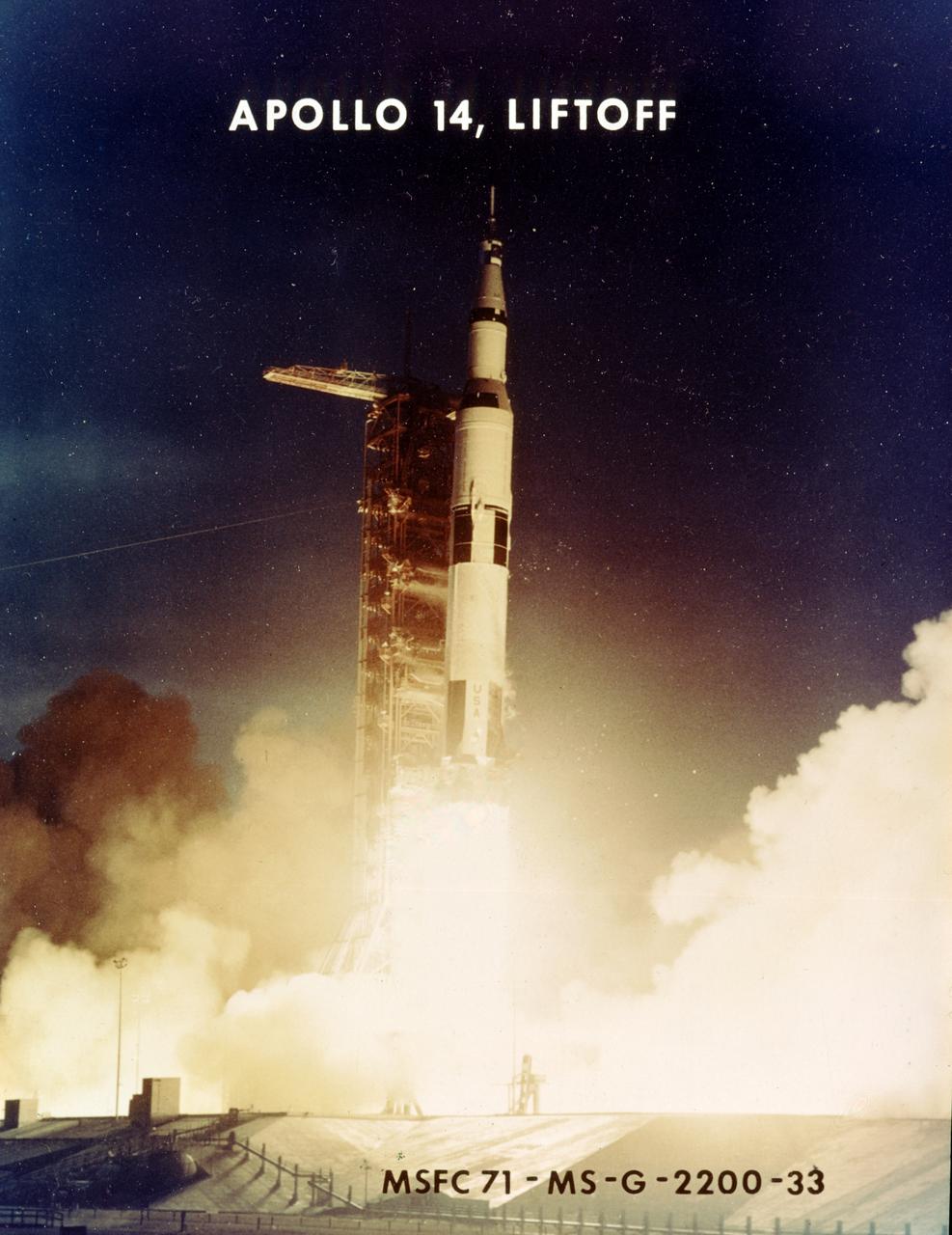
The moon bound Apollo 14, carrying a crew of three astronauts: Mission commander Alan B. Shepard Jr., Command Module pilot Stuart A. Roosa, and Lunar Module pilot Edgar D. Mitchell, lifted off from launch complex 39A at the Kennedy Space Center on January 31, 1971. It was the third manned lunar landing, the first manned landing in exploration of the lunar highlands, and it demonstrated pinpoint landing capability. The major goal of Apollo 14 was the scientific exploration of the Moon in the foothills of the rugged Fra Mauro region. The lunar surface extravehicular activity (EVA) of astronauts Shepard and Mitchell included setting up an automated scientific laboratory called Apollo Lunar Scientific Experiments Package (ALSEP), and collecting a total of about 95 pounds (43 kilograms) of Moon rock and soil for a geological investigation back on the Earth. The mission safely returned to Earth on February 9, 1971.
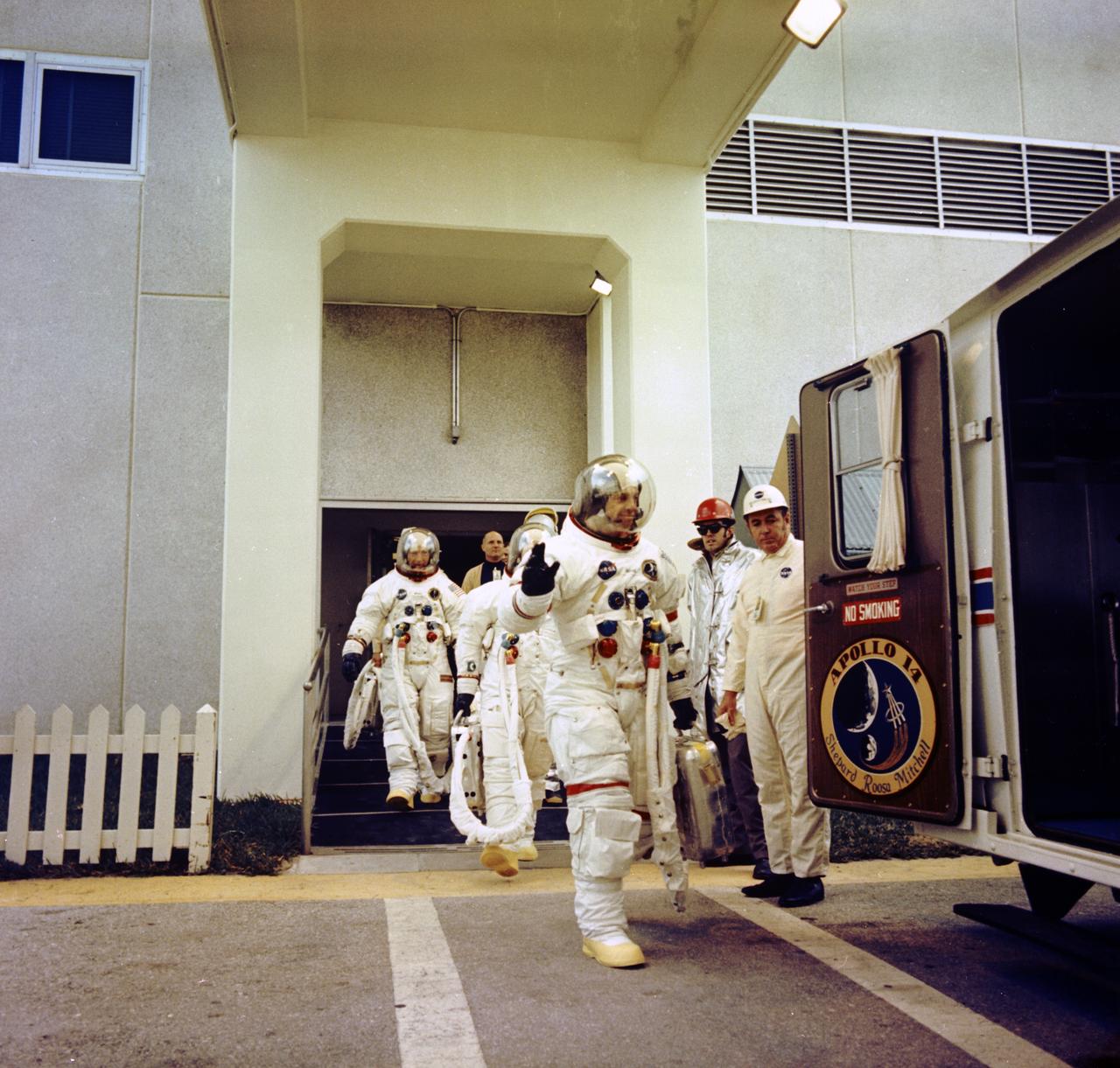
Apollo 14 Mission Commander, Alan B. Shepard, Jr., waves to well-wishers as he and astronauts Stuart A. Roosa, Command Module pilot; and Edgar D. Mitchell, Lunar Module pilot, walk to the transfer van during the countdown demonstration test. The Apollo 14, carrying the crew of three lifted off from launch complex 39A at KSC on January 31, 1971. It was the third manned lunar landing, the first manned landing in exploration of the lunar highlands, and it demonstrated pinpoint landing capability. The major goal of Apollo 14 was the scientific exploration of the Moon in the foothills of the rugged Fra Mauro region. The lunar surface extravehicular activity (EVA) of astronauts Shepard and Mitchell included setting up an automated scientific laboratory called Apollo Lunar Scientific Experiments Package (ALSEP), and collecting a total of about 95 pounds (43 kilograms) of Moon rock and soil for a geological investigation back on the Earth. Apollo 14 safely returned to Earth on February 9, 1971.
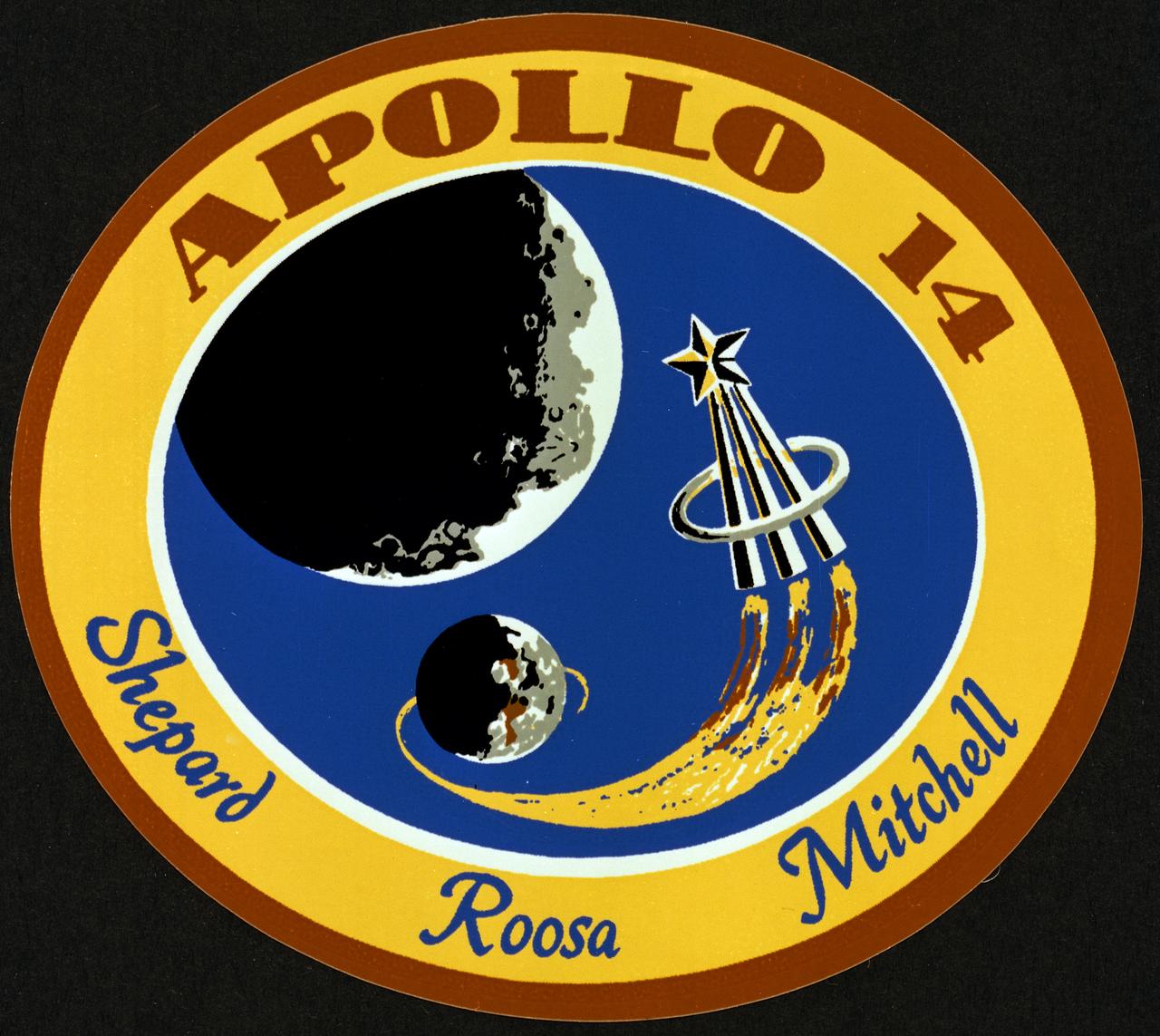
This is the Apollo 14 mission insignia or logo. The Apollo 14, carrying a crew of three astronauts: Stuart A. Roosa, Command Module pilot; Alan B. Shepard, Jr., mission commander; and Edgar D. Mitchell, Lunar Module pilot, lifted off from launch complex 39A at KSC on January 31, 1971. It was the third manned lunar landing, the first manned landing in exploration of the lunar highlands, and it demonstrated pinpoint landing capability. The major goal of Apollo 14 was the scientific exploration of the Moon in the foothills of the rugged Fra Mauro region. The lunar surface extravehicular activity (EVA) of astronauts Shepard and Mitchell included setting up an automated scientific laboratory called Apollo Lunar Scientific Experiments Package (ALSEP), and collecting a total of about 95 pounds (43 kilograms) of Moon rock and soil for a geological investigation back on the Earth. Apollo 14 safely returned to Earth on February 9, 1971.
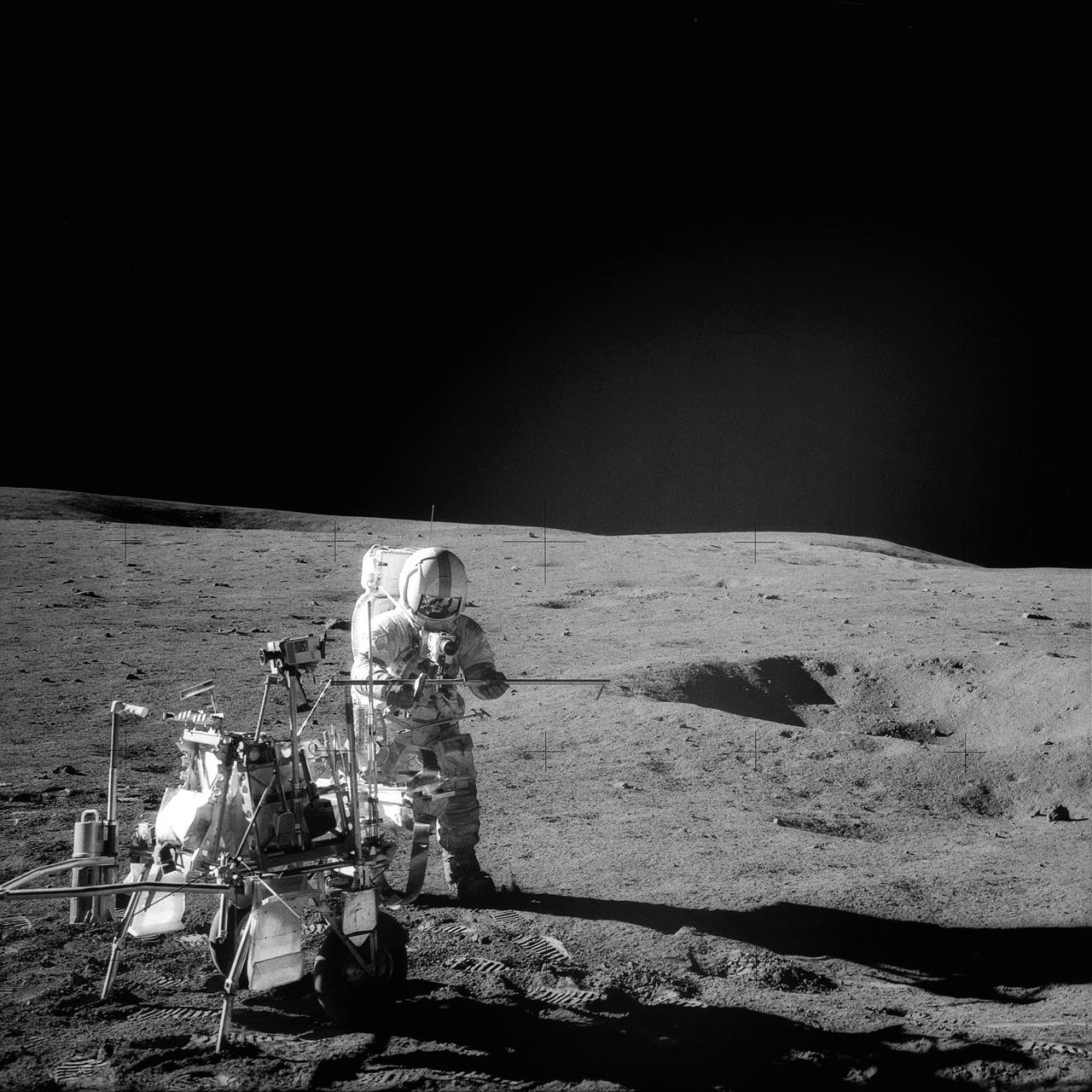
AS14-68-9405 (6 Feb. 1971) --- Astronaut Alan B. Shepard Jr., Apollo 14 commander, assembles a double core tube as he stands beside the rickshaw-type portable workbench or modularized equipment transporter (MET) unique to this mission. The photograph was taken by astronaut Edgar D. Mitchell, lunar module pilot, standing some 170 meters northeast of the Lunar Module (LM), during the mission's second extravehicular activity (EVA) on Feb. 6, 1971. While astronauts Shepard and Mitchell descended in the LM "Antares" to explore the Fra Mauro region of the moon, astronaut Stuart A. Roosa, command module pilot, remained with the Command and Service Modules (CSM) "Kitty Hawk" in lunar orbit.

The two moon-exploring crewmen of the Apollo 14 lunar landing mission show off some of the largest of the lunar rocks they collected on their mission, during a through-the-glass meeting with newsmen in the Crew Reception Area of the Lunar Receiving Laboratory (LRL) at the Manned Spacecraft Center (MSC). Astronaut Edgar D. Mitchell (left), lunar module pilot, holds up a tote bag in which some of the lunar samples were stowed, while astronaut Alan B. Shepard Jr., commander, looks on. The largest sample brought back on the mission, a basketball-size rock (nicknamed "Big Bertha"), is said to be the largest lunar rock collected in three lunar landing missions for the National Aeronautics and Space Administration (NASA).
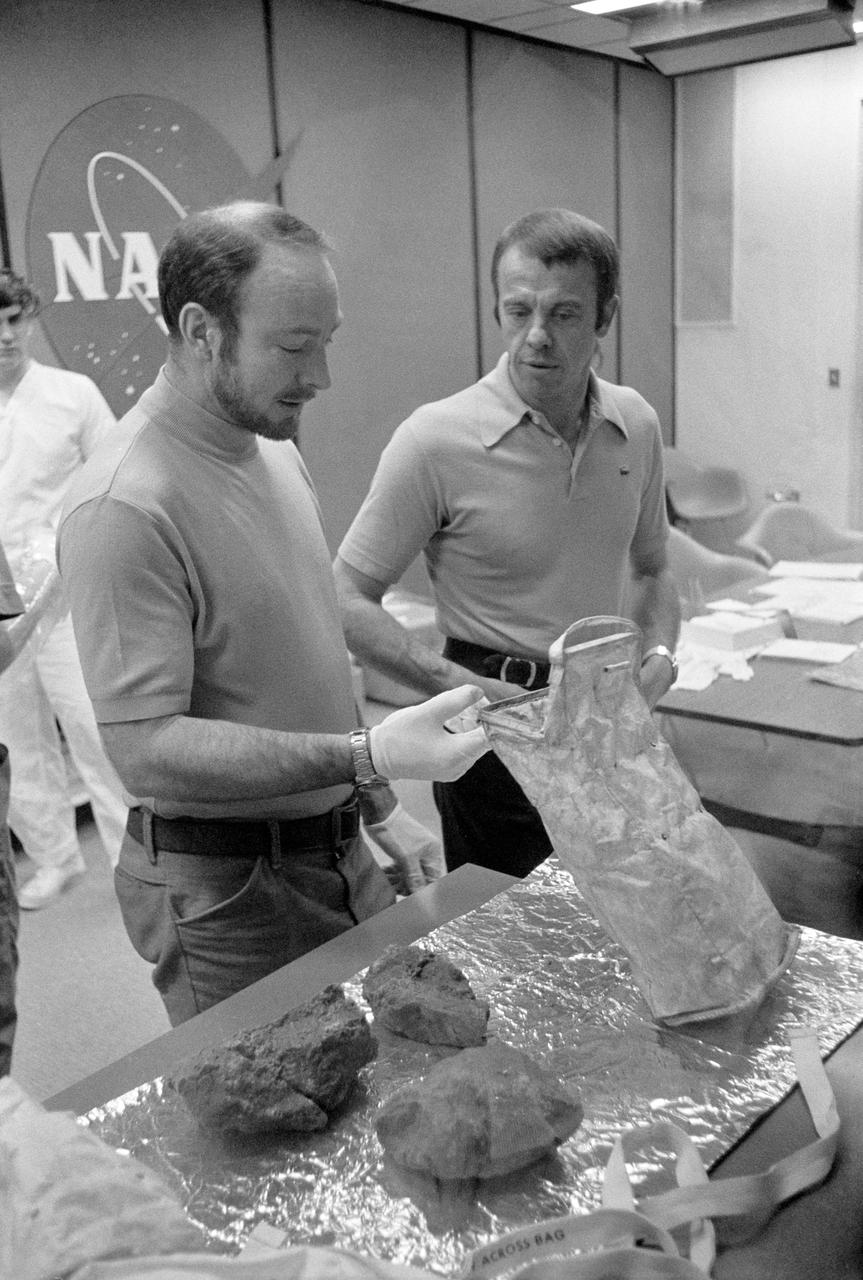
S71-20375 (19 Feb. 1971) --- The two moon-exploring crewmen of the Apollo 14 lunar landing mission show off some of the largest of the lunar rocks they collected on their mission, during a through-the-glass meeting with newsmen in the Crew Reception Area of the Lunar Receiving Laboratory (LRL) at the Manned Spacecraft Center (MSC). Astronaut Edgar D. Mitchell (left), lunar module pilot, holds up a tote bag in which some of the lunar samples were stowed, while astronaut Alan B. Shepard Jr., commander, looks on. The largest sample brought back on the mission, a basketball-size rock (nicknamed "Big Bertha"), is said to be the largest lunar rock collected in three lunar landing missions for the National Aeronautics and Space Administration (NASA).
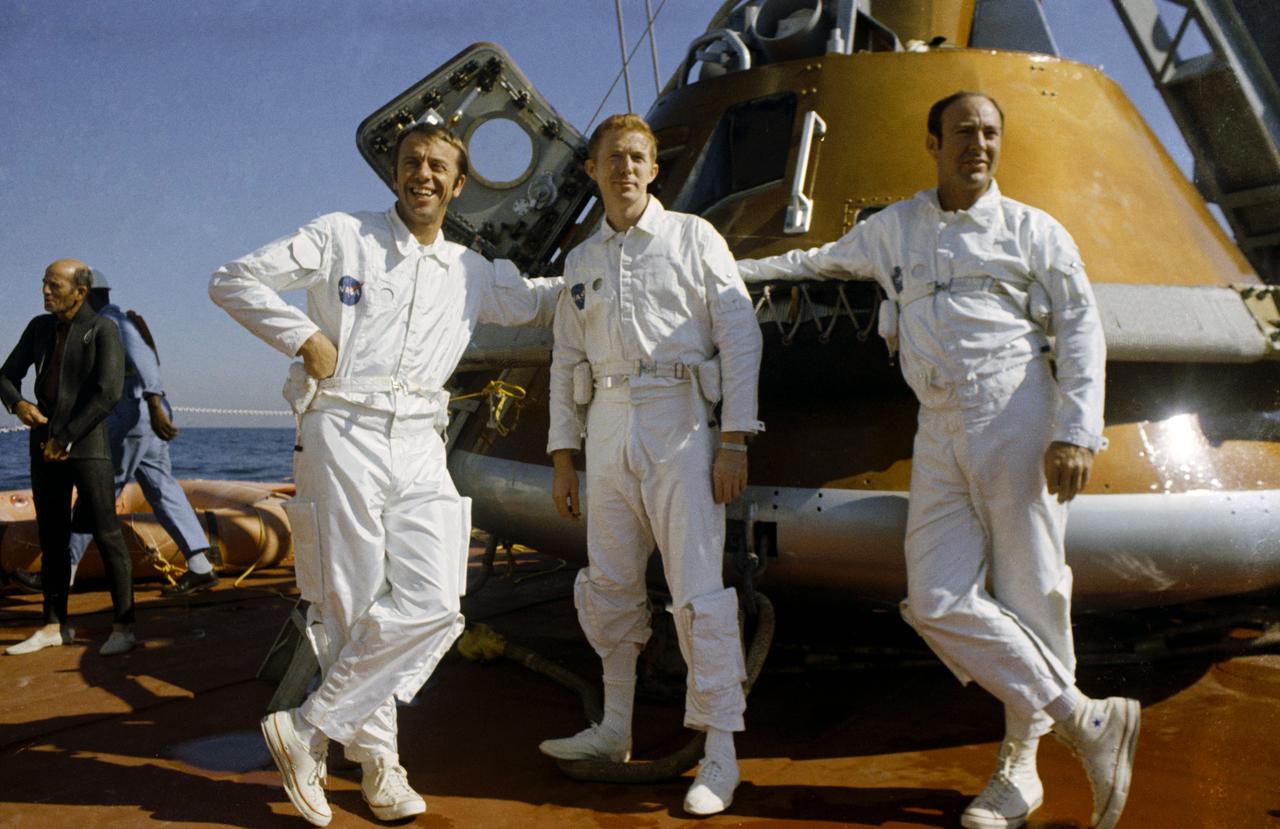
S70-51699 (24 Oct. 1970) --- The prime crew of the Apollo 14 lunar landing mission relaxes aboard the NASA motor vessel retriever, prior to participating in water egress training in the Gulf of Mexico. Left to right are astronauts Alan B. Shepard Jr., commander; Stuart A. Roosa, command module pilot; and Edgar D. Mitchell, lunar module pilot. They are standing by a Command Module (CM) trainer which was used in the exercises.
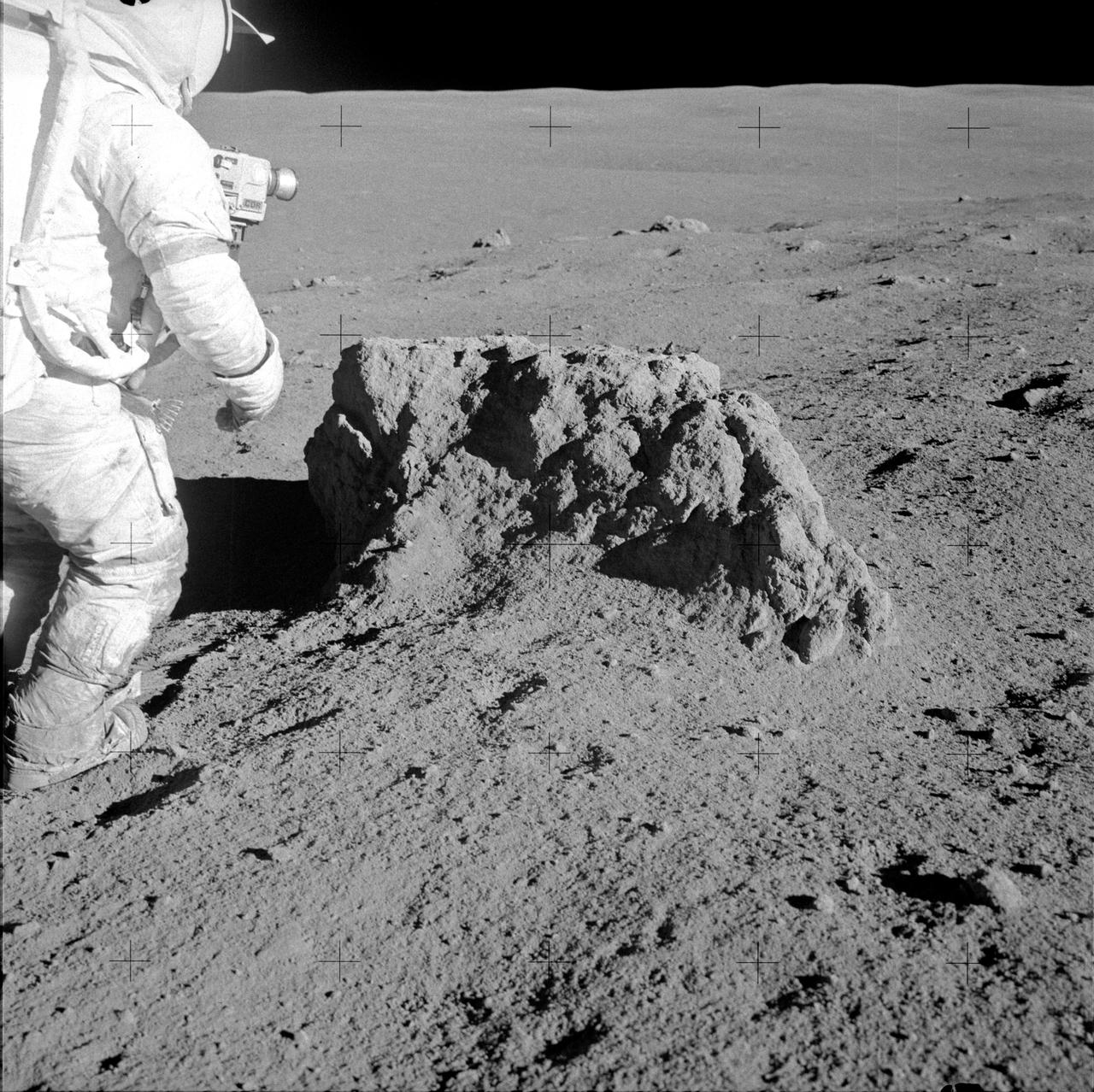
AS14-68-9414 (6 Feb. 1971) --- Astronaut Alan B. Shepard Jr., Apollo 14 commander, stands beside a large boulder on the lunar surface during the mission's second extravehicular activity (EVA), on Feb. 6, 1971. Note the lunar dust clinging to Shepard's space suit. Astronauts Shepard and Edgar D. Mitchell, lunar module pilot, explored the lunar surface while astronaut Stuart A. Roosa, command module pilot, orbited the moon in the Command and Service Modules (CSM).
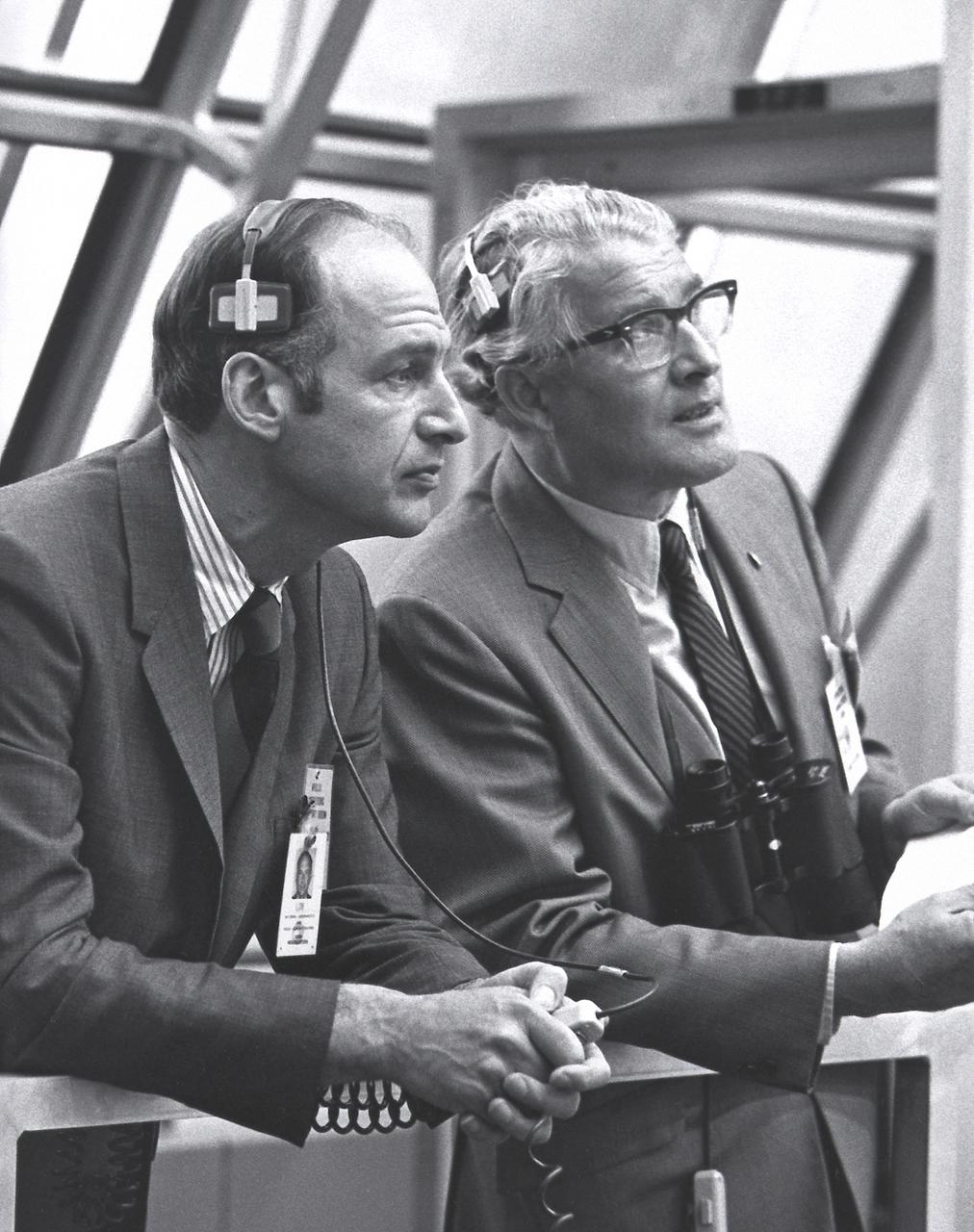
Dr. George M. Lowe, left, Acting Administrator of NASA, and Dr. von Braun monitor the Apollo 14 prelaunch activities in the Firing Room of the Launch Control Center at the Kennedy Space Center.
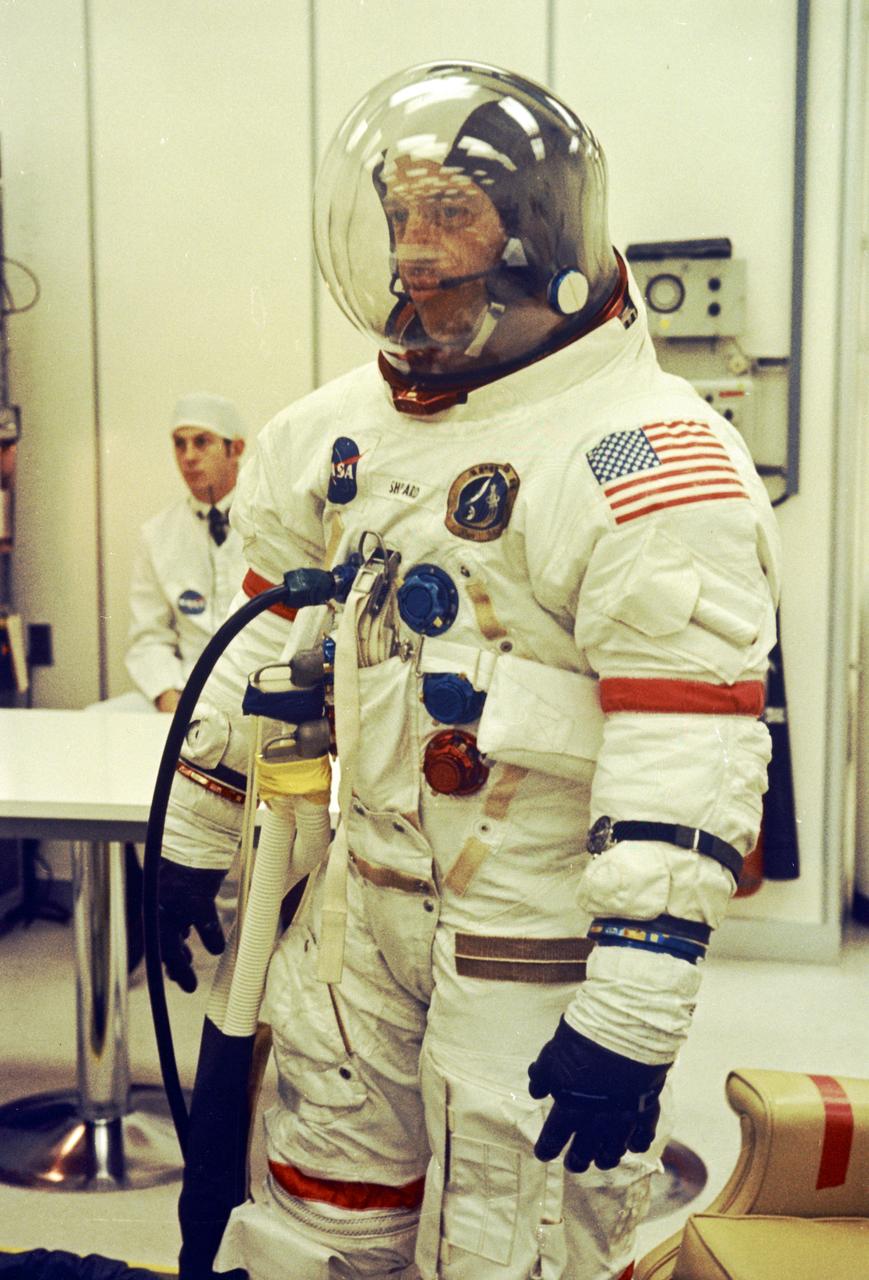
Alan B. Shepard, Jr., Apollo 14 mission commander, watches a technician conduct space suit checks during a demonstration test prior to countdown. The Apollo 14, carrying a crew of three astronauts: Shepard; Command Module pilot Stuart A. Roosa, and Lunar Module pilot Edgar D. Mitchell, lifted off from launch complex 39A at KSC on January 31, 1971. It was the third manned lunar landing, the first manned landing in exploration of the lunar highlands, and it demonstrated pinpoint landing capability. The major goal of Apollo 14 was the scientific exploration of the Moon in the foothills of the rugged Fra Mauro region. The extravehicular activities (EVA) of astronauts Shepard and Mitchell included setting up an automated scientific laboratory called Apollo Lunar Scientific Experiments Package (ALSEP), and collecting a total of about 95 pounds (43 kilograms) of Moon rock and soil for a geological investigation back on the Earth. Apollo 14 safely returned to Earth on February 9, 1971.
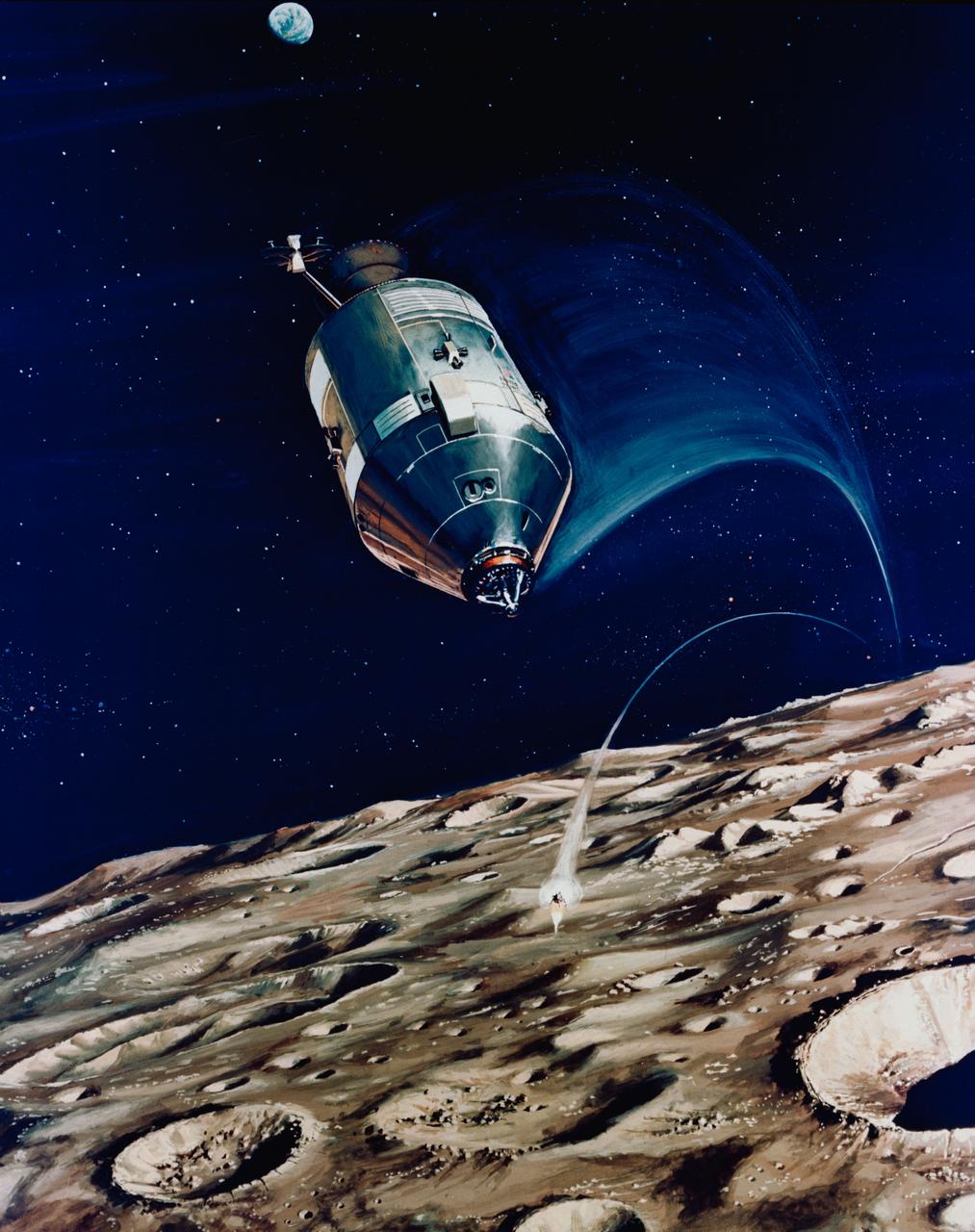
S71-16574 (11 Jan. 1971) --- An artist's concept depicting the Apollo 14 Command and Service Modules (CSM) circling the moon as the Lunar Module (LM) heads toward a lunar landing. While astronaut Stuart A. Roosa, command module pilot, remains with the CSM in lunar orbit, astronauts Alan B. Shepard Jr., commander; and Edgar D. Mitchell, lunar module pilot, will descend in the LM to explore an area in the rugged Fra Mauro highlands.
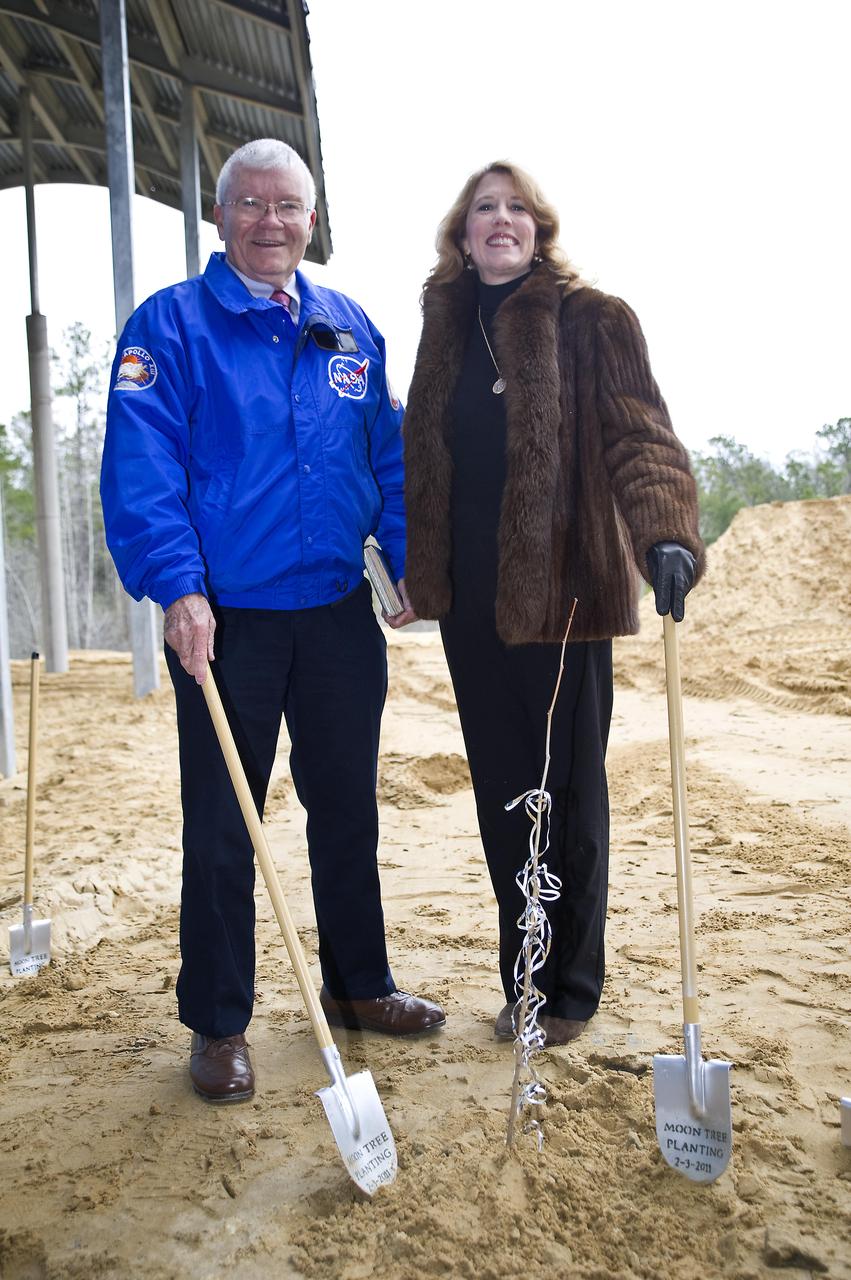
Apollo 13 astronaut Fred Haise stands with Rosemary Roosa, daughter of late Apollo 14 astronaut Stuart Roosa, beside a 'moon tree' planted at the INFINITY science center on Feb. 3, 2011. The moon tree is a descendent of seeds carried into space by Stuart Roosa on the Apollo 14 mission in 1971.
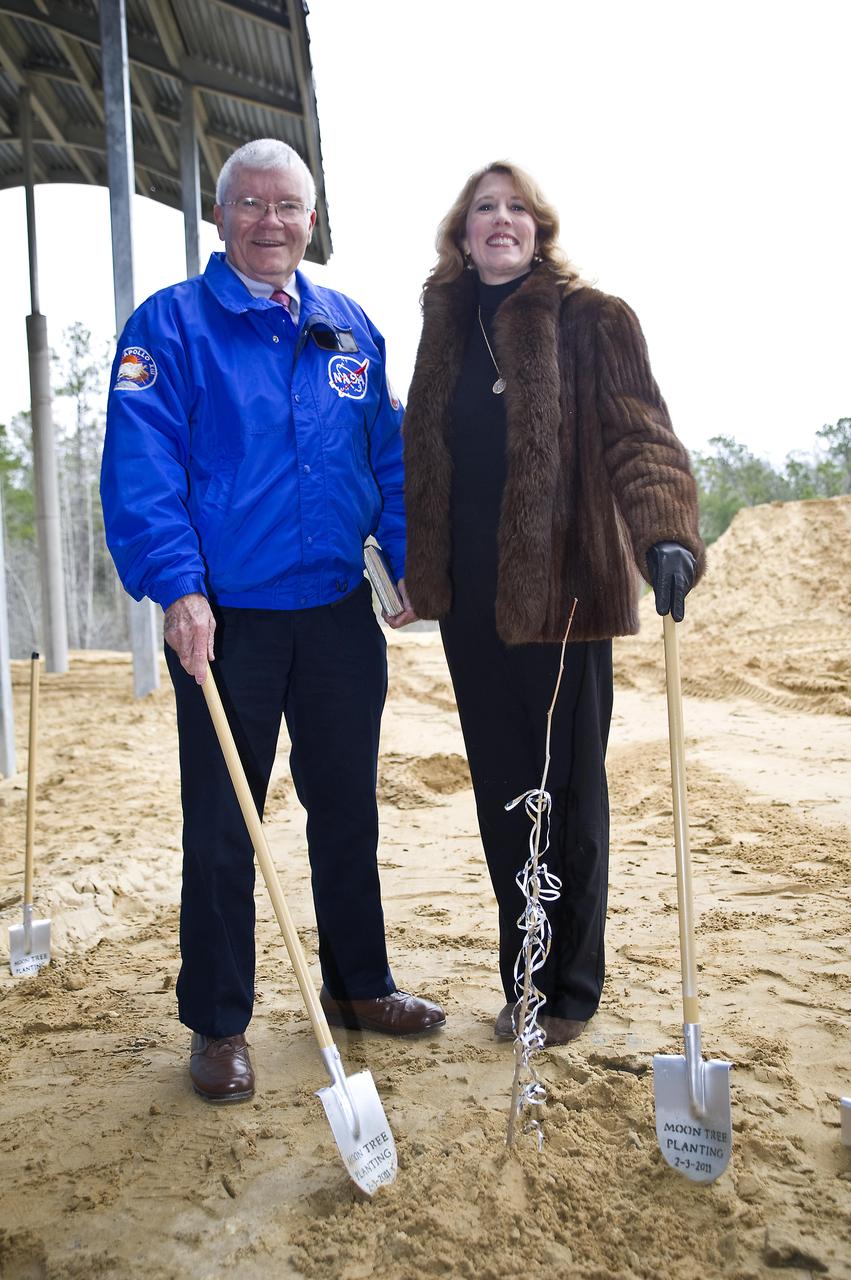
Apollo 13 astronaut Fred Haise stands with Rosemary Roosa, daughter of late Apollo 14 astronaut Stuart Roosa, beside a 'moon tree' planted at the INFINITY science center on Feb. 3, 2011. The moon tree is a descendent of seeds carried into space by Stuart Roosa on the Apollo 14 mission in 1971.
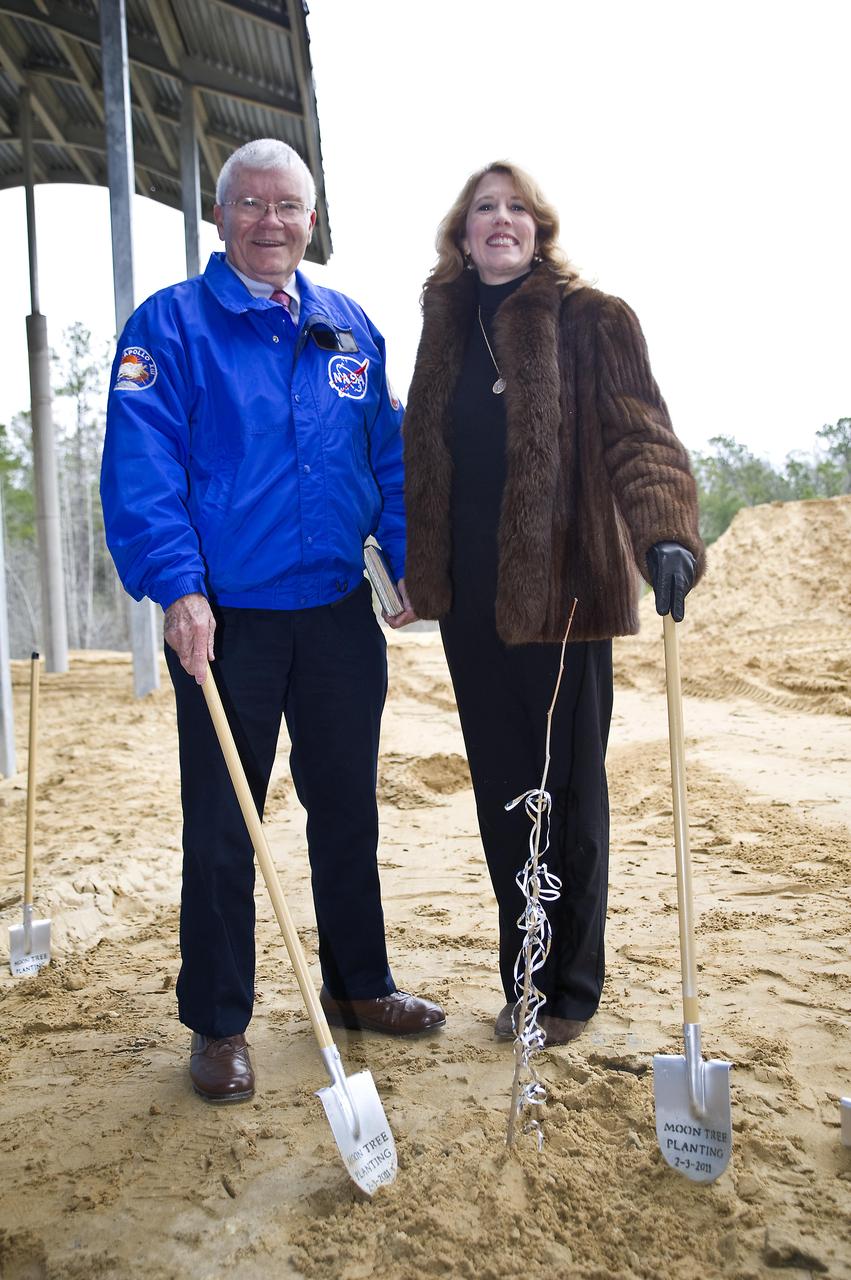
Apollo 13 astronaut Fred Haise stands with Rosemary Roosa, daughter of late Apollo 14 astronaut Stuart Roosa, beside a 'moon tree' planted at the INFINITY science center on Feb. 3, 2011. The moon tree is a descendent of seeds carried into space by Stuart Roosa on the Apollo 14 mission in 1971.
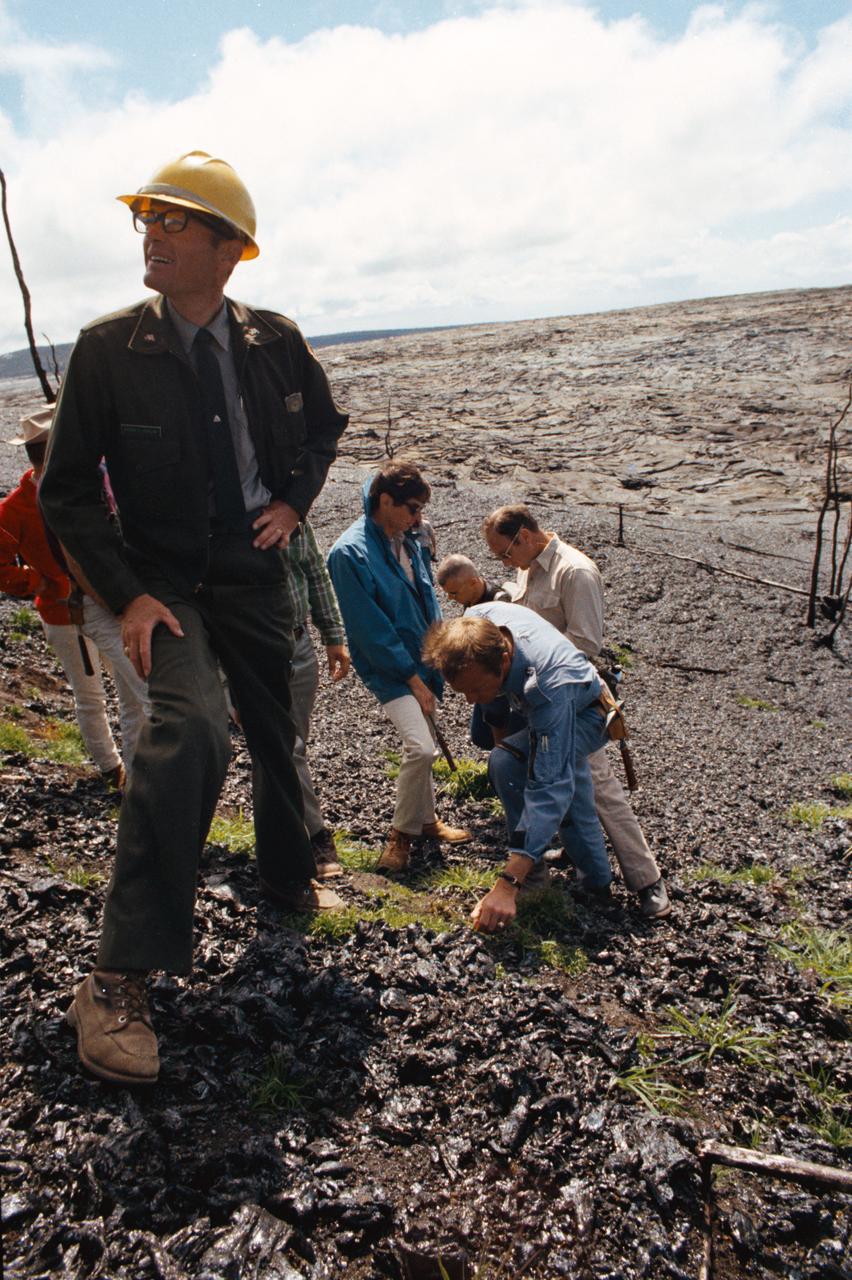
S70-34421 (April 1970) --- Prime crew men and backup crew men, of the Apollo 14 lunar landing mission, look over an area near the site of a volcanic eruption on Dec. 30, 1969. Astronauts Alan B. Shepard Jr. (leaning with left hand on ground) and Edgar D. Mitchell (behind Shepard, wearing dark glasses) are the prime crew men scheduled to walk on the moon. Astronauts Eugene A. Cernan (almost obscured at extreme left) and Joe H. Engle (partially visible, on Cernan's right) are backup crew commander and lunar module pilot, respectively, for the mission. Others in the photograph are Pat Crosland (in hard hat), a geologist and a park ranger in Hawaii Volcanoes State Park; Michael C. McEwen (facing Mitchell) of the Geology Branch, Lunar and Earth Sciences Division, Manned Spacecraft Center (MSC); and astronaut Bruce McCandless II, who made the trip to serve as a spacecraft communicator during simulations of extravehicular activity (EVA) on the lunar surface.

AS14-66-9241 (5-6 Feb. 1971) --- Astronaut Edgar D. Mitchell, lunar module pilot, makes a pan with the lunar surface television camera during an extravehicular activity (EVA) on the moon. This photograph was taken by fellow astronaut Alan B. Shepard Jr., commander. While Shepard and Mitchell descended in the Lunar Module (LM) to explore the moon, astronaut Stuart A. Roosa, command module pilot, remained with the Command and Service Modules (CSM) in lunar orbit.
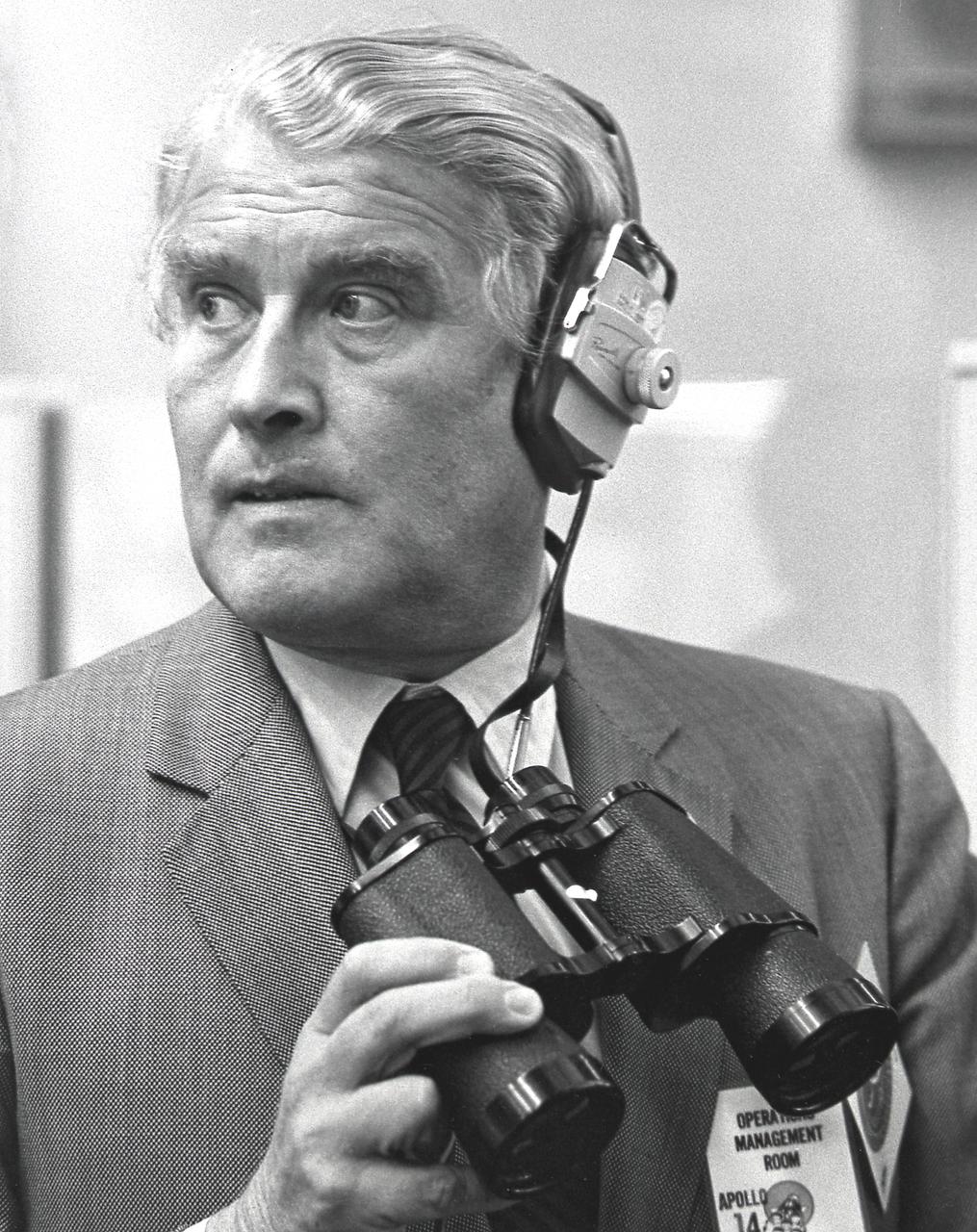
Dr. Wernher von Braun, NASA Deputy Associate Administrator for Future Programs, uses binoculars to monitor data on the closed-circuit TV screen in the Firing Room of the Launch Control Center at Kennedy Space Center (KSC) during the final preparation for the Apollo 14 launch.
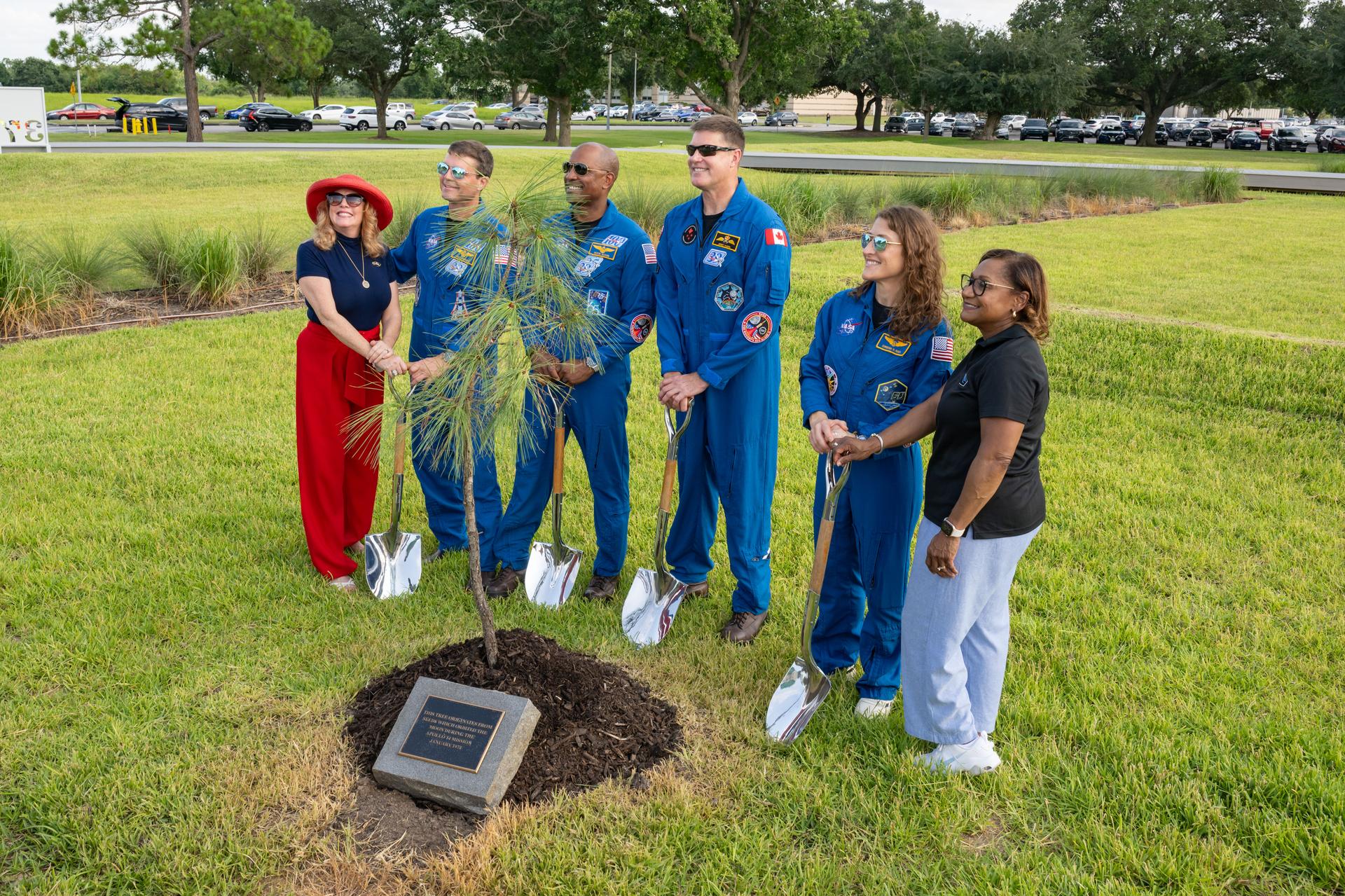
jsc2026e397475 (June 25, 2026) - From left to right, Rosemary Roosa, president of The Moon Tree Foundation and daughter of late Apollo 14 astronaut Stuart Roosa, and Vanessa Wyche, director of NASA's Johnson Space Center, participate in the dedication of the Apollo 14 Moon tree alongside the Artemis II crew. Credit: This tree is a second-generation Apollo Moon tree of the loblolly pine species. The original Apollo Moon trees were grown from seeds carried aboard Apollo 14 by NASA astronaut Stuart Roosa, a former U.S. Forest Service smoke jumper. Upon return to Earth, the seeds were germinated by the Forest Service, and the resulting seedlings were planted throughout the United States and around the world. Credit: NASA
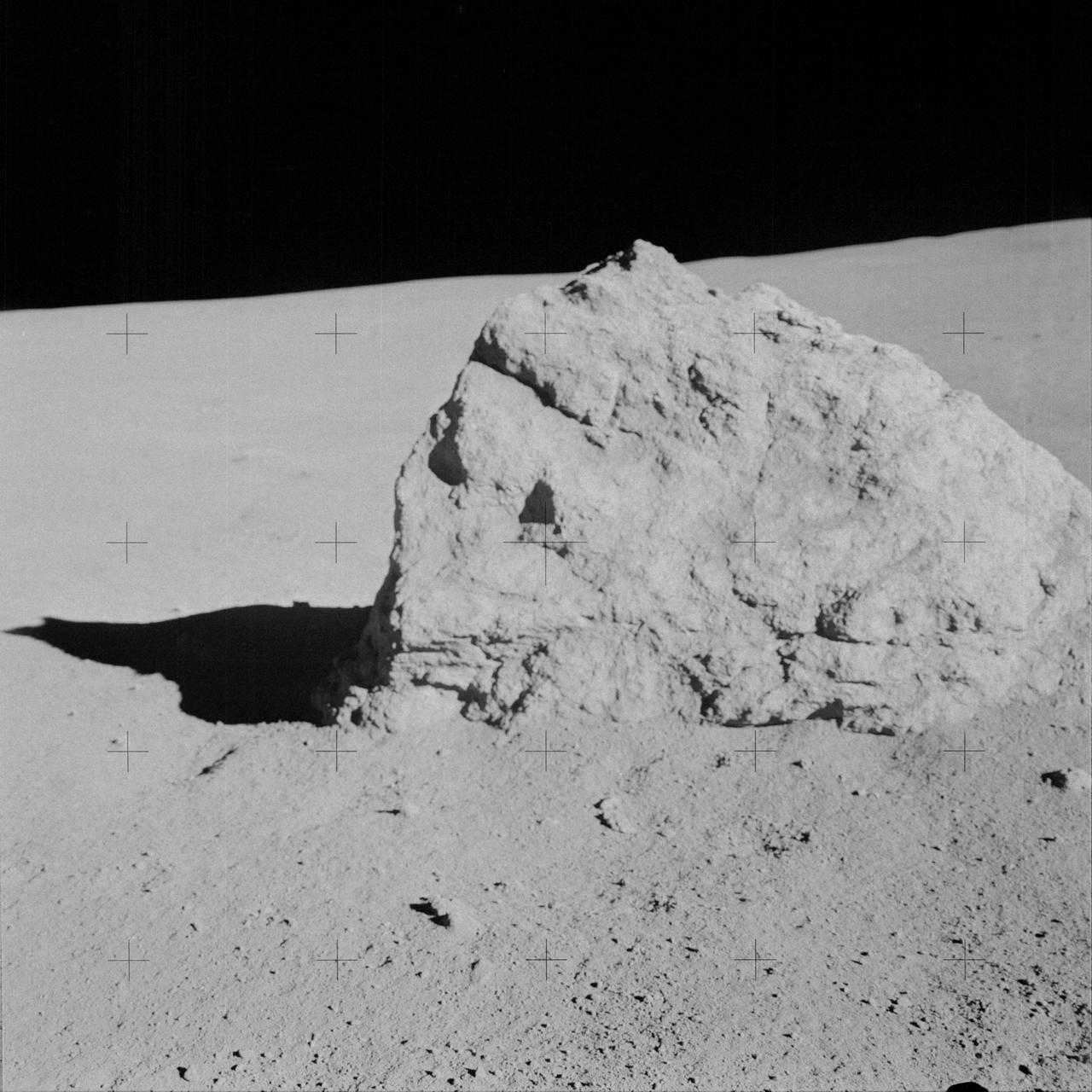
AS14-64-9135 (6 Feb. 1971) --- Astronaut Alan B. Shepard Jr., commander, took this close-up view of a large boulder, approximately five feet long, during the second extravehicular activity (EVA), on Feb. 6, 1971. Astronauts Shepard and Edgar D. Mitchell, lunar module pilot, descended in the Lunar Module (LM) to explore the moon, while astronaut Stuart A. Roosa, command module pilot, remained with the Command and Service Modules (CSM) in lunar orbit.
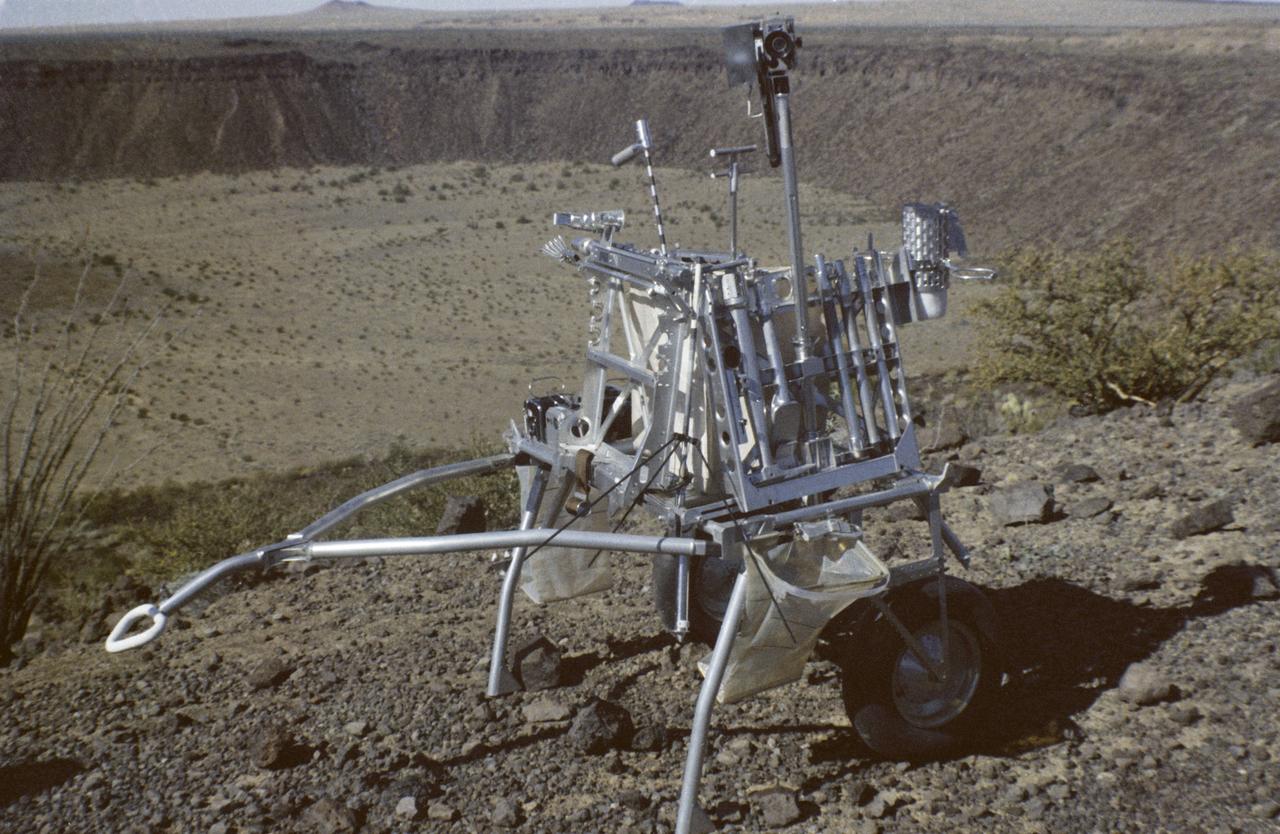
S70-29505 (13-18 Feb. 1970) --- A prototype of the modular equipment transporter (MET), nicknamed the "Rickshaw" after its shape and method of propulsion. This equipment was used by the Apollo 14 astronauts during their geological and lunar surface simulation training in the Pinacate volcanic area of northwestern Sonora, Mexico. The Apollo 14 crew will be the first one to use the MET. It will be a portable workbench with a place for the lunar hand tools and their carrier, three cameras, two sample container bags, a special environmental sample container, spare film magazines, and a lunar surface Penetrometer.
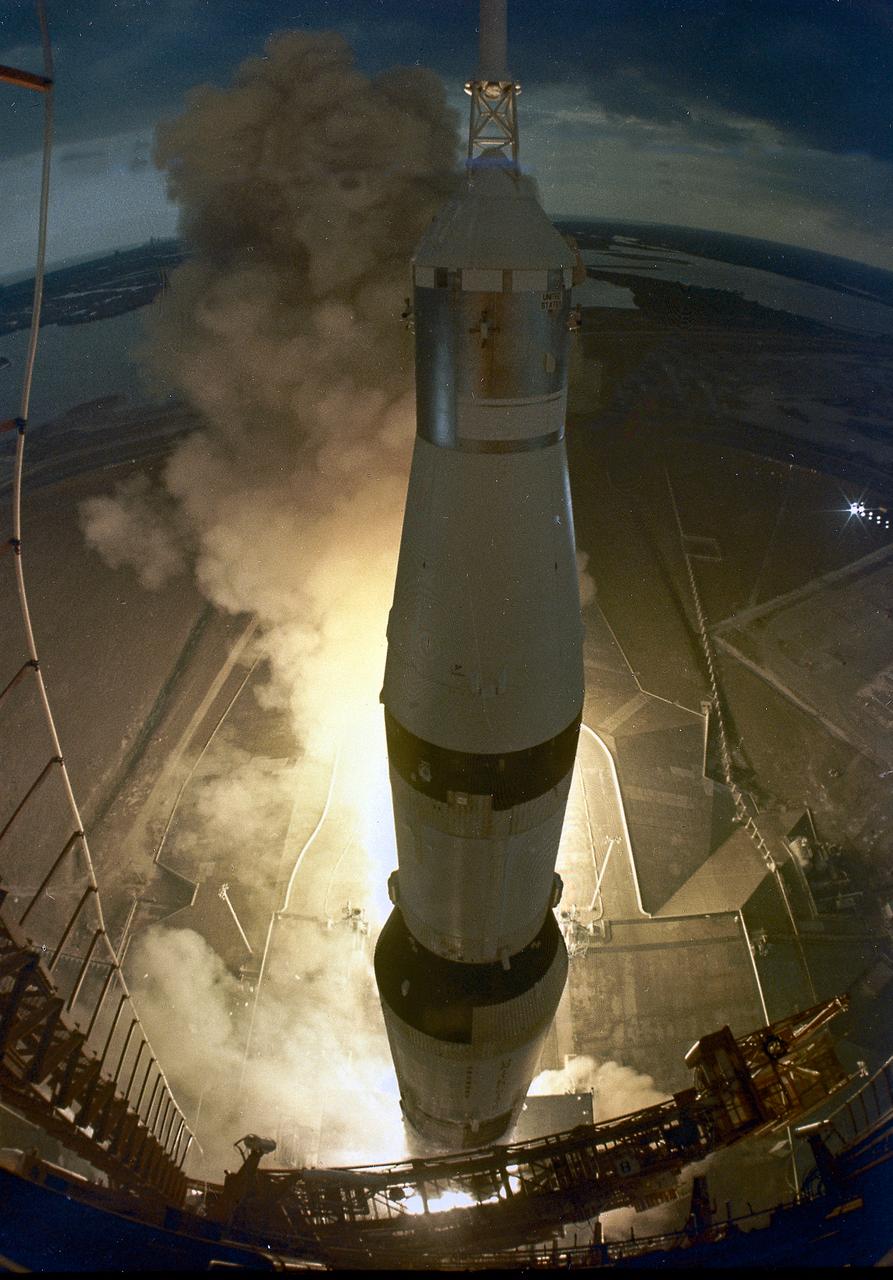
This is a view from sequential photographs of the Apollo 14 liftoff taken by a remote camera atop the 360-foot gantry level of Launch Complex 39A. The Apollo 14, carrying a crew of three astronauts: Mission commander Alan B. Shepard Jr., Command Module pilot Stuart A. Roosa, and Lunar Module pilot Edgar D. Mitchell, lifted off from launch complex 39A at the Kennedy Space Center on January 31, 1971. It was the third manned lunar landing, the first manned landing in exploration of the lunar highlands, and it demonstrated pinpoint landing capability. The major goal of Apollo 14 was the scientific exploration of the Moon in the foothills of the rugged Fra Mauro region. Activities of astronauts Shepard and Mitchell, during extravehicular activity (EVA) on the lunar surface, included setting up an automated scientific laboratory called Apollo Lunar Scientific Experiments Package (ALSEP), and collecting a total of about 95 pounds (43 kilograms) of Moon rock and soil for a geological investigation back on the Earth.

The moon bound Apollo 14, carrying a crew of three astronauts: Mission commander Alan B. Shepard Jr., Command Module pilot Stuart A. Roosa, and Lunar Module pilot Edgar D. Mitchell, lifted off from launch complex 39A at the Kennedy Space Center on January 31, 1971, and safely returned to Earth on February 9, 1971. It was the third manned lunar landing, the first manned landing in exploration of the lunar highlands, and it demonstrated pinpoint landing capability. The major goal of Apollo 14 was the scientific exploration of the Moon in the foothills of the rugged Fra Mauro region. The extravehicular activity (EVA) of astronauts Shepard and Mitchell included setting up an automated scientific laboratory called Apollo Lunar Scientific Experiments Package (ALSEP), shown here fully deployed. In addition, they collected a total of about 95 pounds (43 kilograms) of Moon rock and soil for a geological investigation back on the Earth.

Panoramas of Apollo sites were created to familiarize various Constellation projects with the actual nature of the lunar surface. View of the Lunar Surface towards the western Horizon. Image was created using Apollo 14 images - mag 66 frames 9271 thru 9293.
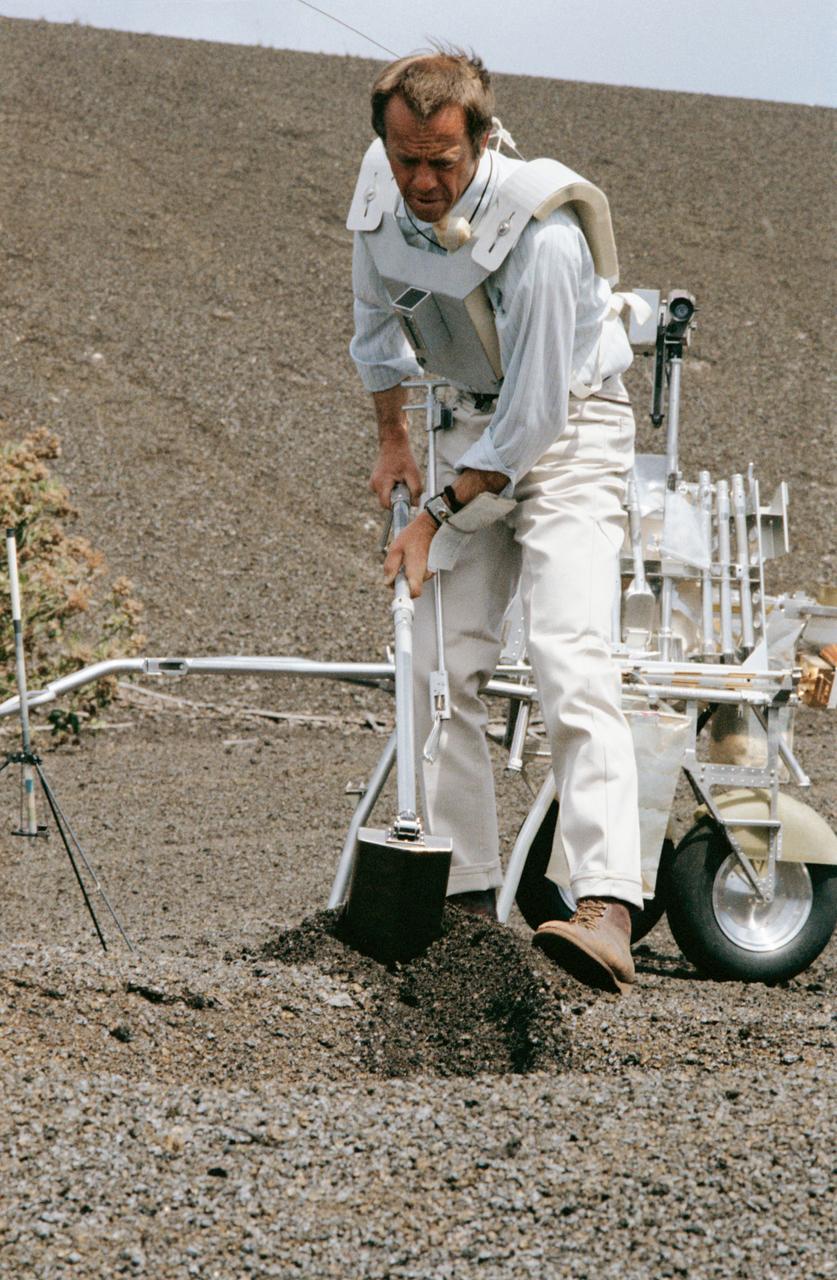
S70-34415 (April 1970) --- Astronaut Alan B. Shepard Jr., prime crew commander of the Apollo 14 mission, uses a trenching tool during a simulation of a traverse on the lunar surface. Members of the Apollo 14 prime and backup crews were in Hawaii to train for the extravehicular activity of their upcoming mission. Features of the terrain at Kapoho and other Hawaiian sites are very similar to those found on the lunar surface. A modular equipment transporter (MET), nicknamed the "Rickshaw" because of its appearance and method of propulsion, is behind Shepard, and a gnomon, one of the Apollo lunar hand tools (ALHT) is at extreme left.

S71-23602 (17 March 1971) --- Left to right: Everett Gibson, Gary McCollom, unidentified man in control room of Lunar Receiving Lab (LRL) during Apollo 14 quarantine period. Photo credit: NASA
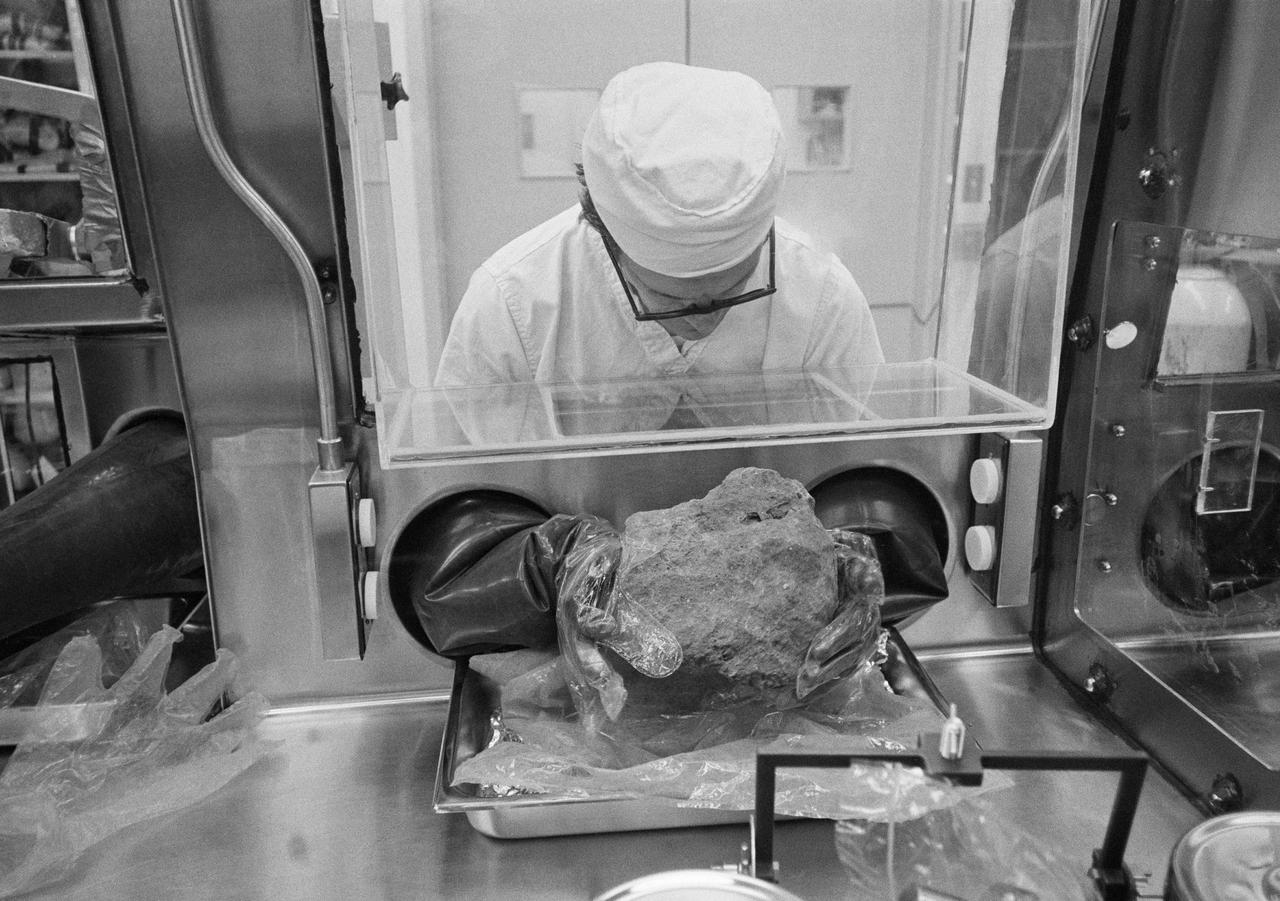
S71-21619 (1 March 1971) --- Dan Anderson works with Apollo 14 lunar samples in the Lunar Receiving Lab (LRL) during the mission?s postflight period. Photo credit: NASA
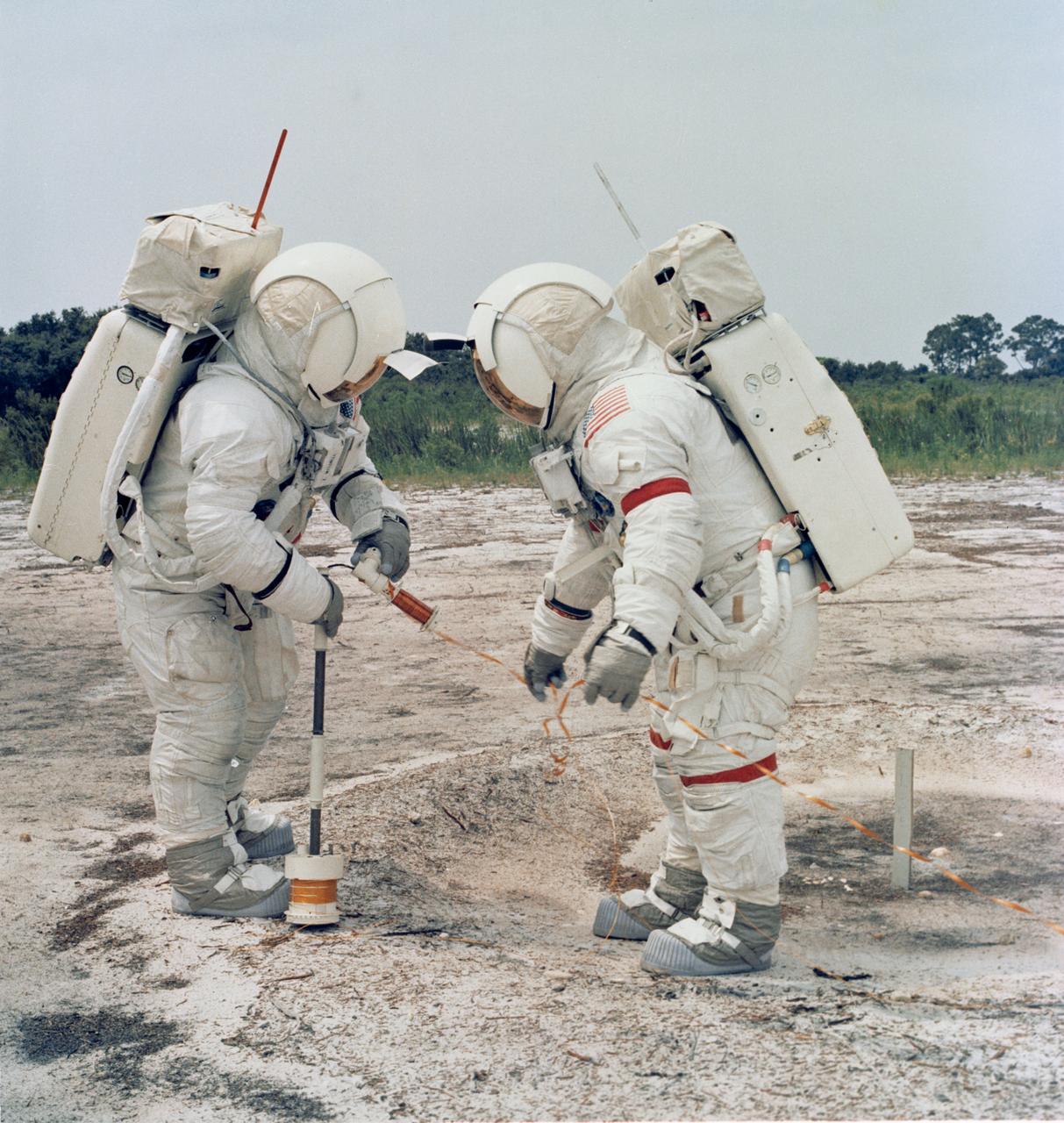
S71-15273 (October 1970) --- Apollo 14 astronauts Alan B. Shepard Jr., commander (right); and Edgar D. Mitchell, lunar module pilot, practice using the Active Seismic Experiment (ASE) to set off explosions on the lunar surface and arm a mortar to launch four grenades after they leave. Measurements of the ensuing vibrations of the moon, radioed to Earth, will give scientists new information on the shape, structure and thickness of the outer lunar crust. ASE will be deployed during one of two Apollo 14 extravehicular activity (EVA) periods.
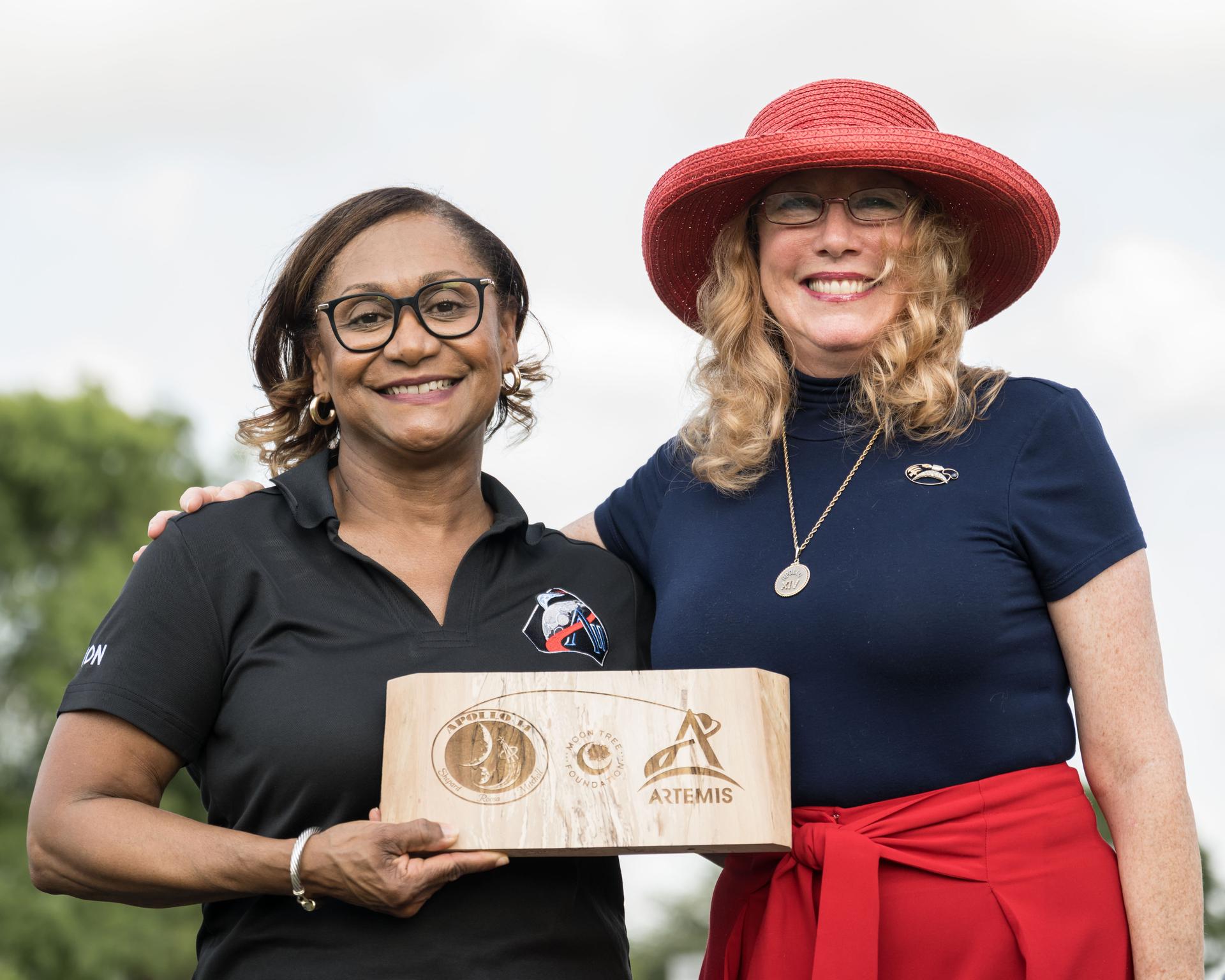
jsc2026e396742 (June 25, 2026) - NASA's Johnson Space Center Director Vanessa Wyche and Rosemary Roosa, president of The Moon Tree foundation and daughter of late Apollo 14 astronaut Stuart Roosa, share a special plaque honoring the ties between the Apollo and Artemis Programs. The plaque is constructed from an original Moon tree planted soon after the Apollo 14 mission and symbolizes the passing of the baton from Apollo to Artemis. Credit: NASA
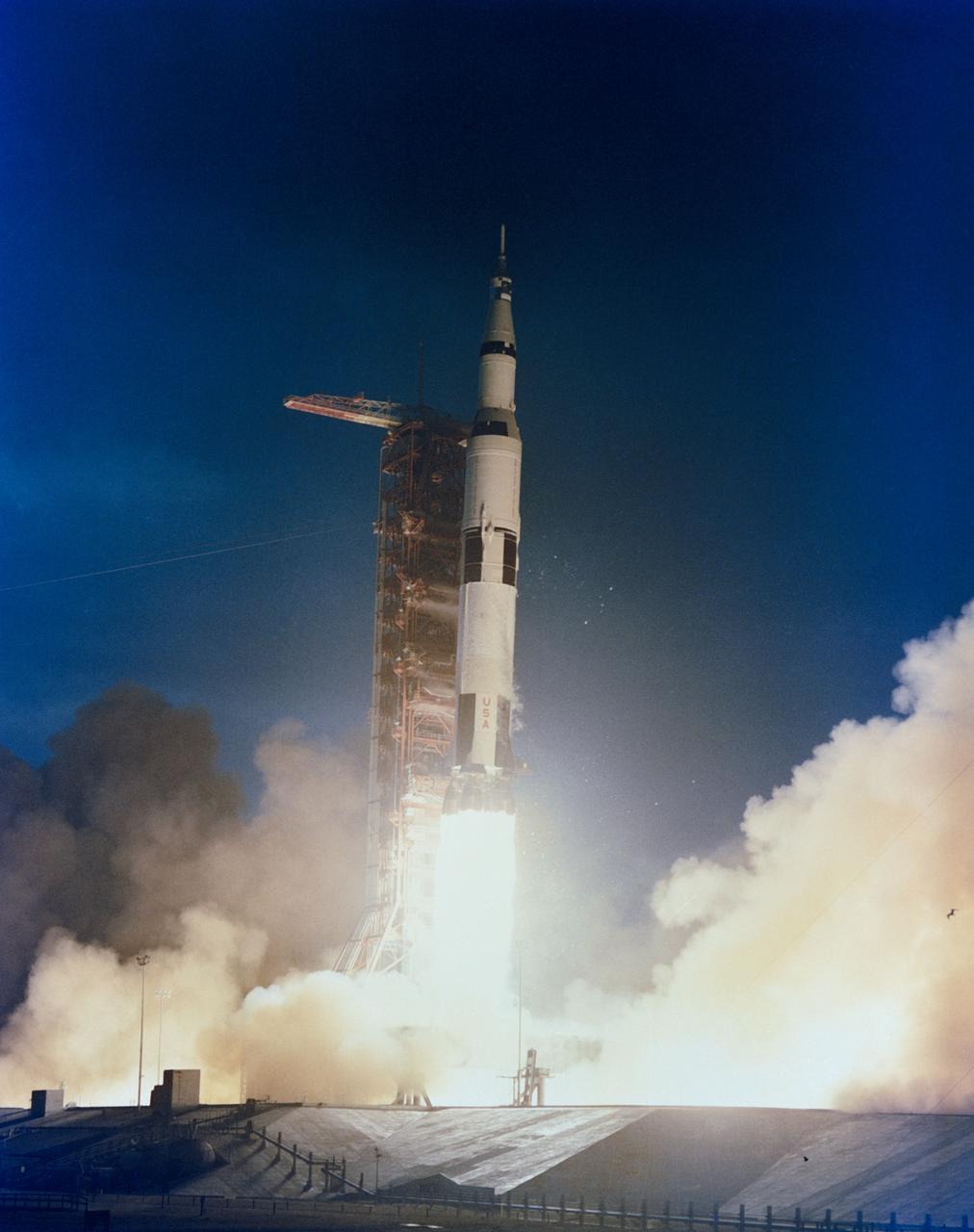
S71-17621 (31 Jan. 1971) --- The huge, 363-feet tall Apollo 14 (Spacecraft 110/Lunar Module 8/Saturn 509) space vehicle is launched from Pad A, Launch Complex 39, Kennedy Space Center, Florida, at 4:03:02 p.m. (EST), Jan. 31, 1981, on a lunar landing mission. Aboard the Apollo 14 spacecraft were astronauts Alan B. Shepard Jr., commander; Stuart A. Roosa, command module pilot; and Edgar D. Mitchell, lunar module pilot.
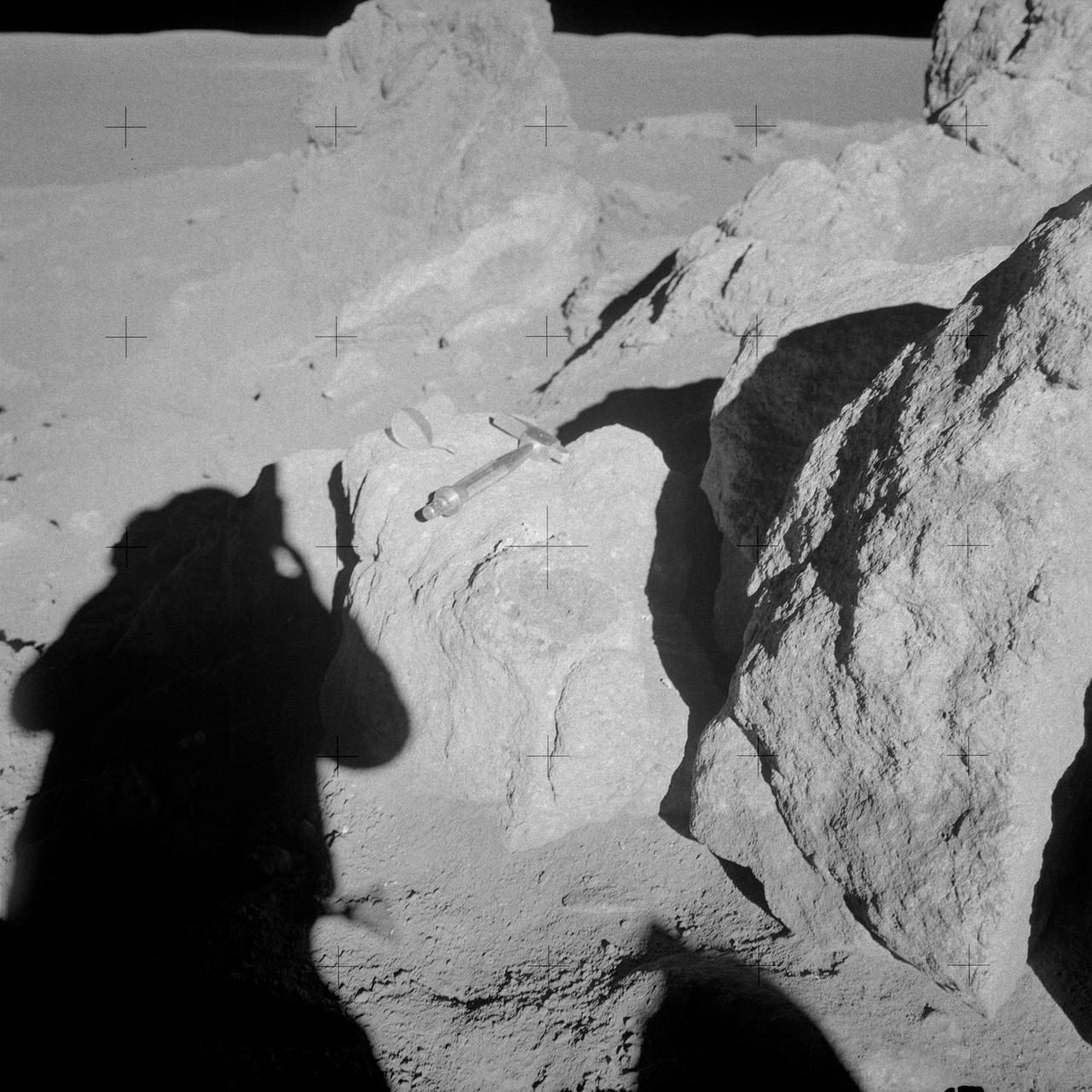
AS14-68-9453 (6 Feb. 1971) --- Astronaut Edgar D. Mitchell, lunar module pilot, whose shadow is in the foreground, photographs a group of large boulders near the rim of Cone Crater. An interesting feature is the white and brown rock in the boulder. Mitchell removed a sample where the hammer is lying. While astronauts Alan B. Shepard Jr., commander, and Mitchell descended in the Lunar Module (LM) "Antares" to explore the Fra Mauro region of the moon, astronaut Stuart A. Roosa, command module pilot, remained with the Command and Service Modules (CSM) "Kitty Hawk" in lunar orbit.
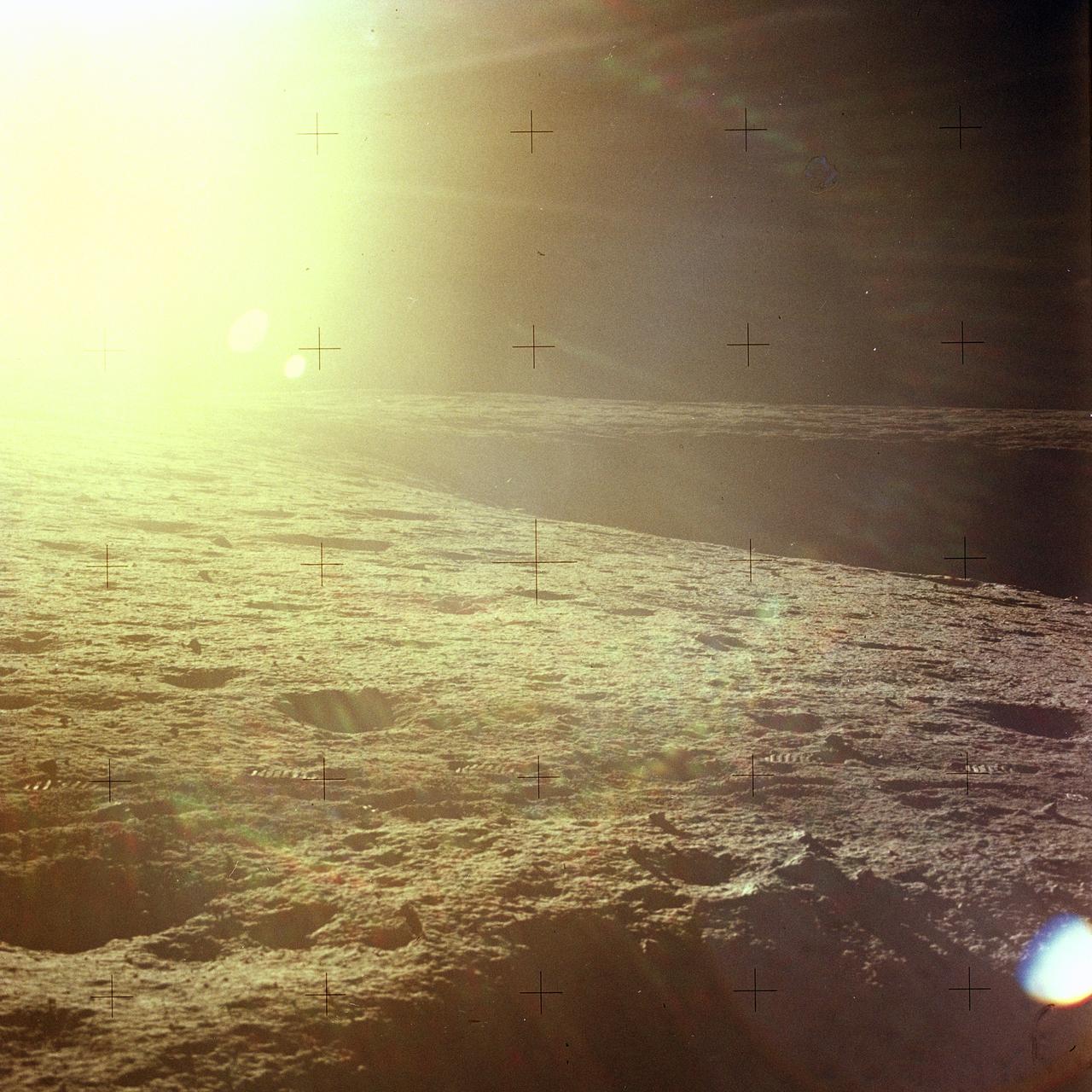
The second manned lunar landing mission, Apollo 12, launched from launch pad 39-A at Kennedy Space Center in Florida on November 14, 1969 via a Saturn V launch vehicle. The Saturn V vehicle was developed by the Marshall Space Flight Center (MSFC) under the direction of Dr. Wernher von Braun. Aboard Apollo 12 was a crew of three astronauts: Alan L. Bean, pilot of the Lunar Module (LM), Intrepid; Richard Gordon, pilot of the Command Module (CM), Yankee Clipper; and Spacecraft Commander Charles Conrad. The LM, Intrepid, landed astronauts Conrad and Bean on the lunar surface in what’s known as the Ocean of Storms while astronaut Richard Gordon piloted the CM, Yankee Clipper, in a parking orbit around the Moon. Lunar soil activities included the deployment of the Apollo Lunar Surface Experiments Package (ALSEP), finding the unmanned Surveyor 3 that landed on the Moon on April 19, 1967, and collecting 75 pounds (34 kilograms) of rock samples. This is the fourteenth of 25 images captured by the crew in attempt to provide a 360 degree Lunar surface scene. Apollo 12 safely returned to Earth on November 24, 1969.
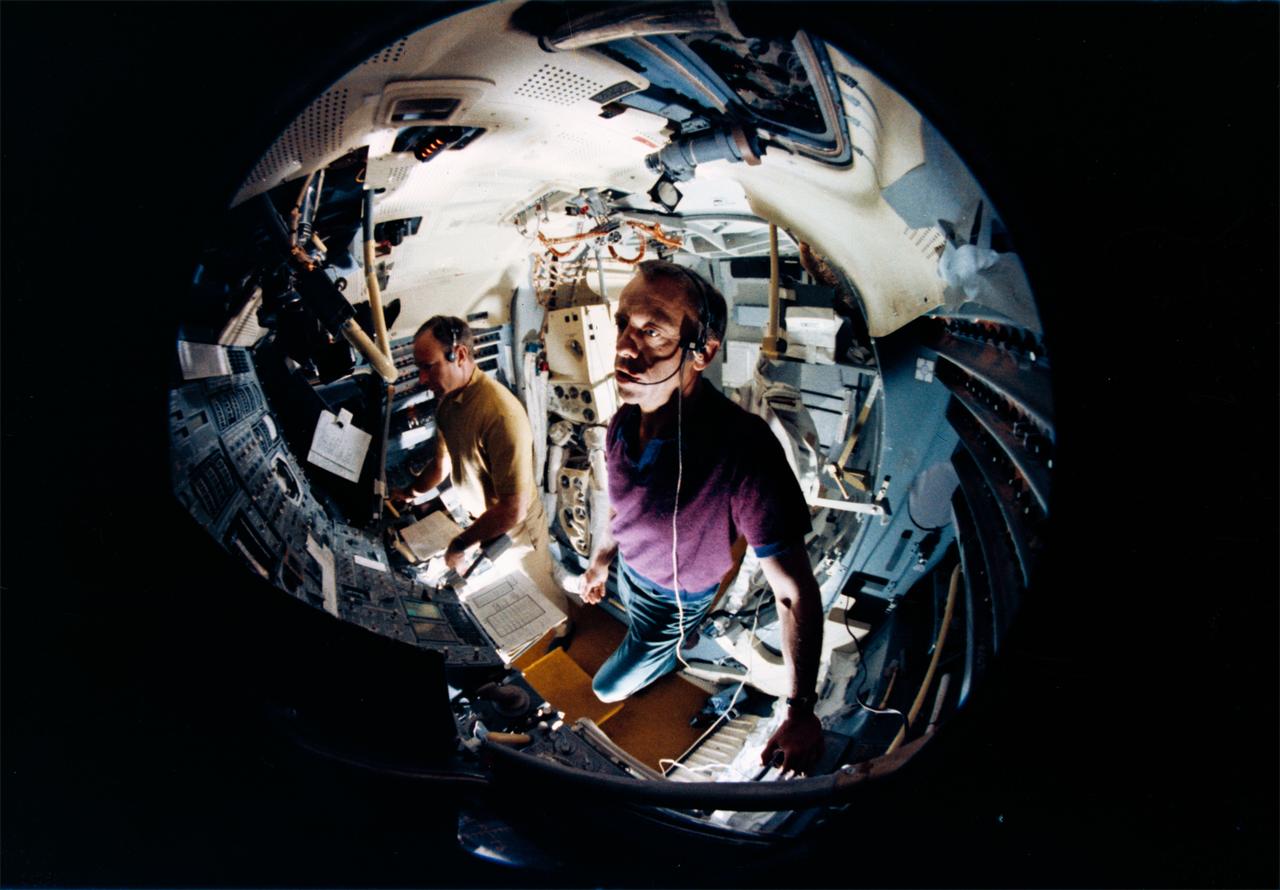
S70-45555 (July 1970) --- A fish-eye lens view showing astronauts Alan B. Shepard Jr. (foreground) and Edgar D. Mitchell in the Apollo lunar module mission simulator at the Kennedy Space Center during preflight training for the Apollo 14 lunar landing mission. Shepard is the Apollo 14 commander; and Mitchell is the lunar module pilot.
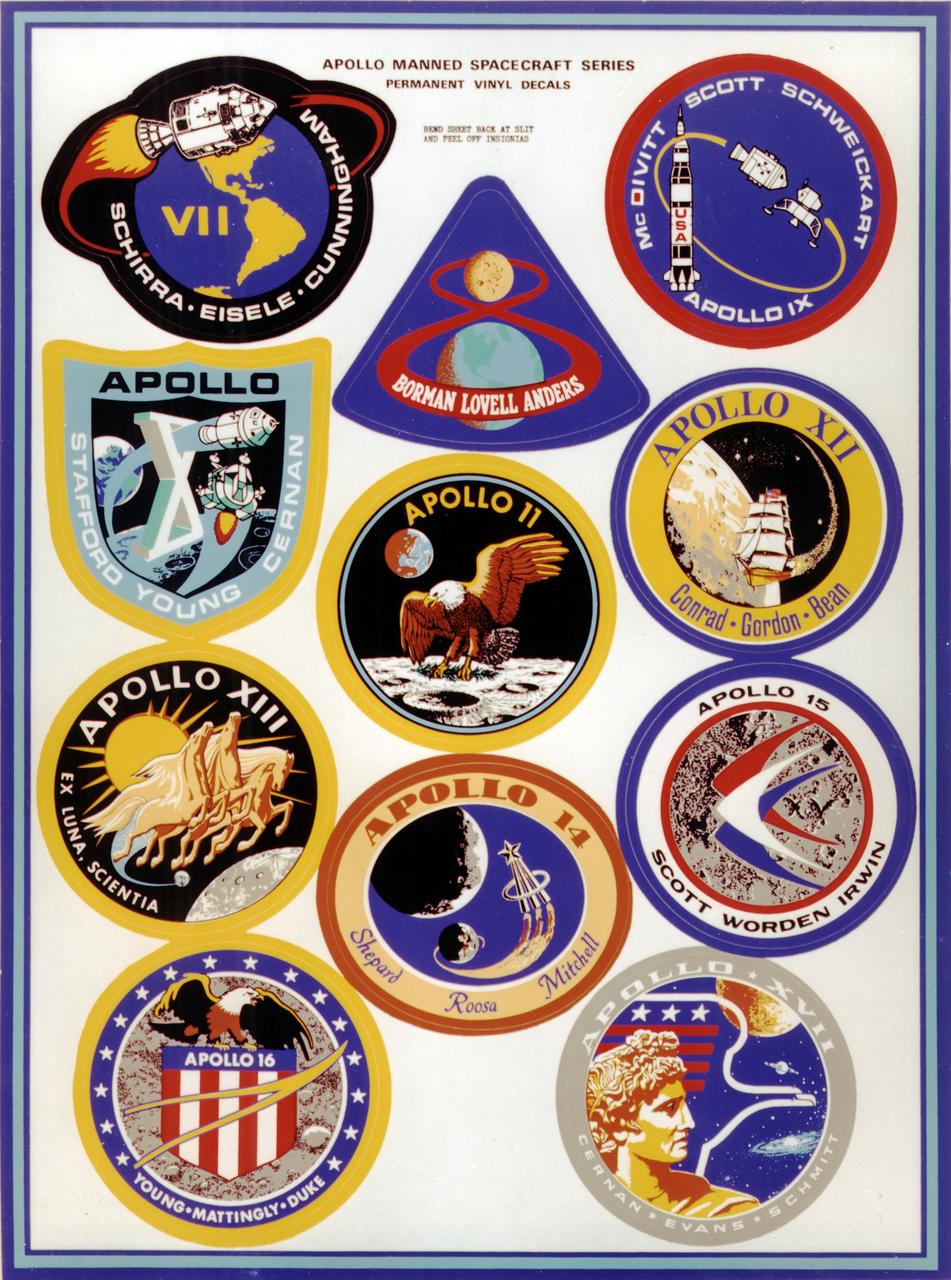
This montage depicts the flight crew patches for the manned Apollo 7 thru Apollo 17 missions. The Apollo 7 through 10 missions were basically manned test flights that paved the way for lunar landing missions. Primary objectives met included the demonstration of the Command Service Module (CSM) crew performance; crew/space vehicle/mission support facilities performance and testing during a manned CSM mission; CSM rendezvous capability; translunar injection demonstration; the first manned Apollo docking, the first Apollo Extra Vehicular Activity (EVA), performance of the first manned flight of the lunar module (LM); the CSM-LM docking in translunar trajectory, LM undocking in lunar orbit, LM staging in lunar orbit, and manned LM-CSM docking in lunar orbit. Apollo 11 through 17 were lunar landing missions with the exception of Apollo 13 which was forced to circle the moon without landing due to an onboard explosion. The craft was,however, able to return to Earth safely. Apollo 11 was the first manned lunar landing mission and performed the first lunar surface EVA. Landing site was the Sea of Tranquility. A message for mankind was delivered, the U.S. flag was planted, experiments were set up and 47 pounds of lunar surface material was collected for analysis back on Earth. Apollo 12, the 2nd manned lunar landing mission landed in the Ocean of Storms and retrieved parts of the unmanned Surveyor 3, which had landed on the Moon in April 1967. The Apollo Lunar Surface Experiments Package (ALSEP) was deployed, and 75 pounds of lunar material was gathered. Apollo 14, the 3rd lunar landing mission landed in Fra Mauro. ALSEP and other instruments were deployed, and 94 pounds of lunar materials were gathered, using a hand cart for first time to transport rocks. Apollo 15, the 4th lunar landing mission landed in the Hadley-Apennine region. With the first use of the Lunar Roving Vehicle (LRV), the crew was bale to gather 169 pounds of lunar material. Apollo 16, the 5th lunar landing mission, landed in the Descartes Highlands for the first study of highlands area. Selected surface experiments were deployed, the ultraviolet camera/spectrograph was used for first time on the Moon, and the LRV was used for second time for a collection of 213 pounds of lunar material. The Apollo program came to a close with Apollo 17, the 6th and final manned lunar landing mission that landed in the Taurus-Littrow highlands and valley area. This mission hosted the first scientist-astronaut, Schmitt, to land on the Moon. The 6th automated research station was set up, and 243 ponds of lunar material was gathered using the LRV.
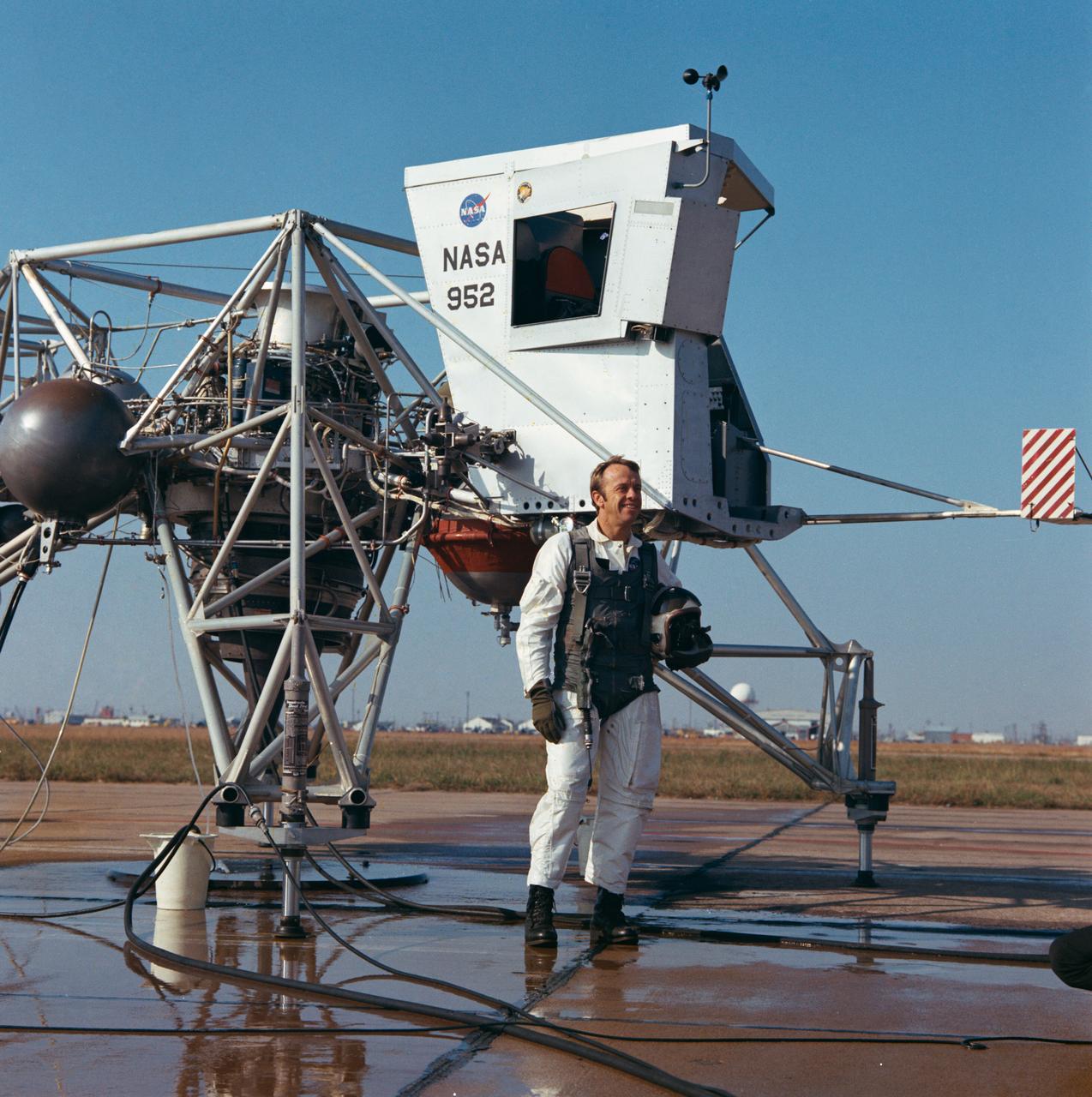
S70-56287 (14 Dec. 1970) --- Astronaut Alan B. Shepard Jr., commander of the Apollo 14 lunar landing mission, stands near a Lunar Landing Training Vehicle (LLTV) prior to a test flight at Ellington Air Force Base, Houston, on Dec. 14, 1970. Shepard will be at the controls of the Apollo 14 Lunar Module (LM) when it lands on the moon in the highlands near Fra Mauro. Astronaut Stuart A. Roosa, command module pilot, will remain with the Command and Service Modules (CSM) in lunar orbit while astronauts Shepard and Edgar D. Mitchell, lunar module pilot, descend in the LM to explore the moon.
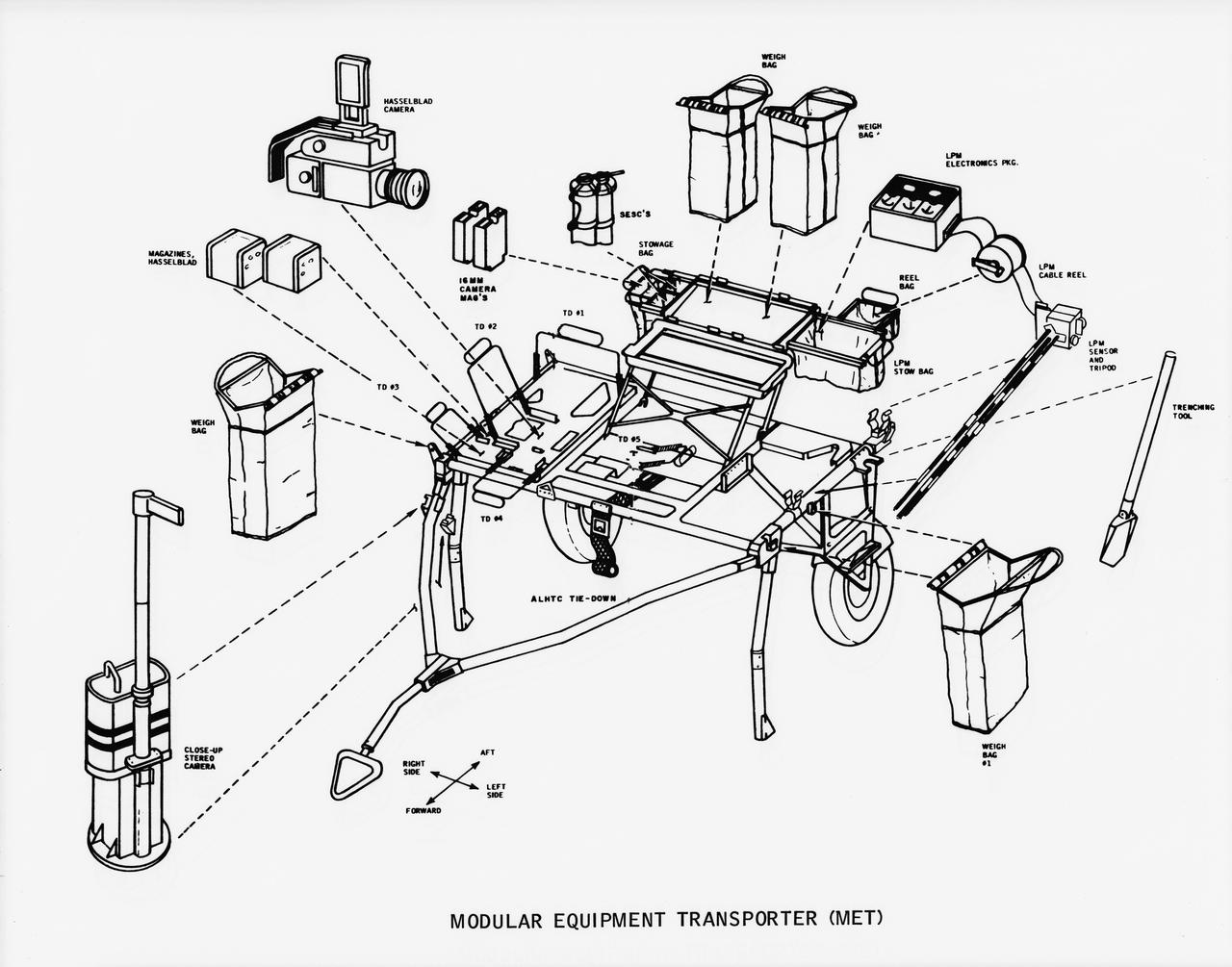
S70-50762 (November 1970) --- A line drawing illustrating layout view of the modular equipment transporter (MET) and its equipment. A MET (or Rickshaw, as it has been nicknamed) will be used on the lunar surface for the first time during the Apollo 14 lunar landing mission. The Rickshaw will serve as a portable workbench with a place for the Apollo lunar hand tools (ALHT) and their carrier, three cameras, two sample container bags, a special environment sample container (SESC), a lunar portable magnetometer (LPM) and spare film magazines.
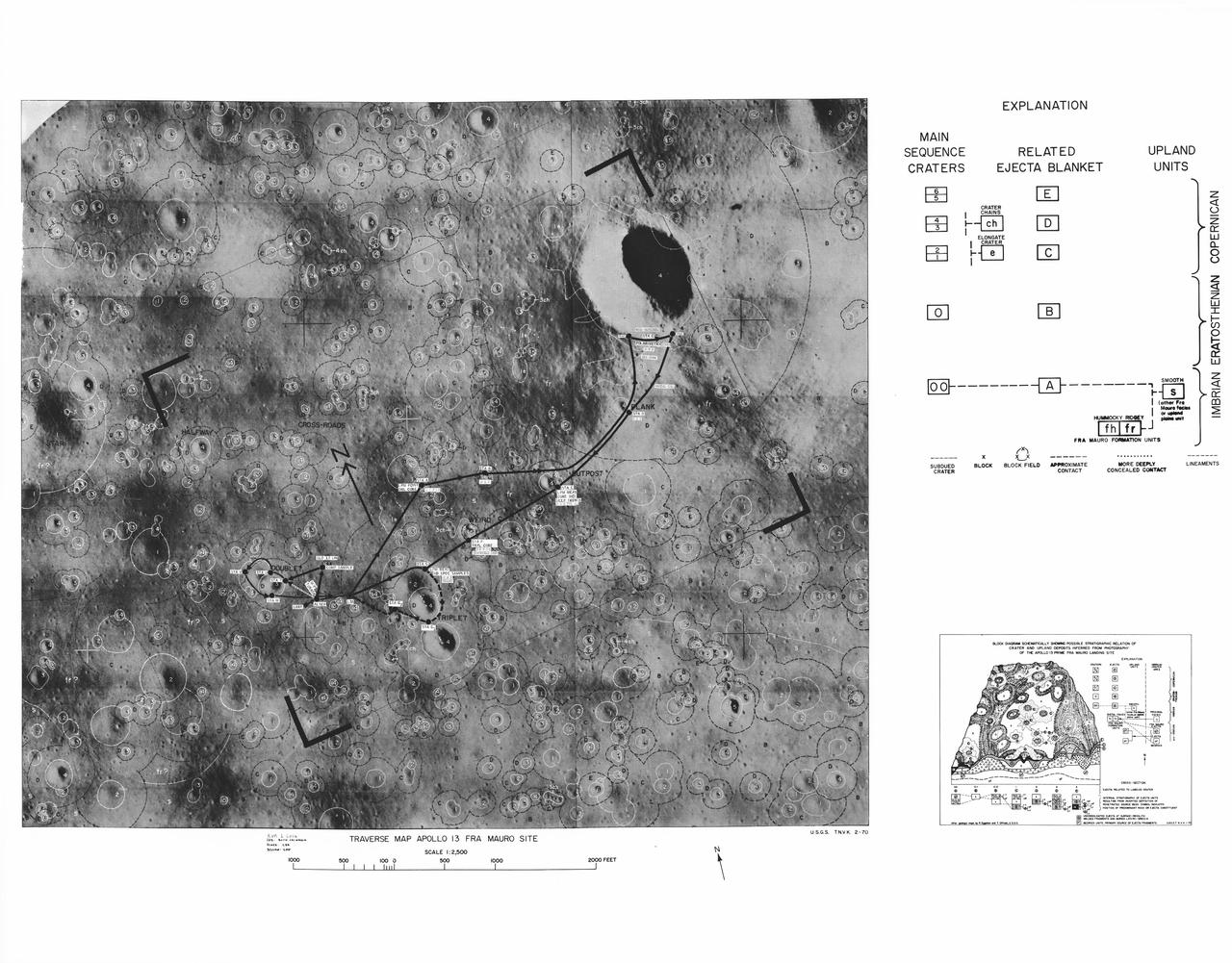
This lunar map shows the traverse plans for the Apollo 14 lunar landing mission. Areas marked include Lunar module landing site, areas for the Apollo Lunar Surface Experiment Package (ALSEP) and areas for gathering of core samples.