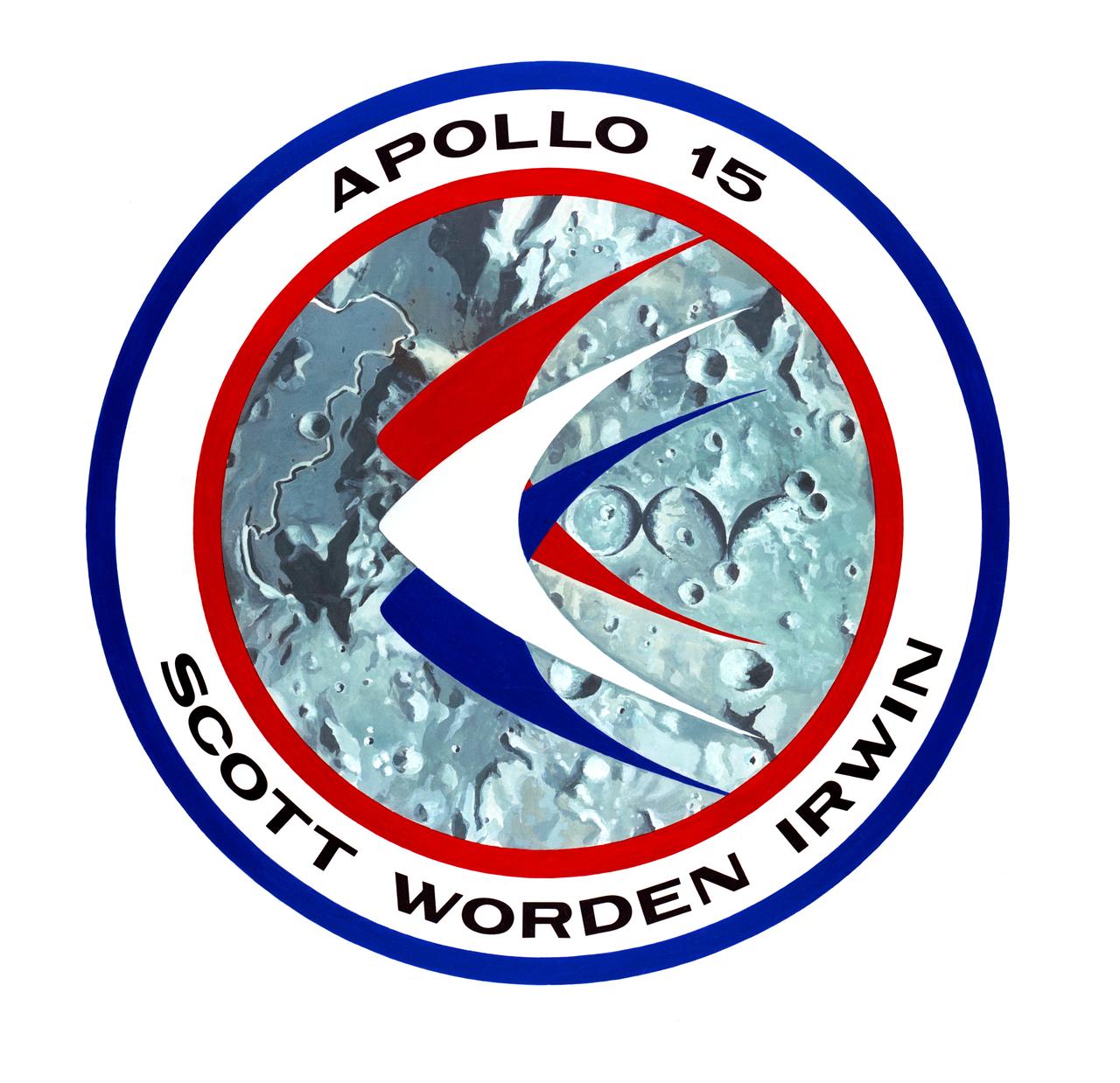
S71-30463 (May 1971) --- This is the insignia designed for the Apollo 15 lunar landing mission. The circular design features the colors red, white and blue. On the outer portion of the patch a narrow band of blue and a narrow band of red encircle a wider band of white. The large disc in the center of the emblem has red, white and blue symbols of flight, superimposed over an artist's concept of the Apollo 15 Hadley-Apennine landing site of gray tone. The surnames of the three names are centered in the white band at the bottom of the insignia. The Apollo 15 prime crew men are David R. Scott, commander; Alfred M. Worden, command module pilot; and James B. Irwin, lunar module pilot. This is the official Apollo 15 emblem, property of the government of the United States. It has been authorized only for use by the astronauts. Its production in any form other than in news, information and education media is not authorized without approval. Unauthorized use of the photograph is subject to the provisions of Title 18, U.S. Code, Section 701.
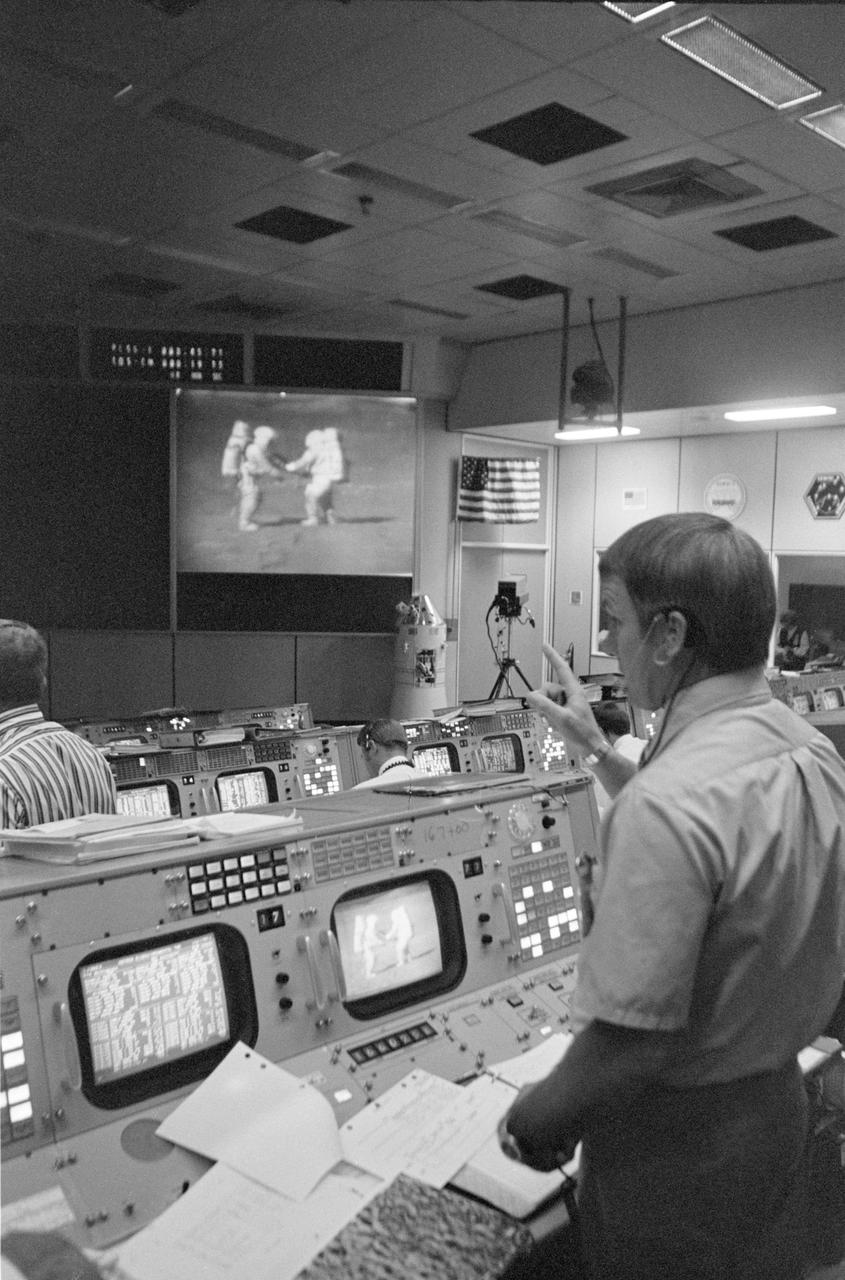
S71-41852 (2 Aug. 1971) --- Gerald D. Griffin, foreground, stands near his console in the Mission Operations Control Room (MOCR) during Apollo 15's third extravehicular activity (EVA) on the lunar surface. Griffin is Gold Team (Shift 1) flight director for the Apollo 15 mission. Astronauts David R. Scott and James B. Irwin can be seen on the large screen at the front of the MOCR as they participate in sample-gathering on the lunar surface.
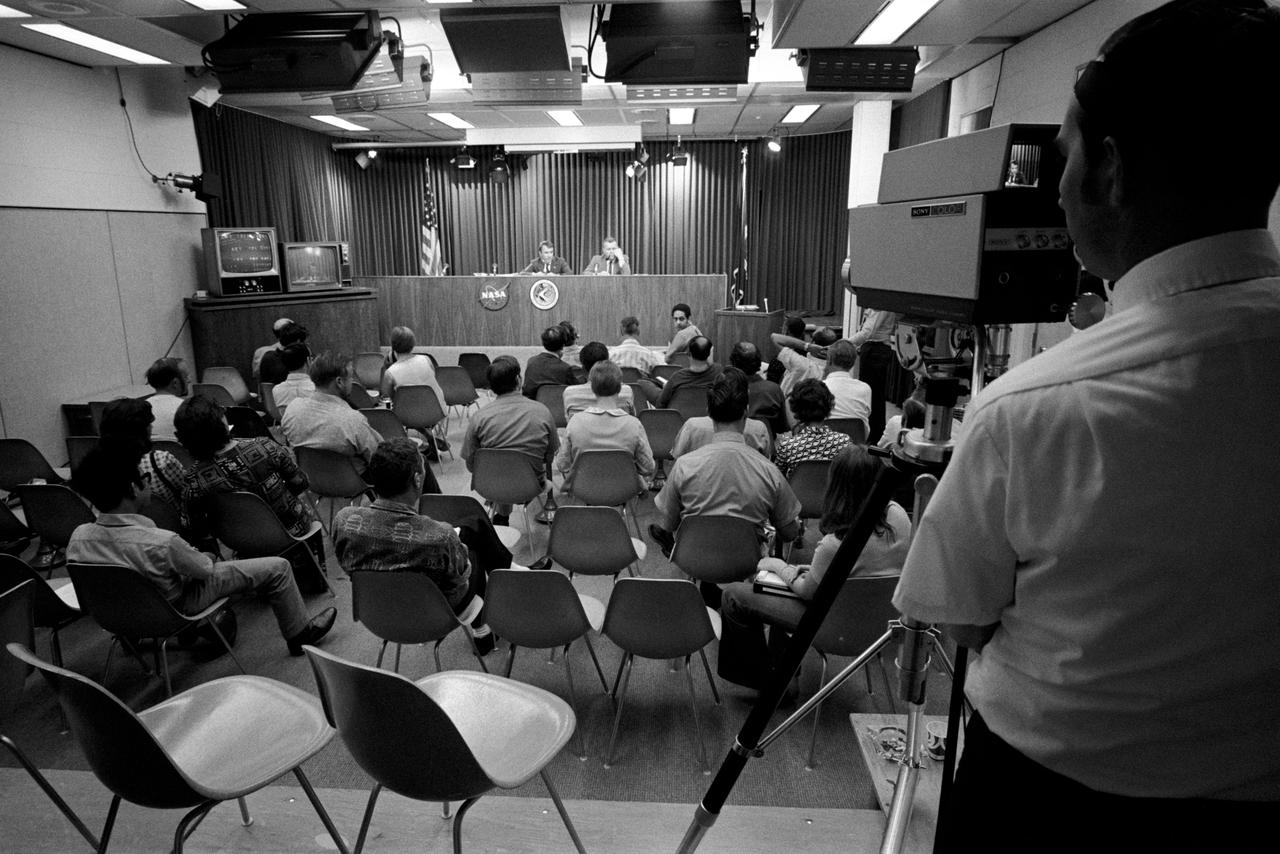
S71-41842 (July 1971) --- Newsmen put questions to Gerald D. Griffin, left at lectern, a flight director for the Apollo 15 lunar landing mission, during a change of shift briefing in the small briefing room in Building One at the Manned Spacecraft Center (MSC). Representing Public Affairs Office at the briefing is Terry White, right at lectern.
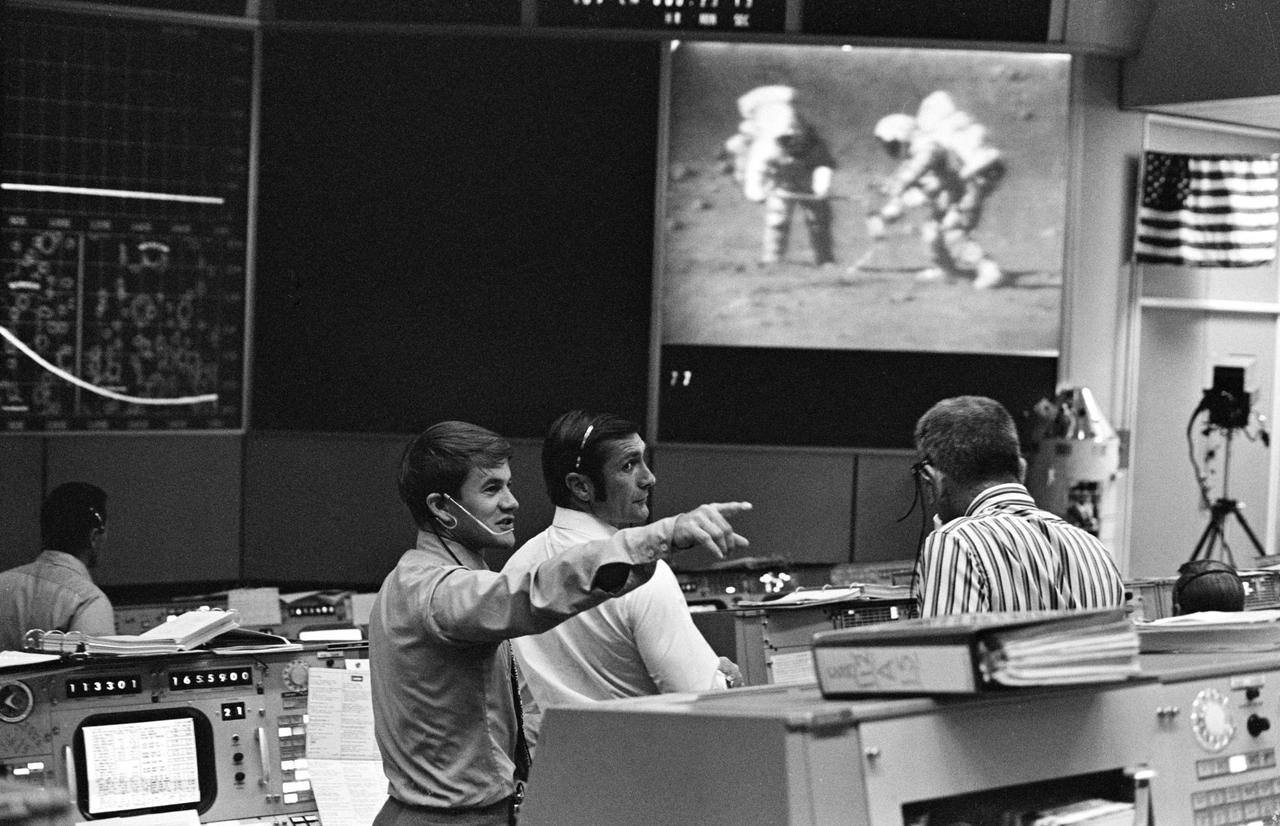
S71-41836 (2 Aug. 1971) --- Scientist-astronaut Joseph P. Allen, left, directs the attention of astronaut Richard F. Gordon Jr., to an occurrence out of view at right in the Mission Control Center's (MCC) Mission Operations Control Room (MOCR), while Dr. Donald K. (Deke) Slayton, on right with back to camera, views activity of Apollo 15 on a large screen at the front of the MOCR. Astronauts David R. Scott and James B. Irwin are seen on the screen performing tasks of the mission's third extravehicular activity (EVA), on Aug. 2, 1971. Dr. Slayton is director of Flight Crew Operations, NASA-MSC; Gordon is Apollo 15 backup commander; and Dr. Allen is an Apollo 15 spacecraft communicator.
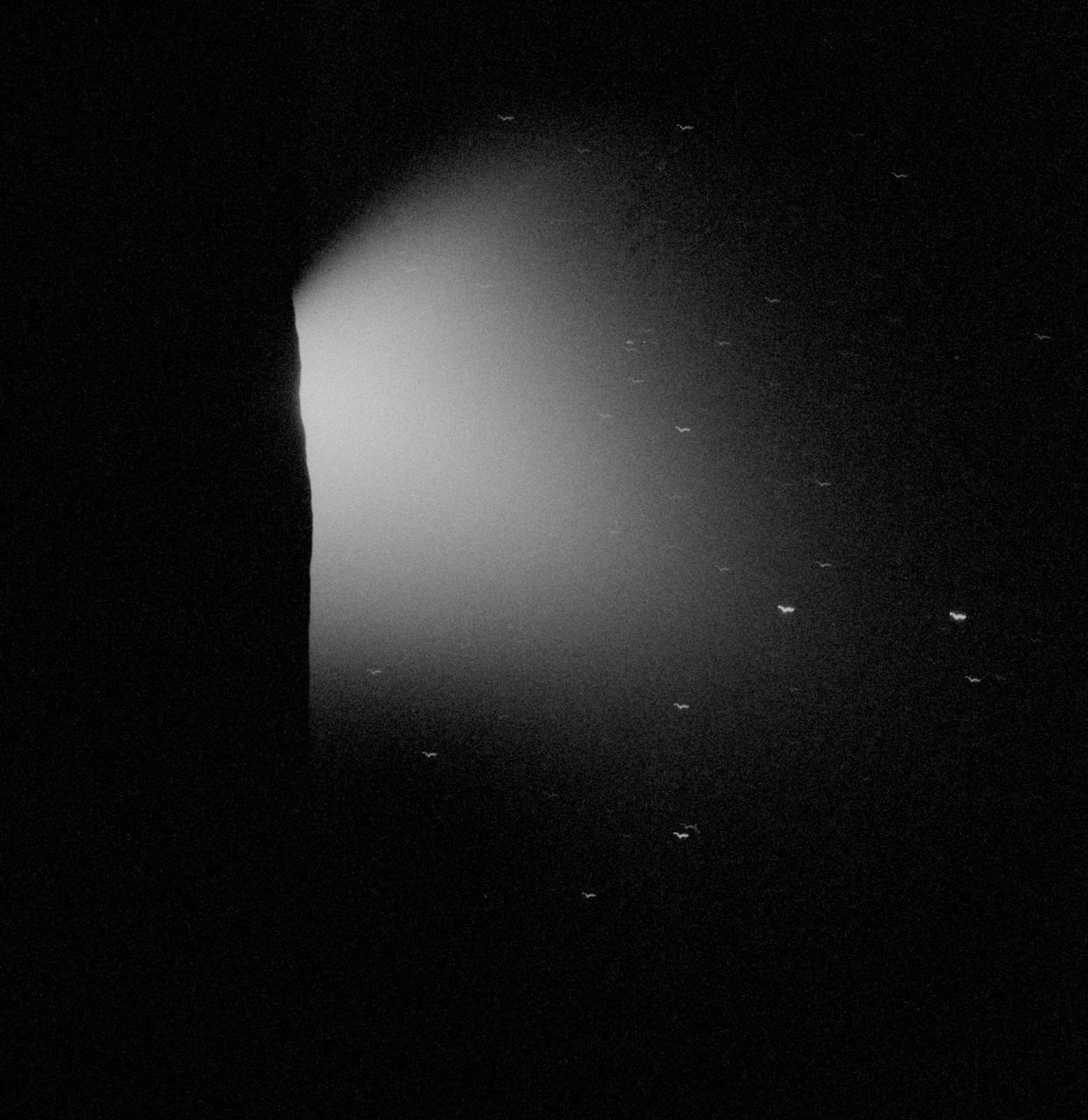
AS15-98-13311 (31 July 1971) --- The solar corona, as photographed from the Apollo 15 spacecraft about one minute prior to sunrise on July 31, 1971, is seen just beyond the lunar horizon. The bright object on the opposite of the frame is the planet Mercury. The bright star near the frame center is Regulus, and the lesser stars form the head of the constellation Leo. Mercury is approximately 28 degrees from the center of the sun. The solar coronal streamers, therefore, appear to extend about eight degrees from the sun's center. This solar corona photograph was the second in a series of seven. Three such series were obtained by astronaut Alfred M. Worden, command module pilot, during the solo part of his lunar orbital flight. They represent man's first view of this part of the sun's light. While astronauts David R. Scott, commander, and James B. Irwin, lunar module pilot, descended in the Lunar Module (LM) "Falcon" to explore the Hadley-Apennine area of the moon, astronaut Worden remained with the Command and Service Modules (CSM) in lunar orbit.
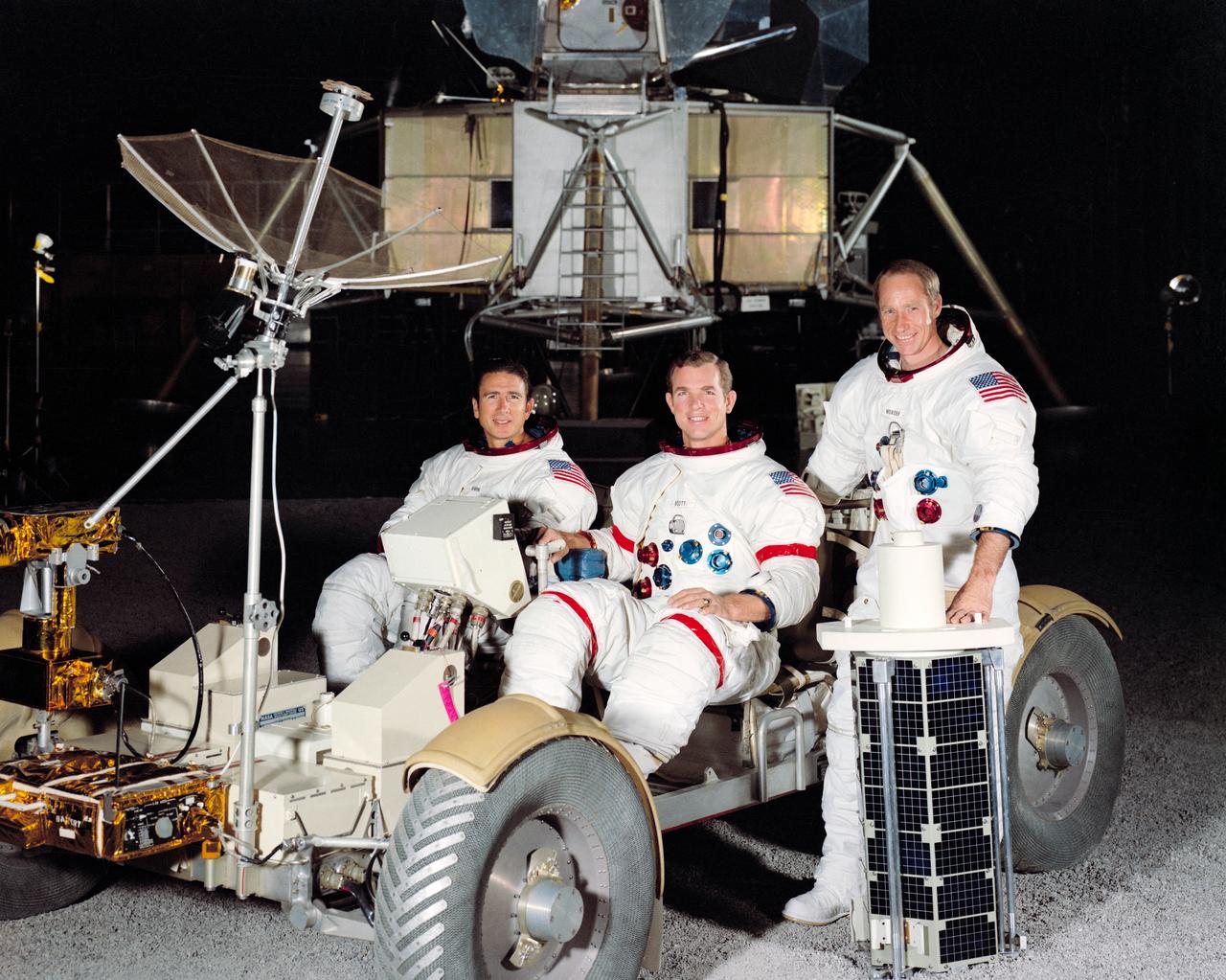
S71-22407 (March 1971) --- These three astronauts have been named by the National Aeronautics and Space Administration (NASA) as the prime crew men of the Apollo 15 lunar landing mission. They are, left to right, James B. Irwin, lunar module pilot; David R. Scott, commander; and Alfred M. Worden, command module pilot.
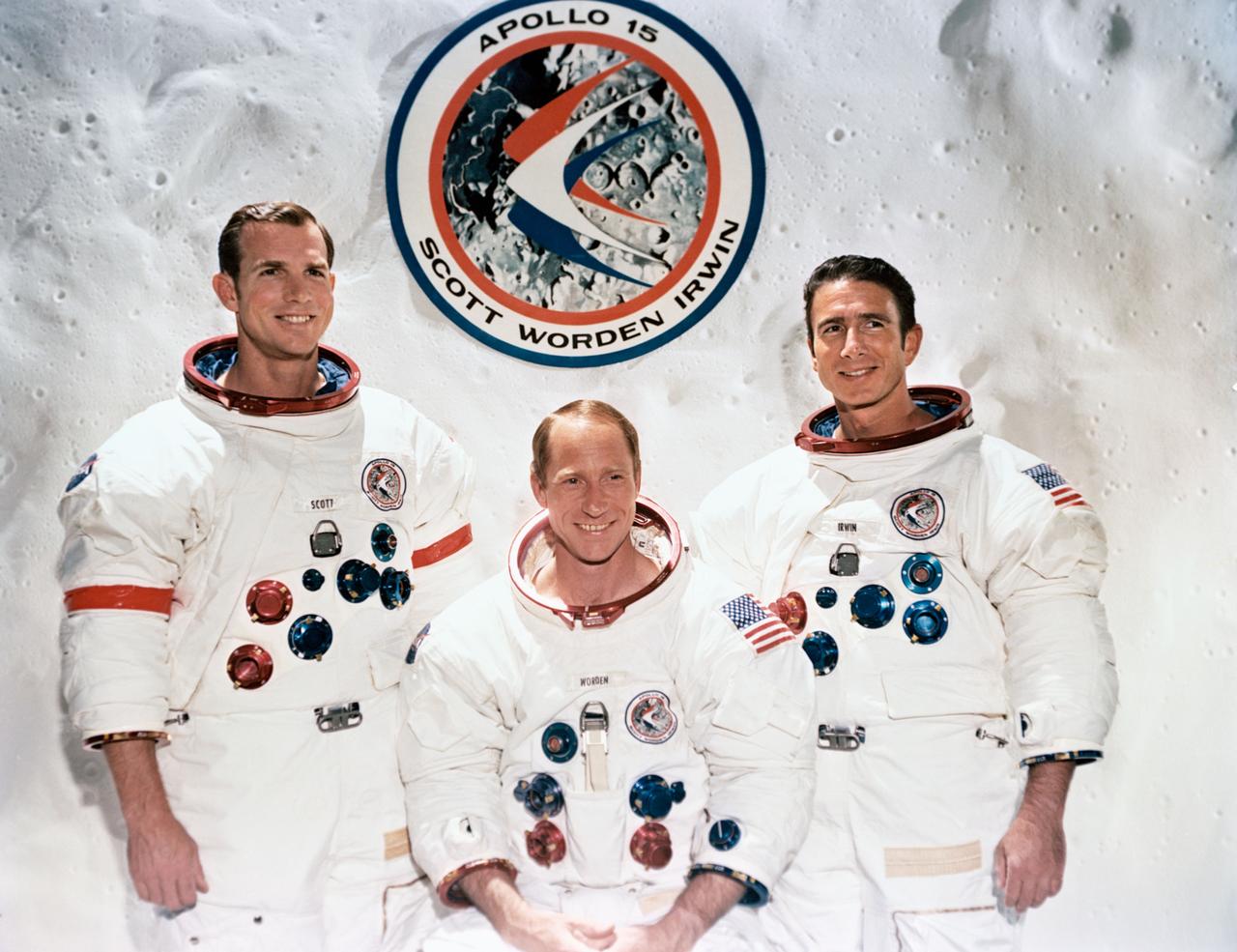
S71-37963 (July 1971) --- These three astronauts are the prime crew of the Apollo 15 lunar landing mission. They are, left to right, David R. Scott, commander; Alfred M. Worden, command module pilot; and James B. Irwin, lunar module pilot. The Apollo 15 emblem is in the background.
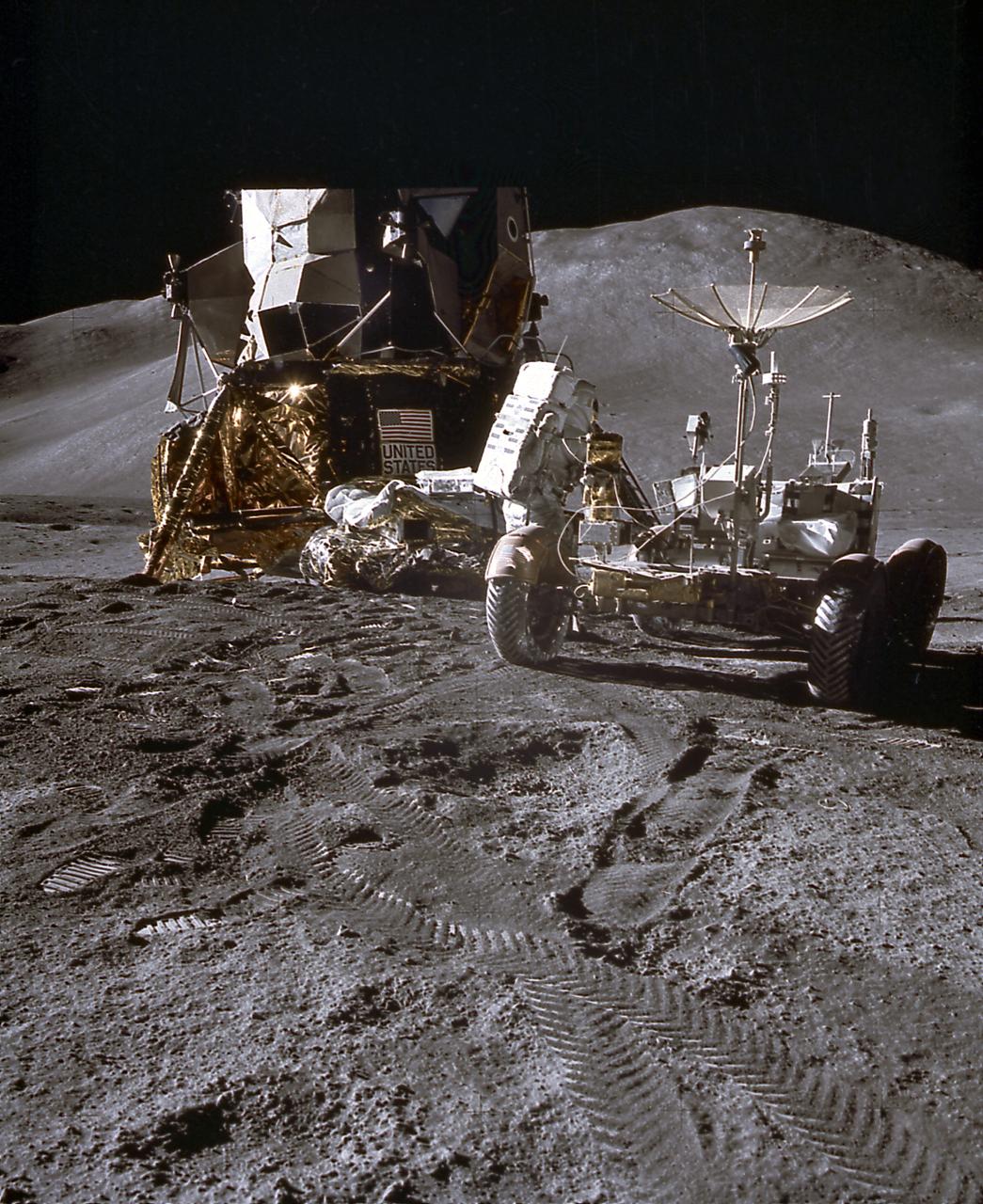
This photograph of an astronaut getting the Lunar Roving Vehicle (LRV) ready for exploration of the lunar surface was taken during activities of the Apollo 15 mission. Designed and developed by the Marshall Space Flight Center and built by the Boeing Company, the LRV was first used on the Apollo 15 mission and increased the range of astronauts' mobility and productivity on the lunar surface.
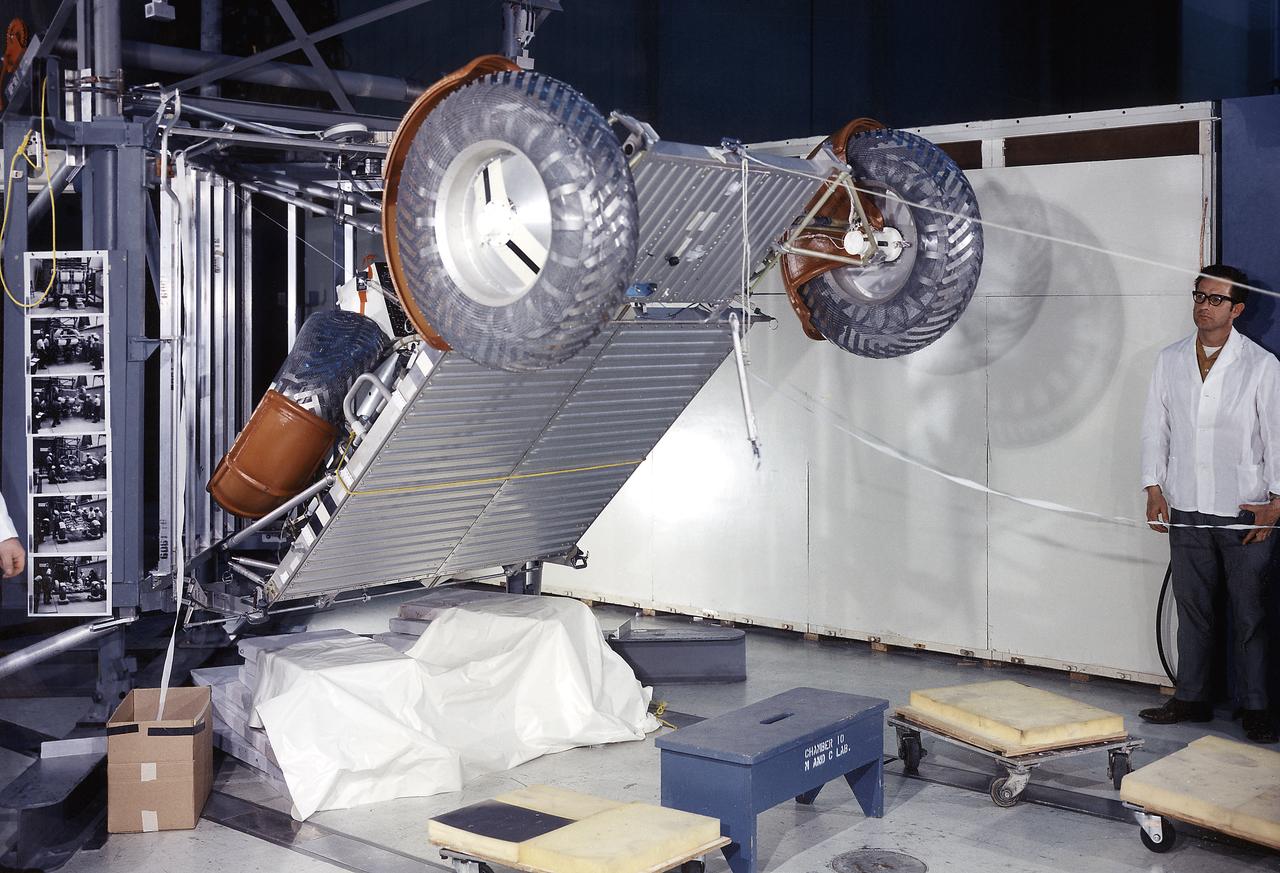
This photograph was taken during a deployment simulation of the Lunar Roving Vehicle (LRV). The LRV was built to give Apollo astronauts a greater range of mobility during the last three lunar exploration missions; Apollo 15, Apollo 16, and Apollo 17. It was designed and developed by the Marshall Space Flight Center and built by the Boeing Company.
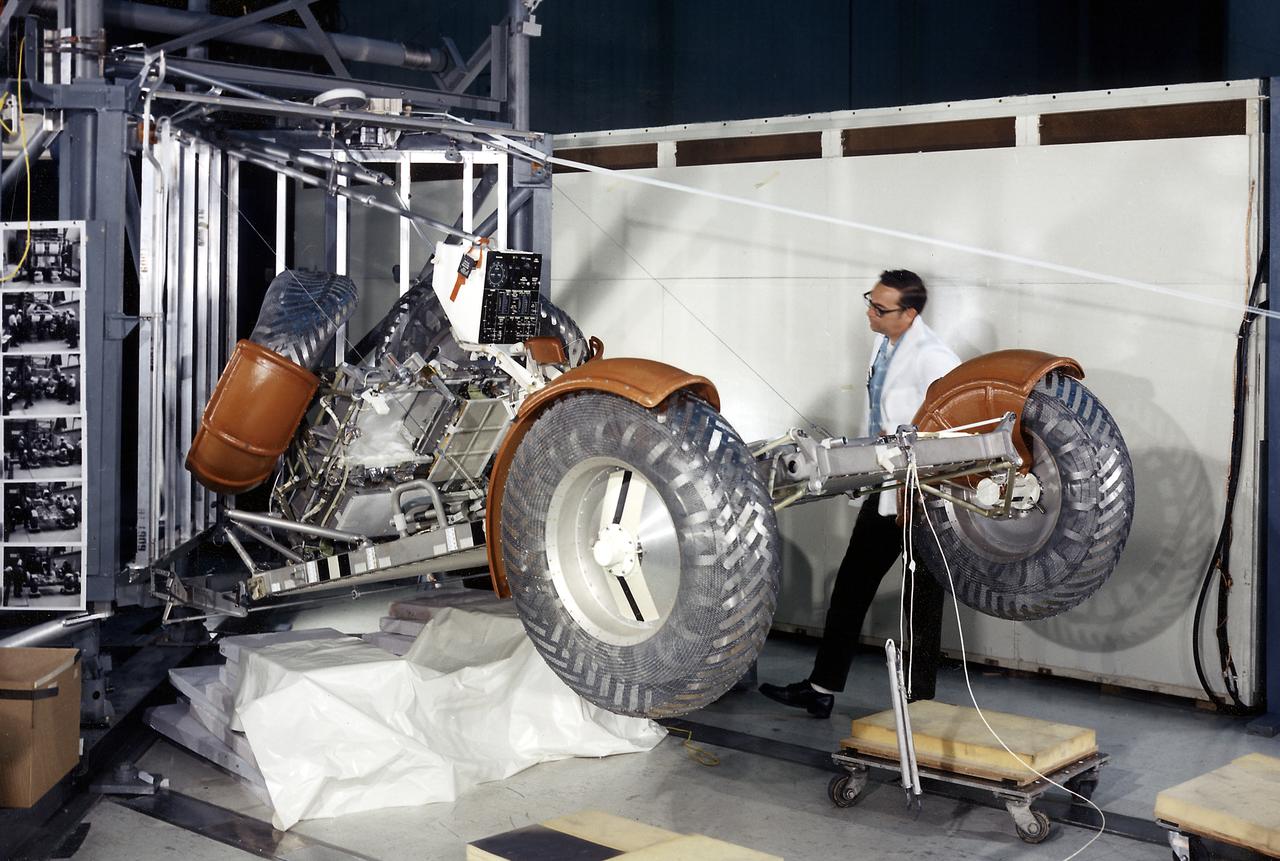
This photograph was taken during a deployment simulation of the Lunar Roving Vehicle (LRV). The LRV was built to give Apollo astronauts a greater range of mobility during the last three lunar exploration missions; Apollo 15, Apollo 16, and Apollo 17. It was designed and developed by the Marshall Space Flight Center and built by the Boeing Company.
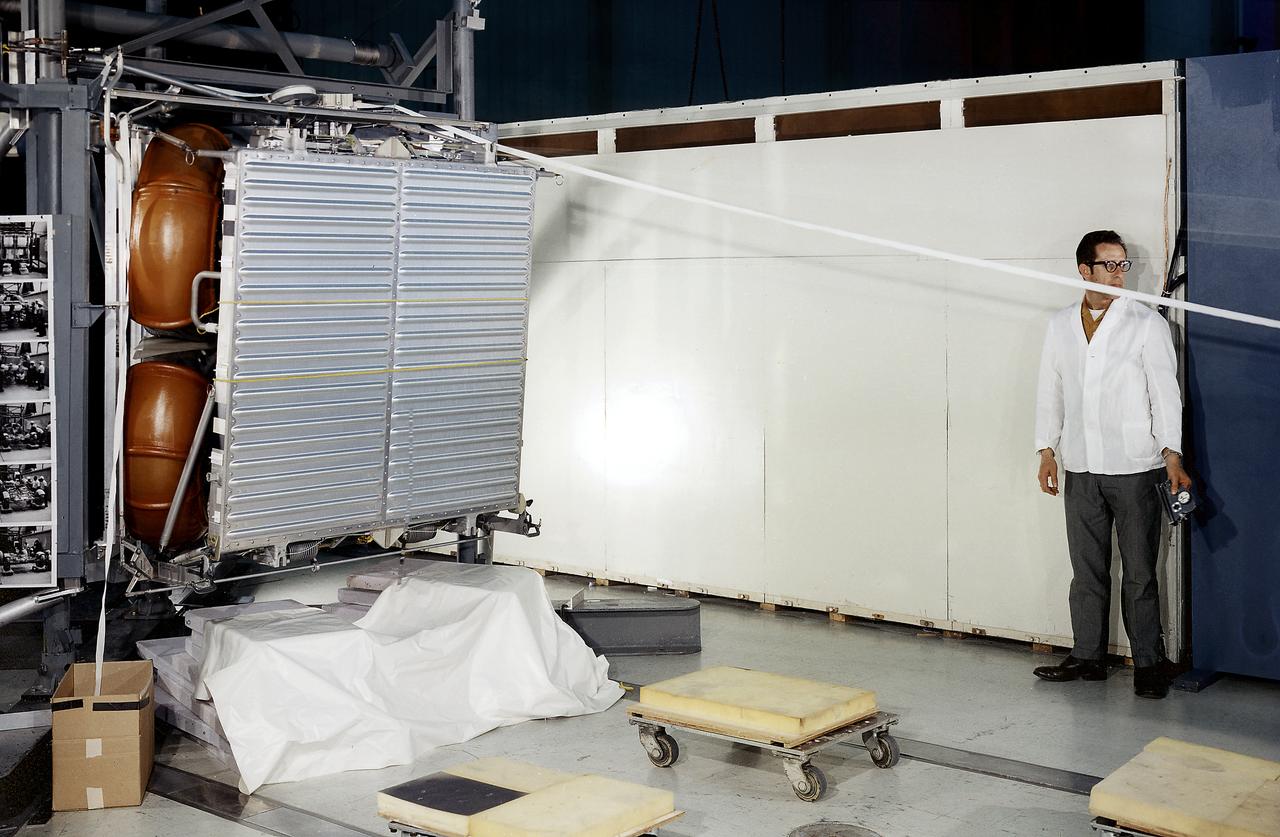
This photograph was taken during a deployment simulation of the Lunar Roving Vehicle (LRV). The LRV was built to give Apollo astronauts a greater range of mobility during the last three lunar exploration missions; Apollo 15, Apollo 16, and Apollo 17. It was designed and developed by the Marshall Space Flight Center and built by the Boeing Company.
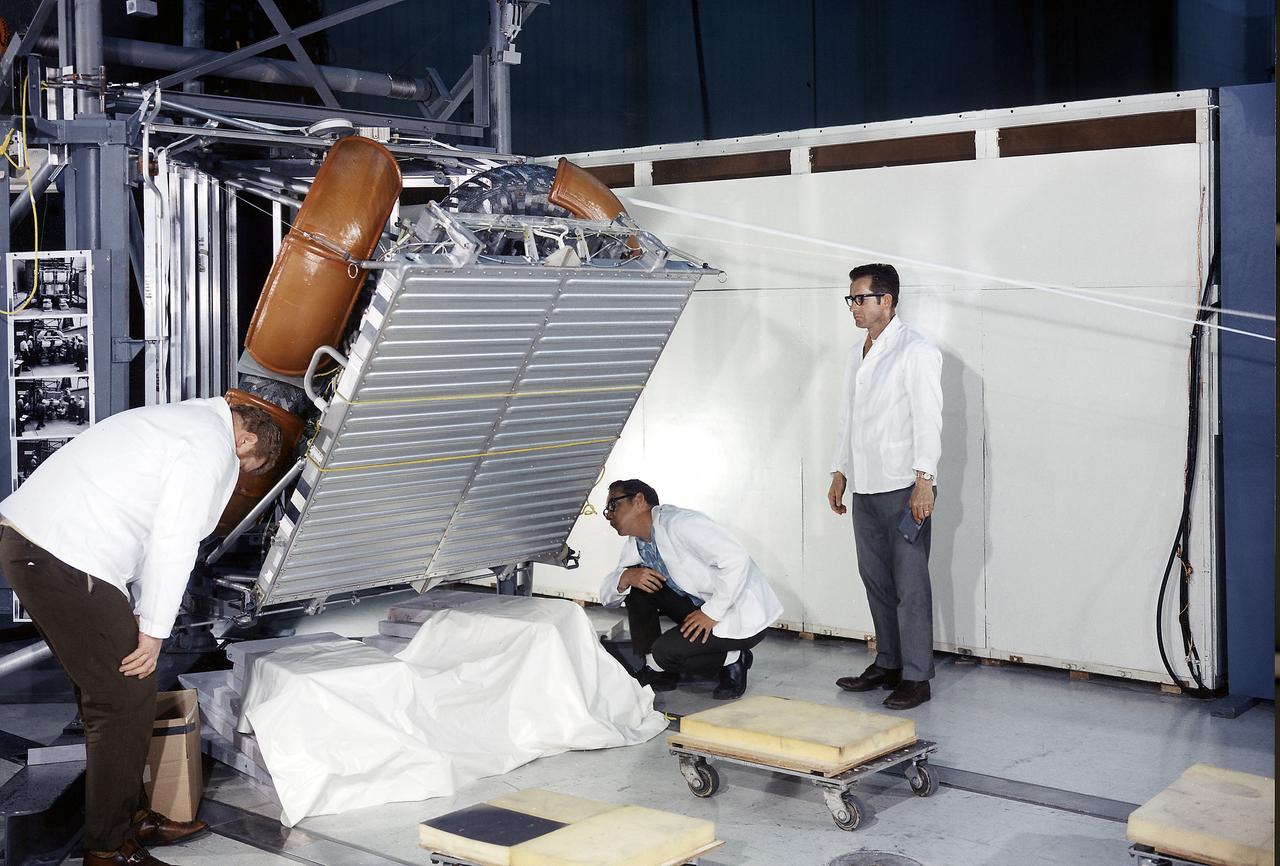
This photograph was taken during a deployment simulation of the Lunar Roving Vehicle (LRV). The LRV was built to give Apollo astronauts a greater range of mobility during the last three lunar exploration missions; Apollo 15, Apollo 16, and Apollo 17. It was designed and developed by the Marshall Space Flight Center and built by the Boeing Company.
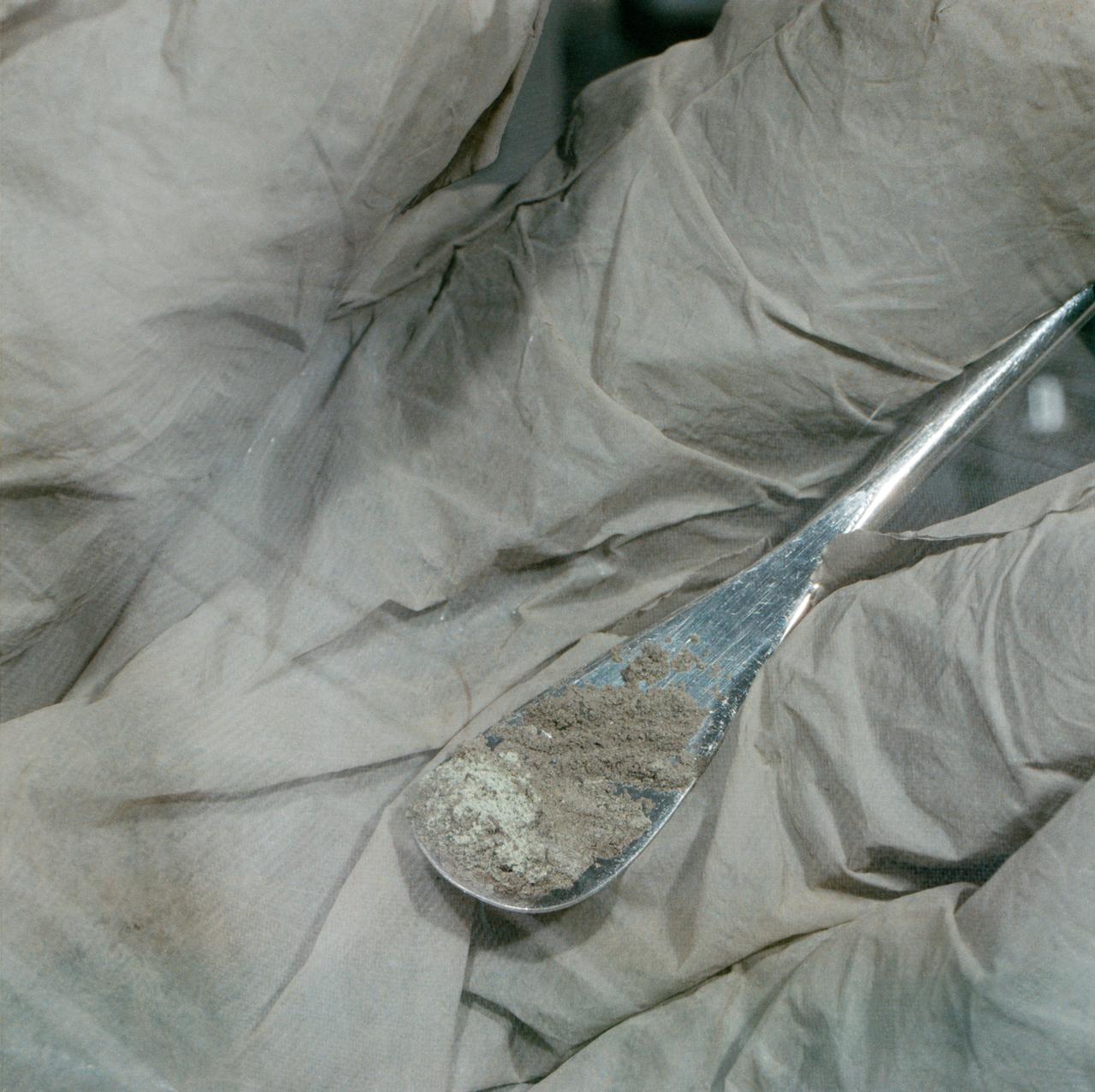
S71-43050 (August 1971) --- A close-up view of Apollo 15 lunar sample No. 15305 in the Non-sterile Nitrogen Processing Line (NNPL) in the Lunar Receiving Laboratory (LRL) at the Manned Spacecraft Center (MSC). This sample, pictured on a small spatula in a lab technician's glove, is green and is one of six recently taken from container No. 173, made up of comprehensive fines from the Apennine Front, Site No. 7. Astronauts David R. Scott, commander; and James B. Irwin, lunar module pilot, took the sample during their second extravehicular activity (EVA), at a ground elapsed time (GET) of 146:05 to 146:06.
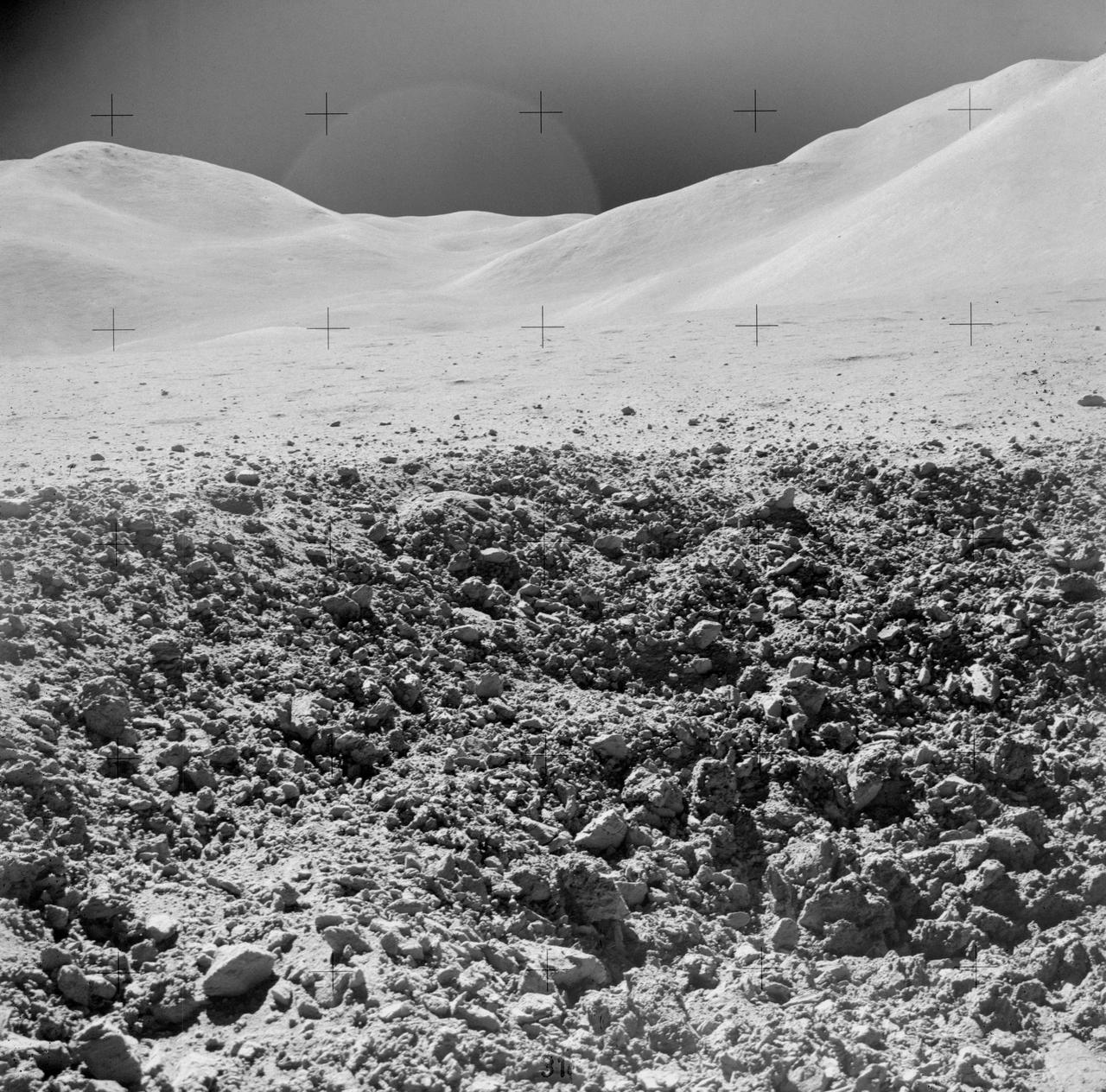
AS15-82-11082 (2 Aug. 1971) --- A close-up view of a portion of a "relatively fresh" crater, looking southeast, as photographed during the third Apollo 15 lunar surface extravehicular activity (EVA), on Aug. 2, 1971, at EVA Station No. 9, near Scarp Crater. The crater pictured is unnamed. The Apennine Front is in the background, and Hadley Delta Mountain is in the right background. While astronauts David R. Scott, commander, and James B. Irwin, lunar module pilot, descended in the Lunar Module (LM) "Falcon" to explore the moon, astronaut Alfred M. Worden, command module pilot, remained with the Command and Service Modules (CSM) in lunar orbit.
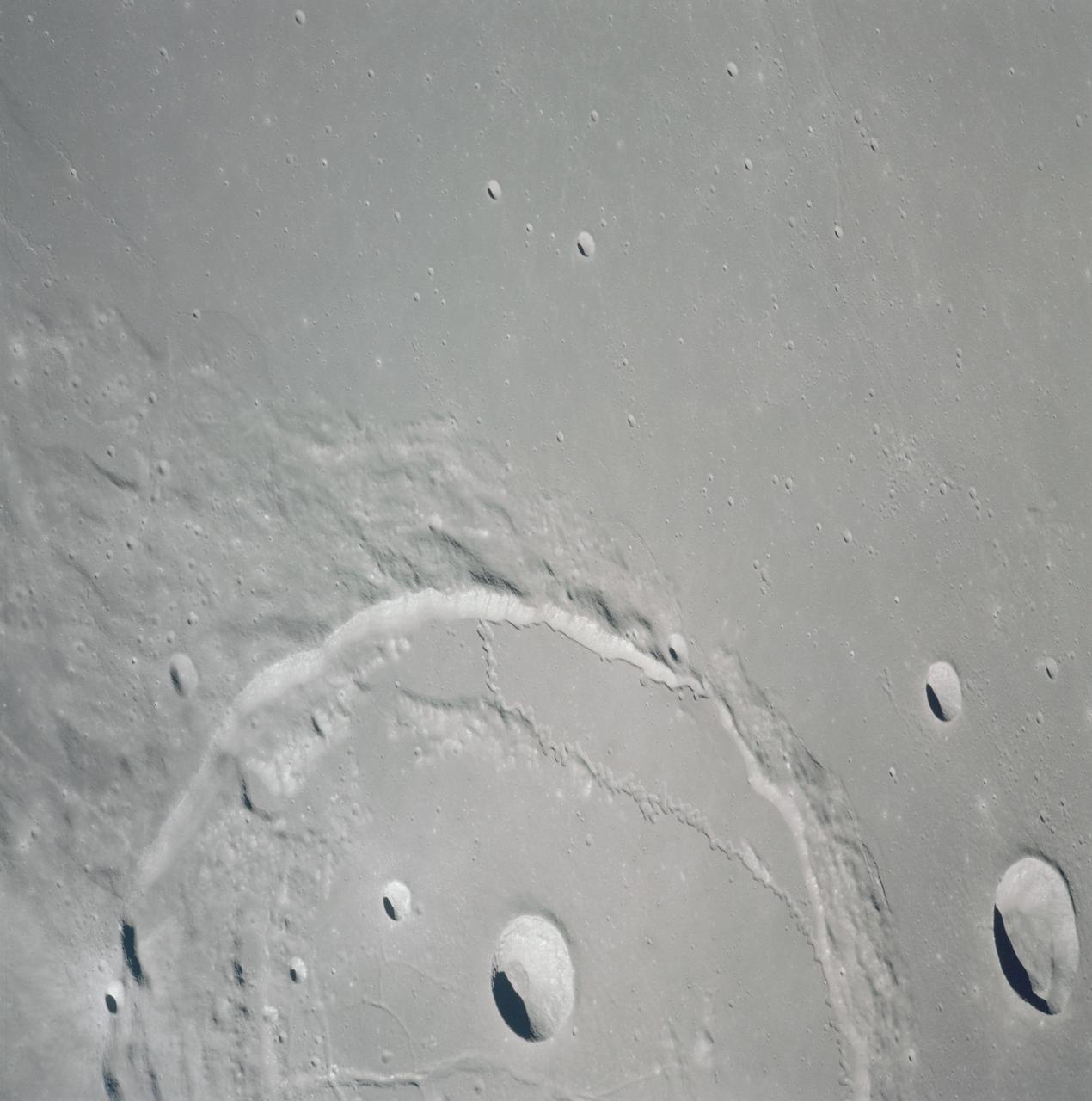
AS15-91-12366 (31 July-2 Aug. 1971) --- The crater Posidonius at the northeastern edge of the Sea of Serenity, was photographed with a 70mm handheld Hasselblad from the Command and Service Module (CSM) by astronaut Alfred M. Worden, command module pilot, in lunar orbit. While Worden remained with the CSM in lunar orbit, astronauts David R. Scott and James B. Irwin descended in the Lunar Module (LM) "Falcon" to explore the lunar surface.
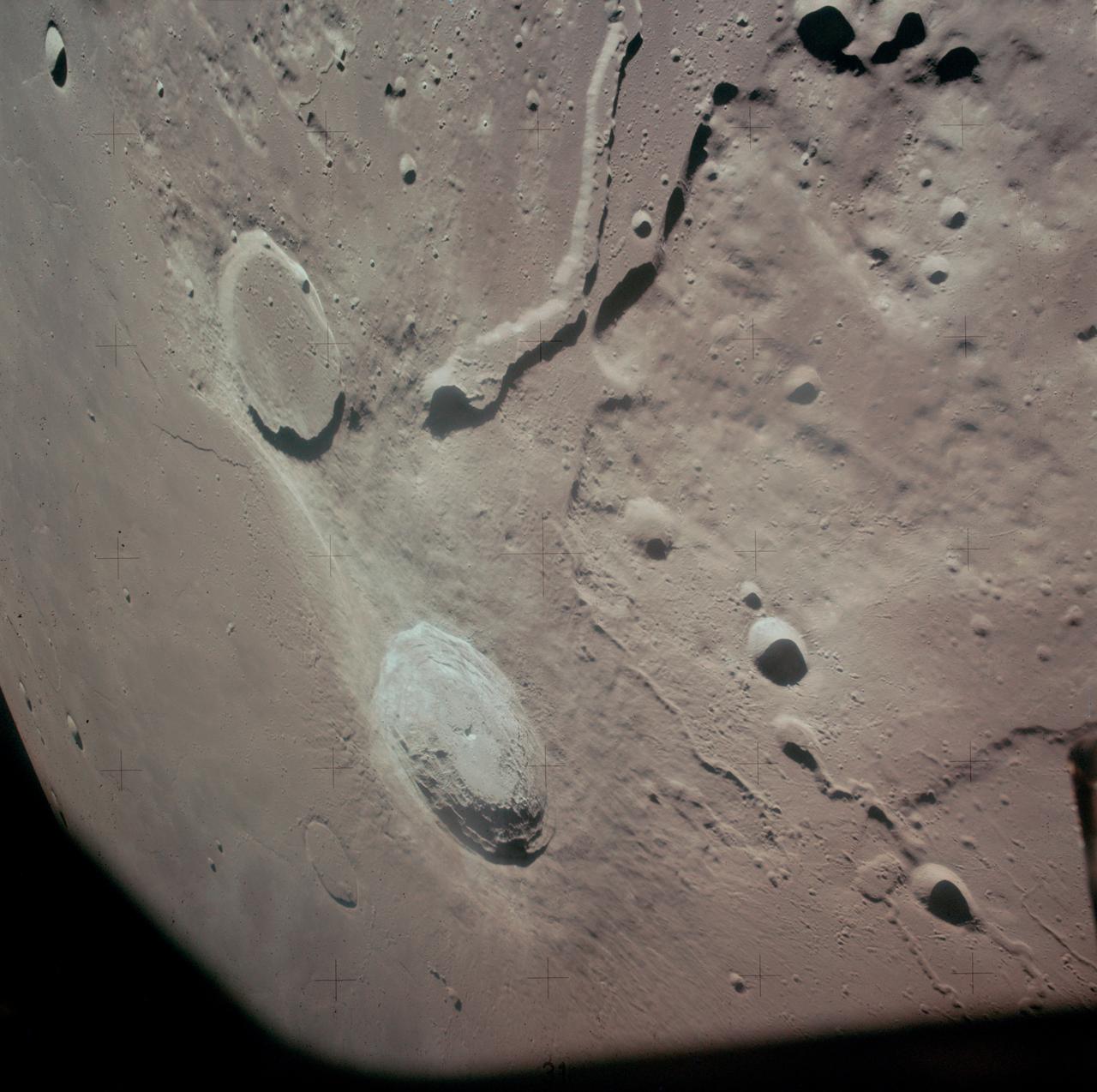
AS15-88-12002 (31 July-2 Aug. 1971) --- An oblique view of a portion of the lunar nearside located near the northeast edge of the Ocean of Storms (Oceanus Procellarum), photographed by astronaut Alfred M. Worden, command module pilot, from the Apollo 15 spacecraft in lunar orbit, showing the bright-appearing crater Aristarchus on the left, the crater Herodotus on the right, and Schroter's Valley at lower right. This view is looking southward. Aristarchus the head of Schroter's Valley, a sinuous rille in the Aristarchus Plateau, is called Cobra Head. The coordinates of the center of Aristarchus crater are 47.5 degrees west longitude and 23.6 degrees north latitude. While Worden remained in the Command and Service Modules (CSM) in lunar orbit, astronauts David R. Scott, commander; and James B. Irwin, lunar module pilot, descended in the Lunar Module (LM) "Falcon" to explore the moon.
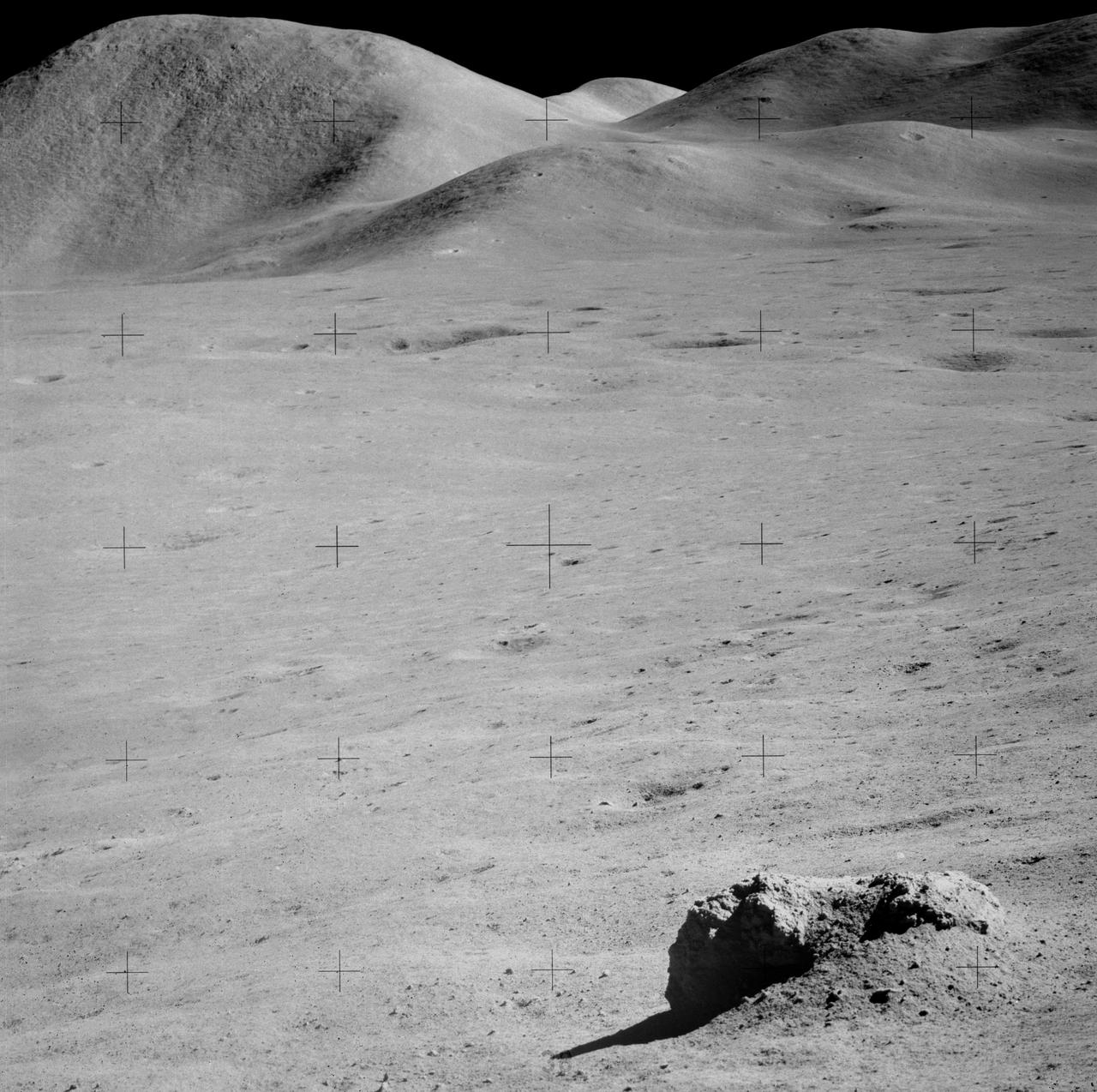
AS15-90-12187 (31 July-2 Aug. 1971) --- This view, looking generally north, shows the tall Mount Hadley in the left background. The photograph was taken from the slope of Hadley Delta during Apollo 15 extravehicular activity (EVA). The crewmen of Apollo 15 noted the visible layering feature of the mountain. Note boulder in foreground. Mount Hadley rises approximately 14,765 feet (about 4,500 meters) above the plain.
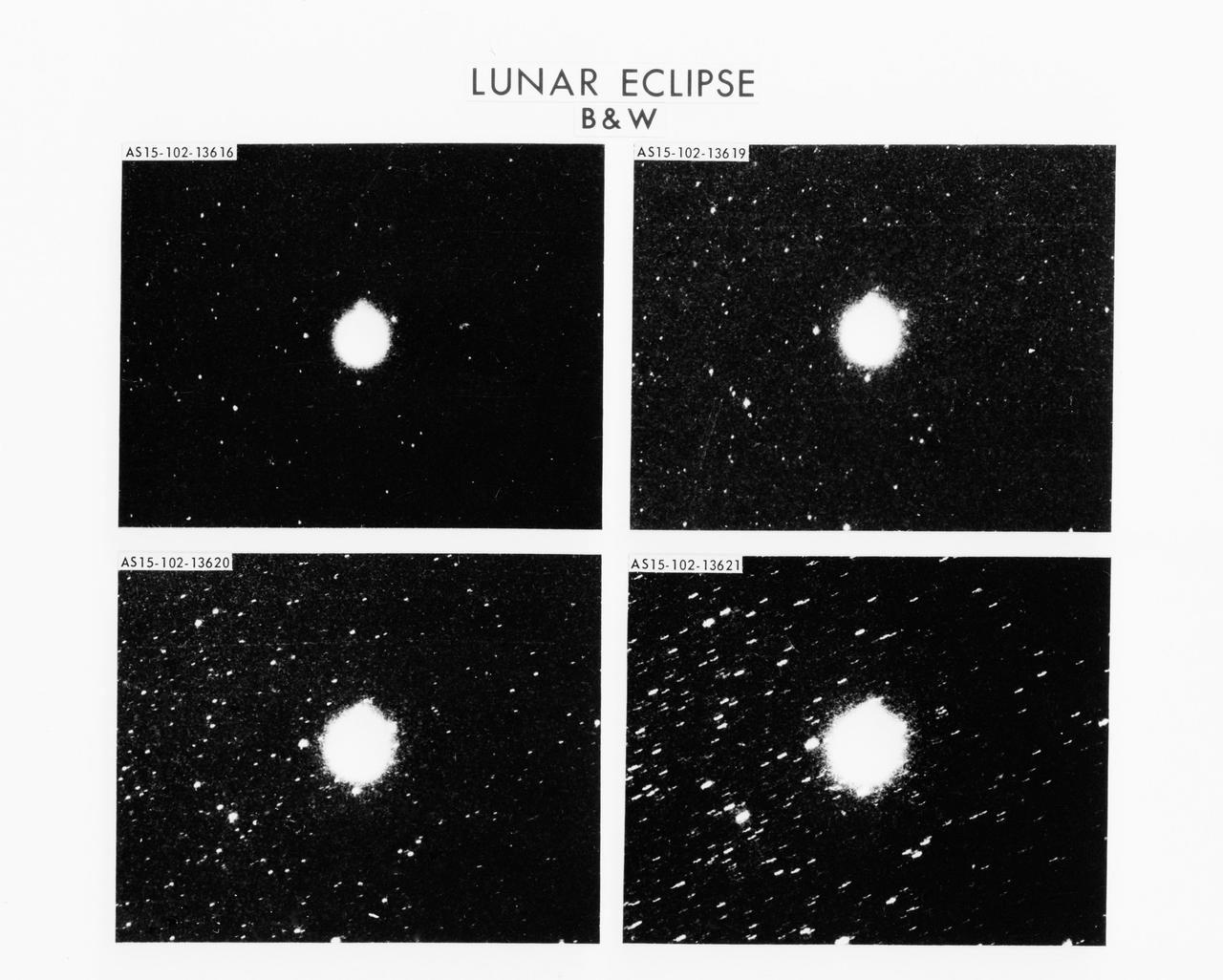
S71-58222 (31 July-2 Aug. 1971) --- During the lunar eclipse that occurred during the Apollo 15 lunar landing mission, astronaut Alfred M. Worden, command module pilot, used a 35mm Nikon camera to obtain a series of 15 photographs while the moon was entering and exiting Earth's umbra. Although it might seem that there should be no light on the moon when it is in Earth's shadow, sunlight is scattered into this region by Earth's atmosphere. This task was an attempt to measure by photographic photometry the amount of scattered light reaching the moon. The four views from upper left to lower right were selected to show the moon as it entered Earth's umbra. The first is a four-second exposure which was taken at the moment when the moon had just entered umbra; the second is a 15-second exposure taken two minutes after entry; the third, a 30-second exposure three minutes after entry; and the fourth is a 60-second exposure four minutes after entry. In all cases the light reaching the moon was so bright on the very high speed film (Eastman Kodak type 2485 emulsion) that the halation obscures the lunar image, which should be about one-third as big as the circle of light. The background star field is clearly evident, and this is very important for these studies. The spacecraft was in full sunlight when these photographs were taken, and it was pointed almost directly away from the sun so that the windows and a close-in portion of the camera's line-of-sight were in shadow. The environment around the vehicle at this time appears to be very "clean" with no light scattering particles noticeable.
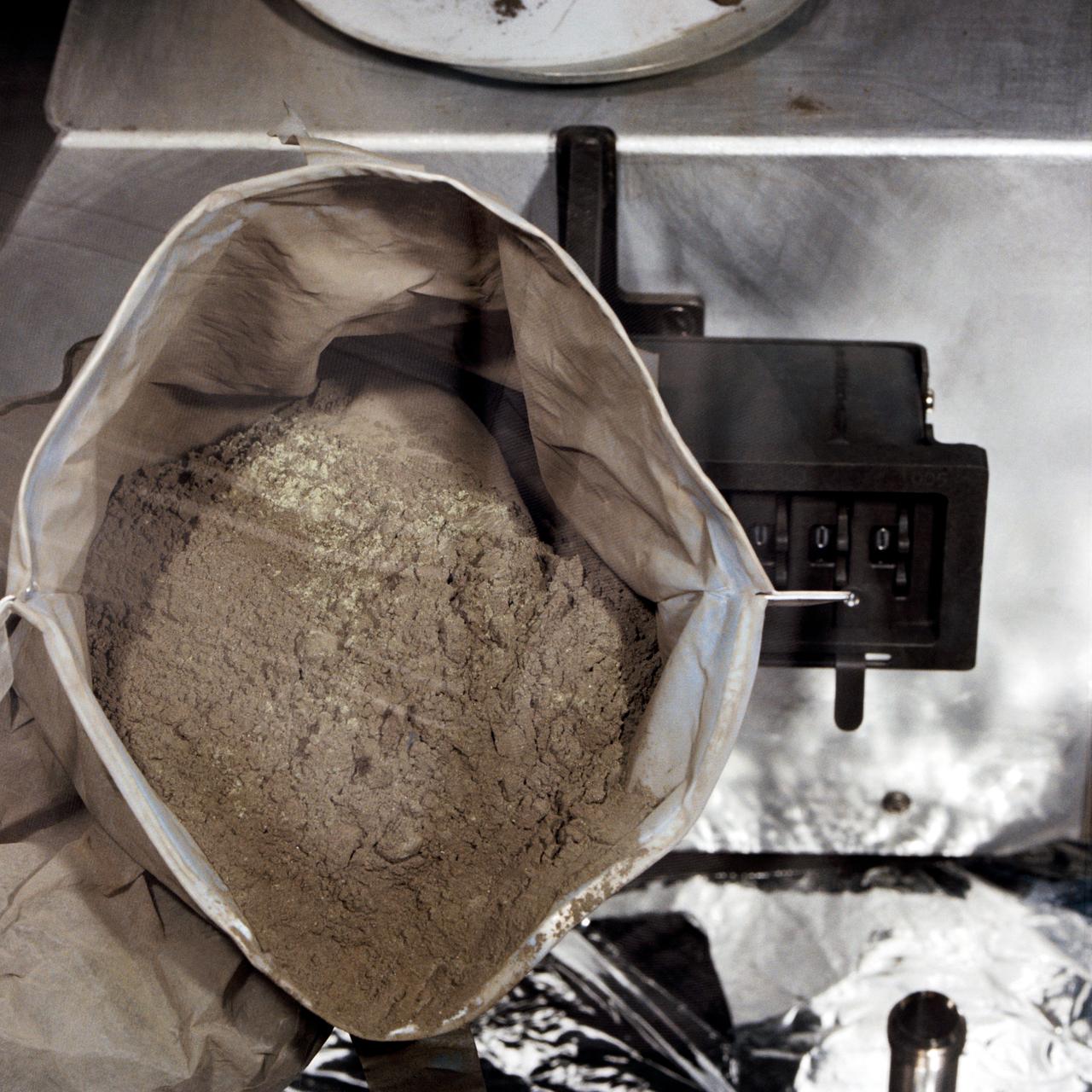
S71-43052 (August 1971) --- A close-up view of a container full of green-colored lunar soil in the Non-Sterile Nitrogen Processing Line (NNPL) in the Lunar Receiving Laboratory (LRL) at the Manned Spacecraft Center (MSC). This sample, broken down into six separate samples after this photo was made, was made up of comprehensive fines from near Spur Crater on the Apennine Front. The numbers assigned to the sample include numbers 15300 through 15305. Astronauts David R. Scott and James B. Irwin took the sample during their second extravehicular activity (EVA) at a ground elapsed time (GET) of 146:05 to 146:06.
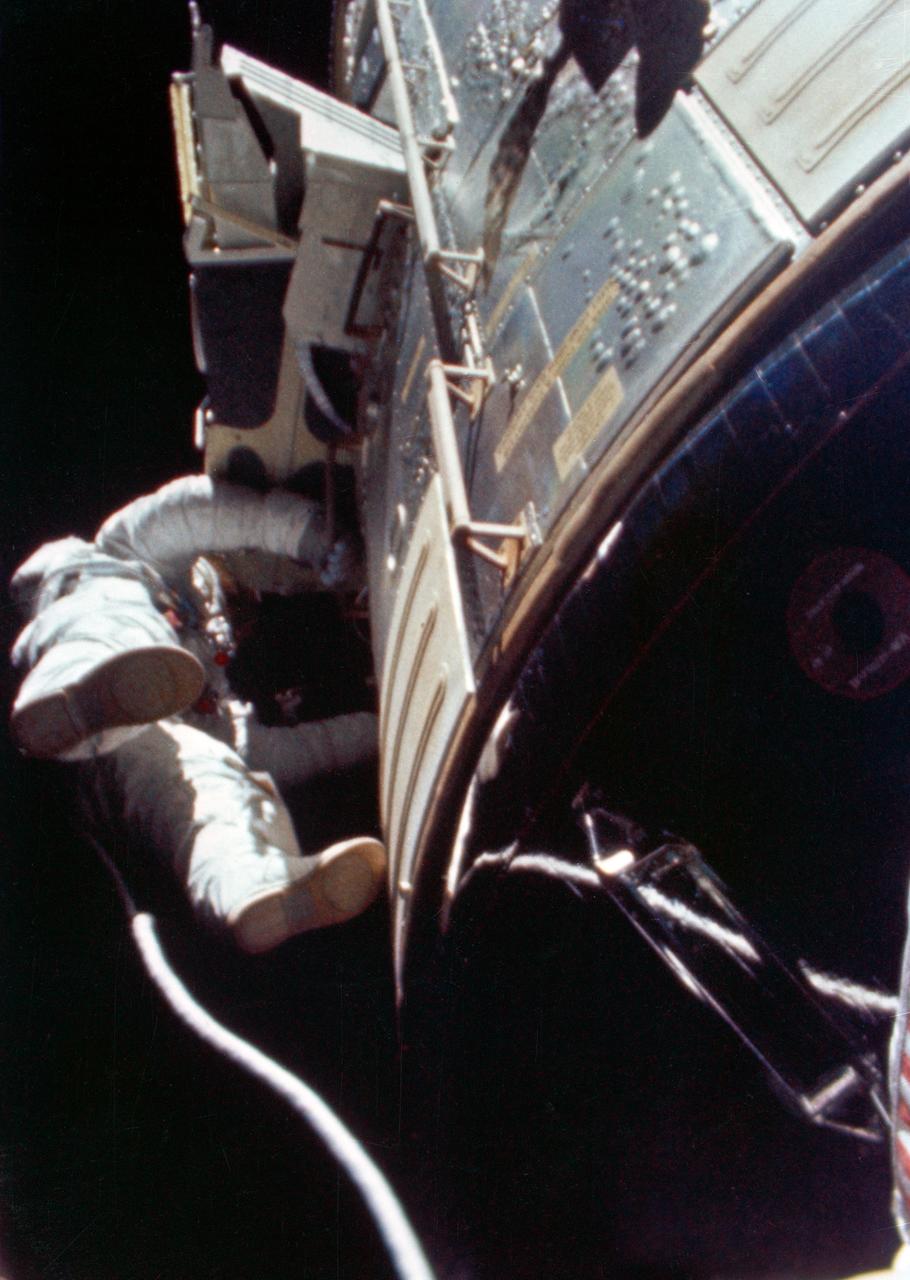
S71-43202 (5 Aug. 1971) --- Astronaut Alfred M. Worden, command module pilot of the Apollo 15 lunar landing mission, floats in space outside the spacecraft during his trans-Earth extravehicular activity (EVA). This photograph was taken from a frame of motion picture film exposed by the 16mm Maurer camera mounted in the hatch of the Command Module (CM). During his EVA, Worden made an inspection of the Service Module's (SM) Scientific Instrument Module (SIM) bay and retrieved the film cassettes from the Panoramic Camera and the Mapping Camera. The SIM bay holds eight orbital science experiments. The EVA occurred when the spacecraft was homeward bound approximately 171,000 nautical miles from Earth.
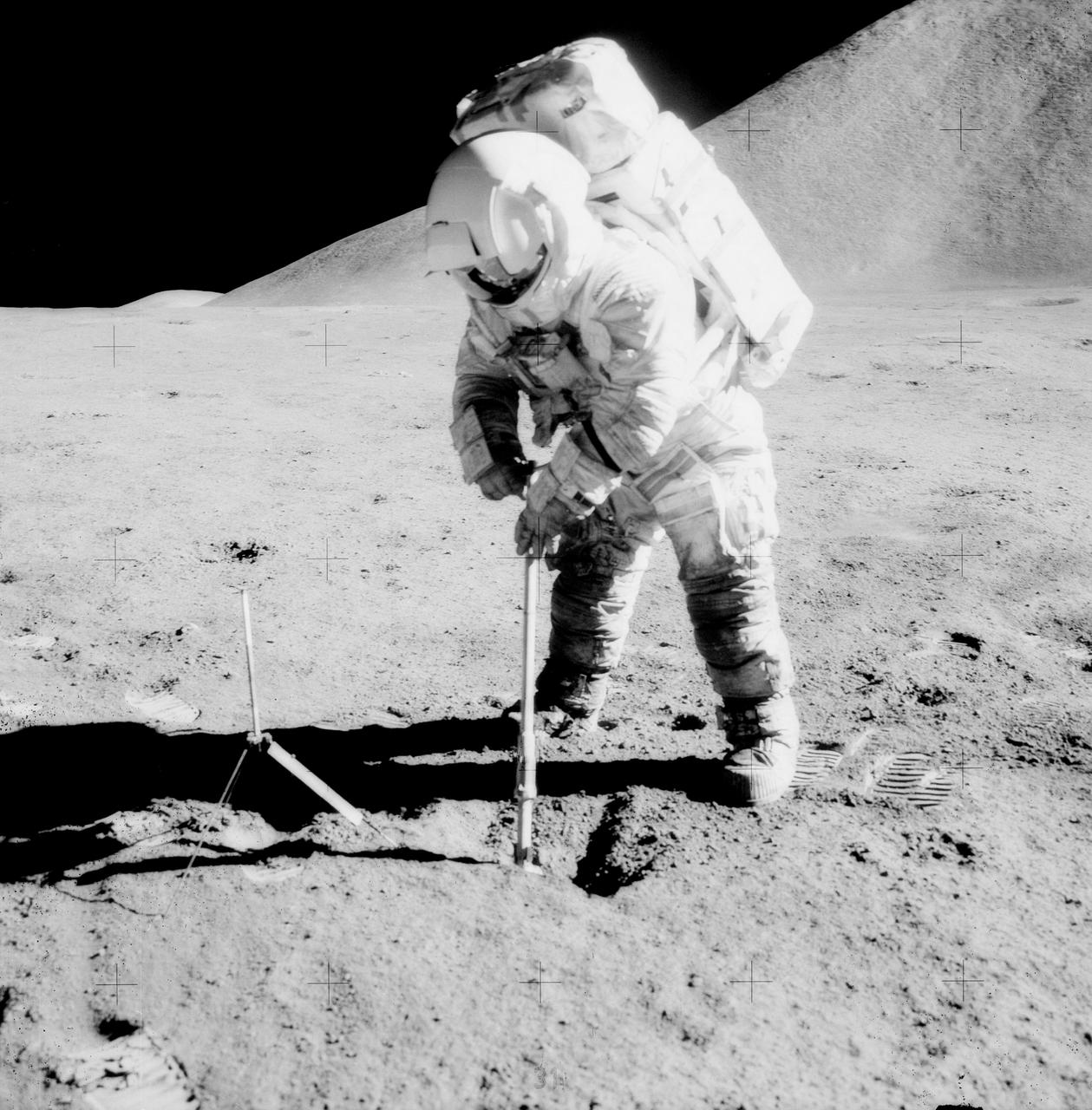
AS15-92-12424 (31 July-2 Aug. 1971) --- Astronaut James B. Irwin, lunar module pilot, uses a scoop in making a trench in the lunar soil during Apollo 15 extravehicular activity (EVA) on the moon. Mount Hadley, which rises approximately 14,765 feet (about 4,500 meters) above the plain, is in the background. Its base is some 14 kilometers (about 8.4 miles) away. The gnomon is at left. While astronauts Irwin, and David R. Scott, commander, descended in the Lunar Module (LM) to explore the moon, astronaut Alfred M. Worden, command module pilot, remained with the Command and Service Modules (CSM) in lunar orbit.
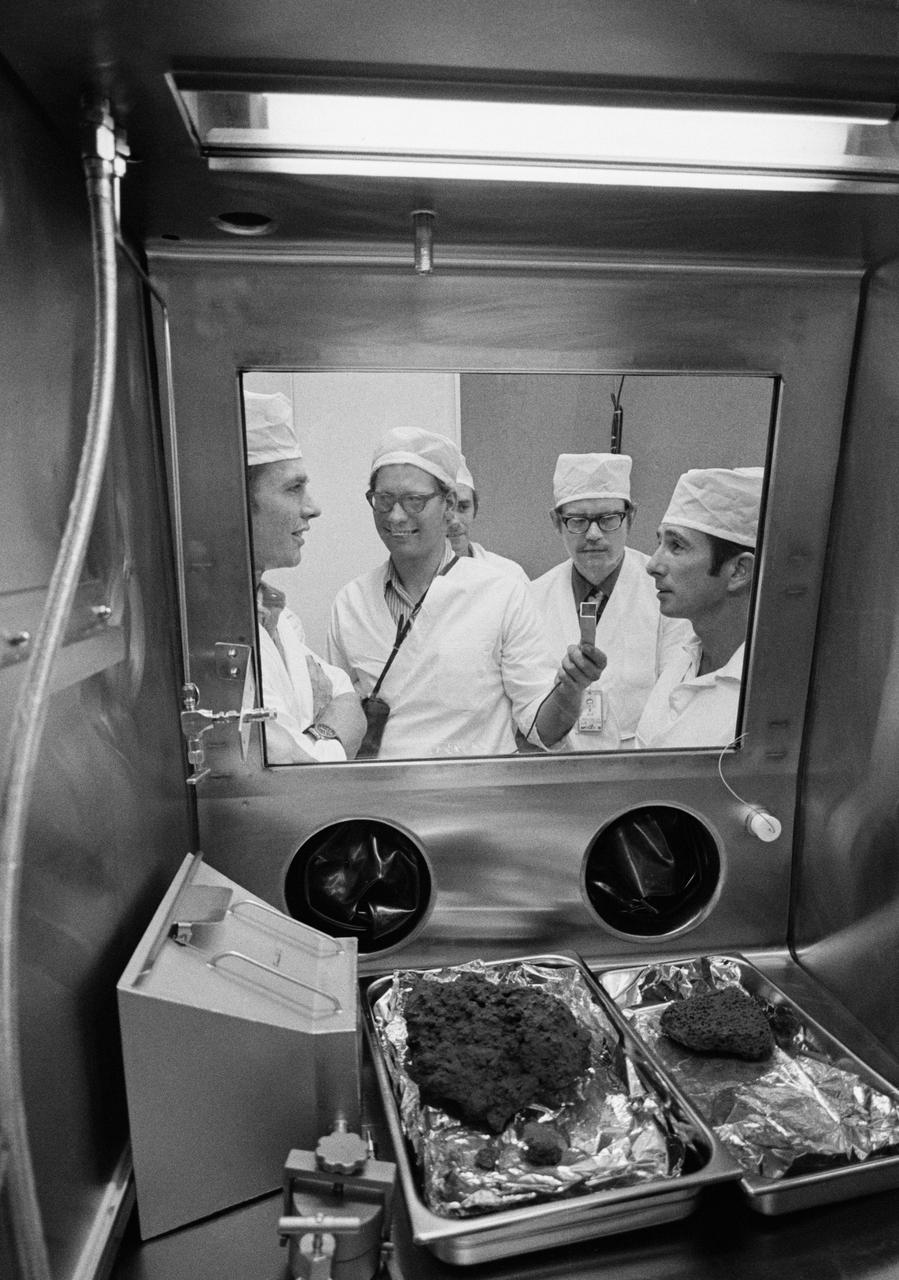
S71-43203 (9 Aug. 1971) --- Astronauts David R. Scott, left foreground, and James B. Irwin, right foreground, join the Manned Spacecraft Center's (MSC) geologists in getting first looks at some of the first Apollo 15 samples to be opened in the Non-Sterile Nitrogen Processing Line (NNPL) in the MSC Lunar Receiving Laboratory (LRL). Holding the microphone and making recorded tapes of the two Apollo 15 crew men's comments is Dr. Gary Lofgren. Partially obscured, near center of photo is Dr. William Phinney, and to his left is Dr. James W. Head.
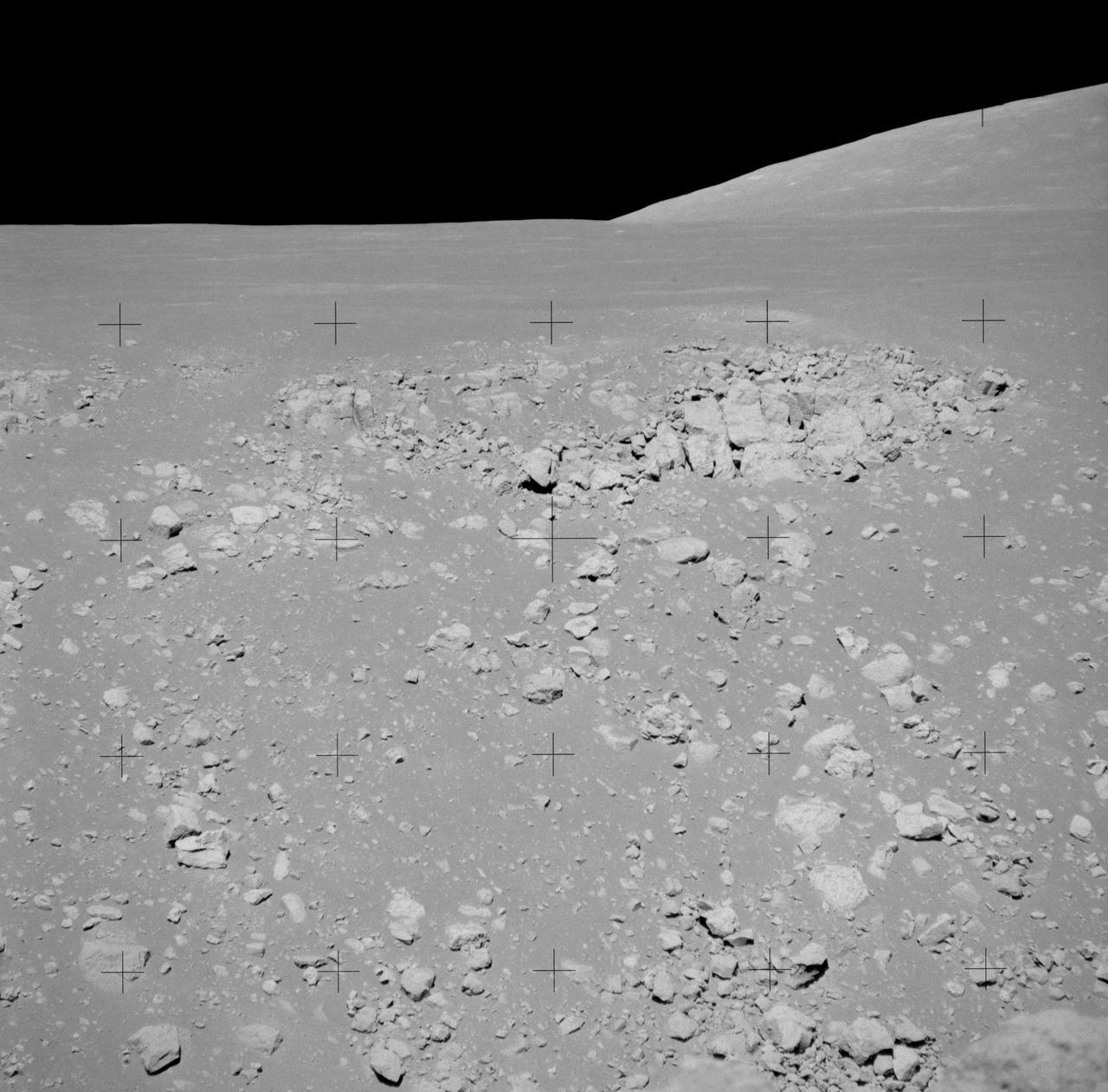
AS15-89-12100 (2 Aug. 1971) --- A telephoto lens view looking across Hadley Rille, photographed during the third Apollo 15 lunar surface extravehicular activity (EVA) at the Hadley-Apennine landing site on the nearside of the moon. The blocky outcrop at the top of the west wall of the rille is about 1.9 kilometers (1.1 statute miles) from the camera. About one-half of the debris-covered wall is visible in the photograph. On the horizon the northern end of Hill 305 is more than 16 kilometers (10 statute miles) from the camera.
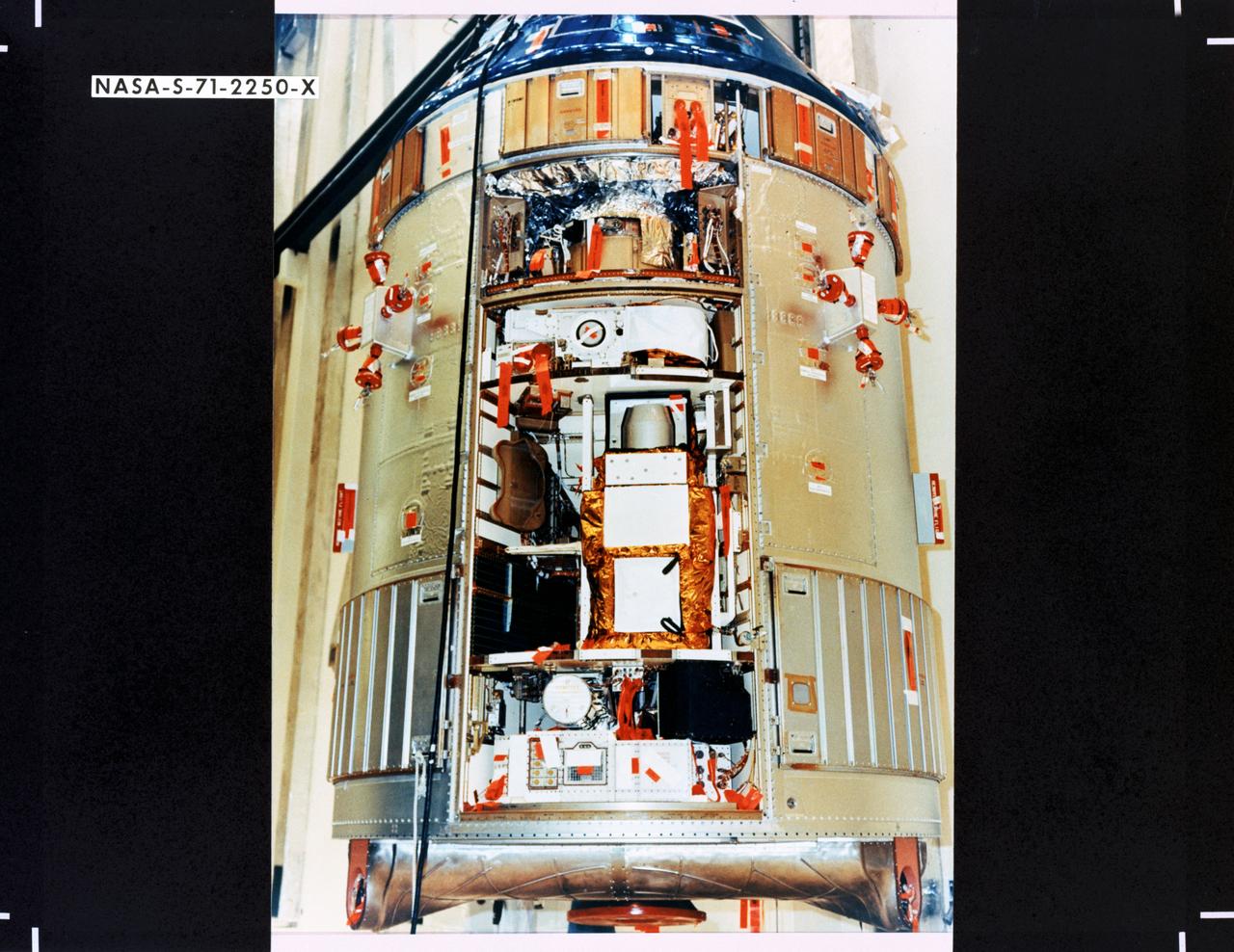
S71-2250X (June 1971) --- A close-up view of the Scientific Instrument Module (SIM) to be flown for the first time on the Apollo 15 lunar landing mission. Mounted in a previously vacant sector of the Apollo Service Module (SM), the SIM carries specialized cameras and instrumentation for gathering lunar orbit scientific data. SIM equipment includes a laser altimeter for accurate measurement of height above the lunar surface; a large-format panoramic camera for mapping, correlated with a metric camera and the laser altimeter for surface mapping; a gamma ray spectrometer on a 25-feet extendible boom; a mass spectrometer on a 21-feet extendible boom; X-ray and alpha particle spectrometers; and a subsatellite which will be injected into lunar orbit carrying a particle and magnetometer, and the S-Band transponder.
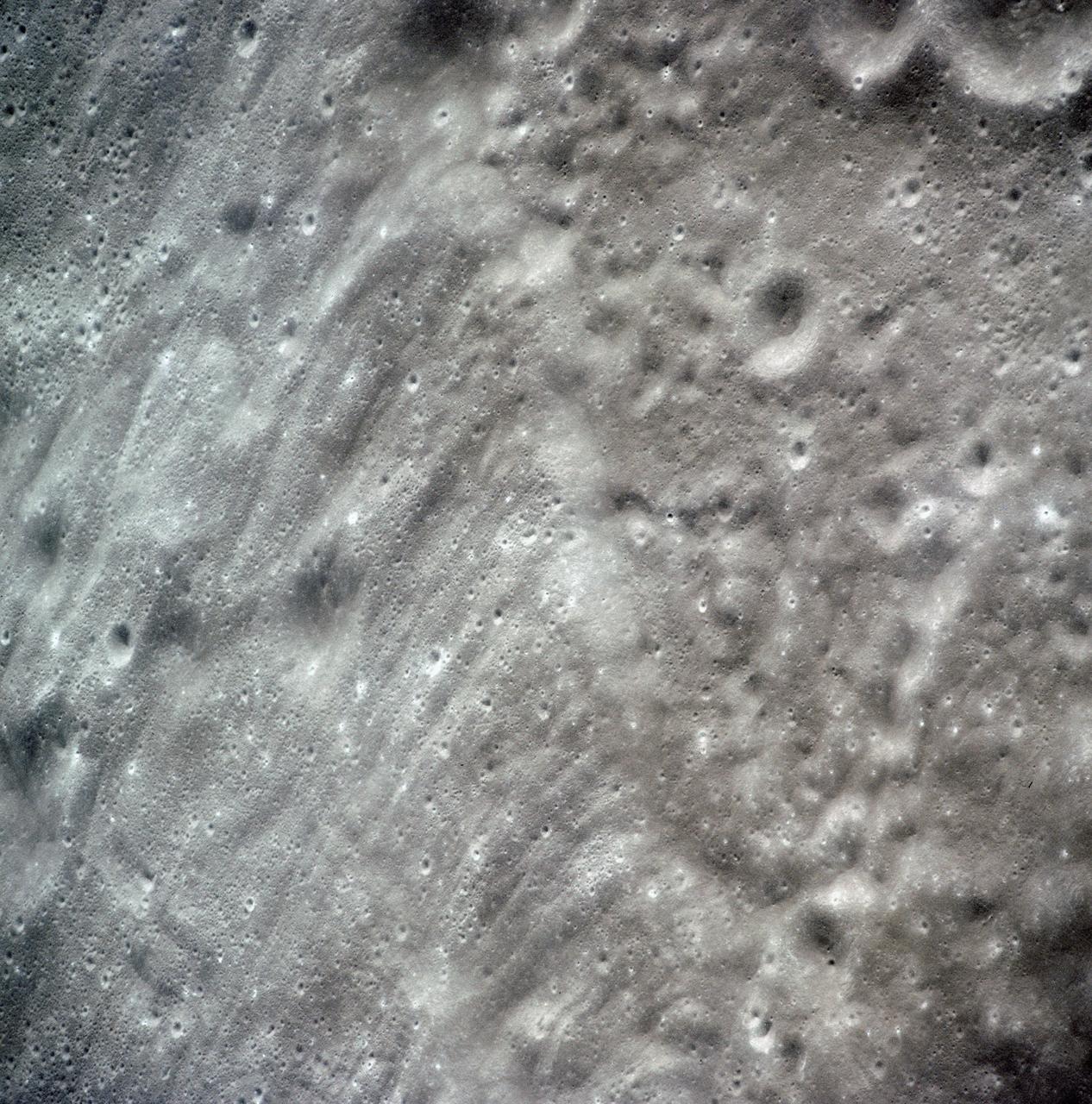
AS15-97-13168 (31 July-2 Aug. 1971) --- A view of the flow structure on the rim and edge of the crater Tsiolkovsky in the highlands of the lunar farside, as photographed from lunar orbit by astronaut Alfred M. Worden in the Apollo 15 Command and Service Module (CSM). Note the scarp at the edge of the flow and elongated grooves on the flow surface. While astronauts David R. Scott and James B. Irwin descended in the Lunar Module (LM) "Falcon" to explore the moon's Hadley-Apennine landing site, Worden remained with the CSM in lunar orbit.
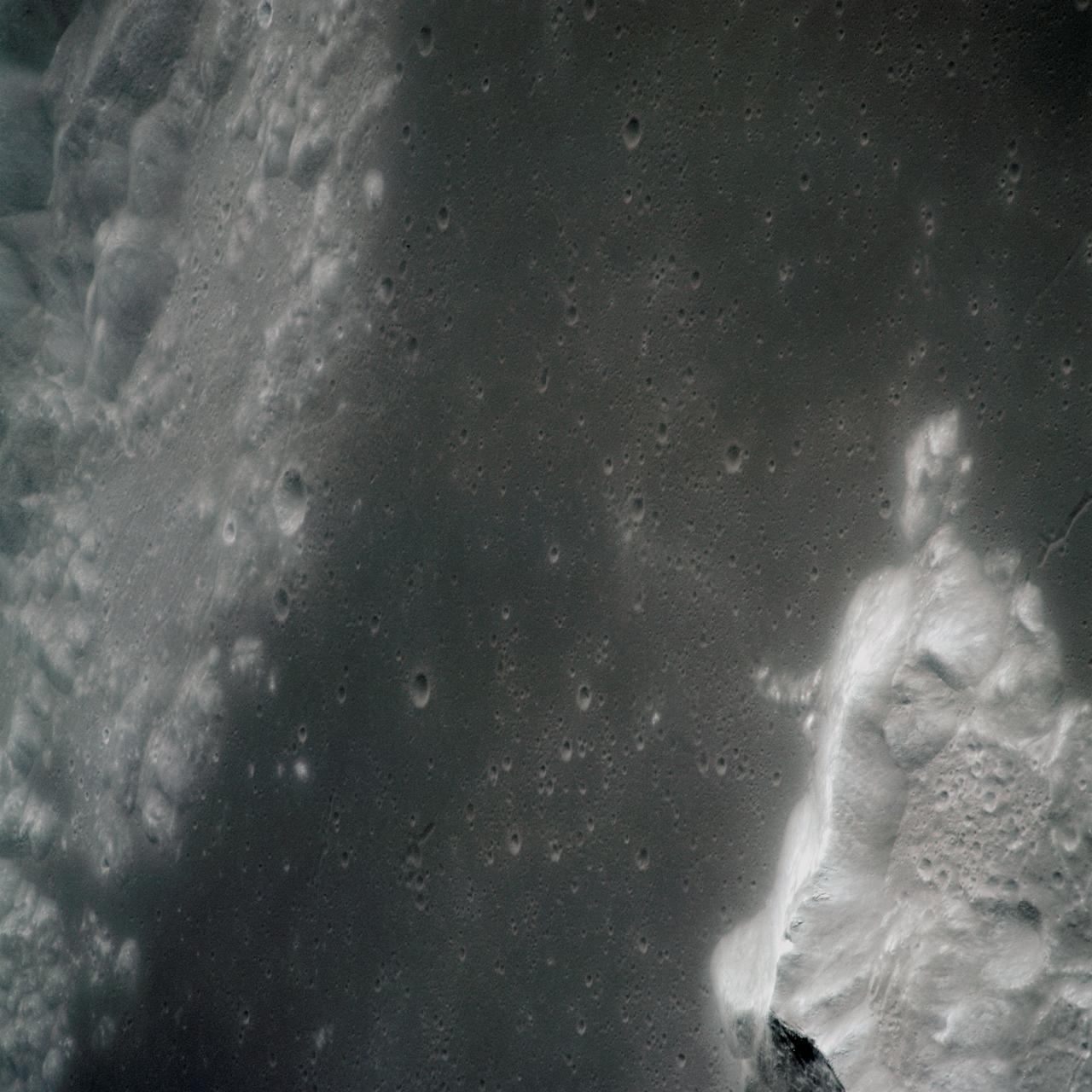
AS15-97-13160 (31 July-2 Aug. 1971) --- A view of a portion of the crater Tsiolkovsky located in the highlands on the farside of the moon, as photographed from the Apollo 15 Command and Service Modules (CSM) by astronaut Alfred M. Worden, command module pilot. Note the dark, flat crater floor surrounding the very prominent central mountains. The mountains are in the northeastern corner of the photograph. The other upland area comprises part of the southwestern edge of the crater. While astronauts David R. Scott, commander, and James B. Irwin, lunar module pilot, descended in the Lunar Module (LM) "Falcon" to explore the moon, astronaut Worden remained with the CSM in lunar orbit.

AS15-91-12343 (26 July 1971) --- This view of Earth was photographed by the Apollo 15 crewmen as they sped toward the fourth lunar landing. The spacecraft was between 25,000 and 30,000 nautical miles from Earth when this photo was made. The United States (note Florida), Central America and part of Canada can be seen at the left side of the picture, with South America at lower center. Spain and the northwest part of Africa can be seen at right. The Bahamas Banks, unique geological feature, can be seen (different shade of blue) east of Florida. Also note large North Atlantic storm front moving over Greenland in upper center.
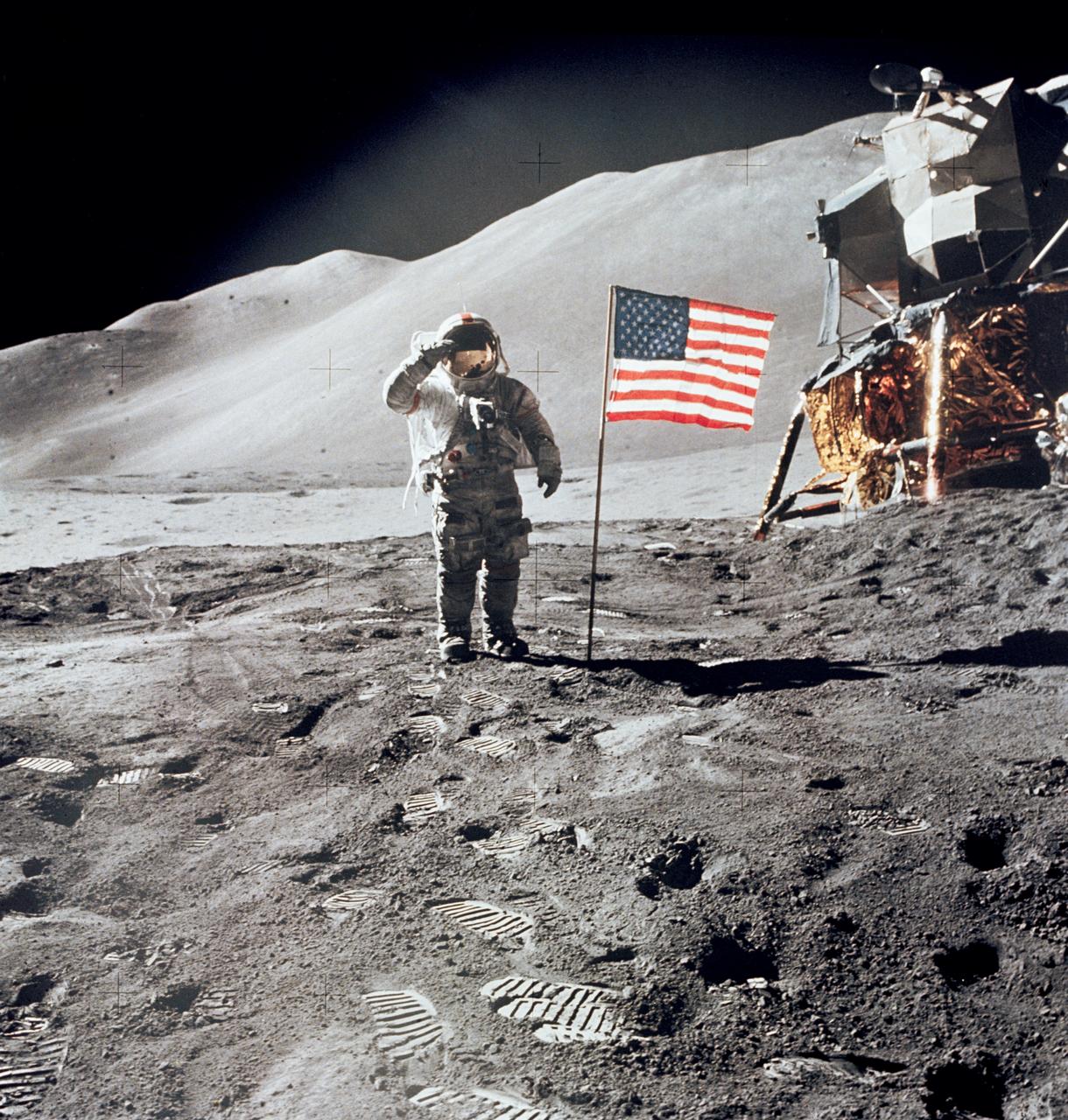
AS15-88-11863 (1 Aug. 1971) --- Astronaut David R. Scott, commander, gives a military salute while standing beside the deployed United States flag during the Apollo 15 lunar surface extravehicular activity (EVA) at the Hadley-Apennine landing site. The flag was deployed toward the end of EVA-2. The Lunar Module (LM), "Falcon," is partially visible on the right. Hadley Delta in the background rises approximately 4,000 meters (about 13,124 feet) above the plain. The base of the mountain is approximately 5 kilometers (about three statue miles) away. This photograph was taken by astronaut James B. Irwin, lunar module pilot. While astronauts Scott and Irwin descended in the LM to explore the moon, astronaut Alfred M. Worden, command module pilot, remained in lunar orbit in the Command and Service Modules (CSM).
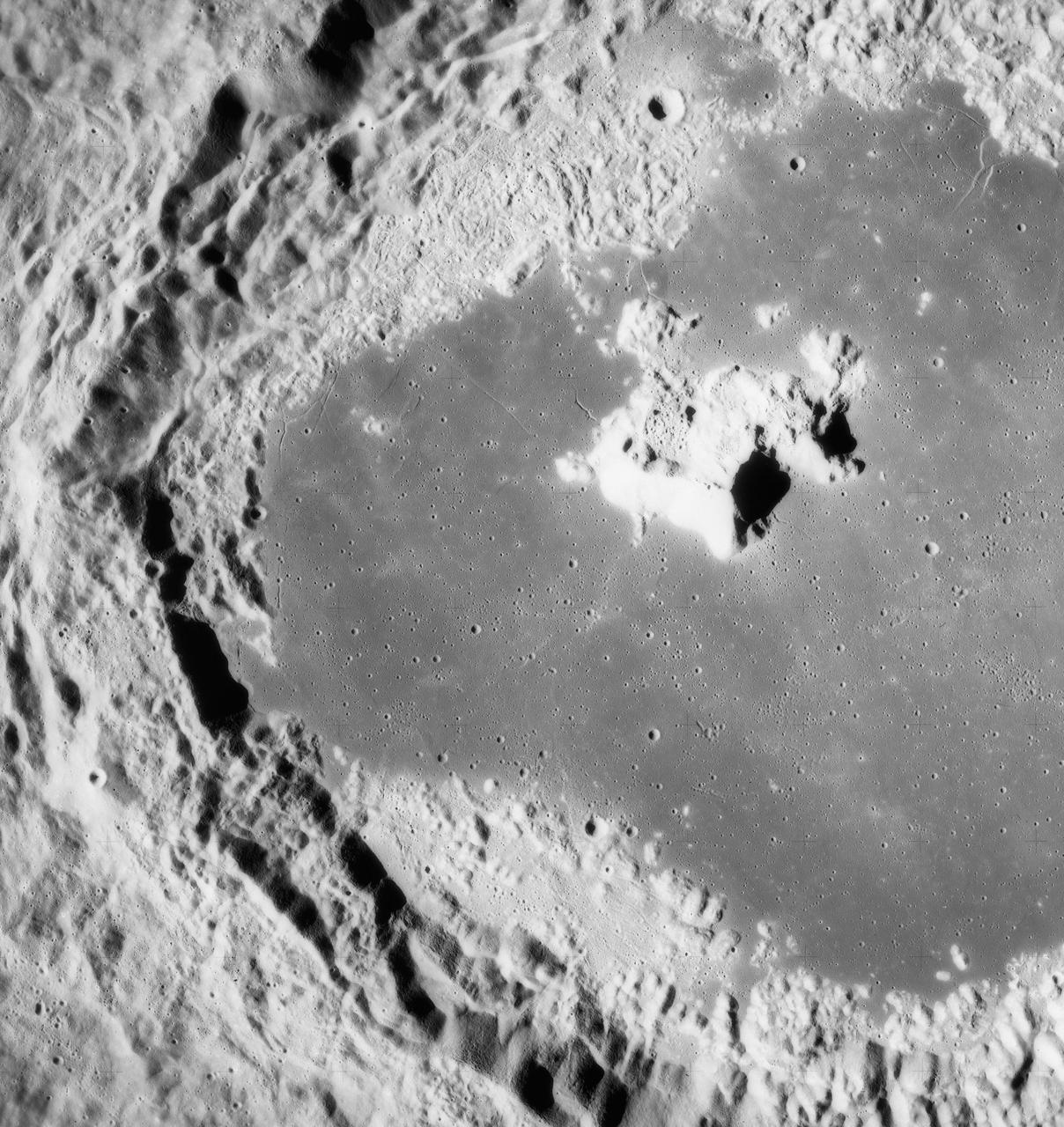
S71-44670 (31 July 1971) --- A near vertical view of the crater Tsiolkovsky on the lunar farside, as photographed by the Fairchild metric camera in the Scientific Instrument Module (SIM) bay of the Apollo 15 Command and Service Modules (CSM) in lunar orbit. This view is looking northerly. The coordinates of the crater's central peaks are 128 degrees east longitude and 20 degrees south latitude. The mare area measured from east to west is approximately 145 kilometers (90 statute miles) across. The three-inch mapping camera was one of eight lunar orbital science experiments mounted in the SIM bay.
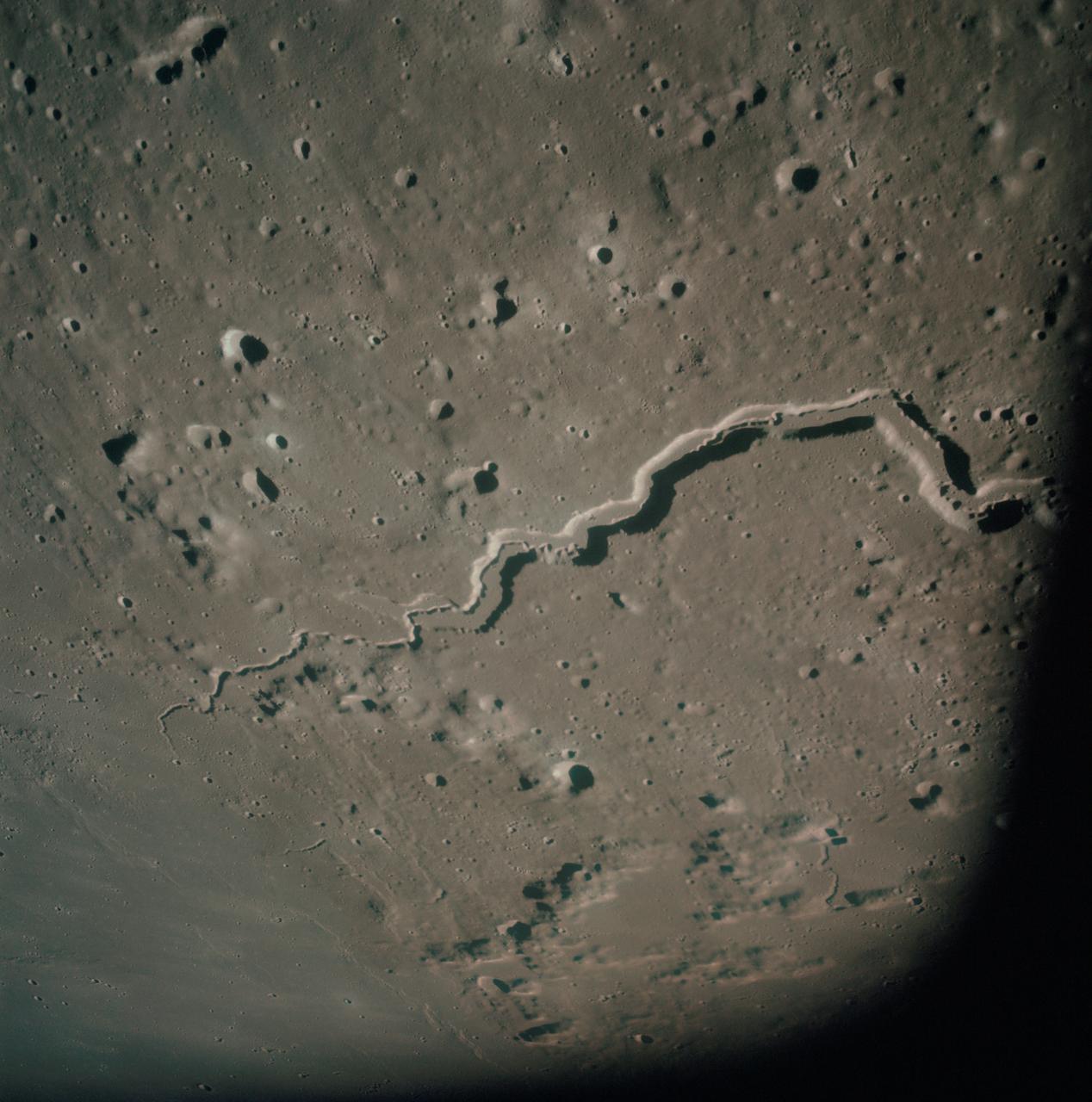
AS15-93-12628 (31 July 1971) --- The snake-like rille feature in this 70mm frame, photographed from the lunar-orbiting Apollo 15 Command and Service Modules (CSM) by astronaut Alfred M. Worden, command module pilot, is Schroter's Valley. The long feature is located not far from the crater Aristarcus (out of frame) on the western side of the moon. Center coordinates of the area pictured are located at 25 degrees north latitude and 52.5 degrees west longitude. While astronauts David R. Scott, commander, and James B. Irwin, lunar module pilot, descended in the Lunar Module (LM) "Falcon" to explore the Hadley-Apennine area of the moon, astronaut Worden remained with the CSM in lunar orbit.
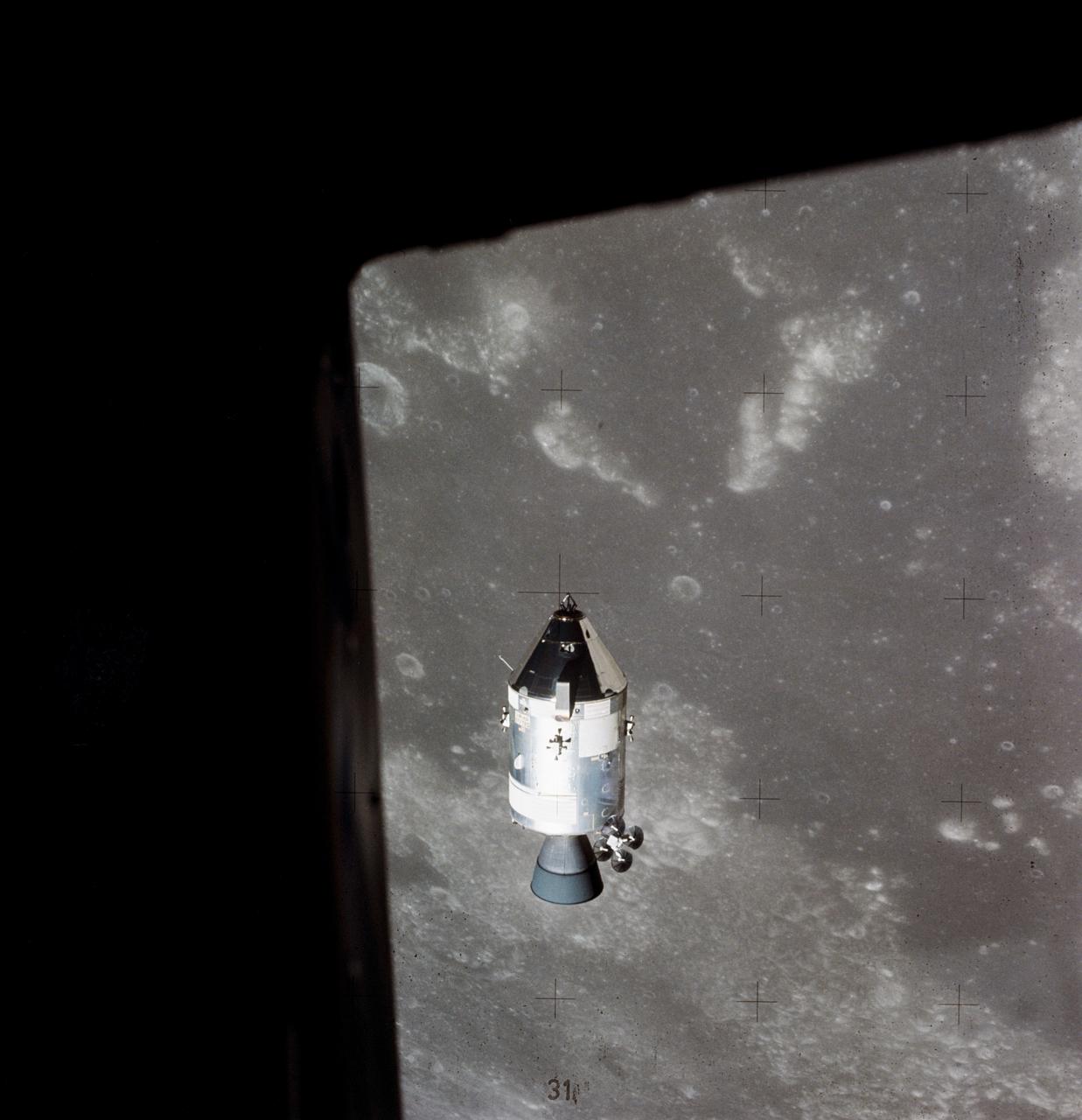
AS15-88-11974 (30 July 1971) --- A view of the Apollo 15 Command and Service Modules (CSM) in lunar orbit as photographed from the Lunar Module (LM) just after rendezvous. The lunar nearside is in the background. This view is looking southeast into the Sea of Fertility. The crater Taruntius is at the right center edge of the picture.
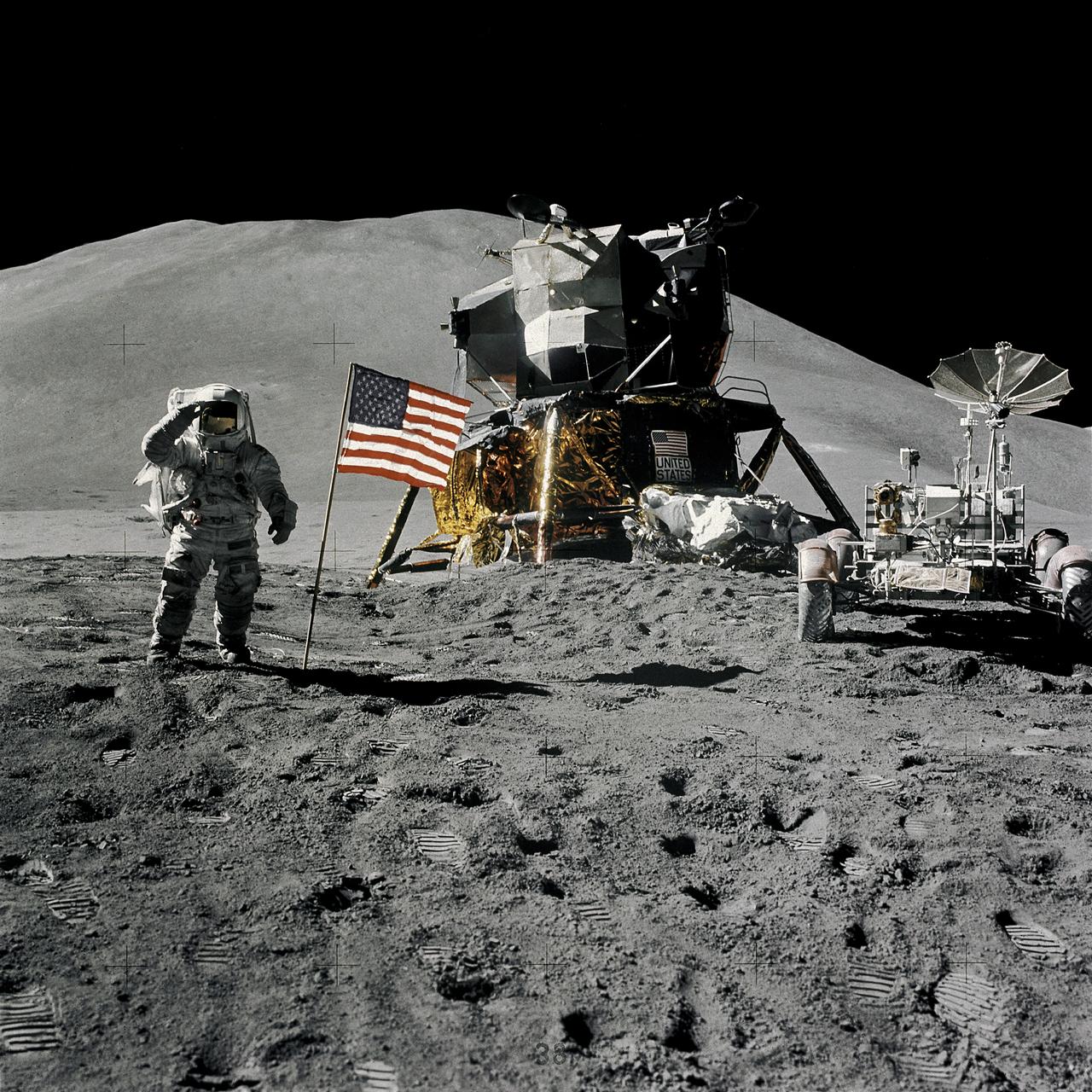
AS15-88-11866 (1 Aug. 1971) --- Astronaut James B. Irwin, lunar module pilot, gives a military salute while standing beside the deployed United States flag during the Apollo 15 lunar surface extravehicular activity (EVA) at the Hadley-Apennine landing site. The flag was deployed toward the end of EVA-2. The Lunar Module (LM) "Falcon" is in the center. On the right is the Lunar Roving Vehicle (LRV). This view is looking almost due south. Hadley Delta in the background rises approximately 4,000 meters (about 13,124 feet) above the plain. The base of the mountain is approximately 5 kilometers (about 3 statute miles) away. This photograph was taken by astronaut David R. Scott, Apollo 15 commander. While astronauts Scott and Irwin descended in the LM to explore the moon, astronaut Alfred M. Worden, command module pilot, remained with the Command and Service Modules (CSM) in lunar orbit.
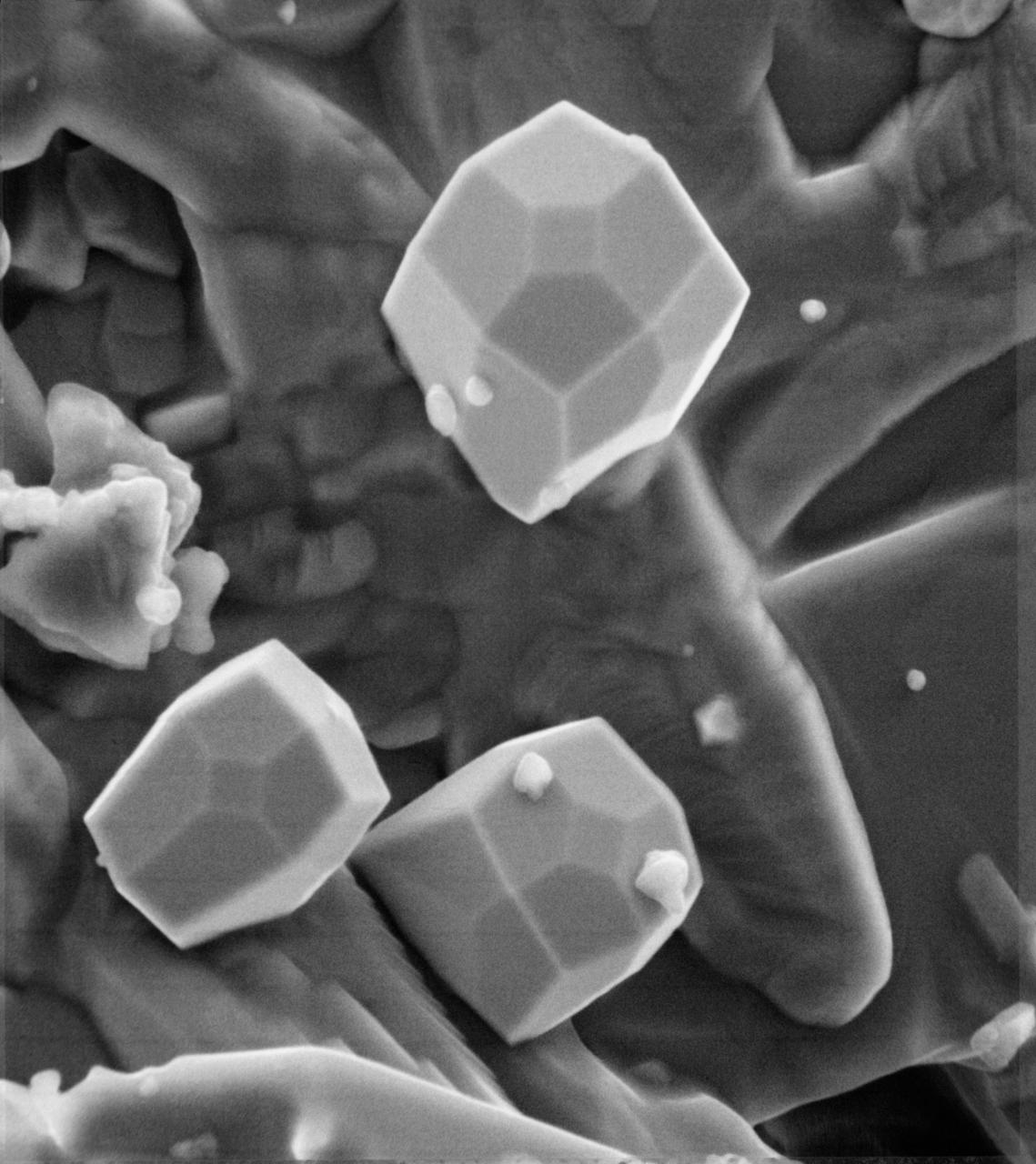
A scanning electron microscope photograph of iron crystals which grow in a small vug or cavity in a recrystallized breccia (fragmented rock) from the Apollo 15 Hadley-Apennino lunar landing site. The largest crystal is three microns across. Perfectly developed crystals such as these indicate slow formation from a hot vapor as the rock was cooling. The crystals are resting on an interlocking lattice of pyroxene (calsium-magnesium-iron silicate).
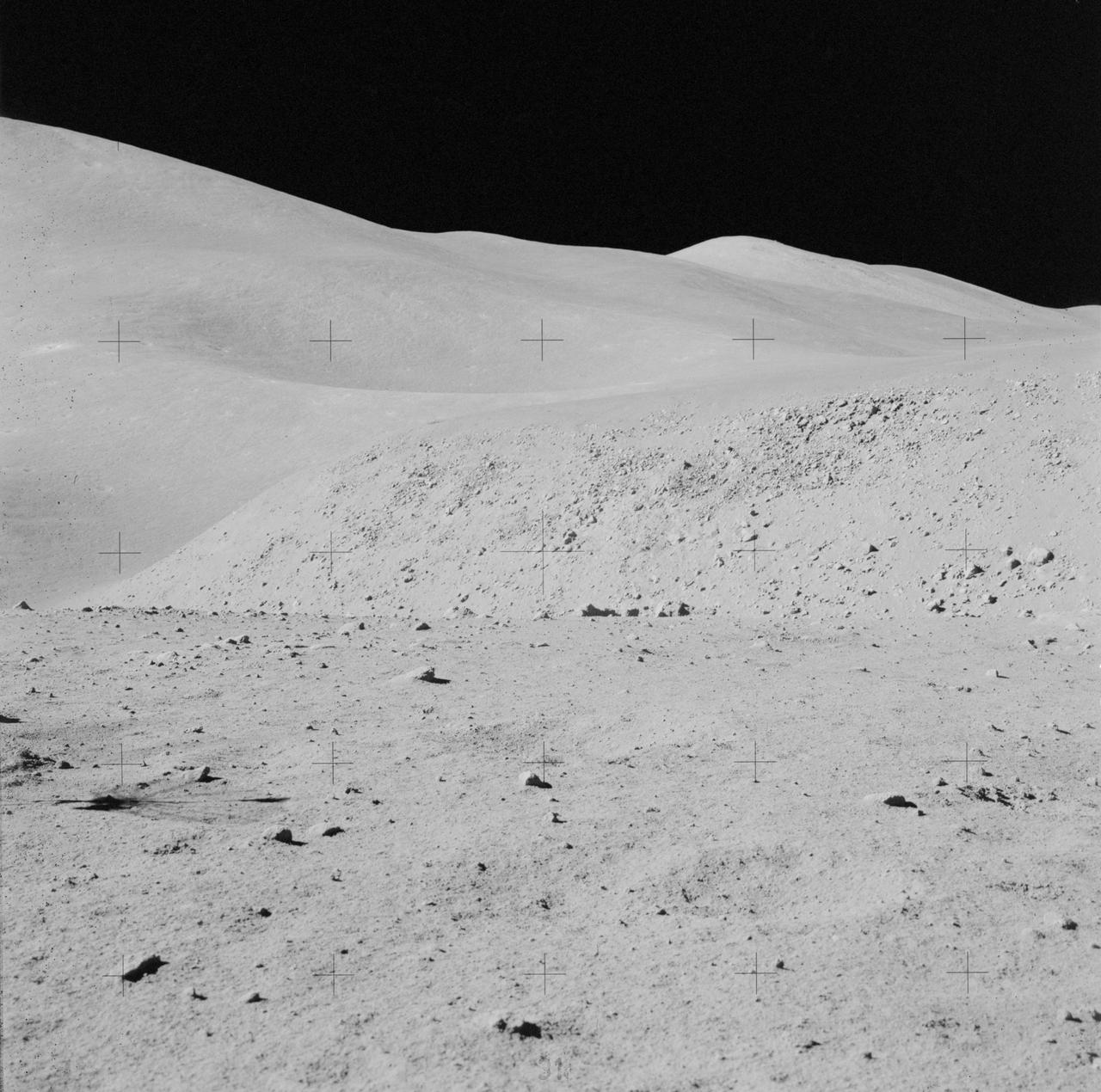
AS15-82-11123 (2 Aug. 1971) --- A view of the "strewn rock" scene encountered by Apollo 15 astronauts David R. Scott, commander, and James B. Irwin, lunar module pilot, during their third extravehicular activity (EVA) of the mission. Irwin took this photograph with a handheld 70mm camera. While astronauts Scott and Irwin descended in the Lunar Module (LM) "Falcon" to explore the moon, astronaut Alfred M. Worden, command module pilot, remained with the Command and Service Modules (CSM) in lunar orbit.
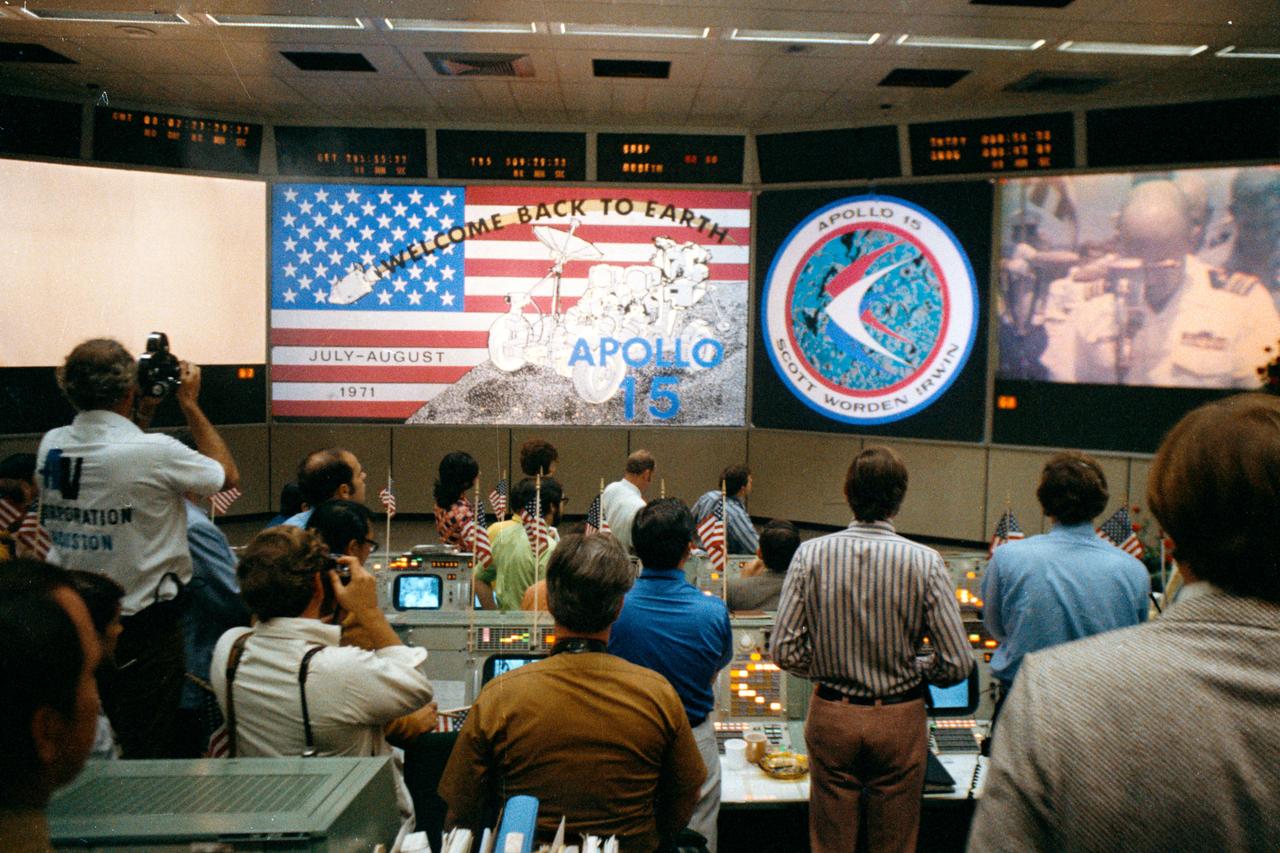
An overall view of activity in the Mission Operations Control Room in the Mission Control Center at the conclusion of the Apollo 15 lunar landing mission. The television monitor in the right background shows the welcome ceremonies aboard the prime recovery ship, U.S.S. Okinawa, in the mid-Pacific Ocean.
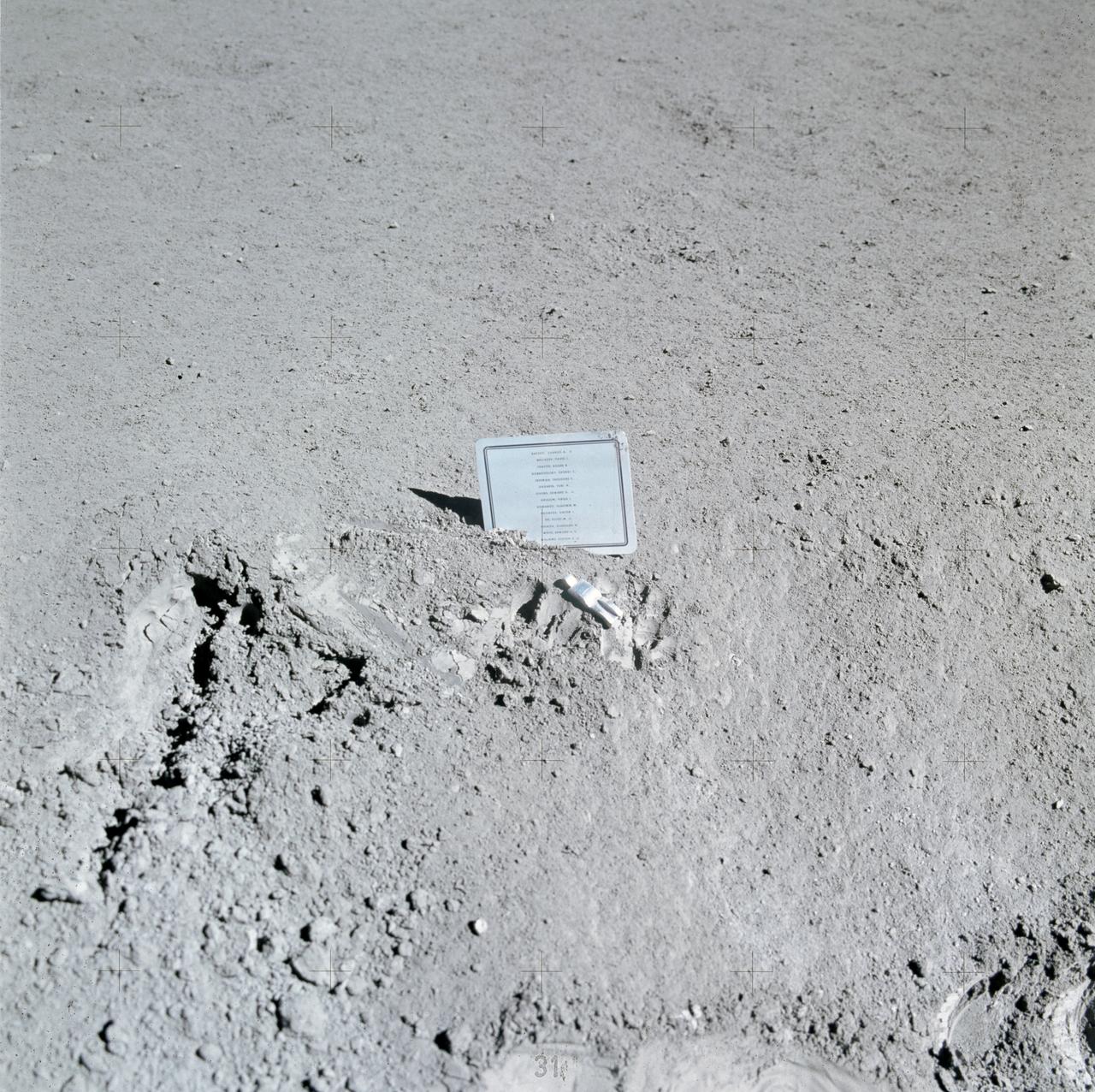
AS15-88-11894 (31 July-2 Aug. 1971) --- A close-up view of a commemorative plaque left on the moon at the Hadley-Apennine landing site in memory of 14 NASA astronauts and USSR cosmonauts, now deceased. Their names are inscribed in alphabetical order on the plaque. The plaque was stuck in the lunar soil by astronauts David R. Scott, commander, and James B. Irwin, lunar module pilot, during their Apollo 15 lunar surface extravehicular activity (EVA). The names on the plaque are Charles A. Bassett II, Pavel I. Belyayev, Roger B. Chaffee, Georgi Dobrovolsky, Theodore C. Freeman, Yuri A. Gagarin, Edward G. Givens Jr., Virgil I. Grissom, Vladimir Komarov, Viktor Patsayev, Elliot M. See Jr., Vladislav Volkov, Edward H. White II, and Clifton C. Williams Jr. The tiny, man-like object represents the figure of a fallen astronaut/cosmonaut. While astronauts Scott and Irwin descended in the Lunar Module (LM) "Falcon" to explore the Hadley-Apennine area of the moon, astronaut Alfred M. Worden, command module pilot, remained with the Command and Service Modules (CSM) in lunar orbit.
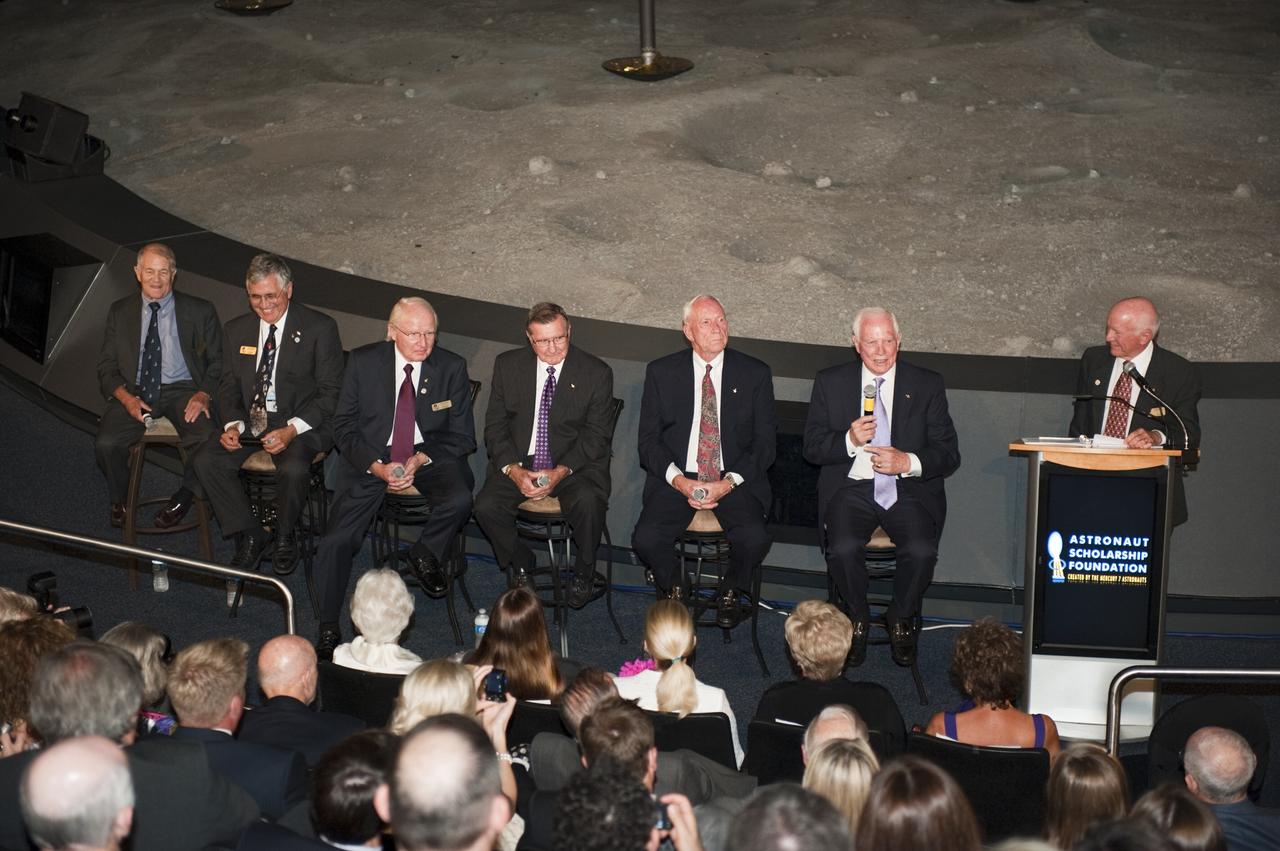
CAPE CANAVERAL, Fla. -- The Apollo/Saturn V Center at NASA's Kennedy Space Center in Florida hosted a celebration on the 40th anniversary of NASA's Apollo 15 mission. An elite gathering of Apollo-era astronauts were on hand for the event and panel discussion. Gerry Griffin, Apollo 15 flight director moderates the question-and-answer period with the panel. From left are: Apollo 15 astronaut backup support crew members, Joe Allen, Jack Schmitt, Vance Brand and Dick Gordon; Al Worden and Dave Scott. Worden circled the moon while Scott and the late Jim Irwin, the Lunar Module commander, made history when they became the first humans to drive a vehicle on the surface of the moon. They also provided extensive descriptions and photographic documentation of geologic features in the vicinity of the Hadley Rille landing site during their three days on the lunar surface. Photo credit: NASA/Kim Shiflett
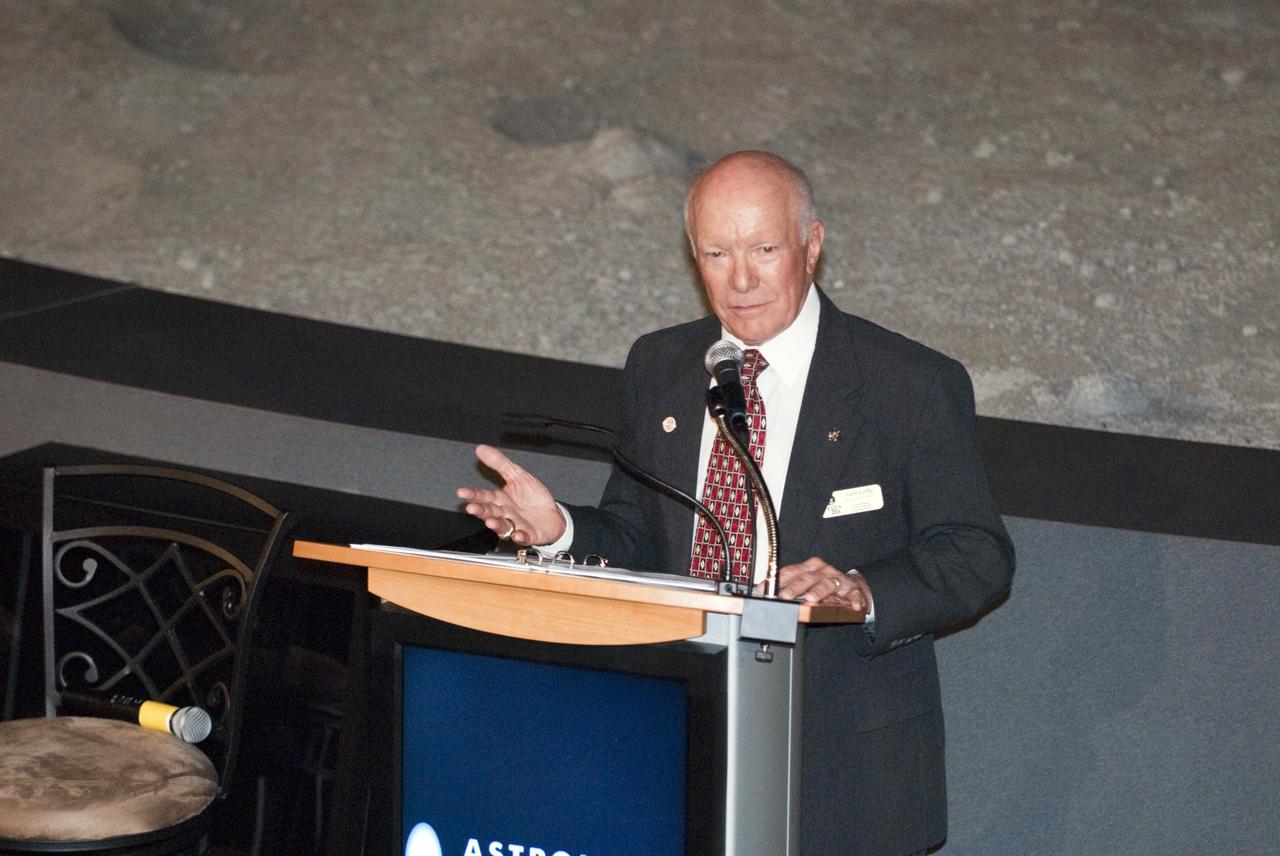
CAPE CANAVERAL, Fla. -- The Apollo/Saturn V Center at NASA's Kennedy Space Center in Florida hosted a celebration on the 40th anniversary of NASA's Apollo 15 mission. Apollo 15 Commander Dave Scott and Command Module Pilot Al Worden and an elite gathering of Apollo-era astronauts were on hand for the event and panel discussion. Here, Gerry Griffin, Apollo 15 flight director, speaks to the invited guests. Worden circled the moon while Scott and the late Jim Irwin, the Lunar Module commander, made history when they became the first humans to drive a vehicle on the surface of the moon. They also provided extensive descriptions and photographic documentation of geologic features in the vicinity of the Hadley Rille landing site during their three days on the lunar surface. Photo credit: NASA/Kim Shiflett
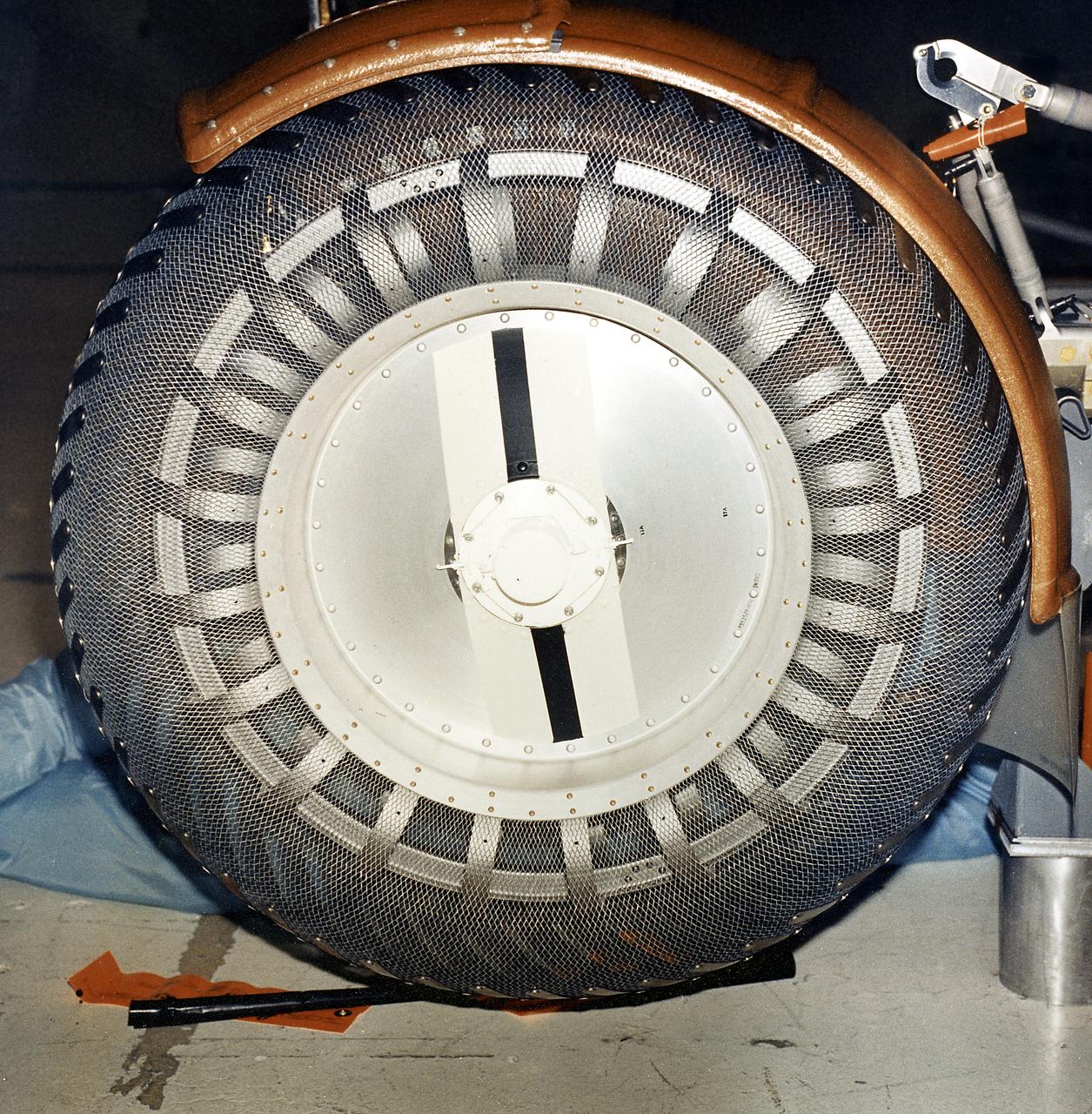
This is a close-up view of a left front wheel of the Lunar Roving Vehicle (LRV) No. 1. The LRV was built to give Apollo astronauts a greater range of mobility during lunar exploration. It was an open-space and collapsible vehicle about 10 feet long with large mesh wheels, anterna, appendages, tool caddies, and camera. An LRV was used on each of the last three Apollo missions; Apollo 15, Apollo 16, and Apollo 17. It was built by the Boeing Company under the direction of the Marshall Space Flight Center.
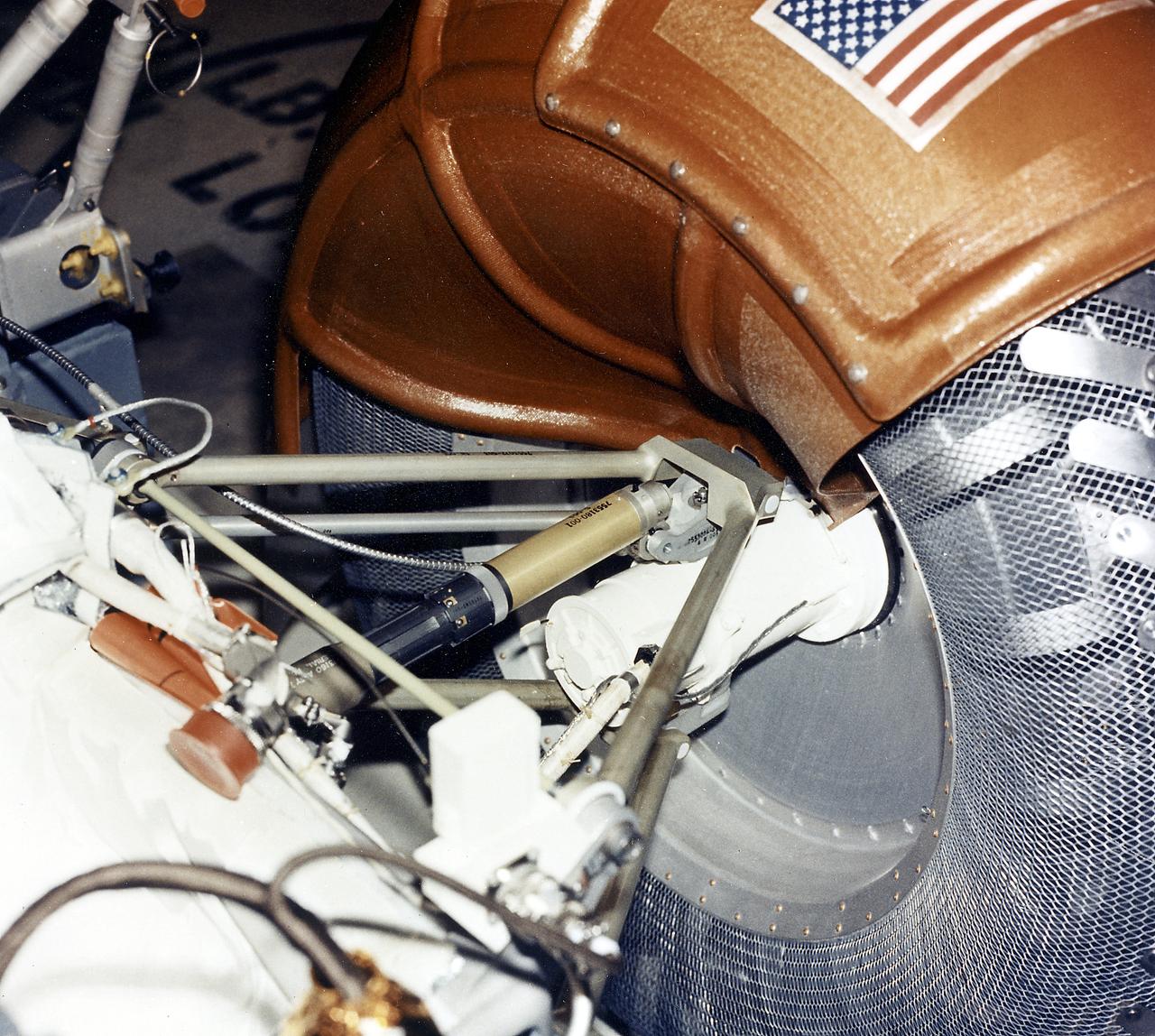
This is a close-up inboard view of a left front wheel of the Lunar Roving Vehicle (LRV) No. 1. The LRV was built to give Apollo astronauts a greater Range of mobility during lunar exploration. It was an open-space and collapsible vehicle about 10 feet long with large mesh wheels, anterna, appendages, tool caddies, and camera. An LRV was used on each of the last three Apollo missions; Apollo 15, Apollo 16, and Apollo 17. It was built by the Boeing Company under the direction of the Marshall Space Flight Center.
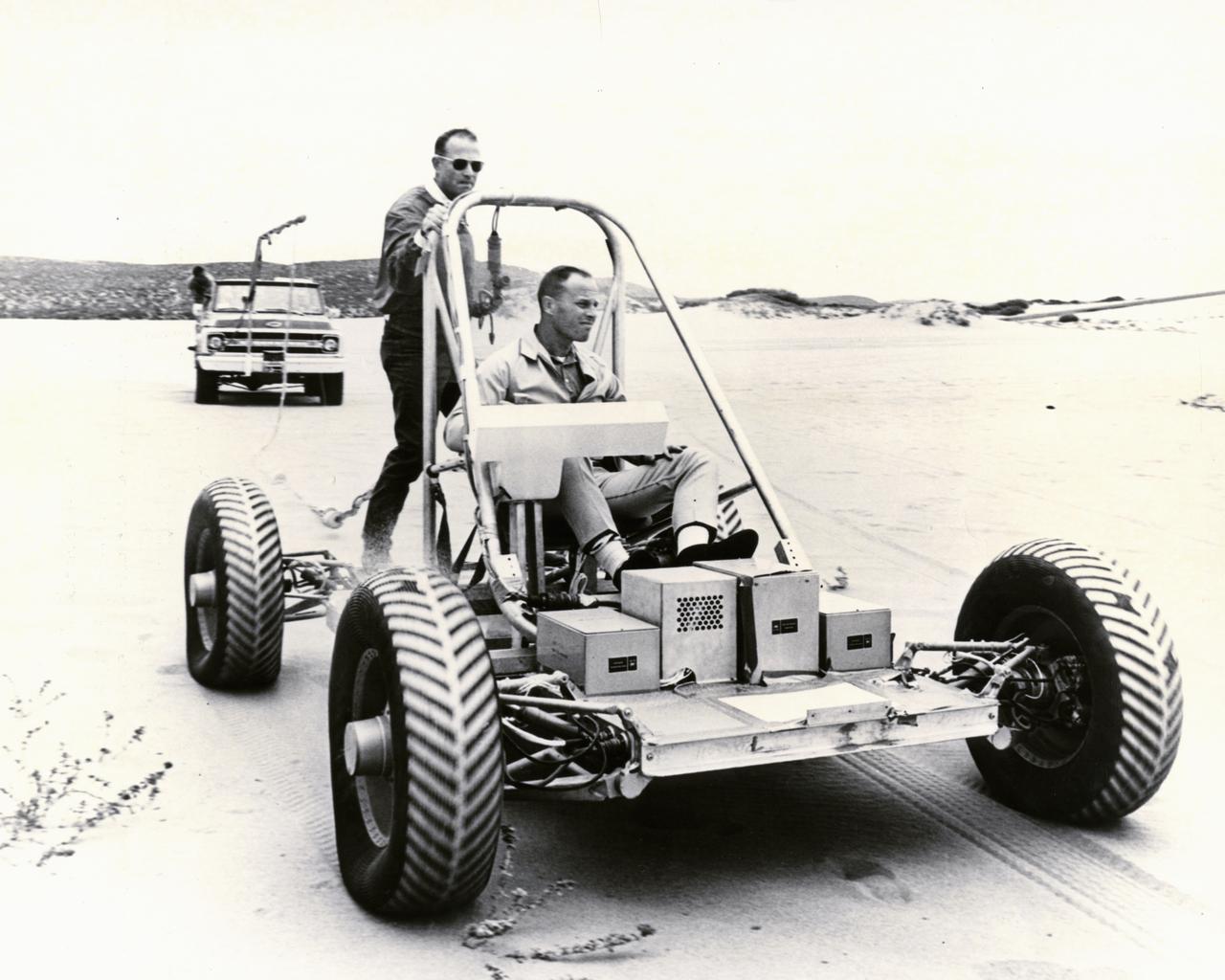
Astronauts Jack Lousma (seated) and Gerald Carr tested the Lunar Roving Vehicle (LRV) training unit on the sands near Pismo Beach. The vehicle was built by the AC Delco electronics division of General Motors Corporation. Under the direction of Marshall Space Flight Center (MSFC), the LRV was designed to allow Apollo astronauts a greater range of mobility during lunar exploration missions. The LRVs were deployed during the last three Apollo missions; Apollo 15, Apollo 16, and Apollo 17.
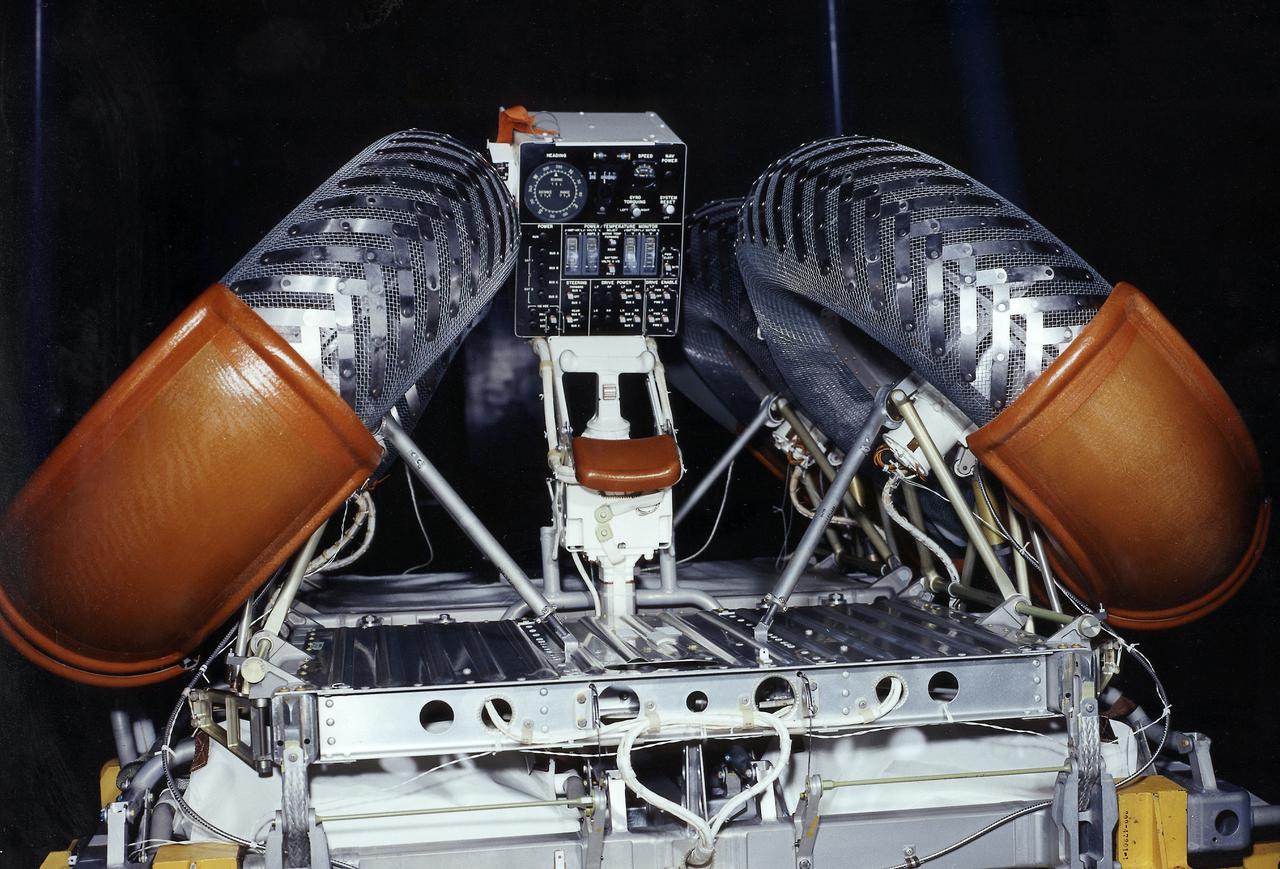
This photograph shows a rear view of a folded configuration of the Lunar Roving Vehicle (LRV) No. 2. The LRV was built to give Apollo astronauts a greater range of mobility during lunar exploration. It was an open-space and collapsible vehicle about 10 feet long with large mesh wheels, anterna, appendages, tool caddies, and camera. An LRV was used on each of the last three Apollo missions; Apollo 15, Apollo 16, and Apollo 17. It was built by the Boeing Company under the direction of the Marshall Space Flight Center.
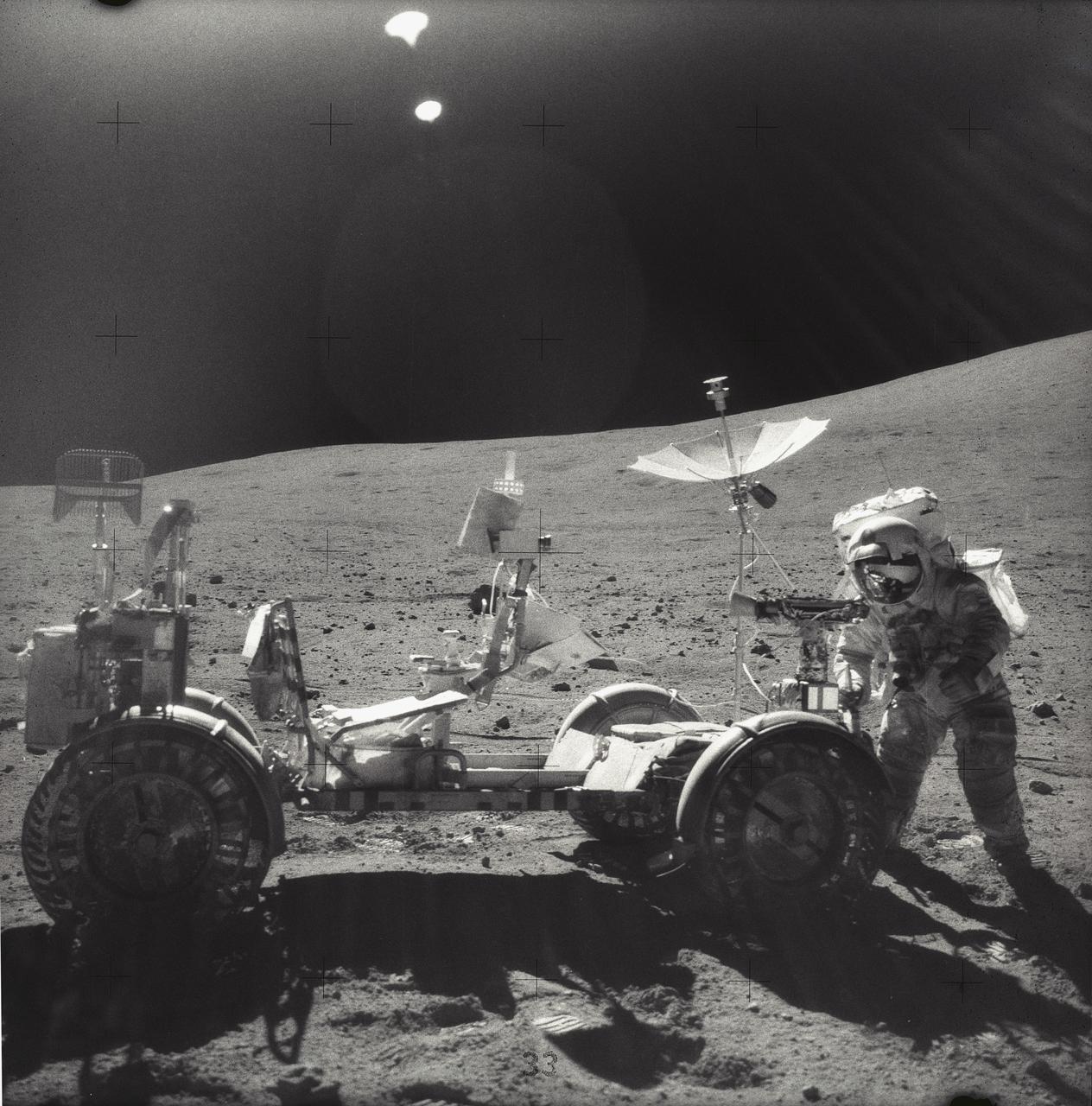
The Lunar Roving Vehicle (LRV) was designed by Marshall Space Flight Center to transport astronauts and materials on the Moon. An LRV was used on each of the last three Apollo missions; Apollo 15, Apollo 16, and Apollo 17, in 1971 and 1972, to permit the crew to travel several miles from the lunar landing site. This photograph was taken during the Apollo 16 mission in 1972.
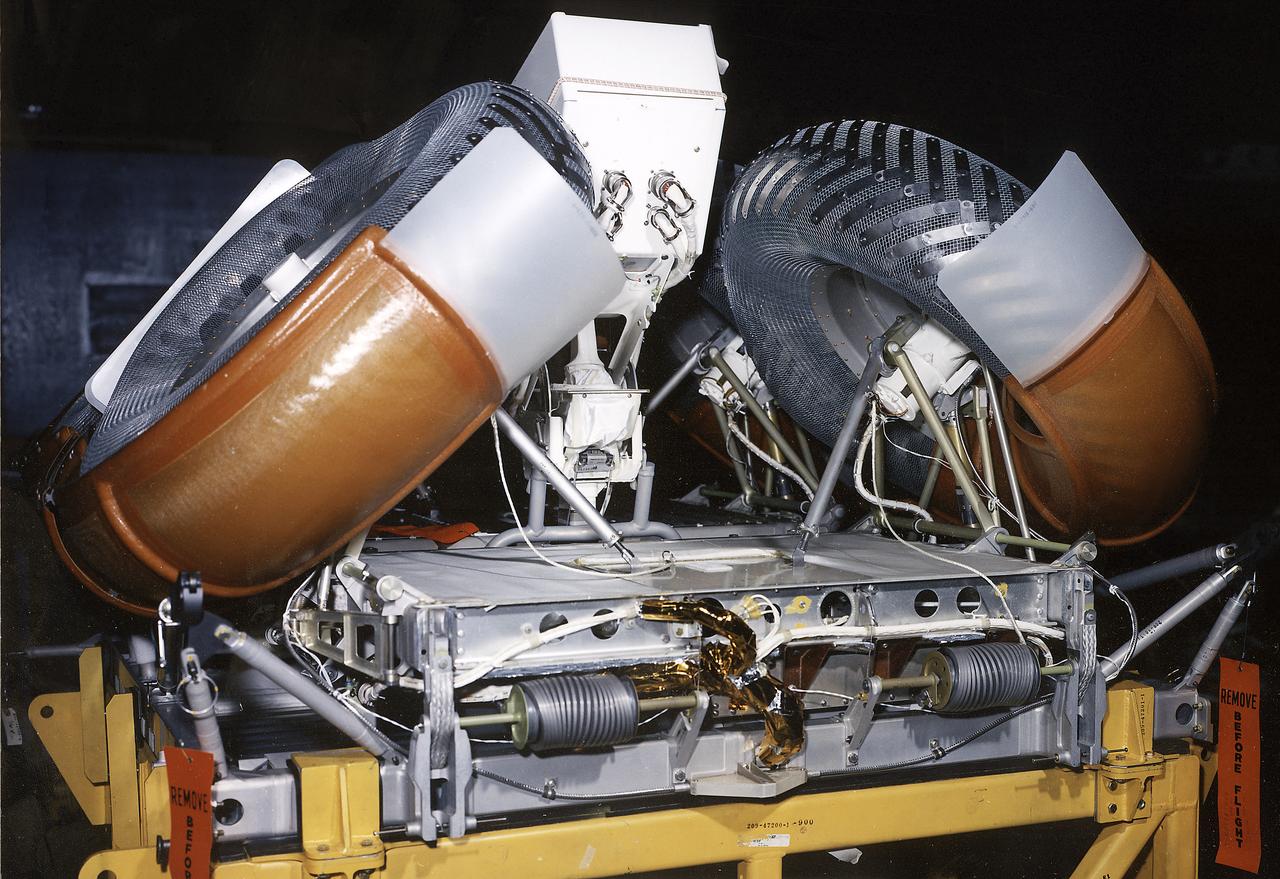
This photograph shows a front view of a folded configuration of the Lunar Roving Vehicle (LRV) No. 2. The LRV was built to give Apollo astronauts a greater range of mobility during lunar exploration. It was an open-space and collapsible vehicle about 10 feet long with large mesh wheels, anterna, appendages, tool caddies, and camera. An LRV was used on each of the last three Apollo missions; Apollo 15, Apollo 16, and Apollo 17. It was built by the Boeing Company under the direction of the Marshall Space Flight Center.
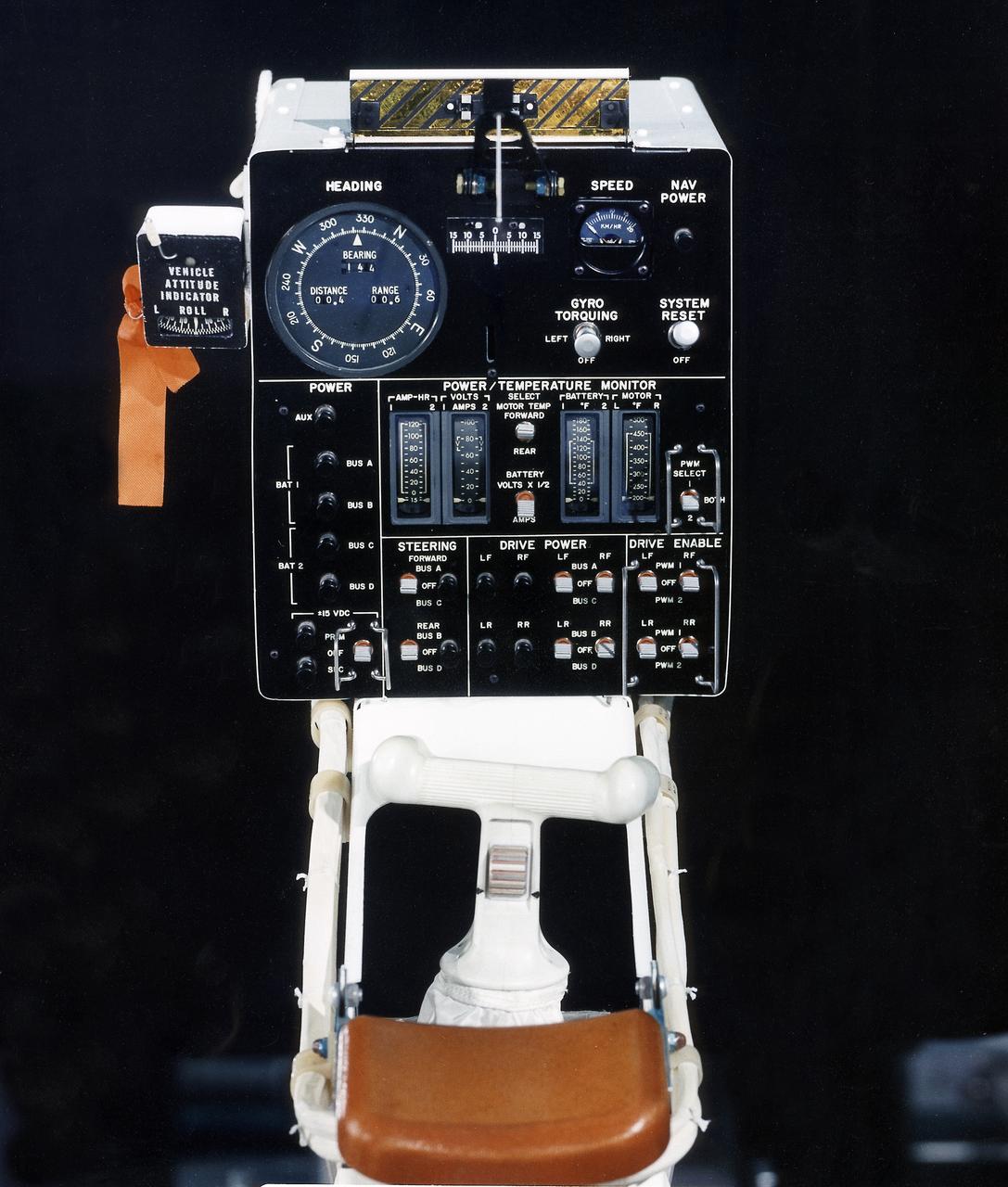
This photograph is a view of a display, control console, and hand controller for the Lunar Roving Vehicle (LRV) No. 2. The LRV was built to give Apollo astronauts a greater range of mobility during lunar exploration. It was an open-space and collapsible vehicle about 10 feet long with large mesh wheels, anterna, appendages, tool caddies, and camera. An LRV was used on each of the last three Apollo missions; Apollo 15, Apollo 16, and Apollo 17. It was built by the Boeing Company under the direction of the Marshall Space Flight Center.
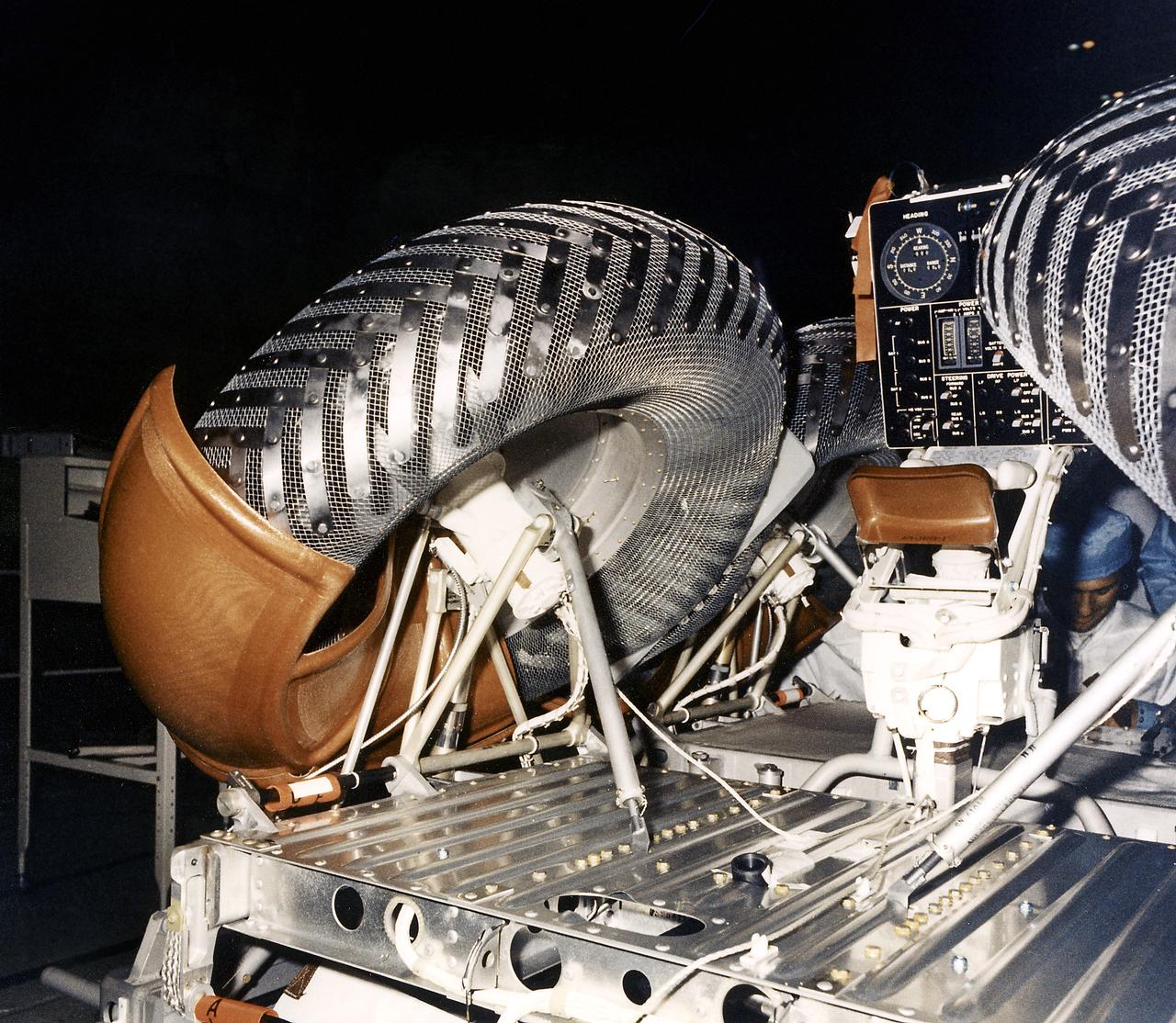
This is a close-up view of a right rear wheel strut of the Lunar Roving Vehicle (LRV) No. 1. The LRV was built to give Apollo astronauts a greater range of mobility during lunar exploration. It was an open-space and collapsible vehicle about 10 feet long with large mesh wheels, anterna, appendages, tool caddies, and camera. An LRV was used on each of the last three Apollo missions; Apollo 15, Apollo 16, and Apollo 17. It was built by the Boeing Company under the direction of the Marshall Space Flight Center.
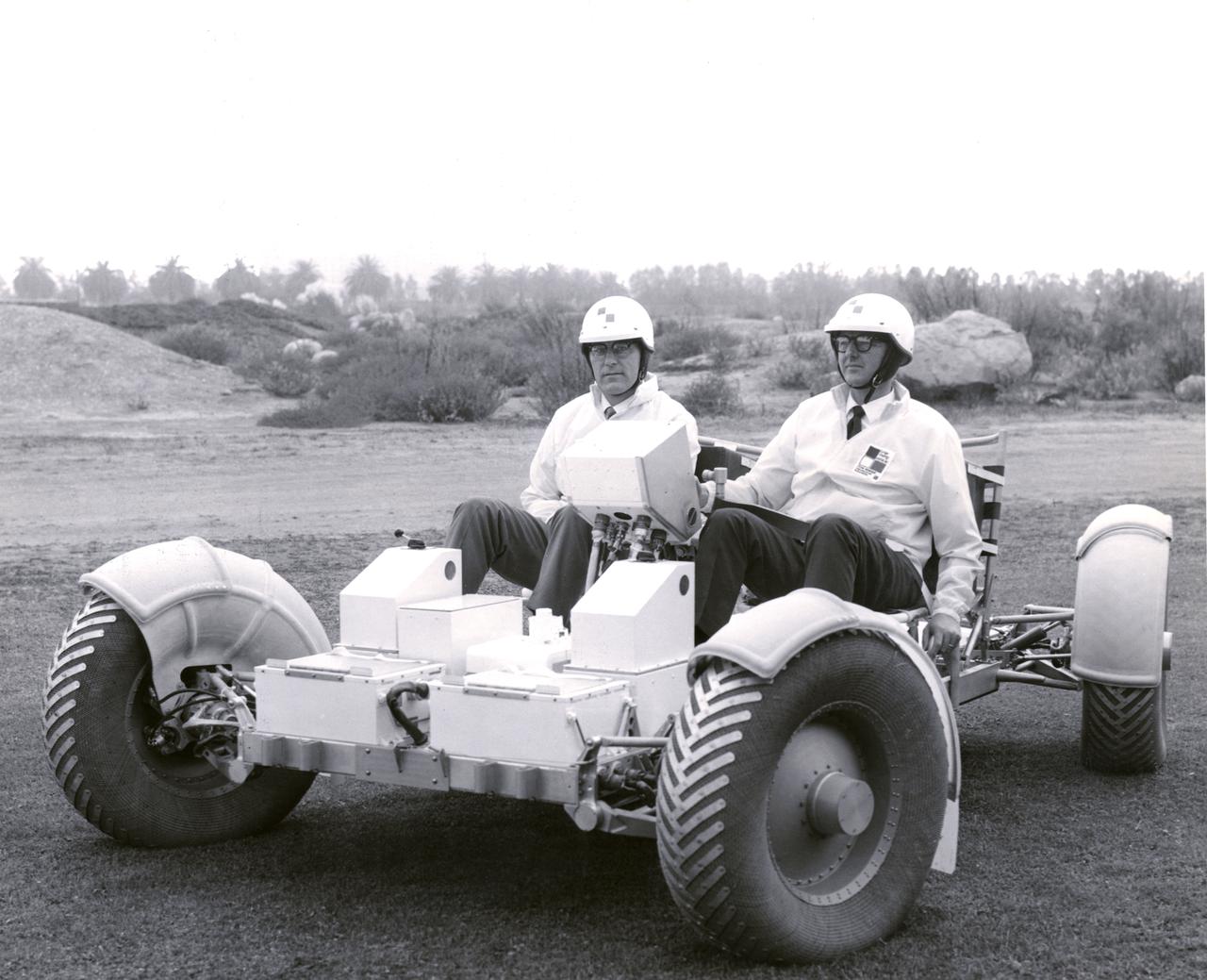
Delco engineers are operating this Lunar Roving Vehicle (LRV) Trainer. Built by by Delco Electronics Division of the General Motors Corporation, the trainer was shipped to NASA’s Manned Spacecraft Center in Houston, Texas for an astronaut training program. Under the direction of Marshall Space Flight Center (MSFC), the LRV was designed to allow Apollo astronauts a greater range of mobility during lunar exploration missions. The LRVs were deployed during the last three Apollo missions; Apollo 15, Apollo 16, and Apollo 17.
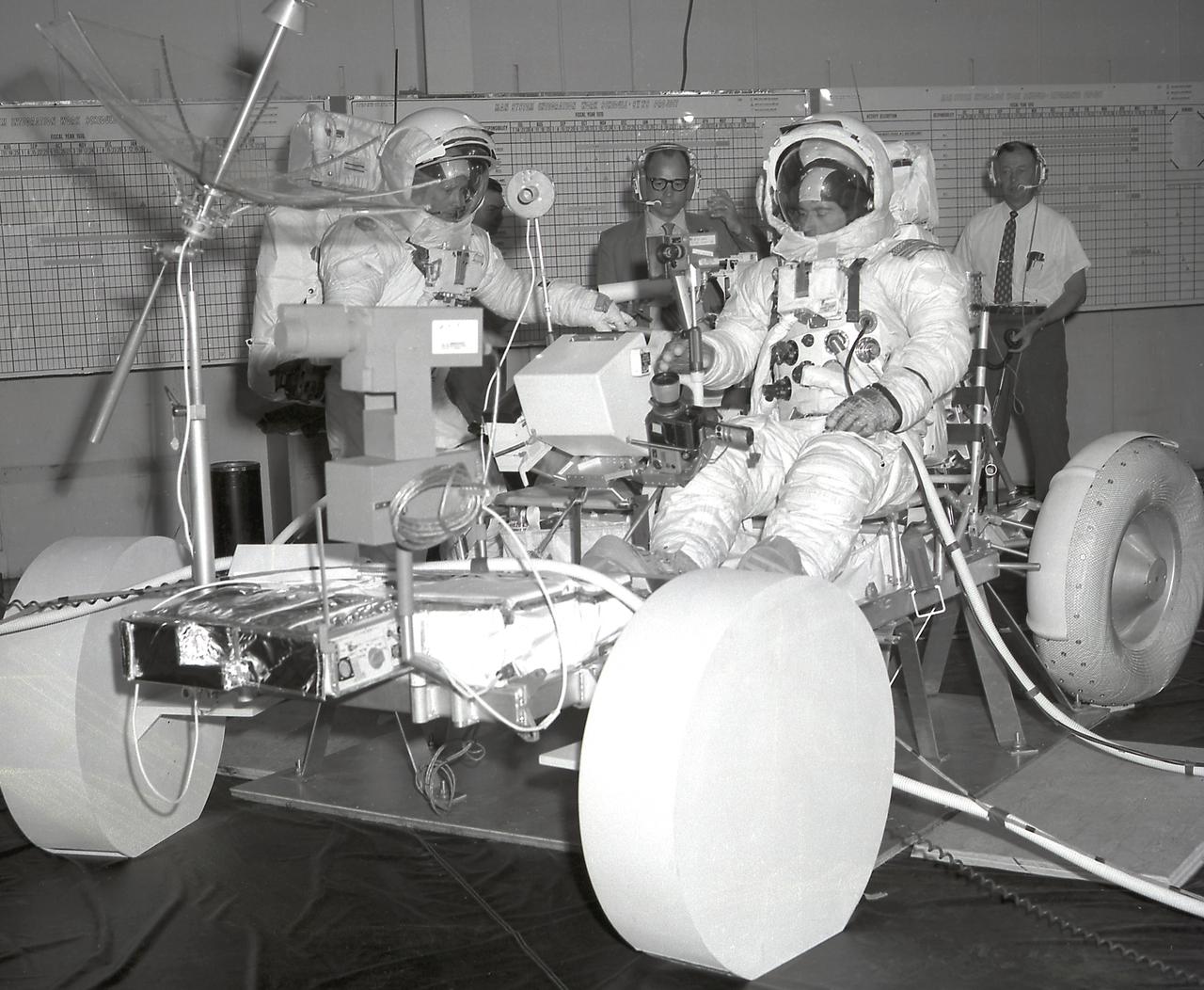
This image depicts the Apollo 16 mission astronauts John Young (right) and Charles Duke (left) in pressure suits during a final crew training on the Lunar Roving Vehicle (LRV) at the Marshall Space Flight Center (MSFC), building 4619. Developed by the MSFC, the LRV was the lightweight electric car designed to increase the range of mobility and productivity of astronauts on the lunar surface. It was used on the last three Apollo missions; Apollo 15, Apollo 16, and Apollo 17.
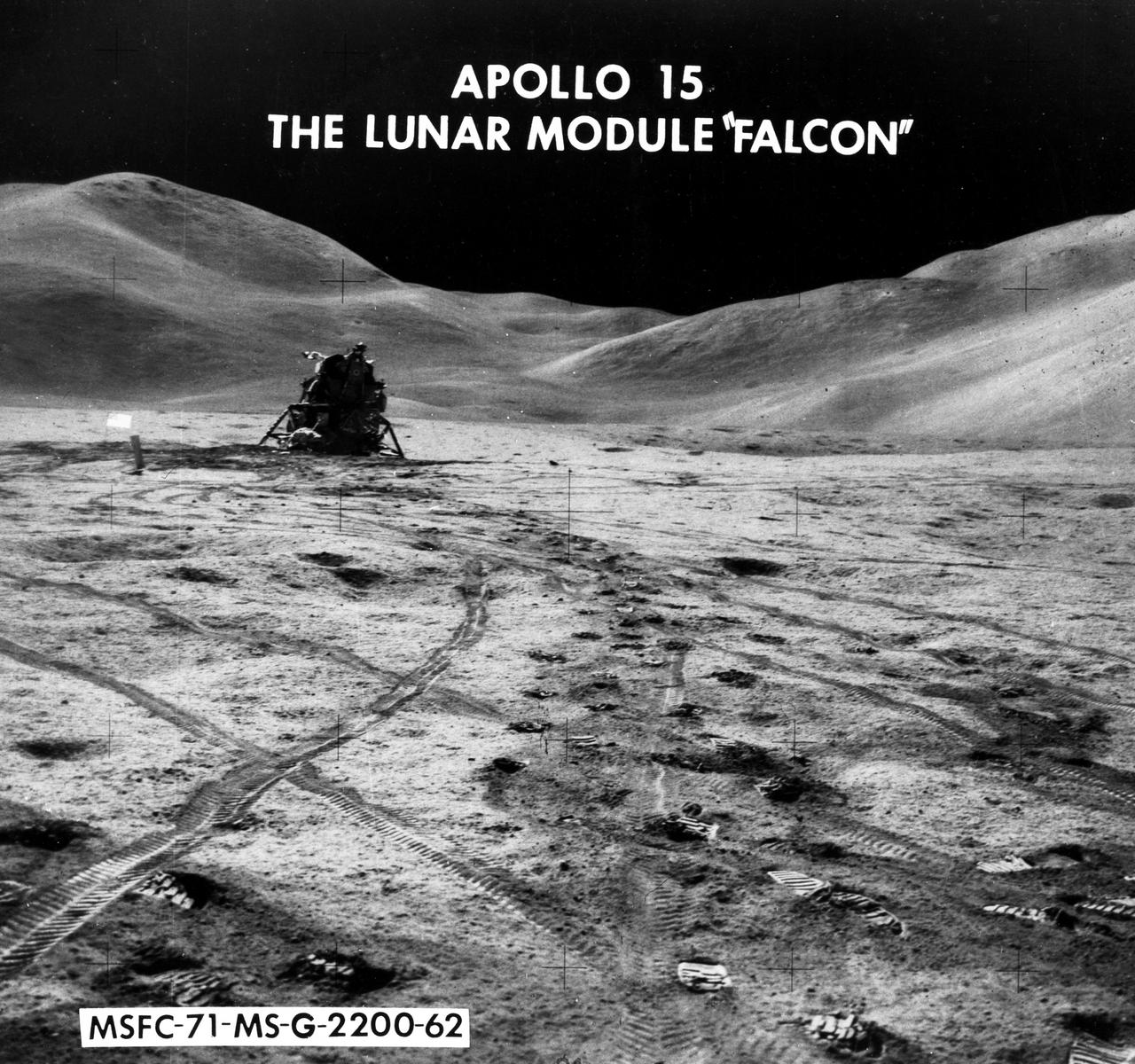
This is a photo of the Apollo 15 Lunar Module, Falcon, on the lunar surface. Apollo 15 launched from Kennedy Space Center (KSC) on July 26, 1971 via a Saturn V launch vehicle. Aboard was a crew of three astronauts including David R. Scott, Mission Commander; James B. Irwin, Lunar Module Pilot; and Alfred M. Worden, Command Module Pilot. The first mission designed to explore the Moon over longer periods, greater ranges and with more instruments for the collection of scientific data than on previous missions, the mission included the introduction of a $40,000,000 lunar roving vehicle (LRV) that reached a top speed of 16 kph (10 mph) across the Moon's surface. The successful Apollo 15 lunar landing mission was the first in a series of three advanced missions planned for the Apollo program. The primary scientific objectives were to observe the lunar surface, survey and sample material and surface features in a preselected area of the Hadley-Apennine region, setup and activation of surface experiments and conduct in-flight experiments and photographic tasks from lunar orbit. Apollo 15 televised the first lunar liftoff and recorded a walk in deep space by Alfred Worden. Both the Saturn V rocket and the LRV were developed at the Marshall Space Flight Center.
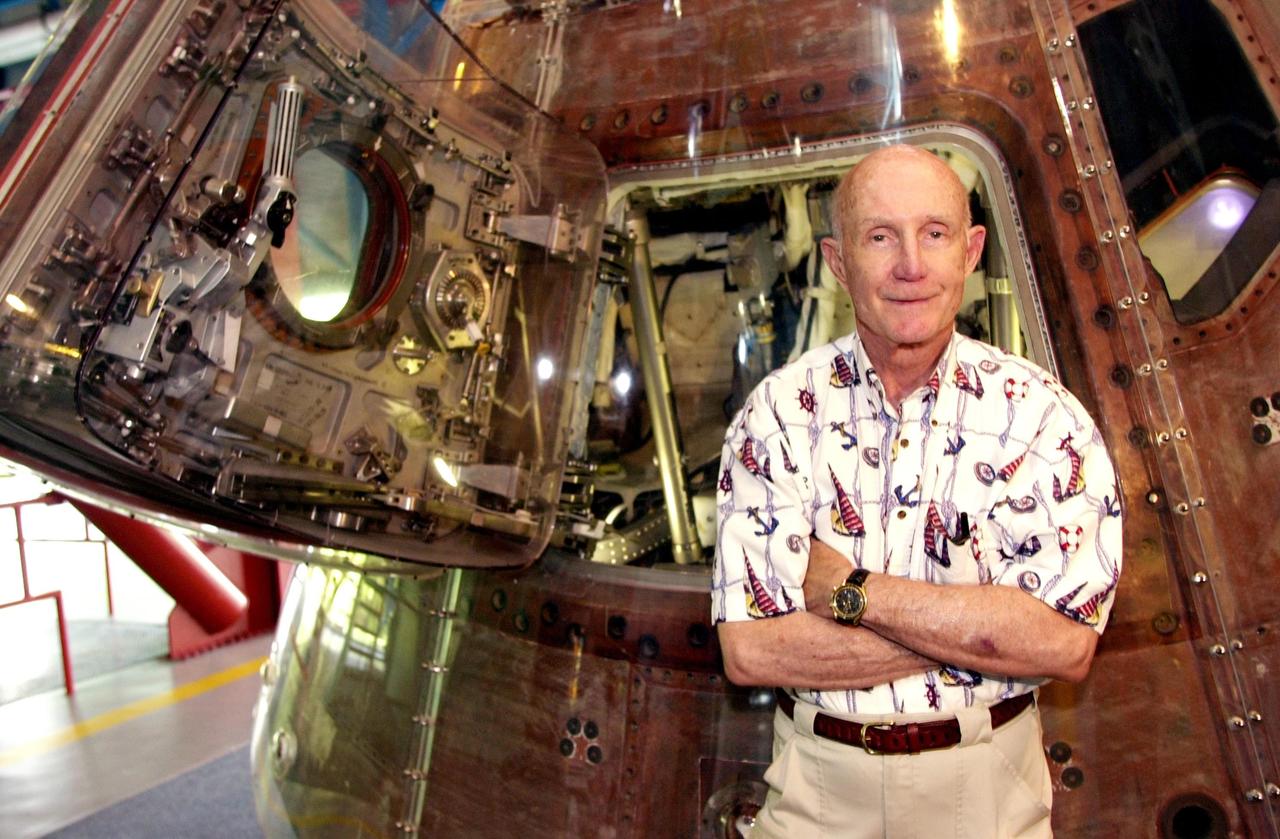
KENNEDY SPACE CENTER, FLA. -- Former astronaut Thomas Staford visits KSC, shown here at the Apollo Saturn V Center. He is standing in front of the module he flew Stafford logged his fourth space flight as Apollo commander of the Apollo-Soyuz Test Project (ASTP) mission, July 15-24, 1975, a joint space flight culminating in the historic first meeting in space between American astronauts and Soviet cosmonauts.
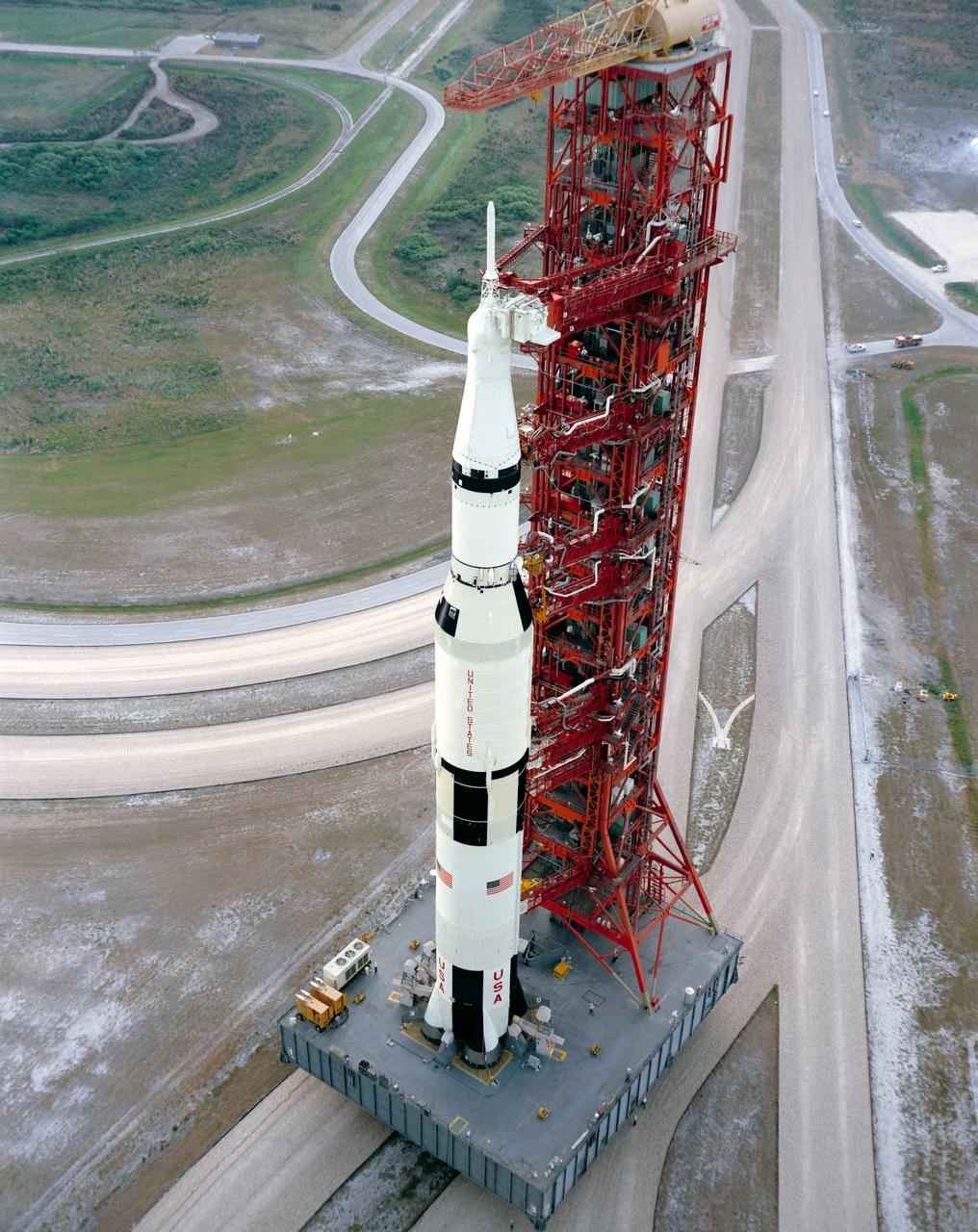
S71-33781 (11 May 1971) --- High angle view showing the Apollo 15 (Spacecraft 112/Lunar Module 10/Saturn 510) space vehicle on the way from the Vehicle Assembly Building (VAB) to Pad A, Launch Complex 39, Kennedy Space Center (KSC). The Saturn V stack and its mobile launch tower are atop a huge crawler-transporter. Apollo 15 is scheduled as the fourth manned lunar landing mission by the National Aeronautics and Space Administration (NASA). The crew men will be astronauts David R. Scott, commander; Alfred M. Worden, command module pilot; and James B. Irwin, lunar module pilot. While astronauts Scott and Irwin descend in the Lunar Module (LM) to explore the moon, astronaut Worden will remain with the Command and Service Modules (CSM) in lunar orbit.
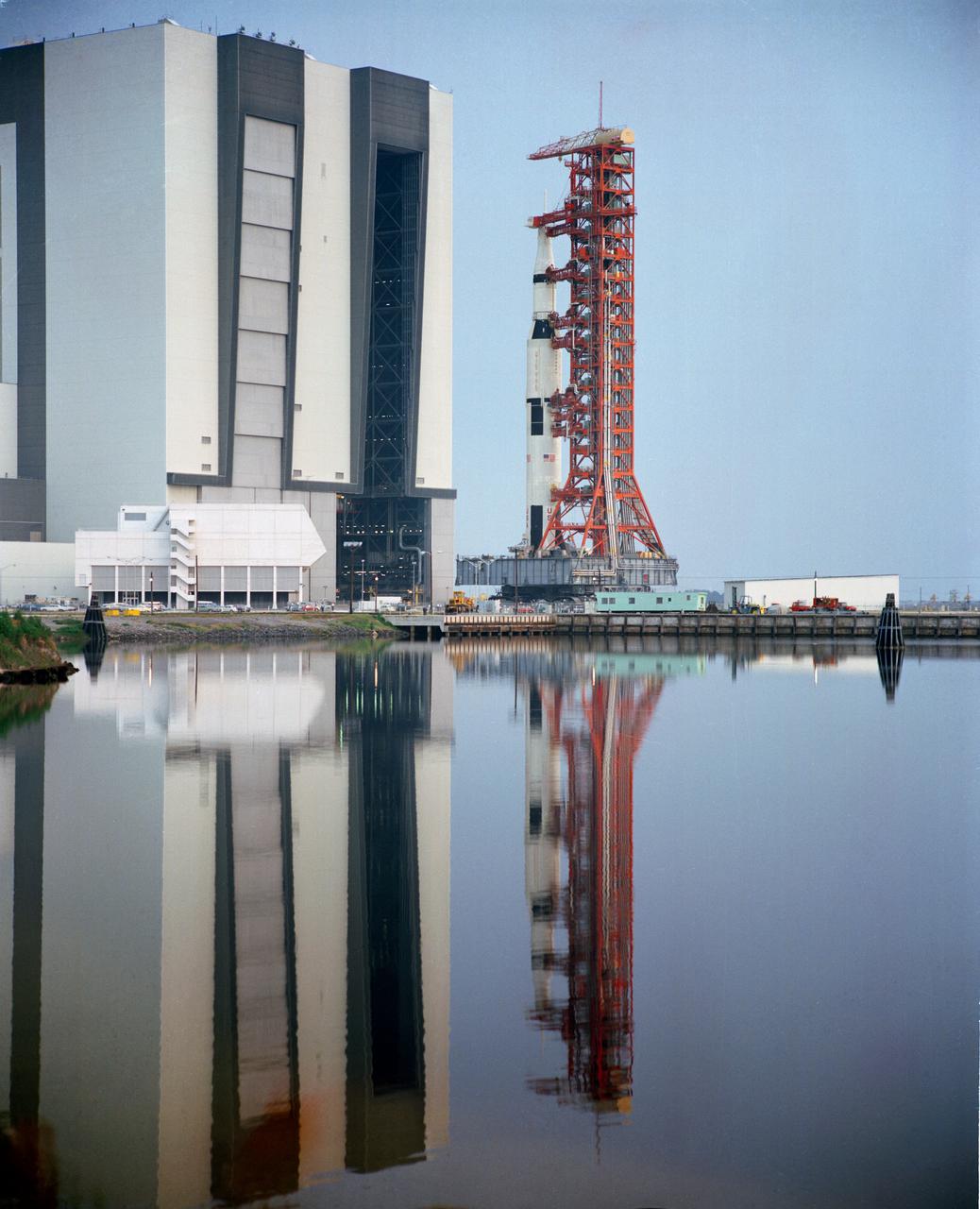
S71-33786 (11 May 1971) --- The 363-feet tall Apollo (Spacecraft 112/Lunar Module 10/Saturn 510) space vehicle which leaves the Vehicle Assembly Building (VAB) to Pad A, Launch Complex 39, Kennedy Space Center (KSC). The Saturn V stack and its mobile launch tower are atop a huge crawler-transporter. Apollo 15 is scheduled as the fourth manned lunar landing mission by the National Aeronautics and Space Administration (NASA) and is scheduled to lift off on July 26, 1971. The crew men will be astronauts David R. Scott, commander; Alfred M. Worden, command module pilot; and James B. Irwin, lunar module pilot. While astronaut Scott and Irwin will descend in the Lunar Module (LM) to explore the moon, astronaut Worden will remain with the Command and Service Modules (CSM) in lunar orbit.

This photograph shows the Lunar Roving Vehicle (LRV) being prepared for installation in the Lunar Module at the Kennedy Space Center. The LRV was built to give Apollo astronauts a greater range of mobility during the last three lunar exploration missions; Apollo 15, Apollo 16, and Apollo 17. It was designed and developed by the Marshall Space Flight Center and built by the Boeing Company.
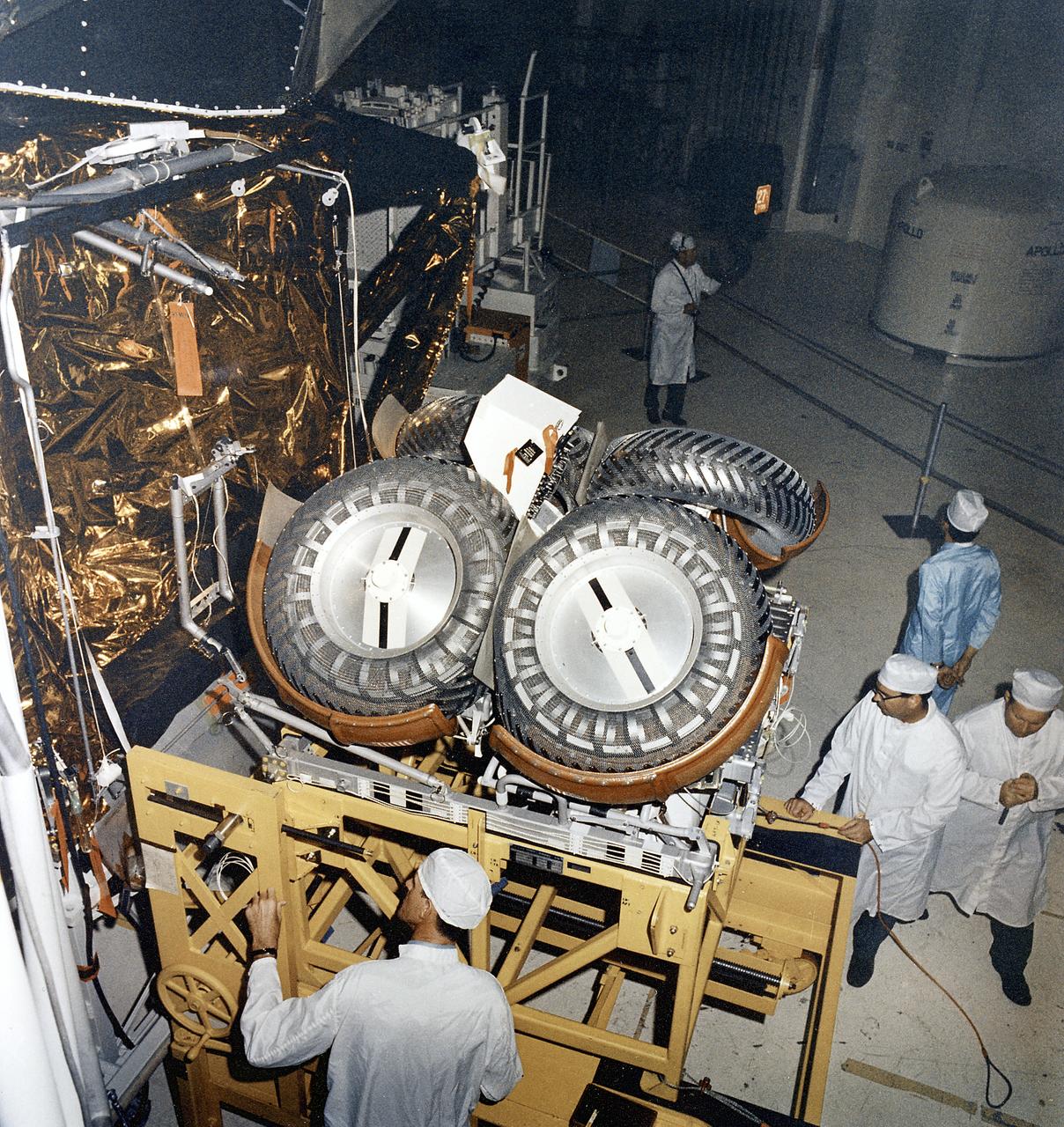
This photograph was taken during the installation of the Lunar Roving Vehicle (LRV) in the Lunar Module at the Kennedy Space Center. The LRV was built to give Apollo astronauts a greater range of mobility during the last three lunar exploration missions; Apollo 15, Apollo 16, and Apollo 17. It was designed and developed by the Marshall Space Flight Center and built by the Boeing Company.
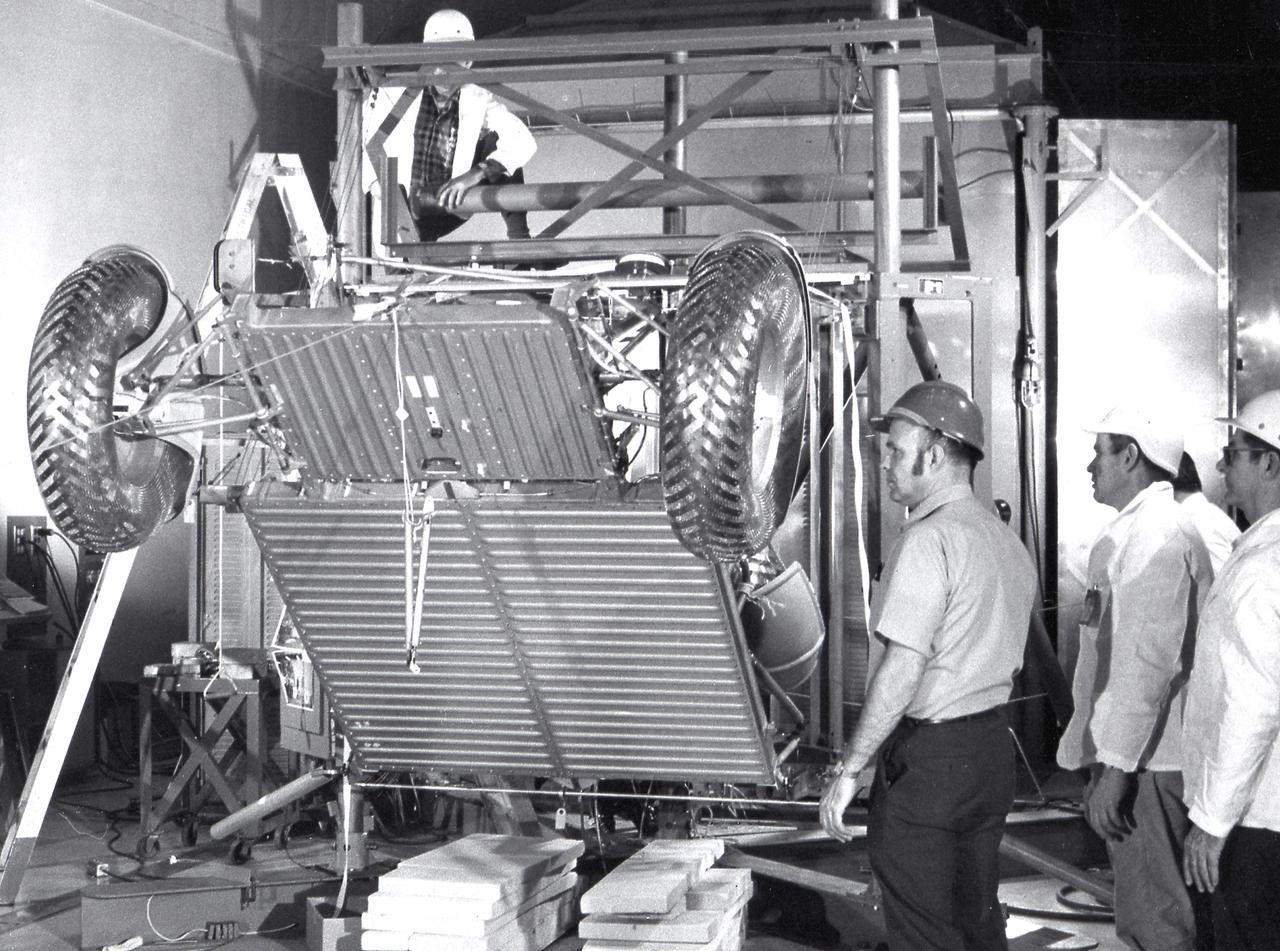
This photograph shows workmen at the Boeing plant in Kent, Washington, performing deployment tests on the Lunar Roving Vehicle (LRV). The LRV, developed under the direction of the Marshall Space Flight Center, was designed to allow Apollo astronauts a greater range of mobility on the lunar surface during the last three lunar exploration missions; Apollo 15, Apollo 16, and Apollo 17.
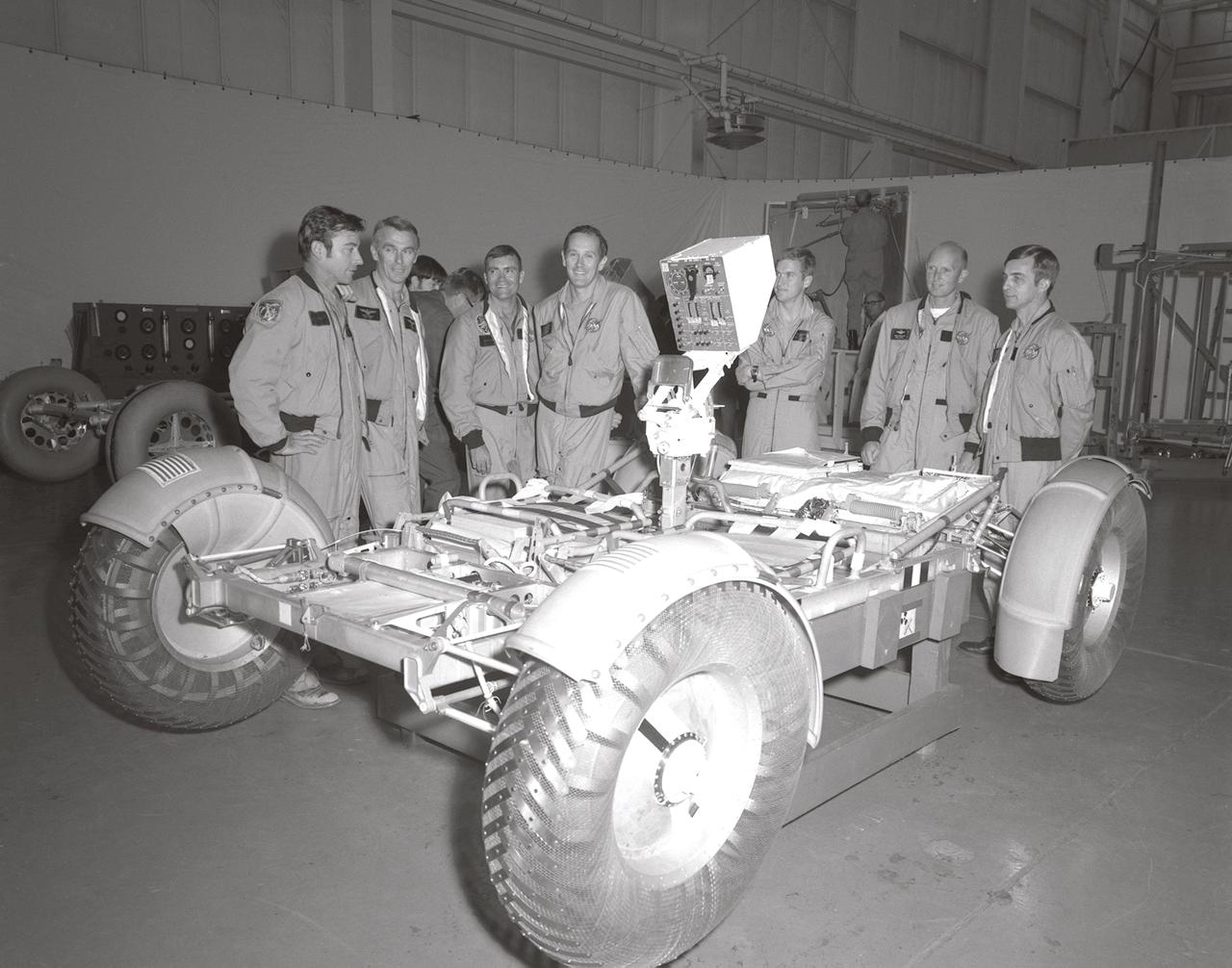
In this November 1971 photograph, (from left to right) Astronauts John Young, Eugene Cernan, Charles Duke, Fred Haise, Anthony England, Charles Fullerton, and Donald Peterson await deployment tests of the Lunar Roving Vehicle (LRV) qualification test unit in building 4649 at the Marshall Space Flight Center (MSFC). The LRV, developed under the direction of the MSFC, was designed to allow Apollo astronauts a greater range of mobility on the lunar surface during the last three lunar exploration missions; Apollo 15, Apollo 16, and Apollo 17.
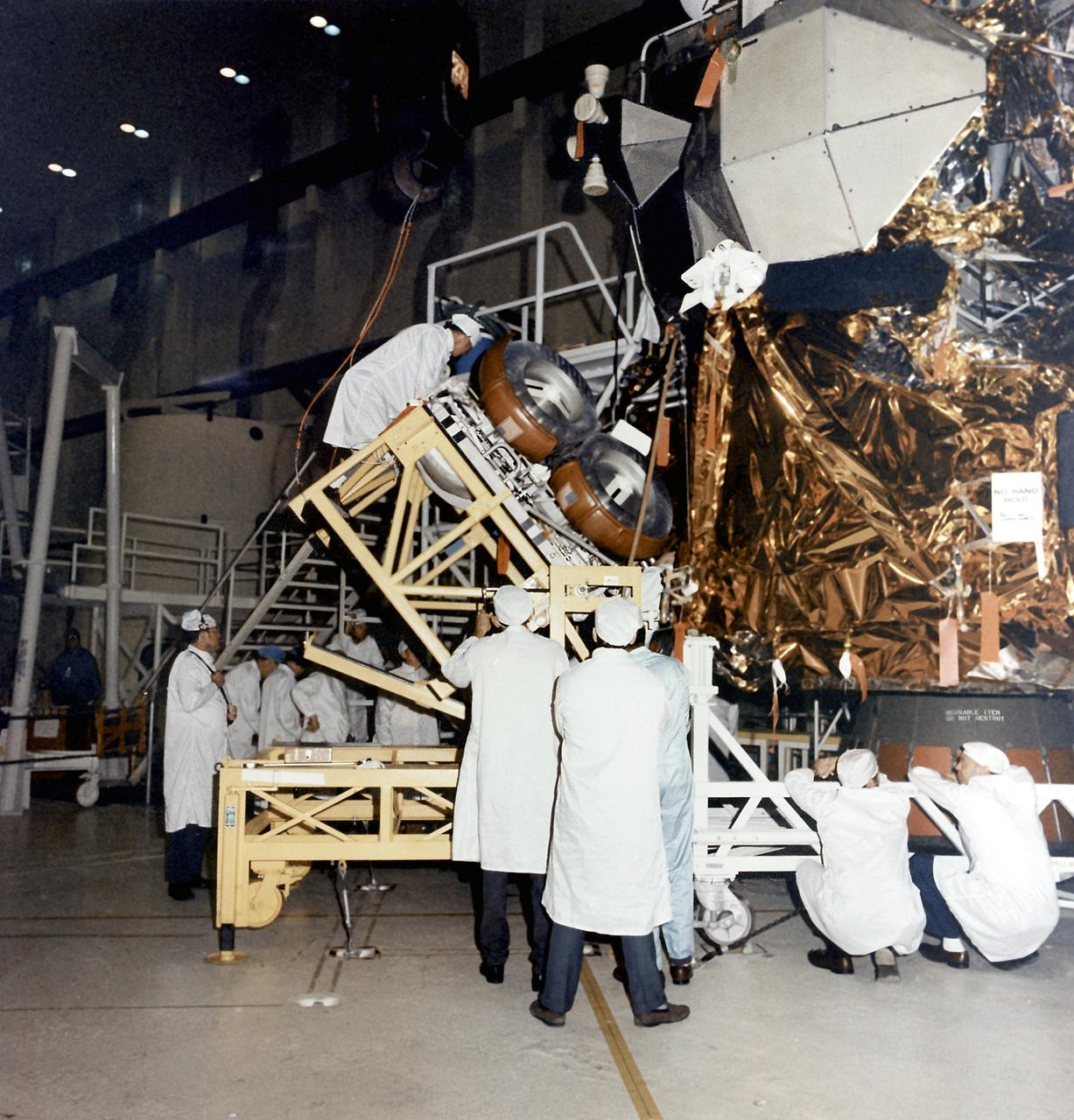
This photograph was taken during the installation of the Lunar Roving Vehicle (LRV) in the Lunar Module at the Kennedy Space Center. The LRV was built to give Apollo astronauts a greater range of mobility during the last three lunar exploration missions; Apollo 15, Apollo 16, and Apollo 17. It was designed and developed by the Marshall Space Flight Center and built by the Boeing Company.
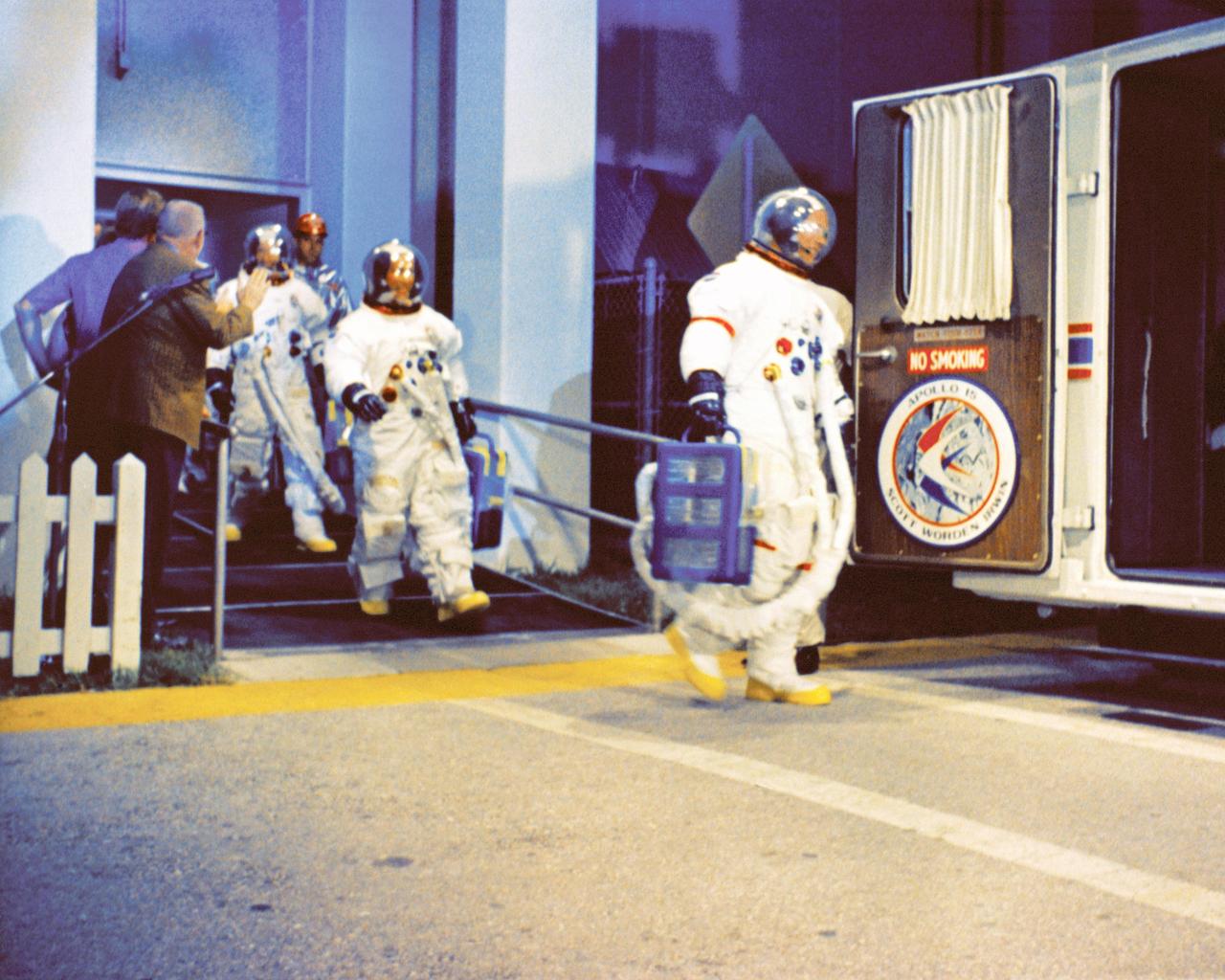
CAPE CANAVERAL, Fla. – The Apollo 15 crew walks out of the Operations and Checkout Building at NASA's Kennedy Space Center before climbing into the Astrovan for the ride out to the launch pad for their flight to the moon. Photo credit: NASA
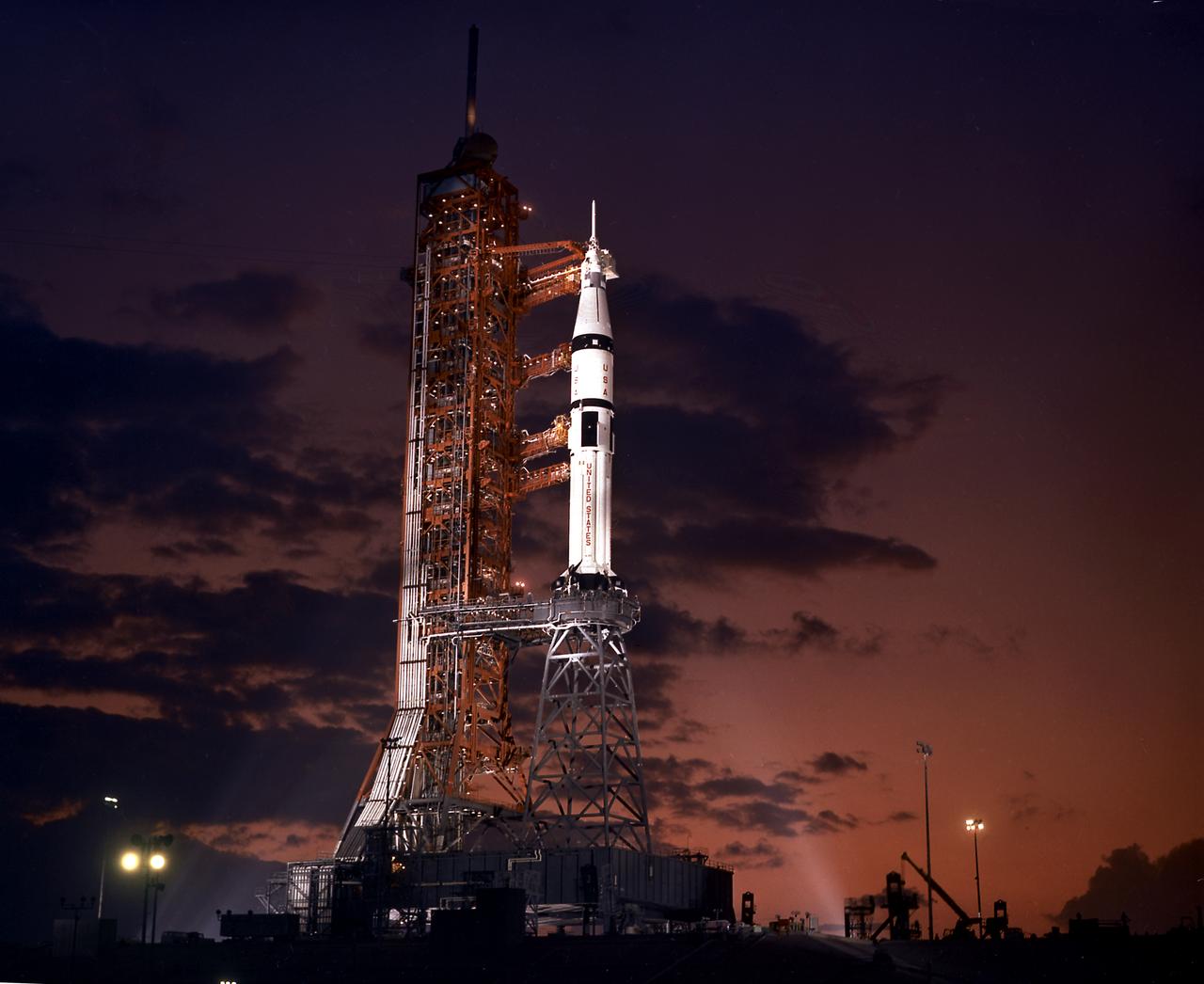
SA-210 Apollo-Soyuz Test Project (ASTP) awaits the launch scheduled on July 15, 1975 on the launch pad at the Kennedy Space Center, the ASTP mission with astronauts Thomas Stafford, Vance Brand, and Donald "Deke" Slayton. The Saturn IB, developed under the direction of the Marshall Space Flight Center (MSFC), launched five manned Earth-orbital missions between 1968 and 1975: Apollo 7, Skylab 2, Skylab 3, Skylab 4, and the Apollo-Soyuz Test Project .
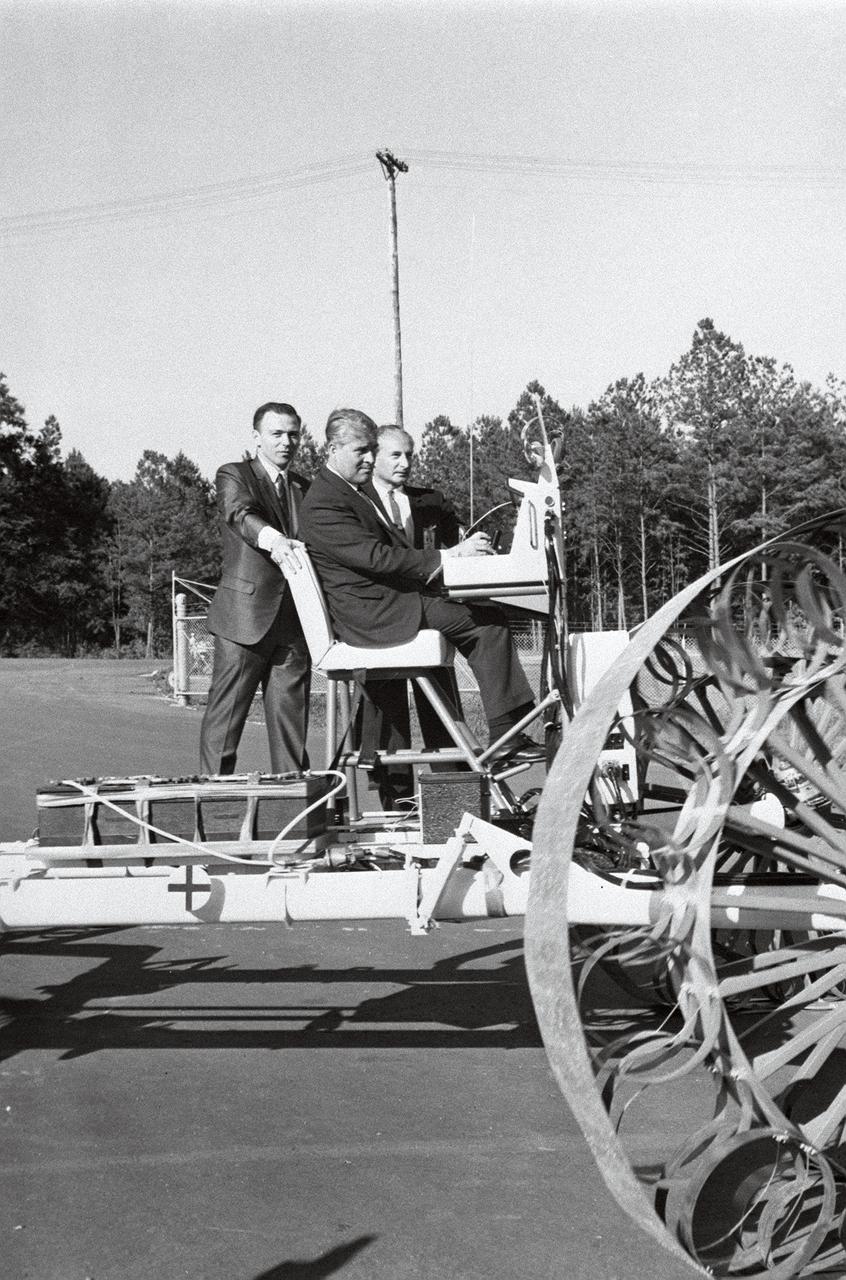
In this June 1966 photograph, Marshall Space Flight Center Director Dr. Wernher von Braun test-drives the Mobility Test Article (MTA), a developmental vehicle built by the Bendix Corporation to test lunar mobility vehicle concepts. The data provided by the MTA helped in designing the Lunar Roving Vehicle (LRV), developed under the direction of the MSFC. The LRV was designed to allow Apollo astronauts a greater range of mobility during lunar exploration missions. The LRVs were deployed during the last three Apollo missions; Apollo 15, Apollo 16, and Apollo 17.
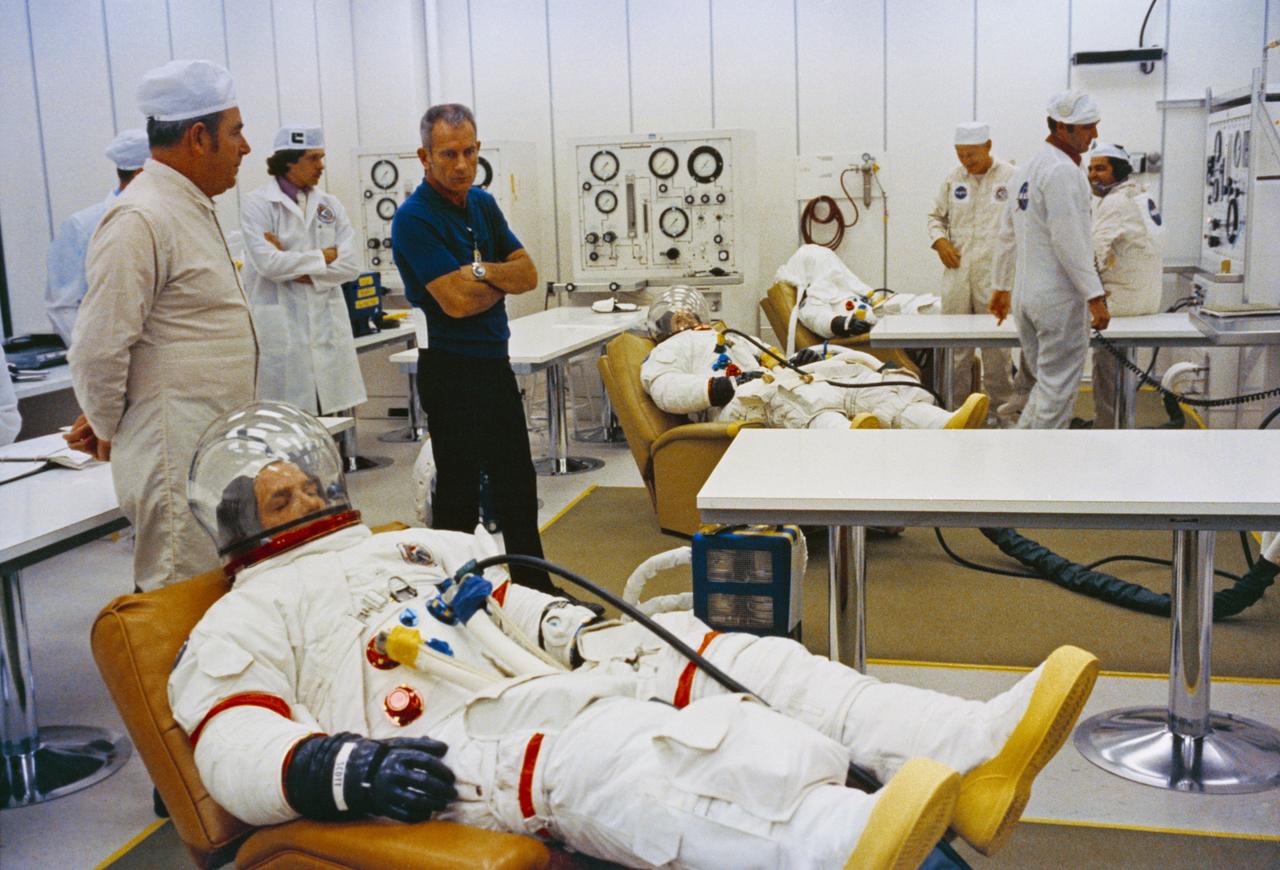
S71-41408 (26 July 1971) --- The three Apollo 15 astronauts go through suiting up operations in the Kennedy Space Center's (KSC) Manned Spacecraft Operations Building (MSOB) during the Apollo 15 prelaunch countdown. They are David R. Scott (foreground), commander; Alfred M. Worden (center), command module pilot; and James B. Irwin (background), lunar module pilot. Minutes later the crew rode a special transport van over to Pad A, Launch Complex 39, where their spacecraft awaited them. With the crew was Dr. Donald (Deke) K. Slayton (wearing dark blue sport shirt), director of Flight Crew Operations, Manned Spacecraft Center (MSC). The Apollo 15 space vehicle was launched at 9:34:00:79 a.m. (EDT), July 26, 1971, on a lunar landing mission.
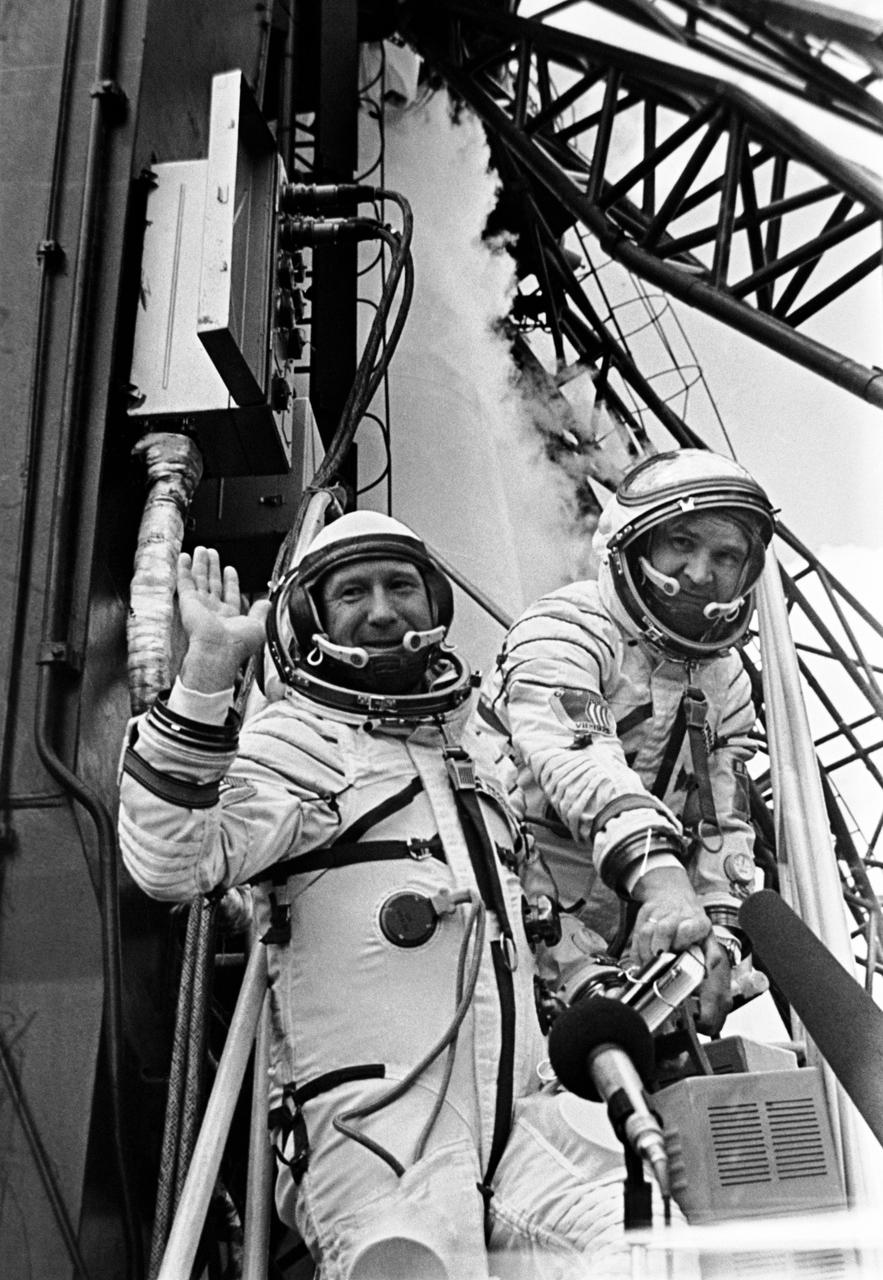
S75-32343 (15 July 1975) --- The two Soviet crewmen for the Apollo-Soyuz Test Project mission are photographed at the launch pad at the Baikonur Cosmodrome in Kazakhstan on the morning of the Soviet ASTP liftoff on July 15, 1975. They are cosmonauts Aleksey A. Leonov (left), commander; and Valeriy N. Kubasov, flight engineer. Leonov is waving to well-wishers at the launch pad. The Soviet ASTP launch preceded the American ASTP Apollo liftoff by seven and one-half hours. The American and Soviet spacecraft were docked in Earth orbit for a total of about 47 hours on July 17-19, 1975. PHOTO COURTESY: USSR ACADEMY OF SCIENCES
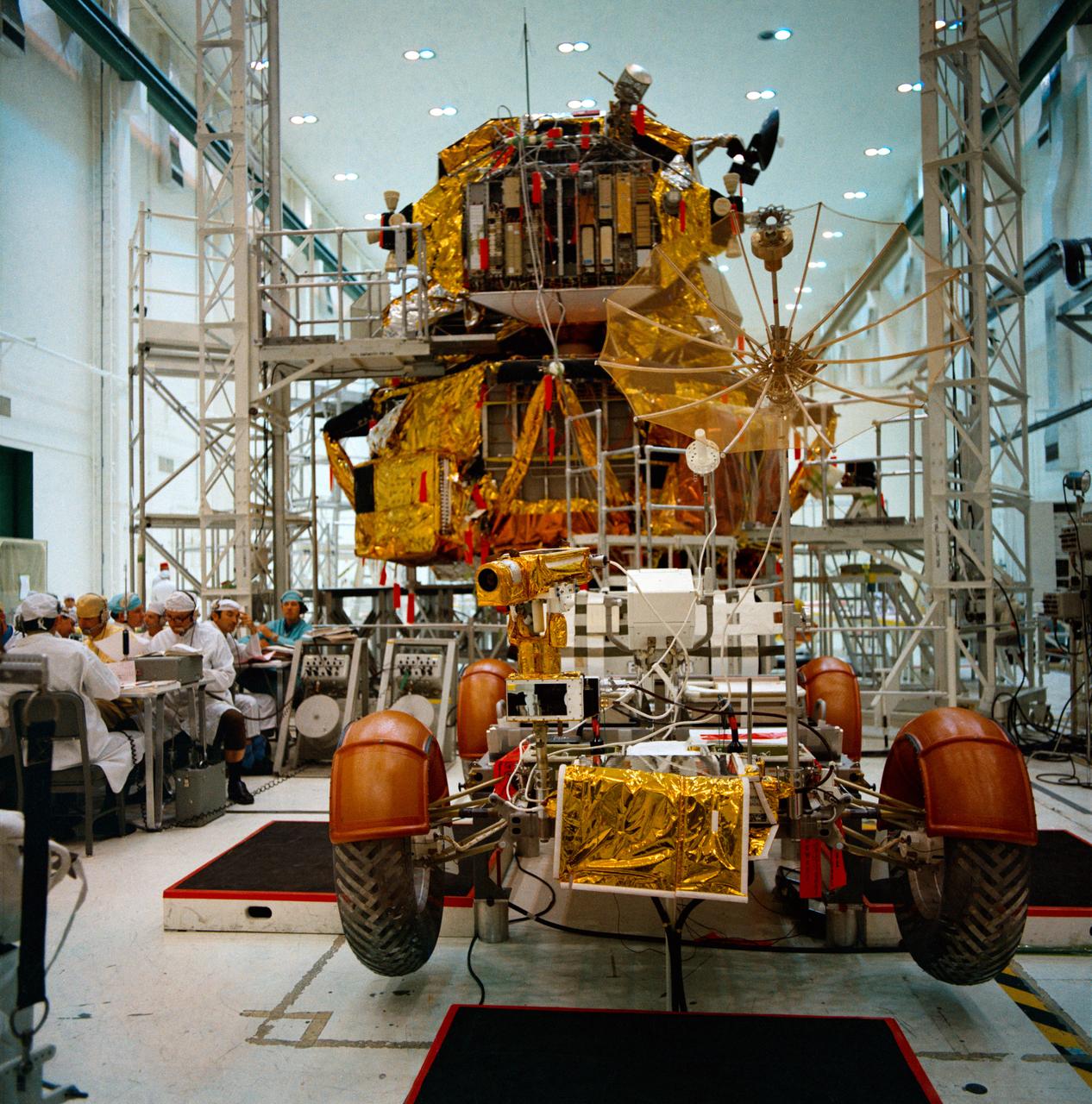
S71-30542 (21 April 1971) --- An overall view of the Apollo 15 Lunar Roving Vehicle (LRV) and the Lunar Module (LM) during simulations at the Kennedy Space Center (KSC). Astronauts David R. Scott, commander, and James B. Irwin, lunar module pilot, will man the LRV on the lunar surface during their August 1971 traverses. Rover 1 will permit the astronauts to cover a larger area of the moon for exploration and sample collecting than on previous missions.
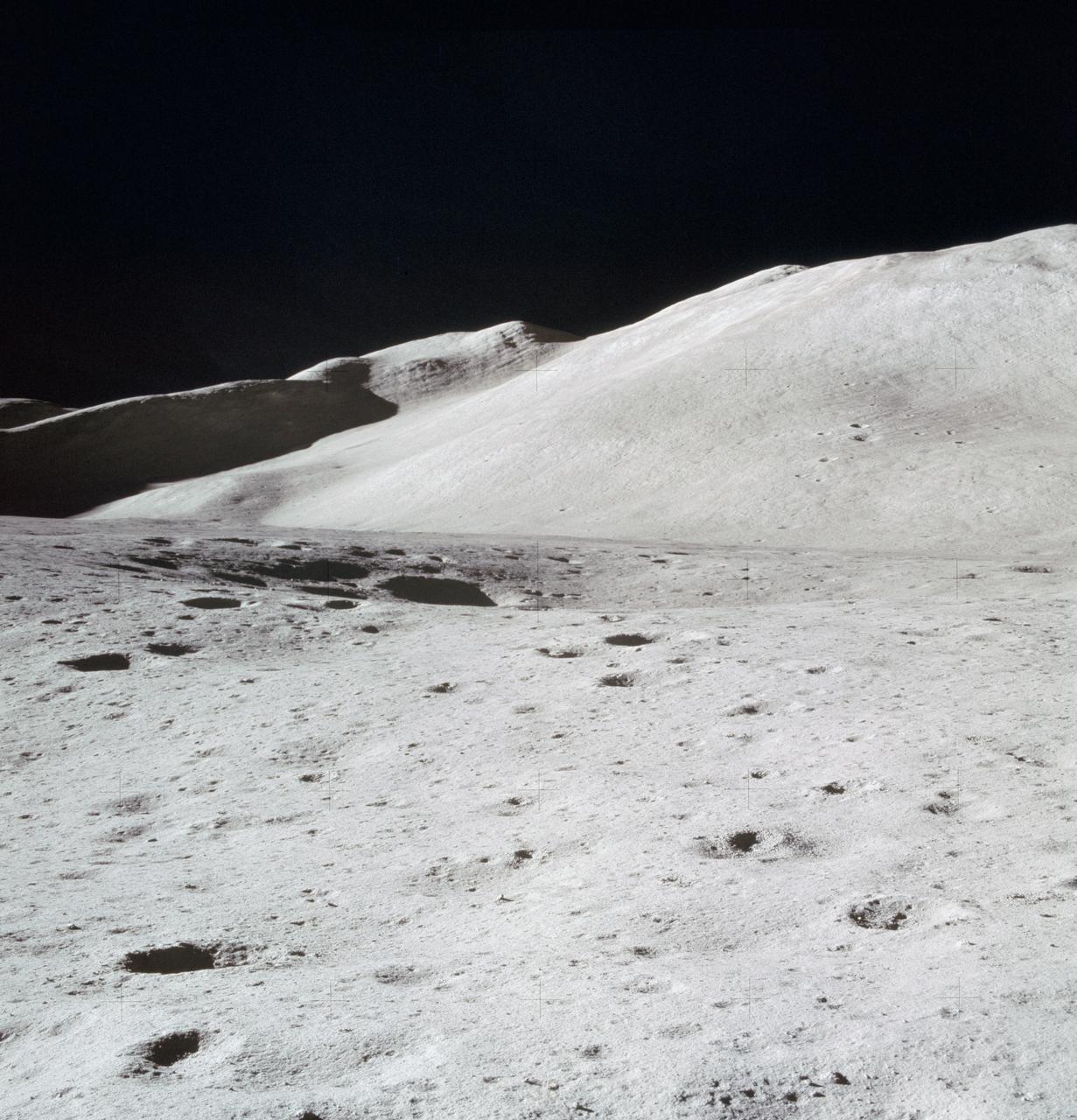
AS15-87-11748 (31 July 1971) --- A view of Hadley Delta, looking southeasterly, as photographed from the top hatch of the Apollo 15 Lunar Module (LM) by astronaut David R. Scott, commander, during his stand-up extravehicular activity (EVA) just after the LM "Falcon" touched down at the Hadley-Apennine landing site. The prominent feature on the horizon in the center of the picture was called Silver Spur by the Apollo 15 crew men. Hadley Delta Mountain rises approximately 4,000 meters (about 13,124 feet) above the plain. While astronauts Scott and James B. Irwin, lunar module pilot, descended in the LM to explore the moon, astronaut Alfred M. Worden, command module pilot, remained with the Command and Service Module's (CSM) in lunar orbit.
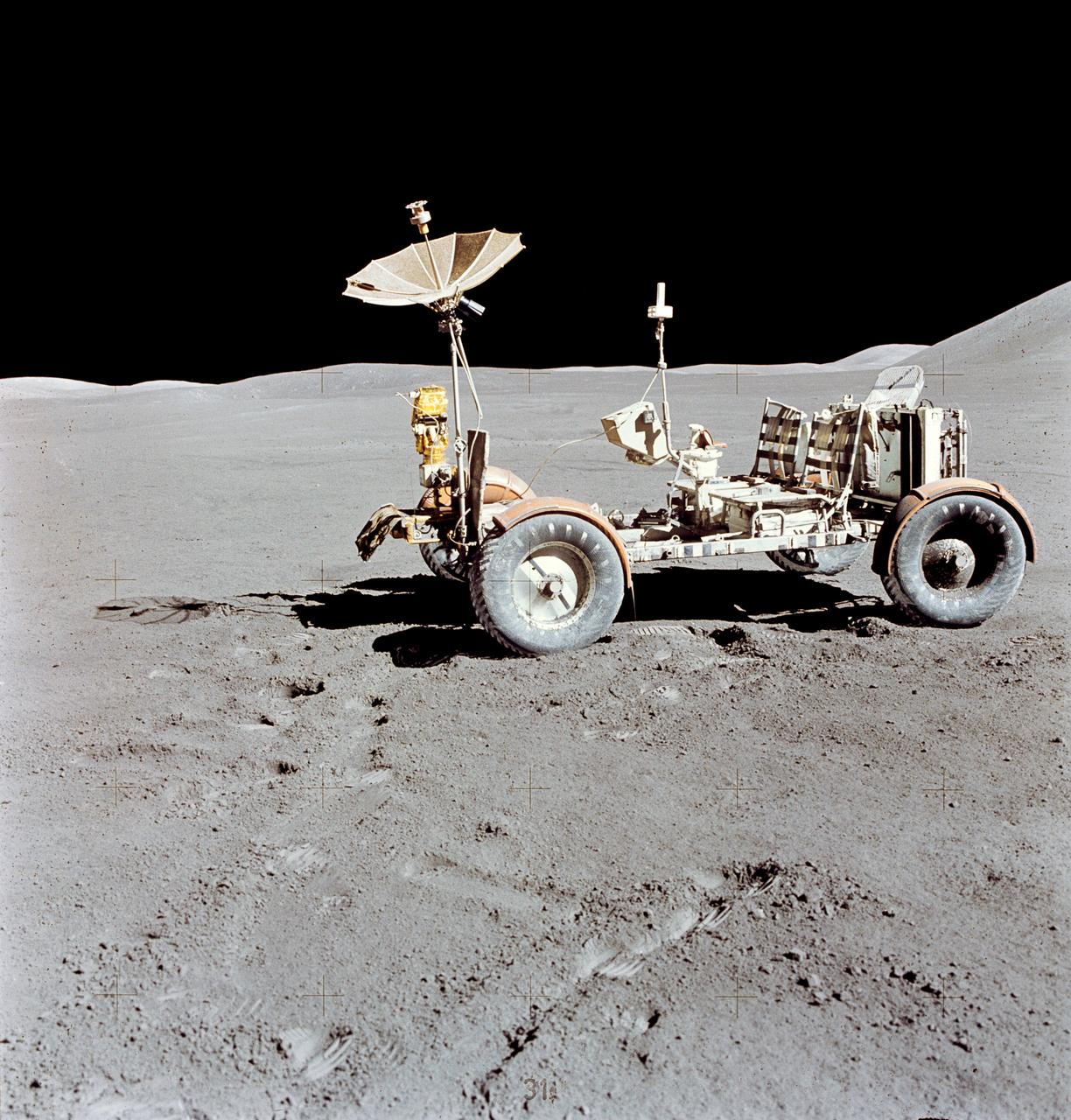
AS15-88-11901 (31 July-2 Aug. 1971) --- The Lunar Roving Vehicle (LRV) is photographed alone against the desolate lunar background during the third Apollo 15 lunar surface extravehicular activity (EVA) at the Hadley-Apennine landing site. This view is looking north. The west edge of Mount Hadley is at the upper right edge of the picture. Mount Hadley rises approximately 4,500 meters (about 4,765 feet) above the plain. The most distant lunar feature visible is approximately 25 kilometers (about 15.5 statute miles) away. While astronauts David R. Scott, commander; and James B. Irwin, lunar module pilot, descended in the Lunar Module (LM) "Falcon" to explore the moon, astronaut Alfred M. Worden, command module pilot, remained with the Command and Service Modules (CSM) in lunar orbit.
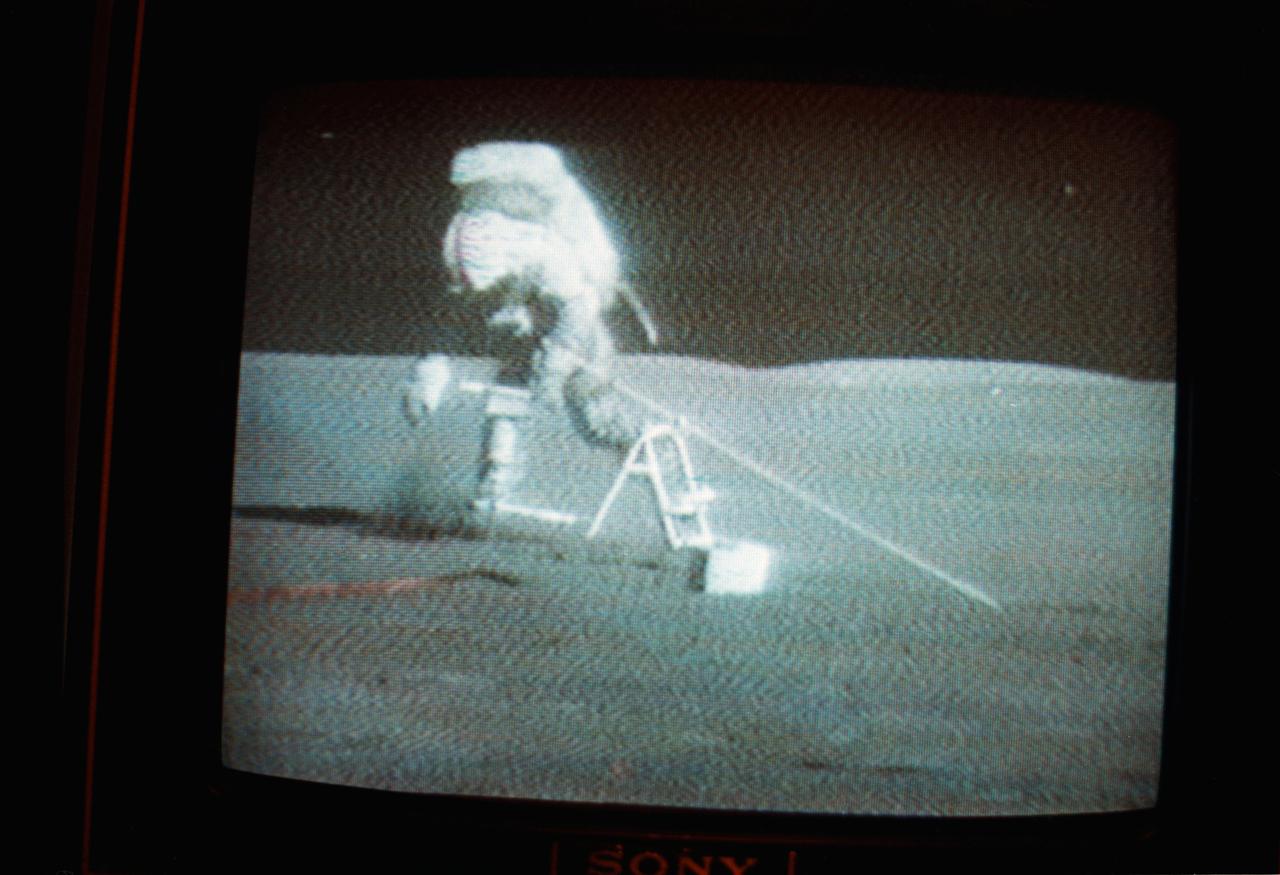
S71-41501 (1 Aug. 1971) --- Astronaut David R. Scott, Apollo 15 commander, is seen carrying the Apollo Lunar Surface Drill (ALSD) during the second lunar surface extravehicular activity (EVA) in this black and white reproduction taken from a color transmission made by the RCA color television camera mounted on the Lunar Roving Vehicle (LRV). This transmission was the fourth made during the mission.
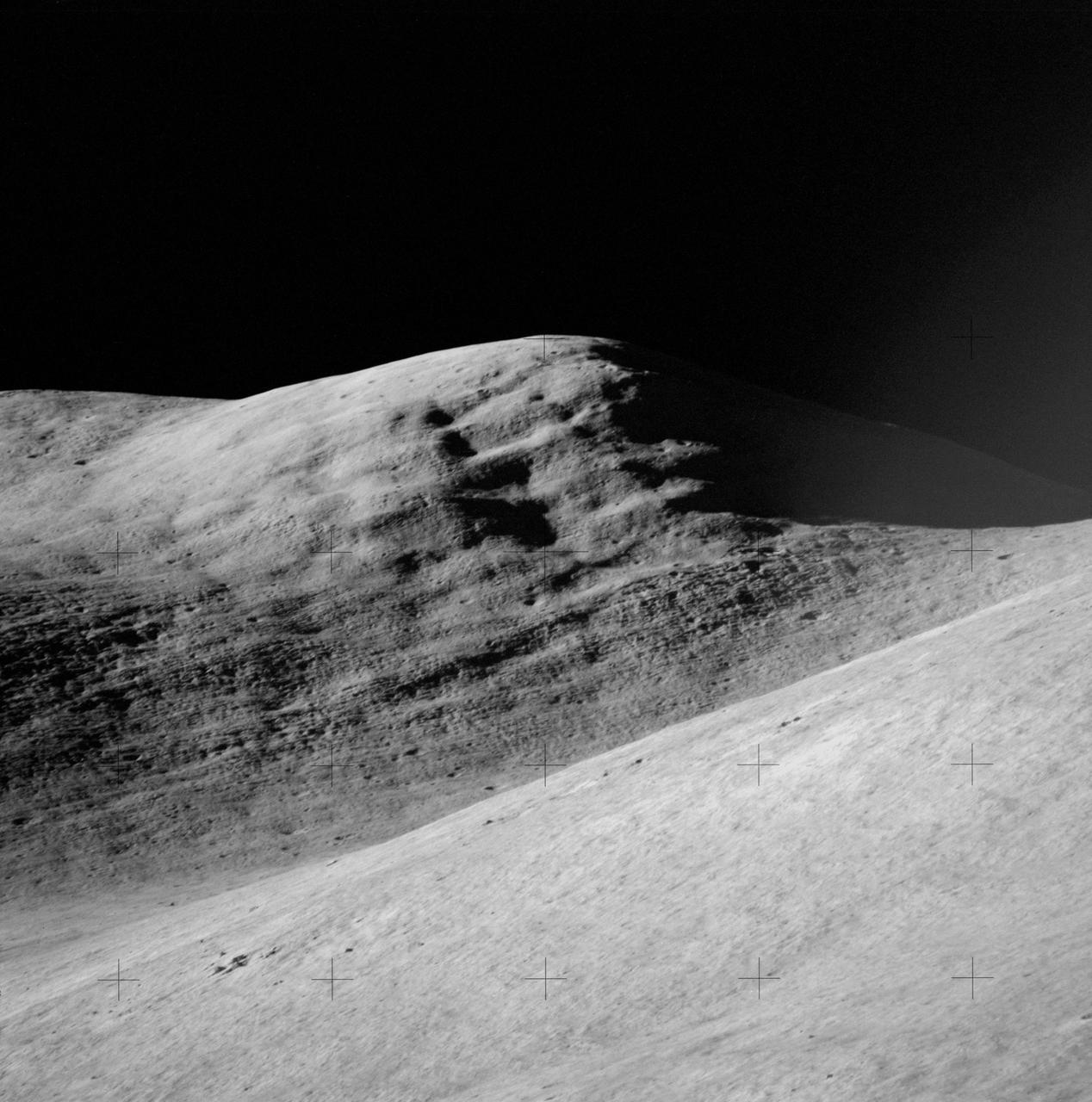
AS15-84-11250 (31 July-2 Aug. 1971) --- A telephoto lens view of the prominent feature called Silver Spur in the Hadley Delta region, photographed during the Apollo 15 lunar surface extravehicular activity (EVA) at the Hadley-Apennine landing site. The distance from the camera to the spur is about 10 miles. The field of view across the bottom is about one mile. Structural formations in the mountain are clearly visible. There are two major units. The upper unit is characterized by massive subunits, each one of which is approximately 200 feet deep. The lower major unit is characterized by thinner bedding and cross bedding.
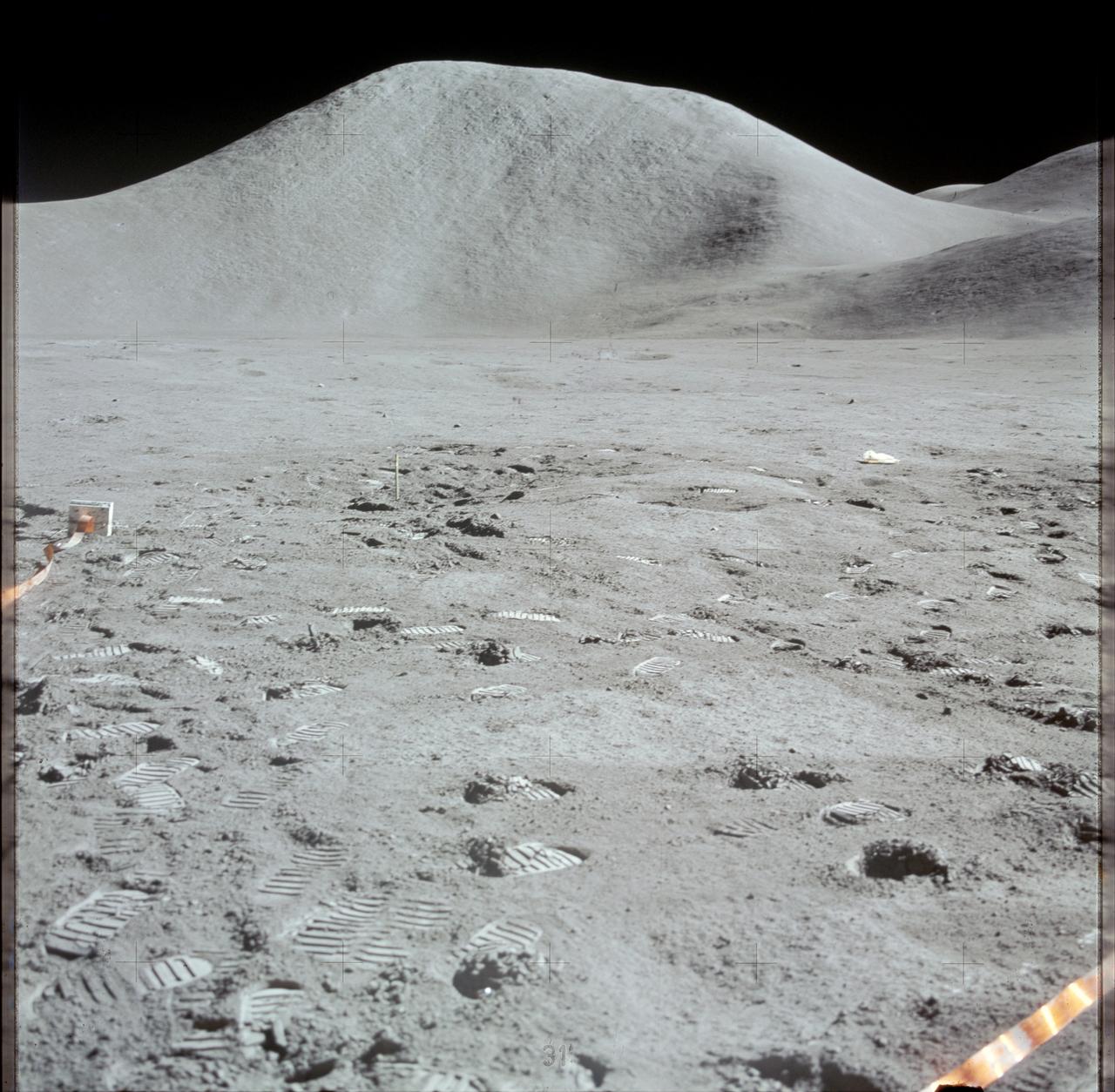
AS15-87-11849 (31 July-2 Aug. 1971) --- An excellent view of Mount Hadley, fully lighted, showing abundant linear features, as photographed during the Apollo 15 lunar surface extravehicular activity (EVA). This view is looking north from the Apollo Lunar Surface Experiments Package (ALSEP) site. Mount Hadley rises about 4,500 meters (approximately 14,765 feet) above the plain. While astronauts David R. Scott, commander, and James B. Irwin, lunar module pilot, descended in the Apollo 15 Lunar Module (LM) "Falcon" to explore the Hadley-Apennine area of the moon, astronaut Alfred M. Worden, command module pilot, remained with the Command and Service Modules (CSM) in lunar orbit.
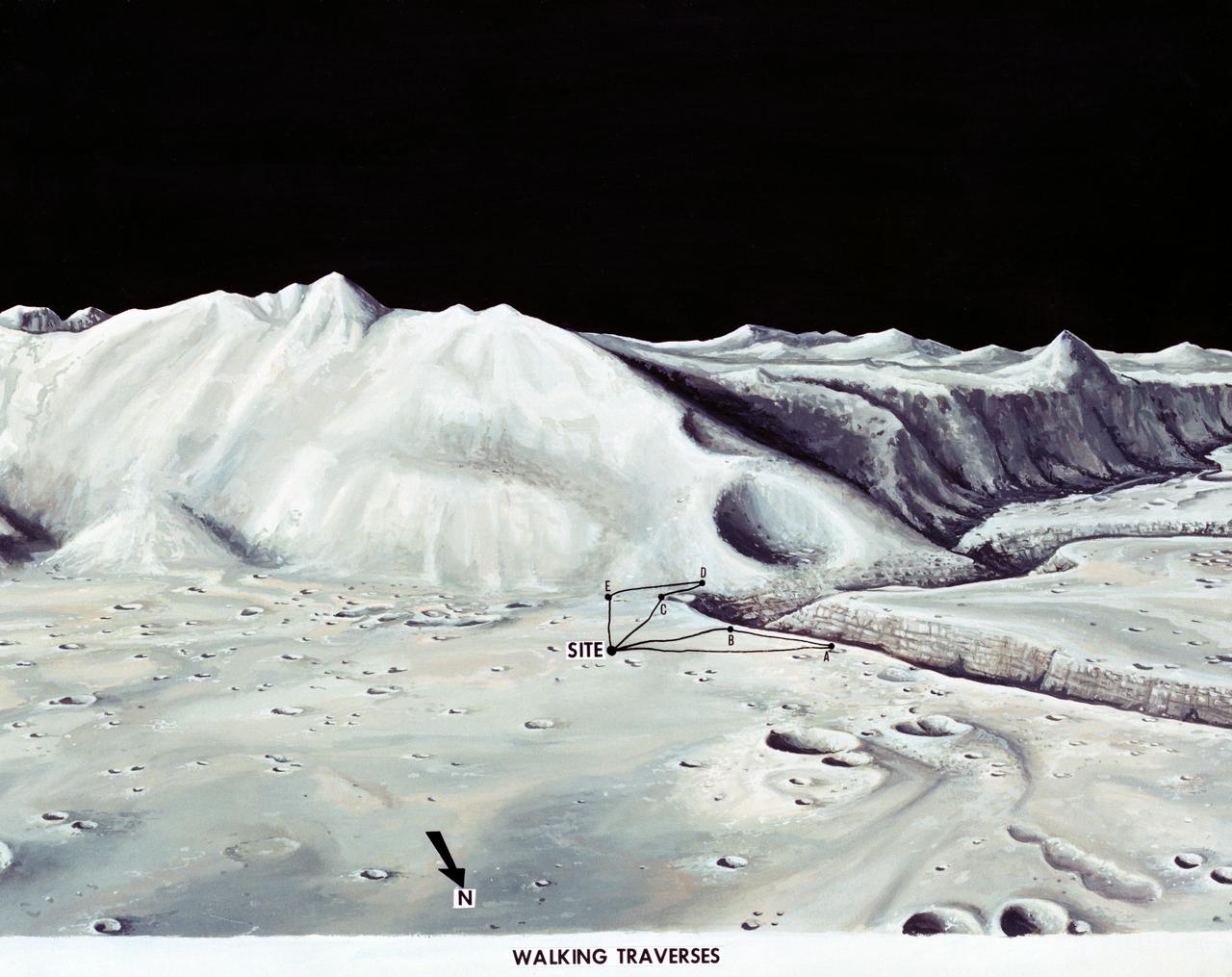
S71-33432 (1 July 1971) --- These alternative traverses can be carried out on foot. They will be used if the Lunar Roving Vehicle (LRV) becomes inoperative. This artist's concept showing part of the Hadley Rille and several of the Apennine Mountains was excerpted from "On the Moon with Apollo 15: A Guidebook to the Hadley-Apennine Region," by Gene Simmons. Artwork by Jerry Elmore.
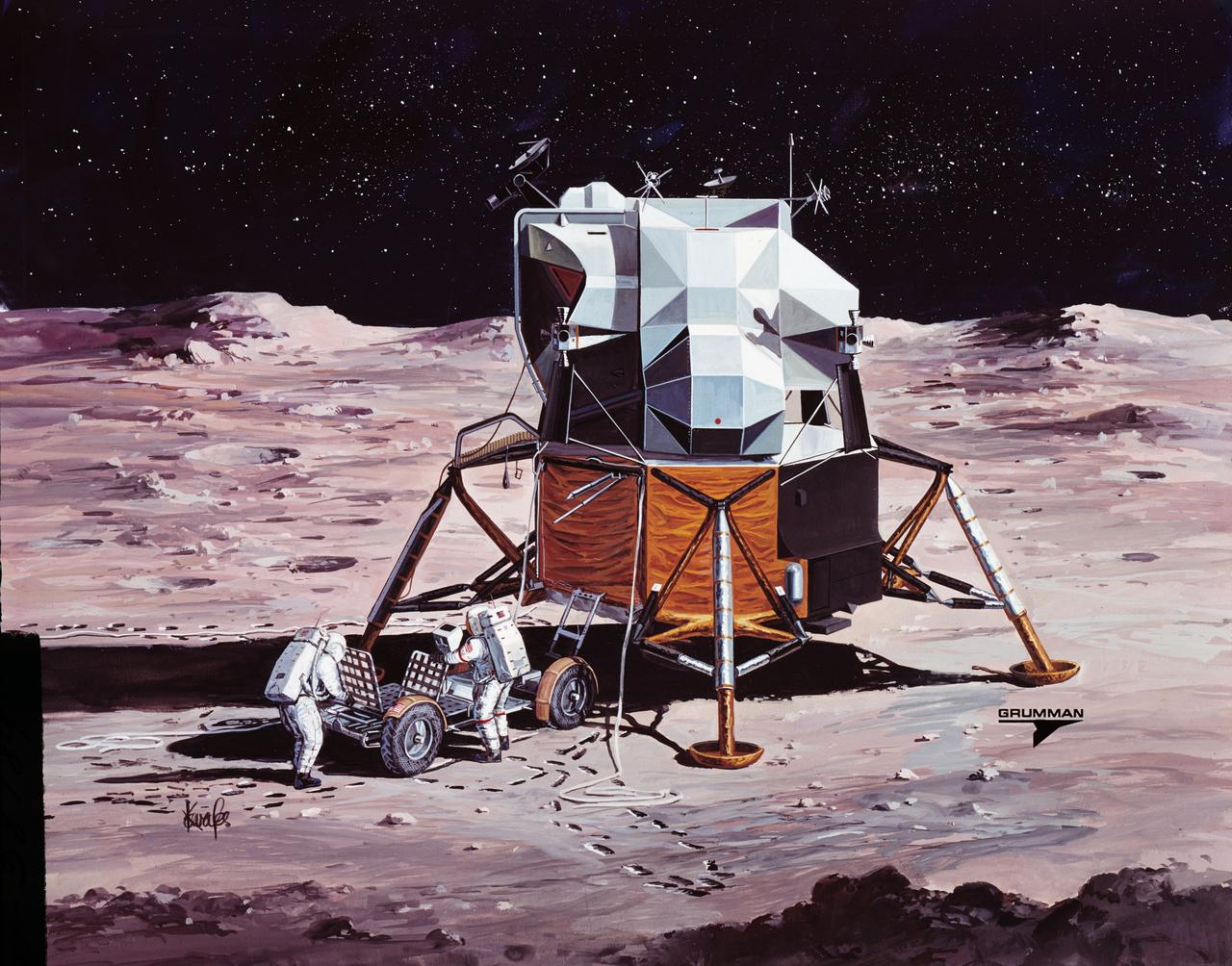
S71-38189 (26 June 1971) --- An artist's concept showing the final steps of readying the Apollo 15 Lunar Roving Vehicle (LRV) or Rover 1 for mobility on the lunar surface. Performing the last few LRV deployment tasks here are, left to right, astronauts James B. Irwin, lunar module pilot, and David R. Scott, commander. More specifically the tasks depicted here include the setting up of the seats and the total releasing of the LRV from the LM. (This is the fourth in a series of four Grumman Aerospace Corporation artist's concepts telling the lunar surface LRV deployment story for Apollo 15).
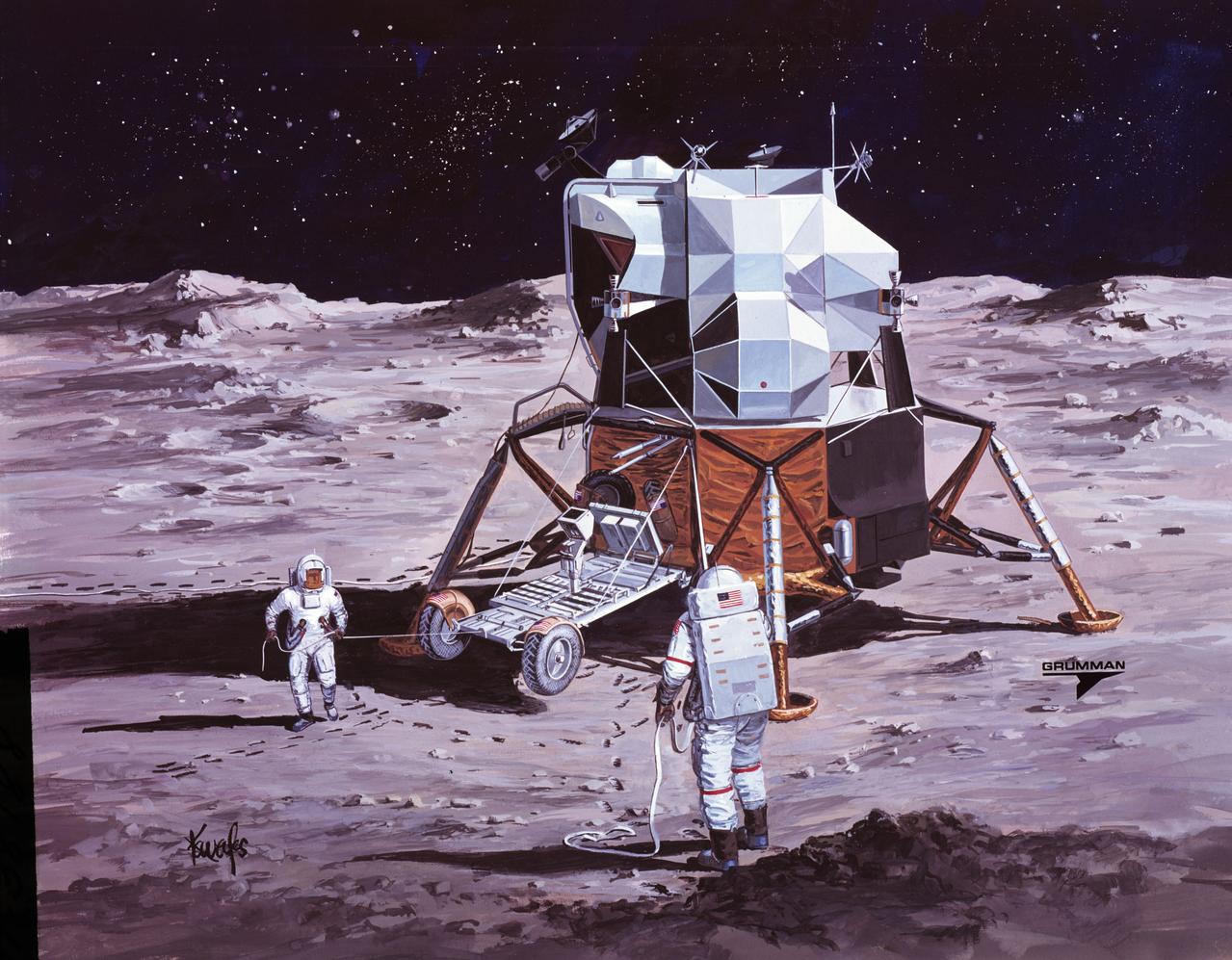
S71-38188 (26 June 1971) --- An artist's concept showing the Apollo 15 mission commander and the lunar module pilot performing deployment of the Lunar Roving Vehicle (LRV) on the lunar surface. The figure on the left represents astronaut James B. Irwin, lunar module pilot, who here is maintaining a constant pull on the deployment cable to help the LRV unfold, while astronaut David R. Scott (right), commander, pulls the tapes that lower the LRV to the surface. (This is the third in a series of Grumman Aerospace Corporation artist's concepts telling the lunar surface LRV deployment story of the Apollo 15 mission).
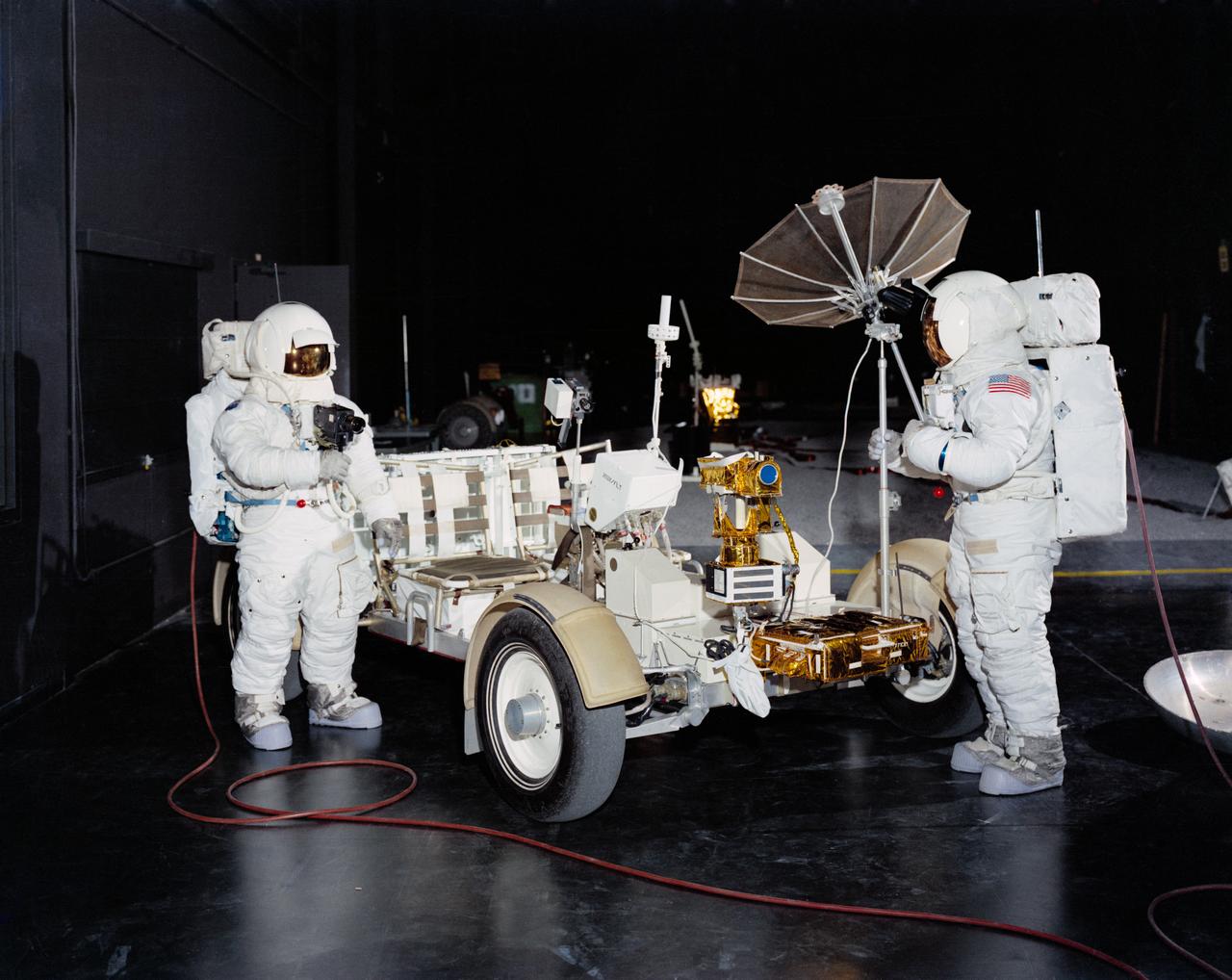
S71-16722 (January 1971) --- Two members of the prime crew of the Apollo 15 lunar landing mission are shown with the Lunar Roving Vehicle "one G" trainer in Building 5, Mission Simulation and Training Facility, Manned Spacecraft Center. Astronaut David R. Scott (on right) is the Apollo 15 commander; and astronaut James B. Irwin is the lunar module pilot. A Lunar Roving Vehicle similar to this trainer will be used by Scott and Irwin during their Apollo 15 lunar surface extravehicular activity.
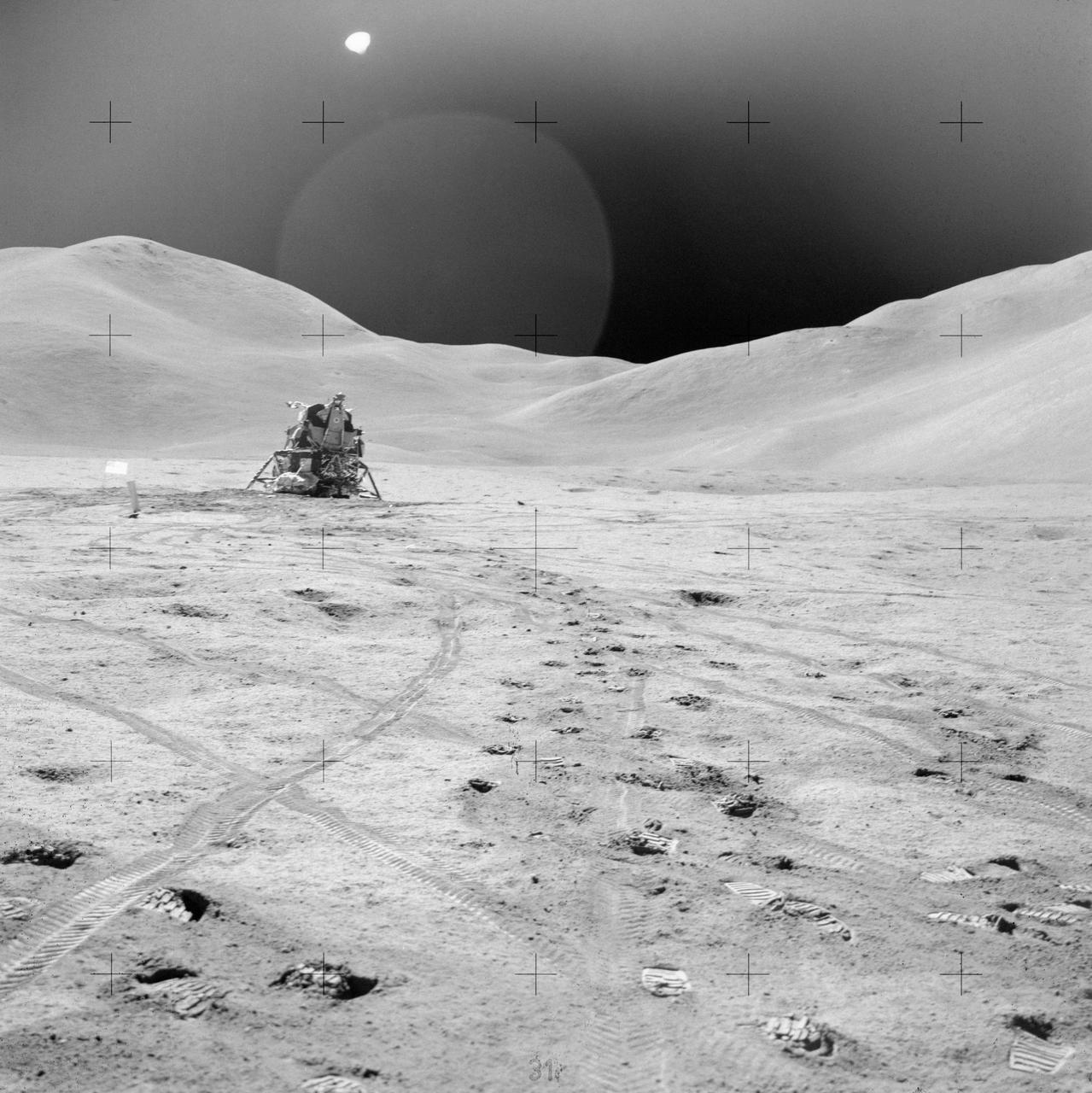
AS15-82-11057 (2 Aug. 1971) --- The Lunar Module (LM) "Falcon" is photographed against the barren lunarscape during the third Apollo 15 lunar surface extravehicular activity (EVA) at the Hadley-Apennine landing site on the lunar nearside. This view is looking southeast. The Apennine Front is in the left background; and Hadley Delta Mountain is in the right background. The object next to the United States flag is the Solar Wind Composition (SWC) experiment. Last Crater is to the right of the LM. Note bootprints and tracks of the Lunar Roving Vehicle (LRV). The light spherical object at the top is a reflection in the lens of the camera. While astronauts David R. Scott and James B. Irwin descended in the LM to explore the moon, astronaut Alfred M. Worden remained with the Command and Service Modules (CSM) in lunar orbit.
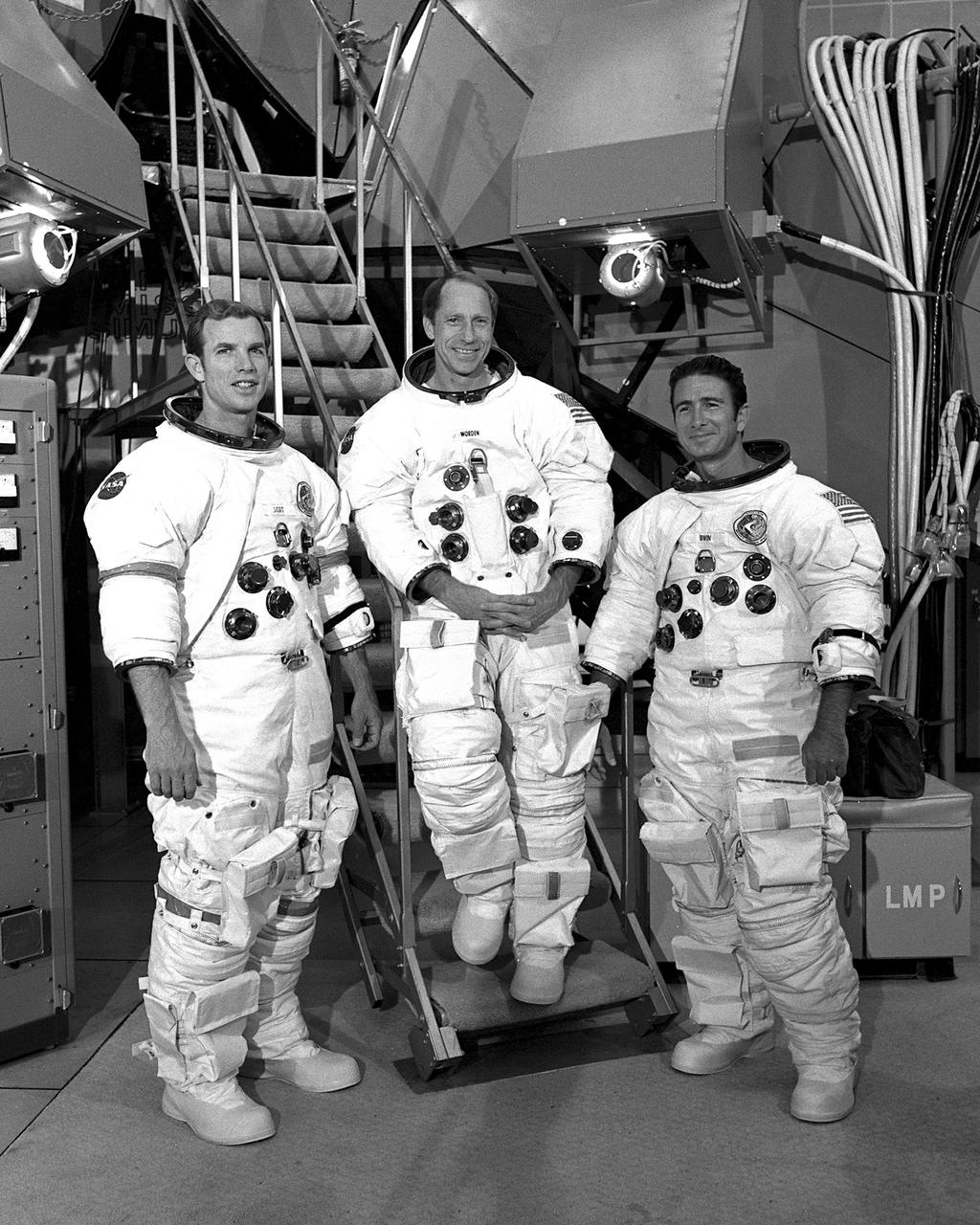
KENNEDY SPACE CENTER, FLA. - The Apollo 15 flight crew, Commander David R. Scott, Lunar Module Pilot James B. Irwin, and Command Module Pilot Alfred M. Worden, Jr., participate in a mission simulation in the Command Module and the Lunar Module.
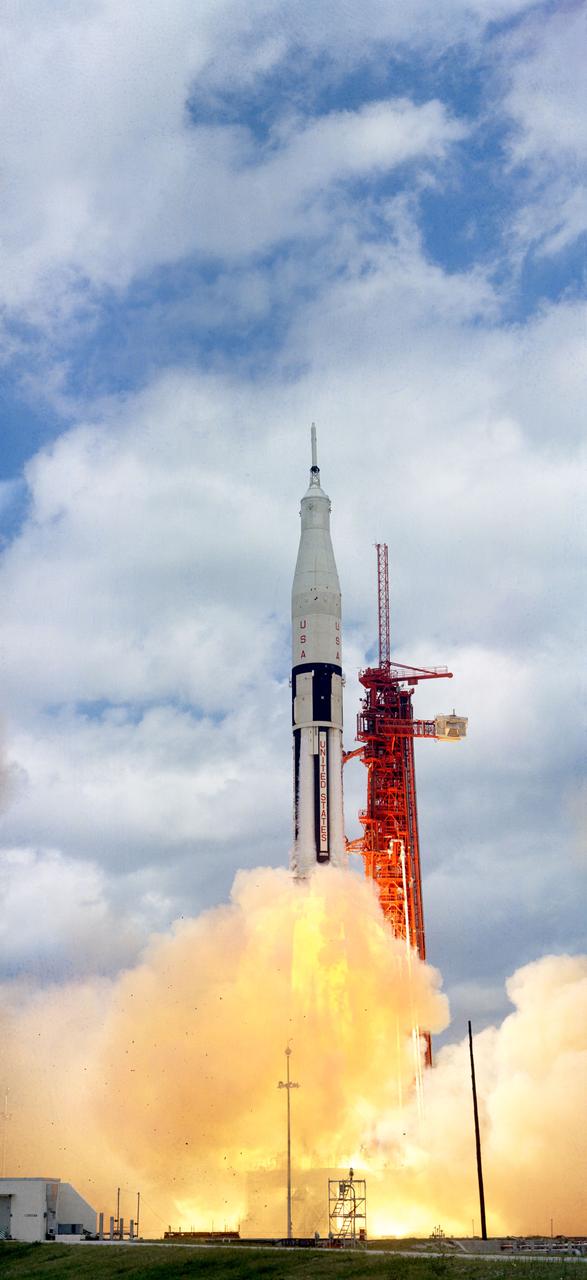
A/S Mission 202 was launched from the KSC Launch Complex (LC)-34 at 12:15 p.m., 08/25/1966. The mission was a step toward qualifying the Apollo Command and Service Modules (CSM)'s and the uprated Saturn I launch vehicle for manned flight. KSC, FL
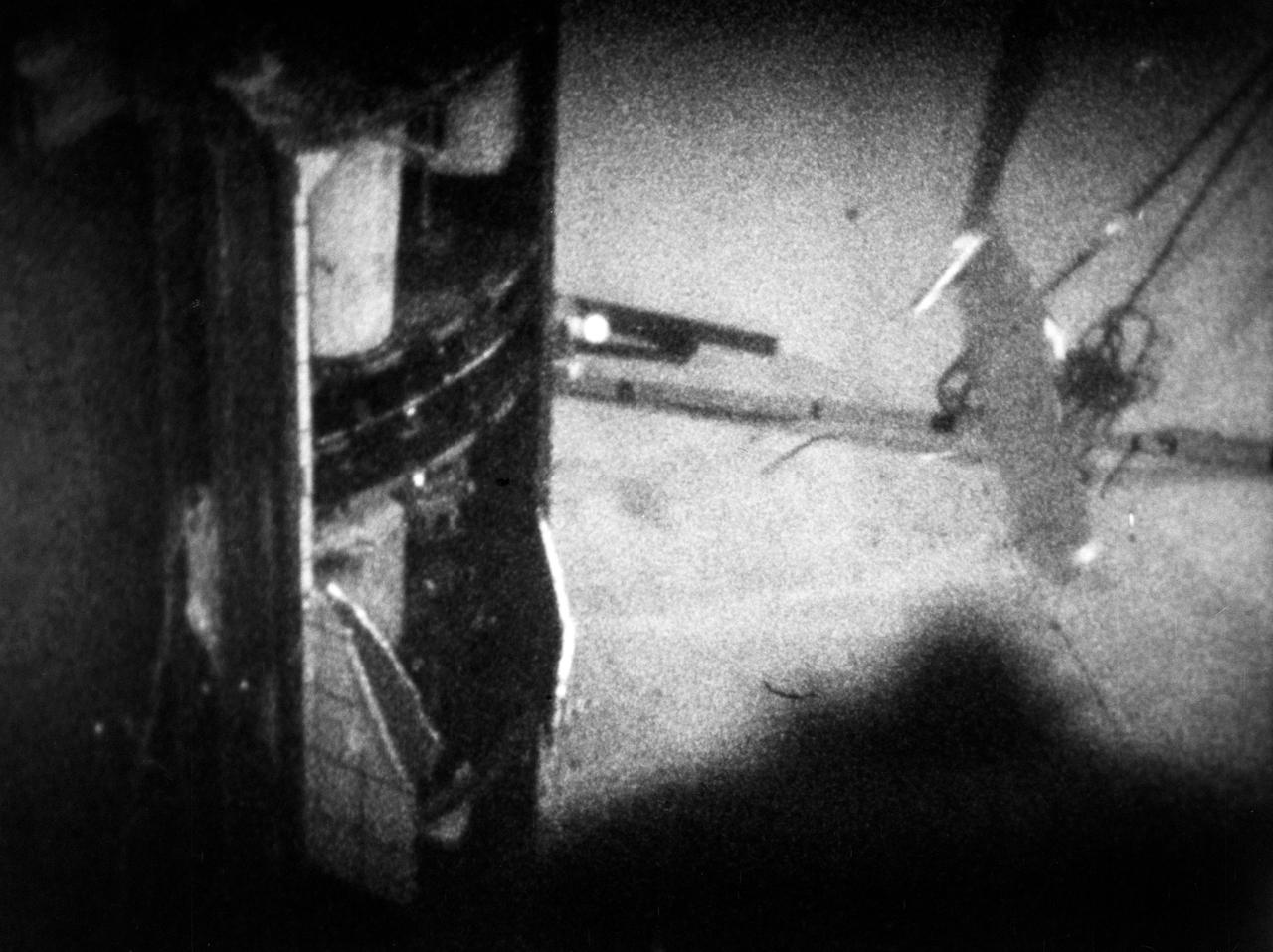
S70-41985 (15 June 1970) --- The third photograph in sequence of three showing panel separation test at Langley Research Center (LRC). The test was part of the Apollo 13 post flight investigation of the Service Module explosion incident. Photo credit: NASA
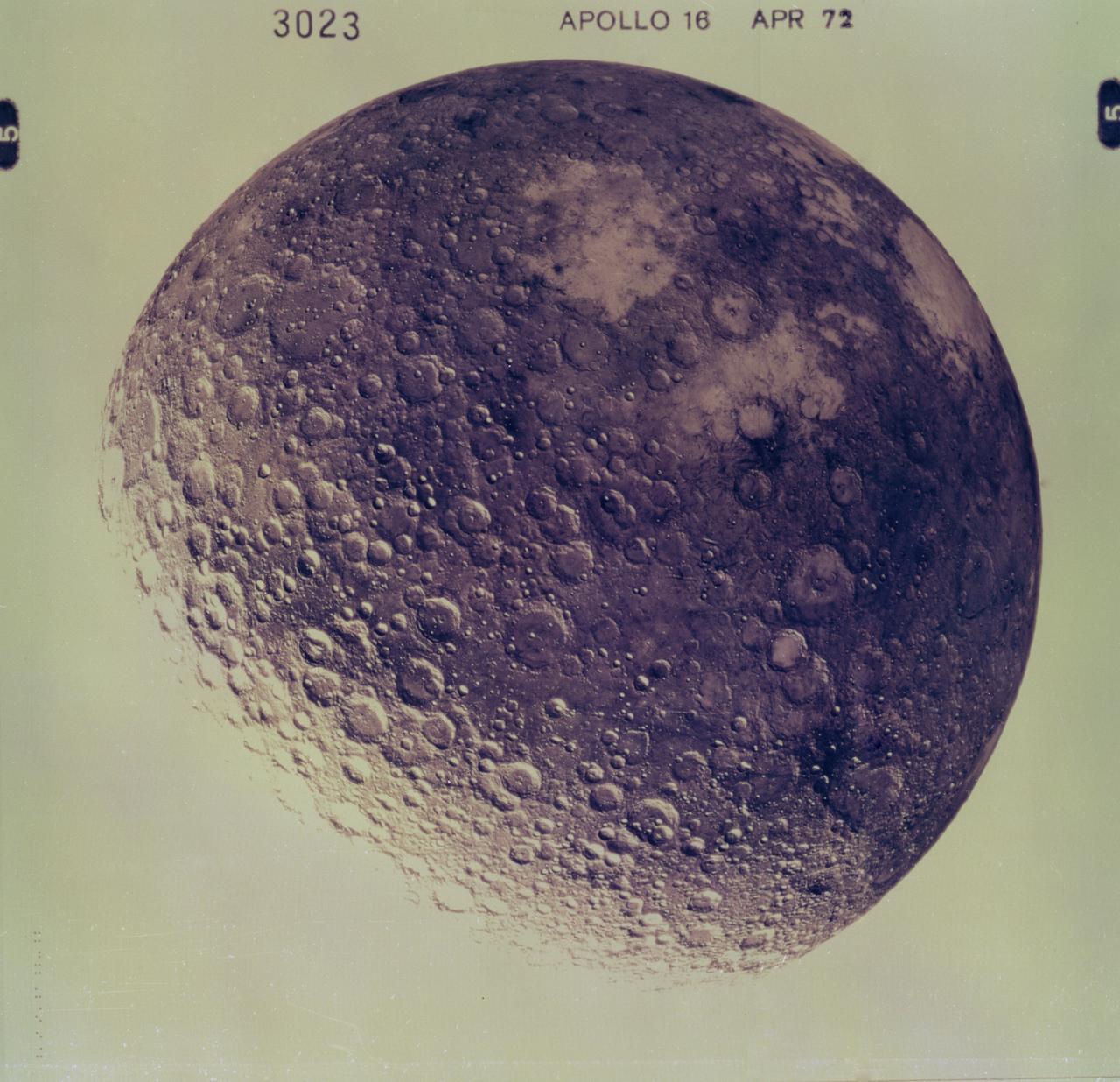
This view of the back side of the Moon was captured by the Apollo 16 mission crew. The sixth manned lunar landing mission, the Apollo 16 (SA-511), carrying three astronauts: Mission Commander John W. Young, Command Module pilot Thomas K. Mattingly II, and Lunar Module pilot Charles M. Duke, lifted off on April 16, 1972. The Apollo 16 continued the broad-scale geological, geochemical, and geophysical mapping of the Moon’s crust, begun by the Apollo 15, from lunar orbit. This mission marked the first use of the Moon as an astronomical observatory by using the ultraviolet camera/spectrograph which photographed ultraviolet light emitted by Earth and other celestial objects. The Lunar Roving Vehicle, developed by the Marshall Space Flight Center, was also used. The mission ended on April 27, 1972.

The Lunar Roving Vehicle (LRV) was designed to transport astronauts and materials on the Moon. It was a collapsible open-space vehicle about 10 feet long with large mesh wheels, anterna, appendages, tool caddies, and cameras. Powered by two 36-volt batteries, it has four 1/4-hp drive motors, one for each wheel. The vehicle was designed to travel in forward or reverse, negotiate obstacles about 1 foot high, cross crevasses about 2 feet wide, and climb or descend moderate slopes. Its speed limit was about 9 miles (14 kilometers) per hour. An LRV was used on each of the last three Apollo missions (Apollo 15, Apollo 16, and Apollo 17) and permitted the crew to travel several miles from the Lunar Module. The LRV was designed, developed, and tested by the Marshall Space Flight Center, and built by the Boeing Plant in Kent, Washington.
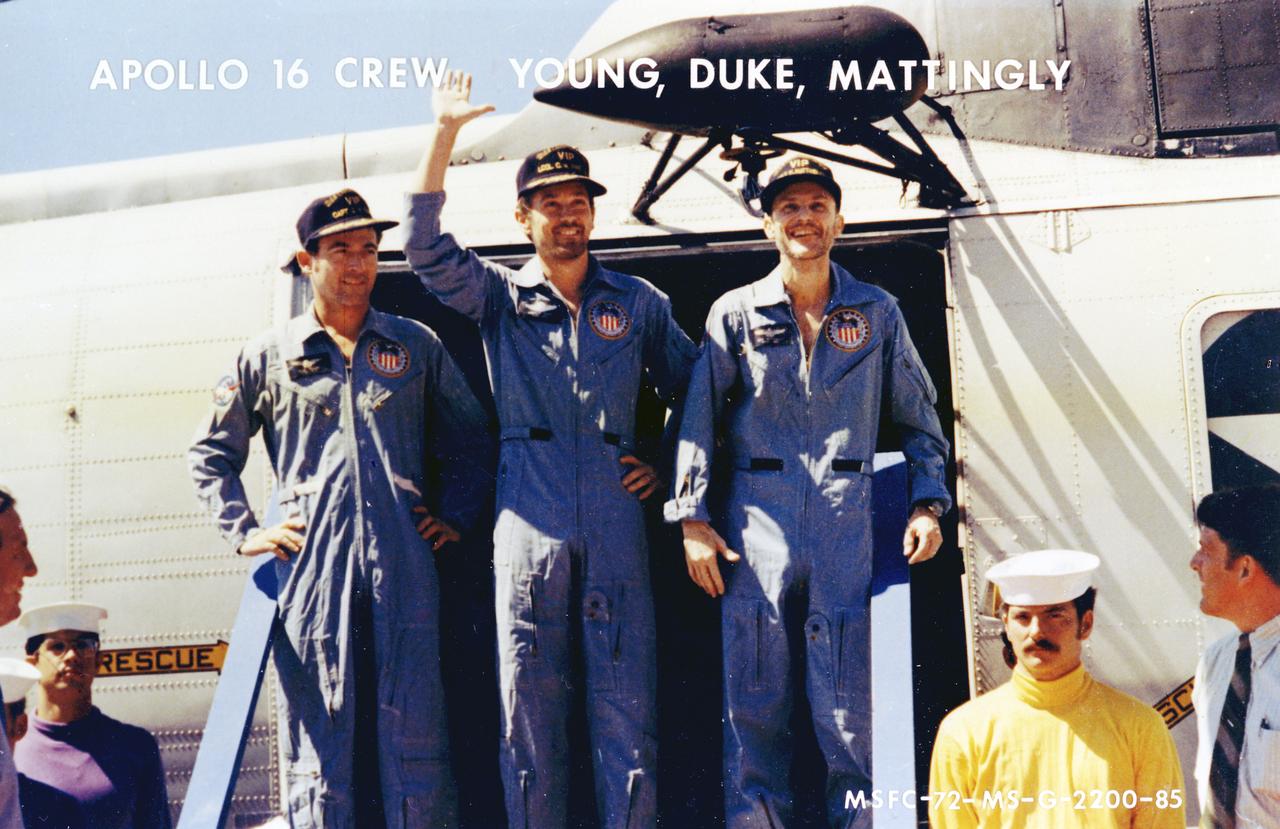
The Apollo 16 Command Module splashed down in the Pacific Ocean on April 27, 1972 after an 11-day moon exploration mission. The 3-man crew is shown here aboard the rescue ship, USS Horton. From left to right are: Mission Commander John W. Young, Lunar Module pilot Charles M. Duke, and Command Module pilot Thomas K. Mattingly II. The sixth manned lunar landing mission, the Apollo 16 (SA-511) lifted off on April 16, 1972. The Apollo 16 mission continued the broad-scale geological, geochemical, and geophysical mapping of the Moon’s crust, begun by the Apollo 15, from lunar orbit. This mission marked the first use of the Moon as an astronomical observatory by using the ultraviolet camera/spectrograph which photographed ultraviolet light emitted by Earth and other celestial objects. The Lunar Roving Vehicle, developed by the Marshall Space Flight Center, was also used.
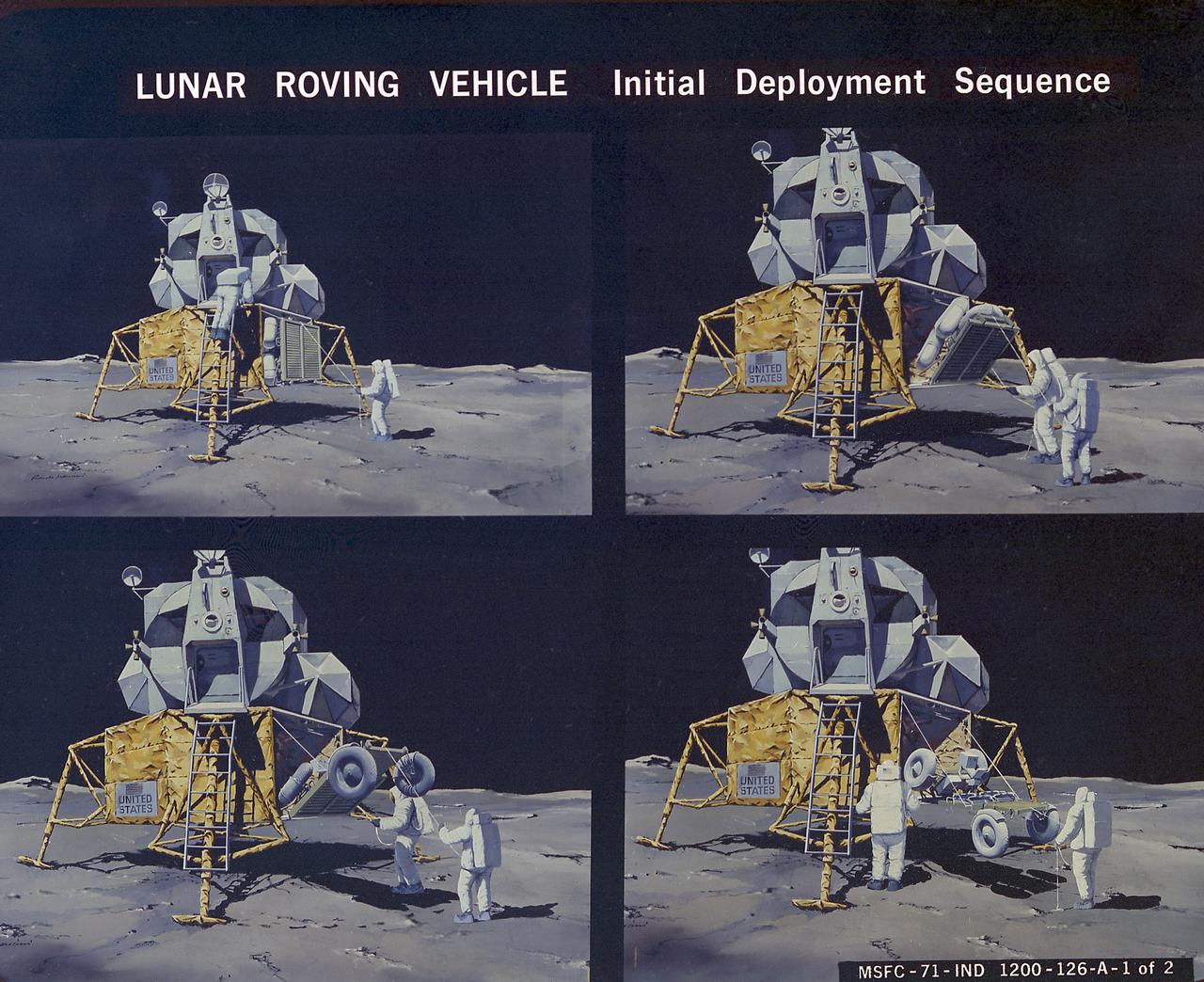
This artist's concept illustrates the deployment sequence of the Lunar Roving Vehicle (LRV) on the Moon. The LRV was designed to transport astronauts and materials on the Moon. It was a collapsible open-space vehicle about 10 feet long with large mesh wheels, anterna, appendages, tool caddies, and cameras. Powered by two 36-volt batteries, it has four 1/4-hp drive motors, one for each wheel. The vehicle was designed to travel in forward or reverse, negotiate obstacles about 1 foot high, cross crevasses about 2 feet wide, and climb or descend moderate slopes. Its speed limit was about 9 miles (14 kilometers) per hour. An LRV was used on each of the last three Apollo missions (Apollo 15, Apollo 16, and Apollo 17) and permitted the crew to travel several miles from the Lunar Module. The LRV was designed, developed, and tested by the Marshall Space Flight Center, and built by the Boeing Plant in Kent, Washington.
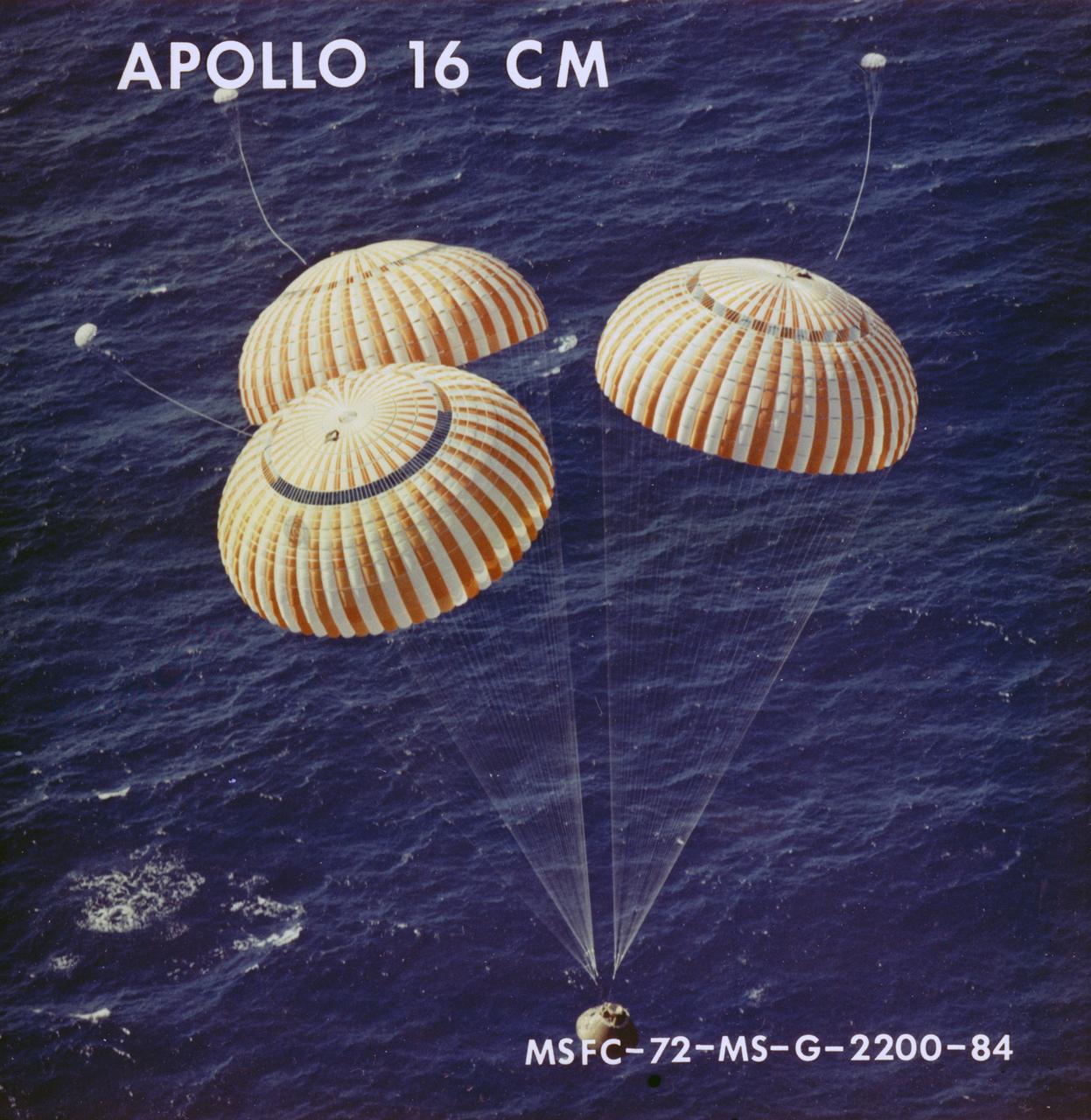
The Apollo 16 Command Module splashed down in the Pacific Ocean on April 27, 1972 after an 11-day moon exploration mission. The sixth manned lunar landing mission, the Apollo 16 (SA-511), carrying three astronauts: Mission Commander John W. Young, Command Module pilot Thomas K. Mattingly II, and Lunar Module pilot Charles M. Duke, lifted off on April 16, 1972. The Apollo 16 continued the broad-scale geological, geochemical, and geophysical mapping of the Moon’s crust, begun by the Apollo 15, from lunar orbit. This mission marked the first use of the Moon as an astronomical observatory by using the ultraviolet camera/spectrograph which photographed ultraviolet light emitted by Earth and other celestial objects. The Lunar Roving Vehicle, developed by the Marshall Space Flight Center, was also used.
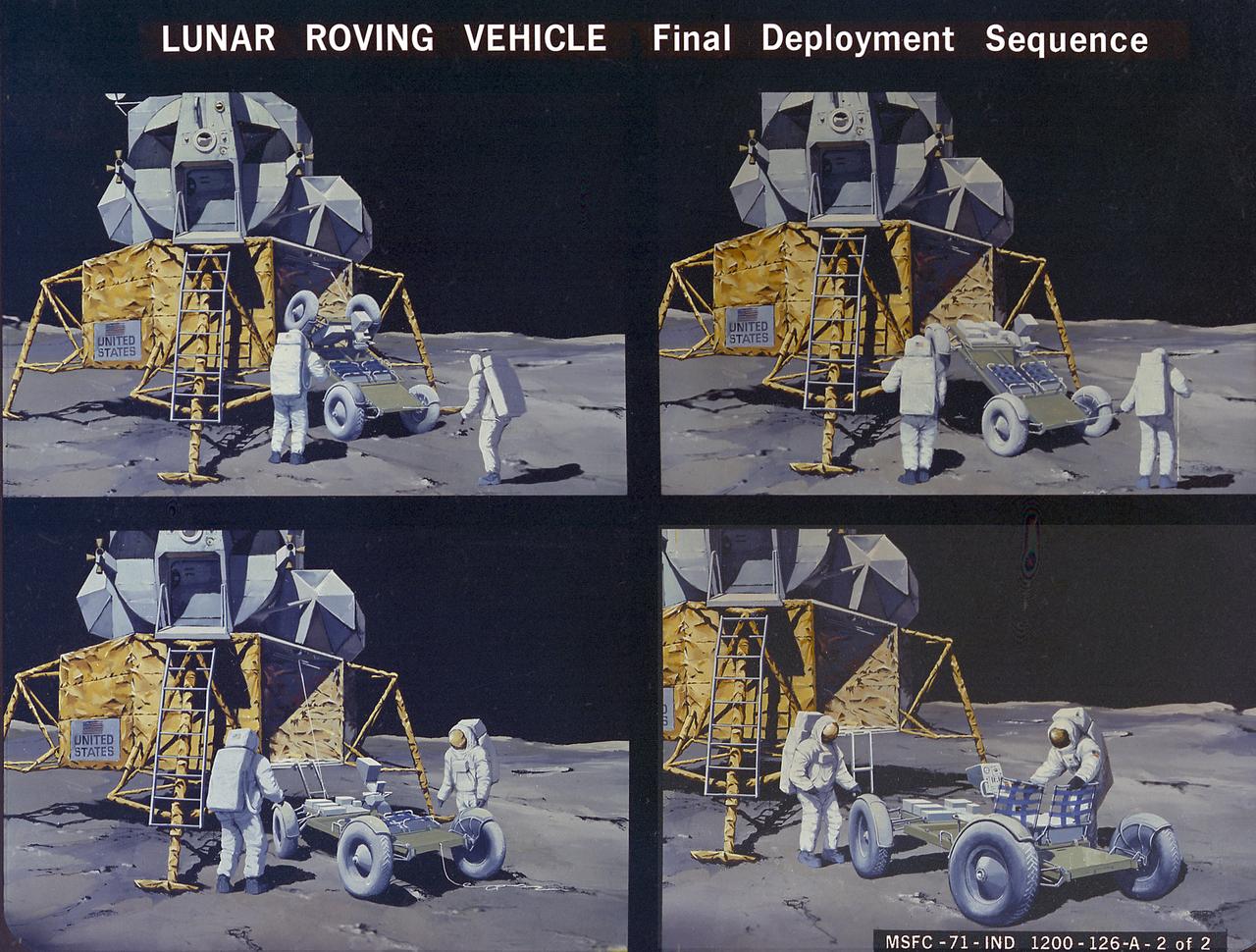
This artist's concept illustrates the deployment sequence of the Lunar Roving Vehicle (LRV) on the Moon. The LRV was designed to transport astronauts and materials on the Moon. It was a collapsible open-space vehicle about 10 feet long with large mesh wheels, anterna, appendages, tool caddies, and cameras. Powered by two 36-volt batteries, it has four 1/4-hp drive motors, one for each wheel. The vehicle was designed to travel in forward or reverse, negotiate obstacles about 1 foot high, cross crevasses about 2 feet wide, and climb or descend moderate slopes. Its speed limit was about 9 miles (14 kilometers) per hour. An LRV was used on each of the last three Apollo missions (Apollo 15, Apollo 16, and Apollo 17) and permitted the crew to travel several miles from the Lunar Module. The LRV was designed, developed, and tested by the Marshall Space Flight Center, and built by the Boeing Plant in Kent, Washington.
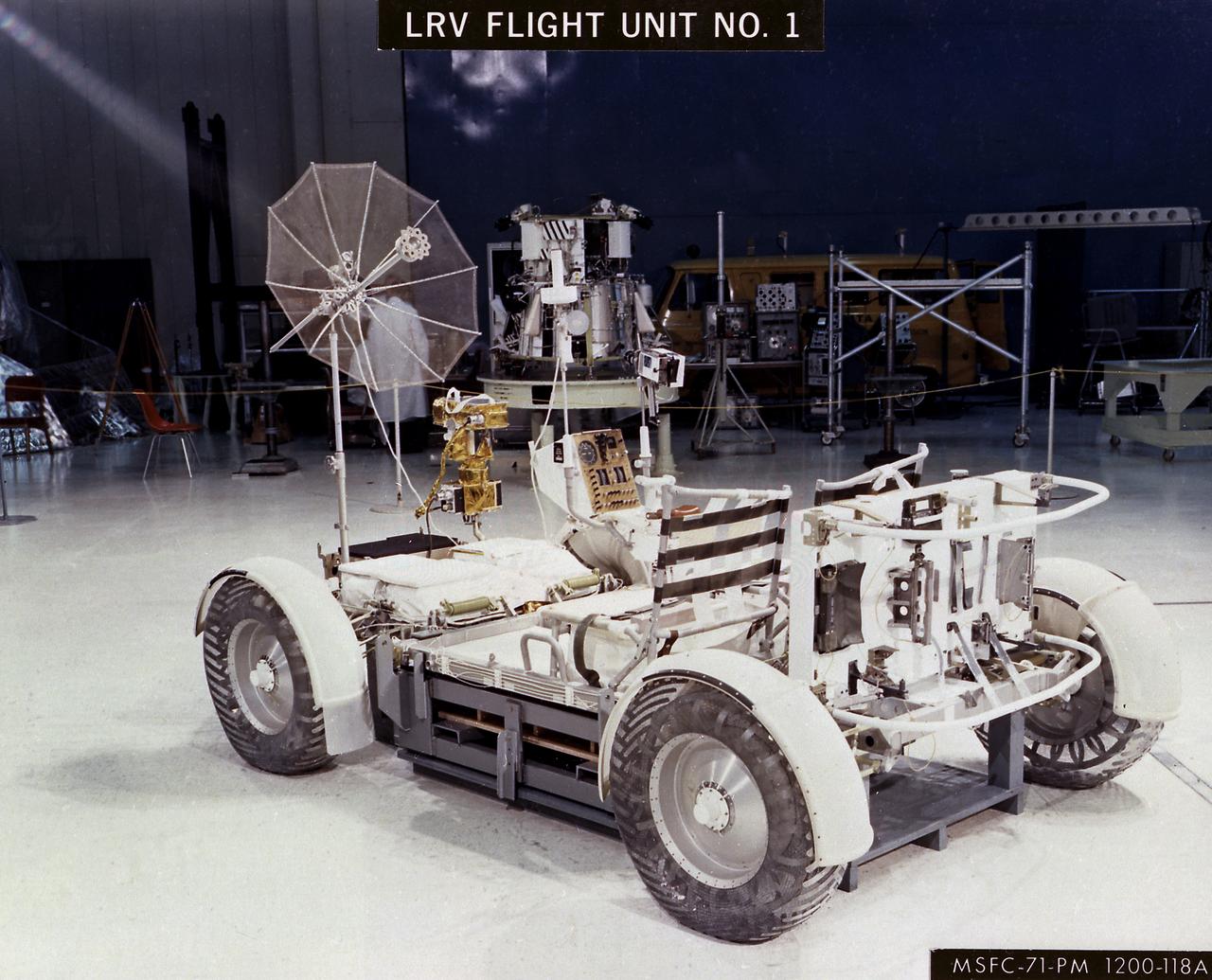
The Lunar Roving Vehicle (LRV) was designed to transport astronauts and materials on the Moon. It was a collapsible open-space vehicle about 10 feet long with large mesh wheels, anterna, appendages, tool caddies, and cameras. Powered by two 36-volt batteries, it has four 1/4-hp drive motors, one for each wheel. The vehicle was designed to travel in forward or reverse, negotiate obstacles about 1 foot high, cross crevasses about 2 feet wide, and climb or descend moderate slopes. Its speed limit was about 9 miles (14 kilometers) per hour. An LRV was used on each of the last three Apollo missions (Apollo 15, Apollo 16, and Apollo 17) and permitted the crews to travel several miles from the Lunar Module. The LRV was designed, developed, and tested by the Marshall Space Flight Center, and built by the Boeing Plant in Kent, Washington.
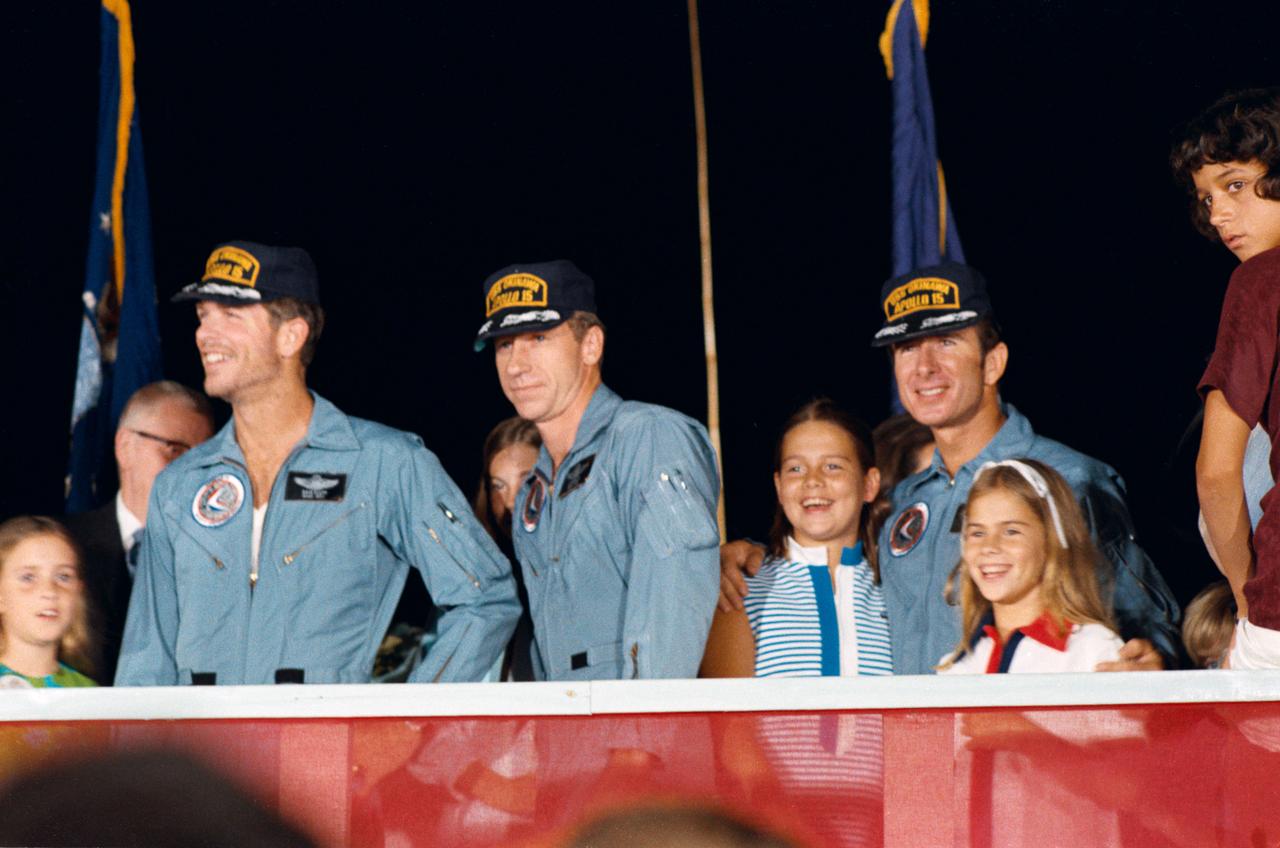
S71-43428 (8 Aug. 1971) --- The three crew men, of the highly successful Apollo 15 lunar landing mission, receive a warm welcome home at Ellington Air Force Base (EAFB), Houston, after an eight hour flight aboard a U.S. Air Force C-141 jet aircraft from Hawaii. Left to right, are astronauts David R. Scott, commander; Alfred M. Worden, command module pilot; and James B. Irwin, lunar module pilot. Apollo 15 splashdown in the mid-Pacific at 3:45 p.m. (CDT), Aug. 7, 1971, some 330 miles north of Honolulu. The C-141 landed at EAFB at 9 p.m. (CDT), Sunday, Aug. 8, 1971. Members of the astronauts' families identifiable in the picture are, left to right, Scott's daughter, Tracy; Worden's father, Merrill Worden; Worden's daughter, Merrill; and Irwin's two daughters, Joy and Jill.
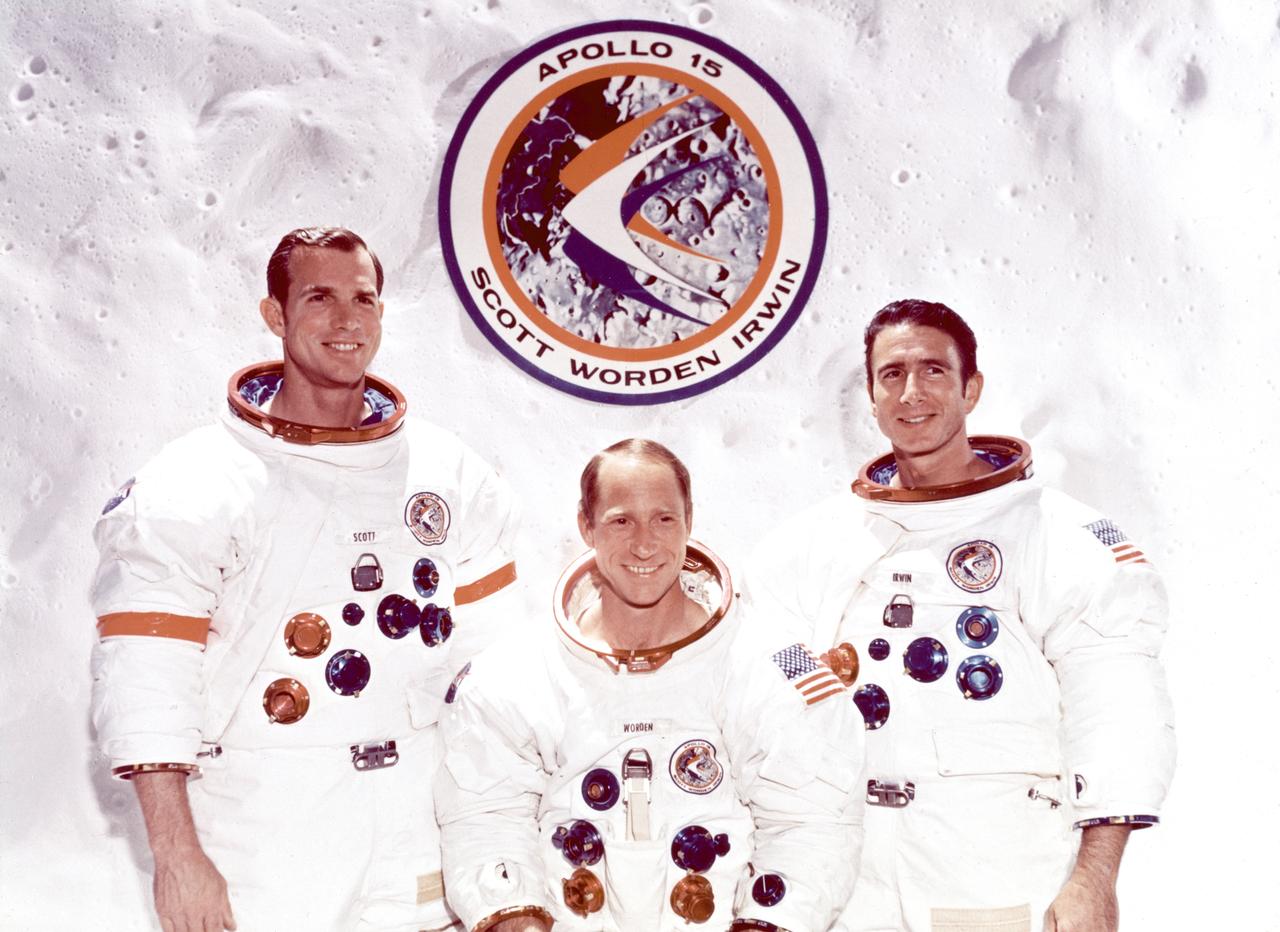
This is the official three-member crew portrait of the Apollo 15 (SA-510). Pictured from left to right are: David R. Scott, Mission Commander; Alfred M. Worden Jr., Command Module pilot; and James B. Irwin, Lunar Module pilot. The fifth marned lunar landing mission, Apollo 15 (SA-510), lifted off on July 26, 1971. Astronauts Scott and Irwin were the first to use a wheeled surface vehicle, the Lunar Roving Vehicle (LRV), or the Rover, which was designed and developed by the Marshall Space Flight Center, and built by the Boeing Company. The astronauts spent 13 days, nearly 67 hours, on the Moon's surface to inspect a wide variety of its geological features.

During the Apollo 15 launch activities in the launch control center's firing room 1 at Kennedy Space Center, Dr. Wernher von Braun, NASA's Deputy Associate Administrator for planning, takes a closer look at the launch pad through binoculars. The fifth manned lunar landing mission, Apollo 15 (SA-510), carrying a crew of three astronauts: Mission commander David R. Scott, Lunar Module pilot James B. Irwin, and Command Module pilot Alfred M. Worden Jr., lifted off on July 26, 1971. Astronauts Scott and Irwin were the first to use a wheeled surface vehicle, the Lunar Roving Vehicle, or the Rover, which was designed and developed by the Marshall Space Flight Center, and built by the Boeing Company. Astronauts spent 13 days, nearly 67 hours, on the Moon's surface to inspect a wide variety of its geological features.
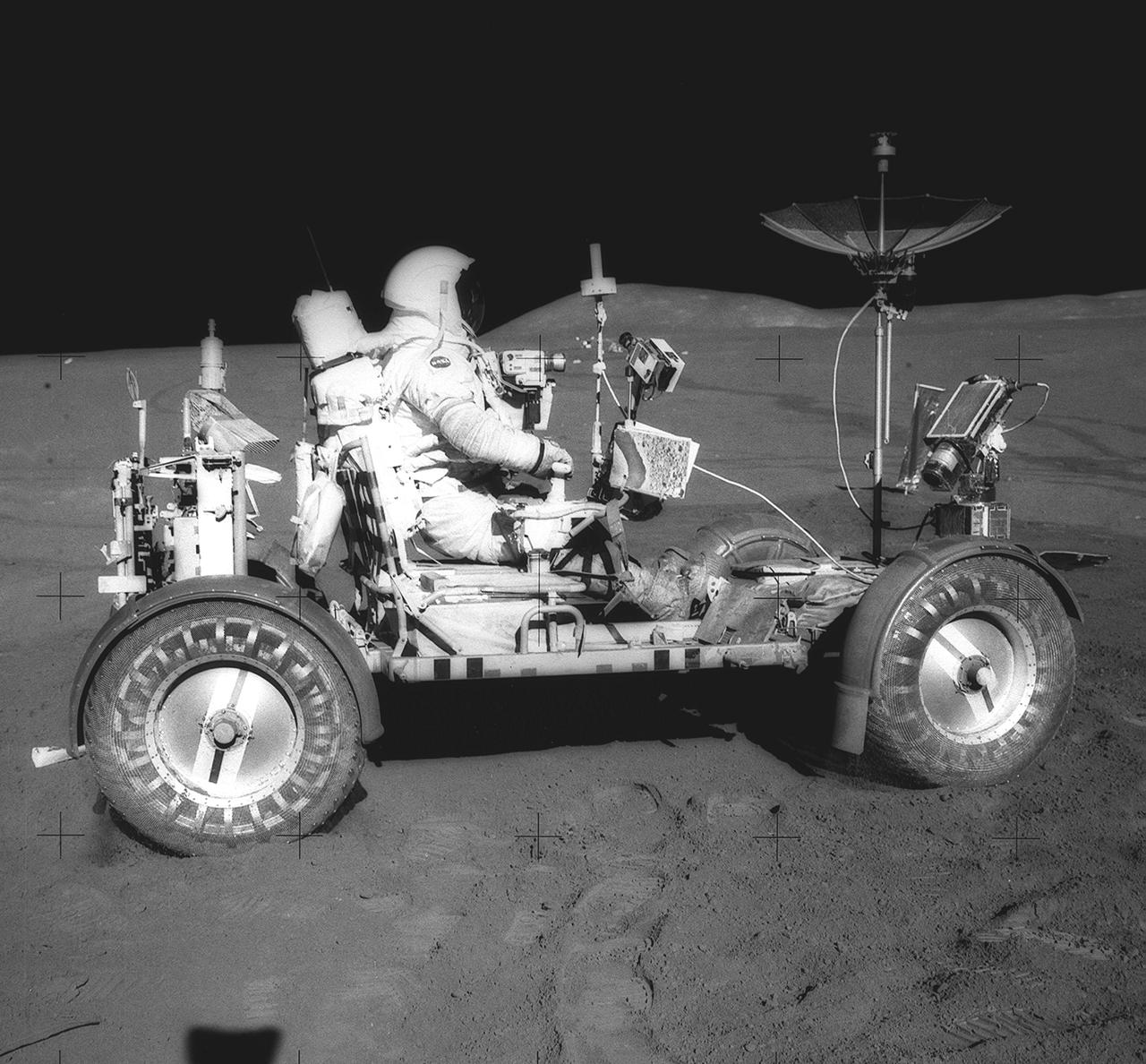
This photograph was taken during the Apollo 15 mission on the lunar surface. Astronaut David R. Scott waits in the Lunar Roving Vehicle (LRV) for astronaut James Irwin for the return trip to the Lunar Module, Falcon, with rocks and soil collected near the Hadley-Apernine landing site. The Apollo 15 was the first mission to use the LRV. Powered by battery, the lightweight electric car greatly increased the range of mobility and productivity on the scientific traverses for astronauts. It weighed 462 pounds (77 pounds on the Moon) and could carry two suited astronauts, their gear and cameras, and several hundred pounds of bagged samples. The LRV's mobility was quite high. It could climb and descend slopes of about 25 degrees. The LRV was designed and developed by the Marshall Space Flight Center and built by the Boeing Company.
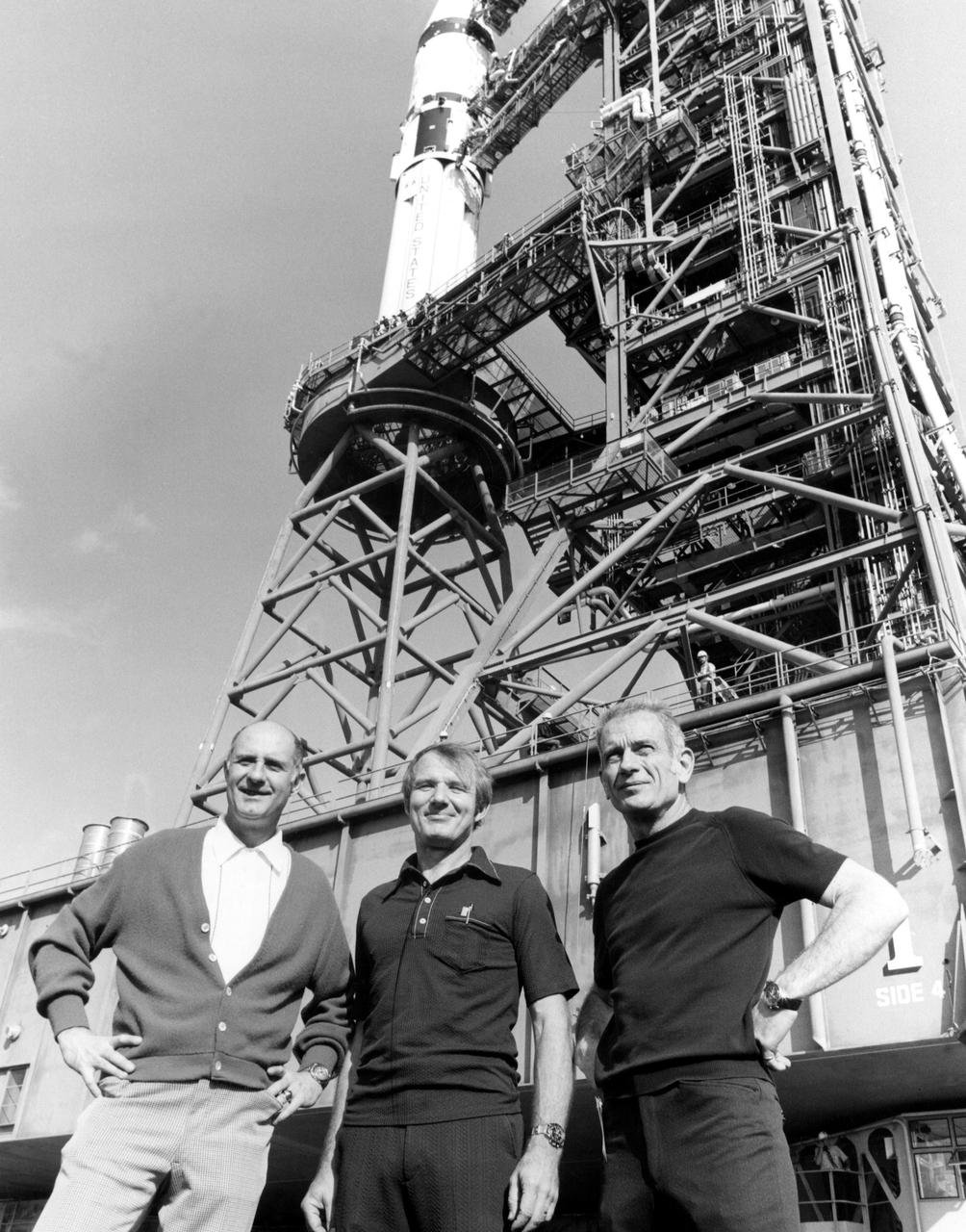
KENNEDY SPACE CENTER, FLA. -- U.S. astronauts Thomas Stafford (left), Vance Brand (center) and Donald Slayton pose in front of their Apollo Soyuz Test Project space vehicle during rollout ceremonies at KSC. The 224-foot-tall Saturn IB launch vehicle began its five-mile journey from the Vehicle Assembly Building to Complex 39's Pad at 8 a.m. The ASTP launch is scheduled for 3:50 p.m. EDT on July 15. During the mission the U.S. Apollo spacecraft will rendezvous and dock with the Soviet Soyuz spacecraft. It will be history's first international manned space flight.
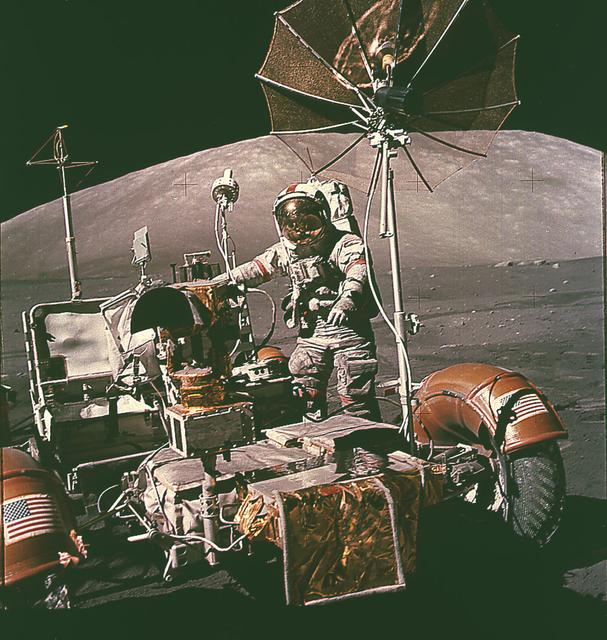
This is an Apollo 17 onboard photo of an astronaut beside the Lunar Roving Vehicle (LRV) on the lunar surface. Designed and developed by the Marshall Space Flight Center and built by the Boeing Company, the LRV was first used on the Apollo 15 mission and increased the range of astronauts' mobility and productivity on the lunar surface. This lightweight electric car had battery power sufficient for about 55 miles. It weighed 462 pounds (77 pounds on the Moon) and could carry two suited astronauts, their gear, cameras, and several hundred pounds of bagged samples. The LRV's mobility was quite high. It could climb and descend slopes of about 25 degrees.
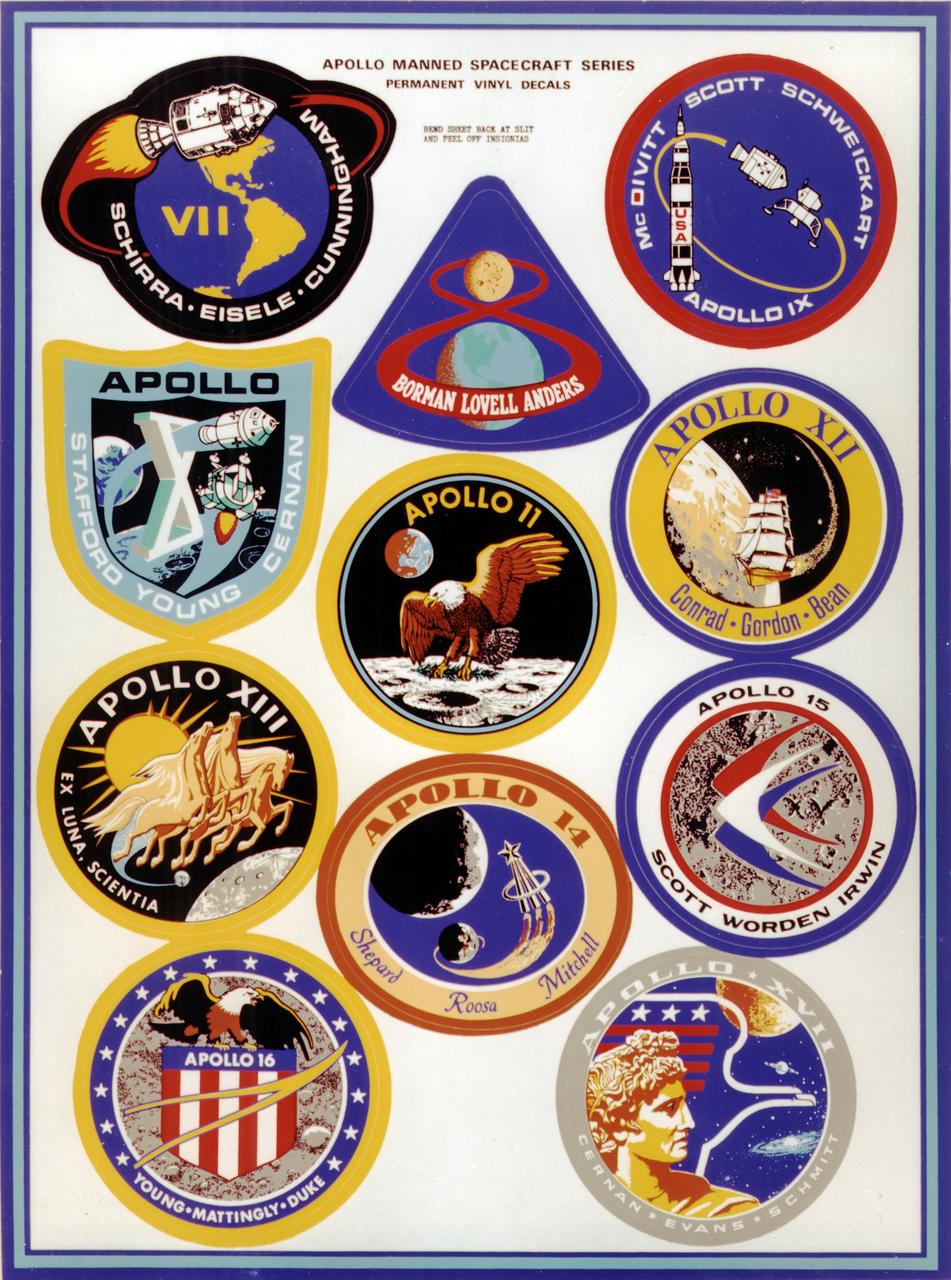
This montage depicts the flight crew patches for the manned Apollo 7 thru Apollo 17 missions. The Apollo 7 through 10 missions were basically manned test flights that paved the way for lunar landing missions. Primary objectives met included the demonstration of the Command Service Module (CSM) crew performance; crew/space vehicle/mission support facilities performance and testing during a manned CSM mission; CSM rendezvous capability; translunar injection demonstration; the first manned Apollo docking, the first Apollo Extra Vehicular Activity (EVA), performance of the first manned flight of the lunar module (LM); the CSM-LM docking in translunar trajectory, LM undocking in lunar orbit, LM staging in lunar orbit, and manned LM-CSM docking in lunar orbit. Apollo 11 through 17 were lunar landing missions with the exception of Apollo 13 which was forced to circle the moon without landing due to an onboard explosion. The craft was,however, able to return to Earth safely. Apollo 11 was the first manned lunar landing mission and performed the first lunar surface EVA. Landing site was the Sea of Tranquility. A message for mankind was delivered, the U.S. flag was planted, experiments were set up and 47 pounds of lunar surface material was collected for analysis back on Earth. Apollo 12, the 2nd manned lunar landing mission landed in the Ocean of Storms and retrieved parts of the unmanned Surveyor 3, which had landed on the Moon in April 1967. The Apollo Lunar Surface Experiments Package (ALSEP) was deployed, and 75 pounds of lunar material was gathered. Apollo 14, the 3rd lunar landing mission landed in Fra Mauro. ALSEP and other instruments were deployed, and 94 pounds of lunar materials were gathered, using a hand cart for first time to transport rocks. Apollo 15, the 4th lunar landing mission landed in the Hadley-Apennine region. With the first use of the Lunar Roving Vehicle (LRV), the crew was bale to gather 169 pounds of lunar material. Apollo 16, the 5th lunar landing mission, landed in the Descartes Highlands for the first study of highlands area. Selected surface experiments were deployed, the ultraviolet camera/spectrograph was used for first time on the Moon, and the LRV was used for second time for a collection of 213 pounds of lunar material. The Apollo program came to a close with Apollo 17, the 6th and final manned lunar landing mission that landed in the Taurus-Littrow highlands and valley area. This mission hosted the first scientist-astronaut, Schmitt, to land on the Moon. The 6th automated research station was set up, and 243 ponds of lunar material was gathered using the LRV.
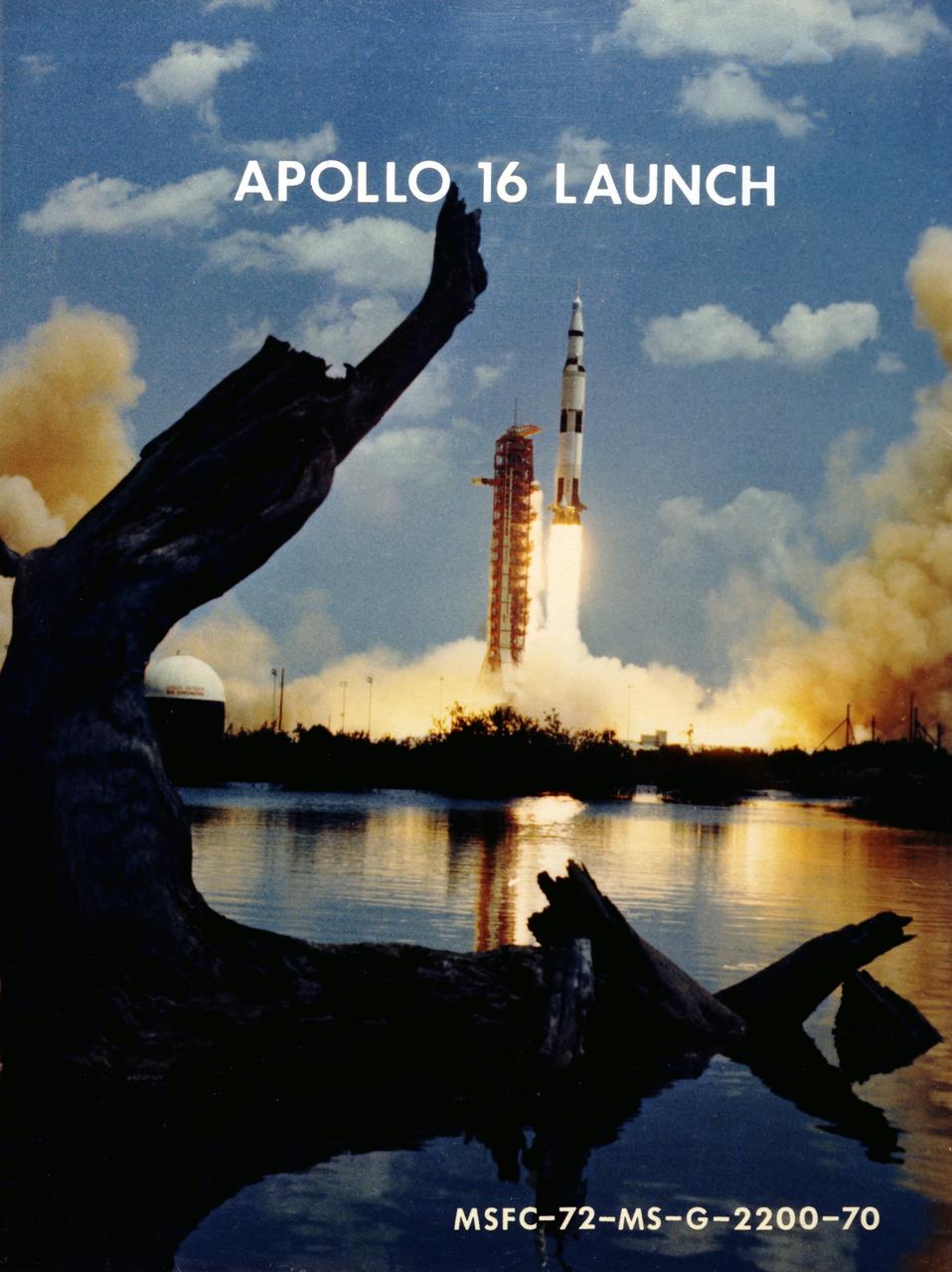
The sixth manned lunar landing mission, the Apollo 16 (SA-511), carrying three astronauts: Mission Commander John W. Young, Command Module pilot Thomas K. Mattingly II, and Lunar Module pilot Charles M. Duke, lifted off on April 16, 1972. The Apollo 16 mission continued the broad-scale geological, geochemical, and geophysical mapping of the Moon’s crust, begun by the Apollo 15, from lunar orbit. This mission marked the first use of the Moon as an astronomical observatory by using the ultraviolet camera/spectrograph which photographed ultraviolet light emitted by Earth and other celestial objects. The Lunar Roving Vehicle, developed by the Marshall Space Flight Center, was also used. The mission ended on April 27, 1972.
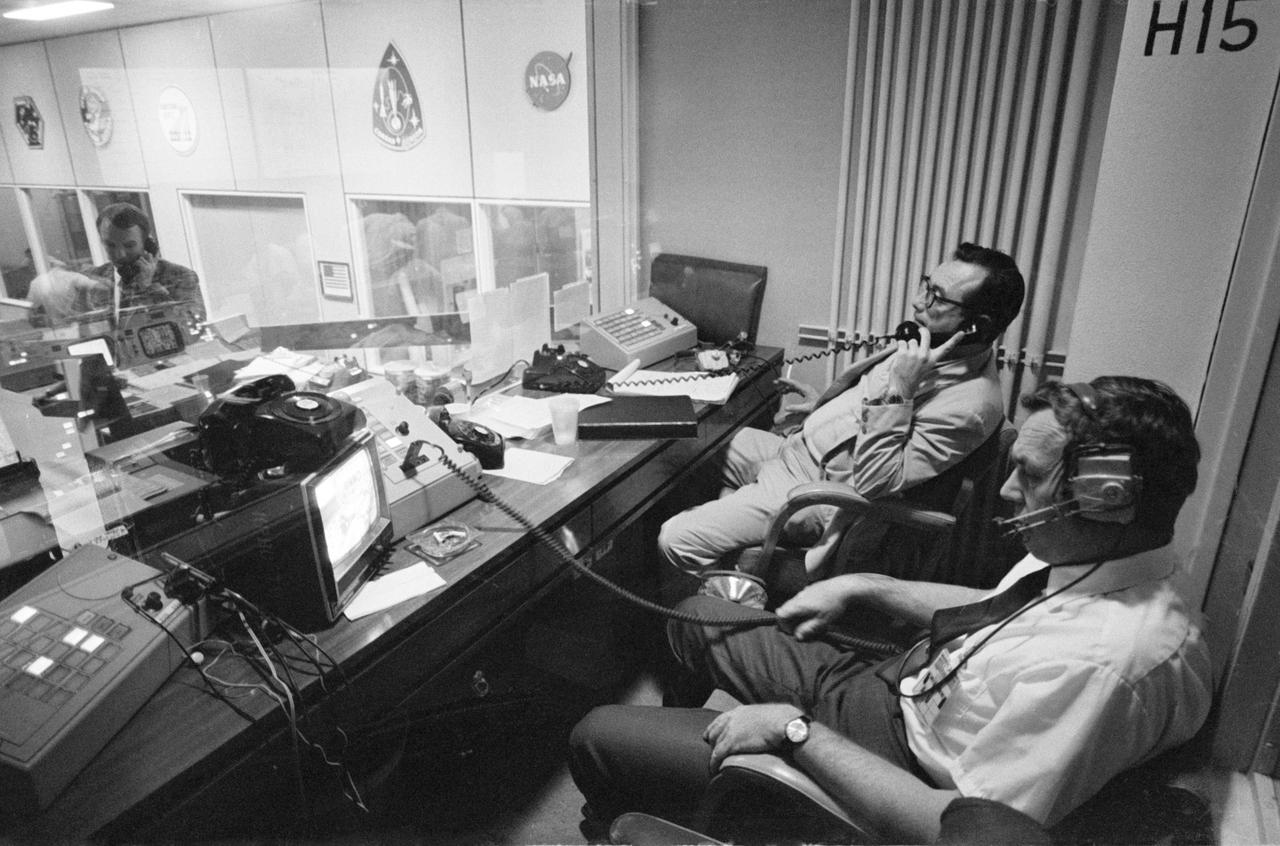
S70-35012 (15 April 1970) --- Two phases of busy activity during critical moments of the Apollo 13 mission are reflected in this view in the Mission Control Center, Building 30, Manned Spacecraft Center. In the foreground, Henry Simmons (left) of Newsweek magazine and John E. Riley, public information specialist, Public Affairs Office, MSC, man their positions in the Press Room. At extreme left of photo, Gerald D. Griffin, Shift 2 flight director, talks on telephone in Mission Operations Control Room. When this photograph was taken, the Apollo 13 lunar landing had been canceled, and the problem-plagued Apollo 13 crewmen were in trans-Earth trajectory attempting to bring their crippled spacecraft back home.
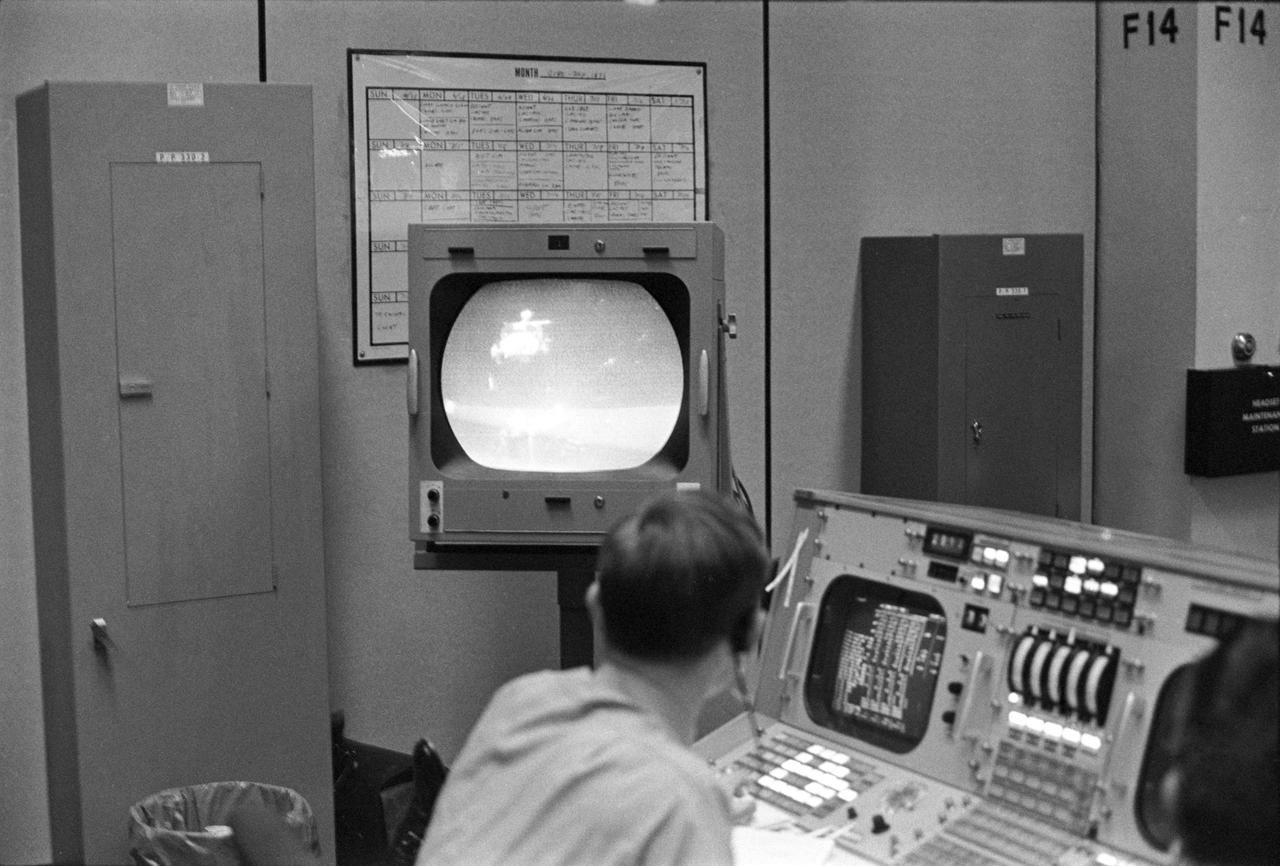
View of a photograph of the television (TV) monitor in the MCC showing a picture being transmitted from the color TV camera mounted on the parked Lunar Roving Vehicle (LRV) at the Hadley-Apennine Landing Site showing the liftoff of the Apollo 15 Lunar Module (LM) Ascent Stage from the Lunar surface. MSC, Houston, TX
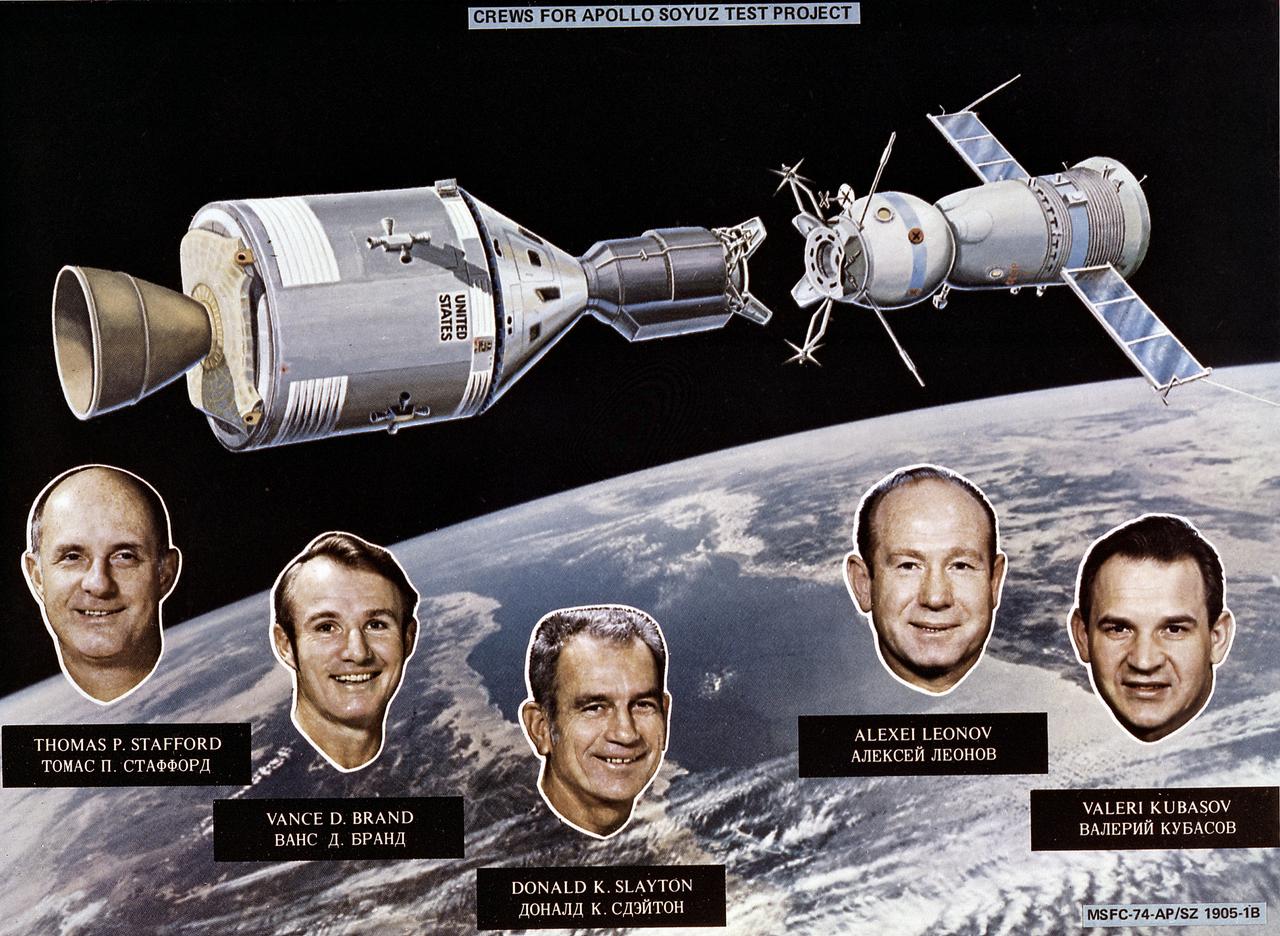
This artist's concept depicts the Apollo-Soyuz Test Project (ASTP) with insets of photographs of three U.S. astronauts (Thomas Stafford, Vance Brand, and Donald Slayton) and two U.S.S.R. cosmonauts (Alexei Leonov and Valeri Kubasov). The objective of the ASTP mission was to accomplish the first docking of a standardized international system, the U.S.'s Apollo spacecraft and the U.S.S.R.'s Soyuz spacecraft, in space. The Soyuz spacecraft was launched from the Baikonur Cosmodrome near Tyuratam in the Kazakh, Soviet Socialist Republic, at 8:20 a.m. (EDT) on July 15, 1975. The Apollo spacecraft was launched from Launch Complex 39B, Kennedy Space Center, Florida, at 3:50 p.m. (EDT) on July 15, 1975. The Primary objectives of the ASTP were achieved. They performed spacecraft rendezvous, docking and undocking, conducted intervehicular crew transfer, and demonstrated the interaction of U.S. and U.S.S.R. control centers and spacecraft crews. The mission marked the last use of a Saturn launch vehicle. The Marshall Space Flight Center was responsible for development and sustaining engineering of the Saturn IB launch vehicle during the mission.
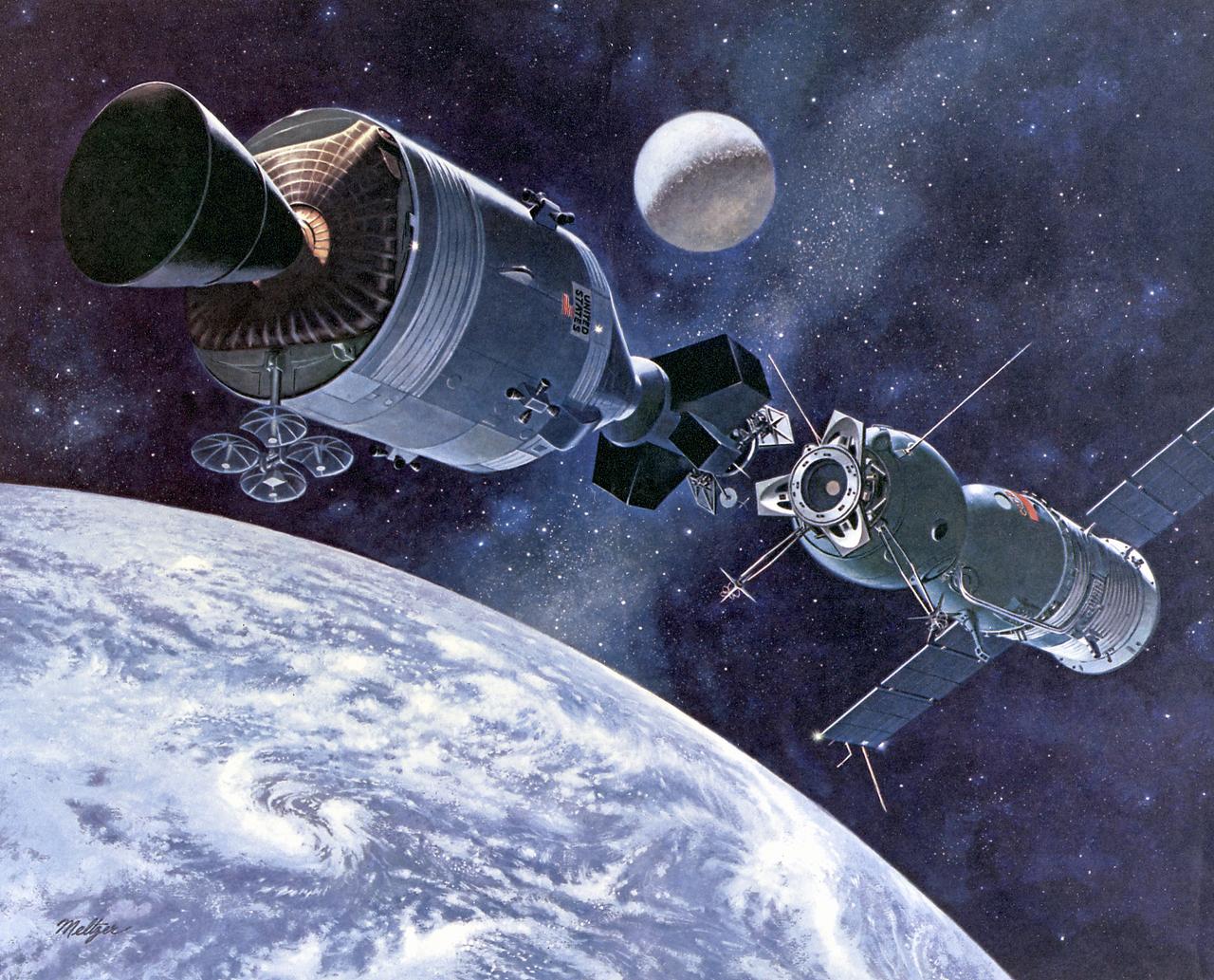
This artist's concept depicts the Apollo-Soyuz Test Project (ASTP), the first international docking of the U.S.'s Apollo spacecraft and the U.S.S.R.'s Soyuz spacecraft in space. The objective of the ASTP mission was to provide the basis for a standardized international system for docking of marned spacecraft. The Soyuz spacecraft, with Cosmonauts Alexei Leonov and Valeri Kubasov aboard, was launched from the Baikonur Cosmodrome near Tyuratam in the Kazakh, Soviet Socialist Republic, at 8:20 a.m. (EDT) on July 15, 1975. The Apollo spacecraft, with Astronauts Thomas Stafford, Vance Brand, and Donald Slayton aboard, was launched from Launch Complex 39B, Kennedy Space Center, Florida, at 3:50 p.m. (EDT) on July 15, 1975. The Primary objectives of the ASTP were achieved. They performed spacecraft rendezvous, docking and undocking, conducted intervehicular crew transfer, and demonstrated the interaction of U.S. and U.S.S.R. control centers and spacecraft crews. The mission marked the last use of a Saturn launch vehicle. The Marshall Space Flight Center was responsible for development and sustaining engineering of the Saturn IB launch vehicle during the mission.
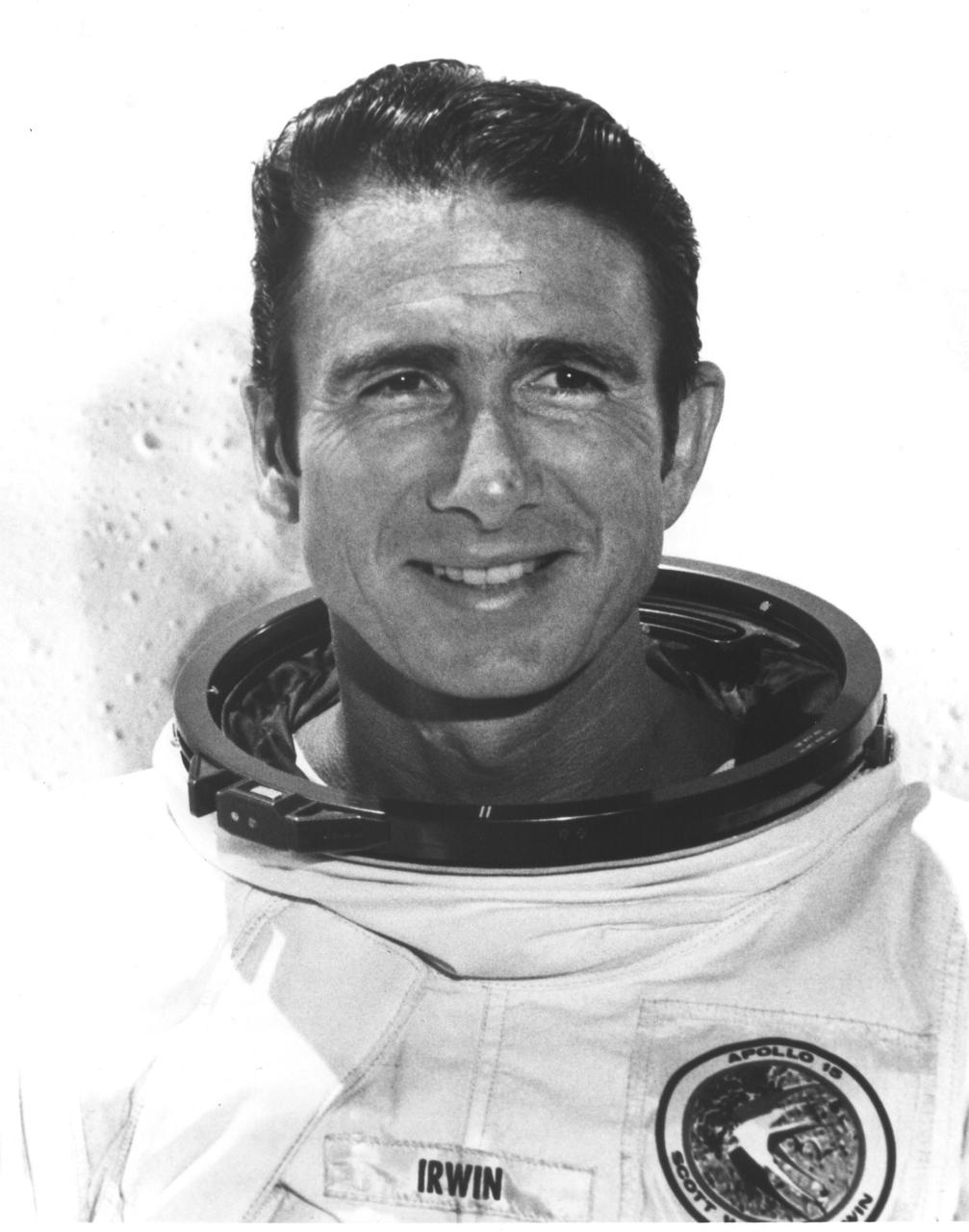
KENNEDY SPACE CENTER, FLA. -- Apollo 15 Lunar Module Pilot James B. Irwin will be making his first space flight when he is launched to the Moon with astronauts David R. Scott and AlfredN. Worden. Irwin and Scott will conduct three traverses of the Moon's Hadley-Apennine region while Worden maintains the command module in lunar orbit and conducts experiments. They will be launched to the Moon no earlier than July 26, 1971.
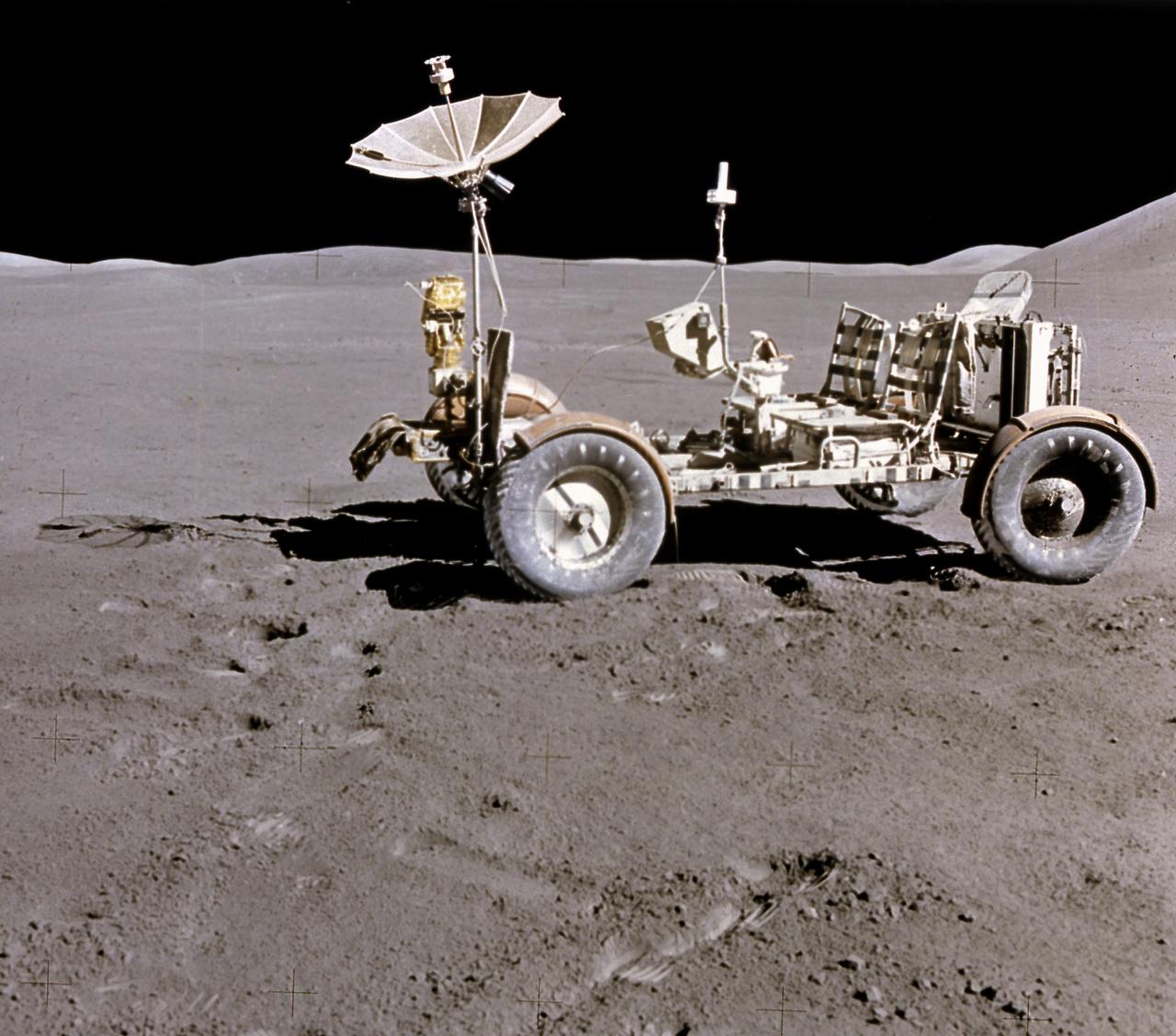
This photograph of the Lunar Roving Vehicle (LRV) was taken during the Apollo 15 mission. Powered by battery, the lightweight electric car greatly increased the range of mobility and productivity on the scientific traverses for astronauts. It weighed 462 pounds (77 pounds on the Moon) and could carry two suited astronauts, their gear and cameras, and several hundred pounds of bagged samples. The LRV's mobility was quite high. It could climb and descend slopes of about 25 degrees. The LRV was designed and developed by the Marshall Space Flight Center and built by the Boeing Company.
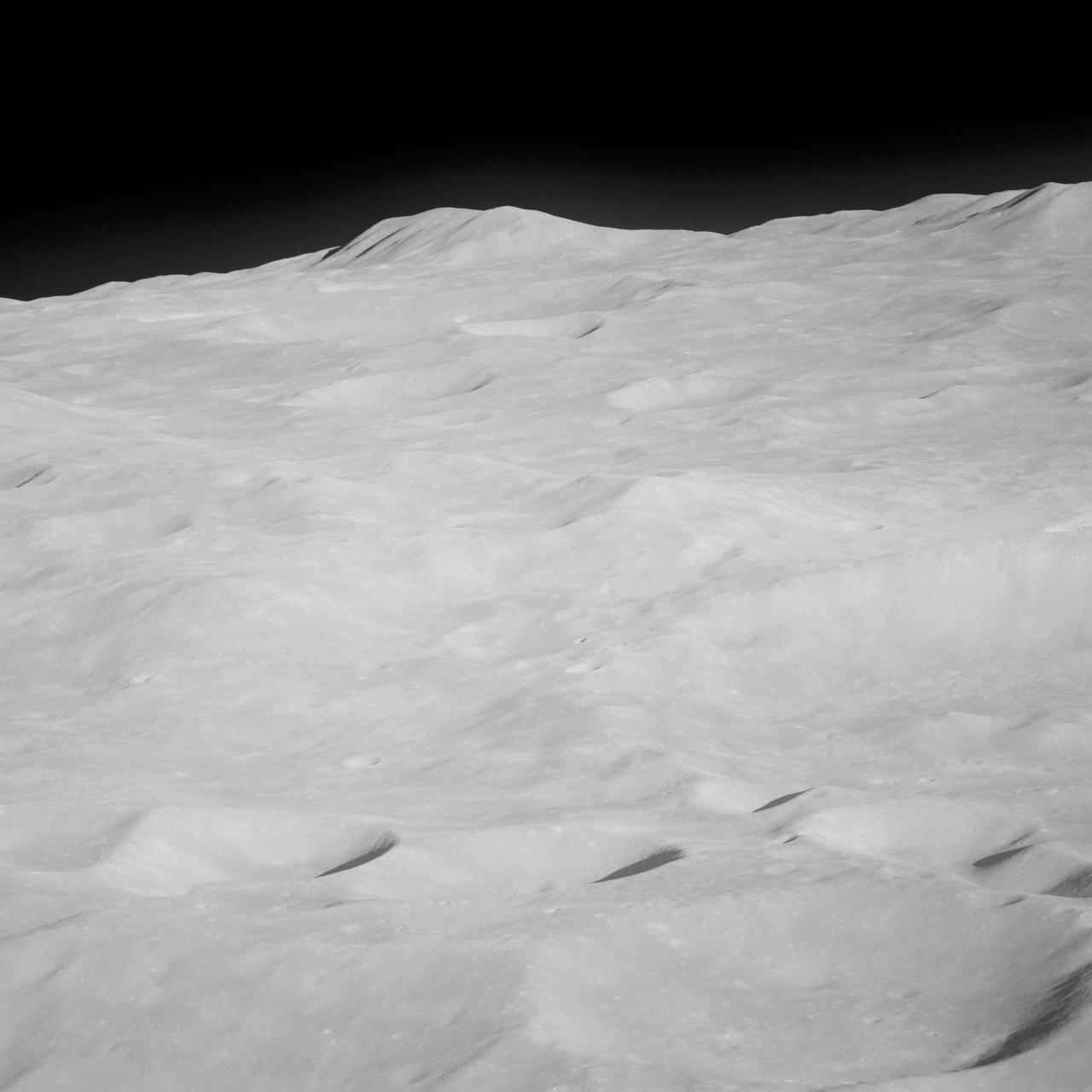
Apollo 8,Moon, Latitude 15 degrees South,Longitude 170 degrees West. Camera Tilt Mode: High Oblique. Direction: Southeast. Sun Angle 17 degrees. Original Film Magazine was labeled E. Camera Data: 70mm Hasselblad; F-Stop: F-5.6; Shutter Speed: 1/250 second. Film Type: Kodak SO-3400 Black and White,ASA 40. Other Photographic Coverage: Lunar Orbiter 1 (LO I) S-3. Flight Date: December 21-27,1968.
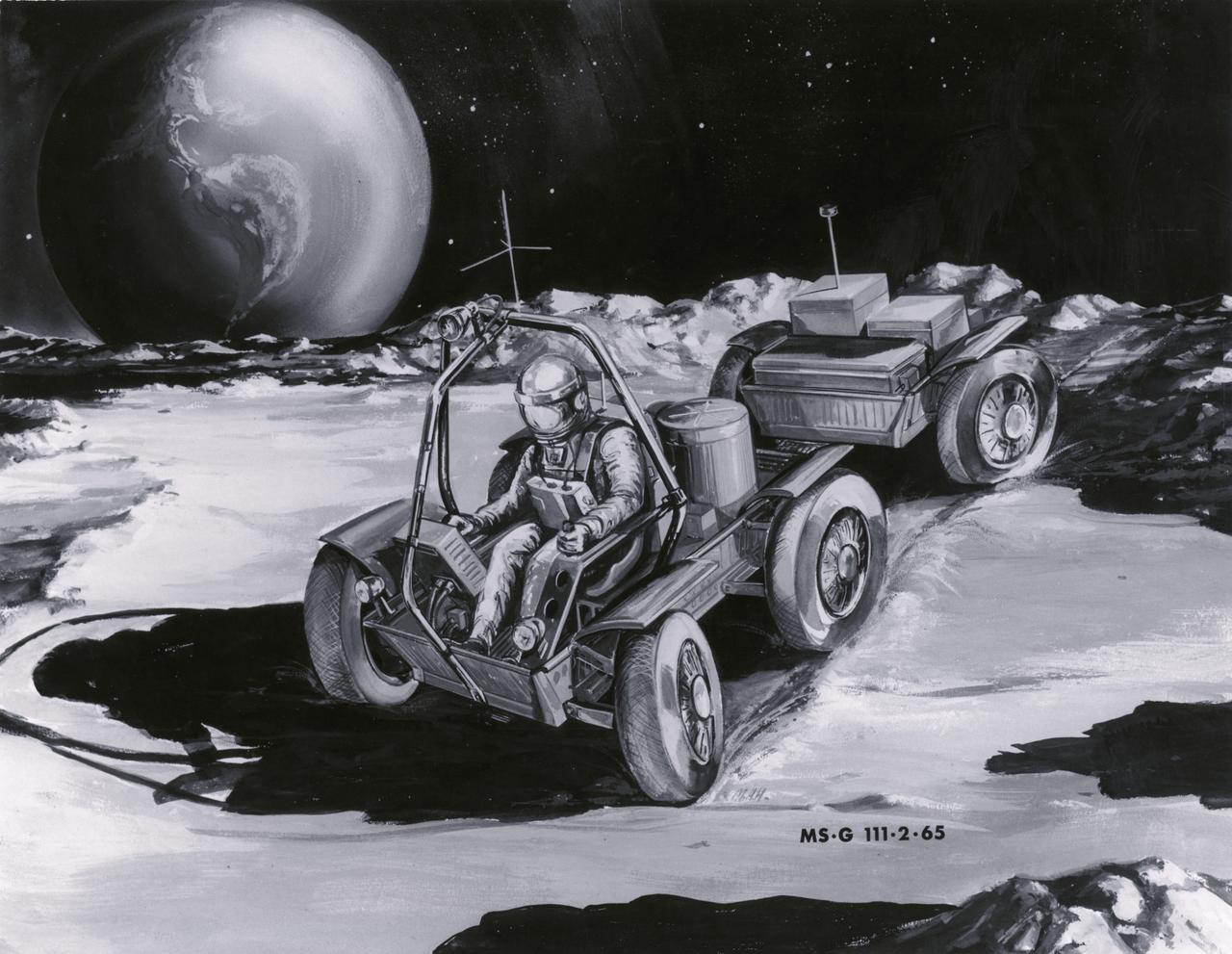
Artist’s concept of the Local Scientific Survey Module (LSSM), one of two designs for a Lunar Roving Vehicle (LRV), depicted on the lunar surface A Bendix Corporation concept, this configuration weighs more than 8,000 pounds, is 21-feet long, 15-feet wide and has 6 wheels with 5-foot diameters. The LRV was developed under the direction of the Marshall Space Flight Center (MSFC) to give Apollo astronauts a wider range of mobility on the lunar surface.
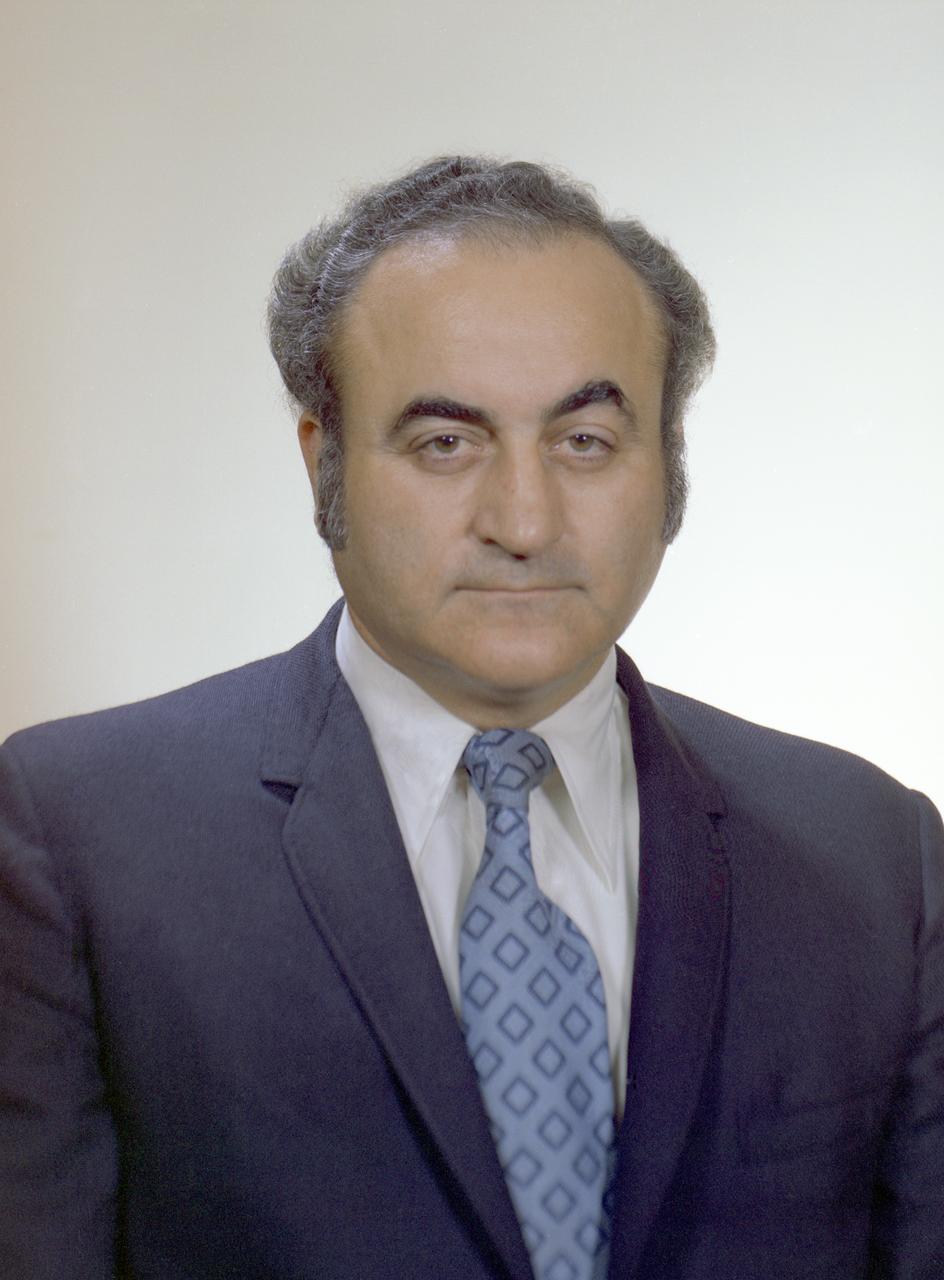
Dr. Rocco A. Petrone served at director of the Marshall Space Flight Center from January 26, 1973 to March 15, 1974. Prior to his tenure at Marshall, Petrone served as director of the Apollo program and director of launch operations at Kennedy Space Center. His career in rocket development and space programs began with his participation in the development of the Redstone missiles at the Army's Redstone Arsenal in Huntsville, Alabama. Upon his departure from Marshall, Petrone served as NASA Associate Administrator for Center Operations.