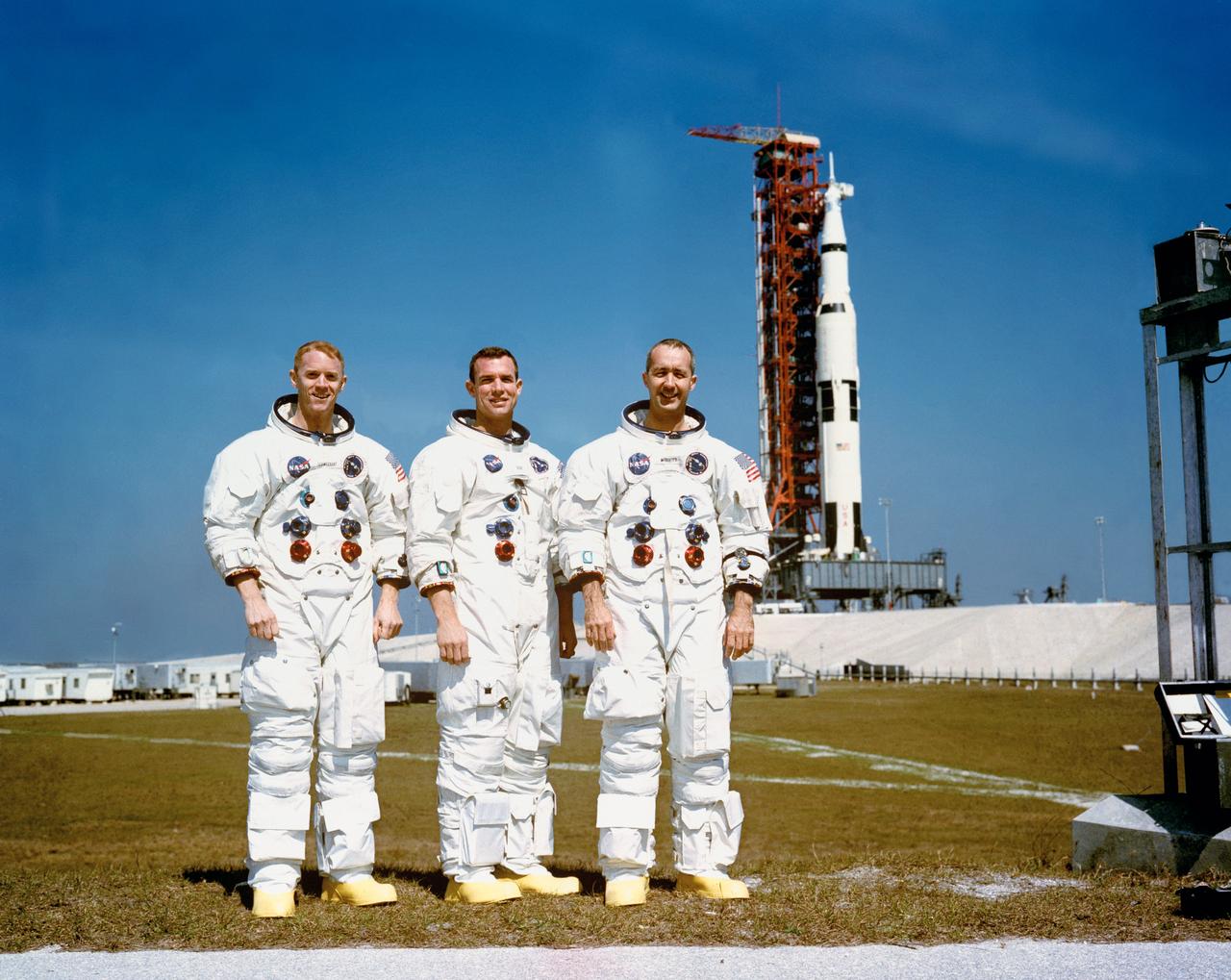
S69-25478 (23 Feb. 1969) --- These three astronauts are the prime crew of the Apollo 9 Earth-orbital space mission. Left to right, are Russell L. Schweickart, lunar module pilot; David R. Scott, command module pilot; and James A. McDivitt, commander. In the right background is the Apollo 9 space vehicle on Pad A, Launch Complex 39, Kennedy Space Center (KSC). They are pausing momentarily during training for their scheduled 10-day mission.
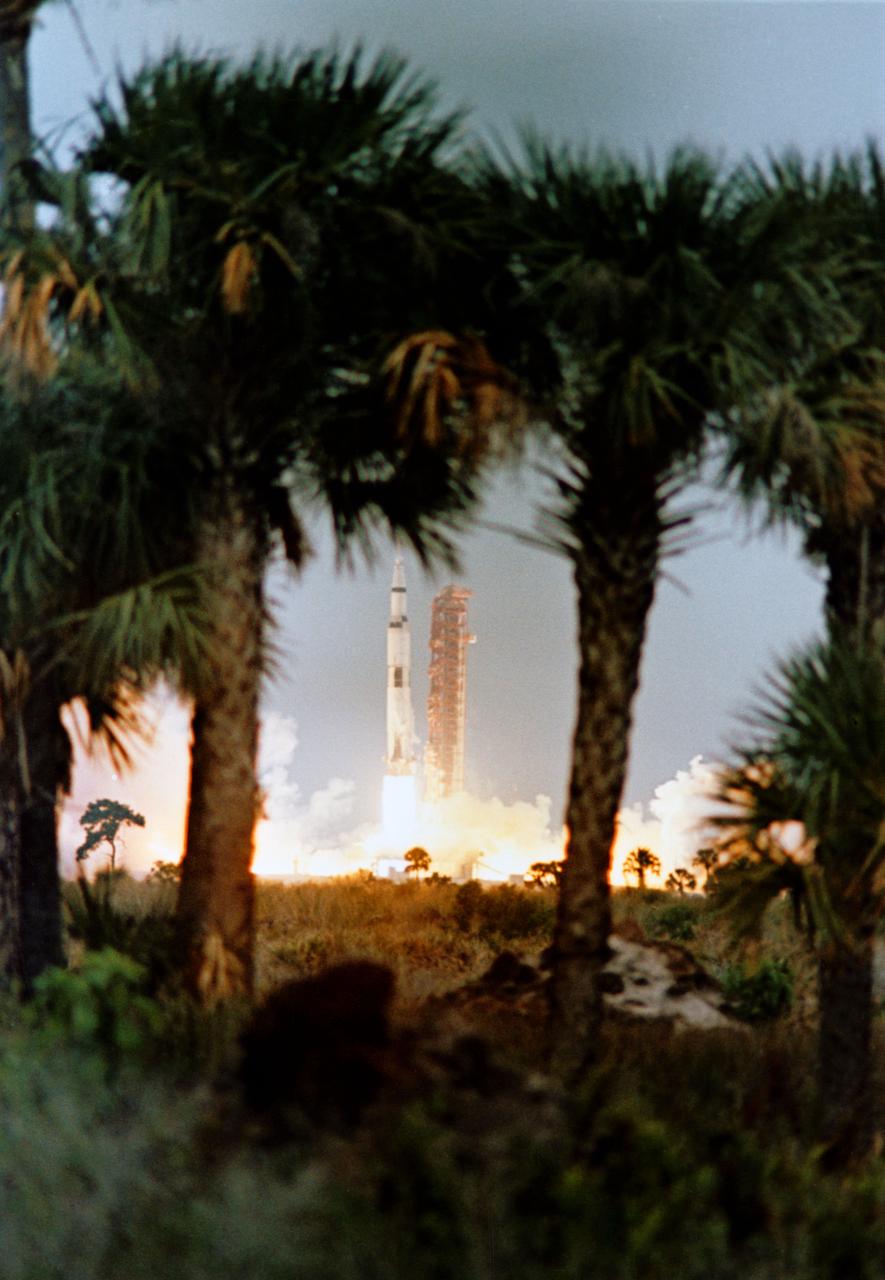
S69-25862 (3 March 1969) --- Framed by palm trees in the foreground, the Apollo 9 (Spacecraft 104/Lunar Module 3/ Saturn 504) space vehicle is launched from Pad A, Launch Complex 39, Kennedy Space Center (KSC) at 11 a.m. (EST), March 3, 1969. Aboard the spacecraft are astronauts James A. McDivitt, commander; David R. Scott, command module pilot; and Russell L. Schweickart, lunar module pilot. The Apollo 9 mission will evaluate spacecraft lunar module systems performance during manned Earth-orbital flight. Apollo 9 is the second manned Saturn V mission.
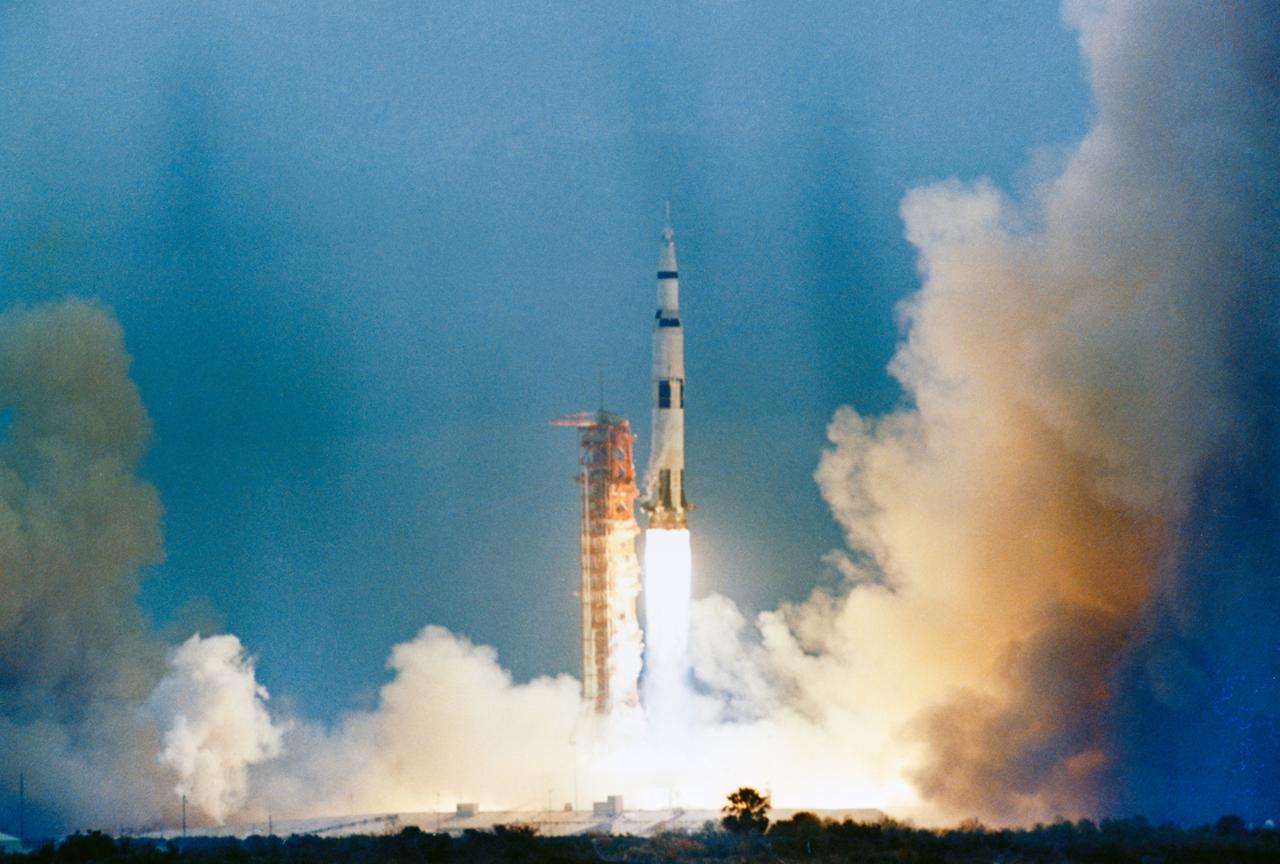
S69-25861 (3 March 1969) --- The Apollo 9 (Spacecraft 104/Lunar Module 3/ Saturn 504) space vehicle is launched from Pad A, Launch Complex 39, Kennedy Space Center (KSC) at 11 a.m. (EST), March 3, 1969. Aboard the spacecraft are astronauts James A. McDivitt, commander; David R. Scott, command module pilot; and Russell L. Schweickart, lunar module pilot. The Apollo 9 mission will evaluate spacecraft lunar module systems performance during manned Earth-orbital flight. Apollo 9 is the second manned Saturn V mission.
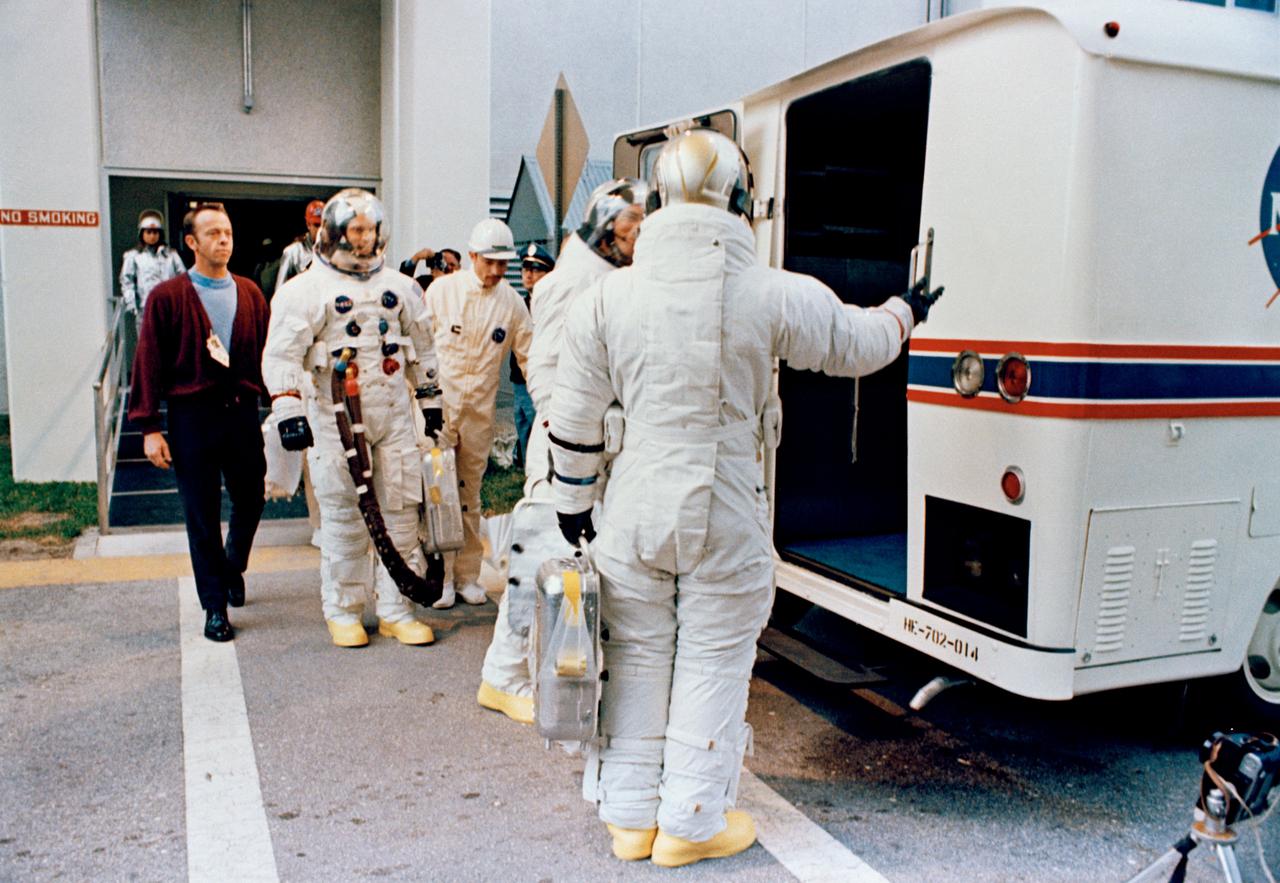
S69-25881 (3 March 1969) --- The Apollo 9 crew leaves the Kennedy Space Center's Manned Spacecraft Operations Building during the Apollo 9 prelaunch countdown. The crewman entered the special transfer van which transported them to their waiting spacecraft at Pad A, Launch Complex 39. Astronaut James A. McDivitt (back to camera) is the commander. McDivitt appears to be inviting astronaut David R. Scott, command module pilot, to step first into van. In background is astronaut Russell L. Schweickart, lunar module pilot. Walking along almost behind Schweickart is astronaut Alan B. Shepard Jr., chief, Astronaut Office, Manned Spacecraft Center. Apollo 9 was launched at 11 a.m. (EST), March 3, 1969, on a 10-day Earth-orbital mission.
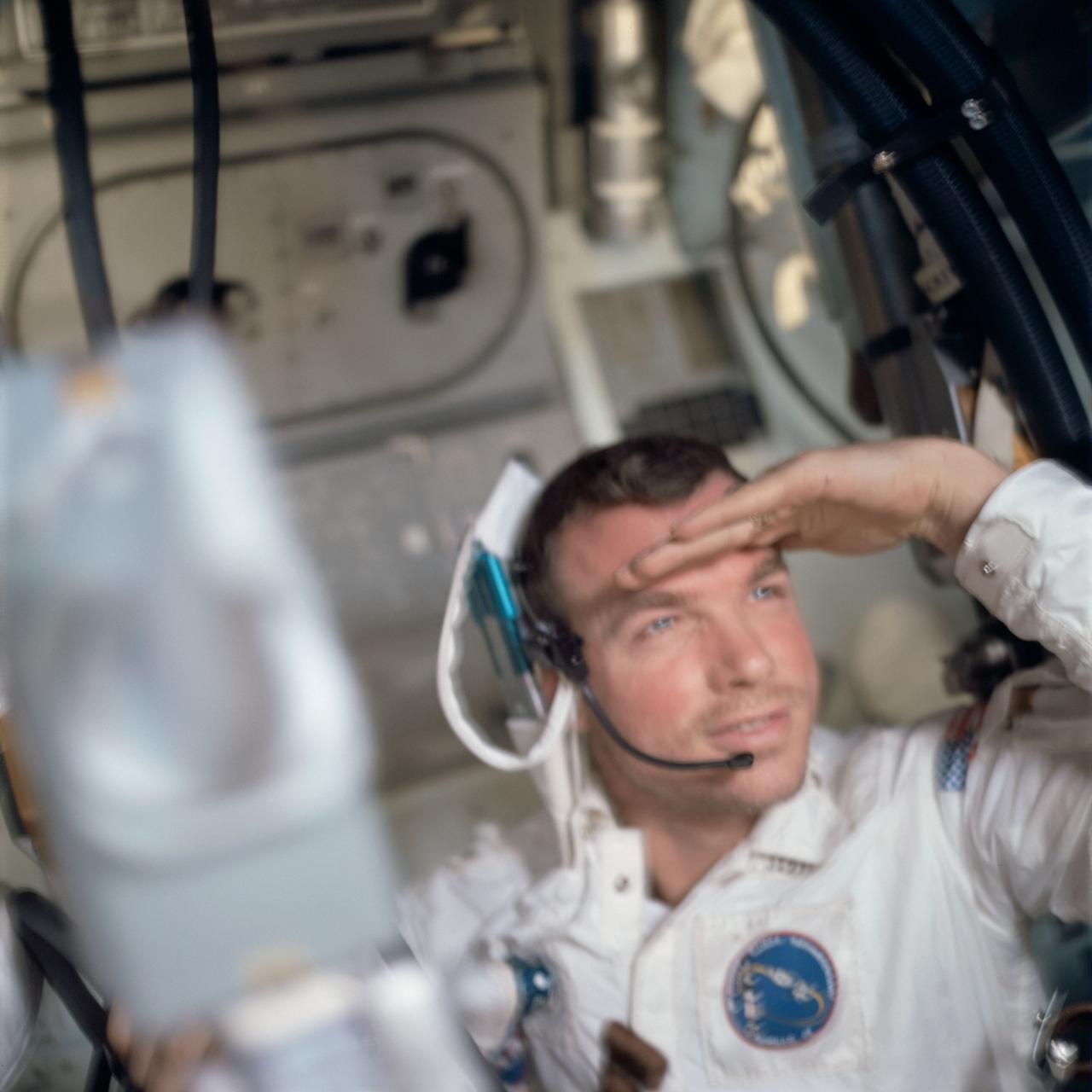
View of Astronaut David R.Scott ,Apollo 9 Command Module pilot, inside the Command Module "Gumdrop" during the Apollo 9 earth-orbital mission. . Film magazine was D,film type was SO-368 Ektachrome with 0.460 - 0.710 micrometers film / filter transmittance response and haze filter,80mm lens.
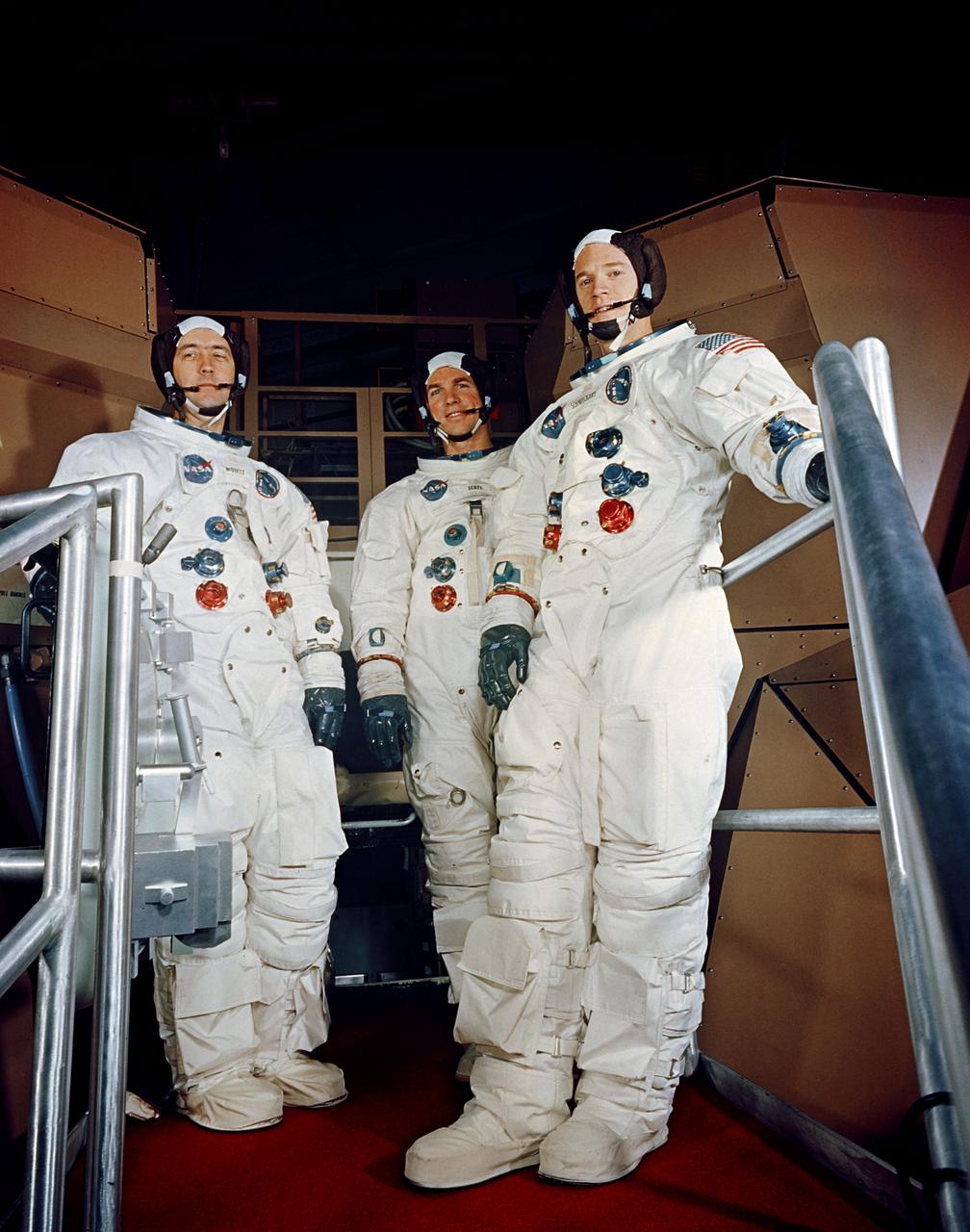
S69-19983 (17 Feb. 1969) --- The Apollo 9 crew is shown suited up for a simulated flight in the Apollo Mission Simulator at the Kennedy Space Center (KSC). Left to right are astronauts James A. McDivitt, commander; David R. Scott, command module pilot; and Russell L. Schweickart, lunar module pilot.
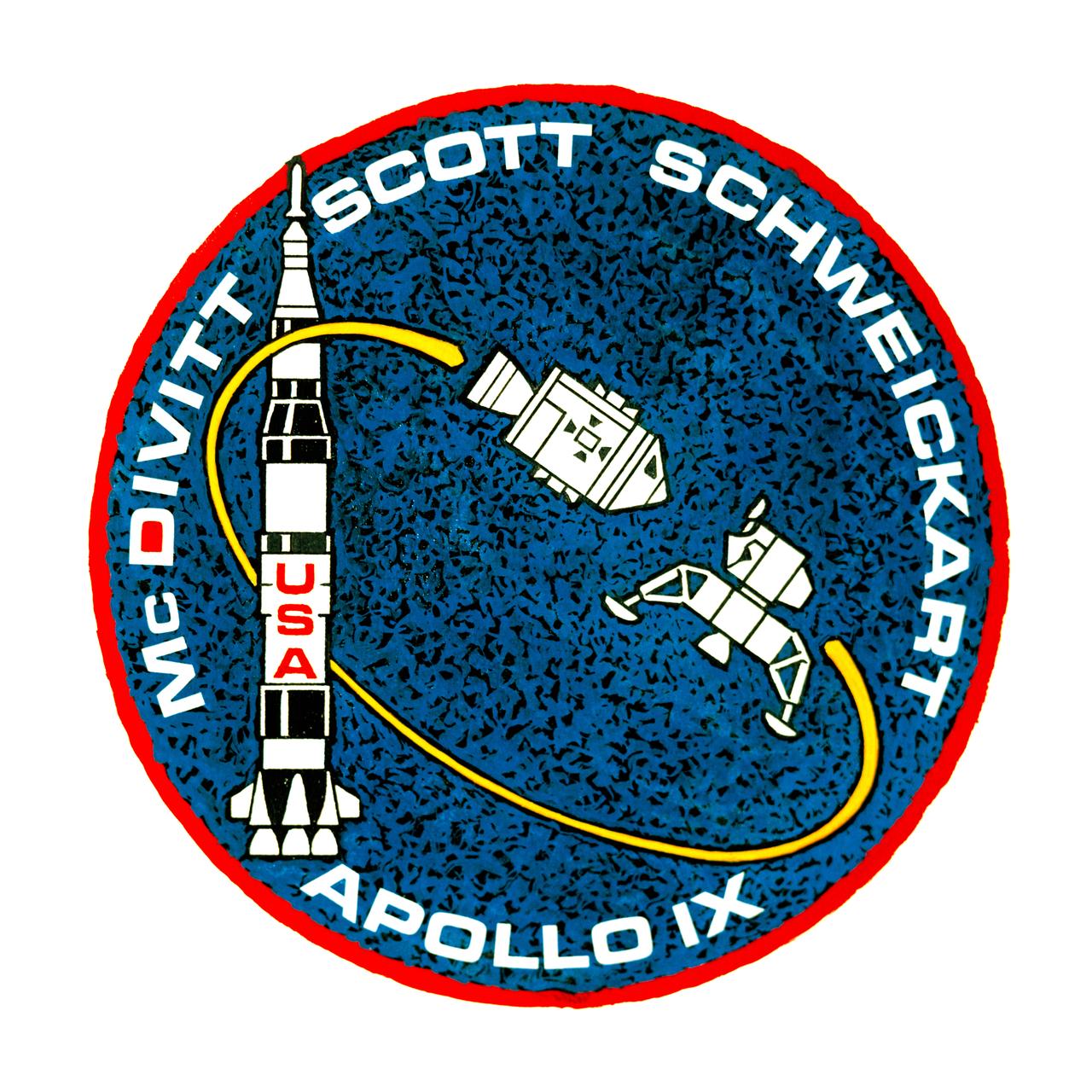
S69-18569 (February 1969) --- The insignia of the Apollo 9 space mission. The crew consist of astronauts James A. McDivitt, commander; David R. Scott, command module pilot; and Russell L. Schweickart, lunar module pilot. The Apollo 9 mission will evaluate spacecraft lunar module systems performance during manned Earth-orbital flight. The NASA insignia design for Apollo flights is reserved for use by the astronauts and for other official use as the NASA Administrator may authorize. Public availability has been approved only in the form of illustrations by the various news media. When and if there is any change in this policy, which we do not anticipate, it will be publicly announced.
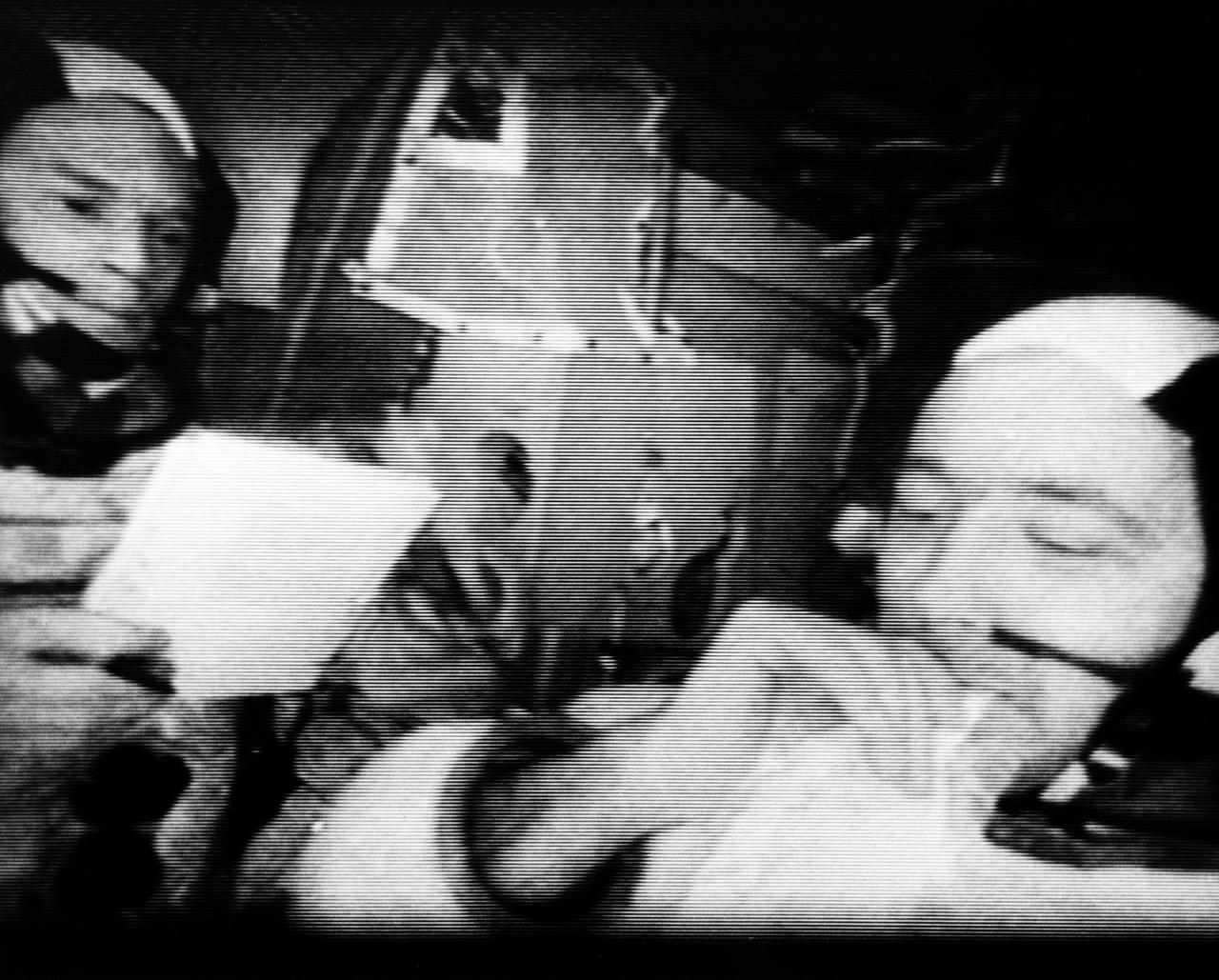
S69-26698 (March 1969) --- A photograph from a live television transmission from Apollo 9. This view shows the interior of the Lunar Module "Spider." Astronaut James A. McDivitt, Apollo 9 commander, is in right foreground. In left background is astronaut Russell L. Schweickart, lunar module pilot. At this moment Apollo 9 was orbiting Earth with the Command Module docked nose-to-nose with the Lunar Module. Astronaut David R. Scott, command module pilot, remained at the controls in the Command Module "Gumdrop" while the other two astronauts checked out the Lunar Module.
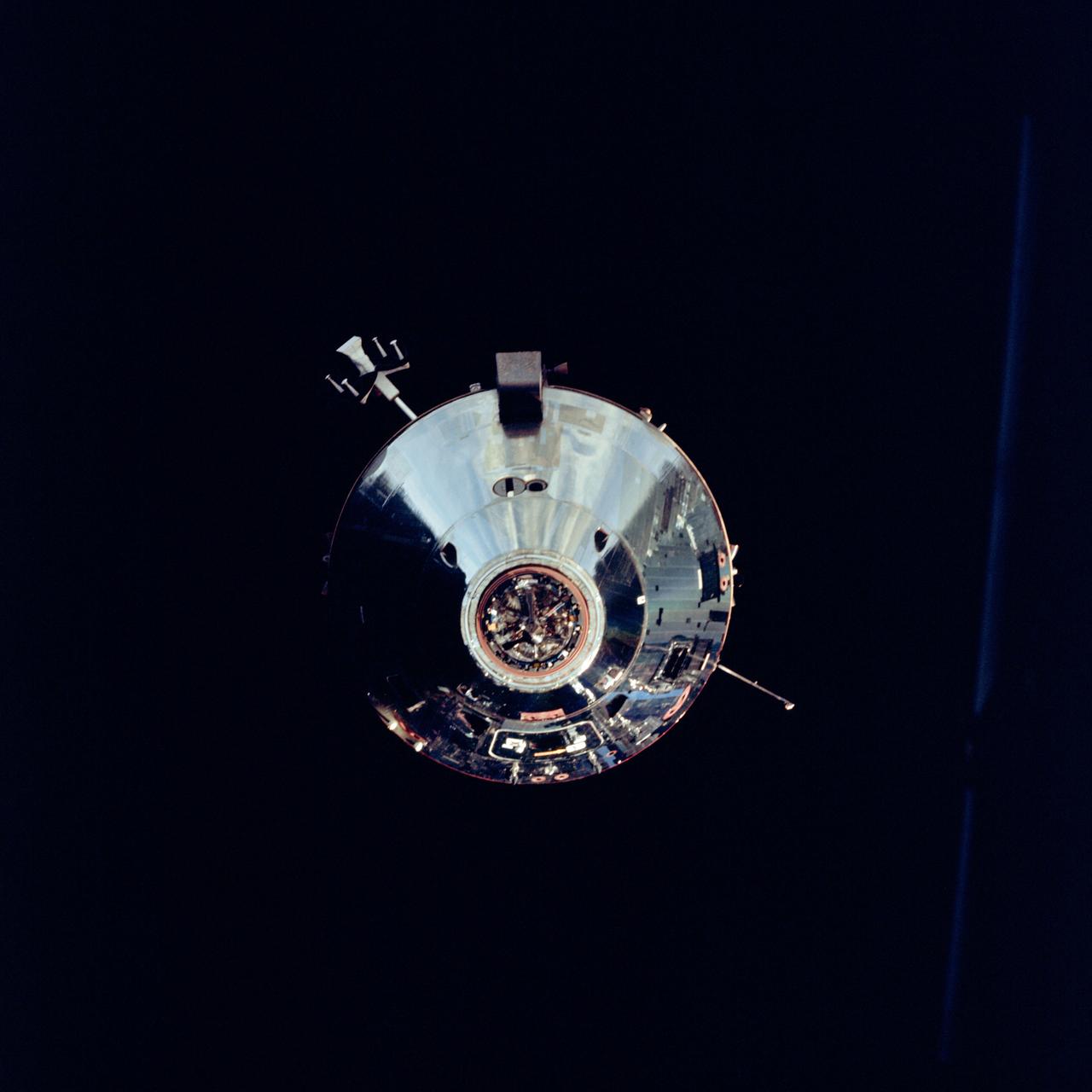
The Apollo 9 Command/Service Modules photographed from the Lunar Module,"Spider",on the fifth day of the Apollo 9 earth-orbital mission. Docking mechanism is visible in nose of the Command Module,"Gumdrop". Object jutting out from the Service Module aft bulkhead is the high-gain S-Band antenna. Film magazine was F, film type was SO-368 Ektachrome with 0.460 - 0.710 micrometers film / filter transmittance response and haze filter,80mm lens.
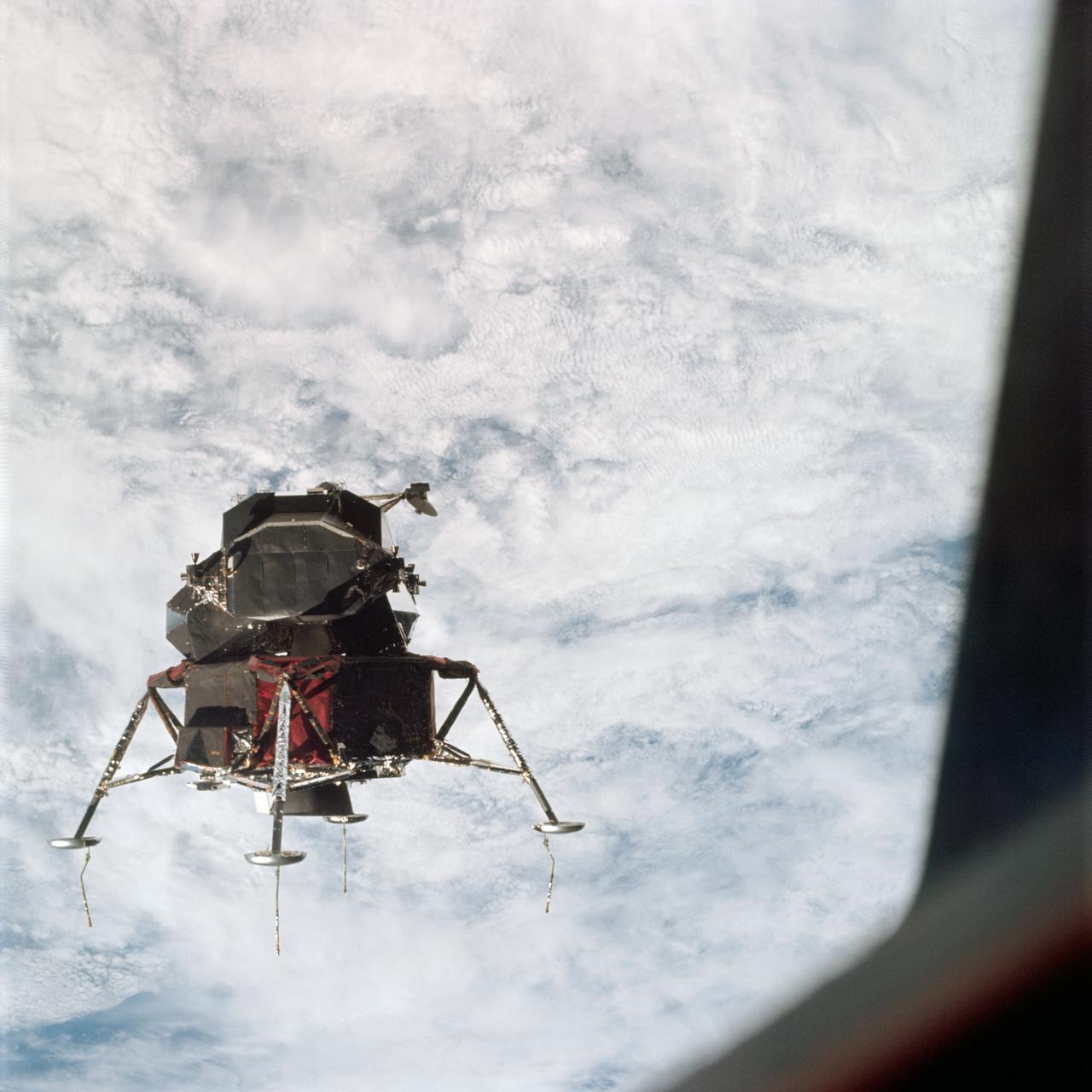
AS09-21-3197 (7 March 1969) --- A view of the Apollo 9 Lunar Module (LM) "Spider" in a lunar landing configuration, as photographed from the Command and Service Modules (CSM) on the fifth day of the Apollo 9 Earth-orbital mission. The landing gear on the "Spider" has been deployed. Lunar surface probes (sensors) extend out from the landing gear foot pads. Inside the "Spider" were astronauts James A. McDivitt, Apollo 9 commander; and Russell L. Schweickart, lunar module pilot. Astronaut David R. Scott, command module pilot, remained at the controls in the Command Module (CM), "Gumdrop," while the other two astronauts checked out the LM. Schweickart, lunar module pilot, is photographed from the CM "Gumdrop" during his extravehicular activity (EVA) on the fourth day of the Apollo 9 Earth-orbital mission. The CSM is docked with the LM. Astronaut James A. McDivitt, Apollo 9 commander, was inside the LM "Spider." Astronaut David R. Scott, command module pilot, remained at the controls in the CM.
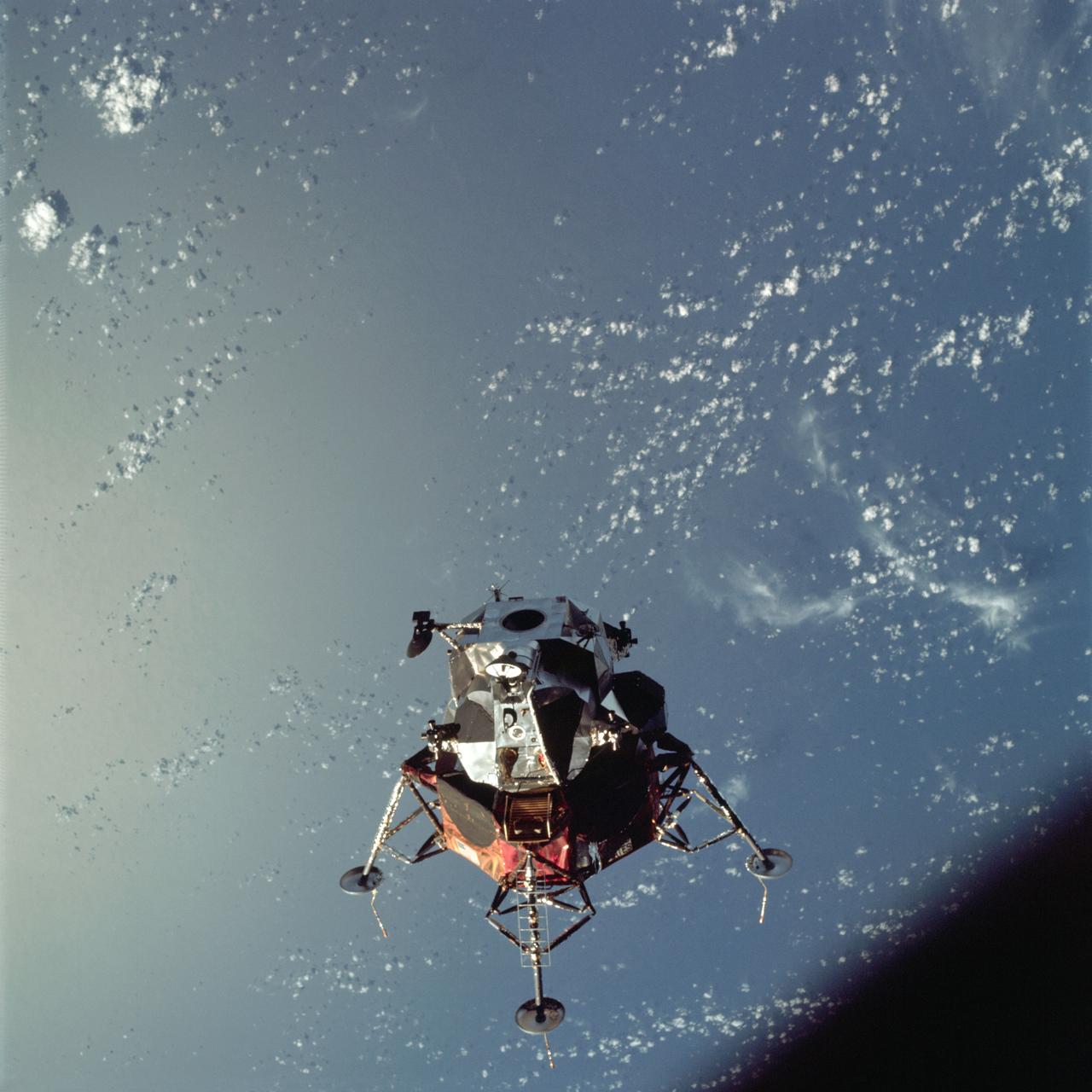
AS09-21-3183 (7 March 1969) --- A view of the Apollo 9 Lunar Module (LM) "Spider" in a lunar landing configuration, as photographed from the Command and Service Modules (CSM) on the fifth day of the Apollo 9 Earth-orbital mission. The landing gear on the "Spider" has been deployed. Lunar surface probes (sensors) extend out from the landing gear foot pads. Inside the "Spider" were astronauts James A. McDivitt, Apollo 9 commander; and Russell L. Schweickart, lunar module pilot. Astronaut David R. Scott, command module pilot, remained at the controls in the Command Module (CM), "Gumdrop," while the other two astronauts checked out the LM. Schweickart, lunar module pilot, is photographed from the CM "Gumdrop" during his extravehicular activity (EVA) on the fourth day of the Apollo 9 Earth-orbital mission. The CSM is docked with the LM. Astronaut James A. McDivitt, Apollo 9 commander, was inside the LM "Spider." Astronaut David R. Scott, command module pilot, remained at the controls in the CM.
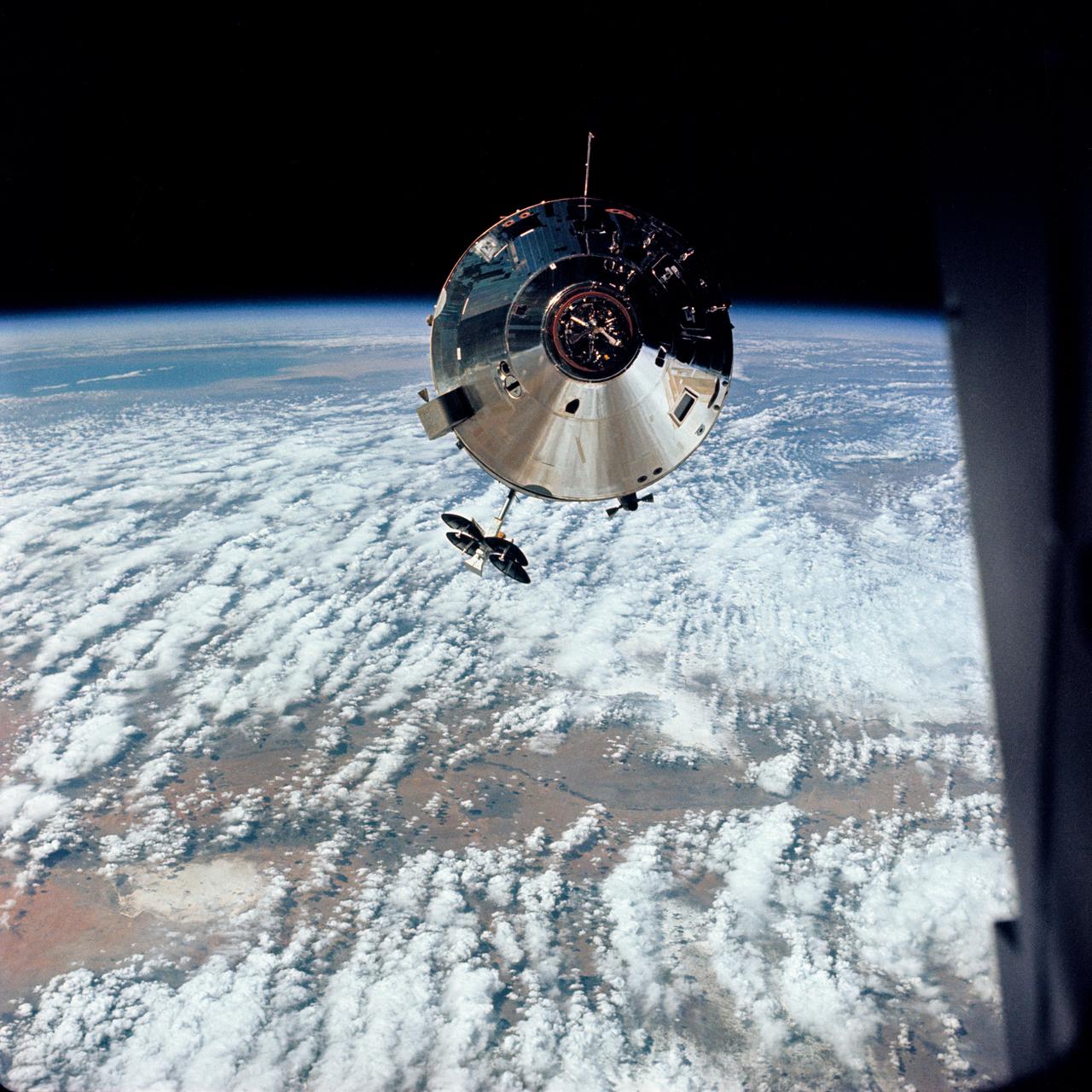
High Oblique photograph (taken over New Mexico) of the Apollo 9 Command/Service Modules taken from the Lunar Module,"Spider",on the fifth day of the Apollo 9 earth-orbital mission. Docking mechanism is visible in nose of the Command Module,"Gumdrop". Object jutting out from the Service Module aft bulkhead is the high-gain S-Band antenna. Film magazine was F, film type was SO-368 Ektachrome with 0.460 - 0.710 micrometers film / filter transmittance response and haze filter,80mm lens. Cloud cover over the Earth is 70%.
![S68-56621 (18 Dec. 1968) --- These three astronauts are the prime crew of the Apollo 9 (Spacecraft 104/Lunar Module 3/Saturn 504) space mission. Left to right, are James A. McDivitt, commander; David R. Scott, command module pilot: and Russell L. Schweickart, lunar module pilot. The Apollo 9 launch is scheduled no earlier than February 28, 1969. In the background is the Apollo 8 space vehicle on Pad A, Launch Complex 39, Kennedy Space Center, which was launched on December 21, 1968. (Gaseous liquid oxygen is venting from the vehicle’s first [S-1C] stage during a countdown demonstration test). McDivitt holds a U.S. flag.](https://images-assets.nasa.gov/image/S68-56621/S68-56621~medium.jpg)
S68-56621 (18 Dec. 1968) --- These three astronauts are the prime crew of the Apollo 9 (Spacecraft 104/Lunar Module 3/Saturn 504) space mission. Left to right, are James A. McDivitt, commander; David R. Scott, command module pilot: and Russell L. Schweickart, lunar module pilot. The Apollo 9 launch is scheduled no earlier than February 28, 1969. In the background is the Apollo 8 space vehicle on Pad A, Launch Complex 39, Kennedy Space Center, which was launched on December 21, 1968. (Gaseous liquid oxygen is venting from the vehicle’s first [S-1C] stage during a countdown demonstration test). McDivitt holds a U.S. flag.
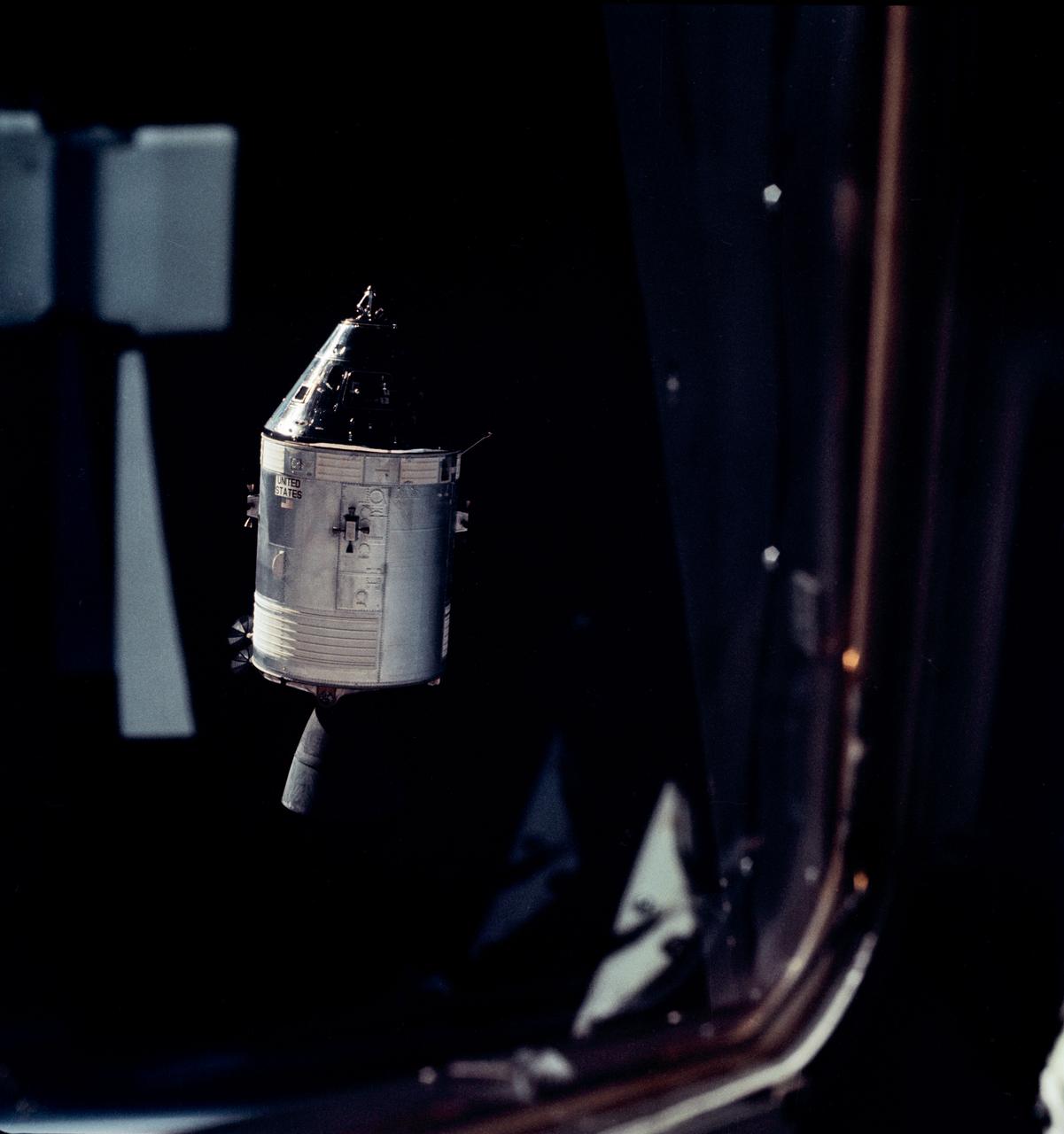
The Apollo 9 Command/Service Modules photographed through the window from the Lunar Module,"Spider",on the fifth day of the Apollo 9 earth-orbital mission. Docking mechanism is visible in nose of the Command Module,"Gumdrop". Film magazine was F, film type was SO-368 Ektachrome with 0.460 - 0.710 micrometers film / filter transmittance response and haze filter,80mm lens
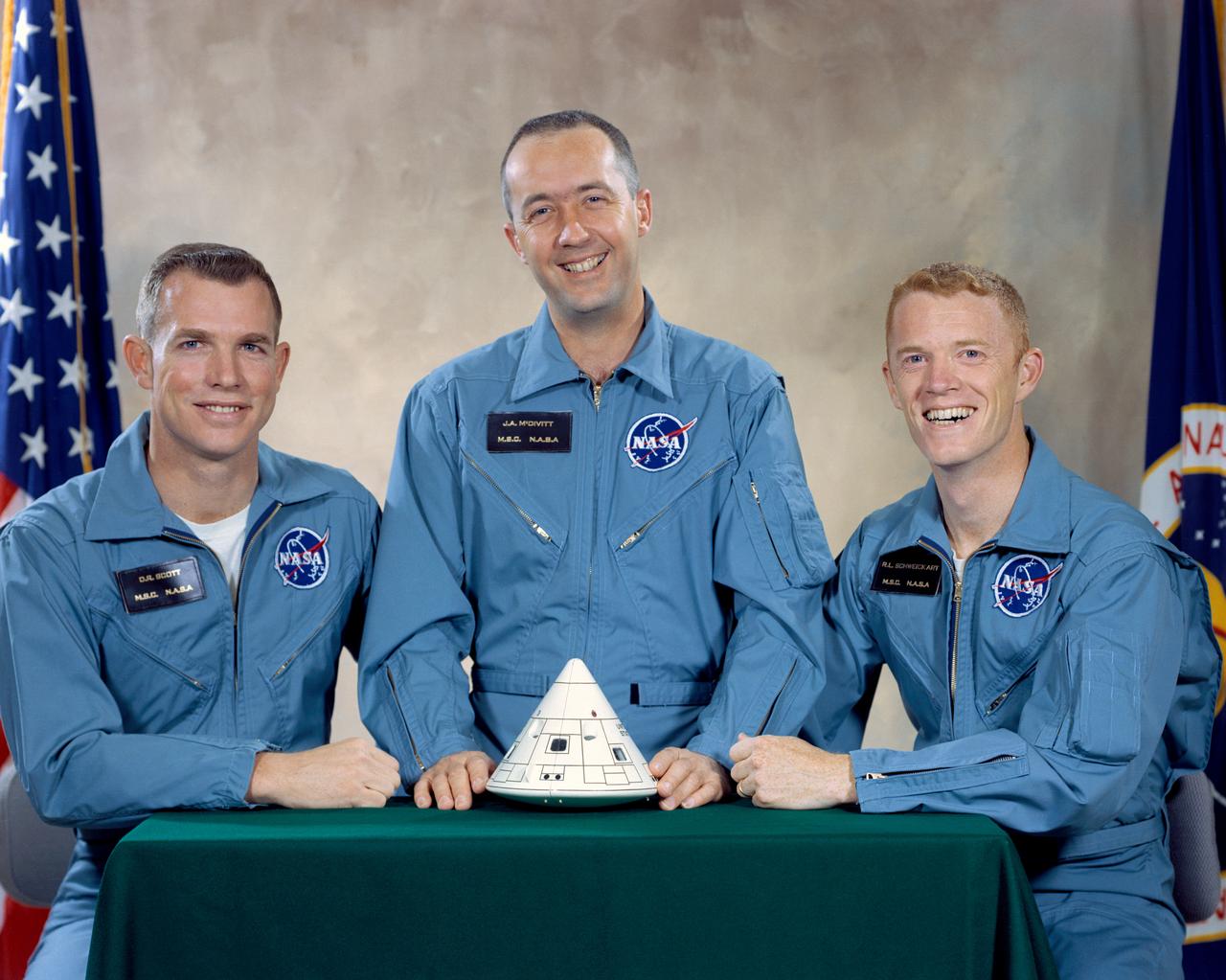
S66-30237 (March 1966) --- These three astronauts have been named as the prime crew of the Apollo 9 mission. They are (left to right) David R. Scott, command module pilot; James A. McDivitt, commander; and Russell L. Schweickart, lunar module pilot.

S69-17590 (18 Dec. 1968) --- These three astronauts are the prime crew of the Apollo 9 (Spacecraft 104/ Lunar Module 3/ Saturn 504) space mission. Left to right, are James A. McDivitt, commander; David R. Scott, command module pilot; and Russell L. Schweickart, lunar module pilot.
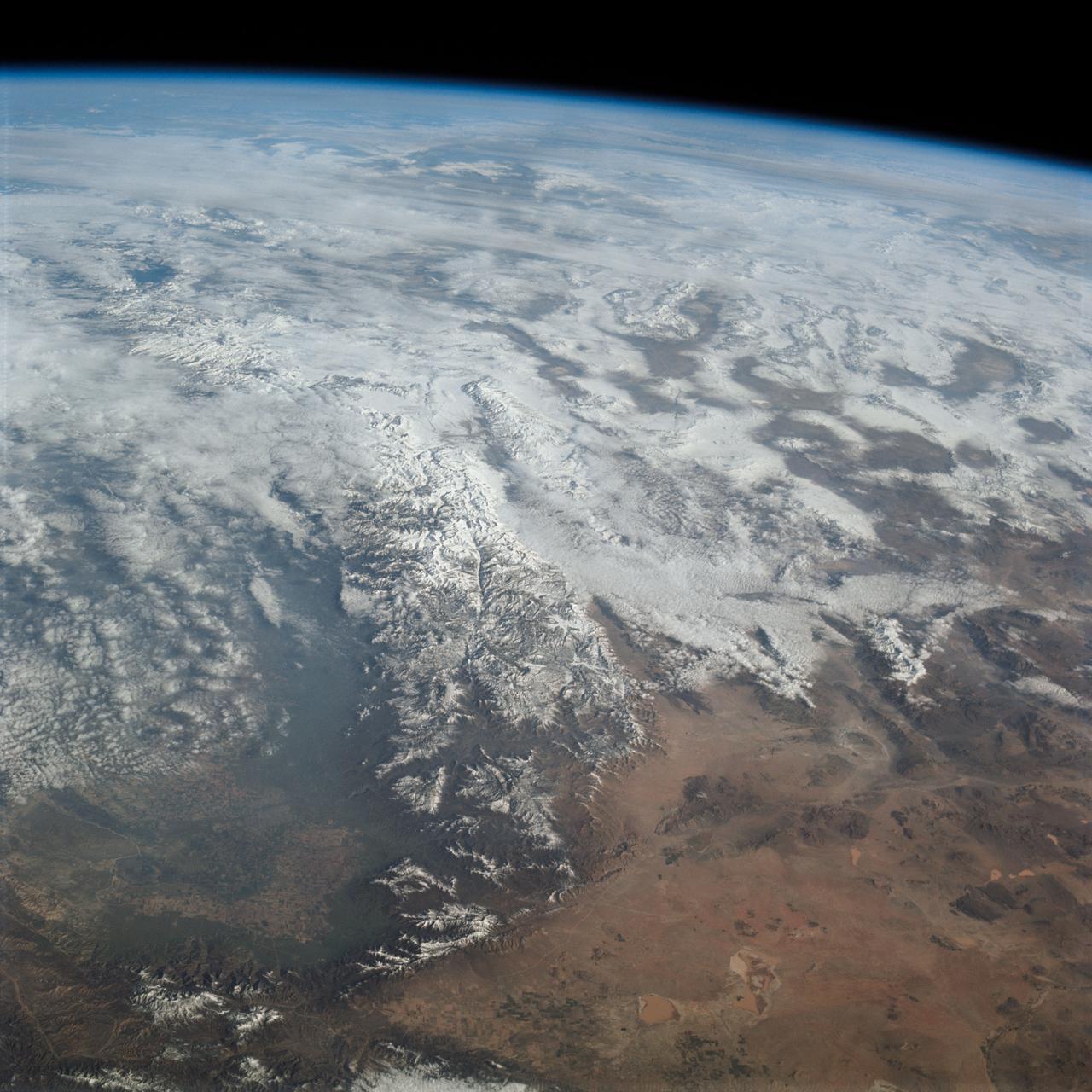
Oblique Earth Observation taken by the Apollo 9 crew. View is of California and includes Sierra Nevada, and the Mojave Desert. Film magazine was E,film type was SO-368 Ektachrome with 0.460 - 0.710 micrometers film / filter transmittance response and haze filter,80mm lens. Latitude was 35.20 N by Longitude 118.10 W, Overlap was 80%, Altitude miles were 130 and cloud cover was 20%.
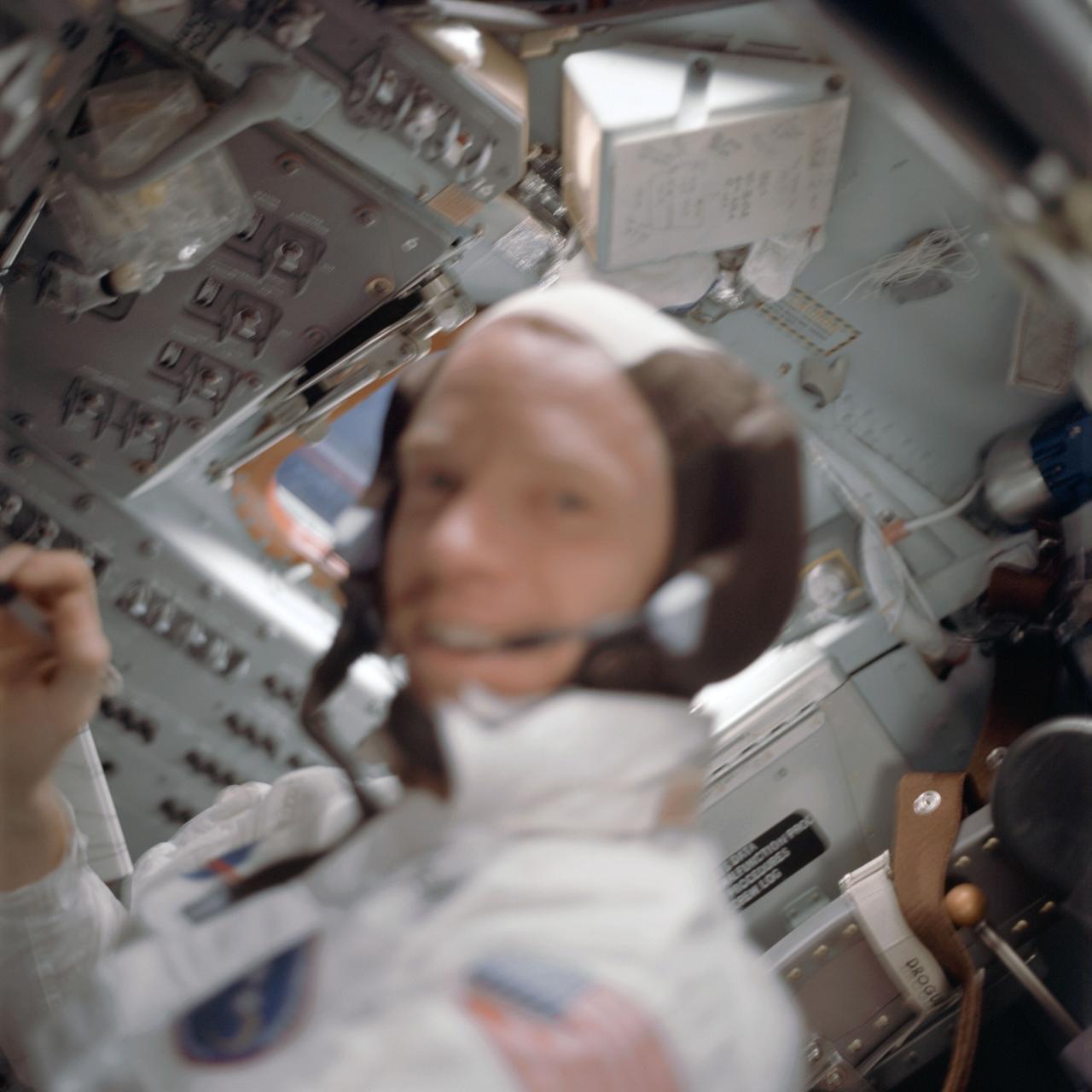
Astronaut Russell Schweickart, Apollo 9 Lunar Module pilot, is photographed inside Lunar Module "Spider" during the Apollo 9 earth-orbital mission.
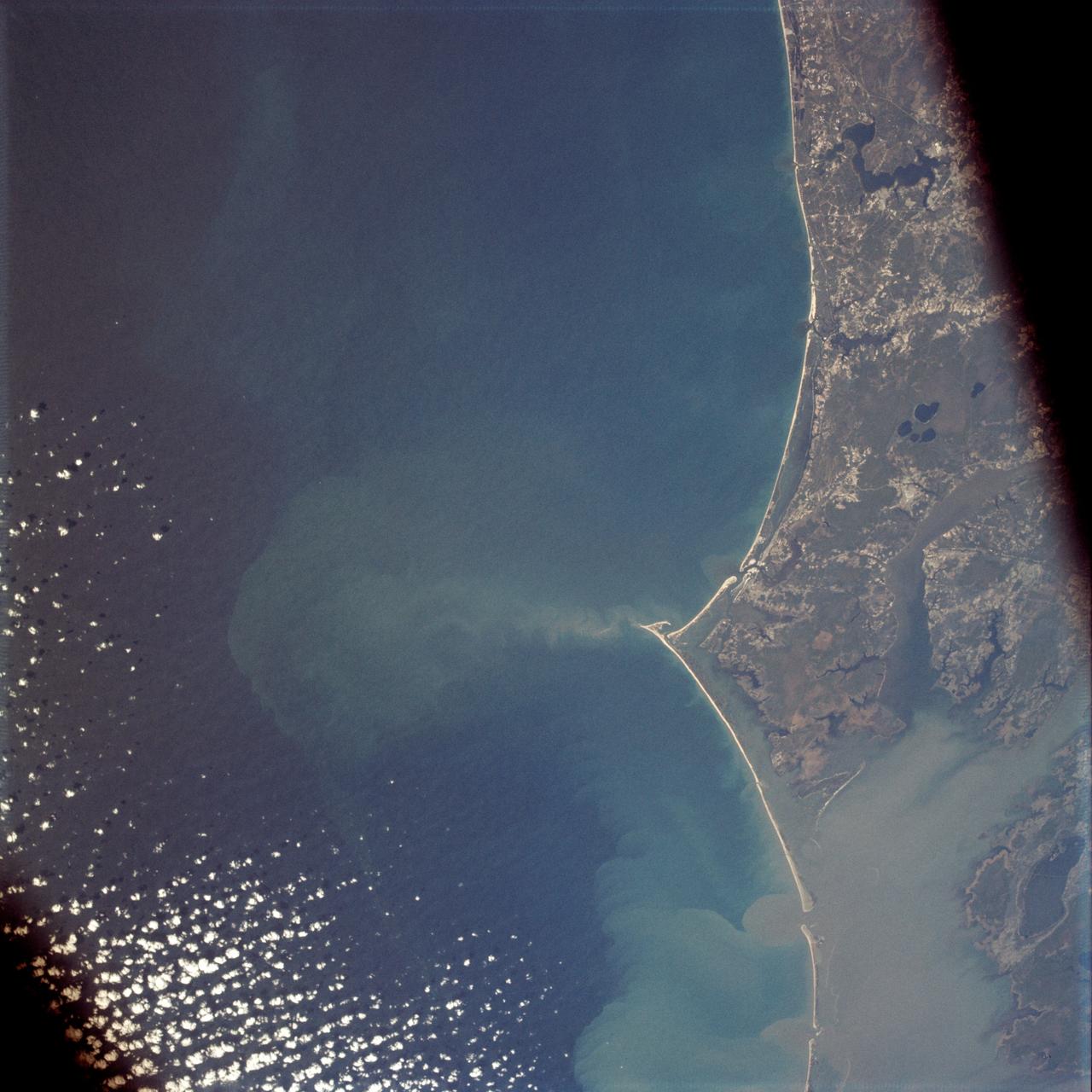
Vertical Earth Observation taken by the Apollo 9 crew. View is of North Carolina including Cape Lookout and Pamilco Sound. Film magazine was E,film type was SO-368 Ektachrome with 0.460 - 0.710 micrometers film / filter transmittance response and haze filter,80mm lens. Latitude was 34.35 N by Longitude 76.30 W, Overlap was 0%, Altitude miles were 116 and cloud cover was 15%.
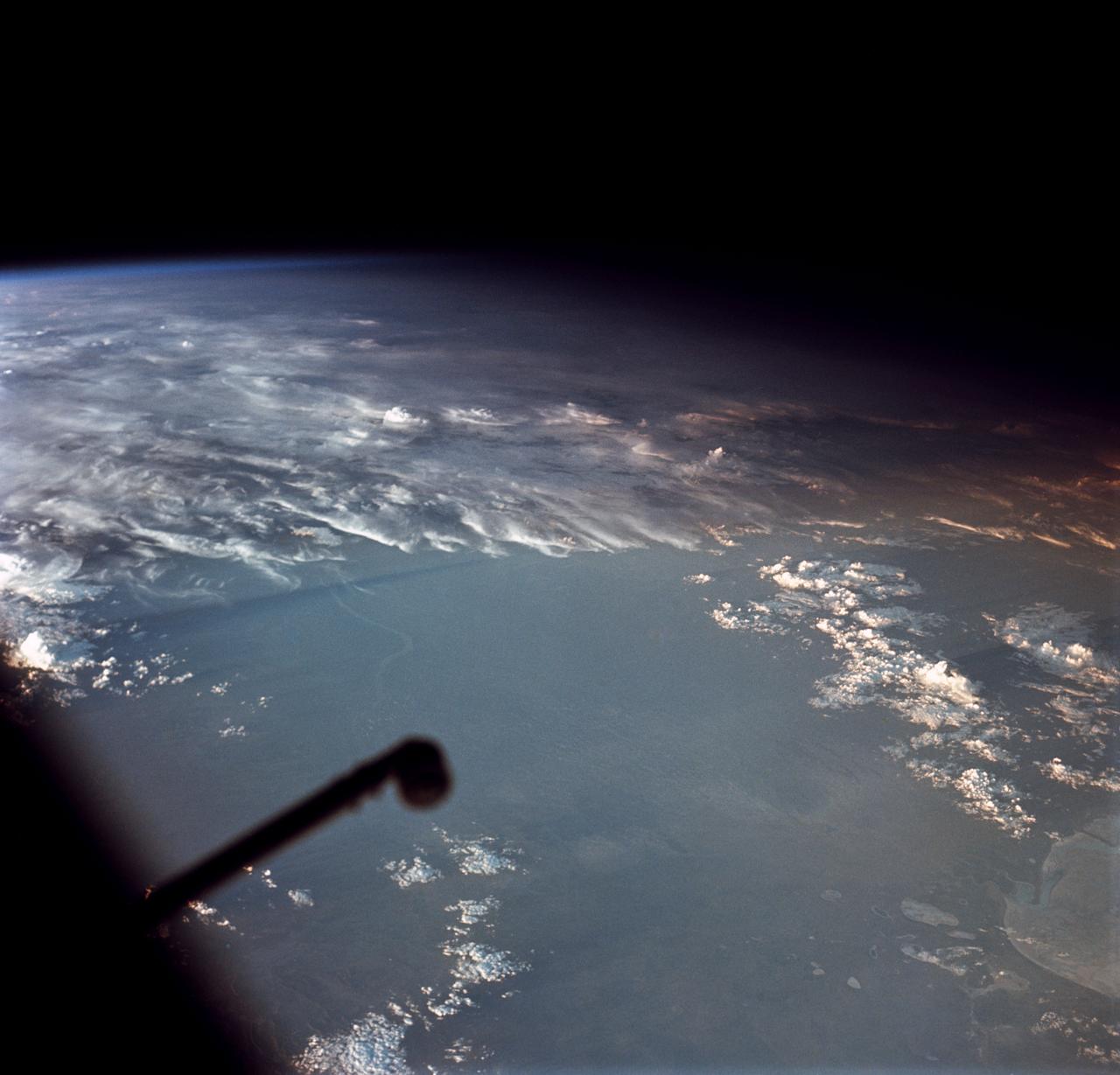
Oblique Earth Observation taken by the Apollo 9 crew. View is of southwest Africa near Cape Fria. Film magazine was E,film type was SO-368 Ektachrome with 0.460 - 0.710 micrometers film / filter transmittance response and haze filter,80mm lens. Latitude was 21.15 S by Longitude 12.40 E, Overlap was 80%, Altitude miles were 163 and cloud cover was 40%.
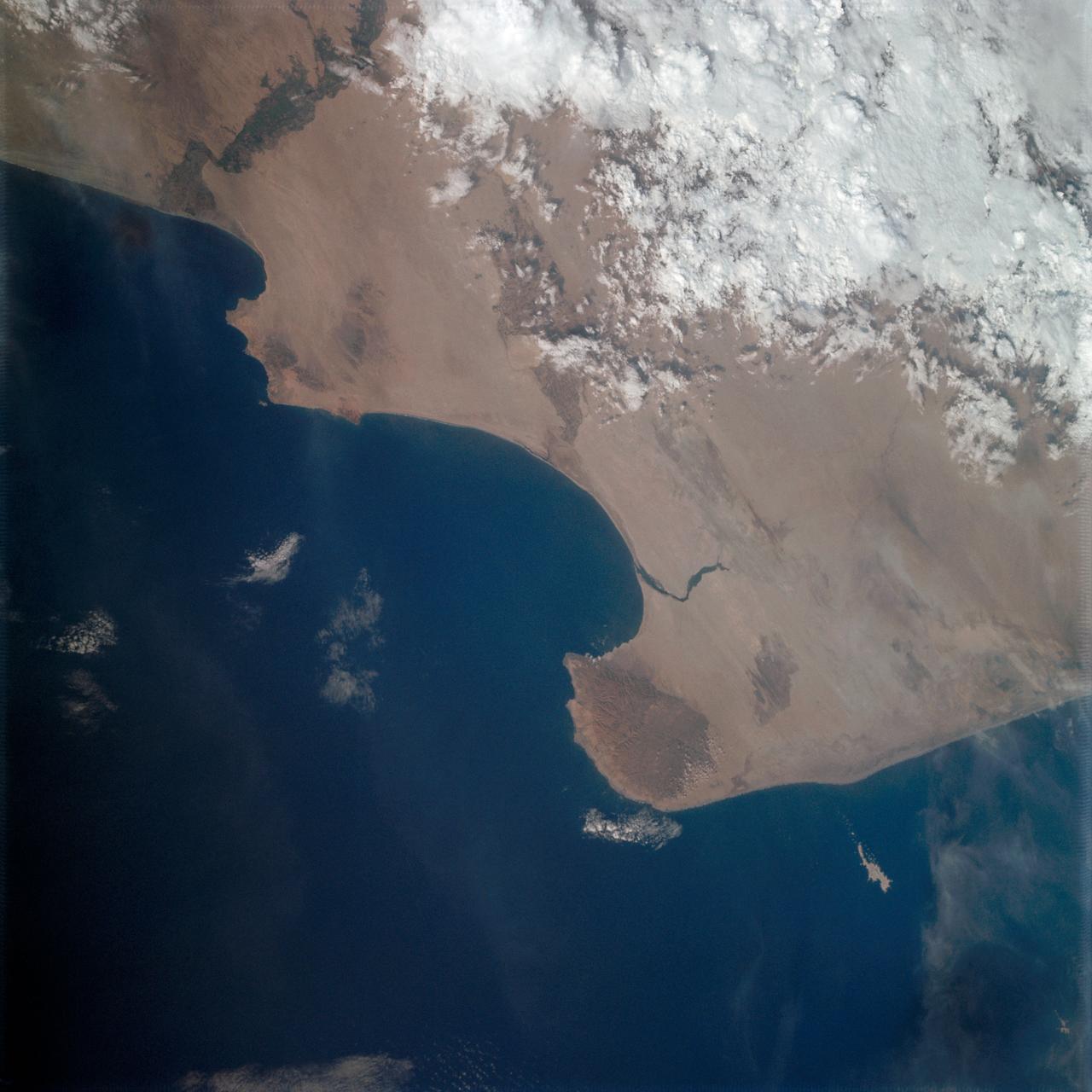
Vertical Earth Observation taken by the Apollo 9 crew. View is of Peru and South America including Aguja Point and Piura. Film magazine was E,film type was SO-368 Ektachrome with 0.460 - 0.710 micrometers film / filter transmittance response and haze filter,80mm lens. Latitude was 5.35 S by Longitude 81.05 W, Overlap was 0%, Altitude miles were 125 and cloud cover was 20%.
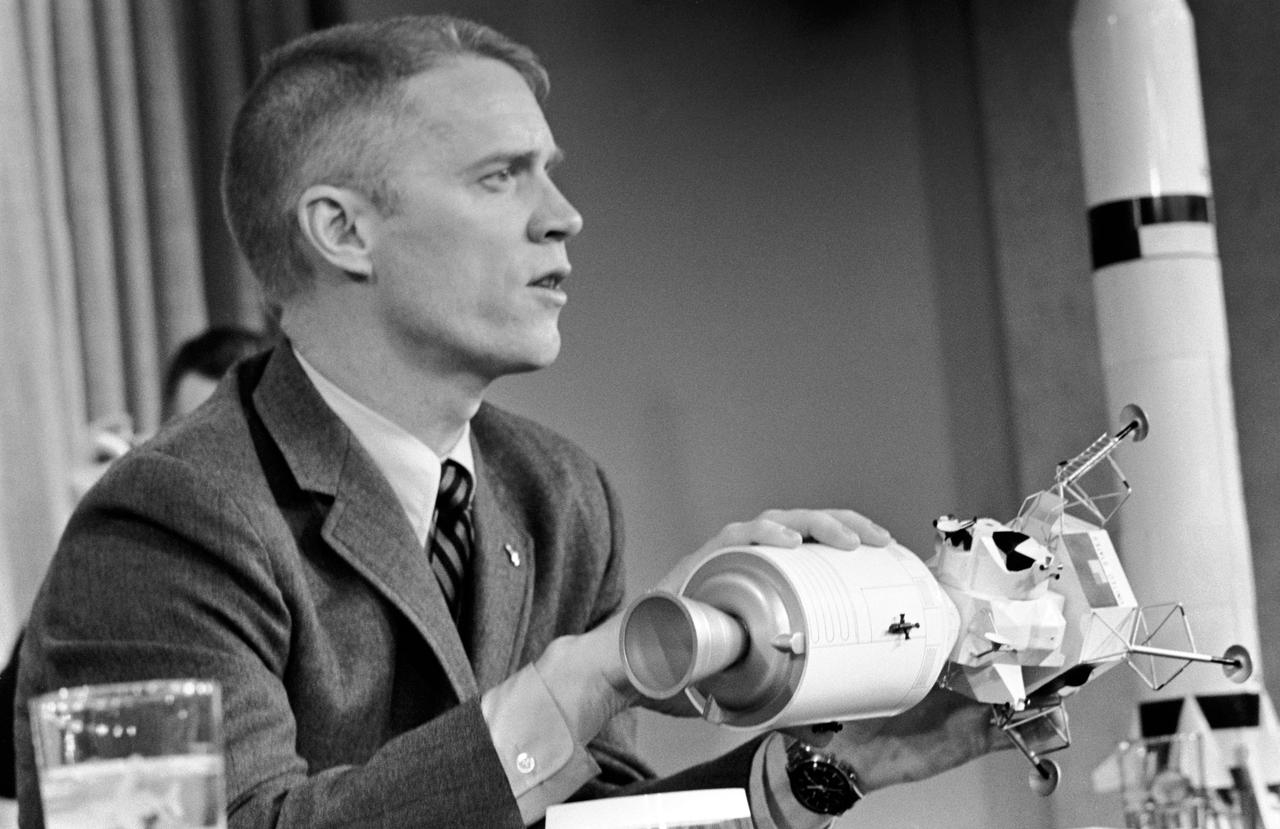
S69-17615 (25 Jan. 1969) --- Astronaut Russell L. Schweickart, lunar module pilot of the Apollo 9 prime crew, participates in a press conference at the Grumman Aircraft Engineering Corporation. Grumman is the contractor to NASA for the Lunar Module. Schweickart is holding a model of a docked Lunar Module/Command and Service Modules. The Apollo 9 mission will evaluate spacecraft lunar module systems performance during manned Earth-orbital flight.
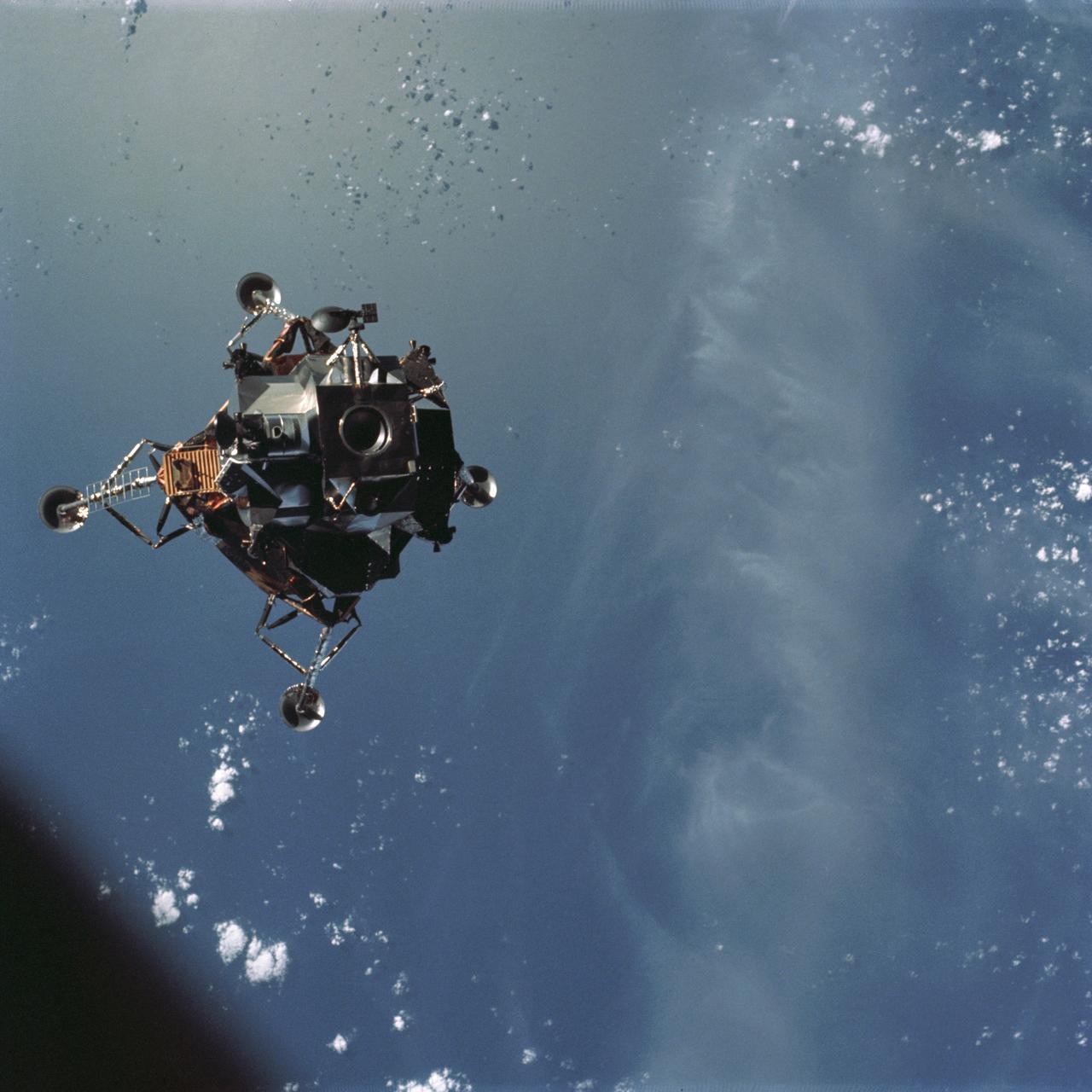
AS09-21-3181 (7 March 1969) --- A View of the Apollo 9 Lunar Module (LM), "Spider," in a lunar lading configuration, as photographed from the Command and Service Modules (CSM) on the fifth day of the Apollo 9 Earth-orbital mission. The landing gear on the "Spider" has been deployed. Inside the "Spider" were astronauts James A. McDivitt, Apollo 9 commander; and Russell L. Schweickart, lunar module pilot. Astronaut David R. Scott, command module pilot, remained at the controls in the Command Module (CM), "Gumdrop," while the other two astronauts checked out the LM.
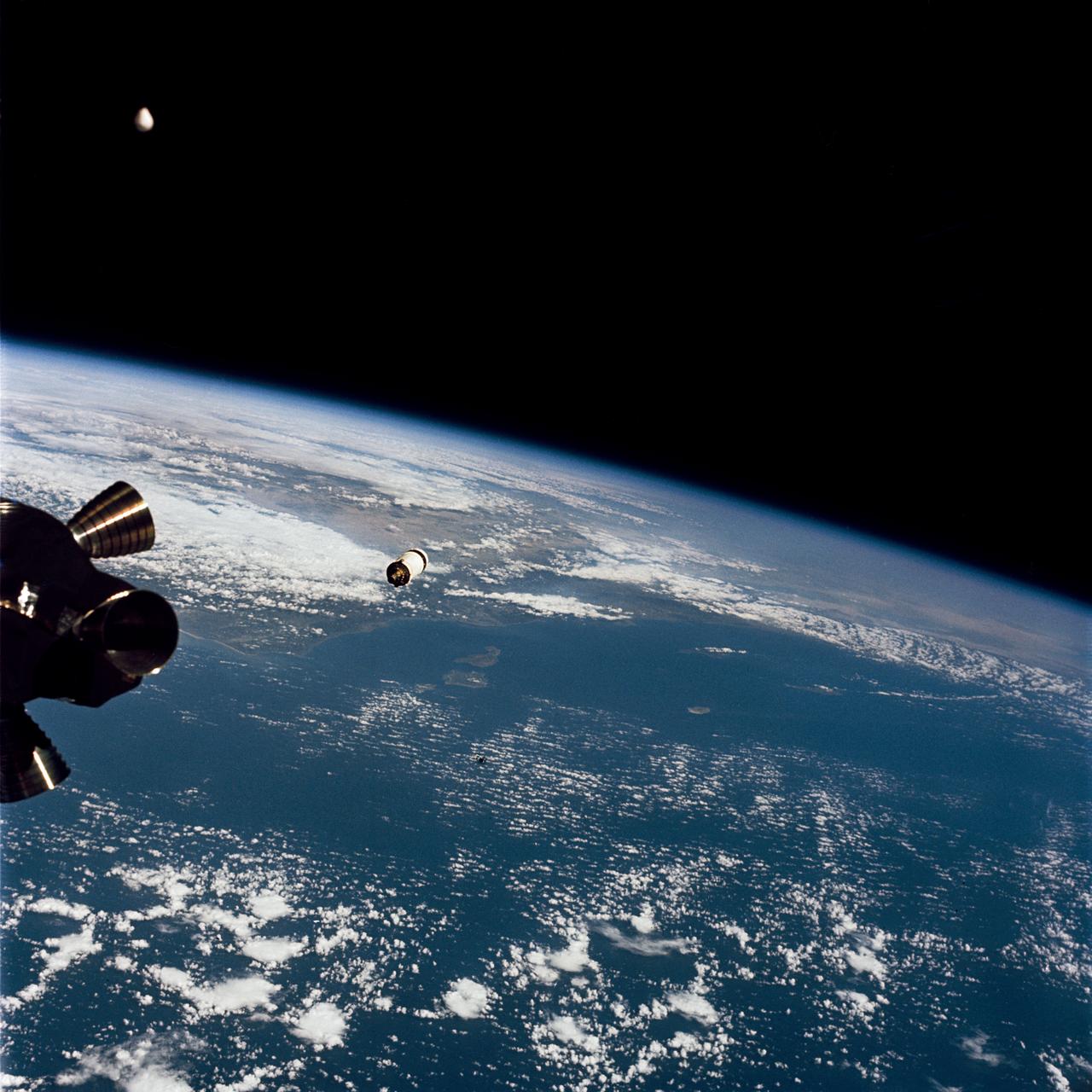
Oblique Earth Observation taken by the Apollo 9 crew. View is of California including: Sanata Barbara, Los Angeles, San Diego, Santa Rosa, San Miguel, and Santa Cruz Islands, Santa Barbara Channel, Salton Sea and the Service Module (SM) Lunar Module (LM) adapter (S.L.A.) in the distance. Film magazine was A,film type was SO-368 Ektachrome with 0.460 - 0.710 micrometers film / filter transmittance response and haze filter, 80mm lens. Latitude was 32.55 N by Longitude 119.58 W, Altitude miles were 106 and cloud cover was 25%.
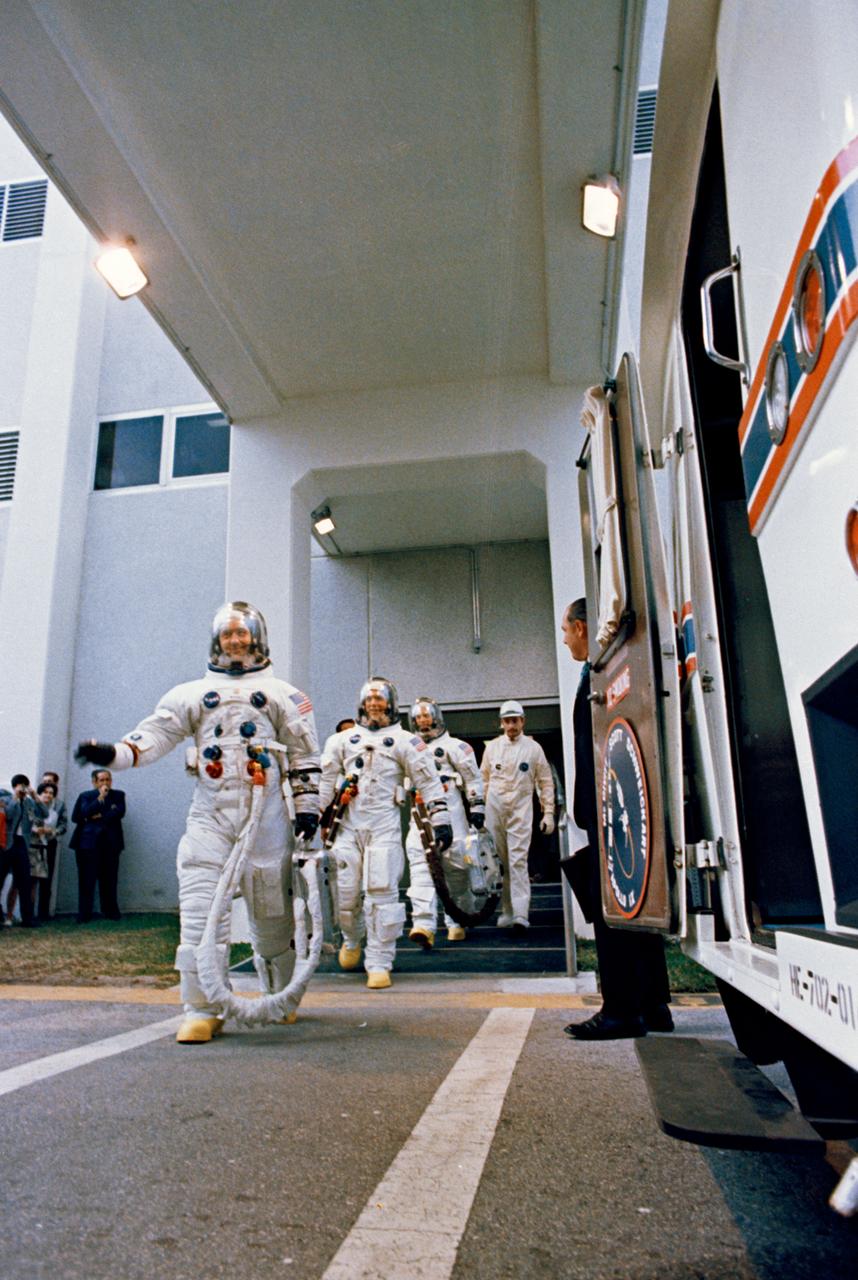
S69-25883 (3 March 1969) --- The Apollo 9 crew leaves the Kennedy Space Center's Manned Spacecraft Operations Building during the Apollo 9 prelaunch countdown. Leading is astronaut James A. McDivitt, commander; followed by astronaut David R. Scott, command module pilot; and Russell L. Schweickart, lunar module pilot. Moments later they entered the special transfer van which transported them to their waiting spacecraft at Pad A, Launch Complex 39. Apollo 9 was launched at 11 a.m. (EST), March 3, 1969, on a 10-day Earth-orbital mission.
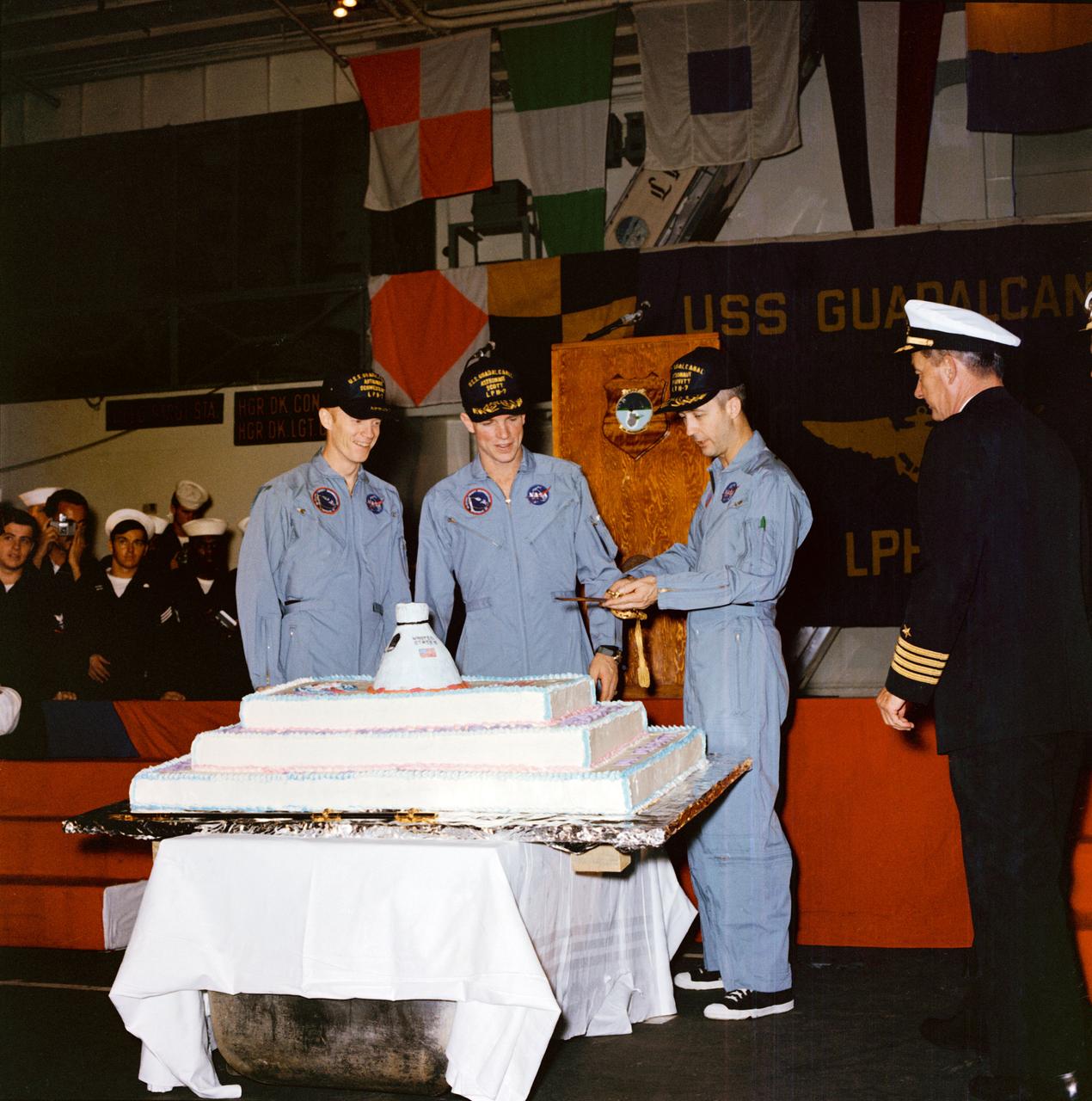
The Apollo 9 crew prepares to cut the 350-pound cake which was baked on the U.S.S. Guadalcanal in their honor. Left to right, are Astronauts Russell L. Schweickart, David R. Scott, and James A. McDivitt. Looking on at right is Capt. Roy M. Sudduth, commanding officer of the U.S.S. Guadalcanal.
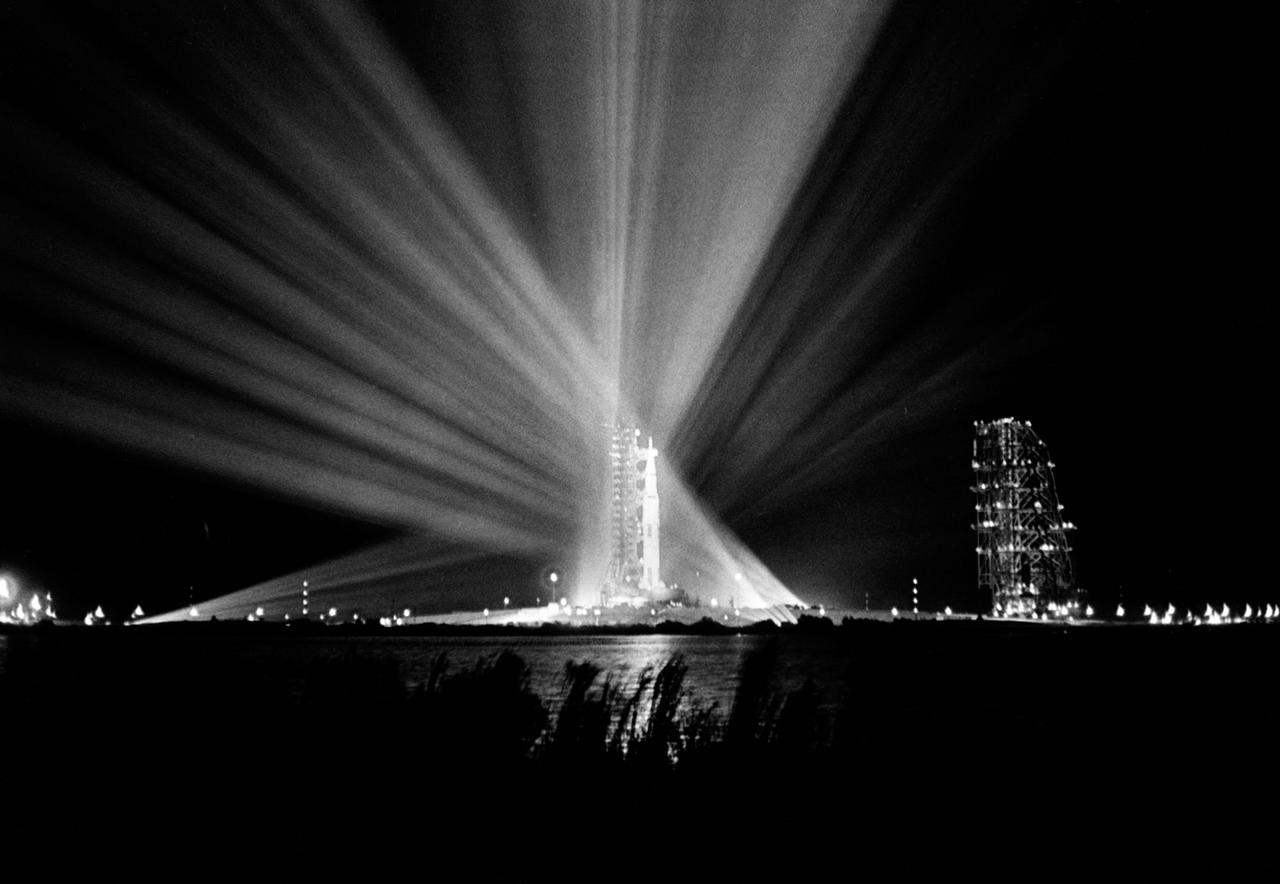
S69-25879 (23 Feb. 1969) --- Nighttime view of the 363-feet-high Apollo 9 space vehicle at Pad A, Launch Complex 39, Kennedy Space Center, during preparations for the scheduled 10-day Earth-orbital space mission. The crew of the Apollo 9 (Spacecraft 104/Lunar Module 3/Saturn 504) space flight will be astronauts James A. McDivitt, David R. Scott, and Russell L. Schweickart.
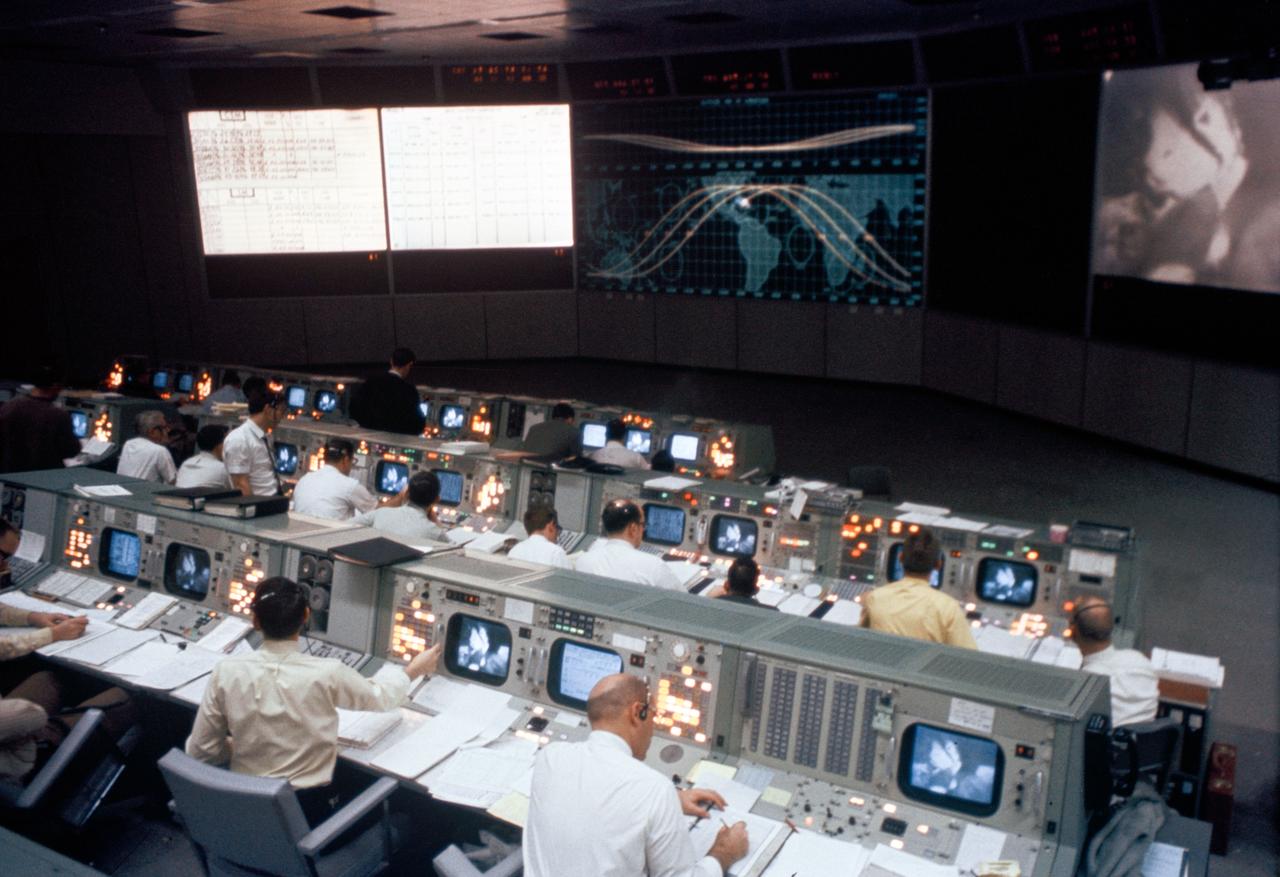
S69-26301 (March 1969) --- Overall view of the Mission Operations Control Room in the Mission Control Center, Building 30, during the Apollo 9 Earth-orbital mission. When this photograph was taken a live television transmission was being received from Apollo 9 as it orbited Earth.
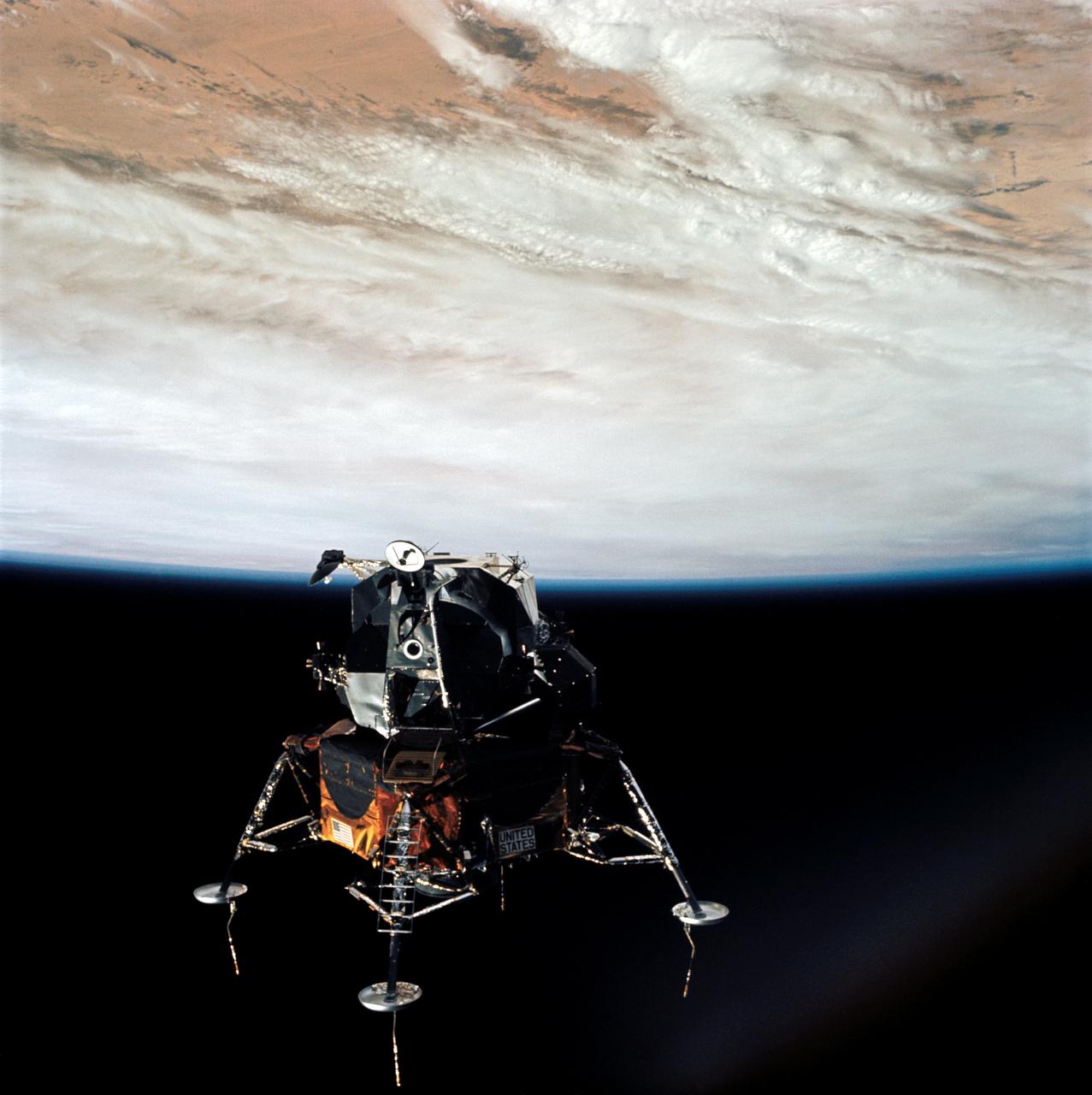
AS09-21-3212 (7 March 1969) --- A view of the Apollo 9 Lunar Module (LM), "Spider", in a lunar landing configuration, as photographed from the Command and Service Modules (CSM) on the fifth day of the Apollo 9 Earth-orbital mission. The landing gear on the "Spider" has been deployed. Lunar surface probes (sensors) extend out from landing gear foot pads. Inside the "Spider" were astronauts James A. McDivitt, Apollo 9 commander, and Russell L. Schweickart, lunar module pilot. Astronaut David R. Scott, command module pilot, remained at the controls in the Command Module (CM), "Gumdrop", while the other two astronauts checked out the Lunar Module.
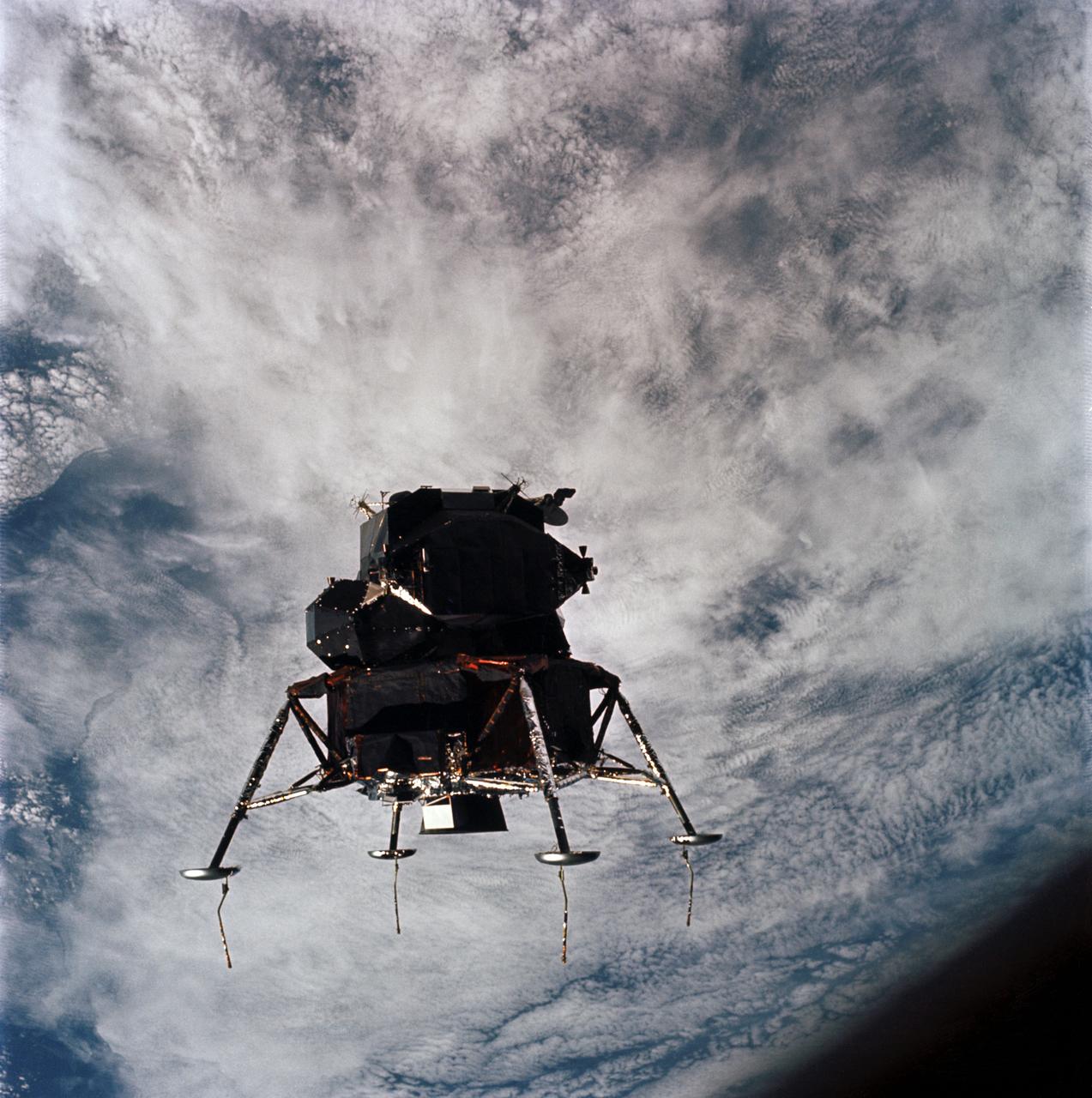
AS09-21-3199 (7 March 1969) --- Excellent view of the Apollo 9 Lunar Module, "Spider," in a lunar landing configuration, as photographed from the Command and Service Modules on the fifth day of the Apollo 9 Earth-orbital mission. The landing gear on the "Spider" has been deployed. Lunar surface probes (sensors) extend out from the landing gear foot pads. Inside the "Spider" were astronauts James A. McDivitt, Apollo 9 commander; and Russell L. Schweickart, lunar module pilot. Astronaut David R. Scott, command module pilot, remained at the controls in the Command Module, "Gumdrop," while the other two astronauts checked out the Lunar Module.
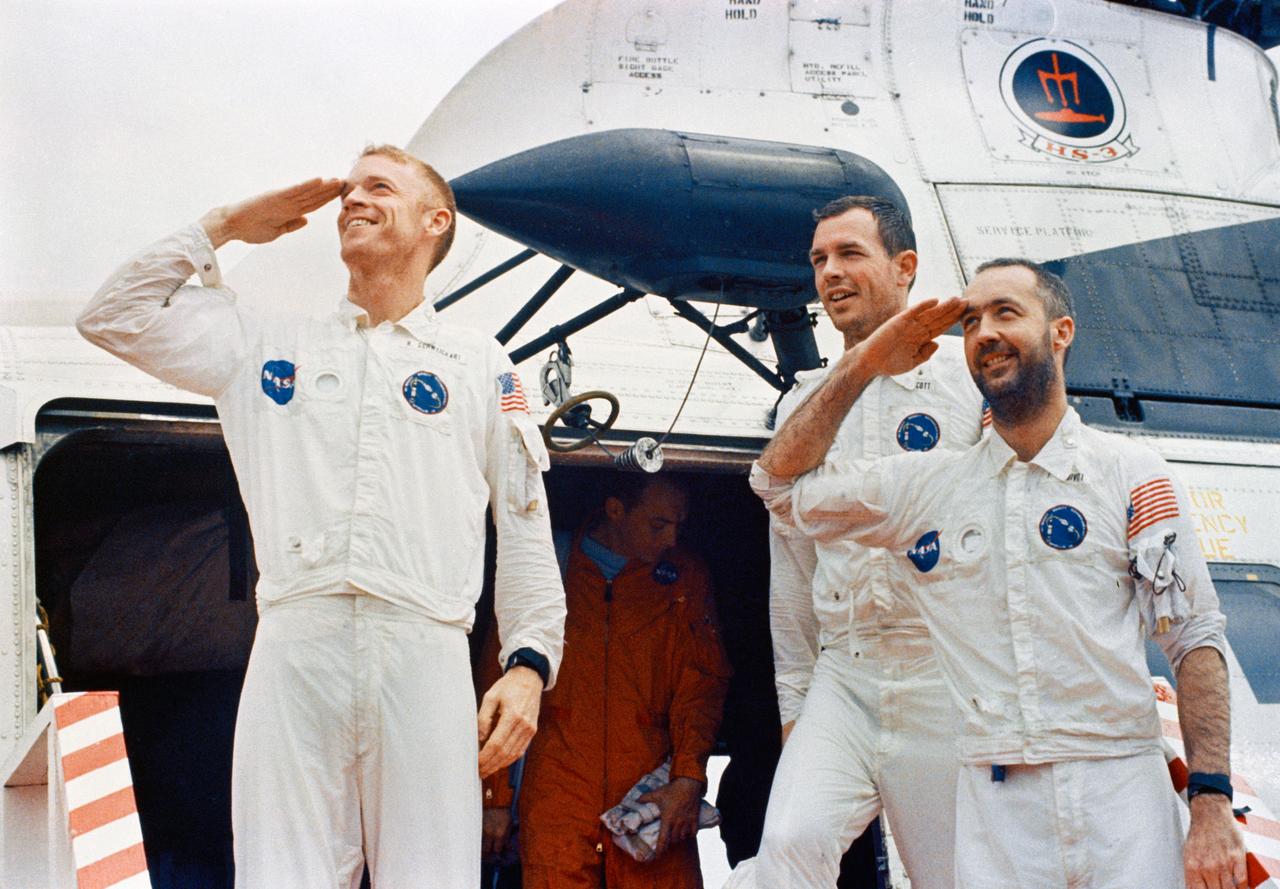
S69-27921 (13 March 1969) --- The Apollo 9 crewmen arrive aboard the USS Guadalcanal as they step from a helicopter to receive a red-carpet welcome. Two of the crewmen salute the crowd of newsmen, Navy and NASA personnel gathered to greet them. Left to right, are astronauts Russell L. Schweickart, David R. Scott, and James A. McDivitt. Splashdown occurred at 12:00:53 p.m. (EST), March 13, 1969, only 4.5 nautical miles from the USS Guadalcanal, prime recovery ship, to conclude a successful 10-day Earth-orbital space mission. Photo credit: NASA
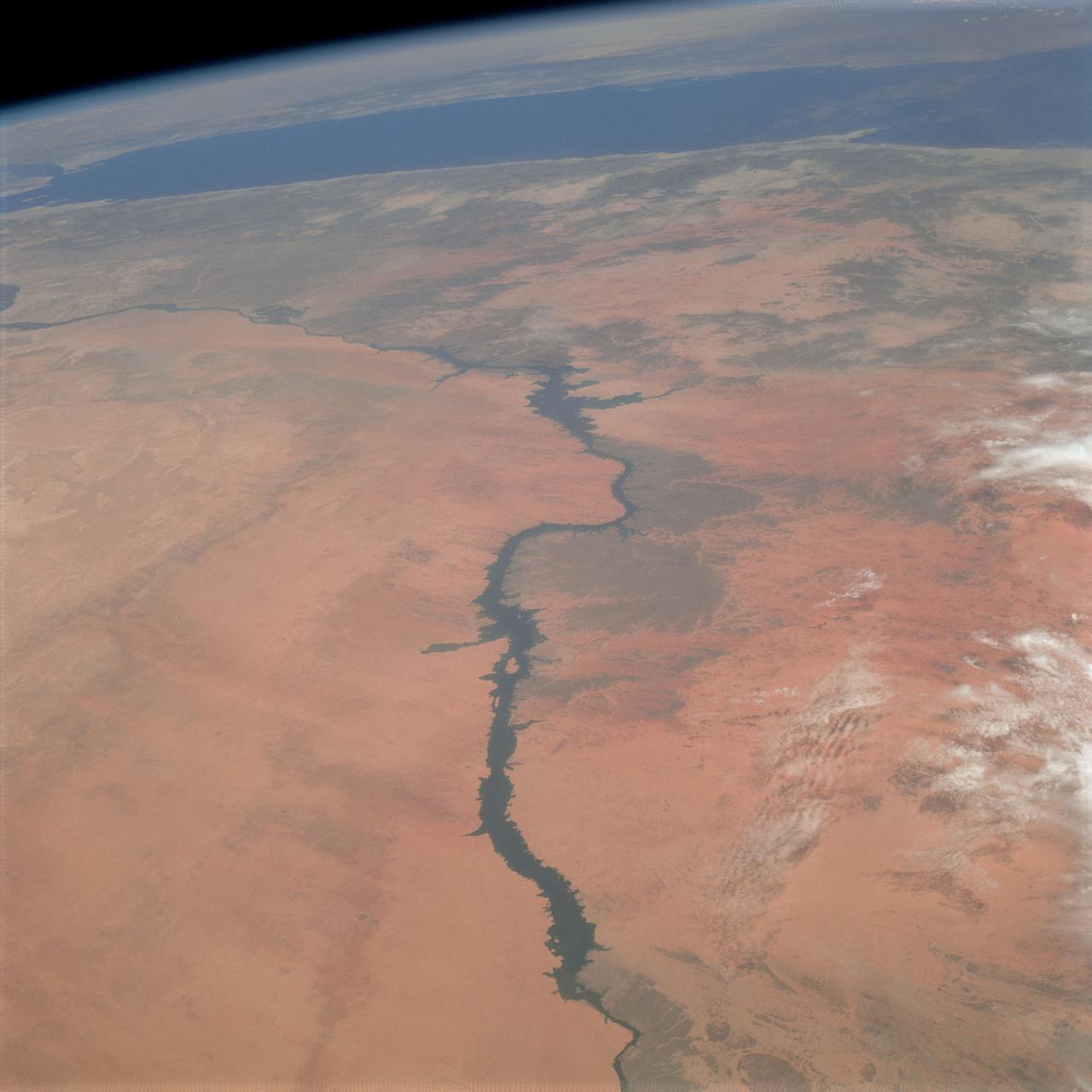
Oblique Earth Observation taken by the Apollo 9 crew. View is the United Arab Republic,the Nile River,The Red Sea and the Aswan Dam. Film magazine was E,film type was SO-368 Ektachrome with 0.460 - 0.710 micrometers film / filter transmittance response and haze filter,80mm lens. Latitude was 19.38 N by Longitude 30.24 E, Overlap was 50%, Altitude was 97 nautical miles and cloud cover was 5%.
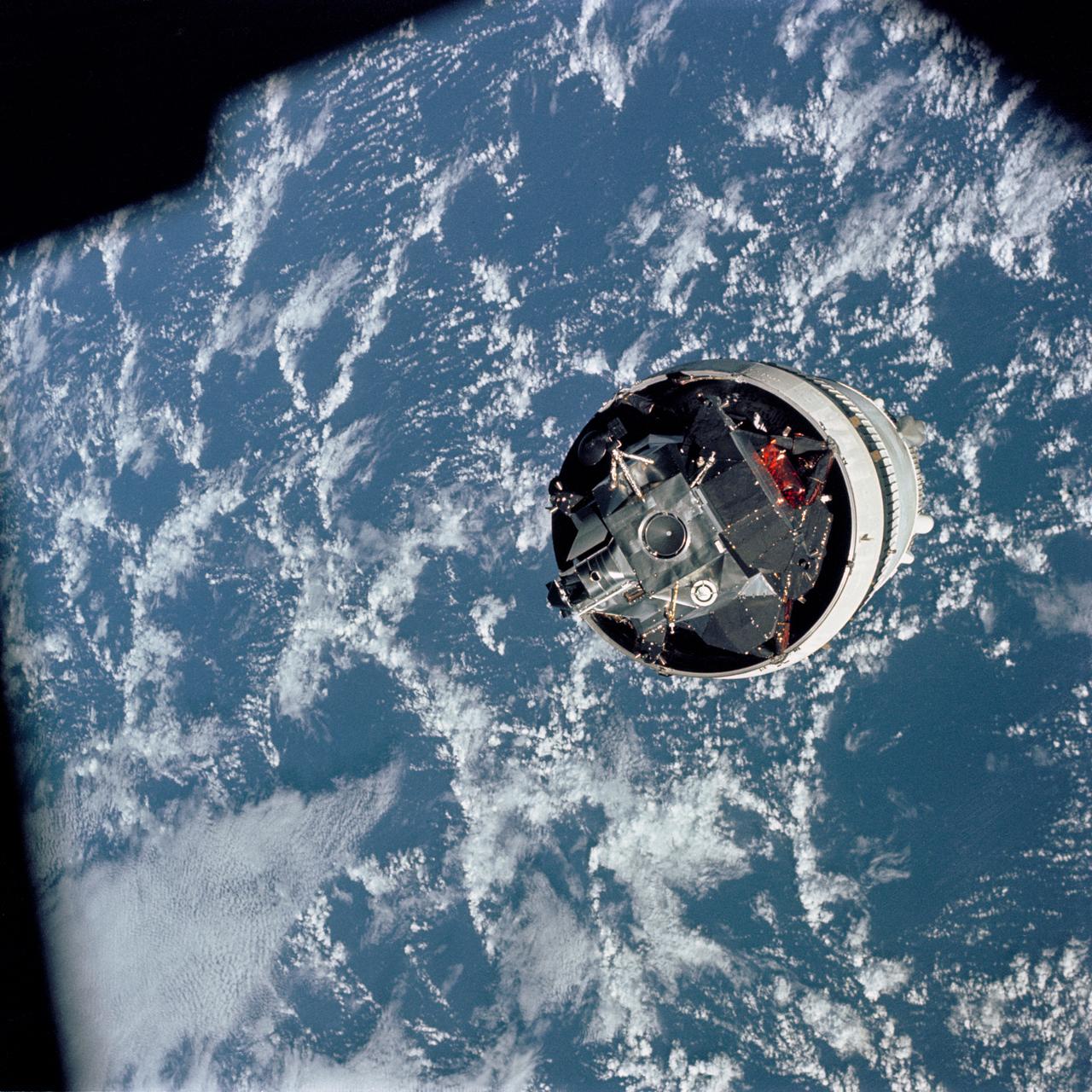
The Lunar Module (LM) 3 "Spider",still attached to the Saturn V third (S-IVB) stage,is photographed from the Command/Service Module (CSM) "Gumdrop" on the first day of the Apollo 9 Earth-orbital mission. This picture was taken following CSM/LM-S-IVB separation,and prior to LM extraction from the S-IVB. The Spacecraft Lunar Module Adapter (SLA) panels have already been jettisoned. Film magazine was A,film type was SO-368 Ektachrome with 0.460 - 0.710 micrometers film / filter transmittance response and haze filter, 80mm lens.
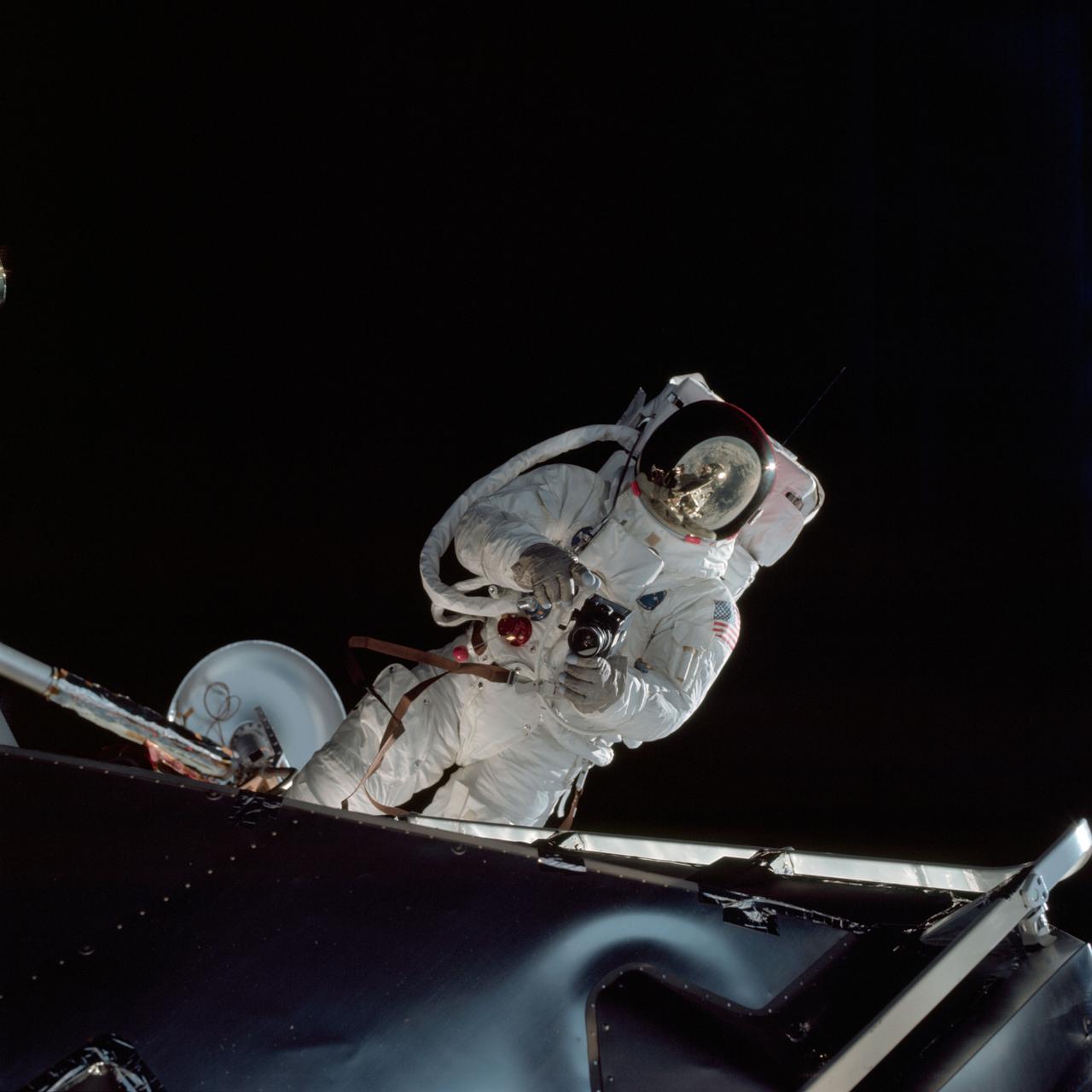
Astronaut Russell L. Schweickart, lunar module pilot, operates a 70mm Hasselblad camera during his extravehicular activity on the fourth day of the Apollo 9 earth-orbital mission. The Command/Service Module and the Lunar Module 3 "Spider" are docked. This view was taken form the Command Module "Gumdrop". Schweickart, wearing an Extravehicular Mobility Unit (EMU), is standing in "golden slippers" on the Lunar Module porch. On his back, partially visible, are a Portable Life Support System (PLSS) and an Oxygen Purge System (OPS). Film magazine was A,film type was SO-368 Ektachrome with 0.460 - 0.710 micrometers film / filter transmittance response and haze filter,80mm lens.

AS09-20-3064 (6 March 1969) --- Excellent view of the docked Apollo 9 Command and Service Modules (CSM) and Lunar Module (LM), with Earth in the background, during astronaut David R. Scott's stand-up extravehicular activity (EVA), on the fourth day of the Apollo 9 Earth-orbital mission. Scott, command module pilot, is standing in the open hatch of the Command Module (CM). Astronaut Russell L. Schweickart, lunar module pilot, took this photograph of Scott from the porch of the LM. Inside the LM was astronaut James A. McDivitt, Apollo 9 commander.
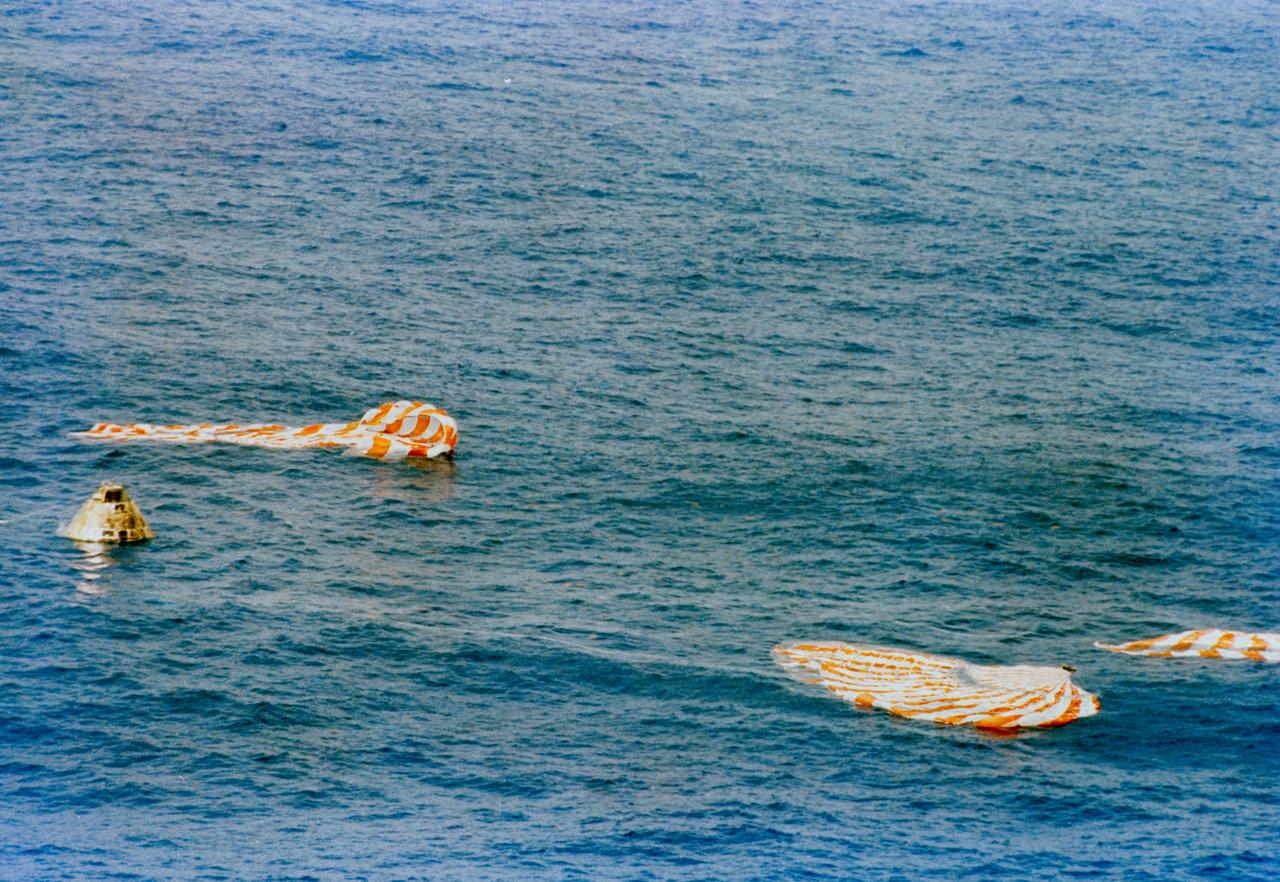
S69-27925 (13 March 1969) --- The Apollo 9 spacecraft, with astronauts James A. McDivitt, David R. Scott, and Russell L. Schweickart aboard, floats in the Atlantic immediately after splashdown. Moments later the three crewmen were picked up by a helicopter and flown to the deck of the USS Guadalcanal, prime recovery ship for the Apollo 9 10-day Earth-orbital space mission. Splashdown occurred at 12:00:53 p.m. (EST), March 13, 1969, only 4.5 nautical miles from the USS Guadalcanal. Just after this picture was taken U.S. Navy underwater demolition team swimmers were dropped into the water to assist in the recovery operations, including attaching a flotation collar to the spacecraft.
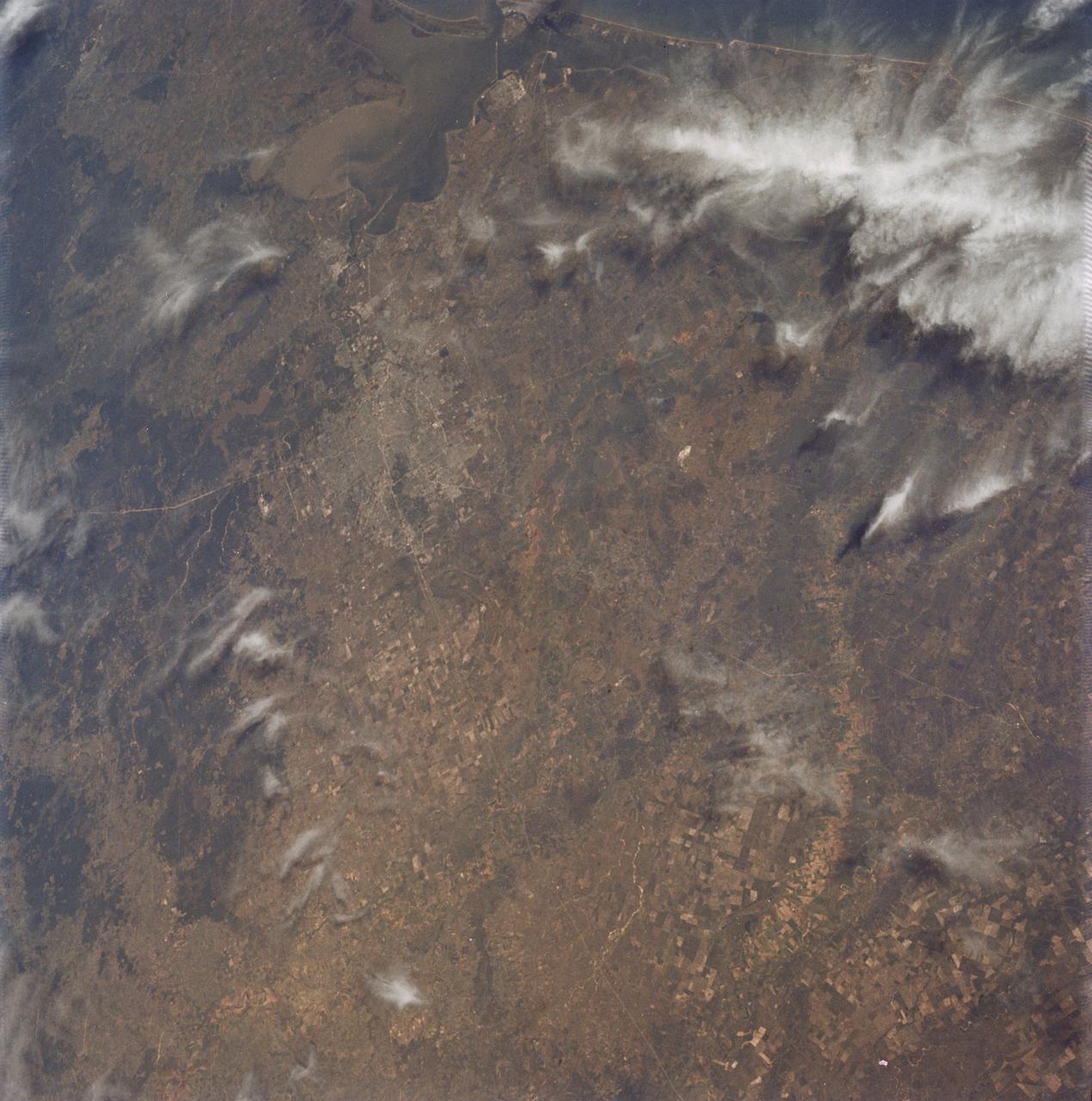
AS09-22-3463 (9 March 1969) --- Oblique view of the Houston, Texas area as photographed from the Apollo 9 spacecraft during its Earth-orbital mission. This picture was taken from an altitude of 103 nautical miles, at about 1:40 p.m. (CST), on March 9, 1969. Prominent features visible include highways leading out of the city, Lake Houston, San Jacinto River, Trinity Bay, Galveston Bay, Brazos River, Baytown, and Texas City.
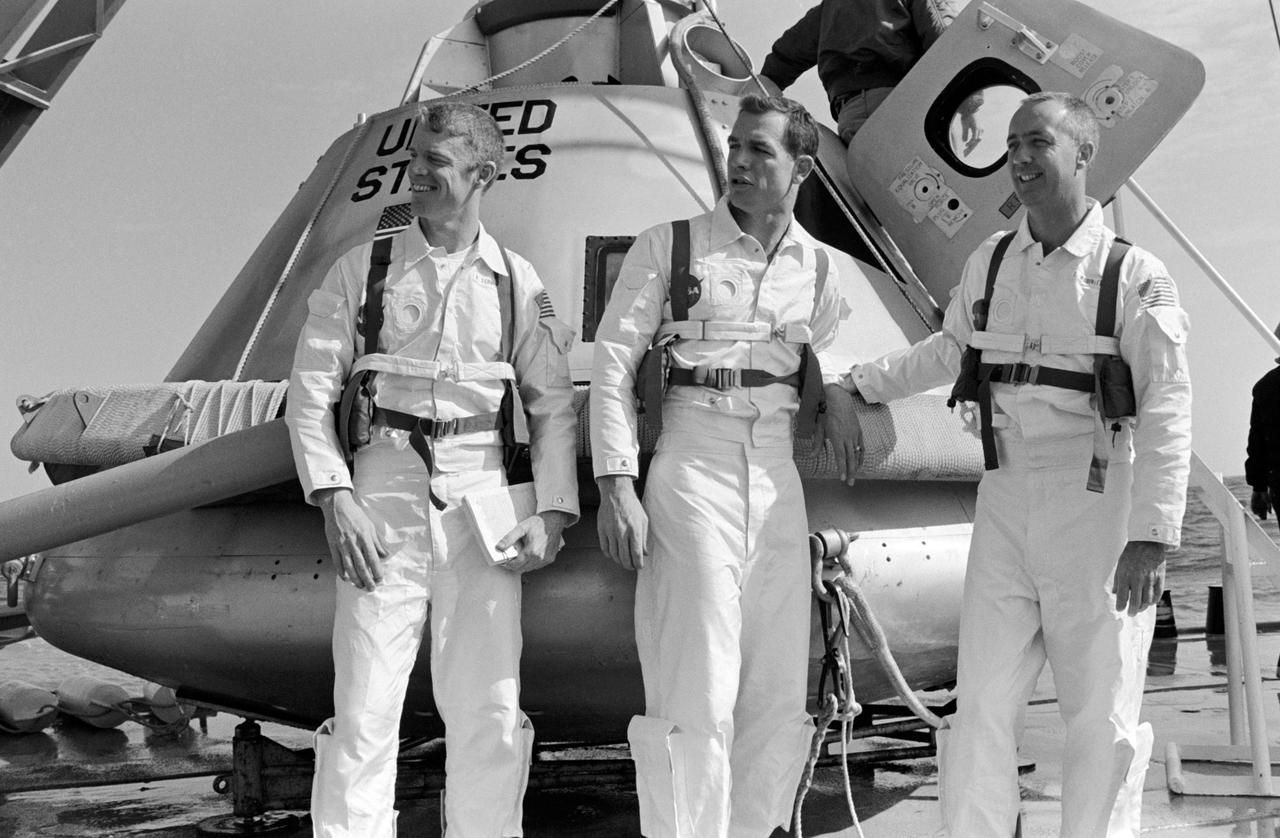
S68-54841 (5 Nov. 1968) --- The prime crew of the Apollo 9 (Spacecraft 104/Lunar Module 3/Saturn 504) space mission stands on the deck of the NASA Motor Vessel Retriever (MVR) prior to participating in water egress training in the Gulf of Mexico. Left to right, are astronauts Russell L. Schweickart, lunar module pilot; David R. Scott, command module pilot; and James A. McDivitt, commander. In background is the Apollo Command Module (CM) boilerplate which was used in the training exercise.
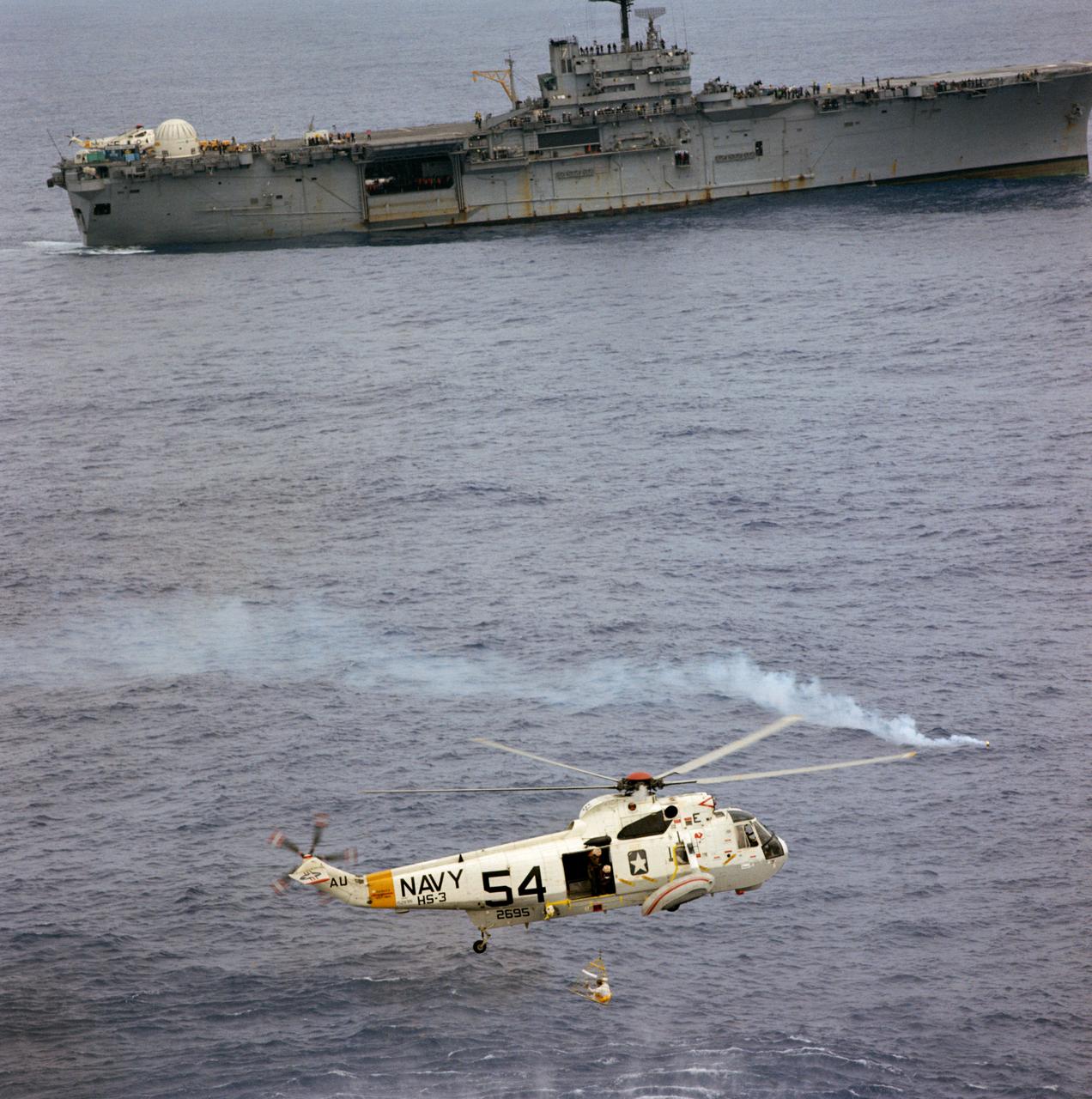
Aerial view of an Apollo 9 crewman in a new rescue net (a Billy Pugh net) being hoisted aboard a Navy helicopter after splashdown in the Atlantic recovery area and a successful ten-day, earth-orbital space mission. Navy divers have already attached a flotation collar to the command module and are assisting with recovery operations.
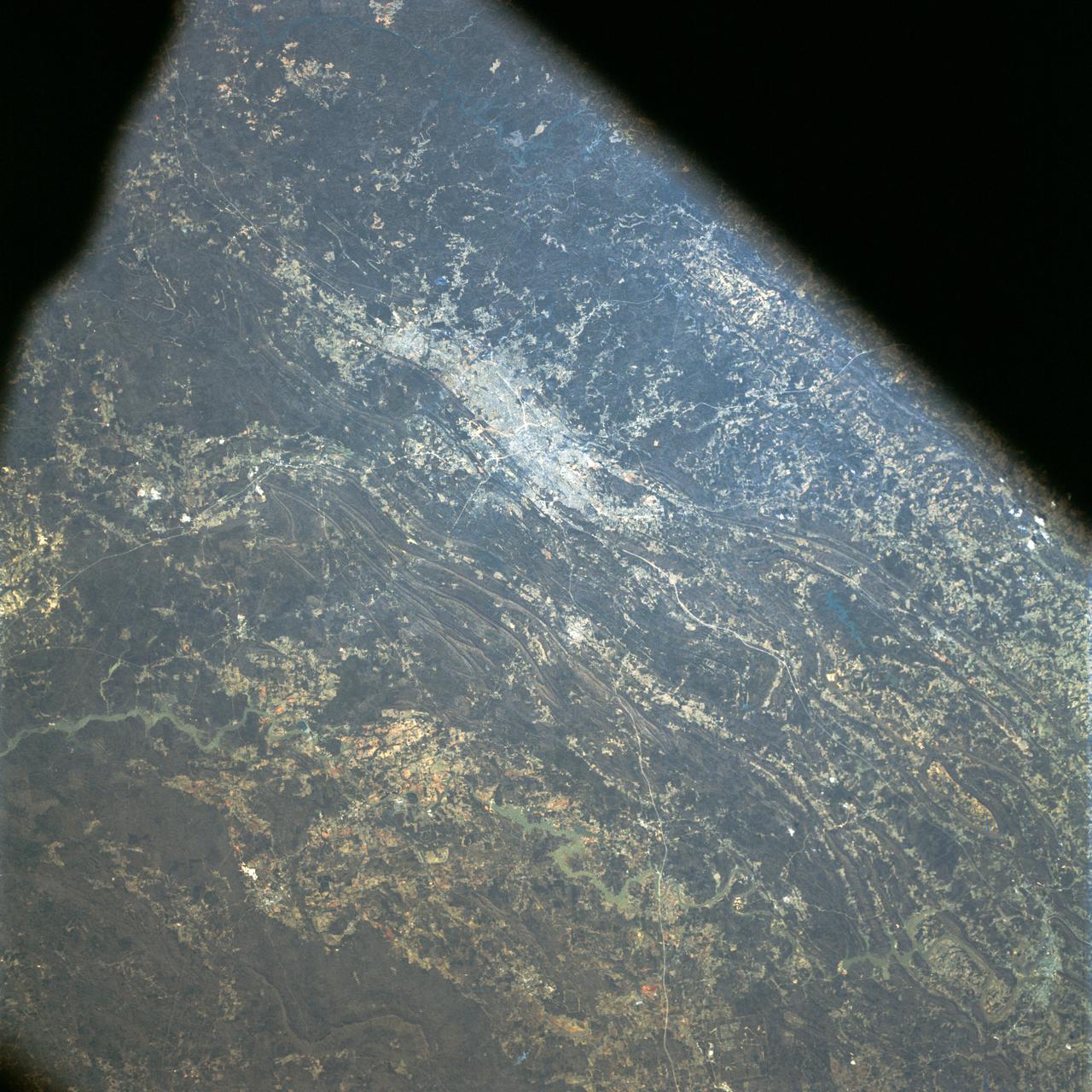
AS09-23-3566 (3-13 March 1969) --- Near vertical view of the Birmingham, Alabama area extending to Gadeden, as photographed from the Apollo 9 spacecraft during its Earth-orbital mission. The city spreads out between ridges of the folded southern Appalachian Mountains. The major stream in the picture is the Coosa River.
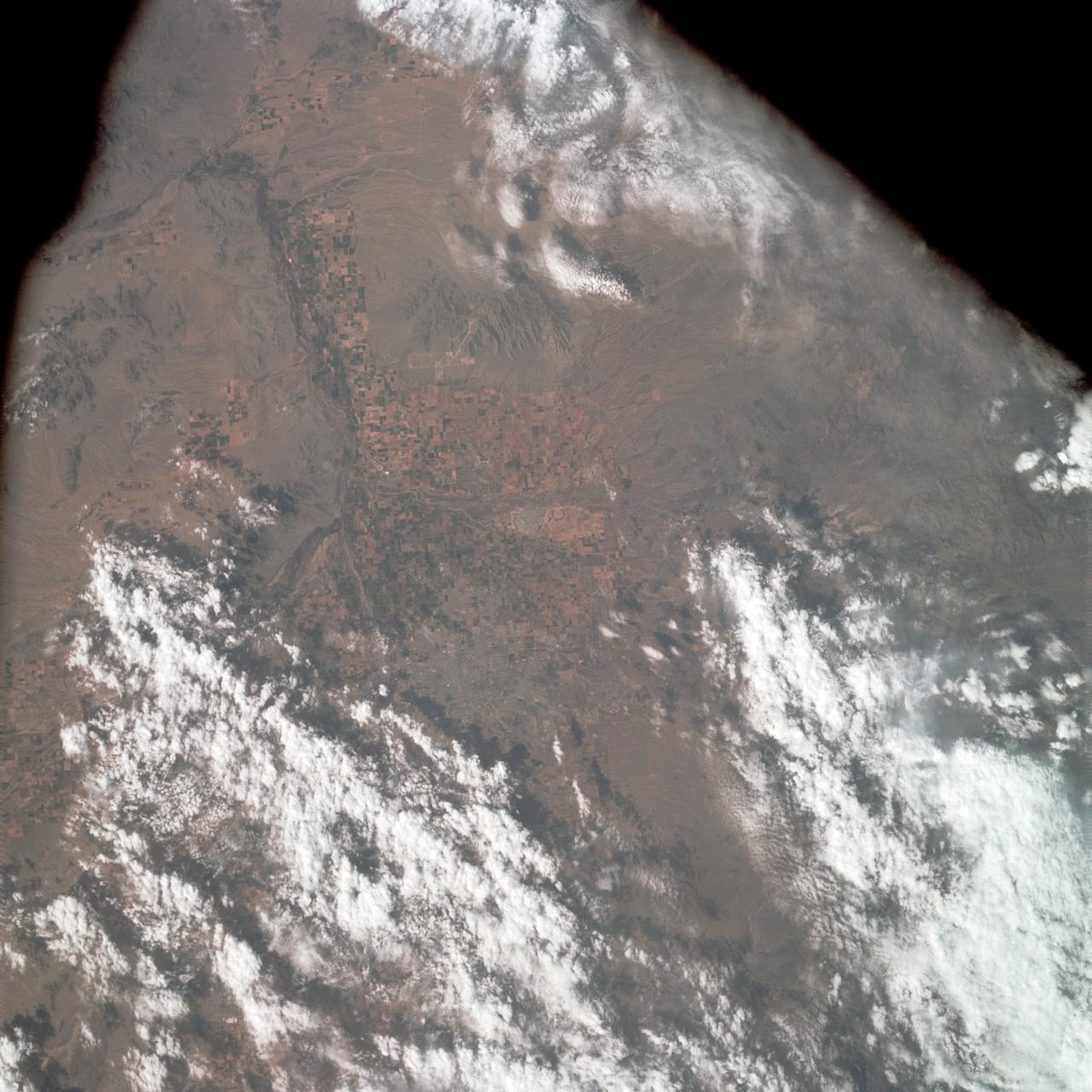
AS09-22-3441 (March 1969) --- Near vertical view of the Phoenix, Arizona area as photographed from the Apollo 9 spacecraft during its Earth-orbital mission. Farmland patterns checkerboard the area along the Gila River. Phoenix is located right of center near the clouds.
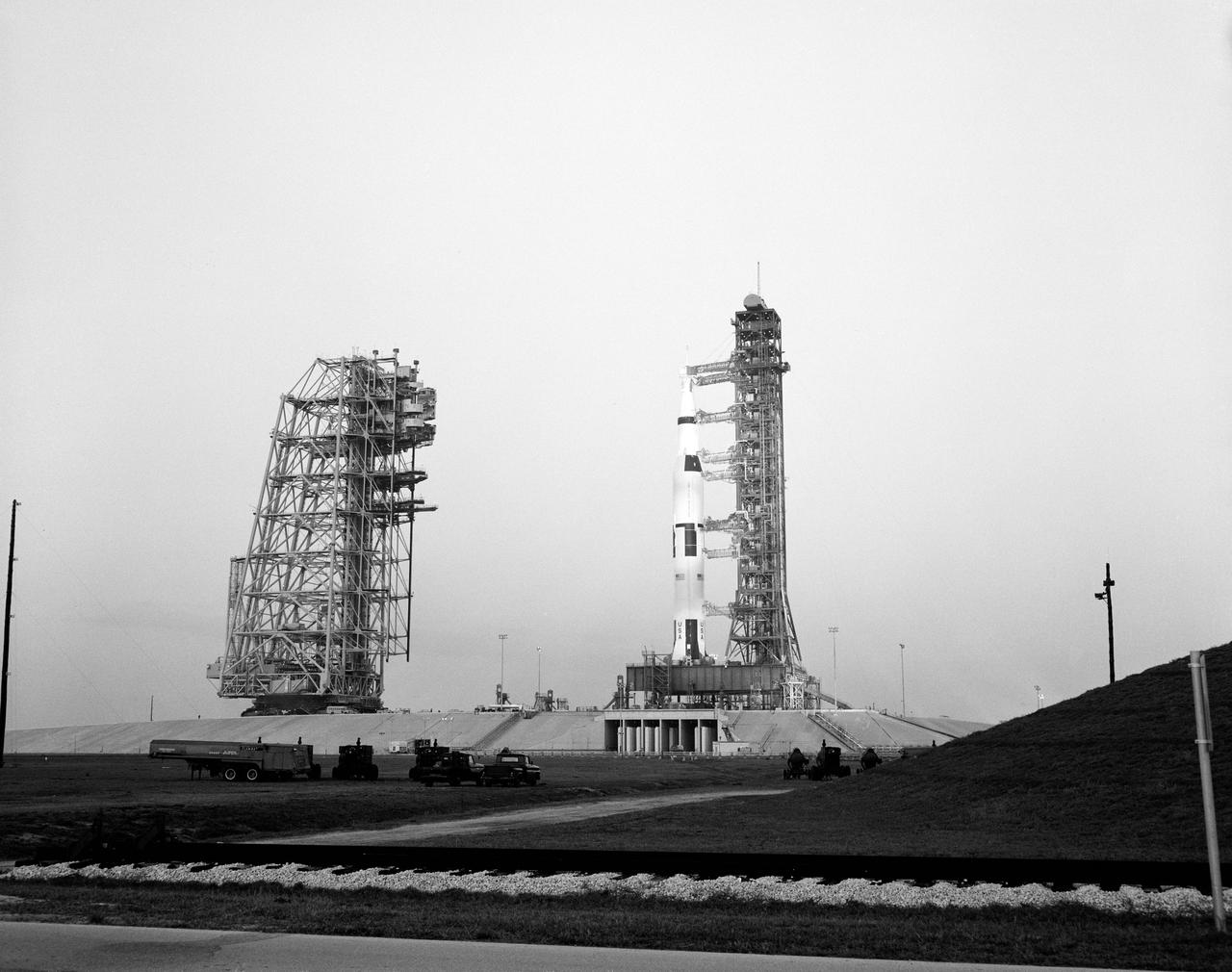
S69-27089 (11 March 1969) --- Overall view of Pad B, Launch Complex 39, Kennedy Space Center, showing the Apollo 10 (Spacecraft 106/Lunar Module-4/Saturn 505) space vehicle during a Countdown Demonstration Test. The Apollo 10 flight is scheduled as a lunar orbit mission. The Apollo 10 crew will be astronauts Thomas P. Stafford, commander; John W. Young, command module pilot; and Eugene A. Cernan, lunar module pilot.
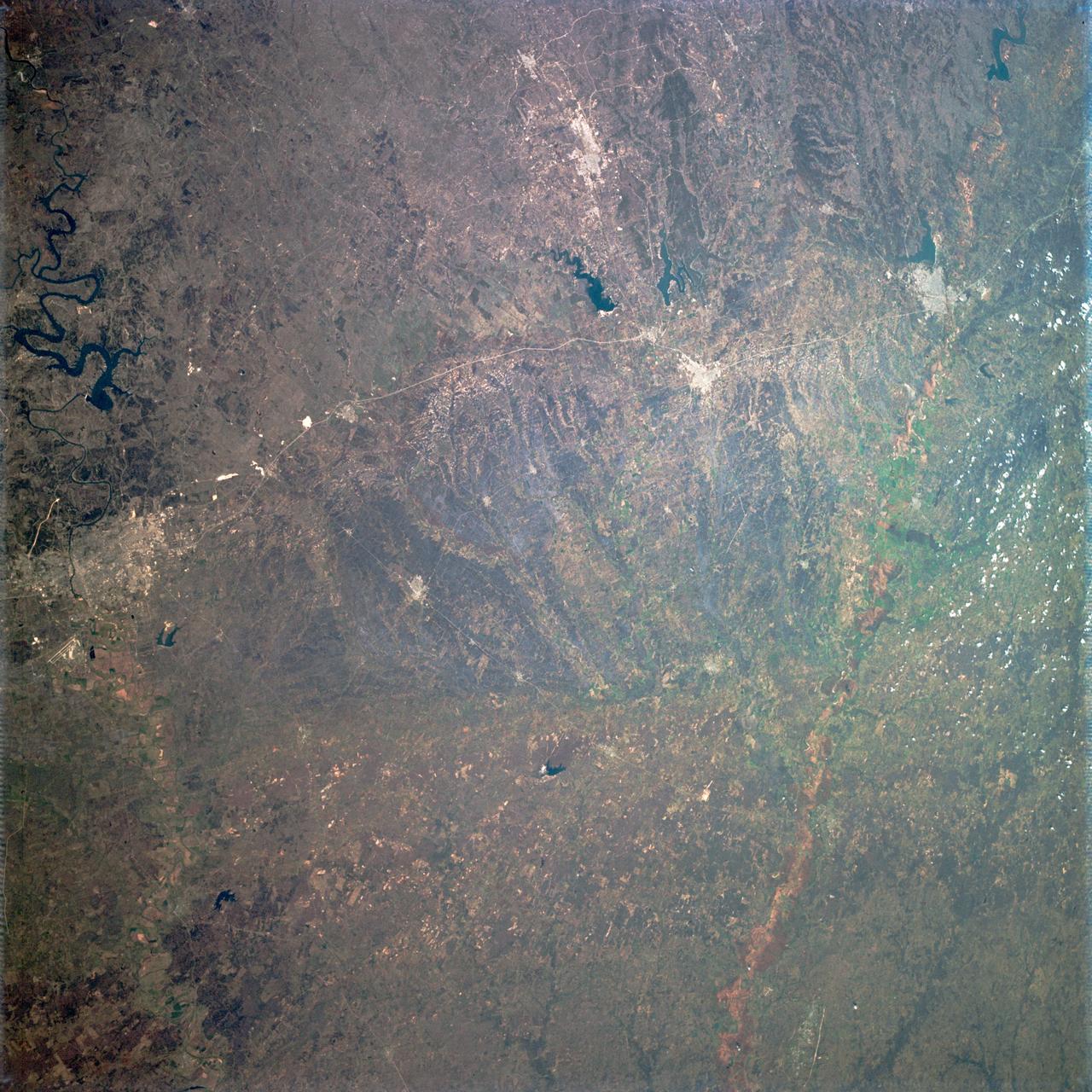
AS09-22-3341 (3-13 March 1969) --- Central Texas area as photographed from the Apollo 9 spacecraft during its Earth-orbital mission. Interstate 35 runs from Austin (right center edge of picture) to Waco (near bottom left corner). Also visible are the cities of Georgetown, Taylor, Temple and Killeen. The Colorado River runs through Austin. The Brazos River flows through Waco. Lake Travis is upstream from Austin. Lake Whitney is at bottom left corner of picture. The Belton Reservoir is near bottom center. The lake formed by the dam on the Lampasas River near Belton is also clearly visible.
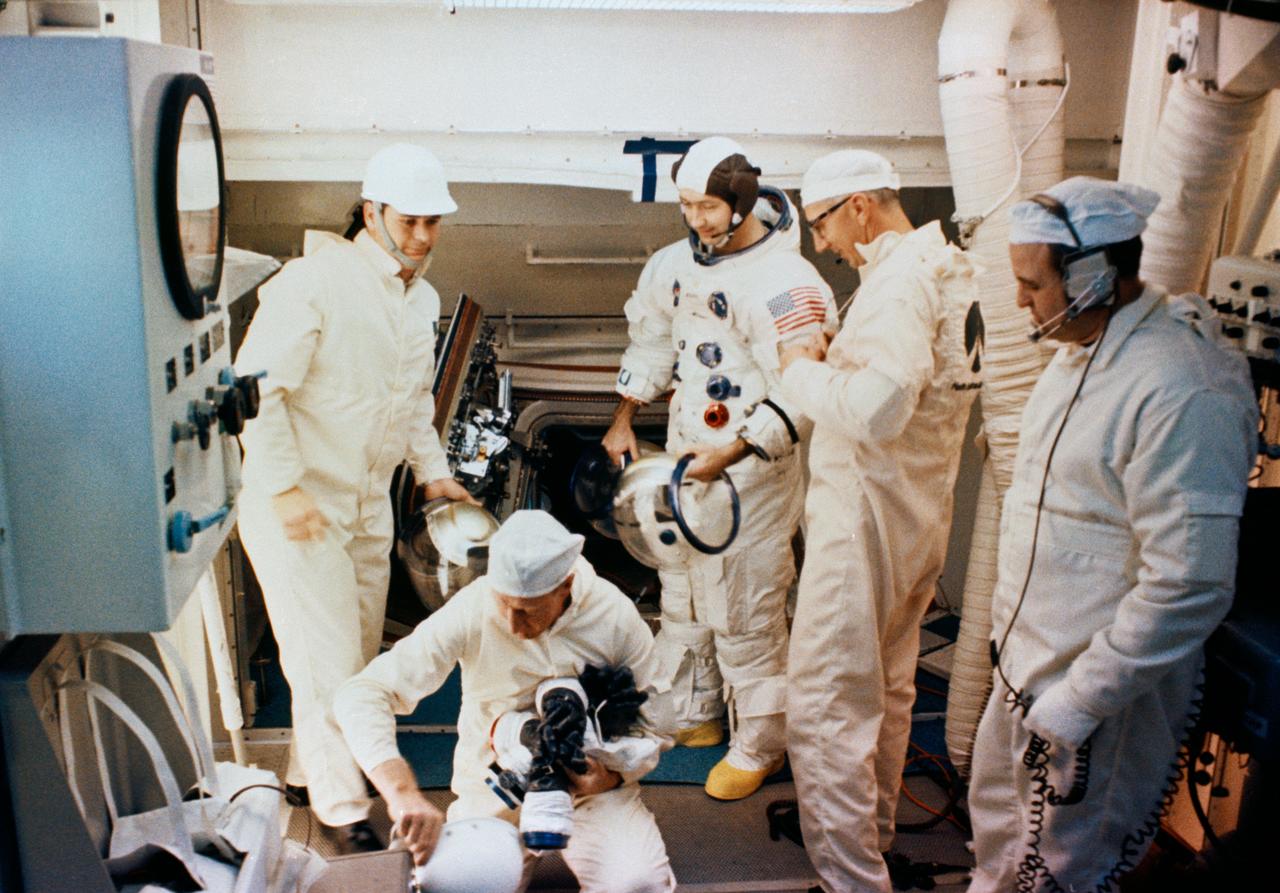
S69-25884 (23 Feb. 1969) --- Interior view of the white room atop Pad A, Launch Complex 39, Kennedy Space Center, during Apollo 9 Countdown Demonstration Test activity. Standing next to spacecraft hatch is astronaut James A. McDivitt, commander. Also, taking part in the training exercise were astronauts David R. Scott, command module pilot; and Russell L. Schweickart, lunar module pilot. The Apollo 9 mission will evaluate spacecraft lunar module systems performance during manned Earth-orbital flight. Apollo 9 will be the second manned Saturn V mission.
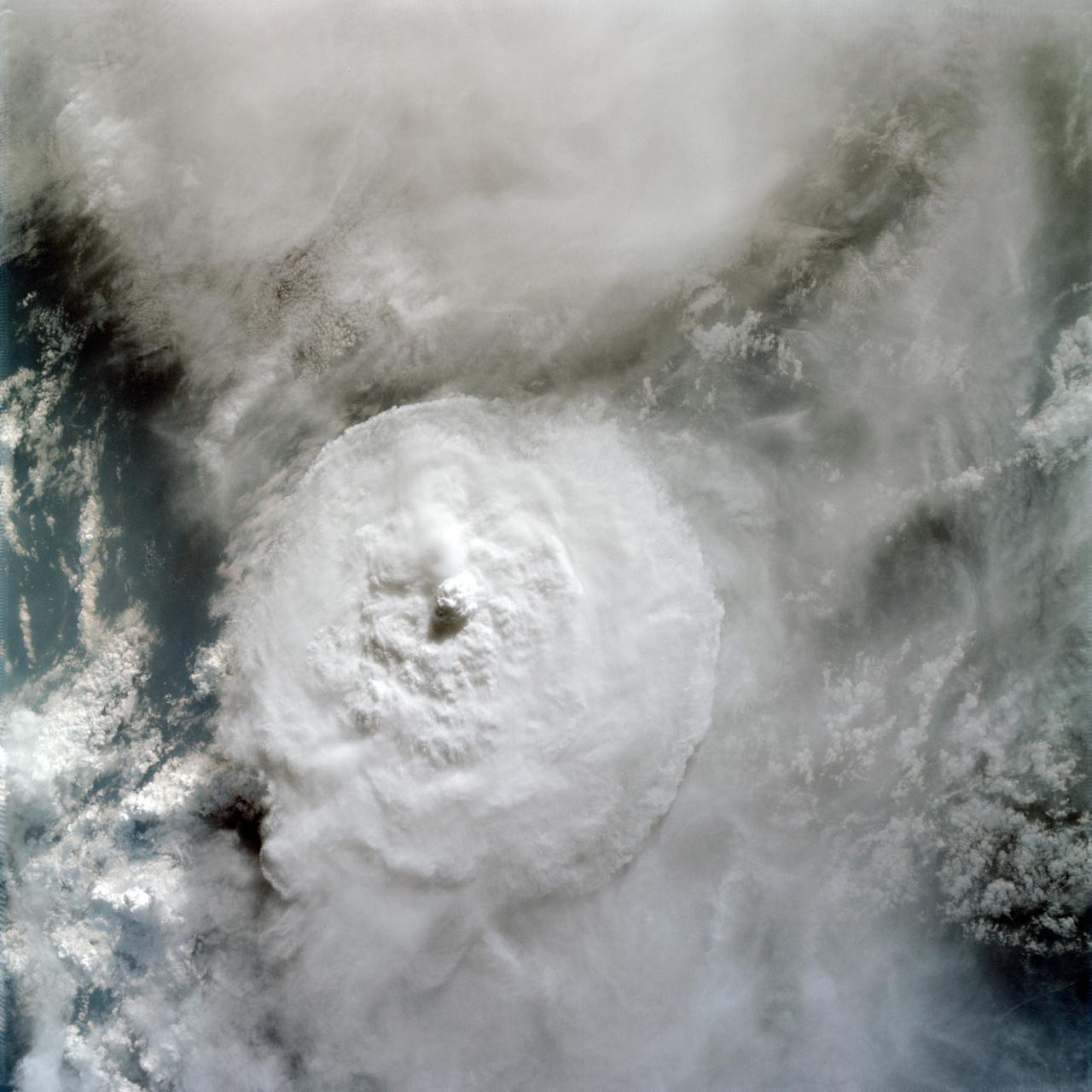
AS09-22-3374 (March 1969) --- Near vertical view of thunderhead over South America as photographed from the Apollo 9 spacecraft during its Earth-orbital mission.
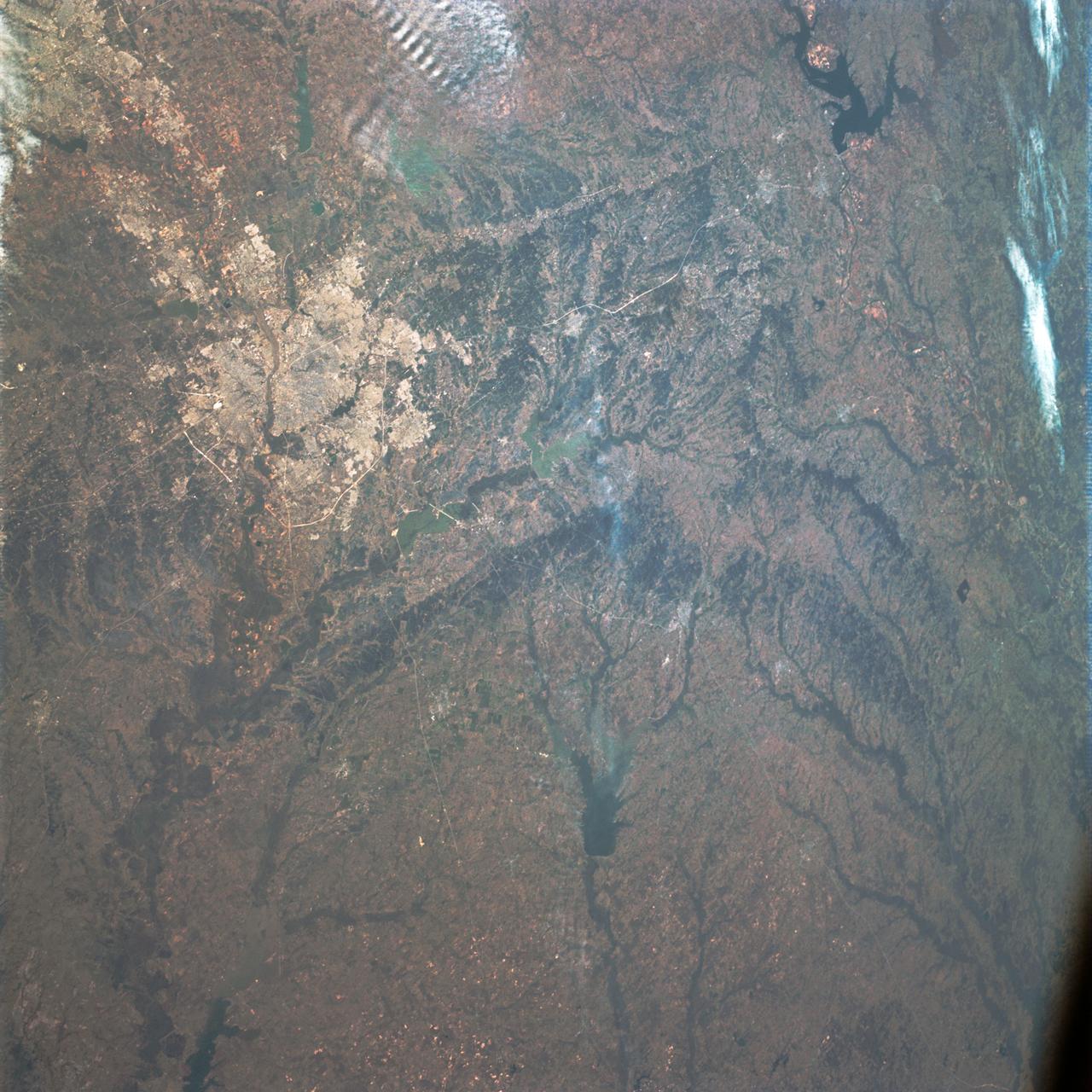
AS09-23-3586 (11 March 1969) --- Dallas, Ft. Worth, Sherman, Denison, Red River, and Lake Texoma, as photographed from the Apollo 9 spacecraft during its 122nd revolution of Earth.
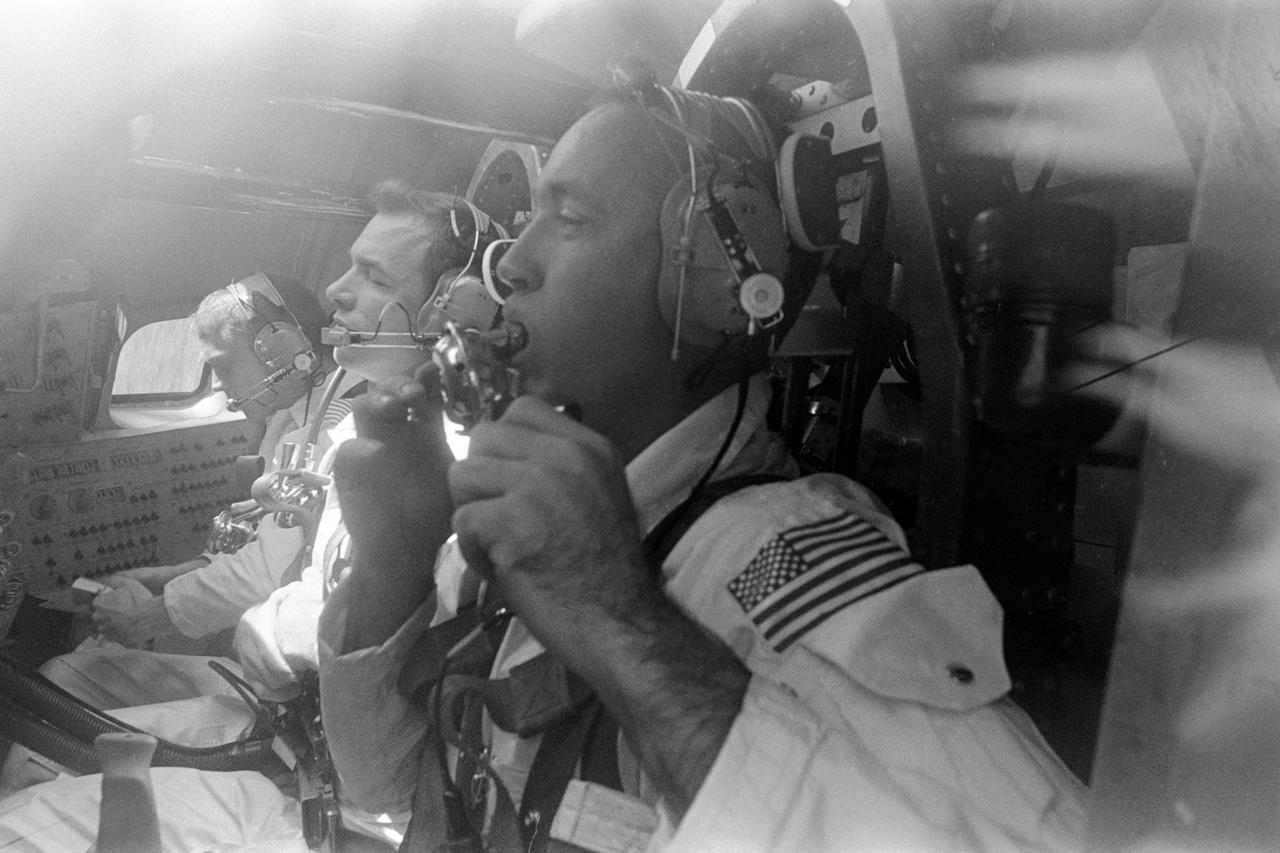
S68-54850 (5 Nov. 1968) --- The prime crew of the Apollo 9 (Spacecraft 104/Lunar Module 3/Saturn 504) space mission are seen inside an Apollo command module boilerplate during water egress training activity in the Gulf of Mexico. From foreground, are astronauts James A. McDivitt, commander; David R. Scott, command module pilot; and Russell L. Schweickart, lunar module pilot.
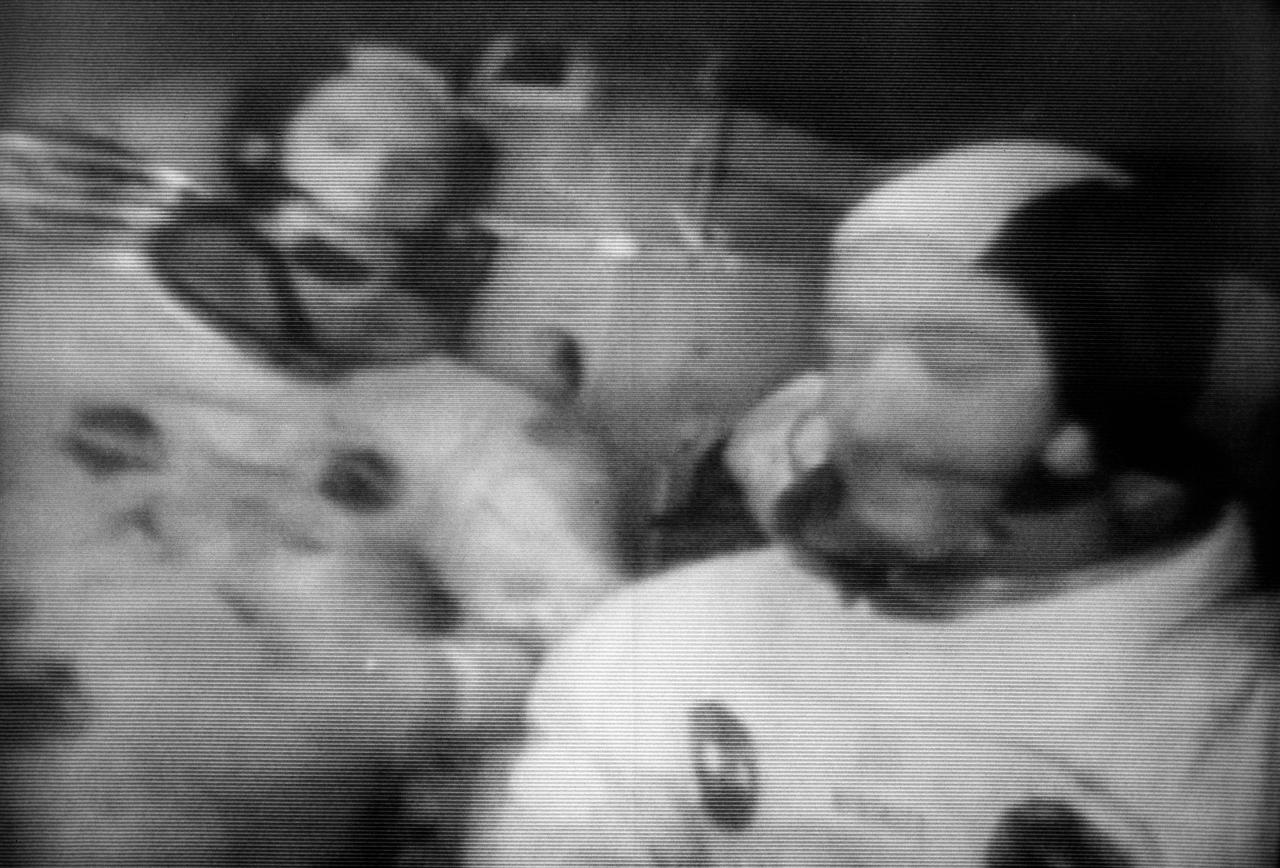
S69-26148 (6 March 1969) --- This photograph from the second live television transmission from Apollo 9 was made early Thursday afternoon on the fourth day in space. Though of poor quality, this view shows the interior of the Lunar Module "Spider" with astronauts James A. McDivitt (foreground) and Russell L. Schweickart at their crew stations. McDivitt is the Apollo 9 commander; and Schweickart is the lunar module pilot. At this moment Apollo 9 was orbiting Earth with the Command and Service Modules docked nose-to-nose with the Lunar Module. Astronaut David R. Scott, command module pilot, remained at the controls in the Command Module "Gumdrop" while the other two astronauts checked out the Lunar Module. McDivitt and Schweickart moved into the Lunar Module from the Command Module by way of the docking tunnel.
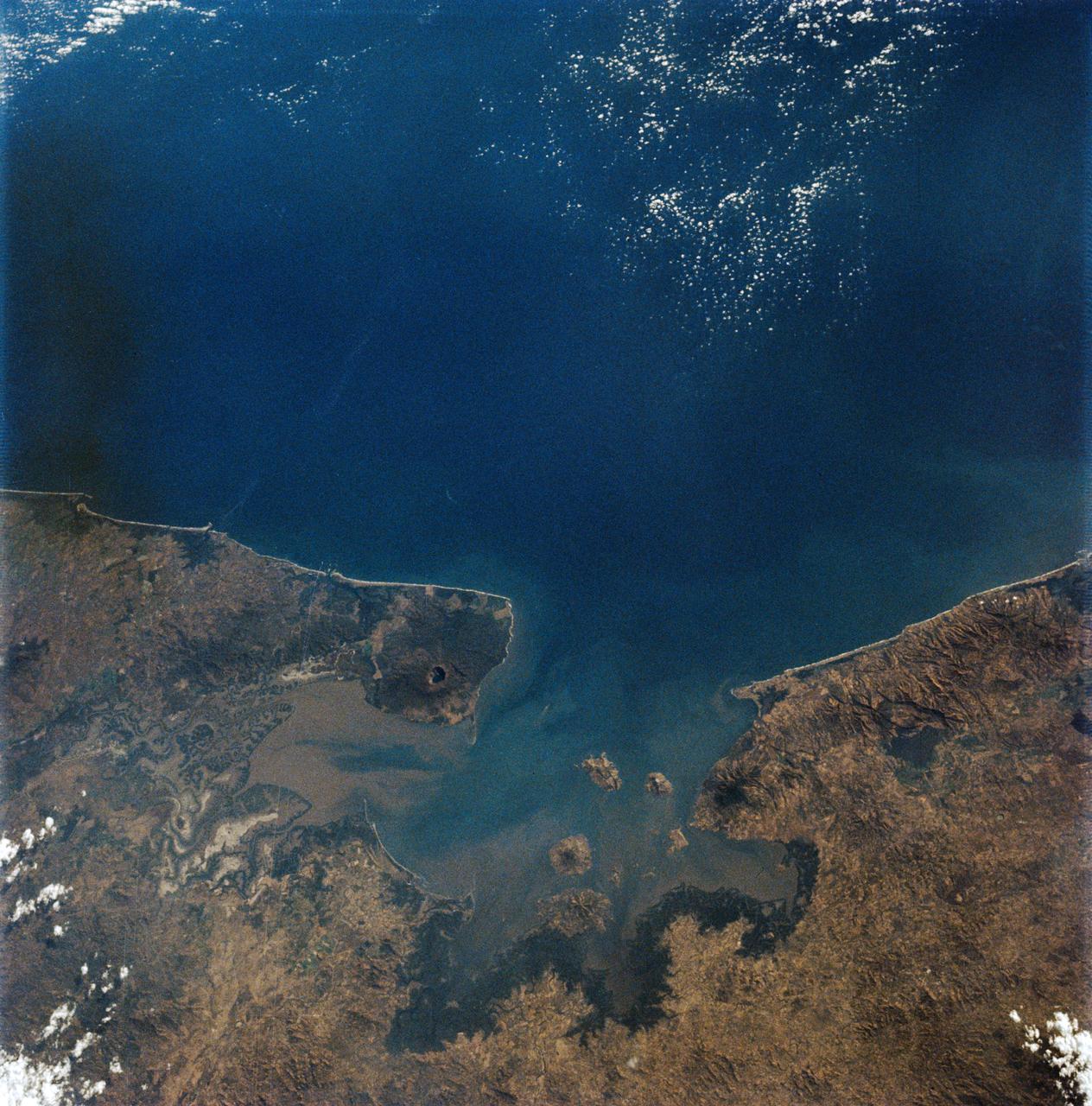
AS09-19-3019 (3-13 March 1969) --- Gulf of Fonseca, on the Pacific coast of Central America, as photographed from the Apollo 9 spacecraft during its Earth-orbital mission. The gulf is shared by the nations of El Salvador, Honduras, and Nicaragua. The prominent volcano on the peninsula in Nicaragua is Volcan Cosiguina.
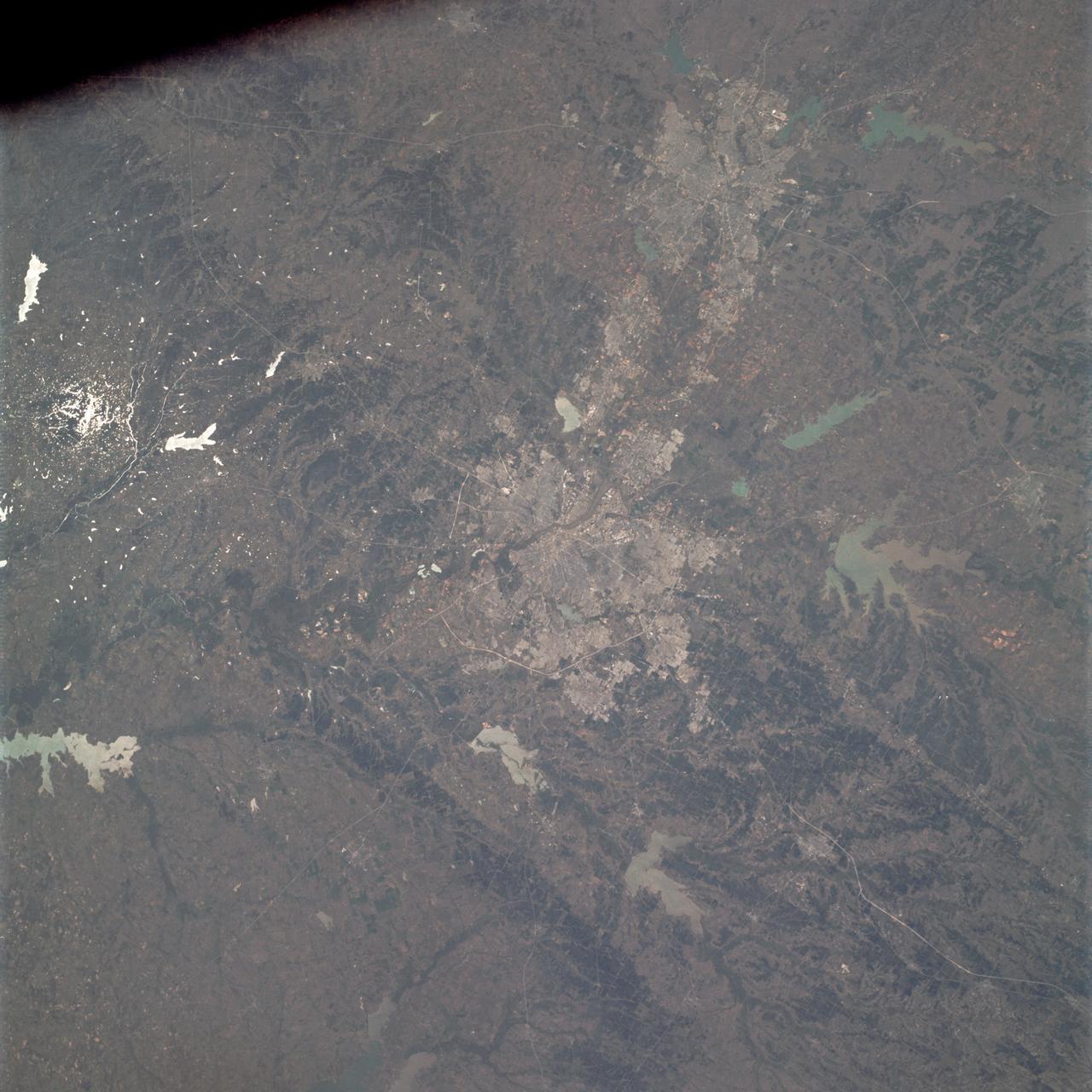
AS09-21-3299 (3-13 March 1969) --- Dallas-Fort Worth area as photographed from the Apollo 9 spacecraft during its Earth-orbital mission. The superhighways leading out of two cities are clearly visible. The largest body of water north of Dallas is the Garza-Little Elm Reservoir. Cedar Creek Reservoir is located to the southeast of Dallas. The City of Denton is near left center edge of picture at junction of two highways leading from Fort Worth and Dallas.
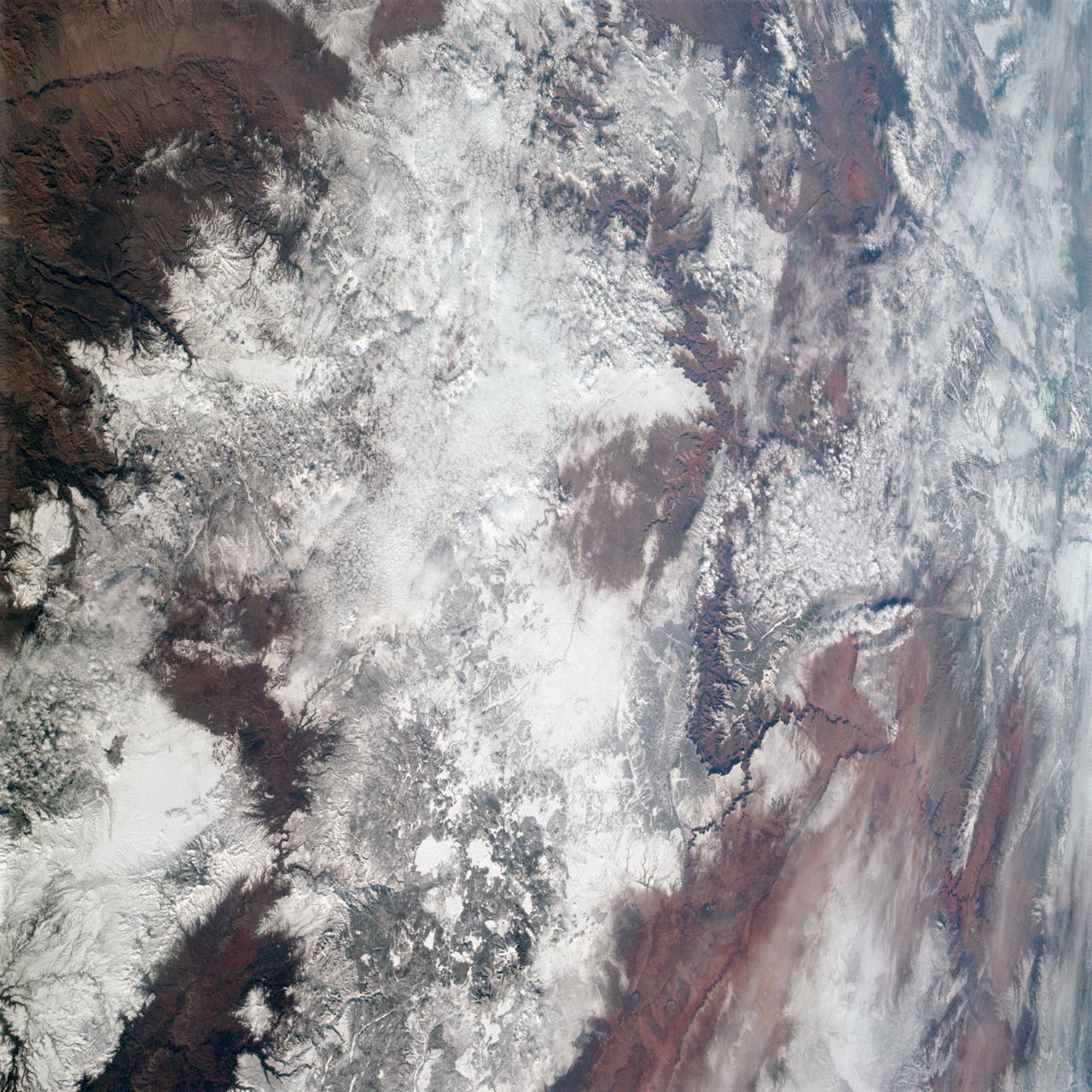
AS09-20-3137 (3-13 March 1969) --- The Grand Canyon is sharply etched on the snow-covered Colorado Plateau in Arizona in this photograph from the Apollo 9 spacecraft during its Earth-orbital mission. Lake Powell behind Glen Canyon Dam is in the upper right corner. Humphreys Peak and the many volcanic craters around the San Francisco Mountains near Flagstaff, Arizona, are right of center. Prescott is under clouds at lower center.
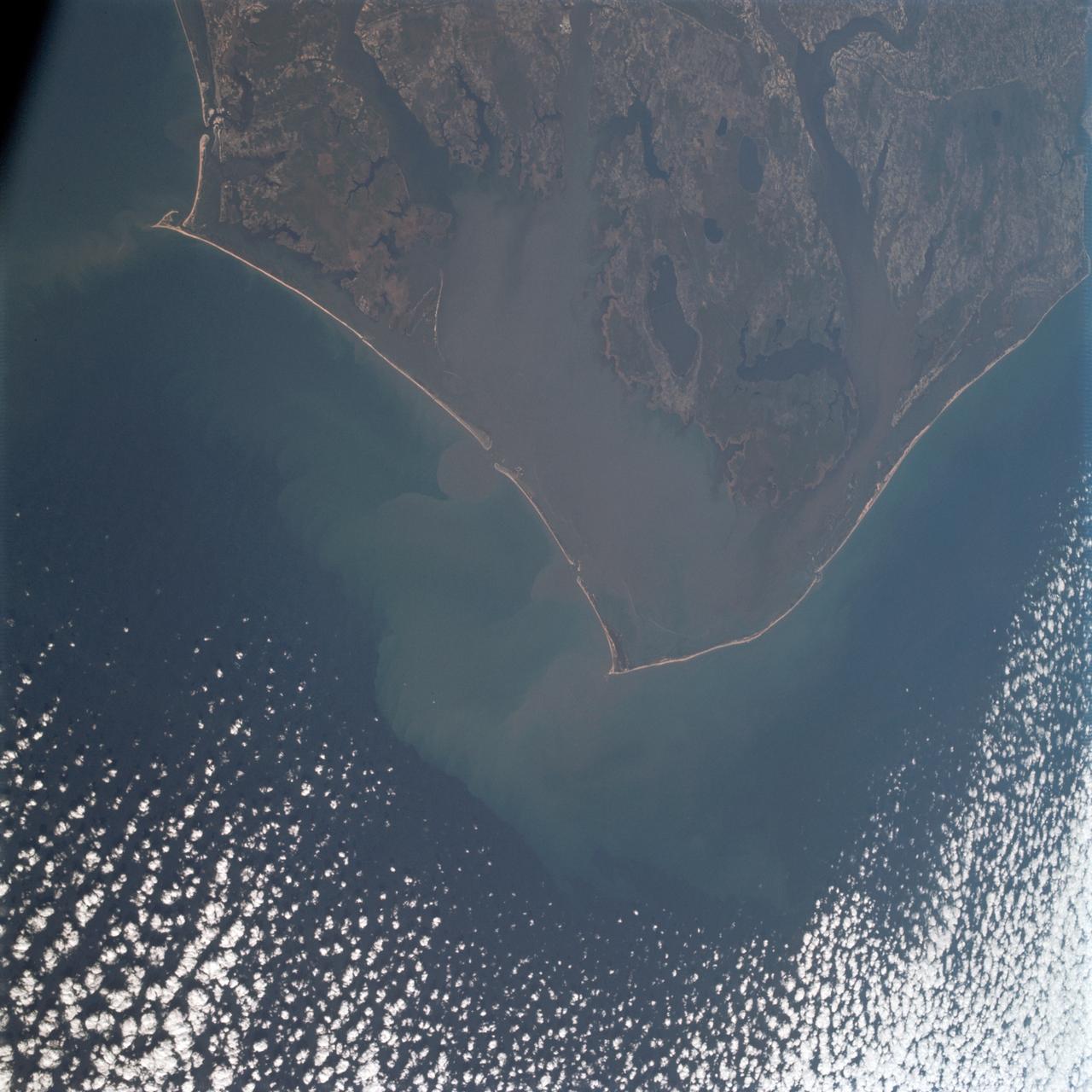
AS09-20-3128 (3-13 March 1969) --- Cape Hatteras, North Carolina, area as photographed from the Apollo 9 spacecraft during its Earth-orbital mission. Cape Lookout is near bottom of picture. Cape Hatteras juts the farthest out into the Atlantic. Largest inland body of water is Pamlico Sound; and to the north of it is Albemarle Sound.
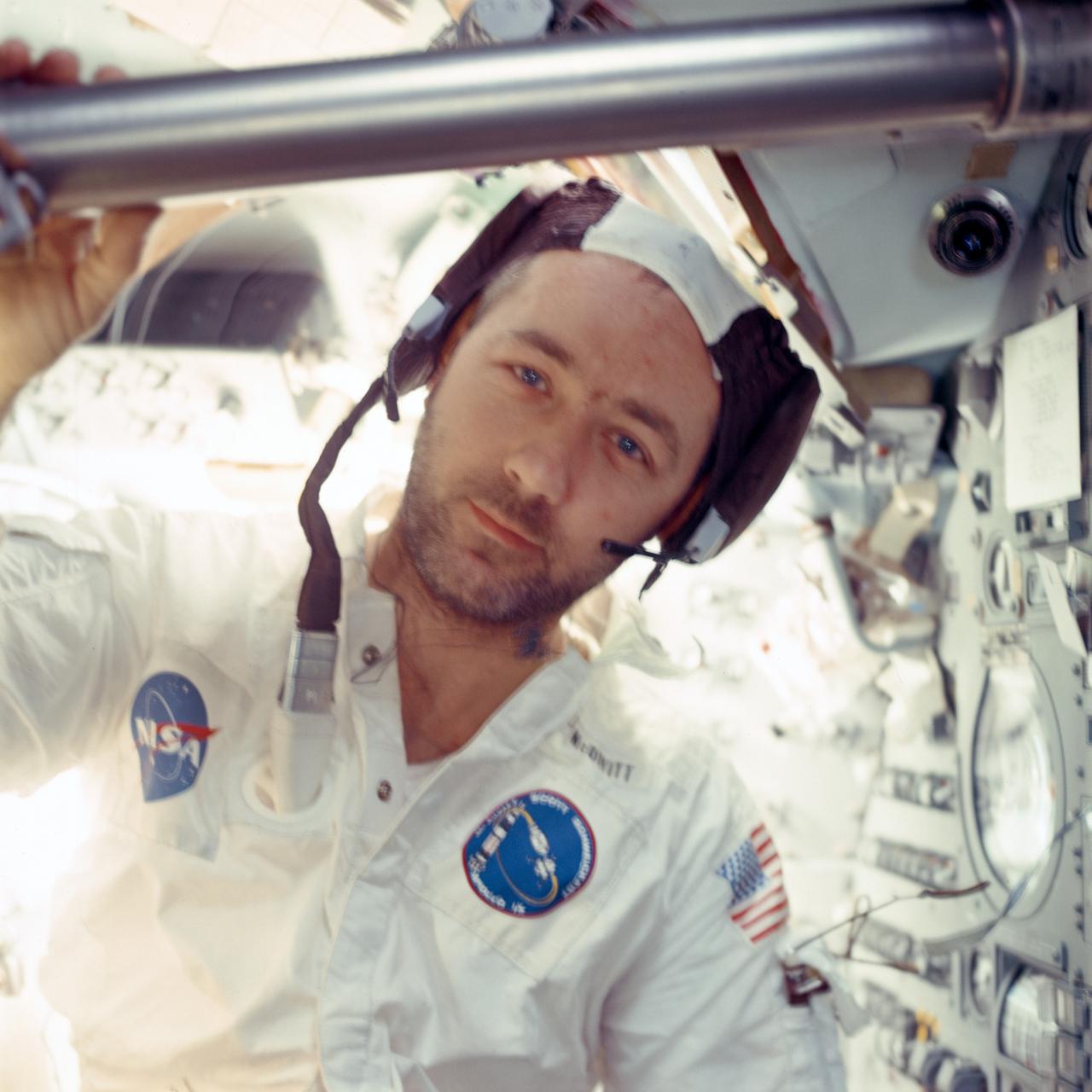
AS09-20-3154 (3-13 March 1969) --- This close-up view of astronaut James A. McDivitt shows several days' beard growth. The Apollo 9 mission commander was onboard the Lunar Module (LM) "Spider" in Earth orbit, near the end of the flight. He was joined on the mission by astronauts David R. Scott, command module pilot, and Russell L. Schweickart, lunar module pilot. Schweickart took this picture while Scott remained in the Command Module (CM) "Gumdrop." In Earth orbit, the three tested the transposition and docking systems of the lunar module and command module. On a scheduled lunar landing mission later this year, a team of three astronauts and ground controllers will use what this crew and its support staff have learned in handling the systems of the two spacecraft.
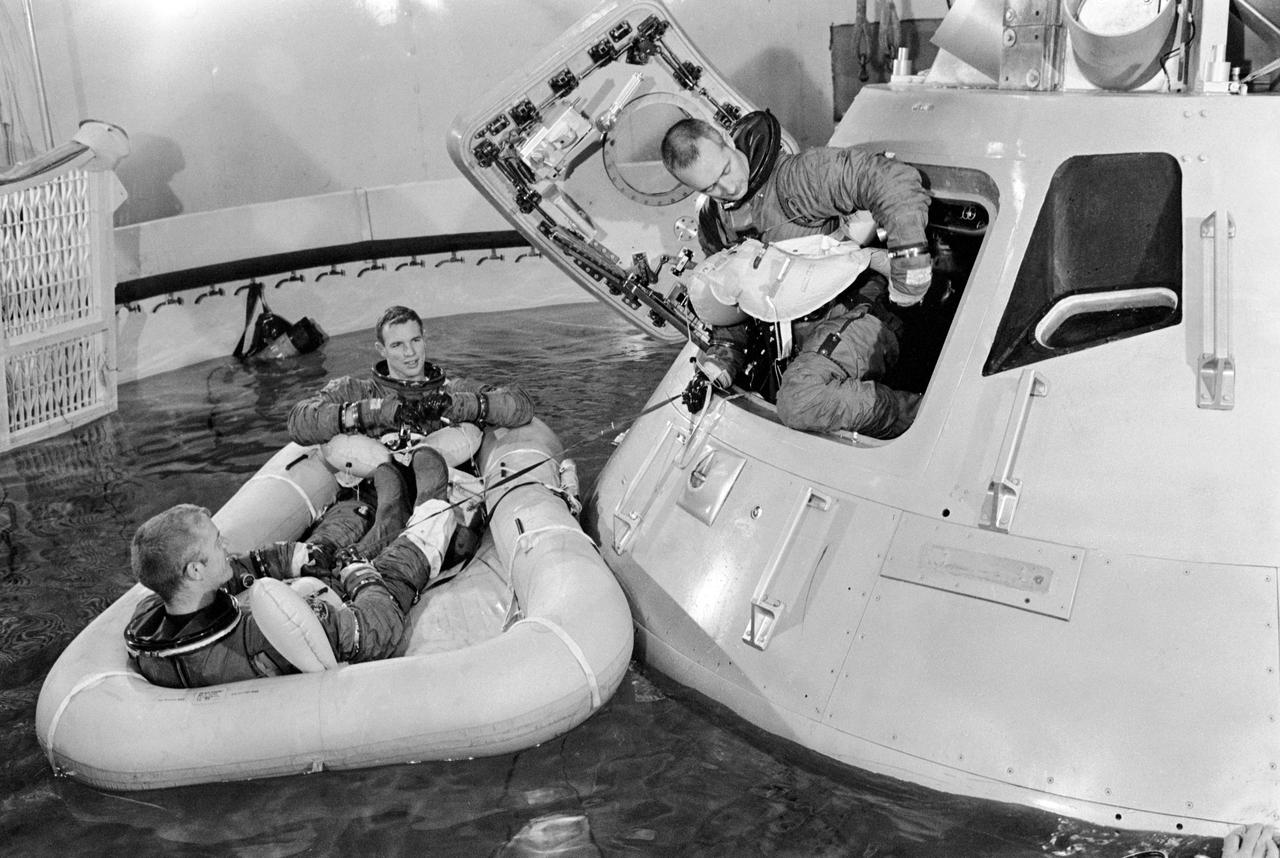
S68-54859 (November 1968) --- The prime crew of the Apollo 9 (Spacecraft 104/Lunar Module 3/Saturn 504) space mission participates in water egress training in a tank in Building 260 at the Manned Spacecraft Center. Egressing the Apollo command module boilerplate is astronaut James A. McDivitt, commander. In life raft are astronauts David R. Scott (background), command module pilot; and Russell L. Schweickart, lunar module pilot.
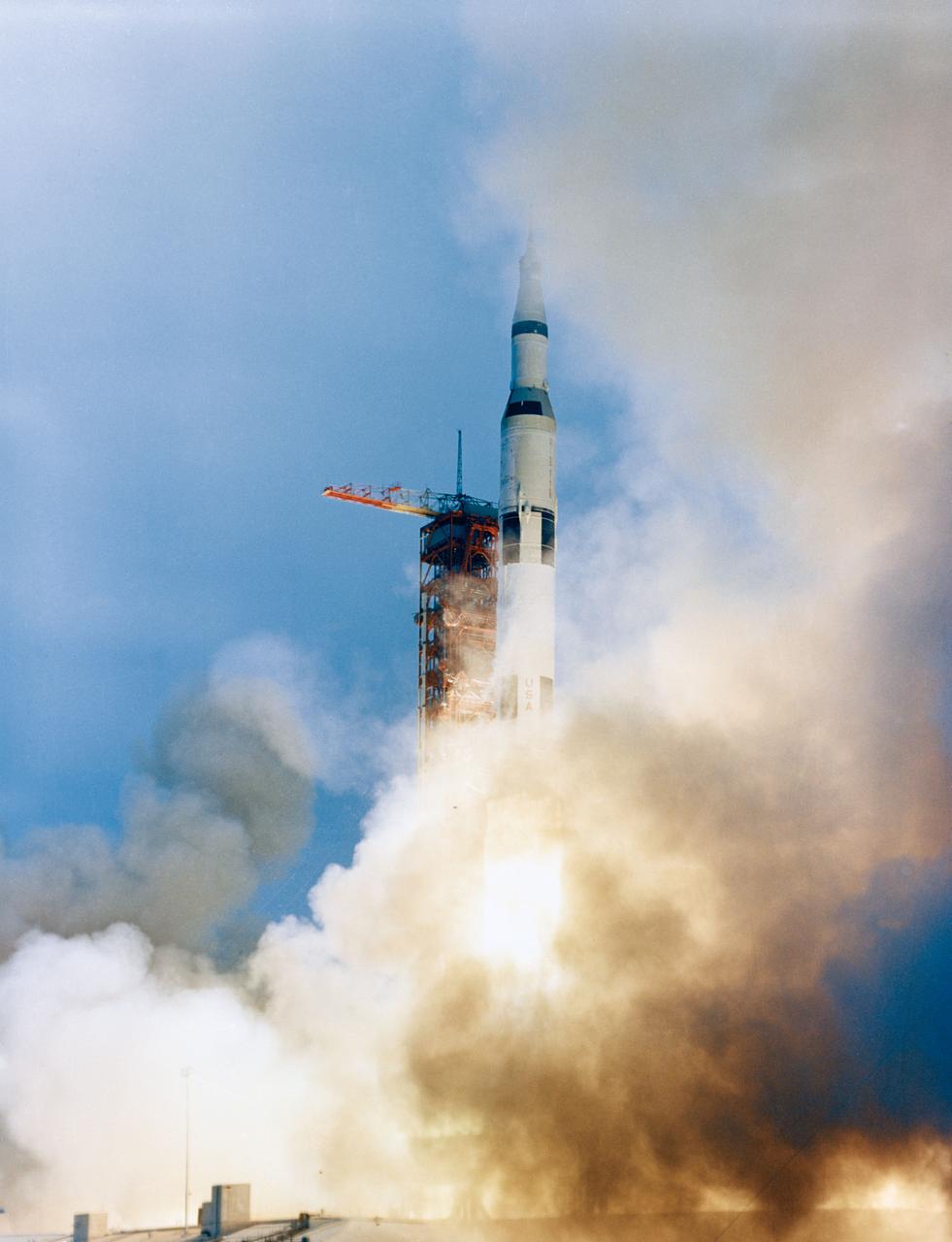
S69-25864 (3 March 1969) --- The Apollo 9 (Spacecraft 104/Lunar Module 3/Saturn 504) space vehicle is launched from Pad A, Launch Complex 39, Kennedy Space Center (KSC) at 11 a.m. (EST), March 3, 1969. Aboard the spacecraft are astronauts James A. McDivitt, commander; David R. Scott, command module pilot; and Russell L. Schweickart, lunar module pilot. The Apollo 9 mission will evaluate spacecraft lunar module systems performance during manned Earth-orbital flight. Apollo 9 is the second manned Saturn V mission.
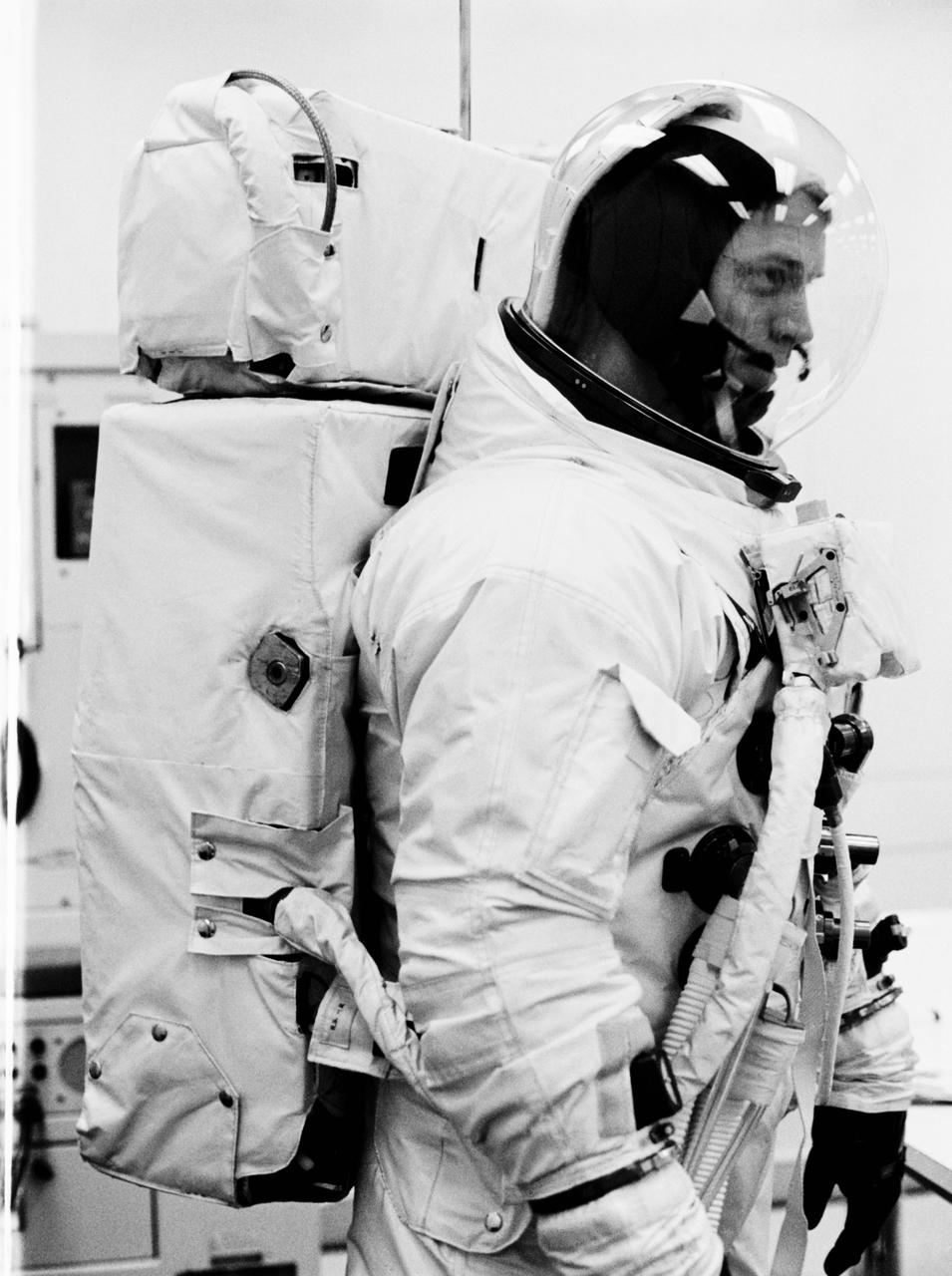
S69-25878 (23 Feb. 1969) --- Astronaut Russell L. Schweickart, lunar module pilot of the Apollo 9 prime crew, wears the Extravehicular Mobility Unit (EMU) which he will use during his scheduled Apollo 9 extravehicular activity. In addition to the space suit and bubble helmet, the EMU also includes a Portable Life Support System back pack, an Oxygen Purge System (seen atop the PLSS), and a Remote Control Unit on his chest. This equipment will be completely independent of the spacecraft during Schweickart's EVA. He will be secured only by a tether line. When this photograph was taken, Schweickart was suited to participate in an Apollo 9 Countdown Demonstration Test.
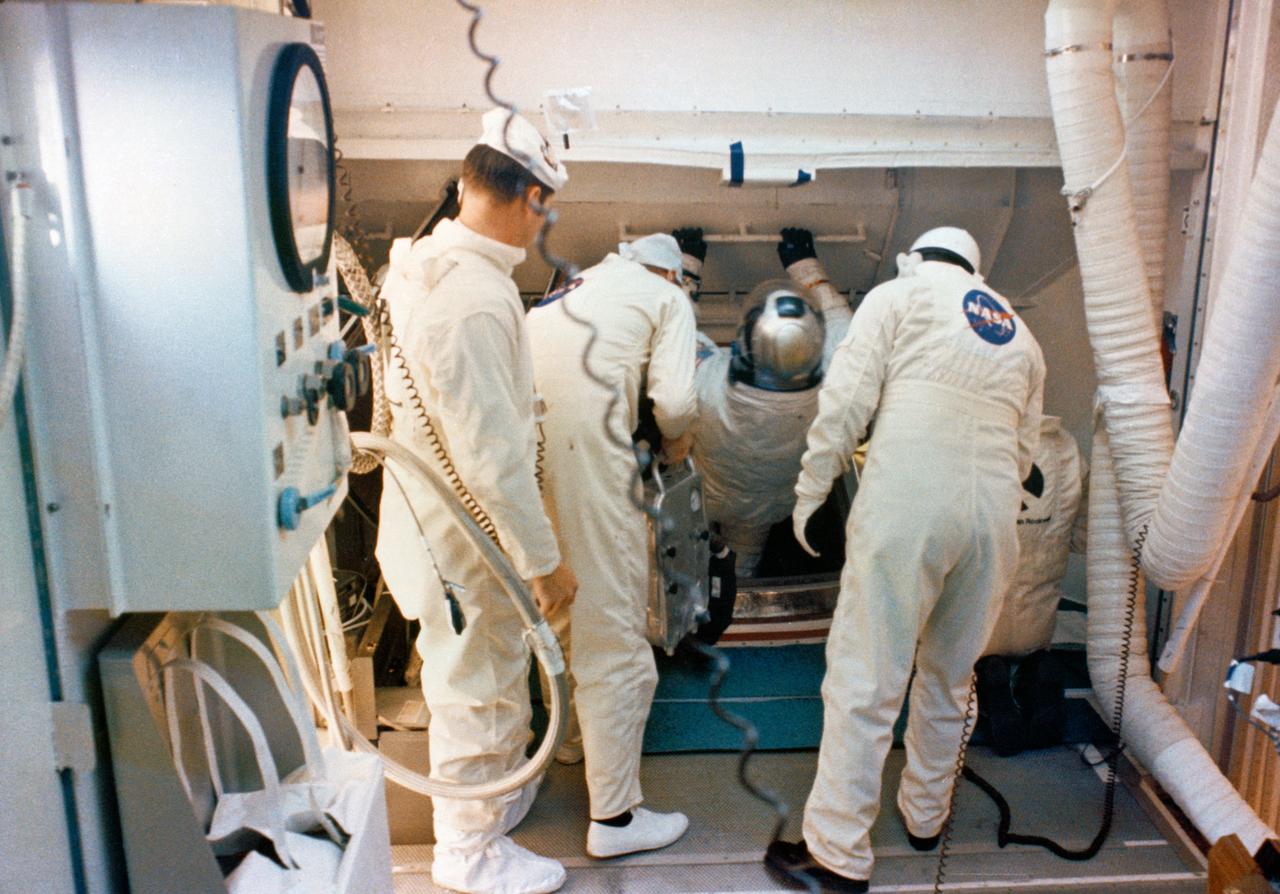
S69-25488 (23 Feb. 1969) --- Interior view of the White Room at Pad A, Launch Complex 39, Kennedy Space Center (KSC), during an Apollo 9 Countdown Demonstration Test (CDDT). Astronauts James A. McDivitt, commander; David R. Scott, command module pilot; and Russell L. Schweickart, lunar module pilot, were participating in a dress rehearsal in preparation for their scheduled 10-day Earth-orbital space mission.
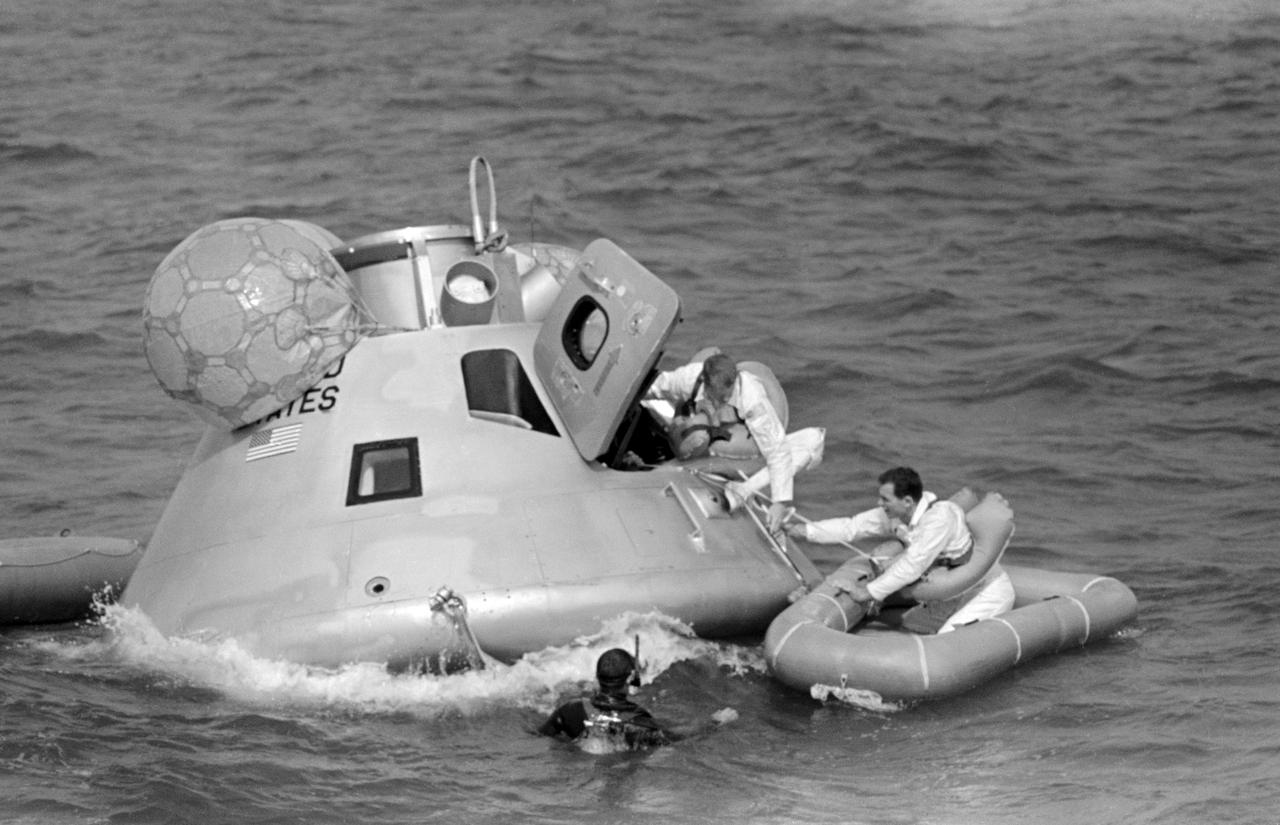
S68-50960 (20 Nov. 1968) --- The Apollo 9 prime crew participates in water egress training in the Gulf of Mexico. Apollo Command Module Boilerplate 1102 was used in the training. In life raft is astronaut David R. Scott, command module pilot. Egressing the boilerplate is astronaut Russell L. Schweickart, lunar module pilot. Still inside boilerplate, out of view, is astronaut James A. McDivitt, commander. A team of MSC swimmers assisted in the exercise. The inflated bags were used to upright the boilerplate prior to egress.

S68-50977 (20 Nov. 1968) --- The Apollo 9 prime crew participates in water egress training in the Gulf of Mexico. Apollo Command Module Boilerplate 1102 was used in the training. Egressing the boilerplate is astronaut David R. Scott, command module pilot. Inside the boilerplate, out of view, are astronauts James A. McDivitt, commander; and Russell L. Schweickart, lunar module pilot. A team of MSC swimmers assisted in the exercise. The inflated bags were used to upright the boilerplate prior to egress.
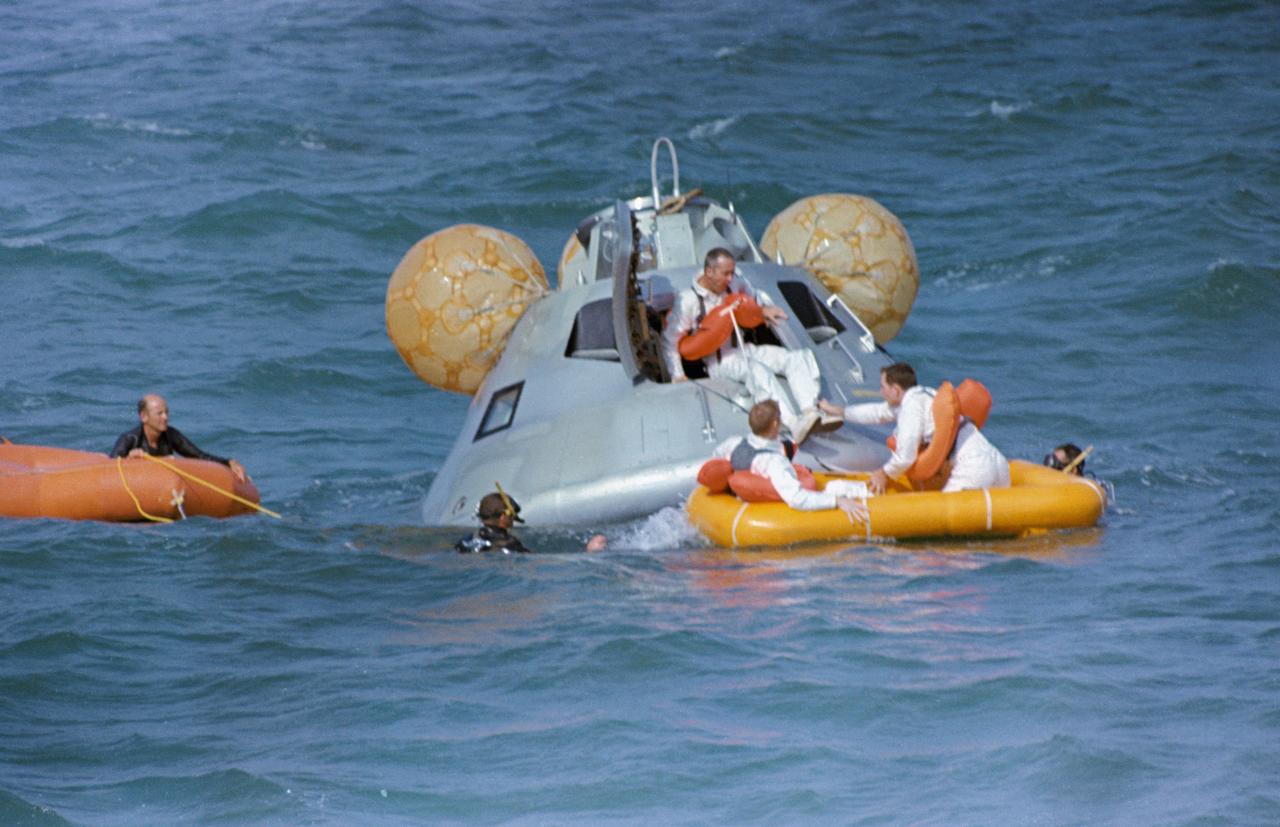
S68-50967 (20 Nov. 1968) --- The Apollo 9 prime crew participates in water egress training in the Gulf of Mexico. Apollo Command Module (CM) Boilerplate 1102 was used in the training. Egressing boilerplate is astronaut James A. McDivitt, commander. In life raft are astronauts Russell L. Schweickart (on left), lunar pilot; and David R. Scott, command pilot. A team of MSC swimmers assisted in the exercise. The inflated bags were used to upright the boilerplate prior to egress.
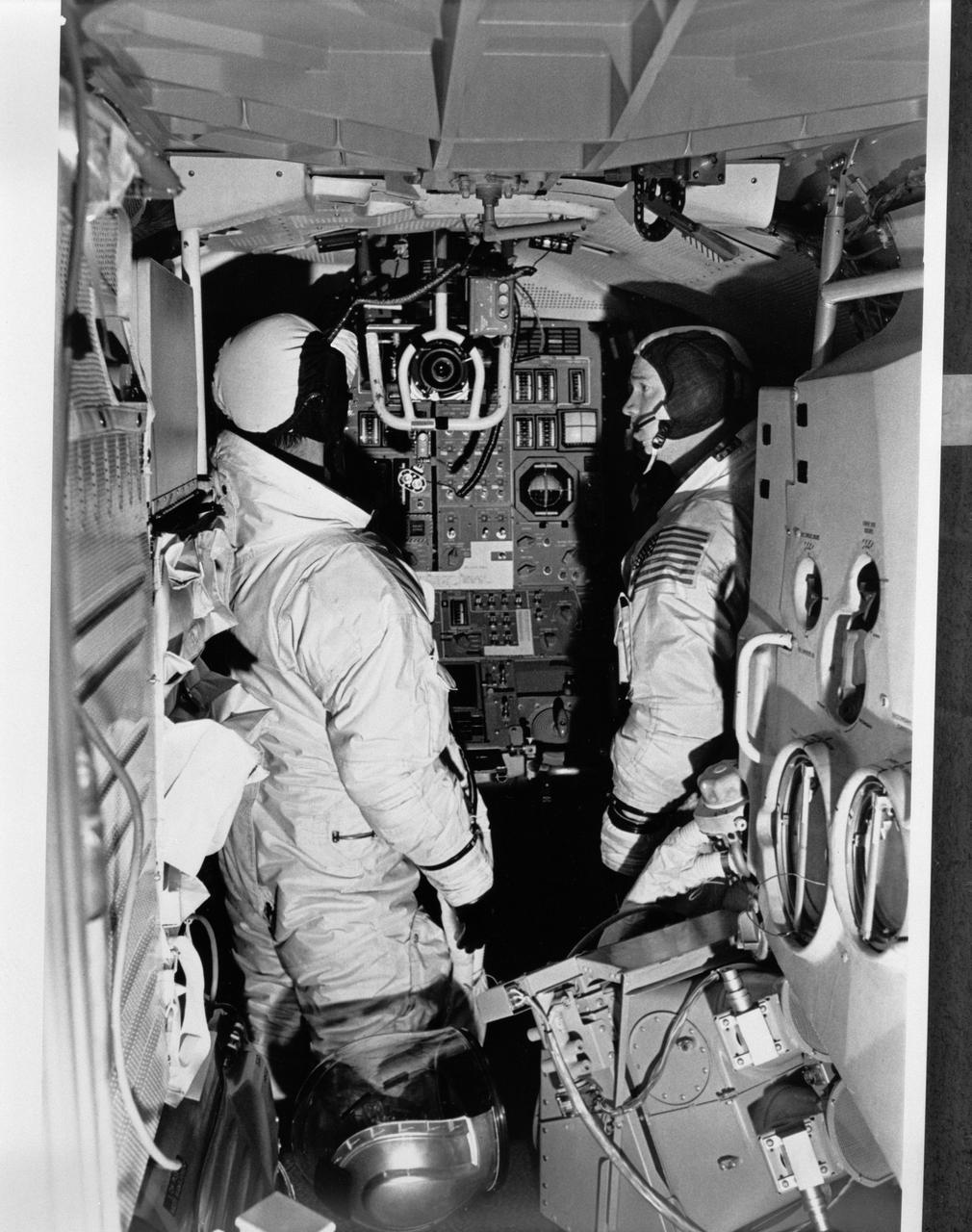
S69-19858 (December 1968) --- Two members of the Apollo 9 prime crew participate in simulation training in the Apollo Lunar Module Mission Simulator (LMMS) at the Kennedy Space Center (KSC). On the left is astronaut James A. McDivitt, commander; and on the right is astronaut Russell L. Schweickart, lunar module pilot.
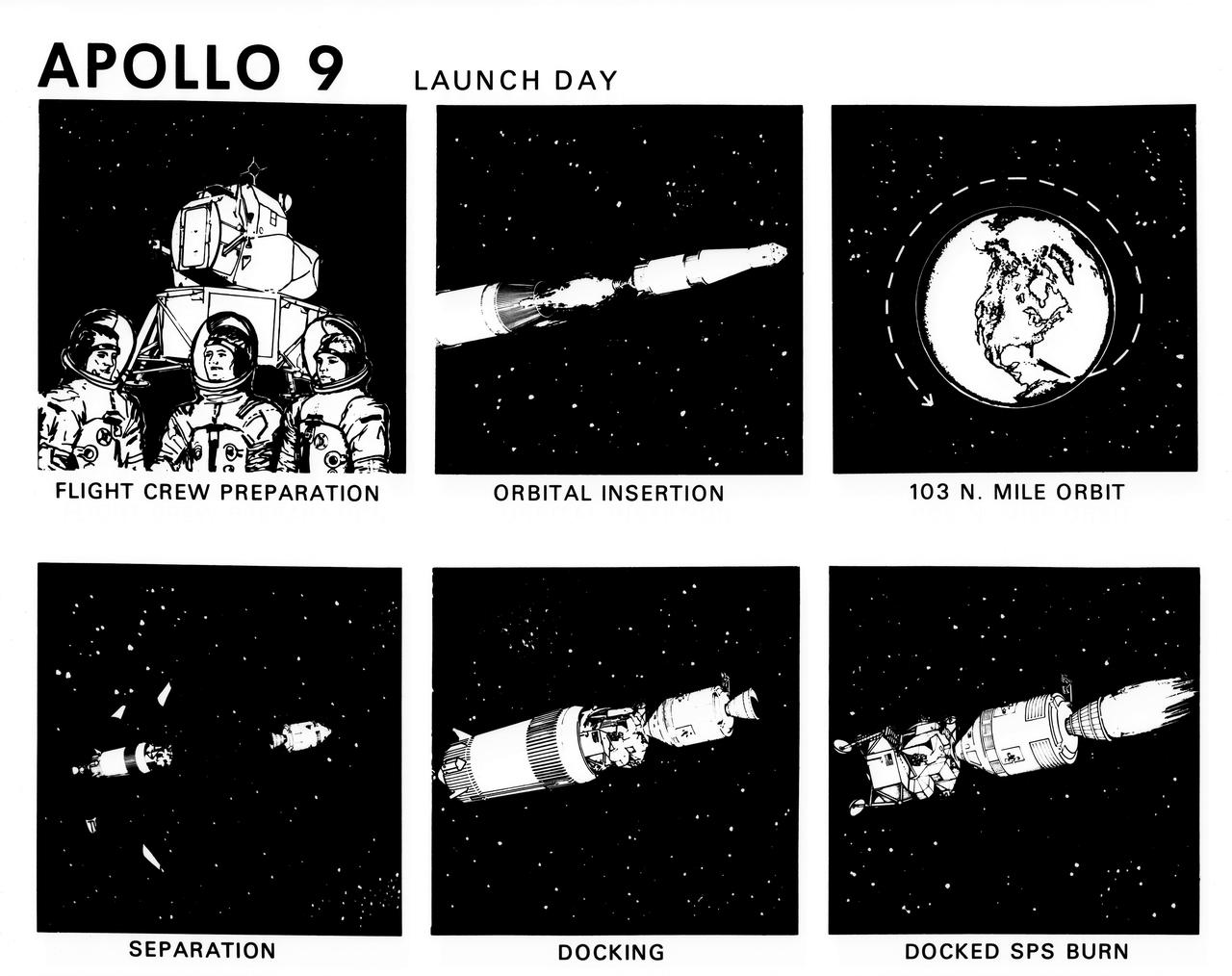
S69-19792 (February 1969) --- Composite of six artist's concepts illustrating key events, tasks and activities on the first day of the Apollo 9 mission, including flight crew preparation, orbital insertion, 103 nautical mile orbit, separation, docking, and docked Service Propulsion System burn. The Apollo 9 mission will evaluate spacecraft lunar module systems performance during manned Earth-orbital flight.

AS09-22-3436 (March 1969) --- Los Angeles-Long Beach area of southern California, as photographed from the Apollo 9 spacecraft during its 92nd revolution of Earth. Santa Catalina Island is located off the coast. The California coastline is visible from San Clemente northward to Point Dume. Clouds cover most of the San Gabriel Mountains around Los Angeles.
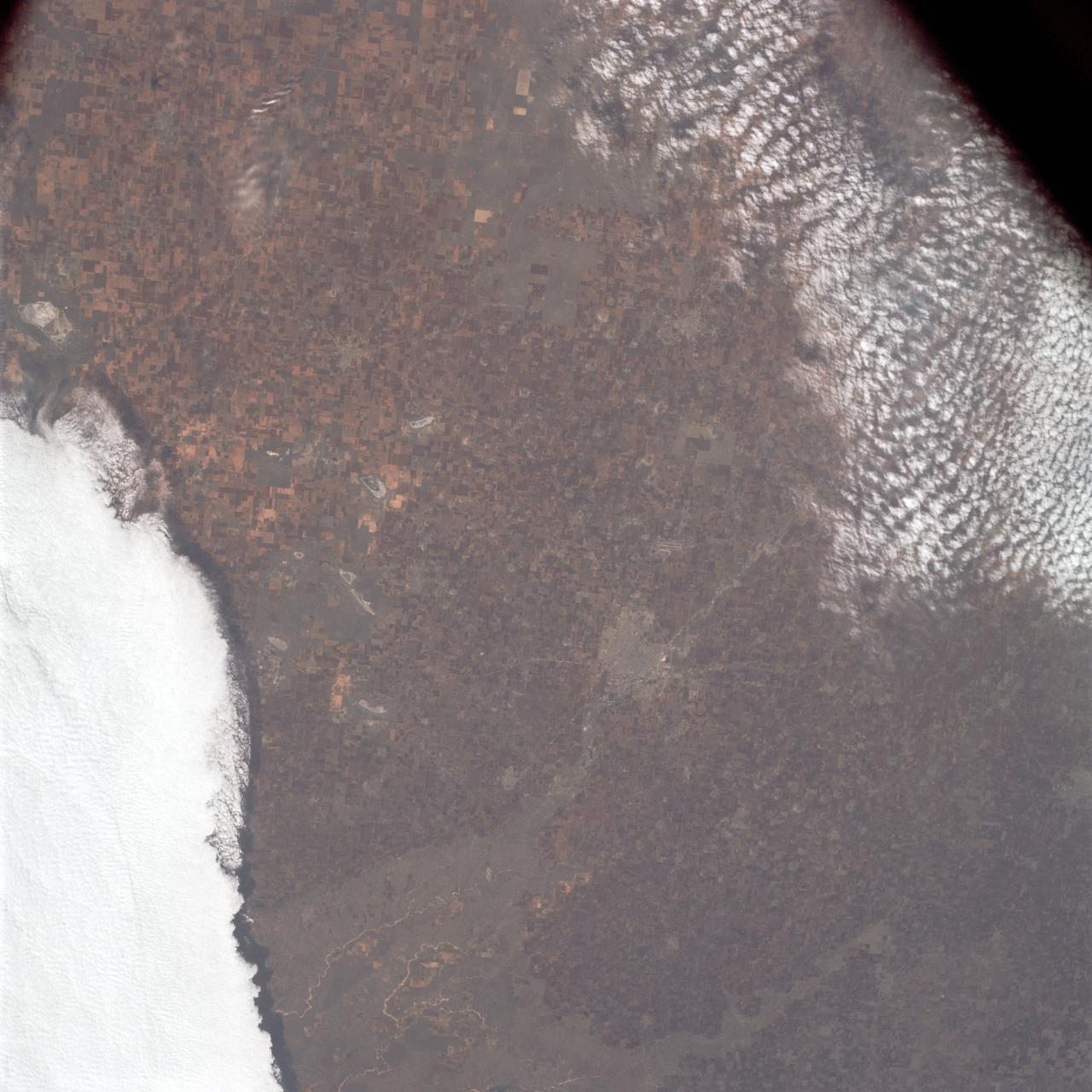
AS09-23-3561 (3-13 March 1969) --- Near vertical view of the Lubbock area in west Texas as photographed from the Apollo 9 spacecraft during its Earth-orbital mission. Conspicuous patterns of farmland surround the city and extend eastward (up) to the Caprock Escarpment. The Double Mountain fork of the Brazos River drains east (toward upper center); Leeland is at lower center; Brownfield at lower right. The sharp edge of a cloud disk cuts across the upper right corner.
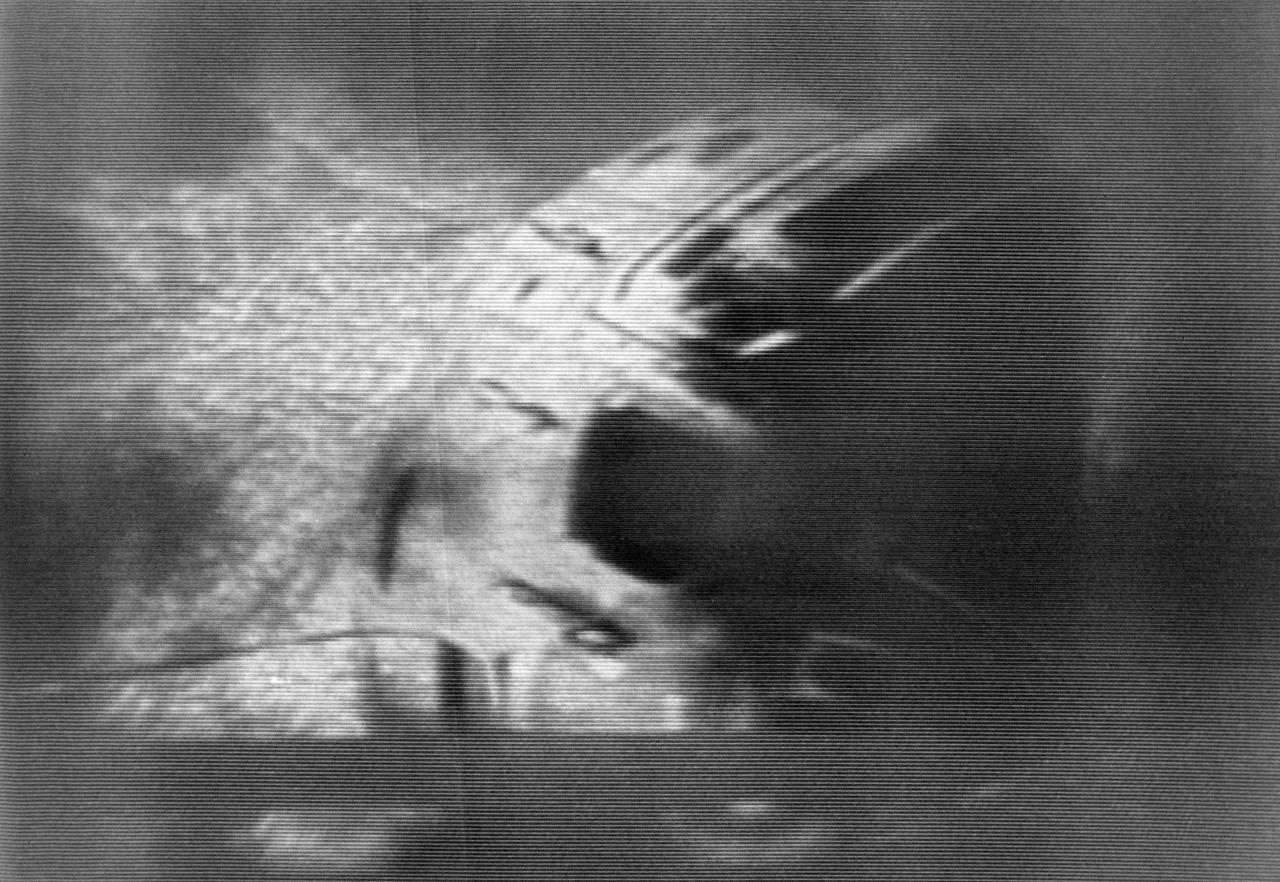
S69-26150 (6 March 1969) --- Television watchers on Earth saw this view of the Apollo 9 Command Module during the second live telecast from Apollo 9 early Thursday afternoon on the fourth day in space. This view is looking through the docking window of the Lunar Module. The cloud-covered Earth can be seen in the background. Inside the Lunar Module "Spider" were Astronauts James A. McDivitt, Apollo 9 commander; and Russell L. Schweickart, lunar module pilot. At this moment Apollo 9 was orbiting Earth with the Command and Service Modules docked nose-to-nose with the Lunar Module. Astronaut David R. Scott, command module pilot, remained at the controls in the Command Module "Gumdrop" while the other two astronauts checked out the Lunar Module. McDivitt and Schweickart moved into the Lunar Module from the Command Module by way of the docking tunnel.
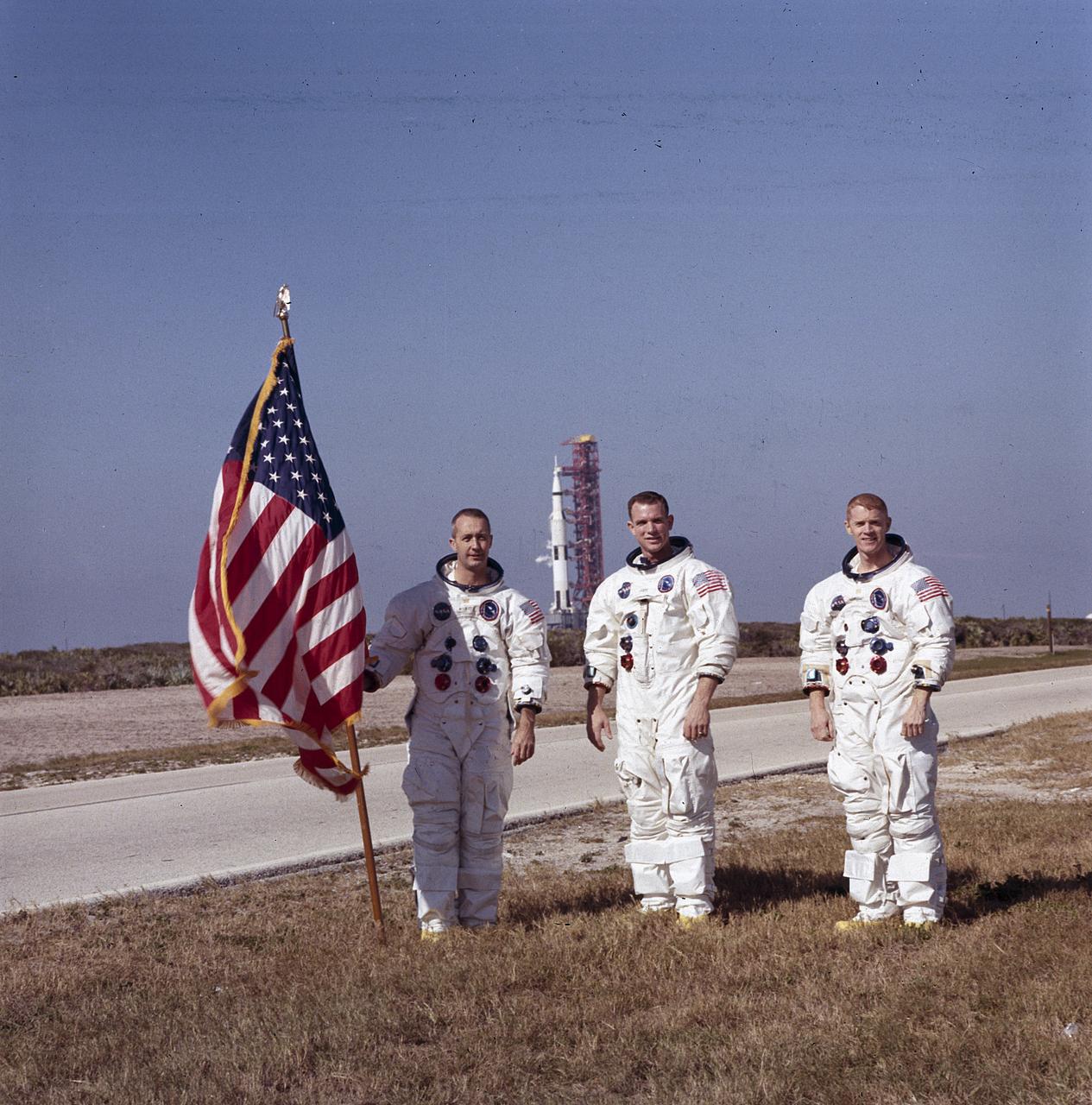
Pictured from left to right, the Apollo 9 astronauts, James A. McDivitt, David R. Scott, and Russell L. Schweickart, pause in front of the Apollo/Saturn V space vehicle that would launch the Apollo 8 crew. The launch of the Apollo 9 (Saturn V launch vehicle, SA-504) took place on March 3, 1968. The Apollo 9 spacecraft, in the lunar mission configuration, was tested in Earth orbit. The mission was designed to rehearse all the steps and reproduce all the events of the Apollo 11 mission with the exception of the lunar touchdown, stay, and liftoff. The command and service modules, and the lunar module were used in flight procedures identical to those that would later take similar vehicles to the Moon, and a landing. The flight mechanics, mission support systems, communications, and recording of data were tested in a final round of verification. Astronauts Scott and Schweickart conducted Extravehicular Activity during this mission.

S69-27746 (13 March 1969) --- The Apollo 9 crew awaits the arrival of a recovery helicopter from the USS Guadalcanal, prime recovery ship for the Apollo 9 10-day Earth-orbital space mission. Astronaut James A. McDivitt, commander, stands in hatch of spacecraft. Already in life raft are astronauts Russell L. Schweickart (foreground), lunar module pilot, and David R. Scott, command module pilot. Scott is taking a picture of McDivitt. Splashdown occurred at 12:00:53 p.m. (EST), March 13, 1969, only 4.5 nautical miles from the USS Guadalcanal. U.S. Navy underwater demolition team swimmers assist in the recovery operations.
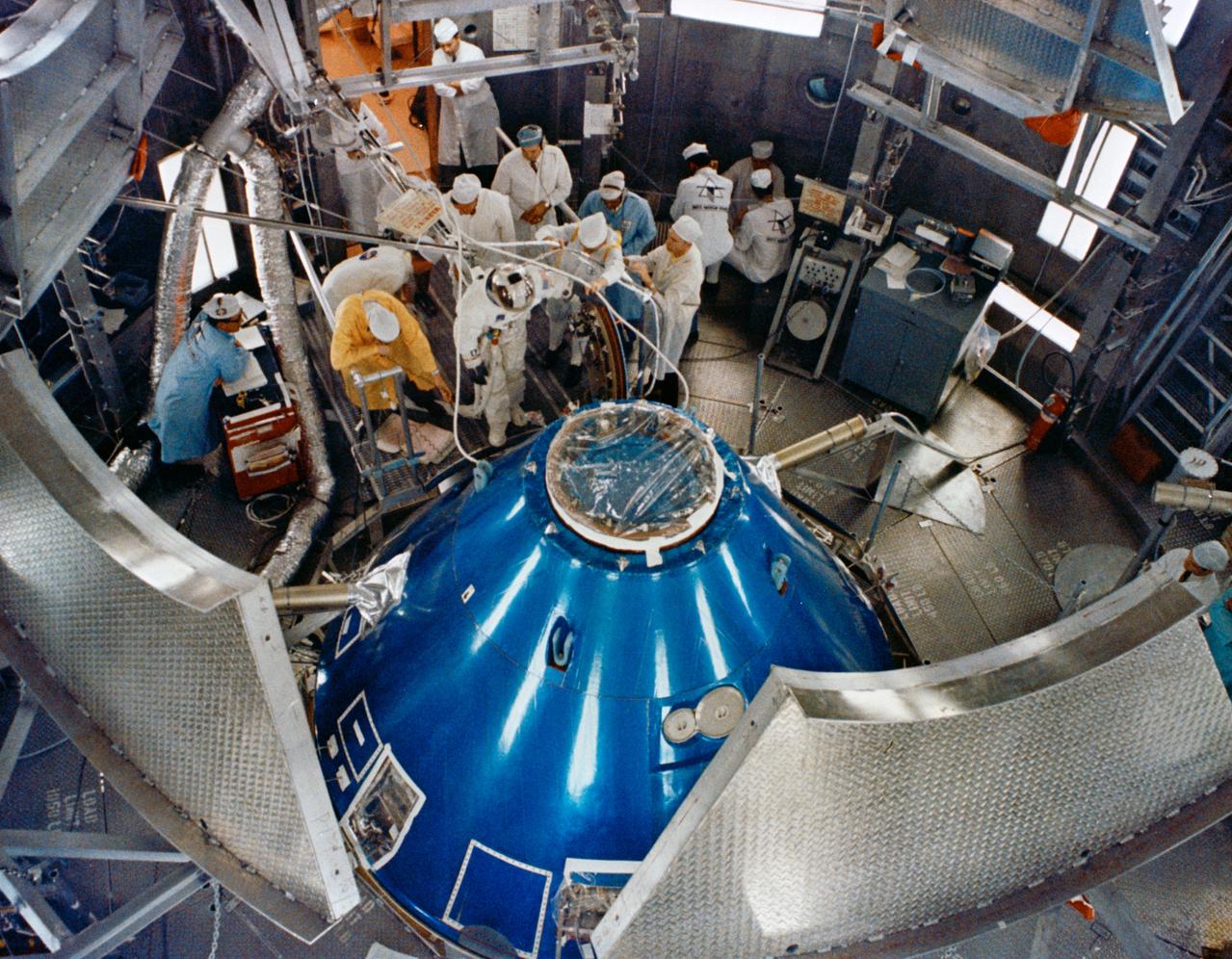
S68-55255 (6 Nov. 1968) --- Overhead view of Altitude Chamber "L" in the Kennedy Space Center's Manned Spacecraft Operations Building showing a member of the Apollo 9 backup crew preparing to ingress the Apollo 9 spacecraft for egress test and simulated altitude run. The Apollo 9 backup crew consists of astronauts Charles Conrad Jr., Richard F. Gordon Jr., and Alan L. Bean.
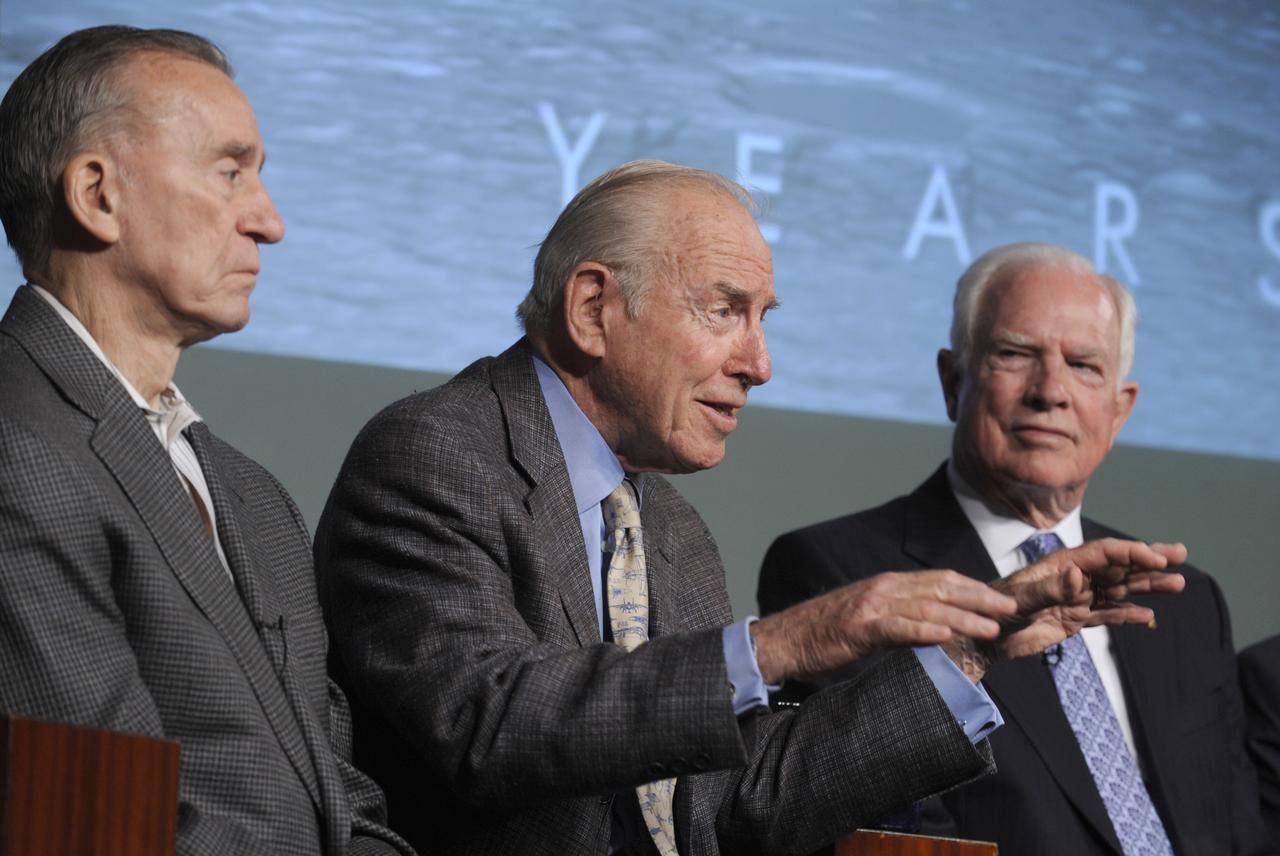
Astronaut James Lovell (Apollo 8 Apollo 13), center, flanked by Walt Cunningham (Apollo 7), left, and David Scott (Apollo 9 Apollo 15) responds during the 40th anniversary of the Apollo 11 mission and the walk on the moon press conference, Monday, July 20, 2009, at NASA Headquarters in Washington. Photo Credit: (NASA/Paul E. Alers)

AS09-20-3126 (3-13 March 1969) --- Oblique view of the U.S. South Atlantic coastal area as photographed from the Apollo 9 spacecraft during its Earth-orbital mission in March of 1969. This view shows area north from Goldsboro, North Carolina, looking over the Pamlico River and Albemarle Sound at the Portsmouth-Norfolk-Newport News area. The Delaware peninsula and New Jersey lie under snow. Long Island, New York, is barely visible under the clouds in the background. Richmond is left of center.
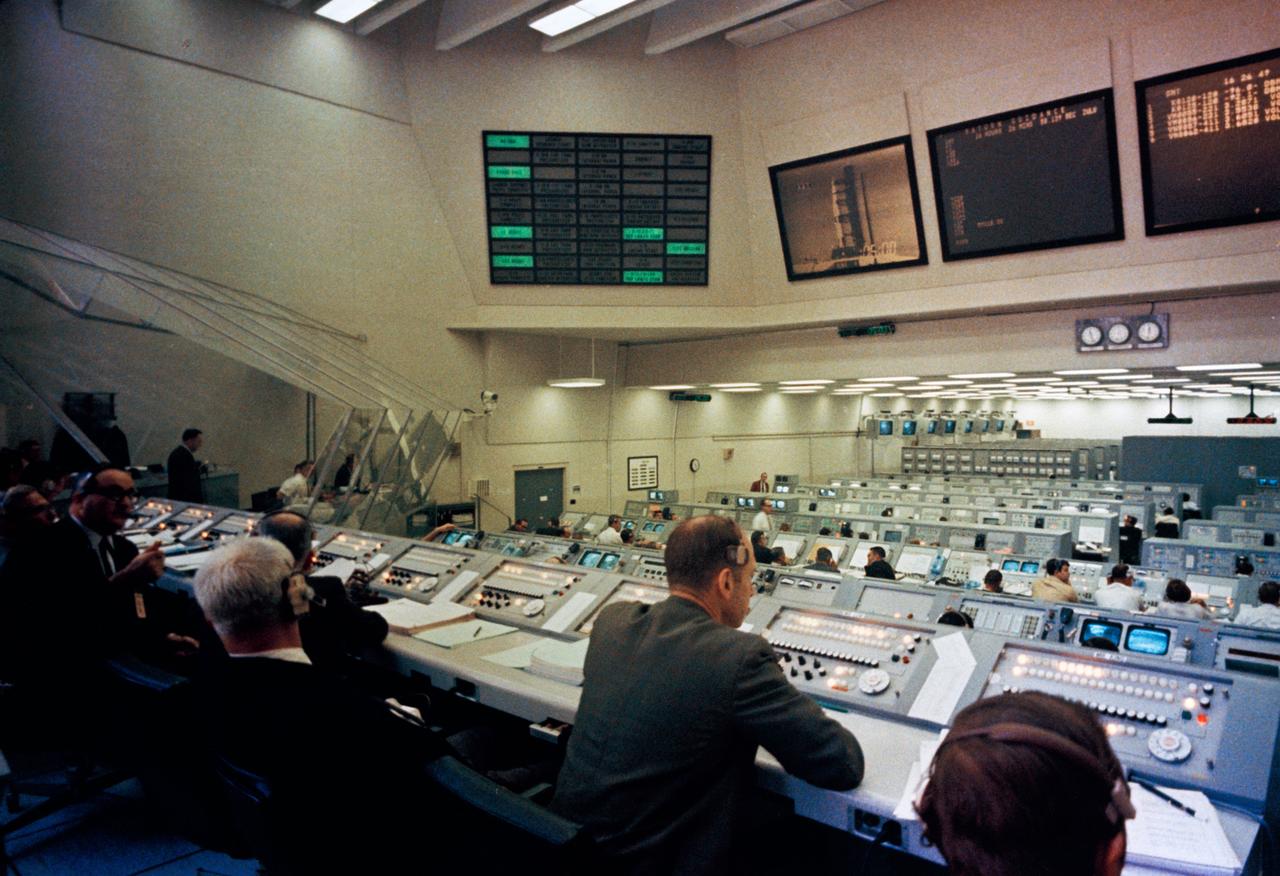
S69-25880 (23 Feb. 1969) --- Overall view of Firing Room 2 in the Launch Control Center, Launch Complex 39, Kennedy Space Center, during an Apollo 9 Countdown Demonstration Test. Astronauts James A. McDivitt, David R. Scott, and Russell L. Schweickart were participating in a training exercise in preparation for their scheduled 10-day Earth-orbital space mission.
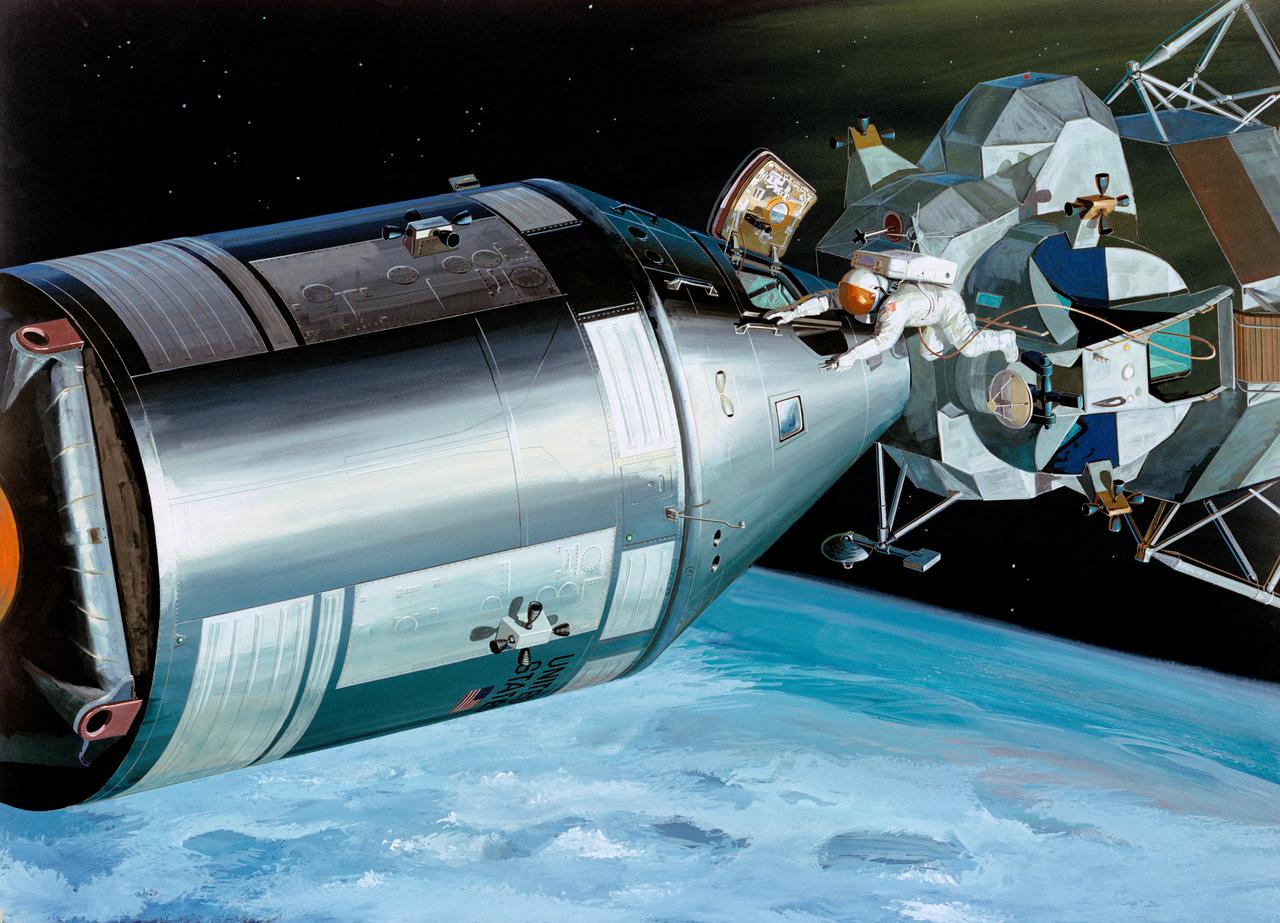
S69-18547 (1969) --- North American Rockwell artist's concept illustrating a part of the planned Apollo 9 extravehicular activity on the fourth day of the mission as the Command and Service Modules are docked to the Lunar Module. The figure performing the EVA represents astronaut Russell L. Schweickart, Apollo 9 lunar module pilot.
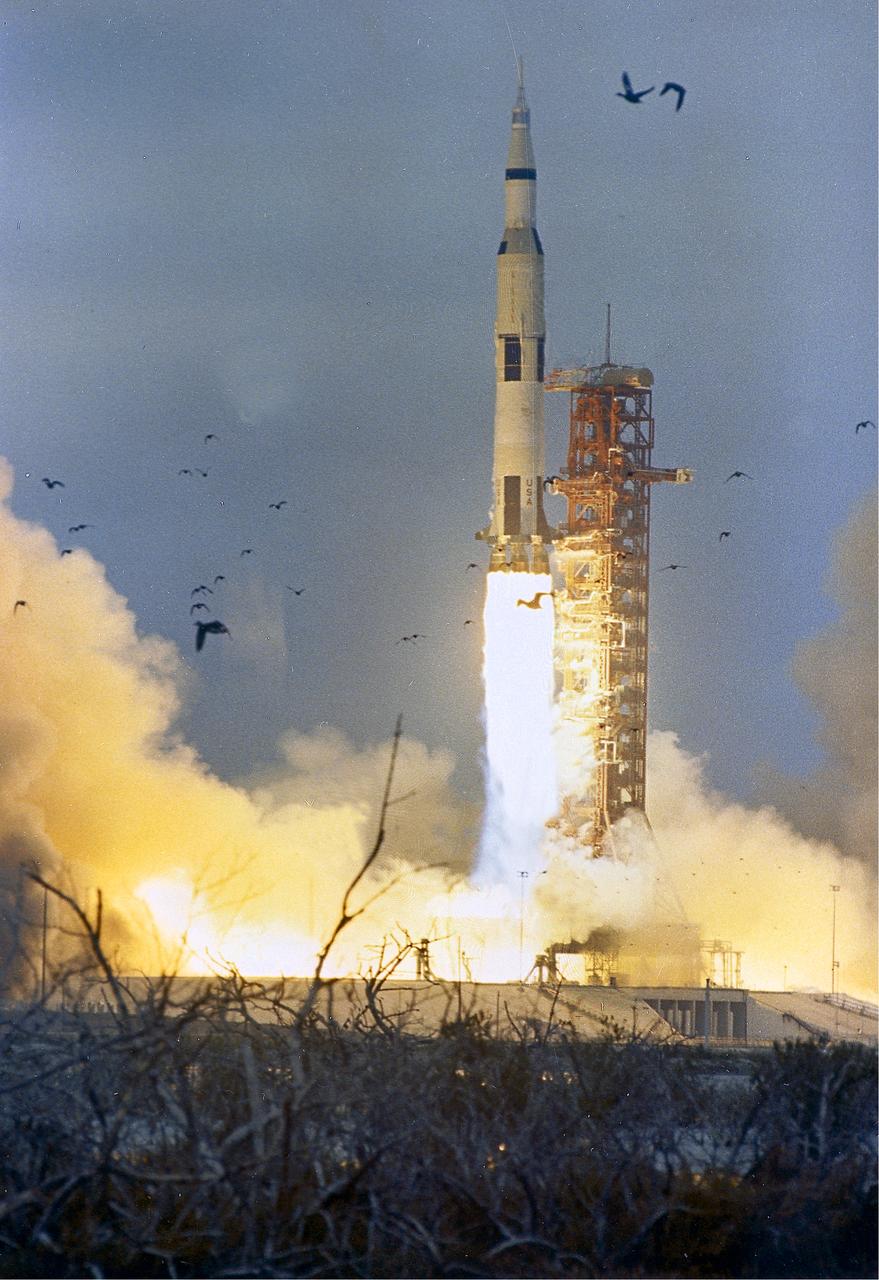
The launch of the Apollo 9 (Saturn V launch vehicle, SA-504), with astronauts James A. McDivitt, David R. Scott, and Russell L. Schweickart, took place on March 3, 1968. The Apollo 9 spacecraft, in the lunar mission configuration, was tested in Earth orbit. The mission was designed to rehearse all the steps and reproduce all the events of the Apollo 11 mission with the exception of the lunar touchdown, stay, and liftoff. The command and service modules, and the lunar module were used in flight procedures identical to those that would later take similar vehicles to the Moon, and a landing. The flight mechanics, mission support systems, communications, and recording of data were tested in a final round of verification. Astronauts Scott and Schweickart conducted Extravehicular Activity during this mission.
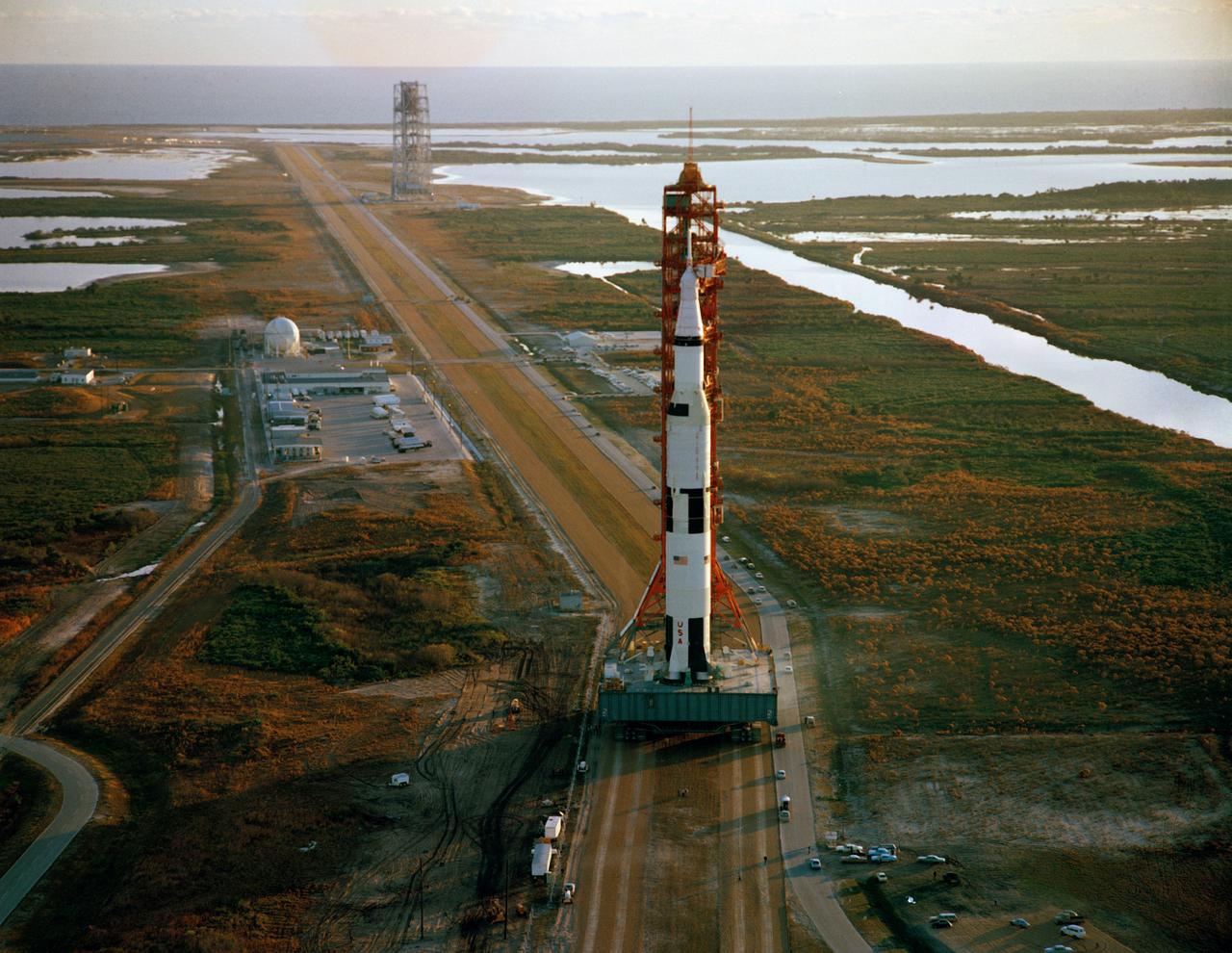
S69-17487 (3 Jan. 1969) --- Aerial view of the Apollo 9 (Spacecraft 104/Lunar Module 3/Saturn 504) space vehicle on the way from the Vehicle Assembly Building to Pad A, Launch Complex 39, Kennedy Space Center. The Saturn V stack and its mobile launch tower are atop a huge crawler-transporter. (view looking toward Pad A)
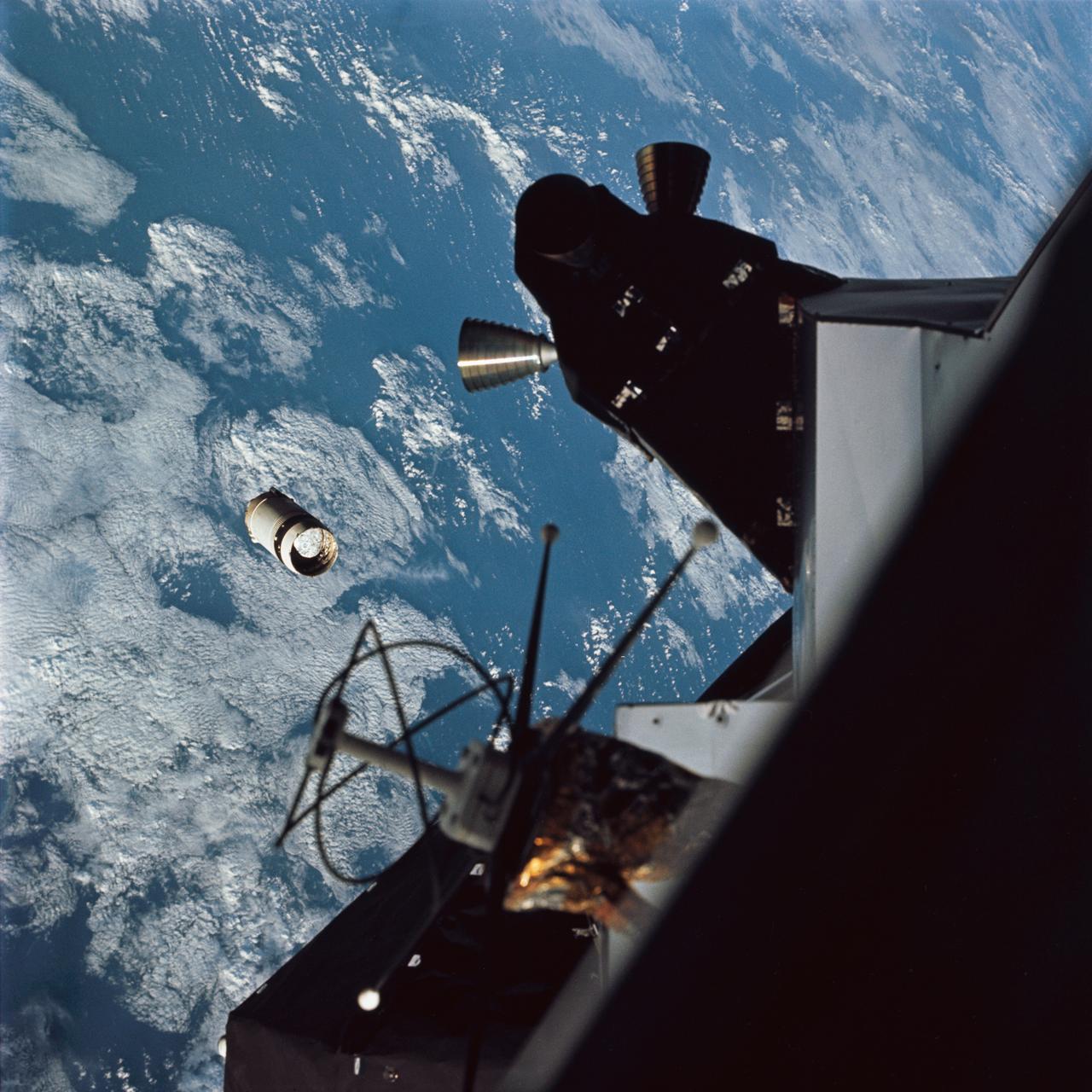
View of the Lunar Module (LM) 3 and Service Module (SM) LM Adapter. Film magazine was A,film type was SO-368 Ektachrome with 0.460 - 0.710 micrometers film / filter transmittance response and haze filter, 80mm lens.
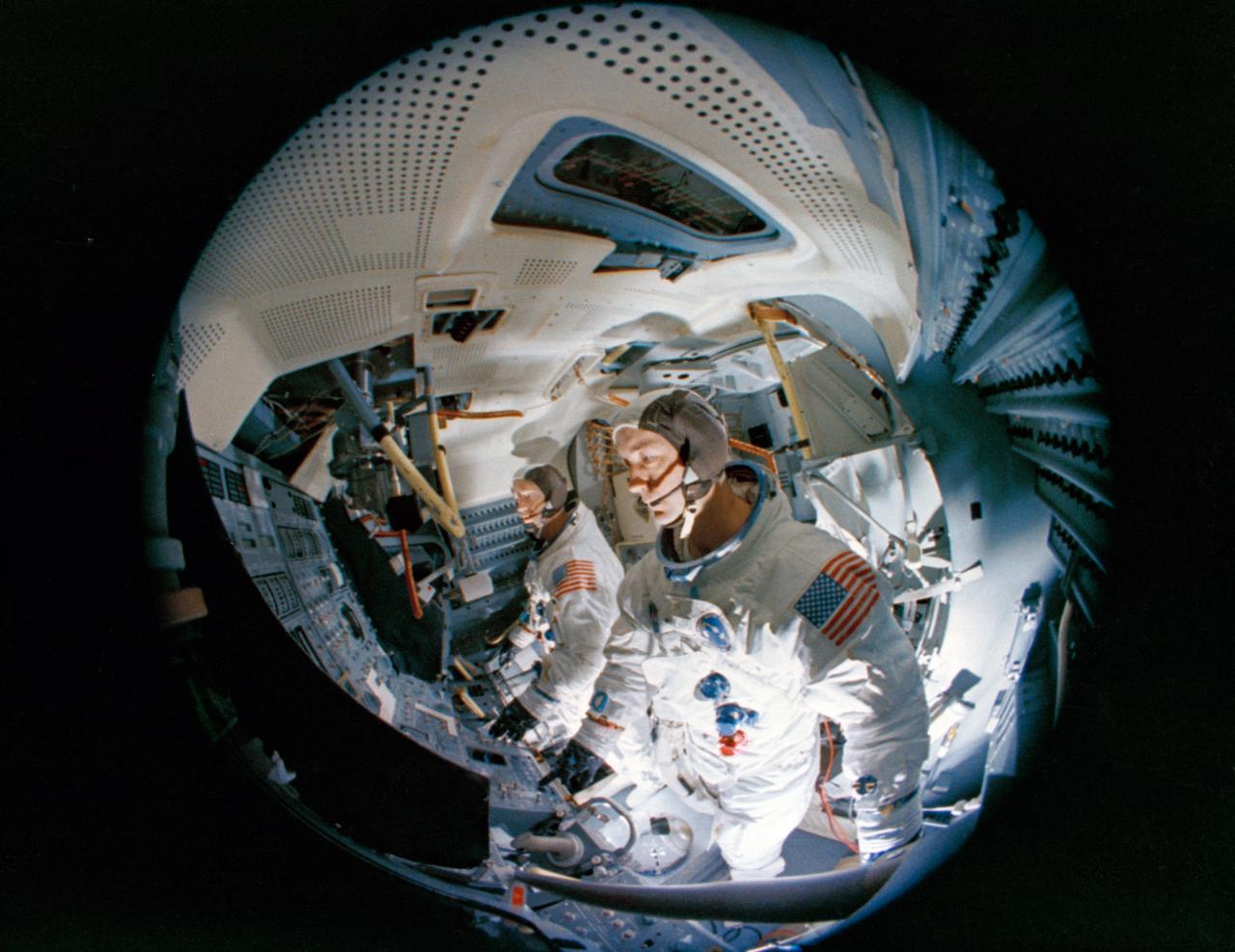
S69-19981 (23 Feb. 1969) --- Fish-eye camera lens view of the interior of the Apollo Lunar Module Mission Simulator (LMMS) at the Kennedy Space Center (KSC) during Apollo 9 simulation training. In the foreground is astronaut James A. McDivitt, prime crew commander; and in background is astronaut Russell L. Schweickart, lunar module pilot.
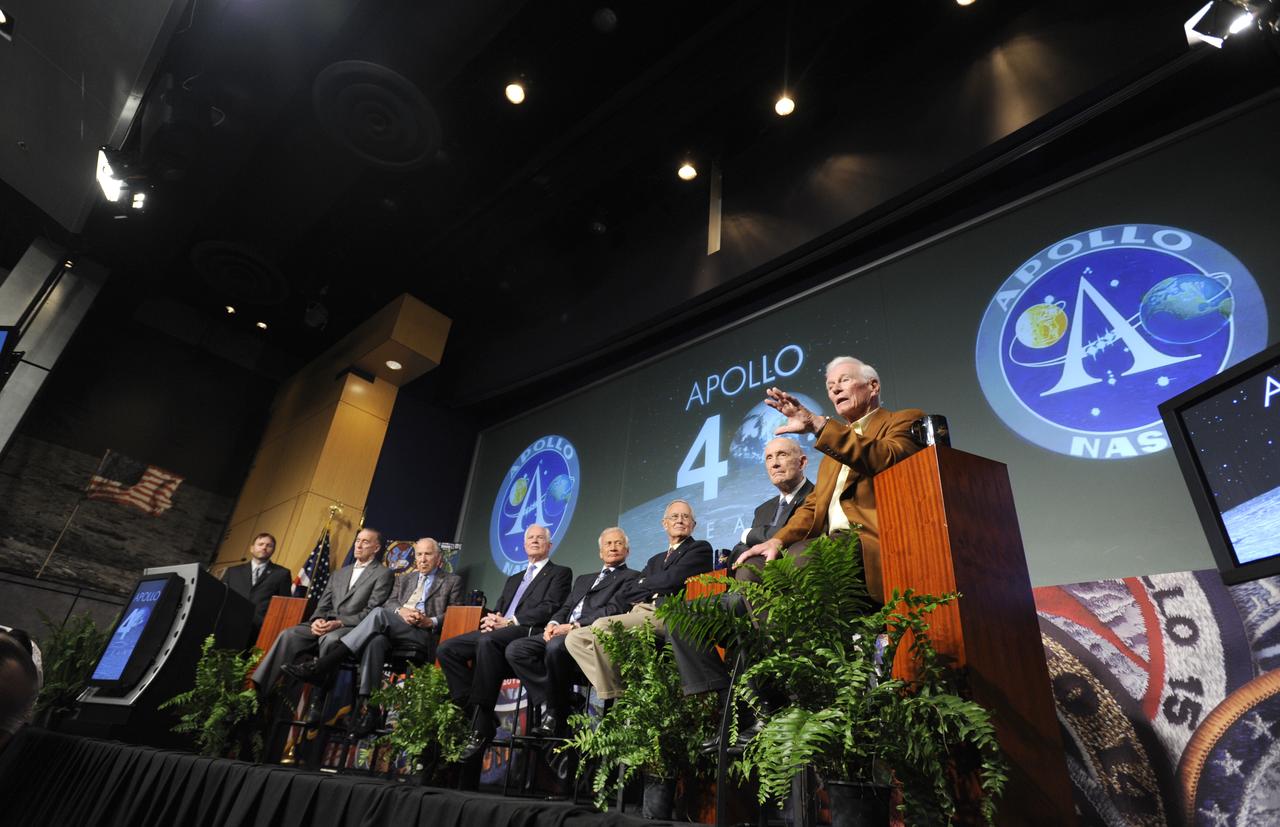
Apollo astronauts from left, Walt Cunningham (Apollo 17), James Lovell (Apollo 8 Apollo 13), David Scott (Apollo 9 Apollo 15), Buzz Aldrin (Apollo 11), Charles Duke (Apollo 16), Thomas Stafford (Apollo 10) and Eugene Cernan (Apollo 17) are seen during the 40th anniversary of the Apollo 11 mission and the walk on the moon press conference, Monday, July 20, 2009, at NASA Headquarters in Washington. Photo Credit: (NASA/Paul E. Alers)
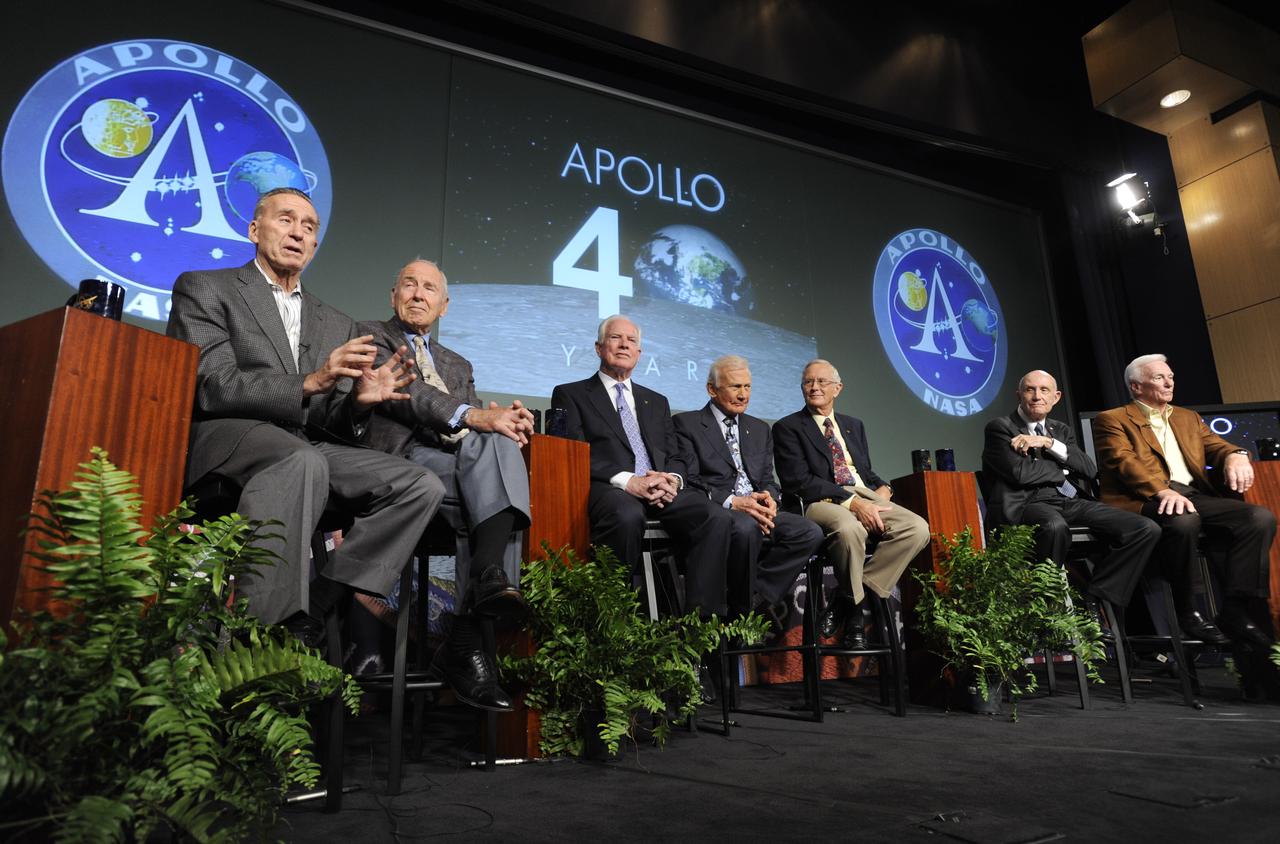
Apollo astronauts from left, Walt Cunningham (Apollo 17), James Lovell (Apollo 8 Apollo 13), David Scott (Apollo 9 Apollo 15), Buzz Aldrin (Apollo 11), Charles Duke (Apollo 16), Thomas Stafford (Apollo 10) and Eugene Cernan (Apollo 17) are seen during the 40th anniversary of the Apollo 11 mission and the walk on the moon press conference, Monday, July 20, 2009, at NASA Headquarters in Washington. Photo Credit: (NASA/Paul E. Alers)

Apollo astronauts from left, Walt Cunningham (Apollo 17), James Lovell (Apollo 8 Apollo 13), David Scott (Apollo 9 Apollo 15), Buzz Aldrin (Apollo 11), Charles Duke (Apollo 16), Thomas Stafford (Apollo 10) and Eugene Cernan (Apollo 17) are seen during the 40th anniversary of the Apollo 11 mission and the walk on the moon press conference, Monday, July 20, 2009, at NASA Headquarters in Washington. Photo Credit: (NASA/Paul E. Alers)
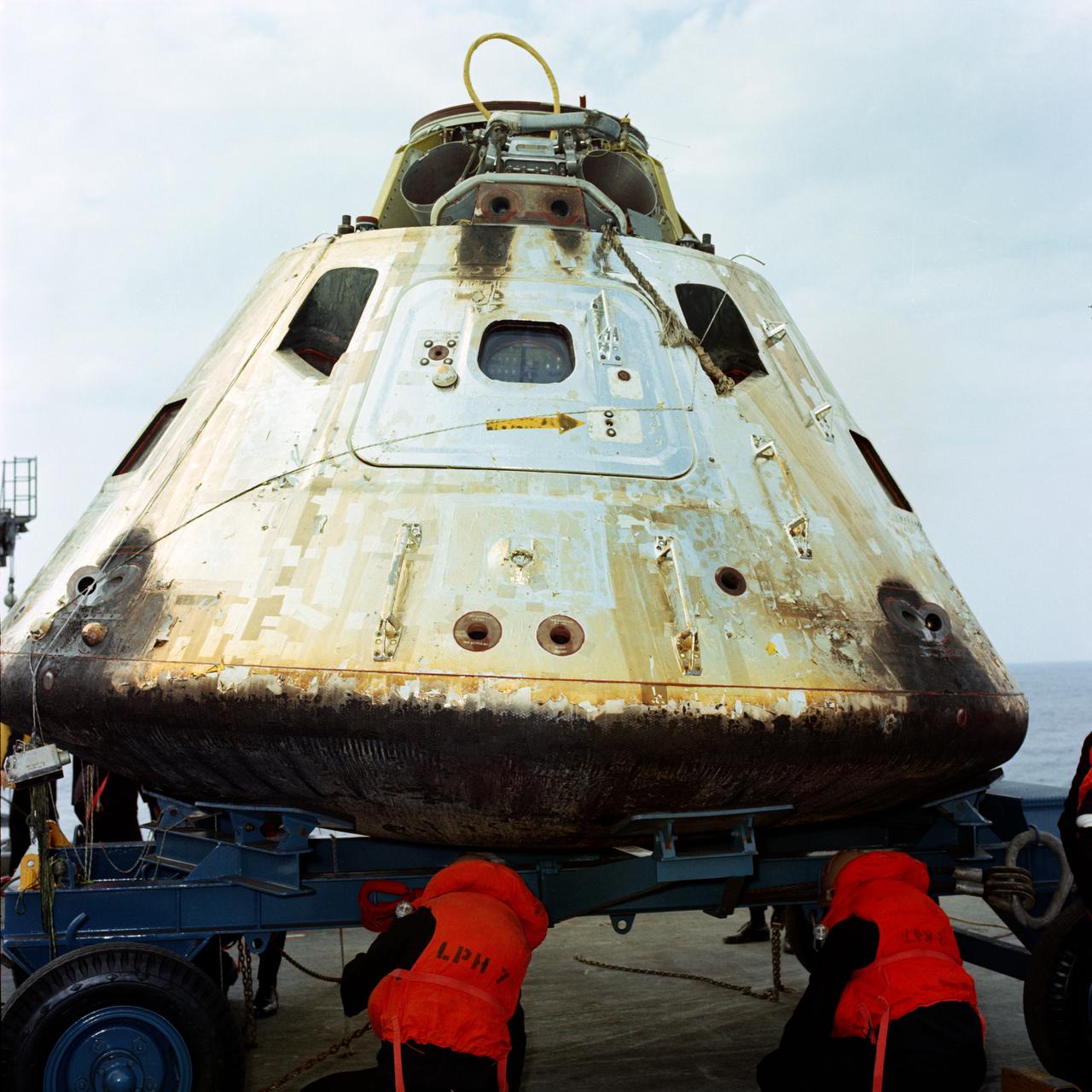
S69-20239 (13 March 1969) --- Close-up view of the Apollo 9 Command Module (CM) as it sets on dolly on the deck of the USS Guadalcanal just after being hoisted from the water. The Apollo 9 spacecraft, with astronauts James A. McDivitt, David R. Scott, and Russell L. Schweickart aboard, splashed down at 12:00:53 p.m. (EST), March 13, 1969, only 4.5 nautical miles from the aircraft carrier to conclude a successful 10-day Earth-orbital mission in space.
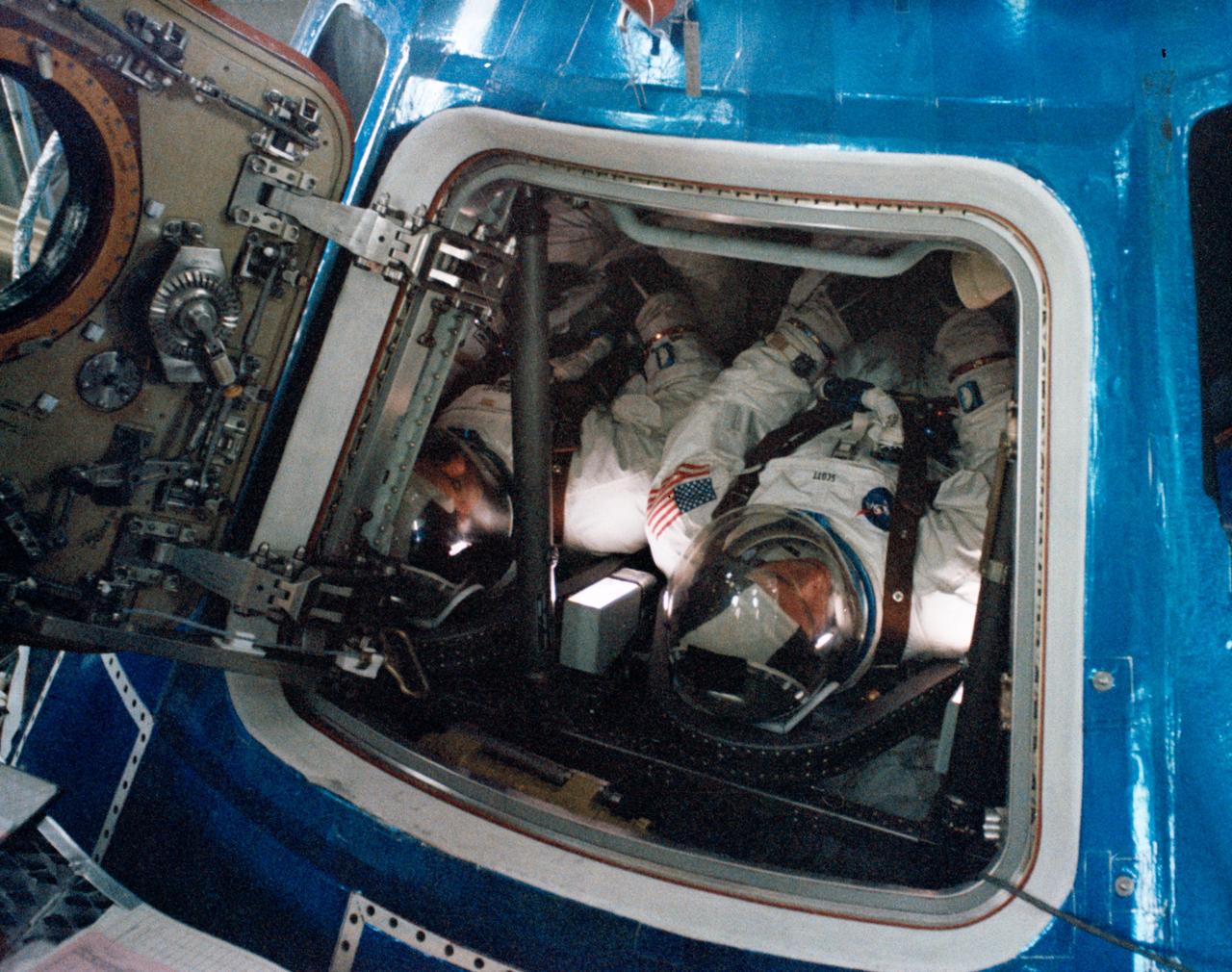
S68-55272 (15 Nov. 1968) --- The Apollo 9 prime crew is seen inside the Apollo 9 spacecraft in the Kennedy Space Center's Manned Spacecraft Operations Building during manned altitude chamber test activity. Left to right, are astronauts James A. McDivitt, commander; David R. Scott, command module pilot; and Russell L. Schweickart (out of view to far right), lunar module pilot.
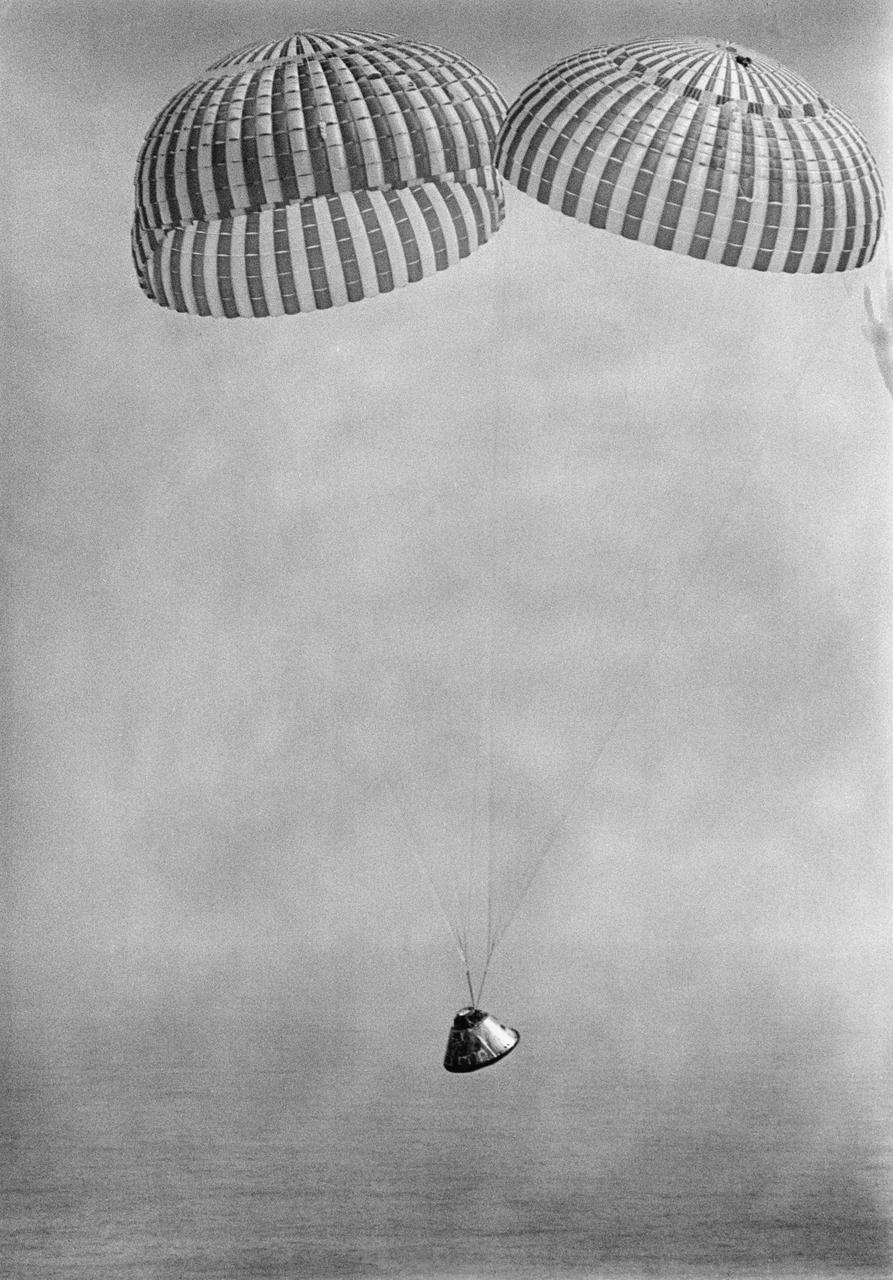
S69-27467 (13 March 1969) --- The Apollo 9 spacecraft, with astronauts James A. McDivitt, David R. Scott, and Russell L. Schweickart aboard, approaches touchdown in the Atlantic recovery area. Splashdown occurred at 12:00:53 p.m. (EST), March 13, 1969, only 4.5 nautical miles from the prime recovery ship, USS Guadalcanal. Photo credit: NASA
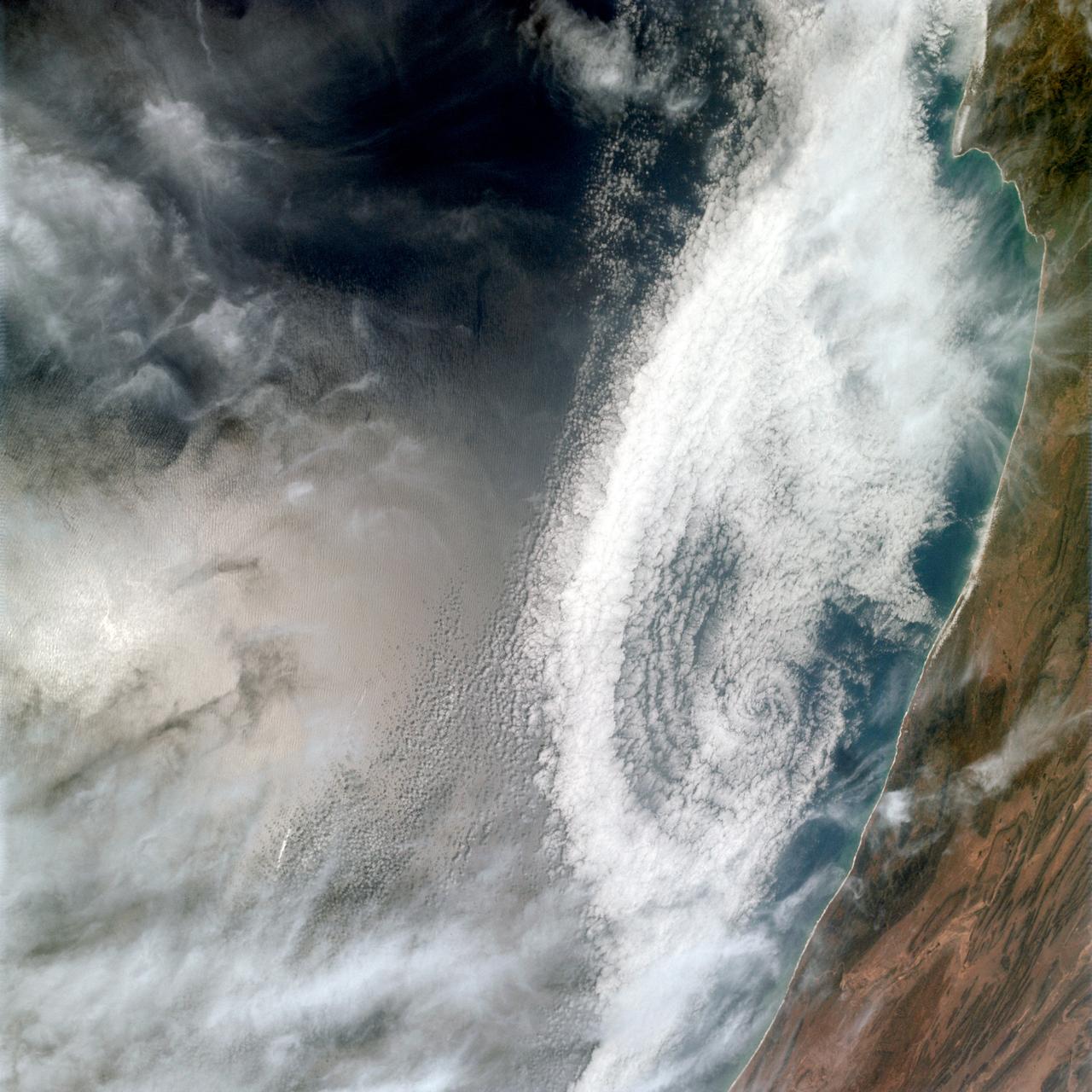
AS09-23-3617 (12 March 1969) --- Morocco, Ifni, cloud eddy over Ras Rhir, as photographed from the Apollo 9 spacecraft during its 134th revolution of Earth.
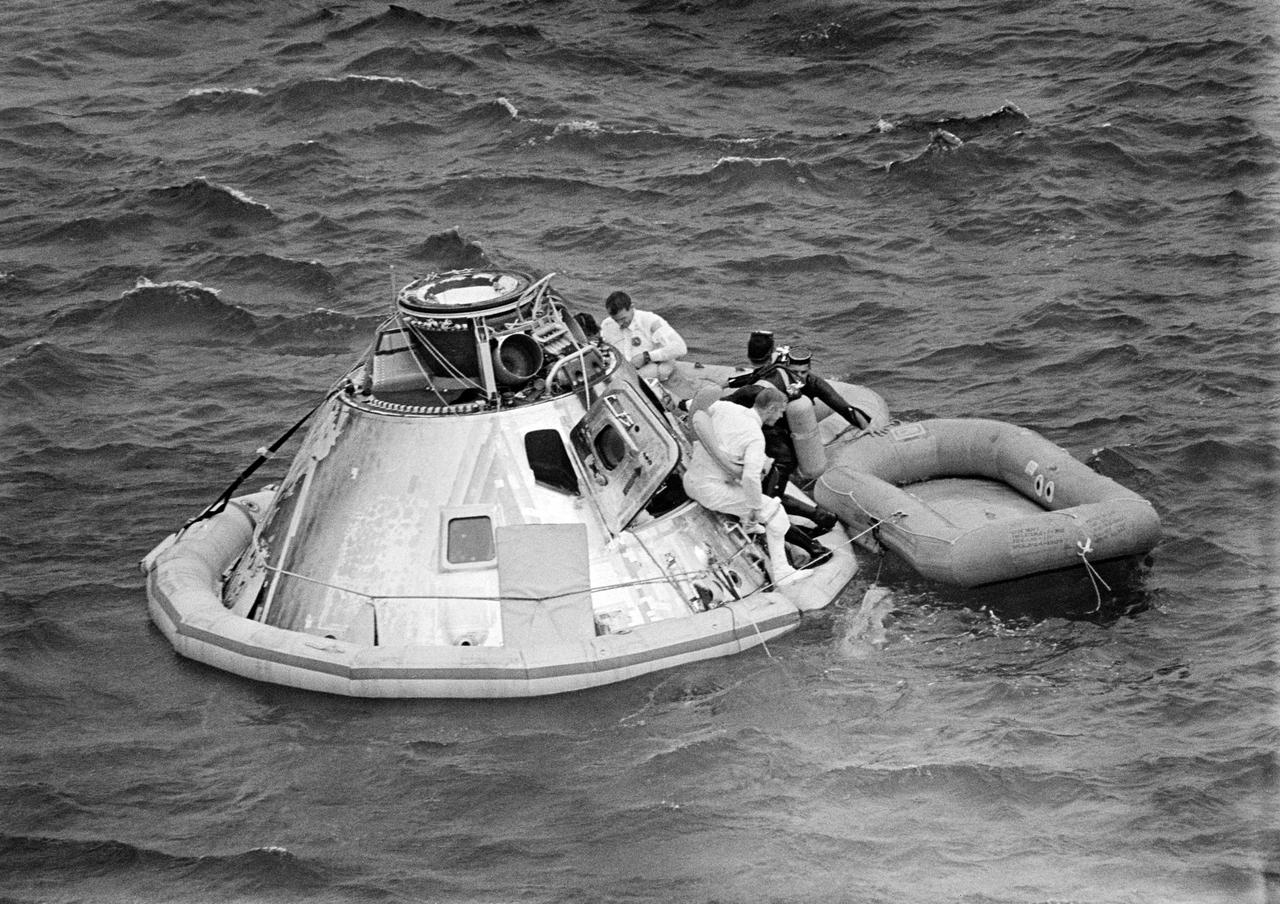
S69-27468 (13 March 1969) --- U.S. Navy underwater demolition team swimmers assist the Apollo 9 crew during recovery operations just after splashdown. They have already attached a flotation collar to the Command Module (CM). Astronaut Russell L. Schweickart, lunar module pilot, is about to climb into raft. In background is astronaut David R. Scott, command module pilot. Still inside the spacecraft is astronaut James A. McDivitt, commander. Splashdown occurred at 12:00:53 p.m. (EST), March 13, 1969, only 4.5 nautical miles from the prime recovery ship, USS Guadalcanal, to conclude a successful 10-day Earth-orbital mission in space.
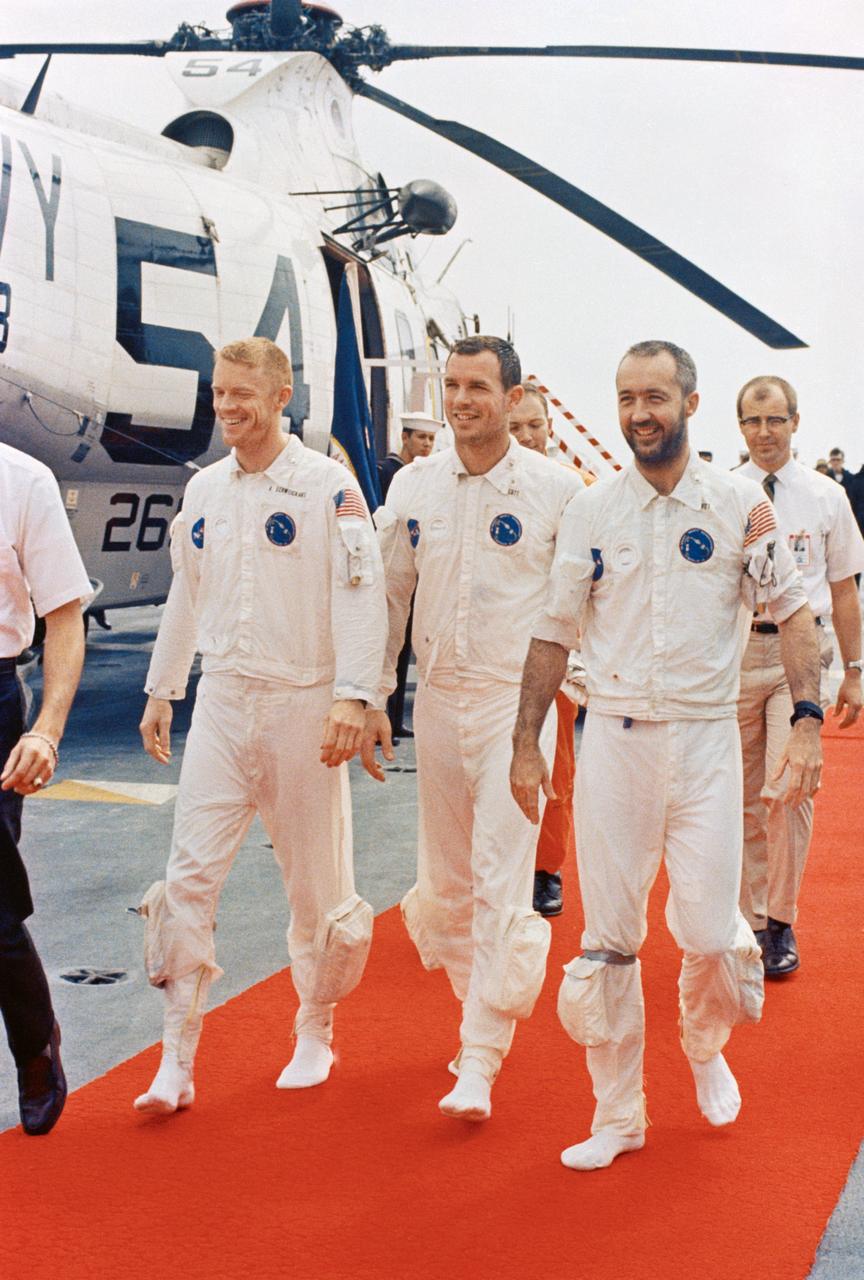
S69-27920 (13 March 1969) --- The Apollo 9 crew men walk on a red carpet after arriving aboard the prime recovery ship, USS Guadalcanal. Left to right, are astronauts Russell L. Schweickart, David R. Scott, and James A. McDivitt. They are walking from the recovery helicopter which picked them up from the splashdown area. Splashdown occurred at 12:00:53 p.m. (EST), March 13, 1969, only 4.5 nautical miles from the USS Guadalcanal to conclude a successful 10-day Earth-orbital space mission.
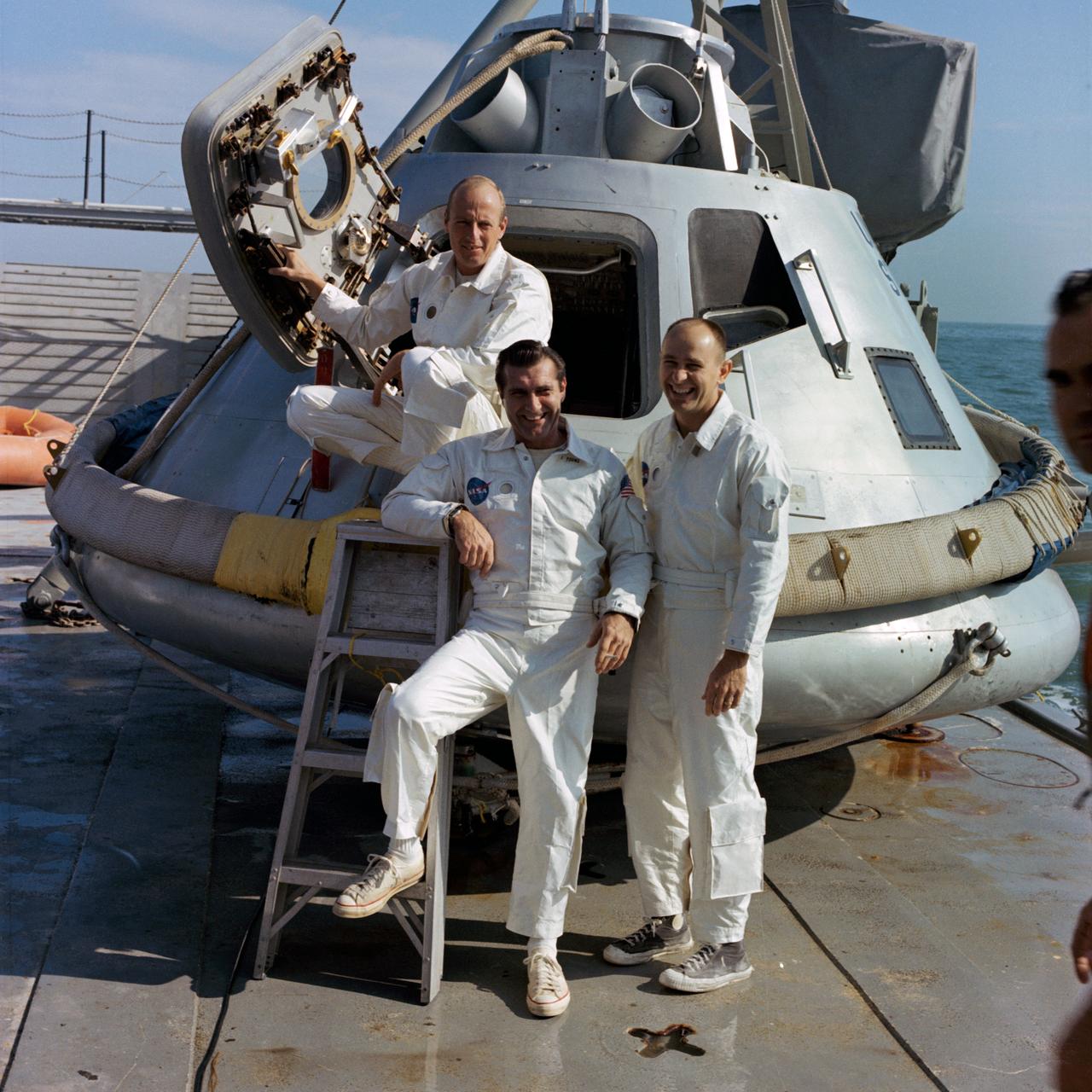
S68-51700 (November 1968) --- The backup crew of the Apollo 9 (Spacecraft 104/ Lunar Module 3/ Saturn 504) space mission stands on the deck of the NASA Motor Vessel Retriever (MVR) prior to participating in water egress training in the Gulf of Mexico. Left to right, are astronauts Charles Conrad Jr. (holding hatch), Richard F. Gordon Jr., and Alan L. Bean. They are standing by the Apollo command module trainer which was used in the exercise. Since this photograph was made, these three astronauts have been named as the prime crew of the Apollo 12 lunar landing mission.
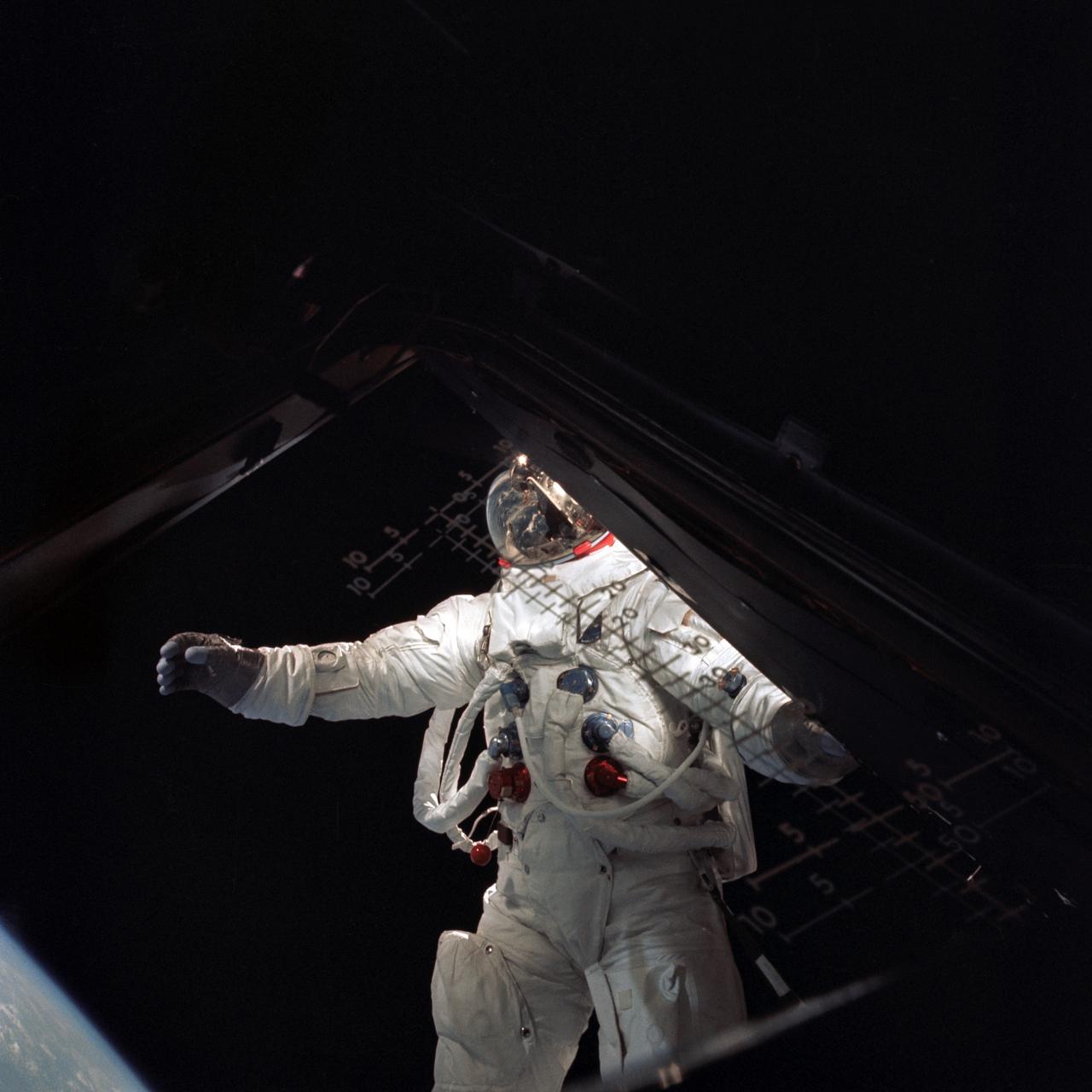
AS09-20-3094 (6 March 1969) --- Astronaut Russell L. Schweickart, lunar module pilot, stands in "golden slippers" on the Lunar Module porch during his extravehicular activity on the fourth day of the Apollo 9 Earth-orbital mission. This photograph was taken from inside the Lunar Module "Spider". The Command and Service Modules were docked to the LM. Schweickart is wearing an Extravehicular Mobility Unit (EMU). Inside the "Spider" was astronaut James A. McDivitt, Apollo 9 crew commander. Astronaut David R. Scott, command module pilot, remained at the controls of the Command Module, "Gumdrop."
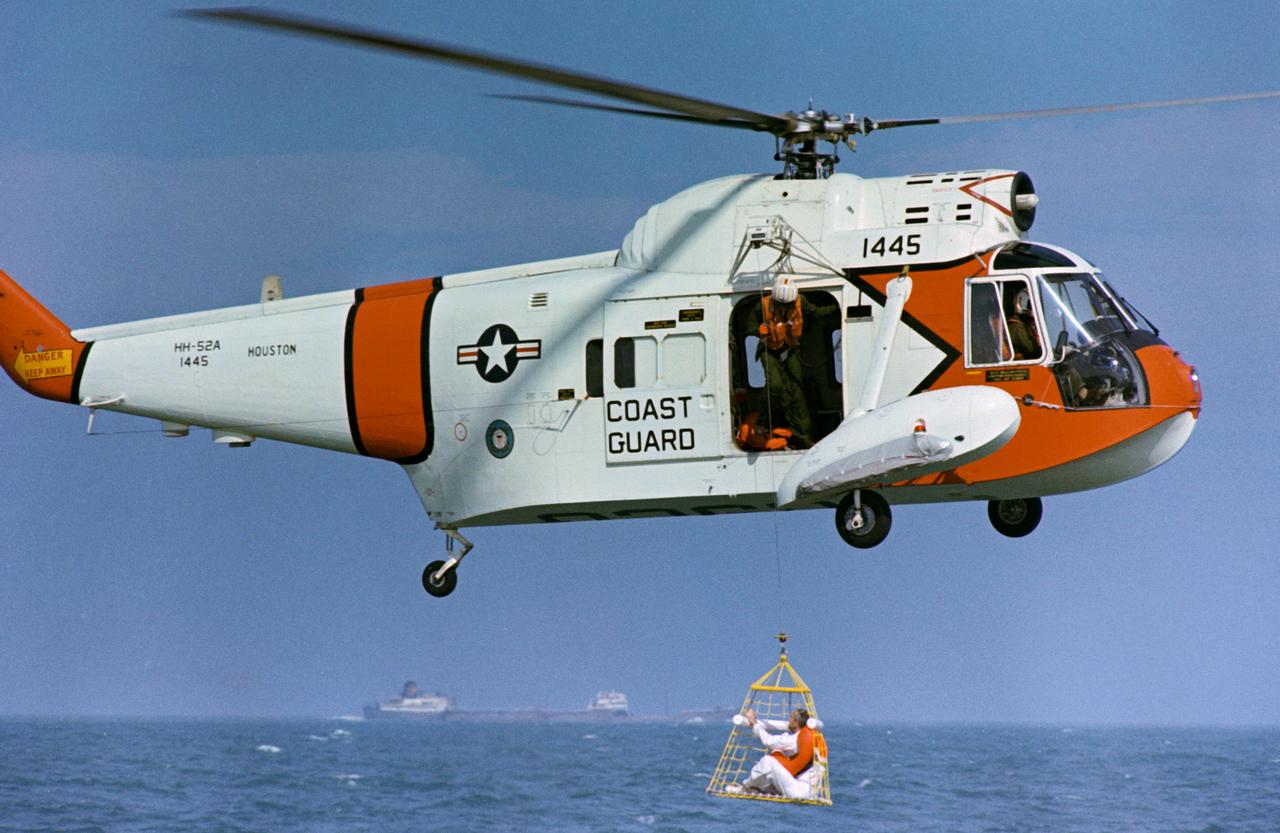
S68-50989 (20 Nov. 1968) --- Astronaut James A. McDivitt, commander of the Apollo 9 prime crew, is hoisted up to a U.S. Coast Guard helicopter in a new type rescue net during water egress training in the Gulf of Mexico.

AS09-23-3592 (3-13 March 1969) --- Cyclonic storm system, located 1,200 miles north of Hawaii, as photographed from the Apollo 9 spacecraft during its 10-day, Earth-orbital space mission. This picture was made on the 124th revolution of Apollo 9. This cyclonic storm system can also be seen in the ESSA-7 photograph taken on March 11, 1969.
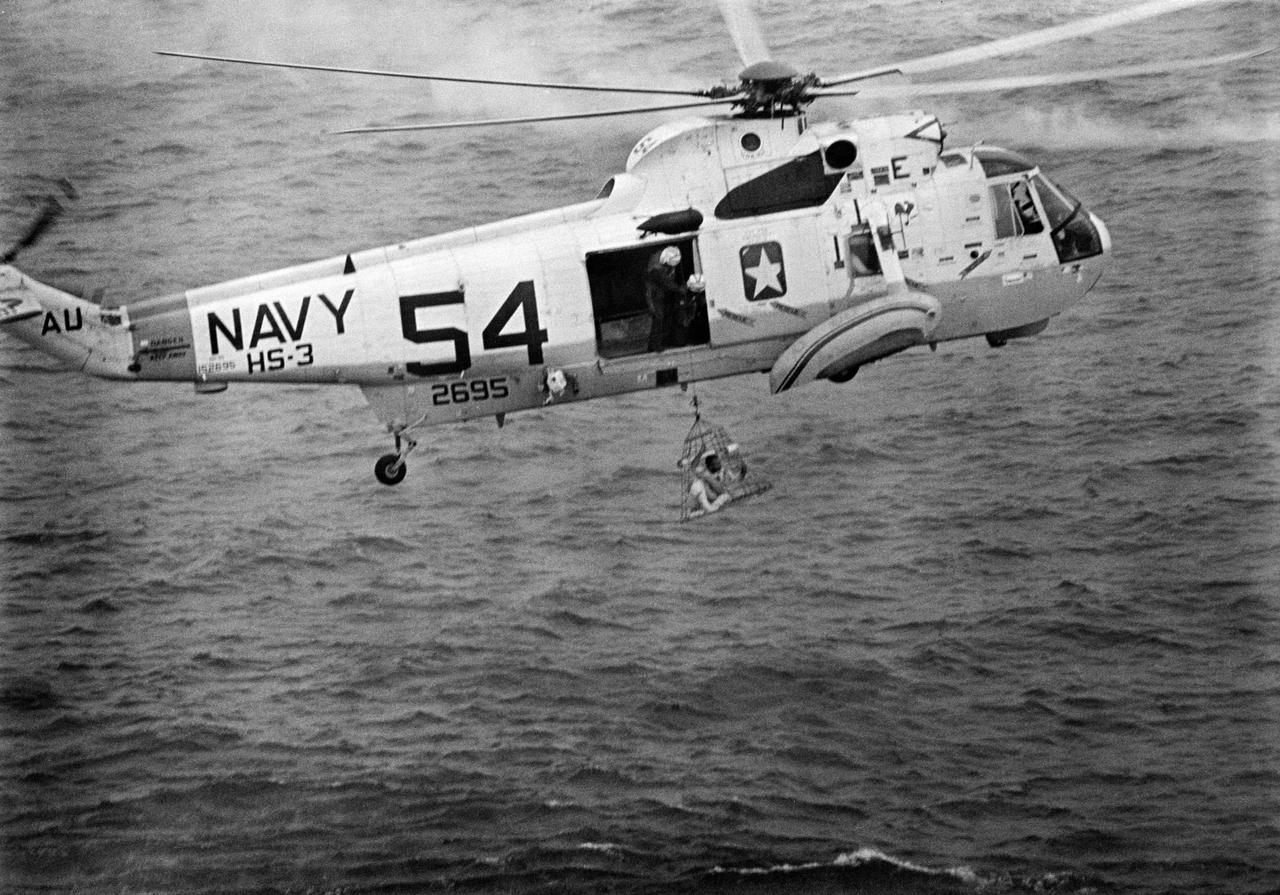
S69-27469 (13 March 1969) --- U.S. Navy helicopter crewmembers assist the Apollo 9 astronauts during recovery operations just after splashdown. Astronaut James A. McDivitt, mission commander, is in the Billy Pugh net about to aboard the helicopter. McDivitt was the third of the astronauts to egress the command module (out of frame). Also on the mission were astronauts David R. Scott, command module pilot; and Russell L. Schweickart, lunar module pilot. The three rehearsed in Earth orbit the transportation and docking maneuvers necessary to occur in lunar orbit in order for future crews to land on the moon's surface. Splashdown occurred at 12:00:53 p.m. (EST), March 13, 1969, only 4.5 nautical miles from the prime recovery ship, USS Guadalcanal, to conclude a successful 10-day mission.
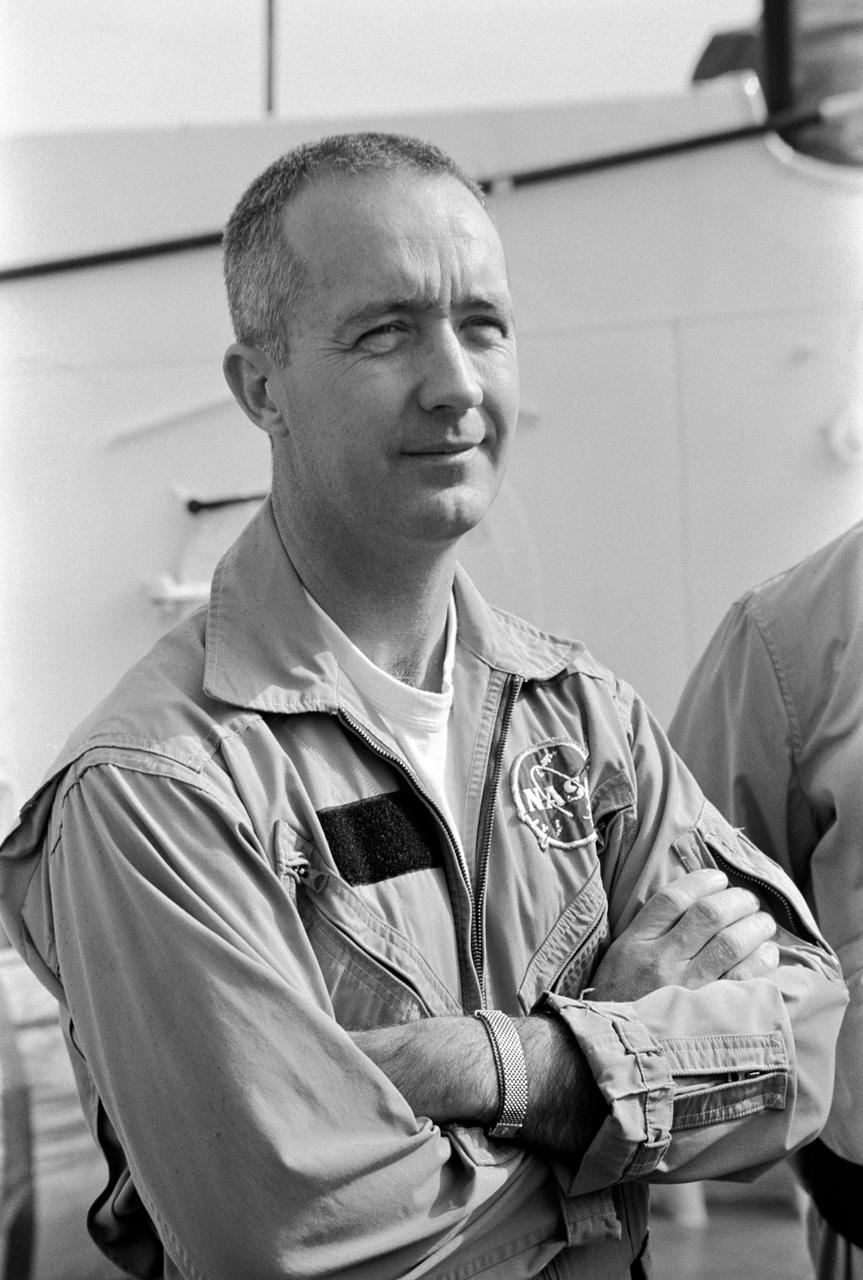
S68-54805 (5 Nov. 1968) --- Astronaut James A. McDivitt, commander of the Apollo 9 (Spacecraft 104/Lunar Module 3/Saturn 504) space mission, relaxes on the deck of the NASA Motor Vessel Retriever (MVR) prior to participating in water egress training in the Gulf of Mexico.
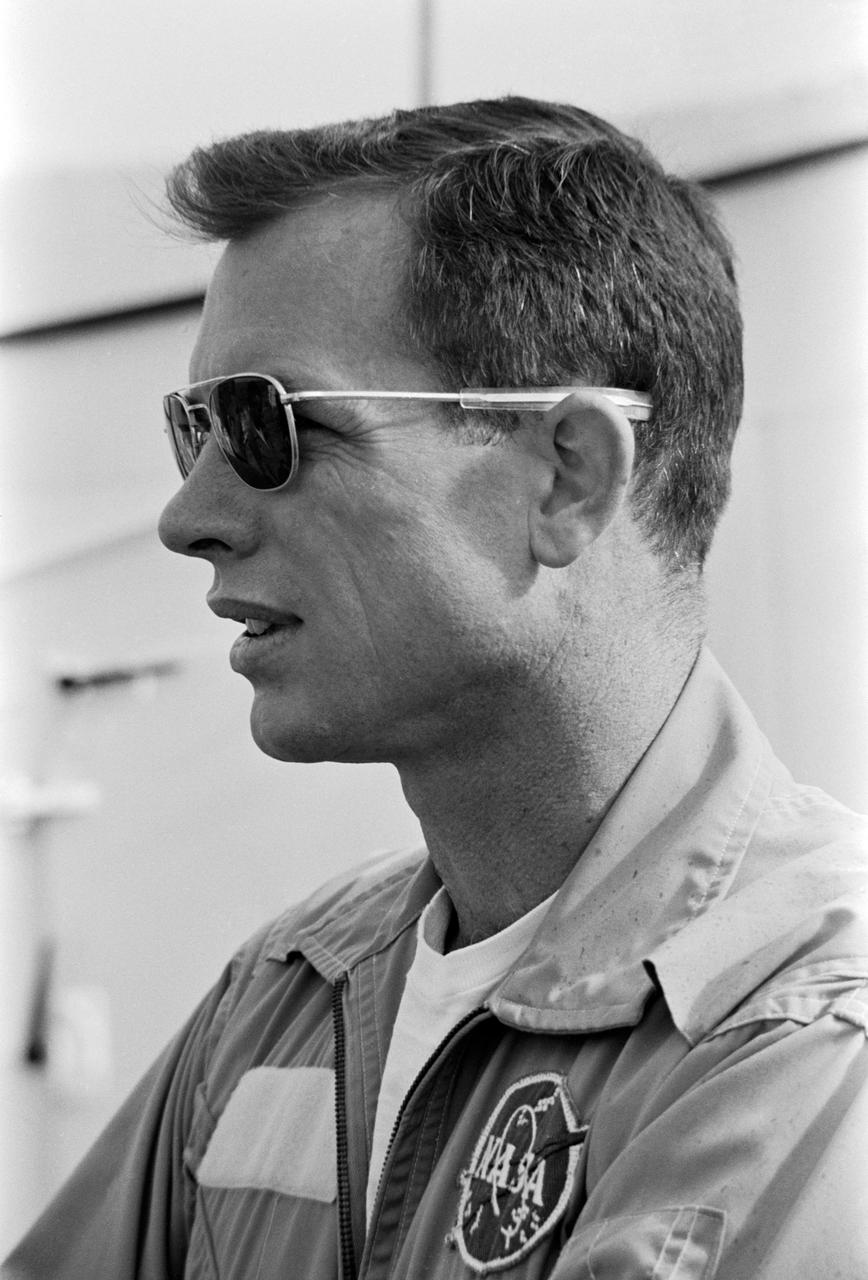
S68-54810 (5 Nov. 1968) --- Astronaut David R. Scott, command module pilot of the Apollo 9 (Spacecraft 104/Lunar Module 3/Saturn 504) space mission, relaxes on the deck of the NASA Motor Vessel Retriever prior to participating in water egress training in the Gulf of Mexico.
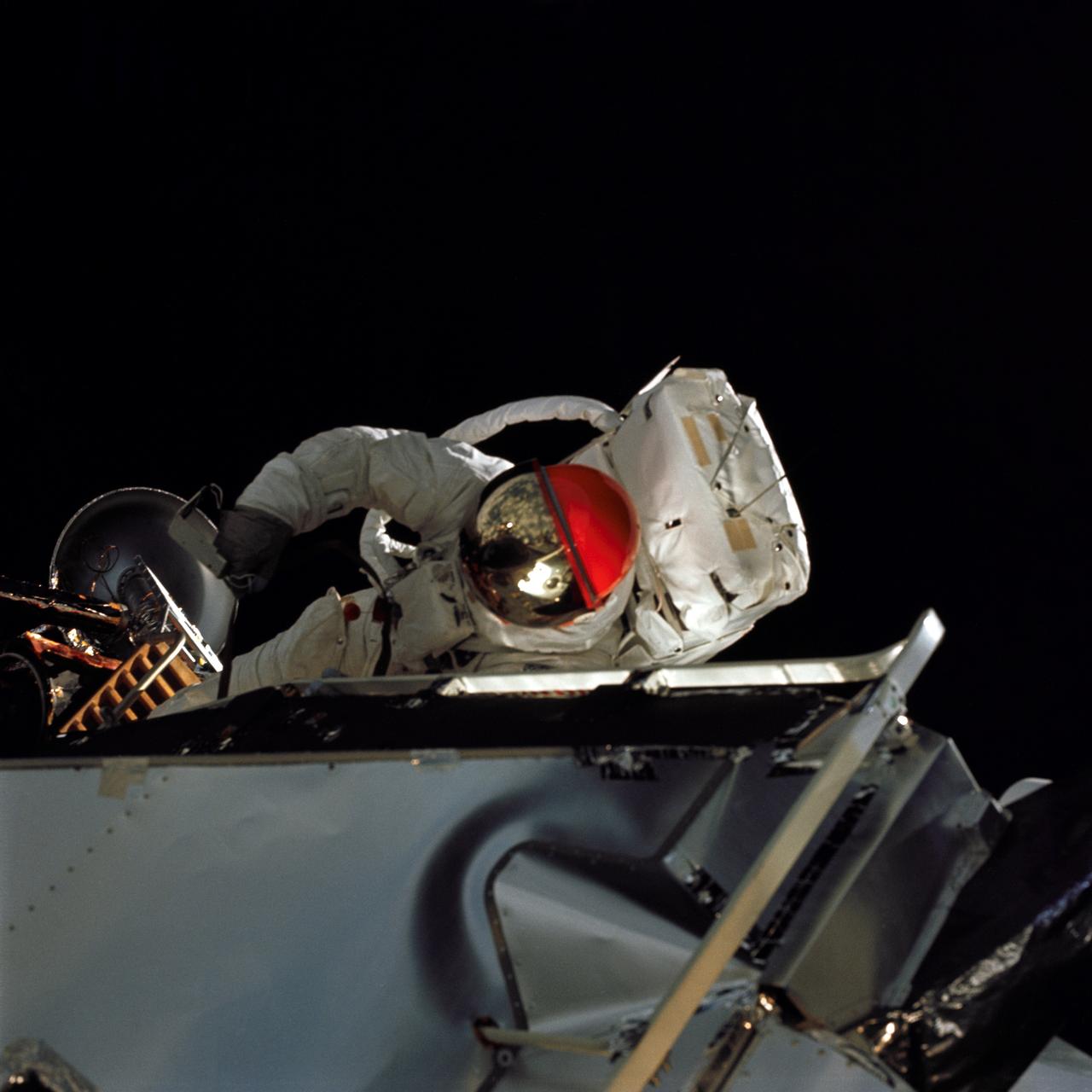
AS09-19-2994 (6 March 1969) --- Astronaut Russell L. Schweickart, lunar module pilot, is photographed from the Command Module (CM) "Gumdrop" during his extravehicular activity (EVA) on the fourth day of the Apollo 9 Earth-orbital mission. He holds, in his right hand, a thermal sample which he is retrieving from the Lunar Module (LM) exterior. The Command and Service Modules (CSM) and LM "Spider" are docked. Schweickart, wearing an Extravehicular Mobility Unit (EMU), is standing in "golden slippers" on the LM porch. Visible on his back are the Portable Life Support System (PLSS) and Oxygen Purge System (OPS). Astronaut James A. McDivitt, Apollo 9 commander, was inside the "Spider". Astronaut David R. Scott, command module pilot, remained at the controls in the CM "Gumdrop".

AS09-26A-3743A (9 March 1969) --- Color infrared photograph of the Yazoo River Valley, Pearl River, Pearl River Reservoir, and Jackson, Mississippi, area, taken on March 9, 1969, by one of the four synchronized cameras of the Apollo 9 Earth Resources Survey SO65 Experiment. At 1:08 p.m. (EST) when this photograph was made the Apollo 9 spacecraft was at an altitude of 105 nautical miles, and the sun elevation was at 55 degrees above the horizon. The location of the point on Earth's surface at which the four-camera combination was aimed was 32 degrees 34 minutes north latitude, and 89 degrees 57 minutes west longitude. The other three cameras used: (B) black and white film with a red filter; (C) black and white infrared film; and (D) black and white film with a green filter.

AS09-26A-3748A (9 March 1969) --- A color infrared photograph of the Salton Sea and Imperial Valley area of Southern California and the Mexicali, Mexico area, taken on March 9, 1969, by one of the four synchronized cameras of the Apollo 9 Earth Resources Survey S065 Experiment. At 2:36 p.m. (EST) when this picture was made the Apollo 9 spacecraft was at an altitude of 103 nautical miles, and the sun elevation was 45 degrees above at which the four-camera combination was aimed was 33 degrees 3 minutes north latitude, and 115 degrees 45 minutes west longitude. The other three cameras used: (B) black and white film with a red filter; (C) black and white infrared film; and (D) black and white film with a green filter.
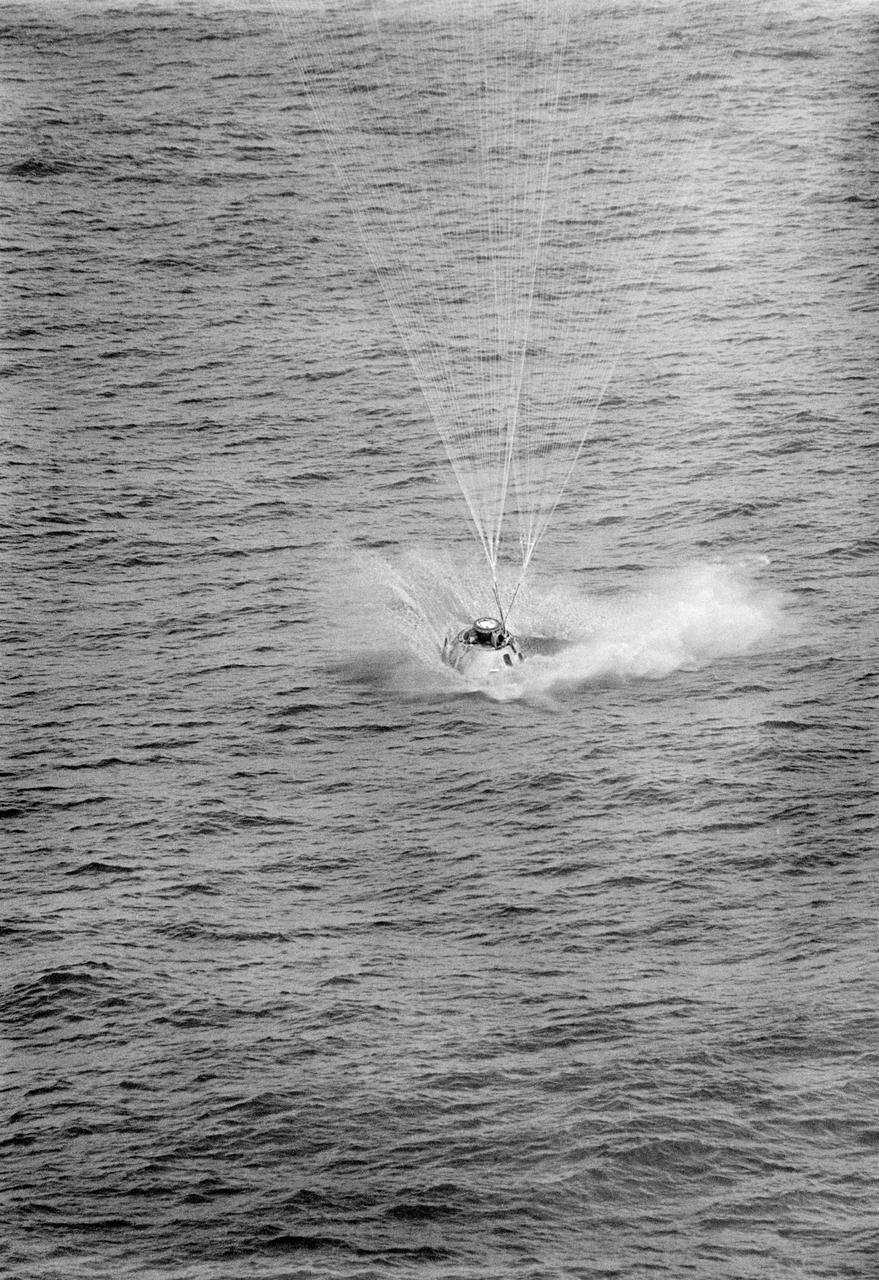
S69-27466 (13 March 1969) --- The Apollo 9 spacecraft, with astronauts James A. McDivitt, David R. Scott, and Russell L. Schweickart aboard, touches down in the Atlantic recovery area to conclude a successful 10-day Earth-orbital space mission. Splashdown occurred at 12:00:53 p.m. (EST), March 13, 1969, only 4.5 nautical miles from the prime recovery ship, USS Guadalcanal.
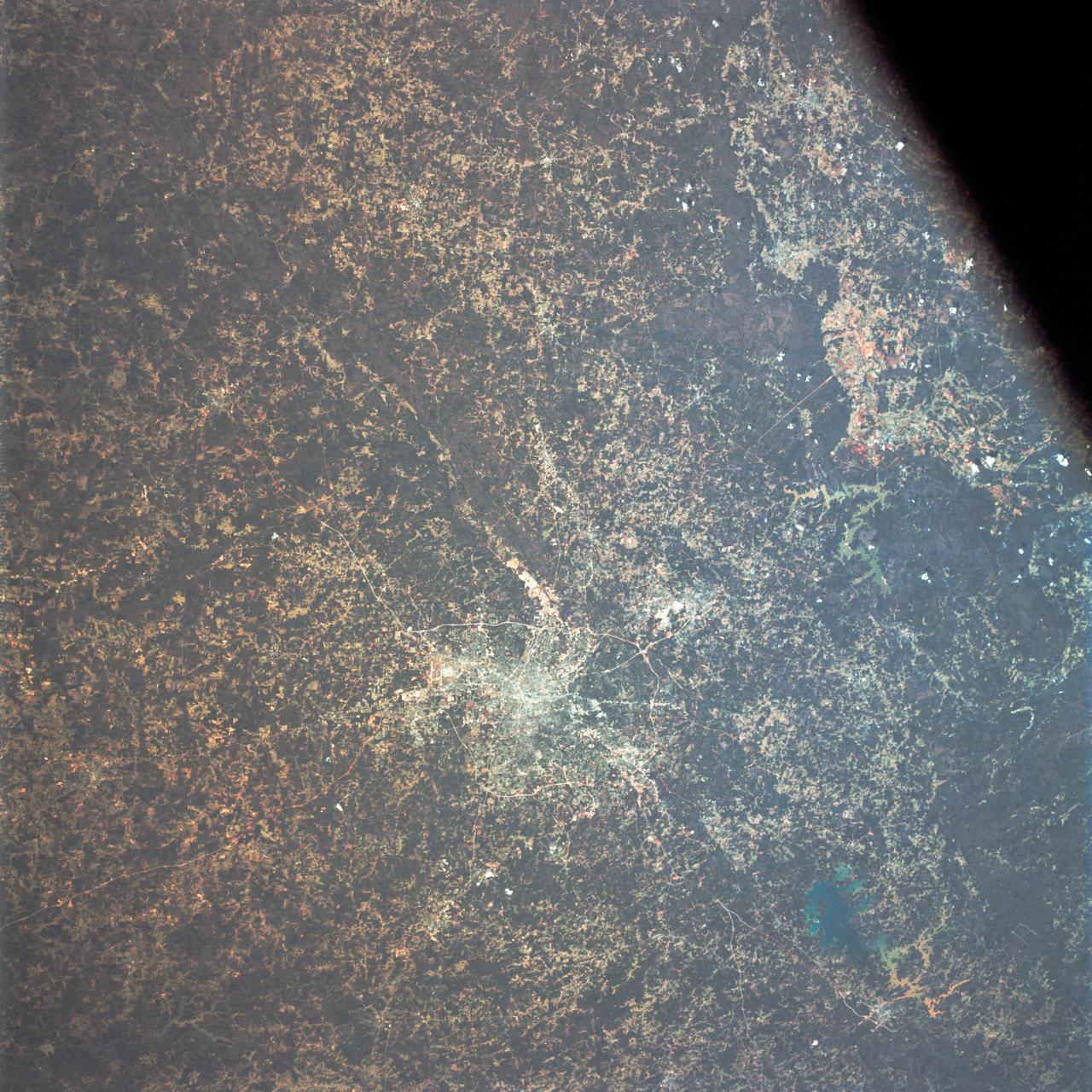
AS09-23-3567 (3-13 March 1969) --- Oblique view of the Atlanta, Georgia area as photographed from the Apollo 9 spacecraft during its Earth-orbital mission. The Chattahoochee River runs from Lake Sidney Lanier, near Gainesville (at upper left corner), south-westward by Atlanta and between Newnan and Carrollton (lower right). Allatoona Lake is at left center.
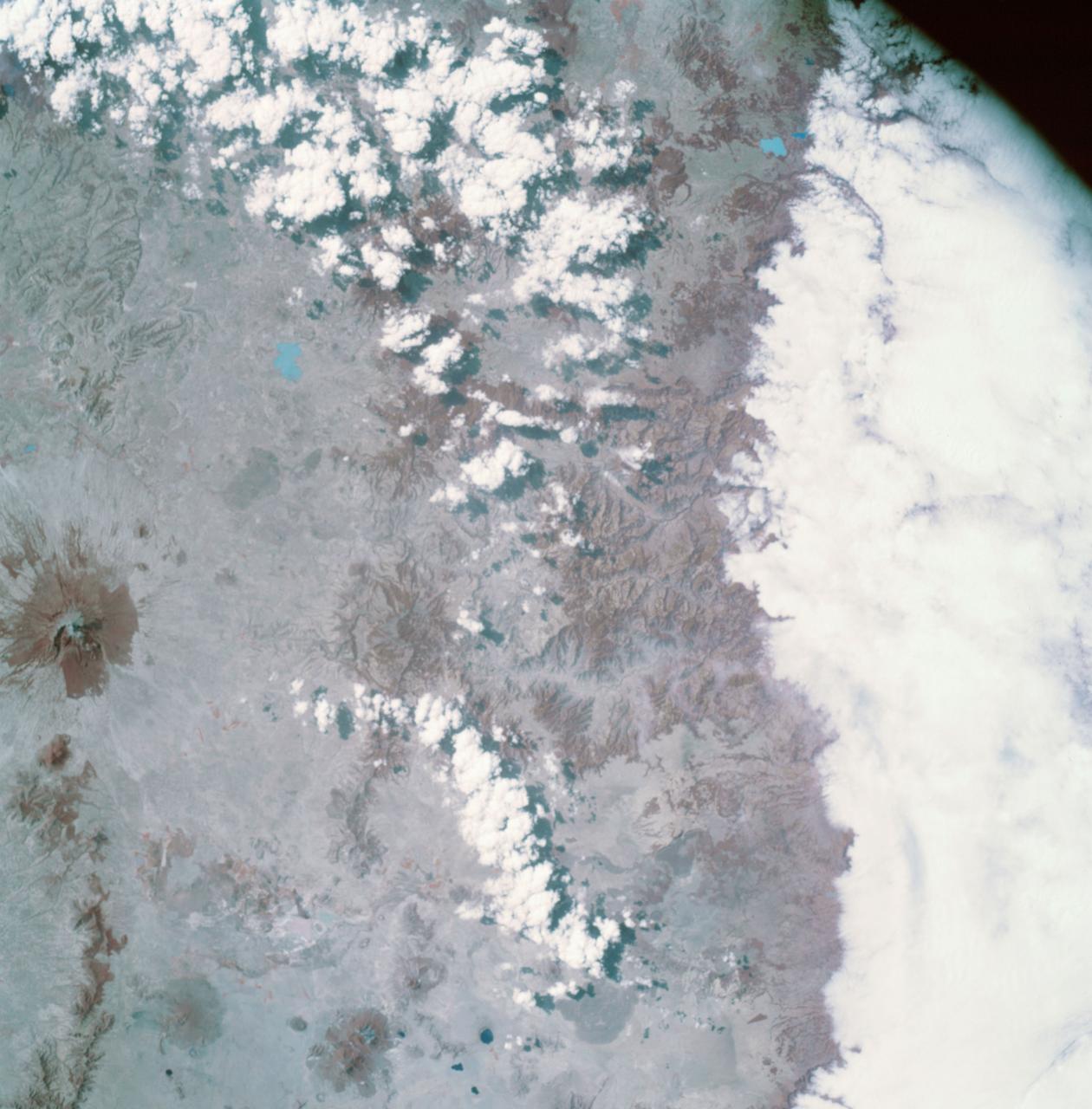
AS09-26A-3768A (10 March 1969) --- Color infrared photograph of Mexico: Cerro Malinche, east end of neo-volcanic plateau, as seen from the Apollo 9 spacecraft during its 109th revolution of Earth. This picture was taken as a part of the SO65 Multispectral Terrain Photography Experiment.
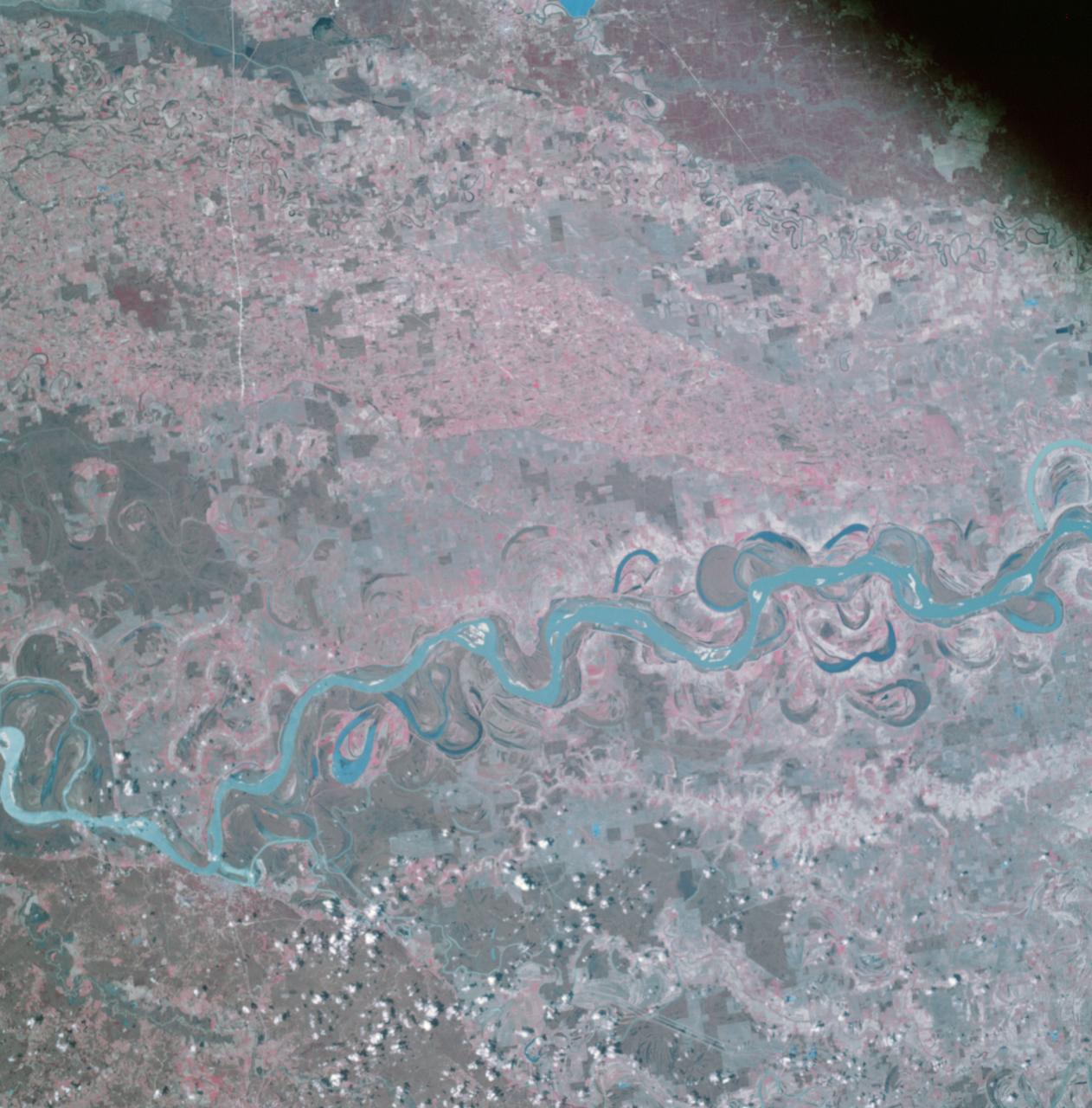
AS09-26A-3741A (9 March 1969) --- Color infrared photograph of the Mississippi River between Vicksburg and Greenville as photographed from the Apollo 9 spacecraft during its 92nd revolution of Earth. This picture was a part of the SO65 Multispectral Terrain Photography Experiment. The City of Vicksburg is located in the southeast corner of the picture. Note Interstate 20 under construction running east and west. Greenville is just out of picture at top center. All east of river is Mississippi; Louisiana is at lower left; and Arkansas is at upper left.

AS09-26A-3816A (12 March 1969) --- Color infrared photograph of the Atlantic coast of Georgia, Brunswick area, taken on March 12, 1969, by one of the four synchronized cameras of the Apollo 9 Earth Resources Survey SO65 Experiment. At 11:35 a.m. (EST) when this picture was made the Apollo 9 spacecraft was at an altitude of 102 nautical miles, and the sun elevation was 51 degrees above the horizon. The location of the point on Earth's surface at which the four-camera combination was aimed 31 degrees 16 minutes north latitude, and 81 degrees 17 minutes west longitude. The other three cameras used: (B) black and white film with a red filter; (C) black and white infrared film; and (D) black and white film with a green filter.