
Ares Vallis
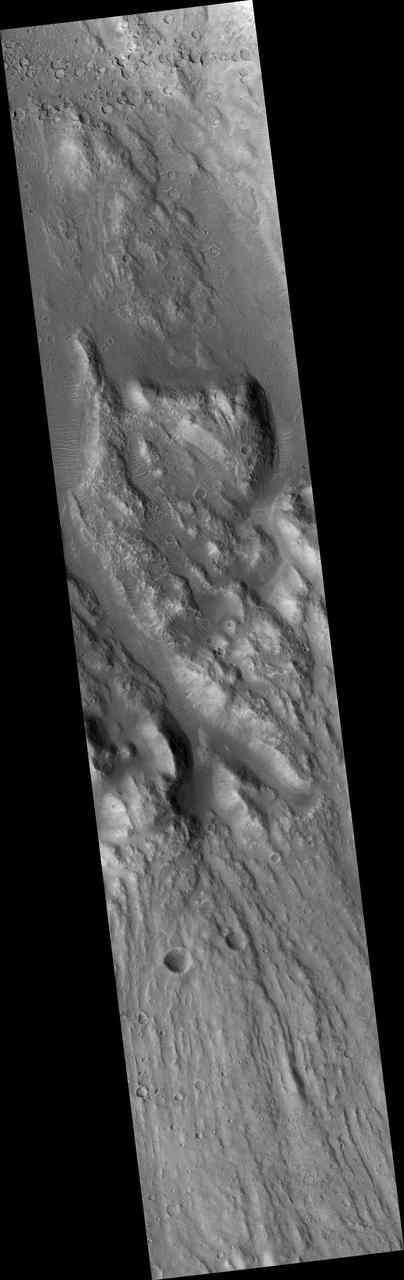
Ares Vallis Cataract
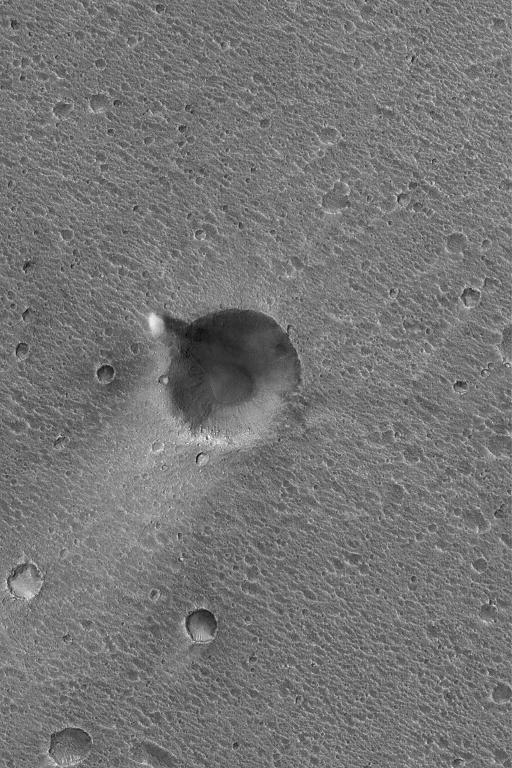
Ares Vallis Dust Devil
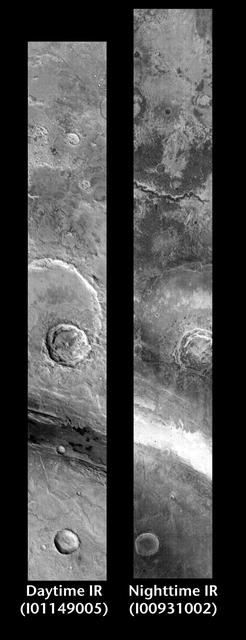
Ares Valles: Night and Day
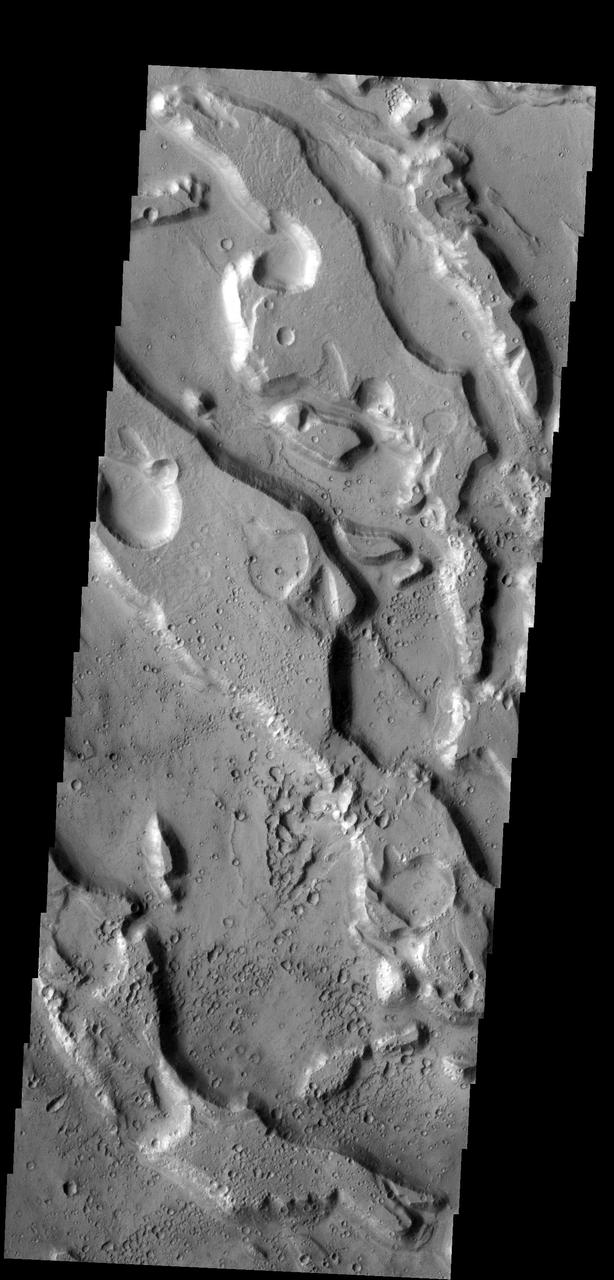
This group of channels are all part of Ares Vallis
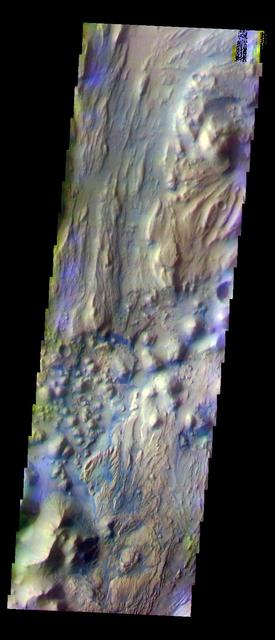
Ares Vallis/Iani Chaos Border
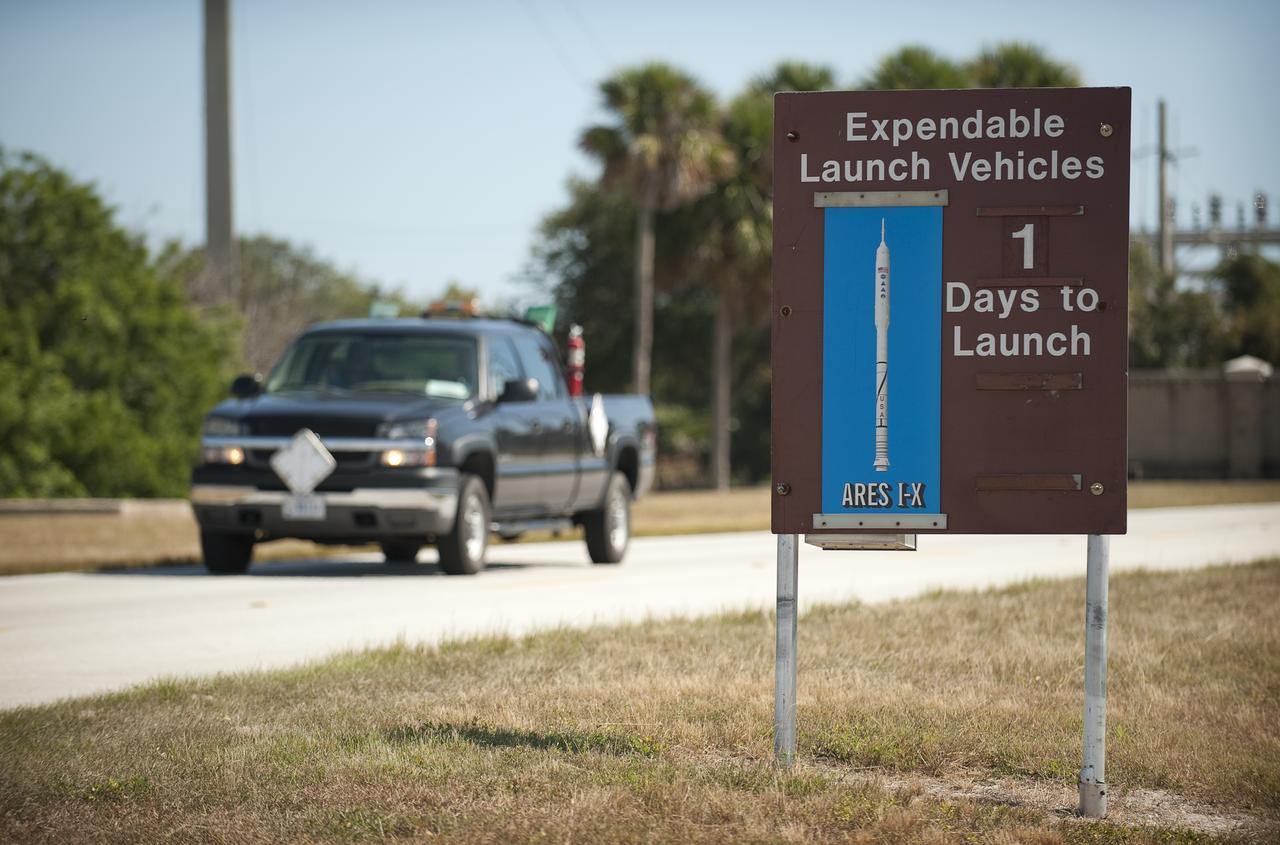
A launch countdown sign showing one day until launch of the NASA ARES I-X rocket is seen along the road between Cape Canaveral Air Force Base and the NASA Kennedy Space Center in Cape Canaveral, Florida on Monday, Oct. 26, 2009. The flight test of Ares I-X, scheduled for Tuesday, Oct. 27, 2009, will provide NASA with an early opportunity to test and prove flight characteristics, hardware, facilities and ground operations associated with the Ares I. Photo Credit: (NASA/Bill Ingalls)
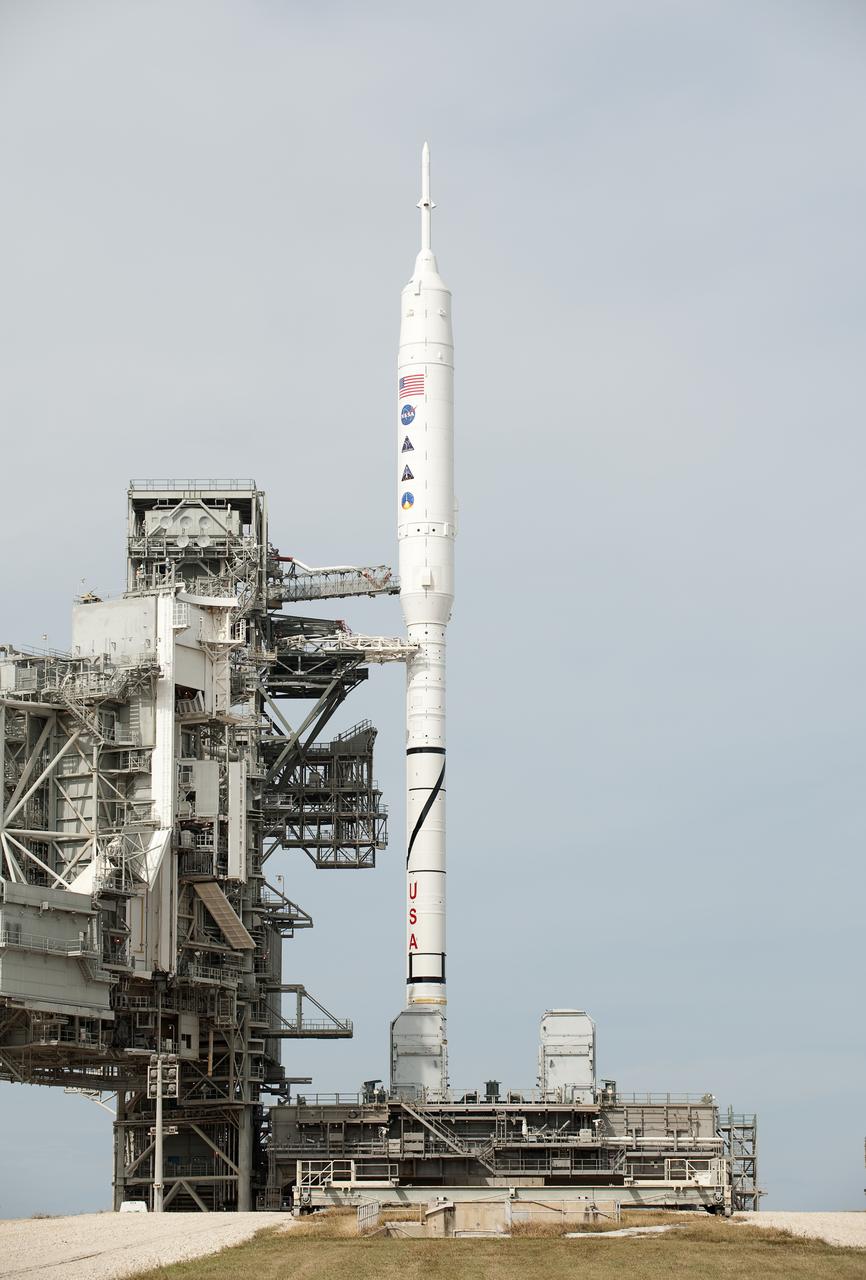
NASA's Ares I-X rocket is seen on launch pad 39b at the Kennedy Space Center in Cape Canaveral, Fla., Tuesday, Oct. 27, 2009 shortly after NASA scrubbed the launch attempt due to weather. The flight test of Ares I-X, now scheduled for Wednesday, Oct. 28, 2009, will provide NASA with an early opportunity to test and prove flight characteristics, hardware, facilities and ground operations associated with the Ares I. Photo Credit: (NASA/Bill Ingalls)

NASA's Ares I-X rocket is seen on launch pad 39b at the Kennedy Space Center in Cape Canaveral, Fla., Monday, Oct. 26, 2009. The flight test of Ares I-X, scheduled for Tuesday, Oct. 27, 2009, will provide NASA with an early opportunity to test and prove flight characteristics, hardware, facilities and ground operations associated with the Ares I. Photo Credit: (NASA/Bill Ingalls)
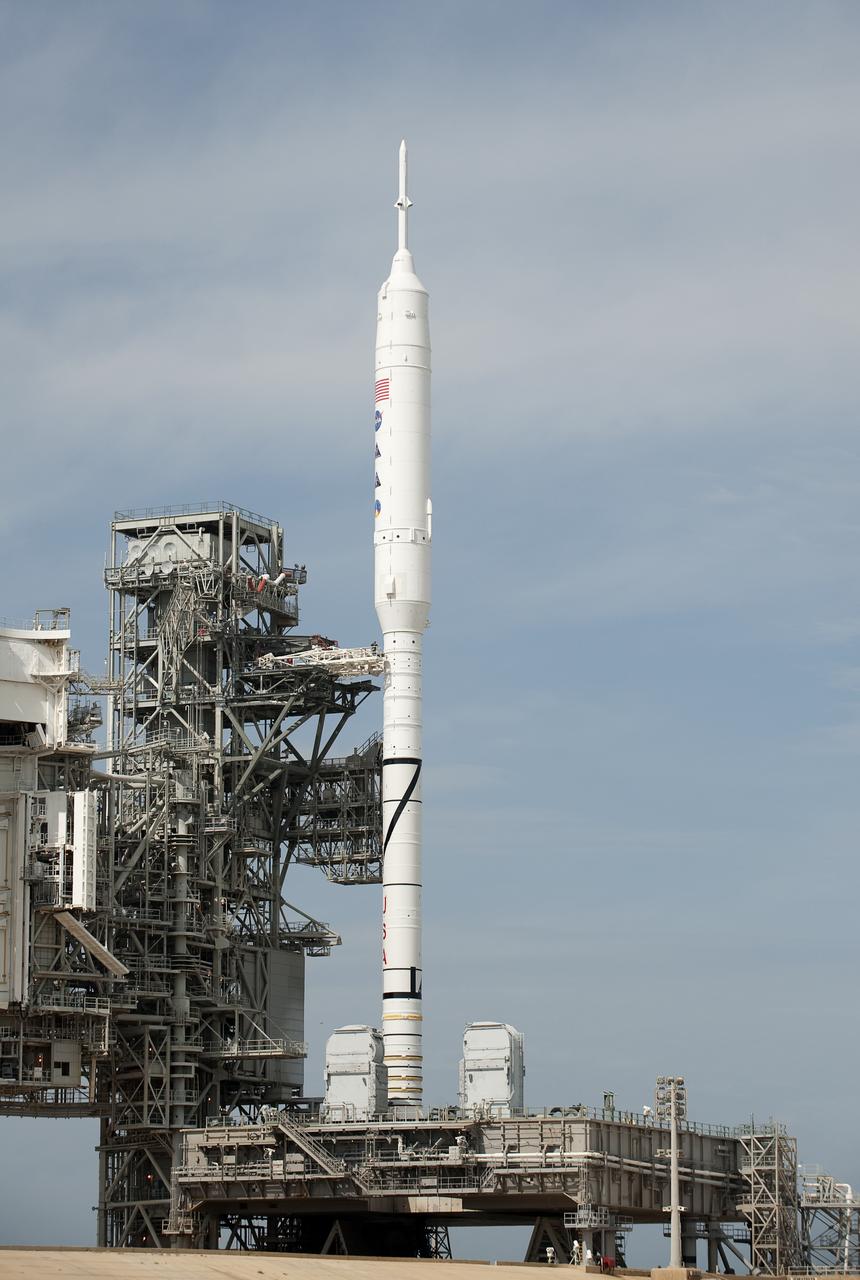
NASA's Ares I-X rocket is seen on launch pad 39b at the Kennedy Space Center in Cape Canaveral, Fla., Tuesday, Oct. 27, 2009 shortly after NASA scrubbed the launch attempt due to weather. The flight test of Ares I-X, now scheduled for Wednesday, Oct. 28, 2009, will provide NASA with an early opportunity to test and prove flight characteristics, hardware, facilities and ground operations associated with the Ares I. Photo Credit: (NASA/Bill Ingalls)
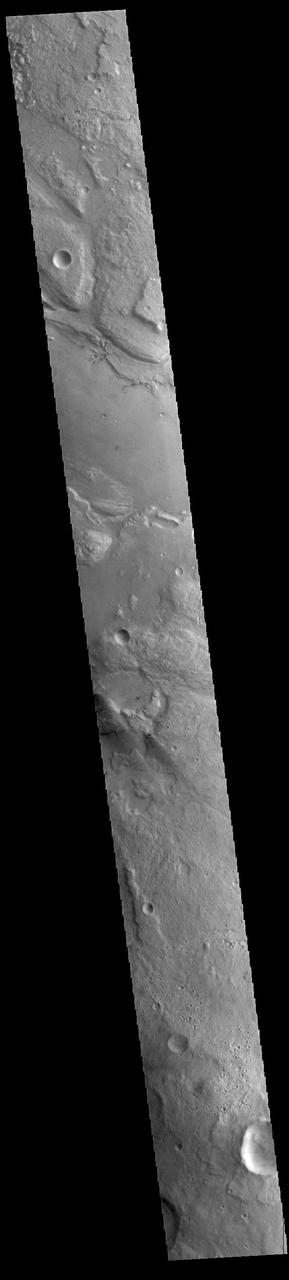
Today's VIS image shows a portion of Ares Vallis. Located in Margaritifer Terra, Ares Vallis is an outflow channel carved by massive floods of escaping groundwater whose source lies far to the south of this image. Ares Vallis is over 1757 km long (1091 miles). This channel, and all others in this region, drain into Chryse Planitia. Orbit Number: 93939 Latitude: 9.783 Longitude: 334.4 Instrument: VIS Captured: 2023-02-17 05:51 https://photojournal.jpl.nasa.gov/catalog/PIA25930
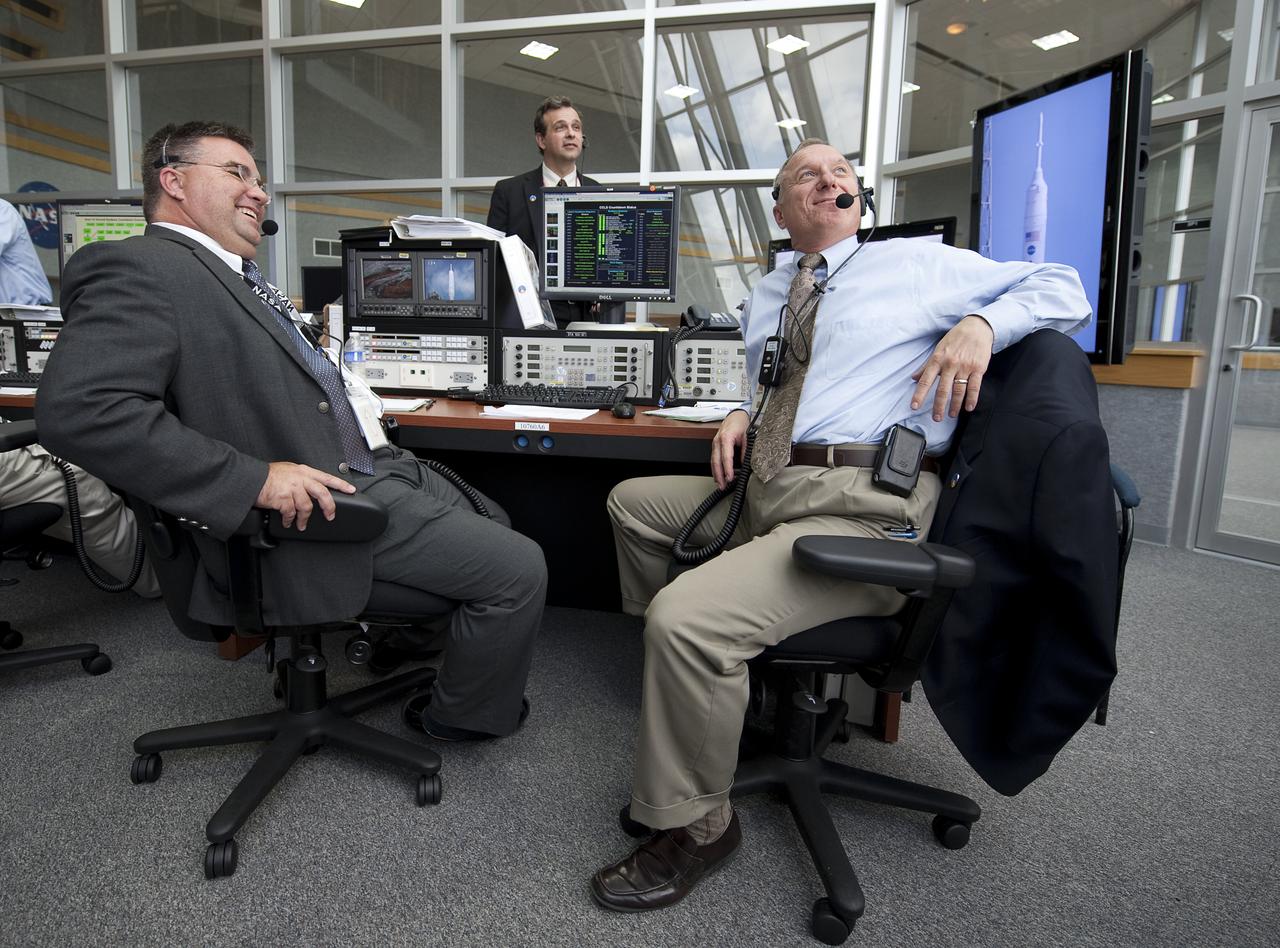
NASA Ares I-X Launch Director Ed Mango, left, laughs as NASA Ares I-X Assistant Launch Director Pete Nickolenko looks out the window of Firing Room One of the Launch Control Center (LCC) at the Kennedy Space Center prior to the launch of the Ares I-X rocket from pad 39b at the Kennedy Space Center in Cape Canaveral, Fla., Wednesday, Oct. 28, 2009. The flight test of Ares I-X will provide NASA with an early opportunity to test and prove flight characteristics, hardware, facilities and ground operations associated with the Ares I. Photo Credit: (NASA/Bill Ingalls)
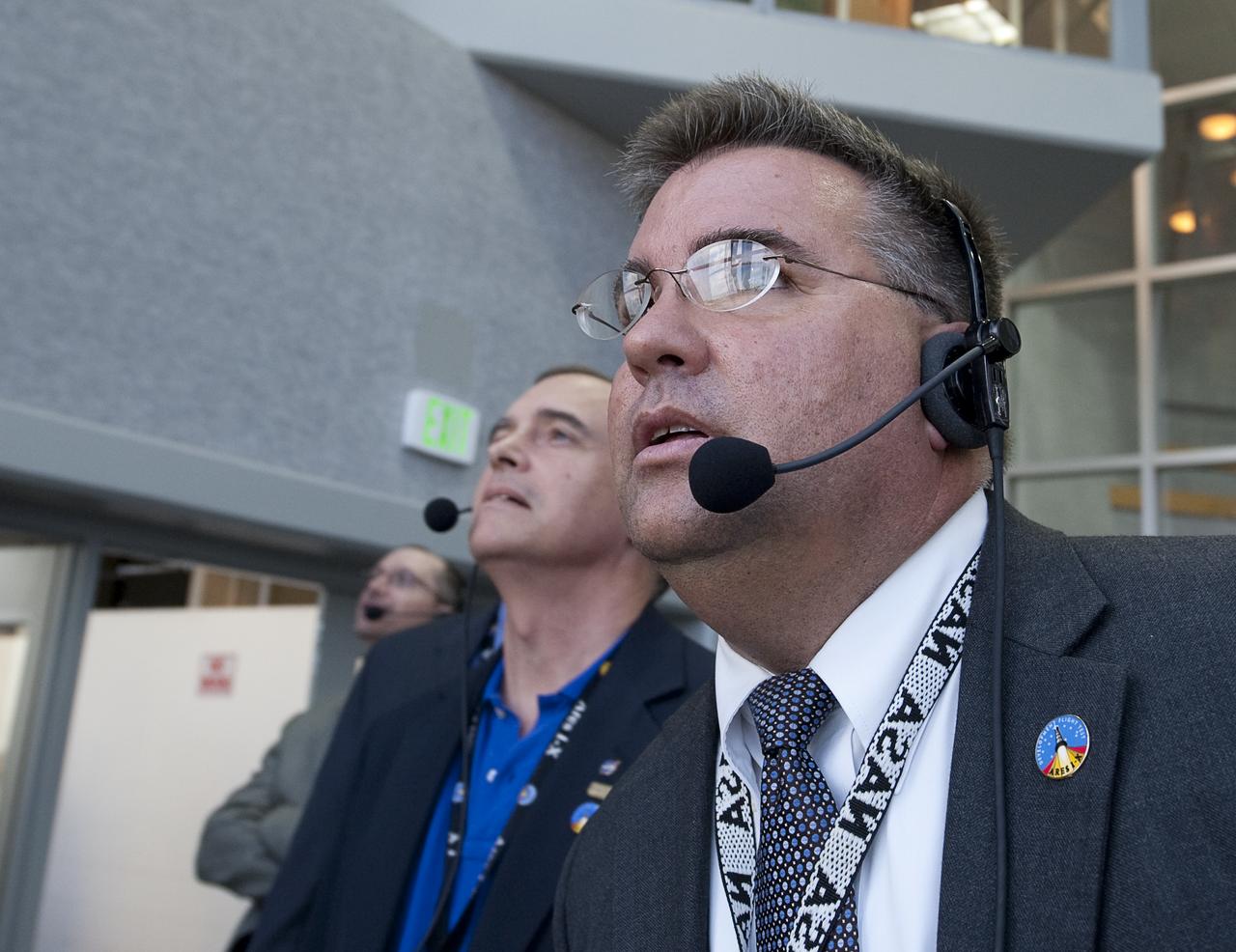
NASA Ares I-X Launch Director Ed Mango, 3rd from left, along with other mission managers watches the launch of the Ares I-X rocket from Firing Room One of the Launch Control Center (LCC) at the Kennedy Space Center in Cape Canaveral, Fla., Wednesday, Oct. 28, 2009. The flight test of Ares I-X will provide NASA with an early opportunity to test and prove flight characteristics, hardware, facilities and ground operations associated with the Ares I. Photo Credit: (NASA/Bill Ingalls)
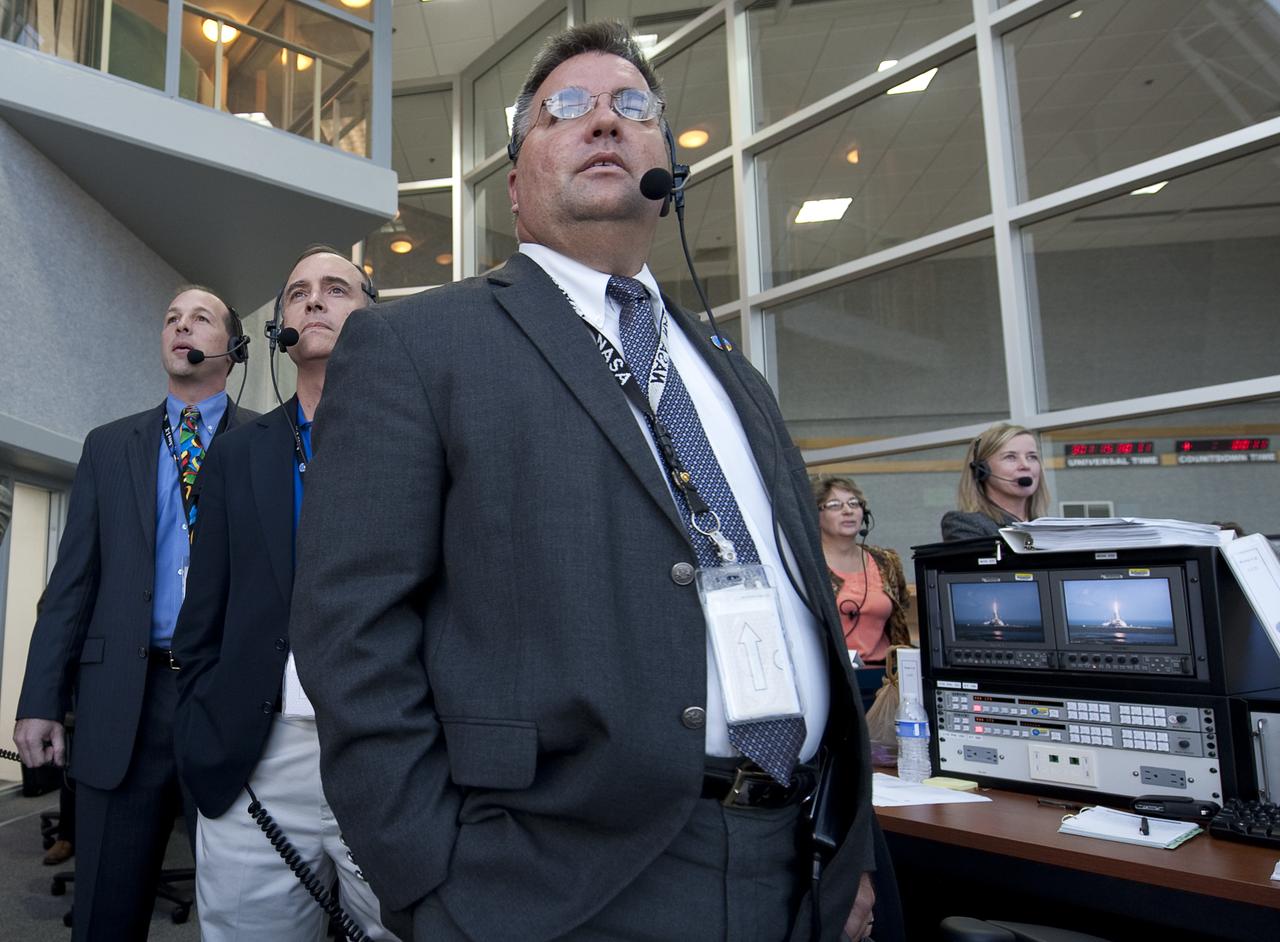
NASA Ares I-X Launch Director Ed Mango, 3rd from left, along with other mission managers watches the launch of the Ares I-X rocket from Firing Room One of the Launch Control Center (LCC) at the Kennedy Space Center in Cape Canaveral, Fla., Wednesday, Oct. 28, 2009. The flight test of Ares I-X will provide NASA with an early opportunity to test and prove flight characteristics, hardware, facilities and ground operations associated with the Ares I. Photo Credit: (NASA/Bill Ingalls)

NASA's Ares I-X rocket is seen on launch pad 39b at the Kennedy Space Center in Cape Canaveral, Fla., Monday, Oct. 26, 2009. The flight test of Ares I-X, scheduled for Tuesday, Oct. 27, 2009, will provide NASA with an early opportunity to test and prove flight characteristics, hardware, facilities and ground operations associated with the Ares I.
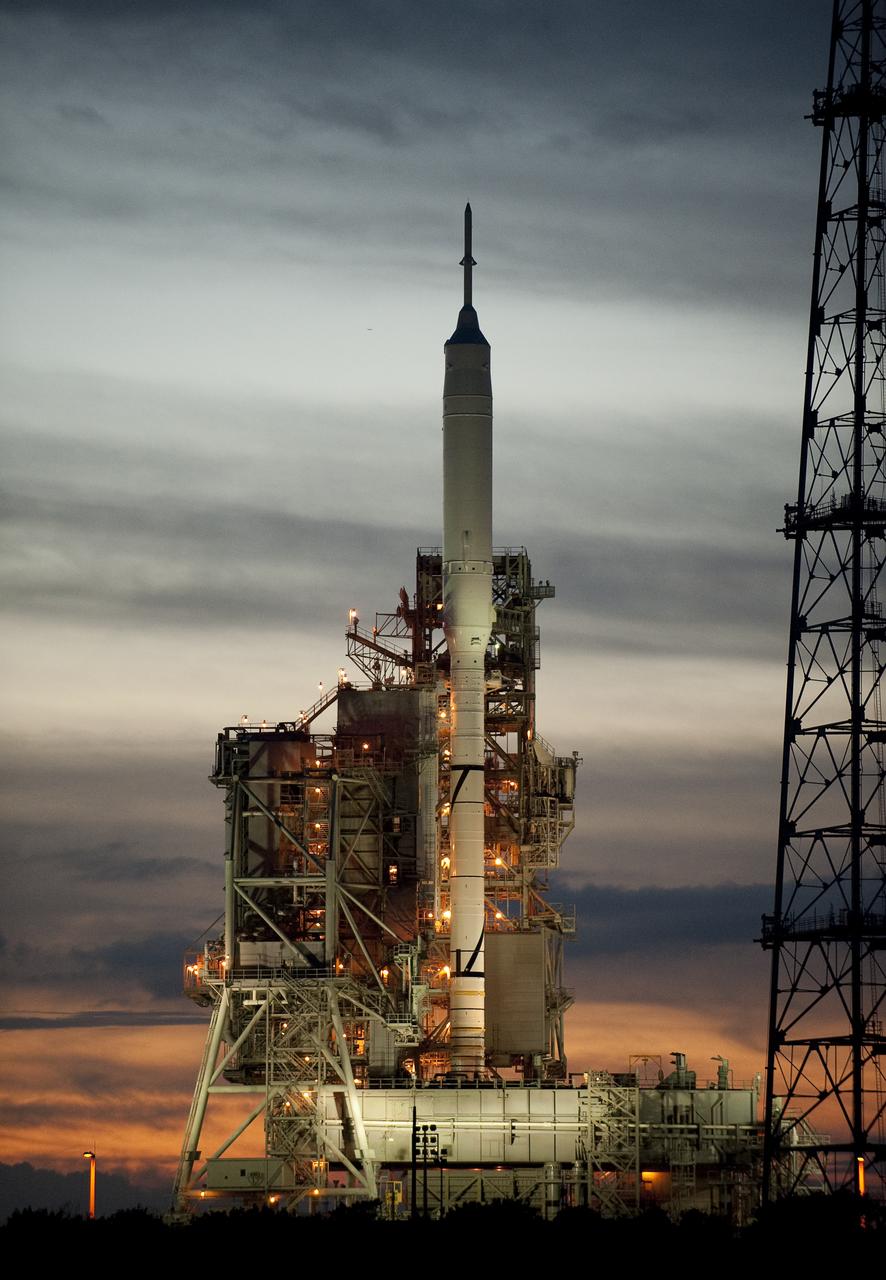
NASA's Ares I-X rocket is seen on launch pad 39b at the Kennedy Space Center in Cape Canaveral, Fla., Monday, Oct. 26, 2009. The flight test of Ares I-X, scheduled for Tuesday, Oct. 27, 2009, will provide NASA with an early opportunity to test and prove flight characteristics, hardware, facilities and ground operations associated with the Ares I.
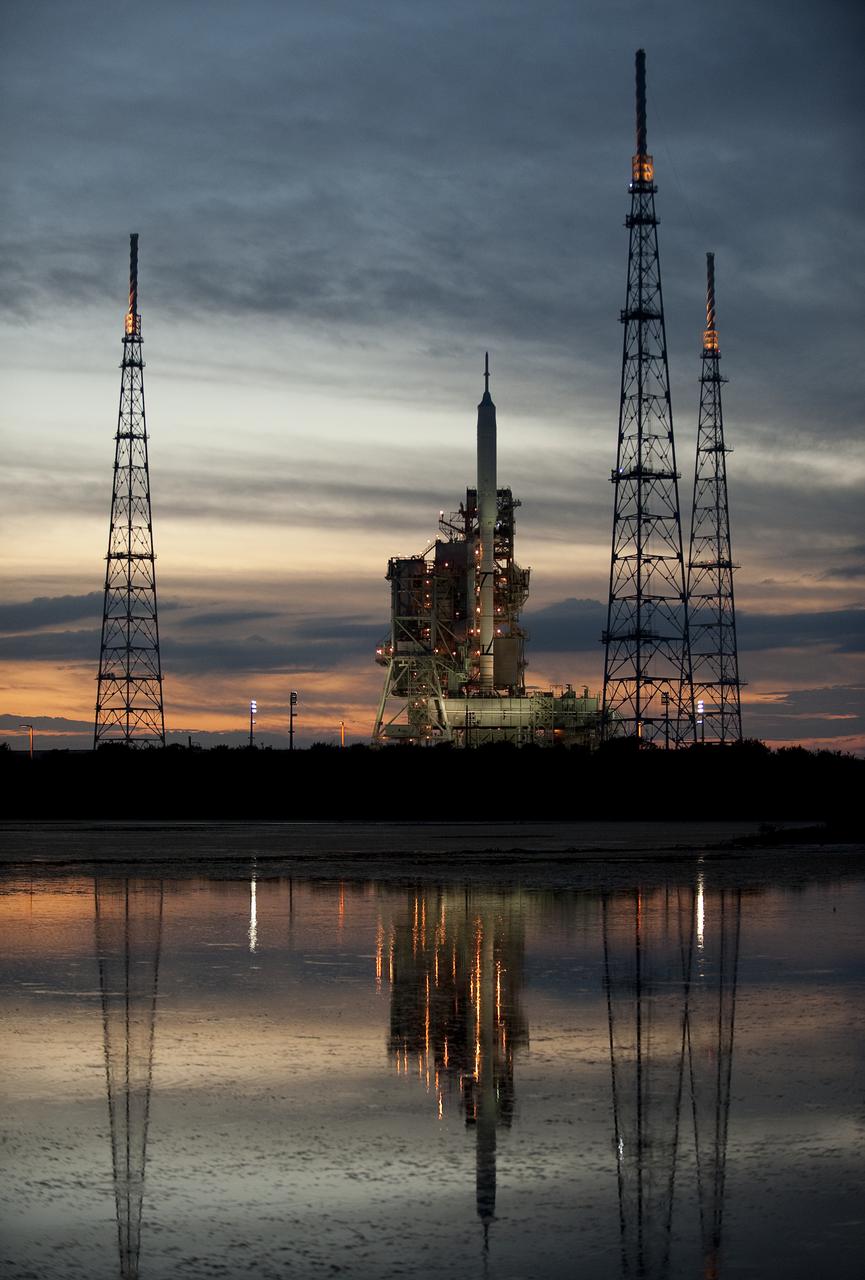
NASA's Ares I-X rocket is seen on launch pad 39b at the Kennedy Space Center in Cape Canaveral, Fla., Monday, Oct. 26, 2009. The flight test of Ares I-X, scheduled for Tuesday, Oct. 27, 2009, will provide NASA with an early opportunity to test and prove flight characteristics, hardware, facilities and ground operations associated with the Ares I.
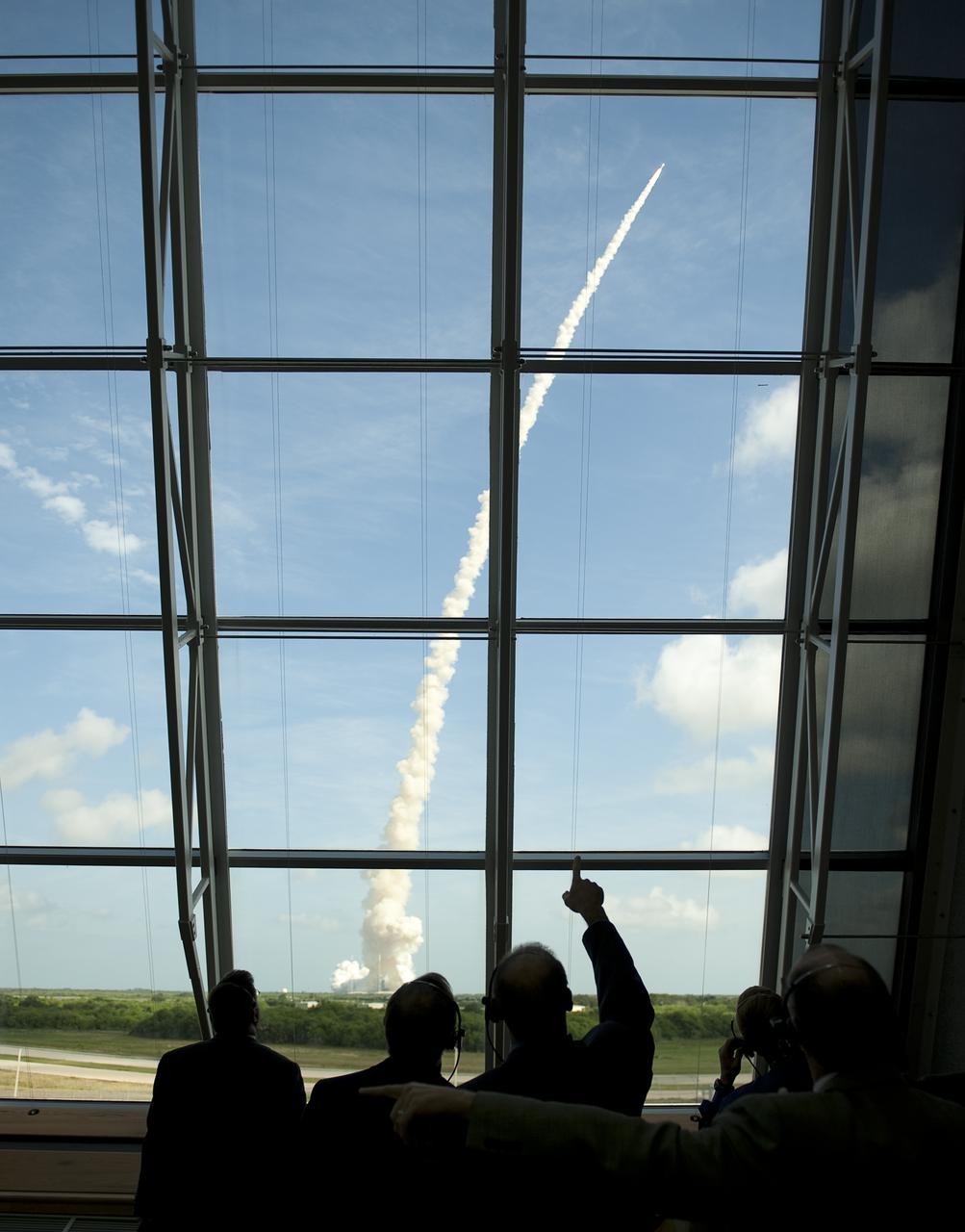
NASA Ares I-X mission managers watch as NASA's Ares I-X rocket launches from pad 39b at the Kennedy Space Center in Cape Canaveral, Fla., Wednesday, Oct. 28, 2009. The flight test will provide NASA with an early opportunity to test and prove flight characteristics, hardware, facilities and ground operations associated with the Ares I. Photo Credit: (NASA/Bill Ingalls)

Mission managers, from left, NASA Constellation Program manager Jeff Hanley, Ares I-X Launch Director Ed Mango, Ares I-X mission manager Bob Ess, Ground Operations Manager Philip "Pepper" Phillips, review the latest data in Firing Room One of the Launch Control Center (LCC) at the Kennedy Space Center during the launch countdown of the Ares I-X rocket in Cape Canaveral, Fla., Tuesday, Oct. 27, 2009. The flight test of Ares I-X will provide NASA with an early opportunity to test and prove flight characteristics, hardware, facilities and ground operations associated with the Ares I. Photo Credit: (NASA/Bill Ingalls)
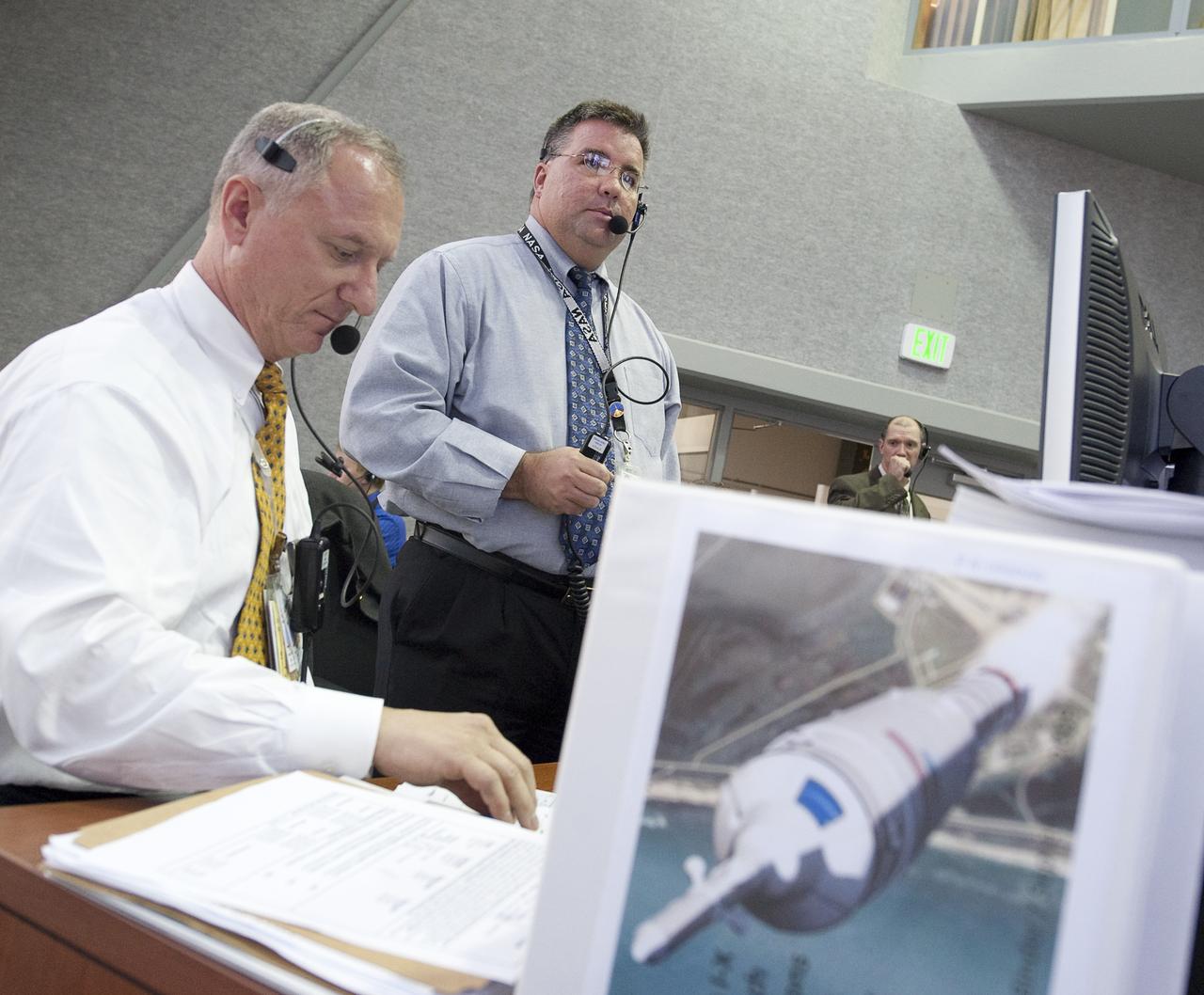
NASA Ares I-X Assistant Launch Director Pete Nickolenko, left, and NASA Ares I-X Launch Director Ed Mango monitor the launch countdown from Firing Room One of the Launch Control Center (LCC) at the Kennedy Space Center during the planned launch of the Ares I-X rocket from pad 39b at the Kennedy Space Center in Cape Canaveral, Fla., Tuesday, Oct. 27, 2009. The flight test of Ares I-X will provide NASA with an early opportunity to test and prove flight characteristics, hardware, facilities and ground operations associated with the Ares I. Photo Credit: (NASA/Bill Ingalls)

Today's VIS image shows a section of Ares Vallis. Ares Vallis is a large channel that arises in Iani Chaos, passes through Margaritifer Terra, and then empties into Chryse Planitia. Orbit Number: 80624 Latitude: 0.445959 Longitude: 342.666 Instrument: VIS Captured: 2020-02-16 21:33 https://photojournal.jpl.nasa.gov/catalog/PIA23843
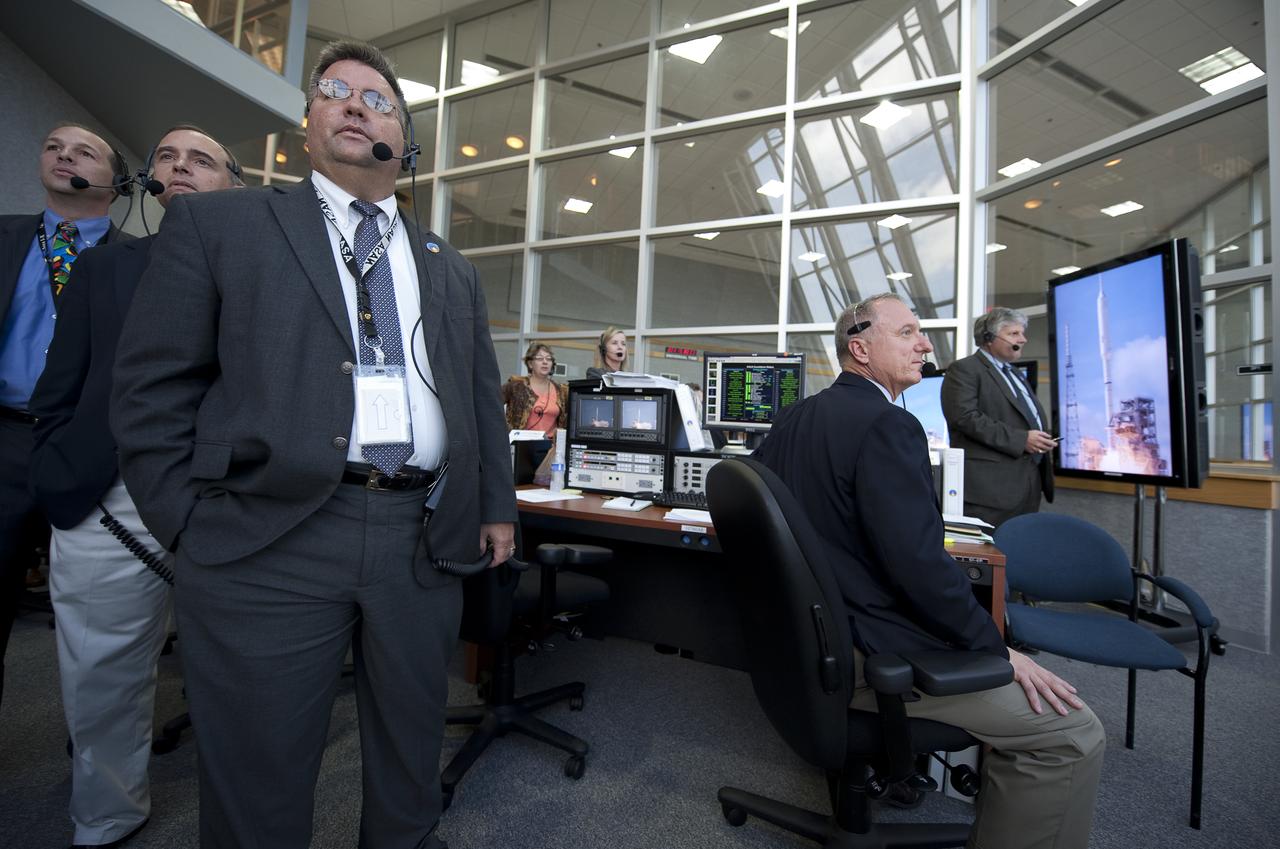
NASA Ares I-X Launch Director Ed Mango, 3rd from left, along with other mission managers watches the launch of the Ares I-X rocket from Firing Room One of the Launch Control Center (LCC) at the Kennedy Space Center in Cape Canaveral, Fla., Wednesday, Oct. 28, 2009. The flight test of Ares I-X will provide NASA with an early opportunity to test and prove flight characteristics, hardware, facilities and ground operations associated with the Ares I. Photo Credit: (NASA/Bill Ingalls)
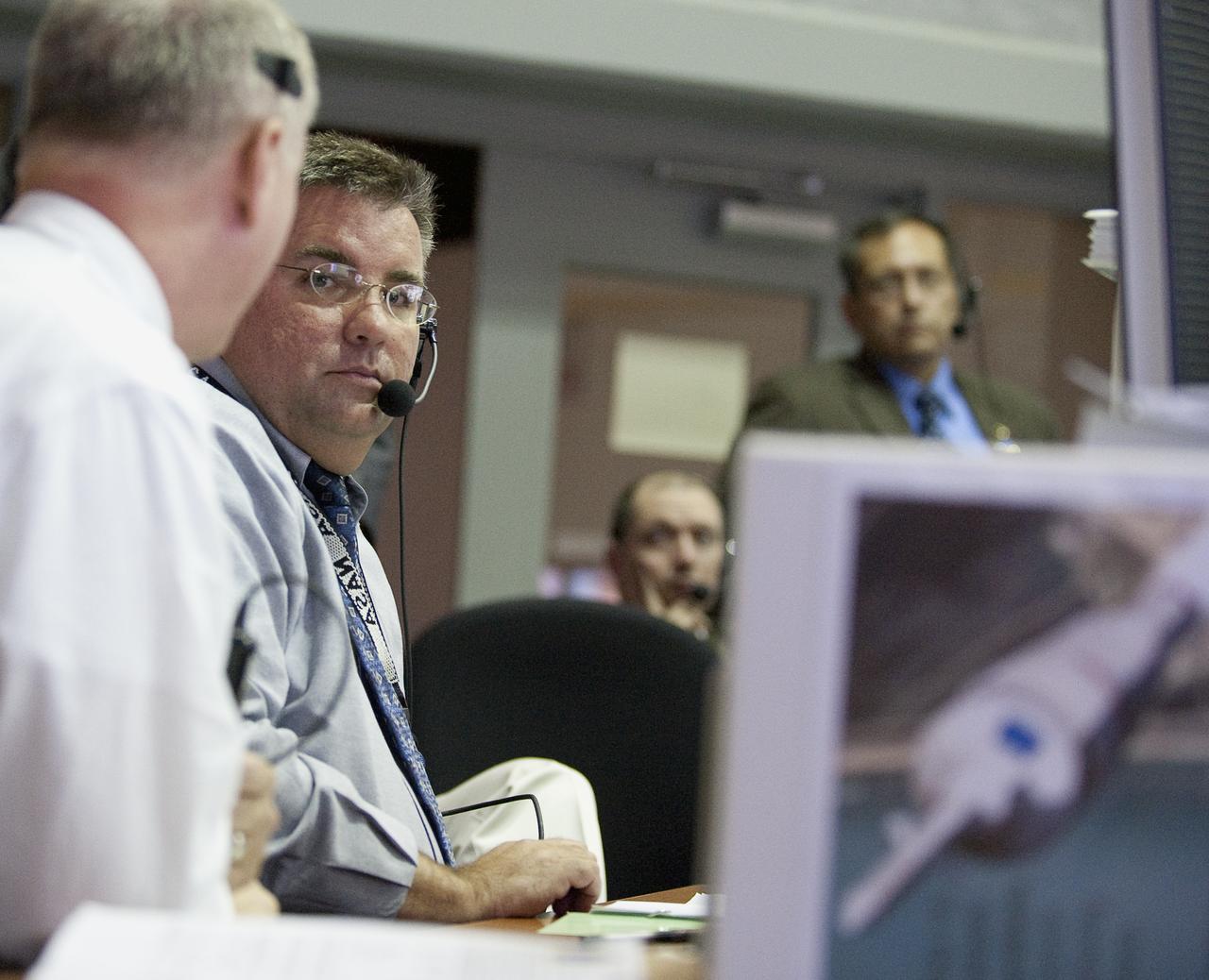
NASA Ares I-X Launch Director Ed Mango monitors the launch countdown from Firing Room One of the Launch Control Center (LCC) at the Kennedy Space Center during the planned launch of the Ares I-X rocket from pad 39b at the Kennedy Space Center in Cape Canaveral, Fla., Tuesday, Oct. 27, 2009. The flight test of Ares I-X will provide NASA with an early opportunity to test and prove flight characteristics, hardware, facilities and ground operations associated with the Ares I. Photo Credit: (NASA/Bill Ingalls)

NASA Ares I-X Launch Director Ed Mango monitors the launch countdown from Firing Room One of the Launch Control Center (LCC) at the Kennedy Space Center during the planned launch of the Ares I-X rocket from pad 39b at the Kennedy Space Center in Cape Canaveral, Fla., Tuesday, Oct. 27, 2009. The flight test of Ares I-X will provide NASA with an early opportunity to test and prove flight characteristics, hardware, facilities and ground operations associated with the Ares I. Photo Credit: (NASA/Bill Ingalls)
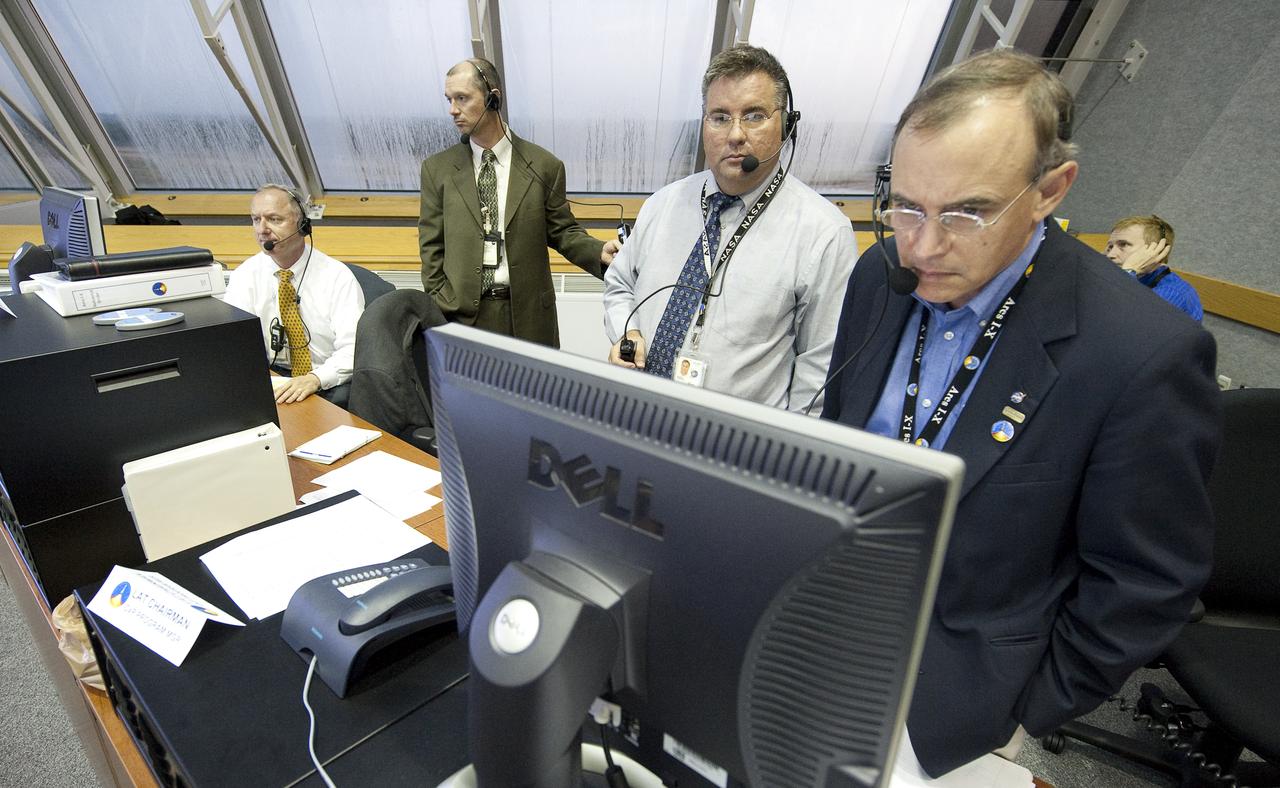
Mission managers, from left, NASA Ares I-X Assistant Launch Director Pete Nickolenko, Ground Operations Manager Philip "Pepper" Phillips, Ares I-X Launch Director Ed Mango, and Constellation Program manager Jeff Hanley review the latest weather radar from Firing Room One of the Launch Control Center (LCC) at the Kennedy Space Center during the launch countdown of the Ares I-X rocket in Cape Canaveral, Fla., Tuesday, Oct. 27, 2009. The flight test of Ares I-X will provide NASA with an early opportunity to test and prove flight characteristics, hardware, facilities and ground operations associated with the Ares I. Photo Credit: (NASA/Bill Ingalls)
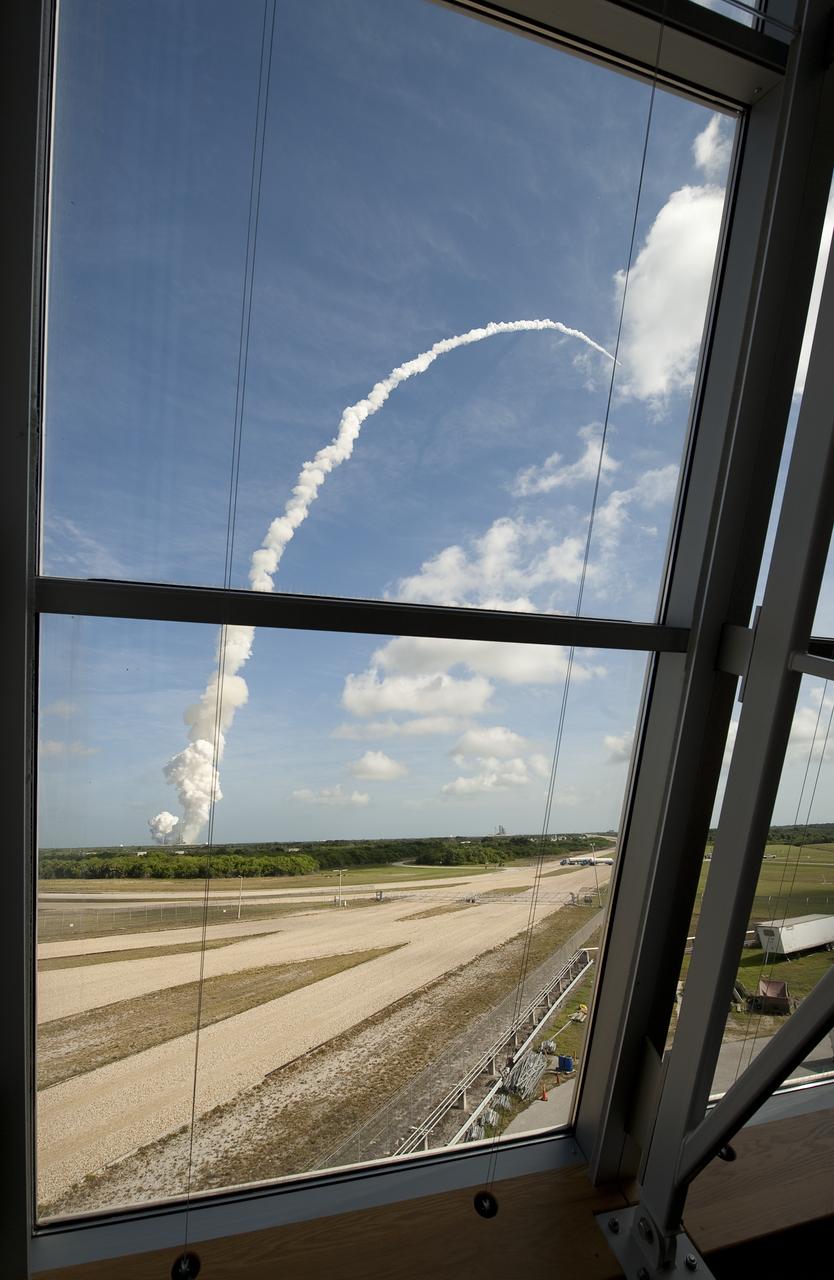
NASA's Ares I-X rocket is seen through the windows of Firing Room One of teh Launch Control Center (LCC) at the Kennedy Space Center as it launches from pad 39b in Cape Canaveral, Fla., Wednesday, Oct. 28, 2009. The flight test will provide NASA with an early opportunity to test and prove flight characteristics, hardware, facilities and ground operations associated with the Ares I. Photo Credit: (NASA/Bill Ingalls)
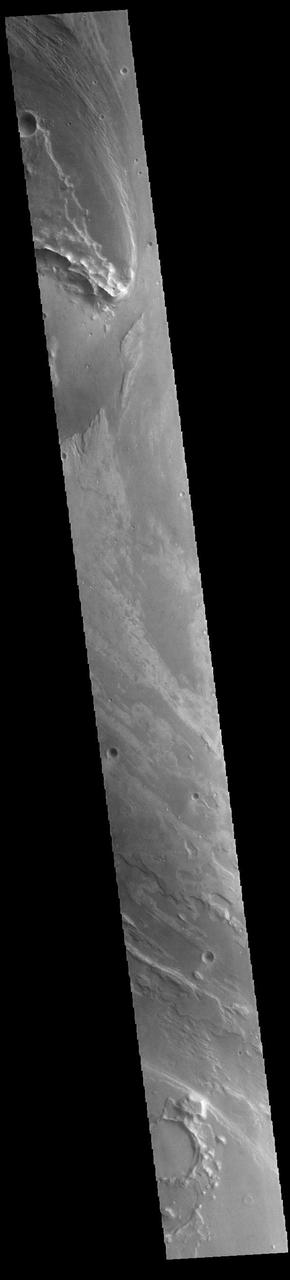
Today's VIS image shows part of Ares Vallis. Located in Margaritifer Terra, Ares Vallis is part of a large system of channels that arise from Vallis Marineris and empty into Chryse Planitia. Orbit Number: 85304 Latitude: 16.5128 Longitude: 327.987 Instrument: VIS Captured: 2021-03-08 05:51 https://photojournal.jpl.nasa.gov/catalog/PIA24775
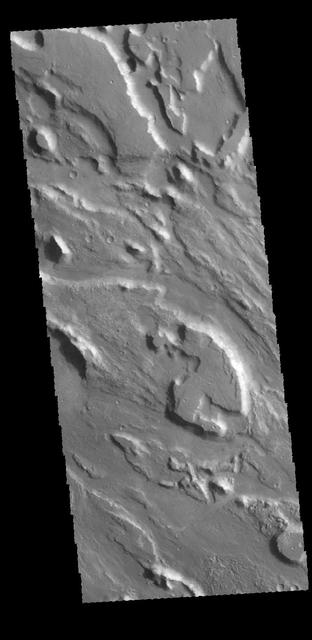
This image from NASA 2001 Mars Odyssey spacecraft shows part of the complex channel floor of Ares Vallis.
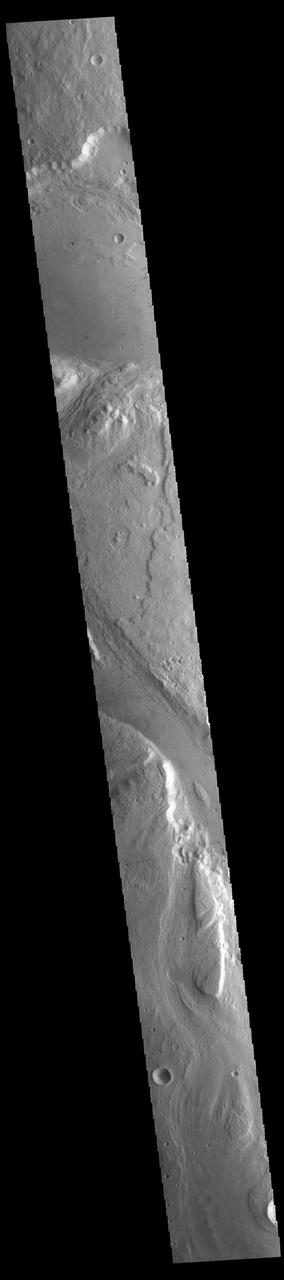
This image captured by NASA 2001 Mars Odyssey spacecraft shows a portion of Ares Vallis.

The channel seen in this VIS image is a tributary channel of Ares Vallis. This channel is not as deep as the main channel and parallels Ares Vallis before joining the the deeper channel at one of its bends. This channel is located in Margaritifer Terra. Orbit Number: 79863 Latitude: 8.01076 Longitude: 335.715 Instrument: VIS Captured: 2019-12-16 05:45 https://photojournal.jpl.nasa.gov/catalog/PIA23735

This image captured by NASA 2001 Mars Odyssey spacecraft shows where Ares Vallis starts top of image from Iani Chaos bottom of image.
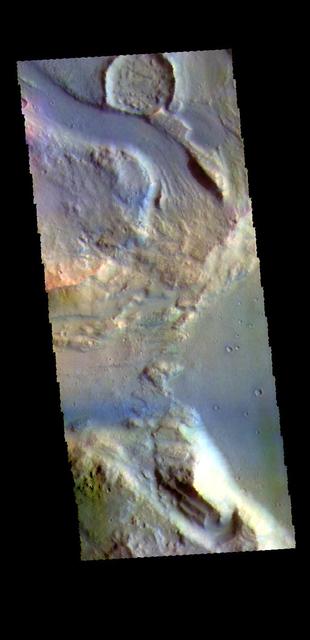
This false color image shows a tributary channel that empties into the main Ares Vallis channel. This tributary channel is located east of Ares Vallis. Located in Margaritifer Terra, Ares Vallis is part of a large system of channels that arise from Vallis Marineris and empty into Chryse Planitia. The THEMIS VIS camera contains 5 filters. The data from different filters can be combined in multiple ways to create a false color image. These false color images may reveal subtle variations of the surface not easily identified in a single band image. Orbit Number: 63809 Latitude: 4.17241 Longitude: 343.459 Instrument: VIS Captured: 2016-05-02 20:09
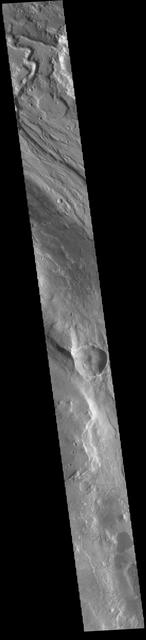
This VIS image shows part of Ares Vallis, one of the large channels in Margaritfer Terra that empty into Chryse Planitia. Orbit Number: 72477 Latitude: 5.49596 Longitude: 341.524 Instrument: VIS Captured: 2018-04-16 22:49 https://photojournal.jpl.nasa.gov/catalog/PIA22610
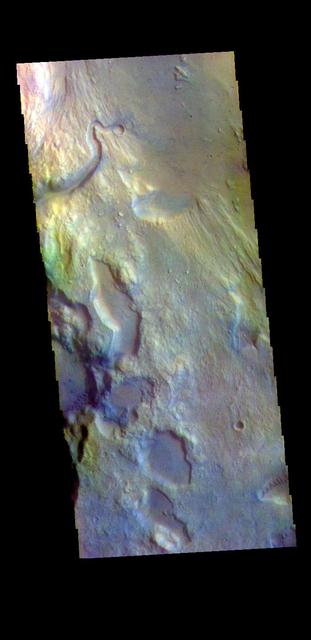
The THEMIS VIS camera contains 5 filters. The data from different filters can be combined in multiple ways to create a false color image. These false color images may reveal subtle variations of the surface not easily identified in a single band image. Today's false color image shows part of the main channel of Ares Vallis, as well as a small side tributary. Located in Margaritifer Terra, Ares Vallis is part of a large system of channels that arise in Valles Marineris and flow northward into Chryse Planitia. Orbit Number: 79239 Latitude: 7.64196 Longitude: 338.056 Instrument: VIS Captured: 2019-10-25 20:37 https://photojournal.jpl.nasa.gov/catalog/PIA24660

Apollo 11 astronaut Buzz Aldrin and tour guide Mary Ann Harness check out models of the Ares 1 and Ares 5 space vehicles during Aldrin's tour of NASA Dryden.
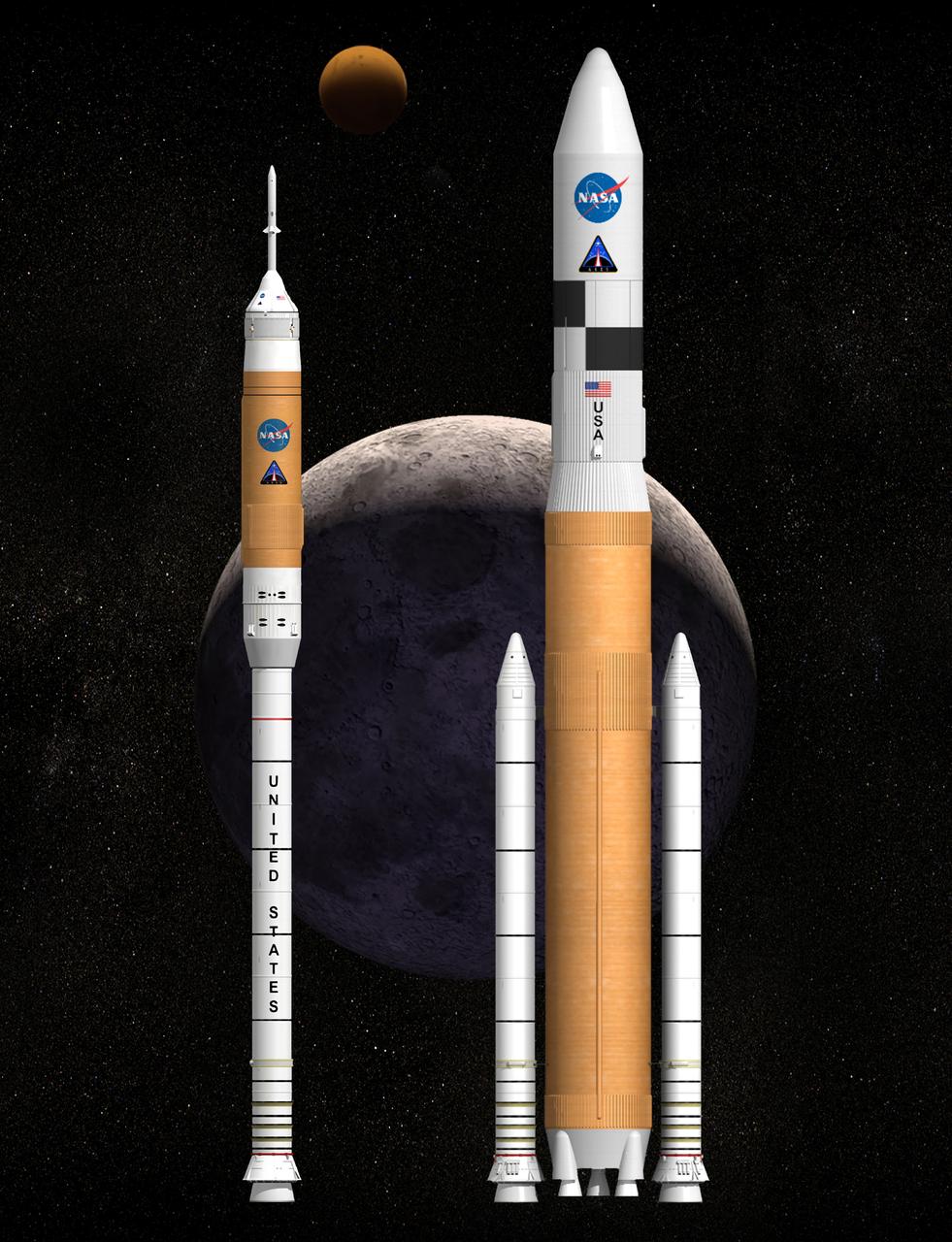
Named for the Greek god associated with Mars, the NASA developed Ares launch vehicles will return humans to the moon and later take them to Mars and other destinations. In this early illustration, the vehicle depicted on the left is the Ares I. Ares I is an inline, two-stage rocket configuration topped by the Orion crew vehicle and its launch abort system. In addition to its primary mission of carrying four to six member crews to Earth orbit, Ares I may also use its 25-ton payload capacity to deliver resources and supplies to the International Space Station (ISS), or to "park" payloads in orbit for retrieval by other spacecraft bound for the moon or other destinations. The Ares I employs a single five-segment solid rocket booster, a derivative of the space shuttle solid rocket booster, for the first stage. A liquid oxygen/liquid hydrogen J-2X engine derived from the J-2 engine used on the second stage of the Apollo vehicle will power the Ares V second stage. The Ares I can lift more than 55,000 pounds to low Earth orbit. The vehicle illustrated on the right is the Ares V, a heavy lift launch vehicle that will use five RS-68 liquid oxygen/liquid hydrogen engines mounted below a larger version of the space shuttle external tank, and two five-segment solid propellant rocket boosters for the first stage. The upper stage will use the same J-2X engine as the Ares I. The Ares V can lift more than 286,000 pounds to low Earth orbit and stands approximately 360 feet tall. This versatile system will be used to carry cargo and the components into orbit needed to go to the moon and later to Mars. Both vehicles are subject to configuration changes before they are actually launched. This illustration reflects the latest configuration as of September 2006.
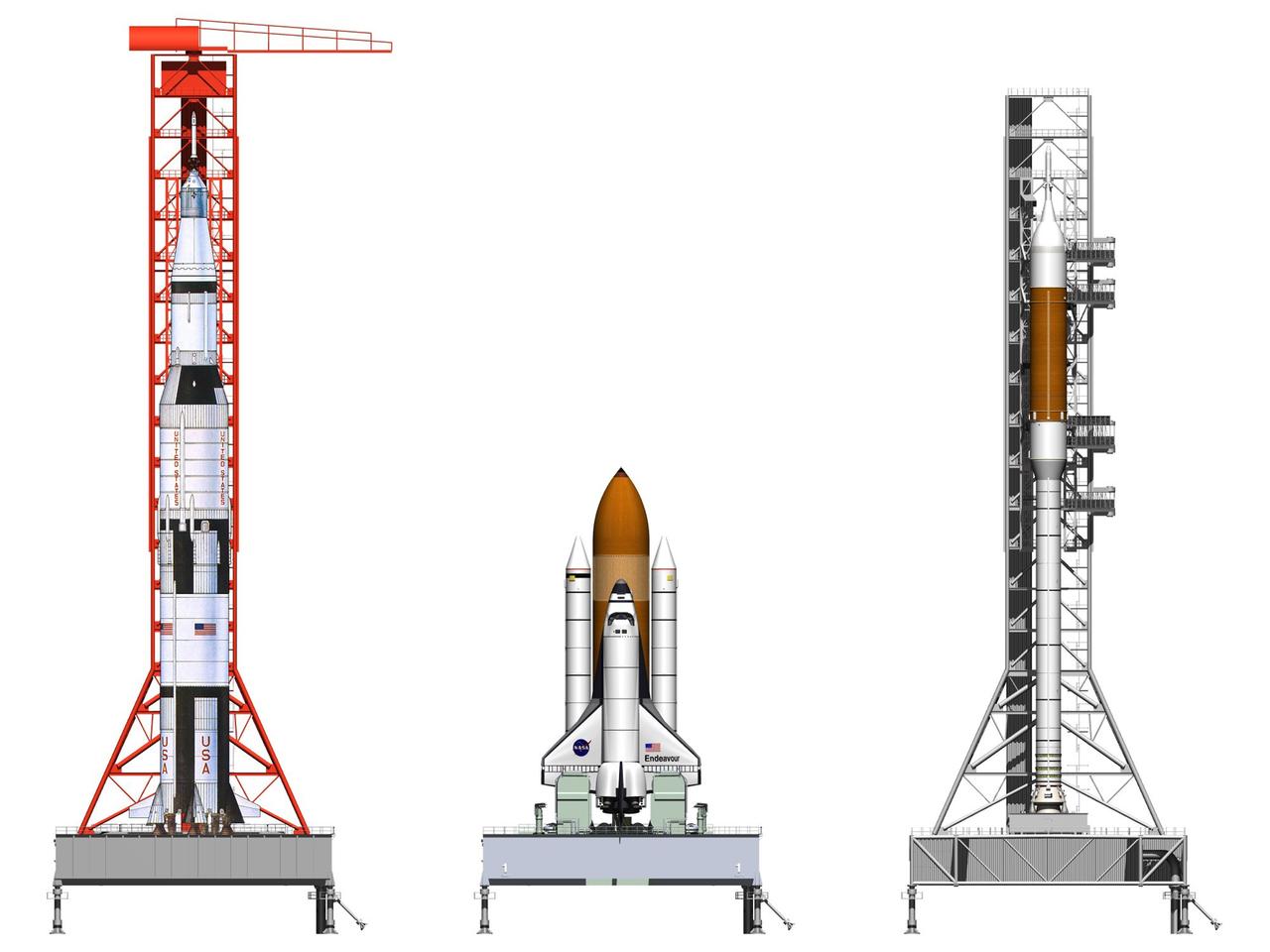
CAPE CANAVERAL, Fla. -- Artist's rendering of the Constellation Program's Ares V rocket on the mobile launcher platform (left) and the Ares I rocket on the platform (right) with the space shuttle in between for comparison. The tower of the mobile launcher will have multiple platforms for personnel access and will be approximately 390 feet tall. The tower will be used in the assembly, testing and servicing of the Ares rockets at Kennedy and will also transport the Ares rockets to the launch pad and provide ground support for launches.
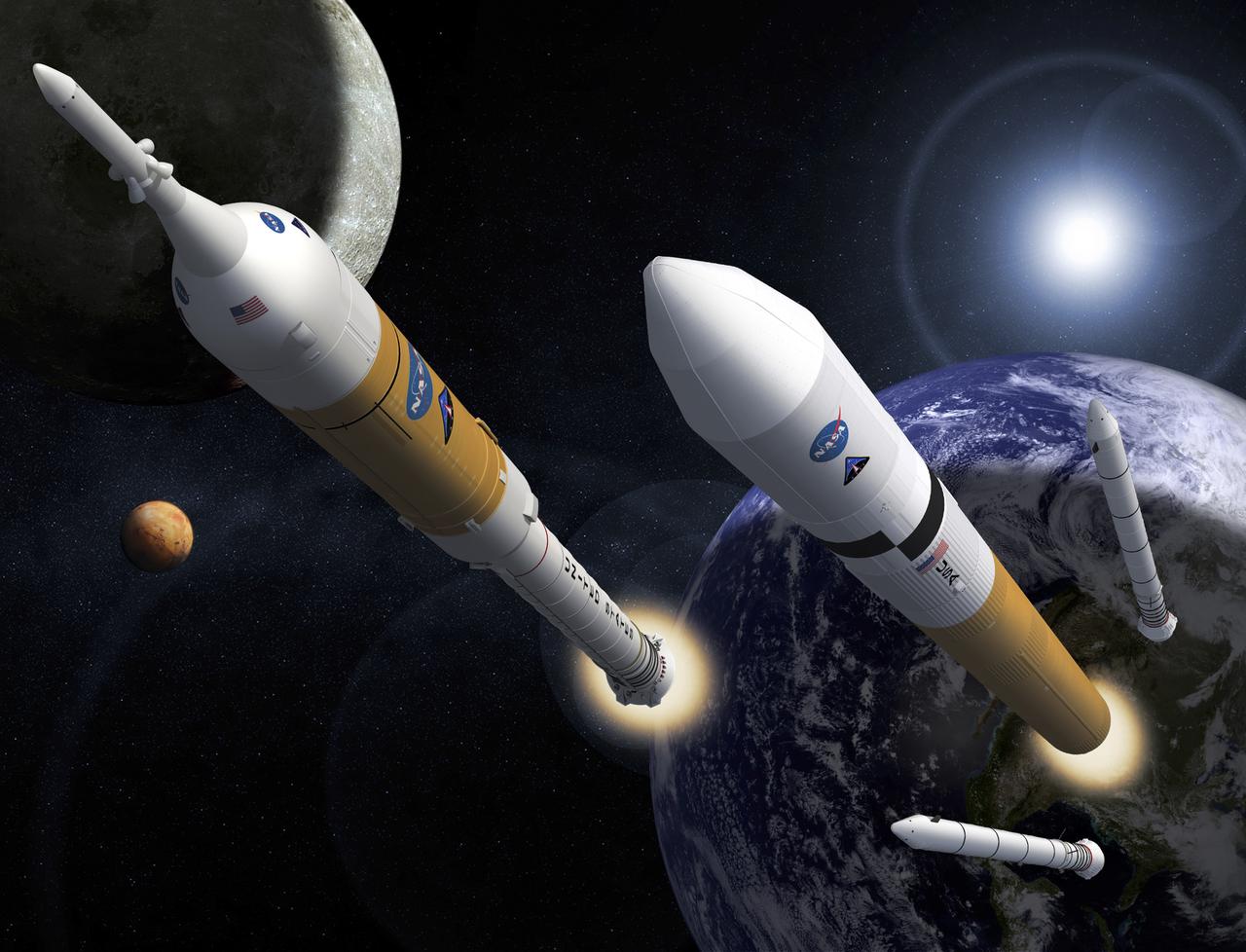
Shown is a concept illustration of the Ares I crew launch vehicle, left, and Ares V cargo launch vehicle. Ares I will carry the Orion Crew Exploration Vehicle to space. Ares V will serve as NASA's primary vehicle for delivery of large-scale hardware to space.
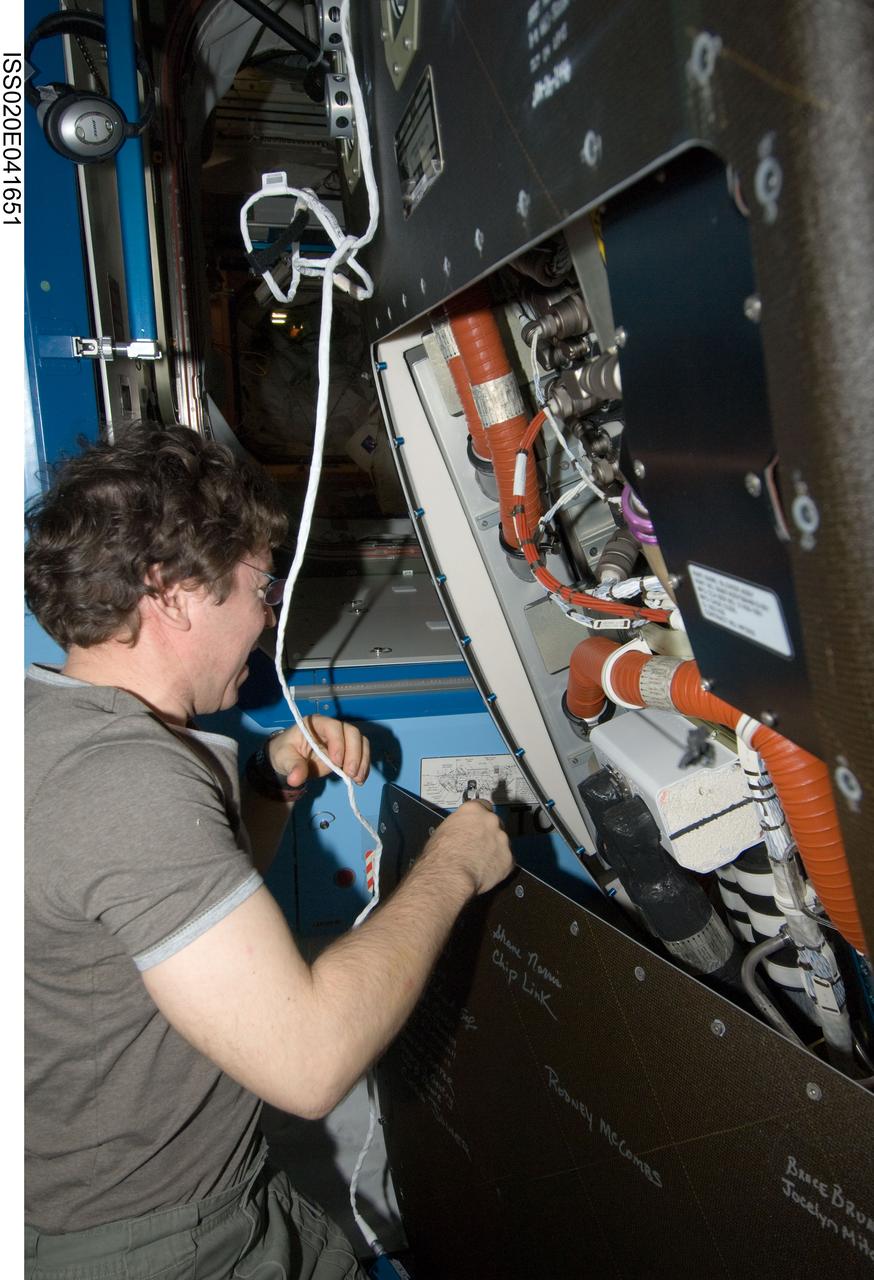
ISS020-E-041651 (22 Sept. 2009) --- NASA astronaut Michael Barratt works with the Atmosphere Revitalization System (ARS) rack in the Destiny laboratory of the International Space Station. Barratt, Canadian Space Agency astronaut Robert Thirsk (out of frame) and European Space Agency astronaut Frank De Winne (out of frame), all Expedition 20 flight engineers, spent several hours with the extensive dual-rack swap/install activity, to move Destiny?s ARS rack to the Kibo laboratory and install in Destiny in its place the newly-delivered ARS rack for Node-3.
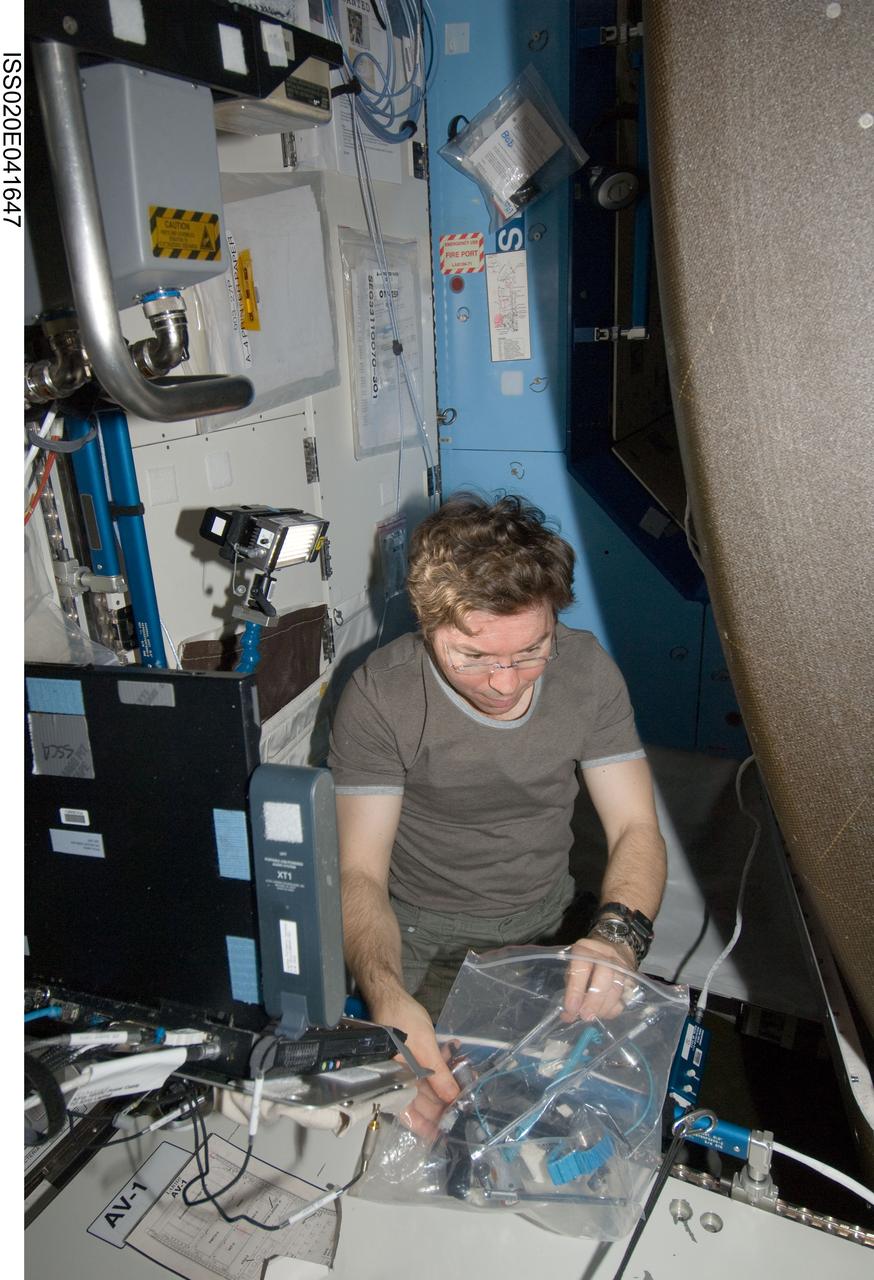
ISS020-E-041647 (22 Sept. 2009) --- NASA astronaut Michael Barratt works with the Atmosphere Revitalization System (ARS) rack in the Destiny laboratory of the International Space Station. Barratt, Canadian Space Agency astronaut Robert Thirsk (out of frame) and European Space Agency astronaut Frank De Winne (out of frame), all Expedition 20 flight engineers, spent several hours with the extensive dual-rack swap/install activity, to move Destiny?s ARS rack to the Kibo laboratory and install in Destiny in its place the newly-delivered ARS rack for Node-3.
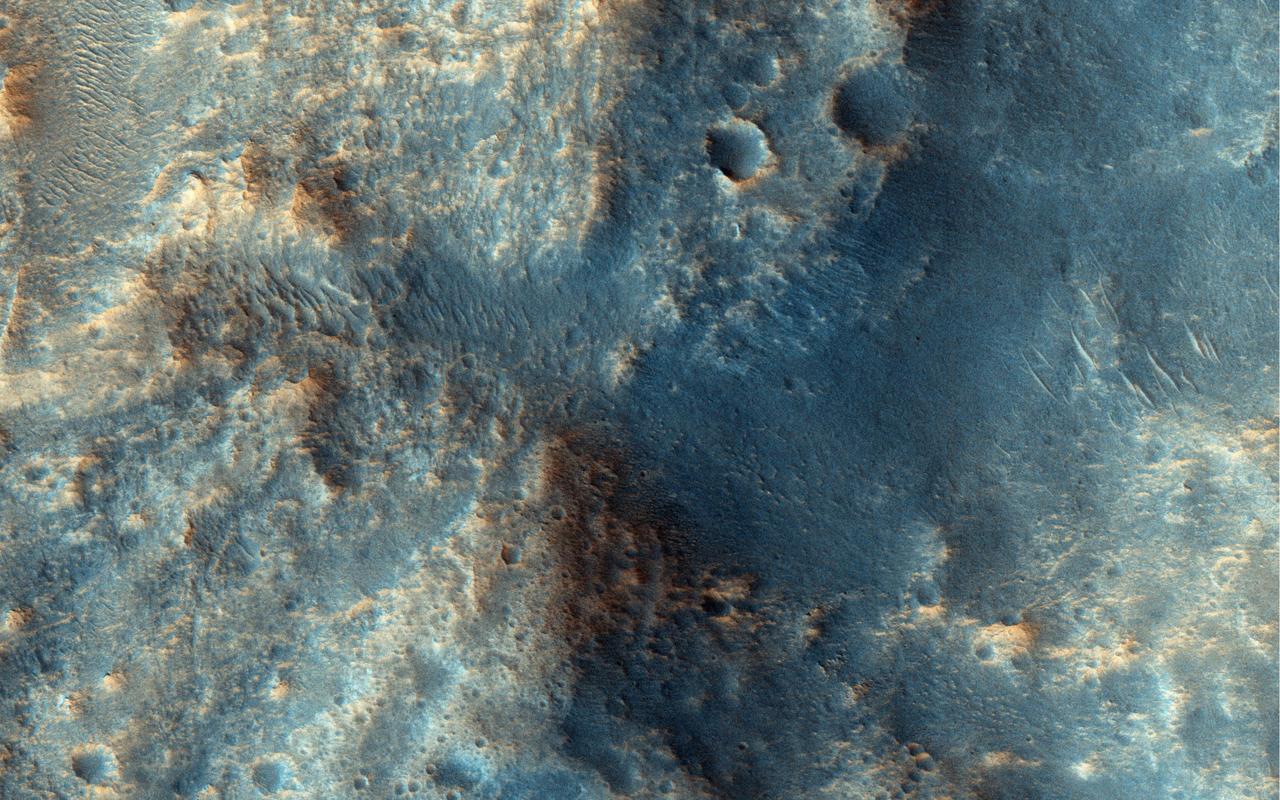
This channelized area is near the source region of the huge outflow channel, Ares Vallis. It was at the distal end or long-ways down-river-area where the Pathfinder/Sojourner mission landed on 4 July 1997.
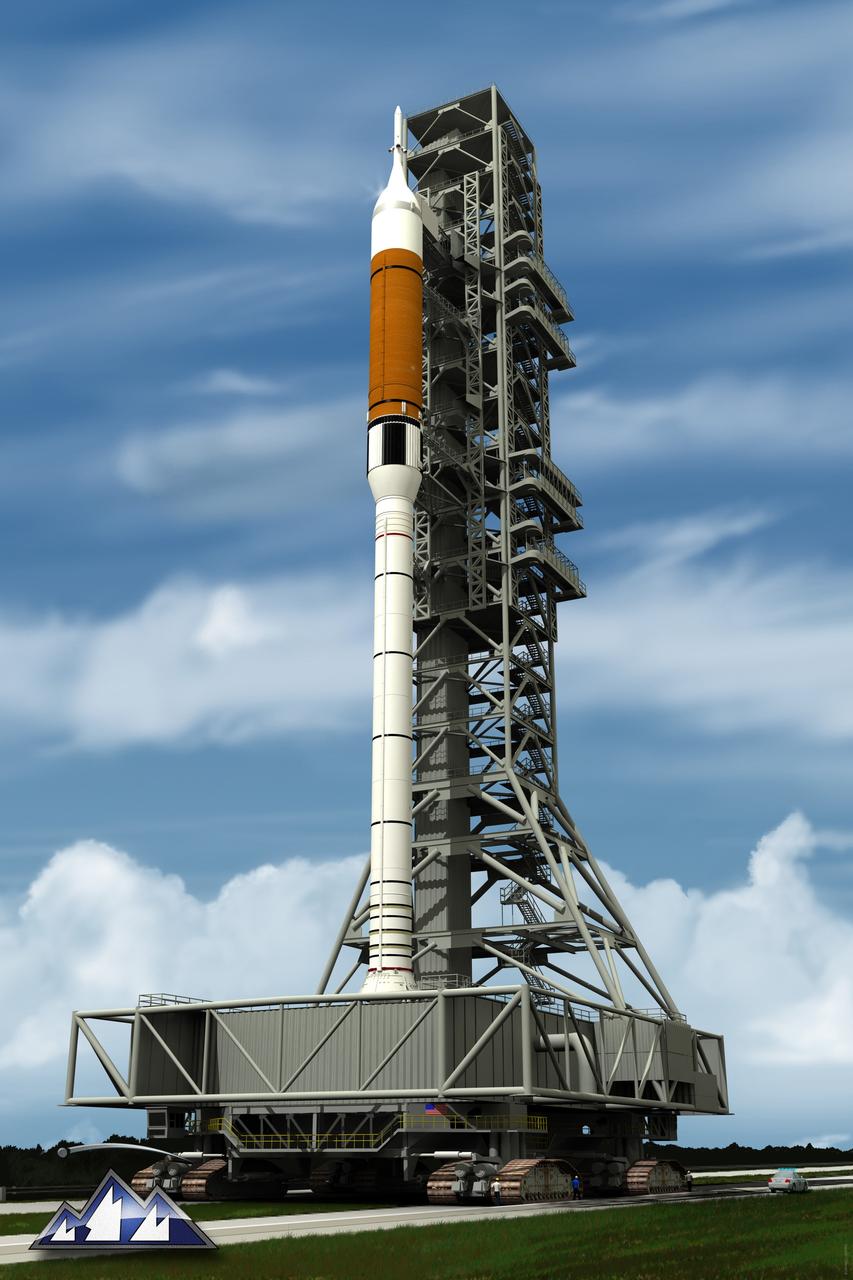
CAPE CANAVERAL, Fla. -- Artist's rendering of the Constellation Program's mobile launcher platform with an Ares I rocket attached. The tower of the mobile launcher will have multiple platforms for personnel access and will be approximately 390 feet tall. The tower will be used in the assembly, testing and servicing of the Ares rockets at Kennedy and will also transport the Ares rockets to the launch pad and provide ground support for launches.
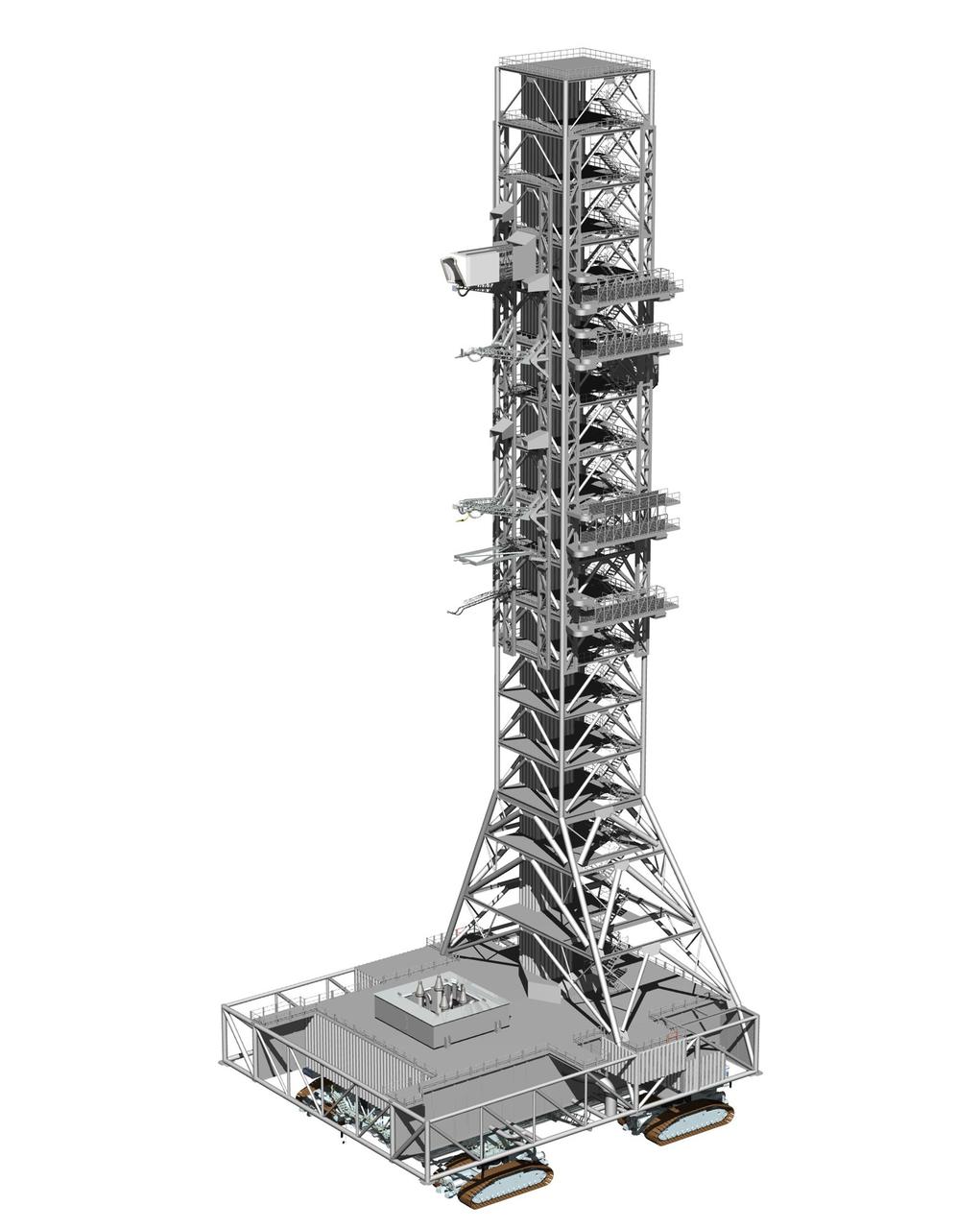
CAPE CANAVERAL, Fla. -- Artist's rendering of the empty Constellation Program's mobile launcher platform planned for the Ares I rocket. The tower of the mobile launcher will have multiple platforms for personnel access and will be approximately 390 feet tall. The tower will be used in the assembly, testing and servicing of the Ares rockets at Kennedy and will also transport the Ares rockets to the launch pad and provide ground support for launches.
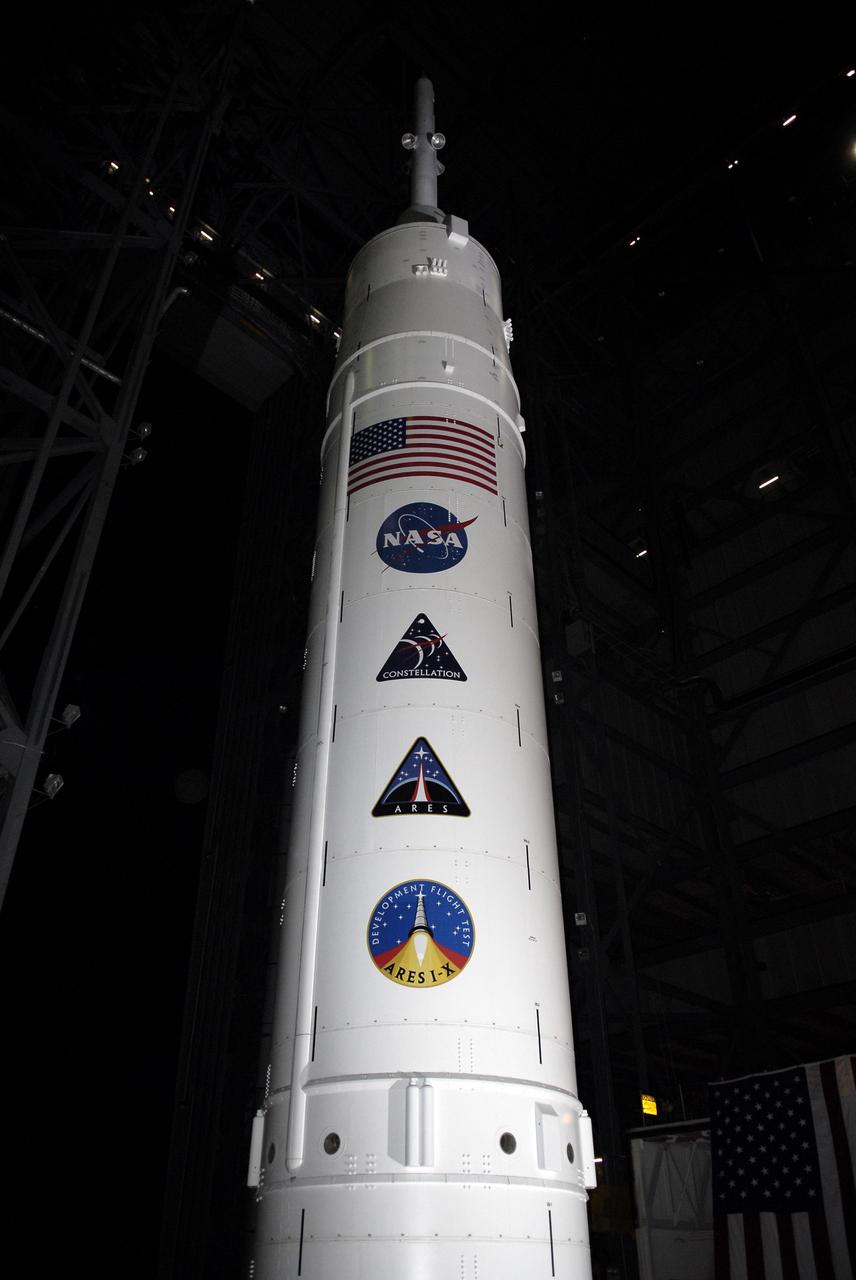
CAPE CANAVERAL, Fla. - Poised inside Vehicle Assembly Building at NASA's Kennedy Space Center in Florida, the Ares I-X rocket's upper stage is adorned with the American flag, NASA logo, and the logos of the Constellation Program, Ares, and Ares I-X. The transfer of the pad from the Space Shuttle Program to the Constellation Program took place May 31. Modifications made to the pad include the removal of shuttle unique subsystems, such as the orbiter access arm and a section of the gaseous oxygen vent arm, along with the installation of three 600-foot lightning towers, access platforms, environmental control systems and a vehicle stabilization system. Part of the Constellation Program, the Ares I-X is the test vehicle for the Ares I. The Ares I-X flight test is targeted for Oct. 27. For information on the Ares I-X vehicle and flight test, visit http://www.nasa.gov/aresIX. Photo credit: NASA/Kim Shiflett
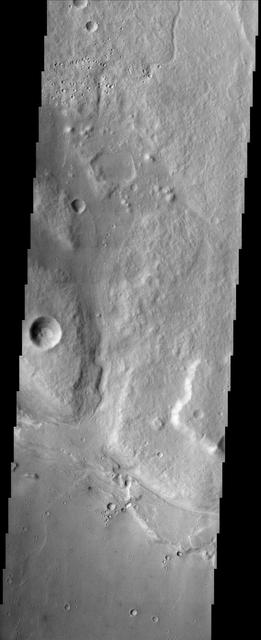
This image from NASA Mars Odyssey covers a portion of Ares Valles, an outflow channel carved into the surface of Mars by ancient catastrophic floods. The floods were most likely caused by huge discharges of groundwater at the channel heads. These floods are similar to (but much larger than) floods that created the Channeled Scablands in central Washington State during the last ice age on Earth. The Martian channels are hundreds of kilometers long and occur in a number of regions within equatorial Mars. The material that was eroded away by these floods was deposited as sediment in the northern lowlands. The Mars Pathfinder landing site is several hundred kilometers downstream from the location of this image and the surfaces are probably similar in nature. http://photojournal.jpl.nasa.gov/catalog/PIA04026
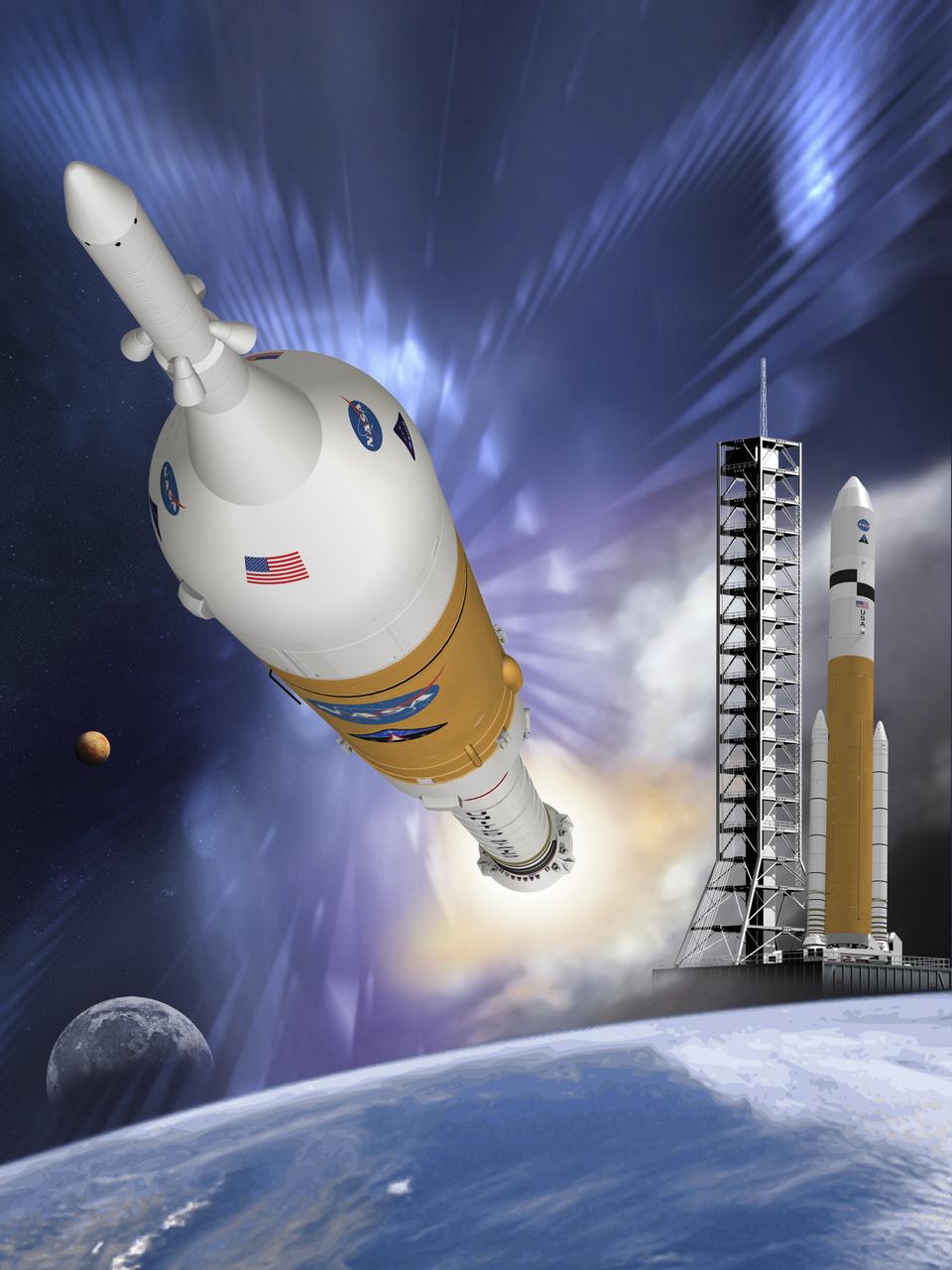
Shown is a concept illustration of the Ares I crew launch vehicle during launch and the Ares V cargo launch vehicle on the launch pad. Ares I will carry the Orion Crew Exploration Vehicle with an astronaut crew to Earth orbit. Ares V will deliver large-scale hardware to space. This includes the Altair Lunar Lander, materials for establishing an outpost on the moon, and the vehicles and hardware needed to extend a human presence beyond Earth orbit.
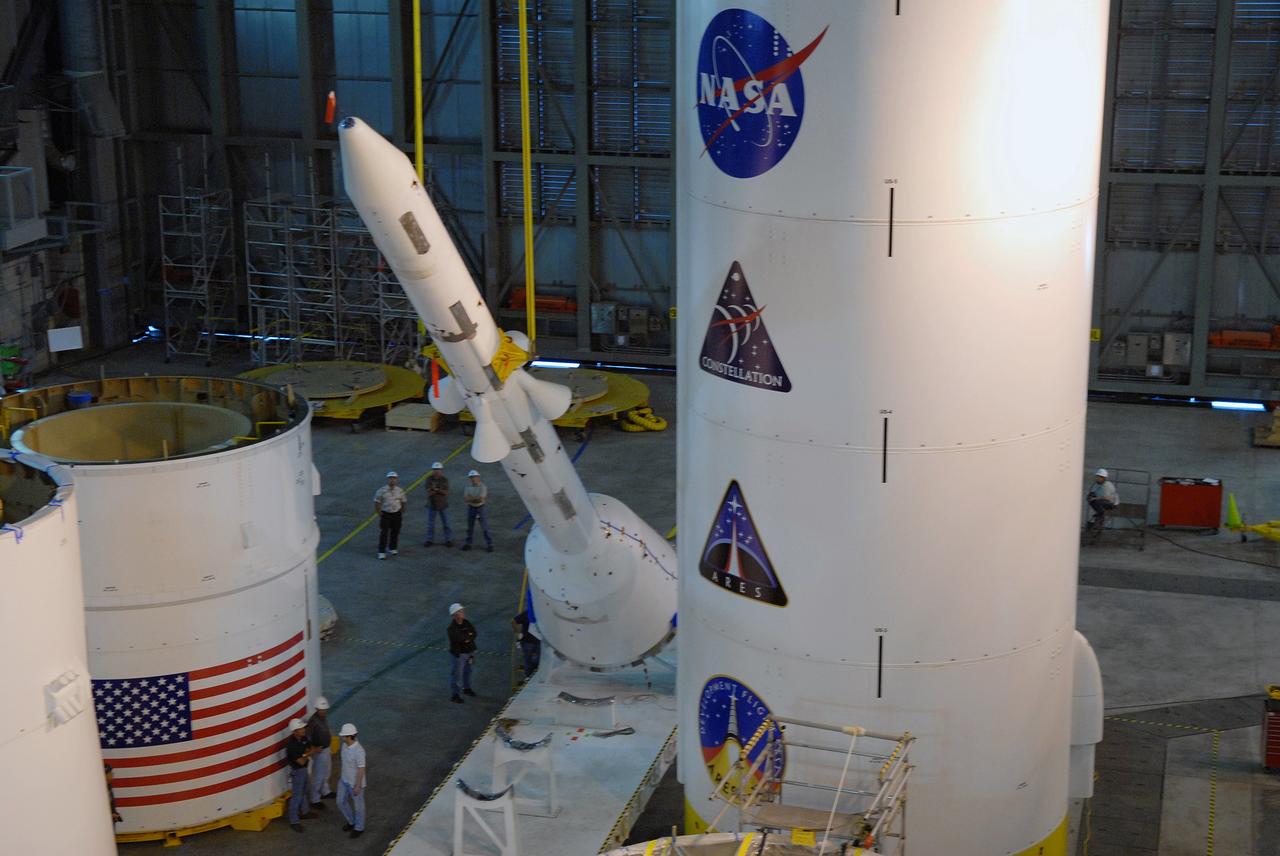
CAPE CANAVERAL, Fla. – In high bay 4 of the Vehicle Assembly Building at NASA's Kennedy Space Center in Florida, the crane raises the Ares I-X simulated launch abort system, or LAS, to a vertical position. The LAS will then be ready for assembly with the crew module simulator. Ares I-X is the flight test vehicle for the Ares I, which is part of the Constellation Program to return men to the moon and beyond. Ares I is the essential core of a safe, reliable, cost-effective space transportation system that eventually will carry crewed missions back to the moon, on to Mars and out into the solar system. Ares I-X is targeted for launch in July 2009. Photo credit: NASA/Jack Pfaller
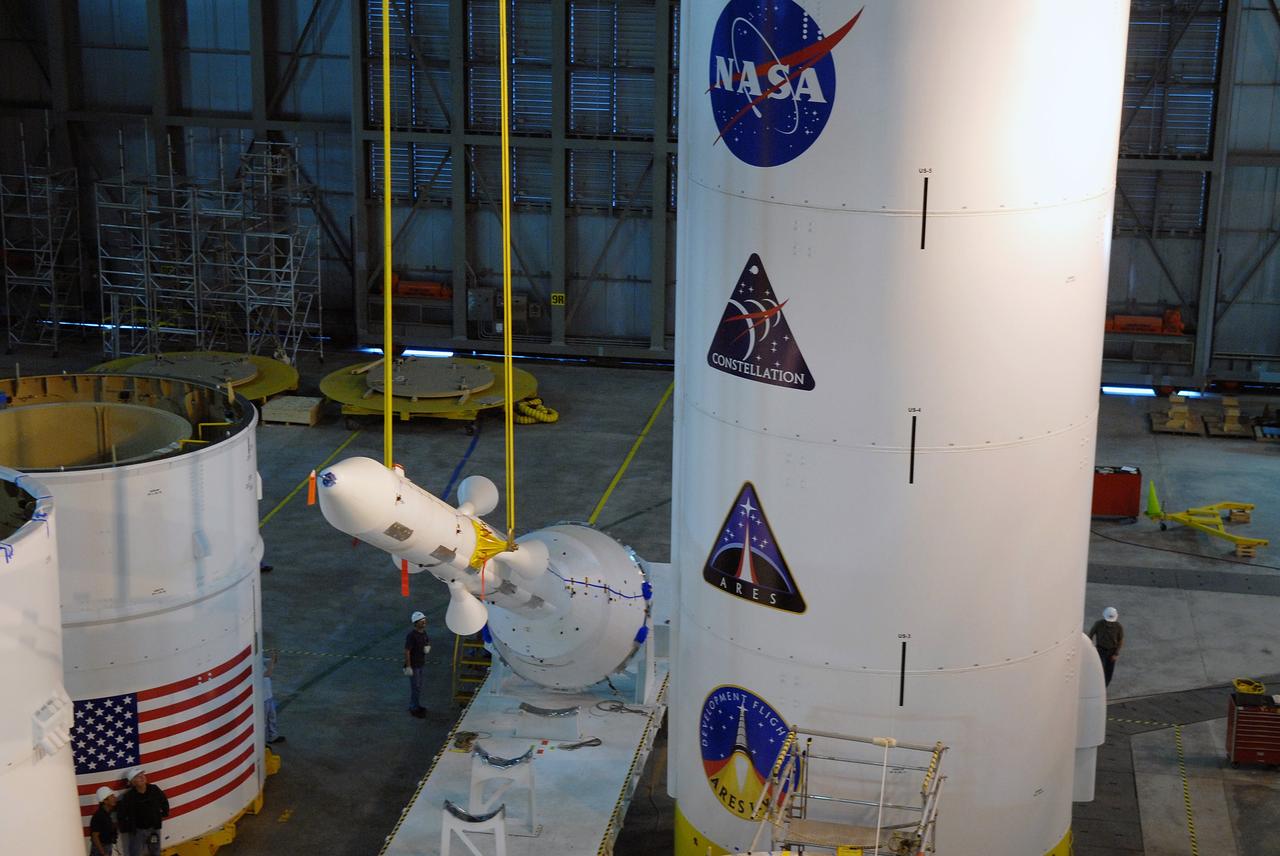
CAPE CANAVERAL, Fla. – In high bay 4 of the Vehicle Assembly Building at NASA's Kennedy Space Center in Florida, the crane begins to raise the Ares I-X simulated launch abort system, or LAS, to a vertical position. The LAS will then be ready for assembly with the crew module simulator. Ares I-X is the flight test vehicle for the Ares I, which is part of the Constellation Program to return men to the moon and beyond. Ares I is the essential core of a safe, reliable, cost-effective space transportation system that eventually will carry crewed missions back to the moon, on to Mars and out into the solar system. Ares I-X is targeted for launch in July 2009. Photo credit: NASA/Jack Pfaller
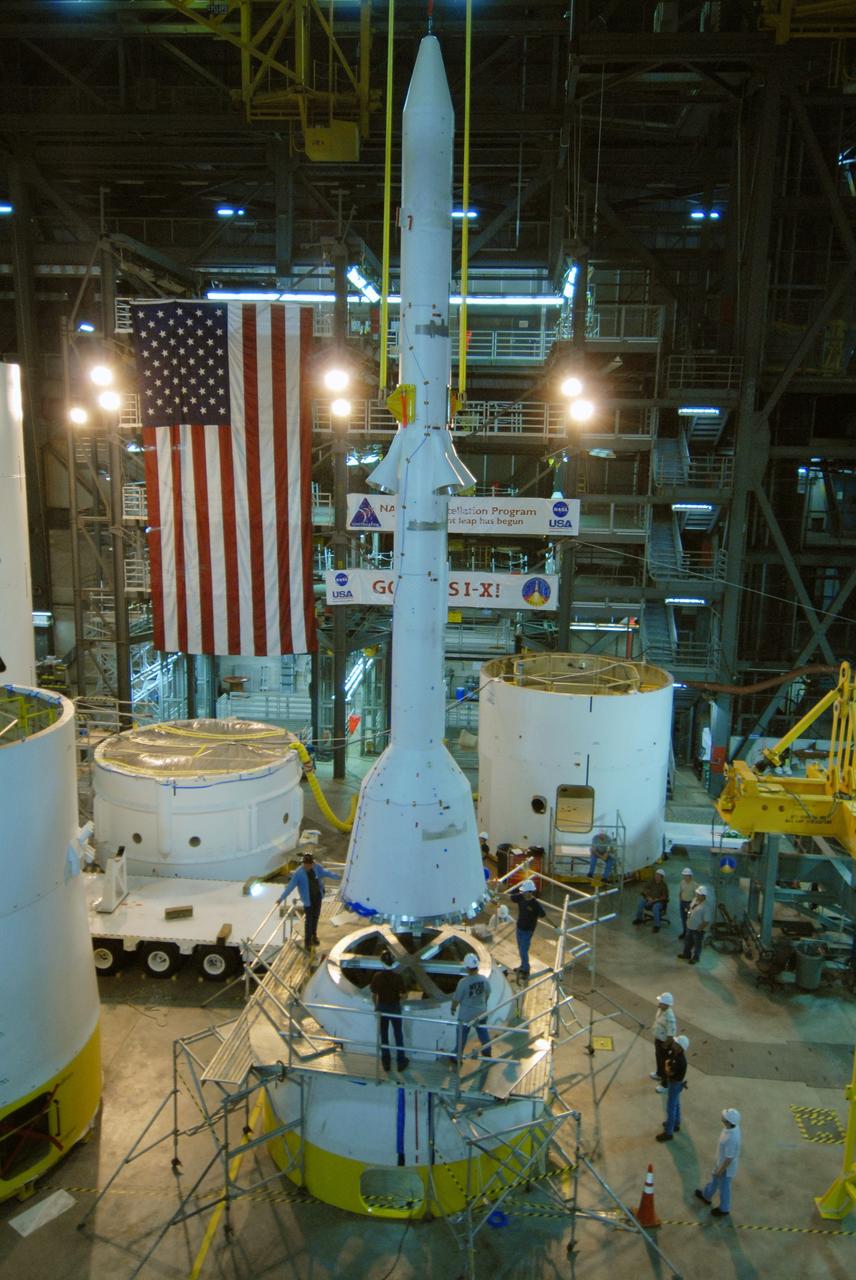
CAPE CANAVERAL, Fla. – In high bay 4 of the Vehicle Assembly Building at NASA's Kennedy Space Center in Florida, workers keep close watch on the Ares I-X simulated launch abort system, or LAS, as it is lowered toward the crew module simulator. Ares I-X is the flight test vehicle for the Ares I, which is part of the Constellation Program to return men to the moon and beyond. Ares I is the essential core of a safe, reliable, cost-effective space transportation system that eventually will carry crewed missions back to the moon, on to Mars and out into the solar system. Ares I-X is targeted for launch in July 2009. Photo credit: NASA/Jack Pfaller
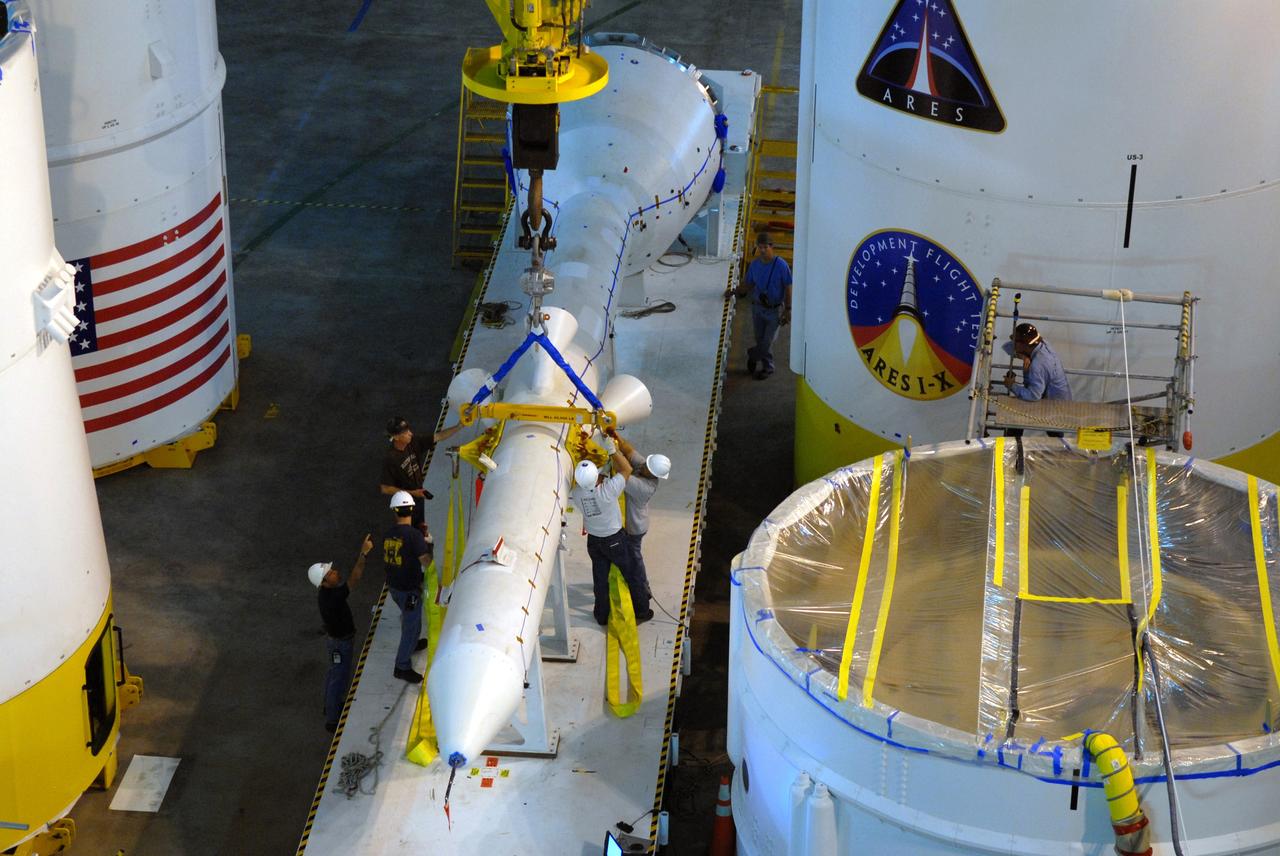
CAPE CANAVERAL, Fla. – In high bay 4 of the Vehicle Assembly Building at NASA's Kennedy Space Center in Florida, workers place a crane and straps on the Ares I-X simulated launch abort system to lift and rotate it for assembly with the crew module simulator. Ares I-X is the flight test vehicle for the Ares I, which is part of the Constellation Program to return men to the moon and beyond. Ares I is the essential core of a safe, reliable, cost-effective space transportation system that eventually will carry crewed missions back to the moon, on to Mars and out into the solar system. Ares I-X is targeted for launch in July 2009. Photo credit: NASA/Jack Pfaller
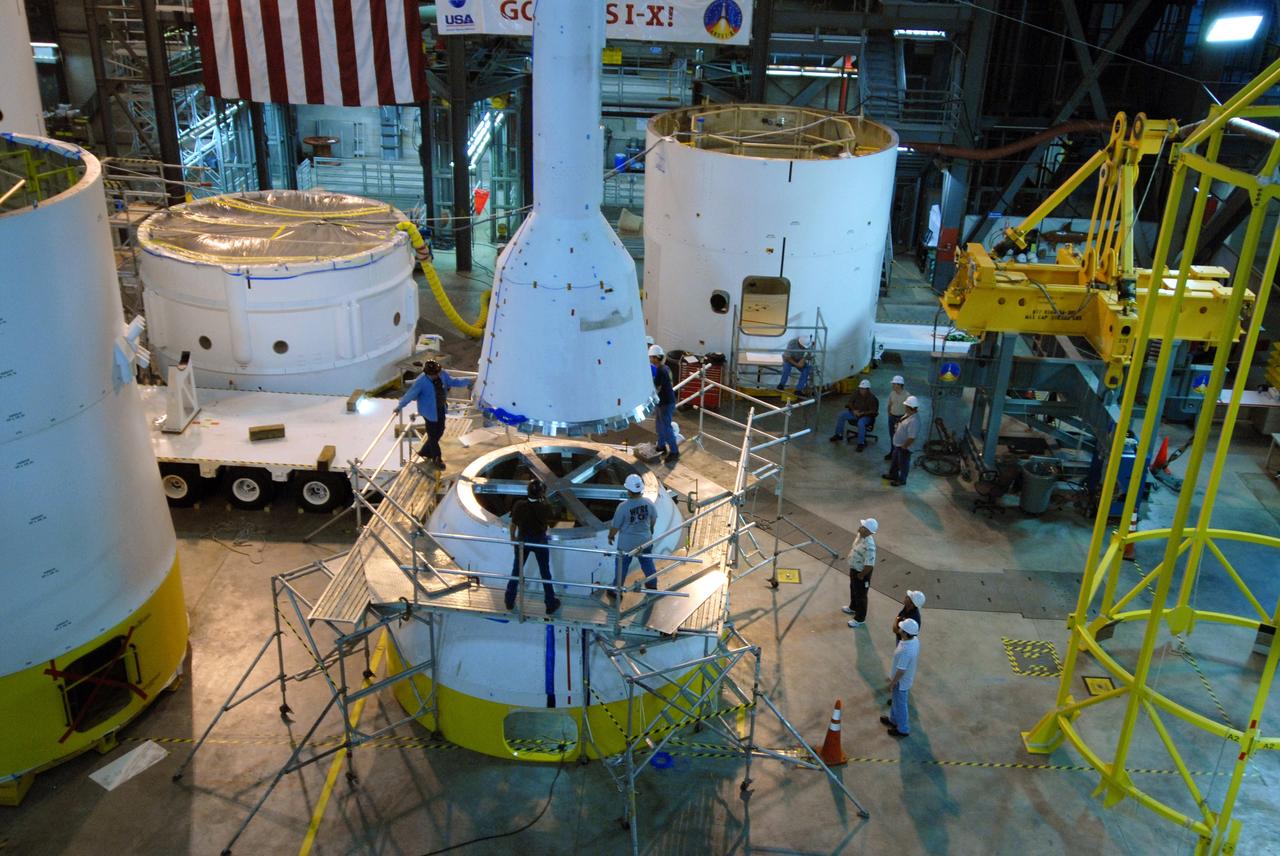
CAPE CANAVERAL, Fla. – In high bay 4 of the Vehicle Assembly Building at NASA's Kennedy Space Center in Florida, workers keep close watch on the Ares I-X simulated launch abort system, or LAS, as it is lowered toward the crew module simulator. Ares I-X is the flight test vehicle for the Ares I, which is part of the Constellation Program to return men to the moon and beyond. Ares I is the essential core of a safe, reliable, cost-effective space transportation system that eventually will carry crewed missions back to the moon, on to Mars and out into the solar system. Ares I-X is targeted for launch in July 2009. Photo credit: NASA/Jack Pfaller
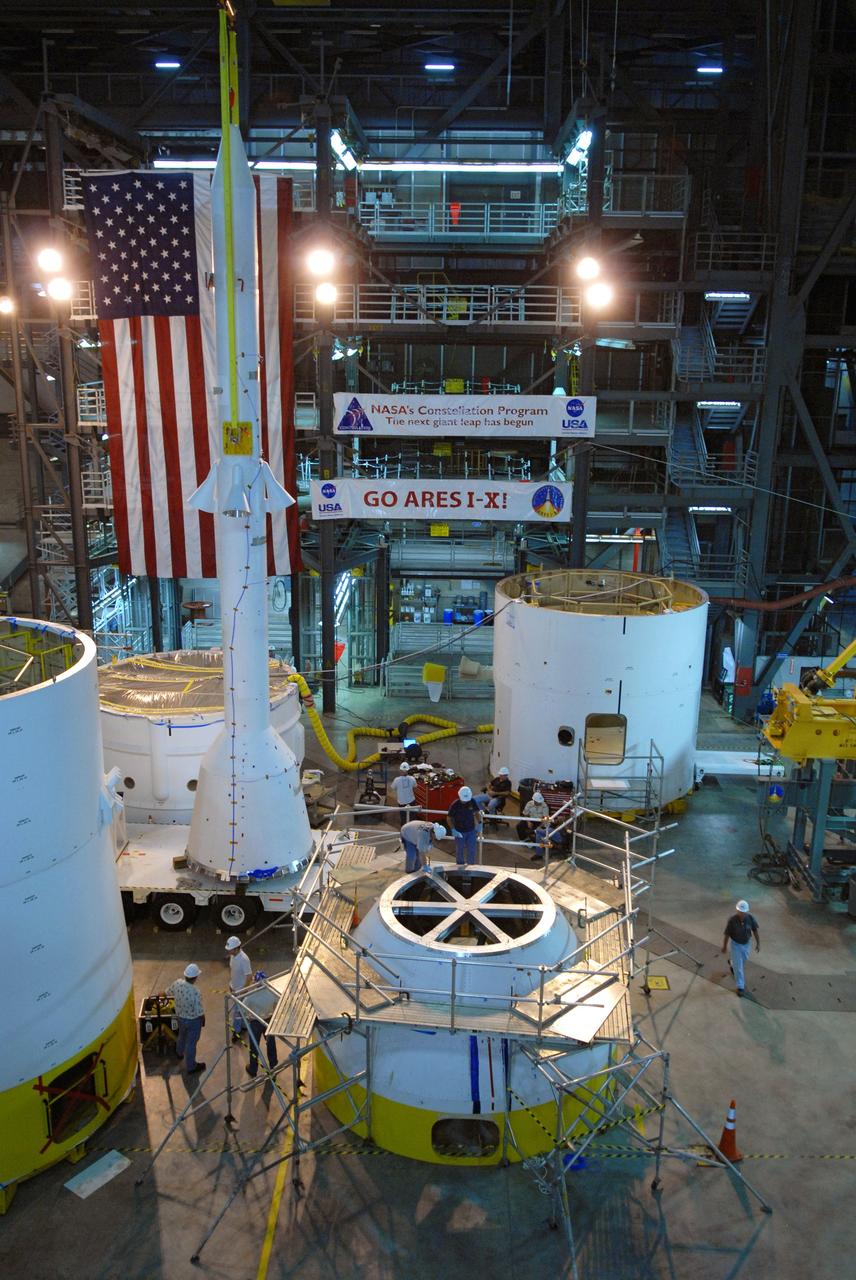
CAPE CANAVERAL, Fla. – In high bay 4 of the Vehicle Assembly Building at NASA's Kennedy Space Center in Florida, the Ares I-X simulated launch abort system, or LAS, (left of center) is being moved to the crew module simulator (center) for assembly. Ares I-X is the flight test vehicle for the Ares I, which is part of the Constellation Program to return men to the moon and beyond. Ares I is the essential core of a safe, reliable, cost-effective space transportation system that eventually will carry crewed missions back to the moon, on to Mars and out into the solar system. Ares I-X is targeted for launch in July 2009. Photo credit: NASA/Jack Pfaller
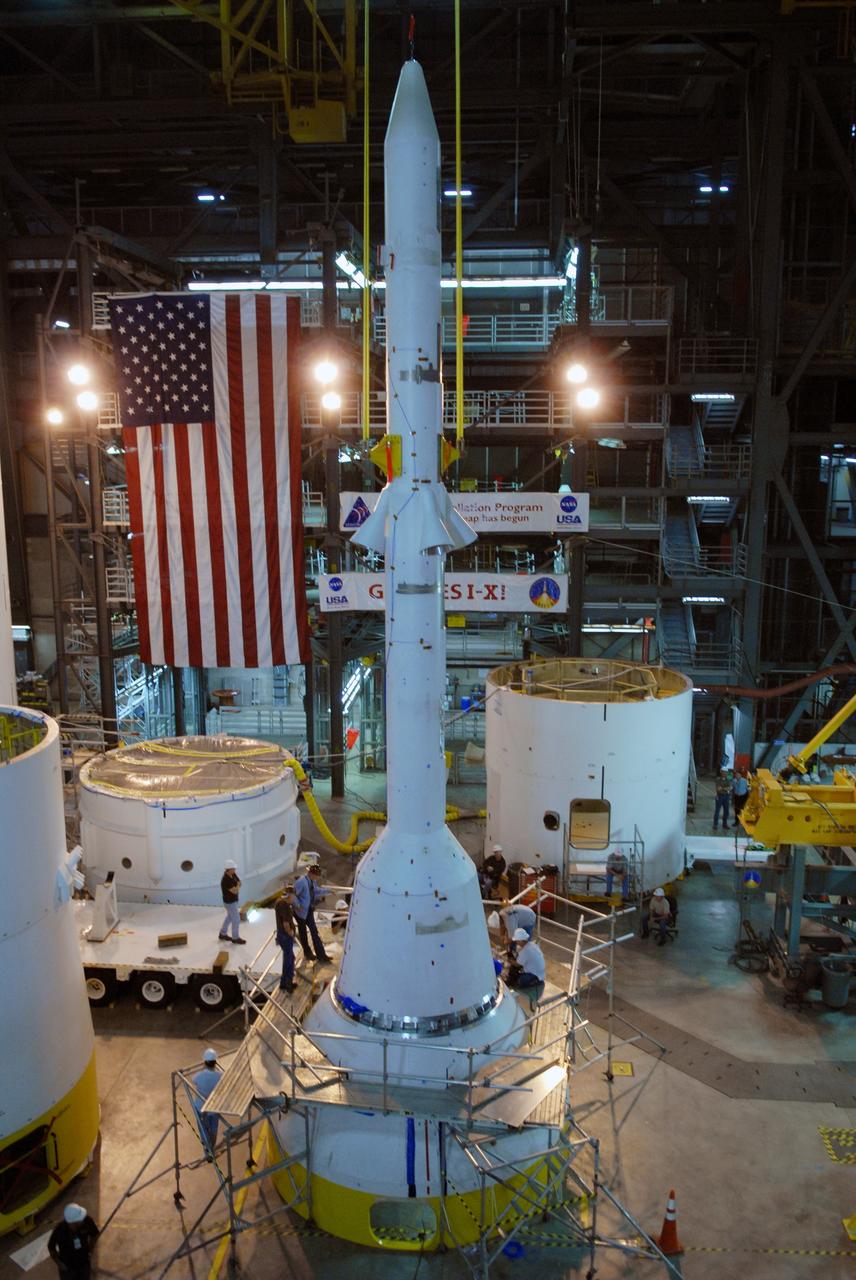
CAPE CANAVERAL, Fla. – In high bay 4 of the Vehicle Assembly Building at NASA's Kennedy Space Center in Florida, workers keep close watch on the Ares I-X simulated launch abort system, or LAS, as it is lowered onto the crew module simulator for assembly. Ares I-X is the flight test vehicle for the Ares I, which is part of the Constellation Program to return men to the moon and beyond. Ares I is the essential core of a safe, reliable, cost-effective space transportation system that eventually will carry crewed missions back to the moon, on to Mars and out into the solar system. Ares I-X is targeted for launch in July 2009. Photo credit: NASA/Jack Pfaller
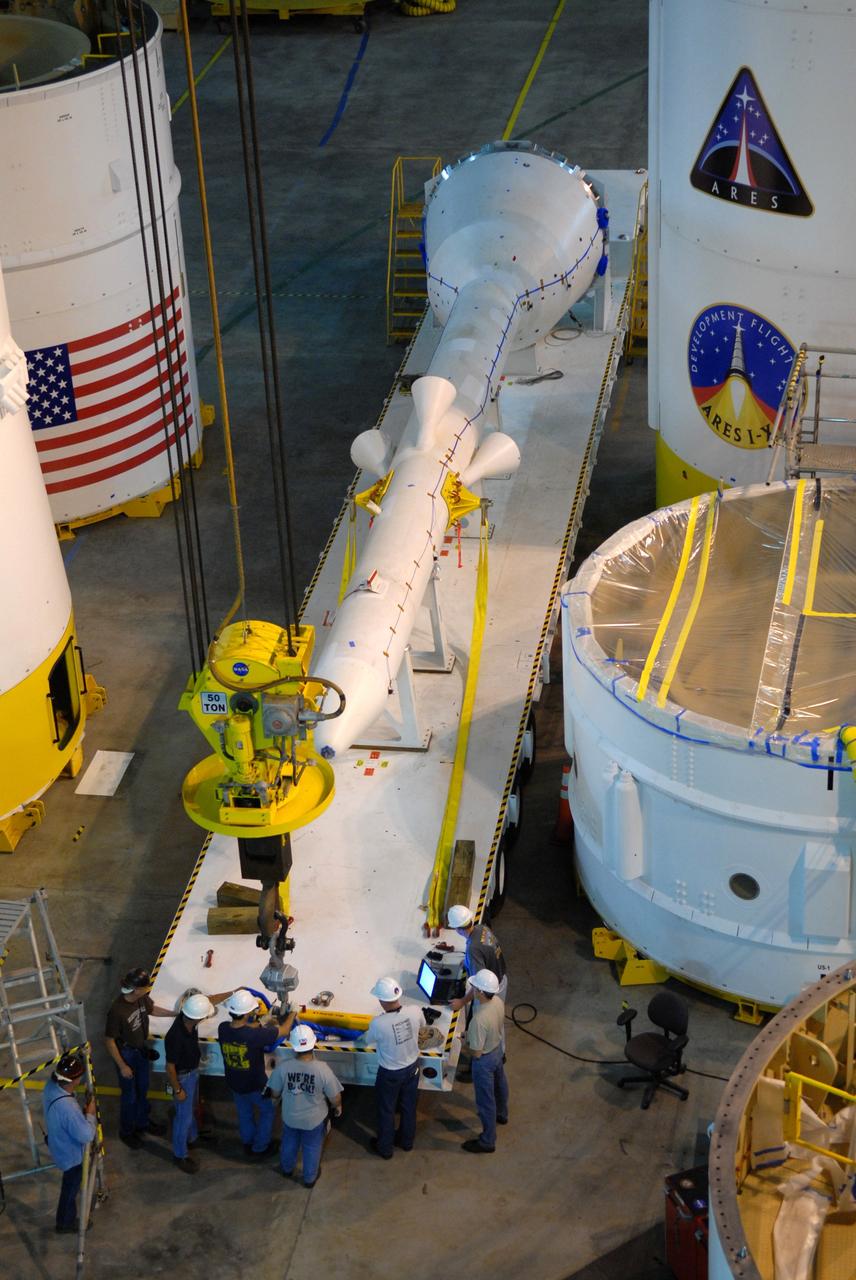
CAPE CANAVERAL, Fla. – In high bay 4 of the Vehicle Assembly Building at NASA's Kennedy Space Center in Florida, workers prepare the crane that will lift and rotate the Ares I-X simulated launch abort system (center) for assembly with the crew module simulator. Ares I-X is the flight test vehicle for the Ares I, which is part of the Constellation Program to return men to the moon and beyond. Ares I is the essential core of a safe, reliable, cost-effective space transportation system that eventually will carry crewed missions back to the moon, on to Mars and out into the solar system. Ares I-X is targeted for launch in July 2009. Photo credit: NASA/Jack Pfaller
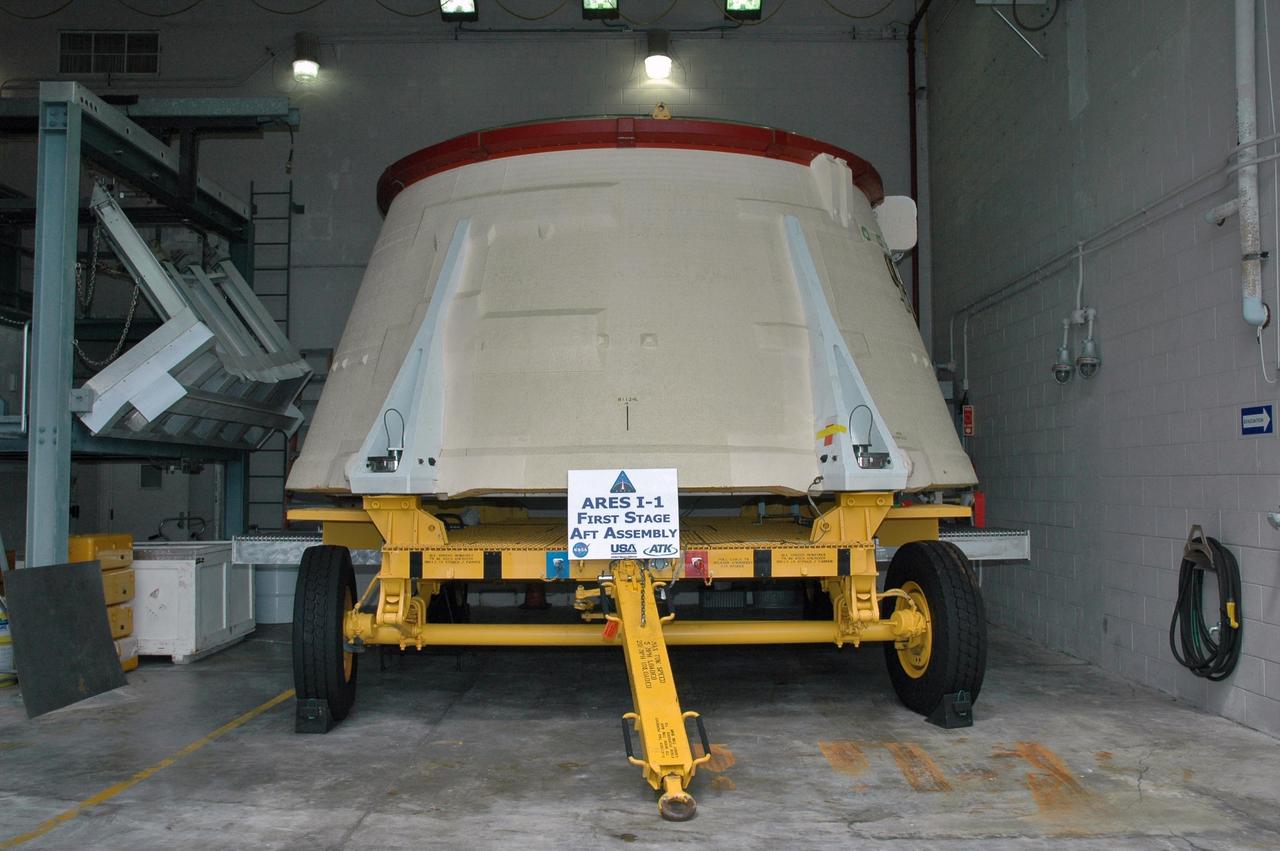
KENNEDY SPACE CENTER, FLA. - In the Assembly and Refurbishment Facility at NASA's Kennedy Space Center, the solid rocket booster aft skirt designated for use on the first stage of the ARES I-1 launch vehicle is being prepared for its first test flight. Ares I is the vehicle being developed for launch of the crew exploration vehicle (CEV), named Orion. Ares I-1 is currently targeted for launch from Launch Pad 39B in 2009 using the SRB first stage and a simulated second stage and simulated CEV. Ares I ascent tests and Ares I orbital tests will also take place at Kennedy at later dates. Photo credit: NASA/Jack Pfaller
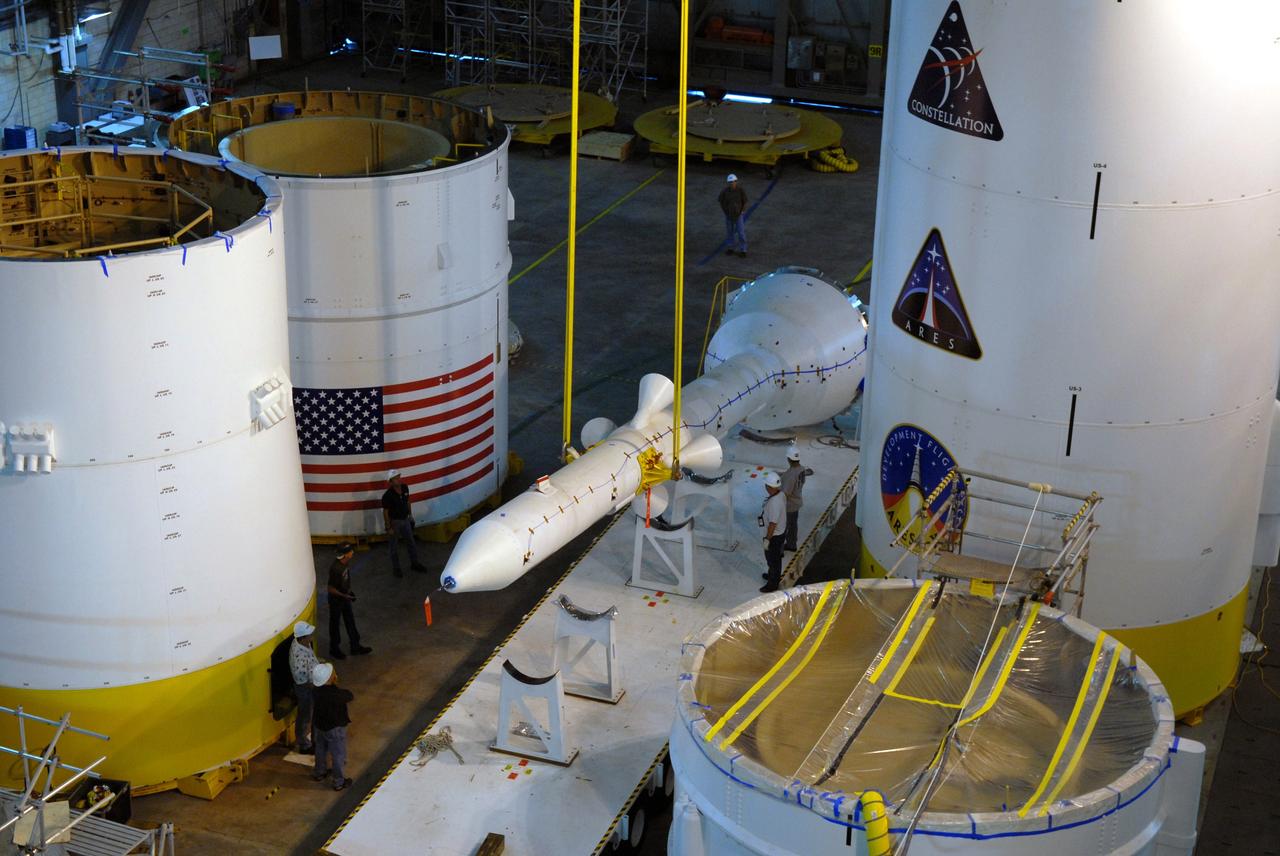
CAPE CANAVERAL, Fla. – In In high bay 4 of the Vehicle Assembly Building at NASA's Kennedy Space Center in Florida, the crane lifts the Ares I-X simulated launch abort system, or LAS, from its stand. The LAS will be rotated to vertical for assembly with the crew module simulator. Ares I-X is the flight test vehicle for the Ares I, which is part of the Constellation Program to return men to the moon and beyond. Ares I is the essential core of a safe, reliable, cost-effective space transportation system that eventually will carry crewed missions back to the moon, on to Mars and out into the solar system. Ares I-X is targeted for launch in July 2009. Photo credit: NASA/Jack Pfaller
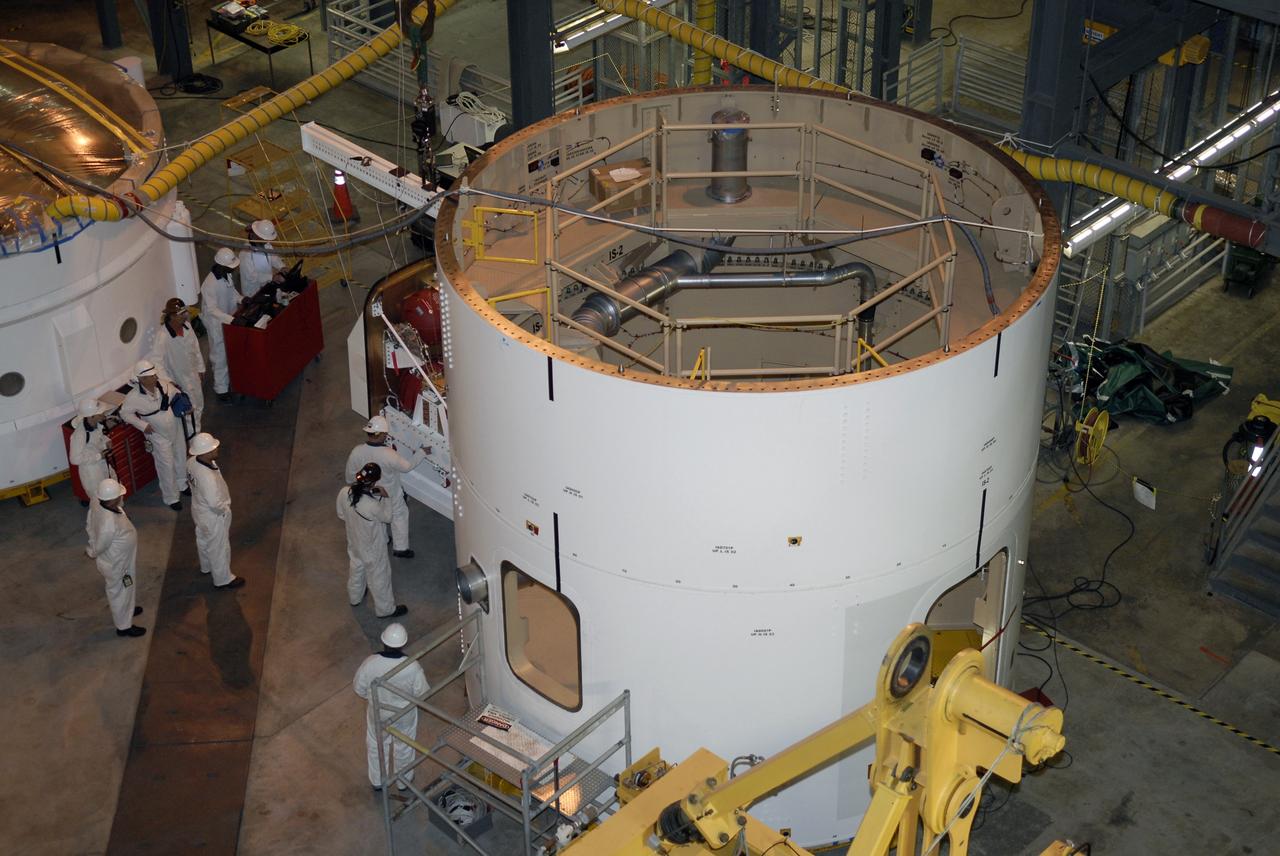
CAPE CANAVERAL, Fla. –– In high bay 4 of the Vehicle Assembly Building at NASA's Kennedy Space Center in Florida, at left center, technicians install the roll control system in the Ares I-X segment in the center. Ares I-X is the test vehicle for the Ares I, which is part of the Constellation Program to return men to the moon and beyond. Ares I-X is targeted for launch in July 2009. Photo credit: NASA/Kim Shiflett
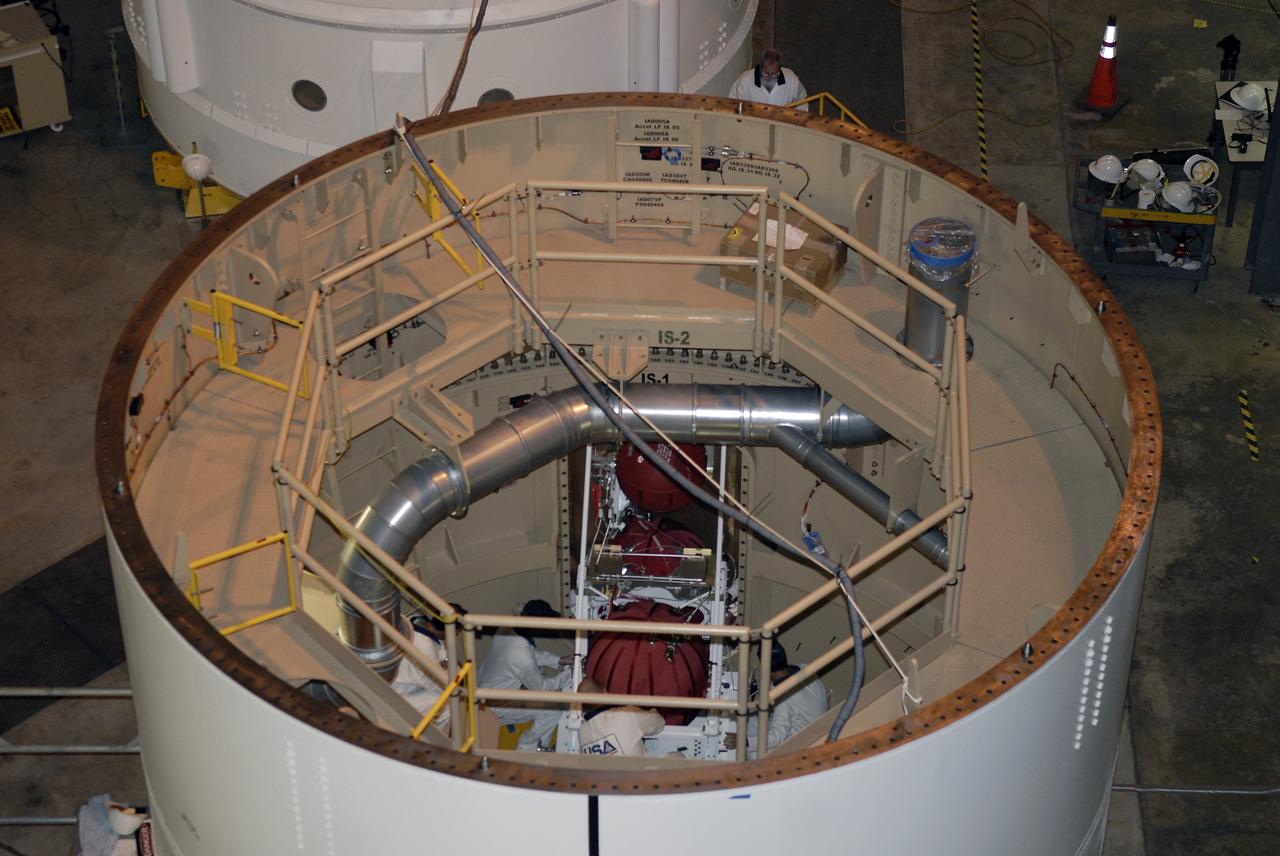
CAPE CANAVERAL, Fla. –– In high bay 4 of the Vehicle Assembly Building at NASA's Kennedy Space Center in Florida, technicians are seen inside the Ares I-X segment installing the roll control system. Ares I-X is the test vehicle for the Ares I, which is part of the Constellation Program to return men to the moon and beyond. Ares I-X is targeted for launch in July 2009. Photo credit: NASA/Kim Shiflett
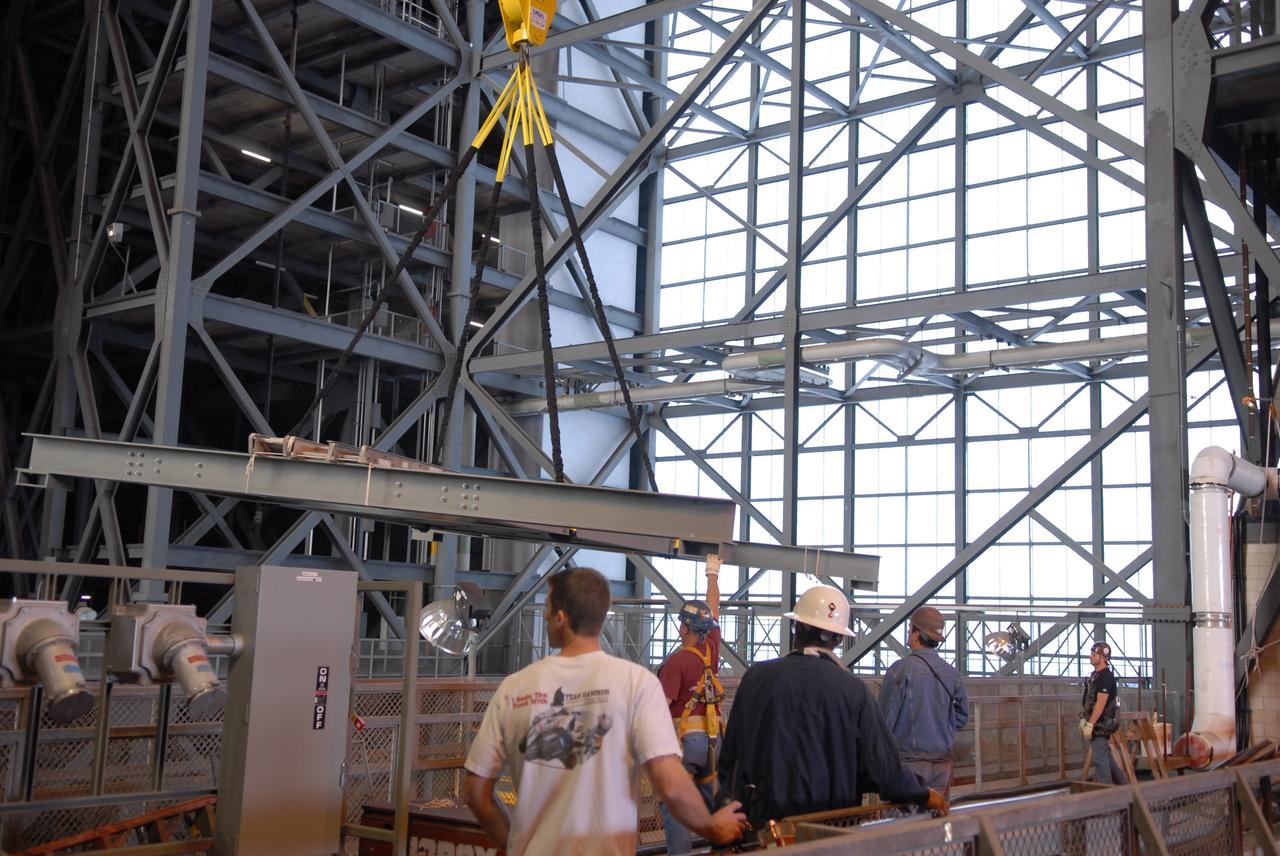
CAPE CANAVERAL, Fla. – In the Vehicle Assembly Building's high bay 3 at NASA's Kennedy Space Center in Florida, framework is lifted to the 16th floor for modifications related to the Ares I-X. The refurbishment of the facility is for the Constellation Program's Ares vehicles. The Ares I and Ares V rockets will be 325 feet and 360 feet tall, respectively, considerably taller than the space shuttle atop its mobile launcher platform. Photo credit: NASA/Troy Cryder
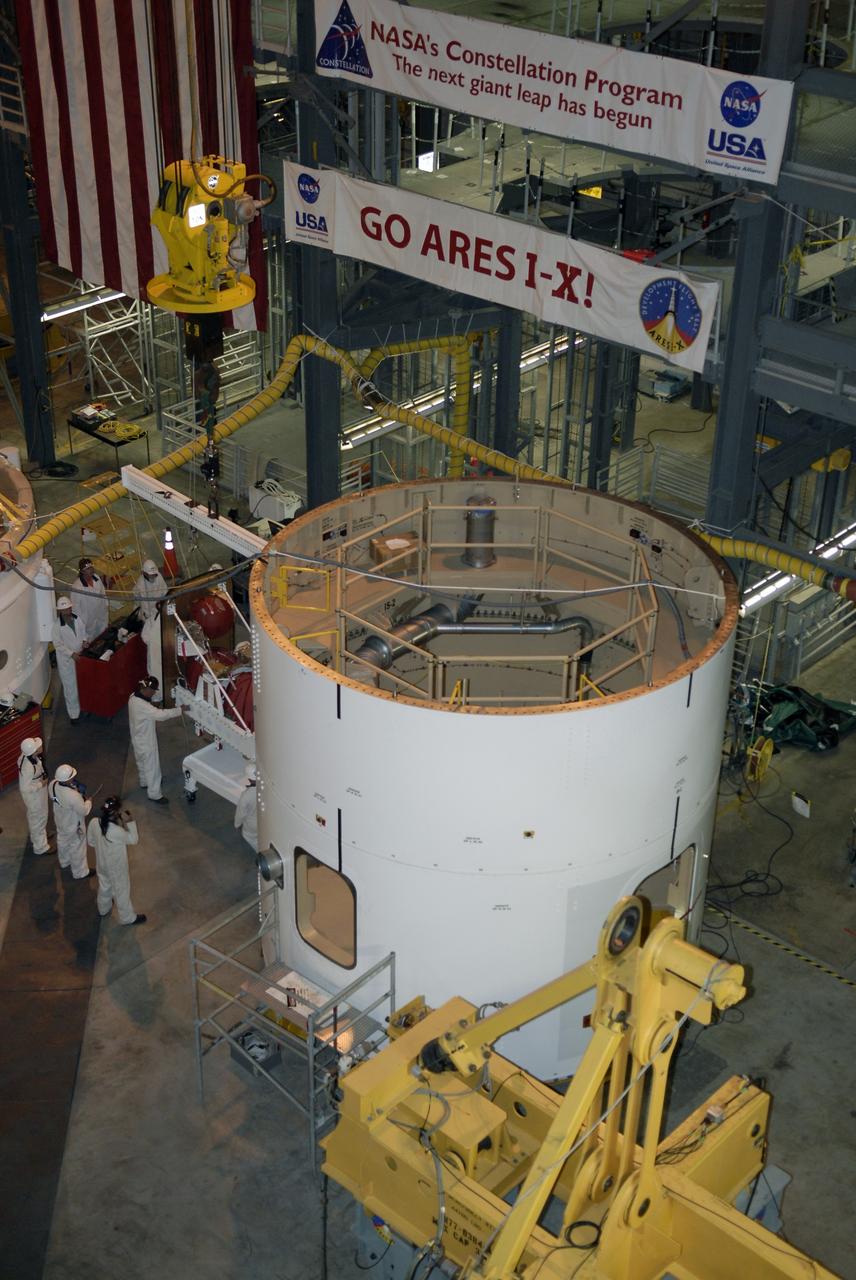
CAPE CANAVERAL, Fla. – In high bay 4 of the Vehicle Assembly Building at NASA's Kennedy Space Center in Florida, at left center, technicians get ready to install the roll control system in the Ares I-X segment in the center. Ares I-X is the test vehicle for the Ares I, which is part of the Constellation Program to return men to the moon and beyond. Ares I-X is targeted for launch in July 2009. Photo credit: NASA/Kim Shiflett
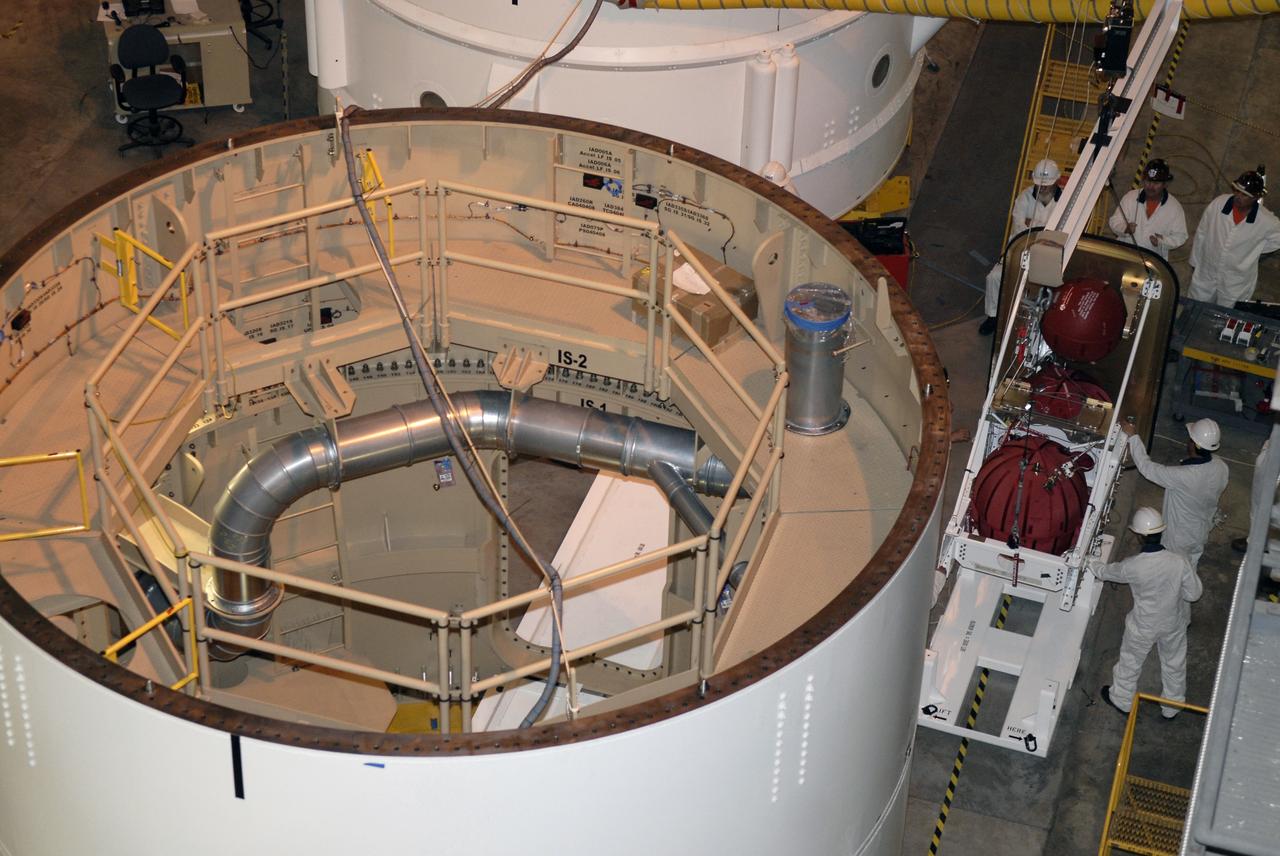
CAPE CANAVERAL, Fla. – In high bay 4 of the Vehicle Assembly Building at NASA's Kennedy Space Center in Florida, at right, technicians get ready to install the roll control system in the Ares I-X segment at left. Ares I-X is the test vehicle for the Ares I, which is part of the Constellation Program to return men to the moon and beyond. Ares I-X is targeted for launch in July 2009. Photo credit: NASA/Kim Shiflett
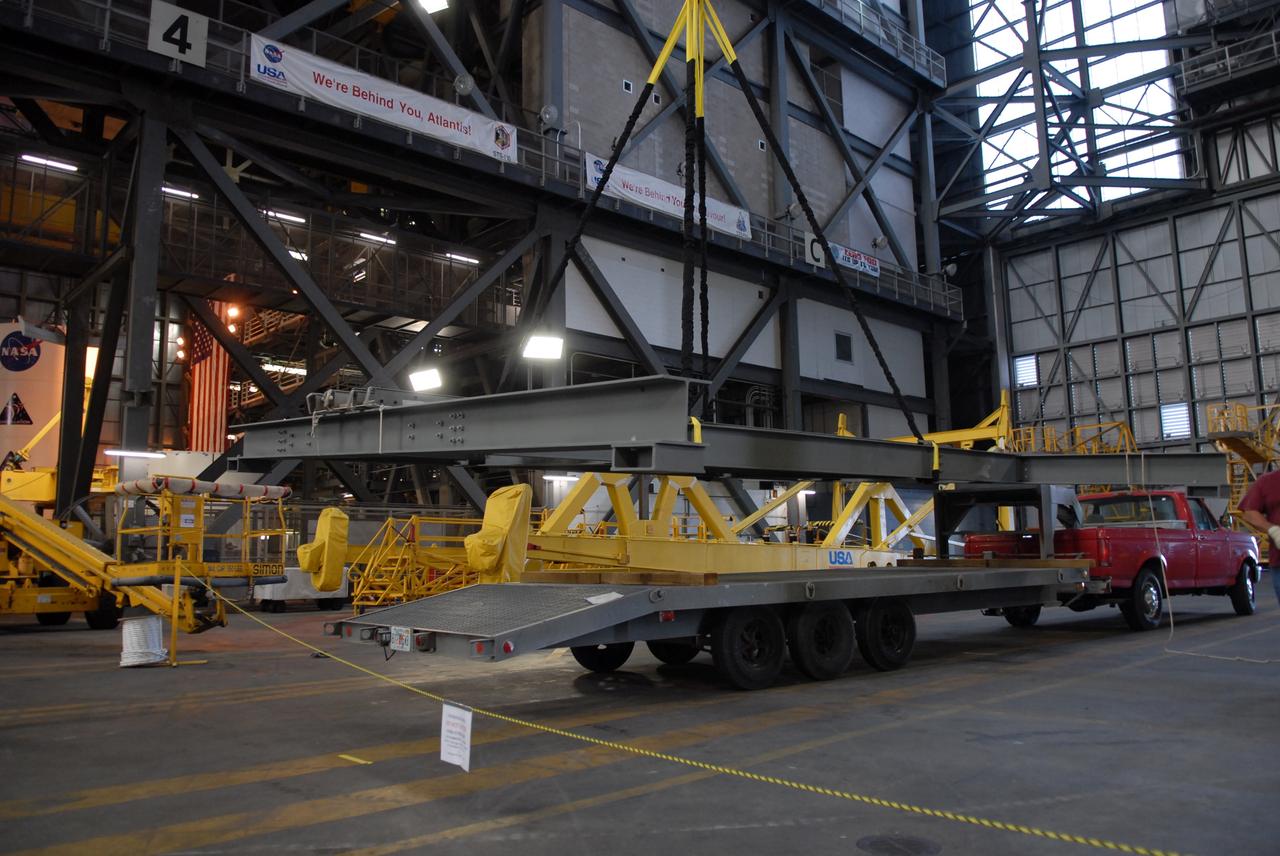
CAPE CANAVERAL, Fla. – Framework is being lifted from a transporter to be installed on the 16th floor for modifications in the Vehicle Assembly Building's high bay 3 at NASA's Kennedy Space Center in Florida related to the Ares I-X. The refurbishment of the facility is for the Constellation Program's Ares vehicles. The Ares I and Ares V rockets will be 325 feet and 360 feet tall, respectively, considerably taller than the space shuttle atop its mobile launcher platform. Photo credit: NASA/Troy Cryder
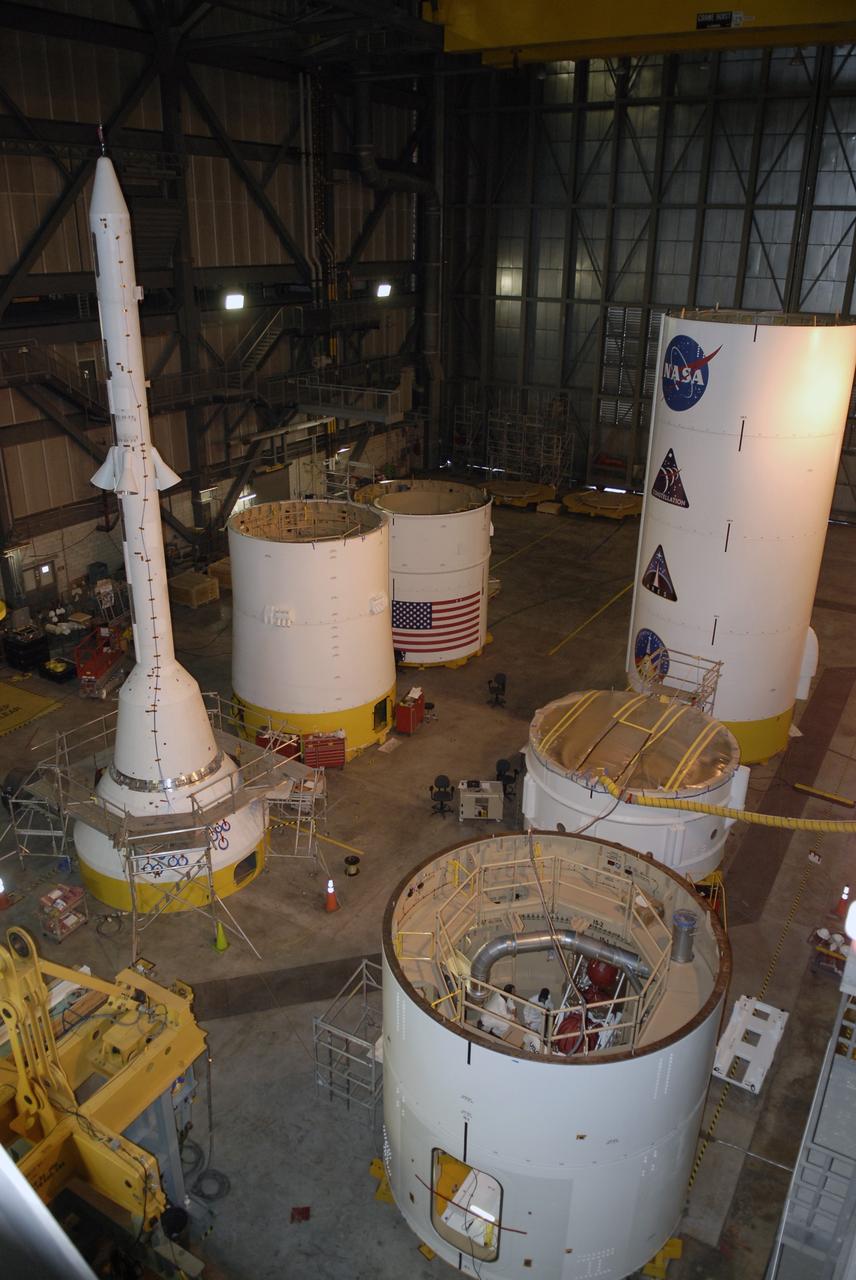
CAPE CANAVERAL, Fla. –– In the lower right, the roll control system can be seen installed inside the Ares I-X segment. The work is being done in high bay 4 of the Vehicle Assembly Building at NASA's Kennedy Space Center in Florida. Ares I-X is the test vehicle for the Ares I, which is part of the Constellation Program to return men to the moon and beyond. Ares I-X is targeted for launch in July 2009. Photo credit: NASA/Kim Shiflett
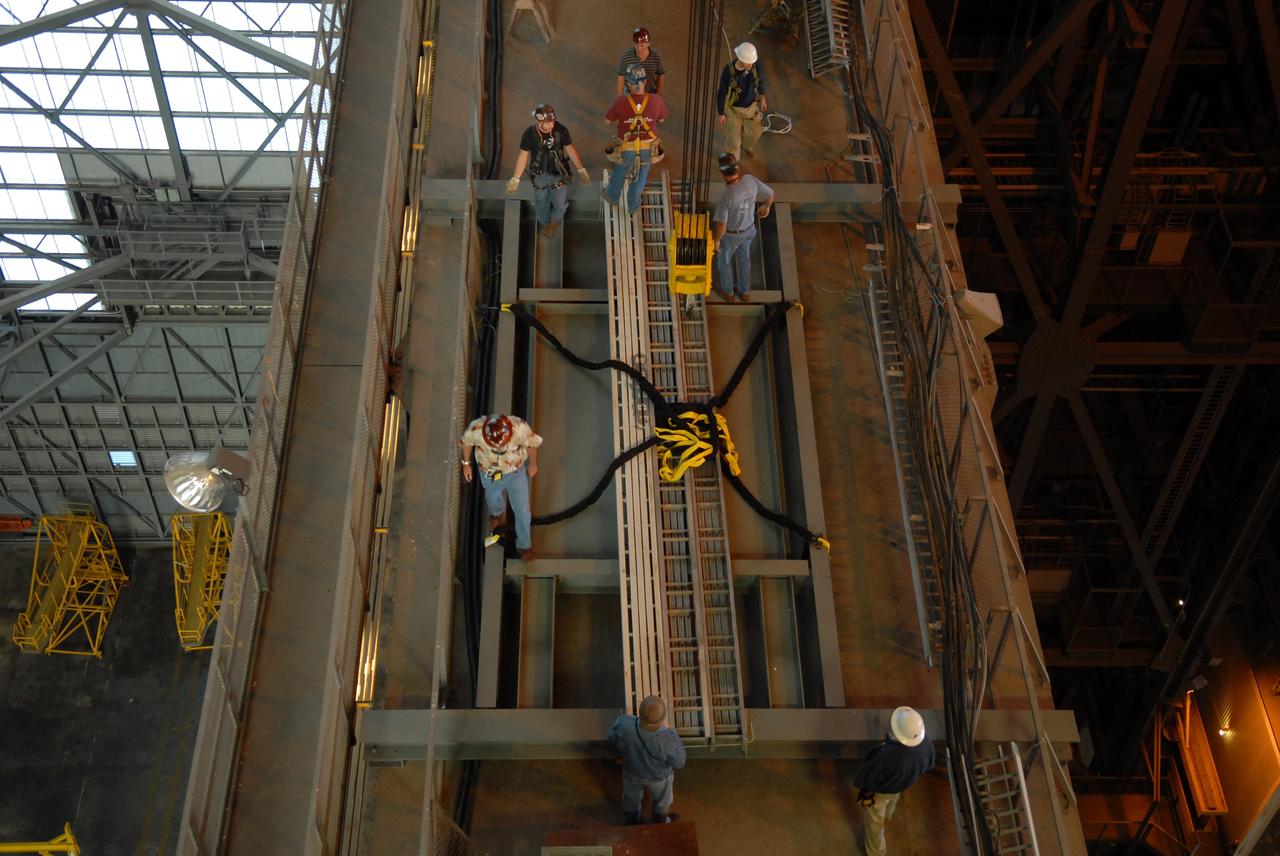
CAPE CANAVERAL, Fla. –In the Vehicle Assembly Building's high bay 3 at NASA's Kennedy Space Center in Florida, framework is lifted to the 16th floor for modifications related to the Ares I-X. The refurbishment of the facility is for the Constellation Program's Ares vehicles. The Ares I and Ares V rockets will be 325 feet and 360 feet tall, respectively, considerably taller than the space shuttle atop its mobile launcher platform. Photo credit: NASA/Troy Cryder

CAPE CANAVERAL, Fla. – In high bay 4 of the Vehicle Assembly Building at NASA's Kennedy Space Center in Florida, a ballast assembly is lifted toward the Ares I-X segments for installation. These ballast assemblies will be installed in the upper stage 1 and 7 segments and will mimic the mass of the fuel. Their total weight is approximately 160,000 pounds. Ares I-X is the test vehicle for the Ares I, which is part of the Constellation Program to return men to the moon and beyond. Ares I is the essential core of a safe, reliable, cost-effective space transportation system that eventually will carry crewed missions back to the moon, on to Mars and out into the solar system. Ares I may also use its 25-ton payload capacity to deliver resources and supplies to the International Space Station, or to "park" payloads in orbit for retrieval by other spacecraft bound for the moon or other destinations. The Ares I-X is targeted for launch in July 2009. Photo credit: NASA/Dimitri Gerondidakis
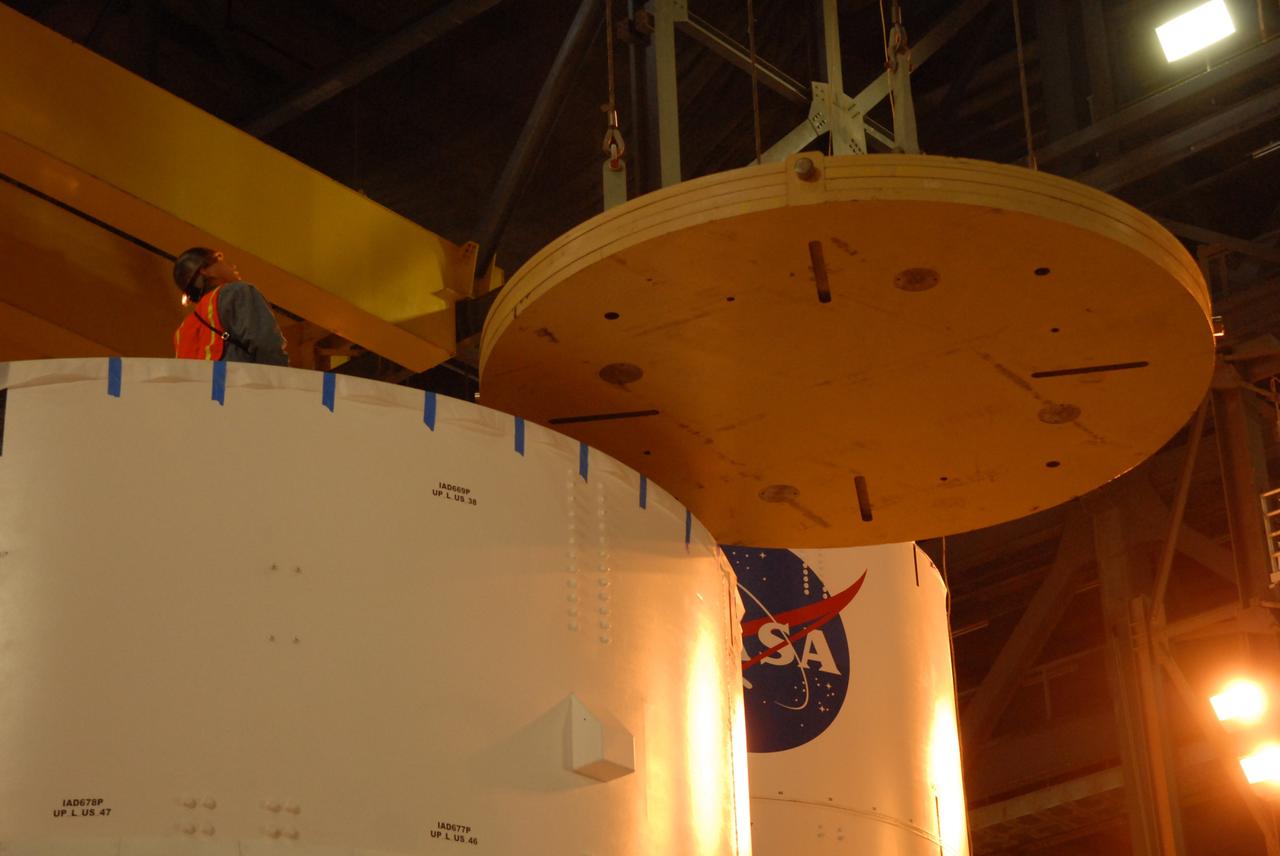
CAPE CANAVERAL, Fla. – In high bay 4 of the Vehicle Assembly Building at NASA's Kennedy Space Center in Florida, a ballast assembly is moved above the Ares I-X segment 7. Ballast assemblies will be installed in the upper stage 1 and 7 segments and will mimic the mass of the fuel. Their total weight is approximately 160,000 pounds. Ares I-X is the test vehicle for the Ares I, which is part of the Constellation Program to return men to the moon and beyond. Ares I is the essential core of a safe, reliable, cost-effective space transportation system that eventually will carry crewed missions back to the moon, on to Mars and out into the solar system. Ares I may also use its 25-ton payload capacity to deliver resources and supplies to the International Space Station, or to "park" payloads in orbit for retrieval by other spacecraft bound for the moon or other destinations. The Ares I-X is targeted for launch in July 2009. Photo credit: NASA/Dimitri Gerondidakis
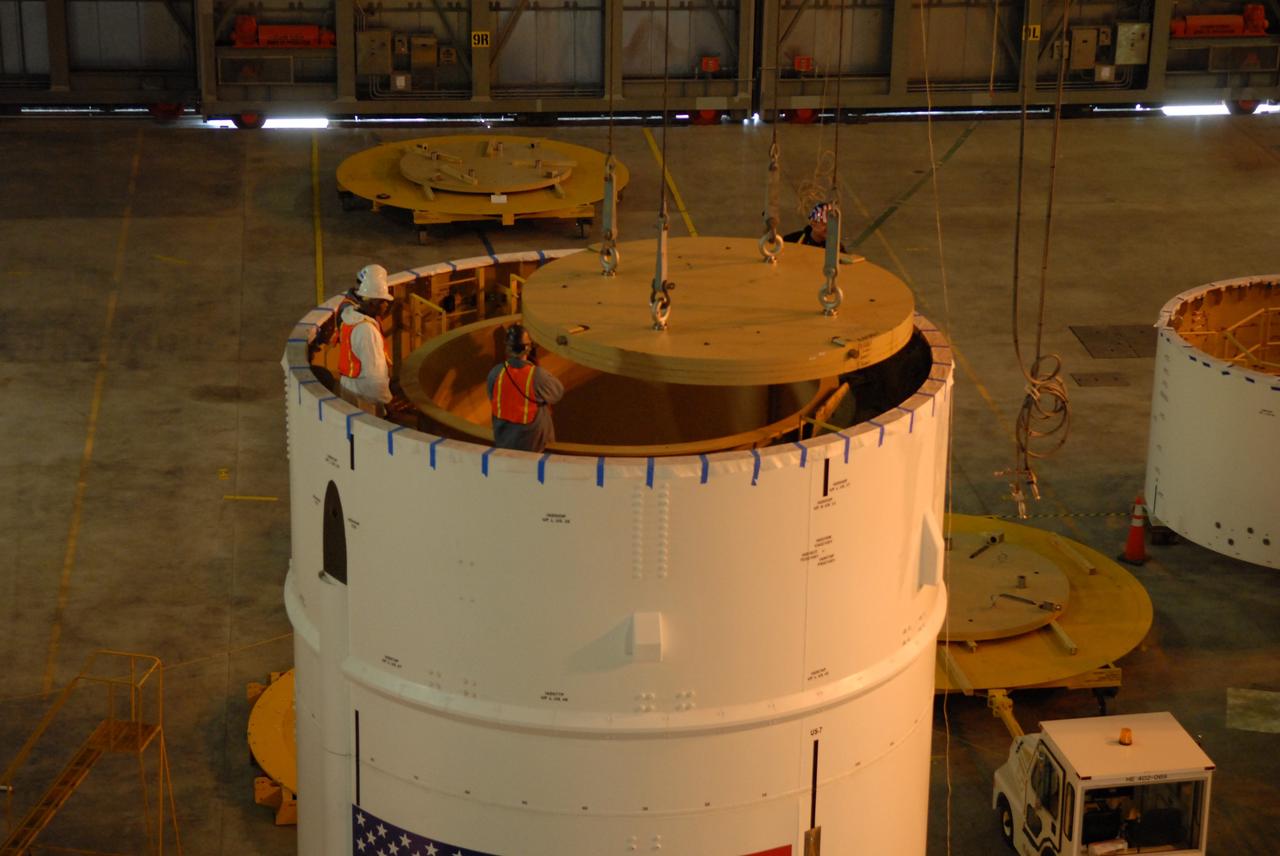
CAPE CANAVERAL, Fla. – In high bay 4 of the Vehicle Assembly Building at NASA's Kennedy Space Center in Florida, a ballast assembly is lowered into the Ares I-X segment 7. Ballast assemblies are being installed in the upper stage 1 and 7 segments and will mimic the mass of the fuel. Their total weight is approximately 160,000 pounds. Ares I-X is the test vehicle for the Ares I, which is part of the Constellation Program to return men to the moon and beyond. Ares I is the essential core of a safe, reliable, cost-effective space transportation system that eventually will carry crewed missions back to the moon, on to Mars and out into the solar system. Ares I may also use its 25-ton payload capacity to deliver resources and supplies to the International Space Station, or to "park" payloads in orbit for retrieval by other spacecraft bound for the moon or other destinations. The Ares I-X is targeted for launch in July 2009. Photo credit: NASA/Dimitri Gerondidakis
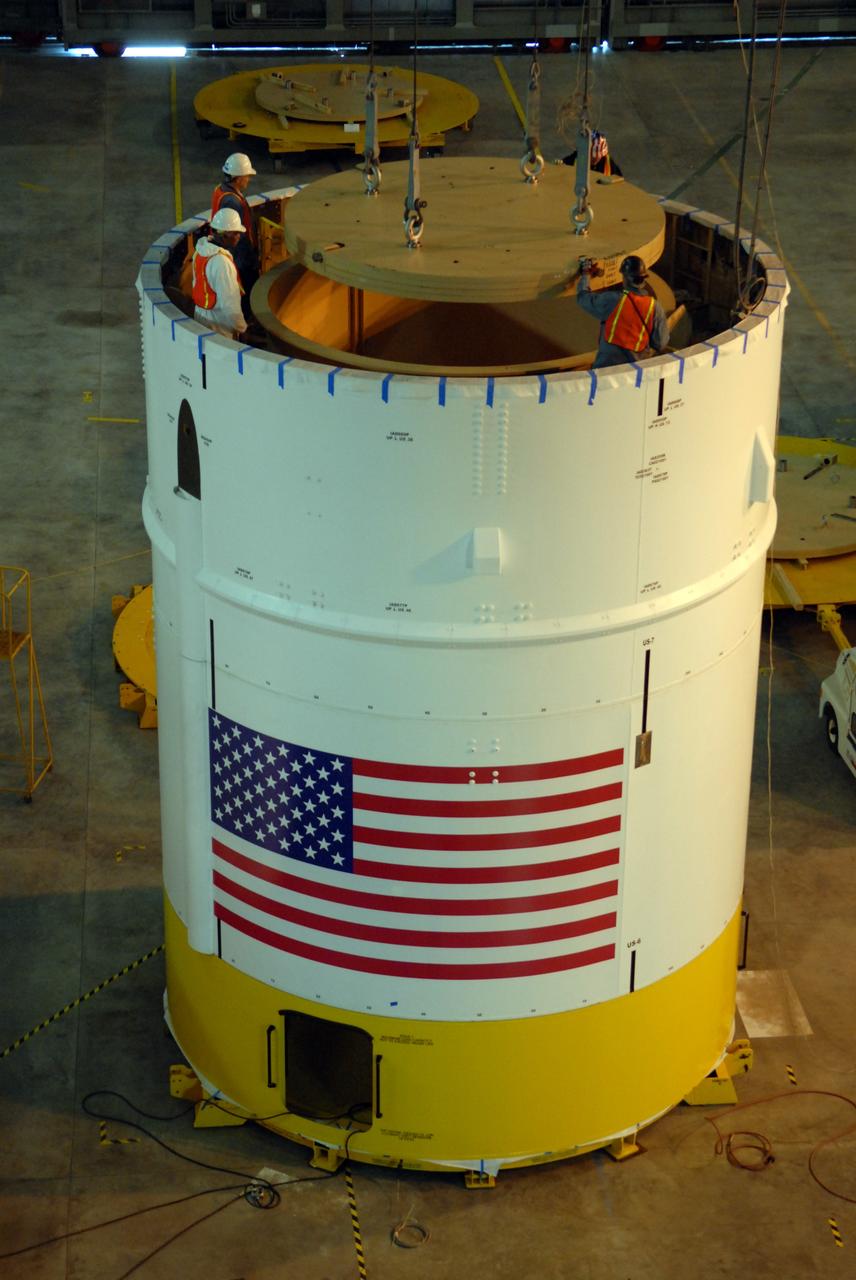
CAPE CANAVERAL, Fla. – In high bay 4 of the Vehicle Assembly Building at NASA's Kennedy Space Center in Florida, a ballast assembly is lowered into the Ares I-X segment 7. Ballast assemblies are being installed in the upper stage 1 and 7 segments and will mimic the mass of the fuel. Their total weight is approximately 160,000 pounds. Ares I-X is the test vehicle for the Ares I, which is part of the Constellation Program to return men to the moon and beyond. Ares I is the essential core of a safe, reliable, cost-effective space transportation system that eventually will carry crewed missions back to the moon, on to Mars and out into the solar system. Ares I may also use its 25-ton payload capacity to deliver resources and supplies to the International Space Station, or to "park" payloads in orbit for retrieval by other spacecraft bound for the moon or other destinations. The Ares I-X is targeted for launch in July 2009. Photo credit: NASA/Dimitri Gerondidakis
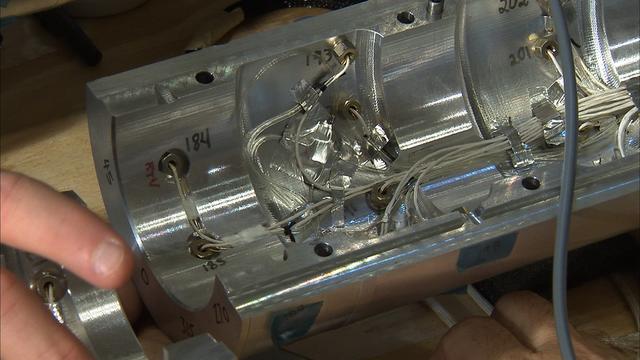
Shown is testing of a 3.5% Ares 1-X buffet model at the transonic wind tunnel at Langley Research Center, Virginia in support of the Ares/Constellation program. This image is extracted from high definition video and is the highest resolution available
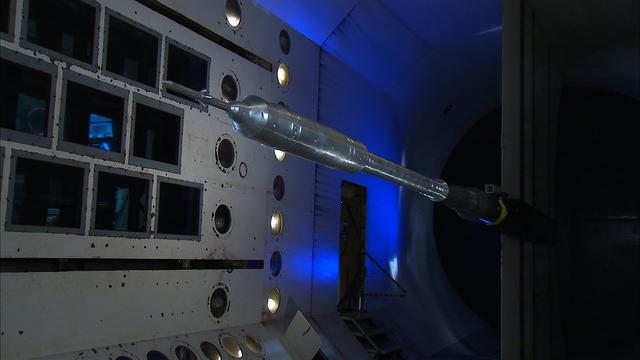
Shown is testing of a 3.5% Ares 1-X buffet model at the transonic wind tunnel at Langley Research Center, Virginia in support of the Ares/Constellation program. This image is extracted from high definition video and is the highest resolution available.
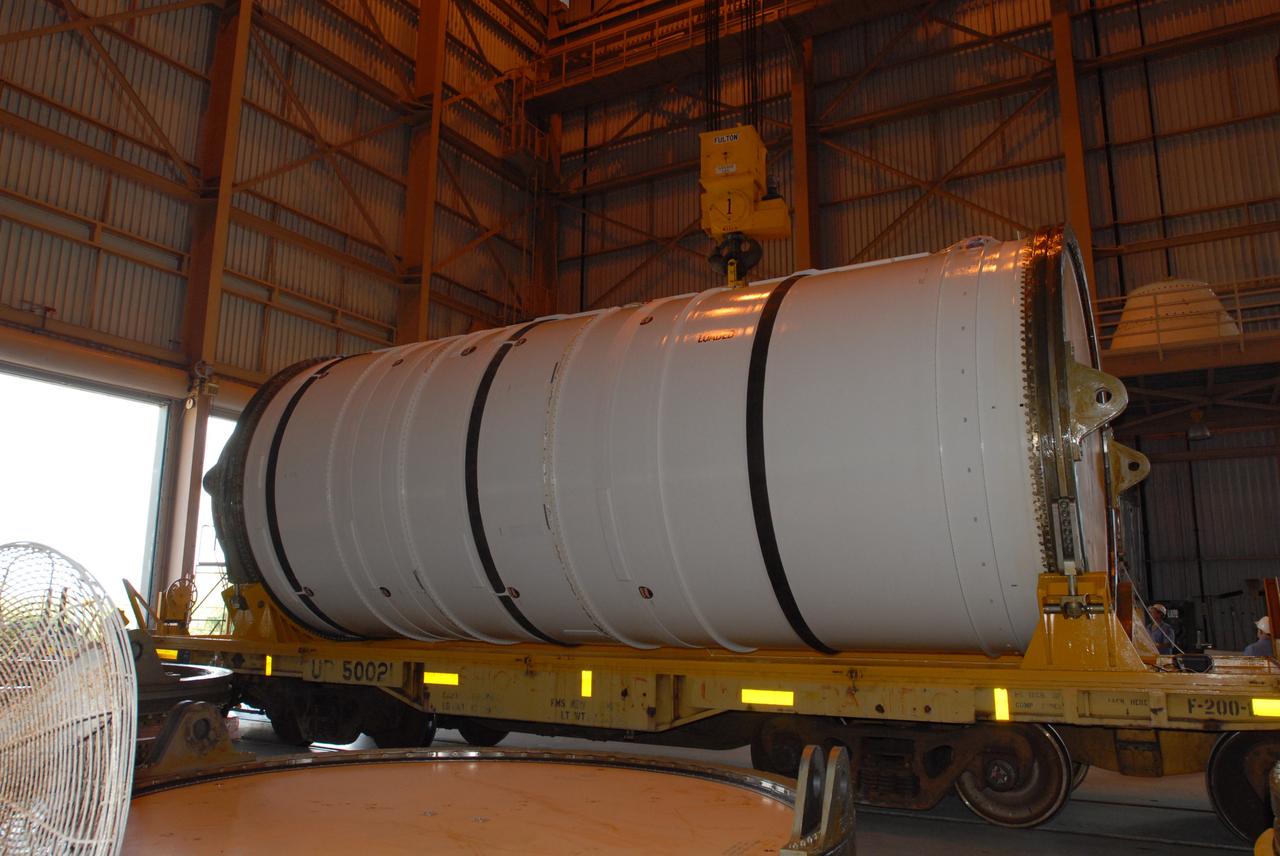
CAPE CANAVERAL, Fla. – In the Rotation, Processing and Surge Facility at NASA's Kennedy Space Center in Florida, the Ares I-X motor segment is revealed after removal of the rail car cover. It is one of four reusable motor segments and nozzle exit cone shipped by the Ares I first-stage prime contractor Alliant Techsystems Inc. for final processing and integration in the facility. The booster used for the Ares I-X launch is being modified by adding new forward structures and a fifth segment simulator. The motor is the final hardware needed for the rocket's upcoming flight test this summer. The stacking operations are scheduled to begin in the Vehicle Assembly Building in April. Photo credit: NASA/Jim Grossmann
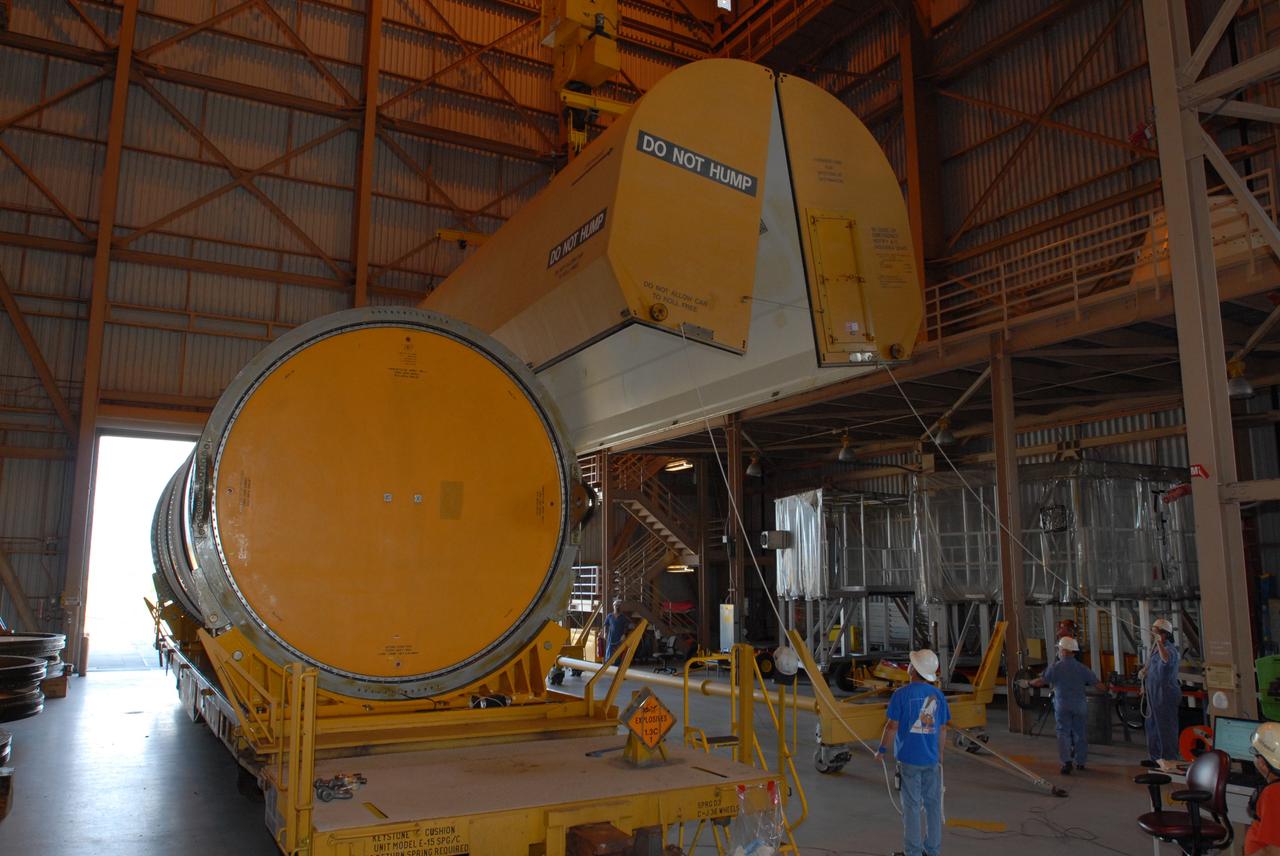
CAPE CANAVERAL, Fla. – In the Rotation, Processing and Surge Facility at NASA's Kennedy Space Center in Florida, the rail car cover is moved away from the first Ares I-X motor segment. It is one of four reusable motor segments and nozzle exit cone shipped by the Ares I first-stage prime contractor Alliant Techsystems Inc. for final processing and integration in the facility. The booster used for the Ares I-X launch is being modified by adding new forward structures and a fifth segment simulator. The motor is the final hardware needed for the rocket's upcoming flight test this summer. The stacking operations are scheduled to begin in the Vehicle Assembly Building in April. Photo credit: NASA/Jim Grossmann
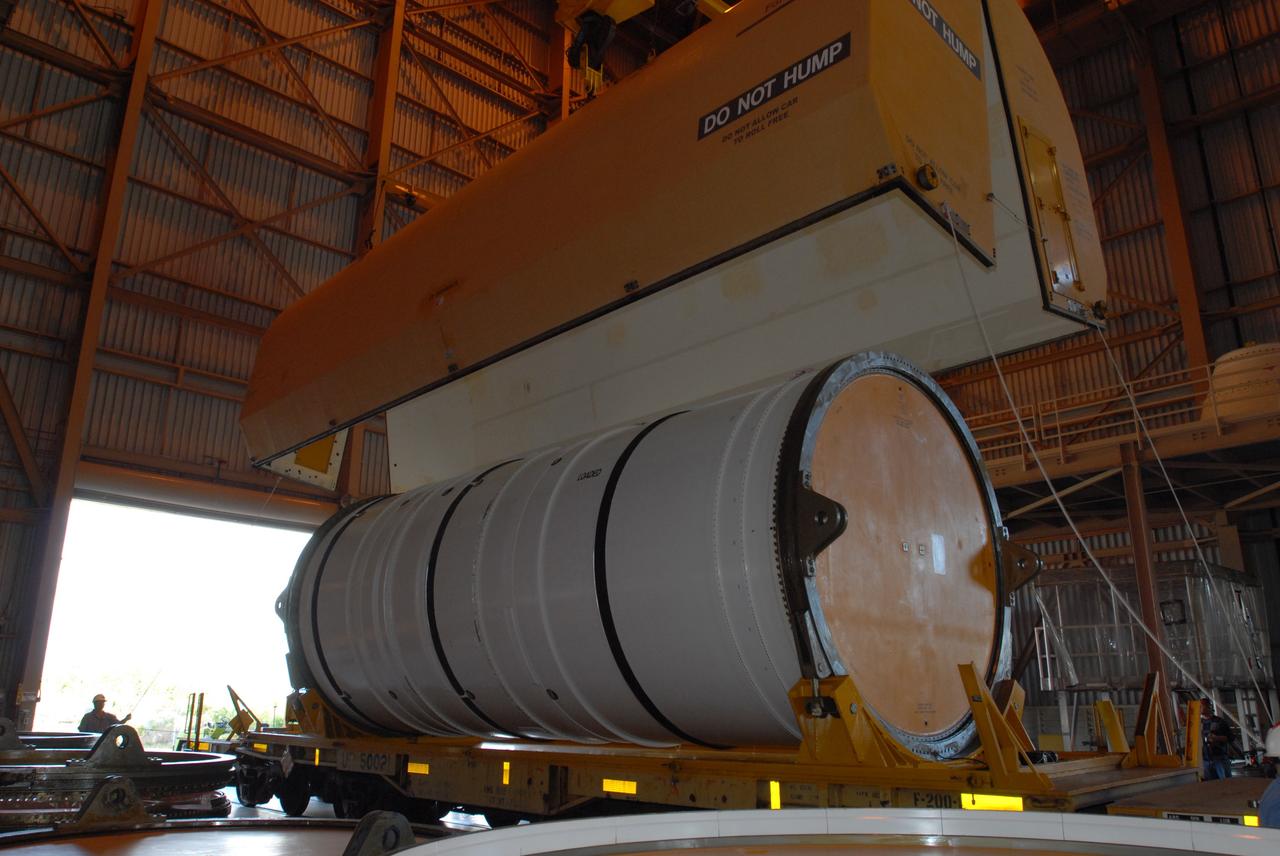
CAPE CANAVERAL, Fla. – In the Rotation, Processing and Surge Facility at NASA's Kennedy Space Center in Florida, the rail car cover is removed from the first Ares I-X motor segment. It is one of four reusable motor segments and nozzle exit cone shipped by the Ares I first-stage prime contractor Alliant Techsystems Inc. for final processing and integration in the facility. The booster used for the Ares I-X launch is being modified by adding new forward structures and a fifth segment simulator. The motor is the final hardware needed for the rocket's upcoming flight test this summer. The stacking operations are scheduled to begin in the Vehicle Assembly Building in April. Photo credit: NASA/Jim Grossmann
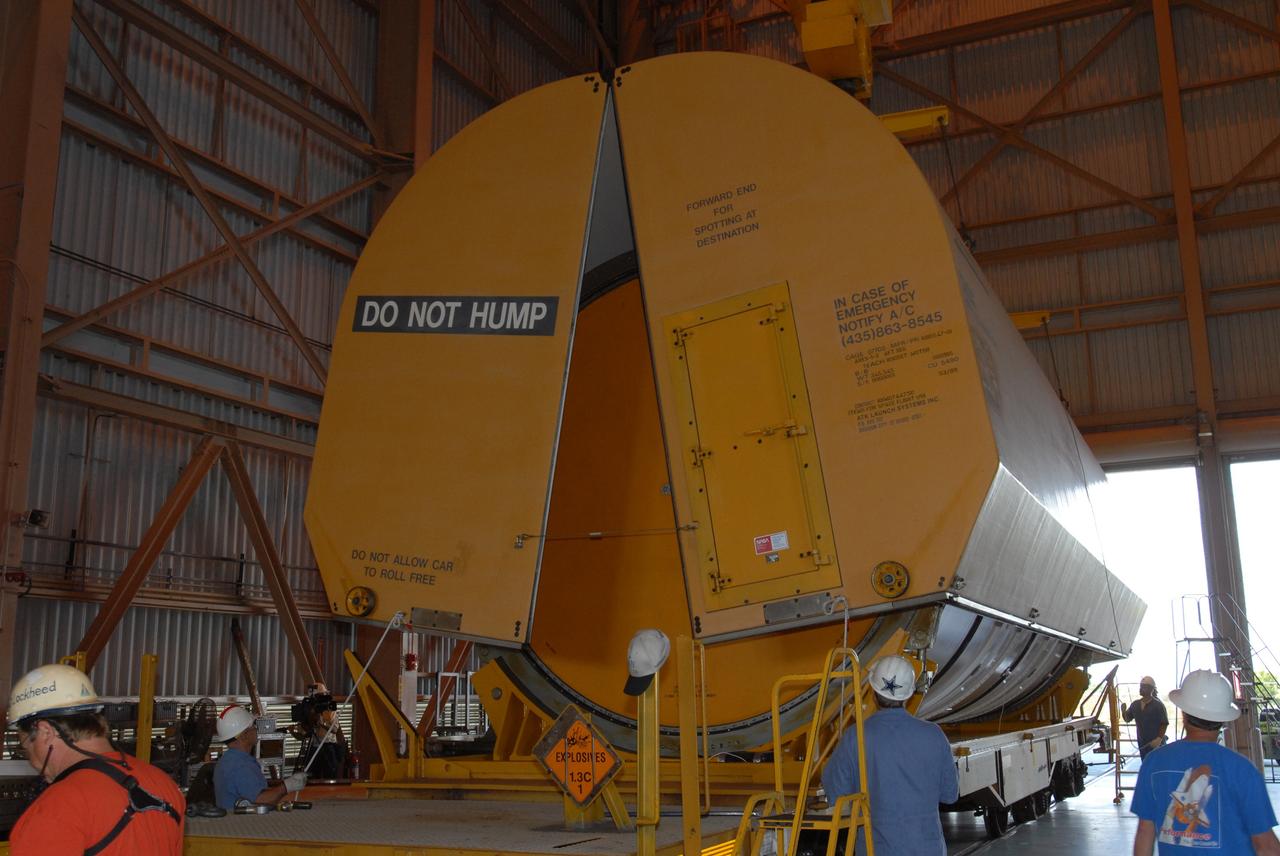
CAPE CANAVERAL, Fla. – In the Rotation, Processing and Surge Facility at NASA's Kennedy Space Center in Florida, the rail car cover is removed from the first Ares I-X motor segment. It is one of four reusable motor segments and nozzle exit cone shipped by the Ares I first-stage prime contractor Alliant Techsystems Inc. for final processing and integration in the facility. The booster used for the Ares I-X launch is being modified by adding new forward structures and a fifth segment simulator. The motor is the final hardware needed for the rocket's upcoming flight test this summer. The stacking operations are scheduled to begin in the Vehicle Assembly Building in April. Photo credit: NASA/Jim Grossmann
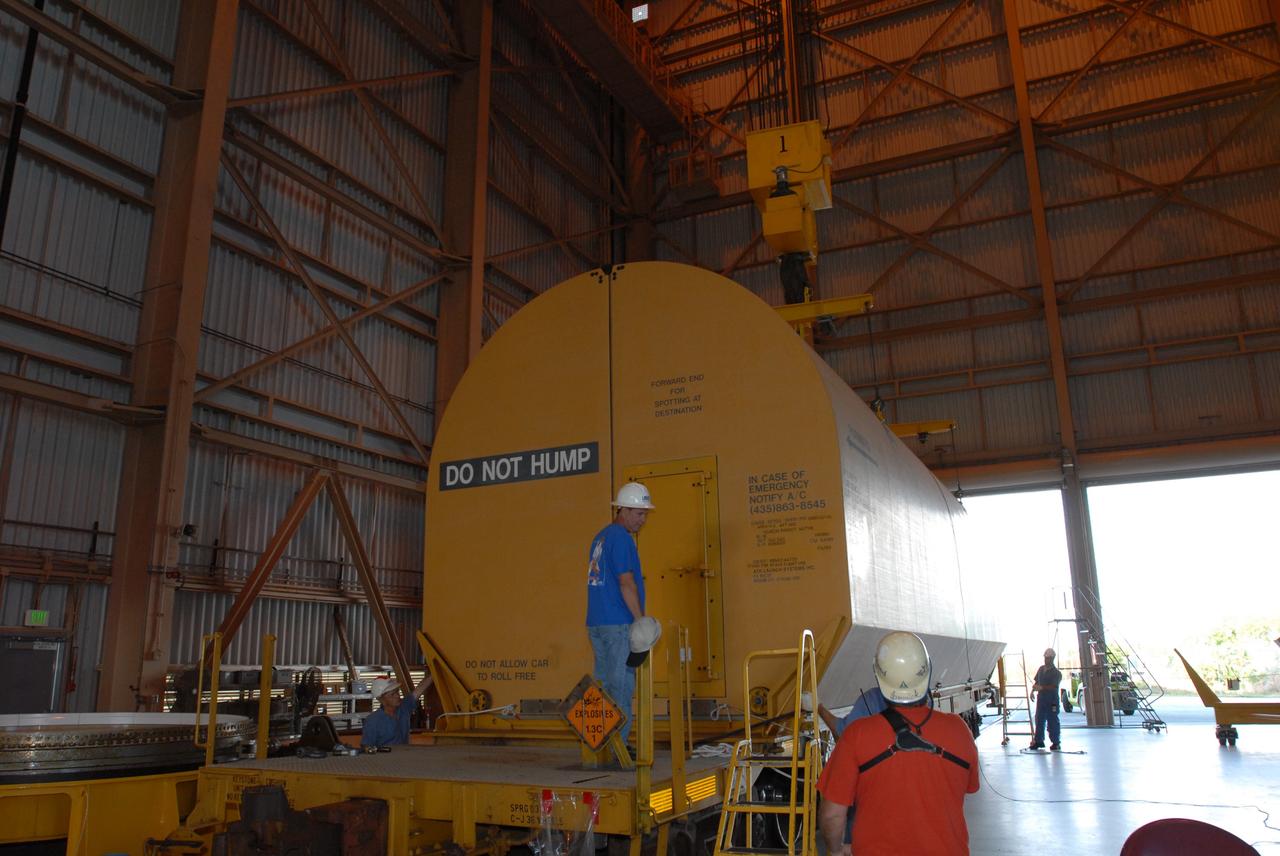
CAPE CANAVERAL, Fla. – The first Ares I-X motor segment is in the Rotation, Processing and Surge Facility at NASA's Kennedy Space Center in Florida. It is one of four reusable motor segments and nozzle exit cone shipped by the Ares I first-stage prime contractor Alliant Techsystems Inc. for final processing and integration in the facility. The booster used for the Ares I-X launch is being modified by adding new forward structures and a fifth segment simulator. The motor is the final hardware needed for the rocket's upcoming flight test this summer. The stacking operations are scheduled to begin in the Vehicle Assembly Building in April. Photo credit: NASA/Jim Grossmann
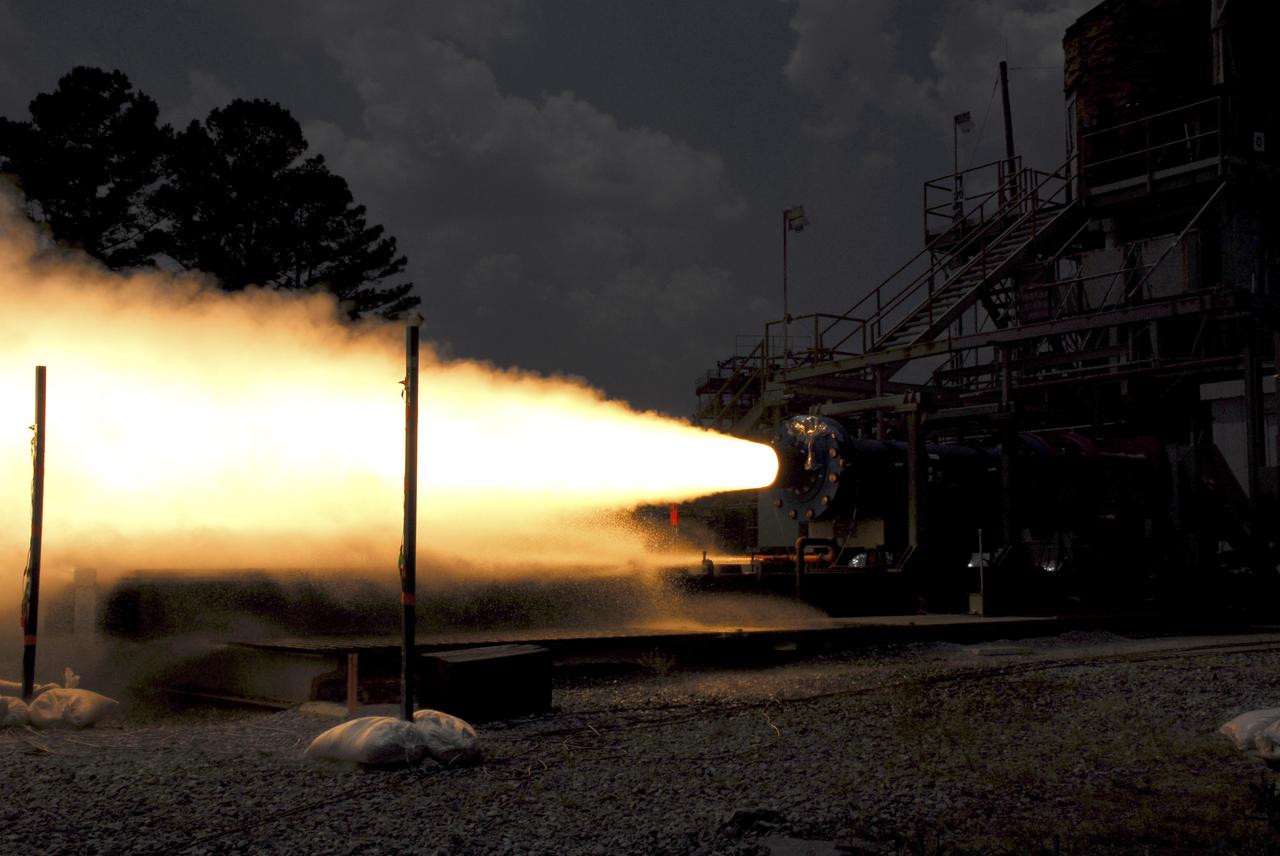
HOT FIRE P9038-SRTMV-N1 24". THE FIRST SUBSCALE MOTOR FOR THE ARES PROGRAM. THE PRIMARY OBJECTIVE FOR THE TEST IS TO ESTABLISH A BASELINE SUBSCALE CONFIGURATION FOR THE ARES 1ST STAGE NOZZLE.

CAPE CANAVERAL, Fla. – In Vehicle Assembly Building high bay 4, cables from an overhead crane lower ballast into segment 7 for the Ares I-X rocket. These ballast assemblies are being installed in the upper stage segments 1 and 7 and will mimic the mass of the fuel. Their total weight is approximately 160,000 pounds. Ares I-X is the test vehicle for the Ares I, which is part of the Constellation Program to return men to the moon and beyond. Ares I is the essential core of a safe, reliable, cost-effective space transportation system that eventually will carry crewed missions back to the moon, on to Mars and out into the solar system. The Ares I-X is targeted for launch in July 2009. Photo credit: NASA/Jack Pfaller
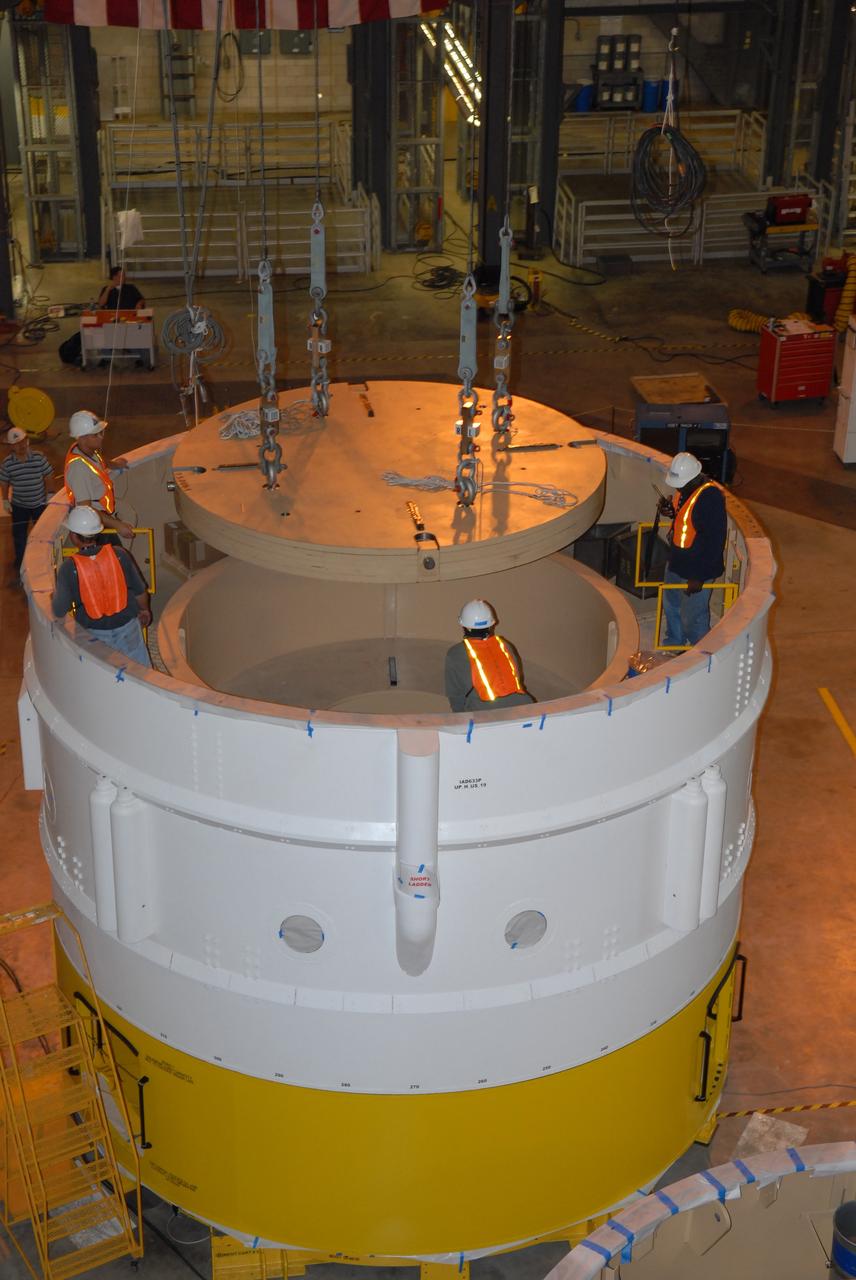
CAPE CANAVERAL, Fla. – In Vehicle Assembly Building high bay 4, cables from an overhead crane lower ballast into segment 7 for the Ares I-X rocket. These ballast assemblies are being installed in the upper stage segments 1 and 7 and will mimic the mass of the fuel. Their total weight is approximately 160,000 pounds. Ares I-X is the test vehicle for the Ares I, which is part of the Constellation Program to return men to the moon and beyond. Ares I is the essential core of a safe, reliable, cost-effective space transportation system that eventually will carry crewed missions back to the moon, on to Mars and out into the solar system. The Ares I-X is targeted for launch in July 2009. Photo credit: NASA/Jack Pfaller
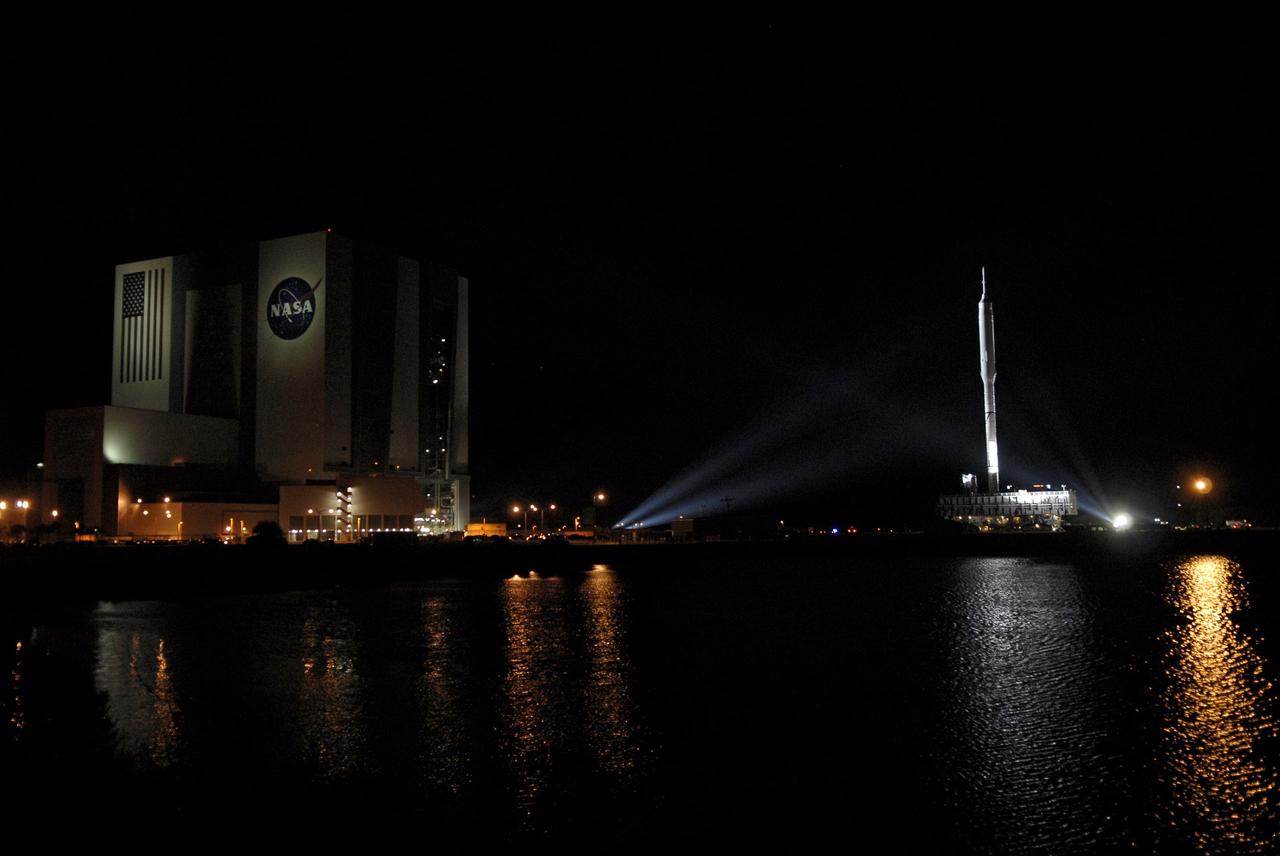
CAPE CANAVERAL, Fla. - The towering 327-foot-tall Ares I-X rocket moves away from the Vehicle Assembly Building at NASA's Kennedy Space Center in Florida. The rocket's slow, 4.2-mile journey to Launch Pad 39B began at 1:39 a.m. EDT. The transfer of the pad from the Space Shuttle Program to the Constellation Program took place May 31. Modifications made to the pad include the removal of shuttle unique subsystems, such as the orbiter access arm and a section of the gaseous oxygen vent arm, along with the installation of three 600-foot lightning towers, access platforms, environmental control systems and a vehicle stabilization system. Part of the Constellation Program, the Ares I-X is the test vehicle for the Ares I. The Ares I-X flight test is targeted for Oct. 27. For information on the Ares I-X vehicle and flight test, visit http://www.nasa.gov/aresIX. Photo credit: NASA/Kim Shiflett
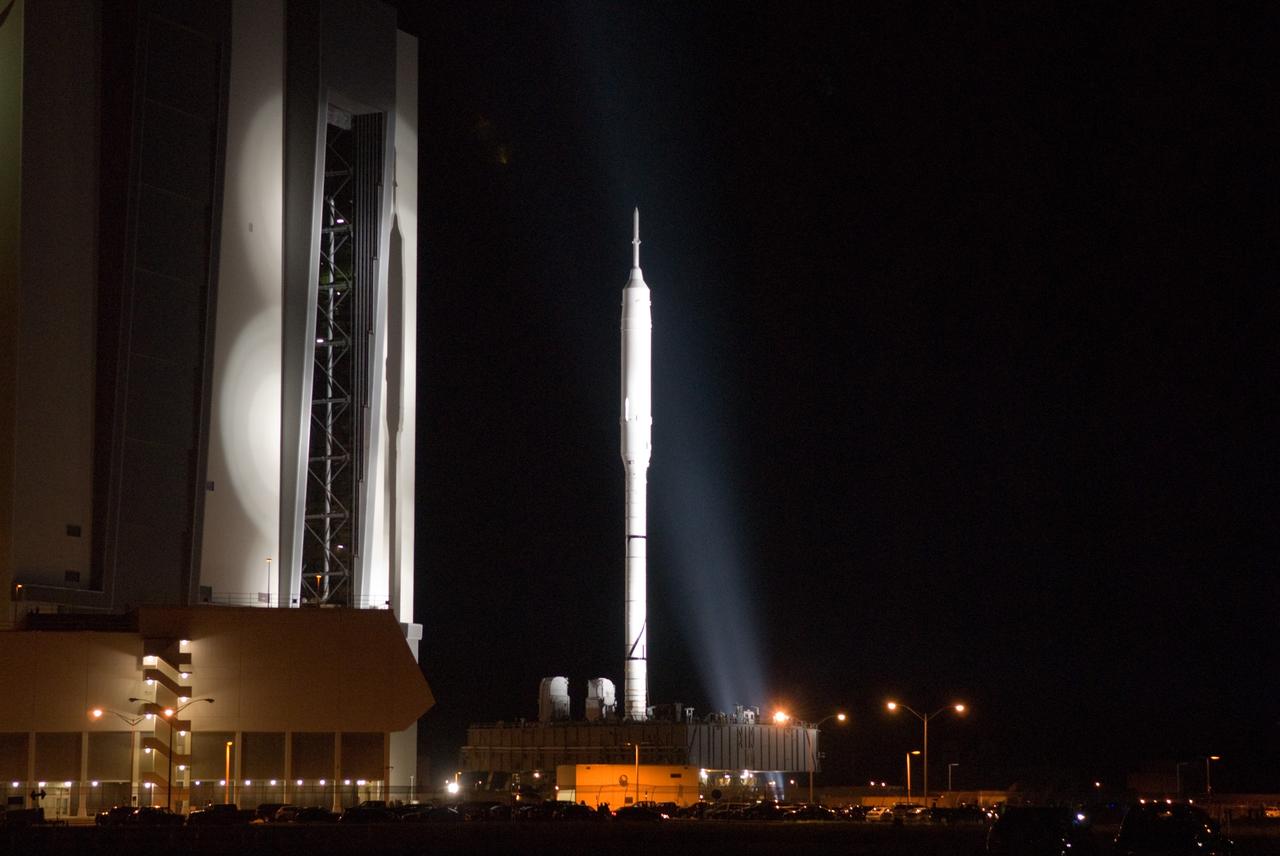
CAPE CANAVERAL, Fla. – Standing tall, the Ares I-X rocket rides atop the crawler-transporter as it moves beyond the Vehicle Assembly Building at NASA's Kennedy Space Center in Florida. Its slow trek to Launch Pad 39B, known as "rollout," began at 1:39 a.m. EDT. The transfer of the pad from the Space Shuttle Program to the Constellation Program took place May 31. Modifications made to the pad include the removal of shuttle unique subsystems, such as the orbiter access arm and a section of the gaseous oxygen vent arm, along with the installation of three 600-foot lightning towers, access platforms, environmental control systems and a vehicle stabilization system. Part of the Constellation Program, the Ares I-X is the test vehicle for the Ares I. The Ares I-X flight test is targeted for Oct. 27. For information on the Ares I-X vehicle and flight test, visit http://www.nasa.gov/aresIX. Photo credit: NASA/Jim Grossmann
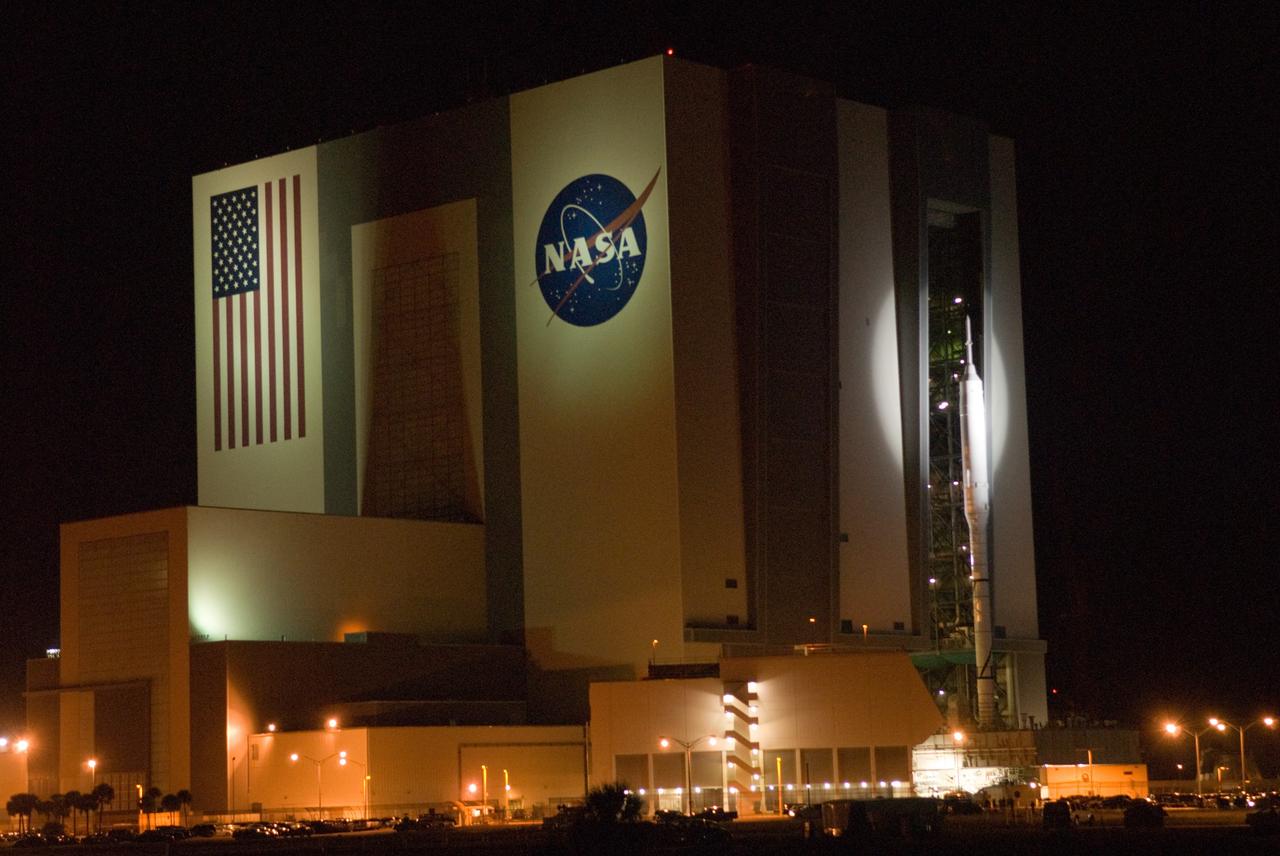
CAPE CANAVERAL, Fla. – Spotlighted against the Vehicle Assembly Building at NASA's Kennedy Space Center in Florida, the 327-foot-tall Ares I-X rocket begins its slow trek to Launch Pad 39B. The move, known as "rollout," began at 1:39 a.m. EDT. The transfer of the pad from the Space Shuttle Program to the Constellation Program took place May 31. Modifications made to the pad include the removal of shuttle unique subsystems, such as the orbiter access arm and a section of the gaseous oxygen vent arm, along with the installation of three 600-foot lightning towers, access platforms, environmental control systems and a vehicle stabilization system. Part of the Constellation Program, the Ares I-X is the test vehicle for the Ares I. The Ares I-X flight test is targeted for Oct. 27. For information on the Ares I-X vehicle and flight test, visit http://www.nasa.gov/aresIX. Photo credit: NASA/Jim Grossmann
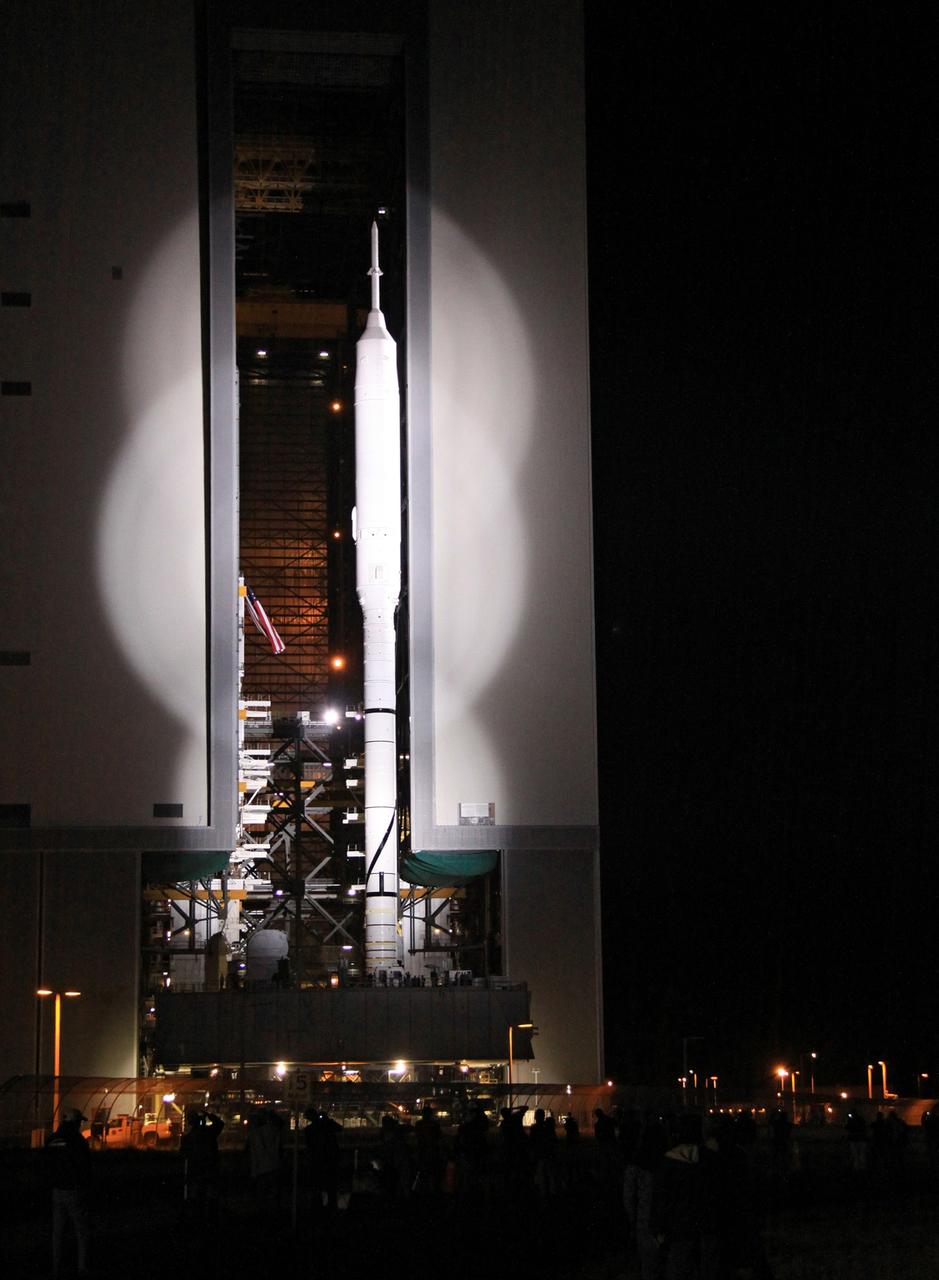
CAPE CANAVERAL, Fla. – Spotlighted in brilliant white, the 327-foot-tall Ares I-X rocket emerges from the Vehicle Assembly Building at NASA's Kennedy Space Center in Florida. The move to the launch pad, known as "rollout," began at 1:39 a.m. EDT. The transfer of the pad from the Space Shuttle Program to the Constellation Program took place May 31. Modifications made to the pad include the removal of shuttle unique subsystems, such as the orbiter access arm and a section of the gaseous oxygen vent arm, along with the installation of three 600-foot lightning towers, access platforms, environmental control systems and a vehicle stabilization system. Part of the Constellation Program, the Ares I-X is the test vehicle for the Ares I. The Ares I-X flight test is targeted for Oct. 27. For information on the Ares I-X vehicle and flight test, visit http://www.nasa.gov/aresIX. Photo credit: NASA/Jack Pfaller
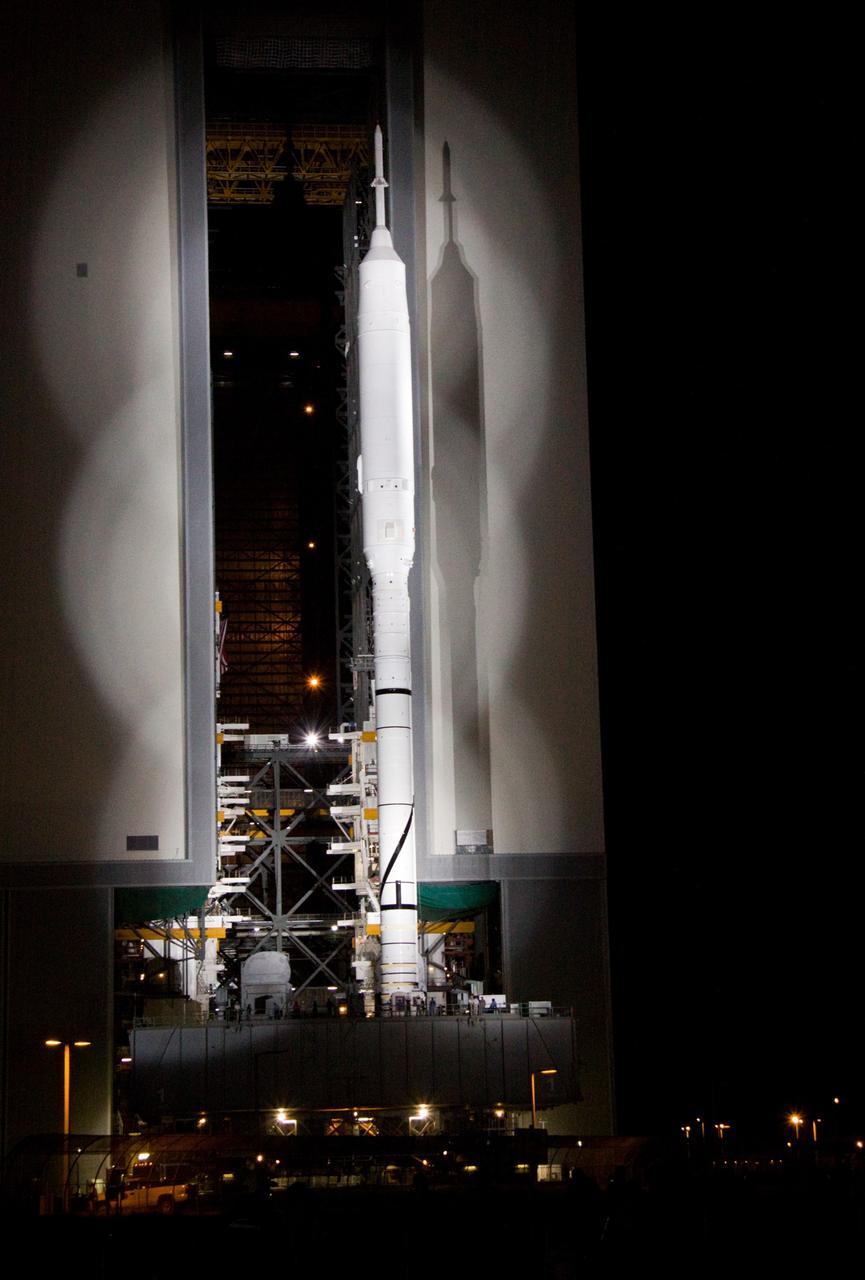
CAPE CANAVERAL, Fla. – The 327-foot-tall Ares I-X rocket clears the door of the Vehicle Assembly Building at NASA's Kennedy Space Center in Florida, on its way to Launch Pad 39B. The move to the launch pad, known as "rollout," began at 1:39 a.m. EDT. The transfer of the pad from the Space Shuttle Program to the Constellation Program took place May 31. Modifications made to the pad include the removal of shuttle unique subsystems, such as the orbiter access arm and a section of the gaseous oxygen vent arm, along with the installation of three 600-foot lightning towers, access platforms, environmental control systems and a vehicle stabilization system. Part of the Constellation Program, the Ares I-X is the test vehicle for the Ares I. The Ares I-X flight test is targeted for Oct. 27. For information on the Ares I-X vehicle and flight test, visit http://www.nasa.gov/aresIX. Photo credit: NASA/Jack Pfaller
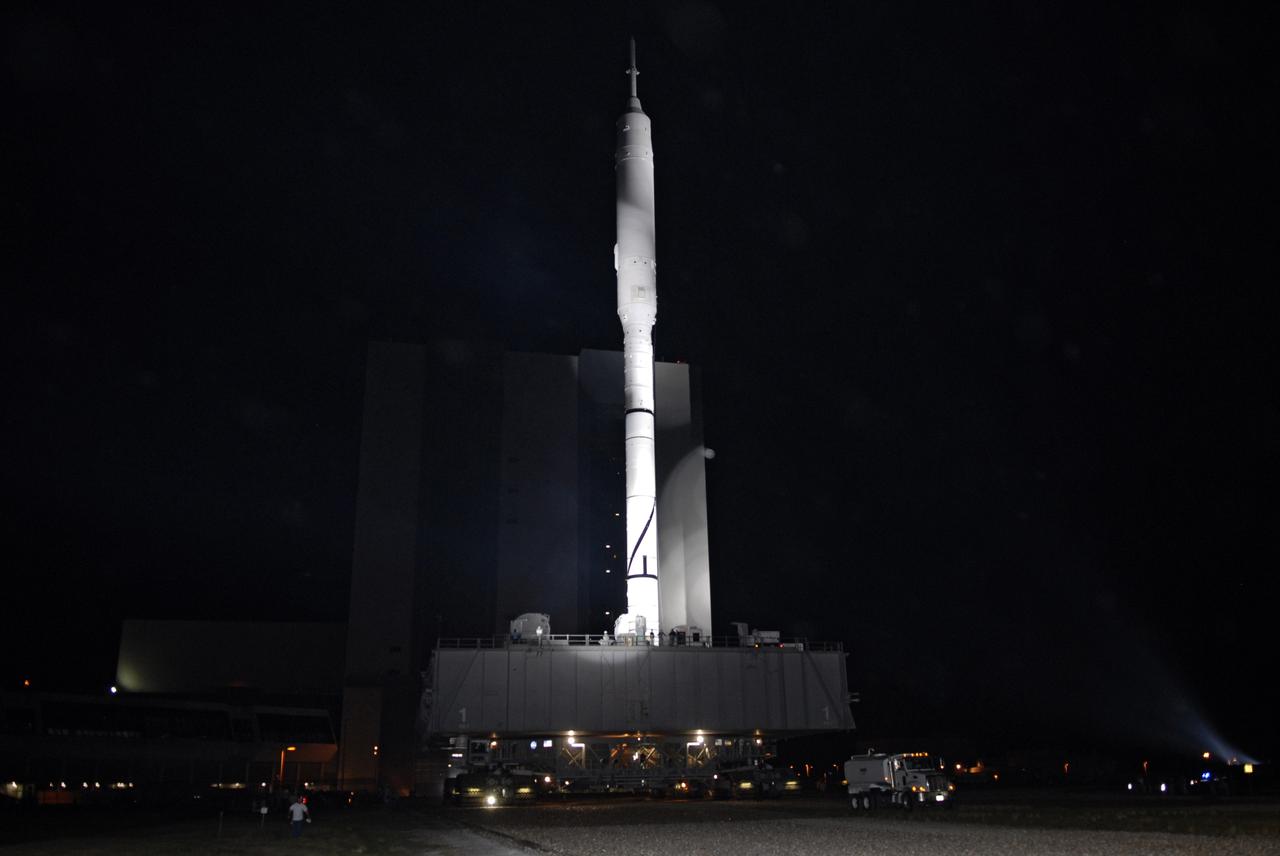
CAPE CANAVERAL, Fla. - The Ares I-X rocket heads toward Launch Pad 39B at NASA's Kennedy Space Center in Florida, riding atop a crawler-transporter. The 4.2-mile trip to the pad from the massive Vehicle Assembly Building began at 1:39 a.m. EDT. The transfer of the pad from the Space Shuttle Program to the Constellation Program took place May 31. Modifications made to the pad include the removal of shuttle unique subsystems, such as the orbiter access arm and a section of the gaseous oxygen vent arm, along with the installation of three 600-foot lightning towers, access platforms, environmental control systems and a vehicle stabilization system. Part of the Constellation Program, the Ares I-X is the test vehicle for the Ares I. The Ares I-X flight test is targeted for Oct. 27. For information on the Ares I-X vehicle and flight test, visit http://www.nasa.gov/aresIX. Photo credit: NASA/Kim Shiflett
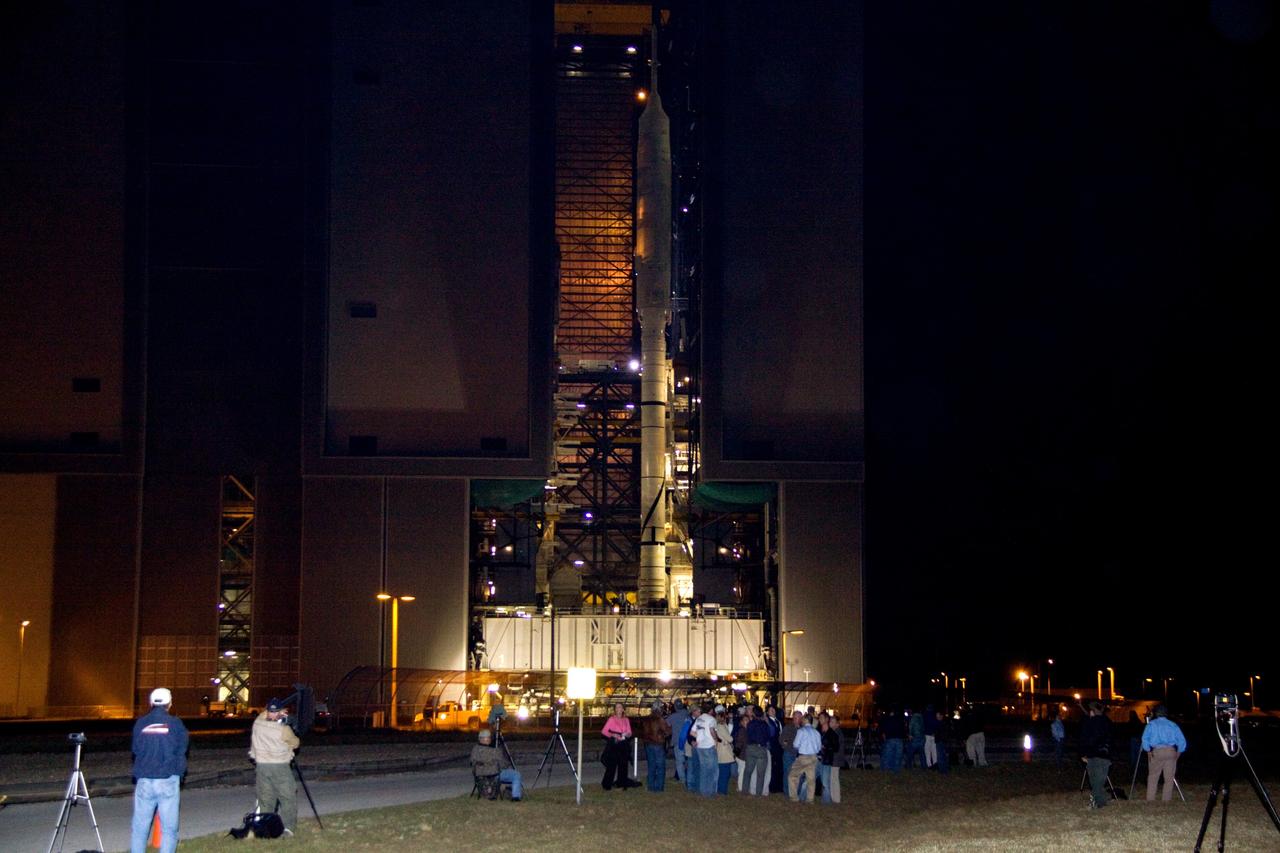
CAPE CANAVERAL, Fla. – Outside the massive Vehicle Assembly Building at NASA's Kennedy Space Center in Florida, members of the news media (foreground) wait in the dark for the rollout of the Ares I-X to begin. The rocket will travel the 4.2 miles to Launch Pad 39B atop the crawler-transporter. The transfer of the pad from the Space Shuttle Program to the Constellation Program took place May 31. Modifications made to the pad include the removal of shuttle unique subsystems, such as the orbiter access arm and a section of the gaseous oxygen vent arm, along with the installation of three 600-foot lightning towers, access platforms, environmental control systems and a vehicle stabilization system. Part of the Constellation Program, the Ares I-X is the test vehicle for the Ares I. The Ares I-X flight test is targeted for Oct. 27. For information on the Ares I-X vehicle and flight test, visit http://www.nasa.gov/aresIX. Photo credit: NASA/Jack Pfaller
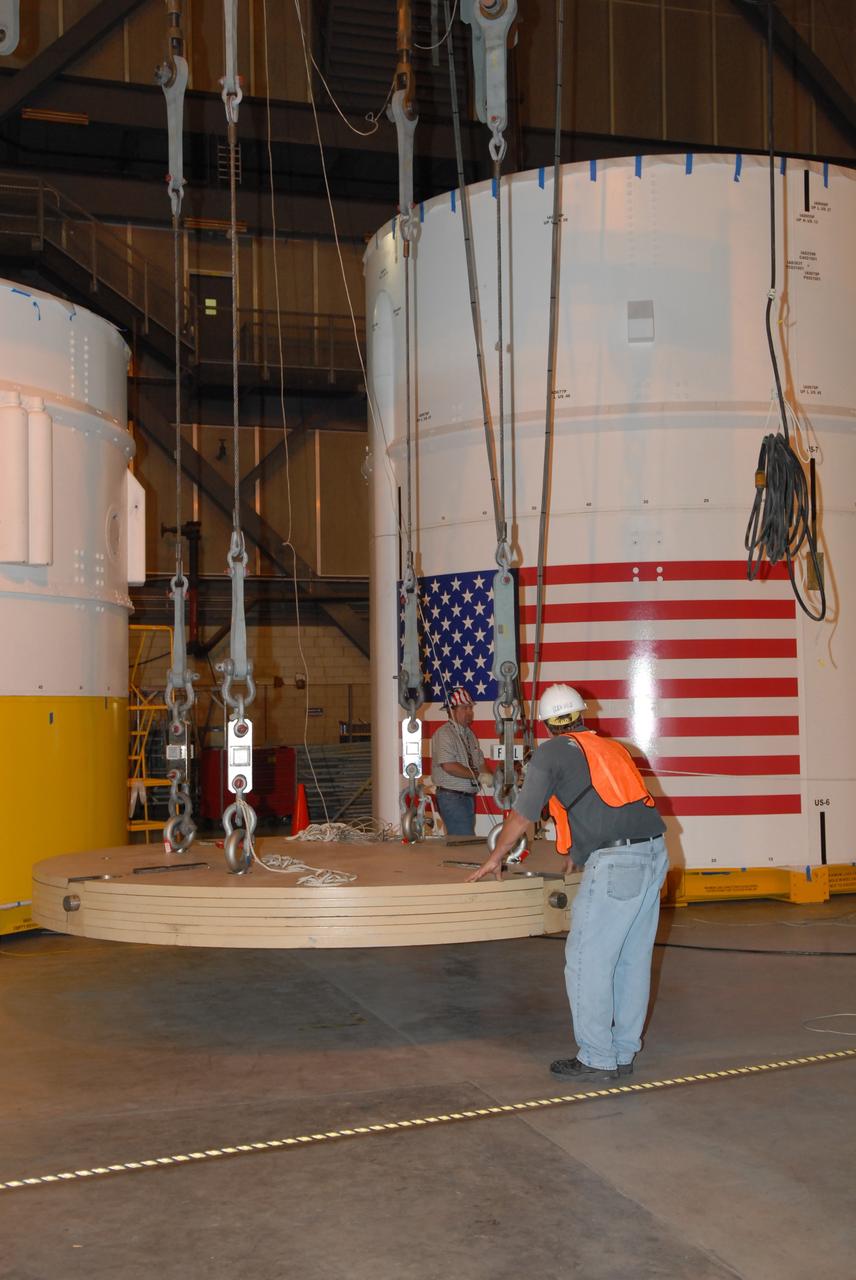
CAPE CANAVERAL, Fla. – In Vehicle Assembly Building high bay 4, cables lift ballast that will be installed in segment 7 for the Ares I-X rocket. These ballast assemblies are being installed in the upper stage segments 1 and 7 and will mimic the mass of the fuel. Their total weight is approximately 160,000 pounds. Ares I-X is the test vehicle for the Ares I, which is part of the Constellation Program to return men to the moon and beyond. Ares I is the essential core of a safe, reliable, cost-effective space transportation system that eventually will carry crewed missions back to the moon, on to Mars and out into the solar system. The Ares I-X is targeted for launch in July 2009. Photo credit: NASA/Jack Pfaller
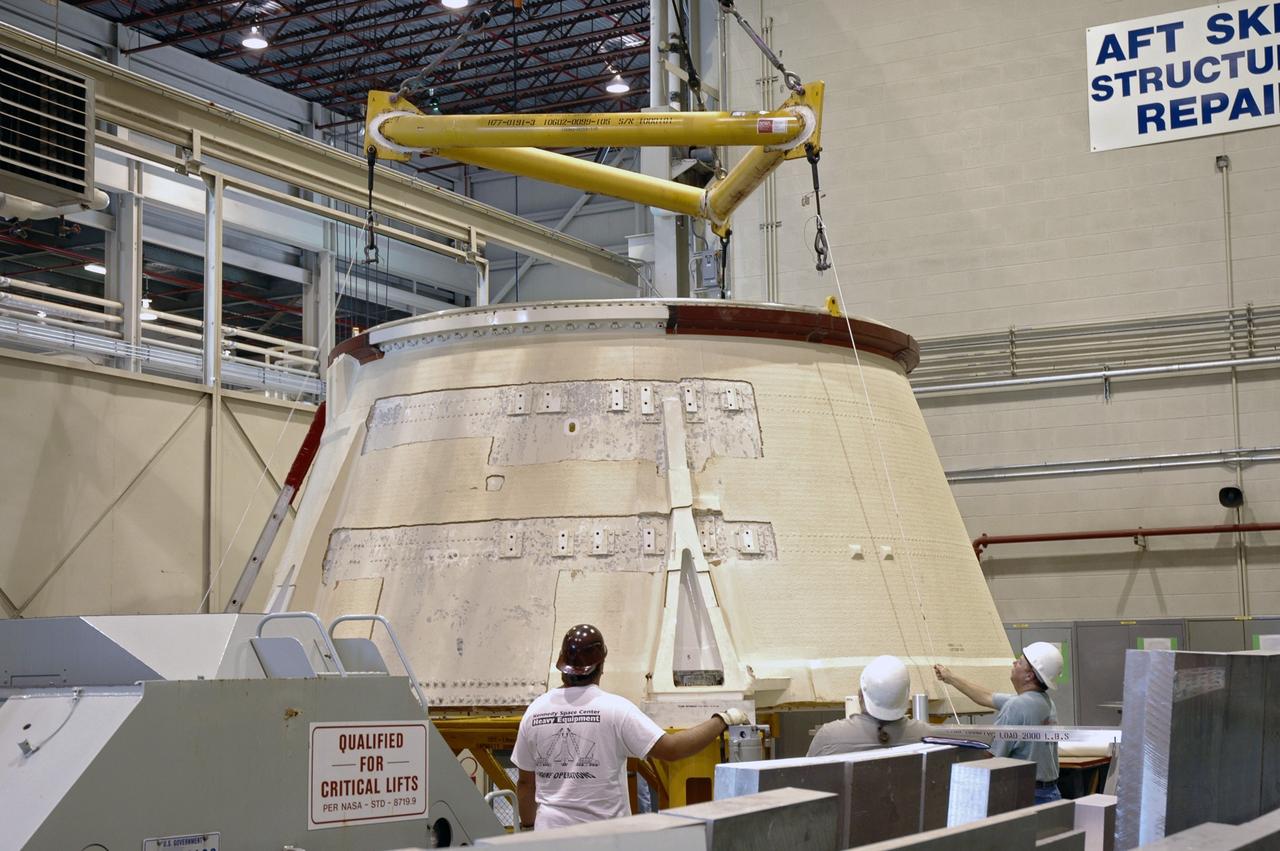
CAPE CANAVERAL, Fla. – In the Assembly and Refurbishment Facility at NASA's Kennedy Space Center, a crane is lowered over the aft skirt for the Ares 1-X rocket. The segment is being lifted into a machine shop work stand for drilling modifications. The modifications will prepare it for the installation of the auxiliary power unit controller, the reduced-rate gyro unit, the booster decelerator motors and the booster tumble motors. Ares I is an in-line, two-stage rocket that will transport the Orion crew exploration vehicle to low-Earth orbit. Ares I-X is a test rocket. The Ares I first stage will be a five-segment solid rocket booster based on the four-segment design used for the shuttle. Ares I’s fifth booster segment allows the launch vehicle to lift more weight and reach a higher altitude before the first stage separates from the upper stage, which ignites in midflight to propel the Orion spacecraft to Earth orbit. Photo credit: NASA/Jim Grossmann
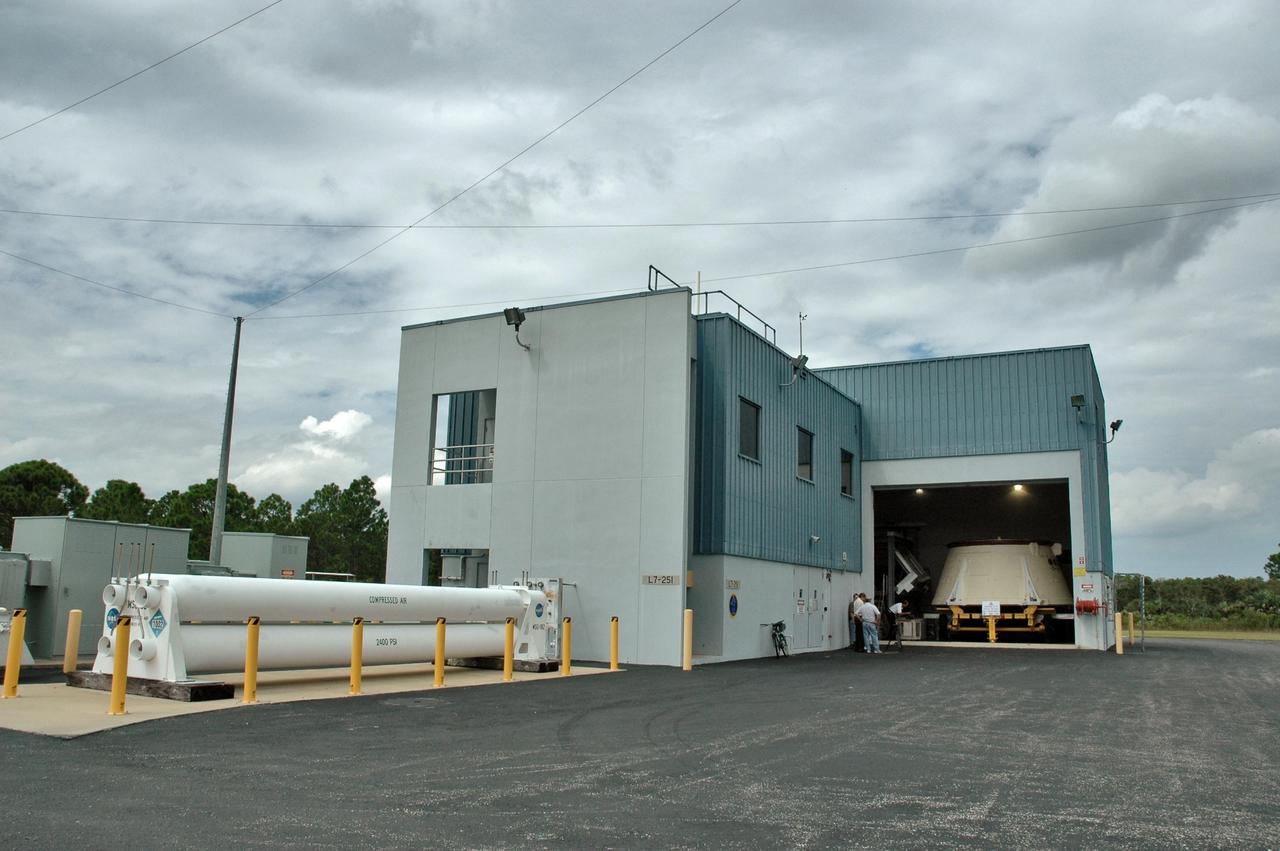
KENNEDY SPACE CENTER, FLA. - In the Assembly and Refurbishment Facility at NASA's Kennedy Space Center can be seen the solid rocket booster aft skirt designated for use on the first stage of the ARES I-1 launch vehicle being prepared for its first test flight. Ares I is the vehicle being developed for launch of the crew exploration vehicle (CEV), named Orion. Ares I-1 is currently targeted for launch from Launch Pad 39B in 2009 using the SRB first stage and a simulated second stage and simulated CEV. Ares I ascent tests and Ares I orbital tests will also take place at Kennedy at later dates. Photo credit: NASA/Jack Pfaller
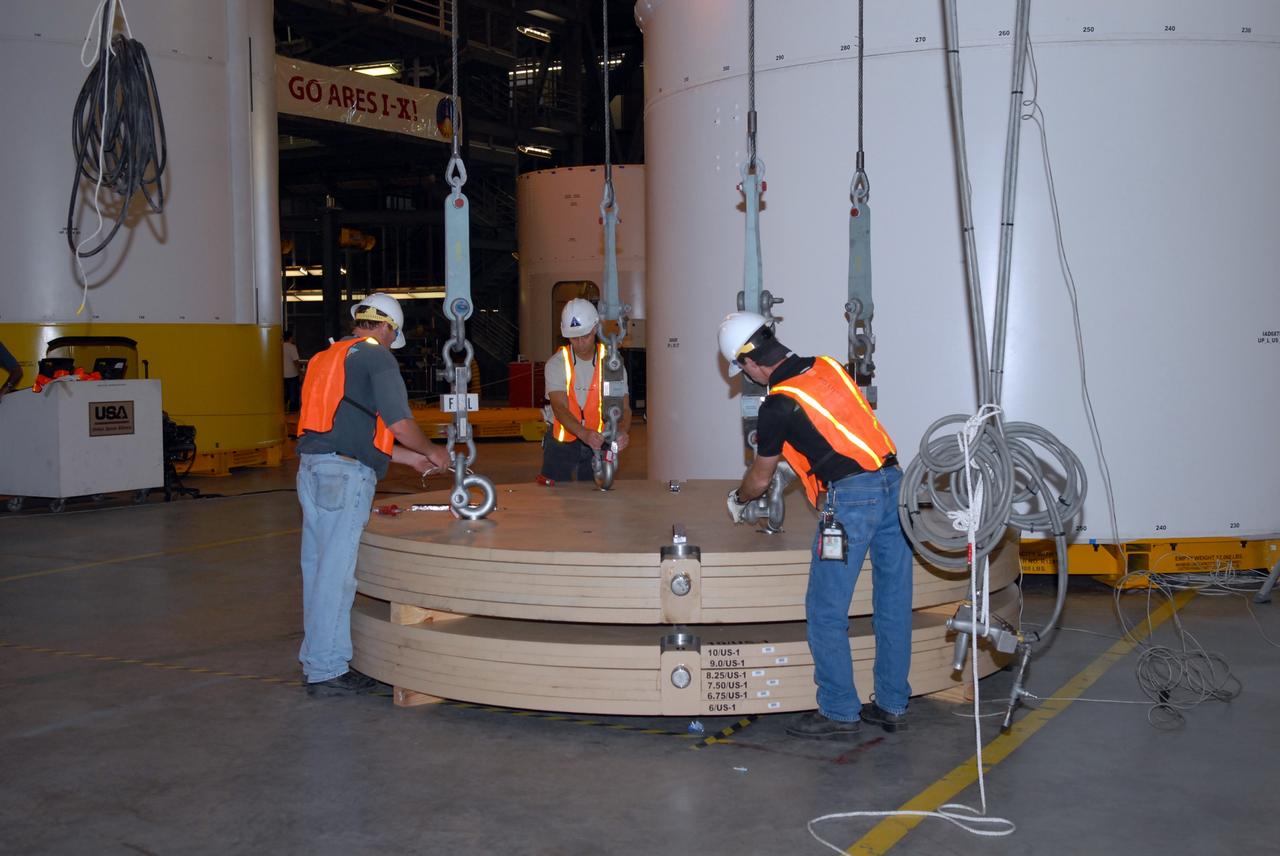
CAPE CANAVERAL, Fla. – In Vehicle Assembly Building high bay 4, workers attached cables to ballast that will be installed in segment 7 for the Ares I-X rocket. These ballast assemblies are being installed in the upper stage segments 1 and 7 and will mimic the mass of the fuel. Their total weight is approximately 160,000 pounds. Ares I-X is the test vehicle for the Ares I, which is part of the Constellation Program to return men to the moon and beyond. Ares I is the essential core of a safe, reliable, cost-effective space transportation system that eventually will carry crewed missions back to the moon, on to Mars and out into the solar system. The Ares I-X is targeted for launch in July 2009. Photo credit: NASA/Jack Pfaller

CAPE CANAVERAL, Fla. – In Vehicle Assembly Building high bay 4, cables lift ballast that will be installed in segment 7 for the Ares I-X rocket. These ballast assemblies are being installed in the upper stage segments 1 and 7 and will mimic the mass of the fuel. Their total weight is approximately 160,000 pounds. Ares I-X is the test vehicle for the Ares I, which is part of the Constellation Program to return men to the moon and beyond. Ares I is the essential core of a safe, reliable, cost-effective space transportation system that eventually will carry crewed missions back to the moon, on to Mars and out into the solar system. The Ares I-X is targeted for launch in July 2009. Photo credit: NASA/Jack Pfaller
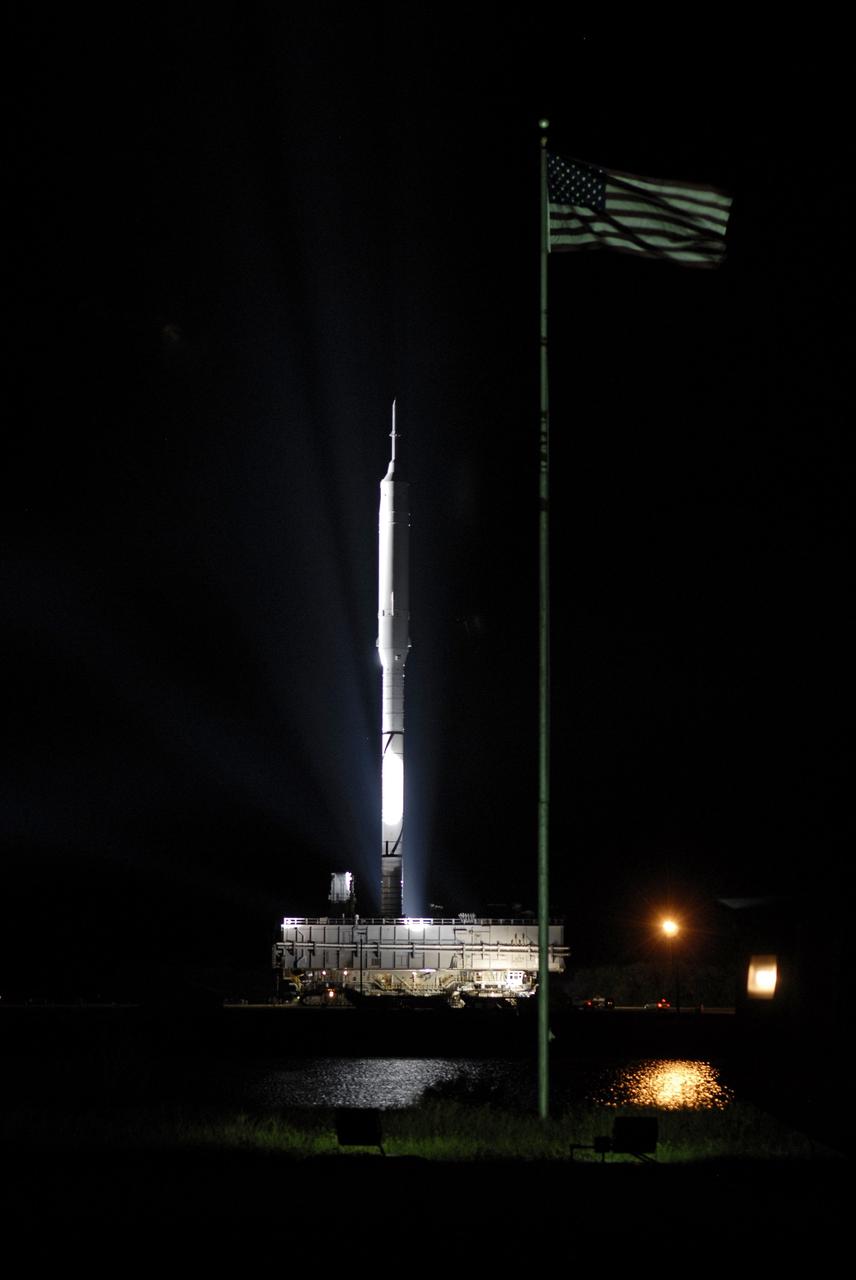
CAPE CANAVERAL, Fla. - The American flag waves as the Ares I-X rocket passes by on its slow trek to Launch Pad 39B at NASA's Kennedy Space Center in Florida. The rocket, riding atop a crawler-transporter, began the 4.2-mile journey at 1:39 a.m. EDT. The transfer of the pad from the Space Shuttle Program to the Constellation Program took place May 31. Modifications made to the pad include the removal of shuttle unique subsystems, such as the orbiter access arm and a section of the gaseous oxygen vent arm, along with the installation of three 600-foot lightning towers, access platforms, environmental control systems and a vehicle stabilization system. Part of the Constellation Program, the Ares I-X is the test vehicle for the Ares I. The Ares I-X flight test is targeted for Oct. 27. For information on the Ares I-X vehicle and flight test, visit http://www.nasa.gov/aresIX. Photo credit: NASA/Kim Shiflett
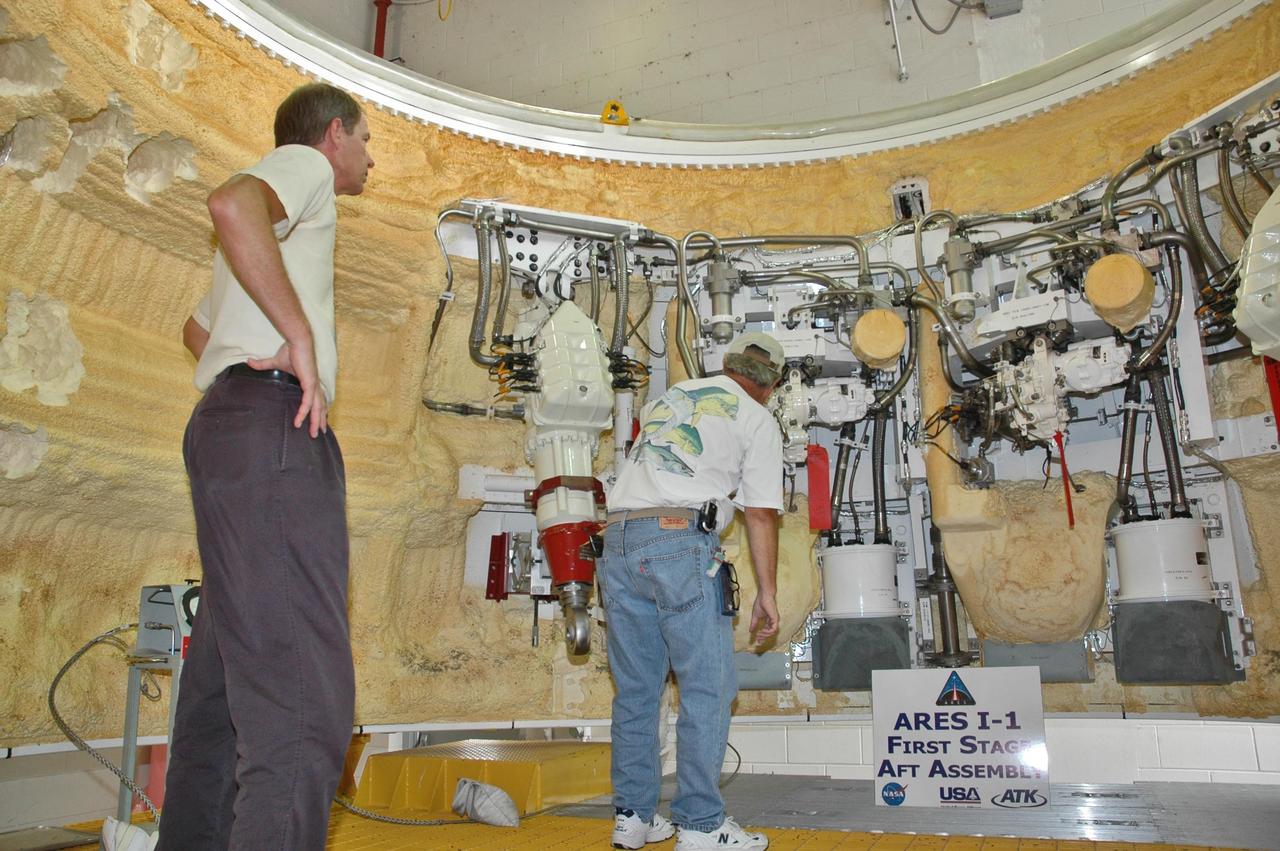
KENNEDY SPACE CENTER, FLA. - In the Assembly and Refurbishment Facility at NASA's Kennedy Space Center, workers examine some of the hardware inside the solid rocket booster aft skirt designated for use on the first stage of the ARES I-1 launch vehicle in its first test flight. Ares I is the vehicle being developed for launch of the crew exploration vehicle (CEV), named Orion. Ares I-1 is currently targeted for launch from Launch Pad 39B in 2009 using the SRB first stage and a simulated second stage and simulated CEV. Ares I ascent tests and Ares I orbital tests will also take place at Kennedy at later dates. Photo credit: NASA/Jack Pfaller
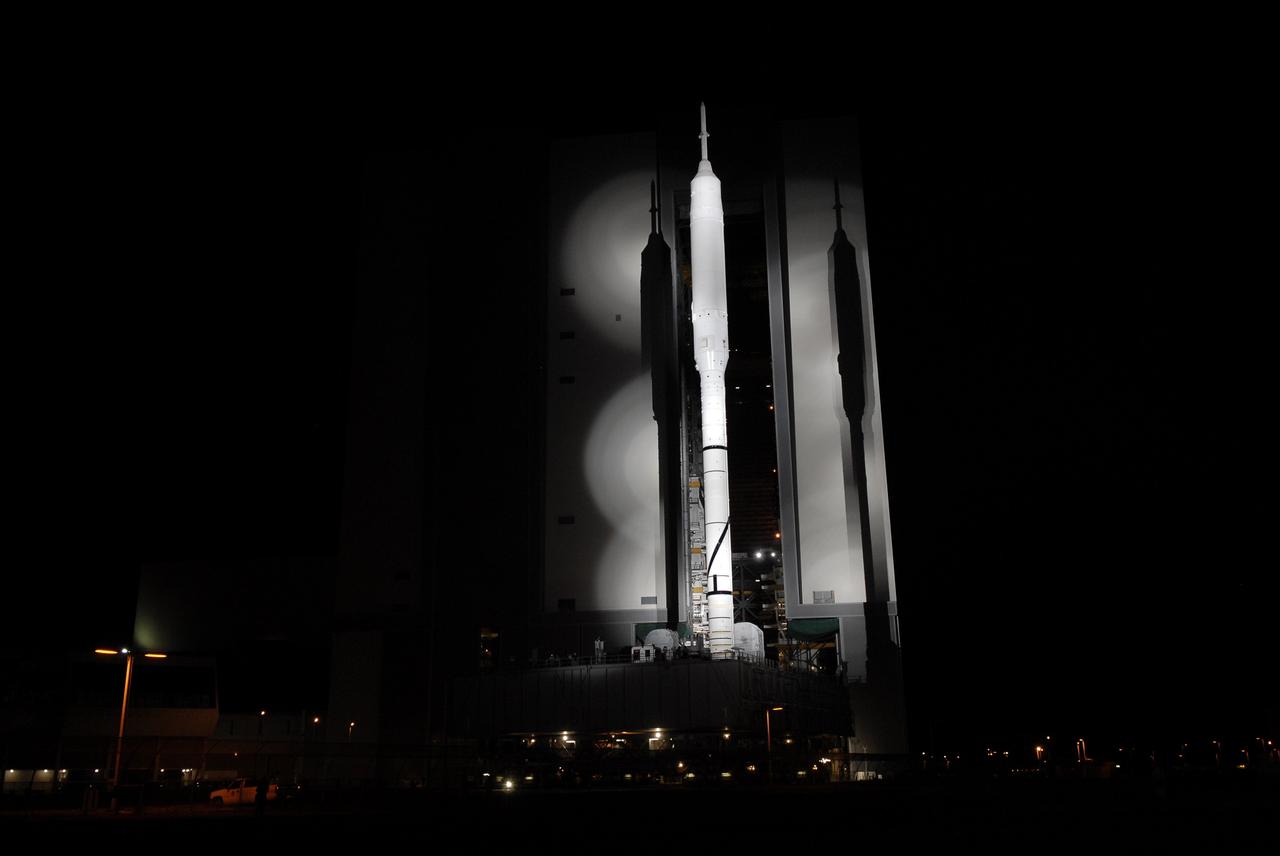
CAPE CANAVERAL, Fla. - The towering 327-foot-tall Ares I-X rocket rides aboard a crawler-transporter as it exits the massive Vehicle Assembly Building at NASA's Kennedy Space Center in Florida. The rocket is bolted to its mobile launcher platform for the move to the launch pad. The transfer of the pad from the Space Shuttle Program to the Constellation Program took place May 31. Modifications made to the pad include the removal of shuttle unique subsystems, such as the orbiter access arm and a section of the gaseous oxygen vent arm, along with the installation of three 600-foot lightning towers, access platforms, environmental control systems and a vehicle stabilization system. Part of the Constellation Program, the Ares I-X is the test vehicle for the Ares I. The Ares I-X flight test is targeted for Oct. 27. For information on the Ares I-X vehicle and flight test, visit http://www.nasa.gov/aresIX. Photo credit: NASA/Kim Shiflett
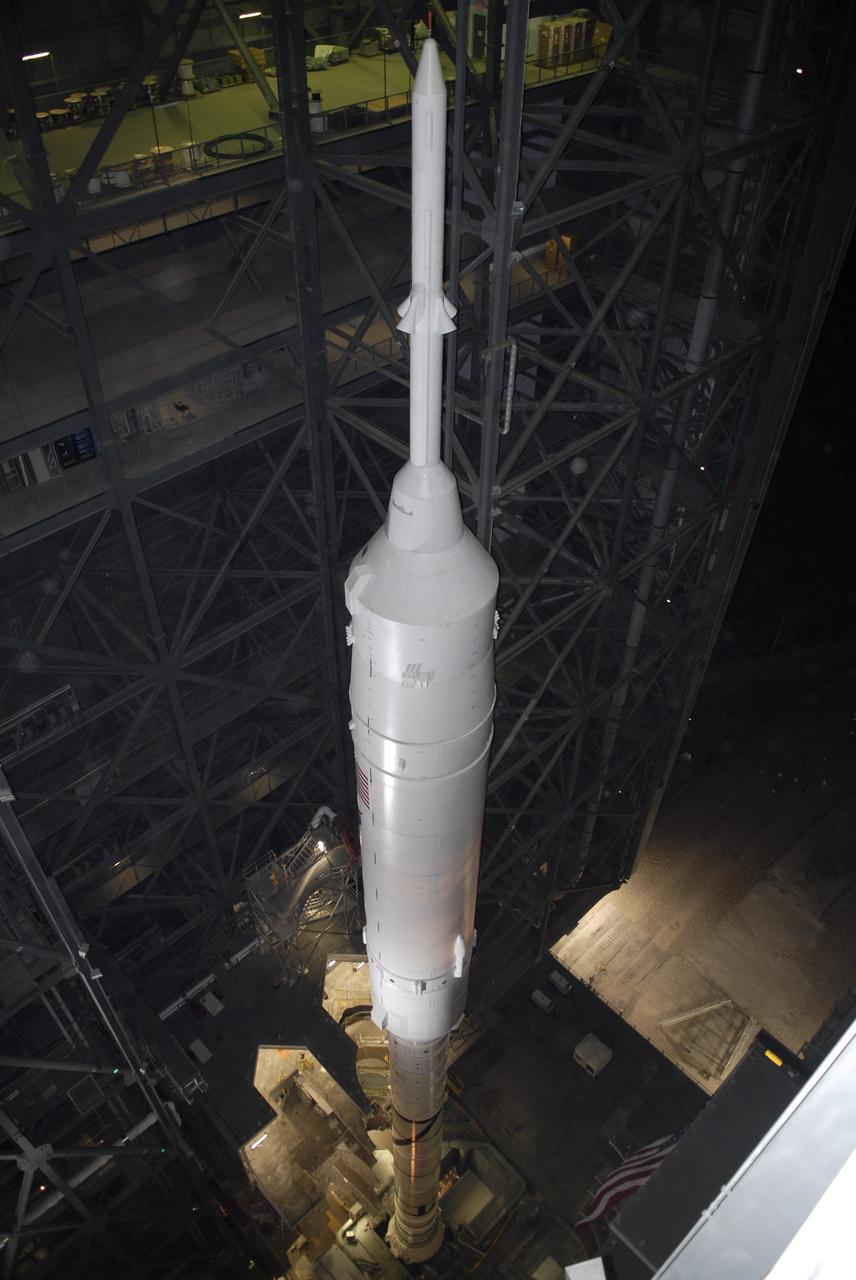
CAPE CANAVERAL, Fla. - Inside the Vehicle Assembly Building at NASA's Kennedy Space Center in Florida, the 327-foot-tall Ares I-X rocket stands on its mobile launcher platform. The transfer of the pad from the Space Shuttle Program to the Constellation Program took place May 31. Modifications made to the pad include the removal of shuttle unique subsystems, such as the orbiter access arm and a section of the gaseous oxygen vent arm, along with the installation of three 600-foot lightning towers, access platforms, environmental control systems and a vehicle stabilization system. Part of the Constellation Program, the Ares I-X is the test vehicle for the Ares I. The Ares I-X flight test is targeted for Oct. 27. For information on the Ares I-X vehicle and flight test, visit http://www.nasa.gov/aresIX. Photo credit: NASA/Kim Shiflett
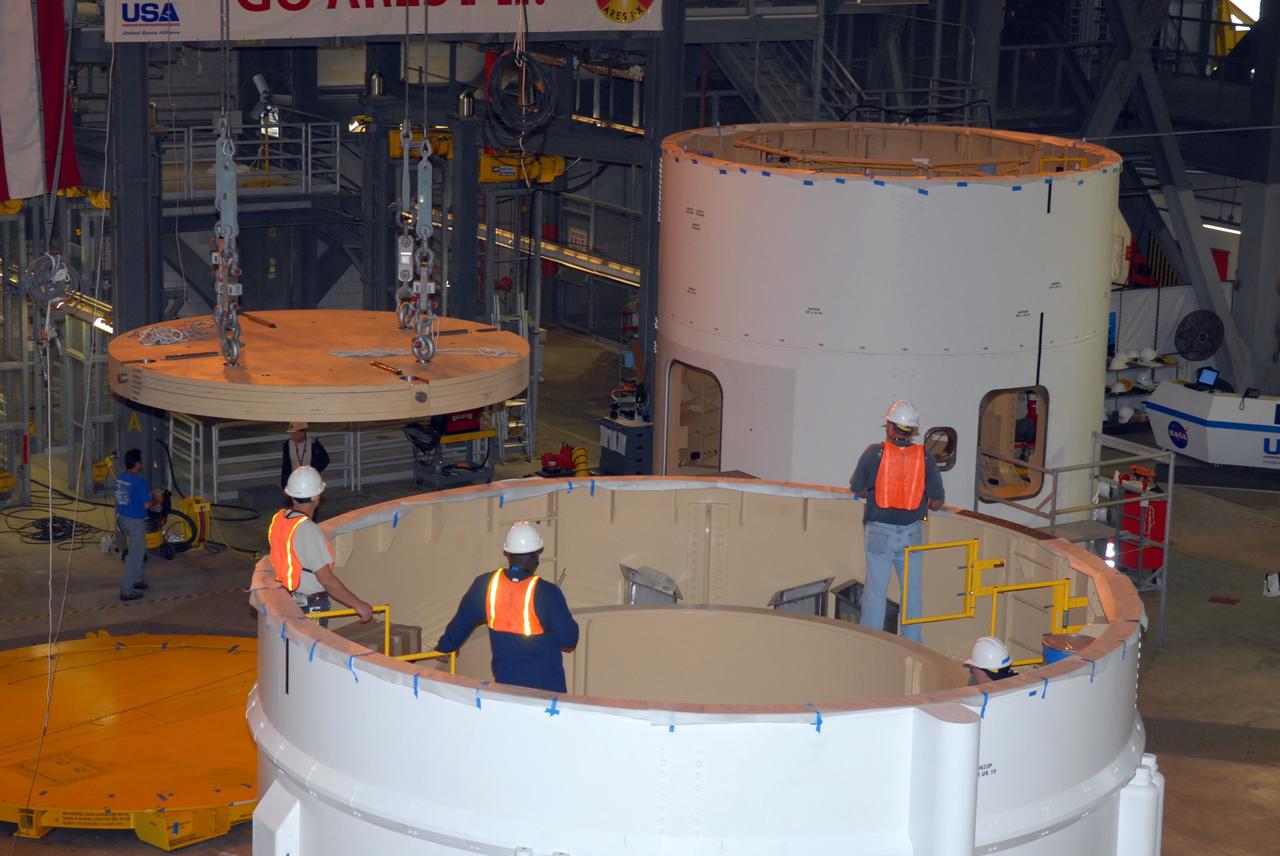
CAPE CANAVERAL, Fla. – In Vehicle Assembly Building high bay 4, cables from an overhead crane move ballast that will be installed in segment 7 for the Ares I-X rocket. These ballast assemblies are being installed in the upper stage segments 1 and 7 and will mimic the mass of the fuel. Their total weight is approximately 160,000 pounds. Ares I-X is the test vehicle for the Ares I, which is part of the Constellation Program to return men to the moon and beyond. Ares I is the essential core of a safe, reliable, cost-effective space transportation system that eventually will carry crewed missions back to the moon, on to Mars and out into the solar system. The Ares I-X is targeted for launch in July 2009. Photo credit: NASA/Jack Pfaller
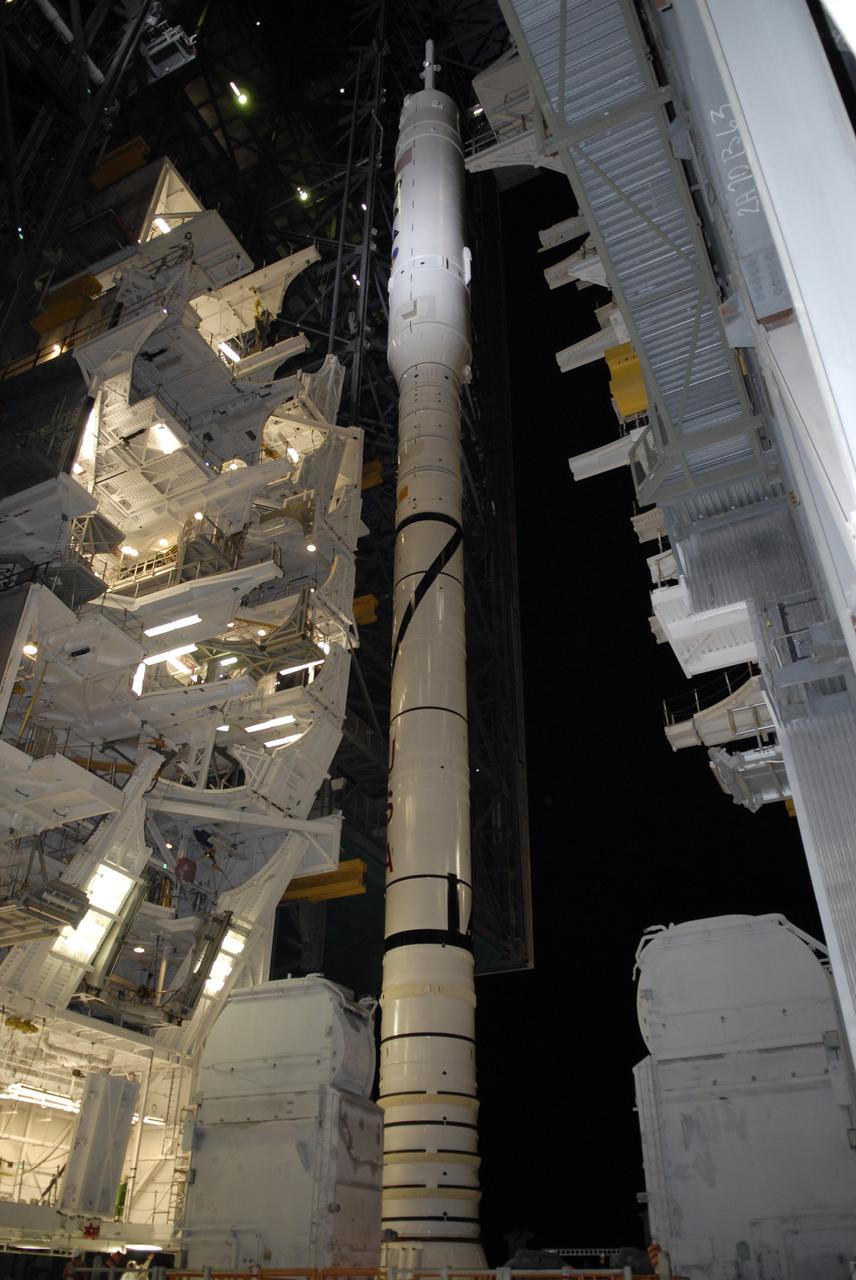
CAPE CANAVERAL, Fla. - With the work platforms retracted, the Ares I-X stands tall inside the Vehicle Assembly Building at NASA's Kennedy Space Center in Florida. The platforms were retracted in preparation for the rocket's rollout to Launch Pad 39B. The transfer of the pad from the Space Shuttle Program to the Constellation Program took place May 31. Modifications made to the pad include the removal of shuttle unique subsystems, such as the orbiter access arm and a section of the gaseous oxygen vent arm, along with the installation of three 600-foot lightning towers, access platforms, environmental control systems and a vehicle stabilization system. Part of the Constellation Program, the Ares I-X is the test vehicle for the Ares I. The Ares I-X flight test is targeted for Oct. 27. For information on the Ares I-X vehicle and flight test, visit http://www.nasa.gov/aresIX. Photo credit: NASA/Kim Shiflett
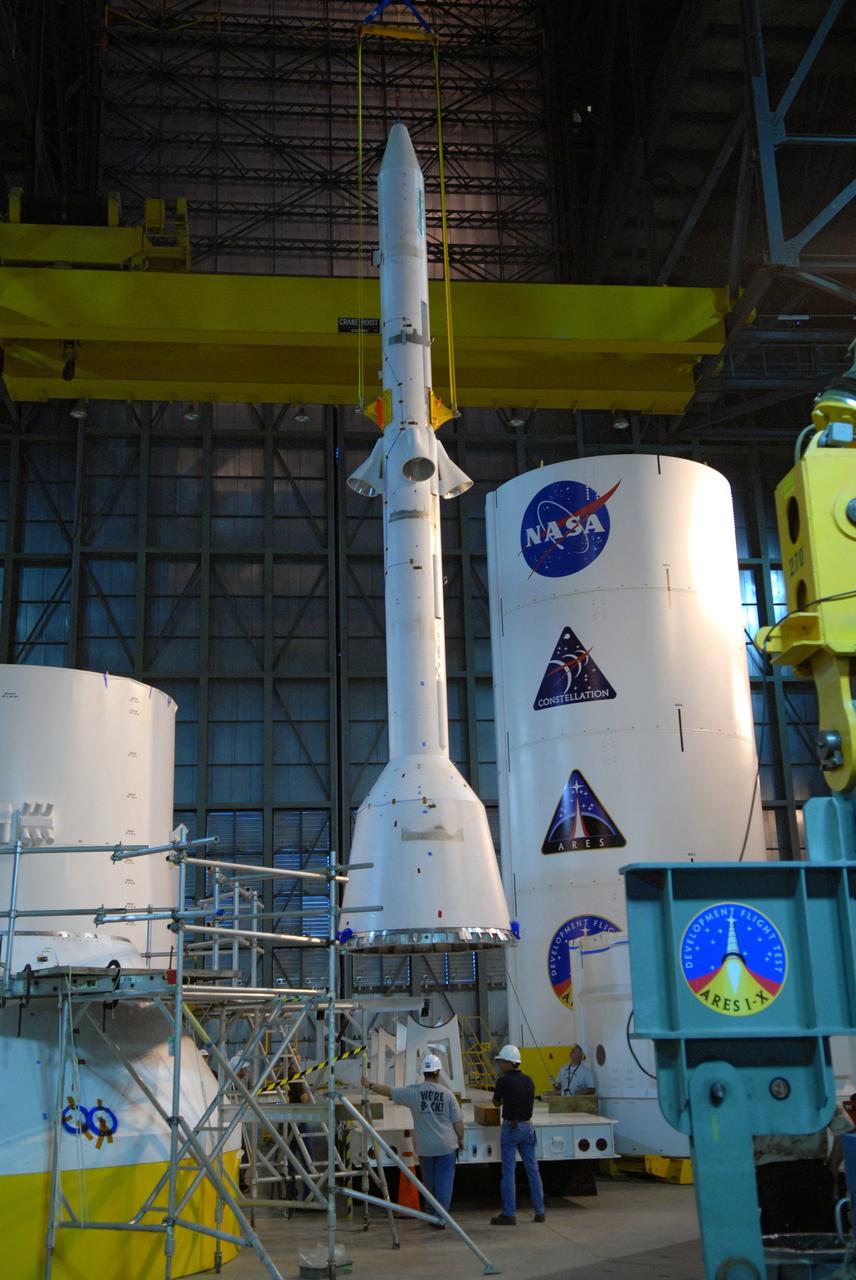
CAPE CANAVERAL, Fla. – In high bay 4 of the Vehicle Assembly Building at NASA's Kennedy Space Center in Florida, the Ares I-X simulated launch abort system, or LAS, is suspended vertically above its stand. The LAS will be lifted higher and moved for assembly with the crew module simulator. Ares I-X is the flight test vehicle for the Ares I, which is part of the Constellation Program to return men to the moon and beyond. Ares I is the essential core of a safe, reliable, cost-effective space transportation system that eventually will carry crewed missions back to the moon, on to Mars and out into the solar system. Ares I-X is targeted for launch in July 2009. Photo credit: NASA/Jack Pfaller

The jumble of eroded ridges and mesas seen in this NASA Mars Odyssey image occurs within Ares Vallis, one of the largest catastrophic outflow channels on the planet. Floods raged through this channel, pouring out into the Chryse Basin to the north. Close inspection of the THEMIS image reveals polygonal shapes on the floor of the channel system. Polygonal terrain on Mars is fairly common although the variety of forms and scales of the polygons suggests multiple modes of origin. Those in Ares Vallis resemble giant desiccation polygons that form in soils on Earth when a moist layer at depth drys out. While polygons can form in icy soils (permafrost) and even lava flows, their presence in a channel thought to have been carved by flowing water is at least consistent with a mode of origin that involved liquid water. http://photojournal.jpl.nasa.gov/catalog/PIA04019
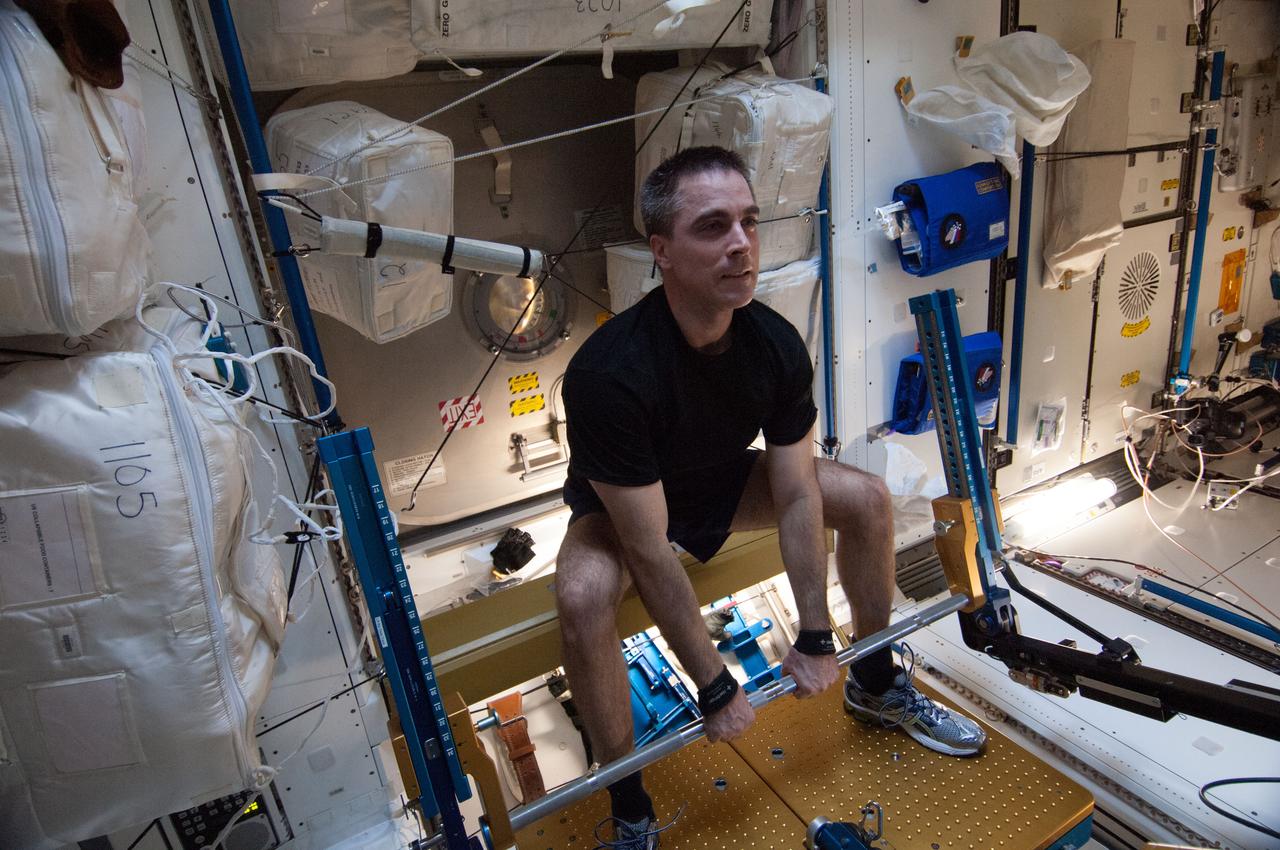
ISS036-E-038715 (31 Aug. 2013) --- NASA astronaut Chris Cassidy, Expedition 36 flight engineer, gets a workout on the advanced Resistive Exercise Device (aRED) in the Tranquility node of the International Space Station.

ISS036-E-038720 (31 Aug. 2013) --- NASA astronaut Chris Cassidy, Expedition 36 flight engineer, gets a workout on the advanced Resistive Exercise Device (aRED) in the Tranquility node of the International Space Station.