
S67-43593 (26 Aug. 1967) --- The completely assembled Apollo Saturn 501 launch vehicle mated to the Apollo spacecraft 017 on Launch Complex 39A, Kennedy Space Center. The fully assembled vehicle was transported to the launch complex on the crawler.
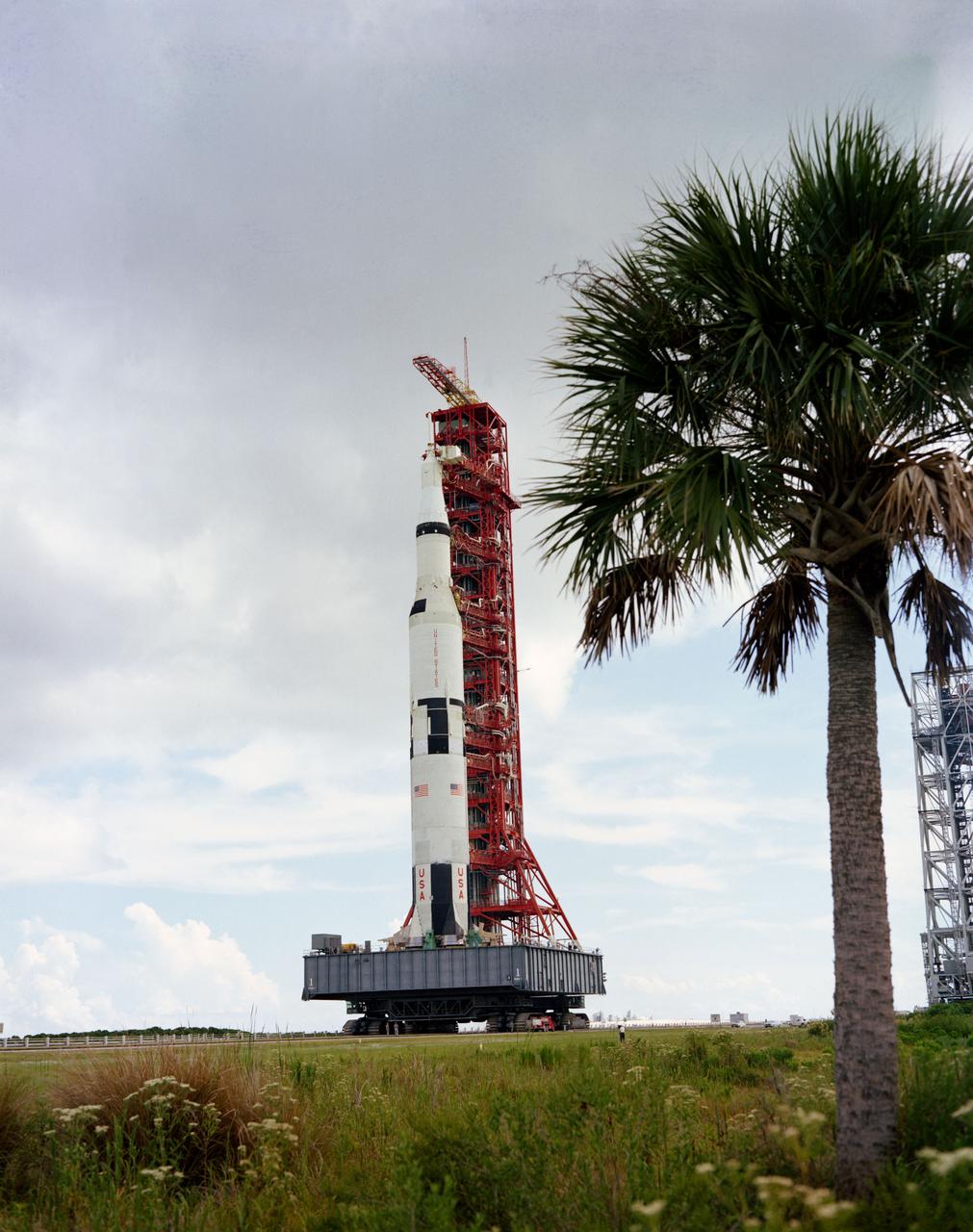
S67-43595 (26 Aug. 1967) --- The Apollo 4 (Spacecraft 017/Saturn 501) stack and its mobile launch tower atop a crawler-transporter moving from the Vehicle Assembly Building toward Pad A, Launch Complex 39.
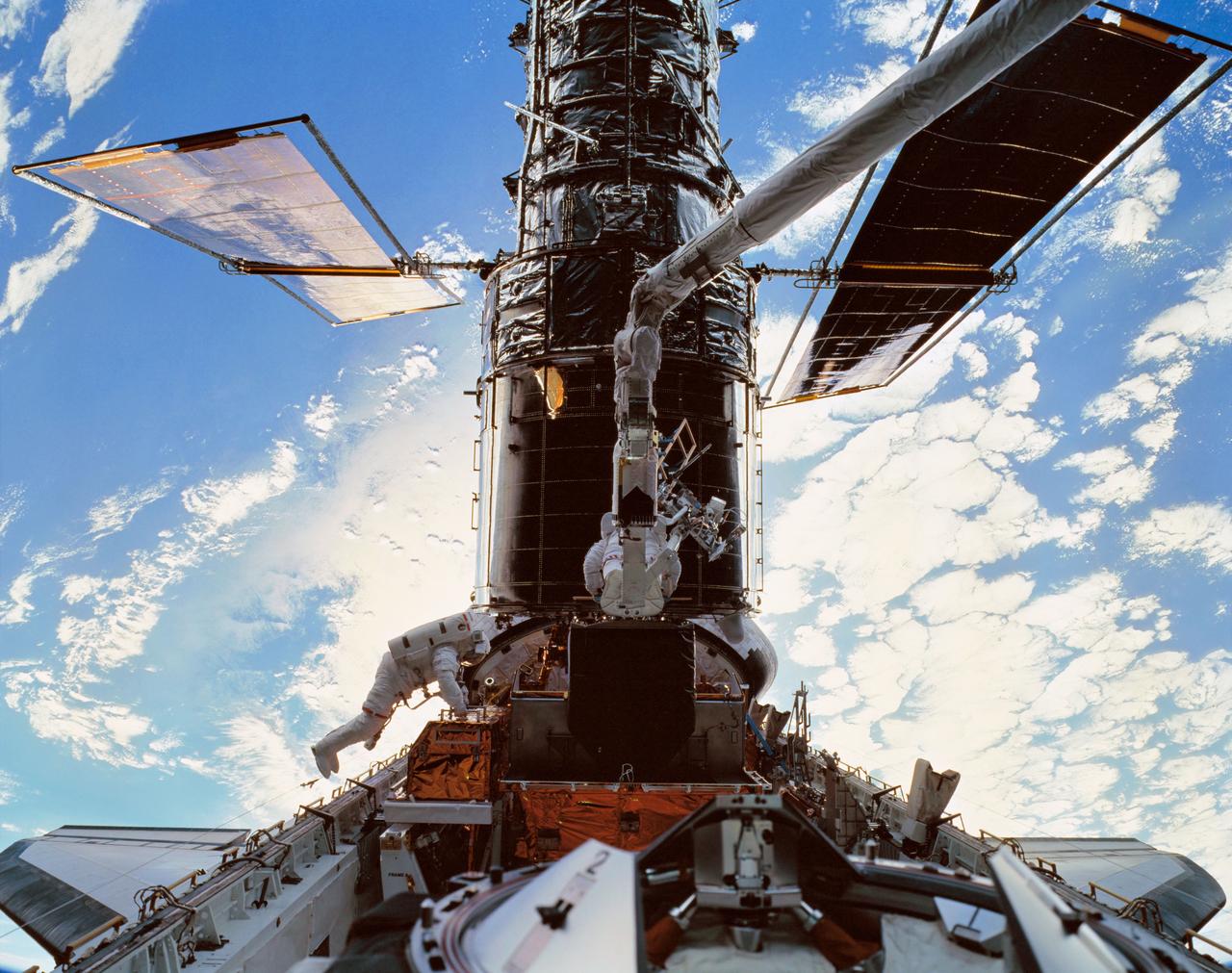
STS103-501-026 (19 - 27 December 1999) --- Astronauts C. Michael Foale, left, and Claude Nicollier (on Discovery's robotic arm) install a Fine Guidance Sensor (FGS) into a protective enclosure in the Shuttle’s payload bay. Foale and Nicollier performed the second of three space walks to service the Hubble Space Telescope (HST) on the STS-103 mission. A large format camera inside Discovery's cabin was used to record this high-resolution image, while the Shuttle was orbiting above ocean and clouds.
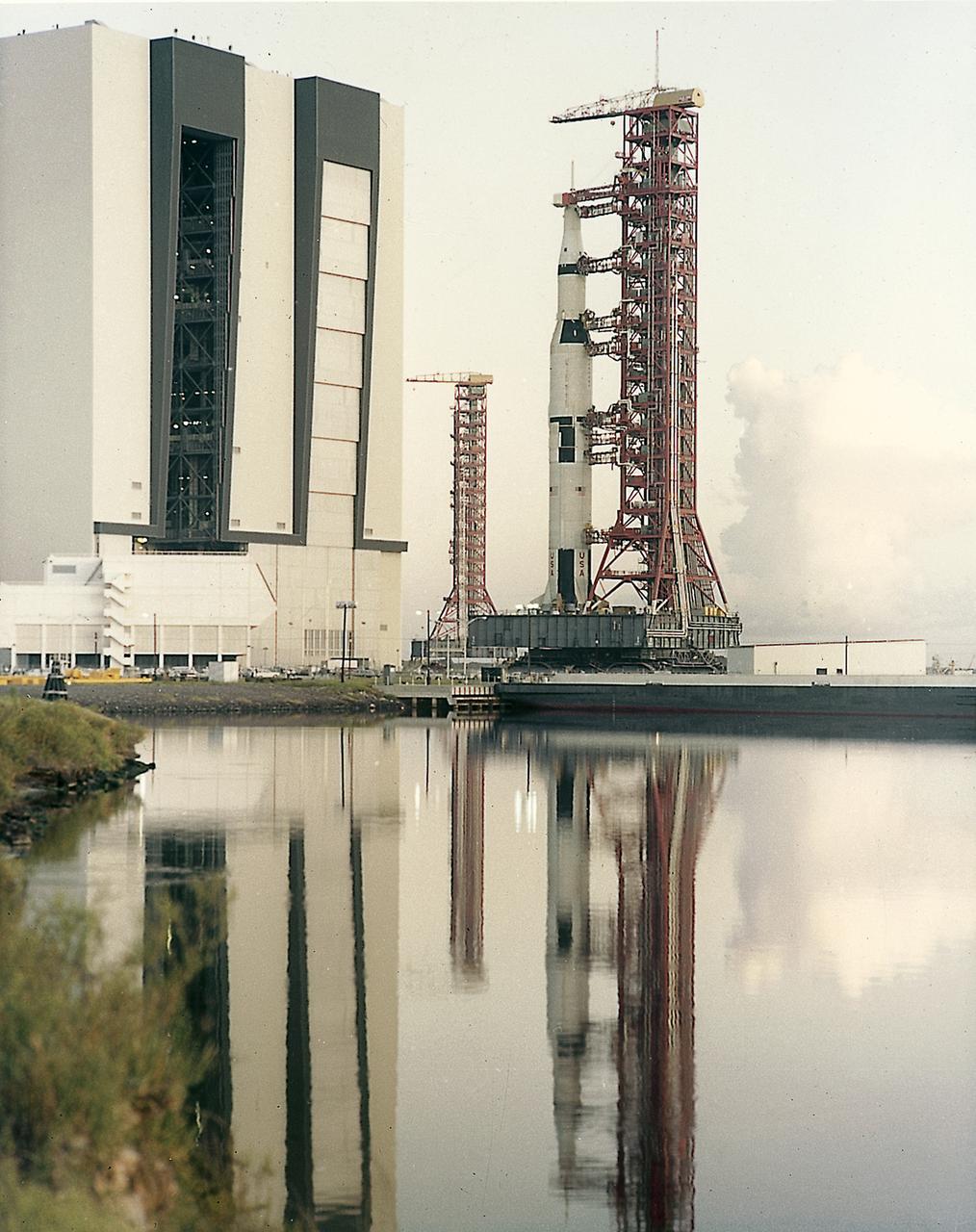
This picture shows the Saturn V vehicle (AS-501), for the Apollo 4 mission on the Crawler Transporter Vehicle. It was rolled out from the Vehicle Assembly Building and slowly (1 mph) moved to the launch pad at the Kennedy Space Center (KSC). The Apollo 4 mission was the first launch of the Saturn V launch vehicle. Objectives of the unmanned Apollo 4 test flight were to obtain flight information on launch vehicle and spacecraft structural integrity and compatibility, flight loads, stage separation, and subsystems operation including testing of restart of the S-IVB stage, and to evaluate the Apollo command module heat shield. The Apollo 4 was launched on November 9, 1967 from KSC.
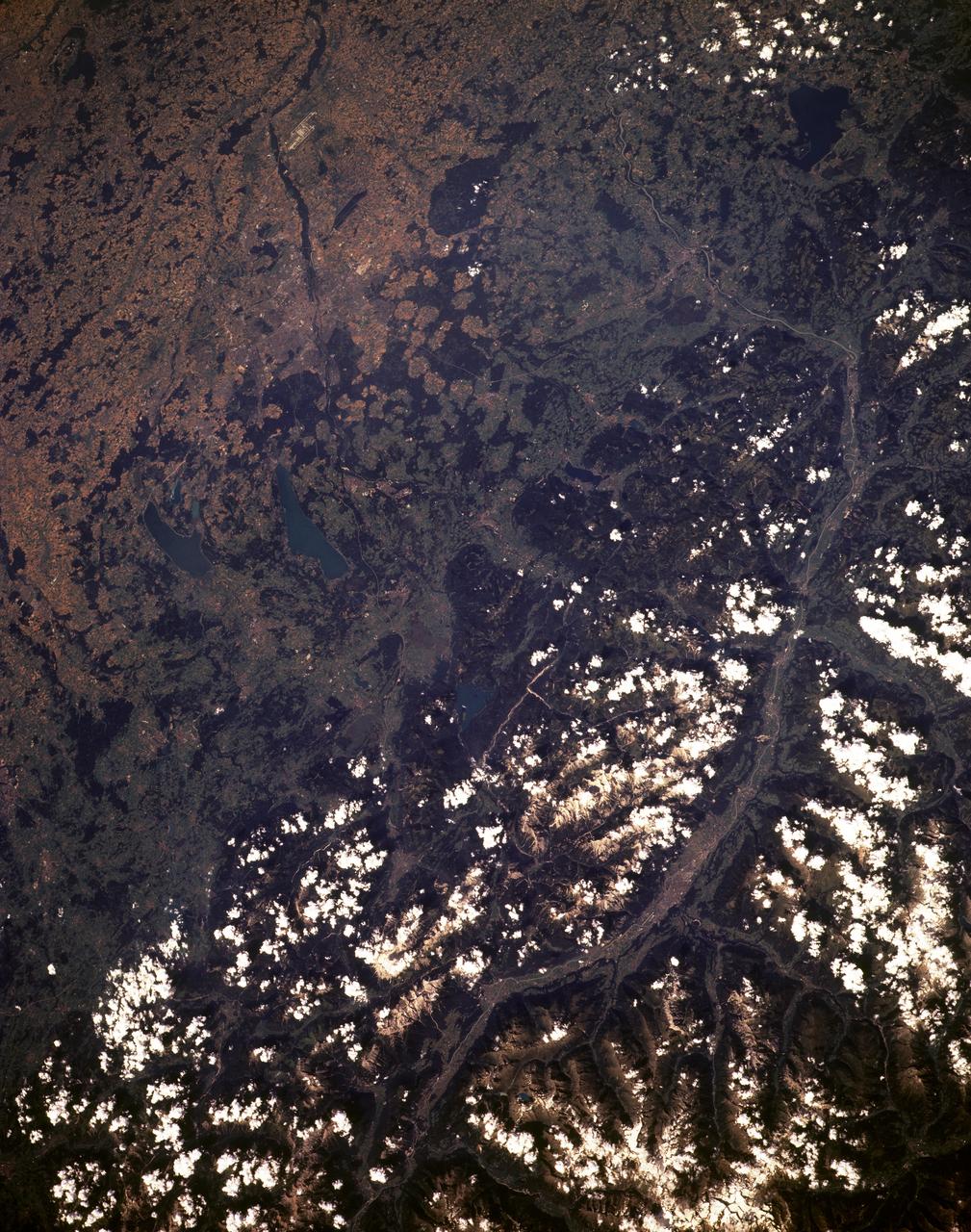
STS085-501-069 (7 - 19 August 1997) --- This 70mm frame was photographed from the Space Shuttle Discovery during the mission. Bare, brown rock and snow-capped Alpine summits in Austria contrast with dark, heavily-wooded upper slopes, the patchy silviculture of lower slopes, and completely farmed plains of Bavaria to the north. The large river is the Inn; Innsbruck is visible within the flat-bottomed, formerly glaciated valley. The new and old airports of Munich are prominent on the flat land to the north. Oberpfaffenhofen, the home of the German Space Agency (DARA), can be picked out west of Munich, south of an autobahn.
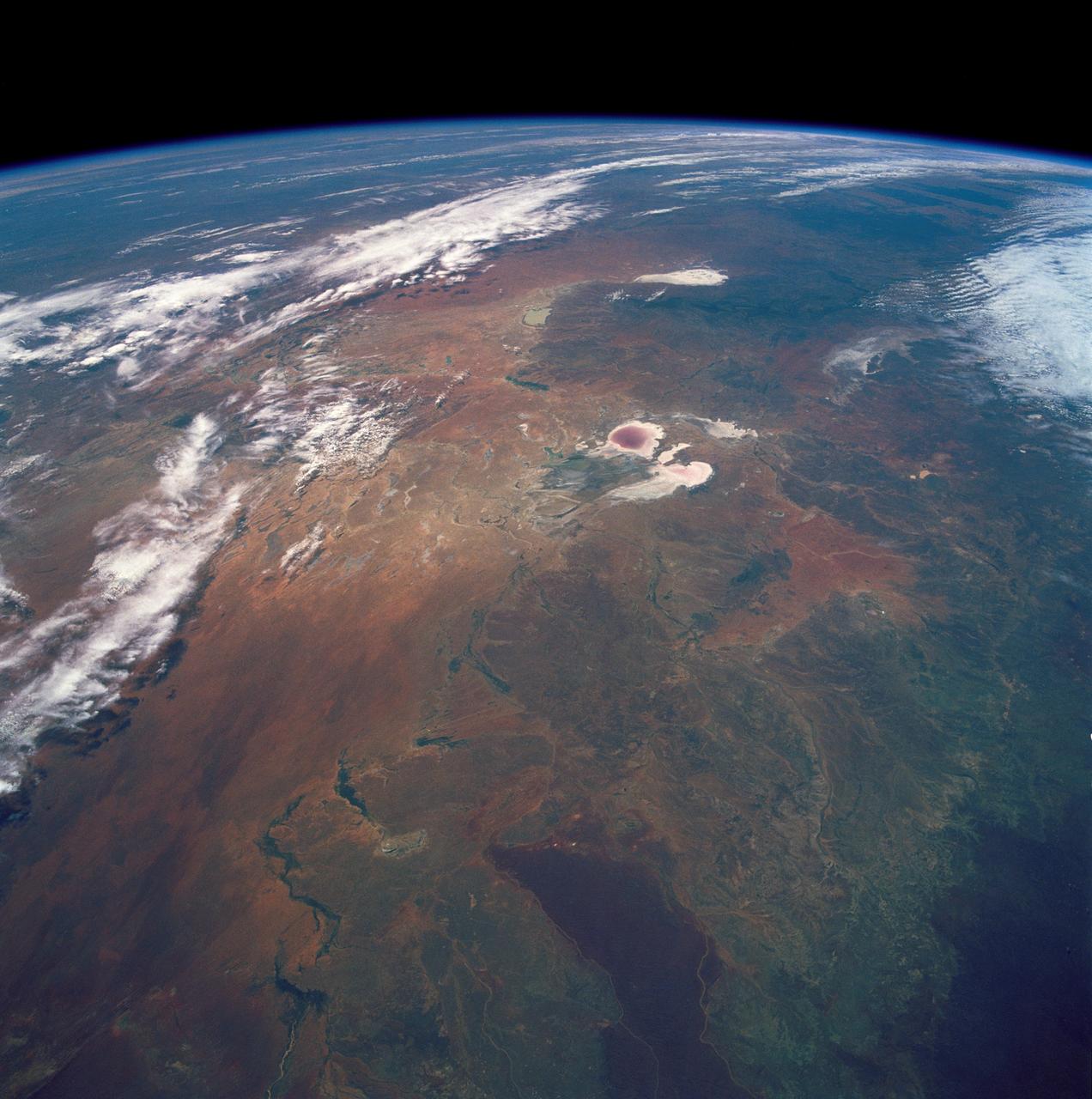
STS035-501-007 (2-10 Dec. 1990) --- The STS-35 crewmembers aboard the Earth-orbiting Space Shuttle Columbia photographed this view of the Arid Simpson Desert of Australia with a handheld Rolleiflex camera. Lake Eyre is normally dry; however, the STS-35 crew was able to recognize water in the lowest parts of the lake (dark pink area) and possibly in Lake Blanche east of Lake Eyre. Lake Frome lies in the distance separated from Lake Torrens (top right) by dark hills of Flinders Range. The Finke River (bottom left to middle) flows into the Eyre basin from the northwest. Although it is the largest river entering the basin, Finke's floods seldom reach Lake Eyre. The dark brown patch in the foreground is an area of ancient, brown lateritic soils partly covered by dunes.
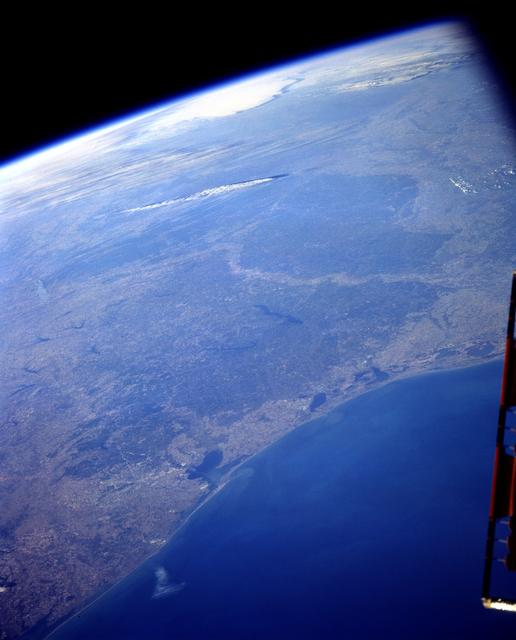
STS103-501-104 (19-27 December 1999) --- One of the astronauts aboard the Earth-orbiting Space Shuttle Discovery used a handheld large format camera to photograph this scene which stretches from the Gulf of Mexico into Oklahoma. Parts of Louisiana and Arkansas are also visible in the frame. The Red River snakes its way through the East Texas Piney Woods (center). The river meets with the southern edge of the Ouachita folded mountains of southern Oklahoma. The white, linear feature north of the Red River is most likely a jet stream cloud, according to Earth scientists who studied the STS-103 collection at the Johnson Space Center (JSC). Jet contrails can be seen flying over the clouds. Along the Texas Gulf Coast are Galveston Bay and the greater Houston metropolitan area.
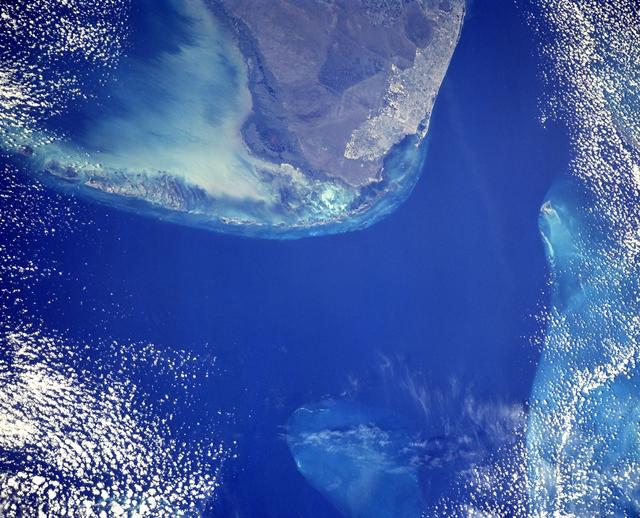
STS103-501-152 (19-27 December 1999) --- One of the astronauts aboard the Earth-orbiting Space Shuttle Discovery used a handheld large format camera to photograph this southern Florida scene. The city of Miami encroaches the eastern edge of the Everglades, which constitute an International Biosphere Reserve World Heritage Site. This subtropical wilderness encompasses a relatively flat (does not exceed 2.4 m above sea level) saw-grass marsh region of 10,000 square kilometers (4,000 square miles). According to NASA Earth scientists, the only source of water in the Everglades is from rainfall. The flow of water is detectable in this image, slowly moving from Lake Okeechobee to Florida Bay; the light blue, shallow area between the mainland and the Keys; and the southwestern Florida coast.
![Apollo spacecraft 017 leaves the Manned Spacecraft Operations Building at Kennedy Space Center on its way to the Vehicle Assembly Building where it will be mated with the Saturn 501 launch vehicle. The first flight of the Saturn V [AS-501], an unmanned mission, is scheduled for this fall.](https://images-assets.nasa.gov/image/KSC-67P-0259/KSC-67P-0259~medium.jpg)
Apollo spacecraft 017 leaves the Manned Spacecraft Operations Building at Kennedy Space Center on its way to the Vehicle Assembly Building where it will be mated with the Saturn 501 launch vehicle. The first flight of the Saturn V [AS-501], an unmanned mission, is scheduled for this fall.
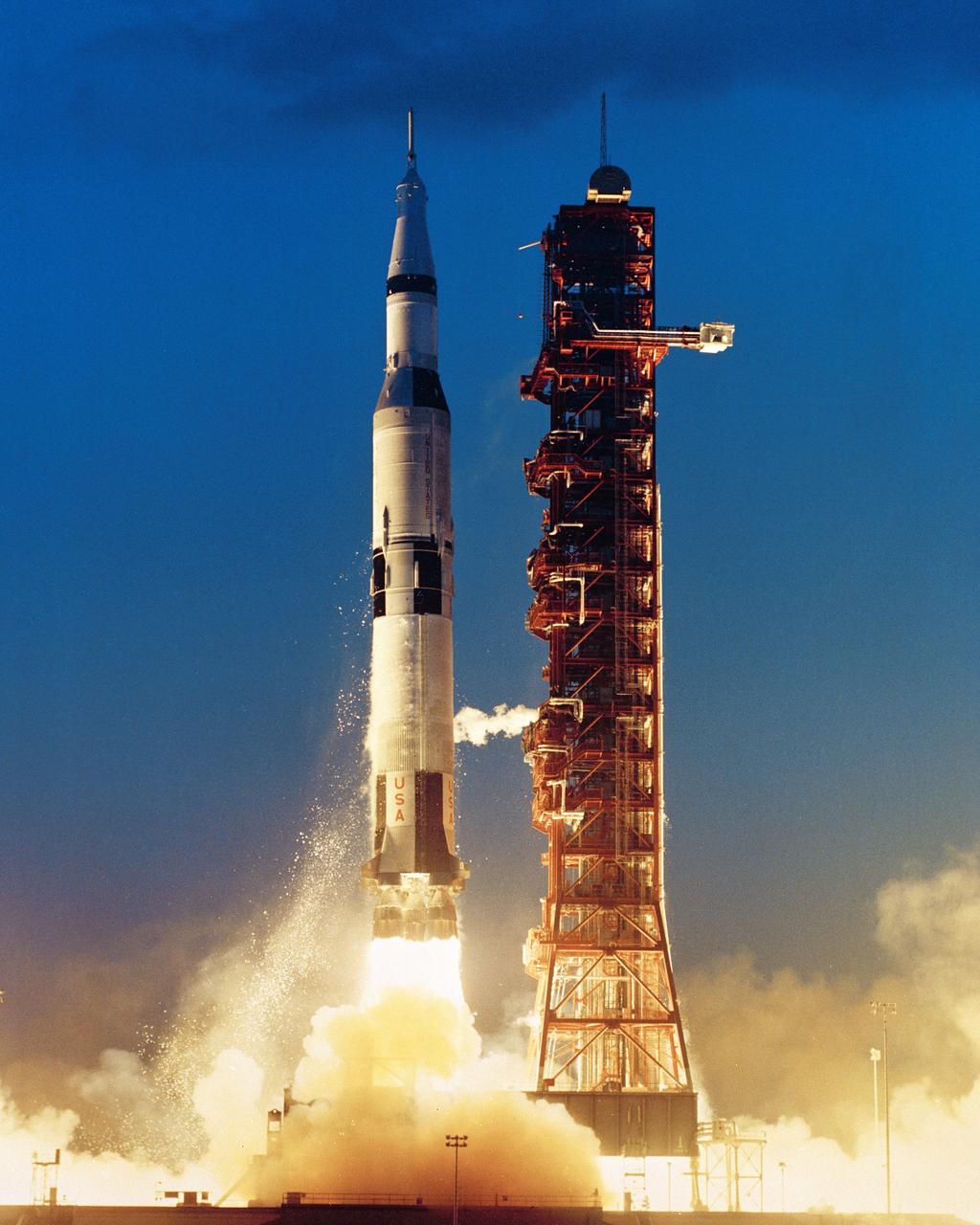
Saturn 501 - Apollo Saturn V liftoff from Complex 39A at 7 a.m. 9 November 1967 at Kennedy Space Center, Florida.
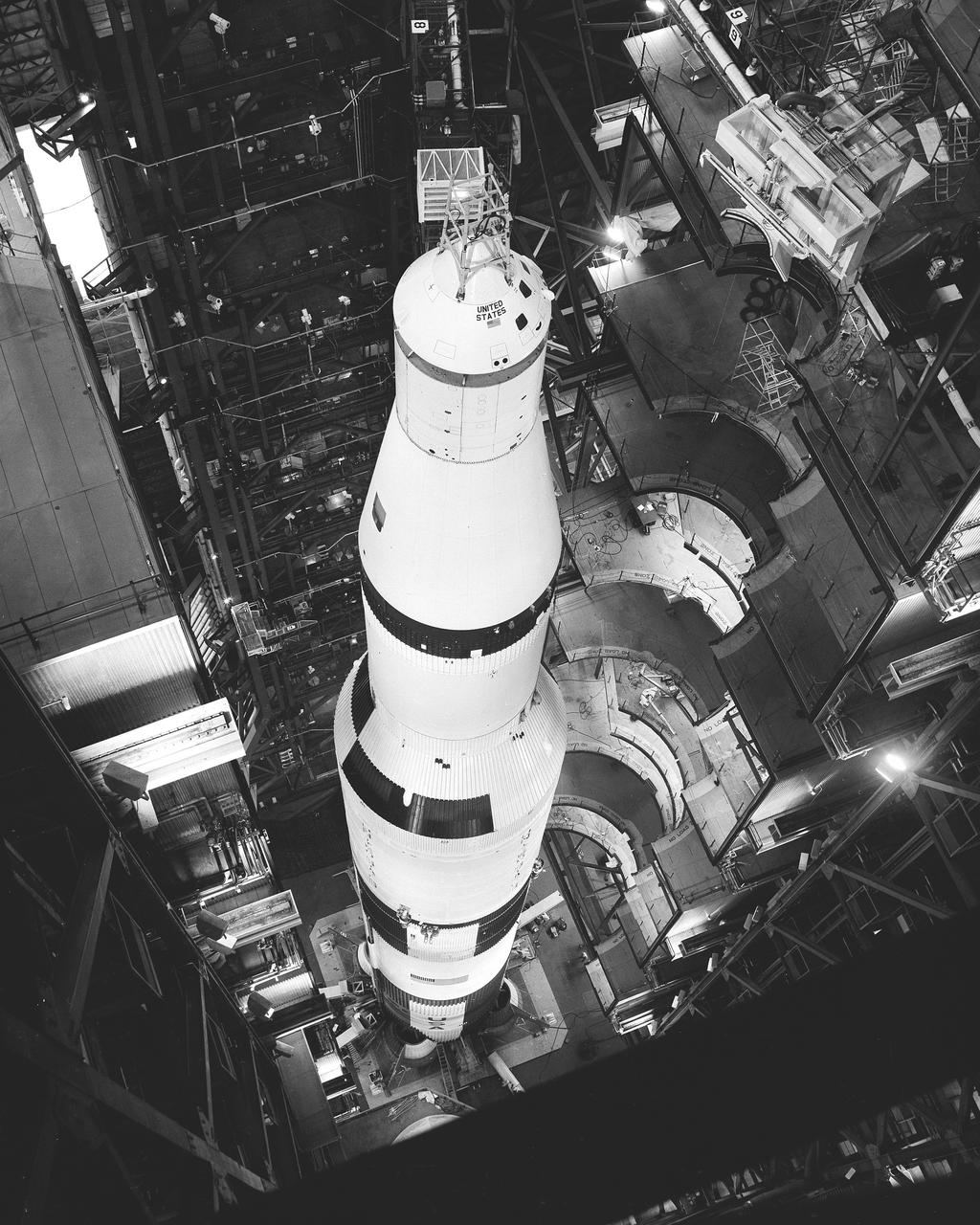
Top-to-bottom view of the 36-story-tall Saturn Apollo 501 space vehicle with work platforms retracted. VAB, High Bay No.1.
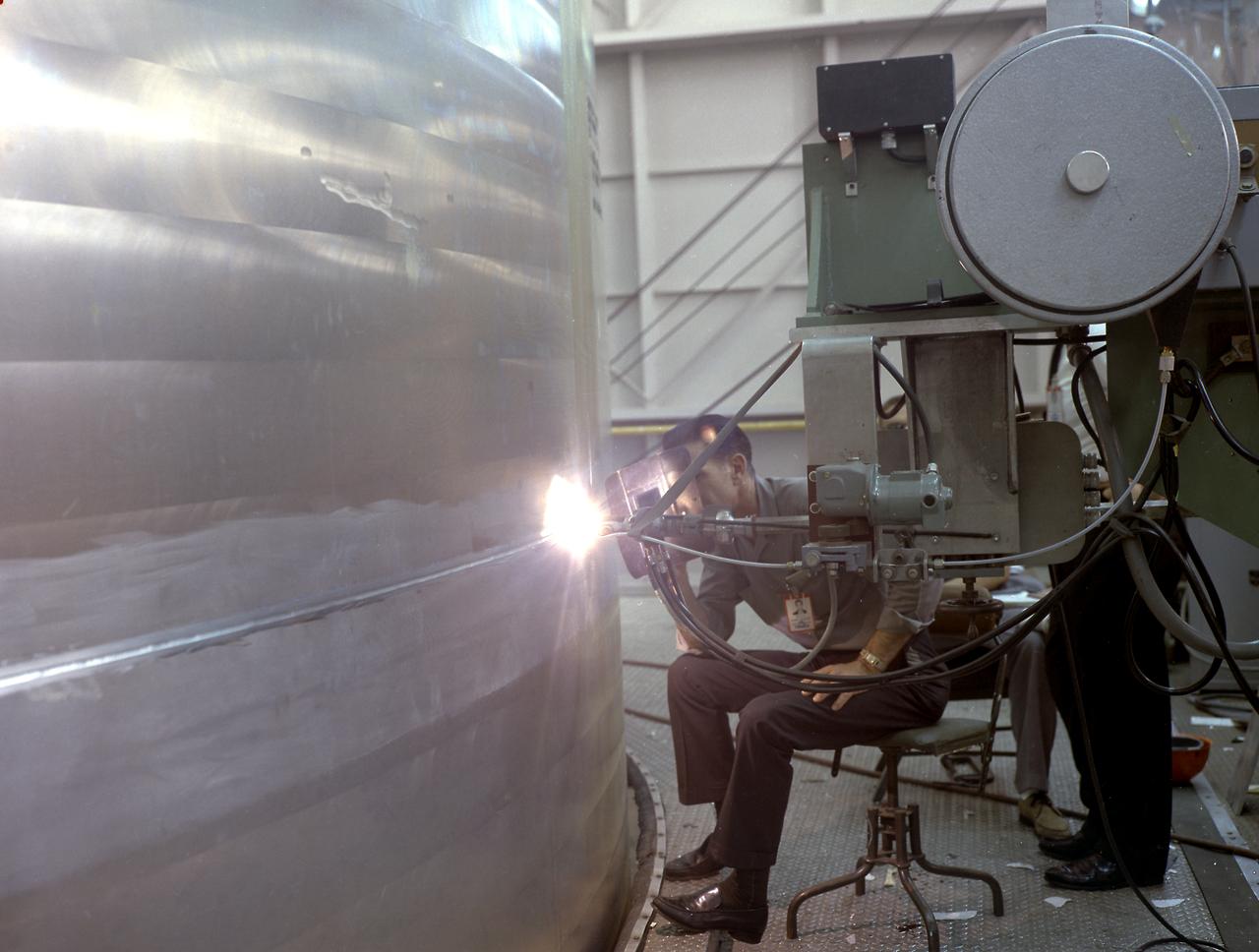
This photo shows the closeout welding operation of the liquid oxygen (LOX) tank for the Saturn V SA-501 vehicle for the Apollo 4 mission.

S67-36022 (20 June 1967) --- Apollo Spacecraft 017 is moved into position in the Vehicle Assembly Building's high bay area for mating with the Saturn V launch vehicle. S/C 017 will be flown on the Spacecraft 017/Saturn 501 (Apollo 4) space mission.

AS04-01-750 (9 Nov. 1967) --- Atlantic Ocean, Antarctica, looking west, as photographed from the Earth-orbital Apollo 4 (Spacecraft 017/Saturn 501) unmanned space mission. This picture was taken when the Spacecraft 017 and the Saturn S-IVB (third) stage was orbiting Earth at an altitude of 8,628 nautical miles.

S67-49447 (9 Nov. 1967) --- Close-up view of the charred heat shield of the Apollo Spacecraft 017 Command Module aboard the USS Bennington. The damage was caused by the extreme heat of reentry. The carrier Bennington was the prime recovery ship for the Apollo 4 (Spacecraft 017/Saturn 501) unmanned, Earth-orbital space mission. Splashdown occurred at 3:37 p.m. (EST), Nov. 9, 1967, 934 nautical miles northwest of Honolulu, Hawaii.
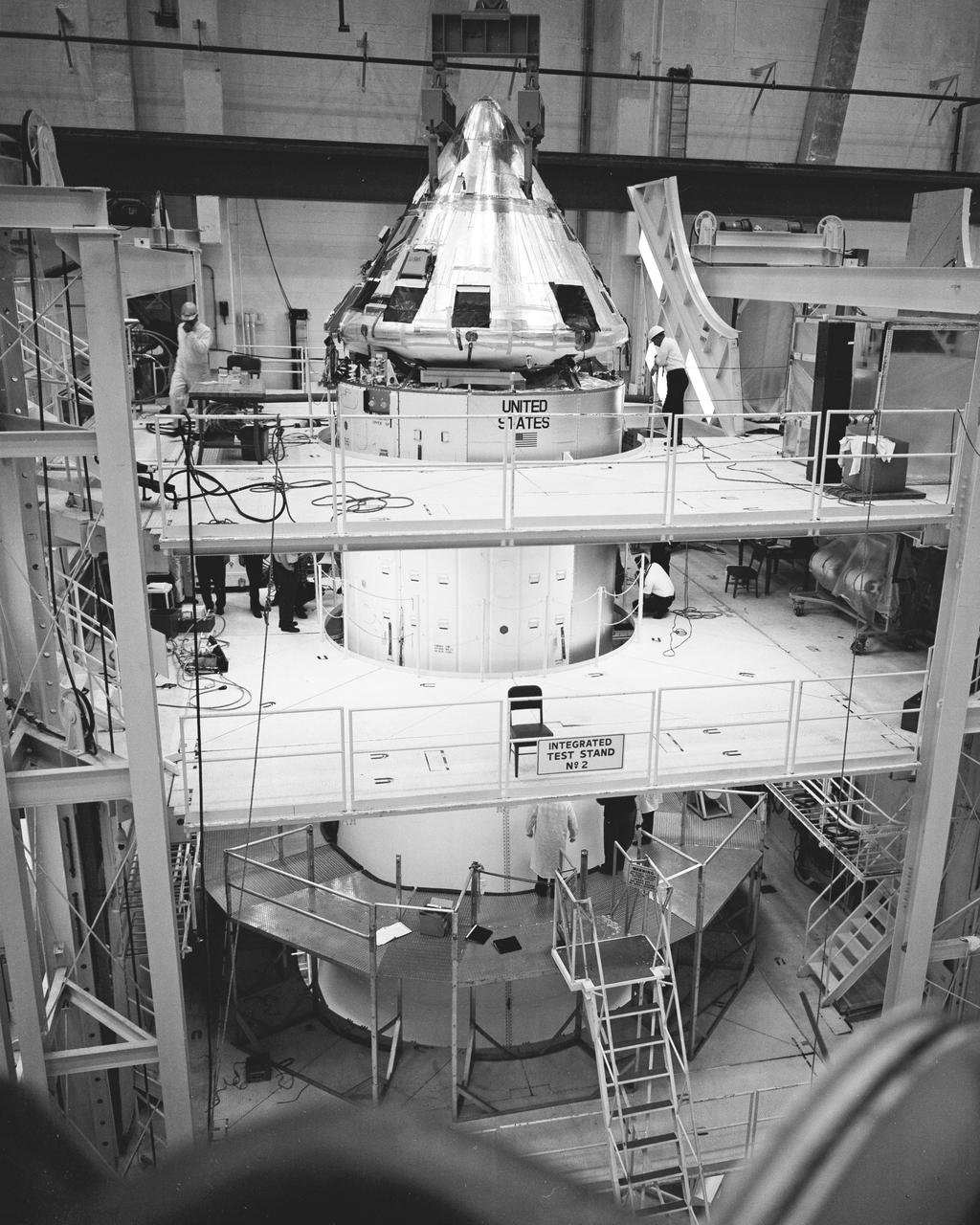
The Apollo/Saturn 501 spacecraft undergoes checkout in test stand within the Kennedy Space Center’s Manned Spacecraft Operations Building in preparation for the first flight of NASA’s Saturn V space vehicle in the second quarter of this year. The command module, top, was mated to the service module, and both were joined to the Spacecraft Lunar Module Adapter, the type that eventually will house a Lunar Module. The first Saturn V flight will be unmanned.

AS04-01-410 (9 Nov. 1967) --- Coastal Brazil, Atlantic Ocean, West Africa, Sahara, Antarctica, looking west, as photographed from the Apollo 4 (Spacecraft 017/Saturn 501) unmanned, Earth-orbital space mission. This picture was taken when the Spacecraft 017 and Saturn S-IVB (third) stage were orbiting Earth at an altitude of 9,745 nautical miles.

AS04-01-200 (9 Nov. 1967) --- Coastal Brazil, Atlantic Ocean, West Africa, Sahara, looking northwest, as photographed from the unmanned Apollo 4 (Spacecraft 017/Saturn 501) earth-orbital space mission. This picture was taken when the Spacecraft 017 and the Saturn IVB stage were orbiting Earth at an altitude of 9,060 nautical miles.

S67-49423 (9 Nov. 1967) --- The Apollo Spacecraft 017 Command Module, with flotation collar still attached, is hoisted aboard the USS Bennington, prime recovery ship for the Apollo 4 (Spacecraft 017/Saturn 501) unmanned, Earth-orbital space mission. The Command Module splashed down at 3:37 p.m. (EST), Nov. 9, 1967, 934 nautical miles northwest of Honolulu, Hawaii, in the mid-Pacific Ocean. Note charred heat shield caused by extreme heat of reentry.
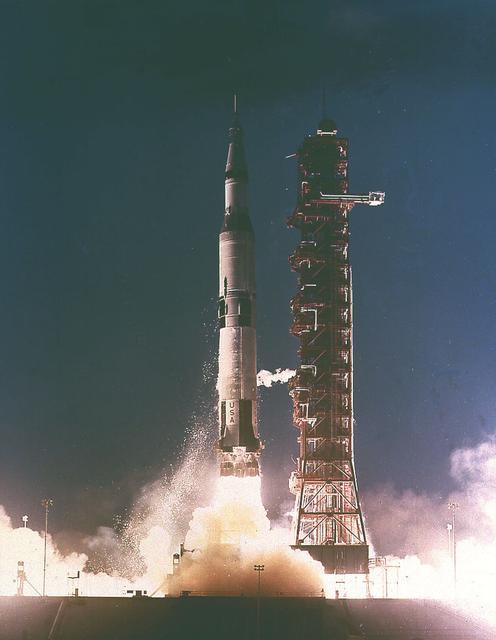
AS-501, the first flight of the Saturn V launch vehicle, takes flight from Kennedy Space Center's Launch Pad 39A on November 9, 1967. The unmanned mission, also designated Apollo 4, marked the first test flight of the S-IC and S-II stages, developed for the Saturn program under the direction of the Marshall Space Flight Center.
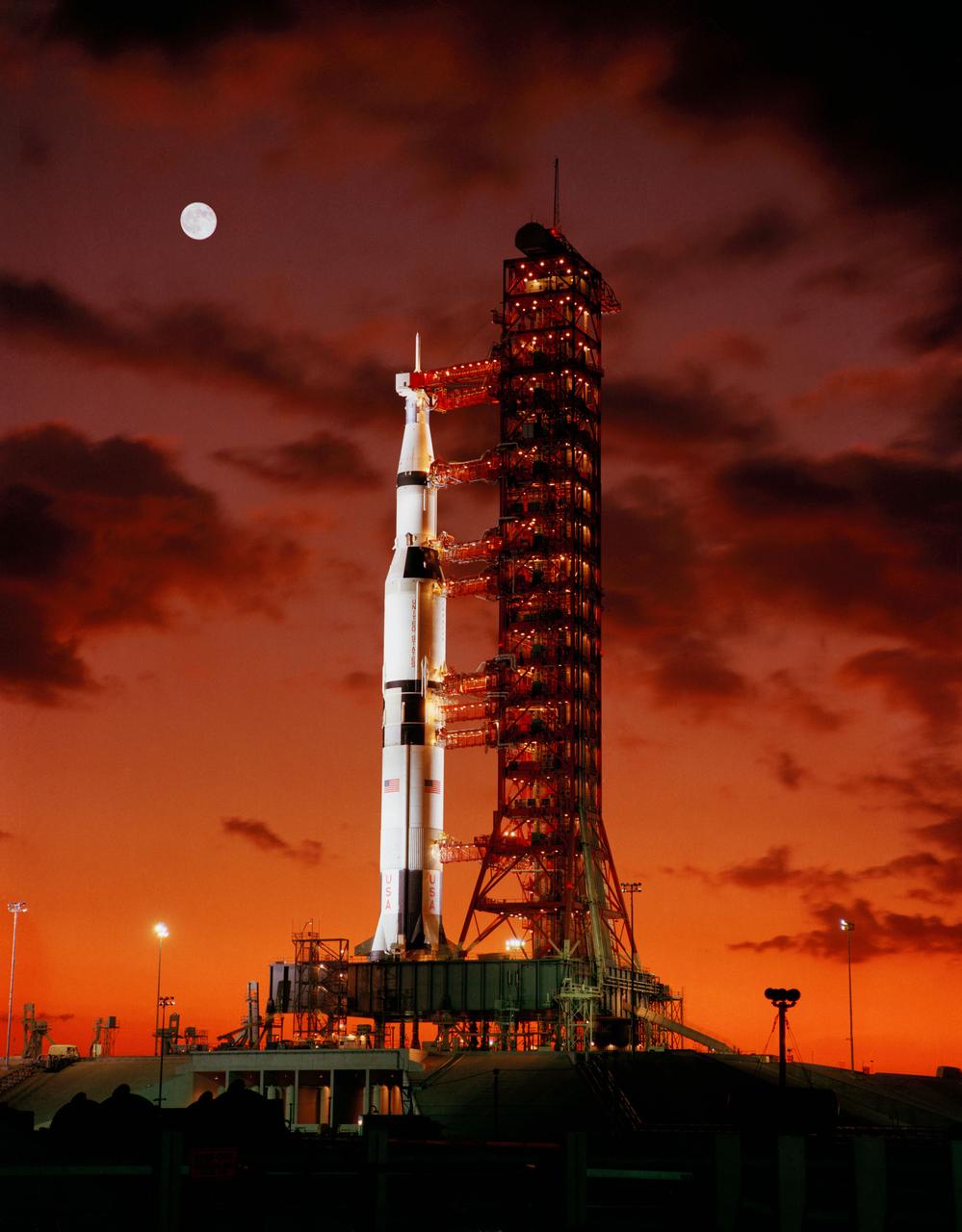
Early morning view of Pad A, Launch Complex 39, Kennedy Space Center, showing Apollo 4 (Spacecraft 017/Saturn 501) unmanned, earth-orbital space mission ready for launch, with a full moon in the upper left part of the image. The 363-foot tall Apollo/Saturn V space vehicle was launched at 7:00:01 AM (EST), November 9, 1967.

This photograph depicts the Saturn V vehicle (SA-501) for the Apollo 4 mission in the Vehicle Assembly Building (VAB) at the Kennedy Space Center (KSC). After the completion of the assembly operation, the work platform was retracted and the vehicle was readied to rollout from the VAB to the launch pad. The Apollo 4 mission was the first launch of the Saturn V launch vehicle. Objectives of the unmanned Apollo 4 test flight were to obtain flight information on launch vehicle and spacecraft structural integrity and compatibility, flight loads, stage separation, and subsystems operation including testing of restart of the S-IVB stage, and to evaluate the Apollo command module heat shield. The Apollo 4 was launched on November 9, 1967 from KSC.
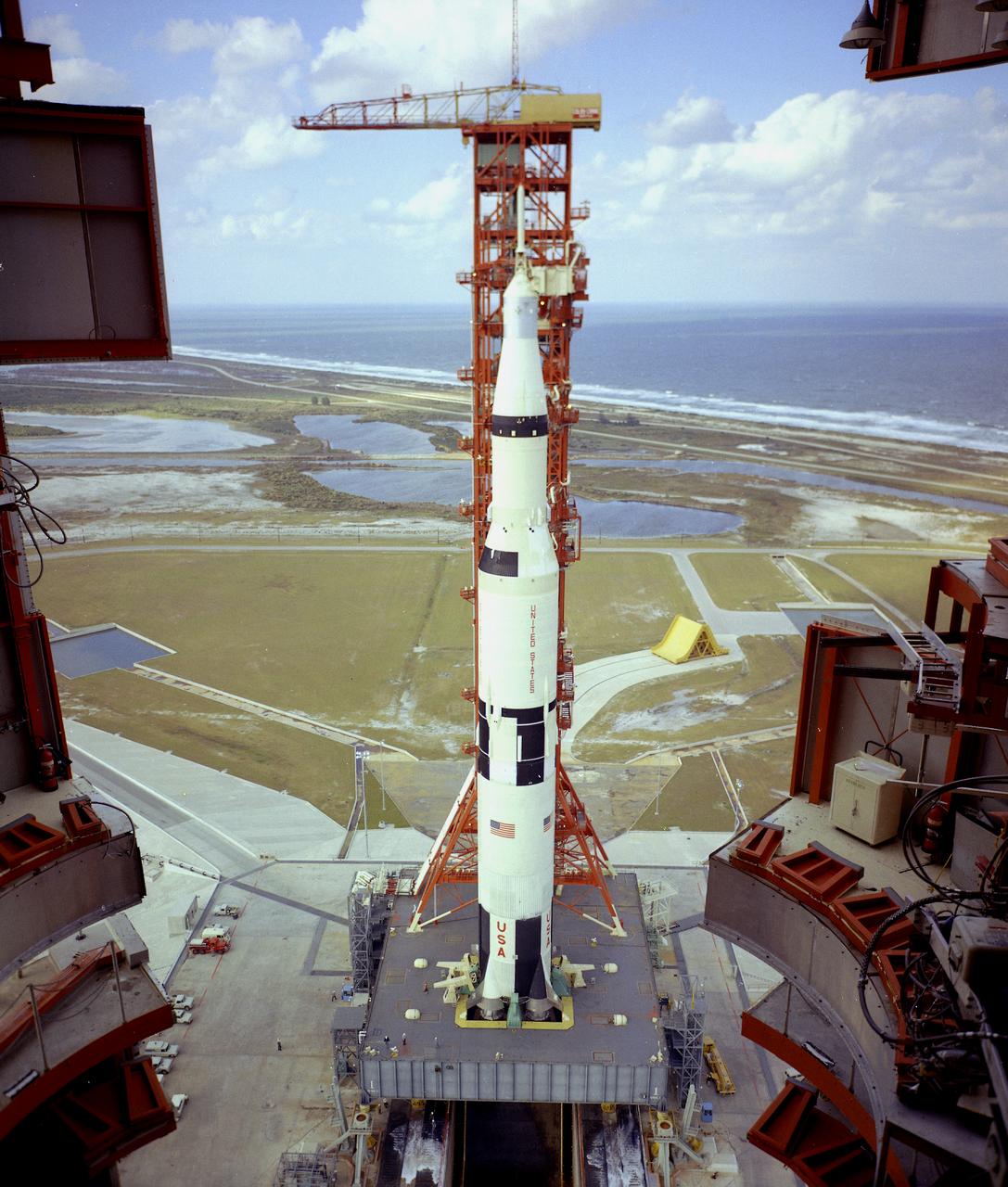
This is a view of the the first test flight of the Saturn V vehicle (SA-501) at the Kennedy Space Center (KSC) launch complex 39A. The thrust chambers of the first stage's five engines extend into the 45-foot-square hole in the mobile launcher platform. Until liftoff, the flames impinged downward onto a flame deflector that diverted the blast lengthwise in the flame trench. Here, a flame deflector, coated with a black ceramic, is in place below the opening, while a yellow (uncoated) spare deflector rests on its track in the background. It took a tremendous flow of water (28,000 gallons per minute) to cool the flame deflector and trench. The Apollo 4 was launched on November 9, 1967 from KSC.
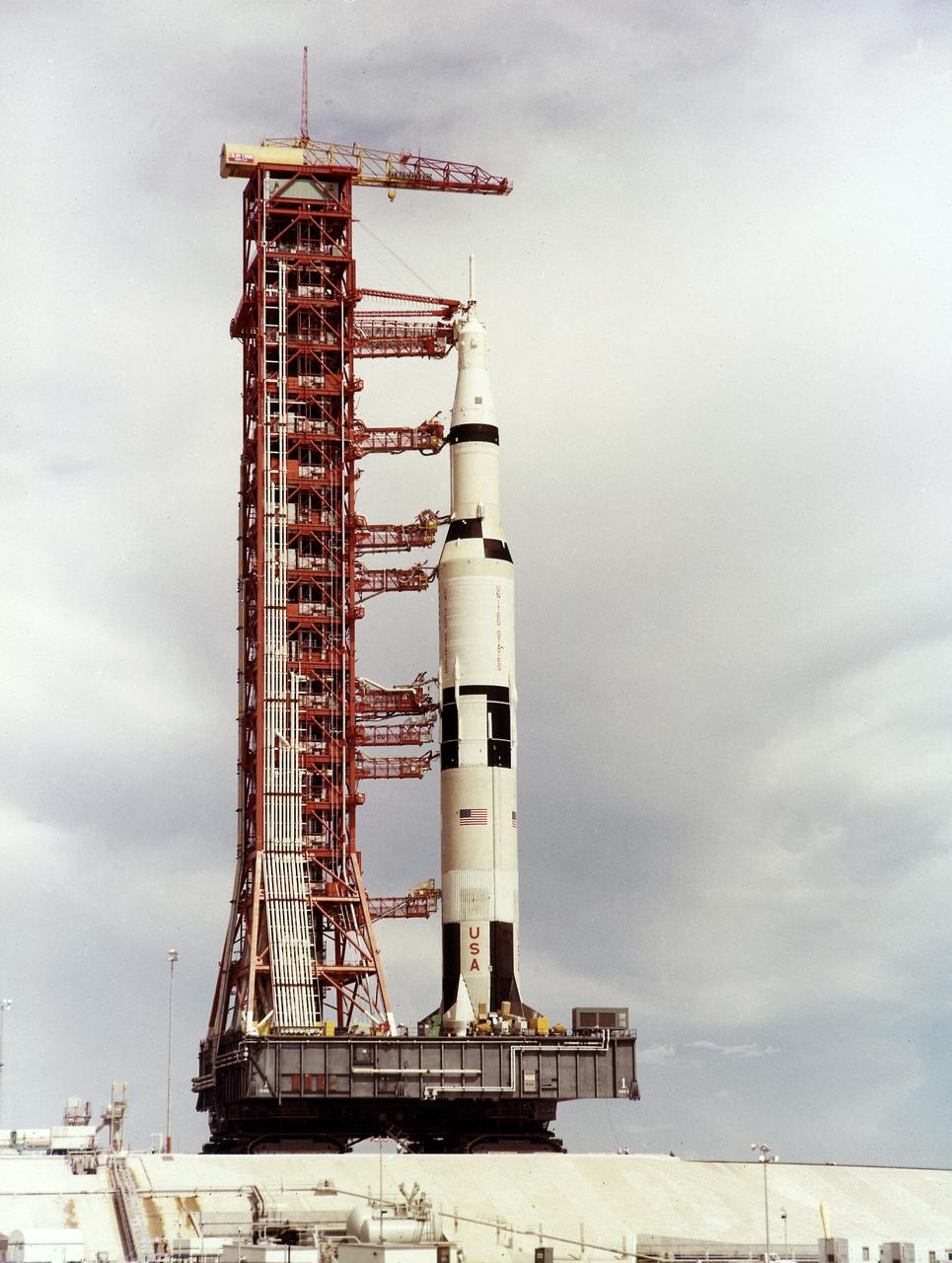
This is a view of the the first test flight of the Saturn V vehicle (SA-501) at the Kennedy Space Center (KSC) launch complex 39A, awaiting the scheduled launch on November 9, 1967. Designated as Apollo 4, this mission was the first launch of the Saturn V launch vehicle. Objectives of the unmanned Apollo 4 test flight were to obtain flight information on launch vehicle and spacecraft structural integrity and compatibility, flight loads, stage separation, and subsystems operation including testing of restart of the S-IVB stage, and to evaluate the Apollo command module heat shield.

AS04-01-580 (9 Nov. 1967) --- Earth as viewed from 10,000 miles. In 1969, the Apollo 4 (Spacecraft 017/Saturn 501) unmanned test flight made a great ellipse around Earth as a test of the translunar motors and of the high speed entry required of a manned flight returning from the moon. A 70mm camera was programmed to look out a window toward Earth, and take a series of photographs from "high apogee". Coastal Brazil, Atlantic Ocean, West Africa, Antarctica, looking west. This photograph was made when the Apollo 4 spacecraft, still attached to the S-IVB (third) stage, was orbiting Earth at an altitude of 9,544 miles.
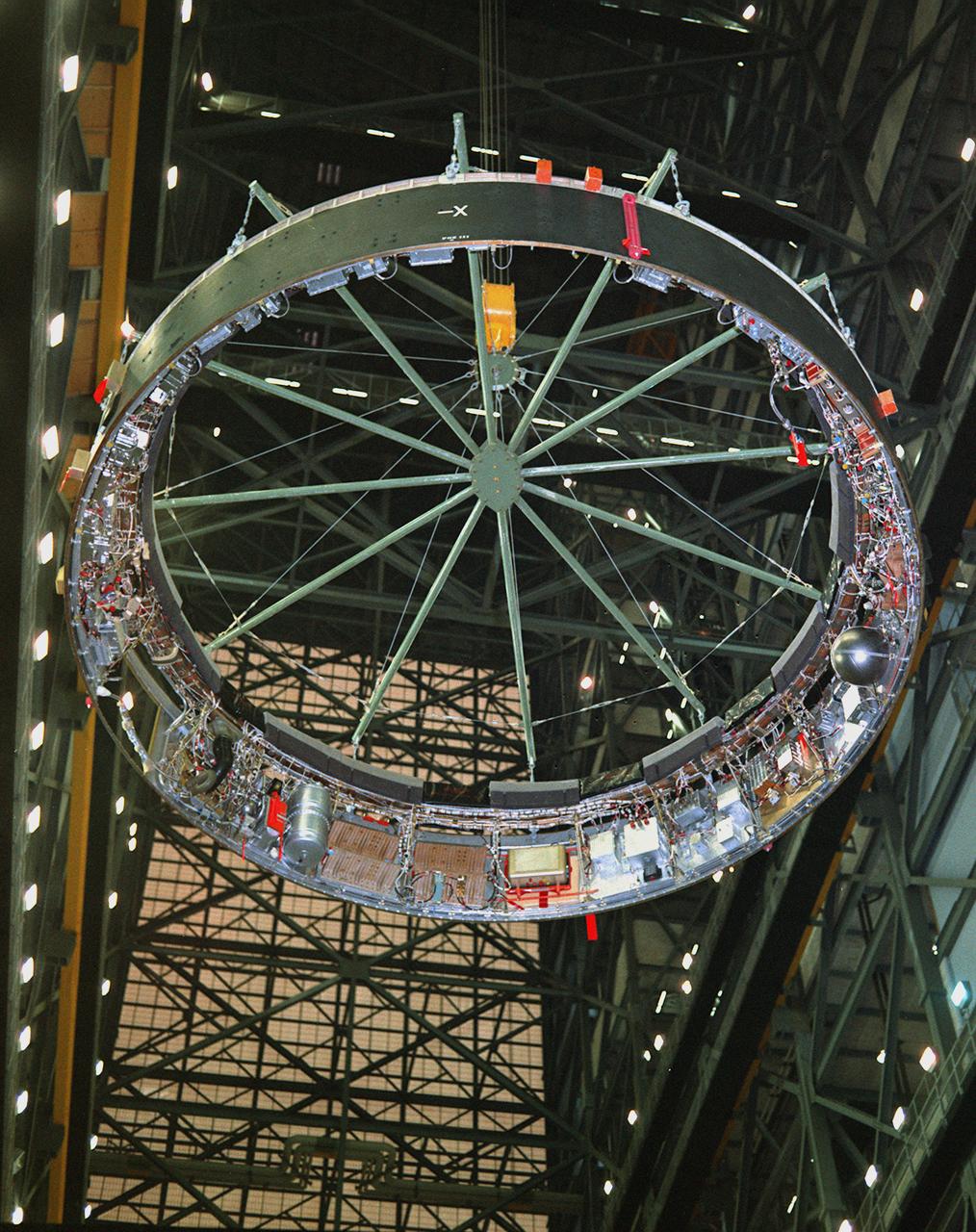
This photograph was taken during the final assembly operation of the Saturn V launch vehicle for the Apollo 4 (SA 501) mission. The instrument unit (IU) was hoisted to be mated to the S-IC/S-II assembly in the Vehicle Assembly Building high bay at the Kennedy Space Center. The Apollo 4 mission was the first launch of the Saturn V launch vehicle. Objectives of the unmanned Apollo 4 test flight were to obtain flight information on launch vehicle and spacecraft structural integrity and compatibility, flight loads, stage separation, and subsystems operation including testing of restart of the S-IVB stage, and to evaluate the Apollo command module heat shield. The Apollo 4 was launched on November 9, 1967 from KSC.
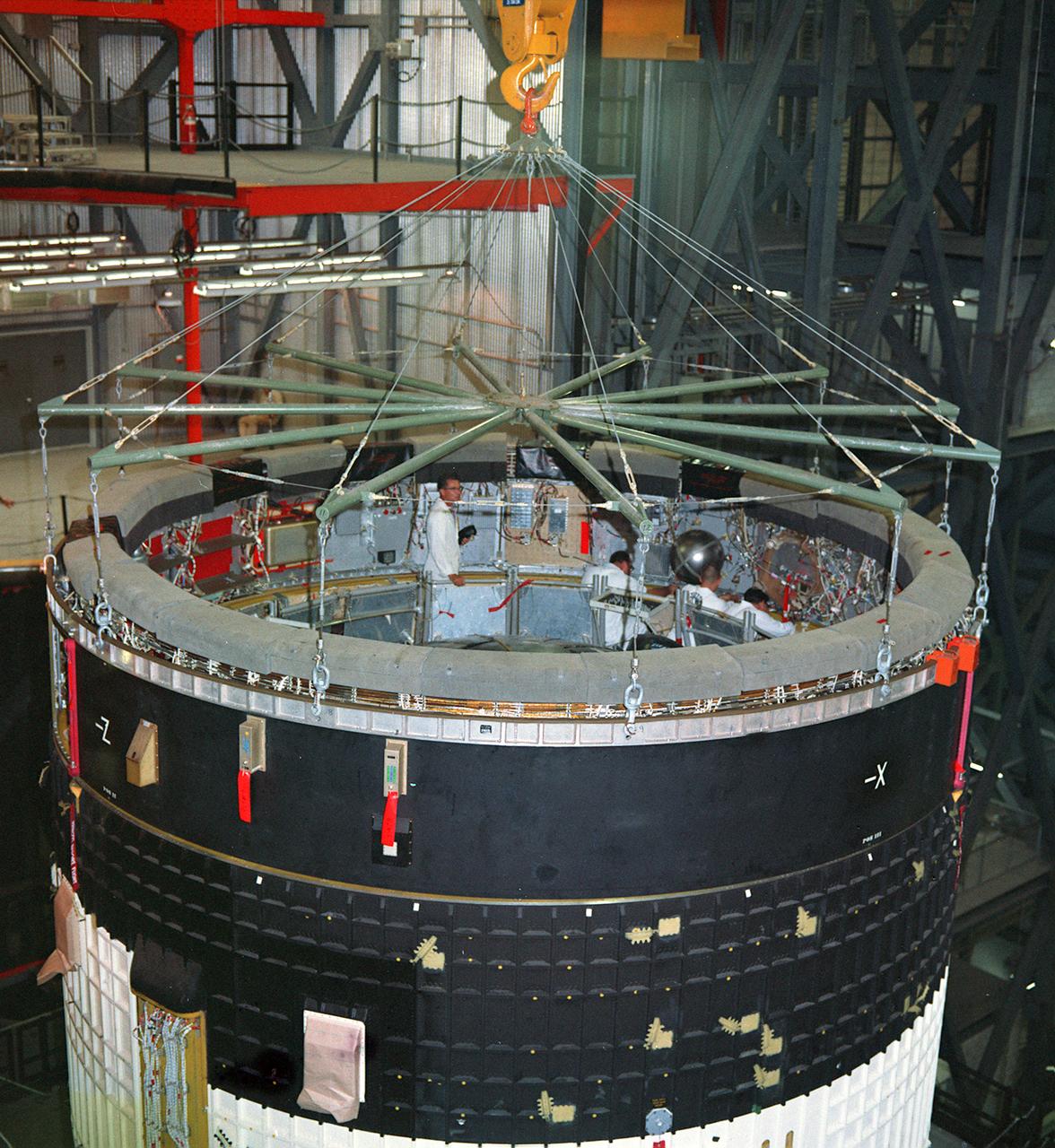
This photograph was taken during the final assembly operation of the Saturn V launch vehicle for the Apollo 4 (SA 501) mission. The instrument unit (IU) was mated atop the S-IC/S-II assembly in the Vehicle Assembly Building high bay at the Kennedy Space Center. The Apollo 4 mission was the first launch of the Saturn V launch vehicle. Objectives of the unmanned Apollo 4 test flight were to obtain flight information on launch vehicle and spacecraft structural integrity and compatibility, flight loads, stage separation, and subsystems operation including testing of restart of the S-IVB stage, and to evaluate the Apollo command module heat shield. The Apollo 4 was launched on November 9, 1967 from KSC.
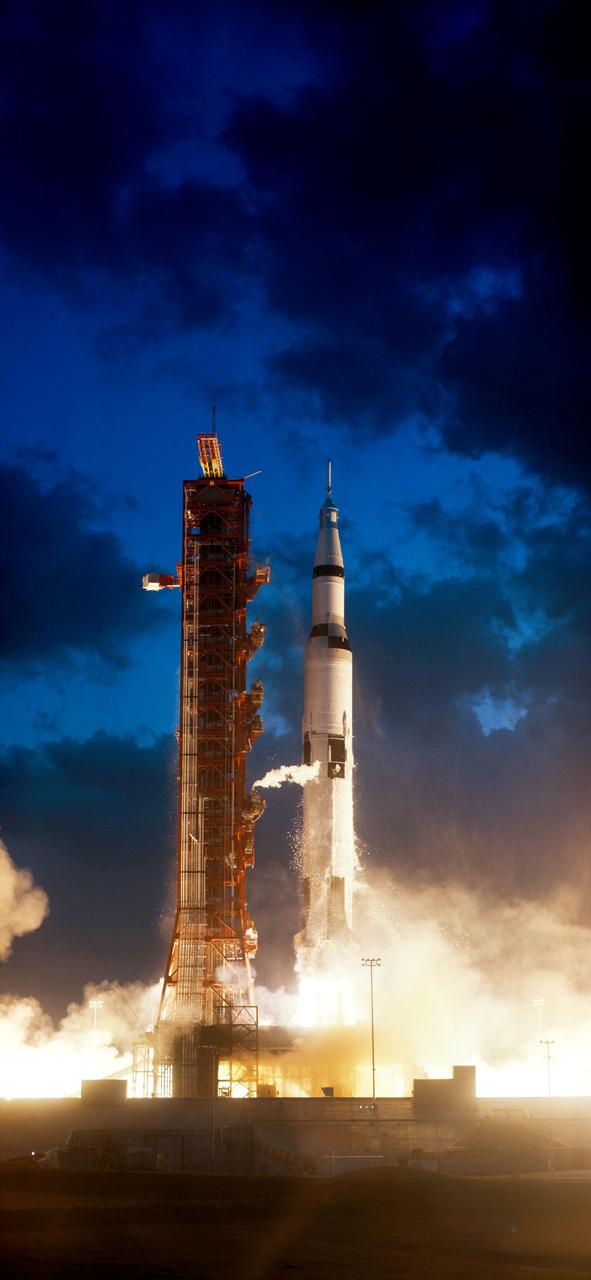
S67-50903 (9 Nov. 1967) --- The Apollo 4 (Spacecraft 017/Saturn 501) space mission was launched from Pad A, Launch Complex 39, Kennedy Space Center, Florida. The liftoff of the huge 363-feet tall Apollo/Saturn V space vehicle was at 7:00:01 a.m. (EST), Nov. 9, 1967. The successful objectives of the Apollo 4 Earth-orbital unmanned space mission obtained included (1) flight information on launch vehicle and spacecraft structural integrity and compatibility, flight loads, stage separation, subsystem operation, emergency detection subsystem, and (2) evaluation of the Apollo Command Module heat shield under conditions encountered on return from a moon mission.

S67-49969 (9 Nov. 1967) --- The Apollo 4 (Spacecraft 017/Saturn 501) space mission was launched from Pad A, Launch Complex 39, Kennedy Space Center, Florida. The liftoff of the huge 363-feet tall Apollo/Saturn V space vehicle was at 7:00:01 a.m. (EST), Nov. 9, 1967. The successful objectives of the Apollo 4 Earth-orbital unmanned space mission obtained included (1) flight information on launch vehicle and spacecraft structural integrity and compatibility, flight loads, stage separation, subsystem operation, emergency detection subsystem operation, and (2) evaluation of the Apollo Command Module heat shield under conditions encountered on return from a moon mission.