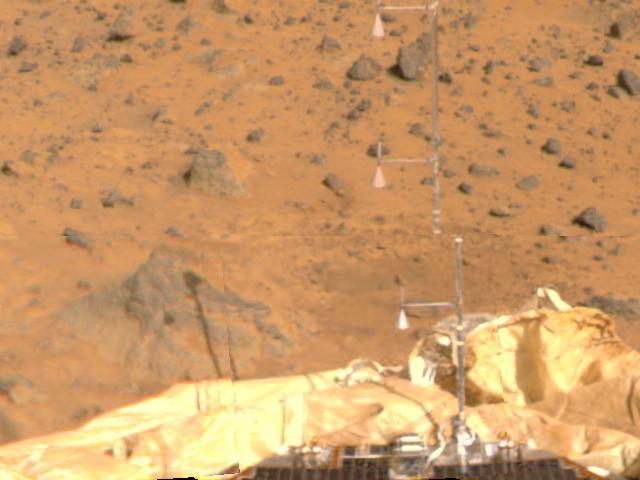
ASI/MET
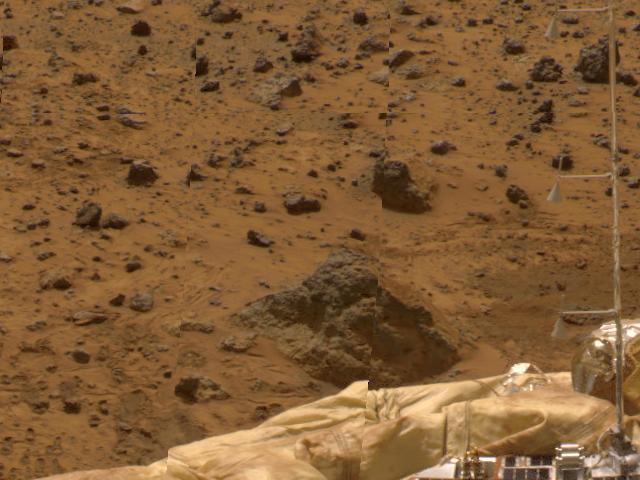
ASI/MET Mast
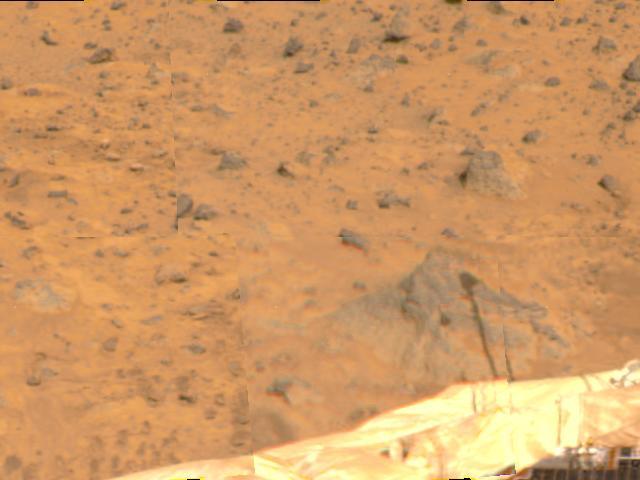
ASI/MET Shadow & Airbags
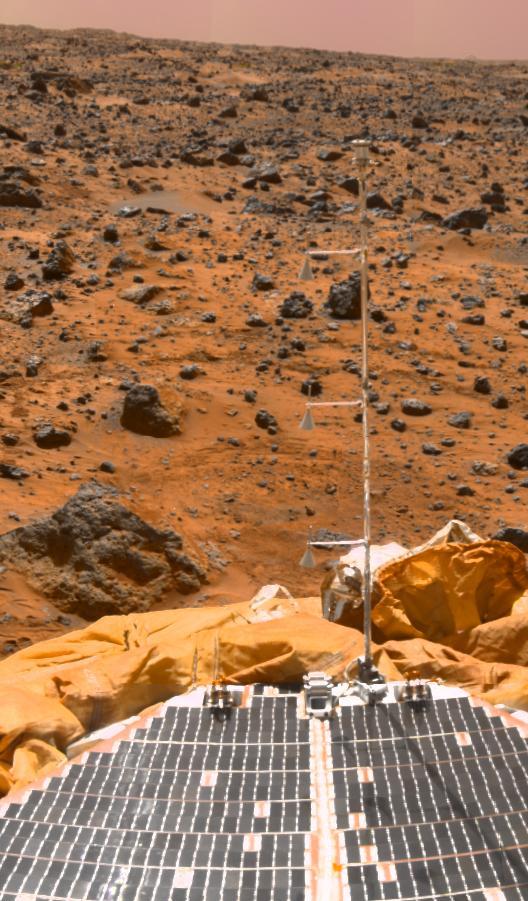
ASI/MET Mast
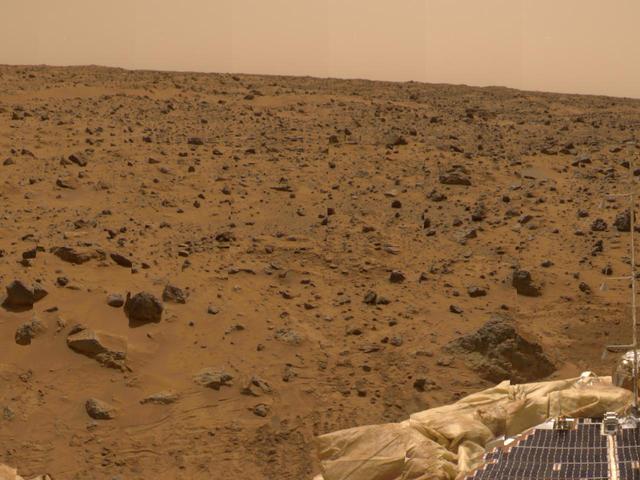
Airbag and ASI/MET Instrument in 360-degree Panorama
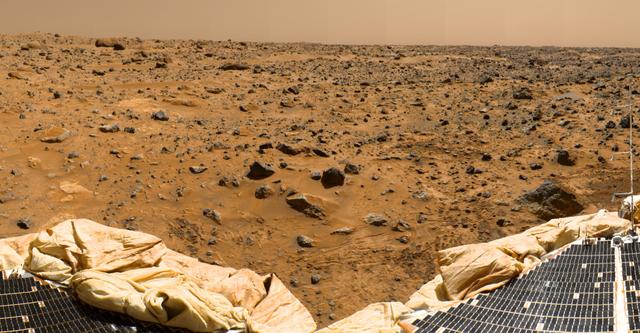
ASI/MET Within Color-Enhanced Panorama
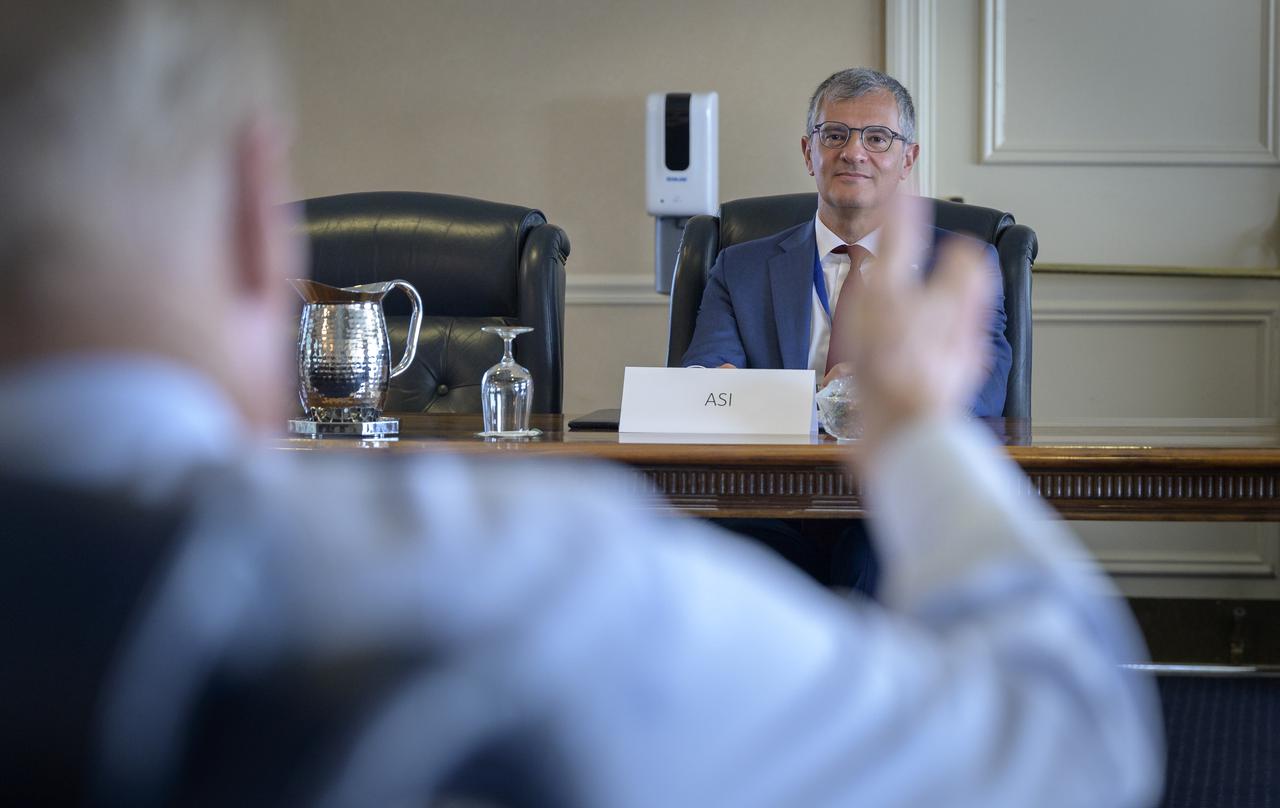
Giorgio Saccoccia, President, Italian Space Agency (ASI) listens to NASA Administrator Bill Nelson in a bilateral meeting during the 36th Space Symposium, Tuesday, Aug. 24, 2021, in Colorado Springs, Colorado. Photo Credit: (NASA/Bill Ingalls)
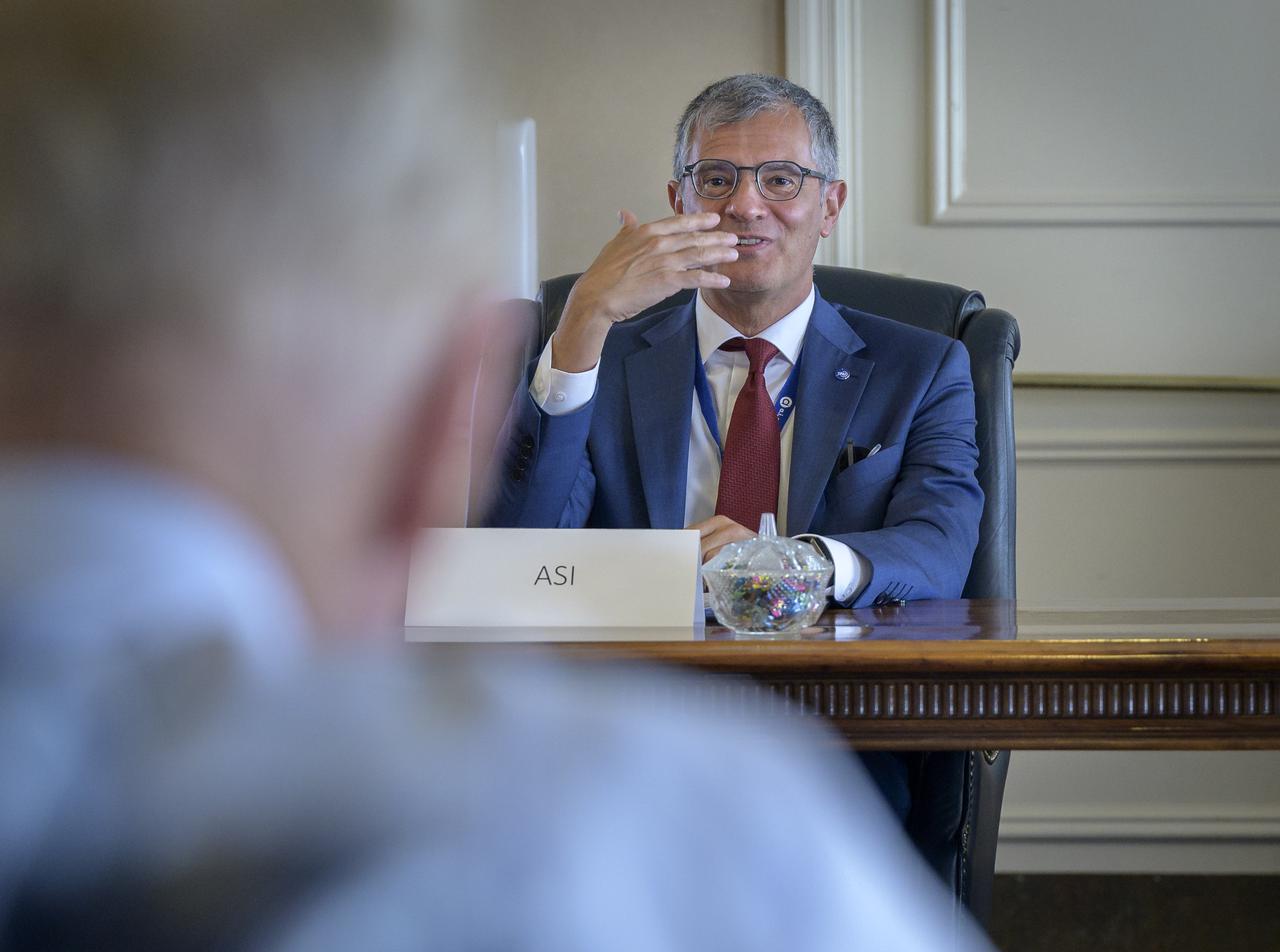
Giorgio Saccoccia, President, Italian Space Agency (ASI) talks with NASA Administrator Bill Nelson in a bilateral meeting during the 36th Space Symposium, Tuesday, Aug. 24, 2021, in Colorado Springs, Colorado. Photo Credit: (NASA/Bill Ingalls)
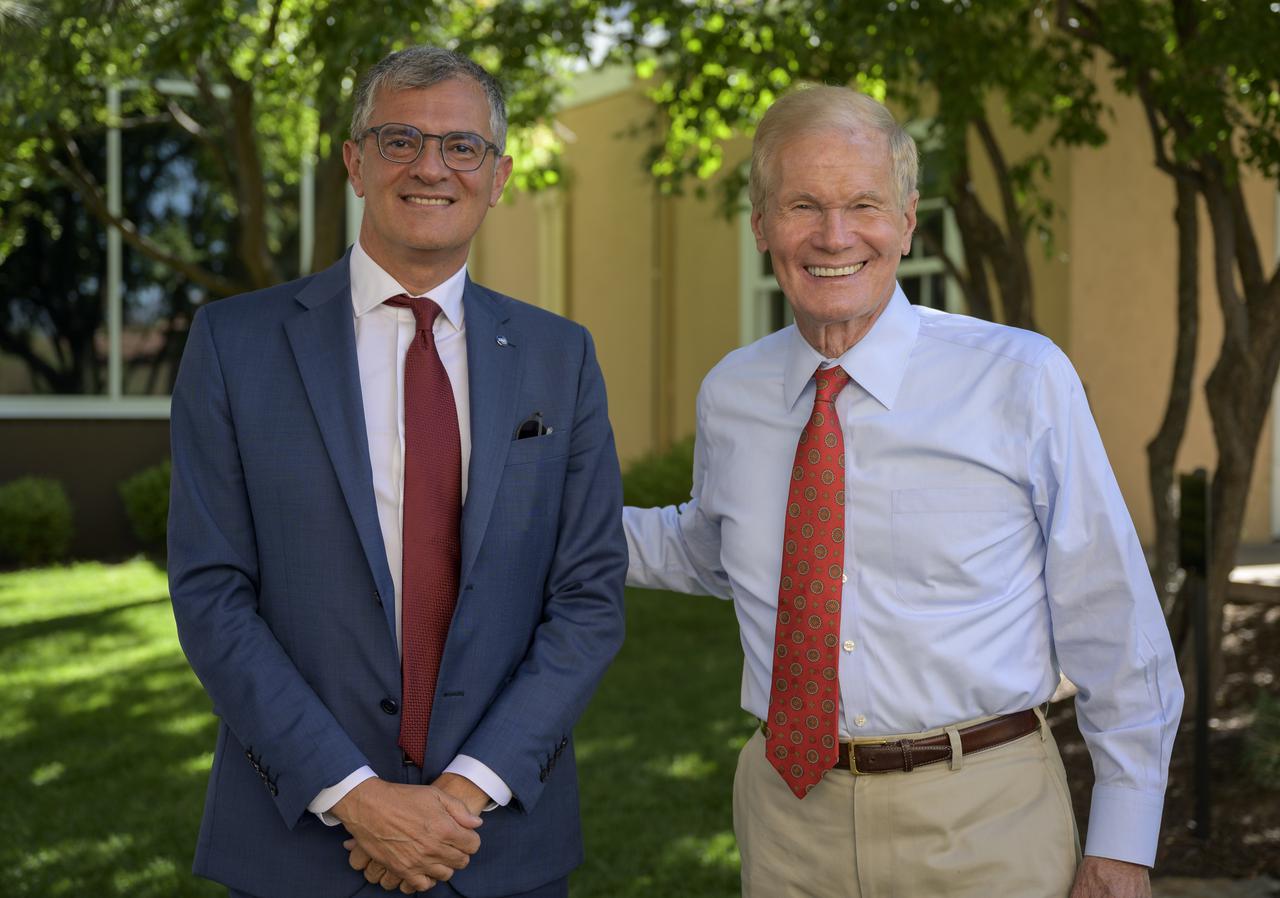
NASA Administrator Bill Nelson, right, meets with Giorgio Saccoccia, President, Italian Space Agency (ASI) in a bilateral meeting during the 36th Space Symposium, Tuesday, Aug. 24, 2021, in Colorado Springs, Colorado. Photo Credit: (NASA/Bill Ingalls)

NASA Administrator Bill Nelson meets with Giorgio Saccoccia, President, Italian Space Agency (ASI) in a bilateral meeting during the 36th Space Symposium, Tuesday, Aug. 24, 2021, in Colorado Springs, Colorado. Photo Credit: (NASA/Bill Ingalls)
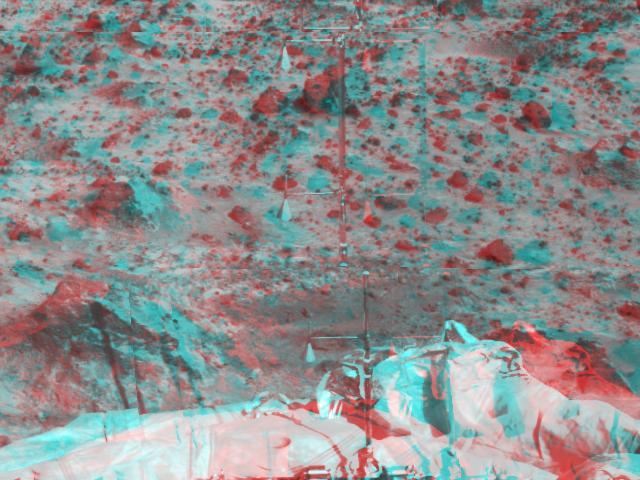
The Atmospheric Structure Instrument/Meteorology Package ASI/MET is the mast and windsocks at the center of this stereo image from NASA Mars Pathfinder. 3D glasses are necessary to identify surface detail.
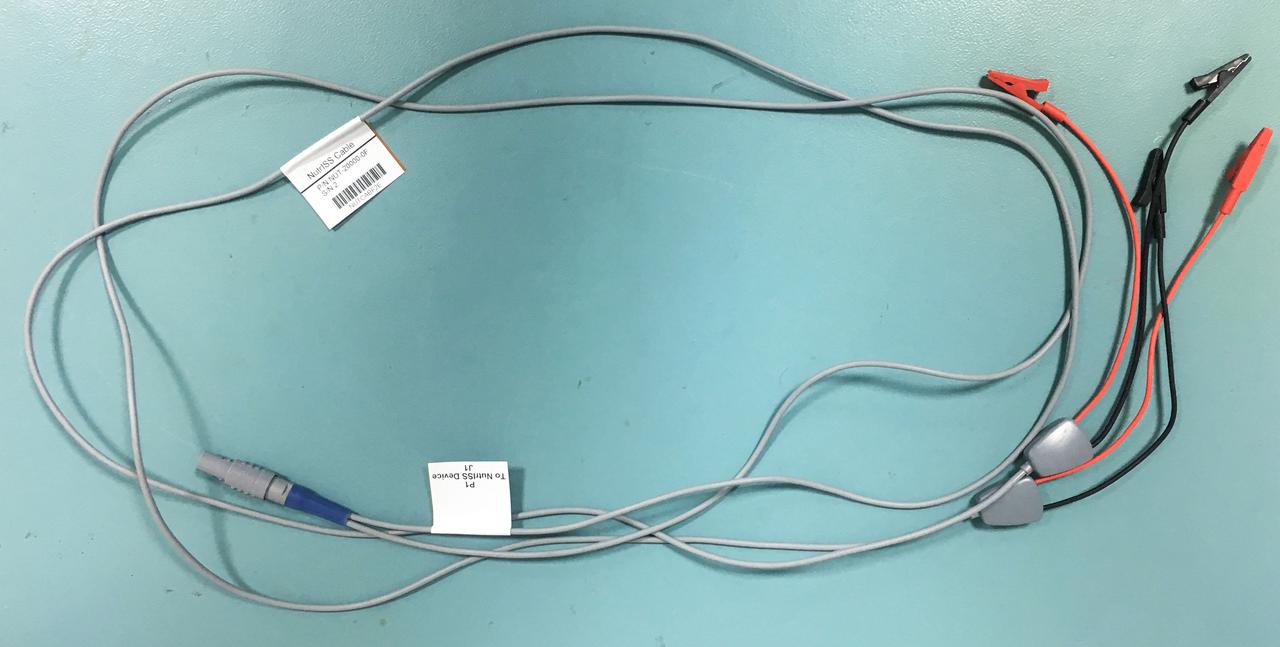
jsc2021e009424 (1/15/2019) --- A preflight view of cables for Nutrition Monitoring for the International Space Station (NutrISS) Device. Image courtesy of the Italian Space Agency (ASI).
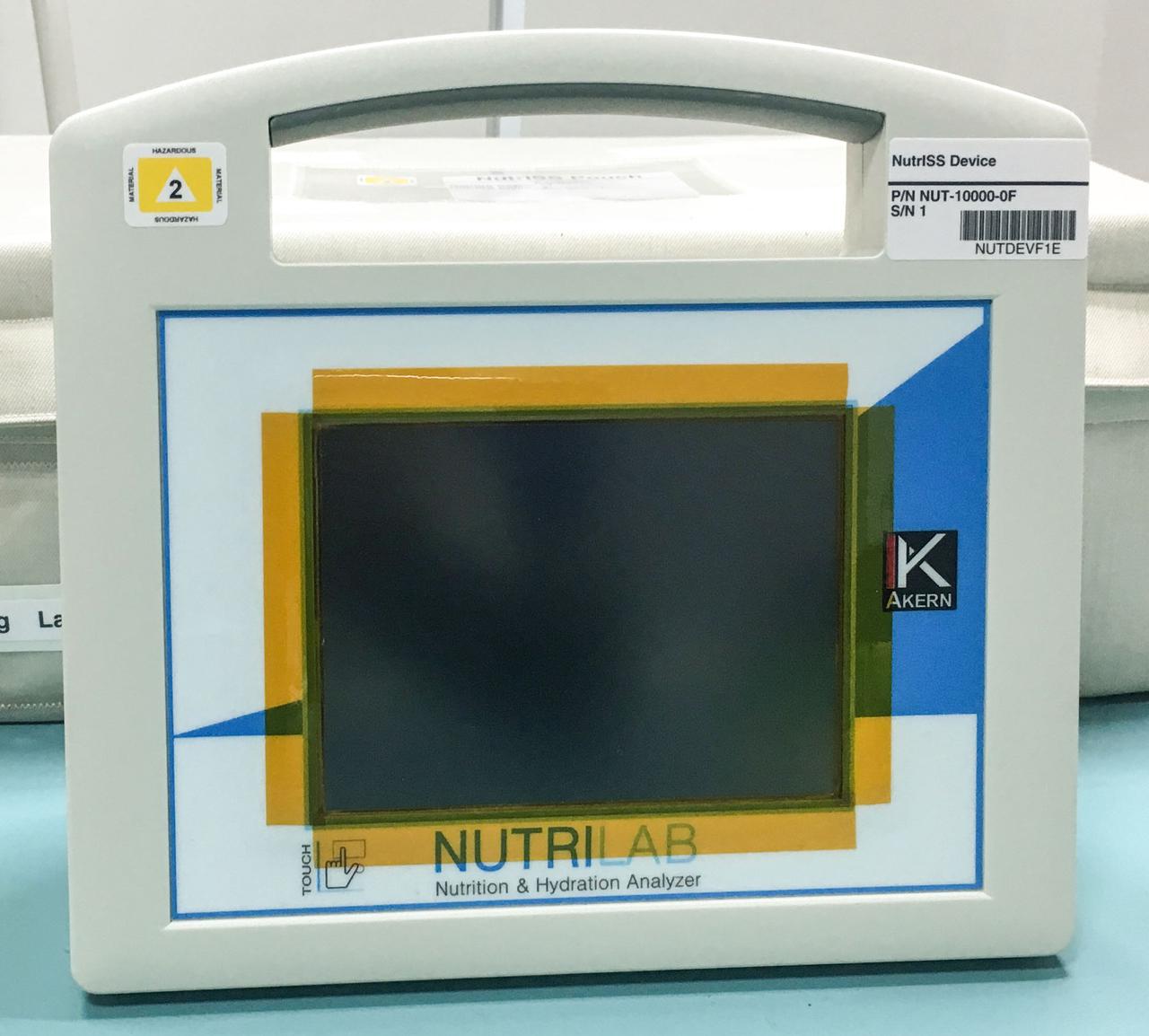
jsc2021e009425 (1/15/2019) --- A preflight front the view of the Nutrition Monitoring for the International Space Station (NutrISS) Device. Image courtesy of the Italian Space Agency (ASI).

jsc2021e009426 (1/15/2019) --- A preflight view of the bag containing Nutrition Monitoring for the International Space Station (NutrISS) electrodes. Image courtesy of the Italian Space Agency (ASI).
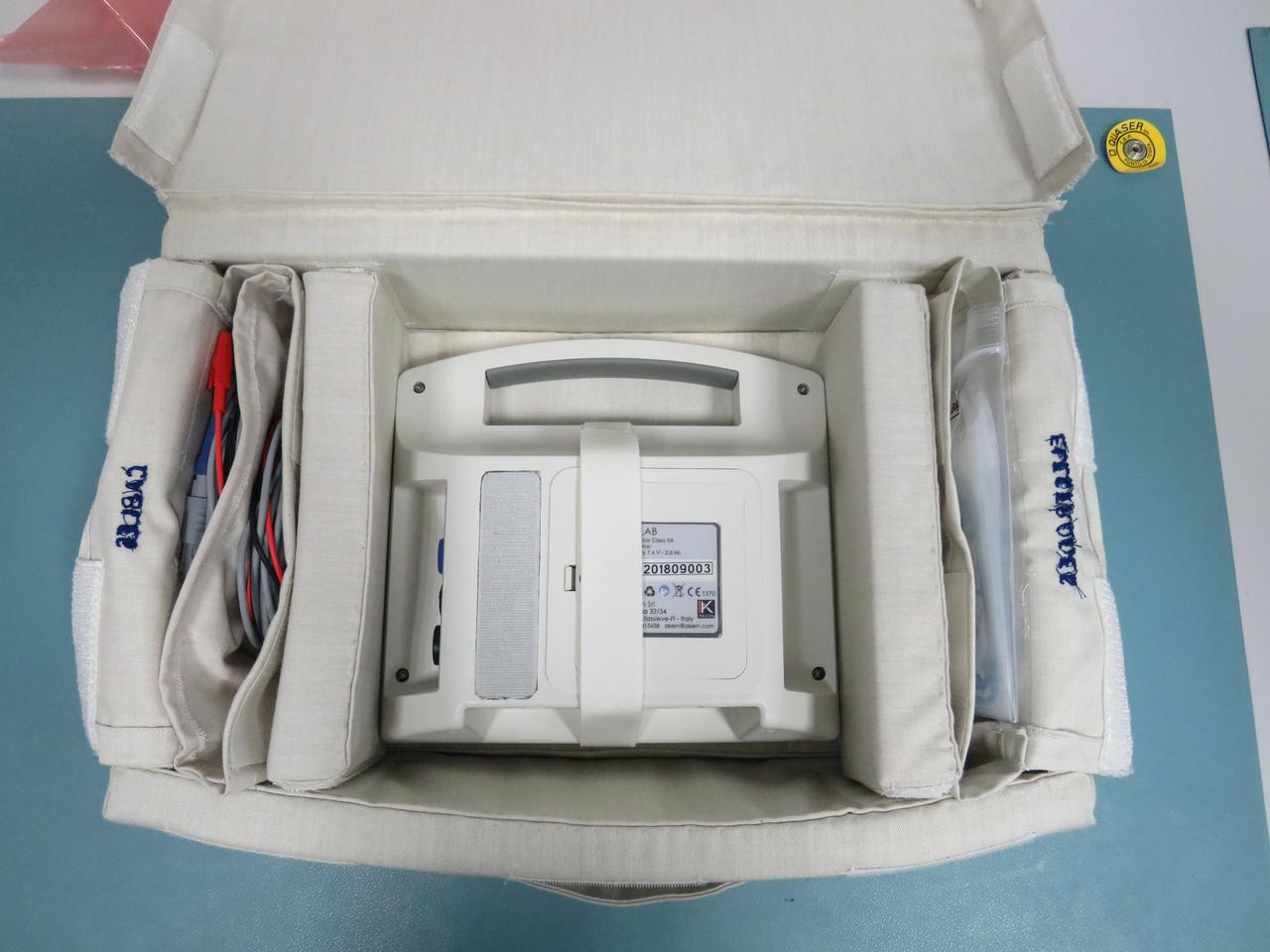
jsc2021e009427 (1/23/2019) --- A preflight view of Nutrition Monitoring for the International Space Station (NutrISS) inside its pouch. Image courtesy of the Italian Space Agency (ASI).
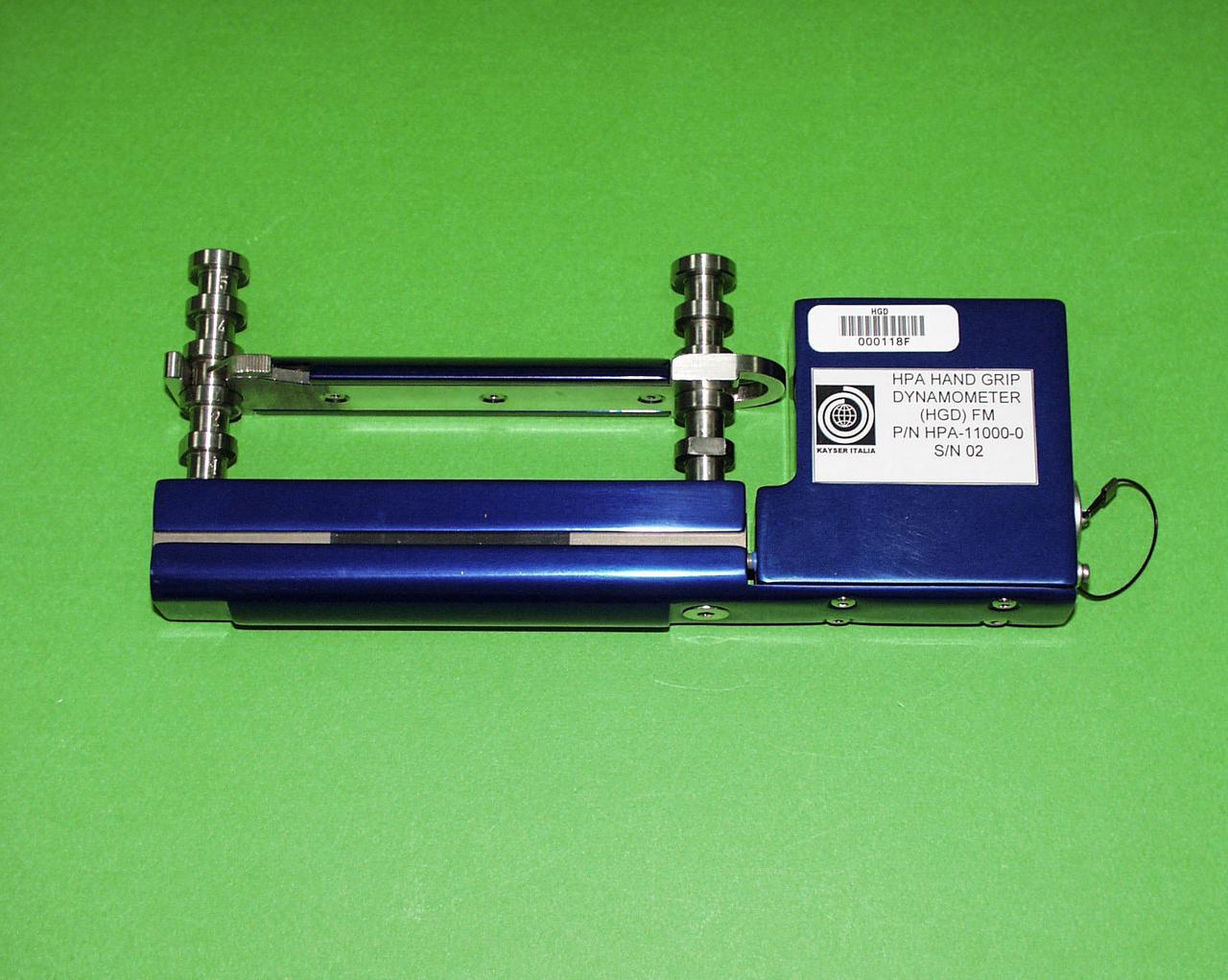
jsc2021e009414 (8/12/20020 --- A preflight view of theHand Posture Analyzer (HPA) Hand Grip Dynamometer (HGD). The Hand Posture Analyzer (HPA) facility helps to examine the way hand and arm muscles are used differently aboard the International Space Station (ISS). Image courtesy of the Italian Space Agency (ASI).
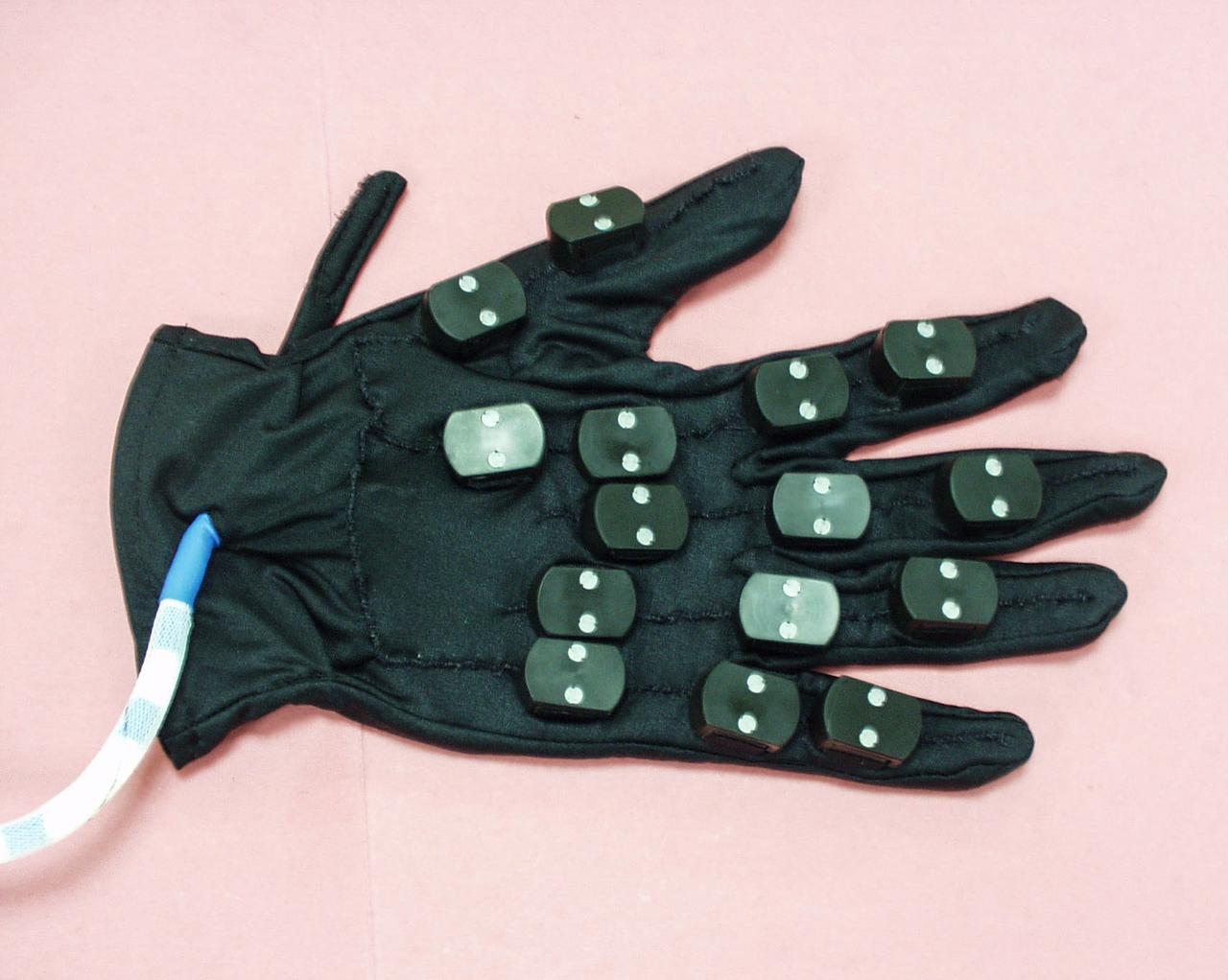
jsc2021e009416 (7/15/2002) --- A preflight view of the Hand Posture Analyzer (HPA) Posture Acquisition Glove (PAG). The Hand Posture Analyzer (HPA) facility helps to examine the way hand and arm muscles are used differently aboard the International Space Station (ISS). Image courtesy of the Italian Space Agency (ASI).
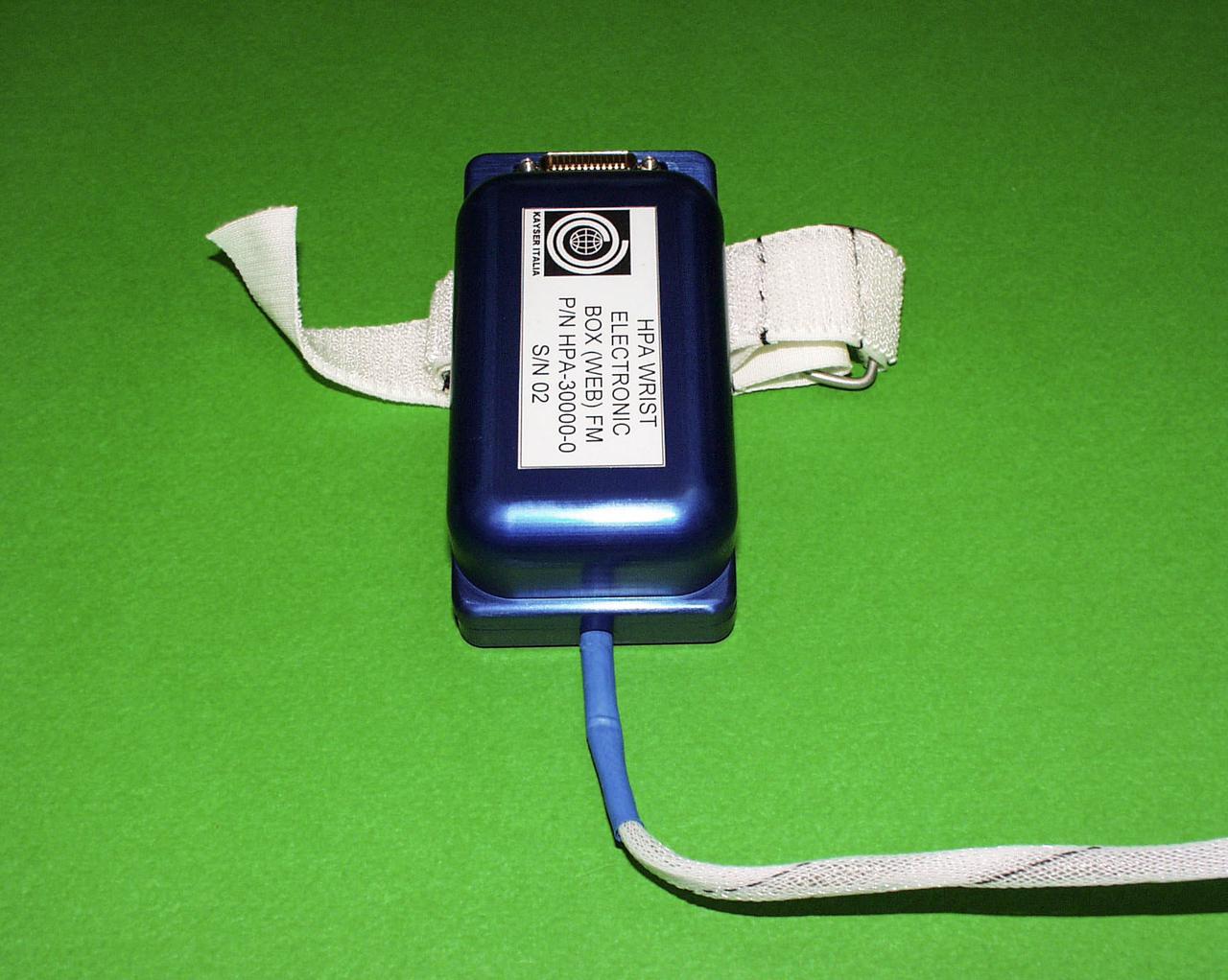
jsc2021e009418 (8/12/2002) --- A preflight view of theHand Posture Analyzer (HPA) Wrist Electronic Box (WEB). The Hand Posture Analyzer (HPA) facility helps to examine the way hand and arm muscles are used differently aboard the International Space Station (ISS). Image courtesy of the Italian Space Agency (ASI).
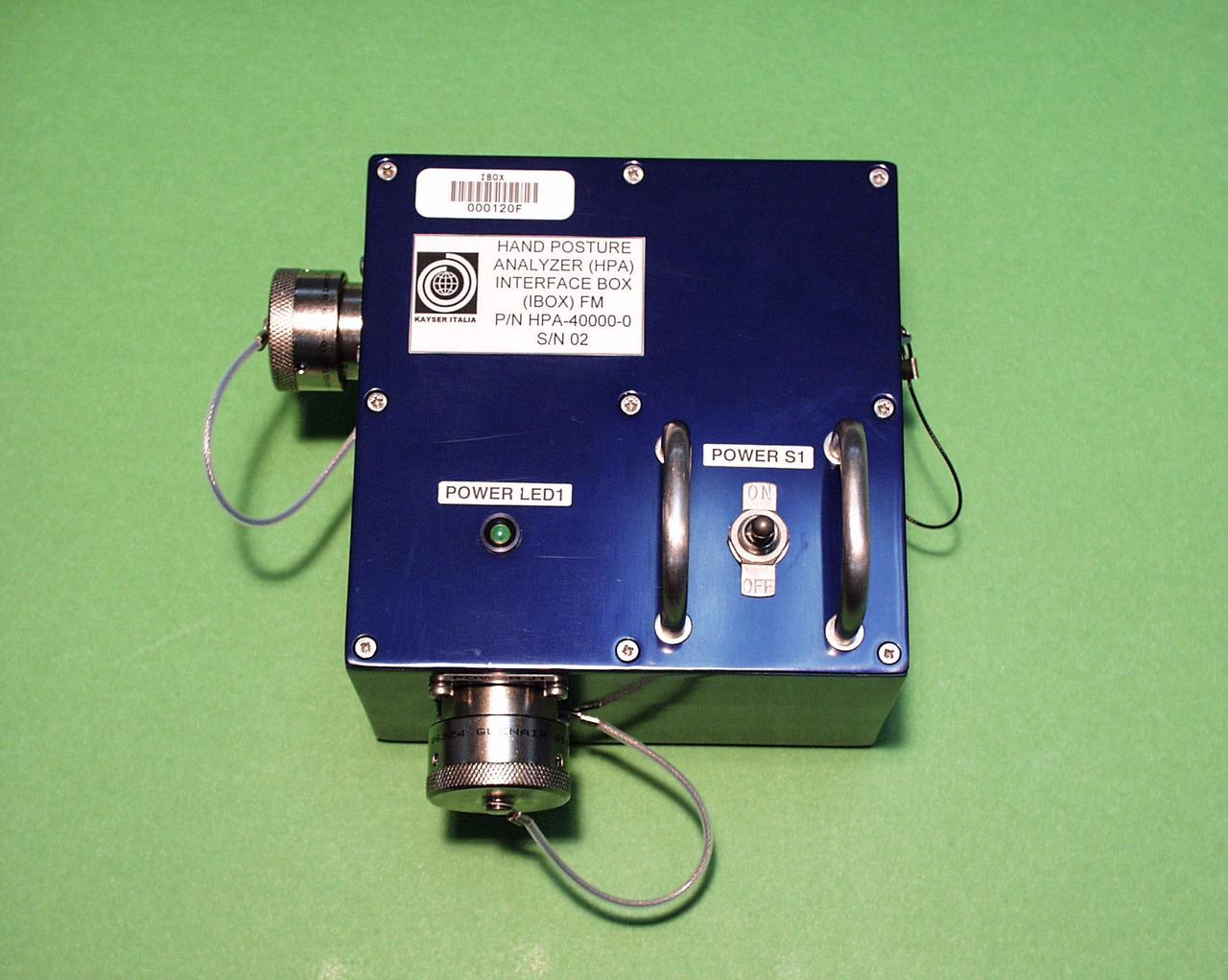
jsc2021e009415 (8/13/2002) --- A preflight view of the Hand Posture Analyzer (HPA) Interface Box (IBOX). The Hand Posture Analyzer (HPA) facility helps to examine the way hand and arm muscles are used differently aboard the International Space Station (ISS). Image courtesy of the Italian Space Agency (ASI).
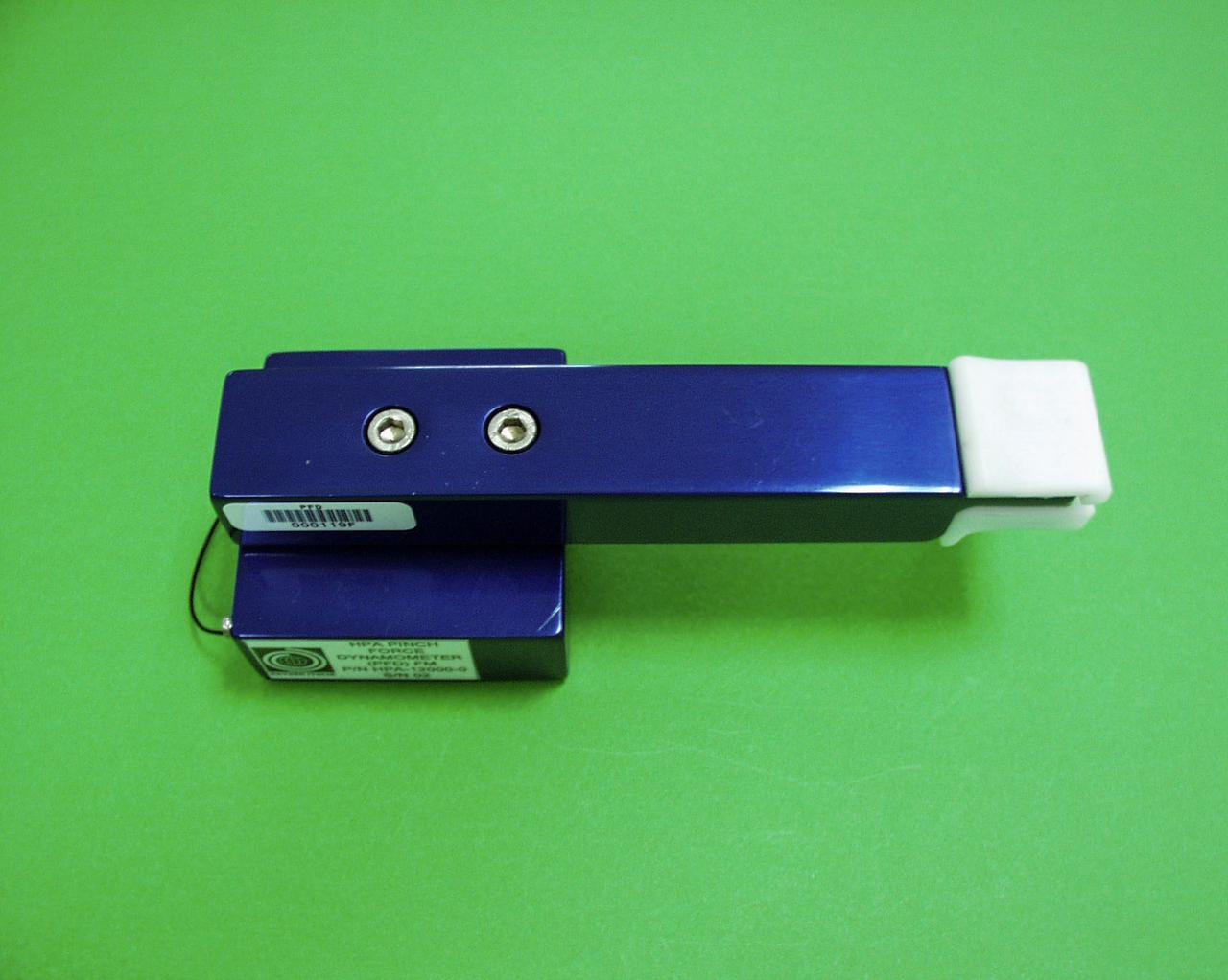
jsc2021e009417 (8/12/2002) --- A preflight view of the Hand Posture Analyzer (HPA) Pinch Force Dynamometer (PFD). The Hand Posture Analyzer (HPA) facility helps to examine the way hand and arm muscles are used differently aboard the International Space Station (ISS). Image courtesy of the Italian Space Agency (ASI).
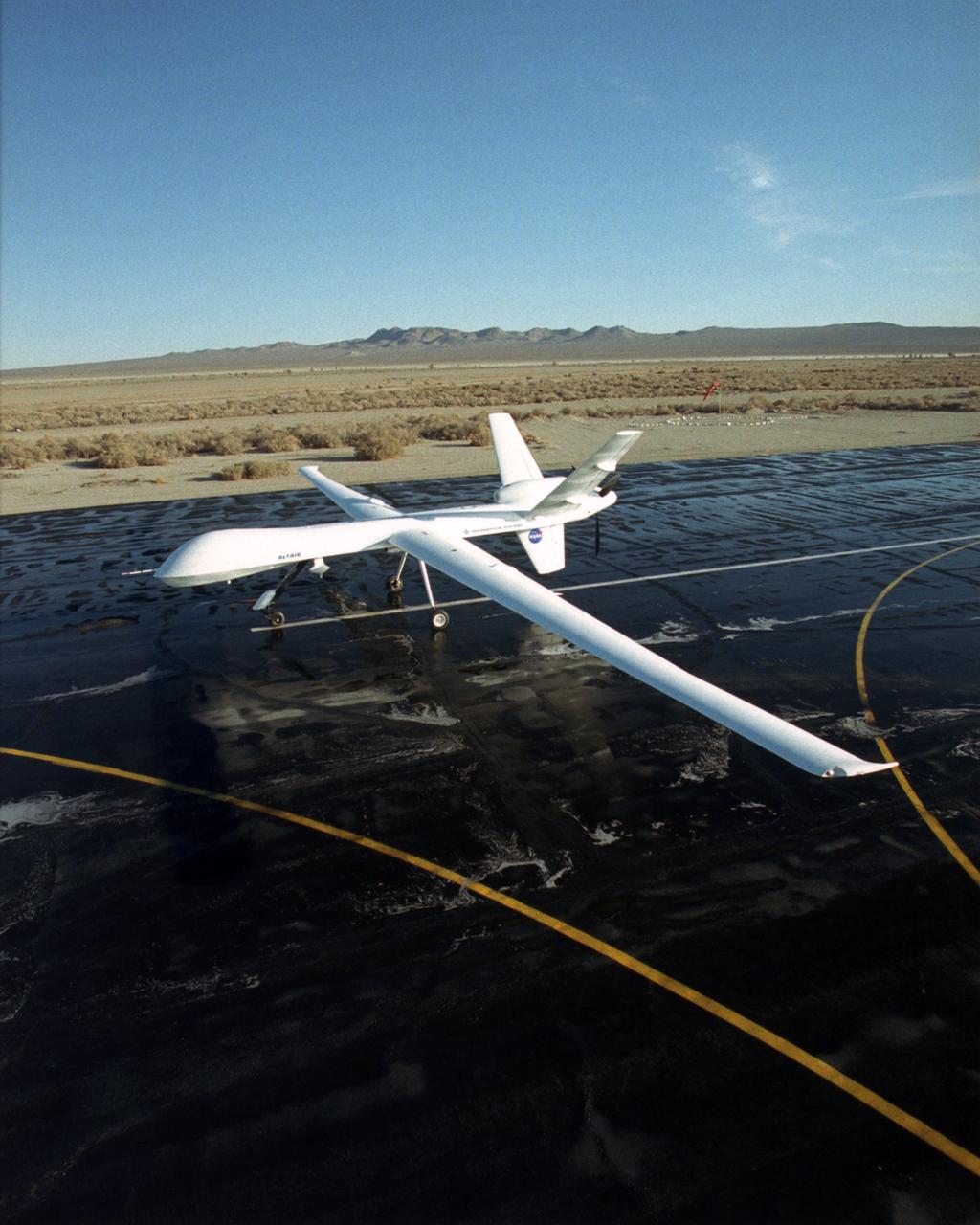
The Altair unmanned aerial vehicle (UAV), built by General Atomics Aeronautical Systems, Inc. for NASA, is poised for flight at GA-ASI's flight test facility at El Mirage, California.

Technicians at General Atomics Aeronautical Systems, Inc., (GA-ASI) facility at Adelanto, Calif., carefully install a turboprop engine to the rear fuselage of NASA's Altair aircraft during final assembly operations.
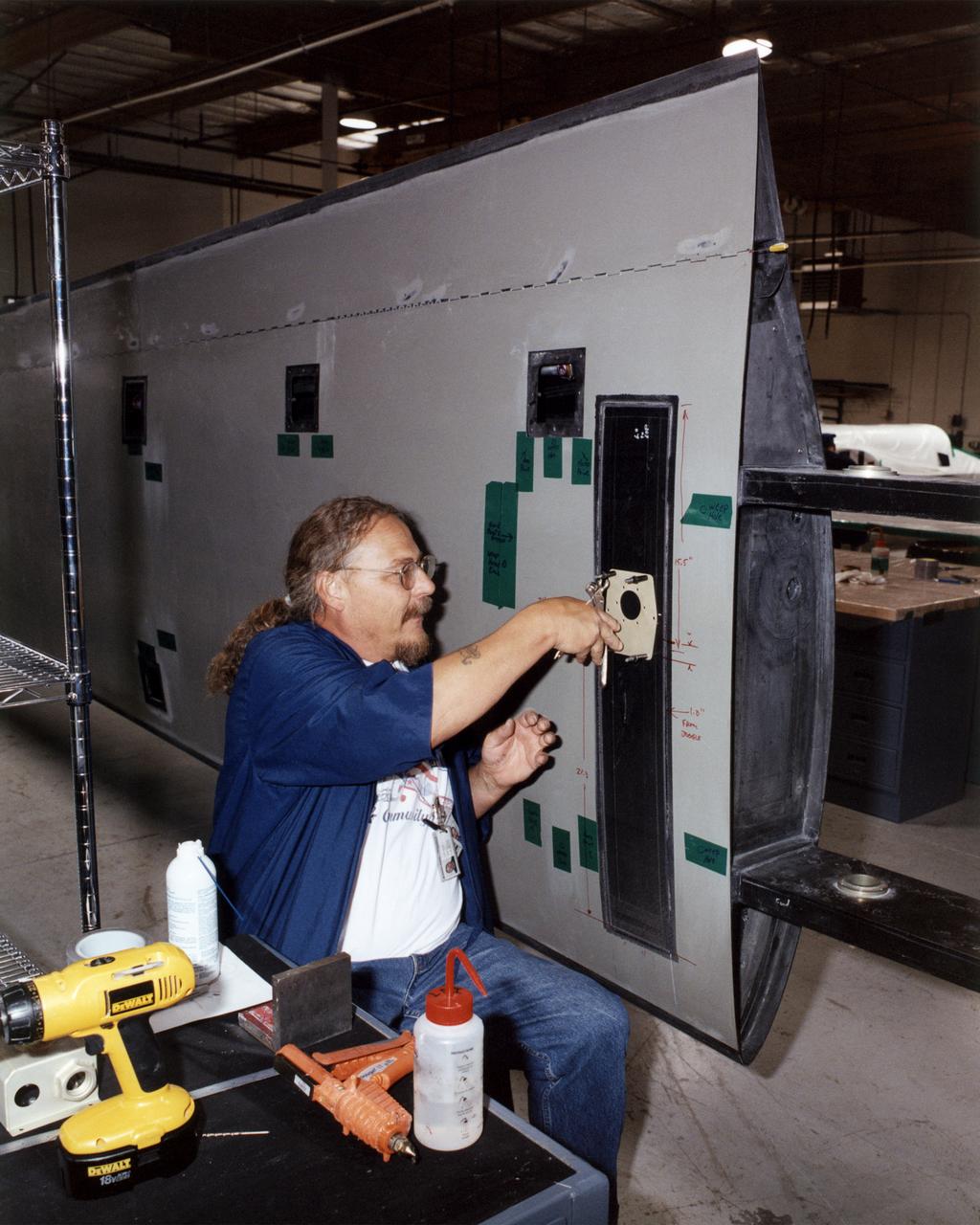
Technician Dave Brown installs a drilling template during construction of the all-composite left wing of NASA's Altair aircraft at General Atomics Aeronautical Systems, Inc., (GA-ASI) facility at Adelanto, Calif.
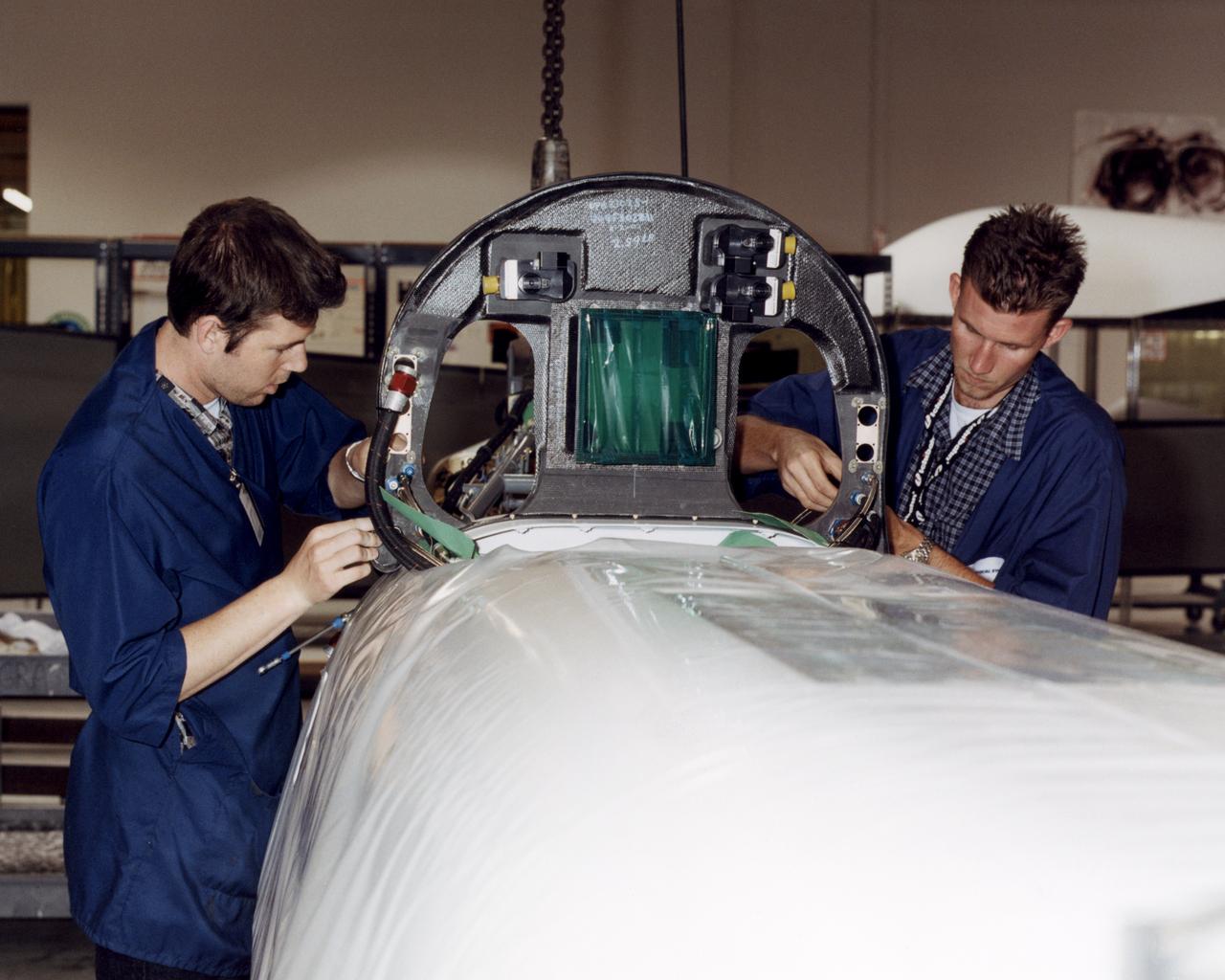
Technicians at General Atomics Aeronautical Systems, Inc., (GA-ASI) facility at Adelanto, Calif., carefully thread control lines through a bulkhead during engine installation on NASA's Altair aircraft.
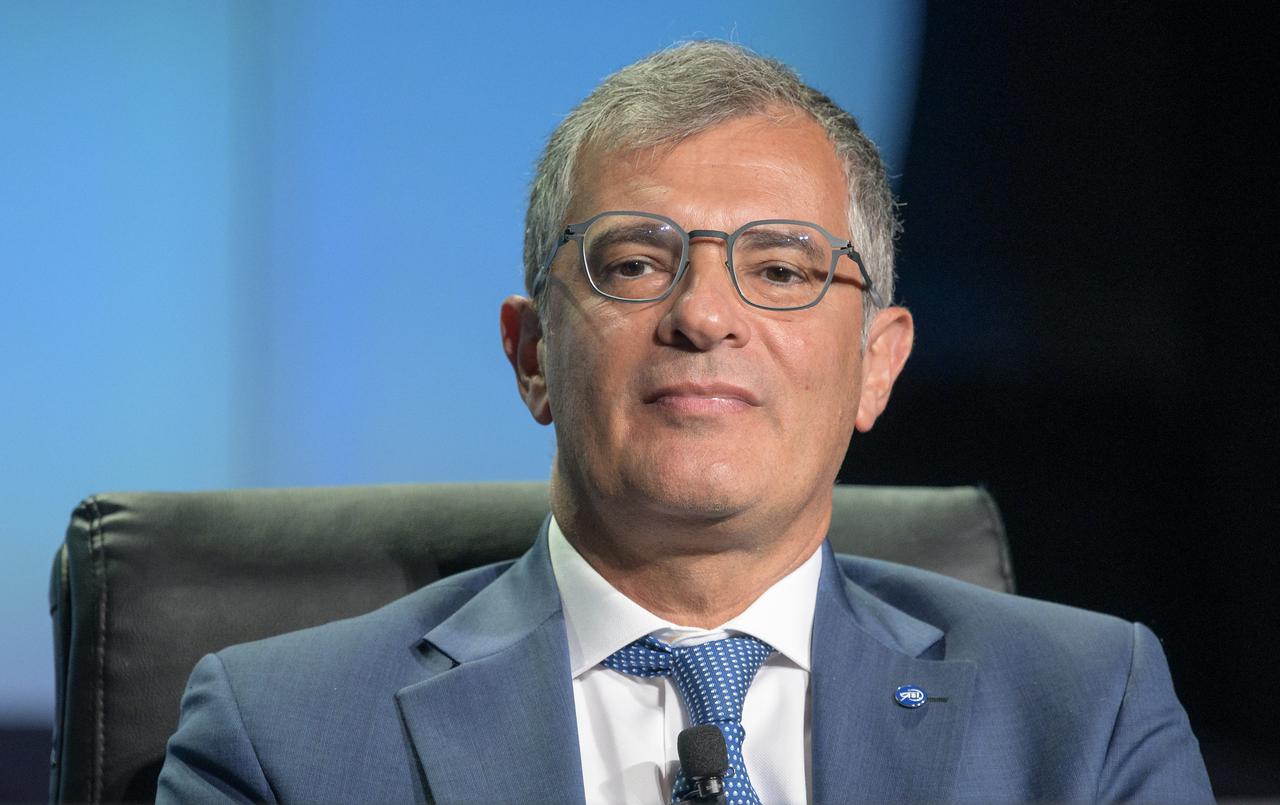
Giorgio Saccoccia, President, Italian Space Agency (ASI), gives remarks in a Heads of Agency panel discussion, during the 36th Space Symposium, Wednesday, Aug. 25, 2021, in Colorado Springs, Colorado. Photo Credit: (NASA/Bill Ingalls)
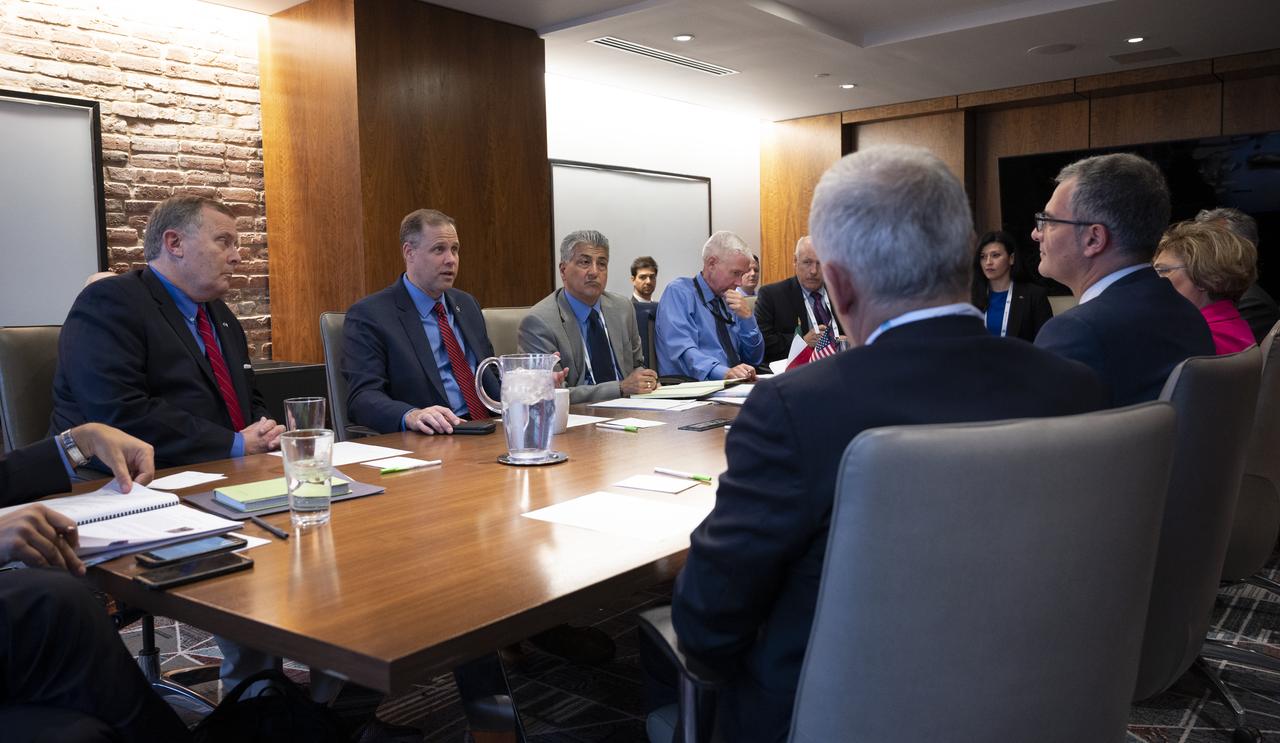
NASA Deputy Administrator Jim Morhard, left, and NASA Administrator Jim Bridenstine meet with Giorgio Saccoccia Head of the Italian Space Agency (ASI), before the signing of a joint statement at the 70th International Astronautical Congress, Wednesday, Oct. 23, 2019 in Washington. Photo Credit: (NASA/Joel Kowsky)
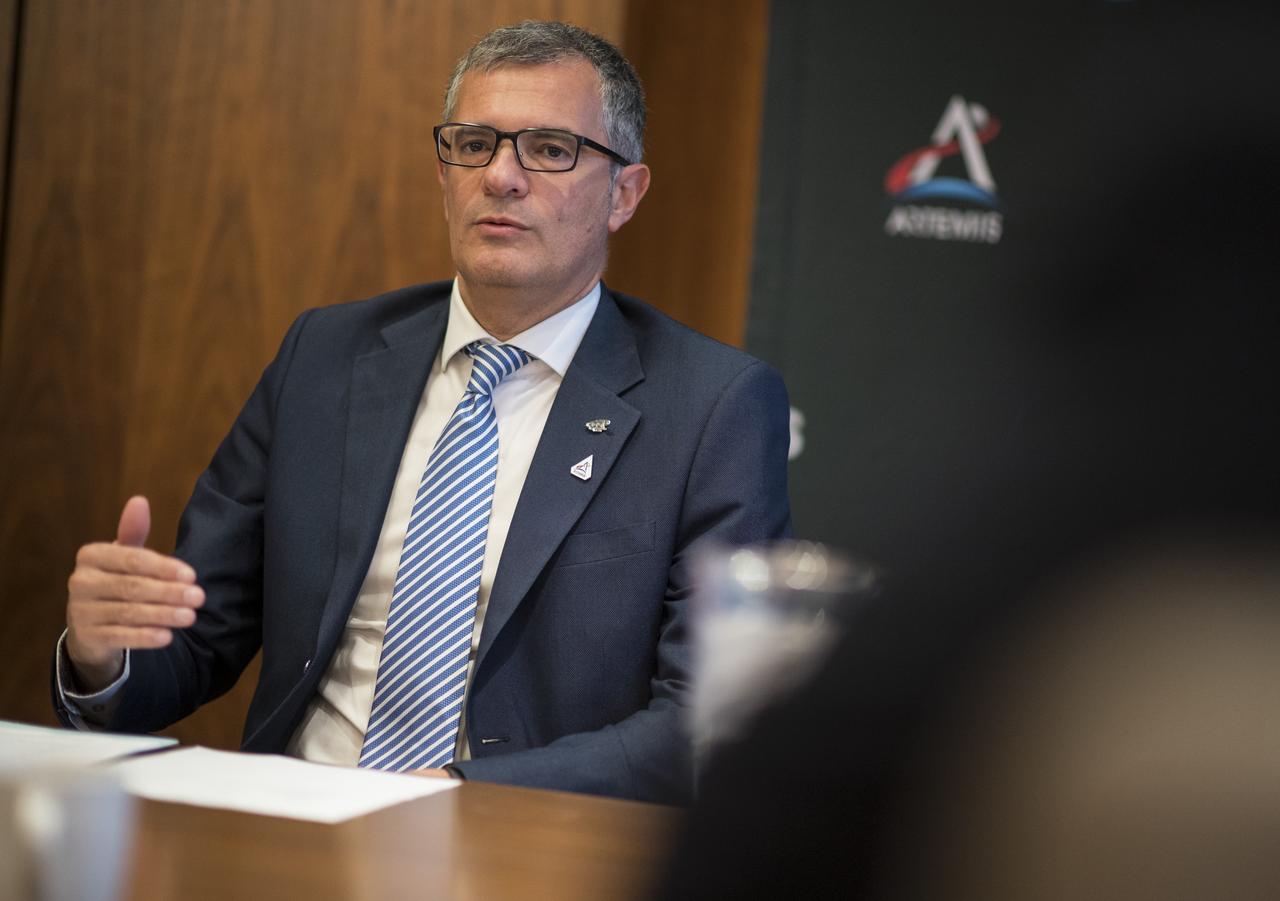
Giorgio Saccoccia Head of the Italian Space Agency (ASI), speaks with NASA Administrator Jim Bridenstine before the signing of a joint statement at the 70th International Astronautical Congress, Wednesday, Oct. 23, 2019 in Washington. Photo Credit: (NASA/Joel Kowsky)
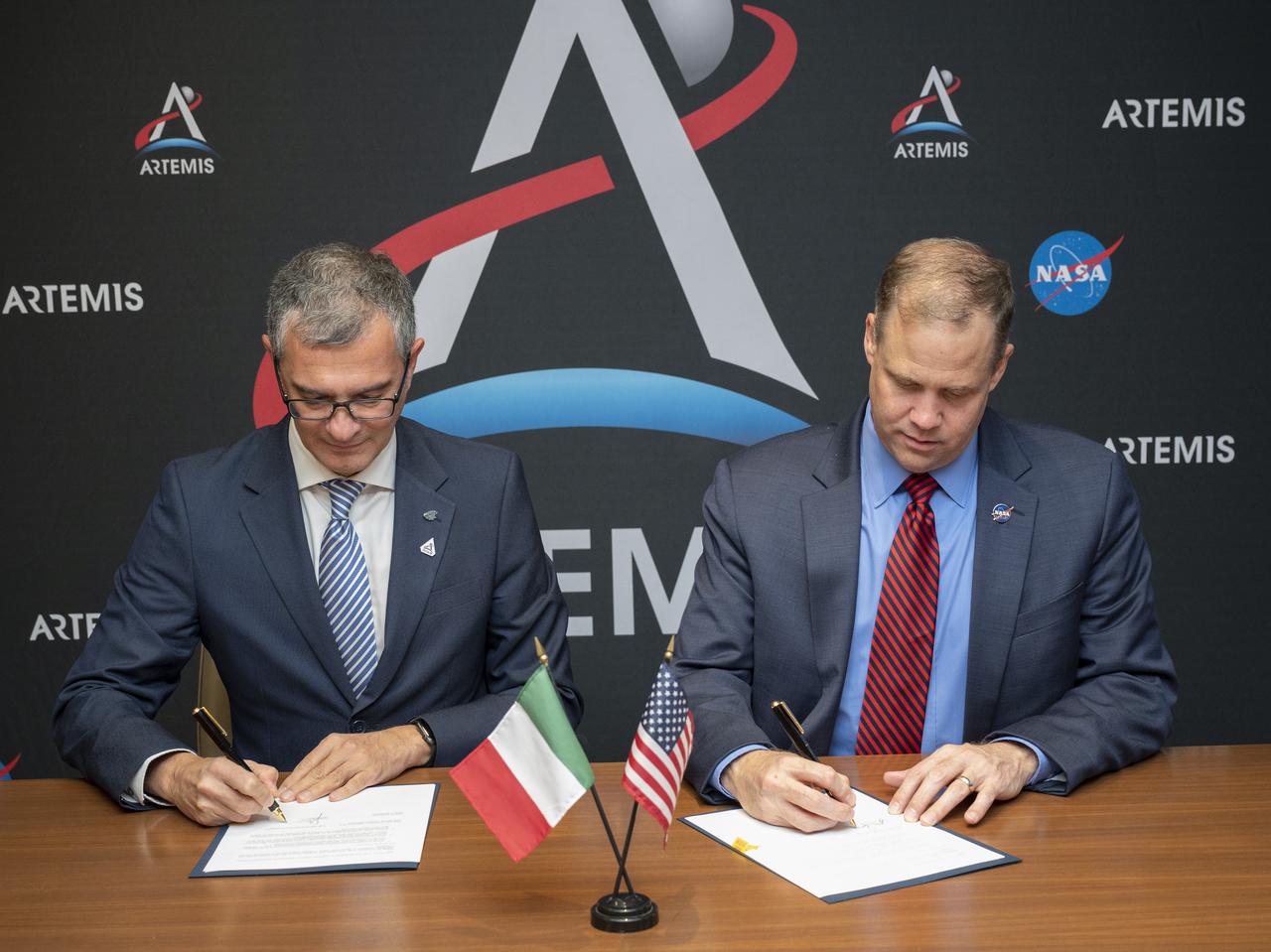
Giorgio Saccoccia Head of the Italian Space Agency (ASI), left, and NASA Administrator Jim Bridenstine sign a joint statement acknowledging the strong ongoing cooperation between the agencies, and identifying areas of potential future cooperation on and around the Moon as part of NASA’s Artemis program at the 70th International Astronautical Congress, Wednesday, Oct. 23, 2019 in Washington. Photo Credit: (NASA/Joel Kowsky)
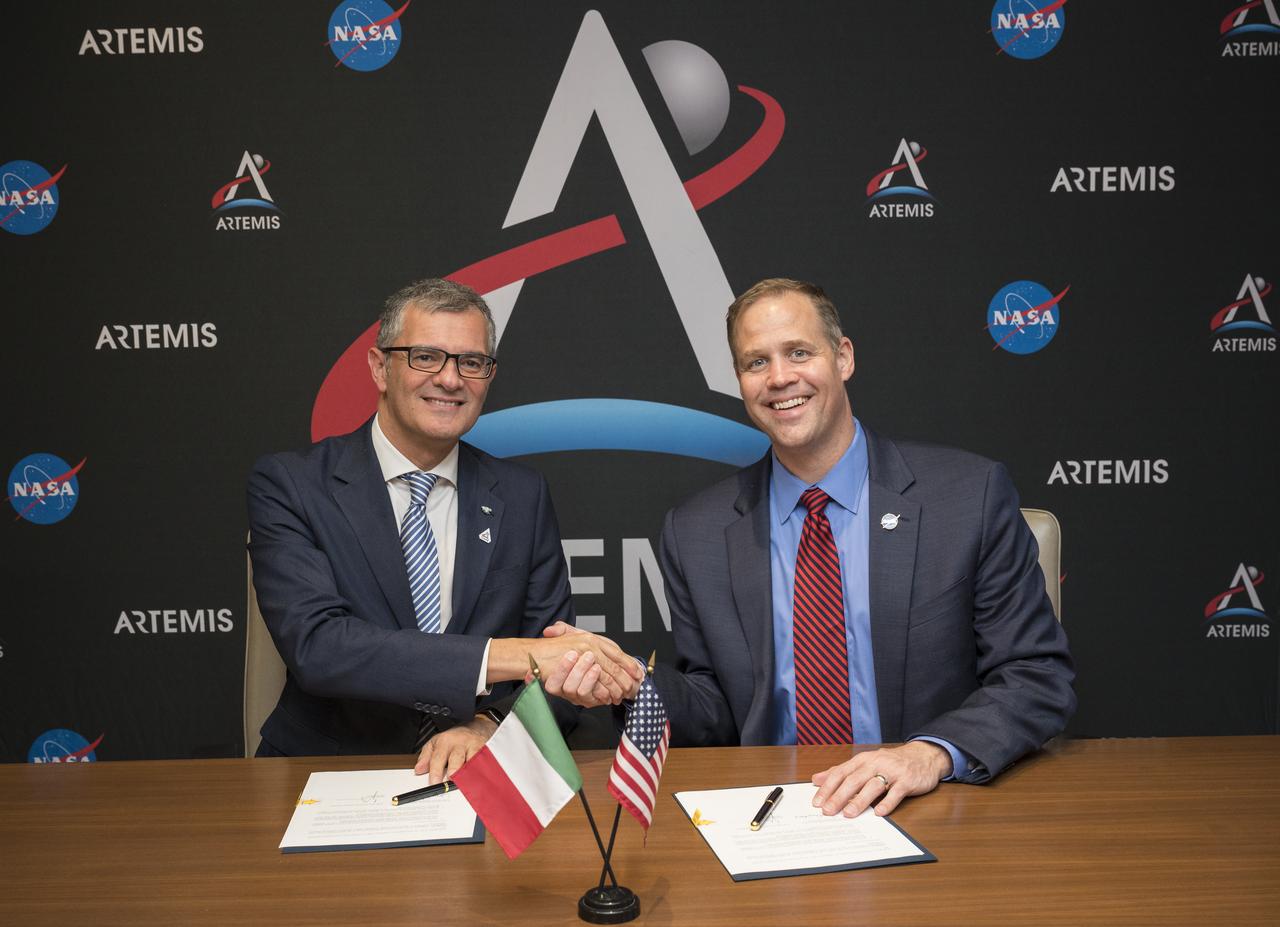
Giorgio Saccoccia Head of the Italian Space Agency (ASI), left, and NASA Administrator Jim Bridenstine shake hands after signing a joint statement acknowledging the strong ongoing cooperation between the agencies, and identifying areas of potential future cooperation on and around the Moon as part of NASA’s Artemis program at the 70th International Astronautical Congress, Wednesday, Oct. 23, 2019 in Washington. Photo Credit: (NASA/Joel Kowsky)
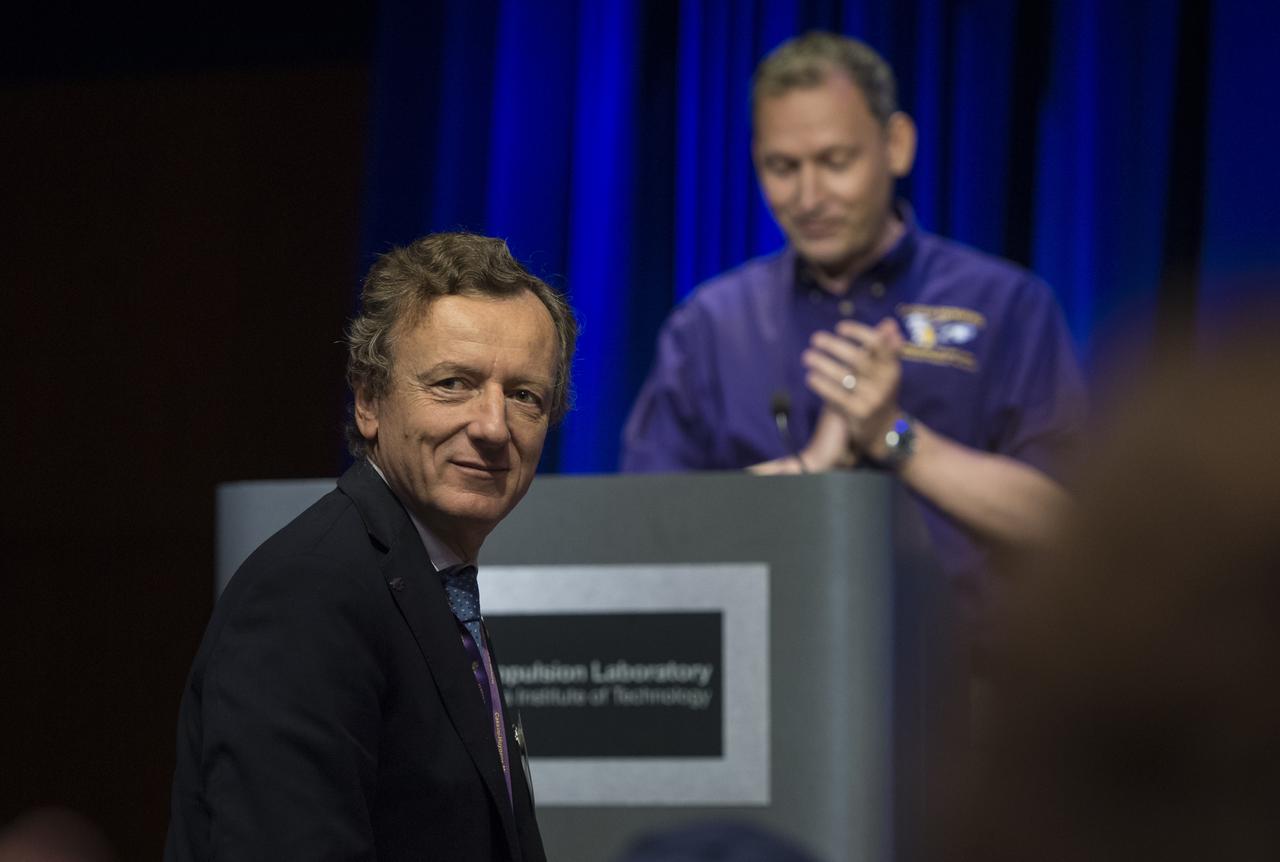
Italian Space Agency (ASI) representative, Enrico Flamini, is introduced during a press conference held after the end of the Cassini mission, Friday, Sept. 15, 2017 at NASA's Jet Propulsion Laboratory in Pasadena, California. Since its arrival in 2004, the Cassini-Huygens mission has been a discovery machine, revolutionizing our knowledge of the Saturn system and captivating us with data and images never before obtained with such detail and clarity. On Sept. 15, 2017, operators deliberately plunged the spacecraft into Saturn, as Cassini gathered science until the end. Loss of contact with the Cassini spacecraft occurred at 7:55 a.m. EDT (4:55 a.m. PDT). The “plunge” ensures Saturn’s moons will remain pristine for future exploration. During Cassini’s final days, mission team members from all around the world gathered at NASA’s Jet Propulsion Laboratory, Pasadena, California, to celebrate the achievements of this historic mission. Photo Credit: (NASA/Joel Kowsky)
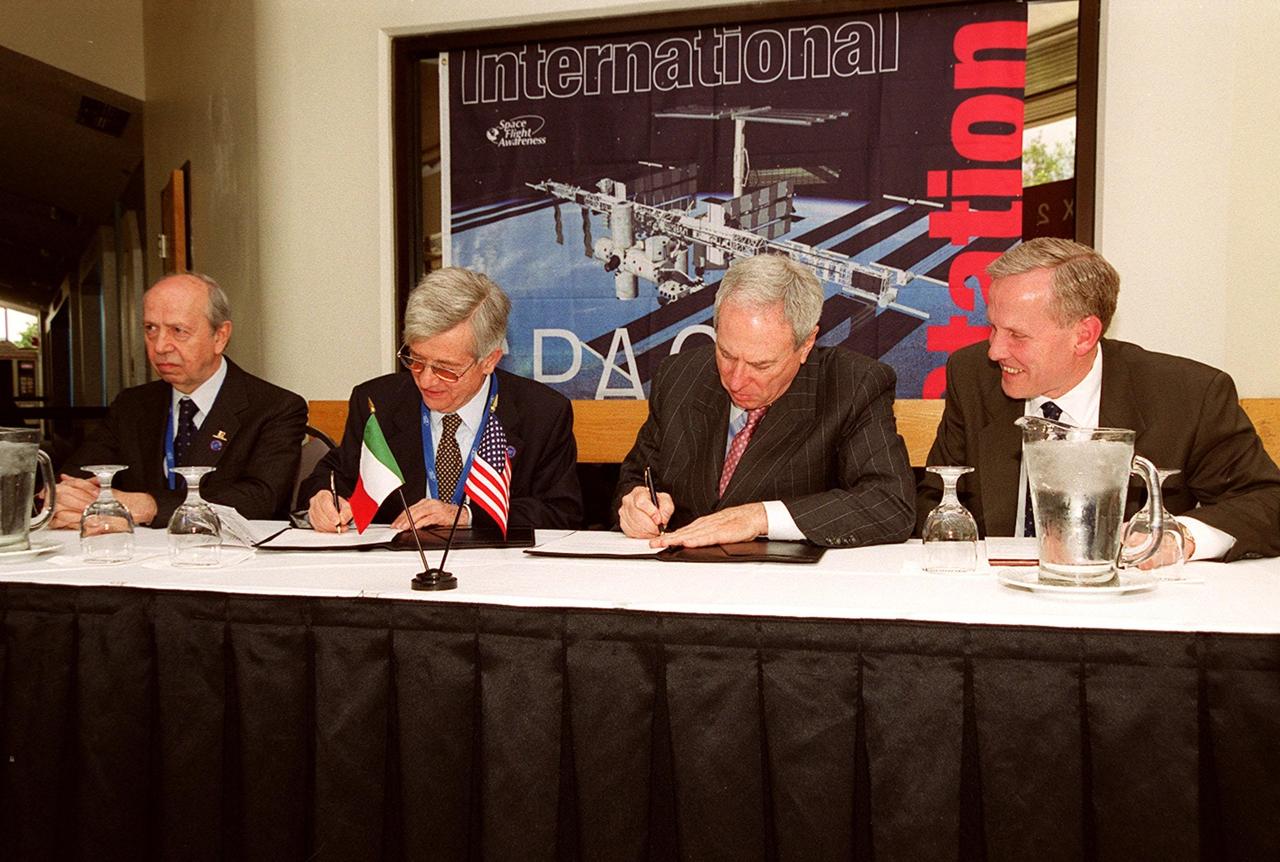
NASA Administrator Daniel S. Goldin and Italian Space Agency (ASI) President Sergio DeJulio sign a Framework for Cooperation to build the Habitation Module for the International Space Station. Seated at the table (left to right) are The Honorable Lamberto Dini, Minister of Foreign Affairs, Republic of Italy; DeJulio; Goldin; and John Schumacher, assistant administrator, External Relations, NASA. The Framework is a potential bilateral cooperative agreement that could result in ASI development of a U.S. Habitation Module for the International Space Station. This agreement allows the U.S. to explore an alternative approach to achieve full crew habitation for the ISS. A Memorandum of Understanding (MOU) between NASA and ASI will be required to formally document NASA and ASI’s respective responsibilities in a legally binding document. The Framework signed today would form the basis for a potential MOU which NASA and ASI would sign after completion of the program assessment and subsequent negotiations. The ceremony took place at the IMAX Theater, Kennedy Space Center Visitor Complex
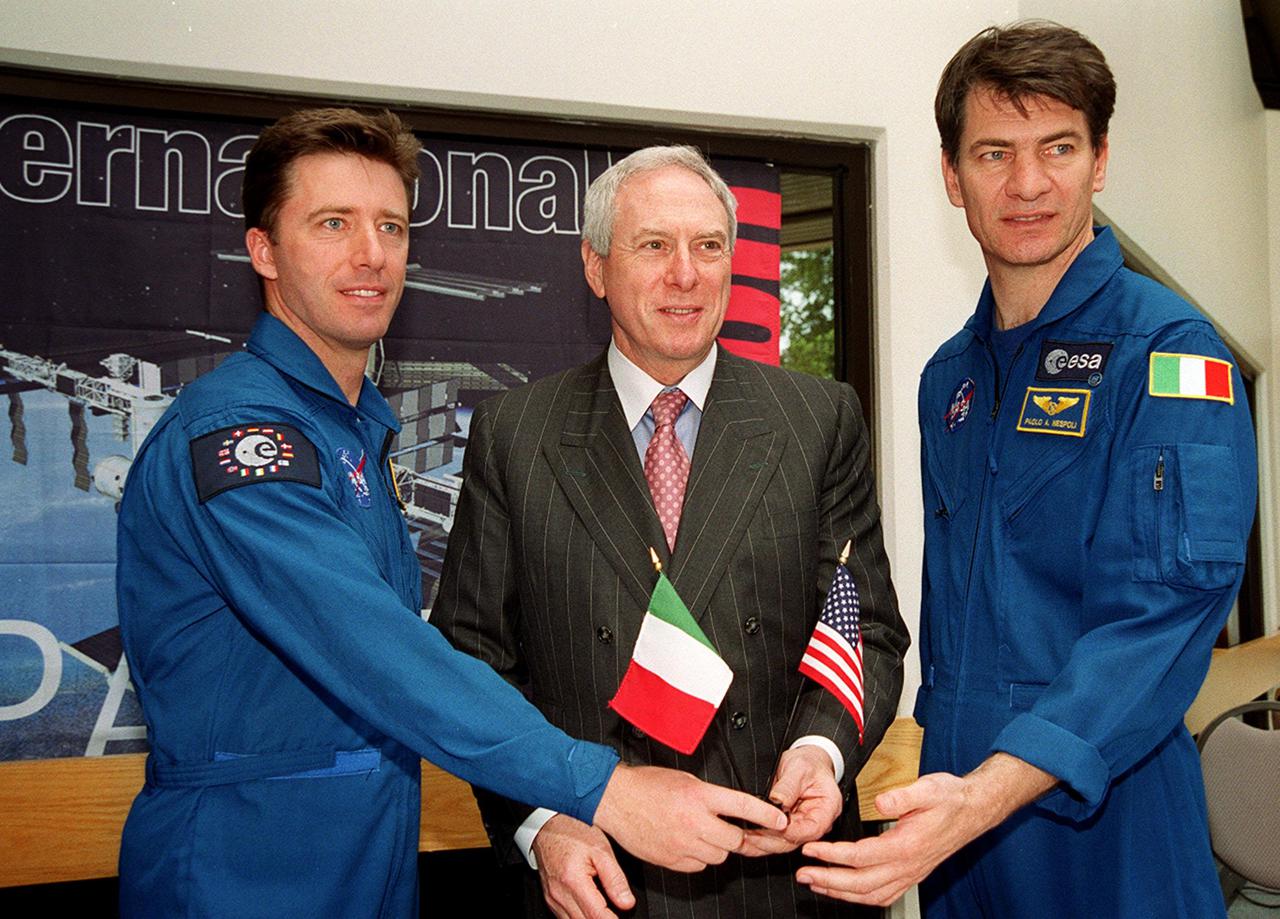
At a signing ceremony between the Italian Space Agency (ASI) and NASA for a Framework for Cooperation to build the Habitation Module for the International Space Station, Italian astronauts with the European Space Agency pose with NASA Administrator Daniel S. Goldin. On the left is Roberto Vittori and on the right is Paolo A. Nespoli. The Framework is a potential bilateral cooperative agreement that could result in ASI development of a U.S. Habitation Module for the International Space Station. This agreement allows the U.S. to explore an alternative approach to achieve full crew habitation for the ISS. A Memorandum of Understanding (MOU) between NASA and ASI will be required to formally document NASA and ASI’s respective responsibilities in a legally binding document. The Framework signed today would form the basis for a potential MOU which NASA and ASI would sign after completion of the program assessment and subsequent negotiations. The ceremony took place at the IMAX Theater, Kennedy Space Center Visitor Complex
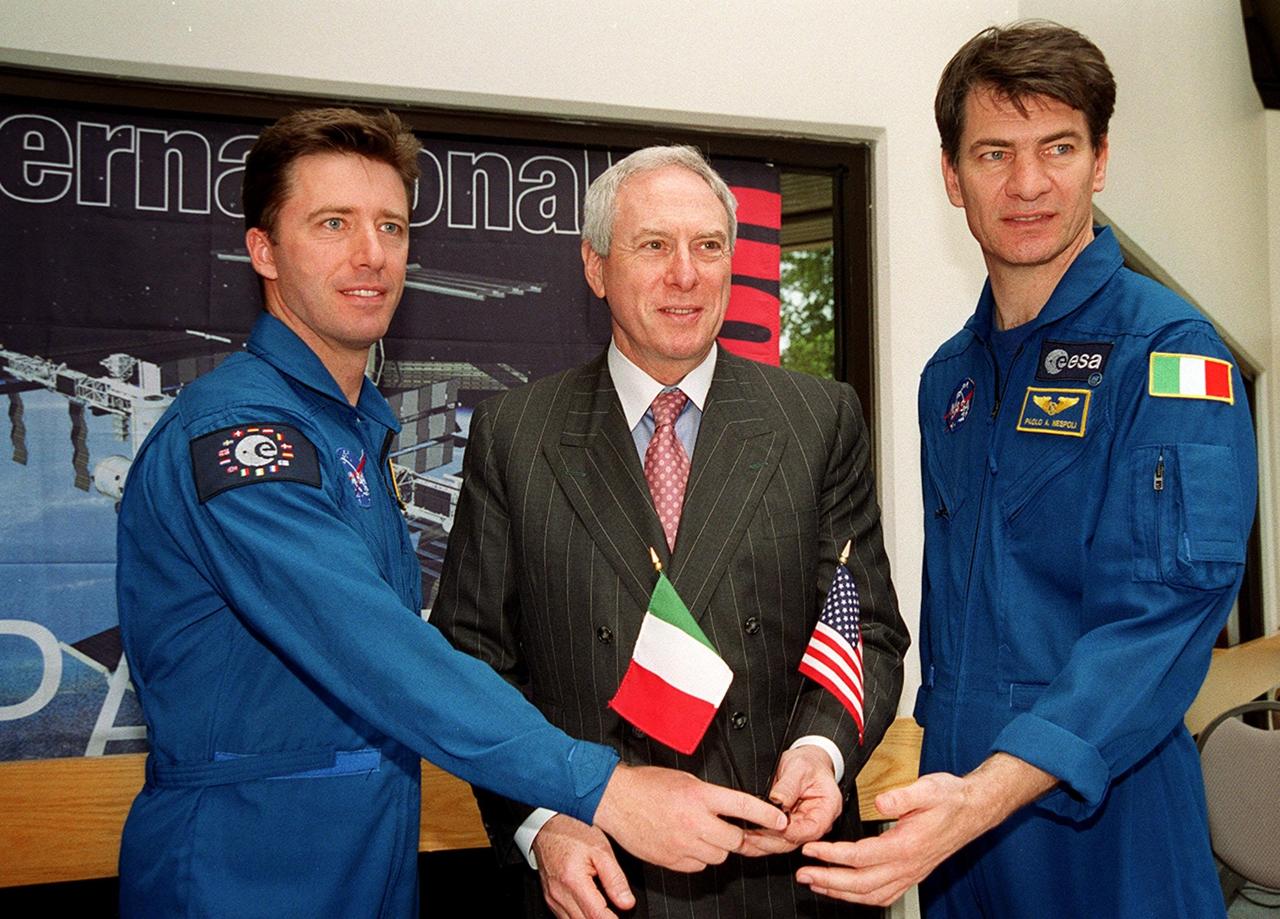
At a signing ceremony between the Italian Space Agency (ASI) and NASA for a Framework for Cooperation to build the Habitation Module for the International Space Station, Italian astronauts with the European Space Agency pose with NASA Administrator Daniel S. Goldin. On the left is Roberto Vittori and on the right is Paolo A. Nespoli. The Framework is a potential bilateral cooperative agreement that could result in ASI development of a U.S. Habitation Module for the International Space Station. This agreement allows the U.S. to explore an alternative approach to achieve full crew habitation for the ISS. A Memorandum of Understanding (MOU) between NASA and ASI will be required to formally document NASA and ASI’s respective responsibilities in a legally binding document. The Framework signed today would form the basis for a potential MOU which NASA and ASI would sign after completion of the program assessment and subsequent negotiations. The ceremony took place at the IMAX Theater, Kennedy Space Center Visitor Complex
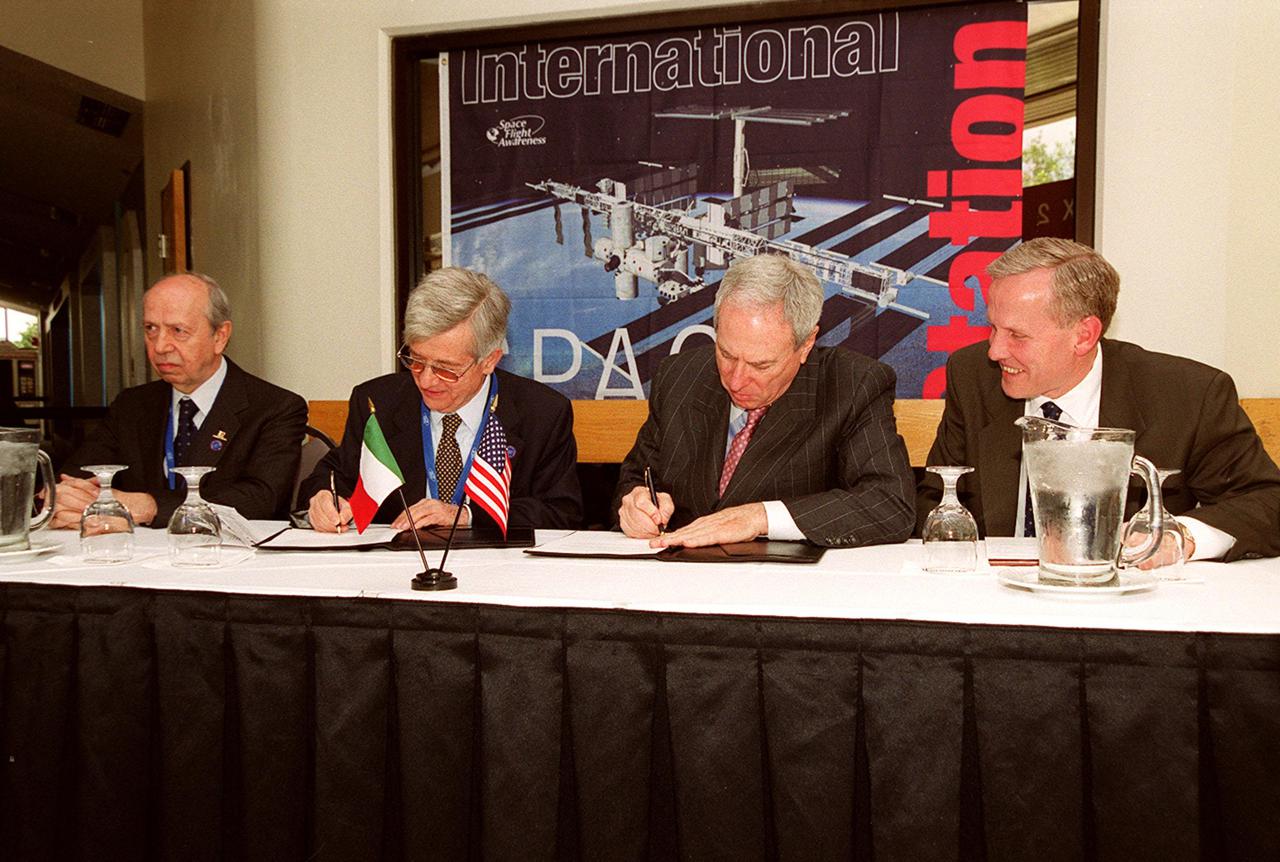
NASA Administrator Daniel S. Goldin and Italian Space Agency (ASI) President Sergio DeJulio sign a Framework for Cooperation to build the Habitation Module for the International Space Station. Seated at the table (left to right) are The Honorable Lamberto Dini, Minister of Foreign Affairs, Republic of Italy; DeJulio; Goldin; and John Schumacher, assistant administrator, External Relations, NASA. The Framework is a potential bilateral cooperative agreement that could result in ASI development of a U.S. Habitation Module for the International Space Station. This agreement allows the U.S. to explore an alternative approach to achieve full crew habitation for the ISS. A Memorandum of Understanding (MOU) between NASA and ASI will be required to formally document NASA and ASI’s respective responsibilities in a legally binding document. The Framework signed today would form the basis for a potential MOU which NASA and ASI would sign after completion of the program assessment and subsequent negotiations. The ceremony took place at the IMAX Theater, Kennedy Space Center Visitor Complex
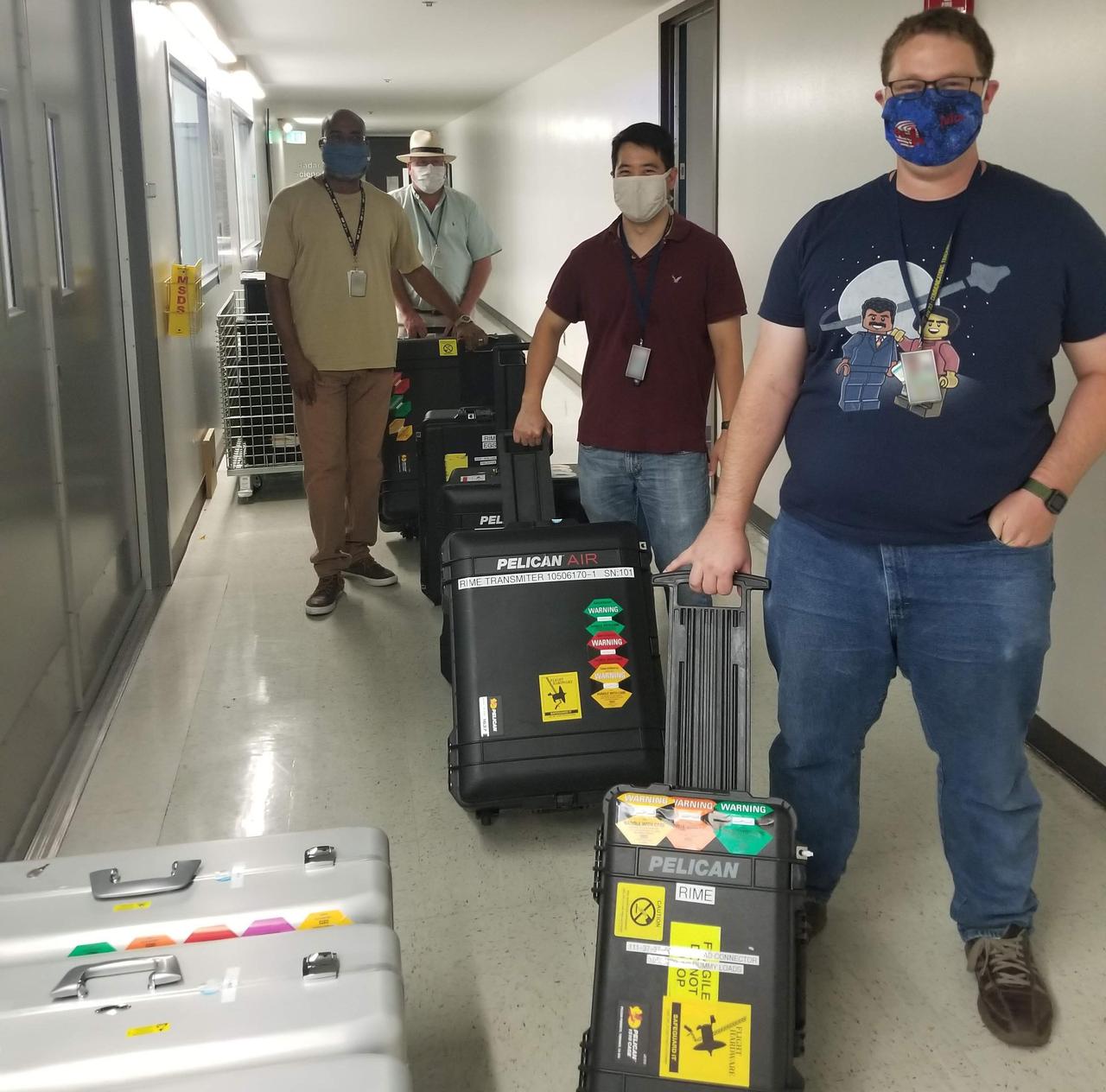
NASA's Jet Propulsion Laboratory built and shipped the receiver, transmitter and electronics necessary to complete the radar instrument for the Jupiter Icy Moons Explorer (JUICE) mission. Set to launch in 2022, JUICE is the ESA (European Space Agency) mission to explore Jupiter and its three large icy moons. From front: JPL engineers and technicians Jeremy Steinert, Jordan Tanabe, Glenn Jeffery, and Robert Johnson follow COVID-19 Safe-at-Work guidelines as they transport the transmitter and electronics on Aug. 19, 2020, for shipping to the Italian Space Agency (ASI). ASI is collaborating with JPL to build the instrument, called Radar for Icy Moon Exploration (RIME). It is one of 10 instruments that will fly aboard JUICE. https://photojournal.jpl.nasa.gov/catalog/PIA24026
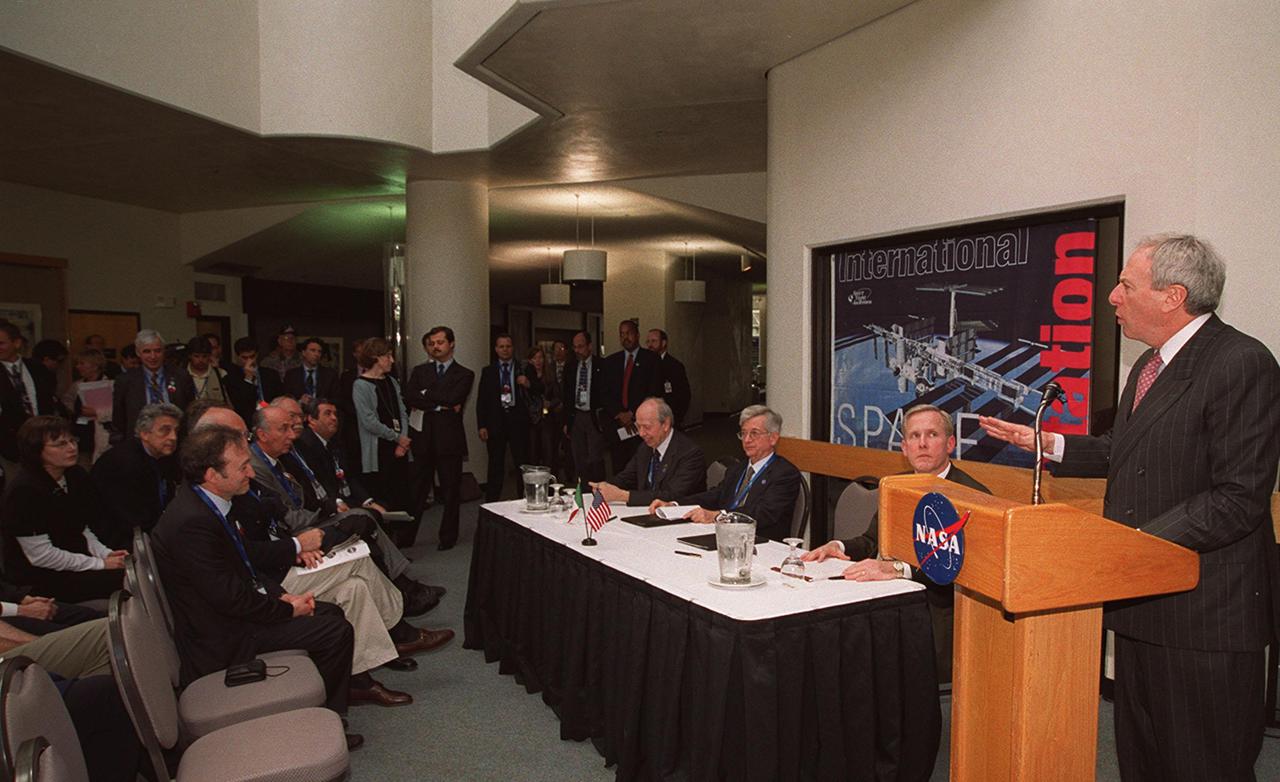
At a signing ceremony between the Italian Space Agency (ASI) and NASA for a Framework for Cooperation to build the Habitation Module for the International Space Station, NASA Administrator Daniel S. Goldin speaks to attendees. Seated at the table next to Goldin are The Honorable Lamberto Dini, Minister of Foreign Affairs, Republic of Italy (far left), Italian Space Agency President Sergio DeJulio, and John Schumacher, assistant administrator, NASA External Relations. The Framework is a potential bilateral cooperative agreement that could result in ASI development of a U.S. Habitation Module for the International Space Station. This agreement allows the U.S. to explore an alternative approach to achieve full crew habitation for the ISS. A Memorandum of Understanding (MOU) between NASA and ASI will be required to formally document NASA and ASI’s respective responsibilities in a legally binding document. The Framework signed today would form the basis for a potential MOU which NASA and ASI would sign after completion of the program assessment and subsequent negotiations.The ceremony took place at the IMAX Theater, Kennedy Space Center Visitor Complex
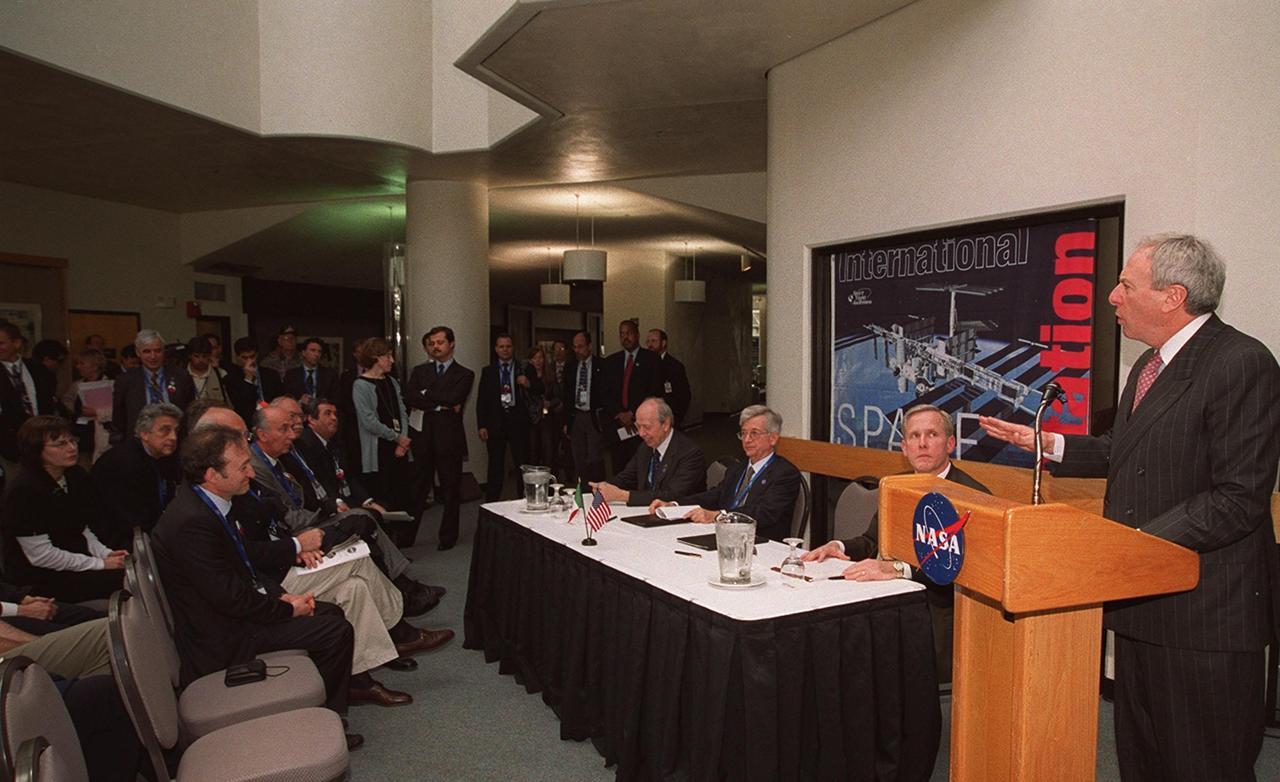
At a signing ceremony between the Italian Space Agency (ASI) and NASA for a Framework for Cooperation to build the Habitation Module for the International Space Station, NASA Administrator Daniel S. Goldin speaks to attendees. Seated at the table next to Goldin are The Honorable Lamberto Dini, Minister of Foreign Affairs, Republic of Italy (far left), Italian Space Agency President Sergio DeJulio, and John Schumacher, assistant administrator, NASA External Relations. The Framework is a potential bilateral cooperative agreement that could result in ASI development of a U.S. Habitation Module for the International Space Station. This agreement allows the U.S. to explore an alternative approach to achieve full crew habitation for the ISS. A Memorandum of Understanding (MOU) between NASA and ASI will be required to formally document NASA and ASI’s respective responsibilities in a legally binding document. The Framework signed today would form the basis for a potential MOU which NASA and ASI would sign after completion of the program assessment and subsequent negotiations.The ceremony took place at the IMAX Theater, Kennedy Space Center Visitor Complex
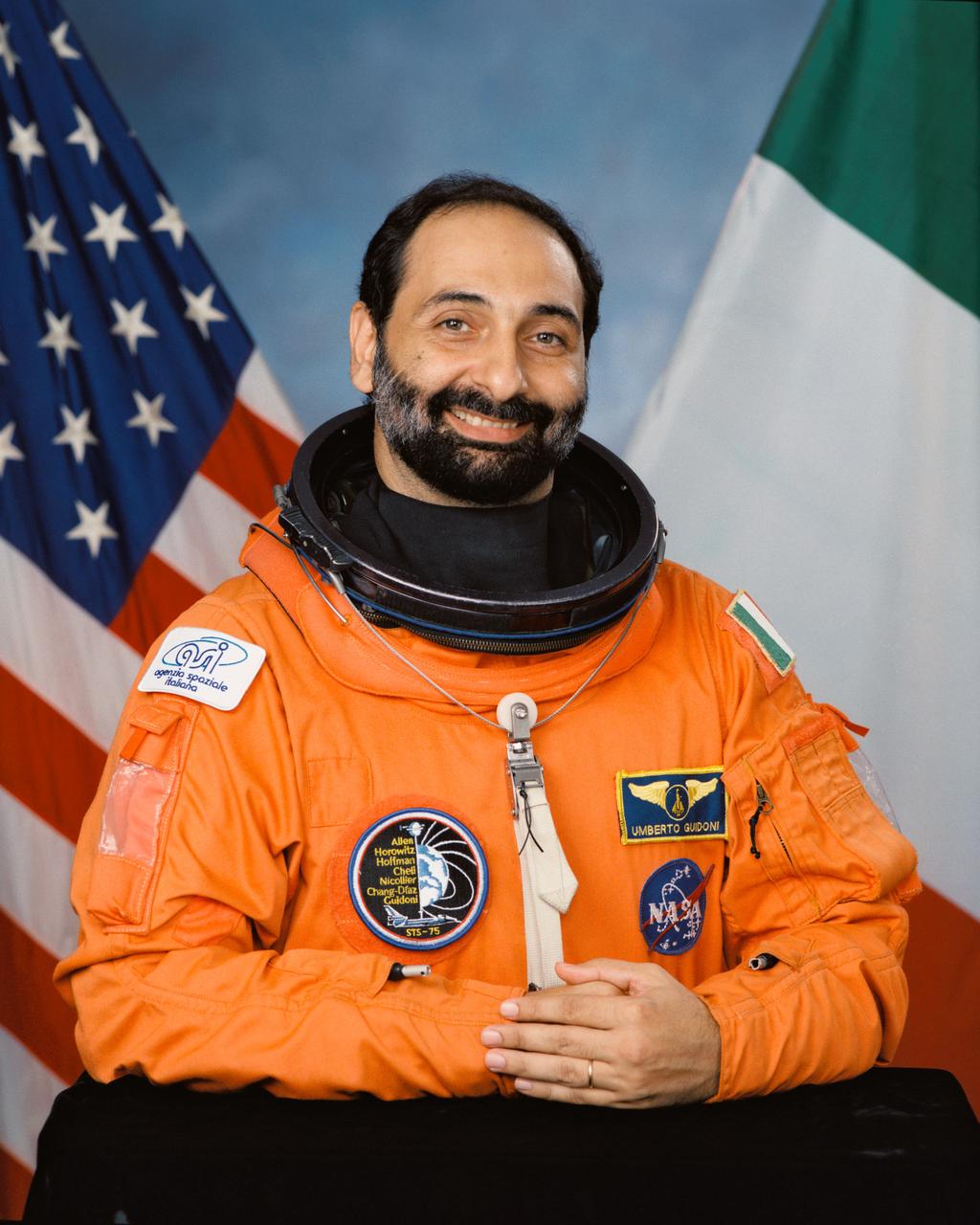
S96-00284 (January 1996) --- Astronaut Umberto Guidoni, mission specialist representing the Italian Space Agency (ASI).
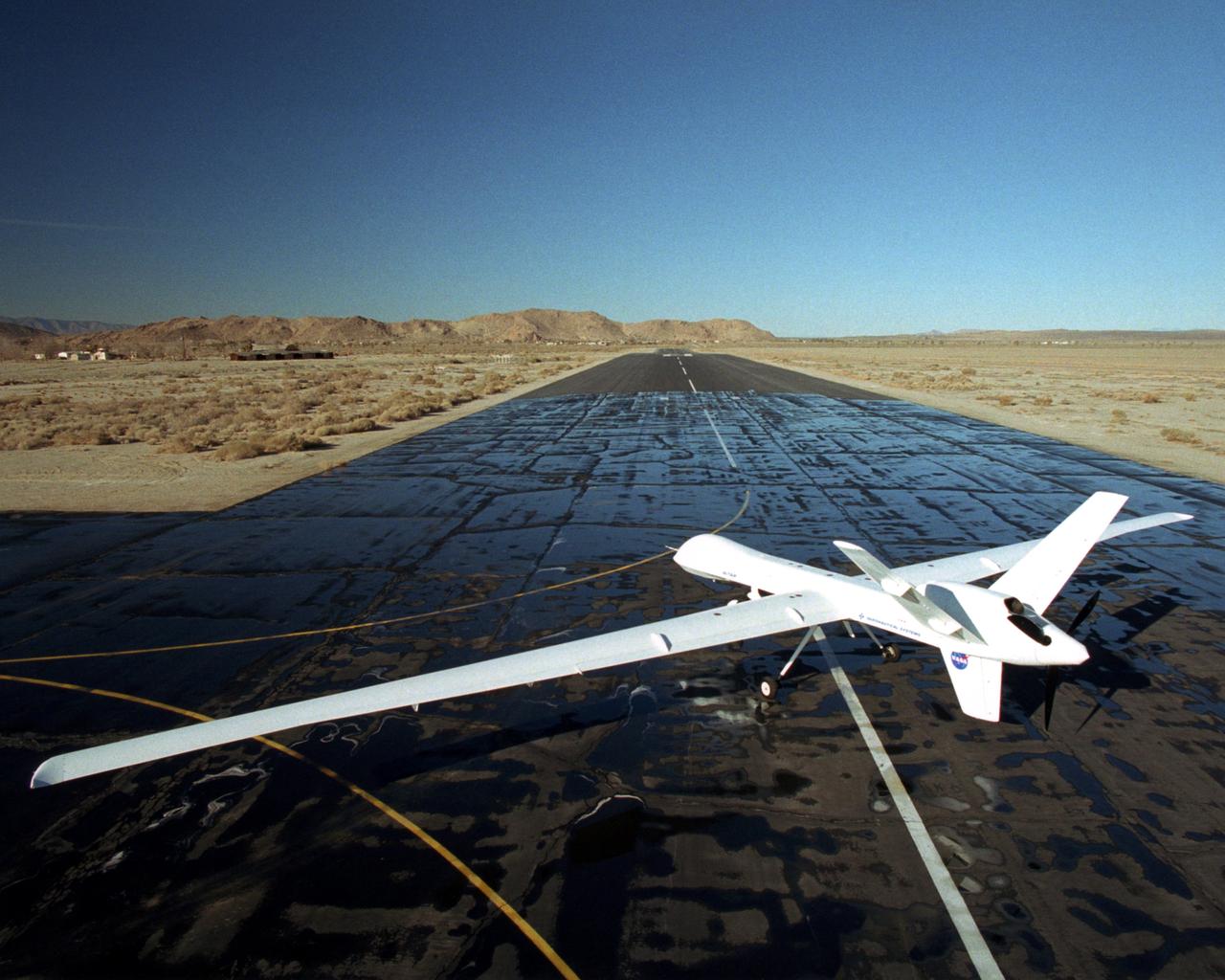
The long, narrow wings of NASA's Altair are designed to allow the unmanned aerial vehicle (UAV) to maintain long-duration flight at high altitudes.
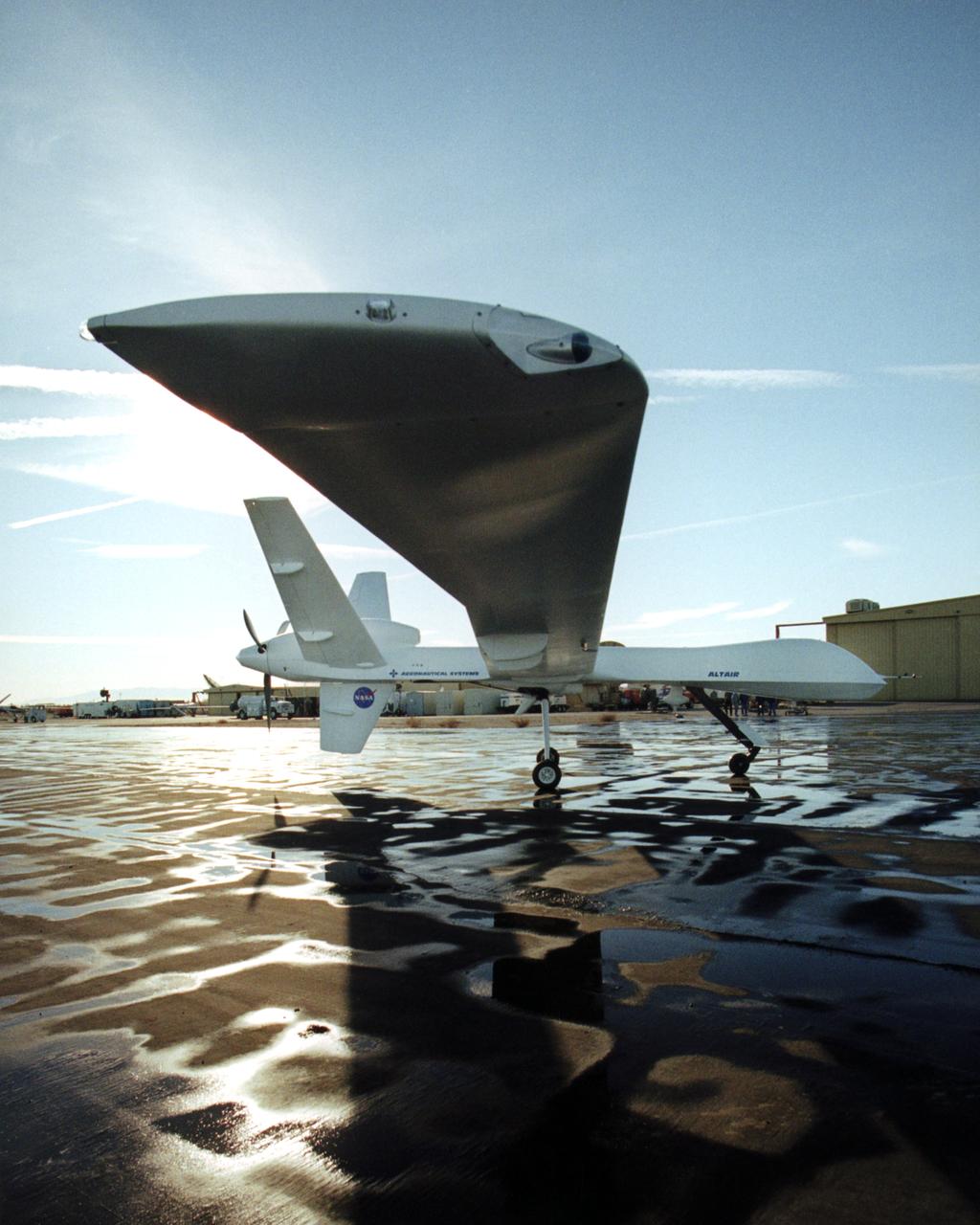
The Altair, a civil variant of the QM-9 Predator B unmanned aerial vehicle (UAV), shows off its lengthy high-aspect ratio wing while on the ramp at General Atomics Aeronautical Systems' flight test facility at El Mirage, California.
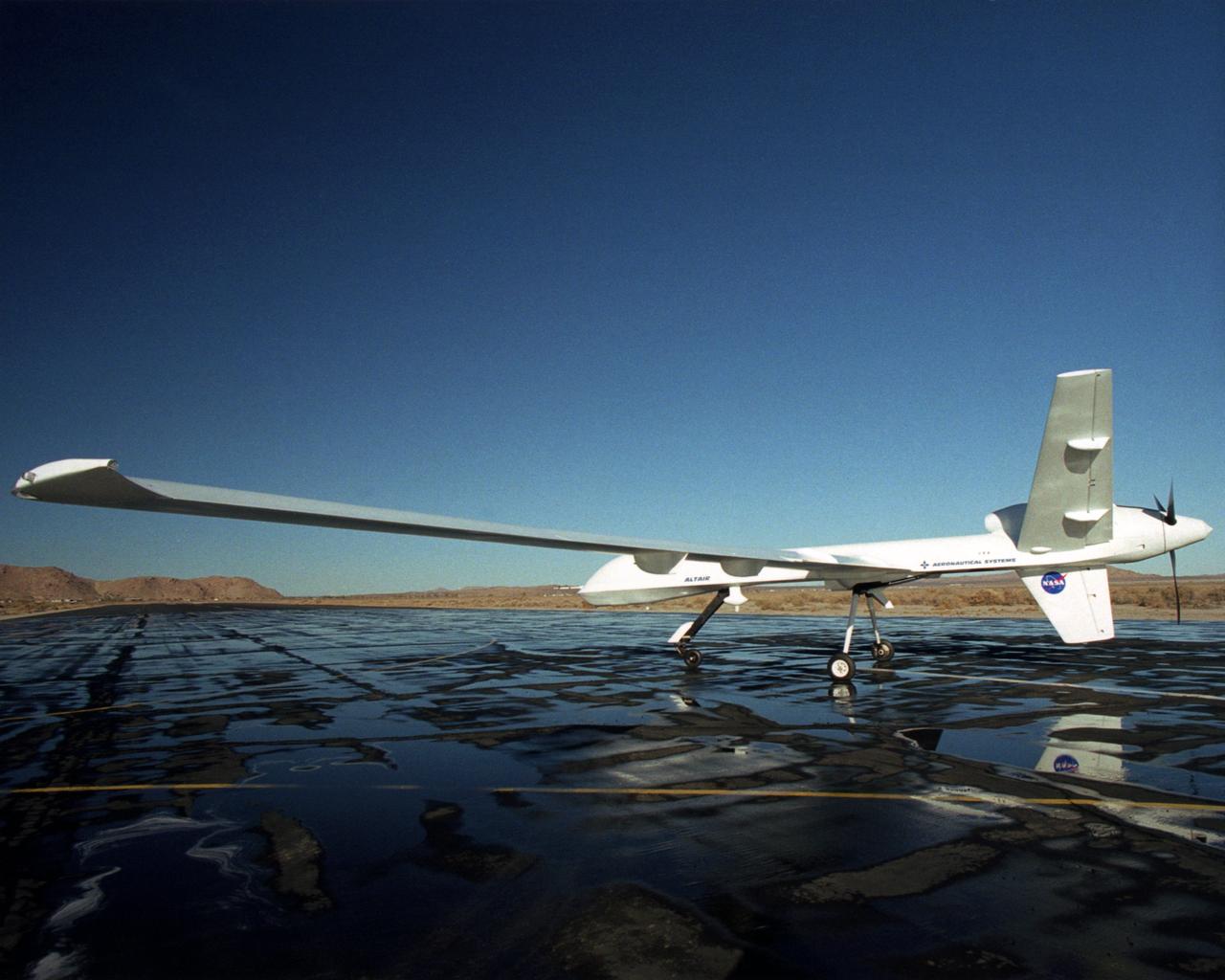
Long wings, a V-tail with a ventral fin and a rear-mounted engine distinguish the Altair, an unmanned aerial vehicle built for NASA by General Atomics Aeronautical Systems, Inc.
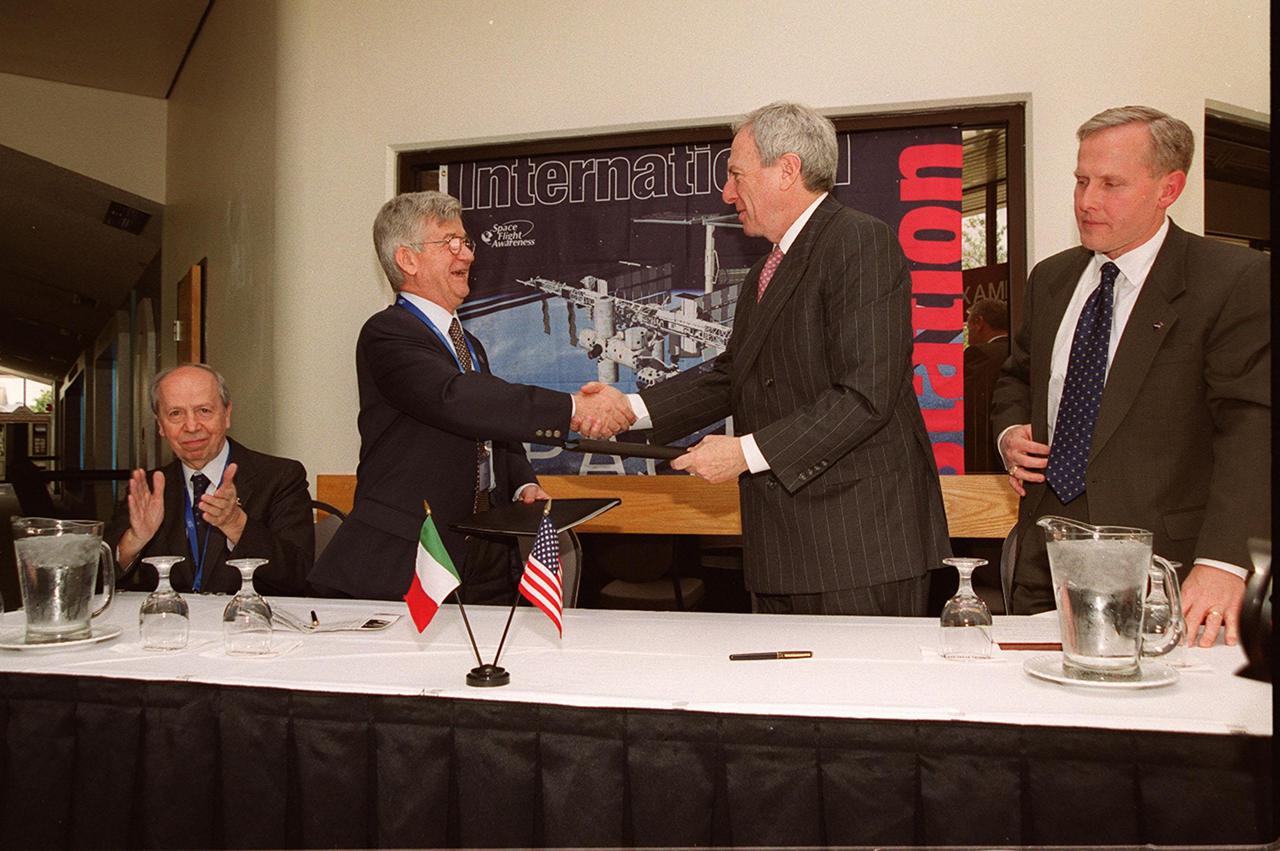
After signing a Framework for Cooperation to build the Habitation Module for the International Space Station, Italian Space Agency President Sergio DeJulio (standing, left) shakes hands with NASA Administrator Daniel S. Goldin (right). Also at the signing are The Honorable Lamberto Dini, Minister of Foreign Affairs, Republic of Italy (far left) and John Schumacher, assistant administrator, NASA External Relations. The Framework is a potential bilateral cooperative agreement that could result in ASI development of a U.S. Habitation Module for the International Space Station. This agreement allows the U.S. to explore an alternative approach to achieve full crew habitation for the ISS. A Memorandum of Understanding (MOU) between NASA and ASI will be required to formally document NASA and ASI’s respective responsibilities in a legally binding document. The Framework signed today would form the basis for a potential MOU which NASA and ASI would sign after completion of the program assessment and subsequent negotiations.The ceremony took place at the IMAX Theater, Kennedy Space Center Visitor Complex
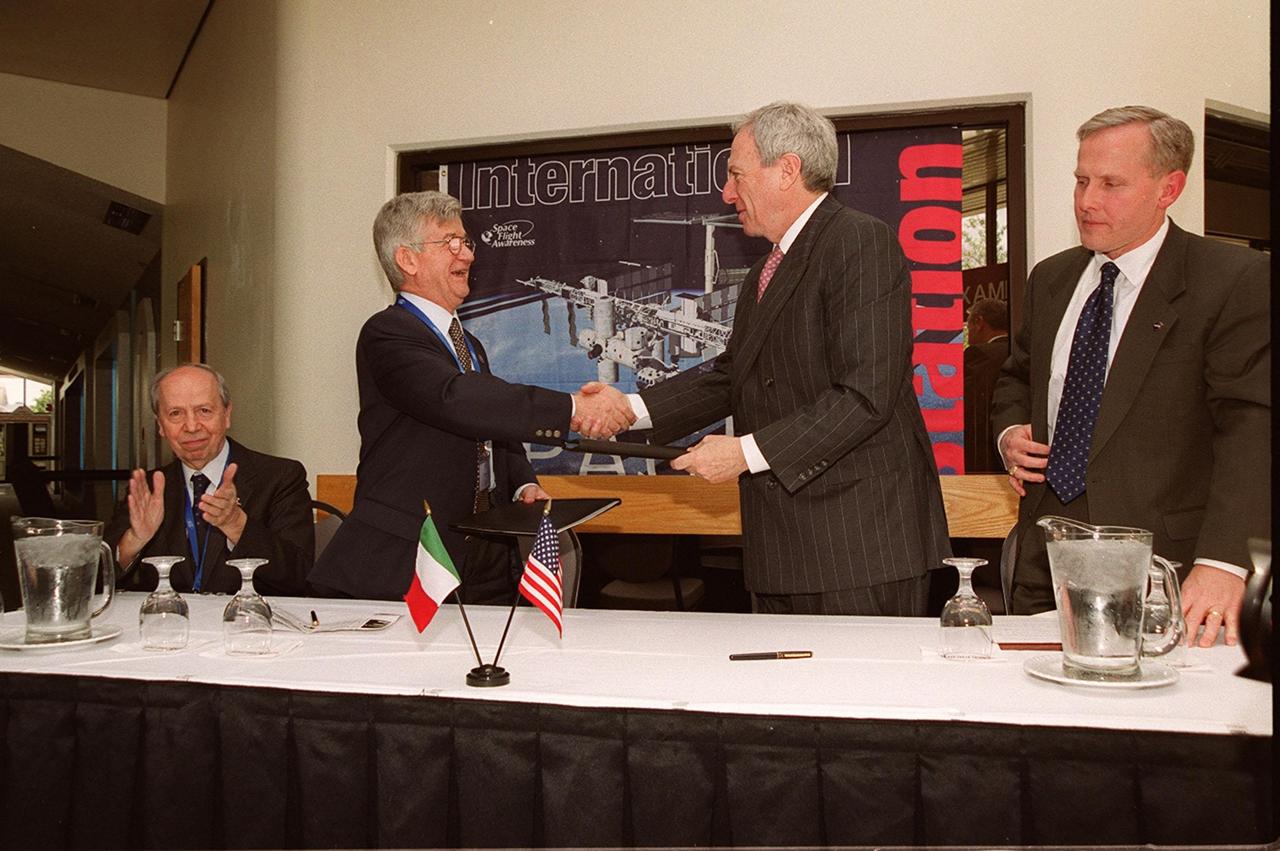
After signing a Framework for Cooperation to build the Habitation Module for the International Space Station, Italian Space Agency President Sergio DeJulio (standing, left) shakes hands with NASA Administrator Daniel S. Goldin (right). Also at the signing are The Honorable Lamberto Dini, Minister of Foreign Affairs, Republic of Italy (far left) and John Schumacher, assistant administrator, NASA External Relations. The Framework is a potential bilateral cooperative agreement that could result in ASI development of a U.S. Habitation Module for the International Space Station. This agreement allows the U.S. to explore an alternative approach to achieve full crew habitation for the ISS. A Memorandum of Understanding (MOU) between NASA and ASI will be required to formally document NASA and ASI’s respective responsibilities in a legally binding document. The Framework signed today would form the basis for a potential MOU which NASA and ASI would sign after completion of the program assessment and subsequent negotiations.The ceremony took place at the IMAX Theater, Kennedy Space Center Visitor Complex

The left wing of NASA's Altair unmanned aerial vehicle (UAV) rests in a jig during construction at General Atomics Aeronautical Systems, Inc., (GA-ASI) facility at Adelanto, Calif.
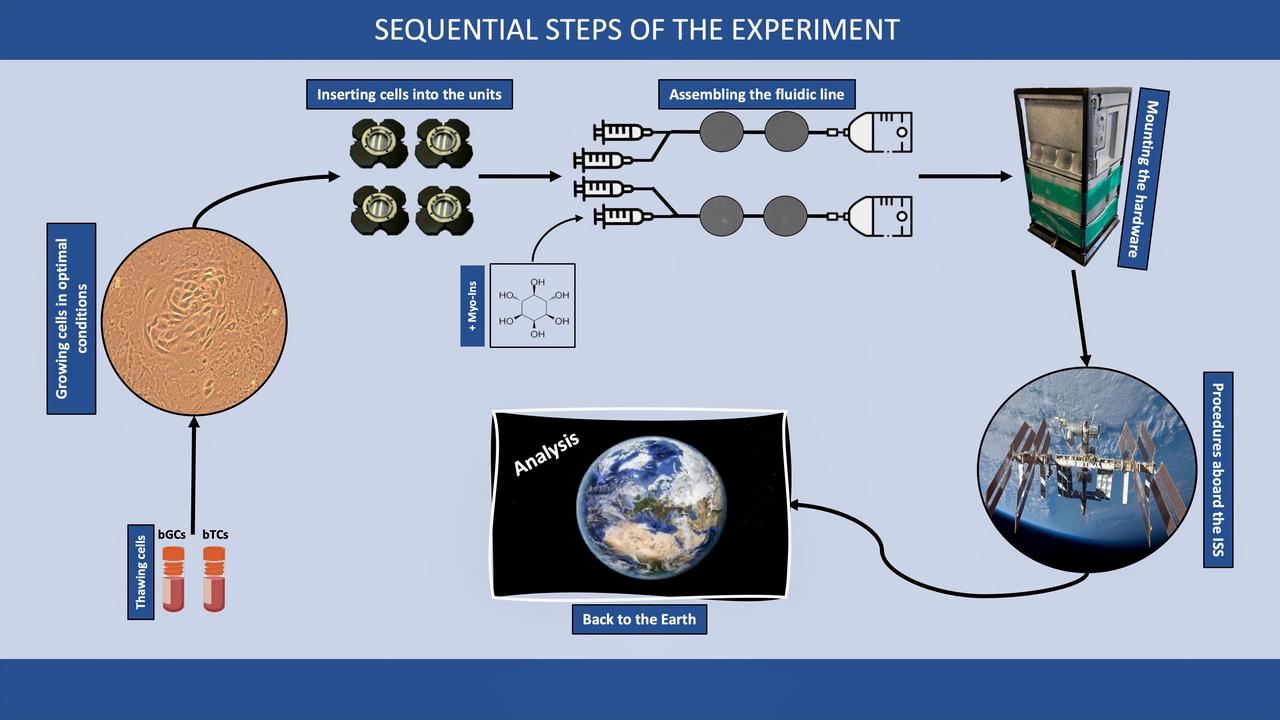
jsc2024e071690 (11/5/2024) --- Schematic representation of the sequential steps of the Ovarian Research In microgravity cONditions-2 (ORION-2) investigation. Image courtesy of Italian Space Agency (ASI).
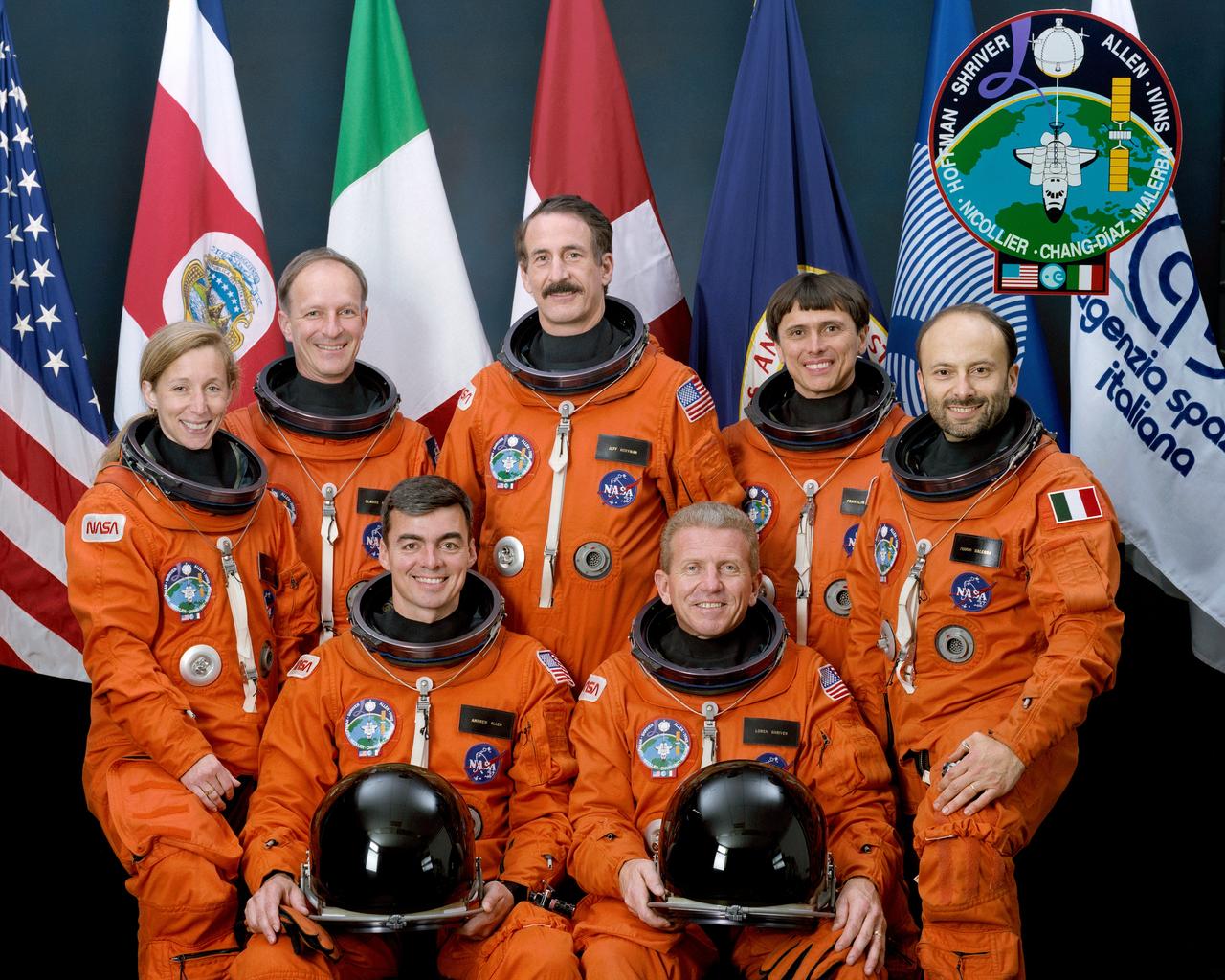
STS046-S-002 (May 1992) --- The crew members assigned to the STS-46 mission pose with seven flags that represent participation on the flight. Loren J. Shriver (right front) is mission commander; Andrew M. Allen (left front) is pilot. Others are (left to right) Marsha S. Ivins, mission specialist; Claude Nicollier, mission specialist representing the European Space Agency (ESA); Jeffrey A. Hoffman, payload commander; Franklin R. Chang-Diaz, mission specialist; and Franco Malerba, flying for the Italian Space Agency (ASI). The flags, left to right, represent the United States of America, Costa Rica (Chang's native country), Italy, Switzerland (Nicollier's homeland), NASA, ESA and ASI.
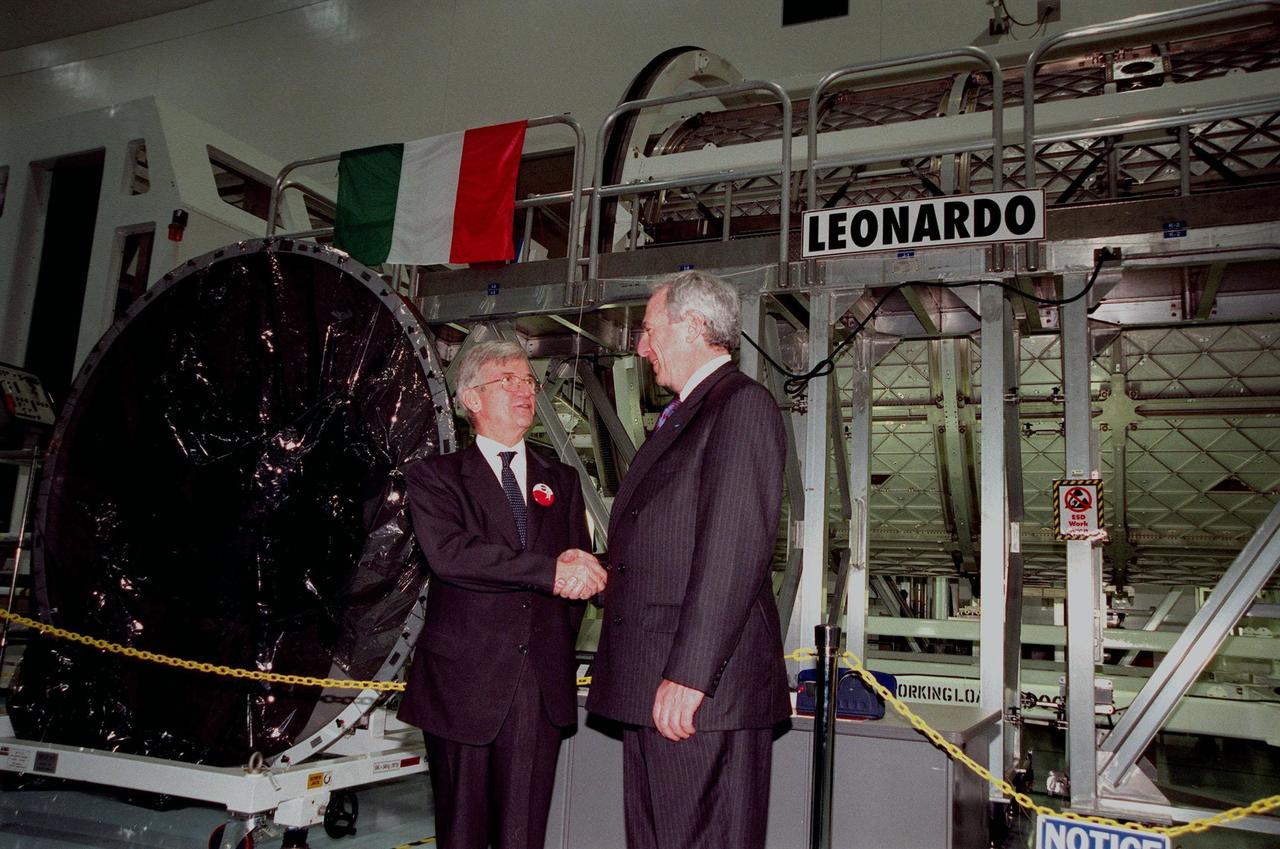
KENNEDY SPACE CENTER, FLA. -- NASA Administrator Daniel S. Goldin (at right) shakes the hand of Sergio De Julio, president of the Italian Space Agency, Agenzia Spaziale Italiana (ASI), during the ceremony transferring the "Leonardo" Multipurpose Logistics Module (MPLM) from ASI to NASA. The event was held in the Space Station Processing Facility beside Leonardo. The MPLM, a reusable logistics carrier, will be the primary delivery system used to resupply and return International Space Station cargo requiring a pressurized environment. Leonardo is the first of three MPLM carriers for the International Space Station. It is scheduled to be launched on Space Shuttle Mission STS-100, targeted for April 2000
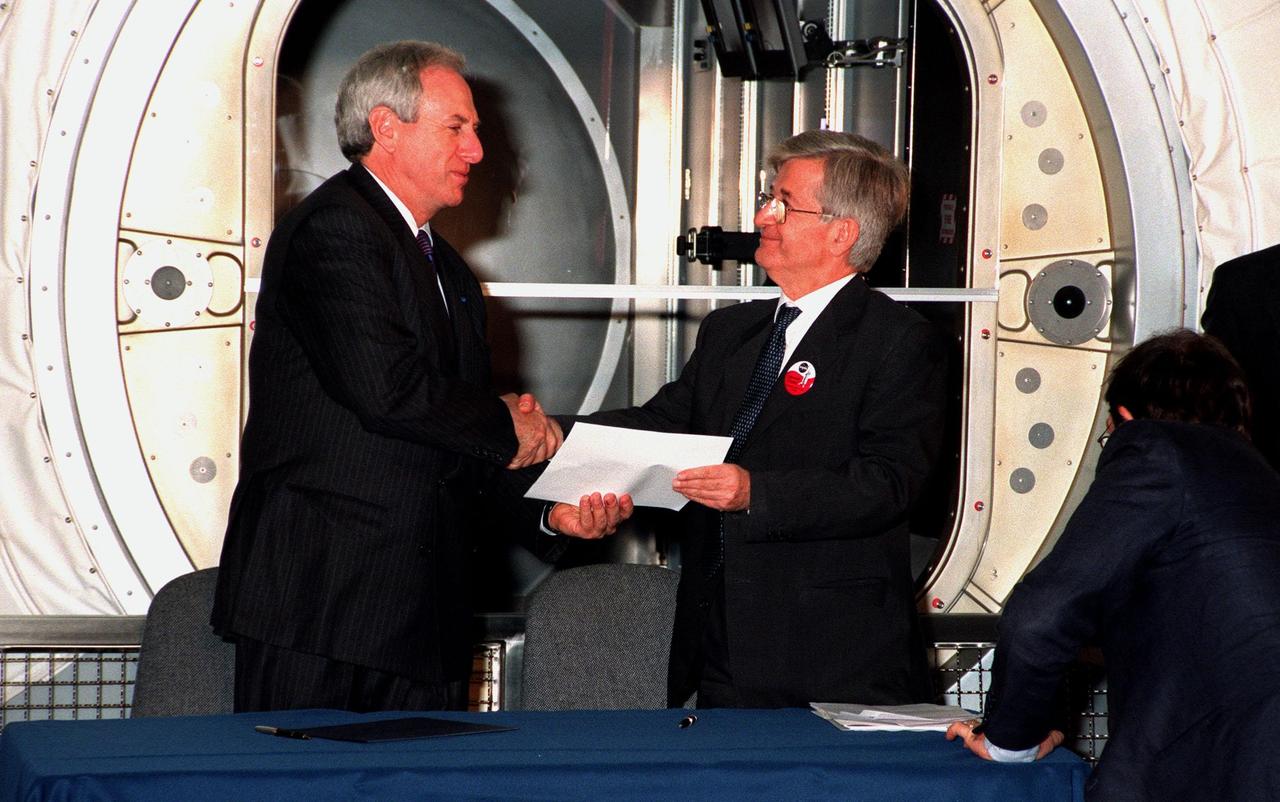
KENNEDY SPACE CENTER, FLA. -- Sergio De Julio (at right), president of the Italian Space Agency, Agenzia Spaziale Italiana (ASI), shakes the hand of NASA Adminstrator Daniel S. Goldin while holding the document which signifies the transfer of the "Leonardo" Multipurpose Logistics Module (MPLM) from ASI to NASA. The ceremonial event was held in the Space Station Processing Facility beside Leonardo. The MPLM, a reusable logistics carrier, will be the primary delivery system used to resupply and return International Space Station cargo requiring a pressurized environment. Leonardo is the first of three MPLM carriers for the International Space Station. It is scheduled to be launched on Space Shuttle Mission STS-100, targeted for April 2000
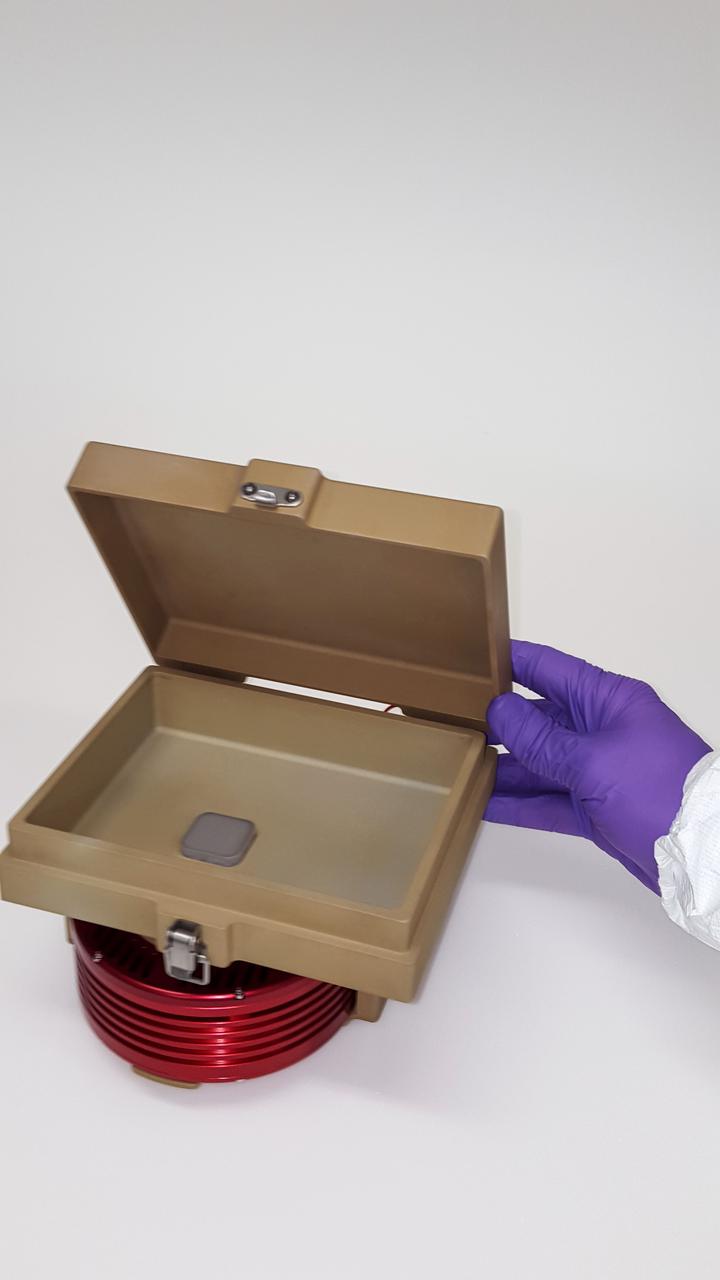
jsc2021e009927 (2/1/2016) --- A preflight view of the In Situ Chemiluminescent Reader. The In Situ Chemiluminescence Reader is a portable device that can be easily employed by a crewmember to perform ultrasensitive imaging detection of bio- and chemiluminescence signals. Image courtesy of the Italian Space Agency (ASI).
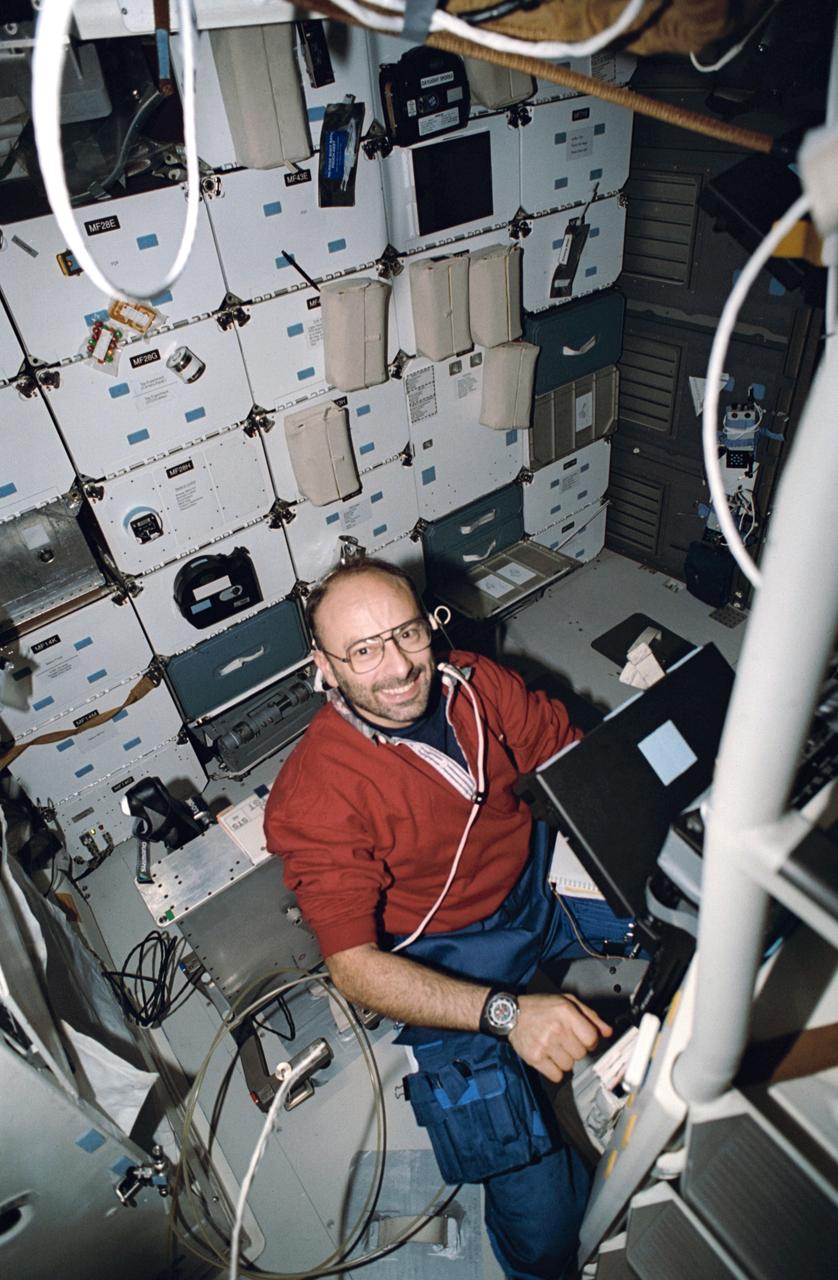
STS046-22-010 (31 July-8 Aug 1992) --- Payload specialist Franco Malerba, representing the Italian Space Agency (ASI) onboard the Space Shuttle Atlantis for the mission, works at a portable computer on the middeck. Malerba was joined by five NASA astronauts and a Swiss scientist for the eight-day mission.
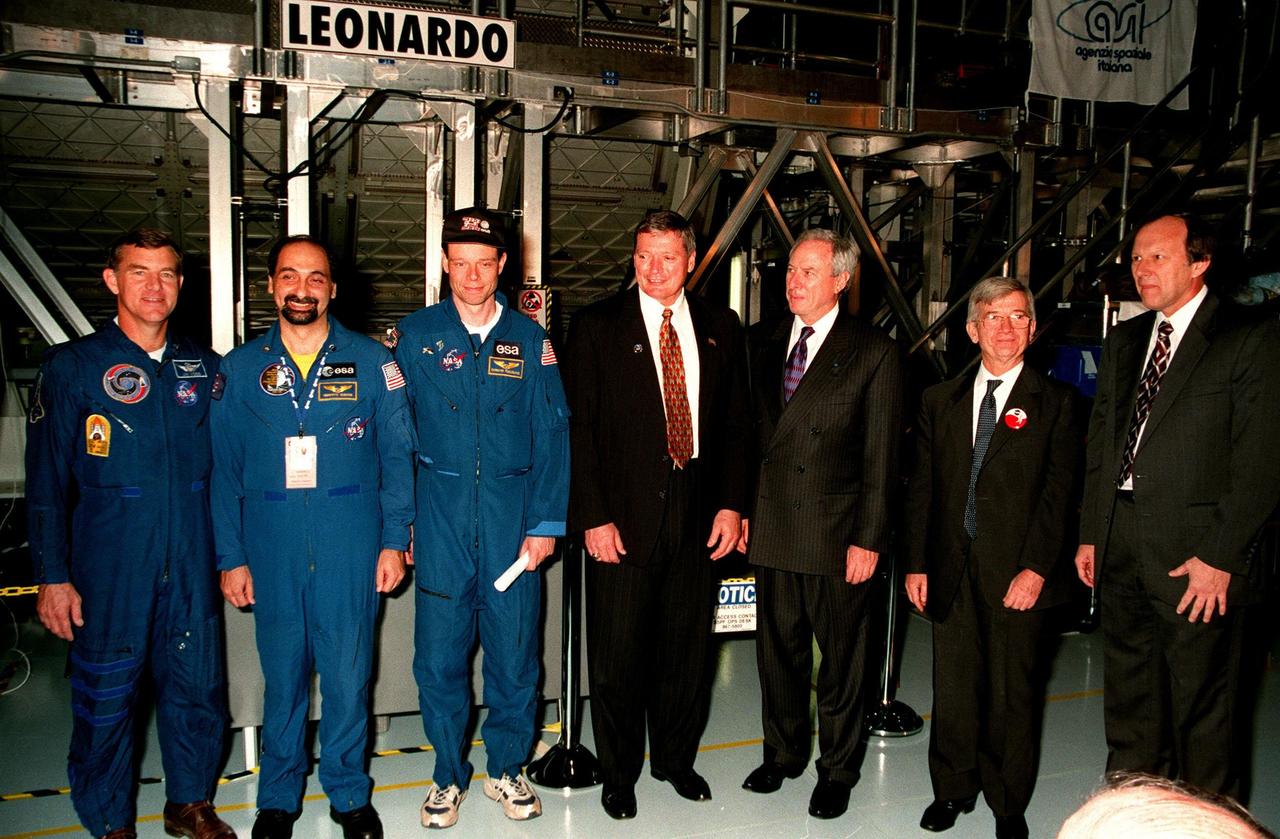
KENNEDY SPACE CENTER, FLA. -- Participants pose for a photo at the Space Station Processing Facility ceremony transferring the "Leonardo" Multipurpose Logistics Module (MPLM) from the Italian Space Agency, Agenzia Spaziale Italiana (ASI), to NASA. From left, they are astronaut Jim Voss, European Space Agency astronauts Umberto Guidoni of Italy and Christer Fuglesang of Sweden, NASA International Space Station Program Manager Randy Brinkley, NASA Administrator Daniel S. Goldin, ASI President Sergio De Julio and Stephen Francois, director, International Space Station Launch Site Support at KSC. The MPLM, a reusable logistics carrier, will be the primary delivery system used to resupply and return International Space Station cargo requiring a pressurized environment. Leonardo is the first of three MPLM carriers for the International Space Station. It is scheduled to be launched on Space Shuttle Mission STS-100, targeted for April 2000
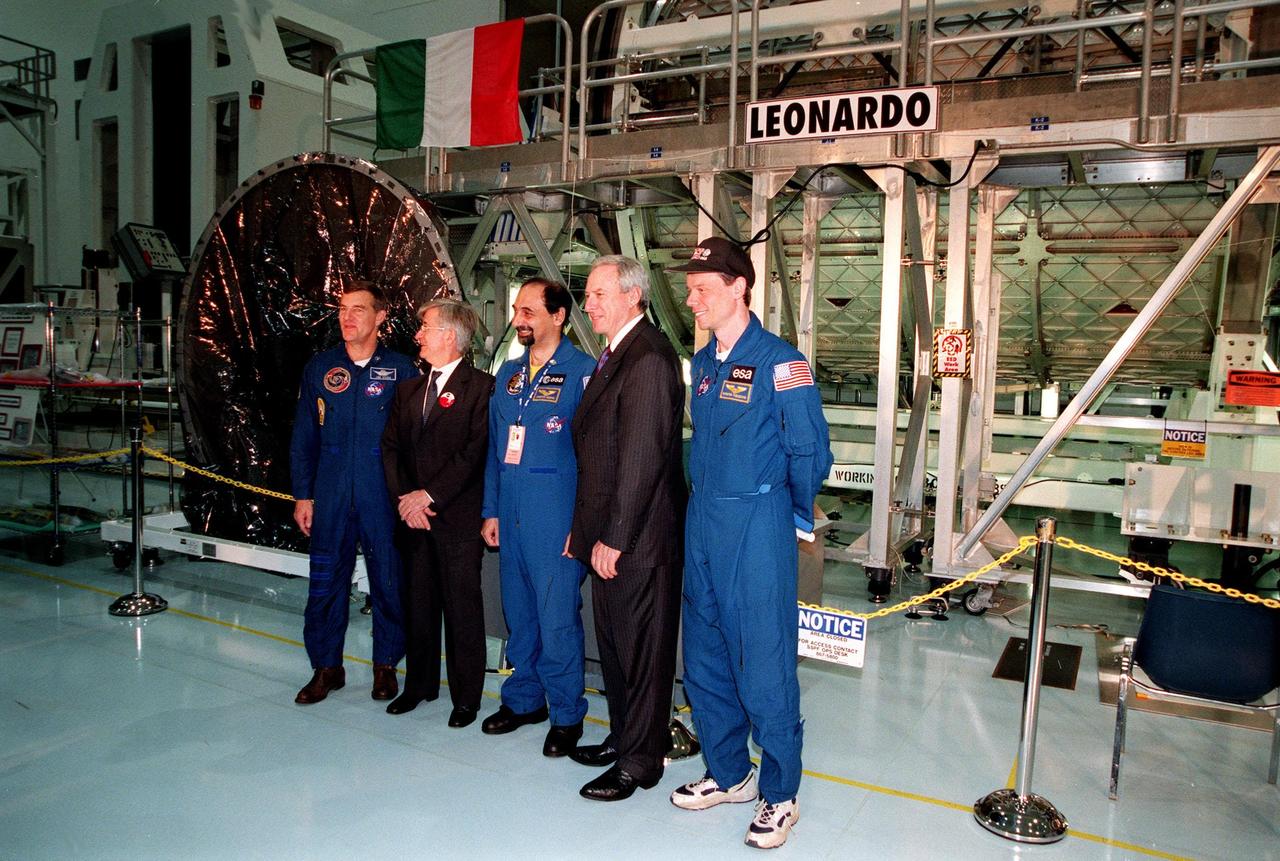
KENNEDY SPACE CENTER, FLA. -- Participants pose for a photo at the Space Station Processing Facility ceremony transferring the "Leonardo" Multipurpose Logistics Module (MPLM) from the Italian Space Agency, Agenzia Spaziale Italiana (ASI), to NASA. From left, they are astronaut Jim Voss, ASI President Sergio De Julio, European Space Agency astronaut Umberto Guidoni of Italy, NASA Administrator Daniel S. Goldin and European Space Agency astronaut Christer Fuglesang of Sweden. The MPLM, a reusable logistics carrier, will be the primary delivery system used to resupply and return International Space Station cargo requiring a pressurized environment. Leonardo is the first of three MPLM carriers for the International Space Station. It is scheduled to be launched on Space Shuttle Mission STS-100, targeted for April 2000
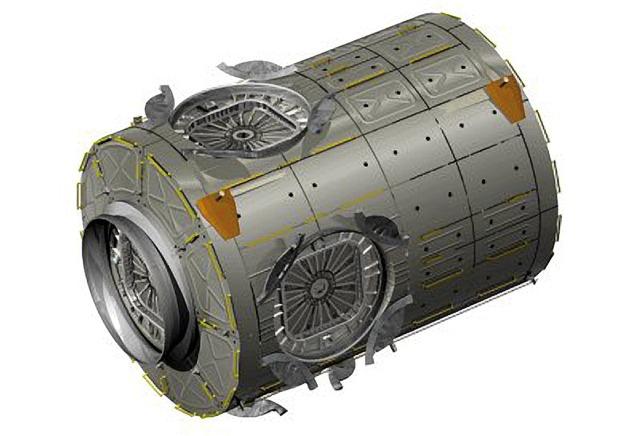
JSC2003-E-39020 (May 2003) --- This graphic shows the International Space Station Node 2 module. The installment of Node 2 to the station will signify the U.S. Core Complete stage of assembly, at which time the station can support the addition of international laboratories from Europe and Japan. Node 2 will provide a passageway between four International Space Station science experiment modules: the U.S. Destiny Laboratory, the Kibo Japanese Experiment Module, the European Columbus Laboratory and the Centrifuge Accommodation Module. Under contract of the Italian Space Agency (ASI), Alenia Spazio in Turin, Italy led a consortium of European sub-contractors to build Node 2. The module was built for NASA under a barter agreement with the European Space Agency (ESA) in exchange for the launch of the European Columbus Laboratory by the space shuttle to the International Space Station. Photo Credit: Italian Space Agency (ASI).
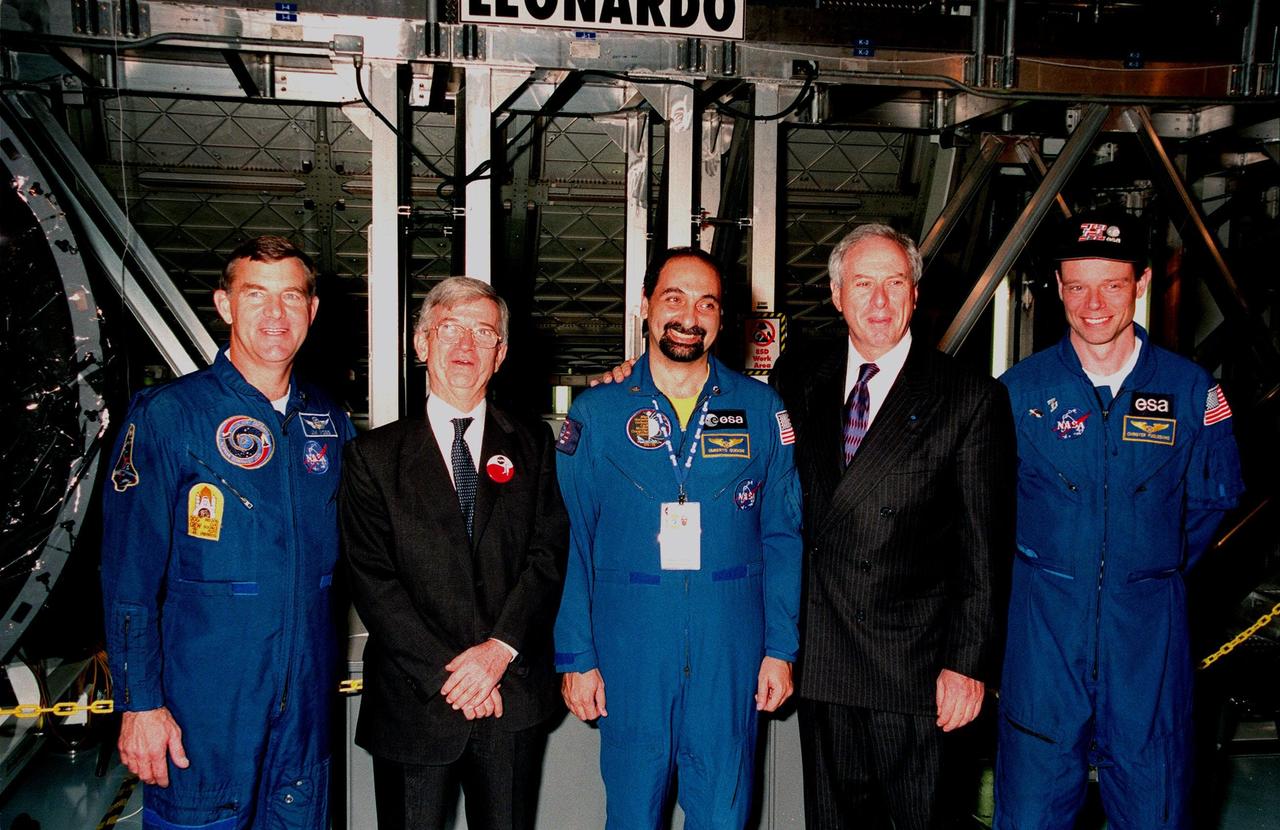
KENNEDY SPACE CENTER, FLA. -- Participants pose for a photo at the Space Station Processing Facility ceremony transferring the "Leonardo" Multipurpose Logistics Module (MPLM) from the Italian Space Agency, Agenzia Spaziale Italiana (ASI), to NASA. From left, they are astronaut Jim Voss, ASI President Sergio De Julio, European Space Agency astronaut Umberto Guidoni of Italy, NASA Administrator Daniel S. Goldin and European Space Agency astronaut Christer Fuglesang of Sweden. The MPLM, a reusable logistics carrier, will be the primary delivery system used to resupply and return International Space Station cargo requiring a pressurized environment. Leonardo is the first of three MPLM carriers for the International Space Station. It is scheduled to be launched on Space Shuttle Mission STS-100, targeted for April 2000
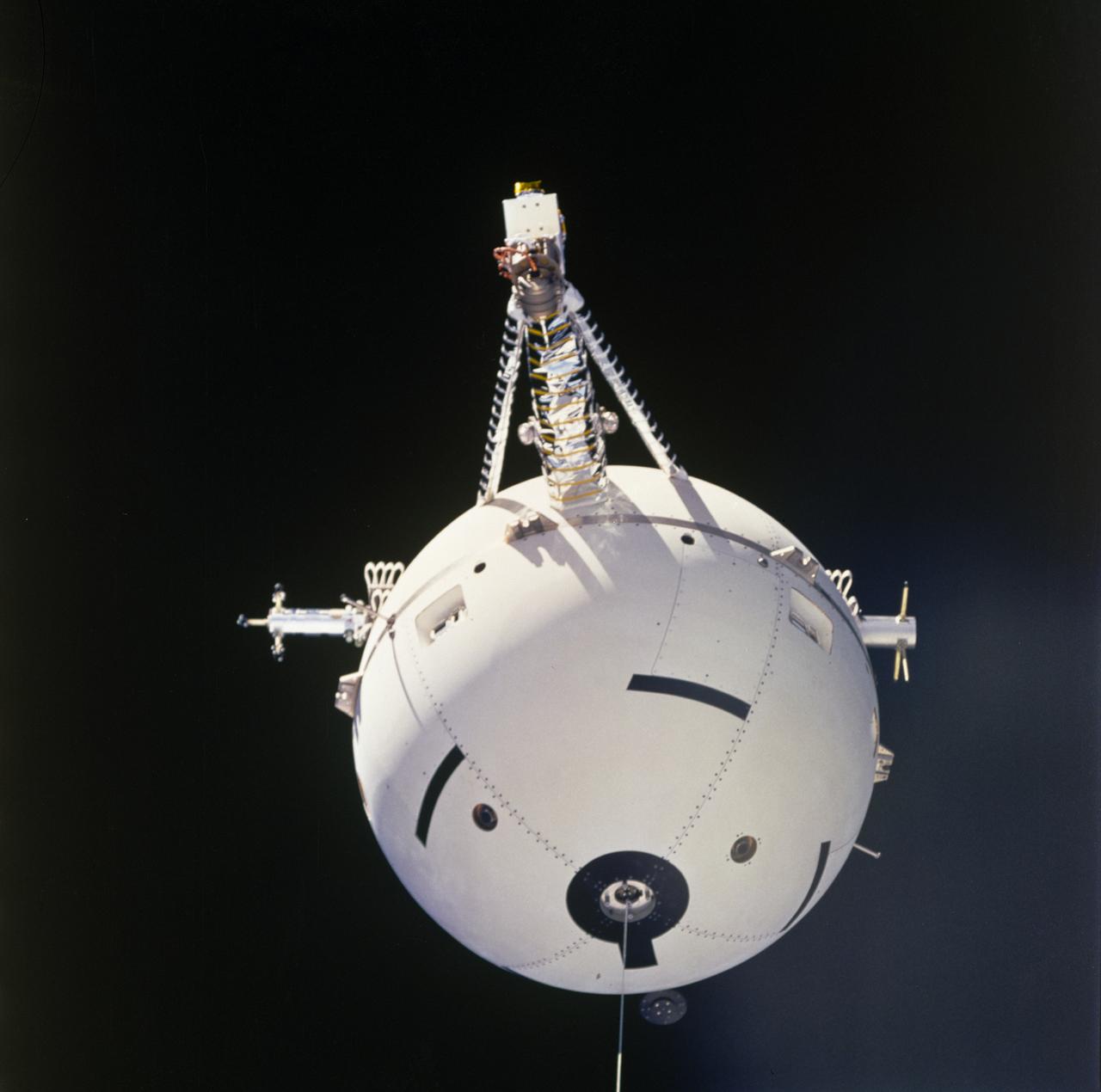
This Space Shuttle Orbiter Atlantis (STS-46) onboard photo is a close-up view of the Tethered Satellite System (TSS-1) in orbit above the Shuttle. A cooperative development effort by the Italian Space Agency (ASI) and NASA, the Tethered Satellite System (TSS) made capable the deployment and retrieval of a satellite which is attached by a wire tether from distances up to 100 km from the Orbiter. These free-flying satellites are used as observation platforms outside of the Orbiter.
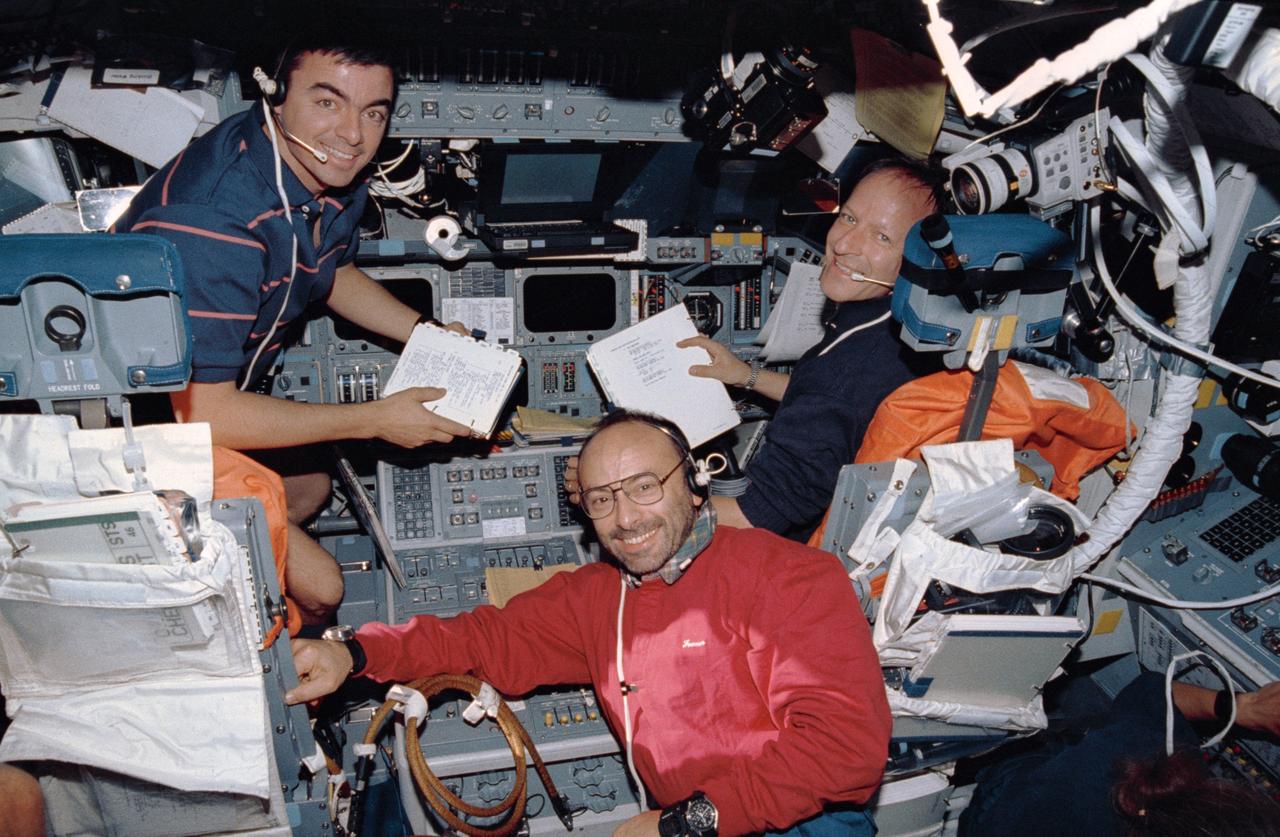
STS046-05-019 (31 July-8 Aug 1992) --- The "blue-shift" crew members pose on the flight deck of the Earth-orbiting Space Shuttle Atlantis. Left to right are Andrew M. Allen, pilot; Franco Malerba, representing the Italian Space Agency (ASI) and Swiss scientist Claude Nicollier, representing the European Space Agency (ESA).
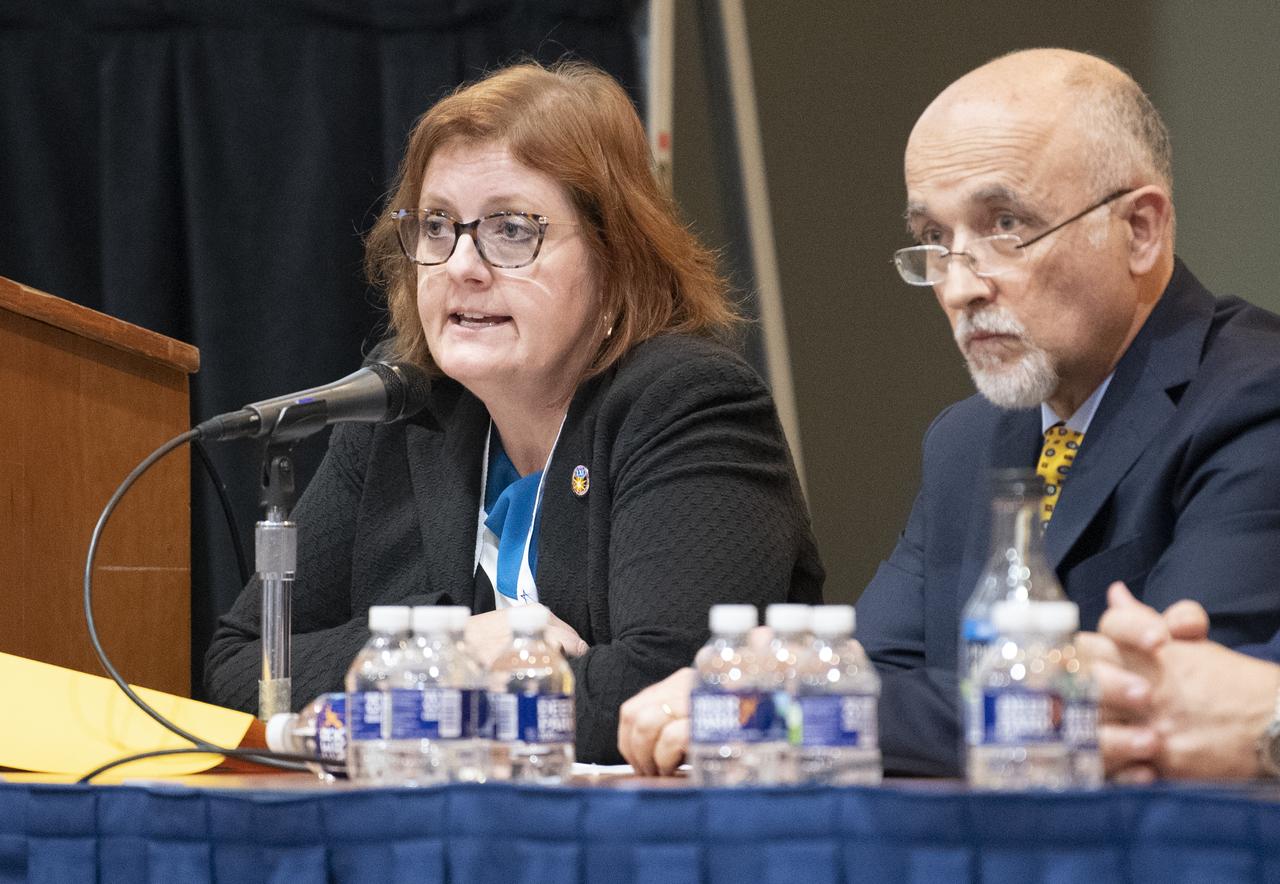
Julie Robinson, Chief Scientist for NASA's International Space Station Division, left, and Livio Narici, Professor of Applied Physics at the Università di Roma "Tor Vergata" and ASI, lead a discussion titled “ISS-Moon-Mars: Using Spaceflight Platforms to Study and Simulate Future Missions” during the the 70th International Astronautical Congress, Monday, Oct. 21, 2019 at the Walter E. Washington Convention Center in Washington. Photo Credit: (NASA/Joel Kowsky)
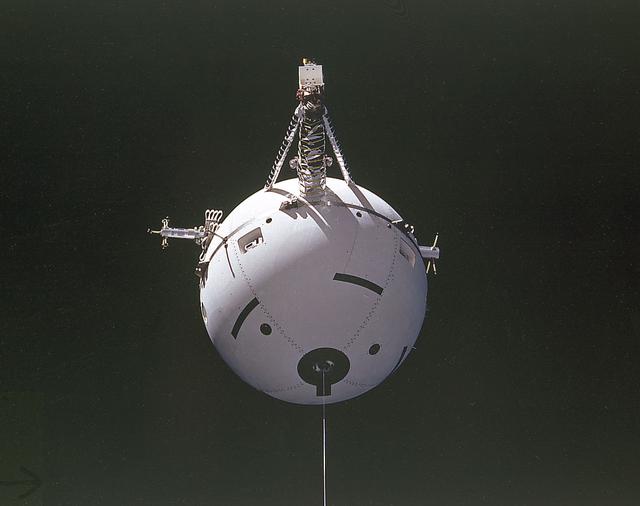
Space Shuttle Atlantis (STS-46) onboard photo of the Tethered Satellite System (TSS-1) deployment. A cooperative development effort by the Italian Space Agency (ASI) and NASA, the Tethered Satellite System (TSS) made capable the deployment and retrieval of a satellite which is attached by a wire tether from distances up to 100 km from the Orbiter. These free-flying satellites are used as observation platforms outside of the Orbiter.
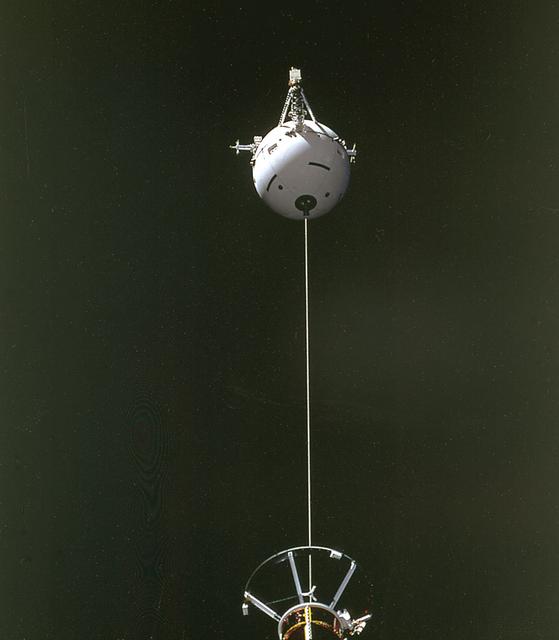
This is a Space Shuttle Orbiter Atlantis (STS-46) onboard photo of the Tethered Satellite System (TSS-1) deployment. A cooperative development effort by the Italian Space Agency (ASI) and NASA, the Tethered Satellite System (TSS) made capable the deployment and retrieval of a satellite which is attached by a wire tether from distances up to 100 km from the Orbiter. These free-flying satellites are used as observation platforms outside of the Orbiter.
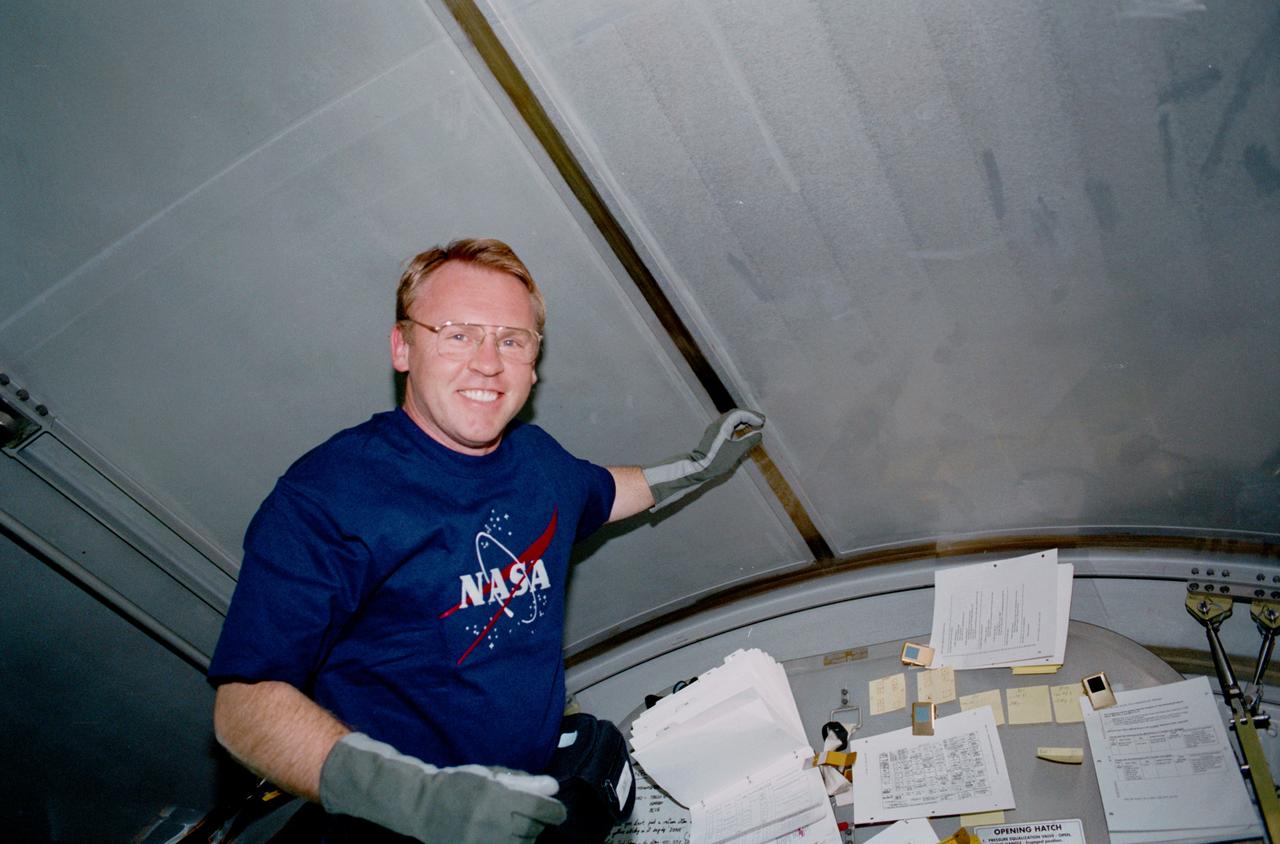
STS102-317-008 (8–21 March 2001) --- Astronaut Andrew S. W. Thomas, STS-102 mission specialist is photographed here in the Leonardo Multi-Purpose Logistics Module (MPLM) which was built by the Italian Space Agency (ASI). The MPLM is the first of three such pressurized modules that will serve as the International Space Station’s “moving vans”, carrying laboratory racks filled with equipment, experiments and supplies to and from the station aboard the space shuttle.
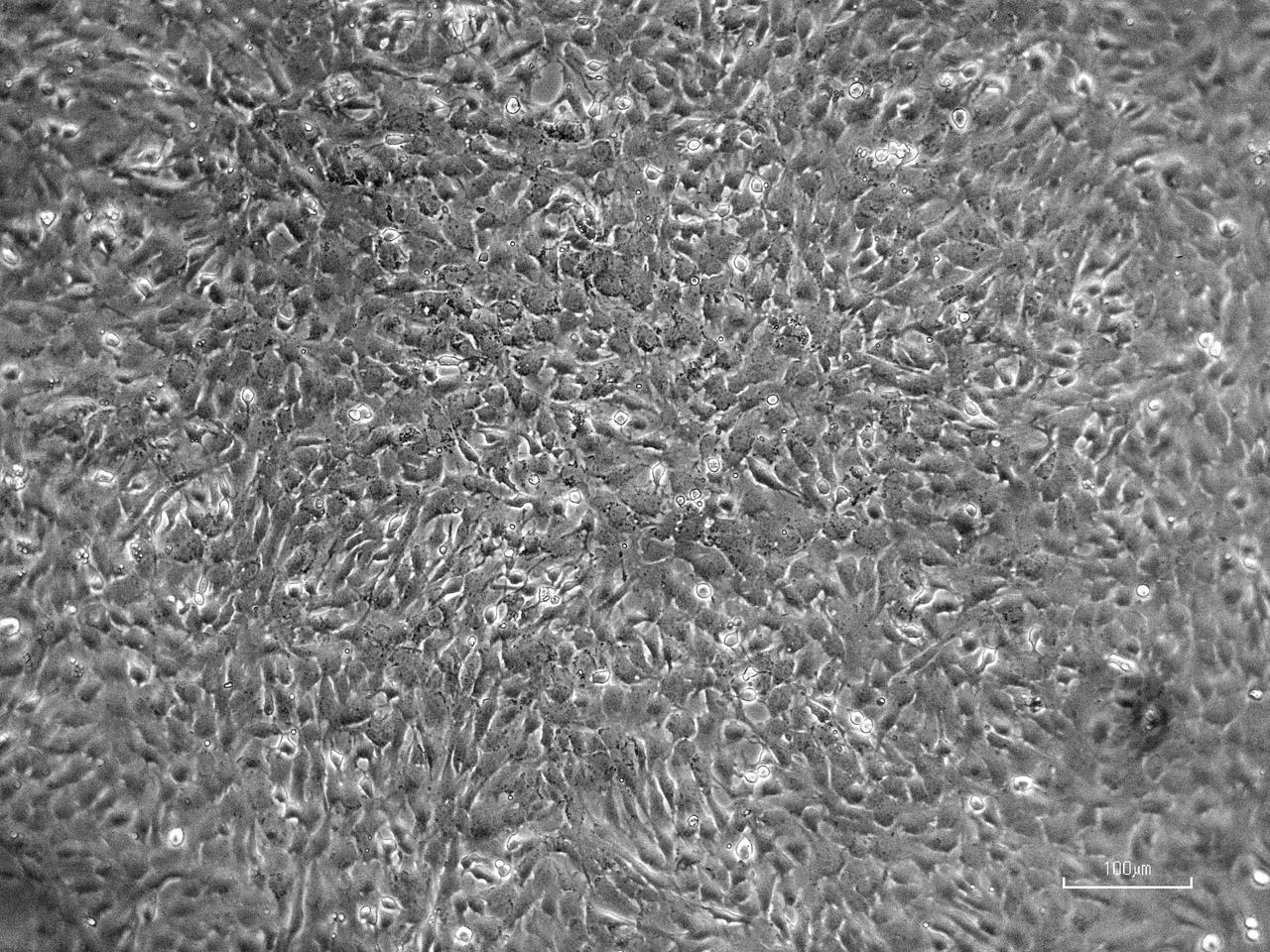
jsc2022e072967 (4/12/2021) --- Image of bovine ovary Granulosa cells. Coordinated by the Italian Space Agency (ASI), OVOSPACE investigates how microgravity influences the maturation and development ovarian cells in mammals, including Granulosa cells. This experiment could help scientists understand how long-term settlement on the Moon or Mars might affect the fertility of astronauts living in reduced gravity for long durations. Image courtesy of Professor Mariano Bizzarri, Department of Experimental Medicine, Sapienza University of Rome.
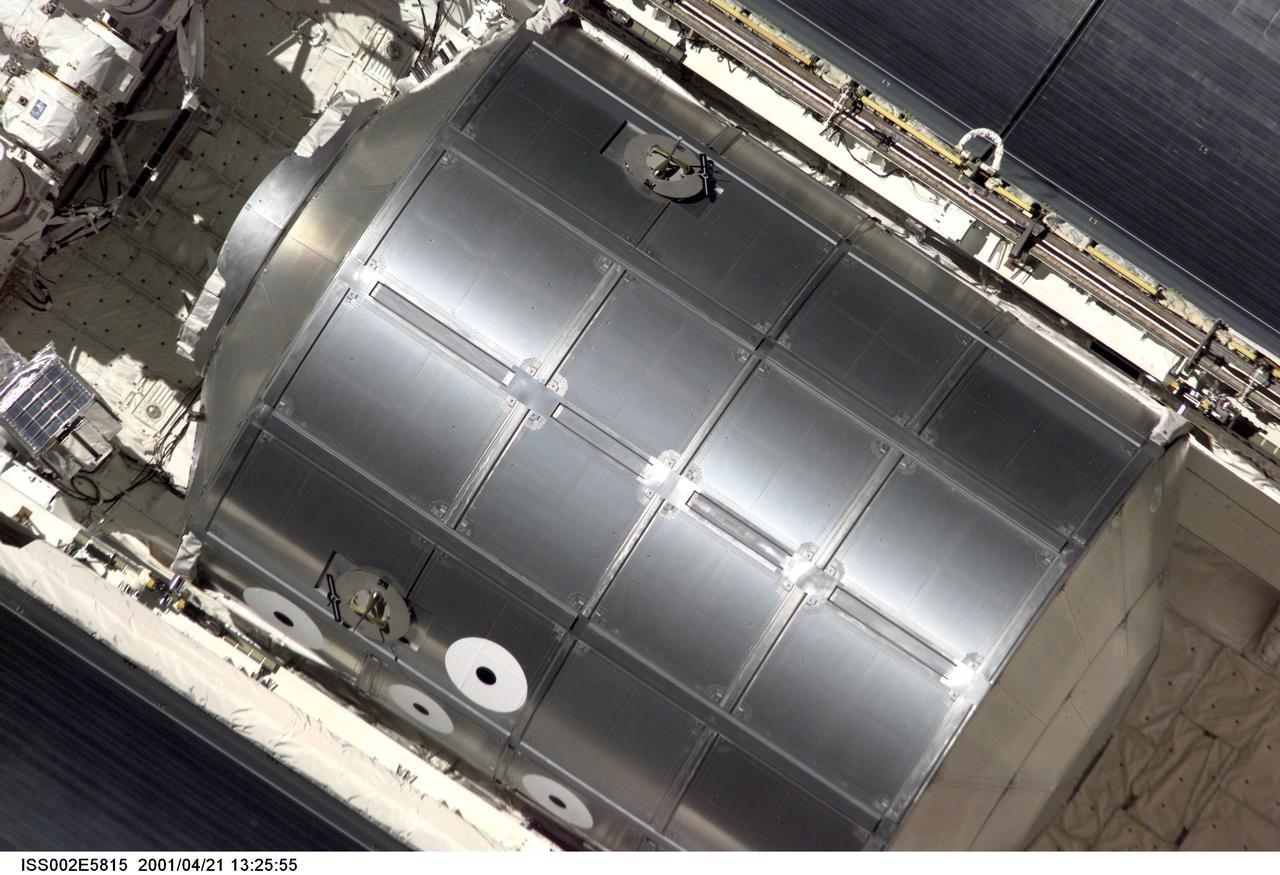
ISS002-E-5815 (21 April 2001) --- The Raffaello Multi-Purpose Logistics Module (MPLM), built by the Italian Space Agency (ASI), sits in its berthed position in the cargo bay of the Space Shuttle Endeavour as the STS-100 crew eases the vehicle close to the International Space Station (ISS) for docking. The image was recorded with a digital still camera by one of the Expedition Two crew members aboard the Station.
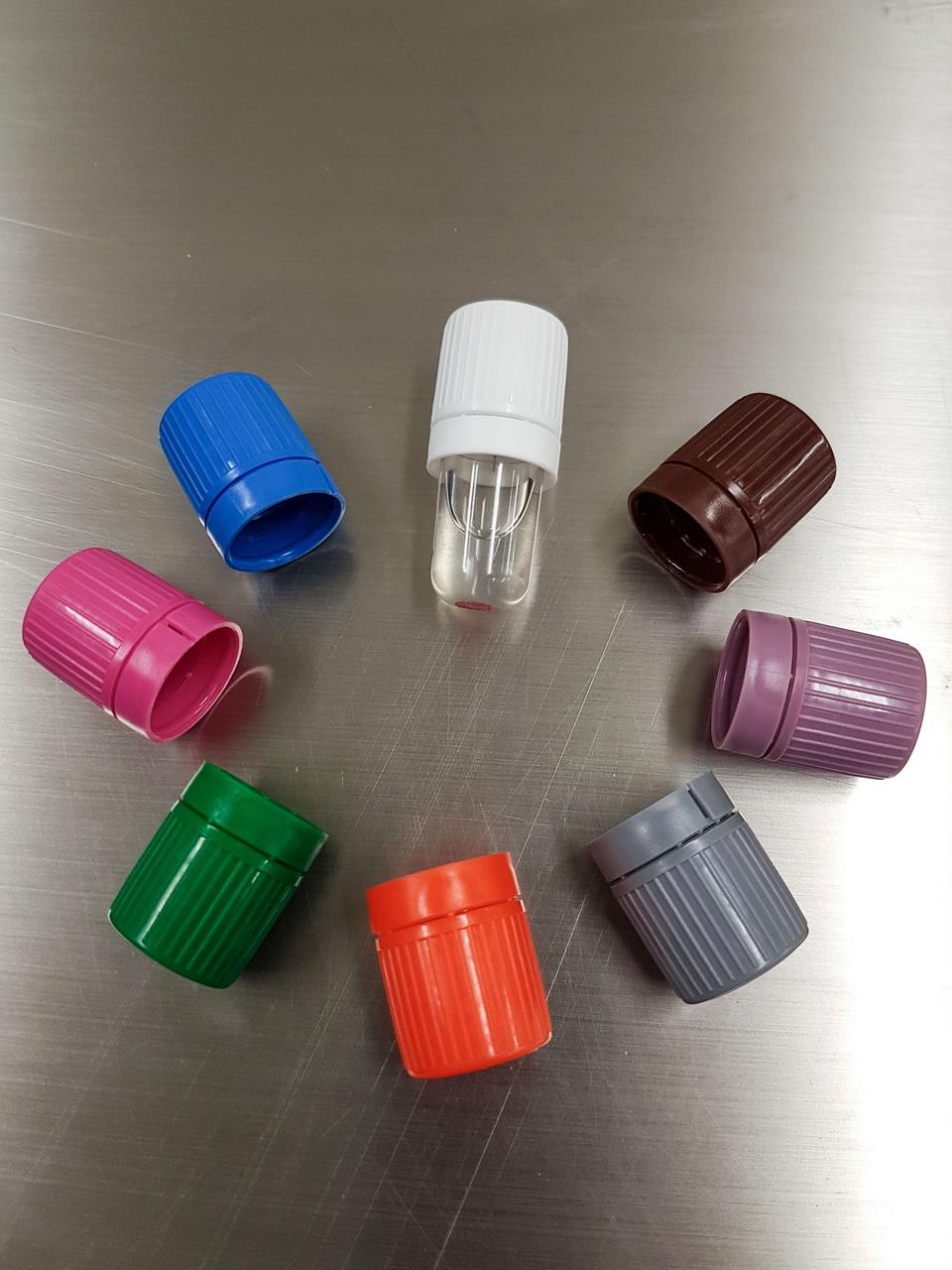
jsc2019e039817 (7/16/2019) --- A preflight view of an Amyloid Aggregation White Jar and different colored caps, used to distinguish within several incubation times by means of color code. The aim of the Amyloid Aggregation investigation is to assess if amyloid fibrils aggregation is affected by microgravity in order to identify a possible professional risk in astronauts spending long periods on board the International Space Station (ISS). (Image Courtesy of: ASI)
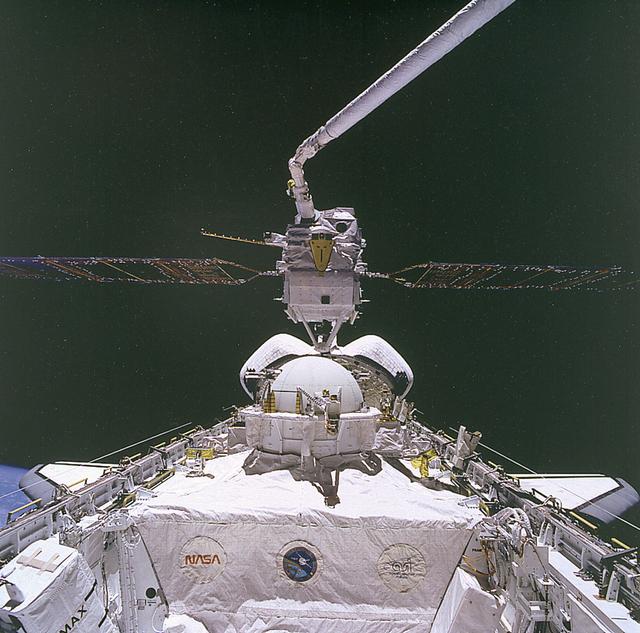
Space Shuttle Atlantis (STS-46) onboard photo of the Tethered Satellite System (TSS-1) on deployer boom. The Tethered Satellite System (TSS) was a cooperative development effort by the Italian Space Agency (ASI) and NASA made capable of deploying and retrieving a satellite which is attached by a wire tether from distances up to 100 km from the Orbiter. These free-flying satellites are used as observation platforms outside of the Orbiter.
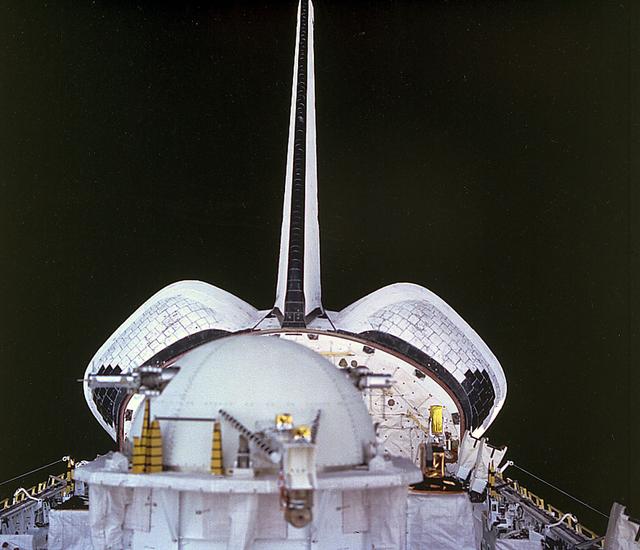
Space Shuttle Atlantis (STS-46) onboard photo of the Tethered Satellite System (TSS-1) in Orbiter's cargo bay. The Tethered Satellite System (TSS) was a cooperative development effort by the Italian Space Agency (ASI) and NASA made capable of deploying and retrieving a satellite which is attached by a wire tether from distances up to 100 km from the Orbiter. These free-flying satellites are used as observation platforms outside of the Orbiter.
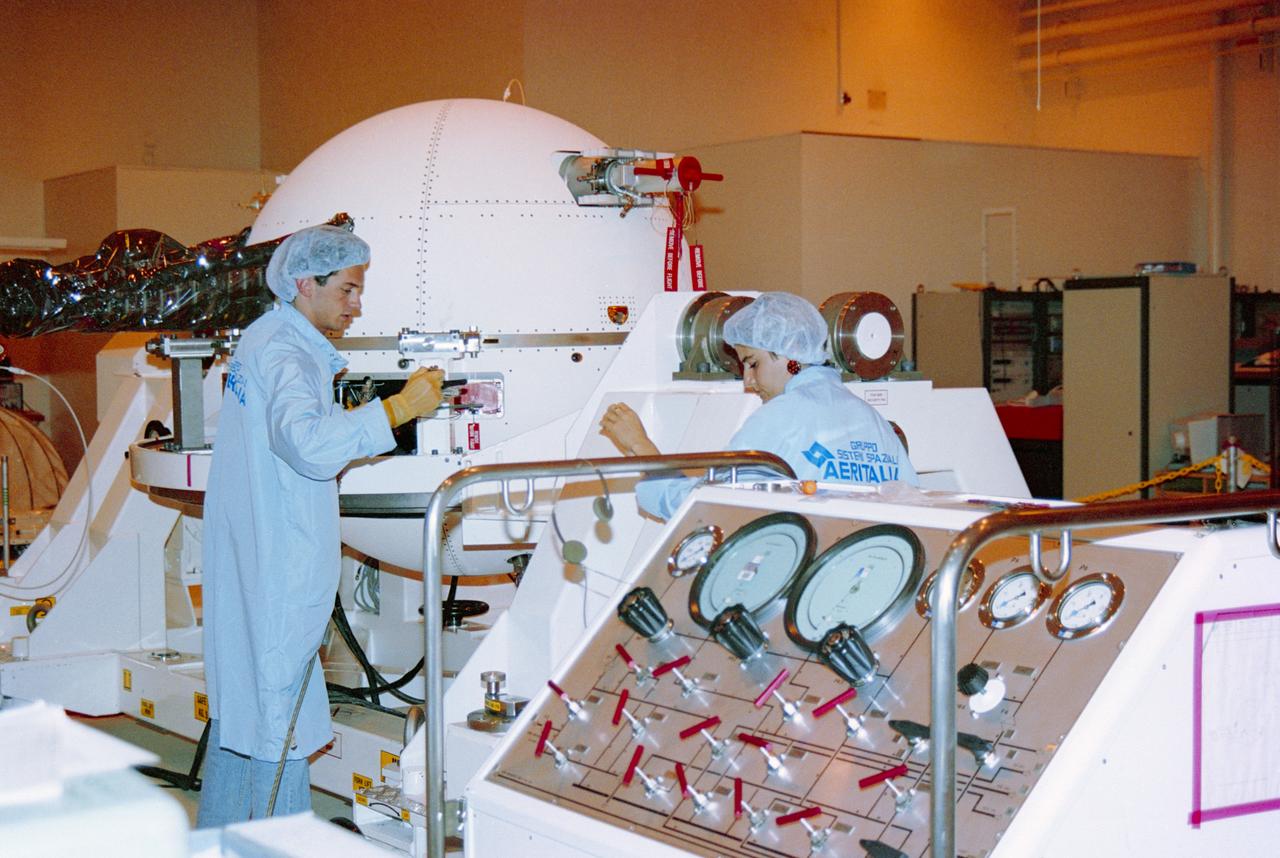
S92-41073 (31 oct 1991) --- In the Operations and Checkout Building high bay, preflight processing continues on the Tethered Satellite System (TSS) which is scheduled to fly on Space Shuttle Mission STS-46. Italian firm Aeritalia built the research satellite under contract to the Italian Space Agency (ASI). A joint endeavor between Italy and the United States, the TSS will release a satellite tethered to a reel in the orbiter cargo bay, and experiments will be conducted while the spacecraft is positioned some 12 miles above the orbiter.
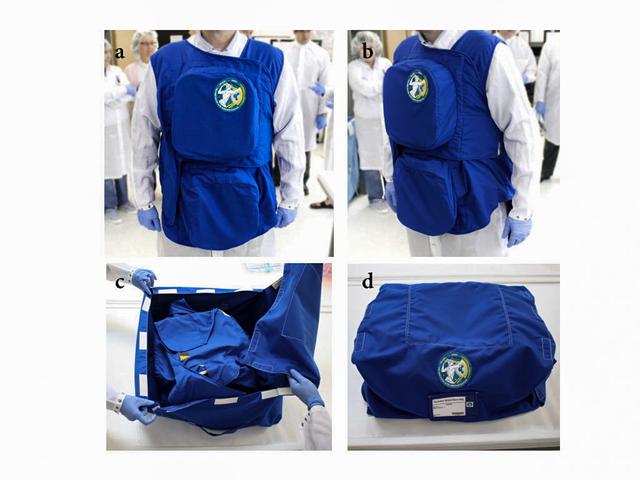
jsc2021e009421 (3/2/2021) --- A preflight view of the PERSEO garment prototype inspection and configuration for launch. (a,b) Garment worn during pre-flight inspections at Johnson Space Center (JSC) in Houston, USA, before launch, front and lateral view. (c) Garment folded in the transport bag for the launch configuration. (d) Closed transport bag containing.the garment. Image courtesy of the Italian Space Agency (ASI).
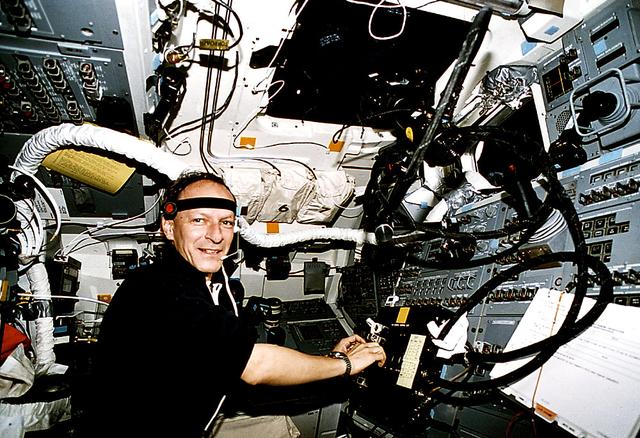
This Space Shuttle Orbiter Atlantis (STS-46) onboard photo shows Swiss scientist Claude Nicollier of the European Space Agency (ESA) supporting the Tether Opitical Phenomena (TOP) activities on the flight deck. The Tethered Satellite System (TSS) was a cooperative development effort by the Italian Space Agency (ASI) and NASA made capable of deploying and retrieving a satellite which is attached by a wire tether from distances up to 100 km from the Orbiter. These free-flying satellites are used as observation platforms outside of the Orbiter.
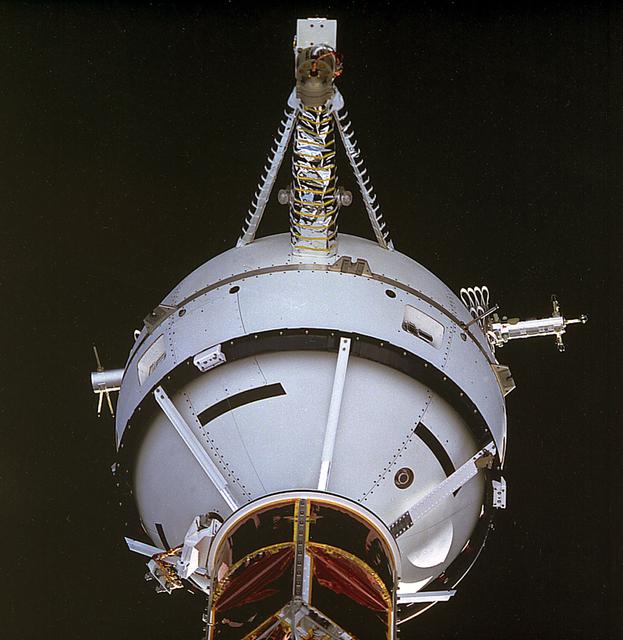
Pictured here is a Space Shuttle Atlantis (STS-46) onboard photo of the Tethered Satellite System (TSS-1) deployment. The Tethered Satellite System (TSS) was a cooperative development effort by the Italian Space Agency (ASI) and NASA. Combined efforts resulted in the capability of deploying and retrieving a satellite which is attached by a wire tether from distances up to 100-km from the Orbiter. These free-flying satellites are used as observation platforms outside of the Orbiter.
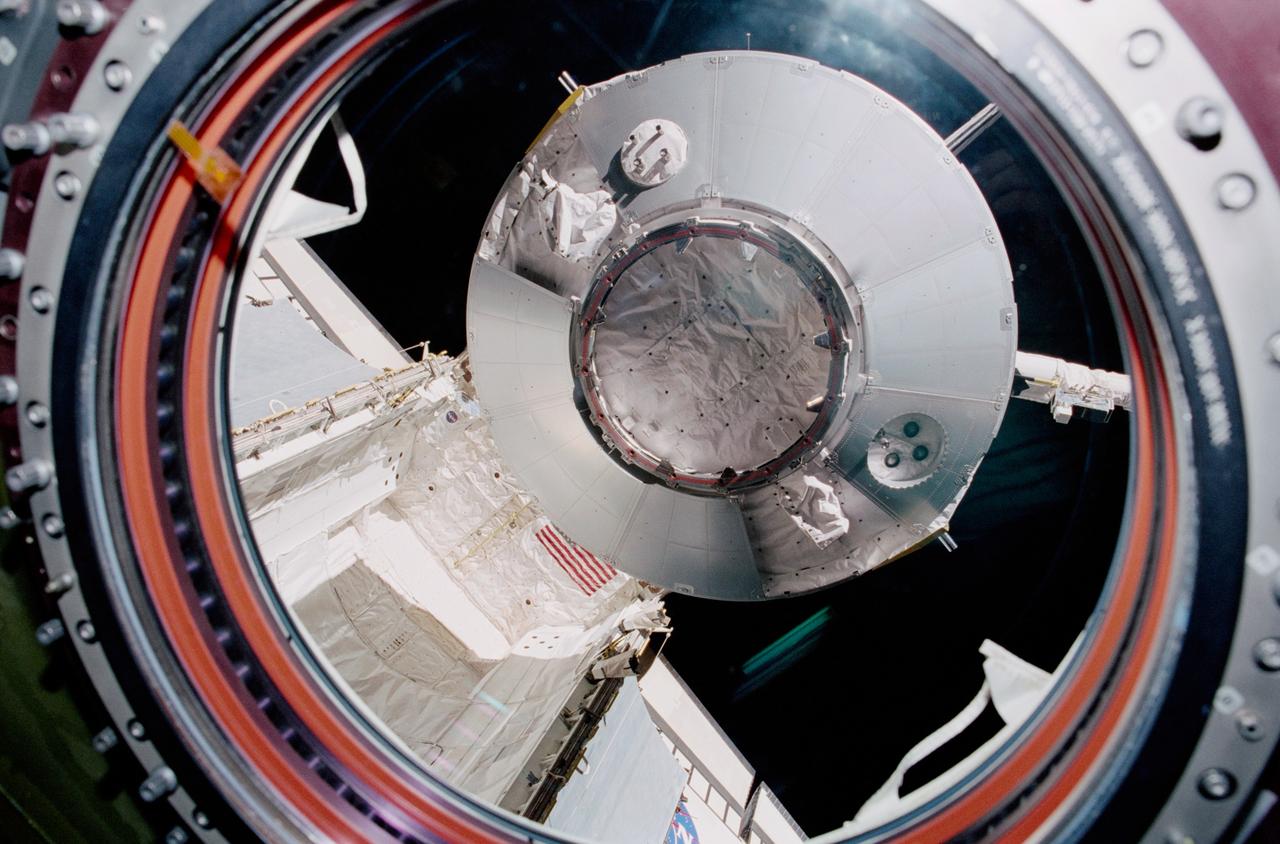
STS102-340-028 (8-21 March 2001) --- The Leonardo Multi-Purpose Logistics Module (MPLM) is photographed by a crew member through an International Space Station (ISS) window. Leonardo which was built by the Italian Space Agency (ASI), is the first of three such pressurized modules that will serve as the International Space Station’s “moving vans,” carrying laboratory racks filled with equipment, experiments and supplies to and from the station aboard the space shuttle.
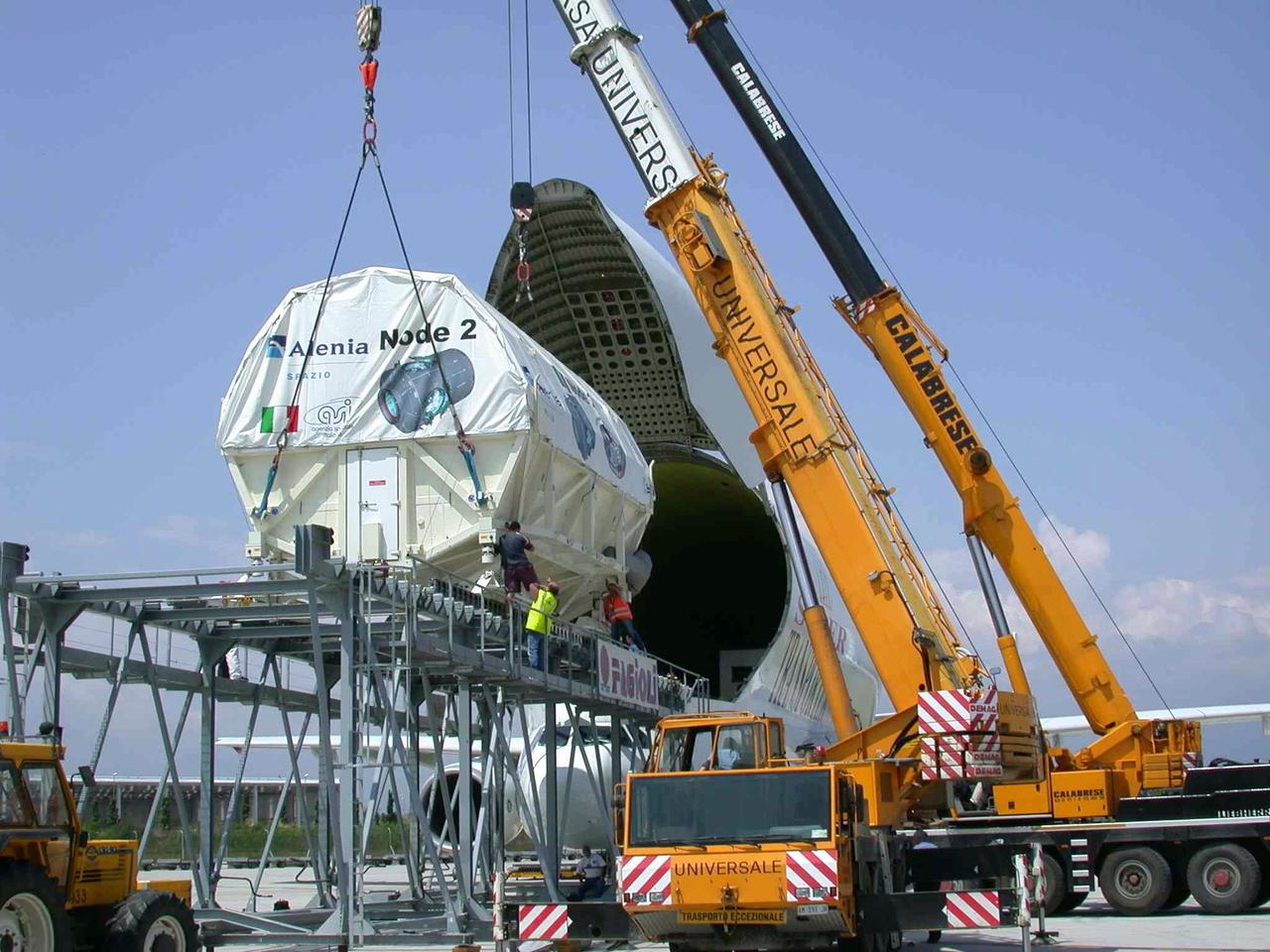
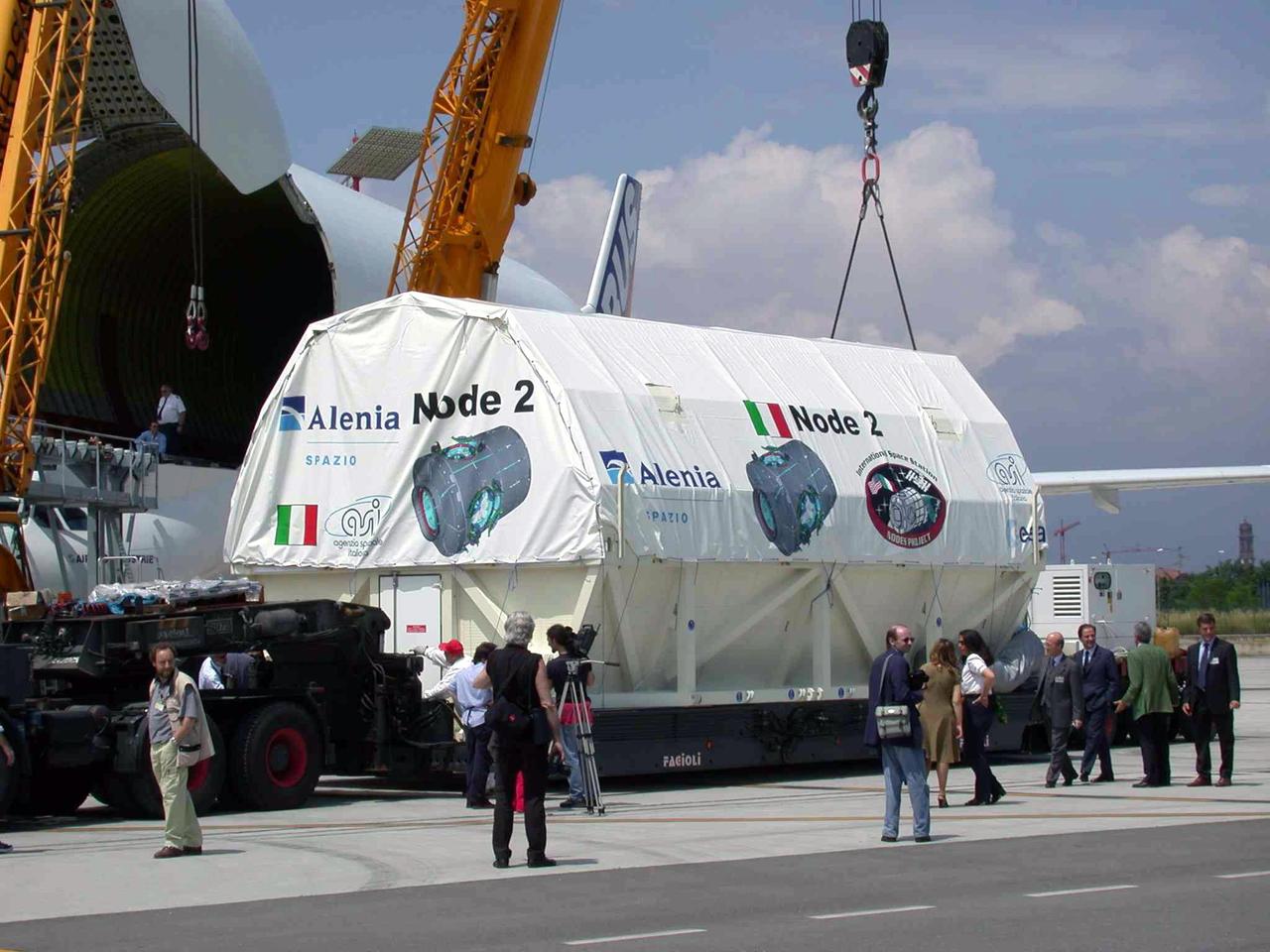
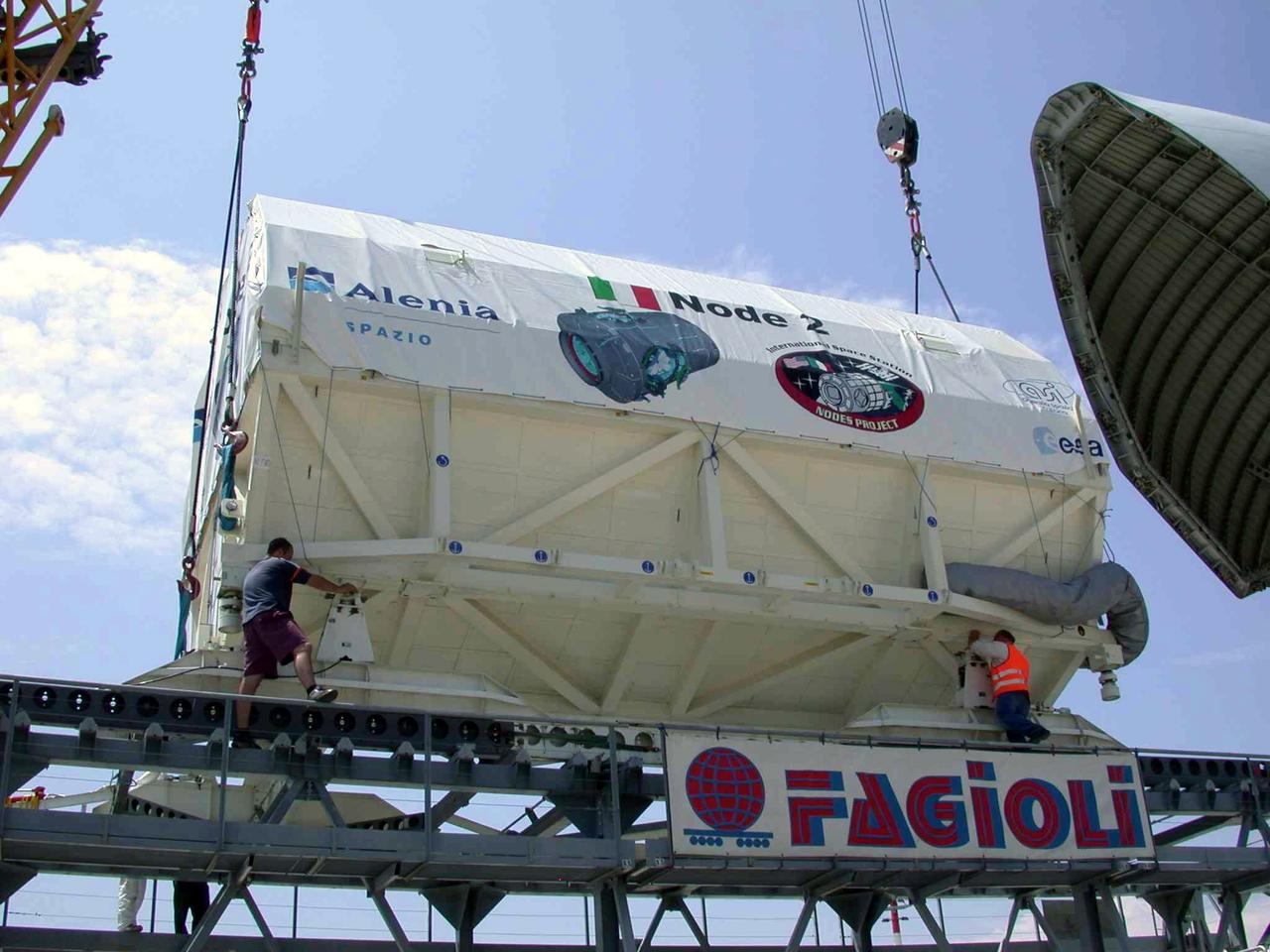
JSC2003-E-40266 (30 May 2003) --- The International Space Station U.S. Node 2 module is hoisted into an Airbus Beluga heavy-lift aircraft. The aircraft departed May 30 from Turin, Italy and arrived at the Kennedy Space Center June 1 with Node 2. Under contract of the Italian Space Agency (ASI), Alenia Spazio led a consortium of European sub-contractors to build Node 2. The module was built for NASA under a barter agreement with the European Space Agency (ESA) in exchange for the launch of the European Columbus Laboratory by the space shuttle to the International Space Station. Node 2 will provide a passageway between four International Space Station science experiment modules: the U.S. Destiny Laboratory, the Kibo Japanese Experiment Module, the European Columbus Laboratory and the Centrifuge Accommodation Module. The addition of Node 2 to the station will signify the U.S. Core Complete stage of assembly, at which time the station can support the addition of international laboratories from Europe and Japan. Photo Credit: Italian Space Agency (ASI)
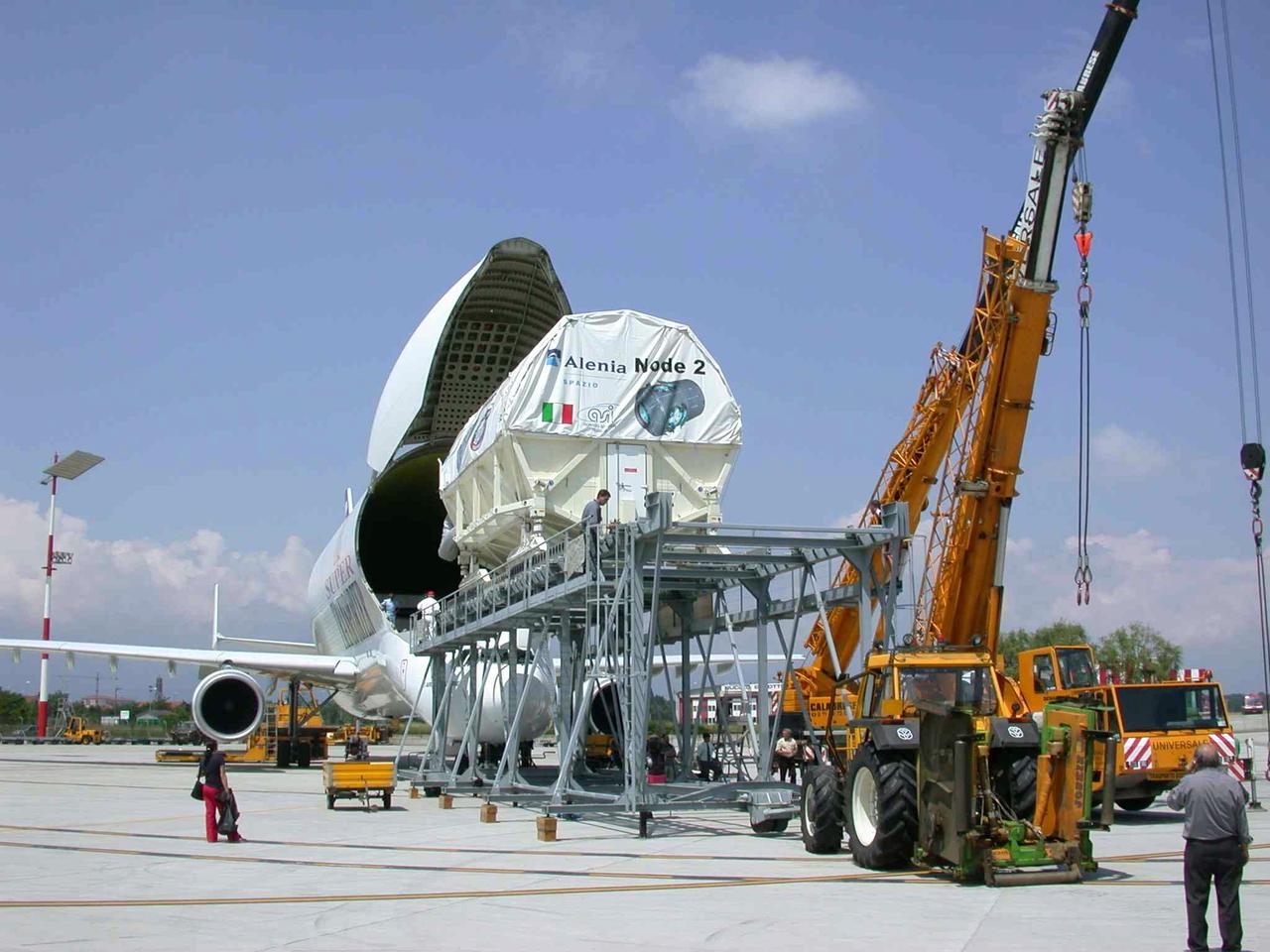
JSC2003-E-40248 (30 May 2003) --- The International Space Station U.S. Node 2 module is placed into an Airbus Beluga heavy-lift aircraft. The aircraft departed May 30 from Turin, Italy and arrived at the Kennedy Space Center June 1 with Node 2. Under contract of the Italian Space Agency (ASI), Alenia Spazio led a consortium of European sub-contractors to build Node 2. The module was built for NASA under a barter agreement with the European Space Agency (ESA) in exchange for the launch of the European Columbus Laboratory by the space shuttle to the International Space Station. Node 2 will provide a passageway between four International Space Station science experiment modules: the U.S. Destiny Laboratory, the Kibo Japanese Experiment Module, the European Columbus Laboratory and the Centrifuge Accommodation Module. The addition of Node 2 to the station will signify the U.S. Core Complete stage of assembly, at which time the station can support the addition of international laboratories from Europe and Japan. Photo Credit: Italian Space Agency (ASI )
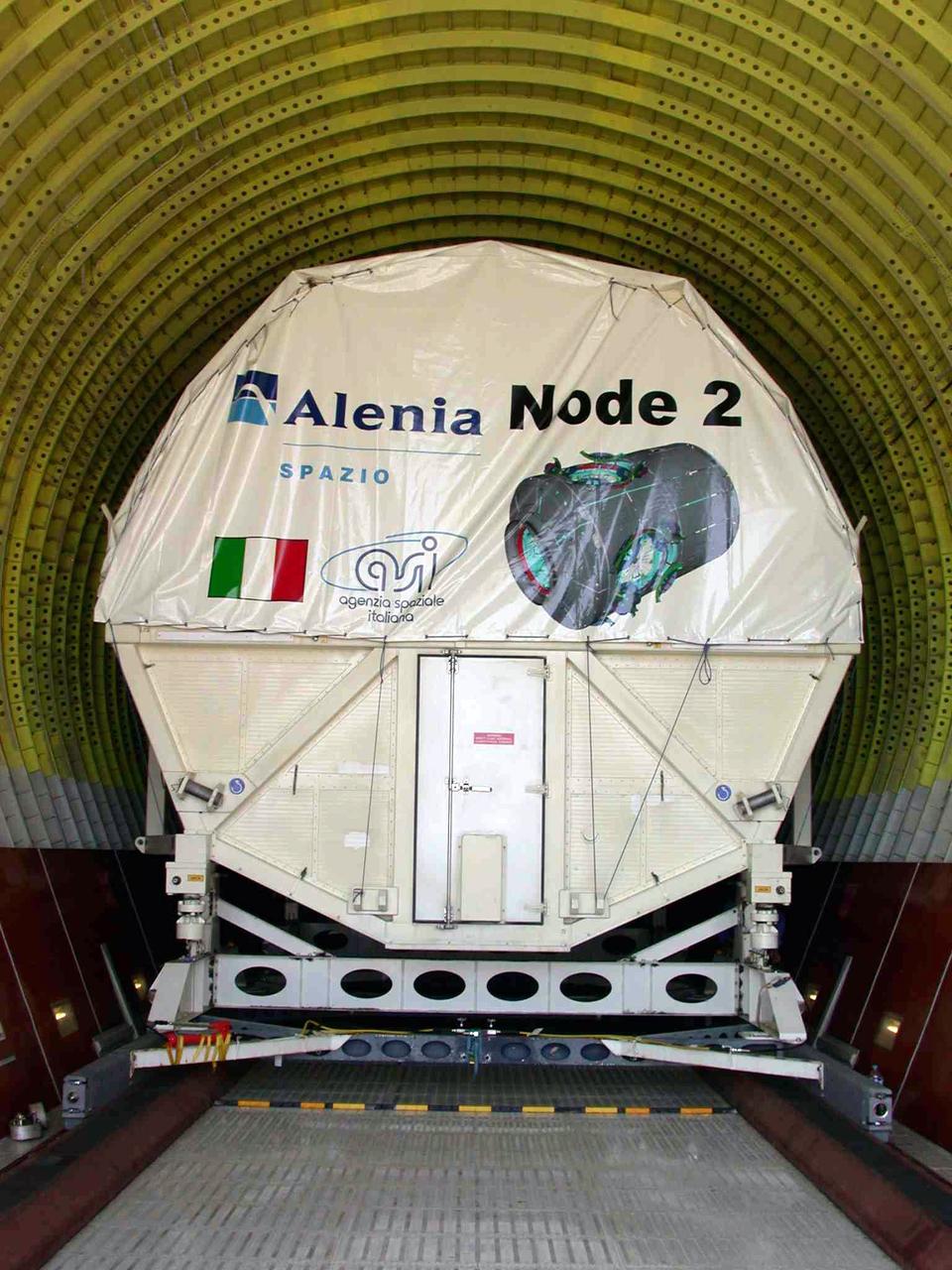
JSC2003-E-40252 (30 May 2003) --- The International Space Station U.S. Node 2 module is pictured shortly after being placed into an Airbus Beluga heavy-lift aircraft. The aircraft departed May 30 from Turin, Italy and arrived at the Kennedy Space Center June 1 with Node 2. Under contract of the Italian Space Agency (ASI), Alenia Spazio led a consortium of European sub-contractors to build Node 2. The module was built for NASA under a barter agreement with the European Space Agency (ESA) in exchange for the launch of the European Columbus Laboratory by the space shuttle to the International Space Station. Node 2 will provide a passageway between four International Space Station science experiment modules: the U.S. Destiny Laboratory, the Kibo Japanese Experiment Module, the European Columbus Laboratory and the Centrifuge Accommodation Module. The addition of Node 2 to the station will signify the U.S. Core Complete stage of assembly, at which time the station can support the addition of international laboratories from Europe and Japan. Photo Credit: Italian Space Agency (ASI)
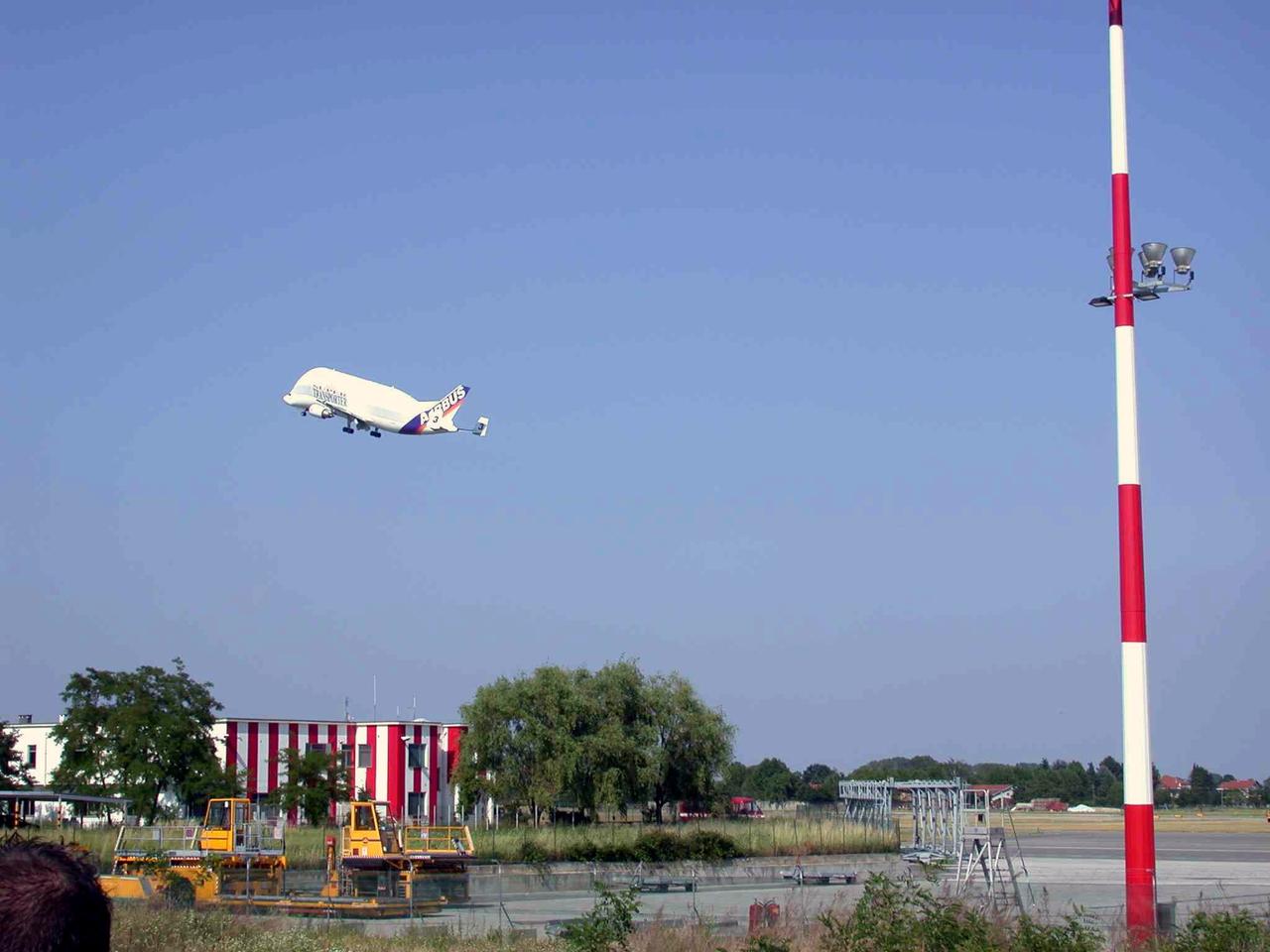
JSC2003-E-40257 (30 May 2003) --- An Airbus Beluga heavy-lift aircraft takes off from Turin International Airport carrying the International Space Station U.S. Node 2 inside. The aircraft departed May 30 from Turin, Italy and arrived at the Kennedy Space Center June 1 with Node 2. Under contract of the Italian Space Agency (ASI), Alenia Spazio led a consortium of European sub-contractors to build Node 2. The module was built for NASA under a barter agreement with the European Space Agency (ESA) in exchange for the launch of the European Columbus Laboratory by the space shuttle to the International Space Station. Node 2 will provide a passageway between four International Space Station science experiment modules: the U.S. Destiny Laboratory, the Kibo Japanese Experiment Module, the European Columbus Laboratory and the Centrifuge Accommodation Module. The addition of Node 2 to the station will signify the U.S. Core Complete stage of assembly, at which time the station can support the addition of international laboratories from Europe and Japan. Credit: ASI
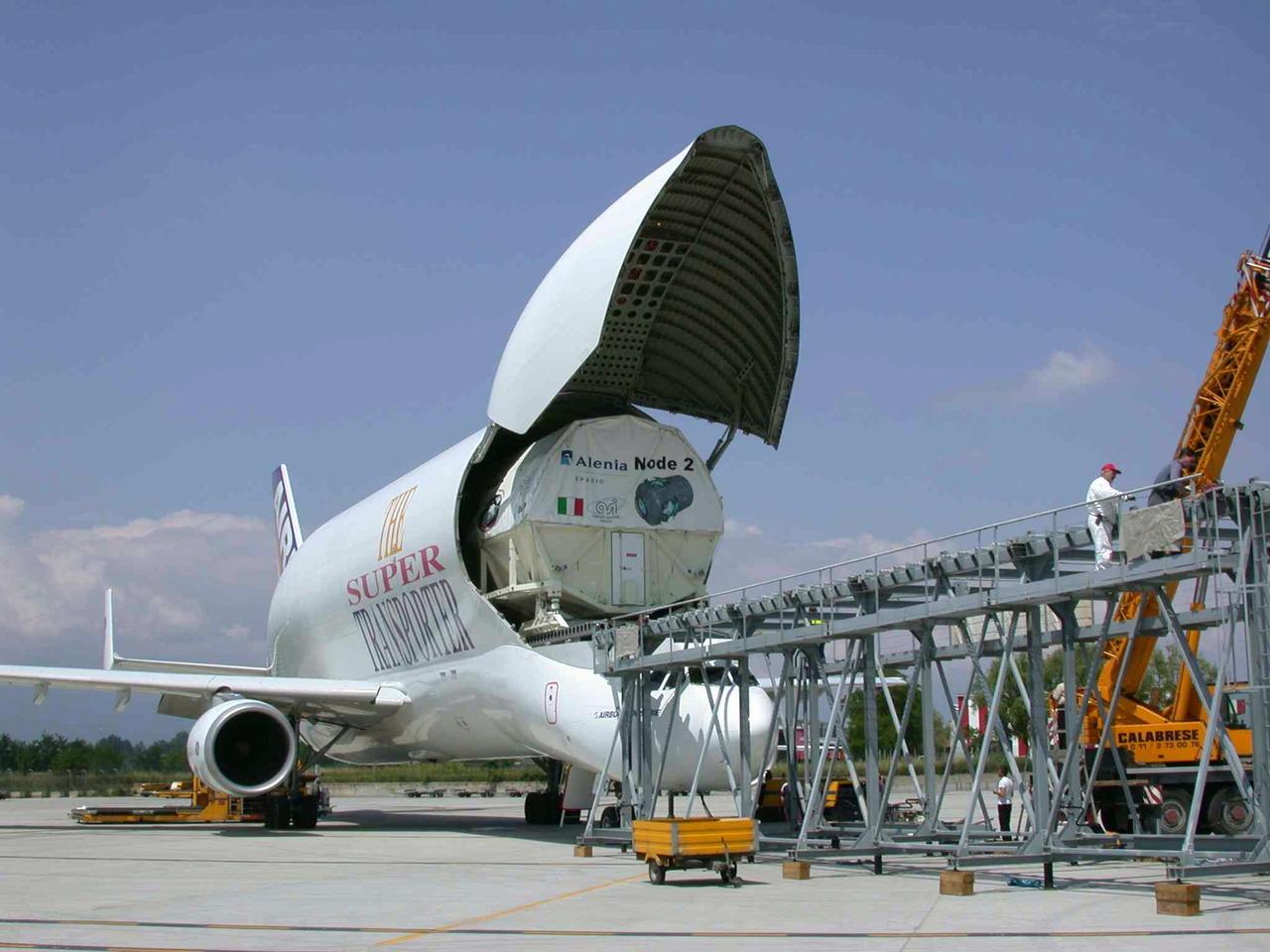
JSC2003-E-40250 (30 May 2003) --- The International Space Station U.S. Node 2 module is placed into an Airbus Beluga heavy-lift aircraft. The aircraft departed May 30 from Turin, Italy and arrived at the Kennedy Space Center June 1 with Node 2. Under contract of the Italian Space Agency (ASI), Alenia Spazio led a consortium of European sub-contractors to build Node 2. The module was built for NASA under a barter agreement with the European Space Agency (ESA) in exchange for the launch of the European Columbus Laboratory by the space shuttle to the International Space Station. Node 2 will provide a passageway between four International Space Station science experiment modules: the U.S. Destiny Laboratory, the Kibo Japanese Experiment Module, the European Columbus Laboratory and the Centrifuge Accommodation Module. The addition of Node 2 to the station will signify the U.S. Core Complete stage of assembly, at which time the station can support the addition of international laboratories from Europe and Japan. Photo Credit: Italian Space Agency (ASI)
JSC2003-E-40262 (30 May 2003) --- The International Space Station U.S. Node 2 module is brought to an Airbus Beluga heavy-lift aircraft. The aircraft departed May 30 from Turin, Italy and arrived at the Kennedy Space Center June 1 with Node 2. Under contract of the Italian Space Agency (ASI), Alenia Spazio led a consortium of European sub-contractors to build Node 2. The module was built for NASA under a barter agreement with the European Space Agency (ESA) in exchange for the launch of the European Columbus Laboratory by the space shuttle to the International Space Station. Node 2 will provide a passageway between four International Space Station science experiment modules: the U.S. Destiny Laboratory, the Kibo Japanese Experiment Module, the European Columbus Laboratory and the Centrifuge Accommodation Module. The addition of Node 2 to the station will signify the U.S. Core Complete stage of assembly, at which time the station can support the addition of international laboratories from Europe and Japan. Photo Credit: Italian Space Agency (ASI)
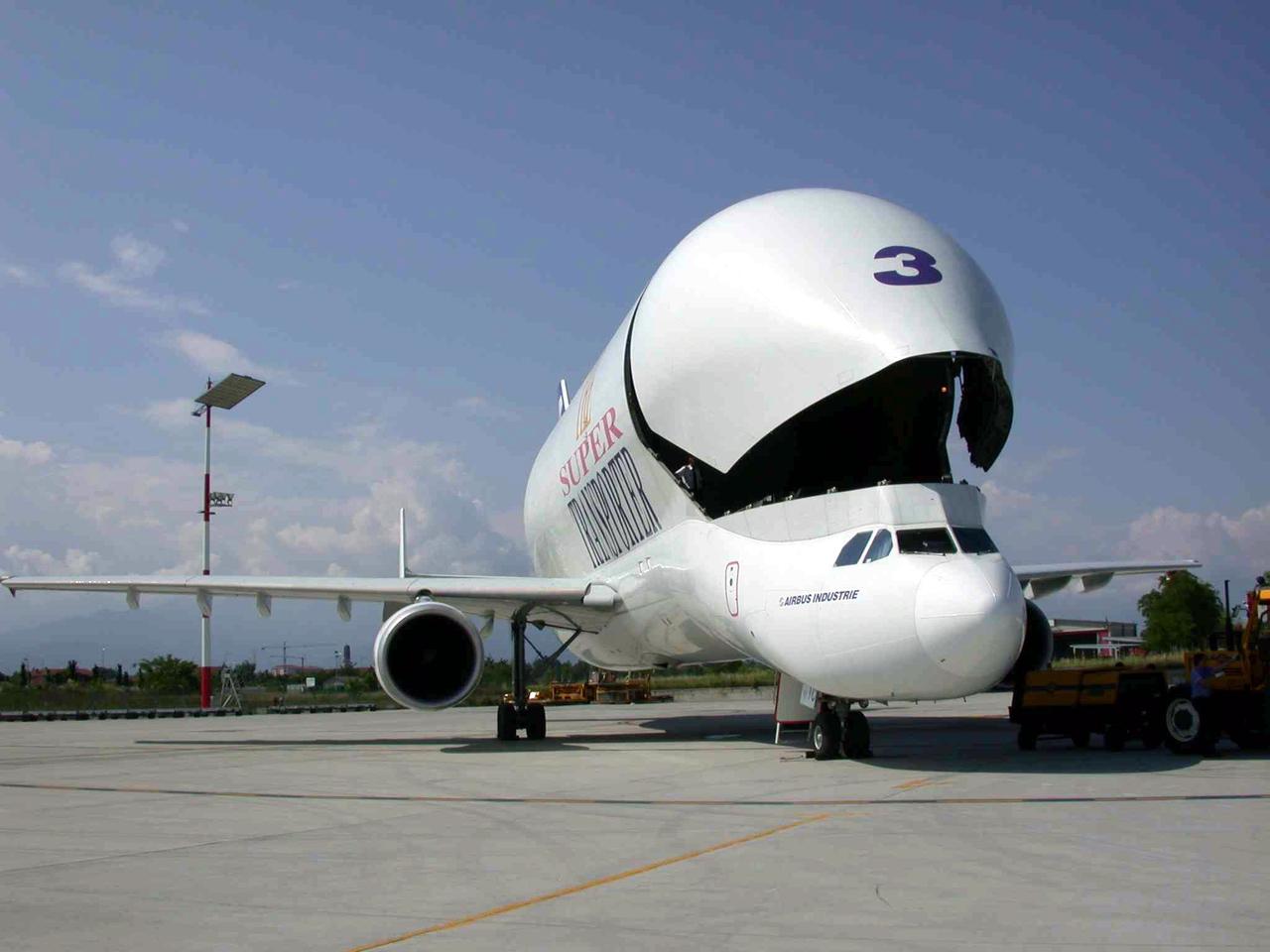
JSC20003-E-40254 (30 May 2003) --- The access door of an Airbus Beluga heavy-lift aircraft is about to be closed with the International Space Station U.S. Node 2 inside. The aircraft departed May 30 from Turin, Italy and arrived at the Kennedy Space Center June 1 with Node 2. Under contract of the Italian Space Agency (ASI), Alenia Spazio led a consortium of European sub-contractors to build Node 2. The module was built for NASA under a barter agreement with the European Space Agency (ESA) in exchange for the launch of the European Columbus Laboratory by the space shuttle to the International Space Station. Node 2 will provide a passageway between four International Space Station science experiment modules: the U.S. Destiny Laboratory, the Kibo Japanese Experiment Module, the European Columbus Laboratory and the Centrifuge Accommodation Module. The addition of Node 2 to the station will signify the U.S. Core Complete stage of assembly, at which time the station can support the addition of international laboratories from Europe and Japan. Photo Credit: Italian Space Agency (ASI )
JSC2003-E-40247 (30 May 2003) --- The International Space Station U.S. Node 2 module is placed into an Airbus Beluga heavy-lift aircraft. The aircraft departed May 30 from Turin, Italy and arrived at the Kennedy Space Center June 1 with Node 2. Under contract of the Italian Space Agency (ASI), Alenia Spazio led a consortium of European sub-contractors to build Node 2. The module was built for NASA under a barter agreement with the European Space Agency (ESA) in exchange for the launch of the European Columbus Laboratory by the space shuttle to the International Space Station. Node 2 will provide a passageway between four International Space Station science experiment modules: the U.S. Destiny Laboratory, the Kibo Japanese Experiment Module, the European Columbus Laboratory and the Centrifuge Accommodation Module. The addition of Node 2 to the station will signify the U.S. Core Complete stage of assembly, at which time the station can support the addition of international laboratories from Europe and Japan. Photo Credit: Italian Space Agency (ASI )
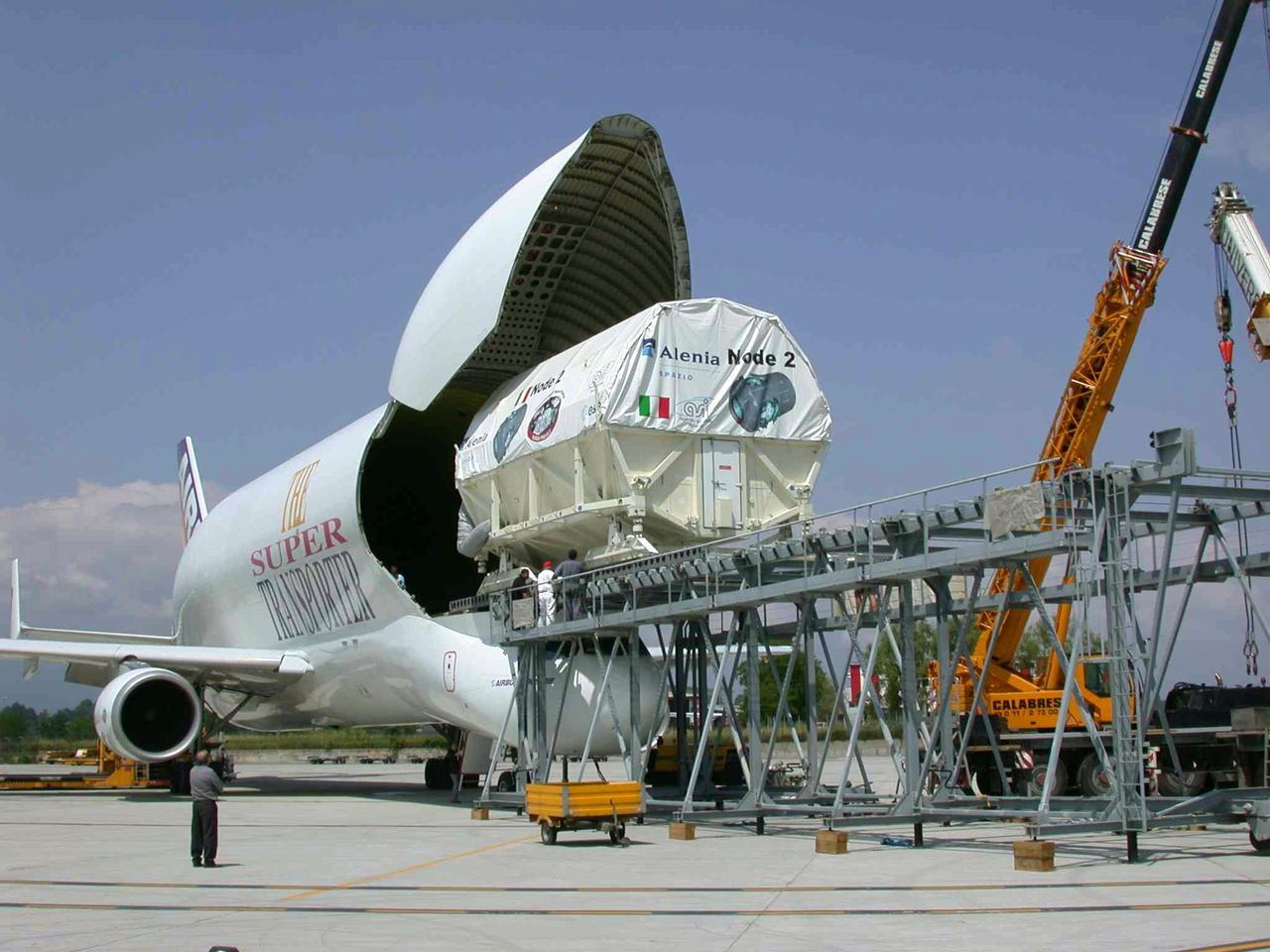
JSC2003-E-40249 (30 May 2003) --- The International Space Station U.S. Node 2 module is placed into an Airbus Beluga heavy-lift aircraft. The aircraft departed May 30 from Turin, Italy and arrived at the Kennedy Space Center June 1 with Node 2. Under contract of the Italian Space Agency (ASI), Alenia Spazio led a consortium of European sub-contractors to build Node 2. The module was built for NASA under a barter agreement with the European Space Agency (ESA) in exchange for the launch of the European Columbus Laboratory by the space shuttle to the International Space Station. Node 2 will provide a passageway between four International Space Station science experiment modules: the U.S. Destiny Laboratory, the Kibo Japanese Experiment Module, the European Columbus Laboratory and the Centrifuge Accommodation Module. The addition of Node 2 to the station will signify the U.S. Core Complete stage of assembly, at which time the station can support the addition of international laboratories from Europe and Japan. Photo Credit: Italian Space Agency (ASI)
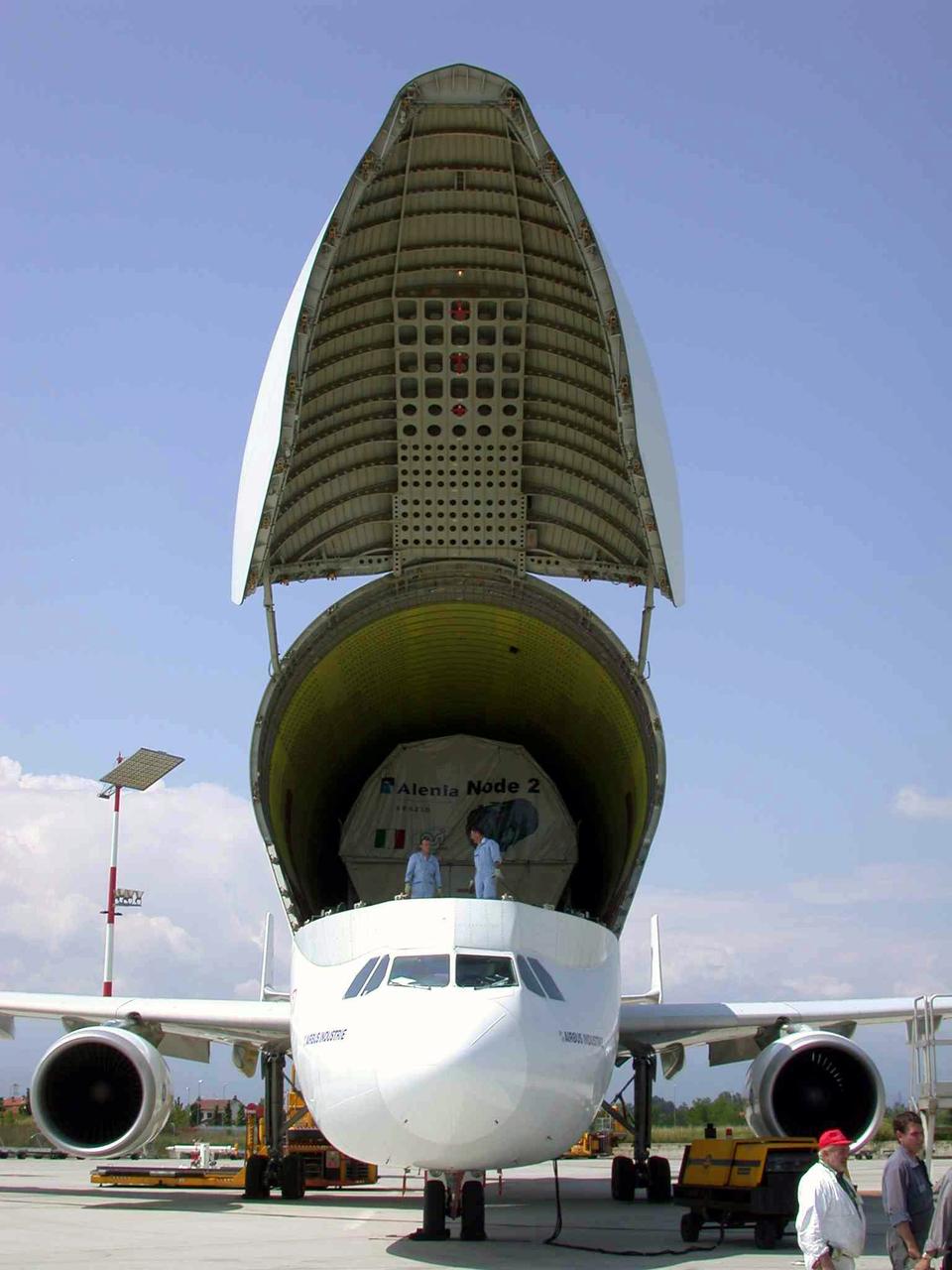
JSC2003-E-40253 (30 May 2003) --- The International Space Station U.S. Node 2 module is shown inside an Airbus Beluga heavy-lift aircraft. The aircraft departed May 30 from Turin, Italy and arrived at the Kennedy Space Center June 1 with Node 2. Under contract of the Italian Space Agency (ASI), Alenia Spazio led a consortium of European sub-contractors to build Node 2. The module was built for NASA under a barter agreement with the European Space Agency (ESA) in exchange for the launch of the European Columbus Laboratory by the space shuttle to the International Space Station. Node 2 will provide a passageway between four International Space Station science experiment modules: the U.S. Destiny Laboratory, the Kibo Japanese Experiment Module, the European Columbus Laboratory and the Centrifuge Accommodation Module. The addition of Node 2 to the station will signify the U.S. Core Complete stage of assembly, at which time the station can support the addition of international laboratories from Europe and Japan. Photo Credit: Italian Space Agency (ASI)
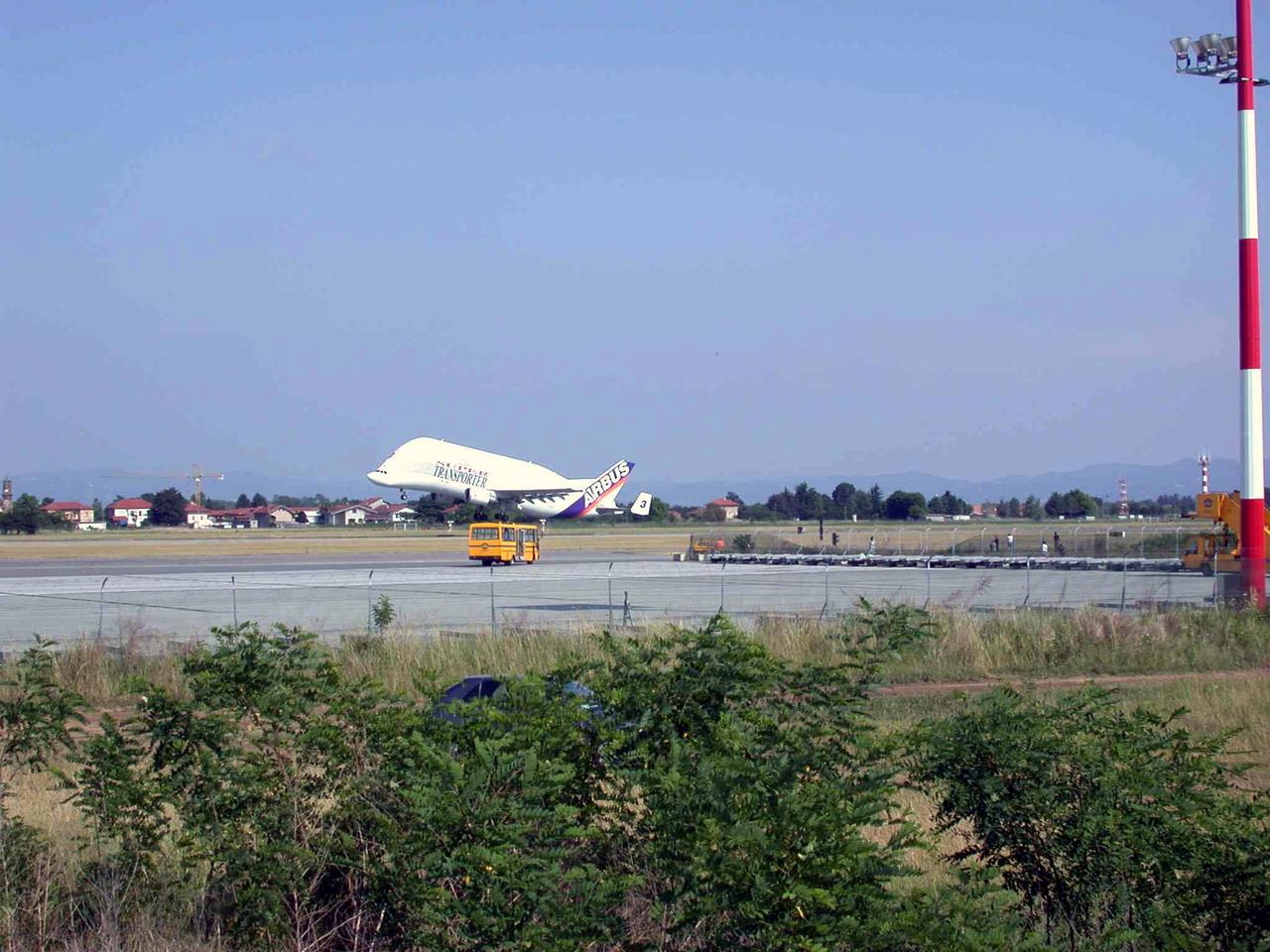
JSC2003-E-40256 (30 May 2003) An Airbus Beluga heavy-lift aircraft prepares to take off from Turin International Airport carrying the International Space Station U.S. Node 2 inside. The aircraft departed May 30 from Turin, Italy and arrived at the Kennedy Space Center June 1 with Node 2. Under contract of the Italian Space Agency (ASI), Alenia Spazio led a consortium of European sub-contractors to build Node 2. The module was built for NASA under a barter agreement with the European Space Agency (ESA) in exchange for the launch of the European Columbus Laboratory by the space shuttle to the International Space Station. Node 2 will provide a passageway between four International Space Station science experiment modules: the U.S. Destiny Laboratory, the Kibo Japanese Experiment Module, the European Columbus Laboratory and the Centrifuge Accommodation Module. The addition of Node 2 to the station will signify the U.S. Core Complete stage of assembly, at which time the station can support the addition of international laboratories from Europe and Japan. Photo Credit: Italian Space Agency (ASI)

JSC2003-E-40251 (30 May 2003) --- The International Space Station U.S. Node 2 module is shown inside an Airbus Beluga heavy-lift aircraft. The aircraft departed May 30 from Turin, Italy and arrived at the Kennedy Space Center June 1 with Node 2. Under contract of the Italian Space Agency (ASI), Alenia Spazio led a consortium of European sub-contractors to build Node 2. The module was built for NASA under a barter agreement with the European Space Agency (ESA) in exchange for the launch of the European Columbus Laboratory by the space shuttle to the International Space Station. Node 2 will provide a passageway between four International Space Station science experiment modules: the U.S. Destiny Laboratory, the Kibo Japanese Experiment Module, the European Columbus Laboratory and the Centrifuge Accommodation Module. The addition of Node 2 to the station will signify the U.S. Core Complete stage of assembly, at which time the station can support the addition of international laboratories from Europe and Japan. Photo Credit: Italian Space Agency (ASI)
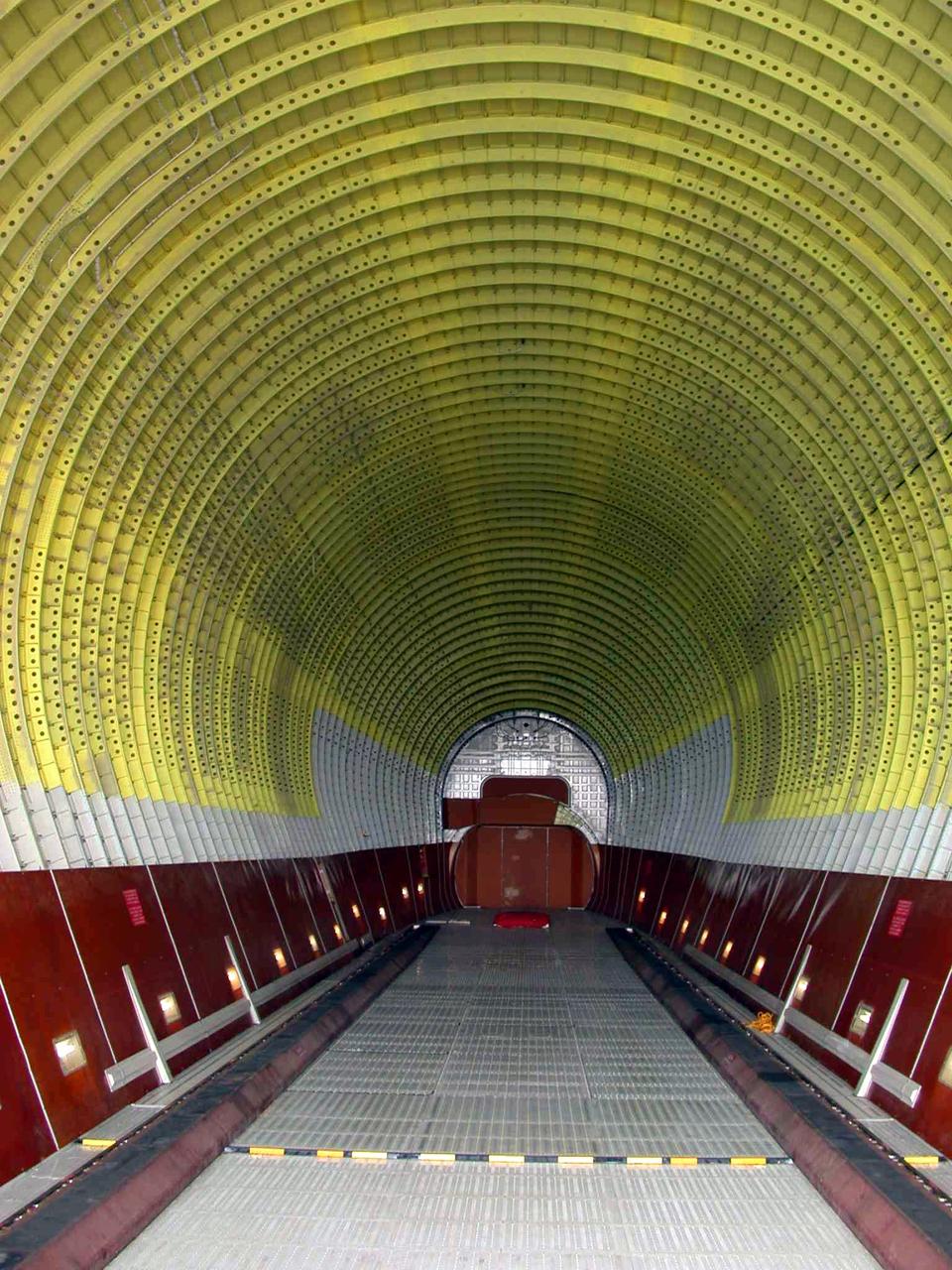
JSC2003-E-40260 (30 May 2003) --- A view inside the empty Airbus Beluga heavy-lift aircraft before the International Space Station Node 2 is placed inside for transportation to the United States. The aircraft left Turin, Italy where, under contract of the Italian Space Agency (ASI), Alenia Spazio led a consortium of European sub-contractors to build Node 2. The Node 2 was delivered to the Kennedy Space Center June 1 and where it will be processed for launch to the space station. Node 2 will provide a passageway between four International Space Station science experiment modules: the U.S. Destiny Laboratory, the Kibo Japanese Experiment Module, the European Columbus Laboratory and the Centrifuge Accommodation Module. The addition of Node 2 to the station will signify the U.S. Core Complete stage of assembly, at which time the station can support the addition of international laboratories from Europe and Japan. The module was built for NASA under a barter agreement with the European Space Agency (ESA) in exchange for the launch of the European Columbus Laboratory by the space shuttle to the International Space Station. Photo Credit: Italian Space Agency (ASI)
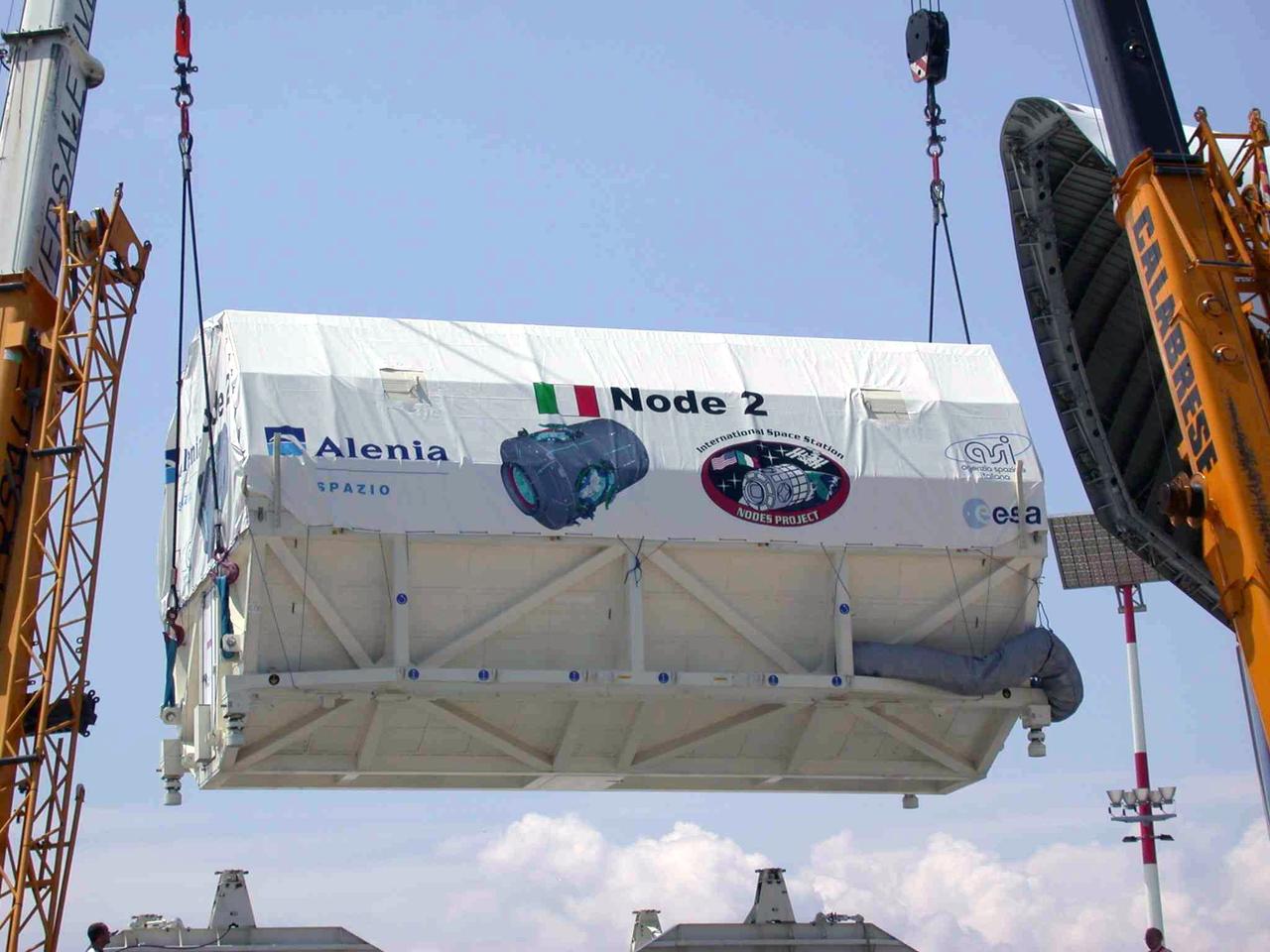
JSC2003-E-40264 (30 May 2003) --- The International Space Station U.S. Node 2 module is hoisted into an Airbus Beluga heavy-lift aircraft. The aircraft departed May 30 from Turin, Italy and arrived at the Kennedy Space Center June 1 with Node 2. Under contract of the Italian Space Agency (ASI), Alenia Spazio led a consortium of European sub-contractors to build Node 2. The module was built for NASA under a barter agreement with the European Space Agency (ESA) in exchange for the launch of the European Columbus Laboratory by the space shuttle to the International Space Station. Node 2 will provide a passageway between four International Space Station science experiment modules: the U.S. Destiny Laboratory, the Kibo Japanese Experiment Module, the European Columbus Laboratory and the Centrifuge Accommodation Module. The addition of Node 2 to the station will signify the U.S. Core Complete stage of assembly, at which time the station can support the addition of international laboratories from Europe and Japan. Photo Credit: Italian Space Agency (ASI)
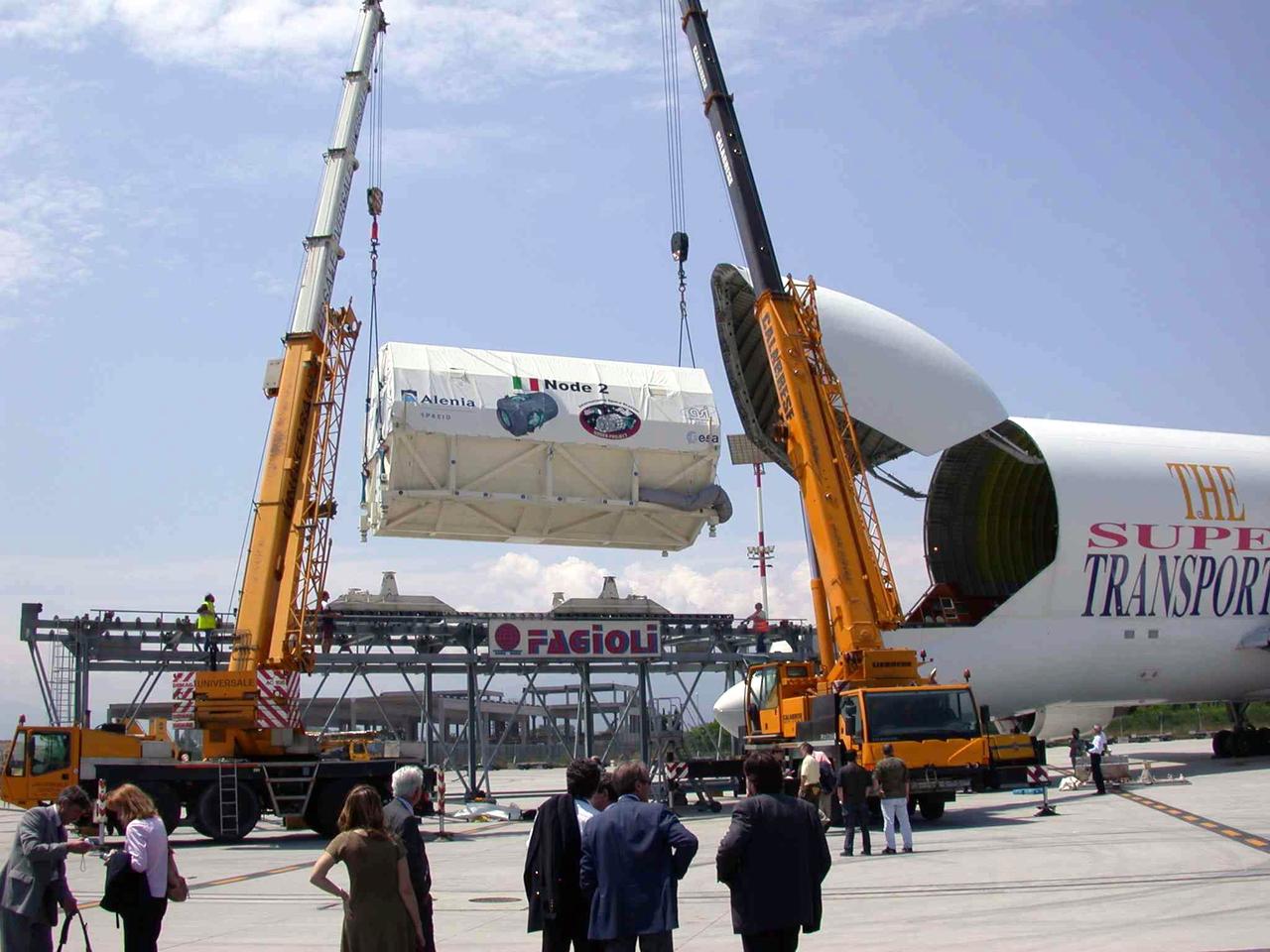
JSC2003-E-40265 (30 May 2003) --- The International Space Station U.S. Node 2 module is hoisted into an Airbus Beluga heavy-lift aircraft. The aircraft departed May 30 from Turin, Italy and arrived at the Kennedy Space Center June 1 with Node 2. Under contract of the Italian Space Agency (ASI), Alenia Spazio led a consortium of European sub-contractors to build Node 2. The module was built for NASA under a barter agreement with the European Space Agency (ESA) in exchange for the launch of the European Columbus Laboratory by the space shuttle to the International Space Station. Node 2 will provide a passageway between four International Space Station science experiment modules: the U.S. Destiny Laboratory, the Kibo Japanese Experiment Module, the European Columbus Laboratory and the Centrifuge Accommodation Module. The addition of Node 2 to the station will signify the U.S. Core Complete stage of assembly, at which time the station can support the addition of international laboratories from Europe and Japan. Photo Credit: Italian Space Agency (ASI)
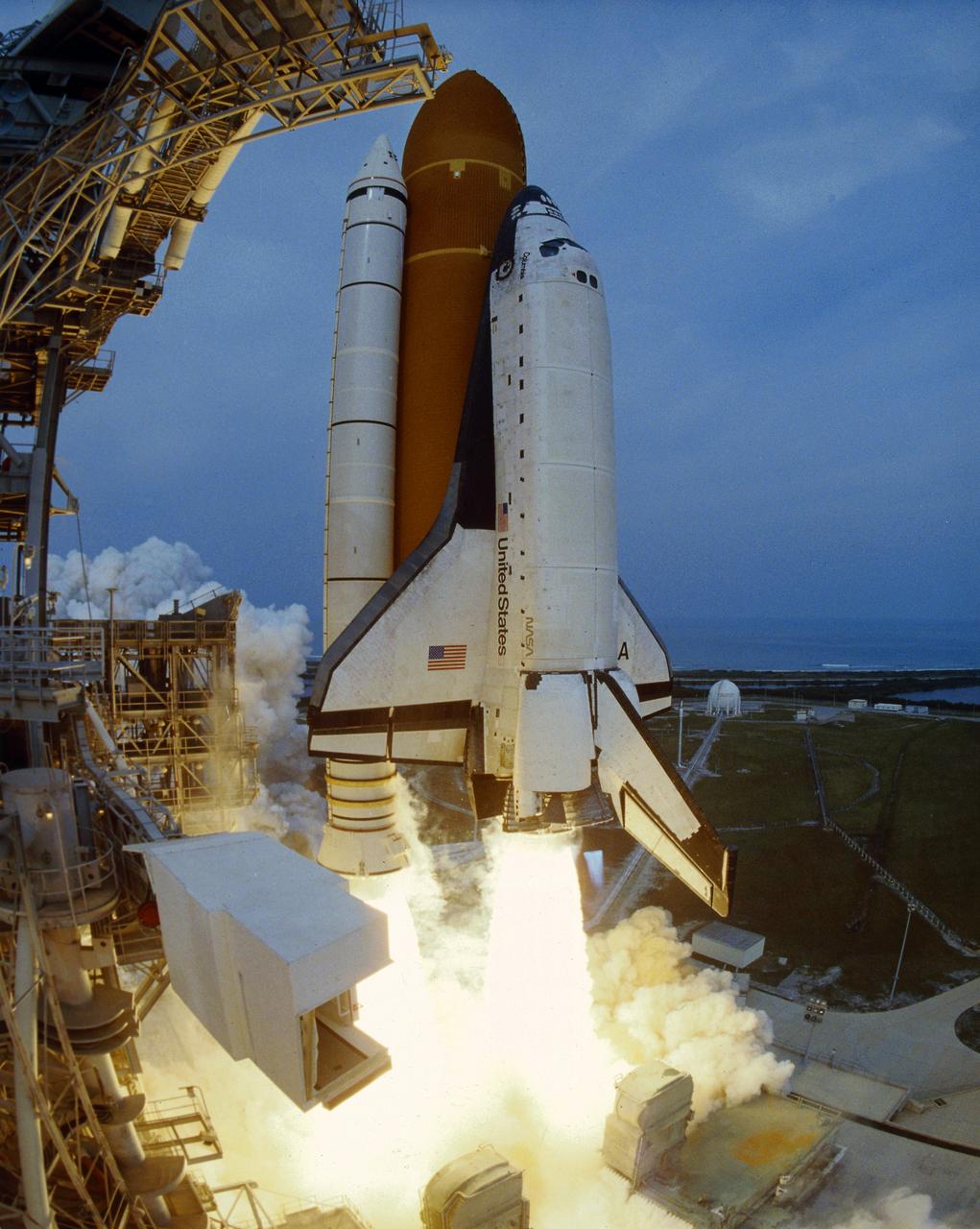
The Space Shuttle Columbia (STS-75) cleared the tower following an on-time liftoff from Launch Pad 39B. Visible at lower left is the white room on the orbiter access arm through which the flight crew entered the orbiter earlier. Columbia's mission lasted 14 days and included retesting of the Tethered Satellite System (TSS-1R) and the third flight of the United States Microgravity Payload (USMP-3), both of which are managed by scientist at Marshall Space Flight Center. Included in Columbia's flight crew were members of the European Space Agency (ESA) and the Italian Space Agency (ASI), Mission Specialists Maurizio Cheli, Claude Nicollier and Payload Specialist Umberto Guidoni, respectively.
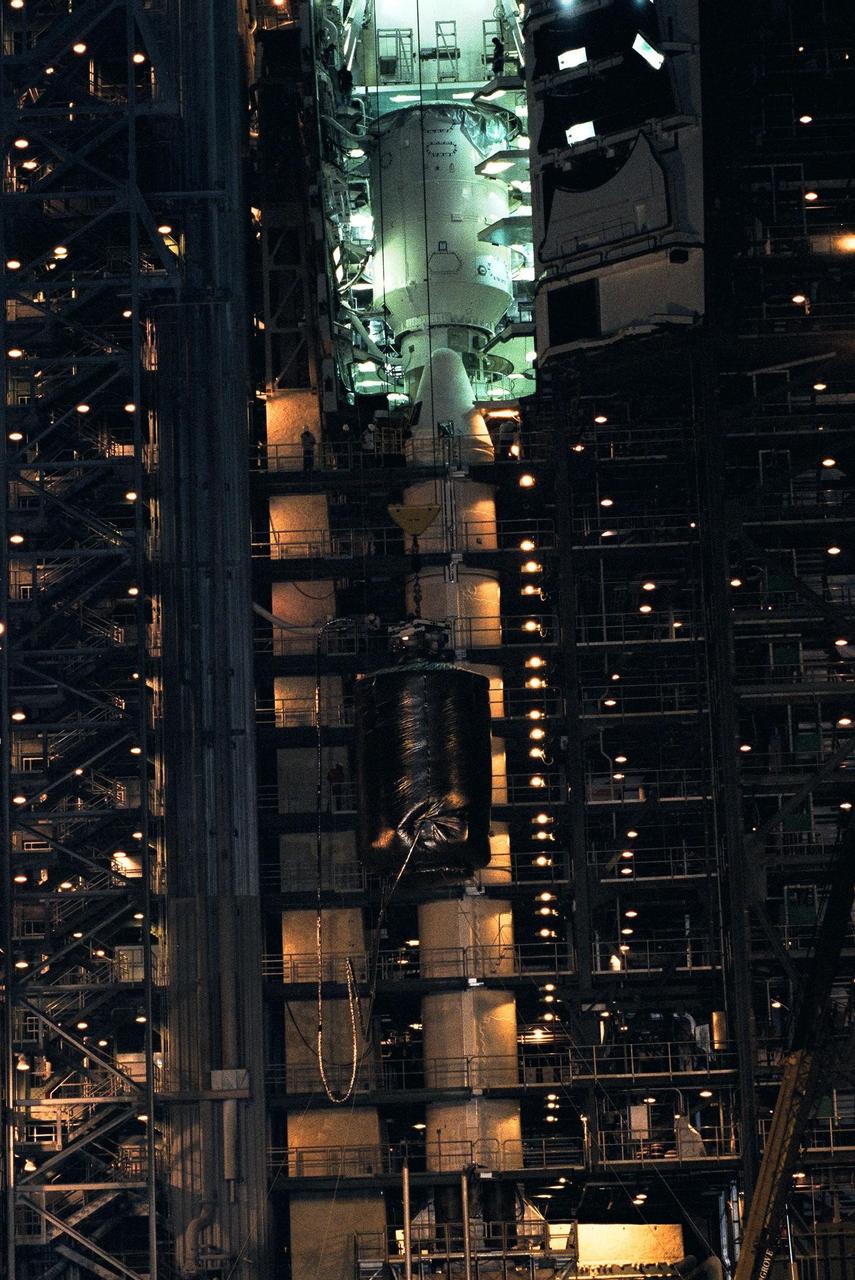
Technicians at Launch Complex 40, Cape Canaveral Air Station (CCAS), connect the crane to the top of the Cassini spacecraft in preparation for the lift to the top of its Titan IV/Centaur launch vehicle. Cassini is an international mission conducted by the National Aeronautics and Space Administration (NASA), the European Space Agency (ESA), and the Italian Space Agency (ASI). The two-story-tall spacecraft, scheduled for launch on Oct. 6, is destined to arrive at Saturn in July 2004, where it will orbit and study Saturn, its rings, moons and magnetic environment in detail over a four-year period. The Cassini mission is managed for NASA's Office of Space Science by the Jet Propulsion Laboratory, a division of the California Institute of Technology
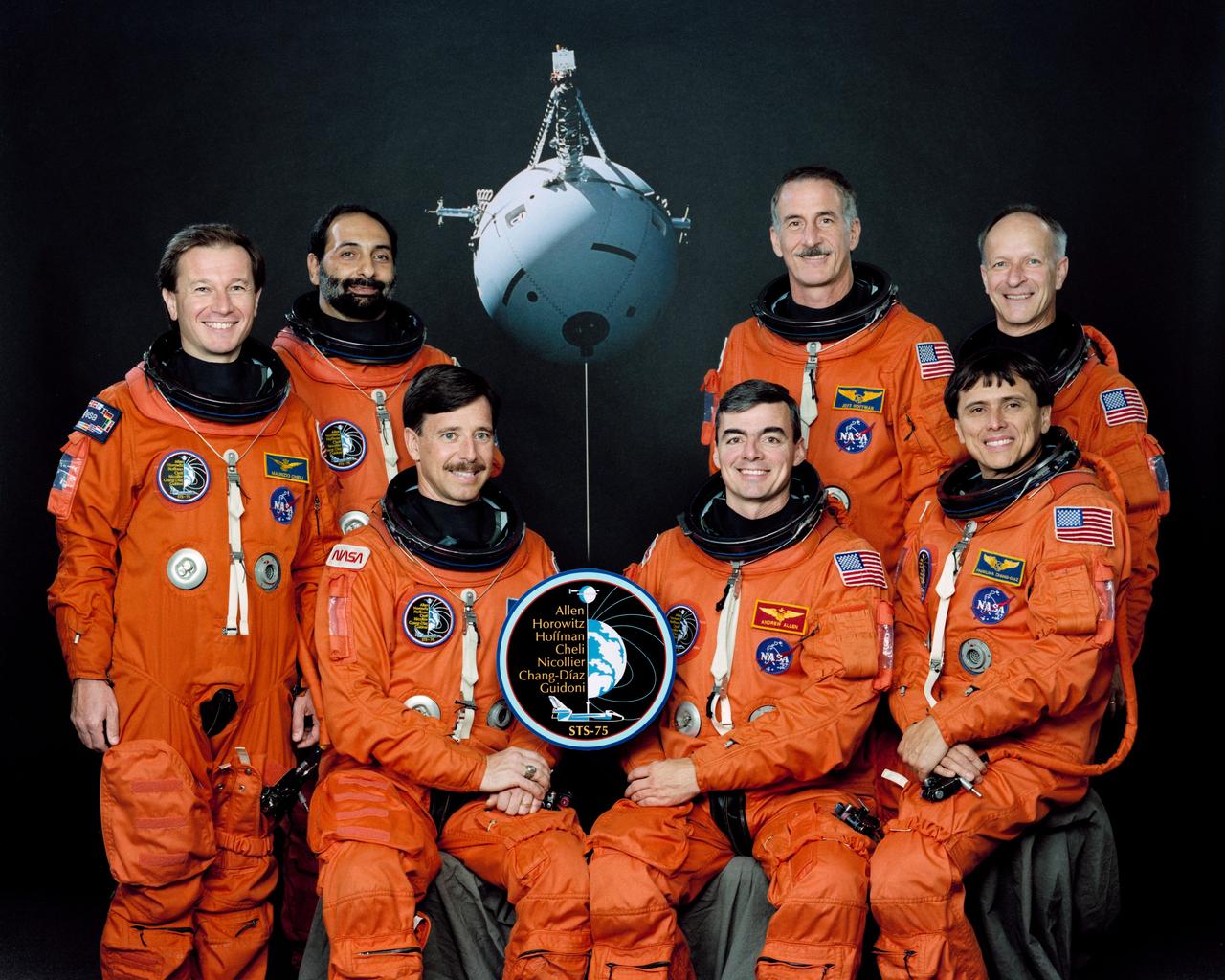
STS075-S-002 (December 1995) --- With their major payload as the backdrop, members of the crew pose for the traditional crew portrait. The crew will deploy and work with the Tethered Satellite System (TSS-1R). Seated at center are astronauts Scott J. Horowitz (left), pilot; and Andrew M. Allen, commander. Astronaut Franklin R. Chang-Diaz (front right) is payload commander. In the rear are (left to right) European Space Agency (ESA) astronaut Maurizio Cheli, mission specialist; payload specialist Umberto Guidoni of the Italian Space Agency (ASI); Jeffrey A. Hoffman and ESA astronaut Claude Nicollier, mission specialists.
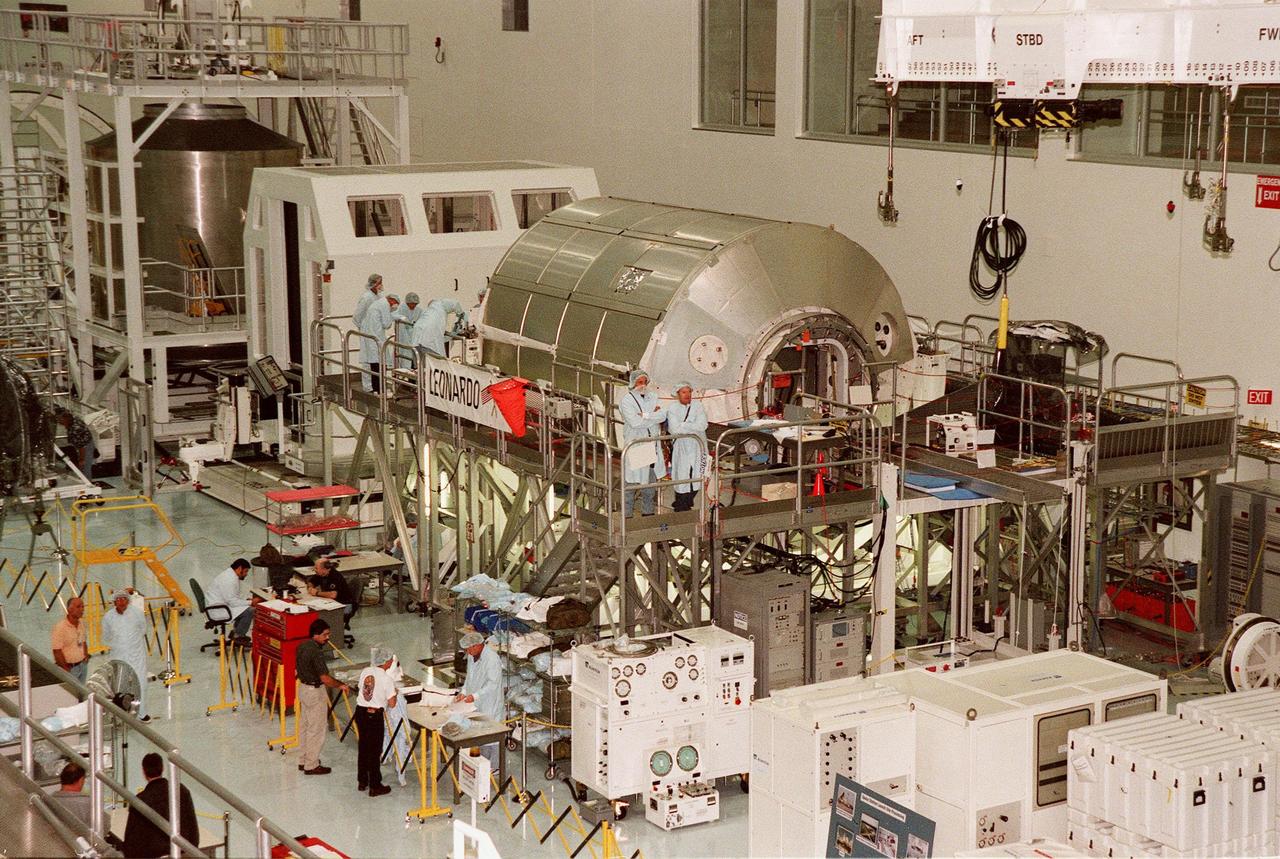
KENNEDY SPACE CENTER, FLA. -- Workers in the Space Station Processing Facility work on Leonardo, the Multipurpose Logistics Module (MPLM) built by the Agenzia Spaziale Italiana (ASI). The MPLM, a reusable logistics carrier, will be the primary delivery system used to resupply and return International Space Station cargo requiring a pressurized environment. Leonardo is the first of three MPLM carriers for the International Space Station. It is scheduled to be launched on Space Shuttle Mission STS-102, targeted for June 2000. Leonardo shares space in the SSPF with the Shuttle Radar Topography Mission (SRTM), targeted for launch in September 1999, and Destiny, the U.S. Lab module, targeted for mission STS-98 in late April 2000
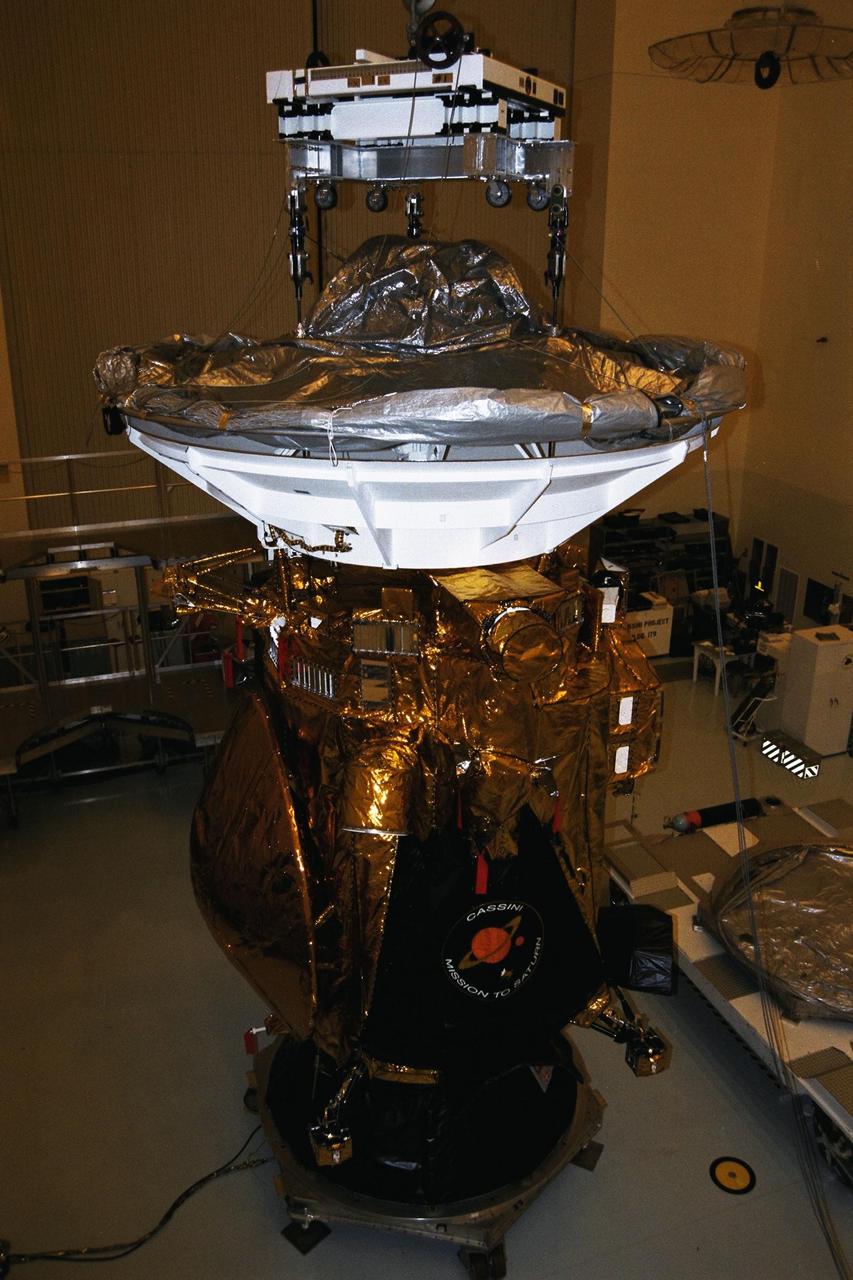
In the Payload Hazardous Servicing Facility (PHSF), the Cassini spacecraft is prepared for its lift onto a transporter which will move it to Launch Complex 40, Cape Canaveral Air Station (CCAS). Cassini is an international mission conducted by the National Aeronautics and Space Administration (NASA), the European Space Agency (ESA), and the Italian Space Agency (ASI). The two-story-tall spacecraft, scheduled for launch on Oct. 6, is destined to arrive at Saturn in July 2004, where it will study the planet, its rings, moons and magnetic environment in detail over a four-year period. The Cassini mission is managed for NASA's Office of Space Science by the Jet Propulsion Laboratory, a division of the California Institute of Technology
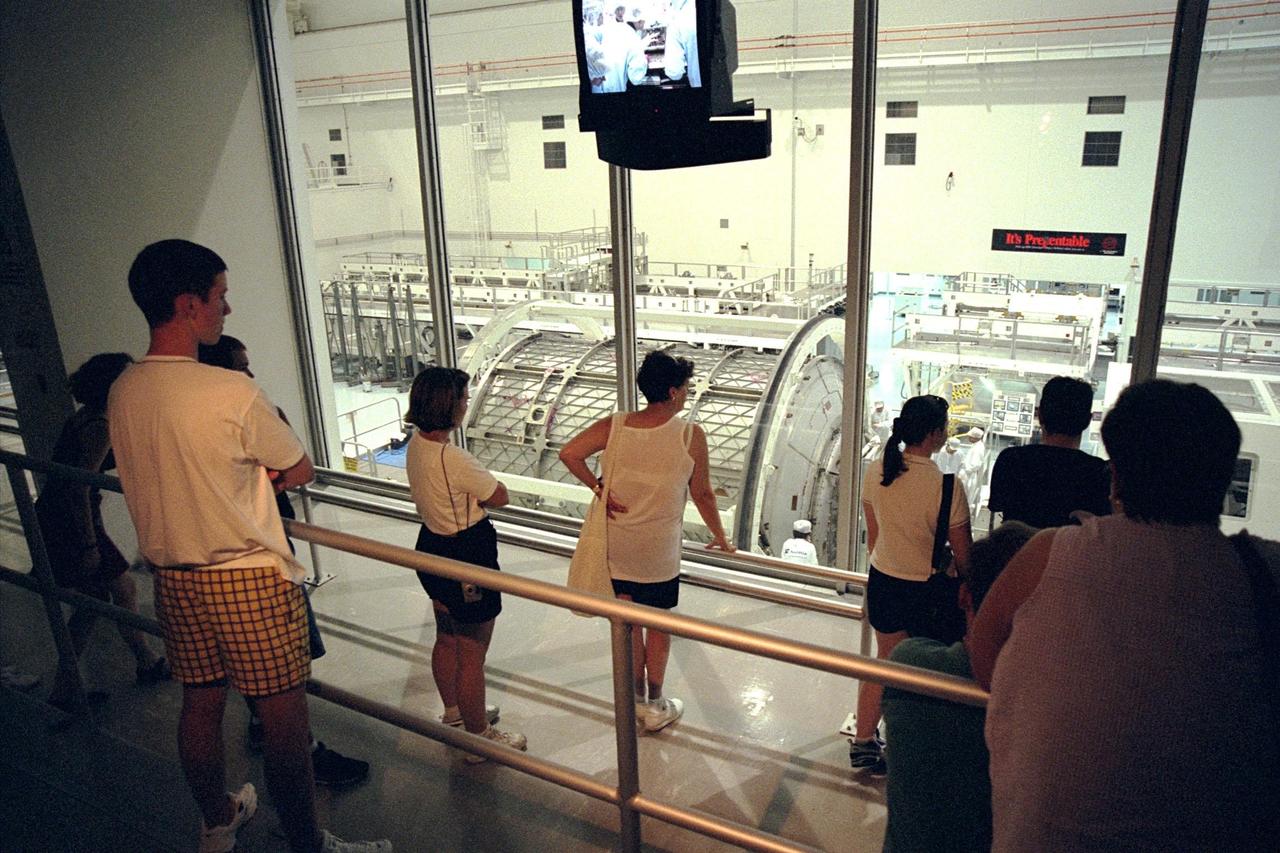
Visitors watch processing of the first Multi-Purpose Logistics Module (MPLM) for the International Space Station (ISS) from a new tour stop in the Space Station Processing Facility. The Italian-built module, named Leonardo, is one of three from Alenia Aerospazio, and will be operated by NASA and supported by ASI, the Italian space agency. The MPLMs will be carried in the payload bay of a Shuttle orbiter, and will provide storage and additional work space for up to two astronauts when docked to the ISS. Leonardo is scheduled to be launched on STS-100 in December 1999. The second MPLM, named Raffaello, is scheduled to be handed over in April 1999. A third module, to be named Donatello, is due to be delivered in October 2000 for launch in January 2001
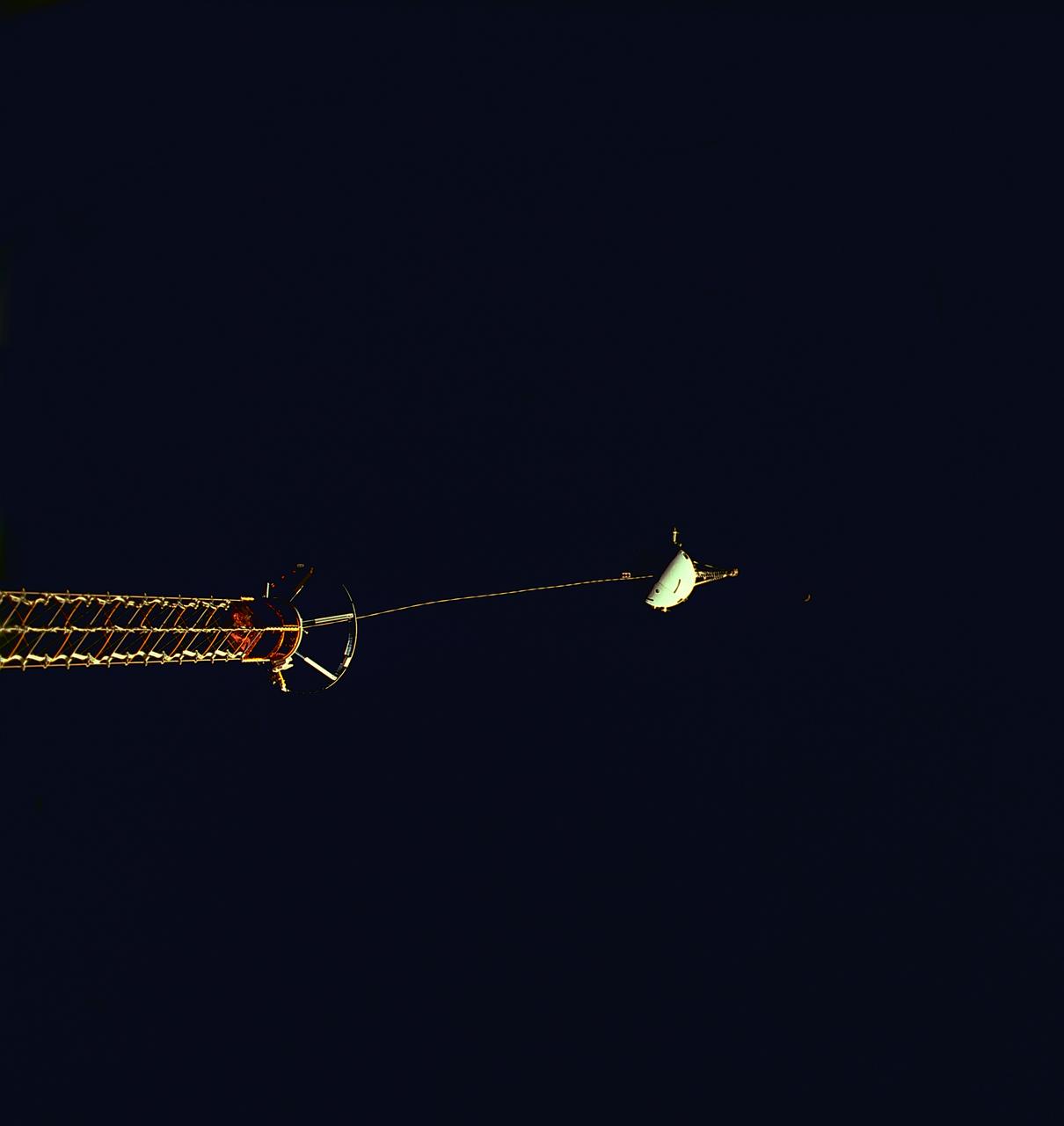
STS075-711-024 (25 Feb. 1996) --- The Tethered Satellite System (TSS) is seen as it is reeled out during early stages of deployment operations. The crew deployed the TSS, which later broke free. The seven member crew was launched aboard the space shuttle Columbia on Feb. 22, 1996, and landed on March 9, 1996. Crewmembers were Andrew M. Allen, mission commander; Scott J. Horowitz, pilot; Franklin R. Chang-Diaz, payload commander; and Maurizio Cheli European Space Agency (ESA); Jeffrey A. Hoffman and Claude Nicollier, ESA, all mission specialists; along with payload specialist Umberto Guidoni of the Italian Space Agency (ASI).
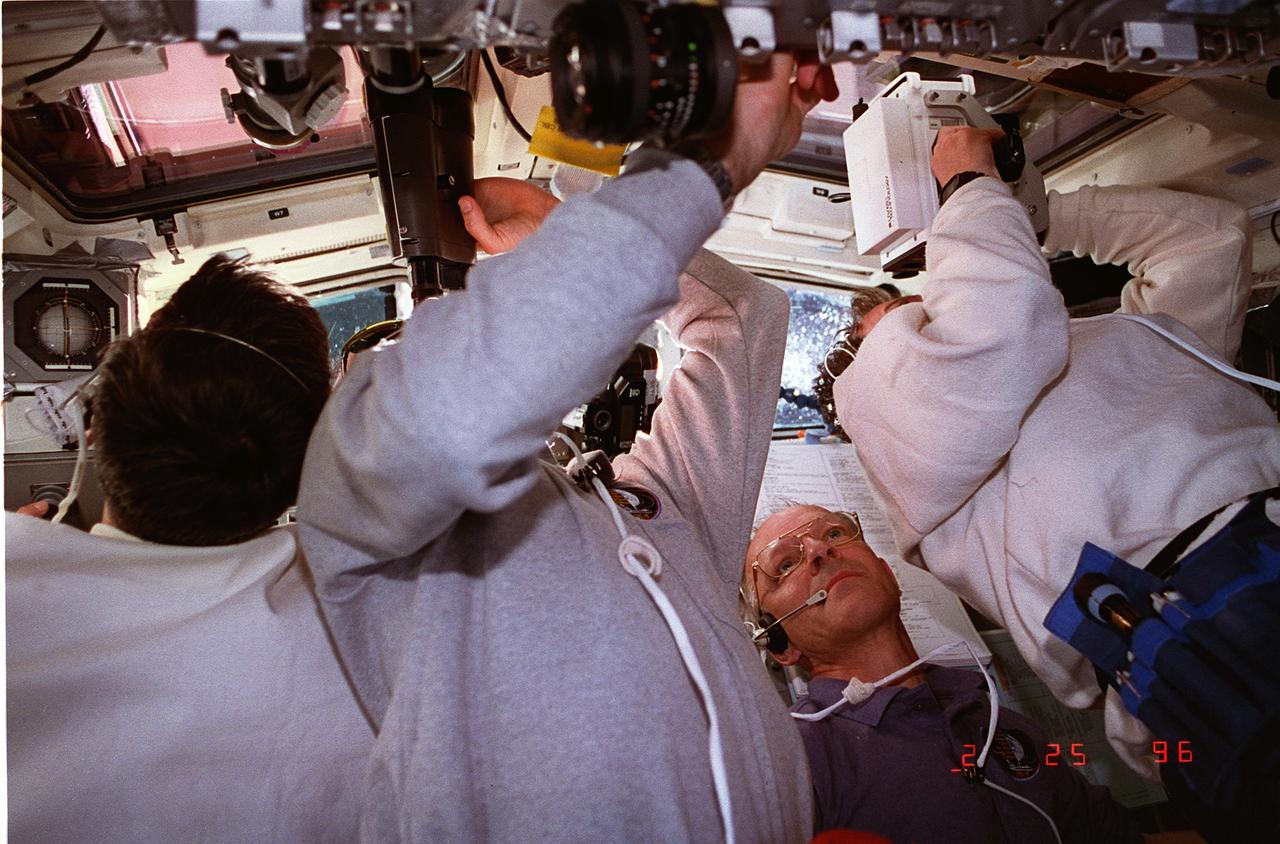
STS075-328-026 (25 Feb. 1996) --- Astronaut Claude Nicollier is the only clearly identifiable crewmember in this scene on the aft flight deck, captured during the busy chores associated with deployment of the Tethered Satellite System (TSS). The seven member crew was launched aboard the space shuttle Columbia on Feb. 22, 1996, and landed on March 9, 1996. Crewmembers were Andrew M. Allen, mission commander; Scott J. Horowitz, pilot; Franklin R. Chang-Diaz, payload commander; and Maurizio Cheli, European Space Agency (ESA); Jeffrey A. Hoffman and Nicollier, ESA, all mission specialists; along with payload specialist Umberto Guidoni of the Italian Space Agency (ASI).
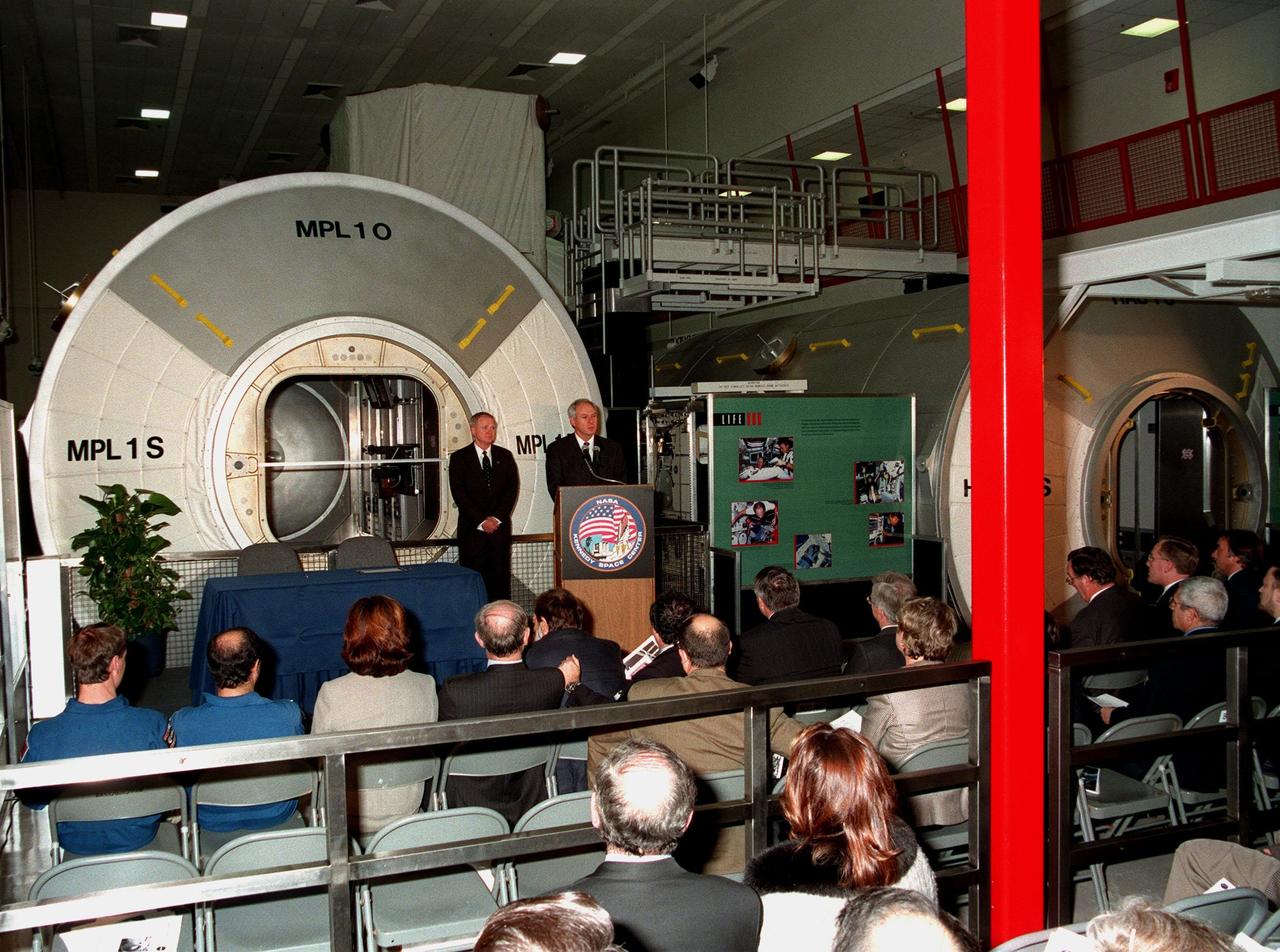
NASA Administrator Daniel S. Goldin speaks at the Space Station Processing Facility ceremony transferring the "Leonardo" Multipurpose Logistics Module (MPLM) from the Agenzia Spaziale Italiana (ASI) to NASA. Standing behind him in front of Leonardo is KSC Director Roy D. Bridges Jr. The MPLM, a reusable logistics carrier, will be the primary delivery system used to resupply and return International Space Station cargo requiring a pressurized environment. Leonardo is the first of three MPLM carriers for the International Space Station. It is scheduled to be launched on Space Shuttle Mission STS-100, targeted for April 2000
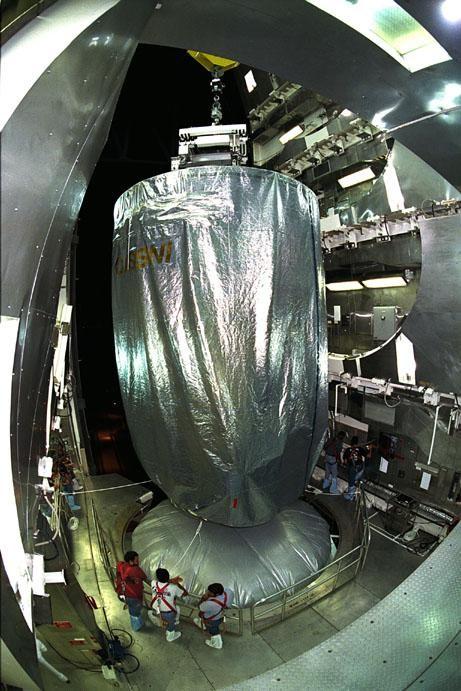
The Cassini spacecraft, covered by an environmentally controlled protective enclosure, is lifted at Launch Complex 40, Cape Canaveral Air Station (CCAS), in preparation to mate it to the top of its Titan IV/Centaur launch vehicle. Cassini is an international mission conducted by the National Aeronautics and Space Administration (NASA), the European Space Agency (ESA), and the Italian Space Agency (ASI). The two-story-tall spacecraft, scheduled for launch on Oct. 13, is destined to arrive at Saturn in July 2004, where it will orbit and study Saturn, its rings, moons and magnetic environment in detail over a four-year period. The Cassini mission is managed for NASA's Office of Space Science by the Jet Propulsion Laboratory, a division of the California Institute of Technology
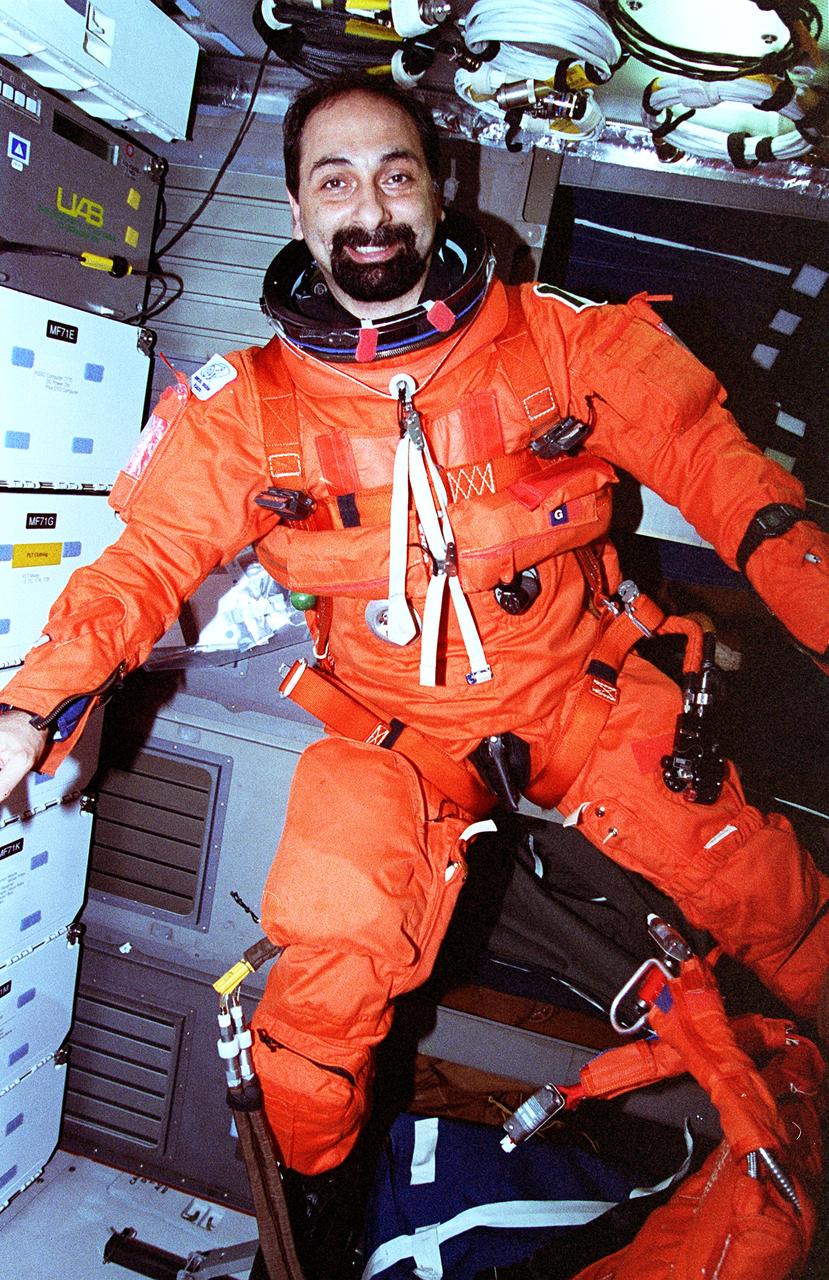
STS075-355-032 (9 March 1996) --- Payload specialist Umberto Guidoni, wearing the shuttle launch and entry garment, prepares for the de-orbit phase of the 16-day flight. Guidoni represents the Italian Space Agency (ASI). The seven member crew was launched aboard the Space Shuttle Columbia on February 22, 1996, and landed on March 9, 1996. Crew members were Andrew M. Allen, mission commander; Scott J. Horowitz, pilot; Franklin R. Chang-Diaz, payload commander; and Maurizio Cheli, European Space Agency (ESA); Jeffrey A. Hoffman and Claude Nicollier, (ESA), all mission specialists; along with Guidoni.
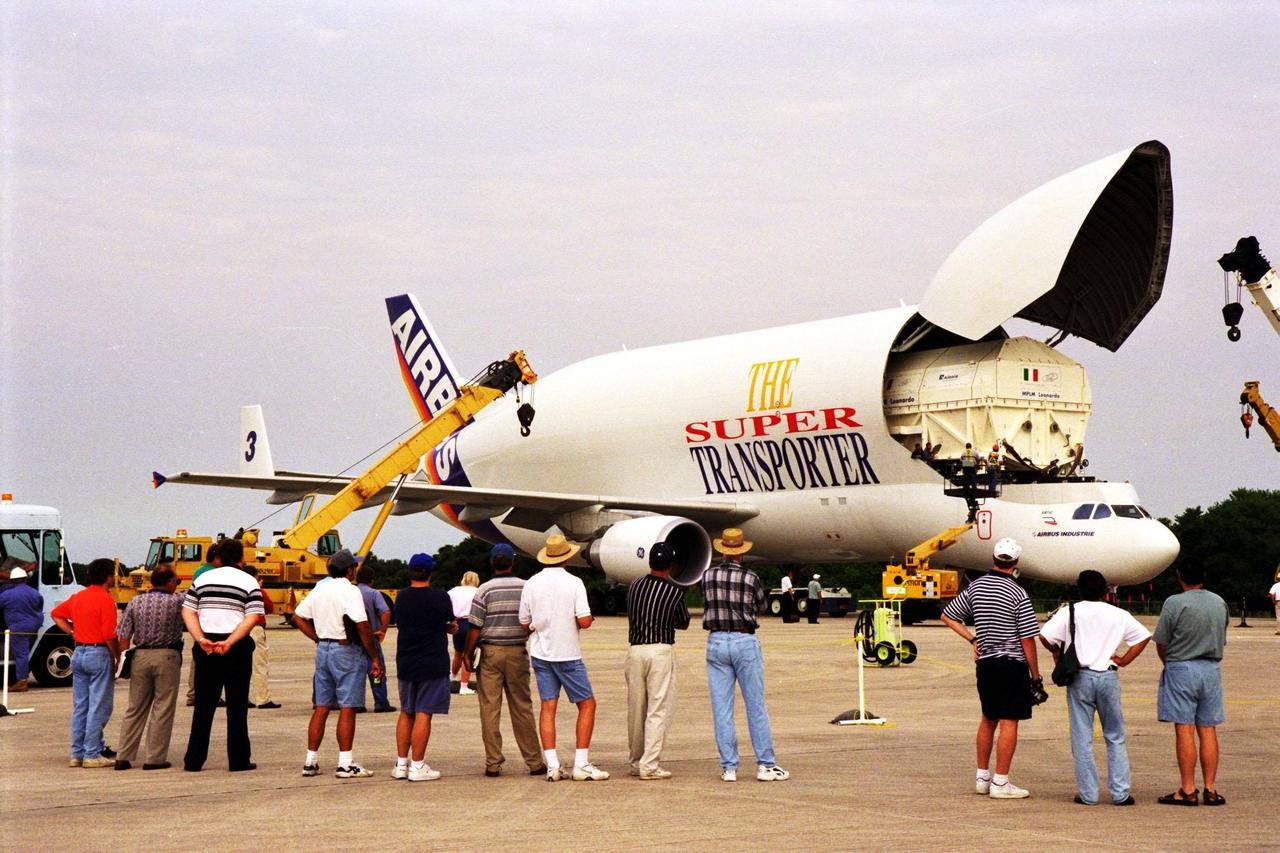
KENNEDY SPACE CENTER, FLA. -- KSC personnel watch as workers at the Shuttle Landing Facility begin unloading the canister containing the Multi-Purpose Logistics Module (MPLM), the Leonardo, from the Airbus Beluga transporter. Leonardo is scheduled to be launched on STS-100 in December 1999. The modules are being provided by Alenia Aerospazio, in Italy, and will be operated by NASA and supported by ASI, the Italian space agency. The MPLMs will be carried in the payload bay of a Shuttle orbiter, and will provide storage and additional work space for up to two astronauts when docked to the International Space Station. The second MPLM, to be handed over in April 1999, is named Raffaello. A third module, to be named Donatello, is due to be delivered in October 2000 for launch in January 2001
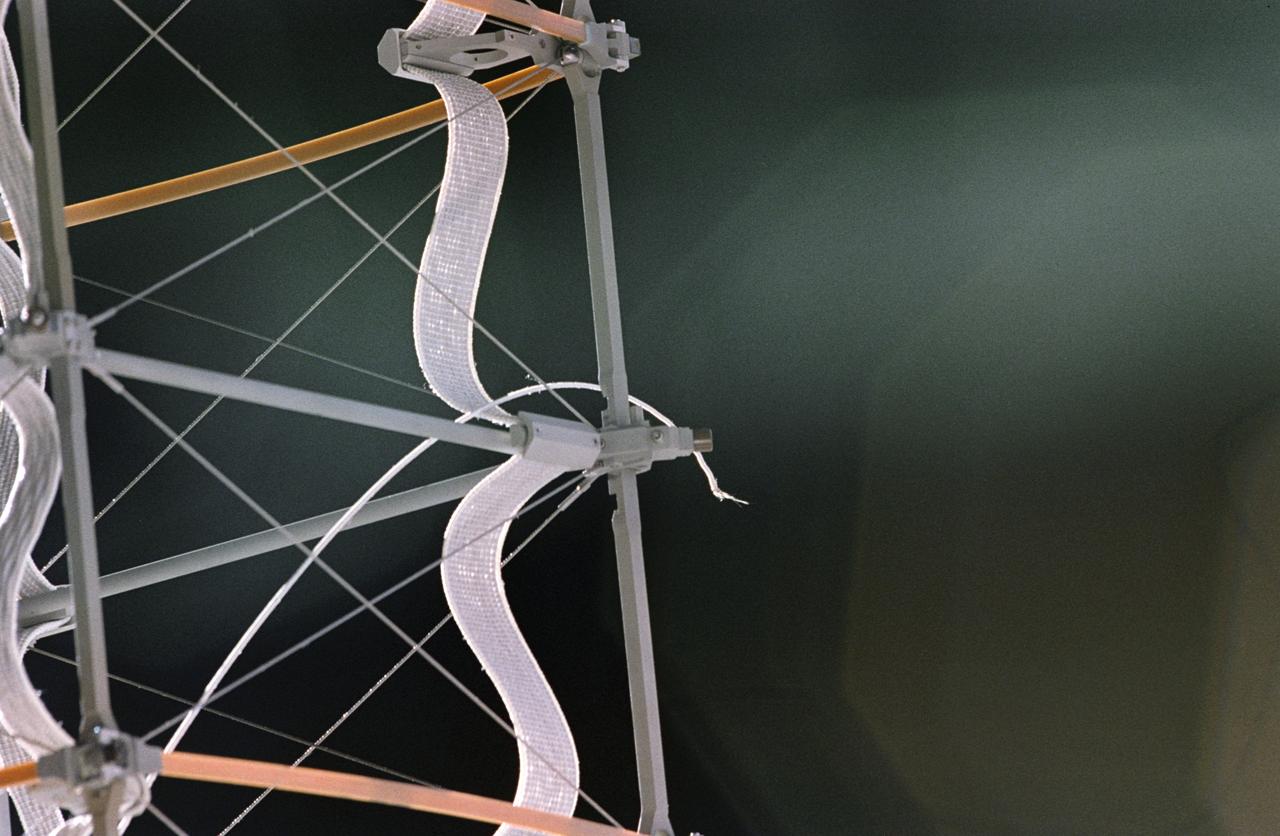
STS075-325-014 (25 Feb. 1996) --- The frayed end of the tether portion of the Tethered Satellite System (TSS) is seen at the end of the supportive boom. On February 25, 1996, the crew deployed the TSS, which later broke free. The seven member crew was launched aboard the Space Shuttle Columbia on February 22, 1996, and landed on March 9, 1996. Crewmembers were Andrew M. Allen, mission commander; Scott J. Horowitz, pilot; Franklin R. Chang-Diaz, payload commander; and Maurizio Cheli, European Space Agency (ESA); Jeffrey A. Hoffman and Claude Nicollier (ESA), all mission specialists; along with payload specialist Umberto Guidoni of the Italian Space Agency (ASI).
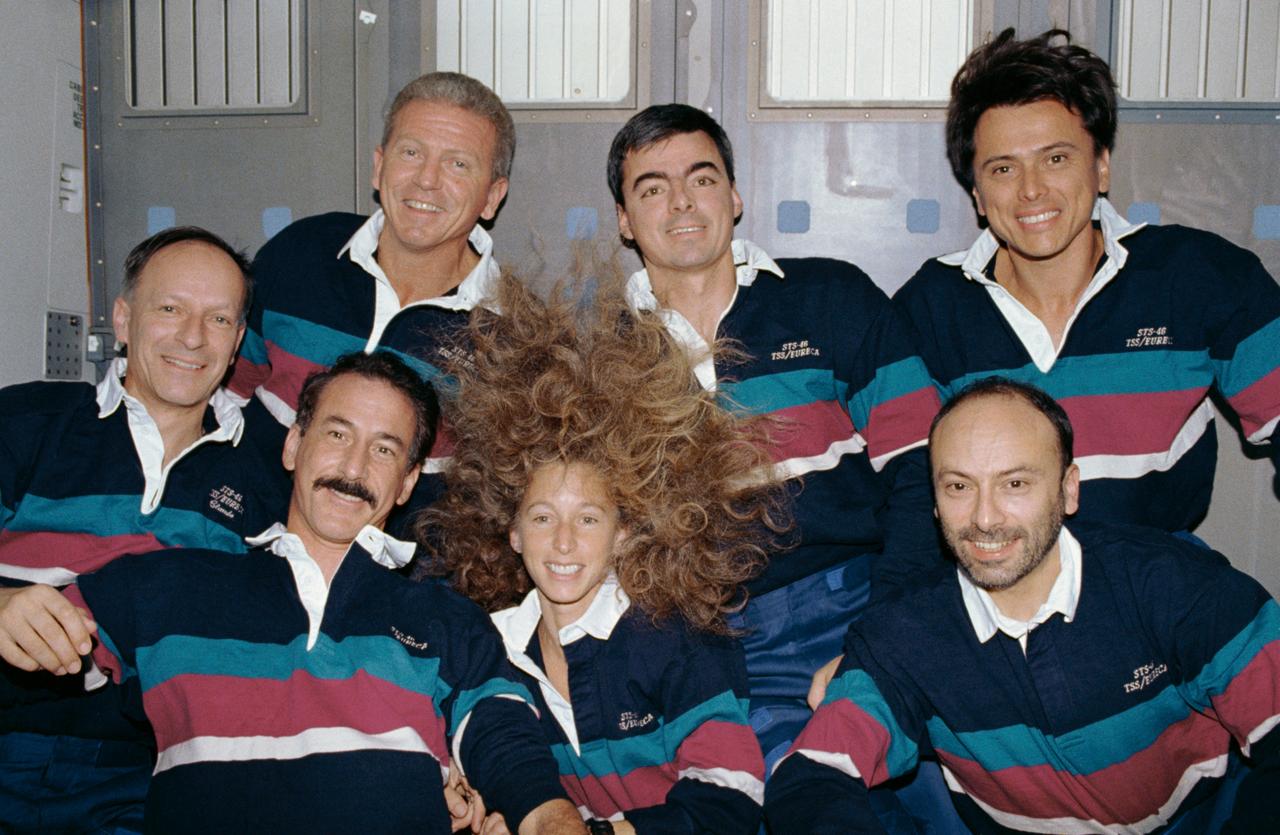
STS046-12-009 (31 July-8 Aug. 1992) --- The seven crew members for the STS-46 mission pose for the traditional in-flight portrait onboard the Earth-orbiting space shuttle Atlantis. In the rear are, left to right, astronauts Loren J. Shriver, commander; Andrew M. Allen, pilot; and Franklin R. Chang-Diaz, mission specialist. In front are, left to right, Swiss scientist Claude Nicollier, mission specialist representing the European Space Agency (ESA); astronaut Jeffrey A. Hoffman, payload commander; astronaut Marsha S. Ivins, mission specialist; and Franco Malerba, payload specialist representing the Italian Space Agency (ASI).
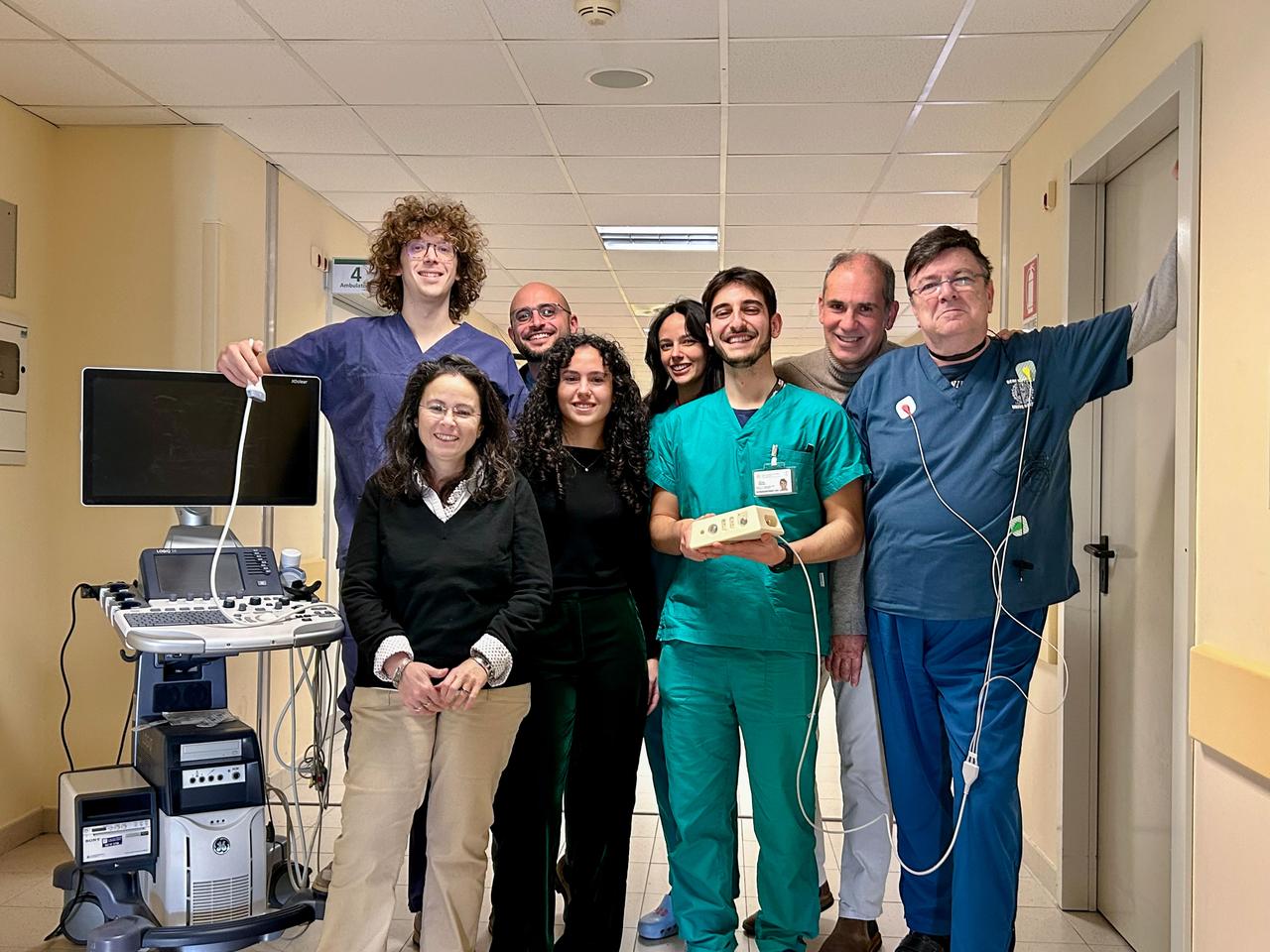
jsc2025e057712 (1/10/2025) --- DrainBrain 2.0 examines how blood flows from the brain to the heart in microgravity. Results could help researchers identify which processes in the body compensate for the lack of gravity, helping to ensure proper blood flow for astronauts and people with cardiovascular issues on Earth. This photo shows the University of Ferrara/Italian Space Agency (ASI) research team, left to right, Anselmo Pagani, Rosa Brancaccio, Antonino Proto, Chiara Marchesin, Ilaria Manfrini, Bruno Soggia, Angelo Taibi, and Principal Investigator Paolo Zamboni.