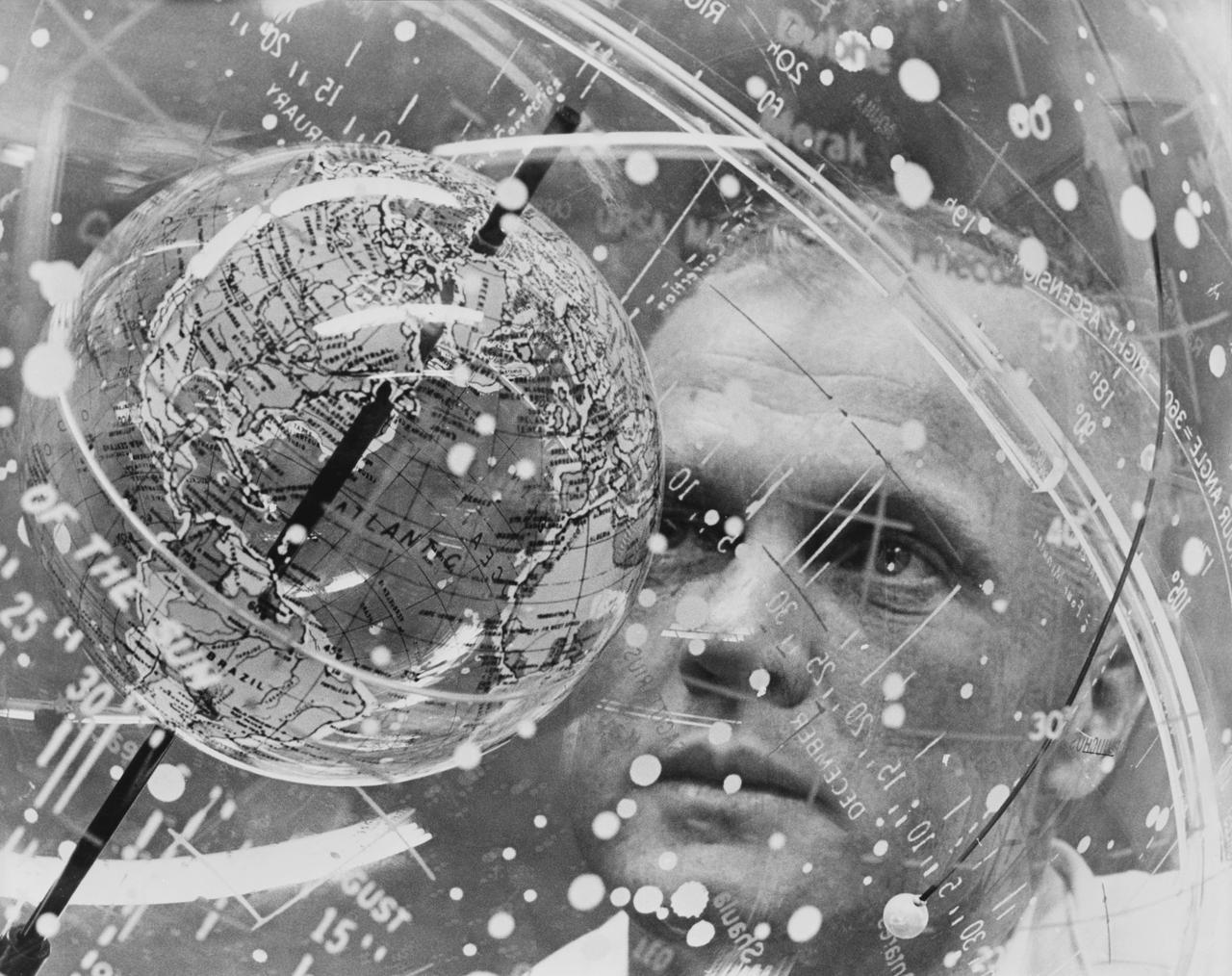
S61-04623 (1961) --- Astronaut John H. Glenn Jr. looks into a Celestial Training Device (globe) during training in the Aeromedical Laboratory at Cape Canaveral, Florida. Photo credit: NASA
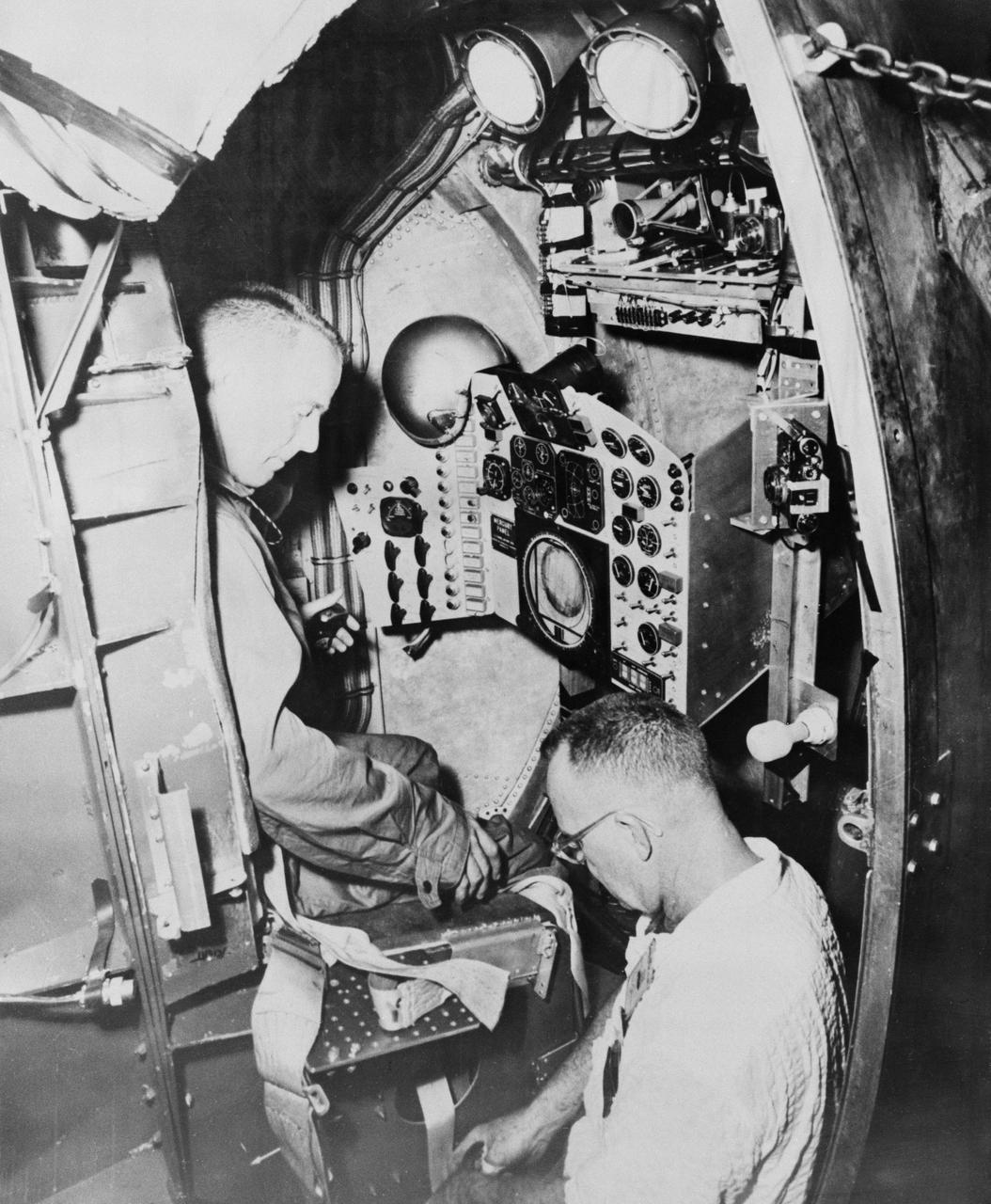
B59-00570 (August 1959) --- Astronaut Scott Carpenter trains at the centrifuge procedures trainer at Wright Field, Johnsville, Pennsylvania, for project Mercury. Photo credit: NASA
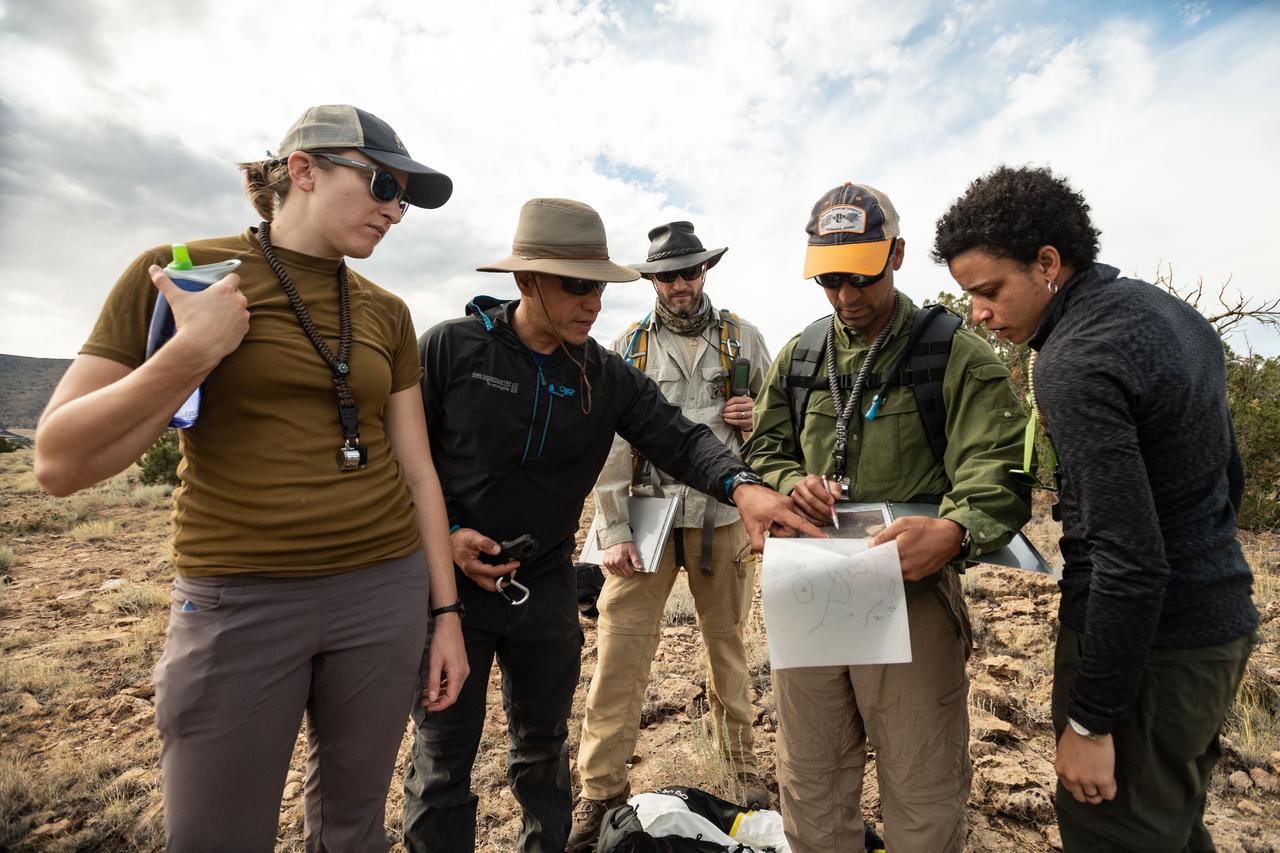
jsc2019e054865 (09-16-19) --- (From left) 2017 NASA astronaut candidates Kayla Barron, Frank Rubio, Raja Chari, and Jessica Watkins with their field instructor during geology training in Arizona. Photo Credit: (NASA/Bill Stafford)

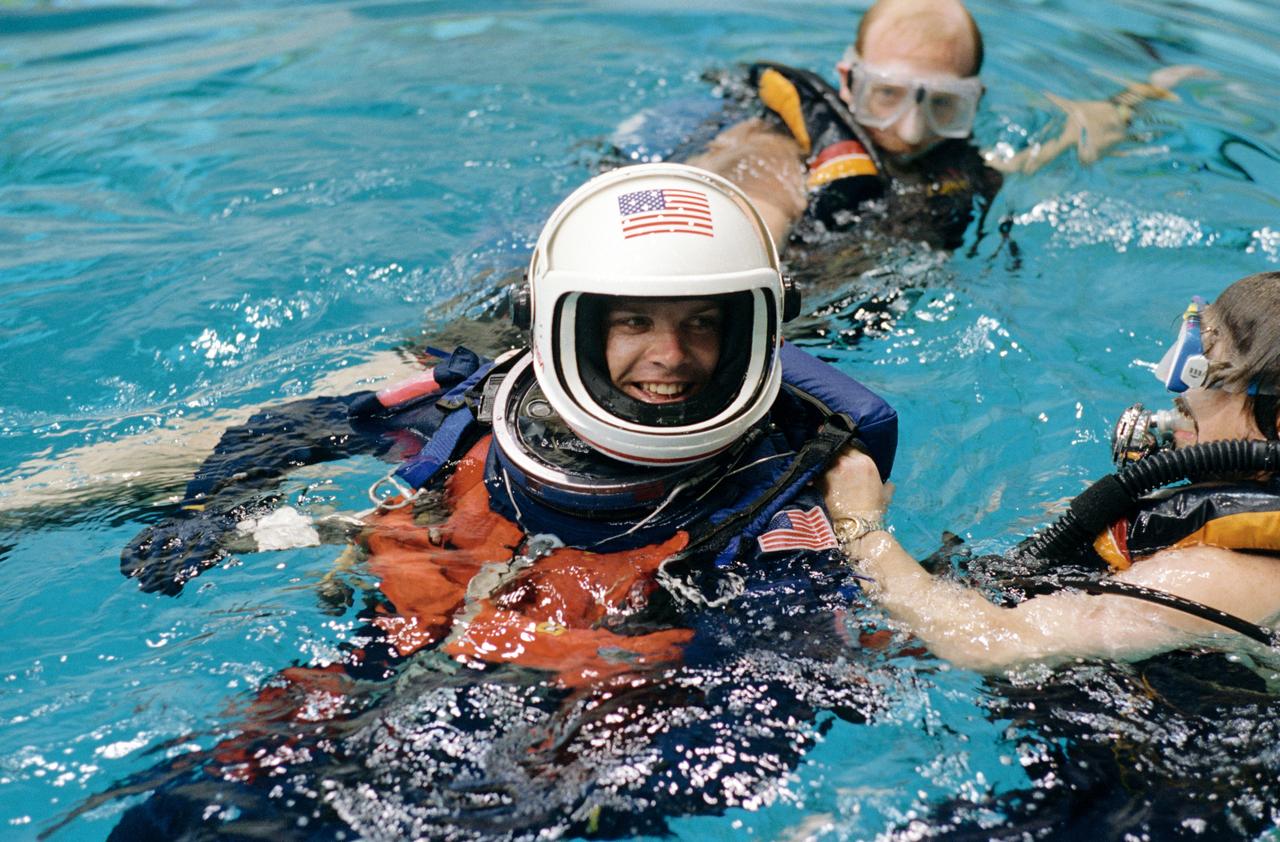
S95-03480 (16 FEB 1995) --- Attired in a training version of the Shuttle launch and entry garment, astronaut Kevin R. Kregel, pilot, gets help from SCUBA-equipped divers during a training session at the Johnson Space Center's (JSC) Weightless Environment Training Facility (WET-F). As part of the emergency bailout phase of their training agenda, the STS-70 crew members made use of this 25-feet deep pool to practice parachute landings in water and subsequent deployment of life rafts.
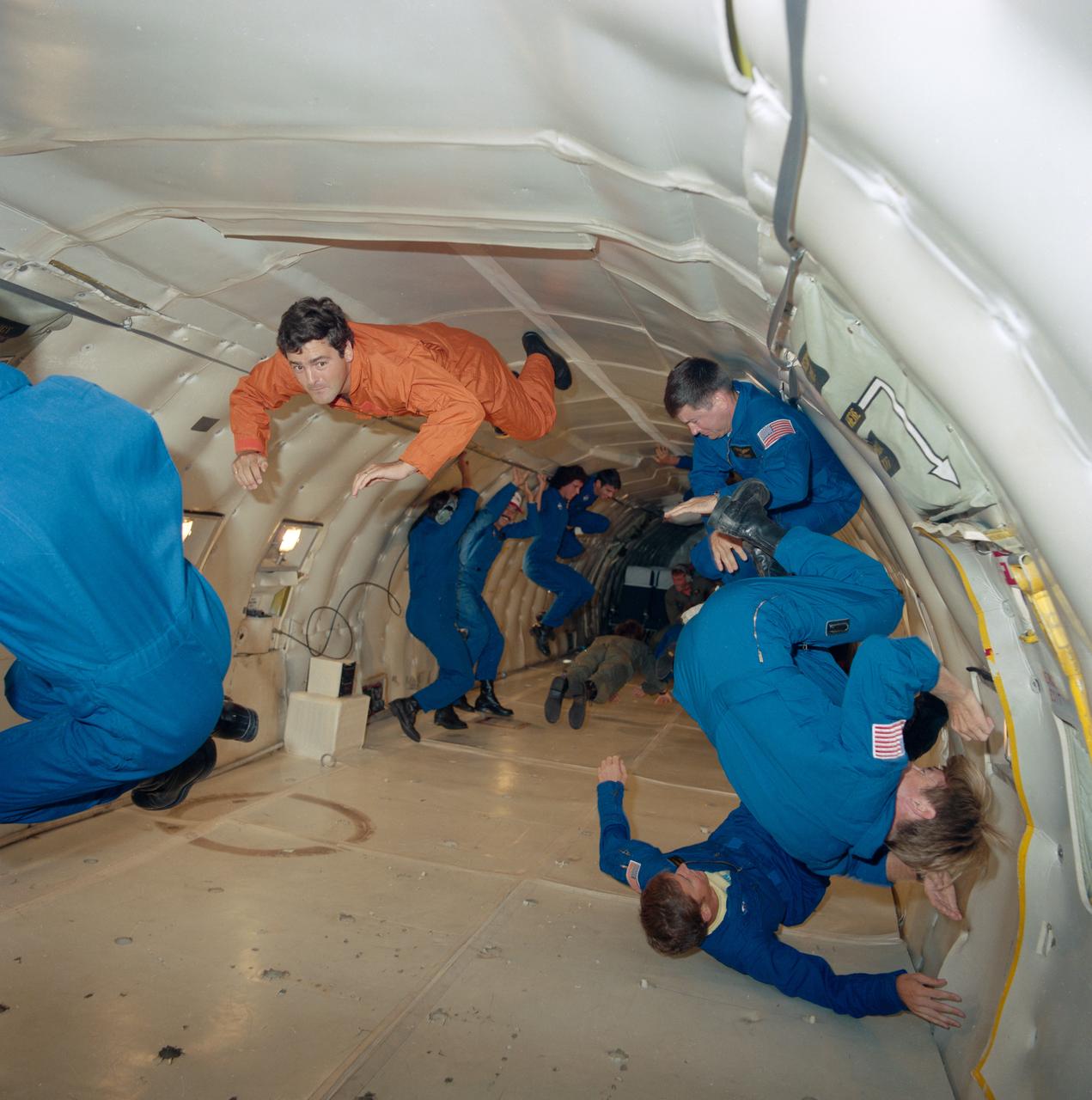
View of astronaut candidates and payload specialists during a training flight on the KC-135. The trainees are experiencing weightlessness in the hold of the aircraft.
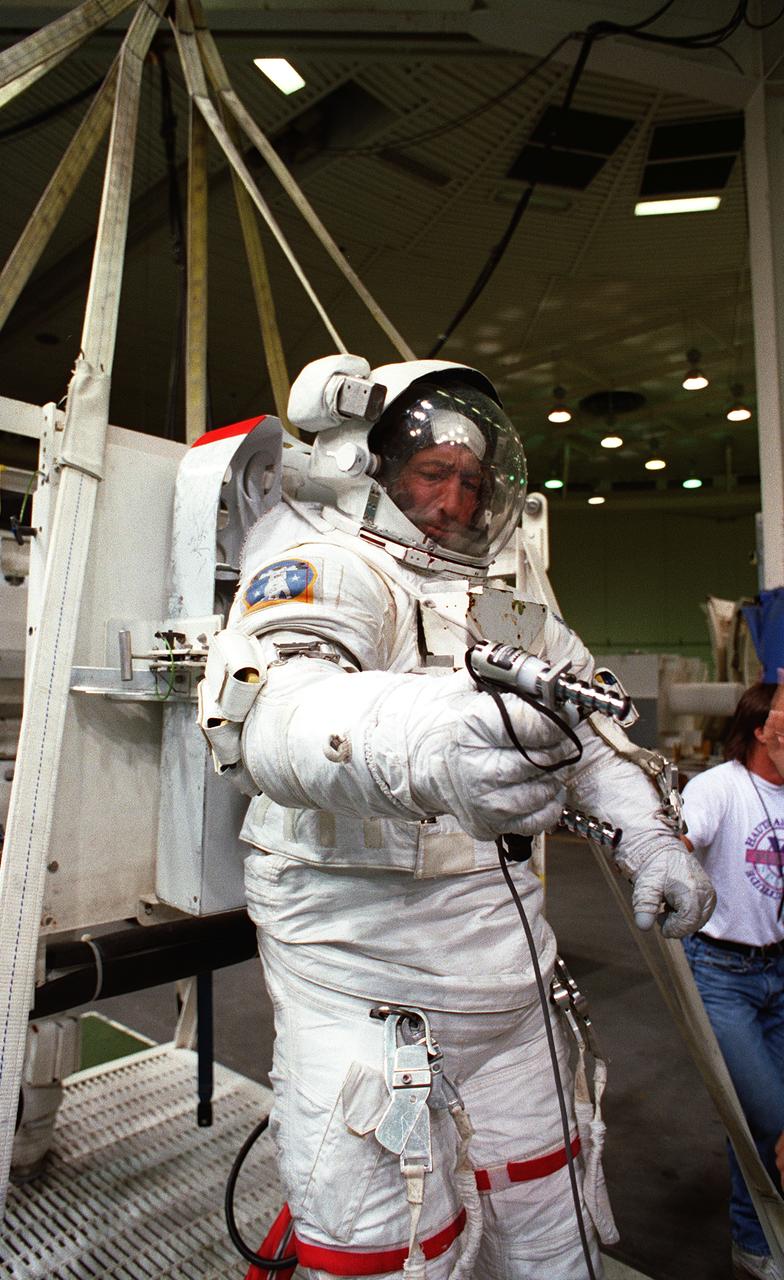
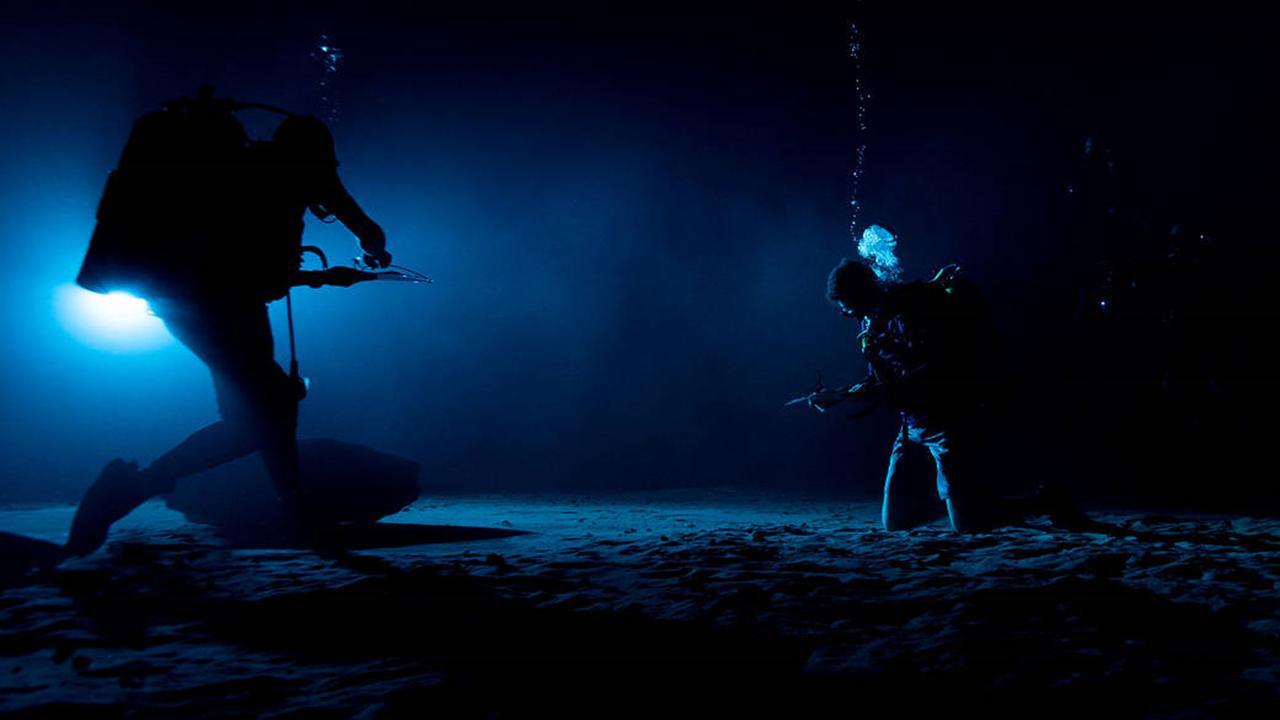
S95-15847 (26 July 1995) --- Wearing a training version of the Extravehicular Mobility Unit (EMU) space suit, astronaut Mario Runco Jr., mission specialist, prepares to participate in an underwater rehearsal of a contingency Extravehicular Activity (EVA). This type of training routinely takes place in the 25-feet deep pool of the Johnson Space Center's (JSC) Weightless Environment Training Center (WET-F). The training prepares at least two crew members on each flight for procedures to follow outside the spacecraft in event of failure of remote methods to perform various chores.
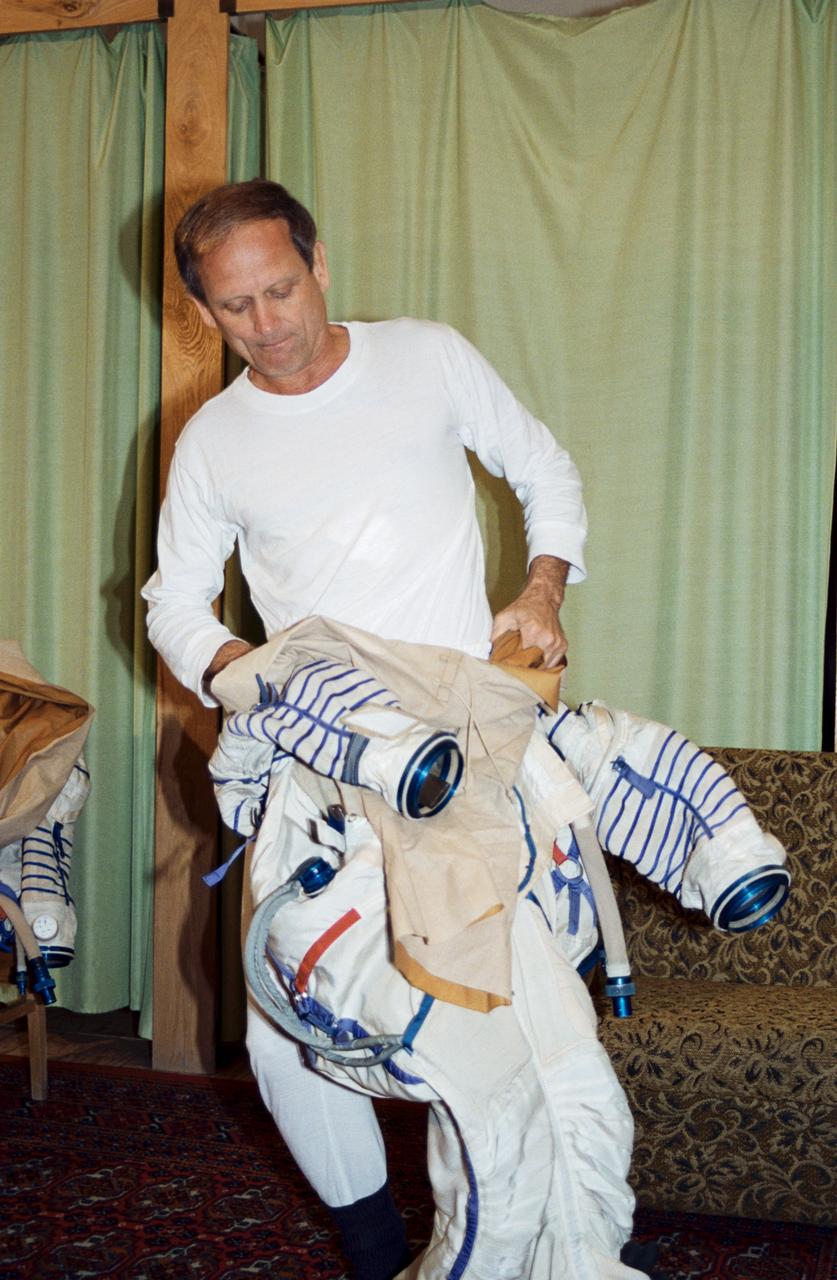
Astronaut Norman E. Thagard getting into a cosmonaut space suit in the Training Simulator Facility at the Gagarin Cosmonaut Training Center (Star City), near Moscow, Russia.
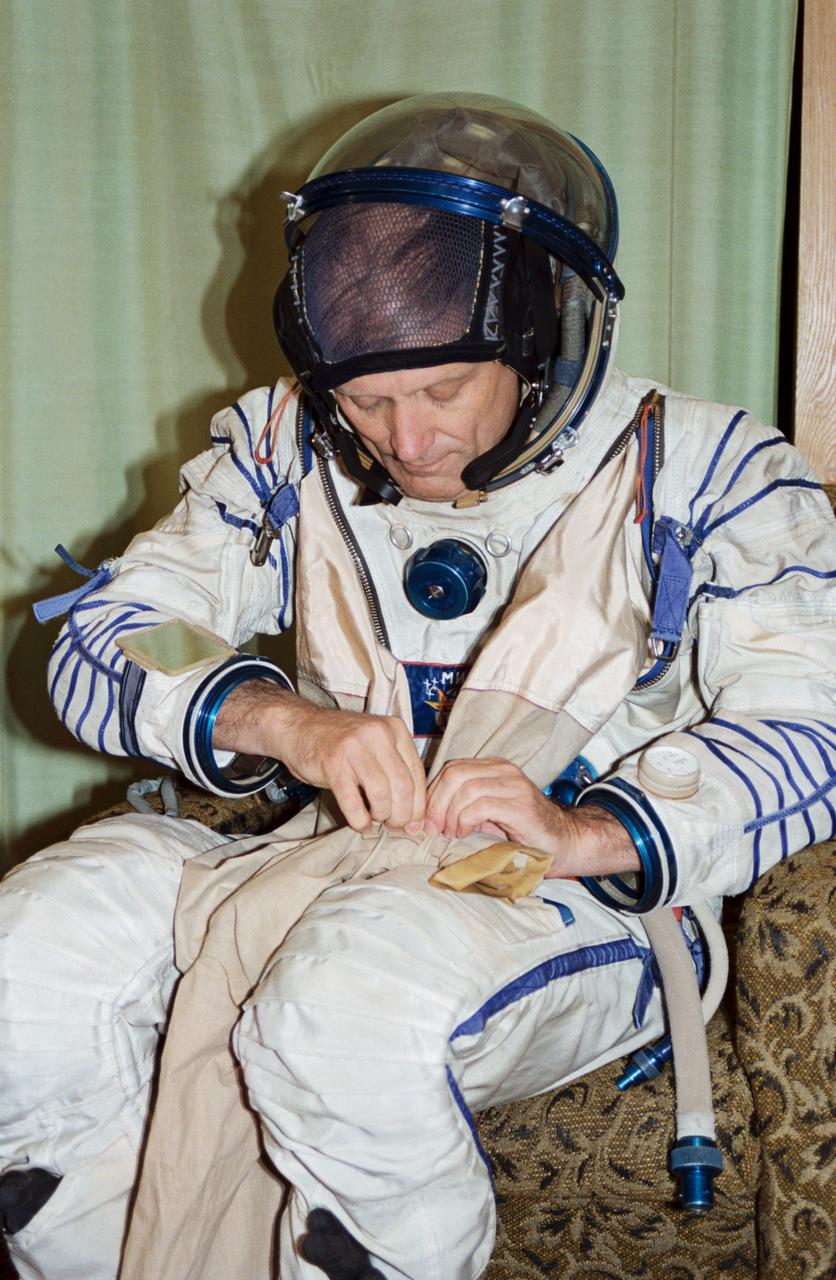
Astronaut Norman E. Thagard in a cosmonaut space suit in the Training Simulator Facility at the Gagarin Cosmonaut Training Center (Star City), near Moscow, Russia. In March 1995, astronaut Thagard is scheduled to be launched in a Russian Soyuz spacecraft with two cosmonauts to begin a three-month tour of duty on the Russian Mir Space Station. Thagard, along with his back-up, astronaut Bonnie J. Dunbar, has been training in Russian since February 1994.
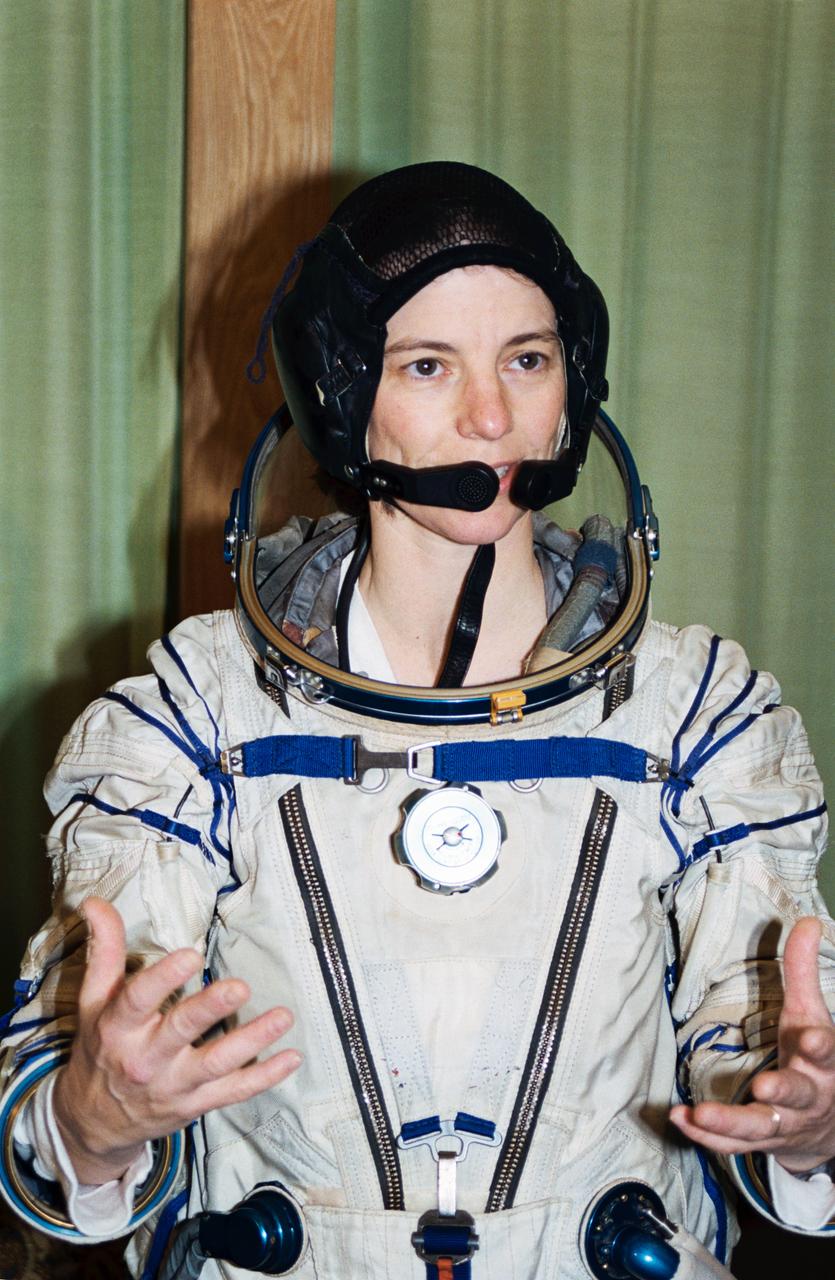
Astronaut Bonnie J. Dunbar in a cosmonaut space suit in the Training Simulator Facility at the Gagarin Cosmonaut Training Center (Star City), near Moscow, Russia. In March 1995, astronaut Norman E. Thagard is scheduled to be launched in a Russian Soyuz spacecraft with two cosmonauts to begin a three-month tour of duty on the Russian Mir Space Station. Thagard, along with his back-up, astronaut Bonnie J. Dunbar, has been training in Russian since February 1994.
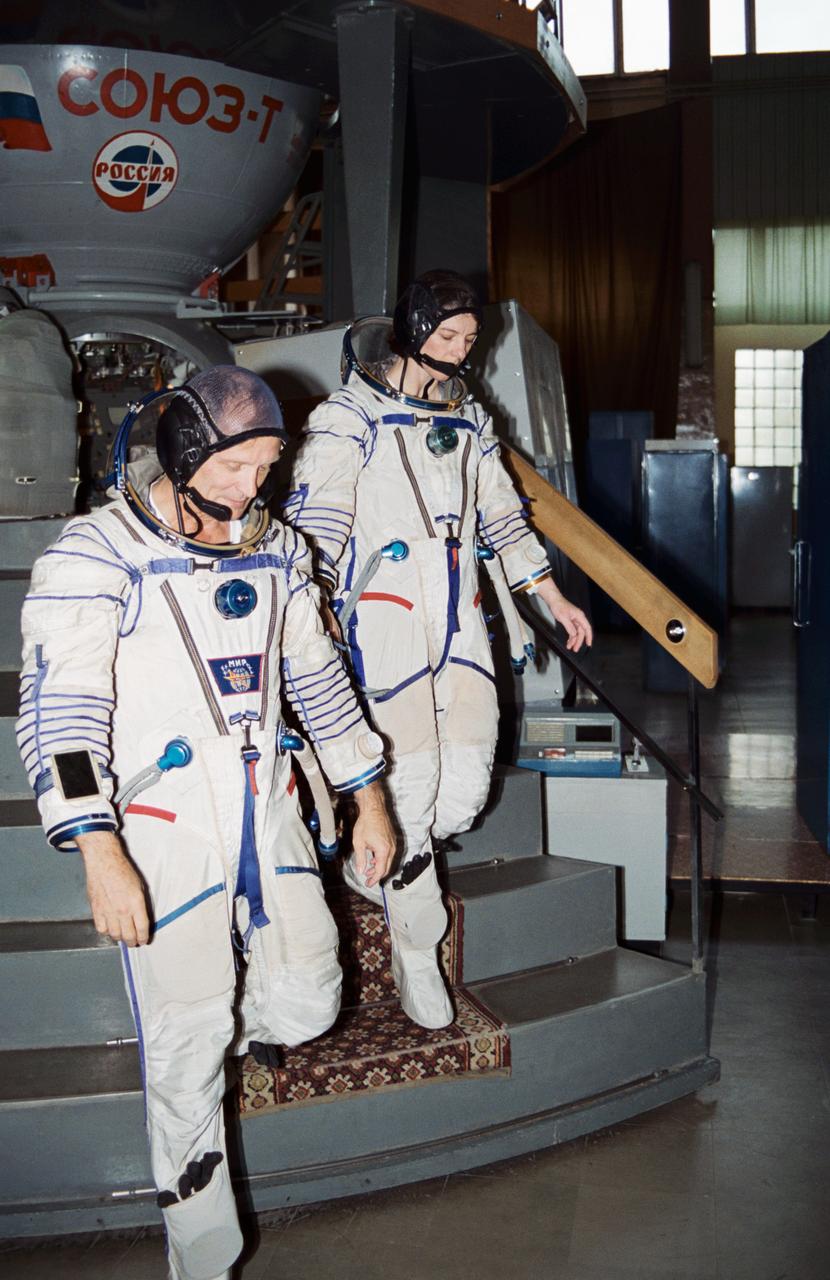
Astronauts Norman E. Thagard and Bonnie J. Dunbar in cosmonaut space suits in the Training Simulator Facility at the Gagarin Cosmonaut Training Center (Star City), near Moscow, Russia. In March 1995, astronaut Thagard is scheduled to be launched in a Russian Soyuz spacecraft with two cosmonauts to begin a three-month tour of duty on the Russian Mir Space Station. Thagard, along with his back-up, astronaut Bonnie J. Dunbar, has been training in Russian since February 1994.
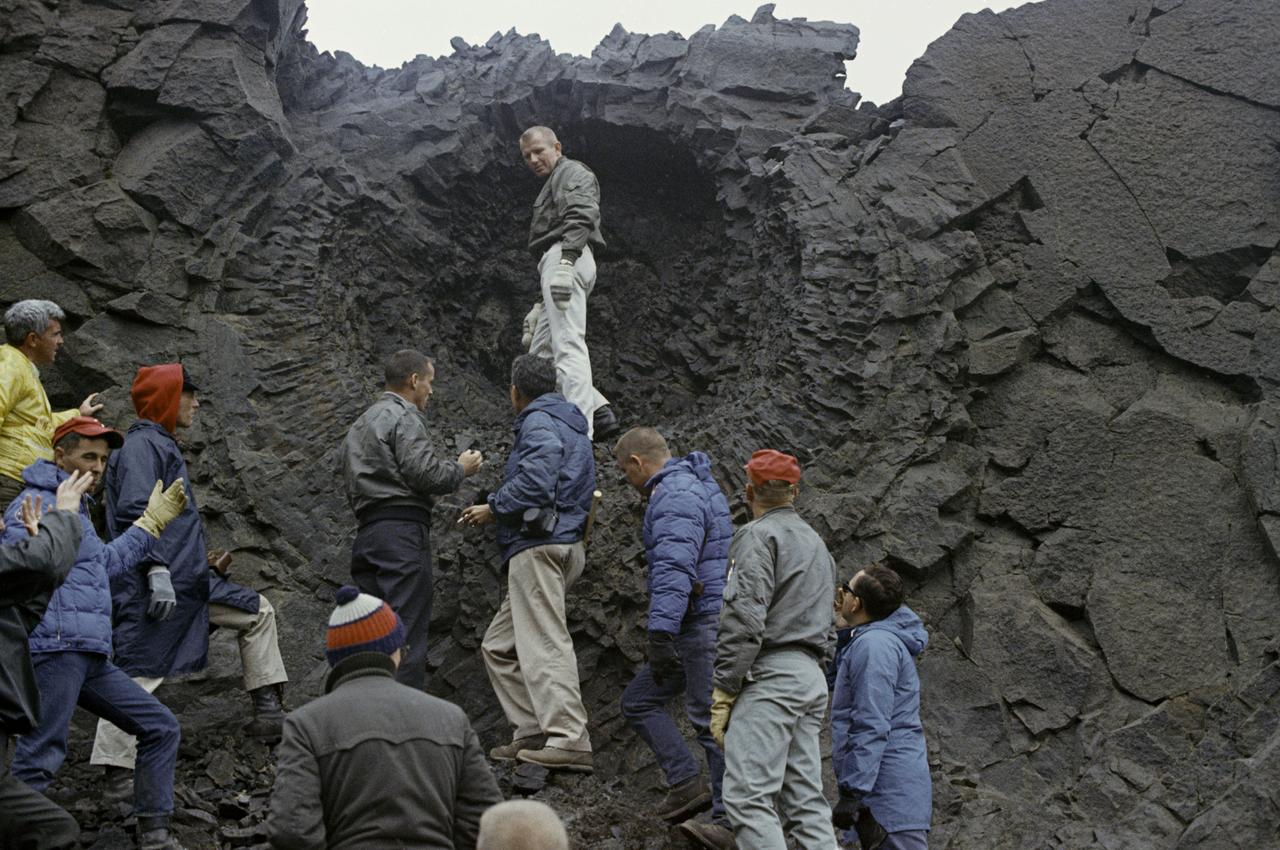
Apollo astronauts study rock formations during a geology field training in Iceland in 1967.
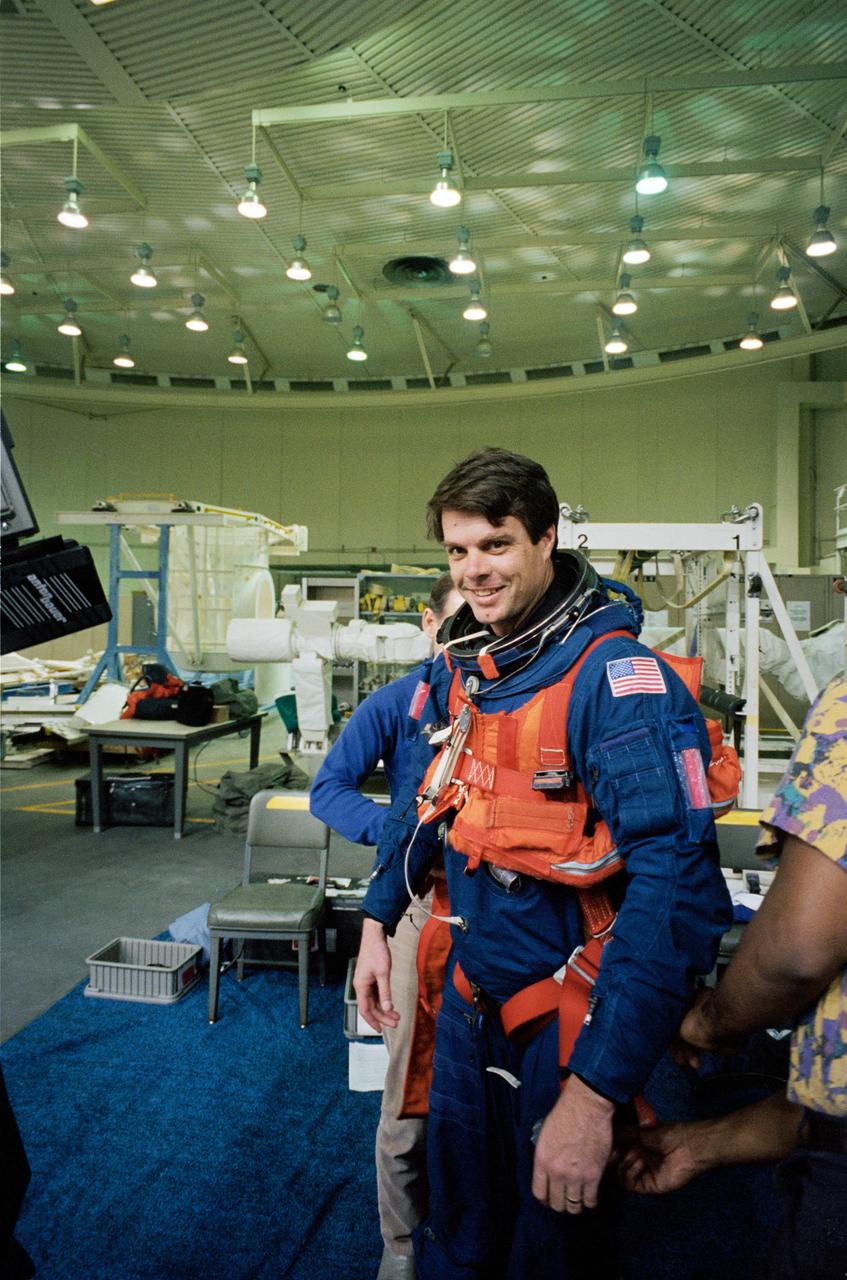
S95-03465 (16 Feb 1995) --- Attired in a training version of the Shuttle launch and entry garment, astronaut Kevin R. Kregel gets help with the final touches of suit donning during a training session at the Johnson Space Center's (JSC) Weightless Environment Training Facility (WET-F). Assigned as pilot for the STS-70 mission, Kregel was about to rehearse emergency bailout. The crew members made use of a nearby 25-feet deep pool to practice parachute landings in water and subsequent deployment of life rafts.
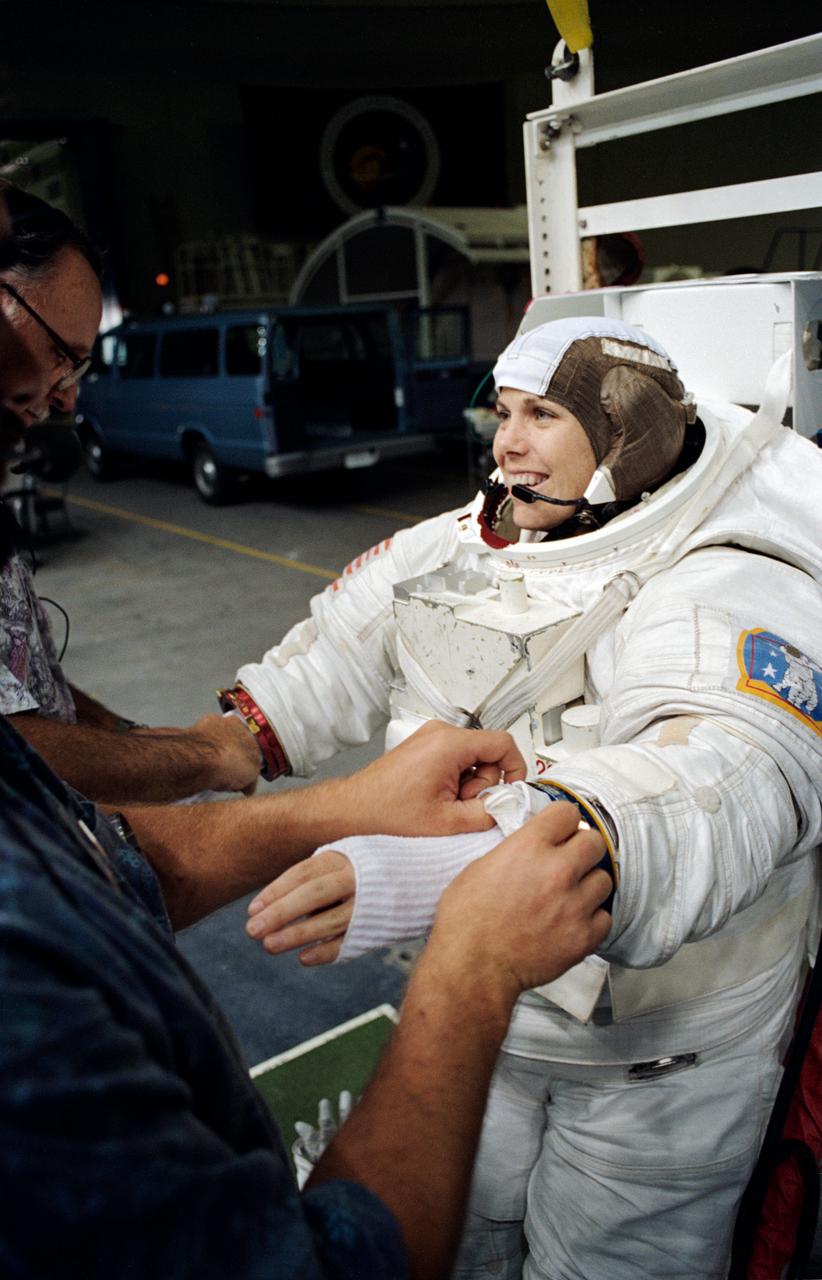
Attired in a training version of the Extravehicular Mobility Unit (EMU), astronaut Mary Ellen Weber gets help with the final touches of suit donning during a training session at JSC's Weightless Environment Training Facility (WETF). Training as a mission specialist for the STS-70 mission, Weber was about to rehearse a contingency space walk.
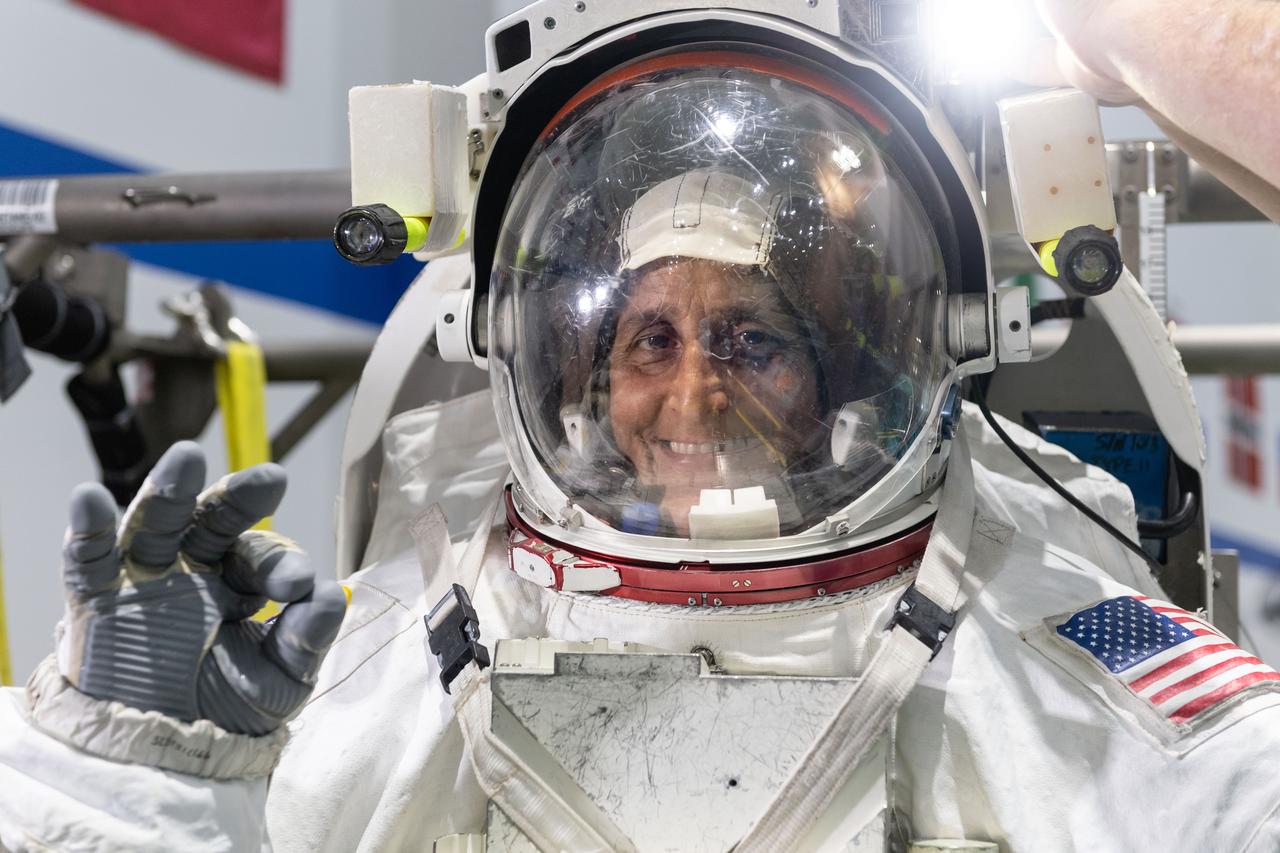
Commercial Crew Program astronaut training with Boeing PCM crew members Suni Williams & Josh Cassada during ISS EVA Maintenance 1 training at the NBL.

Commercial Crew Program astronaut training with Boeing PCM crew members Suni Williams & Josh Cassada during ISS EVA Maintenance 1 training at the NBL.
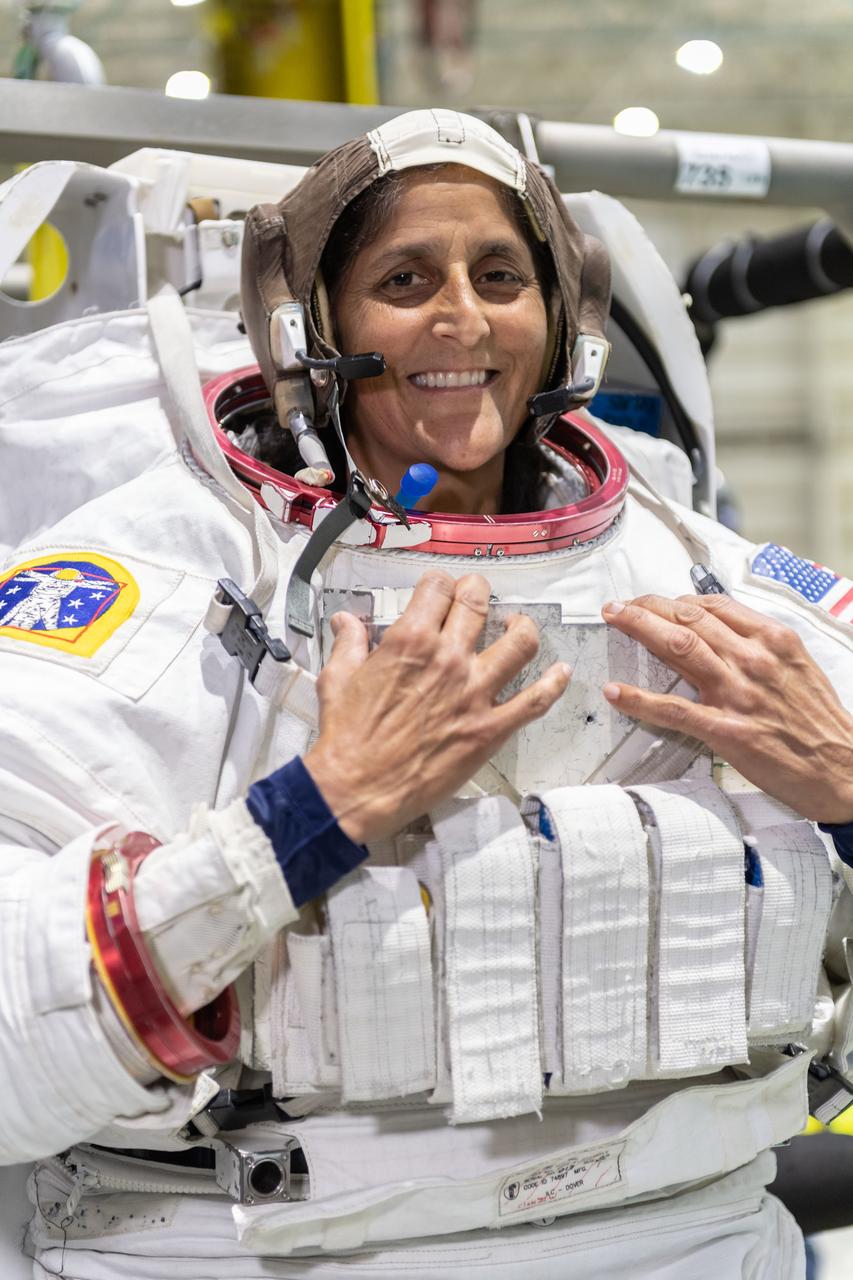
Commercial Crew Program astronaut training with Boeing PCM crew members Suni Williams & Josh Cassada during ISS EVA Maintenance 1 training at the NBL.

Commercial Crew Program astronaut training with Boeing PCM crew members Suni Williams & Josh Cassada during ISS EVA Maintenance 1 training at the NBL.

Commercial Crew Program astronaut training with Boeing PCM crew members Suni Williams & Josh Cassada during ISS EVA Maintenance 1 training at the NBL.

Commercial Crew Program astronaut training with Boeing PCM crew members Suni Williams & Josh Cassada during ISS EVA Maintenance 1 training at the NBL.
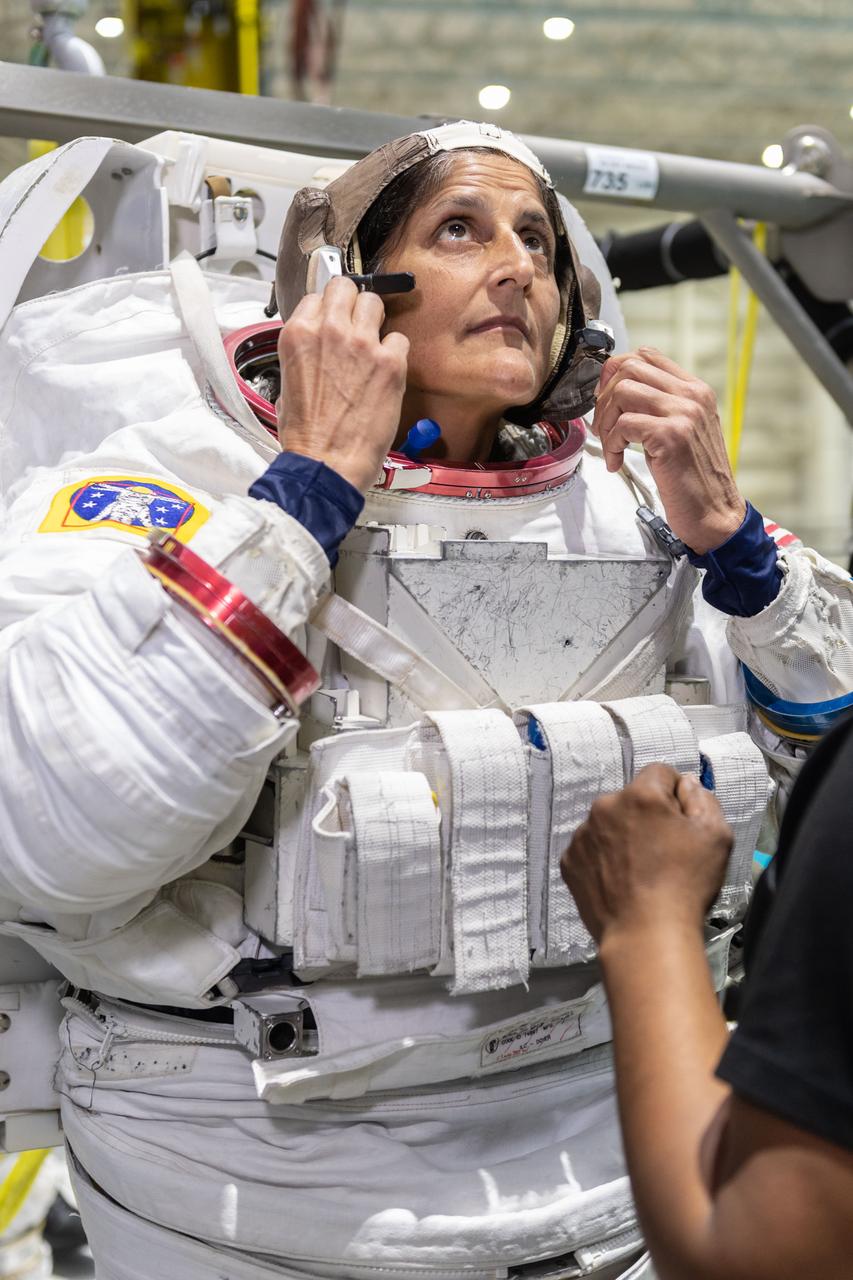
Commercial Crew Program astronaut training with Boeing PCM crew members Suni Williams & Josh Cassada during ISS EVA Maintenance 1 training at the NBL.
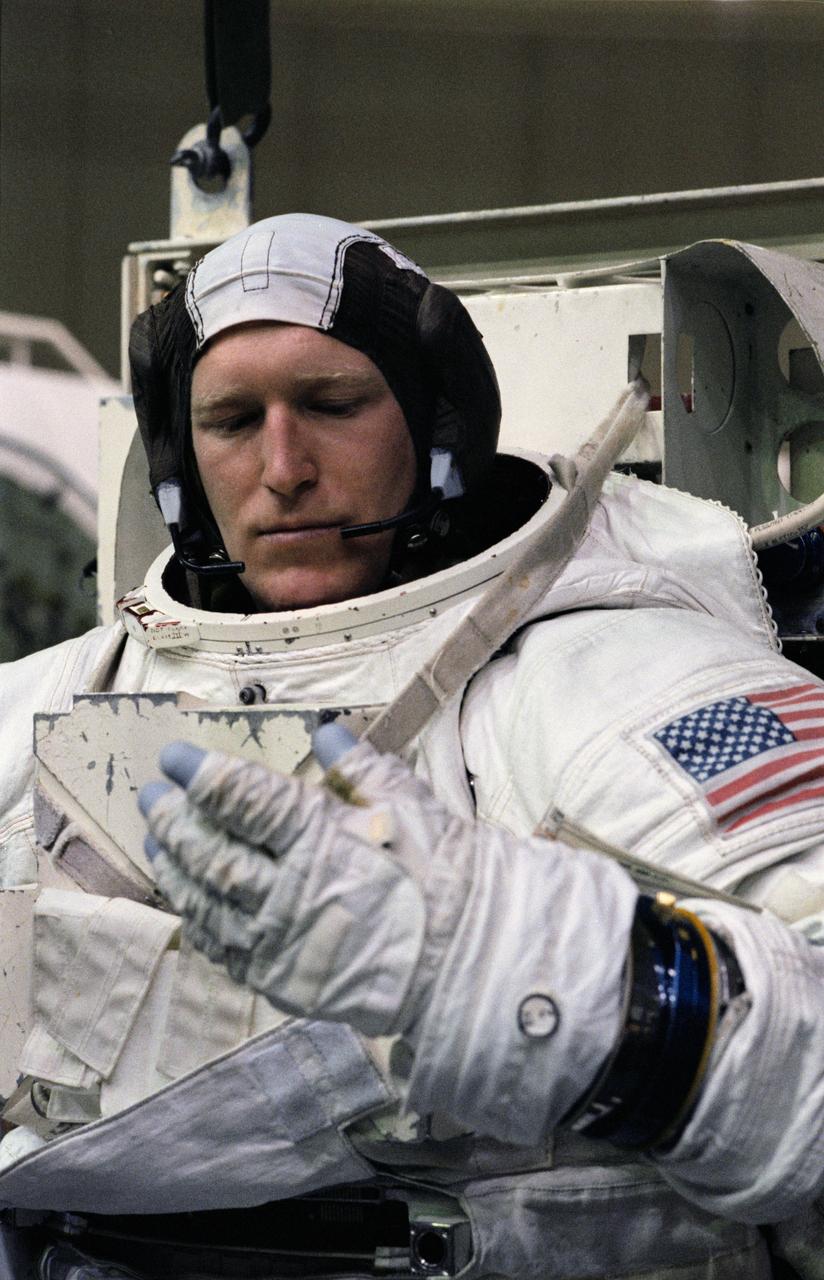
S87-26630 (March 1987) --- Astronaut Charles D. (Sam) Gemar, wearing a training version of the Extravehicular Mobility Unit (EMU) space suit, prepares to be emersed in the 25-ft. deep waters of the Weightless Environment Training Facility (WET-F) at the Johnson Space Center (JSC). Once underwater, Gemar was able to achieve a neutrally buoyant state and to simulate the floating type activities of an astronaut in microgravity. Gemar began training as an astronaut candidate in the summer of 1985.
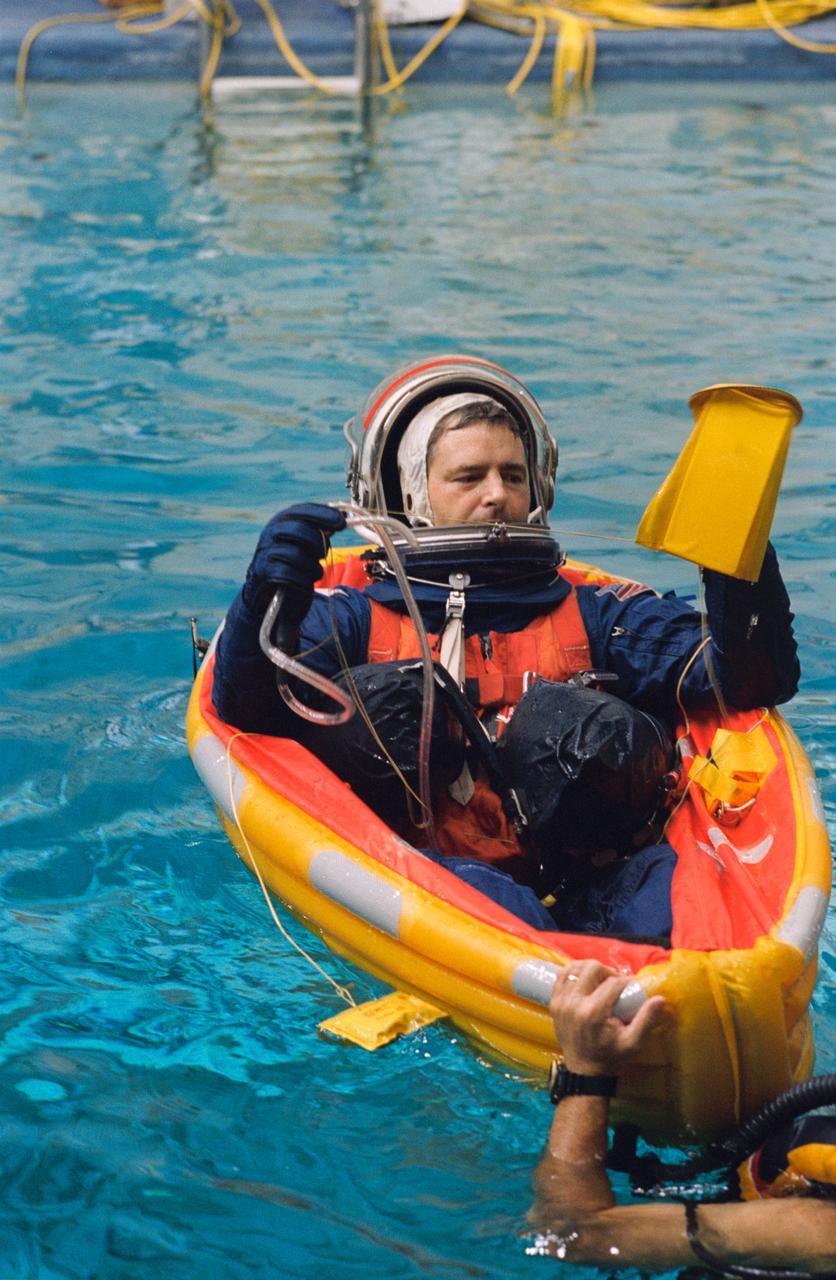
S93-45726 (7 Oct. 1993) --- Canadian astronaut candidate Marc Garneau, later named as a mission specialist for NASA's STS-77 mission, participates in emergency bailout training at the Johnson Space Center (JSC). Garneau was in the 1992 class of Astronaut Candidates (ASCAN). Wearing full parachute gear following a simulated parachute drop, Garneau has deployed a small life raft in a 25-feet deep pool in JSC's Weightless Environment Training Facility (WET-F). This portion of an astronaut's training is to prepare him or her for proper measures to take in the event of bailout over water. Garneau is assisted here by one of several SCUBA-equipped divers in the pool.
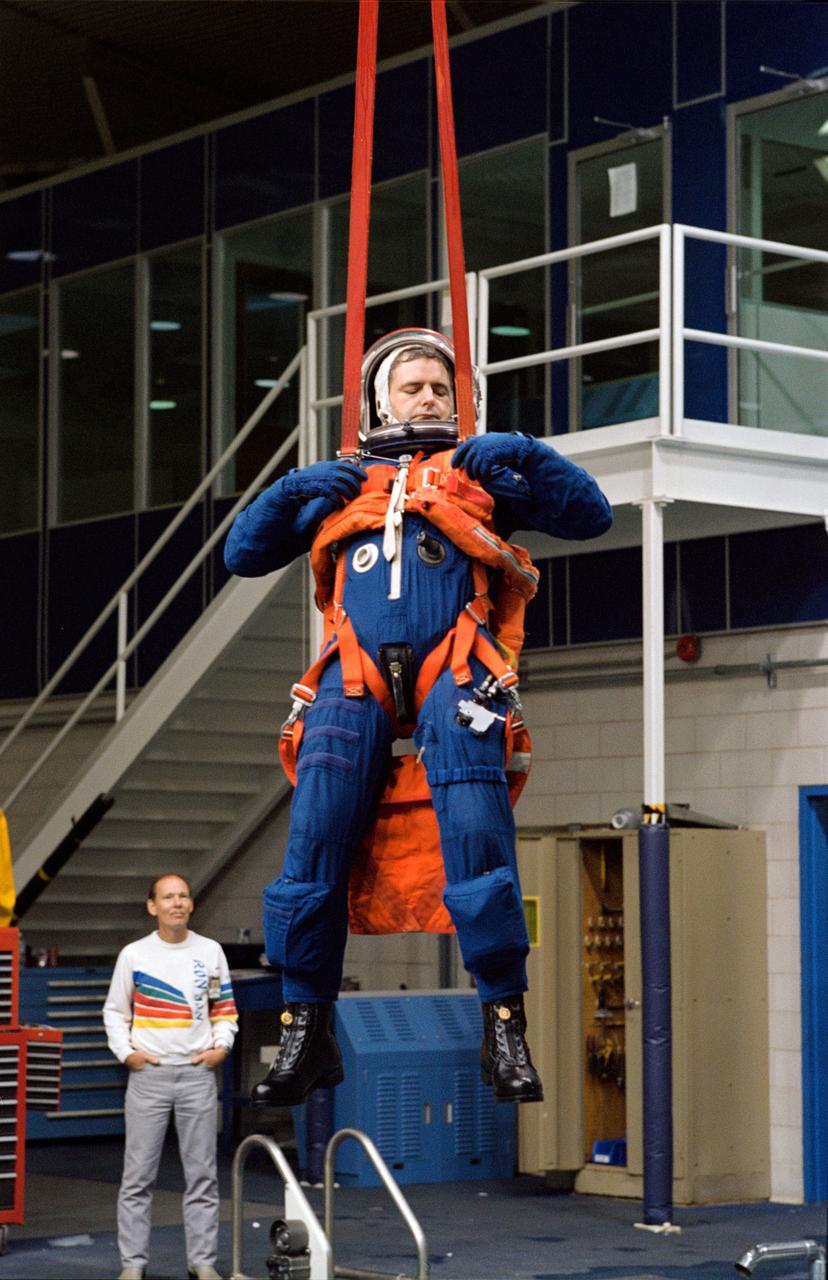
S93-45723 (7 October 1993) --- Canadian astronaut candidate Marc Garneau, later named as a mission specialist for NASA's STS-77 mission-representing the Canadian Space Agency (CSA), participates in emergency bailout training at the Johnson Space Center (JSC). Garneau was in the 1992 class of Astronaut Candidates (ASCAN). Wearing full parachute gear, Garneau is suspended above a 25-feet deep pool in JSC's Weightless Environment Training Facility (WET-F). This portion of an astronaut's training is to prepare them for proper measures to take in the event of bailout over water.
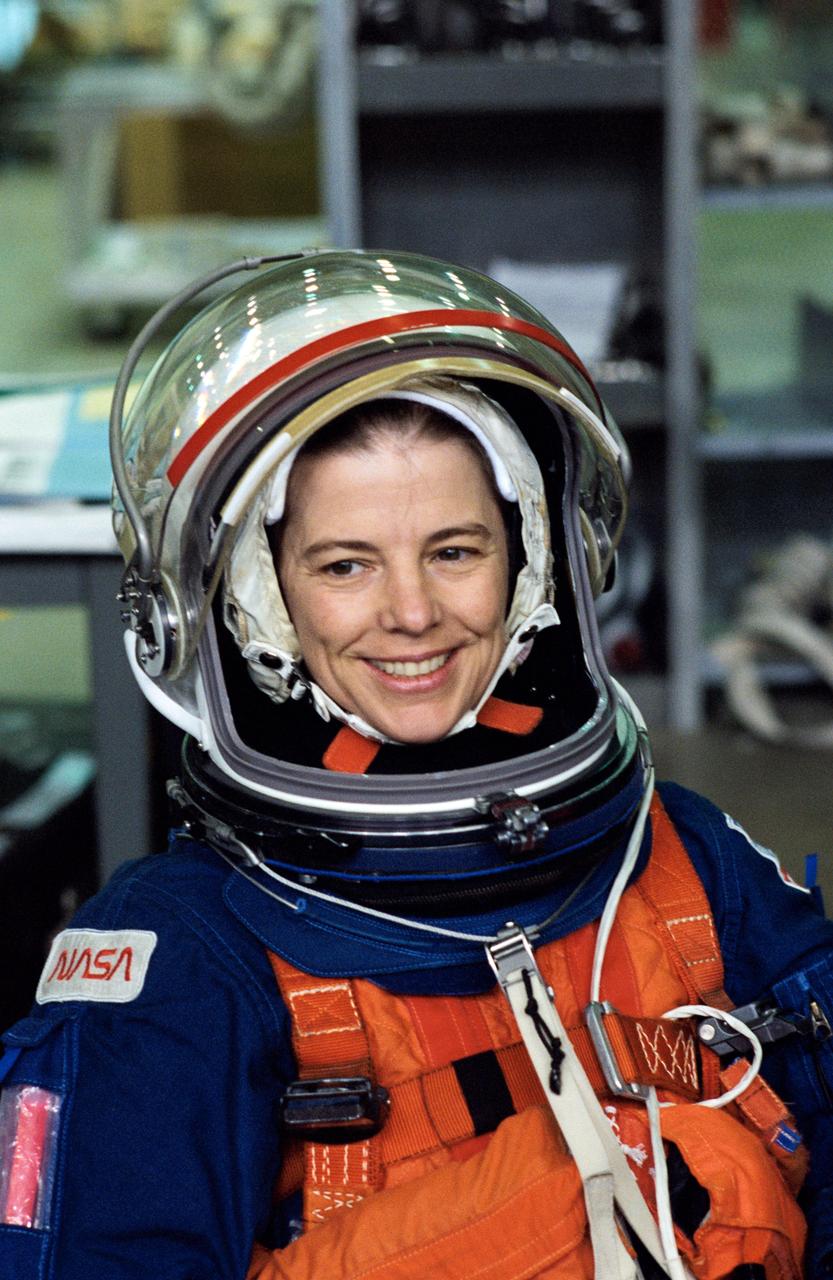
S94-47256 (13 Oct 1994) --- Astronaut Bonnie J. Dunbar, STS-71 mission specialist, smiles as she watches a crew mate (out of frame) make a simulated parachute landing in nearby water. The action came as part of an emergency bailout training session in the Johnson Space Center's (JSC) Weightless Environment Training Facility's (WET-F) 25-feet-deep pool.
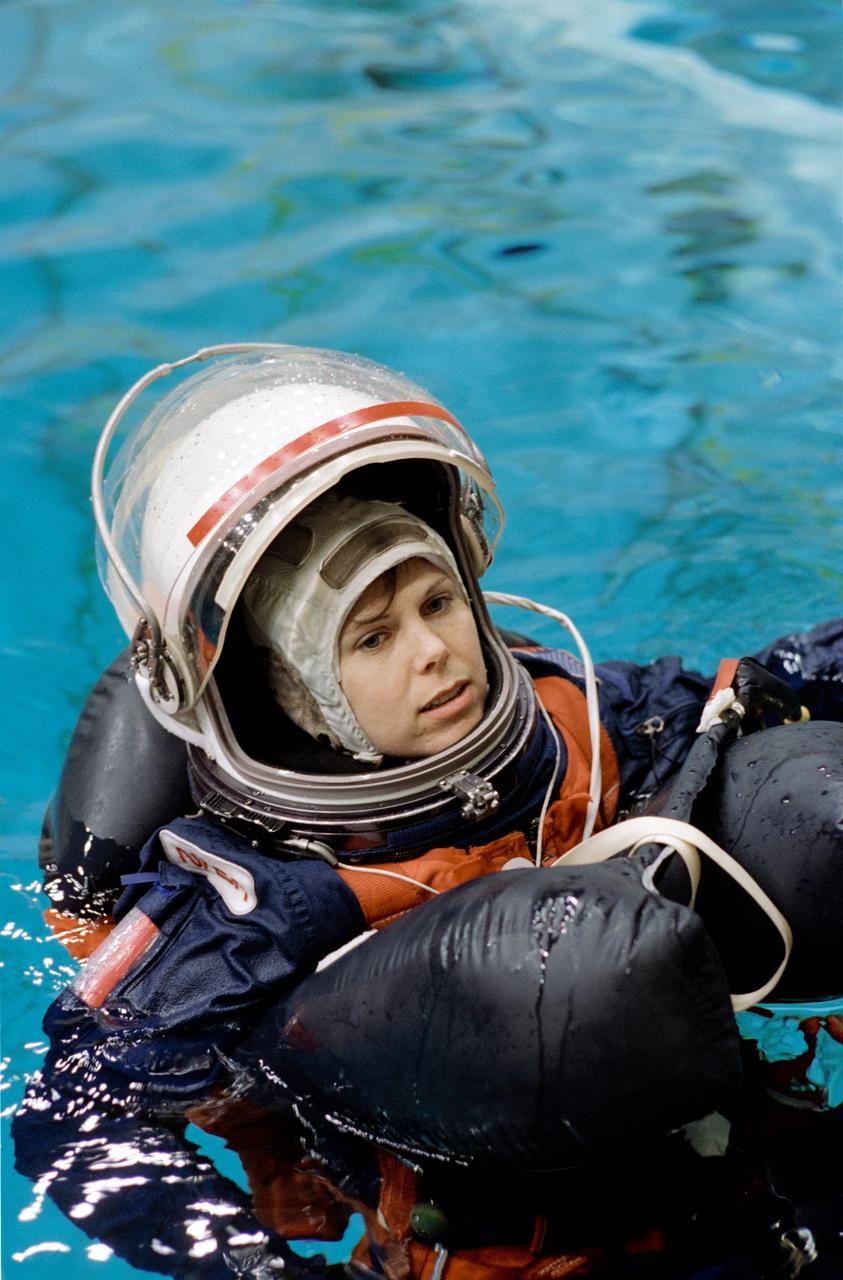
S95-03501 (16 FEB 1995) --- Astronaut Mary Ellen Weber prepares to deploy a life raft during a training session at the Johnson Space Center's (JSC) Weightless Environment Training Facility (WET-F). Training as a mission specialist for the STS-70 mission, Weber was joined by four crew mates in the emergency bailout rehearsal.
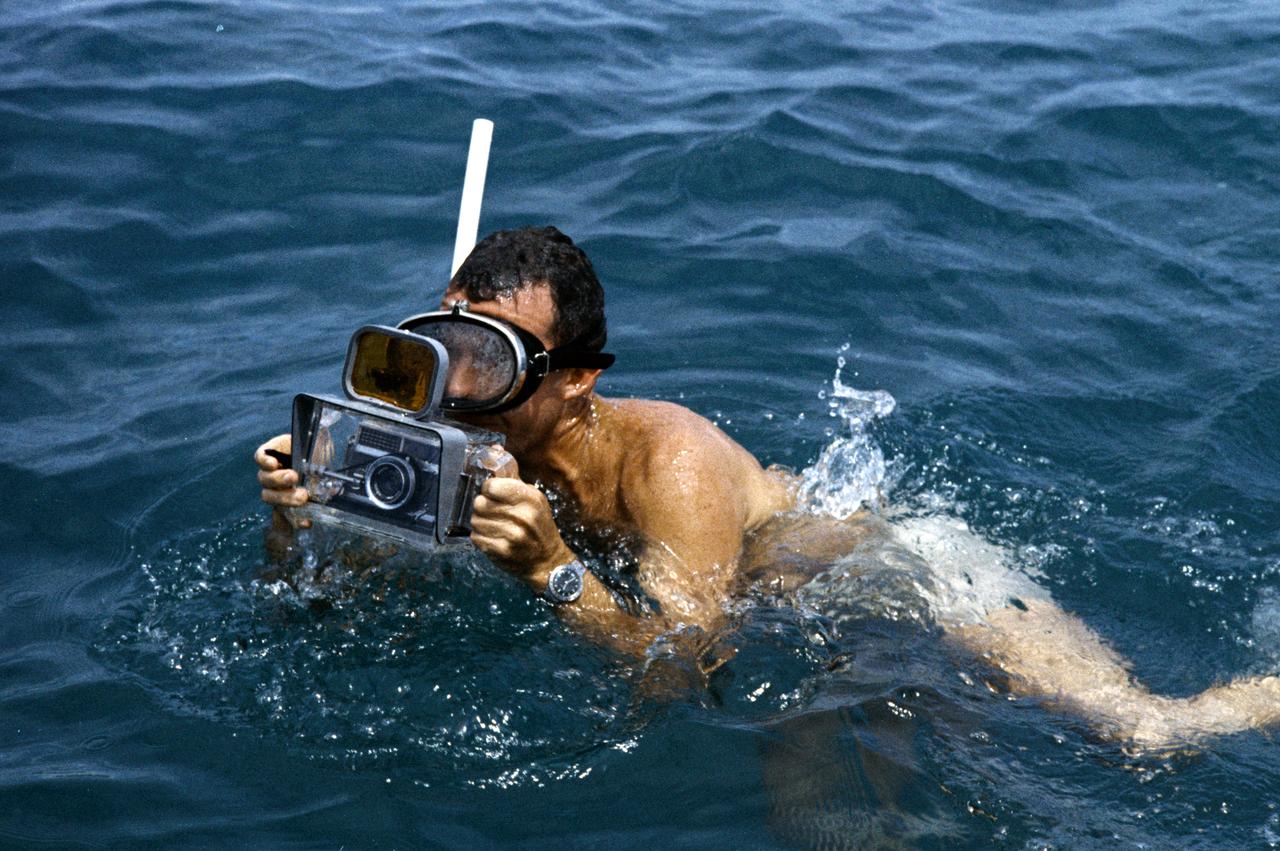
S62-05161 (1962) --- Astronaut L. Gordon Cooper Jr. participates in Mercury water egress training. He is wearing a snorkel and holding a camera for underwater photography. Photo credit: NASA
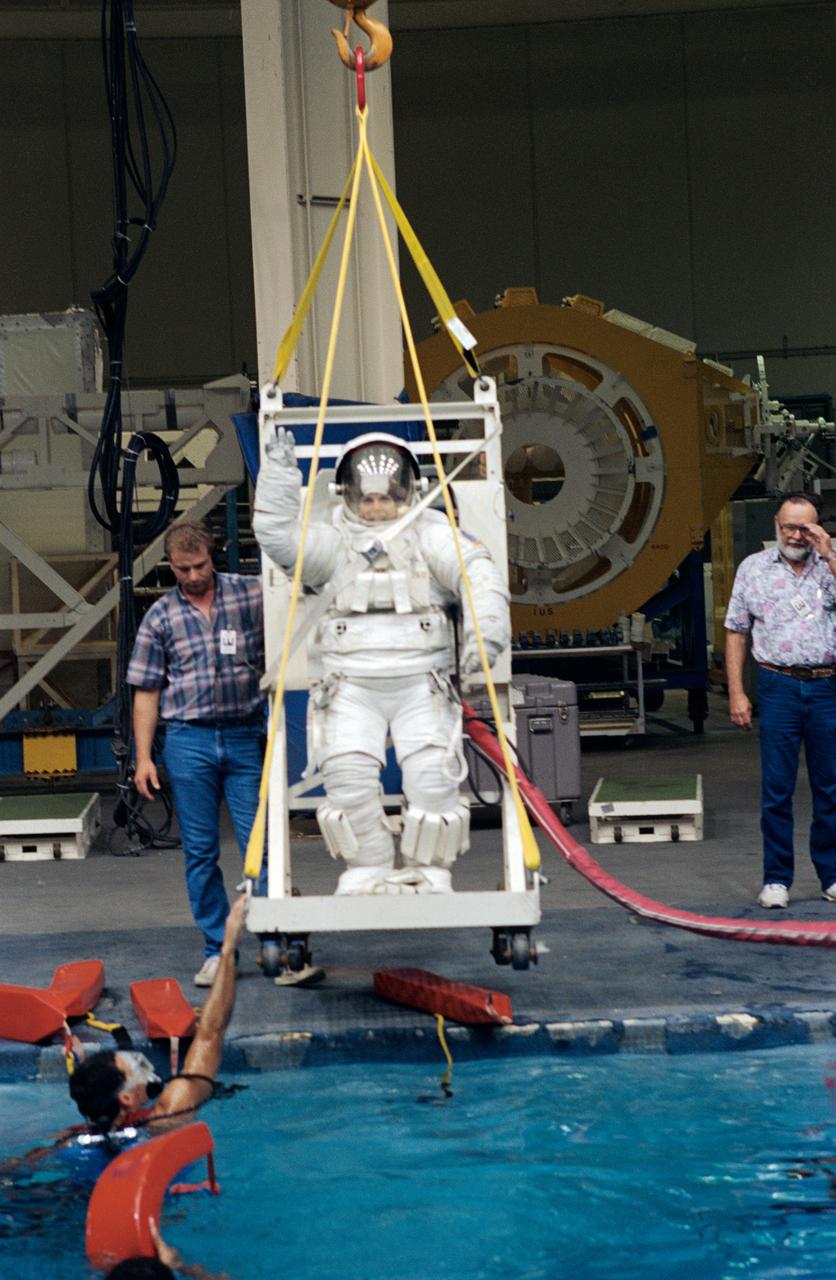
Attired in a training version of the Extravehicular Mobility Unit (EMU), Astronaut Mary Ellen Weber participates in a training session at JSC's Weightless Environment Training Facility (WETF). Training as a mission specialist for the STS-70 mission, Weber was about to rehearse a contingency space walk. One of several SCUBA-equipped divers waits to assist in the rehearsal in the water.
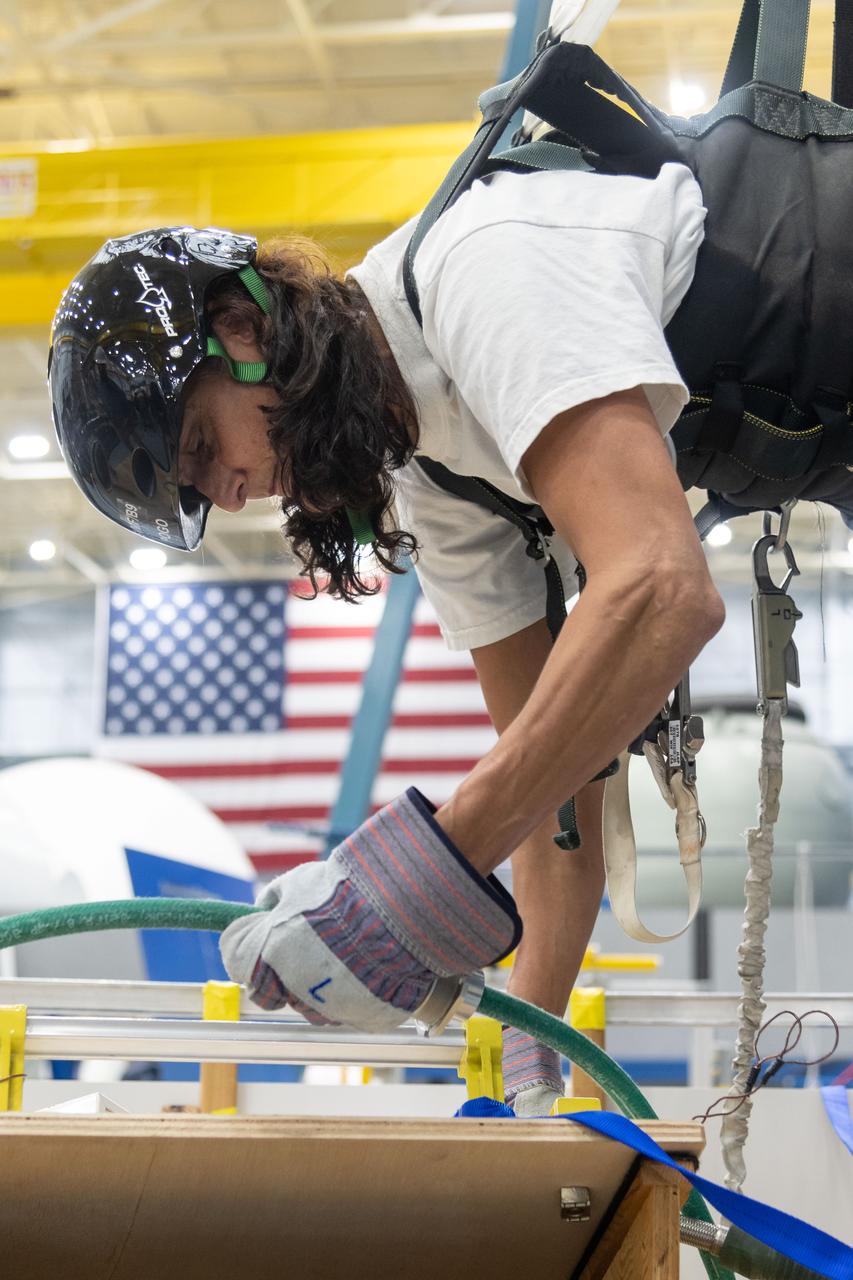
Commercial Crew Program (CCP) astronaut Suni Williams in ISS EVA POGO training in SVMF POGO.
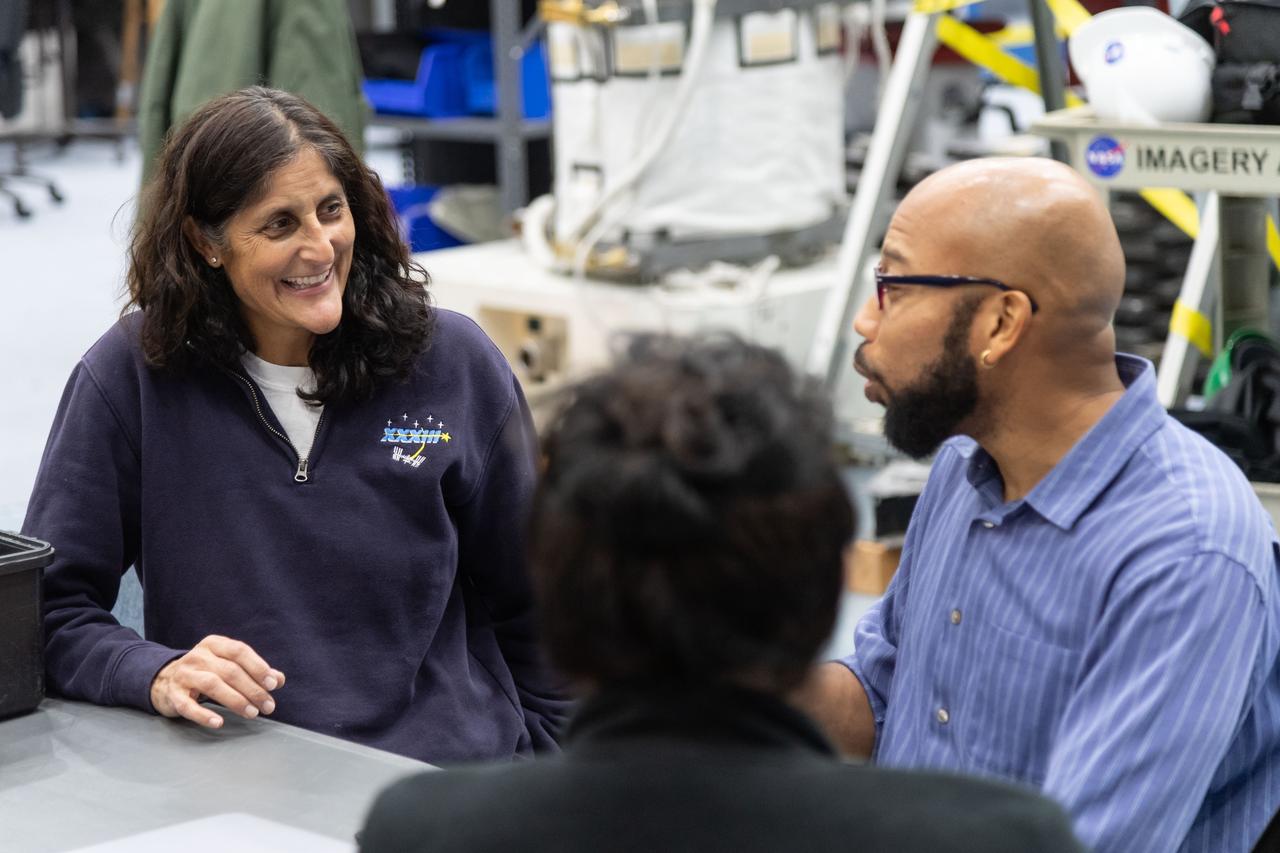
Commercial Crew Program (CCP) astronaut Suni Williams in ISS EVA POGO training in SVMF POGO.

Commercial Crew Program (CCP) astronaut Suni Williams in ISS EVA POGO training in SVMF POGO.
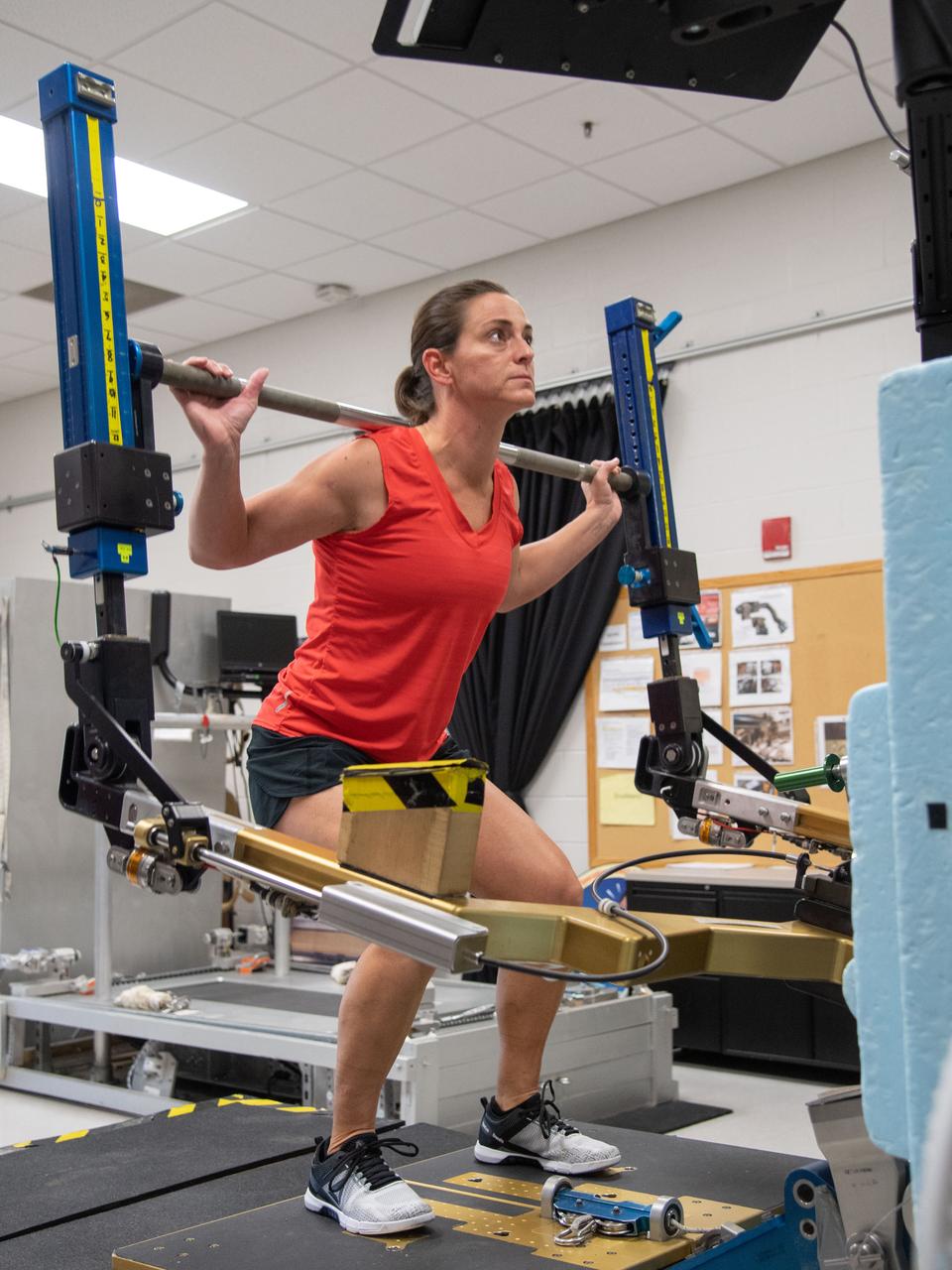
Commercial Crew Program astronaut and Boeing Crew Flight Test crew member Nicole Mann in ARED PT #1 training.
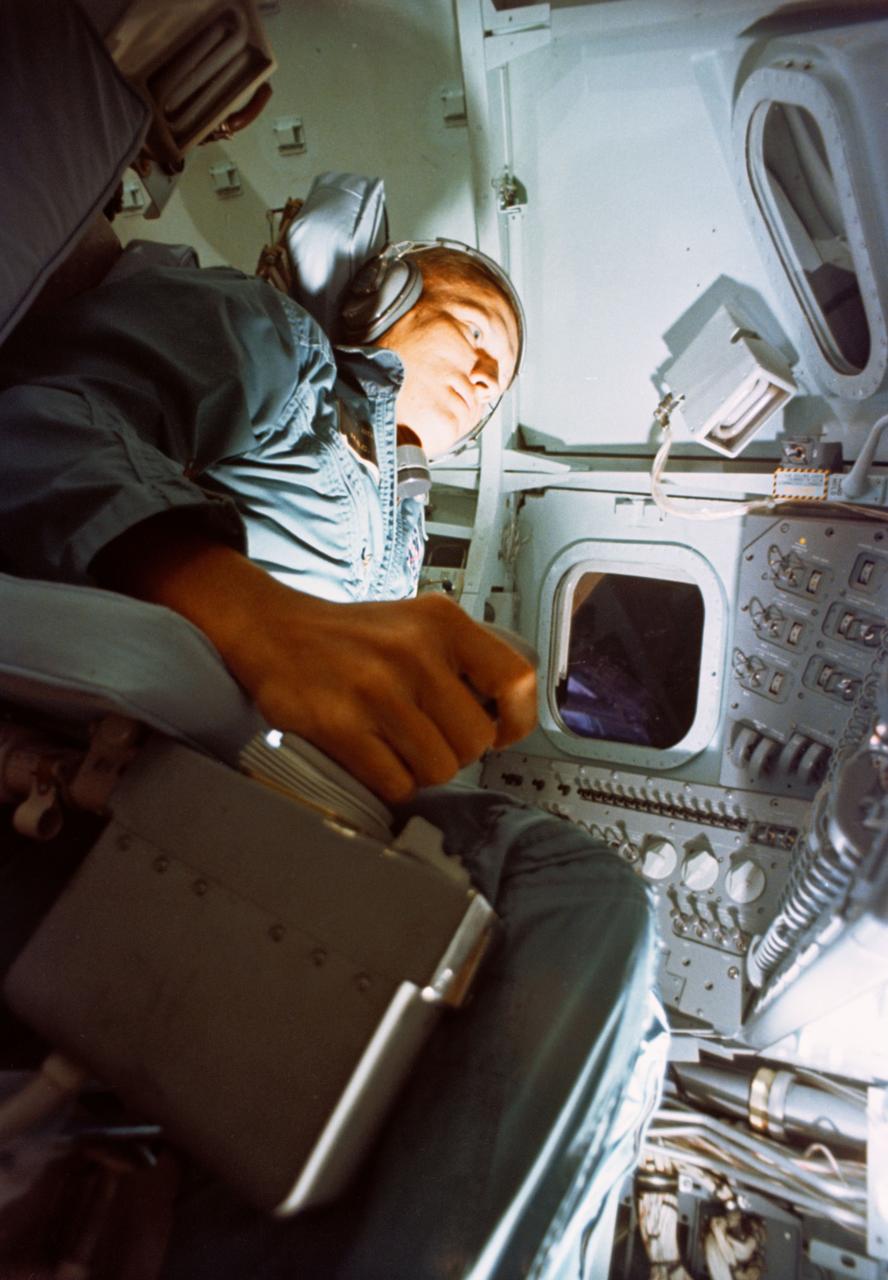
S67-50590 (1867) --- Astronaut Frank Borman, assigned duty as commander of the Apollo 8 mission, participates in a training exercise in the Apollo Mission simulator in the Mission Simulation and training Facility, Building 5, at the Manned Spacecraft Center, Houston, Texas. Photo credit: NASA
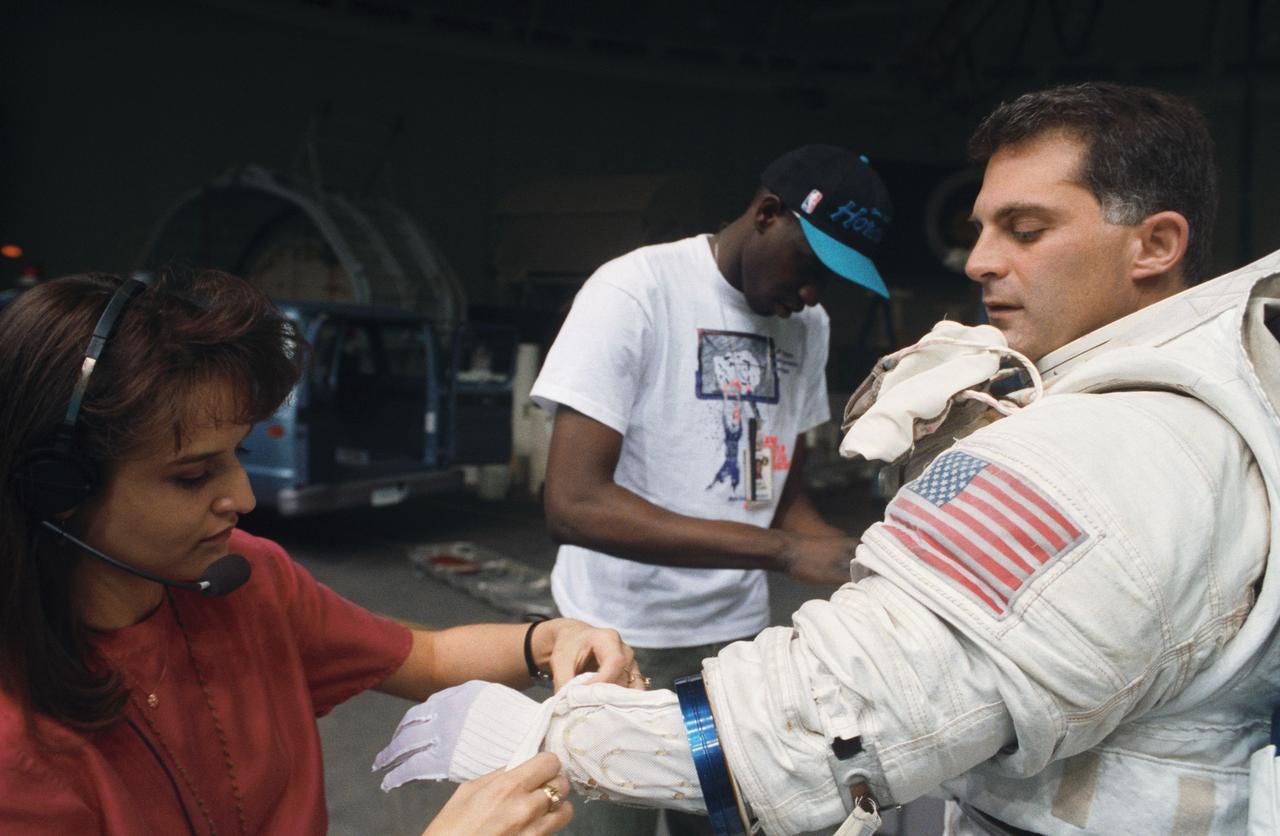
S93-31706 (3 April 1993) --- With the aid of technicians and training staffers astronaut David A. Wolf prepares to participate in training for contingency Extravehicular Activity (EVA) for the STS-58 mission. Sharing a moveable platform with Wolf was astronaut Shannon W. Lucid (out of frame). For simulation purposes, the two mission specialists were about to be submerged to a point of neutral buoyancy in the Johnson Space Center's (JSC) Weightless Environment Training Facility (WET-F). Though the Spacelab Life Sciences (SLS-2) mission does not include a planned EVA, all crews designate members to learn proper procedures to perform outside the spacecraft in the event of failure of remote means to accomplish those tasks.
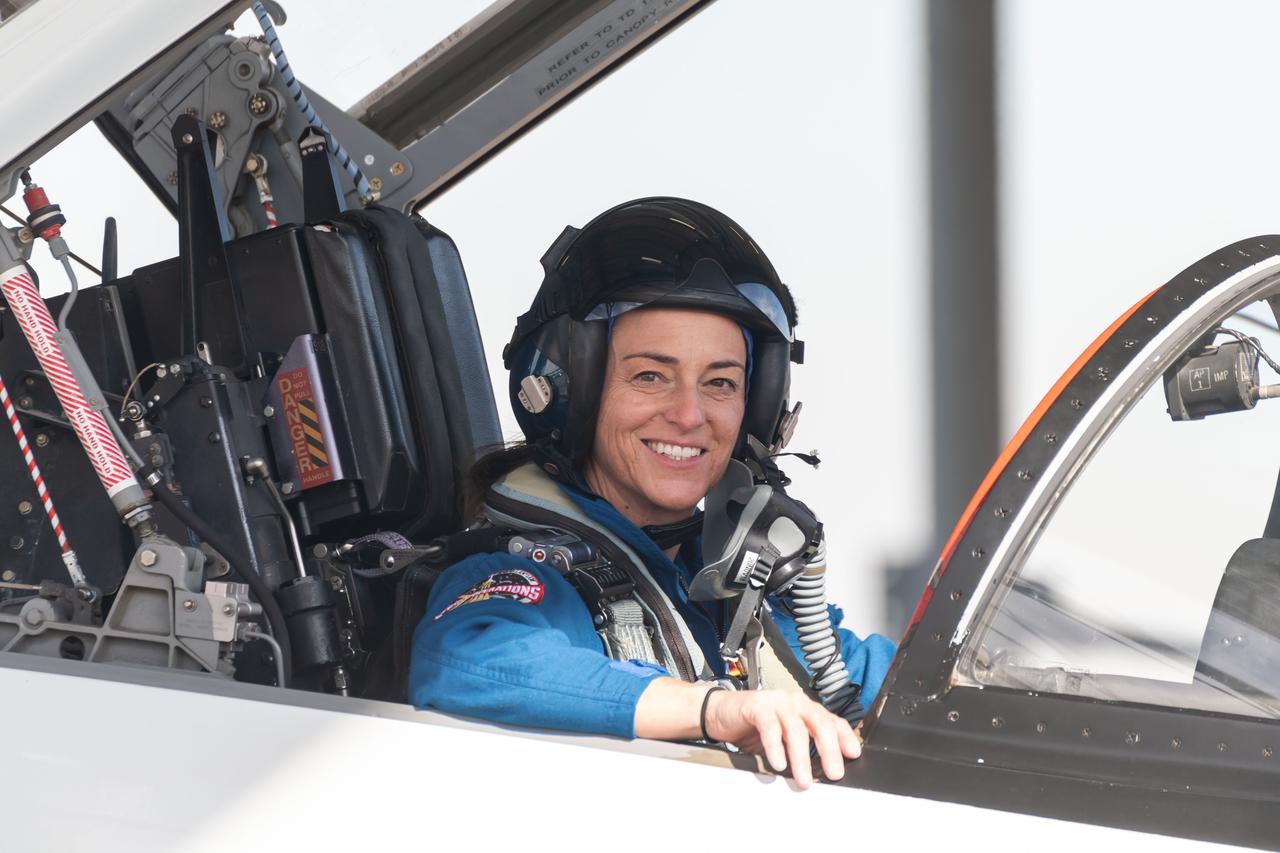
Nicole Mann sits in a T-38 in preparation for Commercial Crew Program astronaut training at NASA's Johnson Space Center.
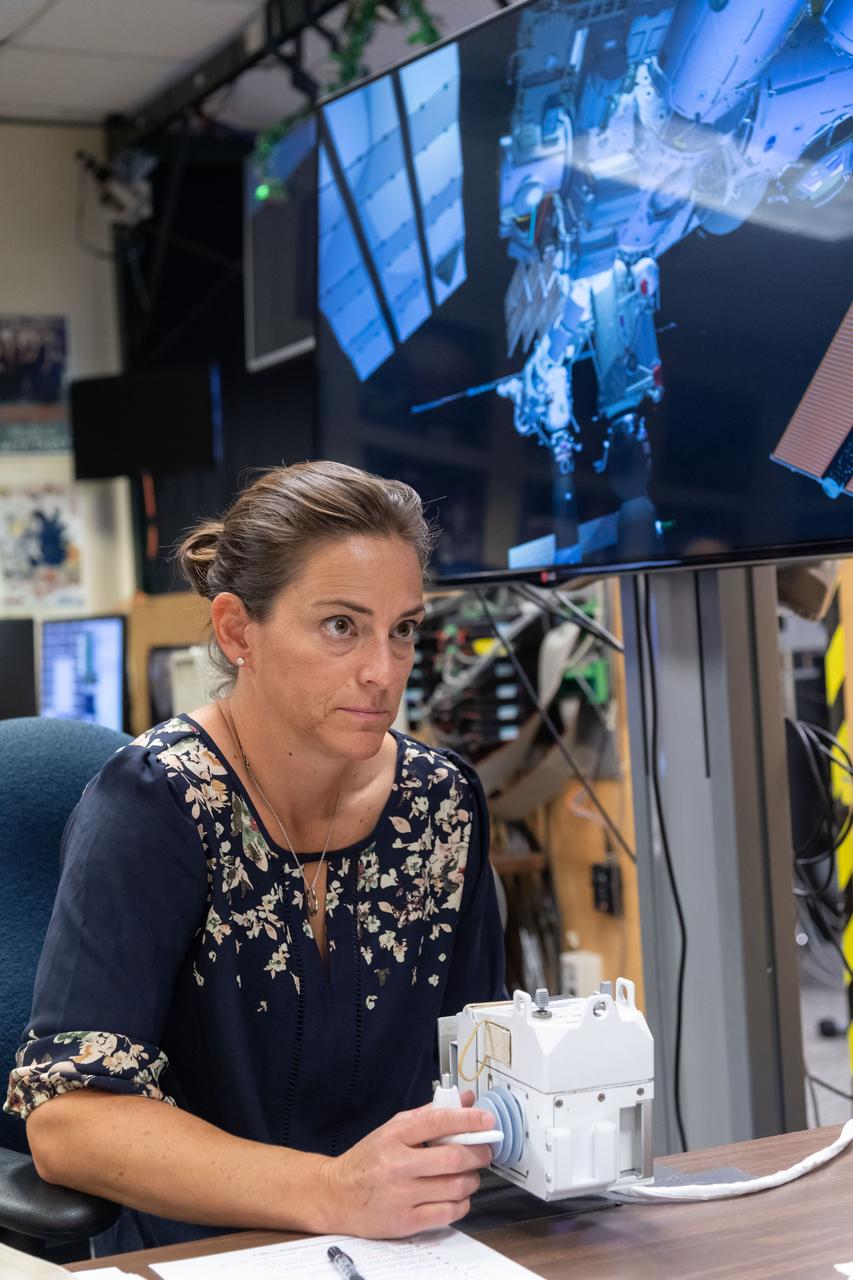
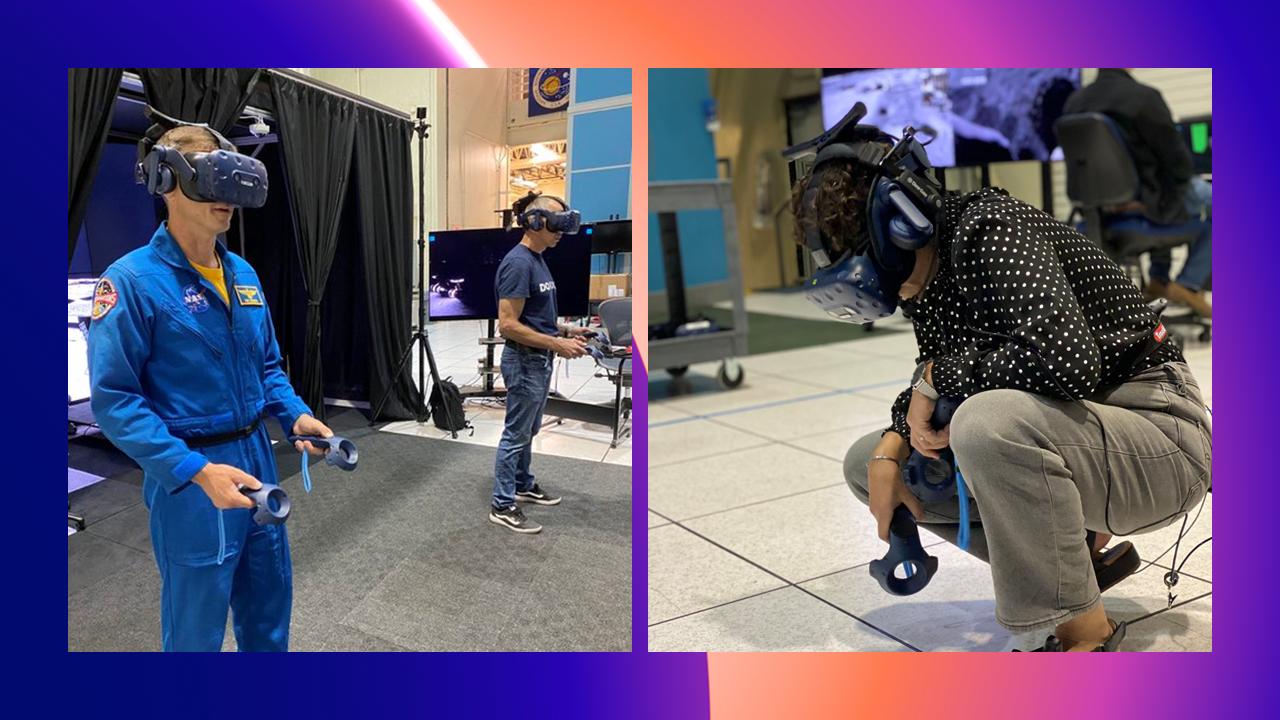
Commercial Crew Program astronaut and Boeing Crew Flight Test crew member Nicole Mann in SAFER Skills training in VR Lab.
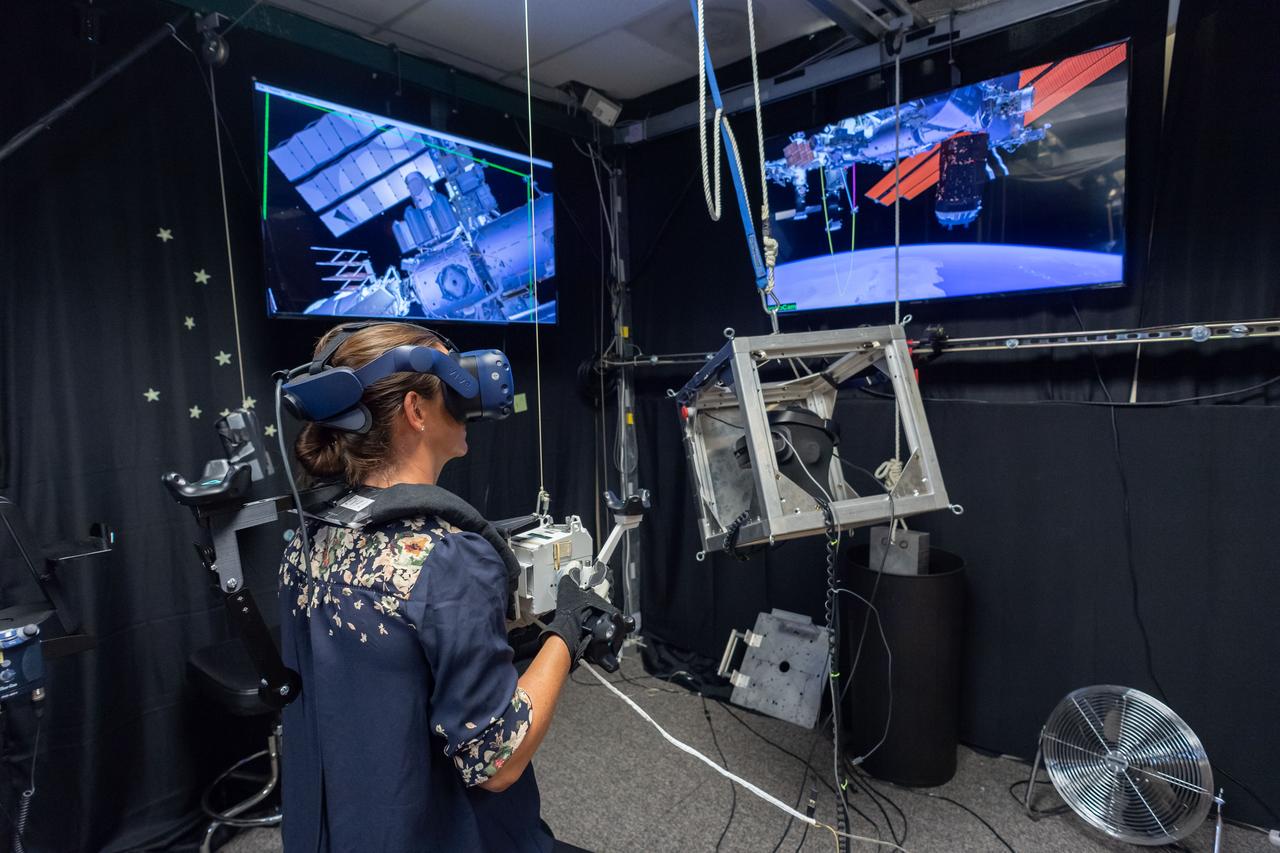
Commercial Crew Program astronaut and Boeing Crew Flight Test crew member Nicole Mann in SAFER Skills training in VR Lab.
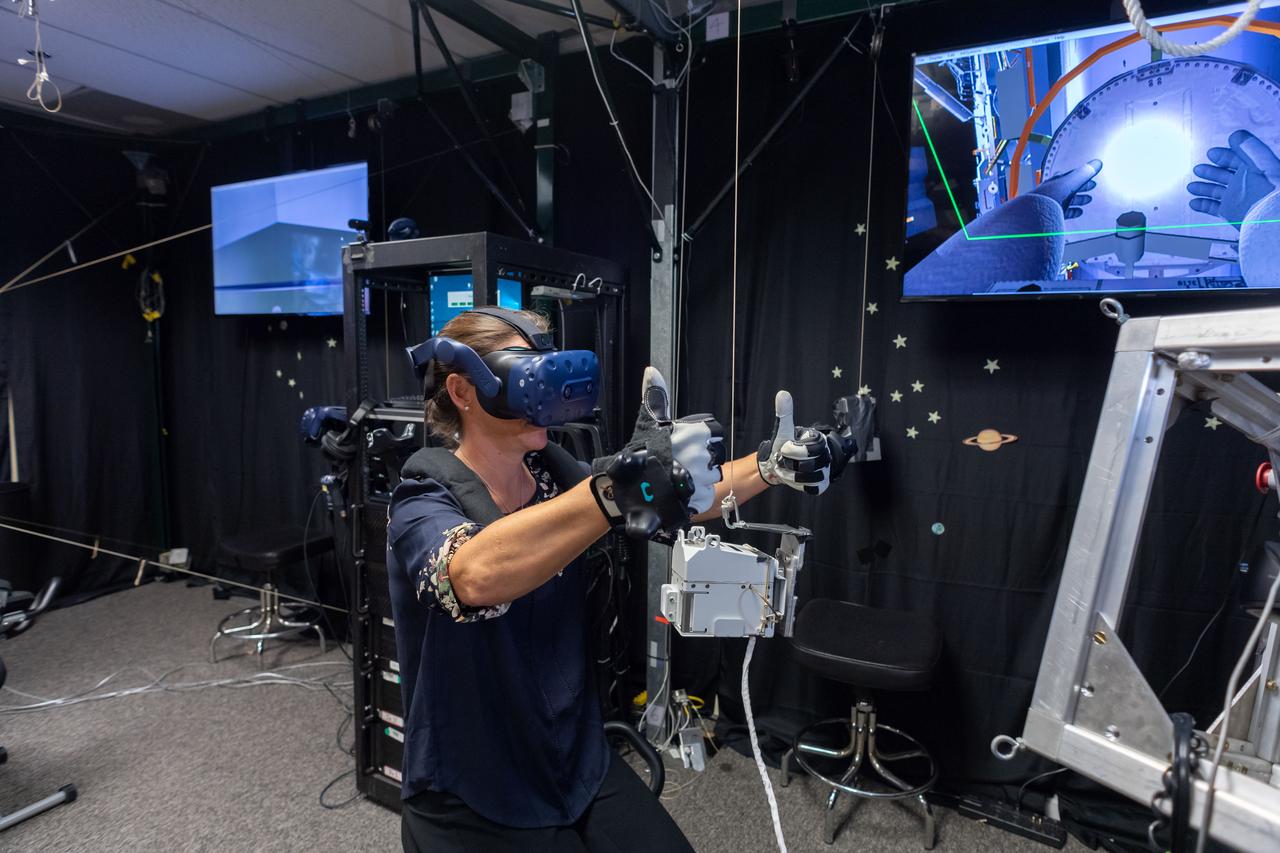
Commercial Crew Program astronaut and Boeing Crew Flight Test crew member Nicole Mann in SAFER Skills training in VR Lab.
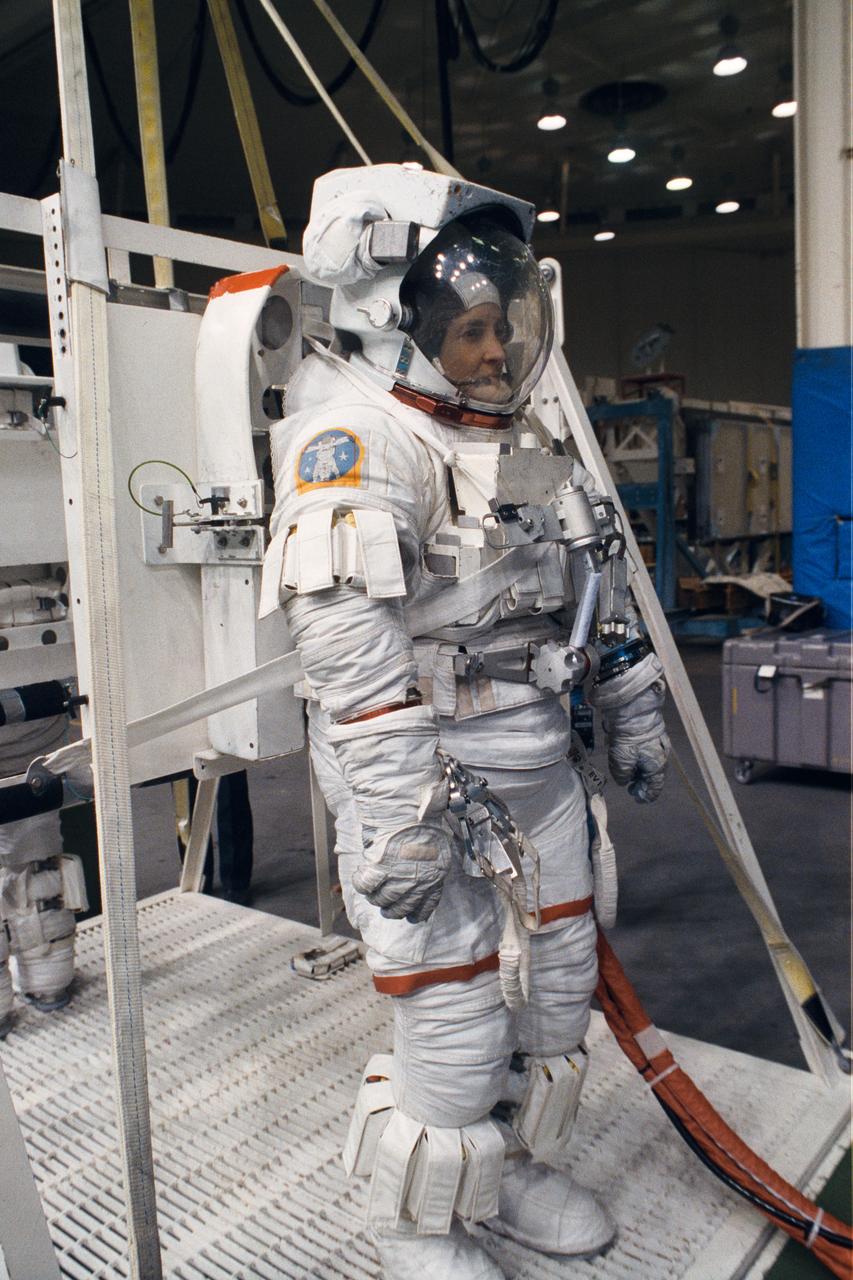
S93-41574 (17 Aug 1993) --- Astronaut Linda M. Godwin, payload commander, prepares to be submerged in a 25-feet deep pool at the Johnson Space Center's (JSC) Weightless Environment Training Facility (WET-F). Astronauts Godwin and Thomas D. Jones (out of frame at left), mission specialist, are using the WET-F to train for contingency space walks for their STS-59 Space Shuttle Endeavour mission next year. No space walks are planned for the flight.
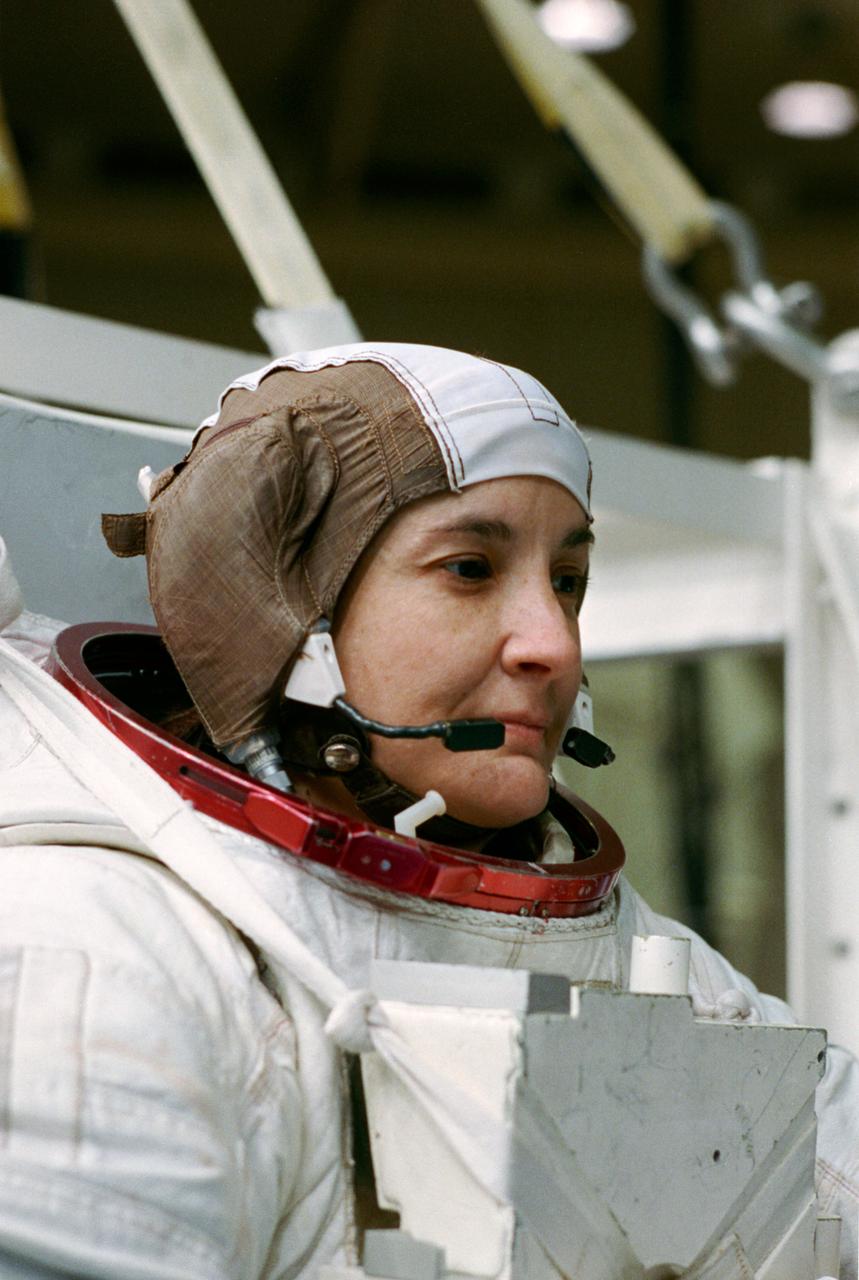
S93-41572 (17 Aug 1993) --- Astronaut Linda M. Godwin, payload commander, prepares to donn her helmet before being submerged in a 25-feet deep pool at the Johnson Space Center's (JSC) Weightless Environment Training Facility (WET-F). Astronauts Godwin and Thomas D. Jones, mission specialist, are using the WET-F to train for contingency space walks for their Space Shuttle Endeavour mission next year. No space walks are planned for the flight.
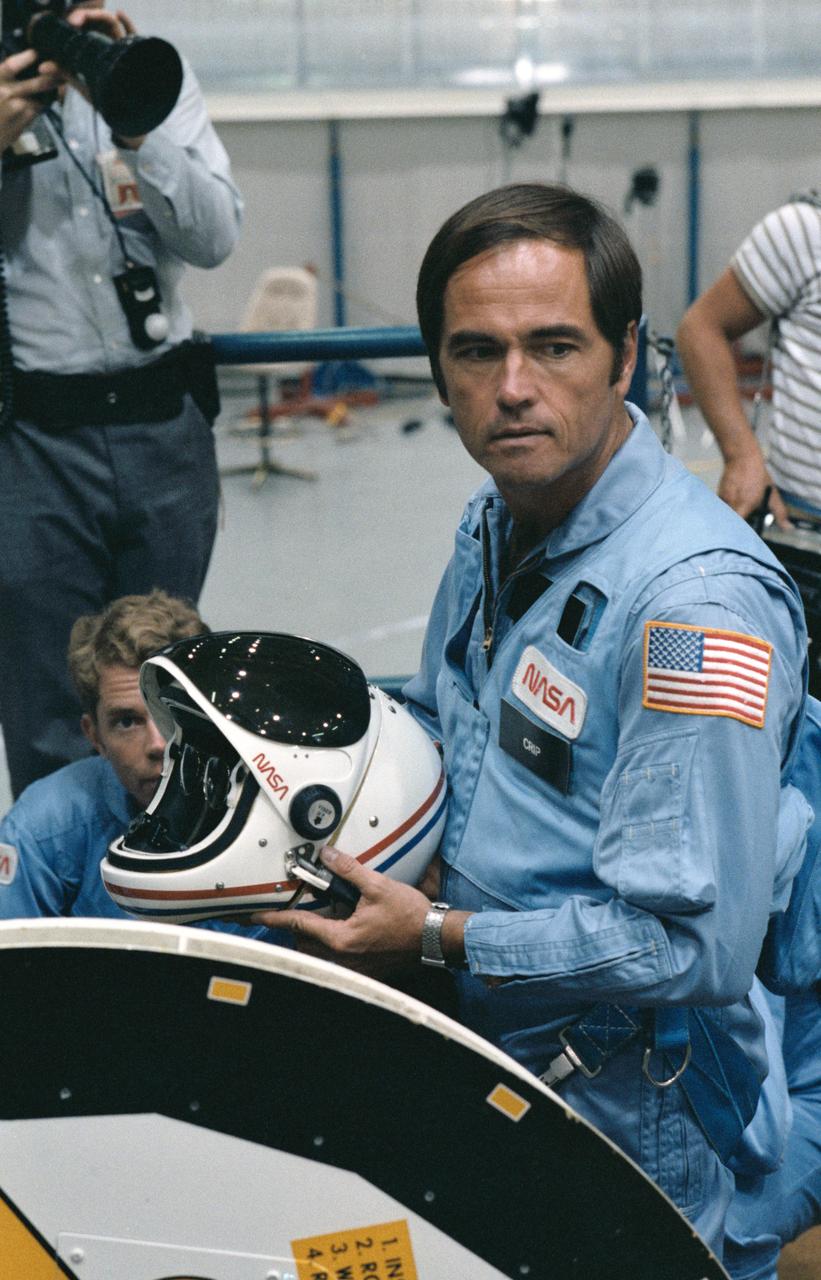
41D-3186 (4 Sept 1984) --- Astronaut Robert L. Crippen, 41-G crew commander, prepares to join his six fellow crewmembers for some training in the mockup and integration laboratory at the Johnson Space Center. Astronaut David C. Leestma, 41-G mission specialist, left, will participate in a scheduled extravehicular activity (EVA) on the Challenger's next mission. Today's training is for launch phase procedures.
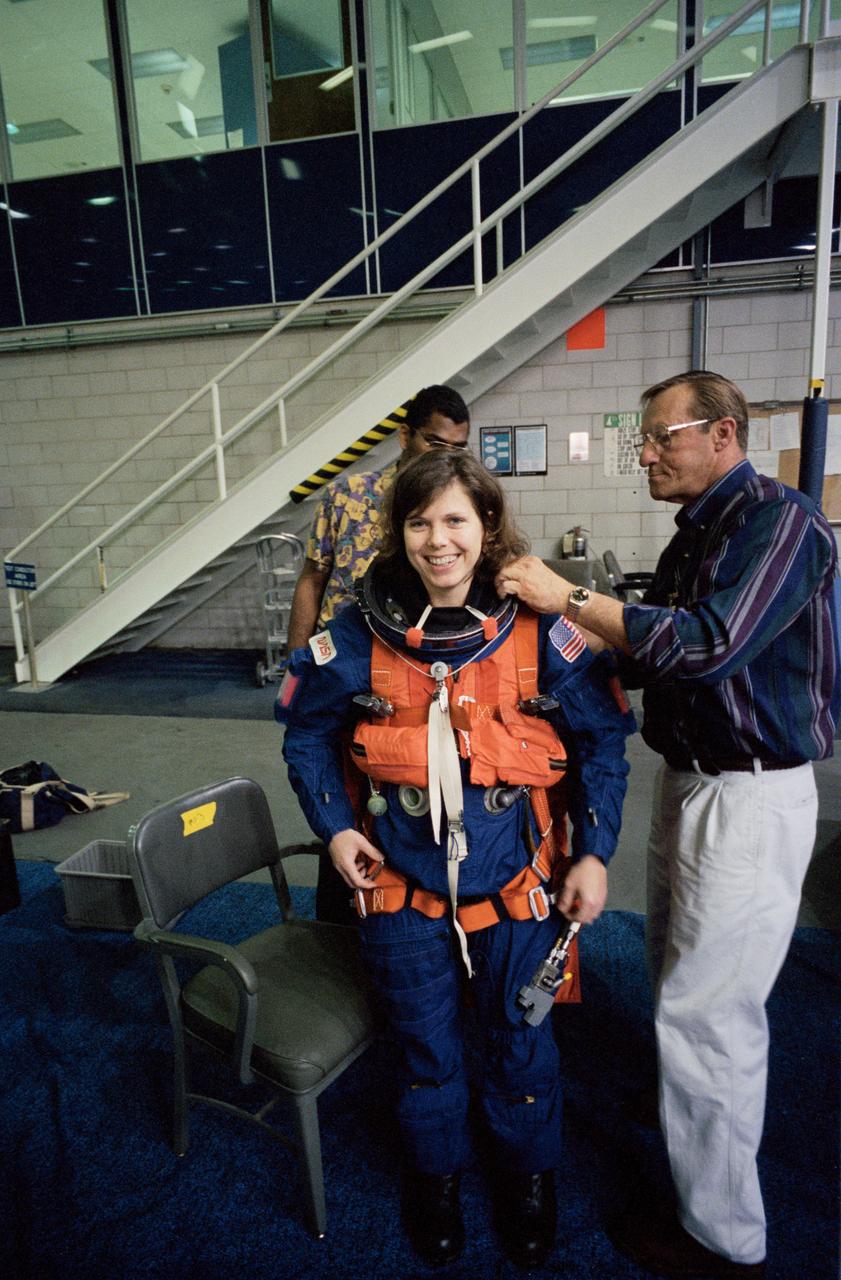
S95-03469 (16 FEB 1995) --- Attired in a training version of the Shuttle launch and entry garment, astronaut Mary Ellen Weber gets help with the final touches of suit donning during a training session at the Johnson Space Center's (JSC) Weightless Environment Training Facility (WET-F). Helping out is Rockwell's William L. Todd (right), while Staffon Isaacs looks on. Training as a mission specialist for the STS-70 mission, Weber was about to rehearse emergency bailout. The crew members made use of a nearby 25-feet deep pool to practice parachute landings in water and subsequent deployment of life rafts.
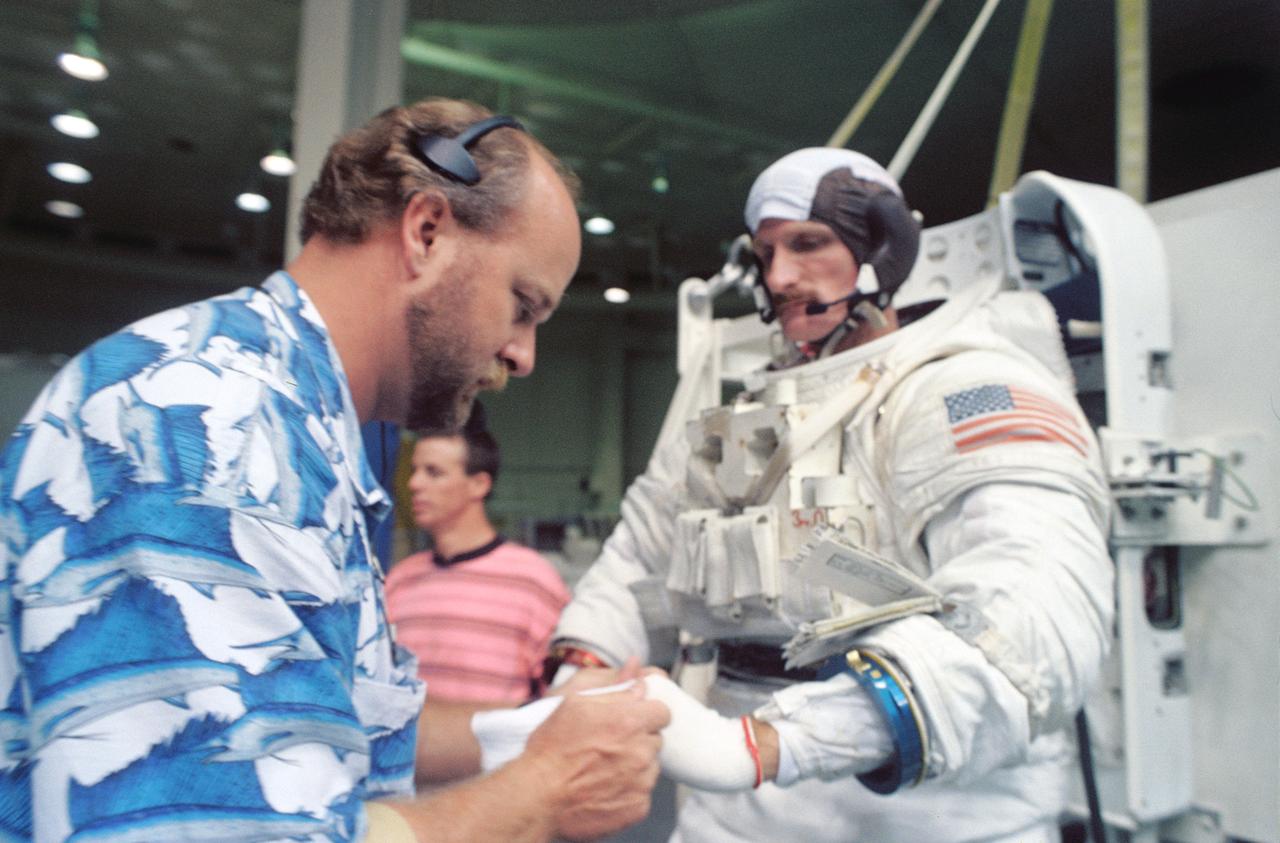
S94-40048 (1 August 1994) --- Astronaut Joseph R. Tanner, mission specialist, is assisted by Boeing suit expert Steve Voyles as he prepares to be submerged in a 25-feet deep pool at the Johnson Space Center's (JSC) Weightless Environment Training Facility (WET-F). Though no extravehicular activity (EVA) is planned for the mission, at least two astronauts are trained to perform tasks that would require a space walk in the event of failure of remote systems. In November, Tanner will join four other NASA astronauts and a European mission specialist for a week and a half in space aboard the Space Shuttle Atlantis. The flight will support the Atmospheric Laboratory for Applications and Science (ATLAS-3) mission.
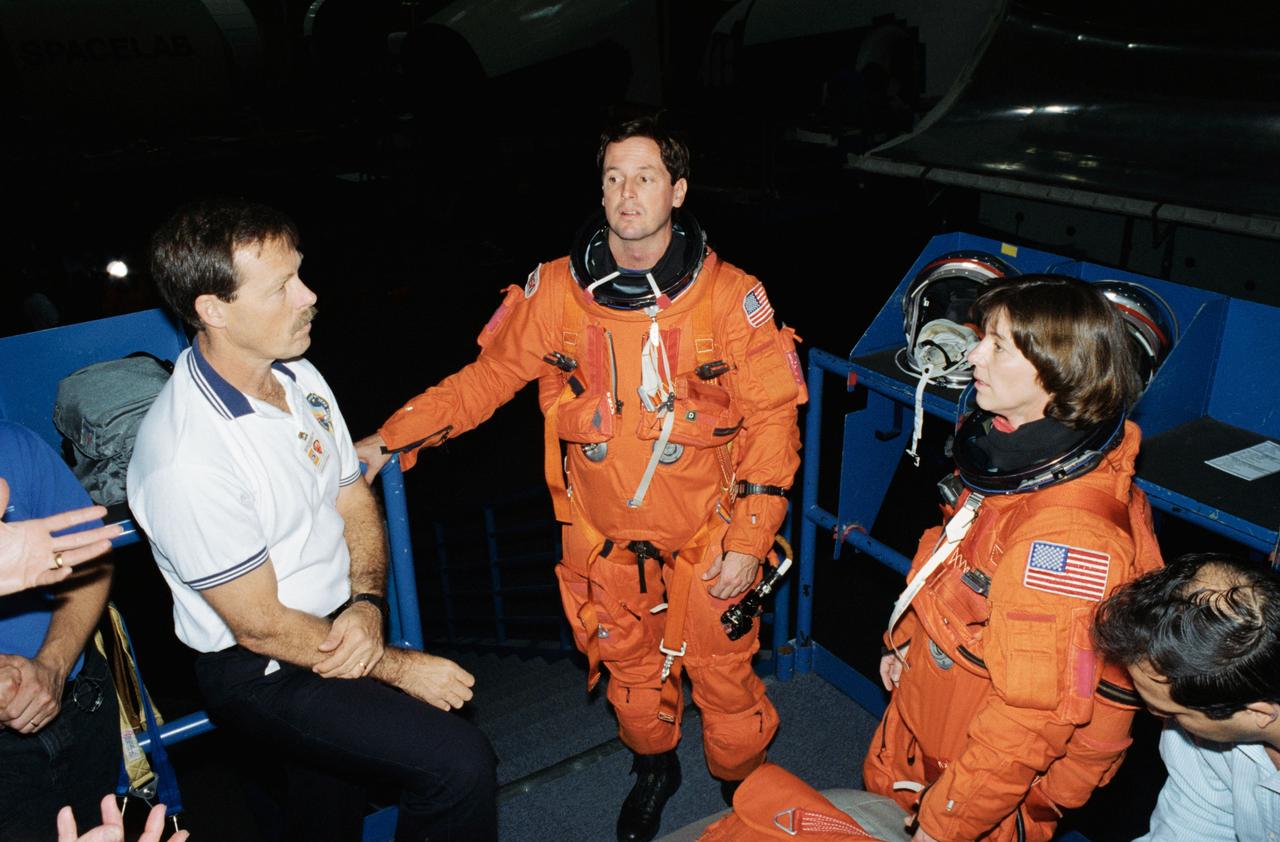
S94-47065 (18 Oct 1994) --- Astronaut Robert L. Gibson (left), STS-71 mission commander, converses with two crew mates prior to emergency egress training in the Systems Integration Facility at the Johnson Space Center (JSC). Astronauts Bonnie J. Dunbar and Gregory J. Harbaugh are attired in training versions of the partial pressure launch and entry space suits.
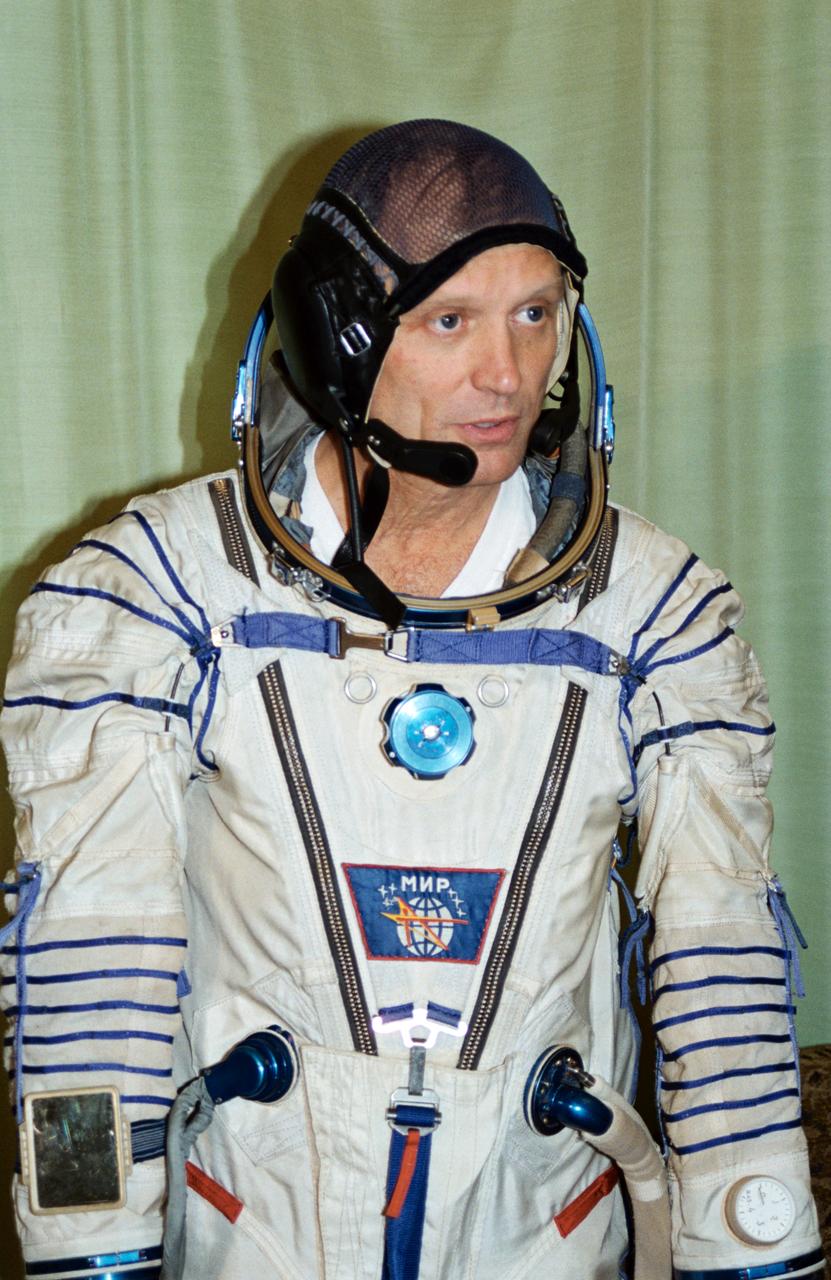
S94-45643 (20 Sept 1994) --- Astronaut Norman E. Thagard in a cosmonaut space suit in the Training Simulator Facility at the Gagarin Cosmonaut Training Center (Star City), near Moscow, Russia. In March 1995, astronaut Thagard is scheduled to be launched in a Russian Soyuz spacecraft with two cosmonauts to begin a three-month tour of duty on the Russian Mir Space Station. Thagard, along with his back-up, astronaut Bonnie J. Dunbar, has been training in Russia since February 1994. During his stay on Mir, he will conduct a variety of life sciences experiments that will provide U.S. investigators with the first long-duration exposure data since Skylab in the late 1970's. Thagard's mission will end in July when the Space Shuttle Atlantis, carrying the newly installed docking mechanism, docks with Mir Space Station for the first United States - Russian docking operation since Apollo-Soyuz in 1975. The Orbiter will remain attached to Mir for five days of joint scientific operations before returning home with Thagard and his Russian crew mates and leaving behind two cosmonauts on Mir.
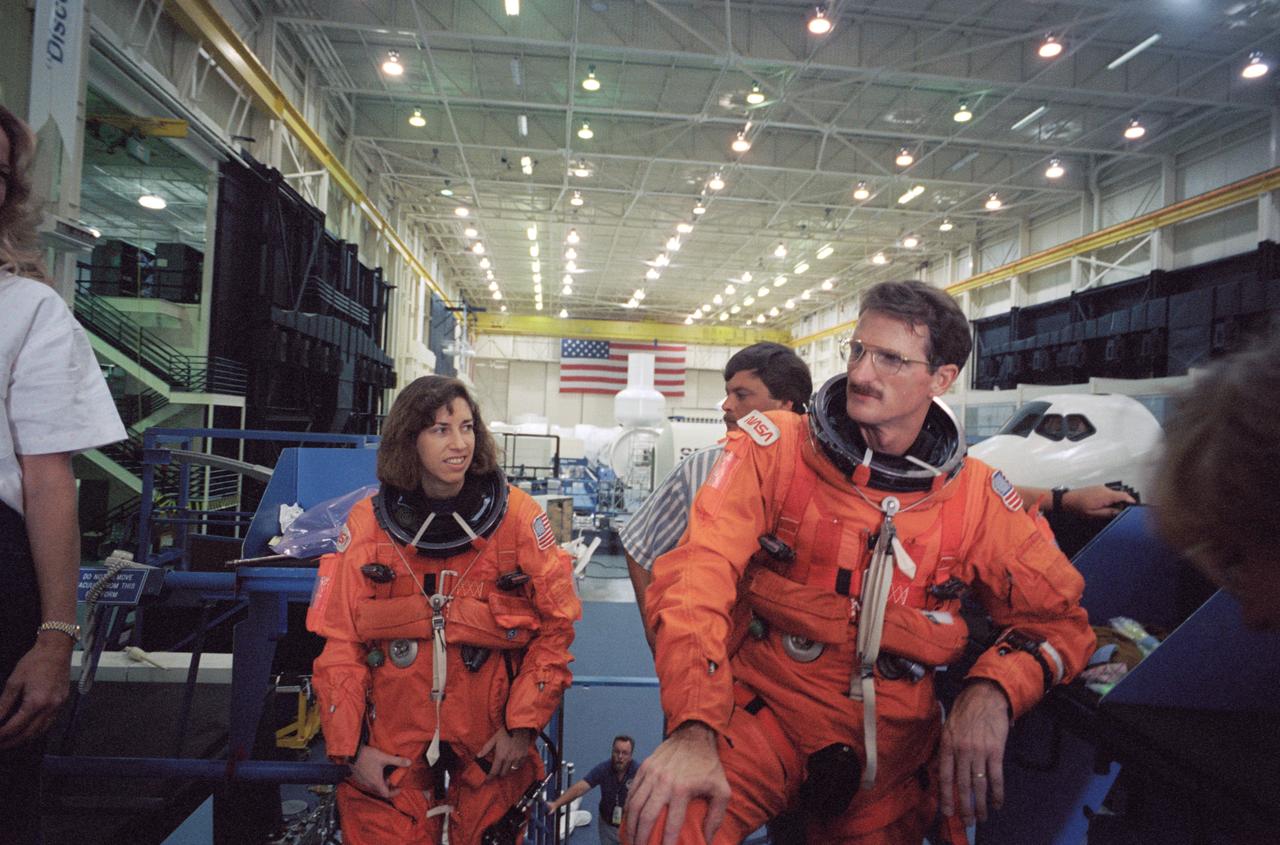
S94-40073 (23 June 1994) --- Wearing training versions of the launch and entry suits (LES), astronauts Ellen Ochoa, payload commander, and Joseph P. Tanner, mission specialist, await the beginning of a training session on emergency egress procedures. The STS-66 crew participated in the training, held in the Johnson Space Center's (JSC) Shuttle Mockup and Integration Laboratory. Ochoa and Tanner will join three other NASA astronauts and one international mission specialist aboard the Space Shuttle Atlantis in support of the Atmospheric Laboratory for Applications and Science (ATLAS-3) flight scheduled for November of this year.
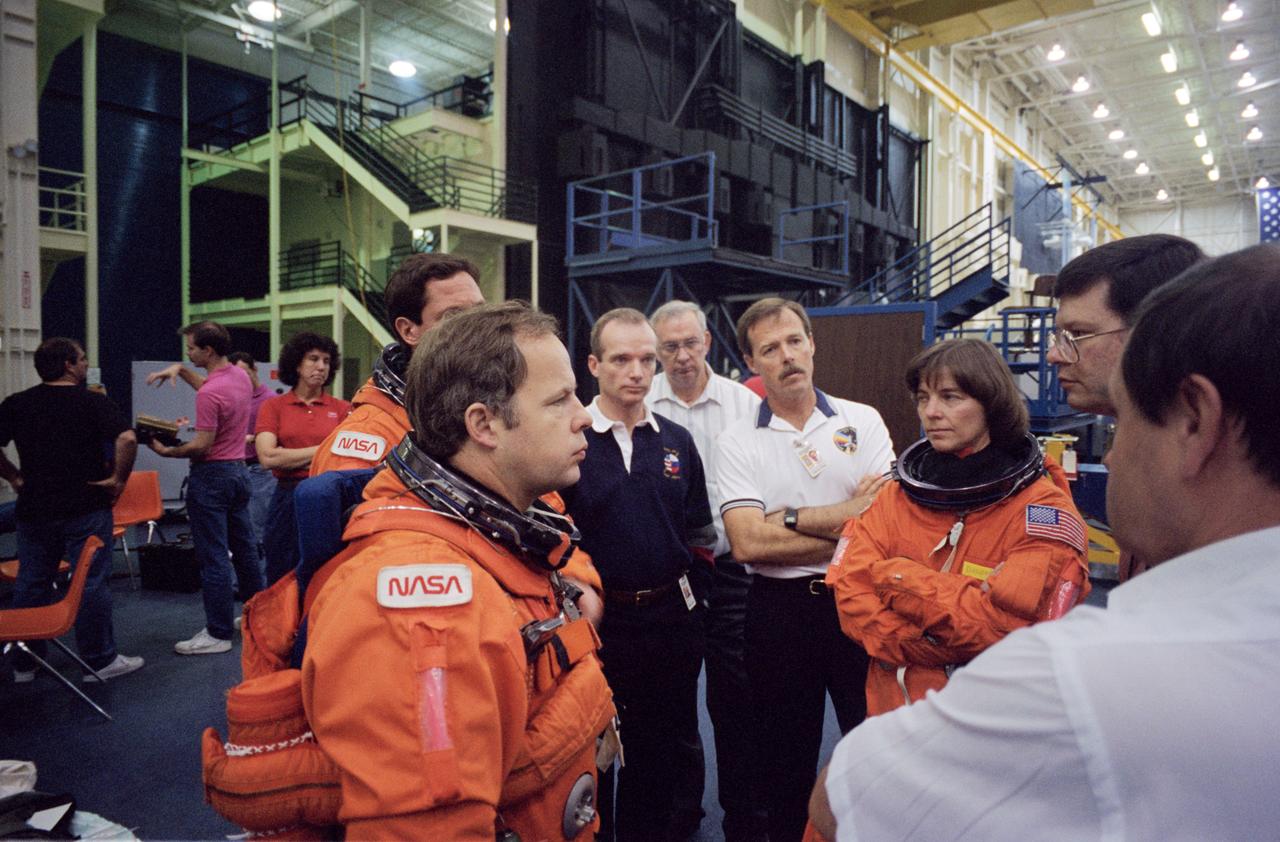
S94-47079 (18 Oct 1994) --- Astronaut Robert L. Gibson, (arms folded, near center) STS-71 mission commander, joins several crew mates during a briefing preceding emergency egress training in the Systems Integration Facility at the Johnson Space Center (JSC). Astronauts Bonnie J. Dunbar and Gregory J. Harbaugh (partially obscured), along with cosmonaut Anatoliy Y. Solovyev, all mission specialists, are attired in training versions of the partial pressure launch and entry space suits. Astronaut Charles J. Precourt, pilot, is in center foreground, and Ellen S. Baker, mission specialist, is in left background.
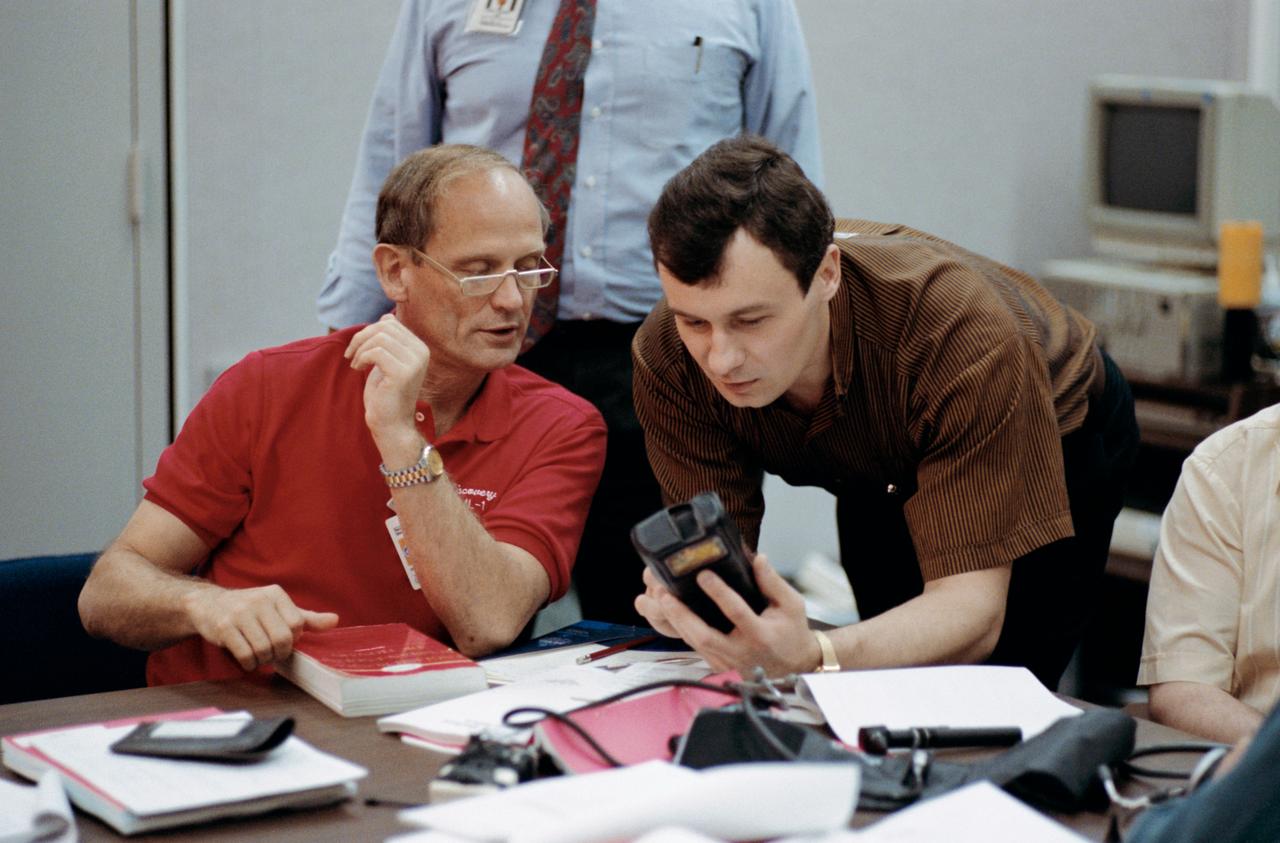
Mir 18 commander Vladimir N. Dezhurov, right, and fellow crew member, astronaut Norman E. Thagard, practice using a bar-code reader during medical operations training at JSC.
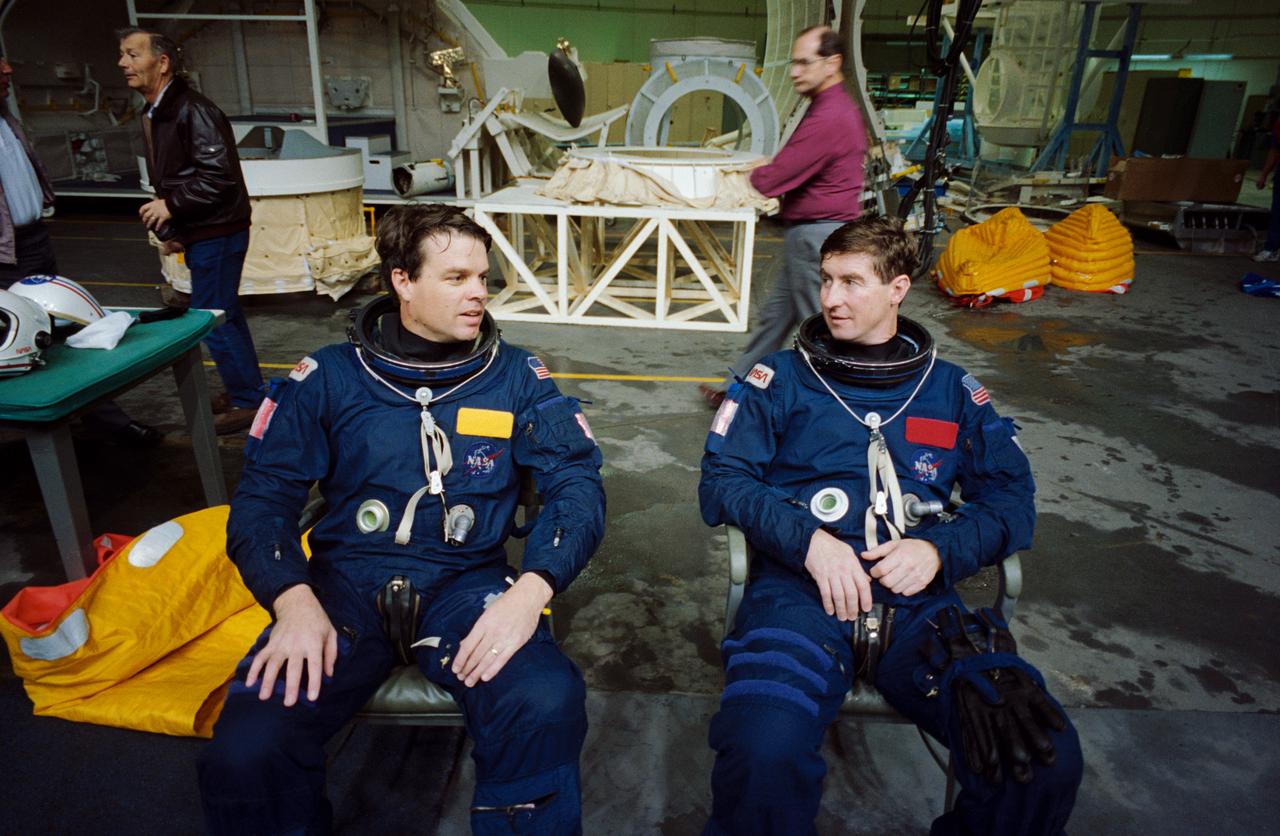
S95-03470 (16 FEB 1995) --- Attired in blue training versions of the orange Shuttle launch and entry garments, astronauts Terence T. (Tom) Henricks, right, and Kevin R. Kregel take a break during a bailout training session at the Johnson Space Center's (JSC) Weightless Environment Training Facility (WET-F). Assigned as commander and pilot, respectively, for the STS-70 mission, the two later joined their crew mates in making use of a nearby 25-feet deep pool to practice parachute landings in water and subsequent deployment of life rafts.
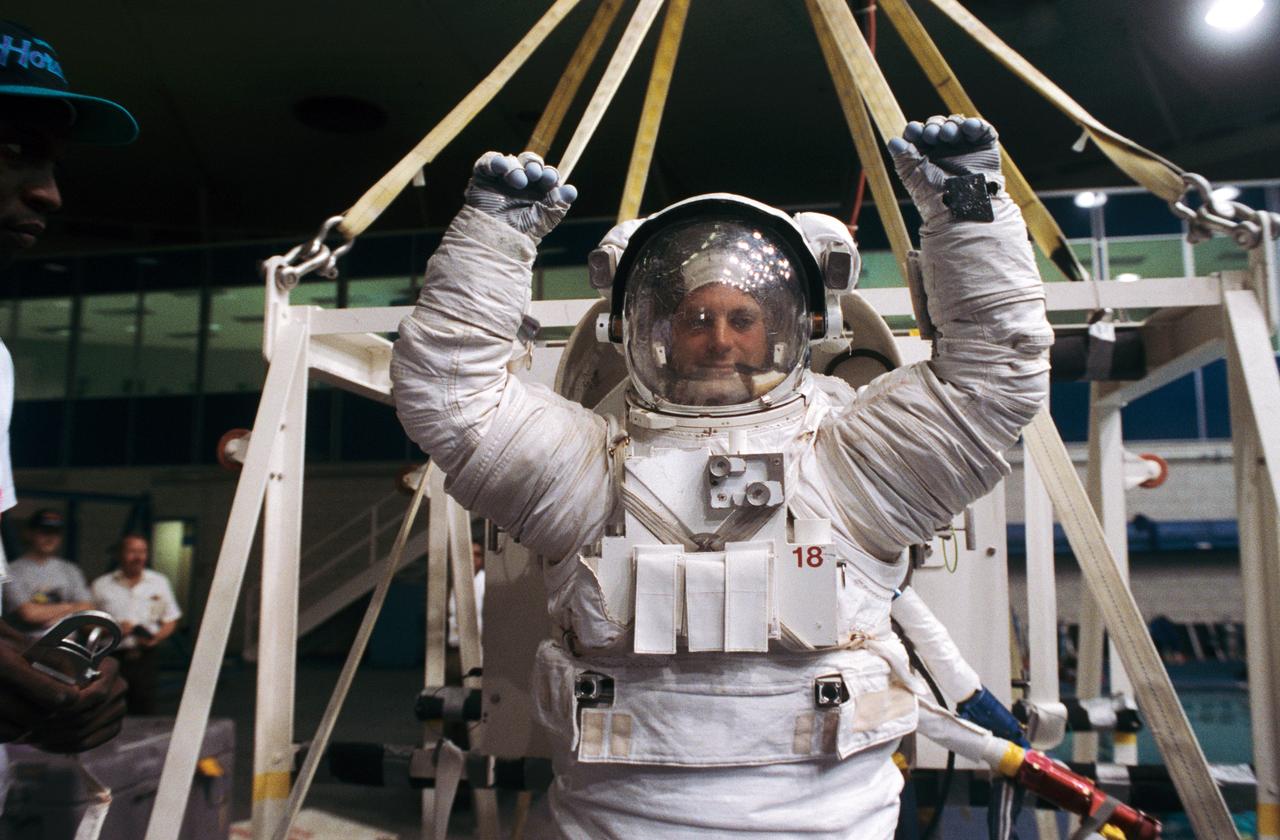
S93-31701 (3 April 1993) --- Displaying the flexibility of his training version of the Shuttle Extravehicular Mobility Unit (EMU) space suit, astronaut David A. Wolf participates in training for contingency Extravehicular Activity (EVA) for the STS-58 mission. Behind Wolf, sharing the platform with him was astronaut Shannon W. Lucid. For simulation purposes, the two mission specialists were about to be submerged to a point of neutral buoyancy in the Johnson Space Center's (JSC) Weightless Environment Training Facility (WET-F). Though the Spacelab Life Sciences (SLS-2) mission does not include a planned EVA, all crews designate members to learn proper procedures to perform outside the spacecraft in the event of failure of remote means to accomplish those tasks.
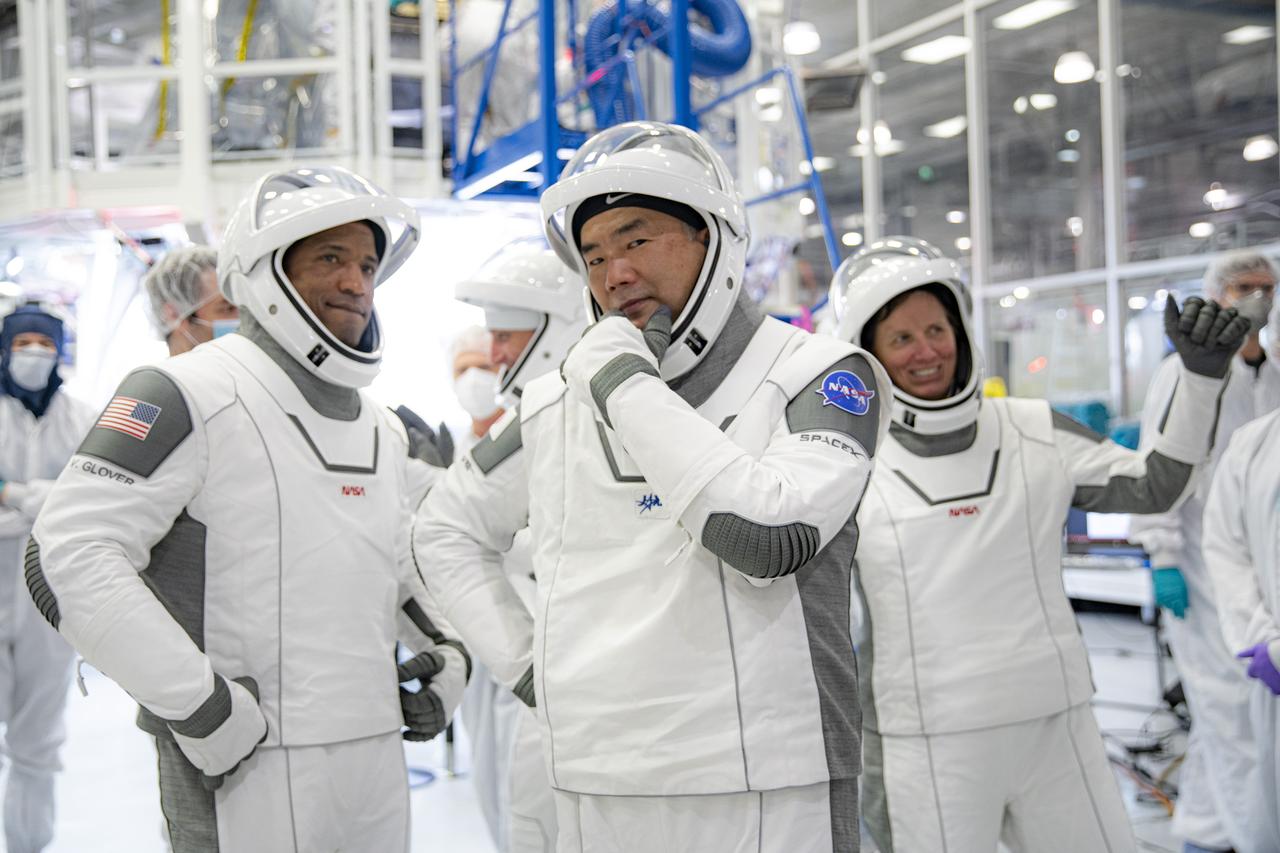
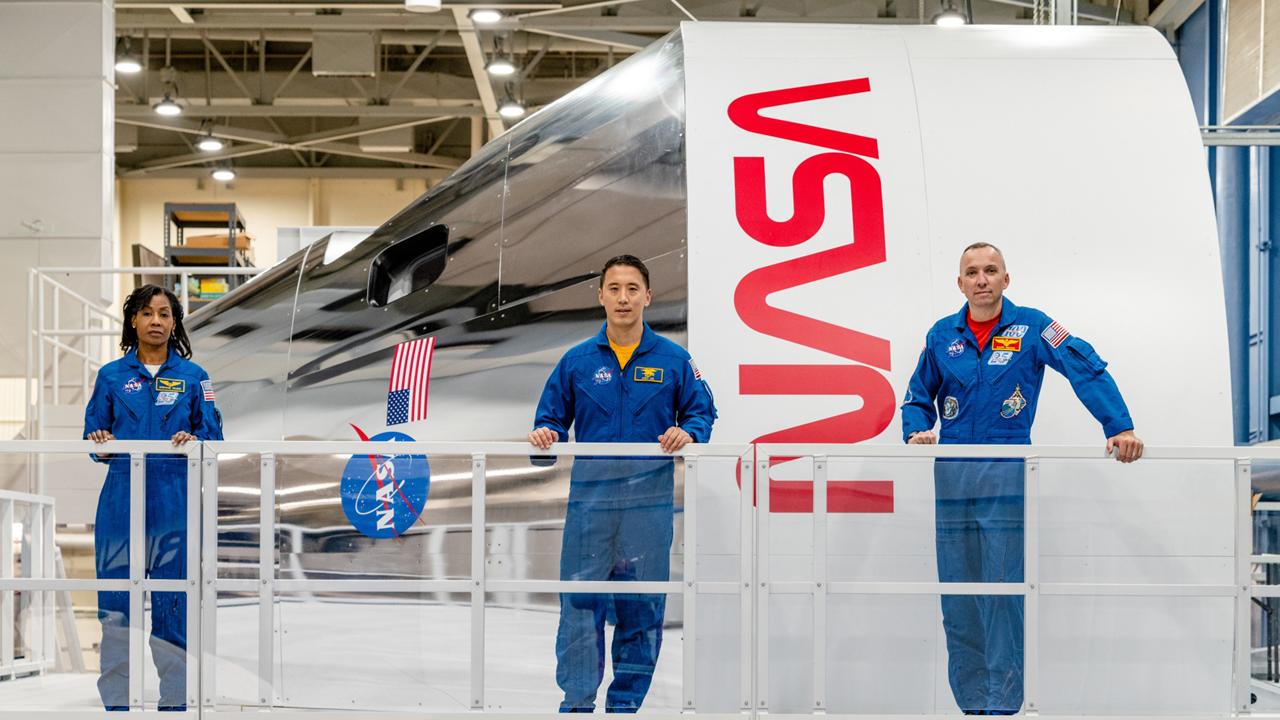
NASA’s SpaceX Crew-1 astronauts participate in crew equipment interface testing at SpaceX headquarters in Hawthorne, California, on Sept. 24, 2020. From left are pilot Victor Glover, NASA astronaut; mission specialist Soichi Noguchi, Japan Aerospace Exploration Agency (JAXA) astronaut; and mission specialist Shannon Walker, NASA astronaut. The other crew member training, but not pictured, is Crew Dragon commander Michael Hopkins, NASA astronaut. NASA’s SpaceX Crew-1 mission is the first crew rotational flight of a U.S. commercial spacecraft with astronauts to the International Space Station. The Crew-1 mission will launch from Launch Complex 39A at Kennedy Space Center in Florida. Crew-1 is part of NASA's Commercial Crew Program, which has returned human spaceflight capabilities to the U.S.
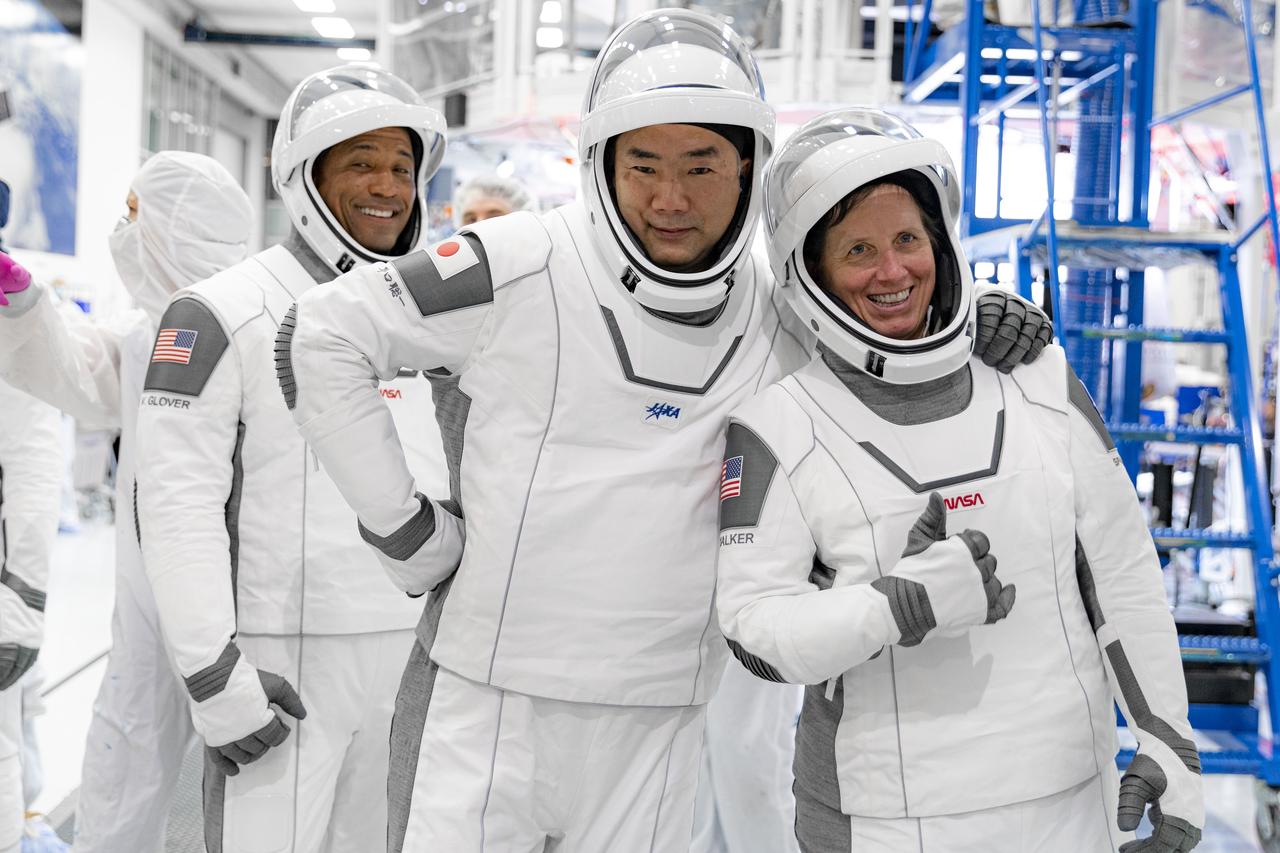
NASA’s SpaceX Crew-1 astronauts participate in crew equipment interface testing at SpaceX headquarters in Hawthorne, California, on Sept. 24, 2020. From left are pilot Victor Glover, NASA astronaut; mission specialist Soichi Noguchi, Japan Aerospace Exploration Agency (JAXA) astronaut; and mission specialist Shannon Walker, NASA astronaut. The other crew member training, but not pictured, is Crew Dragon commander Michael Hopkins, NASA astronaut. NASA’s SpaceX Crew-1 mission is the first crew rotational flight of a U.S. commercial spacecraft with astronauts to the International Space Station. The Crew-1 mission will launch from Launch Complex 39A at Kennedy Space Center in Florida. Crew-1 is part of NASA's Commercial Crew Program, which has returned human spaceflight capabilities to the U.S.
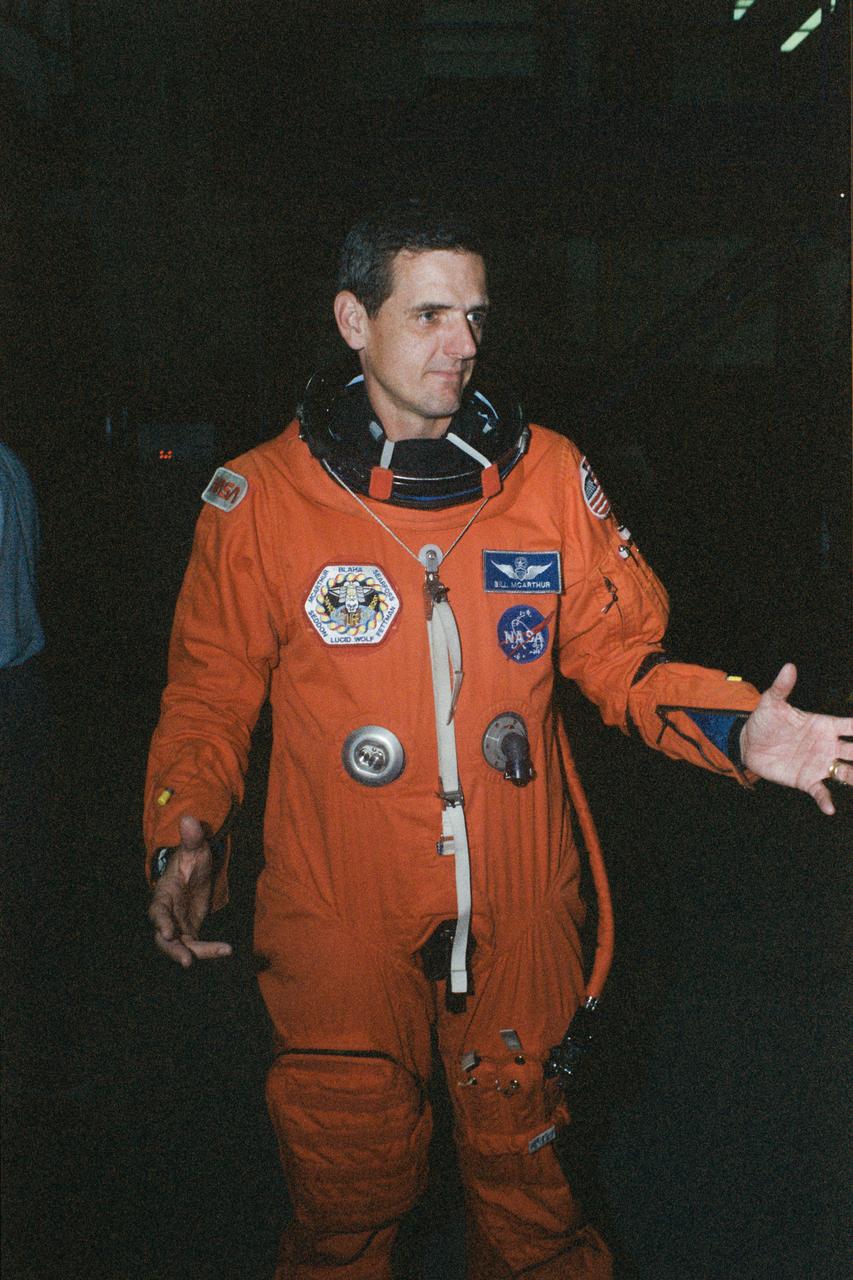
S93-38679 (20 July 1993) --- Wearing a training version of the partial pressure launch and entry garment, astronaut William S. McArthur listens to a briefing on emergency egress procedures for the STS-58 mission. McArthur, along with five other NASA astronauts and a visiting payload specialist assigned to the seven member crew, later rehearsed contingency evacuation procedures. Most of the training session took place in the crew compartment and full fuselage trainers of the Space Shuttle mockup and integration laboratory.
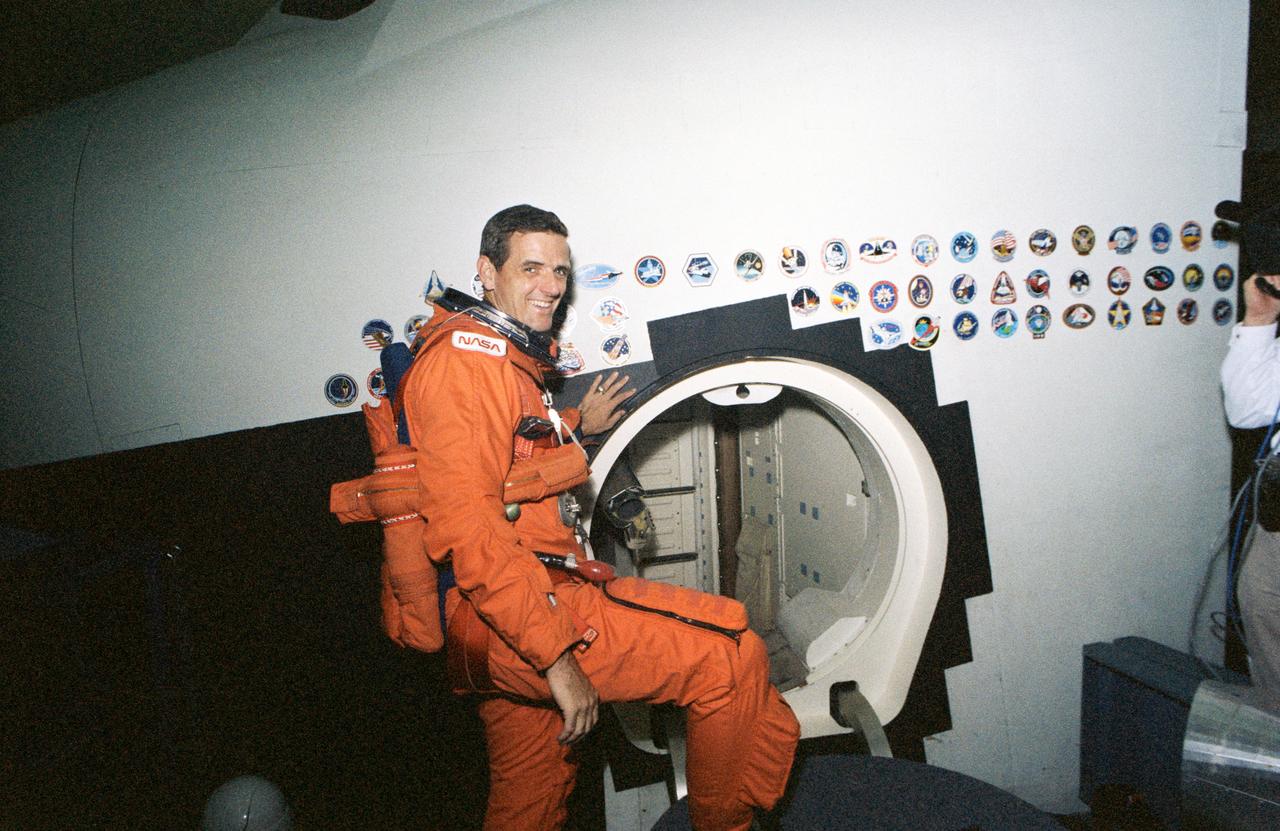
S93-38686 (20 July 1993) --- Wearing a training version of the partial pressure launch and entry garment, astronaut William S. McArthur prepares to rehearse emergency egress procedures for the STS-58 mission. McArthur, along with the five other NASA astronauts and a visiting payload specialist assigned to the seven-member crew, later simulated contingency evacuation procedures. Most of the training session took place in the crew compartment and full fuselage trainers of the Space Shuttle mockup and integration laboratory.
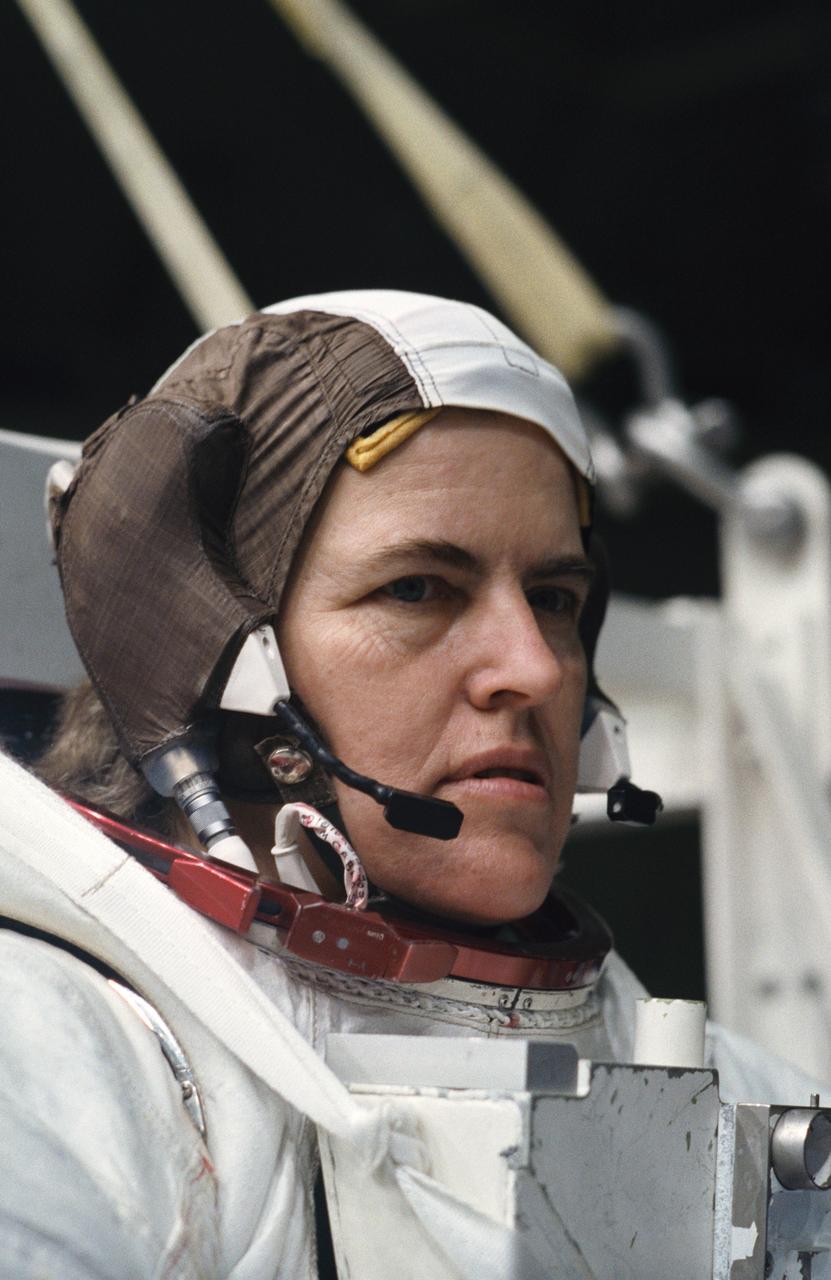
S93-31697 (3 April 1993) --- Astronaut Shannon W. Lucid participates in training for contingency Extravehicular Activity (EVA) for the STS-58 mission. Behind Lucid, sharing a moveable platform with her, is astronaut David A. Wolf (out of frame). For simulation purposes, the two mission specialists were about to be submerged to a point of neutral buoyancy in the Johnson Space Center's (JSC) Weightless Environment Training Facility (WET-F). Though the Spacelab Life Sciences (SLS-2) mission does not include a planned EVA, all crews designate members to learn proper procedures to perform outside the spacecraft in the event of failure of remote means to accomplish those tasks.
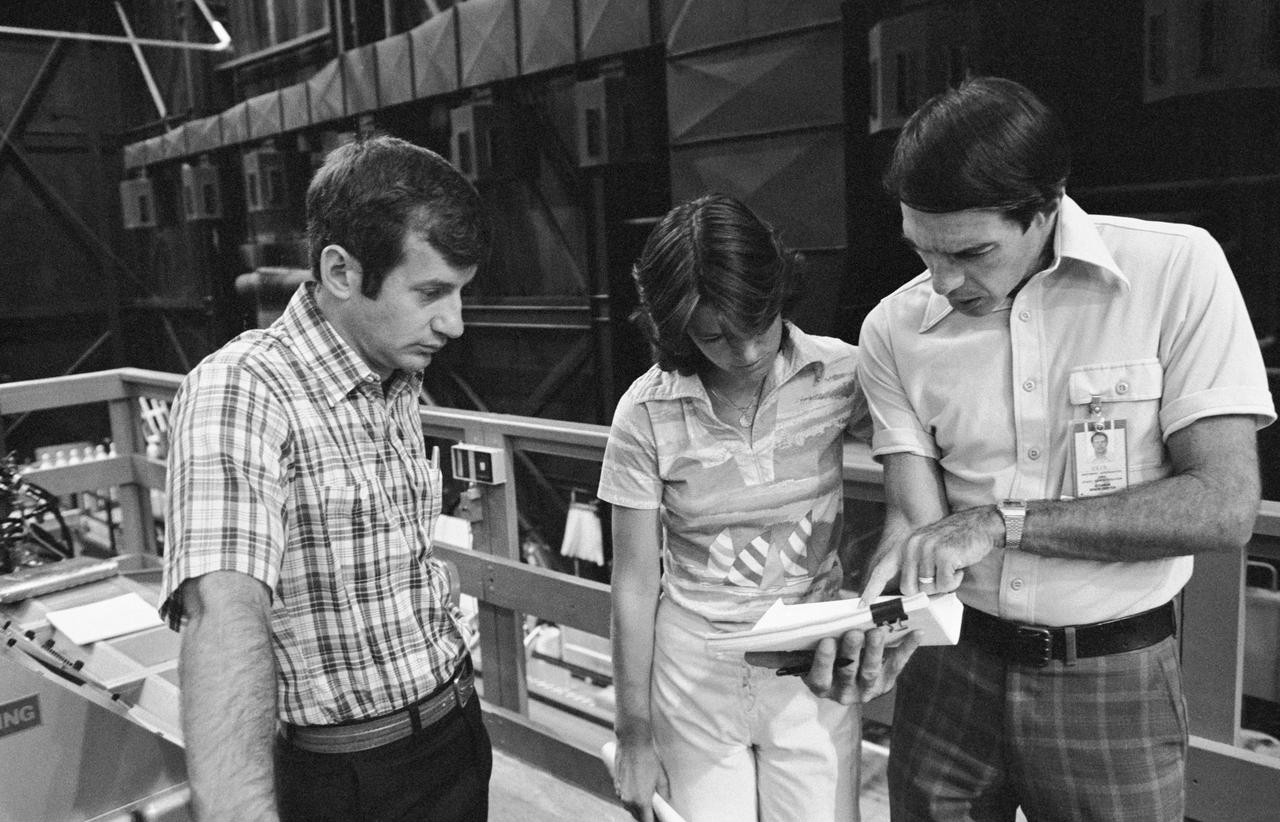
Astronauts Sally Ride and Terry Hart prepare for remote manipulator system (RMS) training for STS-2 in bldg 9A. Views include Ride, Hart and Robert R. Kain of the Flight Activites Branch reviewing procedures for RMS training (34262); Ride and Hart stand beside the RMS control center looking down at the payload bay mock-up (34263).
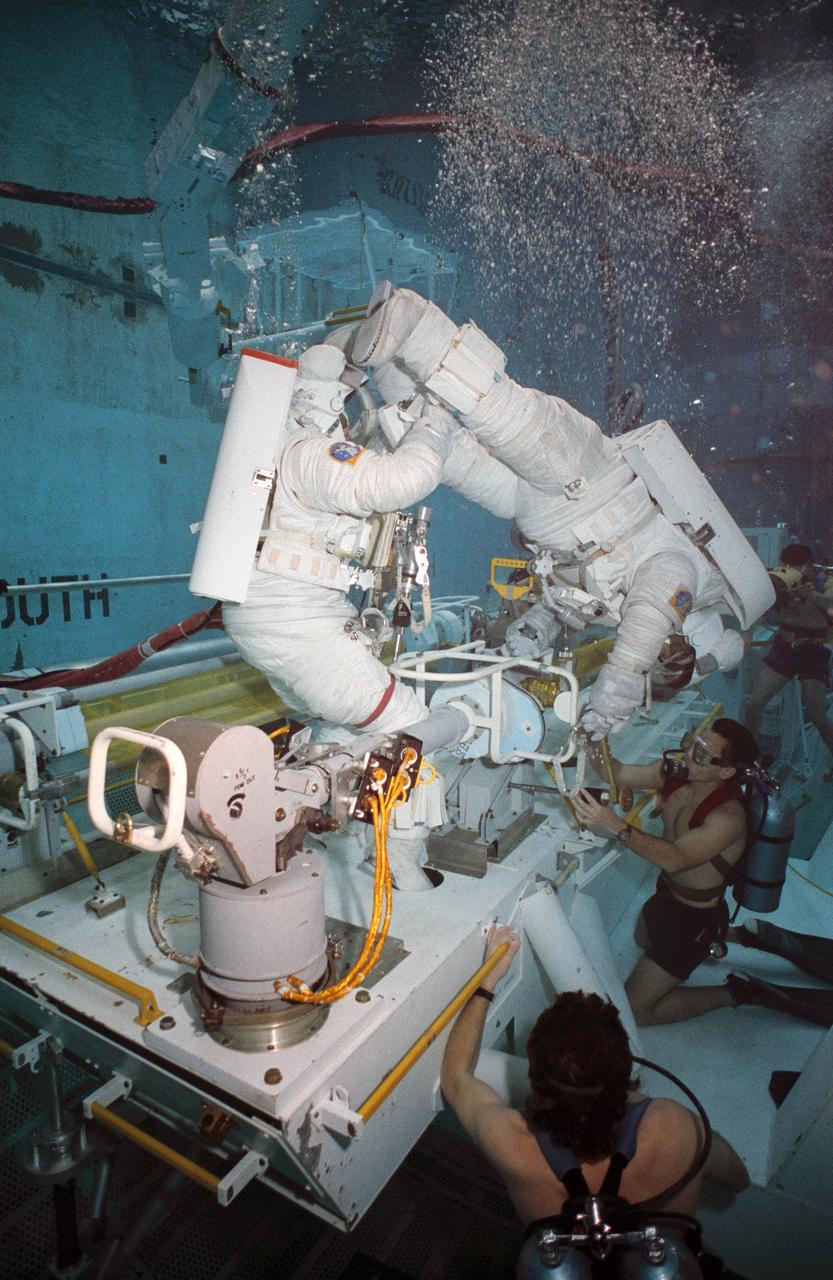
S93-30238 (5 Mar 1993) --- Wearing training versions of Space Shuttle Extravehicular Mobility Units (EMU), astronauts Thomas D. Akers (red stripe) and Kathryn C. Thornton use the spacious pool of the Johnson Space Center's (JSC) Weightless Environment Training Facility (WET-F) to rehearse for the Hubble Space Telescope (HST) repair mission. They are working with a full scale mockup of a solar array fixture.
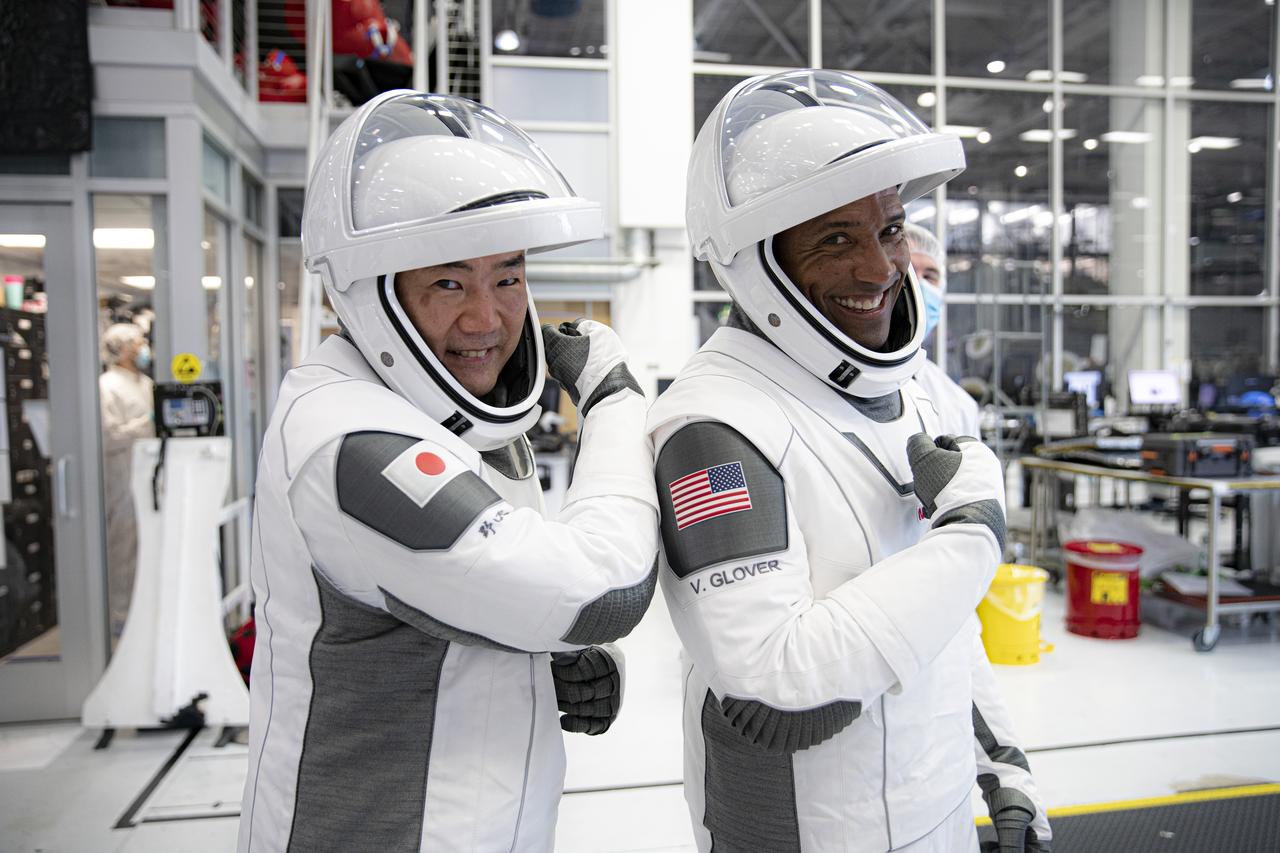
NASA’s SpaceX Crew-1 astronauts participate in crew equipment interface testing at SpaceX headquarters in Hawthorne, California, on Sept. 24, 2020. From left are mission specialist Soichi Noguchi, Japan Aerospace Exploration Agency (JAXA) astronaut, and pilot Victor Glover, NASA astronaut. The other crew members training, but not pictured, are mission specialist Shannon Walker, and Crew Dragon commander Michael Hopkins, both NASA astronauts. NASA’s SpaceX Crew-1 mission is the first crew rotational flight of a U.S. commercial spacecraft with astronauts to the International Space Station. The Crew-1 mission will launch from Launch Complex 39A at Kennedy Space Center in Florida. Crew-1 is part of NASA's Commercial Crew Program, which has returned human spaceflight capabilities to the U.S.
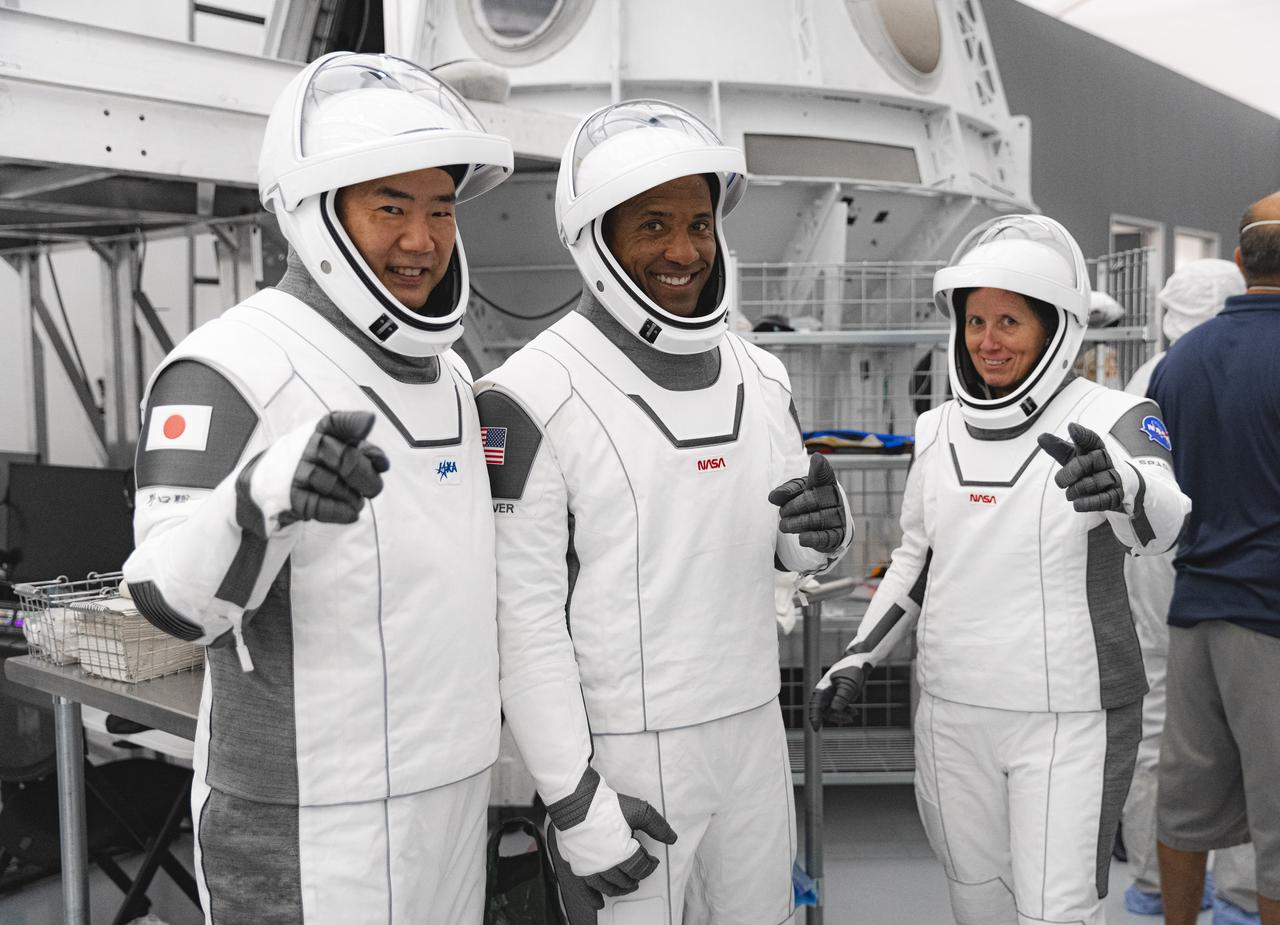
NASA’s SpaceX Crew-1 astronauts participate in crew equipment interface testing at SpaceX headquarters in Hawthorne, California, on Sept. 24, 2020. From left are mission specialist Soichi Noguchi, Japan Aerospace Exploration Agency (JAXA) astronaut, pilot Victor Glover, and mission specialist Shannon Walker, all NASA astronauts. Crew Dragon commander Michael Hopkins (not pictured), NASA astronaut, also participated in the training. NASA’s SpaceX Crew-1 mission is the first crew rotational flight of a U.S. commercial spacecraft with astronauts to the International Space Station. The Crew-1 mission will launch from Launch Complex 39A at Kennedy Space Center in Florida. Crew-1 is part of NASA's Commercial Crew Program, which has returned human spaceflight capabilities to the U.S.
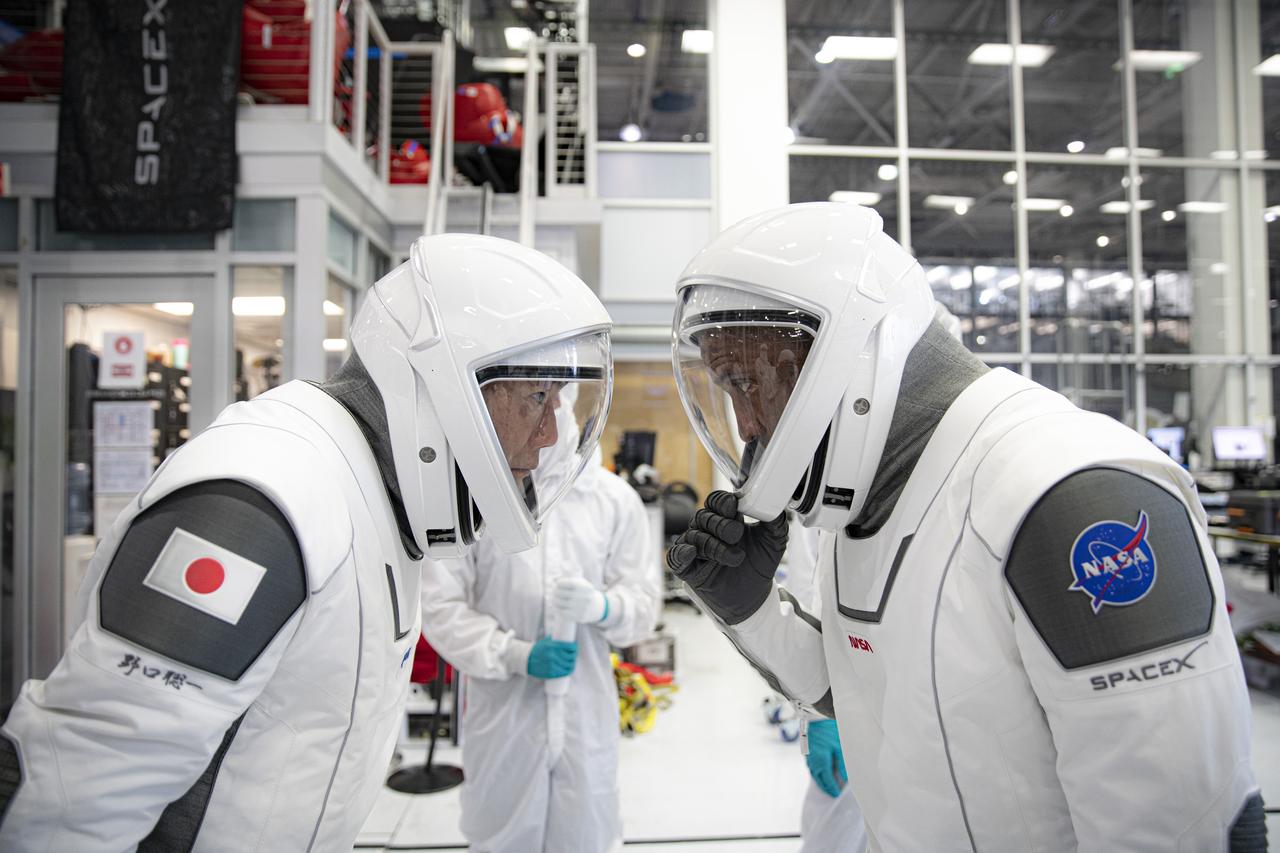
NASA’s SpaceX Crew-1 astronauts participate in crew equipment interface testing at SpaceX headquarters in Hawthorne, California, on Sept. 24, 2020. From left are mission specialist Soichi Noguchi, Japan Aerospace Exploration Agency (JAXA) astronaut, and pilot Victor Glover, NASA astronaut. The other crew members training, but not pictured, are mission specialist Shannon Walker, and Crew Dragon commander Michael Hopkins, both NASA astronauts. NASA’s SpaceX Crew-1 mission is the first crew rotational flight of a U.S. commercial spacecraft with astronauts to the International Space Station. The Crew-1 mission will launch from Launch Complex 39A at Kennedy Space Center in Florida. Crew-1 is part of NASA's Commercial Crew Program, which has returned human spaceflight capabilities to the U.S.
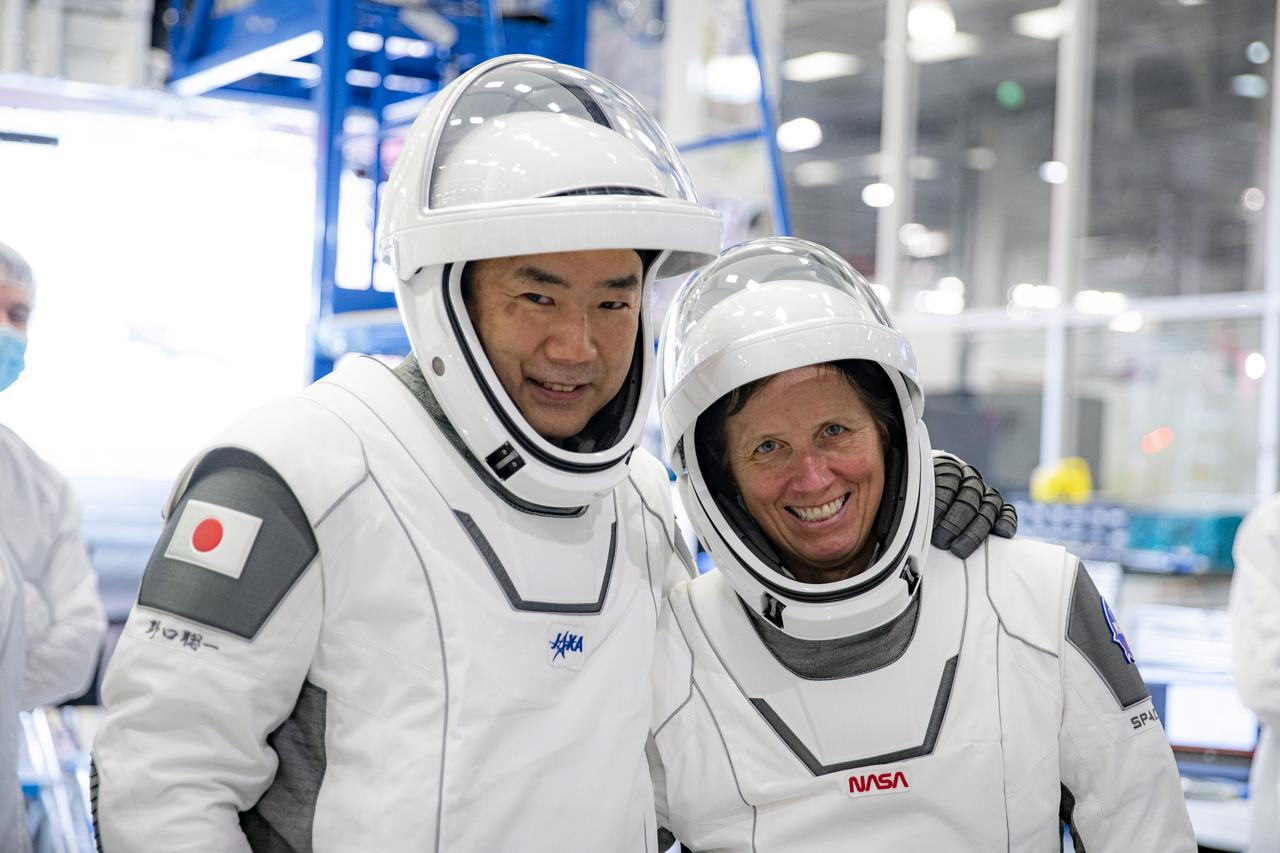
NASA’s SpaceX Crew-1 astronauts participate in crew equipment interface testing at SpaceX headquarters in Hawthorne, California, on Sept. 24, 2020. From left are mission specialist Soichi Noguchi, Japan Aerospace Exploration Agency (JAXA) astronaut, and mission specialist Shannon Walker, NASA astronaut. The other crew members training, but not pictured, are Crew Dragon commander Michael Hopkins, and pilot Victor Glover, both NASA astronauts. NASA’s SpaceX Crew-1 mission is the first crew rotational flight of a U.S. commercial spacecraft with astronauts to the International Space Station. The Crew-1 mission will launch from Launch Complex 39A at Kennedy Space Center in Florida. Crew-1 is part of NASA's Commercial Crew Program, which has returned human spaceflight capabilities to the U.S.
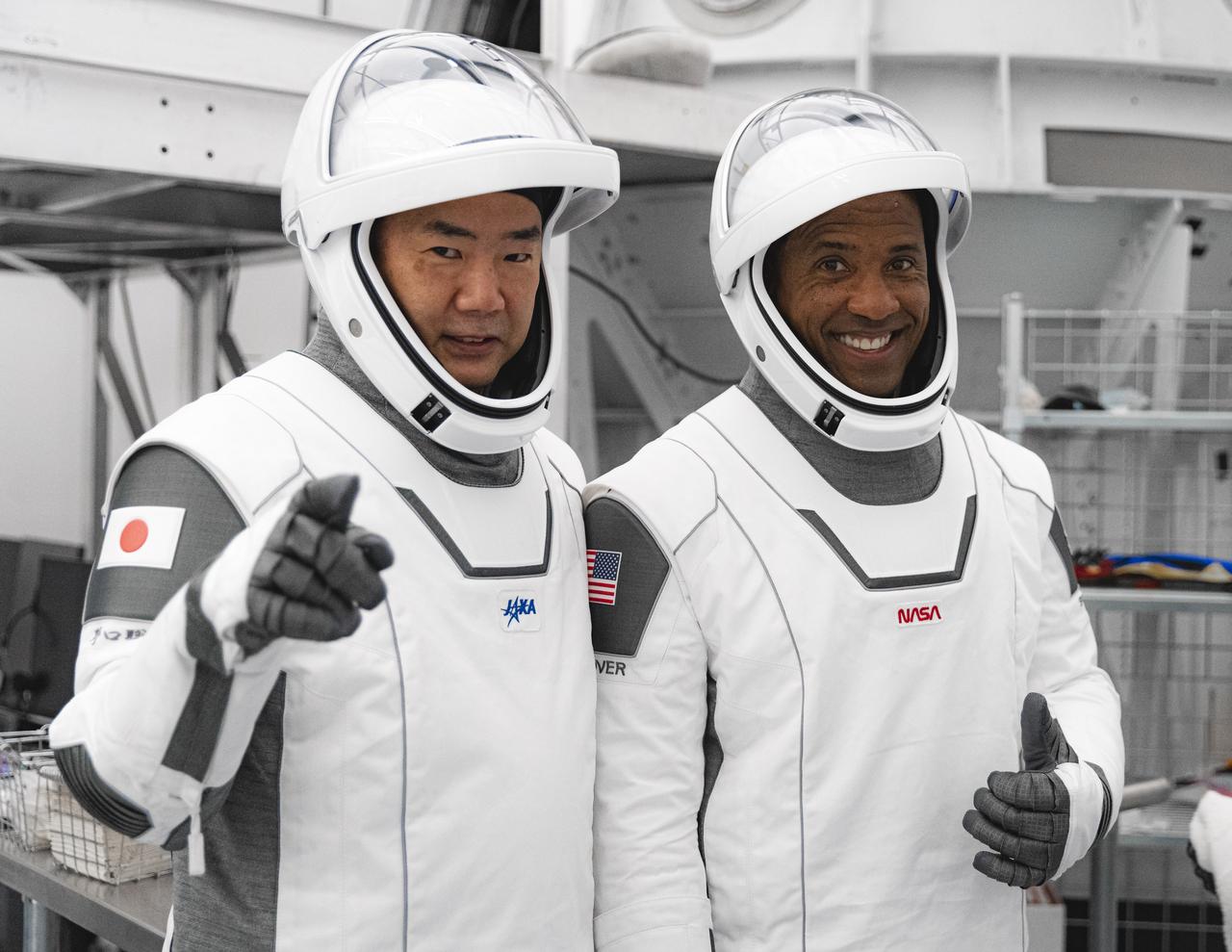
NASA’s SpaceX Crew-1 astronauts participate in crew equipment interface testing at SpaceX headquarters in Hawthorne, California, on Sept. 24, 2020. From left are mission specialist Soichi Noguchi, Japan Aerospace Exploration Agency (JAXA) astronaut, and Crew-1 pilot Victor Glover. The other Crew-1 astronauts also training, but not pictured, are mission specialist Shannon Walker, and Crew Dragon commander Michael Hopkins, all NASA astronauts. NASA’s SpaceX Crew-1 mission is the first crew rotational flight of a U.S. commercial spacecraft with astronauts to the International Space Station. The Crew-1 mission will launch from Launch Complex 39A at Kennedy Space Center in Florida. Crew-1 is part of NASA's Commercial Crew Program, which has returned human spaceflight capabilities to the U.S.
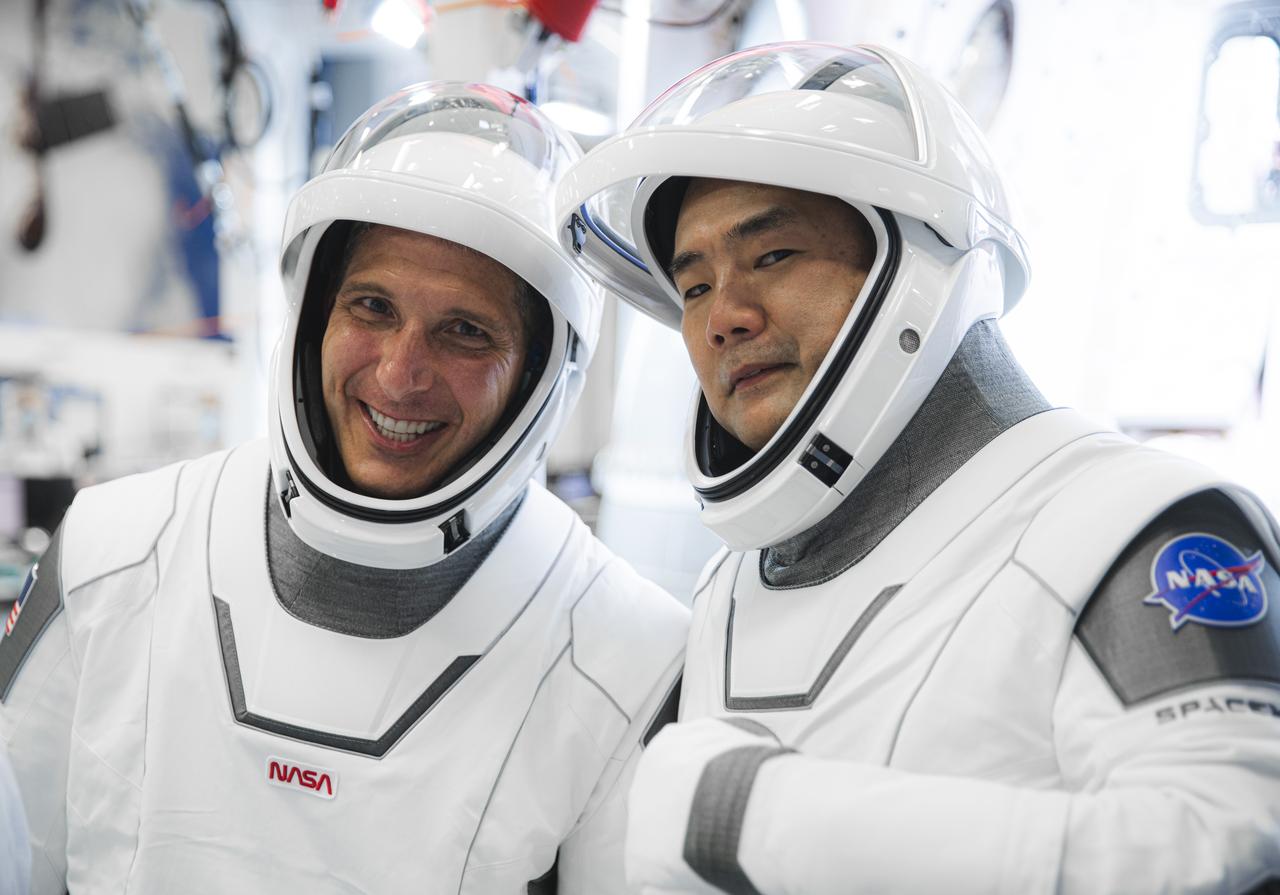
NASA’s SpaceX Crew-1 astronauts participate in crew equipment interface testing at SpaceX headquarters in Hawthorne, California, on Sept. 24, 2020. From left are Crew Dragon commander Michael Hopkins, NASA astronaut; and mission specialist Soichi Noguchi, Japan Aerospace Exploration Agency (JAXA) astronaut. Other crew members training, but not pictured, are pilot Victor Glover and mission specialist Shannon Walker, both NASA astronauts. NASA’s SpaceX Crew-1 mission is the first crew rotational flight of a U.S. commercial spacecraft with astronauts to the International Space Station. The Crew-1 mission will launch from Launch Complex 39A at Kennedy Space Center in Florida. Crew-1 is part of NASA's Commercial Crew Program, which has returned human spaceflight capabilities to the U.S.
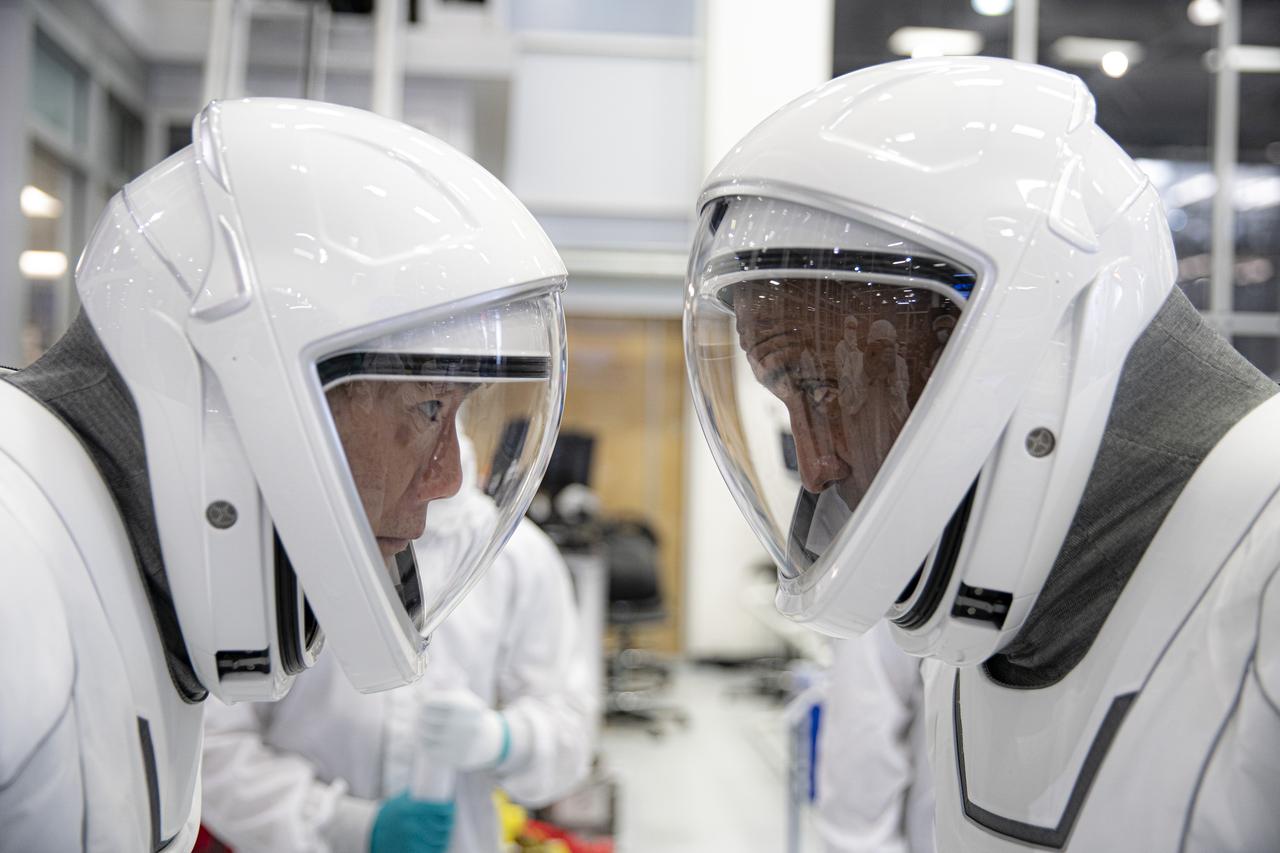
NASA’s SpaceX Crew-1 astronauts participate in crew equipment interface testing at SpaceX headquarters in Hawthorne, California, on Sept. 24, 2020. From left are mission specialist Soichi Noguchi, Japan Aerospace Exploration Agency (JAXA) astronaut, and pilot Victor Glover, NASA astronaut. The other crew members training, but not pictured, are mission specialist Shannon Walker, and Crew Dragon commander Michael Hopkins, both NASA astronauts. NASA’s SpaceX Crew-1 mission is the first crew rotational flight of a U.S. commercial spacecraft with astronauts to the International Space Station. The Crew-1 mission will launch from Launch Complex 39A at Kennedy Space Center in Florida. Crew-1 is part of NASA's Commercial Crew Program, which has returned human spaceflight capabilities to the U.S.
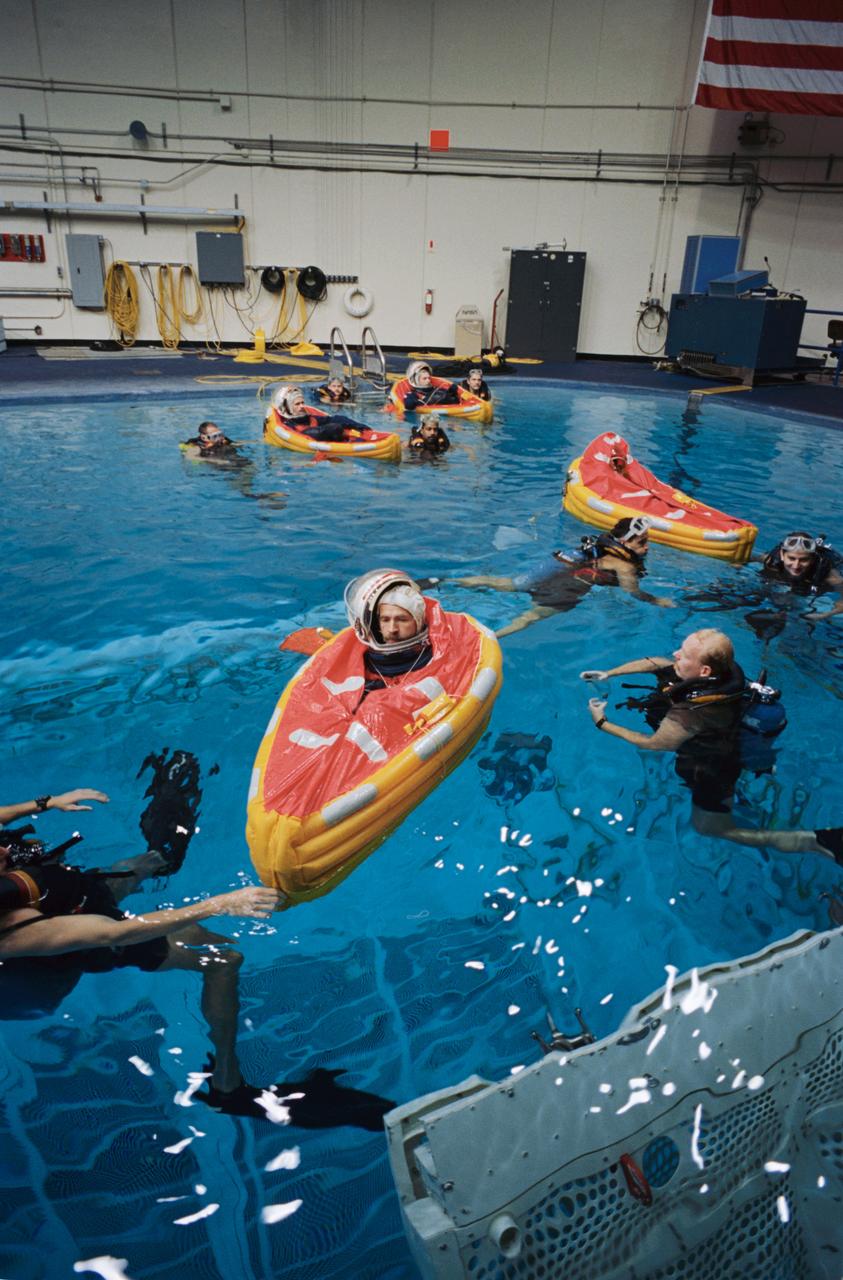
S94-47226 (13 Oct 1994) --- Using small life rafts, several cosmonauts and astronauts participating in joint Russia - United States space missions take part in an emergency bailout training session in the Johnson Space Center's (JSC) Weightless Environment Training Facility's (WET-F) 25-feet-deep pool. In the foreground is cosmonaut Alexsandr F. Poleshchuk, a member of the Mir reserve crew. A number of SCUBA-equipped divers assist the trainees.
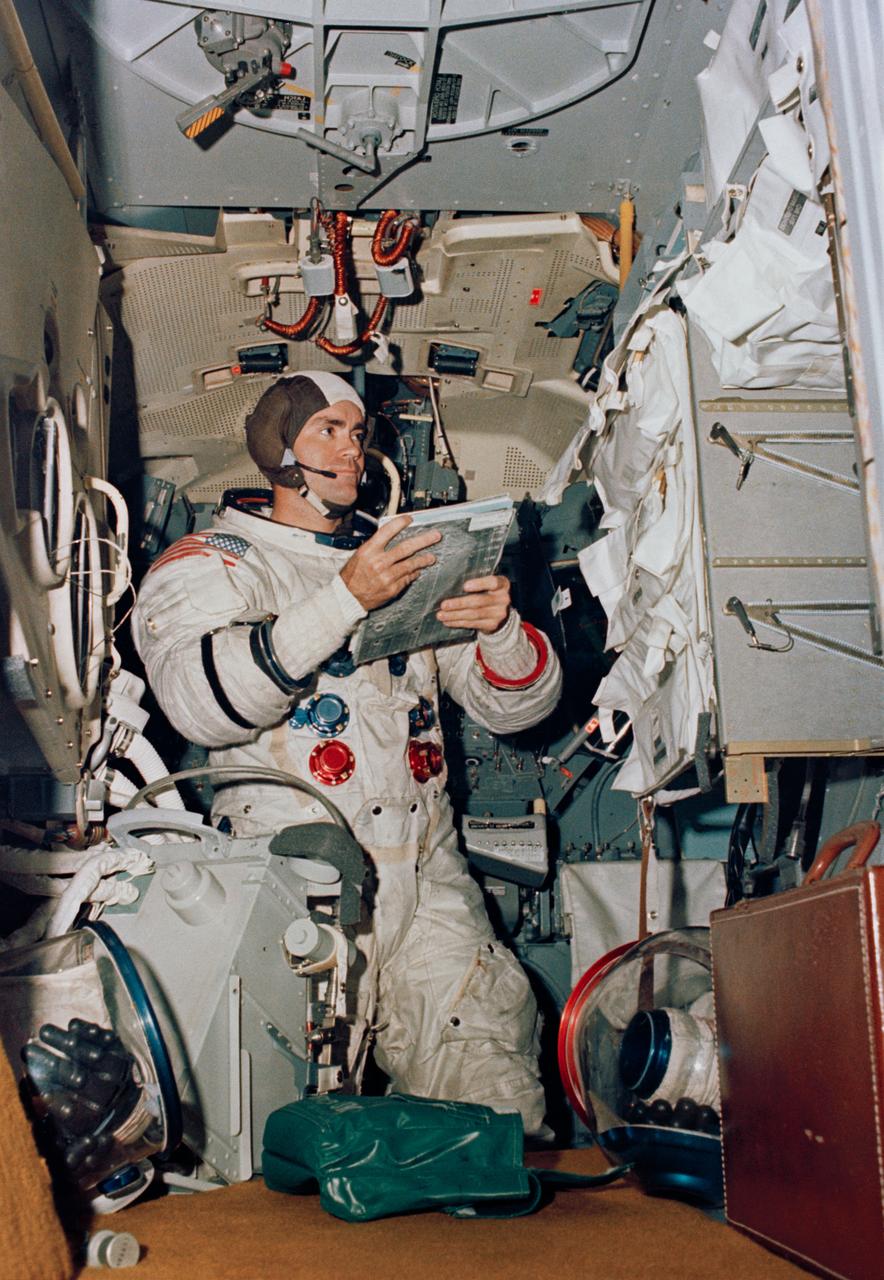
S70-34412 (4 April 1970) --- Astronaut Fred W. Haise Jr., Apollo 13 lunar module pilot, participates in simulation training in preparation for the scheduled lunar landing mission. He is in the Apollo Lunar Module Mission Simulator in the Kennedy Space Center's Flight Crew Training building.
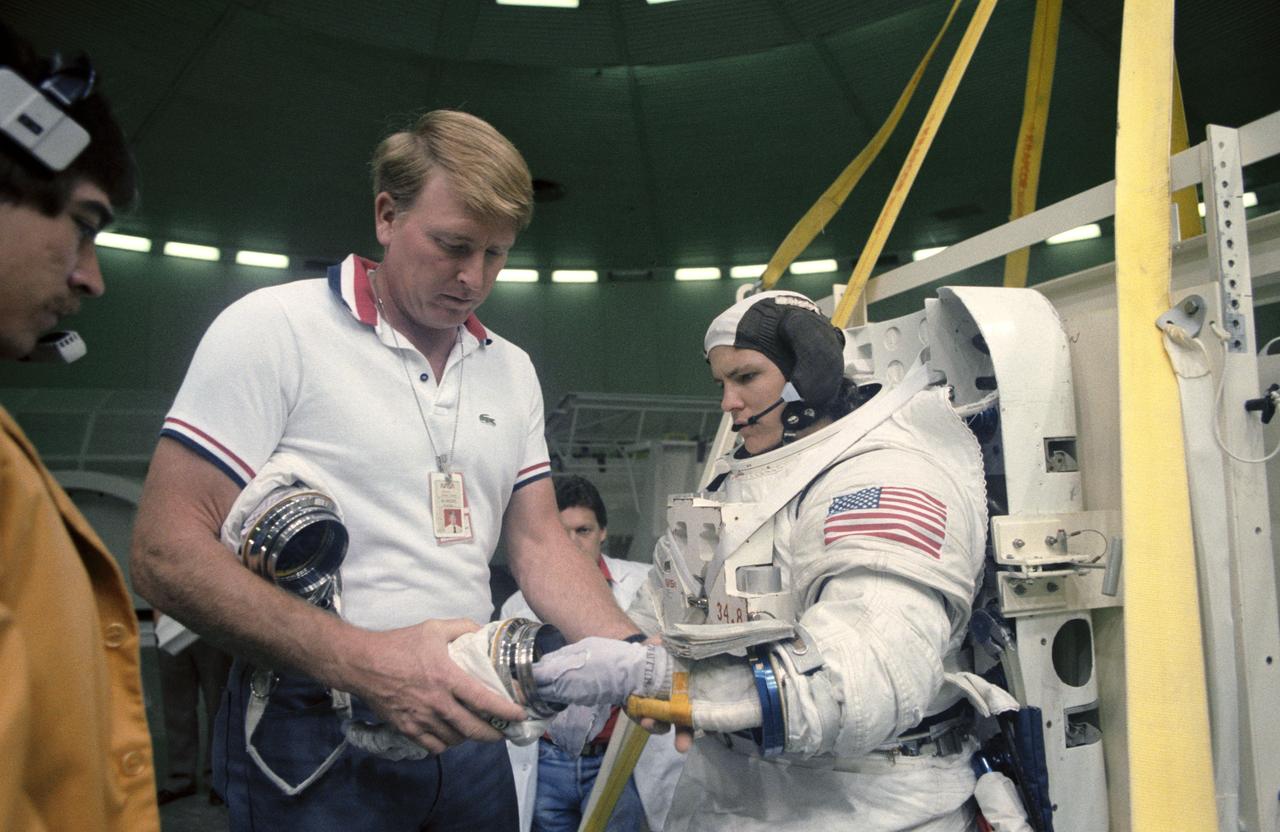
S84-33898 (21 May 1984) --- Astronaut Jon A. McBride, 41-G pilot, assists his crewmate, Astronaut Kathryn D. Sullivan with the glove portion of her extravehicular mobility unit (EMU) prior to Dr. Sullivan's underwater session in the Johnson Space Center's weightless environment training facility (WET-F). Mission specialists Sullivan and David C. Leestma are scheduled for extravehicular activity (EVA) on the Columbia for NASA's 17th scheduled flight.
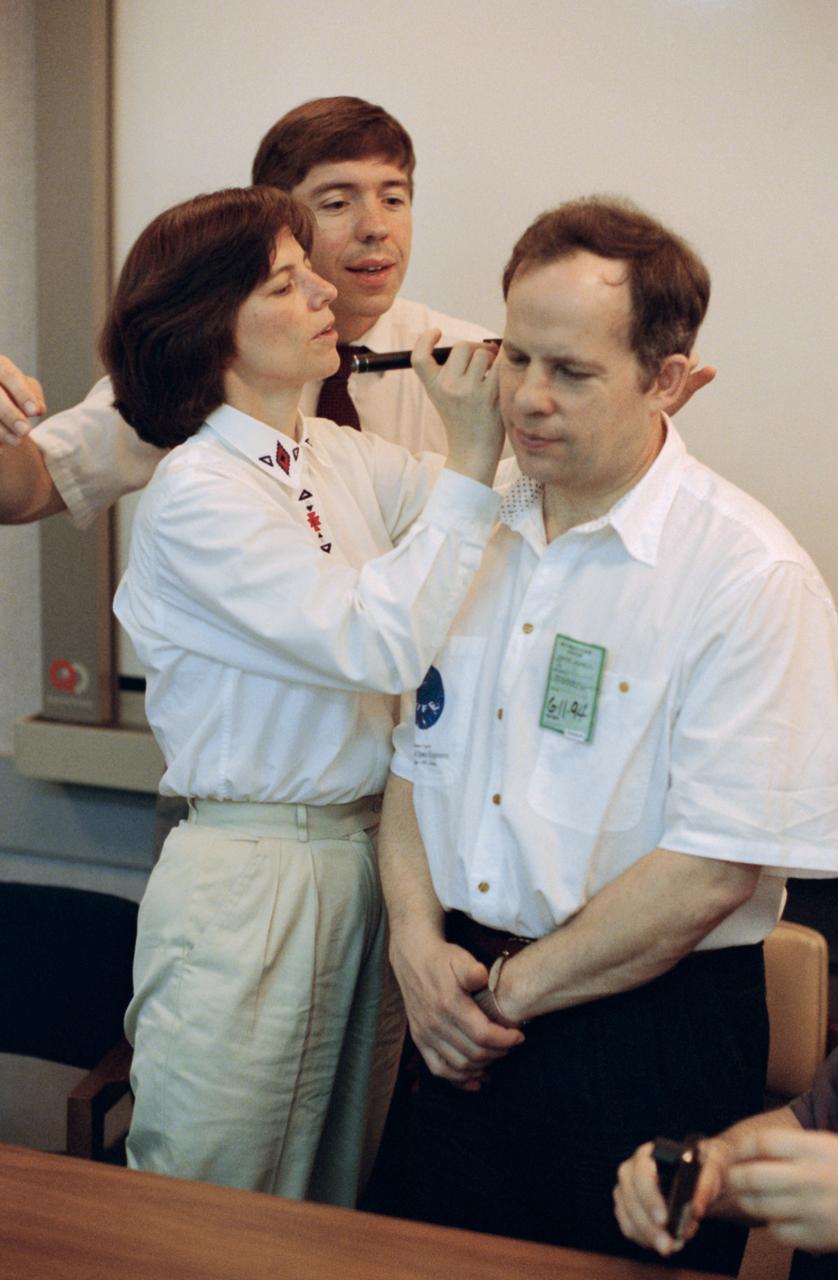
S94-35071 (17 June 1994) --- Flight surgeon Mike Barrett looks on as astronaut Bonnie J. Dunbar conducts a physical examination on cosmonaut Anatoly Solovyov. Crew members for the joint Space Shuttle/Mir missions are in the midst of three weeks' medical operations training for their cooperative flights.
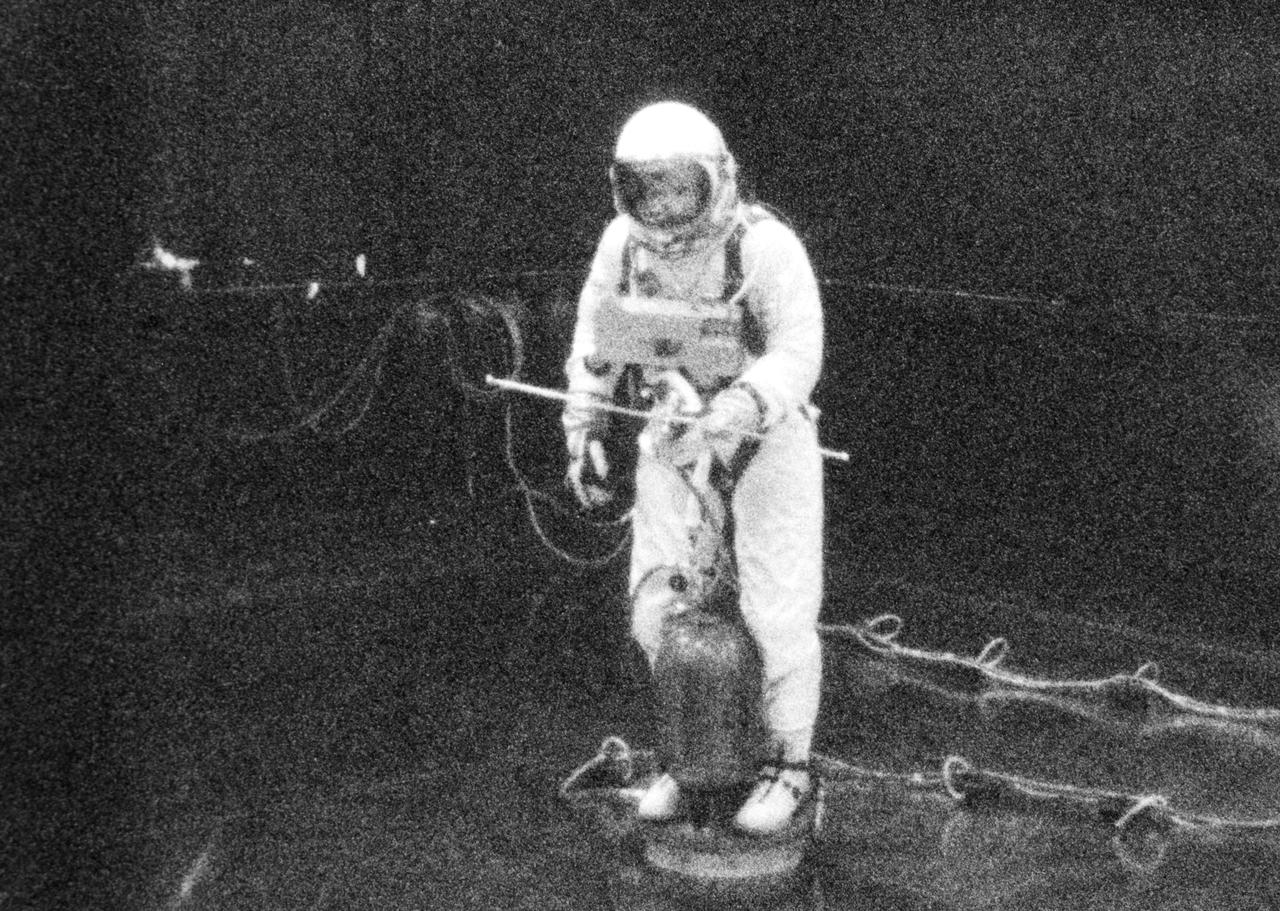
S65-19504 (28 May 1965) --- Astronaut Edward H. White II, pilot for the Gemini-Titan 4 prime crew, is pictured during an extravehicular exercise in the Building 4 laboratory at the Manned Spacecraft Center in Houston, Texas. White is controlling about the yaw (vertical) axis while translating. He stands on a Balance Extravehicular Training Aircraft which is separated from the level steel floor by a .001th-inch cushion of air. In his right hand White holds a zero-gravity integral propulsion unit which is a self-maneuvering device used by an astronaut in a zero-gravity environment. This condition is simulated in this training exercise. White's spacesuit is pressurized to create a realistic training condition. The simulated umbilical line is floated on air with the aid of eleven small air pads.
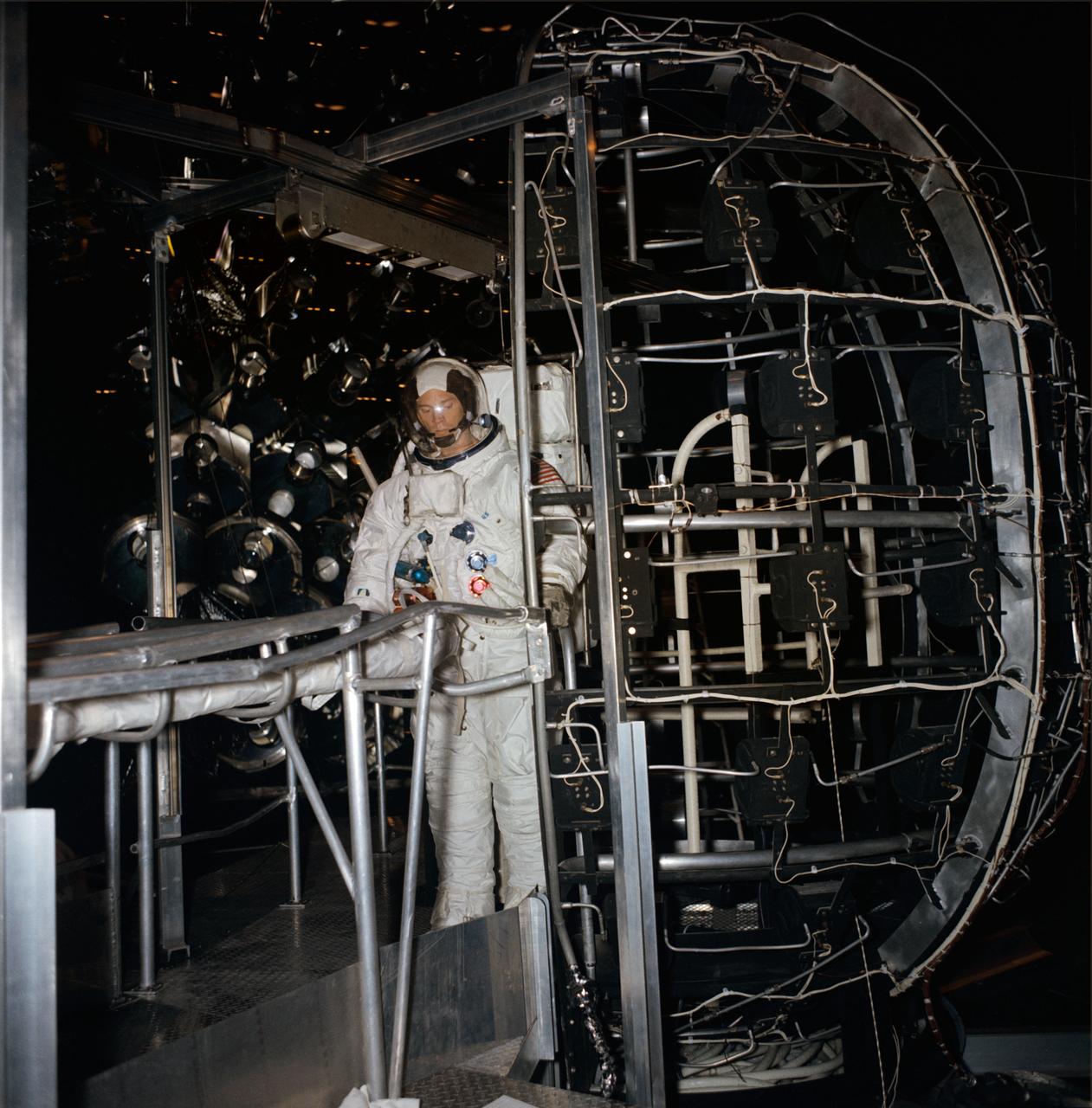
S68-55391 (11 Dec. 1968) --- Astronaut Russell L. Schweickart, lunar module pilot of the Apollo 9 (Spacecraft 104/Lunar Module 3/Saturn 504) space mission, is seen inside Chamber "A," Space Environment Simulation Laboratory, Building 32, participating in dry run activity in preparation for extravehicular activity which is scheduled in Chamber "A." The purpose of the scheduled training is to familiarize the crewmen with the operation of EVA equipment in a simulated space environment. In addition, metabolic and workload profiles will be simulated on each crewman. Astronauts Schweickart and Alan L. Bean, backup lunar module pilot, are scheduled to receive thermal-vacuum training simulating Earth-orbital EVA.
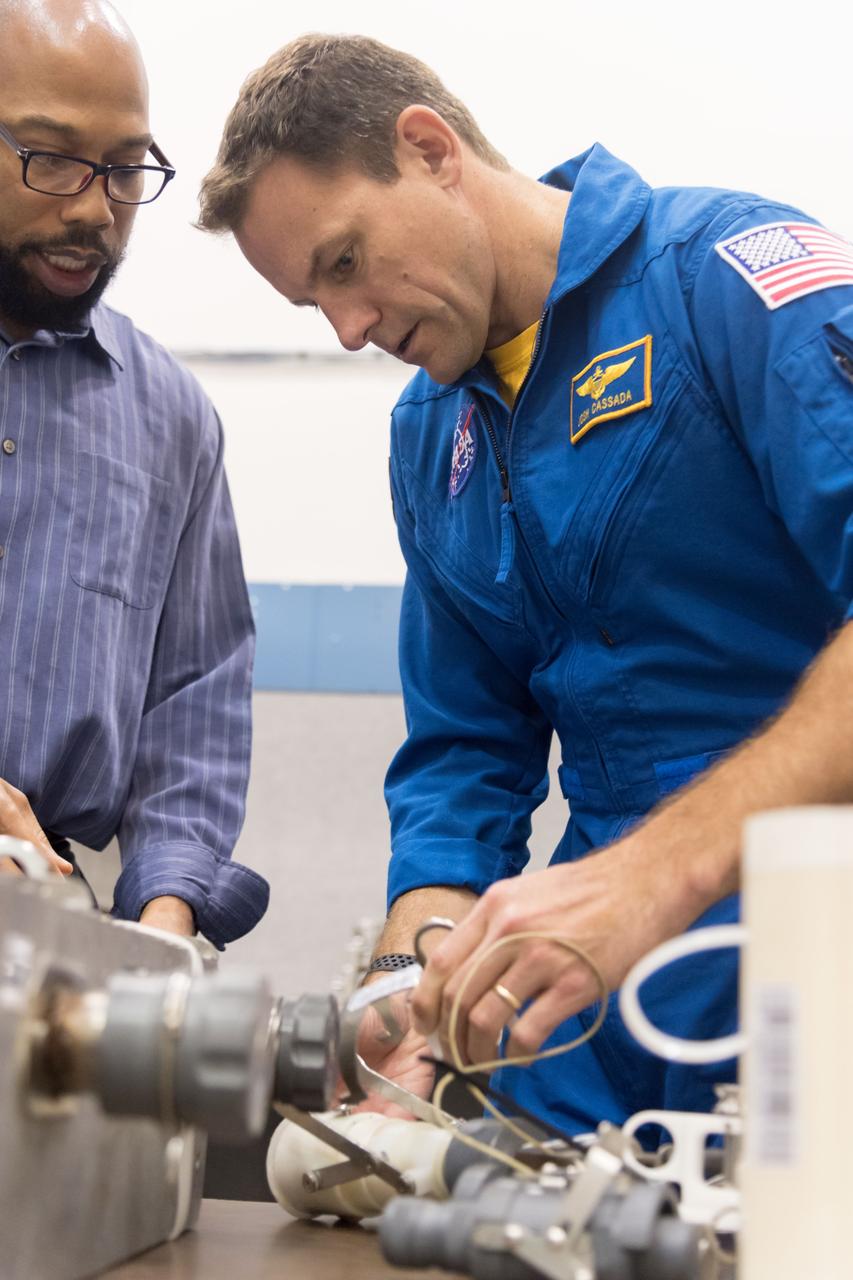
CCP astronauts Suni Williams and Josh Cassada during ISS EVA Maintenance 1G training.
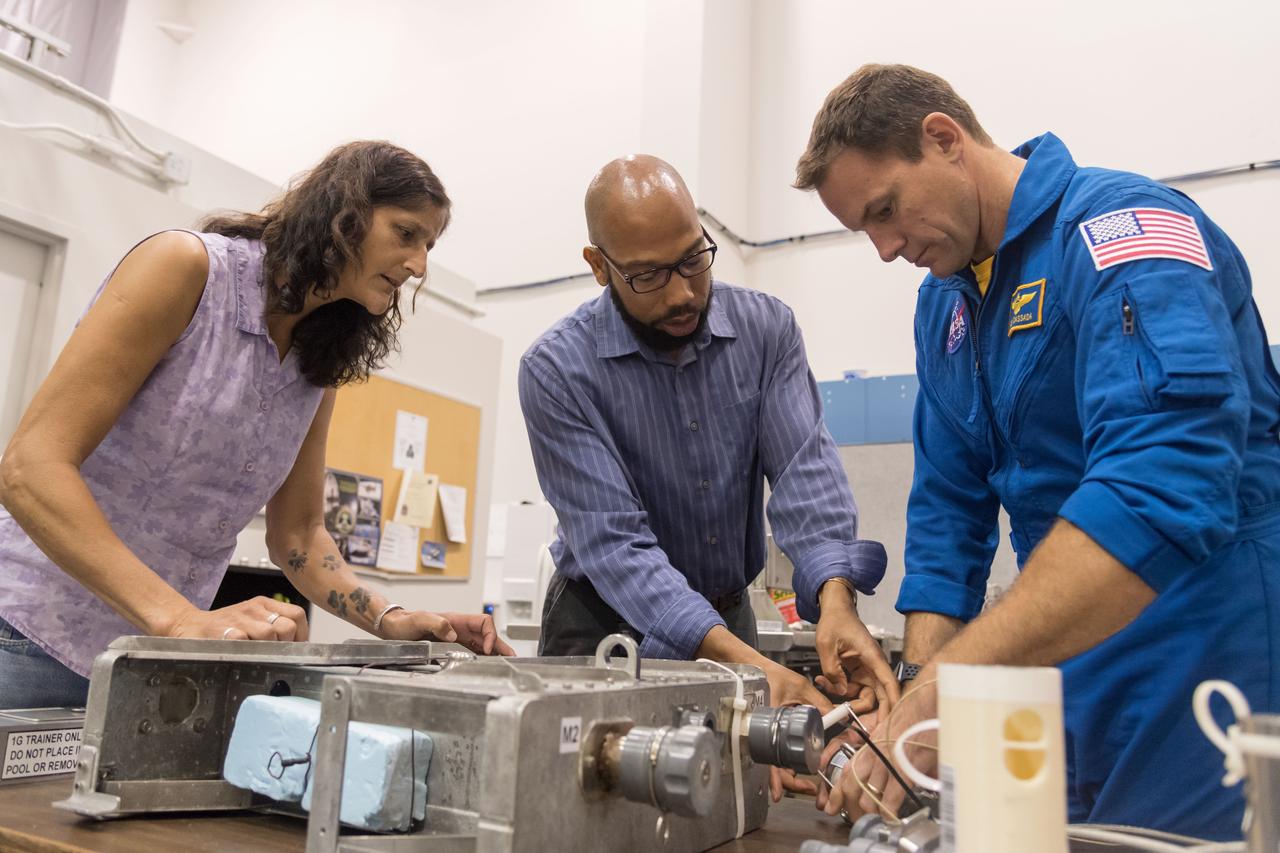
CCP astronauts Suni Williams and Josh Cassada during ISS EVA Maintenance 1G training.
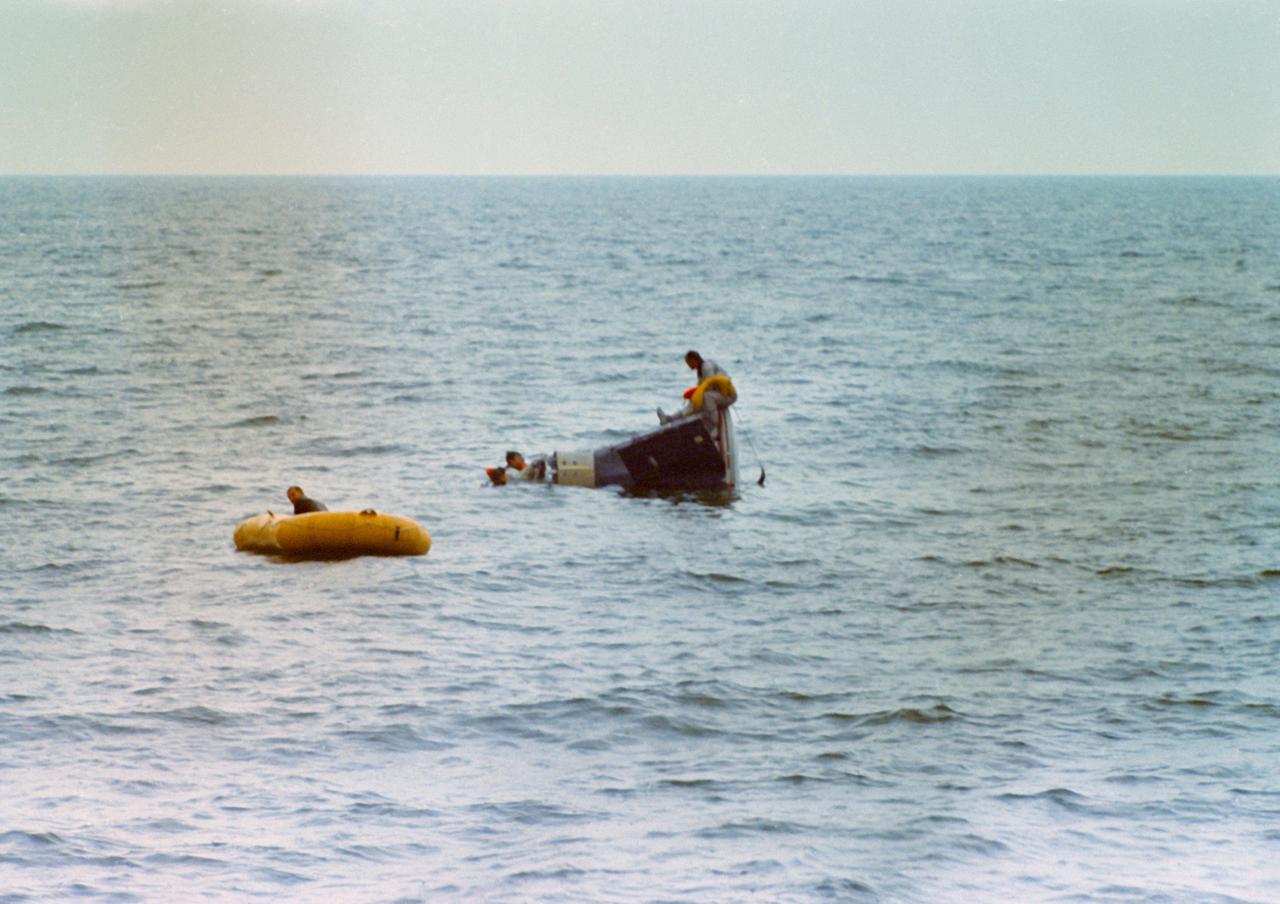
S66-39699 (18 June 1966) --- Astronauts John W. Young (in water, nose of spacecraft), Gemini-10 command pilot, and Michael Collins (sitting on spacecraft), pilot, use Static Article 6 spacecraft during water egress training in the Gulf of Mexico. A team of Manned Spacecraft Center (MSC) swimmers assisted in the training exercise. Photo credit: NASA
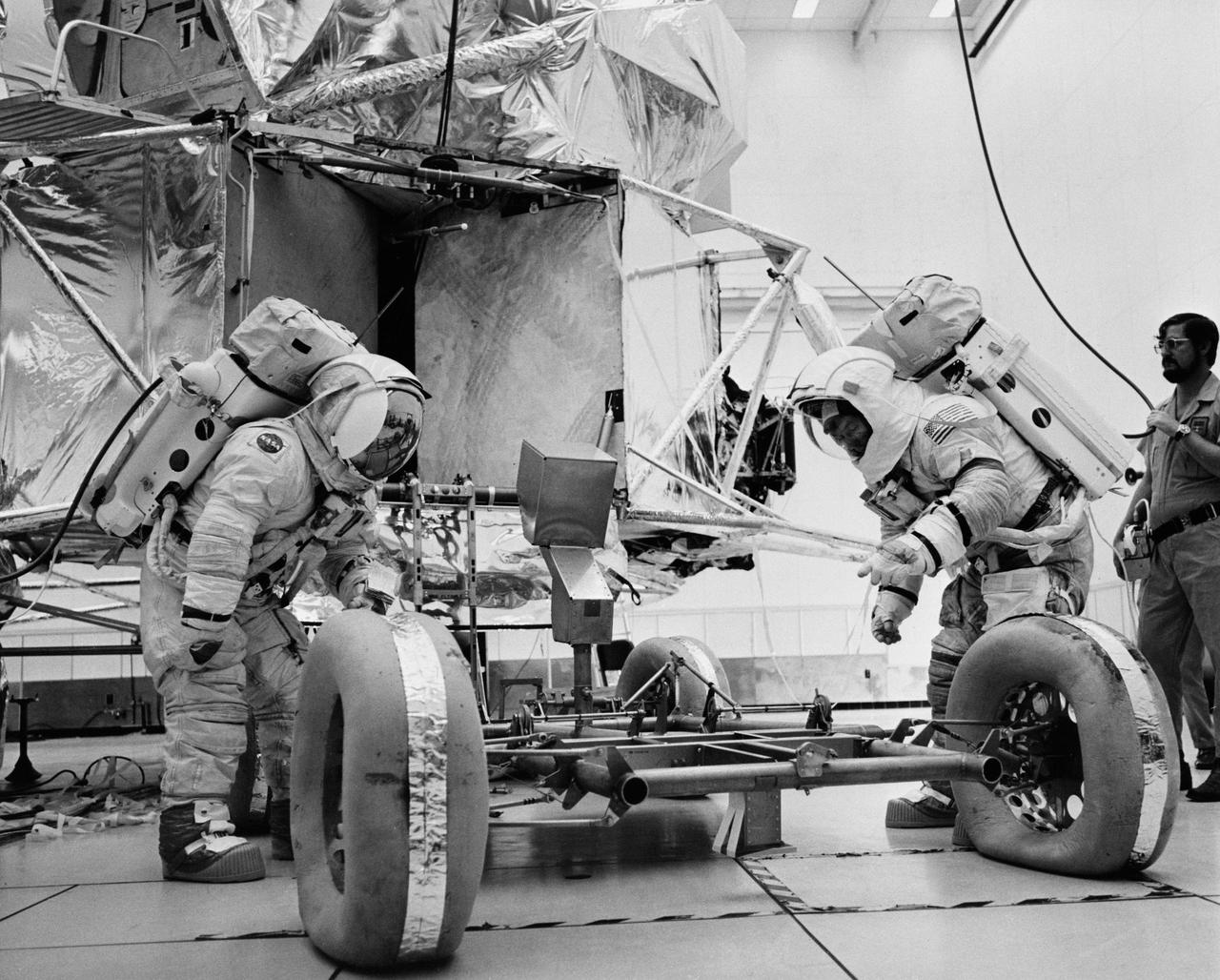
S72-44423 (8 Sept. 1972) --- Two Apollo 17 crewmen ready a Lunar Roving Vehicle trainer following its deployment from a Lunar Module trainer in the Flight Crew Training Building at the Kennedy Space Center, Florida. Taking part in the Apollo 17 training exercise were astronauts Eugene A. Cernan (right), commander; and Harrison H. "Jack" Schmitt, lunar module pilot.
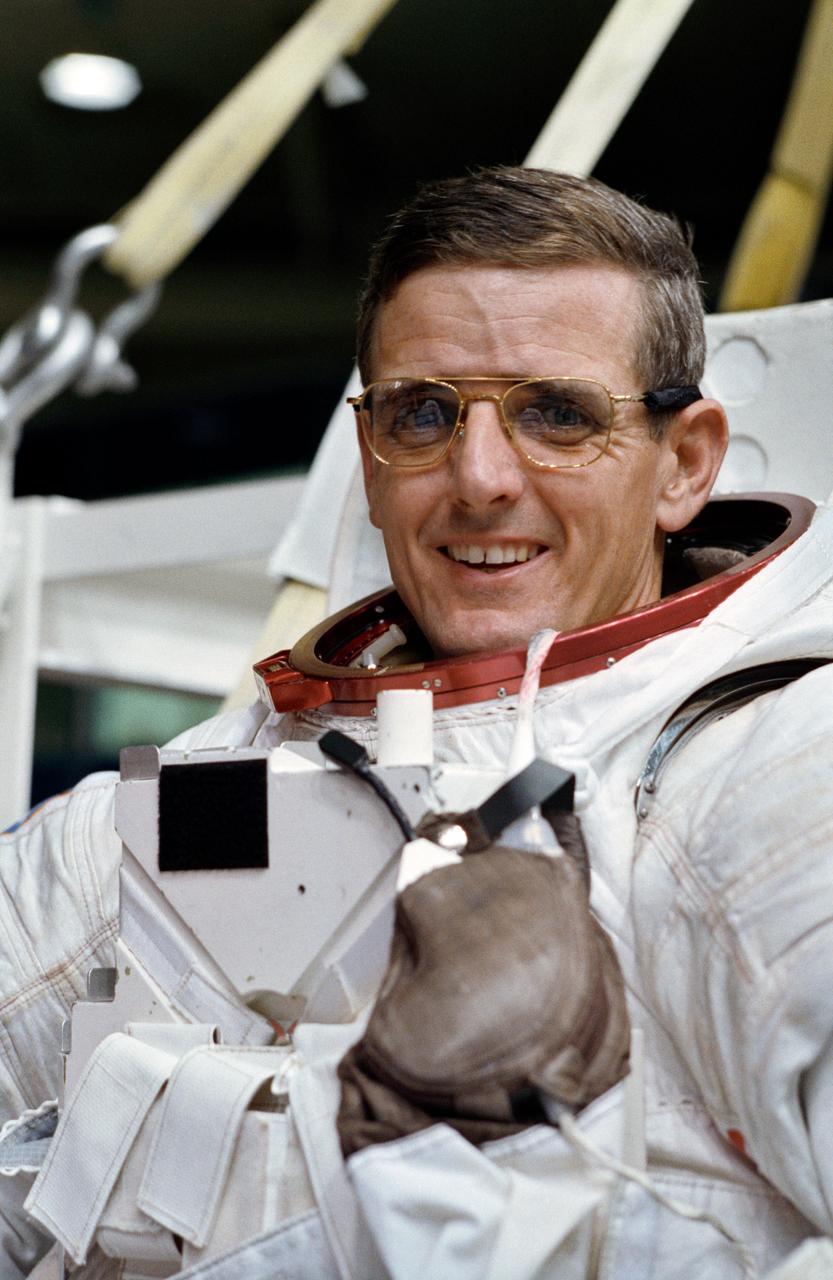
S93-43840 (6 Sept 1993) --- Astronaut William S. McArthur, mission specialist, participates in training for contingency Extravehicular Activity (EVA) for the STS-58 mission. For simulation purposes, McArthur was about to be submerged to a point of neutral buoyancy in the Johnson Space Center's (JSC) Weightless Environment Training Facility (WET-F). Though the Spacelab Life Sciences (SLS-2) mission does not include a planned EVA, all crews designate members to learn proper procedures to perform outside the spacecraft in the event of failure of remote means to accomplish those tasks.
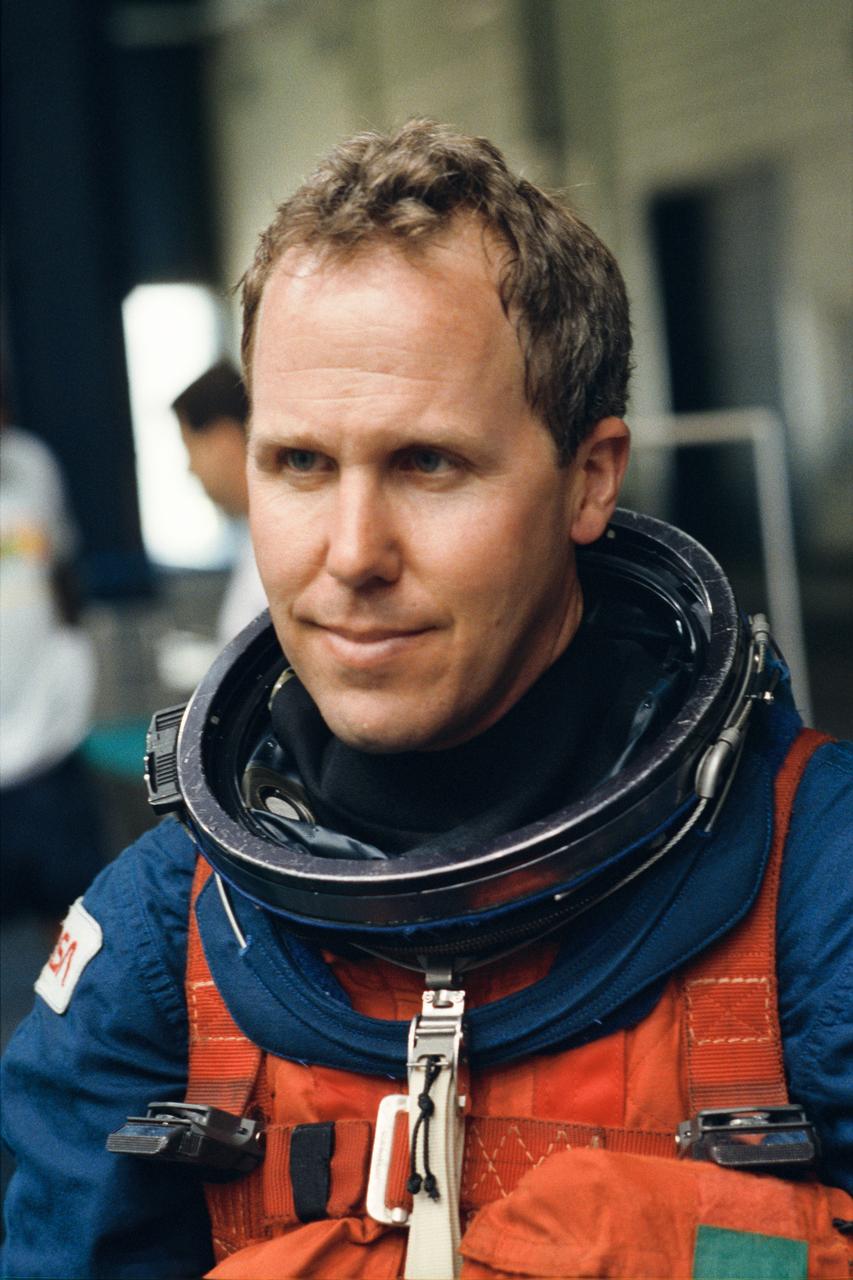
S93-43108 (2 June 1993) --- Astronaut Thomas D. Jones, mission specialist, takes a break during emergency bailout training at the Johnson Space Center's (JSC) Weightless Environment Training Facility (WET-F). Jones and five other NASA astronauts are scheduled to fly aboard the Space Shuttle Endeavour next year.
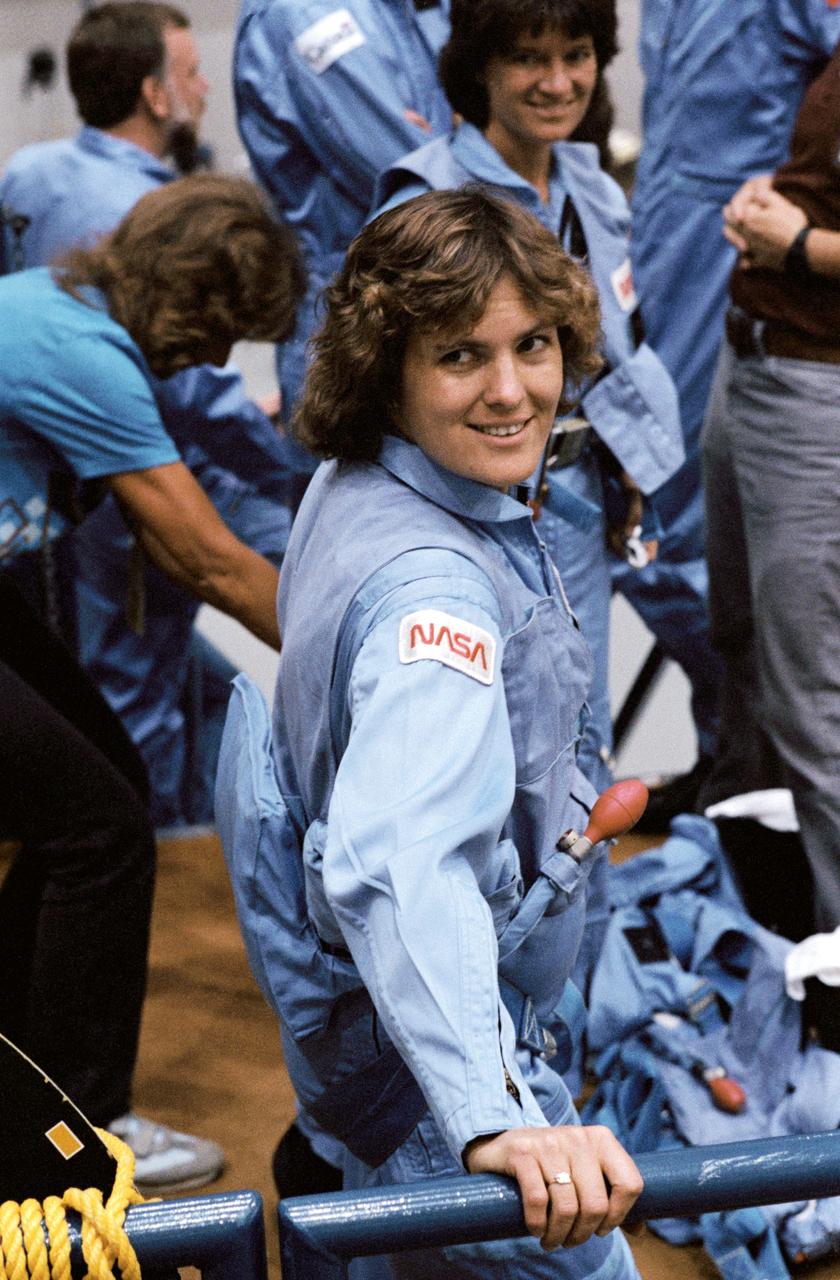
41D-3188 (2 September 1984) --- Astronaut Kathryn D. Sullivan, 41-G mission specialist, joins with other members of the seven-person crew prior to a training session in the Shuttle mockup and integration laboratory at the Johnson Space Center. Dr. Sullivan will be the first American woman to perform an extravehicular activity (EVA) in space when she joins Astronaut David C. Leestma for some outside-the-Challenger duty on October 9. The mission is scheduled for an October 5, 1984 launch.
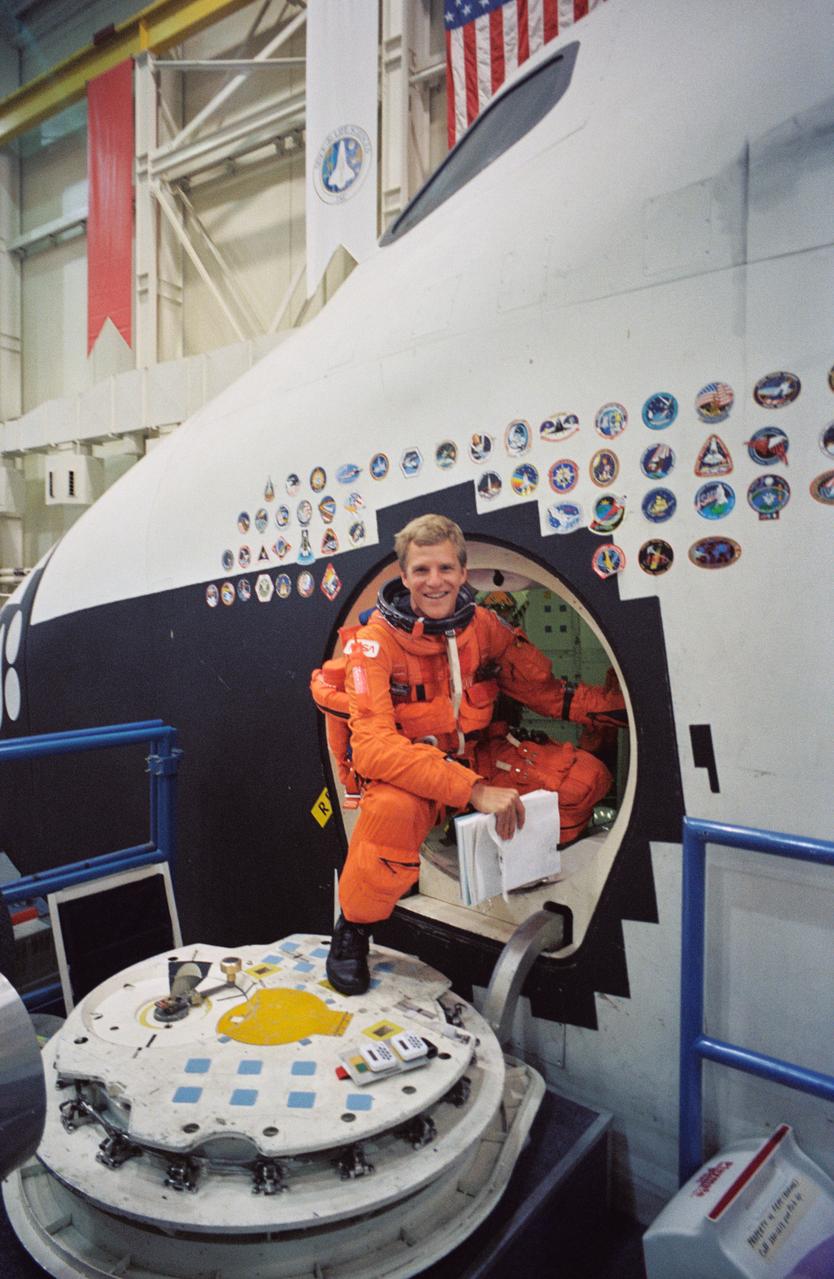
S94-36628 (23 June 1994) --- Astronaut Scott E. Parazynski poses at the hatch of the crew compartment trainer prior to a rehearsal of launch and entry procedures for a November 1994 flight aboard the Space Shuttle Atlantis. Four other NASA astronauts and a European mission specialist joined the mission specialist for this training exercise in the crew compartment trainer at the Johnson Space Center's (JSC) Shuttle Mockup and Integration Laboratory and will join him aboard Atlantis in November. The flight is manifest to support the Atmospheric Laboratory for Applications and Science (ATLAS-3) mission.
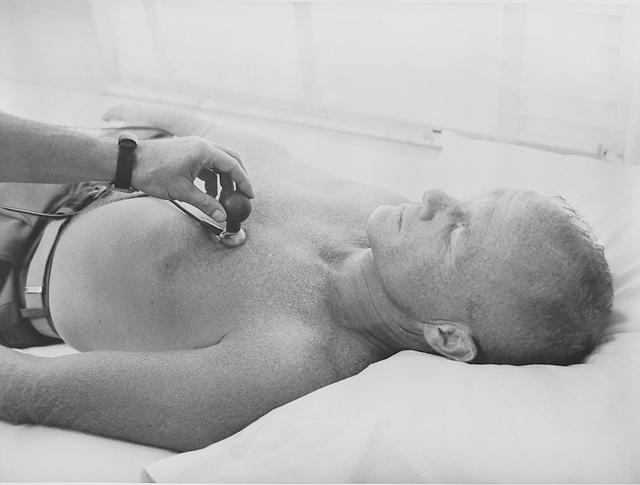
S61-03622 (1961) --- Mercury astronaut John H. Glenn Jr. has a biosensor attached to his body during astronaut training activities at Cape Canaveral, Florida. Photo credit: NASA
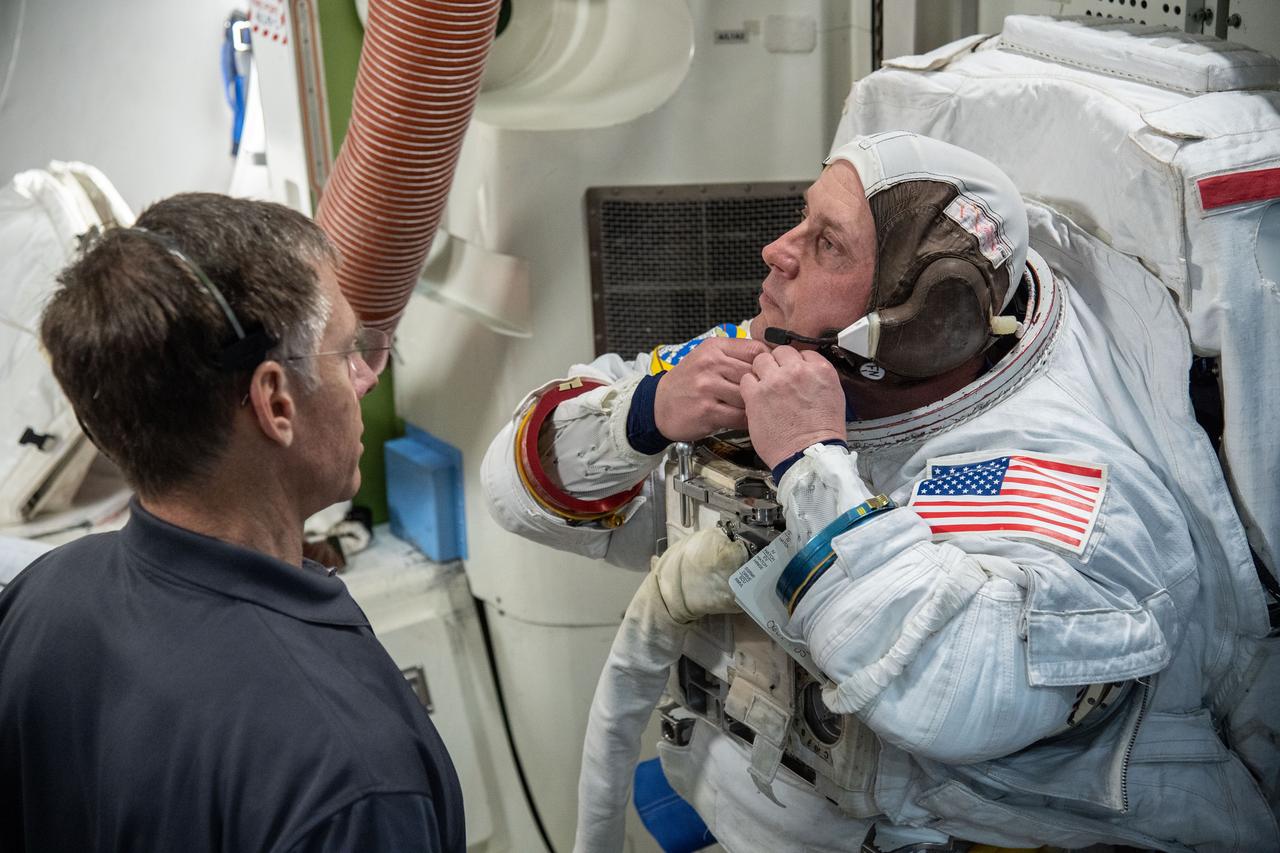
Boeing Crew Flight Test (CFT) with NASA astronauts Mike Fincke and Nicole Mann and Boeing Astronaut Chris Ferguson during ISS EVA Prep & Post 1 training.
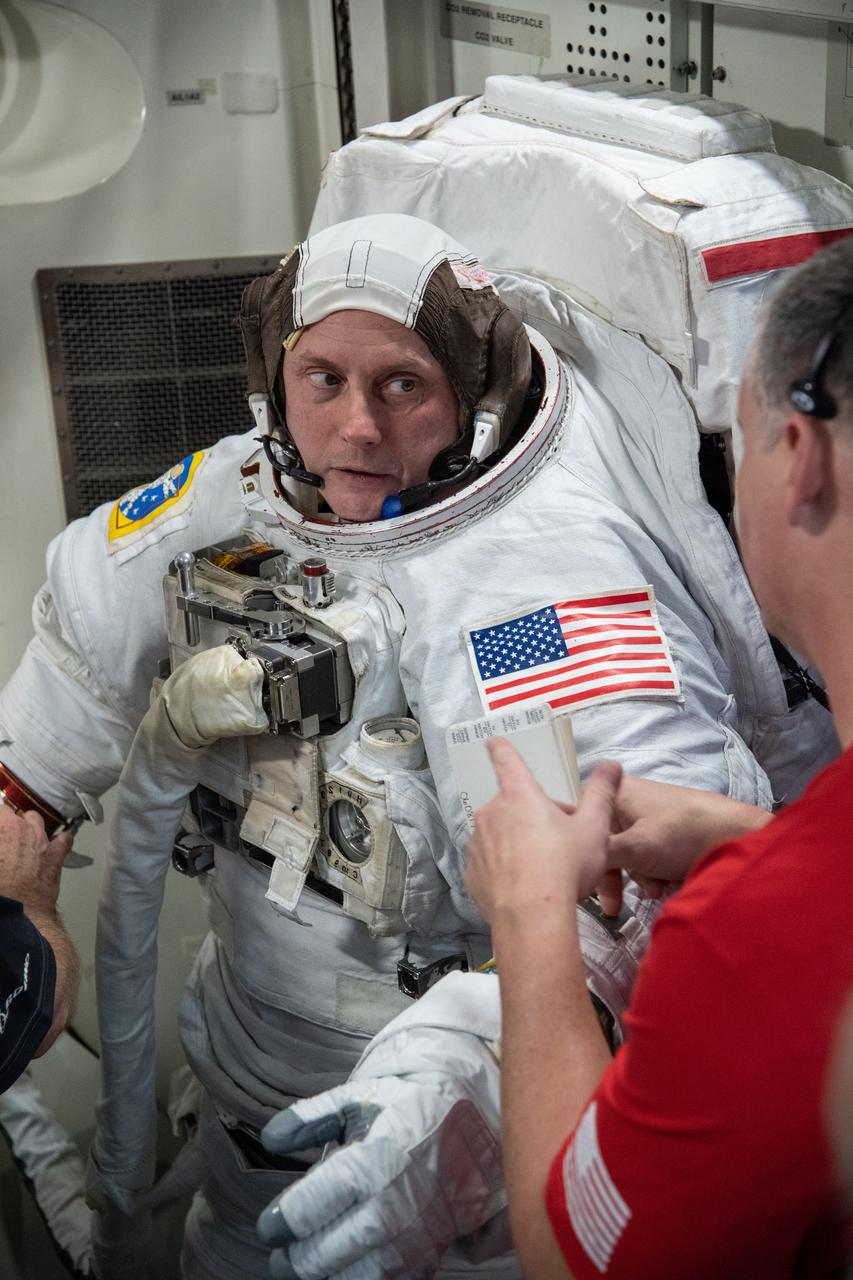
Boeing Crew Flight Test (CFT) with NASA astronauts Mike Fincke and Nicole Mann and Boeing Astronaut Chris Ferguson during ISS EVA Prep & Post 1 training.
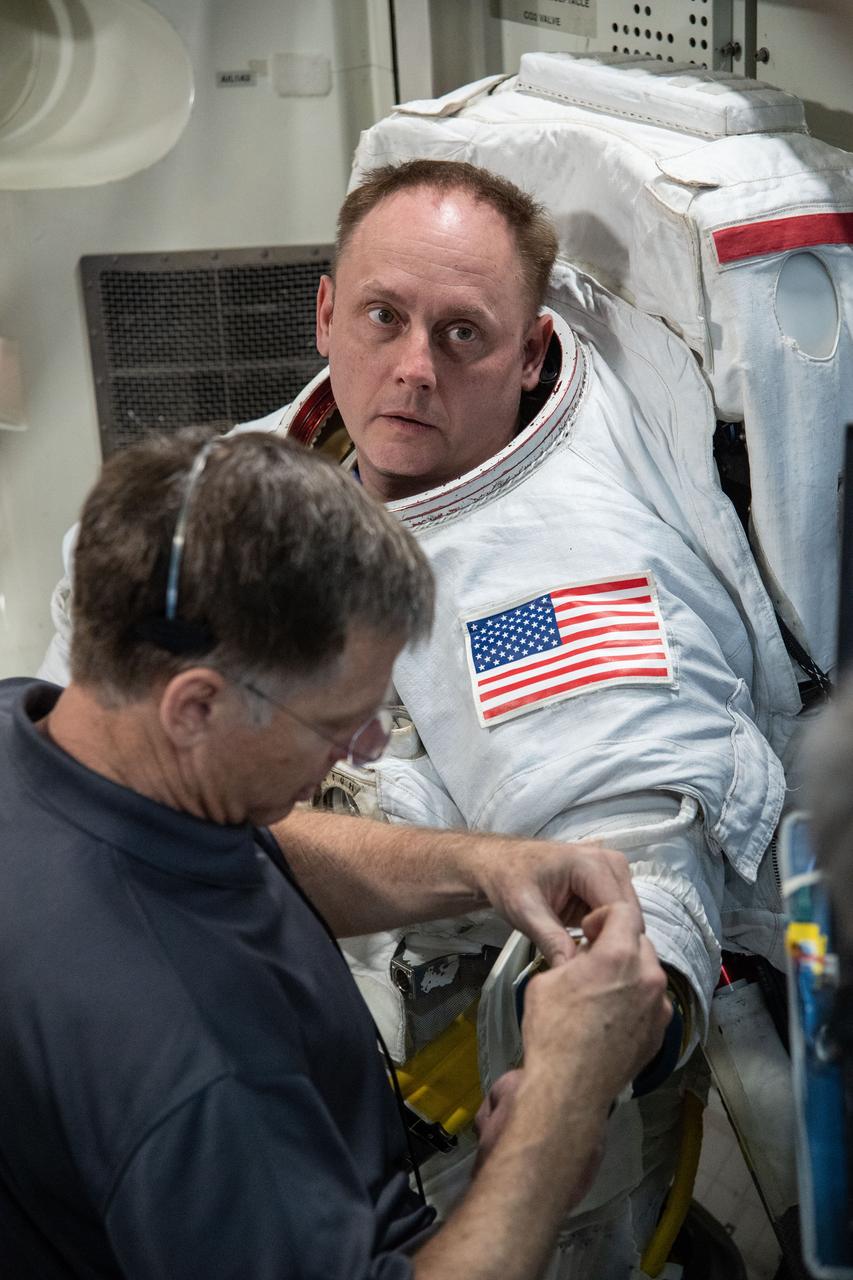
Boeing Crew Flight Test (CFT) with NASA astronauts Mike Fincke and Nicole Mann and Boeing Astronaut Chris Ferguson during ISS EVA Prep & Post 1 training.
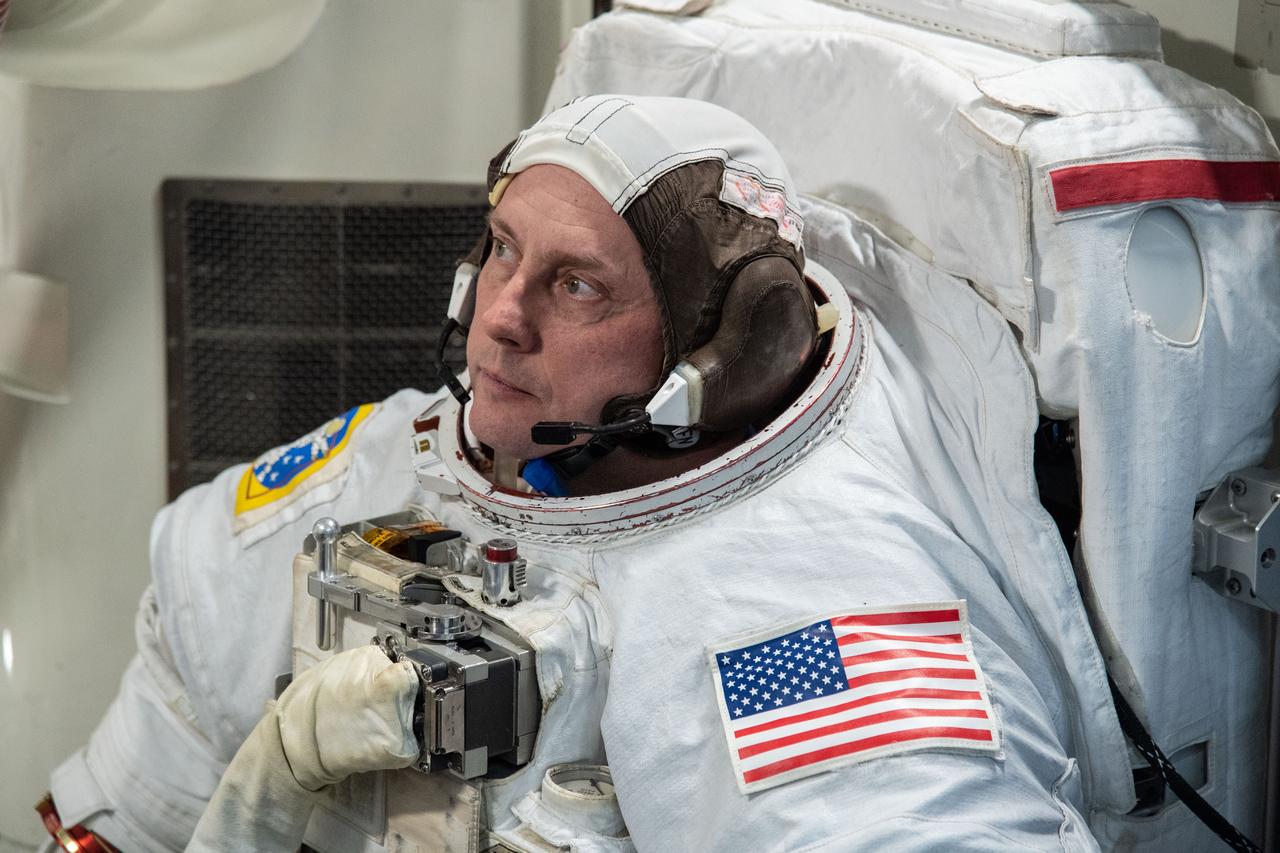
Boeing Crew Flight Test (CFT) with NASA astronauts Mike Fincke and Nicole Mann and Boeing Astronaut Chris Ferguson during ISS EVA Prep & Post 1 training.
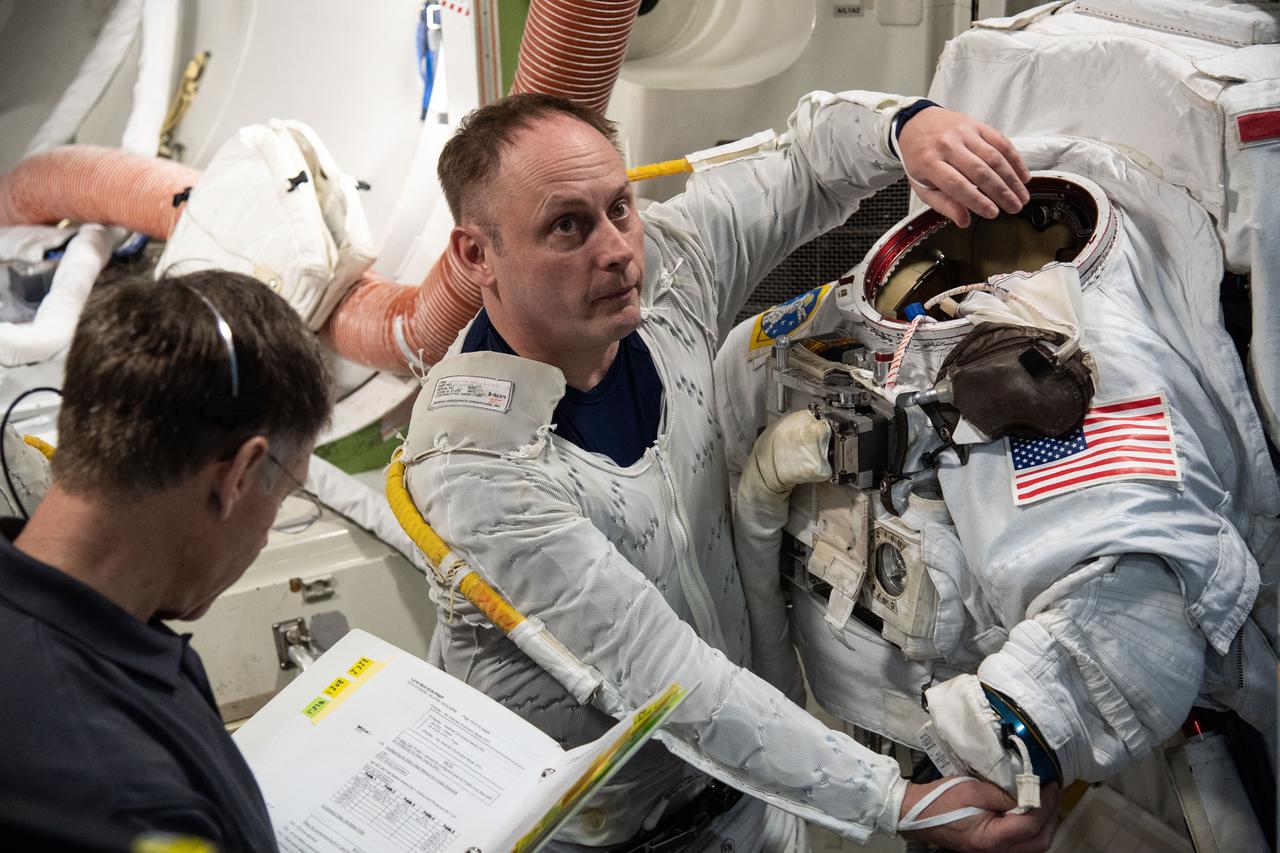
Boeing Crew Flight Test (CFT) with NASA astronauts Mike Fincke and Nicole Mann and Boeing Astronaut Chris Ferguson during ISS EVA Prep & Post 1 training.
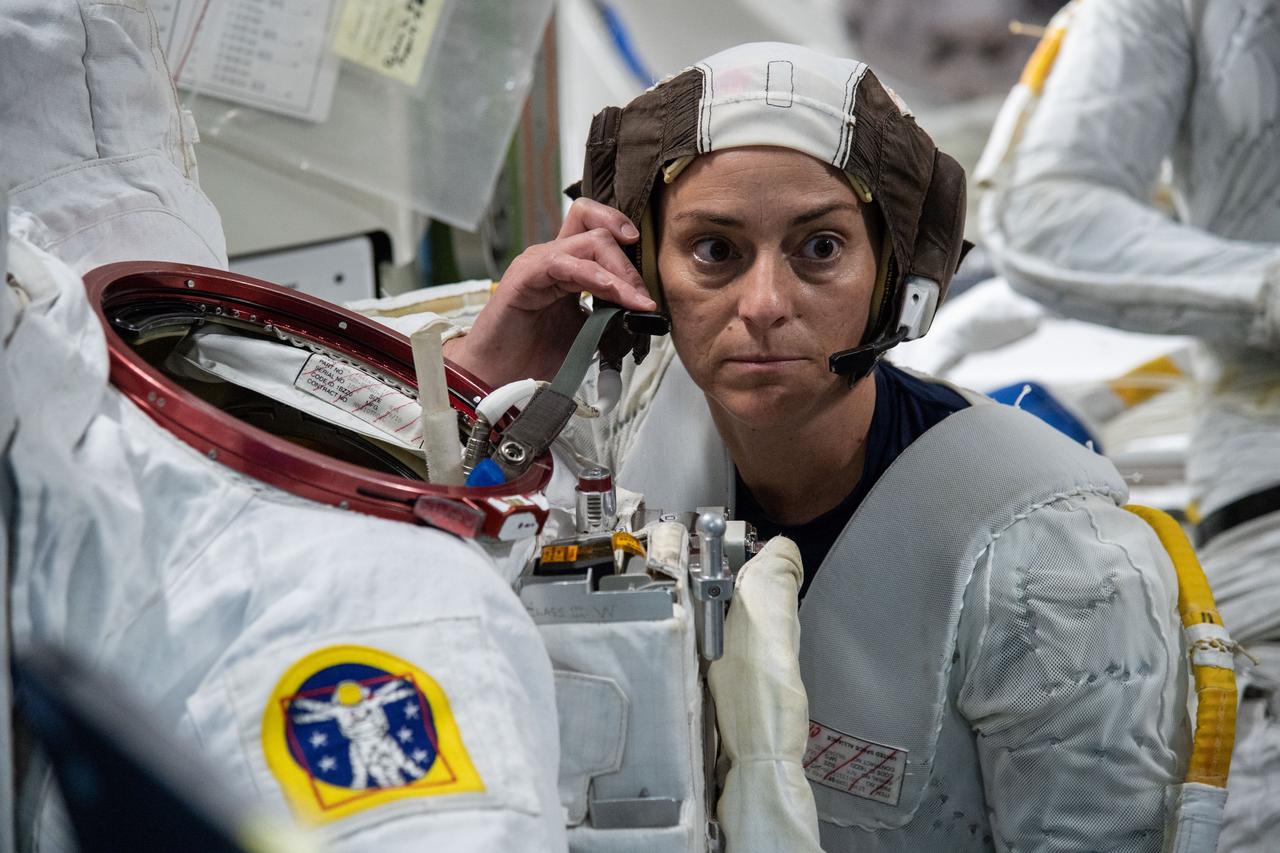
Boeing Crew Flight Test (CFT) with NASA astronauts Mike Fincke and Nicole Mann and Boeing Astronaut Chris Ferguson during ISS EVA Prep & Post 1 training.
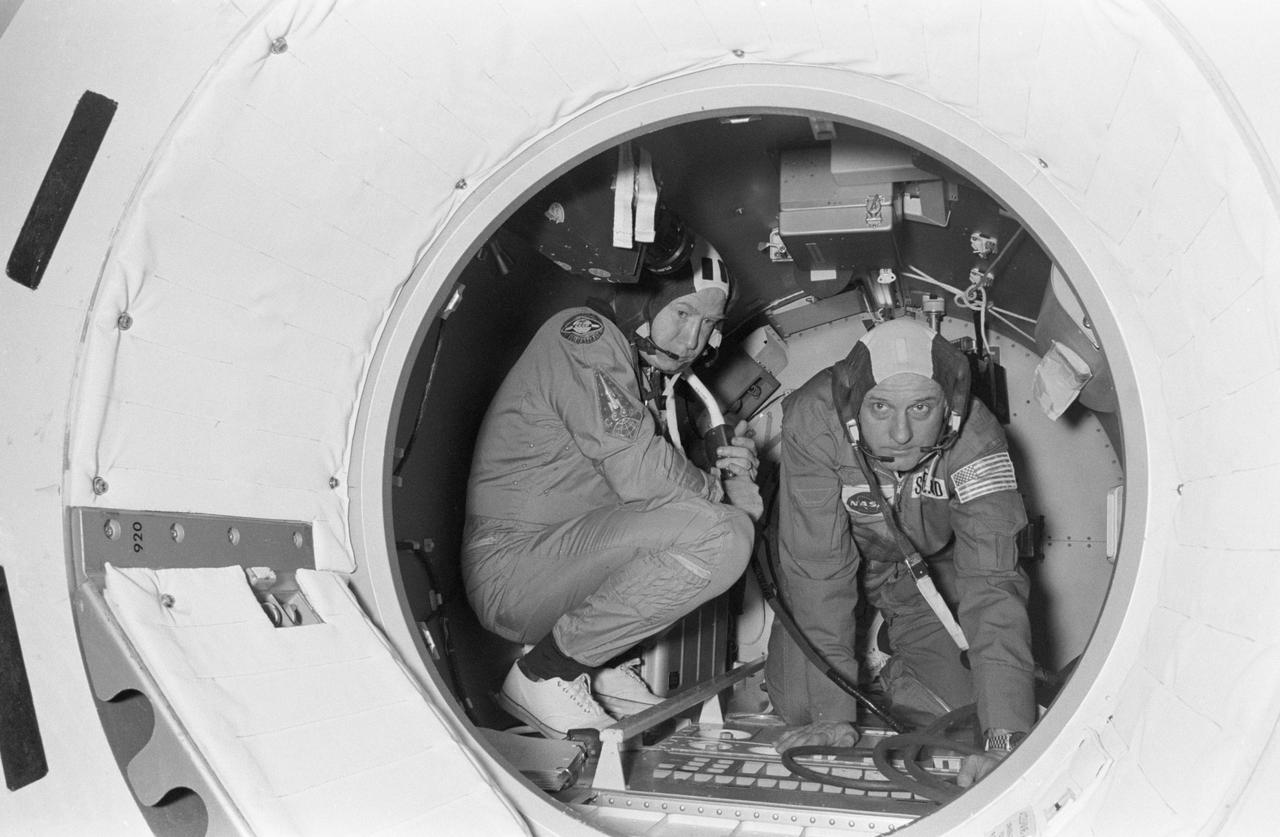
S75-21945 (24 Feb. 1975) --- Cosmonaut Aleksey A. Leonov (left) and astronaut Thomas P. Stafford take part in Apollo-Soyuz Test Project joint crew training in Building 35 at NASA's Johnson Space Center. They are commanders of their respective prime crews. The training session simulated the activities of the second day in Earth orbit. Stafford and Leonov are in the Docking Module mock-up.
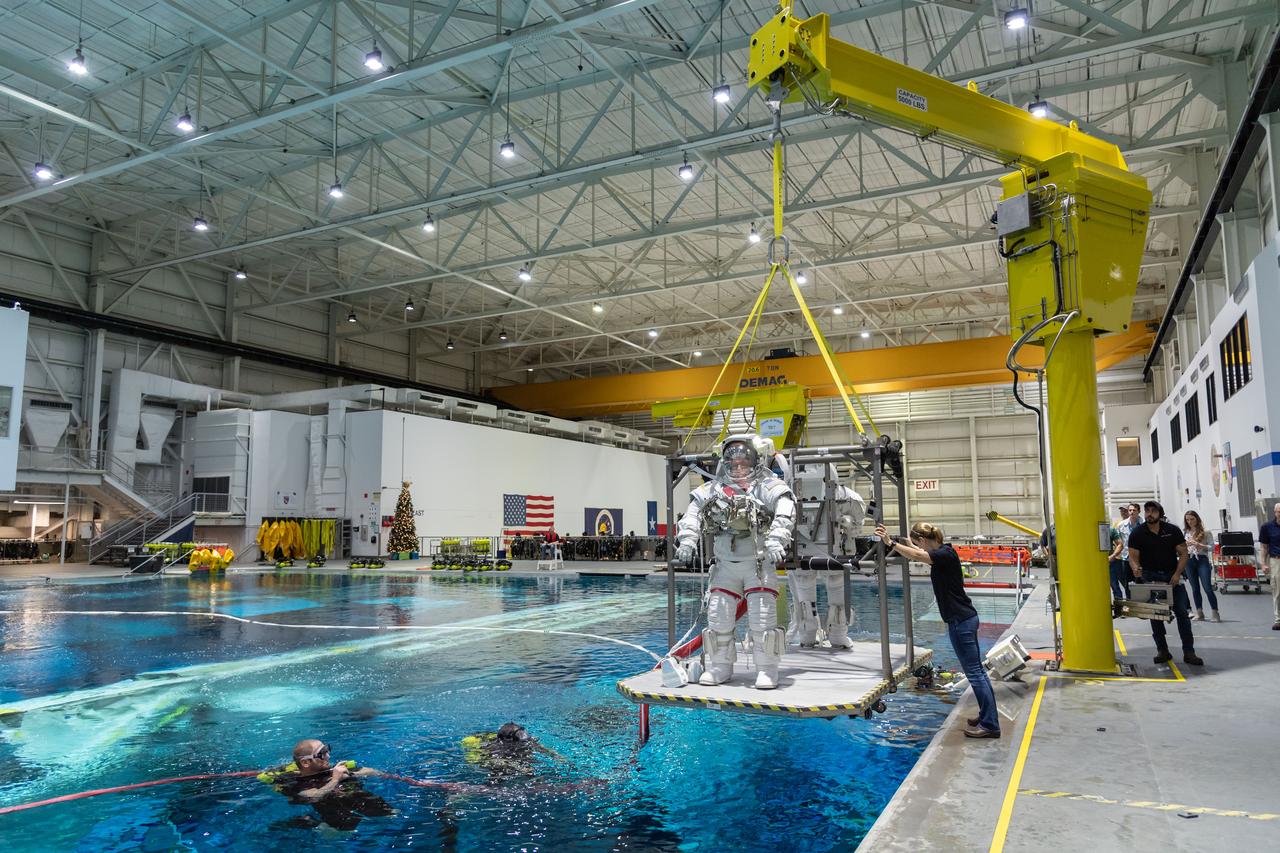
Commercial Crew Program astronaut Barry "Butch" Wilmore in EVA suitup at NBL with Expedition 62 cosmonaut Nikolai Tikhonov during Expedition 62 ISS EVA Maintenance 2 training.
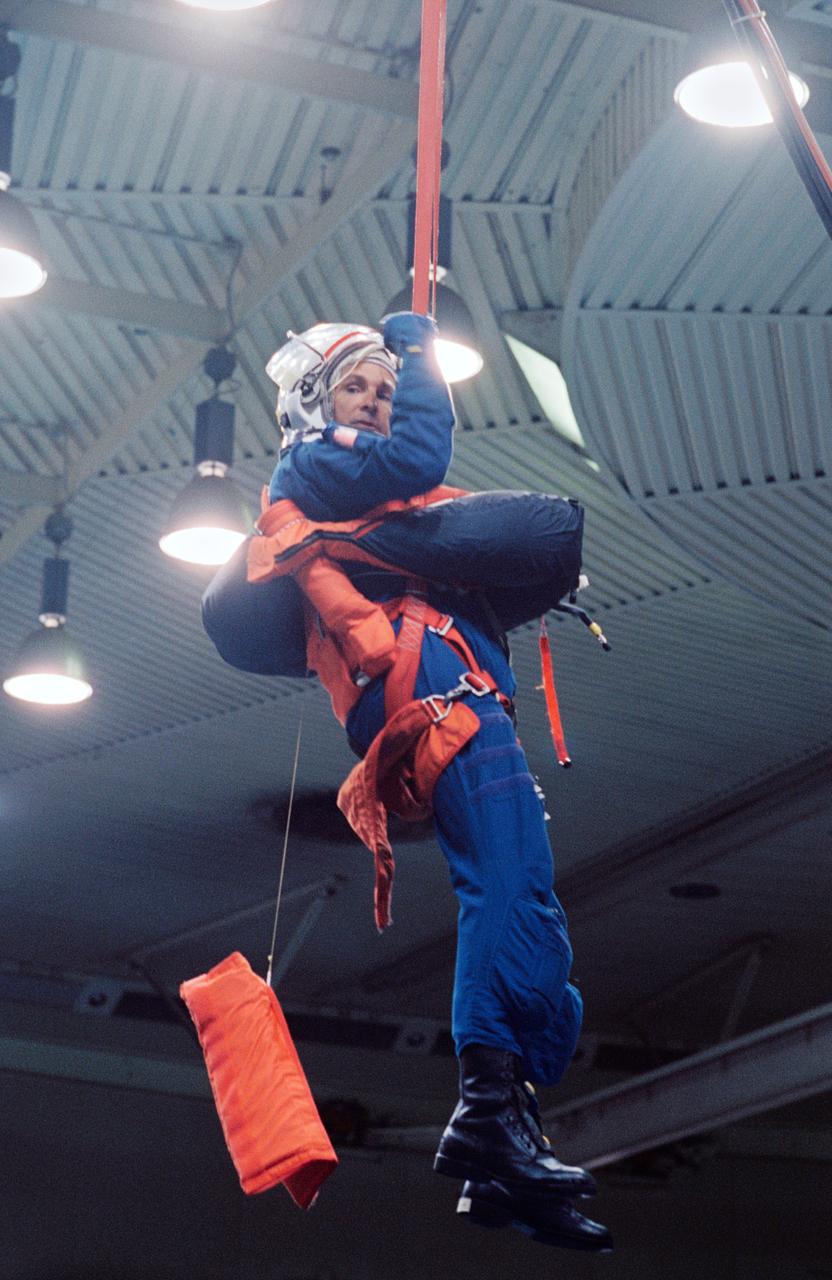
S94-37516 (28 June 1994) --- Astronaut Curtis L. Brown is suspended by a simulated parachute gear during an emergency bailout training exercise in the Johnson Space Center's (JSC) Weightless Environment Training Facility (WET-F). Making his second flight in space, Brown will join four other NASA astronauts and a European mission specialist for a week and a half in space aboard the Space Shuttle Atlantis in support of the Atmospheric Laboratory for Applications and Science (ATLAS-3) mission.
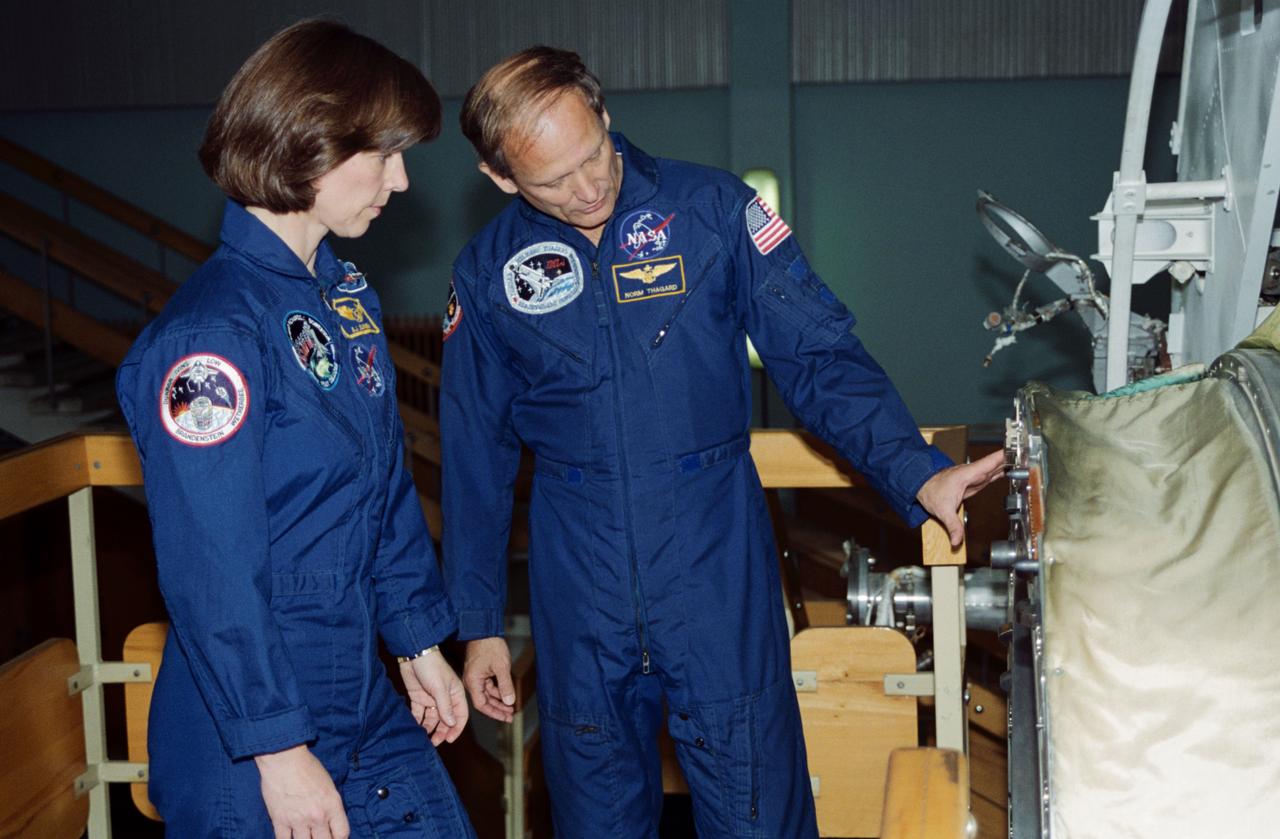
S94-45647 (20 Sept 1994) --- Astronaut's Norman E. Thagard and Bonnie J. Dunbar by the Mir Space Station simulator at the Gagarin Cosmonaut Training Center (Star City), near Moscow, Russia. In March 1995, astronaut Thagard is scheduled to be launched in a Russian Soyuz spacecraft with two cosmonauts to begin a three-month tour of duty on the Russian Mir Space Station. Thagard, along with his back-up, astronaut Dunbar, has been training in Russia since February 1994. During his stay on Mir, he will conduct a variety of life sciences experiments that will provide U.S. investigators with the first long-duration exposure data since Skylab in the late 1970's. Thagard's mission will end in late May or early June when the Space Shuttle Atlantis, carrying the newly installed docking mechanism, docks with Mir Space Station for the first United States - Russian docking operation since Apollo-Soyuz in 1975. The Orbiter will remain attached to Mir for five days of joint scientific operations before returning home with Thagard and his Russian crew mates and leaving behind two cosmonauts on Mir.
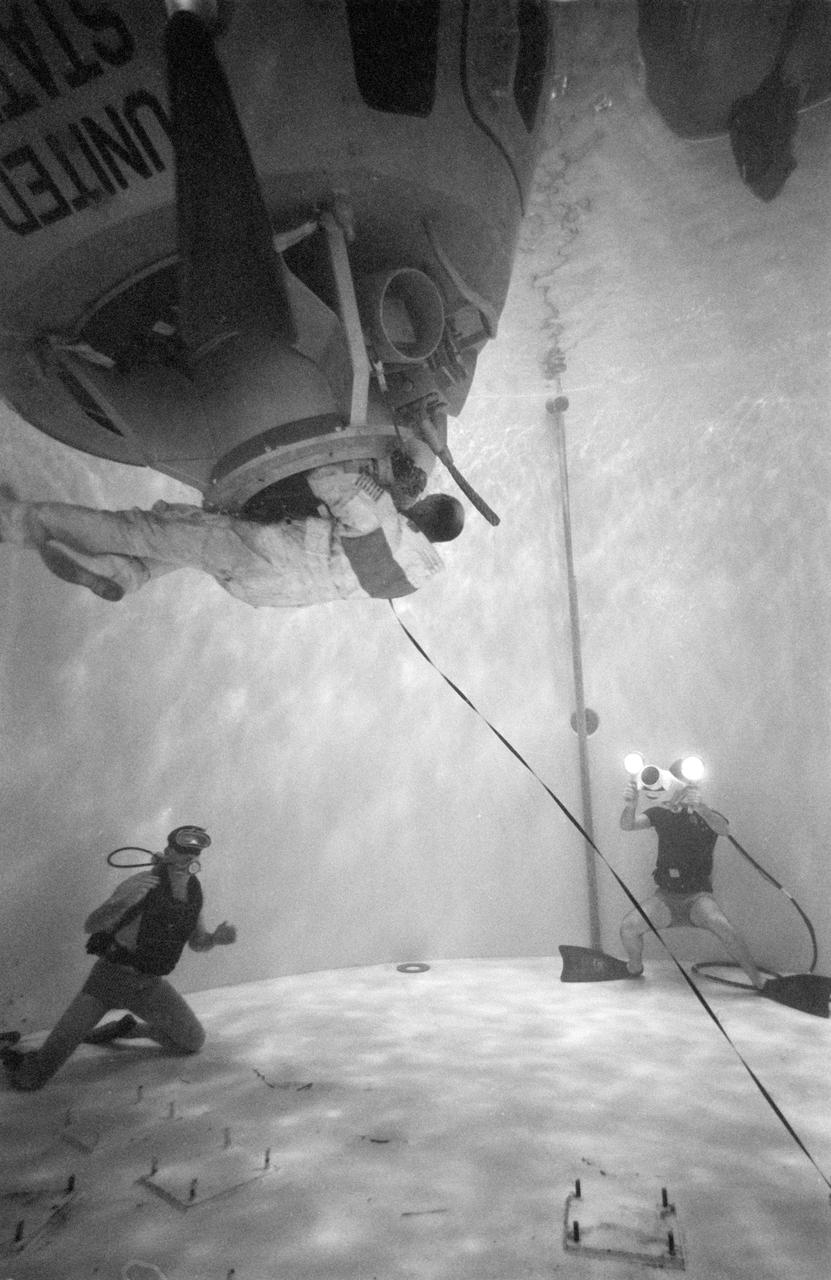
S70-24016 (17 Jan. 1970) --- Astronaut Thomas K. Mattingly II, command module pilot of the Apollo 13 lunar landing mission, participates in water egress training in a water tank in Building 260 at the Manned Spacecraft Center.
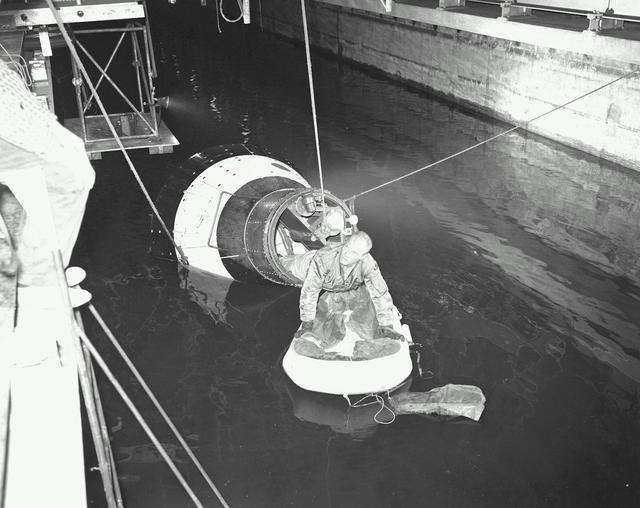
B60-00285 (1960) --- Astronaut John H. Glenn Jr., pilot of the Mercury Atlas 6 spaceflight, emerges from an egress trainer during training activity at the Langley Research Center. He is attempting to transfer onto a life raft from the mock-up of the Mercury capsule. Photo credit: NASA
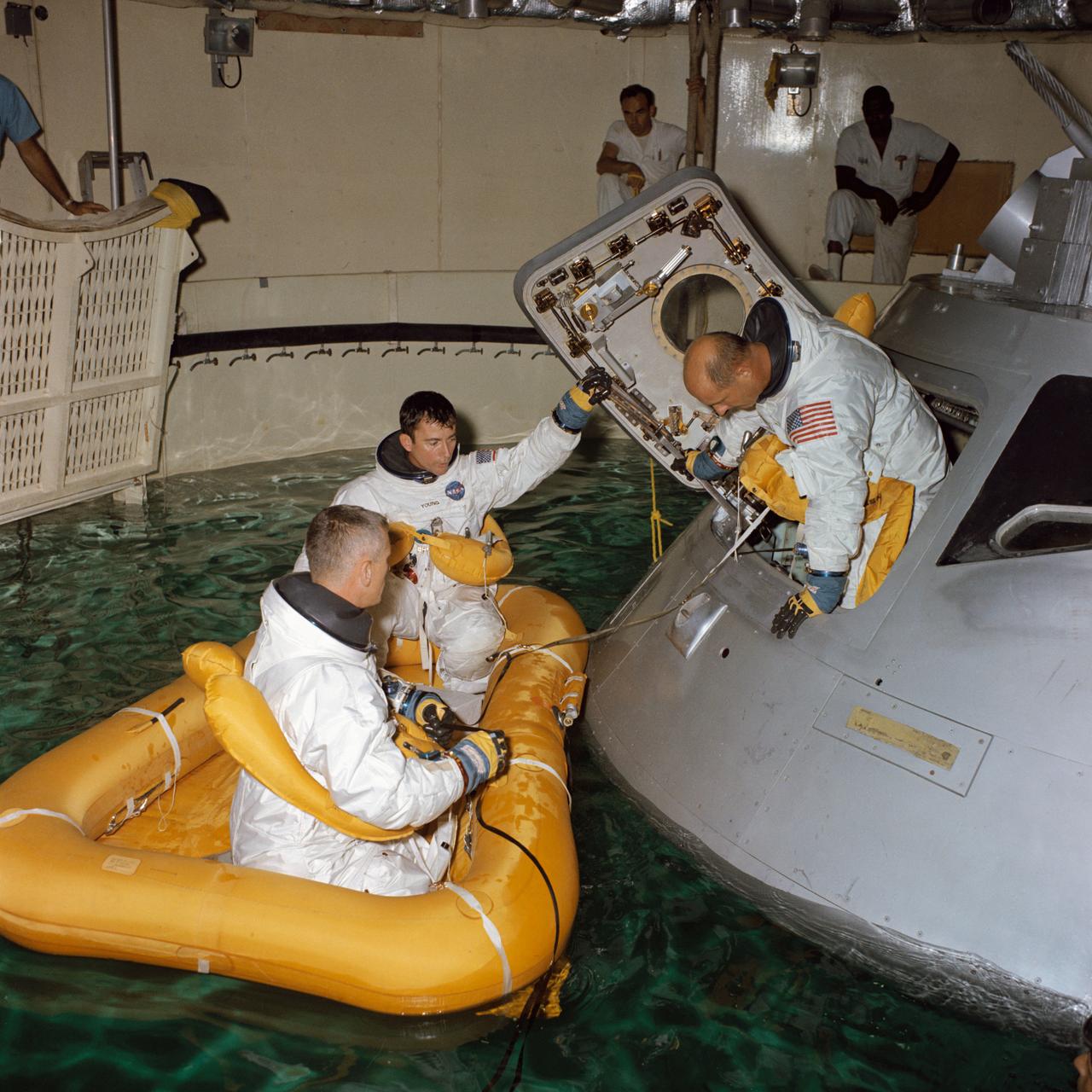
S68-41685 (August 1968) --- Three astronauts participate in Apollo water egress training in a tank in Building 260 at the Manned Spacecraft Center. Egressing the Apollo Command Module trainer is Thomas P. Stafford. Already in life raft are Eugene A. Cernan (in foreground) and John W. Young.
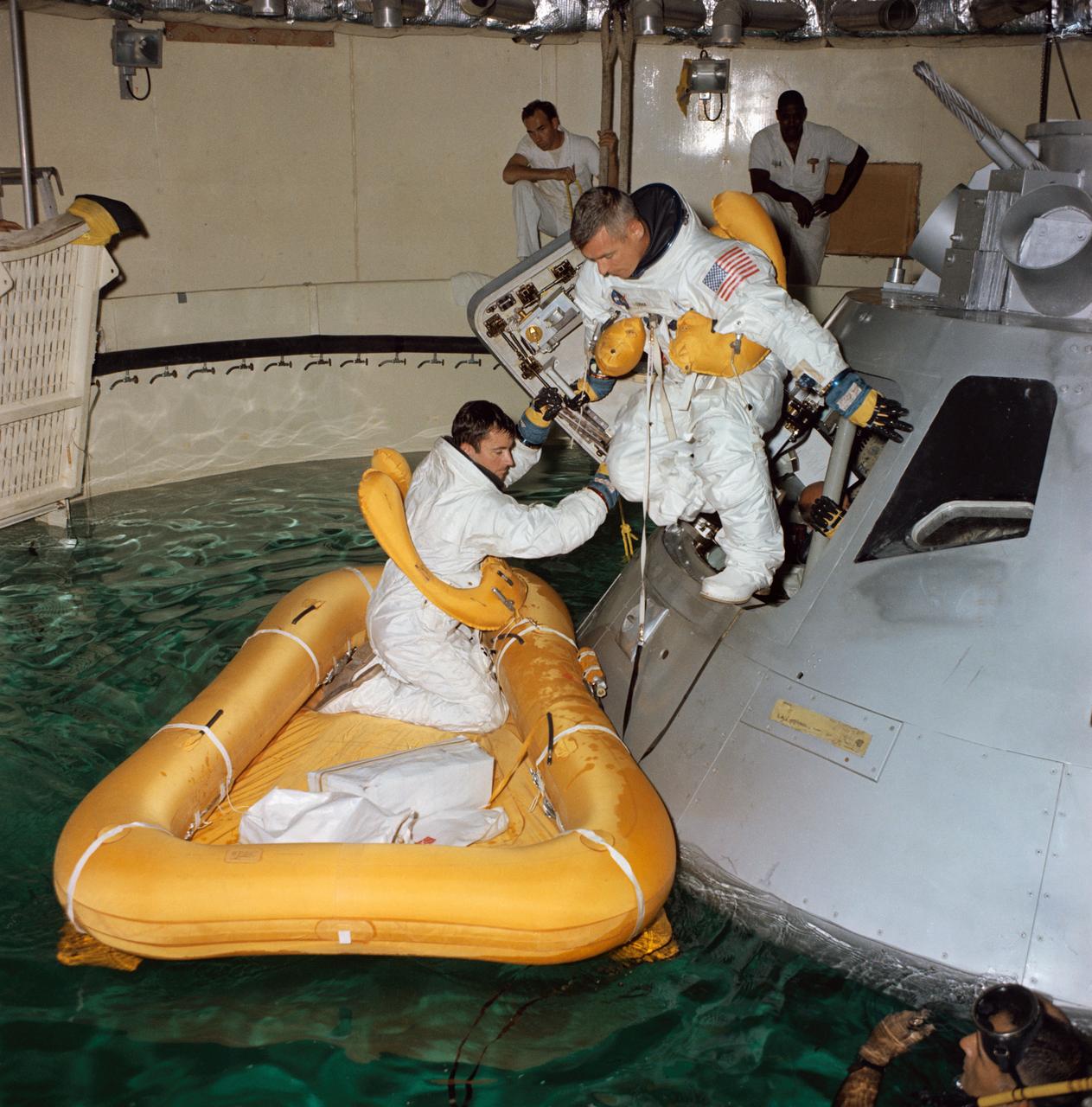
S68-41683 (August 1968) --- Three astronauts participate in Apollo water egress training in a tank in Building 260 at the Manned Spacecraft Center. Already in life raft is John W. Young. Eugene A. Cernan is egressing the Apollo Command Module trainer. Inside the trainer and almost obscured is Thomas P. Stafford.
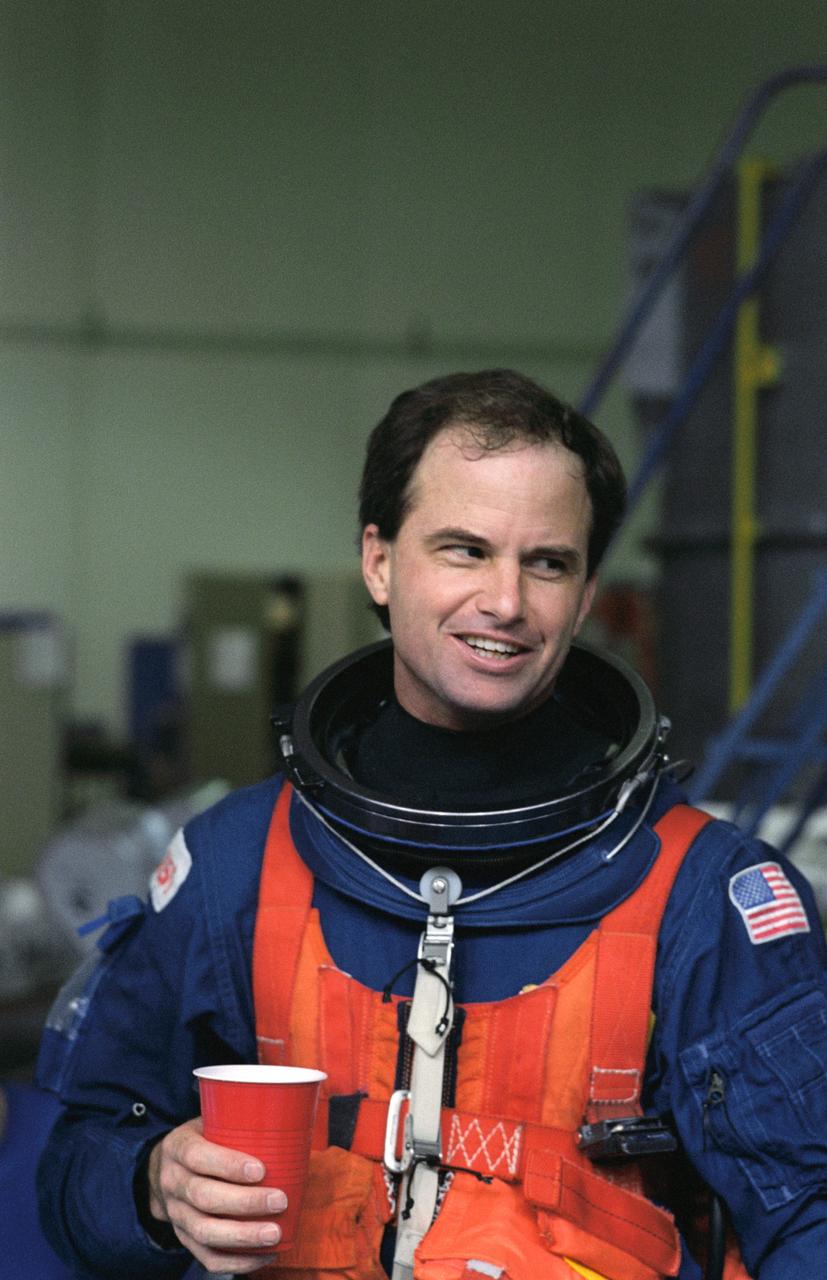
S93-50720 (22 Dec 1993) --- Astronaut Kevin P. Chilton, pilot, takes a break during emergency bailout training at the Johnson Space Center's (JSC) Weightless Environment Training Facility (WET-F). Chilton and five other NASA astronauts are scheduled to fly aboard the Space Shuttle Endeavour next year.
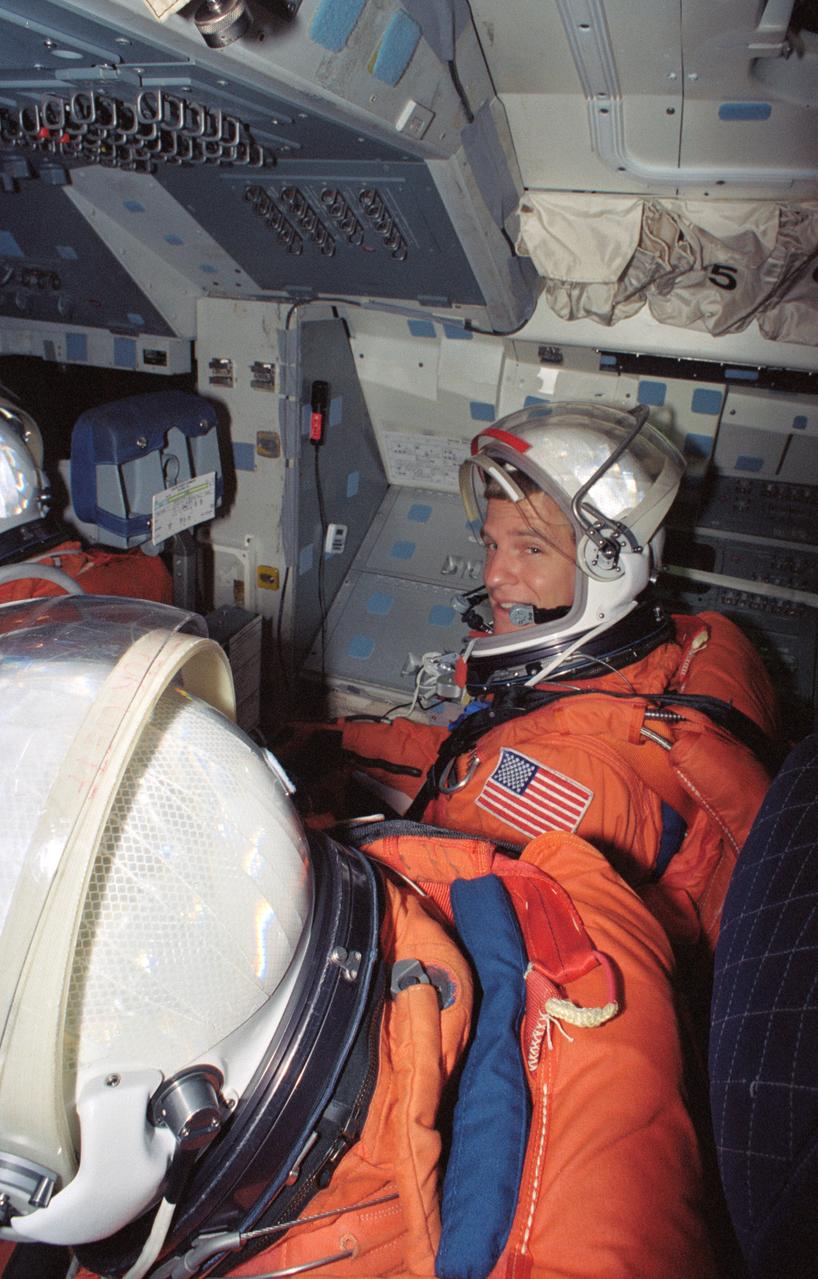
S94-40079 (23 June 1994) --- Astronaut Scott E. Parazynski looks at fellow STS-66 mission specialist Joseph R. Tanner, (partially visible in foreground) during a rehearsal of procedures to be followed during launch and entry phases of the their scheduled November flight. This rehearsal, held in the Crew Compartment Trainer (CCT) of the Johnson Space Center's (JSC) Shuttle Mockup and Integration Laboratory, was followed by a training session on emergency egress procedures. In November, Parazynski and Tanner will join three other NASA astronauts and a European mission specialist for a week and a half aboard the Space Shuttle Atlantis in Earth-orbit in support of the Atmospheric Laboratory for Applications and Science (ATLAS-3).
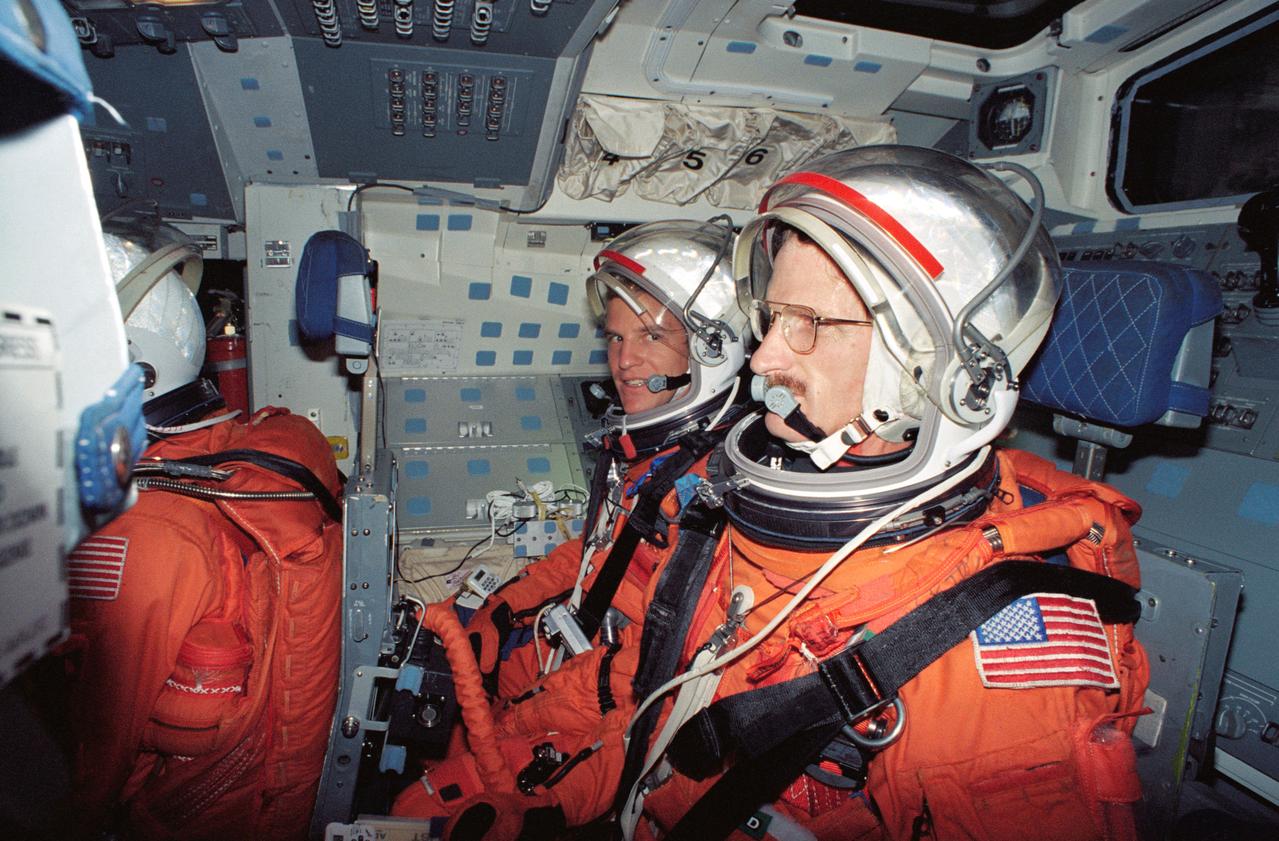
S94-40083 (23 June 1994) --- Astronaut Scott E. Parazynski looks at fellow STS-66 mission specialist Joseph R. Tanner, (foreground) during a rehearsal of procedures to be followed during launch and entry phases of the their scheduled November flight. This rehearsal, held in the Crew Compartment Trainer (CCT) of the Johnson Space Center's (JSC) Shuttle Mockup and Integration Laboratory, was followed by a training session on emergency egress procedures. In November, Parazynski and Tanner will join three other NASA astronauts and a European mission specialist for a week and a half aboard the Space Shuttle Atlantis in Earth-orbit in support of the Atmospheric Laboratory for Applications and Science (ATLAS-3).