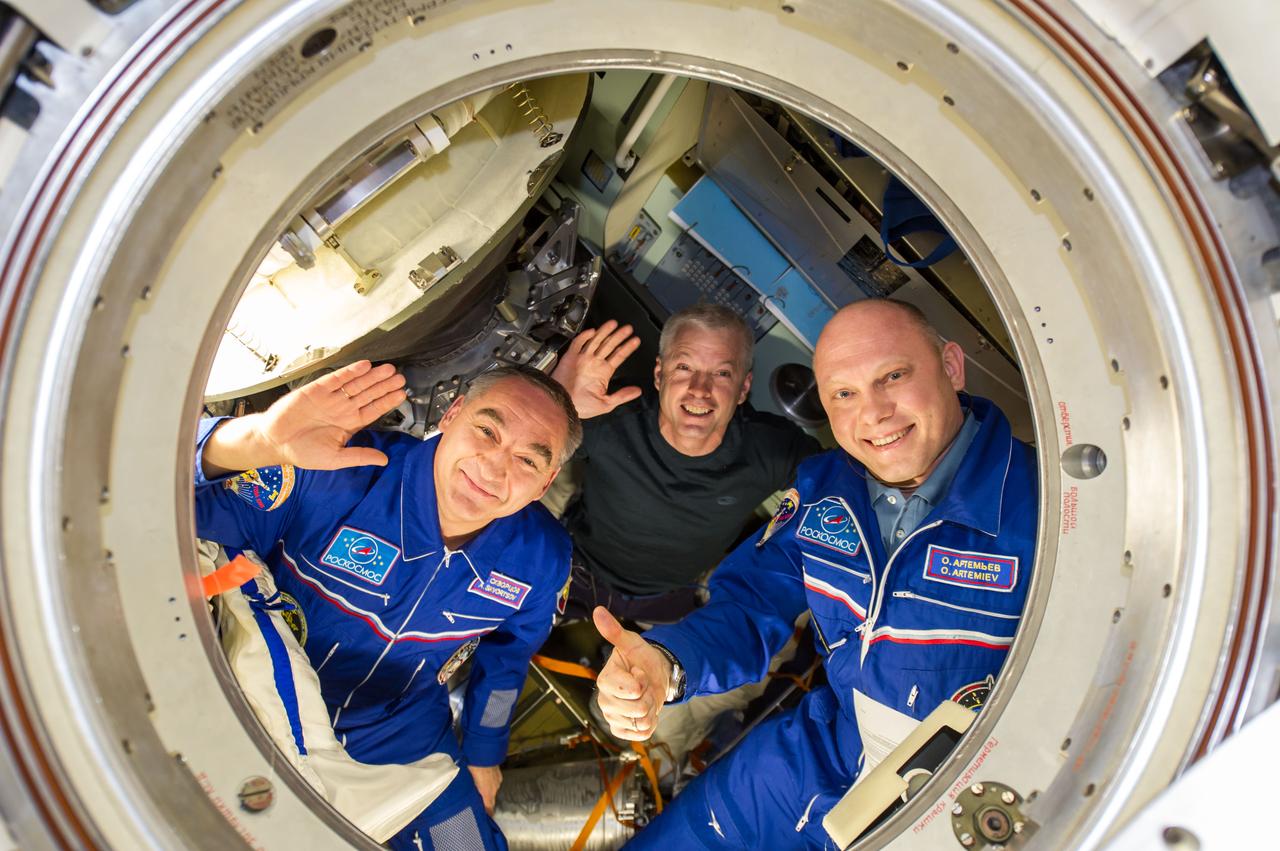
ISS040-E-139846 (10 Sept. 2014) --- NASA astronaut Steve Swanson (center), Expedition 40 commander; along with Russian cosmonauts Alexander Skvortsov (left) and Oleg Artemyev, both flight engineers, are pictured in the Soyuz TMA-12M capsule which will return them back to Earth after serving more than five months onboard the orbital outpost. Undocking from the International Space Station’s Poisk Mini-Research Module 2 (MRM2) occurred at 7:01 p.m. (EDT) on Sept. 10, 2014.
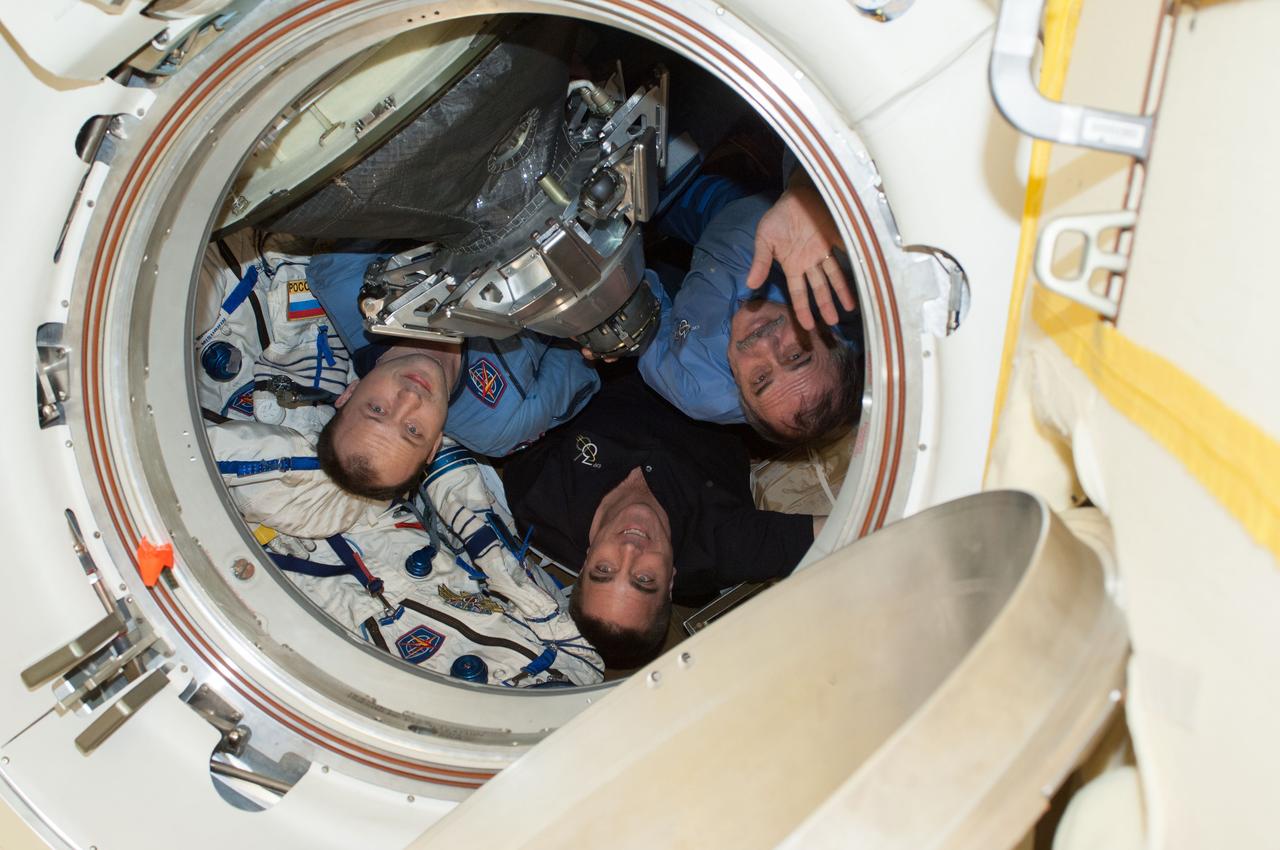
ISS036-E-048267 (10 Sept. 2013) --- Russian cosmonaut Pavel Vinogradov (right), Expedition 36 commander; along with NASA astronaut Chris Cassidy (center) and Russian cosmonaut Alexander Misurkin, both flight engineers, are pictured in the Soyuz TMA-08M spacecraft currently docked to the Poisk Mini-Research Module 2 (MRM2) of the International Space Station. The trio is preparing to undock from Poisk in their Soyuz spacecraft, ending a five-and-a-half month stay at the station.
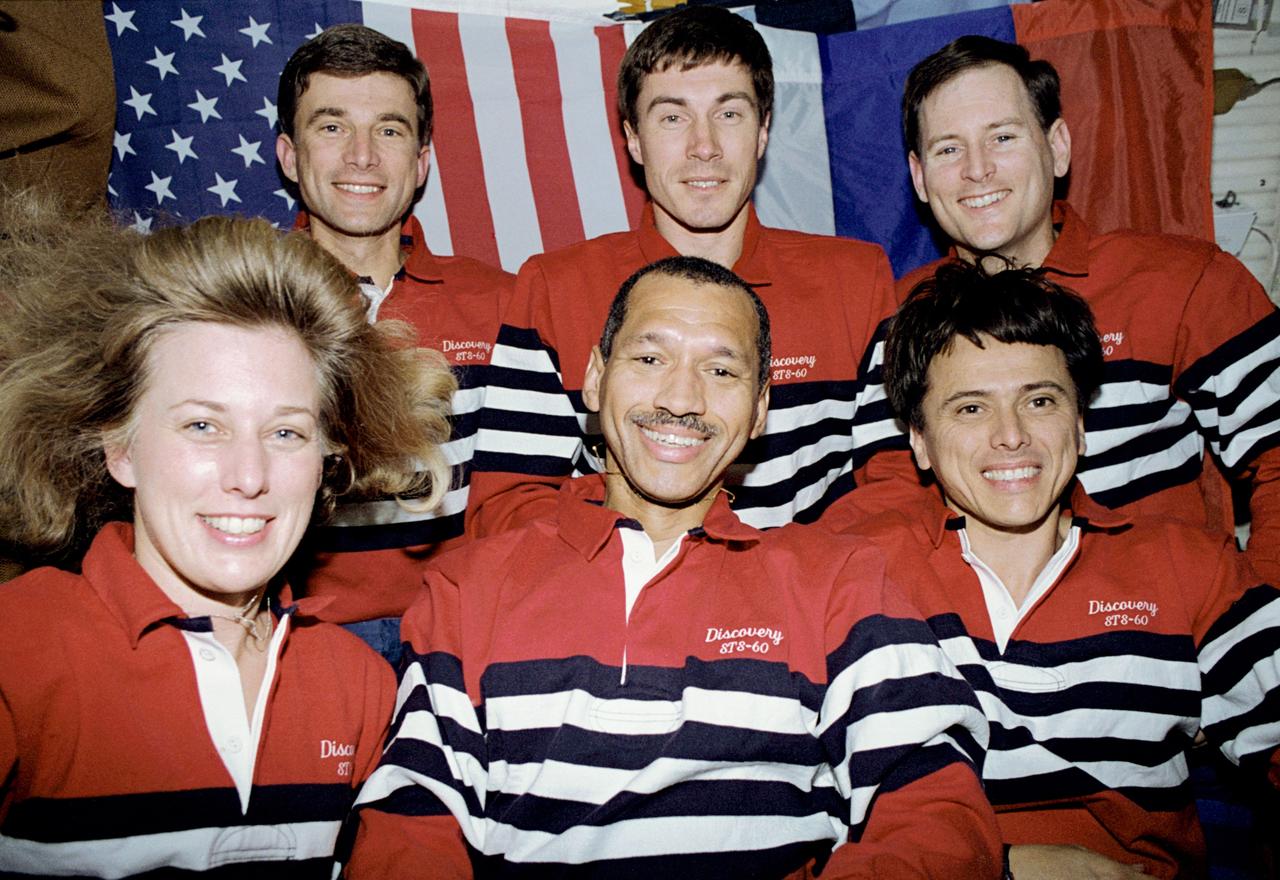
STS060-31-009 (3-11 Feb. 1994) --- The six-member STS-60 crew pose for the traditional in-flight crew portrait, with American and Russian flags forming the backdrop on the space shuttle Discovery’s middeck. Left to right (front row) are N. Jan Davis, Charles F. Bolden Jr. and Franklin R. Chang-Diaz; and (back row) Ronald M. Sega, Sergei K. Krikalev and Kenneth S. Reightler Jr. Photo credit: NASA or National Aeronautics and Space Administration

ISS040-E-139800 (10 Sept. 2014) --- NASA astronaut Steve Swanson, Expedition 40 commander, is pictured in the Soyuz TMA-12M capsule which will return him back to Earth along with Russian cosmonauts Alexander Skvortsov and Oleg Artemyev, both flight engineers. Undocking from the International Space Station’s Poisk Mini-Research Module 2 (MRM2) occurred at 7:01 p.m. (EDT) on Sept. 10, 2014.
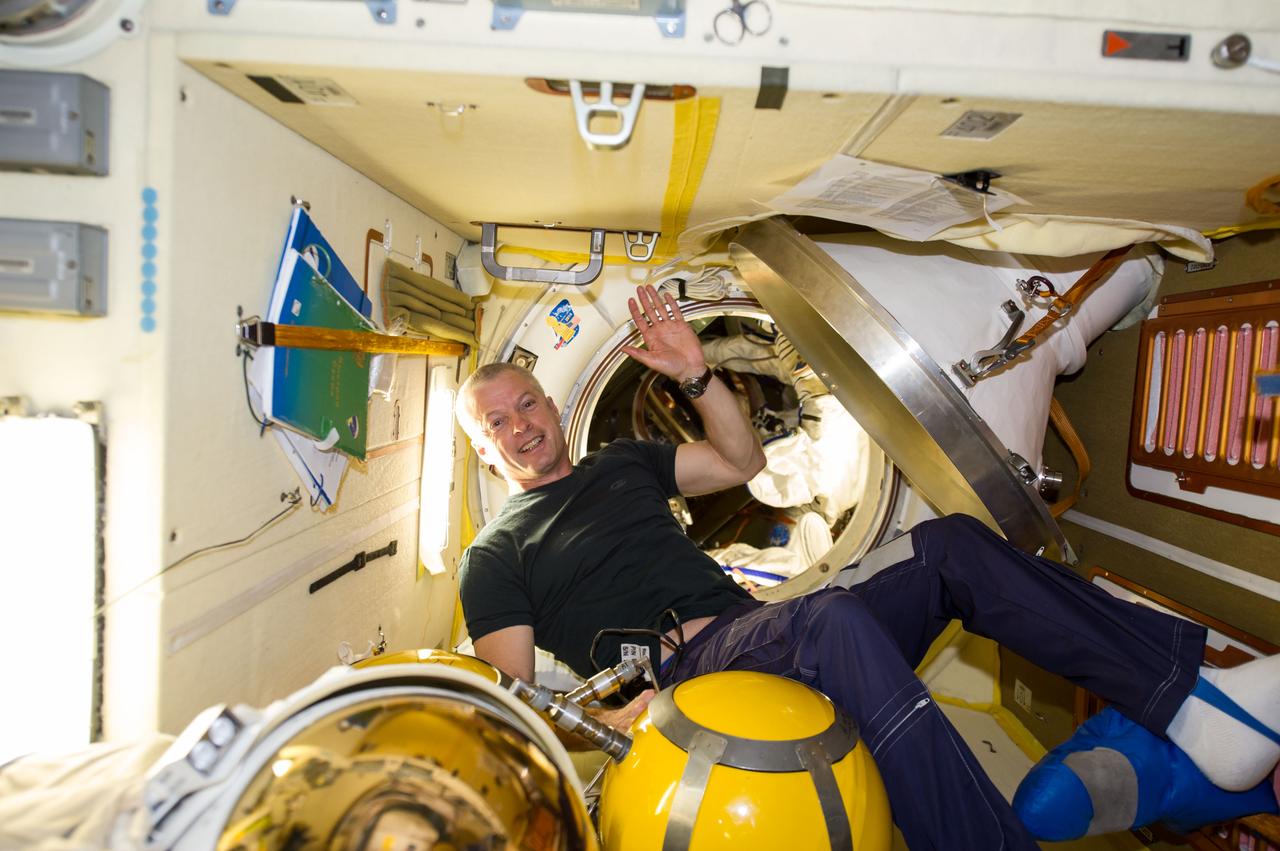
ISS040-E-139784 (10 Sept. 2014) --- In the Poisk Mini-Research Module 2 (MRM2), NASA astronaut Steve Swanson, Expedition 40 commander, waves good-bye prior to entering the Soyuz TMA-12M capsule which will return him back to Earth along with Russian cosmonauts Alexander Skvortsov and Oleg Artemyev, both flight engineers. Undocking occurred at 7:01 p.m. (EDT) on Sept. 10, 2014.
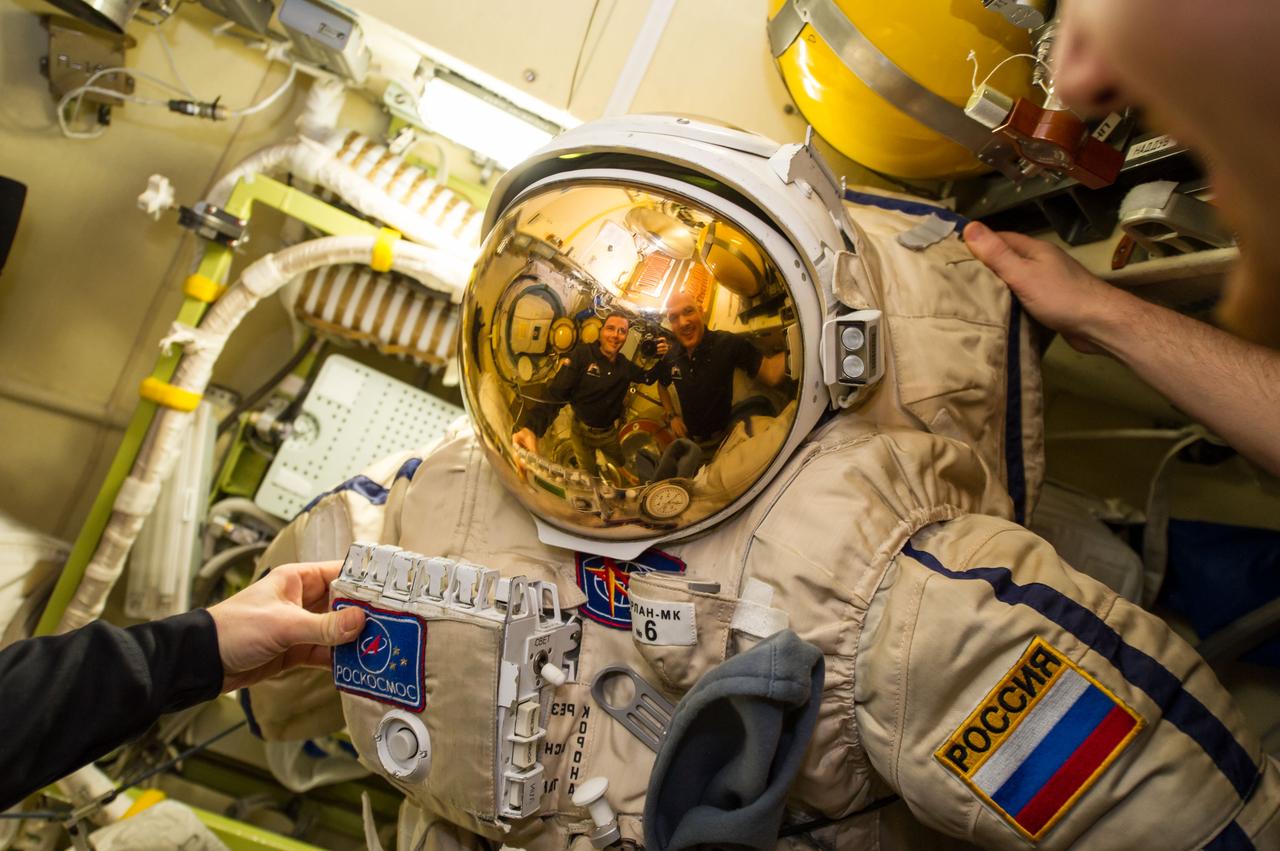
ISS040-E-139809 (10 Sept. 2014) --- An unoccupied Russian Orlan spacesuit is pictured in the Russian segment of the International Space Station. Visible in the reflections of the helmet visor are NASA astronaut Reid Wiseman (left with still camera) and European Space Agency astronaut Alexander Gerst, both Expedition 40/41 flight engineers.
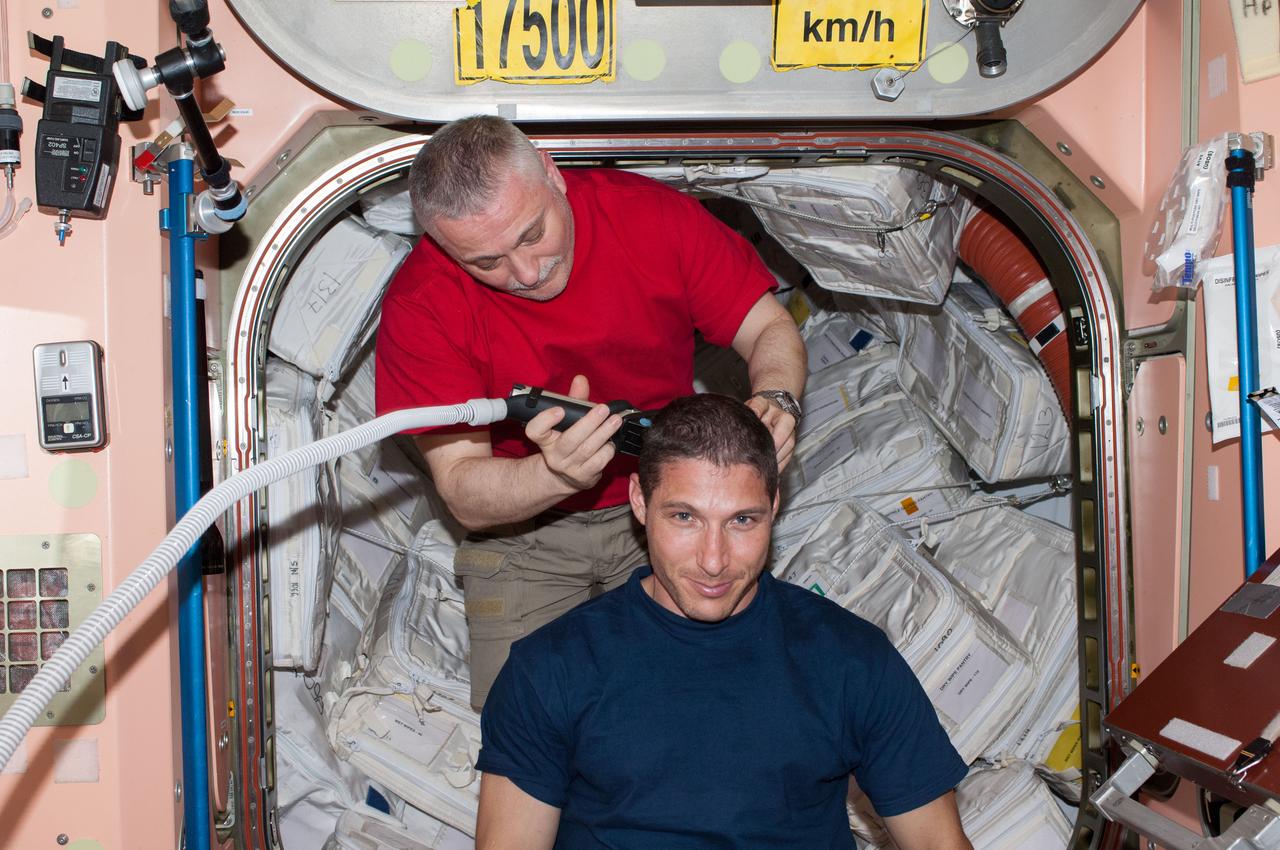
ISS037-E-006568 (5 Oct. 2013) --- Russian cosmonaut Fyodor Yurchikhin, Expedition 37 commander, trims the hair of NASA astronaut Michael Hopkins, flight engineer, in the Node 1 module, called Unity. Yurchikhin used hair clippers fashioned with a vacuum device to garner freshly cut hair.
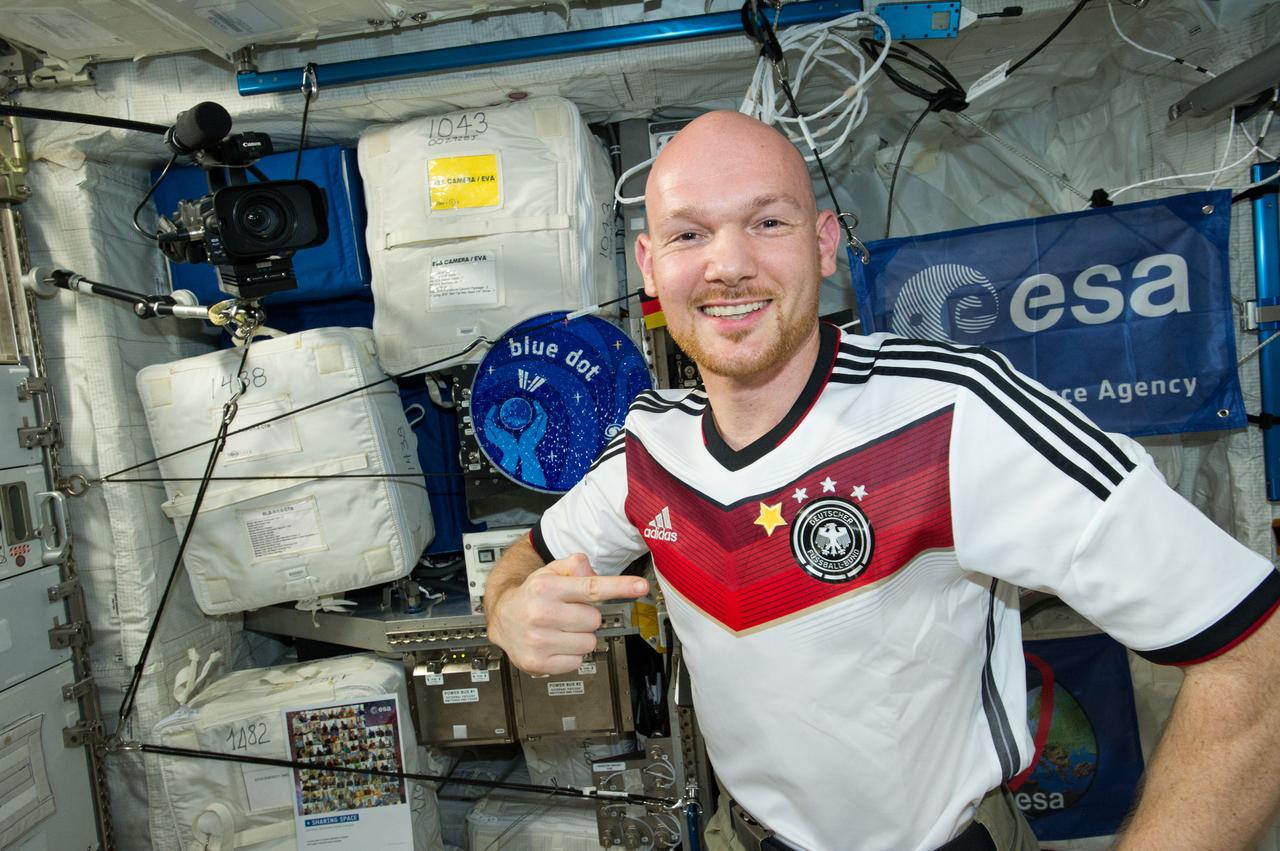
European Space Agency astronaut Alexander Gerst,Expedition 40 flight engineer,sends down a congratulations to the victorious German team after the World Cup finals. Photo taken in Columbus module.
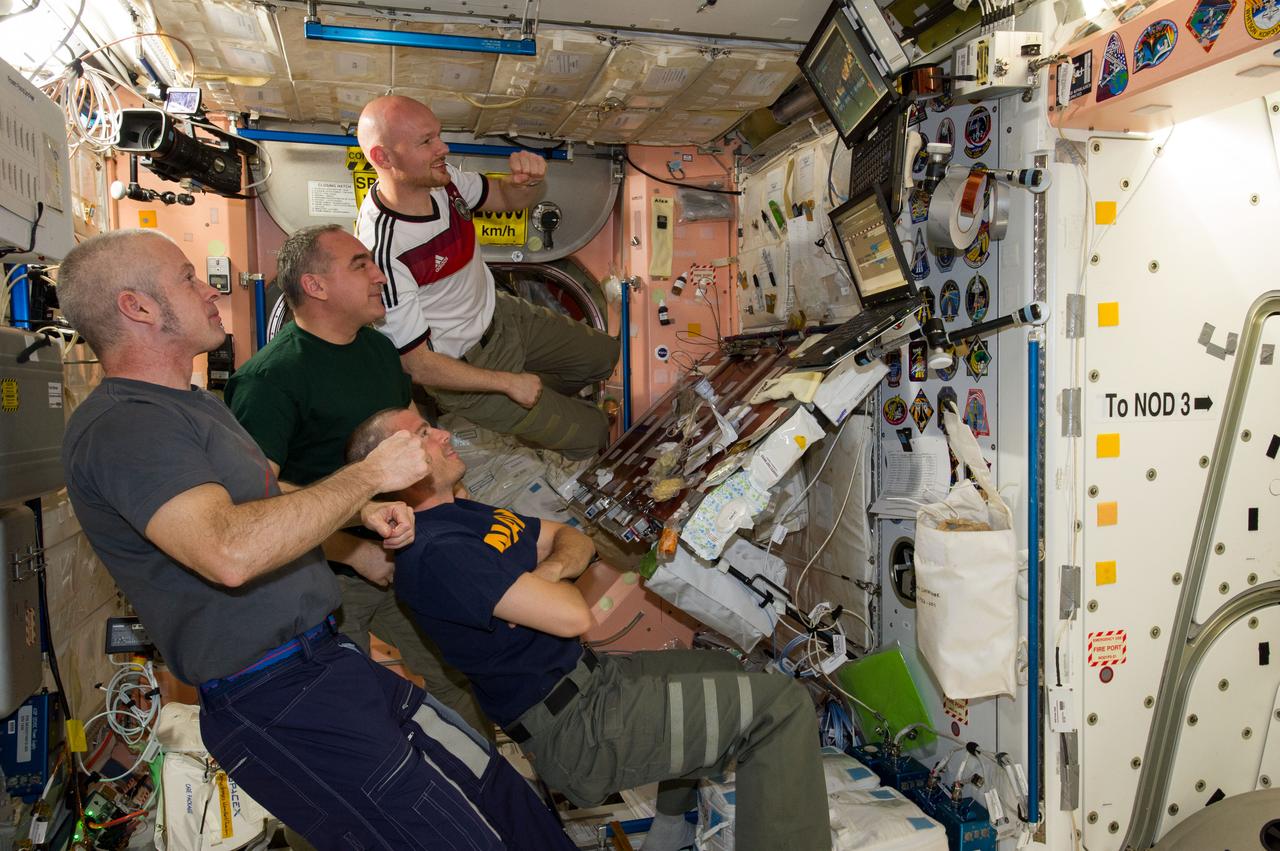
NASA astronaut Steve Swanson (left),Expedition 40 commander; along with European Space Agency astronaut Alexander Gerst (upper left), NASA astronaut Reid Wiseman and Cosmonaut Alexander Skvortsov,all three flight engineers,gather around a computer in Node 1 to watch the World Cup finals.
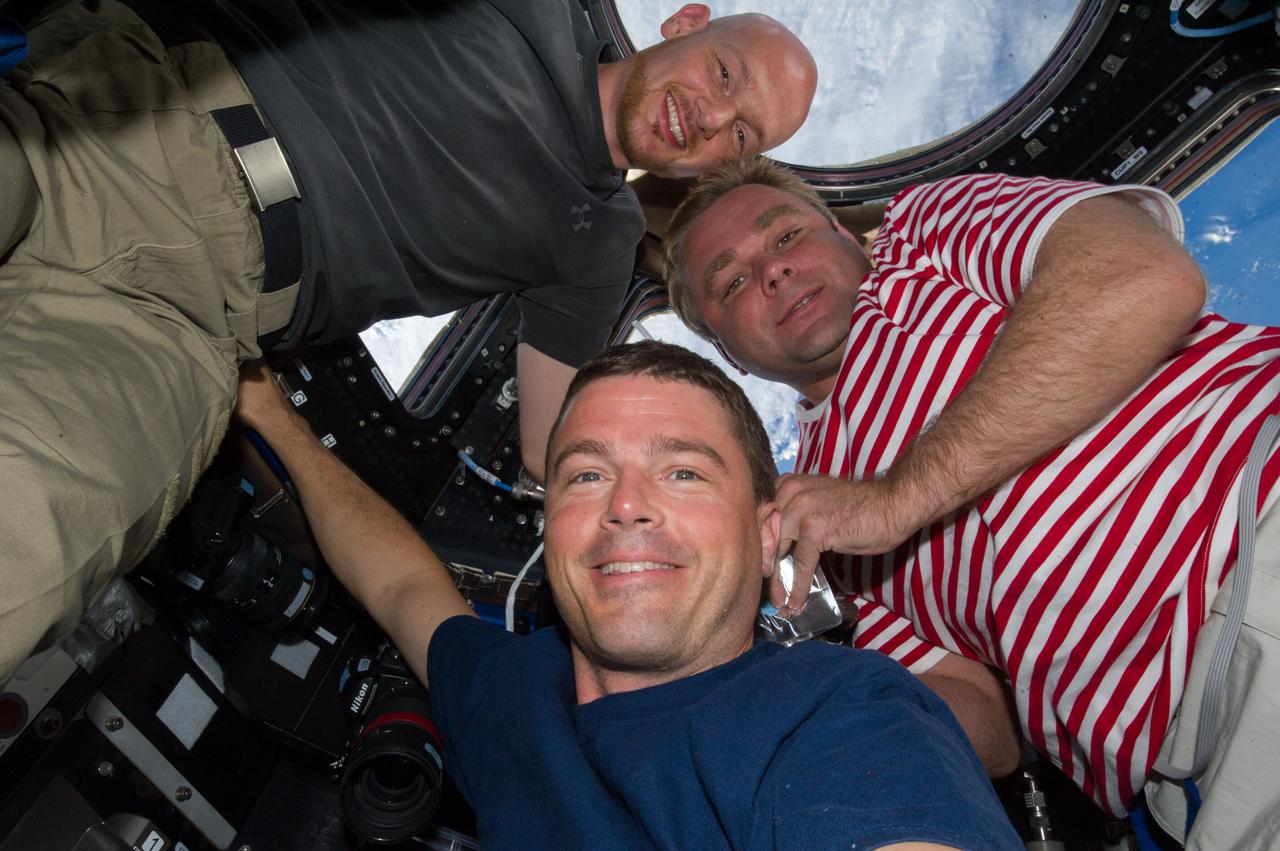
ISS040-E-006724 (2 June 2014) --- European Space Agency astronaut Alexander Gerst (left), NASA astronaut Reid Wiseman (center) and Russian cosmonaut Maxim Suraev, all Expedition 40 flight engineers, pose for a photo in the Cupola of the International Space Station.
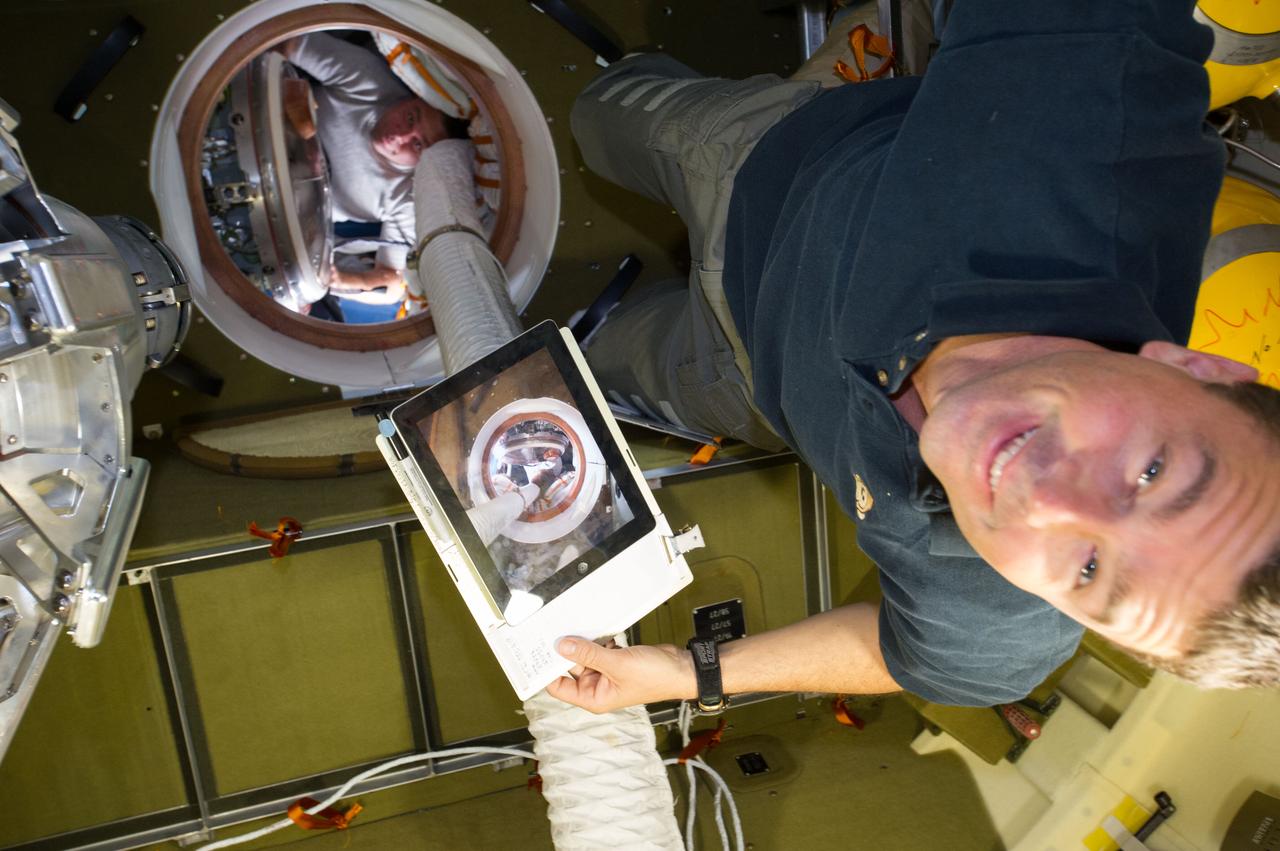
ISS040-E-008030 (6 June 2014) --- NASA astronaut Reid Wiseman and Russian cosmonaut Maxim Suraev (background), both Expedition 40 flight engineers, are pictured in the Russian segment of the International Space Station.
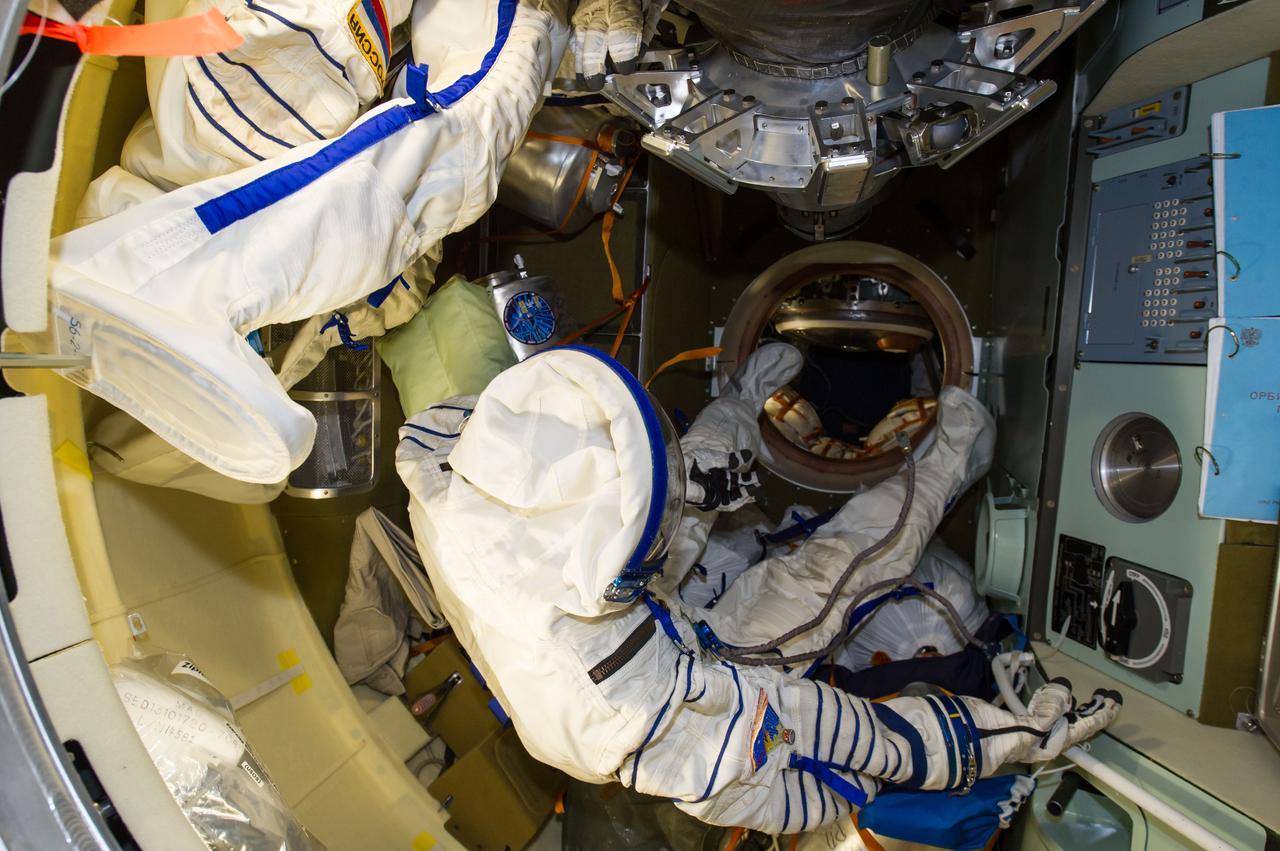
ISS040-E-139788 (10 Sept. 2014) --- Unoccupied Russian Sokol launch and entry suits, photographed by an Expedition 40 crew member, float freely in the International Space Station’s Poisk Mini-Research Module 2 (MRM2).
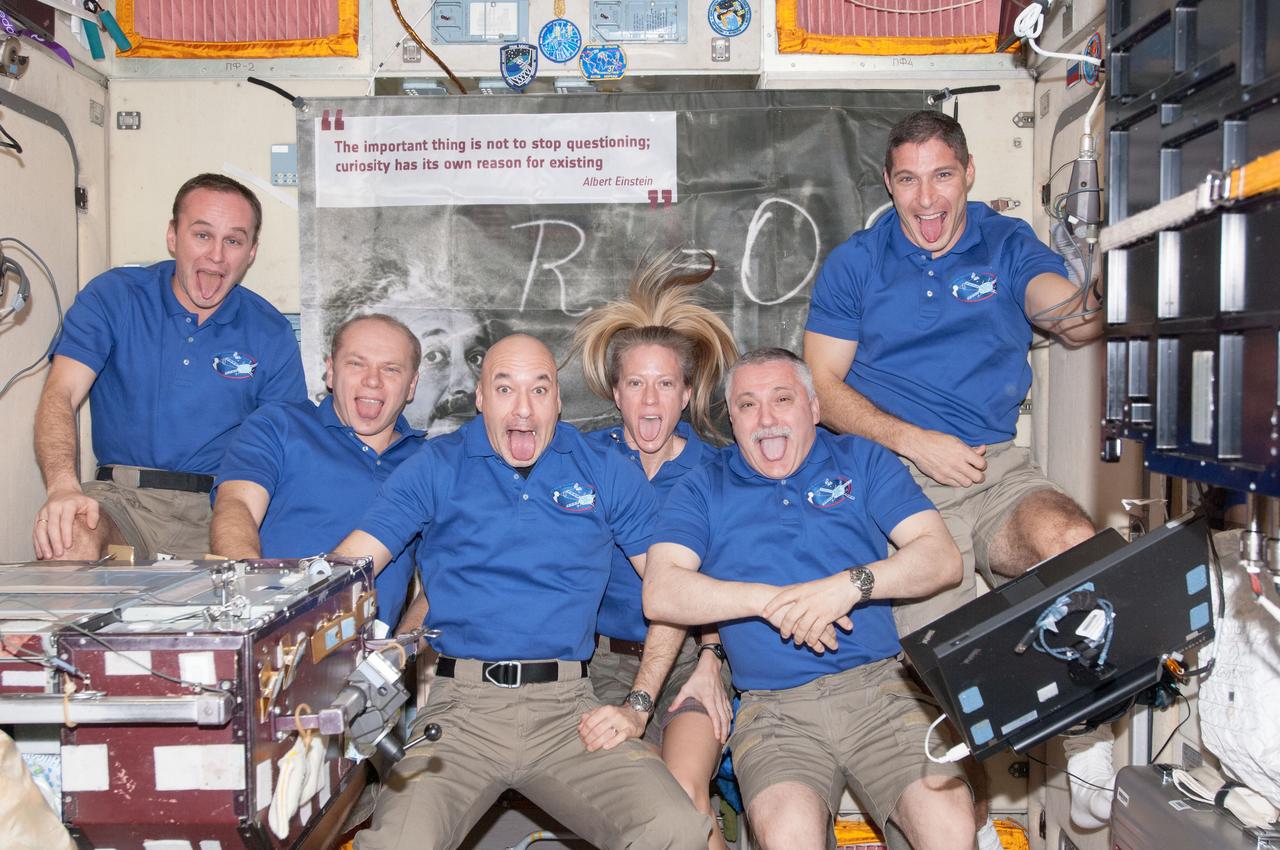
Expedition 37 crewmembers pose for a crew portrait in front of a banner depicting Albert Einstein - the scientist for whom the ATV is named. From l.-r.:Russian cosmonauts Sergey Ryazanskiy and Oleg Kotov,European Space Agency astronaut Luca Parmitano,Astronaut Karen Nyberg (all flight engineers),Cosmonaut Fyodor Yurchikhin (mission commander) and Astronaut Michael Hopkins (flight engineer).
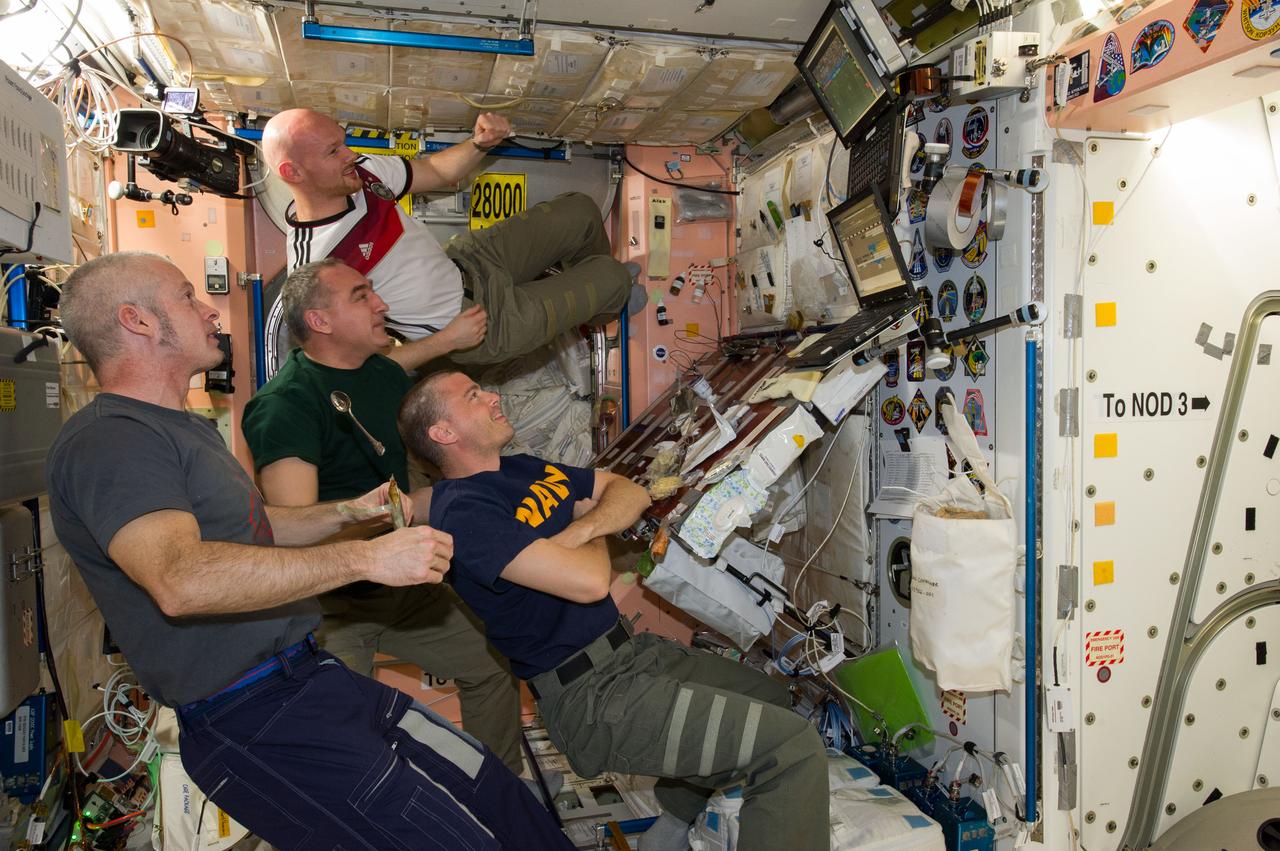
NASA astronaut Steve Swanson (left),Expedition 40 commander; along with European Space Agency astronaut Alexander Gerst (upper left),NASA astronaut Reid Wiseman and Cosmonaut Alexander Skvortsov,all three flight engineers,gather around a computer in Node 1 to watch the World Cup finals.
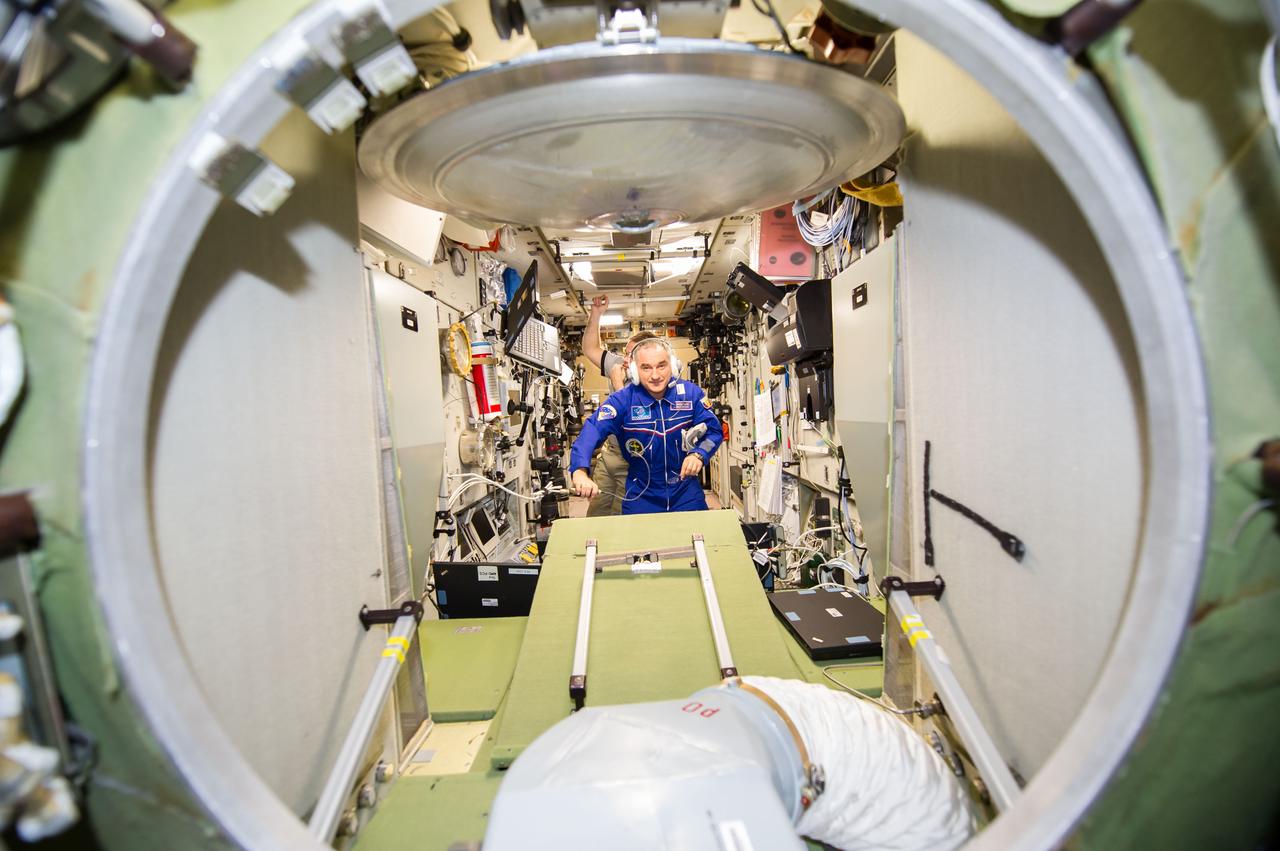
ISS040-E-139786 (10 Sept. 2014) --- Russian cosmonauts Alexander Skvortsov, Expedition 40 flight engineer; and cosmonaut Maxim Suraev, Expedition 41 commander, work in the Zvezda Service Module of the International Space Station.
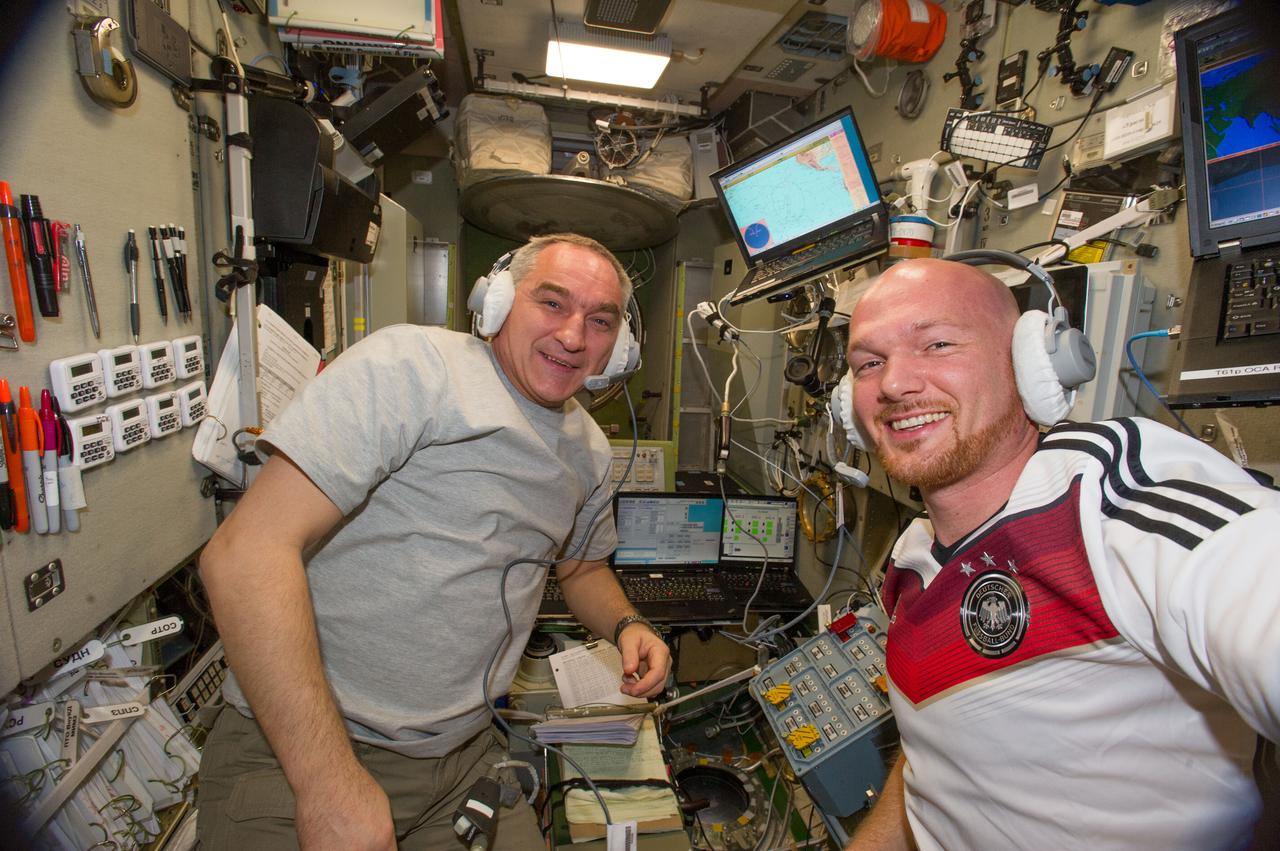
Cosmonaut Alexander Skvortsov and ESA Astronaut Alexander Gerst, Expedition 40 flight engineers, are photographed during ATV equipment preparation in the Service Module (SM) prior to ATV launch.
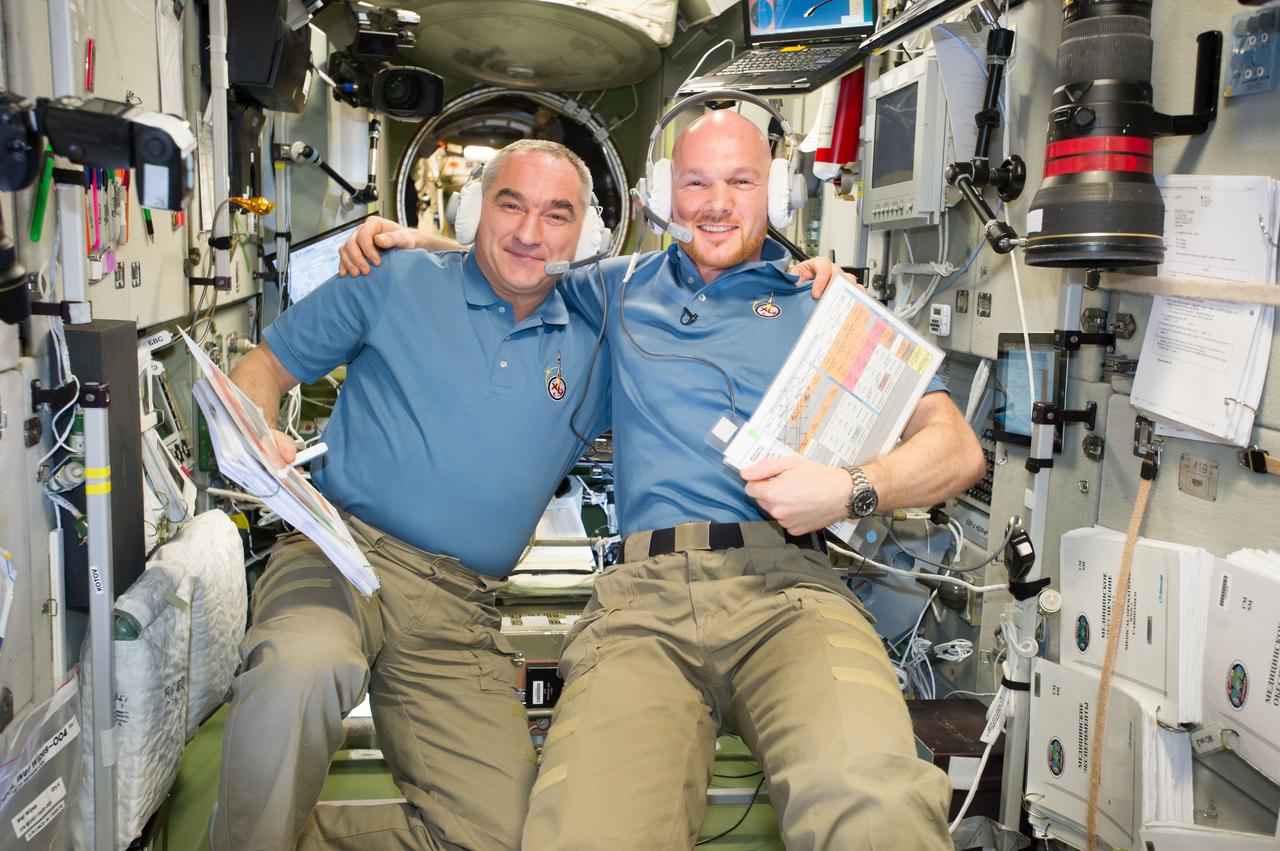
ISS040-E-091673 (12 Aug. 2014) --- In the Zvezda Service Module, European Space Agency astronaut Alexander Gerst (right) and Russian cosmonaut Alexander Skvortsov, both Expedition 40 flight engineers, take a brief moment for a photo during the approach and docking operations of ESA's "Georges Lemaitre" Automated Transfer Vehicle-5 (ATV-5) to the International Space Station.
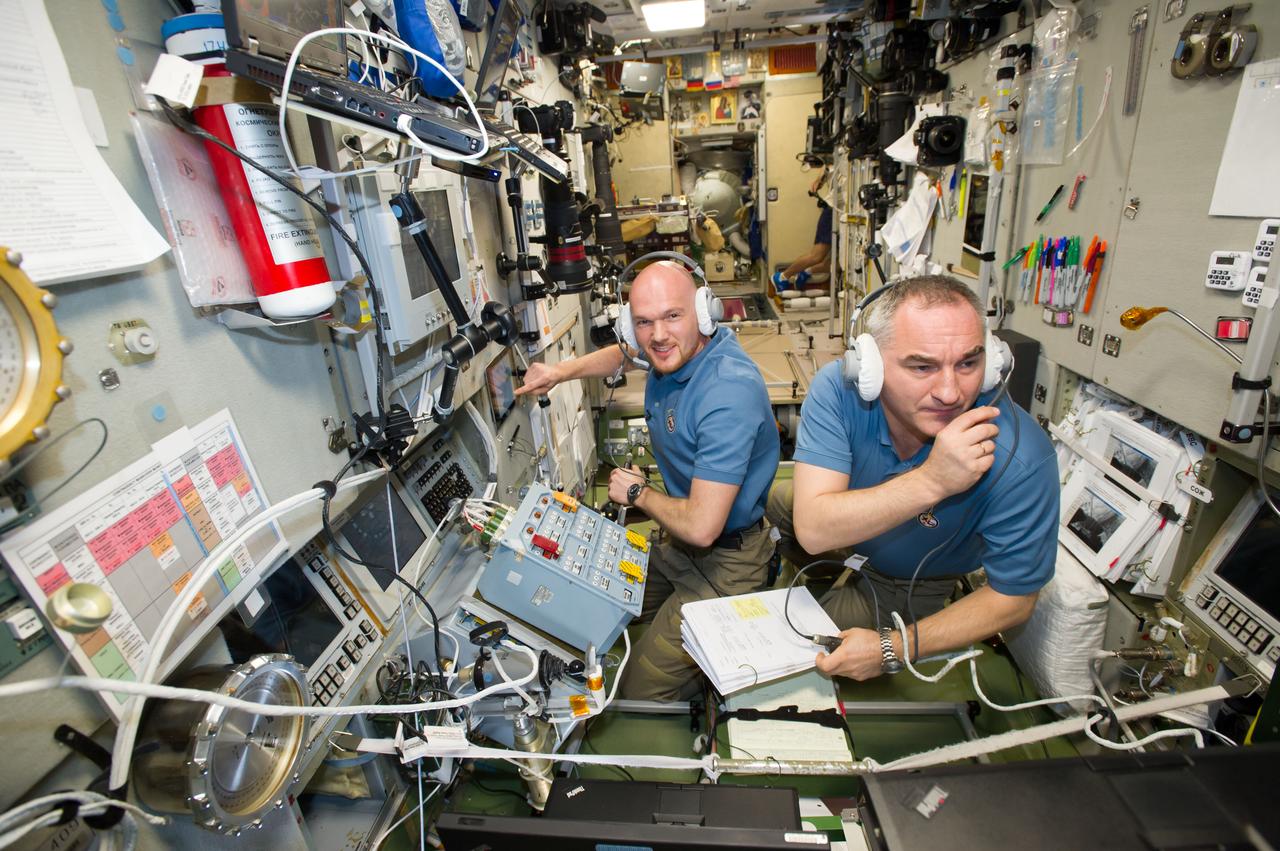
ISS040-E-091688 (12 Aug. 2014) --- In the Zvezda Service Module, European Space Agency astronaut Alexander Gerst (left) and Russian cosmonaut Alexander Skvortsov, both Expedition 40 flight engineers, monitor the approach and docking of ESA?s "Georges Lemaitre" Automated Transfer Vehicle-5 (ATV-5) to the International Space Station.
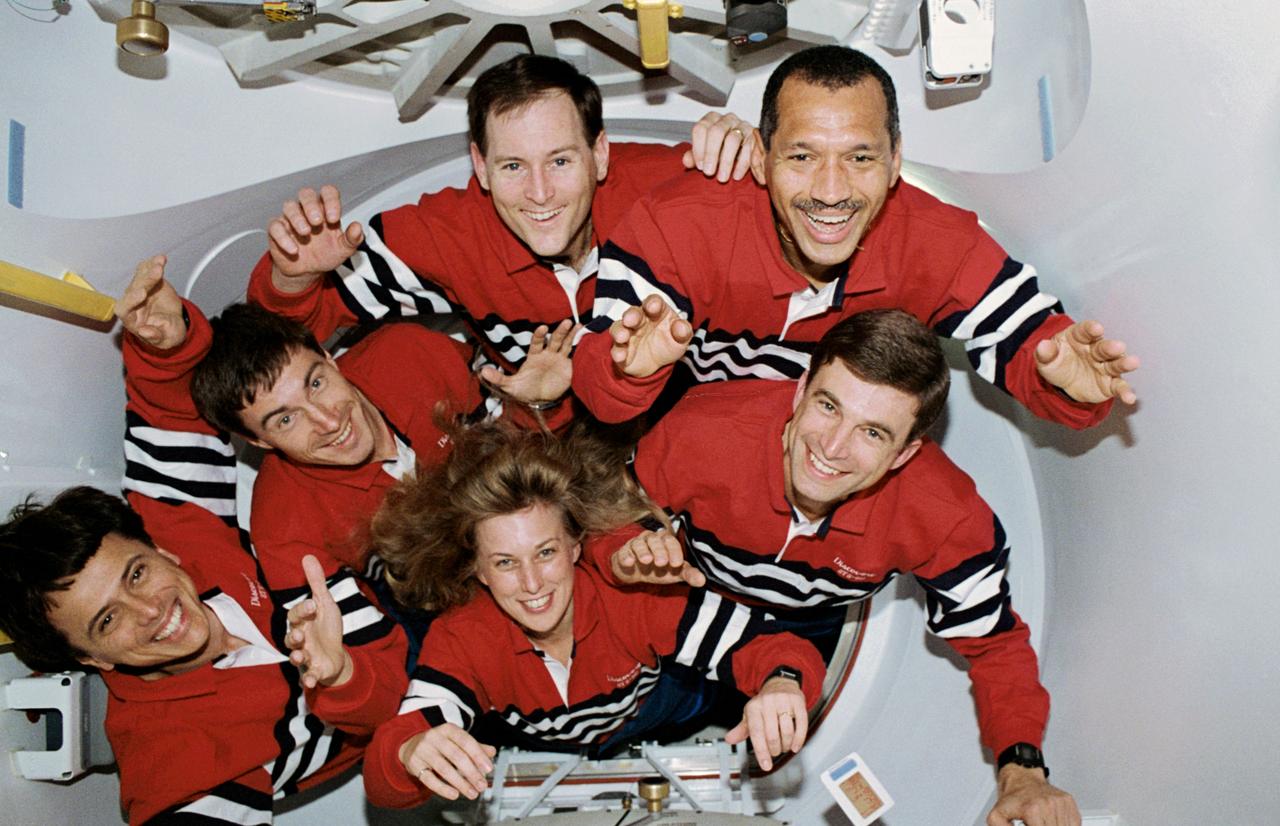
STS060-31-028 (3-11 Feb. 1994) --- Five NASA astronauts and a Russian cosmonaut squeeze through the tunnel which connects the shirt-sleeve environments of the space shuttle Discovery and the SPACEHAB module. SPACEHAB is located in the spacecraft’s payload bay. Charles F. Bolden Jr., mission commander, is at upper right. Others, clockwise from the commander, are Ronald M. Sega and N. Jan Davis, both mission specialists; Franklin R. Chang-Diaz, payload commander; cosmonaut Sergei K. Krikalev, mission specialist; and Kenneth S. Reightler Jr., pilot. The six spent eight days in Earth orbit. Photo credit: NASA
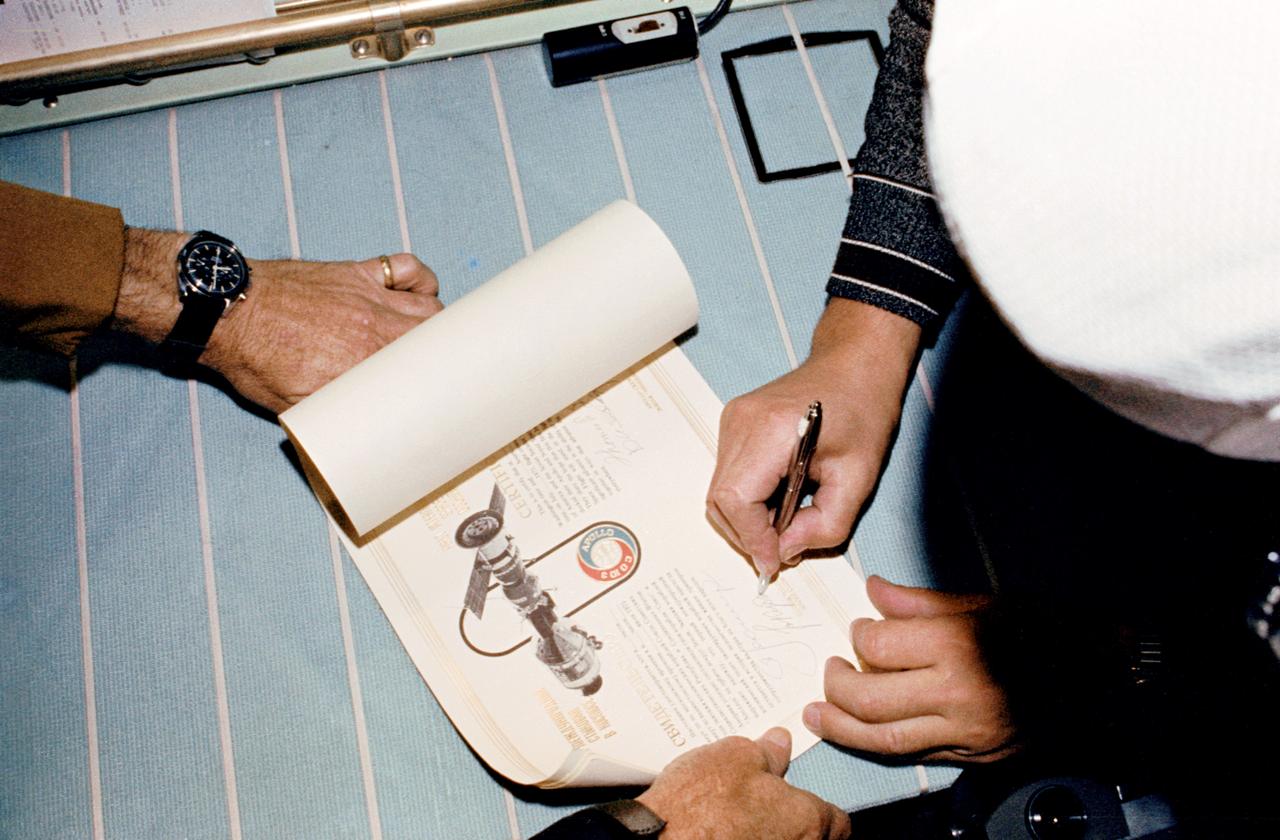
AST-03-171 (17 July 1975) --- The hands of cosmonaut Valerly N. Kubasov are seen as the ASTP engineer adds his name to the signature on the Soviet side of the official joint certificate marking an historical moment during the rendezvous day of the Apollo-Soyuz Test Project. The left hand of astronaut Donald K. Slayton, NASA's docking module pilot, is seen at left. The certificate had earlier been signed by astronauts Thomas P. Stafford, American crew commander; Slayton and cosmonaut Aleksey A. Leonov, Soviet crew commander, and it awaits the signature of astronaut Vance D. Brand, NASA's command module pilot who remained in the CM while the others signed in the Soviet Orbital Module of the Soyuz.
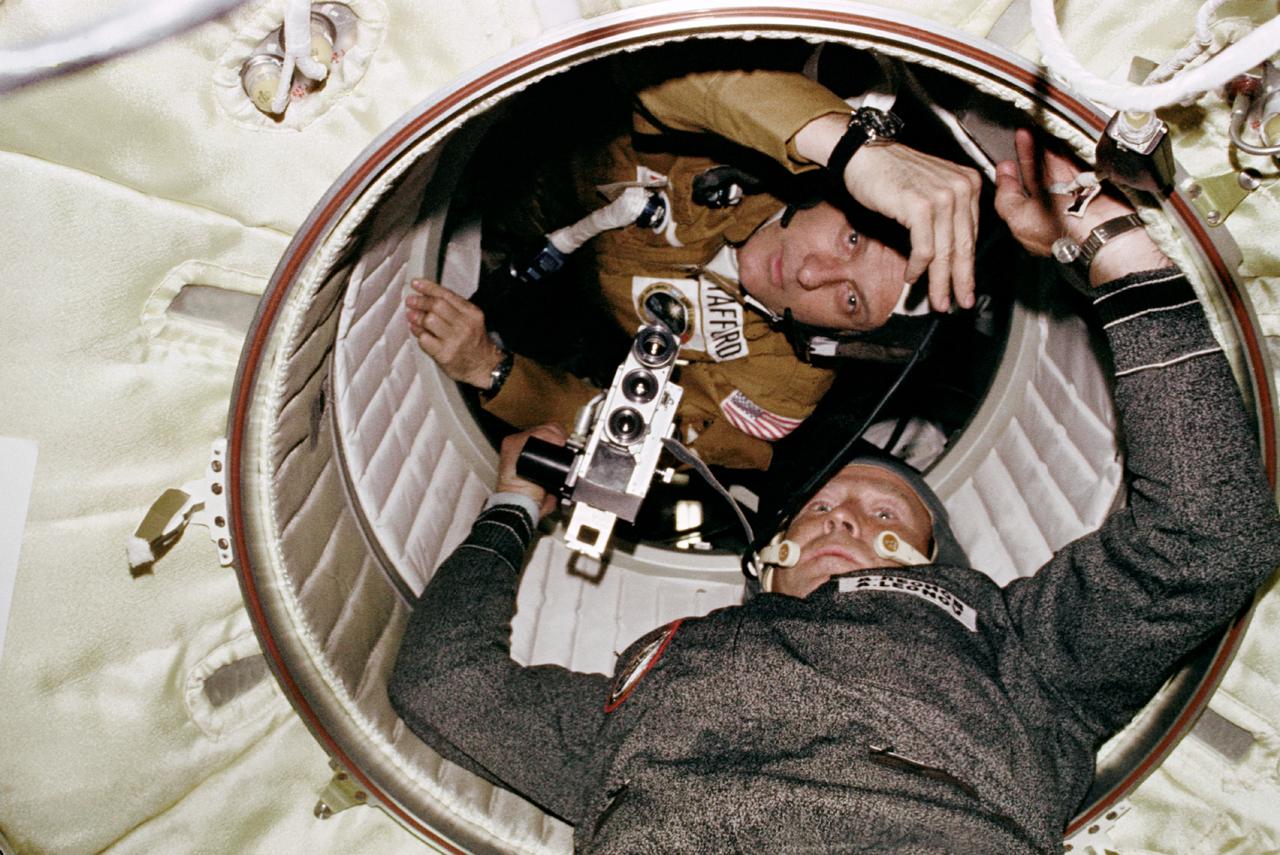
AST-03-191 (17-19 July 1975) --- Astronaut Thomas P. Stafford and cosmonaut Aleksei A. Leonov are seen at the hatchway leading from the Apollo Docking Module (DM) to the Soyuz Orbital Module (OM) during the joint U.S.-USSR Apollo Soyuz Test Project (ASTP) docking mission in Earth orbit. Cosmonaut Leonov is in the OM and astronaut Stafford is in the DM. Leonov holds a camera. The Apollo crew consisted of astronauts Stafford, commander; Donald K. "Deke" Slayton, docking module pilot; Vance D. Brand, command module pilot. The Soyuz 19 crew consisted of cosmonauts Leonov, command pilot; and Valeri N. Kubasov, flight engineer.
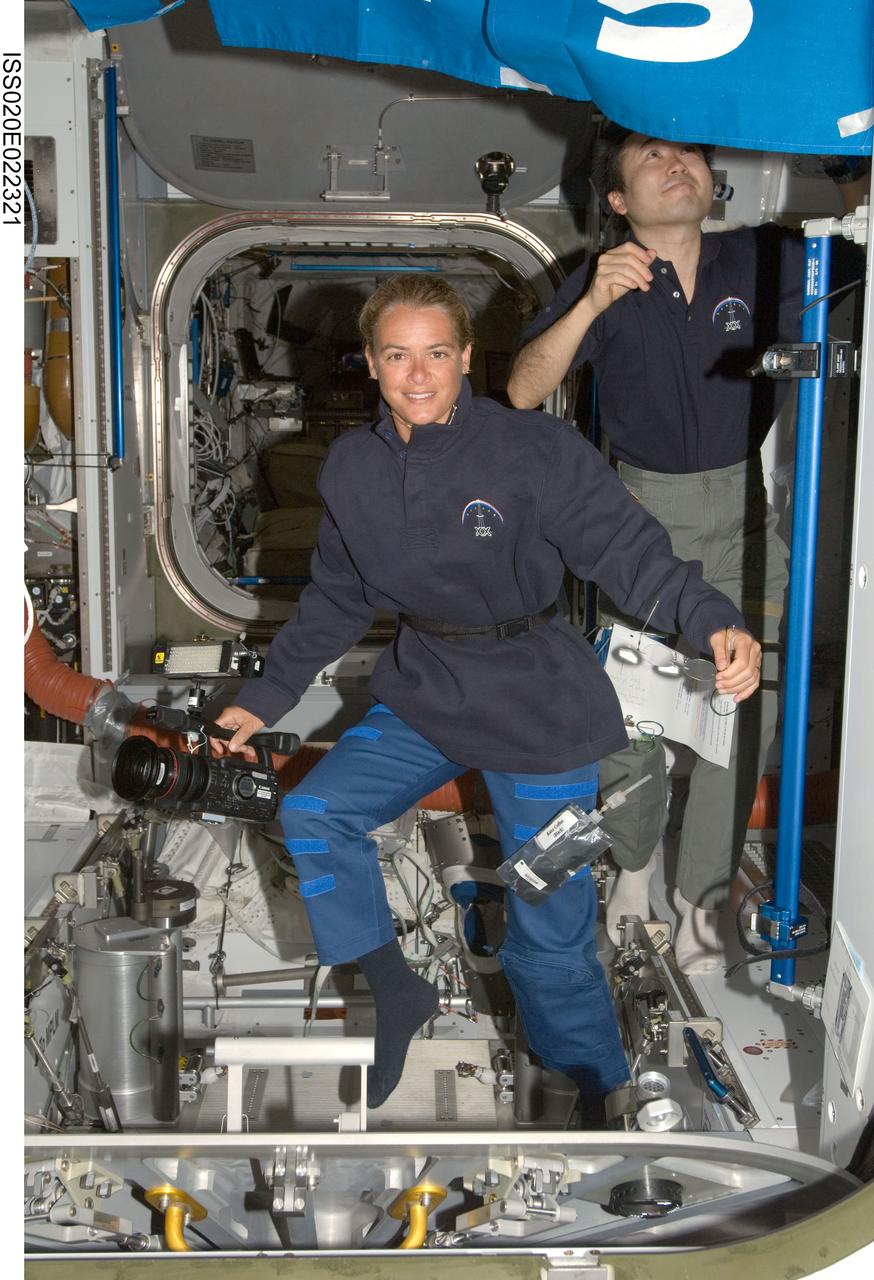
ISS020-E-022321 (18 July 2009) --- On the second day of joint activities between the STS-127 astronauts and ISS Expedition 20 crew members, Canadian Space Agency astronaut Julie Payette and Japanese Aerospace Exploration Agency astronaut Koichi Wakata are pictured onboard the orbital outpost. They are among 11 astronauts and cosmonauts who remained inside the shuttle and station to provide support while two crew members performed the first spacewalk to continue work on the station. Wakata has been serving as a flight engineer onboard ISS, but converts to an STS-127 missison specialist until returning home aboard Endeavour later this month.
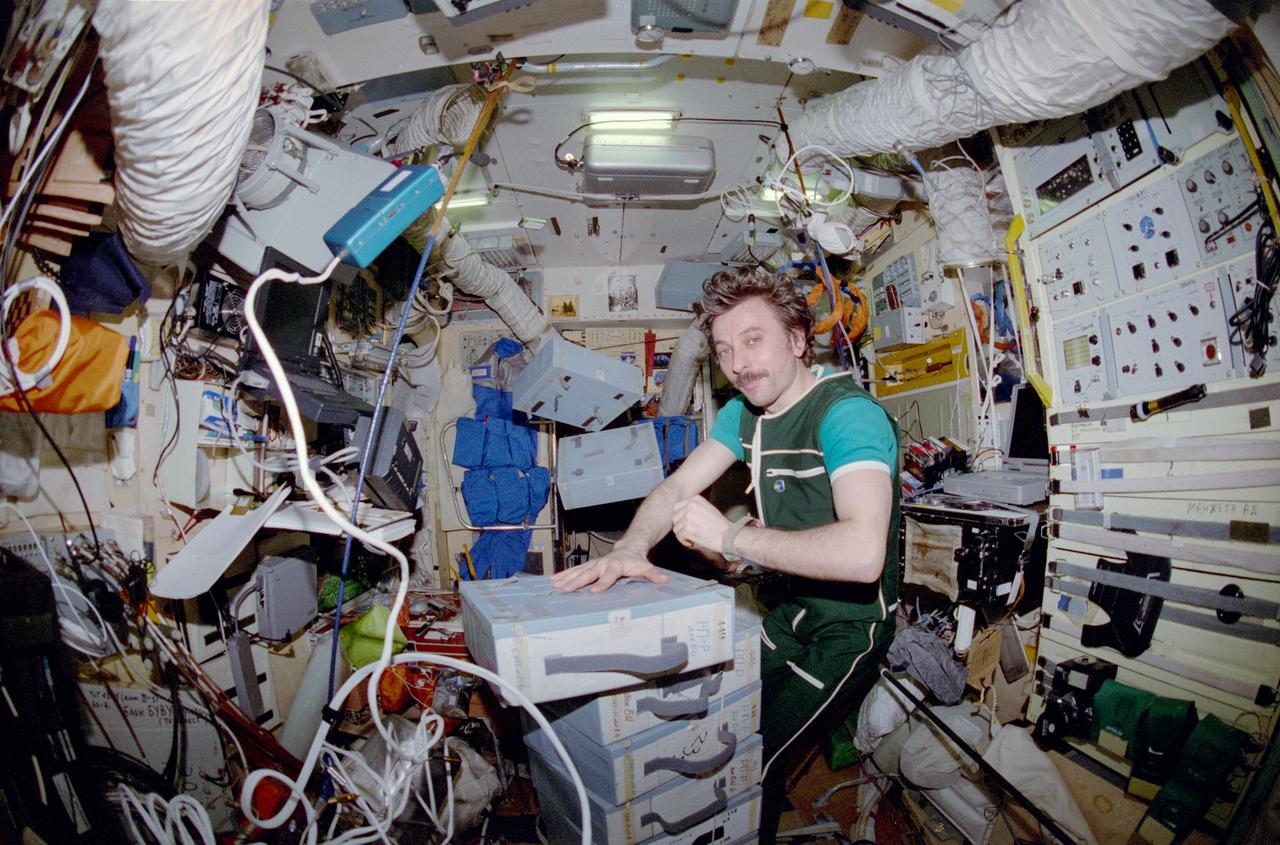
STS084-305-031 (15-24 May 1997) --- Onboard the Russia's Mir Space Station Base Block, cosmonaut Aleksandr I. Lazutkin, Mir-23 flight engineer, participates in the transfer of a small portion of the supplies which astronauts and cosmonauts are moving aboard Mir from the Space Shuttle Atlantis. A number of items were also moved from Mir onto the docked Shuttle craft during the several days of joint activities between the two crews.
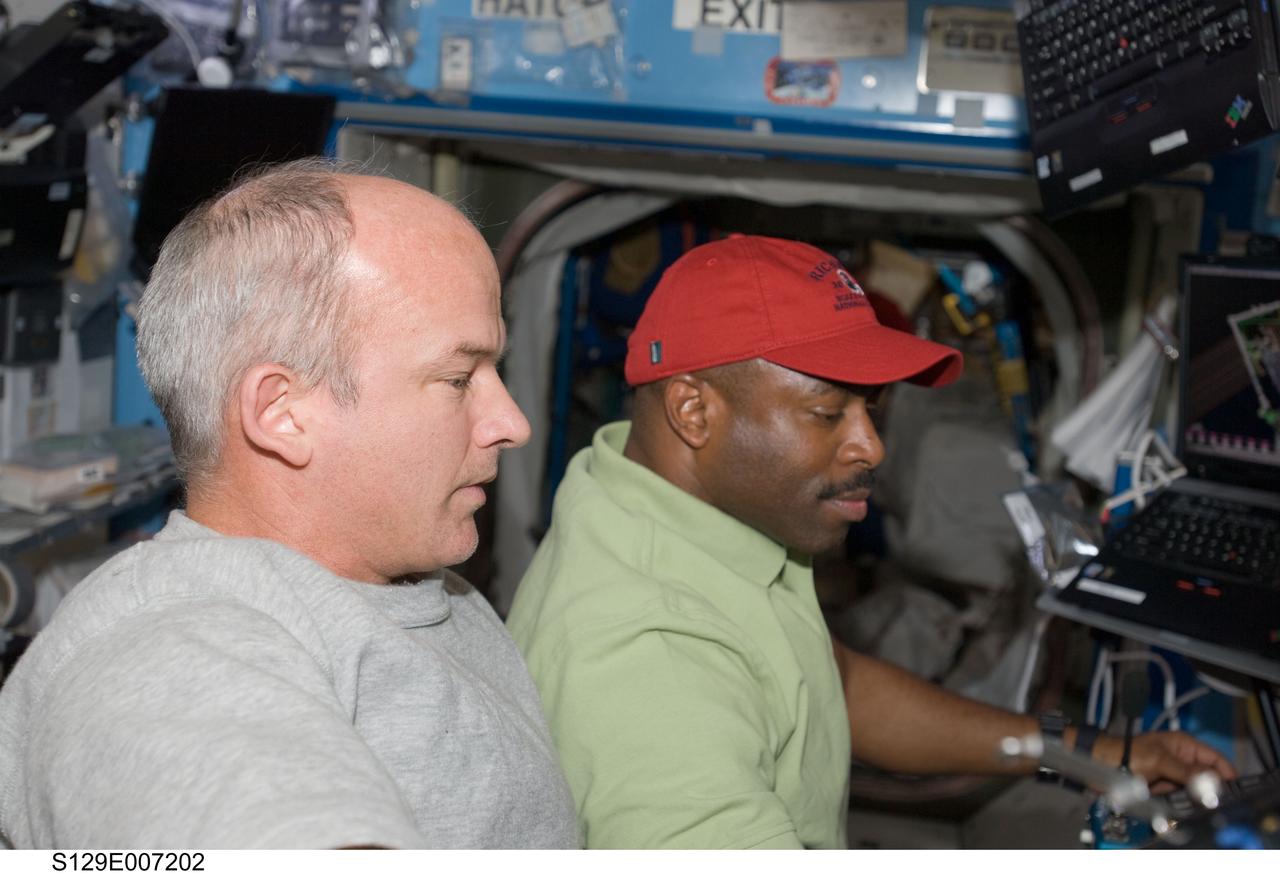
S129-E-007202 (21 Nov. 2009) --- NASA astronauts Jeffrey Williams (left), Expedition 21 flight engineer, and Leland Melvin, STS-129 mission specialist, support the extravehicular activity of astronauts Mike Foreman and Randy Bresnik from the shirt sleeve environment of the International Space Station. While Foreman and Bresnik worked outside, an aggregation of ten internationally-represented astronauts and cosmonauts worked onboard both the space shuttle Atlantis and the International Space Station to support their tasks.
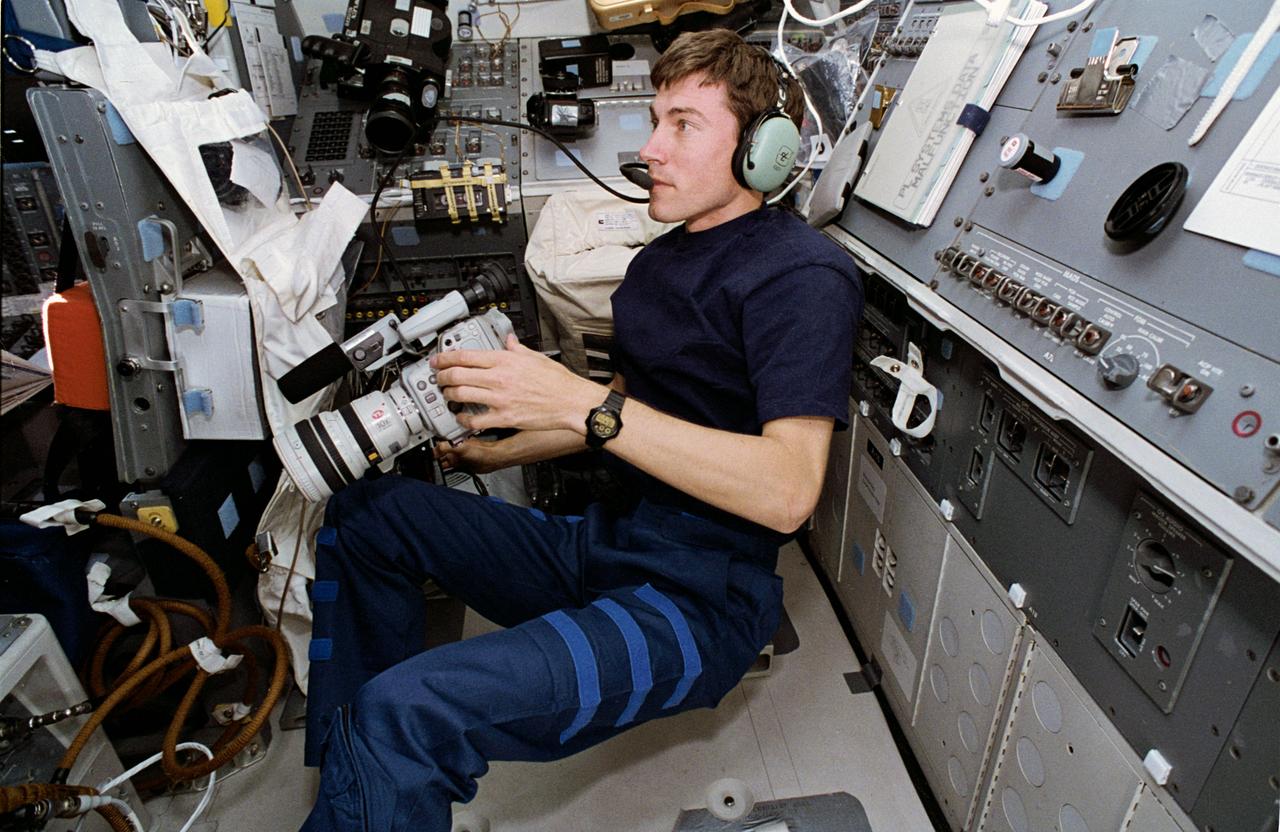
STS60-29-009 (10 Feb 1994) --- On the Space Shuttle Discovery's aft flight deck, Russian cosmonaut Sergei K. Krikalev prepares for one chore while performing another. Using the Shuttle Amateur Radio Experiment (SAREX) gear, the mission specialist was talking with students in Maine. He holds a camcorder, which was later called into action to record inflight activities. Krikalev joined five NASA astronauts for eight days in space aboard Discovery.
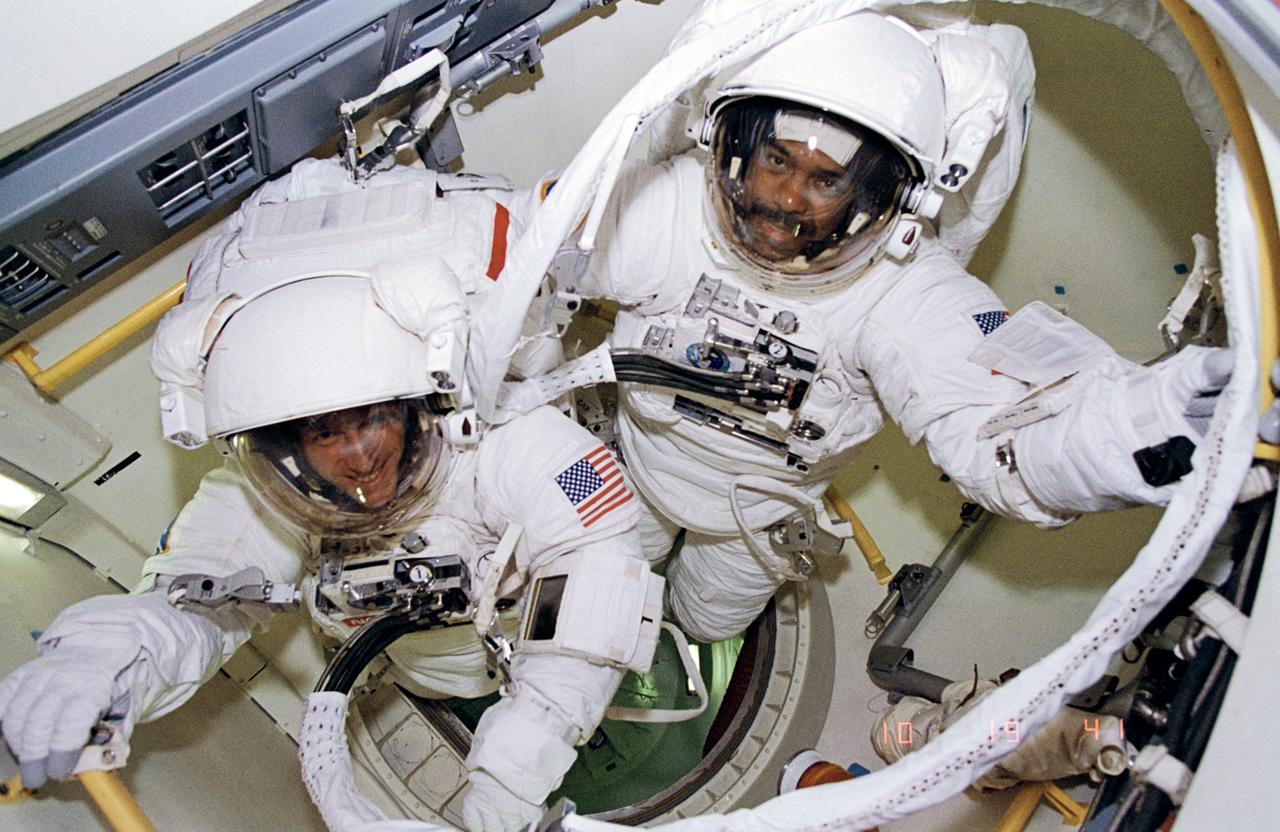
STS063-67-024 (9 Feb. 1995) --- Astronauts Bernard A. Harris Jr., STS-63 payload commander, (top right) and C. Michael Foale, mission specialist, are ready to egress airlock for an extravehicular activity (EVA). Others onboard the space shuttle Discovery were astronauts James D. Wetherbee, mission commander; Eileen M. Collins, pilot; mission specialists Janice E. Voss, and cosmonaut Vladimir G. Titov. Photo credit: NASA
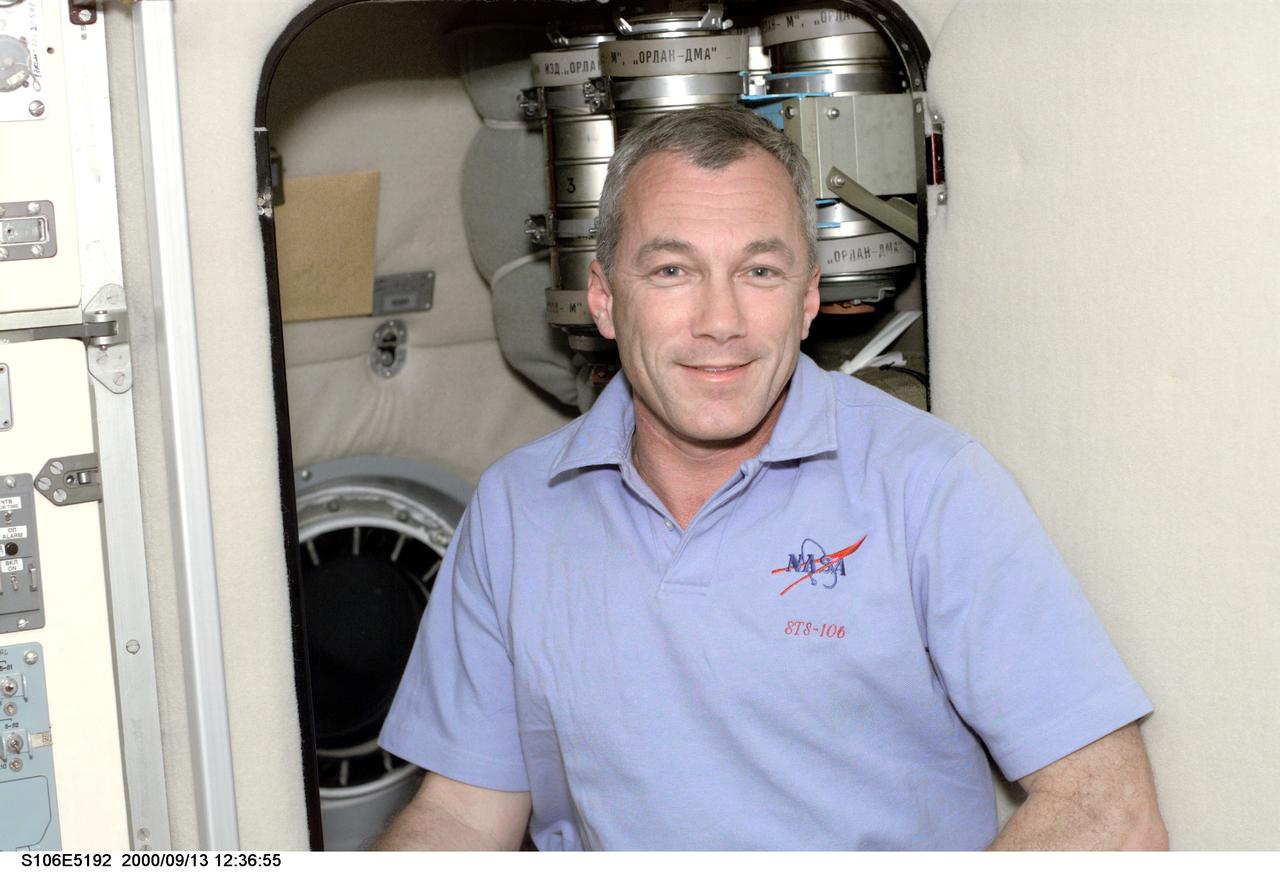
S106-E-5192 (13 September 2000) --- Astronaut Terrence W. Wilcutt, mission commander, displays a pleasant countenance onboard the International Space Station as the crew nears the halfway point of docked operations with the International Space Station. In all the crew will have 189 hours, 40 minutes of planned Atlantis-ISS docked time. For most of the remainder of the time until the Atlantis undocks from the ISS, the STS-106 astronauts and cosmonauts continue electrical work and transfer activities.
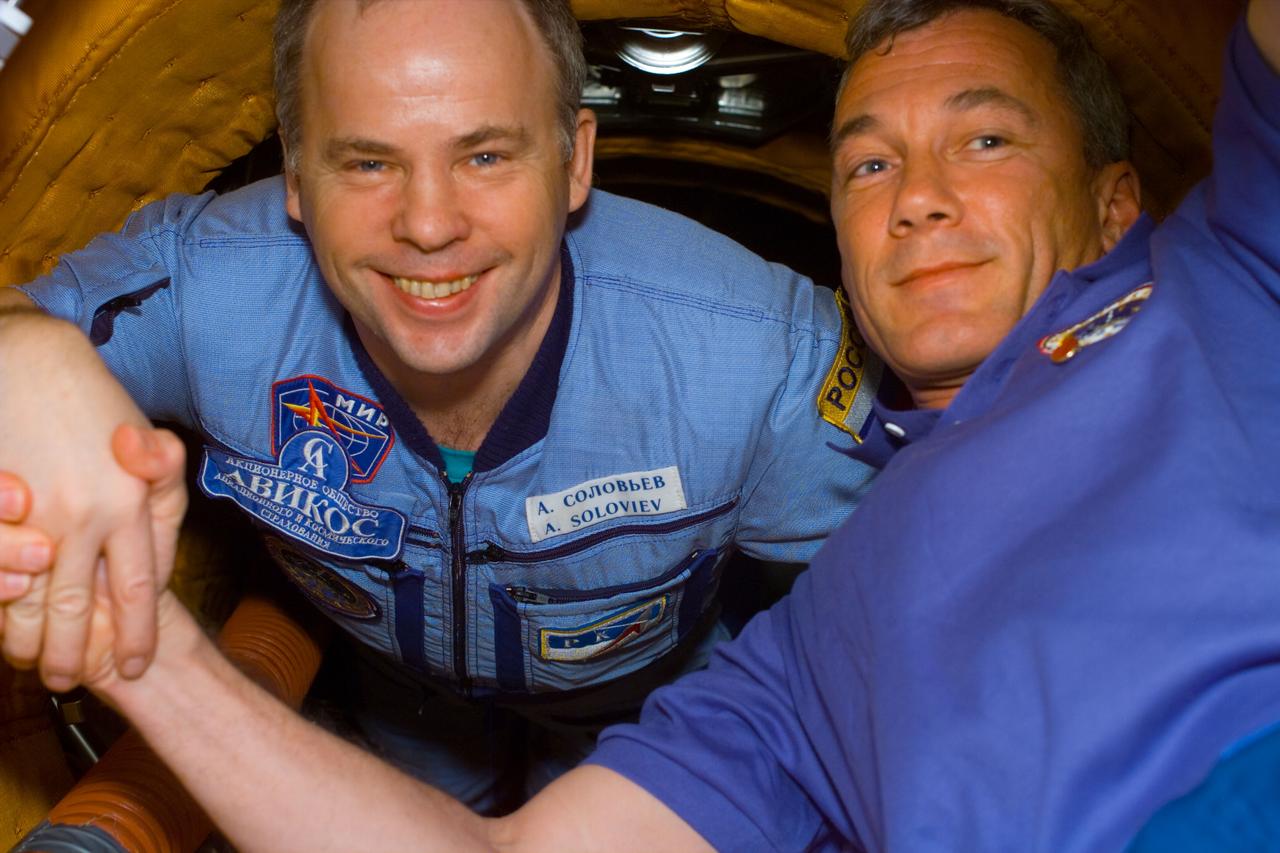
S89-E-5352 (28 Jan 1998) --- This Electronic Still Camera (ESC) image shows the commanders' farewell handshake, thus bringing the eighth Shuttle/Mir joint activities to an end. The commanders, cosmonaut Anatoliy Y. Solovyev, Mir-24 commander (on the left); and astronaut Terrence W. Wilcutt, STS-89 commander, are posing in the Docking Module (DM) between the Space Shuttle Endeavour and the Russian Mir Space Station. The Shuttle crew dropped off astronaut Andrew S. W. Thomas and picked up astronaut David A. Wolf, cosmonaut guest researcher onboard Mir since September 1997. Thomas will be the last American astronaut to serve a tour aboard the Mir as a cosmonaut guest researcher. This ESC view was taken on January 28, 1998, at 22:27:56 GMT.
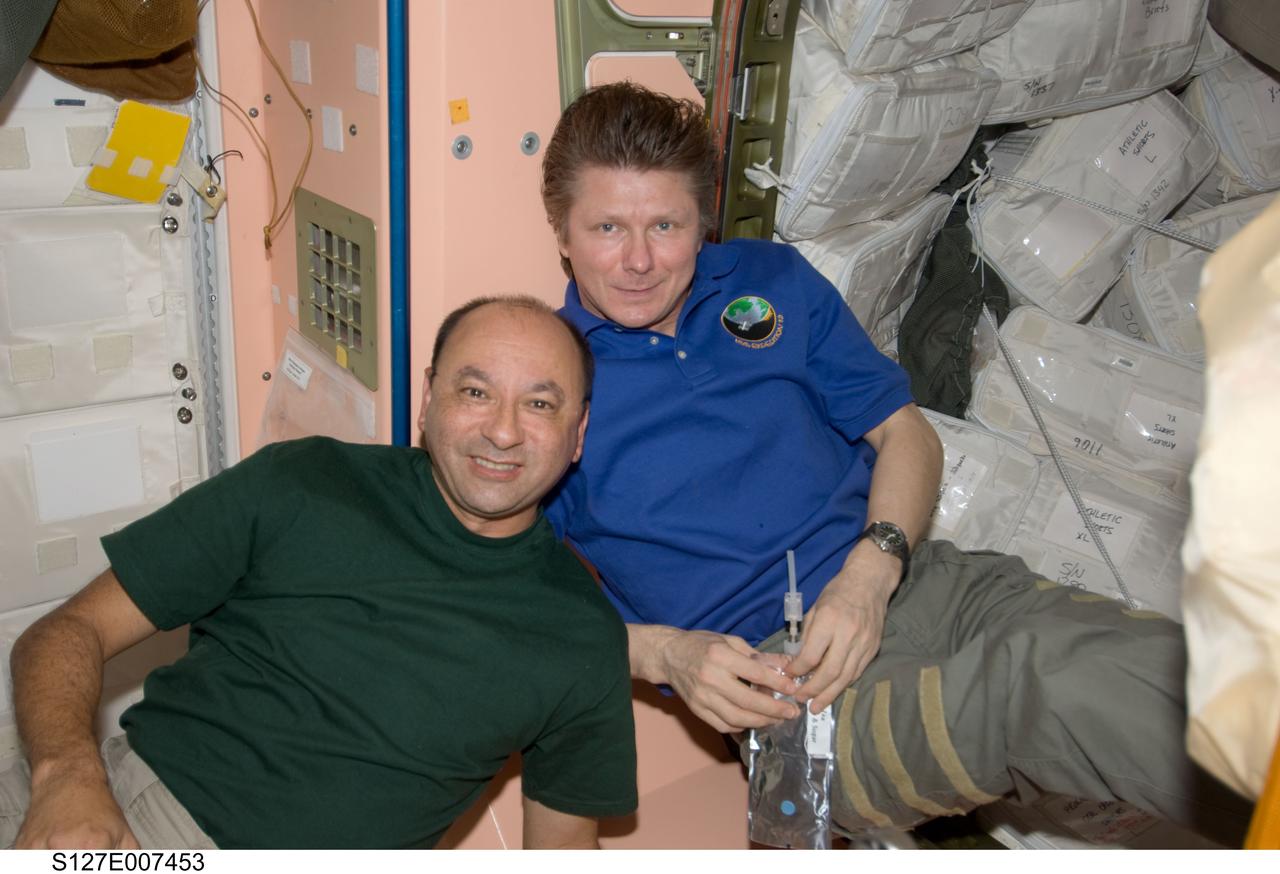
S127-E-007453 (21 July 2009) --- Astronaut Mark Polansky (left) and Russian Federal Space Agency cosmonaut Gennady Padalka take a break from a busy agenda onboard the International Space Station on the eve of the third of five spacewalks scheduled as part of more than a week's worth of joint activities for Endeavour and ISS crewmembers. Polansky is STS-127 commander, and Padalka is the station commander.
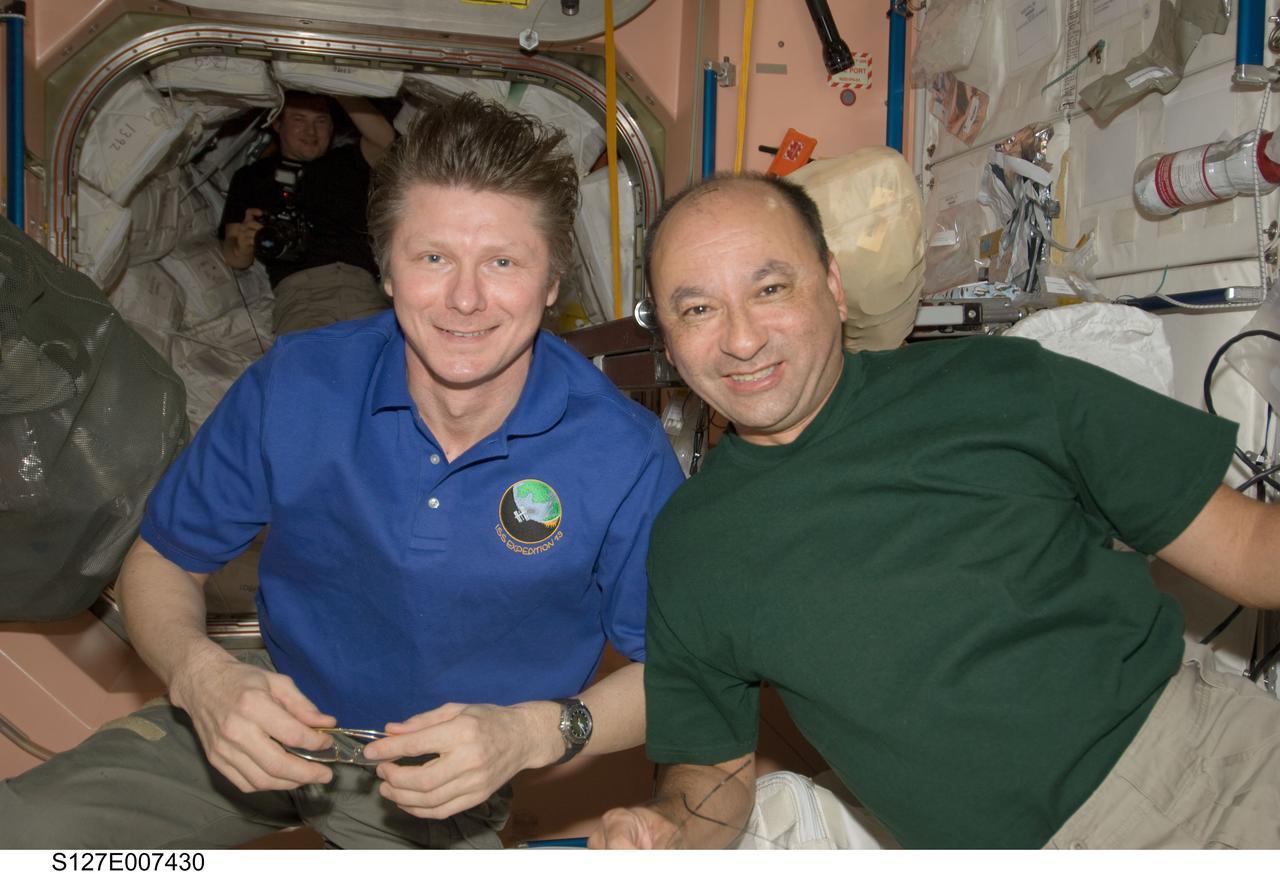
S127-E-007430 (21 July 2009) --- Astronaut Mark Polansky (right) and Russian Federal Space Agency cosmonaut Gennady Padalka take a break from a busy agenda onboard the International Space Station on the eve of the third of five spacewalks scheduled as part of more than a week's worth of joint activities for Endeavour and ISS crewmembers. Polansky is STS-127 commander, and Padalka is the station commander.
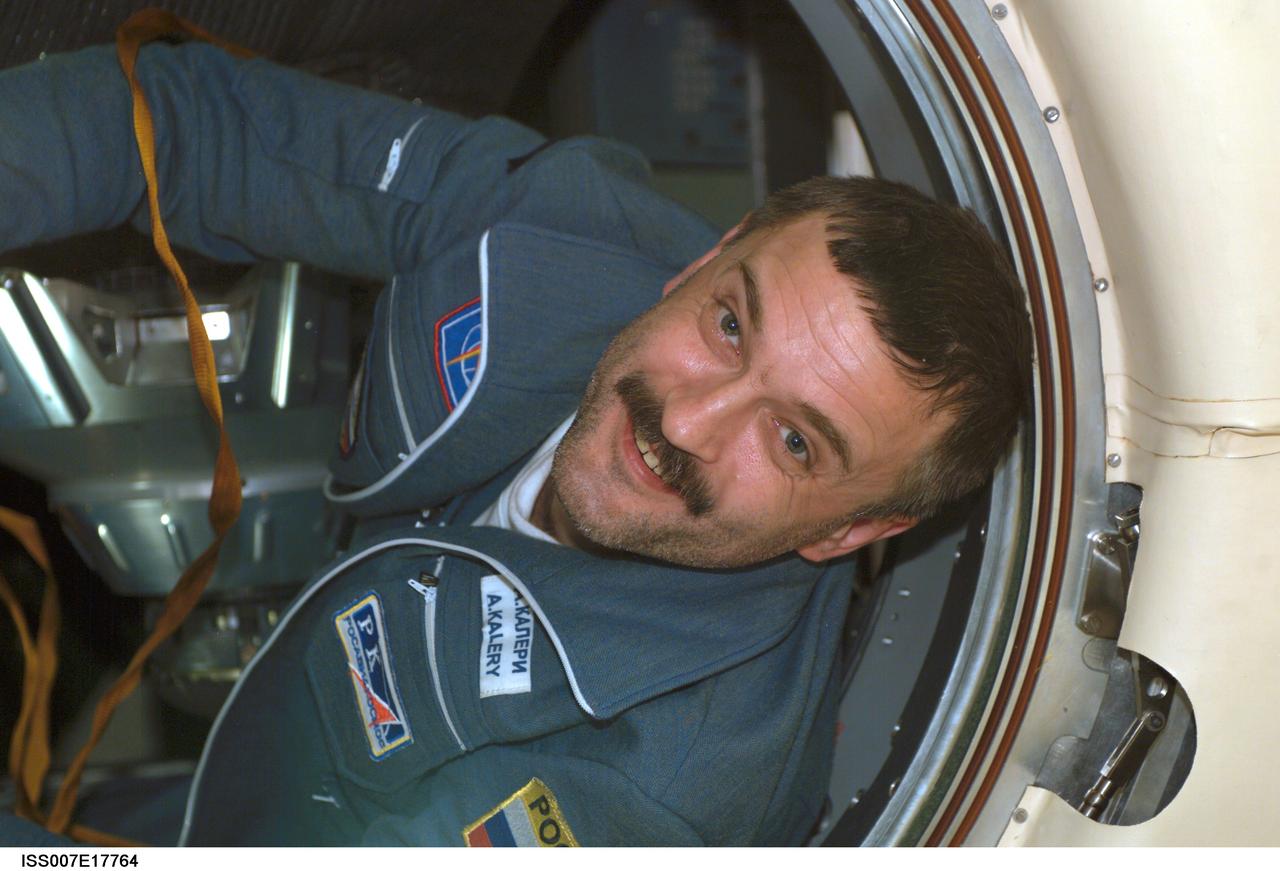
ISS007-E-17764 (20 October 2003) --- Two days after launching from Kazakhstan, Russian cosmonaut Alexander Kaleri, flight engineer and Soyuz commander representing Rosaviakosmos, arrives onboard the International Space Station. Kaleri and astronaut C. Michael Foale, American commander and NASA ISS science officer, proceeded to begin over a week's worth of handover activities with the Expedition 7 crewmembers in order to familiarize themselves with Station systems and procedures.
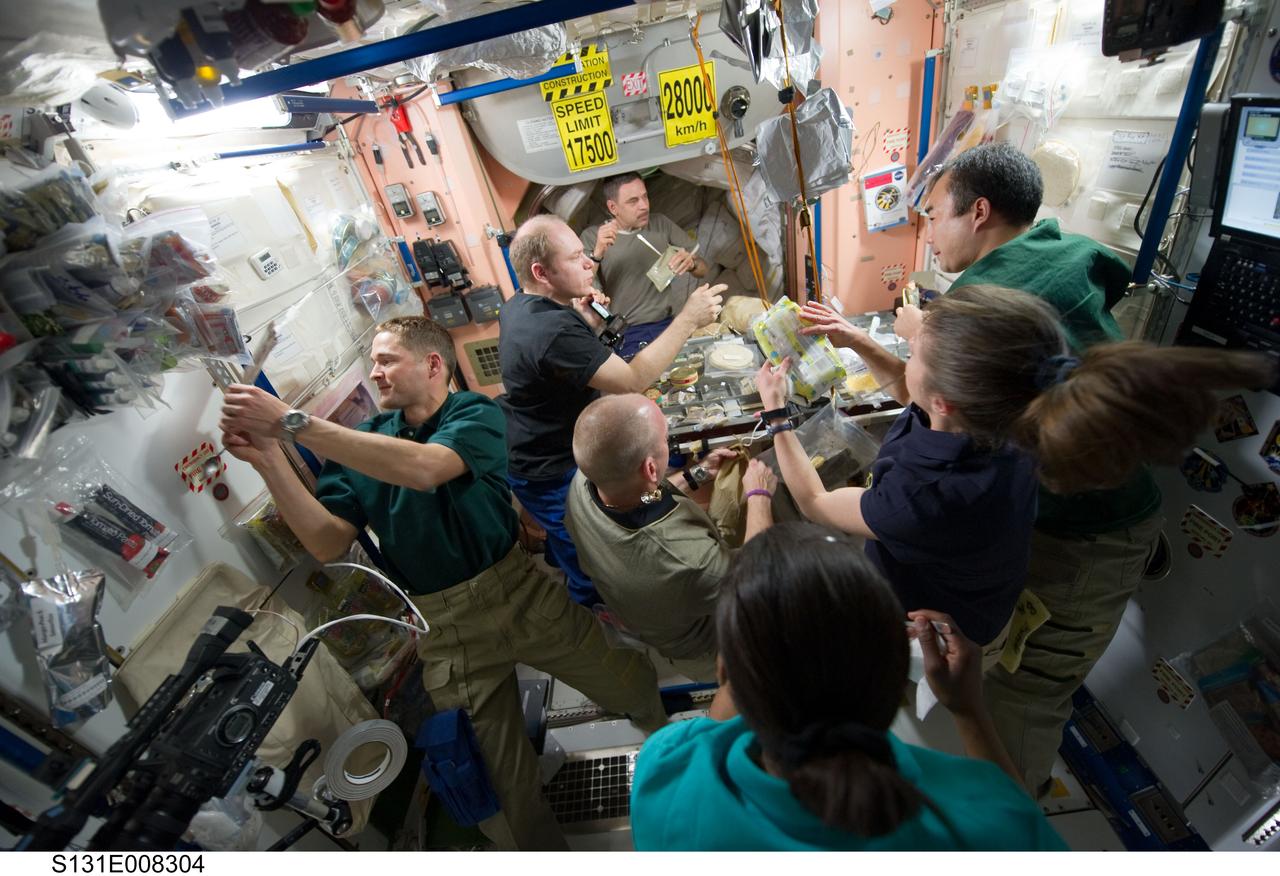
S131-E-008304 (9 April 2010) --- With 13 astronauts and cosmonauts onboard the station at one time, activities around the galley in the Unity node get rather busy at meal time. Over half the 13 are seen in this flight day five aggregation. NASA astronaut James P. Dutton Jr., STS-131 pilot, prepares part of his meal at left. Also pictured clockwise (from the right) are JAXA astronaut Soichi Noguchi and NASA astronaut Tracy Caldwell Dyson, both Expedition 23 flight engineers; NASA astronauts Stephanie Wilson and Clayton Anderson, both STS-131 mission specialists; along with Russian cosmonauts Oleg Kotov and Mikhail Kornienko, Expedition 23 commander and flight engineer, respectively.
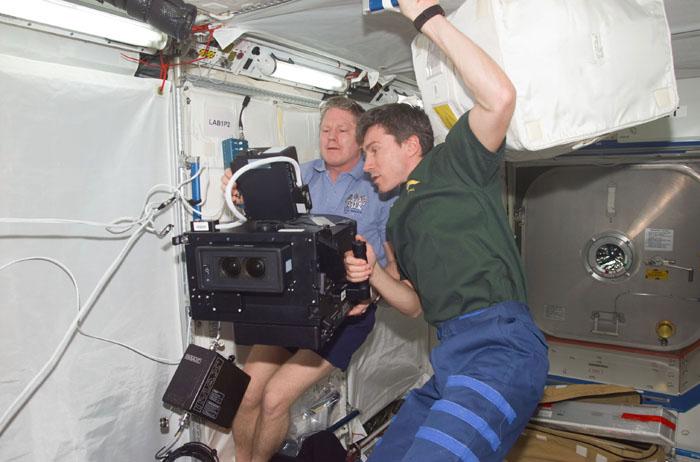
STS98-E-5167 (11 February 2001) --- Astronaut William M. (Bill) Shepherd (left), Expedition One commander, with the help of cosmonaut Sergei K. Krikalev, films activity onboard the newly attached Destiny laboratory. The crews of Atlantis and the International Space Station on February 11 opened the Destiny laboratory and spent the first full day of what are planned to be years of work ahead inside the orbiting science and command center. Shepherd opened the Destiny hatch, and he and Shuttle commander Kenneth D. Cockrell ventured inside at 8:38 a.m. (CST). Members of both crews went to work quickly inside the new module, activating air systems, fire extinguishers, alarm systems, computers and internal communications. The crew also continued equipment transfers from the shuttle to the station and filmed several scenes onboard the station using an IMAX camera. This scene was recorded with a digital still camera.
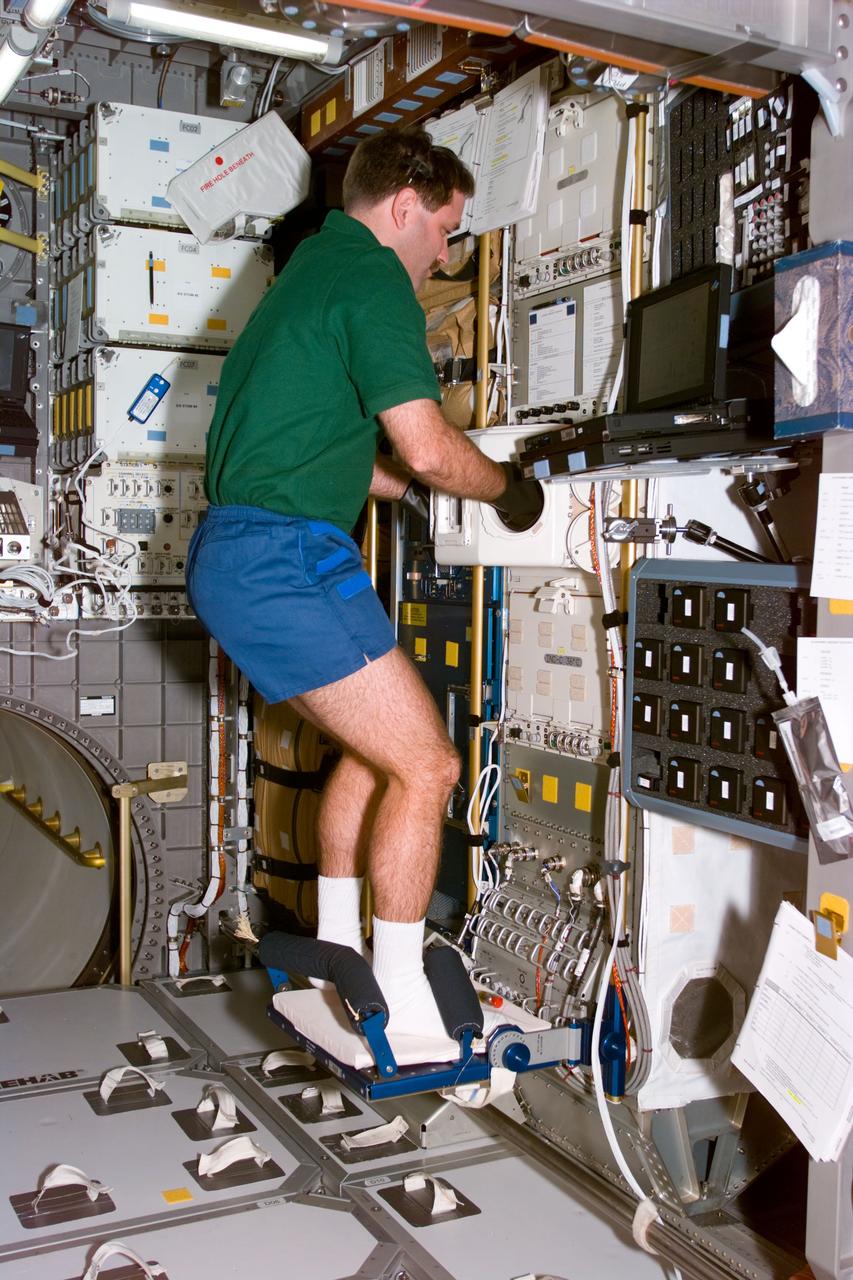
STS81-E-05107 (13 Jan. 1997) --- Astronaut John M. Grunsfeld, mission specialist, begins to activate a biorack glovebox aboard the Spacehab Double Module (DM) early on Day 2 of the mission. Grunsfeld is joined by five other NASA astronauts for the almost ten-day mission. The crew is scheduled to dock with Russia's Mir Space Station and pick up John E. Blaha, NASA astronaut who has been serving as a cosmonaut guest researcher since September 1996. Jerry M. Linenger (out of frame) will replace Blaha onboard Mir.
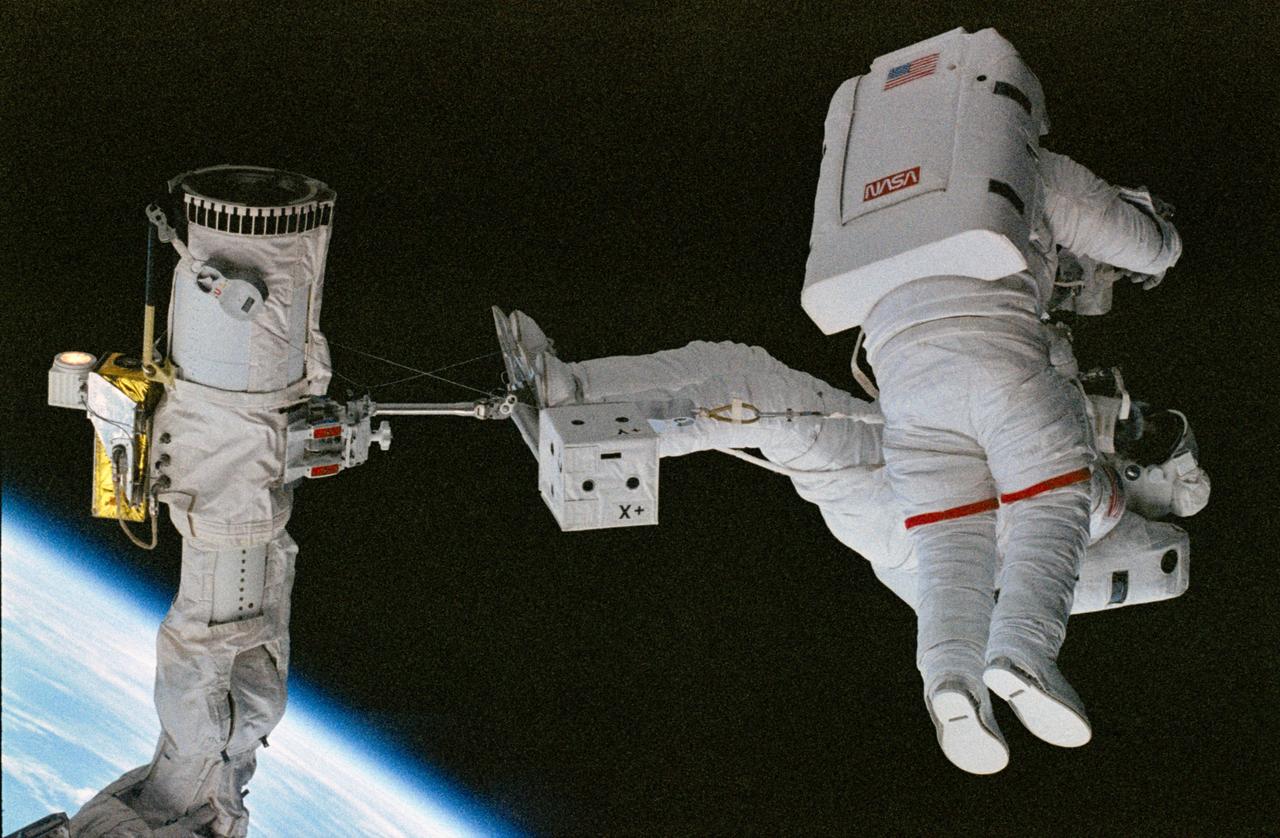
STS063-21-011 (9 Feb 1995) --- Astronaut Bernard A. Harris, Jr., payload commander, standing on a foot restraint attached to the Remote Manipulator System (RMS) arm carries astronaut C. Michael Foale, mission specialist, during their shared Extravehicular Activity (EVA) in the Space Shuttle Discovery's cargo bay. This is one of 16 still photographs released by the NASA Johnson Space Center (JSC) Public Affairs Office (PAO) on February 14, 1995. Others onboard the Discovery were astronauts James D. Wetherbee, mission commander; Eileen M. Collins, pilot; mission specialists Janice E. Voss and cosmonaut Vladimir G. Titov.
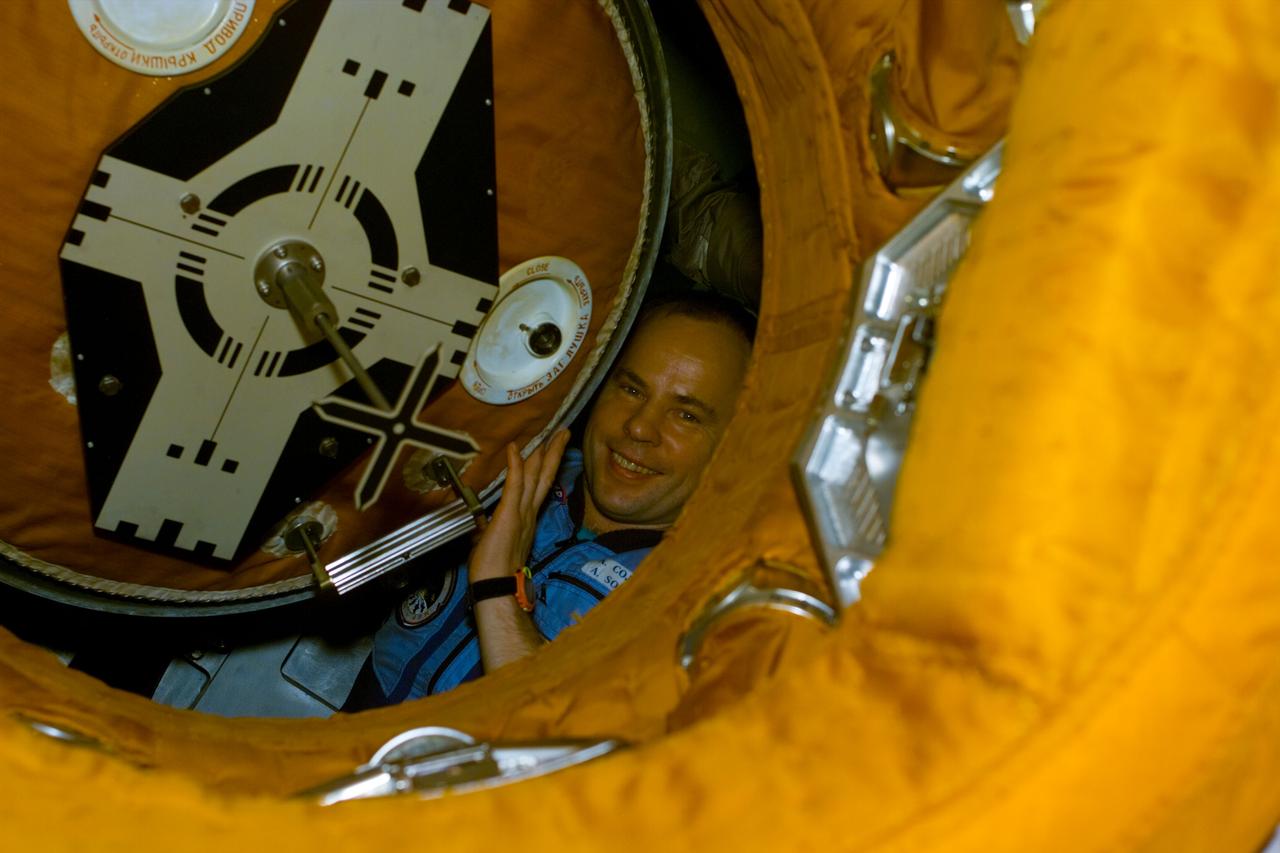
S89-E-5359 (28 Jan 1998) --- This Electronic Still Camera (ESC) image shows cosmonaut Anatoliy Y. Solovyev, Mir-24 commander, peeking through the Docking Module (DM) hatch one last time to bid his astronaut friends farewell, just moments before final hatch closure. The hatch closing brings an end to the eighth Shuttle/Mir joint docking activities. The STS-89 crew, onboard the Space Shuttle Endeavour, dropped off astronaut Andrew S. W. Thomas to replace astronaut David A. Wolf, as cosmonaut guest researcher. Thomas will be the last American astronaut to serve a tour aboard the Russian Mir Space station. This ESC view was taken on January 28, 1998, at 22:30:54 GMT.
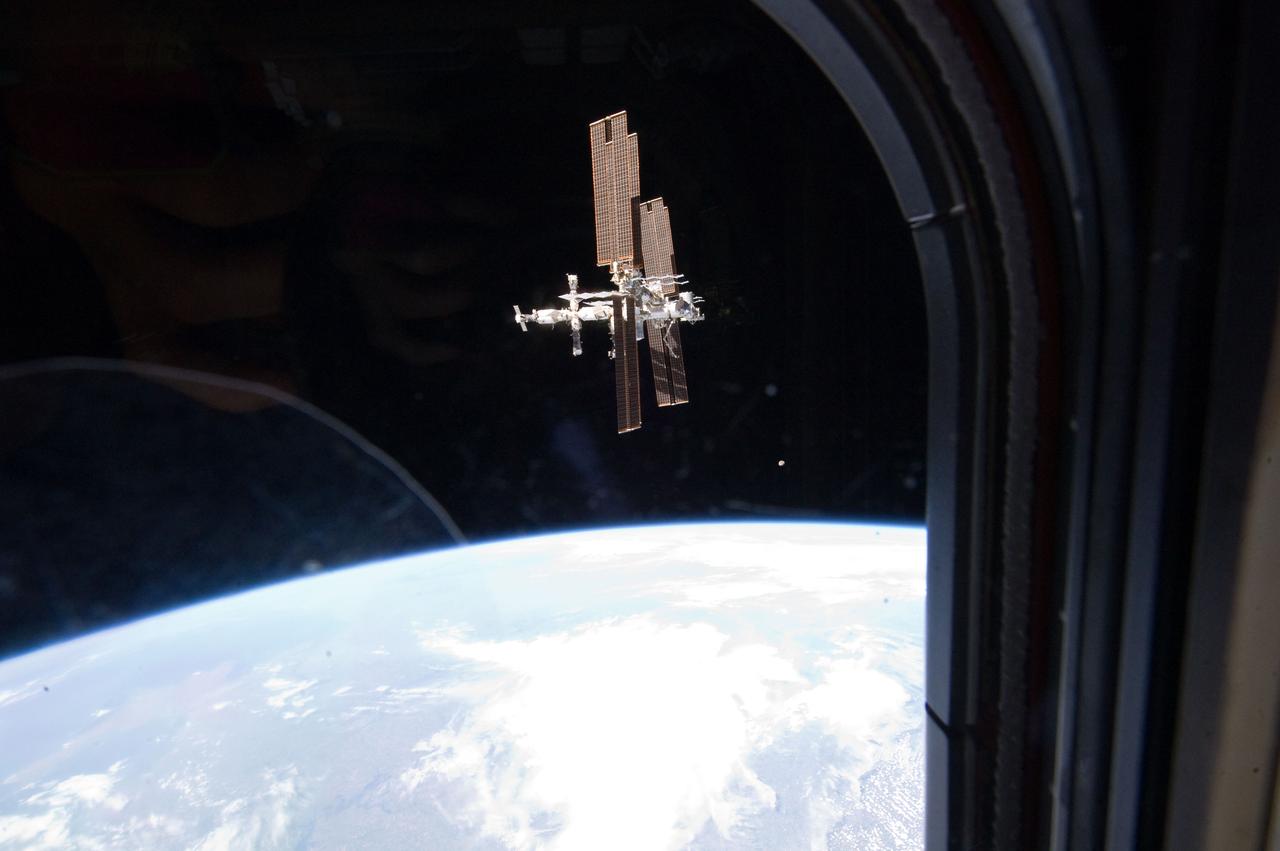
S135-E-010788(19 July 2011) --- This picture of the International Space Station was photographed from the space shuttle Atlantis as the orbiting complex and the shuttle performed their relative separation in the early hours of July 19, 2011. The glass reflects very minutely some of the shuttle in-cabin activity and crew. Onboard the station were Russian cosmonauts Andrey Borisenko, commander; Sergei Volkov and Alexander Samokutyaev, both flight engineers; Japan Aerospace Exploration astronaut Satoshi Furukawa, and NASA astronauts Mike Fossum and Ron Garan, all flight engineers. Onboard the shuttle were NASA astronauts Chris Ferguson, commander; Doug Hurley, pilot; and Sandy Magnus and Rex Walheim, both mission specialists. Photo credit: NASA
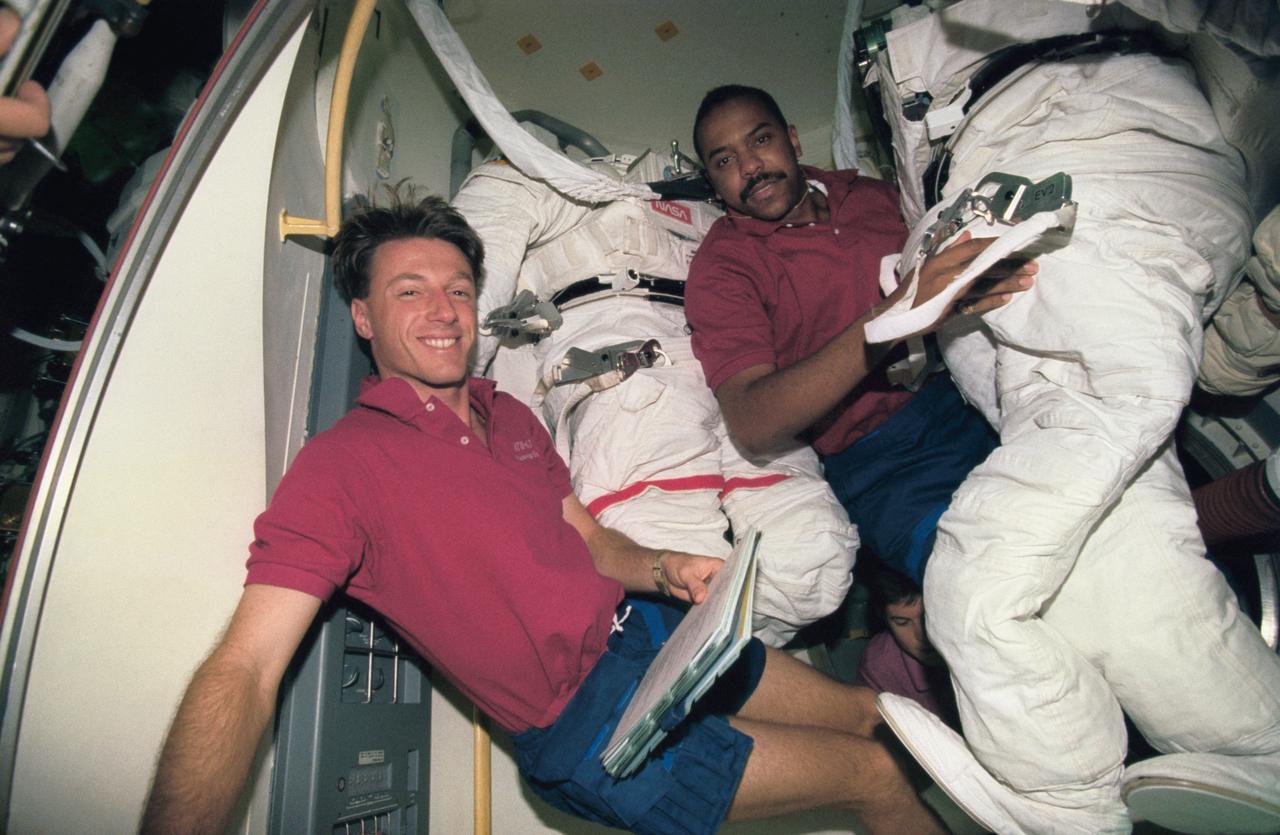
STS063-314-005 (9 Feb 1995) --- Astronaut's C. Michael Foale, mission specialist, (left) and Bernard A. Harris Jr., payload commander, prepare suits prior to their Extravehicular Activity (EVA). This is one of 16 still photographs released by the NASA Johnson Space Center (JSC) Public Affairs Office (PAO) on February 14, 1995. Others onboard the Space Shuttle Discovery were astronauts James D. Wetherbee, mission commander; Eileen M. Collins, pilot; mission specialists Janice E. Voss, and cosmonaut Vladimir G. Titov representing the Russian Space Agency (RSA).
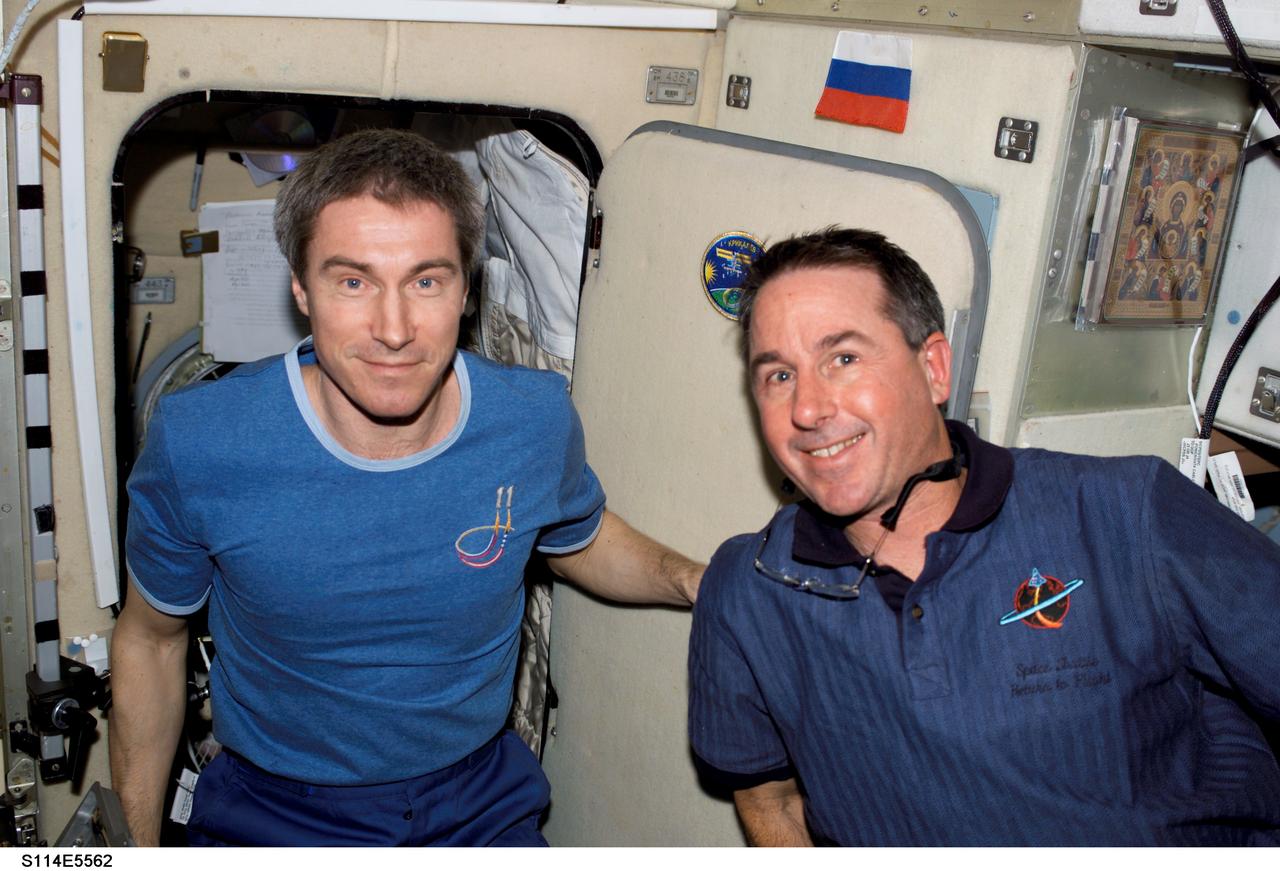
S114-E-5562 (28 July 2005) --- Russia's Federal Space Agency cosmonaut Sergei Krikalev (left) and NASA astronaut Stephen K. Robinson greet as Robinson and his STS-114 crewmates become the first human beings to interface face-to-face with the Expedition 11 crewmembers onboard the International Space Station. Earlier on this third flight day for STS-114, the Shuttle and its seven-member crew flawlessly docked with the orbiting outpost where all nine crew members will spend several days conducting joint activities.
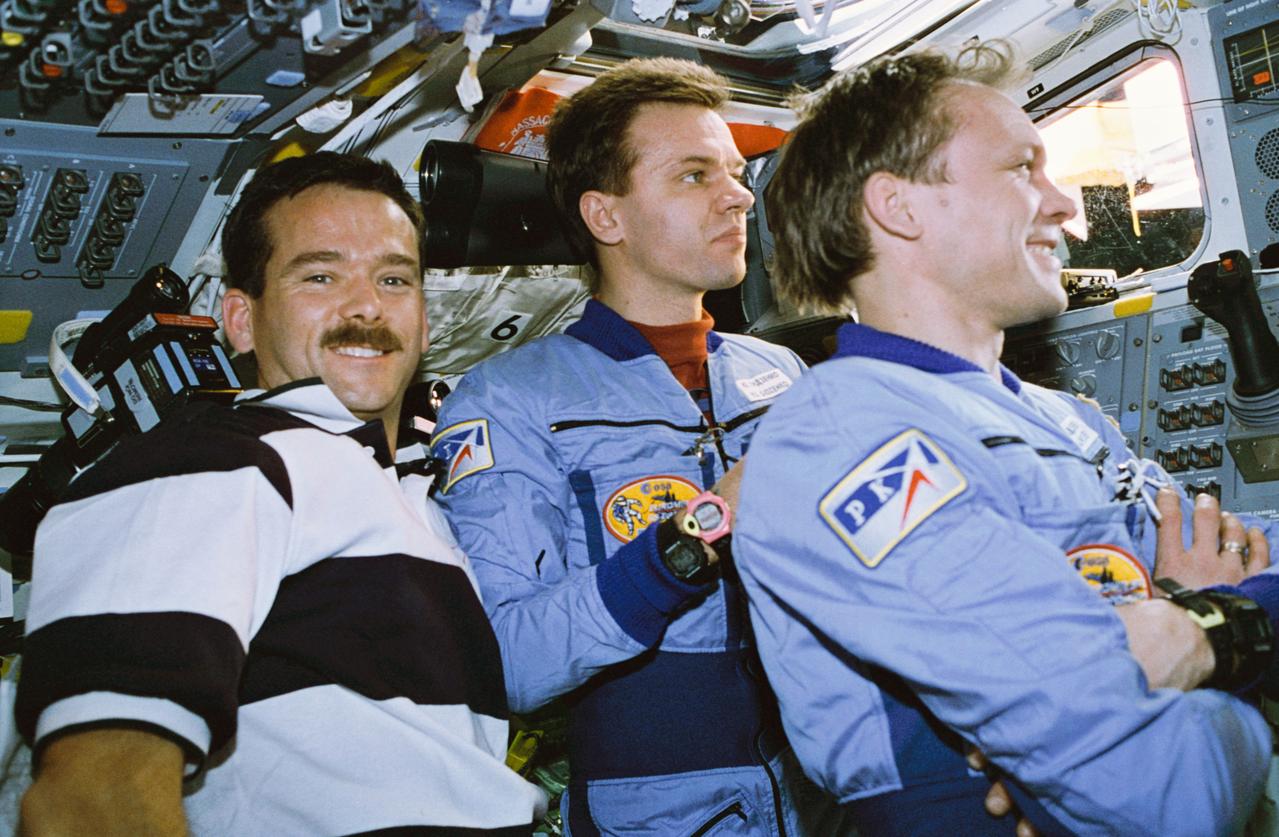
STS074-335-027 (12-20 Nov 1995) --- Astronaut Chris A. Hadfield joins two Mir-20 cosmonauts as they share a unique view through windows on the aft flight deck of the Space Shuttle Atlantis. Cosmonauts Yuriy P. Gidzenko (center), Mir-20 mission commander, and Sergei V. Avdeyev (right), flight engineer, along with the European Space Agency?s (ESA) Thomas Reiter (out of frame), cosmonaut researcher, have been onboard Russia?s Mir Space Station since September 5, 1995. At the time this photo was taken, the Space Shuttle Atlantis is docked with Mir Space Station, which is the subject of interest by the three international spectators here. With five NASA astronauts aboard the Space Shuttle Atlantis, the STS-74 flight began with a November 12, 1995, launch from Kennedy Space Center (KSC) and ended with landing there on November 20, 1995. The STS-74 crew members were astronauts Kenneth D. Cameron, mission commander; James D. Halsell Jr., pilot; William S. McArthur Jr., Jerry L. Ross and Canadian astronaut Hadfield, all mission specialists. Joint activities on the Mir Space Station and the Space Shuttle Atlantis ended on November 18, 1995, when the two spacecraft separated.
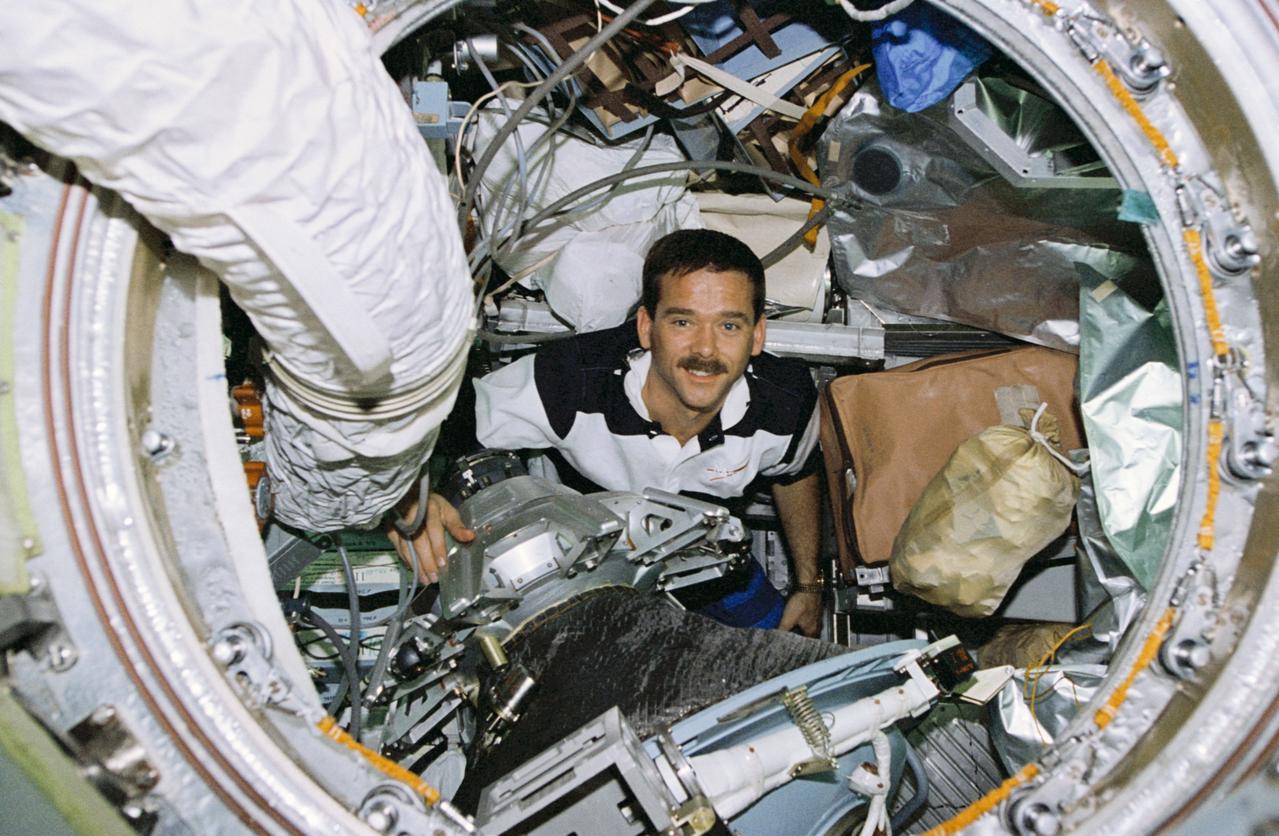
STS074-344-003 (12-20 Nov 1995) --- Astronaut Chris A. Hadfield makes his way among supplies and docking hardware onboard Russia?s Mir Space Station. With five NASA astronauts aboard the Space Shuttle Atlantis, the flight began with a November 12, 1995, launch from Kennedy Space Center (KSC) and ended with landing there on November 20, 1995. The STS-74 crew members were astronauts Kenneth D. Cameron, mission commander; James D. Halsell Jr., pilot; William S. McArthur Jr., Jerry L. Ross and Canadian astronaut Hadfield, all mission specialists. On November 15, 1995, the Space Shuttle Atlantis docked with Russia?s Mir Space Station, on which the NASA astronauts joined the Mir-20 crew. The Mir-20 crew is composed of cosmonauts Yuriy P. Gidzenko, commander; and Sergei V. Avdeyev, engineer; along with the European Space Agency?s (ESA) Thomas Reiter, cosmonaut researcher. Joint activities on the Mir Space Station and the Space Shuttle Atlantis ended on November 18, 1995, when the two spacecraft separated.
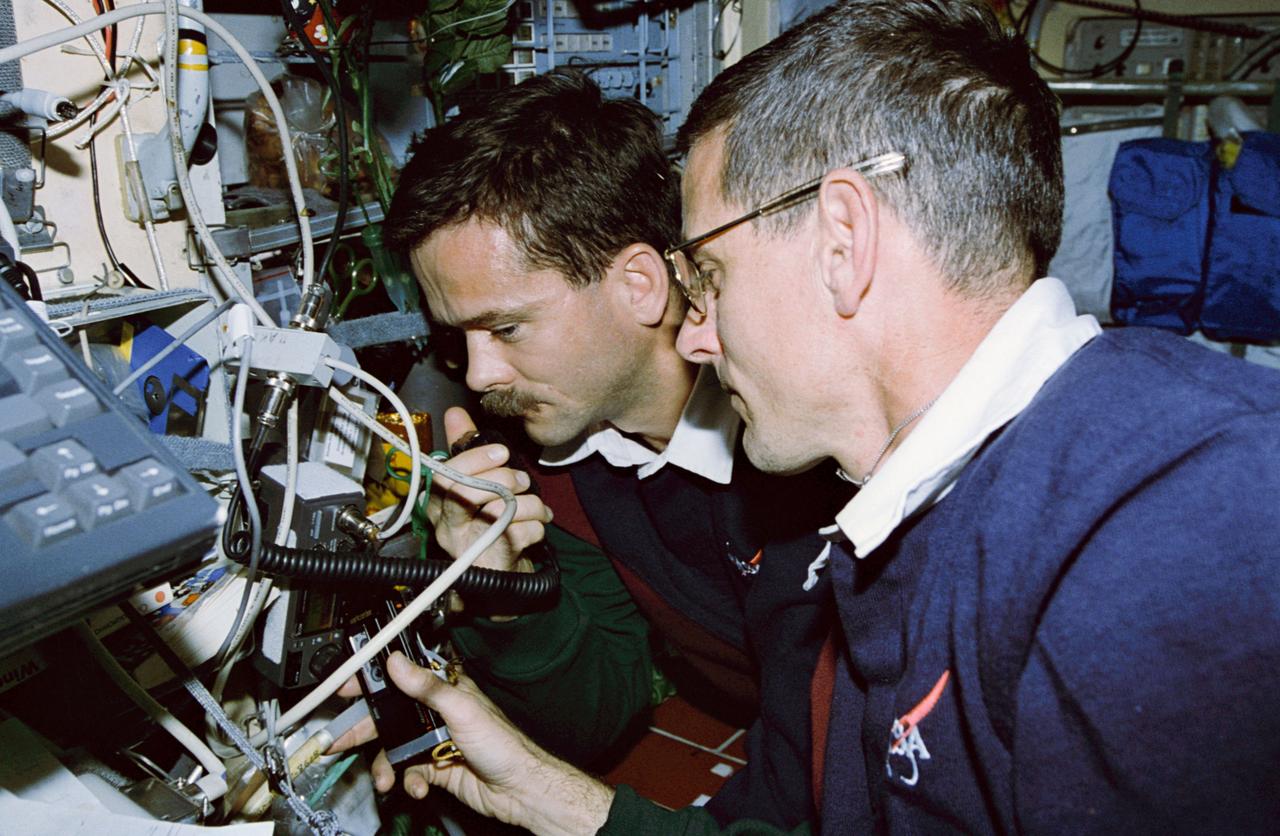
STS074-324-030 (12-20 Nov 1995) --- Astronauts Chris A. Hadfield (left) and William S. McArthur, Jr. check out the Shuttle Amateur Radio Experiment (SAREX) onboard Russia?s Mir Space Station. With five NASA astronauts aboard, the flight of the Space Shuttle Atlantis began with a November 12, 1995, launch from Kennedy Space Center (KSC) and ended with landing there on November 20, 1995. The STS-74 crew members were astronauts Kenneth D. Cameron, mission commander; James D. Halsell, Jr., pilot; McArthur, Jerry L. Ross and Canadian astronaut Hadfield, all mission specialists. On November 15, 1995, the Space Shuttle Atlantis docked with the Mir Space Station, on which the STS-74 astronauts joined the Mir-20 crew. The Mir-20 crew is composed of cosmonauts Yuriy P. Gidzenko, commander; and Sergei V. Avdeyev, flight engineer; along with the European Space Agency?s (ESA) Thomas Reiter, cosmonaut researcher. Joint activities on the Mir Space Station and the Space Shuttle Atlantis ended November 18, 1995, when the two spacecraft separated.
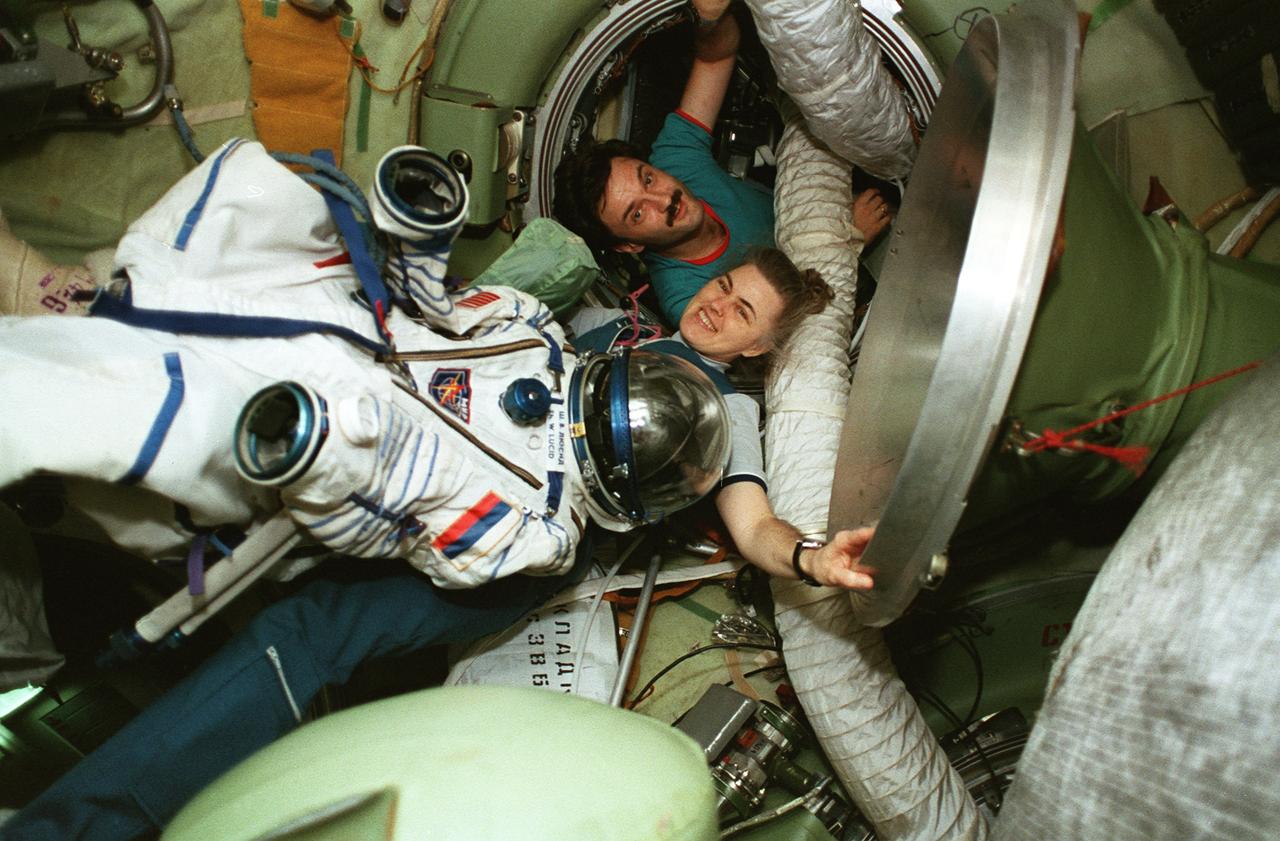
STS079-354-011 (16-26 Sept. 1996) --- Astronaut Shannon W. Lucid with cosmonaut Aleksandr Y. Kaleri prepare to move Lucid's cosmonaut space suit from Russia's Mir Space Station to the Space Shuttle Atlantis. This photograph is one of fifteen 35mm frames (along with four 70mm frames) of still photography documenting the activities of NASA's STS-79 mission, which began with a Sept. 16, 1996, liftoff from Launch Pad 39A the Kennedy Space Center (KSC) and ended with a landing at KSC on Sept. 26, 1996. Onboard for the launch were astronauts William F. Readdy, commander; Terrence W. Wilcutt, pilot; John E. Blaha, Jerome (Jay) Apt, Thomas D. Akers and Carl E. Walz, all mission specialists. On flight day 4, the crew docked with Mir. Lucid, who had spent six months aboard Mir, switched cosmonaut guest researcher roles with Blaha. The latter joined fellow Mir-22 crewmembers Valeri G. Korzun, commander, and Kaleri, flight engineer.
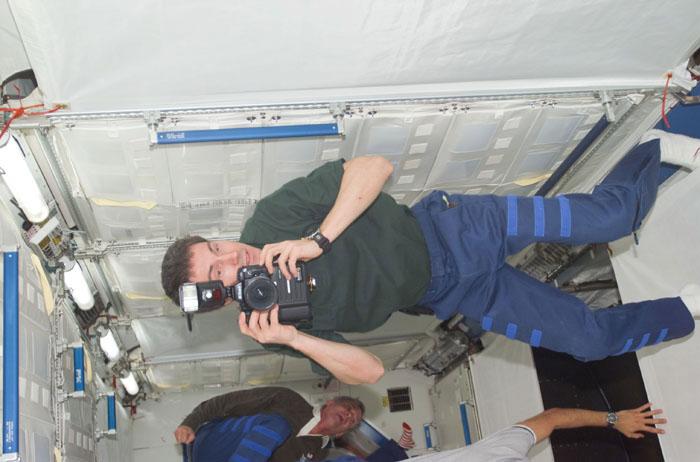
STS98-E-5138 (11 February 2001) --- Cosmonaut Sergei K. Krikalev, Expedition One flight engineer, takes still photographs onboard the newly opened Destiny laboratory on the International Space Station (ISS). After astronaut William M. (Bill) Shepherd, Expedition One commander, opened the Destiny hatch, he and astronaut Kenneth D. Cockrell (out of frame) ventured inside at 8:38 a.m. (CST), February 11, 2001. As depicted in subsequent digital images in this series, members of both crews went to work quickly inside the new module, activating air systems, fire extinguishers, alarm systems, computers and internal communications. The crew also took some photos and continued equipment transfers from the shuttle to the station.
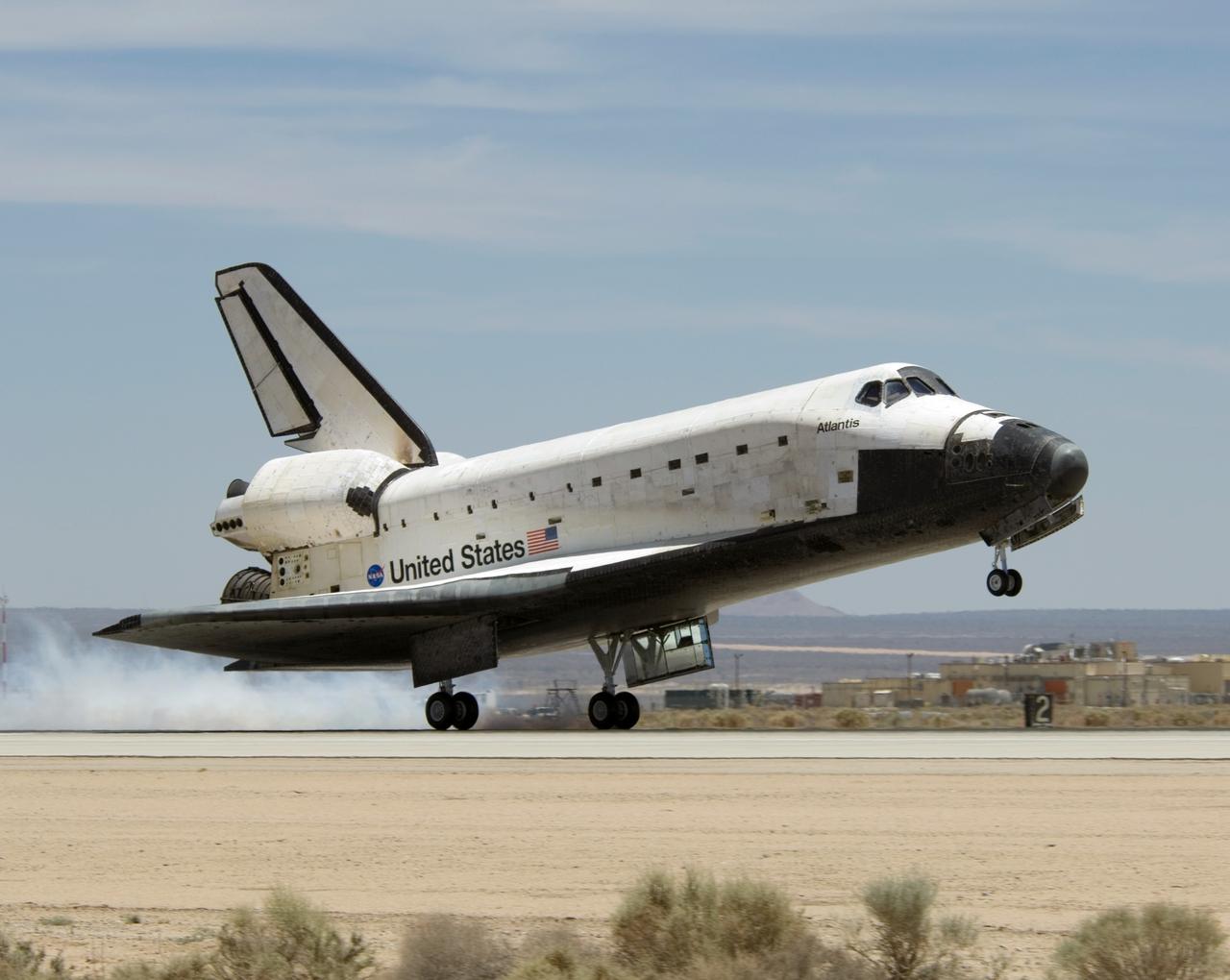
STS117-S-049 (22 June 2007) --- Space Shuttle Atlantis' main landing gear touches down on runway 22 at NASA's Dryden Flight Research Center at Edwards Air Force Base in California concluding a successful assembly mission to the International Space Station. Atlantis landed on orbit 219 after 13 days, 20 hours and 12 minutes in space. The landing was diverted to California due to marginal weather at the Kennedy Space Center. Main gear touchdown was at 12:49:38 p.m. (PDT). Nose gear touchdown was at 12:49:49 p.m. and wheel stop was at 12:50:48 p.m. This was the 51st landing for the Space Shuttle Program at Edwards Air Force Base. The mission to the station was a success, installing and activating the S3/S4 truss and retracting the P6 arrays. Onboard were astronauts Rick Sturckow, commander; Lee Archambault, pilot; Jim Reilly, Steven Swanson, Patrick Forrester and John "Danny" Olivas, all STS-117 mission specialists. Also onboard was astronaut Sunita Williams, who was flight engineer on the Expedition 15 crew. She achieved a new milestone, a record-setting flight at 194 days, 18 hours and 58 minutes, the longest single spaceflight ever by a female astronaut or cosmonaut.

STS117-S-050 (22 June 2007) --- With drag chute deployed, Space Shuttle Atlantis slows to a stop after landing on runway 22 at NASA's Dryden Flight Research Center at Edwards Air Force Base in California concluding a successful assembly mission to the International Space Station. Atlantis landed on orbit 219 after 13 days, 20 hours and 12 minutes in space. The landing was diverted to California due to marginal weather at the Kennedy Space Center. Main gear touchdown was at 12:49:38 p.m. (PDT). Nose gear touchdown was at 12:49:49 p.m. and wheel stop was at 12:50:48 p.m. This was the 51st landing for the Space Shuttle Program at Edwards Air Force Base. The mission to the station was a success, installing and activating the S3/S4 truss and retracting the P6 arrays. Onboard were astronauts Rick Sturckow, commander; Lee Archambault, pilot; Jim Reilly, Steven Swanson, Patrick Forrester and John "Danny" Olivas, all STS-117 mission specialists. Also onboard was astronaut Sunita Williams, who was flight engineer on the Expedition 15 crew. She achieved a new milestone, a record-setting flight at 194 days, 18 hours and 58 minutes, the longest single spaceflight ever by a female astronaut or cosmonaut.
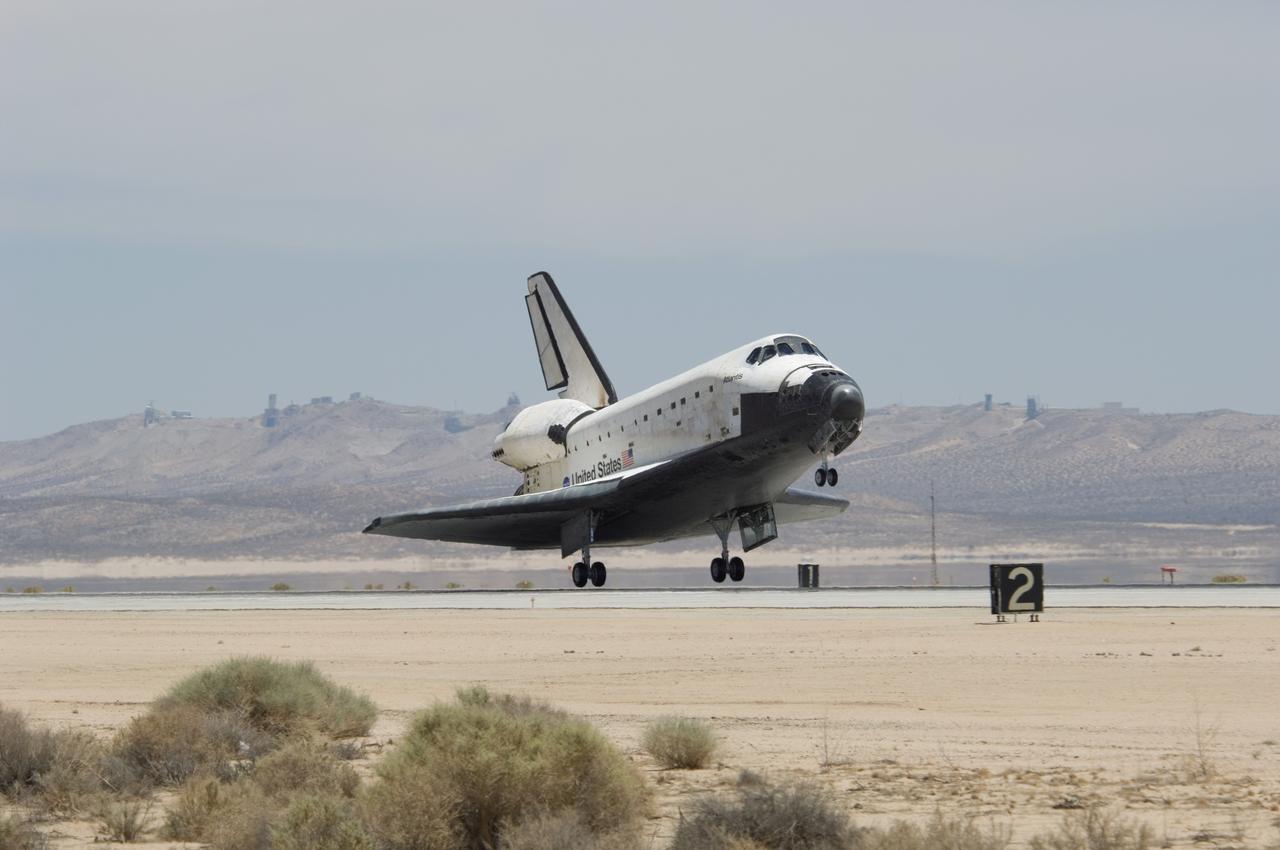
STS117-S-047 (22 June 2007) --- Space Shuttle Atlantis' main landing gear touches down on runway 22 at NASA's Dryden Flight Research Center at Edwards Air Force Base in California concluding a successful assembly mission to the International Space Station. Atlantis landed on orbit 219 after 13 days, 20 hours and 12 minutes in space. The landing was diverted to California due to marginal weather at the Kennedy Space Center. Main gear touchdown was at 12:49:38 p.m. (PDT). Nose gear touchdown was at 12:49:49 p.m. and wheel stop was at 12:50:48 p.m. This was the 51st landing for the Space Shuttle Program at Edwards Air Force Base. The mission to the station was a success, installing and activating the S3/S4 truss and retracting the P6 arrays. Onboard were astronauts Rick Sturckow, commander; Lee Archambault, pilot; Jim Reilly, Steven Swanson, Patrick Forrester and John "Danny" Olivas, all STS-117 mission specialists. Also onboard was astronaut Sunita Williams, who was flight engineer on the Expedition 15 crew. She achieved a new milestone, a record-setting flight at 194 days, 18 hours and 58 minutes, the longest single spaceflight ever by a female astronaut or cosmonaut.
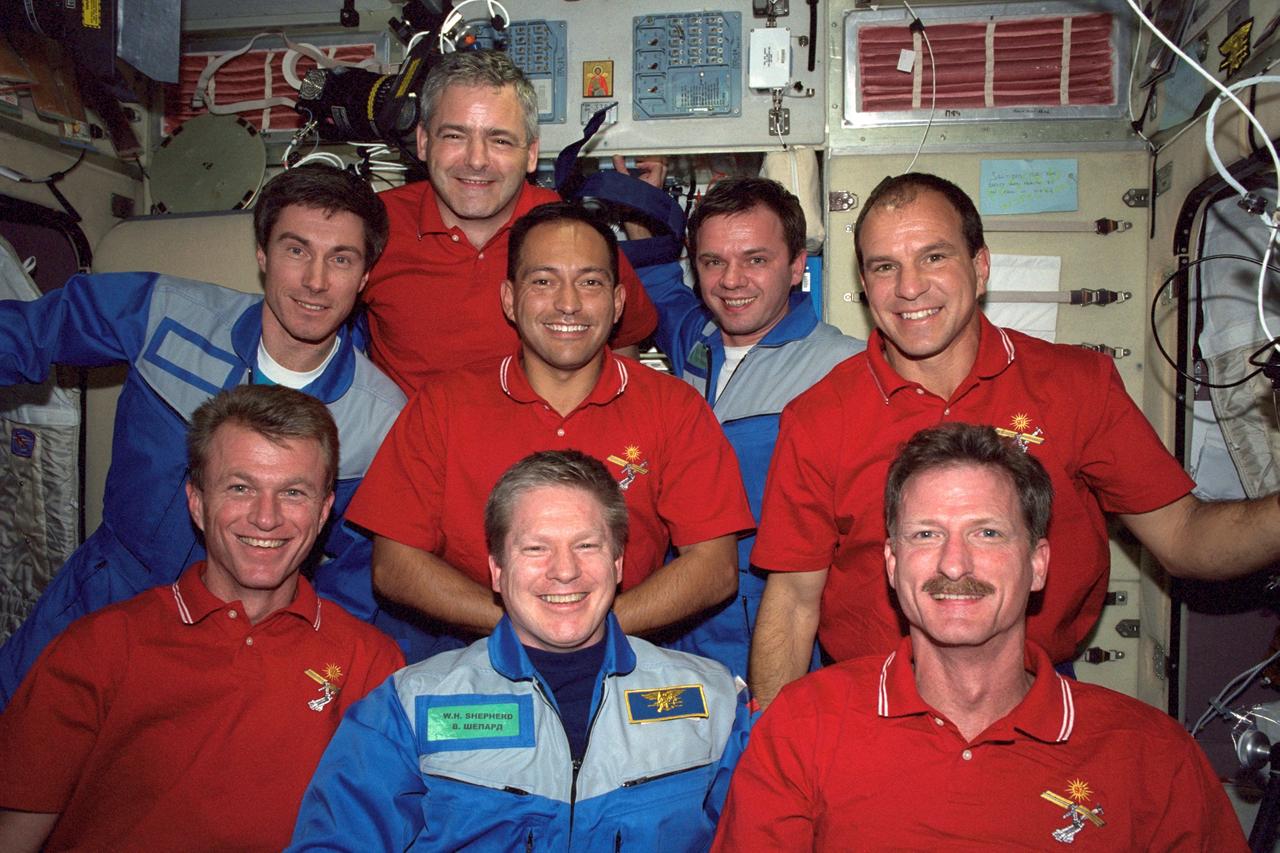
In this image, the five STS-97 crew members pose with the 3 members of the Expedition One crew onboard the International Space Station (ISS) for the first ever traditional onboard portrait taken in the Zvezda Service Module. On the front row, left to right, are astronauts Brent W. Jett, Jr., STS-97 commander; William M. Shepherd, Expedition One mission commander; and Joseph R. Tarner, STS-97 mission specialist. On the second row, from the left are Cosmonaut Sergei K. Krikalev, Expedition One flight engineer; astronaut Carlos I. Noriega, STS-97 mission specialist; cosmonaut Yuri P. Gidzenko, Expedition One Soyuz commander; and Michael J. Bloomfield, STS-97 pilot. Behind them is astronaut Marc Garneau, STS-97 mission specialist representing the Canadian Space Agency (CSA). The primary objective of the STS-97 mission was the delivery, assembly, and activation of the U.S. electrical power system onboard the International Space Station (ISS). The electrical power system, which is built into a 73-meter (240-foot) long solar array structure consists of solar arrays, radiators, batteries, and electronics. The entire 15.4-metric ton (17-ton) package is called the P6 Integrated Truss Segment, and is the heaviest and largest element yet delivered to the station aboard a space shuttle. The electrical system will eventually provide the power necessary for the first ISS crews to live and work in the U.S. segment. The STS-97 crew of five launched aboard the Space Shuttle Orbiter Endeavor on November 30, 2000 for an 11 day mission.
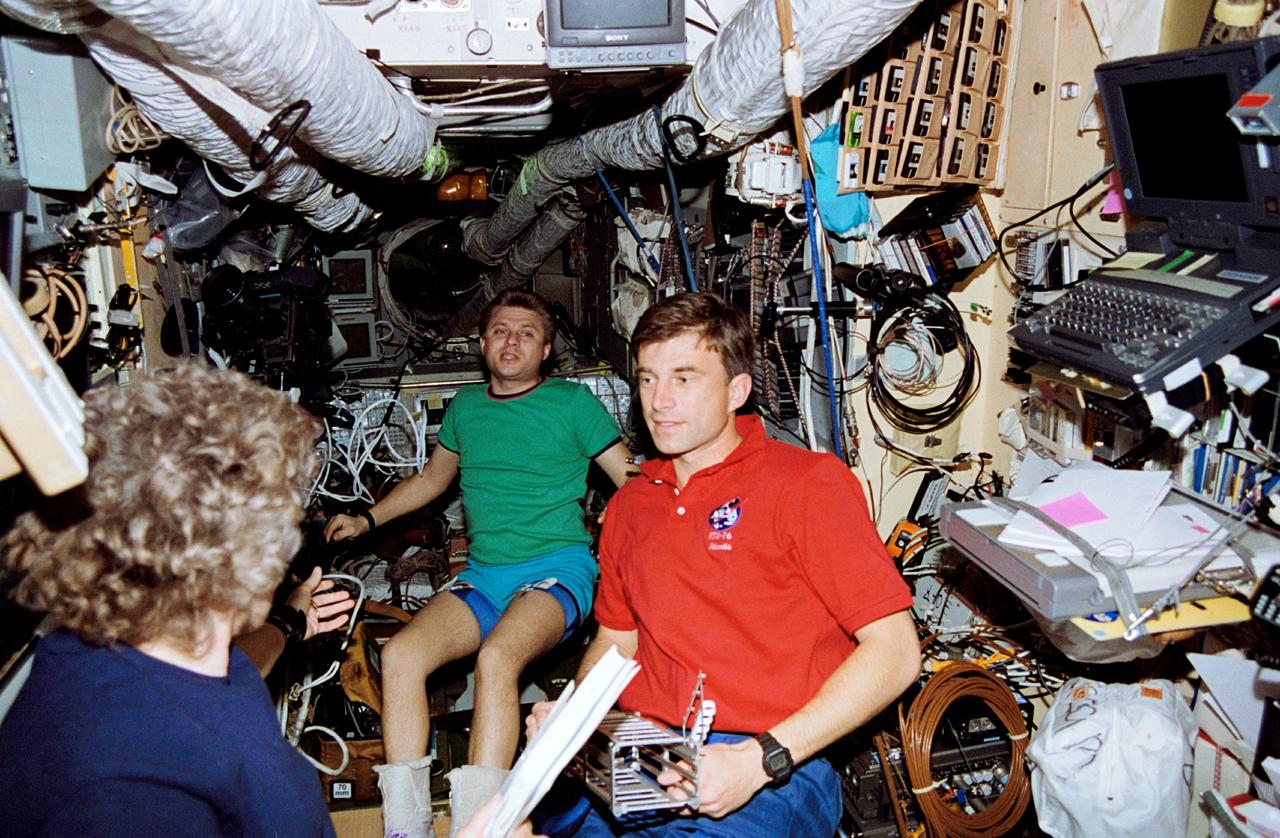
STS076-461-004 (22-31 March 1996) --- Onboard the Base Block Module of Russia's Mir Space Station, astronauts Shannon W. Lucid and Ronald M. Sega, payload commander, discuss final activities between the STS-76 and Mir-21 crews as cosmonaut Yury I. Onufrienko (center) listens. Yury V. Usachev (out of frame) is Mir-21 flight engineer. The Space Shuttle Atlantis docked with Mir on March 23, 1996, and remained linked until March 28, 1996. Lucid was in the process of transferring from STS-76 to the Mir-21 crew, which thereby grew from two to three members. She will remain aboard Mir for approximately 140 days.
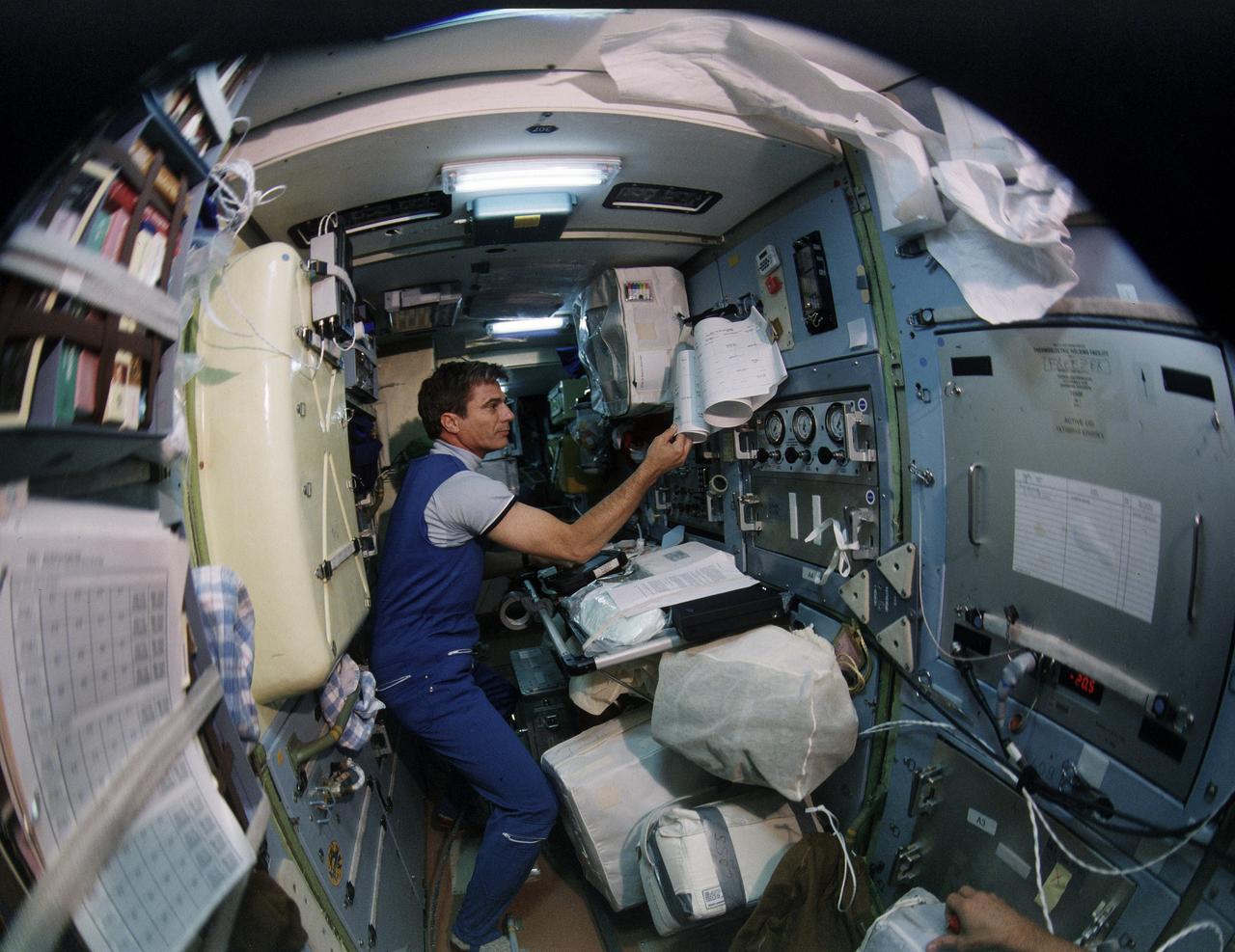
STS079-S-062 (16-26 Sept. 1996) --- Astronaut John E. Blaha, here serving as a cosmonaut guest researcher onboard Russia's Mir Space Station, is pictured on the Spektr Module during his "move" from the Space Shuttle Atlantis. During the STS-79 mission, the crew used an IMAX camera to document activities aboard the space shuttle Atlantis and the various Mir modules. A hand-held version of the 65mm camera system accompanied the STS-79 crew into space in Atlantis' crew cabin. NASA has flown IMAX camera systems on many shuttle missions, including a special cargo bay camera's coverage of other recent Shuttle-Mir rendezvous and/or docking missions.
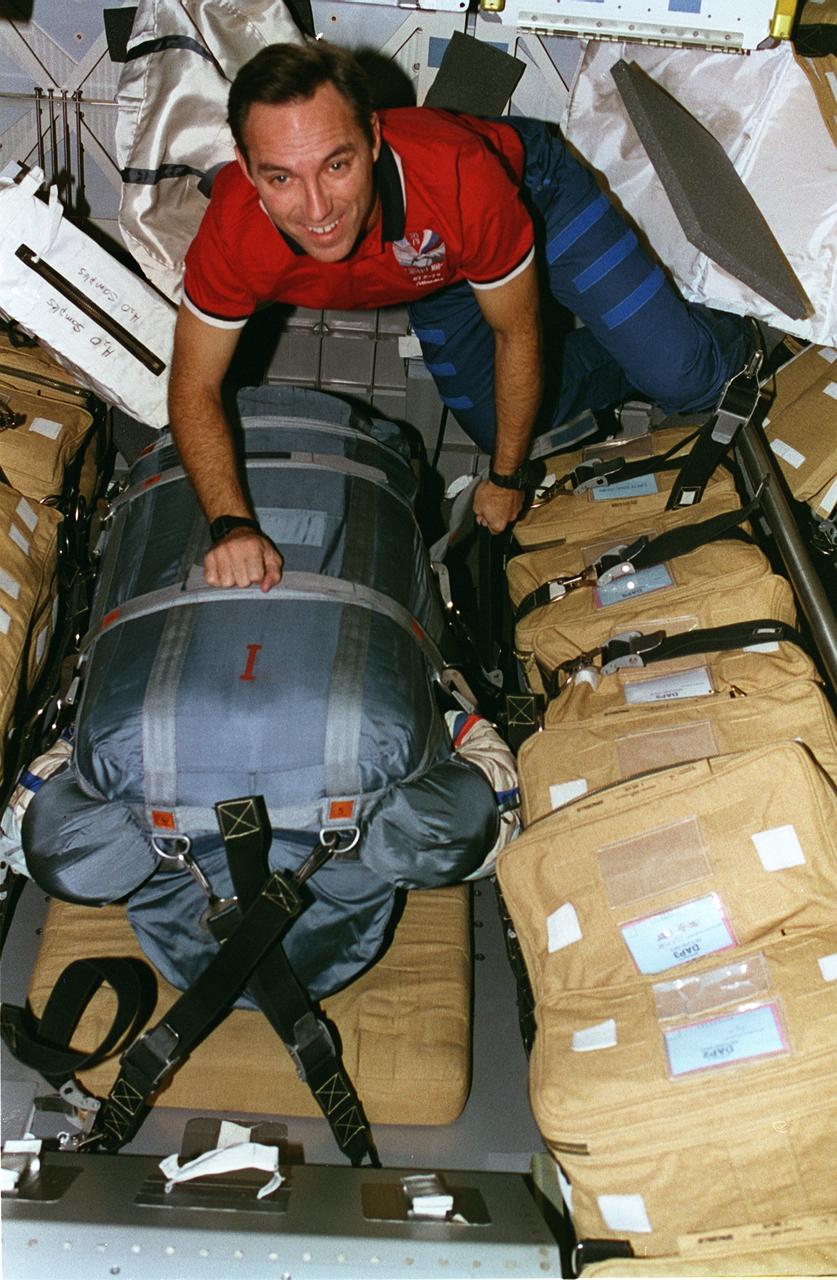
STS079-304-001 (16 Sept. 1996)--- Astronaut Carl E. Walz totes a bag carrying a space suit used by the cosmonauts. At the completion of the STS-79 mission, the suit was brought back to Earth for analysis. This photograph is one of fifteen 35mm frames (along with four 70mm frames) of still photography documenting the activities of NASA's STS-79 mission, which began with a September 16, 1996, liftoff from Launch Pad 39A the Kennedy Space Center (KSC) and ended with a landing at KSC on September 26, 1996. Onboard for the launch were astronauts William F. Readdy, commander; Terrence W. Wilcutt, pilot; John E. Blaha, Jerome (Jay) Apt, Thomas D. Akers and Walz, all mission specialists. On flight day 4, the crew docked with Russia's Mir Space Station. Shannon W. Lucid, who had spent six months aboard Mir, switched cosmonaut guest researcher roles with Blaha. The latter joined fellow Mir-22 crew members Valeri G. Korzun, commander, and Aleksandr Y. Kaleri, flight engineer.
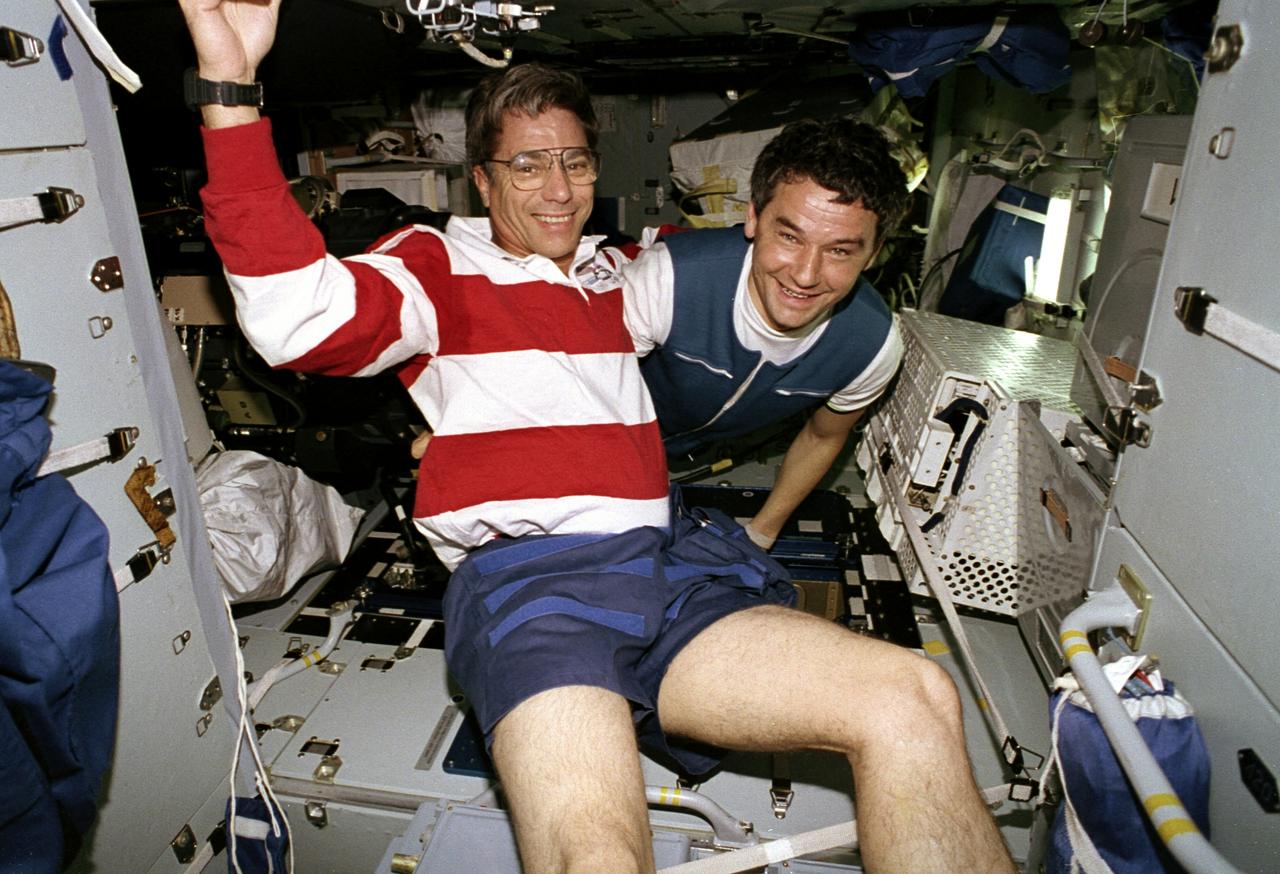
STS079-350-028 (16-26 Sept. 1996) --- Aboard Russian Mir Space Station's Spektr Module, astronaut John E. Blaha, now a cosmonaut guest researcher, visits with Valeri G. Korzun, his mission commander for Mir-22. This photograph is one of fifteen 35mm frames (along with four 70mm frames) of still photography documenting the activities of NASA's STS-79 mission, which began with a Sept. 16, 1996, liftoff from Launch Pad 39A the Kennedy Space Center (KSC) and ended with a landing at KSC on September 26, 1996. Onboard for the launch were astronauts William F. Readdy, commander; Terrence W. Wilcutt, pilot; Blaha, Jerome (Jay) Apt, Thomas D. Akers and Carl E. Walz, all mission specialists. On flight day 4, the crew docked with Mir. Shannon W. Lucid, who had spent six months aboard Mir, switched cosmonaut guest researcher roles with Blaha. The latter joined fellow Mir-22 crewmembers Korzun, and Aleksandr Y. Kaleri, flight engineer.

STS079-813-023 (16-26 Sept. 1996) --- The docked Russian Mir Space Station is partially visible through the Spacehab viewing port, onboard the space shuttle Atlantis. This photograph is one of four 70mm frames (along with fifteen 35mm frames) of still photography documenting the activities of NASA's STS-79 mission, which began with a Sept. 16, 1996, liftoff from Launch Pad 39A the Kennedy Space Center (KSC) and ended with a landing at KSC on Sept. 26, 1996. Onboard for the launch were astronauts William F. Readdy, commander; Terrence W. Wilcutt, pilot; John E. Blaha, Jerome (Jay) Apt, Thomas D. Akers and Carl E. Walz, all mission specialists. On flight day 4, the crew docked with the Mir Space Station. Shannon W. Lucid, who had spent six months aboard Mir, switched cosmonaut guest researcher roles with Blaha. The latter joined fellow Mir-22 crewmembers Valeri G. Korzun, commander, and Aleksandr Y. Kaleri, flight engineer.
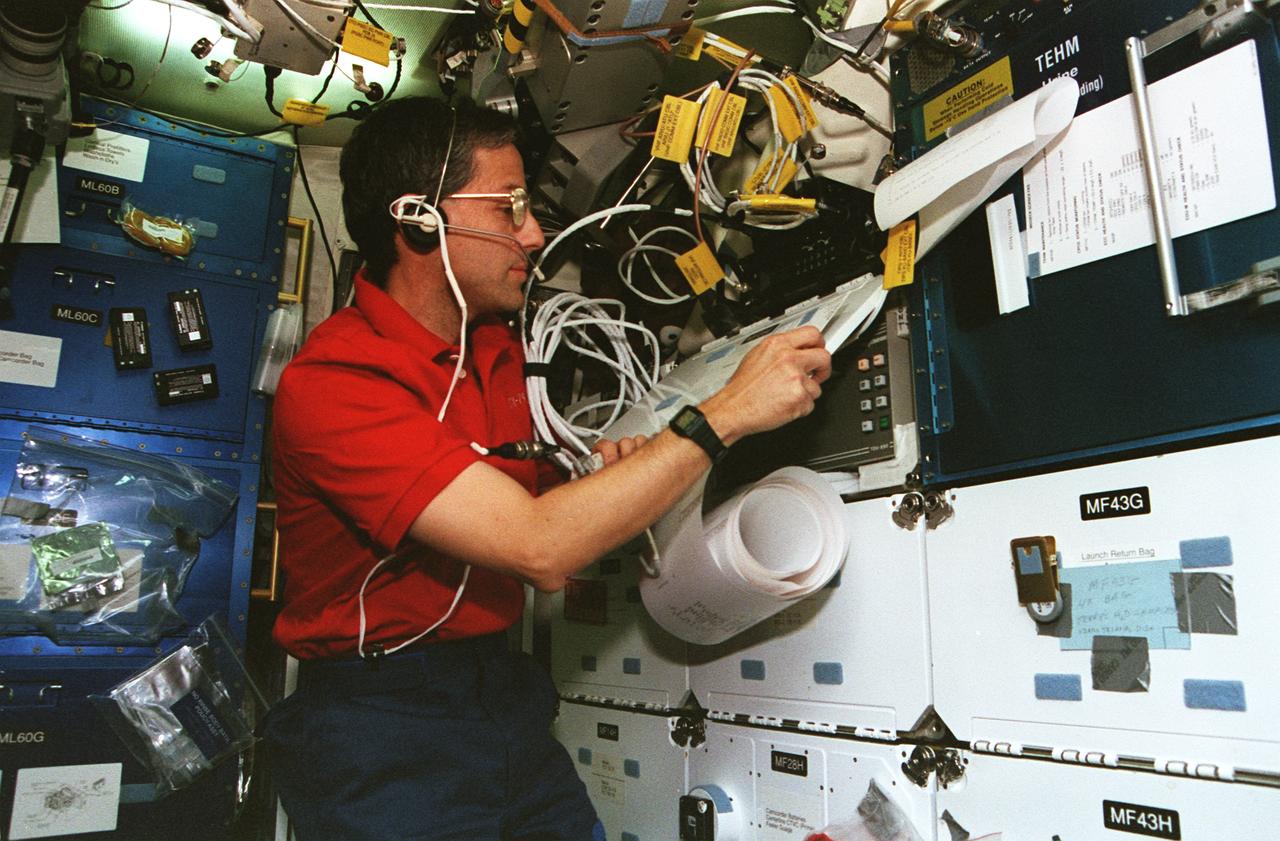
STS079-365-004 (16-26 Sept. 1996) --- During off-duty time, Jerome (Jay) Apt, a licensed amateur radio operator, talks to ground contacts via the Shuttle Amateur Radio Experiment (SAREX). The radio was also used for communications between the Space Shuttle Atlantis and Russia's Mir Space Station during docking and undocking activities. This photograph is one of fifteen 35mm frames (along with four 70mm frames) of still photography documenting the activities of NASA's STS-79 mission, which began with a September 16, 1996, liftoff from Launch Pad 39A the Kennedy Space Center (KSC) and ended with a landing at KSC on September 26, 1996. Onboard for the launch were astronauts William F. Readdy, commander; Terrence W. Wilcutt, pilot; John E. Blaha, Apt, Thomas D. Akers and Carl E. Walz, all mission specialists. On flight day 4, the crew docked with Mir. Shannon W. Lucid, who had spent six months aboard Mir, switched cosmonaut guest researcher roles with Blaha. The latter joined fellow Mir-22 crew members Valeri G. Korzun, commander, and Aleksandr Y. Kaleri, flight engineer.
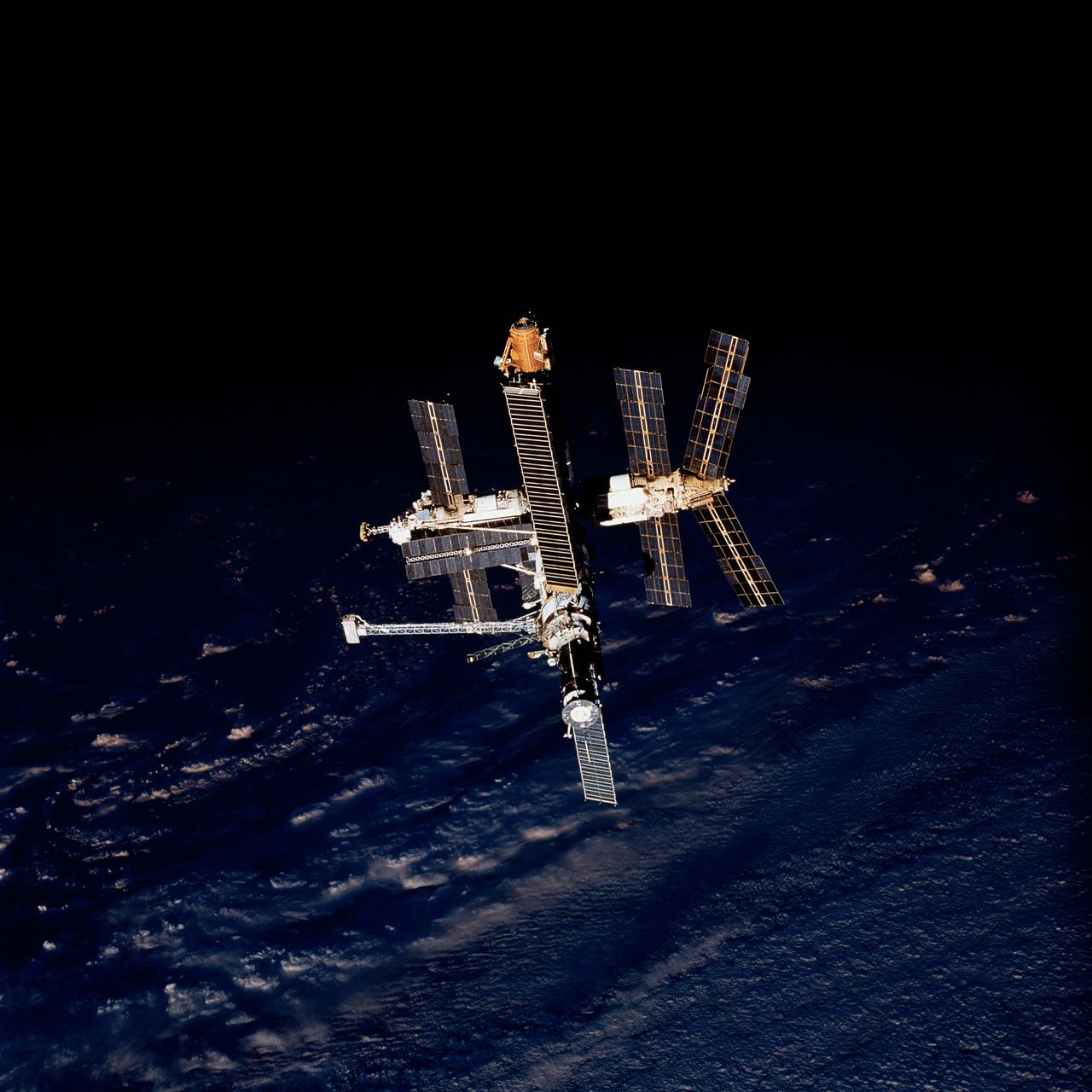
STS079-821-036 (16-26 Sept. 1996) --- Following the Space Shuttle Atlantis - Russian Mir Space Station undocking activities, a crew member captured this 70mm frame of Mir as the two crews shared their final common sunset scene. This photograph is one of four 70mm frames (along with fifteen 35mm frames) of still photography documenting the activities of NASA's STS-79 mission, which began with a September 16, 1996, liftoff from Launch Pad 39A the Kennedy Space Center (KSC) and ended with a landing at KSC on September 26, 1996. Onboard for the launch were astronauts William F. Readdy, commander; Terrence W. Wilcutt, pilot; John E. Blaha, Jerome (Jay) Apt, Thomas D. Akers and Carl E. Walz, all mission specialists. On flight day 4, the crew docked with Mir. Shannon W. Lucid, who had spent six months aboard Mir, switched cosmonaut guest researcher roles with Blaha. The latter joined fellow Mir-22 crew members Valeri G. Korzun, commander, and Aleksandr Y. Kaleri, flight engineer.
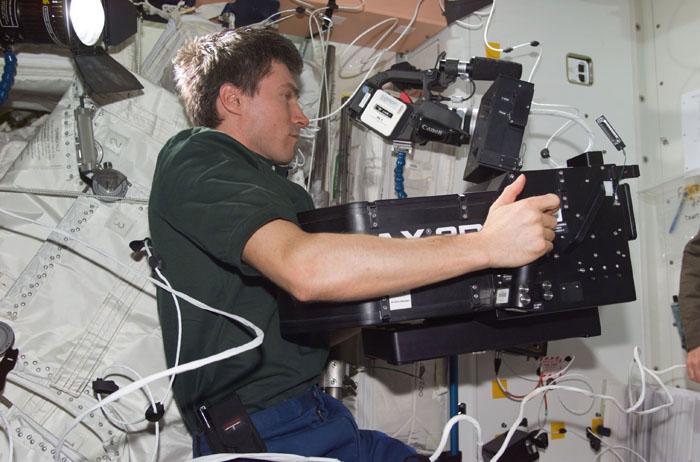
STS98-E-5124 (11 February 2001) --- Cosmonaut Sergei K. Krikalev, Expedition One flight engineer representing the Russian Aviation and Space Agency, films activity in the Unity node, just outside the newly attached Destiny laboratory. The crews of Atlantis and the International Space Station on February 11 opened the Destiny laboratory and spent the first full day of what are planned to be years of work ahead inside the orbiting science and command center. Astronaut William M. (Bill) Shepherd (just out of frame here) opened the Destiny hatch, and he and Shuttle commander Kenneth D. Cockrell ventured inside at 8:38 a.m. (CST). Members of both crews went to work quickly inside the new module, activating air systems, fire extinguishers, alarm systems, computers and internal communications. The crew also continued equipment transfers from the shuttle to the station and filmed several scenes onboard the station using the IMAX camera. This scene was recorded with a digital still camera.
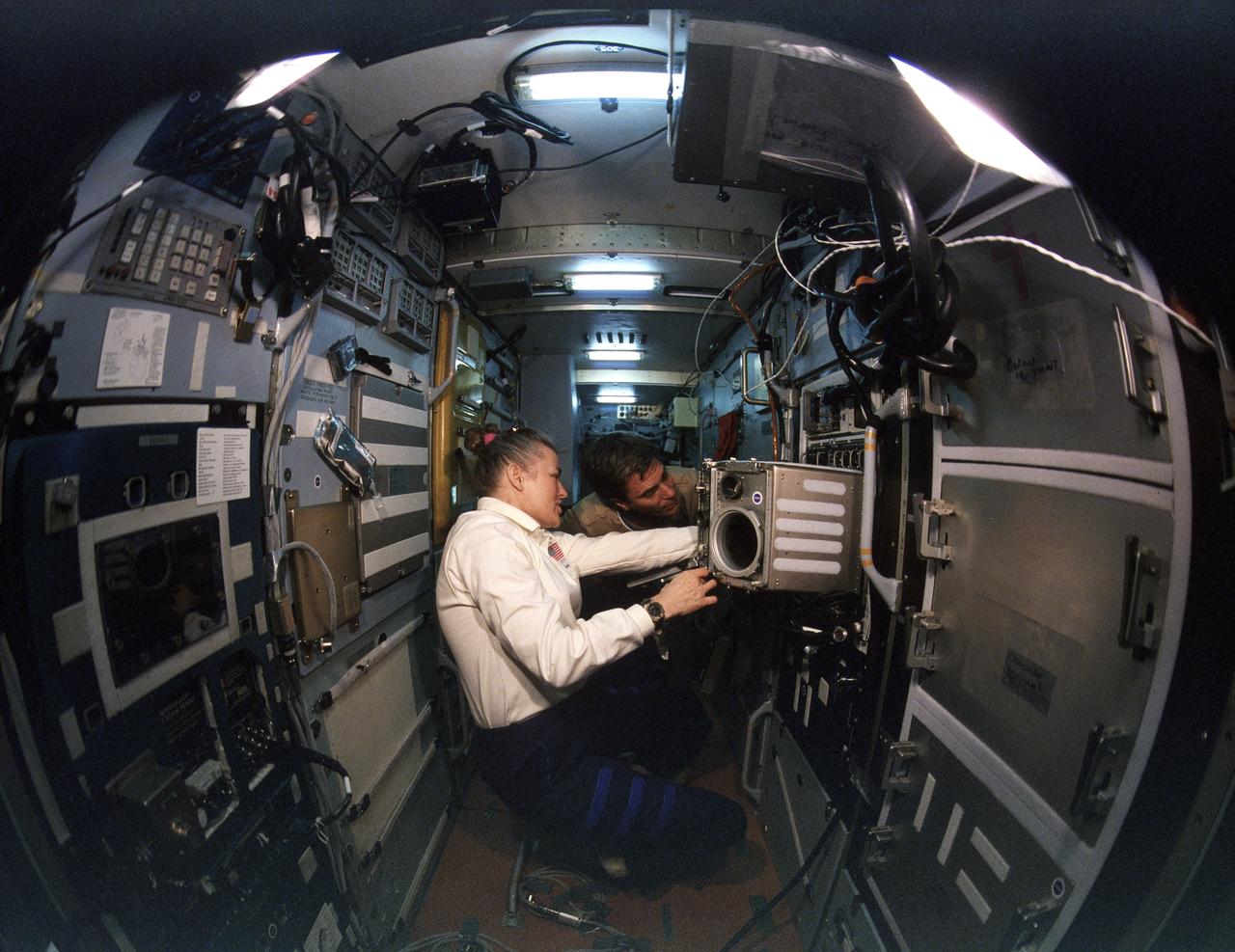
STS079-S-092 (16-26 Sept. 1996) --- Astronauts Shannon W. Lucid and John E. Blaha work at a microgravity glove box on the Priroda Module aboard Russia's Mir Space Station complex. Blaha, who flew into Earth-orbit with the STS-79 crew, and Lucid are the first participants in a series of ongoing exchanges of NASA astronauts serving time as cosmonaut guest researchers onboard Mir. Lucid went on to spend a total of 188 days in space before returning to Earth with the STS-79 crew. During the STS-79 mission, the crew used an IMAX camera to document activities aboard the Space Shuttle Atlantis and the various Mir modules, with the cooperation of the Russian Space Agency (RSA). A hand-held version of the 65mm camera system accompanied the STS-79 crew into space in Atlantis' crew cabin. NASA has flown IMAX camera systems on many Shuttle missions, including a special cargo bay camera's coverage of other recent Shuttle-Mir rendezvous and/or docking missions.
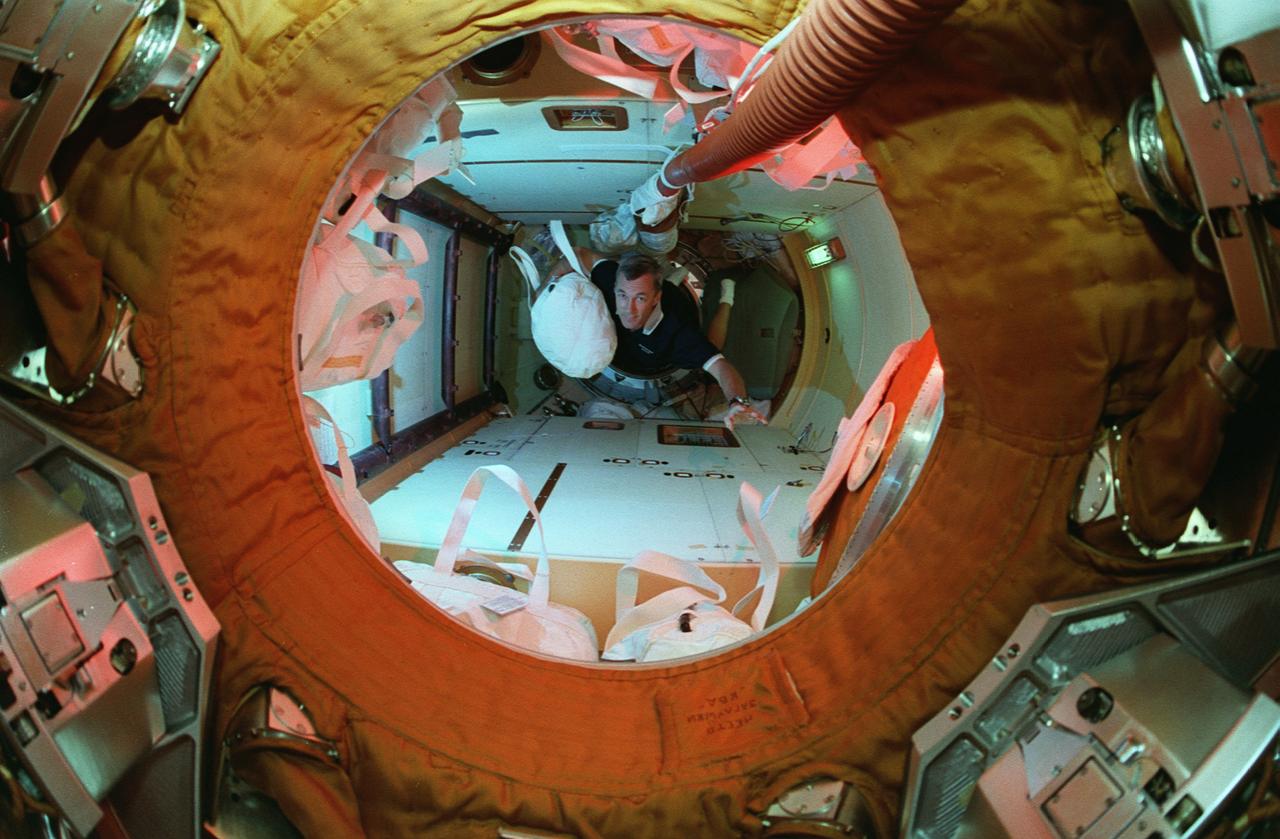
STS079-335-001 (16-26 Sept. 1996) --- Astronaut Terrence W. Wilcutt traverses into Russia's Mir Space Station Kristall Module toting a water bag from the Space Shuttle Atlantis to be used on Mir. This photograph is one of fifteen 35mm frames (along with four 70mm frames) of still photography documenting the activities of NASA's STS-79 mission, which began with a Sept. 16, 1996, liftoff from Launch Pad 39A the Kennedy Space Center (KSC) and ended with a landing at KSC on September 26, 1996. Onboard for the launch were astronauts William F. Readdy, commander; Wilcutt, pilot; John E. Blaha, Jerome (Jay) Apt, Thomas D. Akers and Carl E. Walz, all mission specialists. On flight day 4, the crew docked with Mir. Shannon W. Lucid, who had spent six months aboard Mir, switched cosmonaut guest researcher roles with Blaha. The latter joined fellow Mir-22 crewmembers Valeri G. Korzun, commander, and Aleksandr Y. Kaleri, flight engineer.
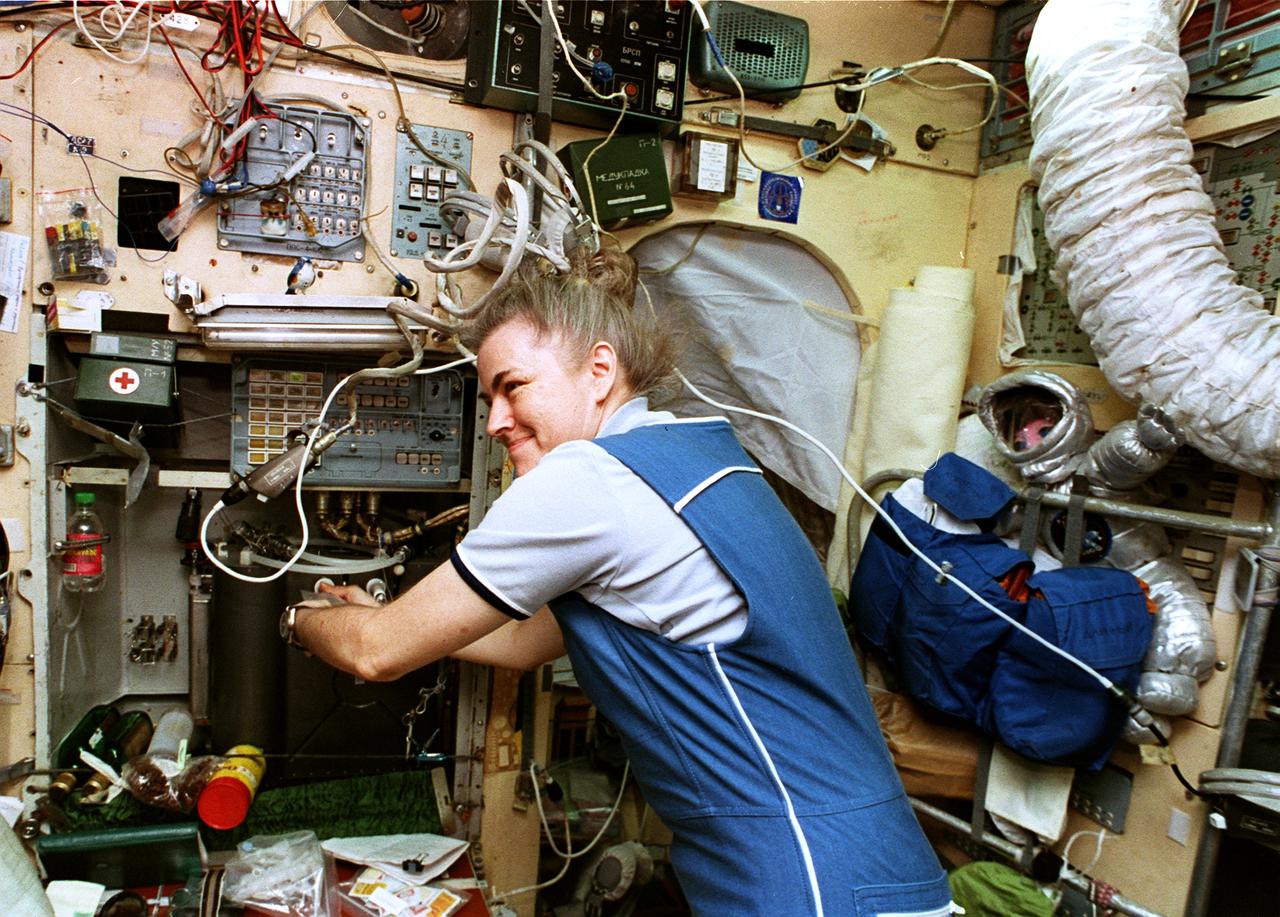
STS079-354-001 (16-26 Sept. 1996) --- Astronaut Shannon W. Lucid gets a beverage at the galley on Russia's Mir Space Station Base Block. This photograph is one of fifteen 35mm frames (along with four 70mm frames) of still photography documenting the activities of NASA's STS-79 mission, which began with a September 16, 1996, liftoff from Launch Pad 39A the Kennedy Space Center (KSC) and ended with a landing at KSC on September 26, 1996. Onboard for the launch were astronauts William F. Readdy, commander; Terrence W. Wilcutt, pilot; John E. Blaha, Jerome (Jay) Apt, Thomas D. Akers and Carl E. Walz, all mission specialists. On flight day 4, the crew docked with Mir. Lucid, who had spent six months aboard Mir, switched cosmonaut guest researcher roles with Blaha. The latter joined fellow Mir-22 crew members Valeri G. Korzun, commander, and Aleksandr Y. Kaleri, flight engineer.

STS079-358-027 (16-26 September 1996) --- Astronaut William F. Readdy looks over a checklist at the commander's station on the Space Shuttle Atlantis' flight deck. Among his many other duties as mission commander, Readdy controlled the Orbiter during a series of maneuvers associated with the docking and undocking operations with Russia's Mir Space Station. This photograph is one of fifteen 35mm frames (along with four 70mm frames) of still photography documenting the activities of NASA's STS-79 mission, which began with a September 16, 1996, liftoff from Launch Pad 39A the Kennedy Space Center (KSC) and ended with a landing at KSC on September 26, 1996. Onboard for the launch were astronauts Readdy; Terrence W. Wilcutt, pilot; John E. Blaha, Jerome (Jay) Apt, Thomas D. Akers and Carl E. Walz, all mission specialists. On flight day 4, the crew docked with Russia's Mir Space Station. Shannon W. Lucid, who had spent six months aboard Mir, switched cosmonaut guest researcher roles with Blaha. The latter joined fellow Mir-22 crewmembers Valeri G. Korzun, commander, and Aleksandr Y. Kaleri, flight engineer.
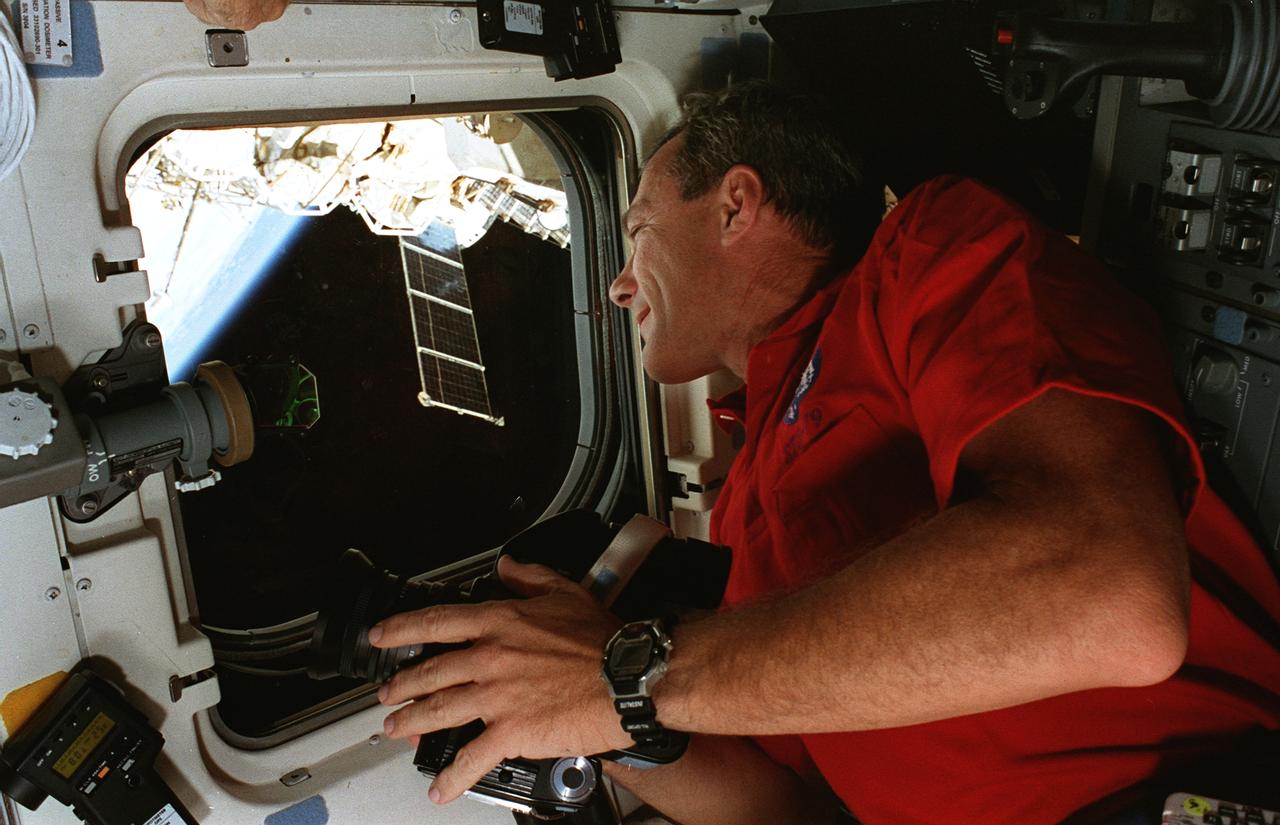
STS079-353-007 (16-26 Sept. 1996) --- Astronaut Terrence W. Wilcutt, on the Space Shuttle Atlantis' aft flight deck, takes pictures of Earth for study by Earth observations scientists at the Johnson Space Center (JSC). Several components of the docked Russia's Mir Space Station can be seen in the background. This photograph is one of fifteen 35mm frames (along with four 70mm frames) of still photography documenting the activities of NASA's STS-79 mission, which began with a September 16, 1996, liftoff from Launch Pad 39A the Kennedy Space Center (KSC) and ended with a landing at KSC on September 26, 1996. Onboard for the launch were astronauts William F. Readdy, commander; Wilcutt, pilot; John E. Blaha, Jerome (Jay) Apt, Thomas D. Akers and Carl E. Walz, all mission specialists. On flight day 4, the crew docked with Russia's Mir Space Station. Shannon W. Lucid, who had spent six months aboard Mir, switched cosmonaut guest researcher roles with Blaha. The latter joined fellow Mir-22 crew members Valeri G. Korzun, commander, and Aleksandr Y. Kaleri, flight engineer.
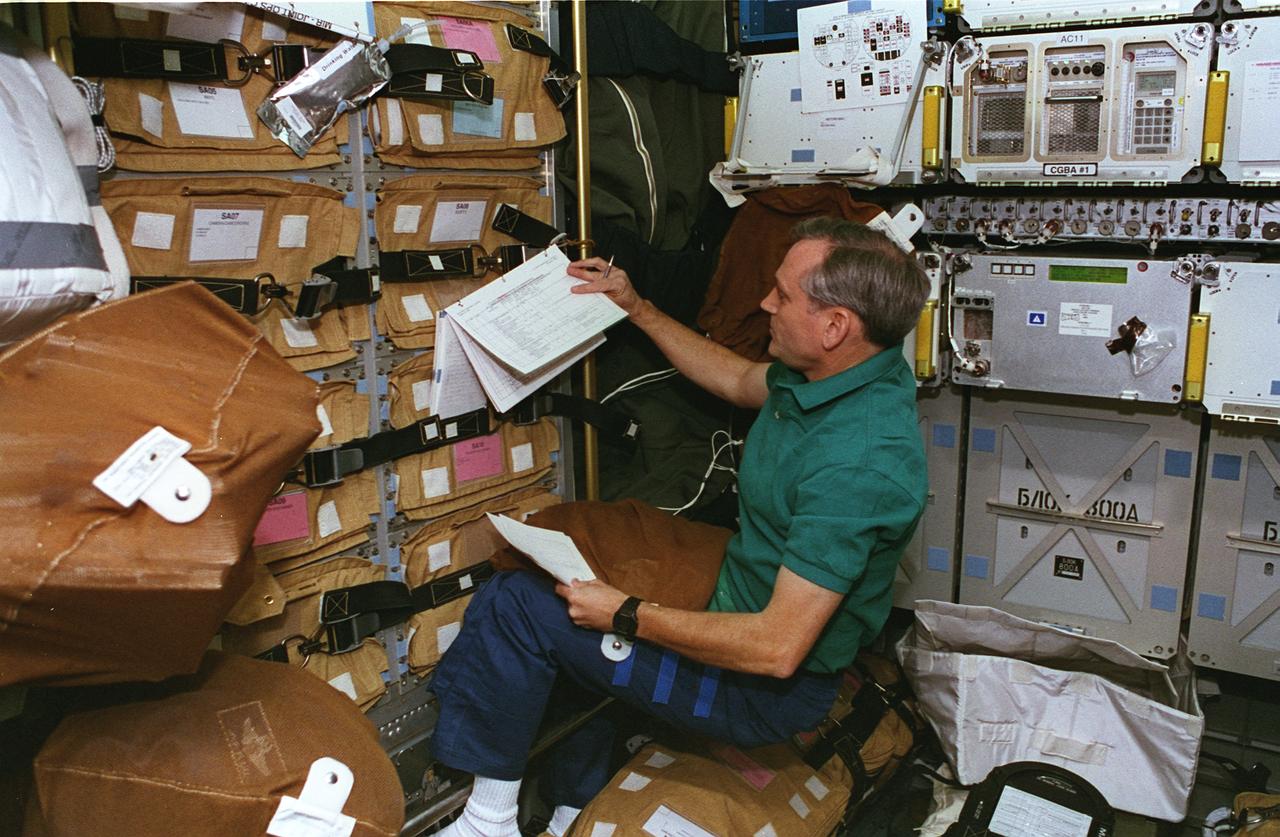
STS079-309-022 (16-26 Sept. 1996) --- Astronaut Thomas D. Akers, in the Spacehab, goes over an inventory of supplies which will be transferred to the Russia's Mir Space Station. This photograph is one of fifteen 35mm frames (along with four 70mm frames) of still photography documenting the activities of NASA's STS-79 mission, which began with a September 16, 1996, liftoff from Launch Pad 39A the Kennedy Space Center (KSC) and ended with a landing at KSC on September 26, 1996. Onboard for the launch were astronauts William F. Readdy, commander; Terrence W. Wilcutt, pilot; John E. Blaha, Jerome (Jay) Apt, Akers and Carl E. Walz, all mission specialists. On flight day 4, the crew docked with the Mir Space Station. Shannon W. Lucid, who had spent six months aboard Mir, switched cosmonaut guest researcher roles with Blaha. The latter joined fellow Mir-22 crew members Valeri G. Korzun, commander, and Aleksandr Y. Kaleri, flight engineer.
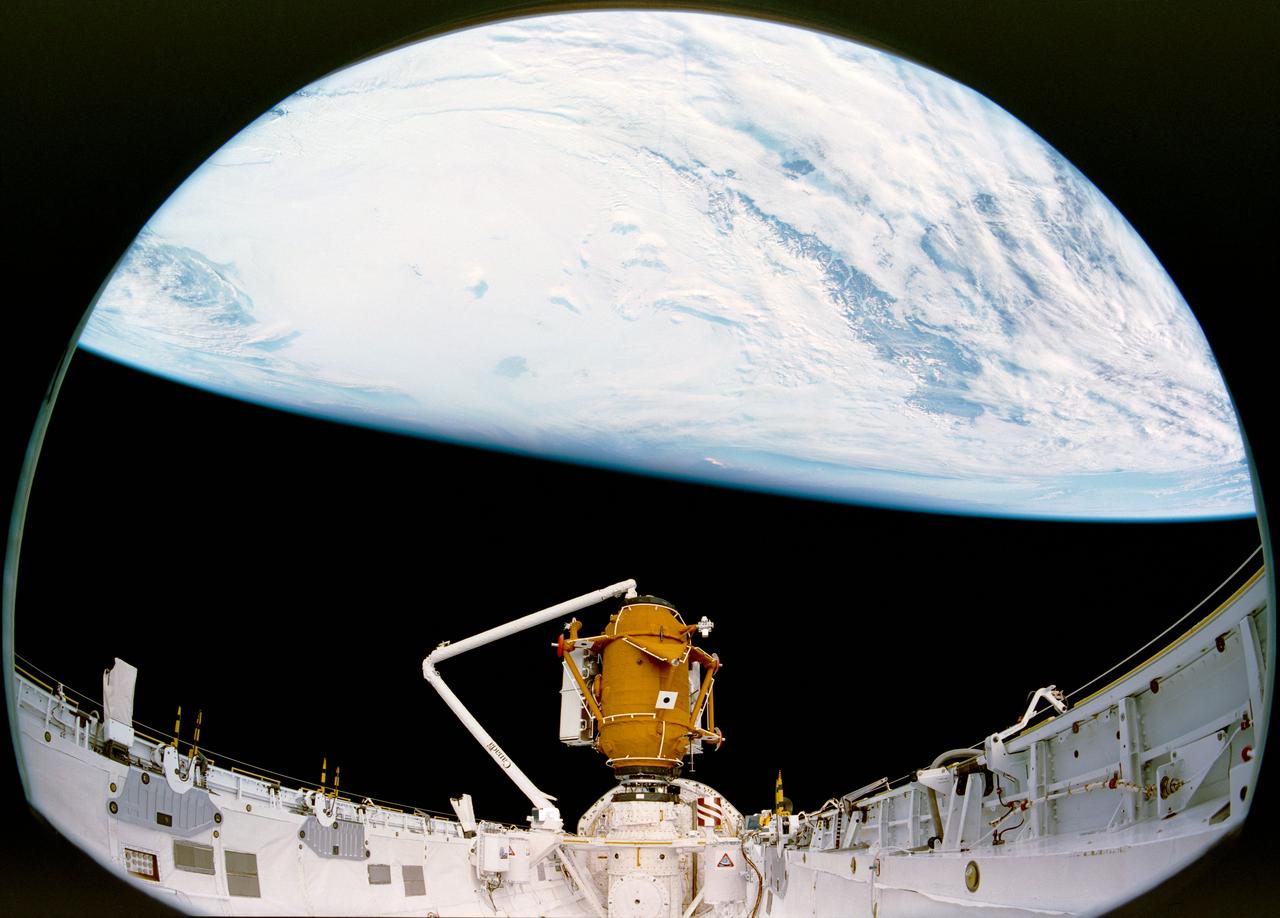
S95-22079 (14 Nov 1995) --- The Docking Module (DM) is seen just after installation in the Space Shuttle Atlantis' cargo bay. The snow-covered Bukhtarminskaye Reservoir, just north of China, may be seen in the background. When this photo was taken, five NASA astronauts were onboard Atlantis, awaiting their joint activities which is set to begin in less than 24 hours with three Mir-20 cosmonauts following tomorrow's scheduled docking. During the STS-74 mission, the crew used an IMAX camera to document the Space Shuttle Atlantis' rendezvous and docking with the Mir Space Station. The 65mm camera system was located in the Atlantis' cargo bay and provided a unique fish-eye perspective. These images were selected from footage that will be incorporated in a large-format feature film about NASA's cooperative program with the Russians. NASA has flown IMAX camera systems on many Shuttle missions, including the recent STS-63 Shuttle-Mir rendezvous and STS-71 Shuttle-Mir docking. Film from previous missions was used to create the productions The Dream is Alive, The Blue Planet, and Destiny in Space.
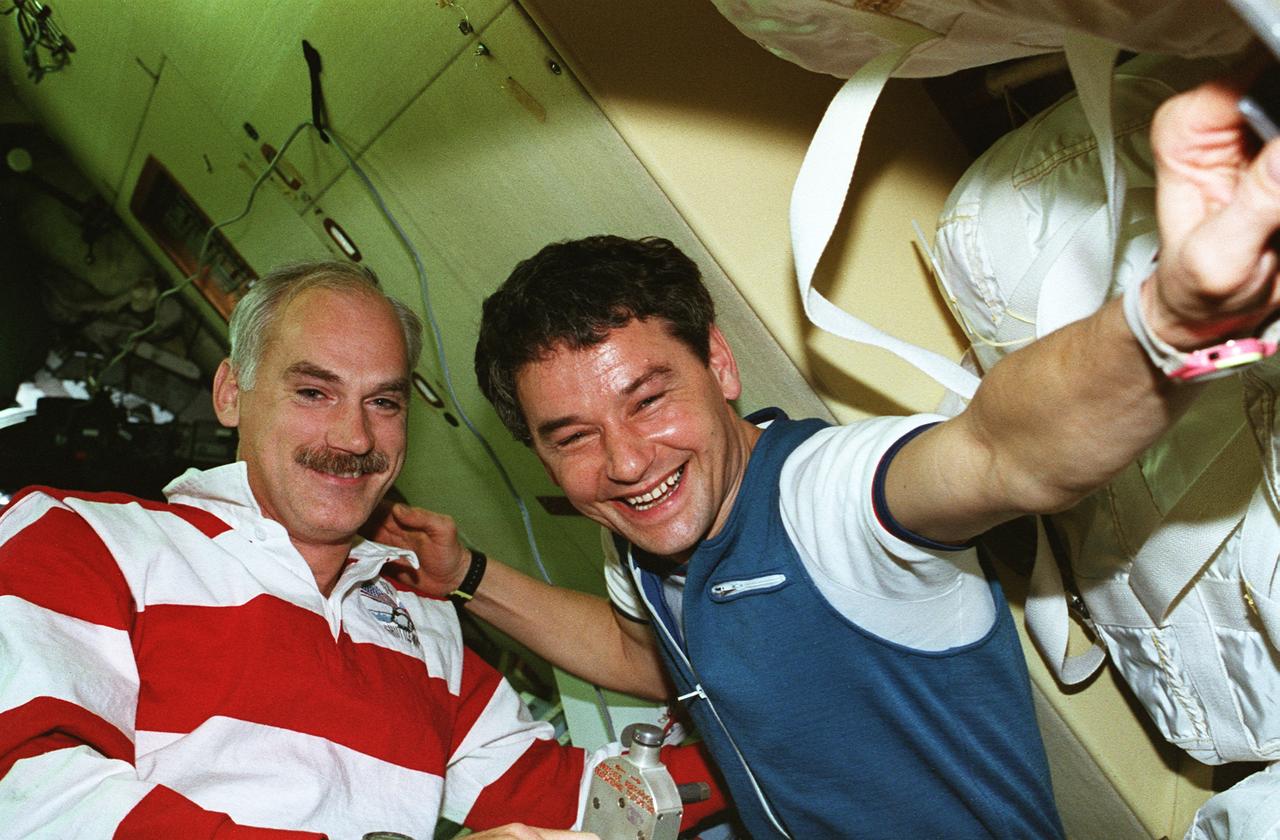
STS079-347-033 (16-26 Sept. 1996) --- Valeri G. Korzun and William F. Readdy, commanders, for Mir-22 and STS-79, respectively, reunite in the Docking Module (DM). The two have shared training experience in both Russia and the United States. This photograph is one of fifteen 35mm frames (along with four 70mm frames) of still photography documenting the activities of NASA's STS-79 mission, which began with a September 16, 1996, liftoff from Launch Pad 39A the Kennedy Space Center (KSC) and ended with a landing at KSC on September 26, 1996. Onboard for the launch were astronauts Readdy; Terrence W. Wilcutt, pilot; John E. Blaha, Jerome (Jay) Apt, Thomas D. Akers and Carl E. Walz, all mission specialists. On flight day 4, the crew docked with Russia's Mir Space Station. Shannon W. Lucid, who had spent six months aboard Mir, switched cosmonaut guest researcher roles with Blaha. The latter joined fellow Mir-22 crewmembers Korzun, and Aleksandr Y. Kaleri, flight engineer.
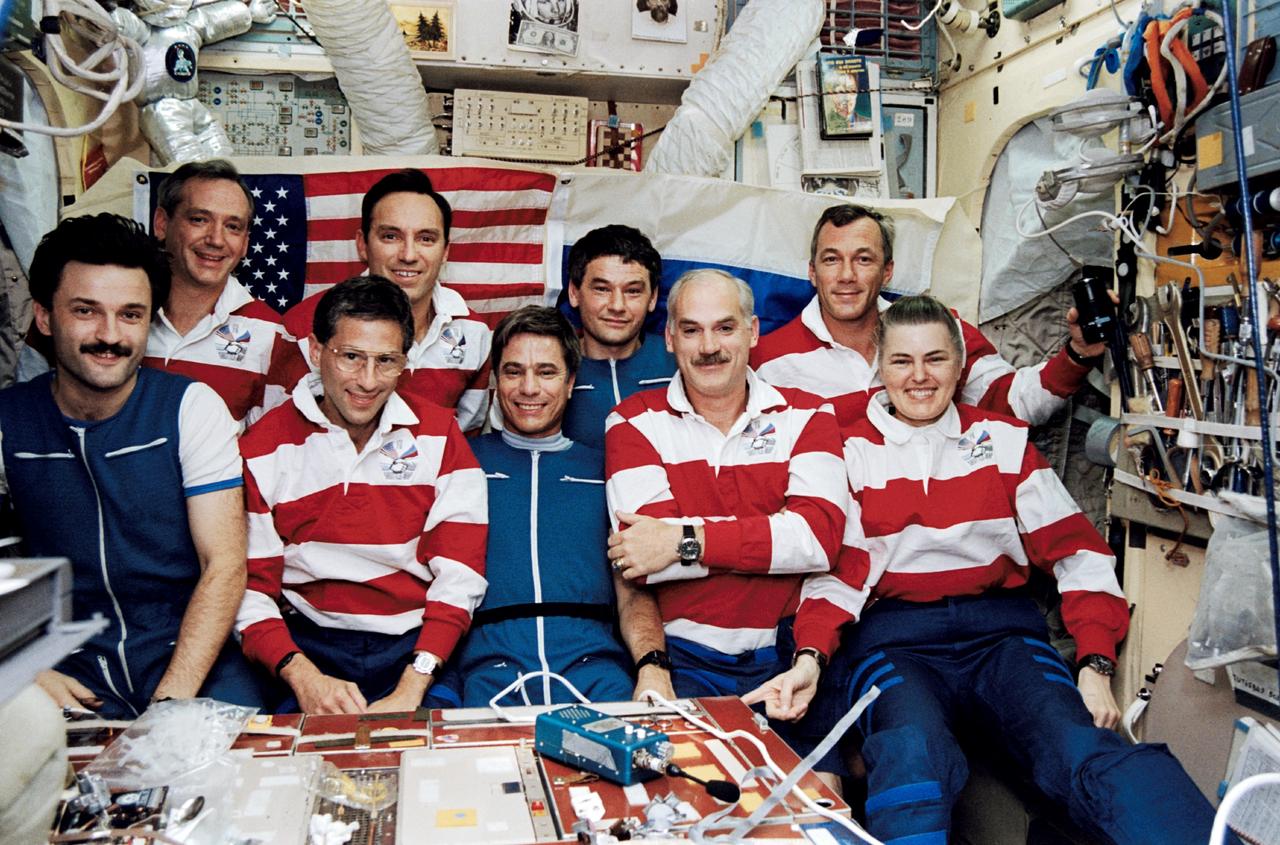
STS079-349-022 (16-26 Sept. 1996) --- The traditional inflight crew portrait, taken in Russia's Mir Space Station base block. Front row, left to right, Aleksandr Y. Kaleri, Jerome (Jay) Apt, John E. Blaha, William F. Readdy and Shannon W. Lucid. Back row, left to right, Thomas D. Akers, Carl E. Walz, Valeri G. Korzun and Terrence W. Wilcutt. This photograph is one of fifteen 35mm frames (along with four 70mm frames) of still photography documenting the activities of NASA's STS-79 mission, which began with a September 16, 1996, liftoff from Launch Pad 39A the Kennedy Space Center (KSC) and ended with a landing at KSC on September 26, 1996. Onboard for the launch were astronauts Readdy, commander; Wilcutt, pilot; Blaha, Apt, Akers and Walz, all mission specialists. On flight day 4, the crew docked with the Mir Space Station. Lucid, who had spent six months aboard Mir, switched cosmonaut guest researcher roles with Blaha. The latter joined fellow Mir-22 crewmembers Korzun, commander, and Kaleri, flight engineer.

STS079-817-034 (16-26 Sept. 1996) --- The Russian Mir Space Station is backdropped over a storm in the Roaring 40's near Heard Island in the south Indian Ocean. This photograph is one of four 70mm frames (along with fifteen 35mm frames) of still photography documenting the activities of NASA's STS-79 mission, which began with a Sept. 16, 1996, liftoff from Launch Pad 39A the Kennedy Space Center (KSC) and ended with a landing at KSC on Sept. 26, 1996. Onboard for the launch were astronauts William F. Readdy, commander; Terrence W. Wilcutt, pilot; John E. Blaha, Jerome (Jay) Apt, Thomas D. Akers and Carl E. Walz, all mission specialists. On flight day 4, the crew docked with Russia's Mir Space Station. Shannon W. Lucid, who had spent six months aboard Mir, switched cosmonaut guest researcher roles with Blaha. The latter joined fellow Mir-22 crewmembers Valeri G. Korzun, commander, and Aleksandr Y. Kaleri, flight engineer.