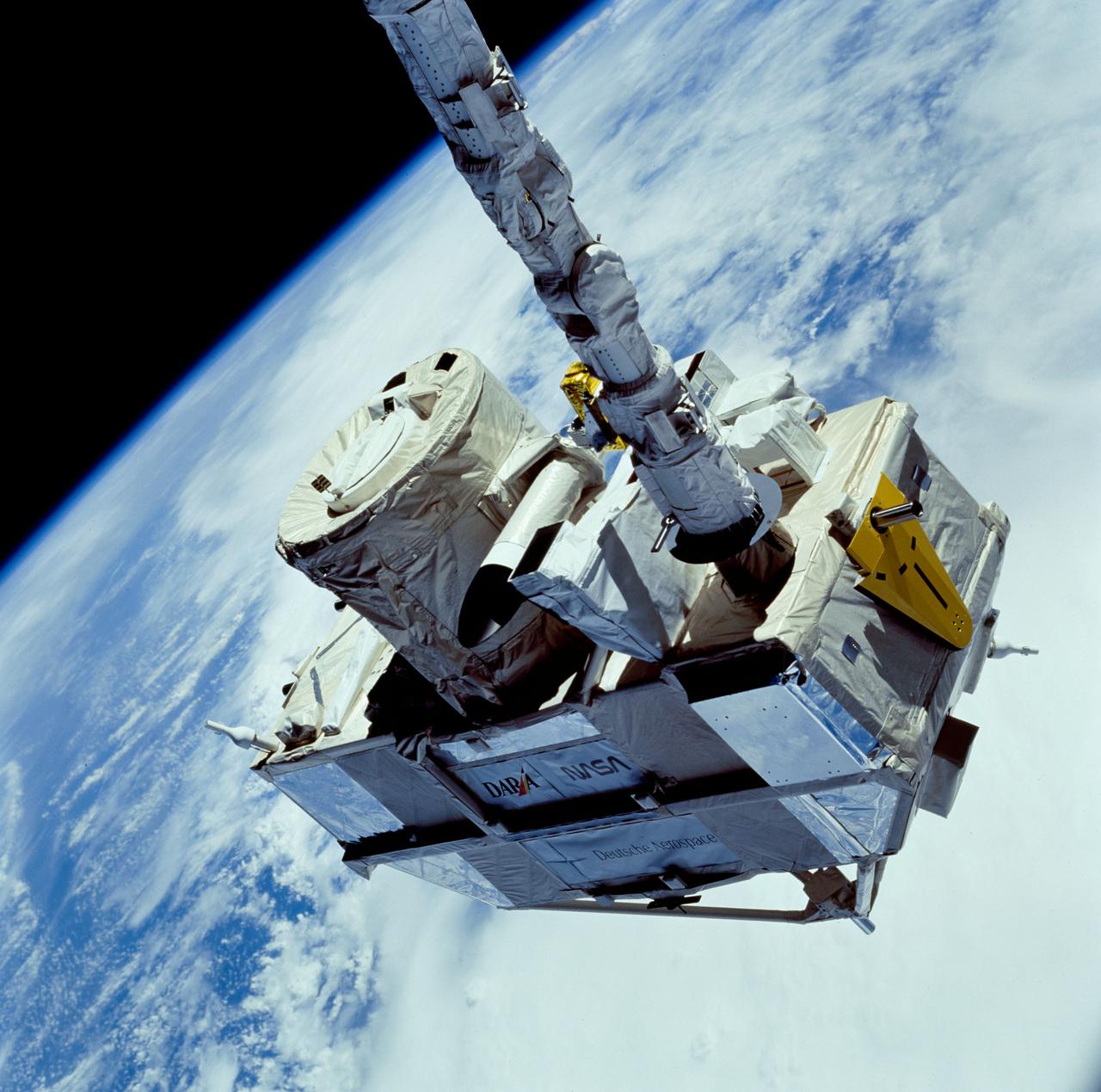
STS066-129-005 (3-14 Nov 1994) --- Clouds over the Atlantic Ocean serve as the backdrop for this 70mm scene of the Atmospheric Laboratory for Applications and Science (ATLAS-3) payload in the cargo bay of the Earth-orbiting Space Shuttle Atlantis.  Crew members onboard Atlantis were astronauts Donald R. McMonagle, Curtis L. Brown, Jr., Ellen Ochoa, Scott E. Parazynski and Joseph R. Tanner, along with Jean-François Clervoy of the European Space Agency (ESA).  The six astronauts spent 11-days in Earth-orbit in support of the Atmospheric Laboratory for Applications and Science (ATLAS-3) mission.
ATLAS-3 payload in the payload bay of STS-66 shuttle Atlantis in orbit
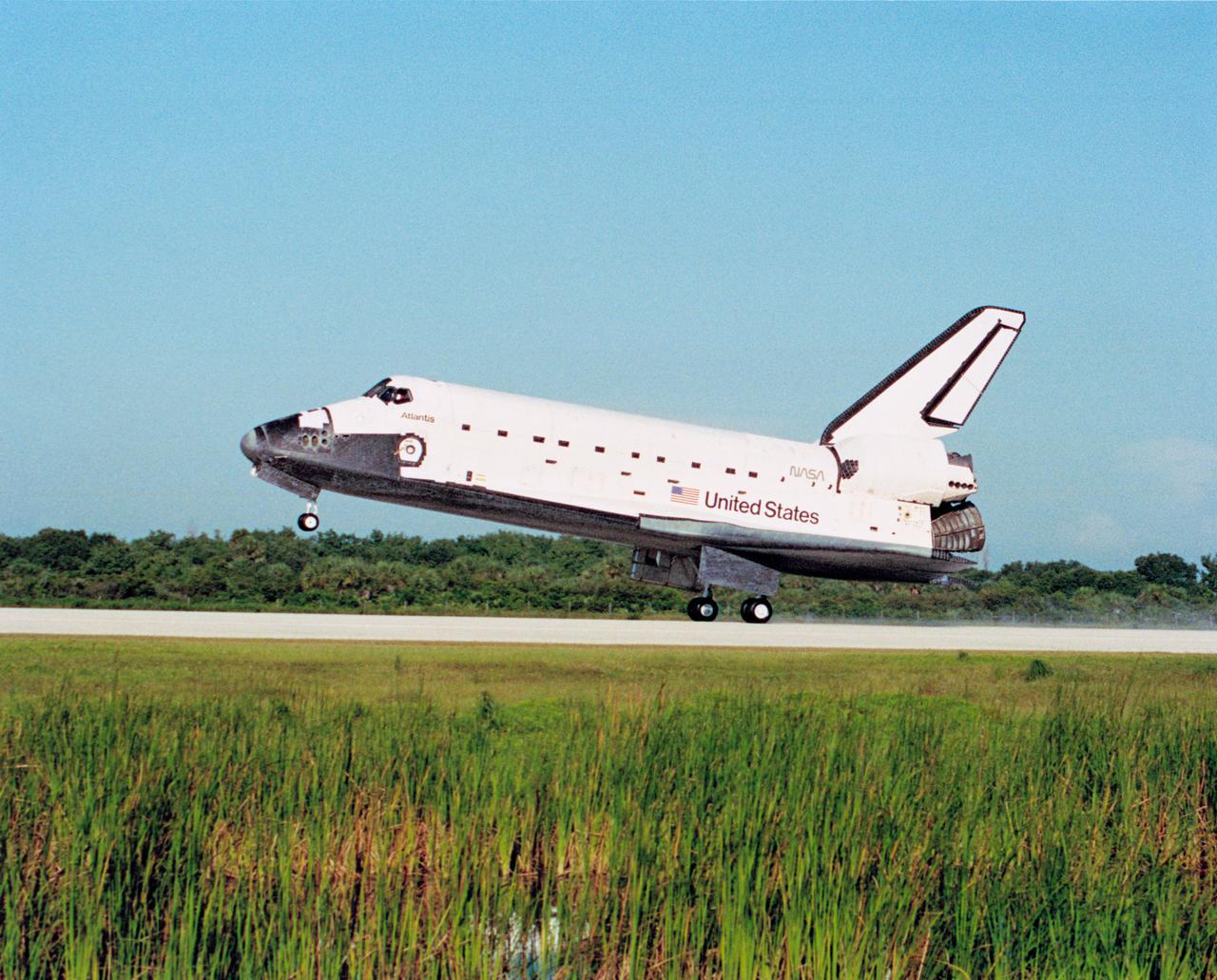
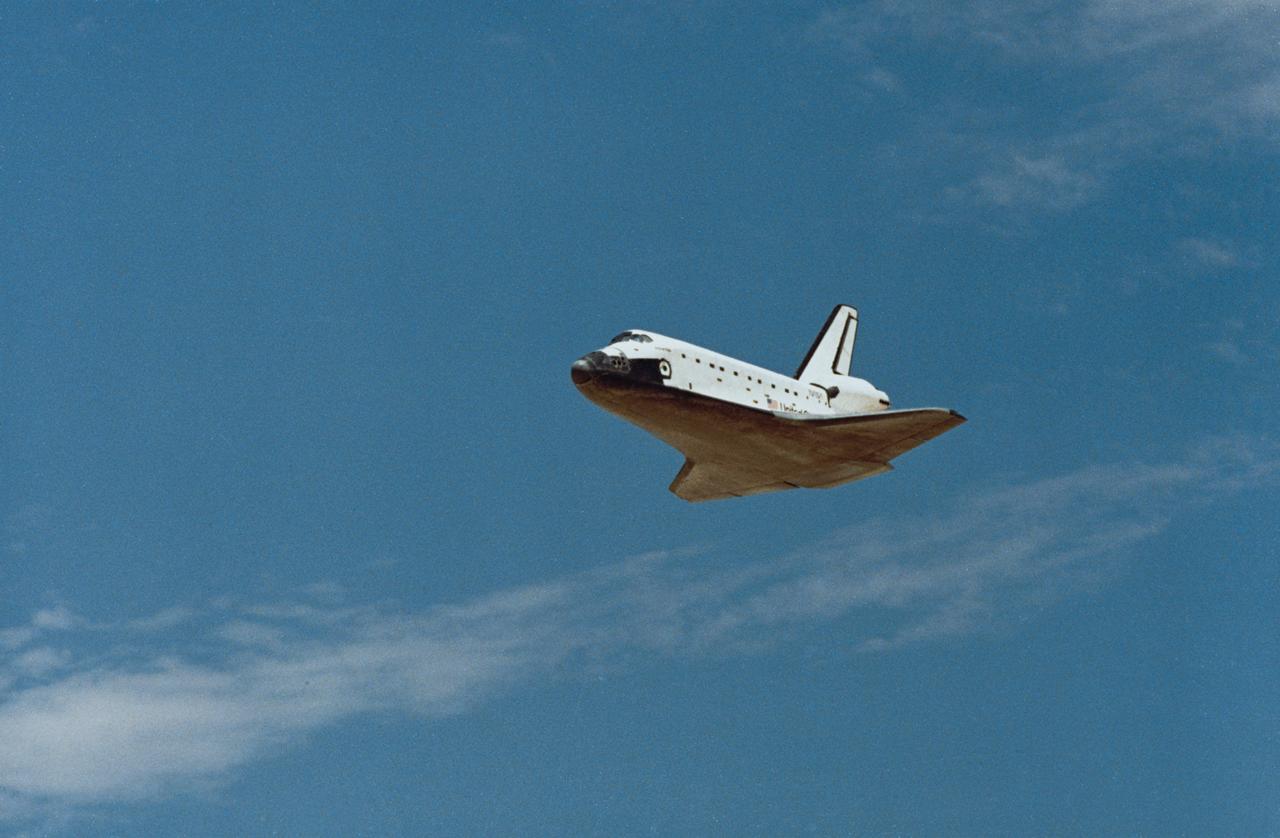
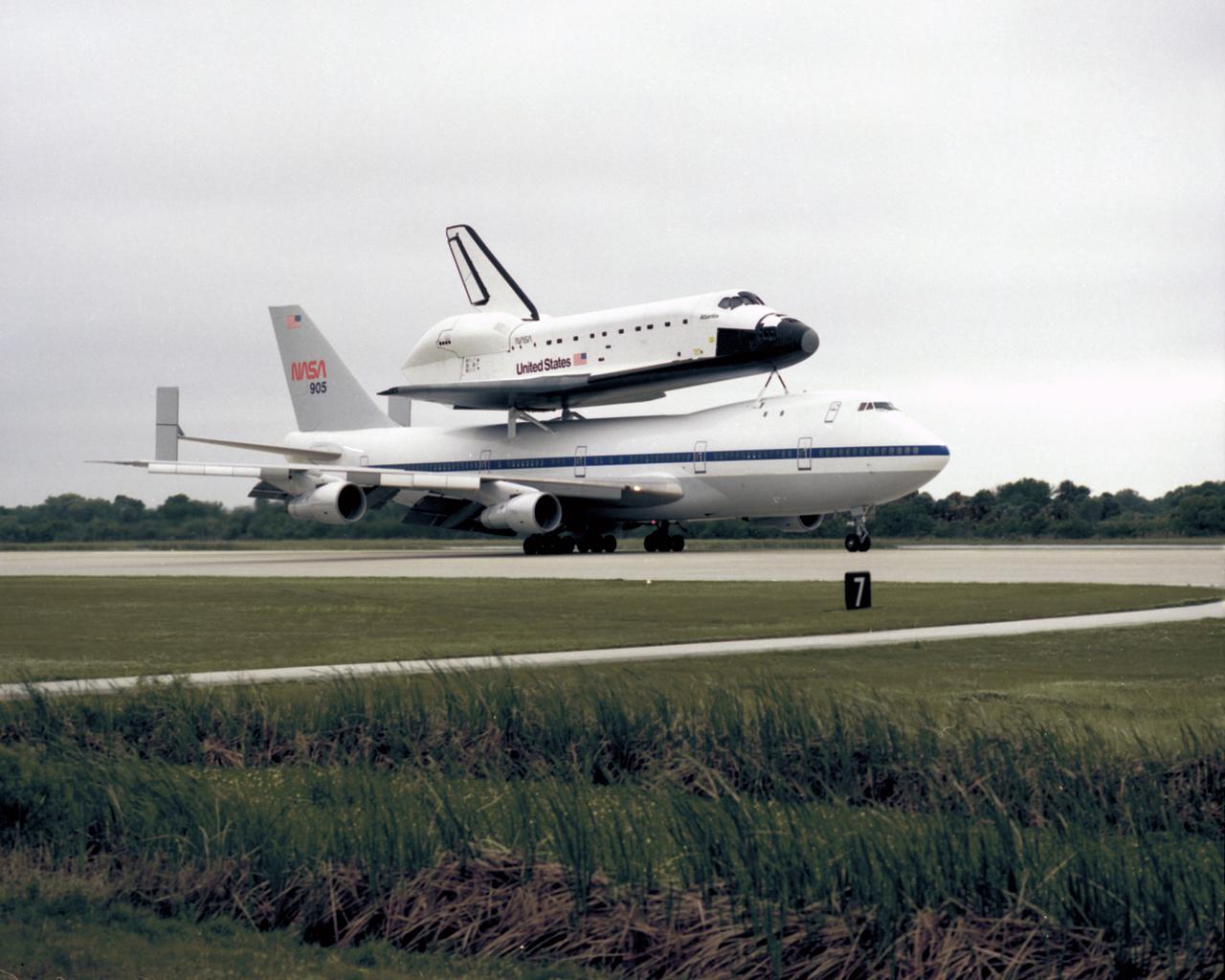
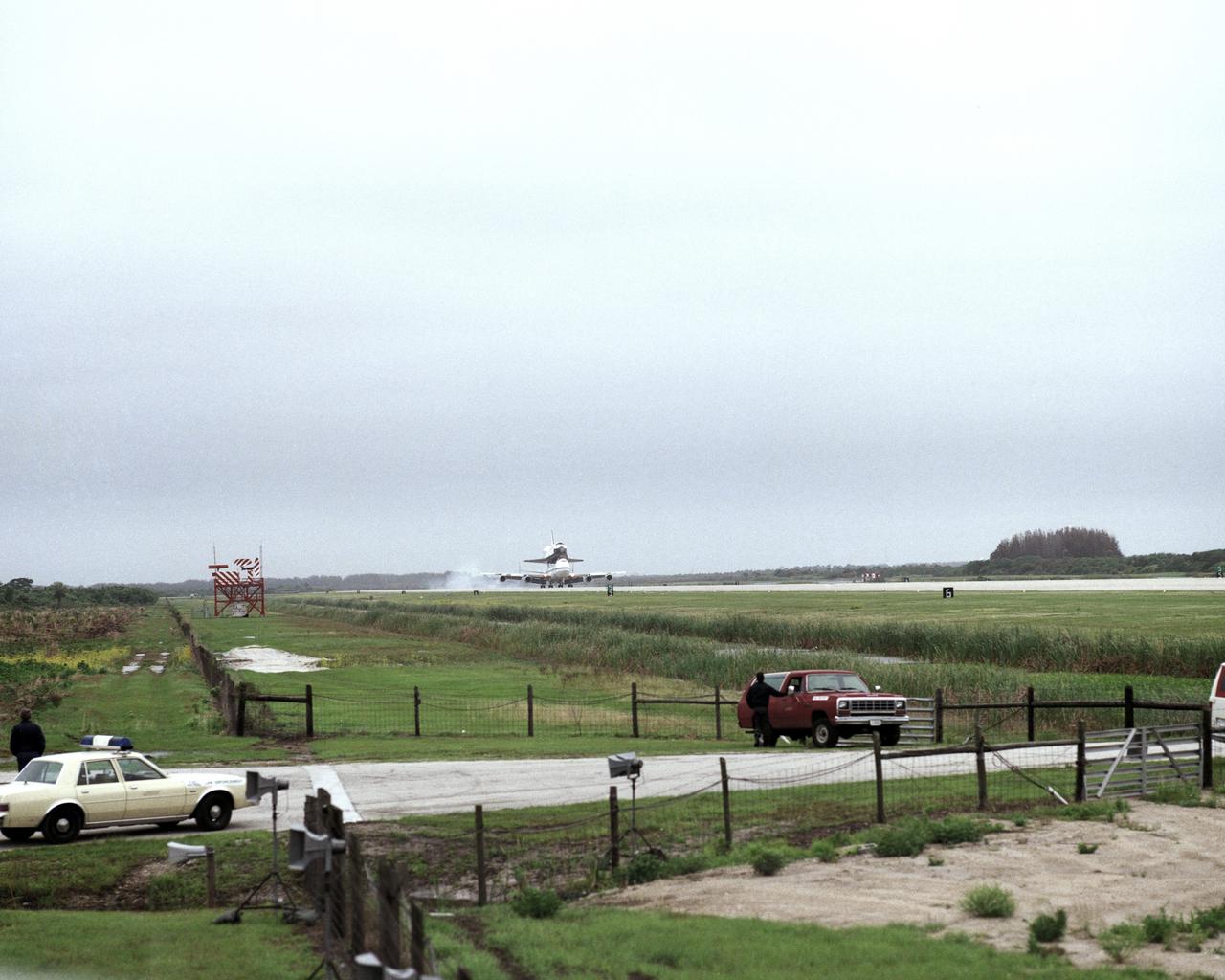
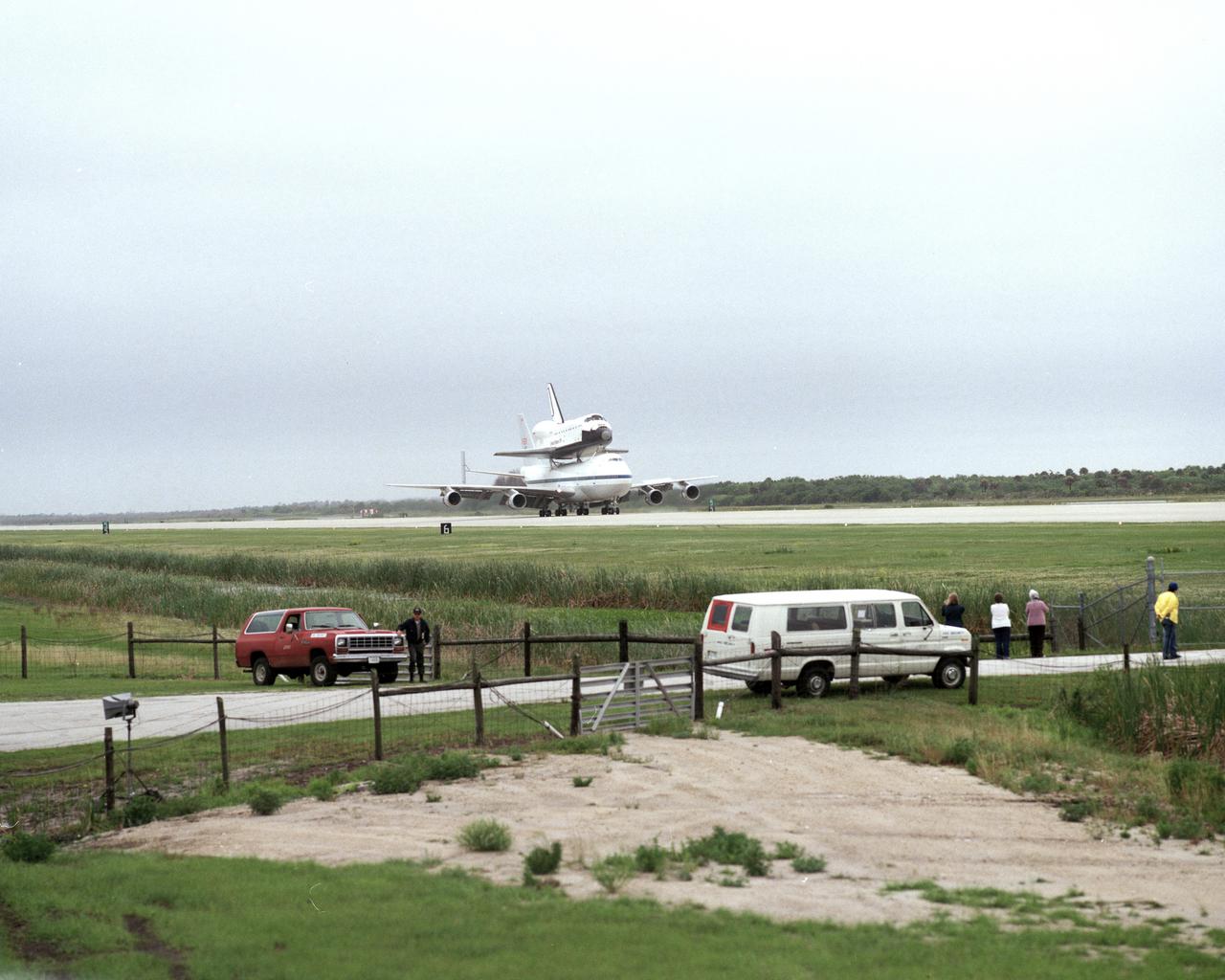
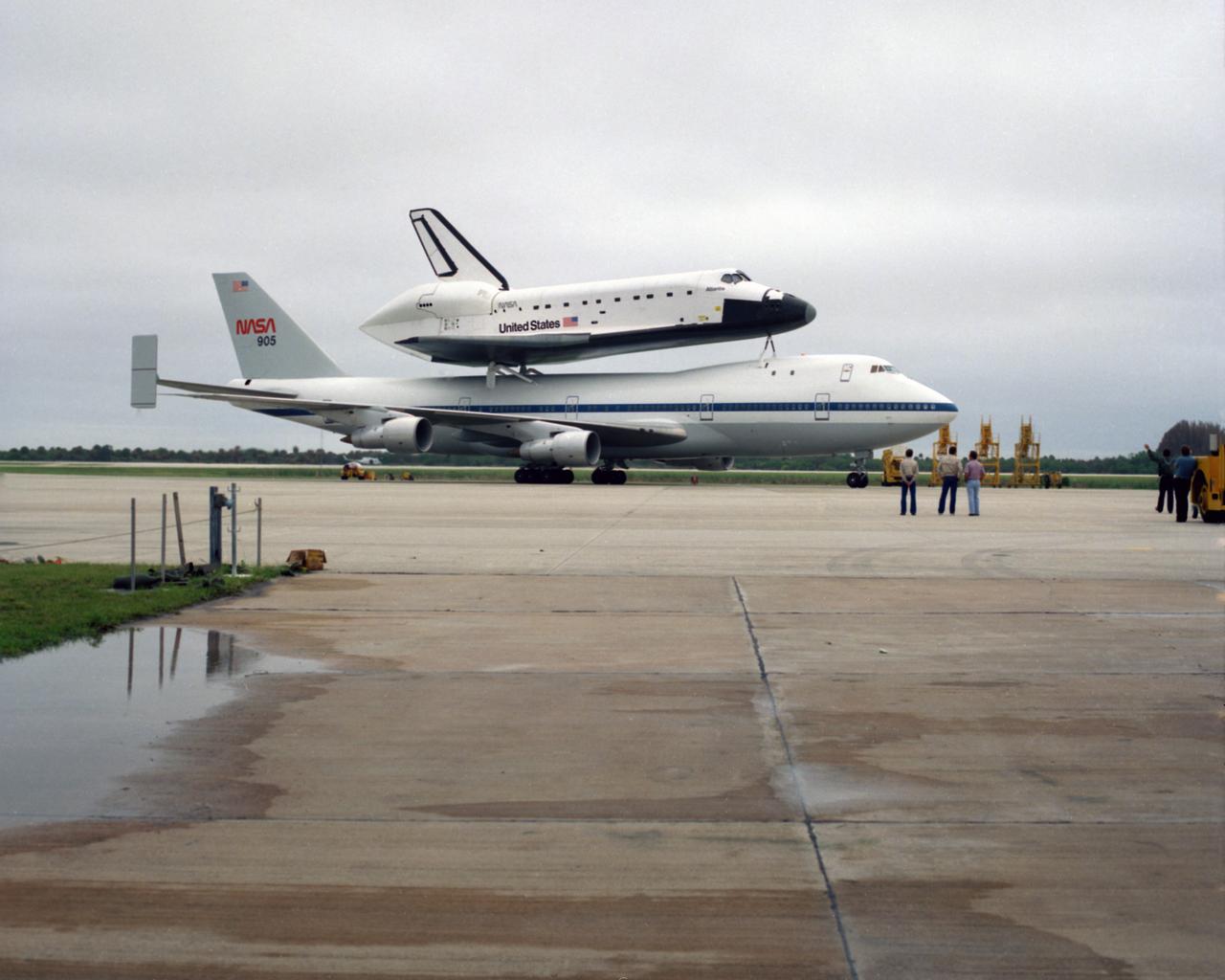
Orbiter Atlantis arrival at SLF.
Orbiter Atlantis arrival at SLF
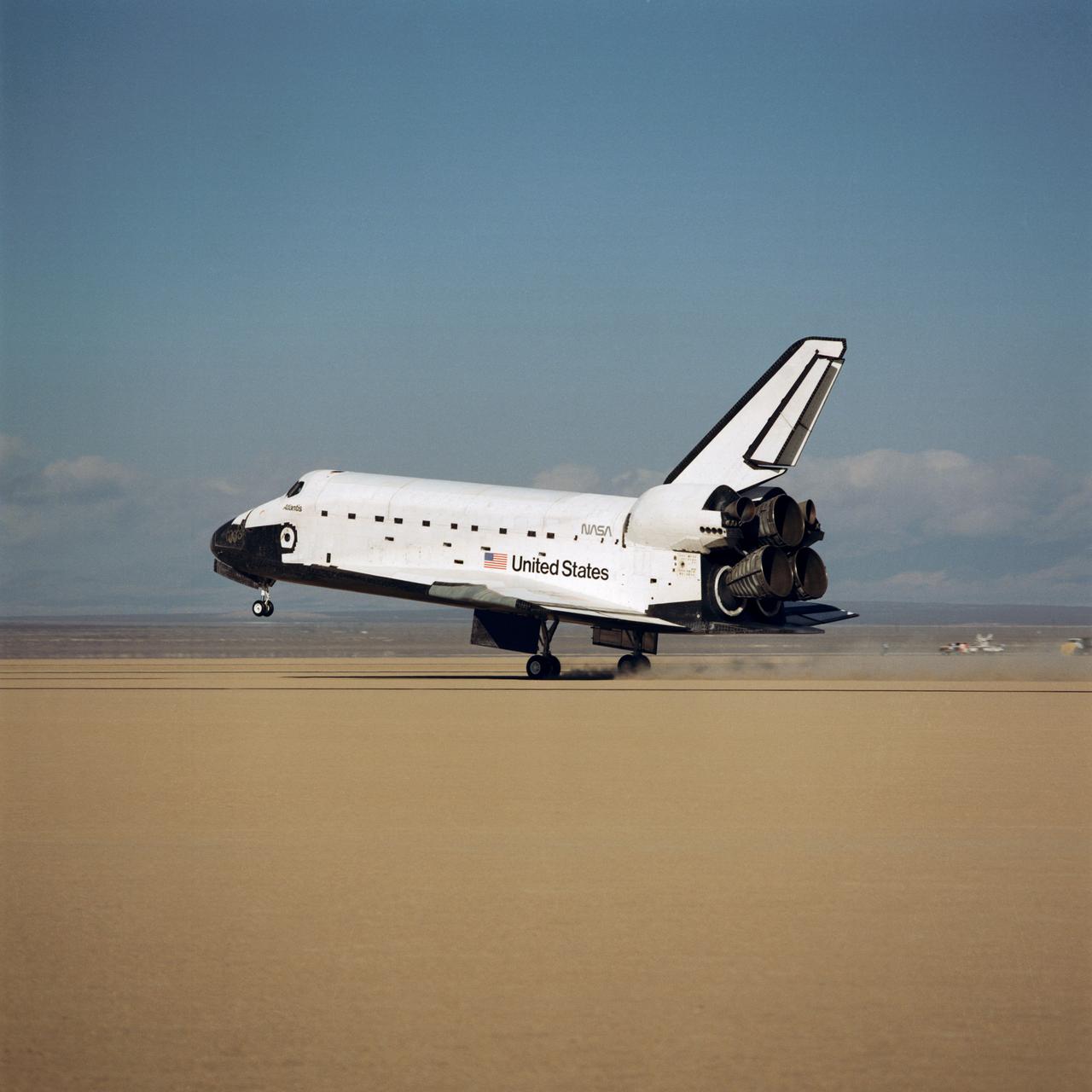
STS038-S-041 (20 Nov 1990) --- STS-38 Atlantis, Orbiter Vehicle (OV) 104, lands on runway 33 at Kennedy Space Center (KSC) Shuttle Landing Facility (SLF). The main landing gear (MLG) has just touched down on the runway surface as the nose landing gear (NLG) glides above it. The Department of Defense (DOD)-devoted mission came to an end (with complete wheel stop) at 4:43:37 pm (Eastern Standard Time (EST)).
STS-38 Atlantis, Orbiter Vehicle (OV) 104, lands on runway 33 at KSC SLF
STS-43 Atlantis, Orbiter Vehicle (OV) 104, lands on runway 15 at the Kennedy Space Center's (KSC's) Shuttle Landing Facility (SLF). The main landing gear (MLG) touched down at 8:23:25 am (Eastern Daylight Time (EDT)). OV-104 glides toward wheel stop as the nose landing gear (NLG) rides above the runway.
STS-43 Atlantis, Orbiter Vehicle (OV) 104, lands on runway 15 at KSC's SLF
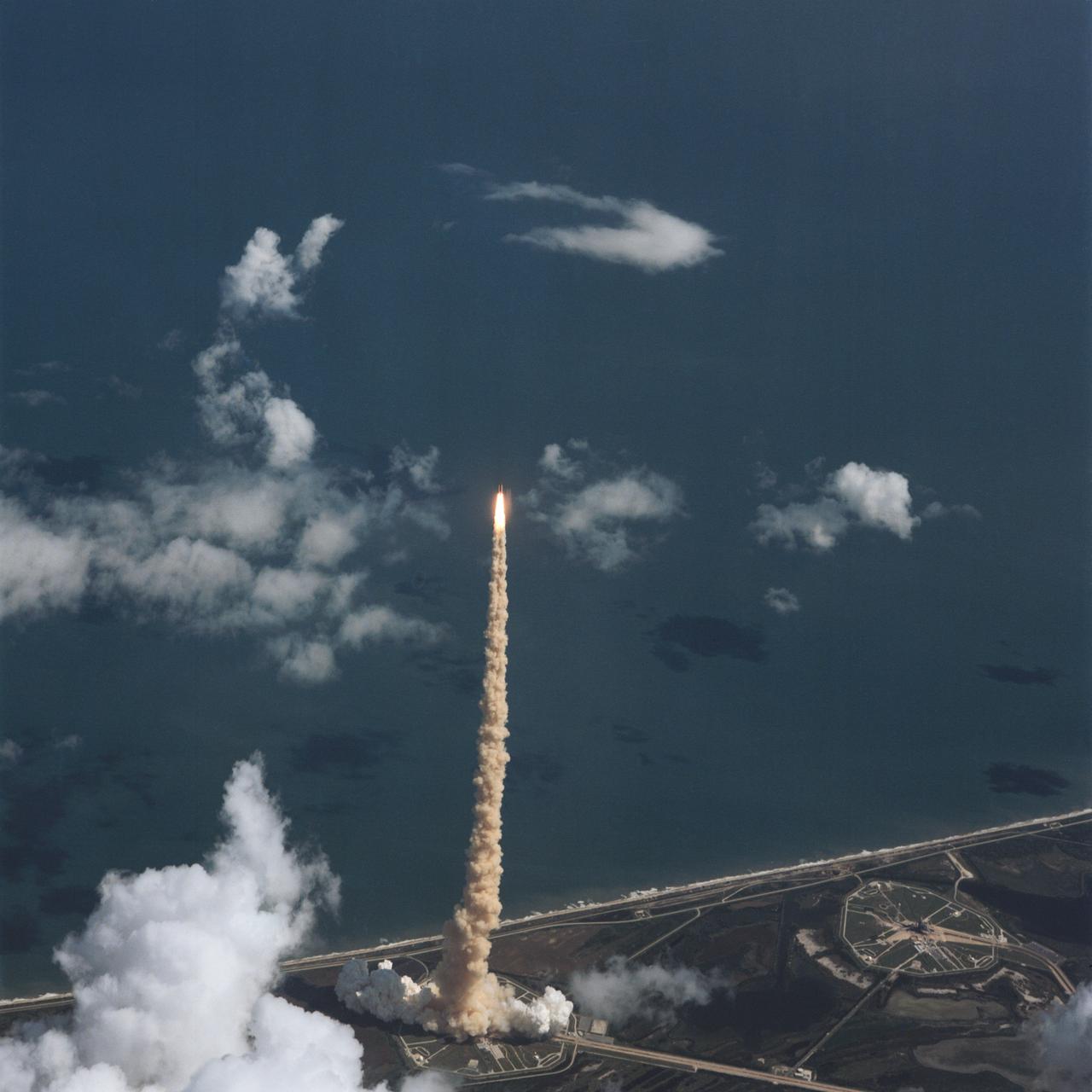
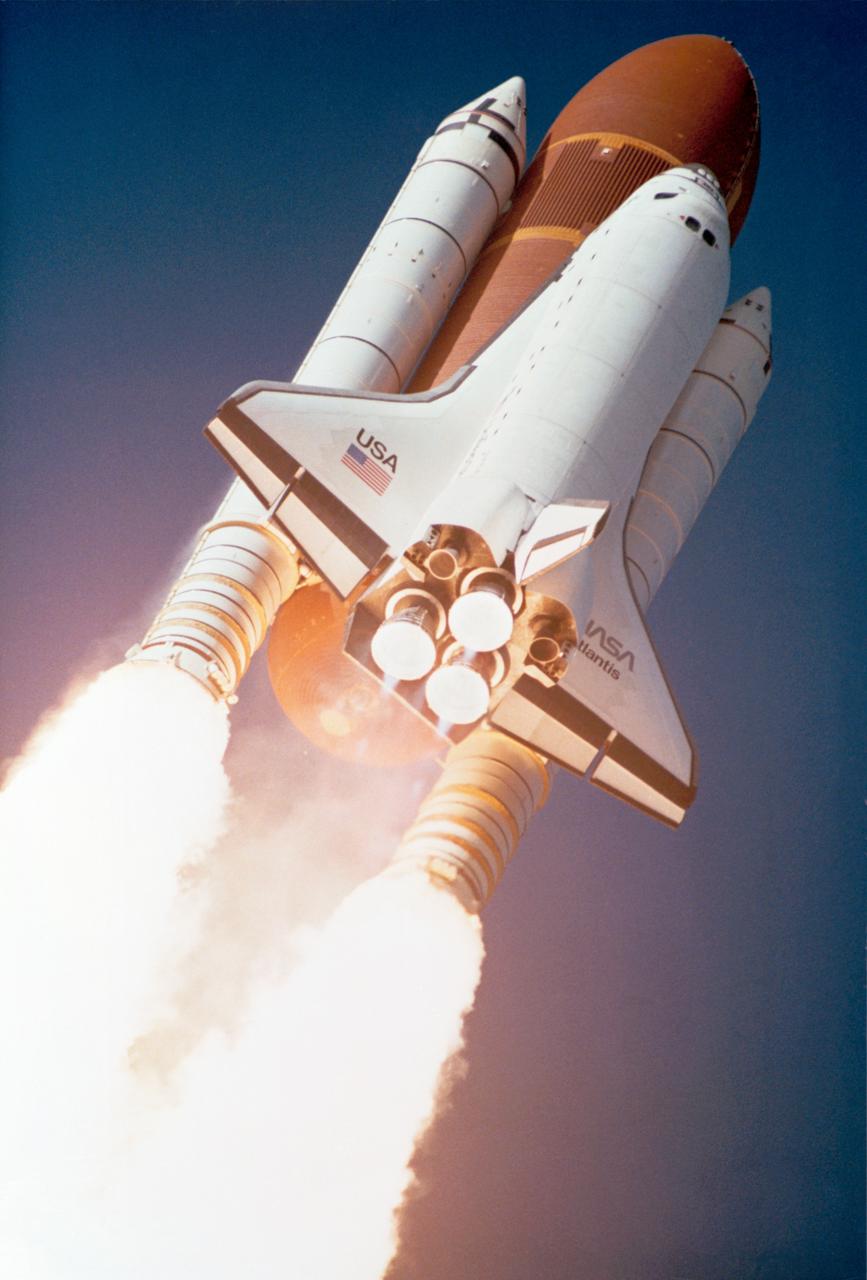
STS-34 Atlantis, Orbiter Vehicle (OV) 104, lifts off from Kennedy Space Center (KSC) Launch Complex (LC) Pad 39B at 12:53:39:983 pm Eastern Daylight Time (EDT). This aerial view shows OV-104, its external tank (ET), and two solid rocket boosters (SRBs) rising high above LC Pad 39B atop a plume of exhaust smoke. Atlantic Ocean is visible in the background. The liftoff marks the beginning of a five-day mission in space.
STS-34 Atlantis, Orbiter Vehicle (OV) 104, lifts off from KSC LC Pad 39B
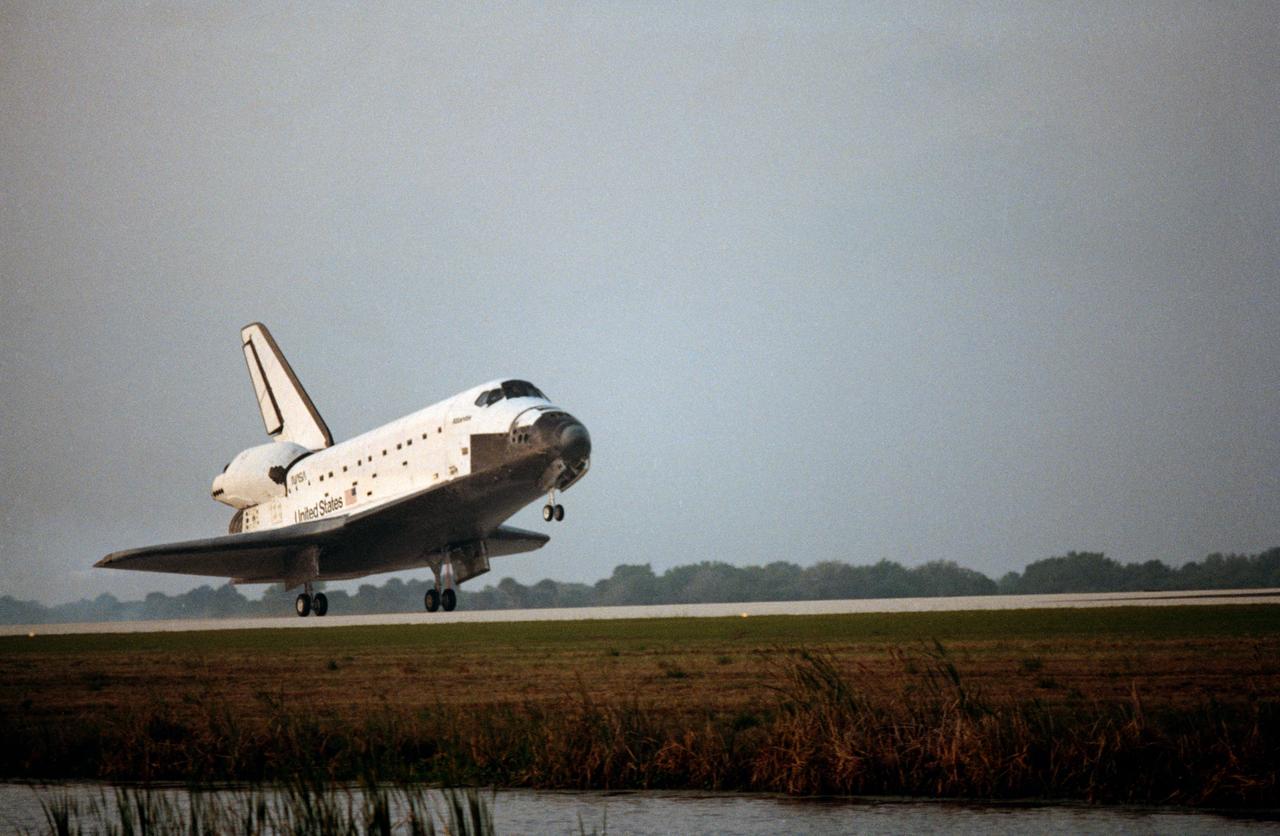
STS-45 Atlantis, Orbiter Vehicle (OV) 104, lands on concrete runway 33 at the Kennedy Space Center's (KSC's) Shuttle Landing Facility (SLF). The main landing gear (MLG) touched down at 6:23:06 am (Eastern Standard Time (EST)) in the early morning Florida fog as seen in these views. The deployed nose landing gear (NLG) rides above the runway before wheel stop.
STS-45 Atlantis, Orbiter Vehicle (OV) 104, lands on runway 33 at KSC SLF
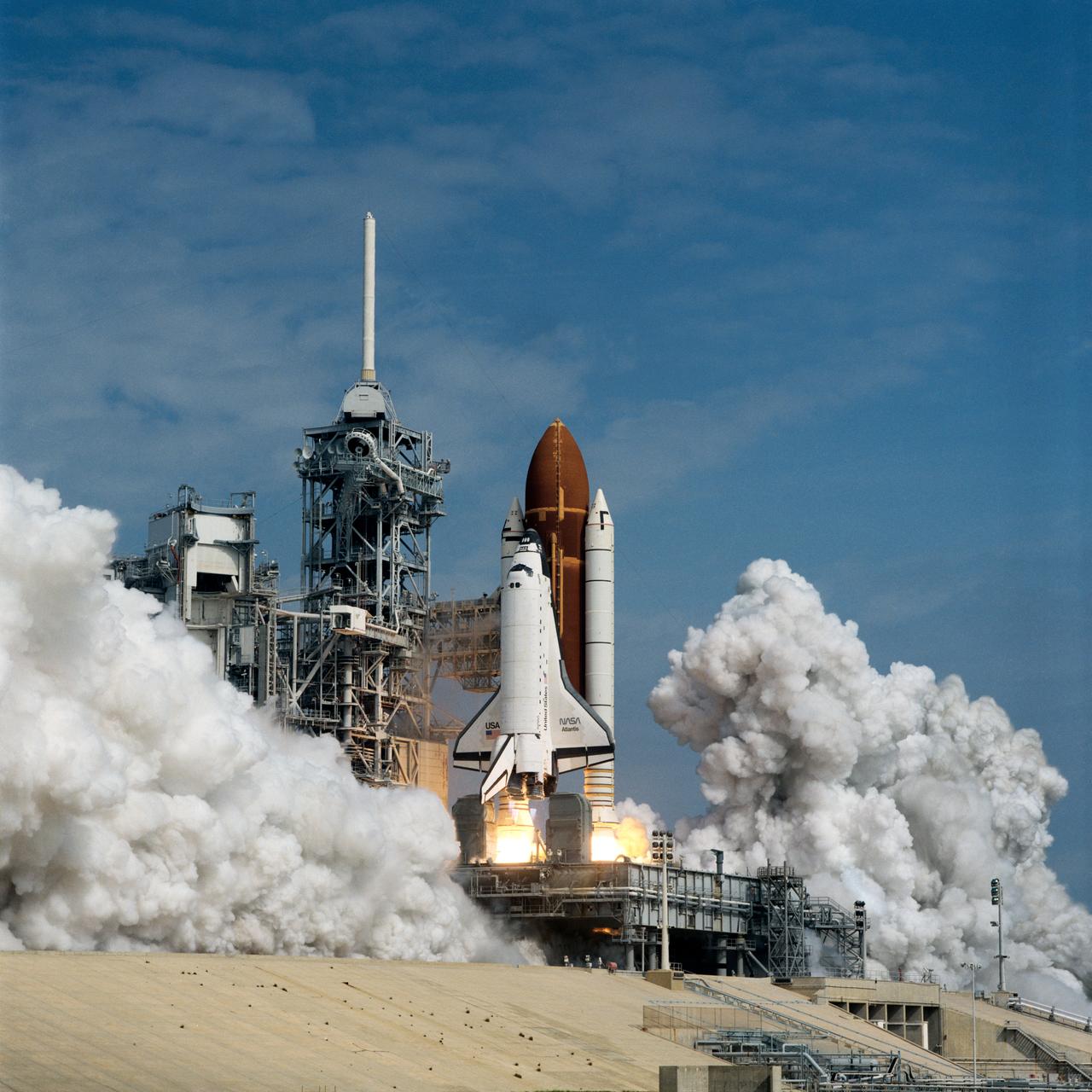
STS-37 Atlantis, Orbiter Vehicle (OV) 104, lifts off from Kennedy Space Center (KSC) Launch Complex (LC) Pad at 9:22:45:0439 (Eastern Standard Time (EST)). OV-104, atop its external tank (ET) and flanked by its two solid rocket boosters (SRBs), is captured just after space shuttle main engine (SSME) firing and as it rises above the mobile launcher platform. The fixed service structure (FSS) and retracted rotating service structure (RSS) appear along side OV-104. Clouds of exhaust smoke begin to fill the launch pad area.
STS-37 Atlantis, Orbiter Vehicle (OV) 104, lifts off from KSC LC Pad
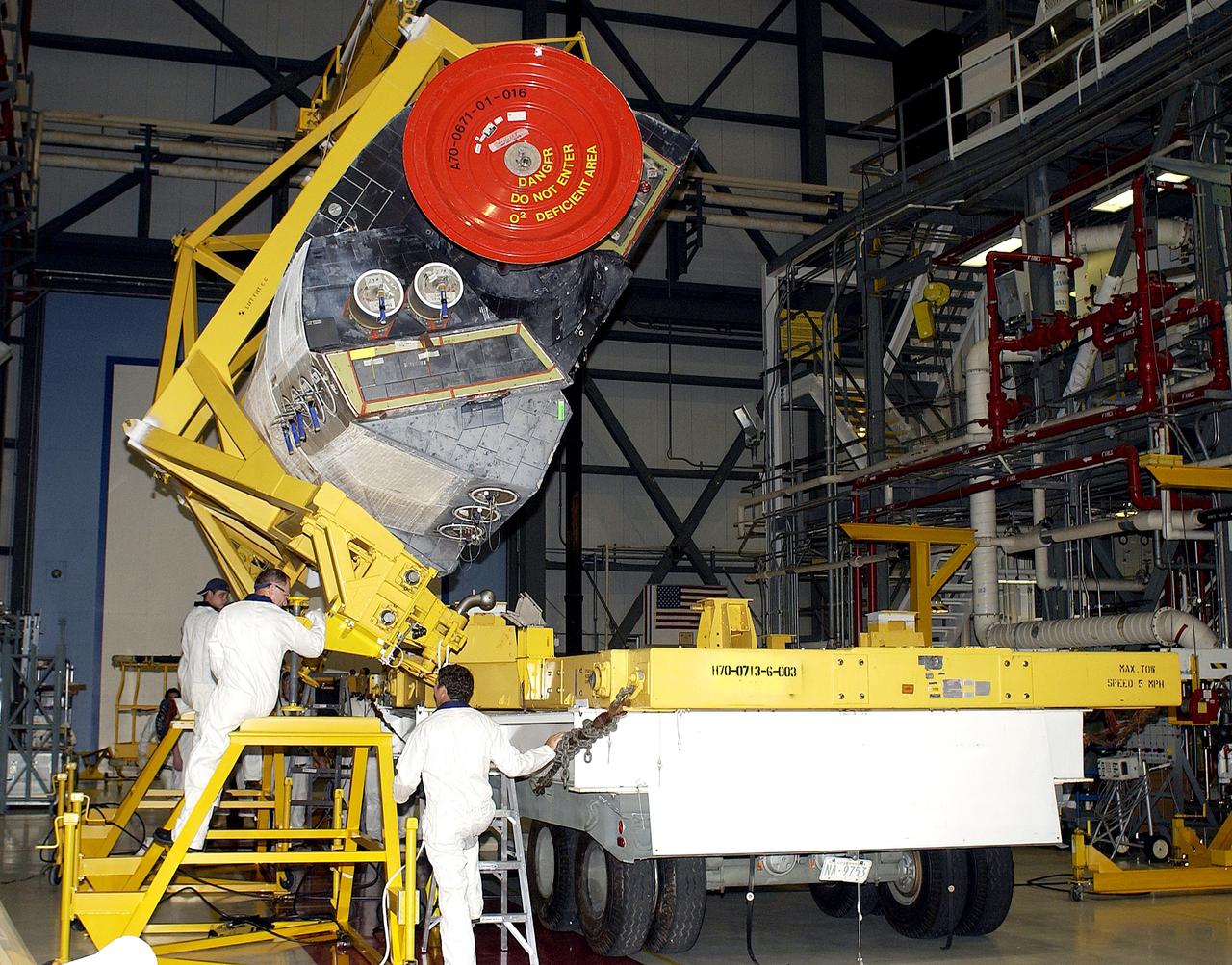
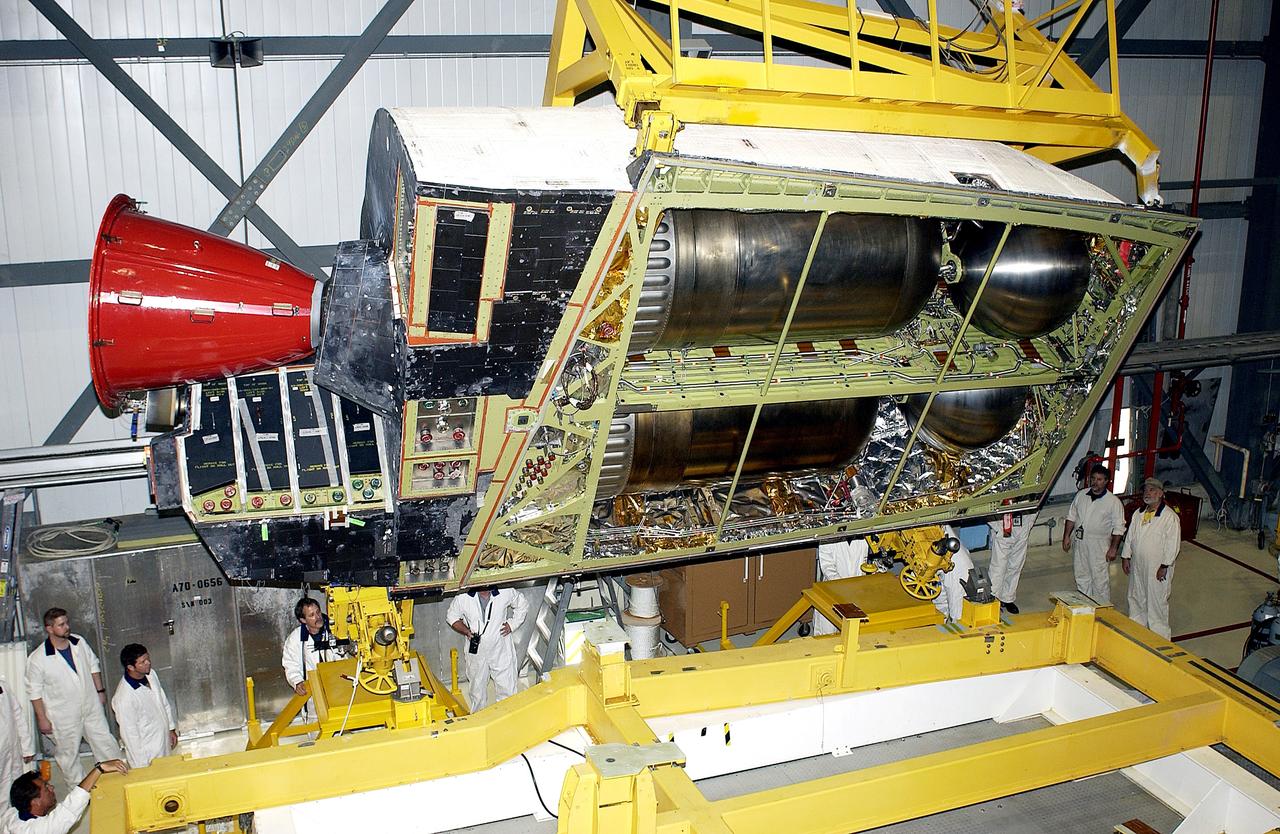
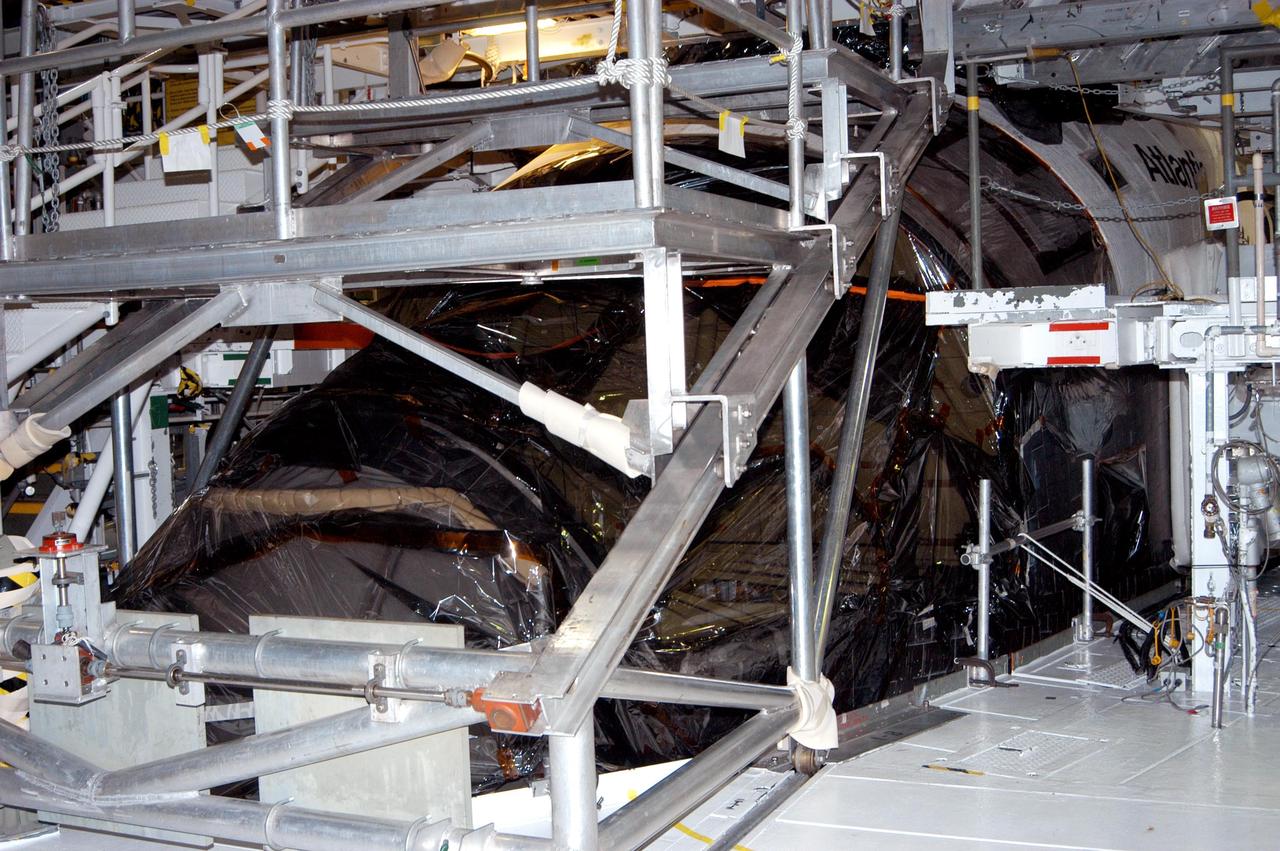
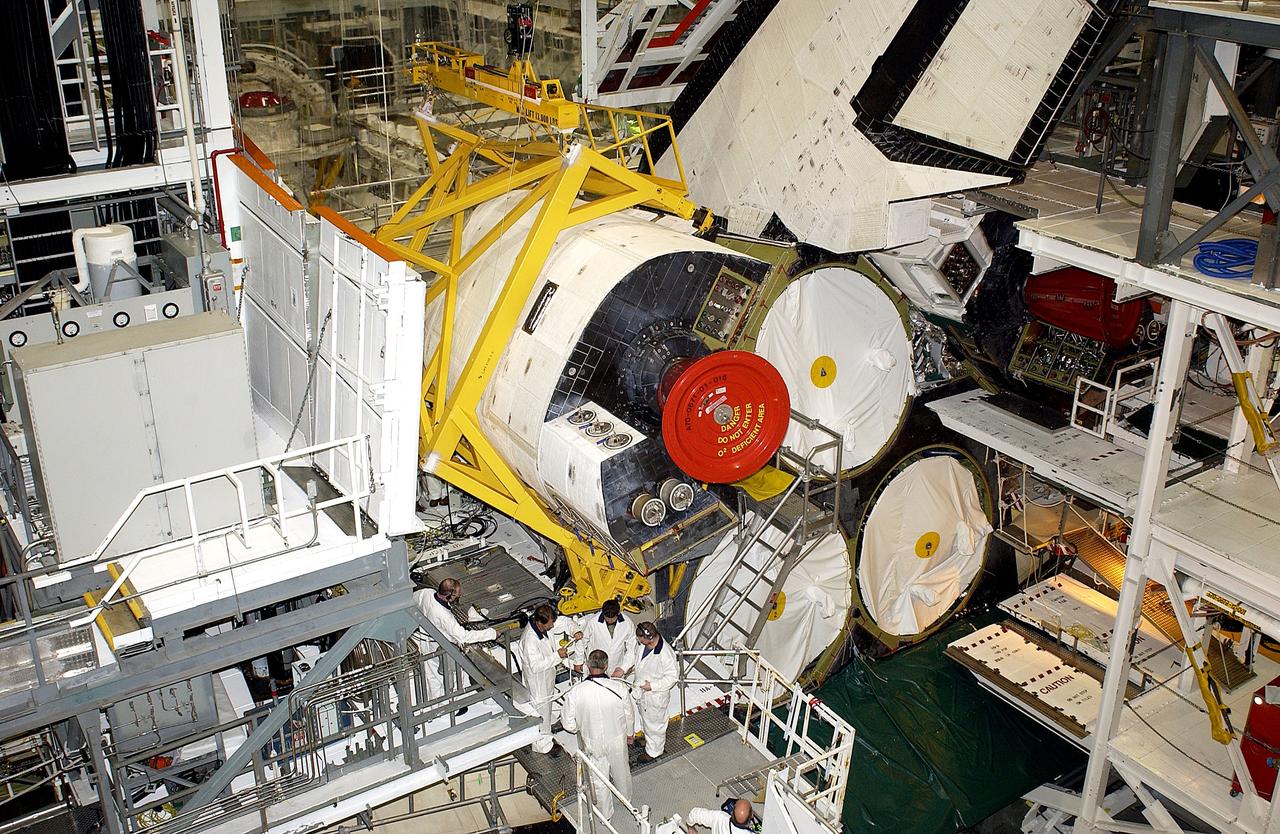
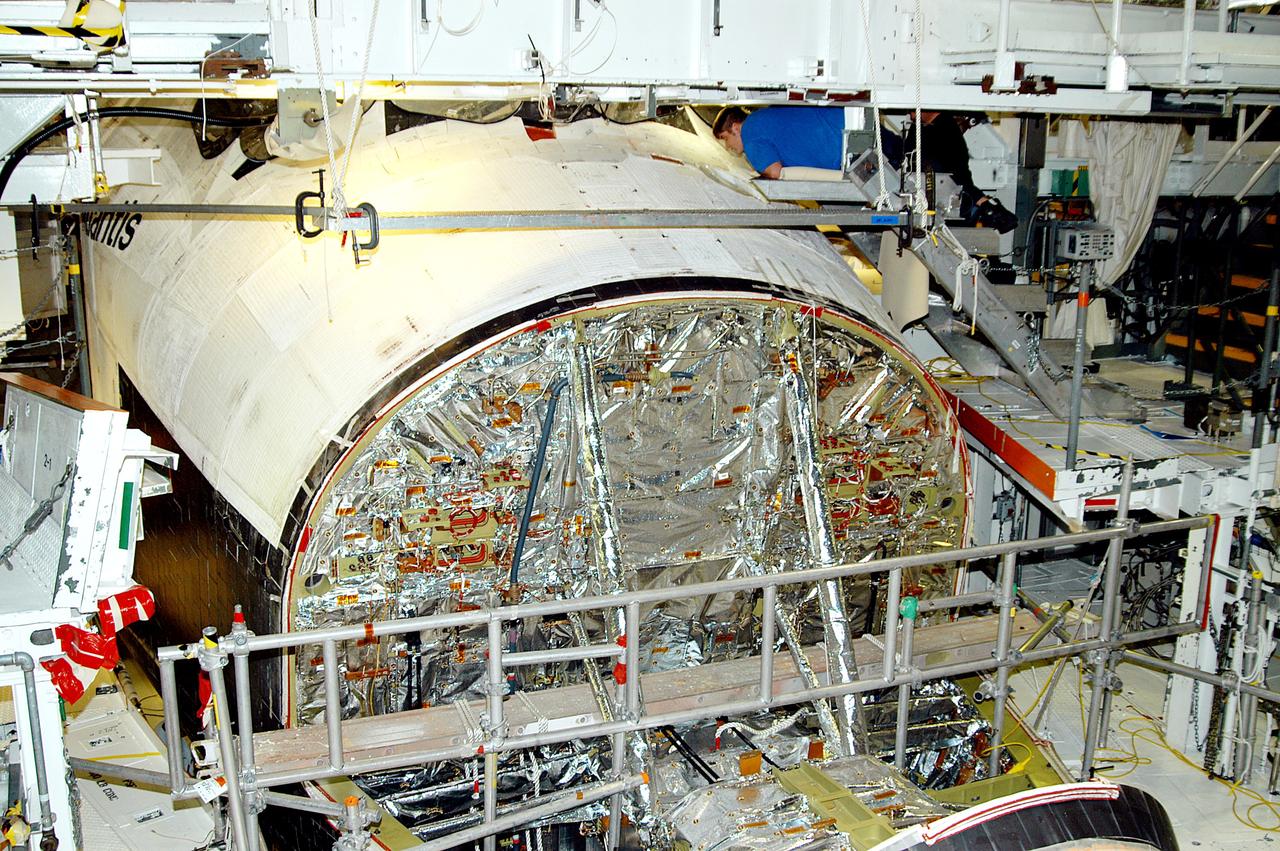
KENNEDY SPACE CENTER, FLA. - In the Orbiter Processing Facility, an Orbital Maneuvering System (OMS) pod is removed from  the orbiter Atlantis during routine maintenance.
KENNEDY SPACE CENTER, FLA. - In the Orbiter Processing Facility, an Orbital Maneuvering System (OMS) pod is removed from the orbiter Atlantis during routine maintenance.
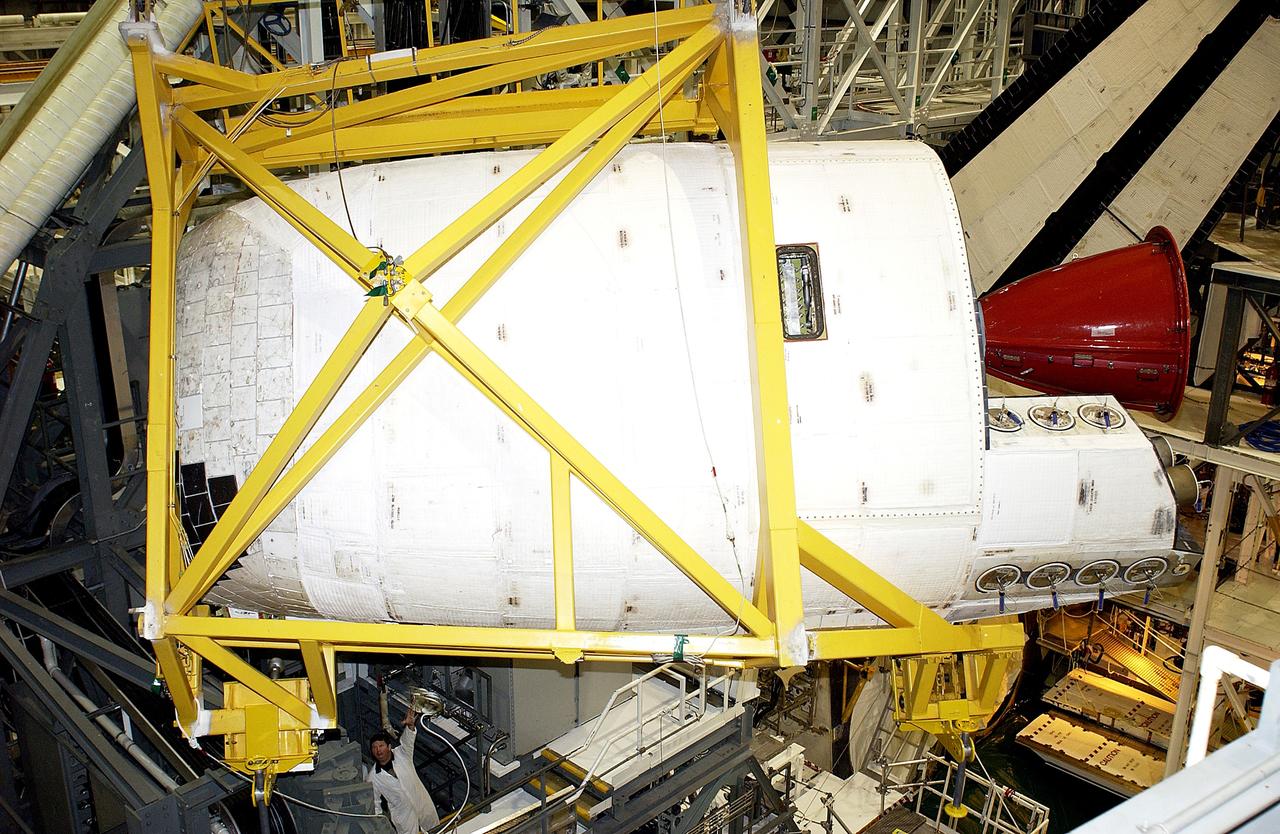
KENNEDY SPACE CENTER, FLA. - In the Orbiter Processing Facility, an Orbital Maneuvering System (OMS) pod removed from  the orbiter Atlantis during routine maintenance.
KENNEDY SPACE CENTER, FLA. - In the Orbiter Processing Facility, an Orbital Maneuvering System (OMS) pod removed from the orbiter Atlantis during routine maintenance.
KENNEDY SPACE CENTER, FLA. -  In the Orbiter Processing Facility, an Orbital Maneuvering System (OMS) pod is removed from  the orbiter Atlantis during routine maintenance.
KENNEDY SPACE CENTER, FLA. - In the Orbiter Processing Facility, an Orbital Maneuvering System (OMS) pod is removed from the orbiter Atlantis during routine maintenance.
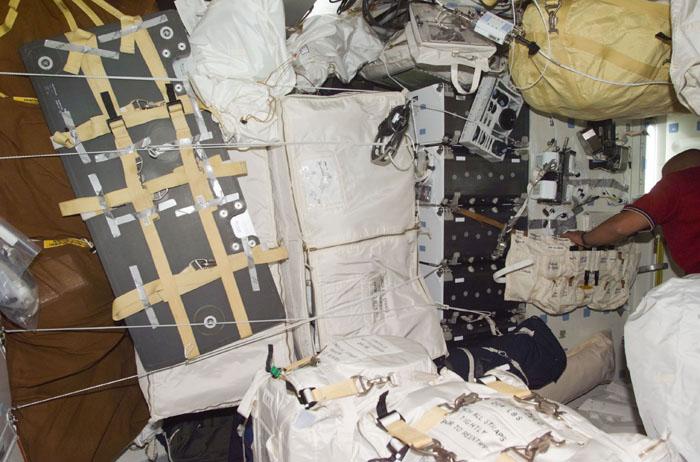
STS98-E-5010 (8 February 2001) --- This mid deck scene on the Earth-orbiting Space Shuttle Atlantis resembles the interior of a moving van, with equipment and supplies temporarily stored there.  The STS-98 crew will transfer much of the gear over to the International Space Station (ISS) once the shuttle and station are docked later in the week. The scene was recorded with a digital still camera.
Stowage items temporarily on STS-98 orbiter Atlantis
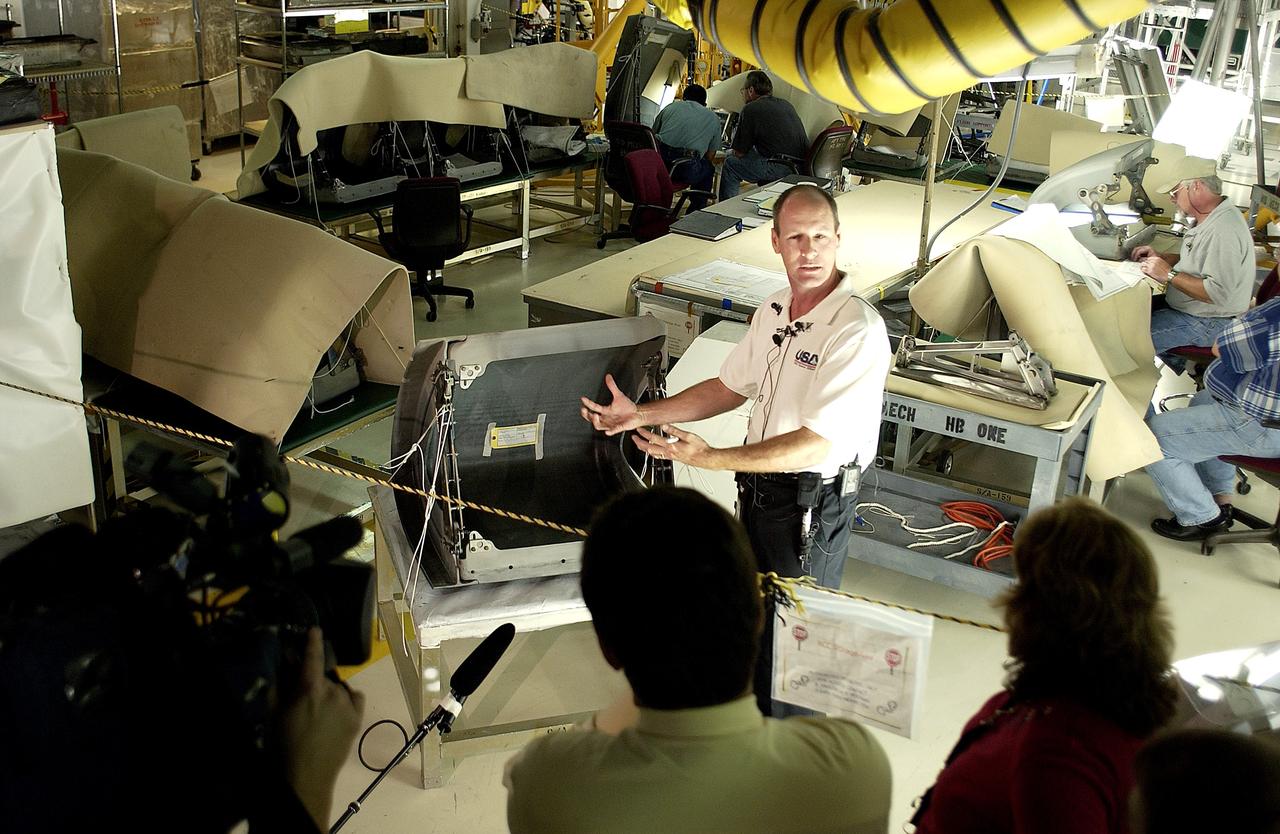
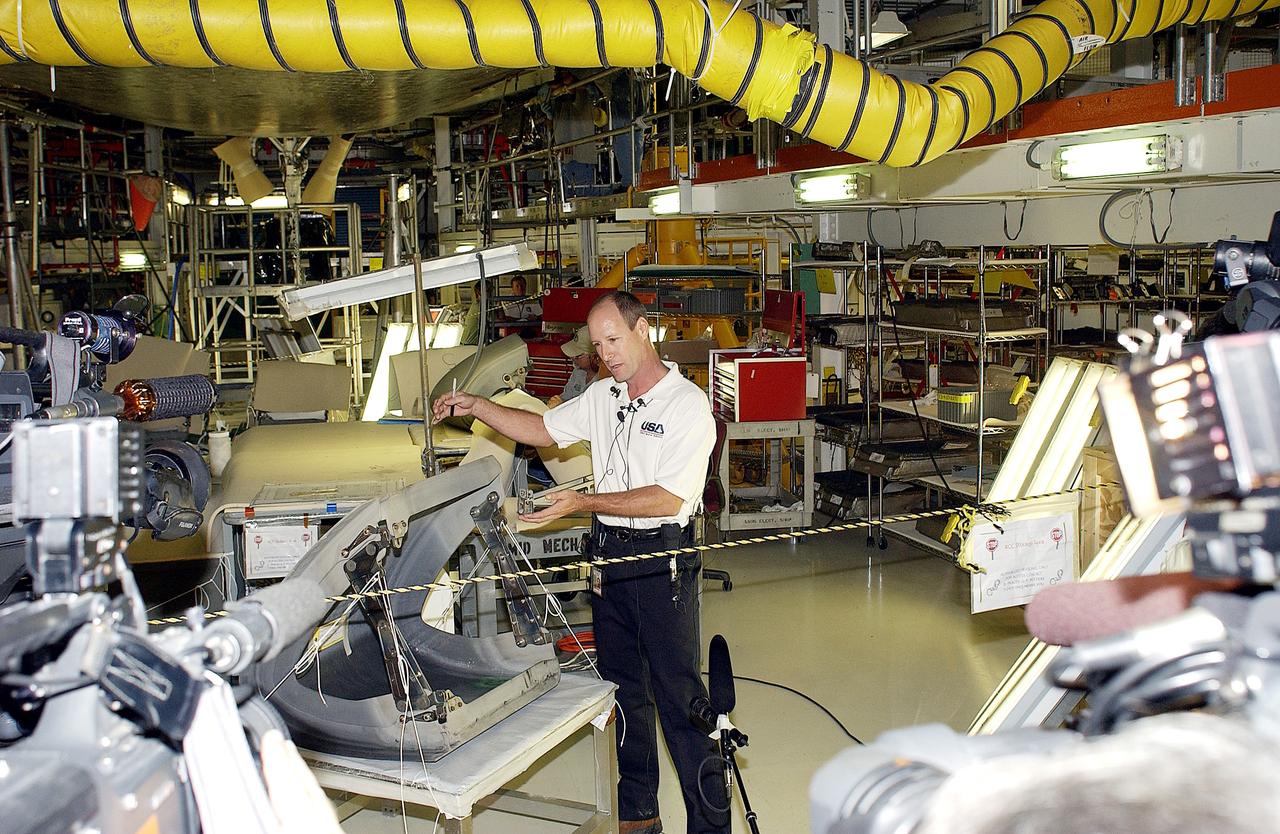
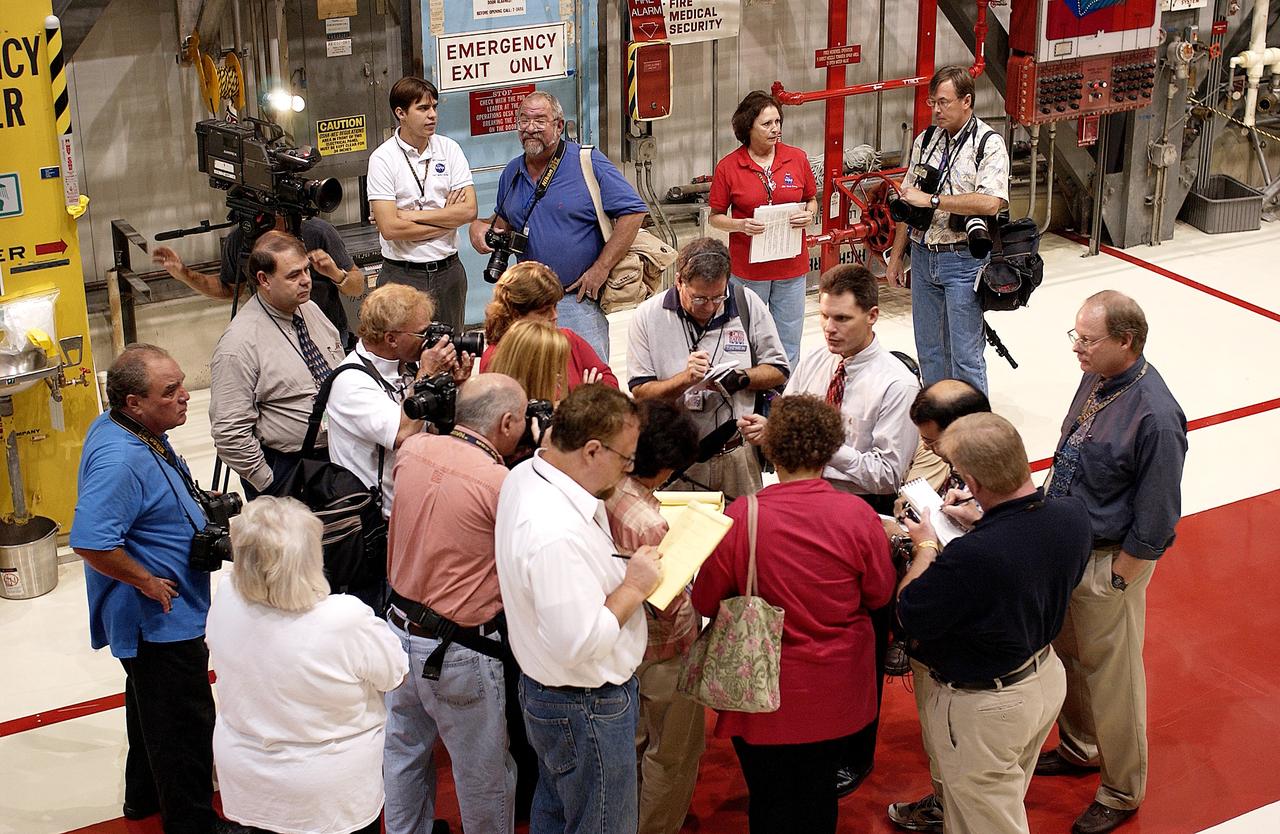
KENNEDY SPACE CENTER, FLA. -  In the Orbiter Processing Facility, Rick Beckwith (center), an orbiter engineer with United Space Alliance, explains to the media the reinstallation of the Reinforced Carbon-Carbon panels on the orbiter Atlantis’ wing leading edge.  The media was invited to tour the OPF at KSC and to see the orbiter Atlantis as it is being prepared for Return to Flight.  Both local and national reporters representing print and TV networks were able to see work in progress on Atlantis, also including wiring inspections and checks of the engines in the Orbital Maneuvering System.
KENNEDY SPACE CENTER, FLA. - In the Orbiter Processing Facility, Rick Beckwith (center), an orbiter engineer with United Space Alliance, explains to the media the reinstallation of the Reinforced Carbon-Carbon panels on the orbiter Atlantis’ wing leading edge. The media was invited to tour the OPF at KSC and to see the orbiter Atlantis as it is being prepared for Return to Flight. Both local and national reporters representing print and TV networks were able to see work in progress on Atlantis, also including wiring inspections and checks of the engines in the Orbital Maneuvering System.
KENNEDY SPACE CENTER, FLA. -  In the Orbiter Processing Facility (OPF), Rick Beckwith, an orbiter engineer with United Space Alliance, explains to the media the reinstallation of the Reinforced Carbon-Carbon panels on the orbiter Atlantis’ wing leading edge.  The media was invited to tour the OPF at KSC and to see the orbiter Atlantis as it is being prepared for Return to Flight.  Both local and national reporters representing print and TV networks were able to see work in progress on Atlantis, also including wiring inspections and checks of the engines in the Orbital Maneuvering System.
KENNEDY SPACE CENTER, FLA. - In the Orbiter Processing Facility (OPF), Rick Beckwith, an orbiter engineer with United Space Alliance, explains to the media the reinstallation of the Reinforced Carbon-Carbon panels on the orbiter Atlantis’ wing leading edge. The media was invited to tour the OPF at KSC and to see the orbiter Atlantis as it is being prepared for Return to Flight. Both local and national reporters representing print and TV networks were able to see work in progress on Atlantis, also including wiring inspections and checks of the engines in the Orbital Maneuvering System.
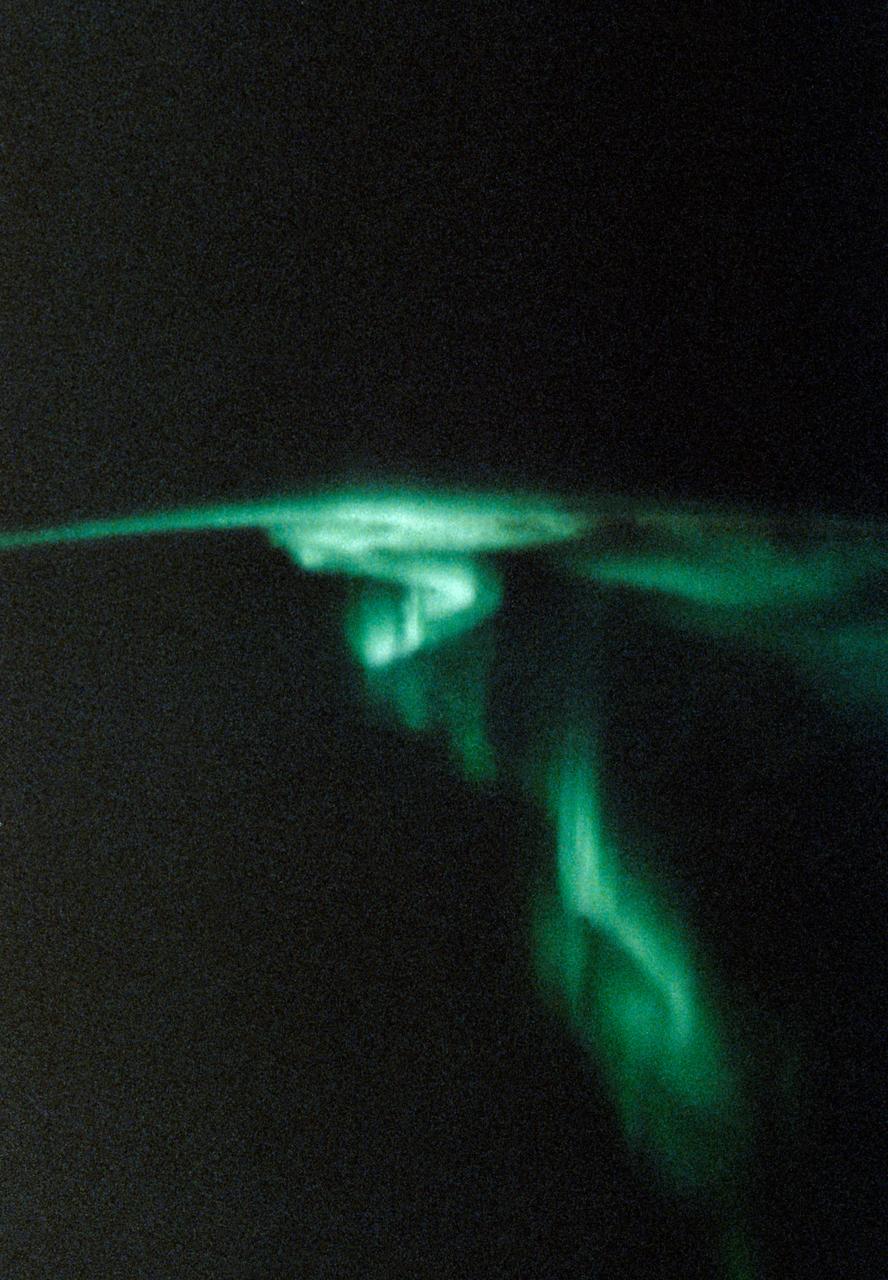
STS-45 Earth observation taken onboard Atlantis, Orbiter Vehicle (OV) 104, is of the Aurora Australis or Southern Lights. The STS-45 crewmembers note the interesting spiralling or corkscrew appearance of this particular sighting. Aurorae were observed and photographed throughout the STS-45 nine-day mission.
STS-45 Earth observation of the Aurora Australis or Southern Lights
The European Retrievable Carrier 1L (EURECA-1L) spacecraft, with solar array panels extended, drifts above the Earth after deployment from the payload bay of Atlantis, Orbiter Vehicle (OV) 104, during STS-46. EURECA's onboard propulsion unit will boost it to an operational altitude of 270 nautical miles.
EURECA-1L drifts above the Earth surface after STS-46 deployment from OV-104
STS066-124-059 (3-14 Nov. 1994) --- Mount Everest region, Nepal and China. Low morning Sun highlights Mount Everest (the highest mountain in the world at 8,848 meters), Cho Oyu (8,153 meters) to the northwest, and other peaks of "The Roof of the World". New snow seems to be confined to the highest peaks. Abundant details of glacier surfaces, including moraines, crevasse fields, and ice falls are displayed for study.
Mount Everest region as seen from the STS-66 orbiter Atlantis
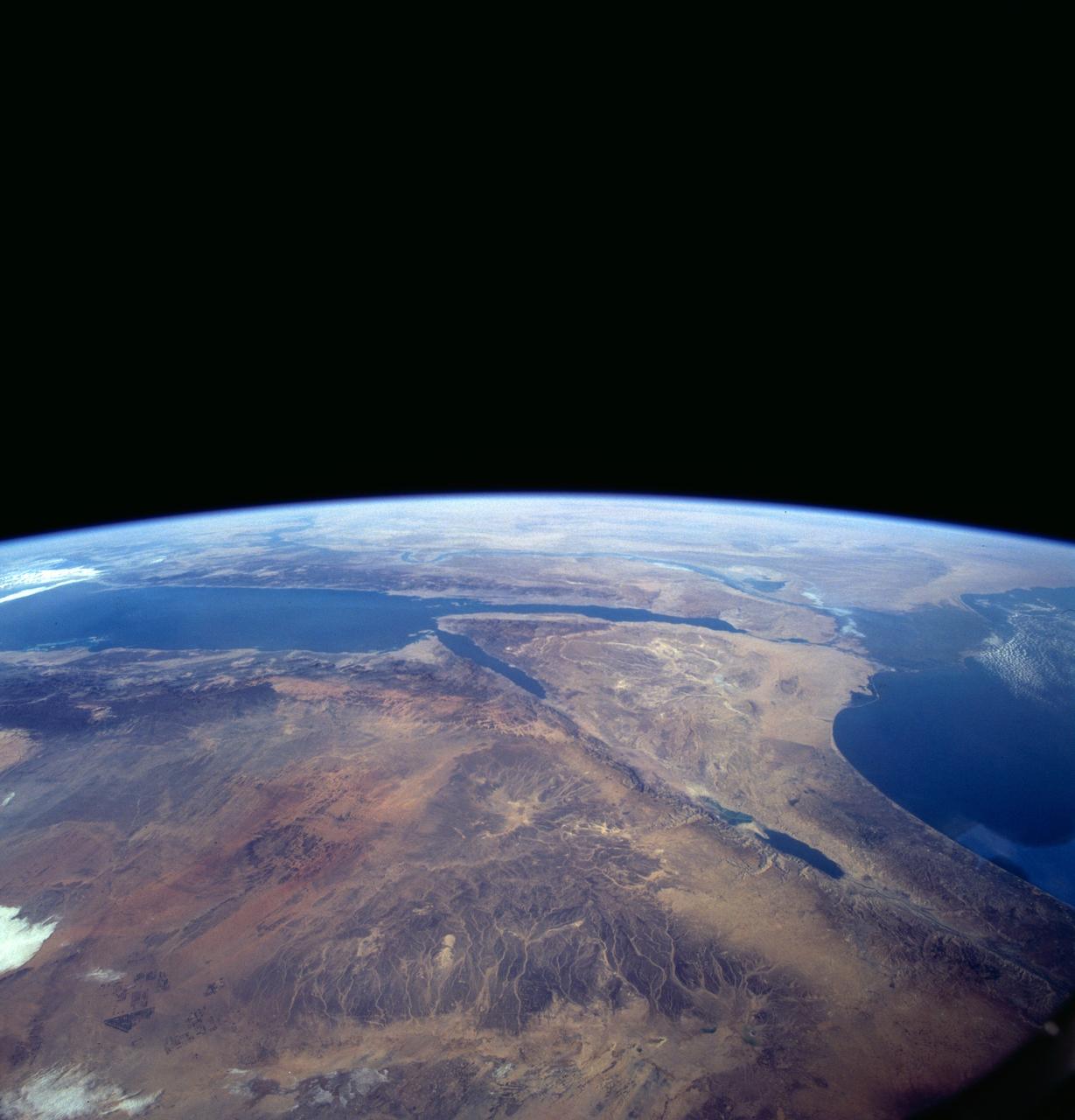
A high oblique view of the Middle East centered at approximately 28.0 degrees north and 34.0 degrees east. Portions of the countries of Egypt, Israel, Jordan and Saudi Arabia are visible. The Dead Sea Rift Valley continuing into the Gulf of Aqaba marks the boundary between Israel and Jordan. The vegetation change in the Sinai Peninsula is the border between the Gaza Strip and Egypt. In Egypt, the Suez Canal connects the Gulf of Suez with the Mediterranean Sea and forms the western boundary of the Sinai Peninsula. The green ribbon of the Nile River is in marked contrast to this arid region. Even the Jordan River does not support large scale agriculture.
Sinai Peninsula, Middle East as seen from STS-66 orbiter Atlantis
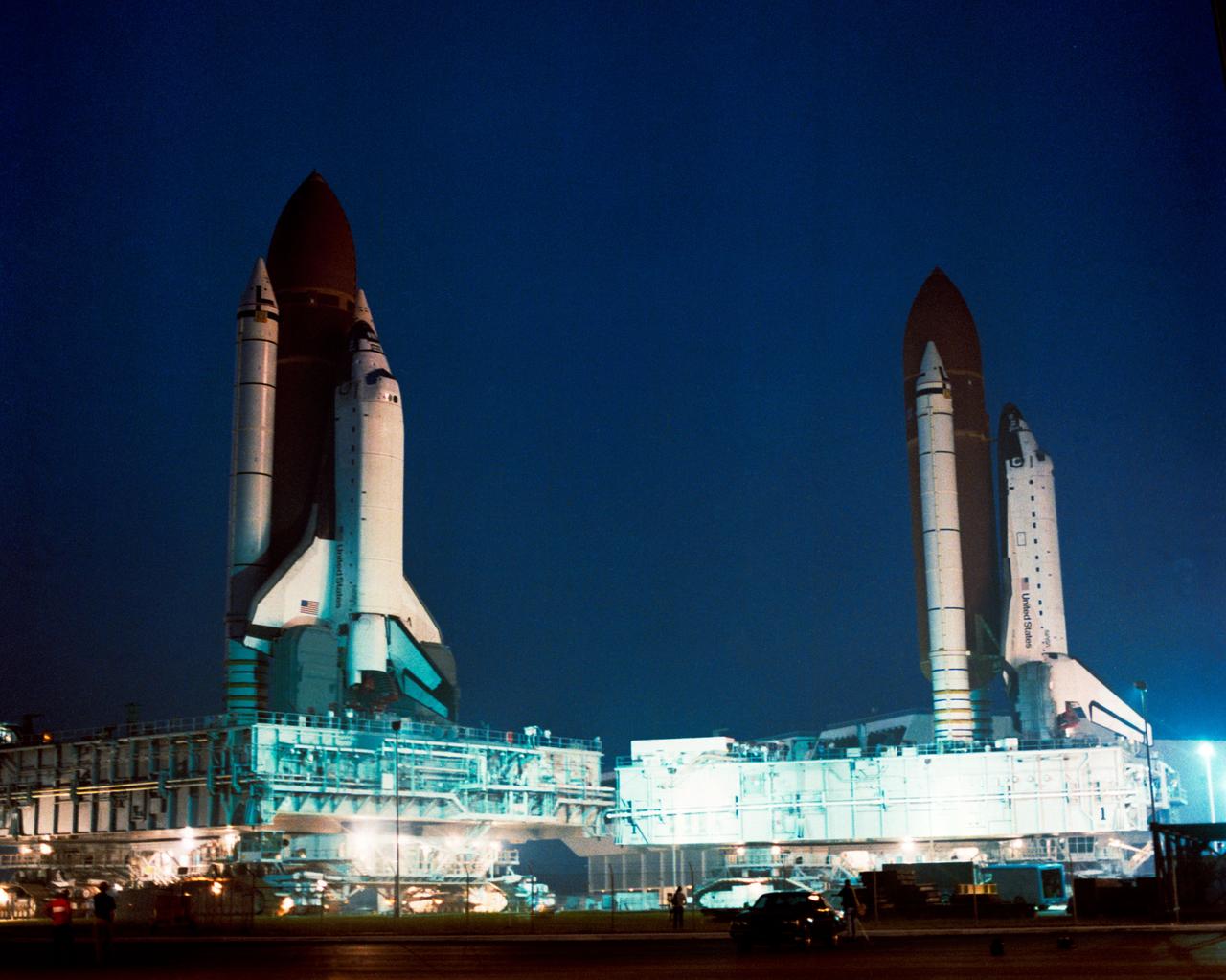
Columbia, Orbiter Vehicle (OV) 102, slated for mission STS-35, left, rolls past Atlantis, OV-104, on its way to Kennedy Space Center (KSC) launch pad 39A. OV-104, being readied for STS-38, is parked in front of the Vehicle Assembly Building (VAB) following its rollback from the pad for liquid hydrogen (LH2) line repairs. View provided by KSC with alternate number KSC-90PC-1152.
STS-35 Columbia, OV-102, passes STS-38 Atlantis, OV-104, heading to Pad 39A
KENNEDY SPACE CENTER, FLA. - In the Orbiter Processing Facility, the nose of orbiter Atlantis is covered in plastic, part of the preparation to protect the vehicles from possible damage by Hurricane Jeanne.  The storm ravaged Central Florida for 21 hours as it crossed the shoreline on the east coast Sept. 25-26.  Hurricane Jeanne was the fourth hurricane in 6 weeks to batter the state.
KSC-04pd1920
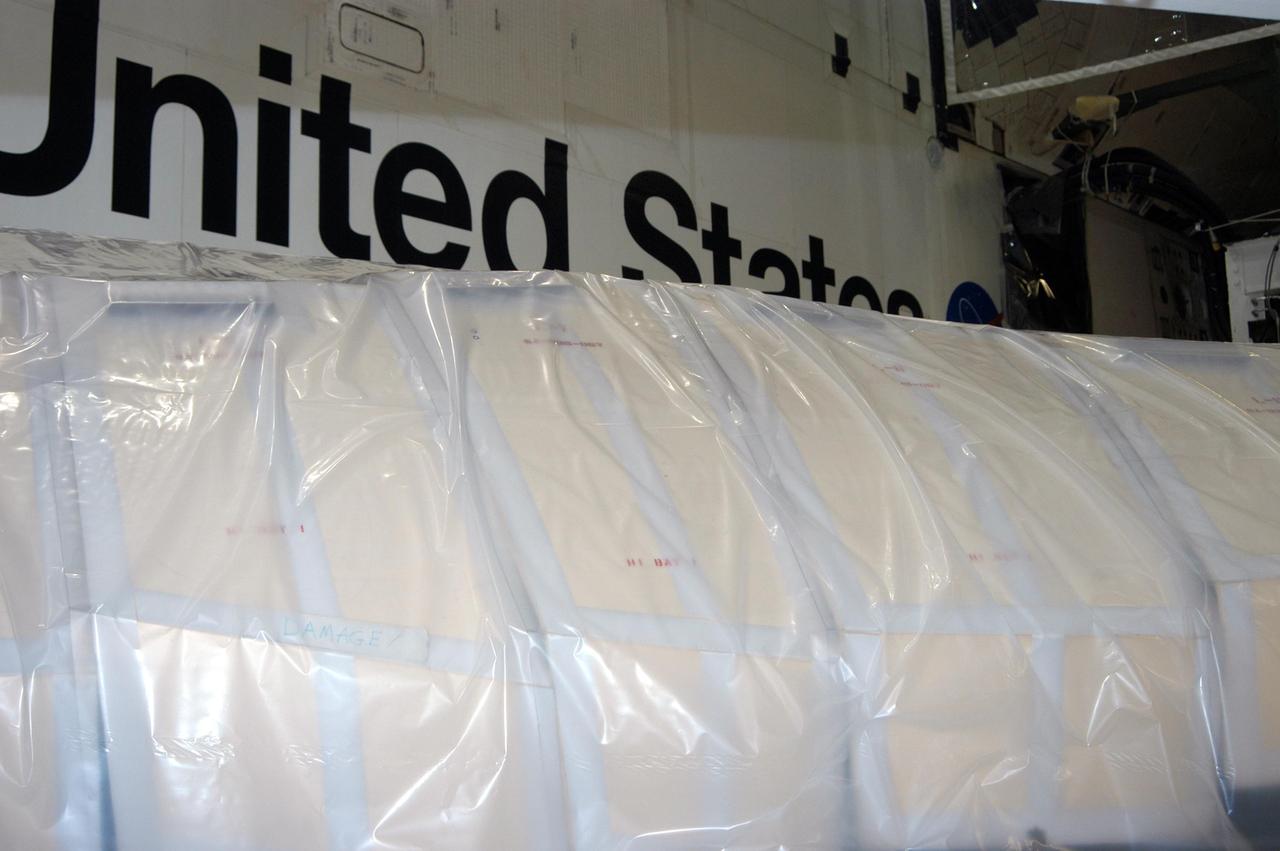
KENNEDY SPACE CENTER, FLA. - In the Orbiter Processing Facility, the wing of the orbiter Atlantis is covered in plastic, part of the preparation to protect the vehicles from possible damage by Hurricane Jeanne.  The storm ravaged Central Florida for 21 hours as it crossed the shoreline on the east coast Sept. 25-26.  Hurricane Jeanne was the fourth hurricane in 6 weeks to batter the state.
KSC-04pd1921
KENNEDY SPACE CENTER, FLA. -  In the Orbiter Processing Facility (OPF), Rick Beckwith, an orbiter engineer with United Space Alliance, explains to the media the reinstallation of the Reinforced Carbon-Carbon panels on Atlantis’ wing leading edge.  The media was invited to tour the OPF at KSC and to see the orbiter Atlantis as it is being prepared for Return to Flight.  Both local and national reporters representing print and TV networks were able to see work in progress on Atlantis, also including wiring inspections and checks of the engines in the Orbital Maneuvering System.
KENNEDY SPACE CENTER, FLA. - In the Orbiter Processing Facility (OPF), Rick Beckwith, an orbiter engineer with United Space Alliance, explains to the media the reinstallation of the Reinforced Carbon-Carbon panels on Atlantis’ wing leading edge. The media was invited to tour the OPF at KSC and to see the orbiter Atlantis as it is being prepared for Return to Flight. Both local and national reporters representing print and TV networks were able to see work in progress on Atlantis, also including wiring inspections and checks of the engines in the Orbital Maneuvering System.
KENNEDY SPACE CENTER, FLA. -  In the Orbiter Processing Facility, technicians prepare to remove an Orbital Maneuvering System (OMS) pod from the orbiter Atlantis during routine maintenance.
KENNEDY SPACE CENTER, FLA. - In the Orbiter Processing Facility, technicians prepare to remove an Orbital Maneuvering System (OMS) pod from the orbiter Atlantis during routine maintenance.
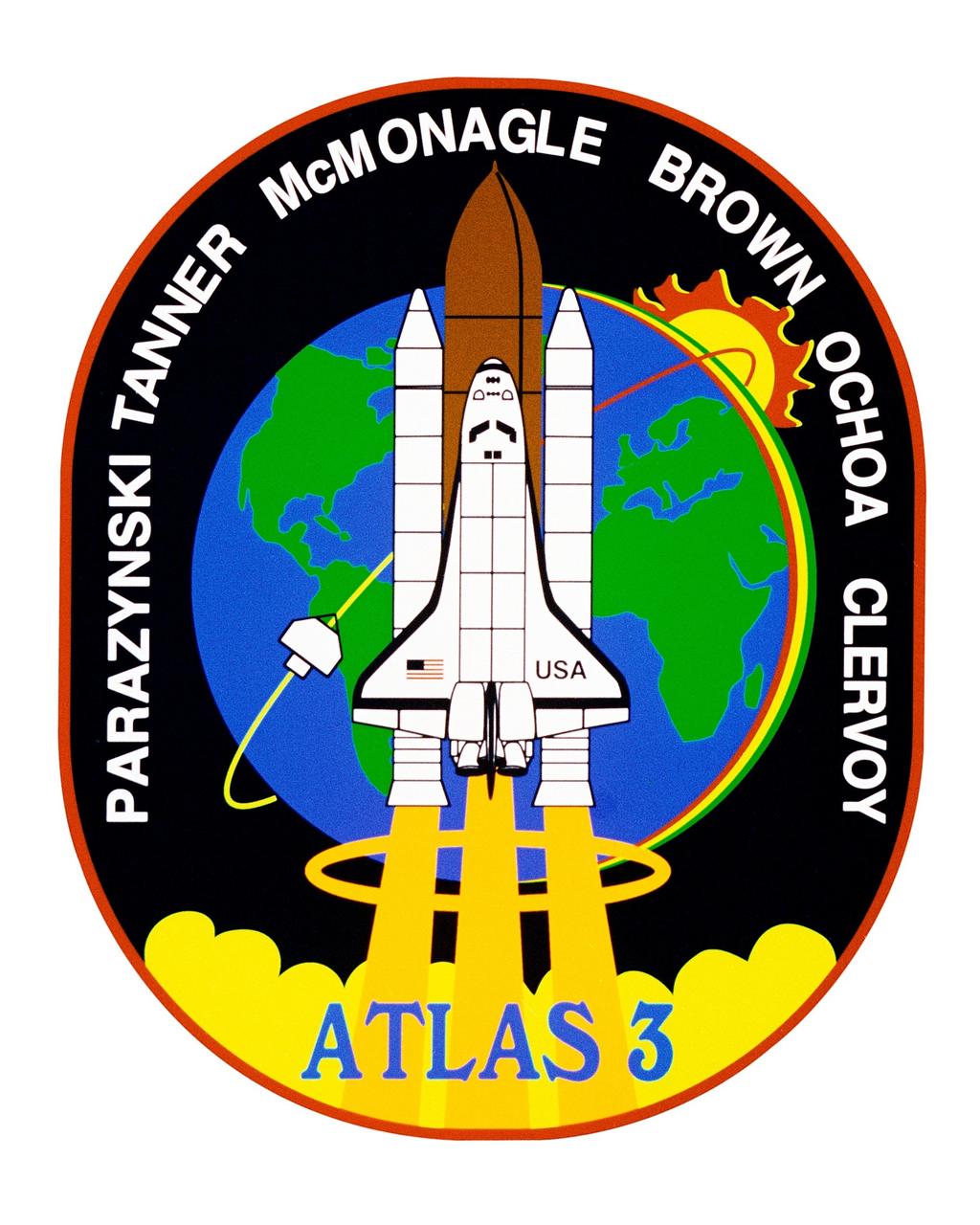
STS066-S-001 (October 1994) --- Designed by the crew members, the STS-66 insignia depicts the space shuttle Atlantis launching into Earth orbit to study global environmental change. The payload for the Atmospheric Laboratory for Applications and Science (ATLAS-3) and complementary experiments are part of a continuing study of the atmosphere and the sun's influence on it. The space shuttle is trailed by gold plumes representing the astronaut symbol and is superimposed over Earth, much of which is visible from the flight's high inclination orbit.  Sensitive instruments aboard the ATLAS pallet in the shuttle payload bay and on the free-flying Cryogenic Infrared Spectrometers and Telescopes for the Atmospheric-Shuttle Pallet Satellite (CHRISTA-SPAS) will gaze down on Earth and toward the sun, illustrated by the stylized sunrise and visible spectrum.    The NASA insignia design for space shuttle flights is reserved for use by the astronauts and for other official use as the NASA Administrator may authorize. Public availability has been approved only in the forms of illustrations by the various news media. When and if there is any change in this policy, which is not anticipated, the change will be publicly announced. Photo credit: NASA
STS-66 Official Crew insignia
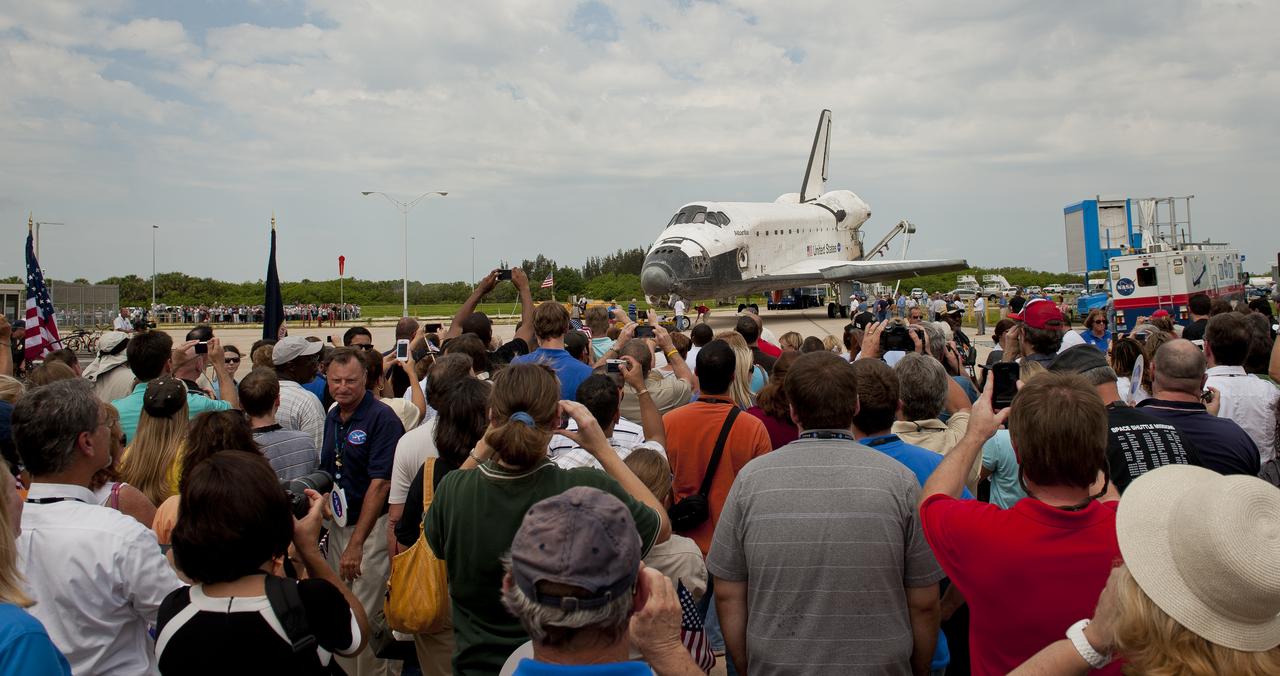
NASA employees and contractors wave flags and make pictures as space shuttle Atlantis (STS-135) rolls toward the Orbiter Processing Facility (OPF) at a wheels stop event, Thursday, July 21, 2011, at NASA's Kennedy Space Center in Cape Canaveral, Fla. Atlantis returned to Kennedy early Thursday following a 13-day mission to the International Space Station (ISS) and marking the end of the 30-year Space Shuttle Program. Overall, Atlantis spent 307 days in space and traveled nearly 126 million miles during its 33 flights. Atlantis, the fourth orbiter built, launched on its first mission on Oct. 3, 1985. Photo Credit: (NASA/Paul E. Alers)
STS-135 Wheels Stop Event
STS-34 Atlantis, Orbiter Vehicle (OV) 104, main landing gear (MLG) touches down on Runway 23 dry lake bed at Edwards Air Force Base (EAFB), California. The nose landing gear rides above runway before touchdown as the MLG wheels produce a cloud of dust. OV-104's port side profile is captured as it glides by at a speed of approximately 195 knots (224 miles per hour). The tail section with deployed speedbrake/rudder and space shuttle main engines (SSMEs) are visible.
STS-34 Atlantis, OV-104, touches down on runway 23 at EAFB, California
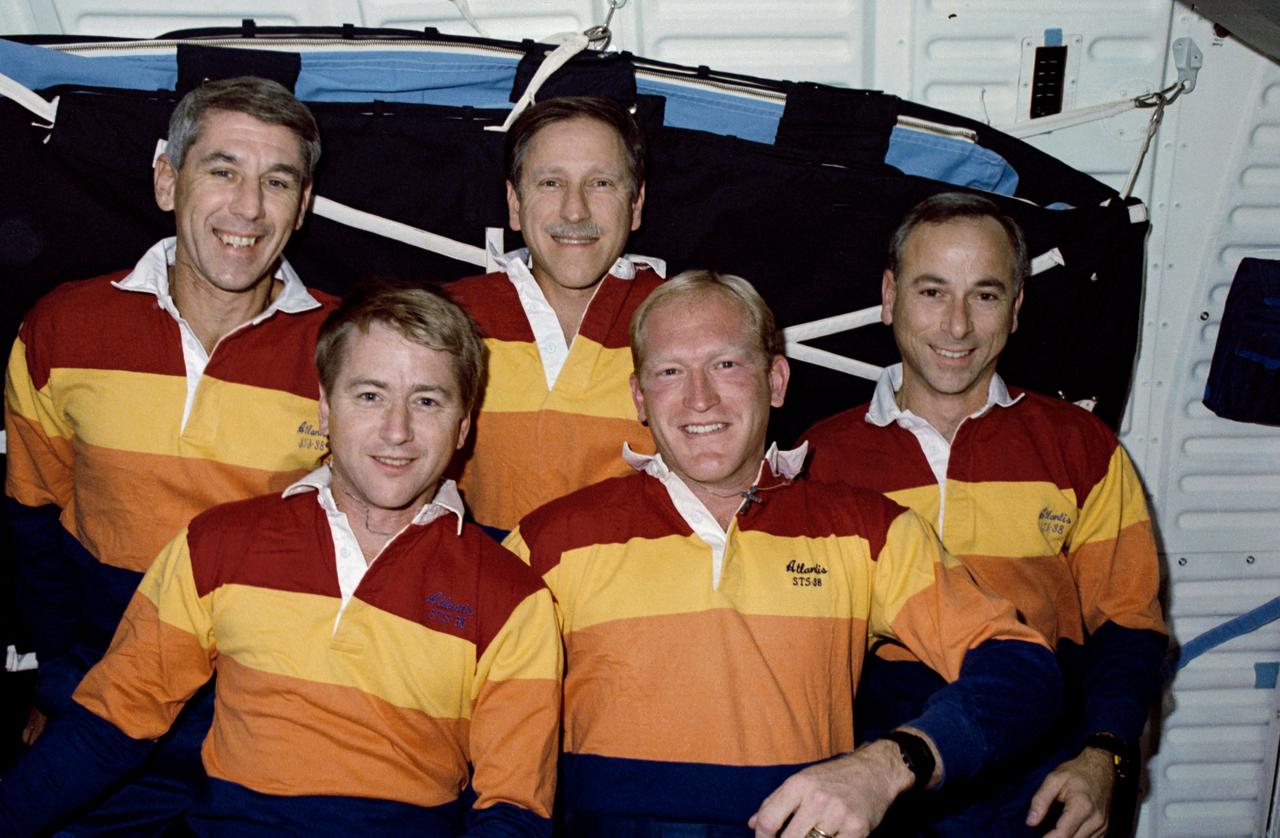
STS038-28-016 (20 Nov 1990) --- STS-38 crewmembers pose on Atlantis', Orbiter Vehicle (OV) 104's, middeck for traditional onboard (in-space) portrait. Wearing red, yellow, and orange crew polo shirts are (right to left) Mission Specialist (MS) Robert C. Springer, Pilot Frank L. Culbertson, Commander Richard O. Covey, MS Charles D. Gemar, and MS Carl J. Meade.
STS-38 crewmembers pose on OV-104's middeck for onboard crew portrait
STS030-S-126 (8 May 1989) --- The space shuttle Atlantis, as seen in a low angle view on its glide in from Earth orbit, heads toward a concrete runway at Edwards Air Force Base in California. Onboard were astronauts David M. Walker, STS-30 commander; Ronald J. Grabe, pilot; and astronauts Norman E. Thagard, Mary L. Cleave and Mark C.  Lee ? all mission specialists.  Photo credit: NASA
STS-30 Atlantis, OV-104, glides toward a landing at EAFB, California
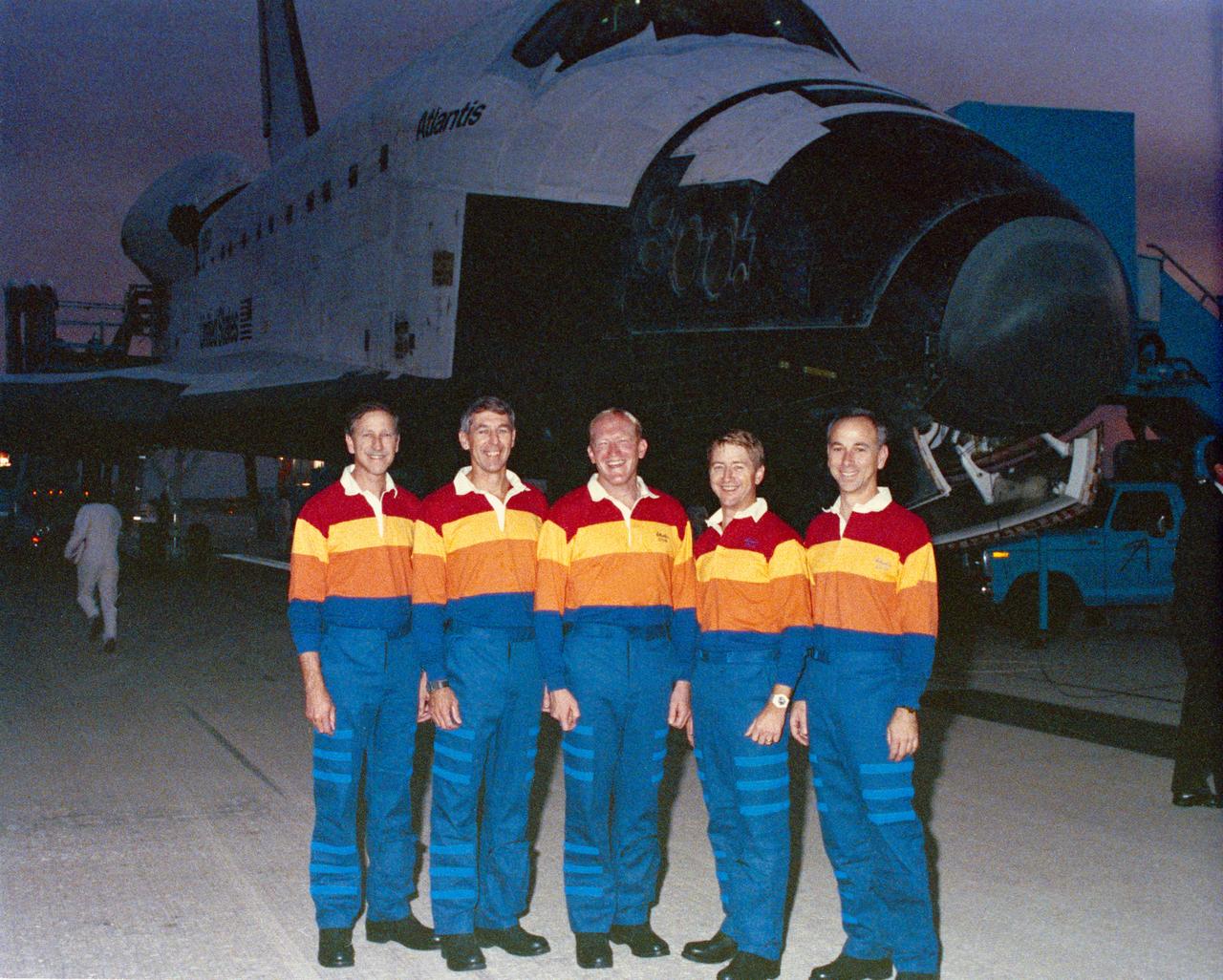
STS038-S-040 (20 Nov 1990) ---  STS-38 crewmembers, wearing red, yellow, and orange polo shirts, pose in front of Atlantis, Orbiter Vehicle (OV) 104, parked on runway 33 at Kennedy Space Center's (KSC) Shuttle Landing Facility (SLF) during post flight activities. Left to right are Commander Richard O. Covey, Mission Specialist (MS) Robert C. Springer, MS Charles D. Gemar, Pilot Frank L. Culbertson, and MS Carl J. Meade.
STS-38 crew poses in front of OV-104 at KSC's SLF during post flight activity
S88-55870 (2 Dec. 1988) --- The space shuttle Atlantis and its five-man crew of astronauts are launched from Kennedy Space Center?s Pad 39B at 9:30 a.m. (EST), Dec. 2, 1988. Onboard the Department of Defense?dedicated mission are astronauts Robert L. Gibson, Guy S. Gardner, Jerry L. Ross, Richard M. (Mike) Mullane and Williams M. Shepherd. Photo credit: NASA
STS-27 Atlantis, Orbiter Vehicle (OV) 104, liftoff
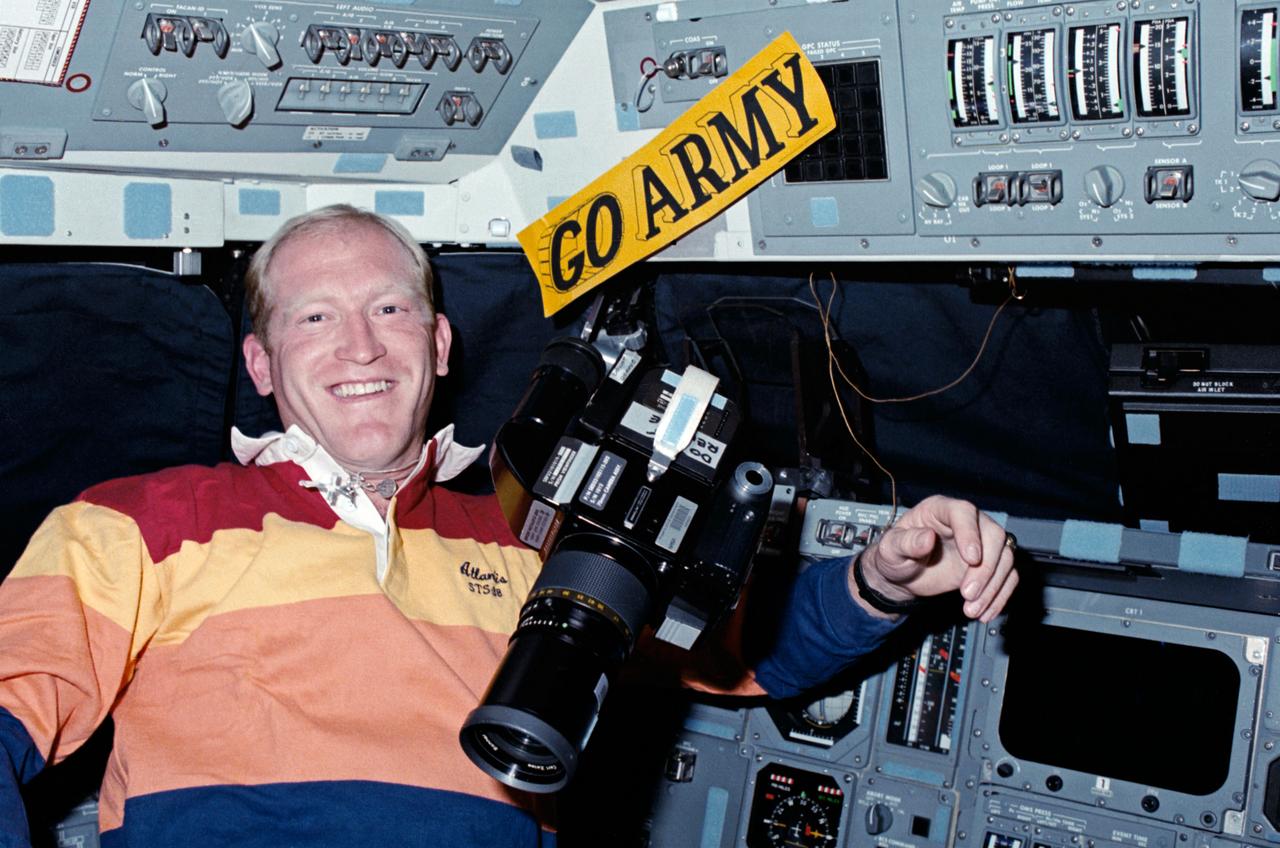
STS-38 Mission Specialist (MS) Charles D. Gemar freefloats in front of commanders station on the forward flight deck of Atlantis, Orbiter Vehicle (OV) 104, along with HASSELBLAD camera and "GO ARMY" decal.
STS-38 MS Gemar with camera and ARMY decal on OV-104's forward flight deck
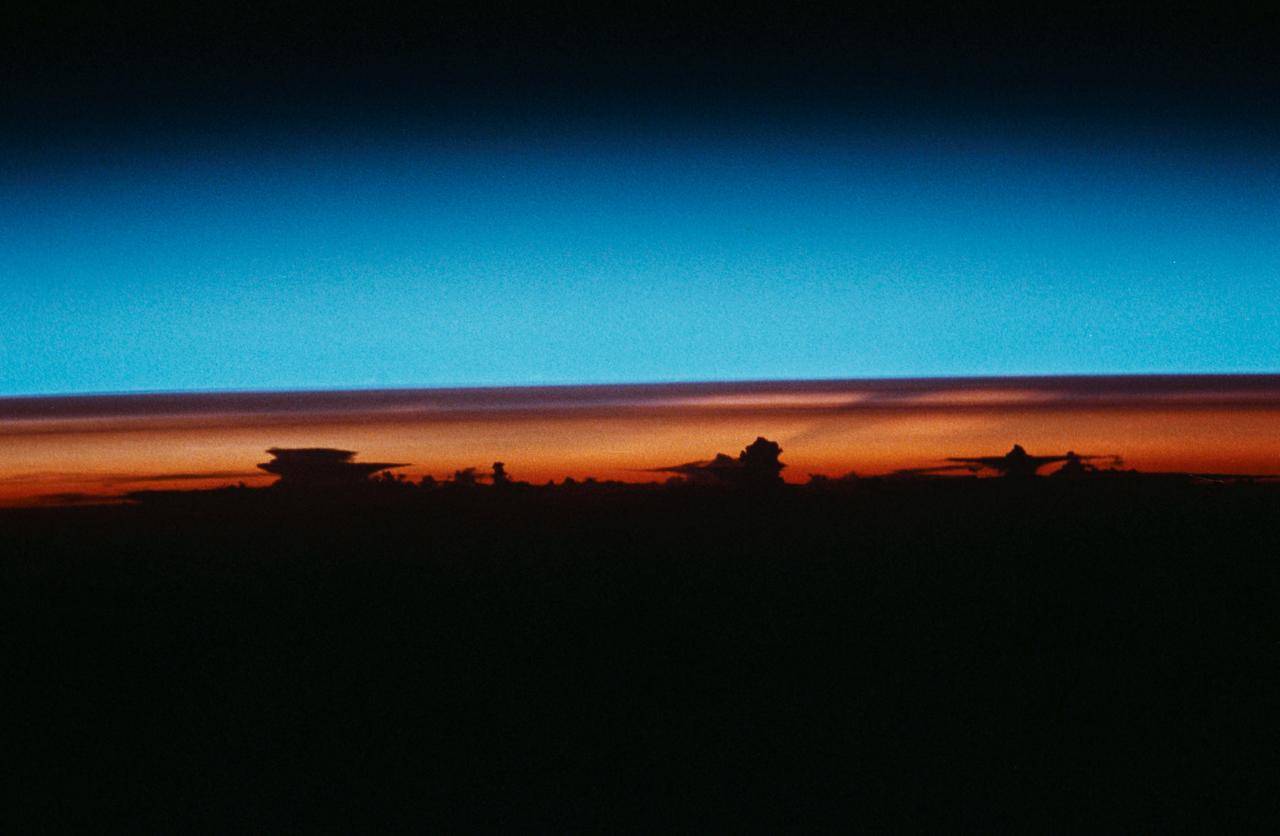
STS-43 Earth observation taken aboard Atlantis, Orbiter Vehicle (OV) 104, captures the Earth's limb at sunrise with unusual cloud patterns silhouetted by the sunlight and rising into the terminator lines.
STS-43 Earth observation of a colorful sunrise
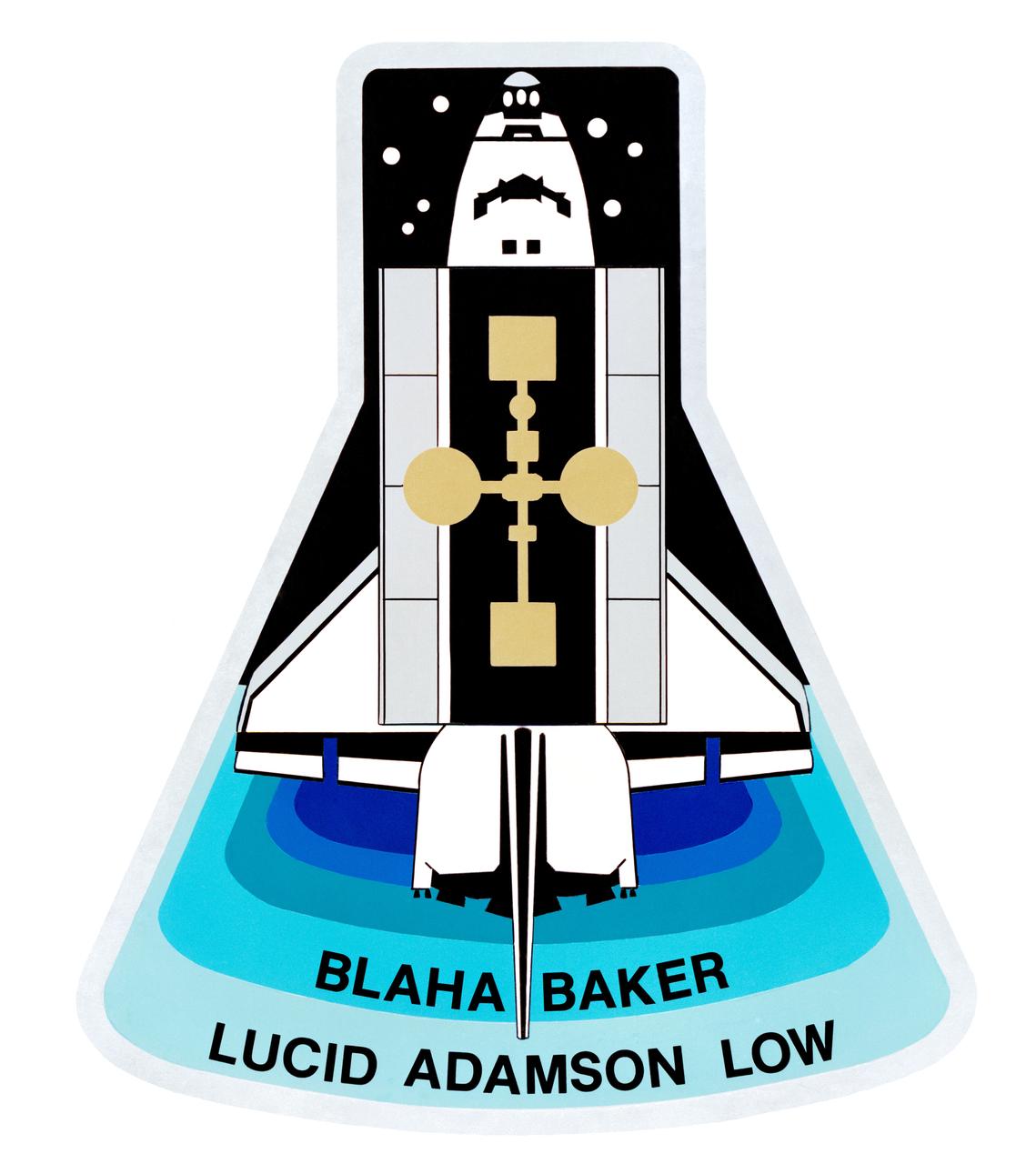
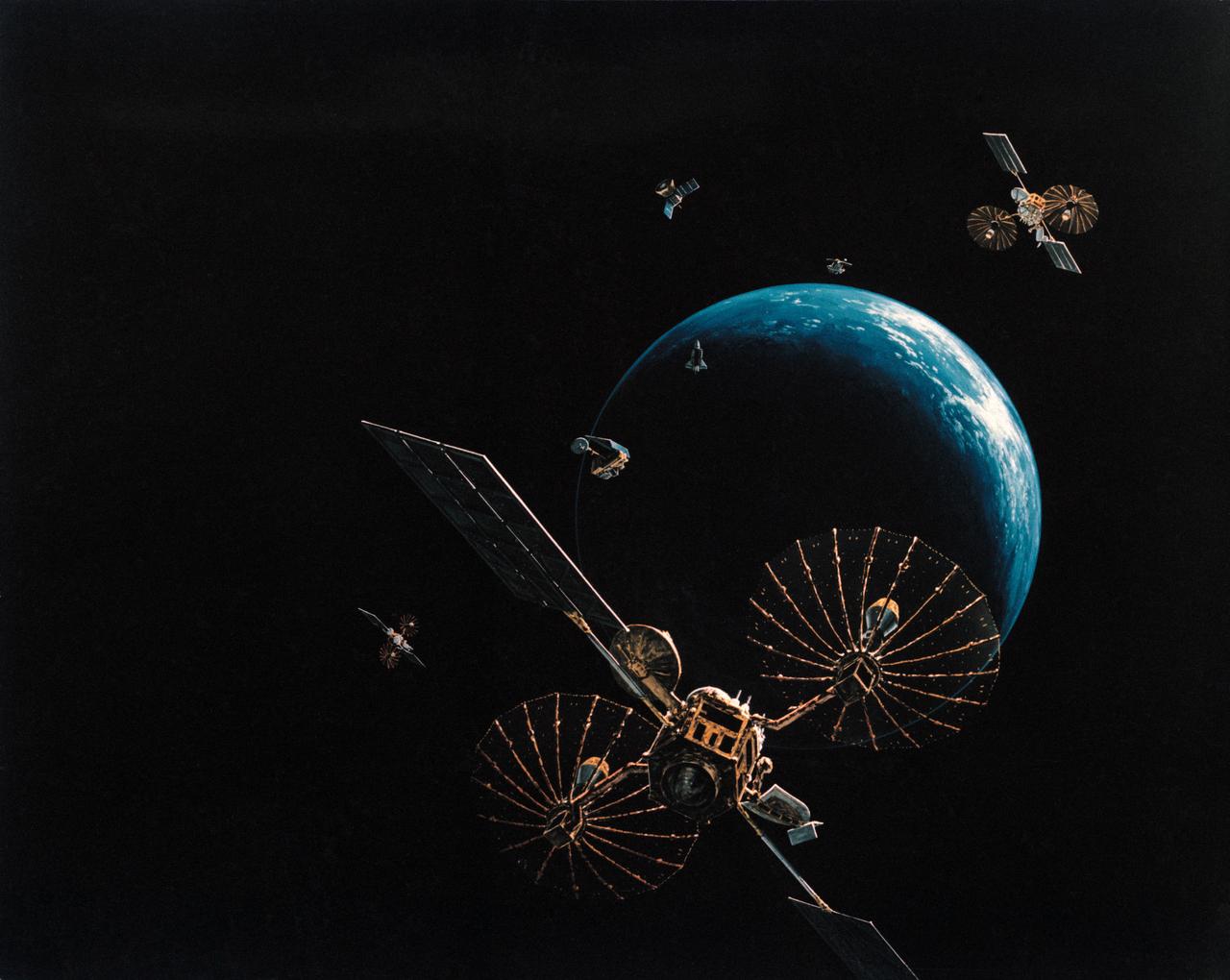
STS043-S-001 (6 Feb. 1991) --- Designed by the astronauts assigned to fly on the mission, the STS-43 patch portrays the evolution and continuity of the United States of America's space program by highlighting 30 years of American manned space flight experience - from Mercury to the space shuttle. The emergence of the space shuttle Atlantis from the outlined configuration of the Mercury space capsule commemorates this special relationship. The energy and momentum of launch are conveyed by the gradations of blue which mark the space shuttle's ascent from Earth to space.  Once in Earth orbit, Atlantis' cargo bay opens to reveal the Tracking and Data Relay Satellite (TDRS) which appears in gold emphasis against the white wings of the space shuttle Atlantis and the stark blackness of space. A primary mission objective, the Tracking and Data Relay Satellite System (TDRSS) will enable almost continuous communication from Earth to space for future space shuttle missions. The stars on the patch are arranged to suggest this mission's numerical designation, with four stars left of Atlantis and three to the right.     The NASA insignia design for space shuttle flights is reserved for use by the astronauts and for other official use as the NASA Administrator may authorize. Public availability has been approved only in the forms of illustrations by the various news media. When and if there is any change in this policy, which is not anticipated, the change will be publicly announced. Photo credit: NASA
STS-43 Atlantis, Orbiter Vehicle (OV) 104, crew insignia
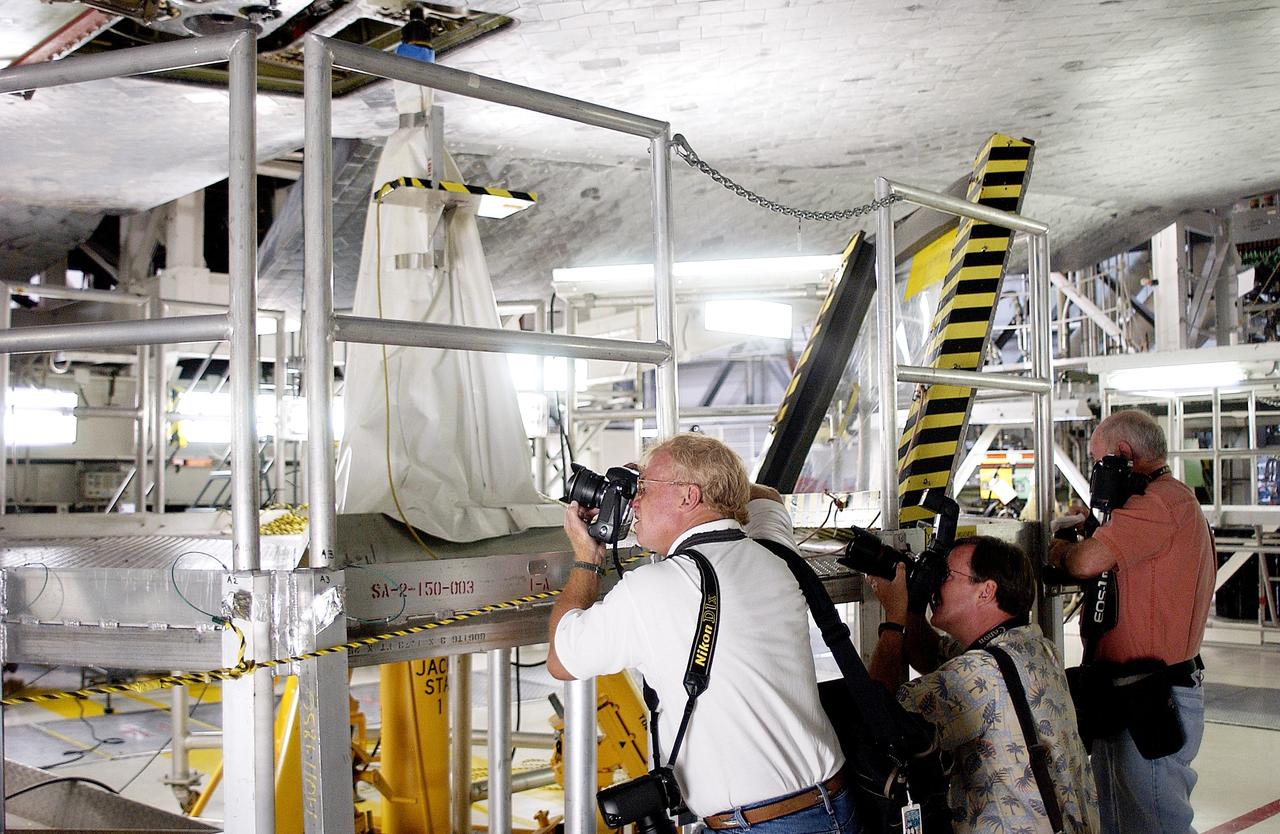
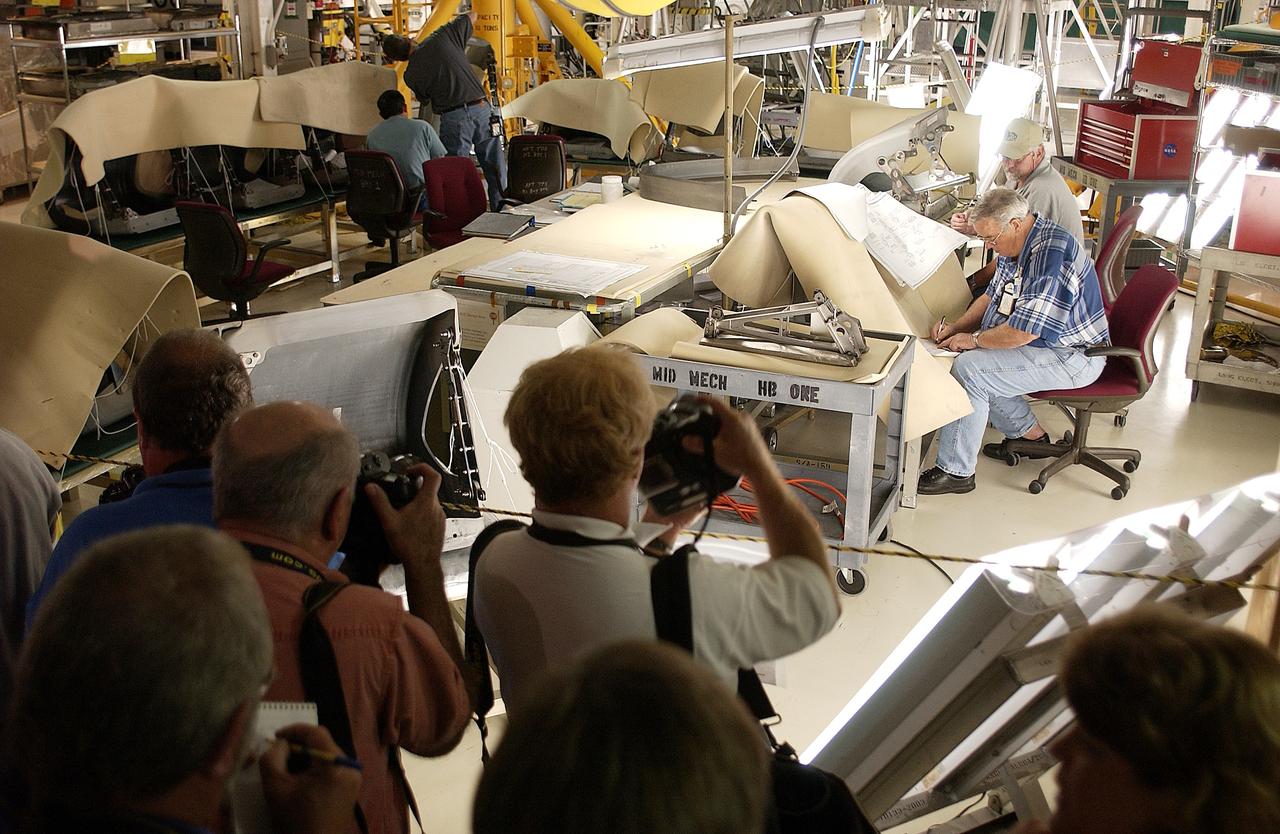
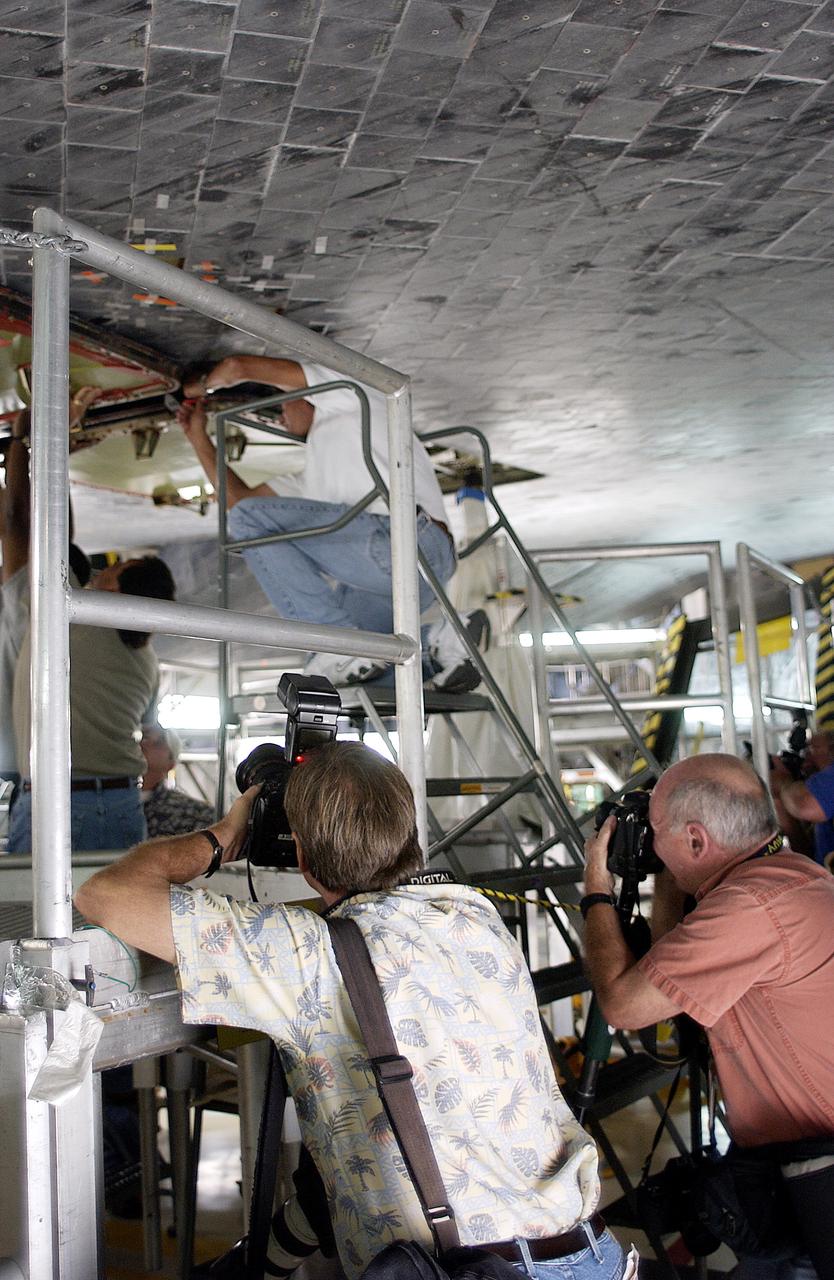
KENNEDY SPACE CENTER, FLA. -   In the Orbiter Processing Facility,  the media photograph work being done on the tiles on the orbiter Atlantis as it is being prepared for Return to Flight in the Orbiter Processing Facility.   Both local and national reporters representing print and TV networks were able to see work in progress on Atlantis, including the reinstallation of the Reinforced Carbon-Carbon panels on the orbiter’s wing leading edge; wiring inspections; and checks of the engines in the Orbital Maneuvering System.
KENNEDY SPACE CENTER, FLA. - In the Orbiter Processing Facility, the media photograph work being done on the tiles on the orbiter Atlantis as it is being prepared for Return to Flight in the Orbiter Processing Facility. Both local and national reporters representing print and TV networks were able to see work in progress on Atlantis, including the reinstallation of the Reinforced Carbon-Carbon panels on the orbiter’s wing leading edge; wiring inspections; and checks of the engines in the Orbital Maneuvering System.
KENNEDY SPACE CENTER, FLA. -  In the Orbiter Processing Facility,  the media photograph work being done on the tiles on the orbiter Atlantis as it is being prepared for Return to Flight in the Orbiter Processing Facility.   Both local and national reporters representing print and TV networks were able to see work in progress on Atlantis, including the reinstallation of the Reinforced Carbon-Carbon panels on the orbiter’s wing leading edge; wiring inspections; and checks of the engines in the Orbital Maneuvering System.
KENNEDY SPACE CENTER, FLA. - In the Orbiter Processing Facility, the media photograph work being done on the tiles on the orbiter Atlantis as it is being prepared for Return to Flight in the Orbiter Processing Facility. Both local and national reporters representing print and TV networks were able to see work in progress on Atlantis, including the reinstallation of the Reinforced Carbon-Carbon panels on the orbiter’s wing leading edge; wiring inspections; and checks of the engines in the Orbital Maneuvering System.
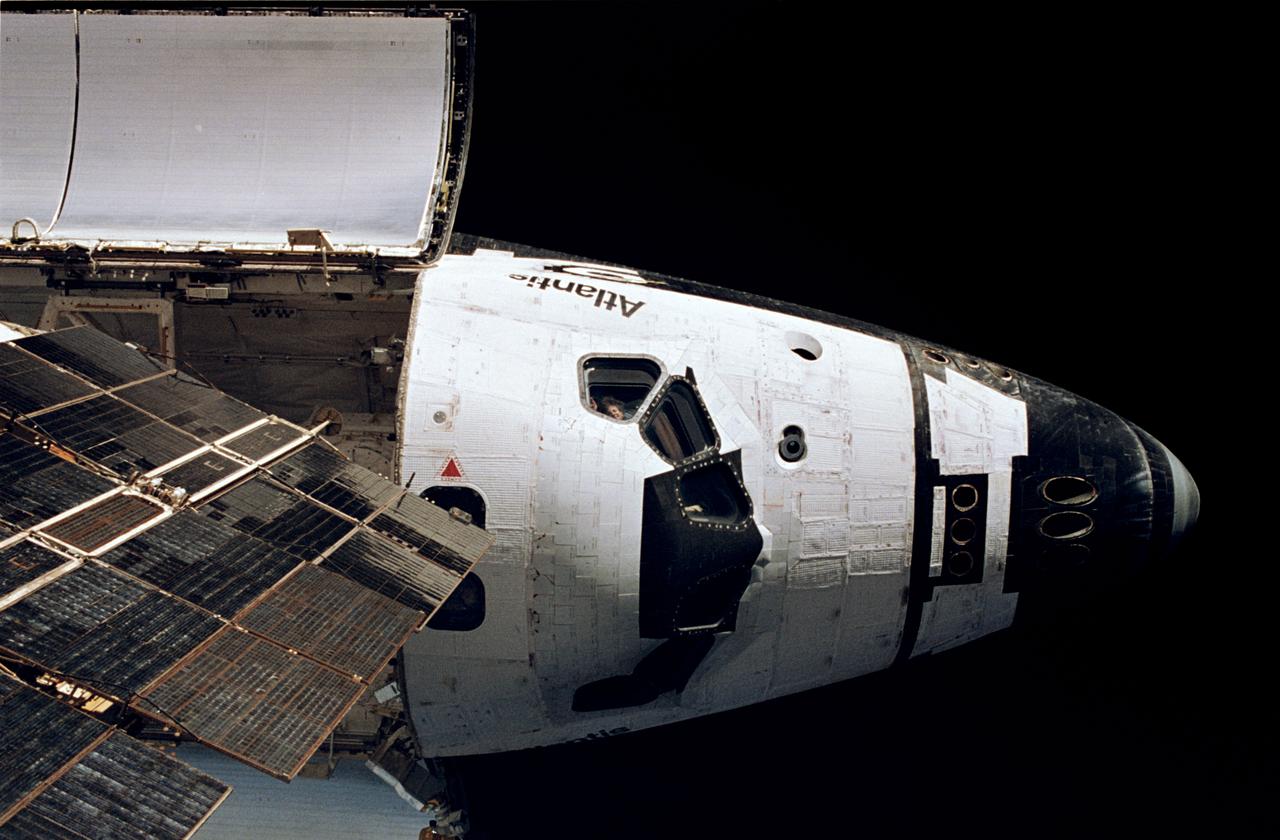
STS076-370-020 (22 - 31 March 1996) --- This photo of the forward part of the Space Shuttle Atlantis was taken from Russia's Mir Space Station as the two spacecraft jointly orbited Earth in late March 1996.  The large rectangular object in the immediate foreground is one of the solar array panels for Mir.  The two spacecraft were in the midst of their third link-up in Earth-orbit.  With the subsequent delivery of astronaut Shannon W. Lucid to the Mir, the Mir-21 crew grew from two to three, as the mission specialist temporarily became a cosmonaut guest researcher.  She is to spend approximately 140 days on Mir before returning to Earth.
View of the shuttle orbiter Atlantis from the Mir Space Station
STS036-21-032 (3 March 1990) --- The five astronaut crewmembers for STS-36 pose for an inflight group portrait on the forward flight deck of Atlantis, Orbiter Vehicle (OV) 104. They are (left to right) Commander John O. Creighton, Mission Specialist (MS) David C. Hilmers, MS Richard M. Mullane, MS Pierre J. Thuot, and Pilot John H. Casper. Creighton is positioned in the commanders seat and Casper in the pilot?s seat. Overhead control panels appear above the astronauts. The astronauts spent four days, 10 hours and 19 minutes aboard OV-104 for the Department of Defense (DOD) dedicated mission.
STS-36 crewmembers pose for group portrait on OV-104's forward flight deck
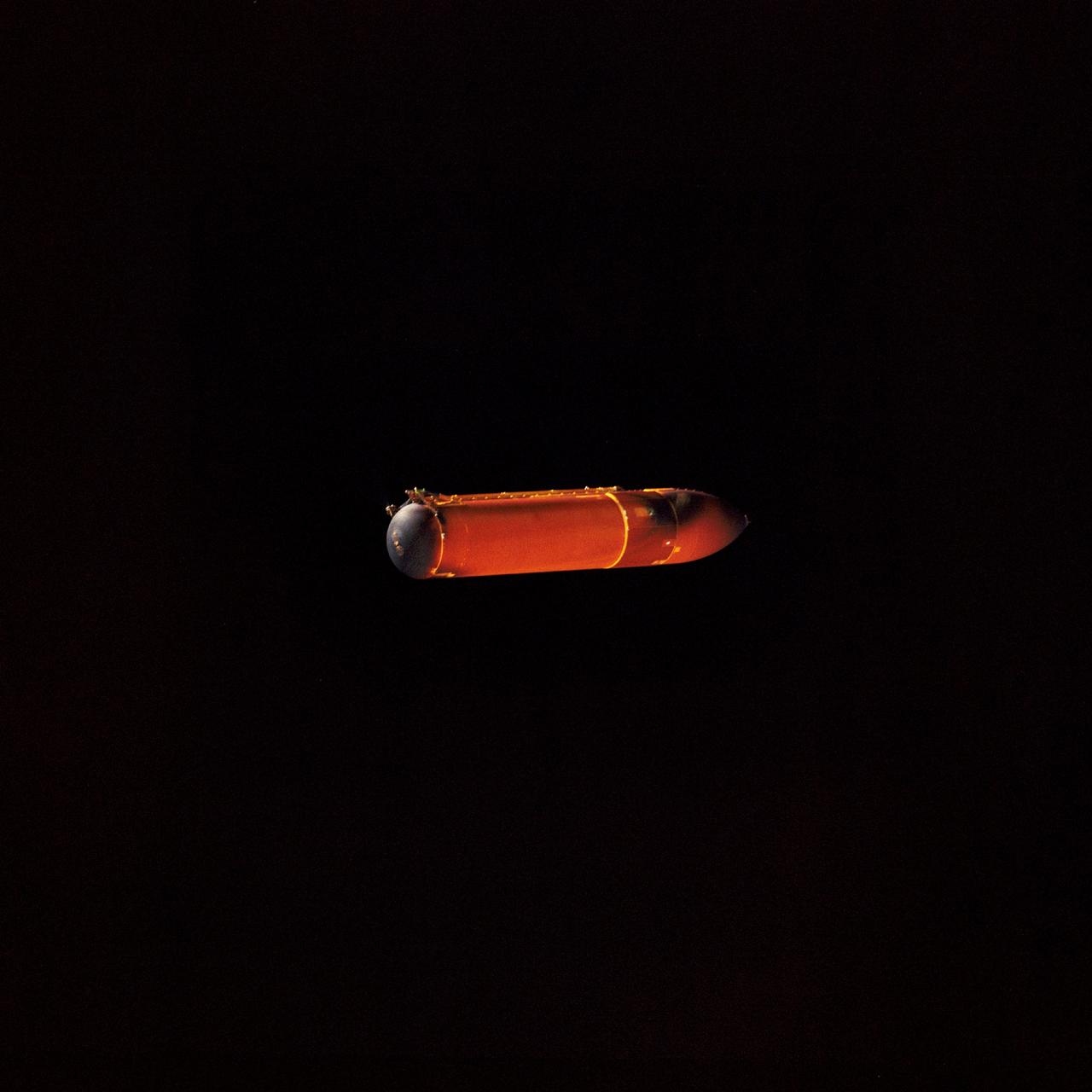
STS045-71-001 (24 March 1992) --- This 70mm photograph of the external fuel tank (ET) for STS-45 was photographed 4 1/2 minutes after having been jettisoned from Space Shuttle Atlantis. The excellent view of the starboard side of the ET shows both top and bottom attach points to the two solid rocket boosters (SRB). NASA engineers studying the STS-45 onboard photography deem the visible burn scars, caused by the SRBs, to be normal. The long thin pipe visible is the liquid oxygen line.  At the bottom end of the large tank, both the liquid oxygen (nearest camera) and liquid hydrogen orbiter-to-ET attach hardware can be seen.
STS-45 external tank (ET) falls back to Earth after jettisoning from OV-104
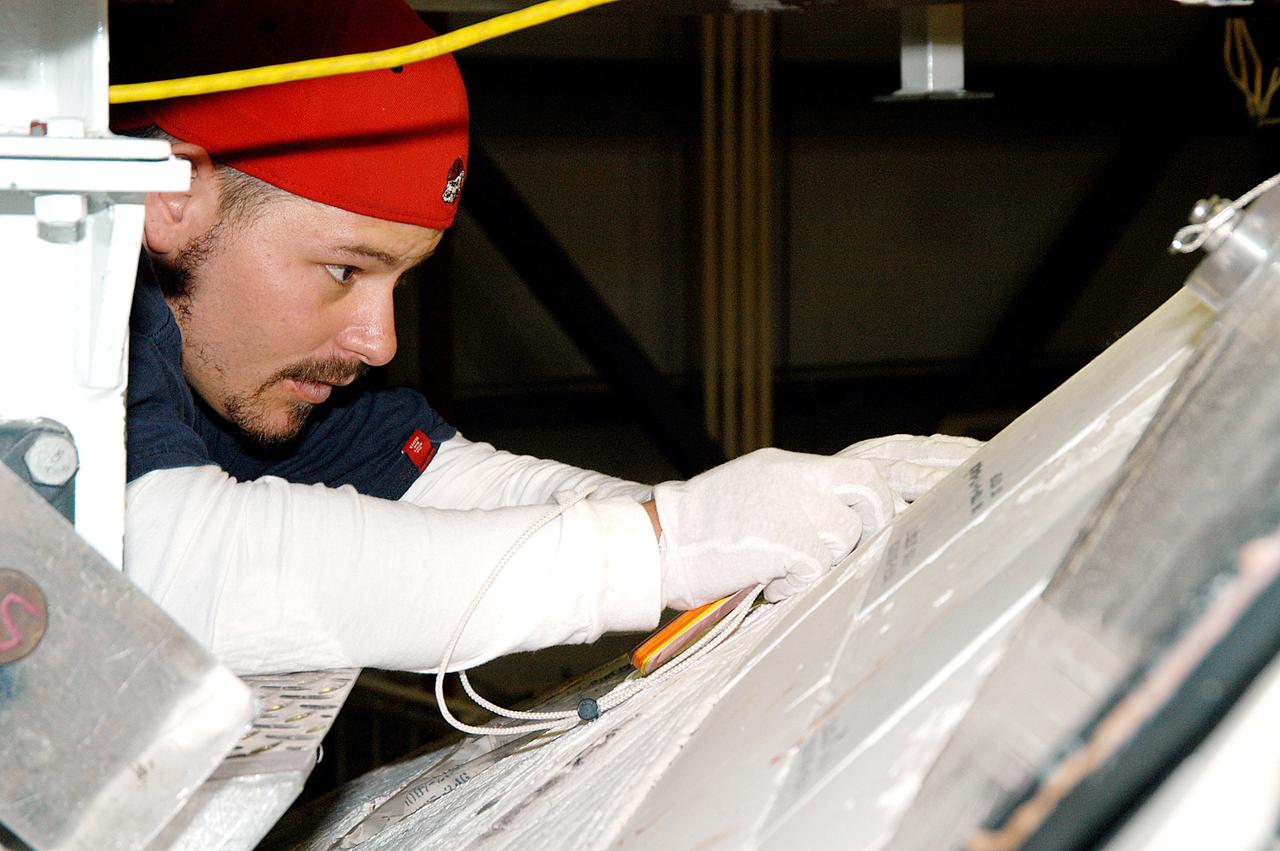
KENNEDY SPACE CENTER, FLA. - In the Orbiter Processing Facility, United Space Alliance technician Jamie Haynes does a gap test on the tiles of the nose of orbiter Atlantis as part of return-to-flight activities.  Atlantis is scheduled for mission STS-114, a return-to-flight test mission to the International Space Station.
KENNEDY SPACE CENTER, FLA. - In the Orbiter Processing Facility, United Space Alliance technician Jamie Haynes does a gap test on the tiles of the nose of orbiter Atlantis as part of return-to-flight activities. Atlantis is scheduled for mission STS-114, a return-to-flight test mission to the International Space Station.
KENNEDY SPACE CENTER, FLA. - In the Orbiter Processing Facility, United Space Alliance technician Chris Moore performs gap tests on the tiles of the nose of orbiter Atlantis as part of return-to-flight activities.  Atlantis is scheduled for mission STS-114, a return-to-flight test mission to the International Space Station.
KENNEDY SPACE CENTER, FLA. - In the Orbiter Processing Facility, United Space Alliance technician Chris Moore performs gap tests on the tiles of the nose of orbiter Atlantis as part of return-to-flight activities. Atlantis is scheduled for mission STS-114, a return-to-flight test mission to the International Space Station.
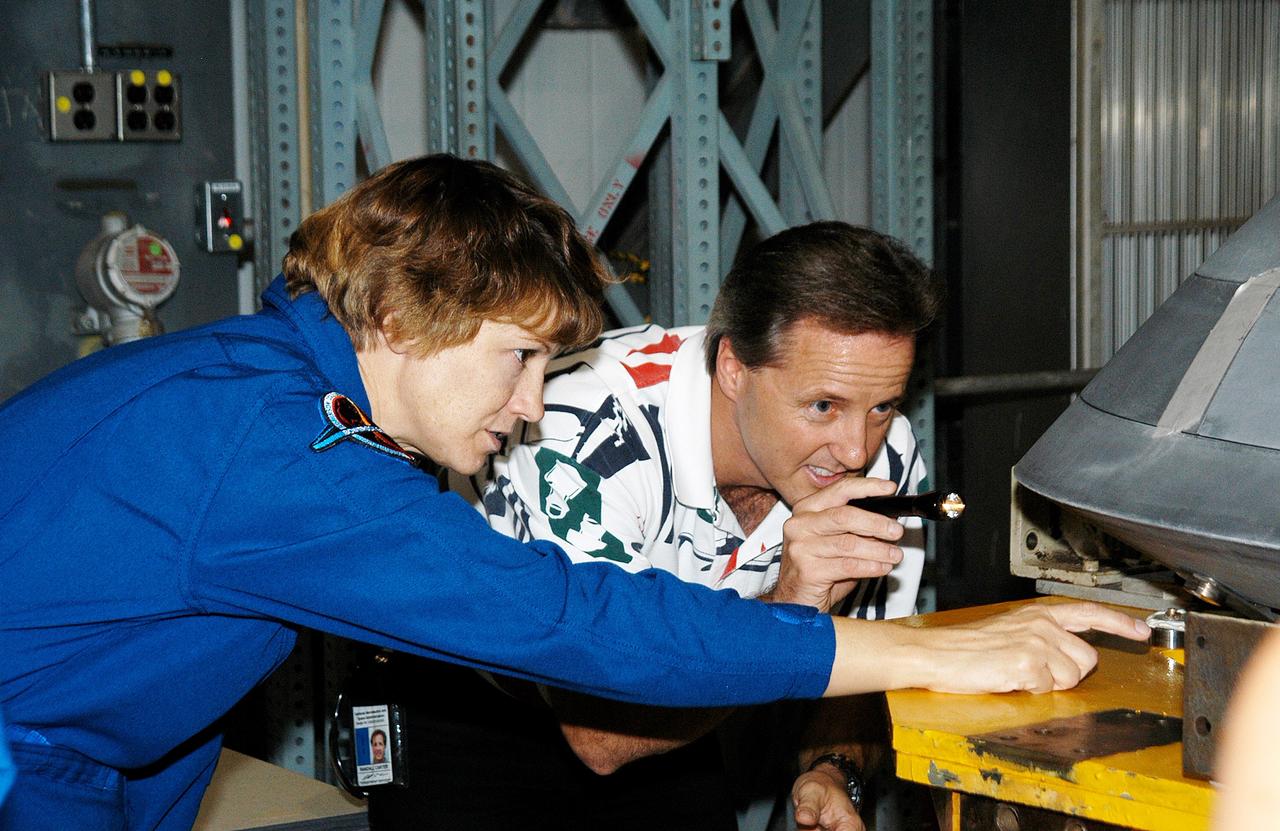
KENNEDY SPACE CENTER, FLA. -  In the Orbiter Processing Facility, STS-114 Commander Eileen Collins examines part of the Atlantis nose cap with Randall Carter, who is with The  Boeing Company.  The nose cap was  recently removed from Atlantis.  The STS-114 crew is at KSC to take part in crew equipment and orbiter familiarization.
KENNEDY SPACE CENTER, FLA. - In the Orbiter Processing Facility, STS-114 Commander Eileen Collins examines part of the Atlantis nose cap with Randall Carter, who is with The Boeing Company. The nose cap was recently removed from Atlantis. The STS-114 crew is at KSC to take part in crew equipment and orbiter familiarization.
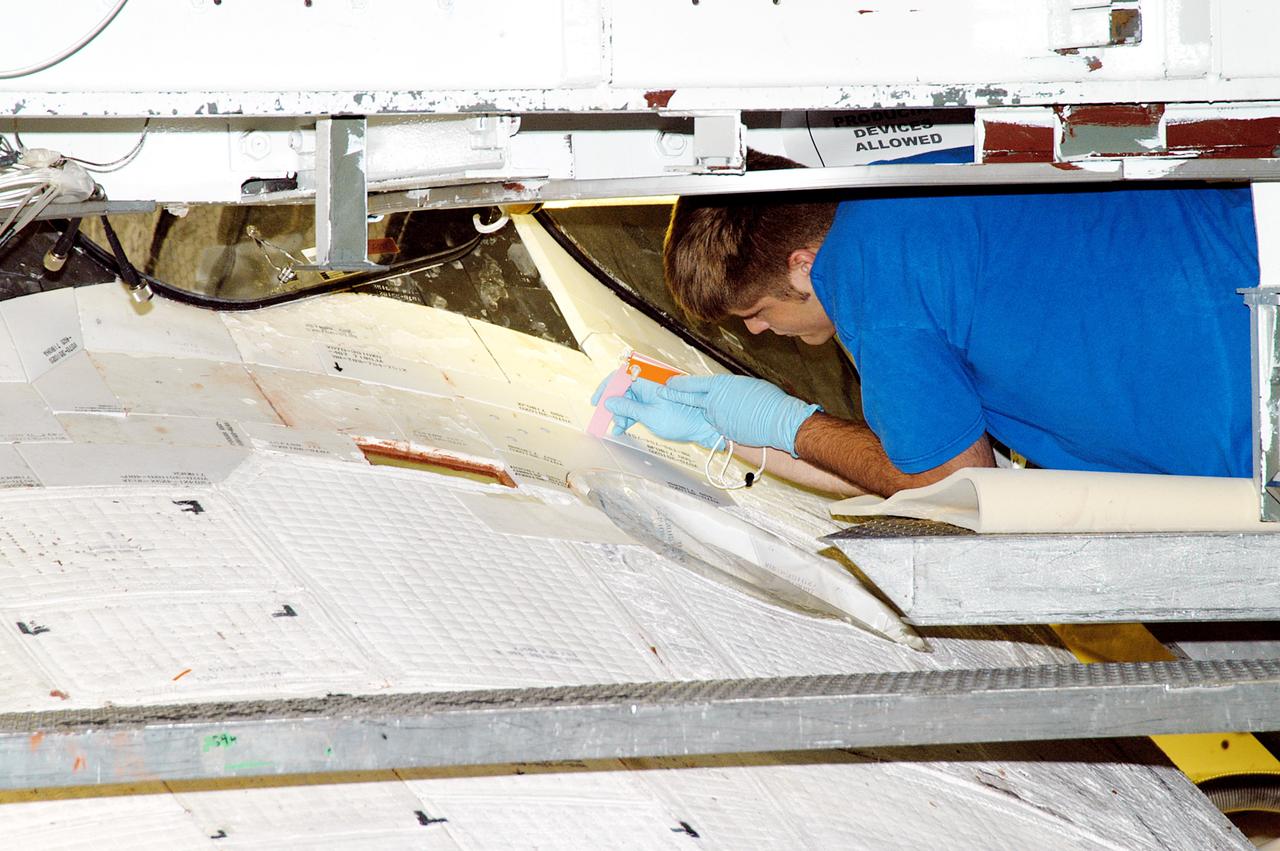
KENNEDY SPACE CENTER, FLA. -  In the Orbiter Processing Facility, United Space Alliance technician Jamie Haynes checks the tiles on the nose of orbiter Atlantis as part of return-to-flight activities.  Atlantis is scheduled for mission STS-114, a return-to-flight test mission to the International Space Station.
KENNEDY SPACE CENTER, FLA. - In the Orbiter Processing Facility, United Space Alliance technician Jamie Haynes checks the tiles on the nose of orbiter Atlantis as part of return-to-flight activities. Atlantis is scheduled for mission STS-114, a return-to-flight test mission to the International Space Station.
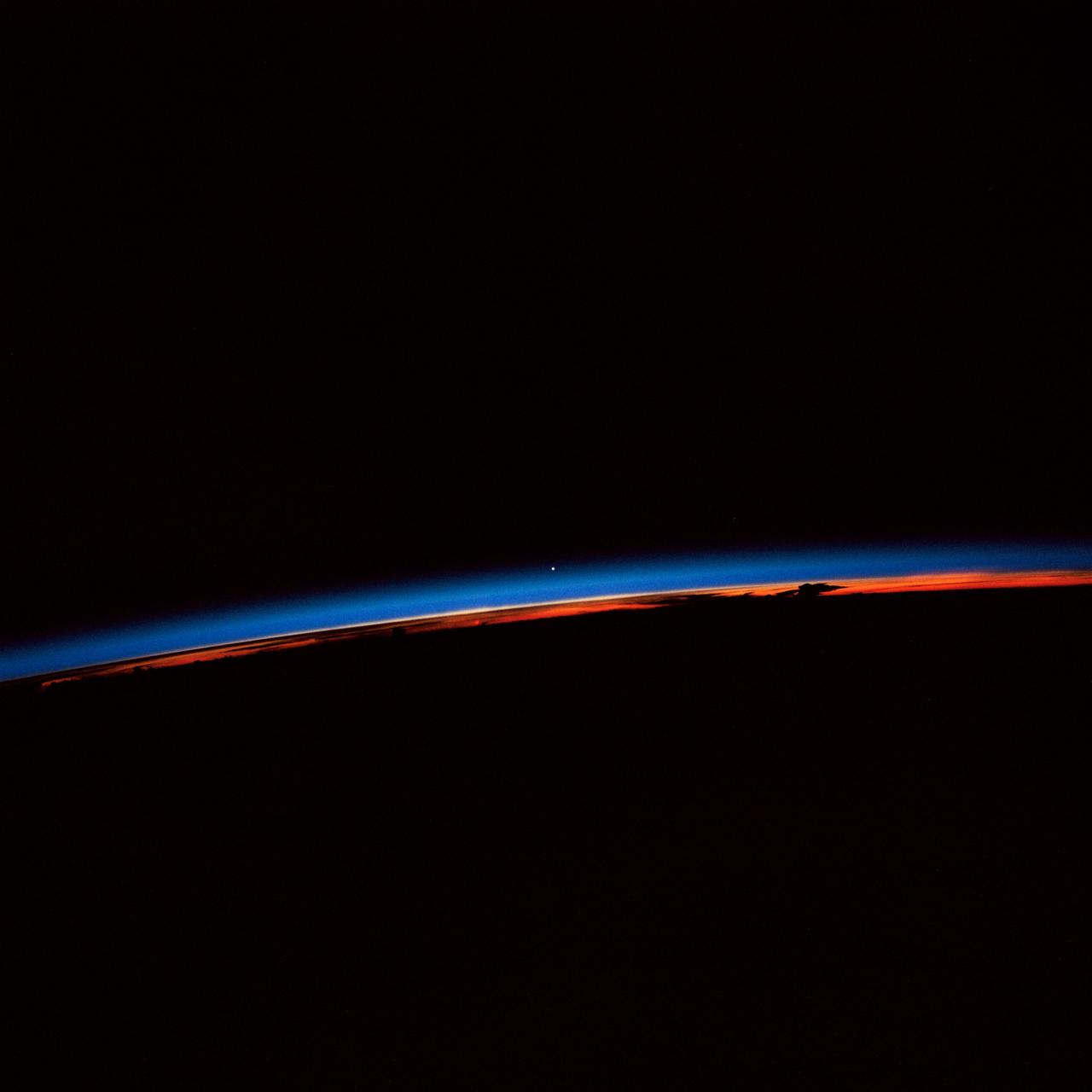
STS-30 Earth observation captured by crewmembers onboard Atlantis, Orbiter Vehicle (OV) 104, shows the sunset over the Earth as well as the planet Venus near the center of the frame. Jutting clouds are seen on the horizon, just beneath the blue strip of airglow.
STS-30 sunset with Venus near the center of the frame
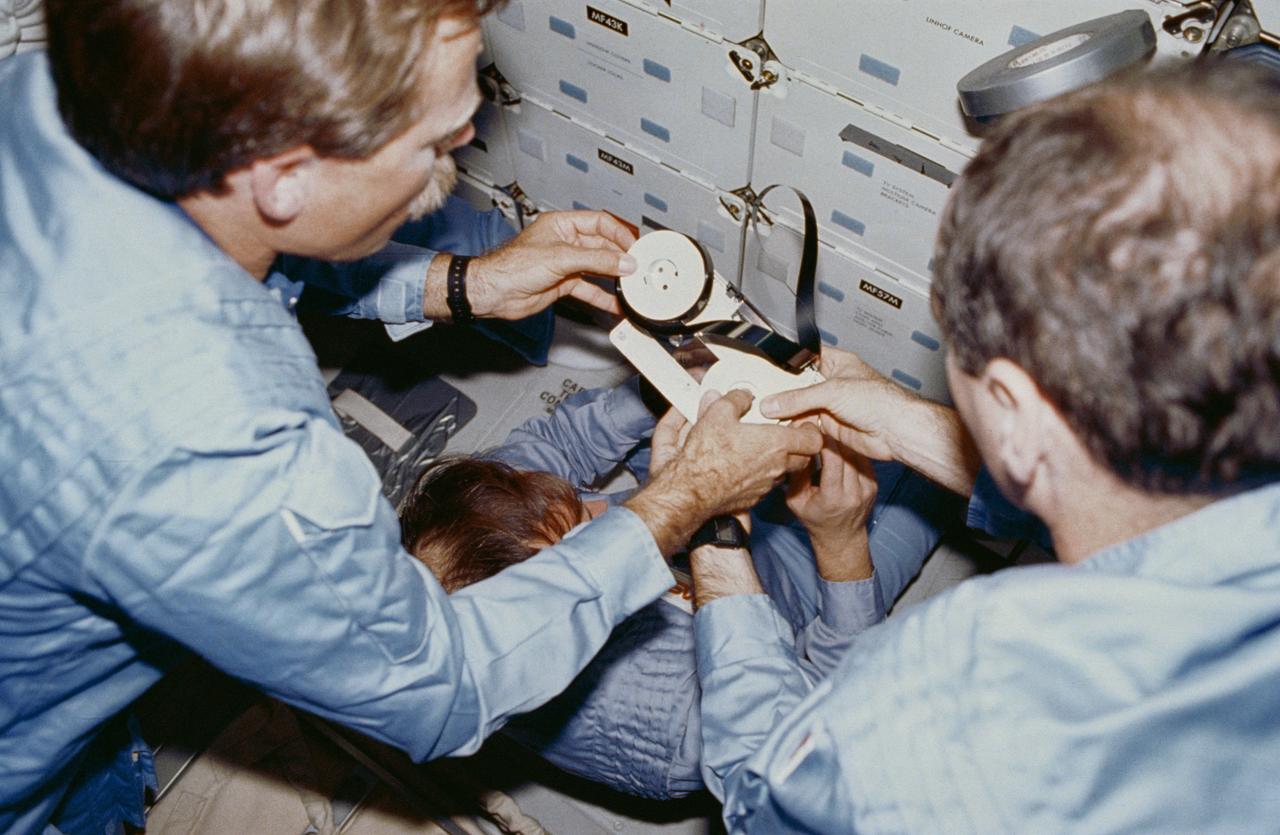
STS027-05-020 (2-6 Dec. 1988) --- In the foreground, astronauts Robert L. Gibson (left) and Guy S. Gardner, commander and pilot, respectively, for the STS-27 mission, repair a 3/4-inch video reel on the middeck of the Earth-orbiting space shuttle Atlantis. Photo credit: NASA
STS-27 Atlantis, OV-104, crewmembers repair 3/4 inch video reel on middeck
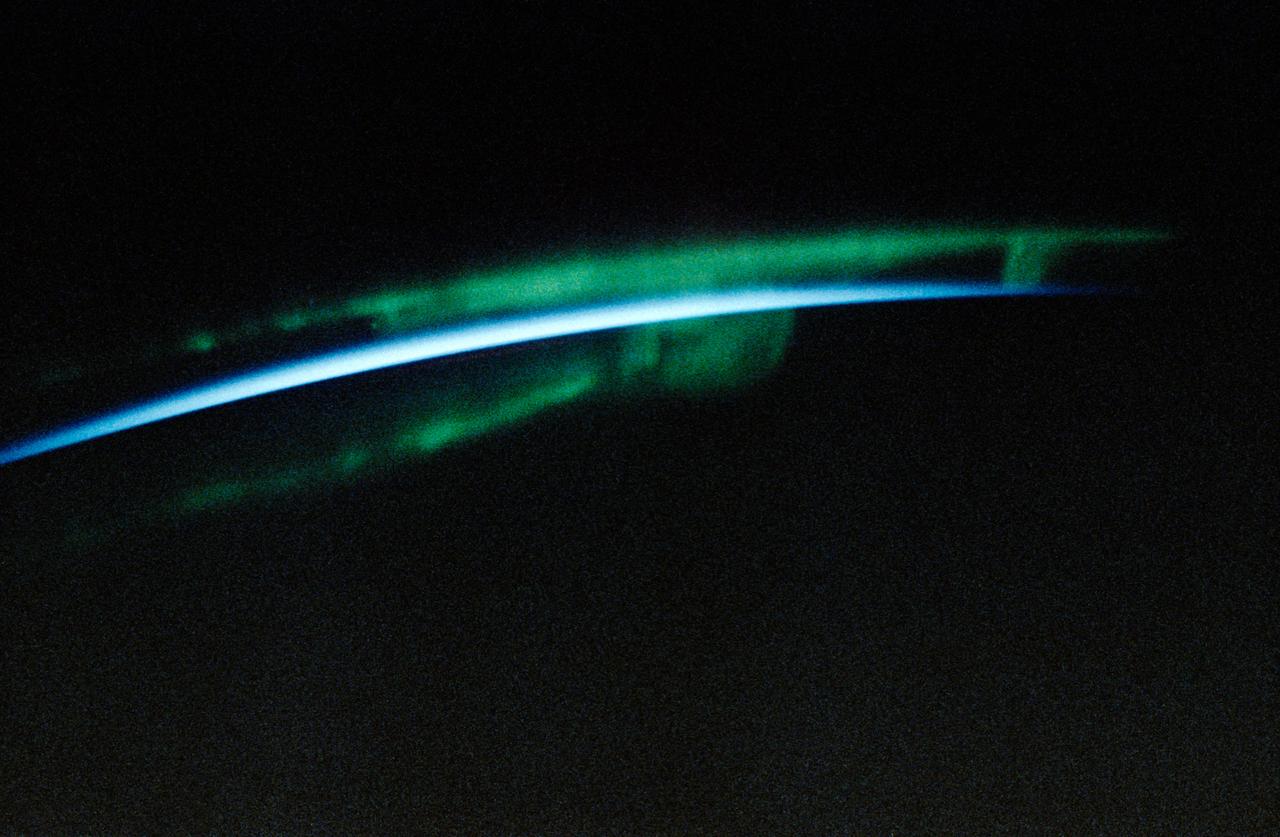
STS-45 Earth observation taken onboard Atlantis, Orbiter Vehicle (OV) 104, is of the Aurora Australis or Southern Lights. The green appearing auroral activity engulfs the thin blue line on the Earth's limb. Aurorae were observed and photographed throughout the STS-45 nine-day mission.
STS-45 Earth observation of the Aurora Australis or Southern Lights
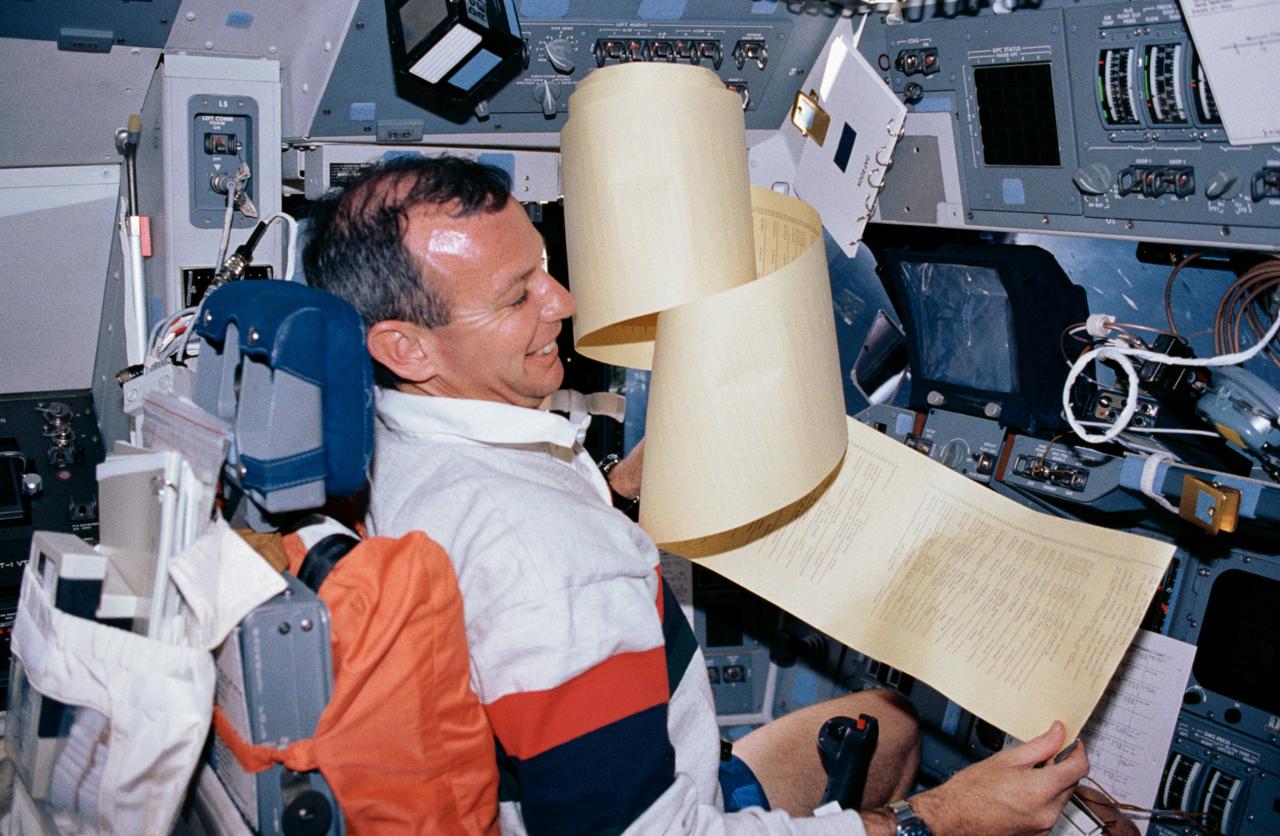
STS045-02-020 (24 March-2 April 1992) --- Brian Duffy, STS-45 pilot, struggles with a large volume of data printouts from the teleprinter system.  He is seated at the commander's station on the flight deck of the Earth-orbiting Atlantis during the nine-day mission.  This frame was taken with a 35mm camera.
STS-45 Pilot Duffy wrestles with a TAGS printout on OV-104's flight deck
NASA employees and contractors crowd together to get a glimpse of space shuttle Atlantis (STS-135) as it rolls toward the Orbiter Processing Facility (OPF) at a wheels stop event, Thursday, July 21, 2011, at NASA's Kennedy Space Center in Cape Canaveral, Fla. Atlantis returned to Kennedy early Thursday following a 13-day mission to the International Space Station (ISS) and marking the end of the 30-year Space Shuttle Program. Overall, Atlantis spent 307 days in space and traveled nearly 126 million miles during its 33 flights. Atlantis, the fourth orbiter built, launched on its first mission on Oct. 3, 1985. Photo Credit: (NASA/Paul E. Alers)
STS-135 Wheels Stop Event
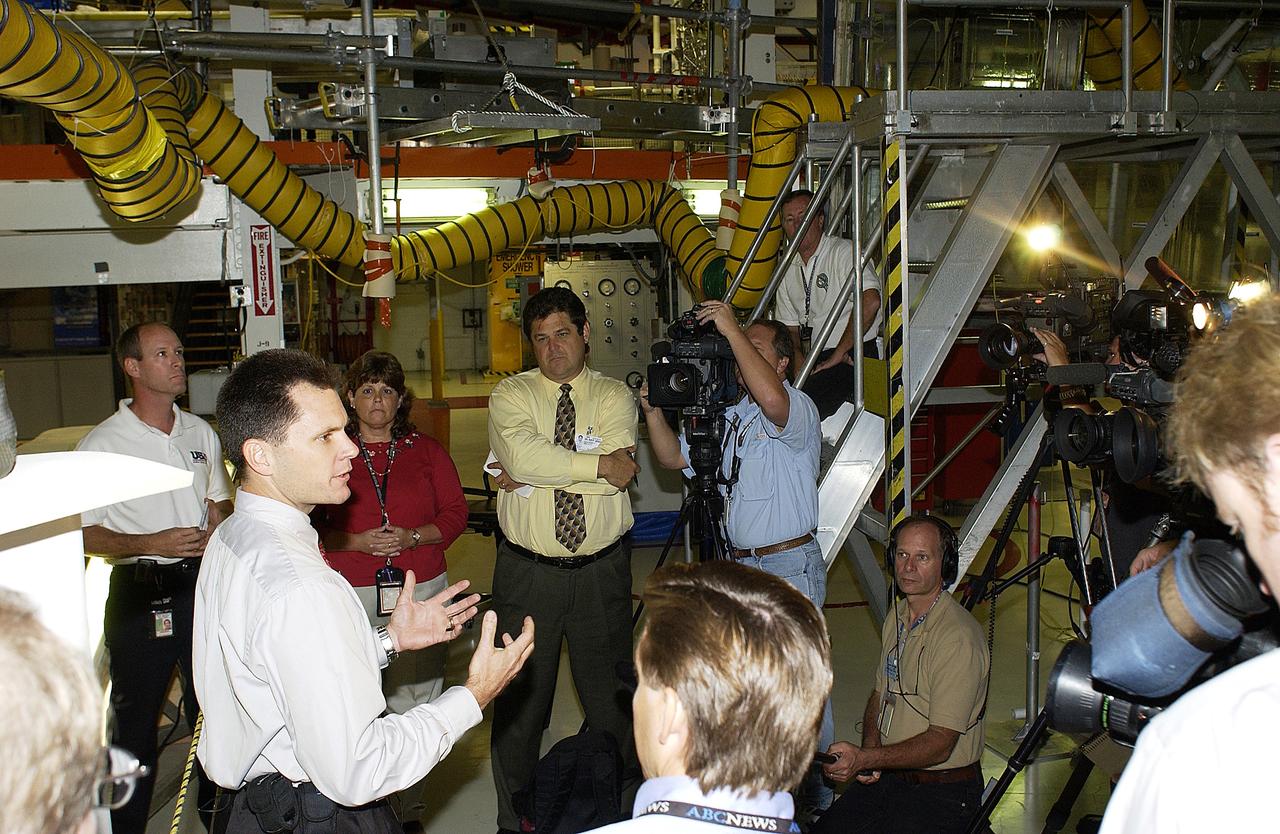
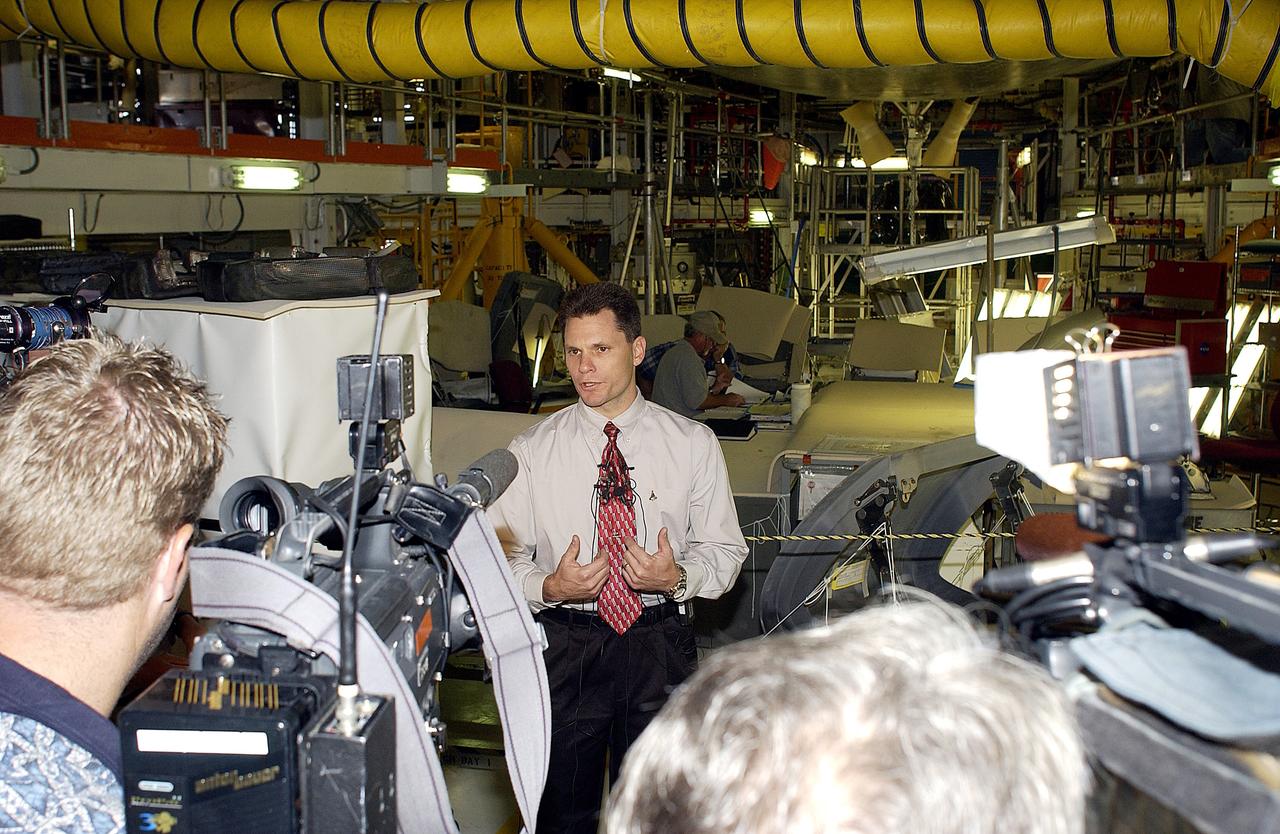
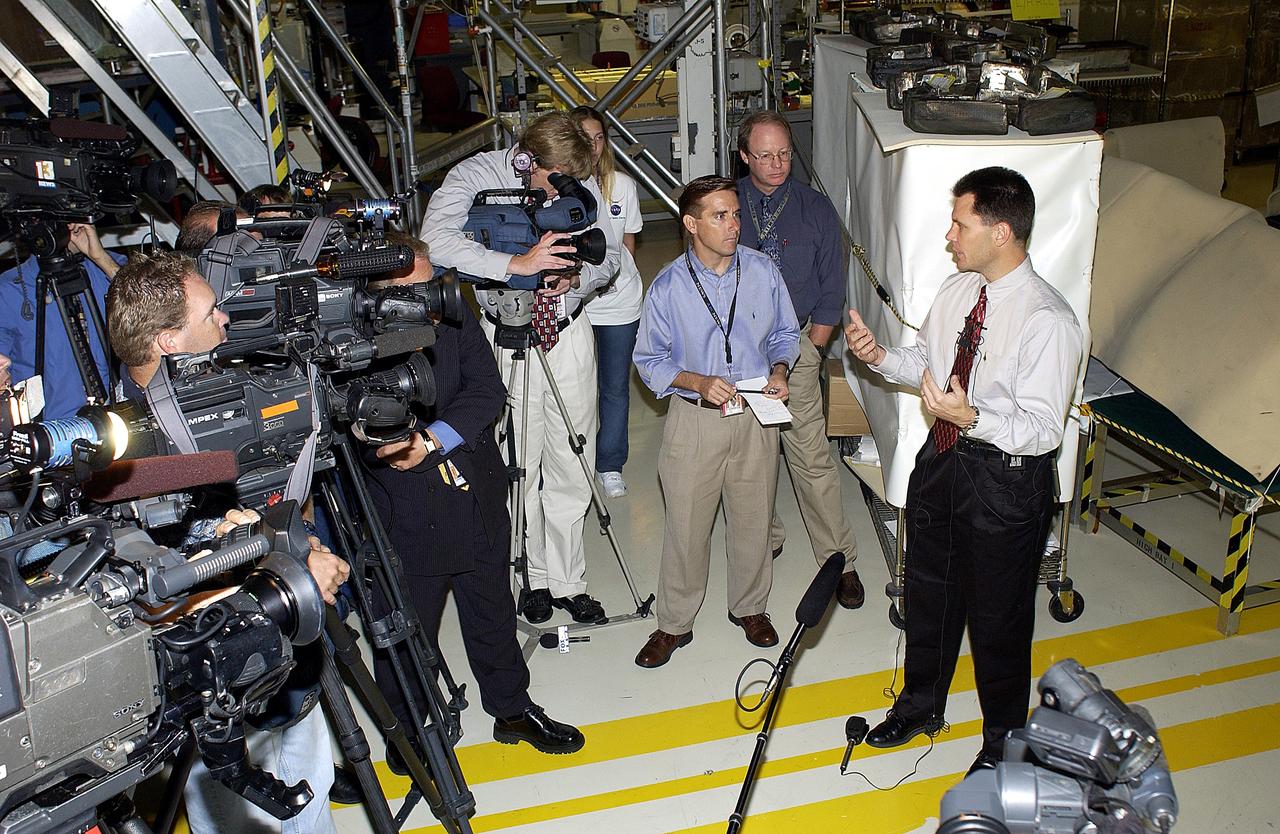
KENNEDY SPACE CENTER, FLA. -  NASA Vehicle Manager Scott Thurston (facing camera) talks to the media in the Orbiter Processing Facility.  The media was invited to see the orbiter Atlantis as it is being prepared for Return to Flight.  Both local and national reporters representing print and TV networks were able to see work in progress on Atlantis, including the reinstallation of the Reinforced Carbon-Carbon panels on the orbiter’s wing leading edge; wiring inspections; and checks of the engines in the Orbital Maneuvering System.
KENNEDY SPACE CENTER, FLA. - NASA Vehicle Manager Scott Thurston (facing camera) talks to the media in the Orbiter Processing Facility. The media was invited to see the orbiter Atlantis as it is being prepared for Return to Flight. Both local and national reporters representing print and TV networks were able to see work in progress on Atlantis, including the reinstallation of the Reinforced Carbon-Carbon panels on the orbiter’s wing leading edge; wiring inspections; and checks of the engines in the Orbital Maneuvering System.
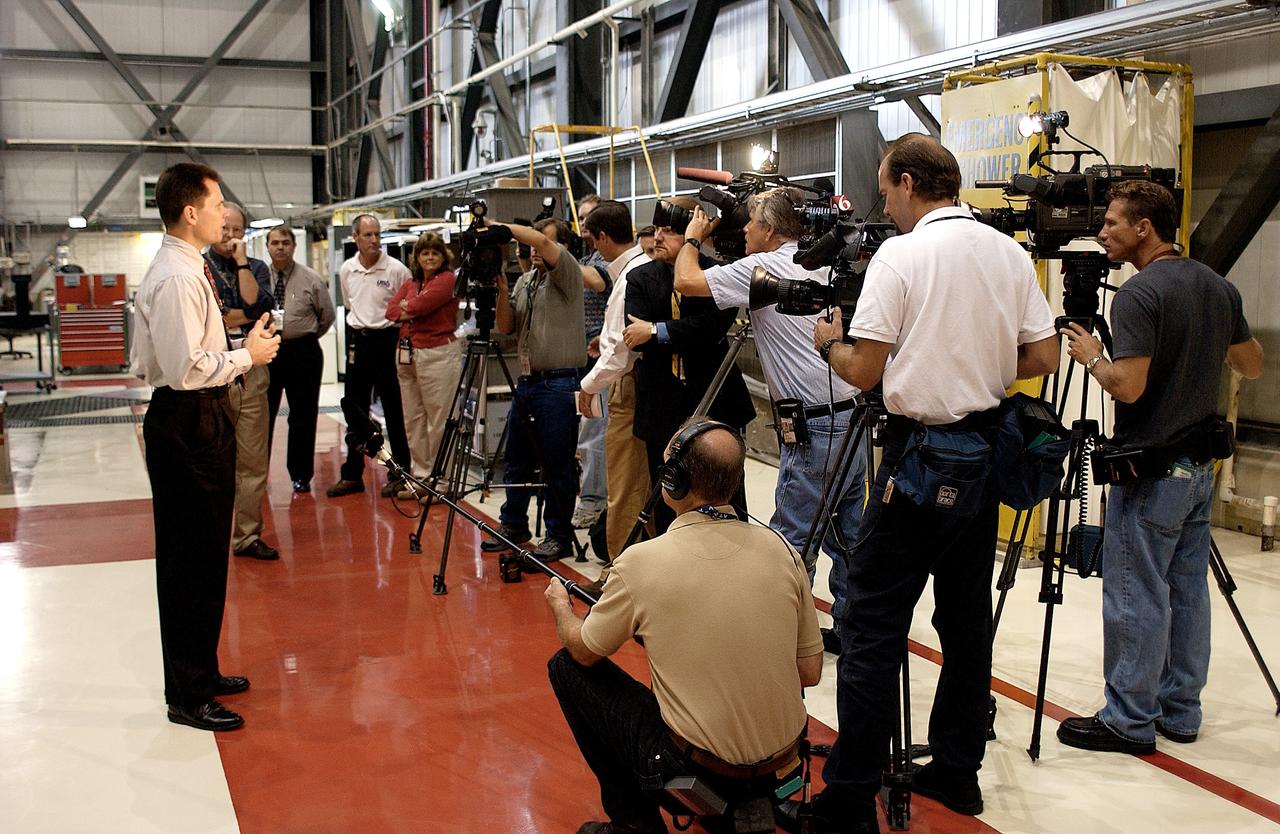
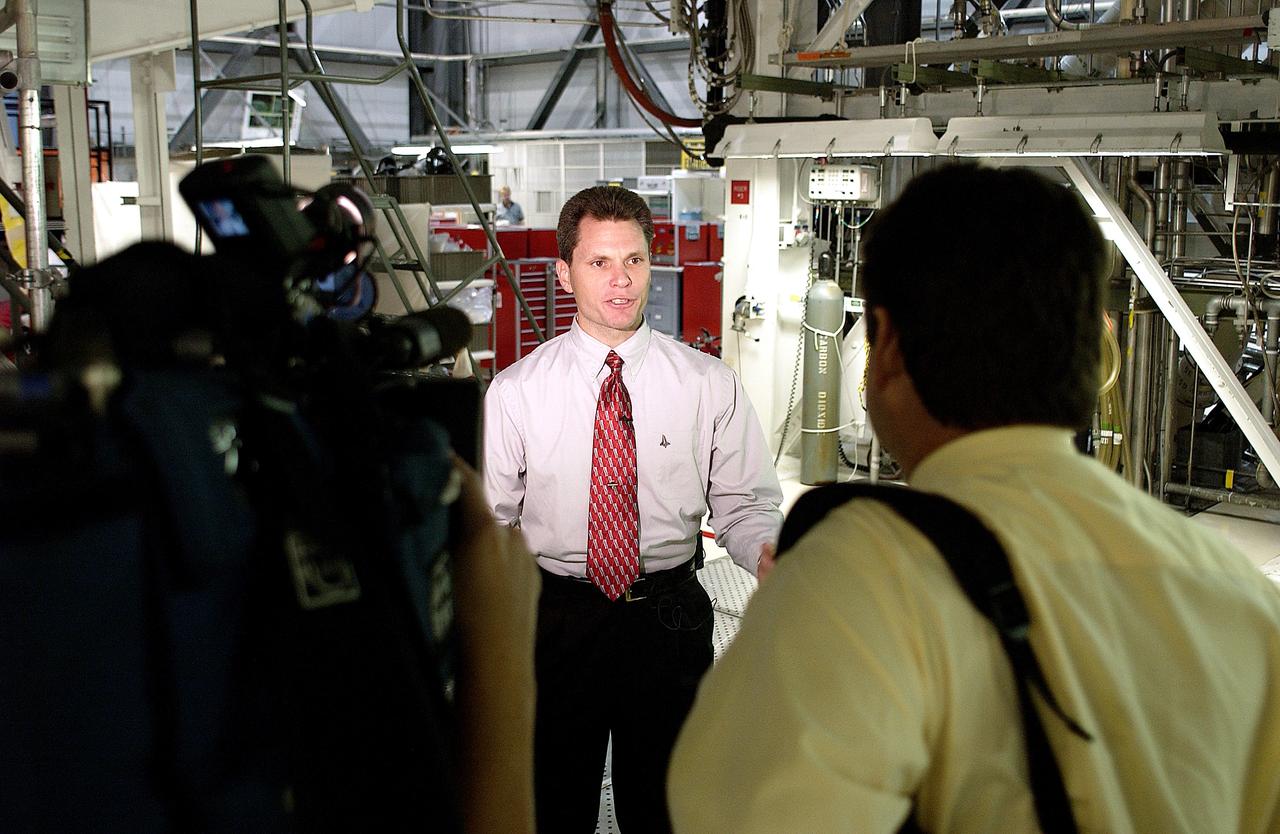
KENNEDY SPACE CENTER, FLA. -  NASA Vehicle Manager Scott Thurston talks to the media in the Orbiter Processing Facility.  The media was invited to see the orbiter Atlantis as it is being prepared for Return to Flight.  Both local and national reporters representing print and TV networks were able to see work in progress on Atlantis, including the reinstallation of the Reinforced Carbon-Carbon panels on the orbiter’s wing leading edge; wiring inspections; and checks of the engines in the Orbital Maneuvering System.
KENNEDY SPACE CENTER, FLA. - NASA Vehicle Manager Scott Thurston talks to the media in the Orbiter Processing Facility. The media was invited to see the orbiter Atlantis as it is being prepared for Return to Flight. Both local and national reporters representing print and TV networks were able to see work in progress on Atlantis, including the reinstallation of the Reinforced Carbon-Carbon panels on the orbiter’s wing leading edge; wiring inspections; and checks of the engines in the Orbital Maneuvering System.
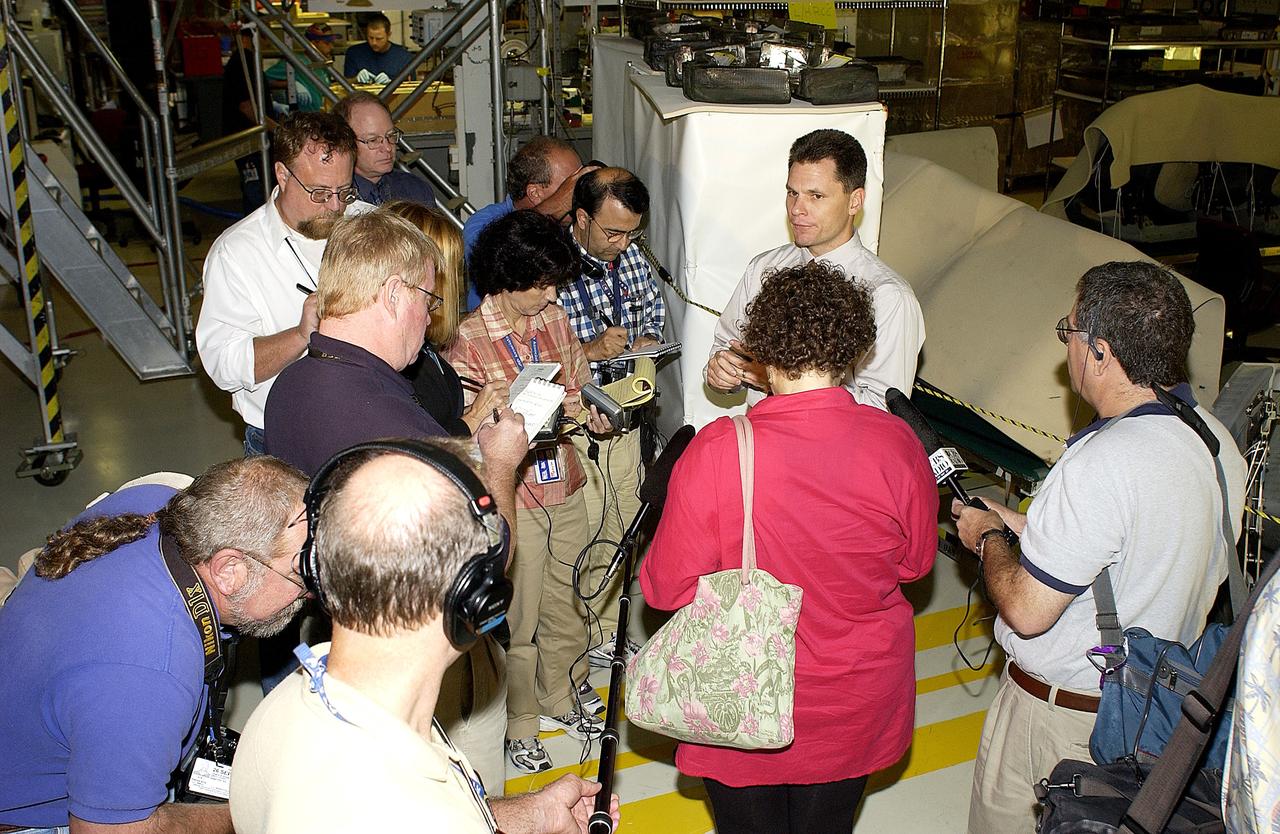
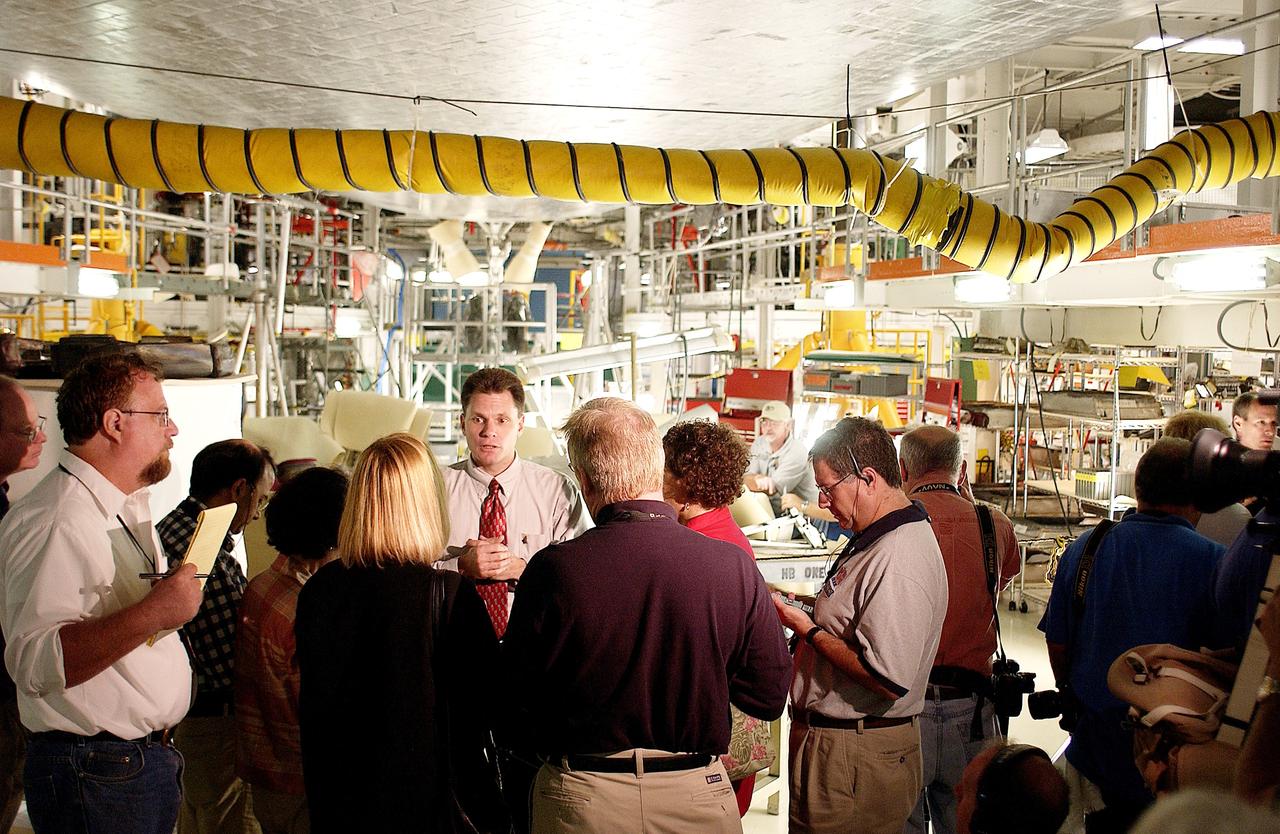
KENNEDY SPACE CENTER, FLA. - NASA Vehicle Manager Scott Thurston (left) talks to a phalanx of media in the Orbiter Processing Facility.  The media was invited to see the orbiter Atlantis as it is being prepared for Return to Flight.  Both local and national reporters representing print and TV networks were able to see work in progress on Atlantis, including the reinstallation of the Reinforced Carbon-Carbon panels on the orbiter’s wing leading edge; wiring inspections; and checks of the engines in the Orbital Maneuvering System.
KENNEDY SPACE CENTER, FLA. - NASA Vehicle Manager Scott Thurston (left) talks to a phalanx of media in the Orbiter Processing Facility. The media was invited to see the orbiter Atlantis as it is being prepared for Return to Flight. Both local and national reporters representing print and TV networks were able to see work in progress on Atlantis, including the reinstallation of the Reinforced Carbon-Carbon panels on the orbiter’s wing leading edge; wiring inspections; and checks of the engines in the Orbital Maneuvering System.
KENNEDY SPACE CENTER, FLA. -  NASA Vehicle Manager Scott Thurston (facing camera) talks to the media in the Orbiter Processing Facility.  The media was invited to see the orbiter Atlantis as it is being prepared for Return to Flight.  Both local and national reporters representing print and TV networks were able to see work in progress on Atlantis, including the reinstallation of the Reinforced Carbon-Carbon panels on the orbiter’s wing leading edge; wiring inspections; and checks of the engines in the Orbital Maneuvering System.
KENNEDY SPACE CENTER, FLA. - NASA Vehicle Manager Scott Thurston (facing camera) talks to the media in the Orbiter Processing Facility. The media was invited to see the orbiter Atlantis as it is being prepared for Return to Flight. Both local and national reporters representing print and TV networks were able to see work in progress on Atlantis, including the reinstallation of the Reinforced Carbon-Carbon panels on the orbiter’s wing leading edge; wiring inspections; and checks of the engines in the Orbital Maneuvering System.
KENNEDY SPACE CENTER, FLA. -   The media gather around NASA Vehicle Manager Scott Thurston (white shirt, right) who talks about some of the work being done on the orbiter Atlantis as it is being prepared for Return to Flight in the Orbiter Processing Facility.   Both local and national reporters representing print and TV networks were able to see work in progress on Atlantis, including the reinstallation of the Reinforced Carbon-Carbon panels on the orbiter’s wing leading edge; wiring inspections; and checks of the engines in the Orbital Maneuvering System.
KENNEDY SPACE CENTER, FLA. - The media gather around NASA Vehicle Manager Scott Thurston (white shirt, right) who talks about some of the work being done on the orbiter Atlantis as it is being prepared for Return to Flight in the Orbiter Processing Facility. Both local and national reporters representing print and TV networks were able to see work in progress on Atlantis, including the reinstallation of the Reinforced Carbon-Carbon panels on the orbiter’s wing leading edge; wiring inspections; and checks of the engines in the Orbital Maneuvering System.
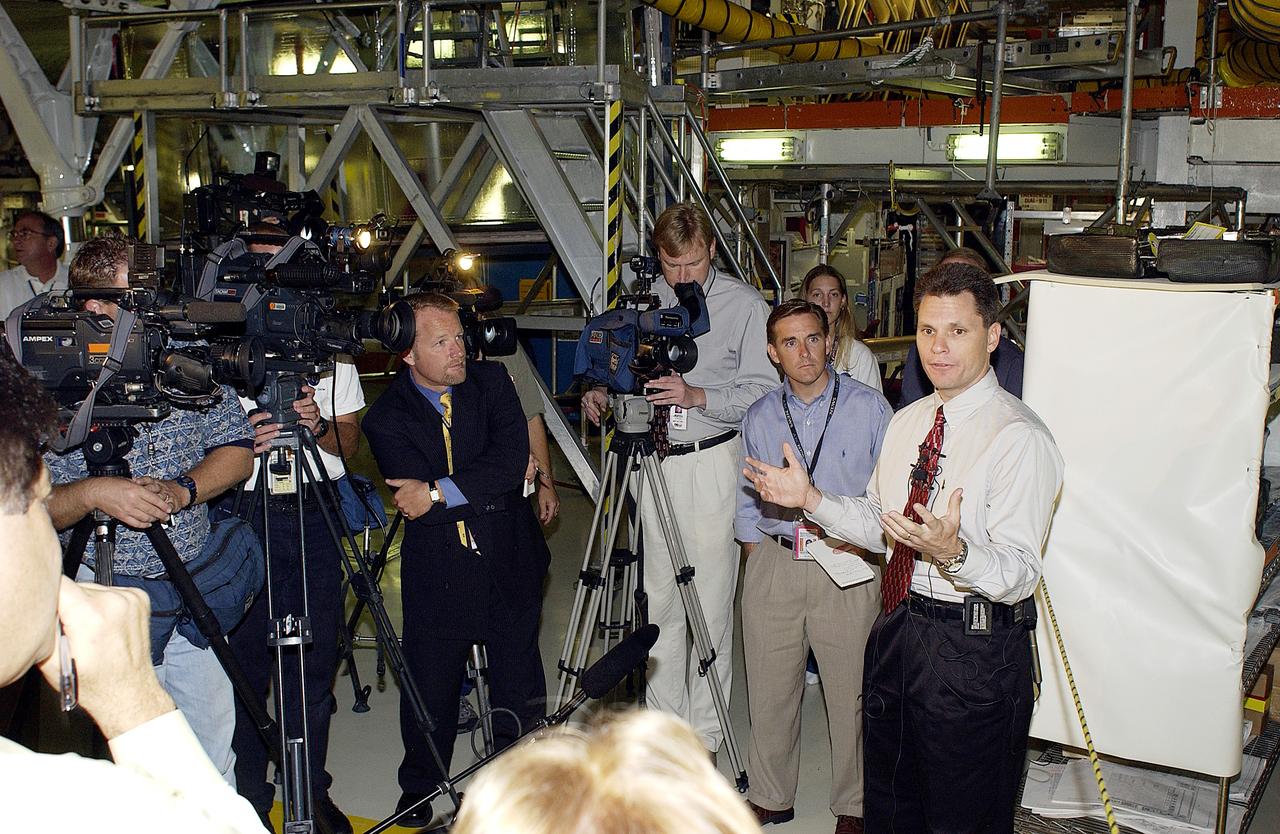
KENNEDY SPACE CENTER, FLA. -   NASA Vehicle Manager Scott Thurston (right)  talks to the media in the Orbiter Processing Facility.  The media was invited to see the orbiter Atlantis as it is being prepared for Return to Flight.  Both local and national reporters representing print and TV networks were able to see work in progress on Atlantis, including the reinstallation of the Reinforced Carbon-Carbon panels on the orbiter’s wing leading edge; wiring inspections; and checks of the engines in the Orbital Maneuvering System.  will be available to discuss the work and answer questions.
KENNEDY SPACE CENTER, FLA. - NASA Vehicle Manager Scott Thurston (right) talks to the media in the Orbiter Processing Facility. The media was invited to see the orbiter Atlantis as it is being prepared for Return to Flight. Both local and national reporters representing print and TV networks were able to see work in progress on Atlantis, including the reinstallation of the Reinforced Carbon-Carbon panels on the orbiter’s wing leading edge; wiring inspections; and checks of the engines in the Orbital Maneuvering System. will be available to discuss the work and answer questions.
KENNEDY SPACE CENTER, FLA. -   NASA Vehicle Manager Scott Thurston (right)  talks to the media in the Orbiter Processing Facility .  The media was invited to see the orbiter Atlantis as it is being prepared for Return to Flight.  Both local and national reporters representing print and TV networks were able to see work in progress on Atlantis, including the reinstallation of the Reinforced Carbon-Carbon panels on the orbiter’s wing leading edge; wiring inspections; and checks of the engines in the Orbital Maneuvering System.
KENNEDY SPACE CENTER, FLA. - NASA Vehicle Manager Scott Thurston (right) talks to the media in the Orbiter Processing Facility . The media was invited to see the orbiter Atlantis as it is being prepared for Return to Flight. Both local and national reporters representing print and TV networks were able to see work in progress on Atlantis, including the reinstallation of the Reinforced Carbon-Carbon panels on the orbiter’s wing leading edge; wiring inspections; and checks of the engines in the Orbital Maneuvering System.
KENNEDY SPACE CENTER, FLA. -   NASA Vehicle Manager Scott Thurston talks to the media in the Orbiter Processing Facility.  The media was invited to see the orbiter Atlantis as it is being prepared for Return to Flight.  Both local and national reporters representing print and TV networks were able to see work in progress on Atlantis, including the reinstallation of the Reinforced Carbon-Carbon panels on the orbiter’s wing leading edge; wiring inspections; and checks of the engines in the Orbital Maneuvering System.
KENNEDY SPACE CENTER, FLA. - NASA Vehicle Manager Scott Thurston talks to the media in the Orbiter Processing Facility. The media was invited to see the orbiter Atlantis as it is being prepared for Return to Flight. Both local and national reporters representing print and TV networks were able to see work in progress on Atlantis, including the reinstallation of the Reinforced Carbon-Carbon panels on the orbiter’s wing leading edge; wiring inspections; and checks of the engines in the Orbital Maneuvering System.
KENNEDY SPACE CENTER, FLA. -   NASA Vehicle Manager Scott Thurston (hands extended) talks to the media in the Orbiter Processing Facility.  The media was invited to see the orbiter Atlantis as it is being prepared for Return to Flight.  Both local and national reporters representing print and TV networks were able to see work in progress on Atlantis, including the reinstallation of the Reinforced Carbon-Carbon panels on the orbiter’s wing leading edge; wiring inspections; and checks of the engines in the Orbital Maneuvering System.
KENNEDY SPACE CENTER, FLA. - NASA Vehicle Manager Scott Thurston (hands extended) talks to the media in the Orbiter Processing Facility. The media was invited to see the orbiter Atlantis as it is being prepared for Return to Flight. Both local and national reporters representing print and TV networks were able to see work in progress on Atlantis, including the reinstallation of the Reinforced Carbon-Carbon panels on the orbiter’s wing leading edge; wiring inspections; and checks of the engines in the Orbital Maneuvering System.
KENNEDY SPACE CENTER, FLA. -  In the Orbiter Processing Facility, the media record workers on the job preparing the orbiter Atlantis for Return to Flight. Both local and national reporters representing print and TV networks were invited to see work in progress on Atlantis, including the reinstallation of the Reinforced Carbon-Carbon panels on the orbiter’s wing leading edge; wiring inspections; and checks of the engines in the Orbital Maneuvering System.
KENNEDY SPACE CENTER, FLA. - In the Orbiter Processing Facility, the media record workers on the job preparing the orbiter Atlantis for Return to Flight. Both local and national reporters representing print and TV networks were invited to see work in progress on Atlantis, including the reinstallation of the Reinforced Carbon-Carbon panels on the orbiter’s wing leading edge; wiring inspections; and checks of the engines in the Orbital Maneuvering System.
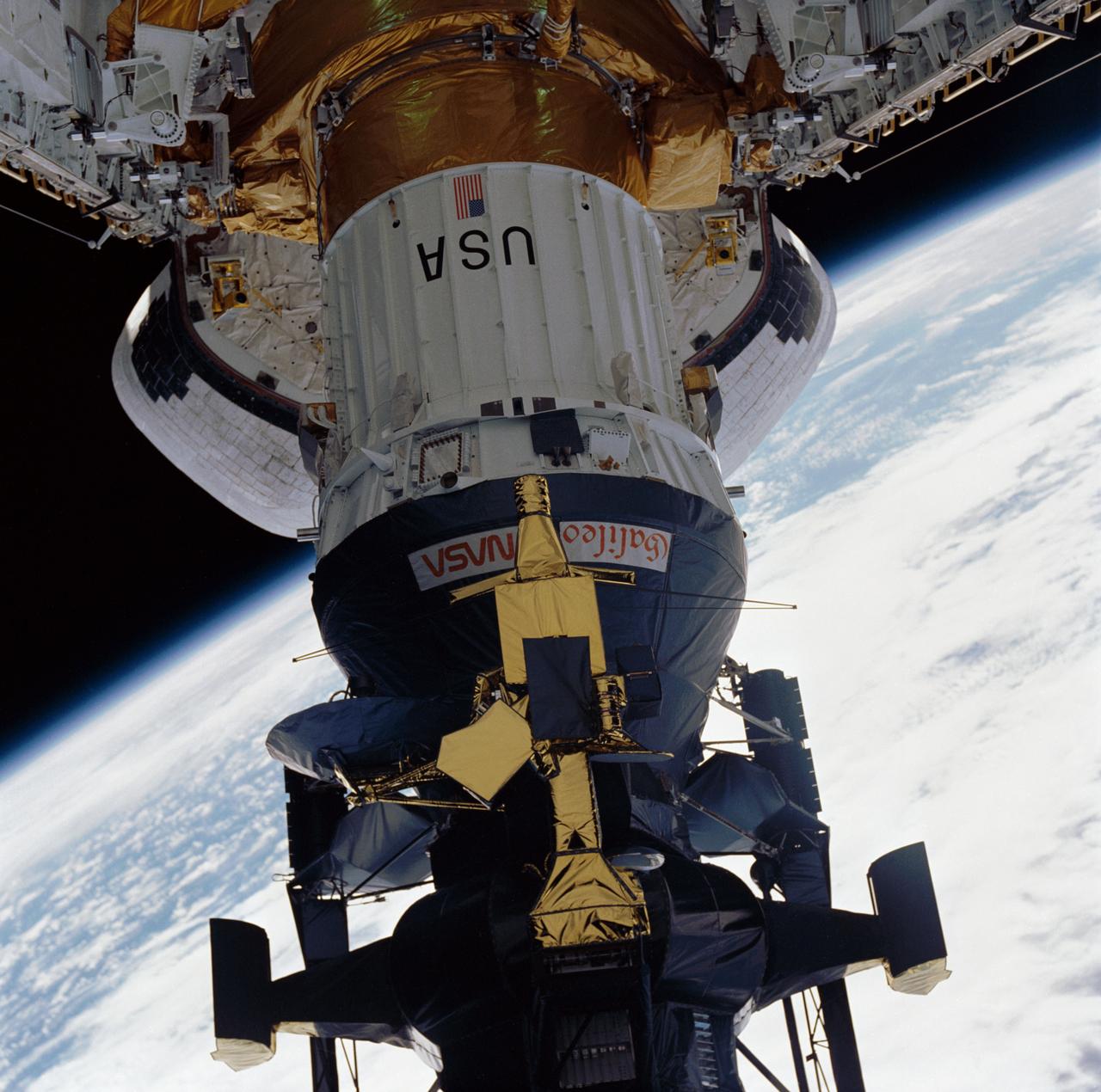
During STS-34 mission, the Galileo spacecraft mounted atop the inertial upper stage (IUS) is tilted to a 58-degree deployment position by the airborne support equipment (ASE) aft frame tilt actuator (AFTA) table in Atlantis', Orbiter Vehicle (OV) 104's, payload bay (PLB). Visible in the foreground is the ASE forward cradle and the umbilical boom which has fallen away from the IUS. OV-104's orbital maneuvering system (OMS) pods and the Earth's limb appear in the background.
STS-34 Galileo spacecraft / IUS deployment sequence in OV-104's payload bay
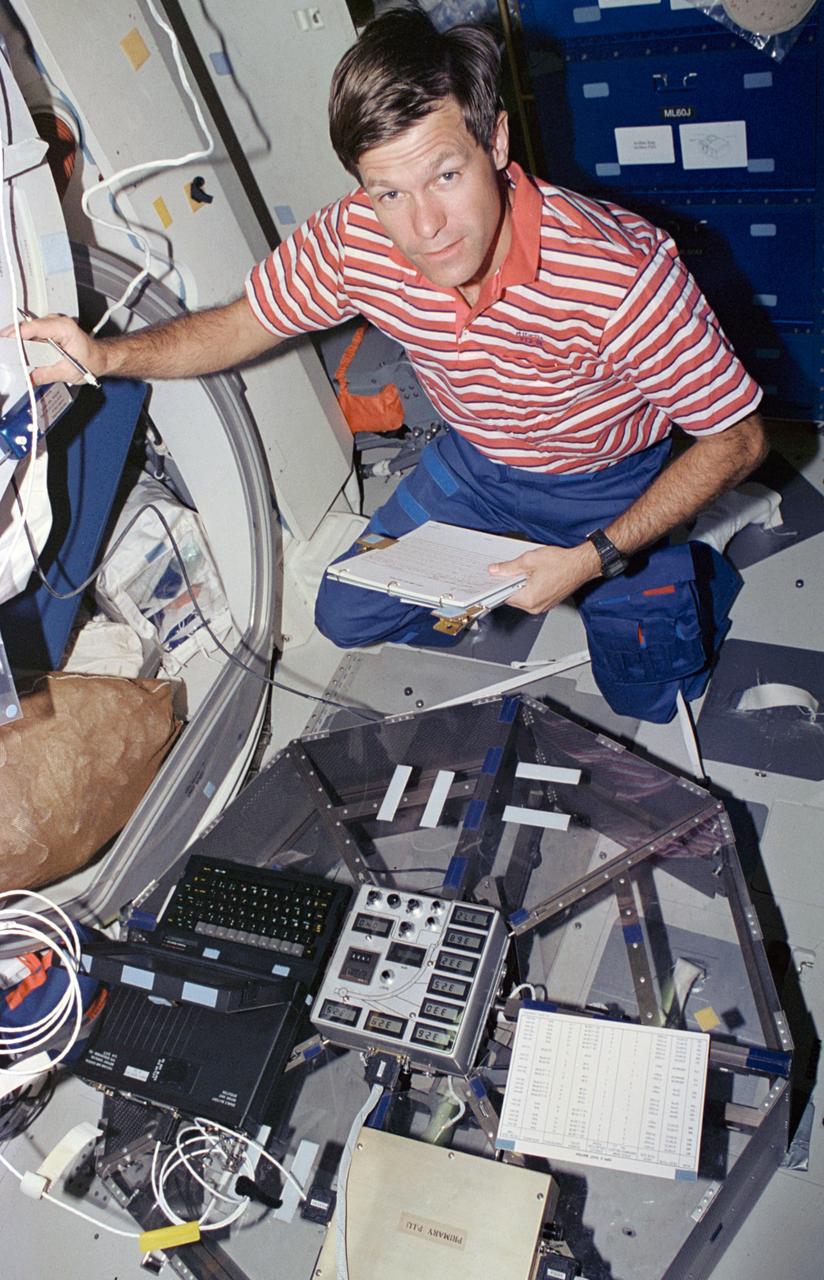
STS066-22-012 (3-14 Nov 1994) --- On the Space Shuttle Atlantis' mid-deck, astronaut Donald R. McMonagle, mission commander, works with the Heat Pipe Performance (HPP-2) experiment.  HPP-2 was flown to investigate the thermal performance and fluid dynamics of heat pipes operating with asymmetric and multiple heating zones under microgravity conditions.  McMonagle was joined by four other NASA astronauts and a European Space Agency (ESA) astronaut for 11-days aboard Atlantis in Earth-orbit in support of the Atmospheric Laboratory for Applications and Science (ATLAS-3) mission.
Astronaut Donald McMonagle works with HPP-2 experiment on middeck
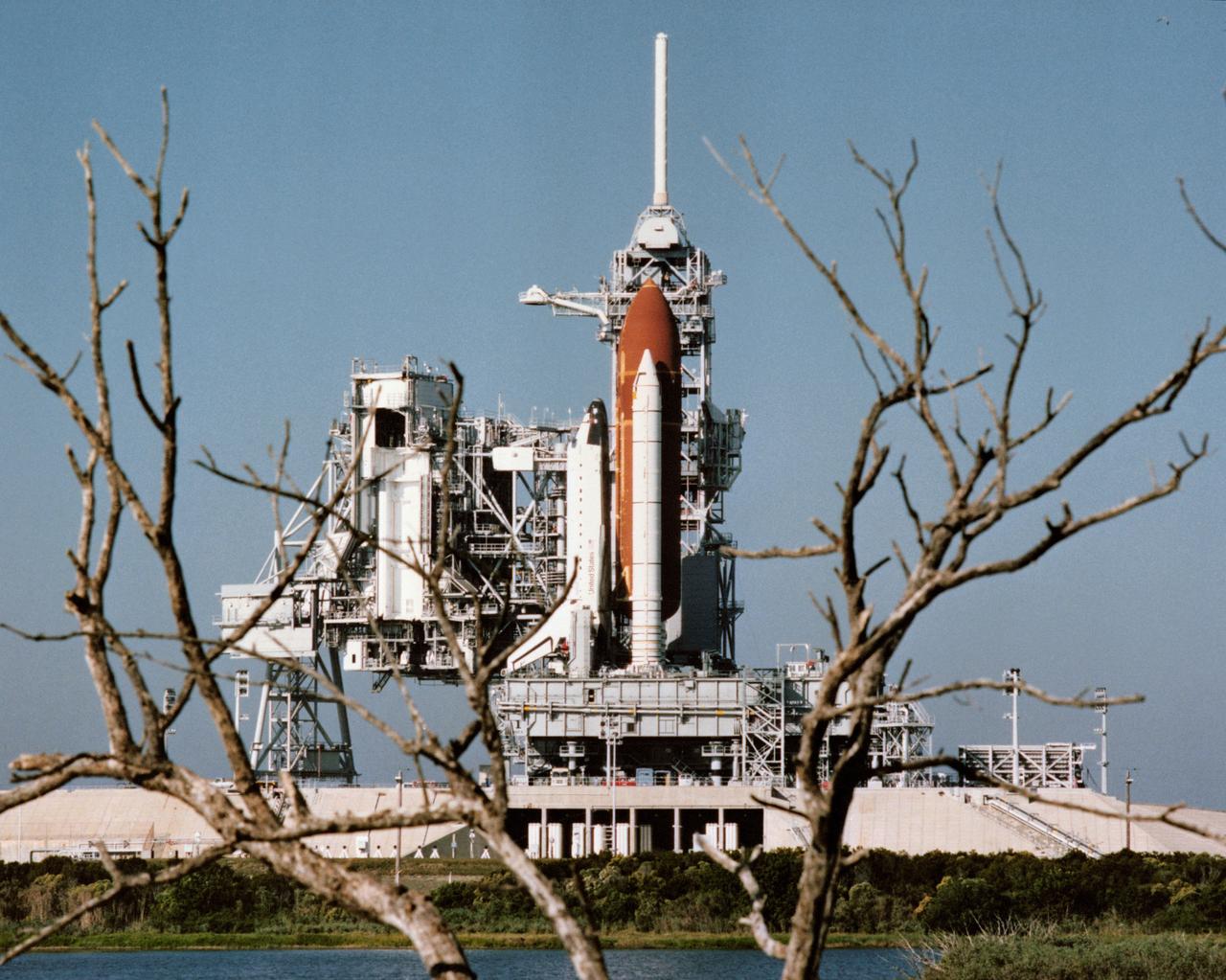
S88-52659 (2 Nov 1988)  --- The Space Shuttle Atlantis on Launch Pad 39B at KSC following the roll-out process from the vehicle assembly building.  It will undergo final checkouts and evaluations prior to its launch for the STS 27 mission late this month.
STS-27 Atlantis, Orbiter Vehicle (OV) 104, at KSC Launch Complex (LC) pad 39B
STS071-S-001 (April 1995) --- The STS-71 crew patch design depicts the orbiter Atlantis in the process of the first international docking mission of the space shuttle Atlantis with the Russian Mir Space Station. The names of the 10 astronauts and cosmonauts who will fly aboard the orbiter as shown along the outer border of the patch. The rising sun symbolizes the dawn of a new era of cooperation between the two countries. The vehicles Atlantis and Mir are shown in separate circles converging at the center of the emblem symbolizing the merger of the space programs of the two space faring nations. The flags of the United States and Russia emphasize the equal partnership of the mission. The joint program symbol at the lower center of the patch acknowledges the extensive contributions made by the Mission Control Centers (MCC) of both countries. The crew insignia was designed by aviation and space artist, Bob McCall, who also designed the crew patch for the Apollo-Soyuz Test Project (ASTP) in 1975, the first international space docking mission.    The NASA insignia design for space shuttle flights is reserved for use by the astronauts and for other official use as the NASA Administrator may authorize. Public availability has been approved only in the forms of illustrations by the various news media. When and if there is any change in this policy, which is not anticipated, the change will be publicly announced. Photo credit: NASA
STS-71 crew insignia
S91-50776 (18 Oct 1991) --- The Space Shuttle Atlantis is moved from the Orbital Processing Facility (OPF) Bay 2 to the Vehicle Assembly Building (VAB) at Kennedy Space Center, Florida.  The Atlantis will be mated with the external fuel tank and solid rocket boosters before it is transported to Pad 39A, where it will launch a Department of Defense payload, Mission STS-44, in late 1991.
STS-44 Atlantis, Orbiter Vehicle (OV) 104, is moved from KSC's OPF
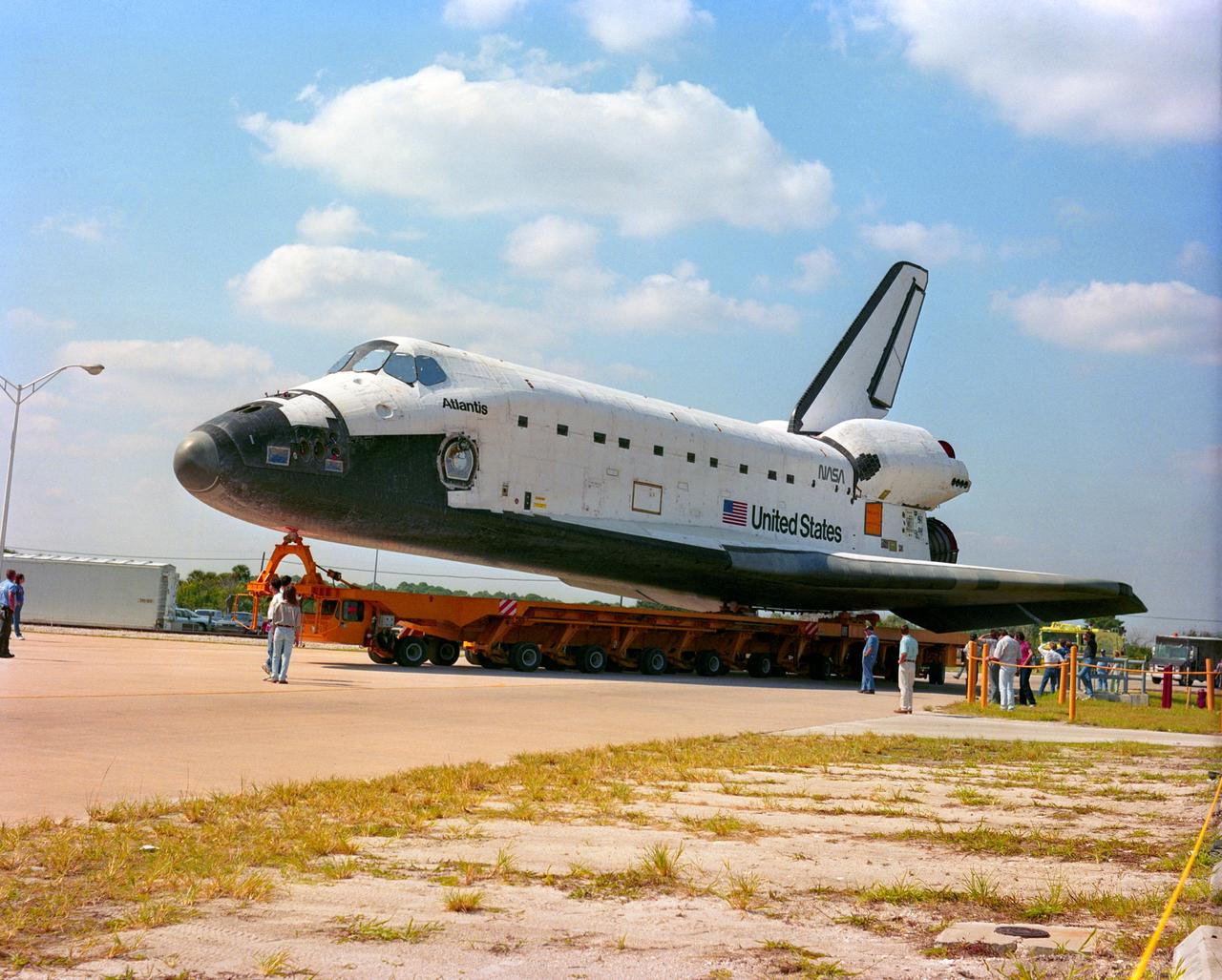
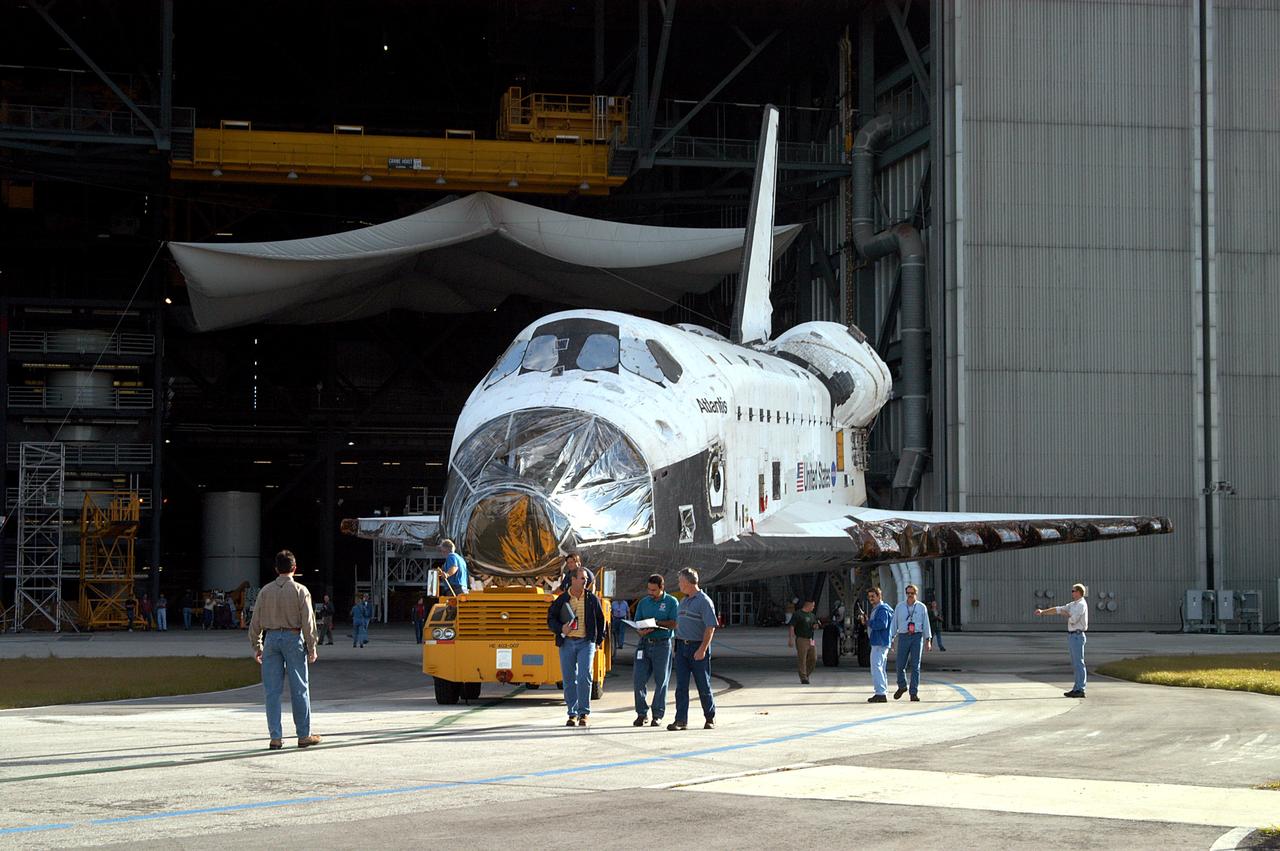
KENNEDY SPACE CENTER, FLA. -  The orbiter Atlantis rolls out of the Vehicle Assembly Building for transfer back to the Orbiter Processing Facility.  Atlantis spent 10 days in the VAB to allow work to be performed in the OPF that can only be accomplished while the bay is empty. Work included annual validation of the bay's cranes, work platforms, lifting mechanisms and jack stands.  Work resumes to prepare Atlantis for launch in September 2004 on the first return-to-flight mission, STS-114.
KENNEDY SPACE CENTER, FLA. - The orbiter Atlantis rolls out of the Vehicle Assembly Building for transfer back to the Orbiter Processing Facility. Atlantis spent 10 days in the VAB to allow work to be performed in the OPF that can only be accomplished while the bay is empty. Work included annual validation of the bay's cranes, work platforms, lifting mechanisms and jack stands. Work resumes to prepare Atlantis for launch in September 2004 on the first return-to-flight mission, STS-114.
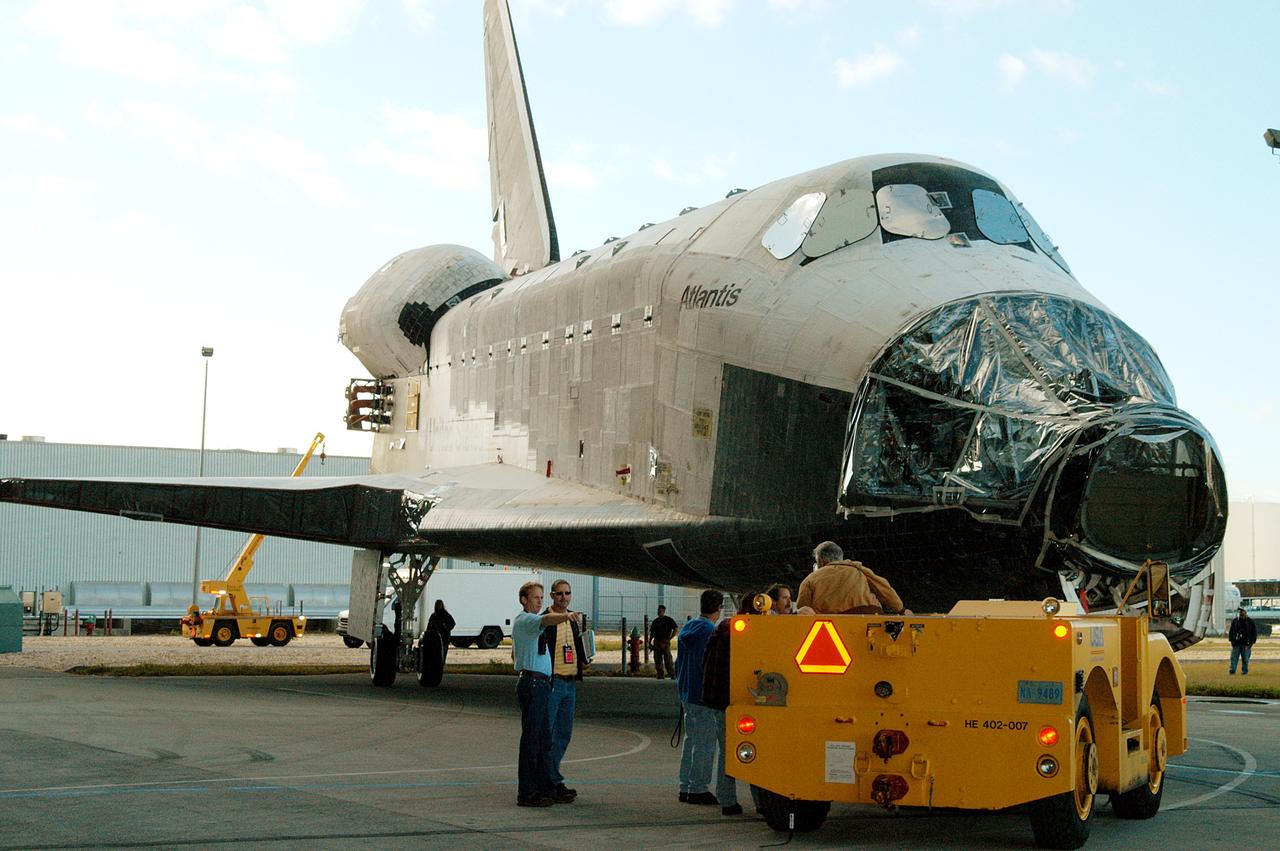
KENNEDY SPACE CENTER, FLA. -- The orbiter Atlantis  is backed away from the Vehicle Assembly Building for transfer back to the Orbiter Processing Facility.  Atlantis spent 10 days in the VAB to allow work to be performed in the OPF that can only be accomplished while the bay is empty. Work included annual validation of the bay's cranes, work platforms, lifting mechanisms and jack stands.  Work resumes to prepare Atlantis for launch in September 2004 on the first return-to-flight mission, STS-114.
KENNEDY SPACE CENTER, FLA. -- The orbiter Atlantis is backed away from the Vehicle Assembly Building for transfer back to the Orbiter Processing Facility. Atlantis spent 10 days in the VAB to allow work to be performed in the OPF that can only be accomplished while the bay is empty. Work included annual validation of the bay's cranes, work platforms, lifting mechanisms and jack stands. Work resumes to prepare Atlantis for launch in September 2004 on the first return-to-flight mission, STS-114.
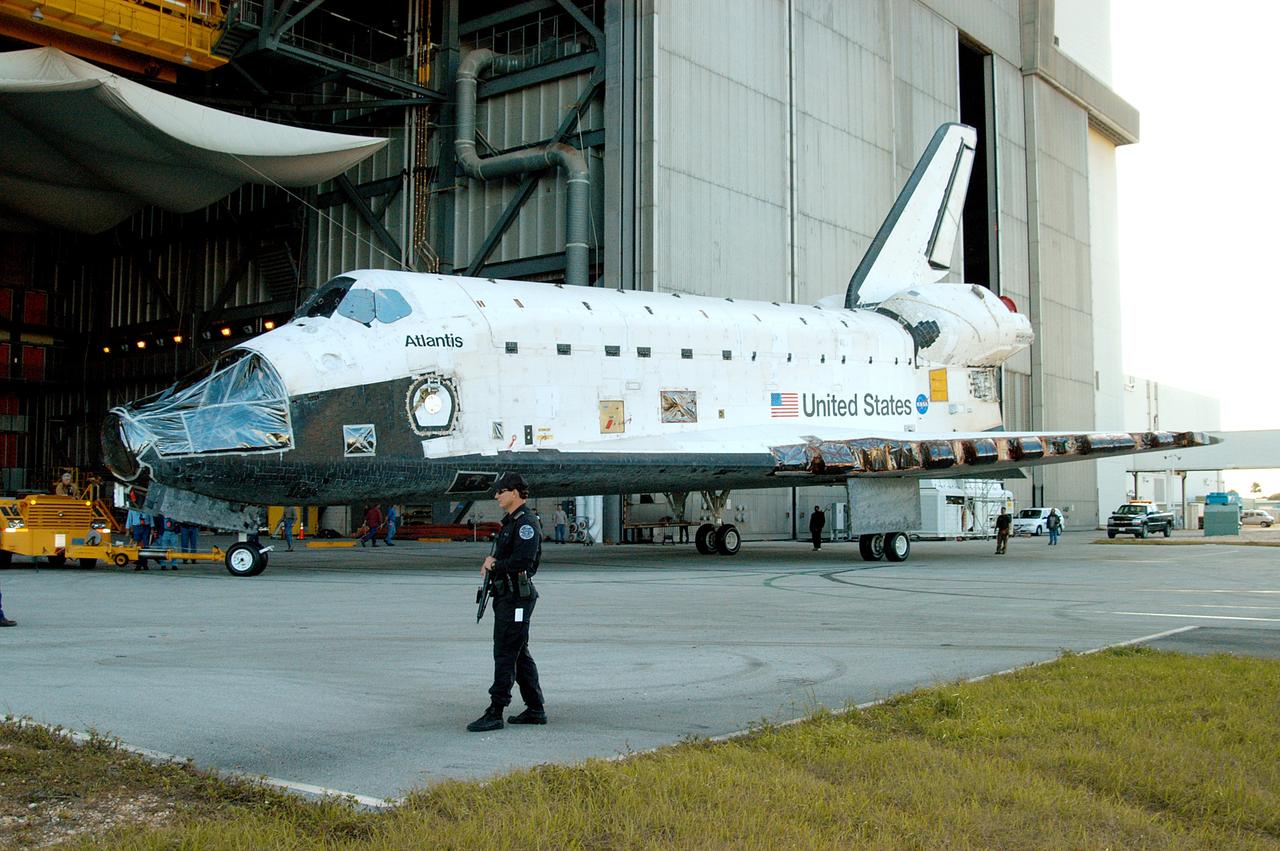
KENNEDY SPACE CENTER, FLA. -  The orbiter Atlantis is backed out of the Vehicle Assembly Building for transfer back to the Orbiter Processing Facility.  Atlantis spent 10 days in the VAB to allow work to be performed in the OPF that can only be accomplished while the bay is empty. Work included annual validation of the bay's cranes, work platforms, lifting mechanisms and jack stands.  Work resumes to prepare Atlantis for launch in September 2004 on the first return-to-flight mission, STS-114.
KENNEDY SPACE CENTER, FLA. - The orbiter Atlantis is backed out of the Vehicle Assembly Building for transfer back to the Orbiter Processing Facility. Atlantis spent 10 days in the VAB to allow work to be performed in the OPF that can only be accomplished while the bay is empty. Work included annual validation of the bay's cranes, work platforms, lifting mechanisms and jack stands. Work resumes to prepare Atlantis for launch in September 2004 on the first return-to-flight mission, STS-114.
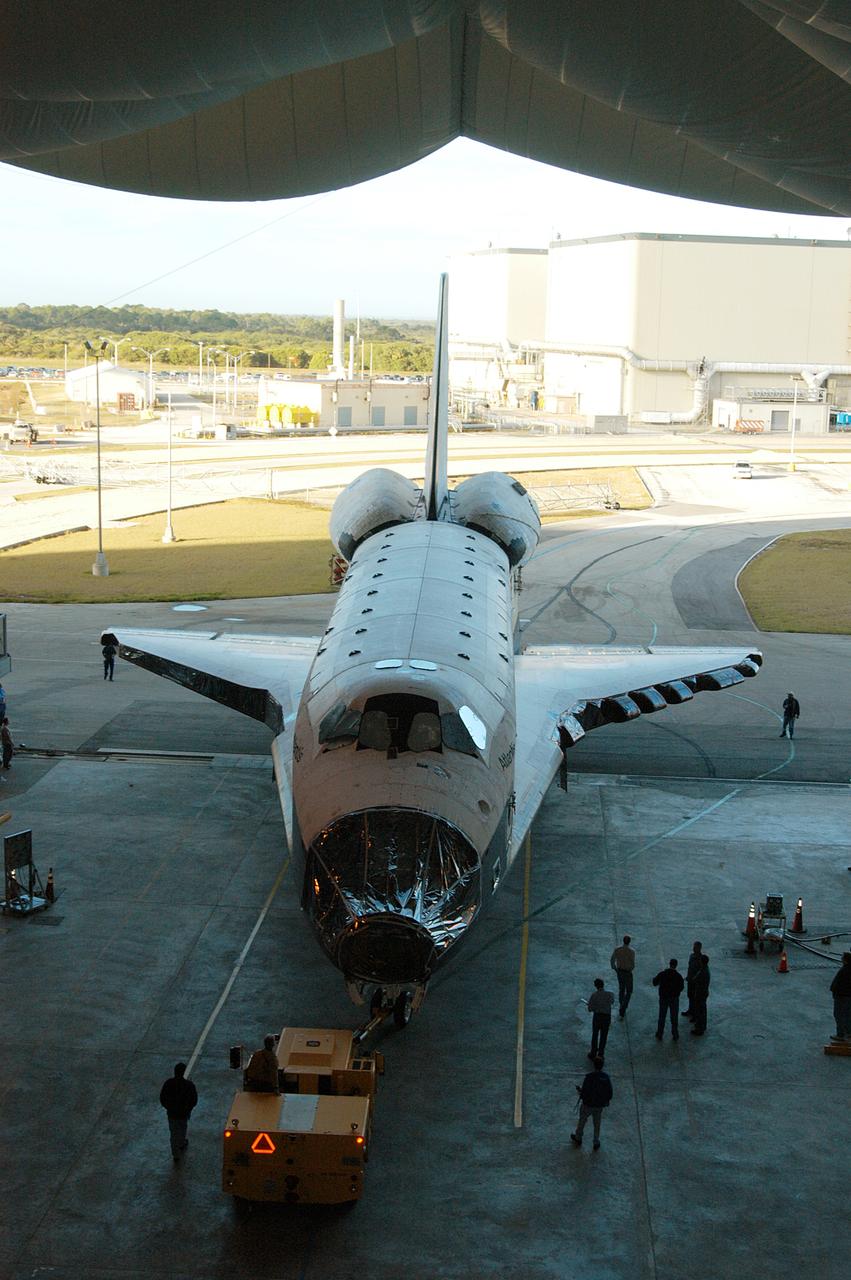
KENNEDY SPACE CENTER, FLA. -- The orbiter Atlantis is backed out of the Vehicle Assembly Building for transfer back to the Orbiter Processing Facility.  Atlantis spent 10 days in the VAB to allow work to be performed in the OPF that can only be accomplished while the bay is empty. Work included annual validation of the bay's cranes, work platforms, lifting mechanisms and jack stands.  Work resumes to prepare Atlantis for launch in September 2004 on the first return-to-flight mission, STS-114.
KENNEDY SPACE CENTER, FLA. -- The orbiter Atlantis is backed out of the Vehicle Assembly Building for transfer back to the Orbiter Processing Facility. Atlantis spent 10 days in the VAB to allow work to be performed in the OPF that can only be accomplished while the bay is empty. Work included annual validation of the bay's cranes, work platforms, lifting mechanisms and jack stands. Work resumes to prepare Atlantis for launch in September 2004 on the first return-to-flight mission, STS-114.
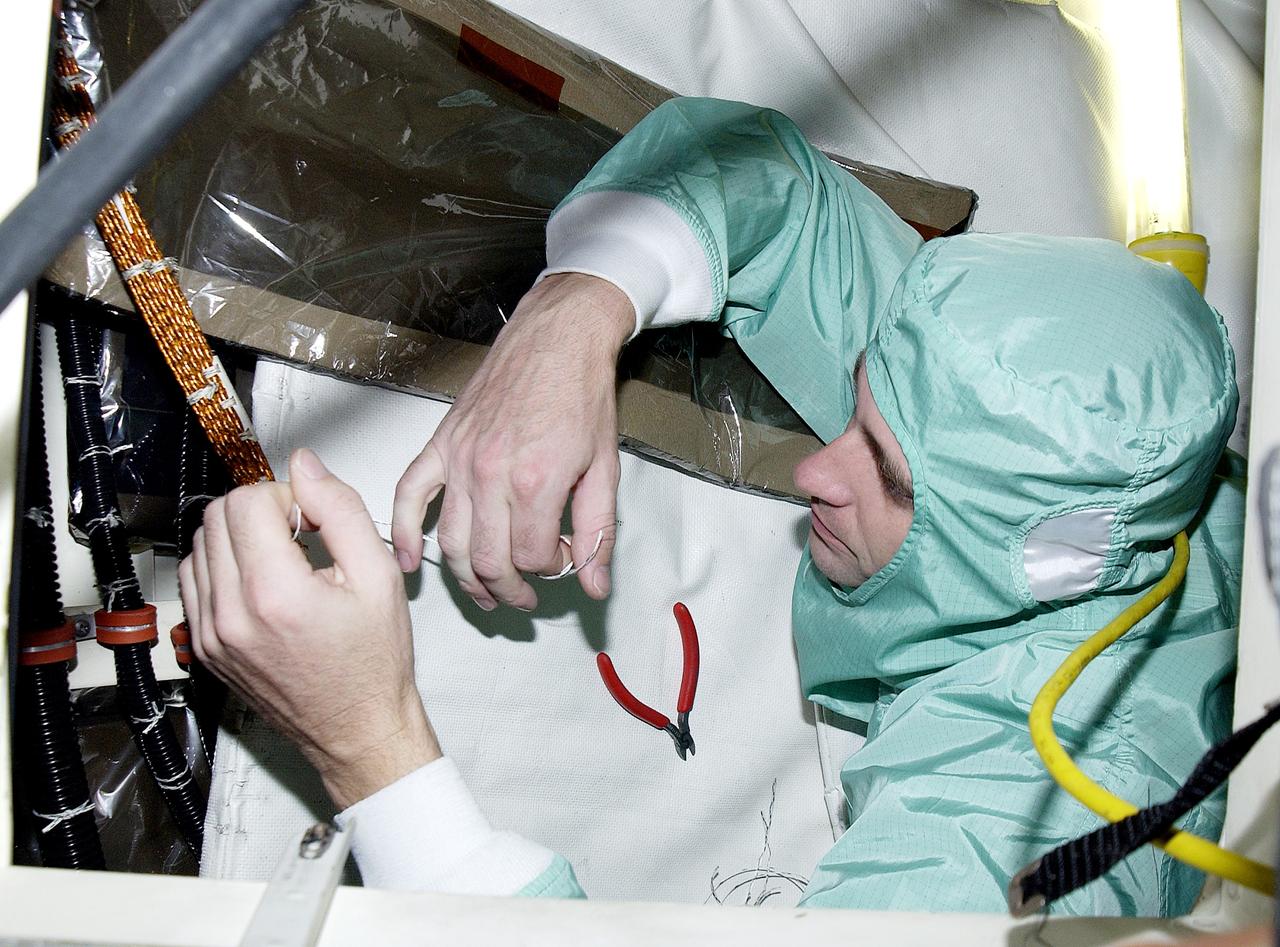
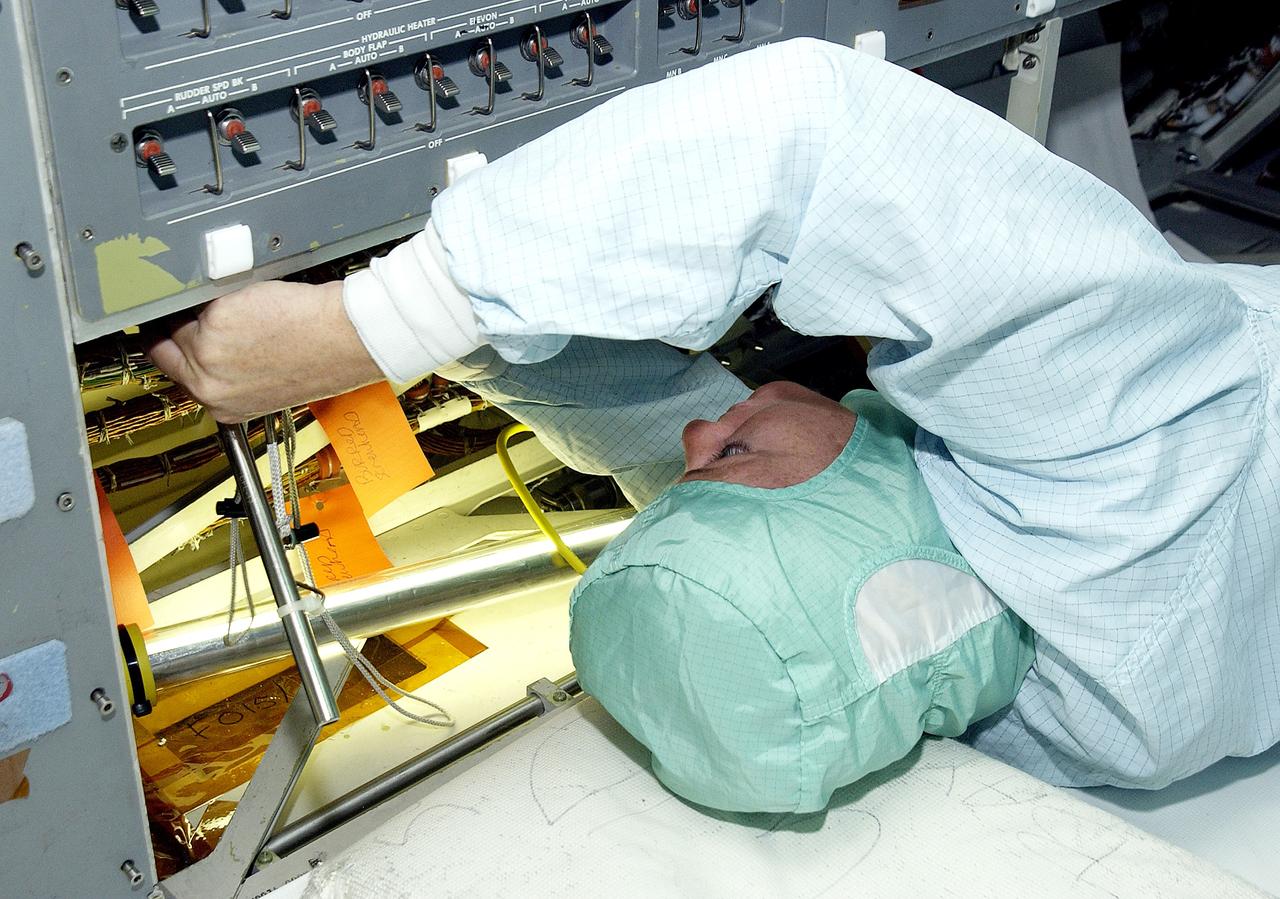
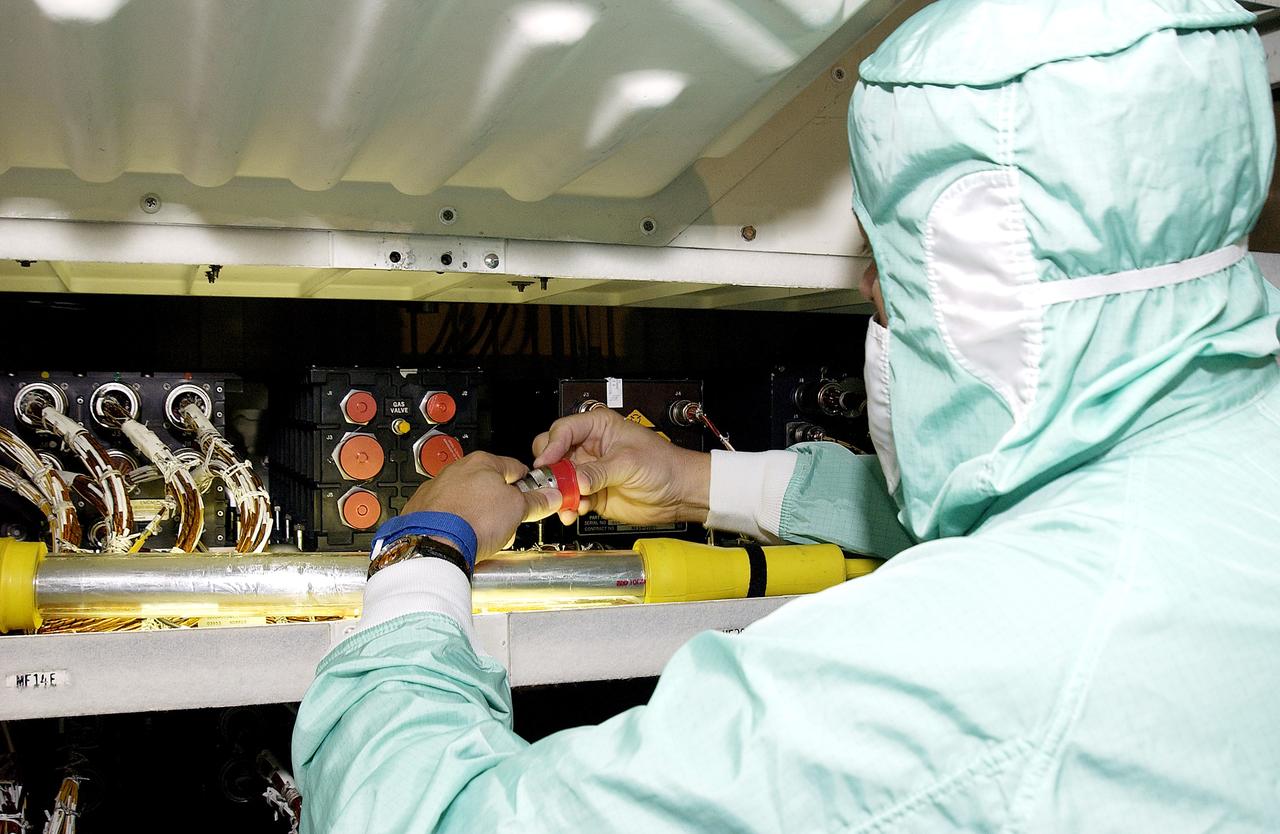
KENNEDY SPACE CENTER, FLA.  -     A technician with United Space Alliance checks wiring in the mid-body and flight deck of  orbiter Atlantis as part of routine maintenance.
KENNEDY SPACE CENTER, FLA. - A technician with United Space Alliance checks wiring in the mid-body and flight deck of orbiter Atlantis as part of routine maintenance.
KENNEDY SPACE CENTER, FLA.  -   A technician with United Space Alliance checks wiring in the mid-body and flight deck of  orbiter Atlantis as part of routine maintenance.
KENNEDY SPACE CENTER, FLA. - A technician with United Space Alliance checks wiring in the mid-body and flight deck of orbiter Atlantis as part of routine maintenance.
KENNEDY SPACE CENTER, FLA.  -    A technician with United Space Alliance checks wiring in the mid-body of  orbiter Atlantis as part of routine maintenance.
KENNEDY SPACE CENTER, FLA. - A technician with United Space Alliance checks wiring in the mid-body of orbiter Atlantis as part of routine maintenance.
KENNEDY SPACE CENTER, FLA.  -   A technician with United Space Alliance checks wiring in the mid-body and flight deck of  orbiter Atlantis as part of routine maintenance.
KENNEDY SPACE CENTER, FLA. - A technician with United Space Alliance checks wiring in the mid-body and flight deck of orbiter Atlantis as part of routine maintenance.
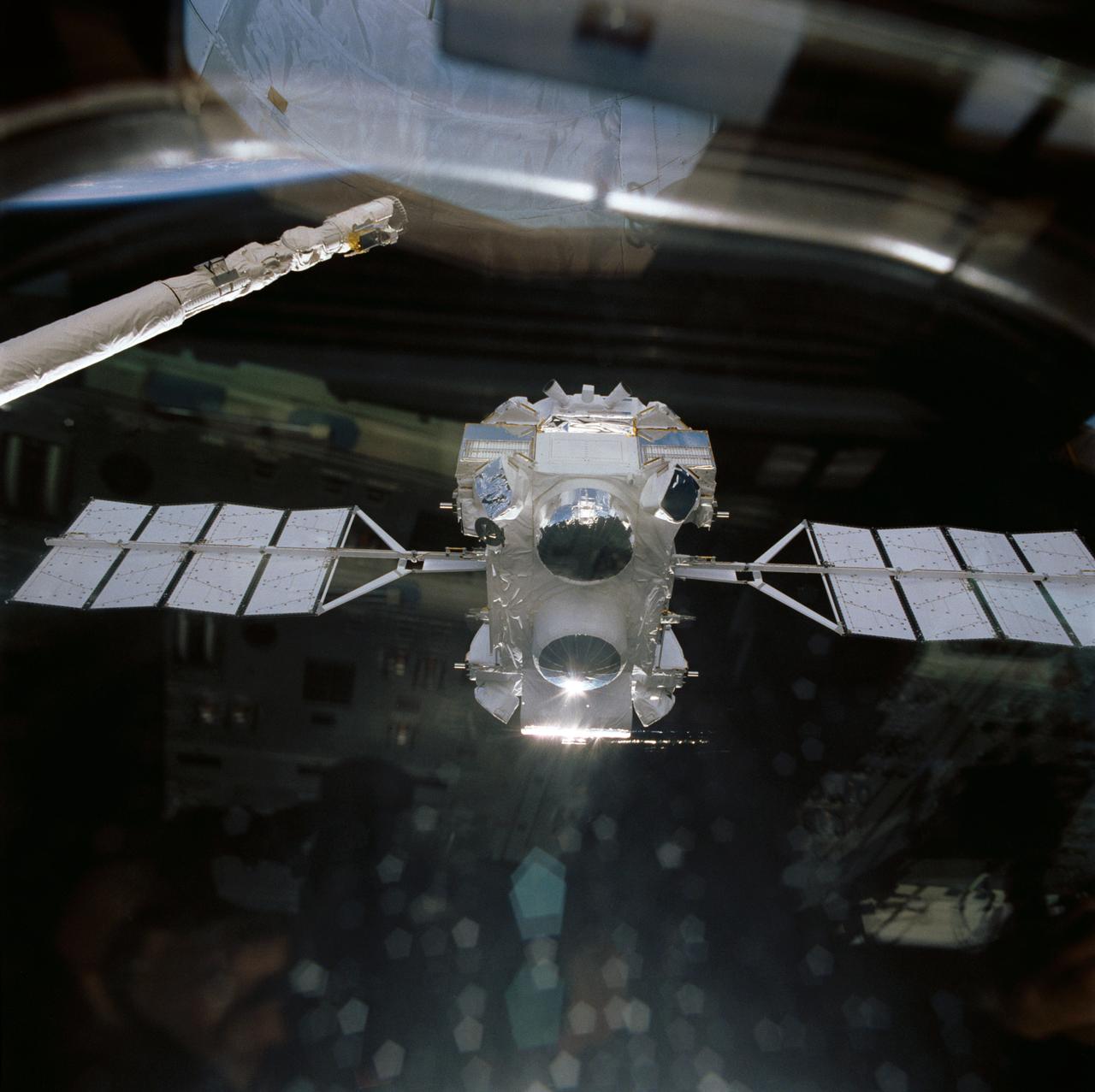
Atlantis', Orbiter Vehicle (OV) 104's, remote manipulator system (RMS) releases Gamma Ray Observatory (GRO) during STS-37 deployment. Visible on the GRO as it drifts away from the RMS end effector are the four complement instruments: the Energetic Gamma Ray Experiment (bottom); Imaging Compton Telescope (COMPTEL) (center); Oriented Scintillation Spectrometer Experiment (OSSE) (top); and Burst and Transient Source Experiment (BATSE) (at four corners). GRO's solar array (SA) panels are extended and are in orbit configuration. View was taken through aft flight deck window which reflects some of the crew compartment interior.
OV-104's RMS releases Gamma Ray Observatory (GRO) during STS-37 deployment
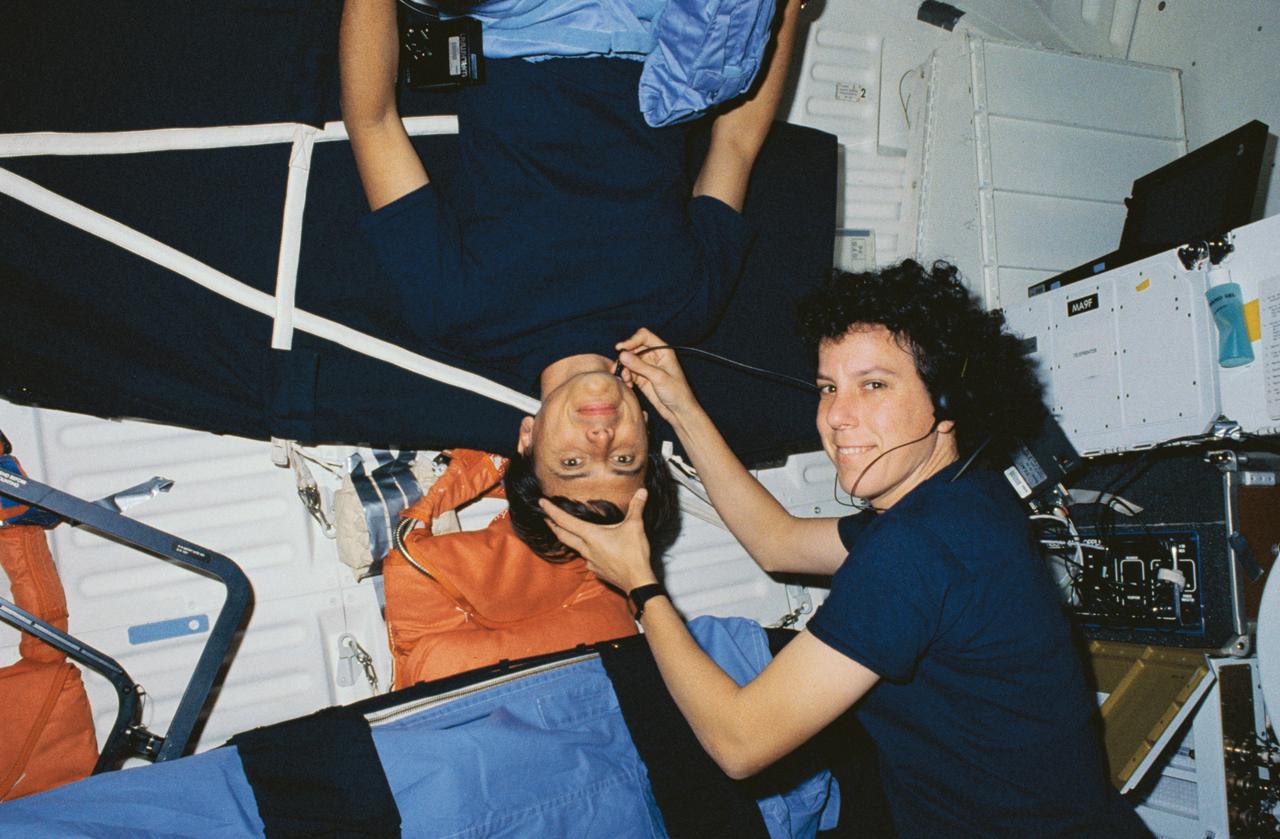
STS034-08-007 (18-23 Oct. 1989) --- Astronaut Ellen S. Baker, an STS-34 mission specialist and medical doctor, conducts a medical examination on astronaut Franklin R. Chang-Diaz, mission specialist, on the middeck of the Earth-orbiting space shuttle Atlantis. Dr. Baker was monitoring Chang-Diaz's blood flow. The scene was recorded on film with a 35mm camera.Photo credit: NASA or National Aeronautics and Space Administration
STS-34 crewmembers conduct DSO 0470 on OV-104's middeck
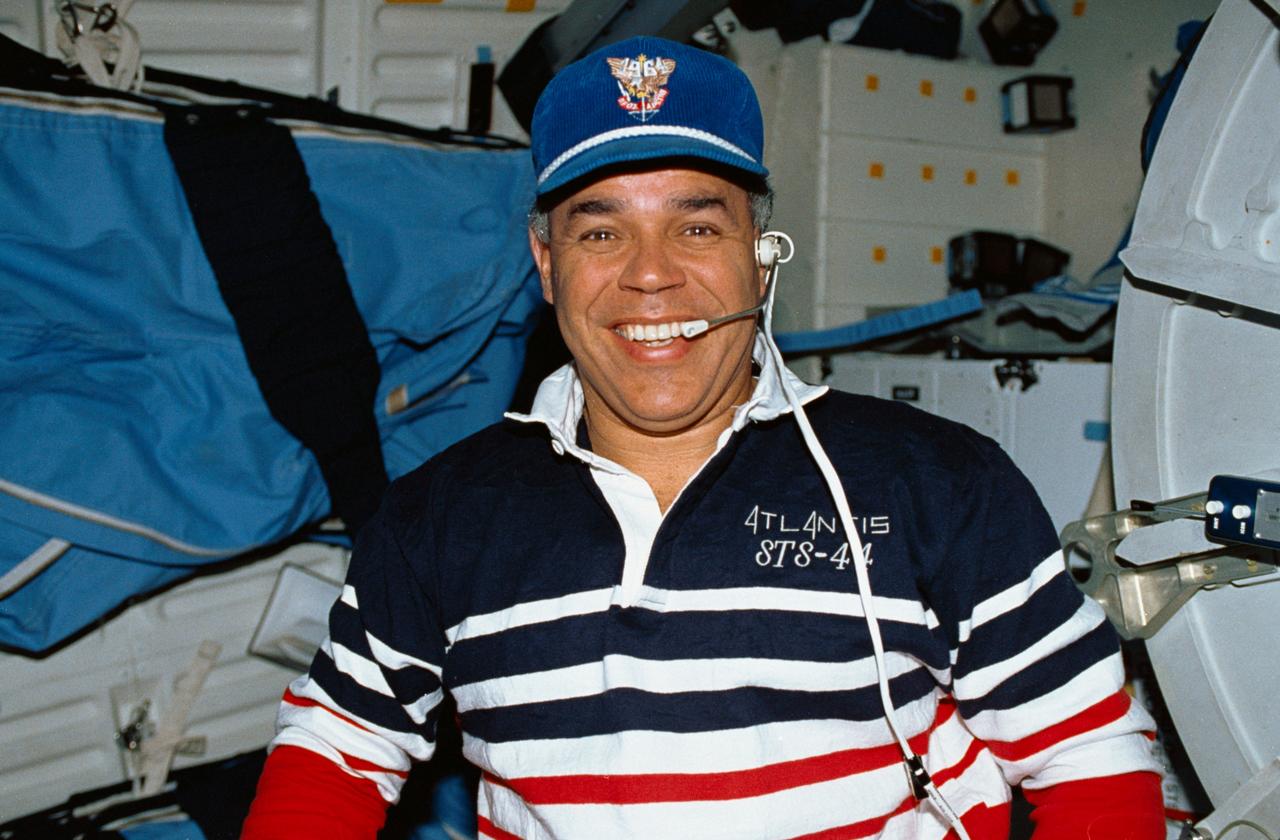
STS044-32-030 (24 Nov-1 Dec 1991) --- STS-44 Commander Frederick D. Gregory wears a cap honoring his alma mater, the United States Air Force (USAF) Academy, on the middeck of Atlantis, Orbiter Vehicle (OV) 104. Gregory, who also has his lightweight headset on, was photographed while talking to ground controllers.
STS-44 Commander Gregory wears a USAF Academy cap on OV-104's middeck
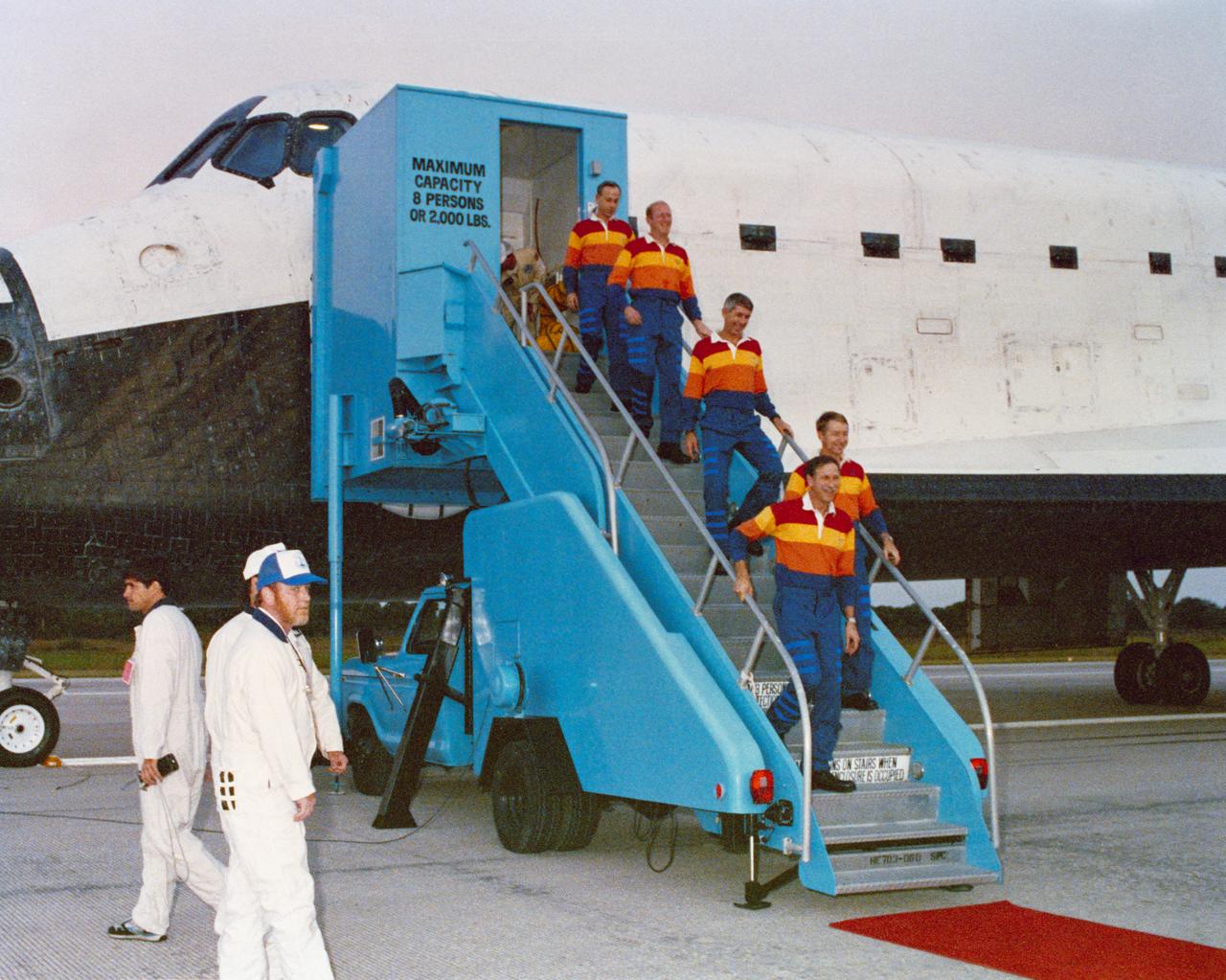
STS-38 crewmembers, wearing red, yellow, and orange polo shirts, egress Atlantis, Orbiter Vehicle (OV) 104, via a mobile stairway at the Kennedy Space Center's (KSC's) Shuttle Landing Facility (SLF). Commander Richard O. Covey, nearing the bottom of the stairway, is followed by Pilot Frank L. Culbertson, Mission Specialist (MS) Robert C. Springer, MS Charles D. Gemar, and MS Carl J. Meade. Ground servicing personnel look on in the foreground.
STS-38 crewmembers egress OV-104 via mobile stairway at KSC's SLF
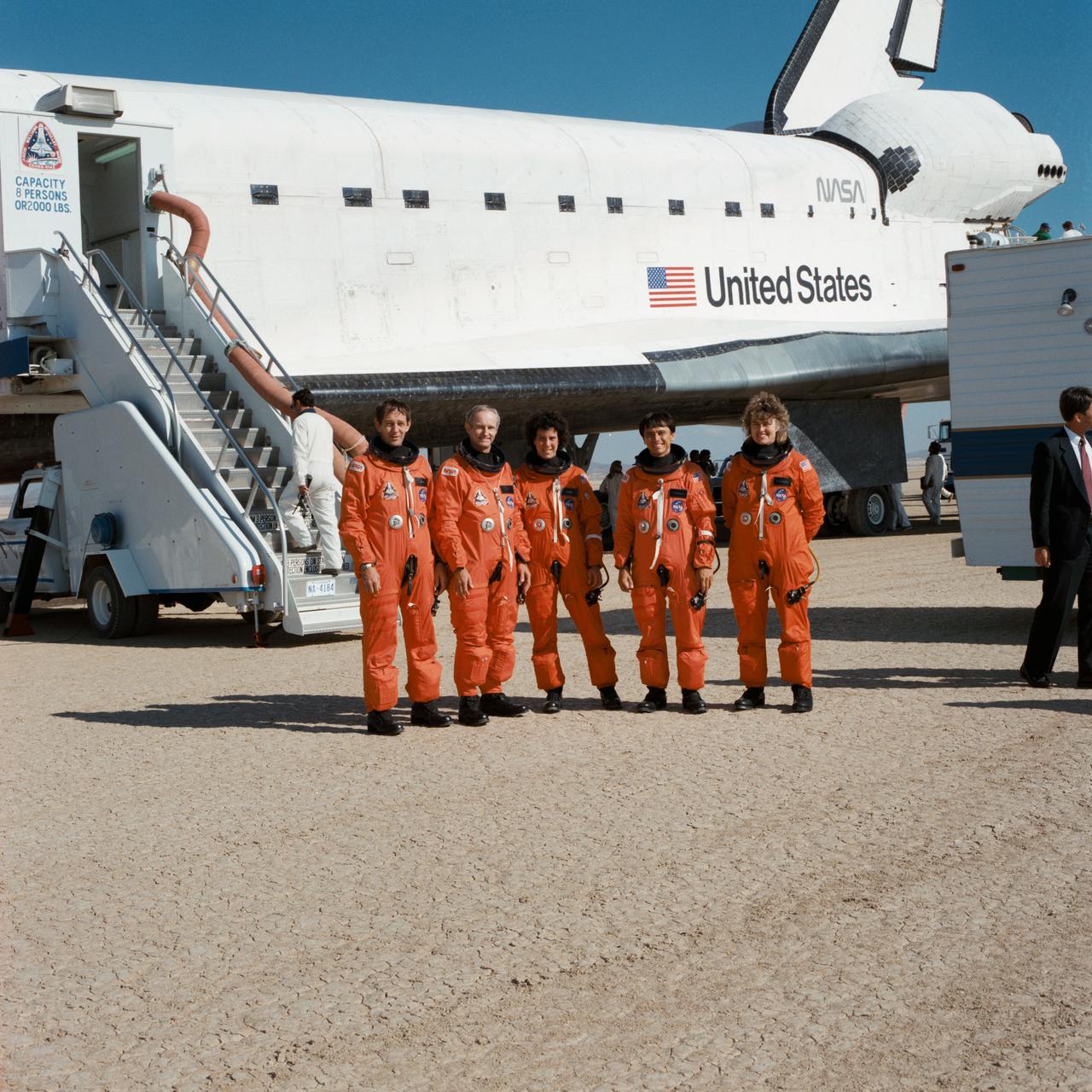
STS-34 crewmembers, wearing launch and entry suits (LESs), stand in front of Atlantis, Orbiter Vehicle (OV) 104, on Runway 23 dry lake bed at Edwards Air Force Base (EAFB), California. Left to right are Pilot Michael J. McCulley, Commander Donald E. Williams, Mission Specialist (MS) Ellen S. Baker, MS Franklin R. Chang-Diaz, and MS Shannon W. Lucid. Ground crews service OV-104 in the background.
STS-34 crewmembers pose for post flight portrait in front of OV-104 at EAFB
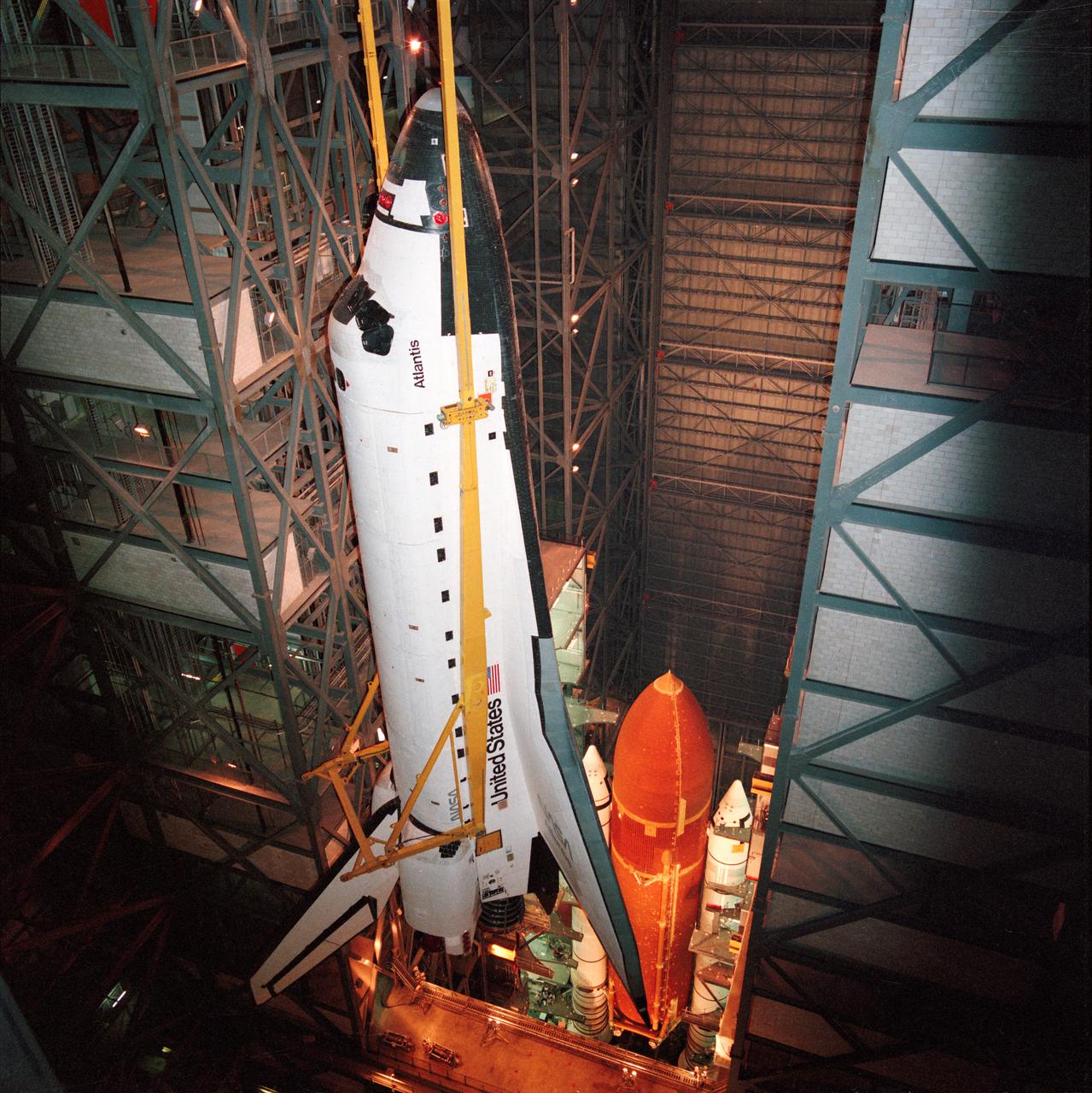
STS-27 Atlantis, Orbiter Vehicle (OV) 104, is suspended via overhead crane, attached at four points, in the Kennedy Space Center (KSC) Vehicle Assembly Building (VAB). Below OV-104 on the mobile launcher platform are the external tank (ET) and solid rocket boosters (SRBs). During ET/SRB mating operations, OV-104 will be mounted atop the ET.
STS-27 Atlantis, OV-104, ET/SRB mating operations at KSC VAB
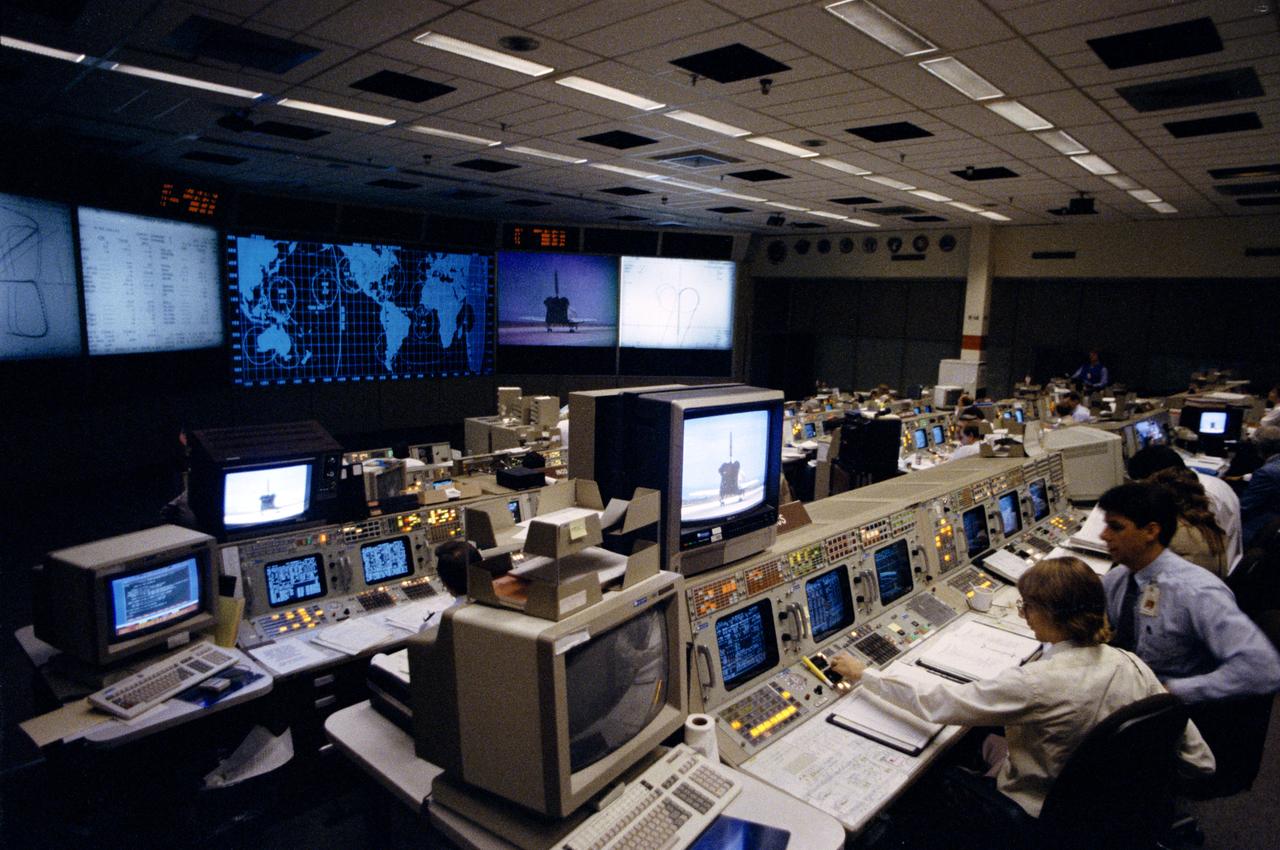
As STS-30 ends its mission with the landing of Atlantis, Orbiter Vehicle (OV) 104, at Edwards Air Force Base (EAFB), California, flight controllers monitor screens at their consoles in JSC Mission Control Center (MCC) Bldg 30. In the foreground is the Maintenance, Mechanical Arm, and Crew Systems Engineer (MMACS) console with R. Kevin McCluney studying data readouts. On the front visual displays are the tracking map and a tail view of OV-104 as it comes to a stop on EAFB concrete runway 22.
STS-30 JSC Mission Control Center (MCC) activity during OV-104 landing
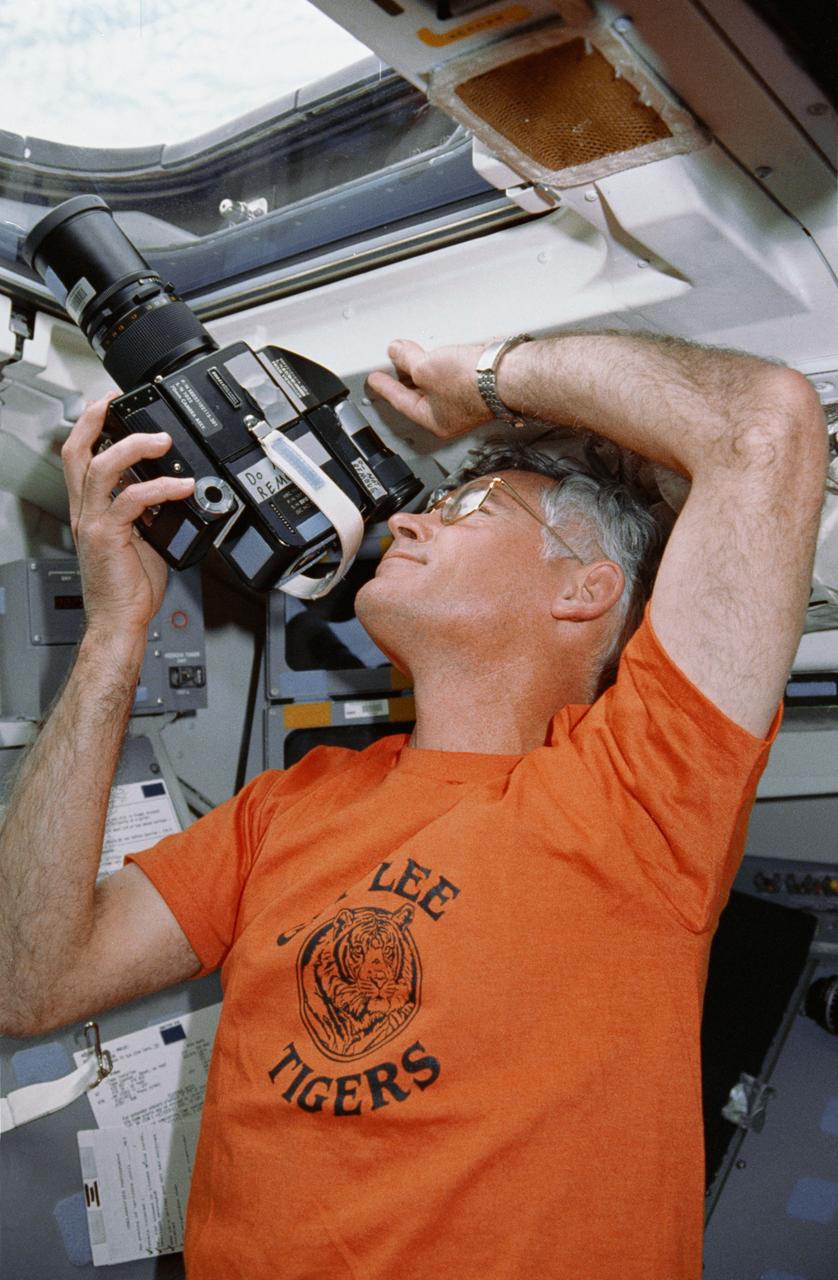
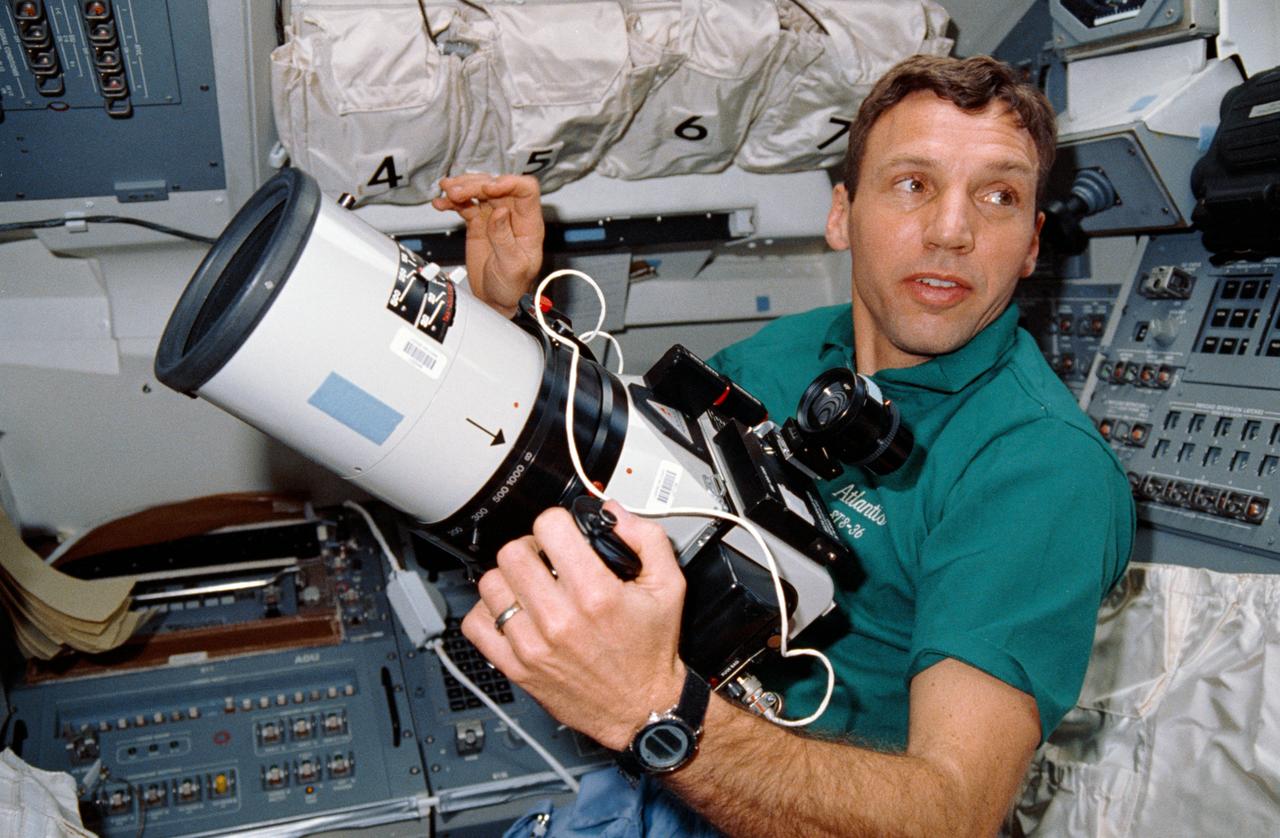
STS036-03-013 (28 Feb–3 March 1990) --- Astronaut Richard M. (Mike) Mullane, on the aft flight deck of the Earth-orbiting Atlantis, uses the 70mm Hasselblad camera to record Earth imagery.  Mullane and four other NASA astronauts spent four days, 10 hours and 19 minutes aboard the spacecraft for the DOD-devoted mission.
STS-36 Mission Specialist Mullane uses 70mm HASSELBLAD camera on flight deck
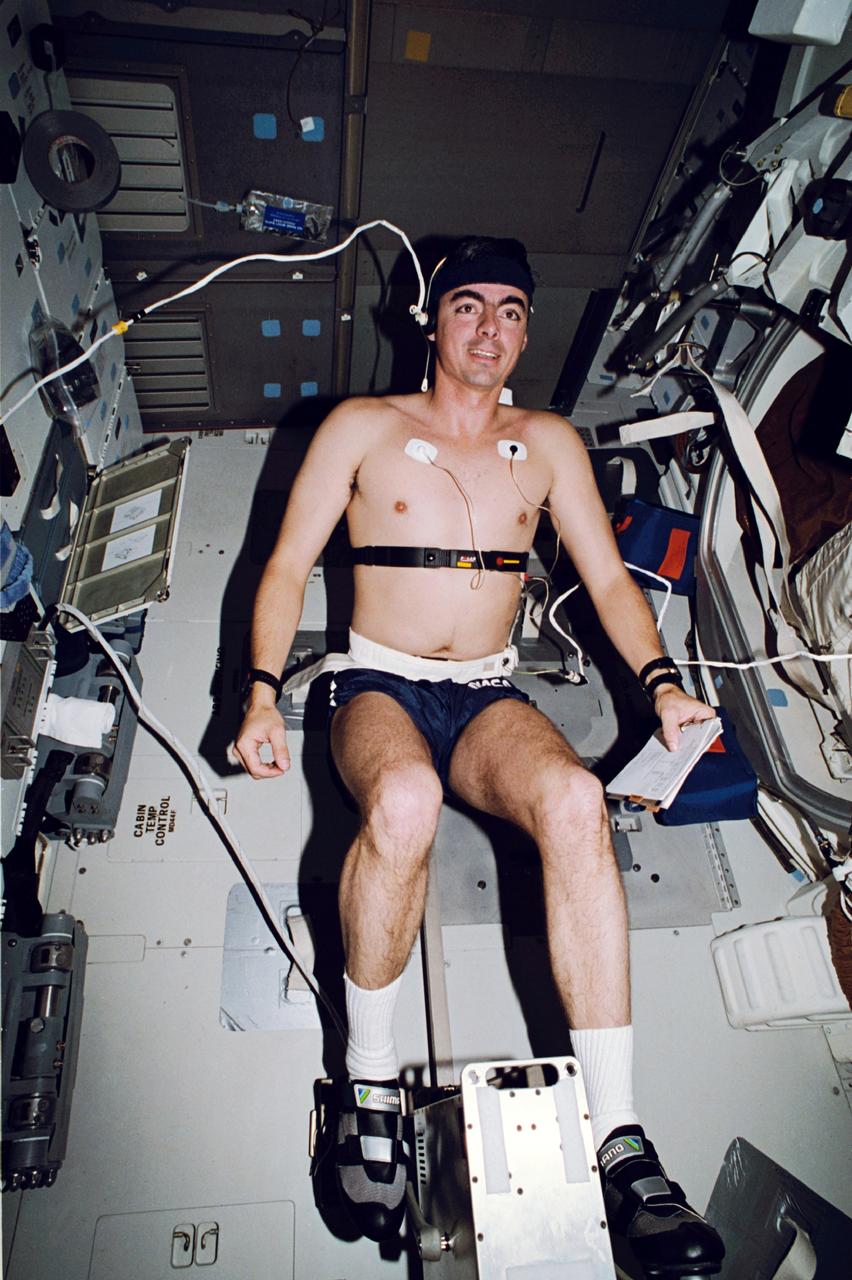
STS046-24-025 (31 July-8 Aug. 1992) --- Astronaut Andrew M. Allen, STS-46 pilot, exercises on the bicycle ergometer device on the flight deck of the Space Shuttle Atlantis as it makes one of its 127 total orbits for the eight-day mission. Allen, equipped with sensors for monitoring his biological systems during the run, was joined by four other NASA astronauts and two European scientists on the mission.
STS-46 Pilot Allen uses cycle ergometer on OV-104's middeck
STS036-03-014 (28 Feb-3 March 1990) --- Astronaut David C. Hilmers, on the aft flight deck of the Earth-orbiting Atlantis, prepares to use the large-format Aero Linhof camera used for recording of Earth imagery.  Hilmers and four other NASA astronauts spent four days, 10 hours and 19 minutes aboard the spacecraft for the DOD-devoted mission.
STS-36 Mission Specialist Hilmers with AEROLINHOF camera on aft flight deck
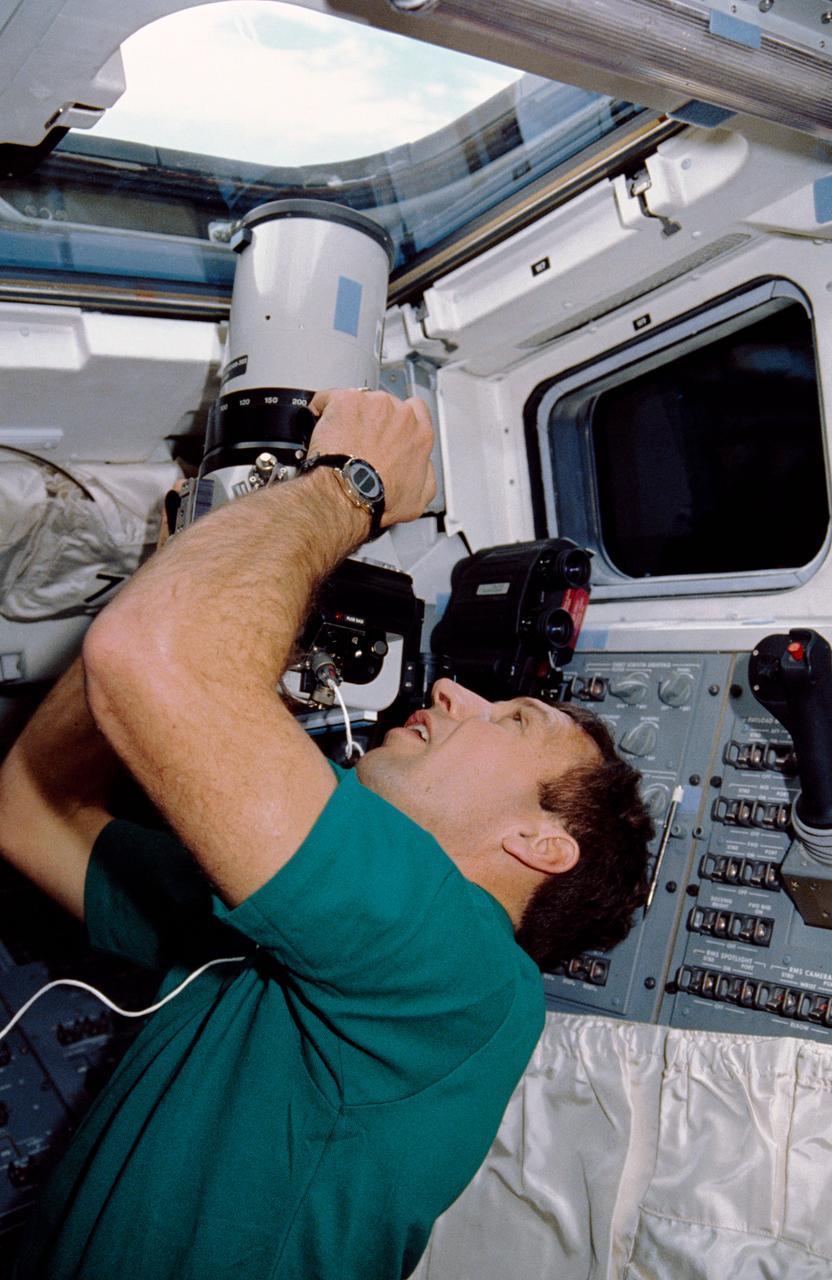
STS-36 Mission Specialist (MS) David C. Hilmers points the large-format AEROLINHOF camera out overhead window W7 on the aft flight deck of Atlantis, Orbiter Vehicle (OV) 104. Hilmers records Earth imagery using the camera. Hilmers and four other astronauts spent four days, 10 hours and 19 minutes aboard OV-104 for the Department of Defense (DOD) devoted mission.
STS-36 Mission Specialist Hilmers with AEROLINHOF camera on aft flight deck
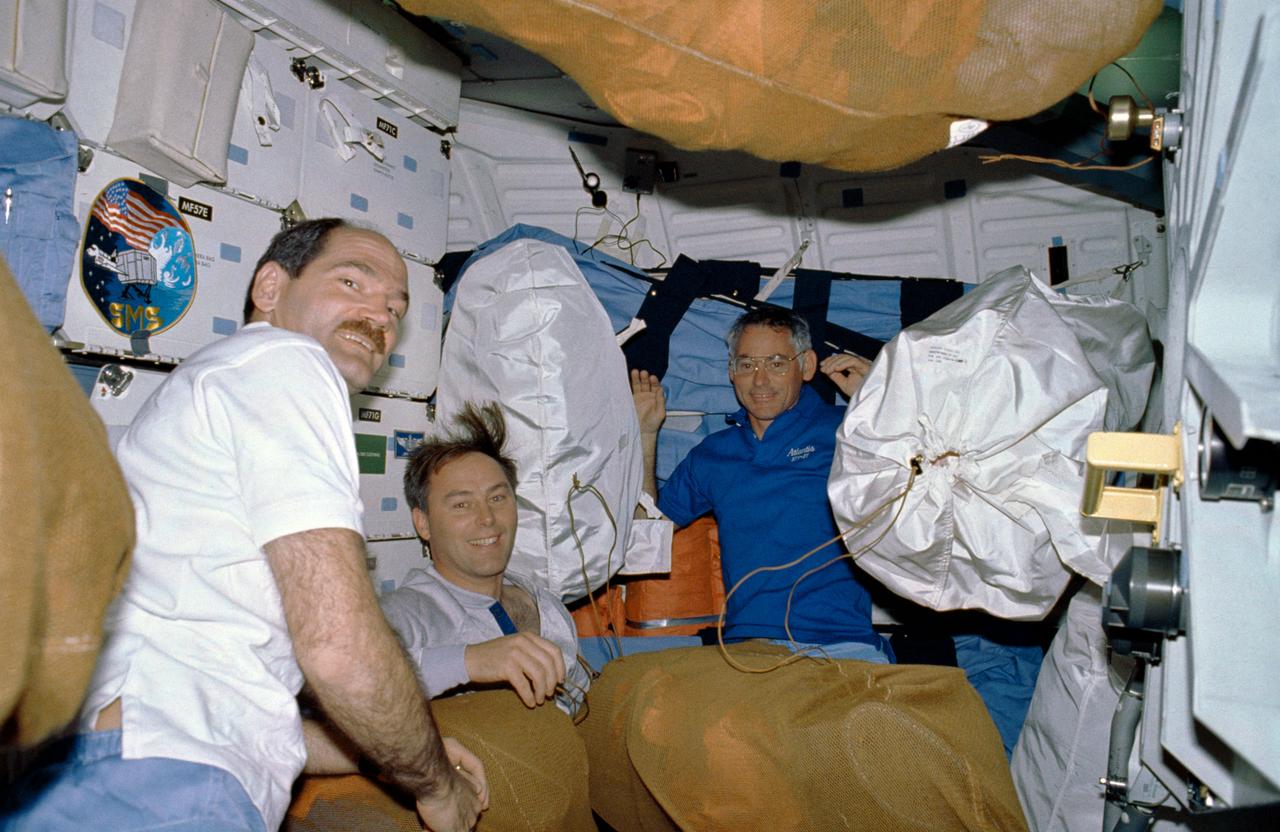
STS027-10-003 (2-6 Dec. 1988) --- From the left, astronauts Guy S. Gardner, STS-27 pilot, along with Jerry L. Ross and Richard M. (Mike) Mullane, both mission specialists, take a break from moving gear and equipment on the middeck of the Earth-orbiting space shuttle Atlantis. Photo credit: NASA
STS-27 crewmembers surrounded by net stowage bags on middeck
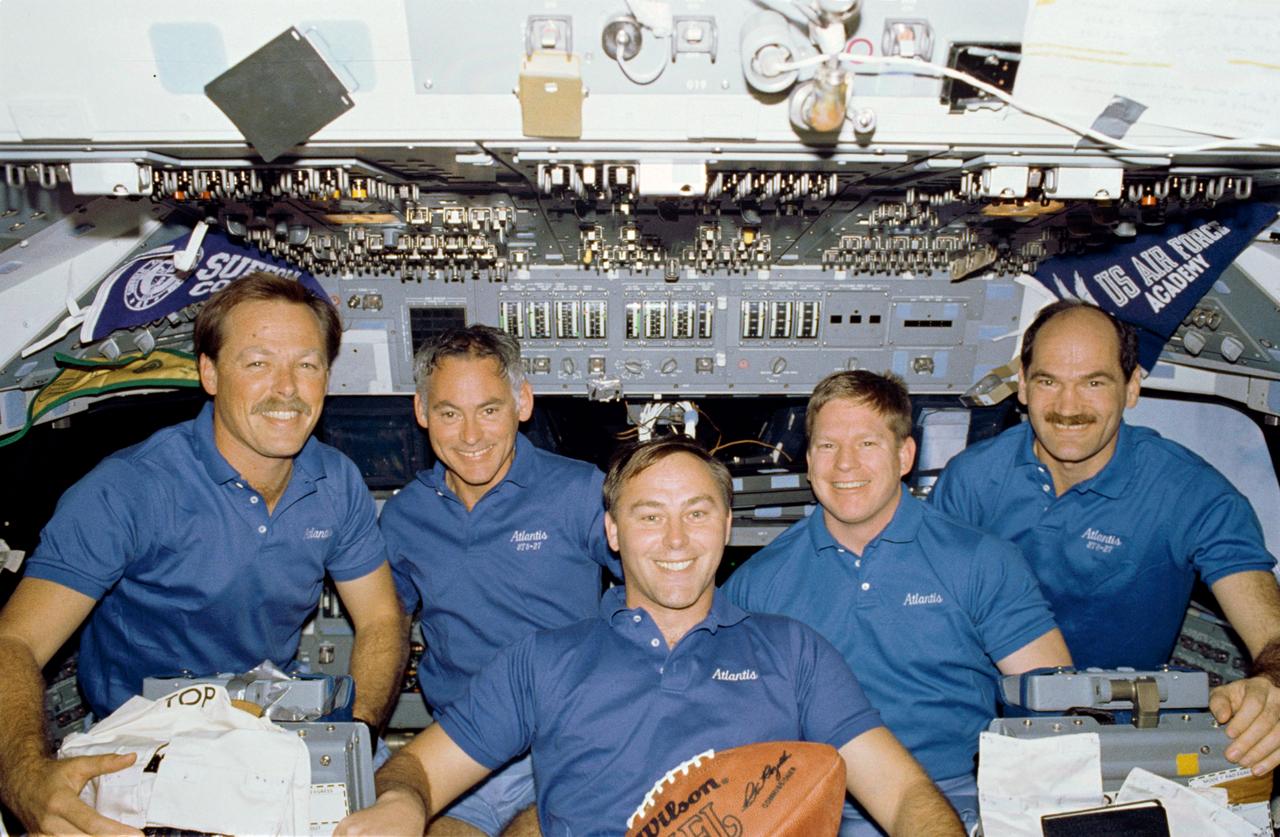
STS027-11-012 (2-6 Dec. 1988) --- The crew members for the STS-27 space flight pose on the flight deck of the Earth-orbiting space shuttle Atlantis with a football free-floating in the foreground. Left to right are astronauts Robert L. Gibson, commander; Richard M. (Mike) Mullane, Jerry L. Ross and William M. Shepherd, mission specialists; and Guy S. Gardner, pilot. The football was later presented to the National Football League (NFL) at halftime of the Super Bowl in Miami. Photo credit: NASA
STS-27 crew poses for inflight portrait on forward flight deck with football
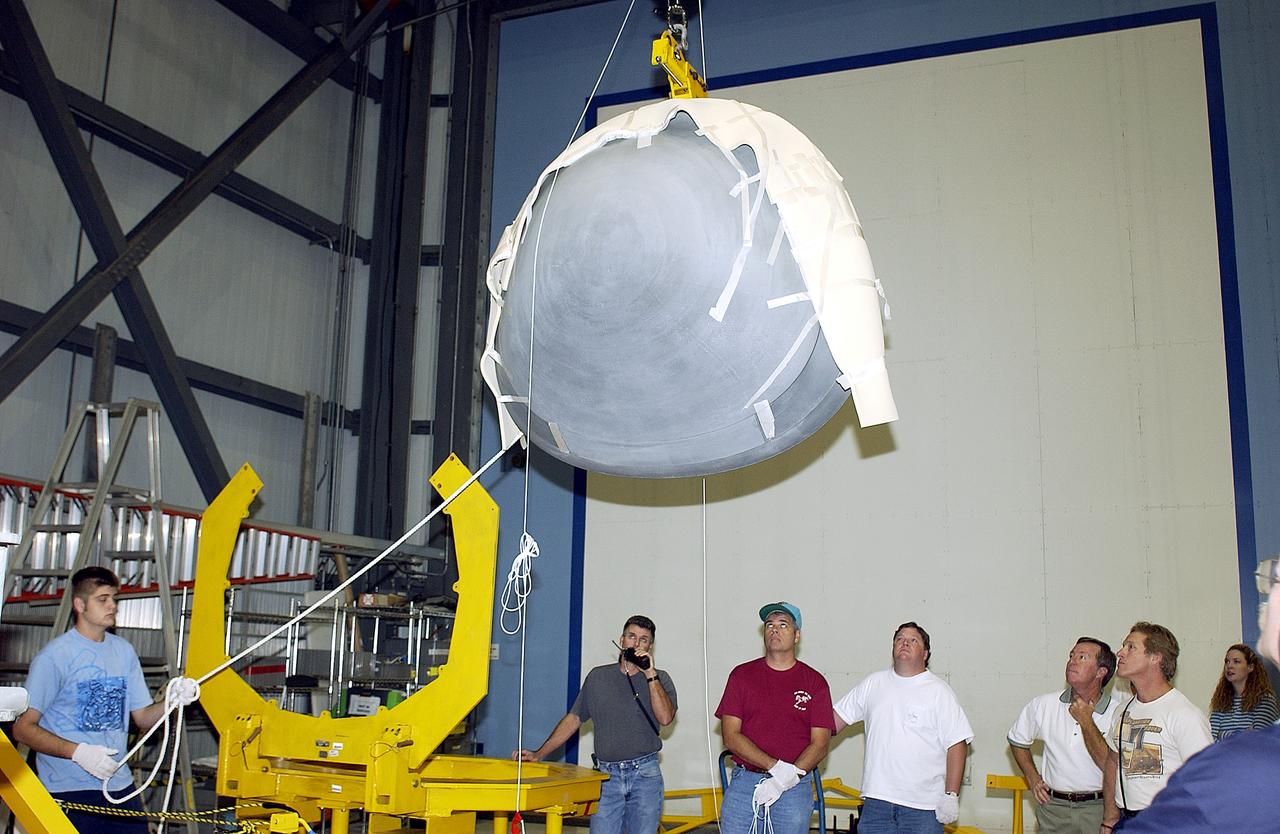
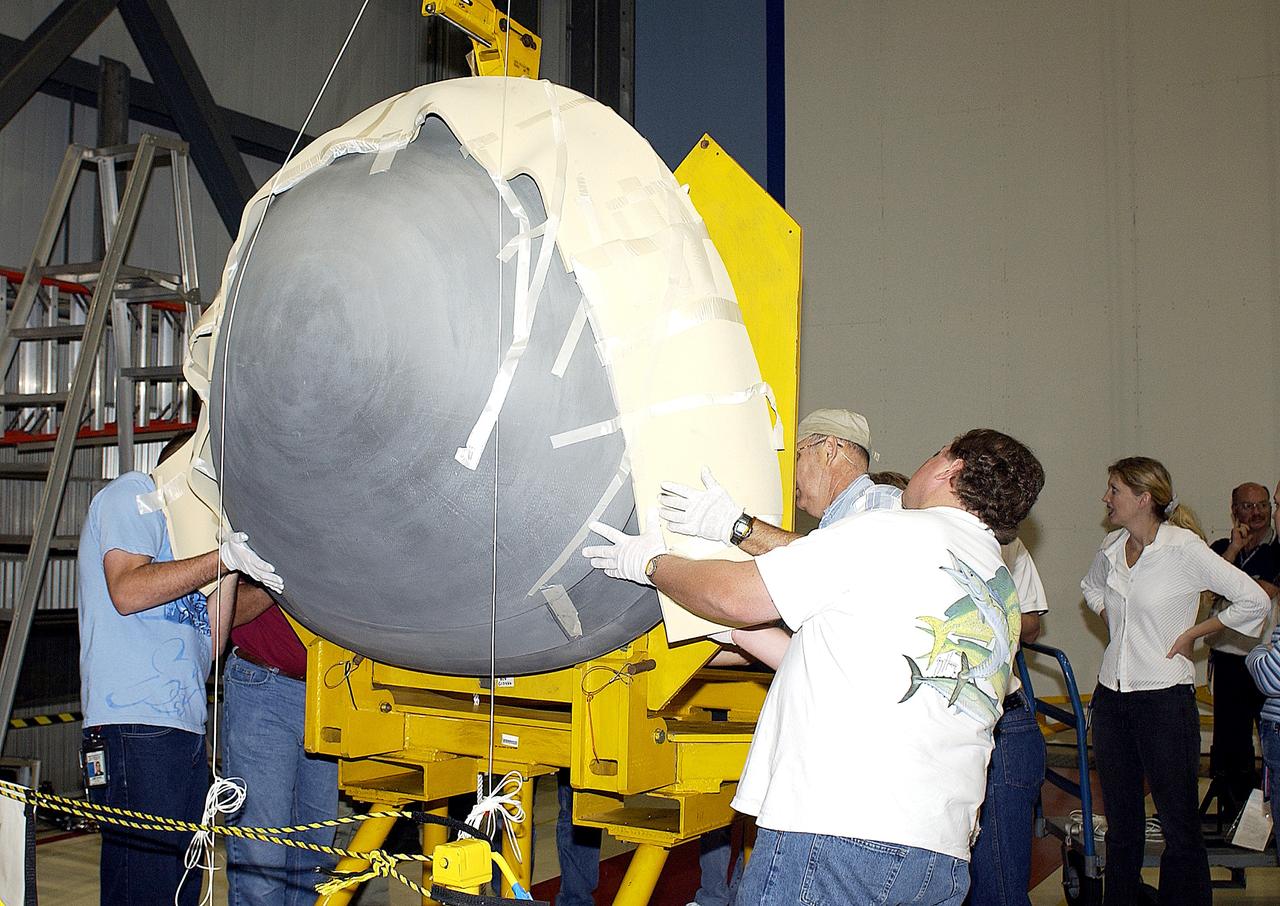
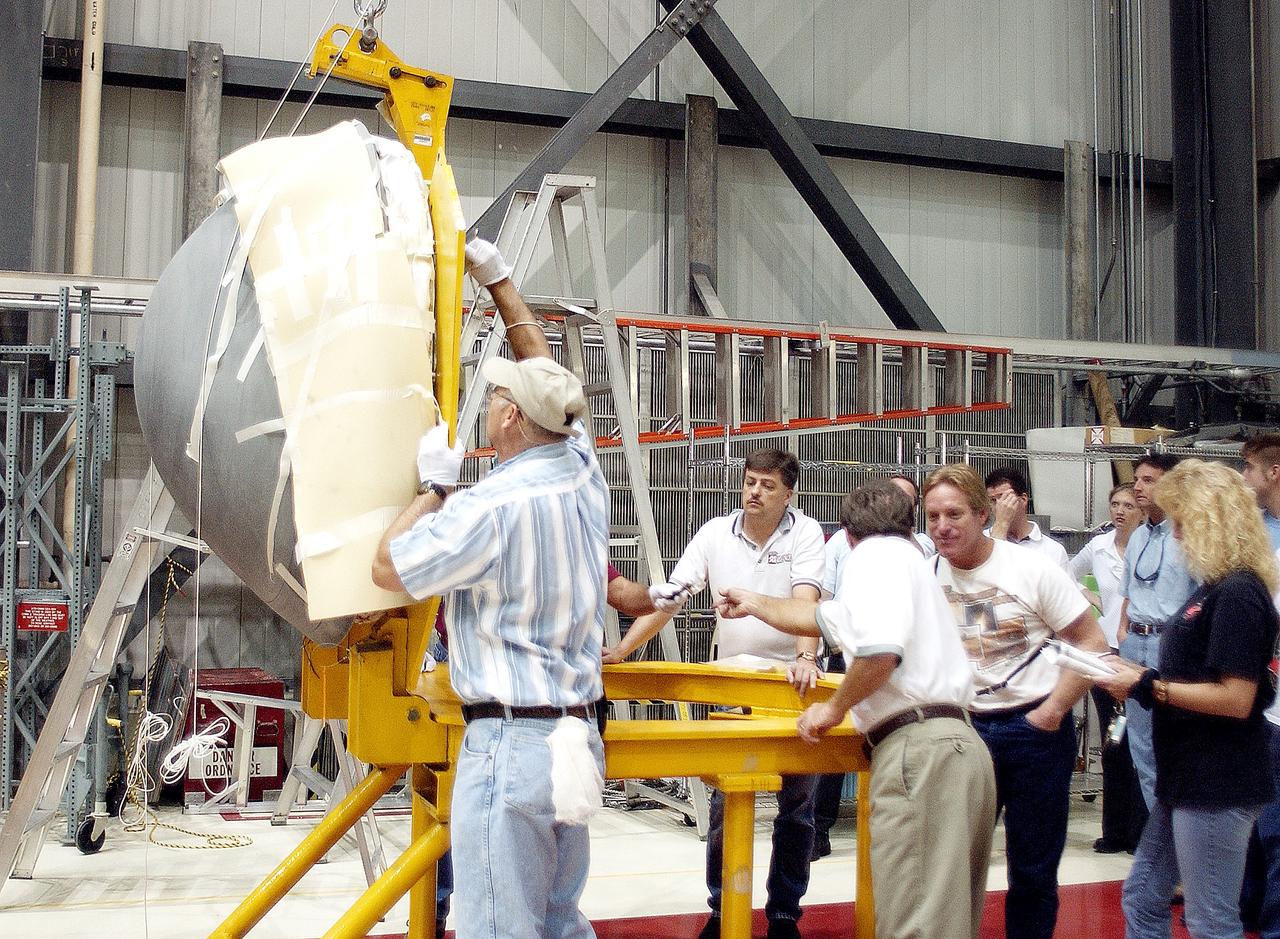
KENNEDY SPACE CENTER, FLA. - In the Orbiter Processing Facility, workers watch as the nose cap of the orbiter Atlantis is lowered toward the floor.   The cap was removed from the orbiter for routine inspection. The nose cap is made of reinforced carbon-carbon (RCC), which has an operating range of minus 250° F to about 3,000° F.
KENNEDY SPACE CENTER, FLA. - In the Orbiter Processing Facility, workers watch as the nose cap of the orbiter Atlantis is lowered toward the floor. The cap was removed from the orbiter for routine inspection. The nose cap is made of reinforced carbon-carbon (RCC), which has an operating range of minus 250° F to about 3,000° F.
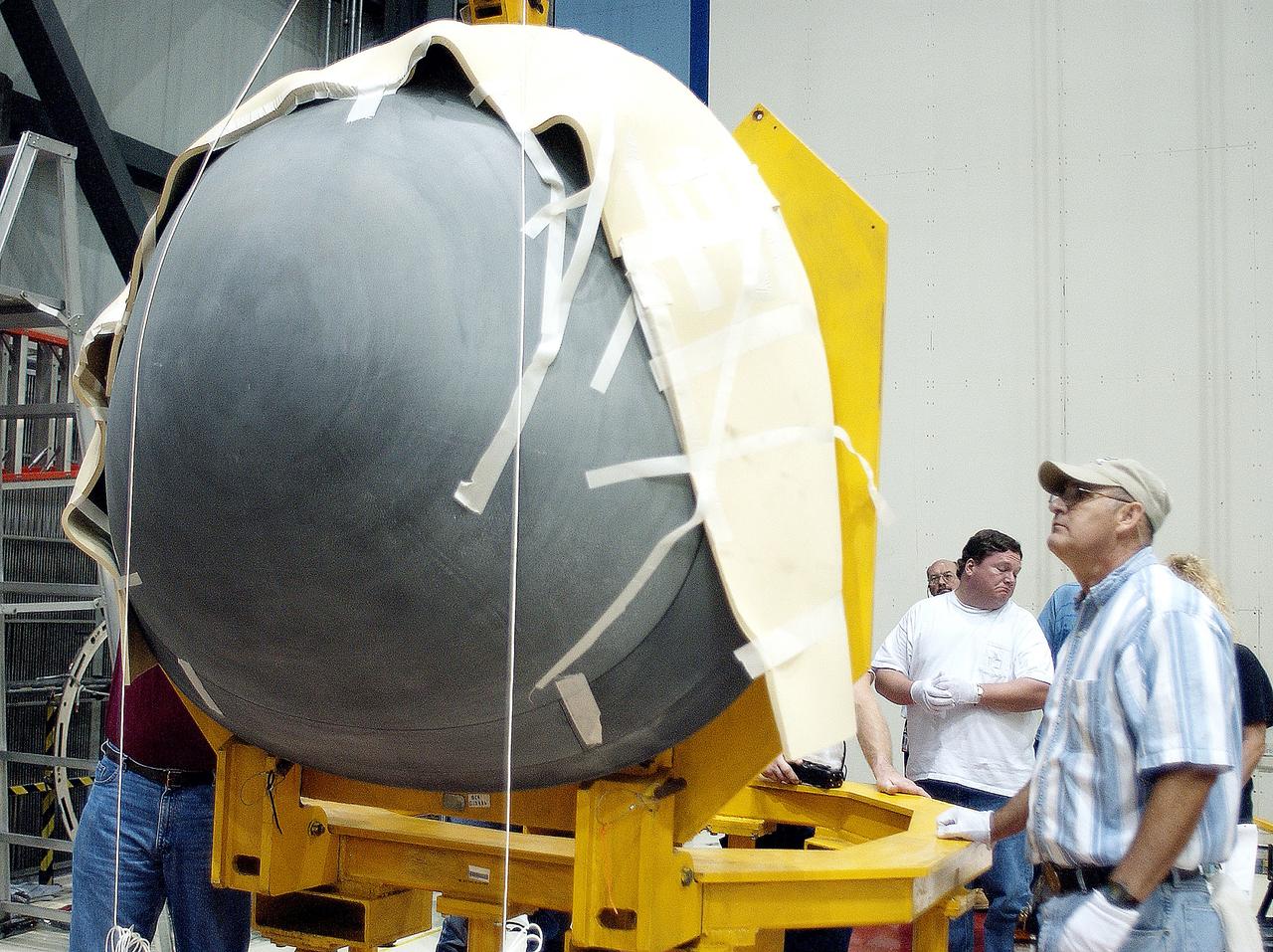
KENNEDY SPACE CENTER, FLA. -  In the Orbiter Processing Facility, the nose cap of the orbiter Atlantis rests on a stand after its removal from the orbiter for routine inspection. The nose cap is made of reinforced carbon-carbon (RCC), which has an operating range of minus 250° F to about 3,000° F.
KENNEDY SPACE CENTER, FLA. - In the Orbiter Processing Facility, the nose cap of the orbiter Atlantis rests on a stand after its removal from the orbiter for routine inspection. The nose cap is made of reinforced carbon-carbon (RCC), which has an operating range of minus 250° F to about 3,000° F.
KENNEDY SPACE CENTER, FLA. -  In the Orbiter Processing Facility, workers secure the nose cap of the orbiter Atlantis on a stand.   The cap was removed from the orbiter for routine inspection. The nose cap is made of reinforced carbon-carbon (RCC), which has an operating range of minus 250° F to about 3,000° F.
KENNEDY SPACE CENTER, FLA. - In the Orbiter Processing Facility, workers secure the nose cap of the orbiter Atlantis on a stand. The cap was removed from the orbiter for routine inspection. The nose cap is made of reinforced carbon-carbon (RCC), which has an operating range of minus 250° F to about 3,000° F.
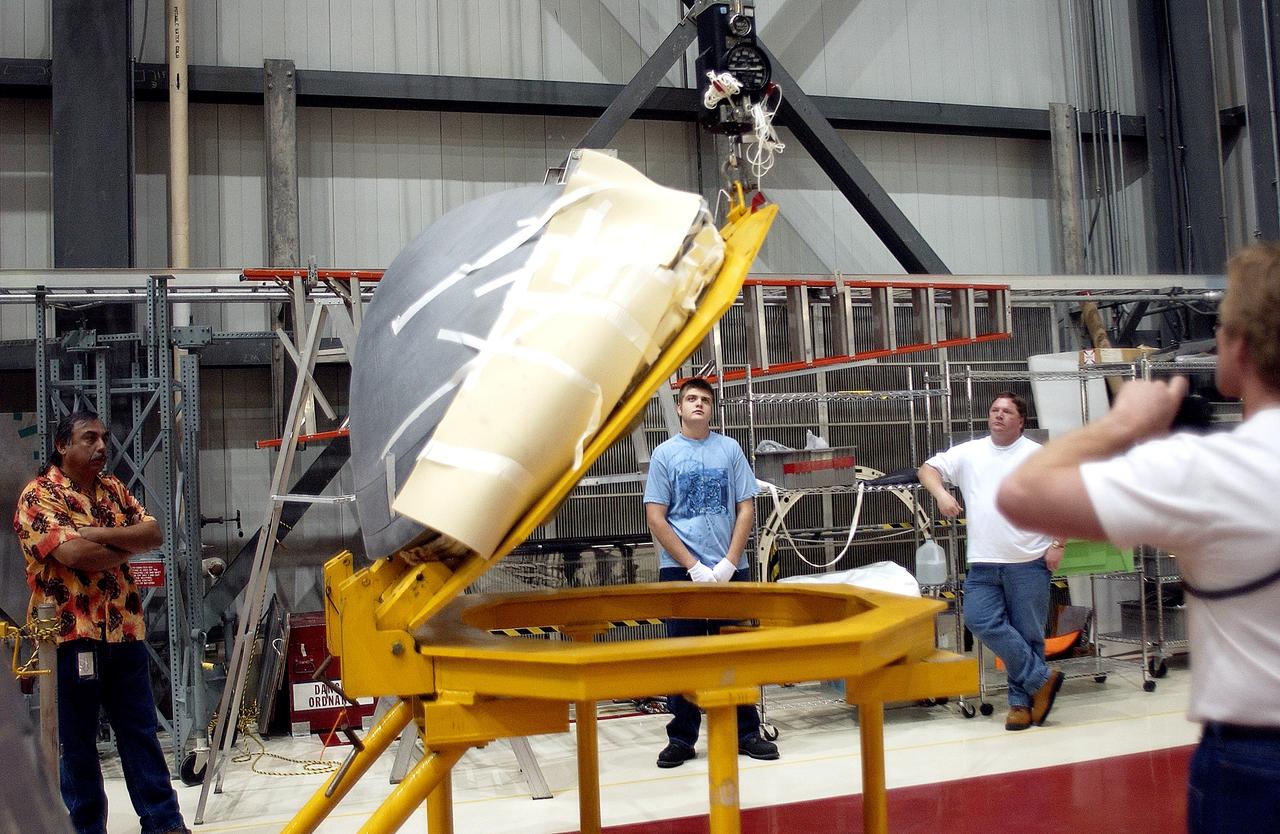
KENNEDY SPACE CENTER, FLA. - In the Orbiter Processing Facility, workers watch as the nose cap of the orbiter Atlantis is shifted to a horizontal position on a stand.  The cap was removed from the orbiter for routine inspection. The nose cap is made of reinforced carbon-carbon (RCC), which has an operating range of minus 250° F to about 3,000° F.
KENNEDY SPACE CENTER, FLA. - In the Orbiter Processing Facility, workers watch as the nose cap of the orbiter Atlantis is shifted to a horizontal position on a stand. The cap was removed from the orbiter for routine inspection. The nose cap is made of reinforced carbon-carbon (RCC), which has an operating range of minus 250° F to about 3,000° F.
KENNEDY SPACE CENTER, FLA. -  In the Orbiter Processing Facility, workers help guide the nose cap of the orbiter Atlantis toward a stand.  The cap was removed from the orbiter for routine inspection. The nose cap is made of reinforced carbon-carbon (RCC), which has an operating range of minus 250° F to about 3,000° F.
KENNEDY SPACE CENTER, FLA. - In the Orbiter Processing Facility, workers help guide the nose cap of the orbiter Atlantis toward a stand. The cap was removed from the orbiter for routine inspection. The nose cap is made of reinforced carbon-carbon (RCC), which has an operating range of minus 250° F to about 3,000° F.
KENNEDY SPACE CENTER, FLA. - In the Orbiter Processing Facility, workers watch as the nose cap of the orbiter Atlantis is moved toward the stand at left.  The cap was removed from the orbiter for routine inspection. The nose cap is made of reinforced carbon-carbon (RCC), which has an operating range of minus 250° F to about 3,000° F.
KENNEDY SPACE CENTER, FLA. - In the Orbiter Processing Facility, workers watch as the nose cap of the orbiter Atlantis is moved toward the stand at left. The cap was removed from the orbiter for routine inspection. The nose cap is made of reinforced carbon-carbon (RCC), which has an operating range of minus 250° F to about 3,000° F.
KENNEDY SPACE CENTER, FLA. - In the Orbiter Processing Facility, the nose cap of the orbiter Atlantis is shifted to a horizontal position on a stand.  The cap was removed from the orbiter for routine inspection. The nose cap is made of reinforced carbon-carbon (RCC), which has an operating range of minus 250° F to about 3,000° F.
KENNEDY SPACE CENTER, FLA. - In the Orbiter Processing Facility, the nose cap of the orbiter Atlantis is shifted to a horizontal position on a stand. The cap was removed from the orbiter for routine inspection. The nose cap is made of reinforced carbon-carbon (RCC), which has an operating range of minus 250° F to about 3,000° F.
KENNEDY SPACE CENTER, FLA. -   Astronaut Stephen Frick takes a close look at a reinforced carbon-carbon panel to be installed on orbiter Atlantis.  Frick is a tile specialist, who joined the STS-114 crew during crew equipment and orbiter familiarization in the Orbiter Processing Facility.
KENNEDY SPACE CENTER, FLA. - Astronaut Stephen Frick takes a close look at a reinforced carbon-carbon panel to be installed on orbiter Atlantis. Frick is a tile specialist, who joined the STS-114 crew during crew equipment and orbiter familiarization in the Orbiter Processing Facility.
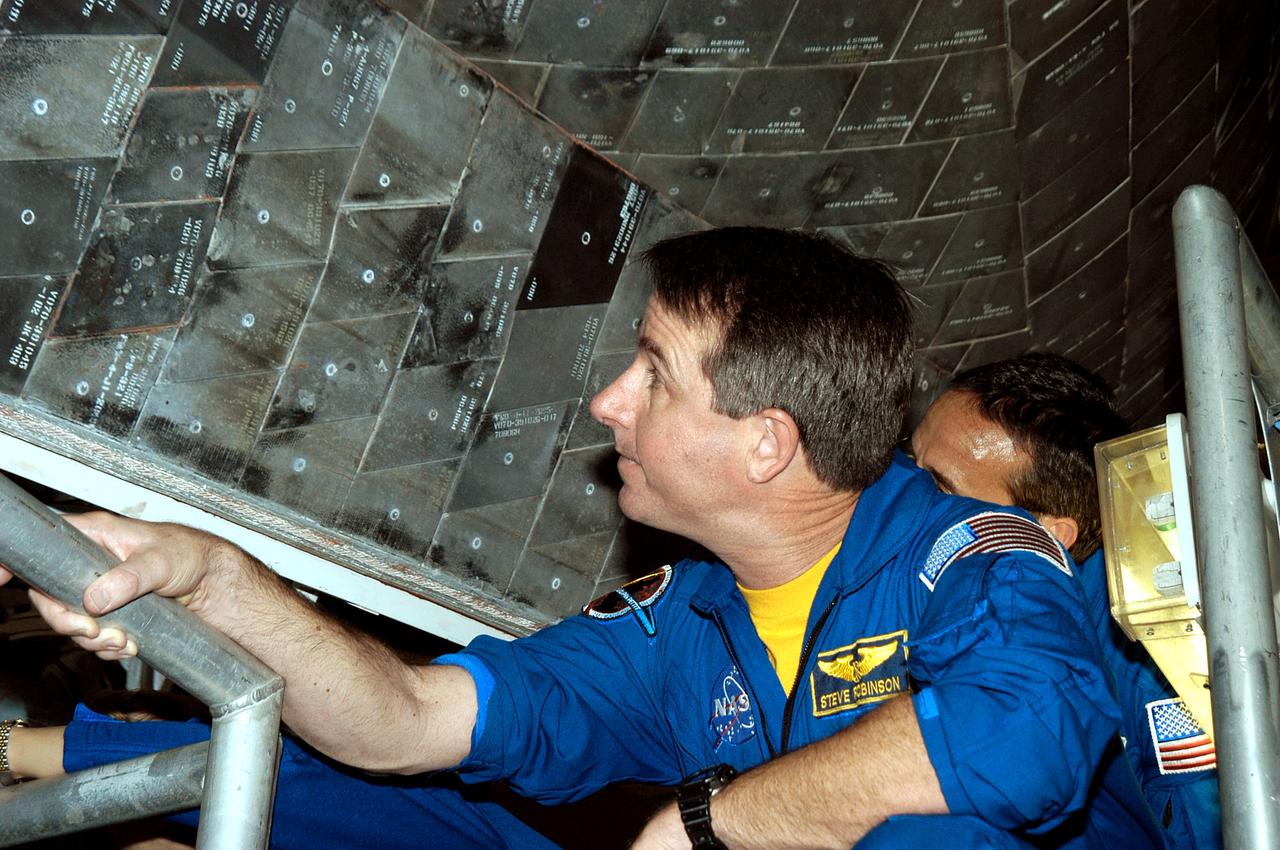
KENNEDY SPACE CENTER, FLA. - In the Orbiter Processing Facility, STS-114 Mission Specialist Stephen Robinson looks closely at the tiles underneath the orbiter Atlantis.  The STS-114 crew is at KSC to take part in crew equipment and orbiter familiarization.
KENNEDY SPACE CENTER, FLA. - In the Orbiter Processing Facility, STS-114 Mission Specialist Stephen Robinson looks closely at the tiles underneath the orbiter Atlantis. The STS-114 crew is at KSC to take part in crew equipment and orbiter familiarization.
STS066-208-025 (3-14 Nov. 1994) --- Mount Everest, the highest mountain in the world at 8,848 meters, was photographed by the crew members aboard the Space Shuttle Atlantis from 165 nautical miles above Earth.  Also seen are Cho Oyu (8,153 meters) northwest of Everest, and other peaks in what has been called the "Roof of the World". Abundant details of glacier surfaces, including moraines, crevasse fields and ice falls are displayed for study. Crew members onboard Atlantis were astronauts Donald R. McMonagle, Curtis L. Brown, Jr., Ellen Ochoa, Scott E. Parazynski and Joseph R. Tanner, along with Jean-François Clervoy of the European Space Agency (ESA). The six astronauts spent 11-days in Earth-orbit in support of the Atmospheric Laboratory for Applications and Science (ATLAS-3) mission.
Mt. Everest as seen from STS-66 shuttle Atlantis
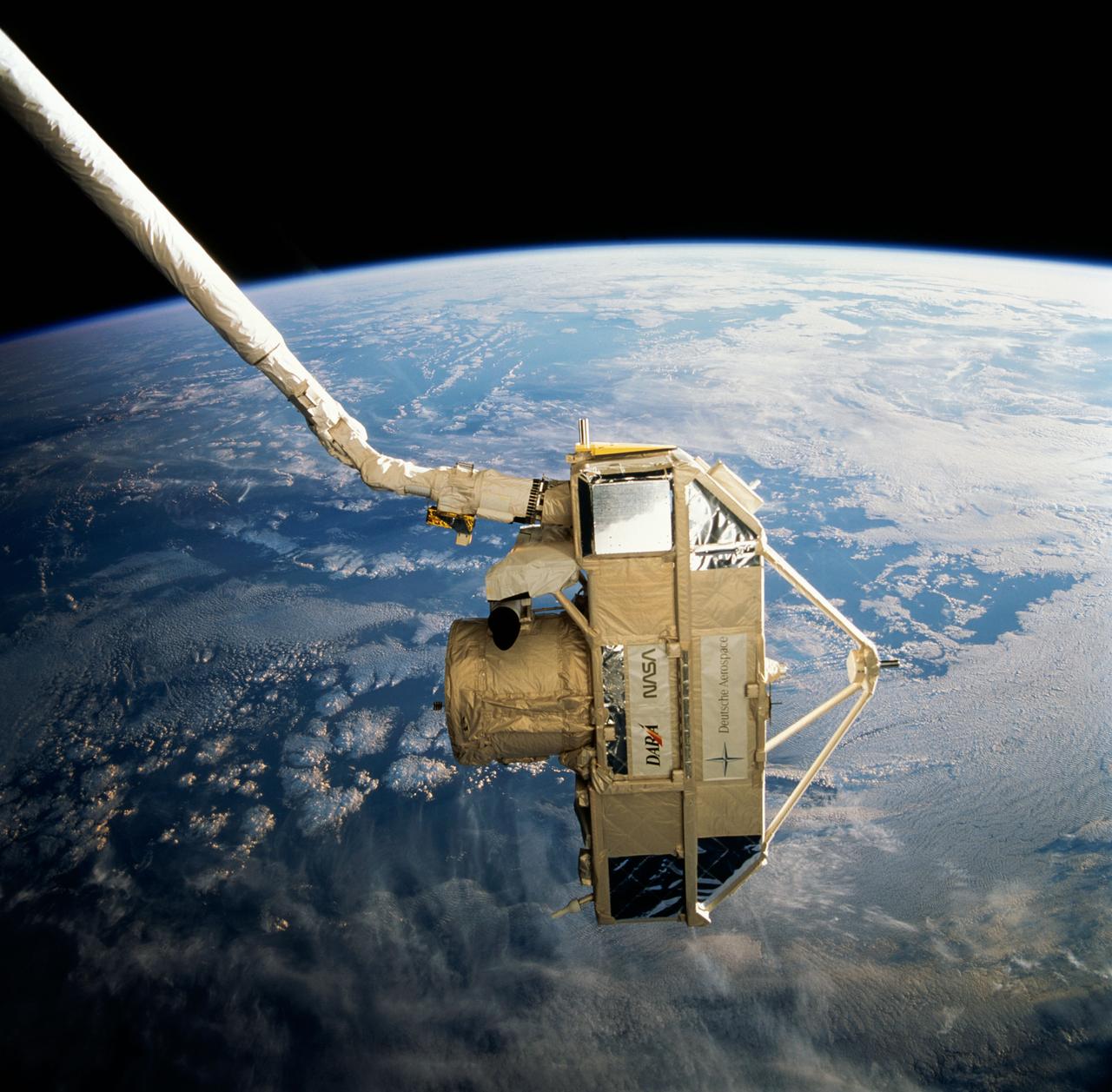
STS066-96-030 (3-14 Nov 1994) --- Masses of clouds serve as the backdrop for this close-up 70mm scene of the Cryogenic Infrared Spectrometers and Telescopes for the Atmosphere (CRISTA), attached to the Shuttle Pallet Satellite (SPAS).  CRISTA-SPAS was in the grasp of the Space Shuttle Atlantis' Remote Manipulator System (RMS) arm.  The crew deployed the CRISTA-SPAS on November 4, 1994 and the spacecraft remained in free-flight until November 12, 1994 when it was retrieved by the Canadian-built RMS, controlled by payload commander Ellen Ochoa.  Other crew members onboard Atlantis were astronauts Donald R. McMonagle, Curtis L. Brown, Jr., Scott E. Parazynski and Joseph R. Tanner, along with Jean-Francois Clervoy of ESA.  The six astronauts spent 11-days in Earth-orbit in support of the Atmospheric Laboratory for Applications and Science (ATLAS-3) mission.
CRISTA-SPAS payload on the STS-66 shuttle Atlantis RMS arm
STS066-129-043 (3-14 Nov 1994) --- Clouds over the Atlantic Ocean serve as the backdrop for this 70mm scene of the Cryogenic Infrared Spectrometers and Telescopes for the Atmosphere (CRISTA), attached to the Shuttle Pallet System (SPAS).  CRISTA-SPAS was in the grasp of the Space Shuttle Atlantis' Remote Manipulator System (RMS) arm.  The crew deployed the CRISTA-SPAS on November 4, 1994 and the tandem remained in free-flight until November 12, 1994 when it was retrieved by the Canadian-built RMS, controlled by payload commander Ellen Ochoa.  Other crew members onboard Atlantis were astronauts Donald R. McMonagle, Curtis L. Brown, Jr., Scott E. Parazynski and Joseph R. Tanner, along with Jean-François Clervoy of the European Space Agency (ESA).  The six astronauts spent 11-days in Earth-orbit in support of the Atmospheric Laboratory for Applications and Science (ATLAS-3) mission.
CRISTA-SPAS payload in the payload bay of STS-66 shuttle Atlantis
61B-38-36W (28 Nov 1985) --- The 4,144-pound RCA Satcom K-2 communications satellite is   photographed as it spins from the cargo bay of the Earth-orbiting Atlantis.  A TV camera at right records the deployment for a later playback to Earth.  This frame was photographed with a handheld Hasselblad camera inside the spacecraft.
Deployment of the RCA Satcom K-2 communications satellite
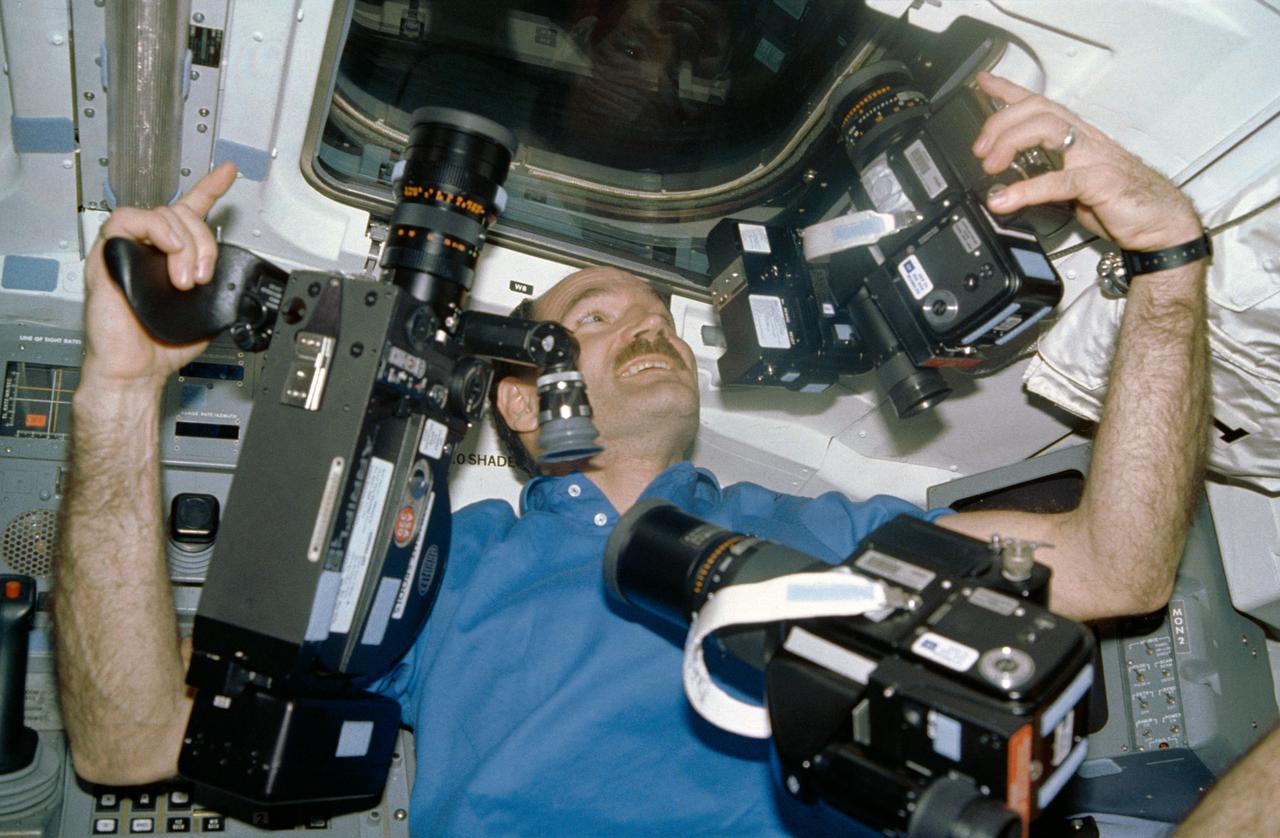
STS027-14-021 (2-6 Dec. 1988) --- Astronaut Guy S. Gardner, STS-27 pilot, appears to have enough cameras as he prepares to take photographs onboard the Earth-orbiting space shuttle Atlantis. Photo credit: NASA
STS-27 Pilot Gardner works with cameras on aft flight deck at window W8