
National Aeronautics and Space Administration (NASA) Lewis Research Center researcher Americo Forestieri aims a ruby laser beam at a crystal to determine the effects of its radiation. Forestieri was a researcher in the Electric Component Experiment Section of the Space Power System Division. Lewis was in the midst of a long-term effort to develop methods of delivering electrical power to spacecraft using nuclear, solar, or electrochemical technologies. Ruby lasers contain a ruby crystal with mirrors on either side. The laser action is created when a high-intensity lamp shines around the ruby and excites the electrons in the ruby’s chromium atoms. After the excitation, the electrons emit their ruby-red light. The mirrors reflect some of this red light back and forth inside the ruby which causes other excited chromium atoms to produce additional red light. This continues until the light pulse reaches high power levels and consumes all of the energy stored in the crystal. Forestieri used optical absorption and electron paramagnetic resonance techniques to study the extent and manner in which the radiation interacted with the samples. He determined that individual bands were assigned to specific electronic transitions. He also studied the atomic changes in the ruby crystals after irradiation. He found that complex interactions depend on the crystal pretreatment, purity, and irradiation dose.
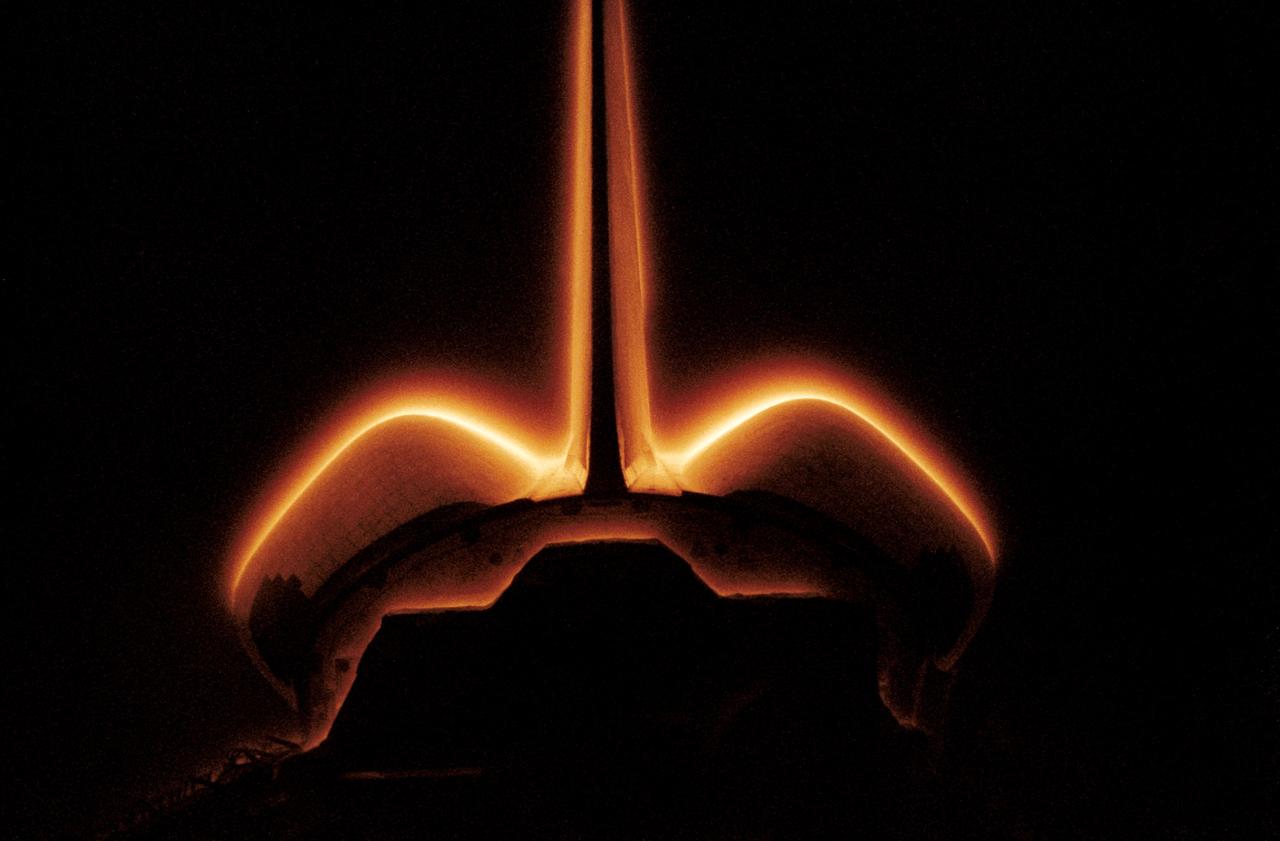
STS062-42-026 (4-18 March 1994) --- This 35mm frame, photographed as the Space Shuttle Columbia was orbiting Earth during a "night" pass, documents the glow phenomenon surrounding the vertical stabilizer and the Orbital Maneuvering System (OMS) pods of the spacecraft.
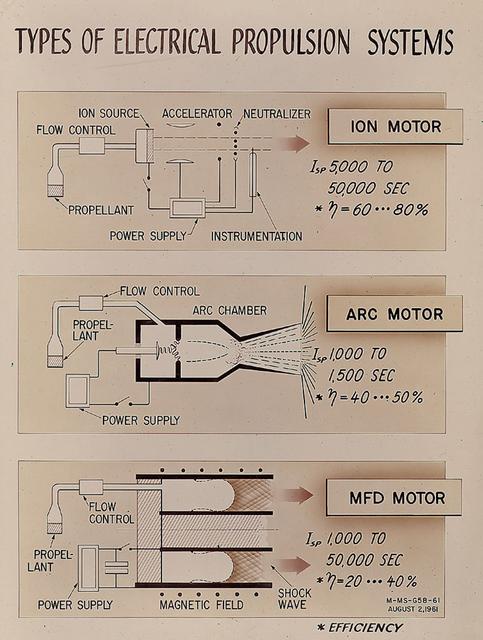
As presented by Gerhard Heller of Marshall Space Flight Center's Research Projects Division in 1961, this chart illustrates three basic types of electric propulsion systems then under consideration by NASA. The ion engine (top) utilized cesium atoms ionized by hot tungsten and accelerated by an electrostatic field to produce thrust. The arc engine (middle) achieved propulsion by heating a propellant with an electric arc and then producing an expansion of the hot gas or plasma in a convergent-divergent duct. The electromagnetic, or MFD engine (bottom) manipulated strong magnetic fields to interact with a plasma and produce acceleration.
![This graphic shows a new radiation zone surrounding Jupiter, located just above the atmosphere near the equator, that has been discovered by NASA's Juno mission. The new radiation zone is depicted here as a glowing blue area around the planet's middle. This radiation zone includes energetic hydrogen, oxygen and sulfur ions moving at close to the speed of light (referred to as "relativistic" speeds). It resides inside Jupiter's previously known radiation belts. The zone was identified by the mission's Jupiter Energetic Particle Detector Instrument (JEDI), enabled by Juno's unique close approach to the planet during the spacecraft's science flybys (2,100 miles or 3,400 kilometers from the cloud tops). Juno scientists believe the particles creating this region of intense radiation are derived from energetic neutral atoms -- that is, fast-moving atoms without an electric charge -- coming from the tenuous gas around Jupiter's moons Io and Europa. The neutral atoms then become ions -- atoms with an electric charge -- as their electrons are stripped away by interaction with the planet's upper atmosphere. (This discovery is discussed further in an issue of the journal Geophysical Research Letters [Kollmann et al. (2017), Geophys. Res. Lett., 44, 5259-5268].) Juno also has detected signatures of a population of high-energy, heavy ions in the inner edges of Jupiter's relativistic electron radiation belt. This radiation belt was previously understood to contain mostly electrons moving at near light speed. The signatures of the heavy ions are observed at high latitude locations within the electron belt -- a region not previously explored by spacecraft. The origin and exact species of these heavy ions is not yet understood. Juno's Stellar Reference Unit (SRU-1) star camera detects the signatures of this population as extremely high noise in images collected as part of the mission's radiation monitoring investigation. The locations where the heavy ions were detected are indicated on the graphic by two bright, glowing spots along Juno's flight path past the planet, which is shown as a white line. The invisible lines of Jupiter's magnetic field are also portrayed here for context as faint, bluish lines. https://photojournal.jpl.nasa.gov/catalog/PIA22179](https://images-assets.nasa.gov/image/PIA22179/PIA22179~small.jpg)
This graphic shows a new radiation zone surrounding Jupiter, located just above the atmosphere near the equator, that has been discovered by NASA's Juno mission. The new radiation zone is depicted here as a glowing blue area around the planet's middle. This radiation zone includes energetic hydrogen, oxygen and sulfur ions moving at close to the speed of light (referred to as "relativistic" speeds). It resides inside Jupiter's previously known radiation belts. The zone was identified by the mission's Jupiter Energetic Particle Detector Instrument (JEDI), enabled by Juno's unique close approach to the planet during the spacecraft's science flybys (2,100 miles or 3,400 kilometers from the cloud tops). Juno scientists believe the particles creating this region of intense radiation are derived from energetic neutral atoms -- that is, fast-moving atoms without an electric charge -- coming from the tenuous gas around Jupiter's moons Io and Europa. The neutral atoms then become ions -- atoms with an electric charge -- as their electrons are stripped away by interaction with the planet's upper atmosphere. (This discovery is discussed further in an issue of the journal Geophysical Research Letters [Kollmann et al. (2017), Geophys. Res. Lett., 44, 5259-5268].) Juno also has detected signatures of a population of high-energy, heavy ions in the inner edges of Jupiter's relativistic electron radiation belt. This radiation belt was previously understood to contain mostly electrons moving at near light speed. The signatures of the heavy ions are observed at high latitude locations within the electron belt -- a region not previously explored by spacecraft. The origin and exact species of these heavy ions is not yet understood. Juno's Stellar Reference Unit (SRU-1) star camera detects the signatures of this population as extremely high noise in images collected as part of the mission's radiation monitoring investigation. The locations where the heavy ions were detected are indicated on the graphic by two bright, glowing spots along Juno's flight path past the planet, which is shown as a white line. The invisible lines of Jupiter's magnetic field are also portrayed here for context as faint, bluish lines. https://photojournal.jpl.nasa.gov/catalog/PIA22179
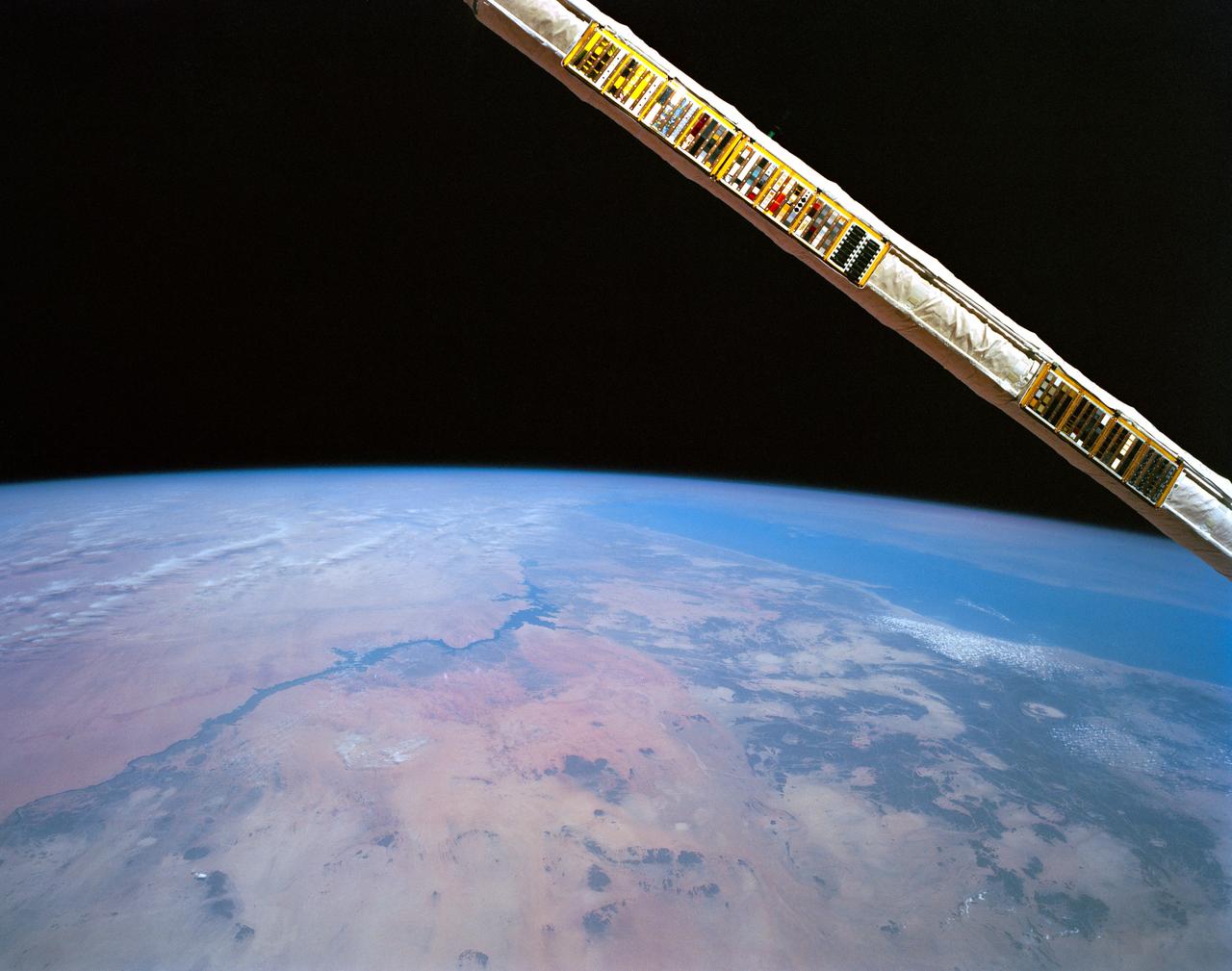
STS052-152-026 (22Oct-1 Nov 1992) --- Backdropped over eastern Egypt, the Canadian-built remote manipulator system (RMS) attached to NASA's Earth-orbiting Space Shuttle Columbia displays a Canadian Space Agency (CSA) experiment. Materials Exposure in Low Earth Orbit (MELEO) is one of a number of Canadian experiments which flew aboard Columbia for the ten-day STS-52 mission. Principal investigator for the experiment is Dr. David G. Zimick of the CSA. Plastic and composite materials used on the external surfaces of spacecraft have been found to degrade in the harsh environment of space. Evidence suggests that this degradation is caused by interaction with atomic oxygen which induces damaging chemical and physical reactions. The result is a loss in mass, strength, stiffness and stability of size and shape. During the mission, MELEO exposed over 350 material specimens mounted on "witness plates" on the RMS arm. The specimen collection will be analyzed in the weeks following the mission. Typical spacecraft materials and new developments in protective measures against atomic oxygen were tested as part of the MELEO experiment.
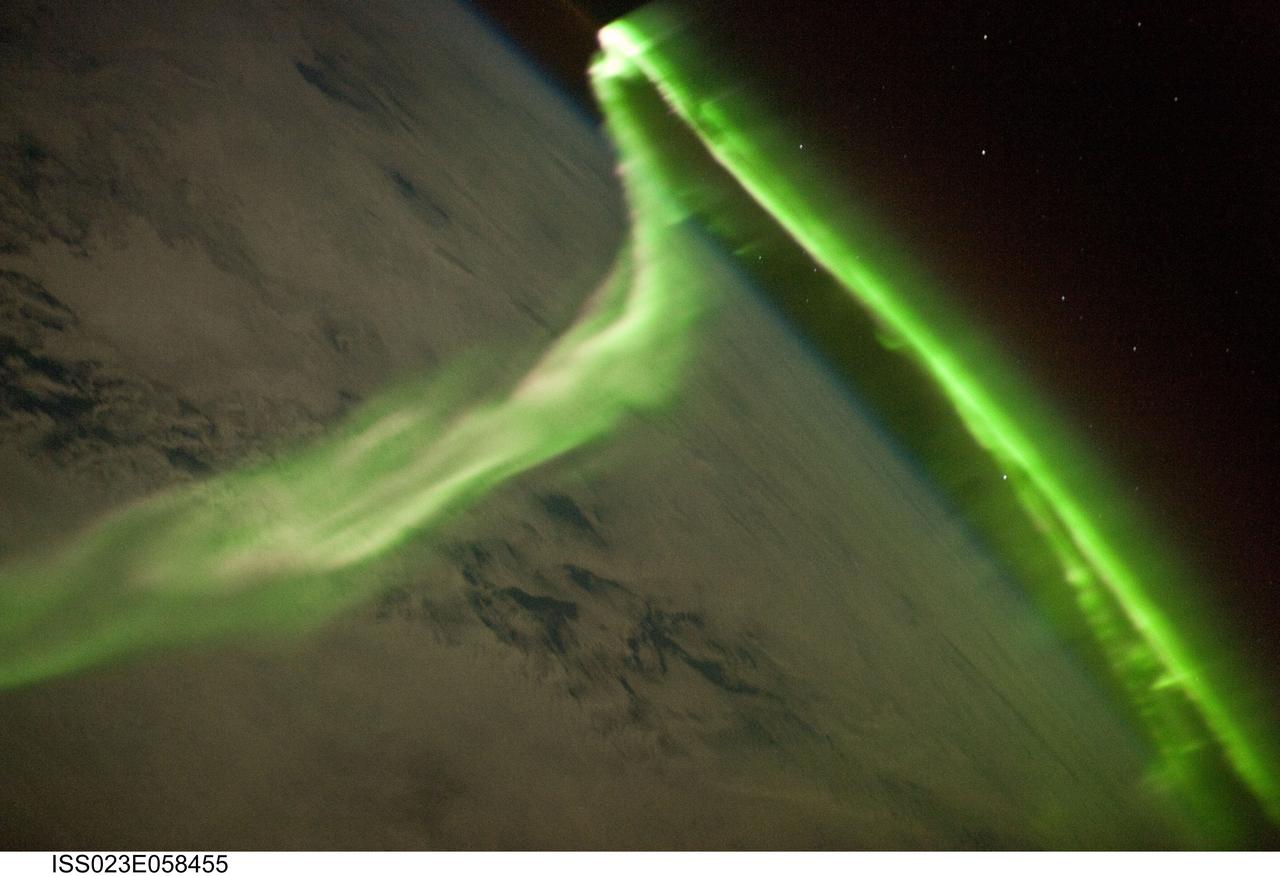
ISS023-E-058455 (29 May 2010) --- Aurora Australis is featured in this image photographed by an Expedition 23 crew member on the International Space Station. Among the views of Earth afforded crew members aboard the ISS, surely one of the most spectacular is of the aurora. These ever-shifting displays of colored ribbons, curtains, rays, and spots are most visible near the North (Aurora Borealis) and South (Aurora Australis) Poles as charged particles streaming from the sun (the solar wind) interact with Earth’s magnetic field, resulting in collisions with atoms of oxygen and nitrogen in the upper atmosphere. The atoms are excited by these collisions, and typically emit photons as a means of returning to their original energy state. The photons form the aurora that we see. The most commonly observed color of aurora is green, caused by photons (light) emitted by excited oxygen atoms at wavelengths centered at 0.558 micrometers, or millionths of a meter. Visible light is reflected from healthy (green) plant leaves at approximately the same wavelength. Red auroras are generated by light emitted at a longer wavelength (0.630 micrometers), and other colors such as blue and purple are also sometimes observed. While auroras are generally only visible close to the poles, severe magnetic storms impacting Earth’s magnetic field can shift them towards the equator. This striking aurora image was taken during a geomagnetic storm that was most likely caused by a coronal mass ejection from the sun on May 24, 2010. The ISS was located over the Southern Indian Ocean at an altitude of 350 kilometers, with the observer most likely looking towards Antarctica (not visible) and the South Pole. The aurora has a sinuous ribbon shape that separates into discrete spots near the lower right corner of the image. While the dominant coloration of the aurora is green, there are faint suggestions of red photon emission as well (light fuscia tones at center left). Dense cloud cover is dimly visible below the aurora. The curvature of Earth’s horizon, or limb, is clearly visible as is the faint blue line of the upper atmosphere directly above at top center. Several stars appear as bright pinpoints against the blackness of space at top right.
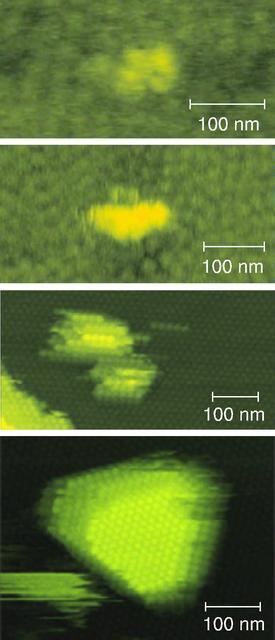
Watching molecules of the iron-storing protein apoferritin come together to form a nucleus reveals some interesting behavior. In this series of images, researchers observed clusters of four molecules at the corners of a diamond shape (top). As more molecules attach to the cluster, they arrange themselves into rods (second from top), and a raft-like configuration of molecules forms the critical nucleus (third from top), suggesting that crystal growth is much slower than it could be were the molecules arranged in a more compact formation. In the final image, a crystallite consisting of three layers containing approximately 60 to 70 molecules each is formed. Atomic force microscopy made visualizing the process of nucleation possible for the first time. The principal investigator is Peter Vekilov, of the University of Alabama in Huntsville. Vekilov's team at UAH studies protein solutions as they change phases from liquids to crystalline solids. They want to know if the molecules in the solution interact with one another, and if so, how, from the perspectives of thermodynamics and kinetics. They want to understand which forces -- electrical, electrostatic, hydrodynamic, or other kinds of forces -- are responsible for the interactions. They also study nucleation, the begirning stage of crystallization. This process is important to understand because it sets the stage for crystal growth in all kinds of solutions and liquid melts that are important in such diverse fields as agriculture, medicine, and the fabrication of metal components. Nucleation can determine the rate of crystal growth, the number of crystals that will be formed, and the quality and size of the crystals.
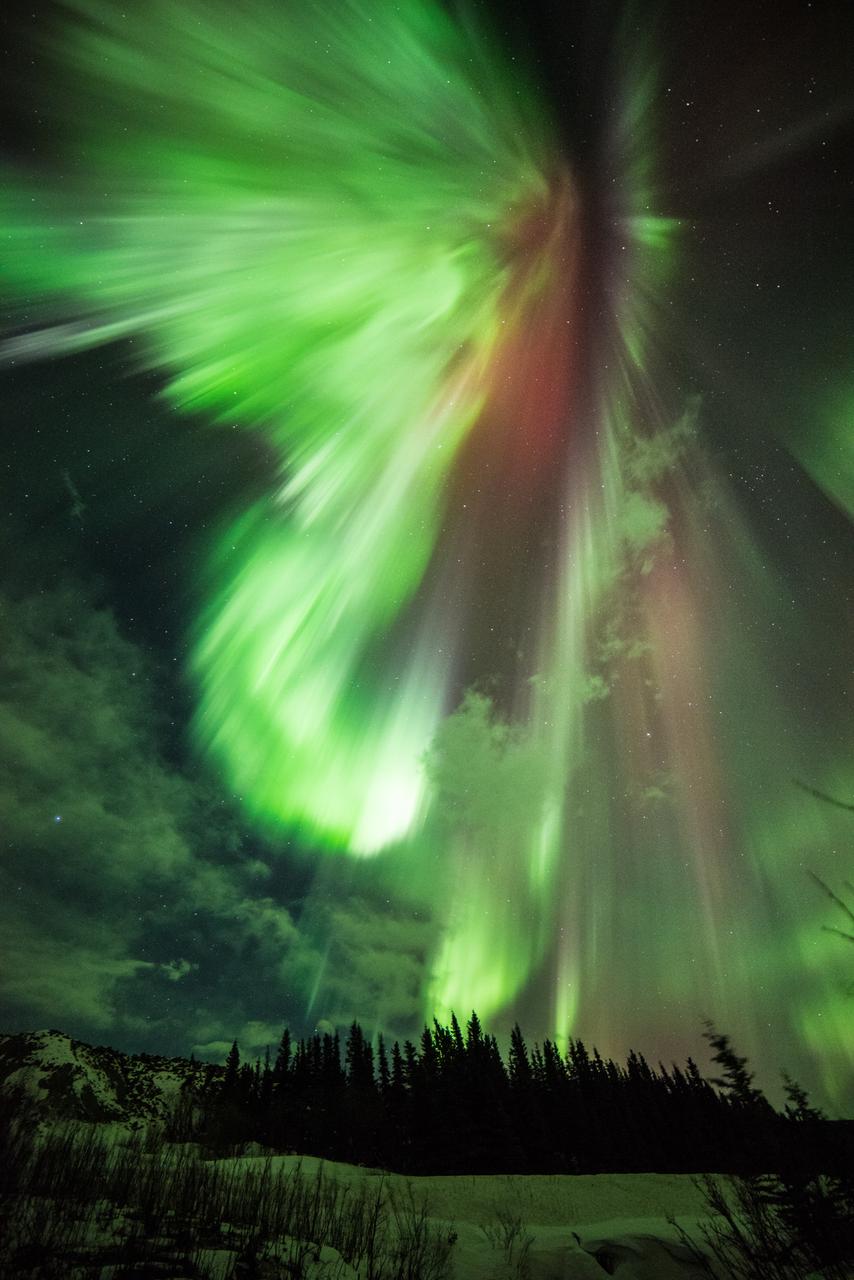
Geomagnetic Storms Sometimes during the solar magnetic events, solar explosions hurl clouds of magnetized particles into space. Traveling more than a million miles per hour, these coronal mass ejections, or CMEs, made up of hot material called plasma take up to three days to reach Earth. Spacecraft and satellites in the path of CMEs can experience glitches as these plasma clouds pass by. In near-Earth space, magnetic reconnection incites explosions of energy driving charged solar particles to collide with atoms in Earth’s upper atmosphere. We see these collisions near Earth’s polar regions as the aurora. The prevalence of specific gases in the atmosphere determines the color of the aurora. For example, if charged particles strike oxygen atoms, the aurora will appear green. Excited nitrogen closer to 60 miles above Earth’s surface will produce a blood red color. Three spacecraft from NASA’s Time History of Events and Macroscale Interactions during Substorms (THEMIS) mission, observe these outbursts known as substorms. Substorms can intensify aurora’s near Earth’s poles. To learn more about the aurora, go to NASA’s THEMIS mission: <a href="http://www.nasa.gov/mission_pages/themis/main/index.html" rel="nofollow">www.nasa.gov/mission_pages/themis/main/index.html</a> ---------- Original caption: How about a little something green for St. Patrick's Day? "St. Patrick's Aurora" was taken at Donnelly Creek, Alaska at 1:30 am, March 17, 2015 by our good friend Sebastian Saarloos! You can see more images from Sebastian here: <a href="http://www.facebook.com/SebastianSaarloos" rel="nofollow">www.facebook.com/SebastianSaarloos</a> Credit: Sebastian Saarloos <b><a href="http://www.nasa.gov/audience/formedia/features/MP_Photo_Guidelines.html" rel="nofollow">NASA image use policy.</a></b> <b><a href="http://www.nasa.gov/centers/goddard/home/index.html" rel="nofollow">NASA Goddard Space Flight Center</a></b> enables NASA’s mission through four scientific endeavors: Earth Science, Heliophysics, Solar System Exploration, and Astrophysics. Goddard plays a leading role in NASA’s accomplishments by contributing compelling scientific knowledge to advance the Agency’s mission. <b>Follow us on <a href="http://twitter.com/NASAGoddardPix" rel="nofollow">Twitter</a></b> <b>Like us on <a href="http://www.facebook.com/pages/Greenbelt-MD/NASA-Goddard/395013845897?ref=tsd" rel="nofollow">Facebook</a></b> <b>Find us on <a href="http://instagram.com/nasagoddard?vm=grid" rel="nofollow">Instagram</a></b>

Nova Stars are essentially giant fusion reactions occurring in the vacuum of space. Because stars have so much mass, they possess powerful gravitational force—but they don’t collapse because of the outward force generated by nuclear fusion, continually converting hydrogen atoms to helium. Sometimes stars begin orbiting each other, forming a binary star system. Typically this involves a white dwarf star and a red giant. Orbiting the red giant like a moon, the dwarf star rips matter from its companion until it essentially gags on the excess, coughing hot gas and radiation into space. This dramatic phenomenon is relatively common, and the white dwarf is not destroyed in the resulting nova. To learn more about x-ray emissions, read about NASA’s Chandra mission: <a href="http://www.nasa.gov/mission_pages/chandra/main/" rel="nofollow">www.nasa.gov/mission_pages/chandra/main/</a> --- Original caption: In Hollywood blockbusters, explosions are often among the stars of the show. In space, explosions of actual stars are a focus for scientists who hope to better understand their births, lives, and deaths and how they interact with their surroundings. Using NASA’s Chandra X-ray Observatory, astronomers have studied one particular explosion that may provide clues to the dynamics of other, much larger stellar eruptions. A team of researchers pointed the telescope at GK Persei, an object that became a sensation in the astronomical world in 1901 when it suddenly appeared as one of the brightest stars in the sky for a few days, before gradually fading away in brightness. Today, astronomers cite GK Persei as an example of a “classical nova,” an outburst produced by a thermonuclear explosion on the surface of a white dwarf star, the dense remnant of a Sun-like star. Read Full Article: <a href="http://www.nasa.gov/mission_pages/chandra/mini-supernova-explosion-could-have-big-impact.html" rel="nofollow">www.nasa.gov/mission_pages/chandra/mini-supernova-explosi...</a> <b><a href="http://www.nasa.gov/audience/formedia/features/MP_Photo_Guidelines.html" rel="nofollow">NASA image use policy.</a></b> <b><a href="http://www.nasa.gov/centers/goddard/home/index.html" rel="nofollow">NASA Goddard Space Flight Center</a></b> enables NASA’s mission through four scientific endeavors: Earth Science, Heliophysics, Solar System Exploration, and Astrophysics. Goddard plays a leading role in NASA’s accomplishments by contributing compelling scientific knowledge to advance the Agency’s mission. <b>Follow us on <a href="http://twitter.com/NASAGoddardPix" rel="nofollow">Twitter</a></b> <b>Like us on <a href="http://www.facebook.com/pages/Greenbelt-MD/NASA-Goddard/395013845897?ref=tsd" rel="nofollow">Facebook</a></b> <b>Find us on <a href="http://instagrid.me/nasagoddard/?vm=grid" rel="nofollow">Instagram</a></b>
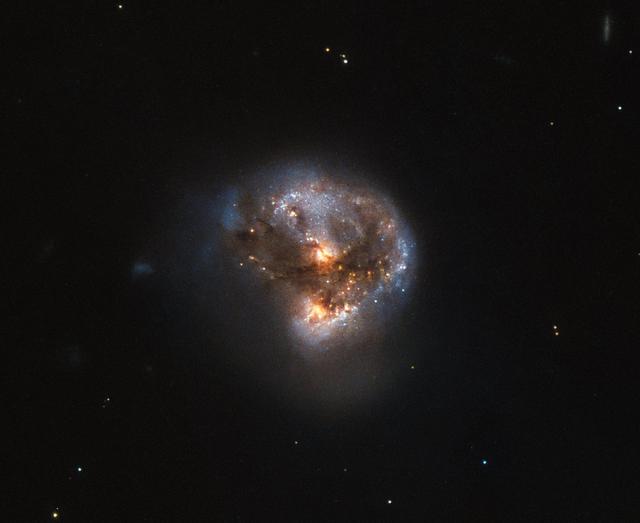
This galaxy has a far more exciting and futuristic classification than most — it hosts a megamaser. Megamasers are intensely bright, around 100 million times brighter than the masers found in galaxies like the Milky Way. The entire galaxy essentially acts as an astronomical laser that beams out microwave emission rather than visible light (hence the ‘m’ replacing the ‘l’). A megamaser is a process that involves some components within the galaxy (like gas) that is in the right physical condition to cause the amplification of light (in this case, microwaves). But there are other parts of the galaxy (like stars for example) that aren’t part of the maser process. This megamaser galaxy is named IRAS 16399-0937 and is located over 370 million light-years from Earth. This NASA/ESA Hubble Space Telescope image belies the galaxy’s energetic nature, instead painting it as a beautiful and serene cosmic rosebud. The image comprises observations captured across various wavelengths by two of Hubble’s instruments: the Advanced Camera for Surveys (ACS), and the Near Infrared Camera and Multi-Object Spectrometer (NICMOS). NICMOS’s superb sensitivity, resolution, and field of view gave astronomers the unique opportunity to observe the structure of IRAS 16399-0937 in detail. They found it hosts a double nucleus — the galaxy’s core is thought to be formed of two separate cores in the process of merging. The two components, named IRAS 16399N and IRAS 16399S for the northern and southern parts respectively, sit over 11,000 light-years apart. However, they are both buried deep within the same swirl of cosmic gas and dust and are interacting, giving the galaxy its peculiar structure. The nuclei are very different. IRAS 16399S appears to be a starburst region, where new stars are forming at an incredible rate. IRAS 16399N, however, is something known as a LINER nucleus (Low Ionization Nuclear Emission Region), which is a region whose emission mostly stems from weakly-ionized or neutral atoms of particular gases. The northern nucleus also hosts a black hole with some 100 million times the mass of the sun! Image credit: ESA/Hubble & NASA, Acknowledgement: Judy Schmidt (geckzilla) <b><a href="http://www.nasa.gov/audience/formedia/features/MP_Photo_Guidelines.html" rel="nofollow">NASA image use policy.</a></b> <b><a href="http://www.nasa.gov/centers/goddard/home/index.html" rel="nofollow">NASA Goddard Space Flight Center</a></b> enables NASA’s mission through four scientific endeavors: Earth Science, Heliophysics, Solar System Exploration, and Astrophysics. Goddard plays a leading role in NASA’s accomplishments by contributing compelling scientific knowledge to advance the Agency’s mission. <b>Follow us on <a href="http://twitter.com/NASAGoddardPix" rel="nofollow">Twitter</a></b> <b>Like us on <a href="http://www.facebook.com/pages/Greenbelt-MD/NASA-Goddard/395013845897?ref=tsd" rel="nofollow">Facebook</a></b> <b>Find us on <a href="http://instagrid.me/nasagoddard/?vm=grid" rel="nofollow">Instagram</a></b>