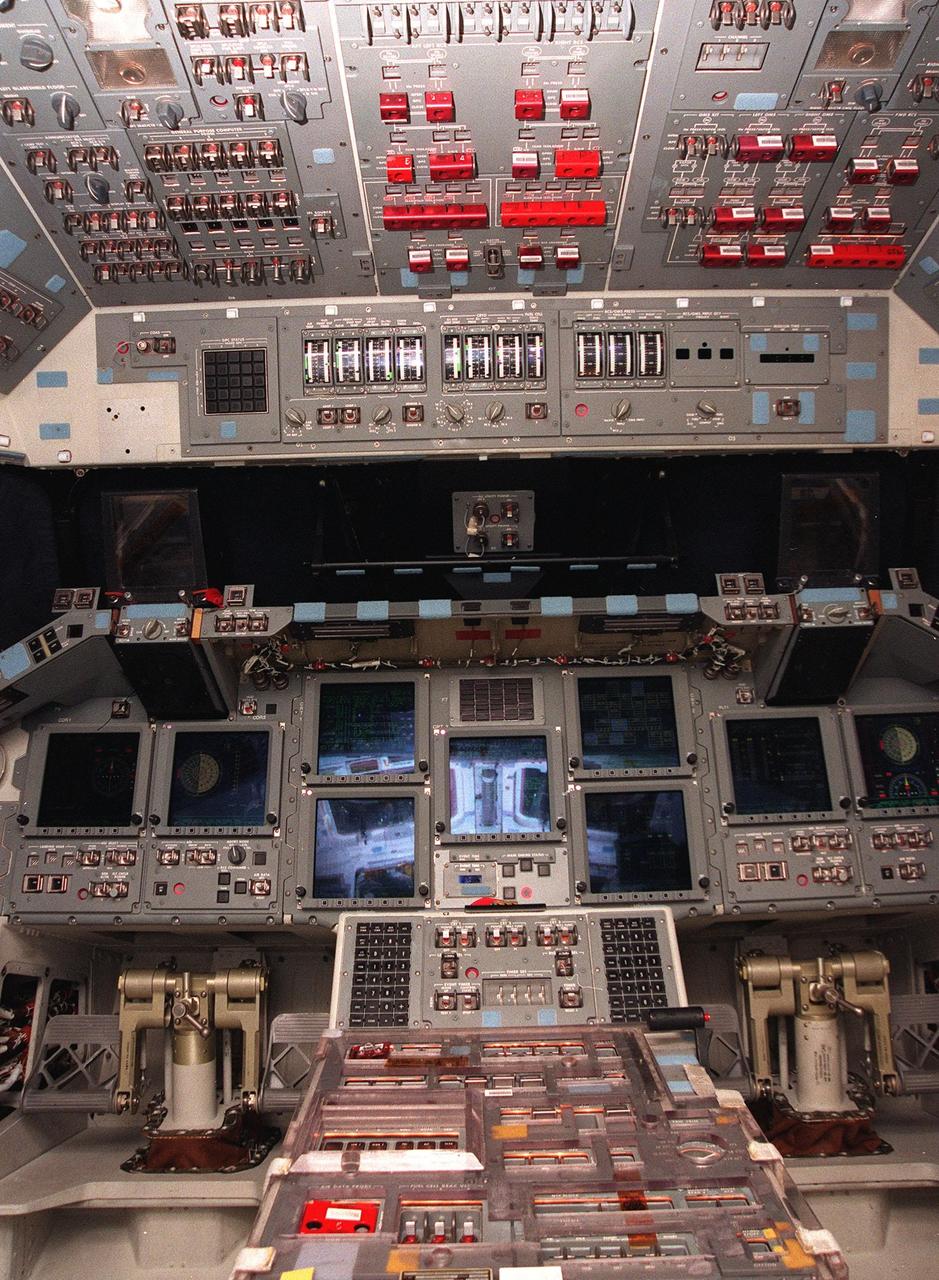
The cockpit of the orbiter Atlantis is revealed with its new full-color, flat panel Multifunction Electronic Display Subsystem (MEDS), also called the "glass cockpit." The recently installed MEDS upgrade improves crew/orbiter interaction with easy-to-read, graphic portrayals of key flight indicators like attitude display and mach speed. The installation makes Atlantis the most modern orbiter in the fleet and equals the systems on current commercial jet airliners and military aircraft. Atlantis is scheduled to fly on mission STS-101 in early December
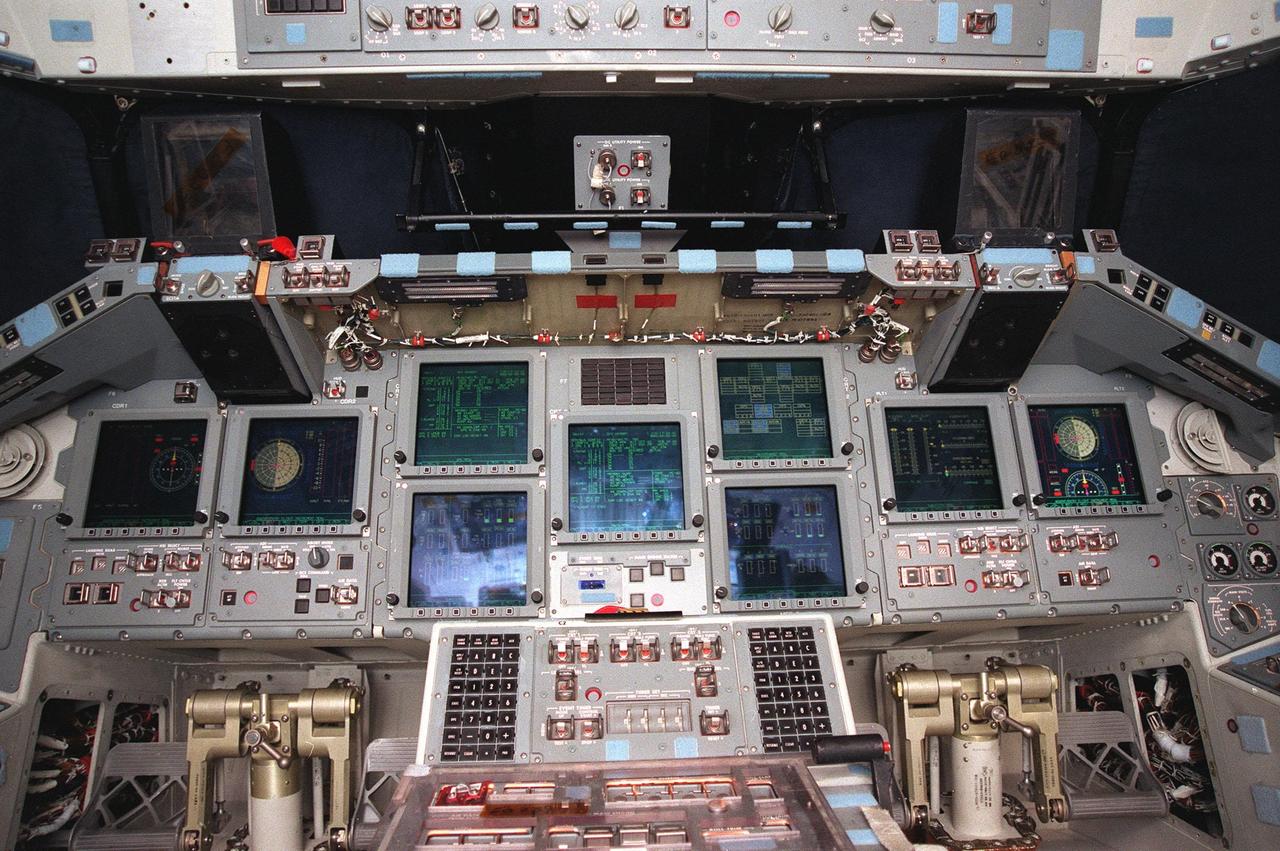
In this broad view, the new full-color, flat panel Multifunction Electronic Display Subsystem (MEDS) is shown in the cockpit of the orbiter Atlantis. It is often called the "glass cockpit." The recently installed MEDS upgrade improves crew/orbiter interaction with easy-to-read, graphic portrayals of key flight indicators like attitude display and mach speed. The installation makes Atlantis the most modern orbiter in the fleet and equals the systems on current commercial jet airliners and military aircraft. Atlantis is scheduled to fly on mission STS-101 in early December
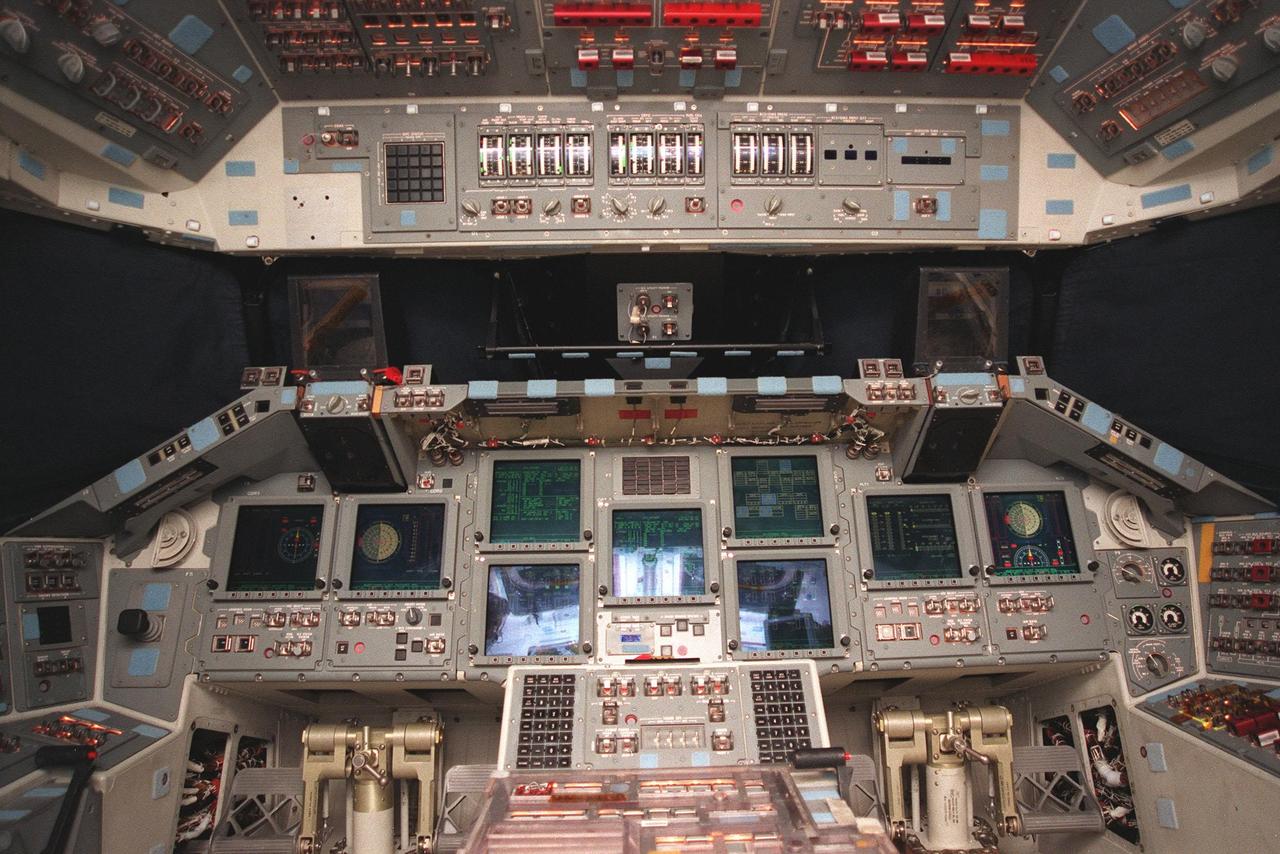
A new full-color, flat panel Multifunction Electronic Display Subsystem (MEDS) is shown in the cockpit of the orbiter Atlantis. It is often called the "glass cockpit." The recently installed MEDS upgrade improves crew/orbiter interaction with easy-to-read, graphic portrayals of key flight indicators like attitude display and mach speed. The installation makes Atlantis the most modern orbiter in the fleet and equals the systems on current commercial jet airliners and military aircraft. Atlantis is scheduled to fly on mission STS-101 in early December
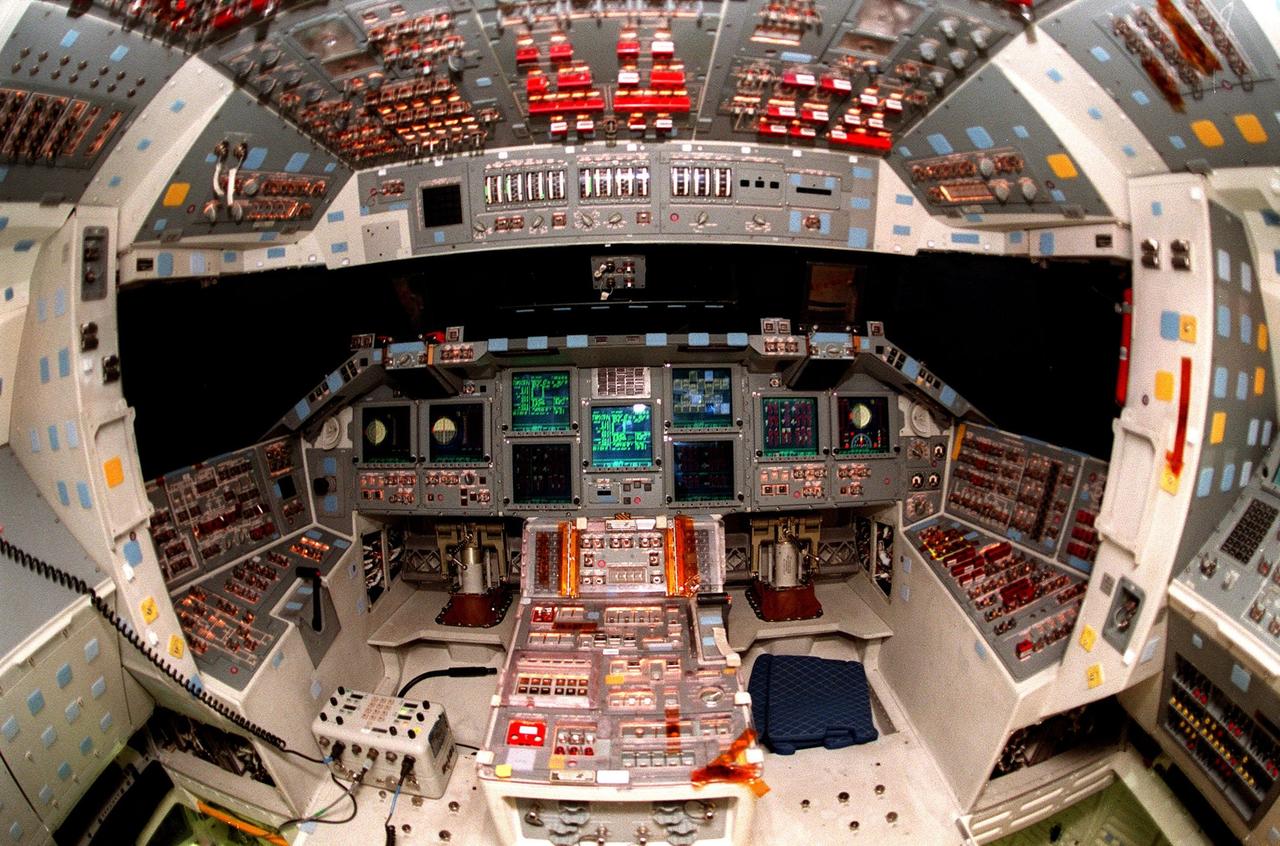
KENNEDY SPACE CENTER, FLA. -- The cockpit of the orbiter Atlantis is seen in the round, revealing the new full-color flat panel Multifunction Electronic Display Subsystem (MEDS), also called the "glass cockpit." The recently installed MEDS upgrade improves crew/orbiter interaction with easy-to-read, graphic portrayals of key flight indicators like attitude display and mach speed. The installation makes Atlantis the most modern orbiter in the fleet and equals the systems on current commercial jet airliners and military aircraft. Atlantis is scheduled to fly on mission STS-101 in early December
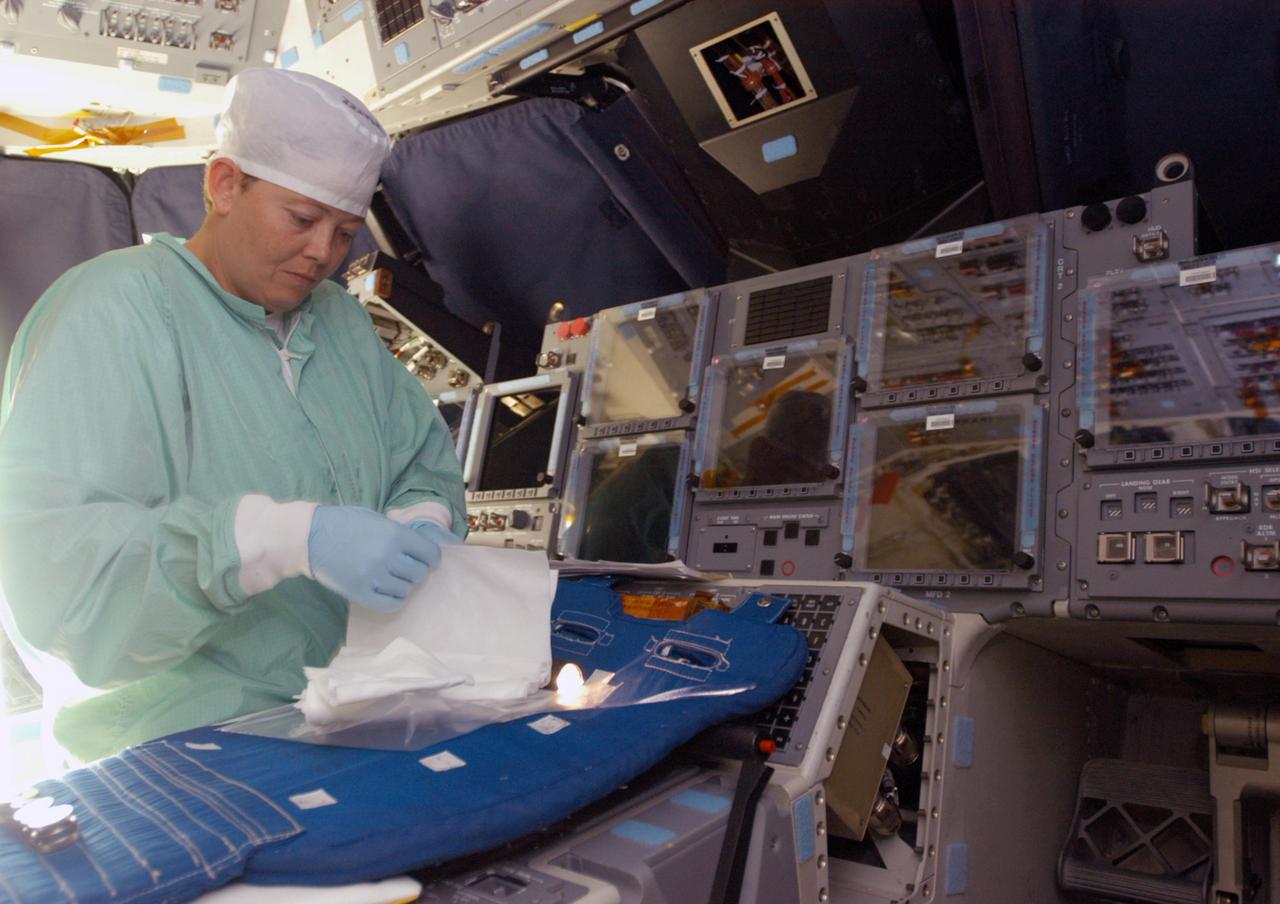
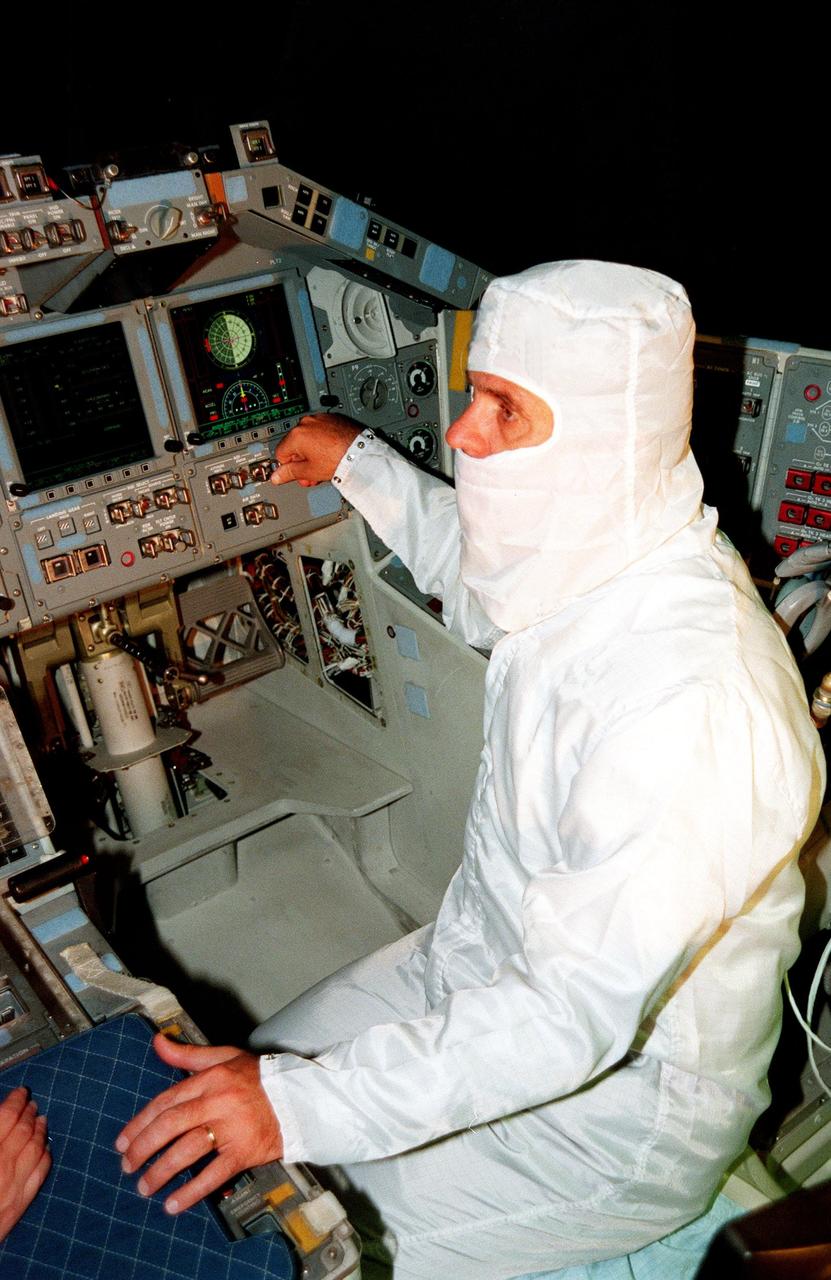
KENNEDY SPACE CENTER, FLA. - Carmen Prater, with United Space Alliance, works on the flight deck of the orbiter Endeavour in bay 2 of the Orbiter Processing Facility. She wears a “bunny suit,” clean room attire required for anyone coming in close proximity to the orbiter. Endeavour is undergoing major modifications, which include inspecting more than 150 miles of wiring, bonding 1,000 thermal tiles, and installing the Multifunction Electronic Display Subsystem - a state-of-the-art “glass cockpit.” The full-color, flat-panel MEDS upgrade improves crew/orbiter interaction with easy-to-read, graphic portrayals of key flight indicators like attitude display and mach speed.
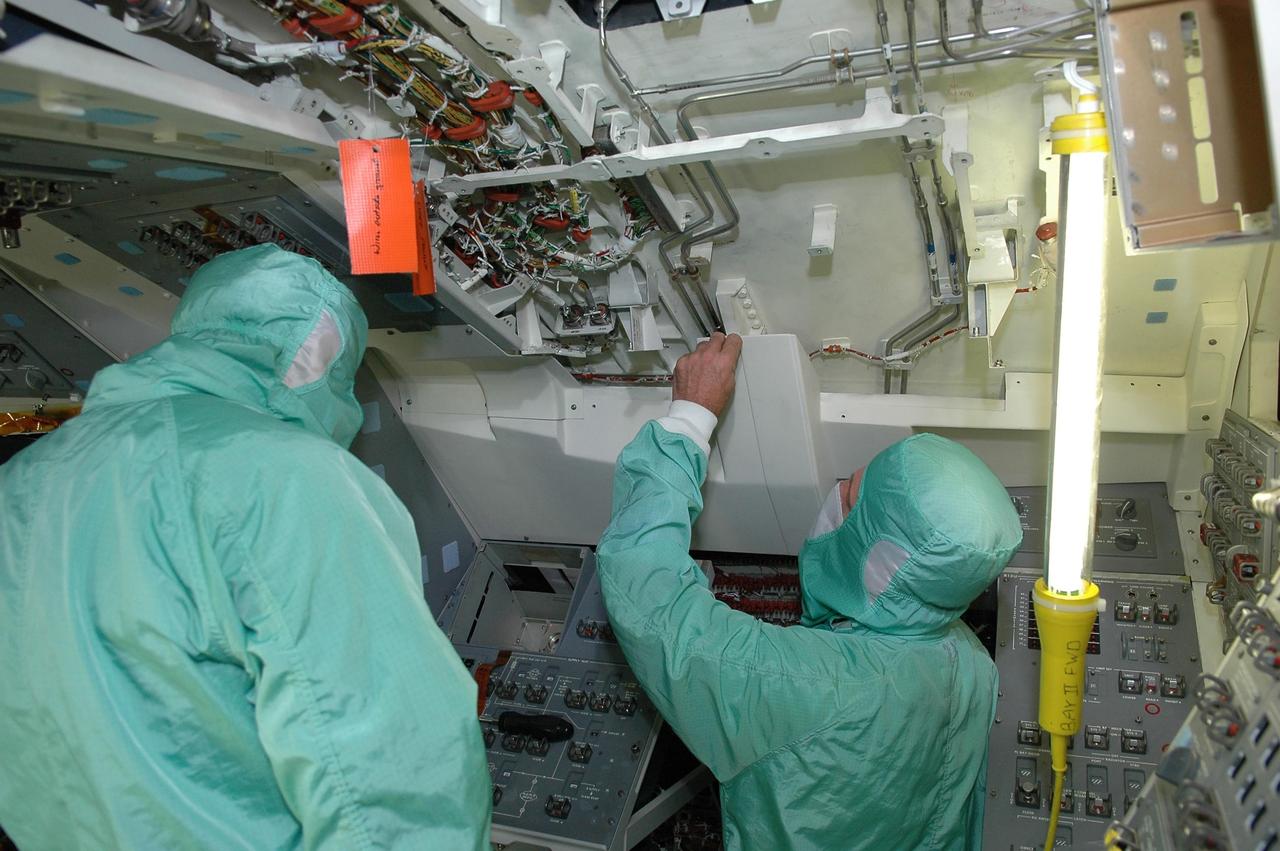
KENNEDY SPACE CENTER, FLA. - In bay 2 of the Orbiter Processing Facility, workers are installing the Multifunction Electronic Display Subsystem - a state-of-the-art “glass cockpit” - on the orbiter Endeavour. The “bunny suits” they are wearing are clean room attire required for anyone coming in close proximity to the orbiter. The full-color, flat-panel MEDS upgrade improves crew/orbiter interaction with easy-to-read, graphic portrayals of key flight indicators like attitude display and mach speed. Endeavour is undergoing major modifications, which include inspecting more than 150 miles of wiring and bonding 1,000 thermal tiles, along with installing the display system.
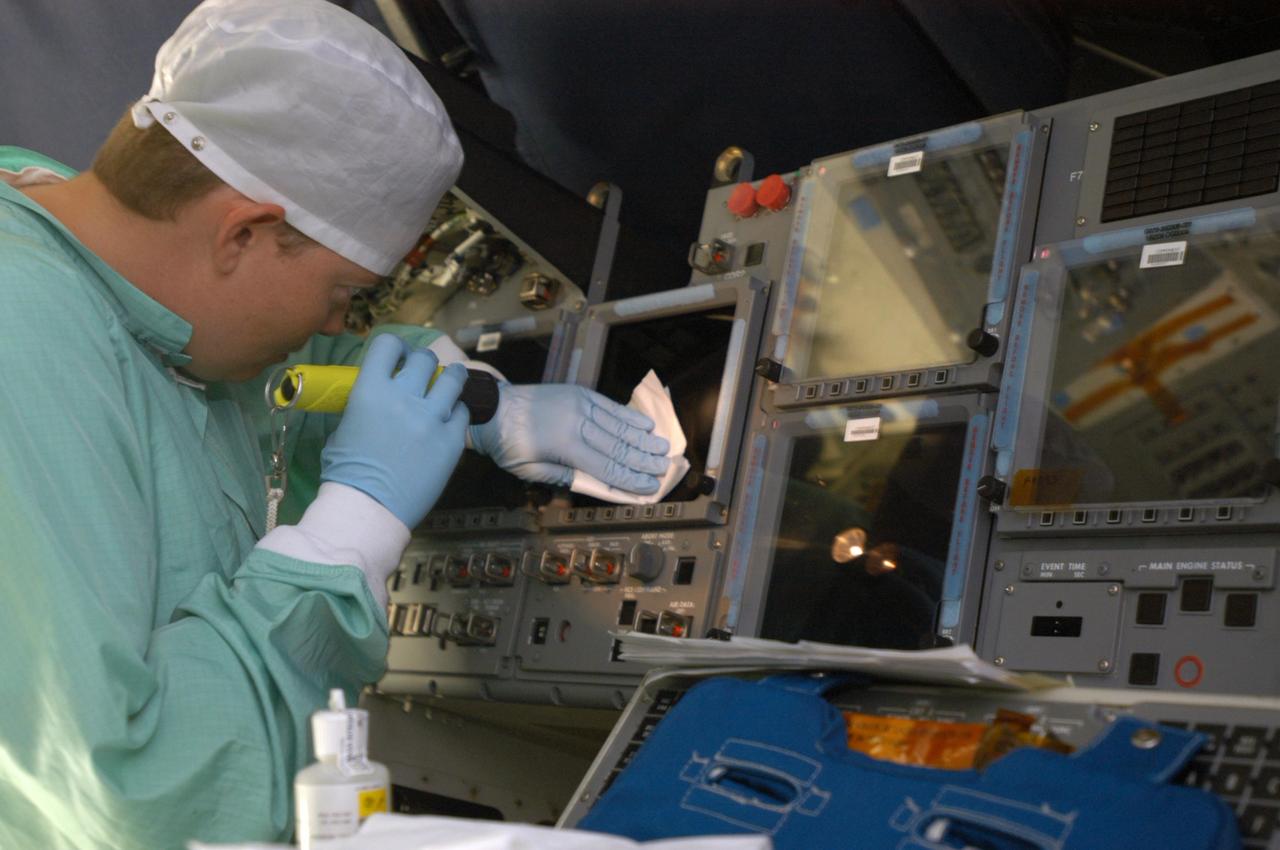
KENNEDY SPACE CENTER, FLA. - Carmen Prater, with United Space Alliance, cleans a screen on the flight deck of the orbiter Endeavour in bay 2 of the Orbiter Processing Facility. She wears a “bunny suit,” clean room attire required for anyone coming in close proximity to the orbiter. Endeavour is undergoing major modifications, which include inspecting more than 150 miles of wiring, bonding 1,000 thermal tiles, and installing the Multifunction Electronic Display Subsystem - a state-of-the-art “glass cockpit.” The full-color, flat-panel MEDS upgrade improves crew/orbiter interaction with easy-to-read, graphic portrayals of key flight indicators like attitude display and mach speed.

STS-101 Commander James Halsell (left) and STS-98 Commander Ken Cockrell (right) pause for a photo while looking over the recently installed Multifunction Electronic Display Subsystem (MEDS) in the cockpit of the orbiter Atlantis. The new full-color, flat panel MEDS improves crew/orbiter interaction with easy-to-read, graphic portrayals of key flight indicators like attitude display and mach speed. The installation makes Atlantis the most modern orbiter in the fleet and equals the systems on current commercial jet airliners and military aircraft. The first flight of the upgraded Atlantis is STS-101, scheduled for launch in December 1999; the second flight, STS-98, is scheduled for launch in April 2000
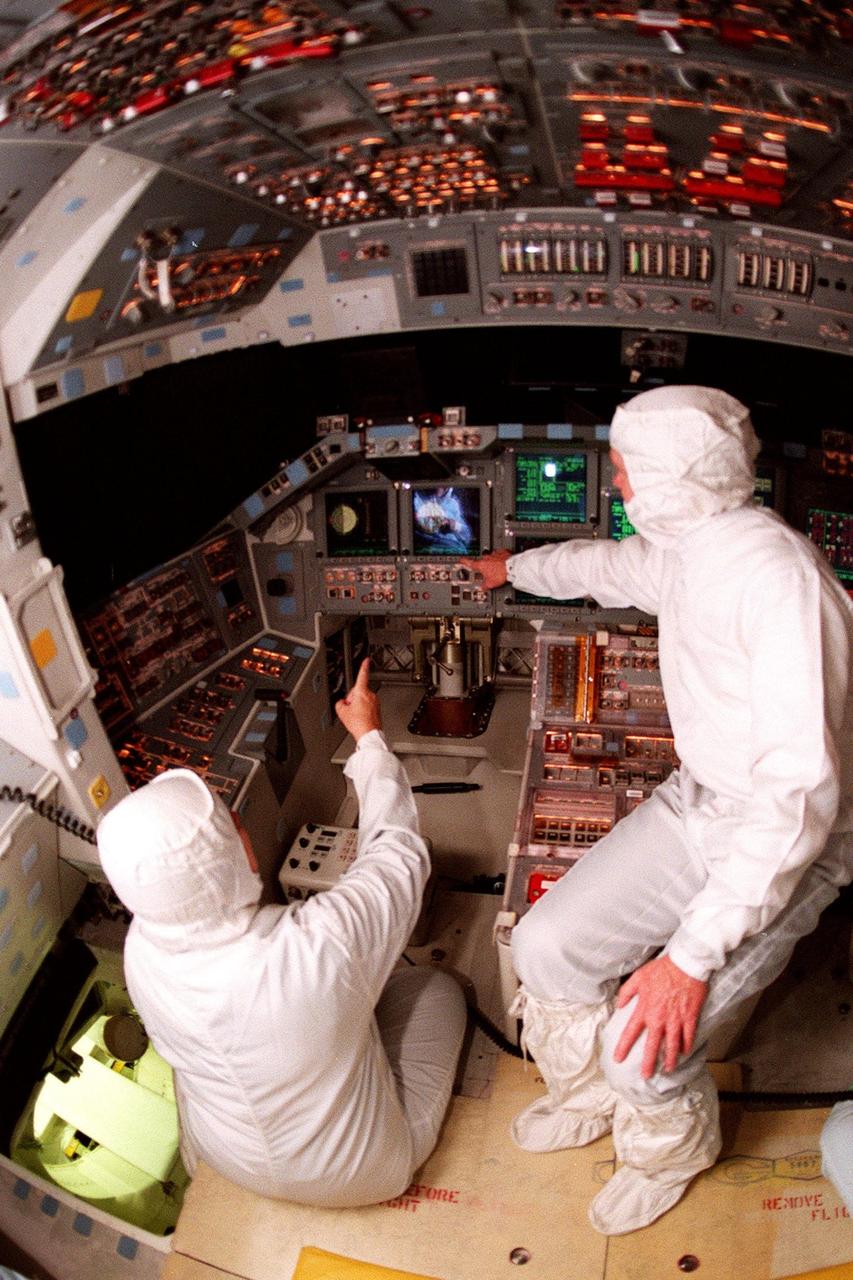
KENNEDY SPACE CENTER, FLA. -- Inside the orbiter Atlantis, JoAnn Morgan, Associate Director for Advanced Development and Shuttle Upgrades, and Roy Bridges Jr., Center Director, get a closeup view of the new full-color flat panel Multifunction Electronic Display Subsystem (MEDS), also called the "glass cockpit." The MEDS upgrade improves crew/orbiter interaction with easy-to-read, graphic portrayals of key flight indicators like attitude display and mach speed. The installation makes Atlantis the most modern orbiter in the fleet and equals the systems on current commercial jet airliners and military aircraft. Atlantis is scheduled to fly on mission STS-101 in early December
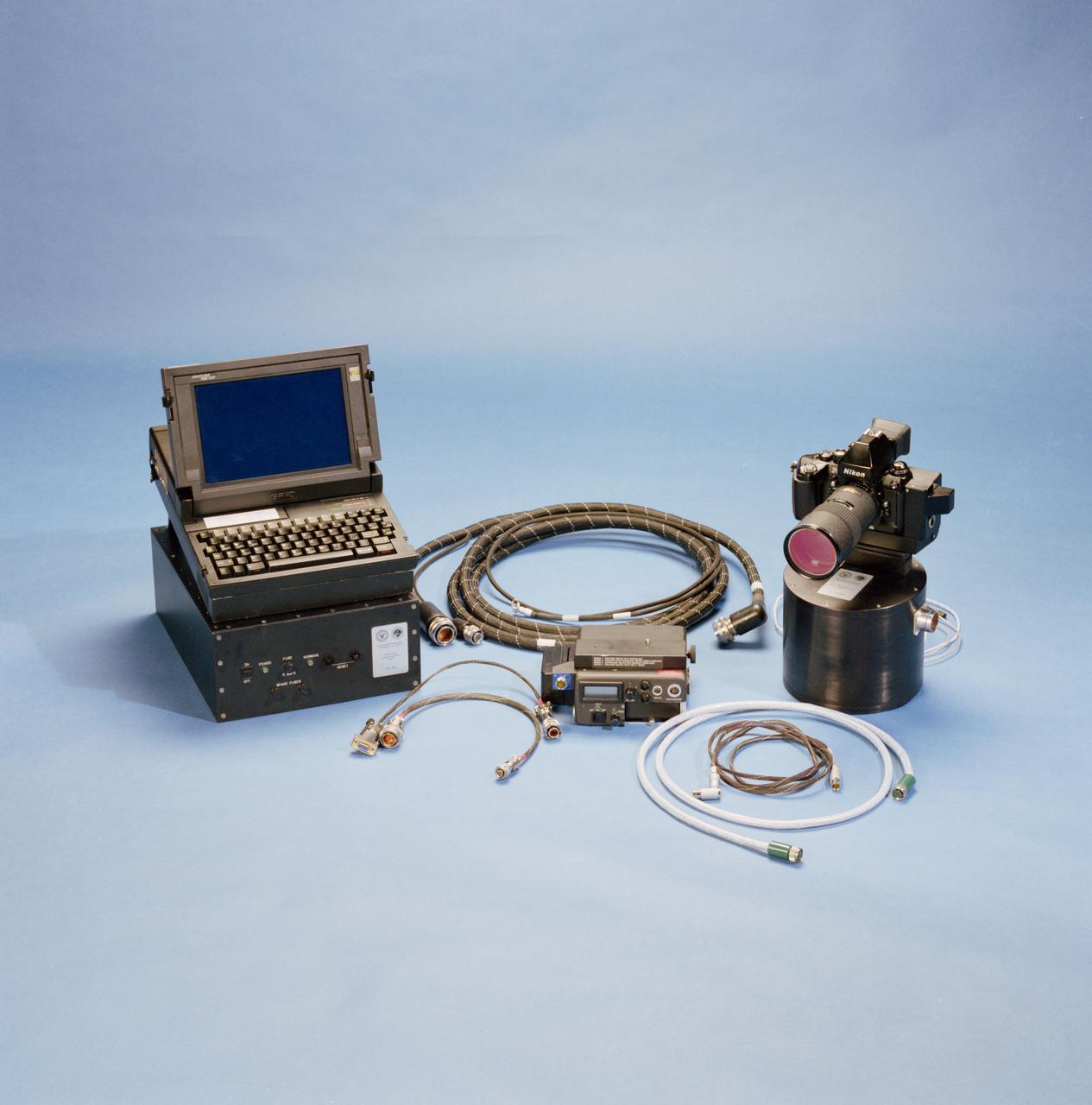
STS-53 Discovery, Orbiter Vehicle (OV) 103, Department of Defense (DOD) mission Hand-held Earth-oriented Real-time Cooperative, User-friendly, Location, targeting, and Environmental System (Hercules) spaceborne experiment equipment is documented in this table top view. HERCULES is a joint NAVY-NASA-ARMY payload designed to provide real-time high resolution digital electronic imagery and geolocation (latitude and longitude determination) of earth surface targets of interest. HERCULES system consists of (from left to right): a specially modified GRID Systems portable computer mounted atop NASA developed Playback-Downlink Unit (PDU) and the Naval Research Laboratory (NRL) developed HERCULES Attitude Processor (HAP); the NASA-developed Electronic Still Camera (ESC) Electronics Box (ESCEB) including removable imagery data storage disks and various connecting cables; the ESC (a NASA modified Nikon F-4 camera) mounted atop the NRL HERCULES Inertial Measurement Unit (HIMU) containing the three-axis ring-laser gyro.
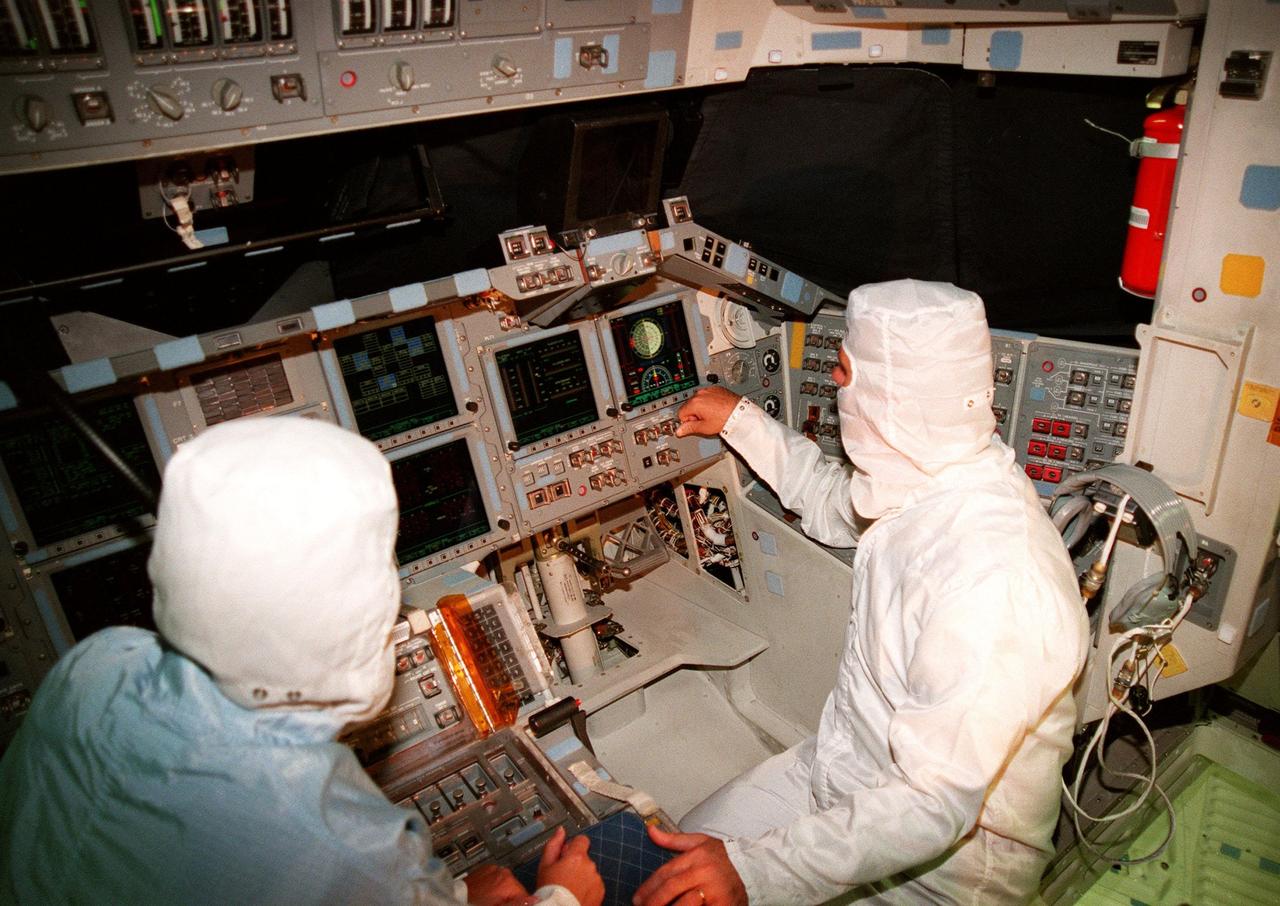
KENNEDY SPACE CENTER, FLA. -- In the cockpit of the orbiter Atlantis, which is in the Orbiter Processing Facility, U.S. Rep. Dave Weldon (right) looks at the newly installed Multifunction Electronic Display Subsystem (MEDS), known as the "glass cockpit." At left is Laural Patrick, a systems engineer with MEDS. Weldon is on the House Science Committee and vice chairman of the Space and Aeronautics Subcommittee. He was in Palmdale, Calif., when Atlantis underwent the modification and he wanted to see the final product. The full-color, flat-panel MEDS upgrade improves crew/orbiter interaction with easy-to-read, graphic portrayals of key flight indicators like attitude display and mach speed. The installation makes Atlantis the most modern orbiter in the fleet and equals the systems on current commercial jet airliners and military aircraft. Atlantis is scheduled to fly on mission STS-101 in early December
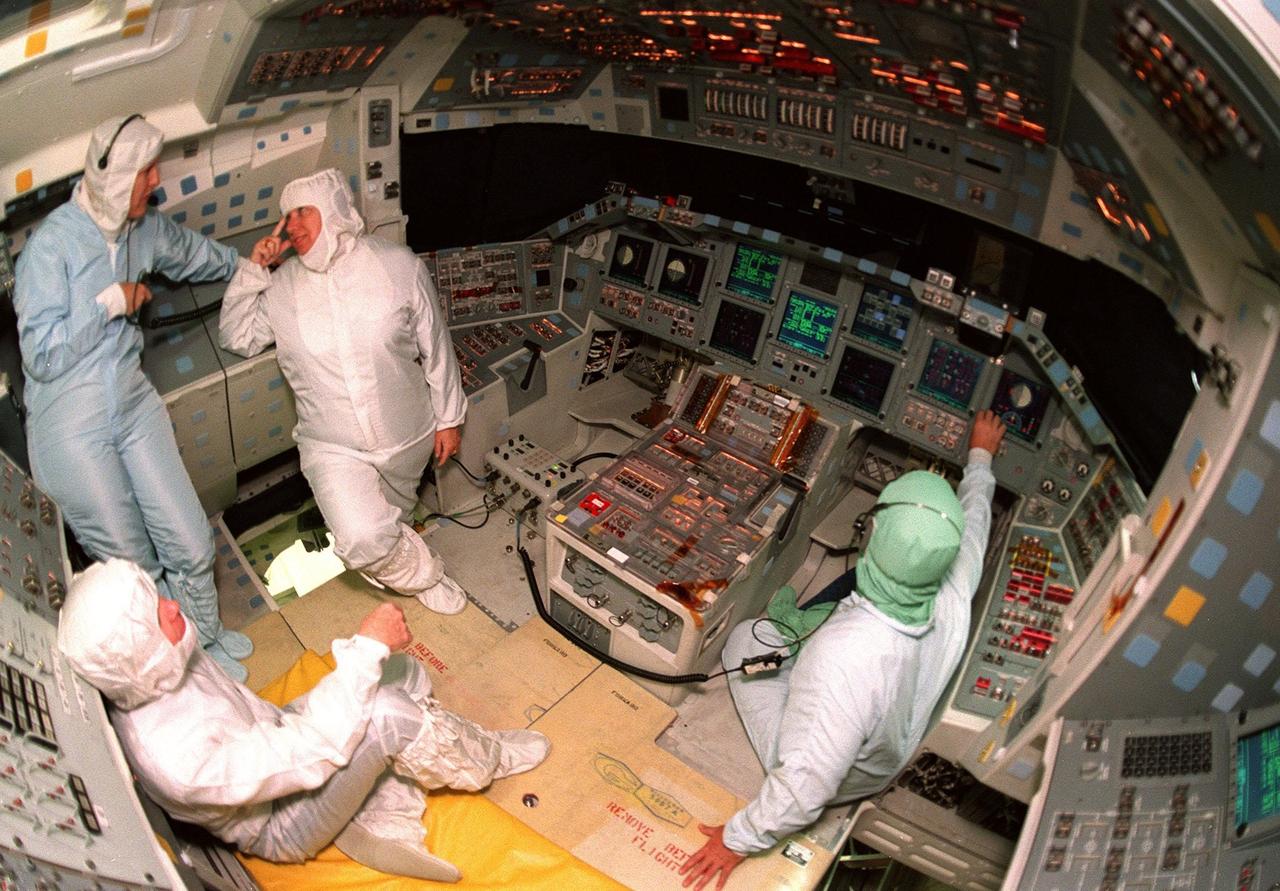
KENNEDY SPACE CENTER, FLA. -- Inside the orbiter Atlantis, Center Director Roy Bridges (seated at bottom left) and Associate Director for Advanced Development and Shuttle Upgrades JoAnn Morgan (standing second from left) learn about the new Multifunction Electronic Display Subsystem (MEDS) from Laural Patrick (standing left), a systems engineer with MEDS, and George Selina (at right), with United Space Alliance. Also called the "glass cockpit," the new full-color flat panel MEDS upgrade improves crew/orbiter interaction with easy-to-read, graphic portrayals of key flight indicators like attitude display and mach speed. The installation makes Atlantis the most modern orbiter in the fleet and equals the systems on current commercial jet airliners and military aircraft. Atlantis is scheduled to fly on mission STS-101 in early December

STS-101 Commander James Halsell (left) and STS-98 Commander Ken Cockrell (right) look over the recently installed Multifunction Electronic Display Subsystem (MEDS) in the cockpit of the orbiter Atlantis, which each will command on their upcoming respective missions. The new full-color, flat panel MEDS improves crew/orbiter interaction with easy-to-read, graphic portrayals of key flight indicators like attitude display and mach speed. The installation makes Atlantis the most modern orbiter in the fleet and equals the systems on current commercial jet airliners and military aircraft. . The first flight of the upgraded Atlantis is STS-101, scheduled for launch in December 1999; the second flight, STS-98, is scheduled for launch in April 2000
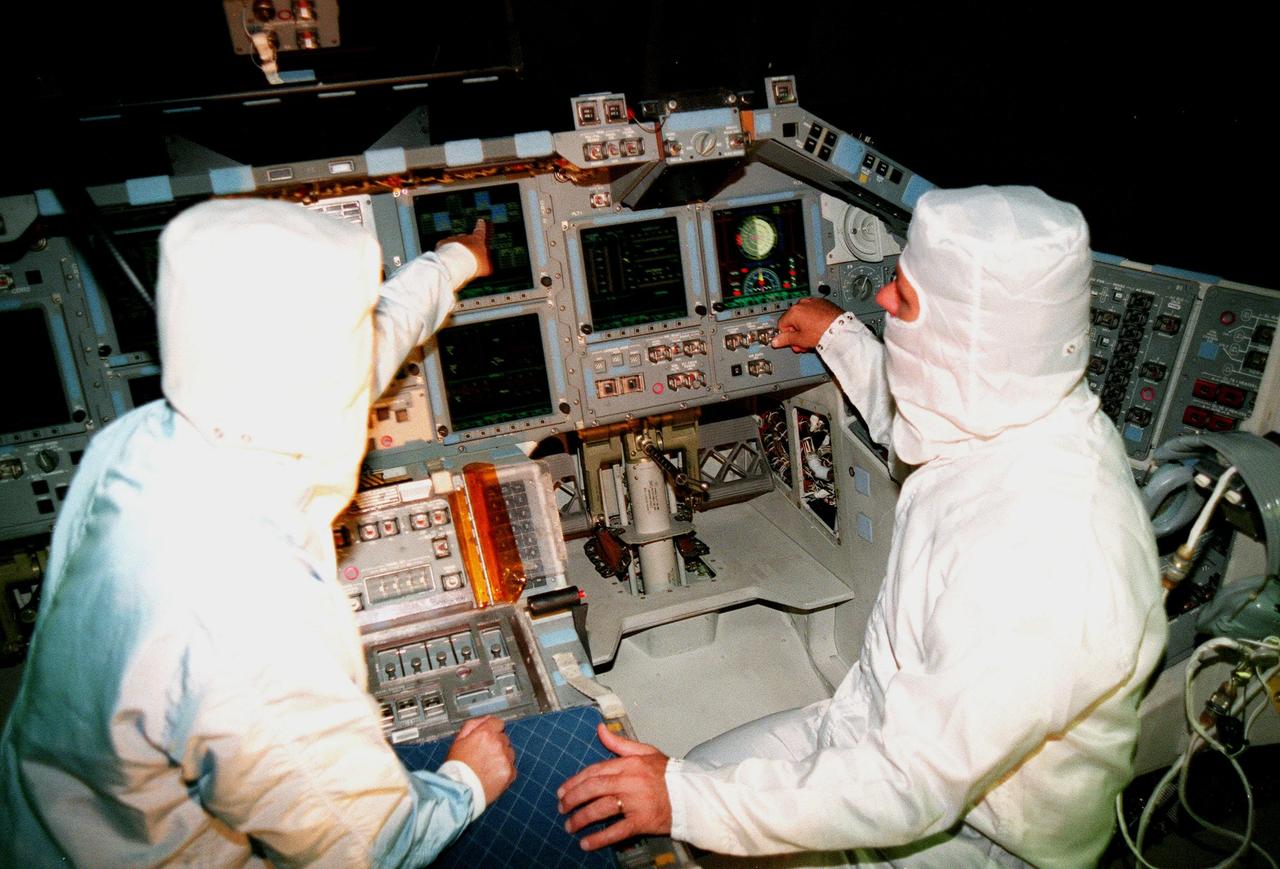
KENNEDY SPACE CENTER, FLA. -- In the cockpit of the orbiter Atlantis, which is in the Orbiter Processing Facility, Laural Patrick (left), a systems engineer with MEDS, points out a feature of the newly installed Multifunction Electronic Display Subsystem (MEDS), known as the "glass cockpit," to U.S. Rep. Dave Weldon. The congressman is on the House Science Committee and vice chairman of the Space and Aeronautics Subcommittee. He was in Palmdale, Calif., when Atlantis underwent the modification and he wanted to see the final product. The full-color, flat-panel MEDS upgrade improves crew/orbiter interaction with easy-to-read, graphic portrayals of key flight indicators like attitude display and mach speed. The installation makes Atlantis the most modern orbiter in the fleet and equals the systems on current commercial jet airliners and military aircraft. Atlantis is scheduled to fly on mission STS-101 in early December
KENNEDY SPACE CENTER, FLA. -- In the cockpit of the orbiter Atlantis, which is in the Orbiter Processing Facility, U.S. Rep. Dave Weldon looks at the newly installed Multifunction Electronic Display Subsystem (MEDS), known as the "glass cockpit." Weldon is on the House Science Committee and vice chairman of the Space and Aeronautics Subcommittee. He was in Palmdale, Calif., when Atlantis underwent the modification and he wanted to see the final product. The full-color, flat-panel MEDS upgrade improves crew/orbiter interaction with easy-to-read, graphic portrayals of key flight indicators like attitude display and mach speed. The installation makes Atlantis the most modern orbiter in the fleet and equals the systems on current commercial jet airliners and military aircraft. Atlantis is scheduled to fly on mission STS-101 in early December
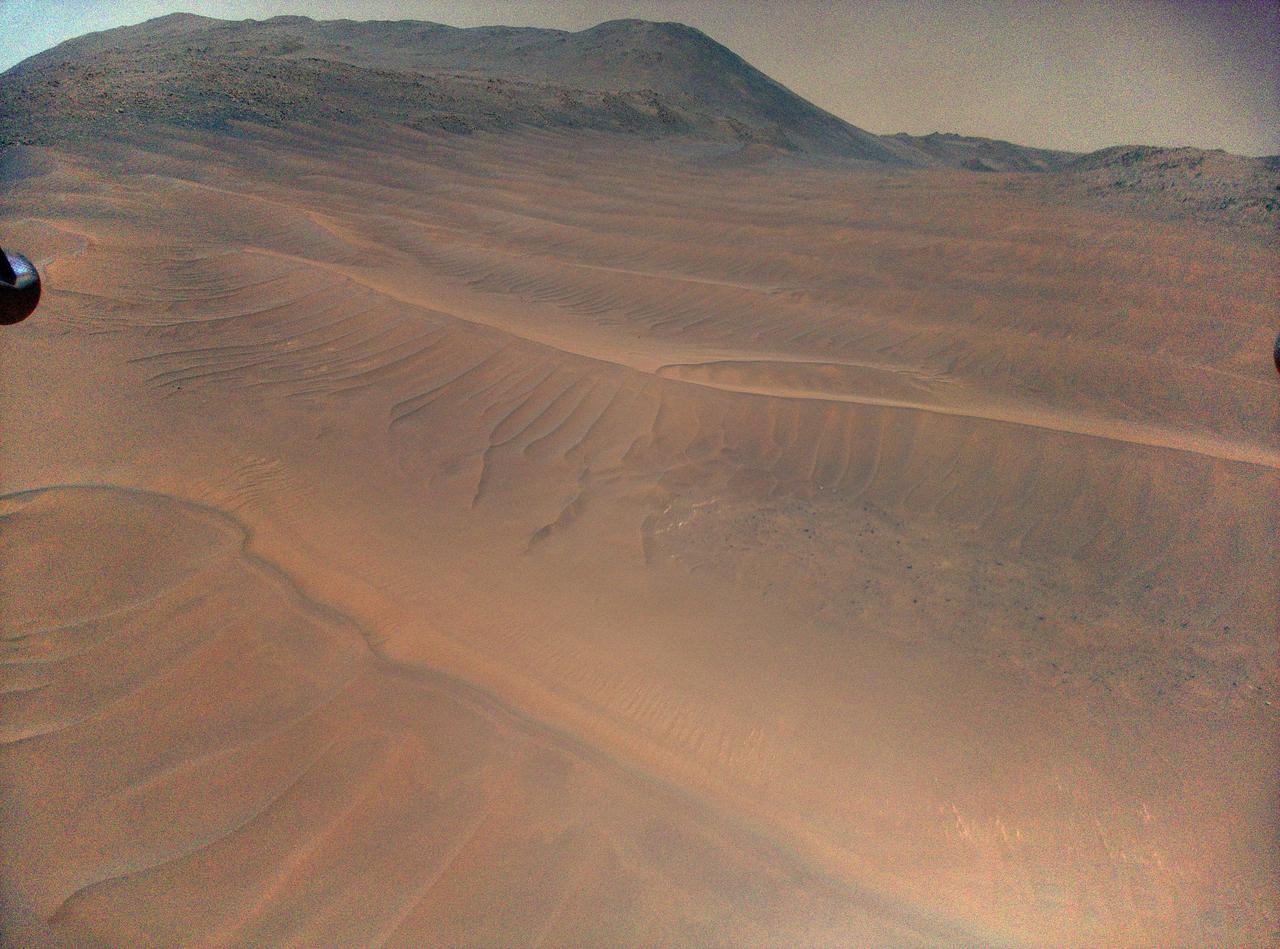
NASA's Ingenuity Mars Helicopter captured this view of sand ripples during its 70th flight, on Dec. 22, 2023. Taken from about 39 feet (12 meters) above the surface, the image shows the widest swath of sandy, relatively featureless terrain the helicopter had ever flown over. Ingenuity navigates by tracking the relative motion of surface features it sees beneath it, using its black-and-white navigation camera. An algorithm used by the navigation system incorporates the relative motion of features such as rocks, boulders, and ridges into the helicopter's calculation of position, velocity, and attitude. The more featureless the terrain is, the harder it is for Ingenuity to successfully navigate across it. During the descent phase of Flight 72, on Jan. 18, 2024, Ingenuity experienced an anomalous landing near the right side of this image. Subsequent imaging from the helicopter's onboard cameras indicated that one of the rotor blades was damaged during touchdown. The team believes that the relatively featureless terrain in this region, which the navigation system was not designed for, was likely the root cause of the anomalous landing. https://photojournal.jpl.nasa.gov/catalog/PIA26242
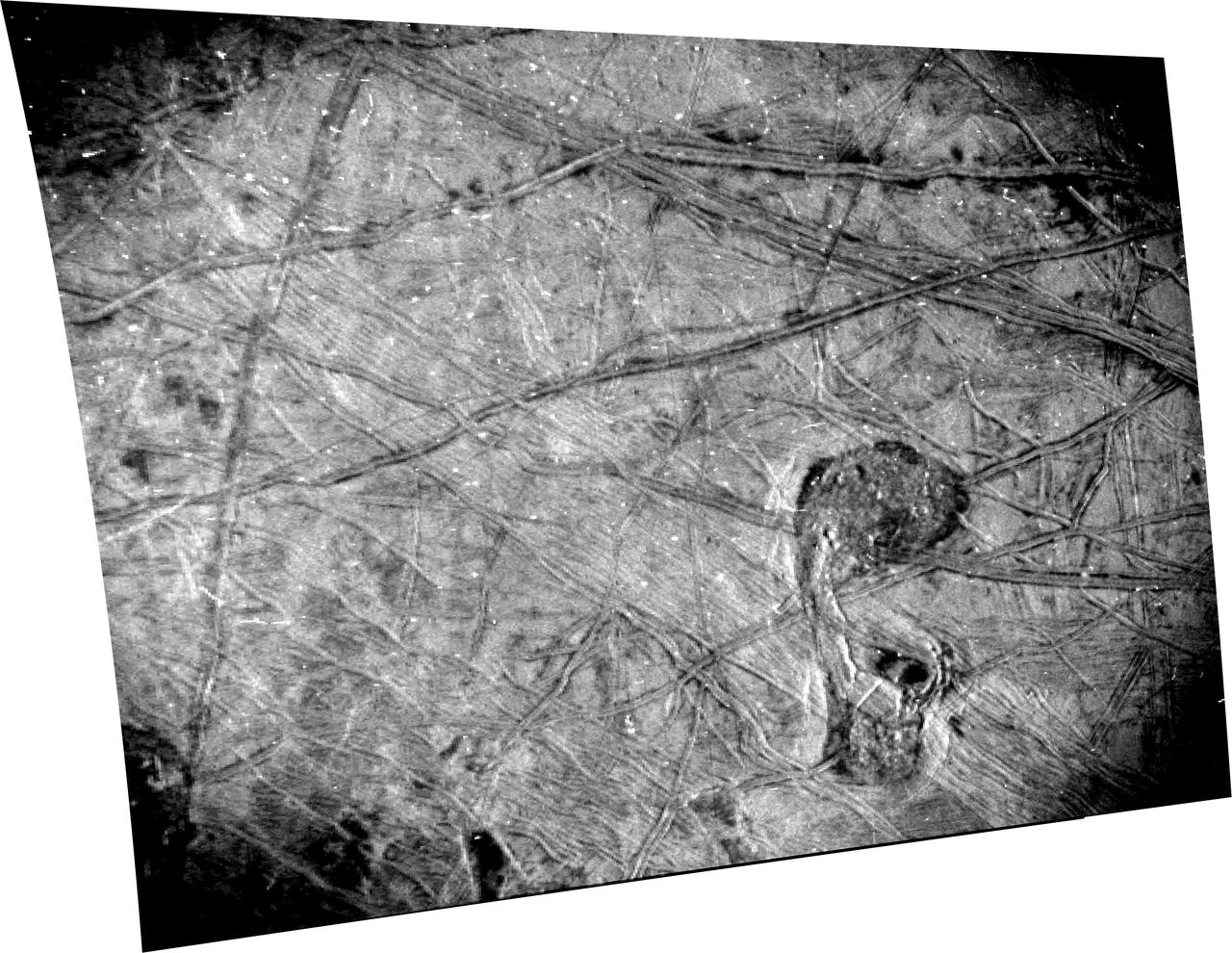
This black-and-white image of Europa's surface was taken by the Stellar Reference Unit (SRU) aboard NASA's Juno spacecraft during a Sept. 29, 2022, flyby of the Jovian moon. The image shows a region crisscrossed with a network of fine grooves and sets of complicated double ridges (pairs of long parallel lines indicating elevated features in the ice). In the upper right corner are dark stains possibly linked to cryovolcanic plume activity (the bubbling up of liquid from beneath the ice). Just below center and to the right is a surface feature that members of the Juno science team refer to as "the Platypus." This location of surface disruption (called "chaos" in the field of planetary science) measures 42 miles (67 kilometers) north-south and 23 miles (37 kilometers) east-west. (The feature's shape has previously been compared to a musical symbol for a quarter note.) The small white dots that pepper the image are signatures of penetrating high-energy particles from the severe radiation environment around the moon. The image was taken at a distance of about 256 miles (412 kilometers) over the night side of Europa in a region dimly illuminated by Jupiter-shine. It is Juno's highest resolution image of the moon, at 840 to 1,115 feet per pixel (256 to 340 meters per pixel) and covers about 93 by 125 miles (150 by 200 kilometers) of Europa's surface. The SRU collects images of star fields to provide star positions used for attitude determination. Designed for low-light conditions, the camera has proved itself a valuable science tool, discovering shallow lightning in Jupiter's atmosphere, imaging the planet's enigmatic ring system, and now providing a glimpse of Europa's most fascinating geologic formations. https://photojournal.jpl.nasa.gov/catalog/PIA26332
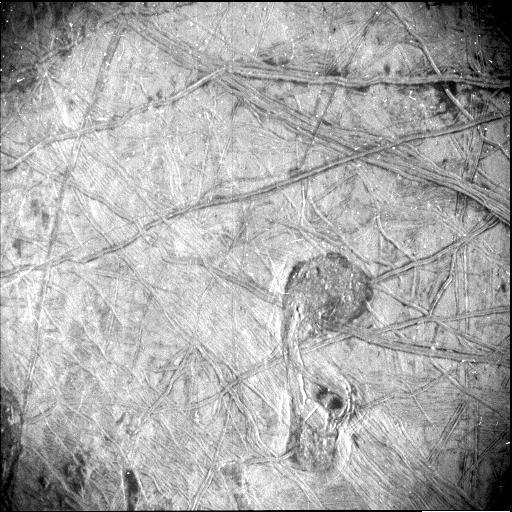
Taken by NASA's Juno spacecraft, this black-and-white photo of the surface of Jupiter's icy moon Europa reveals a curious feature – shaped somewhat like the musical symbol for a quarter note – surrounded by a vast network of linear ridges and dark blotches. It was obtained by Juno's Stellar Reference Unit (SRU) during the spacecraft's Sept. 29, 2022, flyby of Europa. The image shows a region crisscrossed with a network of fine grooves and sets of complicated double ridges (pairs of long parallel lines indicating elevated features in the ice). In the upper right corner are dark stains possibly linked to seepage or the bubbling up of liquid from beneath the ice. Just below center and to the right is the surface feature that takes a form like a musical quarter note. The feature measures 42 miles (67 kilometers) north-south and 23 miles (37 kilometers) east-west. The white dots in the image are signatures of penetrating high energy particles from the severe radiation environment around the moon. The image was taken at a distance of about 256 miles (412 kilometers) over the darkened hemisphere of Europa. It covers about 93 miles (150 kilometers) by 125 miles (200 kilometers) of the moon's surface. The SRU is designed to provide images of starfields used for attitude determination. The camera, designed for low-light conditions, has proved itself a valuable science tool, discovering shallow lightning in Jupiter's atmosphere, imaging Jupiter's enigmatic ring system, and now providing a glimpse of Europa's most fascinating geologic formations. https://photojournal.jpl.nasa.gov/catalog/PIA25332