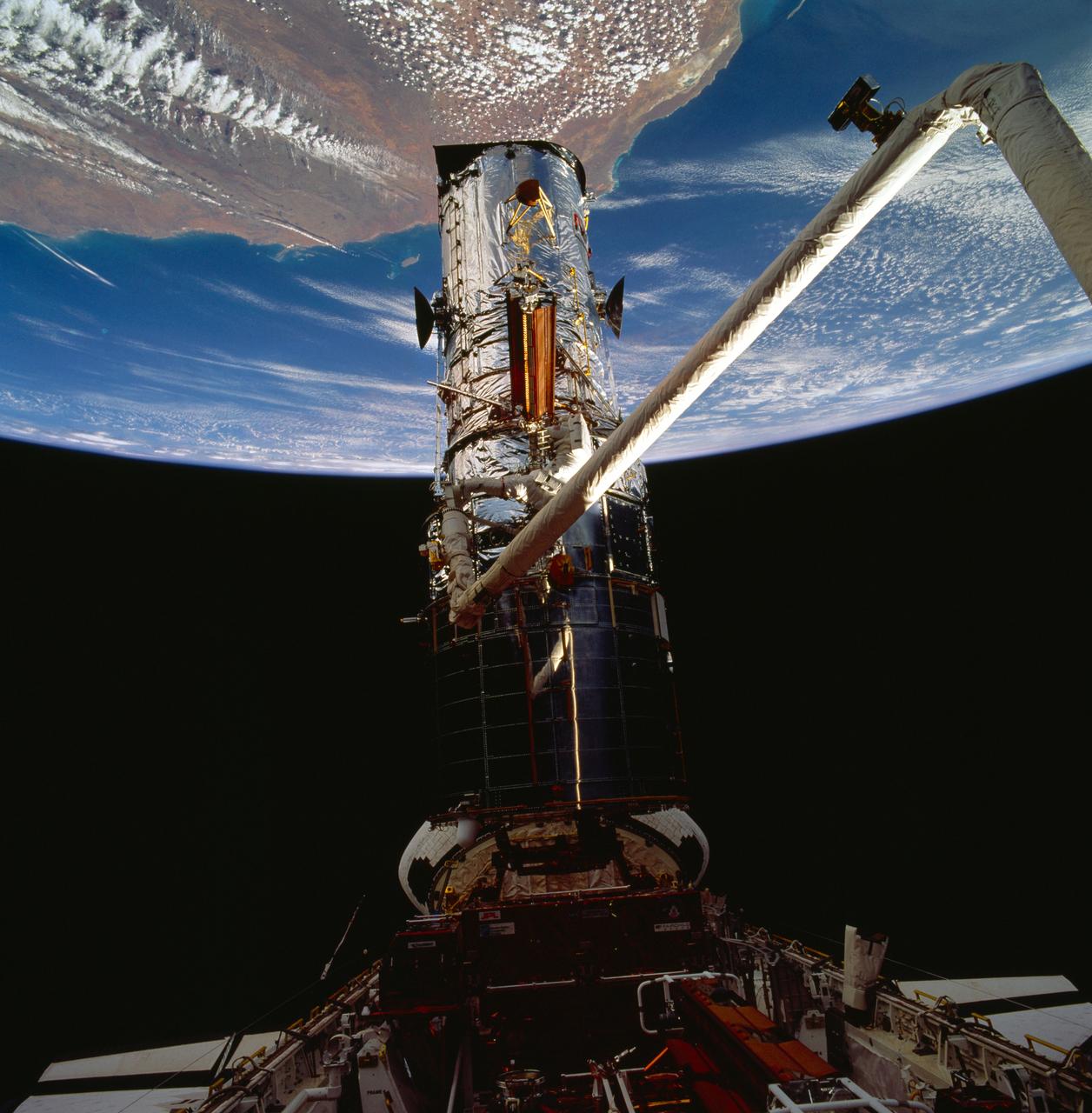
STS061-95-075 (6 Dec 1993) --- Astronauts Kathryn C. Thornton and Thomas D. Akers work to remove one of the solar arrays on the Hubble Space Telescope (HST) on the second of five extravehicular activity?s (EVA). The two space walkers later replaced both solar array panels. Part of Australia is in the background.
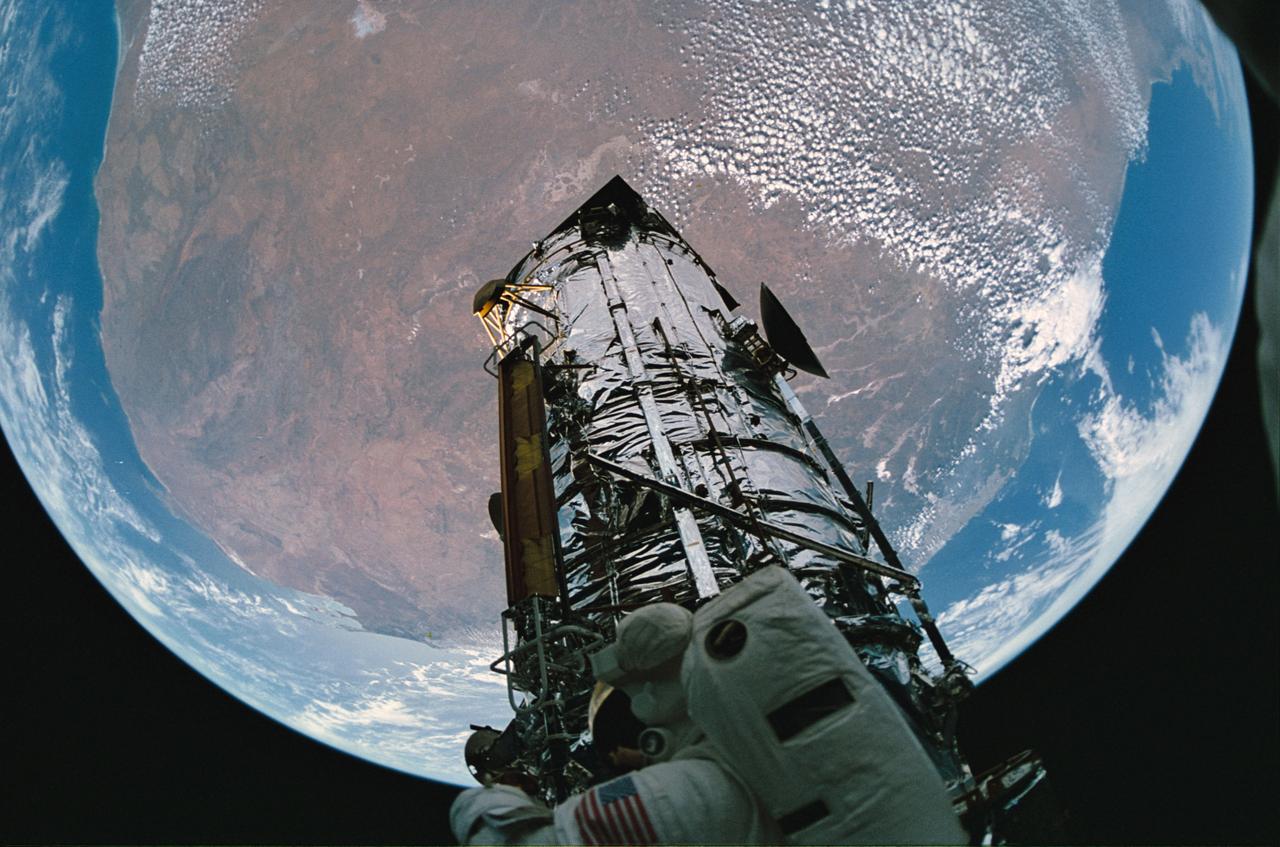
STS061-65-015 (9 Dec 1993) --- A fish-eye lens was used to capture the Hubble Space Telescope (HST), a spherical Earth and Australian landmass with a bit of distortion during the final extravehicular activity (EVA) on the STS-61 HST-servicing mission. Astronaut F. Story Musgrave can be seen at bottom of the frame.
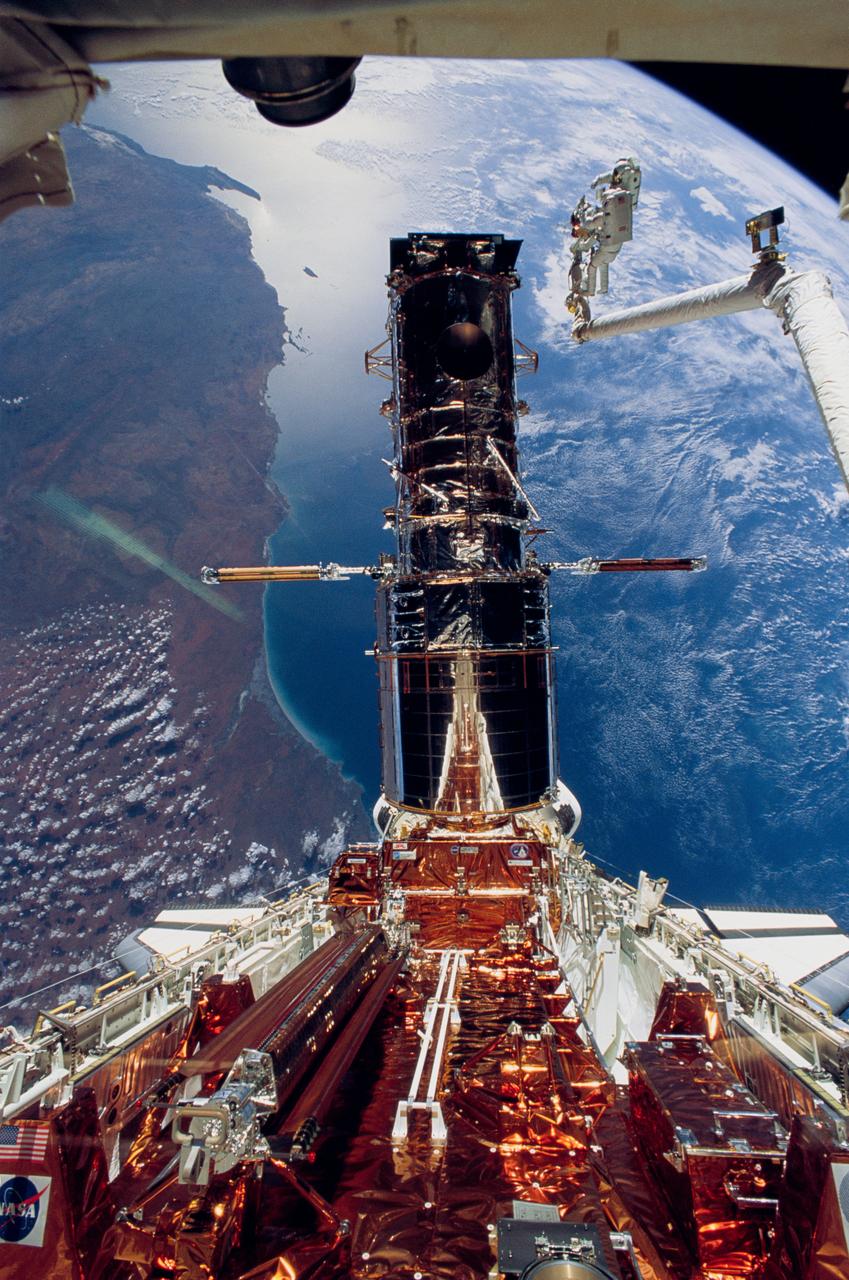
STS061-48-001 (9 Dec 1993) --- Orbiting Earth at an altitude of 356 nautical miles perched atop a foot restraint on the Space Shuttle Endeavour's Remote Manipulator System (RMS) arm, astronauts F. Story Musgrave (top) and Jeffrey A. Hoffman wrap up the final of five Extravehicular Activities (EVA). The west coast of Australia forms the backdrop for the 35mm frame.
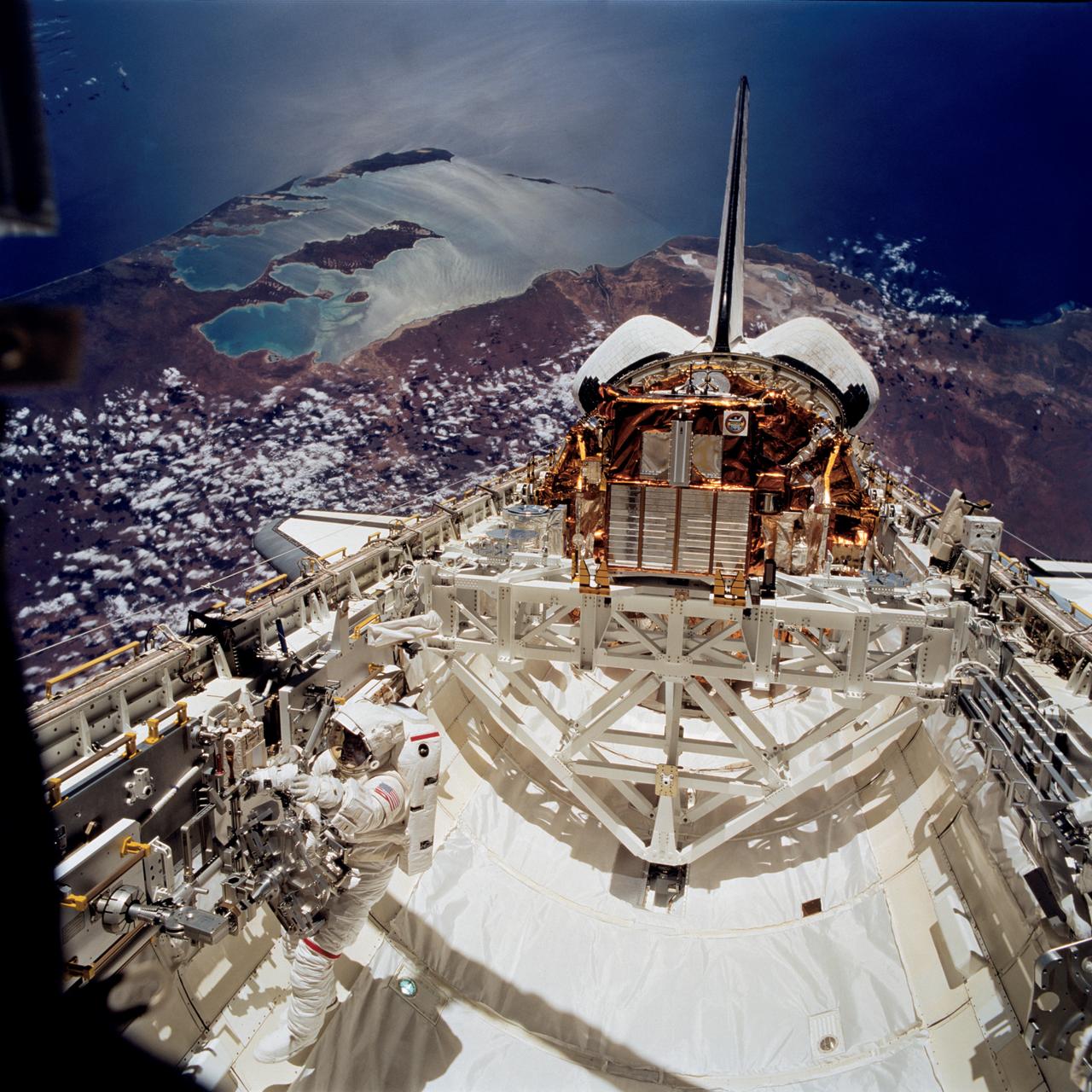
STS072-740-044 (17 Jan. 1996) --- Backdropped against Australia's Shark Bay, this panoramic scene of the Space Shuttle Endeavour in Earth-orbit was recorded during the mission's second Extravehicular Activity (EVA-2) on January 17, 1996. Astronaut Leroy Chiao works with a Mobile Foot Restraint (MFR) at bottom left. The Japanese Space Flyer Unit (SFU) satellite and the Office of Aeronautics and Space Technology (OAST) Flyer satellite are seen in their stowed positions in the aft cargo bay.
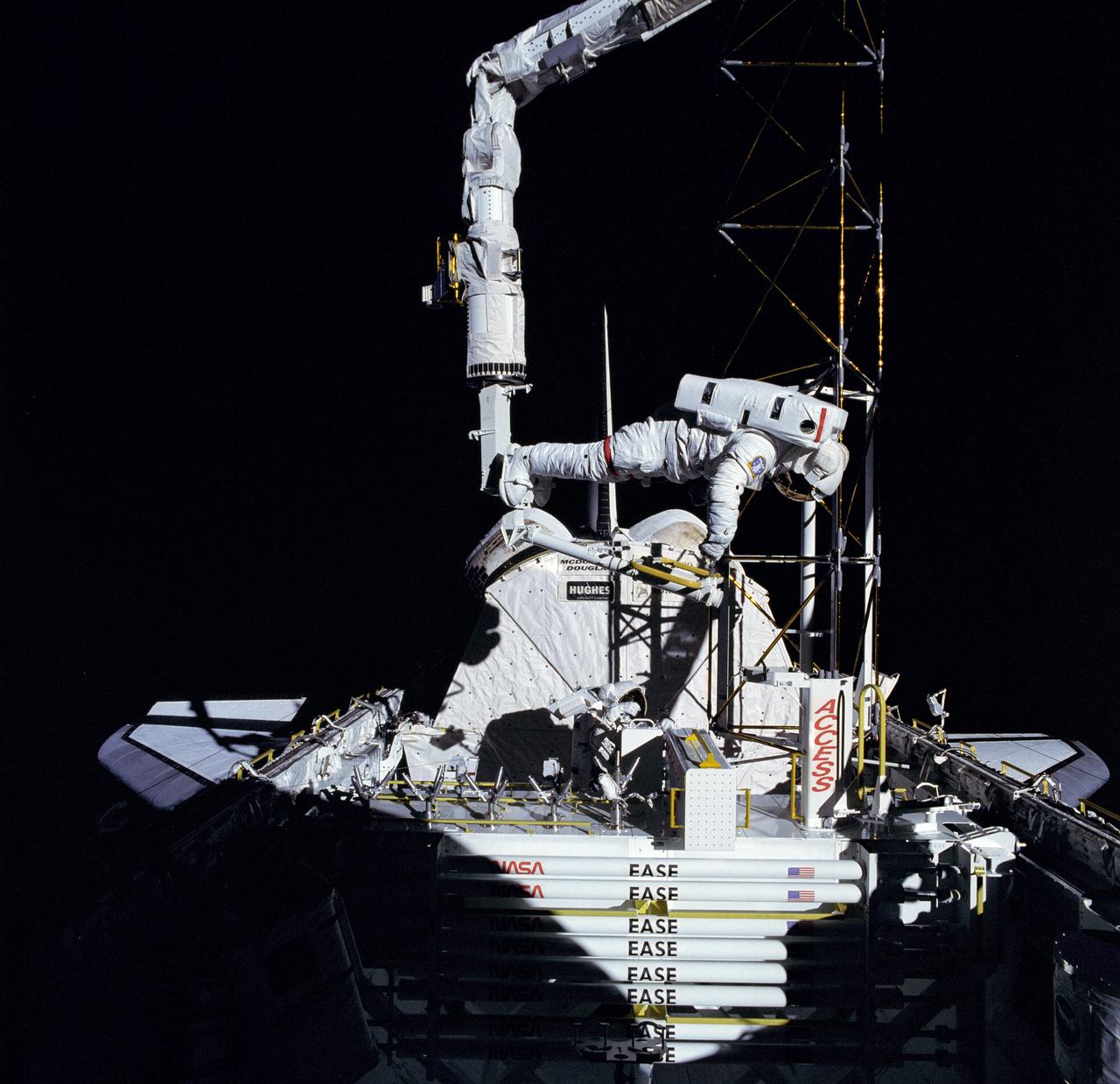
The crew assigned to the STS-61B mission included Bryan D. O’Conner, pilot; Brewster H. Shaw, commander; Charles D. Walker, payload specialist; mission specialists Jerry L. Ross, Mary L. Cleave, and Sherwood C. Spring; and Rodolpho Neri Vela, payload specialist. Launched aboard the Space Shuttle Atlantis November 28, 1985 at 7:29:00 pm (EST), the STS-61B mission’s primary payload included three communications satellites: MORELOS-B (Mexico); AUSSAT-2 (Australia); and SATCOM KU-2 (RCA Americom). Two experiments were conducted to test assembling erectable structures in space: EASE (Experimental Assembly of Structures in Extravehicular Activity), and ACCESS (Assembly Concept for Construction of Erectable Space Structure). In a joint venture between NASA/Langley Research Center in Hampton, Virginia and the Marshall Space Flight Center (MSFC), EASE and ACCESS were developed and demonstrated at MSFC's Neutral Buoyancy Simulator (NBS). The primary objective of this experiment was to test the structural assembly concepts for suitability as the framework for larger space structures and to identify ways to improve the productivity of space construction. In this STS-61B onboard photo, astronaut Ross was working on the ACCESS experiment during an Extravehicular Activity (EVA).
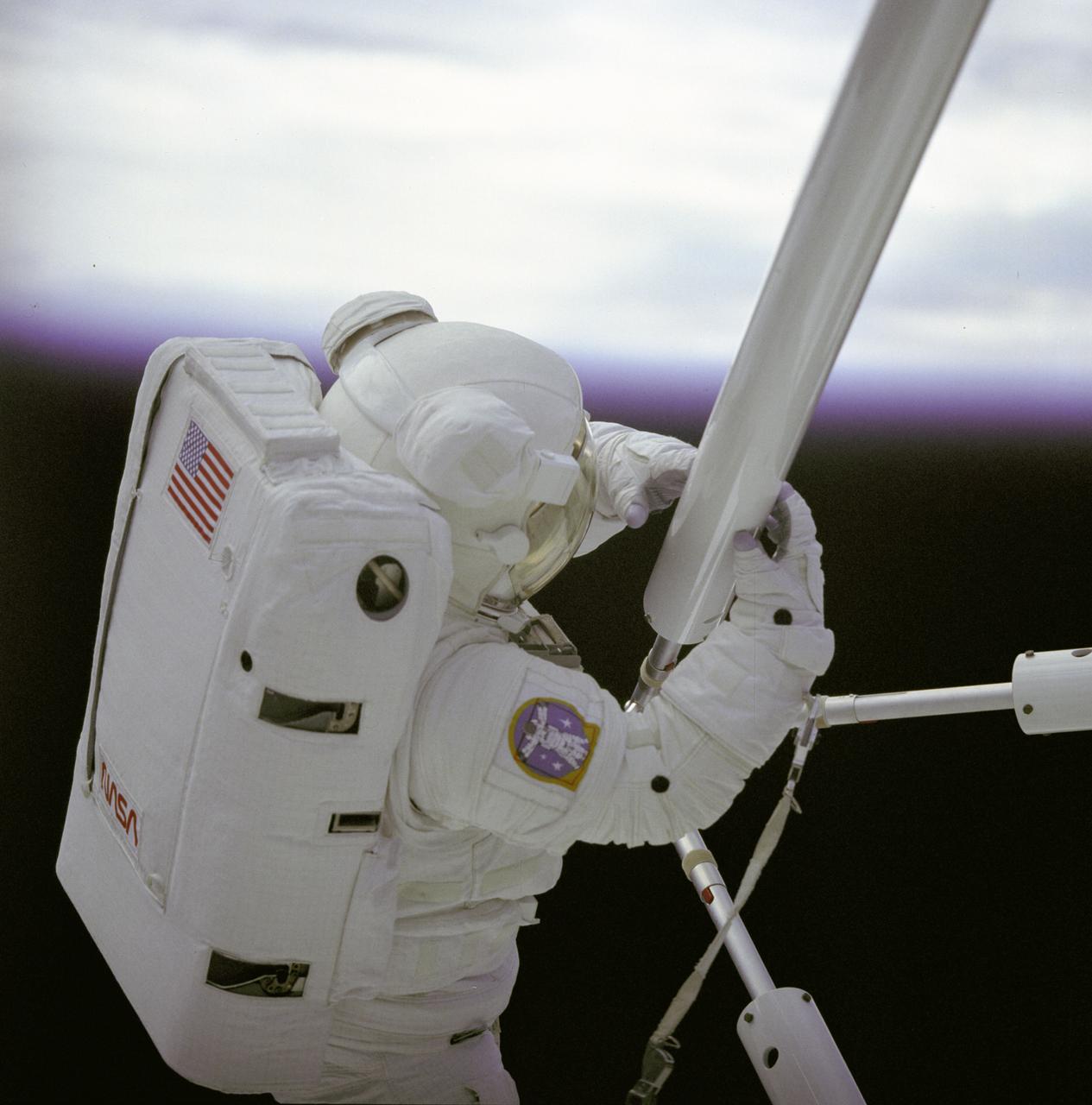
The crew assigned to the STS-61B mission included Bryan D. O’Conner, pilot; Brewster H. Shaw, commander; Charles D. Walker, payload specialist; mission specialists Jerry L. Ross, Mary L. Cleave, and Sherwood C. Spring; and Rodolpho Neri Vela, payload specialist. Launched aboard the Space Shuttle Atlantis November 28, 1985 at 7:29:00 pm (EST), the STS-61B mission’s primary payload included three communications satellites: MORELOS-B (Mexico); AUSSAT-2 (Australia); and SATCOM KU-2 (RCA Americom). Two experiments were conducted to test assembling erectable structures in space: EASE (Experimental Assembly of Structures in Extravehicular Activity), and ACCESS (Assembly Concept for Construction of Erectable Space Structure). In a joint venture between NASA/Langley Research Center in Hampton, Virginia, and the Marshall Space Flight Center (MSFC), the EASE and ACCESS were developed and demonstrated at MSFC's Neutral Buoyancy Simulator (NBS). In this STS-61B onboard photo, astronaut Spring was working on the EASE during an Extravehicular Activity (EVA). The primary objective of this experiment was to test the structural assembly concepts for suitability as the framework for larger space structures and to identify ways to improve the productivity of space construction.
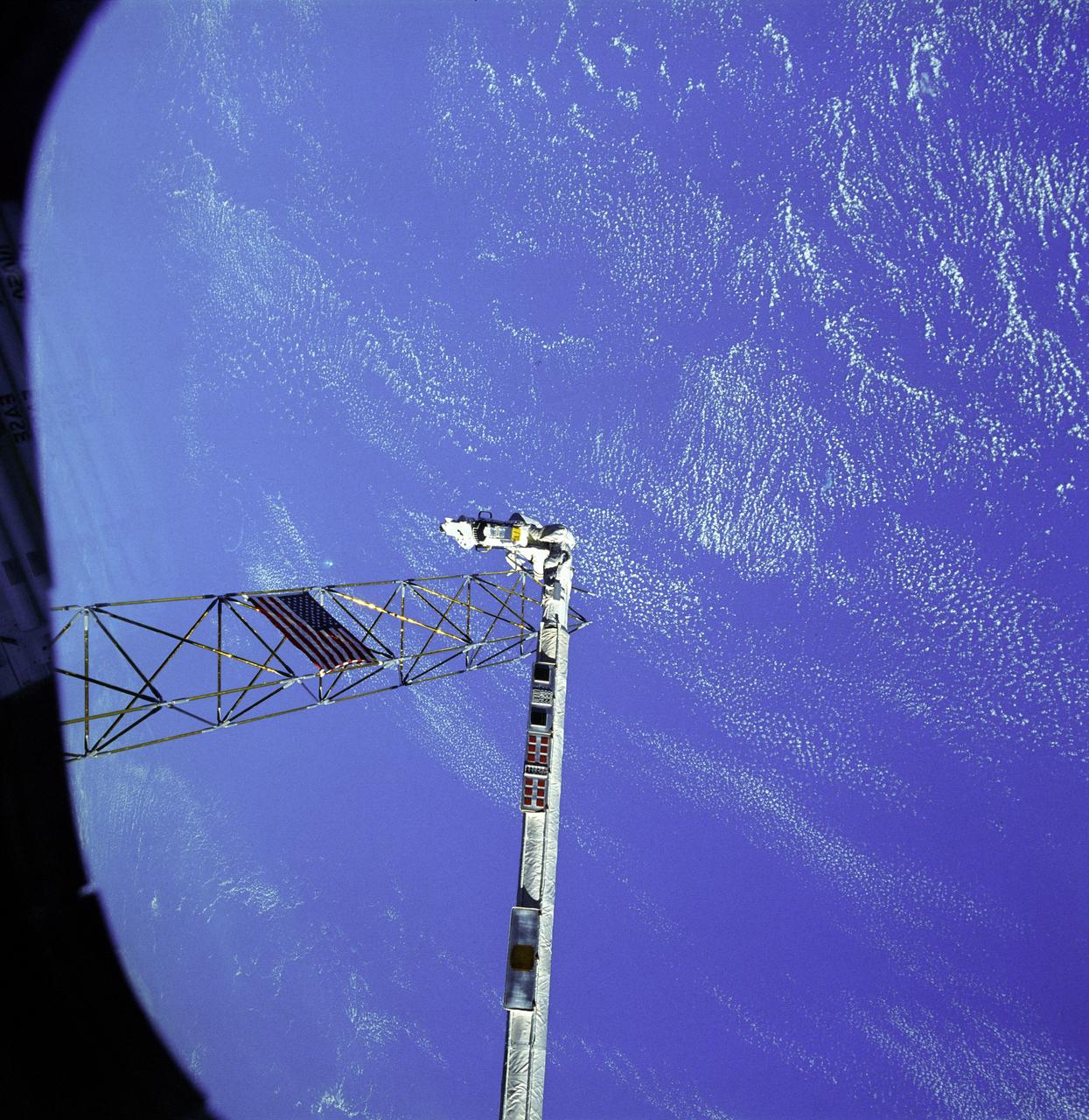
The crew assigned to the STS-61B mission included Bryan D. O’Conner, pilot; Brewster H. Shaw, commander; Charles D. Walker, payload specialist; mission specialists Jerry L. Ross, Mary L. Cleave, and Sherwood C. Spring; and Rodolpho Neri Vela, payload specialist. Launched aboard the Space Shuttle Atlantis November 28, 1985 at 7:29:00 pm (EST), the STS-61B mission’s primary payload included three communications satellites: MORELOS-B (Mexico); AUSSAT-2 (Australia); and SATCOM KU-2 (RCA Americom). Two experiments were conducted to test assembling erectable structures in space: EASE (Experimental Assembly of Structures in Extravehicular Activity), and ACCESS (Assembly Concept for Construction of Erectable Space Structure). In a joint venture between NASA/Langley Research Center in Hampton, Virginia, and the Marshall Space Flight Center (MSFC), EASE and ACCESS were developed and demonstrated at MSFC's Neutral Buoyancy Simulator (NBS). In this STS-61B onboard photo, astronaut Ross works on ACCESS high above the orbiter. The primary objective of these experiments was to test the structural assembly concepts for suitability as the framework for larger space structures and to identify ways to improve the productivity of space construction.
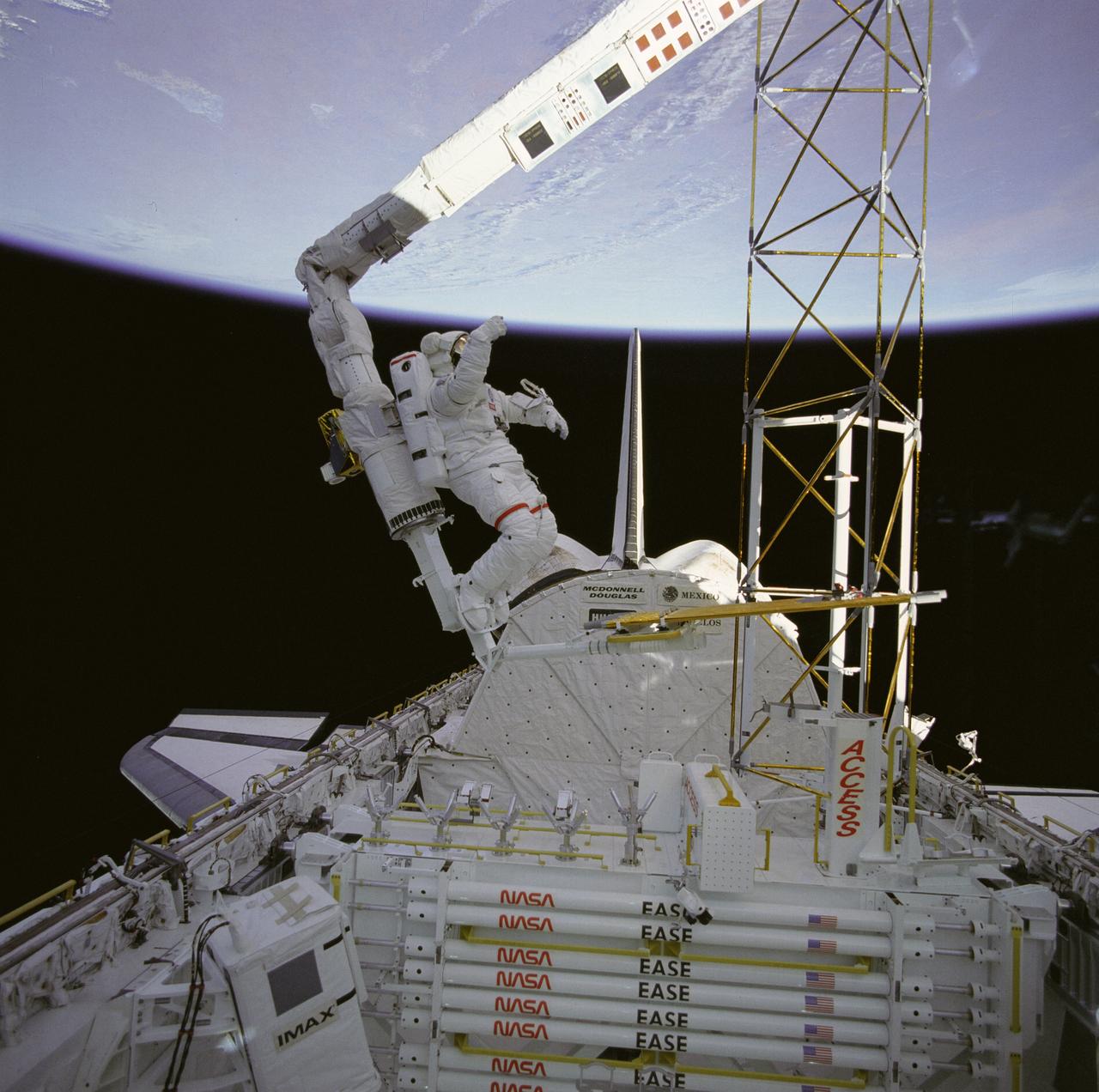
The crew assigned to the STS-61B mission included Bryan D. O’Conner, pilot; Brewster H. Shaw, commander; Charles D. Walker, payload specialist; mission specialists Jerry L. Ross, Mary L. Cleave, and Sherwood C. Spring; and Rodolpho Neri Vela, payload specialist. Launched aboard the Space Shuttle Atlantis November 28, 1985 at 7:29:00 pm (EST), the STS-61B mission’s primary payload included three communications satellites: MORELOS-B (Mexico); AUSSAT-2 (Australia); and SATCOM KU-2 (RCA Americom). Two experiments were conducted to test assembling erectable structures in space: EASE (Experimental Assembly of Structures in Extravehicular Activity), and ACCESS (Assembly Concept for Construction of Erectable Space Structure). In a joint venture between NASA/Langley Research Center in Hampton, Virginia and the Marshall Space Flight Center (MSFC), EASE and ACCESS were developed and demonstrated at MSFC's Neutral Buoyancy Simulator (NBS). In this STS-61B onboard photo astronaut Ross, located on the Manipulator Foot Restraint (MFR) over the cargo bay, erects ACCESS. The primary objective of this experiment was to test the structural assembly concepts for suitability as the framework for larger space structures and to identify ways to improve the productivity of space construction.