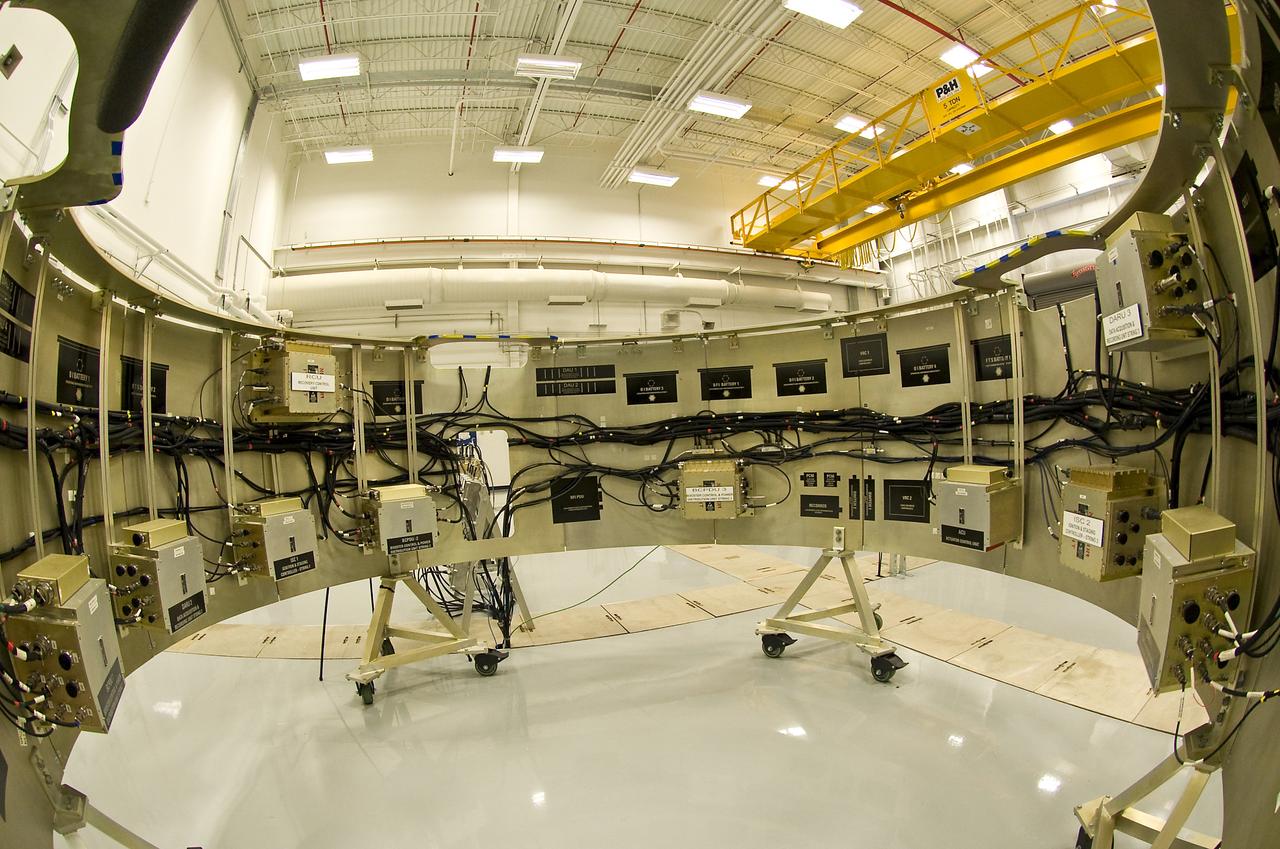
FIRST STAGE AVIONICS HARDWARE IN THE LOOP FACILITY
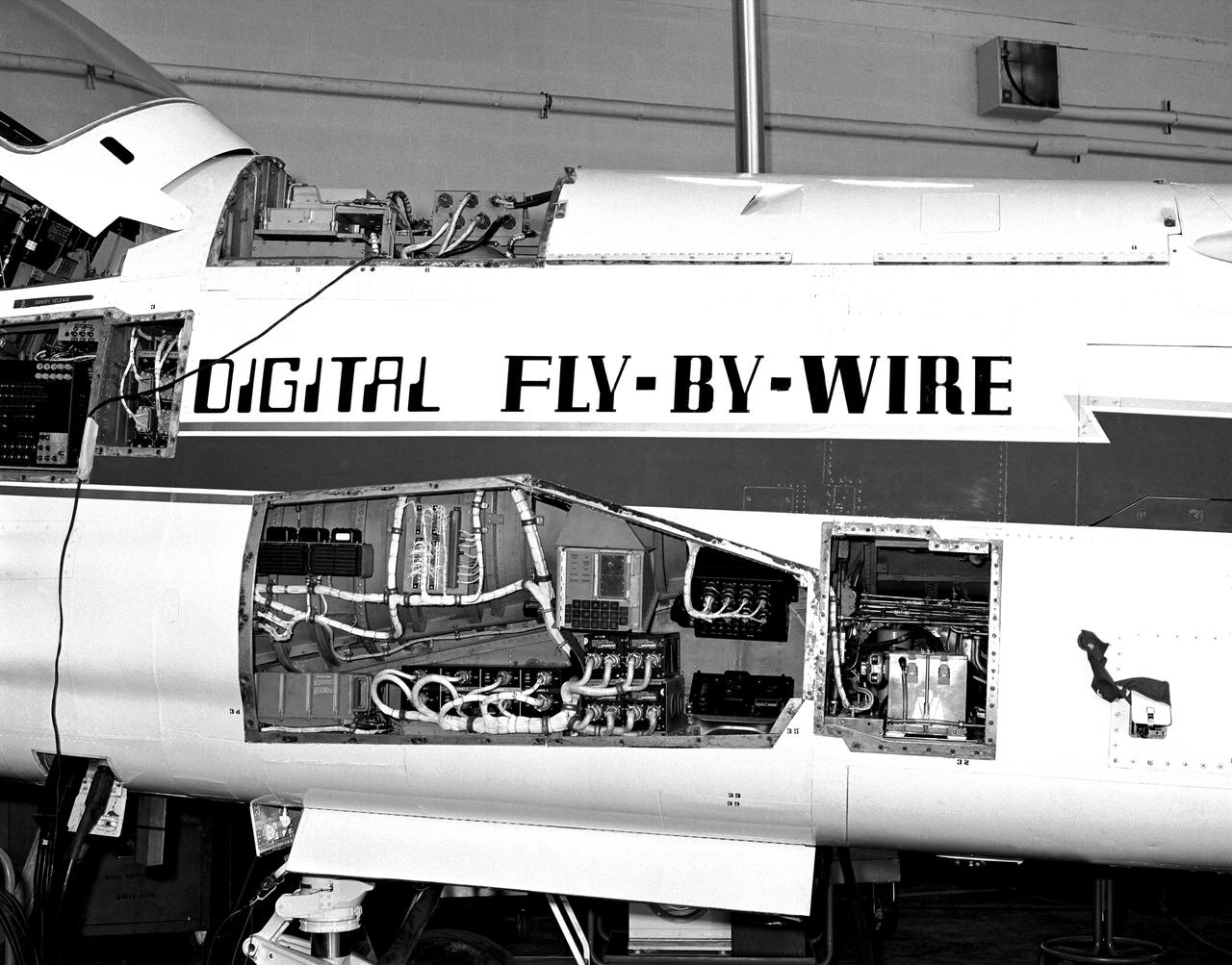
The Apollo hardware jammed into the F-8C. The computer is partially visible in the avionics bay at the top of the fuselage behind the cockpit. Note the display and keyboard unit in the gun bay. To carry the computers and other equipment, the F-8 DFBW team removed the aircraft's guns and ammunition boxes.
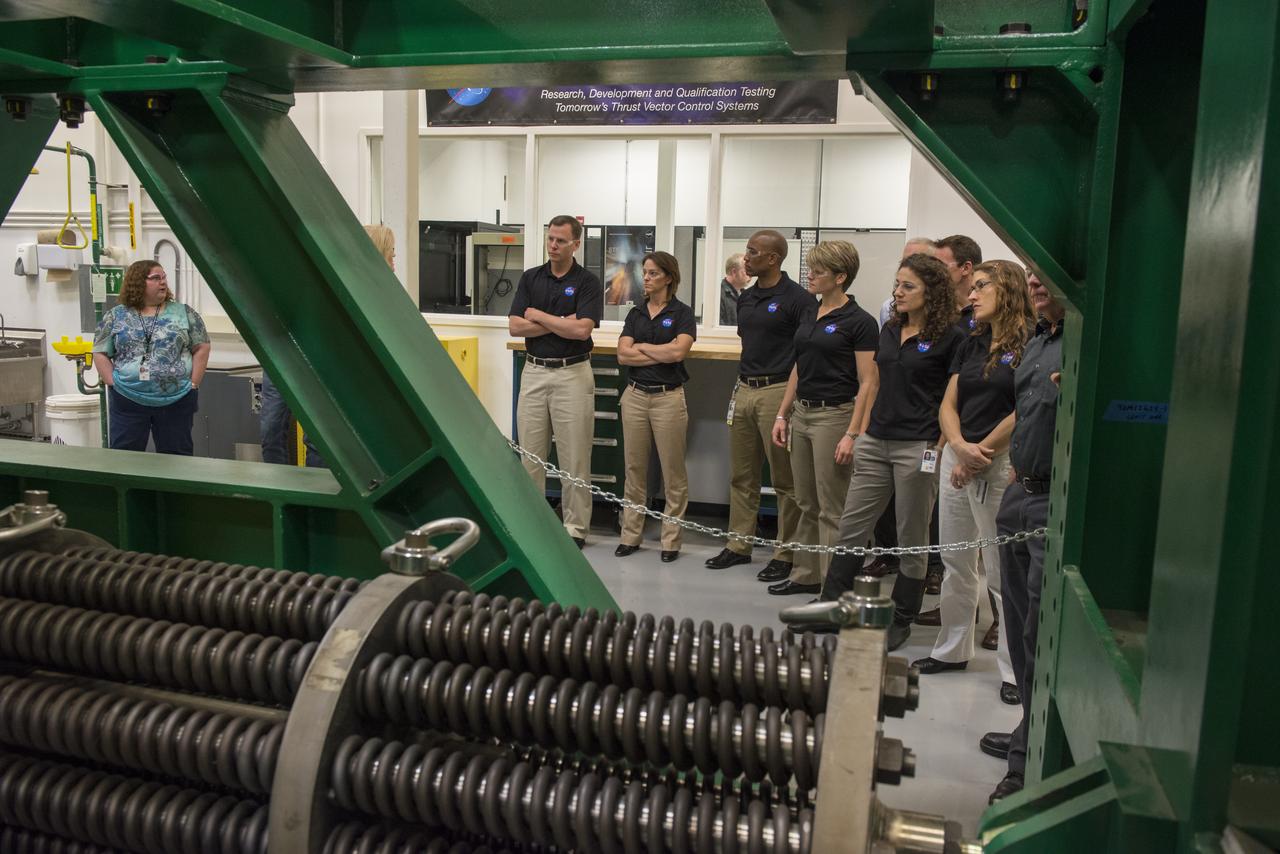
THE 2013 ASTRONAUT CANDIDATE CLASS VISITED THE THRUST VECTOR CONTROL TEST LAB AT MARSHALL'S PROPULSION RESEARCH DEVELOPMENT LABORATORY WHERE ENGINEERS ARE DEVELOPING AND TESTING THE SPACE LAUNCH SYSTEM'S GUIDANCE, NAVIGATION AND CONTROL SOFTWARE AND AVIONICS HARDWARE.
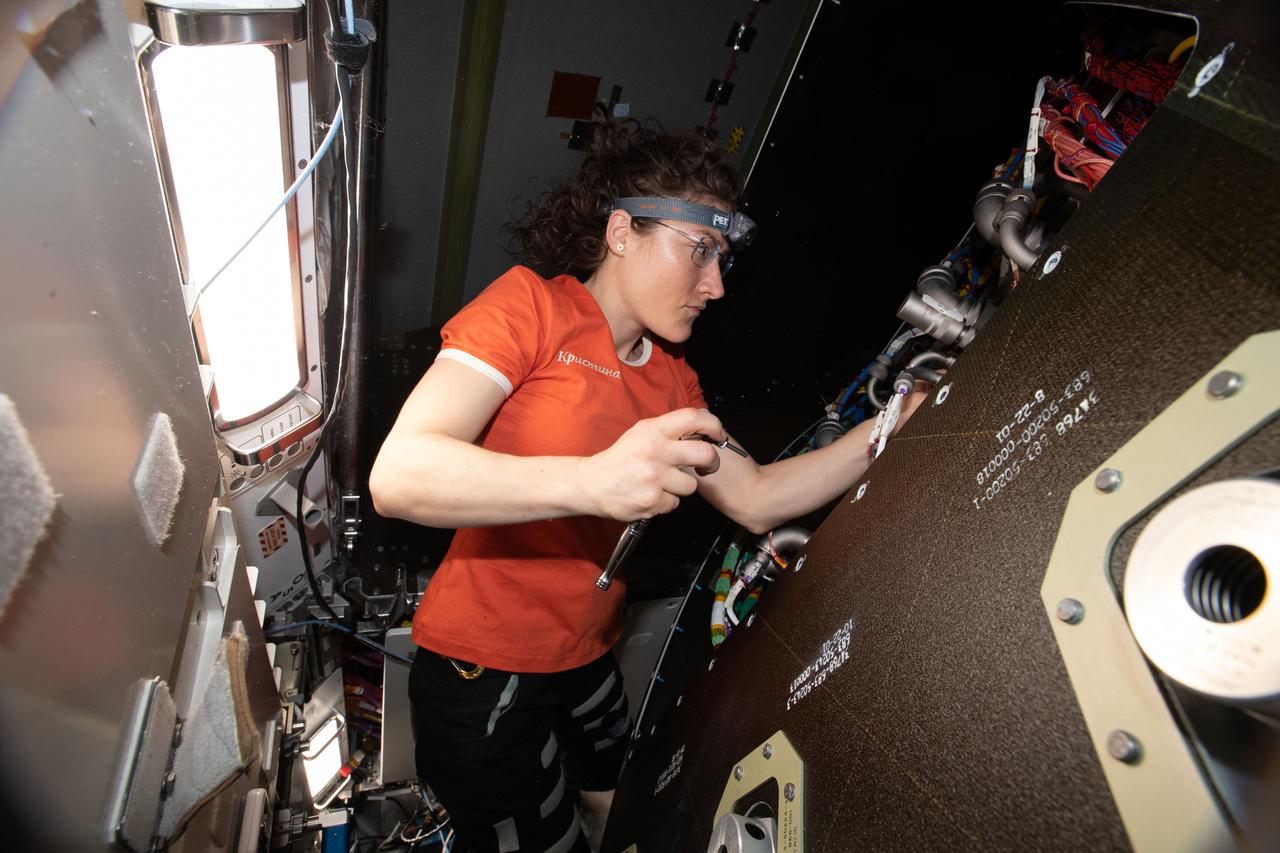
iss059e009964 (April 4, 2018) --- NASA astronaut and Expedition 59 Flight Engineer Christina Koch removes audio hardware from an avionics rack inside the Tranquility module.

JSC2011-E-067680 (12 July 2011) --- This is an overall view of the wiring for the simulated shuttle payload bay in the Shuttle Avionics Integration Laboratory (SAIL) at the Johnson Space Center in Houston on July 12, 2011. The laboratory is a skeletal avionics version of the shuttle that uses actual orbiter hardware and flight software. The facility even carries the official orbiter designation as Orbiter Vehicle 095. Photo credit: NASA Photo/Houston Chronicle, Smiley N. Pool
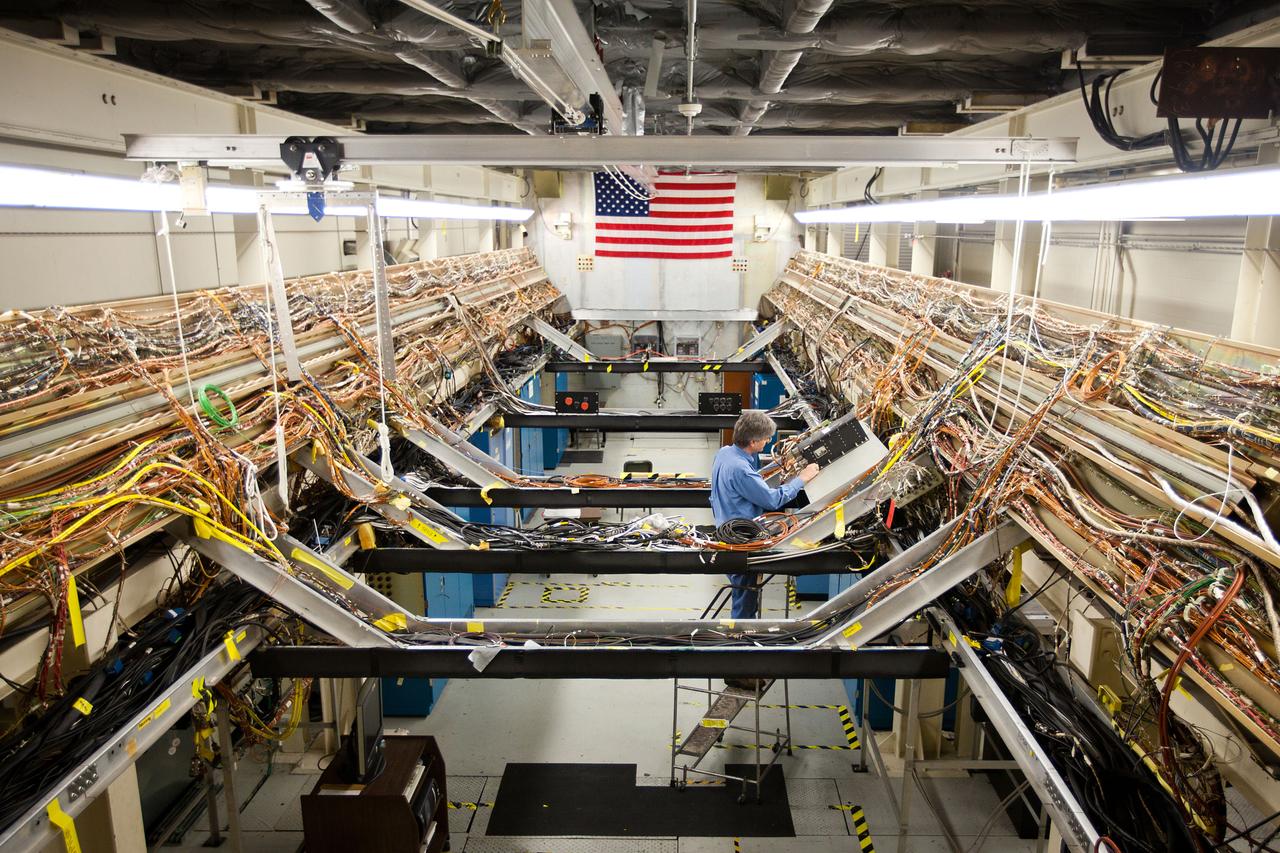
JSC2011-E-067679 (12 July 2011) --- This is an overall view of the wiring for the simulated shuttle payload bay in the Shuttle Avionics Integration Laboratory (SAIL) at the Johnson Space Center in Houston on July 12, 2011. The laboratory is a skeletal avionics version of the shuttle that uses actual orbiter hardware and flight software. The facility even carries the official orbiter designation as Orbiter Vehicle 095. Photo credit: NASA Photo/Houston Chronicle, Smiley N. Pool
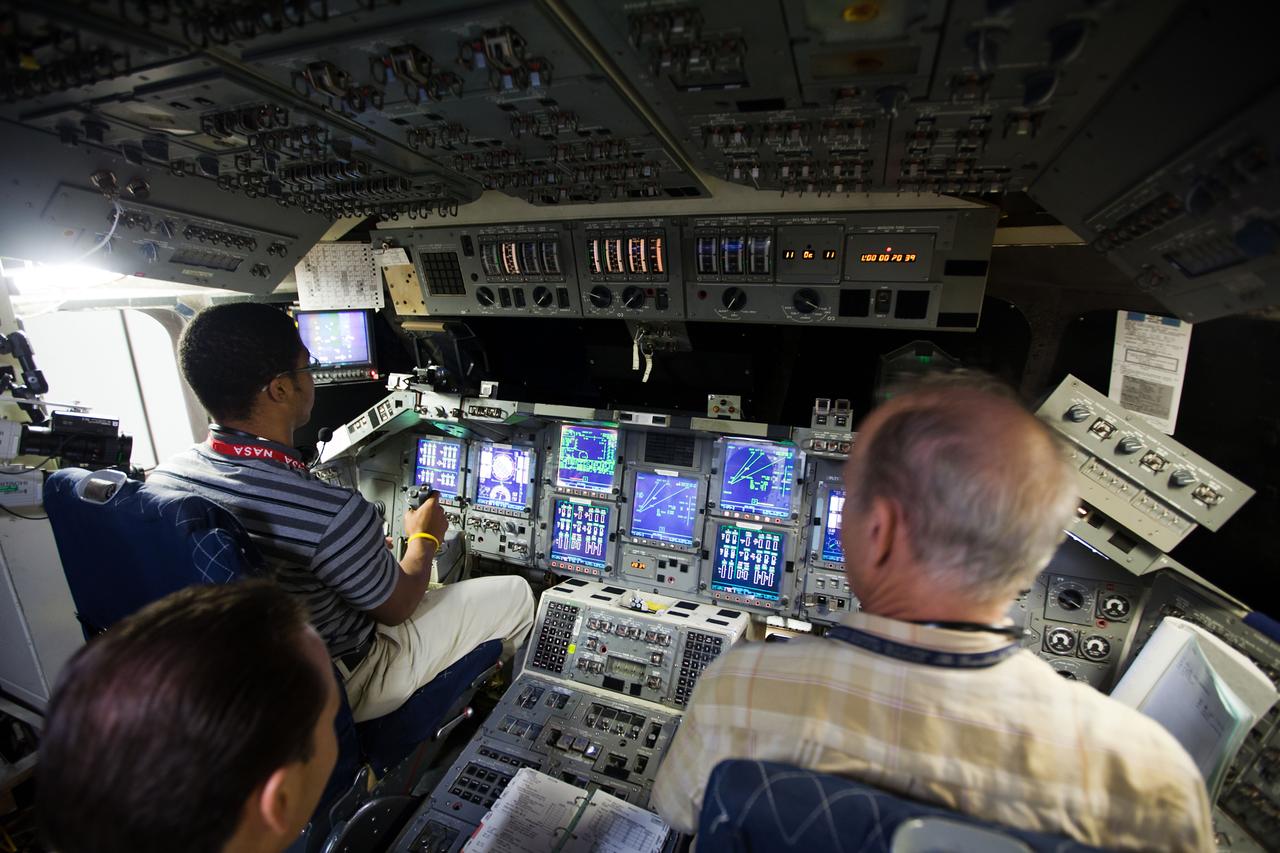
JSC2011-E-067674 (12 July 2011) --- Chris St. Julian, left, a Prairie View A&M electrical engineering major who is interning at NASA for the summer, pilots the shuttle for a simulated landing in the Shuttle Avionics Integration Laboratory (SAIL) at the Johnson Space Center in Houston, July 12, 2011. The laboratory is a skeletal avionics version of the shuttle that uses actual orbiter hardware and flight software. The facility bears the orbiter designation of Orbiter Vehicle 095. Photo credit: NASA Photo/Houston Chronicle, Smiley N. Pool
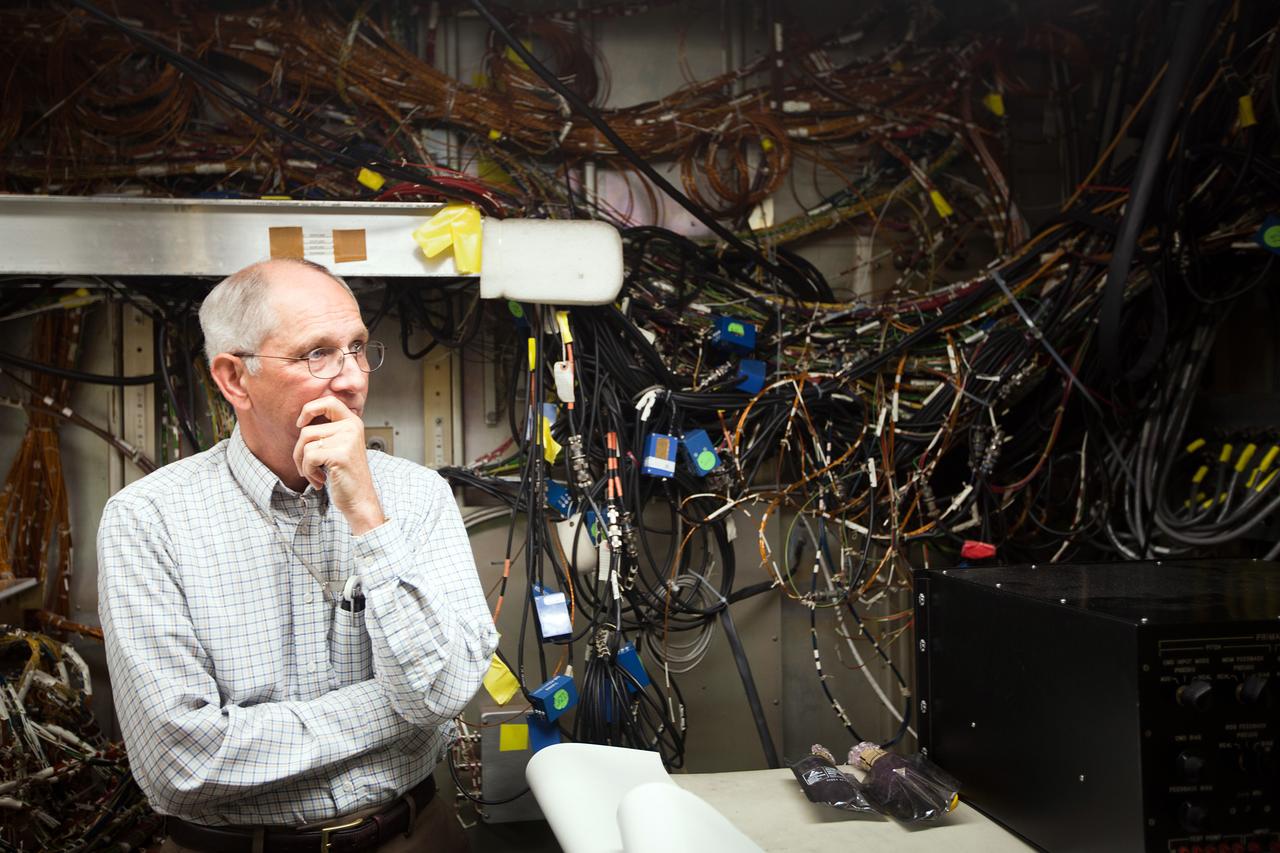
JSC2011-E-067682 (12 July 2011) --- Chief engineer Frank Svrecek pauses in the Shuttle Avionics Integration Laboratory (SAIL) at the Johnson Space Center in Houston July 12, 2011. The laboratory is a skeletal avionics version of the shuttle that uses actual orbiter hardware and flight software. The facility is referred to as Orbiter Vehicle 095. Photo credit: NASA Photo/Houston Chronicle, Smiley N. Pool
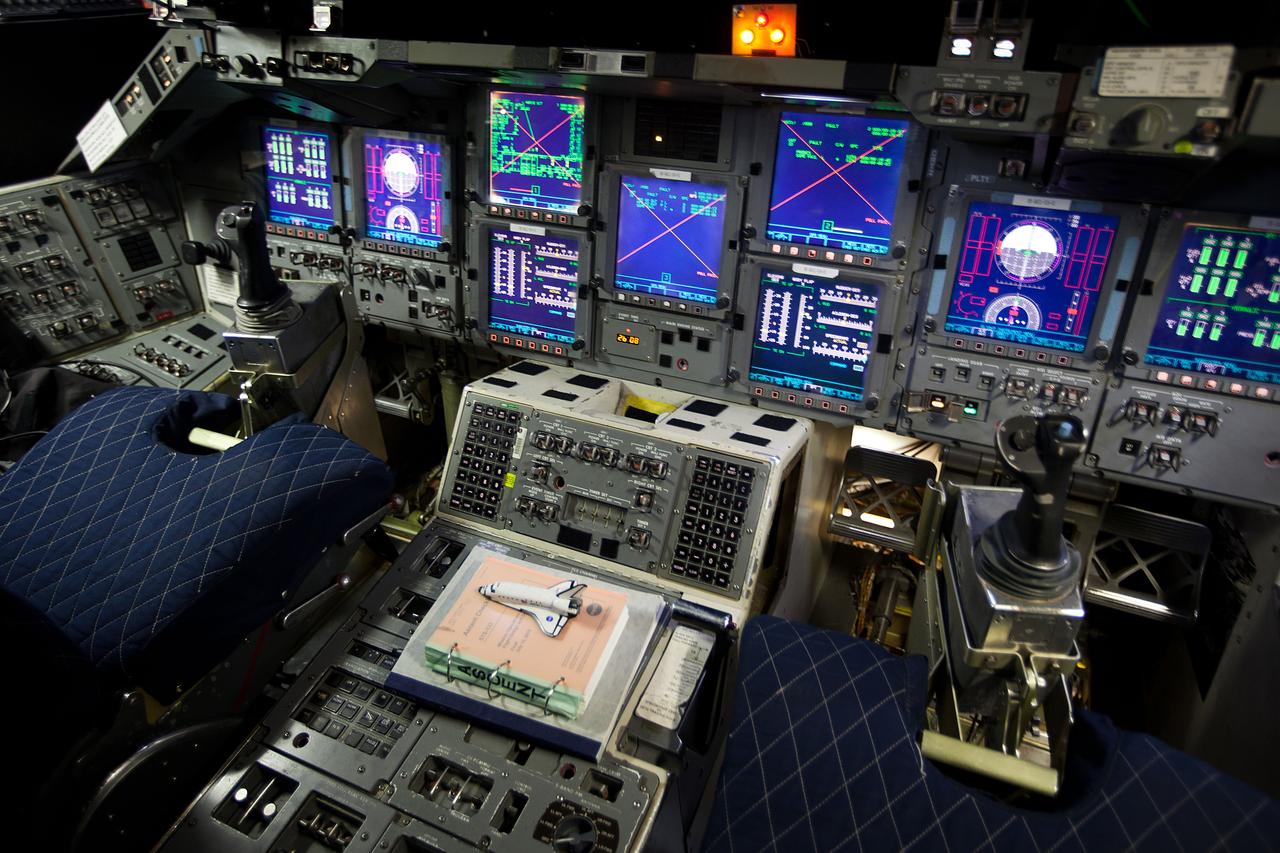
JSC2011-E-067676 (12 July 2011) --- A close-up view of controls and displays on the forward flight deck of OV-095 in the Shuttle Avionics Integration Laboratory (SAIL) at the Johnson Space Center in Houston, July 12, 2011. The laboratory is a skeletal avionics version of the shuttle that uses actual orbiter hardware and flight software. Photo credit: NASA Photo/Houston Chronicle, Smiley N. Pool
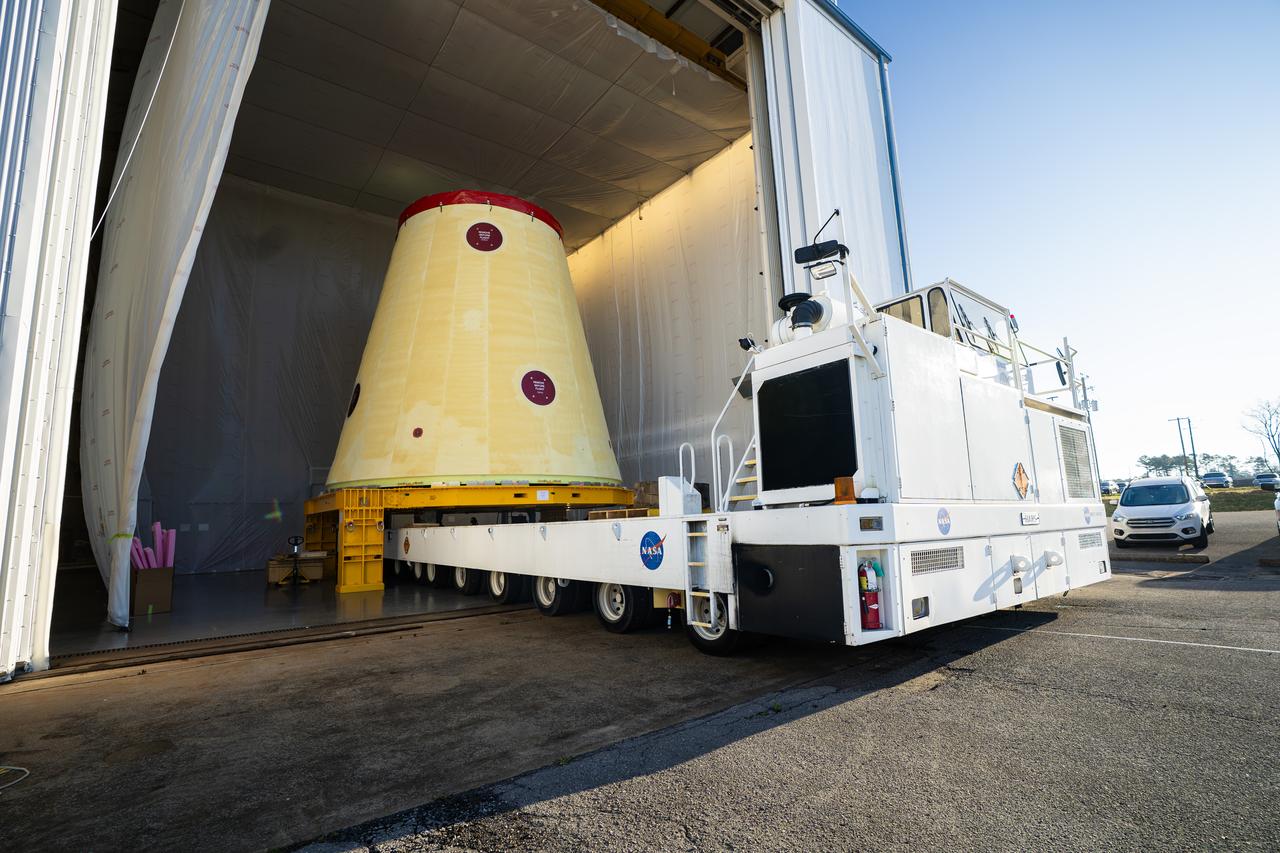
These images and videos show technicians at NASA’s Marshall Space Flight Center in Huntsville, Alabama, March 17, 2025, moving the completed launch vehicle stage adapter for Artemis III from Building 4649 to Building 4708 where it will remain until it is time to ship the hardware to NASA’s Kennedy Space Center in Florida. The cone-shaped hardware connects the SLS (Space Launch System) rocket to the upper stage, the interim cryogenic propulsion stage, and protects the rocket’s flight computers, avionics, and electrical devices during launch and ascent during the Artemis missions.
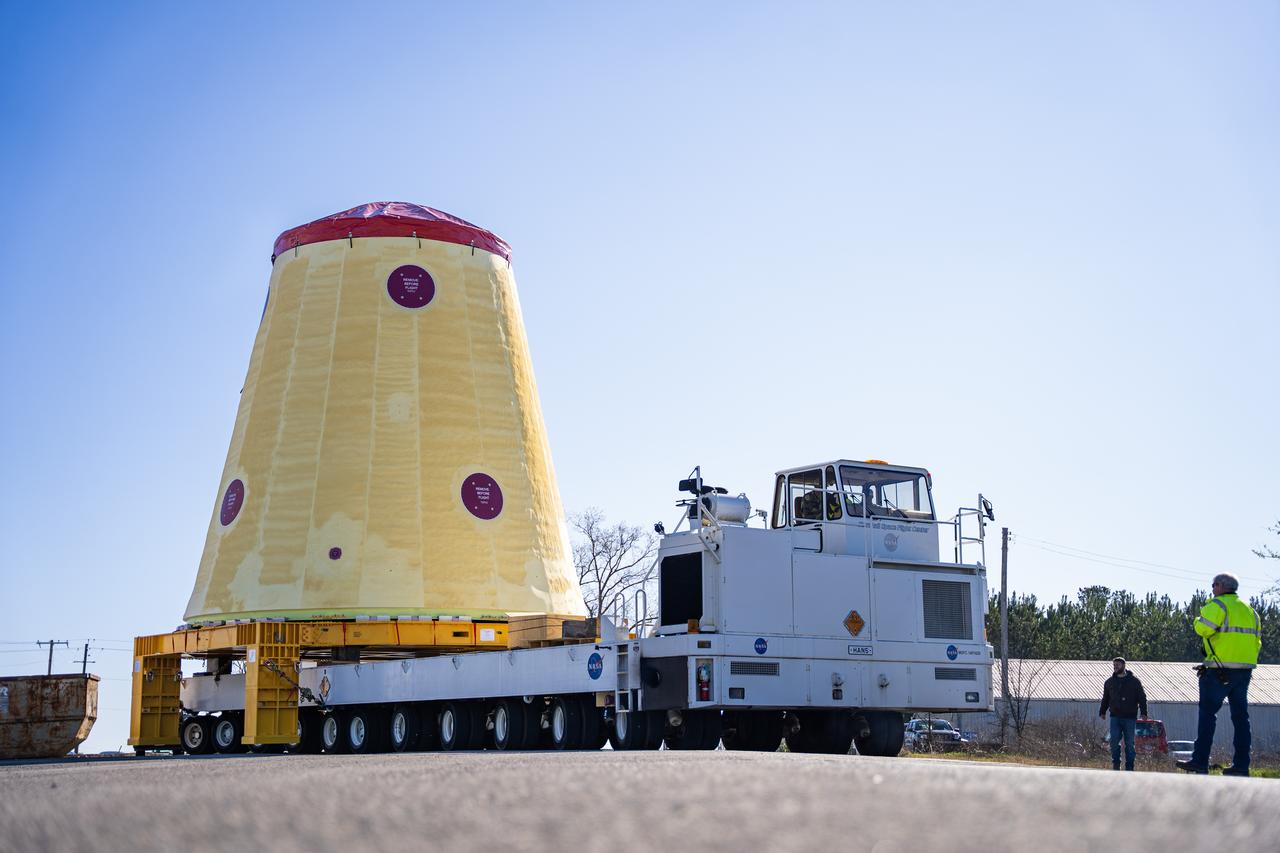
These images and videos show technicians at NASA’s Marshall Space Flight Center in Huntsville, Alabama, March 17, 2025, moving the completed launch vehicle stage adapter for Artemis III from Building 4649 to Building 4708 where it will remain until it is time to ship the hardware to NASA’s Kennedy Space Center in Florida. The cone-shaped hardware connects the SLS (Space Launch System) rocket to the upper stage, the interim cryogenic propulsion stage, and protects the rocket’s flight computers, avionics, and electrical devices during launch and ascent during the Artemis missions.
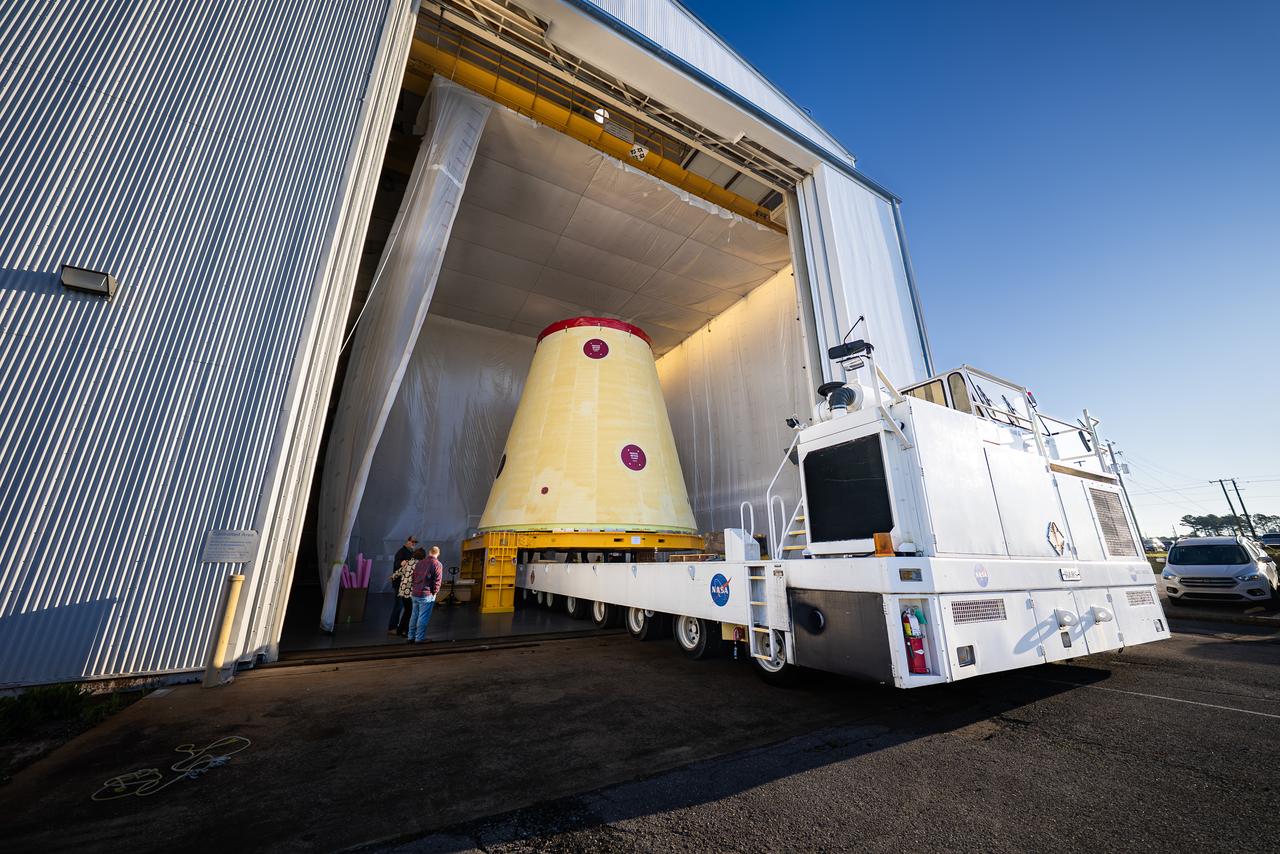
These images and videos show technicians at NASA’s Marshall Space Flight Center in Huntsville, Alabama, March 17, 2025, moving the completed launch vehicle stage adapter for Artemis III from Building 4649 to Building 4708 where it will remain until it is time to ship the hardware to NASA’s Kennedy Space Center in Florida. The cone-shaped hardware connects the SLS (Space Launch System) rocket to the upper stage, the interim cryogenic propulsion stage, and protects the rocket’s flight computers, avionics, and electrical devices during launch and ascent during the Artemis missions.
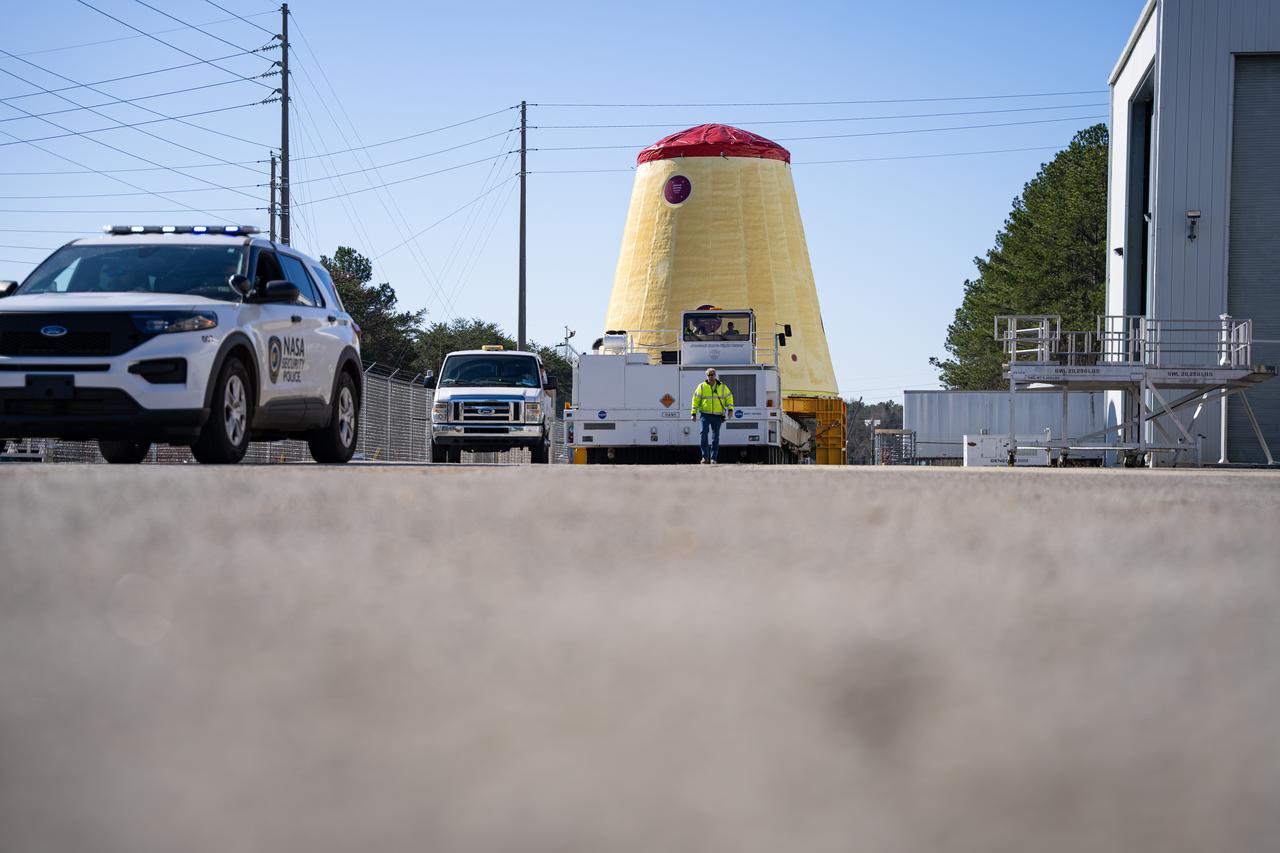
These images and videos show technicians at NASA’s Marshall Space Flight Center in Huntsville, Alabama, March 17, 2025, moving the completed launch vehicle stage adapter for Artemis III from Building 4649 to Building 4708, where it will remain until it is time to ship the hardware to NASA’s Kennedy Space Center in Florida. The cone-shaped hardware connects the SLS (Space Launch System) rocket to the upper stage, the interim cryogenic propulsion stage, and protects the rocket’s flight computers, avionics, and electrical devices during launch and ascent during the Artemis missions.

These images and videos show technicians at NASA’s Marshall Space Flight Center in Huntsville, Alabama, March 17, 2025, moving the completed launch vehicle stage adapter for Artemis III from Building 4649 to Building 4708 where it will remain until it is time to ship the hardware to NASA’s Kennedy Space Center in Florida. The cone-shaped hardware connects the SLS (Space Launch System) rocket to the upper stage, the interim cryogenic propulsion stage, and protects the rocket’s flight computers, avionics, and electrical devices during launch and ascent during the Artemis missions.
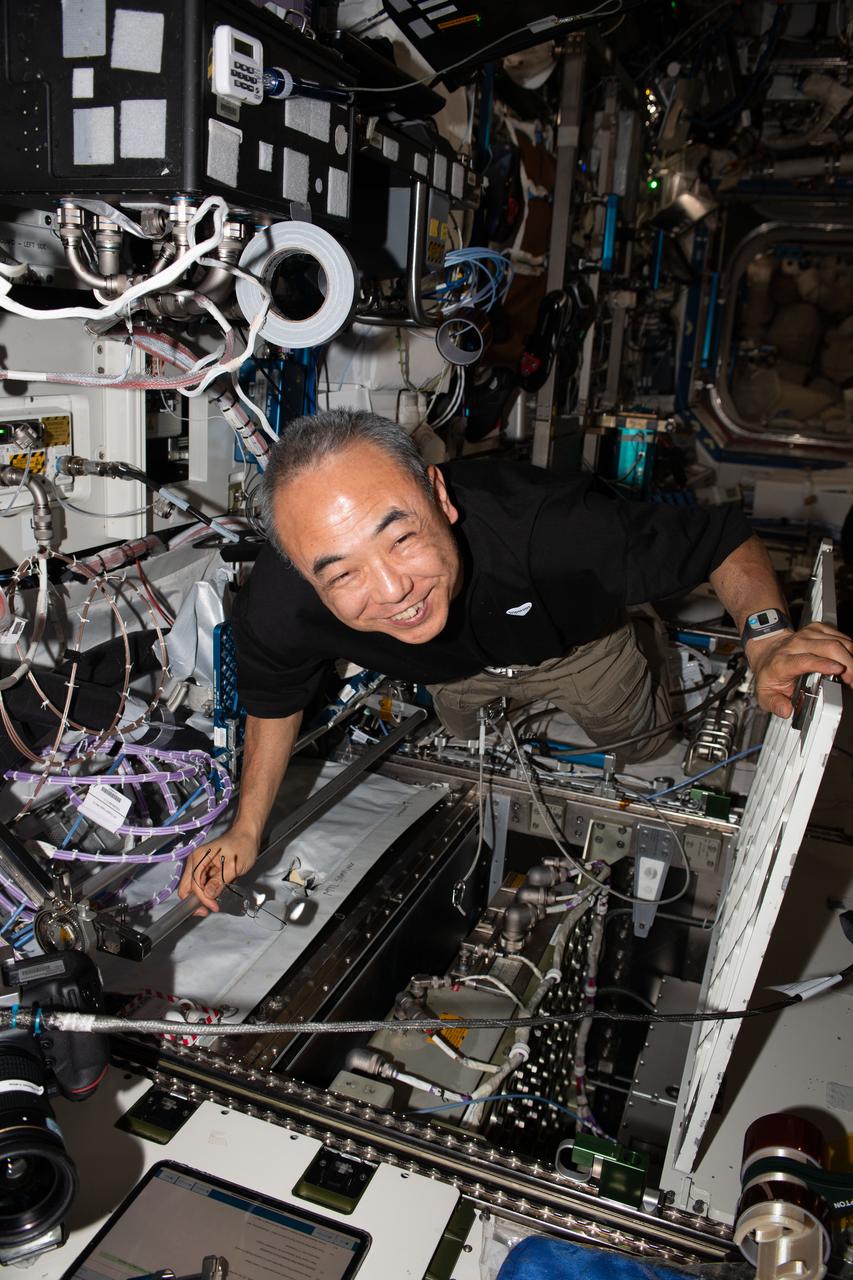
iss070e014709 (Oct. 27, 2023) --- JAXA (Japan Aerospace Exploration Agency) astronaut and Expedition 70 Flight Engineer Satoshi Furukawa replaces hardware inside an avionics rack located aboard the International Space Station's Destiny laboratory module.

LOUISVILLE, Colo. – During NASA's Commercial Crew Development Round 2 CCDev2) activities for the Commercial Crew Program CCP, Sierra Nevada Corp. SNC built a Simulator and Avionics Laboratory to help engineers evaluate the Dream Chaser's characteristics during the piloted phases of flight. Located at Sierra Nevada’s Space Systems facility in Louisville, Colo., it consists of a physical cockpit and integrated simulation hardware and software. The simulator is linked to the Vehicle Avionics Integration Laboratory, or VAIL, which serves as a platform for Dream Chaser avionics development, engineering testing and integration. VAIL also will also be used for verification and validation of avionics and software. Sierra Nevada is one of seven companies NASA entered into Space Act Agreements SAAs with during CCDev2 to aid in the innovation and development of American-led commercial capabilities for crew transportation and rescue services to and from the International Space Station and other low Earth orbit destinations. For information about CCP, visit www.nasa.gov/commercialcrew. Photo credit: Sierra Nevada Corp.
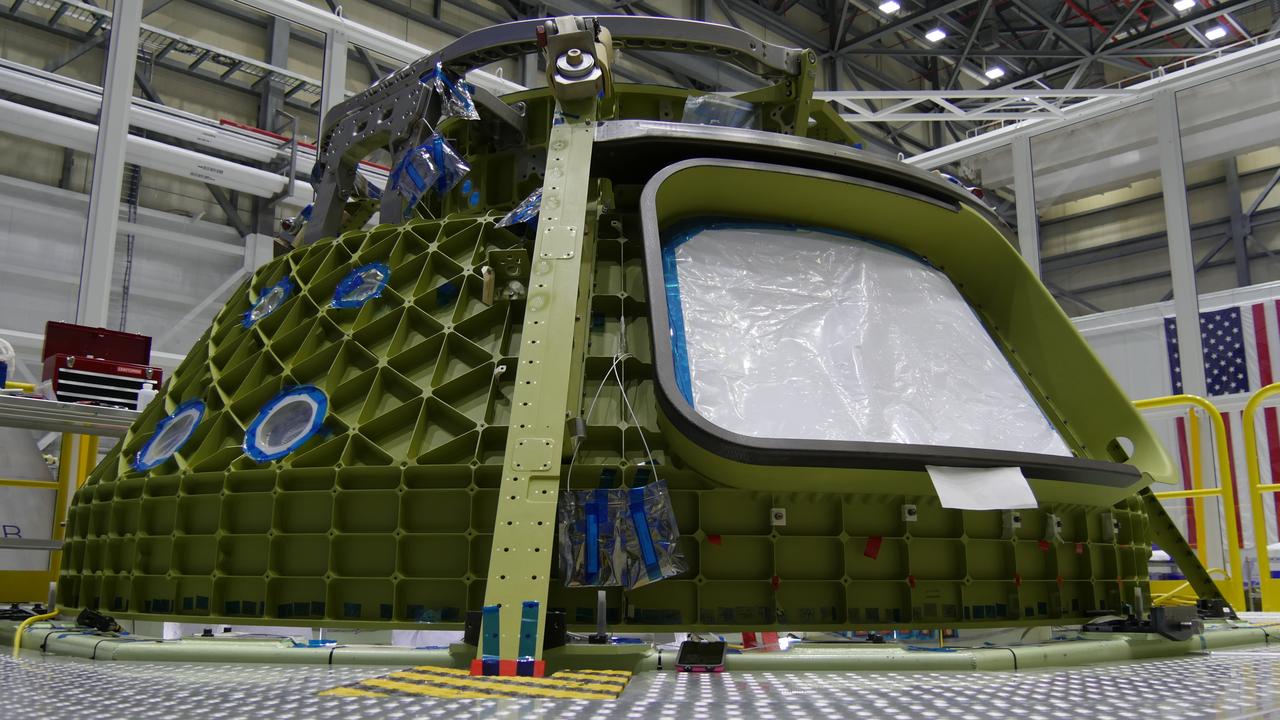
Boeing’s CST-100 Starliner Orbital Flight Test vehicle will fly the first test flight to space on an uncrewed mission to the International Space Station. Here you see the spacecraft’s upper dome undergoing the final preparations before the upper and lower dome are mated for a pressure test, and then the two domes will move on to be populated with avionics, life support and other critical hardware.
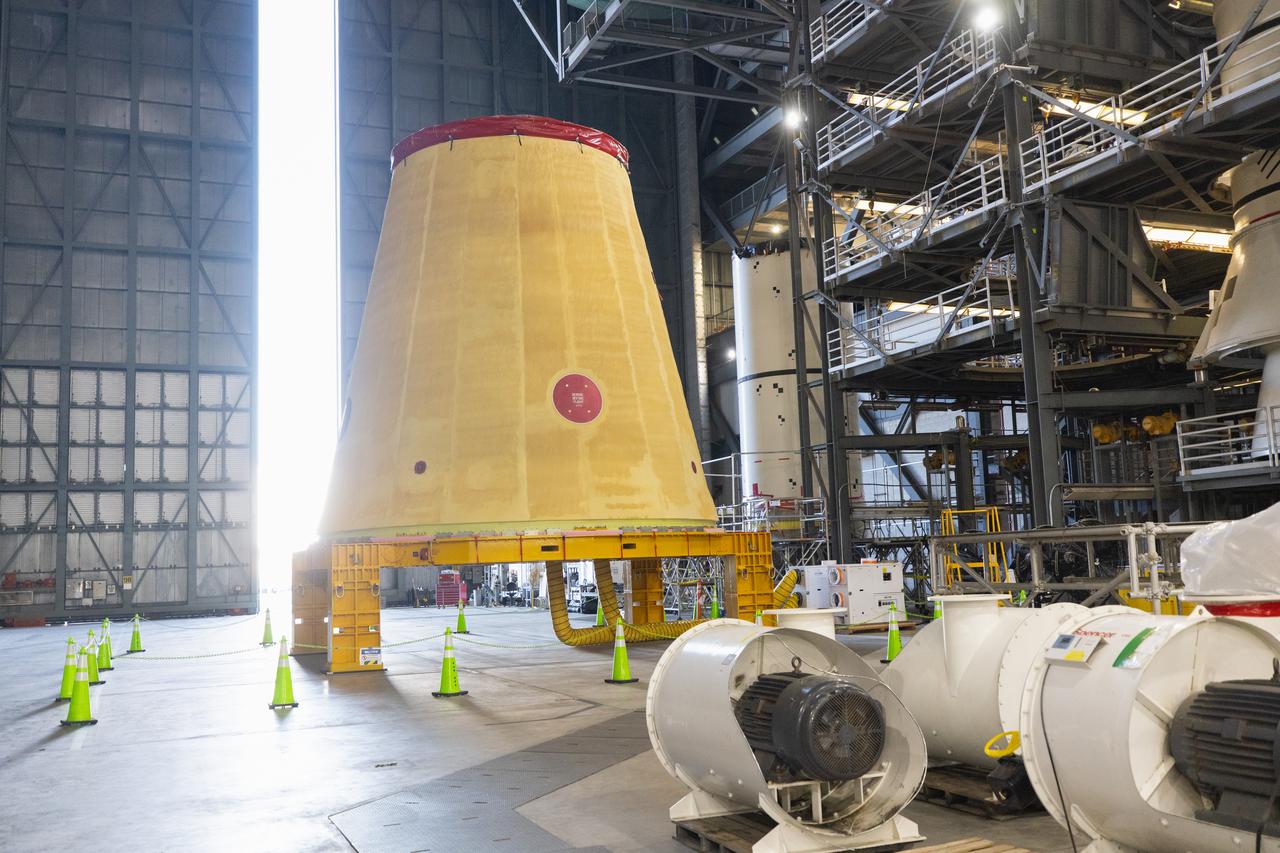
NASA’s Artemis II hardware, the launch vehicle stage adapter, is inside High Bay 4 on Thursday, March 20, 2025, at the Vehicle Assembly Building at NASA’s Kennedy Space Center in Florida ahead of rocket stacking operations. The cone shaped launch vehicle stage adapter connects the SLS (Space Launch System) Moon rocket to the upper stage, the interim cryogenic propulsion stage, and protects the rocket’s flight computers, avionics, and electrical devices during launch and ascent during the Artemis missions.
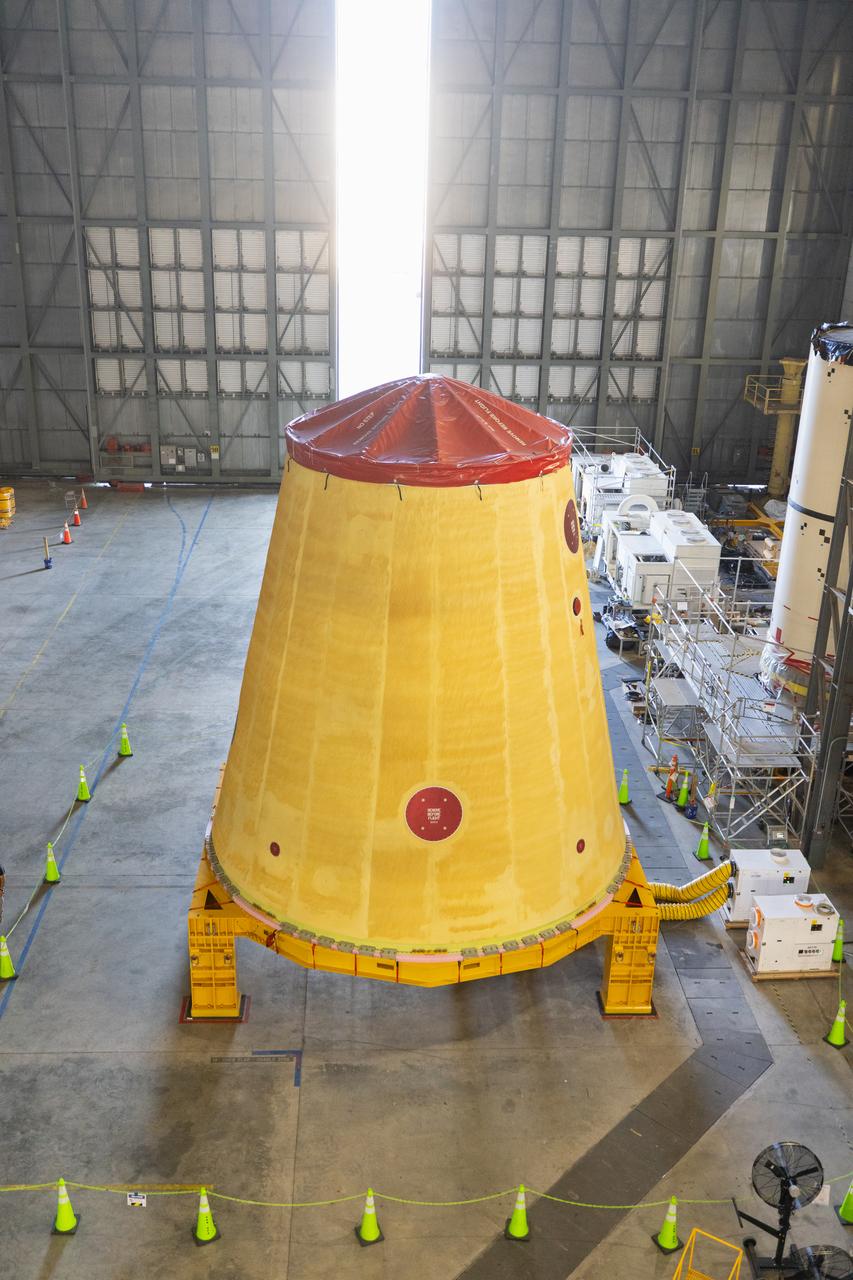
NASA’s Artemis II hardware, the launch vehicle stage adapter, is inside High Bay 4 on Thursday, March 20, 2025, at the Vehicle Assembly Building at NASA’s Kennedy Space Center in Florida ahead of rocket stacking operations. The cone shaped launch vehicle stage adapter connects the SLS (Space Launch System) Moon rocket to the upper stage, the interim cryogenic propulsion stage, and protects the rocket’s flight computers, avionics, and electrical devices during launch and ascent during the Artemis missions.
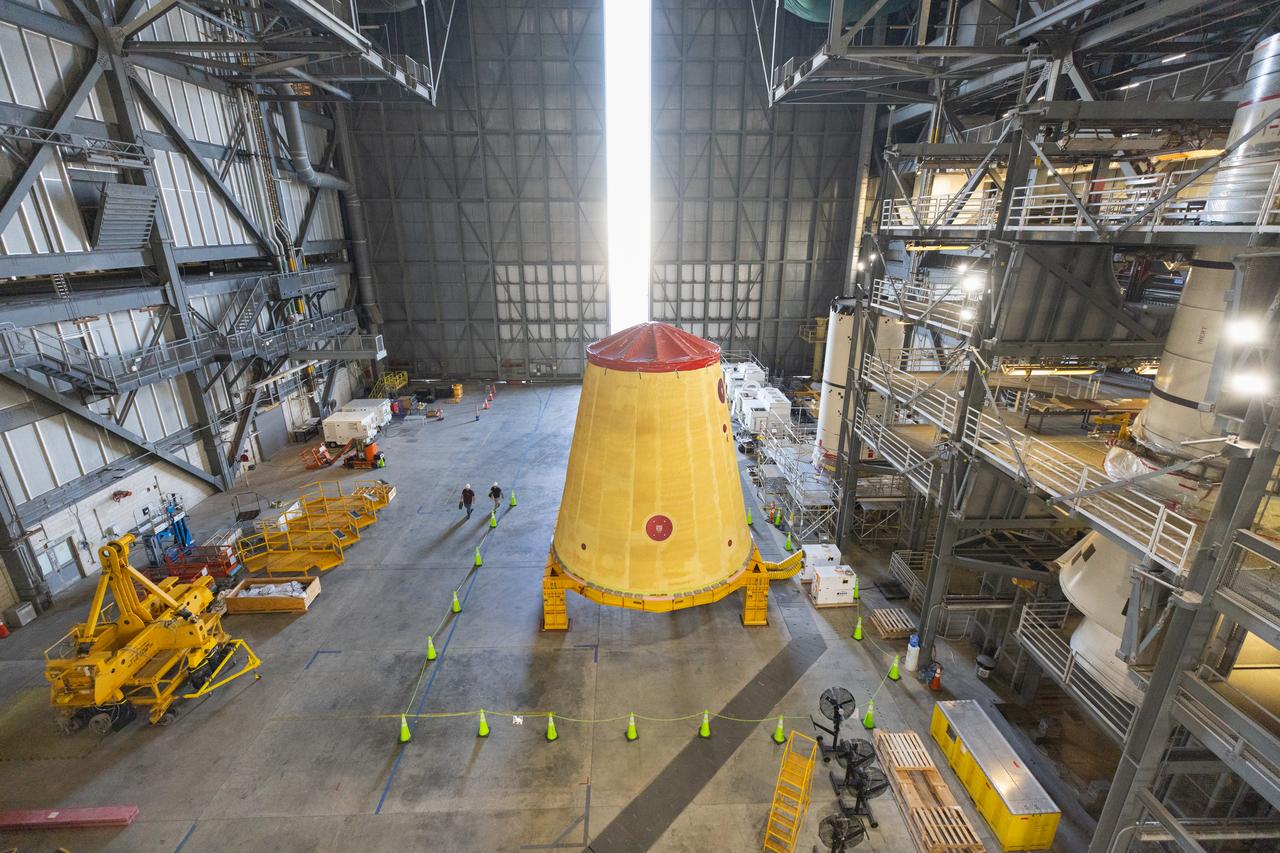
NASA’s Artemis II hardware, the launch vehicle stage adapter, is inside High Bay 4 on Thursday, March 20, 2025, at the Vehicle Assembly Building at NASA’s Kennedy Space Center in Florida ahead of rocket stacking operations. The cone shaped launch vehicle stage adapter connects the SLS (Space Launch System) Moon rocket to the upper stage, the interim cryogenic propulsion stage, and protects the rocket’s flight computers, avionics, and electrical devices during launch and ascent during the Artemis missions.
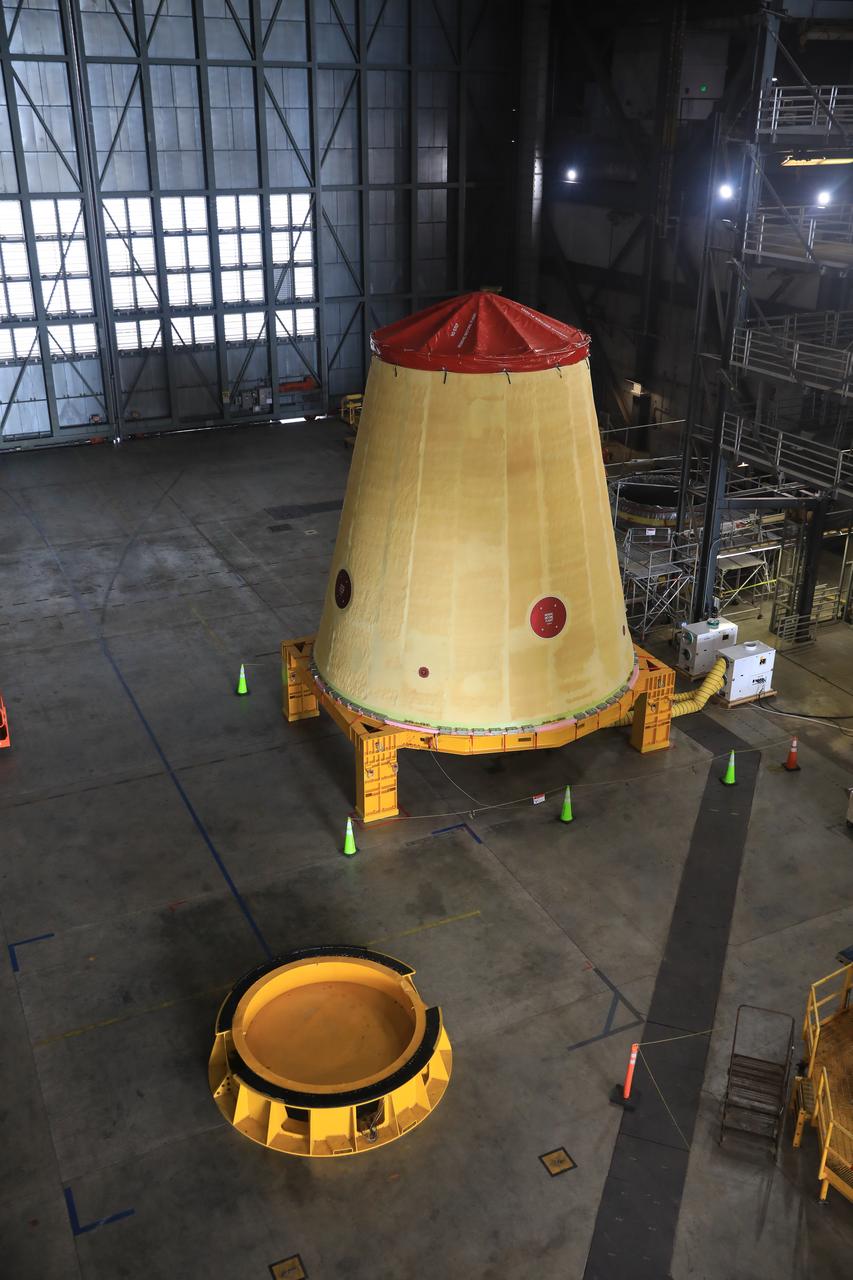
NASA’s Artemis II hardware, the launch vehicle stage adapter, awaits stacking operations at the Vehicle Assembly Building at NASA’s Kennedy Space Center in Florida on Monday, Sept. 9, 2024. The cone shaped launch vehicle stage adapter connects to NASA’s SLS (Space Launch System) rocket to the upper stage, the interim cryogenic propulsion stage, and protects the rocket’s flight computers, avionics, and electrical devices during launch and ascent.
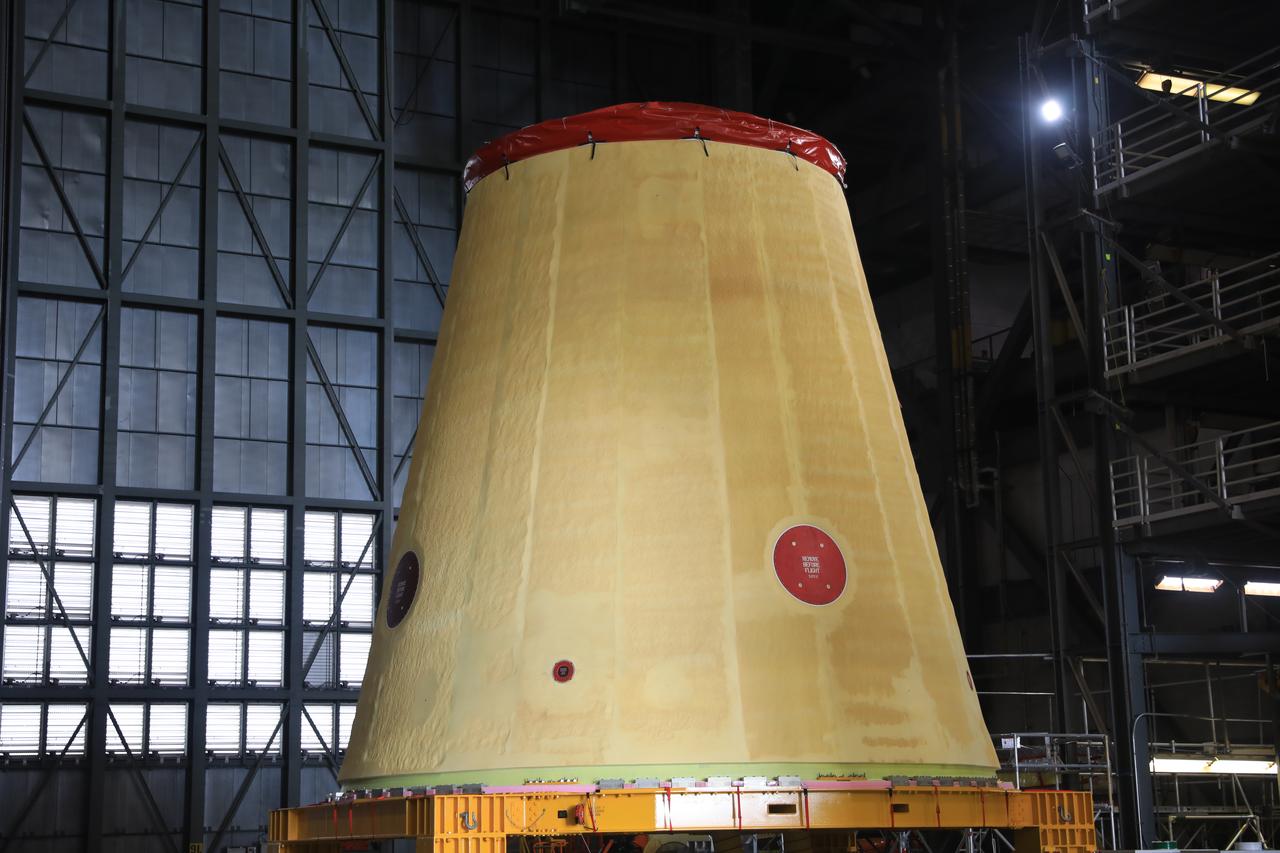
NASA’s Artemis II hardware, the launch vehicle stage adapter, awaits stacking operations at the Vehicle Assembly Building at NASA’s Kennedy Space Center in Florida on Monday, Sept. 9, 2024. The cone shaped launch vehicle stage adapter connects to NASA’s SLS (Space Launch System) rocket to the upper stage, the interim cryogenic propulsion stage, and protects the rocket’s flight computers, avionics, and electrical devices during launch and ascent.
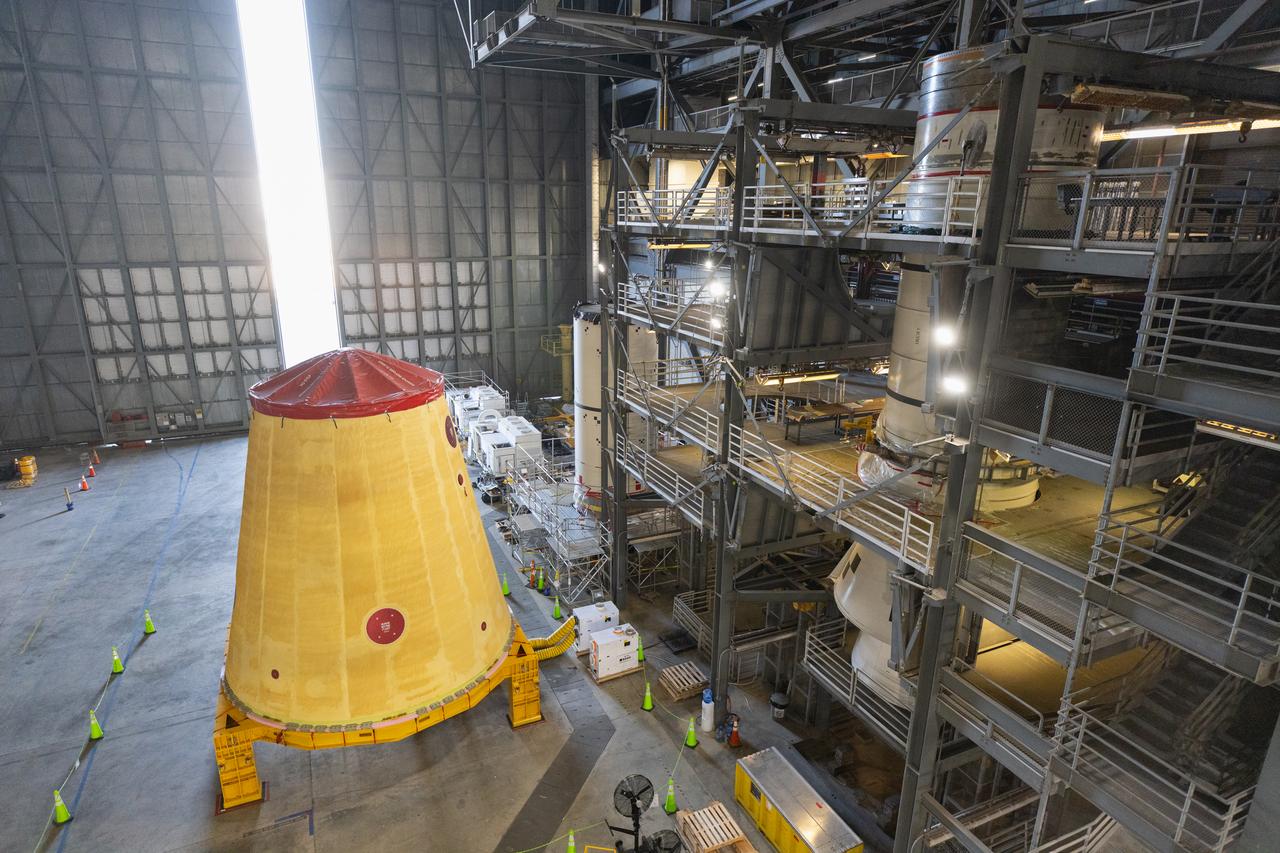
NASA’s Artemis II hardware, the launch vehicle stage adapter, is inside High Bay 4 on Thursday, March 20, 2025, at the Vehicle Assembly Building at NASA’s Kennedy Space Center in Florida ahead of rocket stacking operations. The cone shaped launch vehicle stage adapter connects the SLS (Space Launch System) Moon rocket to the upper stage, the interim cryogenic propulsion stage, and protects the rocket’s flight computers, avionics, and electrical devices during launch and ascent during the Artemis missions.
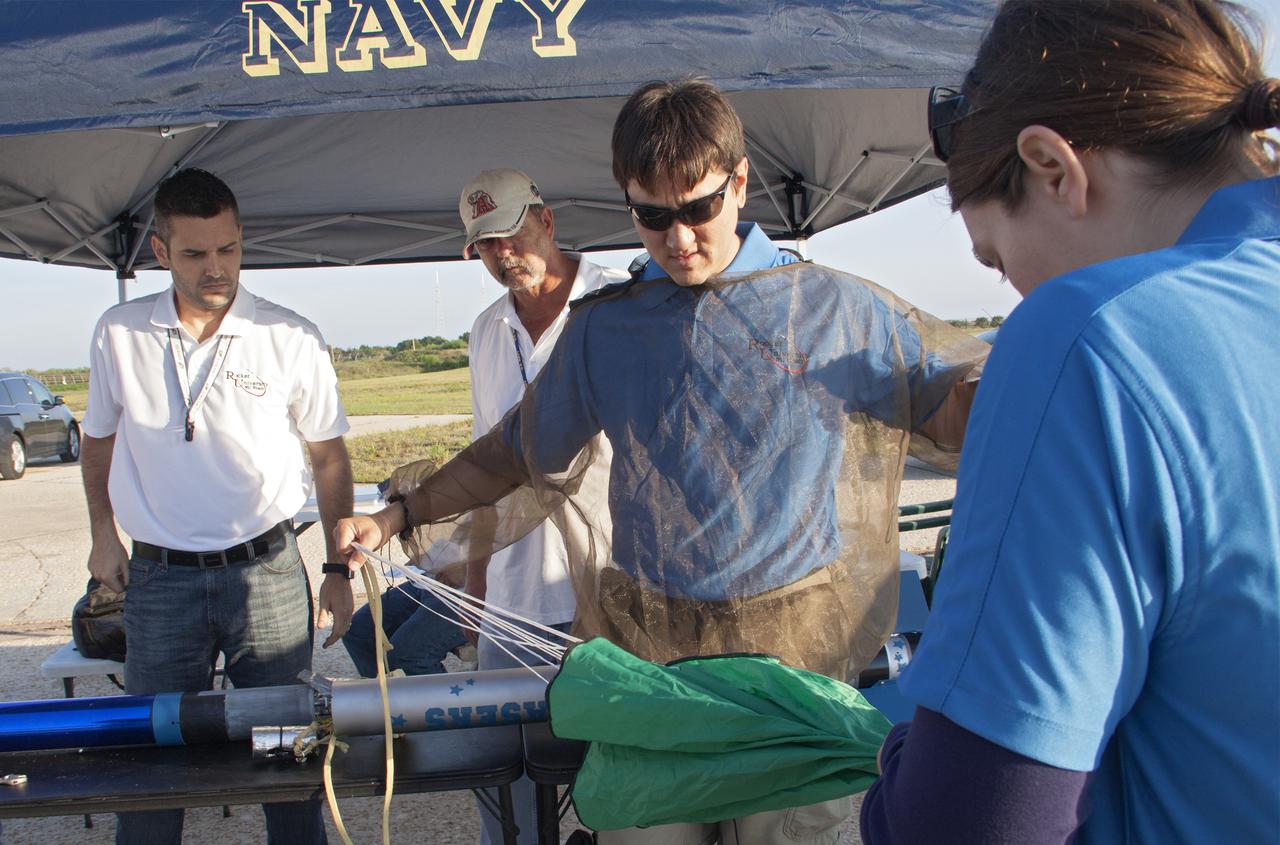
CAPE CANAVERAL, Fla. -- At NASA's Kennedy Space Center in Florida, from the left, Leandro James of Systems Hardware Engineering, George Mizell of Quality Assurance, Morgan Simpson of Flight Hardware Processing and Kim Simpson of Fluids, Mechanical and Structural Systems prepare a parachute for a small rocket prior to launch as part of Rocket University. The goal was to test its systems and to verify that it performed as designed. As part of Rocket University, the engineers are given an opportunity to work a fast-track project to develop skills in developing spacecraft systems of the future. As NASA plans for future spaceflight programs to low-Earth orbit and beyond, teams of engineers at Kennedy are gaining experience in designing and flying launch vehicle systems on a small scale. Four teams of five to eight members from Kennedy are designing rockets complete with avionics and recovery systems. Launch operations require coordination with federal agencies, just as they would with rockets launched in support of a NASA mission. Photo credit: NASA_Jim Grossmann
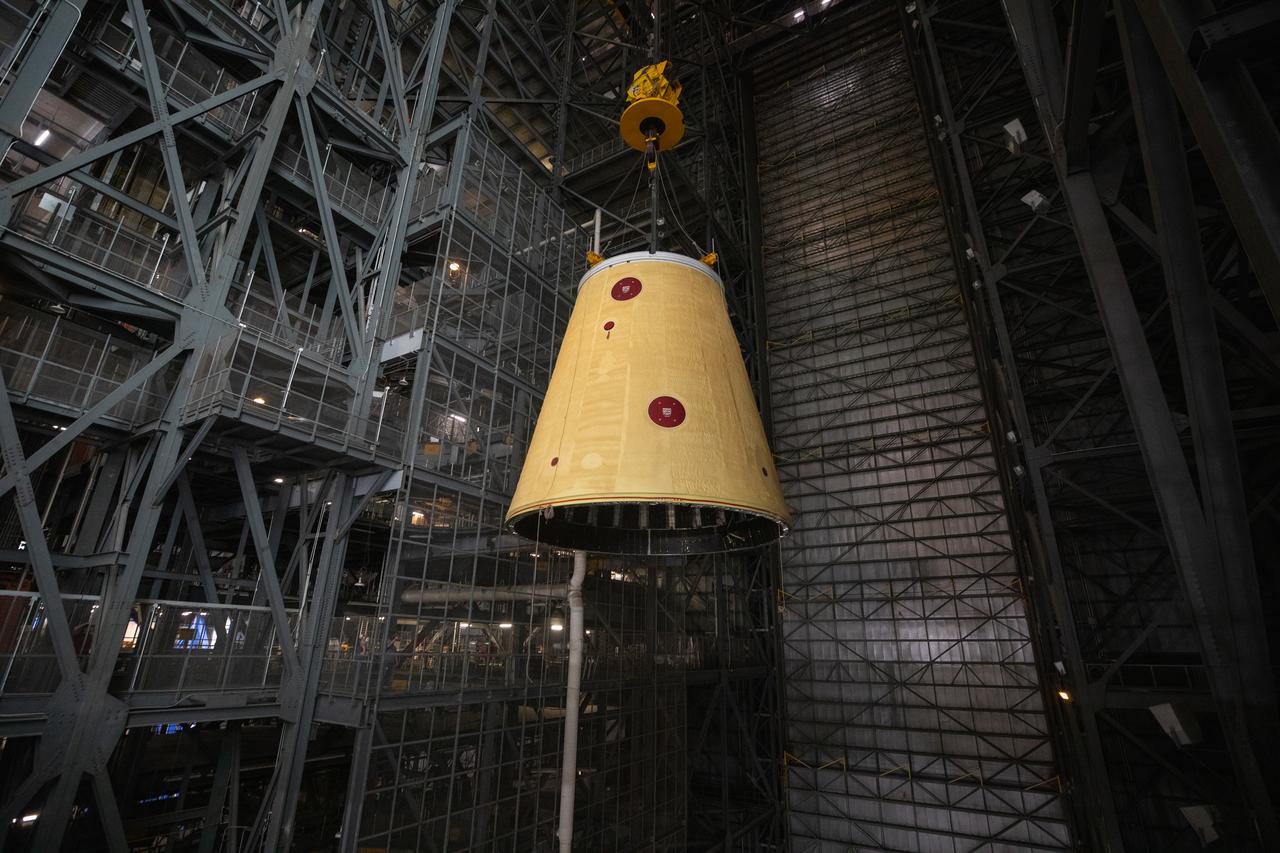
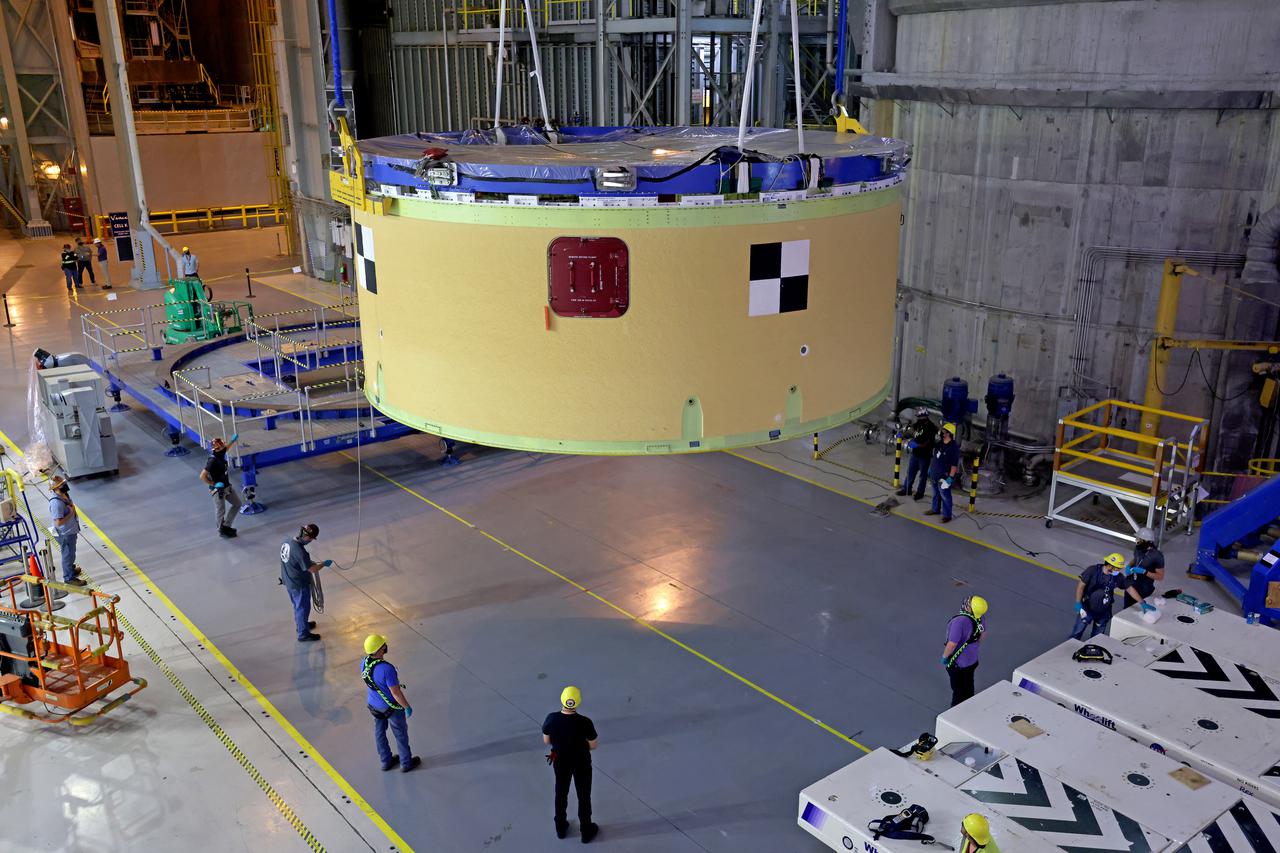
A massive crane lifts the launch vehicle stage adapter 250 feet into the air on Thursday, April 3, 2025, to prepare integration onto the SLS (Space Launch System) core stage in High Bay 3 inside the Vehicle Assembly Building at NASA’s Kennedy Space Center in Florida. During launch and ascent, the launch vehicle stage adapter provides structural support and protects avionics and electrical devices within the upper stage from extreme vibrations and acoustic conditions. The Artemis II test flight will take a crew of four astronauts on a 10-day journey around the Moon, helping confirm the foundational systems and hardware needed for human deep space exploration.

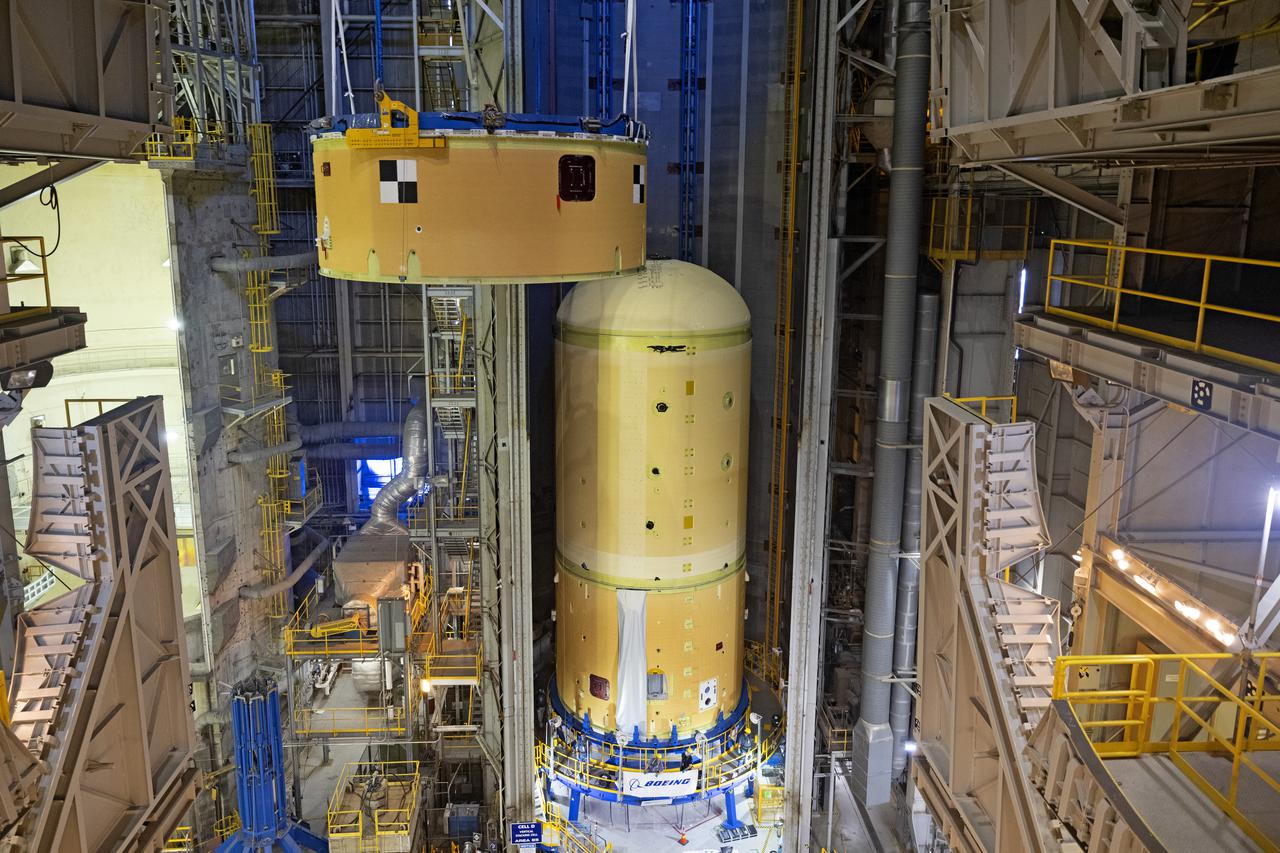
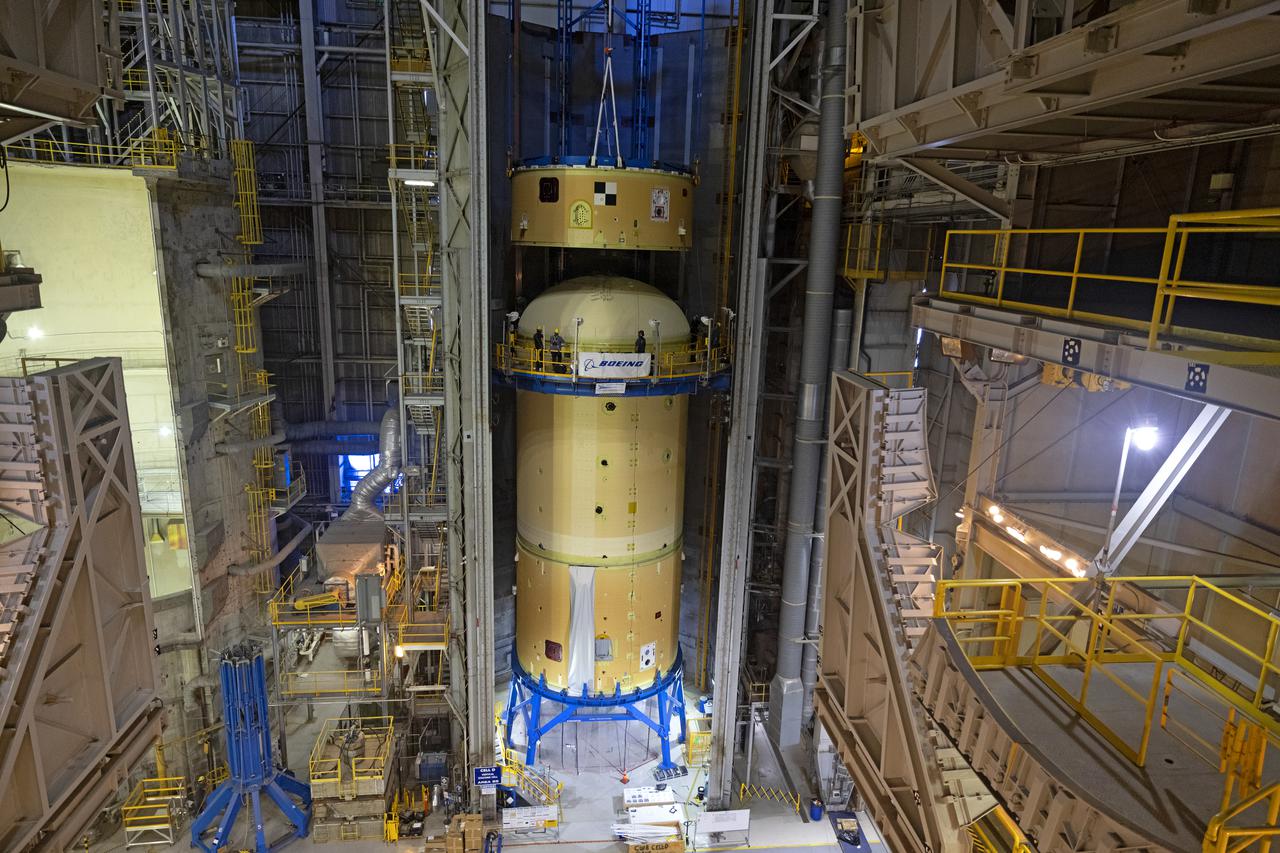
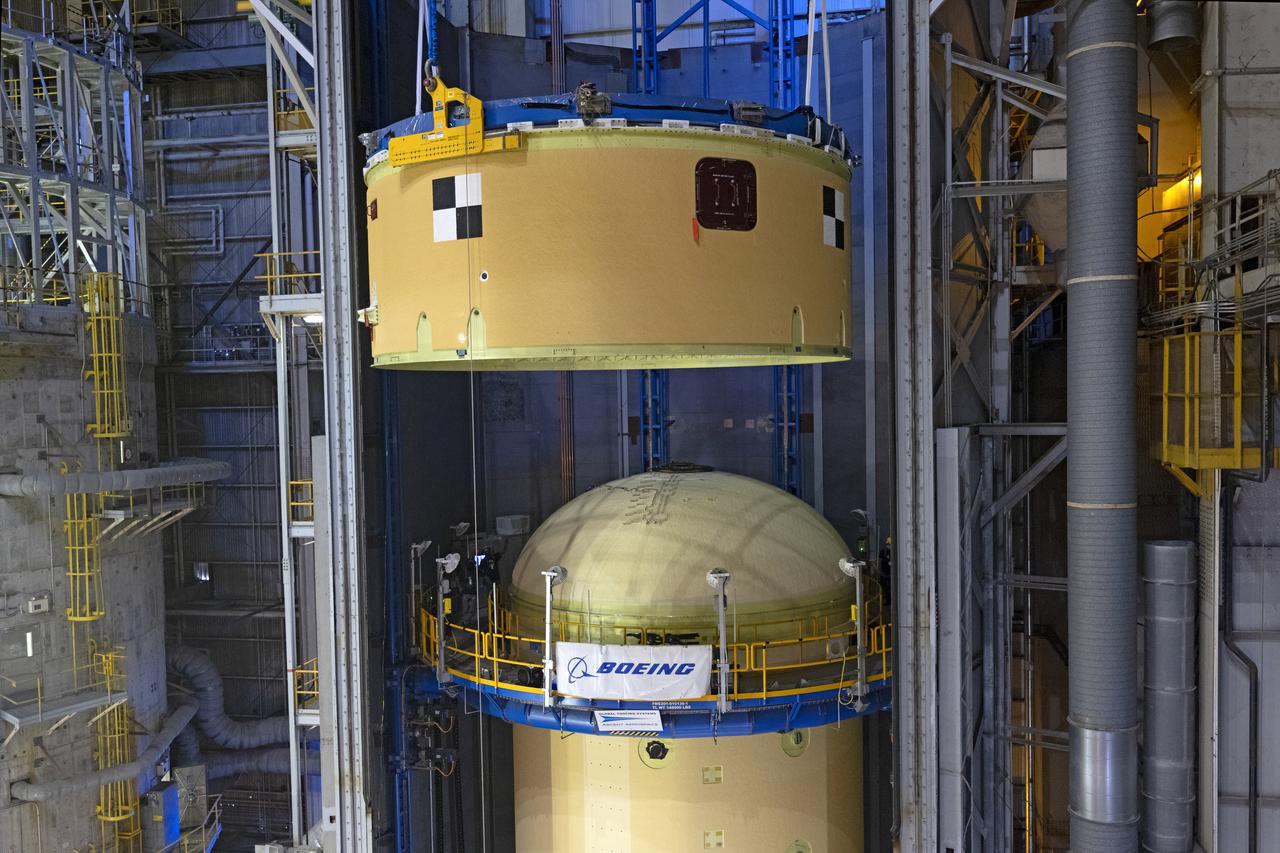
A massive crane lowers the launch vehicle stage adapter onto the SLS (Space Launch System) core stage on Thursday, April 3, 2025, in High Bay 3 inside the Vehicle Assembly Building at NASA’s Kennedy Space Center in Florida. During launch and ascent, the launch vehicle stage adapter provides structural support and protects avionics and electrical devices within the upper stage from extreme vibrations and acoustic conditions. The Artemis II test flight will take a crew of four astronauts on a 10-day journey around the Moon, helping confirm the foundational systems and hardware needed for human deep space exploration.
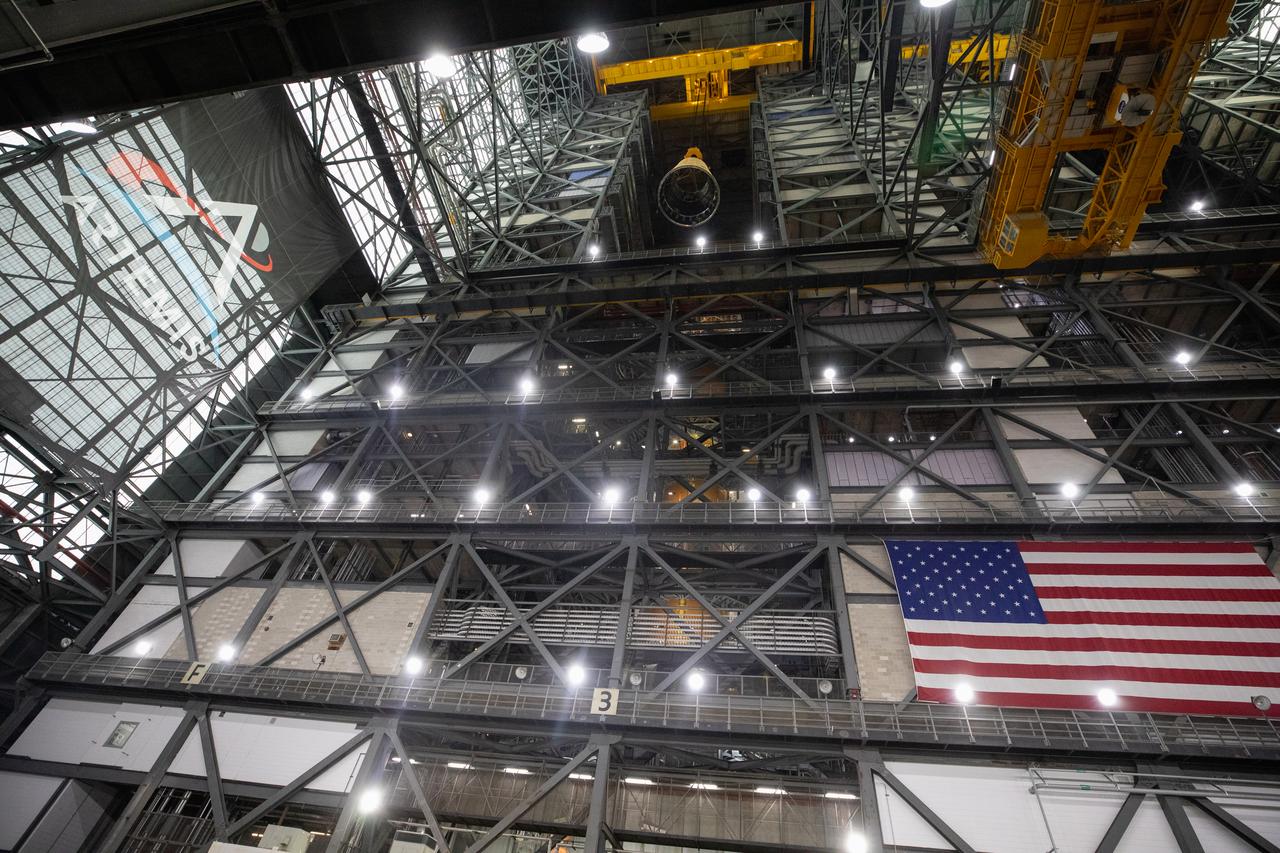
A massive crane lifts the launch vehicle stage adapter 250 feet into the air on Thursday, April 3, 2025, to prepare integration onto the SLS (Space Launch System) core stage in High Bay 3 inside the Vehicle Assembly Building at NASA’s Kennedy Space Center in Florida. During launch and ascent, the launch vehicle stage adapter provides structural support and protects avionics and electrical devices within the upper stage from extreme vibrations and acoustic conditions. The Artemis II test flight will take a crew of four astronauts on a 10-day journey around the Moon, helping confirm the foundational systems and hardware needed for human deep space exploration.
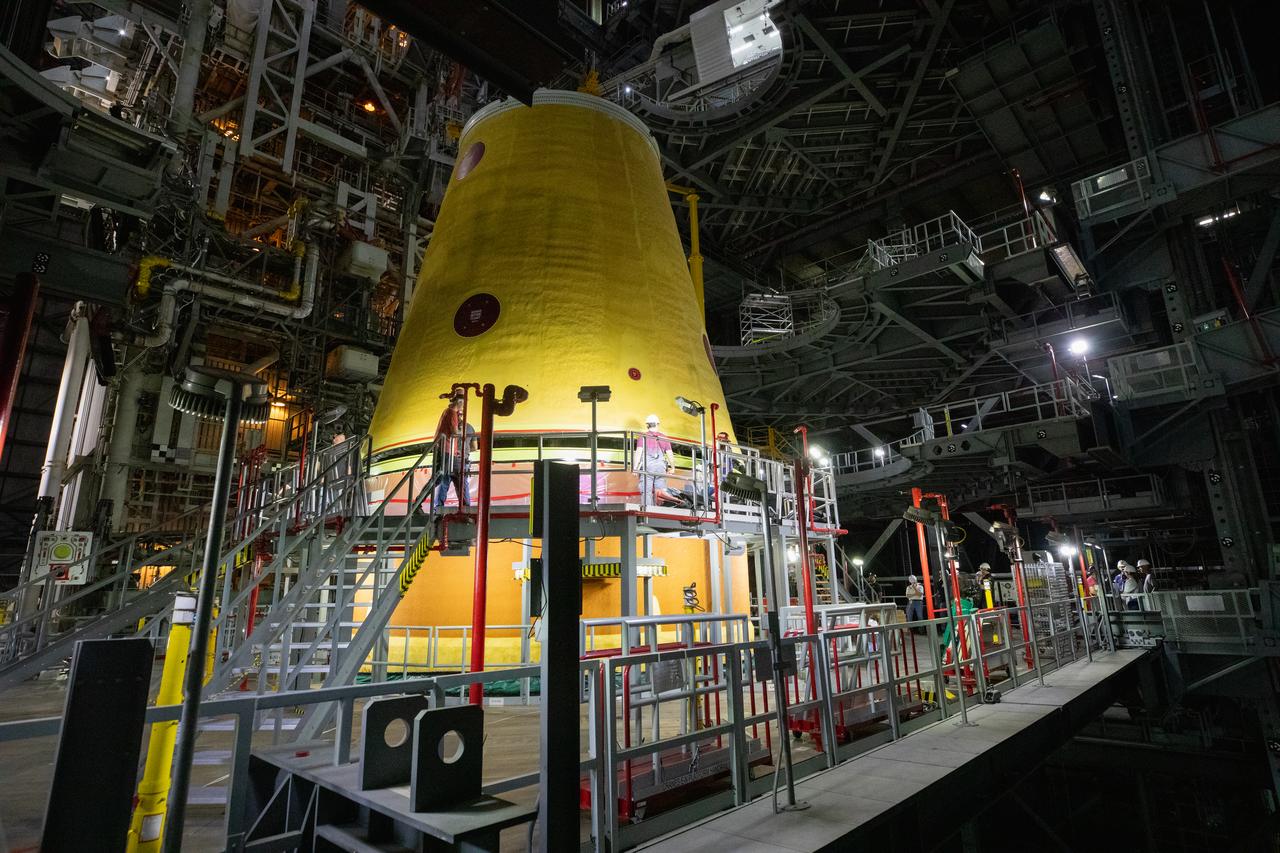
A massive crane lowers the launch vehicle stage adapter onto the SLS (Space Launch System) core stage on Thursday, April 3, 2025, in High Bay 3 inside the Vehicle Assembly Building at NASA’s Kennedy Space Center in Florida. During launch and ascent, the launch vehicle stage adapter provides structural support and protects avionics and electrical devices within the upper stage from extreme vibrations and acoustic conditions. The Artemis II test flight will take a crew of four astronauts on a 10-day journey around the Moon, helping confirm the foundational systems and hardware needed for human deep space exploration.
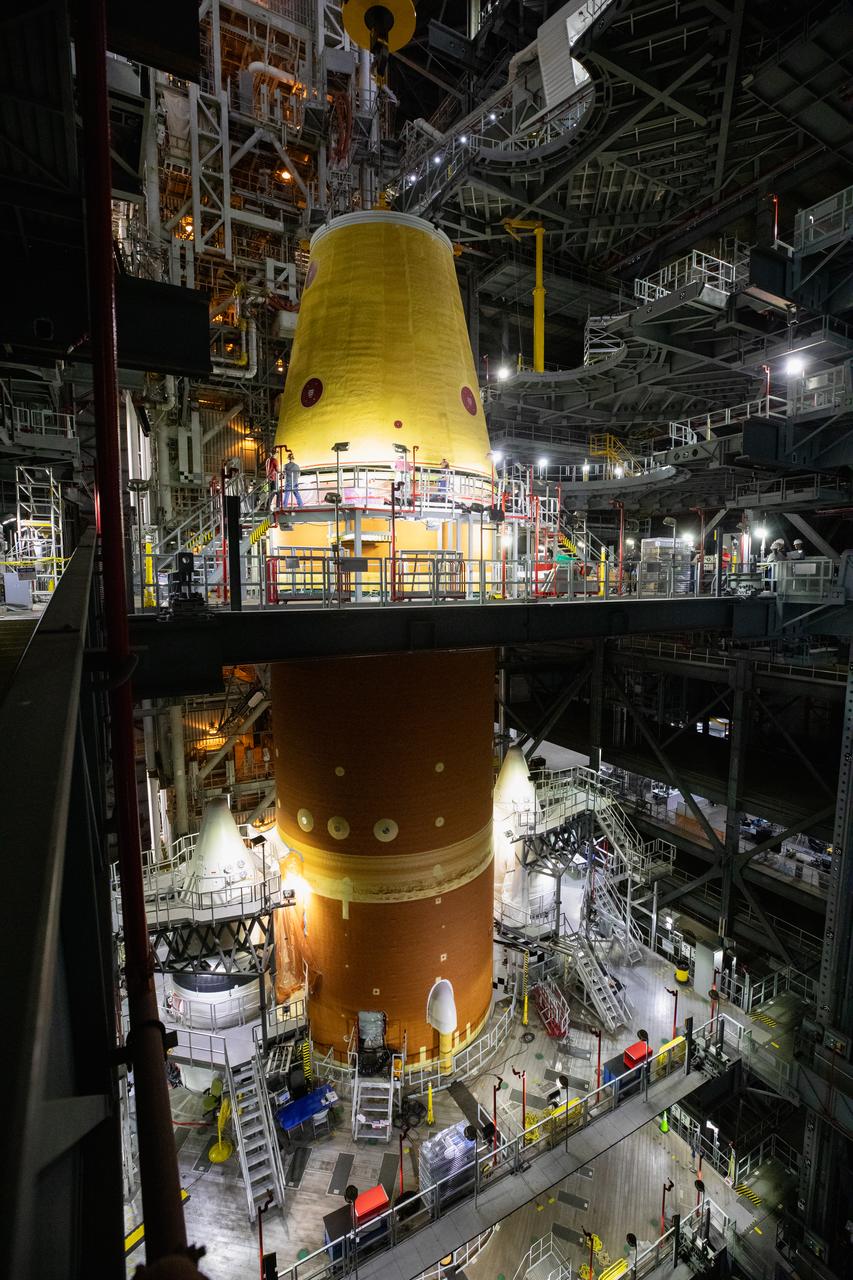
A massive crane lowers the launch vehicle stage adapter onto the SLS (Space Launch System) core stage on Thursday, April 3, 2025, in High Bay 3 inside the Vehicle Assembly Building at NASA’s Kennedy Space Center in Florida. During launch and ascent, the launch vehicle stage adapter provides structural support and protects avionics and electrical devices within the upper stage from extreme vibrations and acoustic conditions. The Artemis II test flight will take a crew of four astronauts on a 10-day journey around the Moon, helping confirm the foundational systems and hardware needed for human deep space exploration.
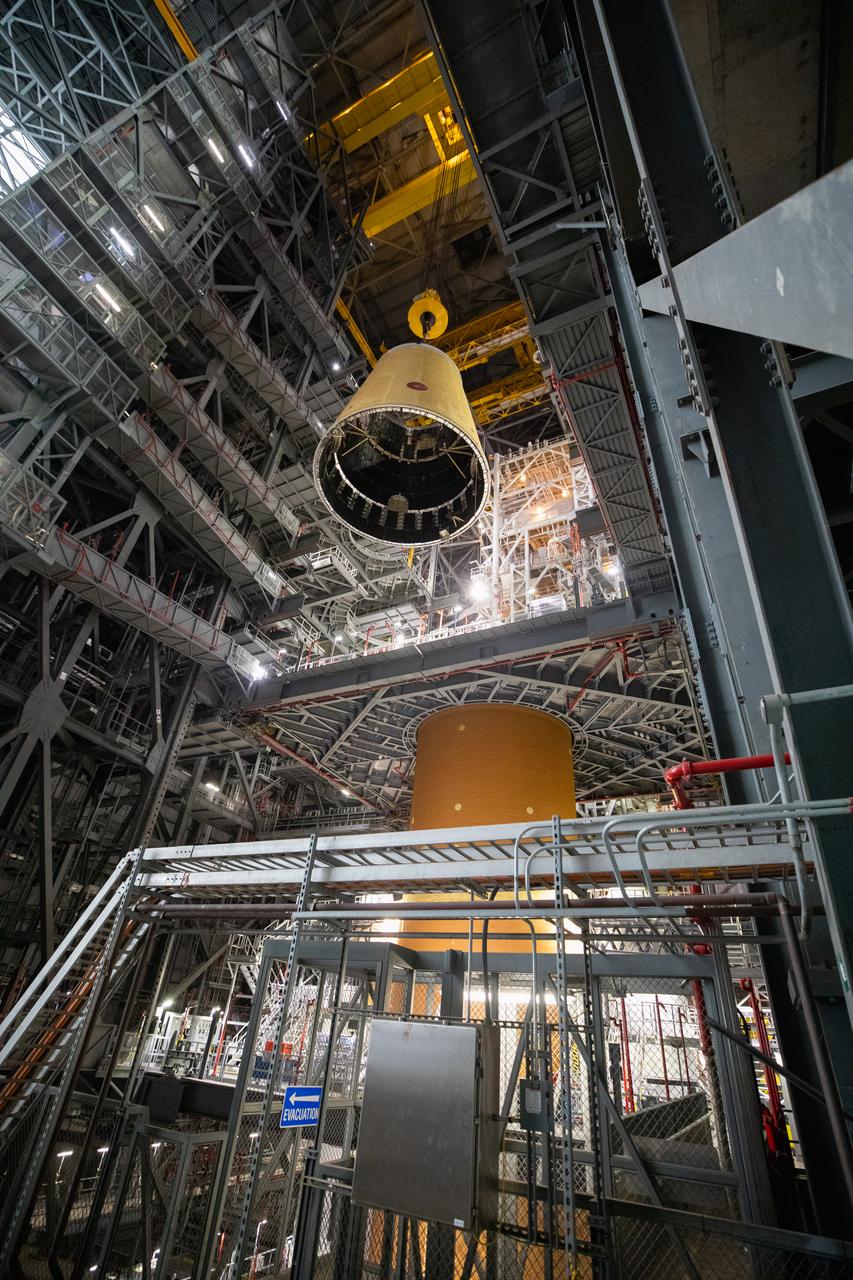
A massive crane lifts the launch vehicle stage adapter 250 feet into the air on Thursday, April 3, 2025, to prepare integration onto the SLS (Space Launch System) core stage in High Bay 3 inside the Vehicle Assembly Building at NASA’s Kennedy Space Center in Florida. During launch and ascent, the launch vehicle stage adapter provides structural support and protects avionics and electrical devices within the upper stage from extreme vibrations and acoustic conditions. The Artemis II test flight will take a crew of four astronauts on a 10-day journey around the Moon, helping confirm the foundational systems and hardware needed for human deep space exploration.
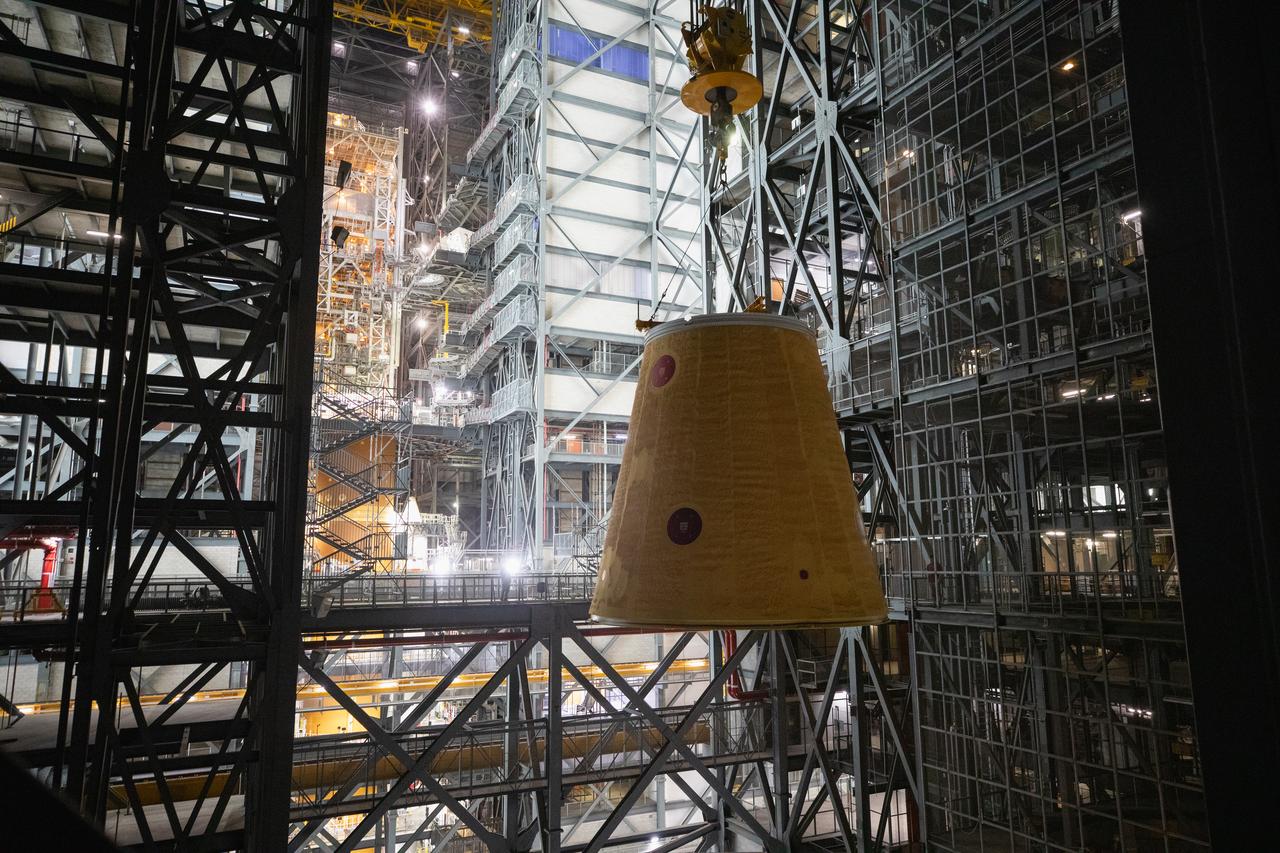
A massive crane lifts the launch vehicle stage adapter 250 feet into the air on Thursday, April 3, 2025, to prepare integration onto the SLS (Space Launch System) core stage in High Bay 3 inside the Vehicle Assembly Building at NASA’s Kennedy Space Center in Florida. During launch and ascent, the launch vehicle stage adapter provides structural support and protects avionics and electrical devices within the upper stage from extreme vibrations and acoustic conditions. The Artemis II test flight will take a crew of four astronauts on a 10-day journey around the Moon, helping confirm the foundational systems and hardware needed for human deep space exploration.
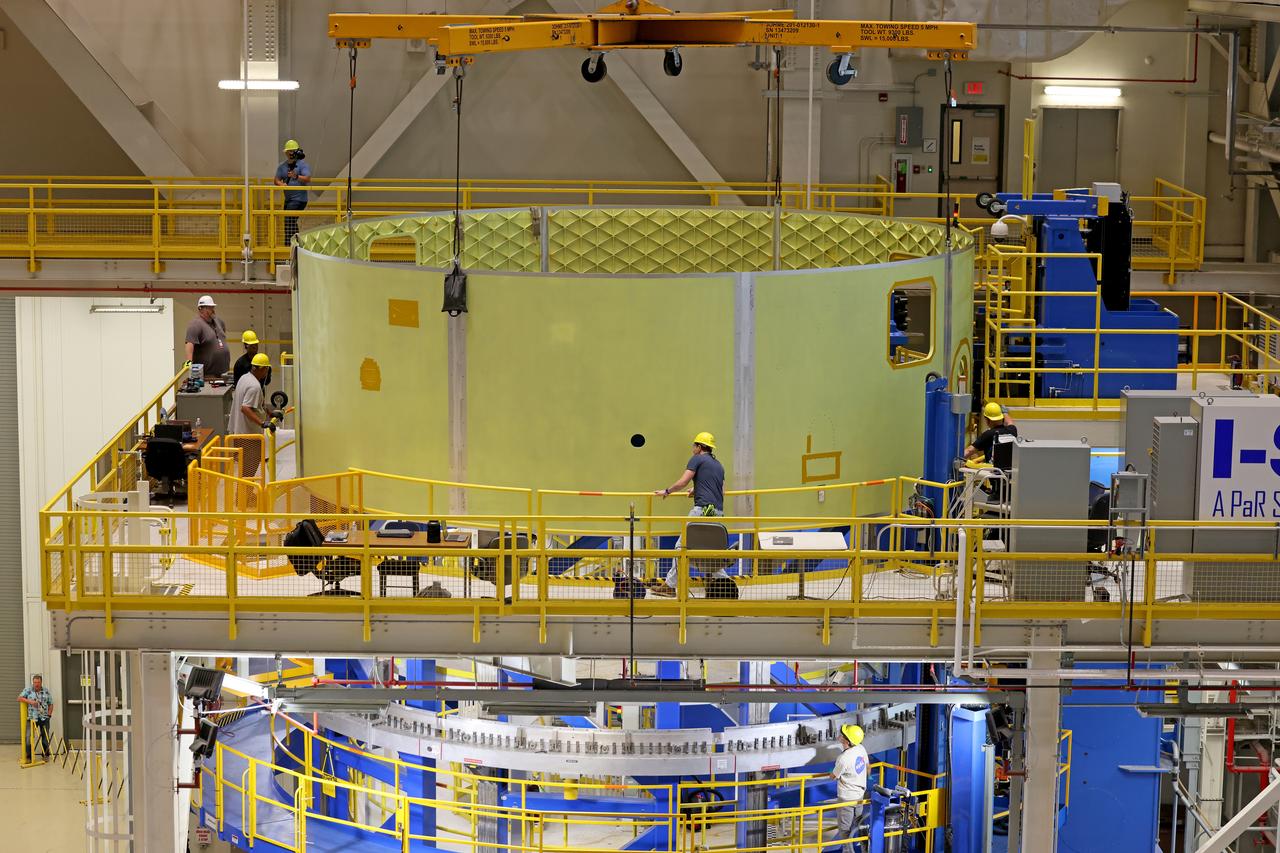
Crews at NASA’s Michoud Assembly Facility in New Orleans lift the forward skirt of a core stage that will power NASA’s Space Launch System (SLS) rocket out of the Vertical Weld Center Sept. 16, 2022. The forward skirt will be used for NASA’s Artemis IV mission. The hardware houses flight computers, cameras, and avionics systems for the SLS rocket. The SLS core stage is made up of five unique elements: the forward skirt, liquid oxygen tank, intertank, liquid hydrogen tank, and the engine section. When fully stacked, the forward skirt is located at the top of the 212-foot-tall core stage and connects to the upper part of the rocket. The core stage and its four RS-25 engines provide more than 2 million pounds of thrust to help power NASA’s next-generation lunar missions. Image credit: NASA/Michael DeMocker

Crews at NASA’s Michoud Assembly Facility in New Orleans lift the forward skirt of a core stage that will power NASA’s Space Launch System (SLS) rocket out of the Vertical Weld Center Sept. 16, 2022. The forward skirt will be used for NASA’s Artemis IV mission. The hardware houses flight computers, cameras, and avionics systems for the SLS rocket. The SLS core stage is made up of five unique elements: the forward skirt, liquid oxygen tank, intertank, liquid hydrogen tank, and the engine section. When fully stacked, the forward skirt is located at the top of the 212-foot-tall core stage and connects to the upper part of the rocket. The core stage and its four RS-25 engines provide more than 2 million pounds of thrust to help power NASA’s next-generation lunar missions. Image credit: NASA/Michael DeMocker
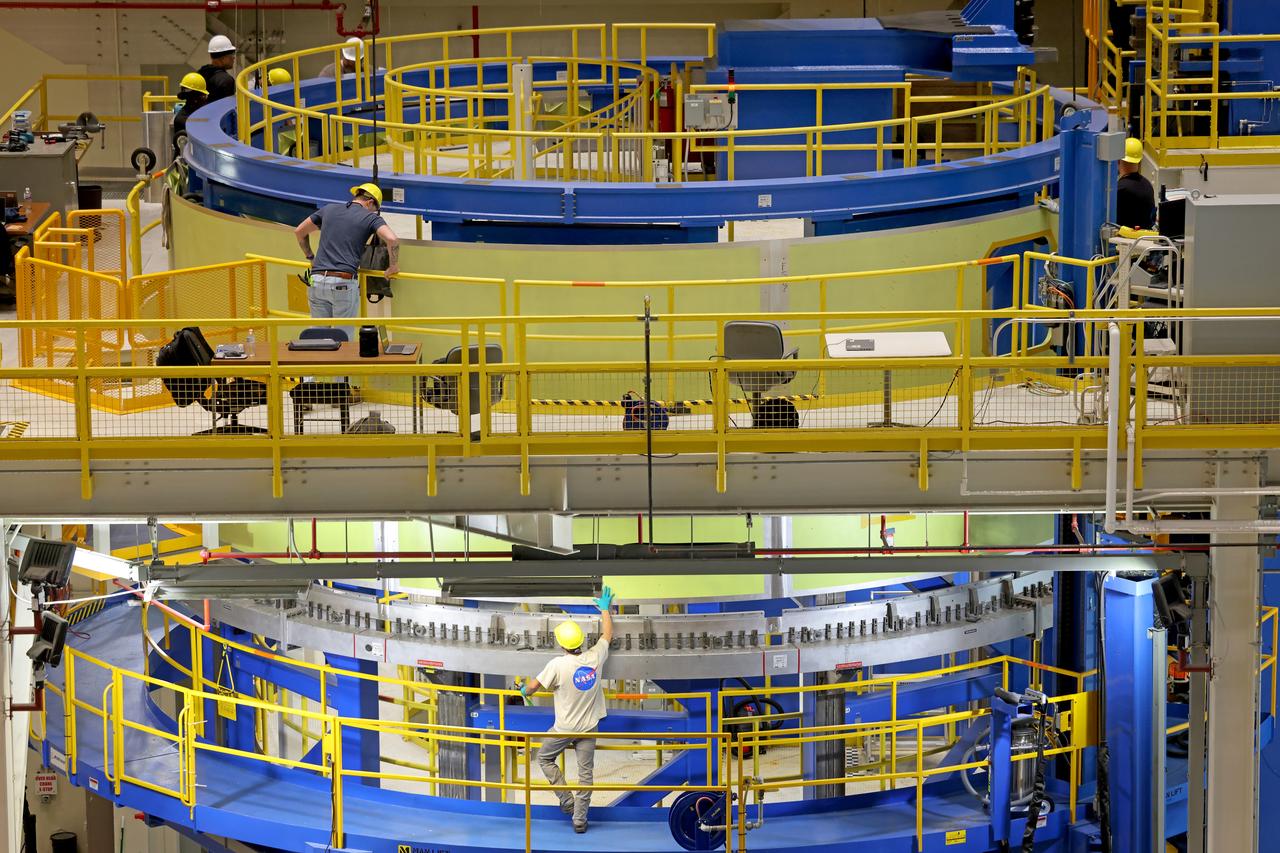
Crews at NASA’s Michoud Assembly Facility in New Orleans lift the forward skirt of a core stage that will power NASA’s Space Launch System (SLS) rocket out of the Vertical Weld Center Sept. 16, 2022. The forward skirt will be used for NASA’s Artemis IV mission. The hardware houses flight computers, cameras, and avionics systems for the SLS rocket. The SLS core stage is made up of five unique elements: the forward skirt, liquid oxygen tank, intertank, liquid hydrogen tank, and the engine section. When fully stacked, the forward skirt is located at the top of the 212-foot-tall core stage and connects to the upper part of the rocket. The core stage and its four RS-25 engines provide more than 2 million pounds of thrust to help power NASA’s next-generation lunar missions. Image credit: NASA/Michael DeMocker
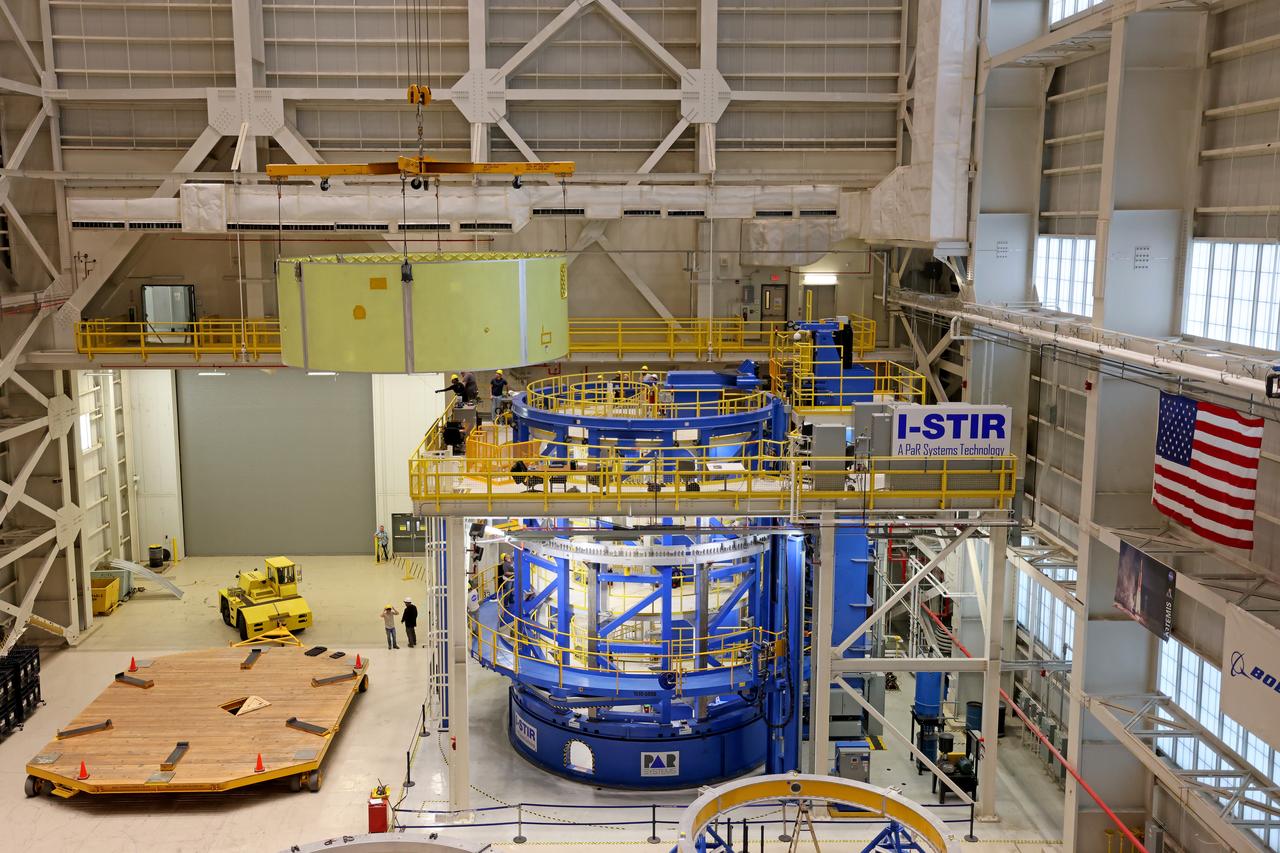
Crews at NASA’s Michoud Assembly Facility in New Orleans lift the forward skirt of a core stage that will power NASA’s Space Launch System (SLS) rocket out of the Vertical Weld Center Sept. 16, 2022. The forward skirt will be used for NASA’s Artemis IV mission. The hardware houses flight computers, cameras, and avionics systems for the SLS rocket. The SLS core stage is made up of five unique elements: the forward skirt, liquid oxygen tank, intertank, liquid hydrogen tank, and the engine section. When fully stacked, the forward skirt is located at the top of the 212-foot-tall core stage and connects to the upper part of the rocket. The core stage and its four RS-25 engines provide more than 2 million pounds of thrust to help power NASA’s next-generation lunar missions. Image credit: NASA/Michael DeMocker
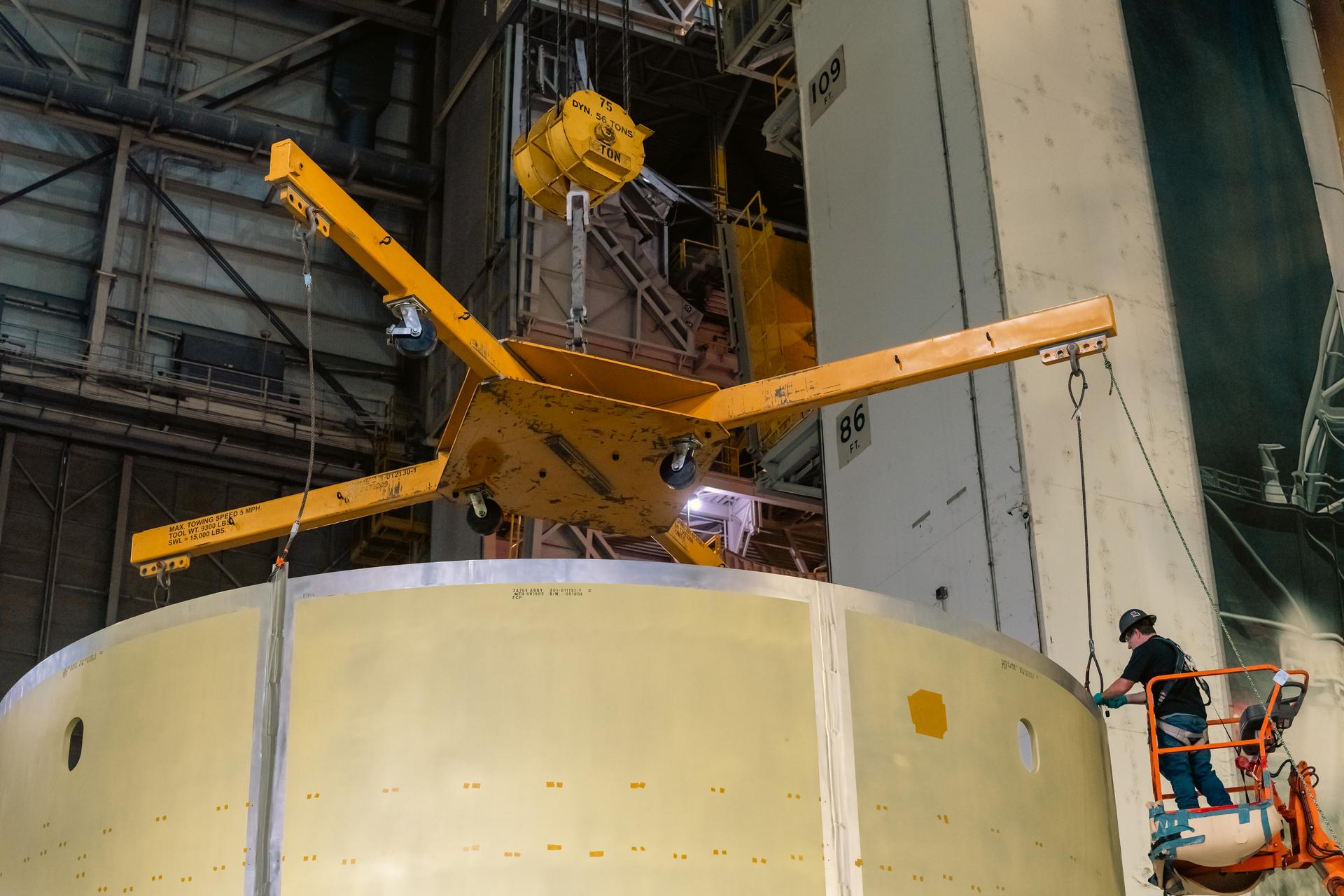
Teams at Michoud Assembly Facility in New Orleans load the engine section barrel into the vertical assembly center on Aug. 5, 2026. The engine section will be used on the SLS (Space Launch System) rocket’s core stage for the agency’s Artemis V mission. On the vertical assembly center tooling, teams will mate the flight hardware to a ring, which will serve as an attachment point for the liquid hydrogen tank later in the production process. The engine section is one of five major elements that make up the 212-foot-tall SLS rocket stage; and houses various avionic systems, the engine thrust structure, and four RS-25 engines. The core stage produces more than two million pounds of thrust to help launch NASA’s Orion spacecraft, astronauts, and supplies beyond Earth’s orbit and to the lunar surface for Artemis.
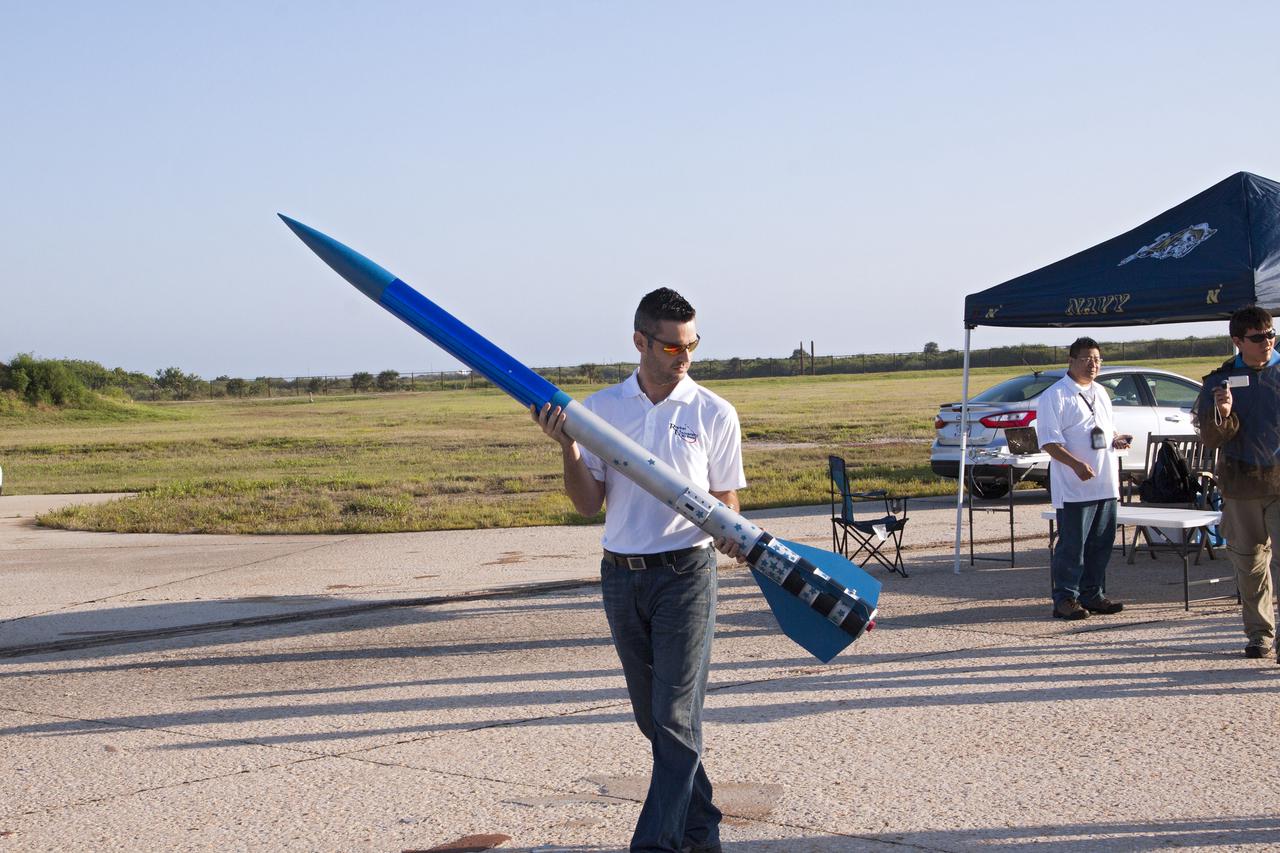
CAPE CANAVERAL, Fla. -- At NASA's Kennedy Space Center in Florida, Leandro James of Systems Hardware Engineering carries a small test rocket to the launch stand. The activity was part of Rocket University with the goal to test its systems and to verify that it performed as designed. As part of Rocket University, the engineers are given an opportunity to work a fast-track project to develop skills in developing spacecraft systems of the future. As NASA plans for future spaceflight programs to low-Earth orbit and beyond, teams of engineers at Kennedy are gaining experience in designing and flying launch vehicle systems on a small scale. Four teams of five to eight members from Kennedy are designing rockets complete with avionics and recovery systems. Launch operations require coordination with federal agencies, just as they would with rockets launched in support of a NASA mission. Photo credit: NASA_Jim Grossmann
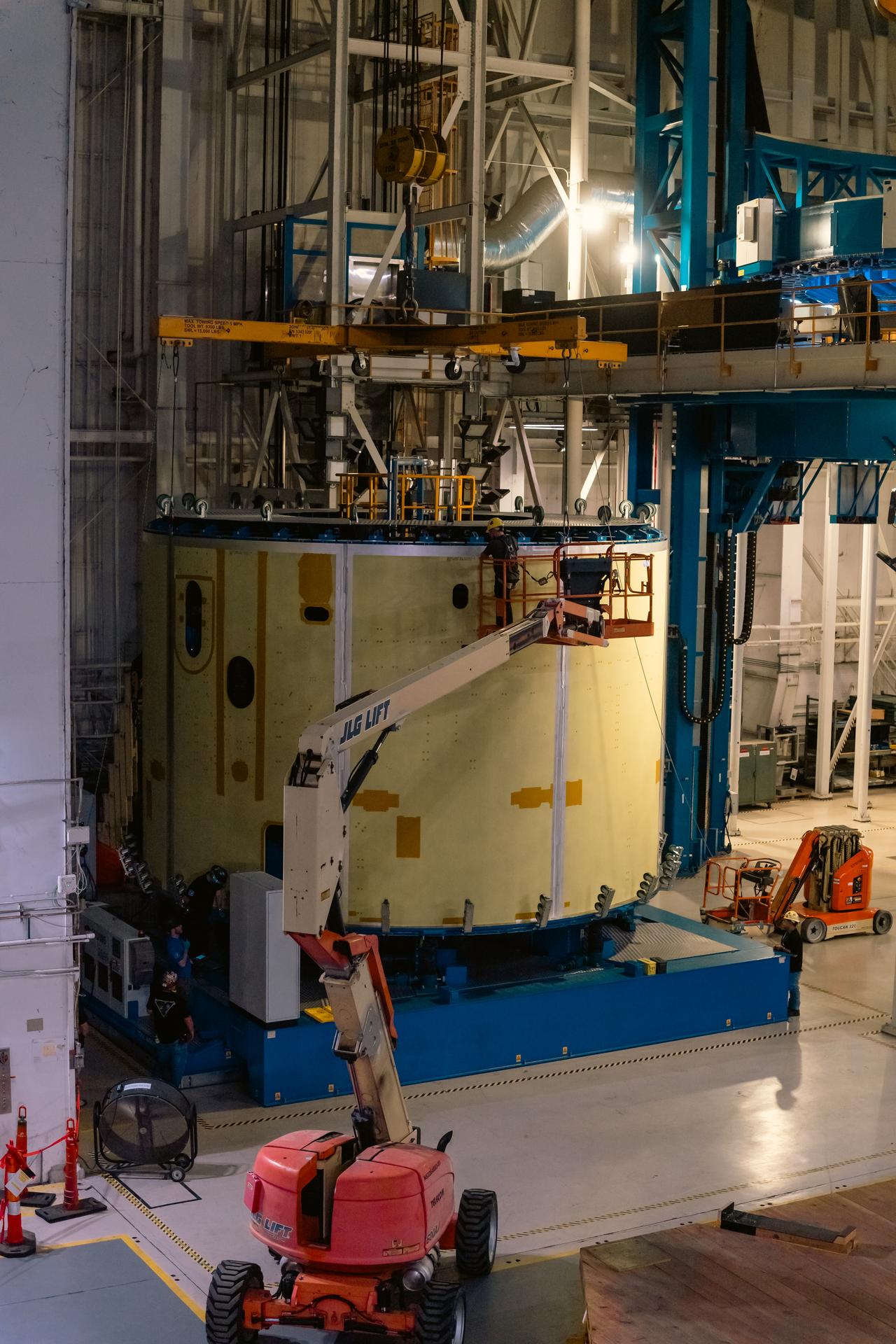
Teams at Michoud Assembly Facility in New Orleans load the 25-foot-long engine section barrel into the vertical assembly center on Aug. 5, 2026. The engine section will be used on the SLS (Space Launch System) rocket’s core stage for the agency’s Artemis V mission. On the vertical assembly center tooling, teams will mate the flight hardware to a ring, which will serve as an attachment point for the liquid hydrogen tank later in the production process. The engine section is one of five major elements that make up the 212-foot-tall SLS rocket stage; and houses various avionic systems, the engine thrust structure, and four RS-25 engines. The core stage produces more than two million pounds of thrust to help launch NASA’s Orion spacecraft, astronauts, and supplies beyond Earth’s orbit and to the lunar surface for Artemis.
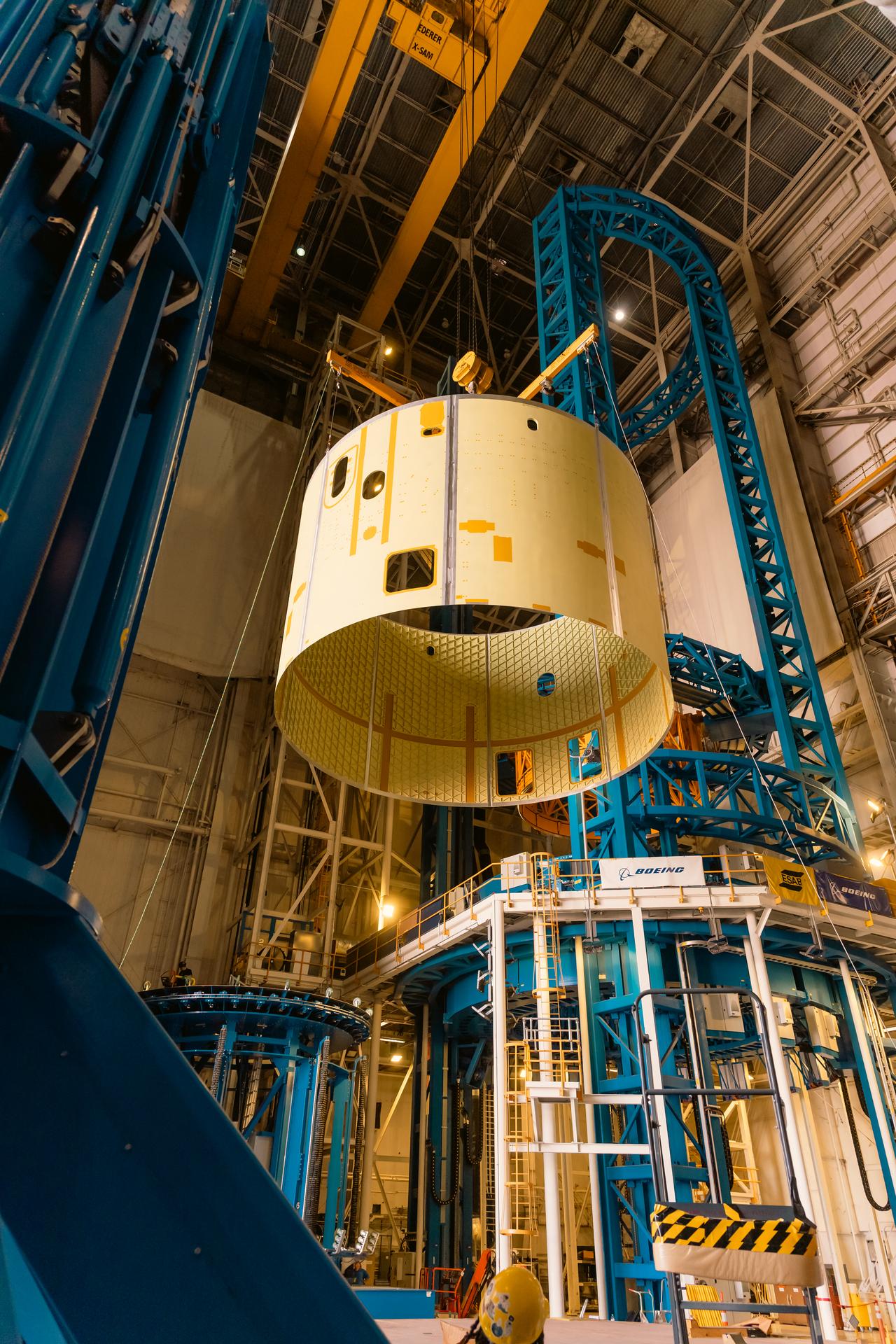
Teams at Michoud Assembly Facility in New Orleans load the engine section barrel into the vertical assembly center on Aug. 5, 2026. The engine section will be used on the SLS (Space Launch System) rocket’s core stage for the agency’s Artemis V mission. On the vertical assembly center tooling, teams will mate the flight hardware to a ring, which will serve as an attachment point for the liquid hydrogen tank later in the production process. The engine section is one of five major elements that make up the 212-foot-tall SLS rocket stage; and houses various avionic systems, the engine thrust structure, and four RS-25 engines. The core stage produces more than two million pounds of thrust to help launch NASA’s Orion spacecraft, astronauts, and supplies beyond Earth’s orbit and to the lunar surface for Artemis.
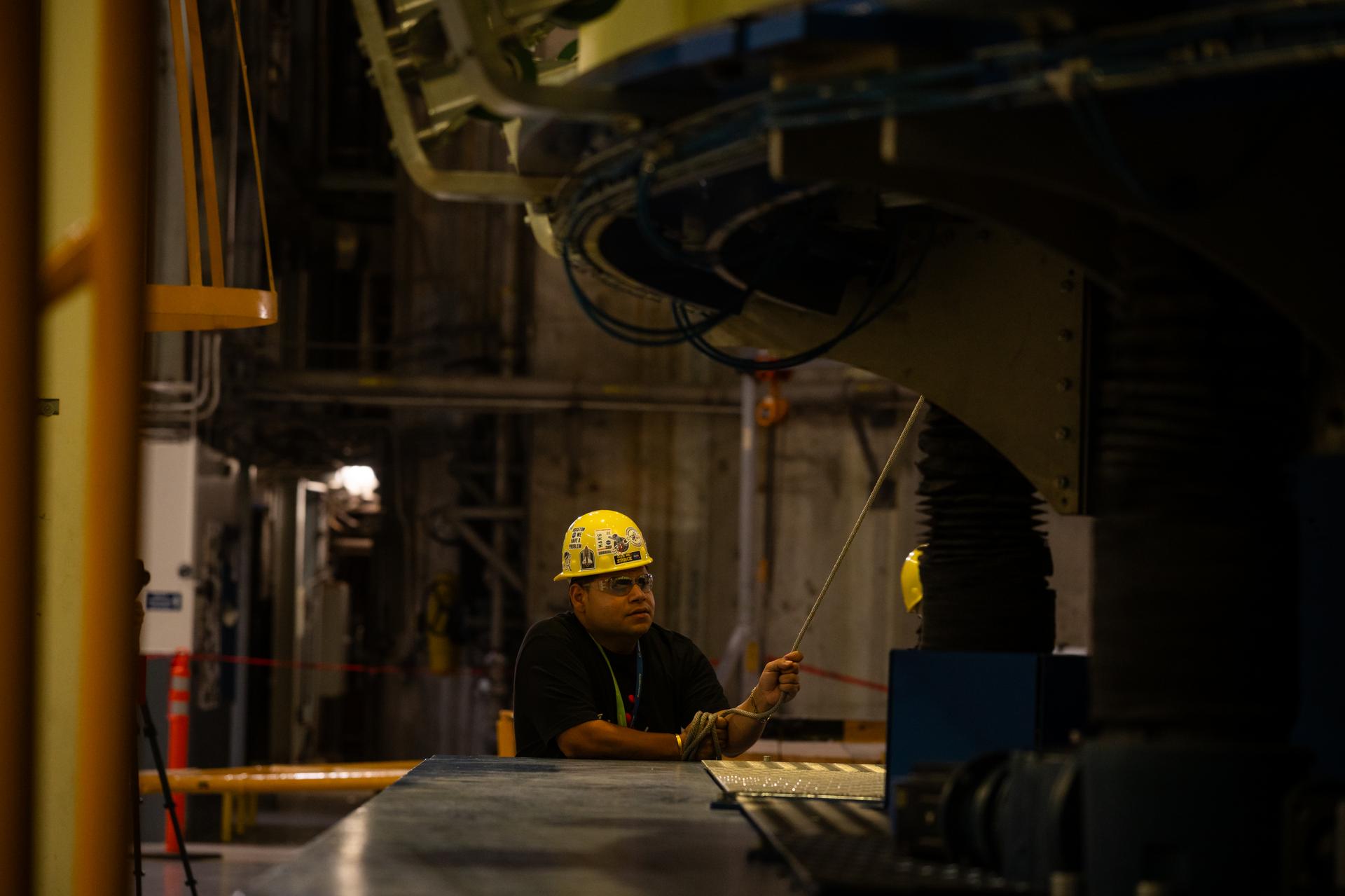
Teams at Michoud Assembly Facility in New Orleans load the engine section barrel into the vertical assembly center on Aug. 5, 2026. The engine section will be used on the SLS (Space Launch System) rocket’s core stage for the agency’s Artemis V mission. On the vertical assembly center tooling, teams will mate the flight hardware to a ring, which will serve as an attachment point for the liquid hydrogen tank later in the production process. The engine section is one of five major elements that make up the 212-foot-tall SLS rocket stage; and houses various avionic systems, the engine thrust structure, and four RS-25 engines. The core stage produces more than two million pounds of thrust to help launch NASA’s Orion spacecraft, astronauts, and supplies beyond Earth’s orbit and to the lunar surface for Artemis.
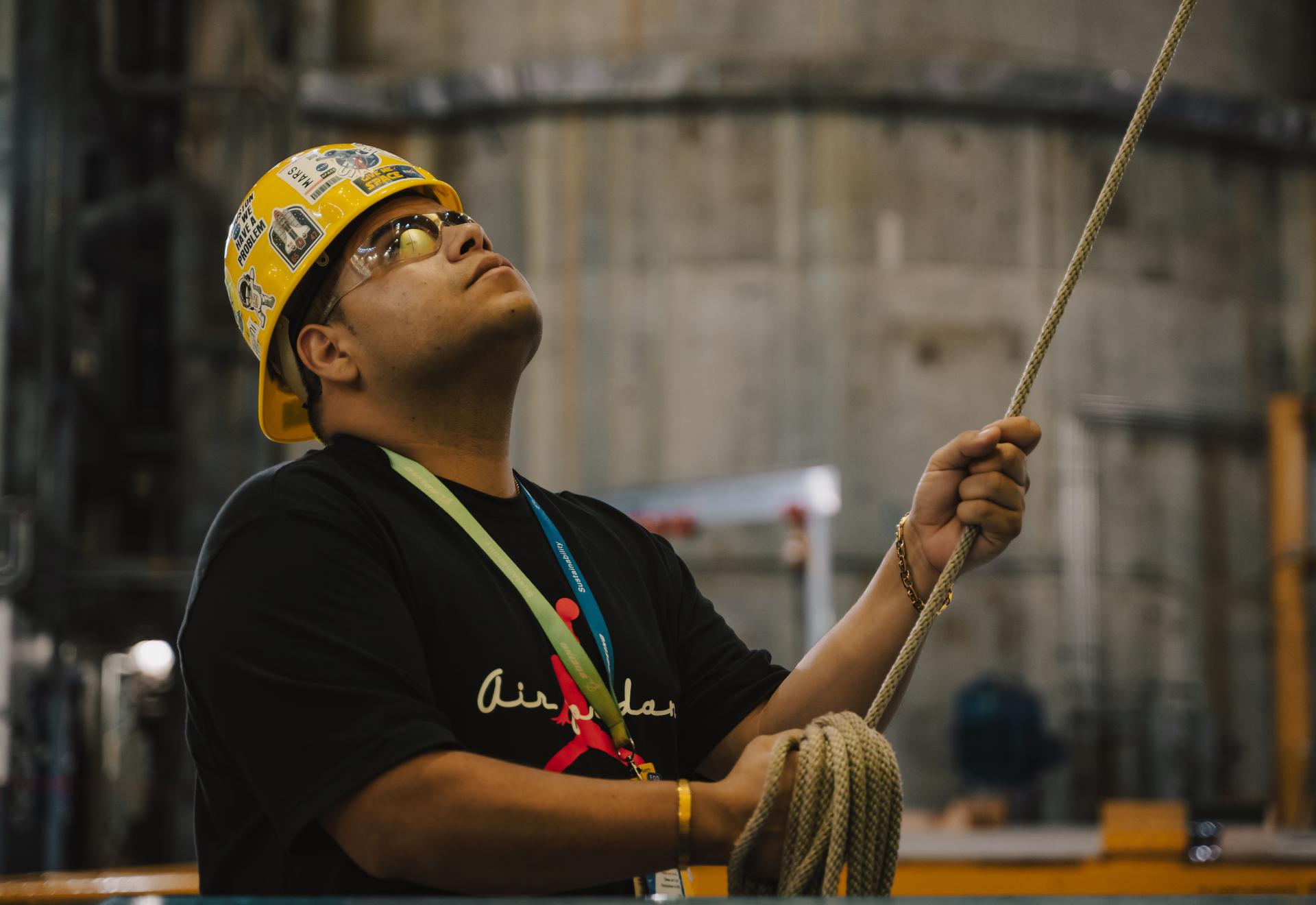
Teams at Michoud Assembly Facility in New Orleans load the engine section barrel into the vertical assembly center on Aug. 5, 2026. The engine section will be used on the SLS (Space Launch System) rocket’s core stage for the agency’s Artemis V mission. On the vertical assembly center tooling, teams will mate the flight hardware to a ring, which will serve as an attachment point for the liquid hydrogen tank later in the production process. The engine section is one of five major elements that make up the 212-foot-tall SLS rocket stage; and houses various avionic systems, the engine thrust structure, and four RS-25 engines. The core stage produces more than two million pounds of thrust to help launch NASA’s Orion spacecraft, astronauts, and supplies beyond Earth’s orbit and to the lunar surface for Artemis.
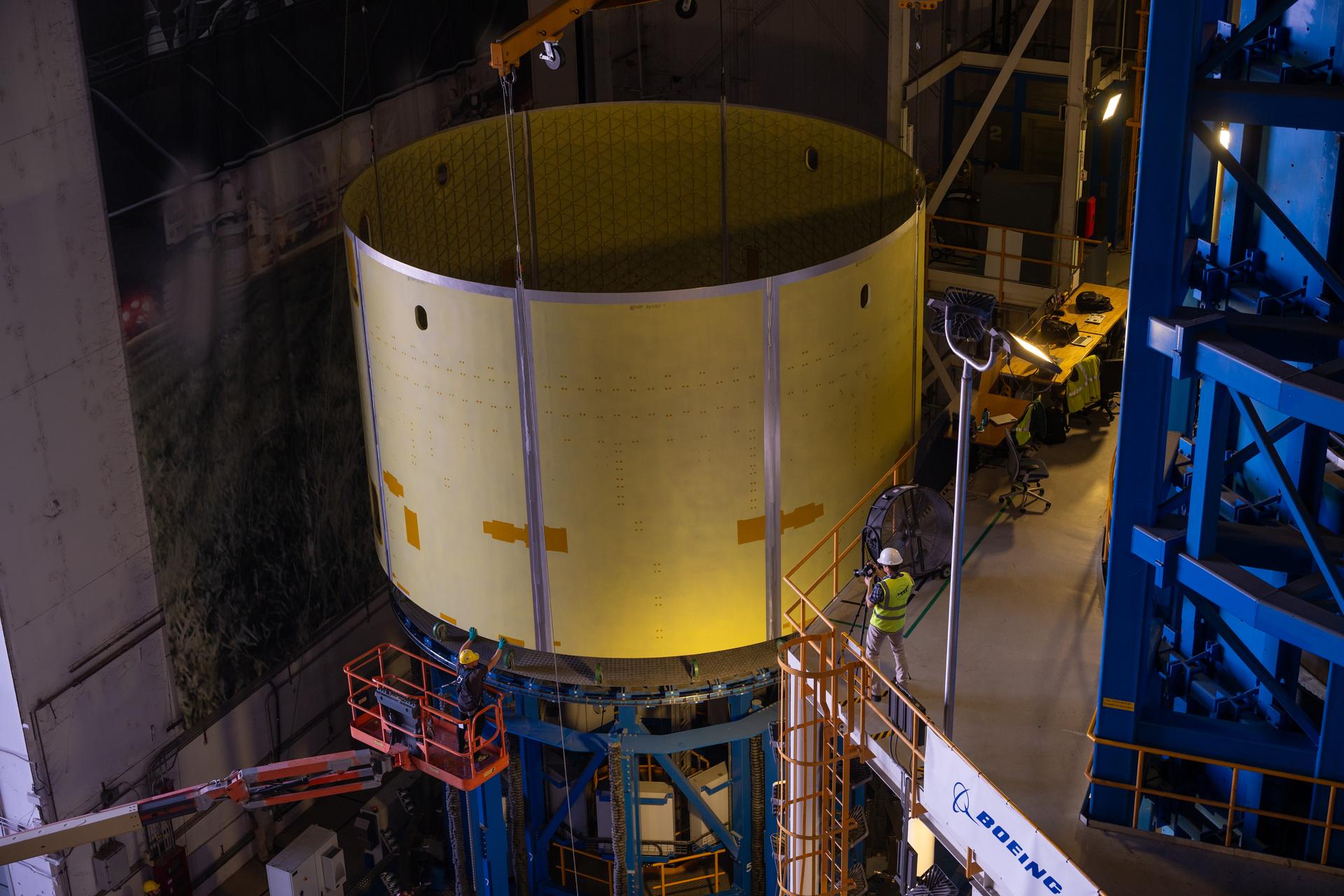
Teams at Michoud Assembly Facility in New Orleans load the engine section barrel into the vertical assembly center on Aug. 5, 2026. The engine section will be used on the SLS (Space Launch System) rocket’s core stage for the agency’s Artemis V mission. On the vertical assembly center tooling, teams will mate the flight hardware to a ring, which will serve as an attachment point for the liquid hydrogen tank later in the production process. The engine section is one of five major elements that make up the 212-foot-tall SLS rocket stage; and houses various avionic systems, the engine thrust structure, and four RS-25 engines. The core stage produces more than two million pounds of thrust to help launch NASA’s Orion spacecraft, astronauts, and supplies beyond Earth’s orbit and to the lunar surface for Artemis.
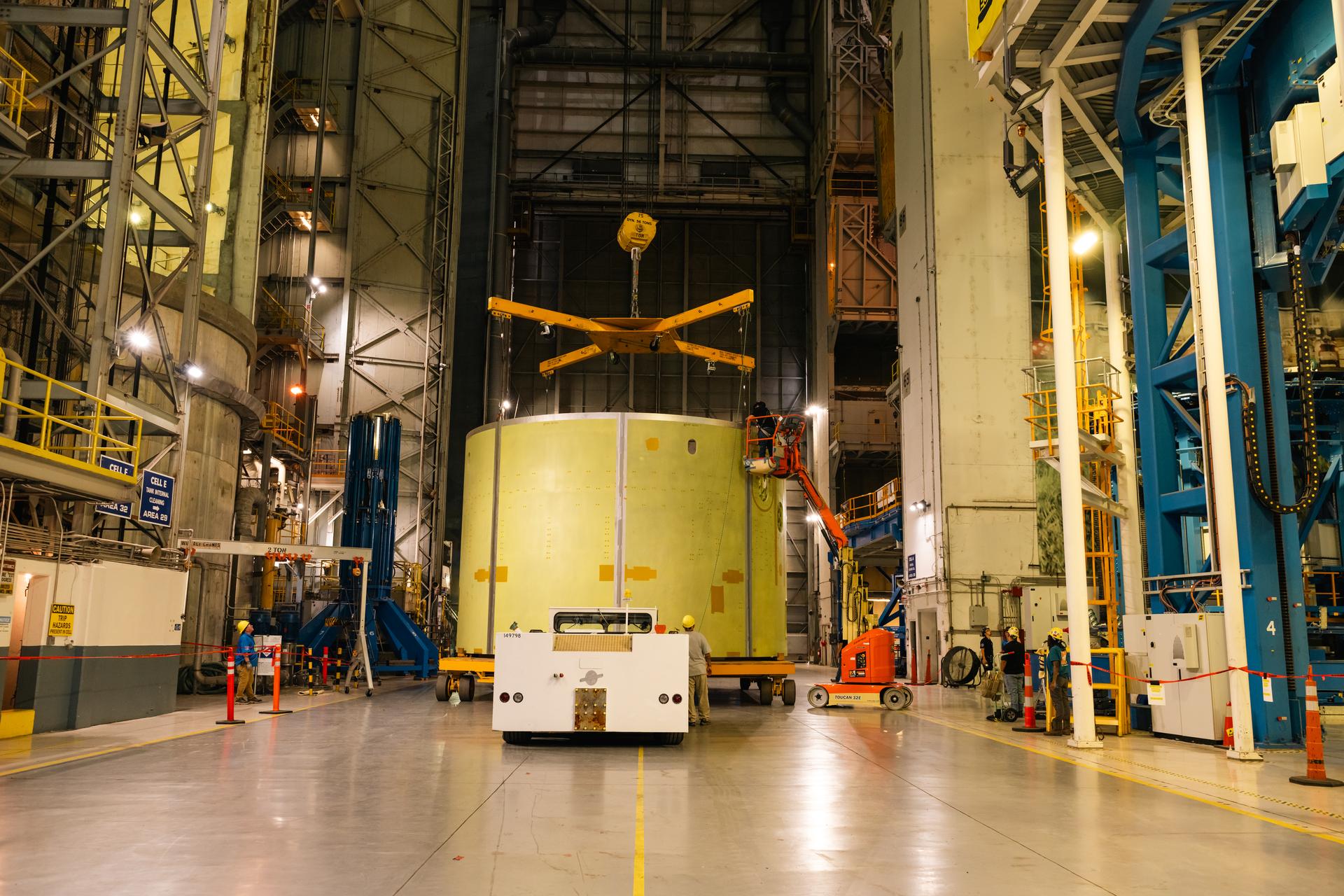
Teams at Michoud Assembly Facility in New Orleans load the engine section barrel into the vertical assembly center on Aug. 5, 2026. The engine section will be used on the SLS (Space Launch System) rocket’s core stage for the agency’s Artemis V mission. On the vertical assembly center tooling, teams will mate the flight hardware to a ring, which will serve as an attachment point for the liquid hydrogen tank later in the production process. The engine section is one of five major elements that make up the 212-foot-tall SLS rocket stage; and houses various avionic systems, the engine thrust structure, and four RS-25 engines. The core stage produces more than two million pounds of thrust to help launch NASA’s Orion spacecraft, astronauts, and supplies beyond Earth’s orbit and to the lunar surface for Artemis.
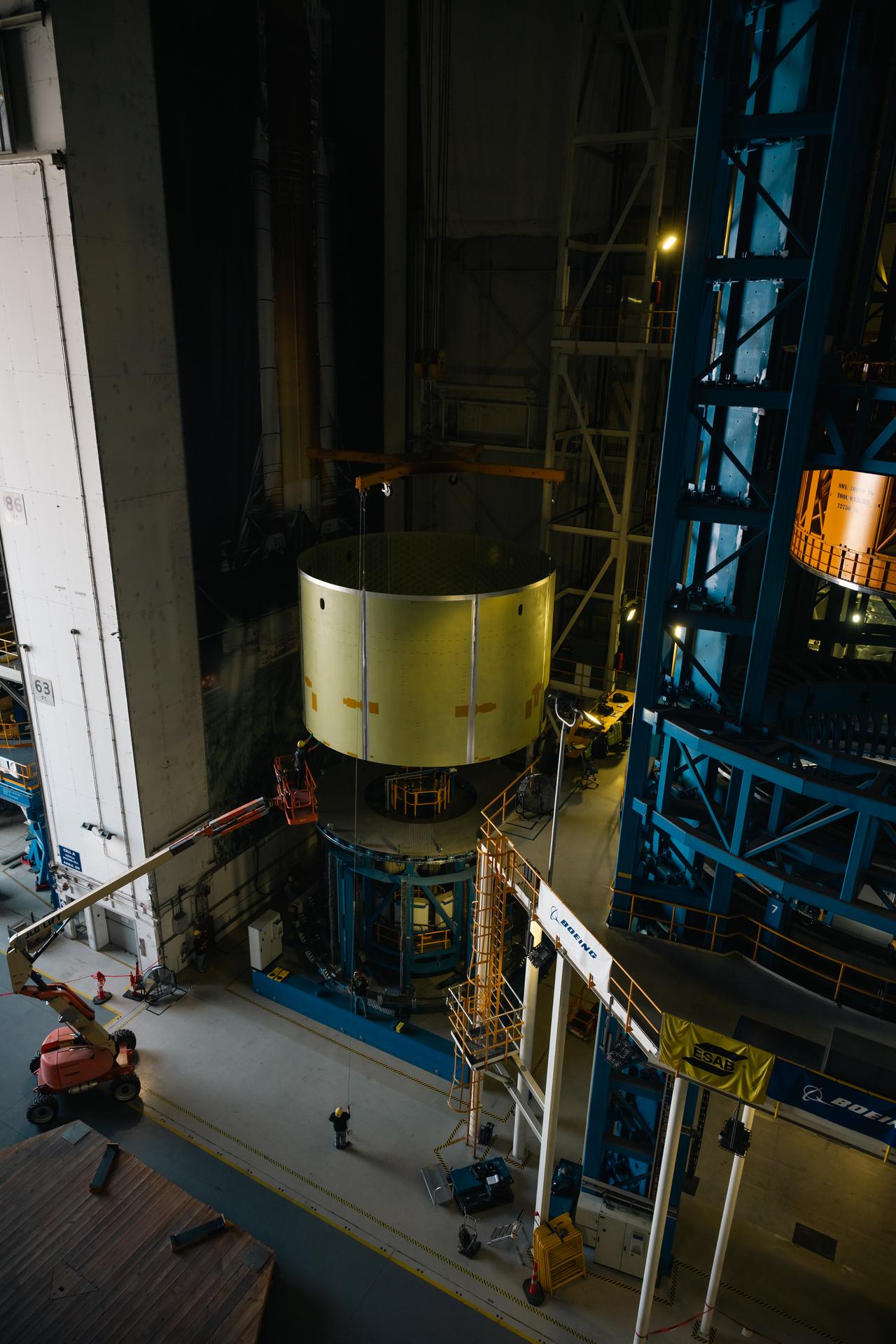
Teams at Michoud Assembly Facility in New Orleans load the engine section barrel into the vertical assembly center on Aug. 5, 2026. The engine section will be used on the SLS (Space Launch System) rocket’s core stage for the agency’s Artemis V mission. On the vertical assembly center tooling, teams will mate the flight hardware to a ring, which will serve as an attachment point for the liquid hydrogen tank later in the production process. The engine section is one of five major elements that make up the 212-foot-tall SLS rocket stage; and houses various avionic systems, the engine thrust structure, and four RS-25 engines. The core stage produces more than two million pounds of thrust to help launch NASA’s Orion spacecraft, astronauts, and supplies beyond Earth’s orbit and to the lunar surface for Artemis.
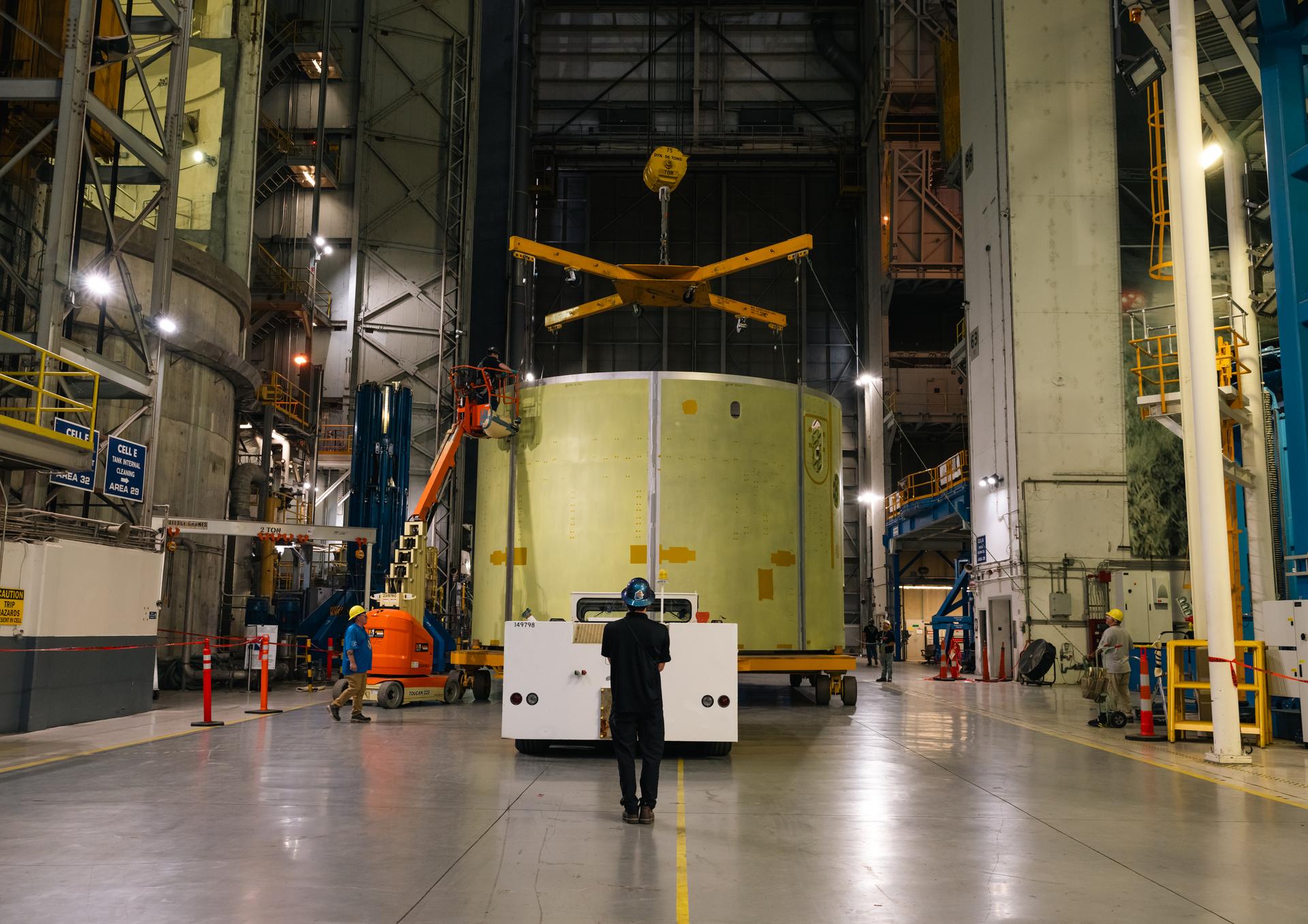
Teams at Michoud Assembly Facility in New Orleans load the engine section barrel into the vertical assembly center on Aug. 5, 2026. The engine section will be used on the SLS (Space Launch System) rocket’s core stage for the agency’s Artemis V mission. On the vertical assembly center tooling, teams will mate the flight hardware to a ring, which will serve as an attachment point for the liquid hydrogen tank later in the production process. The engine section is one of five major elements that make up the 212-foot-tall SLS rocket stage; and houses various avionic systems, the engine thrust structure, and four RS-25 engines. The core stage produces more than two million pounds of thrust to help launch NASA’s Orion spacecraft, astronauts, and supplies beyond Earth’s orbit and to the lunar surface for Artemis.
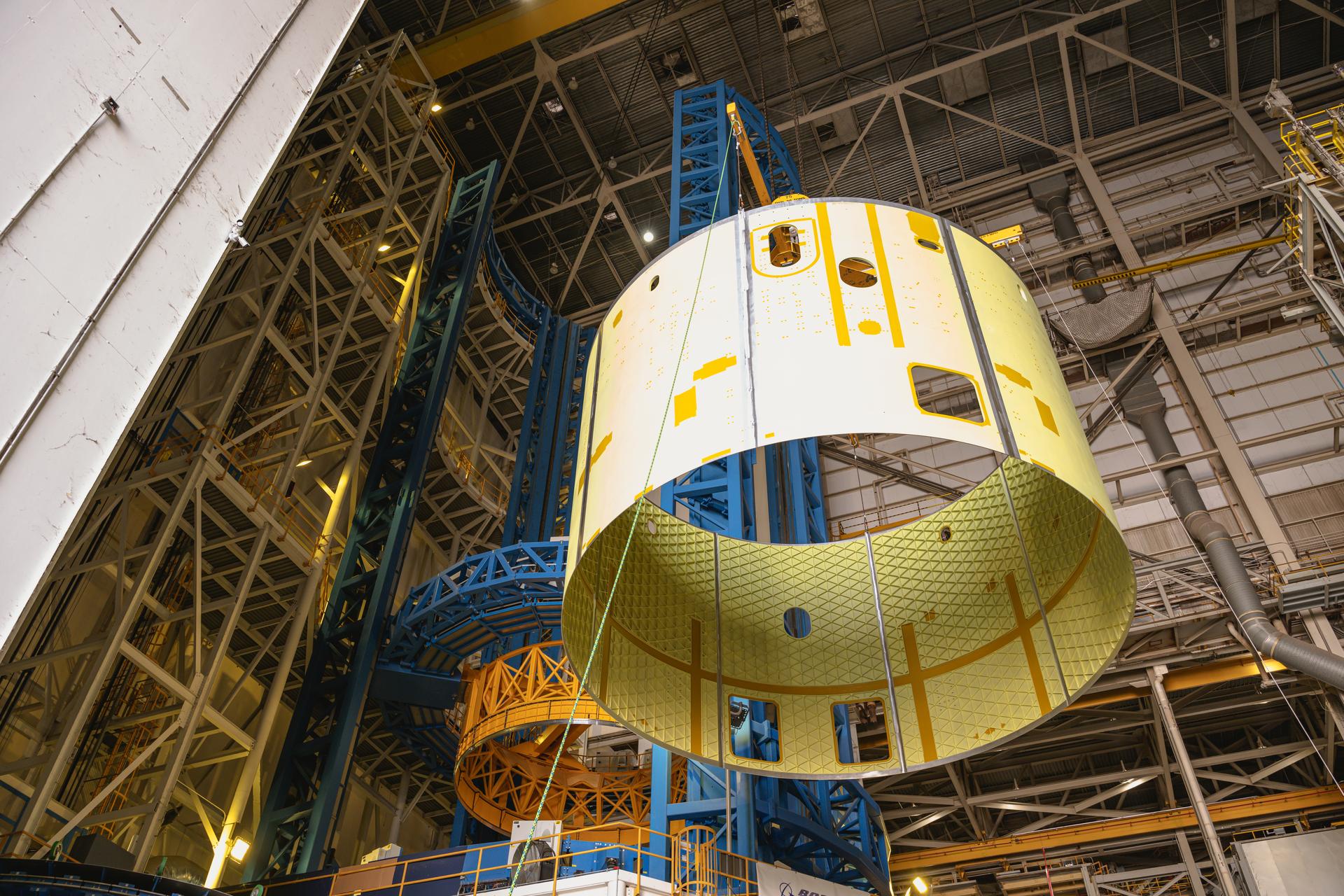
Teams at Michoud Assembly Facility in New Orleans load the engine section barrel into the vertical assembly center on Aug. 5, 2026. The engine section will be used on the SLS (Space Launch System) rocket’s core stage for the agency’s Artemis V mission. On the vertical assembly center tooling, teams will mate the flight hardware to a ring, which will serve as an attachment point for the liquid hydrogen tank later in the production process. The engine section is one of five major elements that make up the 212-foot-tall SLS rocket stage; and houses various avionic systems, the engine thrust structure, and four RS-25 engines. The core stage produces more than two million pounds of thrust to help launch NASA’s Orion spacecraft, astronauts, and supplies beyond Earth’s orbit and to the lunar surface for Artemis.
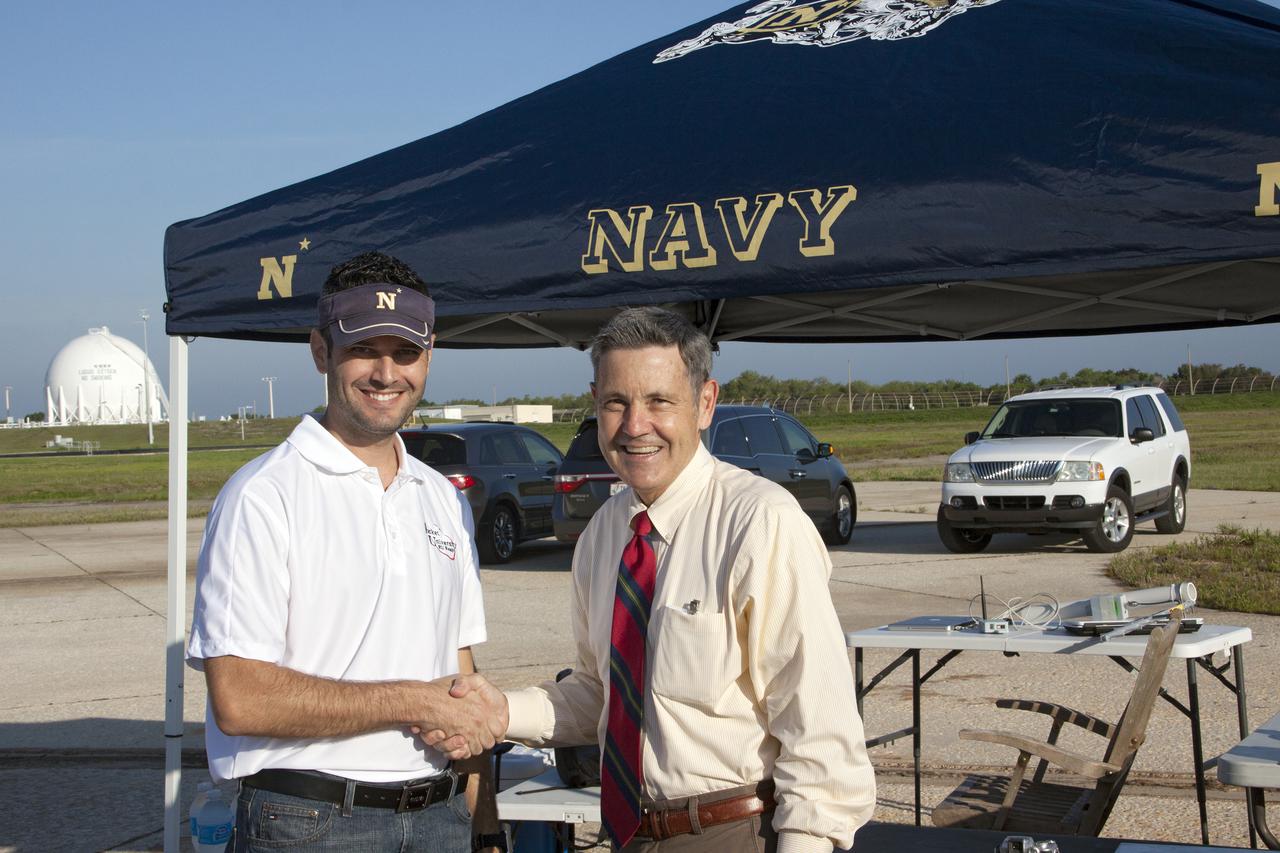
CAPE CANAVERAL, Fla. -- At NASA's Kennedy Space Center in Florida, center director Bob Cabana congratulates Leandro James of Systems Hardware Engineering after the successful launch of a small rocket at Launch Pad 39A as part of Rocket University. The goal was to test its systems and to verify that it performed as designed. As part of Rocket University, the engineers are given an opportunity to work a fast-track project to develop skills in developing spacecraft systems of the future. As NASA plans for future spaceflight programs to low-Earth orbit and beyond, teams of engineers at Kennedy are gaining experience in designing and flying launch vehicle systems on a small scale. Four teams of five to eight members from Kennedy are designing rockets complete with avionics and recovery systems. Launch operations require coordination with federal agencies, just as they would with rockets launched in support of a NASA mission. Photo credit: NASA_Jim Grossmann
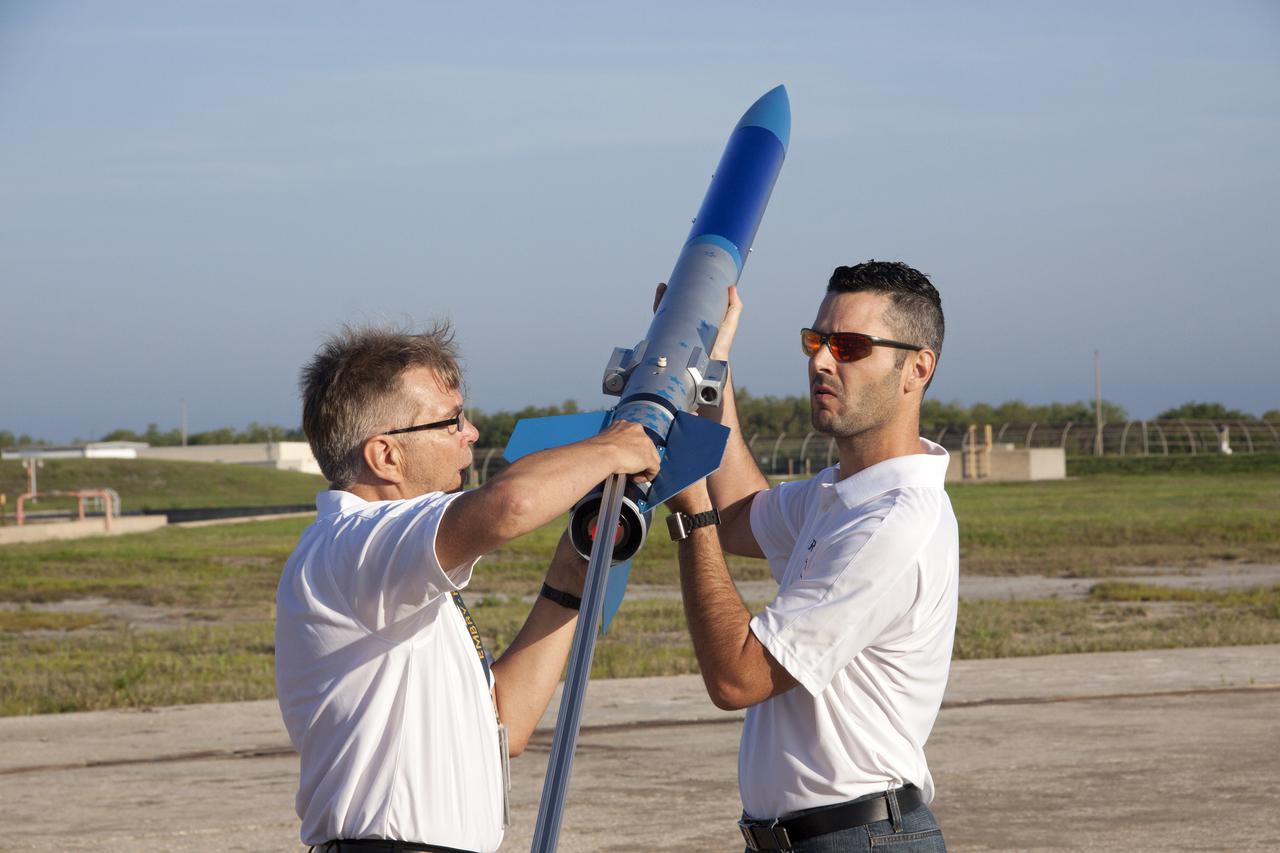
CAPE CANAVERAL, Fla. -- At NASA's Kennedy Space Center in Florida, Gary Dahlke of Engineering and Technology, left, and Leandro James of Systems Hardware Engineering attach a small rocket prior to its launch stand as part of Rocket University. The goal was to test its systems and to verify that it performed as designed. As part of Rocket University, the engineers are given an opportunity to work a fast-track project to develop skills in developing spacecraft systems of the future. As NASA plans for future spaceflight programs to low-Earth orbit and beyond, teams of engineers at Kennedy are gaining experience in designing and flying launch vehicle systems on a small scale. Four teams of five to eight members from Kennedy are designing rockets complete with avionics and recovery systems. Launch operations require coordination with federal agencies, just as they would with rockets launched in support of a NASA mission. Photo credit: NASA_Jim Grossmann
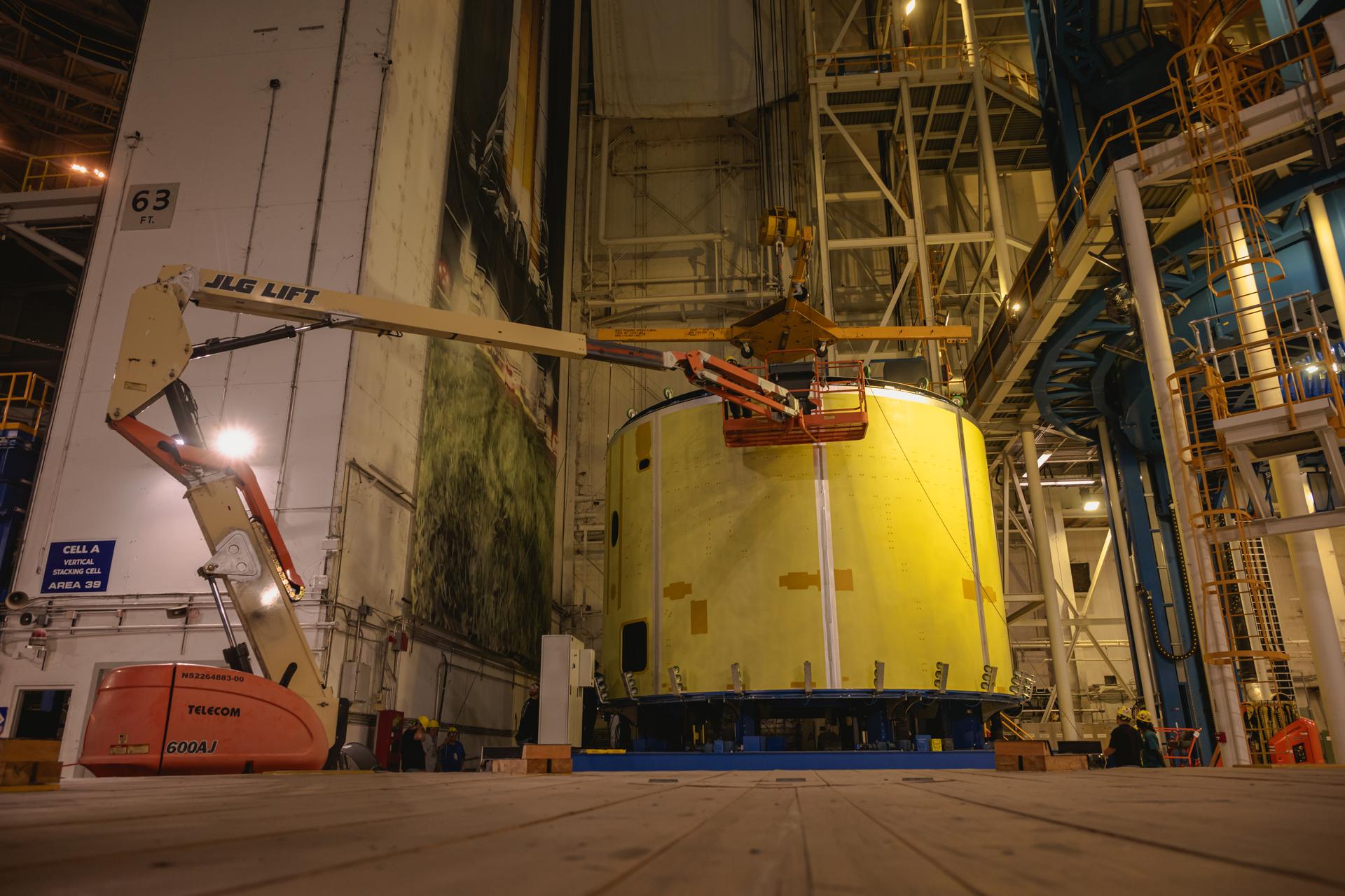
Teams at Michoud Assembly Facility in New Orleans load the engine section barrel into the vertical assembly center on Aug. 5, 2026. The engine section will be used on the SLS (Space Launch System) rocket’s core stage for the agency’s Artemis V mission. On the vertical assembly center tooling, teams will mate the flight hardware to a ring, which will serve as an attachment point for the liquid hydrogen tank later in the production process. The engine section is one of five major elements that make up the 212-foot-tall SLS rocket stage; and houses various avionic systems, the engine thrust structure, and four RS-25 engines. The core stage produces more than two million pounds of thrust to help launch NASA’s Orion spacecraft, astronauts, and supplies beyond Earth’s orbit and to the lunar surface for Artemis.
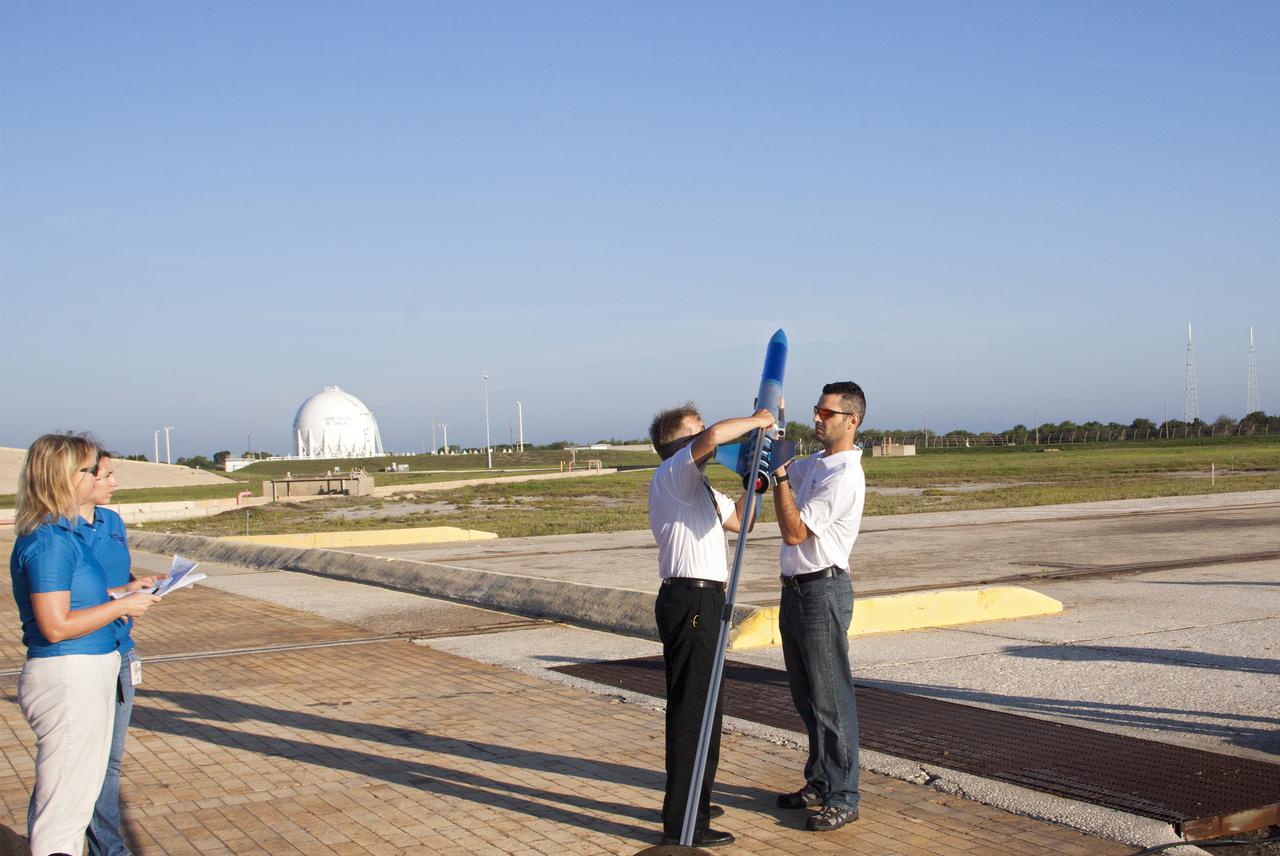
CAPE CANAVERAL, Fla. -- At NASA's Kennedy Space Center in Florida, as Susan Danley of Flight Structures and Kim Simpson of Fluids, Mechanical and Structural Systems look on, Gary Dahlke of Engineering and Technology, left, and Leandro James of Systems Hardware Engineering attach a small rocket prior to its launch stand as part of Rocket University. The goal was to test its systems and to verify that it performed as designed. As part of Rocket University, the engineers are given an opportunity to work a fast-track project to develop skills in developing spacecraft systems of the future. As NASA plans for future spaceflight programs to low-Earth orbit and beyond, teams of engineers at Kennedy are gaining experience in designing and flying launch vehicle systems on a small scale. Four teams of five to eight members from Kennedy are designing rockets complete with avionics and recovery systems. Launch operations require coordination with federal agencies, just as they would with rockets launched in support of a NASA mission. Photo credit: NASA_Jim Grossmann
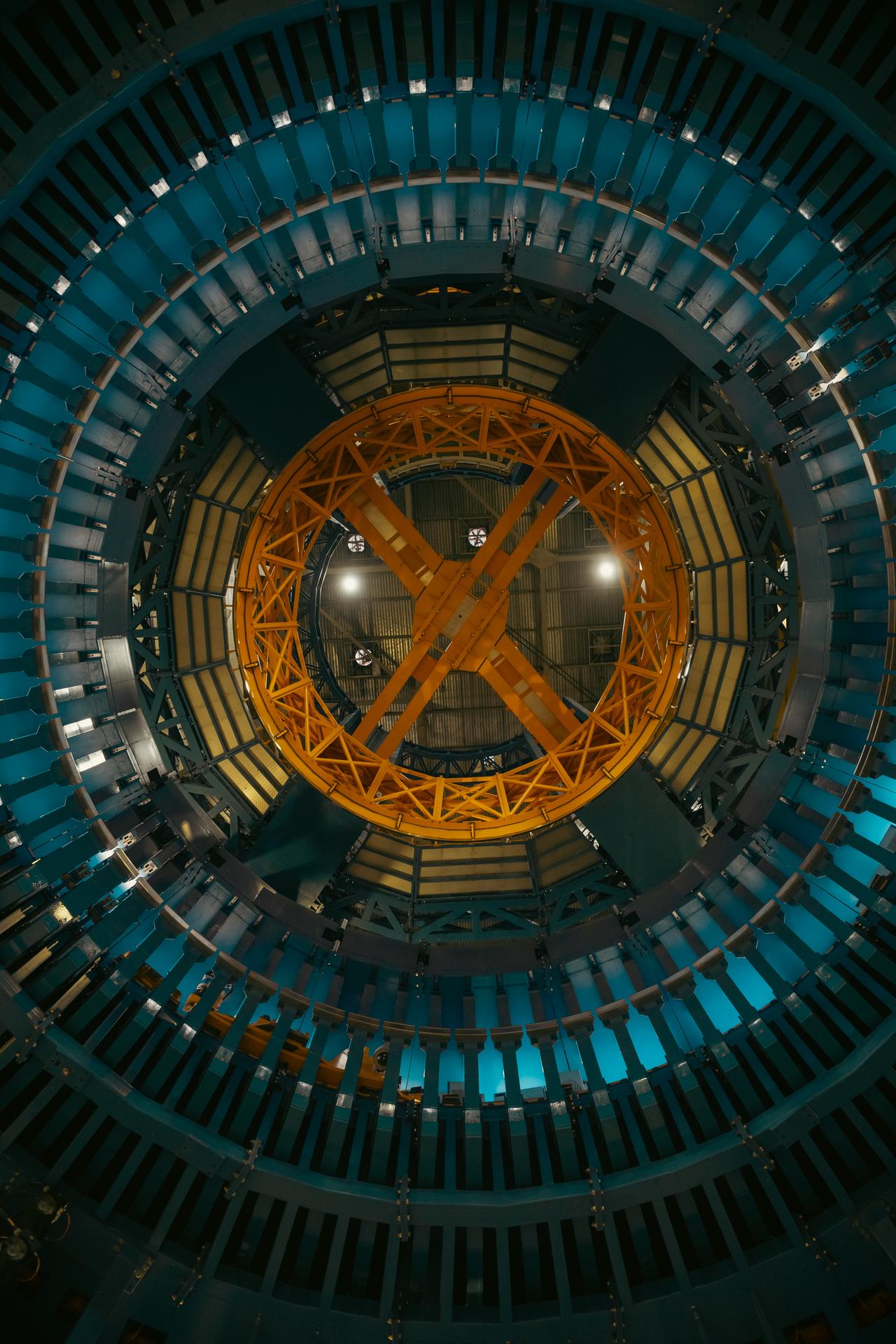
Teams at Michoud Assembly Facility in New Orleans load the 25-foot-long engine section barrel into the vertical assembly center on Aug. 5, 2026. The engine section will be used on the SLS (Space Launch System) rocket’s core stage for the agency’s Artemis V mission. On the vertical assembly center tooling, teams will mate the flight hardware to a ring, which will serve as an attachment point for the liquid hydrogen tank later in the production process. The engine section is one of five major elements that make up the 212-foot-tall SLS rocket stage; and houses various avionic systems, the engine thrust structure, and four RS-25 engines. The core stage produces more than two million pounds of thrust to help launch NASA’s Orion spacecraft, astronauts, and supplies beyond Earth’s orbit and to the lunar surface for Artemis.
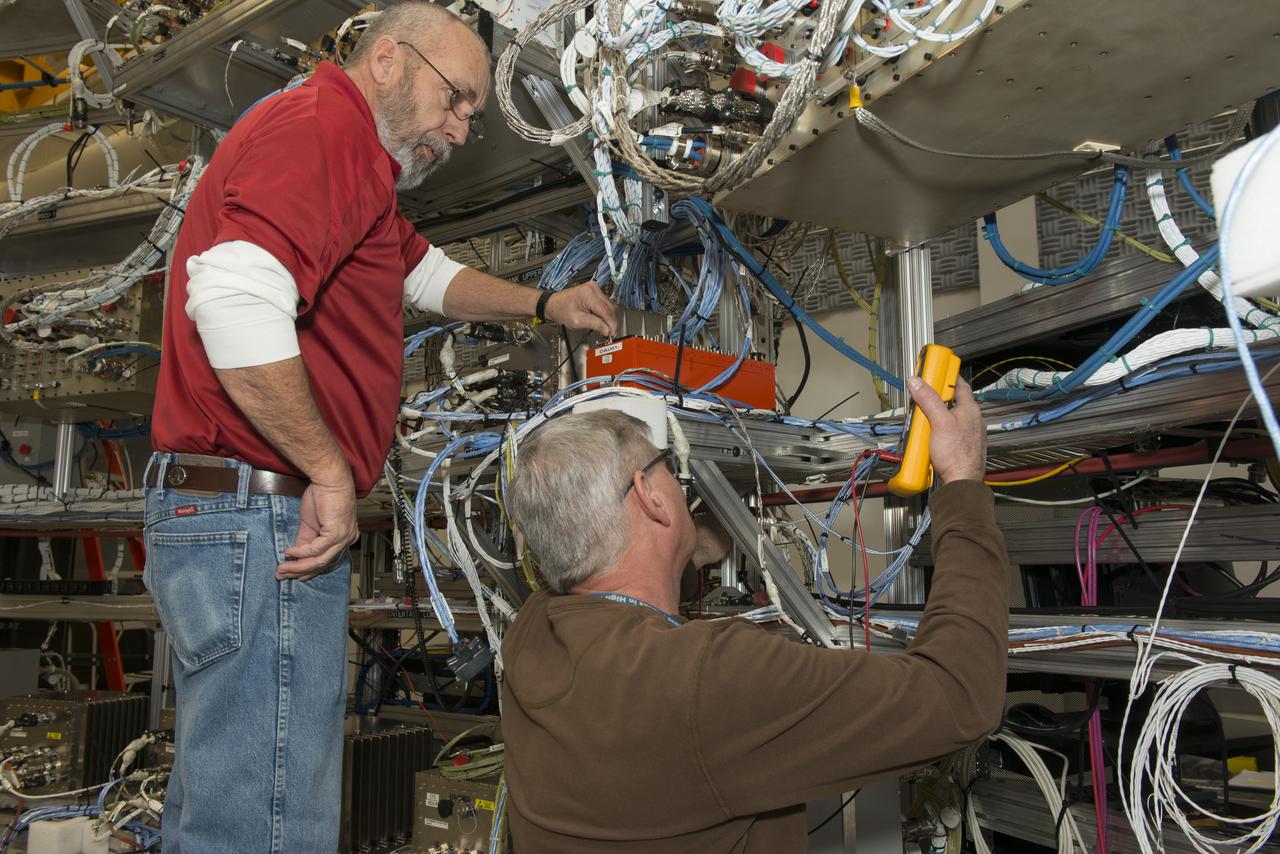
From left, Wayne Arrington, a Boeing Company technician, and Steve Presti, a mechanical technician at NASA's Marshall Space Flight Center in Huntsville, Ala., install Developmental Flight Instrumentation Data Acquisition Units in Marshall's Systems Integration and Test Facility. The units are part of NASA's Space Launch System (SLS) core stage avionics, which will guide the biggest, most powerful rocket in history to deep space missions. When completed, the core stage will be more than 200 feet tall and store cryogenic liquid hydrogen and liquid oxygen that will feed the vehicle's RS-25 engines. The hardware, software and operating systems for the SLS are arranged in flight configuration in the facility for testing. The new Data Acquisition Units will monitor vehicle behavior in flight -- like acceleration, thermal environments, shock and vibration. That data will then be used to validate previous ground tests and analyses models that were used in the development of the SLS vehicle.
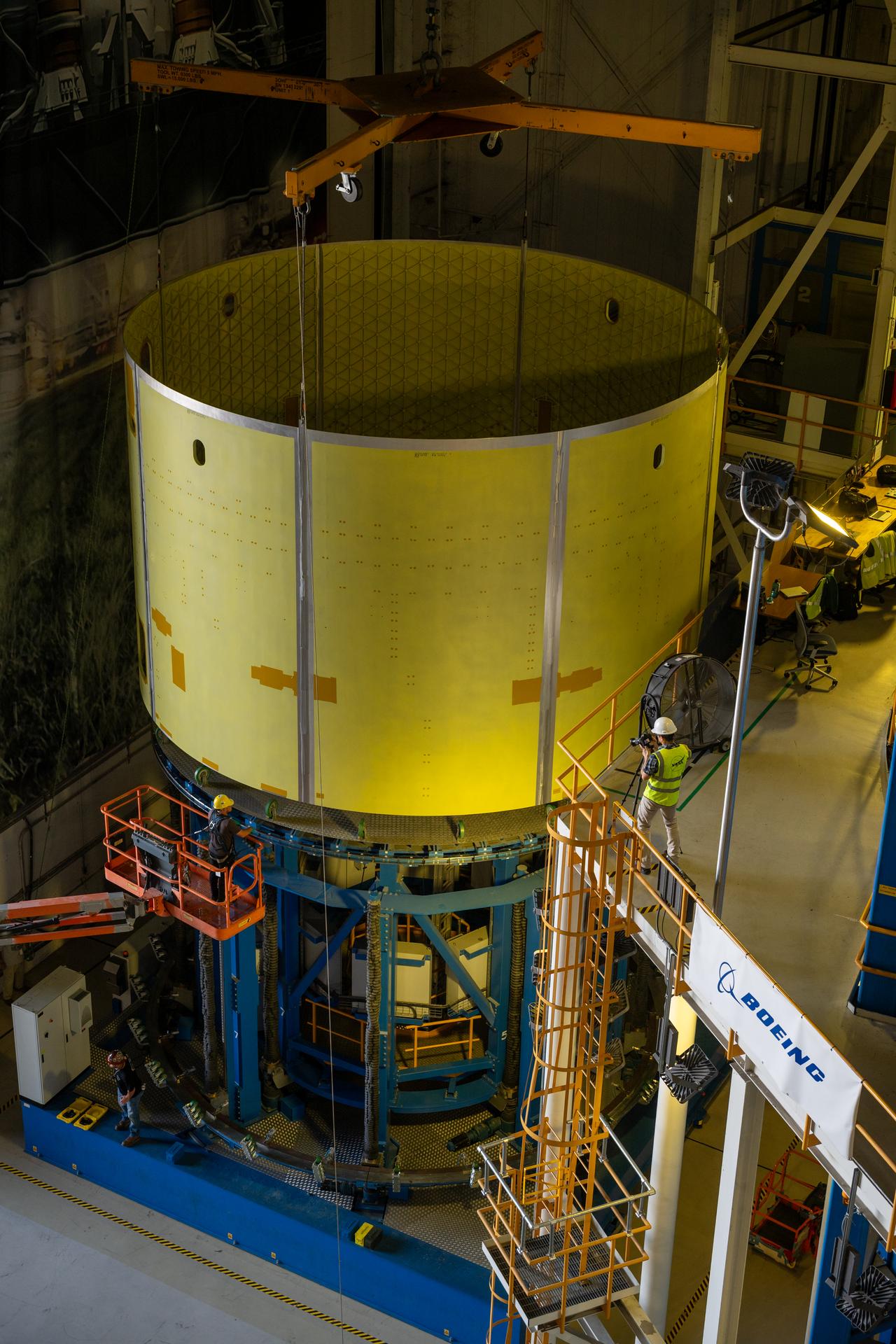
Teams at Michoud Assembly Facility in New Orleans load the engine section barrel into the vertical assembly center on Aug. 5, 2026. The engine section will be used on the SLS (Space Launch System) rocket’s core stage for the agency’s Artemis V mission. On the vertical assembly center tooling, teams will mate the flight hardware to a ring, which will serve as an attachment point for the liquid hydrogen tank later in the production process. The engine section is one of five major elements that make up the 212-foot-tall SLS rocket stage; and houses various avionic systems, the engine thrust structure, and four RS-25 engines. The core stage produces more than two million pounds of thrust to help launch NASA’s Orion spacecraft, astronauts, and supplies beyond Earth’s orbit and to the lunar surface for Artemis.
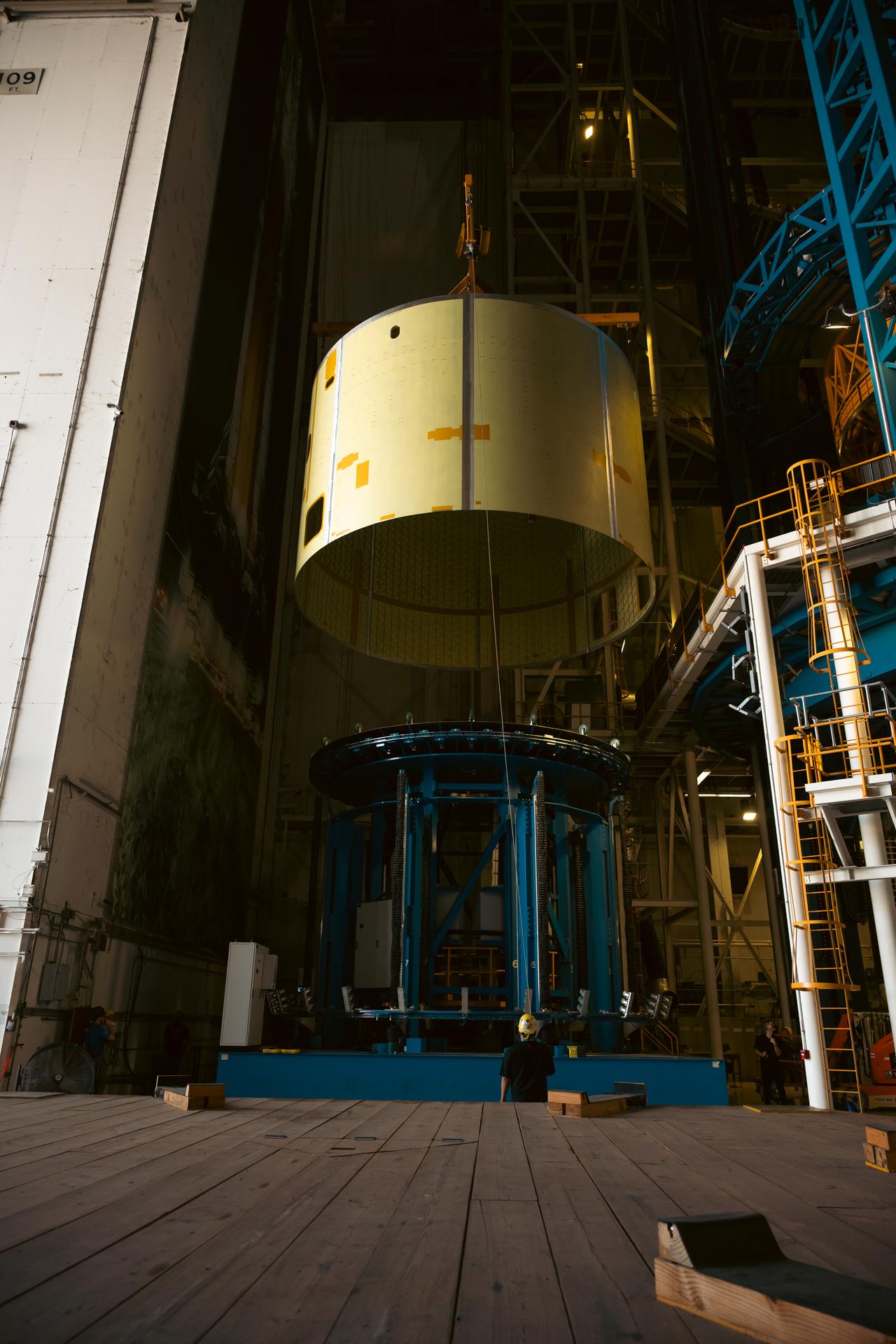
Teams at Michoud Assembly Facility in New Orleans load the engine section barrel into the vertical assembly center on Aug. 5, 2026. The engine section will be used on the SLS (Space Launch System) rocket’s core stage for the agency’s Artemis V mission. On the vertical assembly center tooling, teams will mate the flight hardware to a ring, which will serve as an attachment point for the liquid hydrogen tank later in the production process. The engine section is one of five major elements that make up the 212-foot-tall SLS rocket stage; and houses various avionic systems, the engine thrust structure, and four RS-25 engines. The core stage produces more than two million pounds of thrust to help launch NASA’s Orion spacecraft, astronauts, and supplies beyond Earth’s orbit and to the lunar surface for Artemis.
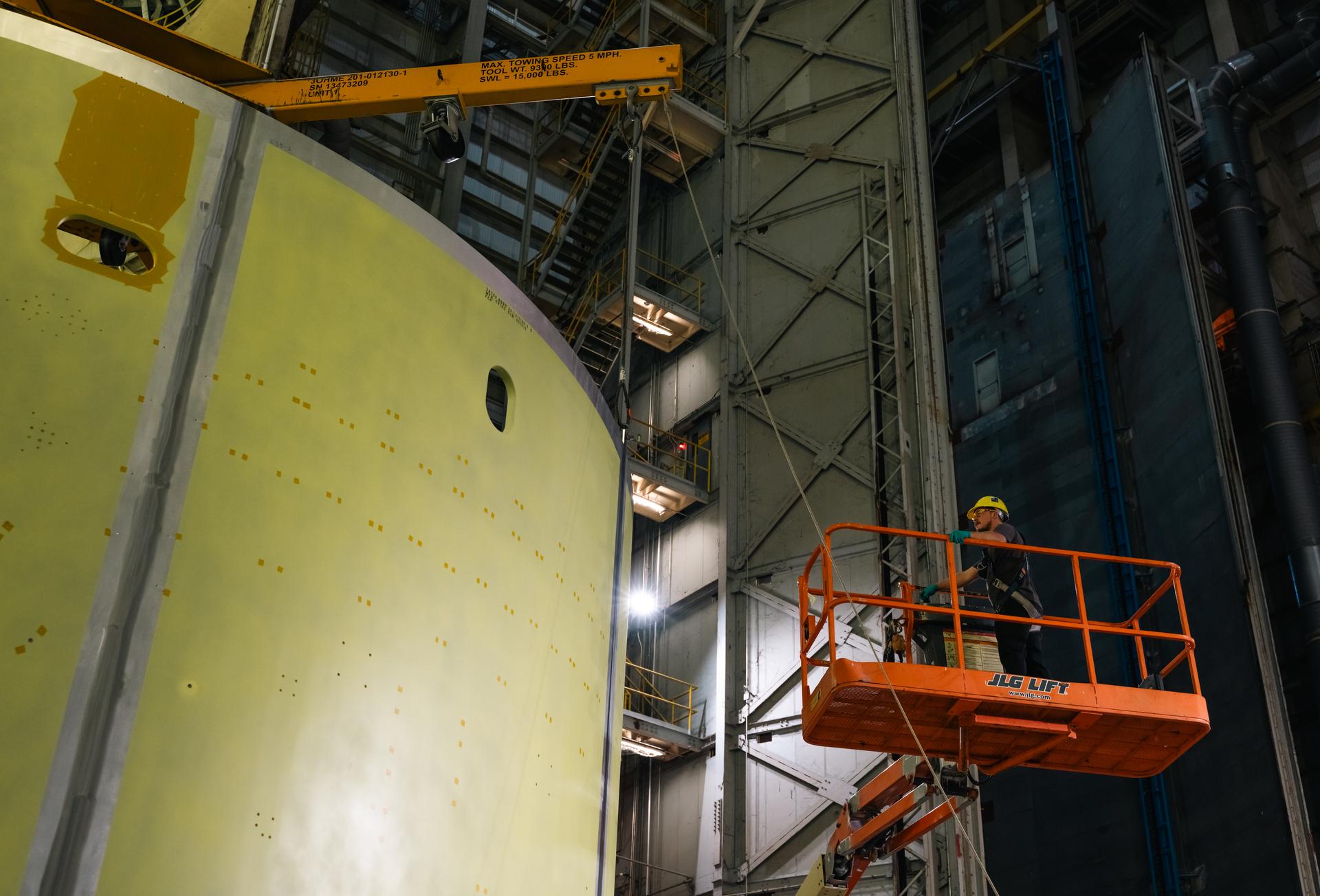
Teams at Michoud Assembly Facility in New Orleans load the engine section barrel into the vertical assembly center on Aug. 5, 2026. The engine section will be used on the SLS (Space Launch System) rocket’s core stage for the agency’s Artemis V mission. On the vertical assembly center tooling, teams will mate the flight hardware to a ring, which will serve as an attachment point for the liquid hydrogen tank later in the production process. The engine section is one of five major elements that make up the 212-foot-tall SLS rocket stage; and houses various avionic systems, the engine thrust structure, and four RS-25 engines. The core stage produces more than two million pounds of thrust to help launch NASA’s Orion spacecraft, astronauts, and supplies beyond Earth’s orbit and to the lunar surface for Artemis.
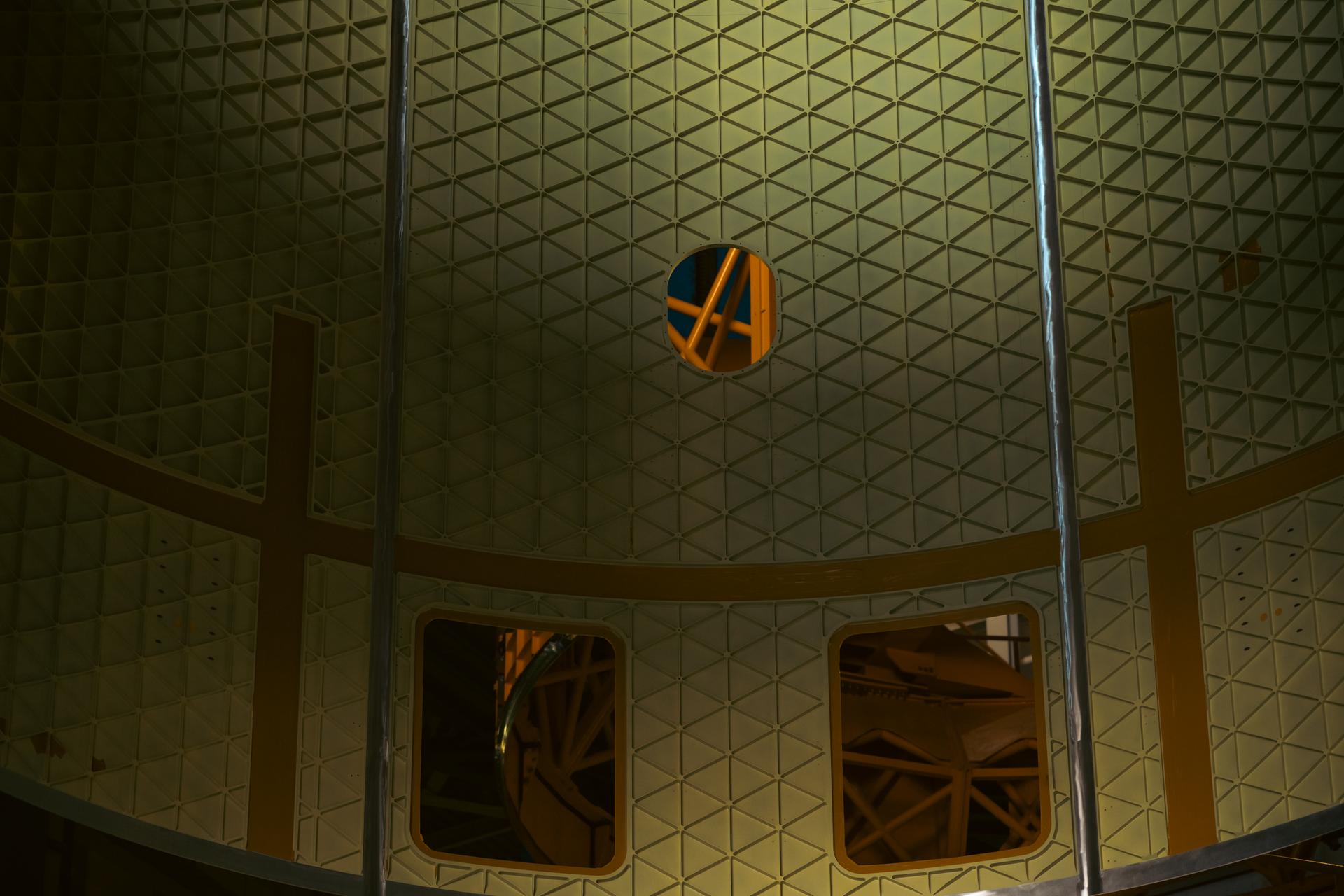
Teams at Michoud Assembly Facility in New Orleans load the engine section barrel into the vertical assembly center on Aug. 5, 2026. The engine section will be used on the SLS (Space Launch System) rocket’s core stage for the agency’s Artemis V mission. On the vertical assembly center tooling, teams will mate the flight hardware to a ring, which will serve as an attachment point for the liquid hydrogen tank later in the production process. The engine section is one of five major elements that make up the 212-foot-tall SLS rocket stage; and houses various avionic systems, the engine thrust structure, and four RS-25 engines. The core stage produces more than two million pounds of thrust to help launch NASA’s Orion spacecraft, astronauts, and supplies beyond Earth’s orbit and to the lunar surface for Artemis.
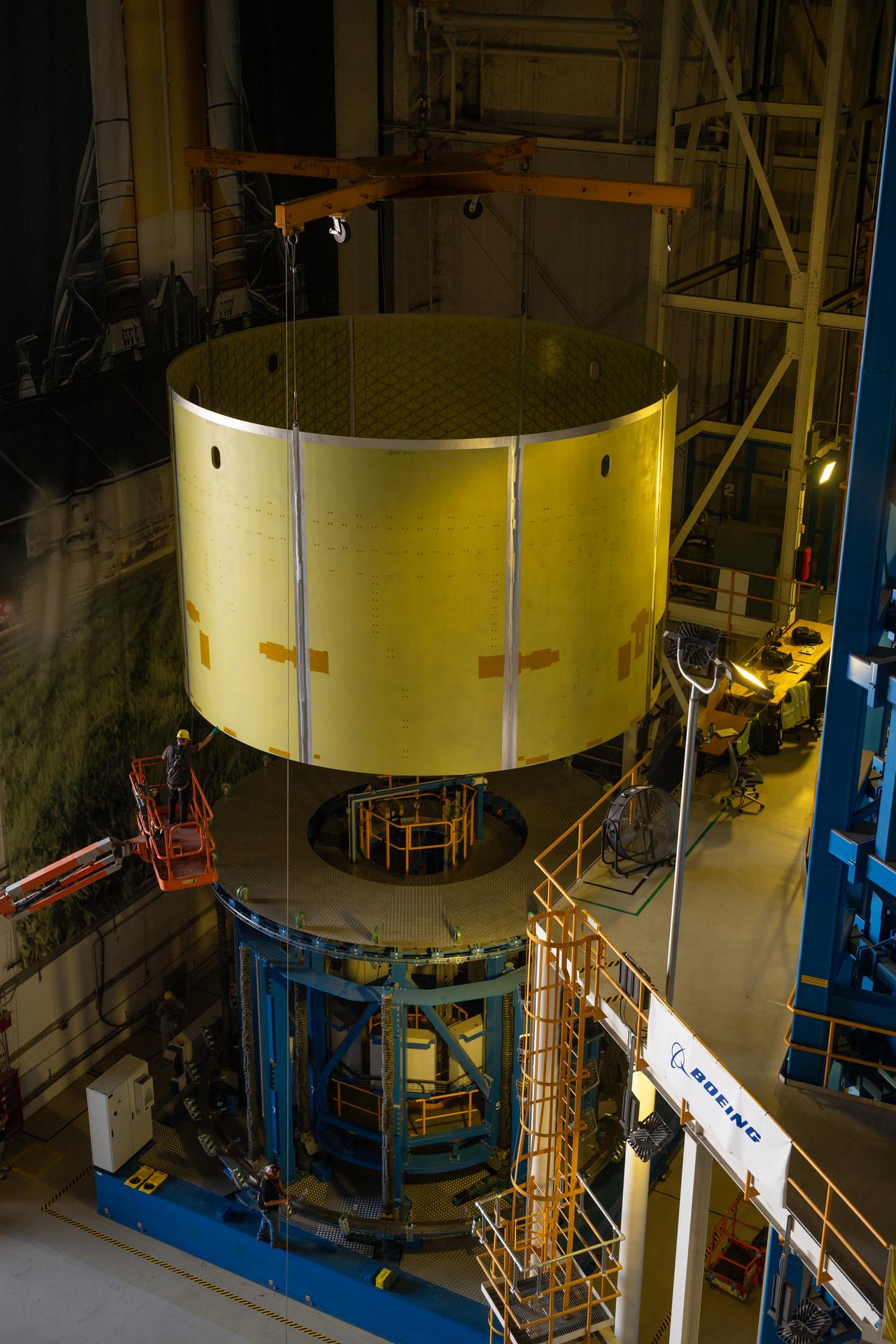
Teams at Michoud Assembly Facility in New Orleans load the engine section barrel into the vertical assembly center on Aug. 5, 2026. The engine section will be used on the SLS (Space Launch System) rocket’s core stage for the agency’s Artemis V mission. On the vertical assembly center tooling, teams will mate the flight hardware to a ring, which will serve as an attachment point for the liquid hydrogen tank later in the production process. The engine section is one of five major elements that make up the 212-foot-tall SLS rocket stage; and houses various avionic systems, the engine thrust structure, and four RS-25 engines. The core stage produces more than two million pounds of thrust to help launch NASA’s Orion spacecraft, astronauts, and supplies beyond Earth’s orbit and to the lunar surface for Artemis.
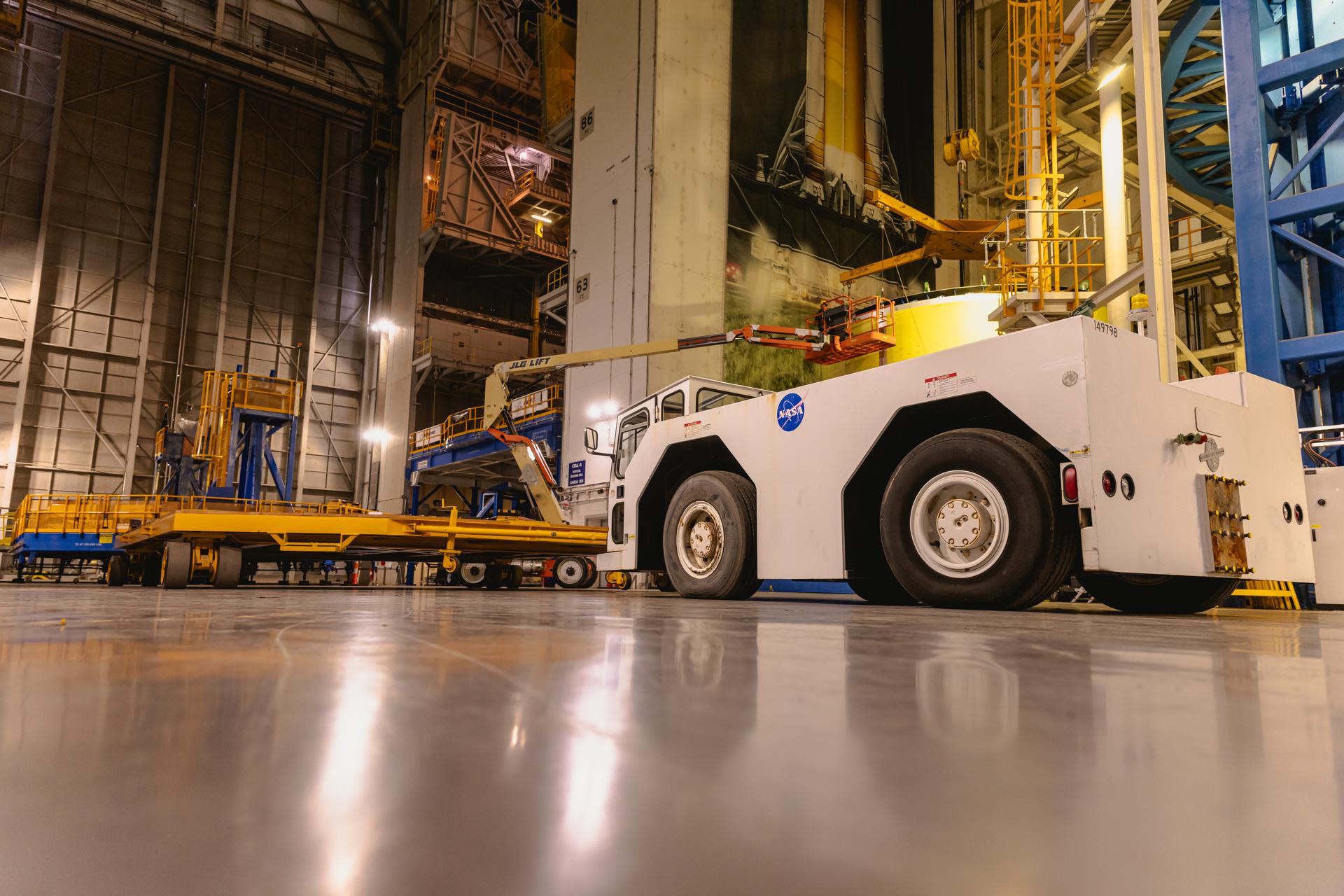
Teams at Michoud Assembly Facility in New Orleans load the engine section barrel into the vertical assembly center on Aug. 5, 2026. The engine section will be used on the SLS (Space Launch System) rocket’s core stage for the agency’s Artemis V mission. On the vertical assembly center tooling, teams will mate the flight hardware to a ring, which will serve as an attachment point for the liquid hydrogen tank later in the production process. The engine section is one of five major elements that make up the 212-foot-tall SLS rocket stage; and houses various avionic systems, the engine thrust structure, and four RS-25 engines. The core stage produces more than two million pounds of thrust to help launch NASA’s Orion spacecraft, astronauts, and supplies beyond Earth’s orbit and to the lunar surface for Artemis.
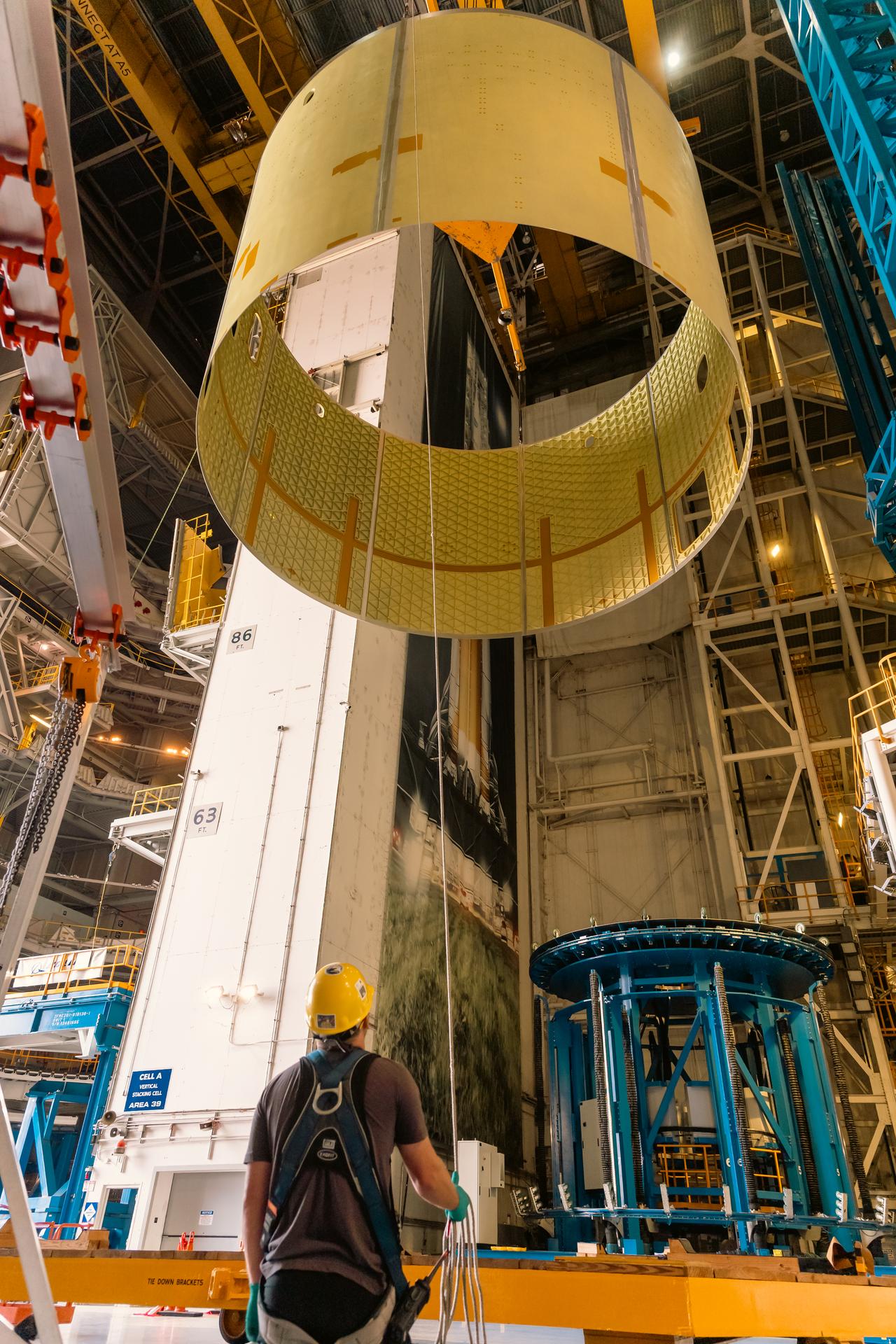
Teams at Michoud Assembly Facility in New Orleans load the engine section barrel into the vertical assembly center on Aug. 5, 2026. The engine section will be used on the SLS (Space Launch System) rocket’s core stage for the agency’s Artemis V mission. On the vertical assembly center tooling, teams will mate the flight hardware to a ring, which will serve as an attachment point for the liquid hydrogen tank later in the production process. The engine section is one of five major elements that make up the 212-foot-tall SLS rocket stage; and houses various avionic systems, the engine thrust structure, and four RS-25 engines. The core stage produces more than two million pounds of thrust to help launch NASA’s Orion spacecraft, astronauts, and supplies beyond Earth’s orbit and to the lunar surface for Artemis.
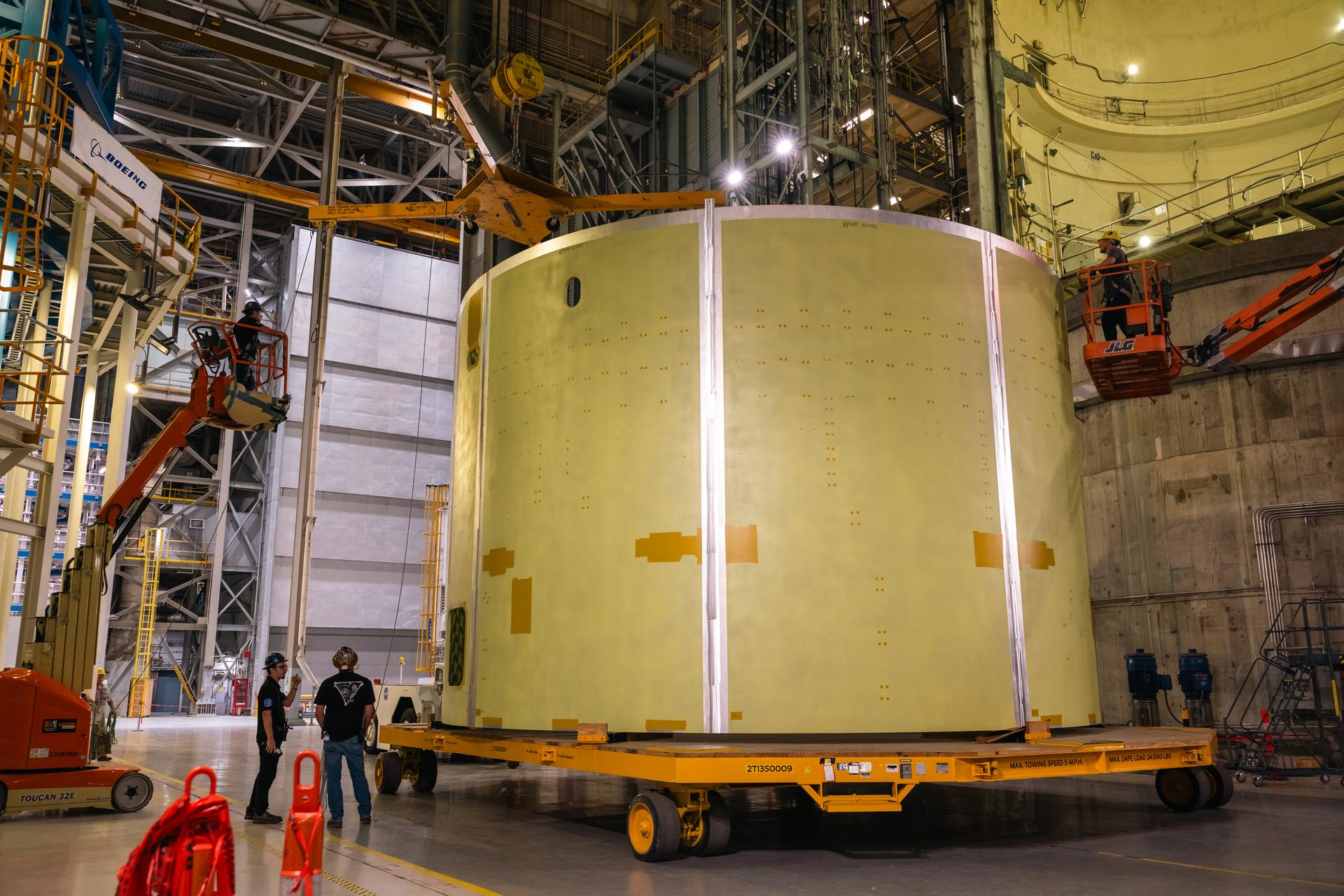
Teams at Michoud Assembly Facility in New Orleans load the engine section barrel into the vertical assembly center on Aug. 5, 2026. The engine section will be used on the SLS (Space Launch System) rocket’s core stage for the agency’s Artemis V mission. On the vertical assembly center tooling, teams will mate the flight hardware to a ring, which will serve as an attachment point for the liquid hydrogen tank later in the production process. The engine section is one of five major elements that make up the 212-foot-tall SLS rocket stage; and houses various avionic systems, the engine thrust structure, and four RS-25 engines. The core stage produces more than two million pounds of thrust to help launch NASA’s Orion spacecraft, astronauts, and supplies beyond Earth’s orbit and to the lunar surface for Artemis.
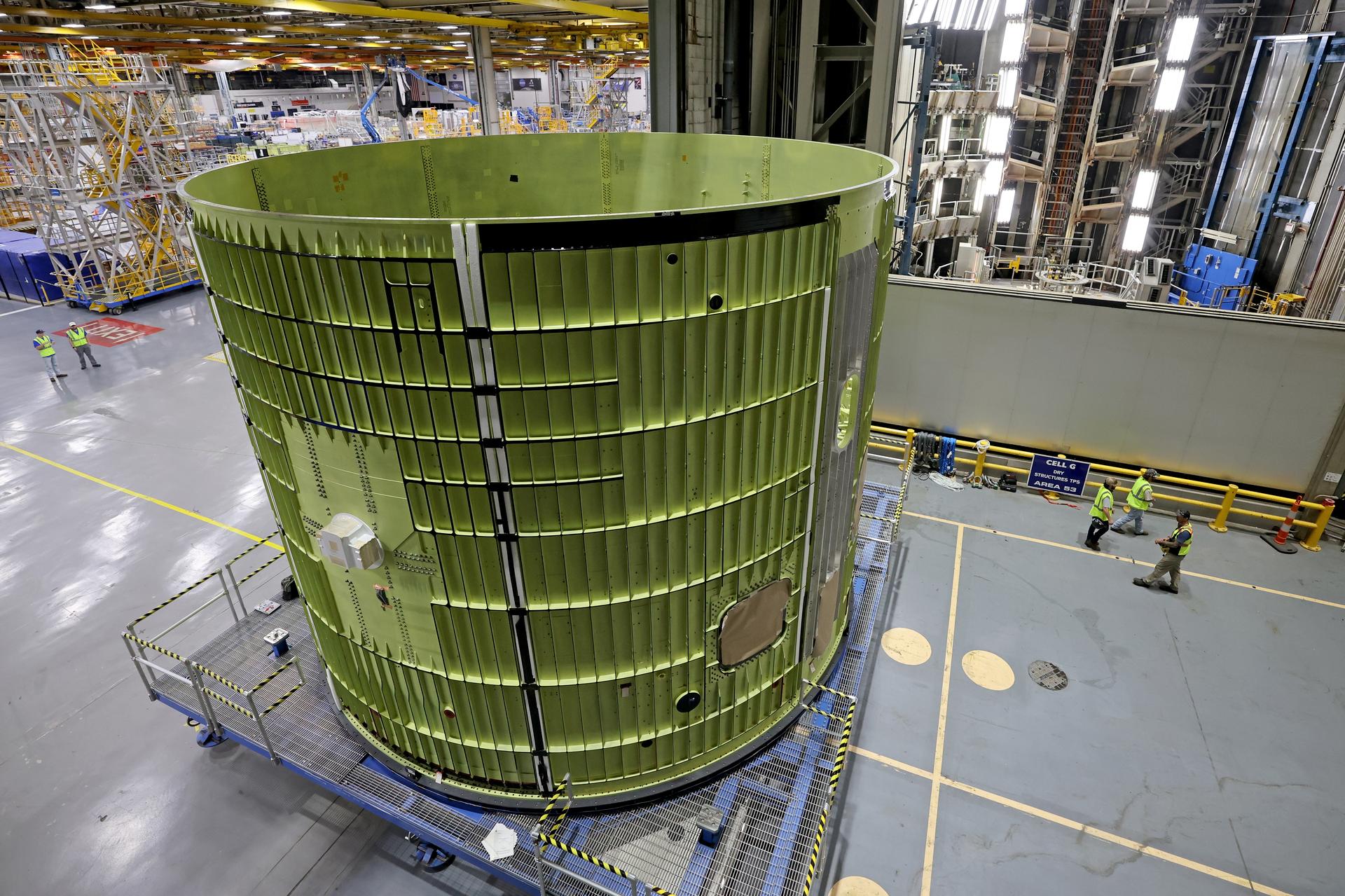
Teams at NASA’s Michoud Assembly Facility in New Orleans move the 21.8-foot-tall intertank for the core stage of the agency’s SLS (Space Launch System) rocket into one of the factory’s high bay production cells May 29. The flight hardware will help power NASA’s Artemis IV mission. Inside the production cell, NASA and Boeing, SLS core stage prime contractor will apply the hardware’s outer thermal protection layer through an automated process. The thermal protection system safeguards the rocket from the extreme temperatures and prevents the super-cooled propellant within the rocket’s massive propellant tanks from boiling off too rapidly during launch and flight. The intertank houses avionics and electronics, serves as an attachment point for the solid rocket boosters, and is one of five major elements that make up the 212-foot-tall rocket stage. The core stage, along with its four RS-25 engines at its base, produce more than two million pounds of thrust to help launch NASA’s Orion spacecraft, astronauts, and supplies beyond Earth’s orbit and to the lunar surface for Artemis. Image credit: NASA/Michael DeMocker
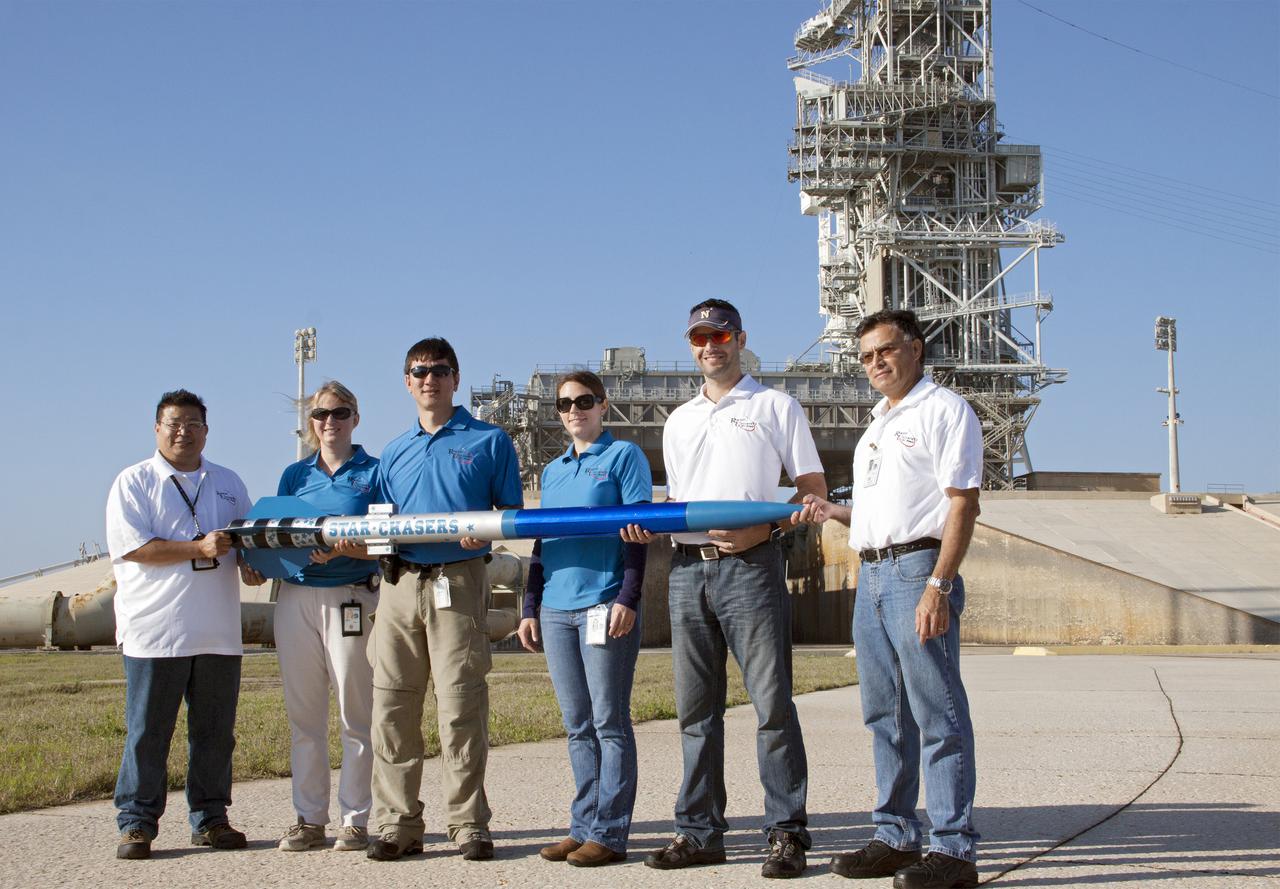
CAPE CANAVERAL, Fla. -- At NASA's Kennedy Space Center in Florida, engineers display a small rocket following its launch as part of Rocket University. From the left are Myphi Tran of Flight Instrumentation, Susan Danley of Flight Structures, Morgan Simpson of Flight Hardware Processing, Kim Simpson of Fluids, Mechanical and Structural Systems, Leandro James of Systems Hardware Engineering and Julio Najarro of Mechanical Assembly, Lifting and Handling. The goal was to test its systems and to verify that it performed as designed. As part of Rocket University, the engineers are given an opportunity to work a fast-track project to develop skills in developing spacecraft systems of the future. As NASA plans for future spaceflight programs to low-Earth orbit and beyond, teams of engineers at Kennedy are gaining experience in designing and flying launch vehicle systems on a small scale. Four teams of five to eight members from Kennedy are designing rockets complete with avionics and recovery systems. Launch operations require coordination with federal agencies, just as they would with rockets launched in support of a NASA mission. Photo credit: NASA_Jim Grossmann
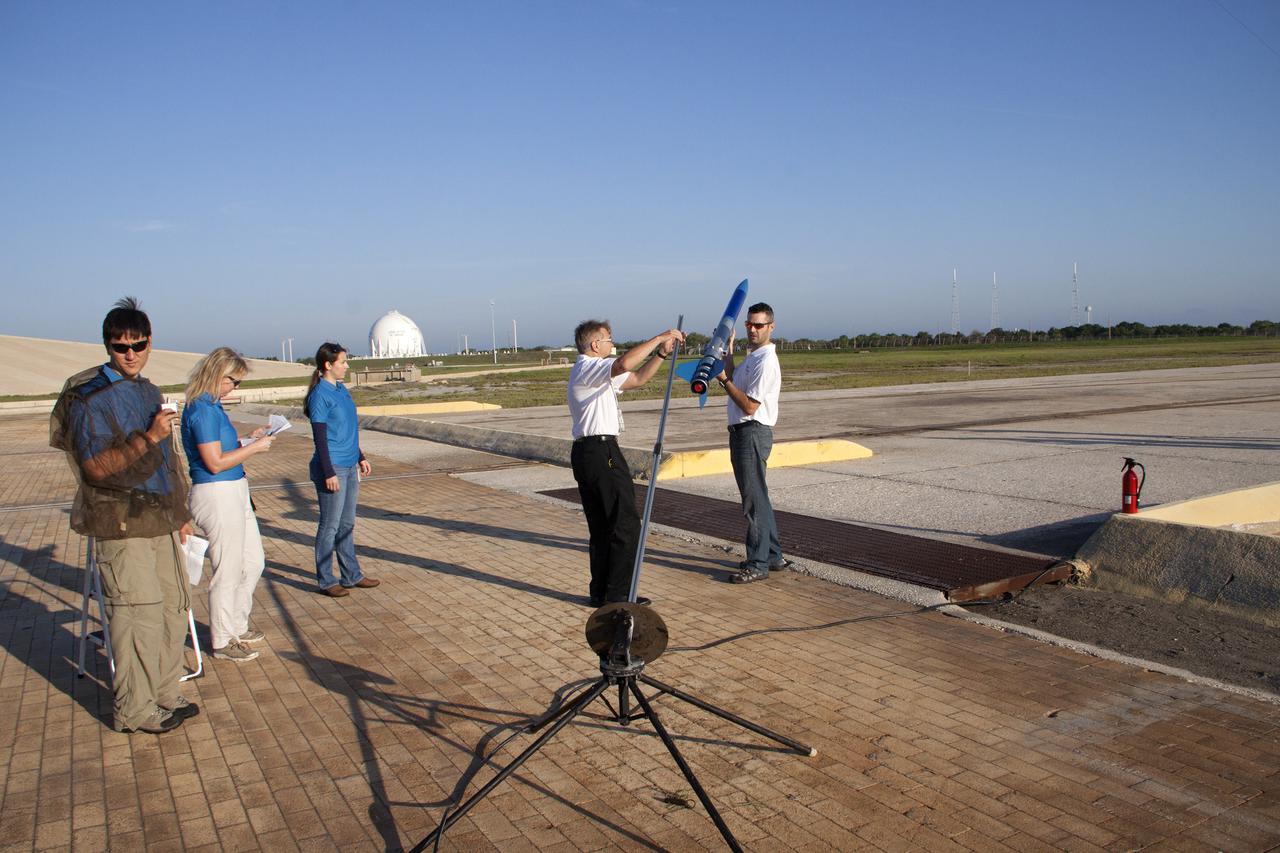
CAPE CANAVERAL, Fla. -- At NASA's Kennedy Space Center in Florida, as Morgan Simpson of Flight Hardware Processing, Susan Danley of Flight Structures and Kim Simpson of Fluids, Mechanical and Structural Systems look on, Gary Dahlke of Engineering and Technology, left, and Leandro James of Systems Hardware Engineering attach a small rocket prior to its launch stand as part of Rocket University. The goal was to test its systems and to verify that it performed as designed. As part of Rocket University, the engineers are given an opportunity to work a fast-track project to develop skills in developing spacecraft systems of the future. As NASA plans for future spaceflight programs to low-Earth orbit and beyond, teams of engineers at Kennedy are gaining experience in designing and flying launch vehicle systems on a small scale. Four teams of five to eight members from Kennedy are designing rockets complete with avionics and recovery systems. Launch operations require coordination with federal agencies, just as they would with rockets launched in support of a NASA mission. Photo credit: NASA_Jim Grossmann
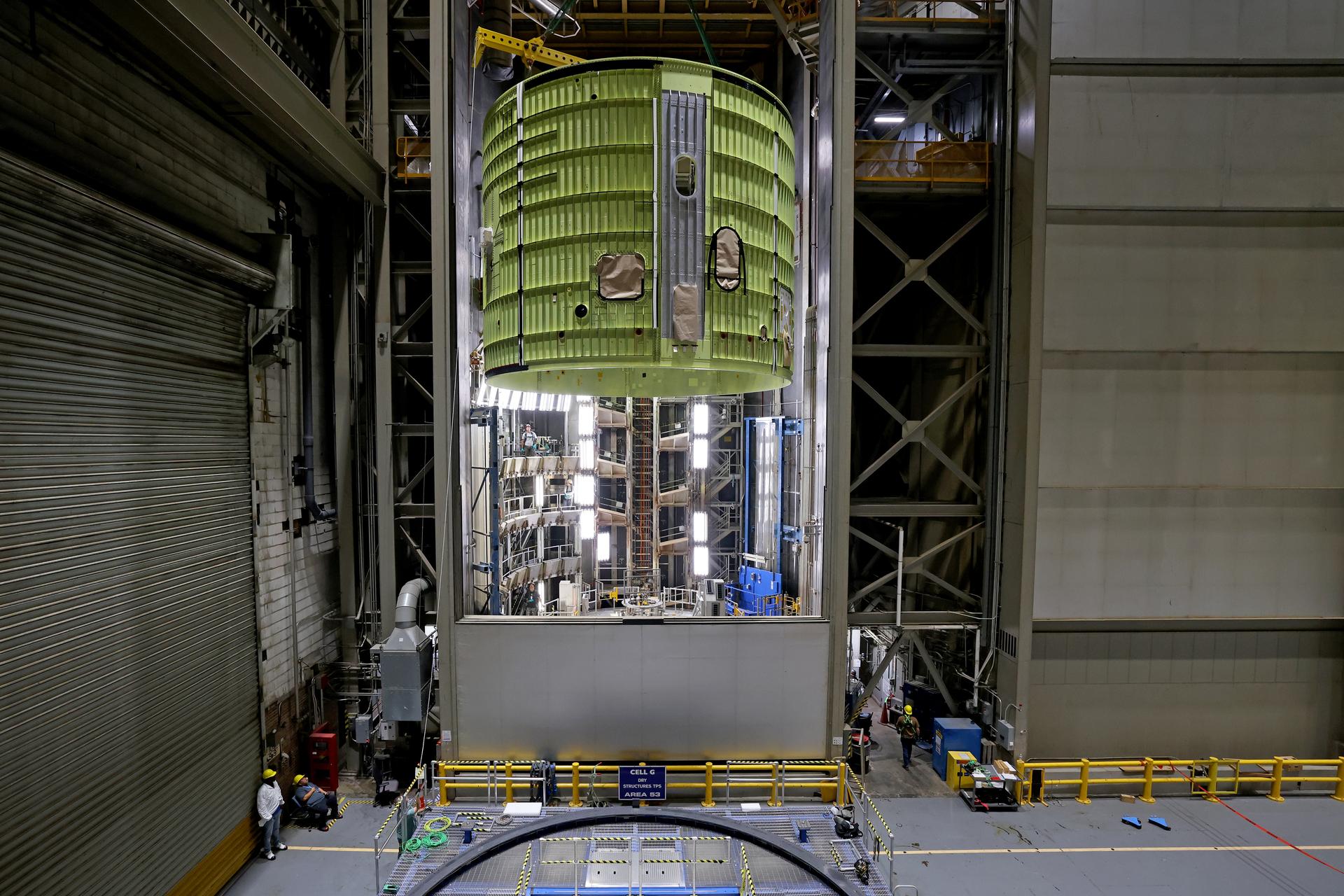
Teams at NASA’s Michoud Assembly Facility in New Orleans move the 21.8-foot-tall intertank for the core stage of the agency’s SLS (Space Launch System) rocket into one of the factory’s high bay production cells May 29. The flight hardware will help power NASA’s Artemis IV mission. Inside the production cell, NASA and Boeing, SLS core stage prime contractor will apply the hardware’s outer thermal protection layer through an automated process. The thermal protection system safeguards the rocket from the extreme temperatures and prevents the super-cooled propellant within the rocket’s massive propellant tanks from boiling off too rapidly during launch and flight. The intertank houses avionics and electronics, serves as an attachment point for the solid rocket boosters, and is one of five major elements that make up the 212-foot-tall rocket stage. The core stage, along with its four RS-25 engines at its base, produce more than two million pounds of thrust to help launch NASA’s Orion spacecraft, astronauts, and supplies beyond Earth’s orbit and to the lunar surface for Artemis. Image credit: NASA/Michael DeMocker
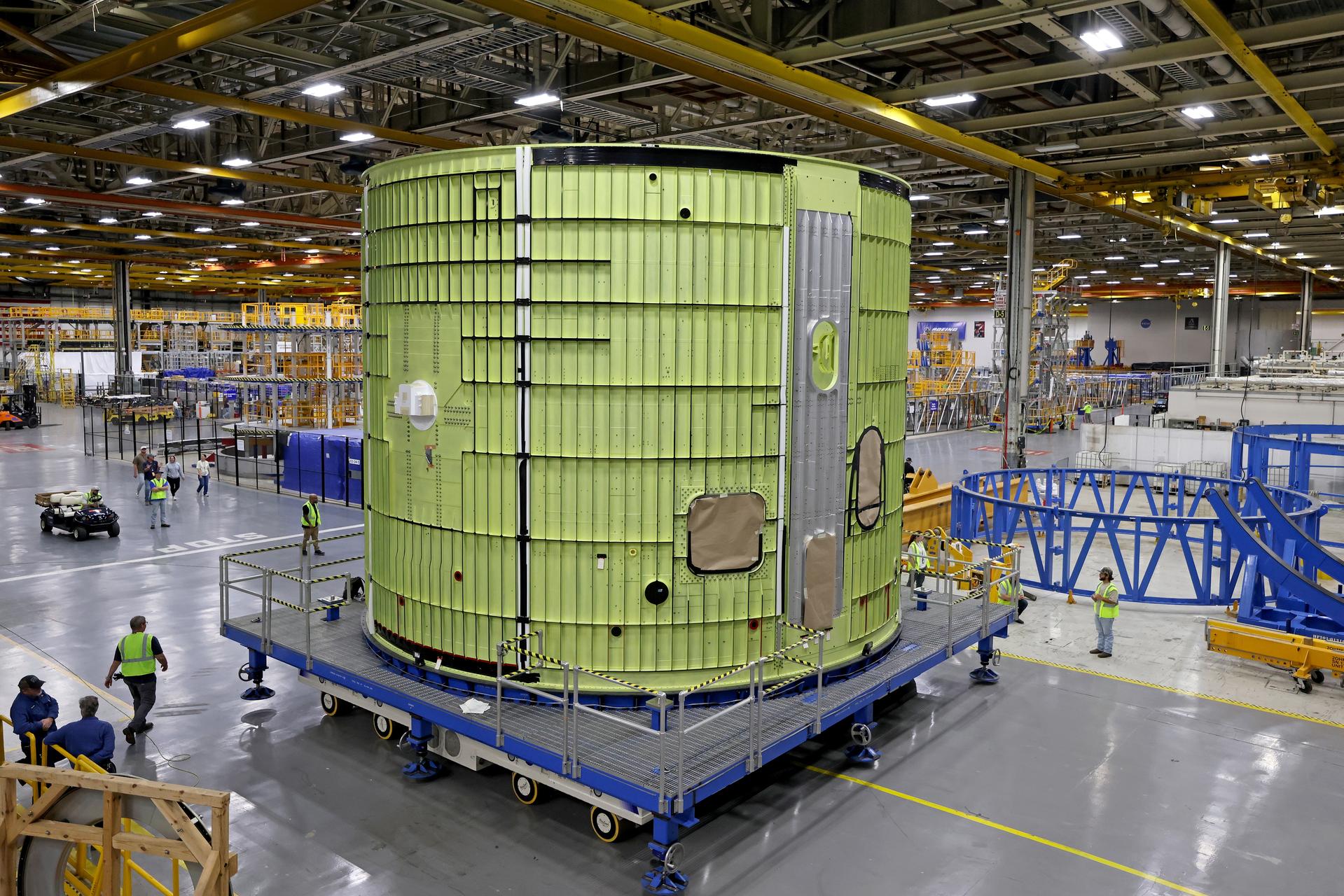
Teams at NASA’s Michoud Assembly Facility in New Orleans move the 21.8-foot-tall intertank for the core stage of the agency’s SLS (Space Launch System) rocket into one of the factory’s high bay production cells May 29. The flight hardware will help power NASA’s Artemis IV mission. Inside the production cell, NASA and Boeing, SLS core stage prime contractor will apply the hardware’s outer thermal protection layer through an automated process. The thermal protection system safeguards the rocket from the extreme temperatures and prevents the super-cooled propellant within the rocket’s massive propellant tanks from boiling off too rapidly during launch and flight. The intertank houses avionics and electronics, serves as an attachment point for the solid rocket boosters, and is one of five major elements that make up the 212-foot-tall rocket stage. The core stage, along with its four RS-25 engines at its base, produce more than two million pounds of thrust to help launch NASA’s Orion spacecraft, astronauts, and supplies beyond Earth’s orbit and to the lunar surface for Artemis. Image credit: NASA/Michael DeMocker
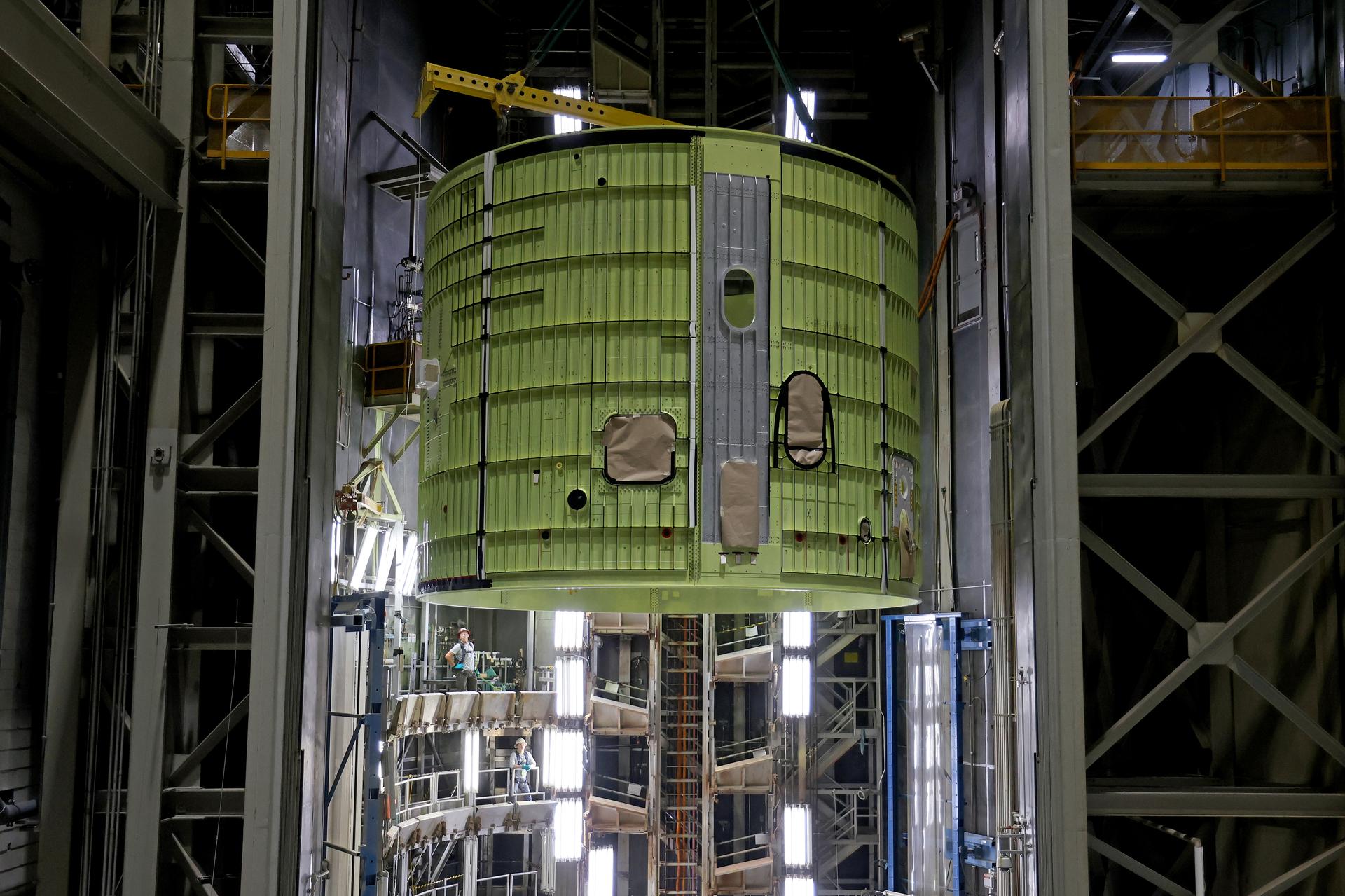
Teams at NASA’s Michoud Assembly Facility in New Orleans move the 21.8-foot-tall intertank for the core stage of the agency’s SLS (Space Launch System) rocket into one of the factory’s high bay production cells May 29. The flight hardware will help power NASA’s Artemis IV mission. Inside the production cell, NASA and Boeing, SLS core stage prime contractor will apply the hardware’s outer thermal protection layer through an automated process. The thermal protection system safeguards the rocket from the extreme temperatures and prevents the super-cooled propellant within the rocket’s massive propellant tanks from boiling off too rapidly during launch and flight. The intertank houses avionics and electronics, serves as an attachment point for the solid rocket boosters, and is one of five major elements that make up the 212-foot-tall rocket stage. The core stage, along with its four RS-25 engines at its base, produce more than two million pounds of thrust to help launch NASA’s Orion spacecraft, astronauts, and supplies beyond Earth’s orbit and to the lunar surface for Artemis. Image credit: NASA/Michael DeMocker
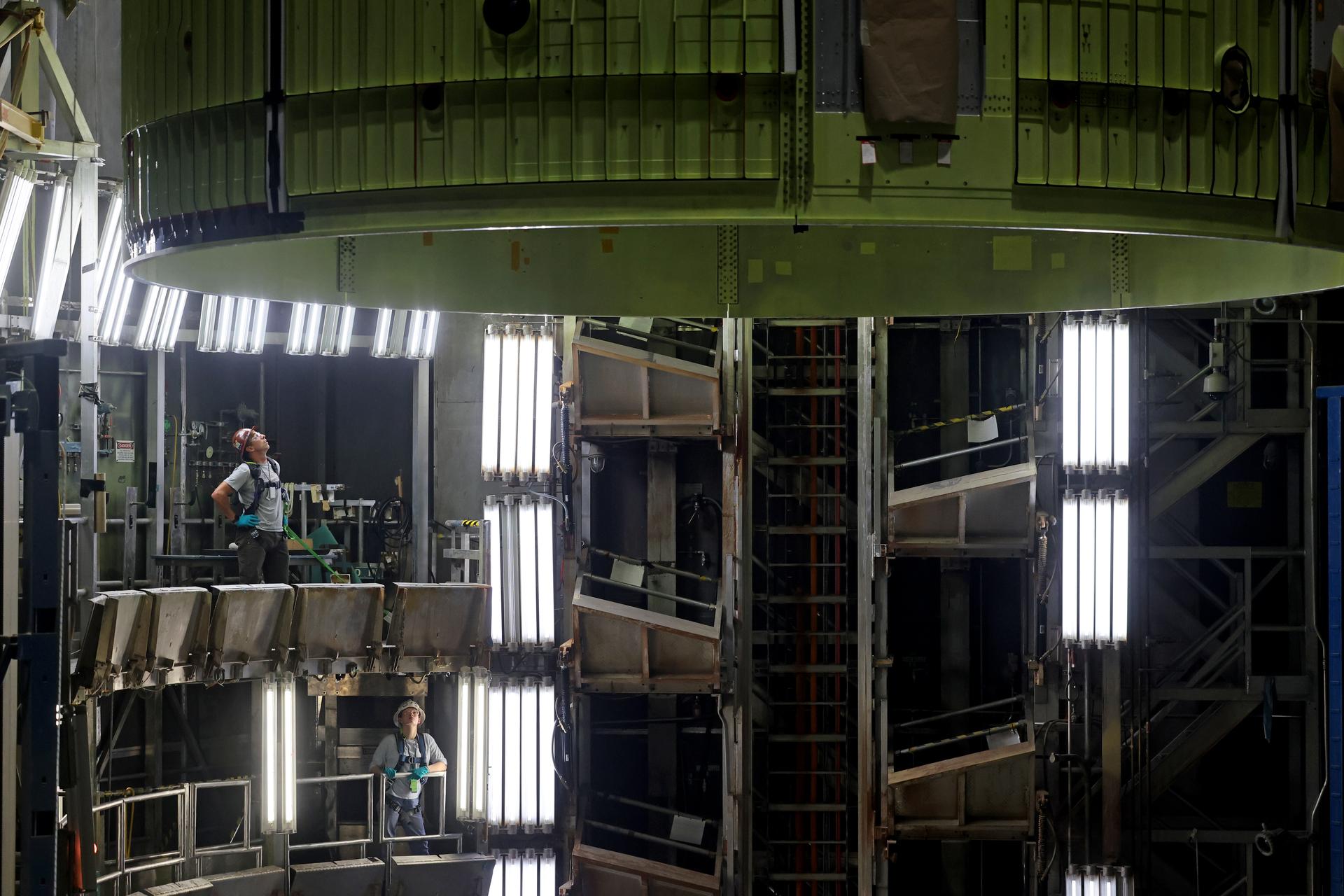
Teams at NASA’s Michoud Assembly Facility in New Orleans move the 21.8-foot-tall intertank for the core stage of the agency’s SLS (Space Launch System) rocket into one of the factory’s high bay production cells May 29. The flight hardware will help power NASA’s Artemis IV mission. Inside the production cell, NASA and Boeing, SLS core stage prime contractor will apply the hardware’s outer thermal protection layer through an automated process. The thermal protection system safeguards the rocket from the extreme temperatures and prevents the super-cooled propellant within the rocket’s massive propellant tanks from boiling off too rapidly during launch and flight. The intertank houses avionics and electronics, serves as an attachment point for the solid rocket boosters, and is one of five major elements that make up the 212-foot-tall rocket stage. The core stage, along with its four RS-25 engines at its base, produce more than two million pounds of thrust to help launch NASA’s Orion spacecraft, astronauts, and supplies beyond Earth’s orbit and to the lunar surface for Artemis. Image credit: NASA/Michael DeMocker
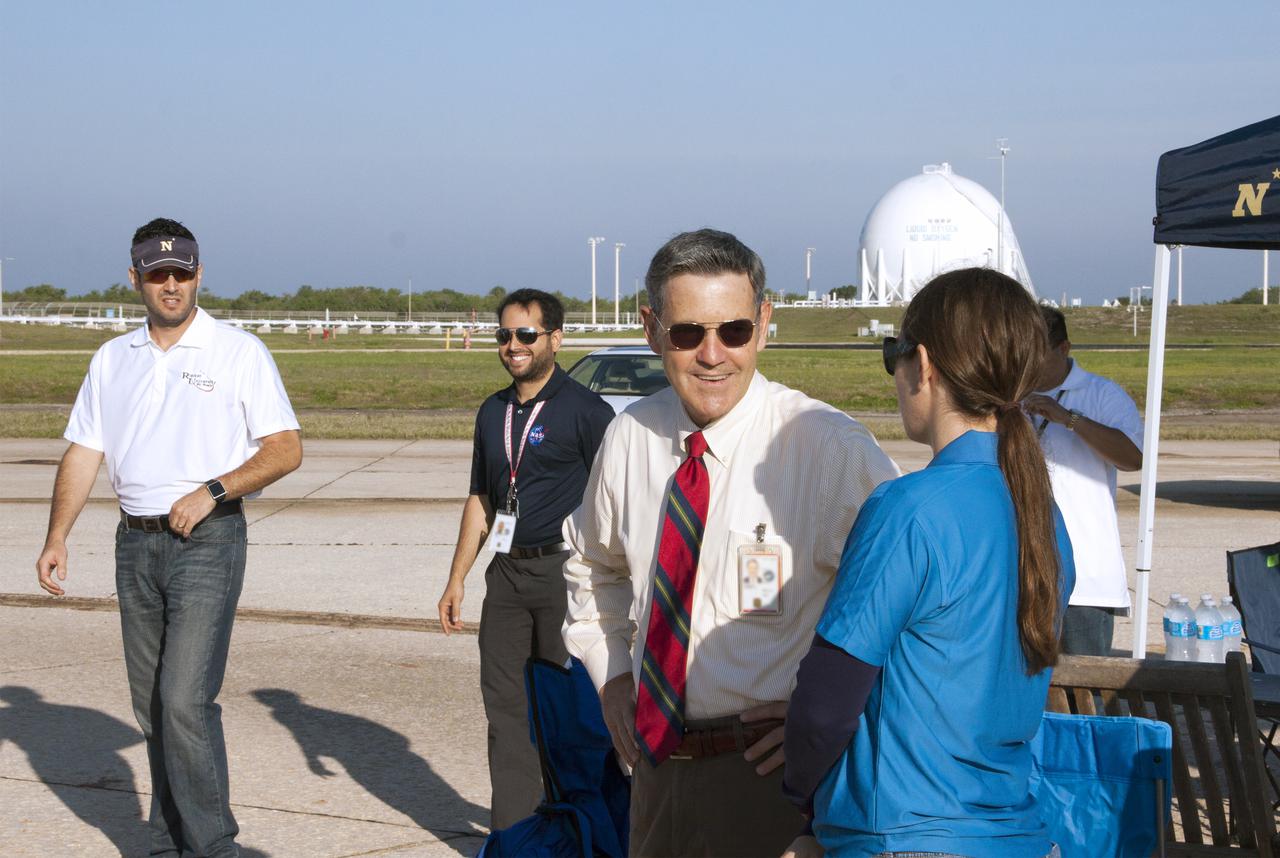
CAPE CANAVERAL, Fla. -- At NASA's Kennedy Space Center in Florida, center director Bob Cabana congratulates engineers on the successful launch of a small rocket at Launch Pad 39A as part of Rocket University. From the left are Leandro James of Systems Hardware Engineering, Kelvin Ruiz of Systems Hardware Engineering, Cabana and Kim Simpson of Fluids, Mechanical and Structural Systems. The goal was to test its systems and to verify that it performed as designed. As part of Rocket University, the engineers are given an opportunity to work a fast-track project to develop skills in developing spacecraft systems of the future. As NASA plans for future spaceflight programs to low-Earth orbit and beyond, teams of engineers at Kennedy are gaining experience in designing and flying launch vehicle systems on a small scale. Four teams of five to eight members from Kennedy are designing rockets complete with avionics and recovery systems. Launch operations require coordination with federal agencies, just as they would with rockets launched in support of a NASA mission. Photo credit: NASA_Jim Grossmann
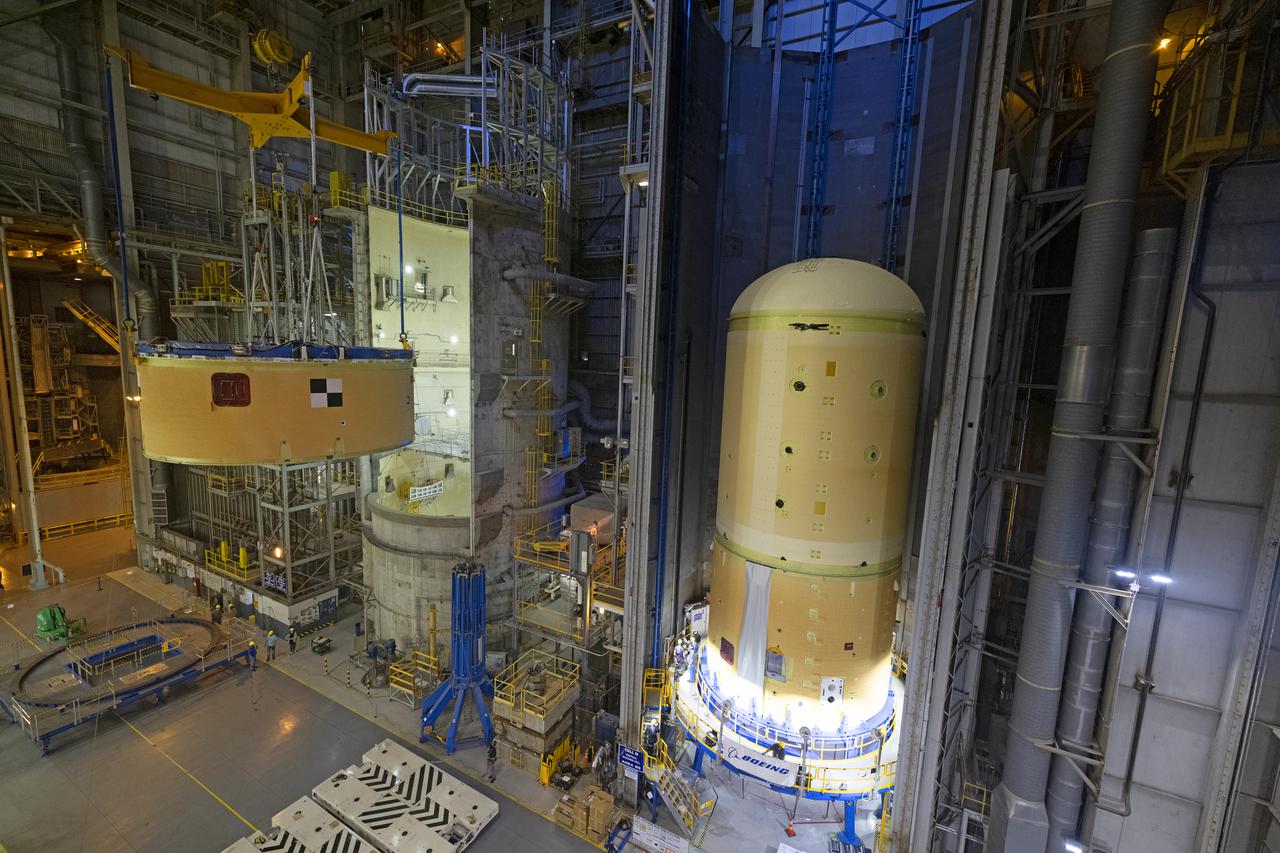
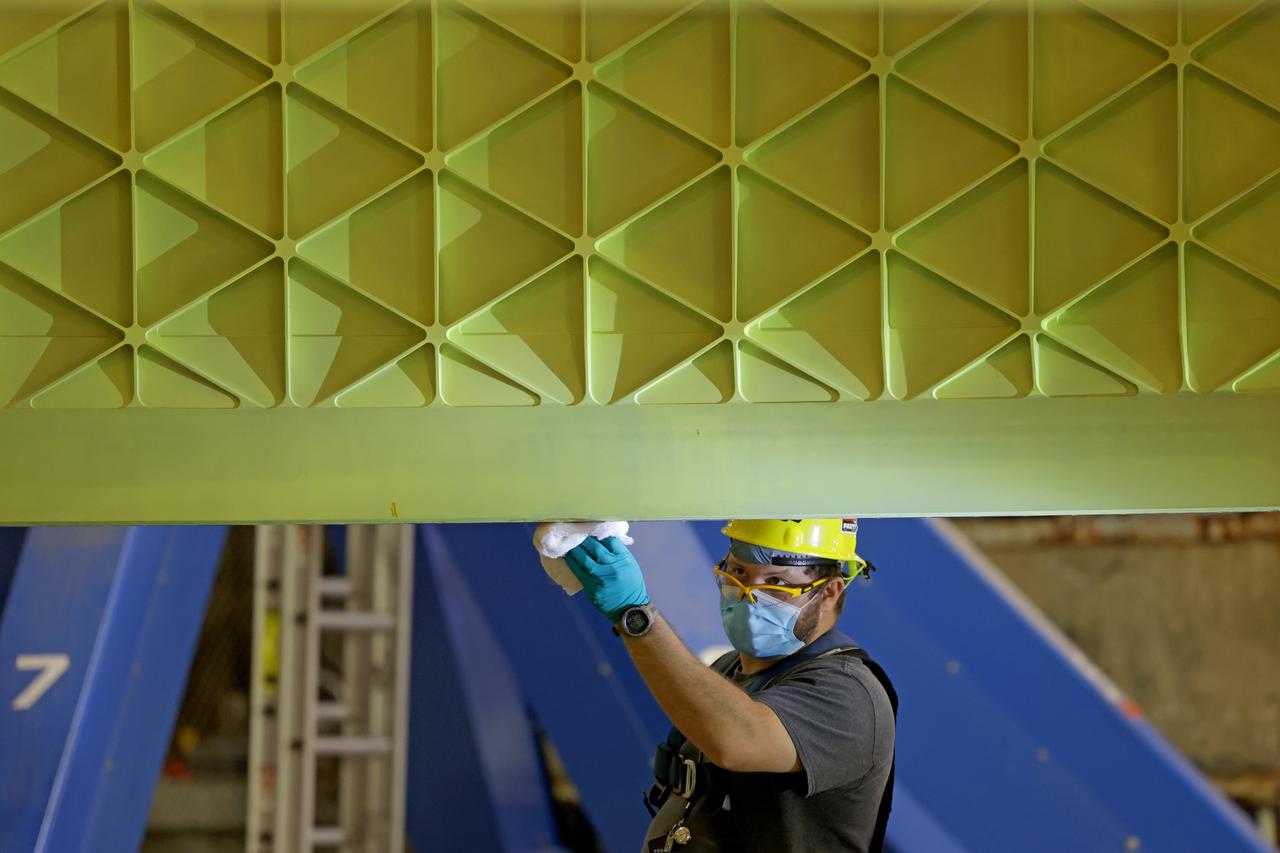
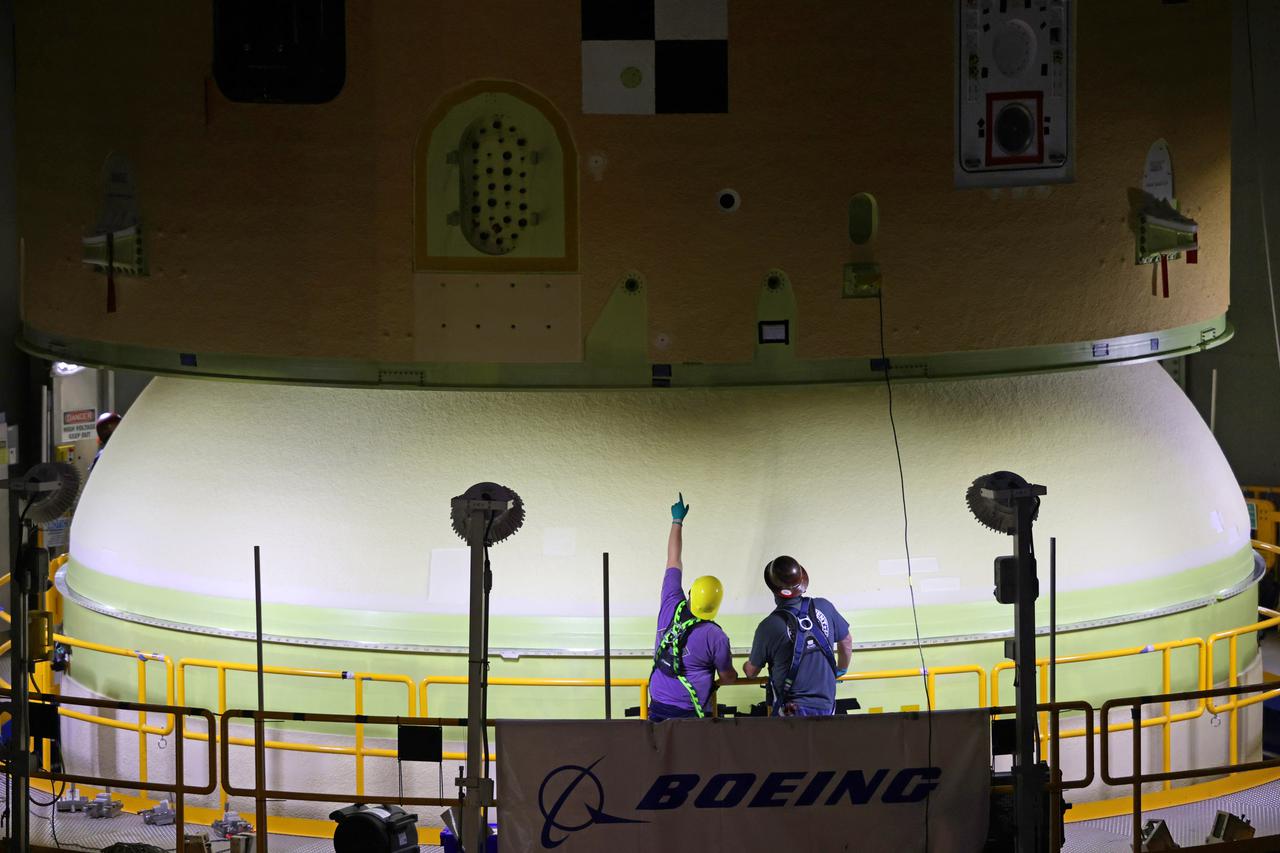
NASA’s Space Launch System (SLS) team fully stacked three hardware elements together May 24 to form the top of the rocket’s core stage for the Artemis II mission. NASA and core stage prime contractor Boeing connected the forward skirt with the liquid oxygen tank and intertank flight hardware inside an assembly area at NASA’s Michoud Assembly Facility in New Orleans. Teams had previously stacked the liquid oxygen tank and intertank on April 28. The joining of the three structures together is the first major assembly of core stage hardware for Artemis II, the first crewed Artemis mission and second flight of the SLS rocket. Next, technicians will work to complete outfitting and integrating the systems within the upper structure. At 66 feet tall, the upper part of the stage is just a fraction of the entire core stage. The fully-assembled, 212-foot-tall rocket stage consists of five hardware elements, including two liquid propellant tanks and four RS-25 engines. The liquid oxygen tank in the upper portion of the stage will hold 196,000 gallons of liquid oxygen cooled to minus 297 degrees Fahrenheit. Meanwhile, the forward skirt and intertank house avionics, flight computer, and electronic systems for the rocket stage. Together, the core stage and its four RS-25 engines will provide more than 2 million pounds of thrust to help send Artemis II astronauts beyond Earth’s orbit to lunar orbit. With Artemis, NASA will land the first woman and the first person of color on the Moon and establish sustainable exploration in preparation for missions to Mars. SLS and NASA’s Orion spacecraft, along with the commercial human landing system and the Gateway in orbit around the Moon, are NASA’s backbone for deep space exploration. SLS is the only rocket that can send Orion, astronauts, and supplies to the Moon in a single mission. Image credit: NASA/Michael DeMocker

NASA’s Space Launch System (SLS) team fully stacked three hardware elements together May 24 to form the top of the rocket’s core stage for the Artemis II mission. NASA and core stage prime contractor Boeing connected the forward skirt with the liquid oxygen tank and intertank flight hardware inside an assembly area at NASA’s Michoud Assembly Facility in New Orleans. Teams had previously stacked the liquid oxygen tank and intertank on April 28. The joining of the three structures together is the first major assembly of core stage hardware for Artemis II, the first crewed Artemis mission and second flight of the SLS rocket. Next, technicians will work to complete outfitting and integrating the systems within the upper structure. At 66 feet tall, the upper part of the stage is just a fraction of the entire core stage. The fully-assembled, 212-foot-tall rocket stage consists of five hardware elements, including two liquid propellant tanks and four RS-25 engines. The liquid oxygen tank in the upper portion of the stage will hold 196,000 gallons of liquid oxygen cooled to minus 297 degrees Fahrenheit. Meanwhile, the forward skirt and intertank house avionics, flight computer, and electronic systems for the rocket stage. Together, the core stage and its four RS-25 engines will provide more than 2 million pounds of thrust to help send Artemis II astronauts beyond Earth’s orbit to lunar orbit. With Artemis, NASA will land the first woman and the first person of color on the Moon and establish sustainable exploration in preparation for missions to Mars. SLS and NASA’s Orion spacecraft, along with the commercial human landing system and the Gateway in orbit around the Moon, are NASA’s backbone for deep space exploration. SLS is the only rocket that can send Orion, astronauts, and supplies to the Moon in a single mission. Image credit: NASA/Eric Bordelon
NASA’s Space Launch System (SLS) team fully stacked three hardware elements together May 24 to form the top of the rocket’s core stage for the Artemis II mission. NASA and core stage prime contractor Boeing connected the forward skirt with the liquid oxygen tank and intertank flight hardware inside an assembly area at NASA’s Michoud Assembly Facility in New Orleans. Teams had previously stacked the liquid oxygen tank and intertank on April 28. The joining of the three structures together is the first major assembly of core stage hardware for Artemis II, the first crewed Artemis mission and second flight of the SLS rocket. Next, technicians will work to complete outfitting and integrating the systems within the upper structure. At 66 feet tall, the upper part of the stage is just a fraction of the entire core stage. The fully-assembled, 212-foot-tall rocket stage consists of five hardware elements, including two liquid propellant tanks and four RS-25 engines. The liquid oxygen tank in the upper portion of the stage will hold 196,000 gallons of liquid oxygen cooled to minus 297 degrees Fahrenheit. Meanwhile, the forward skirt and intertank house avionics, flight computer, and electronic systems for the rocket stage. Together, the core stage and its four RS-25 engines will provide more than 2 million pounds of thrust to help send Artemis II astronauts beyond Earth’s orbit to lunar orbit. With Artemis, NASA will land the first woman and the first person of color on the Moon and establish sustainable exploration in preparation for missions to Mars. SLS and NASA’s Orion spacecraft, along with the commercial human landing system and the Gateway in orbit around the Moon, are NASA’s backbone for deep space exploration. SLS is the only rocket that can send Orion, astronauts, and supplies to the Moon in a single mission. Image credit: NASA/Michael DeMocker
NASA’s Space Launch System (SLS) team fully stacked three hardware elements together May 24 to form the top of the rocket’s core stage for the Artemis II mission. NASA and core stage prime contractor Boeing connected the forward skirt with the liquid oxygen tank and intertank flight hardware inside an assembly area at NASA’s Michoud Assembly Facility in New Orleans. Teams had previously stacked the liquid oxygen tank and intertank on April 28. The joining of the three structures together is the first major assembly of core stage hardware for Artemis II, the first crewed Artemis mission and second flight of the SLS rocket. Next, technicians will work to complete outfitting and integrating the systems within the upper structure. At 66 feet tall, the upper part of the stage is just a fraction of the entire core stage. The fully-assembled, 212-foot-tall rocket stage consists of five hardware elements, including two liquid propellant tanks and four RS-25 engines. The liquid oxygen tank in the upper portion of the stage will hold 196,000 gallons of liquid oxygen cooled to minus 297 degrees Fahrenheit. Meanwhile, the forward skirt and intertank house avionics, flight computer, and electronic systems for the rocket stage. Together, the core stage and its four RS-25 engines will provide more than 2 million pounds of thrust to help send Artemis II astronauts beyond Earth’s orbit to lunar orbit. With Artemis, NASA will land the first woman and the first person of color on the Moon and establish sustainable exploration in preparation for missions to Mars. SLS and NASA’s Orion spacecraft, along with the commercial human landing system and the Gateway in orbit around the Moon, are NASA’s backbone for deep space exploration. SLS is the only rocket that can send Orion, astronauts, and supplies to the Moon in a single mission. Image credit: NASA/Michael DeMocker

NASA’s Space Launch System (SLS) team fully stacked three hardware elements together May 24 to form the top of the rocket’s core stage for the Artemis II mission. NASA and core stage prime contractor Boeing connected the forward skirt with the liquid oxygen tank and intertank flight hardware inside an assembly area at NASA’s Michoud Assembly Facility in New Orleans. Teams had previously stacked the liquid oxygen tank and intertank on April 28. The joining of the three structures together is the first major assembly of core stage hardware for Artemis II, the first crewed Artemis mission and second flight of the SLS rocket. Next, technicians will work to complete outfitting and integrating the systems within the upper structure. At 66 feet tall, the upper part of the stage is just a fraction of the entire core stage. The fully-assembled, 212-foot-tall rocket stage consists of five hardware elements, including two liquid propellant tanks and four RS-25 engines. The liquid oxygen tank in the upper portion of the stage will hold 196,000 gallons of liquid oxygen cooled to minus 297 degrees Fahrenheit. Meanwhile, the forward skirt and intertank house avionics, flight computer, and electronic systems for the rocket stage. Together, the core stage and its four RS-25 engines will provide more than 2 million pounds of thrust to help send Artemis II astronauts beyond Earth’s orbit to lunar orbit. With Artemis, NASA will land the first woman and the first person of color on the Moon and establish sustainable exploration in preparation for missions to Mars. SLS and NASA’s Orion spacecraft, along with the commercial human landing system and the Gateway in orbit around the Moon, are NASA’s backbone for deep space exploration. SLS is the only rocket that can send Orion, astronauts, and supplies to the Moon in a single mission. Image credit: NASA/Eric Bordelon
NASA’s Space Launch System (SLS) team fully stacked three hardware elements together May 24 to form the top of the rocket’s core stage for the Artemis II mission. NASA and core stage prime contractor Boeing connected the forward skirt with the liquid oxygen tank and intertank flight hardware inside an assembly area at NASA’s Michoud Assembly Facility in New Orleans. Teams had previously stacked the liquid oxygen tank and intertank on April 28. The joining of the three structures together is the first major assembly of core stage hardware for Artemis II, the first crewed Artemis mission and second flight of the SLS rocket. Next, technicians will work to complete outfitting and integrating the systems within the upper structure. At 66 feet tall, the upper part of the stage is just a fraction of the entire core stage. The fully-assembled, 212-foot-tall rocket stage consists of five hardware elements, including two liquid propellant tanks and four RS-25 engines. The liquid oxygen tank in the upper portion of the stage will hold 196,000 gallons of liquid oxygen cooled to minus 297 degrees Fahrenheit. Meanwhile, the forward skirt and intertank house avionics, flight computer, and electronic systems for the rocket stage. Together, the core stage and its four RS-25 engines will provide more than 2 million pounds of thrust to help send Artemis II astronauts beyond Earth’s orbit to lunar orbit. With Artemis, NASA will land the first woman and the first person of color on the Moon and establish sustainable exploration in preparation for missions to Mars. SLS and NASA’s Orion spacecraft, along with the commercial human landing system and the Gateway in orbit around the Moon, are NASA’s backbone for deep space exploration. SLS is the only rocket that can send Orion, astronauts, and supplies to the Moon in a single mission. Image credit: NASA/Michael DeMocker
NASA’s Space Launch System (SLS) team fully stacked three hardware elements together May 24 to form the top of the rocket’s core stage for the Artemis II mission. NASA and core stage prime contractor Boeing connected the forward skirt with the liquid oxygen tank and intertank flight hardware inside an assembly area at NASA’s Michoud Assembly Facility in New Orleans. Teams had previously stacked the liquid oxygen tank and intertank on April 28. The joining of the three structures together is the first major assembly of core stage hardware for Artemis II, the first crewed Artemis mission and second flight of the SLS rocket. Next, technicians will work to complete outfitting and integrating the systems within the upper structure. At 66 feet tall, the upper part of the stage is just a fraction of the entire core stage. The fully-assembled, 212-foot-tall rocket stage consists of five hardware elements, including two liquid propellant tanks and four RS-25 engines. The liquid oxygen tank in the upper portion of the stage will hold 196,000 gallons of liquid oxygen cooled to minus 297 degrees Fahrenheit. Meanwhile, the forward skirt and intertank house avionics, flight computer, and electronic systems for the rocket stage. Together, the core stage and its four RS-25 engines will provide more than 2 million pounds of thrust to help send Artemis II astronauts beyond Earth’s orbit to lunar orbit. With Artemis, NASA will land the first woman and the first person of color on the Moon and establish sustainable exploration in preparation for missions to Mars. SLS and NASA’s Orion spacecraft, along with the commercial human landing system and the Gateway in orbit around the Moon, are NASA’s backbone for deep space exploration. SLS is the only rocket that can send Orion, astronauts, and supplies to the Moon in a single mission. Image credit: NASA/Michael DeMocker
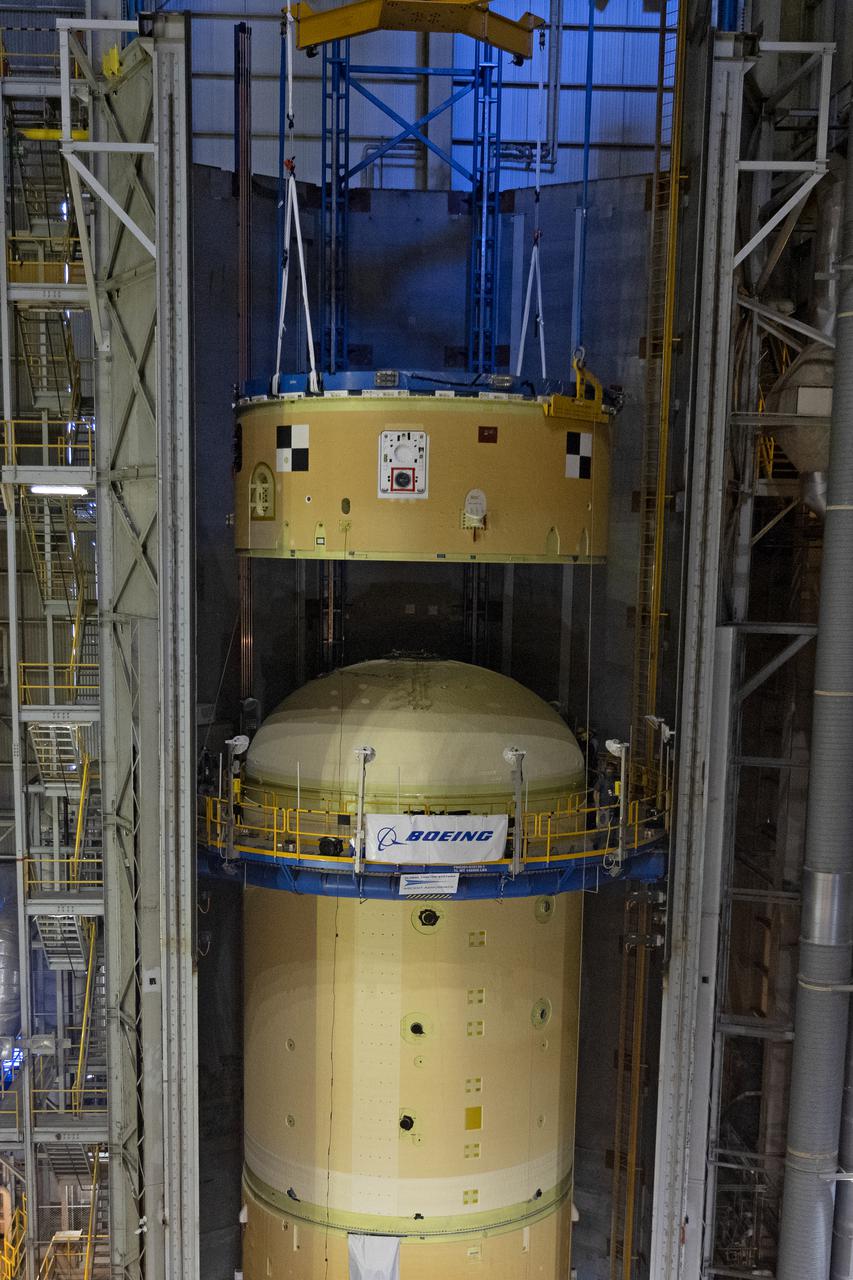
NASA’s Space Launch System (SLS) team fully stacked three hardware elements together May 24 to form the top of the rocket’s core stage for the Artemis II mission. NASA and core stage prime contractor Boeing connected the forward skirt with the liquid oxygen tank and intertank flight hardware inside an assembly area at NASA’s Michoud Assembly Facility in New Orleans. Teams had previously stacked the liquid oxygen tank and intertank on April 28. The joining of the three structures together is the first major assembly of core stage hardware for Artemis II, the first crewed Artemis mission and second flight of the SLS rocket. Next, technicians will work to complete outfitting and integrating the systems within the upper structure. At 66 feet tall, the upper part of the stage is just a fraction of the entire core stage. The fully-assembled, 212-foot-tall rocket stage consists of five hardware elements, including two liquid propellant tanks and four RS-25 engines. The liquid oxygen tank in the upper portion of the stage will hold 196,000 gallons of liquid oxygen cooled to minus 297 degrees Fahrenheit. Meanwhile, the forward skirt and intertank house avionics, flight computer, and electronic systems for the rocket stage. Together, the core stage and its four RS-25 engines will provide more than 2 million pounds of thrust to help send Artemis II astronauts beyond Earth’s orbit to lunar orbit. With Artemis, NASA will land the first woman and the first person of color on the Moon and establish sustainable exploration in preparation for missions to Mars. SLS and NASA’s Orion spacecraft, along with the commercial human landing system and the Gateway in orbit around the Moon, are NASA’s backbone for deep space exploration. SLS is the only rocket that can send Orion, astronauts, and supplies to the Moon in a single mission. Image credit: NASA/Michael DeMocker

NASA’s Space Launch System (SLS) team fully stacked three hardware elements together May 24 to form the top of the rocket’s core stage for the Artemis II mission. NASA and core stage prime contractor Boeing connected the forward skirt with the liquid oxygen tank and intertank flight hardware inside an assembly area at NASA’s Michoud Assembly Facility in New Orleans. Teams had previously stacked the liquid oxygen tank and intertank on April 28. The joining of the three structures together is the first major assembly of core stage hardware for Artemis II, the first crewed Artemis mission and second flight of the SLS rocket. Next, technicians will work to complete outfitting and integrating the systems within the upper structure. At 66 feet tall, the upper part of the stage is just a fraction of the entire core stage. The fully-assembled, 212-foot-tall rocket stage consists of five hardware elements, including two liquid propellant tanks and four RS-25 engines. The liquid oxygen tank in the upper portion of the stage will hold 196,000 gallons of liquid oxygen cooled to minus 297 degrees Fahrenheit. Meanwhile, the forward skirt and intertank house avionics, flight computer, and electronic systems for the rocket stage. Together, the core stage and its four RS-25 engines will provide more than 2 million pounds of thrust to help send Artemis II astronauts beyond Earth’s orbit to lunar orbit. With Artemis, NASA will land the first woman and the first person of color on the Moon and establish sustainable exploration in preparation for missions to Mars. SLS and NASA’s Orion spacecraft, along with the commercial human landing system and the Gateway in orbit around the Moon, are NASA’s backbone for deep space exploration. SLS is the only rocket that can send Orion, astronauts, and supplies to the Moon in a single mission. Image credit: NASA/Michael DeMocker
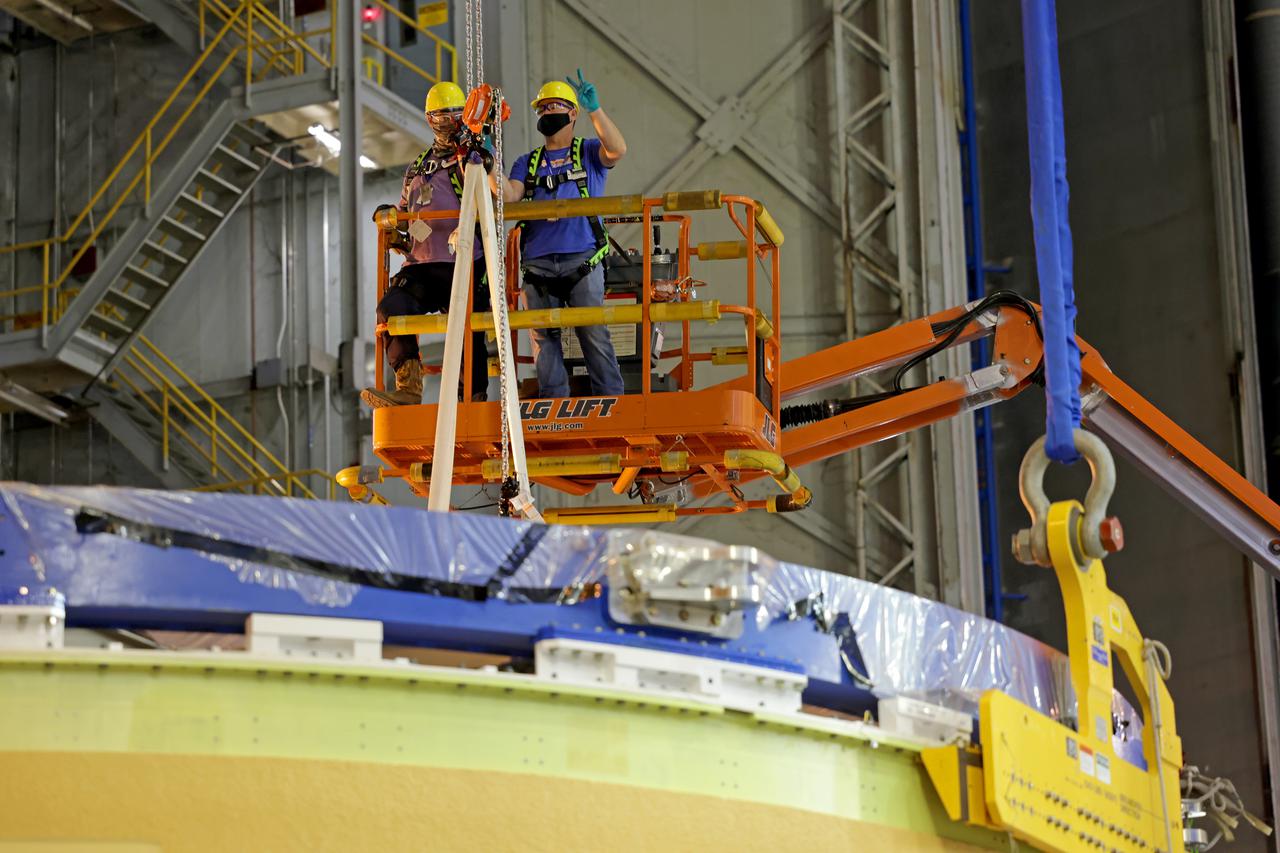
NASA’s Space Launch System (SLS) team fully stacked three hardware elements together May 24 to form the top of the rocket’s core stage for the Artemis II mission. NASA and core stage prime contractor Boeing connected the forward skirt with the liquid oxygen tank and intertank flight hardware inside an assembly area at NASA’s Michoud Assembly Facility in New Orleans. Teams had previously stacked the liquid oxygen tank and intertank on April 28. The joining of the three structures together is the first major assembly of core stage hardware for Artemis II, the first crewed Artemis mission and second flight of the SLS rocket. Next, technicians will work to complete outfitting and integrating the systems within the upper structure. At 66 feet tall, the upper part of the stage is just a fraction of the entire core stage. The fully-assembled, 212-foot-tall rocket stage consists of five hardware elements, including two liquid propellant tanks and four RS-25 engines. The liquid oxygen tank in the upper portion of the stage will hold 196,000 gallons of liquid oxygen cooled to minus 297 degrees Fahrenheit. Meanwhile, the forward skirt and intertank house avionics, flight computer, and electronic systems for the rocket stage. Together, the core stage and its four RS-25 engines will provide more than 2 million pounds of thrust to help send Artemis II astronauts beyond Earth’s orbit to lunar orbit. With Artemis, NASA will land the first woman and the first person of color on the Moon and establish sustainable exploration in preparation for missions to Mars. SLS and NASA’s Orion spacecraft, along with the commercial human landing system and the Gateway in orbit around the Moon, are NASA’s backbone for deep space exploration. SLS is the only rocket that can send Orion, astronauts, and supplies to the Moon in a single mission. Image credit: NASA/Michael DeMocker

NASA’s Space Launch System (SLS) team fully stacked three hardware elements together May 24 to form the top of the rocket’s core stage for the Artemis II mission. NASA and core stage prime contractor Boeing connected the forward skirt with the liquid oxygen tank and intertank flight hardware inside an assembly area at NASA’s Michoud Assembly Facility in New Orleans. Teams had previously stacked the liquid oxygen tank and intertank on April 28. The joining of the three structures together is the first major assembly of core stage hardware for Artemis II, the first crewed Artemis mission and second flight of the SLS rocket. Next, technicians will work to complete outfitting and integrating the systems within the upper structure. At 66 feet tall, the upper part of the stage is just a fraction of the entire core stage. The fully-assembled, 212-foot-tall rocket stage consists of five hardware elements, including two liquid propellant tanks and four RS-25 engines. The liquid oxygen tank in the upper portion of the stage will hold 196,000 gallons of liquid oxygen cooled to minus 297 degrees Fahrenheit. Meanwhile, the forward skirt and intertank house avionics, flight computer, and electronic systems for the rocket stage. Together, the core stage and its four RS-25 engines will provide more than 2 million pounds of thrust to help send Artemis II astronauts beyond Earth’s orbit to lunar orbit. With Artemis, NASA will land the first woman and the first person of color on the Moon and establish sustainable exploration in preparation for missions to Mars. SLS and NASA’s Orion spacecraft, along with the commercial human landing system and the Gateway in orbit around the Moon, are NASA’s backbone for deep space exploration. SLS is the only rocket that can send Orion, astronauts, and supplies to the Moon in a single mission. Image credit: NASA/Eric Bordelon
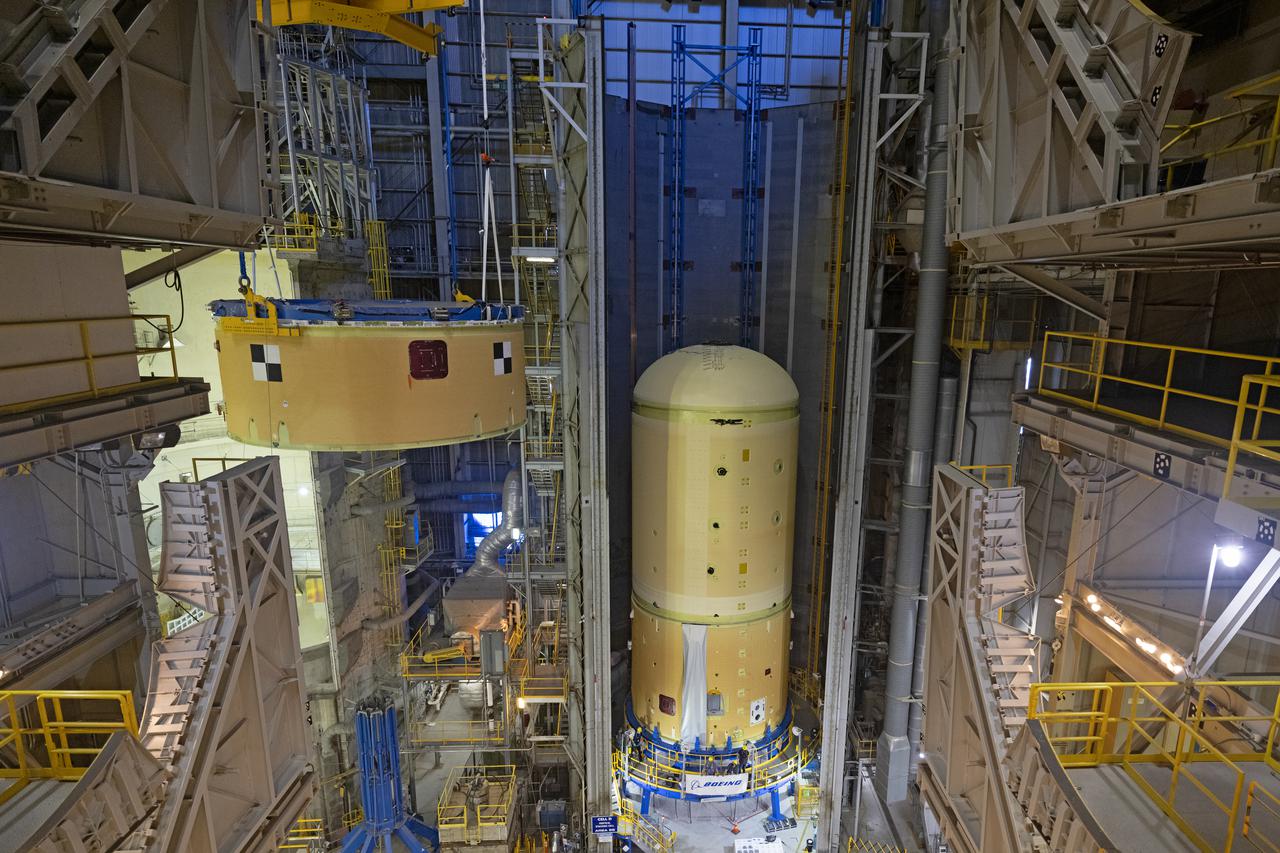
NASA’s Space Launch System (SLS) team fully stacked three hardware elements together May 24 to form the top of the rocket’s core stage for the Artemis II mission. NASA and core stage prime contractor Boeing connected the forward skirt with the liquid oxygen tank and intertank flight hardware inside an assembly area at NASA’s Michoud Assembly Facility in New Orleans. Teams had previously stacked the liquid oxygen tank and intertank on April 28. The joining of the three structures together is the first major assembly of core stage hardware for Artemis II, the first crewed Artemis mission and second flight of the SLS rocket. Next, technicians will work to complete outfitting and integrating the systems within the upper structure. At 66 feet tall, the upper part of the stage is just a fraction of the entire core stage. The fully-assembled, 212-foot-tall rocket stage consists of five hardware elements, including two liquid propellant tanks and four RS-25 engines. The liquid oxygen tank in the upper portion of the stage will hold 196,000 gallons of liquid oxygen cooled to minus 297 degrees Fahrenheit. Meanwhile, the forward skirt and intertank house avionics, flight computer, and electronic systems for the rocket stage. Together, the core stage and its four RS-25 engines will provide more than 2 million pounds of thrust to help send Artemis II astronauts beyond Earth’s orbit to lunar orbit. With Artemis, NASA will land the first woman and the first person of color on the Moon and establish sustainable exploration in preparation for missions to Mars. SLS and NASA’s Orion spacecraft, along with the commercial human landing system and the Gateway in orbit around the Moon, are NASA’s backbone for deep space exploration. SLS is the only rocket that can send Orion, astronauts, and supplies to the Moon in a single mission. Image credit: NASA/Michael DeMocker
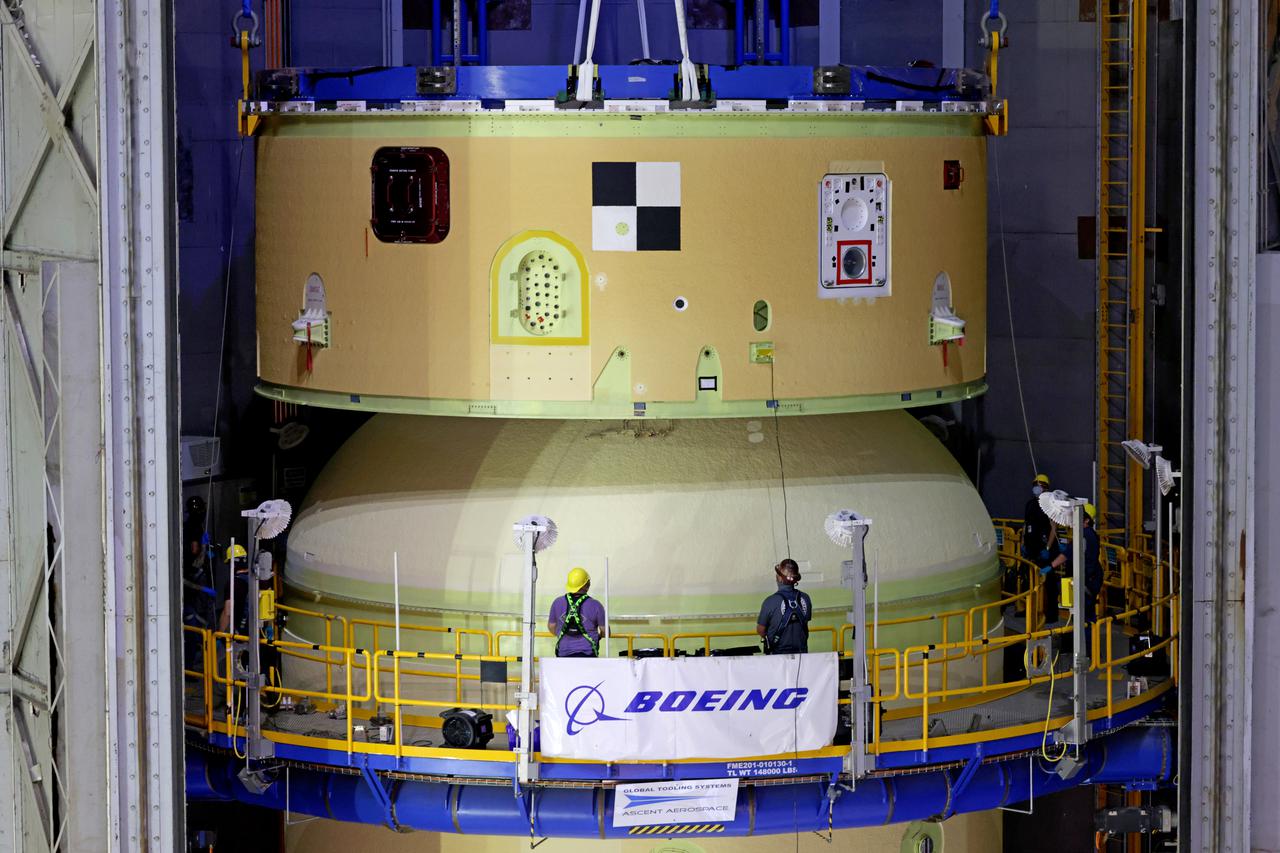
NASA’s Space Launch System (SLS) team fully stacked three hardware elements together May 24 to form the top of the rocket’s core stage for the Artemis II mission. NASA and core stage prime contractor Boeing connected the forward skirt with the liquid oxygen tank and intertank flight hardware inside an assembly area at NASA’s Michoud Assembly Facility in New Orleans. Teams had previously stacked the liquid oxygen tank and intertank on April 28. The joining of the three structures together is the first major assembly of core stage hardware for Artemis II, the first crewed Artemis mission and second flight of the SLS rocket. Next, technicians will work to complete outfitting and integrating the systems within the upper structure. At 66 feet tall, the upper part of the stage is just a fraction of the entire core stage. The fully-assembled, 212-foot-tall rocket stage consists of five hardware elements, including two liquid propellant tanks and four RS-25 engines. The liquid oxygen tank in the upper portion of the stage will hold 196,000 gallons of liquid oxygen cooled to minus 297 degrees Fahrenheit. Meanwhile, the forward skirt and intertank house avionics, flight computer, and electronic systems for the rocket stage. Together, the core stage and its four RS-25 engines will provide more than 2 million pounds of thrust to help send Artemis II astronauts beyond Earth’s orbit to lunar orbit. With Artemis, NASA will land the first woman and the first person of color on the Moon and establish sustainable exploration in preparation for missions to Mars. SLS and NASA’s Orion spacecraft, along with the commercial human landing system and the Gateway in orbit around the Moon, are NASA’s backbone for deep space exploration. SLS is the only rocket that can send Orion, astronauts, and supplies to the Moon in a single mission. Image credit: NASA/Michael DeMocker
NASA’s Space Launch System (SLS) team fully stacked three hardware elements together May 24 to form the top of the rocket’s core stage for the Artemis II mission. NASA and core stage prime contractor Boeing connected the forward skirt with the liquid oxygen tank and intertank flight hardware inside an assembly area at NASA’s Michoud Assembly Facility in New Orleans. Teams had previously stacked the liquid oxygen tank and intertank on April 28. The joining of the three structures together is the first major assembly of core stage hardware for Artemis II, the first crewed Artemis mission and second flight of the SLS rocket. Next, technicians will work to complete outfitting and integrating the systems within the upper structure. At 66 feet tall, the upper part of the stage is just a fraction of the entire core stage. The fully-assembled, 212-foot-tall rocket stage consists of five hardware elements, including two liquid propellant tanks and four RS-25 engines. The liquid oxygen tank in the upper portion of the stage will hold 196,000 gallons of liquid oxygen cooled to minus 297 degrees Fahrenheit. Meanwhile, the forward skirt and intertank house avionics, flight computer, and electronic systems for the rocket stage. Together, the core stage and its four RS-25 engines will provide more than 2 million pounds of thrust to help send Artemis II astronauts beyond Earth’s orbit to lunar orbit. With Artemis, NASA will land the first woman and the first person of color on the Moon and establish sustainable exploration in preparation for missions to Mars. SLS and NASA’s Orion spacecraft, along with the commercial human landing system and the Gateway in orbit around the Moon, are NASA’s backbone for deep space exploration. SLS is the only rocket that can send Orion, astronauts, and supplies to the Moon in a single mission. Image credit: NASA/Michael DeMocker
NASA’s Space Launch System (SLS) team fully stacked three hardware elements together May 24 to form the top of the rocket’s core stage for the Artemis II mission. NASA and core stage prime contractor Boeing connected the forward skirt with the liquid oxygen tank and intertank flight hardware inside an assembly area at NASA’s Michoud Assembly Facility in New Orleans. Teams had previously stacked the liquid oxygen tank and intertank on April 28. The joining of the three structures together is the first major assembly of core stage hardware for Artemis II, the first crewed Artemis mission and second flight of the SLS rocket. Next, technicians will work to complete outfitting and integrating the systems within the upper structure. At 66 feet tall, the upper part of the stage is just a fraction of the entire core stage. The fully-assembled, 212-foot-tall rocket stage consists of five hardware elements, including two liquid propellant tanks and four RS-25 engines. The liquid oxygen tank in the upper portion of the stage will hold 196,000 gallons of liquid oxygen cooled to minus 297 degrees Fahrenheit. Meanwhile, the forward skirt and intertank house avionics, flight computer, and electronic systems for the rocket stage. Together, the core stage and its four RS-25 engines will provide more than 2 million pounds of thrust to help send Artemis II astronauts beyond Earth’s orbit to lunar orbit. With Artemis, NASA will land the first woman and the first person of color on the Moon and establish sustainable exploration in preparation for missions to Mars. SLS and NASA’s Orion spacecraft, along with the commercial human landing system and the Gateway in orbit around the Moon, are NASA’s backbone for deep space exploration. SLS is the only rocket that can send Orion, astronauts, and supplies to the Moon in a single mission. Image credit: NASA/Michael DeMocker

NASA’s Space Launch System (SLS) team fully stacked three hardware elements together May 24 to form the top of the rocket’s core stage for the Artemis II mission. NASA and core stage prime contractor Boeing connected the forward skirt with the liquid oxygen tank and intertank flight hardware inside an assembly area at NASA’s Michoud Assembly Facility in New Orleans. Teams had previously stacked the liquid oxygen tank and intertank on April 28. The joining of the three structures together is the first major assembly of core stage hardware for Artemis II, the first crewed Artemis mission and second flight of the SLS rocket. Next, technicians will work to complete outfitting and integrating the systems within the upper structure. At 66 feet tall, the upper part of the stage is just a fraction of the entire core stage. The fully-assembled, 212-foot-tall rocket stage consists of five hardware elements, including two liquid propellant tanks and four RS-25 engines. The liquid oxygen tank in the upper portion of the stage will hold 196,000 gallons of liquid oxygen cooled to minus 297 degrees Fahrenheit. Meanwhile, the forward skirt and intertank house avionics, flight computer, and electronic systems for the rocket stage. Together, the core stage and its four RS-25 engines will provide more than 2 million pounds of thrust to help send Artemis II astronauts beyond Earth’s orbit to lunar orbit. With Artemis, NASA will land the first woman and the first person of color on the Moon and establish sustainable exploration in preparation for missions to Mars. SLS and NASA’s Orion spacecraft, along with the commercial human landing system and the Gateway in orbit around the Moon, are NASA’s backbone for deep space exploration. SLS is the only rocket that can send Orion, astronauts, and supplies to the Moon in a single mission. Image credit: NASA/Eric Bordelon

NASA’s Space Launch System (SLS) team fully stacked three hardware elements together May 24 to form the top of the rocket’s core stage for the Artemis II mission. NASA and core stage prime contractor Boeing connected the forward skirt with the liquid oxygen tank and intertank flight hardware inside an assembly area at NASA’s Michoud Assembly Facility in New Orleans. Teams had previously stacked the liquid oxygen tank and intertank on April 28. The joining of the three structures together is the first major assembly of core stage hardware for Artemis II, the first crewed Artemis mission and second flight of the SLS rocket. Next, technicians will work to complete outfitting and integrating the systems within the upper structure. At 66 feet tall, the upper part of the stage is just a fraction of the entire core stage. The fully-assembled, 212-foot-tall rocket stage consists of five hardware elements, including two liquid propellant tanks and four RS-25 engines. The liquid oxygen tank in the upper portion of the stage will hold 196,000 gallons of liquid oxygen cooled to minus 297 degrees Fahrenheit. Meanwhile, the forward skirt and intertank house avionics, flight computer, and electronic systems for the rocket stage. Together, the core stage and its four RS-25 engines will provide more than 2 million pounds of thrust to help send Artemis II astronauts beyond Earth’s orbit to lunar orbit. With Artemis, NASA will land the first woman and the first person of color on the Moon and establish sustainable exploration in preparation for missions to Mars. SLS and NASA’s Orion spacecraft, along with the commercial human landing system and the Gateway in orbit around the Moon, are NASA’s backbone for deep space exploration. SLS is the only rocket that can send Orion, astronauts, and supplies to the Moon in a single mission. Image credit: NASA/Michael DeMocker
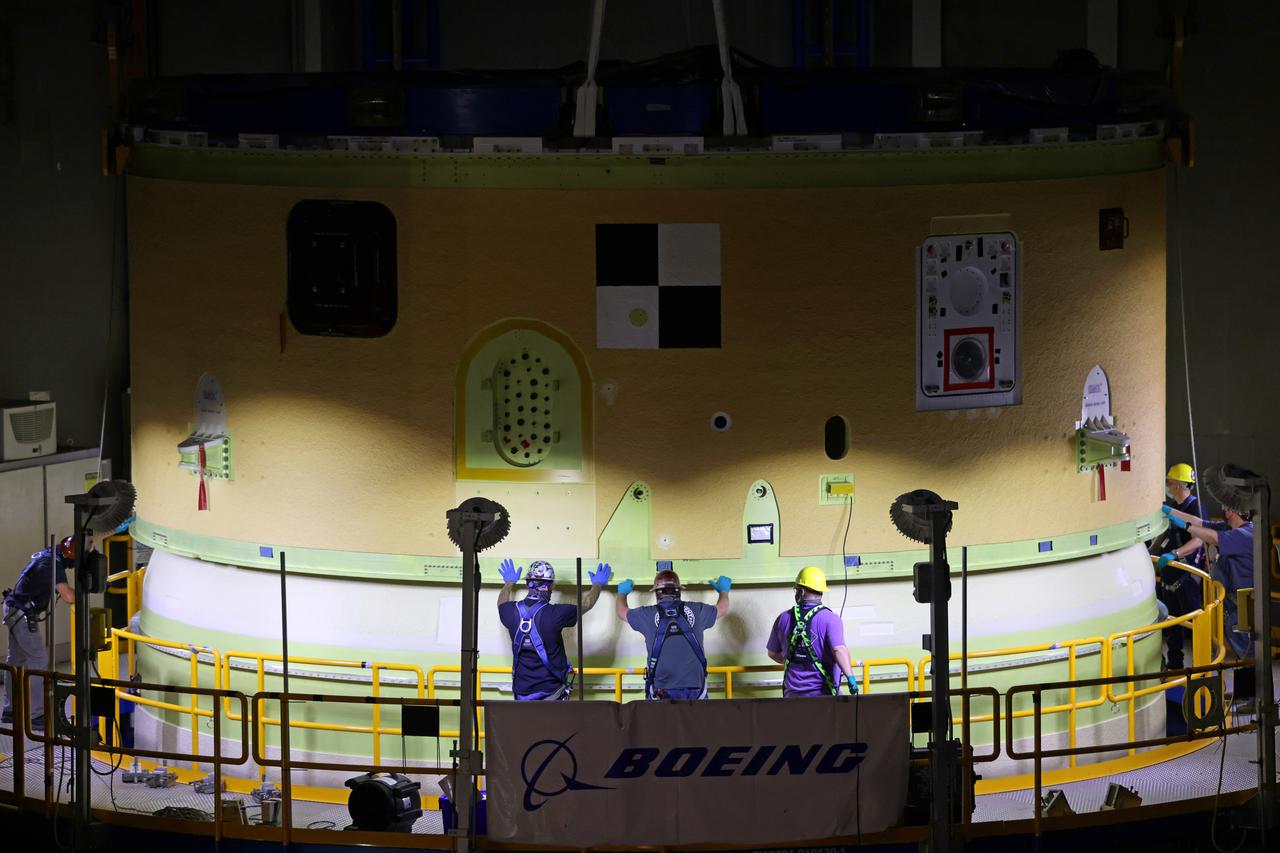
NASA’s Space Launch System (SLS) team fully stacked three hardware elements together May 24 to form the top of the rocket’s core stage for the Artemis II mission. NASA and core stage prime contractor Boeing connected the forward skirt with the liquid oxygen tank and intertank flight hardware inside an assembly area at NASA’s Michoud Assembly Facility in New Orleans. Teams had previously stacked the liquid oxygen tank and intertank on April 28. The joining of the three structures together is the first major assembly of core stage hardware for Artemis II, the first crewed Artemis mission and second flight of the SLS rocket. Next, technicians will work to complete outfitting and integrating the systems within the upper structure. At 66 feet tall, the upper part of the stage is just a fraction of the entire core stage. The fully-assembled, 212-foot-tall rocket stage consists of five hardware elements, including two liquid propellant tanks and four RS-25 engines. The liquid oxygen tank in the upper portion of the stage will hold 196,000 gallons of liquid oxygen cooled to minus 297 degrees Fahrenheit. Meanwhile, the forward skirt and intertank house avionics, flight computer, and electronic systems for the rocket stage. Together, the core stage and its four RS-25 engines will provide more than 2 million pounds of thrust to help send Artemis II astronauts beyond Earth’s orbit to lunar orbit. With Artemis, NASA will land the first woman and the first person of color on the Moon and establish sustainable exploration in preparation for missions to Mars. SLS and NASA’s Orion spacecraft, along with the commercial human landing system and the Gateway in orbit around the Moon, are NASA’s backbone for deep space exploration. SLS is the only rocket that can send Orion, astronauts, and supplies to the Moon in a single mission. Image credit: NASA/Michael DeMocker
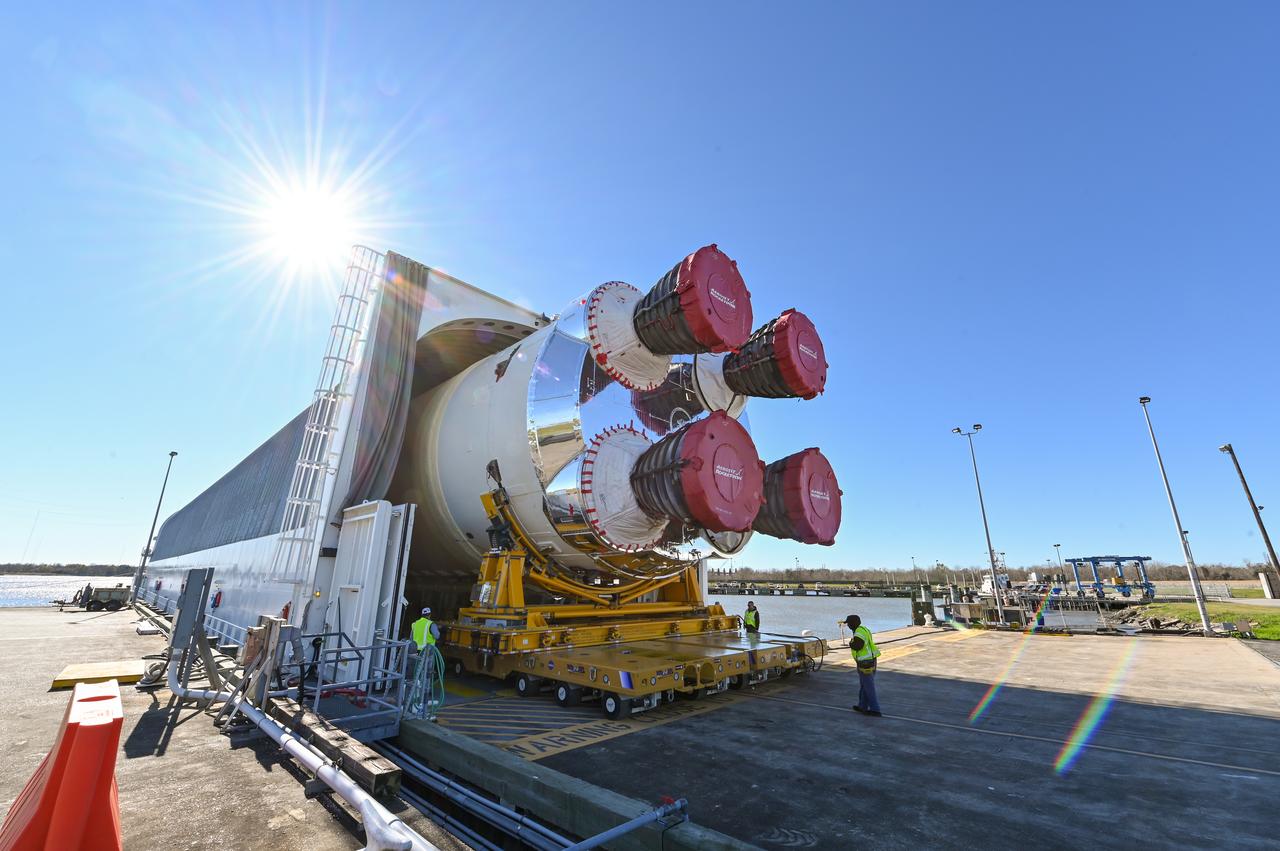
These images show how teams rolled out, or moved, the completed core stage for NASA’s Space Launch System rocket from NASA’s Michoud Assembly Facility in New Orleans. Crews moved the flight hardware for the first Artemis mission to NASA’s Pegasus barge on Jan. 8 in preparation for the core stage Green Run test series at NASA’s Stennis Space Center near Bay St. Louis, Mississippi. Pegasus, which was modified to ferry SLS rocket hardware, will transport the core stage from Michoud to Stennis for the comprehensive core stage Green Run test series. Once at Stennis, the Artemis rocket stage will be loaded into the B-2 Test Stand for the core stage Green Run test series. The comprehensive test campaign will progressively bring the entire core stage, including its avionics and engines, to life for the first time to verify the stage is fit for flight ahead of the launch of Artemis I. Assembly and integration of the core stage and its four RS-25 engines has been a collaborative, multistep process for NASA and its partners Boeing, the core stage lead contractor, and Aerojet Rocketdyne, the RS-25 engines lead contractor. Together with four RS-25 engines, the rocket’s massive 212-foot-tall core stage — the largest stage NASA has ever built — and its twin solid rocket boosters will produce 8.8 million pounds of thrust to send NASA’s Orion spacecraft, astronauts and supplies beyond Earth’s orbit to the Moon and, ultimately, Mars. Offering more payload mass, volume capability and energy to speed missions through space, the SLS rocket, along with NASA’s Gateway in lunar orbit and Orion, is part of NASA’s backbone for deep space exploration and the Artemis lunar program.
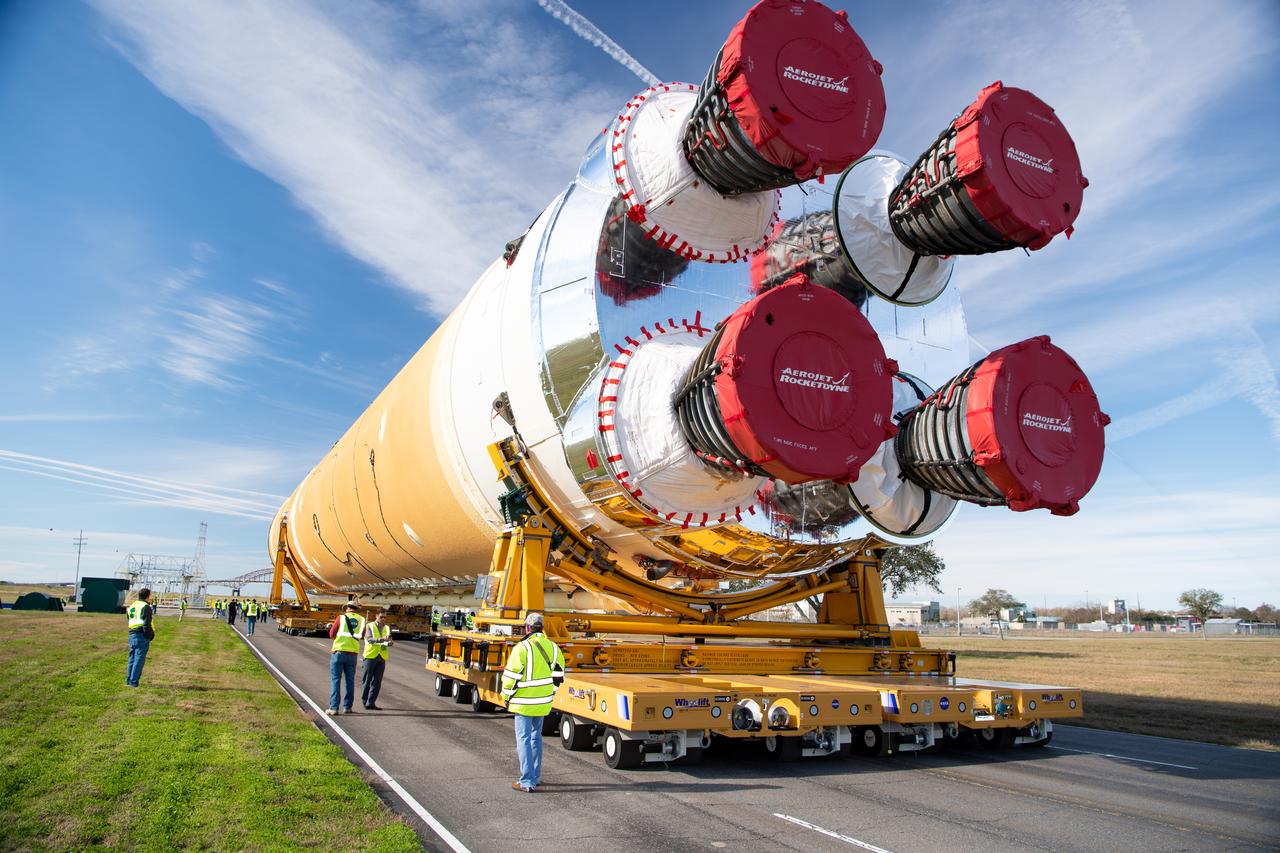
These images show how teams rolled out, or moved, the completed core stage for NASA’s Space Launch System rocket from NASA’s Michoud Assembly Facility in New Orleans. Crews moved the flight hardware for the first Artemis mission to NASA’s Pegasus barge on Jan. 8 in preparation for the core stage Green Run test series at NASA’s Stennis Space Center near Bay St. Louis, Mississippi. Pegasus, which was modified to ferry SLS rocket hardware, will transport the core stage from Michoud to Stennis for the comprehensive core stage Green Run test series. Once at Stennis, the Artemis rocket stage will be loaded into the B-2 Test Stand for the core stage Green Run test series. The comprehensive test campaign will progressively bring the entire core stage, including its avionics and engines, to life for the first time to verify the stage is fit for flight ahead of the launch of Artemis I. Assembly and integration of the core stage and its four RS-25 engines has been a collaborative, multistep process for NASA and its partners Boeing, the core stage lead contractor, and Aerojet Rocketdyne, the RS-25 engines lead contractor. Together with four RS-25 engines, the rocket’s massive 212-foot-tall core stage — the largest stage NASA has ever built — and its twin solid rocket boosters will produce 8.8 million pounds of thrust to send NASA’s Orion spacecraft, astronauts and supplies beyond Earth’s orbit to the Moon and, ultimately, Mars. Offering more payload mass, volume capability and energy to speed missions through space, the SLS rocket, along with NASA’s Gateway in lunar orbit and Orion, is part of NASA’s backbone for deep space exploration and the Artemis lunar program.
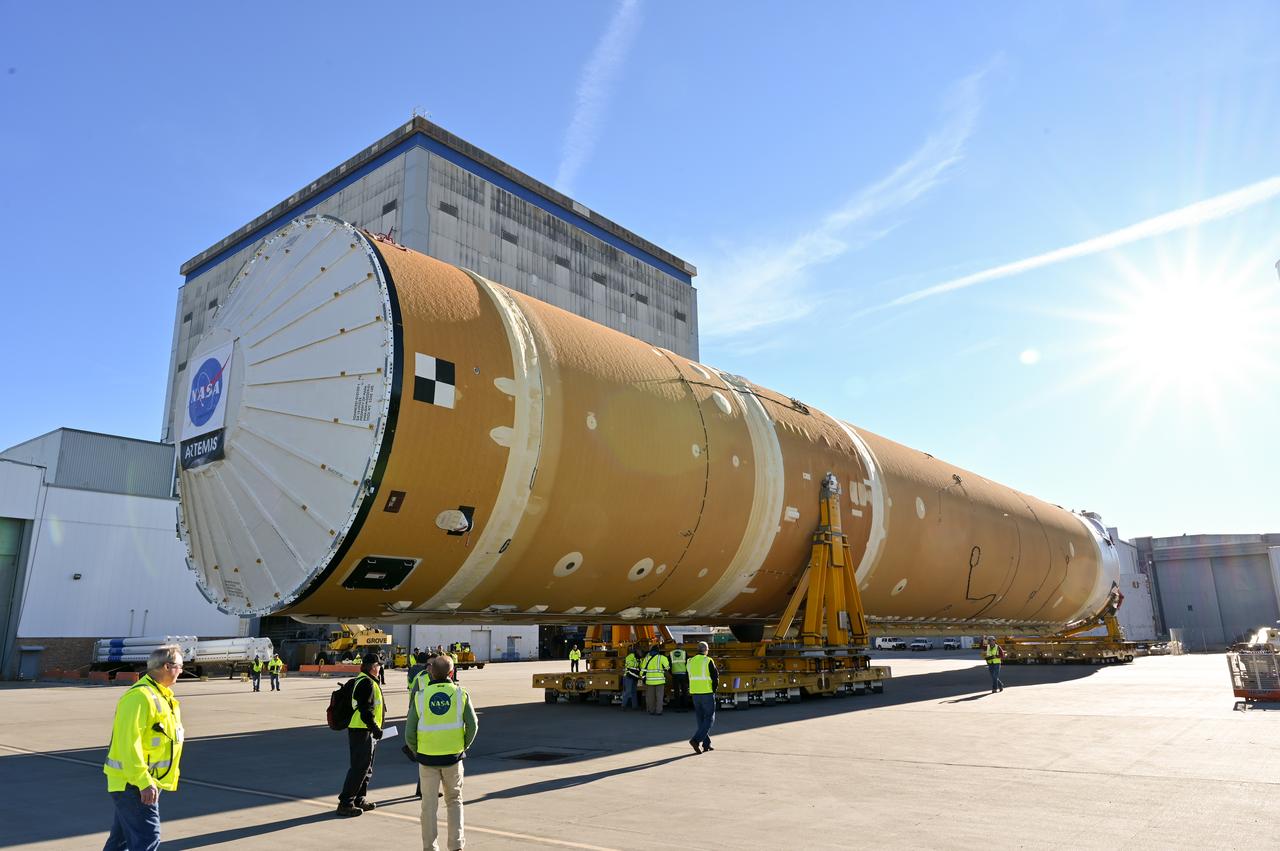
These images/video show how teams rolled out, or moved, the completed core stage for NASA’s Space Launch System rocket from NASA’s Michoud Assembly Facility in New Orleans. Crews moved the flight hardware for the first Artemis mission to NASA’s Pegasus barge on Jan. 8 in preparation for the core stage Green Run test series at NASA’s Stennis Space Center near Bay St. Louis, Mississippi. Pegasus, which was modified to ferry SLS rocket hardware, will transport the core stage from Michoud to Stennis for the comprehensive core stage Green Run test series. Once at Stennis, the Artemis rocket stage will be loaded into the B-2 Test Stand for the core stage Green Run test series. The comprehensive test campaign will progressively bring the entire core stage, including its avionics and engines, to life for the first time to verify the stage is fit for flight ahead of the launch of Artemis I. Assembly and integration of the core stage and its four RS-25 engines has been a collaborative, multistep process for NASA and its partners Boeing, the core stage lead contractor, and Aerojet Rocketdyne, the RS-25 engines lead contractor. Together with four RS-25 engines, the rocket’s massive 212-foot-tall core stage — the largest stage NASA has ever built — and its twin solid rocket boosters will produce 8.8 million pounds of thrust to send NASA’s Orion spacecraft, astronauts and supplies beyond Earth’s orbit to the Moon and, ultimately, Mars. Offering more payload mass, volume capability and energy to speed missions through space, the SLS rocket, along with NASA’s Gateway in lunar orbit and Orion, is part of NASA’s backbone for deep space exploration and the Artemis lunar program.
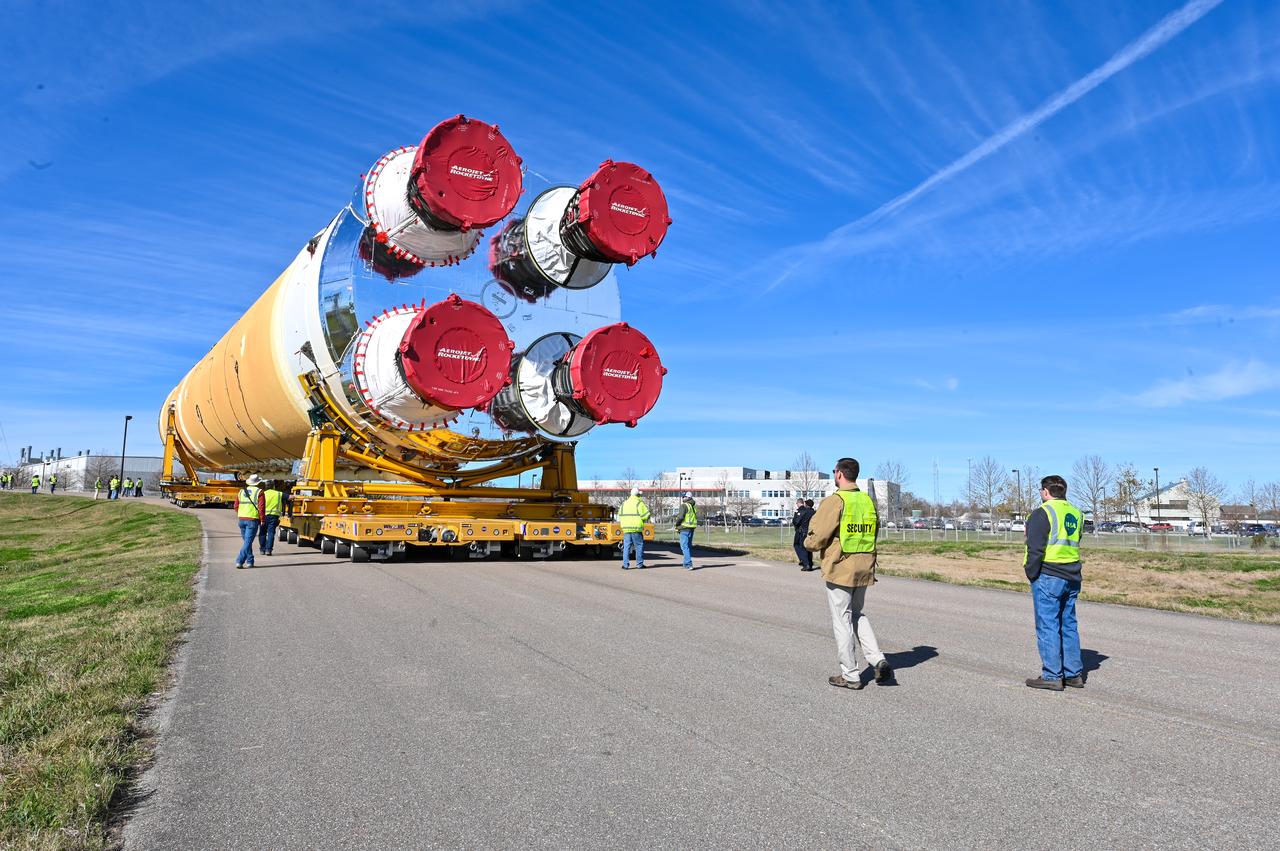
These images/video show how teams rolled out, or moved, the completed core stage for NASA’s Space Launch System rocket from NASA’s Michoud Assembly Facility in New Orleans. Crews moved the flight hardware for the first Artemis mission to NASA’s Pegasus barge on Jan. 8 in preparation for the core stage Green Run test series at NASA’s Stennis Space Center near Bay St. Louis, Mississippi. Pegasus, which was modified to ferry SLS rocket hardware, will transport the core stage from Michoud to Stennis for the comprehensive core stage Green Run test series. Once at Stennis, the Artemis rocket stage will be loaded into the B-2 Test Stand for the core stage Green Run test series. The comprehensive test campaign will progressively bring the entire core stage, including its avionics and engines, to life for the first time to verify the stage is fit for flight ahead of the launch of Artemis I. Assembly and integration of the core stage and its four RS-25 engines has been a collaborative, multistep process for NASA and its partners Boeing, the core stage lead contractor, and Aerojet Rocketdyne, the RS-25 engines lead contractor. Together with four RS-25 engines, the rocket’s massive 212-foot-tall core stage — the largest stage NASA has ever built — and its twin solid rocket boosters will produce 8.8 million pounds of thrust to send NASA’s Orion spacecraft, astronauts and supplies beyond Earth’s orbit to the Moon and, ultimately, Mars. Offering more payload mass, volume capability and energy to speed missions through space, the SLS rocket, along with NASA’s Gateway in lunar orbit and Orion, is part of NASA’s backbone for deep space exploration and the Artemis lunar program.
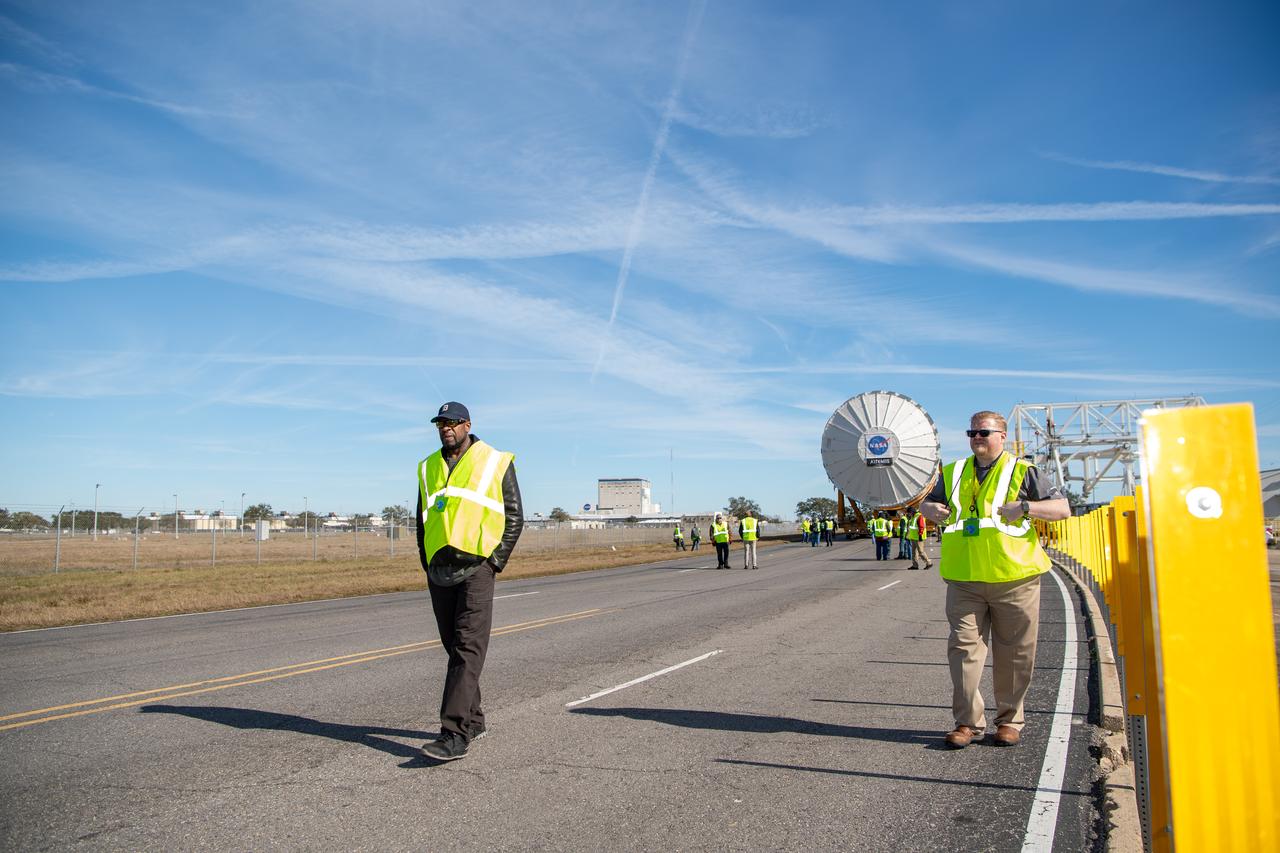
These images show how teams rolled out, or moved, the completed core stage for NASA’s Space Launch System rocket from NASA’s Michoud Assembly Facility in New Orleans. Crews moved the flight hardware for the first Artemis mission to NASA’s Pegasus barge on Jan. 8 in preparation for the core stage Green Run test series at NASA’s Stennis Space Center near Bay St. Louis, Mississippi. Pegasus, which was modified to ferry SLS rocket hardware, will transport the core stage from Michoud to Stennis for the comprehensive core stage Green Run test series. Once at Stennis, the Artemis rocket stage will be loaded into the B-2 Test Stand for the core stage Green Run test series. The comprehensive test campaign will progressively bring the entire core stage, including its avionics and engines, to life for the first time to verify the stage is fit for flight ahead of the launch of Artemis I. Assembly and integration of the core stage and its four RS-25 engines has been a collaborative, multistep process for NASA and its partners Boeing, the core stage lead contractor, and Aerojet Rocketdyne, the RS-25 engines lead contractor. Together with four RS-25 engines, the rocket’s massive 212-foot-tall core stage — the largest stage NASA has ever built — and its twin solid rocket boosters will produce 8.8 million pounds of thrust to send NASA’s Orion spacecraft, astronauts and supplies beyond Earth’s orbit to the Moon and, ultimately, Mars. Offering more payload mass, volume capability and energy to speed missions through space, the SLS rocket, along with NASA’s Gateway in lunar orbit and Orion, is part of NASA’s backbone for deep space exploration and the Artemis lunar program.
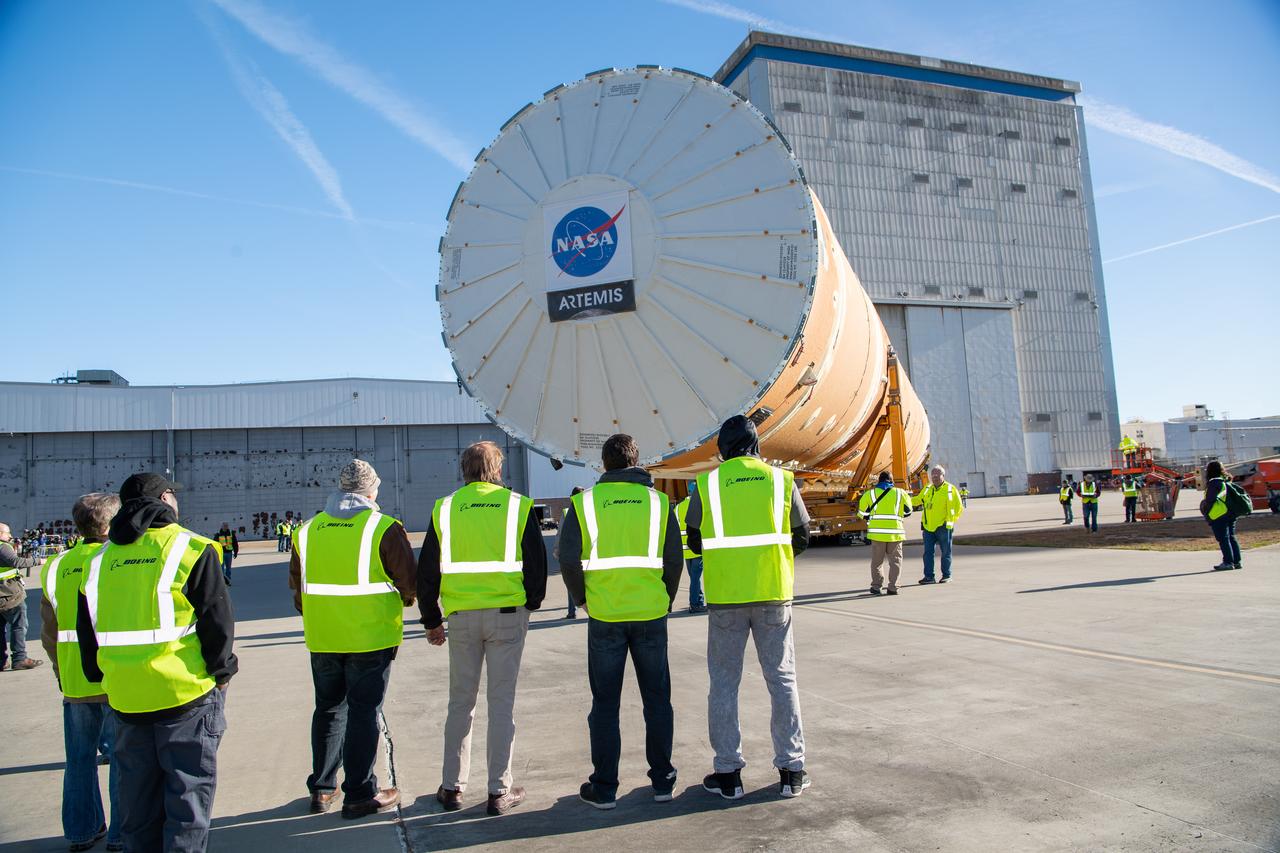
These images/video show how teams rolled out, or moved, the completed core stage for NASA’s Space Launch System rocket from NASA’s Michoud Assembly Facility in New Orleans. Crews moved the flight hardware for the first Artemis mission to NASA’s Pegasus barge on Jan. 8 in preparation for the core stage Green Run test series at NASA’s Stennis Space Center near Bay St. Louis, Mississippi. Pegasus, which was modified to ferry SLS rocket hardware, will transport the core stage from Michoud to Stennis for the comprehensive core stage Green Run test series. Once at Stennis, the Artemis rocket stage will be loaded into the B-2 Test Stand for the core stage Green Run test series. The comprehensive test campaign will progressively bring the entire core stage, including its avionics and engines, to life for the first time to verify the stage is fit for flight ahead of the launch of Artemis I. Assembly and integration of the core stage and its four RS-25 engines has been a collaborative, multistep process for NASA and its partners Boeing, the core stage lead contractor, and Aerojet Rocketdyne, the RS-25 engines lead contractor. Together with four RS-25 engines, the rocket’s massive 212-foot-tall core stage — the largest stage NASA has ever built — and its twin solid rocket boosters will produce 8.8 million pounds of thrust to send NASA’s Orion spacecraft, astronauts and supplies beyond Earth’s orbit to the Moon and, ultimately, Mars. Offering more payload mass, volume capability and energy to speed missions through space, the SLS rocket, along with NASA’s Gateway in lunar orbit and Orion, is part of NASA’s backbone for deep space exploration and the Artemis lunar program.
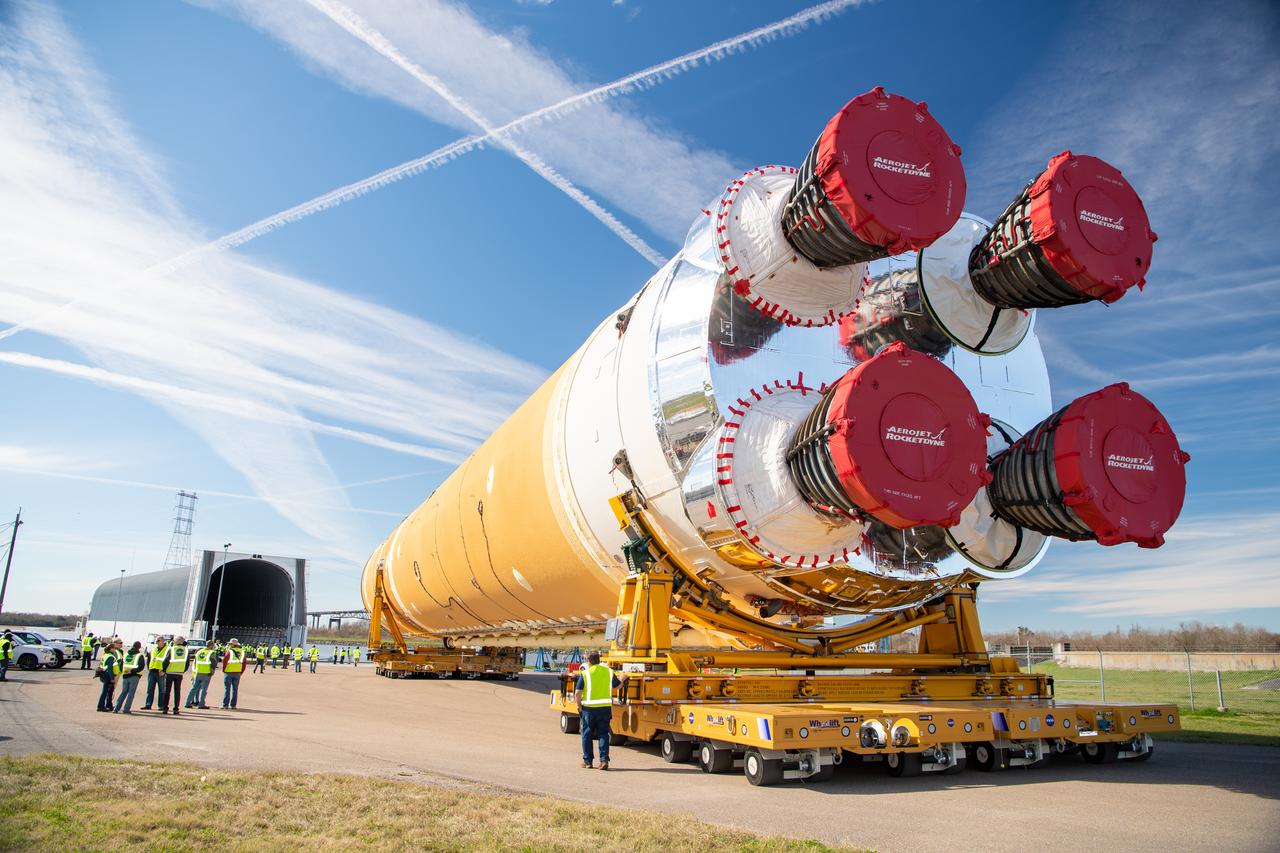
These images show how teams rolled out, or moved, the completed core stage for NASA’s Space Launch System rocket from NASA’s Michoud Assembly Facility in New Orleans. Crews moved the flight hardware for the first Artemis mission to NASA’s Pegasus barge on Jan. 8 in preparation for the core stage Green Run test series at NASA’s Stennis Space Center near Bay St. Louis, Mississippi. Pegasus, which was modified to ferry SLS rocket hardware, will transport the core stage from Michoud to Stennis for the comprehensive core stage Green Run test series. Once at Stennis, the Artemis rocket stage will be loaded into the B-2 Test Stand for the core stage Green Run test series. The comprehensive test campaign will progressively bring the entire core stage, including its avionics and engines, to life for the first time to verify the stage is fit for flight ahead of the launch of Artemis I. Assembly and integration of the core stage and its four RS-25 engines has been a collaborative, multistep process for NASA and its partners Boeing, the core stage lead contractor, and Aerojet Rocketdyne, the RS-25 engines lead contractor. Together with four RS-25 engines, the rocket’s massive 212-foot-tall core stage — the largest stage NASA has ever built — and its twin solid rocket boosters will produce 8.8 million pounds of thrust to send NASA’s Orion spacecraft, astronauts and supplies beyond Earth’s orbit to the Moon and, ultimately, Mars. Offering more payload mass, volume capability and energy to speed missions through space, the SLS rocket, along with NASA’s Gateway in lunar orbit and Orion, is part of NASA’s backbone for deep space exploration and the Artemis lunar program.
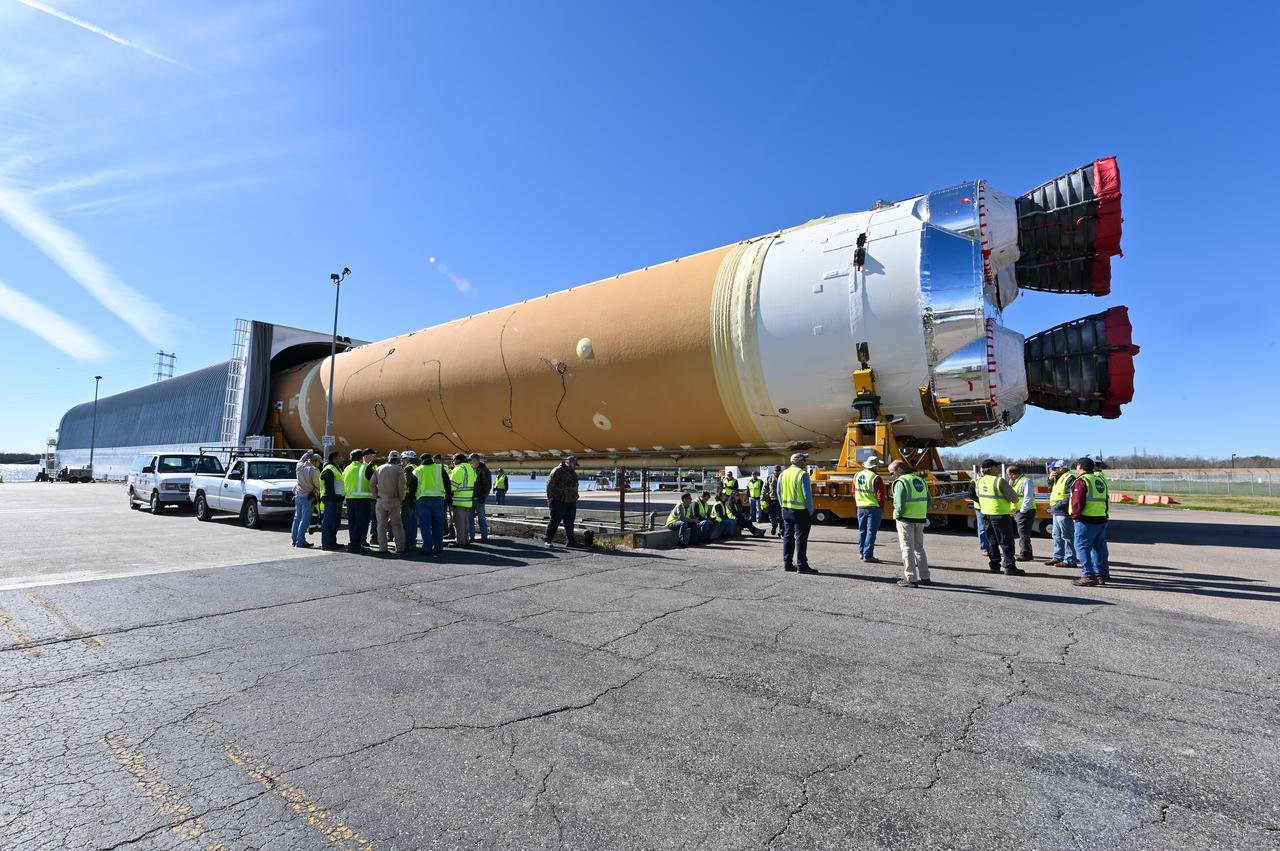
These images show how teams rolled out, or moved, the completed core stage for NASA’s Space Launch System rocket from NASA’s Michoud Assembly Facility in New Orleans. Crews moved the flight hardware for the first Artemis mission to NASA’s Pegasus barge on Jan. 8 in preparation for the core stage Green Run test series at NASA’s Stennis Space Center near Bay St. Louis, Mississippi. Pegasus, which was modified to ferry SLS rocket hardware, will transport the core stage from Michoud to Stennis for the comprehensive core stage Green Run test series. Once at Stennis, the Artemis rocket stage will be loaded into the B-2 Test Stand for the core stage Green Run test series. The comprehensive test campaign will progressively bring the entire core stage, including its avionics and engines, to life for the first time to verify the stage is fit for flight ahead of the launch of Artemis I. Assembly and integration of the core stage and its four RS-25 engines has been a collaborative, multistep process for NASA and its partners Boeing, the core stage lead contractor, and Aerojet Rocketdyne, the RS-25 engines lead contractor. Together with four RS-25 engines, the rocket’s massive 212-foot-tall core stage — the largest stage NASA has ever built — and its twin solid rocket boosters will produce 8.8 million pounds of thrust to send NASA’s Orion spacecraft, astronauts and supplies beyond Earth’s orbit to the Moon and, ultimately, Mars. Offering more payload mass, volume capability and energy to speed missions through space, the SLS rocket, along with NASA’s Gateway in lunar orbit and Orion, is part of NASA’s backbone for deep space exploration and the Artemis lunar program.
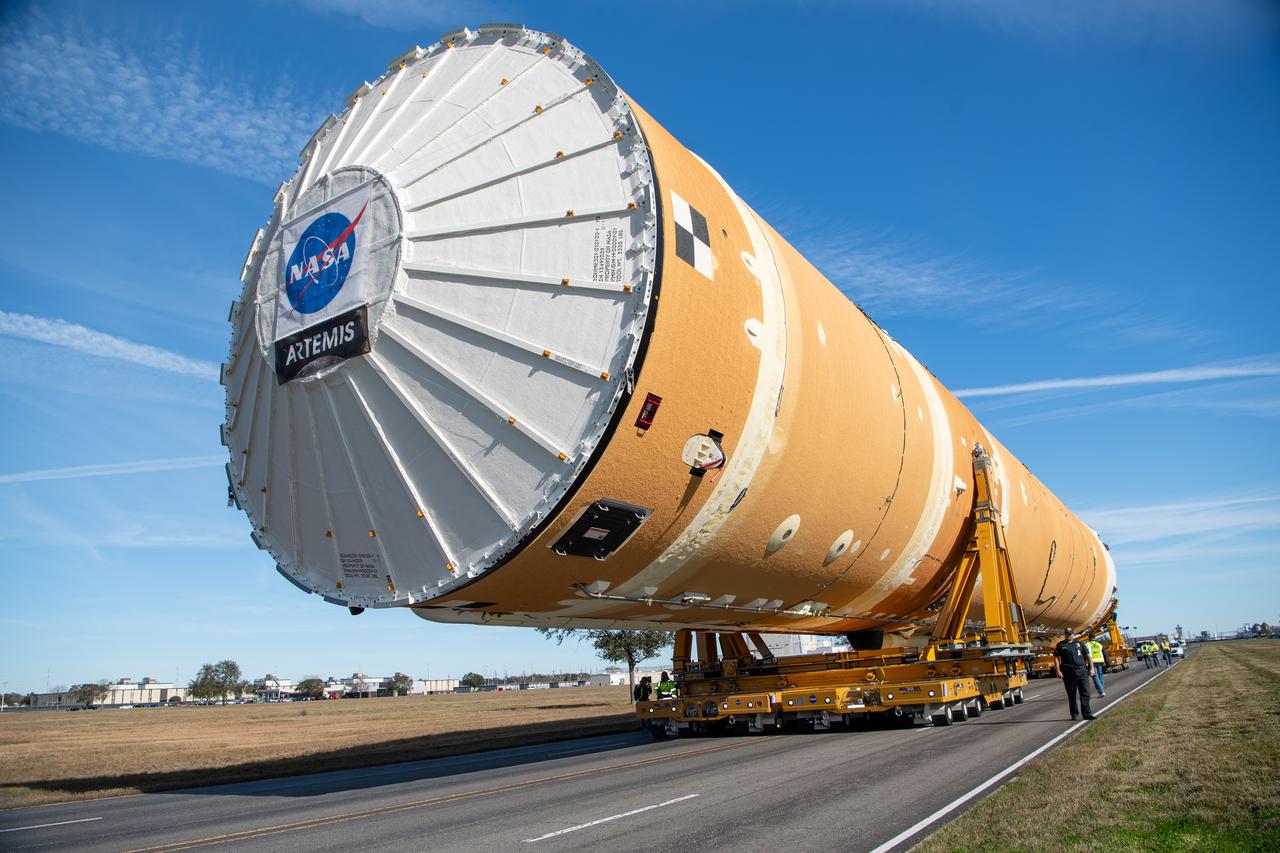
These images show how teams rolled out, or moved, the completed core stage for NASA’s Space Launch System rocket from NASA’s Michoud Assembly Facility in New Orleans. Crews moved the flight hardware for the first Artemis mission to NASA’s Pegasus barge on Jan. 8 in preparation for the core stage Green Run test series at NASA’s Stennis Space Center near Bay St. Louis, Mississippi. Pegasus, which was modified to ferry SLS rocket hardware, will transport the core stage from Michoud to Stennis for the comprehensive core stage Green Run test series. Once at Stennis, the Artemis rocket stage will be loaded into the B-2 Test Stand for the core stage Green Run test series. The comprehensive test campaign will progressively bring the entire core stage, including its avionics and engines, to life for the first time to verify the stage is fit for flight ahead of the launch of Artemis I. Assembly and integration of the core stage and its four RS-25 engines has been a collaborative, multistep process for NASA and its partners Boeing, the core stage lead contractor, and Aerojet Rocketdyne, the RS-25 engines lead contractor. Together with four RS-25 engines, the rocket’s massive 212-foot-tall core stage — the largest stage NASA has ever built — and its twin solid rocket boosters will produce 8.8 million pounds of thrust to send NASA’s Orion spacecraft, astronauts and supplies beyond Earth’s orbit to the Moon and, ultimately, Mars. Offering more payload mass, volume capability and energy to speed missions through space, the SLS rocket, along with NASA’s Gateway in lunar orbit and Orion, is part of NASA’s backbone for deep space exploration and the Artemis lunar program.
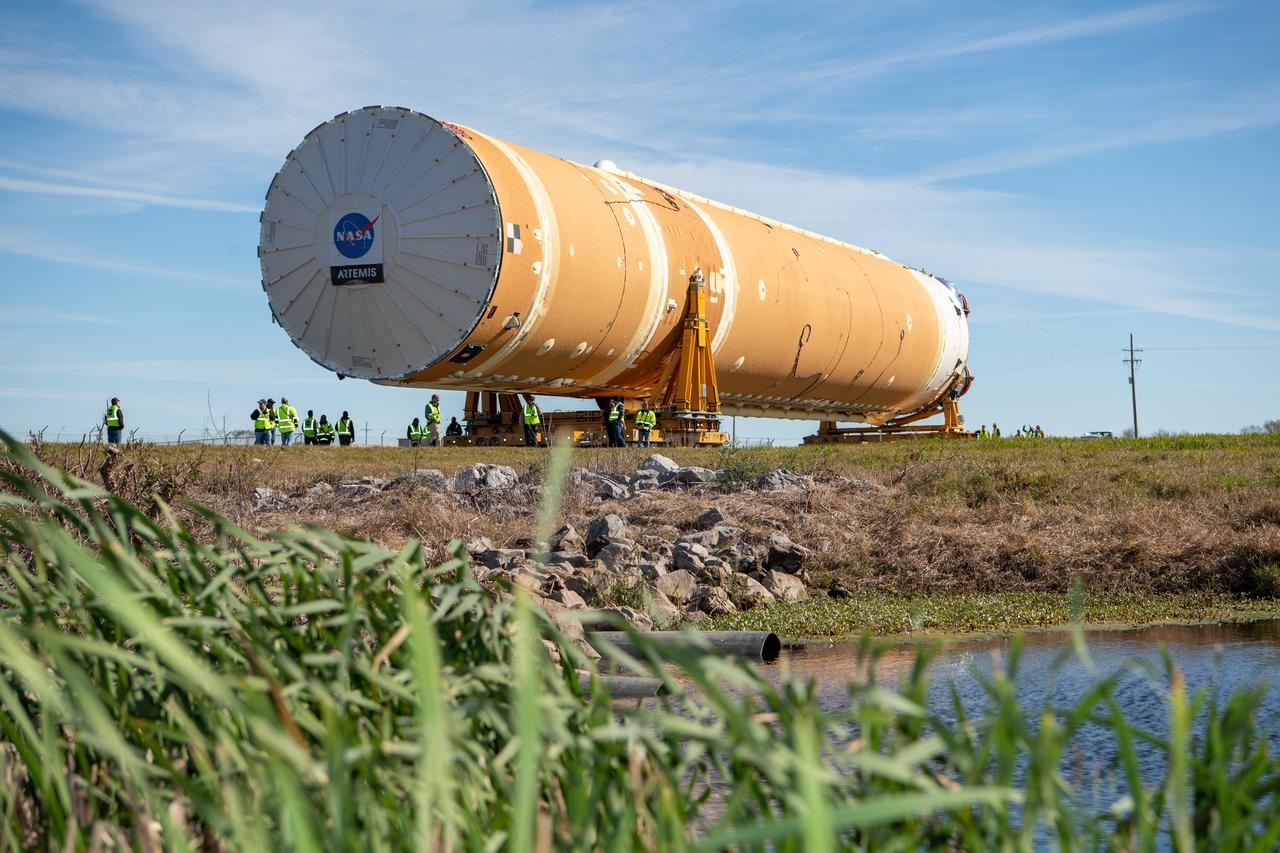
These images show how teams rolled out, or moved, the completed core stage for NASA’s Space Launch System rocket from NASA’s Michoud Assembly Facility in New Orleans. Crews moved the flight hardware for the first Artemis mission to NASA’s Pegasus barge on Jan. 8 in preparation for the core stage Green Run test series at NASA’s Stennis Space Center near Bay St. Louis, Mississippi. Pegasus, which was modified to ferry SLS rocket hardware, will transport the core stage from Michoud to Stennis for the comprehensive core stage Green Run test series. Once at Stennis, the Artemis rocket stage will be loaded into the B-2 Test Stand for the core stage Green Run test series. The comprehensive test campaign will progressively bring the entire core stage, including its avionics and engines, to life for the first time to verify the stage is fit for flight ahead of the launch of Artemis I. Assembly and integration of the core stage and its four RS-25 engines has been a collaborative, multistep process for NASA and its partners Boeing, the core stage lead contractor, and Aerojet Rocketdyne, the RS-25 engines lead contractor. Together with four RS-25 engines, the rocket’s massive 212-foot-tall core stage — the largest stage NASA has ever built — and its twin solid rocket boosters will produce 8.8 million pounds of thrust to send NASA’s Orion spacecraft, astronauts and supplies beyond Earth’s orbit to the Moon and, ultimately, Mars. Offering more payload mass, volume capability and energy to speed missions through space, the SLS rocket, along with NASA’s Gateway in lunar orbit and Orion, is part of NASA’s backbone for deep space exploration and the Artemis lunar program.
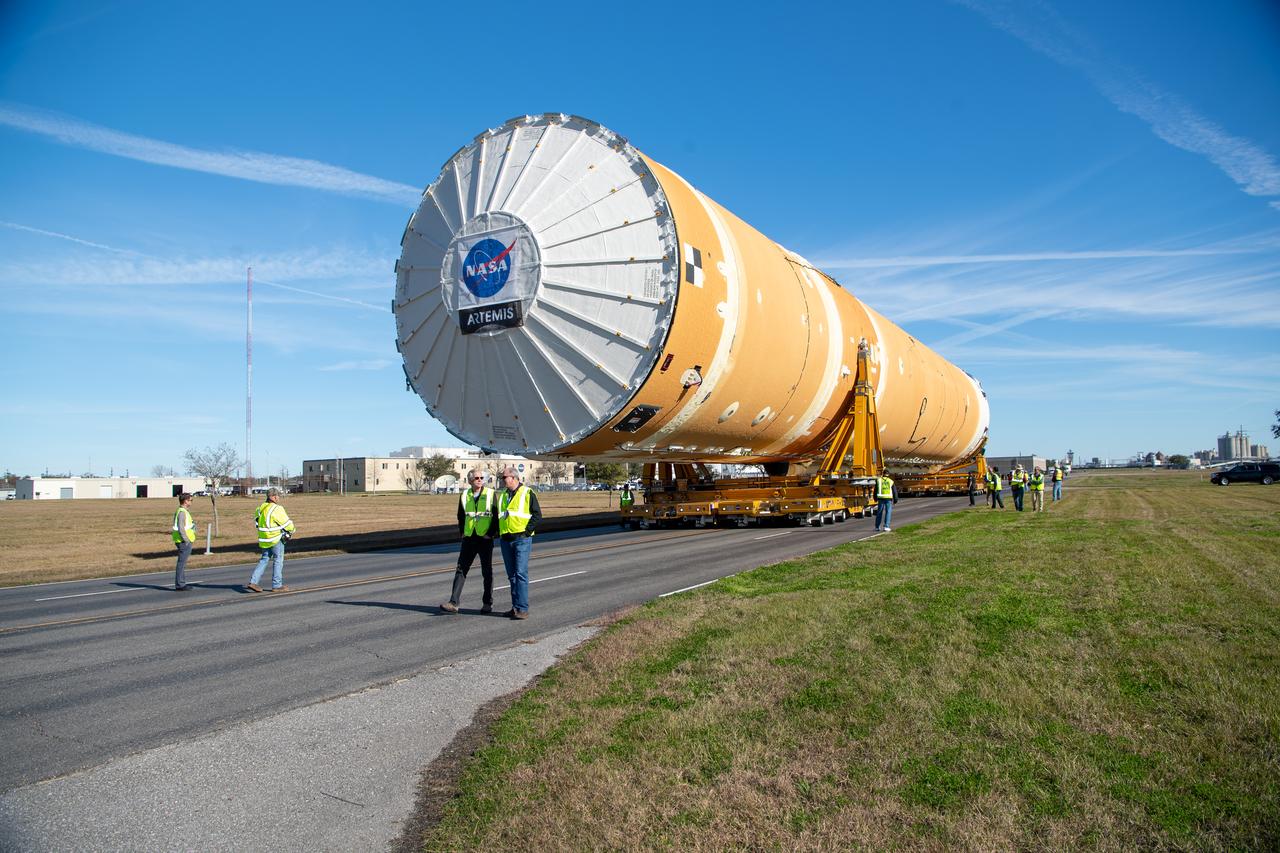
These images show how teams rolled out, or moved, the completed core stage for NASA’s Space Launch System rocket from NASA’s Michoud Assembly Facility in New Orleans. Crews moved the flight hardware for the first Artemis mission to NASA’s Pegasus barge on Jan. 8 in preparation for the core stage Green Run test series at NASA’s Stennis Space Center near Bay St. Louis, Mississippi. Pegasus, which was modified to ferry SLS rocket hardware, will transport the core stage from Michoud to Stennis for the comprehensive core stage Green Run test series. Once at Stennis, the Artemis rocket stage will be loaded into the B-2 Test Stand for the core stage Green Run test series. The comprehensive test campaign will progressively bring the entire core stage, including its avionics and engines, to life for the first time to verify the stage is fit for flight ahead of the launch of Artemis I. Assembly and integration of the core stage and its four RS-25 engines has been a collaborative, multistep process for NASA and its partners Boeing, the core stage lead contractor, and Aerojet Rocketdyne, the RS-25 engines lead contractor. Together with four RS-25 engines, the rocket’s massive 212-foot-tall core stage — the largest stage NASA has ever built — and its twin solid rocket boosters will produce 8.8 million pounds of thrust to send NASA’s Orion spacecraft, astronauts and supplies beyond Earth’s orbit to the Moon and, ultimately, Mars. Offering more payload mass, volume capability and energy to speed missions through space, the SLS rocket, along with NASA’s Gateway in lunar orbit and Orion, is part of NASA’s backbone for deep space exploration and the Artemis lunar program.
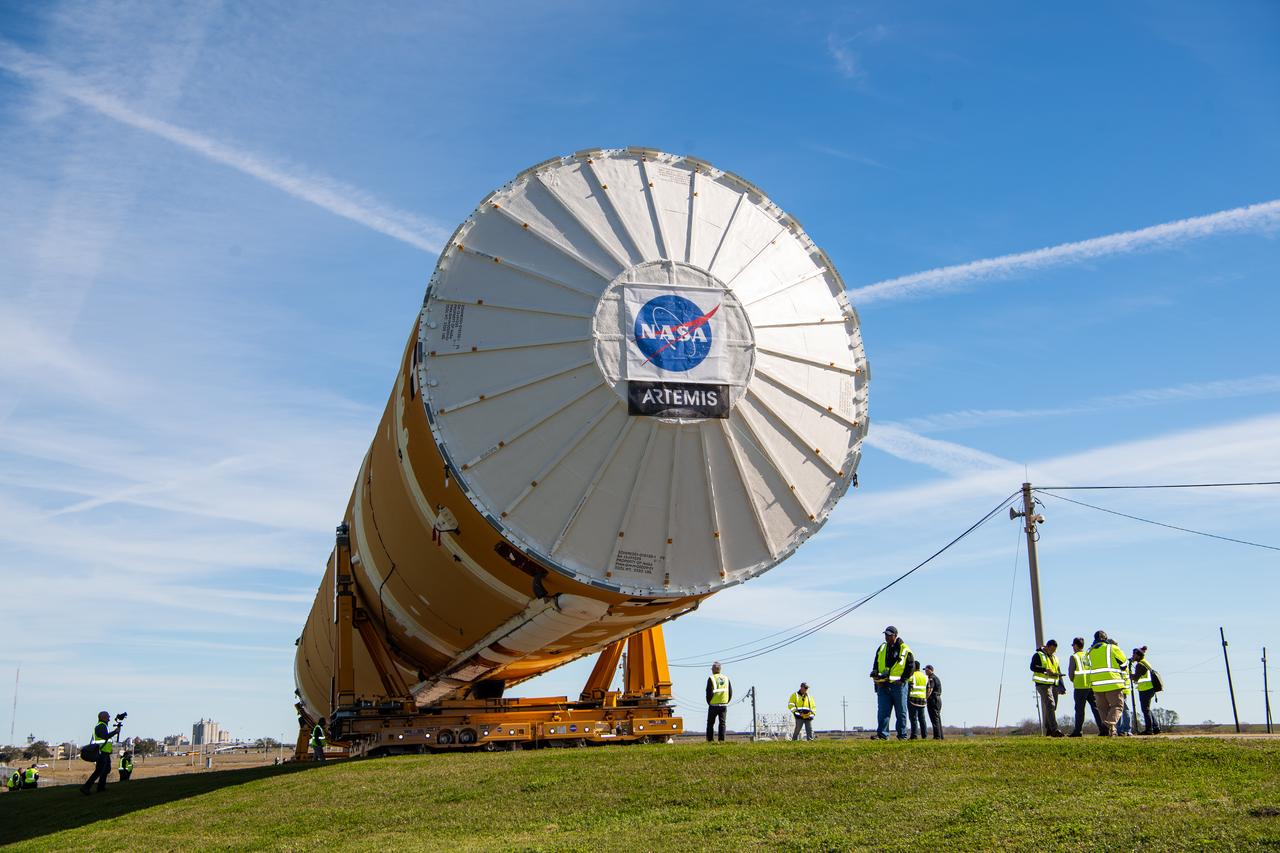
These images show how teams rolled out, or moved, the completed core stage for NASA’s Space Launch System rocket from NASA’s Michoud Assembly Facility in New Orleans. Crews moved the flight hardware for the first Artemis mission to NASA’s Pegasus barge on Jan. 8 in preparation for the core stage Green Run test series at NASA’s Stennis Space Center near Bay St. Louis, Mississippi. Pegasus, which was modified to ferry SLS rocket hardware, will transport the core stage from Michoud to Stennis for the comprehensive core stage Green Run test series. Once at Stennis, the Artemis rocket stage will be loaded into the B-2 Test Stand for the core stage Green Run test series. The comprehensive test campaign will progressively bring the entire core stage, including its avionics and engines, to life for the first time to verify the stage is fit for flight ahead of the launch of Artemis I. Assembly and integration of the core stage and its four RS-25 engines has been a collaborative, multistep process for NASA and its partners Boeing, the core stage lead contractor, and Aerojet Rocketdyne, the RS-25 engines lead contractor. Together with four RS-25 engines, the rocket’s massive 212-foot-tall core stage — the largest stage NASA has ever built — and its twin solid rocket boosters will produce 8.8 million pounds of thrust to send NASA’s Orion spacecraft, astronauts and supplies beyond Earth’s orbit to the Moon and, ultimately, Mars. Offering more payload mass, volume capability and energy to speed missions through space, the SLS rocket, along with NASA’s Gateway in lunar orbit and Orion, is part of NASA’s backbone for deep space exploration and the Artemis lunar program.
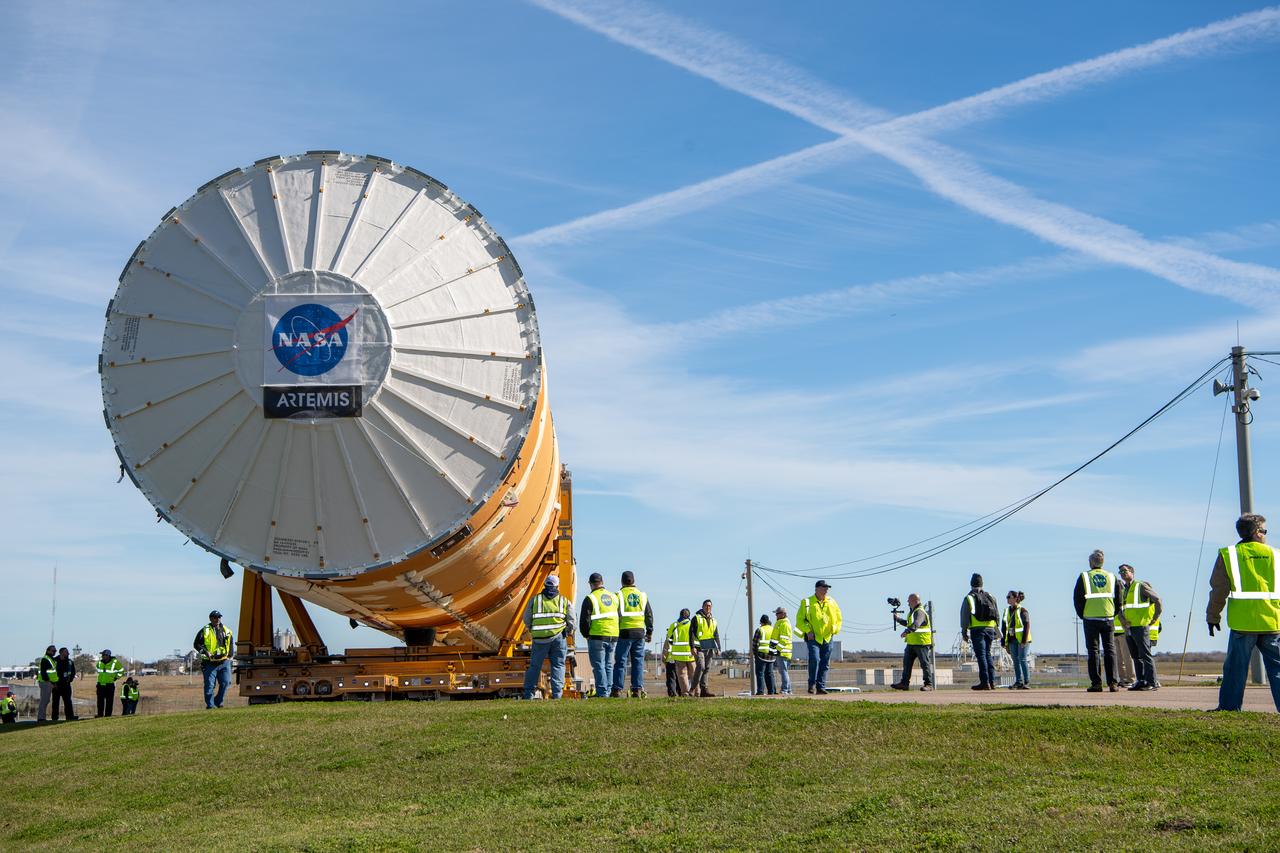
These images show how teams rolled out, or moved, the completed core stage for NASA’s Space Launch System rocket from NASA’s Michoud Assembly Facility in New Orleans. Crews moved the flight hardware for the first Artemis mission to NASA’s Pegasus barge on Jan. 8 in preparation for the core stage Green Run test series at NASA’s Stennis Space Center near Bay St. Louis, Mississippi. Pegasus, which was modified to ferry SLS rocket hardware, will transport the core stage from Michoud to Stennis for the comprehensive core stage Green Run test series. Once at Stennis, the Artemis rocket stage will be loaded into the B-2 Test Stand for the core stage Green Run test series. The comprehensive test campaign will progressively bring the entire core stage, including its avionics and engines, to life for the first time to verify the stage is fit for flight ahead of the launch of Artemis I. Assembly and integration of the core stage and its four RS-25 engines has been a collaborative, multistep process for NASA and its partners Boeing, the core stage lead contractor, and Aerojet Rocketdyne, the RS-25 engines lead contractor. Together with four RS-25 engines, the rocket’s massive 212-foot-tall core stage — the largest stage NASA has ever built — and its twin solid rocket boosters will produce 8.8 million pounds of thrust to send NASA’s Orion spacecraft, astronauts and supplies beyond Earth’s orbit to the Moon and, ultimately, Mars. Offering more payload mass, volume capability and energy to speed missions through space, the SLS rocket, along with NASA’s Gateway in lunar orbit and Orion, is part of NASA’s backbone for deep space exploration and the Artemis lunar program.
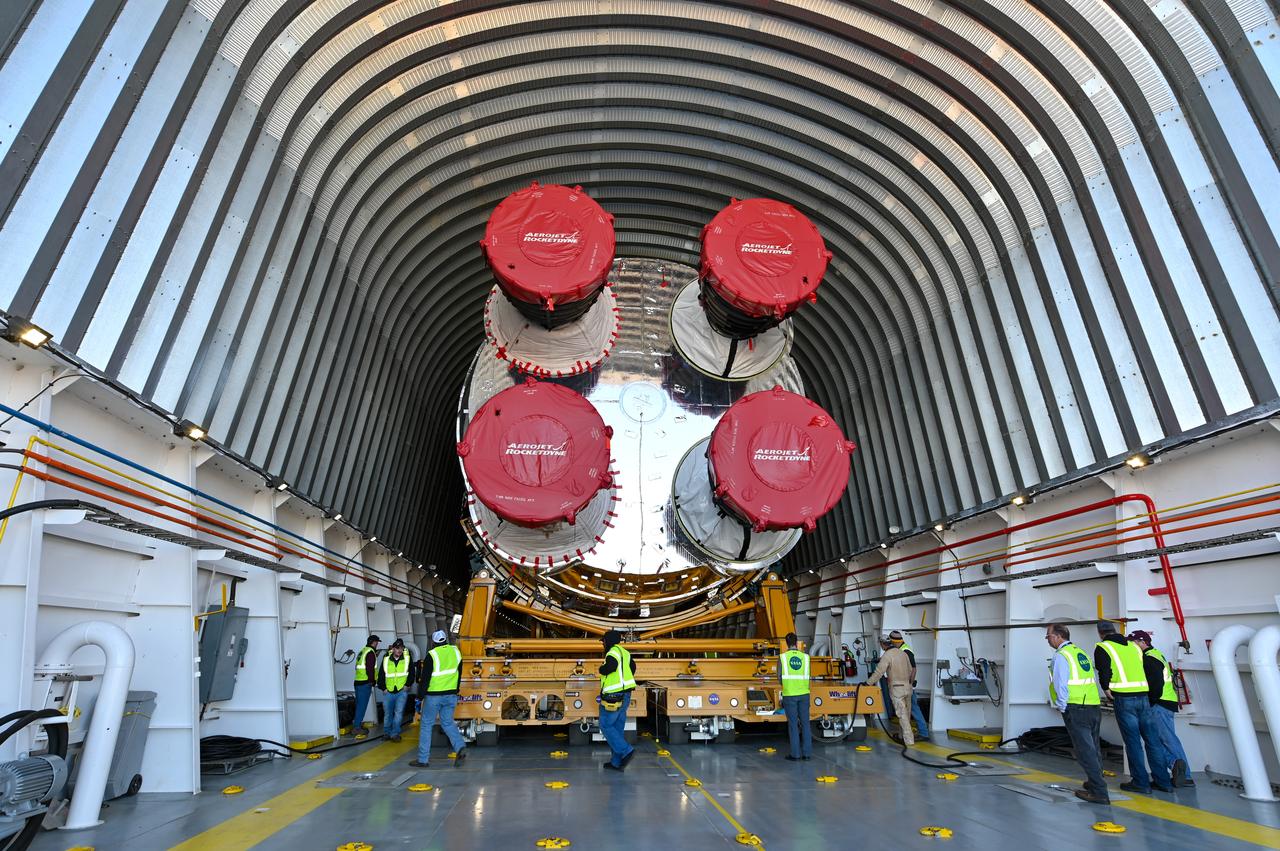
These images show how teams rolled out, or moved, the completed core stage for NASA’s Space Launch System rocket from NASA’s Michoud Assembly Facility in New Orleans. Crews moved the flight hardware for the first Artemis mission to NASA’s Pegasus barge on Jan. 8 in preparation for the core stage Green Run test series at NASA’s Stennis Space Center near Bay St. Louis, Mississippi. Pegasus, which was modified to ferry SLS rocket hardware, will transport the core stage from Michoud to Stennis for the comprehensive core stage Green Run test series. Once at Stennis, the Artemis rocket stage will be loaded into the B-2 Test Stand for the core stage Green Run test series. The comprehensive test campaign will progressively bring the entire core stage, including its avionics and engines, to life for the first time to verify the stage is fit for flight ahead of the launch of Artemis I. Assembly and integration of the core stage and its four RS-25 engines has been a collaborative, multistep process for NASA and its partners Boeing, the core stage lead contractor, and Aerojet Rocketdyne, the RS-25 engines lead contractor. Together with four RS-25 engines, the rocket’s massive 212-foot-tall core stage — the largest stage NASA has ever built — and its twin solid rocket boosters will produce 8.8 million pounds of thrust to send NASA’s Orion spacecraft, astronauts and supplies beyond Earth’s orbit to the Moon and, ultimately, Mars. Offering more payload mass, volume capability and energy to speed missions through space, the SLS rocket, along with NASA’s Gateway in lunar orbit and Orion, is part of NASA’s backbone for deep space exploration and the Artemis lunar program.