
Perseverance chief engineer, JPL, Adam Steltzner, shows a sample tube that will hold sample core’s collected from the Mars surface during a NASA Perseverance rover mission engineering and technology overview, Tuesday, Feb. 16, 2021, at NASA's Jet Propulsion Laboratory in Pasadena, California. The Perseverance Mars rover is due to land on Mars Thursday, Feb. 18, 2021. A key objective for Perseverance’s mission on Mars is astrobiology, including the search for signs of ancient microbial life. The rover will characterize the planet’s geology and past climate, pave the way for human exploration of the Red Planet, and be the first mission to collect and cache Martian rock and regolith. Photo Credit: (NASA/Bill Ingalls)

Perseverance chief engineer Adam Steltzner gives remarks during a NASA Perseverance rover initial surface checkout briefing, Friday Feb. 19, 2021, at NASA's Jet Propulsion Laboratory in Pasadena, California. The Perseverance Mars rover landed on Mars Thursday, Feb. 18, 2021. A key objective for Perseverance’s mission on Mars is astrobiology, including the search for signs of ancient microbial life. The rover will characterize the planet’s geology and past climate, pave the way for human exploration of the Red Planet, and be the first mission to collect and cache Martian rock and regolith. Photo Credit: (NASA/Bill Ingalls)

Perseverance chief engineer, JPL, Adam Steltzner, shows a rover wheel during a NASA Perseverance rover mission engineering and technology overview, Tuesday, Feb. 16, 2021, at NASA's Jet Propulsion Laboratory in Pasadena, California. The Perseverance Mars rover is due to land on Mars Thursday, Feb. 18, 2021. A key objective for Perseverance’s mission on Mars is astrobiology, including the search for signs of ancient microbial life. The rover will characterize the planet’s geology and past climate, pave the way for human exploration of the Red Planet, and be the first mission to collect and cache Martian rock and regolith. Photo Credit: (NASA/Bill Ingalls)

Perseverance chief engineer Adam Steltzner gives remarks during a NASA Perseverance rover initial surface checkout briefing, Friday Feb. 19, 2021, at NASA's Jet Propulsion Laboratory in Pasadena, California. The Perseverance Mars rover landed on Mars Thursday, Feb. 18, 2021. A key objective for Perseverance’s mission on Mars is astrobiology, including the search for signs of ancient microbial life. The rover will characterize the planet’s geology and past climate, pave the way for human exploration of the Red Planet, and be the first mission to collect and cache Martian rock and regolith. Photo Credit: (NASA/Bill Ingalls)

Perseverance chief engineer, JPL, Adam Steltzner, gives remarks during a NASA Perseverance rover mission engineering and technology overview, Tuesday, Feb. 16, 2021, at NASA's Jet Propulsion Laboratory in Pasadena, California. The Perseverance Mars rover is due to land on Mars Thursday, Feb. 18, 2021. A key objective for Perseverance’s mission on Mars is astrobiology, including the search for signs of ancient microbial life. The rover will characterize the planet’s geology and past climate, pave the way for human exploration of the Red Planet, and be the first mission to collect and cache Martian rock and regolith. Photo Credit: (NASA/Bill Ingalls)

Perseverance chief engineer Adam Steltzner is seen during a NASA Perseverance rover initial surface checkout briefing, Friday Feb. 19, 2021, at NASA's Jet Propulsion Laboratory in Pasadena, California. The Perseverance Mars rover landed on Mars Thursday, Feb. 18, 2021. A key objective for Perseverance’s mission on Mars is astrobiology, including the search for signs of ancient microbial life. The rover will characterize the planet’s geology and past climate, pave the way for human exploration of the Red Planet, and be the first mission to collect and cache Martian rock and regolith. Photo Credit: (NASA/Bill Ingalls)

From left to right, Janet Petro, director of NASA's Kennedy Space Center, Lori Glaze, associate administrator for NASA's Exploration Systems Development Mission Directorate, Adam Steltzner, engineering advisor to the NASA Associate Administrator, and Stephanie Schierholz, chief of staff for NASA's Exploration Systems Development Mission Directorate, wave goodbye to NASA astronauts Reid Wiseman, commander; Victor Glover, pilot; Christina Koch, mission specialist; and CSA (Canadian Space Agency) astronaut Jeremy Hansen, mission specialist as they depart the Neil A. Armstrong Operations and Checkout Building to board their Orion spacecraft atop NASA’s Space Launch System rocket inside the Vehicle Assembly Building as part of the Artemis II countdown demonstration test, Saturday, Dec. 20, 2025, at NASA’s Kennedy Space Center in Florida. For this operation, the Artemis II crew and launch teams are simulating the launch day timeline including suit-up, walkout, and spacecraft ingress and egress. Through the Artemis campaign, NASA will send astronauts to explore the Moon for scientific discovery, economic benefits, and to build the foundation for the first crewed missions to Mars, for the benefit of all. Photo Credit: (NASA/Aubrey Gemignani)
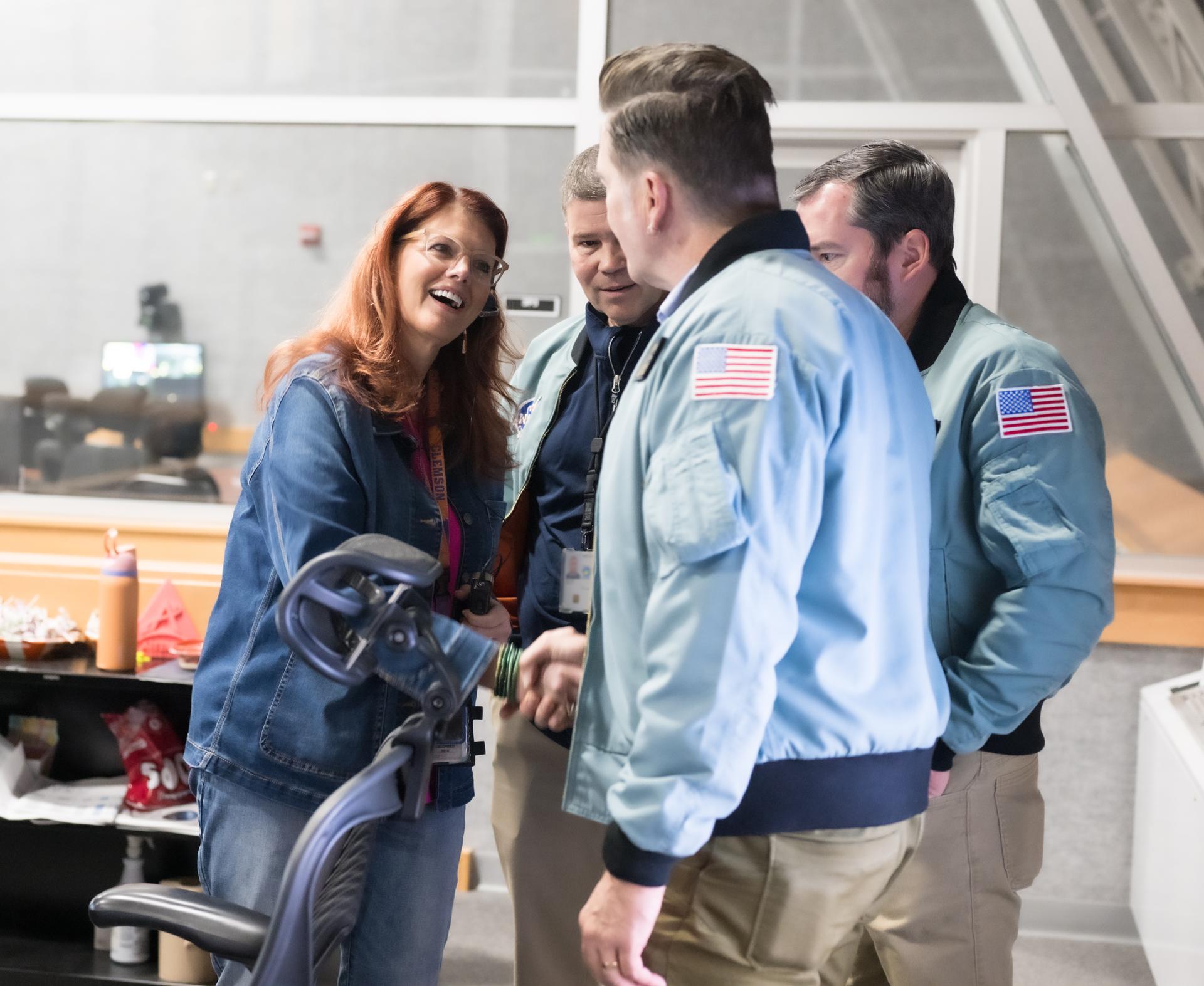
Charlie Blackwell-Thompson, Artemis II launch director at NASA's Kennedy Space Center greets Space Launch Systems (SLS) Chief Engineer John Blevins, second from left, SLS Deputy Chief Engineer Phillip Allen, center, and Engineering Advisor to the NASA Associate Administrator Adam Steltzner, right, in Firing Room One of the Rocco A. Petrone Launch Control Center as NASA’s Artemis II Space Launch System (SLS) rocket and Orion spacecraft, secured to the mobile launcher, roll out of High Bay 3 of the Vehicle Assembly Building to Launch Complex 39B, Saturday, Jan. 17, 2026, at NASA’s Kennedy Space Center in Florida. NASA’s Artemis II test flight will take Commander Reid Wiseman, Pilot Victor Glover, and Mission Specialist Christina Koch from NASA, and Mission Specialist Jeremy Hansen from the CSA (Canadian Space Agency), around the Moon and back to Earth no later than April 2026. Photo Credit: (NASA/Aubrey Gemignani) Portions of this image have been blurred for security reasons.

With the launch period for the Perseverance mission opening July 17, 2020, members of NASA's Perseverance Mars rover project continue the mission's march to the launch pad while working from their home offices during the coronavirus outbreak. Clockwise from upper left: lead mobility systems engineer Rich Rieber (with son Ben); deputy project scientist Katie Stack Morgan; mission system verification and validation supervisor Ruth Fragoso; mission design and navigation manager Fernando Abilleira (below mission logo); staff assistant Monica Hopper; systems engineer Heather Bottom; project chief engineer Adam Steltzner; guidance and control systems engineer Swati Mohan; entry, Descent and Landing Phase Lead Al Chen (with son Max); project manager John McNamee; and Entry, Descent and Landing Systems Engineer Cj Giovingo. https://photojournal.jpl.nasa.gov/catalog/PIA23881

Members of NASA’s Perseverance rover team react in mission control after receiving confirmation the spacecraft successfully touched down on Mars, Thursday, Feb. 18, 2021, at NASA's Jet Propulsion Laboratory in Pasadena, California. A key objective for Perseverance’s mission on Mars is astrobiology, including the search for signs of ancient microbial life. The rover will characterize the planet’s geology and past climate, pave the way for human exploration of the Red Planet, and be the first mission to collect and cache Martian rock and regolith. Photo Credit: (NASA/Bill Ingalls)

Left, Janet Petro, director of NASA's Kennedy Space Center, Lori Glaze, associate administrator for NASA's Exploration Systems Development Mission Directorate, Adam Steltzner, engineering advisor to the NASA Associate Administrator, and Stephanie Schierholz, chief of staff for NASA's Exploration Systems Development Mission Directorate, wave goodbye to NASA astronauts Reid Wiseman, commander, not pictured; Victor Glover, pilot; Christina Koch, mission specialist; and CSA (Canadian Space Agency) astronaut Jeremy Hansen, mission specialist as they depart the Neil A. Armstrong Operations and Checkout Building to board their Orion spacecraft atop NASA’s Space Launch System rocket inside the Vehicle Assembly Building as part of the Artemis II countdown demonstration test, Saturday, Dec. 20, 2025, at NASA’s Kennedy Space Center in Florida. For this operation, the Artemis II crew and launch teams are simulating the launch day timeline including suit-up, walkout, and spacecraft ingress and egress. Through the Artemis campaign, NASA will send astronauts to explore the Moon for scientific discovery, economic benefits, and to build the foundation for the first crewed missions to Mars, for the benefit of all. Photo Credit: (NASA/Aubrey Gemignani)
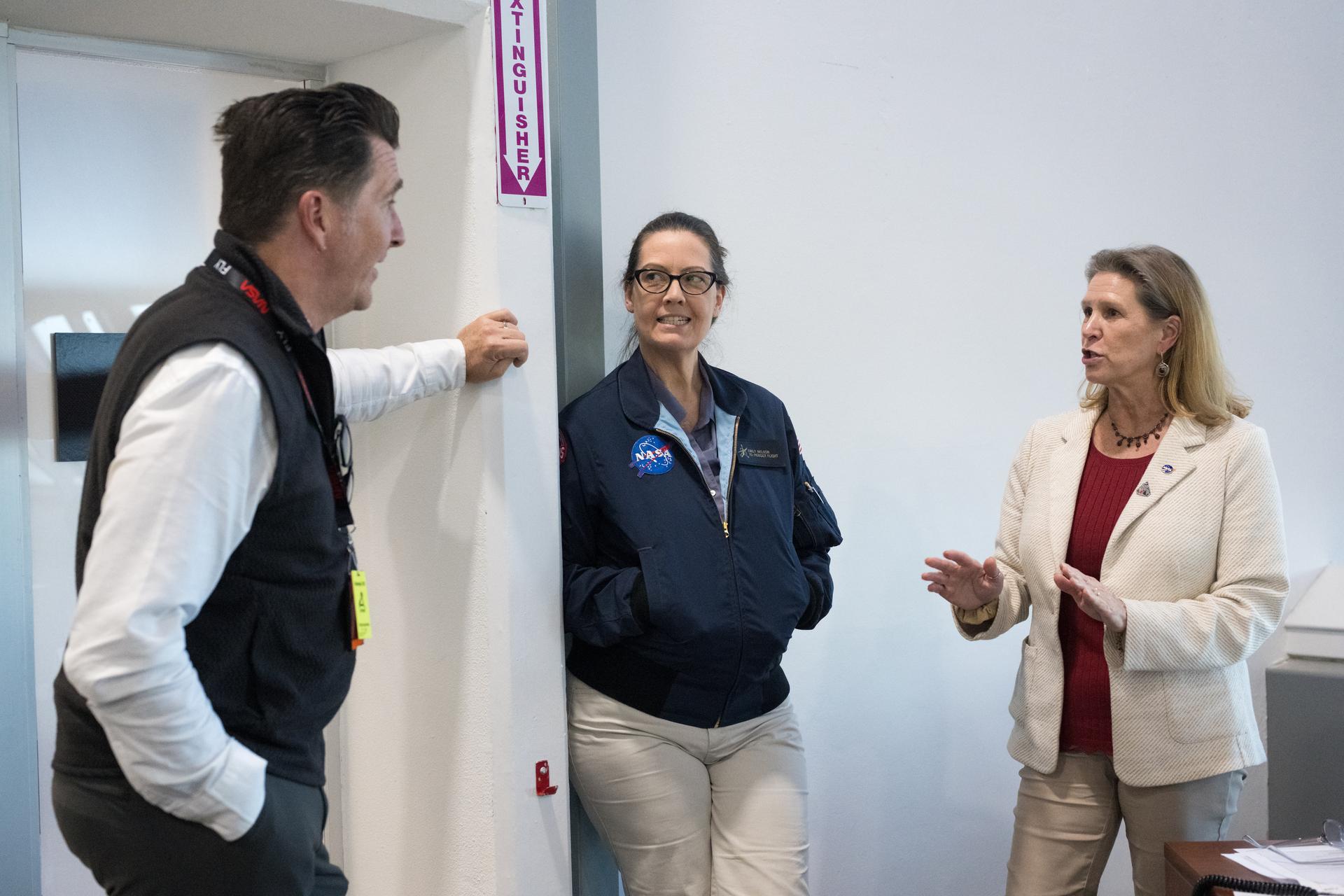
Left to right, Adam Steltzner, engineering advisor to the NASA Associate Administrator, Emily Nelson, NASA's chief flight director, and Lori Glaze, acting associate administrator for NASA's Exploration Systems Development Mission Directorate, discuss the progress of a Countdown Demonstration Test with Artemis II crewmembers NASA astronauts Reid Wiseman, commander; Victor Glover, pilot; Christina Koch, mission specialist; and CSA (Canadian Space Agency) astronaut Jeremy Hansen, mission specialist onboard their Orion spacecraft from Firing Room 2 of the Rocco A. Petrone Launch Control Center, Saturday, Dec. 20, 2025, at NASA’s Kennedy Space Center in Florida. For this operation, the Artemis II crew and launch teams are simulating the launch day timeline including suit-up, walkout, and spacecraft ingress and egress. Through the Artemis campaign, NASA will send astronauts to explore the Moon for scientific discovery, economic benefits, and to build the foundation for the first crewed missions to Mars, for the benefit of all. Photo Credit: (NASA/Aubrey Gemignani)

NASA and JPL Perseverance Mars rover mission management are seen during an engineering and technology overview, Tuesday, Feb. 16, 2021, at NASA's Jet Propulsion Laboratory in Pasadena, California. The Perseverance Mars rover is due to land on Mars Thursday, Feb. 18, 2021. A key objective for Perseverance’s mission on Mars is astrobiology, including the search for signs of ancient microbial life. The rover will characterize the planet’s geology and past climate, pave the way for human exploration of the Red Planet, and be the first mission to collect and cache Martian rock and regolith. Photo Credit: (NASA/Bill Ingalls)

NASA and JPL Perseverance Mars rover mission management are seen during an engineering and technology overview, Tuesday, Feb. 16, 2021, at NASA's Jet Propulsion Laboratory in Pasadena, California. The Perseverance Mars rover is due to land on Mars Thursday, Feb. 18, 2021. A key objective for Perseverance’s mission on Mars is astrobiology, including the search for signs of ancient microbial life. The rover will characterize the planet’s geology and past climate, pave the way for human exploration of the Red Planet, and be the first mission to collect and cache Martian rock and regolith. Photo Credit: (NASA/Bill Ingalls)

Mission management and scientist give remarks during a NASA Perseverance rover initial surface checkout briefing, Friday Feb. 19, 2021, at NASA's Jet Propulsion Laboratory in Pasadena, California. The Perseverance Mars rover landed on Mars Thursday, Feb. 18, 2021. A key objective for Perseverance’s mission on Mars is astrobiology, including the search for signs of ancient microbial life. The rover will characterize the planet’s geology and past climate, pave the way for human exploration of the Red Planet, and be the first mission to collect and cache Martian rock and regolith. Photo Credit: (NASA/Bill Ingalls)

Members of NASA’s Perseverance Mars rover management team meet via remote and in mission control, Thursday, Feb. 18, 2021, at NASA's Jet Propulsion Laboratory in Pasadena, California. A key objective for Perseverance’s mission on Mars is astrobiology, including the search for signs of ancient microbial life. The rover will characterize the planet’s geology and past climate, pave the way for human exploration of the Red Planet, and be the first mission to collect and cache Martian rock and regolith. Photo Credit: (NASA/Bill Ingalls)