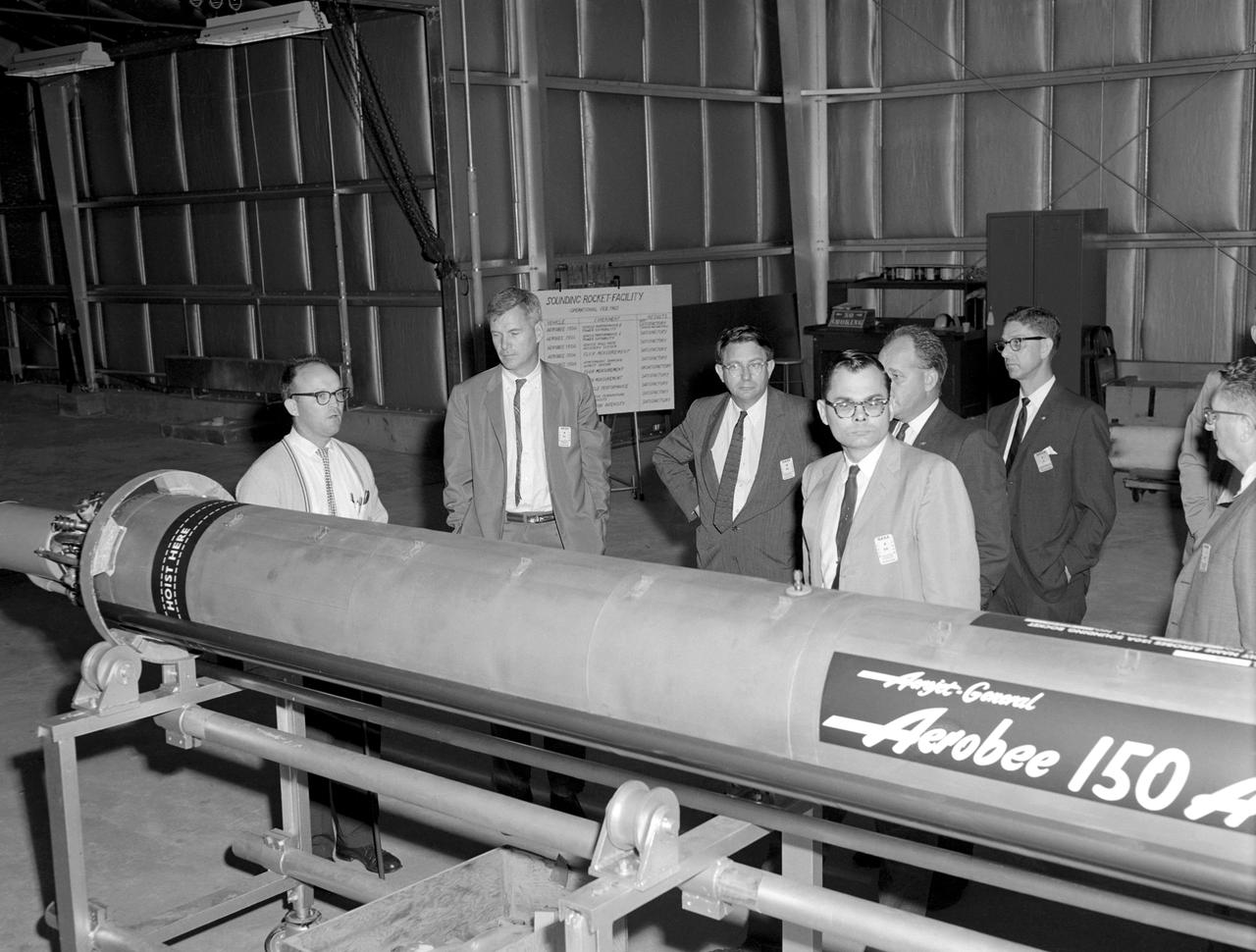
Photographed on 09/22/1960. -- An examination of the Aerojet-General "Aerobee 150A" propulsion system in February 1960. James Hansen described this as follows: "As for the technical definition of the rocket...the Langley engineers tried to keep developmental costs and time to a minimum by selecting components from off-the-shelf hardware. the majority of Scout's components were to come from an inventory of solid-fuel rockets produced for the military, although everyone involved understood that some improved motors would also have to be developed under contract. By early 1959, after intensive technical analysis and reviews, Langley settled on a design and finalized the selection of the major contractors. The rocket's 40-inch-diameter first stage was to be a new "Algol" motor, a combination of the Jupiter Senior and the navy Polaris produced by the Aerojet General Corporation, Sacramento, California. The 31-inch-diameter second stage, "Castor," was derived from the army's Sergeant and was to be manufactured by the Redstone Division of the Thiokol company in Huntsville, Alabama. the motor for the 30-inch-diameter third stage, "Antares," evolved under NASA contract from the ABL X248 design into a new version called the X254 (and subsequently into the X259); it was built under contract to NASA by ABL, a U.S. Navy Bureau of Ordnance facility operated by the Hercules Powder Company, Cumberland, Maryland. the final upper-stage propulsion unit, "Altair," which was 25.7 inches in diameter (34 inches at the heat shield), amounted to an improved edition of the X248 that was also manufactured by ABL." -- Published in James R. Hansen, Spaceflight Revolution: NASA Langley Research Center From Sputnik to Apollo, NASA SP-4308, pp.200-201.
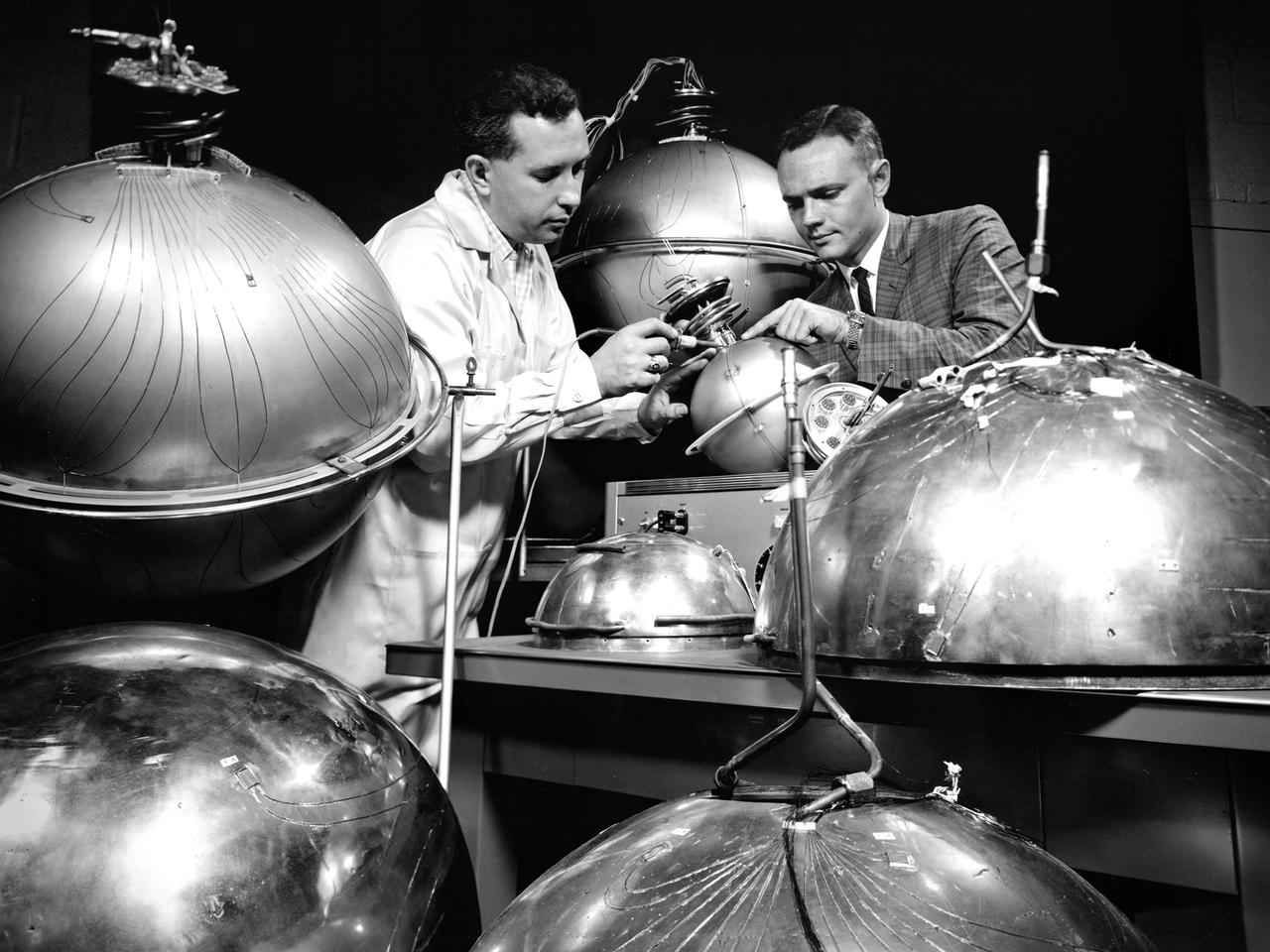
An engineer and technician at the National Aeronautics and Space Administration (NASA) Lewis Research Center install the instrumentation on spherical fuel tanks for an investigation of the behavior of liquids in microgravity. Lewis researchers were undertaking a broad effort to study the heat transfer properties of high energy propellants such as liquid hydrogen in microgravity. In the center’s 2.2-Second Drop Tower they investigated the wetting characteristics of liquid and the liquid-vapor configurations, and predicted the equilibrium state in microgravity conditions. Lewis was also conducting a series microgravity investigations which launched 9-inch diameter spherical dewars, seen here, on an Aerobee sounding rocket. A camera inside the rocket filmed the liquid hydrogen’s behavior during its 4 to 7 minutes of freefall. The researchers concluded, however, that they needed to extend the weightlessness period to obtain better results. So they designed an experiment to be launched on an Atlas missile that would provide 21 minutes of weightlessness. The experiment was flight qualified at Lewis. The 36-percent full liquid hydrogen stainless steel dewar was launched on the Atlas on February 25, 1964. The instrumentation measured temperature, pressure, vacuum, and liquid level. Temperature instrumentation indicated wall drying during the freefall. The resultant pressure-rise characteristics were similar to those used for the normal-gravity test.