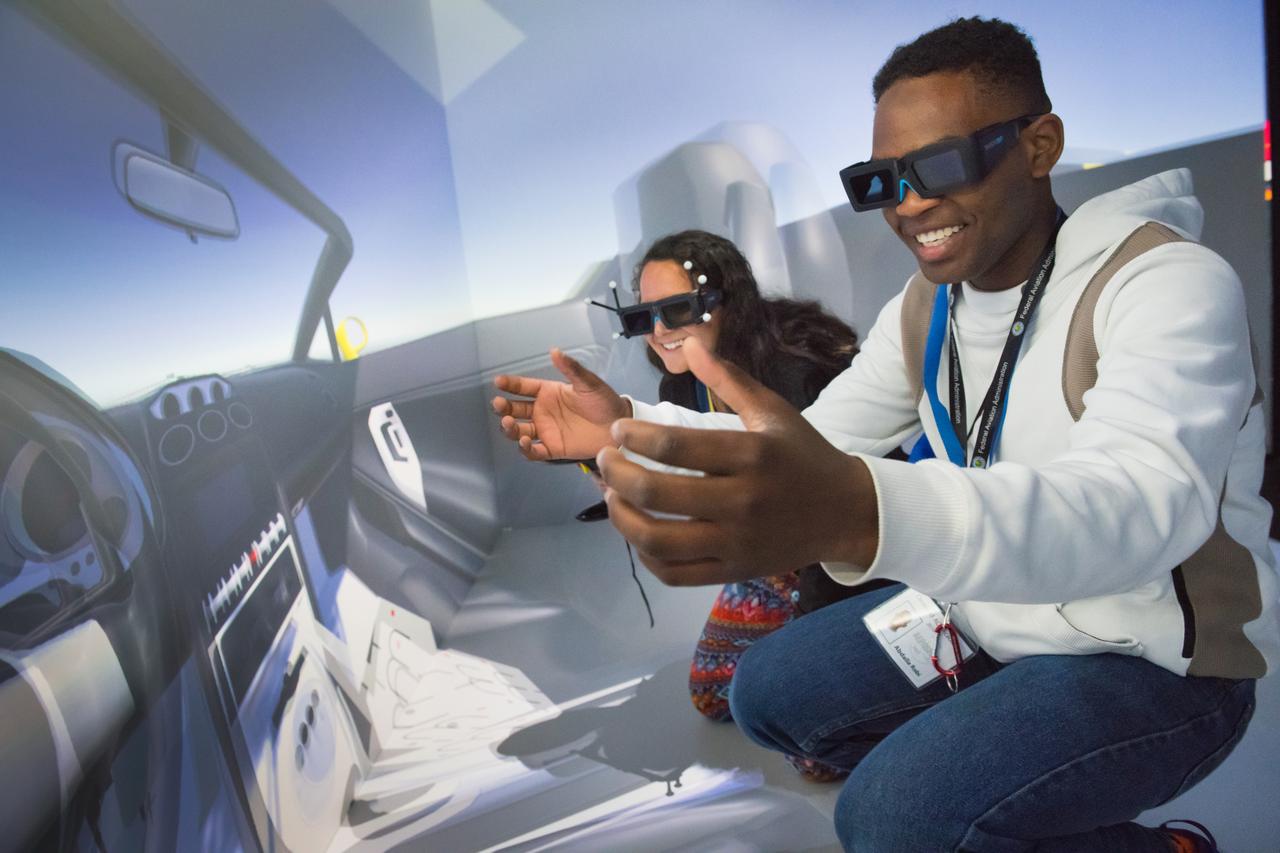
Aerospace Career Education, Organization of Black Aerospace Professionals, OBAP Cleveland ACE Academy Day
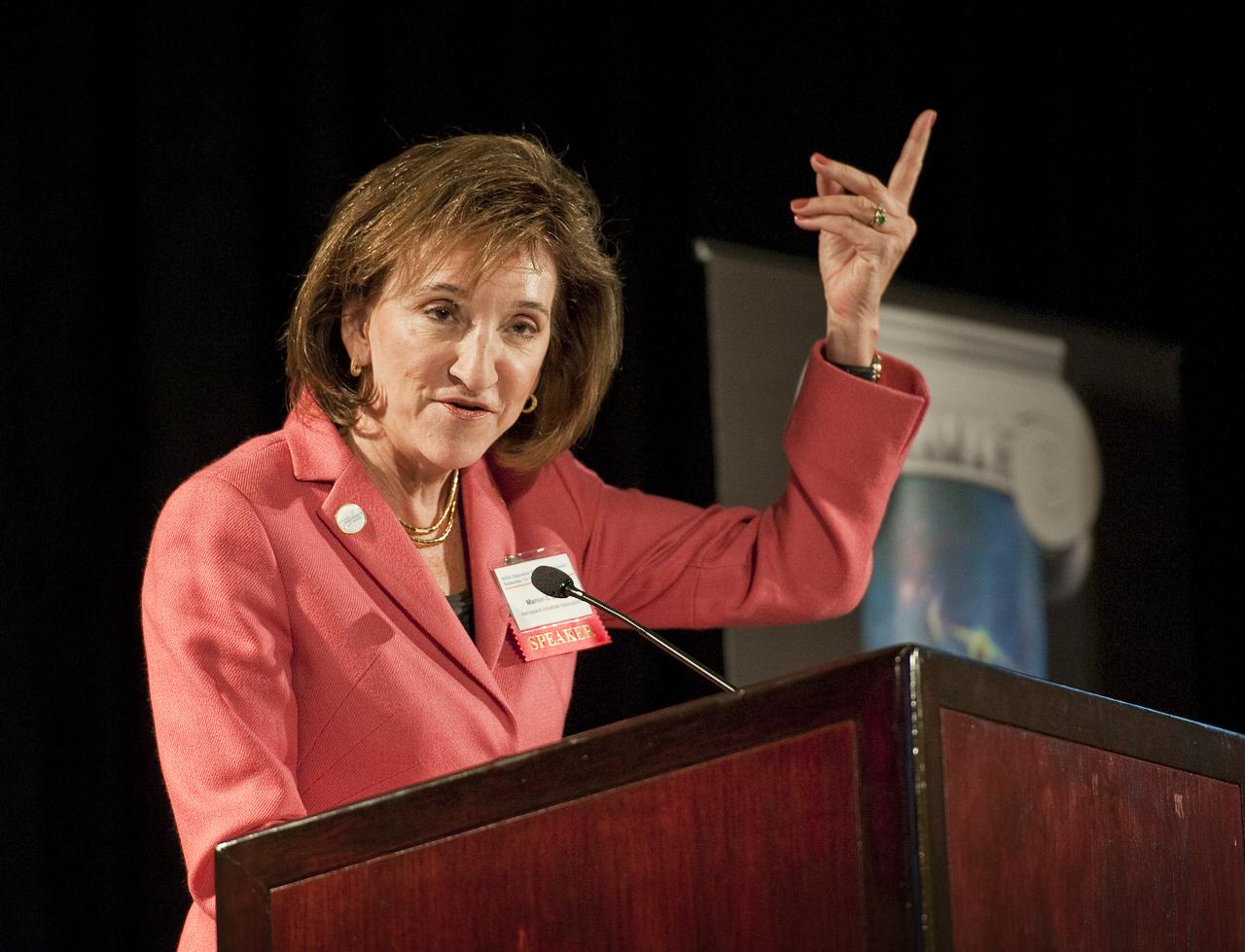
Marion C. Blakey, President and CEO, Aerospace Industries Association, addresses guests at the NASA Education Stakeholders’ Summit One Stop Shopping Initiative (OSSI), Monday, Sep. 13, 2010, at the Westfields Marriott Conference Center in Chantilly, VA. (Photo Credit: NASA/Carla Cioffi)
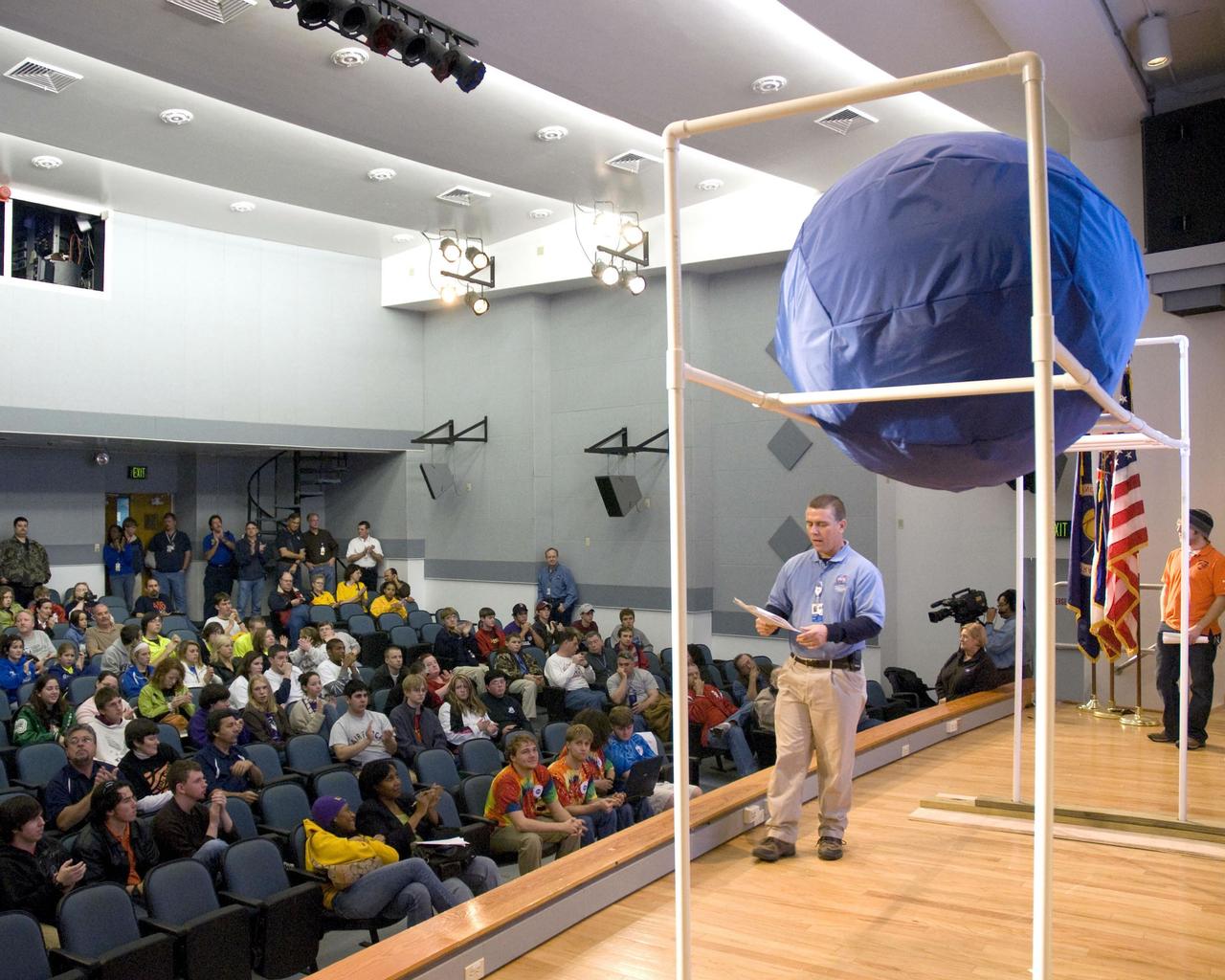
Master of ceremonies Steve Culivan, an employee of Penn State University and aerospace education specialist at NASA's Stennis Space Center, talked to a crowd of more than 300 who attended the Jan. 5 kickoff of the 2008 FIRST (For Inspiration and Recognition of Science and Technology) Robotics Competition season. The students, coaches and mentors from three states who attended also watched a live broadcast from FIRST's Manchester, N.H., headquarters that revealed this year's competition challenge, and received parts kits from which they built robots to meet the challenge.
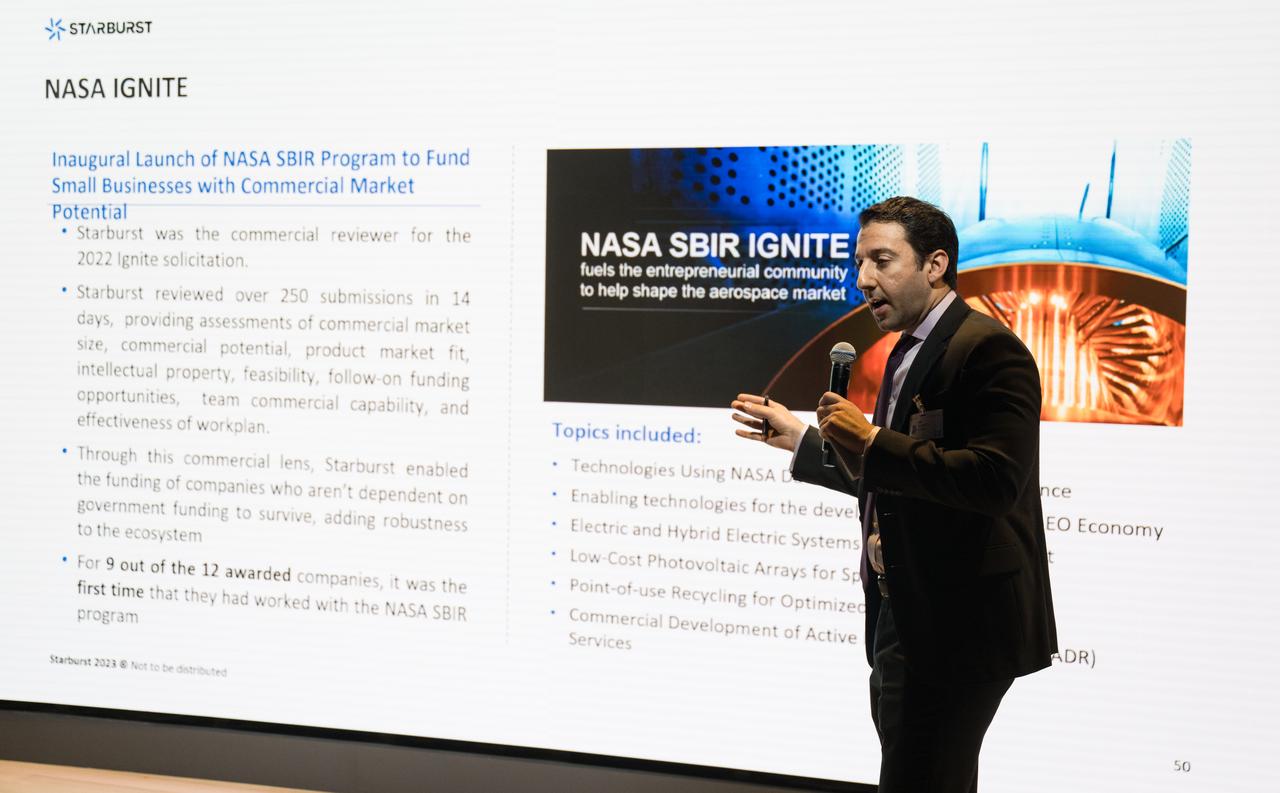
Director of Government Affairs and Business Development for Starburst Aerospace, Robert Ganim, provides remarks during Space Education Day, Tuesday, June 20, 2023, at the Microsoft Technology Center in Arlington, Va. Microsoft hosted the event to showcase the collaboration, early successes, and future plans for high quality student engagement through activities that combined space content and technologies like artificial intelligence and cloud computing. Photo Credit: (NASA/Aubrey Gemignani)
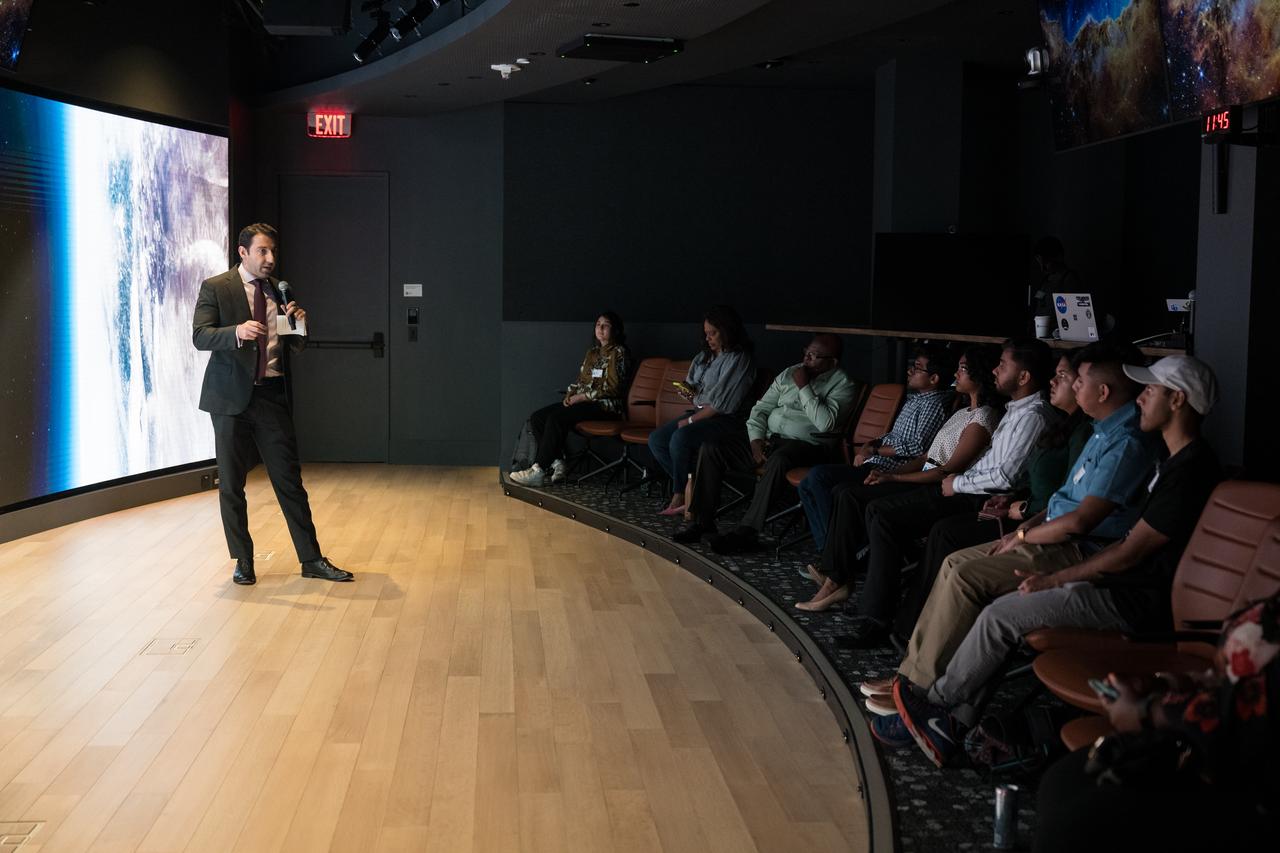
Director of Government Affairs and Business Development for Starburst Aerospace, Robert Ganim, provides remarks during Space Education Day, Tuesday, June 20, 2023, at the Microsoft Technology Center in Arlington, Va. Microsoft hosted the event to showcase the collaboration, early successes, and future plans for high quality student engagement through activities that combined space content and technologies like artificial intelligence and cloud computing. Photo Credit: (NASA/Aubrey Gemignani)
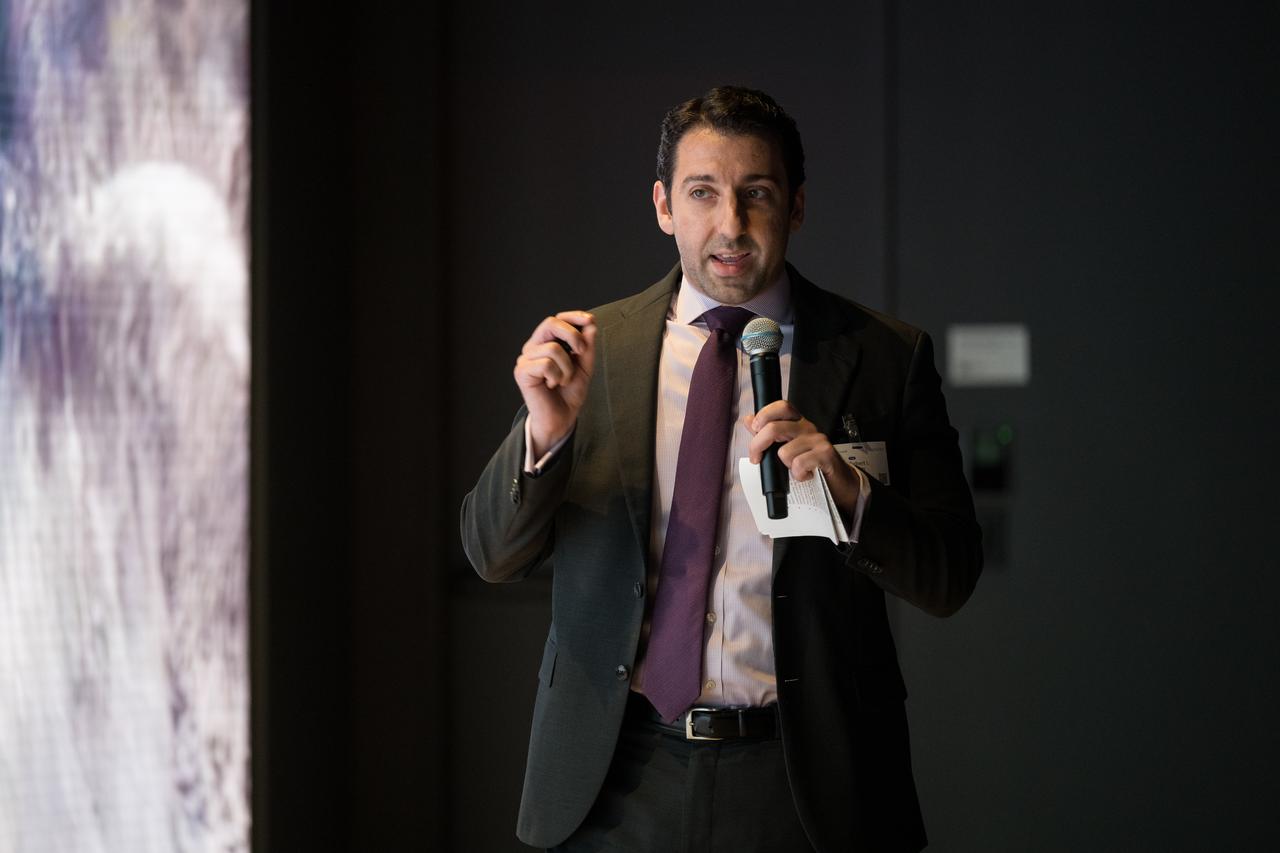
Director of Government Affairs and Business Development for Starburst Aerospace, Robert Ganim, provides remarks during Space Education Day, Tuesday, June 20, 2023, at the Microsoft Technology Center in Arlington, Va. Microsoft hosted the event to showcase the collaboration, early successes, and future plans for high quality student engagement through activities that combined space content and technologies like artificial intelligence and cloud computing. Photo Credit: (NASA/Aubrey Gemignani)
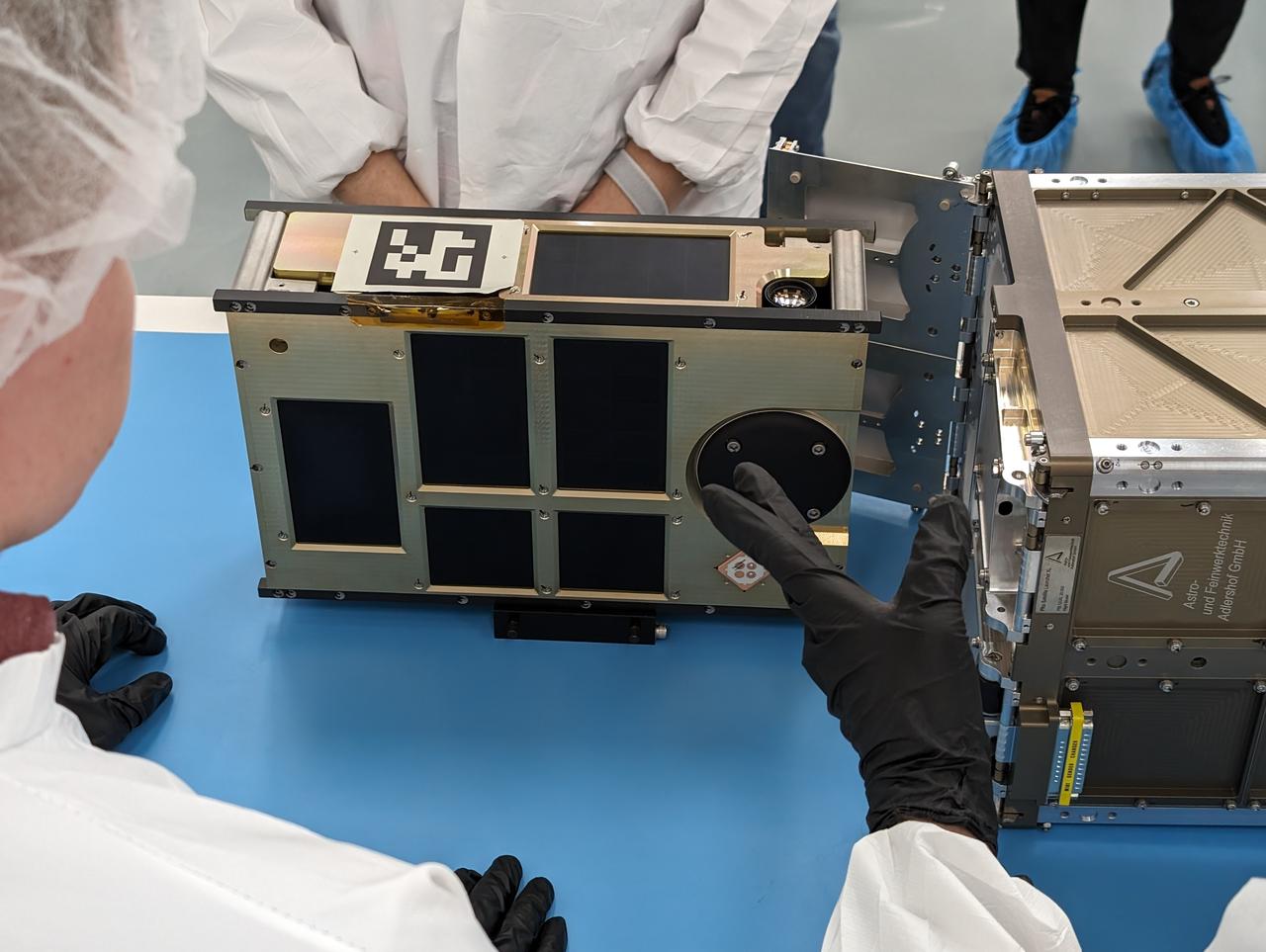
NASA and Firefly Aerospace engineers review the integration plan for the agency’s CubeSat R5 Spacecraft 4 (R5-S4) at Firefly Aerospace’s Payload Processing Facility at Vandenberg Space Force Base, California on Wednesday, April 24, 2024. The spacecraft will soon be integrated for launch aboard the company’s Alpha rocket, as part of launch services provided for NASA's CubeSat Launch Initiative and Educational Launch of Nanosatellites 43 mission in support of the agency ’s Venture-Class Launch Services Demonstration 2 contract.
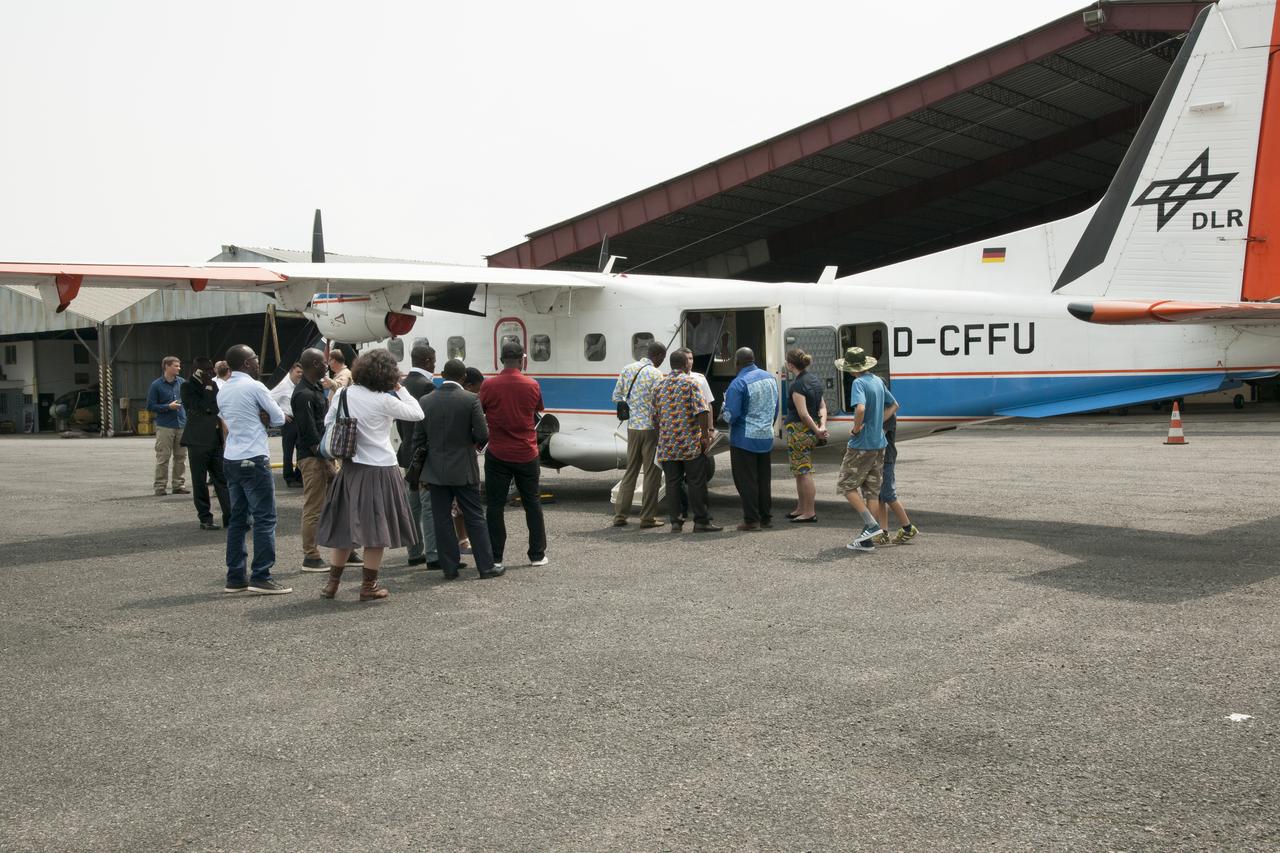
During an education outreach event in Gabon, Africa, students and educators, look at the German Aerospace Center Dornier DO-228 twin-engine turboprop aircraft.
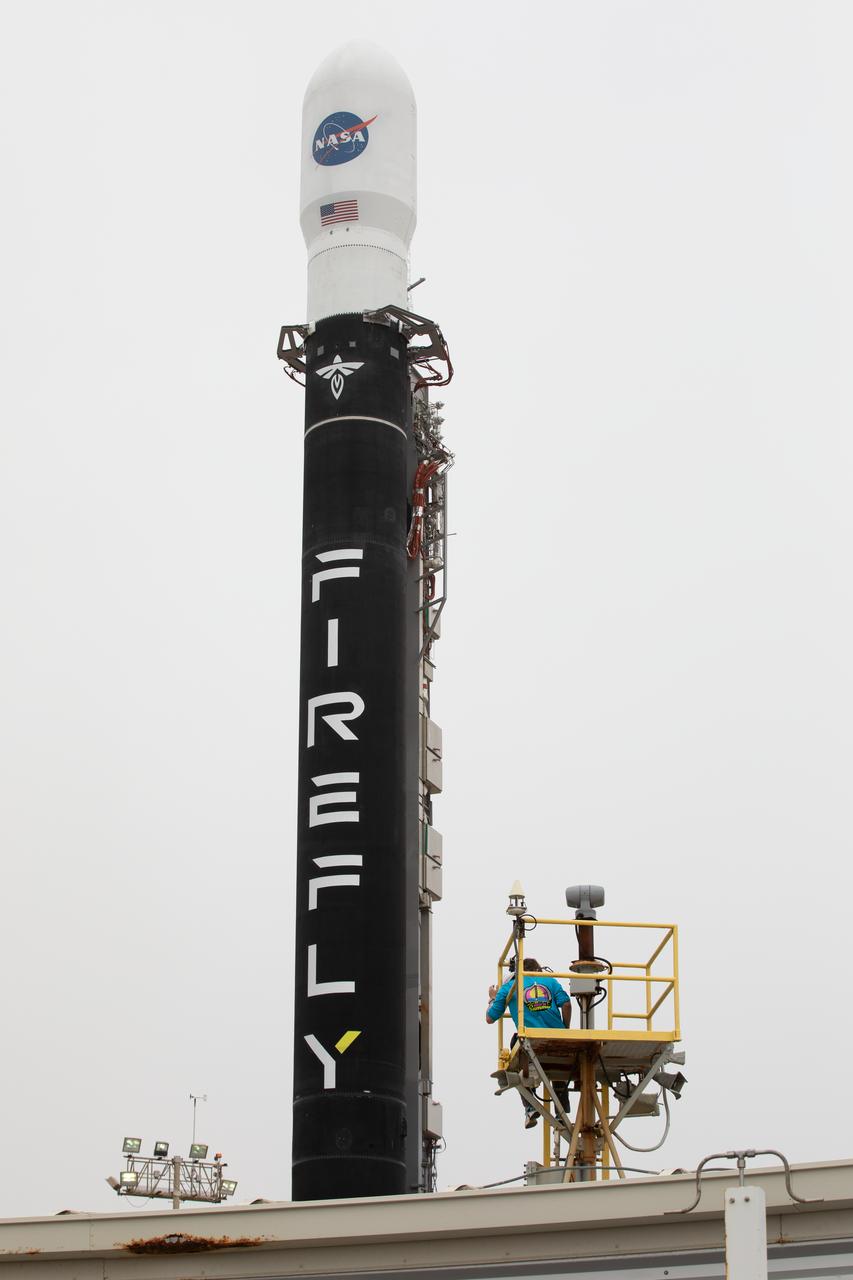
Firefly Aerospace’s Alpha rocket carrying eight CubeSats as part of NASA’s CubeSat Launch Initiative’s (CSLI) ELaNa 43 (Educational Launch of Nanosatellites) mission stands vertical at Space Launch Complex 2 at Vandenberg Space Force Base, California, on Monday, July 1, 2024. Firefly Aerospace is one of three companies selected to fly small satellites to space under NASA’s Launch Services Program Venture-Class Launch Services Demonstration 2 (VCLS Demo 2) contract awarded in December 2020.
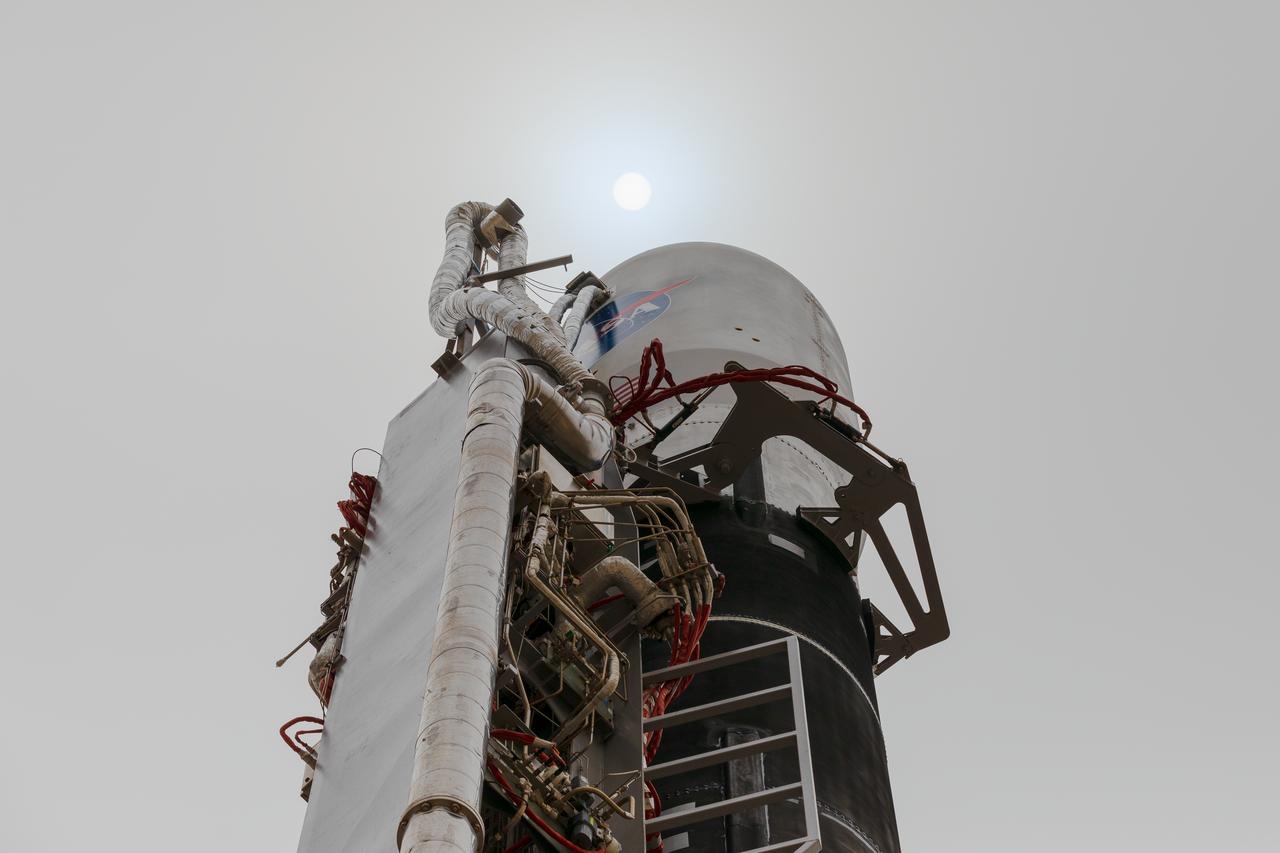
Firefly Aerospace’s Alpha rocket carrying eight CubeSats as part of NASA’s CubeSat Launch Initiative’s (CSLI) ELaNa 43 (Educational Launch of Nanosatellites) mission stands vertical at Space Launch Complex 2 at Vandenberg Space Force Base, California, on Monday, July 1, 2024. Firefly Aerospace is one of three companies selected to fly small satellites to space under NASA’s Launch Services Program Venture-Class Launch Services Demonstration 2 (VCLS Demo 2) contract awarded in December 2020.
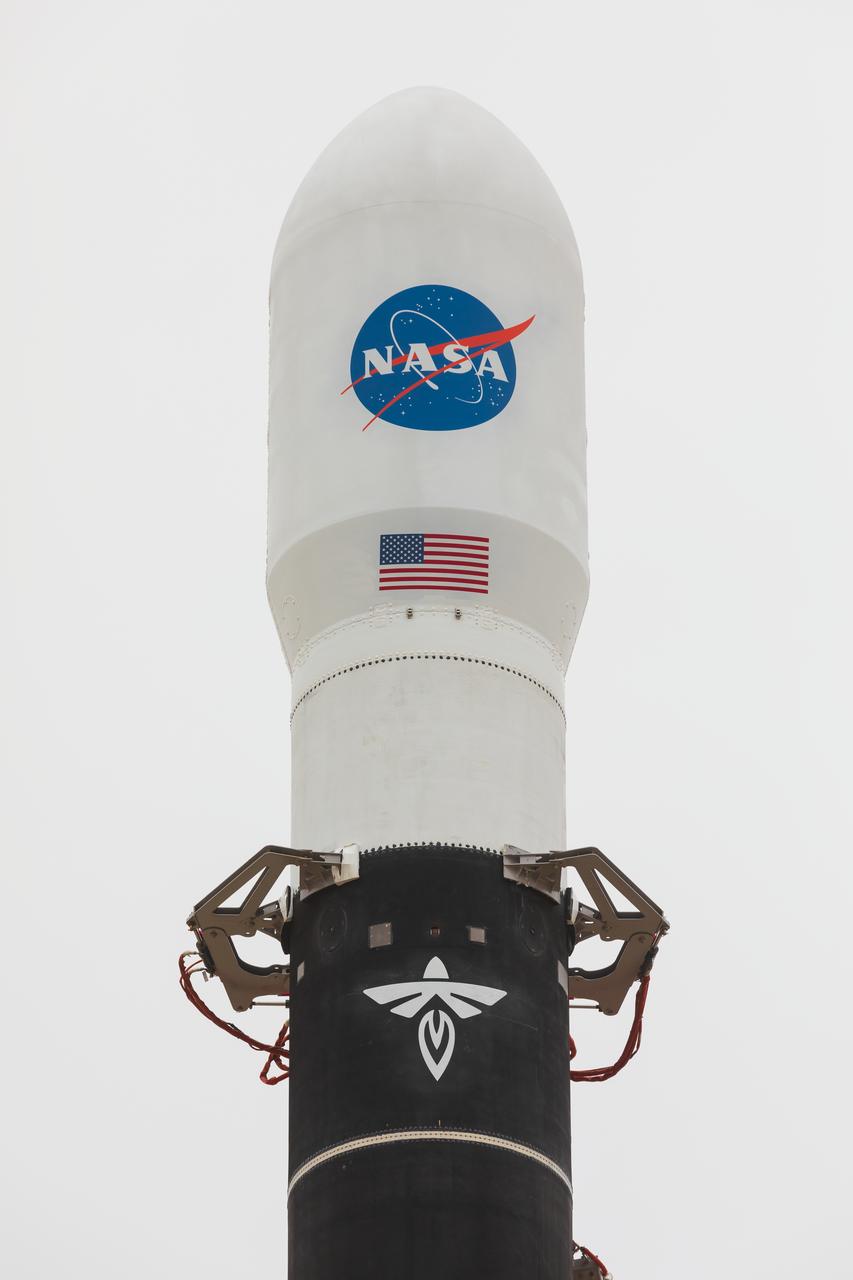
Firefly Aerospace’s Alpha rocket carrying eight CubeSats as part of NASA’s CubeSat Launch Initiative’s (CSLI) ELaNa 43 (Educational Launch of Nanosatellites) mission stands vertical at Space Launch Complex 2 at Vandenberg Space Force Base, California, on Monday, July 1, 2024. Firefly Aerospace is one of three companies selected to fly small satellites to space under NASA’s Launch Services Program Venture-Class Launch Services Demonstration 2 (VCLS Demo 2) contract awarded in December 2020.
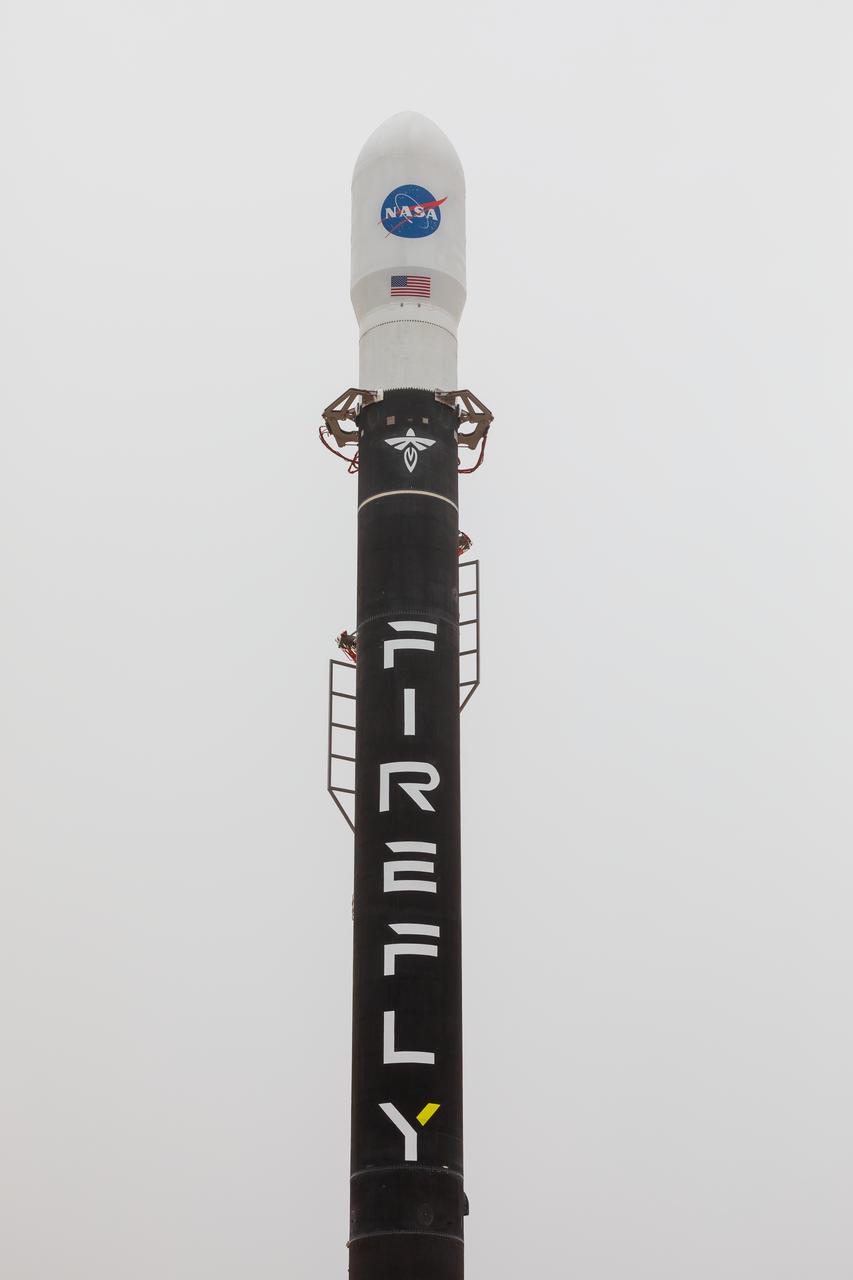
Firefly Aerospace’s Alpha rocket carrying eight CubeSats as part of NASA’s CubeSat Launch Initiative’s (CSLI) ELaNa 43 (Educational Launch of Nanosatellites) mission stands vertical at Space Launch Complex 2 at Vandenberg Space Force Base, California, on Monday, July 1, 2024. Firefly Aerospace is one of three companies selected to fly small satellites to space under NASA’s Launch Services Program Venture-Class Launch Services Demonstration 2 (VCLS Demo 2) contract awarded in December 2020.
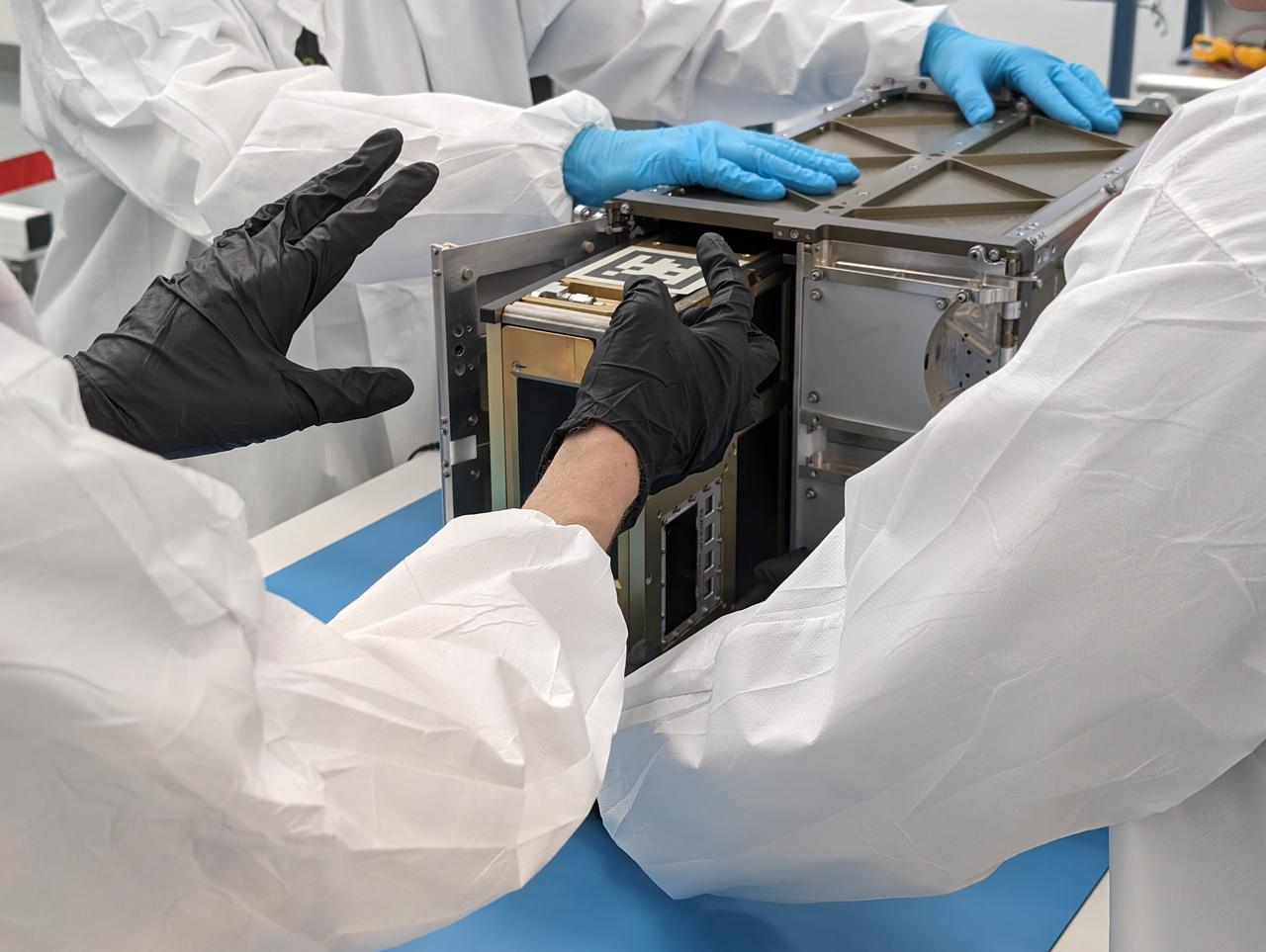
A NASA engineer installs the agency’s CubeSat R5 Spacecraft 4 (R5-S4) into the dispenser at Firefly Aerospace's Payload Processing Facility at Vandenberg Space Force Base, California on Wednesday, April 24, 2024. The spacecraft will soon be integrated for launch aboard the company’s Alpha rocket, as part of launch services provided for NASA's CubeSat Launch Initiative and Educational Launch of Nanosatellites 43 mission in support of the agency ’s Venture-Class Launch Services Demonstration 2 contract.

Steve Culivan, aerospace education specialist at Stennis Space Center, conducts a professional development workshop for fourth- through ninth-grade educators. During the Nov. 4 'Learning with the Stars' workshop, educators spent time learning about different aspects of the universe and enjoying a presentation of Stennis' portable planetarium.
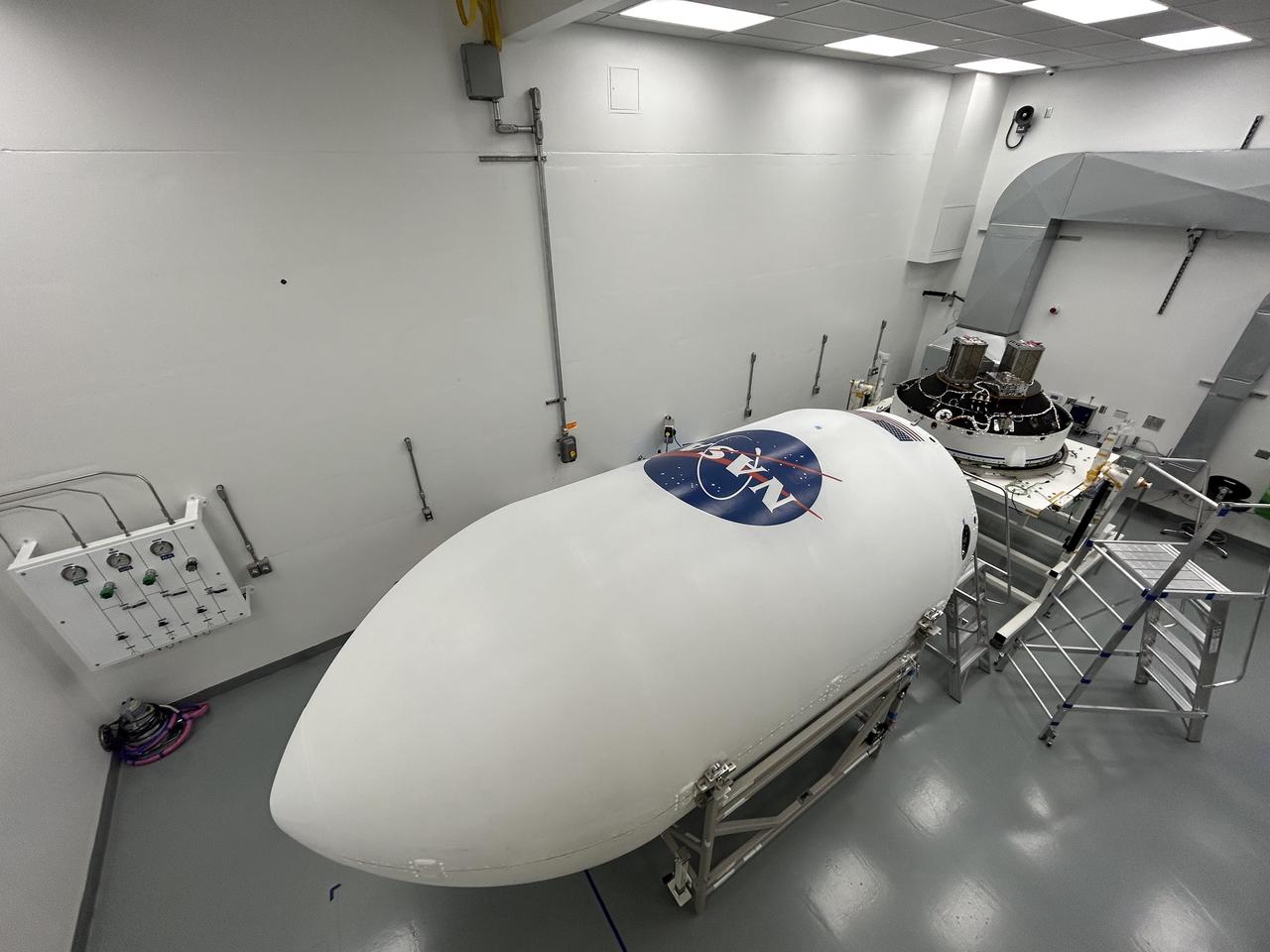
Technicians inside Firefly Aerospace’s Payload Processing Facility at Vandenberg Space Force Base, California, integrate eight CubeSats as part of NASA’s CubeSat Launch Initiative’s (CSLI) ELaNa (Educational Launch of Nanosatellites) 43 mission into payload fairings on Sunday, June 30, 2024. The mission will launch on the company’s Alpha rocket from Vandenberg’s Space Launch Complex 2. Firefly Aerospace is one of three companies selected to fly small satellites to space under NASA’s Launch Services Program Venture-Class Launch Services Demonstration 2 (VCLS Demo 2) contract awarded in December 2020.
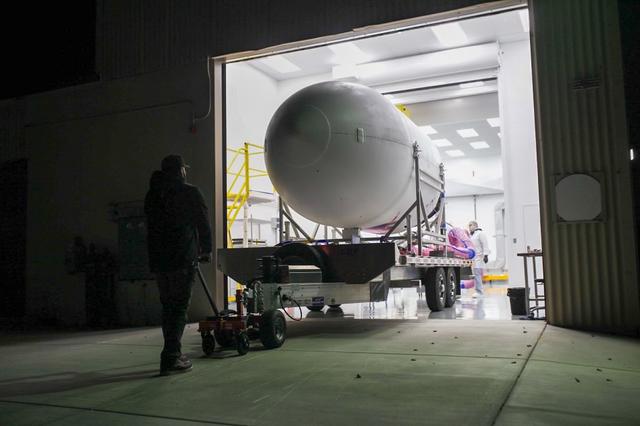
Firefly Aerospace’s Alpha rocket carrying eight CubeSats as part of NASA’s CubeSat Launch Initiative’s (CSLI) ELaNa (Educational Launch of Nanosatellites) 43 mission rolls out of the company’s Payload Processing Facility to Space Launch Complex 2 at Vandenberg Space Force Base, California, on Sunday, June 30, 2024. Firefly Aerospace is one of three companies selected to fly small satellites to space under NASA’s Launch Services Program Venture-Class Launch Services Demonstration 2 (VCLS Demo 2) contract awarded in December 2020.
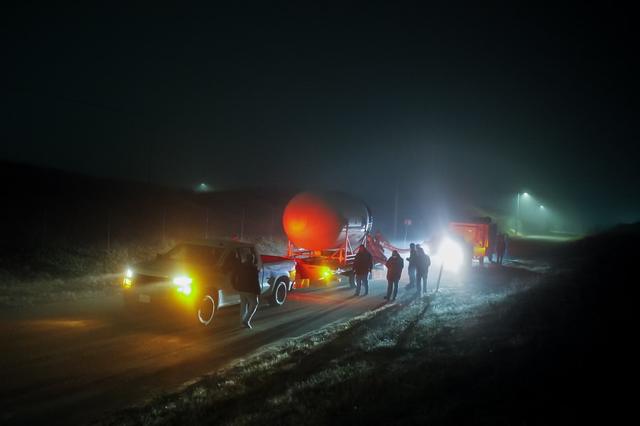
Firefly Aerospace’s Alpha rocket carrying eight CubeSats as part of NASA’s CubeSat Launch Initiative’s (CSLI) ELaNa (Educational Launch of Nanosatellites) 43 mission rolls out of the company’s Payload Processing Facility to Space Launch Complex 2 at Vandenberg Space Force Base, California, on Sunday, June 30, 2024. Firefly Aerospace is one of three companies selected to fly small satellites to space under NASA’s Launch Services Program Venture-Class Launch Services Demonstration 2 (VCLS Demo 2) contract awarded in December 2020.
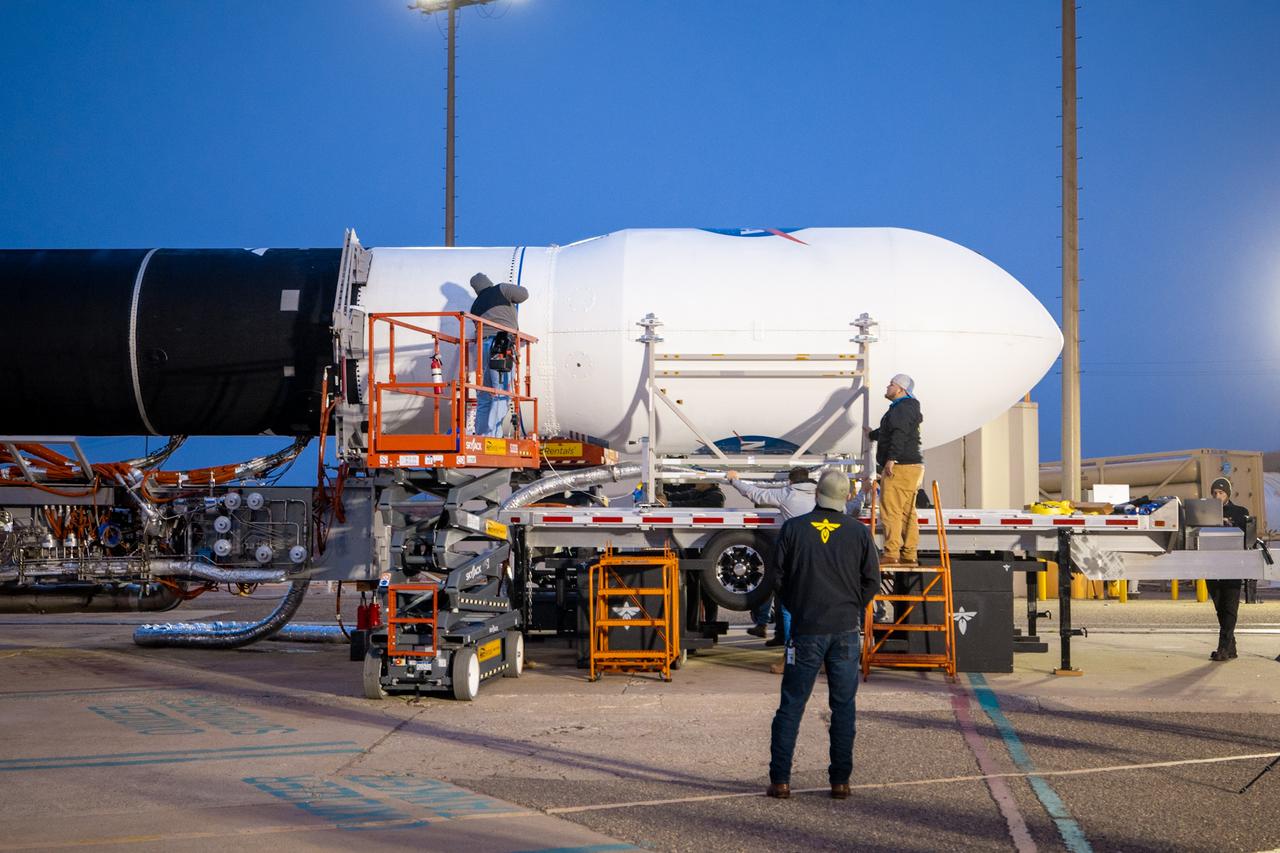
Firefly Aerospace’s Alpha rocket carrying eight CubeSats as part of NASA’s CubeSat Launch Initiative’s (CSLI) ELaNa (Educational Launch of Nanosatellites) 43 mission rolls out of the company’s Payload Processing Facility to Space Launch Complex 2 at Vandenberg Space Force Base, California, on Sunday, June 30, 2024. Firefly Aerospace is one of three companies selected to fly small satellites to space under NASA’s Launch Services Program Venture-Class Launch Services Demonstration 2 (VCLS Demo 2) contract awarded in December 2020.
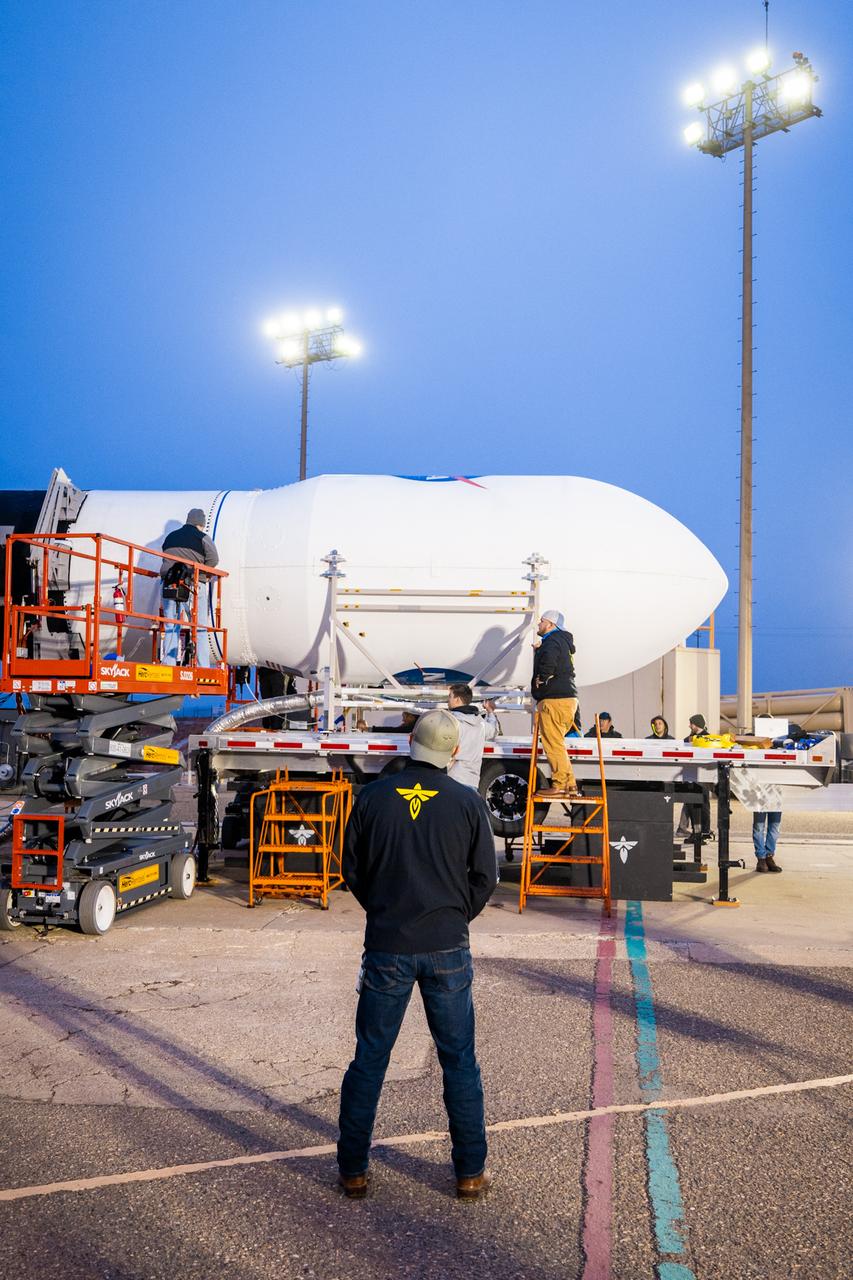
Firefly Aerospace’s Alpha rocket carrying eight CubeSats as part of NASA’s CubeSat Launch Initiative’s (CSLI) ELaNa (Educational Launch of Nanosatellites) 43 mission rolls out of the company’s Payload Processing Facility to Space Launch Complex 2 at Vandenberg Space Force Base, California, on Sunday, June 30, 2024. Firefly Aerospace is one of three companies selected to fly small satellites to space under NASA’s Launch Services Program Venture-Class Launch Services Demonstration 2 (VCLS Demo 2) contract awarded in December 2020.
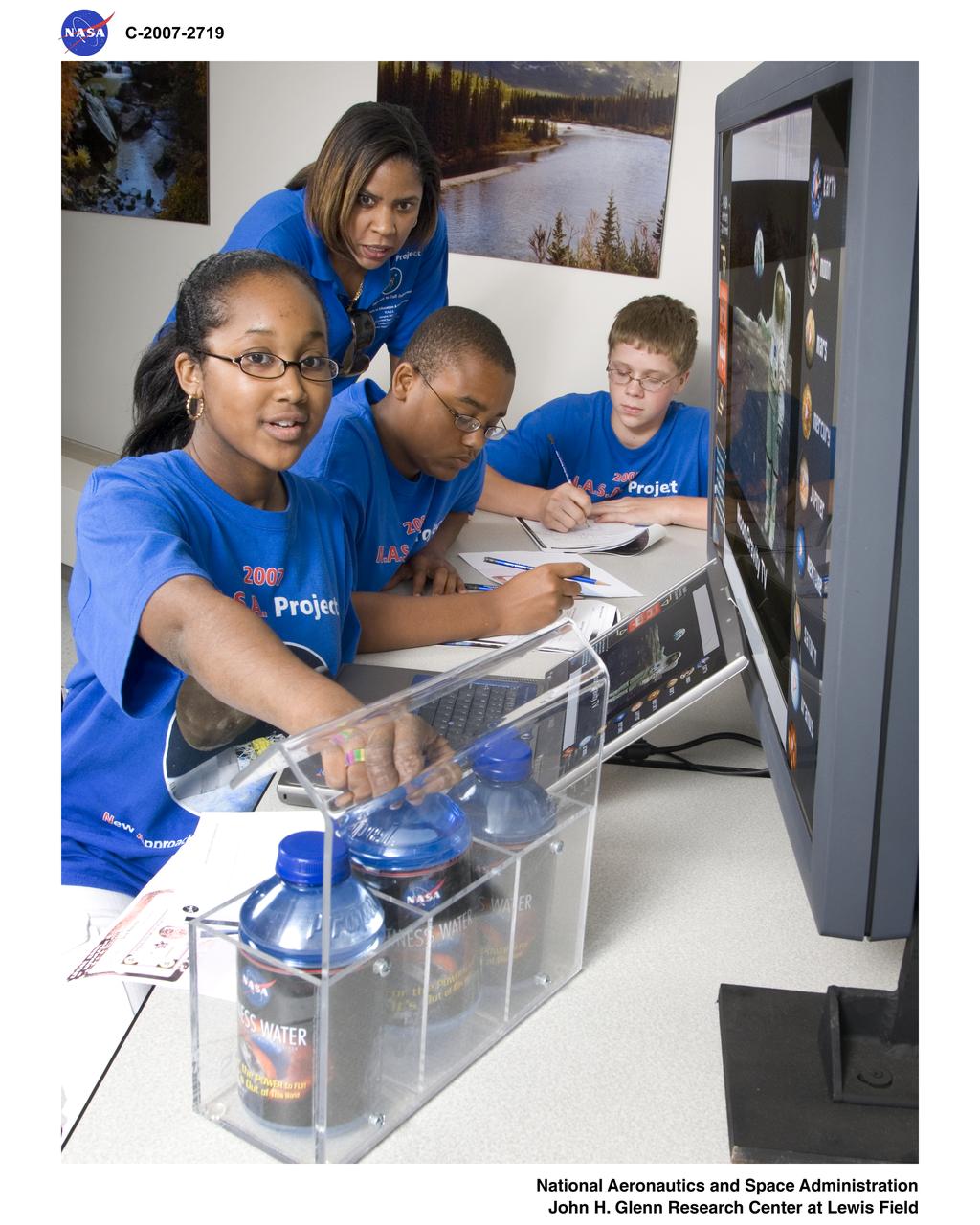
New Approach to Self Achievement (N.A.S.A.) Project Students work together at the Aerospace Education Center Return to the Moon Discovery Path Moon Gravity Module
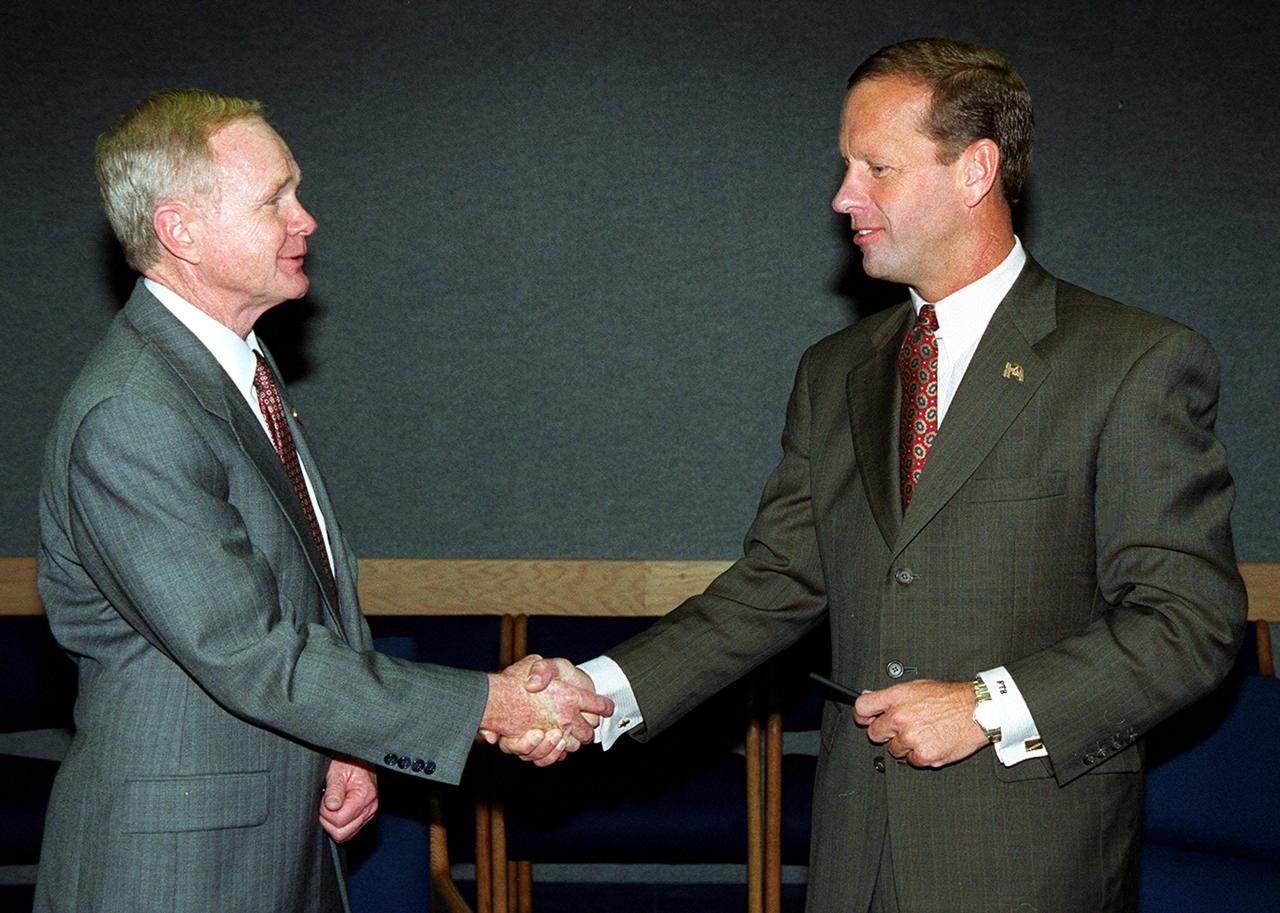
At the KSC Visitor Complex, Center Director Roy D. Bridges (left) and Florida’s Lieutenant Governor Frank T. Brogan shake hands after signing a Memorandum of Understanding (MOU). The MOU documents the intent of NASA KSC and the State of Florida to form partnerships with academic institutions in Florida for development of aerospace-related advanced training and academic/educational programs. The three-year project anticipates that the partnership and educational programs fostered will improve the lifelong learning environment for the aerospace and engineering workforce
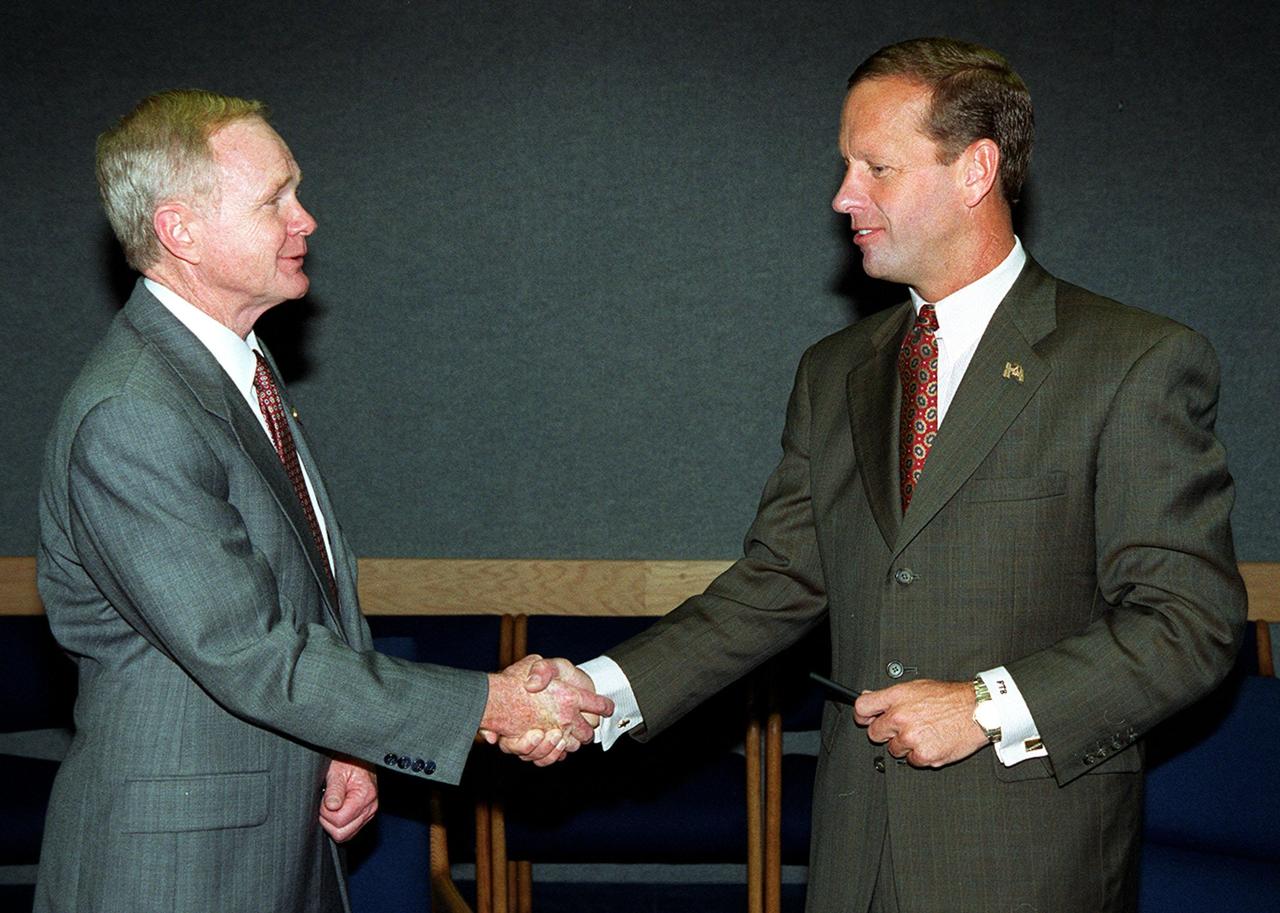
At the KSC Visitor Complex, Center Director Roy D. Bridges (left) and Florida’s Lieutenant Governor Frank T. Brogan shake hands after signing a Memorandum of Understanding (MOU). The MOU documents the intent of NASA KSC and the State of Florida to form partnerships with academic institutions in Florida for development of aerospace-related advanced training and academic/educational programs. The three-year project anticipates that the partnership and educational programs fostered will improve the lifelong learning environment for the aerospace and engineering workforce
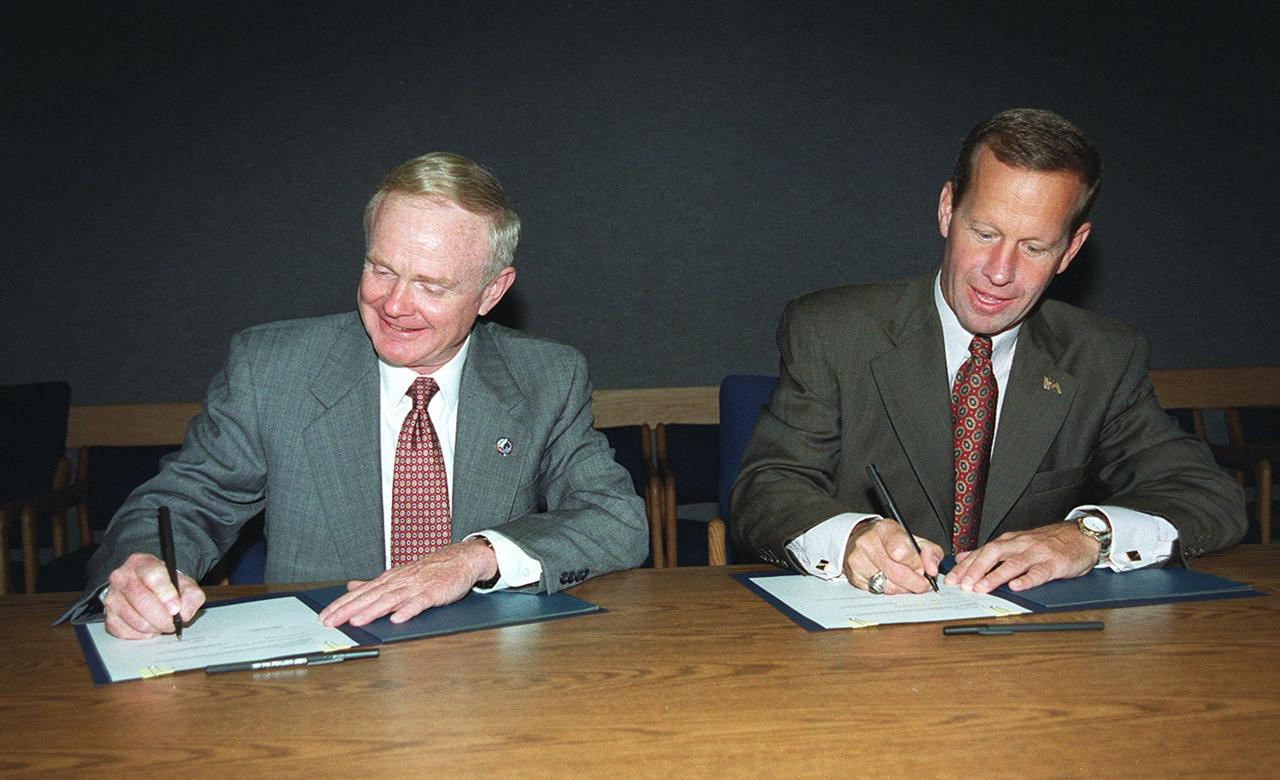
At the KSC Visitor Complex, Center Director Roy D. Bridges (left) and Florida’s Lieutenant Governor Frank T. Brogan sign a Memorandum of Understanding (MOU). The MOU documents the intent of NASA KSC and the State of Florida to form partnerships with academic institutions in Florida for development of aerospace-related advanced training and academic/educational programs. The three-year project anticipates that the partnership and educational programs fostered will improve the lifelong learning environment for the aerospace and engineering workforce
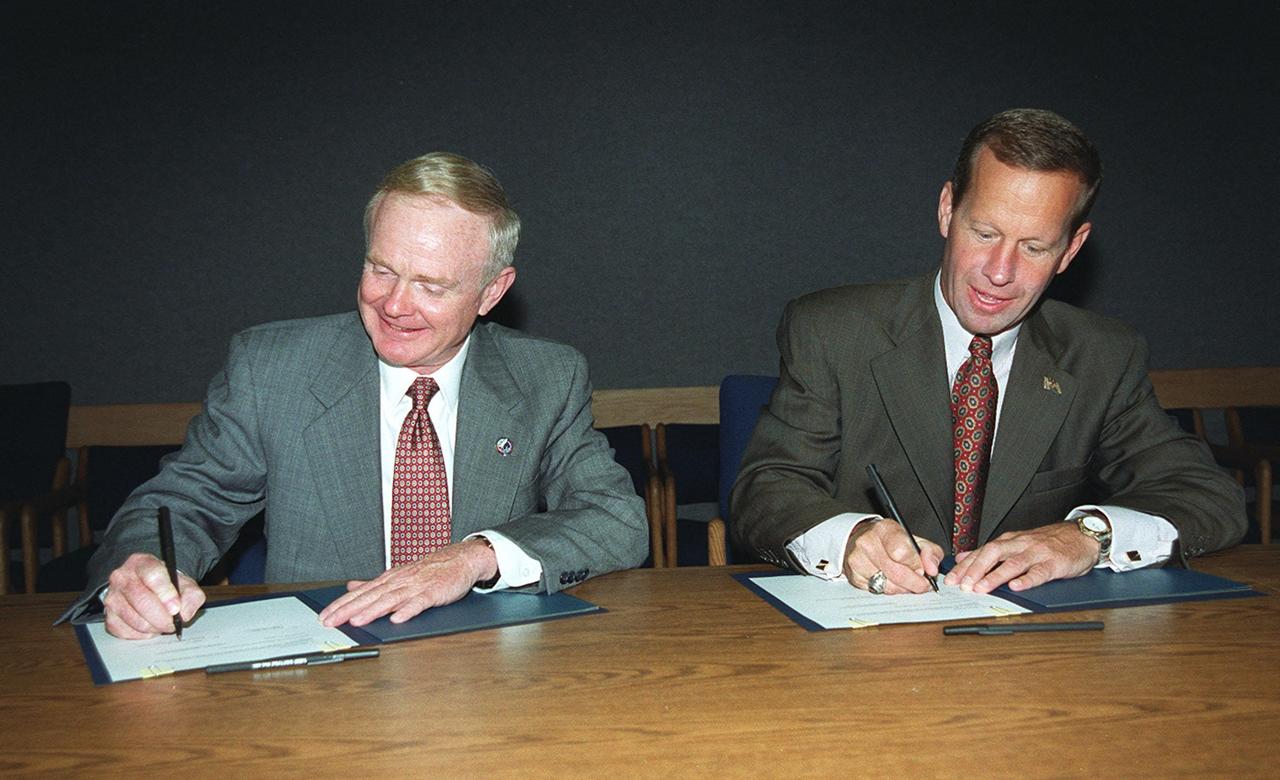
At the KSC Visitor Complex, Center Director Roy D. Bridges (left) and Florida’s Lieutenant Governor Frank T. Brogan sign a Memorandum of Understanding (MOU). The MOU documents the intent of NASA KSC and the State of Florida to form partnerships with academic institutions in Florida for development of aerospace-related advanced training and academic/educational programs. The three-year project anticipates that the partnership and educational programs fostered will improve the lifelong learning environment for the aerospace and engineering workforce
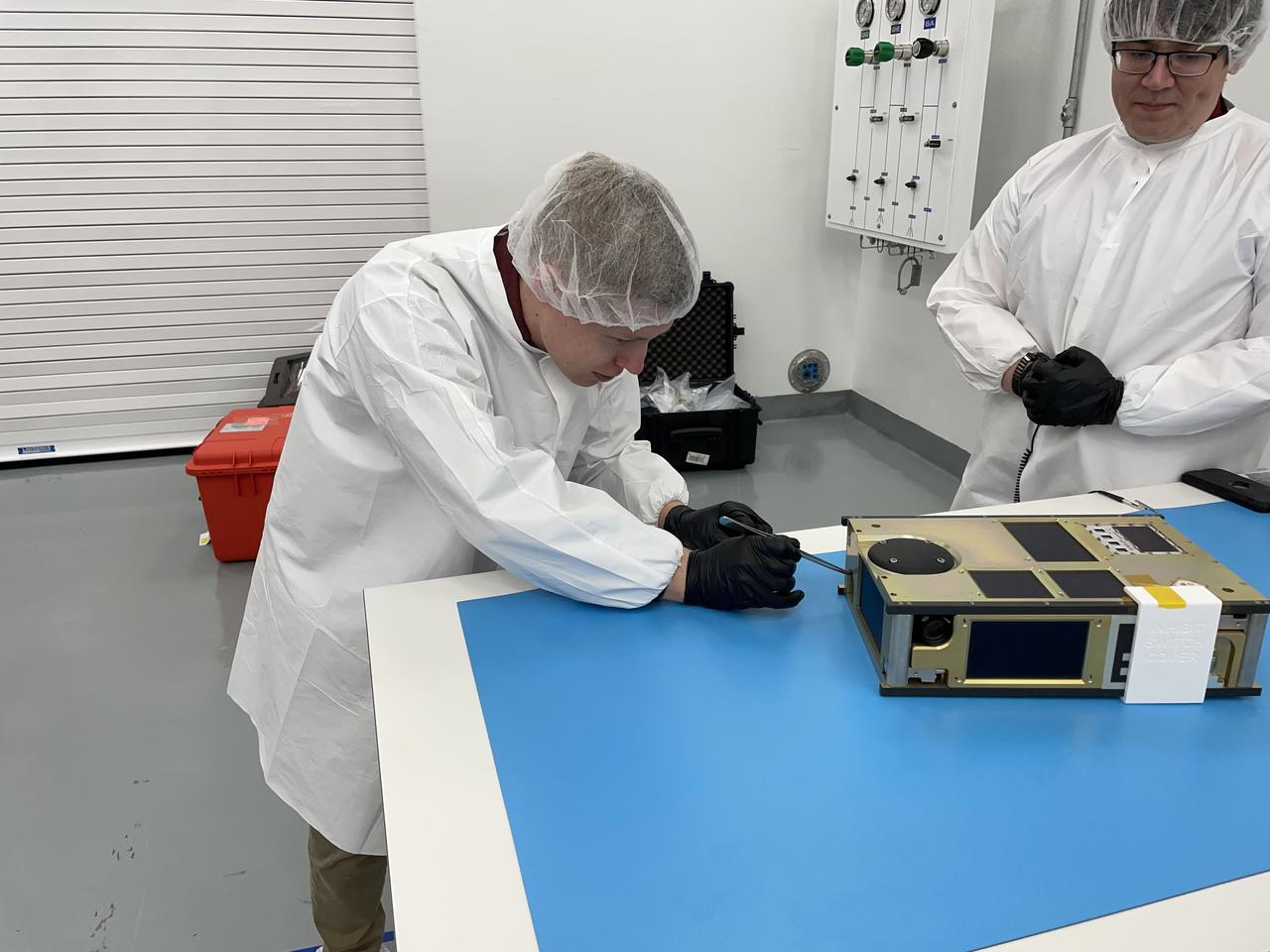
From left, NASA engineer James Berck removes the foreign object debris (FOD) cover from the relative navigation camera on the agency’s CubeSat R5 Spacecraft 4 (R5-S4) while NASA engineer Jacob Nunez-Kearny observes, at Firefly Aerospace’s Payload Processing Facility at Vandenberg Space Force Base, California on Wednesday, April 24, 2024. The spacecraft will soon be integrated for launch aboard the company’s Alpha rocket, as part of launch services provided for NASA's CubeSat Launch Initiative and Educational Launch of Nanosatellites 43 mission in support of the agency ’s Venture-Class Launch Services Demonstration 2 contract.
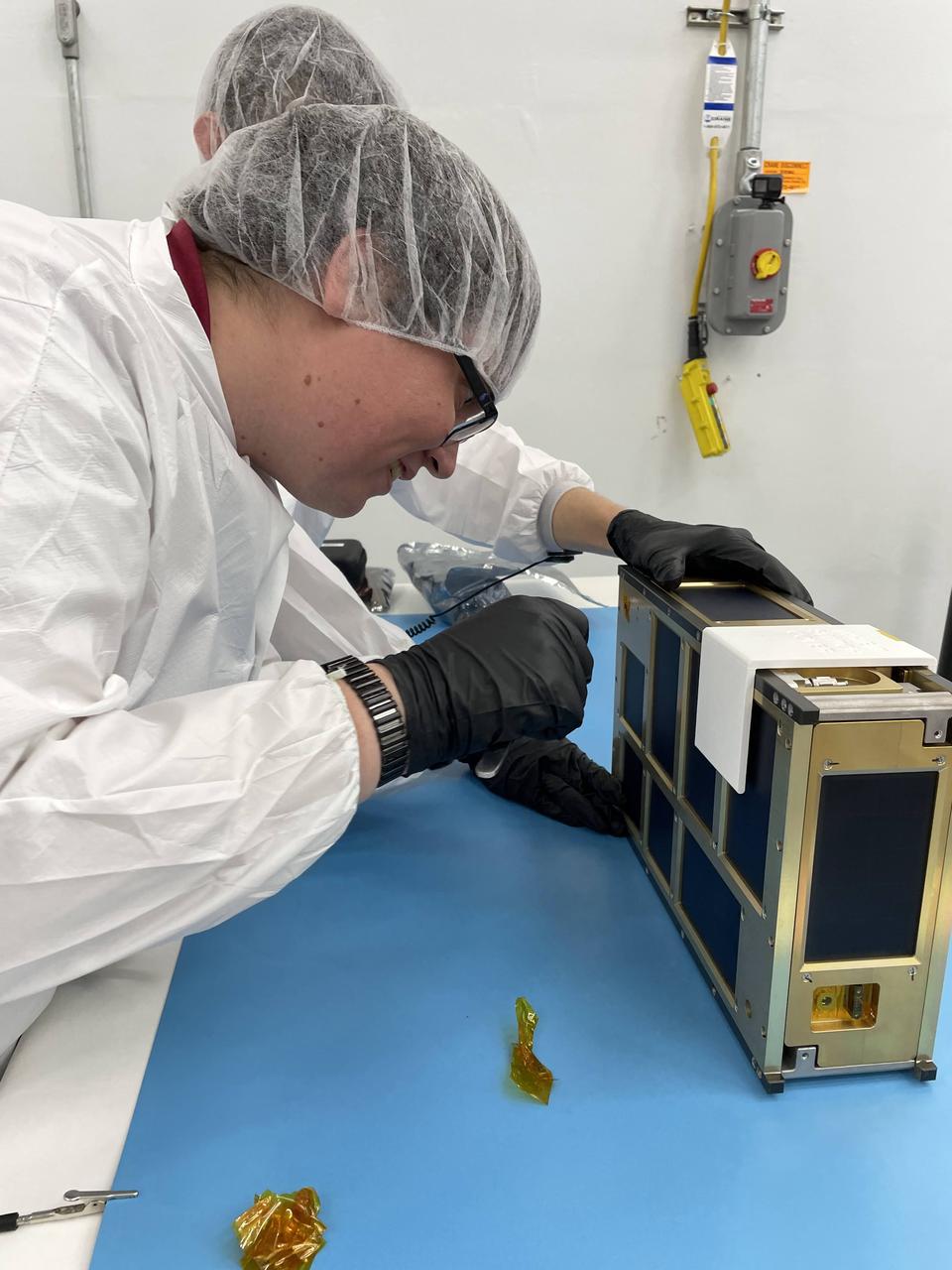
NASA engineer Jacob Nunez-Kearny removes the foreign object debris (FOD) cover from the propulsion system on the agency’s CubeSat R5 Spacecraft 4 (R5-S4) at Firefly Aerospace’s Payload Processing Facility at Vandenberg Space Force Base, California on Wednesday, April 24, 2024. The spacecraft will soon be integrated for launch aboard the company’s Alpha rocket, as part of launch services provided for NASA's CubeSat Launch Initiative and Educational Launch of Nanosatellites 43 mission in support of the agency ’s Venture-Class Launch Services Demonstration 2 contract .

From left, Firefly mission manager Marcy Mabry observes NASA engineer James Berck install the agency’s CubeSat R5 Spacecraft 4 (R5-S4) into the dispenser at Firefly Aerospace’s Payload Processing Facility at Vandenberg Space Force Base, California on Wednesday, April 24, 2024. The spacecraft will soon be integrated for launch aboard the company’s Alpha rocket, as part of launch services provided for NASA's CubeSat Launch Initiative and Educational Launch of Nanosatellites 43 mission in support of the agency ’s Venture-Class Launch Services Demonstration 2 contract.
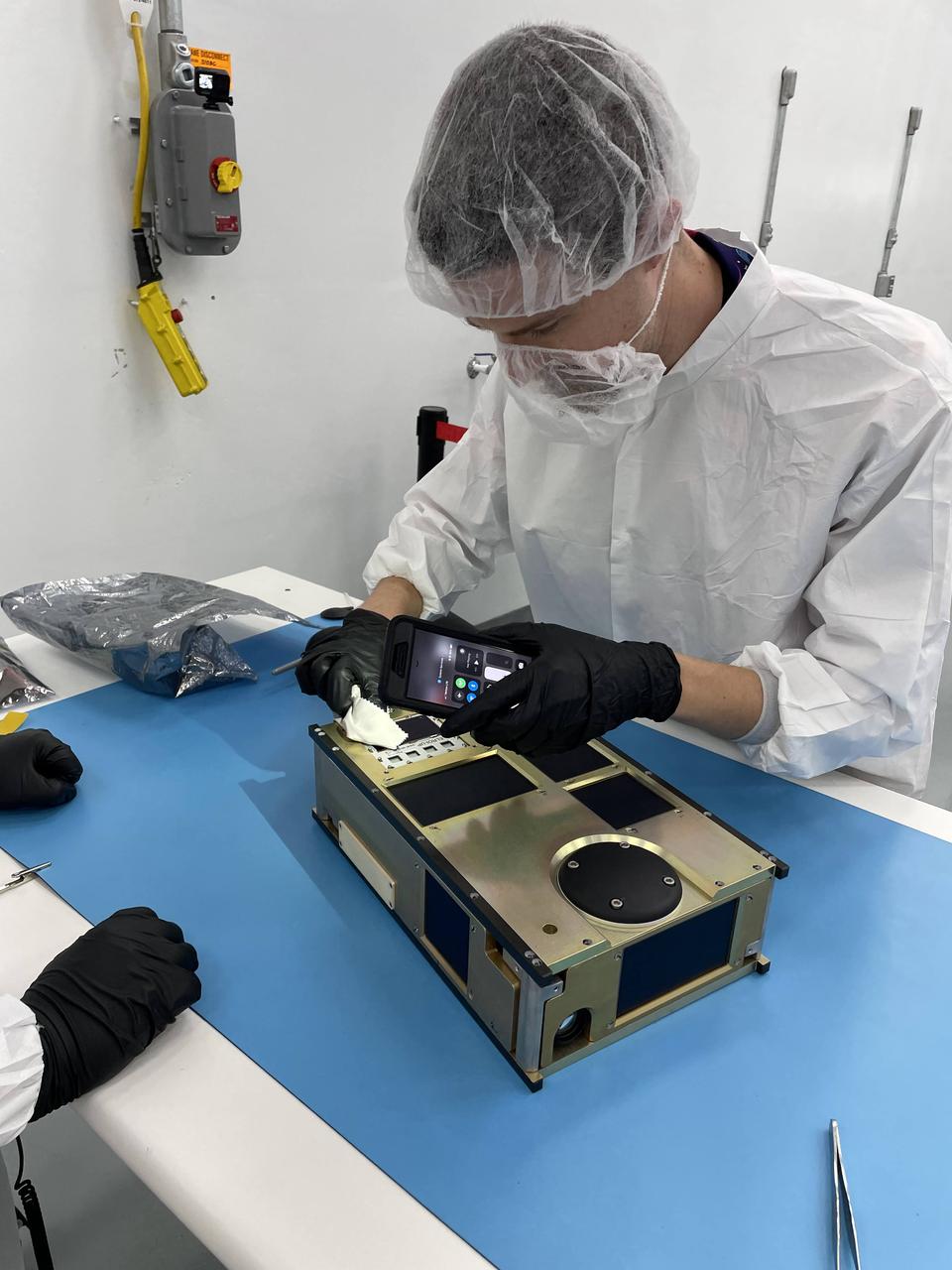
NASA engineer Sam Pedrotty performs final cleaning of Los Alamos National Laboratory’s (LANL’s) Extremely Low Resource Optical Identifier (ELROI) on the agency’s CubeSat R5 Spacecraft 4 (R5-S4) at Firefly Aerospace’s Payload Processing Facility at Vandenberg Space Force Base, California on Wednesday, April 24, 2024. The spacecraft will soon be integrated for launch aboard the company’s Alpha rocket, as part of launch services provided for NASA's CubeSat Launch Initiative and Educational Launch of Nanosatellites 43 mission in support of the agency ’s Venture-Class Launch Services Demonstration 2 contract.
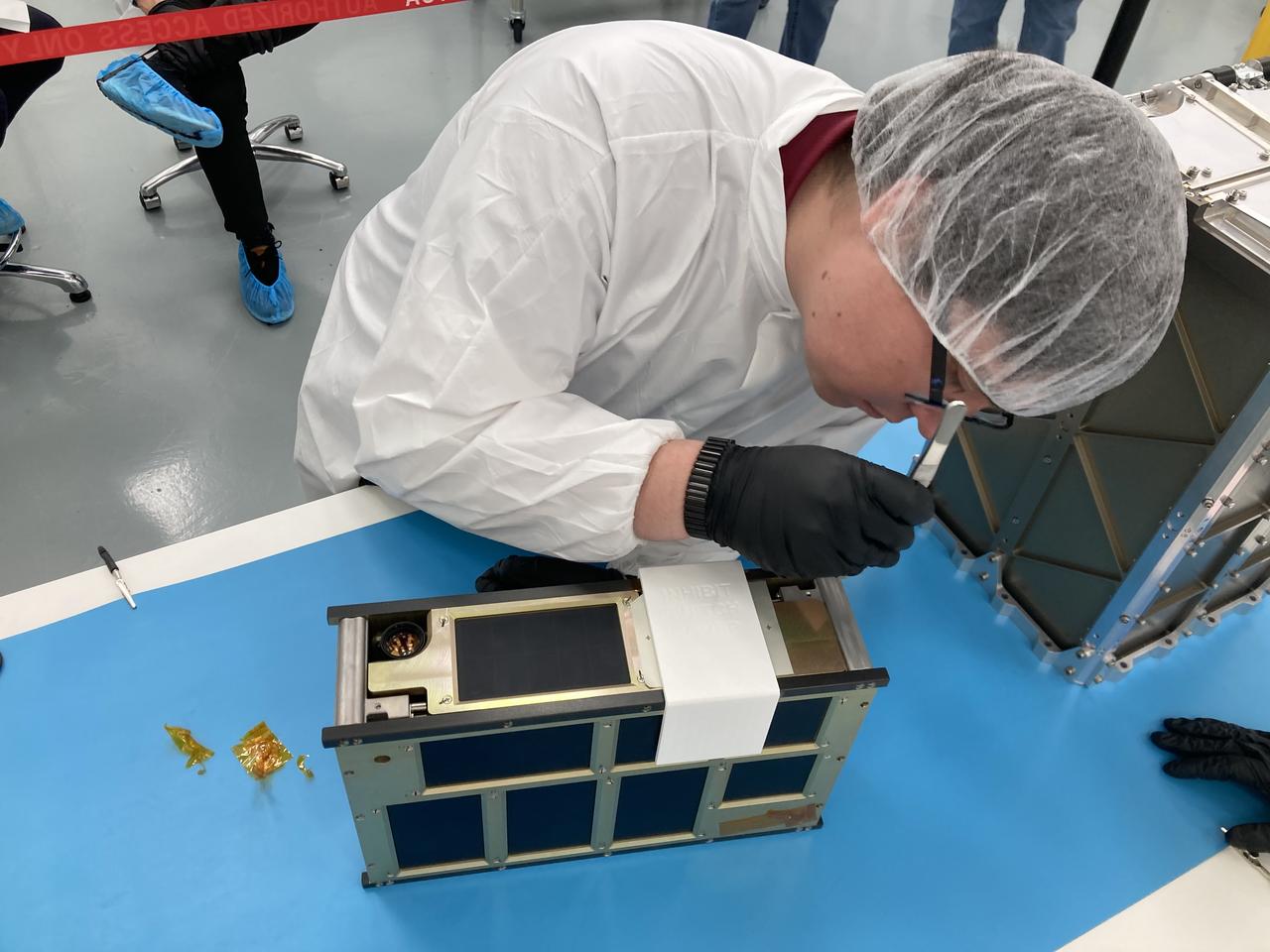
NASA engineer Jacob Nunez-Kearny removes foreign object debris (FOD) cover from the propulsion system on the agency’s CubeSat R5 Spacecraft 4 (R5-S4) at Firefly Aerospace’s Payload Processing Facility at Vandenberg Space Force Base, California on Wednesday, April 24, 2024. The spacecraft will soon be integrated for launch aboard the company’s Alpha rocket, as part of launch services provided for NASA's CubeSat Launch Initiative and Educational Launch of Nanosatellites 43 mission in support of the agency ’s Venture-Class Launch Services Demonstration 2 contract.
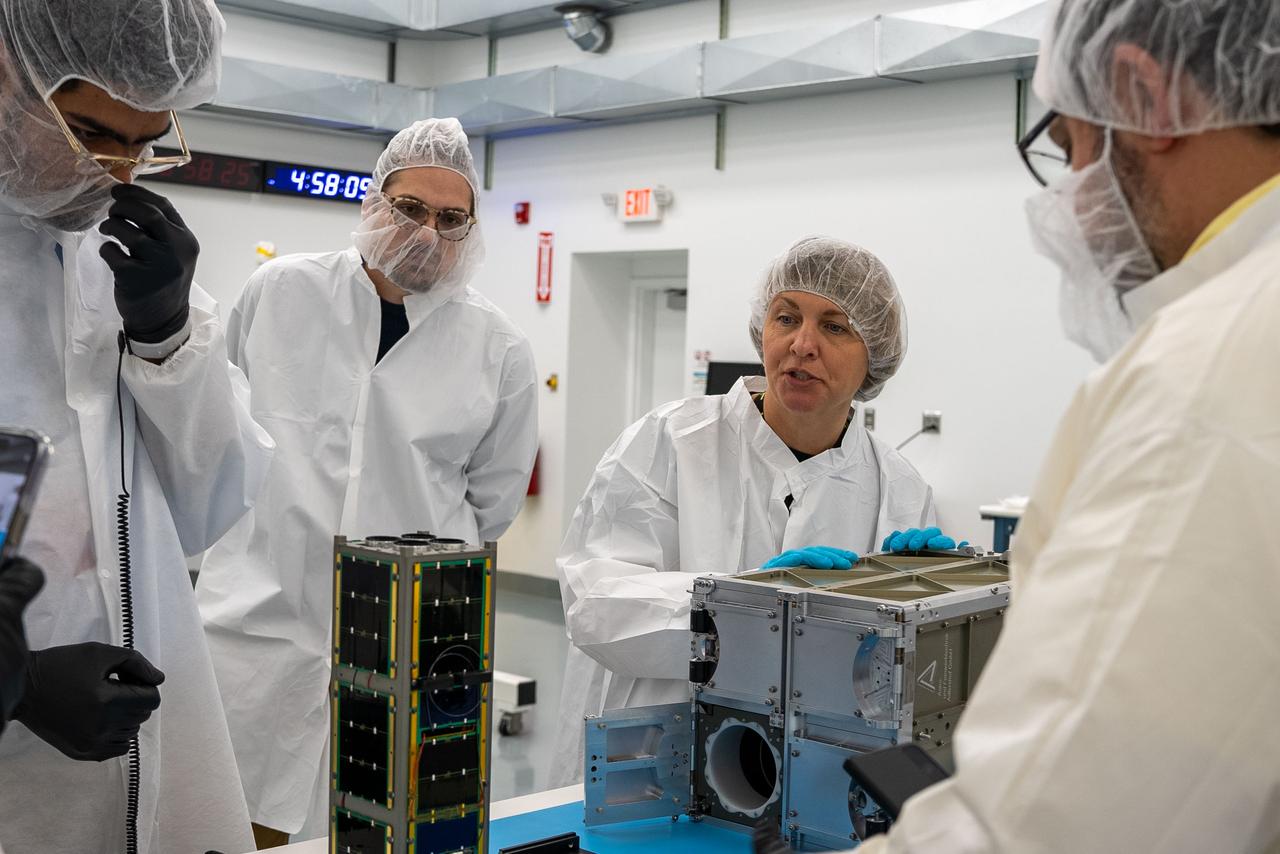
Technicians from the University of Maine prepare CubeSat MESAT-1 for integration at Firefly’s Payload Processing Facility at Vandenberg Space Force Base, California on Monday, April 22, 2024. MESAT-1, along with seven other payloads, will be integrated into a Firefly Aerospace Alpha rocket for NASA’s Educational Launch of Nanosatellites (ELaNa) 43 mission as part of the agency’s CubeSat Launch Initiative and Firefly’s Venture-Class Launch Services Demonstration 2 contract.
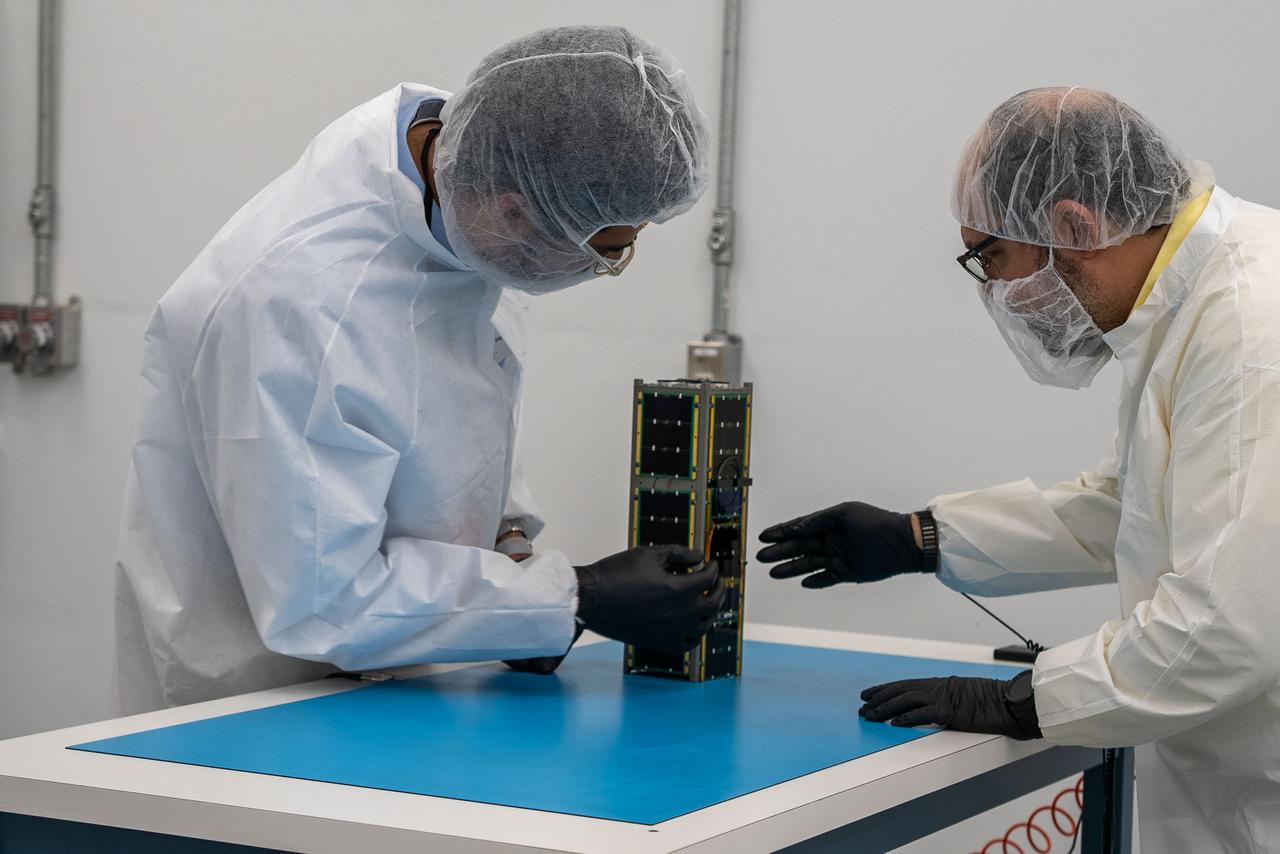
Technicians from the University of Maine prepare CubeSat MESAT-1 for integration at Firefly’s Payload Processing Facility at Vandenberg Space Force Base, California on Monday, April 22, 2024. MESAT-1, along with seven other payloads, will be integrated into a Firefly Aerospace Alpha rocket for NASA’s Educational Launch of Nanosatellites (ELaNa) 43 mission as part of the agency’s CubeSat Launch Initiative and Firefly’s Venture-Class Launch Services Demonstration 2 contract.
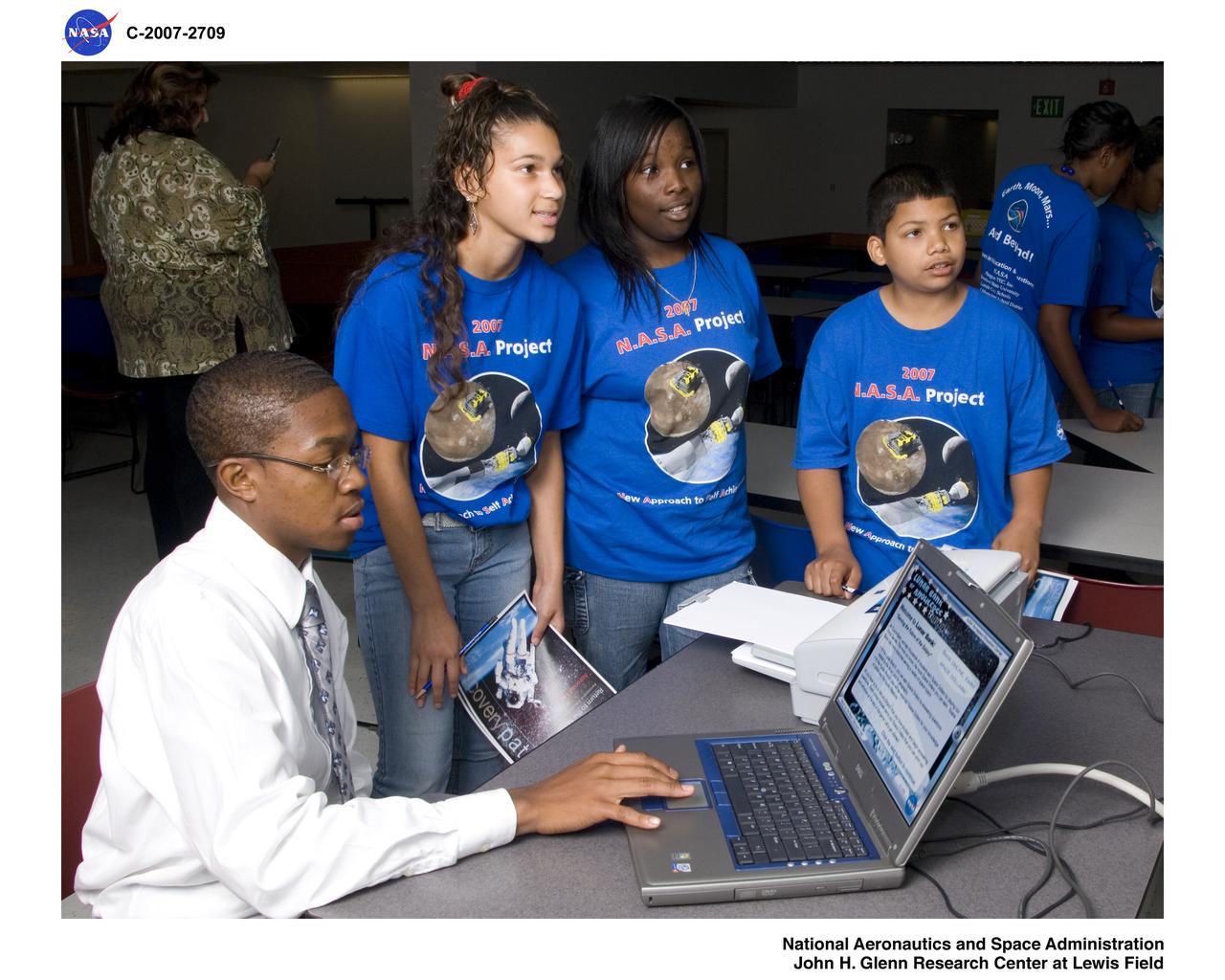
New Approach to Self Achievement (N.A.S.A.) Project Students test their knowledge of Moon Facts at the Aerospace Education Center Return to the Moon Discovery Path Lunar Bank of Knowledge
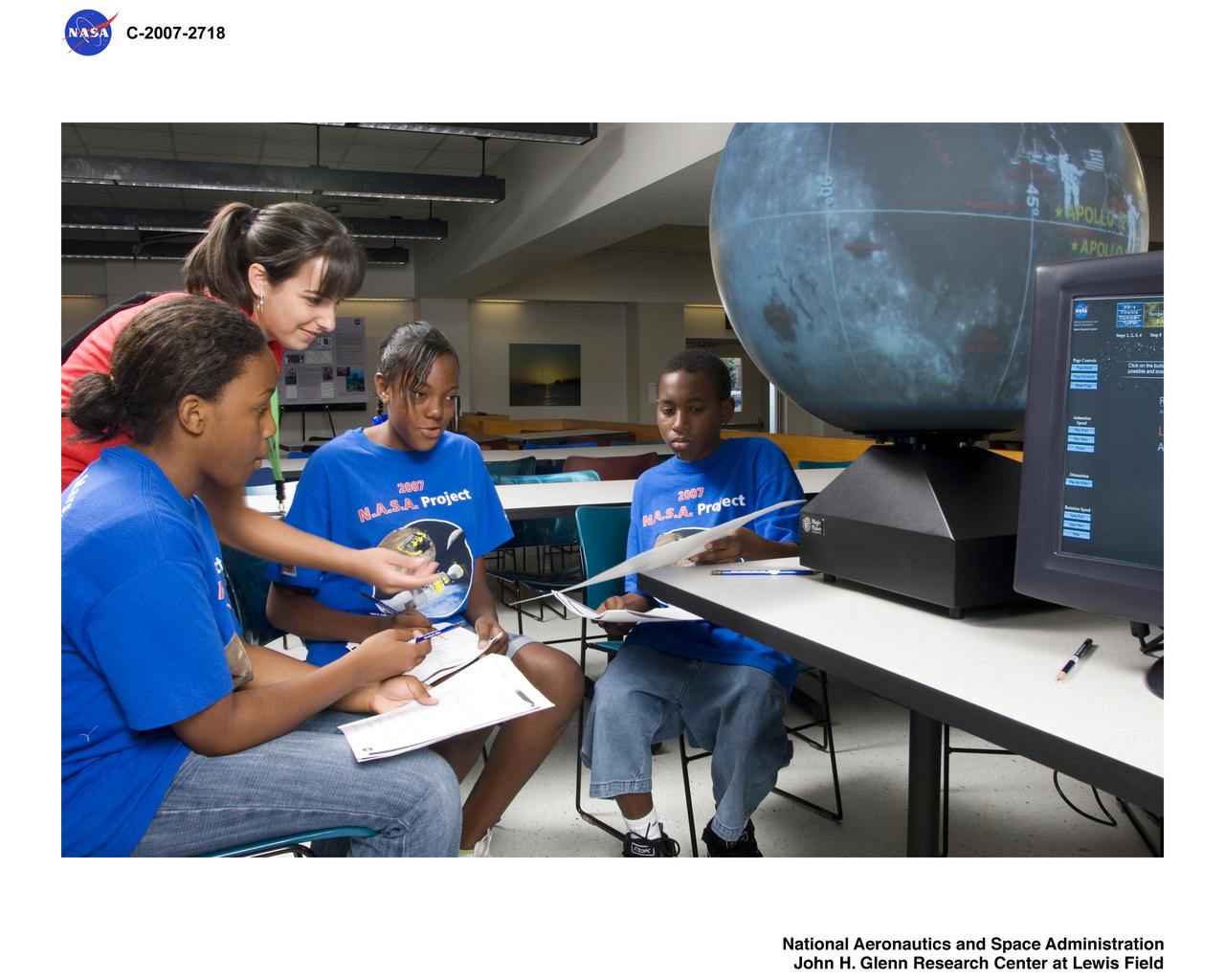
New Approach to Self Achievement (N.A.S.A.) Project Students learn about the geology of the Moon at the Aerospace Education Center Return to the Moon Discovery Path Lunar Locations Module
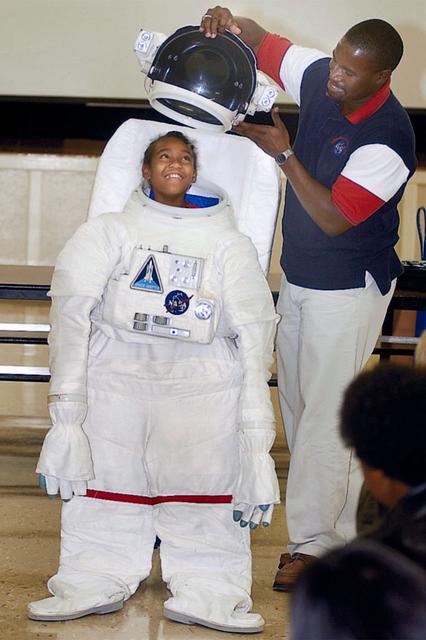
JSC2004E14160 --- AESP Student Assembly Program, Wilson Elementary School, Lawton, OK November 2003
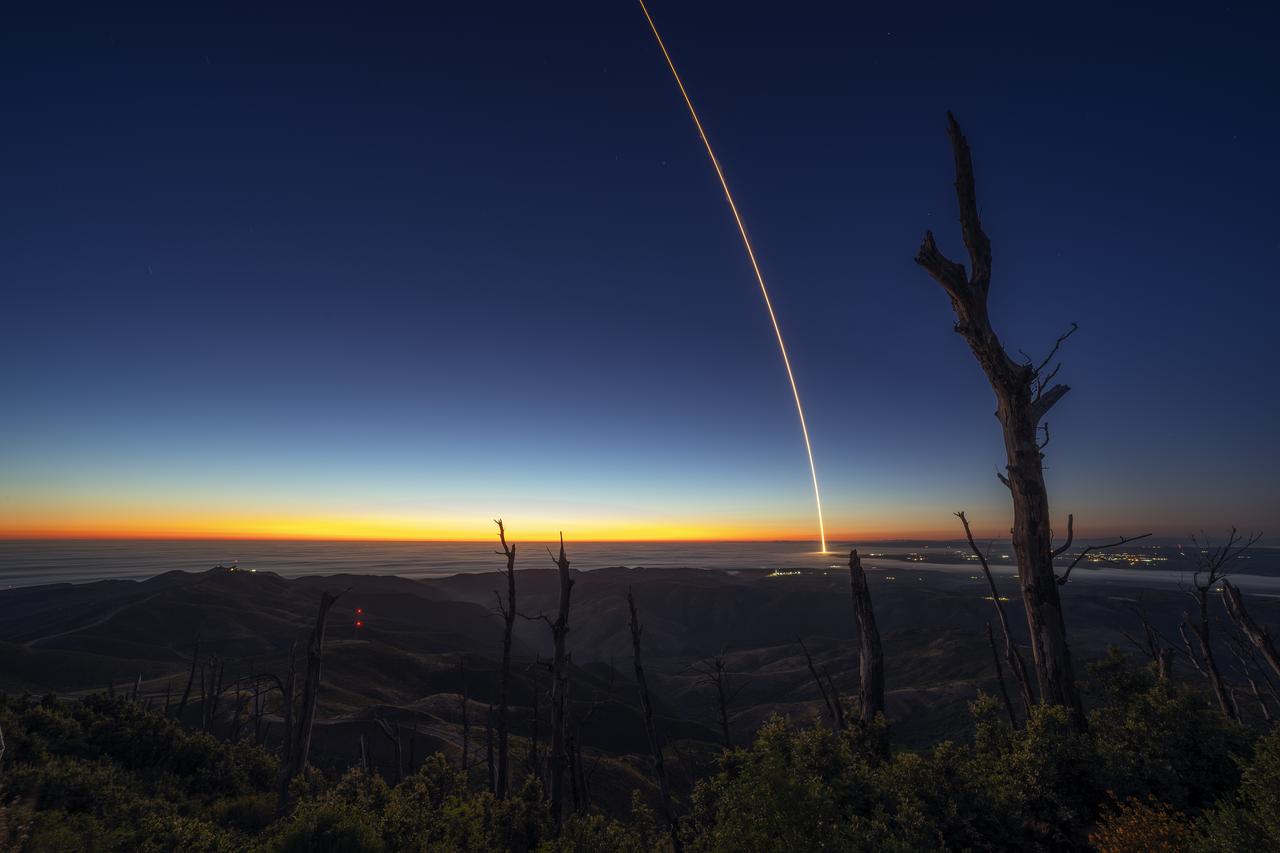
Firefly Aerospace’s Alpha rocket carrying eight CubeSats as part of NASA’s CubeSat Launch Initiative (CSLI) lifts off from Space Launch Complex 2 at Vandenberg Space Force Base in California at 9:04 p.m. PDT Wednesday, July 3, 2024. The successful launch of the rocket, named “Noise of Summer,” completed the company’s Venture-Class Launch Services Demonstration 2 (VCLS Demo 2) contract with the agency. The CubeSat missions were designed by universities and NASA centers to conduct climate studies, satellite technology development, and educational outreach to students.
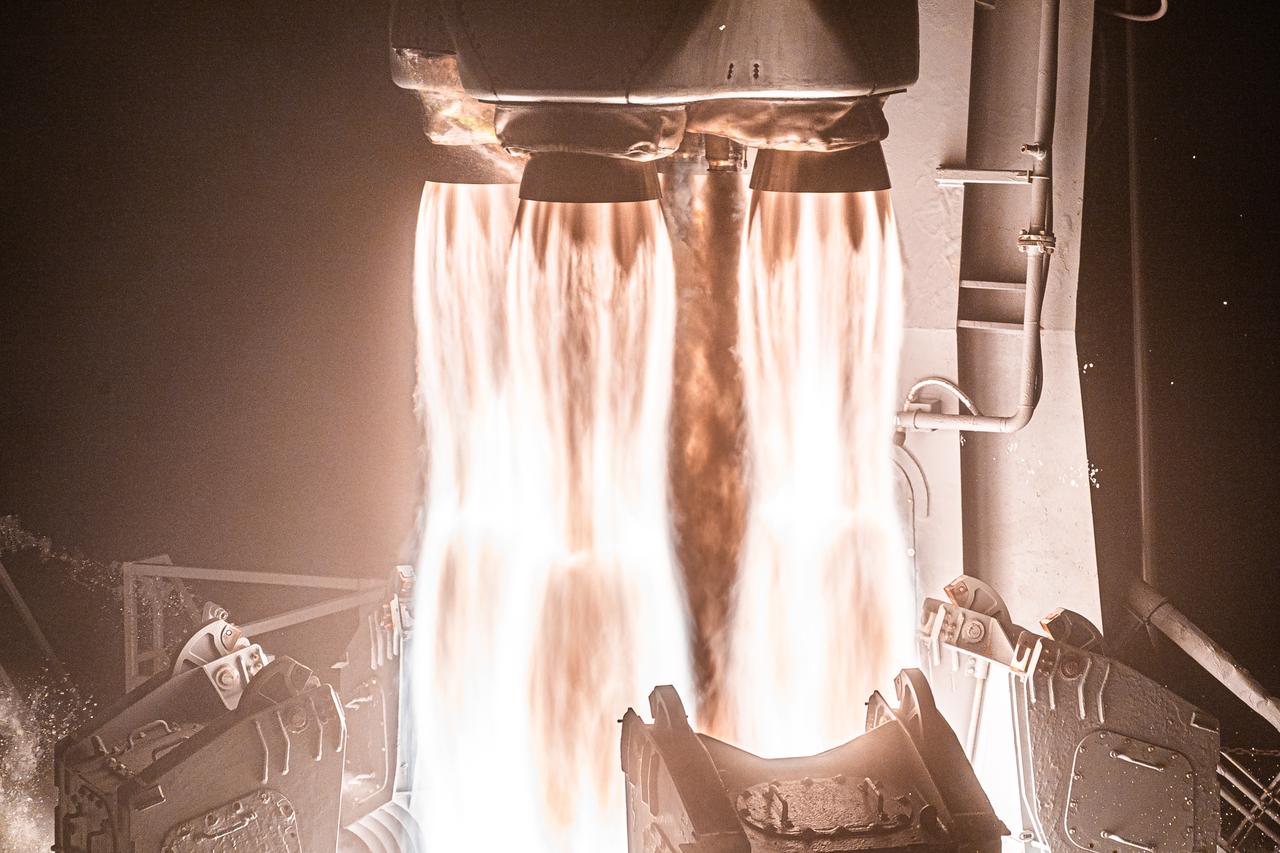
Firefly Aerospace’s Alpha rocket carrying eight CubeSats as part of NASA’s CubeSat Launch Initiative (CSLI) lifts off from Space Launch Complex 2 at Vandenberg Space Force Base in California at 9:04 p.m. PDT Wednesday, July 3, 2024. The successful launch of the rocket, named “Noise of Summer,” completed the company’s Venture-Class Launch Services Demonstration 2 (VCLS Demo 2) contract with the agency. The CubeSat missions were designed by universities and NASA centers to conduct climate studies, satellite technology development, and educational outreach to students.
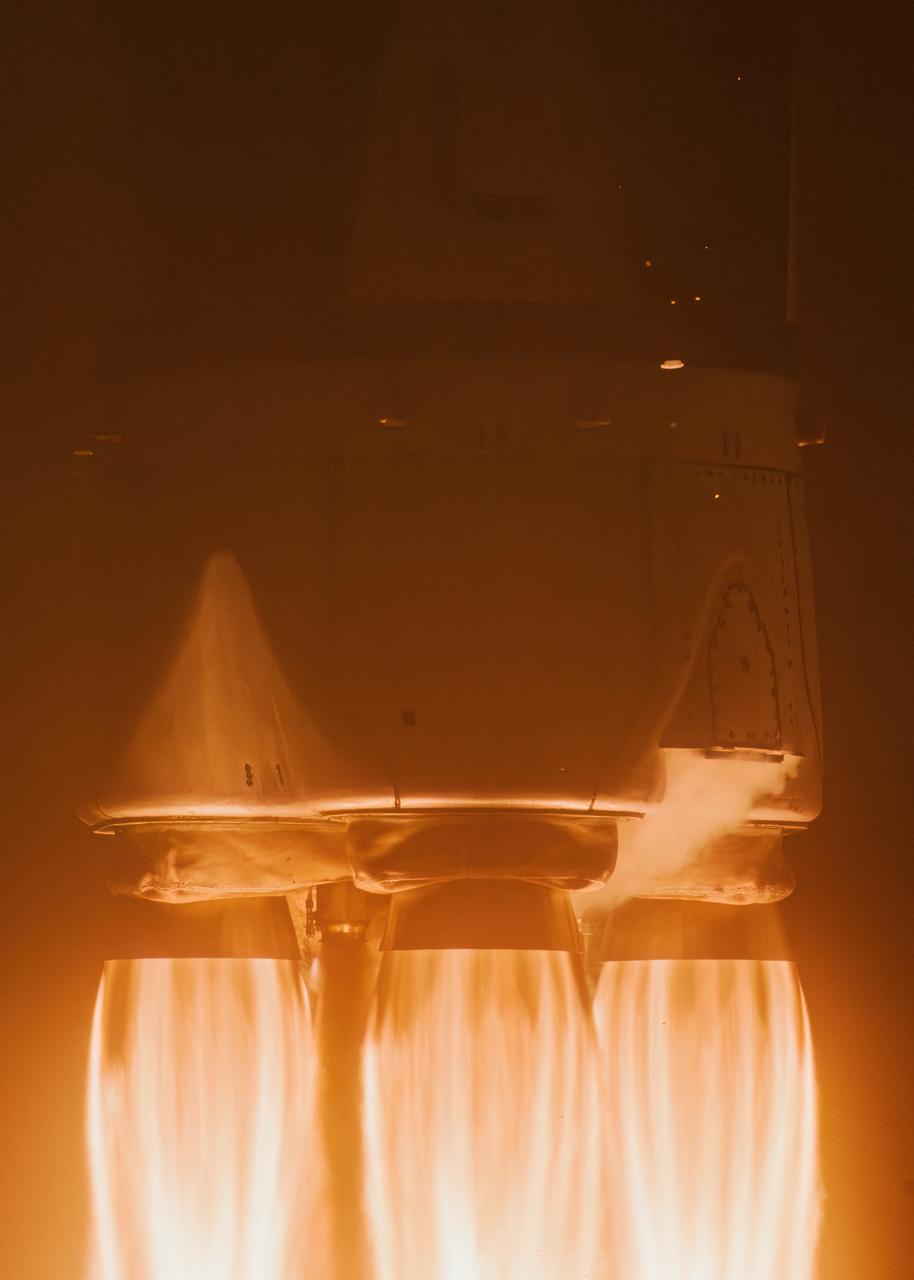
Firefly Aerospace’s Alpha rocket carrying eight CubeSats as part of NASA’s CubeSat Launch Initiative (CSLI) lifts off from Space Launch Complex 2 at Vandenberg Space Force Base in California at 9:04 p.m. PDT Wednesday, July 3, 2024. The successful launch of the rocket, named “Noise of Summer,” completed the company’s Venture-Class Launch Services Demonstration 2 (VCLS Demo 2) contract with the agency. The CubeSat missions were designed by universities and NASA centers to conduct climate studies, satellite technology development, and educational outreach to students.
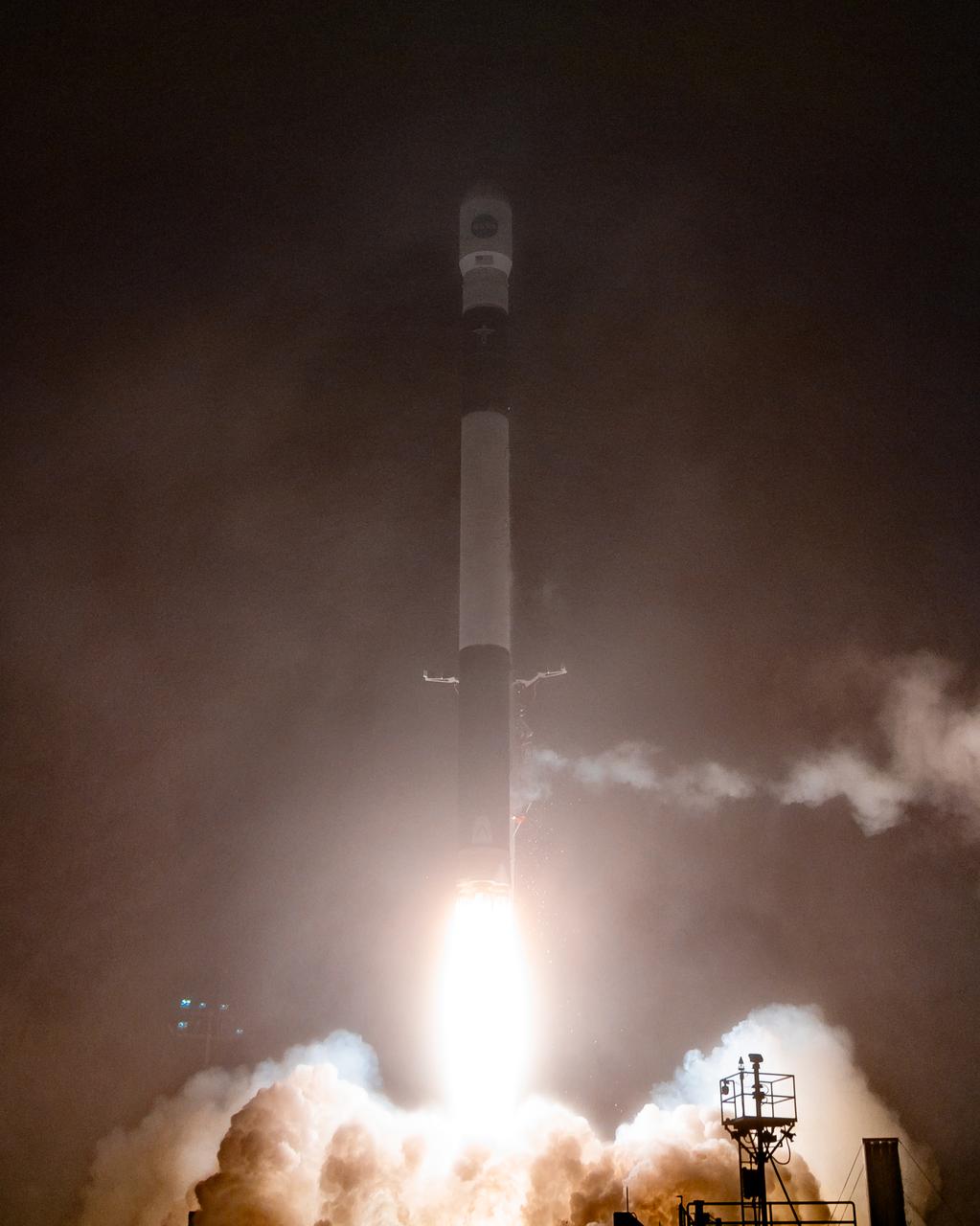
Firefly Aerospace’s Alpha rocket carrying eight CubeSats as part of NASA’s CubeSat Launch Initiative (CSLI) lifts off from Space Launch Complex 2 at Vandenberg Space Force Base in California at 9:04 p.m. PDT Wednesday, July 3, 2024. The successful launch of the rocket, named “Noise of Summer,” completed the company’s Venture-Class Launch Services Demonstration 2 (VCLS Demo 2) contract with the agency. The CubeSat missions were designed by universities and NASA centers to conduct climate studies, satellite technology development, and educational outreach to students.
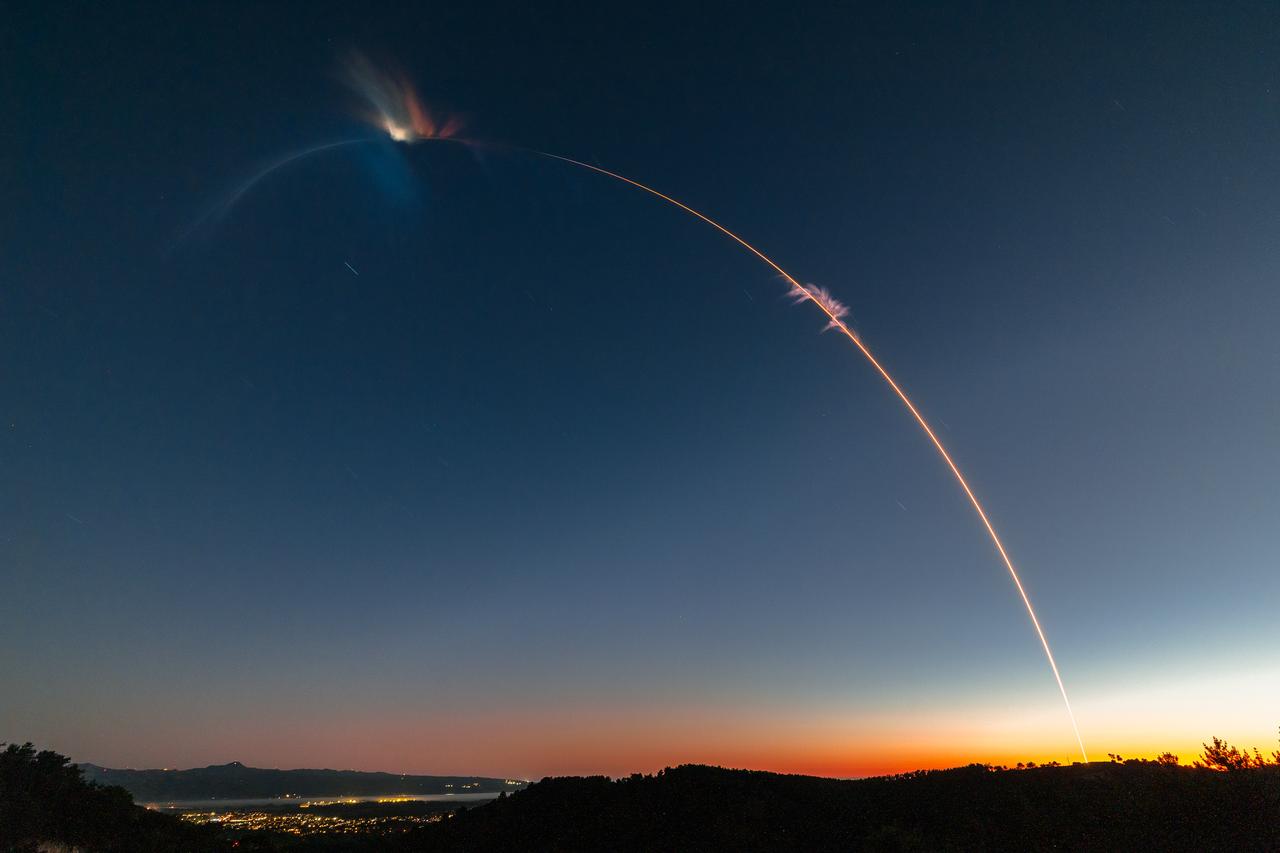
Firefly Aerospace’s Alpha rocket carrying eight CubeSats as part of NASA’s CubeSat Launch Initiative (CSLI) lifts off from Space Launch Complex 2 at Vandenberg Space Force Base in California at 9:04 p.m. PDT Wednesday, July 3, 2024. The successful launch of the rocket, named “Noise of Summer,” completed the company’s Venture-Class Launch Services Demonstration 2 (VCLS Demo 2) contract with the agency. The CubeSat missions were designed by universities and NASA centers to conduct climate studies, satellite technology development, and educational outreach to students.
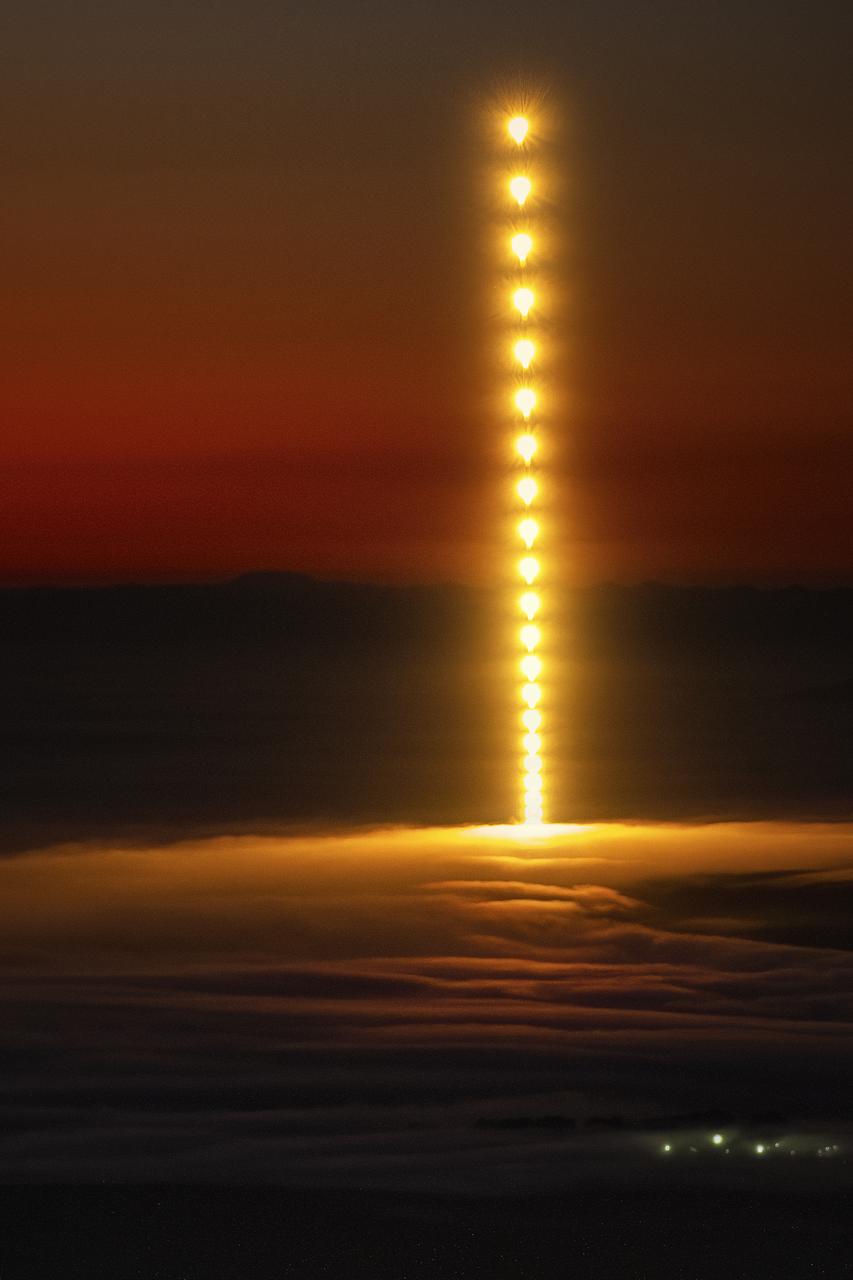
Firefly Aerospace’s Alpha rocket carrying eight CubeSats as part of NASA’s CubeSat Launch Initiative (CSLI) lifts off from Space Launch Complex 2 at Vandenberg Space Force Base in California at 9:04 p.m. PDT Wednesday, July 3, 2024. The successful launch of the rocket, named “Noise of Summer,” completed the company’s Venture-Class Launch Services Demonstration 2 (VCLS Demo 2) contract with the agency. The CubeSat missions were designed by universities and NASA centers to conduct climate studies, satellite technology development, and educational outreach to students.
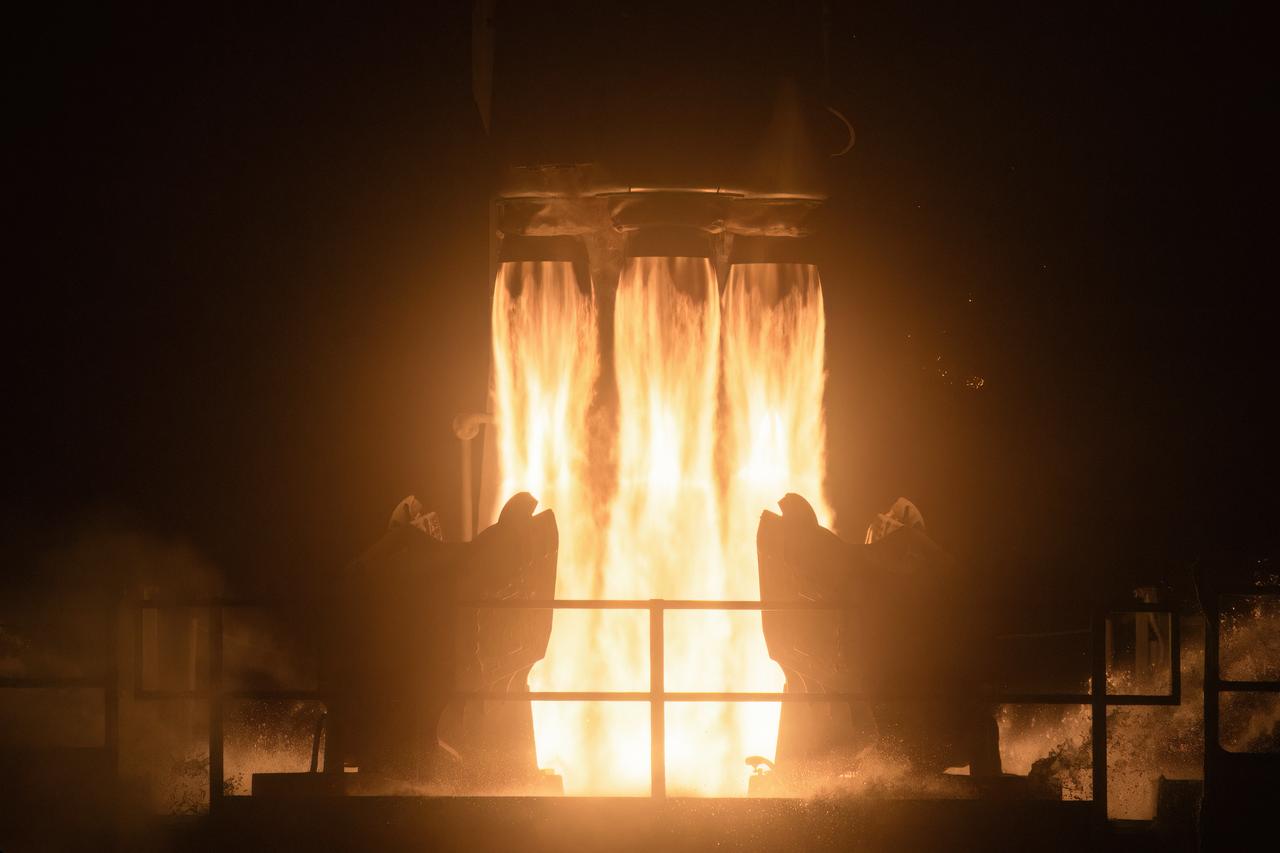
Firefly Aerospace’s Alpha rocket carrying eight CubeSats as part of NASA’s CubeSat Launch Initiative (CSLI) lifts off from Space Launch Complex 2 at Vandenberg Space Force Base in California at 9:04 p.m. PDT Wednesday, July 3, 2024. The successful launch of the rocket, named “Noise of Summer,” completed the company’s Venture-Class Launch Services Demonstration 2 (VCLS Demo 2) contract with the agency. The CubeSat missions were designed by universities and NASA centers to conduct climate studies, satellite technology development, and educational outreach to students.
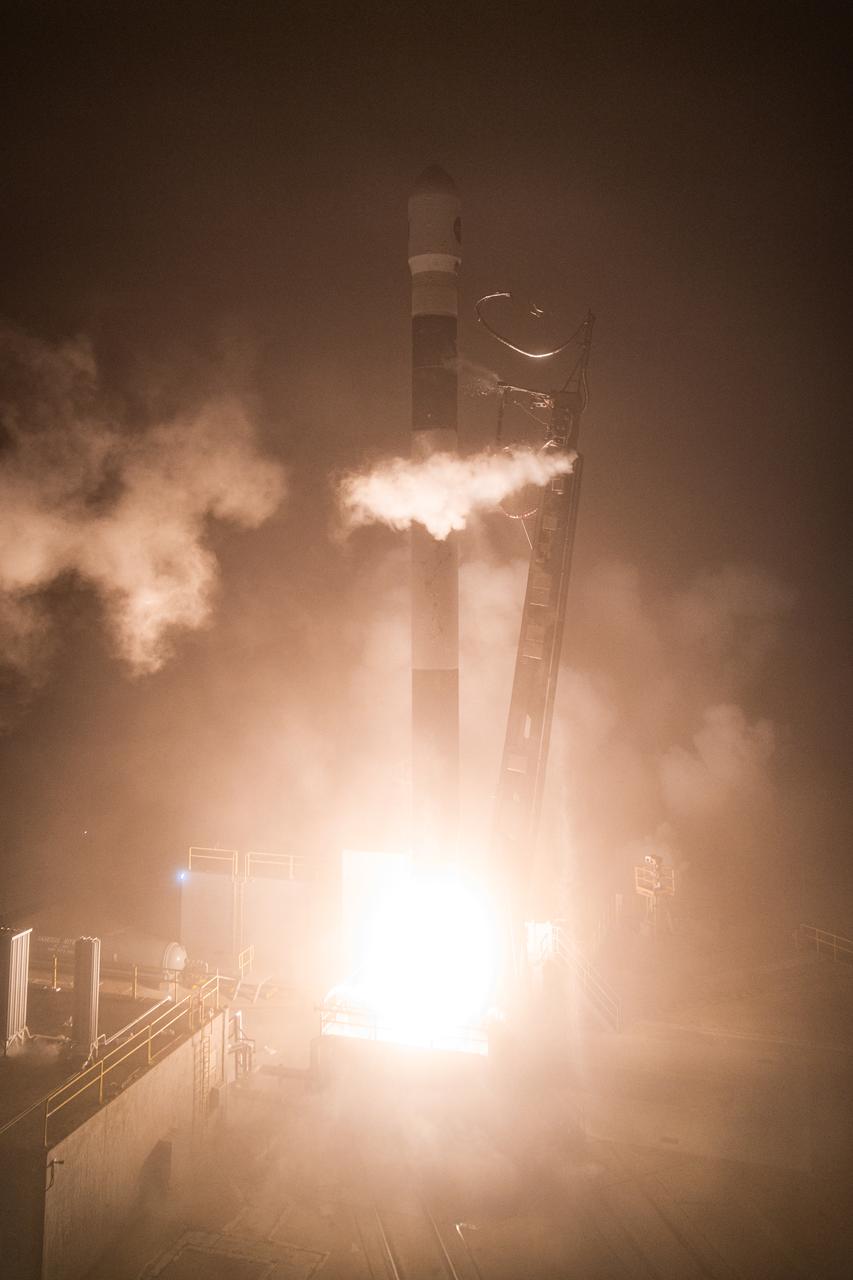
Firefly Aerospace’s Alpha rocket carrying eight CubeSats as part of NASA’s CubeSat Launch Initiative (CSLI) lifts off from Space Launch Complex 2 at Vandenberg Space Force Base in California at 9:04 p.m. PDT Wednesday, July 3, 2024. The successful launch of the rocket, named “Noise of Summer,” completed the company’s Venture-Class Launch Services Demonstration 2 (VCLS Demo 2) contract with the agency. The CubeSat missions were designed by universities and NASA centers to conduct climate studies, satellite technology development, and educational outreach to students.

Firefly Aerospace’s Alpha rocket carrying eight CubeSats as part of NASA’s CubeSat Launch Initiative (CSLI) lifts off from Space Launch Complex 2 at Vandenberg Space Force Base in California at 9:04 p.m. PDT Wednesday, July 3, 2024. The successful launch of the rocket, named “Noise of Summer,” completed the company’s Venture-Class Launch Services Demonstration 2 (VCLS Demo 2) contract with the agency. The CubeSat missions were designed by universities and NASA centers to conduct climate studies, satellite technology development, and educational outreach to students.

NASA Astronaut Joe Acaba speaks to students and educators during their tour stop at the Lunar Landing Research Facility during an aerospace technical field career day event at Langley Research Center, Hampton Va., Wednesday, April 29, 2026. Photo Credit (NASA/Mark L Knopp)

NASA Mechanical Engineer Christopher B. Meek speaks to students and educators during their tour stop at the Lunar Landing Research Facility for an aerospace technical field career day event at Langley Research Center, Hampton Va., Wednesday, April 29, 2026. Photo Credit (NASA/Mark L. Knopp)
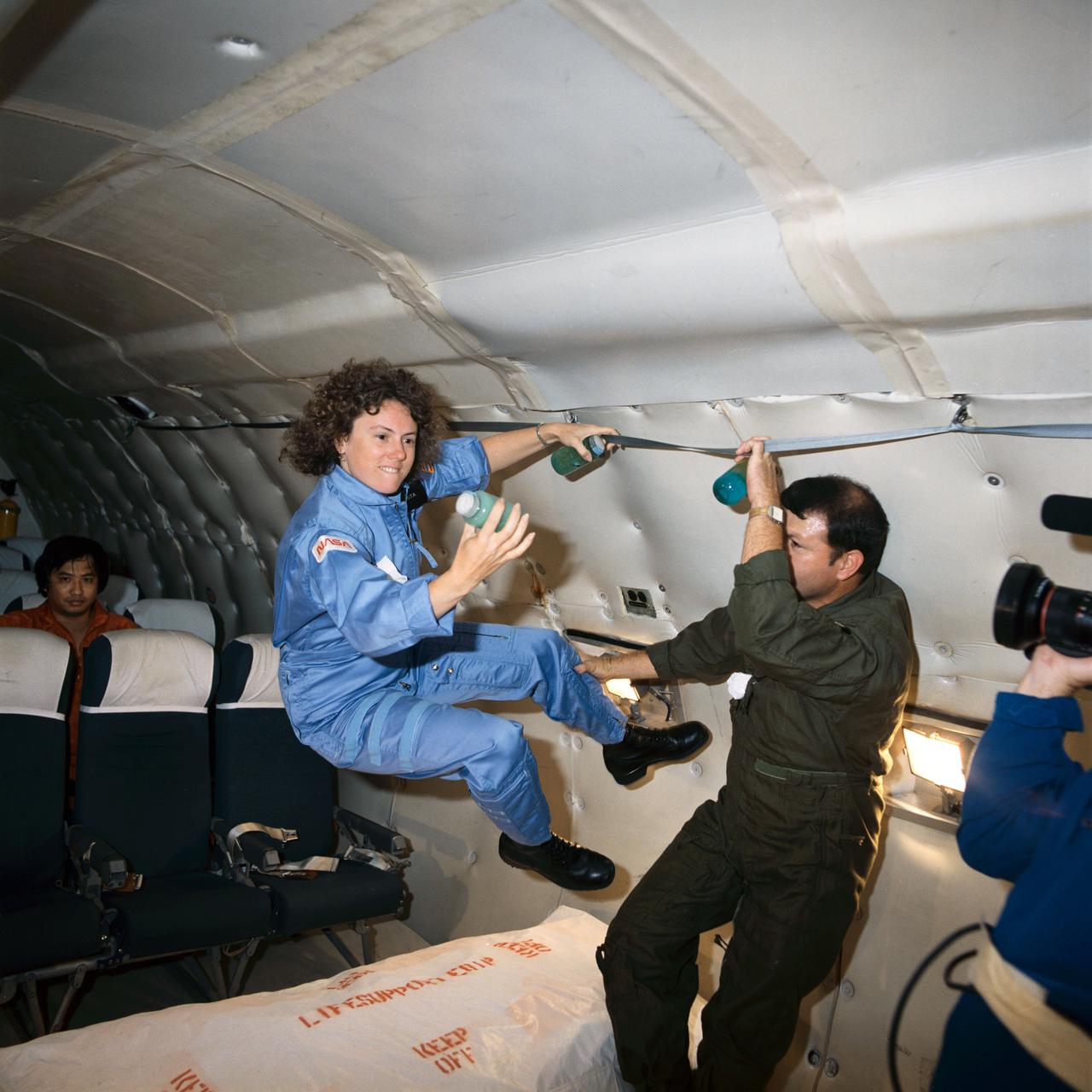
Teacher-in-Space trainees on the KC-135 for Zero-G training. Sharon Christa McAuliffe experiences a few moments of weightlessness provided by the KC-135. She and Bob Mayfield, a JSC Aerospace Education Specialist, are previewing a Molecular Mixing Experiment which was designed to demonstrate differences of separation process in 1-G and Zero-G.

NASA Astronaut Joe Acaba addresses students and educators on a panel, during a aerospace technical field career day event held at Langley Research Center, Wednesday, April 29, 2026. Photo Credit (NASA/Ryan H. Hill)
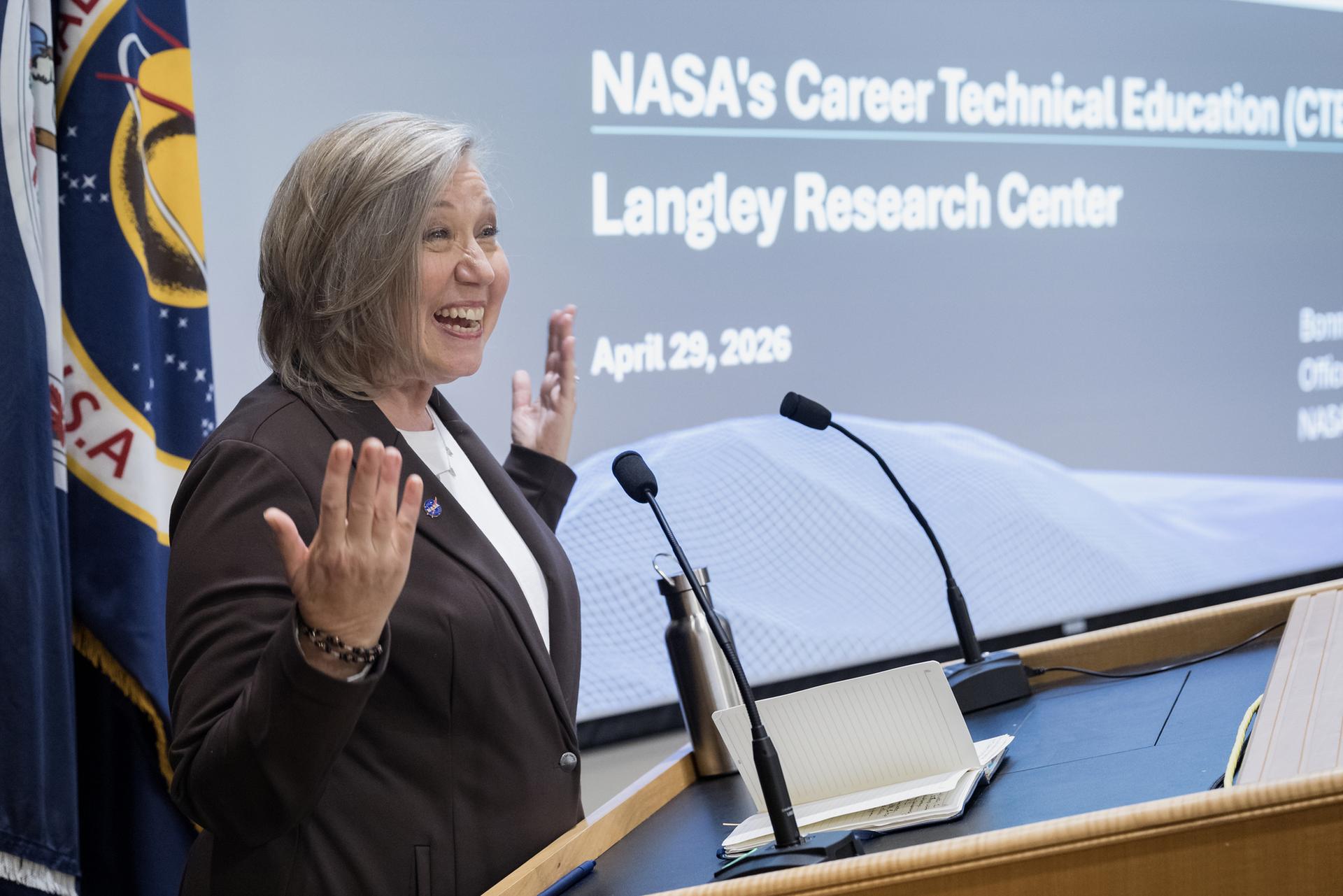
Bonnie Murray, NASA Program Specialist, speaks to an audience of high school and college students, and educators during an aerospace technical field career day event at Langley Research Center, Hampton Va., Wednesday, April 29, 2026. Photo Credit (NASA/Mark L Knopp)
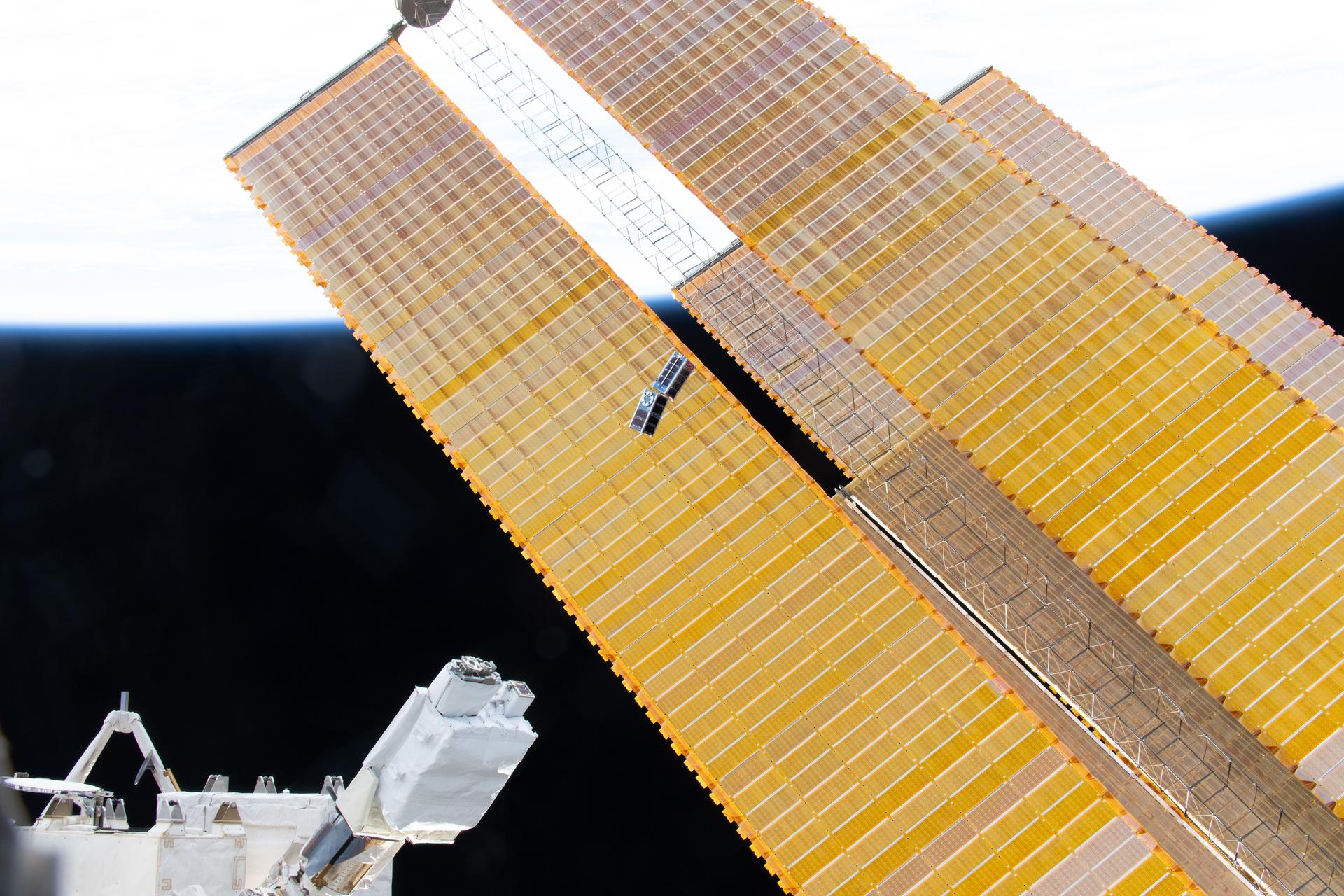
iss073e0860130 (Sept. 19, 2025) --- Two CubeSats are shown deploying from JAXA’s (Japan Aerospace Exploration Agency) Small Satellite Orbital Deployer (J-SSOD) system. The J-SSOD provides a standardized, efficient way to deploy CubeSats and other small satellites into low Earth orbit for various technological, educational, and scientific use.
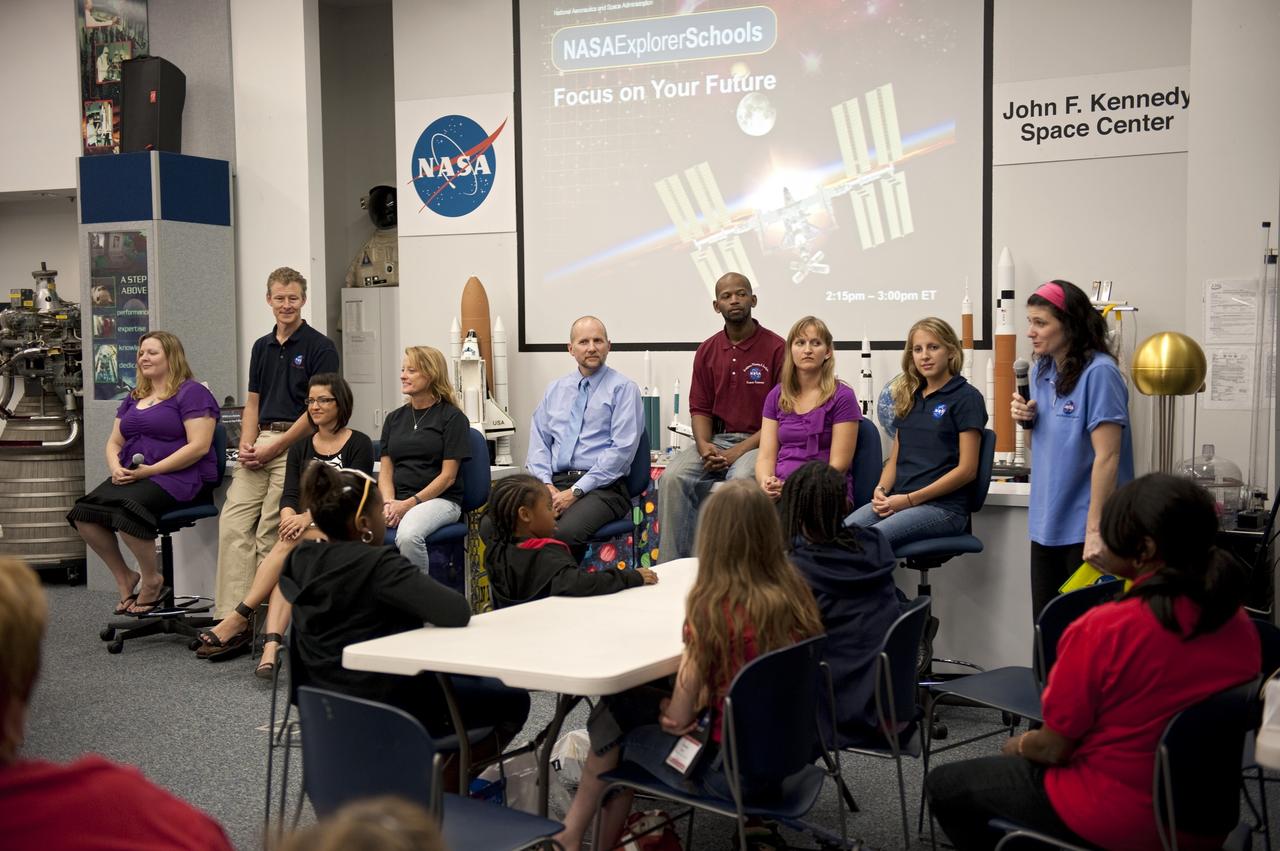
Cape Canaveral, Fla. -- Students from across the nation gathered at NASA's Kennedy Space Center in Florida for the NASA Explorer Schools (NES) symposium. At the microphone is NASA Explorer Schools Lead Education Specialist Alicia Baturoni from NASA's Glenn Research Center. From left, the panel includes aerospace engineer with NASA's Launch Services Program Caley Burke, Gary Letchworth who is working on the Orion multipurpose crew vehicle, NASA Contract Specialist Nicole Rivera, wildlife ecologist with Innovative Heath Applications Becky Bolt, Tim Griffin who works in Kennedy's Chemical Analysis Branch, Xaivian Raymond with NASA Human Resources, aerospace engineer Sarah Cox who works on the space shuttle's thermal protection system, and chemical engineer Annie Caraccio. During the NES event, students presented their investigation project to their peers, scientists, engineers and education specialists. About 60 fourth- through 12-grade students nationwide are at the center May 4-7 participating in tours of processing and launch facilities and the U.S. Astronaut Hall of Fame, as well as several educational activities and a career panel question-and-answer session. About 30 teachers will receive professional development opportunities during the symposium. The participants were competitively selected after they completed an original investigation focused on existing NASA missions or research interests. Photo Credit: NASA/Kim Shiflett
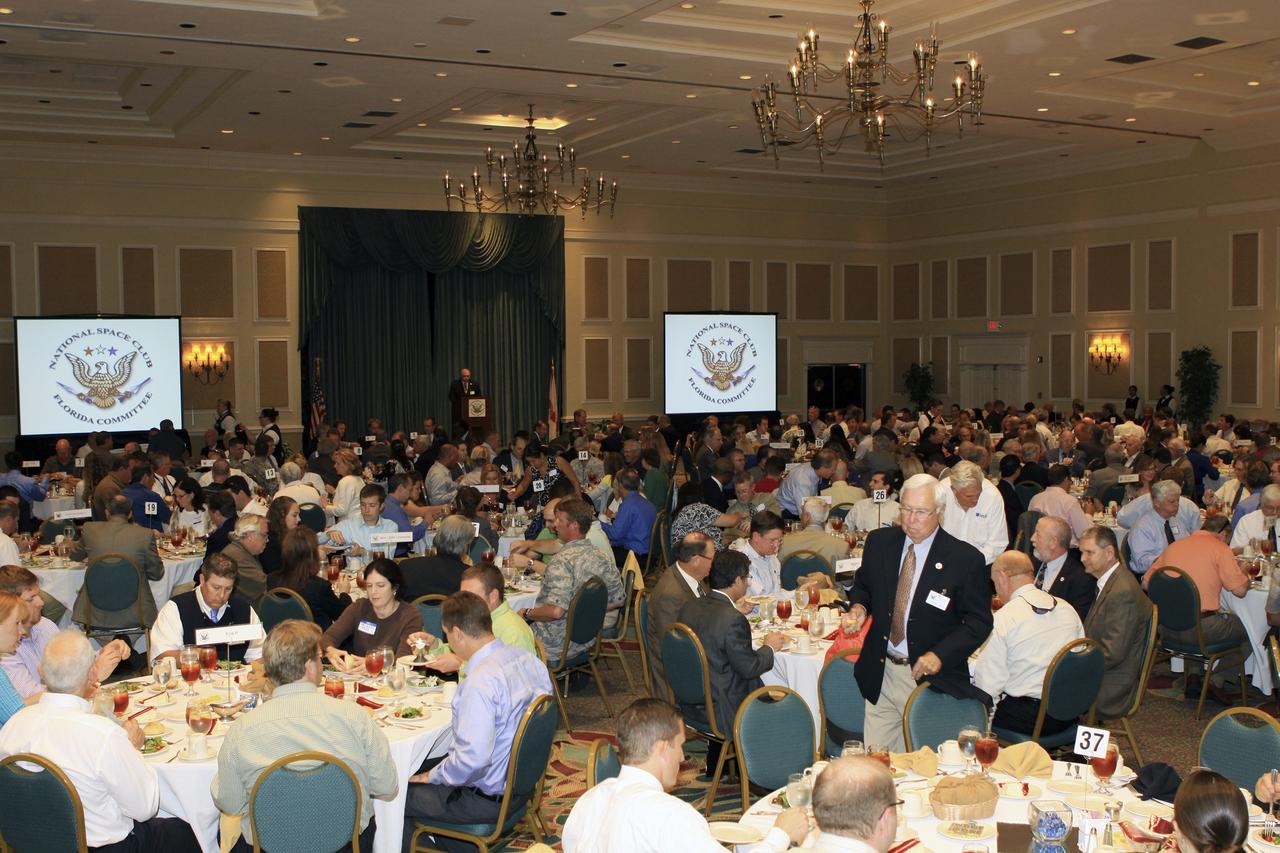
CAPE CANAVERAL Fla. -- Attendees filled the room for the National Space Club Florida Committee, or NSCFL, luncheon May 14 at the Radisson Resort at the Port in Cape Canaveral, Fla. Kennedy Space Center Director Bob Cabana was the featured speaker with a presentation on the Fiscal Year 2014 budget and Kennedy’s path forward. The NSCFL Committee is one of three regional committees including Huntsville, Ala. and Los Angeles, Calif. of the National Space Club in Washington, D.C. The NSCFL Committee promotes awareness through hosting monthly luncheons, sponsoring educational opportunities, recognizing significant achievement, and promoting aerospace leadership in a region heavily influenced by aerospace activities. Photo credit: NASA/Jim Grossmann
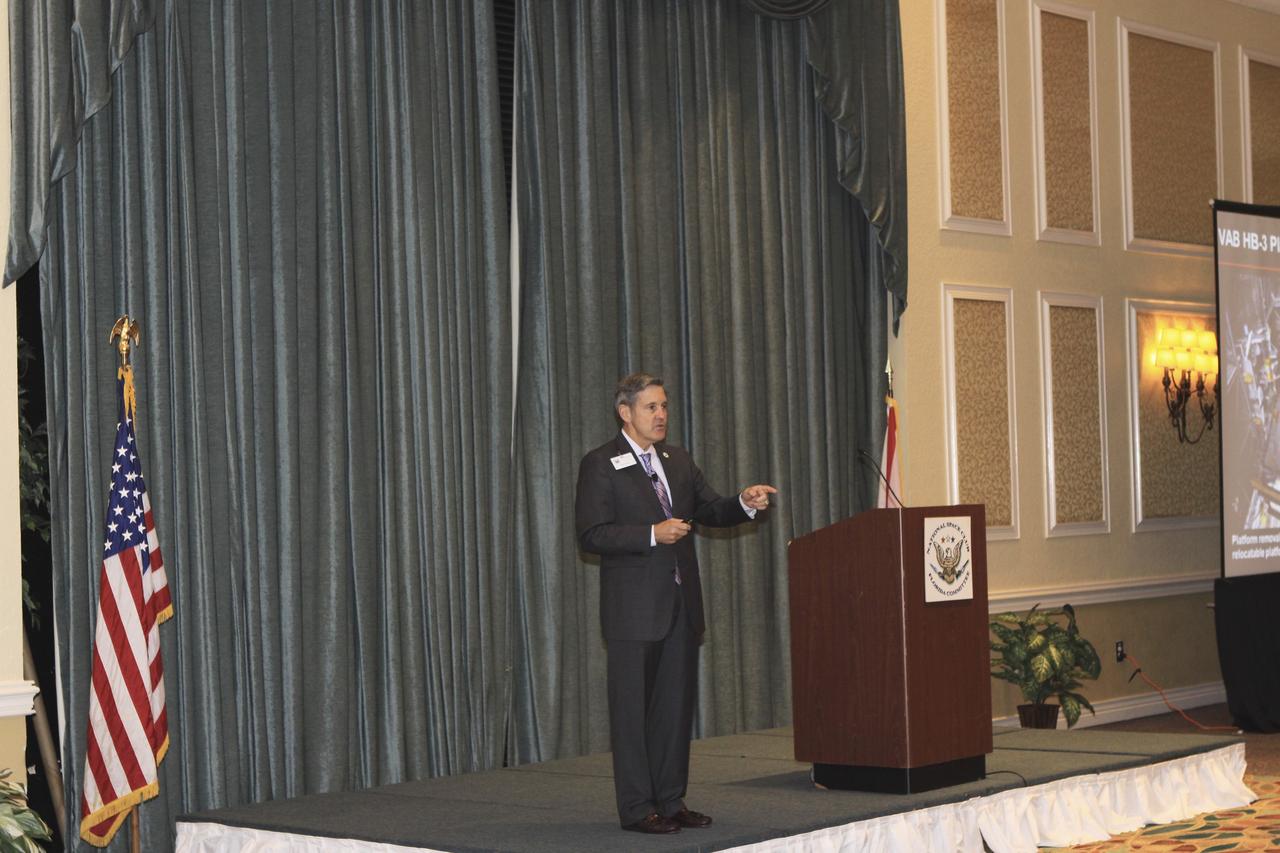
CAPE CANAVERAL Fla. -- Kennedy Space Center Director Bob Cabana spoke to attendees at the National Space Club Florida Committee, or NSCFL, luncheon May 14 at the Radisson Resort at the Port in Cape Canaveral, Fla. Cabana’s presentation focused on the Fiscal Year 2014 budget and Kennedy’s path forward. The NSCFL Committee is one of three regional committees including Huntsville, Ala. and Los Angeles, Calif. of the National Space Club in Washington, D.C. The NSCFL Committee promotes awareness through hosting monthly luncheons, sponsoring educational opportunities, recognizing significant achievement, and promoting aerospace leadership in a region heavily influenced by aerospace activities. Photo credit: NASA/Jim Grossmann

KENNEDY SPACE CENTER, FLA. - At NASA’s Kennedy Space Center, the 2004 class of astronaut candidates get a close look at an External Tank in the Vehicle Assembly Building. The class of 14 candidates includes three candidates from the Japan Aerospace Exploration Agency as well as three educator astronauts, who were school teachers chosen from thousands of applicants.
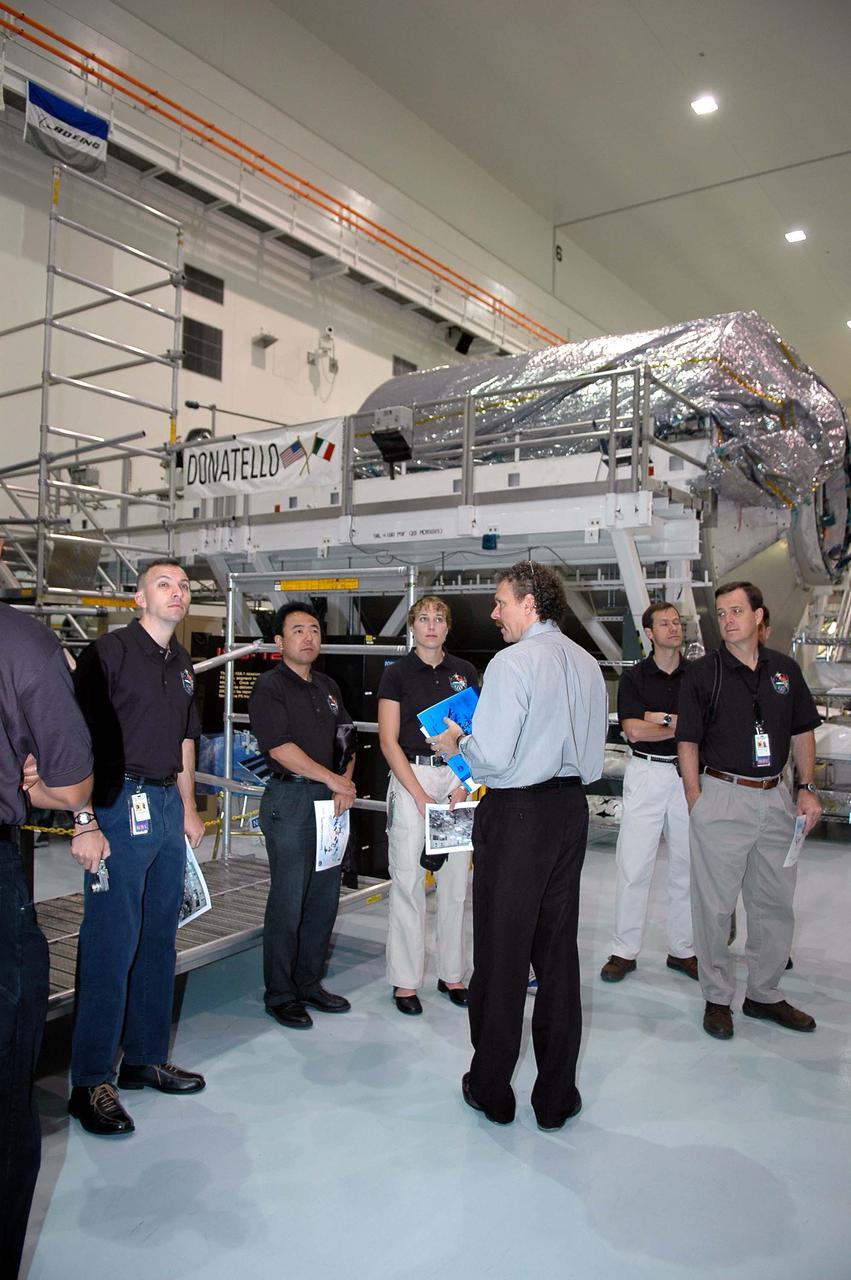
KENNEDY SPACE CENTER, FLA. - At NASA’s Kennedy Space Center, Russell Romanella (in the foreground), deputy director of ISS and Payload Processing, talks to the 2004 class of astronaut candidates on their tour of the Space Station Processing Facility. In the background is the Multi-Purpose Logistics Module Donatello. The class of 14 candidates includes three candidates from the Japan Aerospace Exploration Agency as well as three educator astronauts, who were school teachers chosen from thousands of applicants.

High school and college students, and educators spent a day learning about careers in technical fields in aerospace. They engaged in hands-on activities, tours, and listening to keynote presentations and panels, interacting with NASA’s subject matter experts at Langley Research Center, Hampton Va, Wednesday, April 29, 2026. Photo Credit (NASA/Mark L. Knopp)

High school and college students, and educators spent a day learning about careers in technical fields in aerospace. They engaged in hands-on activities, tours, and listening to keynote presentations and panels, interacting with NASA’s subject matter experts at Langley Research Center, Hampton Va, Wednesday, April 29, 2026. Photo Credit (NASA/Mark L. Knopp)
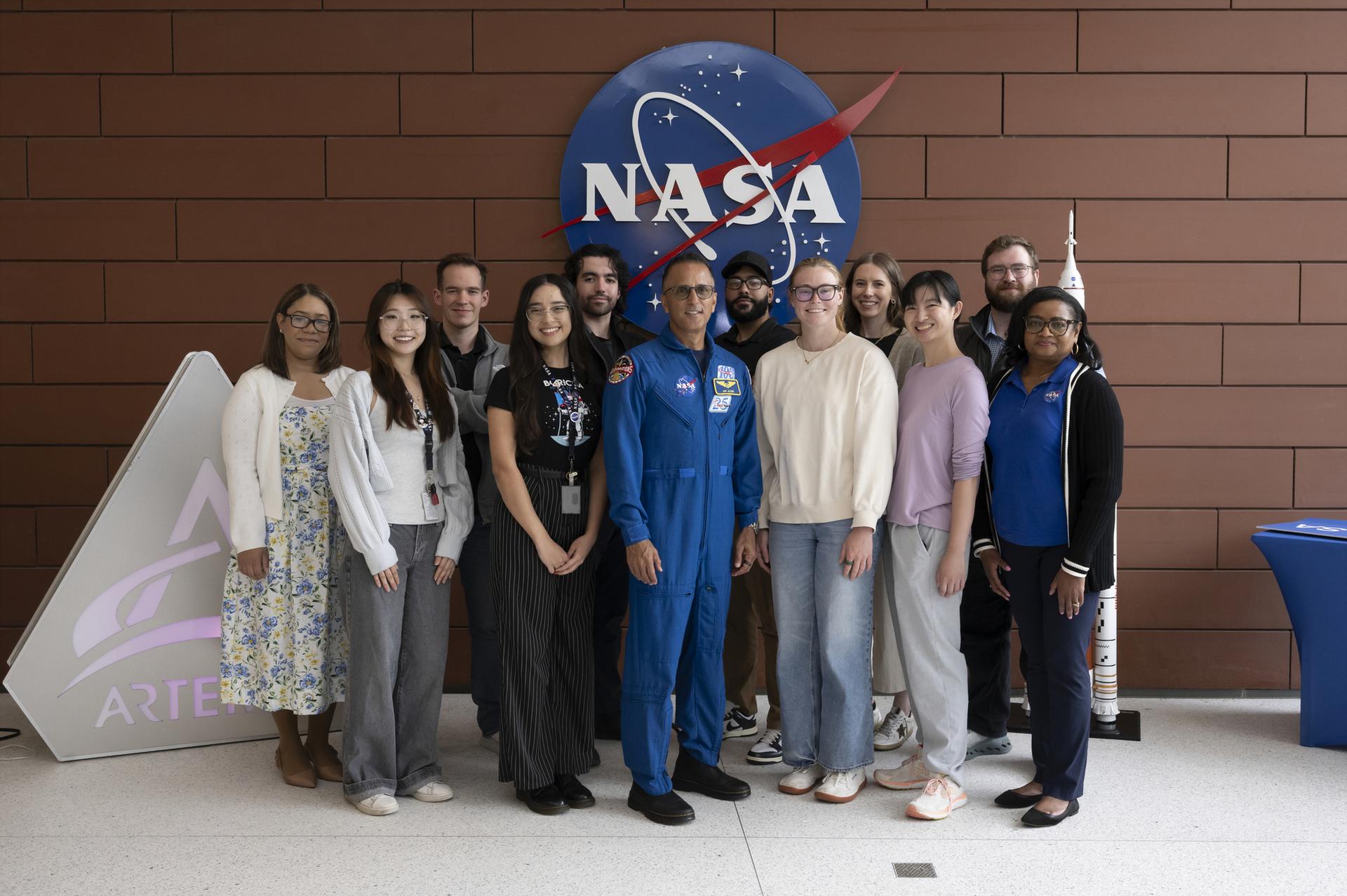
High school and college students, and educators spent a day learning about careers in technical fields in aerospace. They engaged in hands-on activities, tours, and listening to keynote presentations and panels, interacting with NASA’s subject matter experts at Langley Research Center, Hampton Va, Wednesday, April 29, 2026. Photo Credit (NASA/Ryan H. Hill)

High school and college students, and educators spent a day learning about careers in technical fields in aerospace. They engaged in hands-on activities, tours, and listening to keynote presentations and panels, interacting with NASA’s subject matter experts at Langley Research Center, Hampton Va, Wednesday, April 29, 2026. Photo Credit (NASA/Mark L. Knopp)
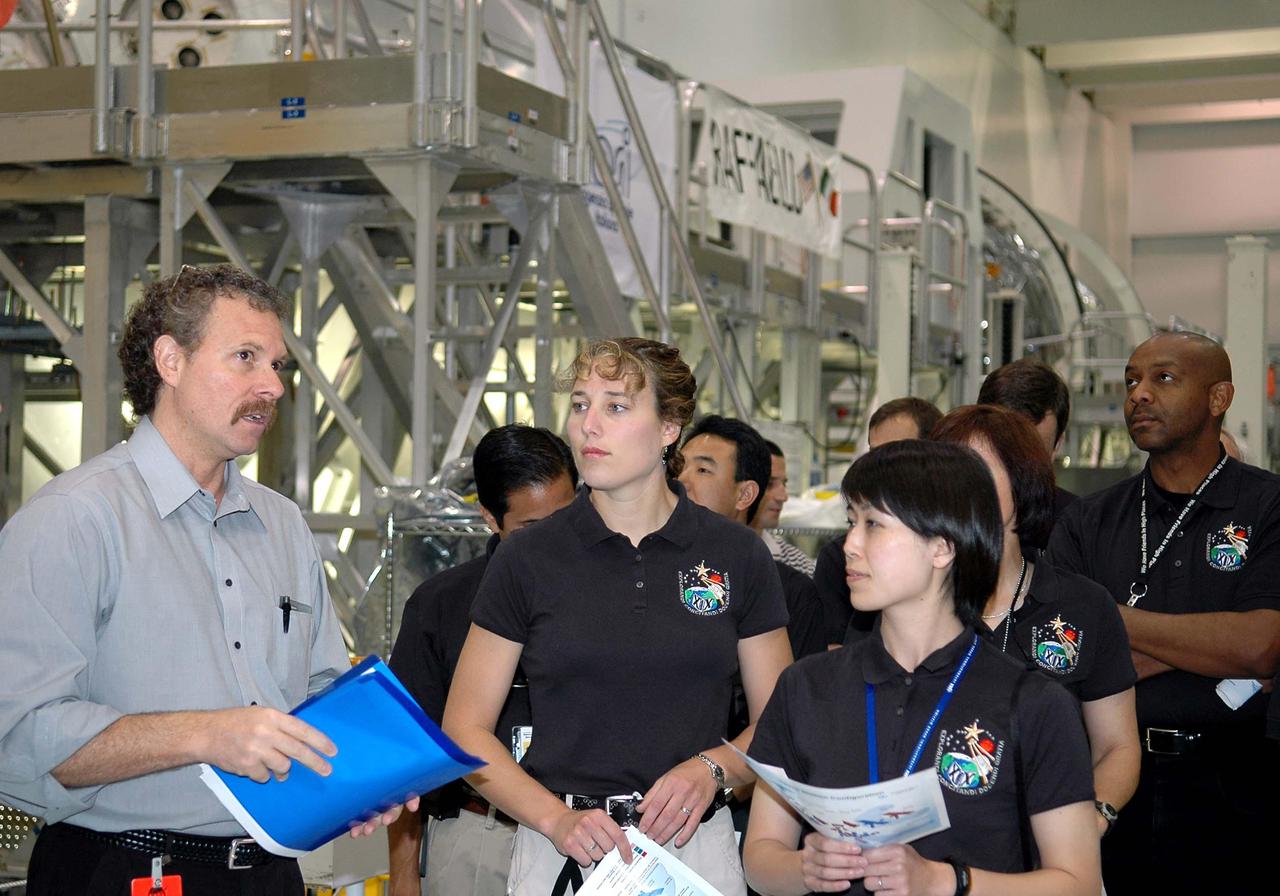
KENNEDY SPACE CENTER, FLA. - Russell Romanella (left), deputy director of ISS and Payload Processing, talks with the 2004 class of astronaut candidates on their tour of the Space Station Processing Facility at NASA’s Kennedy Space Center. The class of 14 candidates includes three candidates from the Japan Aerospace Exploration Agency as well as three educator astronauts, who were school teachers chosen from thousands of applicants.

KENNEDY SPACE CENTER, FLA. - At NASA’s Kennedy Space Center, the 2004 class of astronaut candidates get a close look at one of the twin Solid Rocket Boosters on Space Shuttle Discovery in the Vehicle Assembly Building. The class of 14 candidates includes three candidates from the Japan Aerospace Exploration Agency as well as three educator astronauts, who were school teachers chosen from thousands of applicants.

High school and college students, and educators spent a day learning about careers in technical fields in aerospace. They engaged in hands-on activities, tours, and listening to keynote presentations and panels, interacting with NASA’s subject matter experts at Langley Research Center, Hampton Va, Wednesday, April 29, 2026. Photo Credit (NASA/Ryan H. Hill)

High school and college students, and educators spent a day learning about careers in technical fields in aerospace. They engaged in hands-on activities, tours, and listening to keynote presentations and panels, interacting with NASA’s subject matter experts at Langley Research Center, Hampton Va, Wednesday, April 29, 2026. Photo Credit (NASA/Ryan H. Hill)
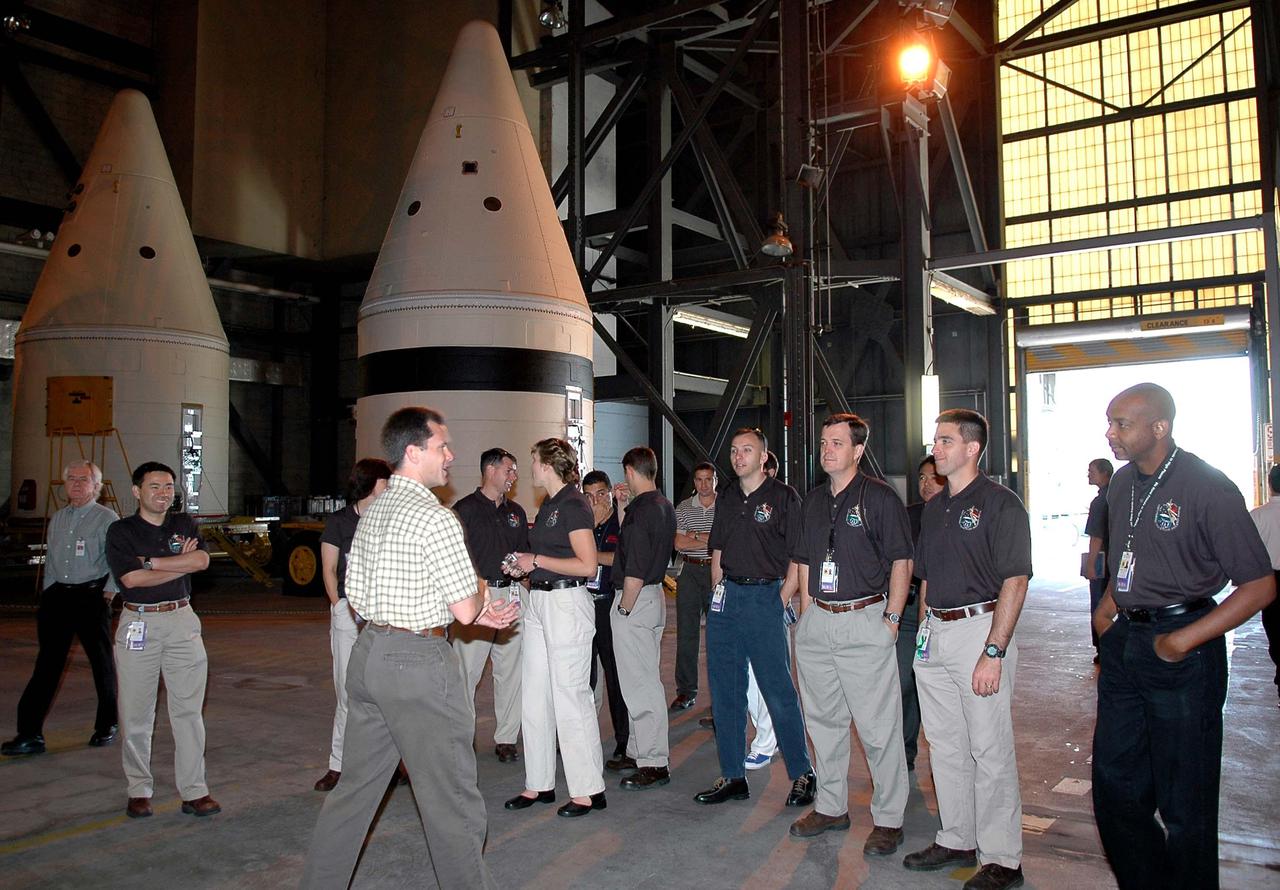
KENNEDY SPACE CENTER, FLA. - At NASA’s Kennedy Space Center, the 2004 class of astronaut candidates tour the Vehicle Assembly Building. In front is Scott Thurston, NASA Vehicle manager for Atlantis. In the background are segments of Solid Rocket Boosters that will be stacked for the orbiter Atlantis for Return to Flight mission STS-121 in July. The class of 14 candidates includes three candidates from the Japan Aerospace Exploration Agency as well as three educator astronauts, who were school teachers chosen from thousands of applicants.
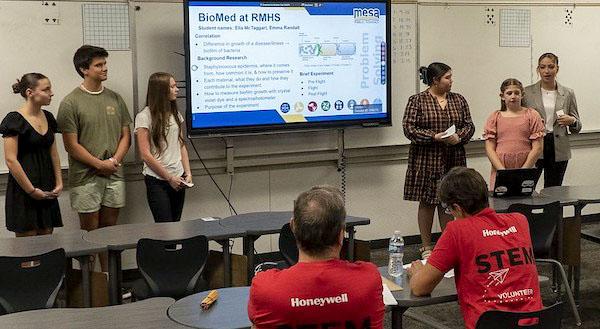
jsc2024e066518 (11/1/2023) --- Mesa Publc School students work together presenting their critical design review to their industry partners Honeywell Aerospace Technologies in their successful bid to be a finalist for the Nanoracks-National Center for Earth and Space Science Education-Surveyor-Student Spaceflight Experiments Program Mission 18 to ISS (Nanoracks-NCESSE-Surveyor-SSEP). Their experiment is The Growth and Mutation of Staphylococcus epidermidis Biofilm in Microgravity.

High school and college students, and educators spent a day learning about careers in technical fields in aerospace. They engaged in hands-on activities, tours, and listening to keynote presentations and panels, interacting with NASA’s subject matter experts at Langley Research Center, Hampton Va, Wednesday, April 29, 2026. Photo Credit (NASA/Mark L. Knopp)

High school and college students, and educators spent a day learning about careers in technical fields in aerospace. They engaged in hands-on activities, tours, and listening to keynote presentations and panels, interacting with NASA’s subject matter experts at Langley Research Center, Hampton Va, Wednesday, April 29, 2026. Photo Credit (NASA/Mark L. Knopp)

High school and college students, and educators spent a day learning about careers in technical fields in aerospace. They engaged in hands-on activities, tours, and listening to keynote presentations and panels, interacting with NASA’s subject matter experts at Langley Research Center, Hampton Va, Wednesday, April 29, 2026. Photo Credit (NASA/Ryan H. Hill)
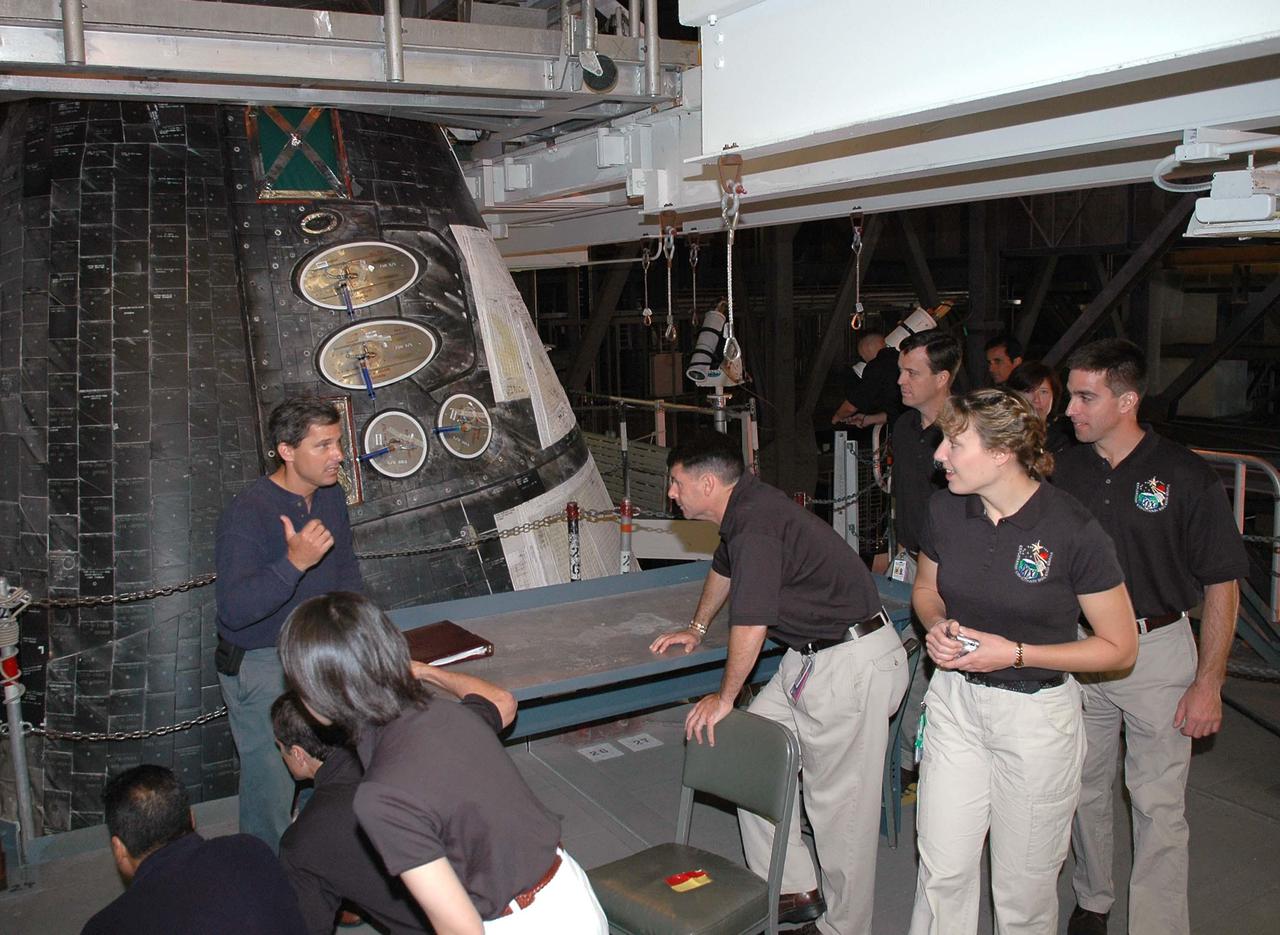
KENNEDY SPACE CENTER, FLA. - At NASA’s Kennedy Space Center, the 2004 class of astronaut candidates get a close look at the Forward Reaction Control System on Space Shuttle Discovery in the Vehicle Assembly Building (VAB). Talking to them at left is Ken Tenbusch, VAB Operations manager. The class of 14 candidates includes three candidates from the Japan Aerospace Exploration Agency as well as three educator astronauts, who were school teachers chosen from thousands of applicants.

High school and college students, and educators spent a day learning about careers in technical fields in aerospace. They engaged in hands-on activities, tours, and listening to keynote presentations and panels, interacting with NASA’s subject matter experts at Langley Research Center, Hampton Va, Wednesday, April 29, 2026. Photo Credit (NASA/Mark L. Knopp)
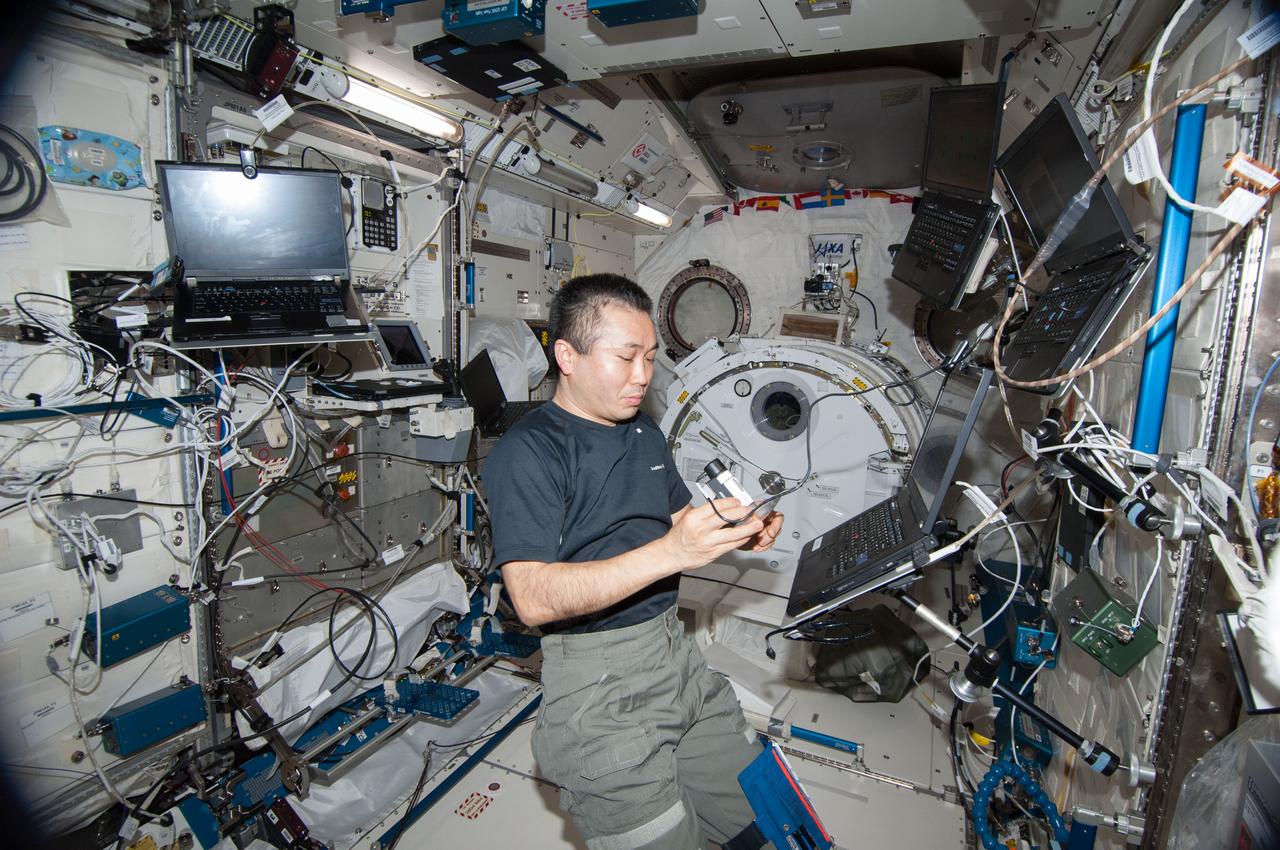
ISS038-E-029082 (12 Jan. 2014) --- Japan Aerospace Exploration Agency astronaut Koichi Wakata, Expedition 38 flight engineer, performs microscopic analysis of the NanoRacks Module-38 Petri Dishes, using Celestron Reflective Microscope, in the Kibo laboratory of the International Space Station. These Module-38 experiments are designed by students as part of a competition sponsored by the International Space School Educational Trust (ISSET). This experiment examines three-dimensional growth of slime mold in petri dishes utilizing the NanoRacks Microscopes Facility.

High school and college students, and educators spent a day learning about careers in technical fields in aerospace. They engaged in hands-on activities, tours, and listening to keynote presentations and panels, interacting with NASA’s subject matter experts at Langley Research Center, Hampton Va, Wednesday, April 29, 2026. Photo Credit (NASA/Mark L. Knopp)

iss070e038352 (Dec. 12, 2023) --- JAXA (Japan Aerospace Exploration Agency) astronaut and Expedition 70 Flight Engineer Satoshi Furukawa installs a small satellite orbital deployer into the Kibo laboratory module’s airlock. The Japanese robotic arm, externally attached to Kibo, grapples the deployer and removes it from the airlock after it is depressurized and opened. The deployer is then positioned outside and pointed away from the station for the release of CubeSats into Earth orbit for educational, private, and governmental research.
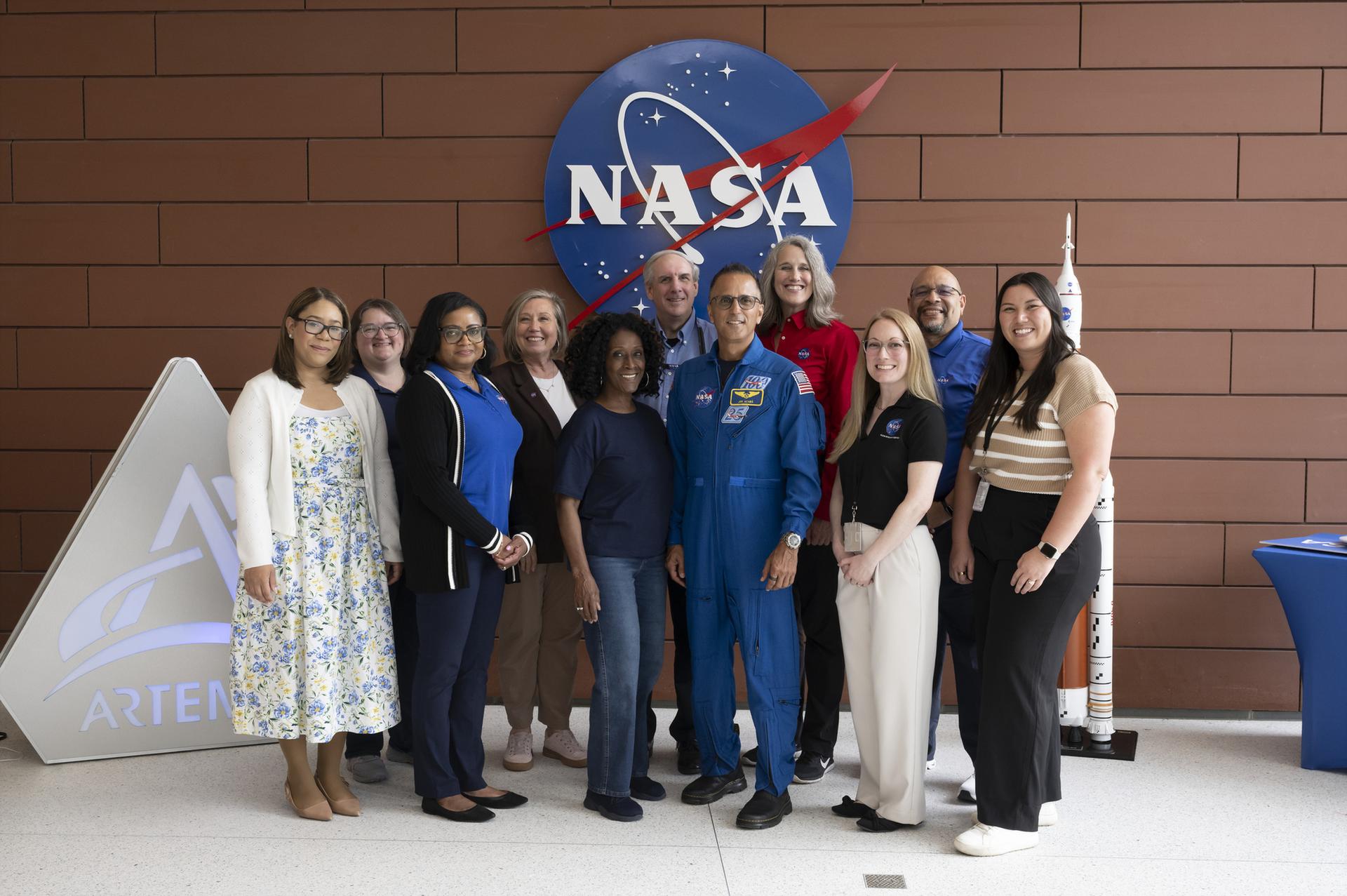
High school and college students, and educators spent a day learning about careers in technical fields in aerospace. They engaged in hands-on activities, tours, and listening to keynote presentations and panels, interacting with NASA’s subject matter experts at Langley Research Center, Hampton Va, Wednesday, April 29, 2026. Photo Credit (NASA/Ryan H. Hill)
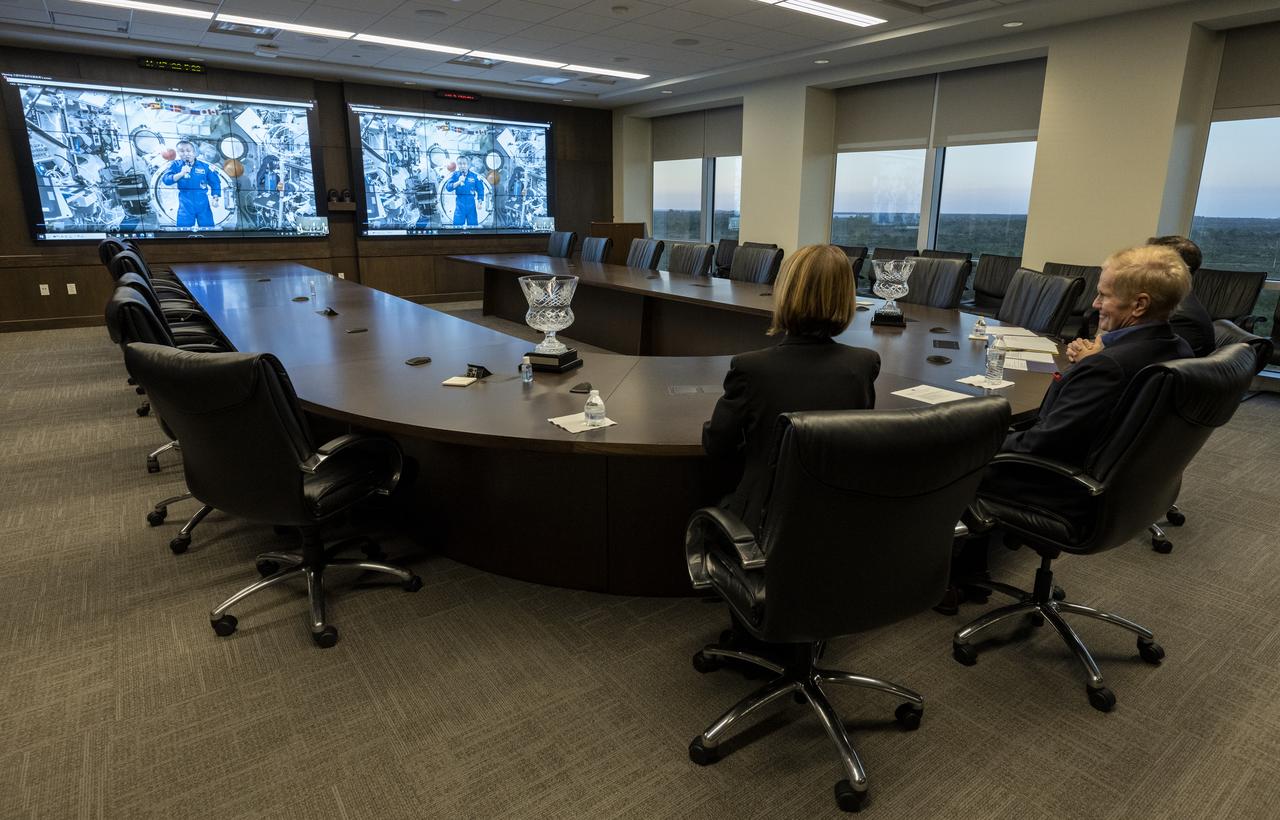
NASA Administrator Bill Nelson, joined by NASA Leadership, view a video message from Japan Aerospace Exploration Agency (JAXA) astronaut Akihiko Hoshide during a virtual meeting hosted by Japanese Minister of Education, Culture, Sports, Science and Technology (MEXT) Keiko Nagaoka following the signing of a Gateway implementing agreement Thursday, Nov. 17, 2022, at NASA’s Kennedy Space Center in Florida. Photo Credit: (NASA/Keegan Barber)

High school and college students, and educators spent a day learning about careers in technical fields in aerospace. They engaged in hands-on activities, tours, and listening to keynote presentations and panels, interacting with NASA’s subject matter experts at Langley Research Center, Hampton Va, Wednesday, April 29, 2026. Photo Credit (NASA/Mark L. Knopp)

High school and college students, and educators spent a day learning about careers in technical fields in aerospace. They engaged in hands-on activities, tours, and listening to keynote presentations and panels, interacting with NASA’s subject matter experts at Langley Research Center, Hampton Va, Wednesday, April 29, 2026. Photo Credit (NASA/Mark L. Knopp)

High school and college students, and educators spent a day learning about careers in technical fields in aerospace. They engaged in hands-on activities, tours, and listening to keynote presentations and panels, interacting with NASA’s subject matter experts at Langley Research Center, Hampton Va, Wednesday, April 29, 2026. Photo Credit (NASA/Ryan H. Hill)
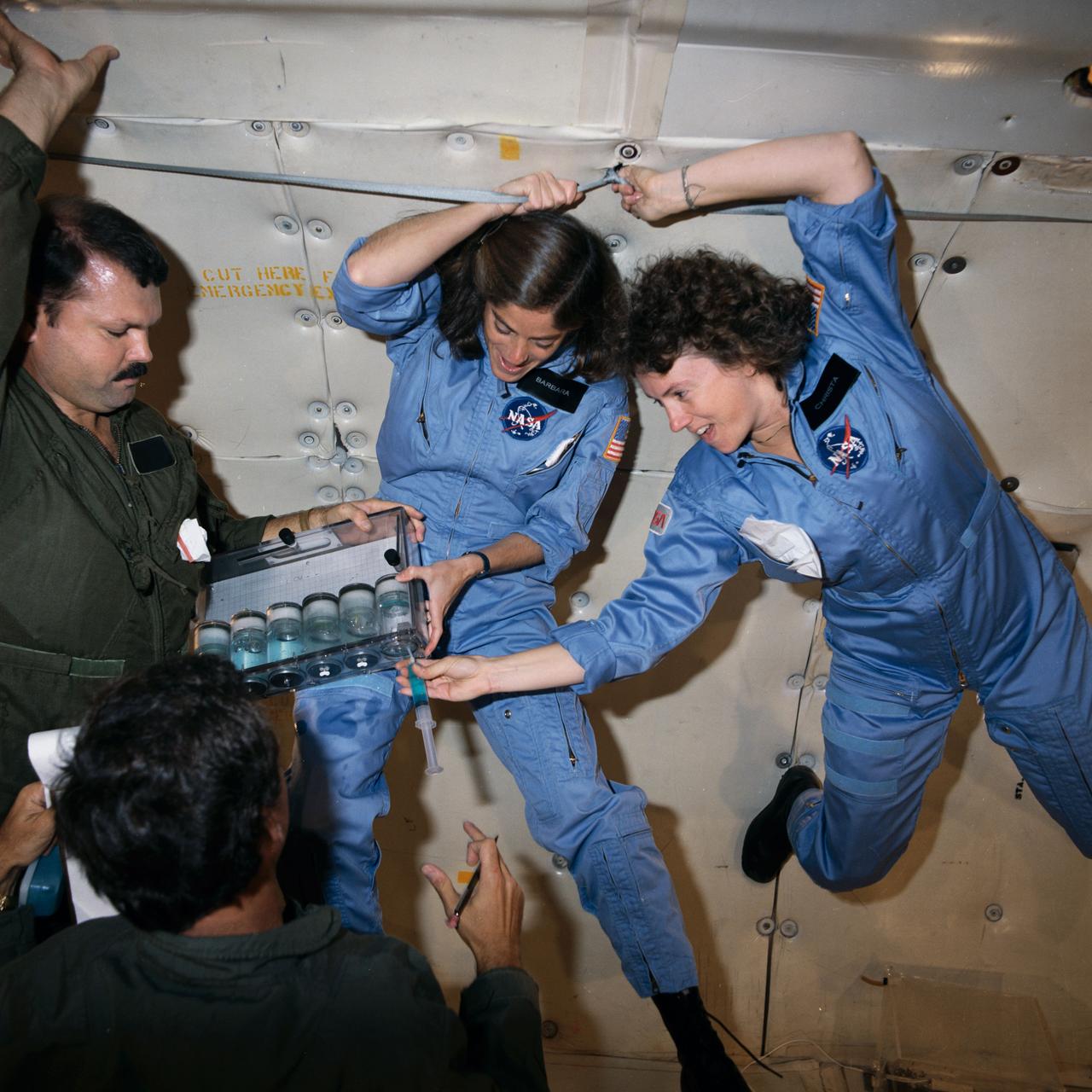
S85-42470 (16 Oct. 1985) --- Sharon Christa McAuliffe, right, and Barbara R. Morgan, participating in the Teacher-in-Space Project, team up with Bob Mayfield, a JSC aerospace educations specialist, to preview some experiments in zero-G. A KC-135 aircraft flies a special pattern to provide series of brief periods of weightlessness. McAuliffe, prime crew member for STS-51L, injects a hydroponic solution into a cylinder to review one of the experiments planned for the flight. Morgan is backup for McAuliffe on that mission. Photo credit: NASA

High school and college students, and educators spent a day learning about careers in technical fields in aerospace. They engaged in hands-on activities, tours, and listening to keynote presentations and panels, interacting with NASA’s subject matter experts at Langley Research Center, Hampton Va, Wednesday, April 29, 2026. Photo Credit (NASA/Ryan H. Hill)

jsc2025e064342 (1/20/2024) --- GHS-01 is a 2U CubeSat mainly manufactured by technical high school students through an aerospace education practice program promoted by Gifu Prefecture and Gifu University. It will conduct exercises such as investigation through image acquisition and orbit determination through signal reception in collaboration with high school students both within Gifu Prefecture and abroad. Image Credit: Photo by GHS project team
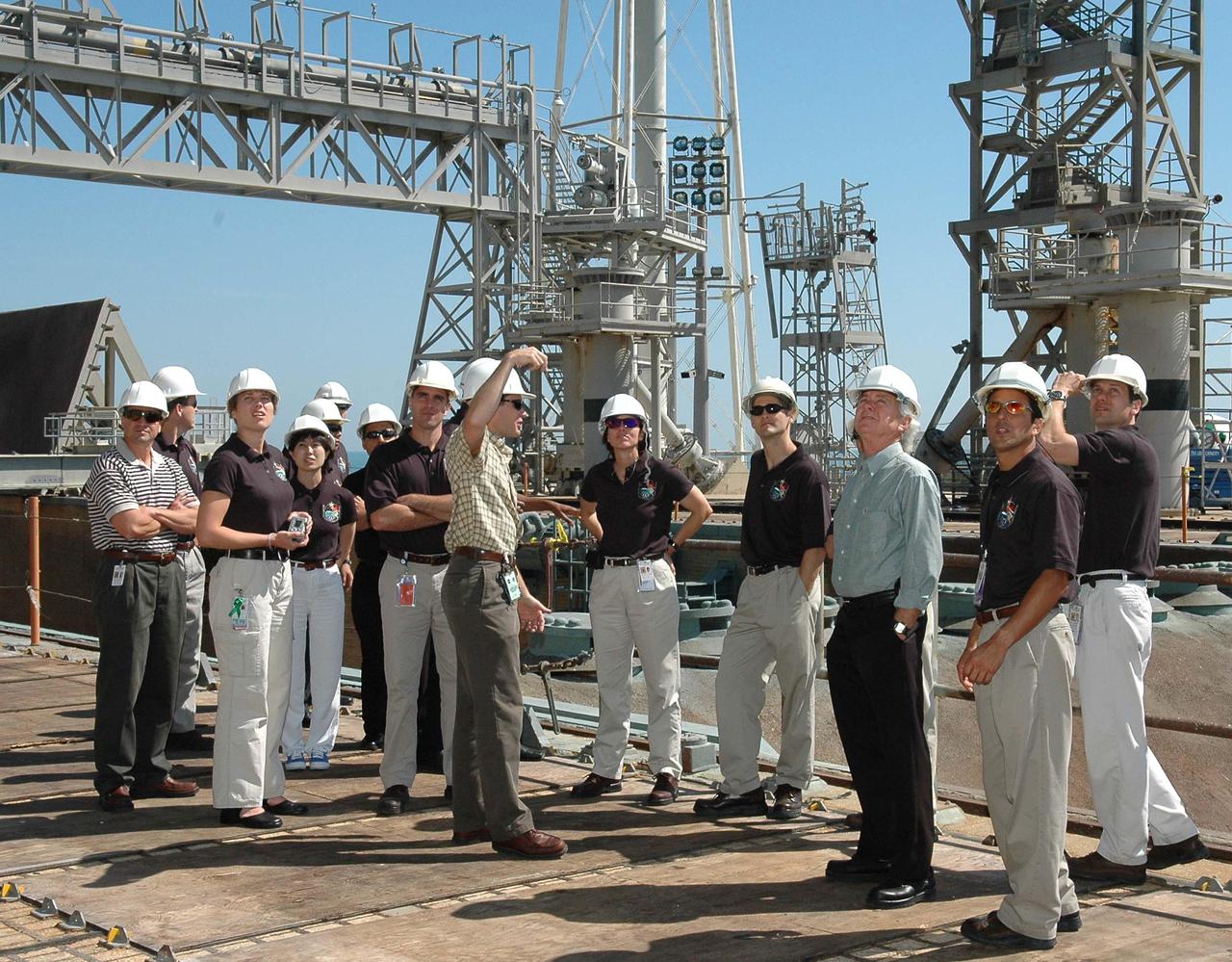
KENNEDY SPACE CENTER, FLA. - At NASA’s Kennedy Space Center, the 2004 class of astronaut candidates tour Launch Pad 39B, where Space Shuttle Discovery will launch on Return to Flight mission STS-114 during a launch window of May 15 to June 3. The class of 14 candidates includes three candidates from the Japan Aerospace Exploration Agency as well as three educator astronauts, who were school teachers chosen from thousands of applicants.

High school and college students, and educators spent a day learning about careers in technical fields in aerospace. They engaged in hands-on activities, tours, and listening to keynote presentations and panels, interacting with NASA’s subject matter experts at Langley Research Center, Hampton Va, Wednesday, April 29, 2026. Photo Credit (NASA/Mark L. Knopp)
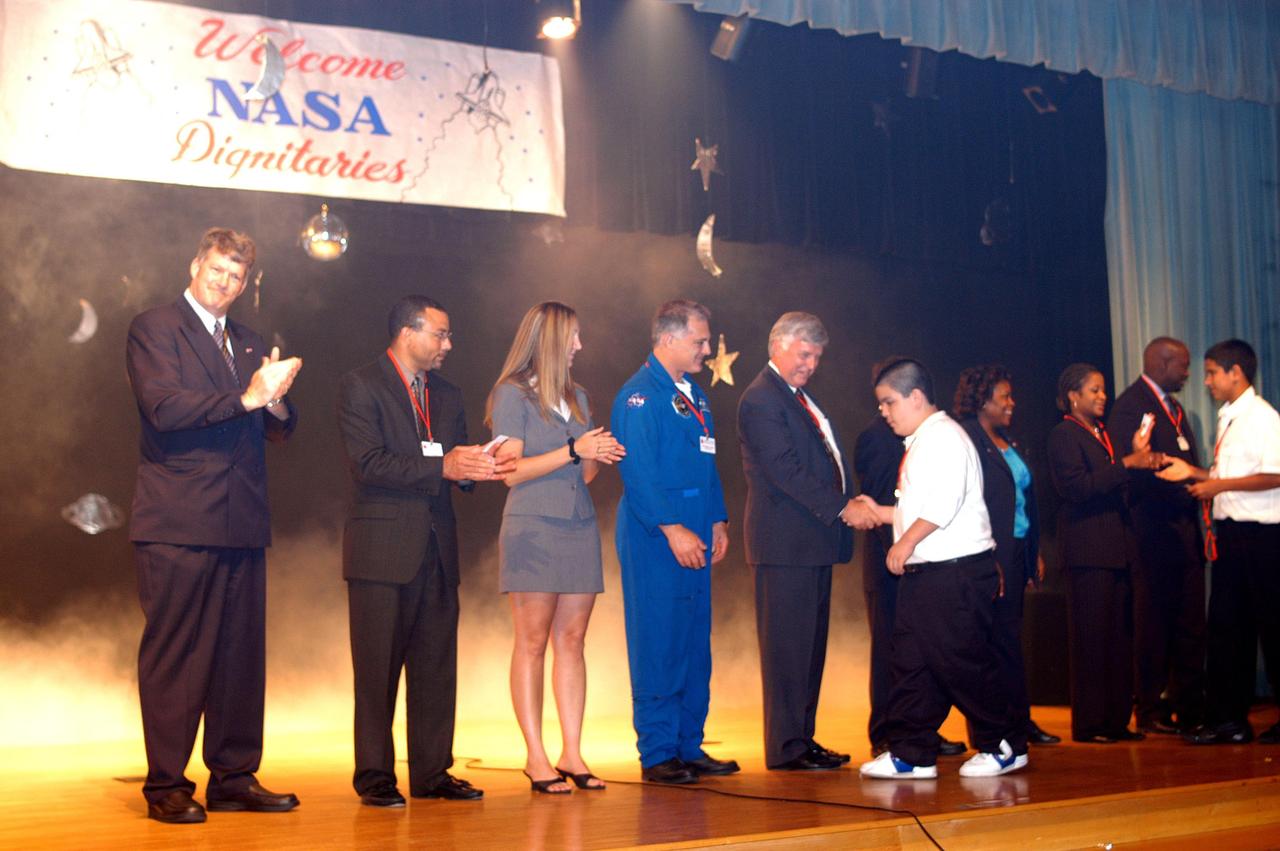
KENNEDY SPACE CENTER, FLA. -- During a visit to Howard A. Doolin Middle School, Miami, Fla., Center Director Jim Kennedy (shaking hands, center) and other NASA and KSC representatives are greeted by students on stage. With Kennedy on stage are (left to right), Jim Gerard, Aerospace Education Services Program (AESP) representative; Steve Lewis, assistant to Kennedy; Amber Marek, with KSC External Relations; David Wolf, astronaut; Kennedy; Les Gold, AESP representative; Burdette Brown; and Patricia Leonard and Clarence Bostic, Education Programs and University Research Division. Doolin Middle School is one of 100 to take part in the NASA Explorer Schools program. Kennedy is talking with students, the next generation of explorers, about our destiny as explorers, NASA’s stepping stone approach to exploring Earth, the Moon, Mars and beyond, how space impacts our lives, and how people and machines rely on each other in space.
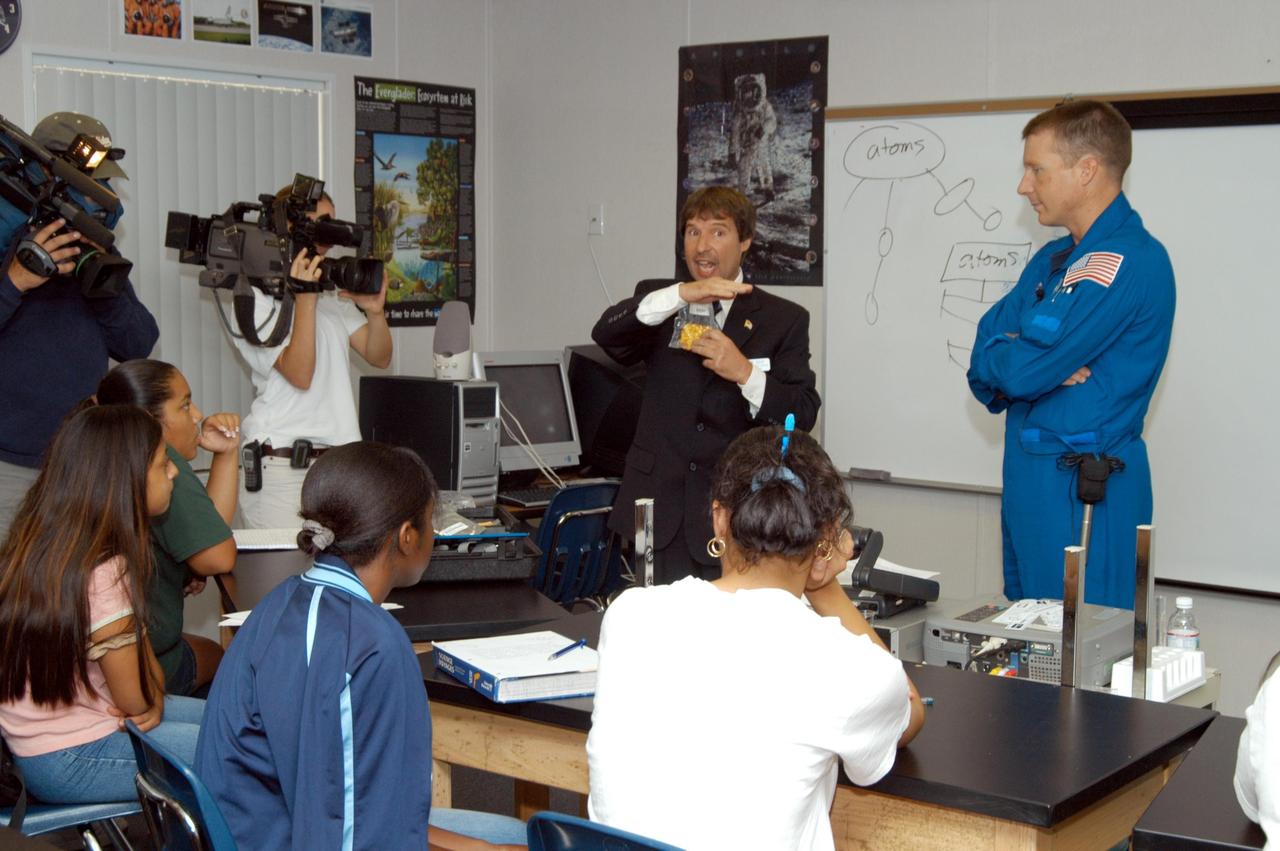
KENNEDY SPACE CENTER, FLA. - Les Gold, Aerospace Education specialist with KSC, speaks to students at Immokalee Middle School in Naples, Fla. At right is astronaut Terry Virts. Gold and Virts accompanied Center Director Jim Kennedy for a presentation at the school to share the vision for space exploration with the next generation of explorers. Immokalee is part of NASA’s Explorer School (NES) Program and is teamed with Pine Ridge Middle School. Kennedy is talking with students about our destiny as explorers, NASA’s stepping stone approach to exploring Earth, the Moon, Mars and beyond, how space impacts our lives, and how people and machines rely on each other in space. NES establishes a three-year partnership annually between NASA and 50 NASA Explorer Schools teams, consisting of teachers and education administrators from diverse communities nationwide.
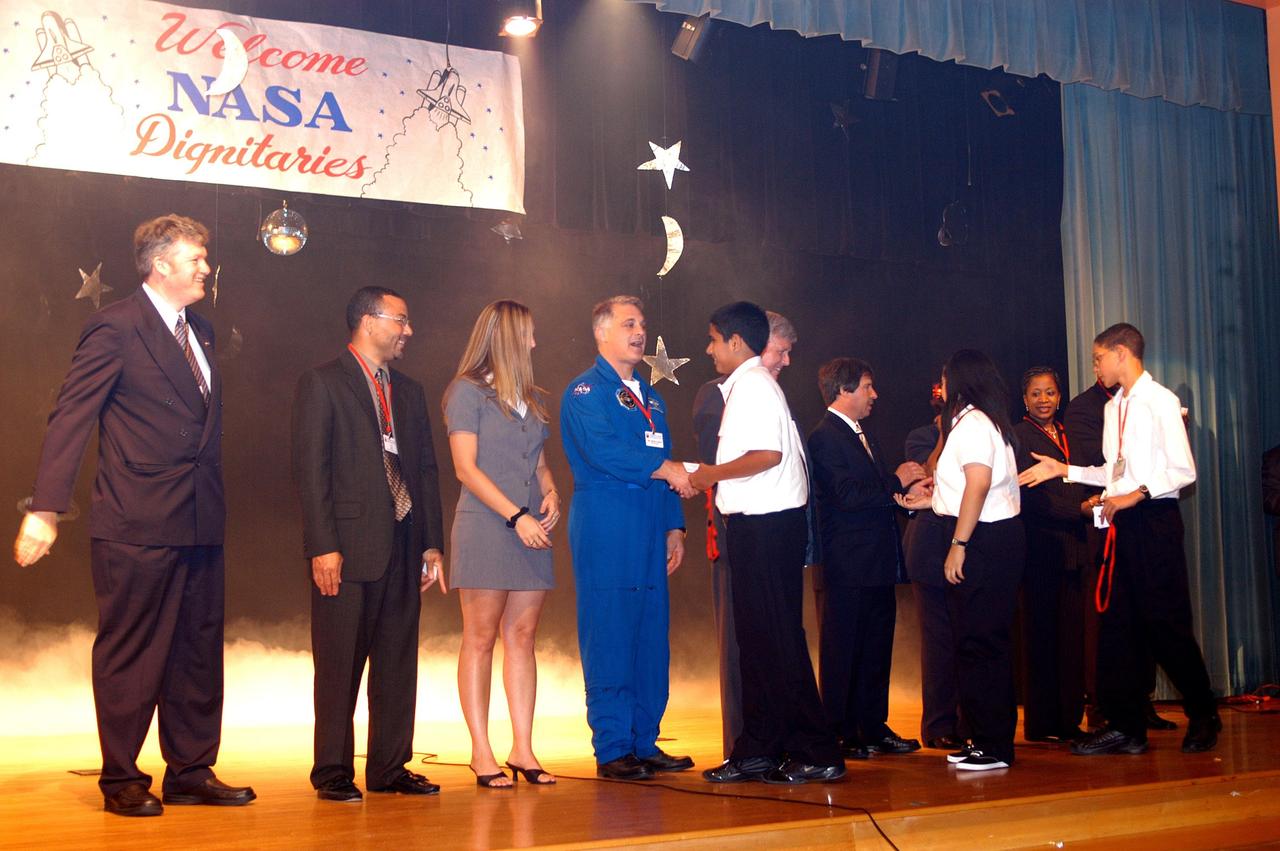
KENNEDY SPACE CENTER, FLA. -- During a visit to Howard A. Doolin Middle School, Miami, Fla., Center Director Jim Kennedy and other NASA and KSC representatives are greeted by students on stage. From left to right, are Jim Gerard, Aerospace Education Services Program (AESP) representative; Steve Lewis, assistant to Kennedy; Amber Marek, with KSC External Relations; David Wolf, astronaut; Kennedy; Les Gold, AESP representative; Burdette Brown; and Patricia Leonard and Clarence Bostic, Education Programs and University Research Division. Doolin Middle School is one of 100 to take part in the NASA Explorer Schools program. Kennedy is talking with students, the next generation of explorers, about our destiny as explorers, NASA’s stepping stone approach to exploring Earth, the Moon, Mars and beyond, how space impacts our lives, and how people and machines rely on each other in space.
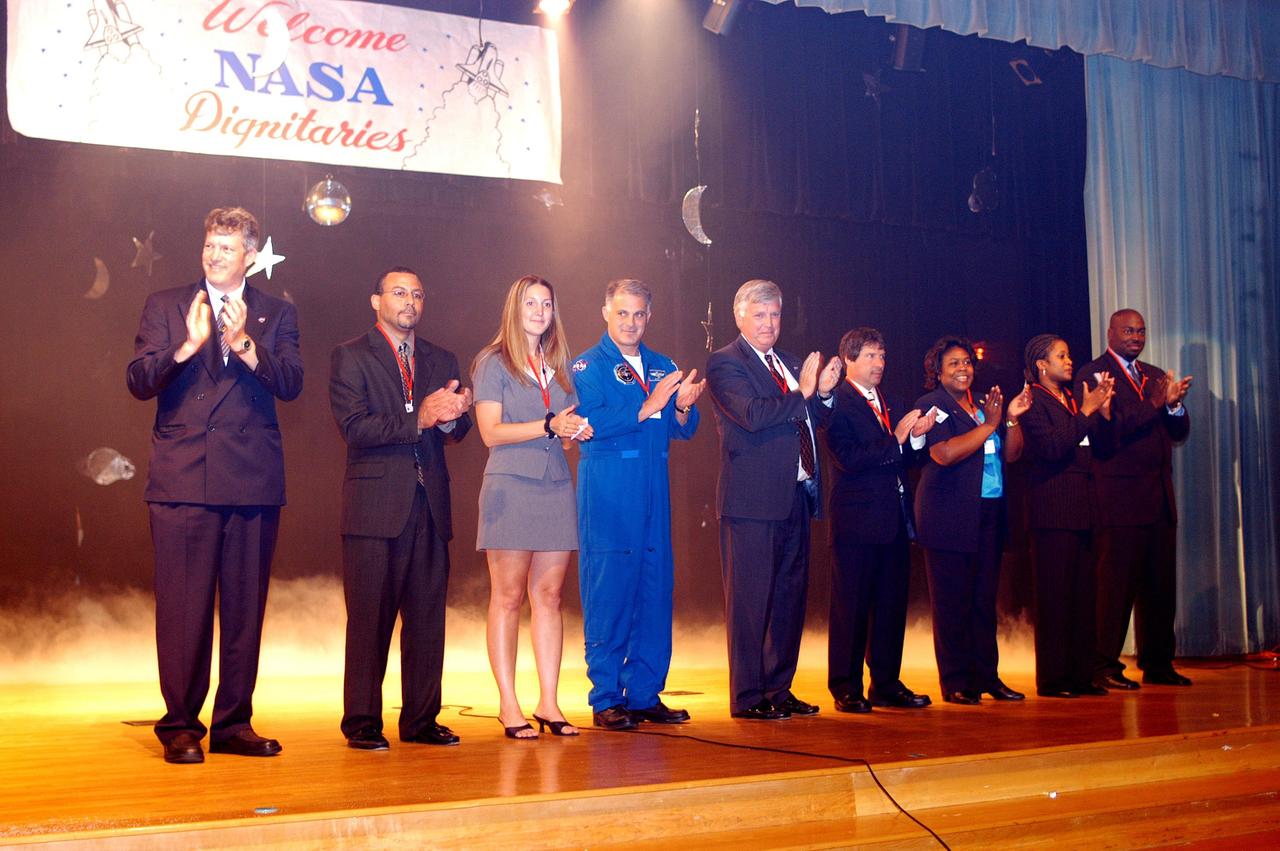
KENNEDY SPACE CENTER, FLA. -- During a visit to Howard A. Doolin Middle School, Miami, Fla., Center Director Jim Kennedy and other NASA and KSC representatives applaud faculty and students from the stage. From left to right are Jim Gerard, Aerospace Education Services Program (AESP) representative; Steve Lewis, assistant to Kennedy; Amber Marek, with KSC External Relations; David Wolf, astronaut; Kennedy; Les Gold, AESP representative; Burdette Brown; and Patricia Leonard and Clarence Bostic, Education Programs and University Research Division. Doolin Middle School is one of 100 to take part in the NASA Explorer Schools program. Kennedy is talking with students, the next generation of explorers, about our destiny as explorers, NASA’s stepping stone approach to exploring Earth, the Moon, Mars and beyond, how space impacts our lives, and how people and machines rely on each other in space.
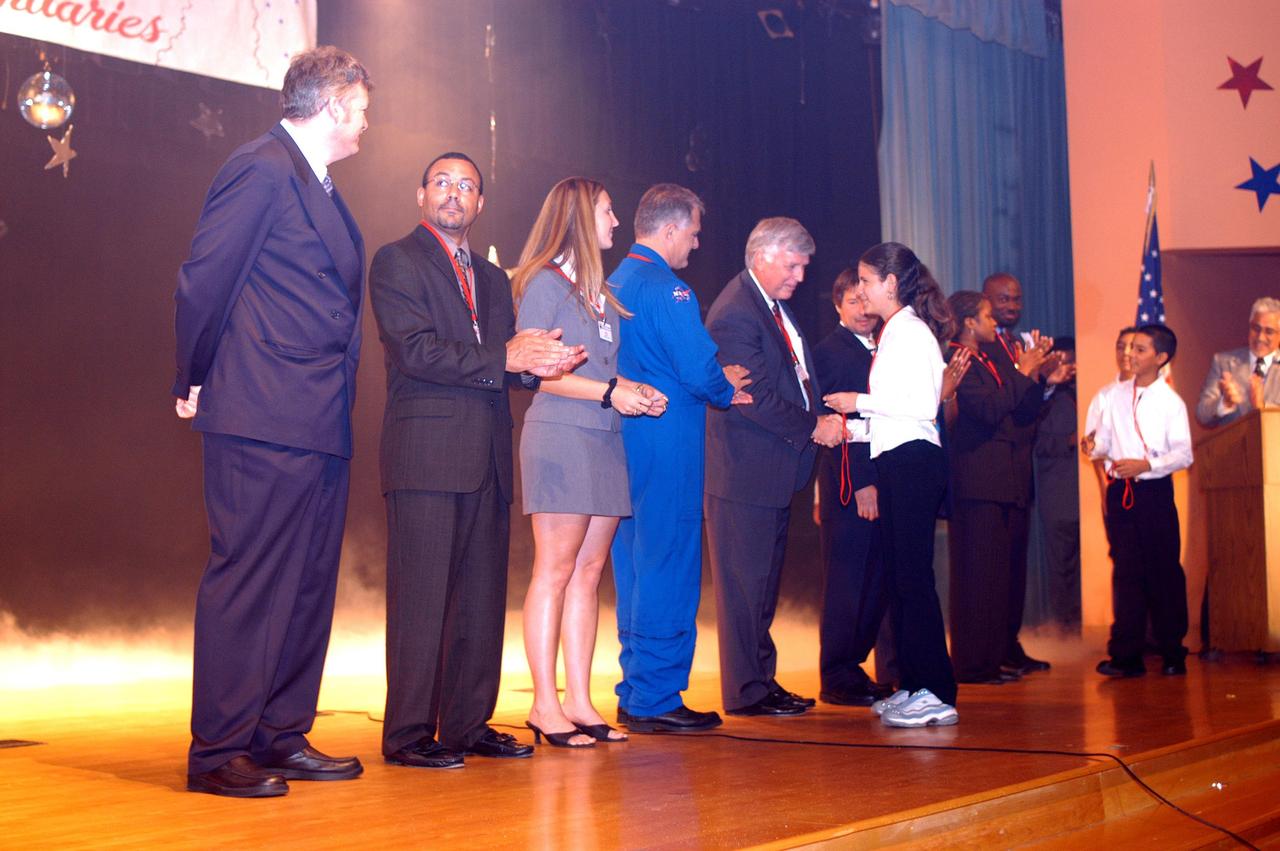
KENNEDY SPACE CENTER, FLA. -- During a visit to Howard A. Doolin Middle School, Miami, Fla., Center Director Jim Kennedy and other NASA and KSC representatives are greeted by students on stage. From left to right are Jim Gerard, Aerospace Education Services Program representative; Steve Lewis, assistant to Kennedy; Amber Marek, with KSC External Relations; David Wolf, astronaut; Kennedy; Les Gold, AESP representative; Burdette Brown; and Patricia Leonard and Clarence Bostic, Education Programs and University Research Division. Doolin Middle School is one of 100 to take part in the NASA Explorer Schools program. Kennedy is talking with students, the next generation of explorers, about our destiny as explorers, NASA’s stepping stone approach to exploring Earth, the Moon, Mars and beyond, how space impacts our lives, and how people and machines rely on each other in space.
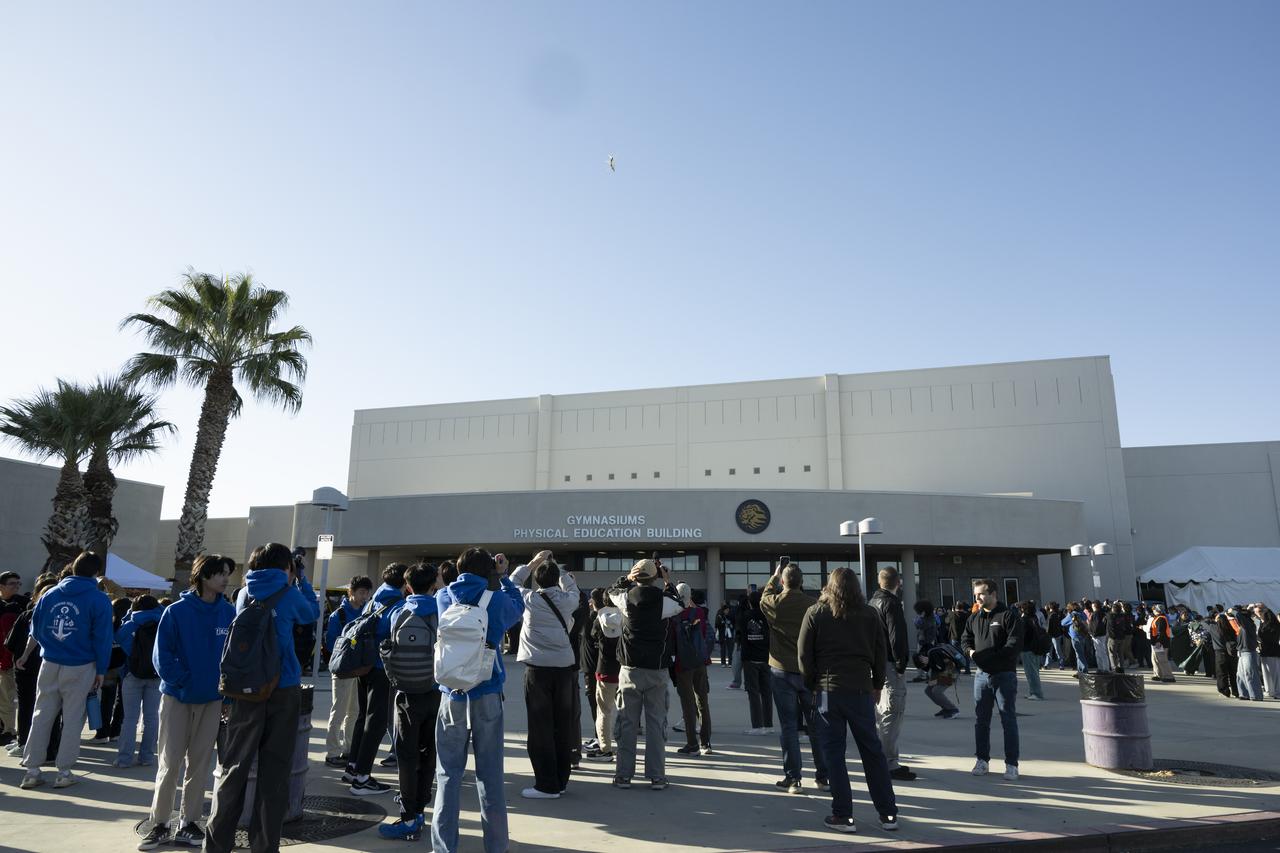
A group of attendees to the 2025 Aerospace Valley FIRST Robotics Competition gather outside Eastside High School’s gymnasium in Lancaster, California, to watch an F/A-18 from NASA’s Armstrong Flight Research Center, in Edwards, California, fly over the school to kick off the competition, on April 3, 2025.
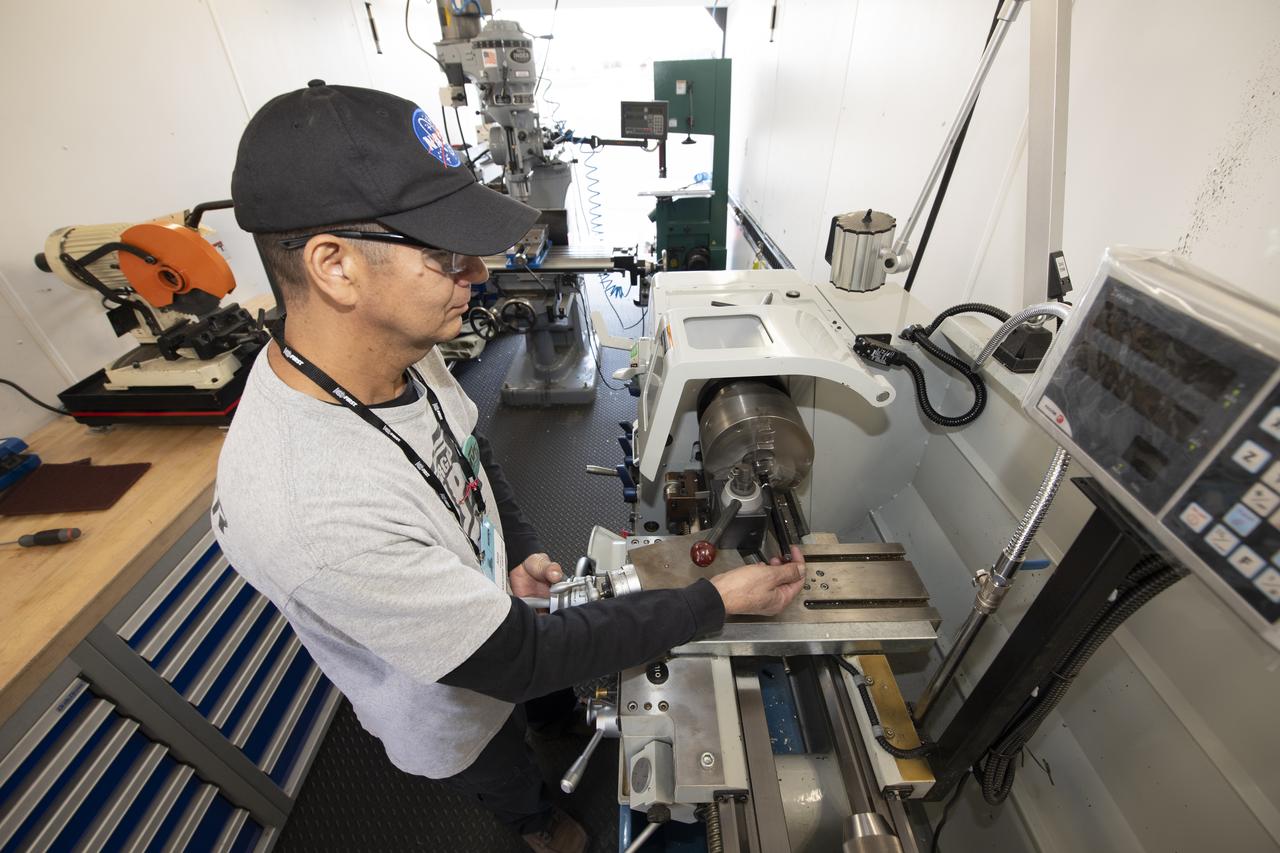
Jose Vasquez, engineering technician at NASA’s Armstrong Flight Research Center at Edwards, California, machines parts for a robot inside NASA’s mobile machine shop at the 2025 Aerospace Valley FIRST Robotics Competition in Lancaster, California, on April 3, 2025.
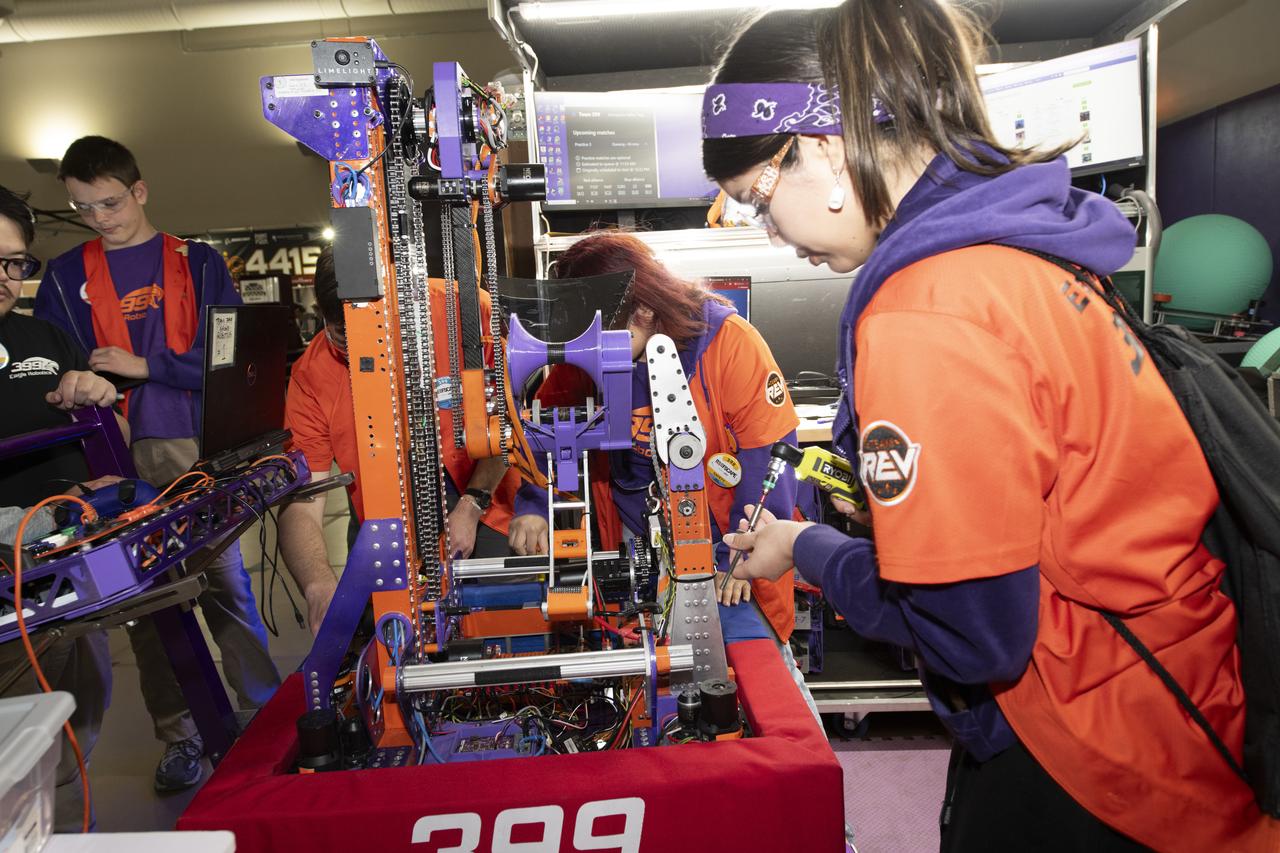
Students from Eagle Robotics, Team 399, supported by volunteers from NASA’s Armstrong Flight Research Center in Edwards, California, adjust their robot during the 2025 Aerospace Valley FIRST Robotics Competition in Lancaster, California, on April 3, 2025.
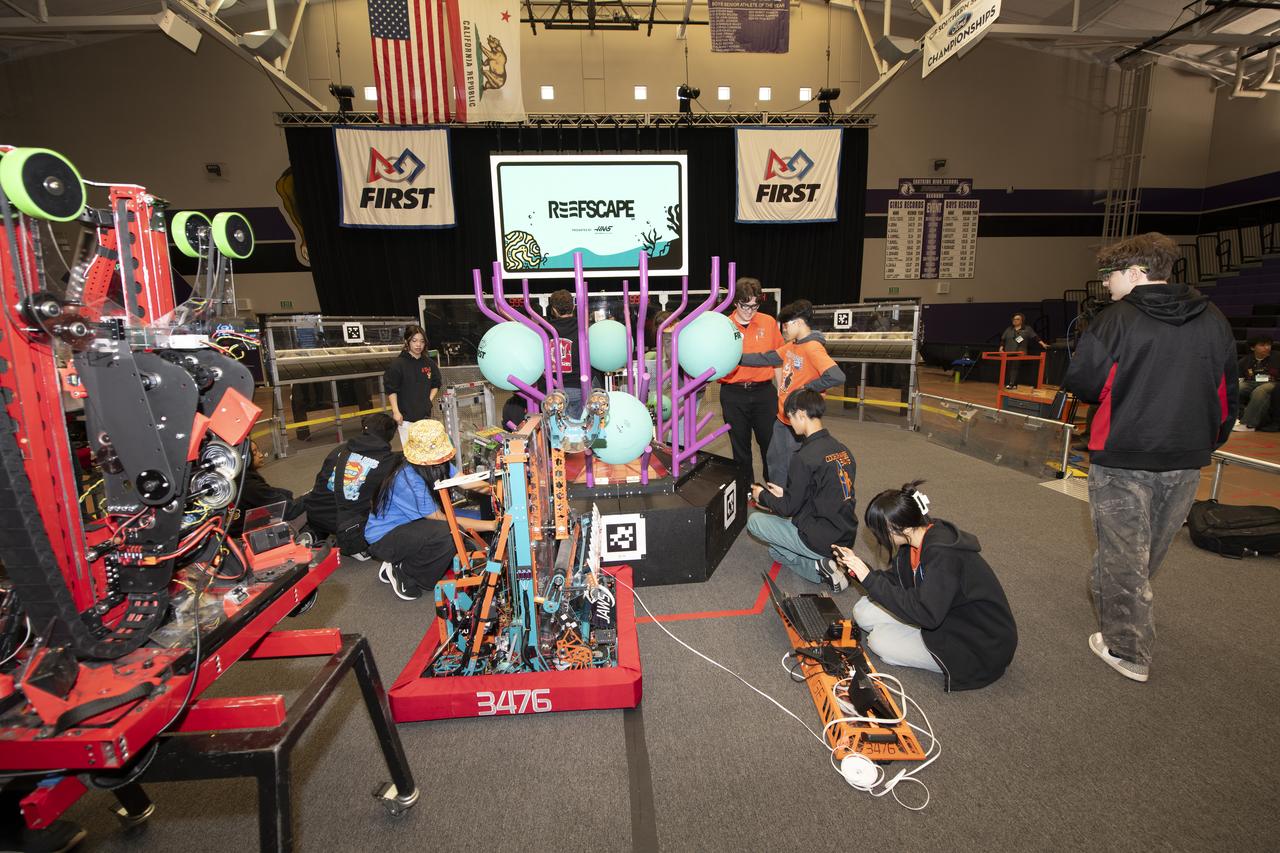
Robotics teams gather on the main floor of the 2025 Aerospace Valley FIRST Robotics Competition at Eastside High School in Lancaster, California, adjusting and testing the functions of their robots, on April 3, 2025
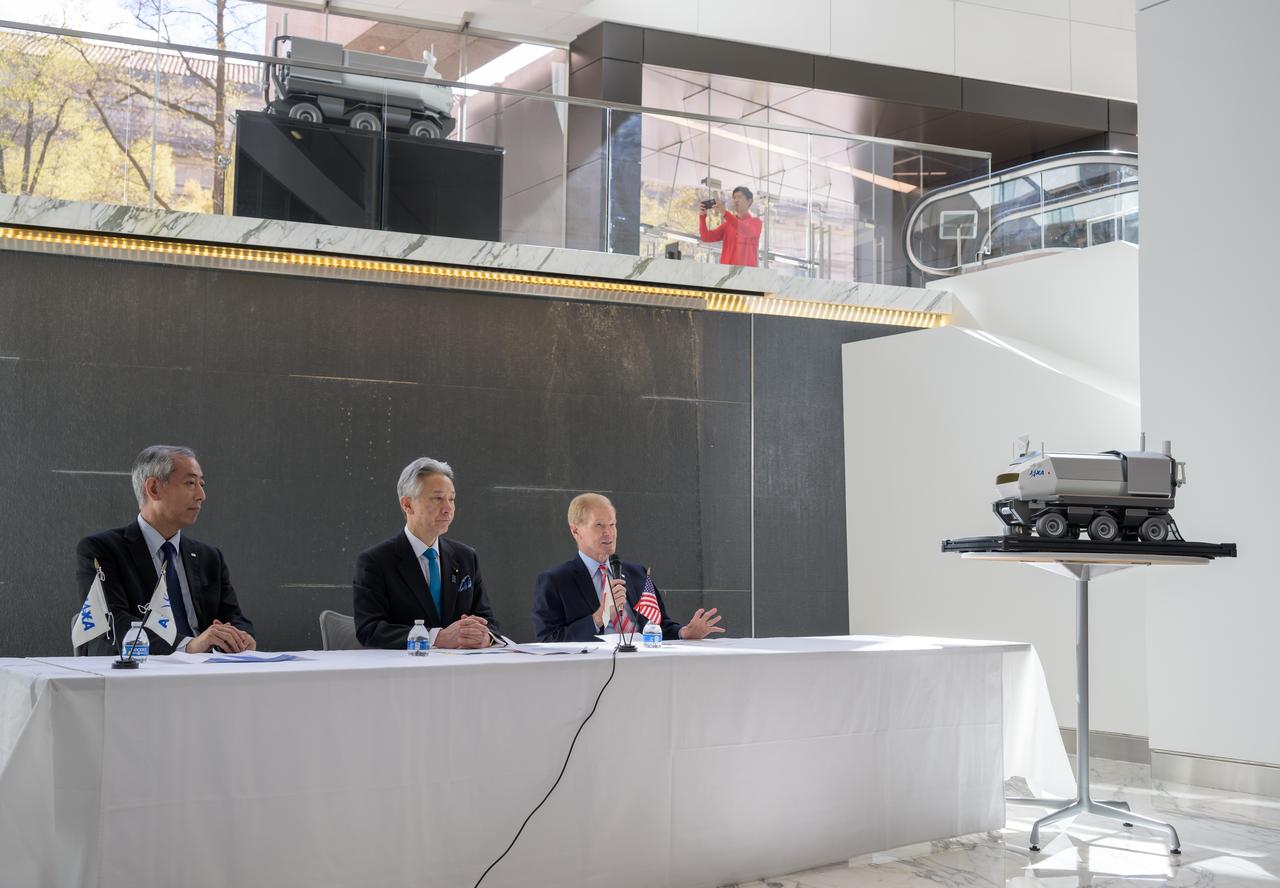
Japan Aerospace Exploration Agency (JAXA) President Hiroshi Yamakawa, left, Japan’s Minister of Education, Culture, Sports, Science and Technology Masahito Moriyama, and NASA Administrator Bill Nelson, right, are seen during a briefing where they discussed the historic agreement signed April 9th at NASA Headquarters, between the United States and Japan to advance sustainable human exploration of the Moon, Wednesday, April 10, 2024, at the Japan Aerospace Exploration Agency (JAXA) offices in Washington. Under the agreement, Japan will design, develop, and operate a pressurized rover for crewed and uncrewed exploration on the Moon. NASA will provide the launch and delivery of the rover to the Moon as well as two Japanese astronaut missions to the lunar surface. Photo Credit: Photo Credit: (NASA/Bill Ingalls)
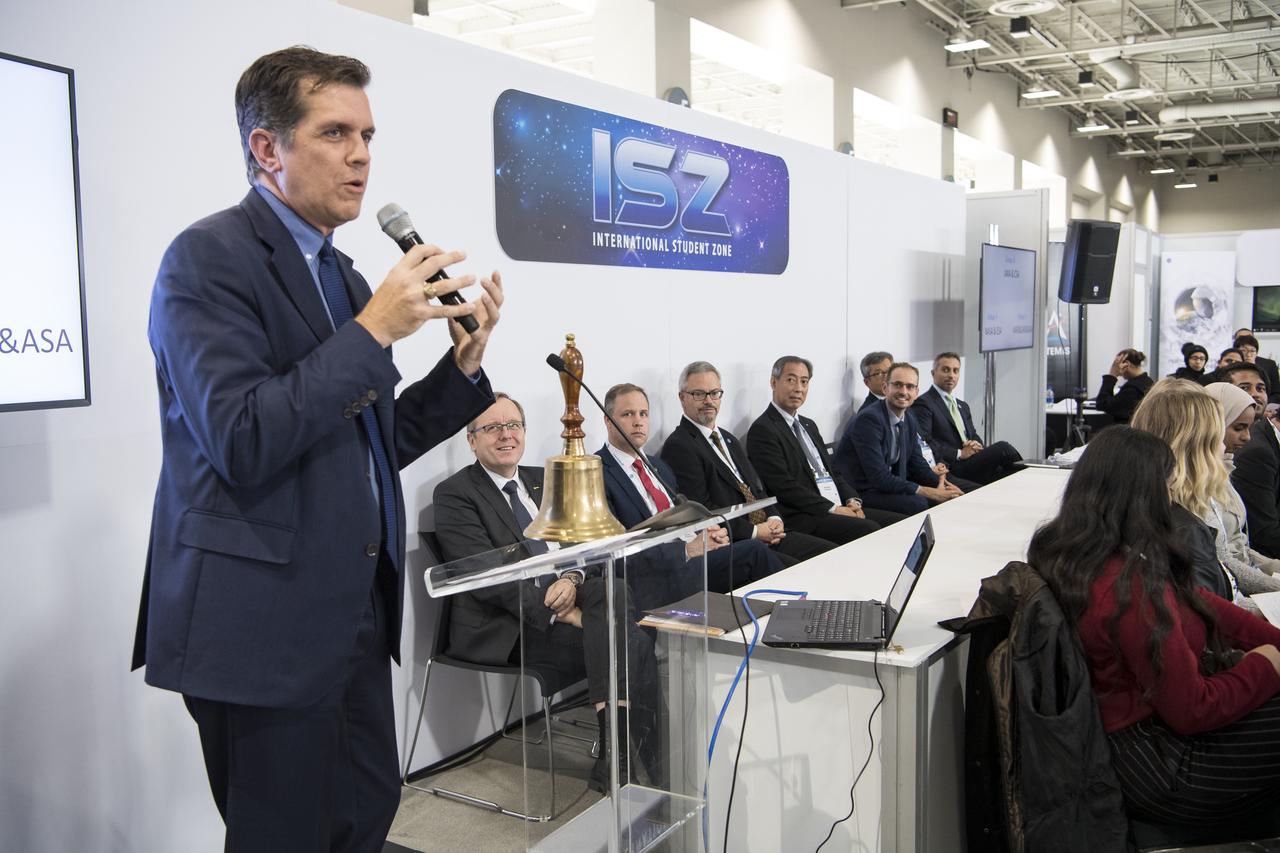
NASA Associate Administrator for STEM Engagement, Mike Kincaid, introduces the heads of agencies that will be participating in an interactive session with students, from left to right, Dr. Johann-Dietrich Worner, director general of the European Space Agency (ESA); NASA Administrator Jim Bridenstine; Sylvain Laporte, president of the Canadian Space Agency (CSA); Dr. Hiroshi Yamakawa, president of the Japan Aerospace Exploration Agency (JAXA); Anthony Murfett, deputy head fo the Australian Space Agency (ASA); Jeong Joo Park, Vice President fo the Korean Aerospace Research Institute (KARI); and H.E. Dr. Ahmad bin Abdulla Humaid Belhoul Al Falasi, Minister of State for Higher Education and Advanced Skills and Chairman of the UAE Space Agency (UAESA), during the 70th International Astronautical Congress, Monday, Oct. 21, 2019 at the Walter E. Washington Convention Center in Washington. Photo credit: (NASA/Aubrey Gemignani)
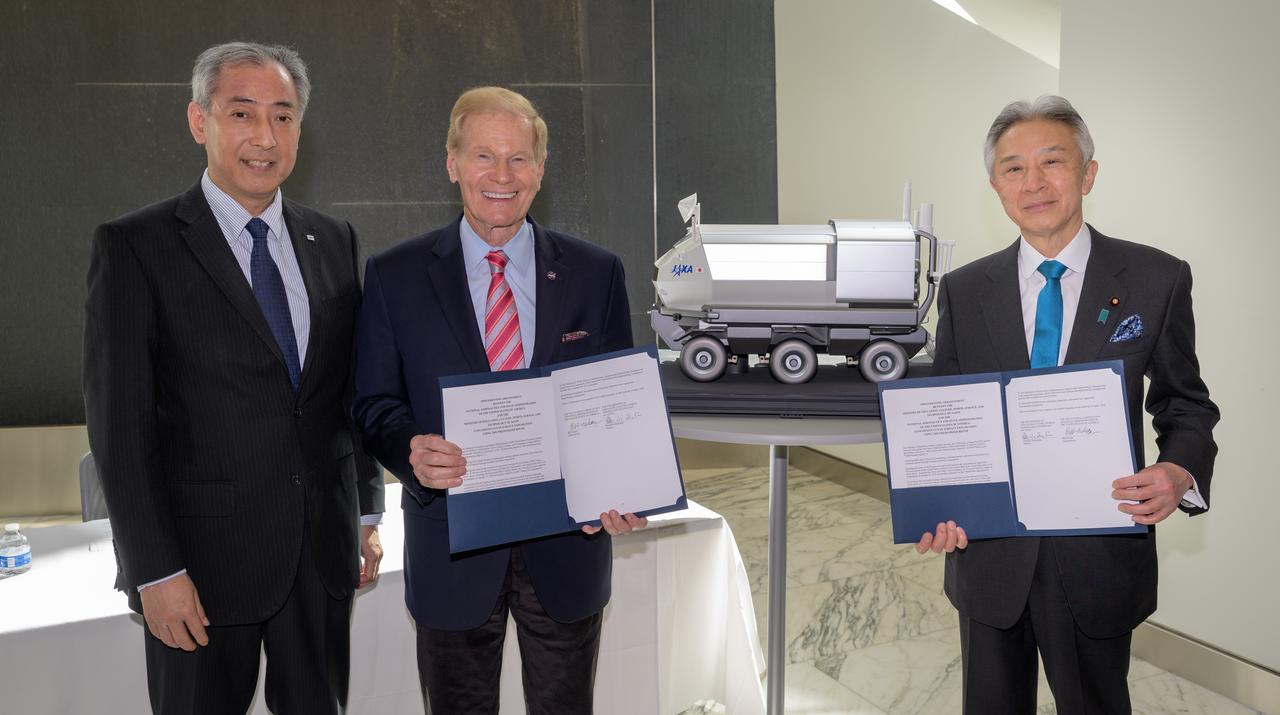
Japan Aerospace Exploration Agency (JAXA) President Hiroshi Yamakawa, left, NASA Administrator Bill Nelson, and Japan’s Minister of Education, Culture, Sports, Science and Technology Masahito Moriyama, right, pose for a group photograph holding the historic agreement signed April 9th at NASA Headquarters, between the United States and Japan to advance sustainable human exploration of the Moon, Wednesday, April 10, 2024, at the Japan Aerospace Exploration Agency (JAXA) offices in Washington. Under the agreement, Japan will design, develop, and operate a pressurized rover for crewed and uncrewed exploration on the Moon. NASA will provide the launch and delivery of the rover to the Moon as well as two Japanese astronaut missions to the lunar surface. Photo Credit: Photo Credit: (NASA/Bill Ingalls)
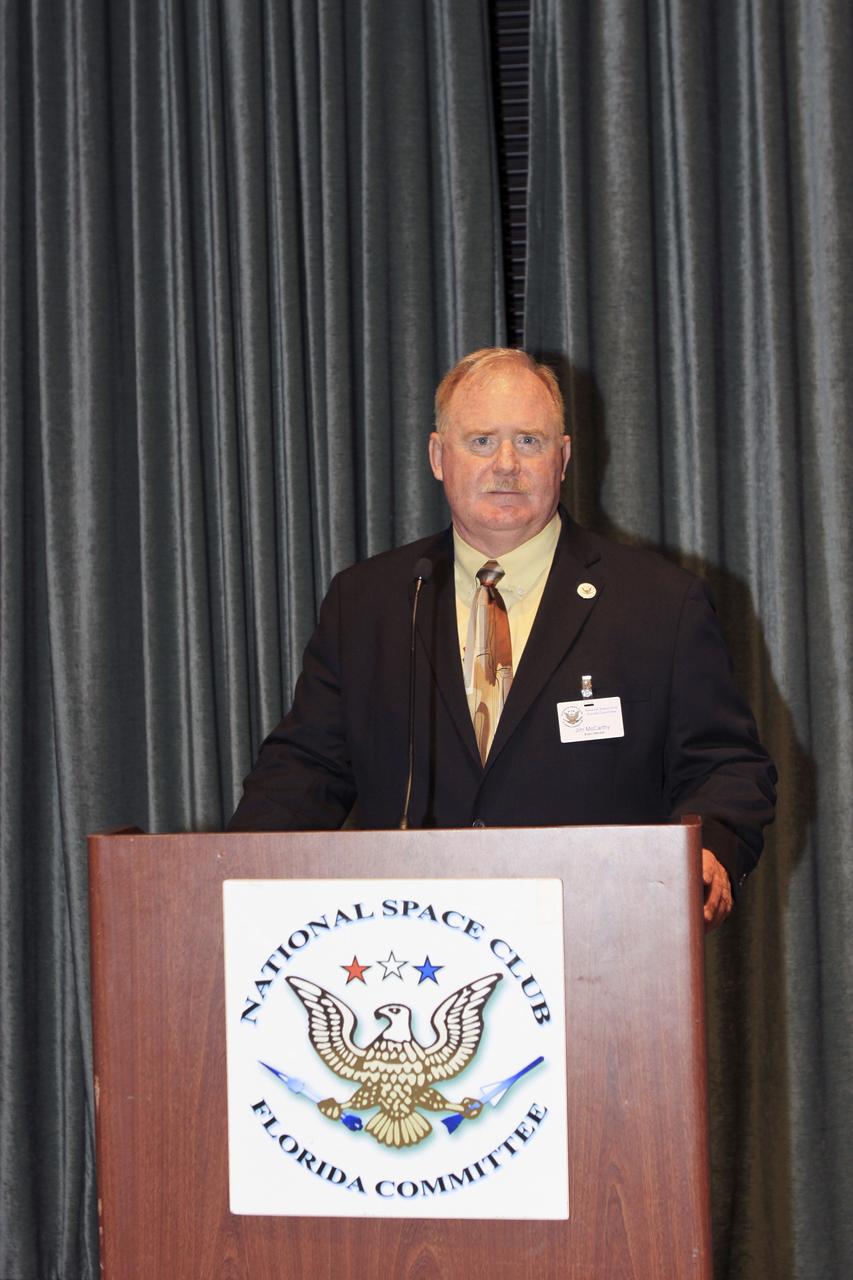
CAPE CANAVERAL Fla. -- Jim McCarthy, with URS and chairman of the National Space Club Florida Committee, or NSCFL, greets attendees at the May 14 luncheon at the Radisson Resort at the Port in Cape Canaveral, Fla. Kennedy Space Center Director Bob Cabana was the featured speaker with a presentation on the Fiscal Year 2014 budget and Kennedy’s path forward. The NSCFL Committee is one of three regional committees including Huntsville, Ala. and Los Angeles, Calif. of the National Space Club in Washington, D.C. The NSCFL Committee promotes awareness through hosting monthly luncheons, sponsoring educational opportunities, recognizing significant achievement, and promoting aerospace leadership in a region heavily influenced by aerospace activities. Photo credit: NASA/Jim Grossmann
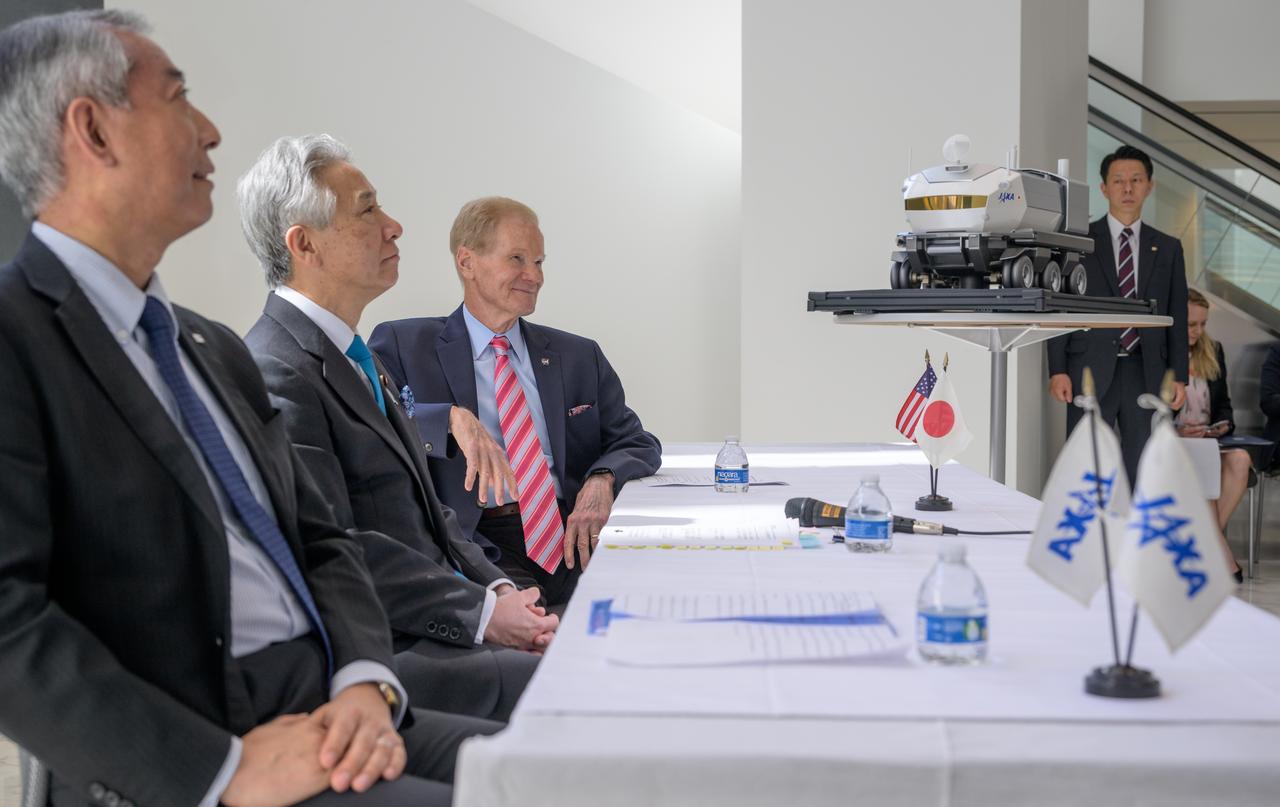
Japan Aerospace Exploration Agency (JAXA) President Hiroshi Yamakawa, left, Japan’s Minister of Education, Culture, Sports, Science and Technology Masahito Moriyama, and NASA Administrator Bill Nelson, right, are seen during a briefing where they discussed the historic agreement signed April 9th at NASA Headquarters, between the United States and Japan to advance sustainable human exploration of the Moon, Wednesday, April 10, 2024, at the Japan Aerospace Exploration Agency (JAXA) offices in Washington. Under the agreement, Japan will design, develop, and operate a pressurized rover for crewed and uncrewed exploration on the Moon. NASA will provide the launch and delivery of the rover to the Moon as well as two Japanese astronaut missions to the lunar surface. Photo Credit: Photo Credit: (NASA/Bill Ingalls)
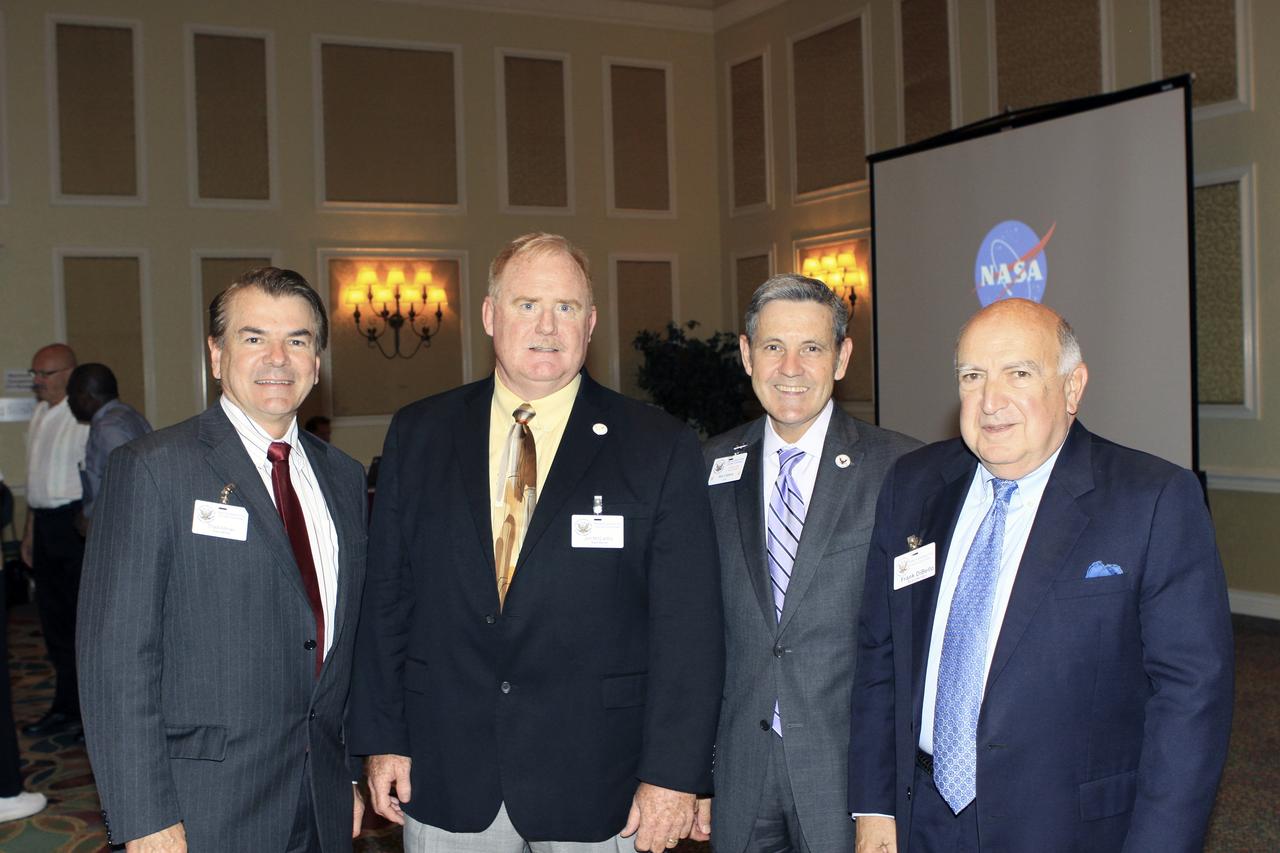
CAPE CANAVERAL Fla. -- Kennedy Space Center Director Bob Cabana, second from right, spoke to attendees at the National Space Club Florida Committee, or NSCFL, luncheon May 14 at the Radisson Resort at the Port in Cape Canaveral, Fla. Cabana’s presentation focused on the Fiscal Year 2014 budget and Kennedy’s path forward. From the left, are State Senator and Astronaut Memorial Foundation President Thad Altman NSCFL Chairman Jim McCarthy, URS and Frank DiBello, president of Space Florida. The NSCFL Committee is one of three regional committees including Huntsville, Ala. and Los Angeles, Calif. of the National Space Club in Washington, D.C. The NSCFL Committee promotes awareness through hosting monthly luncheons, sponsoring educational opportunities, recognizing significant achievement, and promoting aerospace leadership in a region heavily influenced by aerospace activities. Photo credit: NASA/Jim Grossmann
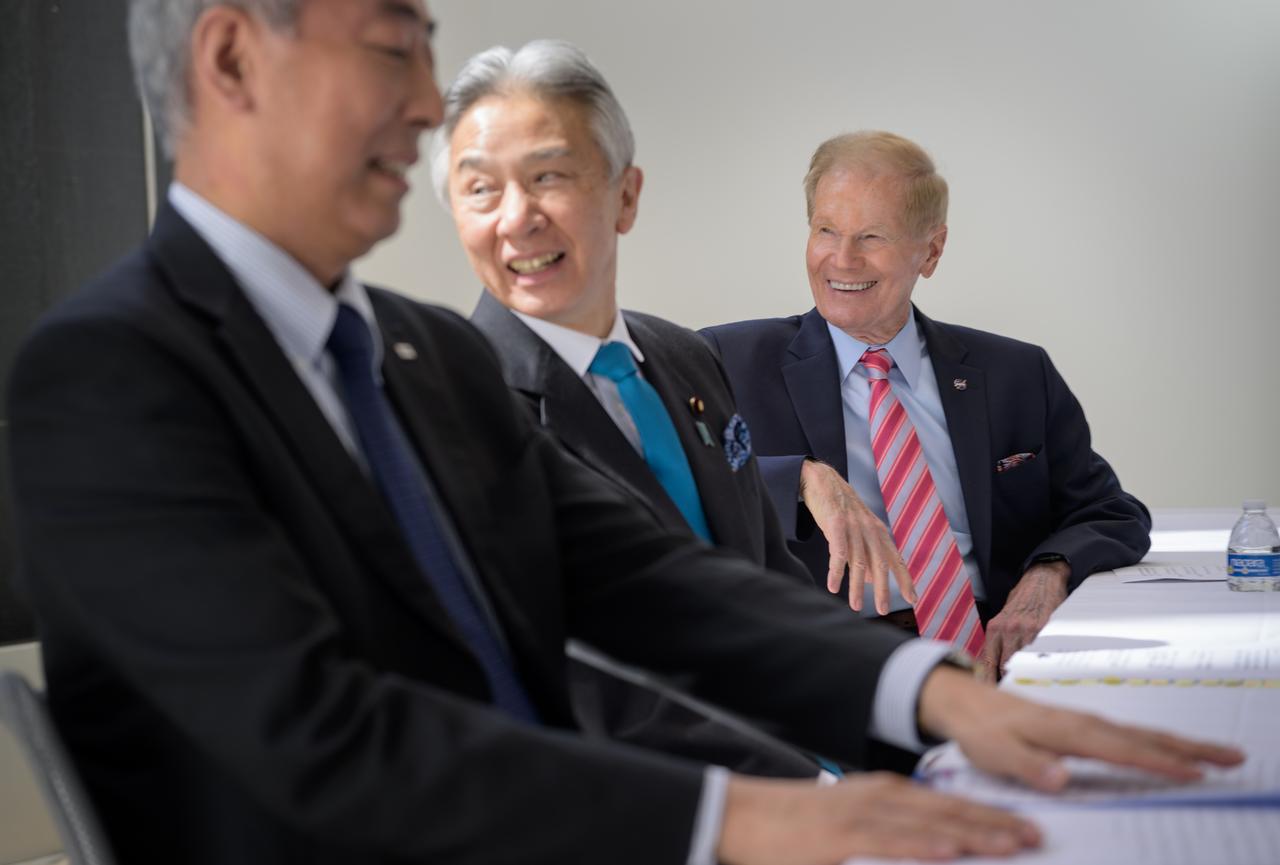
Japan Aerospace Exploration Agency (JAXA) President Hiroshi Yamakawa, left, Japan’s Minister of Education, Culture, Sports, Science and Technology Masahito Moriyama, and NASA Administrator Bill Nelson, right, are seen during a briefing where they discussed the historic agreement signed April 9th at NASA Headquarters, between the United States and Japan to advance sustainable human exploration of the Moon, Wednesday, April 10, 2024, at the Japan Aerospace Exploration Agency (JAXA) offices in Washington. Under the agreement, Japan will design, develop, and operate a pressurized rover for crewed and uncrewed exploration on the Moon. NASA will provide the launch and delivery of the rover to the Moon as well as two Japanese astronaut missions to the lunar surface. Photo Credit: Photo Credit: (NASA/Bill Ingalls)
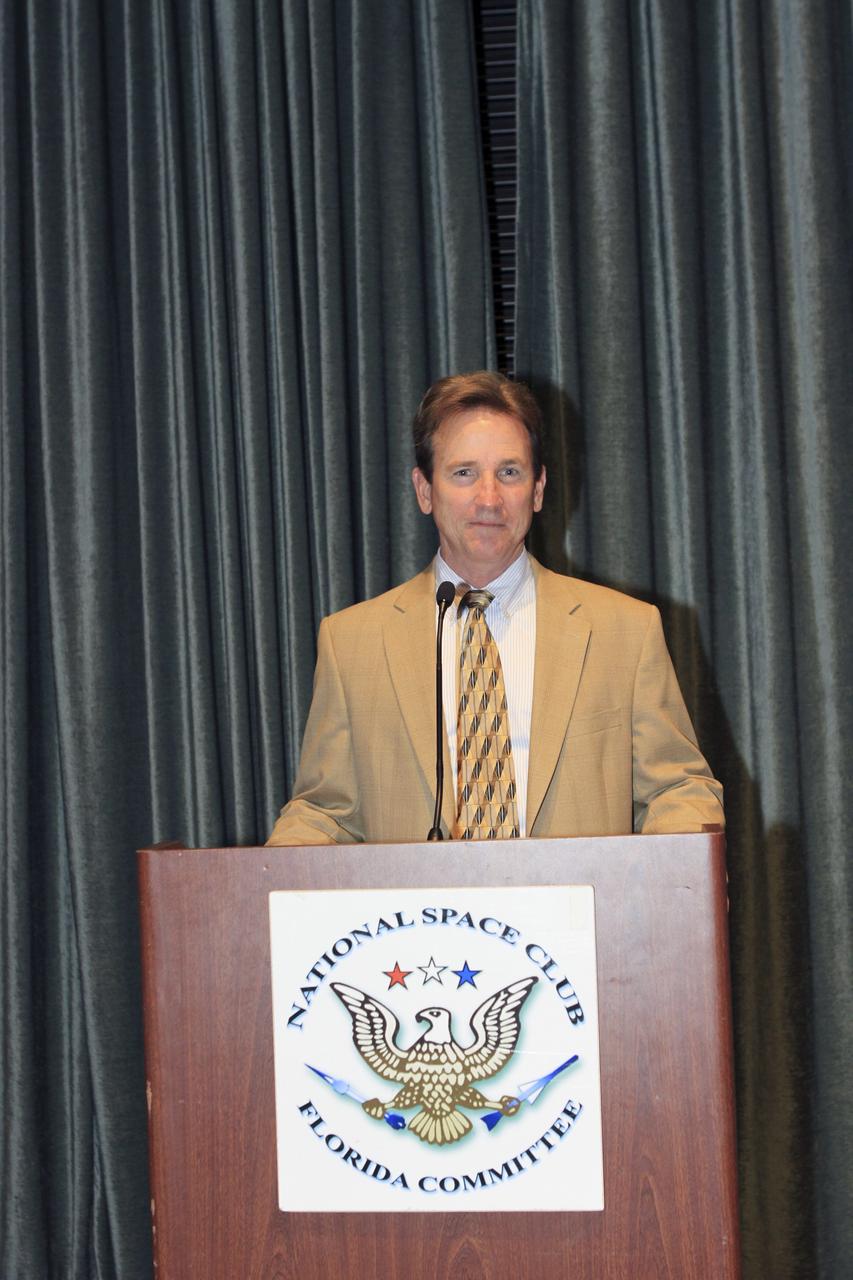
CAPE CANAVERAL Fla. -- Dale Ketchum, director of the Space Research and Technology Institute, speaks to attendees of the National Space Club Florida Committee, or NSCFL, at the May 14 luncheon at the Radisson Resort at the Port in Cape Canaveral, Fla. Kennedy Space Center Director Bob Cabana was the featured speaker with a presentation on the Fiscal Year 2014 budget and Kennedy’s path forward. The NSCFL Committee is one of three regional committees including Huntsville, Ala. and Los Angeles, Calif. of the National Space Club in Washington, D.C. The NSCFL Committee promotes awareness through hosting monthly luncheons, sponsoring educational opportunities, recognizing significant achievement, and promoting aerospace leadership in a region heavily influenced by aerospace activities. Photo credit: NASA/Jim Grossmann
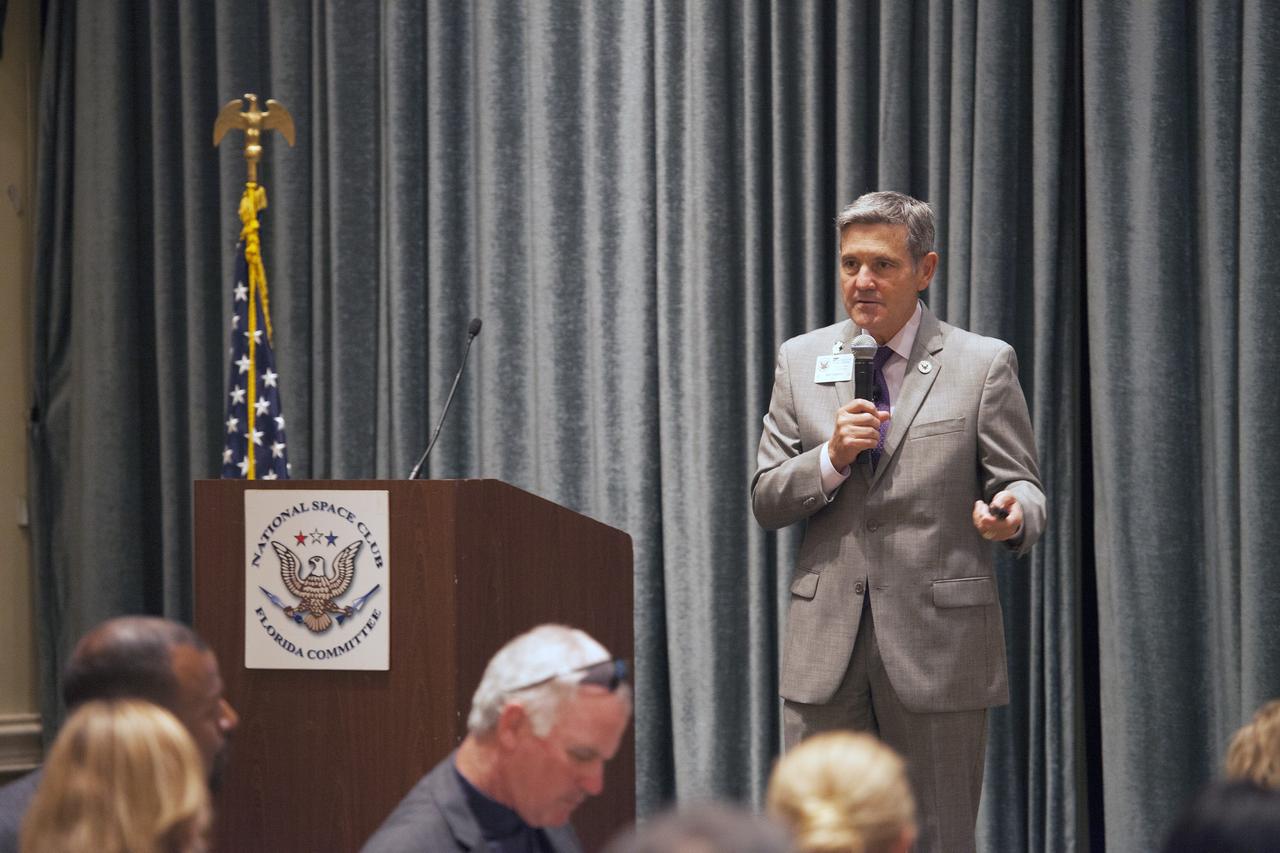
CAPE CANAVERAL, Fla. – Kennedy Space Center Director Bob Cabana speaks to National Space Club-Florida Chapter, or NSCFC, members and guests at the Radisson Resort at the Port in Cape Canaveral, Florida. Cabana's presentation included an overview of the new strategic plan and efforts to transform the center into a multi-user spaceport of the future. The NSCFC is a non-profit organization composed of representatives from the space industry, government, educational institutions, and private individuals who share a commitment to increasing public awareness of America's aerospace programs. Photo credit: Dimitri Gerondidakis