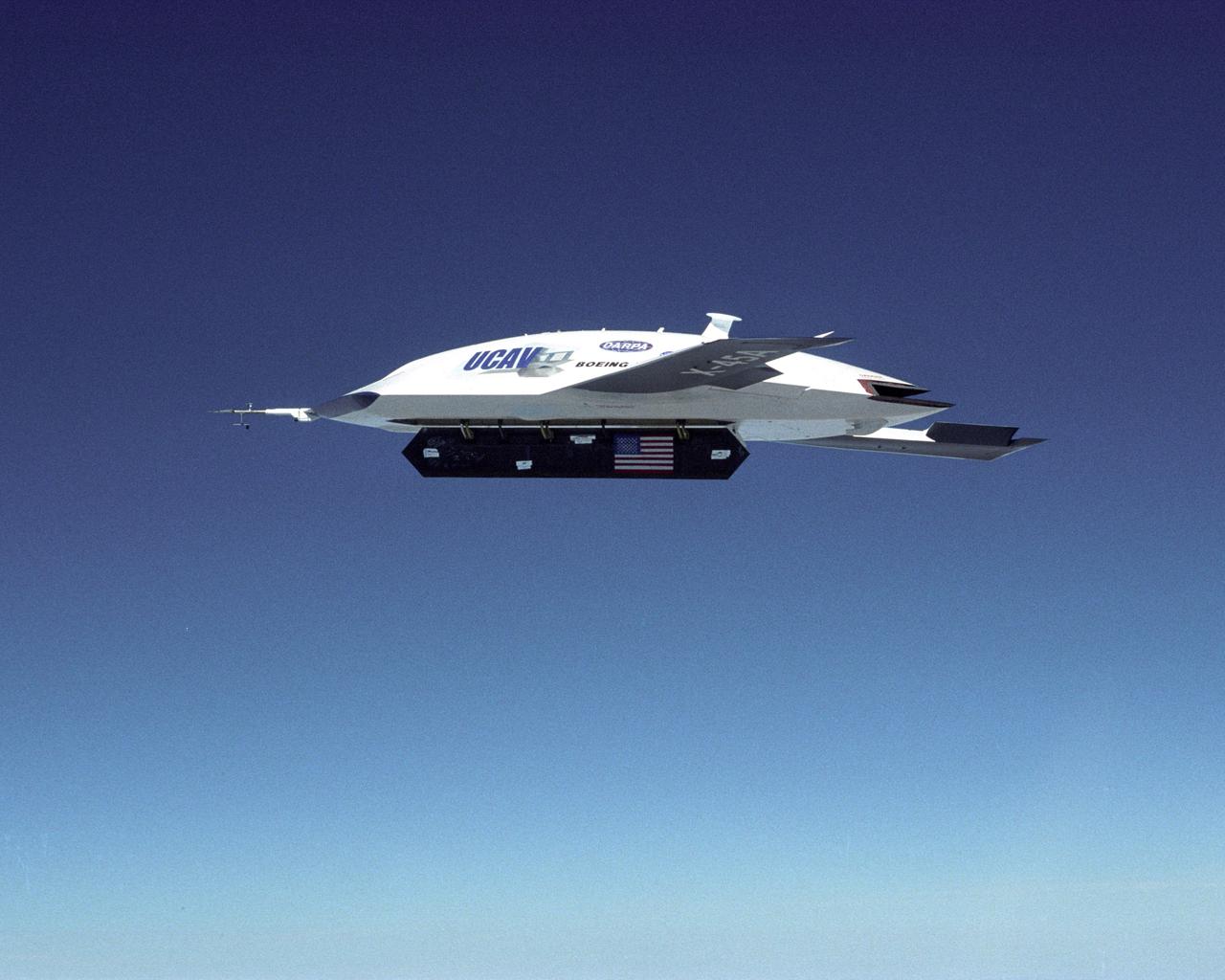
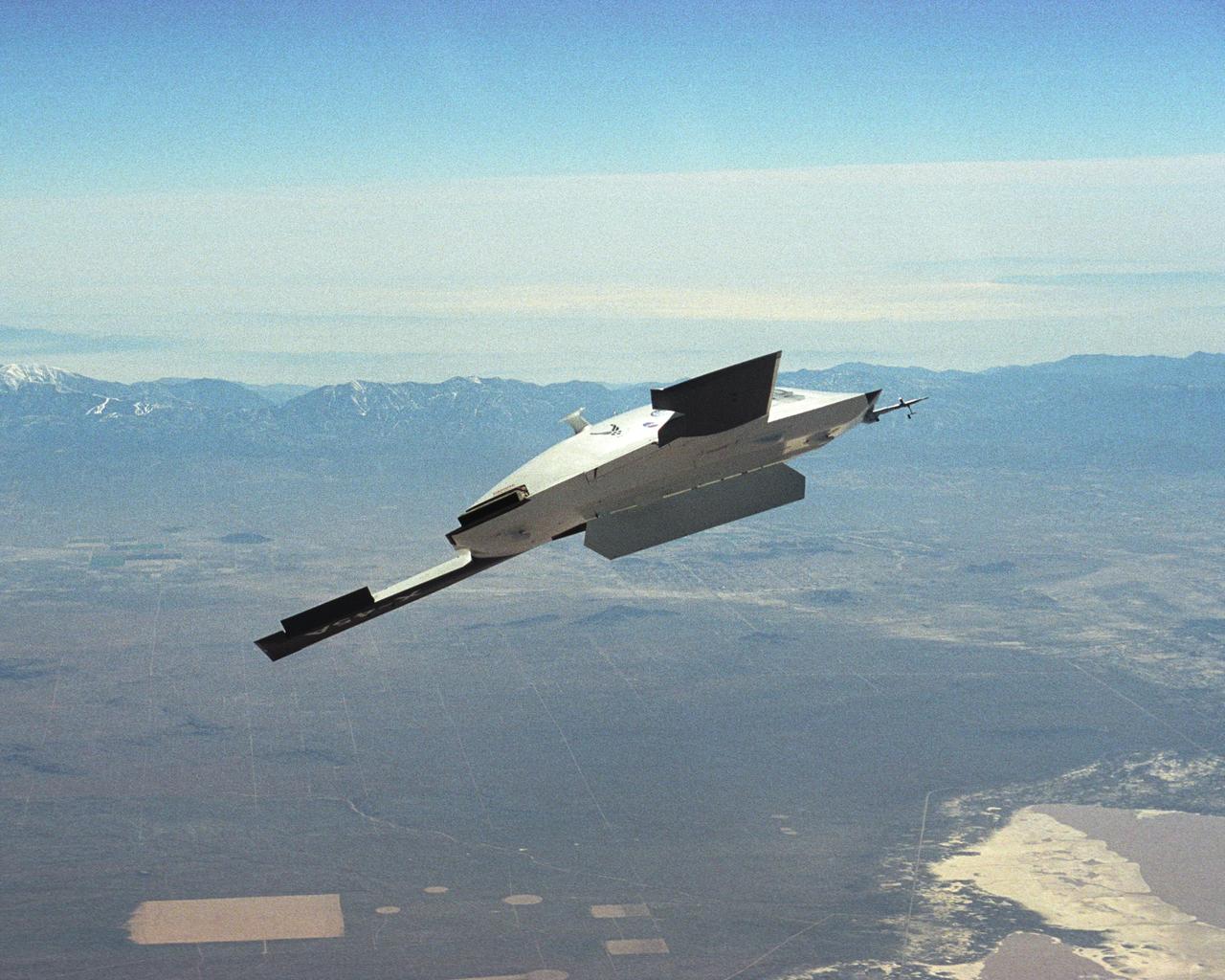
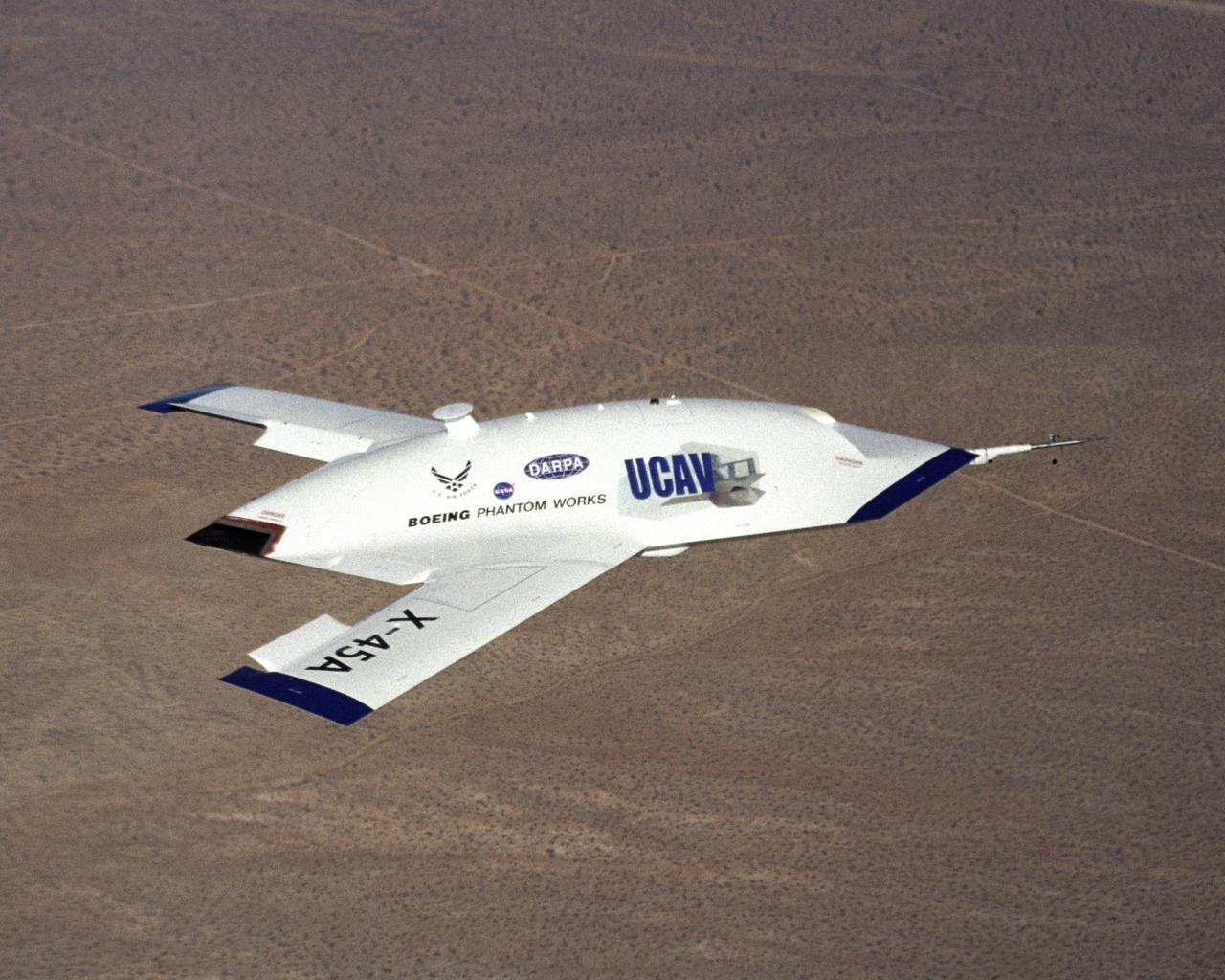
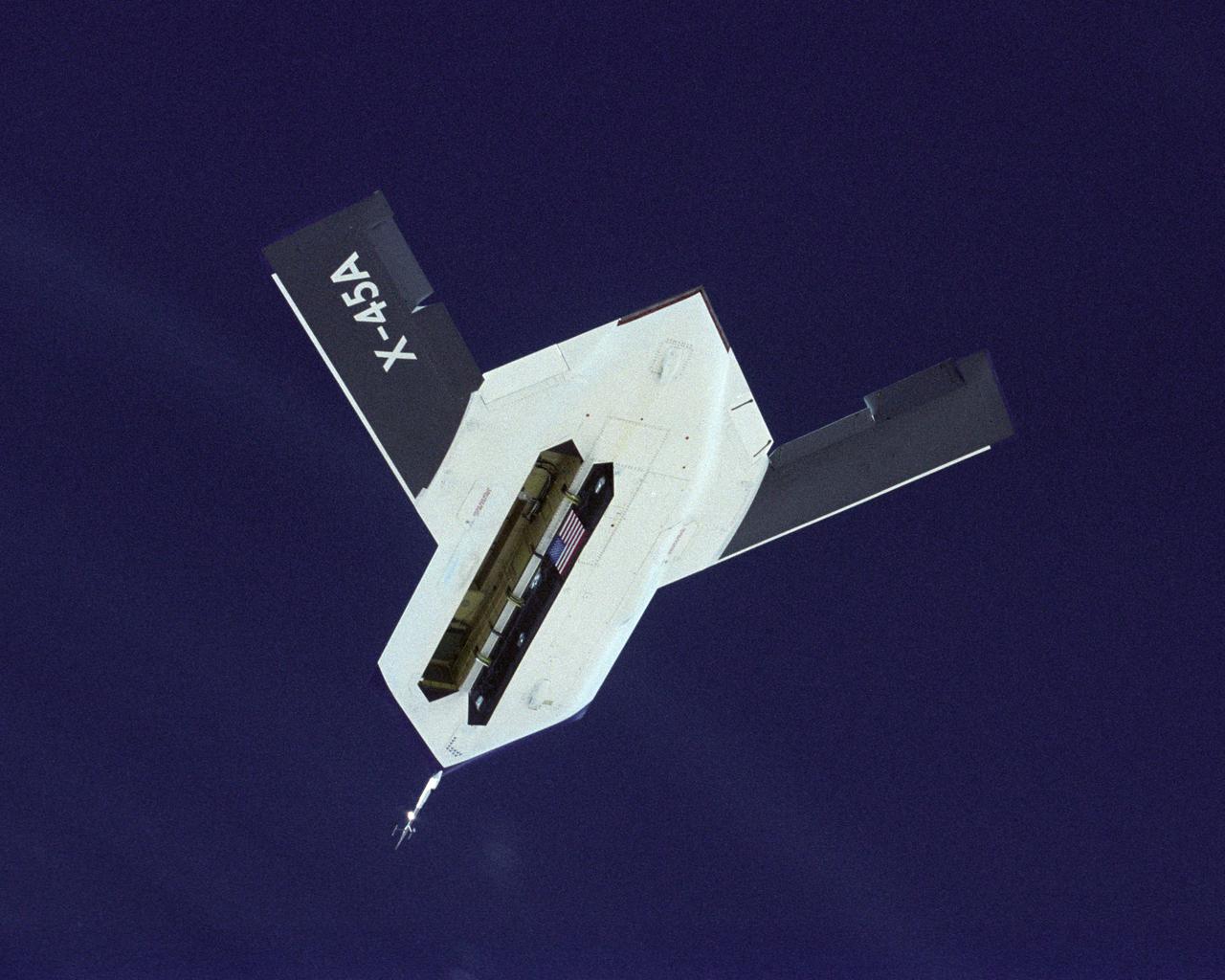
The DARPA/U.S. Air Force X-45A Unmanned Combat Air Vehicle (UCAV) system demonstration program completed the first phase of demonstrations, known as Block I, on Feb. 28, 2003. The final Block I activities included two flights at Dryden, during which safe operation of the weapons bay door was verified at 35,000 feet and speeds of Mach 0.75, the maximum planned altitude and speed for the two X-45A demonstrator vehicles.
X-45A Air Vehicle #1 during flight #13, with weapons bay door open
The DARPA/U.S. Air Force X-45A Unmanned Combat Air Vehicle (UCAV) system demonstration program completed the first phase of demonstrations, known as Block I, on Feb. 28, 2003. The final Block I activities included two flights at Dryden, during which safe operation of the weapons bay door was verified at 35,000 feet and speeds of Mach 0.75, the maximum planned altitude and speed for the two X-45A demonstrator vehicles.
X-45A Air Vehicle #1 during flight #13, with weapons bay door open
The DARPA/U.S. Air Force X-45A Unmanned Combat Air Vehicle (UCAV) system demonstration program completed the first phase of demonstrations, known as Block I, on Feb. 28, 2003. The final Block I activities included two flights at Dryden, during which safe operation of the weapons bay door was verified at 35,000 feet and speeds of Mach 0.75, the maximum planned altitude and speed for the two X-45A demonstrator vehicles.
X-45A Air Vehicle #1 during flight #13, with weapons bay door open
The DARPA/U.S. Air Force X-45A Unmanned Combat Air Vehicle (UCAV) system demonstration program completed the first phase of demonstrations, known as Block I, on Feb. 28, 2003. The final Block I activities included two flights at Dryden, during which safe operation of the weapons bay door was verified at 35,000 feet and speeds of Mach 0.75, the maximum planned altitude and speed for the two X-45A demonstrator vehicles.
X-45A Air Vehicle #1 during flight #13, with weapons bay door open
The DARPA/U.S. Air Force X-45A Unmanned Combat Air Vehicle (UCAV) system demonstration program completed the first phase of demonstrations, known as Block I, on Feb. 28, 2003. The final Block I activities included two flights at Dryden, during which safe operation of the weapons bay door was verified at 35,000 feet and speeds of Mach 0.75, the maximum planned altitude and speed for the two X-45A demonstrator vehicles.
X-45A Air Vehicle #1 during flight #13, with weapons bay door open
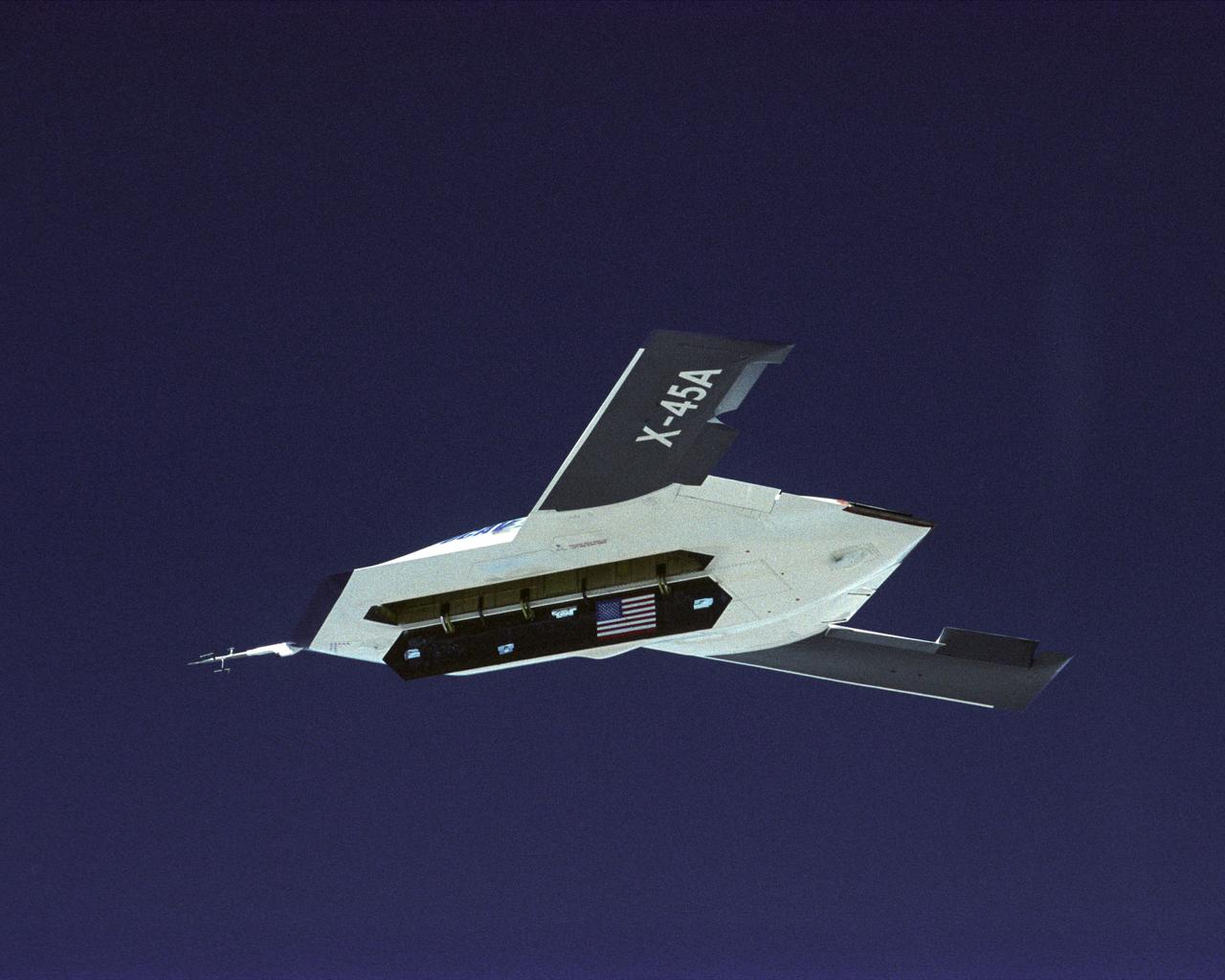
The first X-45A Unmanned Combat Air Vehicle (UCAV) technology demonstrator completed its sixth flight on Dec. 19, 2002, raising its landing gear in flight for the first time. The X-45A flew for 40 minutes and reached an airspeed of 195 knots and an altitude of 7,500 feet. Dryden is supporting the DARPA/Boeing team in the design, development, integration, and demonstration of the critical technologies, processes, and system attributes leading to an operational UCAV system. Dryden support of the X-45A demonstrator system includes analysis, component development, simulations, ground and flight tests.
X-45A in flight with F-18 #846 chase aircraft, during first GPS-guided weapon demonstration flight
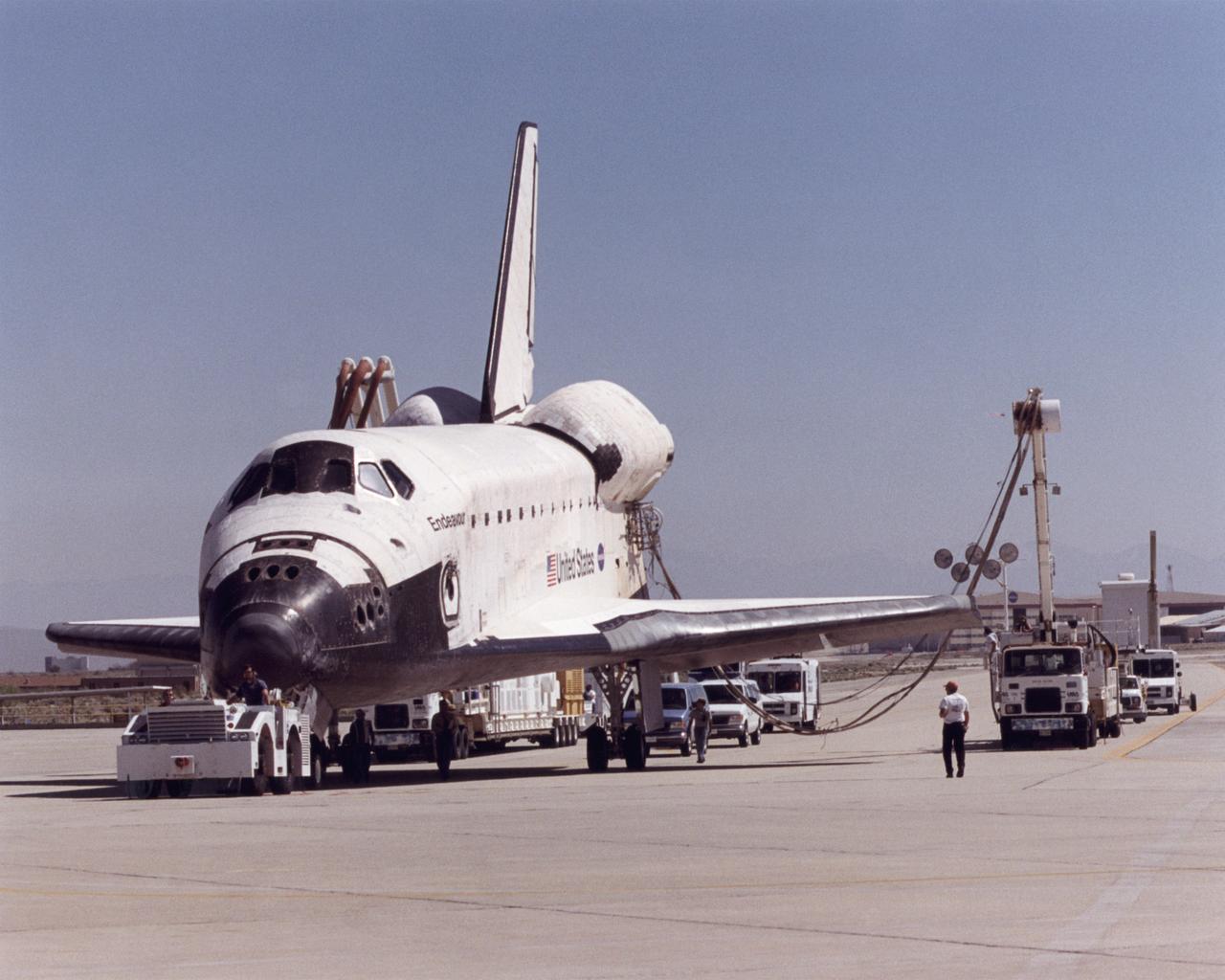
A convoy of specialized support vehicles follow the Space Shuttle Endeavour as it is towed up a taxiway at NASA's Dryden Flight Research Center on Edwards Air Force Base, California, after landing on May 1, 2001. The two largest vehicles trailing the shuttle provide electrical power and air conditioning to the shuttle's systems during post-flight recovery operations. The Endeavour had just completed mission STS-100, an almost 12-day mission to install the Canadarm 2 robotic arm and deliver some three tons of supplies and experiments to the International Space Station. The landing was the 48th shuttle landing at Edwards since shuttle flights began in 1981. After post-flight processing, the Endeavour was mounted atop one of NASA's modified Boeing 747 shuttle carrier aircraft and ferried back to the Kennedy Space Center in Florida on May 8, 2001.
A convoy of specialized support vehicles follow the Space Shuttle Endeavour as it is towed up a taxiway at NASA's Dryden Flight Research Center on Edwards Air Force Base, California, after landing on May 1, 2001
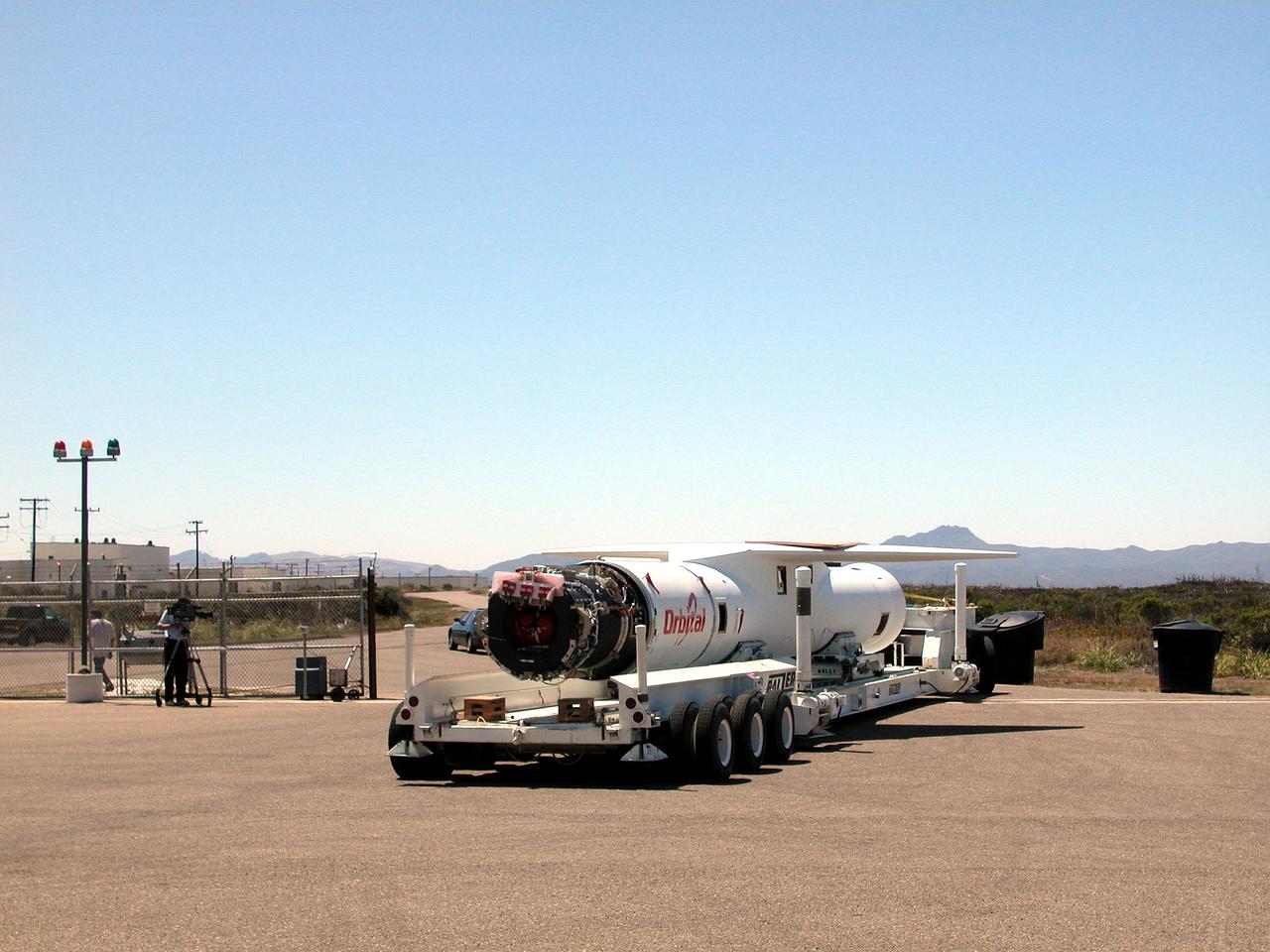
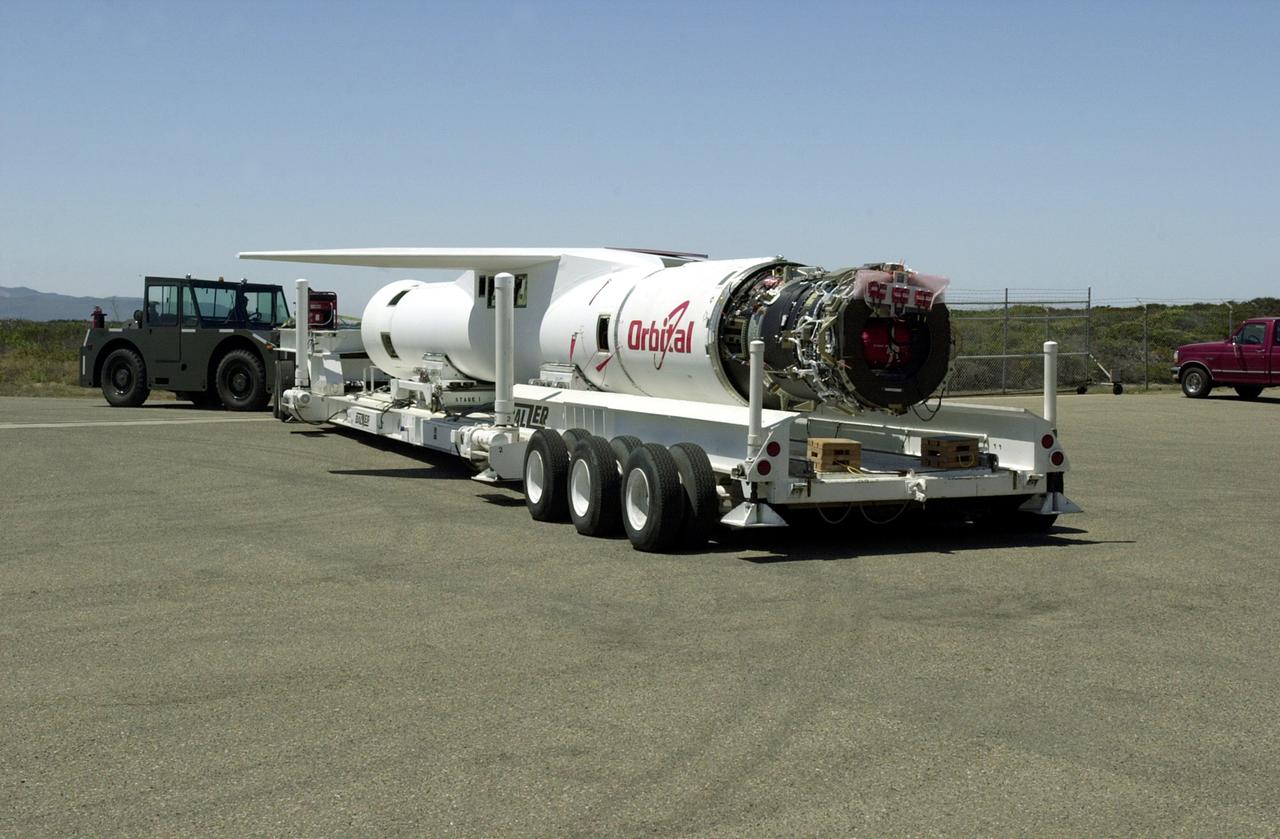
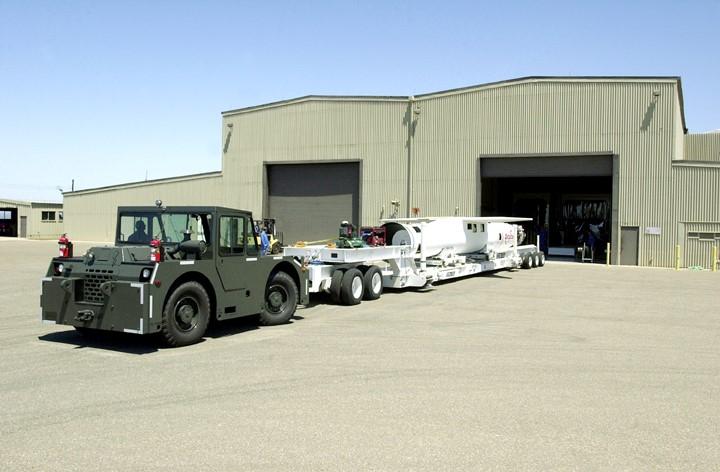
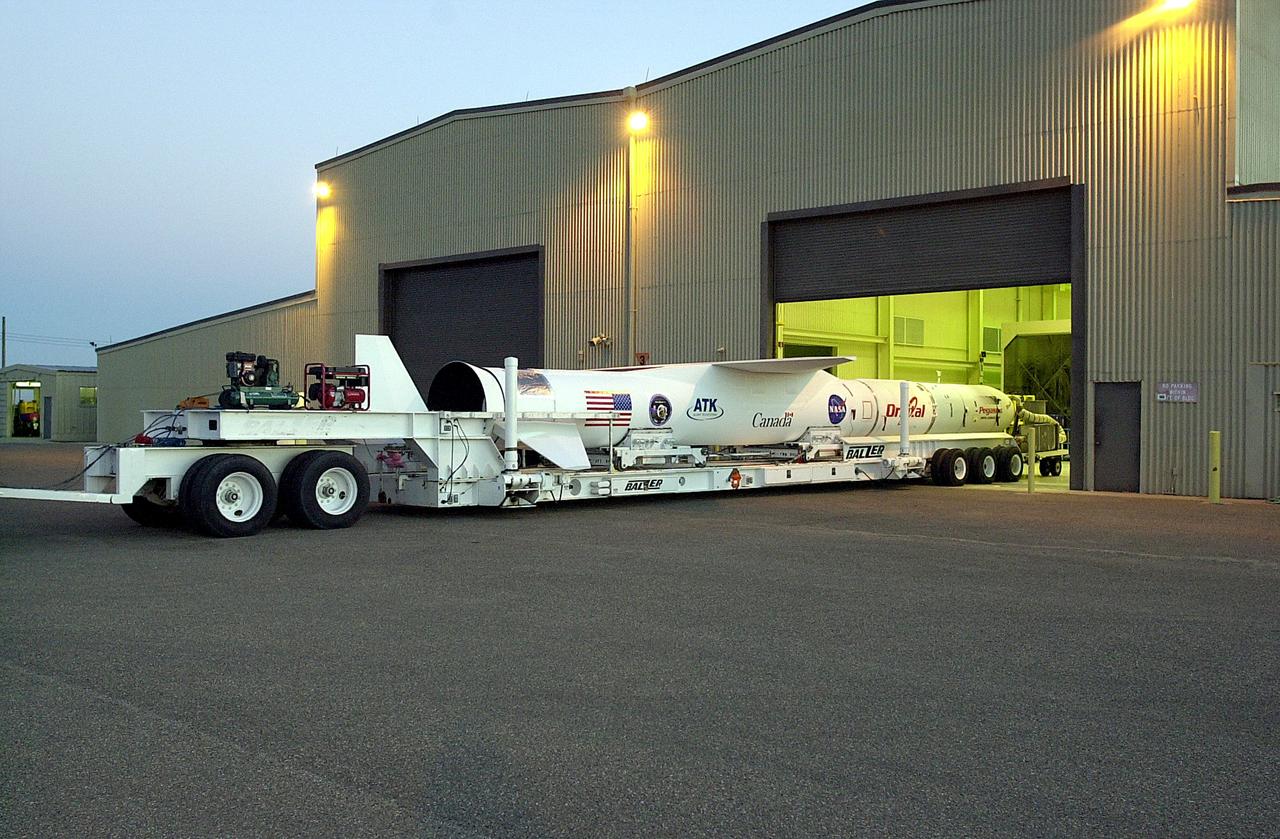
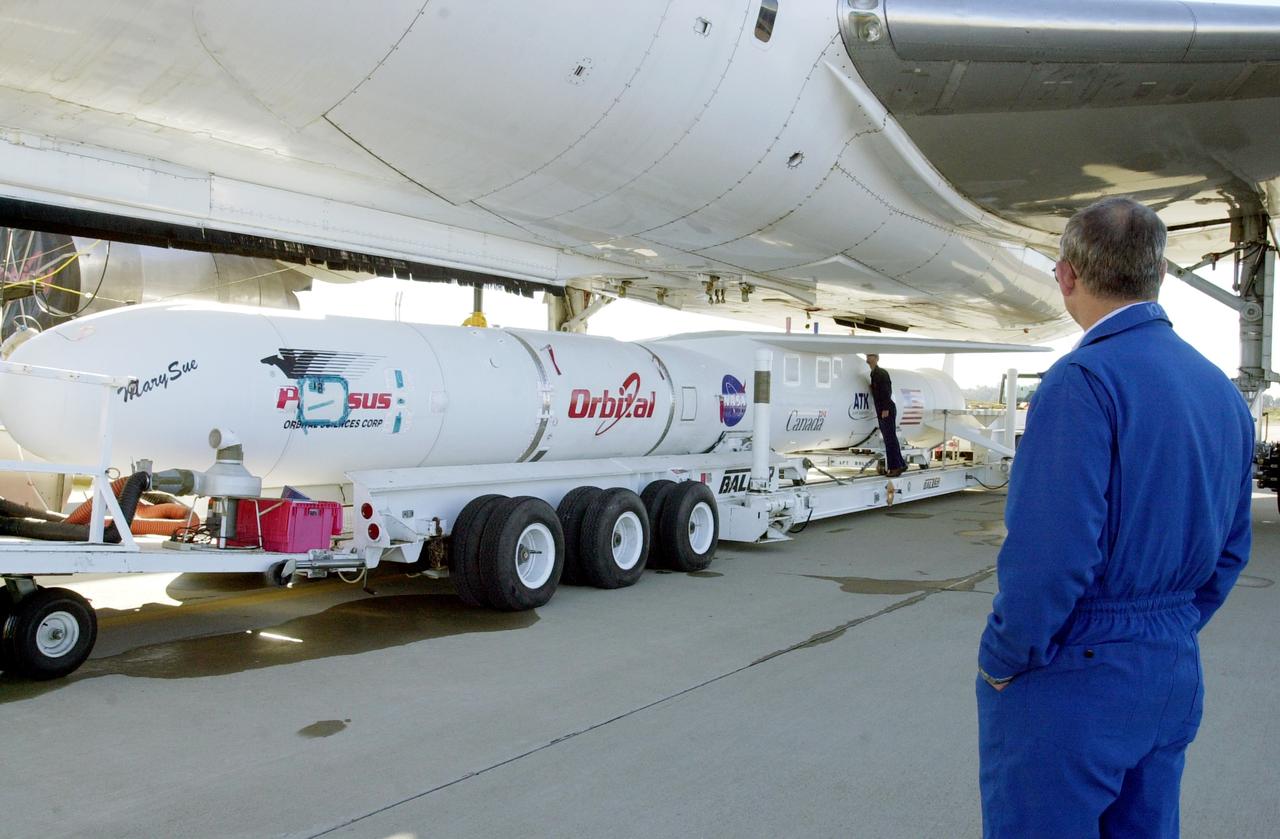
VANDENBERG AIR FORCE BASE, CALIF. - At Vandenberg Air Force Base, Calif., the Pegasus launch vehicle is moved toward its hangar. The Pegasus will carry the SciSat-1 spacecraft in a 400-mile-high polar orbit to investigate processes that control the distribution of ozone in the upper atmosphere. The data from the satellite will provide Canadian and international scientists with improved measurements relating to global ozone processes and help policymakers assess existing environmental policy and develop protective measures for improving the health of our atmosphere, preventing further ozone depletion. The mission is designed to last two years.
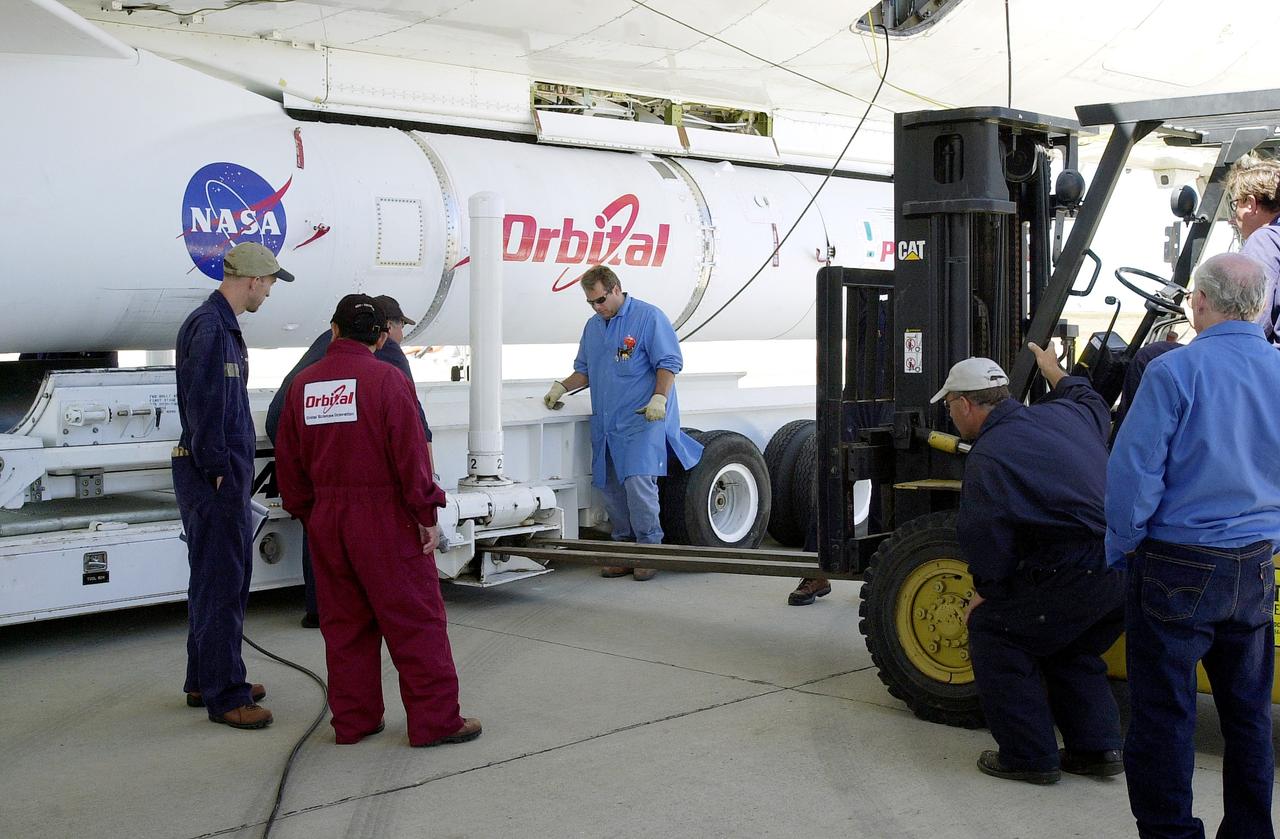
VANDENBERG AIR FORCE BASE, CALIF. -  The SciSat-1 payload and Pegasus launch vehicle are lifted and mated to the L-1011 carrier aircraft.  The SciSat-1 weighs approximately 330 pounds and after launch will be placed in a 400-mile-high polar orbit to investigate processes that control the distribution of ozone in the upper atmosphere. The data from the satellite will provide Canadian and international scientists with improved measurements relating to global ozone processes and help policymakers assess existing environmental policy and develop protective measures for improving the health of our atmosphere, preventing further ozone depletion. The mission is designed to last two years.
VANDENBERG AIR FORCE BASE, CALIF. - The SciSat-1 payload and Pegasus launch vehicle are lifted and mated to the L-1011 carrier aircraft. The SciSat-1 weighs approximately 330 pounds and after launch will be placed in a 400-mile-high polar orbit to investigate processes that control the distribution of ozone in the upper atmosphere. The data from the satellite will provide Canadian and international scientists with improved measurements relating to global ozone processes and help policymakers assess existing environmental policy and develop protective measures for improving the health of our atmosphere, preventing further ozone depletion. The mission is designed to last two years.
KENNEDY SPACE CENTER, FLA. - At Vandenberg Air Force Base, Calif., the Pegasus launch vehicle is moved into its hangar.  The Pegasus will carry the SciSat-1 spacecraft in a 400-mile-high polar orbit to investigate processes that control the distribution of ozone in the upper atmosphere.  The scientific mission of SciSat-1 is to measure and understand the chemical processes that control the distribution of ozone in the Earth’s atmosphere, particularly at high altitudes.  The data from the satellite will provide Canadian and international scientists with improved measurements relating to global ozone processes and help policymakers assess existing environmental policy and develop protective measures for improving the health of our atmosphere, preventing further ozone depletion.  The mission is designed to last two years.
KENNEDY SPACE CENTER, FLA. - At Vandenberg Air Force Base, Calif., the Pegasus launch vehicle is moved into its hangar. The Pegasus will carry the SciSat-1 spacecraft in a 400-mile-high polar orbit to investigate processes that control the distribution of ozone in the upper atmosphere. The scientific mission of SciSat-1 is to measure and understand the chemical processes that control the distribution of ozone in the Earth’s atmosphere, particularly at high altitudes. The data from the satellite will provide Canadian and international scientists with improved measurements relating to global ozone processes and help policymakers assess existing environmental policy and develop protective measures for improving the health of our atmosphere, preventing further ozone depletion. The mission is designed to last two years.
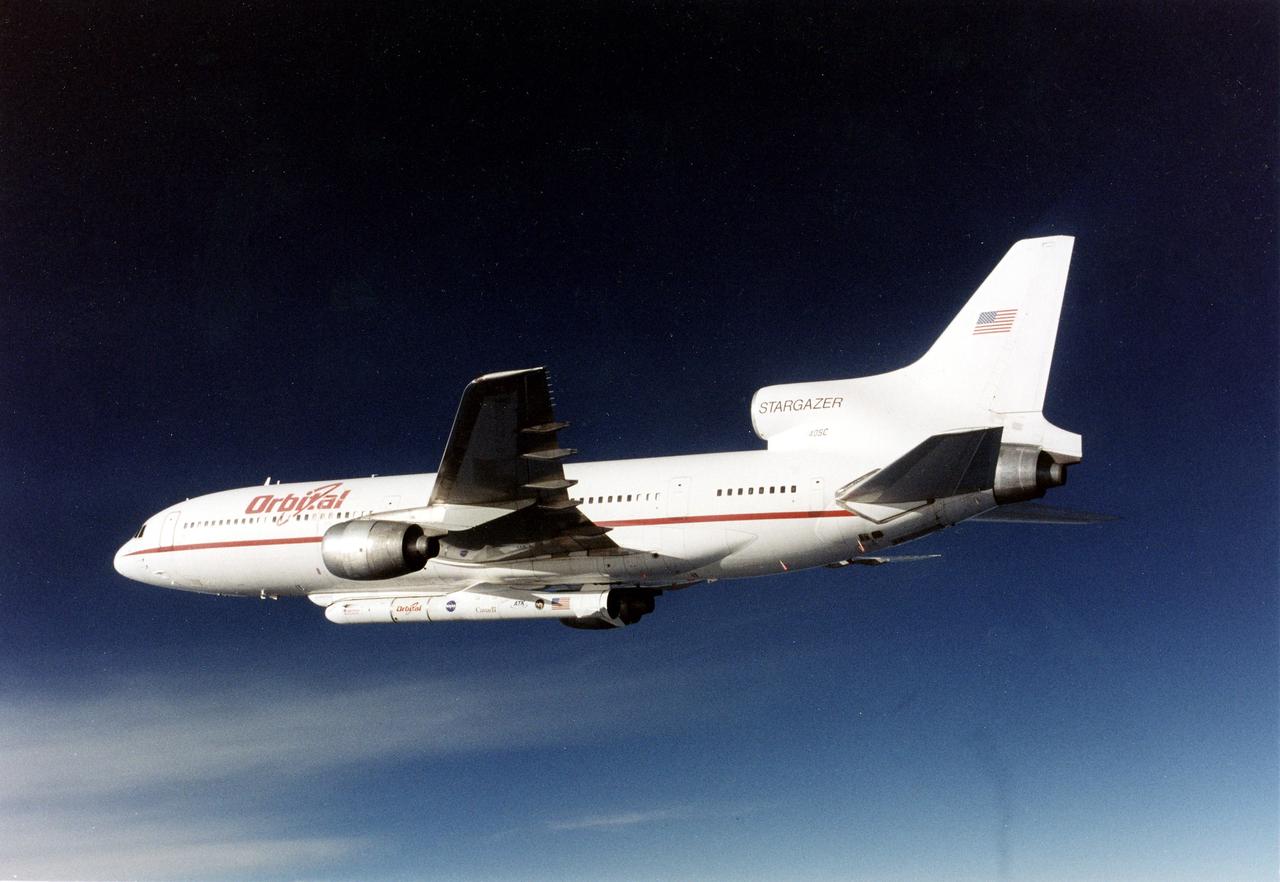
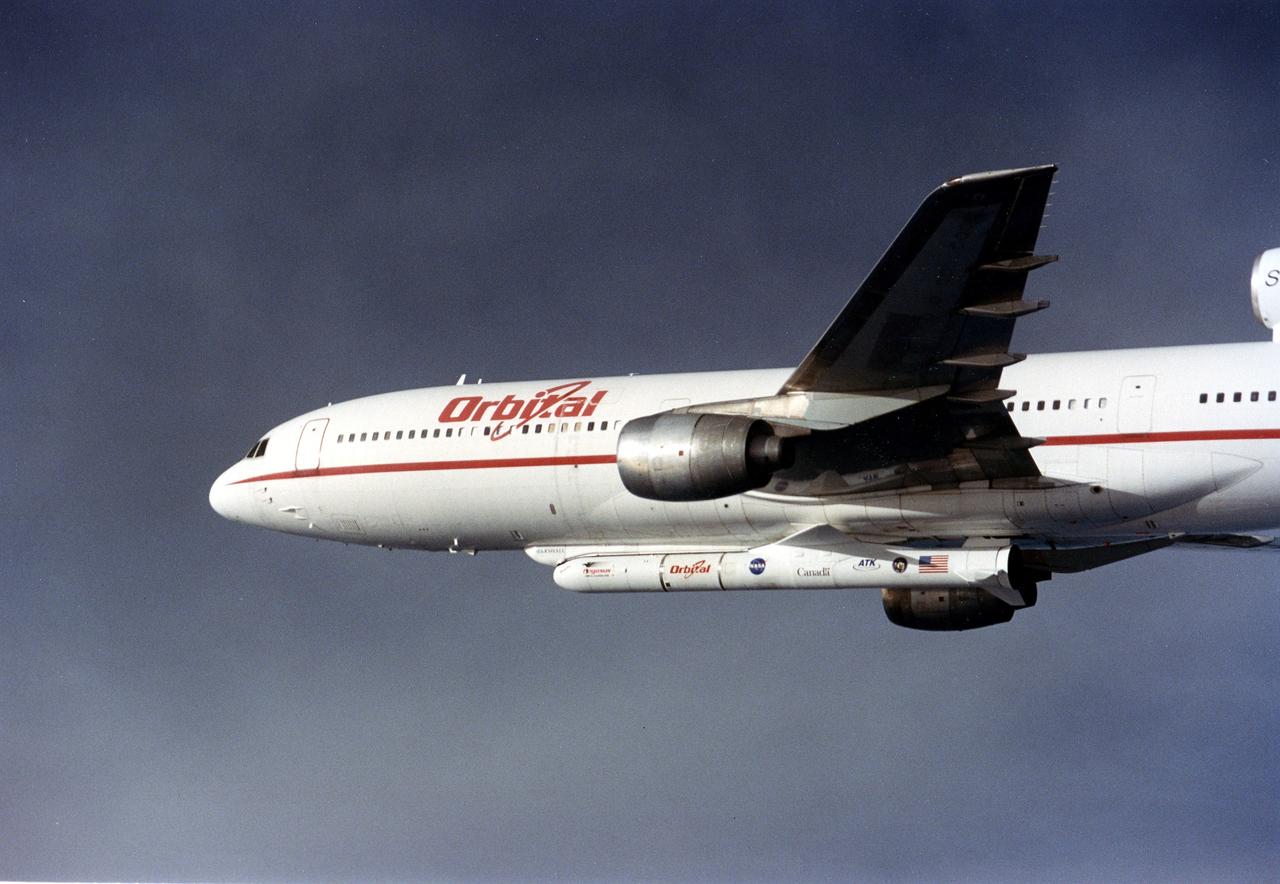
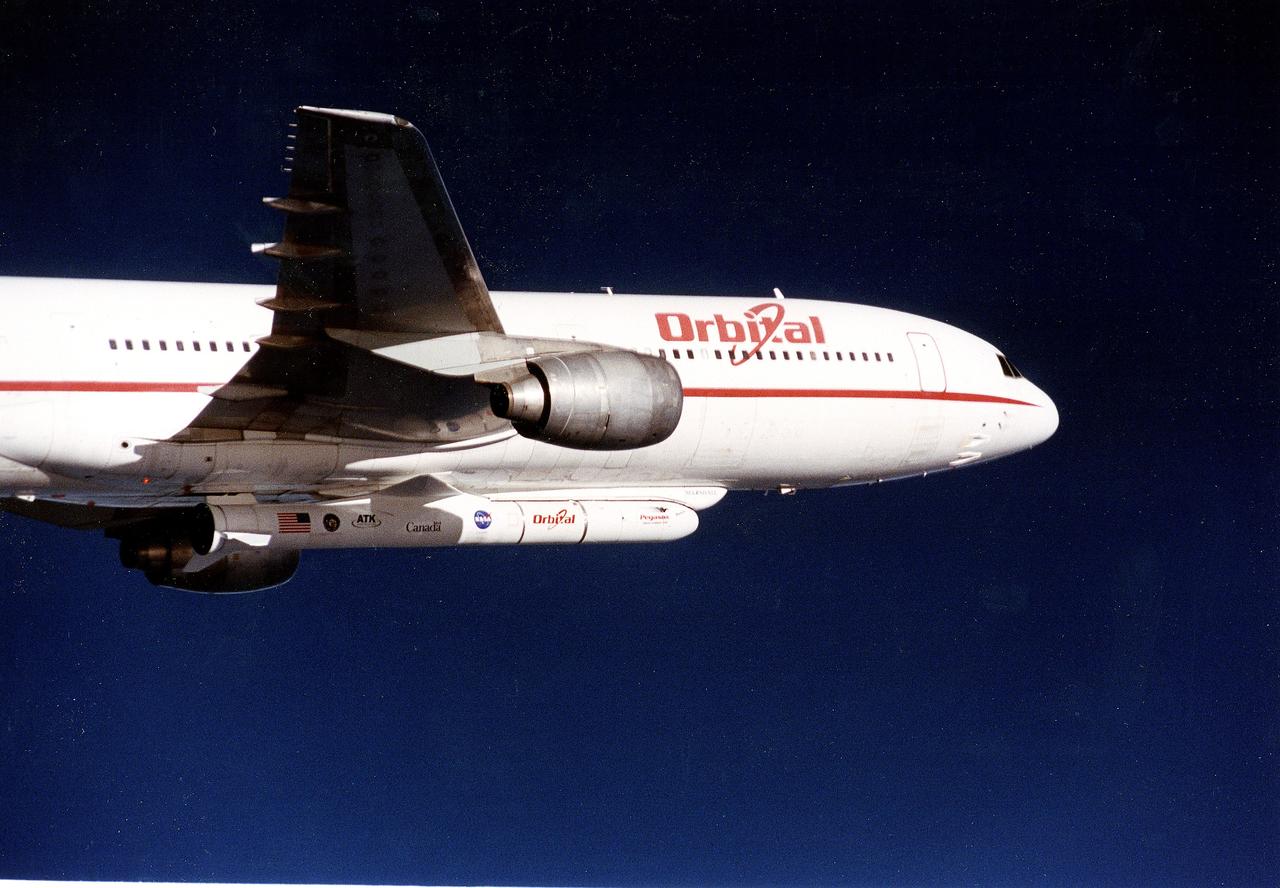
VANDENBERG AIR FORCE BASE, CALIF. -  The L-1011 carrier aircraft is in flight with its cargo of the Pegasus launch vehicle and SciSat-1 spacecraft underneath. The SciSat-1 weighs approximately 330 pounds and after launch will be placed in a 400-mile-high polar orbit to investigate processes that control the distribution of ozone in the upper atmosphere. The data from the satellite will provide Canadian and international scientists with improved measurements relating to global ozone processes and help policymakers assess existing environmental policy and develop protective measures for improving the health of our atmosphere, preventing further ozone depletion. The mission is designed to last two years.
VANDENBERG AIR FORCE BASE, CALIF. - The L-1011 carrier aircraft is in flight with its cargo of the Pegasus launch vehicle and SciSat-1 spacecraft underneath. The SciSat-1 weighs approximately 330 pounds and after launch will be placed in a 400-mile-high polar orbit to investigate processes that control the distribution of ozone in the upper atmosphere. The data from the satellite will provide Canadian and international scientists with improved measurements relating to global ozone processes and help policymakers assess existing environmental policy and develop protective measures for improving the health of our atmosphere, preventing further ozone depletion. The mission is designed to last two years.
VANDENBERG AIR FORCE BASE, CALIF. -  The L-1011 carrier aircraft is in flight with its cargo of the Pegasus launch vehicle and SciSat-1 spacecraft underneath.  The SciSat-1 weighs approximately 330 pounds and after launch will be placed in a 400-mile-high polar orbit to investigate processes that control the distribution of ozone in the upper atmosphere. The data from the satellite will provide Canadian and international scientists with improved measurements relating to global ozone processes and help policymakers assess existing environmental policy and develop protective measures for improving the health of our atmosphere, preventing further ozone depletion. The mission is designed to last two years.
VANDENBERG AIR FORCE BASE, CALIF. - The L-1011 carrier aircraft is in flight with its cargo of the Pegasus launch vehicle and SciSat-1 spacecraft underneath. The SciSat-1 weighs approximately 330 pounds and after launch will be placed in a 400-mile-high polar orbit to investigate processes that control the distribution of ozone in the upper atmosphere. The data from the satellite will provide Canadian and international scientists with improved measurements relating to global ozone processes and help policymakers assess existing environmental policy and develop protective measures for improving the health of our atmosphere, preventing further ozone depletion. The mission is designed to last two years.
VANDENBERG AIR FORCE BASE, CALIF. -  The SciSat-1 payload and Pegasus launch vehicle are lifted and mated to the L-1011 carrier aircraft.  The SciSat-1 weighs approximately 330 pounds and after launch will be placed in a 400-mile-high polar orbit to investigate processes that control the distribution of ozone in the upper atmosphere. The data from the satellite will provide Canadian and international scientists with improved measurements relating to global ozone processes and help policymakers assess existing environmental policy and develop protective measures for improving the health of our atmosphere, preventing further ozone depletion. The mission is designed to last two years.
VANDENBERG AIR FORCE BASE, CALIF. - The SciSat-1 payload and Pegasus launch vehicle are lifted and mated to the L-1011 carrier aircraft. The SciSat-1 weighs approximately 330 pounds and after launch will be placed in a 400-mile-high polar orbit to investigate processes that control the distribution of ozone in the upper atmosphere. The data from the satellite will provide Canadian and international scientists with improved measurements relating to global ozone processes and help policymakers assess existing environmental policy and develop protective measures for improving the health of our atmosphere, preventing further ozone depletion. The mission is designed to last two years.
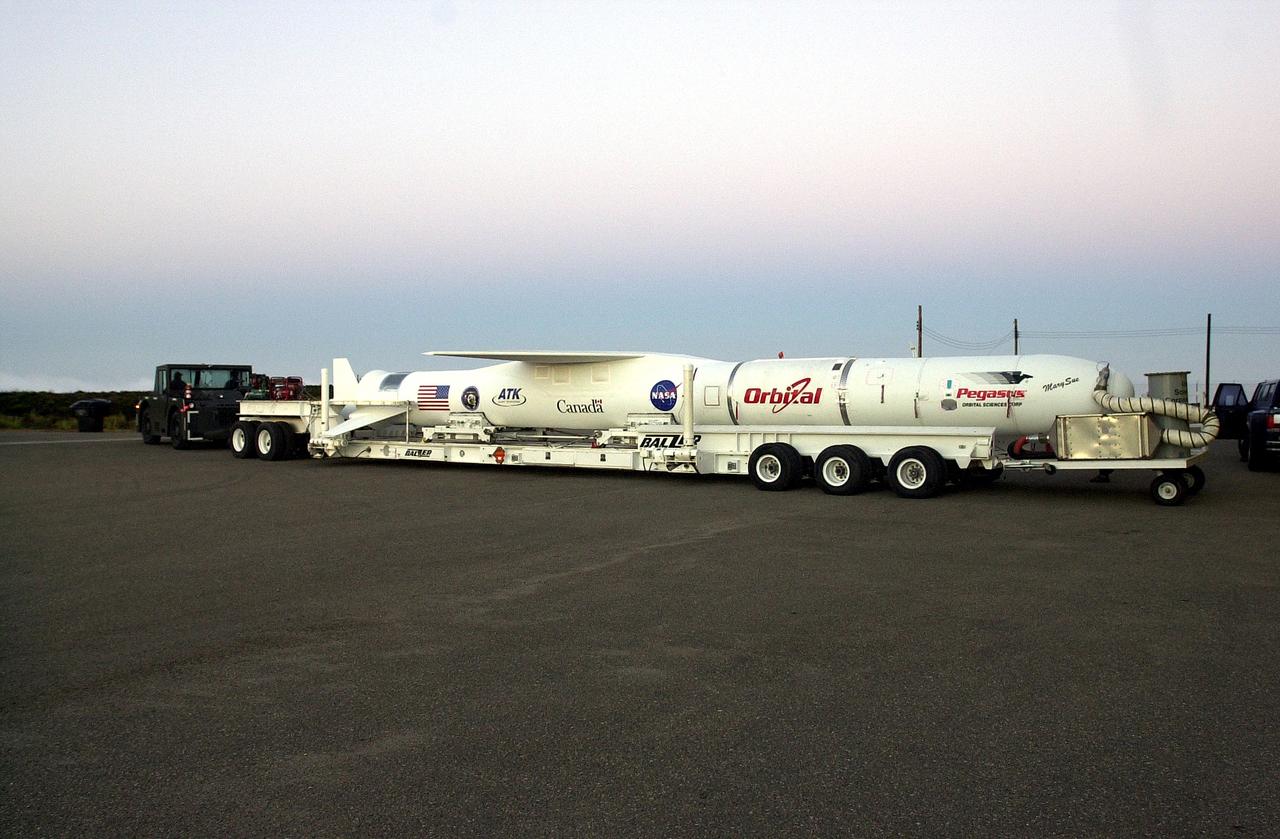
VANDENBERG AIR FORCE BASE, CALIF. -  The SciSat-1 payload, with fairing installed and attached to its Pegasus launch vehicle, begins rollout to the hot pad and mating to the L-1011 carrier aircraft.  The SciSat-1 weighs approximately 330 pounds and after launch will be placed in a 400-mile-high polar orbit to investigate processes that control the distribution of ozone in the upper atmosphere. The data from the satellite will provide Canadian and international scientists with improved measurements relating to global ozone processes and help policymakers assess existing environmental policy and develop protective measures for improving the health of our atmosphere, preventing further ozone depletion. The mission is designed to last two years.
VANDENBERG AIR FORCE BASE, CALIF. - The SciSat-1 payload, with fairing installed and attached to its Pegasus launch vehicle, begins rollout to the hot pad and mating to the L-1011 carrier aircraft. The SciSat-1 weighs approximately 330 pounds and after launch will be placed in a 400-mile-high polar orbit to investigate processes that control the distribution of ozone in the upper atmosphere. The data from the satellite will provide Canadian and international scientists with improved measurements relating to global ozone processes and help policymakers assess existing environmental policy and develop protective measures for improving the health of our atmosphere, preventing further ozone depletion. The mission is designed to last two years.
VANDENBERG AIR FORCE BASE, CALIF. -  The L-1011 carrier aircraft is in flight with its cargo underneath of the Pegasus launch vehicle and SciSat-1 spacecraft.  The SciSat-1 weighs approximately 330 pounds and after launch will be placed in a 400-mile-high polar orbit to investigate processes that control the distribution of ozone in the upper atmosphere. The data from the satellite will provide Canadian and international scientists with improved measurements relating to global ozone processes and help policymakers assess existing environmental policy and develop protective measures for improving the health of our atmosphere, preventing further ozone depletion. The mission is designed to last two years.
VANDENBERG AIR FORCE BASE, CALIF. - The L-1011 carrier aircraft is in flight with its cargo underneath of the Pegasus launch vehicle and SciSat-1 spacecraft. The SciSat-1 weighs approximately 330 pounds and after launch will be placed in a 400-mile-high polar orbit to investigate processes that control the distribution of ozone in the upper atmosphere. The data from the satellite will provide Canadian and international scientists with improved measurements relating to global ozone processes and help policymakers assess existing environmental policy and develop protective measures for improving the health of our atmosphere, preventing further ozone depletion. The mission is designed to last two years.
VANDENBERG AIR FORCE BASE, CALIF. -   The SciSat-1 payload, with fairing installed and attached to its Pegasus launch vehicle, begins rollout to the hot pad and mating to the L-1011 carrier aircraft.  The SciSat-1 weighs approximately 330 pounds and after launch will be placed in a 400-mile-high polar orbit to investigate processes that control the distribution of ozone in the upper atmosphere. The data from the satellite will provide Canadian and international scientists with improved measurements relating to global ozone processes and help policymakers assess existing environmental policy and develop protective measures for improving the health of our atmosphere, preventing further ozone depletion. The mission is designed to last two years.
VANDENBERG AIR FORCE BASE, CALIF. - The SciSat-1 payload, with fairing installed and attached to its Pegasus launch vehicle, begins rollout to the hot pad and mating to the L-1011 carrier aircraft. The SciSat-1 weighs approximately 330 pounds and after launch will be placed in a 400-mile-high polar orbit to investigate processes that control the distribution of ozone in the upper atmosphere. The data from the satellite will provide Canadian and international scientists with improved measurements relating to global ozone processes and help policymakers assess existing environmental policy and develop protective measures for improving the health of our atmosphere, preventing further ozone depletion. The mission is designed to last two years.
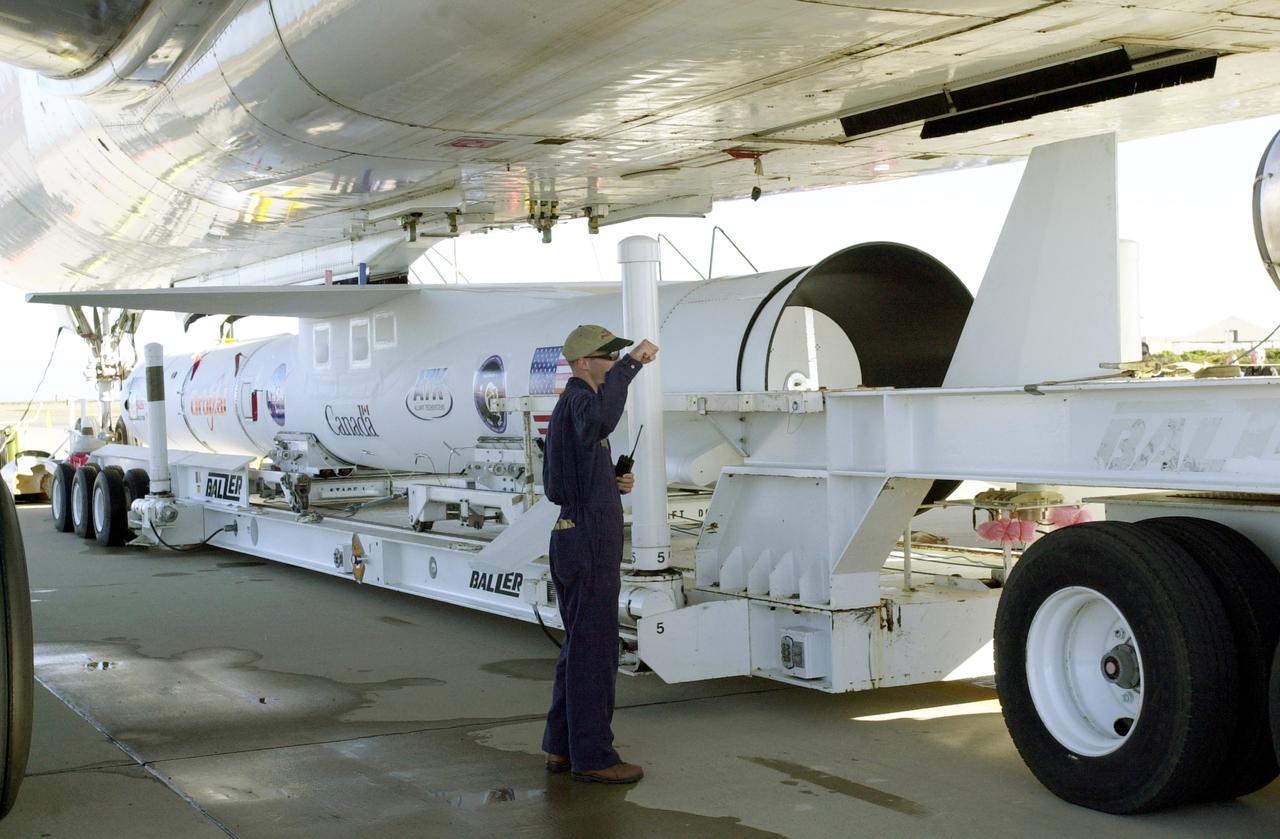
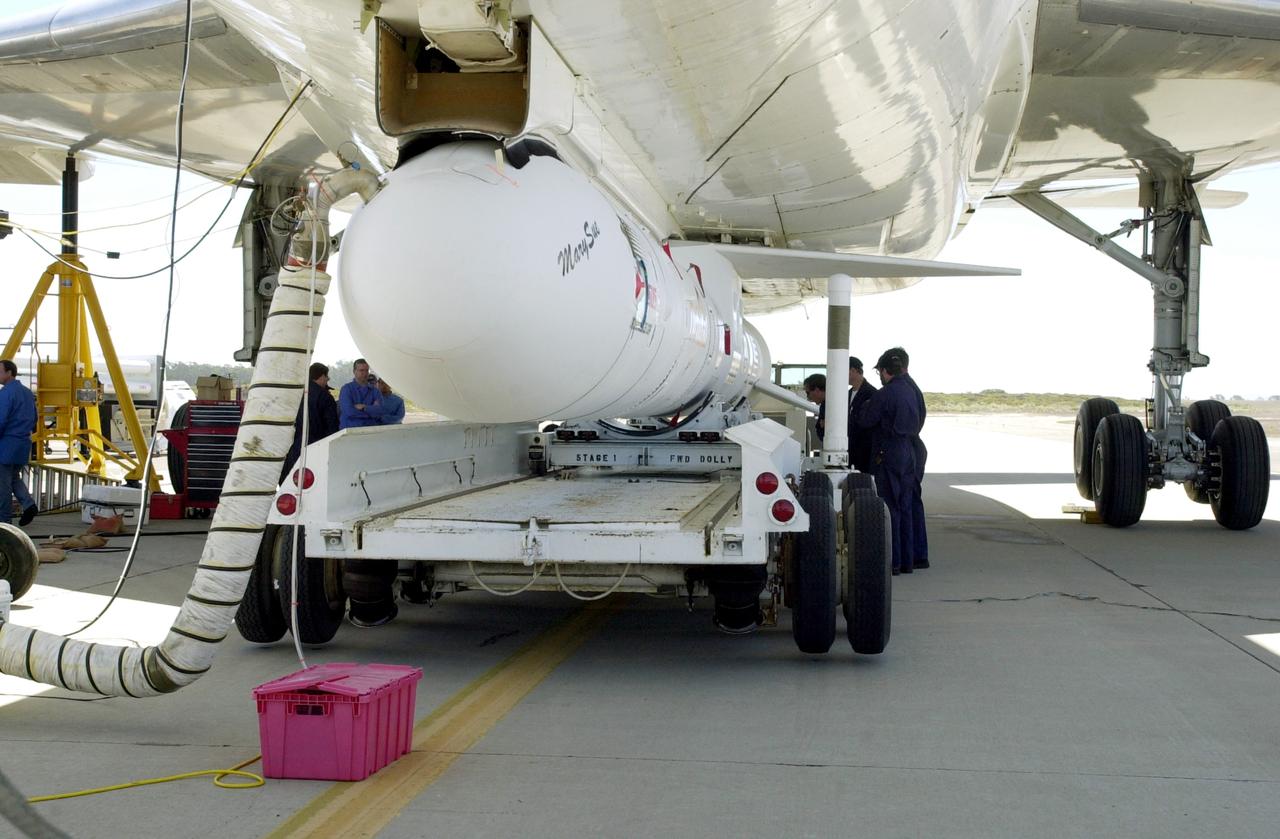
VANDENBERG AIR FORCE BASE, CALIF. -  The Pegasus transporter, with its cargo of  the SciSat-1 payload and Pegasus launch vehicle, moves under the L-1011 carrier aircraft for matting.  The SciSat-1 weighs approximately 330 pounds and after launch will be placed in a 400-mile-high polar orbit to investigate processes that control the distribution of ozone in the upper atmosphere. The data from the satellite will provide Canadian and international scientists with improved measurements relating to global ozone processes and help policymakers assess existing environmental policy and develop protective measures for improving the health of our atmosphere, preventing further ozone depletion. The mission is designed to last two years.
VANDENBERG AIR FORCE BASE, CALIF. - The Pegasus transporter, with its cargo of the SciSat-1 payload and Pegasus launch vehicle, moves under the L-1011 carrier aircraft for matting. The SciSat-1 weighs approximately 330 pounds and after launch will be placed in a 400-mile-high polar orbit to investigate processes that control the distribution of ozone in the upper atmosphere. The data from the satellite will provide Canadian and international scientists with improved measurements relating to global ozone processes and help policymakers assess existing environmental policy and develop protective measures for improving the health of our atmosphere, preventing further ozone depletion. The mission is designed to last two years.
VANDENBERG AIR FORCE BASE, CALIF. - The SciSat-1 payload, with fairing installed and attached to its Pegasus launch vehicle, arrives at the pad for mating to the L-1011 carrier aircraft.  The SciSat-1 weighs approximately 330 pounds and after launch will be placed in a 400-mile-high polar orbit to investigate processes that control the distribution of ozone in the upper atmosphere. The data from the satellite will provide Canadian and international scientists with improved measurements relating to global ozone processes and help policymakers assess existing environmental policy and develop protective measures for improving the health of our atmosphere, preventing further ozone depletion. The mission is designed to last two years.
VANDENBERG AIR FORCE BASE, CALIF. - The SciSat-1 payload, with fairing installed and attached to its Pegasus launch vehicle, arrives at the pad for mating to the L-1011 carrier aircraft. The SciSat-1 weighs approximately 330 pounds and after launch will be placed in a 400-mile-high polar orbit to investigate processes that control the distribution of ozone in the upper atmosphere. The data from the satellite will provide Canadian and international scientists with improved measurements relating to global ozone processes and help policymakers assess existing environmental policy and develop protective measures for improving the health of our atmosphere, preventing further ozone depletion. The mission is designed to last two years.
VANDENBERG AIR FORCE BASE, CALIF. - The Pegasus transporter, with its cargo of  the SciSat-1 payload and Pegasus launch vehicle, moves under the L-1011 carrier aircraft for matting.  The SciSat-1 weighs approximately 330 pounds and after launch will be placed in a 400-mile-high polar orbit to investigate processes that control the distribution of ozone in the upper atmosphere. The data from the satellite will provide Canadian and international scientists with improved measurements relating to global ozone processes and help policymakers assess existing environmental policy and develop protective measures for improving the health of our atmosphere, preventing further ozone depletion. The mission is designed to last two years.
VANDENBERG AIR FORCE BASE, CALIF. - The Pegasus transporter, with its cargo of the SciSat-1 payload and Pegasus launch vehicle, moves under the L-1011 carrier aircraft for matting. The SciSat-1 weighs approximately 330 pounds and after launch will be placed in a 400-mile-high polar orbit to investigate processes that control the distribution of ozone in the upper atmosphere. The data from the satellite will provide Canadian and international scientists with improved measurements relating to global ozone processes and help policymakers assess existing environmental policy and develop protective measures for improving the health of our atmosphere, preventing further ozone depletion. The mission is designed to last two years.
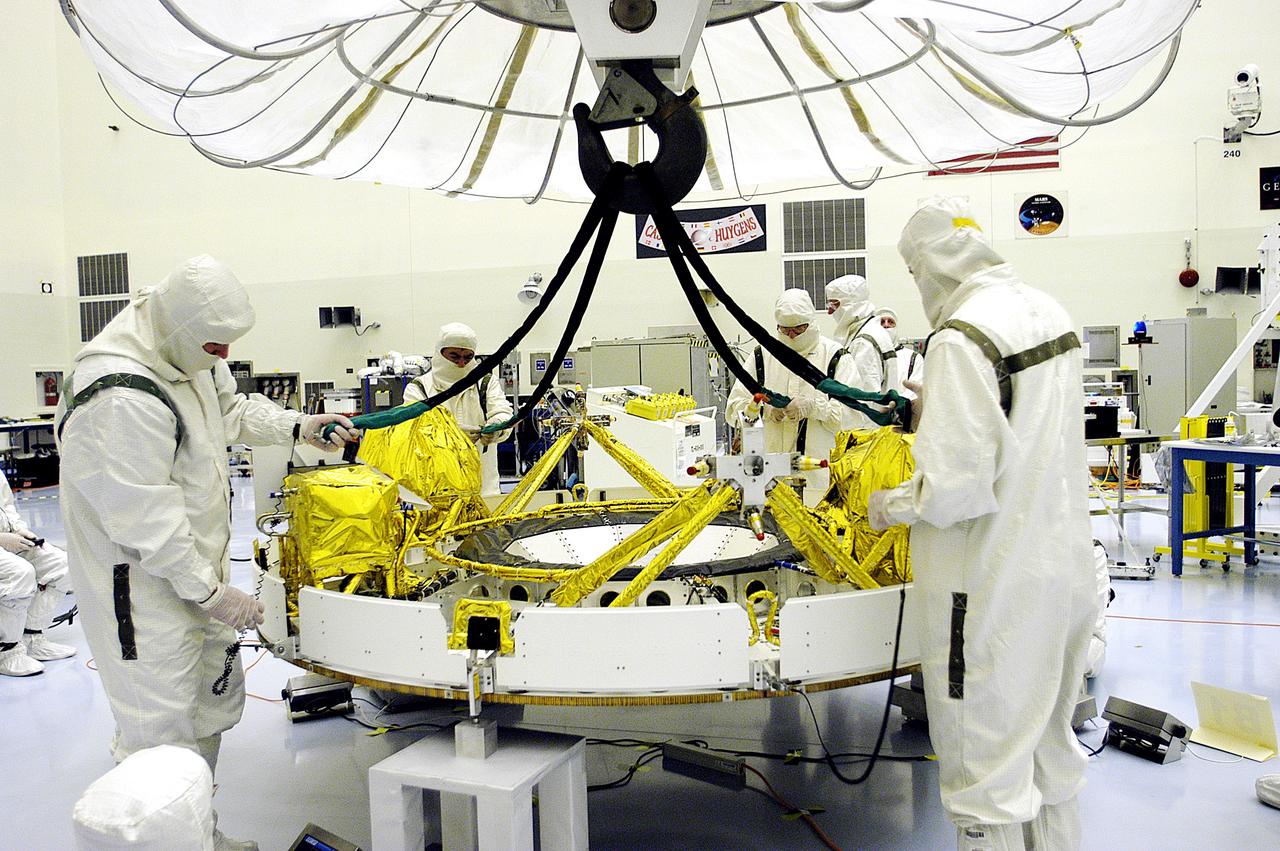
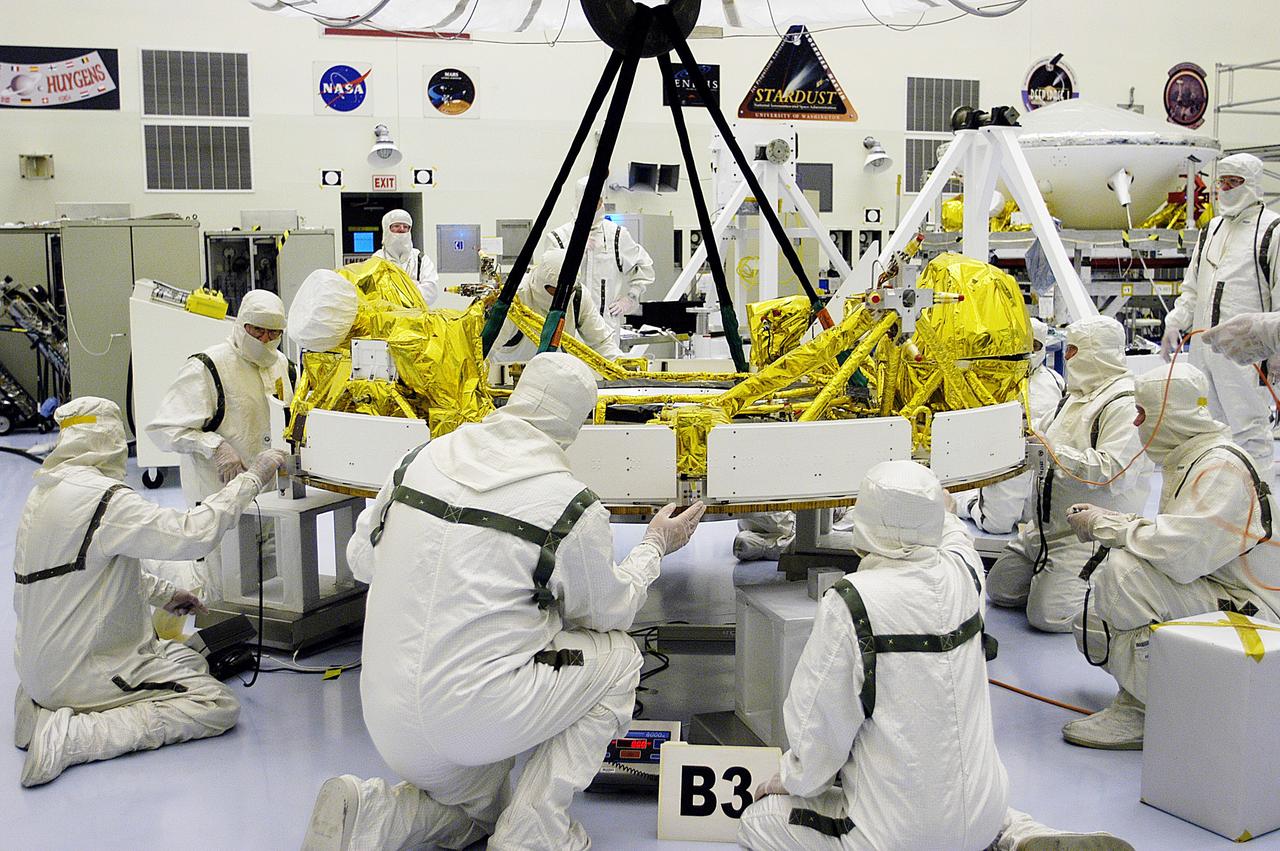
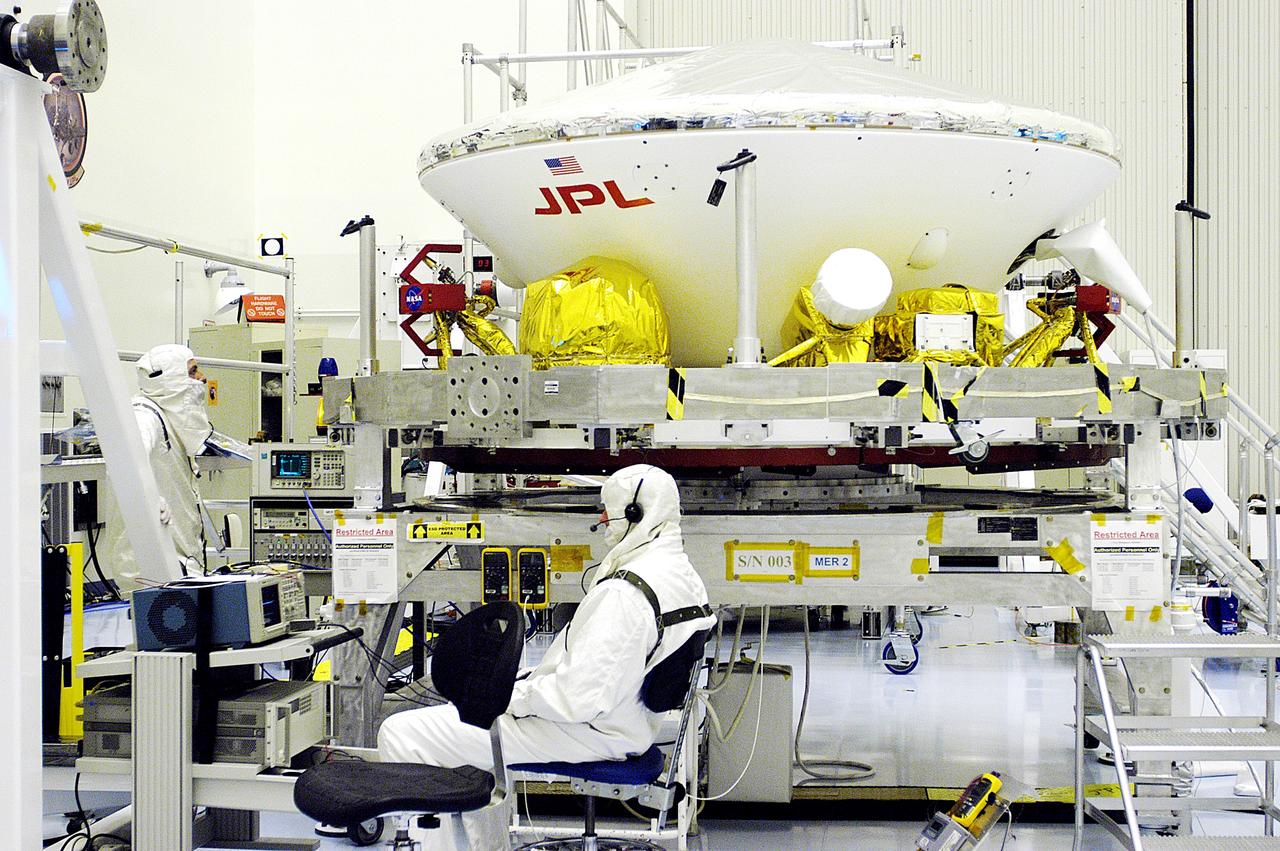
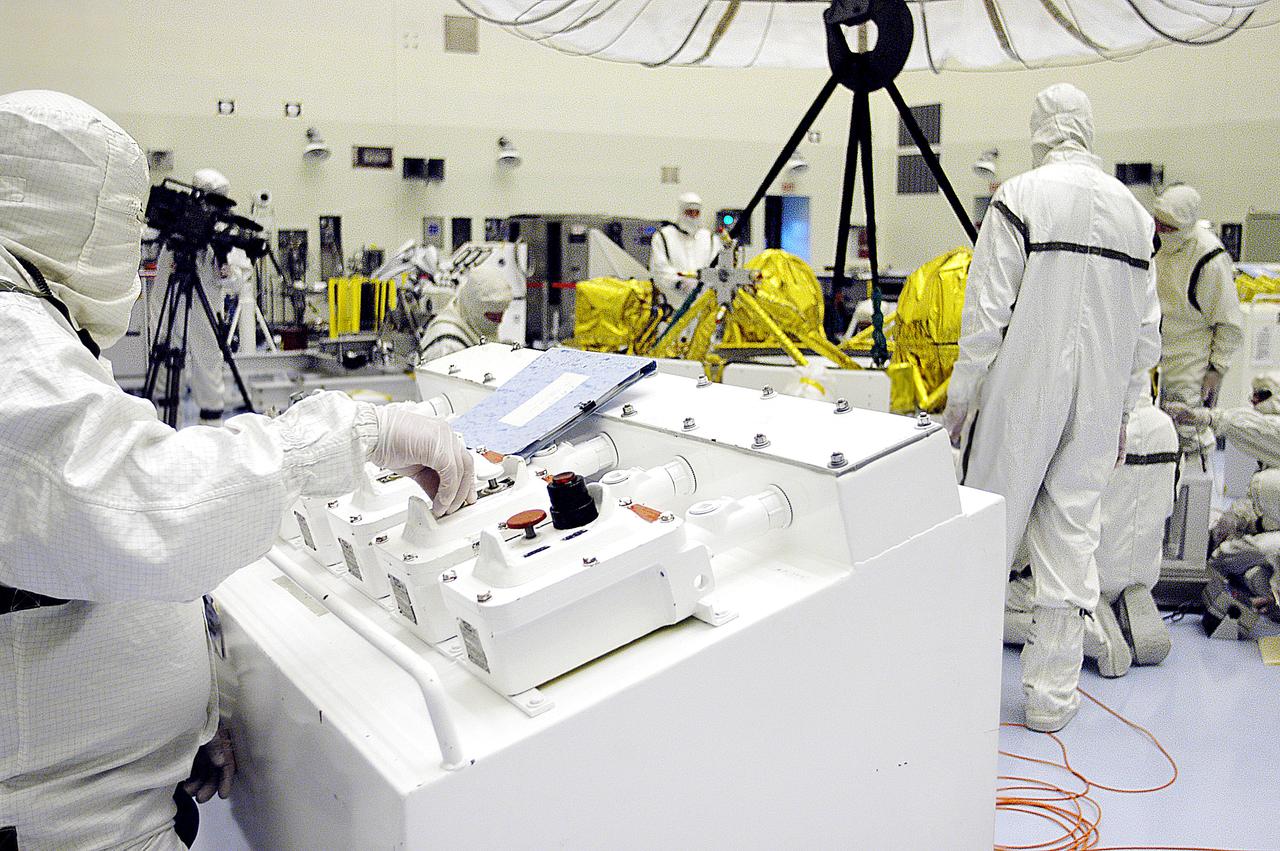
KENNEDY SPACE CENTER, FLA. - Technicians in the Payload Hazardous Servicing Facility prepare the cruise stage for Mars Exploration Rover 1 (MER-1) for integration with the aeroshell, the entry vehicle.   NASA’s twin Mars Exploration Rovers are designed to study the history of water on Mars. These robotic geologists are equipped with a robotic arm, a drilling tool, three spectrometers, and four pairs of cameras that allow them to have a human-like, 3D view of the terrain. Each rover could travel as far as 100 meters in one day to act as Mars scientists' eyes and hands, exploring an environment where humans can’t yet go.  The MER-1 is scheduled to launch June 25 from Launch Pad 17-A, Cape Canaveral Air Force Station.
KENNEDY SPACE CENTER, FLA. - Technicians in the Payload Hazardous Servicing Facility prepare the cruise stage for Mars Exploration Rover 1 (MER-1) for integration with the aeroshell, the entry vehicle. NASA’s twin Mars Exploration Rovers are designed to study the history of water on Mars. These robotic geologists are equipped with a robotic arm, a drilling tool, three spectrometers, and four pairs of cameras that allow them to have a human-like, 3D view of the terrain. Each rover could travel as far as 100 meters in one day to act as Mars scientists' eyes and hands, exploring an environment where humans can’t yet go. The MER-1 is scheduled to launch June 25 from Launch Pad 17-A, Cape Canaveral Air Force Station.
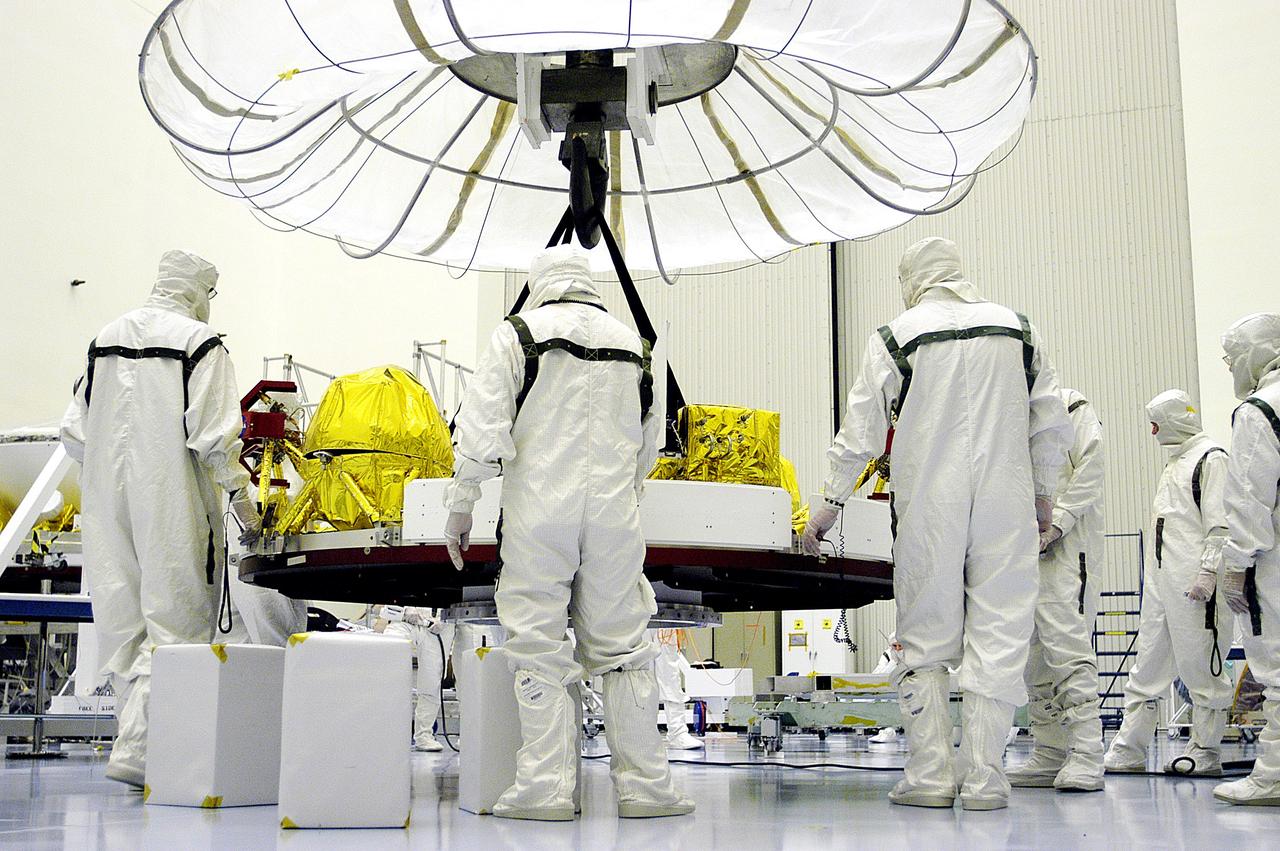
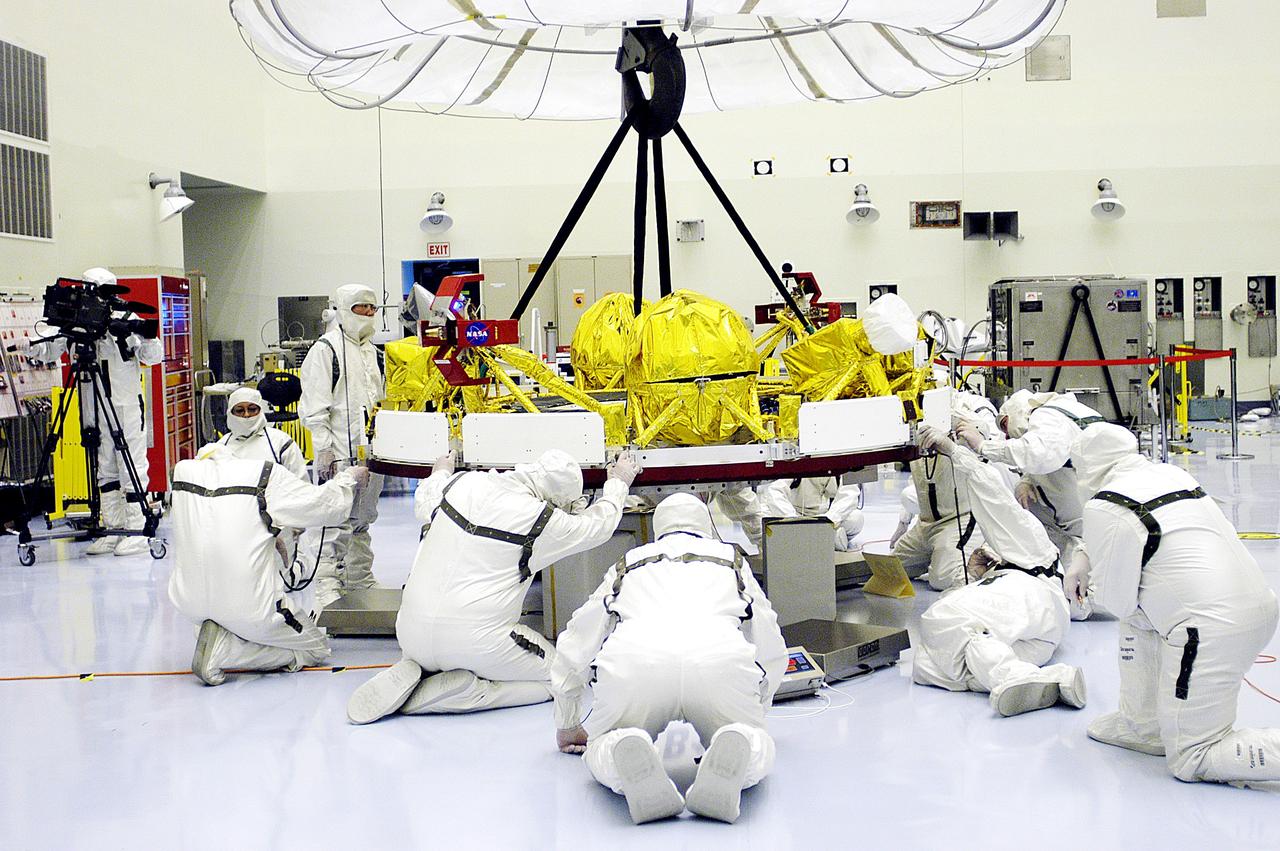
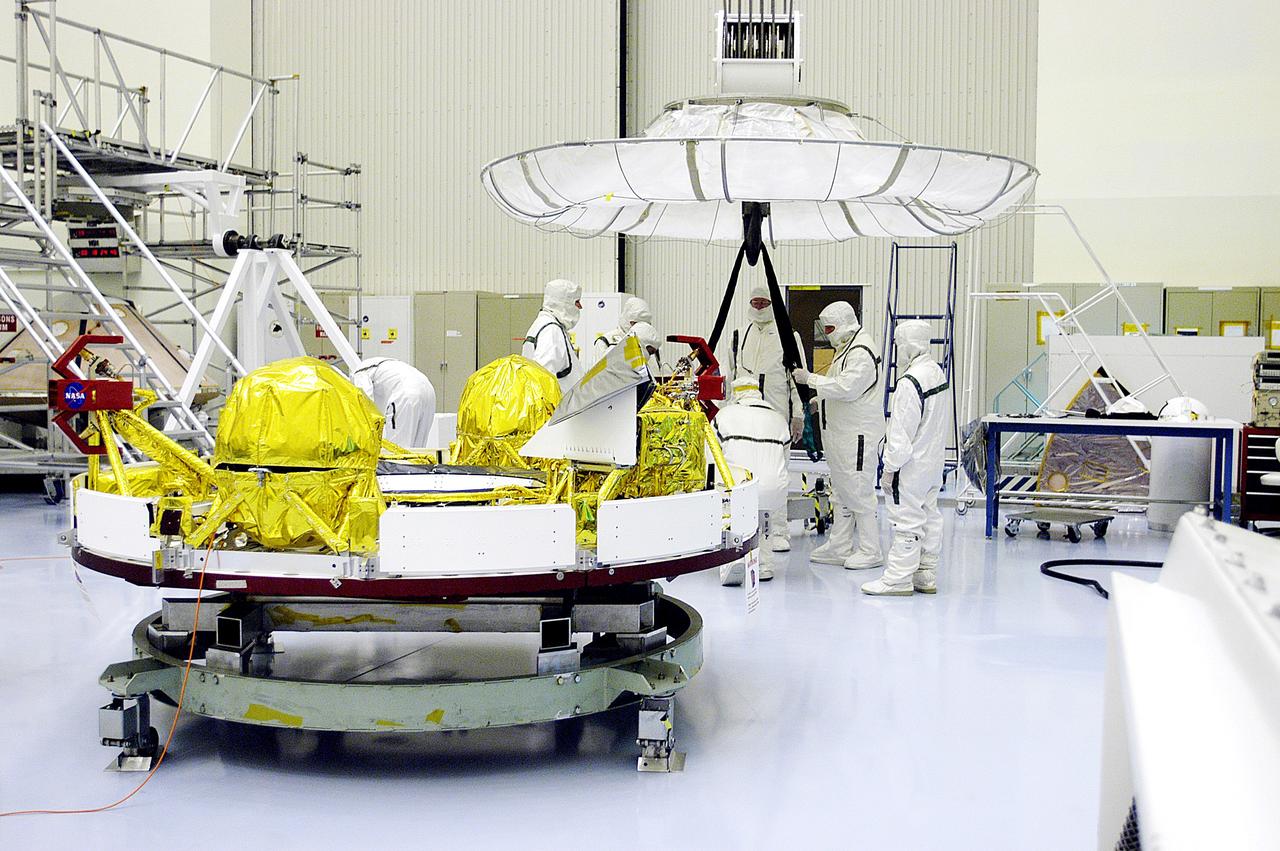
KENNEDY SPACE CENTER, FLA. - In the Payload Hazardous Servicing Facility, workers help guide the cruise stage of Mars Exploration Rover 1 (MER-1) as it is lowered onto blocks.  The cruise stage will be integrated with the aeroshell, the entry vehicle.   NASA’s twin Mars Exploration Rovers are designed to study the history of water on Mars. These robotic geologists are equipped with a robotic arm, a drilling tool, three spectrometers, and four pairs of cameras that allow them to have a human-like, 3D view of the terrain. Each rover could travel as far as 100 meters in one day to act as Mars scientists' eyes and hands, exploring an environment where humans can’t yet go.  The MER-1 is scheduled to launch June 25 from Launch Pad 17-A, Cape Canaveral Air Force Station.
KENNEDY SPACE CENTER, FLA. - In the Payload Hazardous Servicing Facility, workers help guide the cruise stage of Mars Exploration Rover 1 (MER-1) as it is lowered onto blocks. The cruise stage will be integrated with the aeroshell, the entry vehicle. NASA’s twin Mars Exploration Rovers are designed to study the history of water on Mars. These robotic geologists are equipped with a robotic arm, a drilling tool, three spectrometers, and four pairs of cameras that allow them to have a human-like, 3D view of the terrain. Each rover could travel as far as 100 meters in one day to act as Mars scientists' eyes and hands, exploring an environment where humans can’t yet go. The MER-1 is scheduled to launch June 25 from Launch Pad 17-A, Cape Canaveral Air Force Station.
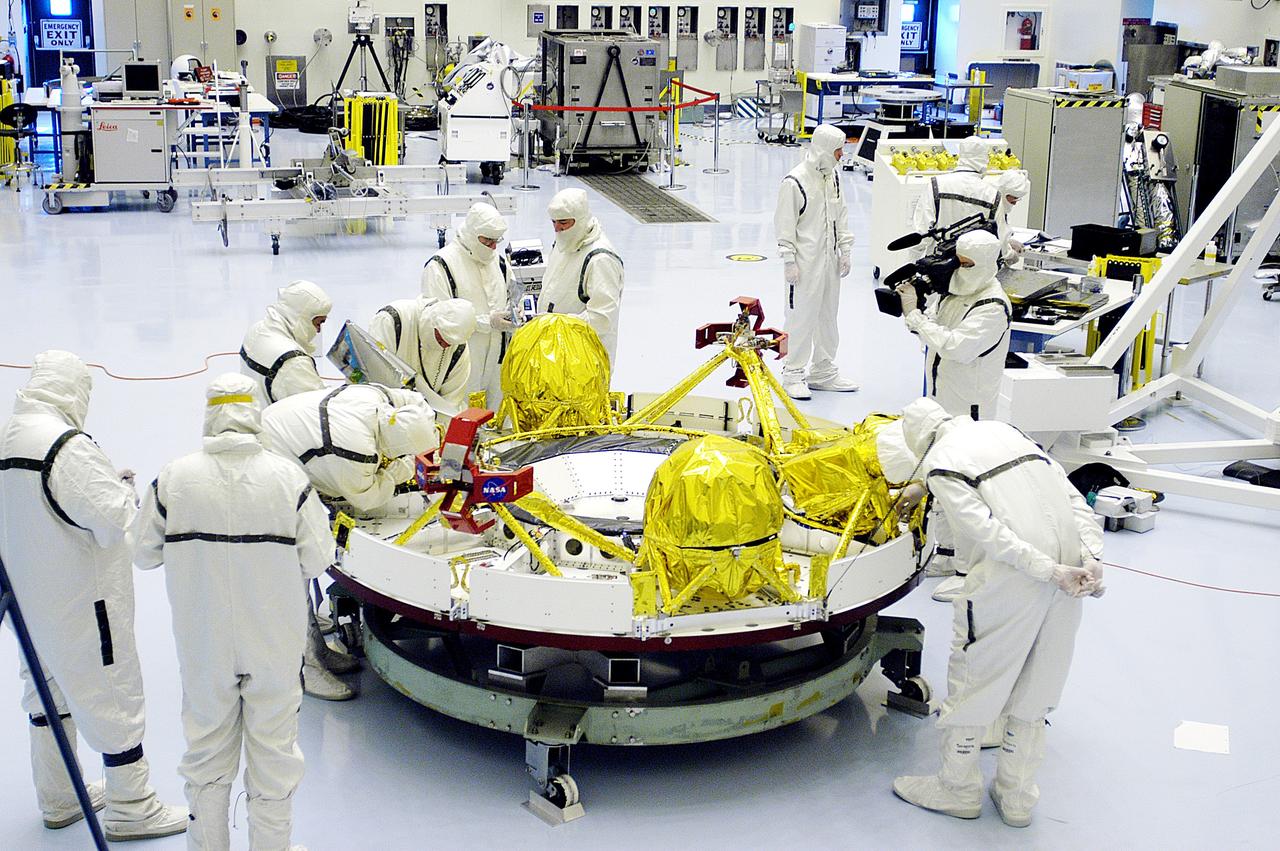
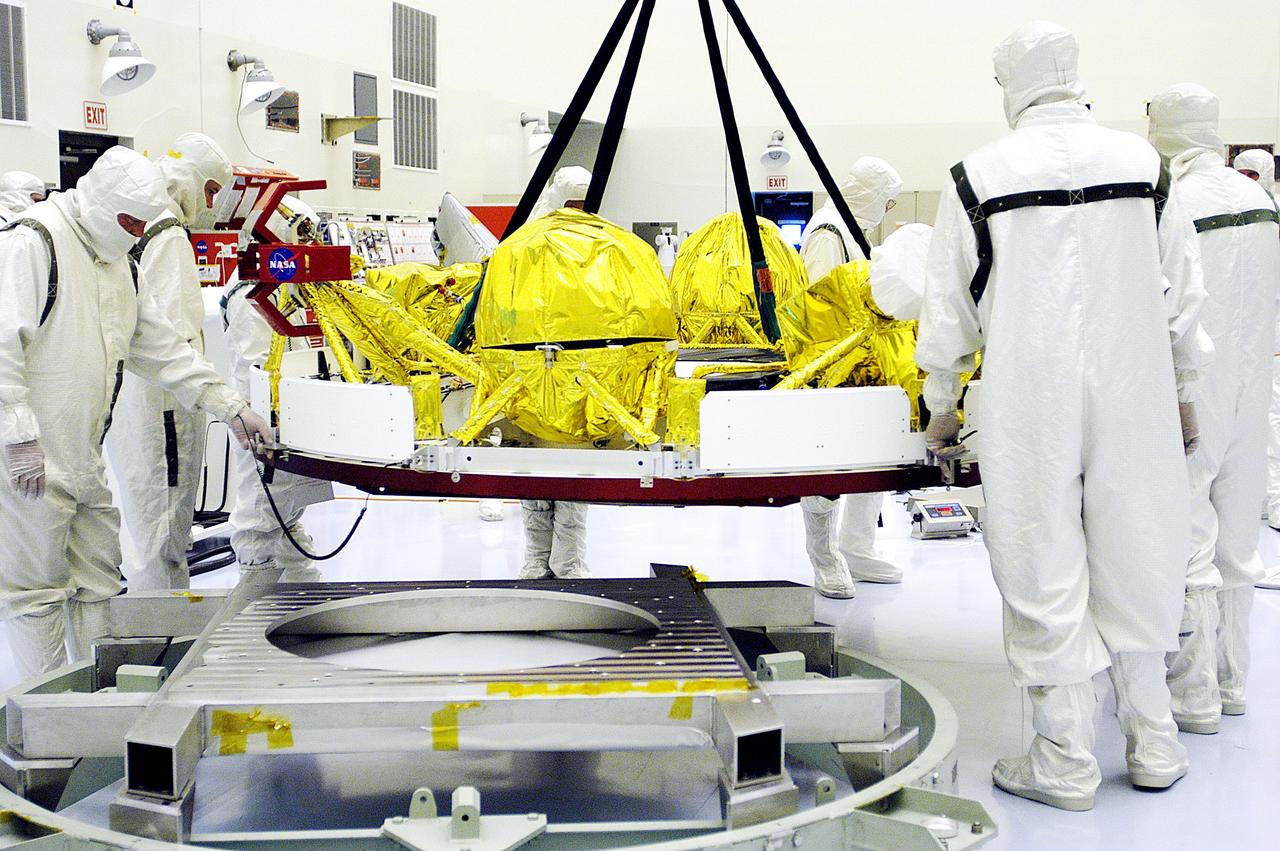
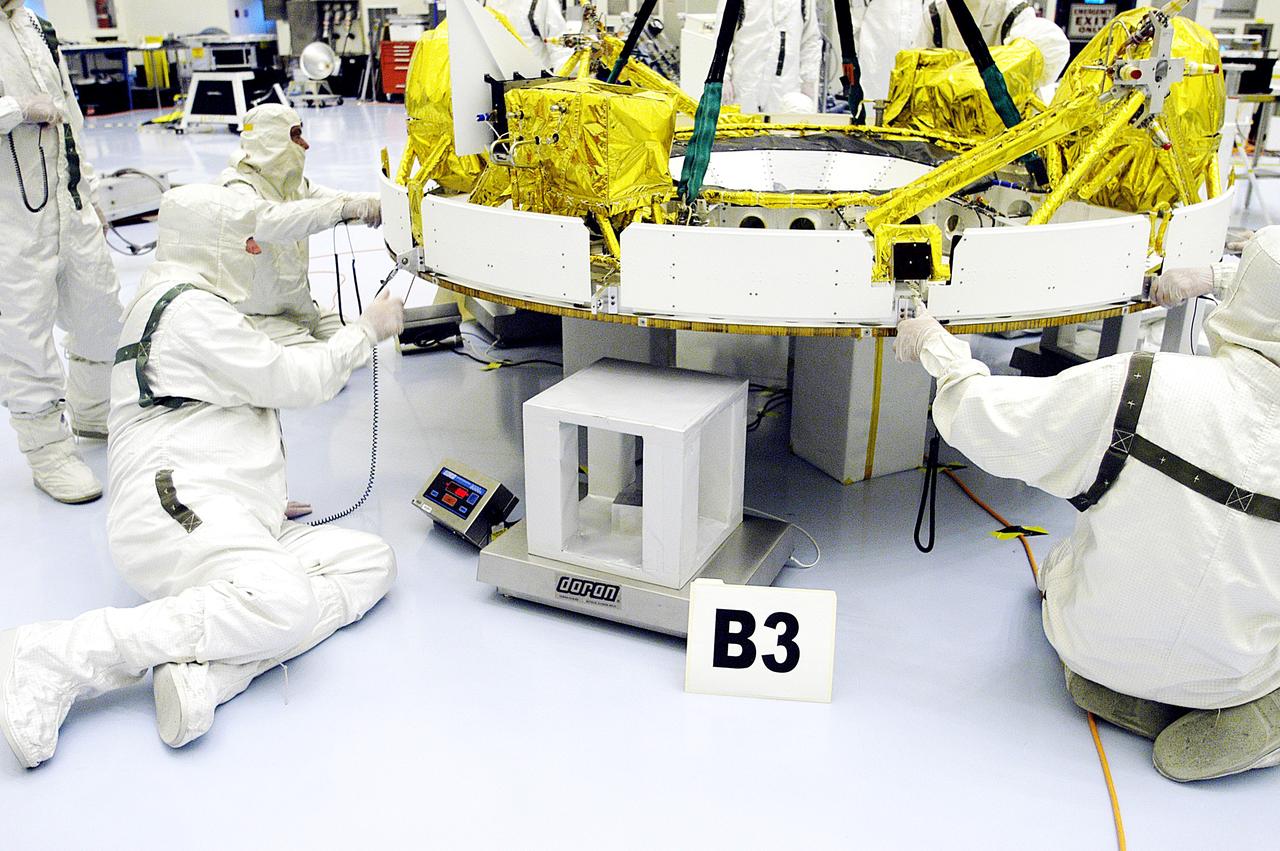
KENNEDY SPACE CENTER, FLA. - In the Payload Hazardous Servicing Facility, workers check the status of the cruise stage of Mars Exploration Rover 1 (MER-1) after being lowered onto blocks.  The cruise stage will be integrated with the aeroshell, the entry vehicle.   NASA’s twin Mars Exploration Rovers are designed to study the history of water on Mars. These robotic geologists are equipped with a robotic arm, a drilling tool, three spectrometers, and four pairs of cameras that allow them to have a human-like, 3D view of the terrain. Each rover could travel as far as 100 meters in one day to act as Mars scientists' eyes and hands, exploring an environment where humans can’t yet go.  The MER-1 is scheduled to launch June 25 from Launch Pad 17-A, Cape Canaveral Air Force Station.
KENNEDY SPACE CENTER, FLA. - In the Payload Hazardous Servicing Facility, workers check the status of the cruise stage of Mars Exploration Rover 1 (MER-1) after being lowered onto blocks. The cruise stage will be integrated with the aeroshell, the entry vehicle. NASA’s twin Mars Exploration Rovers are designed to study the history of water on Mars. These robotic geologists are equipped with a robotic arm, a drilling tool, three spectrometers, and four pairs of cameras that allow them to have a human-like, 3D view of the terrain. Each rover could travel as far as 100 meters in one day to act as Mars scientists' eyes and hands, exploring an environment where humans can’t yet go. The MER-1 is scheduled to launch June 25 from Launch Pad 17-A, Cape Canaveral Air Force Station.
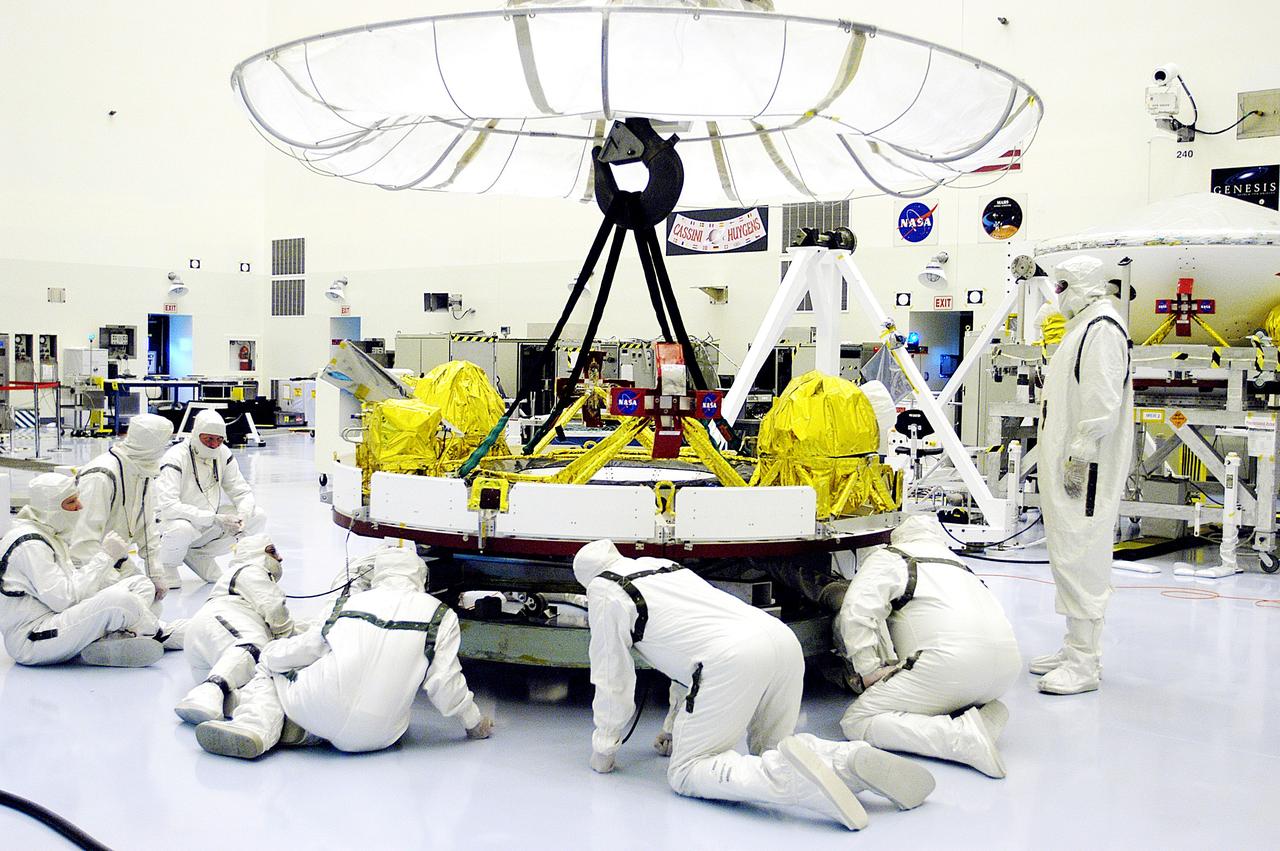
KENNEDY SPACE CENTER, FLA. - In the Payload Hazardous Servicing Facility, workers stand by while an overhead crane again lifts the cruise stage of Mars Exploration Rover 1 (MER-1).  The cruise stage will be integrated with the aeroshell, the entry vehicle.   NASA’s twin Mars Exploration Rovers are designed to study the history of water on Mars. These robotic geologists are equipped with a robotic arm, a drilling tool, three spectrometers, and four pairs of cameras that allow them to have a human-like, 3D view of the terrain. Each rover could travel as far as 100 meters in one day to act as Mars scientists' eyes and hands, exploring an environment where humans can’t yet go.  The MER-1 is scheduled to launch June 25 from Launch Pad 17-A, Cape Canaveral Air Force Station.
KENNEDY SPACE CENTER, FLA. - In the Payload Hazardous Servicing Facility, workers stand by while an overhead crane again lifts the cruise stage of Mars Exploration Rover 1 (MER-1). The cruise stage will be integrated with the aeroshell, the entry vehicle. NASA’s twin Mars Exploration Rovers are designed to study the history of water on Mars. These robotic geologists are equipped with a robotic arm, a drilling tool, three spectrometers, and four pairs of cameras that allow them to have a human-like, 3D view of the terrain. Each rover could travel as far as 100 meters in one day to act as Mars scientists' eyes and hands, exploring an environment where humans can’t yet go. The MER-1 is scheduled to launch June 25 from Launch Pad 17-A, Cape Canaveral Air Force Station.
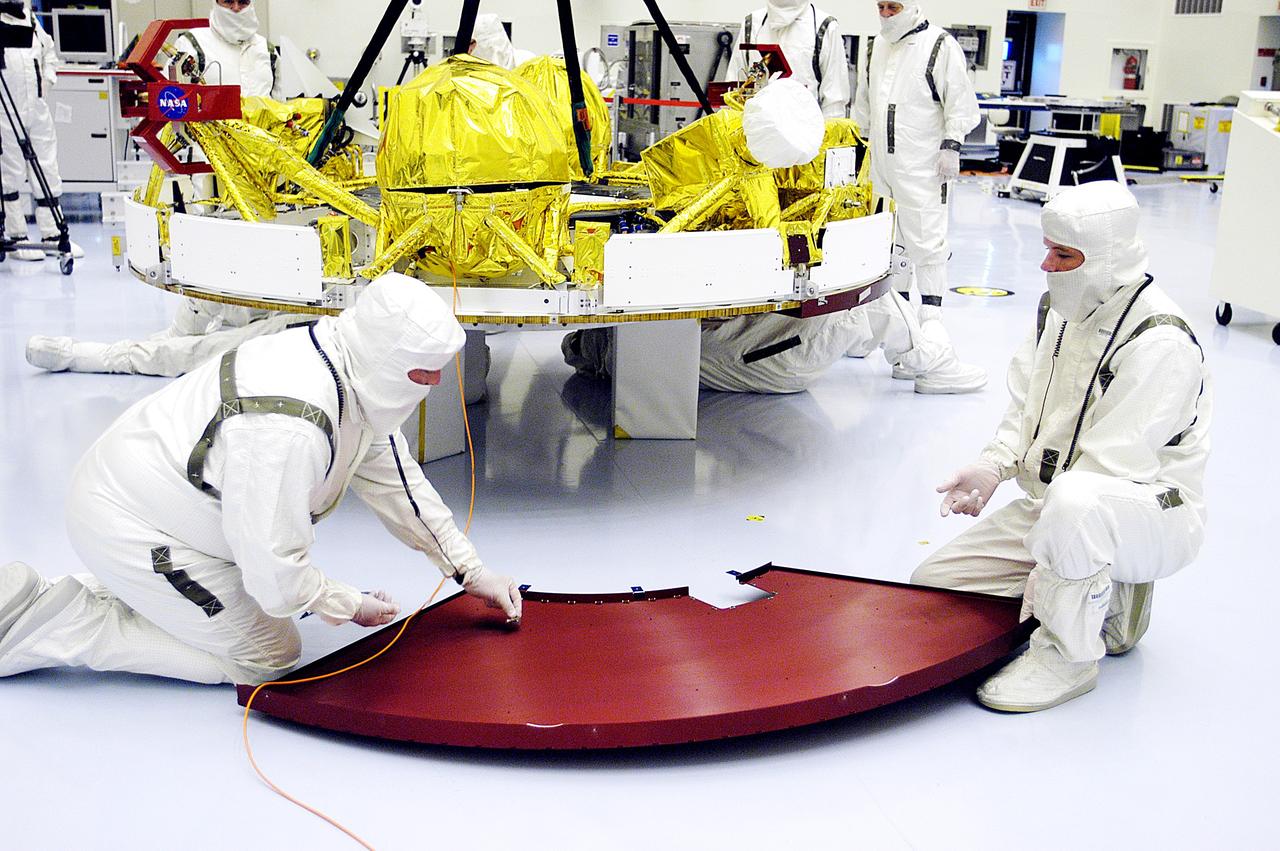
KENNEDY SPACE CENTER, FLA. - In the Payload Hazardous Servicing Facility, workers check one of the cruise stage solar panel protective covers on Mars Exploration Rover 1 (MER-1).  The cruise stage will be integrated with the aeroshell, the entry vehicle.   NASA’s twin Mars Exploration Rovers are designed to study the history of water on Mars. These robotic geologists are equipped with a robotic arm, a drilling tool, three spectrometers, and four pairs of cameras that allow them to have a human-like, 3D view of the terrain. Each rover could travel as far as 100 meters in one day to act as Mars scientists' eyes and hands, exploring an environment where humans can’t yet go.  The MER-1 is scheduled to launch June 25 from Launch Pad 17-A, Cape Canaveral Air Force Station.
KENNEDY SPACE CENTER, FLA. - In the Payload Hazardous Servicing Facility, workers check one of the cruise stage solar panel protective covers on Mars Exploration Rover 1 (MER-1). The cruise stage will be integrated with the aeroshell, the entry vehicle. NASA’s twin Mars Exploration Rovers are designed to study the history of water on Mars. These robotic geologists are equipped with a robotic arm, a drilling tool, three spectrometers, and four pairs of cameras that allow them to have a human-like, 3D view of the terrain. Each rover could travel as far as 100 meters in one day to act as Mars scientists' eyes and hands, exploring an environment where humans can’t yet go. The MER-1 is scheduled to launch June 25 from Launch Pad 17-A, Cape Canaveral Air Force Station.
KENNEDY SPACE CENTER, FLA. - The aeroshell, the entry vehicle for Mars Exploration Rover 1 (MER-1), is ready for integration with its cruise stage, seen here below the backshell.  What appears to be the top half of the aeroshell is the heat shield.  NASA’s twin Mars Exploration Rovers are designed to study the history of water on Mars. These robotic geologists are equipped with a robotic arm, a drilling tool, three spectrometers, and four pairs of cameras that allow them to have a human-like, 3D view of the terrain. Each rover could travel as far as 100 meters in one day to act as Mars scientists' eyes and hands, exploring an environment where humans can’t yet go.  The MER-1 is scheduled to launch June 25 from Launch Pad 17-A, Cape Canaveral Air Force Station.
KENNEDY SPACE CENTER, FLA. - The aeroshell, the entry vehicle for Mars Exploration Rover 1 (MER-1), is ready for integration with its cruise stage, seen here below the backshell. What appears to be the top half of the aeroshell is the heat shield. NASA’s twin Mars Exploration Rovers are designed to study the history of water on Mars. These robotic geologists are equipped with a robotic arm, a drilling tool, three spectrometers, and four pairs of cameras that allow them to have a human-like, 3D view of the terrain. Each rover could travel as far as 100 meters in one day to act as Mars scientists' eyes and hands, exploring an environment where humans can’t yet go. The MER-1 is scheduled to launch June 25 from Launch Pad 17-A, Cape Canaveral Air Force Station.
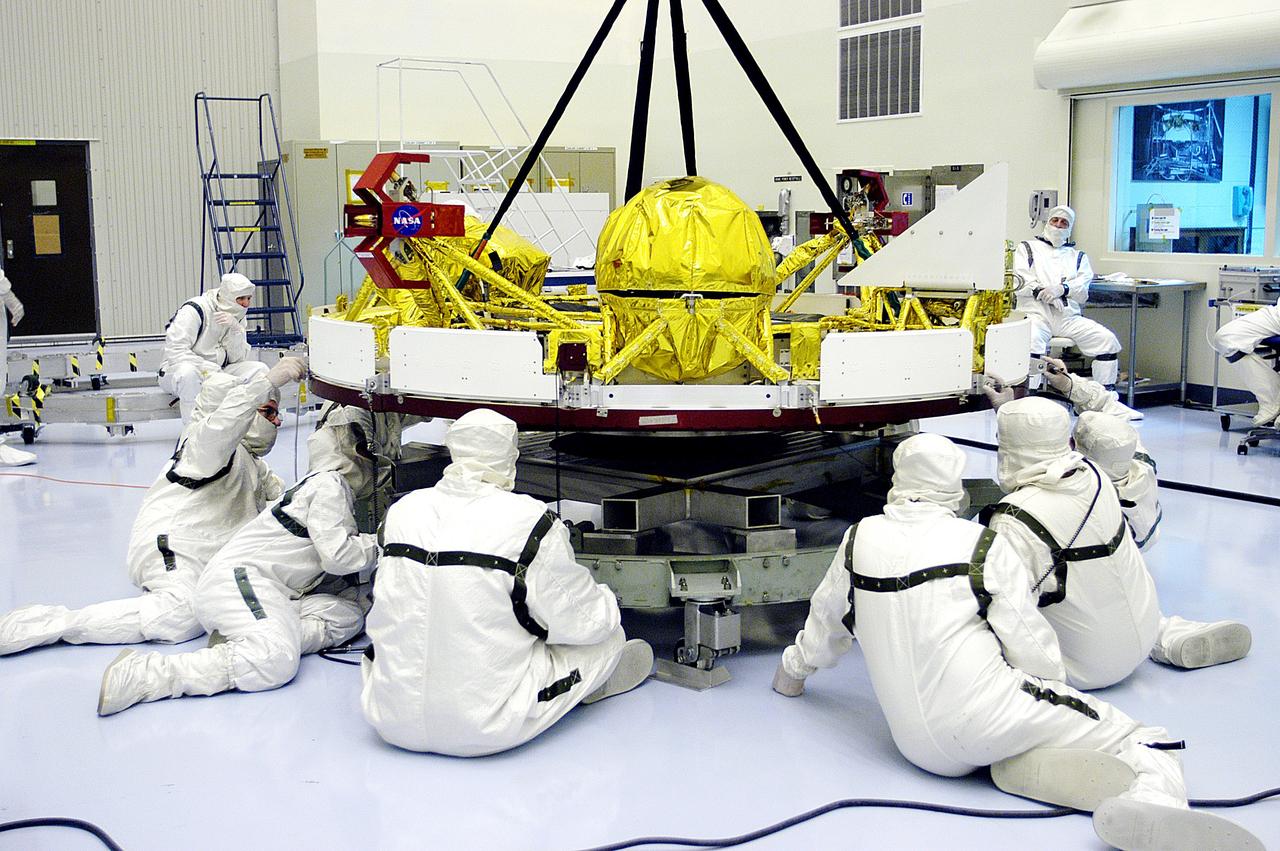
KENNEDY SPACE CENTER, FLA. - In the Payload Hazardous Servicing Facility, workers reattach the tethers of the overhead crane that lowered the cruise stage of Mars Exploration Rover 1 (MER-1) onto blocks.  The cruise stage will be lifted and integrated with the aeroshell, the entry vehicle.   NASA’s twin Mars Exploration Rovers are designed to study the history of water on Mars. These robotic geologists are equipped with a robotic arm, a drilling tool, three spectrometers, and four pairs of cameras that allow them to have a human-like, 3D view of the terrain. Each rover could travel as far as 100 meters in one day to act as Mars scientists' eyes and hands, exploring an environment where humans can’t yet go.  The MER-1 is scheduled to launch June 25 from Launch Pad 17-A, Cape Canaveral Air Force Station.
KENNEDY SPACE CENTER, FLA. - In the Payload Hazardous Servicing Facility, workers reattach the tethers of the overhead crane that lowered the cruise stage of Mars Exploration Rover 1 (MER-1) onto blocks. The cruise stage will be lifted and integrated with the aeroshell, the entry vehicle. NASA’s twin Mars Exploration Rovers are designed to study the history of water on Mars. These robotic geologists are equipped with a robotic arm, a drilling tool, three spectrometers, and four pairs of cameras that allow them to have a human-like, 3D view of the terrain. Each rover could travel as far as 100 meters in one day to act as Mars scientists' eyes and hands, exploring an environment where humans can’t yet go. The MER-1 is scheduled to launch June 25 from Launch Pad 17-A, Cape Canaveral Air Force Station.
KENNEDY SPACE CENTER, FLA. - In the Payload Hazardous Servicing Facility, workers check the status of the cruise stage of Mars Exploration Rover 1 (MER-1) after being lowered onto blocks.  The cruise stage will be integrated with the aeroshell, the entry vehicle.   NASA’s twin Mars Exploration Rovers are designed to study the history of water on Mars. These robotic geologists are equipped with a robotic arm, a drilling tool, three spectrometers, and four pairs of cameras that allow them to have a human-like, 3D view of the terrain. Each rover could travel as far as 100 meters in one day to act as Mars scientists' eyes and hands, exploring an environment where humans can’t yet go.  The MER-1 is scheduled to launch June 25 from Launch Pad 17-A, Cape Canaveral Air Force Station.
KENNEDY SPACE CENTER, FLA. - In the Payload Hazardous Servicing Facility, workers check the status of the cruise stage of Mars Exploration Rover 1 (MER-1) after being lowered onto blocks. The cruise stage will be integrated with the aeroshell, the entry vehicle. NASA’s twin Mars Exploration Rovers are designed to study the history of water on Mars. These robotic geologists are equipped with a robotic arm, a drilling tool, three spectrometers, and four pairs of cameras that allow them to have a human-like, 3D view of the terrain. Each rover could travel as far as 100 meters in one day to act as Mars scientists' eyes and hands, exploring an environment where humans can’t yet go. The MER-1 is scheduled to launch June 25 from Launch Pad 17-A, Cape Canaveral Air Force Station.
KENNEDY SPACE CENTER, FLA. - In the Payload Hazardous Servicing Facility, workers check the cruise stage of Mars Exploration Rover 1 (MER-1) being lifted off a stand.  The cruise stage will be integrated with the aeroshell, the entry vehicle.   NASA’s twin Mars Exploration Rovers are designed to study the history of water on Mars. These robotic geologists are equipped with a robotic arm, a drilling tool, three spectrometers, and four pairs of cameras that allow them to have a human-like, 3D view of the terrain. Each rover could travel as far as 100 meters in one day to act as Mars scientists' eyes and hands, exploring an environment where humans can’t yet go.  The MER-1 is scheduled to launch June 25 from Launch Pad 17-A, Cape Canaveral Air Force Station.
KENNEDY SPACE CENTER, FLA. - In the Payload Hazardous Servicing Facility, workers check the cruise stage of Mars Exploration Rover 1 (MER-1) being lifted off a stand. The cruise stage will be integrated with the aeroshell, the entry vehicle. NASA’s twin Mars Exploration Rovers are designed to study the history of water on Mars. These robotic geologists are equipped with a robotic arm, a drilling tool, three spectrometers, and four pairs of cameras that allow them to have a human-like, 3D view of the terrain. Each rover could travel as far as 100 meters in one day to act as Mars scientists' eyes and hands, exploring an environment where humans can’t yet go. The MER-1 is scheduled to launch June 25 from Launch Pad 17-A, Cape Canaveral Air Force Station.
KENNEDY SPACE CENTER, FLA. - In the Payload Hazardous Servicing Facility, workers help guide the cruise stage of Mars Exploration Rover 1 (MER-1) as it is lowered onto blocks.  The cruise stage will be integrated with the aeroshell, the entry vehicle.   NASA’s twin Mars Exploration Rovers are designed to study the history of water on Mars. These robotic geologists are equipped with a robotic arm, a drilling tool, three spectrometers, and four pairs of cameras that allow them to have a human-like, 3D view of the terrain. Each rover could travel as far as 100 meters in one day to act as Mars scientists' eyes and hands, exploring an environment where humans can’t yet go.  The MER-1 is scheduled to launch June 25 from Launch Pad 17-A, Cape Canaveral Air Force Station.
KENNEDY SPACE CENTER, FLA. - In the Payload Hazardous Servicing Facility, workers help guide the cruise stage of Mars Exploration Rover 1 (MER-1) as it is lowered onto blocks. The cruise stage will be integrated with the aeroshell, the entry vehicle. NASA’s twin Mars Exploration Rovers are designed to study the history of water on Mars. These robotic geologists are equipped with a robotic arm, a drilling tool, three spectrometers, and four pairs of cameras that allow them to have a human-like, 3D view of the terrain. Each rover could travel as far as 100 meters in one day to act as Mars scientists' eyes and hands, exploring an environment where humans can’t yet go. The MER-1 is scheduled to launch June 25 from Launch Pad 17-A, Cape Canaveral Air Force Station.
KENNEDY SPACE CENTER, FLA. - In the Payload Hazardous Servicing Facility, workers oversee the movement of the cruise stage of Mars Exploration Rover 1 (MER-1).  The cruise stage will be integrated with the aeroshell, the entry vehicle.   NASA’s twin Mars Exploration Rovers are designed to study the history of water on Mars. These robotic geologists are equipped with a robotic arm, a drilling tool, three spectrometers, and four pairs of cameras that allow them to have a human-like, 3D view of the terrain. Each rover could travel as far as 100 meters in one day to act as Mars scientists' eyes and hands, exploring an environment where humans can’t yet go.  The MER-1 is scheduled to launch June 25 from Launch Pad 17-A, Cape Canaveral Air Force Station.
KENNEDY SPACE CENTER, FLA. - In the Payload Hazardous Servicing Facility, workers oversee the movement of the cruise stage of Mars Exploration Rover 1 (MER-1). The cruise stage will be integrated with the aeroshell, the entry vehicle. NASA’s twin Mars Exploration Rovers are designed to study the history of water on Mars. These robotic geologists are equipped with a robotic arm, a drilling tool, three spectrometers, and four pairs of cameras that allow them to have a human-like, 3D view of the terrain. Each rover could travel as far as 100 meters in one day to act as Mars scientists' eyes and hands, exploring an environment where humans can’t yet go. The MER-1 is scheduled to launch June 25 from Launch Pad 17-A, Cape Canaveral Air Force Station.
KENNEDY SPACE CENTER, FLA. -  Workers in the Payload Hazardous Servicing Facility prepare an overhead crane (background) that will lift the cruise stage, in the foreground, for Mars Exploration Rover 1 (MER-1).  The cruise stage will be moved and integrated with the aeroshell, the entry vehicle.   NASA’s twin Mars Exploration Rovers are designed to study the history of water on Mars. These robotic geologists are equipped with a robotic arm, a drilling tool, three spectrometers, and four pairs of cameras that allow them to have a human-like, 3D view of the terrain. Each rover could travel as far as 100 meters in one day to act as Mars scientists' eyes and hands, exploring an environment where humans can’t yet go.  The MER-1 is scheduled to launch June 25 from Launch Pad 17-A, Cape Canaveral Air Force Station.
KENNEDY SPACE CENTER, FLA. - Workers in the Payload Hazardous Servicing Facility prepare an overhead crane (background) that will lift the cruise stage, in the foreground, for Mars Exploration Rover 1 (MER-1). The cruise stage will be moved and integrated with the aeroshell, the entry vehicle. NASA’s twin Mars Exploration Rovers are designed to study the history of water on Mars. These robotic geologists are equipped with a robotic arm, a drilling tool, three spectrometers, and four pairs of cameras that allow them to have a human-like, 3D view of the terrain. Each rover could travel as far as 100 meters in one day to act as Mars scientists' eyes and hands, exploring an environment where humans can’t yet go. The MER-1 is scheduled to launch June 25 from Launch Pad 17-A, Cape Canaveral Air Force Station.
KENNEDY SPACE CENTER, FLA. - Workers in the Payload Hazardous Servicing Facility check the cruise stage of Mars Exploration Rover 1 (MER-1) that will be lifted and moved by the overhead crane for integration with the aeroshell, the entry vehicle.  NASA’s twin Mars Exploration Rovers are designed to study the history of water on Mars. These robotic geologists are equipped with a robotic arm, a drilling tool, three spectrometers, and four pairs of cameras that allow them to have a human-like, 3D view of the terrain. Each rover could travel as far as 100 meters in one day to act as Mars scientists' eyes and hands, exploring an environment where humans can’t yet go.  The MER-1 is scheduled to launch June 25 from Launch Pad 17-A, Cape Canaveral Air Force Station.
KENNEDY SPACE CENTER, FLA. - Workers in the Payload Hazardous Servicing Facility check the cruise stage of Mars Exploration Rover 1 (MER-1) that will be lifted and moved by the overhead crane for integration with the aeroshell, the entry vehicle. NASA’s twin Mars Exploration Rovers are designed to study the history of water on Mars. These robotic geologists are equipped with a robotic arm, a drilling tool, three spectrometers, and four pairs of cameras that allow them to have a human-like, 3D view of the terrain. Each rover could travel as far as 100 meters in one day to act as Mars scientists' eyes and hands, exploring an environment where humans can’t yet go. The MER-1 is scheduled to launch June 25 from Launch Pad 17-A, Cape Canaveral Air Force Station.
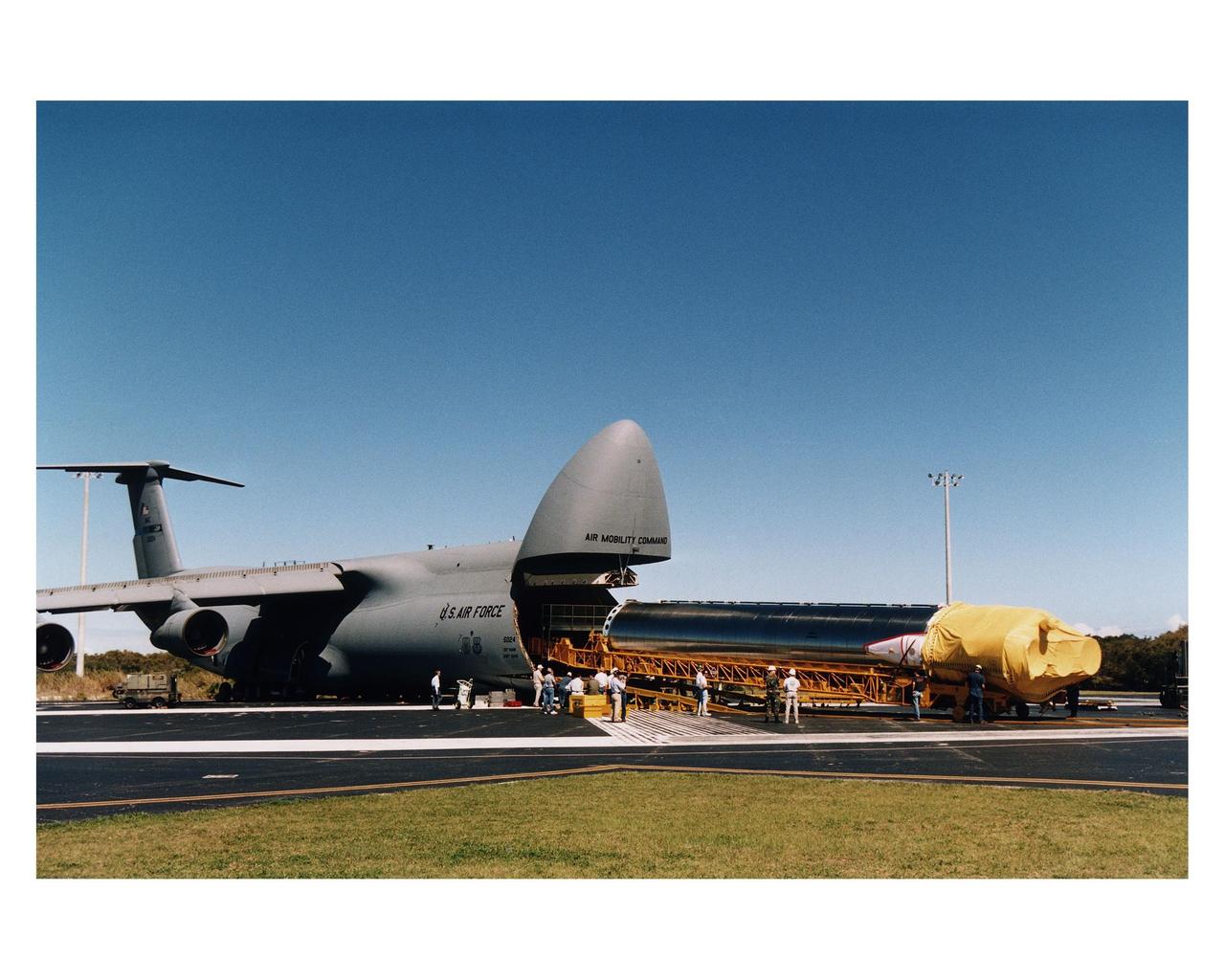
The Atlas 1 rocket which will launch the GOES-K advanced weather satellite is unloaded from an Air Force C-5 air cargo plane after arrival at the Skid Strip, Cape Canaveral Air Station (CCAS). The Lockheed Martin-built rocket and its Centaur upper stage will form the AC-79 vehicle, the final vehicle in the Atlas 1 series which began launches for NASA in 1962. Future launches of geostationary operational environmental satellites (GOES) in the current series will be on Atlas II vehicles. GOES-K will be the third spacecraft to be launched in the new advanced series of geostationary weather satellites built for NASA and the National Oceanic and Atmospheric Administration (NOAA). The spacecraft will be designated GOES-10 in orbit. The launch of AC-79/GOES-K is targeted for April 24 from Launch Pad 36B, CCAS
KSC-97pc356
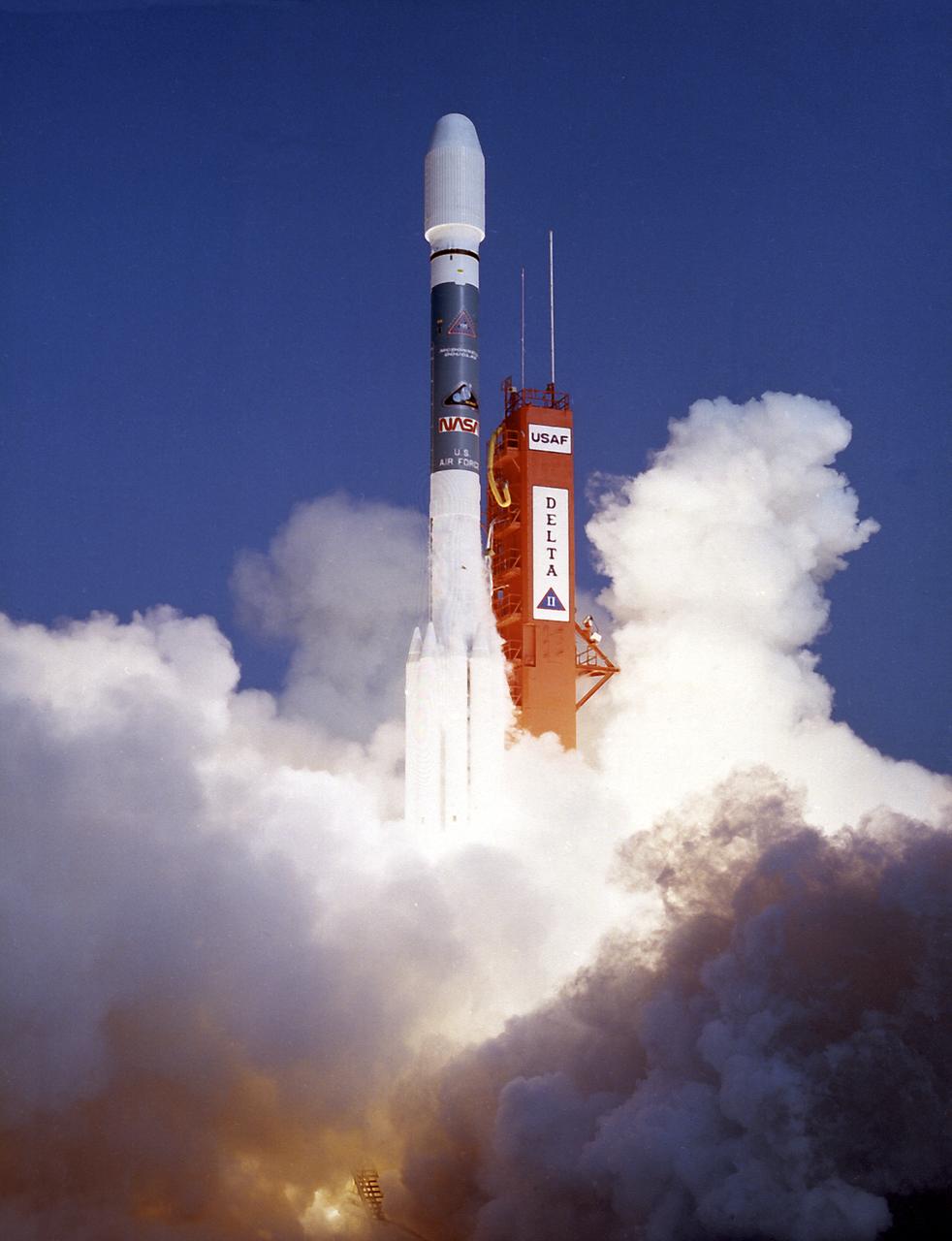
The Delta II expendable launch vehicle with the ROSAT (Roentgen Satellite), cooperative space X-ray astronomy mission between NASA, Germany and United Kingdom, was launched from the Cape Canaveral Air Force Station on June 1, 1990.
Launch Vehicles
KENNEDY SPACE CENTER, FLA. -  The Pegasus launch vehicle is moved back to its hangar at Vandenberg Air Force Base, Calif.  The Pegasus will carry the SciSat-1 spacecraft in a 400-mile-high polar orbit to investigate processes that control the distribution of ozone in the upper atmosphere.  The scientific mission of SciSat-1 is to measure and understand the chemical processes that control the distribution of ozone in the Earth’s atmosphere, particularly at high altitudes.  The data from the satellite will provide Canadian and international scientists with improved measurements relating to global ozone processes and help policymakers assess existing environmental policy and develop protective measures for improving the health of our atmosphere, preventing further ozone depletion.  The mission is designed to last two years.
KENNEDY SPACE CENTER, FLA. - The Pegasus launch vehicle is moved back to its hangar at Vandenberg Air Force Base, Calif. The Pegasus will carry the SciSat-1 spacecraft in a 400-mile-high polar orbit to investigate processes that control the distribution of ozone in the upper atmosphere. The scientific mission of SciSat-1 is to measure and understand the chemical processes that control the distribution of ozone in the Earth’s atmosphere, particularly at high altitudes. The data from the satellite will provide Canadian and international scientists with improved measurements relating to global ozone processes and help policymakers assess existing environmental policy and develop protective measures for improving the health of our atmosphere, preventing further ozone depletion. The mission is designed to last two years.
KENNEDY SPACE CENTER, FLA. - The Pegasus launch vehicle is moved back to its hangar at Vandenberg Air Force Base, Calif.  The Pegasus will carry the SciSat-1 spacecraft in a 400-mile-high polar orbit to investigate processes that control the distribution of ozone in the upper atmosphere.  The scientific mission of SciSat-1 is to measure and understand the chemical processes that control the distribution of ozone in the Earth’s atmosphere, particularly at high altitudes.  The data from the satellite will provide Canadian and international scientists with improved measurements relating to global ozone processes and help policymakers assess existing environmental policy and develop protective measures for improving the health of our atmosphere, preventing further ozone depletion.  The mission is designed to last two years.
KENNEDY SPACE CENTER, FLA. - The Pegasus launch vehicle is moved back to its hangar at Vandenberg Air Force Base, Calif. The Pegasus will carry the SciSat-1 spacecraft in a 400-mile-high polar orbit to investigate processes that control the distribution of ozone in the upper atmosphere. The scientific mission of SciSat-1 is to measure and understand the chemical processes that control the distribution of ozone in the Earth’s atmosphere, particularly at high altitudes. The data from the satellite will provide Canadian and international scientists with improved measurements relating to global ozone processes and help policymakers assess existing environmental policy and develop protective measures for improving the health of our atmosphere, preventing further ozone depletion. The mission is designed to last two years.
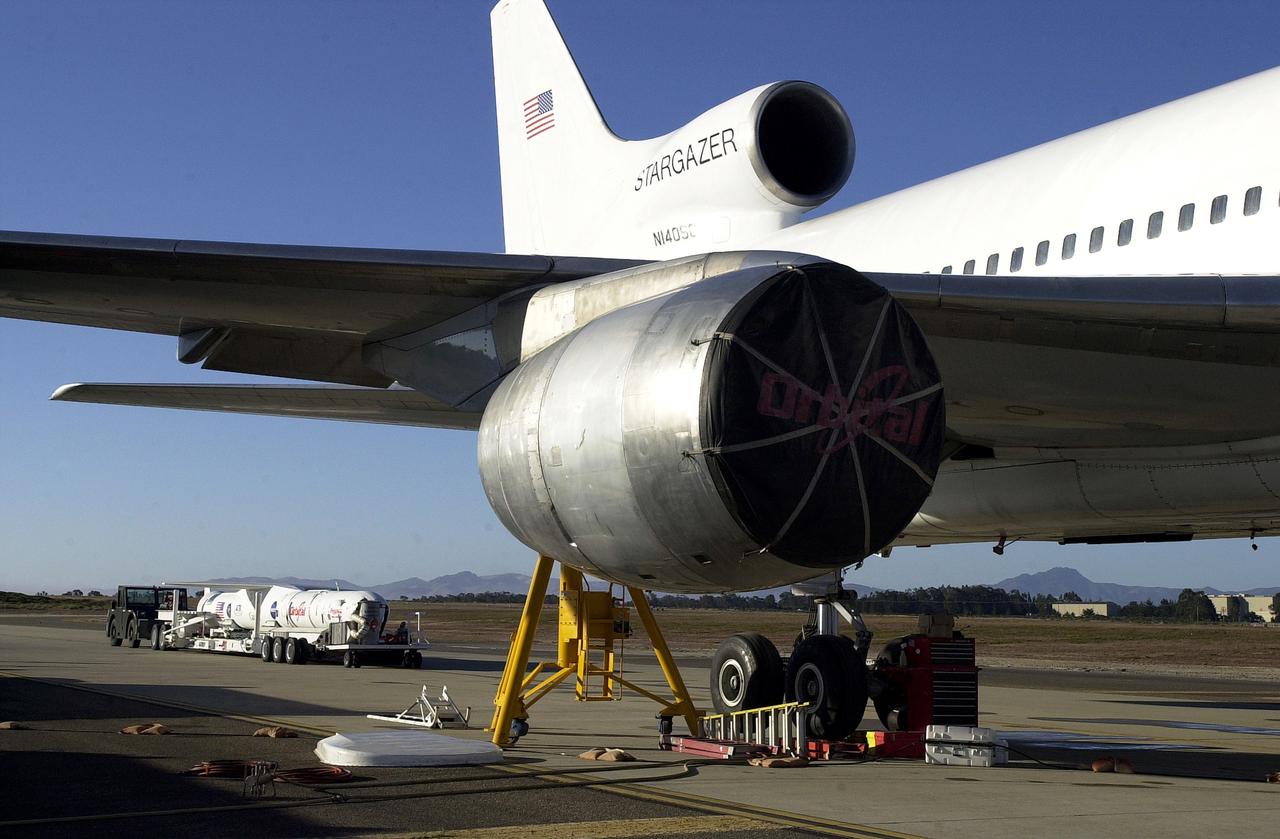
VANDENBERG AIR FORCE BASE, CALIF. -  The L-1011 carrier aircraft is ready for flight after undergoing a Combined Systems Test, an integrated test involving the Pegasus launch vehicle, SciSat-1 spacecraft and L-1011 aircraft.  The SciSat-1 weighs approximately 330 pounds and after launch will be placed in a 400-mile-high polar orbit to investigate processes that control the distribution of ozone in the upper atmosphere. The data from the satellite will provide Canadian and international scientists with improved measurements relating to global ozone processes and help policymakers assess existing environmental policy and develop protective measures for improving the health of our atmosphere, preventing further ozone depletion. The mission is designed to last two years.
VANDENBERG AIR FORCE BASE, CALIF. - The L-1011 carrier aircraft is ready for flight after undergoing a Combined Systems Test, an integrated test involving the Pegasus launch vehicle, SciSat-1 spacecraft and L-1011 aircraft. The SciSat-1 weighs approximately 330 pounds and after launch will be placed in a 400-mile-high polar orbit to investigate processes that control the distribution of ozone in the upper atmosphere. The data from the satellite will provide Canadian and international scientists with improved measurements relating to global ozone processes and help policymakers assess existing environmental policy and develop protective measures for improving the health of our atmosphere, preventing further ozone depletion. The mission is designed to last two years.
KENNEDY SPACE CENTER, FLA. -   Inside the hangar at Vandenberg Air Force Base, Calif., workers wait for the Pegasus launch vehicle to be moved inside.  The Pegasus will carry the SciSat-1 spacecraft in a 400-mile-high polar orbit to investigate processes that control the distribution of ozone in the upper atmosphere.  The scientific mission of SciSat-1 is to measure and understand the chemical processes that control the distribution of ozone in the Earth’s atmosphere, particularly at high altitudes.  The data from the satellite will provide Canadian and international scientists with improved measurements relating to global ozone processes and help policymakers assess existing environmental policy and develop protective measures for improving the health of our atmosphere, preventing further ozone depletion.  The mission is designed to last two years.
KENNEDY SPACE CENTER, FLA. - Inside the hangar at Vandenberg Air Force Base, Calif., workers wait for the Pegasus launch vehicle to be moved inside. The Pegasus will carry the SciSat-1 spacecraft in a 400-mile-high polar orbit to investigate processes that control the distribution of ozone in the upper atmosphere. The scientific mission of SciSat-1 is to measure and understand the chemical processes that control the distribution of ozone in the Earth’s atmosphere, particularly at high altitudes. The data from the satellite will provide Canadian and international scientists with improved measurements relating to global ozone processes and help policymakers assess existing environmental policy and develop protective measures for improving the health of our atmosphere, preventing further ozone depletion. The mission is designed to last two years.
KENNEDY SPACE CENTER, FLA. -   At Vandenberg Air Force Base, Calif., the Pegasus launch vehicle is moved toward its hangar.  The Pegasus will carry the SciSat-1 spacecraft in a 400-mile-high polar orbit to investigate processes that control the distribution of ozone in the upper atmosphere.  The scientific mission of SciSat-1 is to measure and understand the chemical processes that control the distribution of ozone in the Earth’s atmosphere, particularly at high altitudes.  The data from the satellite will provide Canadian and international scientists with improved measurements relating to global ozone processes and help policymakers assess existing environmental policy and develop protective measures for improving the health of our atmosphere, preventing further ozone depletion.  The mission is designed to last two years.
KENNEDY SPACE CENTER, FLA. - At Vandenberg Air Force Base, Calif., the Pegasus launch vehicle is moved toward its hangar. The Pegasus will carry the SciSat-1 spacecraft in a 400-mile-high polar orbit to investigate processes that control the distribution of ozone in the upper atmosphere. The scientific mission of SciSat-1 is to measure and understand the chemical processes that control the distribution of ozone in the Earth’s atmosphere, particularly at high altitudes. The data from the satellite will provide Canadian and international scientists with improved measurements relating to global ozone processes and help policymakers assess existing environmental policy and develop protective measures for improving the health of our atmosphere, preventing further ozone depletion. The mission is designed to last two years.
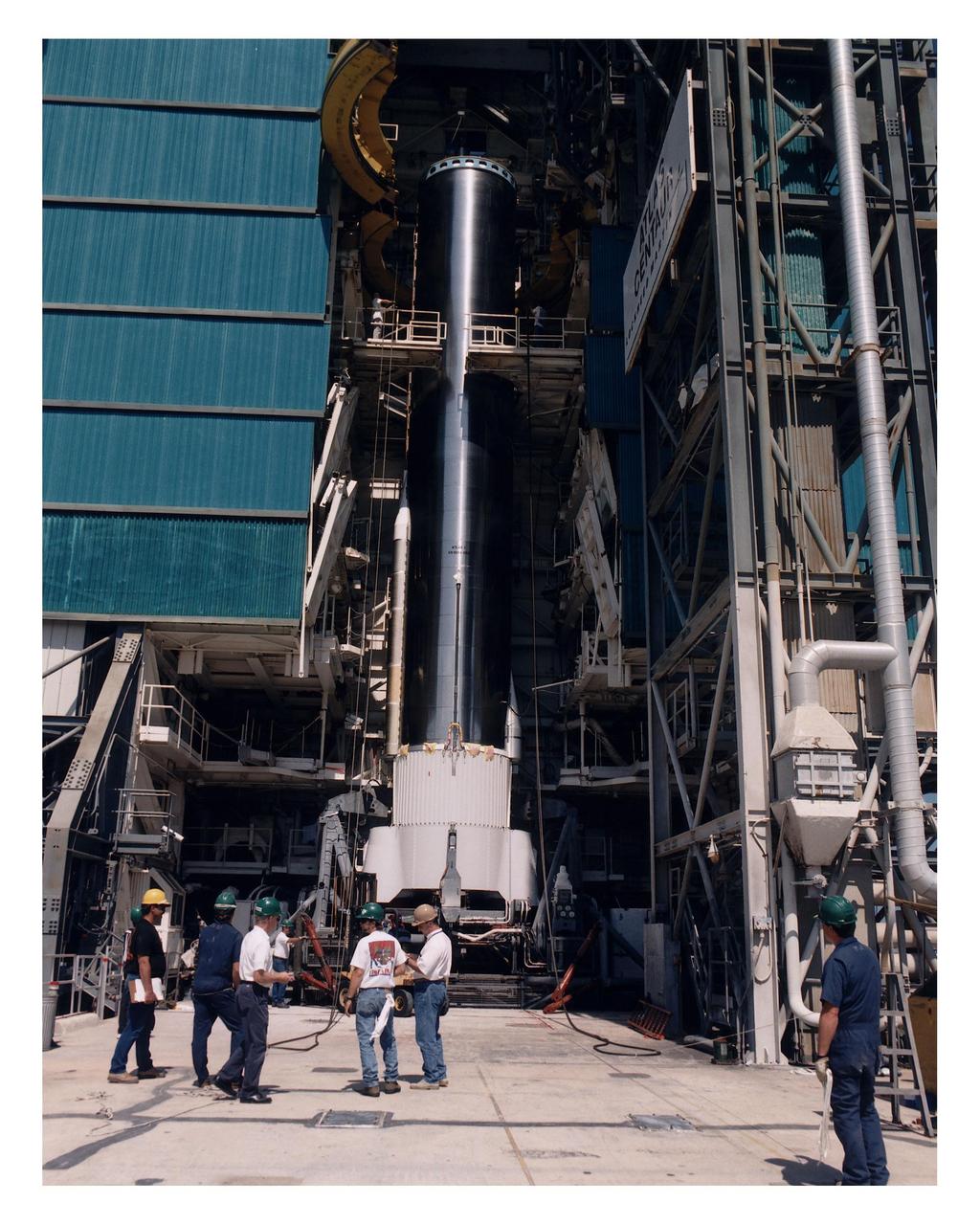
The Atlas 1 rocket which will carry the Geostationary Operational Environmental Satellite-K (GOES-K) into space is erected at Launch Complex 36, Pad B, Cape Canaveral Air Station. The Lockheed Martin-built rocket and its Centaur upper stage will form the AC-79 vehicle, the final vehicle in the Atlas 1 series which began launches for NASA in 1962. GOES-K will be the third spacecraft to be launched in the advanced series of geostationary weather satellites built for NASA and the National Oceanic and Atmospheric Administration (NOAA). The spacecraft will be designated GOES-10 in orbit. Launch is targeted for April 24
KSC-97pc475
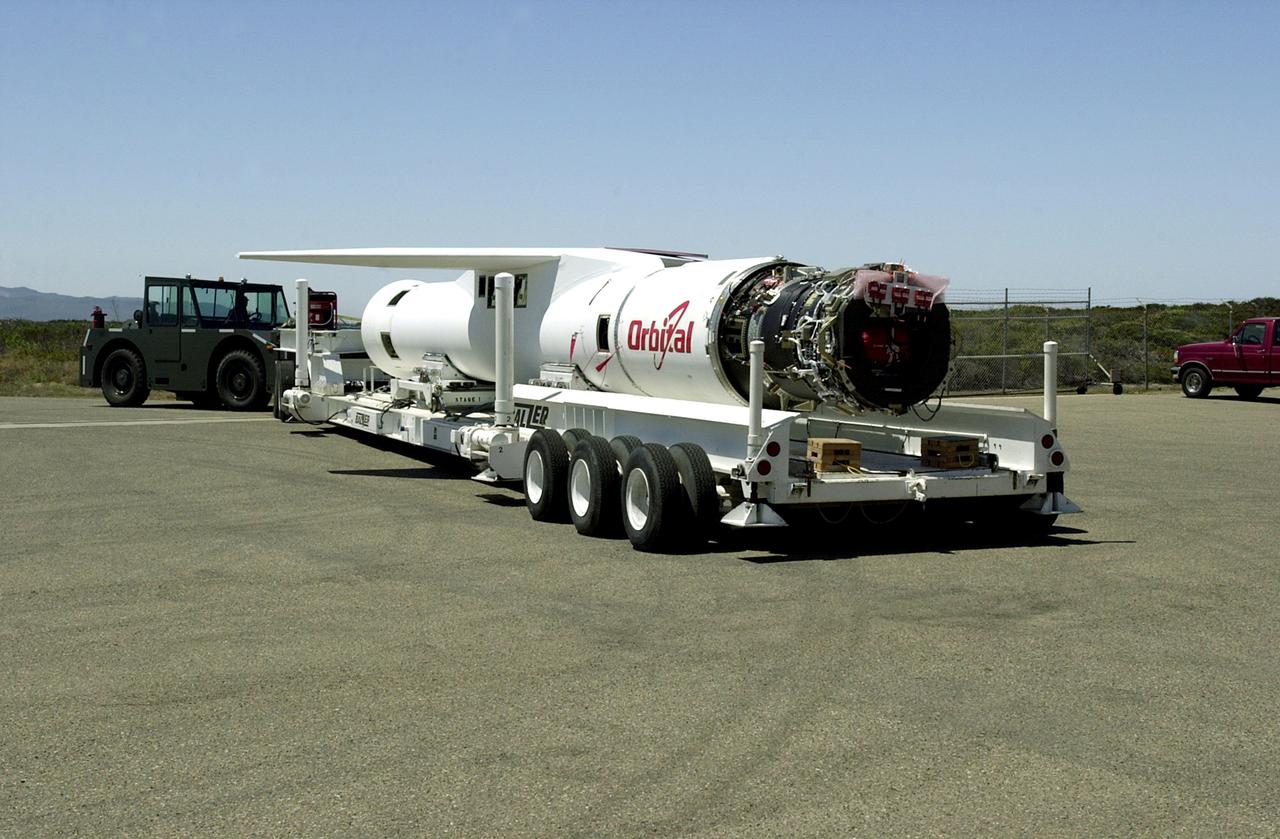
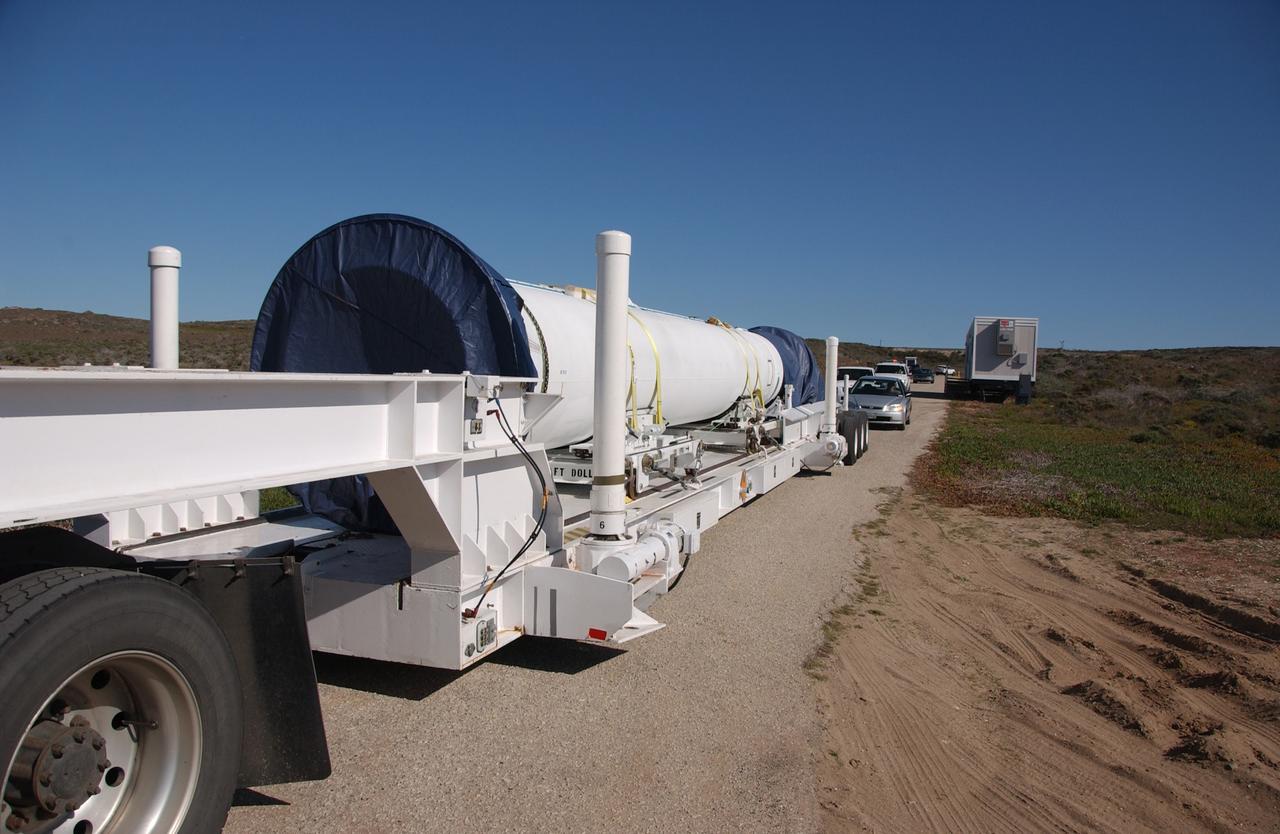
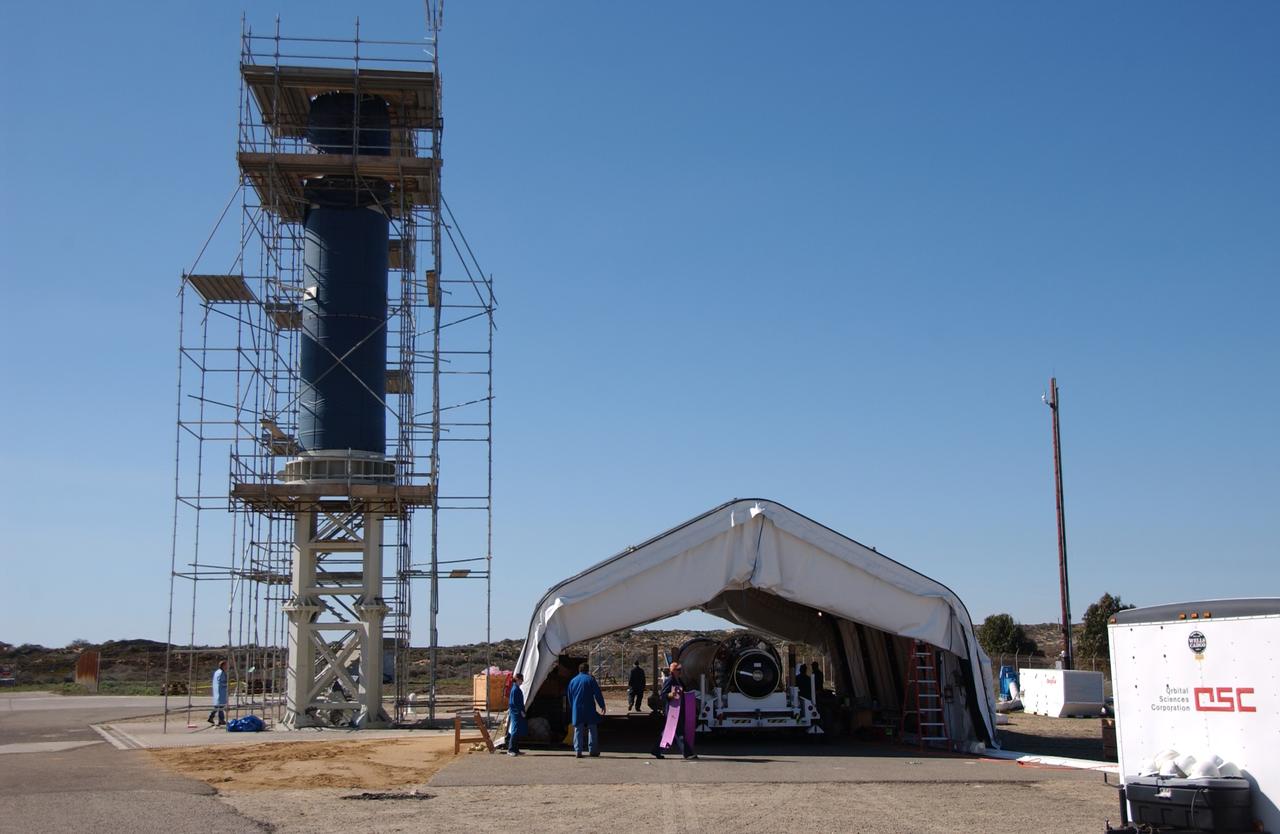
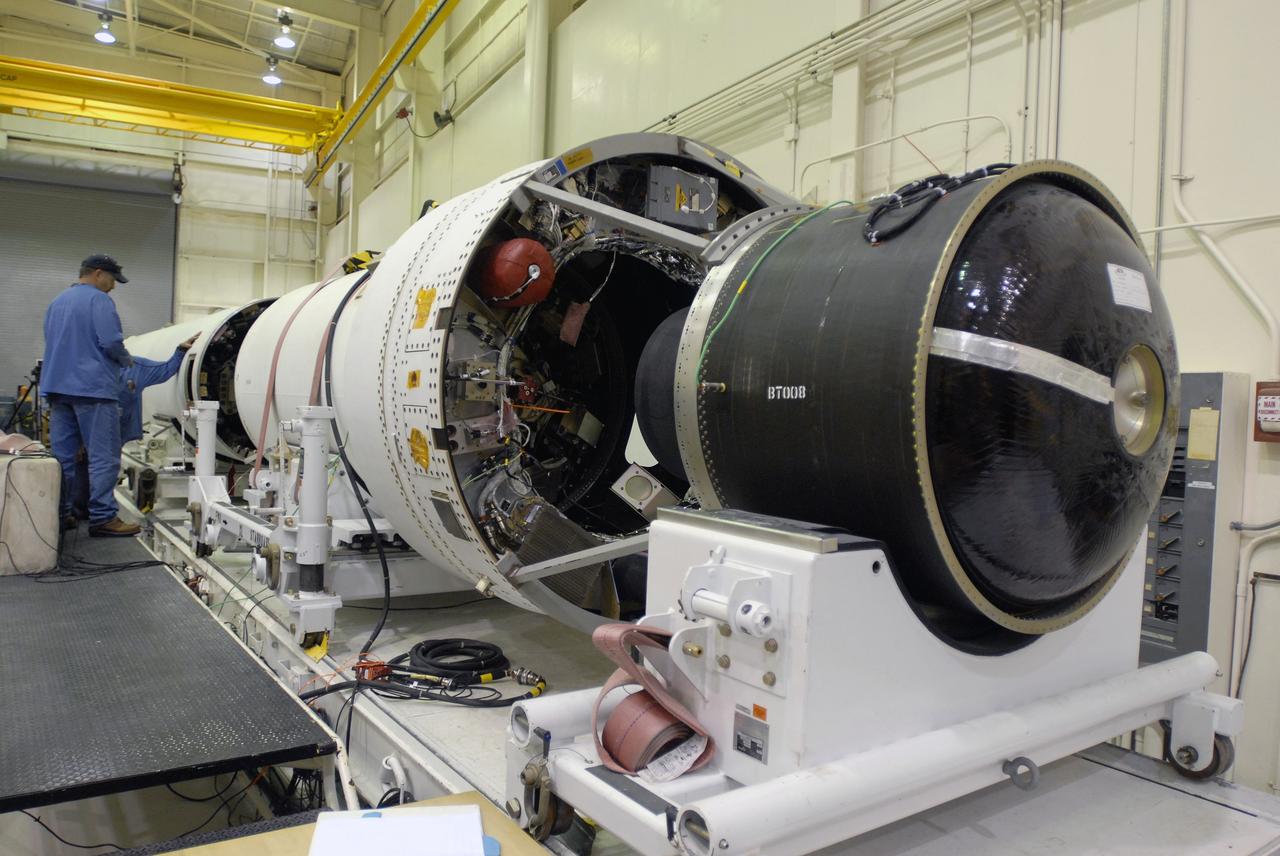
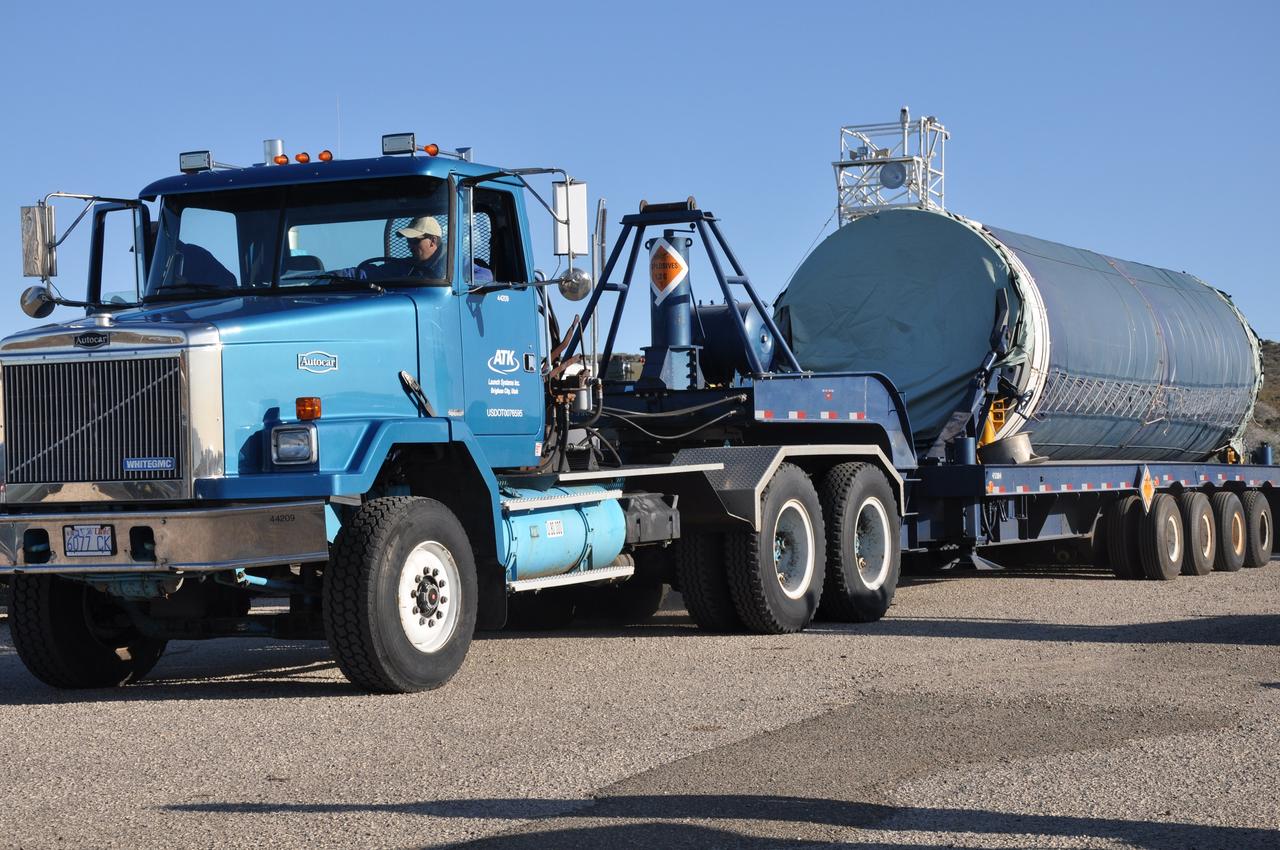
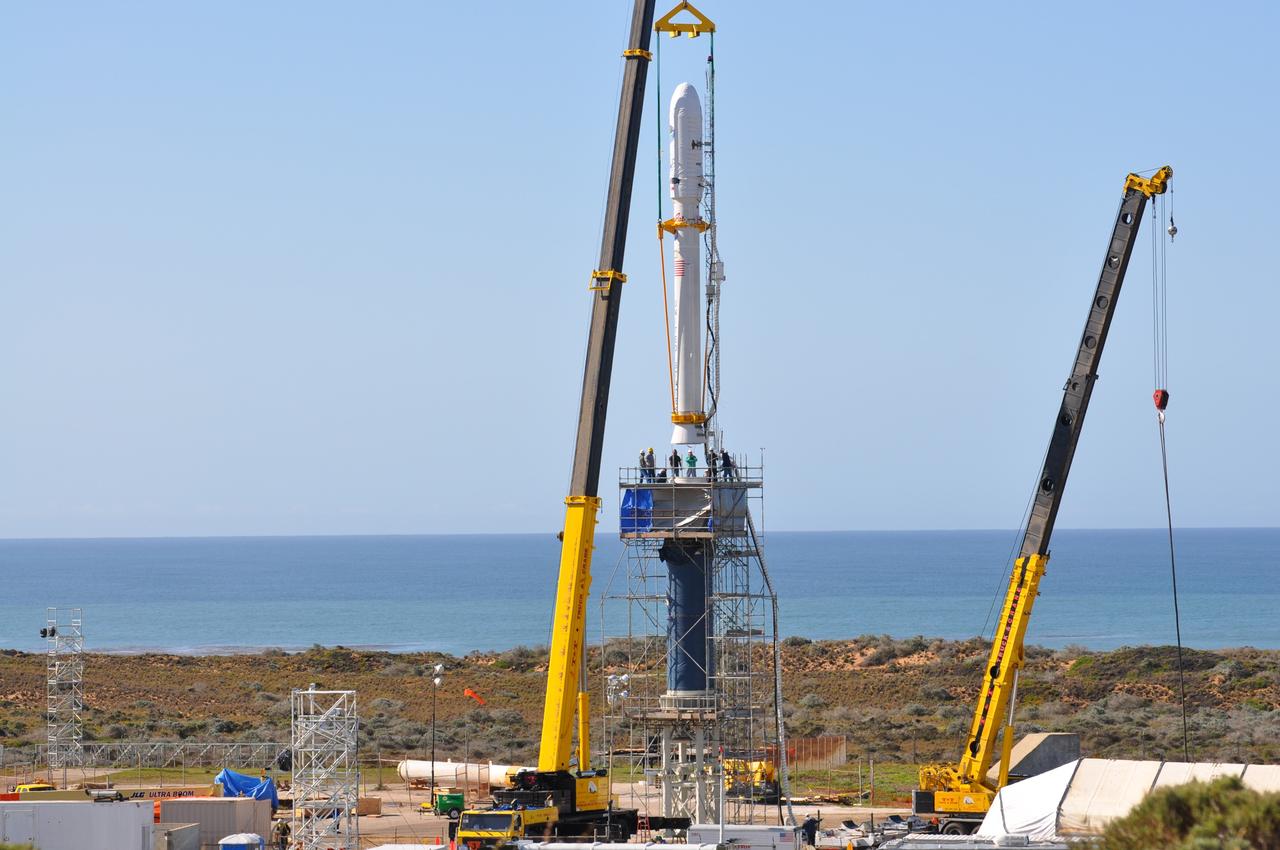
VANDENBERG AIR FORCE BASE, Calif. – Stages 1, 2 and 3 of Orbital Sciences’ Taurus XL launch vehicle for NASA’s Orbiting Carbon Observatory, or OCO, have arrived and are prepared for erection at Space Launch Complex 576-E at Vandenberg Air Force Base in California. The OCO is an Earth-orbiting mission sponsored by NASA's Earth System Science Pathfinder Program. The observatory will collect precise global measurements of carbon dioxide in the Earth's atmosphere. Scientists will analyze the data returned to better understand the natural processes and human activities that regulate the abundance and distribution of this important greenhouse gas.  Launch is targeted for 1:51:30 a.m. PST Feb. 24. Photo credit: VAFB
KSC-2009-1658
VANDENBERG AIR FORCE BASE, Calif. – Stages 1, 2 and 3 of Orbital Sciences’ Taurus XL launch vehicle for NASA’s Orbiting Carbon Observatory, or OCO, have arrived and are prepared for lifting onto Space Launch Complex 576-E at Vandenberg Air Force Base in California. The OCO is an Earth-orbiting mission sponsored by NASA's Earth System Science Pathfinder Program. The observatory will collect precise global measurements of carbon dioxide in the Earth's atmosphere. Scientists will analyze the data returned to better understand the natural processes and human activities that regulate the abundance and distribution of this important greenhouse gas.  Launch is targeted for 1:51:30 a.m. PST Feb. 24. Photo credit: VAFB
KSC-2009-1659
VANDENBERG AIR FORCE BASE, Calif. – Workers prepare to erect Stages 1, 2 and 3 of Orbital Sciences’ Taurus XL launch vehicle for NASA’s Orbiting Carbon Observatory, or OCO, at Space Launch Complex 576-E at Vandenberg Air Force Base in California. The OCO is an Earth-orbiting mission sponsored by NASA's Earth System Science Pathfinder Program. The observatory will collect precise global measurements of carbon dioxide in the Earth's atmosphere. Scientists will analyze the data returned to better understand the natural processes and human activities that regulate the abundance and distribution of this important greenhouse gas.  Launch is targeted for 1:51:30 a.m. PST Feb. 24. Photo credit: VAFB
KSC-2009-1657
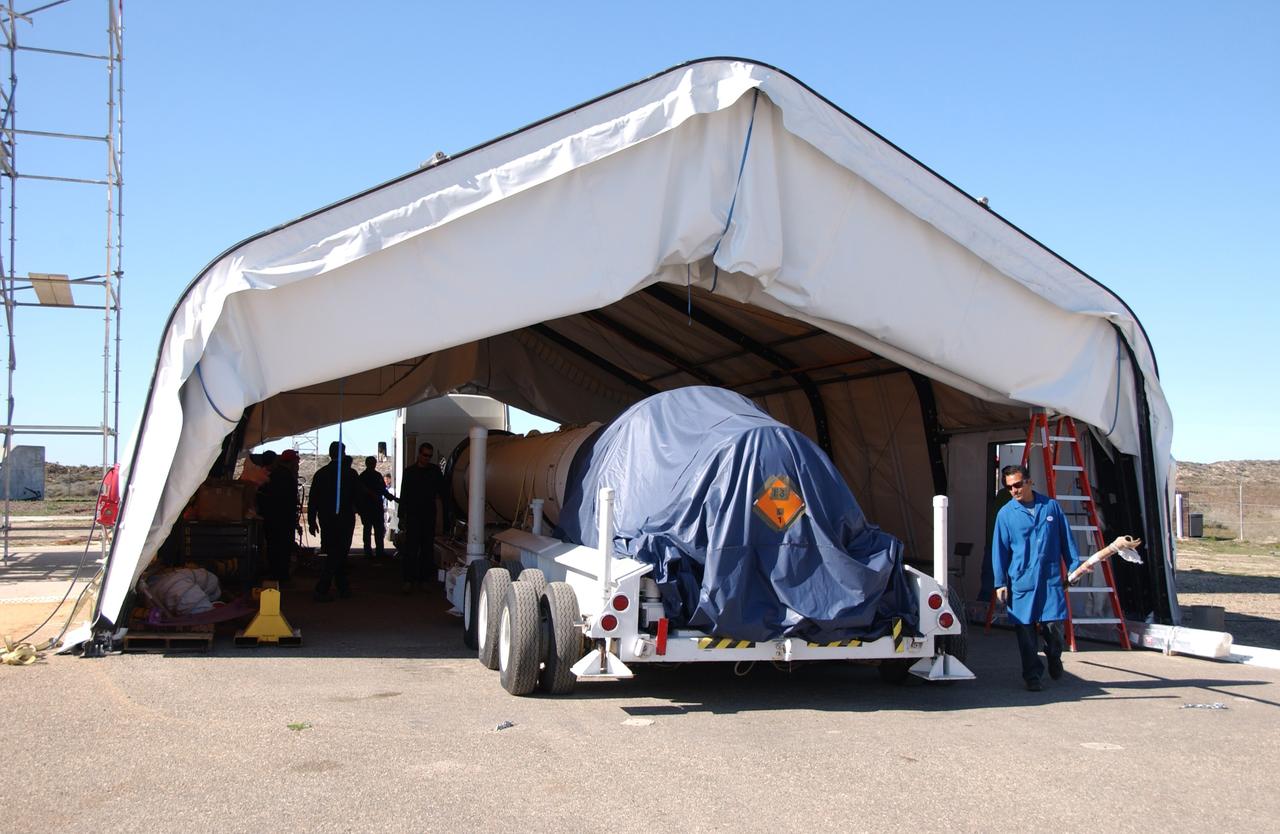
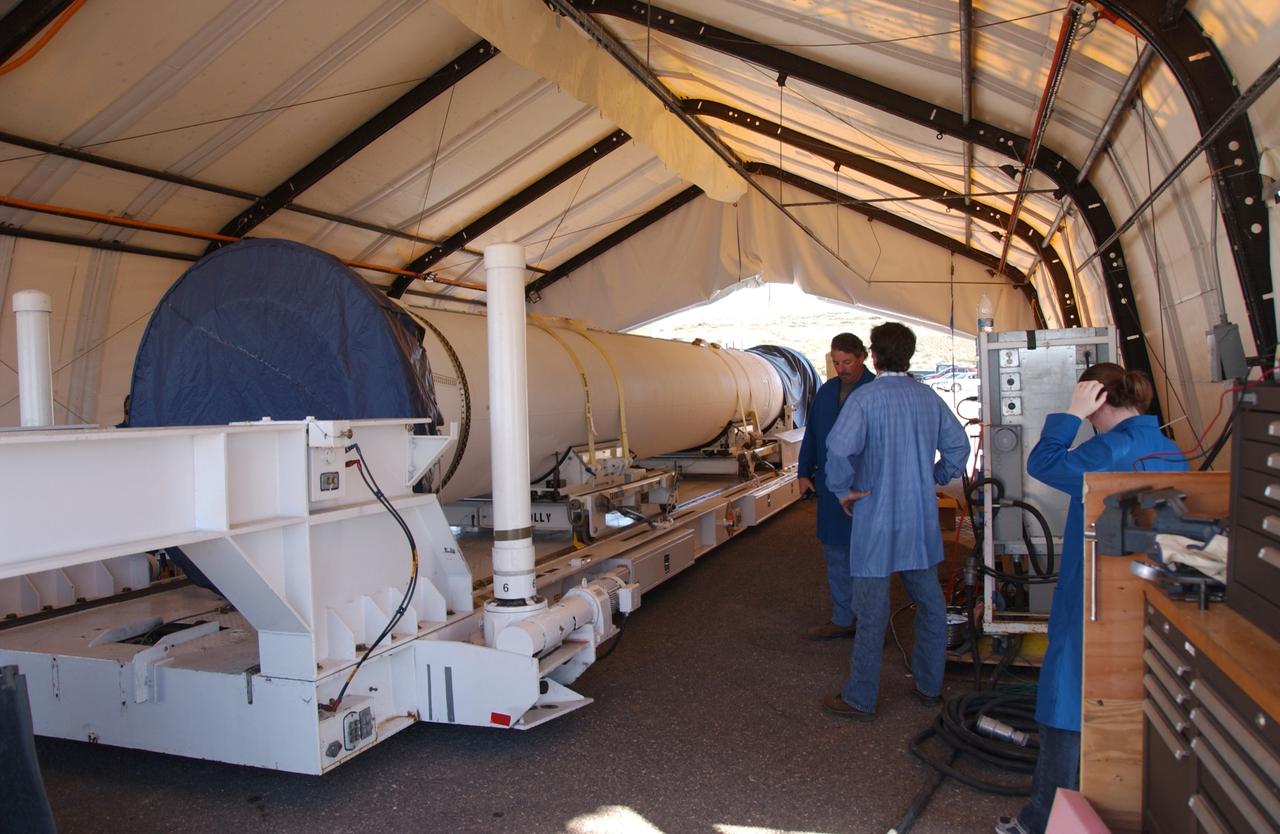
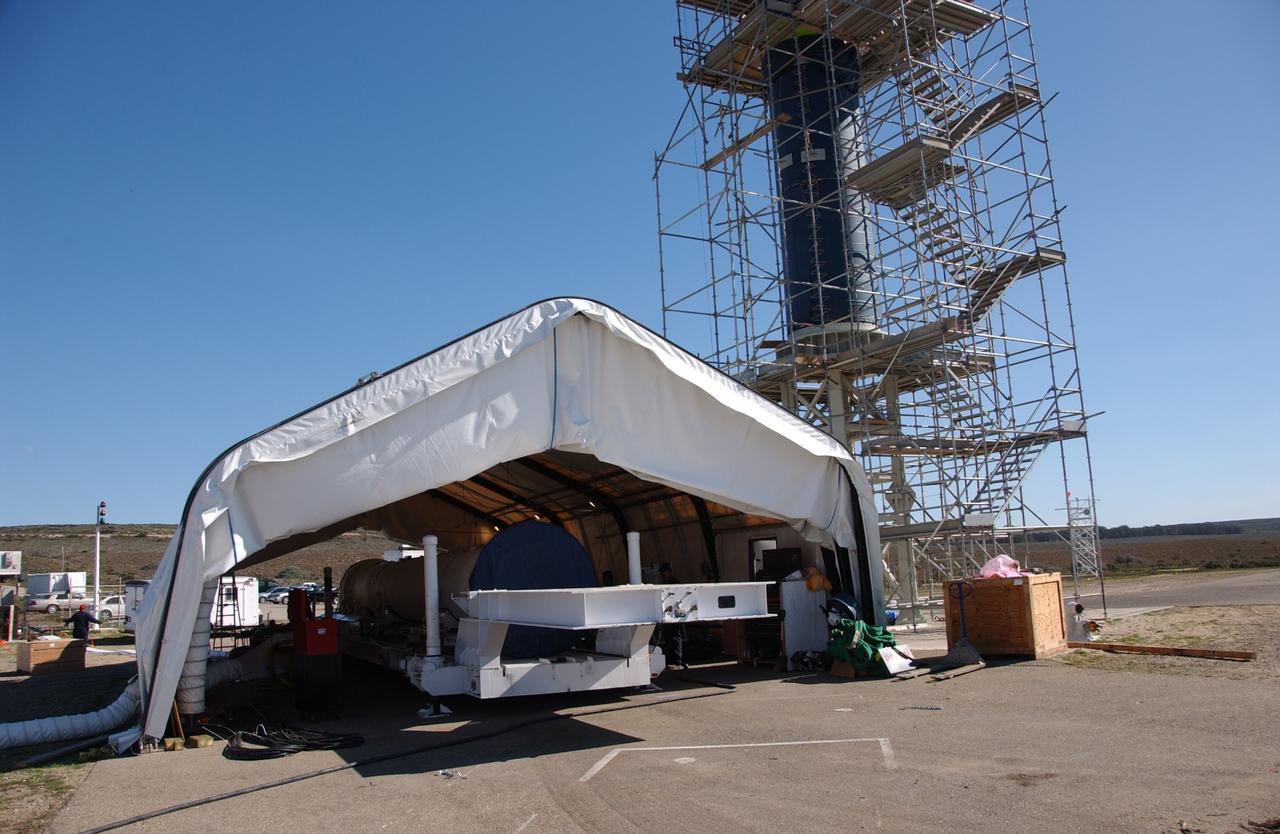
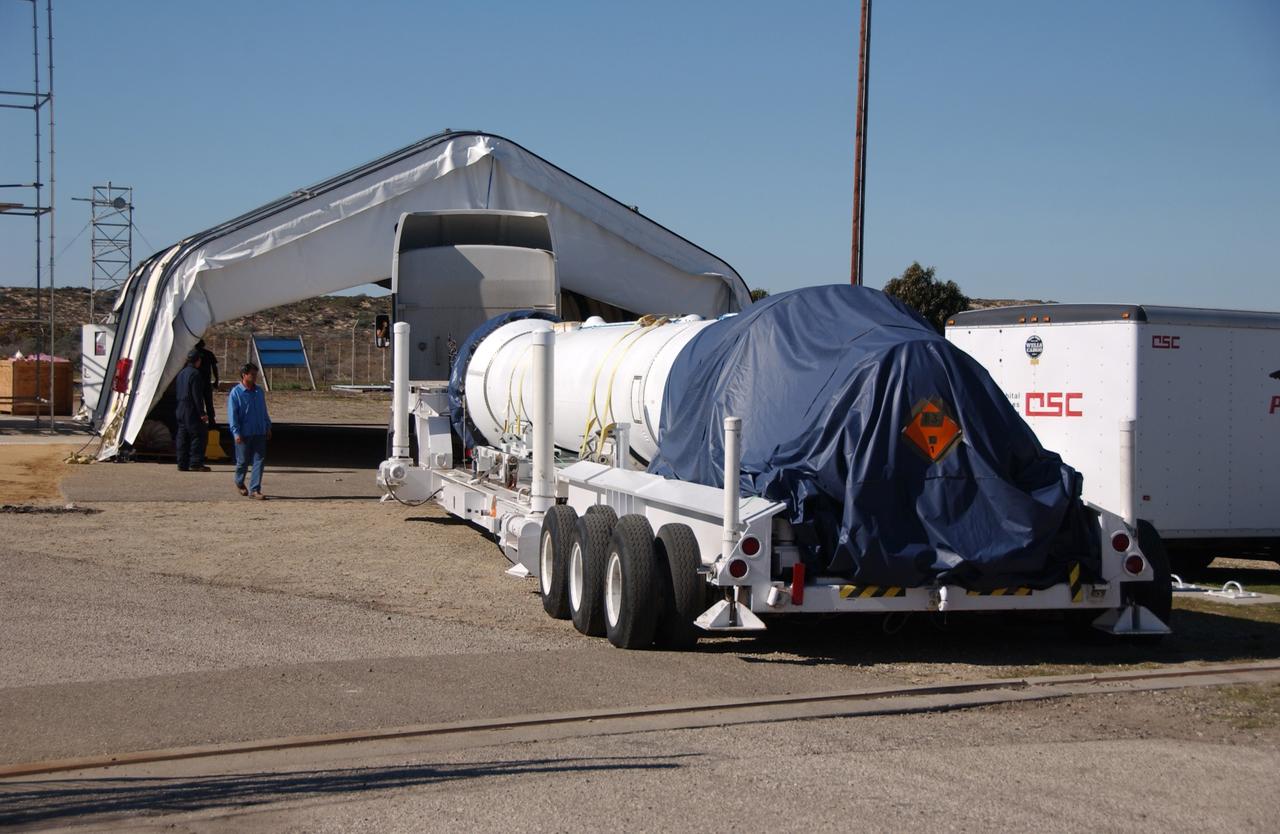
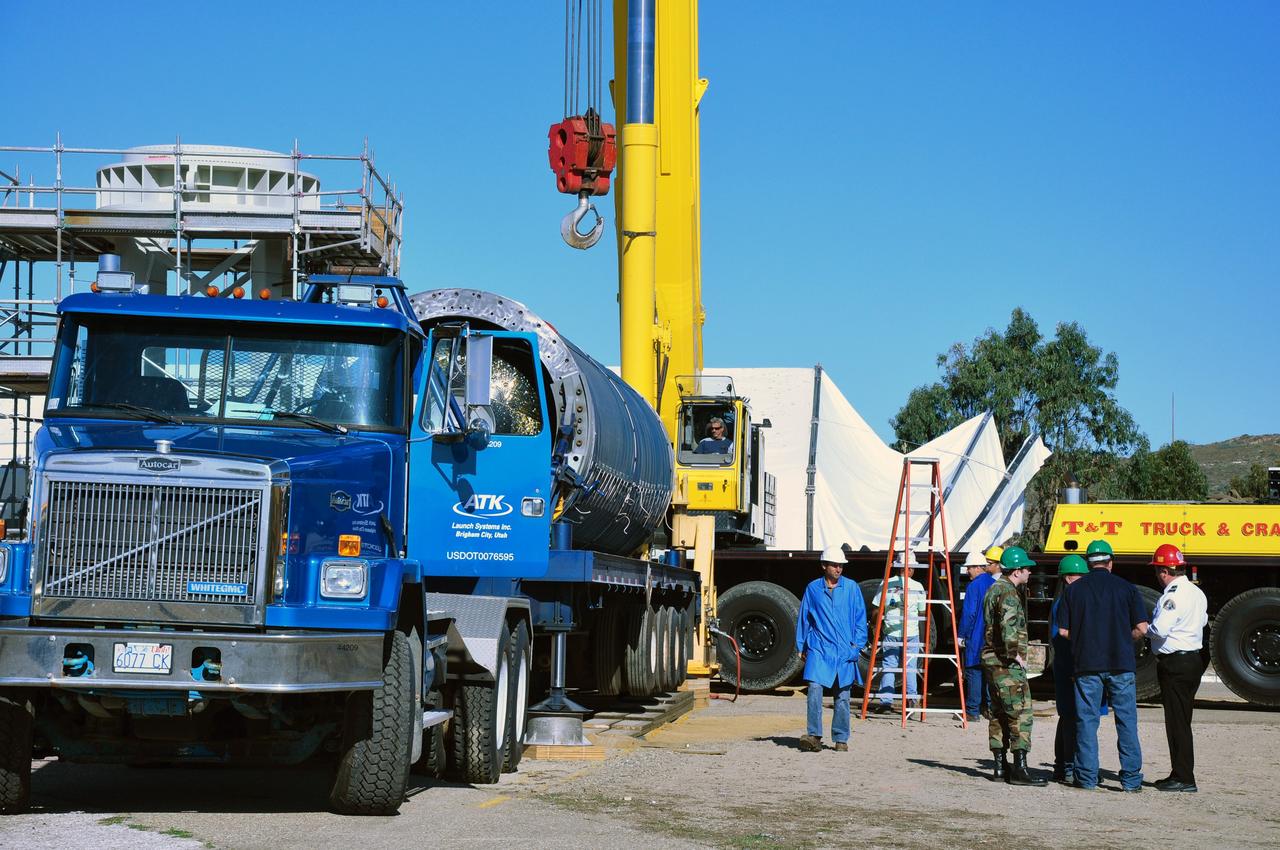
VANDENBERG AIR FORCE BASE, Calif. -- Stages 1, 2 and 3 of Orbital Sciences’ Taurus XL launch vehicle for NASA’s Orbiting Carbon Observatory, or OCO, arrive at Space Launch Complex 576-E at Vandenberg Air Force Base in California. The OCO is an Earth-orbiting mission sponsored by NASA's Earth System Science Pathfinder Program. The observatory will collect precise global measurements of carbon dioxide in the Earth's atmosphere. Scientists will analyze the data returned to better understand the natural processes and human activities that regulate the abundance and distribution of this important greenhouse gas.  Launch is targeted for 1:51:30 a.m. PST Feb. 24. Photo credit: VAFB
KSC-2009-1655
VANDENBERG AIR FORCE BASE, Calif. -- Stages 1, 2 and 3 of Orbital Sciences’ Taurus XL launch vehicle for NASA’s Orbiting Carbon Observatory, or OCO, are transported from Building 1555 to Space Launch Complex 576-E at Vandenberg Air Force Base in California.  The OCO is an Earth-orbiting mission sponsored by NASA's Earth System Science Pathfinder Program. The observatory will collect precise global measurements of carbon dioxide in the Earth's atmosphere. Scientists will analyze the data returned to better understand the natural processes and human activities that regulate the abundance and distribution of this important greenhouse gas.  Launch is targeted for 1:51:30 a.m. PST Feb. 24. Photo credit: VAFB
KSC-2009-1654
VANDENBERG AIR FORCE BASE, Calif. -- Stages 1, 2 and 3 of Orbital Sciences’ Taurus XL launch vehicle for NASA’s Orbiting Carbon Observatory, or OCO, are parked under a tent at Space Launch Complex 576-E at Vandenberg Air Force Base in California. The OCO is an Earth-orbiting mission sponsored by NASA's Earth System Science Pathfinder Program. The observatory will collect precise global measurements of carbon dioxide in the Earth's atmosphere. Scientists will analyze the data returned to better understand the natural processes and human activities that regulate the abundance and distribution of this important greenhouse gas.  Launch is targeted for 1:51:30 a.m. PST Feb. 24. Photo credit: VAFB
KSC-2009-1656
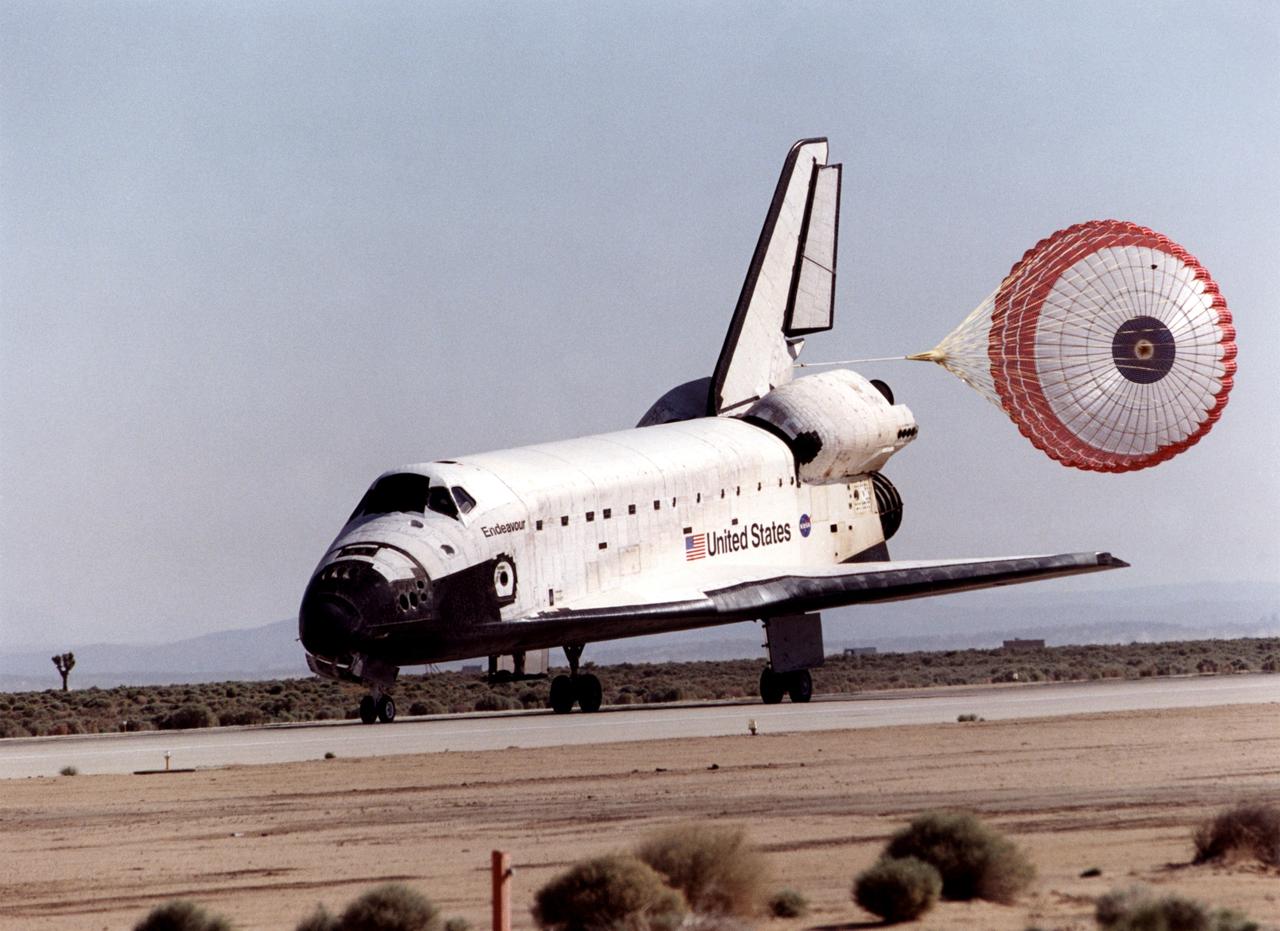
STS100-S-020 (1 May 2001) --- The drag chute on the space shuttle Endeavour helps to slow the vehicle down as it eases to the completion of the STS-100 mission on a desert runway at Edwards Air Force Base in California. Touchdown occurred at 9:11 a.m. (PDT), May 1, 2001. Onboard the shuttle were six NASA astronauts and a cosmonaut representing Rosaviakosmos. Photo credit: NASA
View of Endeavour deploying its drag chute during STS-100's landing at Edwards AFB
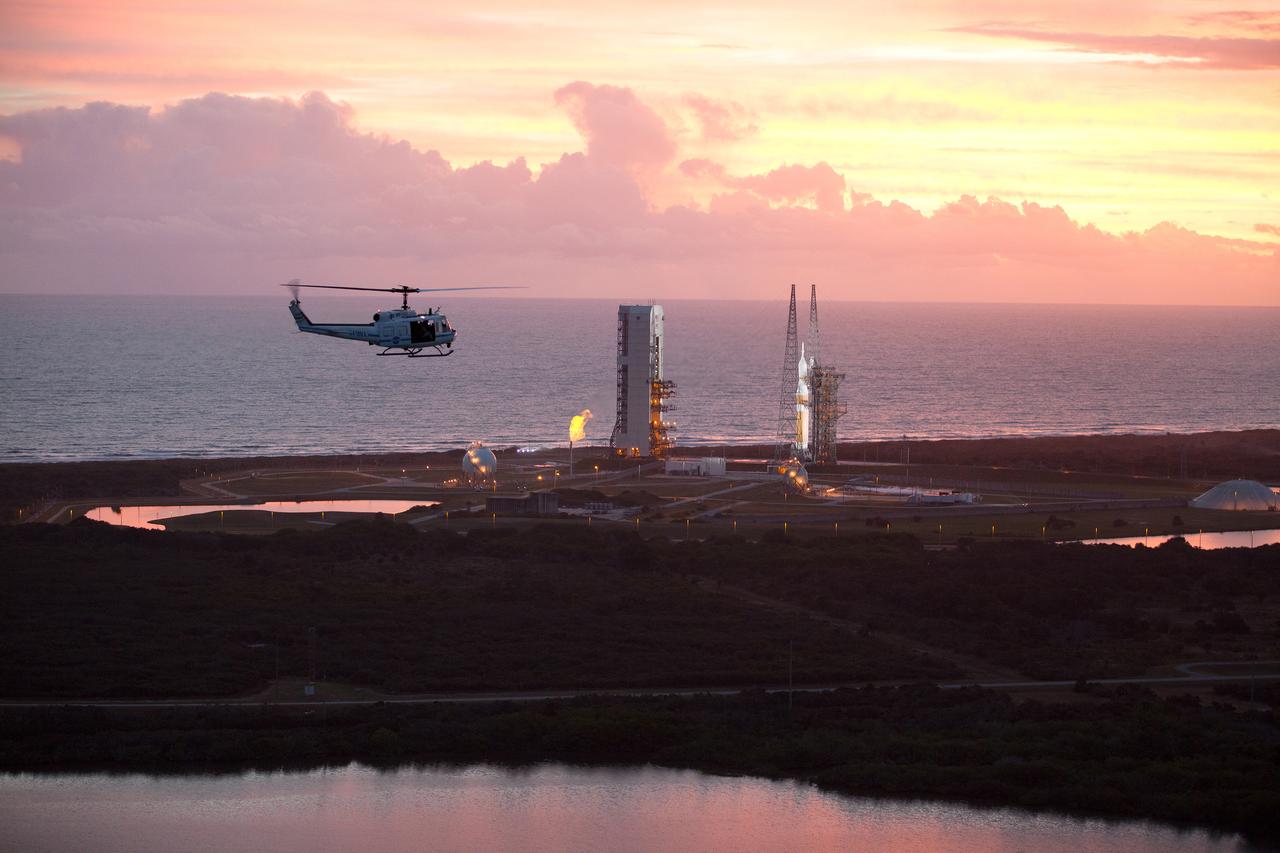
This helicopter view of the NASA Causeway connecting NASA's Kennedy Space Center with Cape Canaveral Air Force Staton shows the thousands of vehicles parked where guests gather to see the launch of the Orion Exploration Flight Test-1 (EFT-1) on Dec. 4, 2014. The liftoff was postponed because of an issue related to fill and drain valves on the Delta IV Heavy rocket that teams could not troubleshoot by the time the launch window expired. Part of Batch image transfer from Flickr.
Aerial View of Orion, Delta IV Heavy
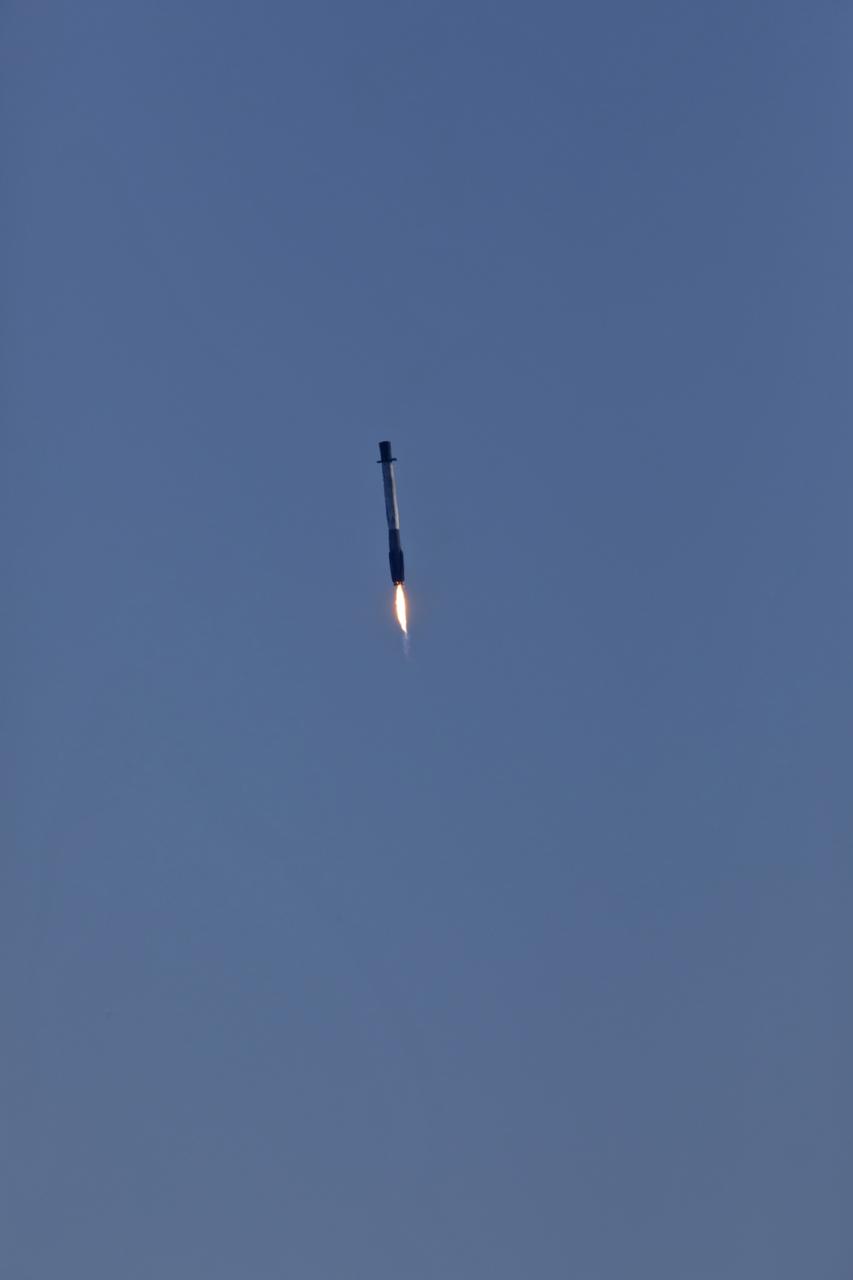
Following liftoff from Space Launch Complex 40 at Cape Canaveral Air Force Station, the first stage of a SpaceX Falcon 9 rocket returns to Landing Zone 1 at the Cape. At 1:16 p.m. EST, Dec. 5, 2018, a two-stage Falcon 9 launch vehicle began SpaceX's 16th Commercial Resupply Services mission carrying more than 5,600 pounds of research investigations and equipment, cargo and supplies that will support some of the hundreds of investigations aboard the International Space Station.
SpaceX CRS-16 Liftoff
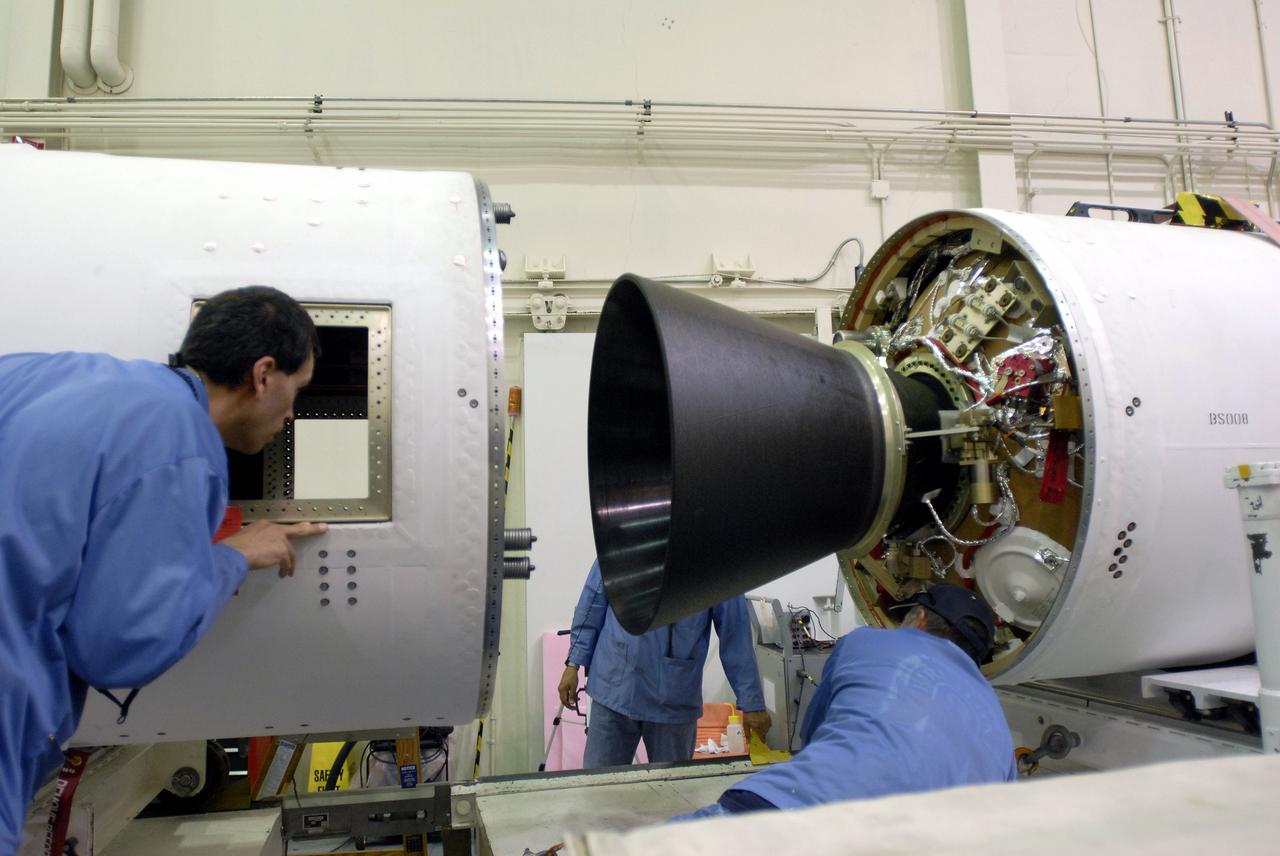
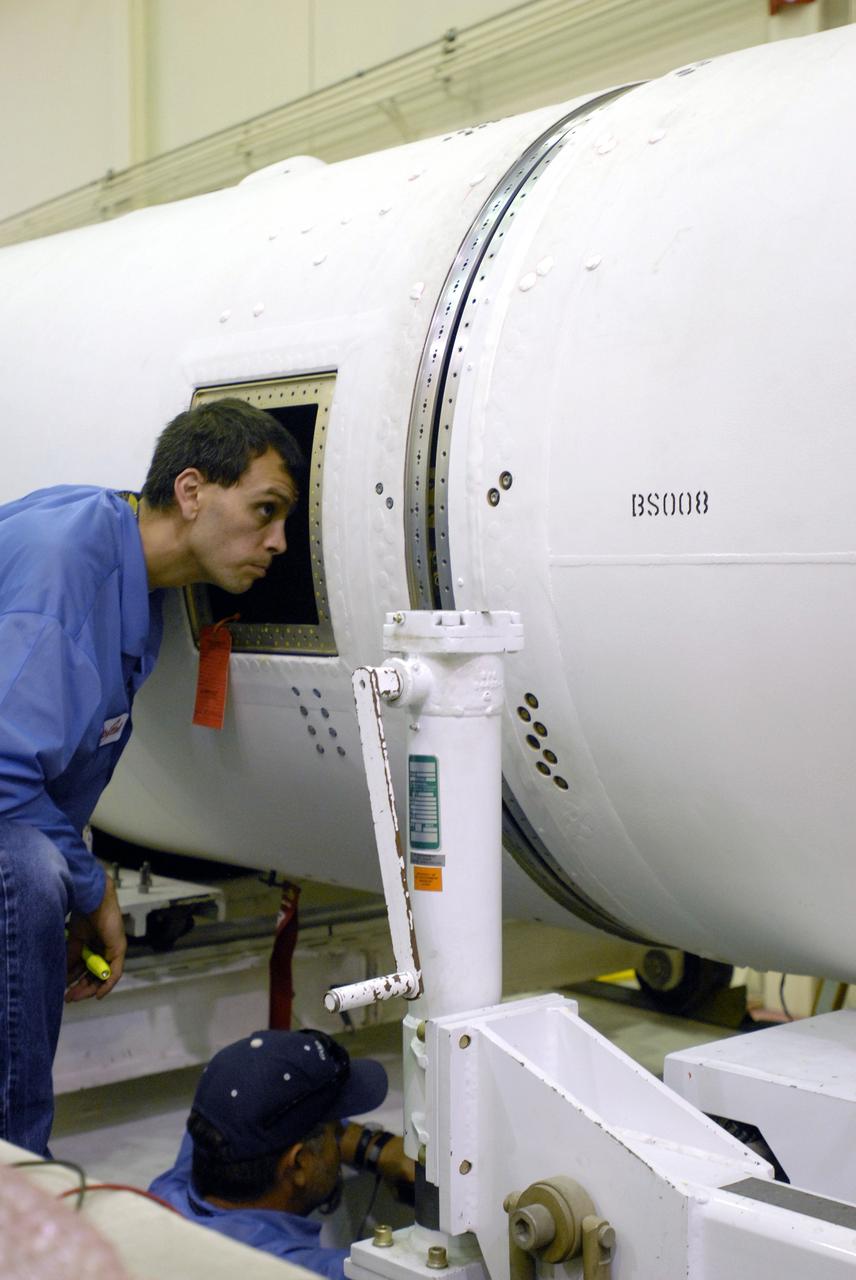
VANDENBERG AIR FORCE BASE, Calif. --  Space Launch Complex 576-E, Vandenberg Air Force Base in California, a worker checks the integration of the Taurus XL Stages 1 and 2.  The Taurus is the launch vehicle for NASA's Orbiting Carbon Observatory, called OCO, a new Earth-orbiting mission sponsored by NASA's Earth System Science Pathfinder Program. The observatory is targeted to launch Feb. 23 from Space Launch Complex 576-E at Vandenberg. Photo credit: NASA/VAFB
KSC-2009-1552
VANDENBERG AIR FORCE BASE, Calif. -- Stage 0  of the Taurus XL launch vehicle for the Orbiting Carbon Observatory arrives at complex 576E at Vandenberg Air Force Base in California.  It will be mated with stages 1, 2 and 3 for the launch of OCO. The OCO is a new Earth-orbiting mission sponsored by NASA's Earth System Science Pathfinder Program. It is scheduled to launch Feb. 23. Photo credit: NASA/Randy Beaudoin, VAFB
KSC-2009-1499
VANDENBERG AIR FORCE BASE, Calif. --In Space Launch Complex 576-E, Vandenberg Air Force Base in California, Stages 1 and 2 of the Taurus XL launch vehicle are being integrated for NASA's Orbiting Carbon Observatory, called OCO. OCO is a new Earth-orbiting mission sponsored by NASA's Earth System Science Pathfinder Program. The observatory is targeted to launch Feb. 23 from Space Launch Complex 576-E at Vandenberg. Photo credit: NASA/VAFB
KSC-2009-1548
VANDENBERG AIR FORCE BASE, Calif. --In Space Launch Complex 576-E, Vandenberg Air Force Base in California, Stages 1 and 2 of the Taurus XL launch vehicle are being integrated for NASA's Orbiting Carbon Observatory, called OCO. OCO is a new Earth-orbiting mission sponsored by NASA's Earth System Science Pathfinder Program. The observatory is targeted to launch Feb. 23 from Space Launch Complex 576-E at Vandenberg. Photo credit: NASA/VAFB
KSC-2009-1549
VANDENBERG AIR FORCE BASE, Calif. --  Space Launch Complex 576-E, Vandenberg Air Force Base in California, a worker checks the integration of the Taurus XL Stages 1 and 2.  The Taurus is the launch vehicle for NASA's Orbiting Carbon Observatory, called OCO, a new Earth-orbiting mission sponsored by NASA's Earth System Science Pathfinder Program. The observatory is targeted to launch Feb. 23 from Space Launch Complex 576-E at Vandenberg. Photo credit: NASA/VAFB
KSC-2009-1551
VANDENBERG AIR FORCE BASE, Calif. --In Space Launch Complex 576-E, Vandenberg Air Force Base in California, Stages 1 and 2 of the Taurus XL launch vehicle are being integrated for NASA's Orbiting Carbon Observatory, called OCO. OCO is a new Earth-orbiting mission sponsored by NASA's Earth System Science Pathfinder Program. The observatory is targeted to launch Feb. 23 from Space Launch Complex 576-E at Vandenberg. Photo credit: NASA/VAFB
KSC-2009-1547
VANDENBERG AIR FORCE BASE, Calif. -- Stage 0  of the Taurus XL launch vehicle for the Orbiting Carbon Observatory arrives at complex 576E at Vandenberg Air Force Base in California.  It will be mated with stages 1, 2 and 3 for the launch of OCO. The OCO is a new Earth-orbiting mission sponsored by NASA's Earth System Science Pathfinder Program. It is scheduled to launch Feb. 23. Photo credit: NASA/Randy Beaudoin, VAFB
KSC-2009-1500
VANDENBERG AIR FORCE BASE, Calif. --In Space Launch Complex 576-E, Vandenberg Air Force Base in California, Stages 1 and 2 of the Taurus XL launch vehicle are being integrated for NASA's Orbiting Carbon Observatory, called OCO. OCO is a new Earth-orbiting mission sponsored by NASA's Earth System Science Pathfinder Program. The observatory is targeted to launch Feb. 23 from Space Launch Complex 576-E at Vandenberg. Photo credit: NASA/VAFB
KSC-2009-1550
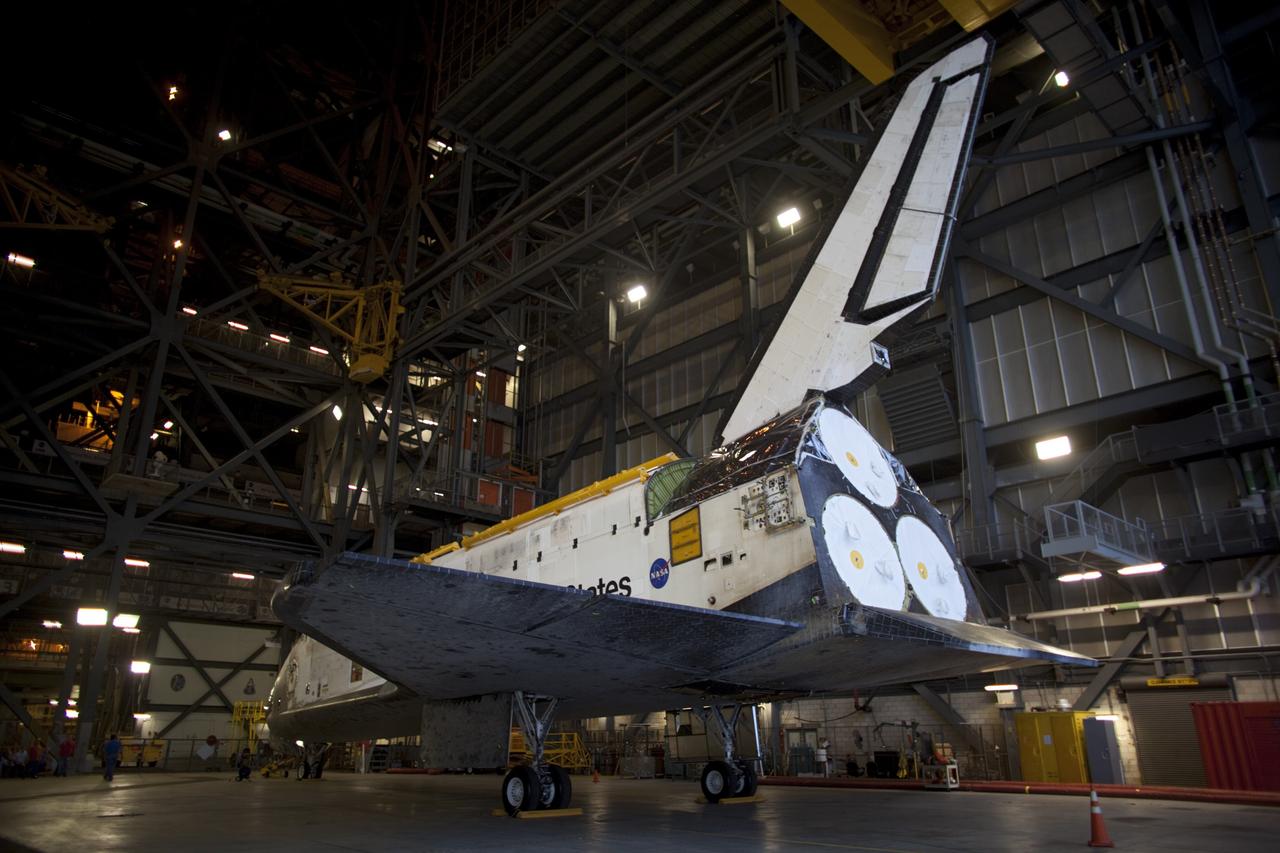
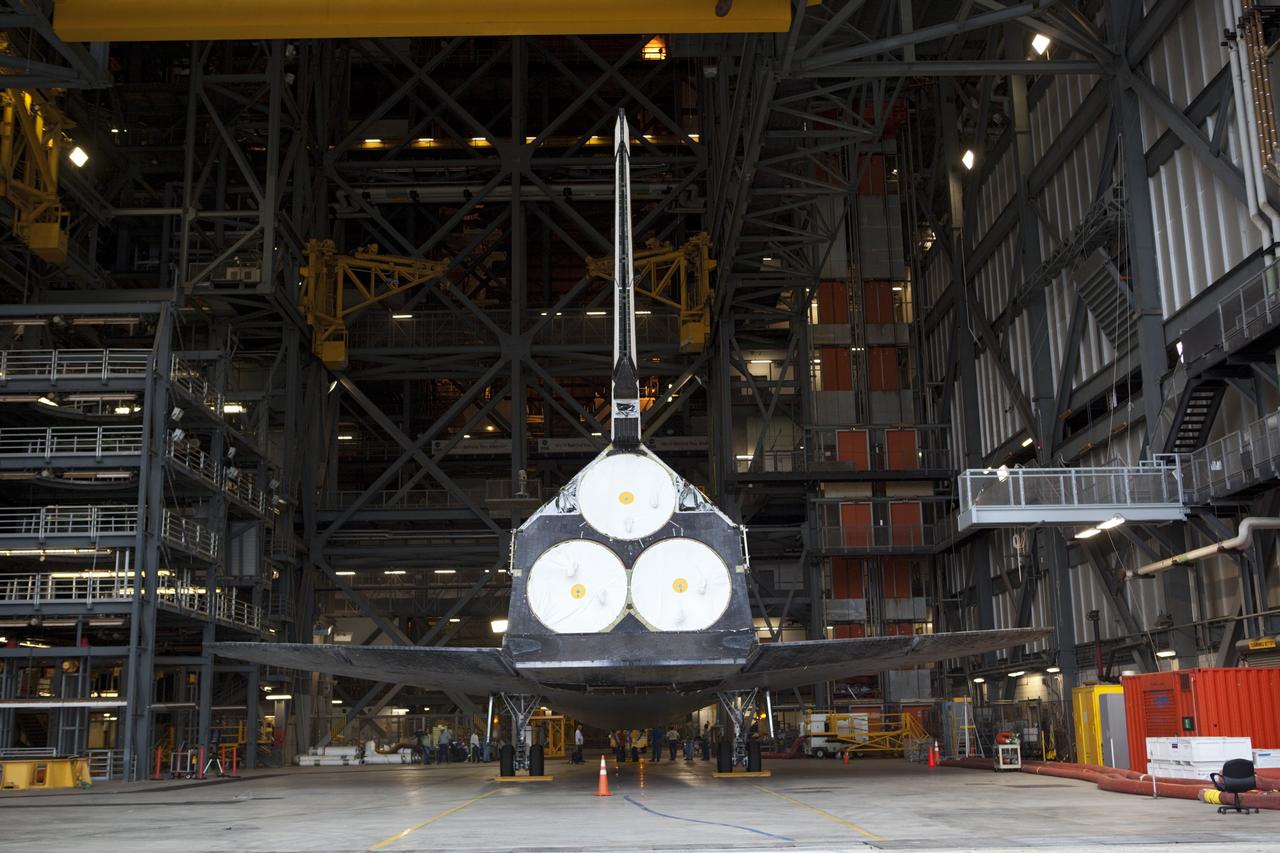
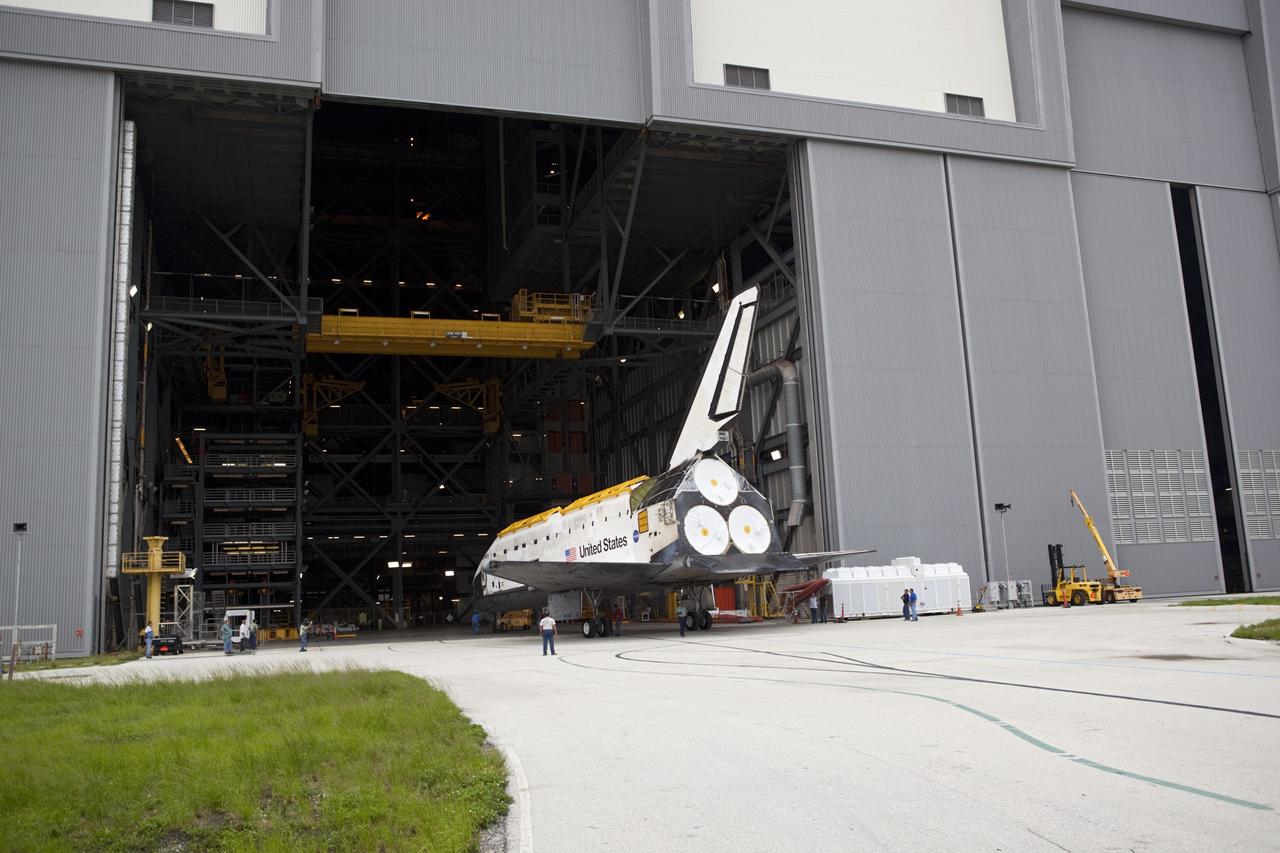
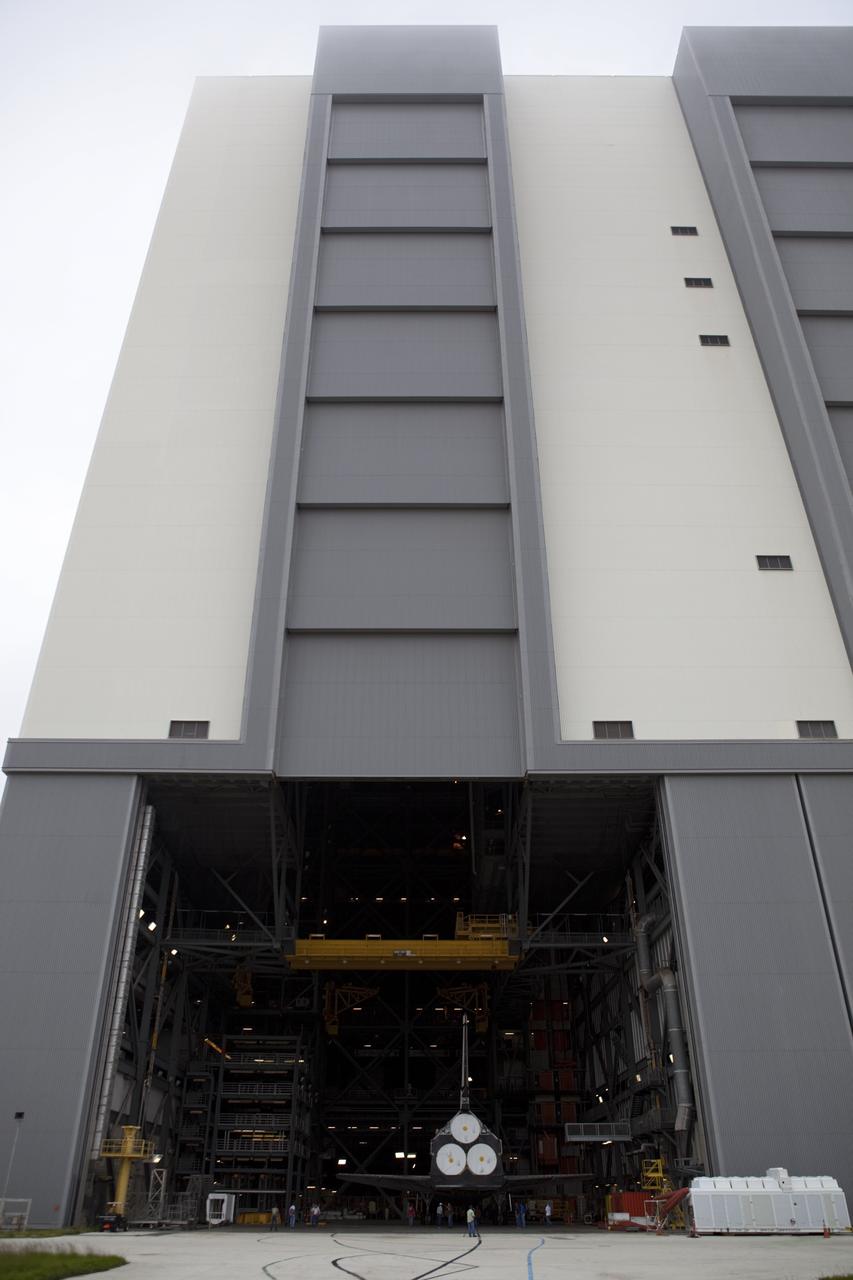
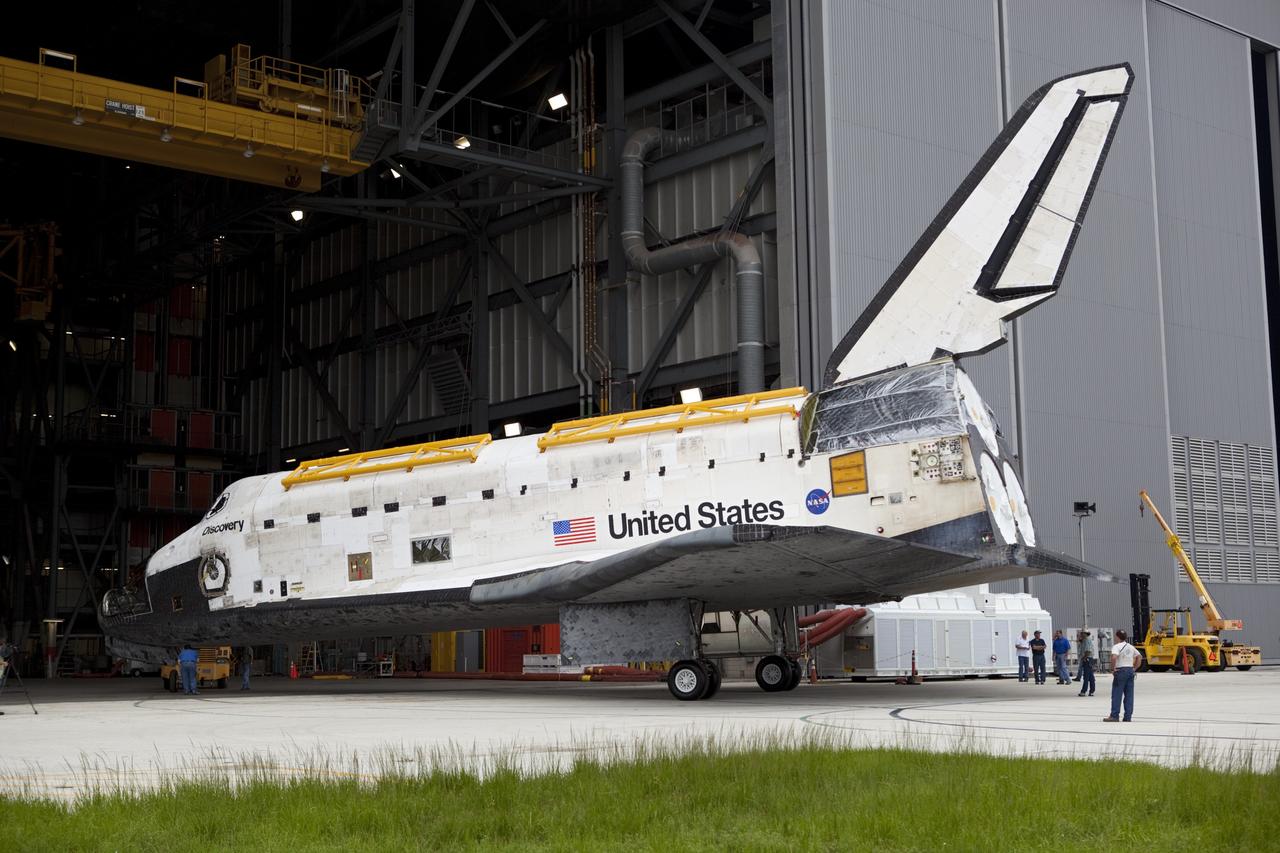
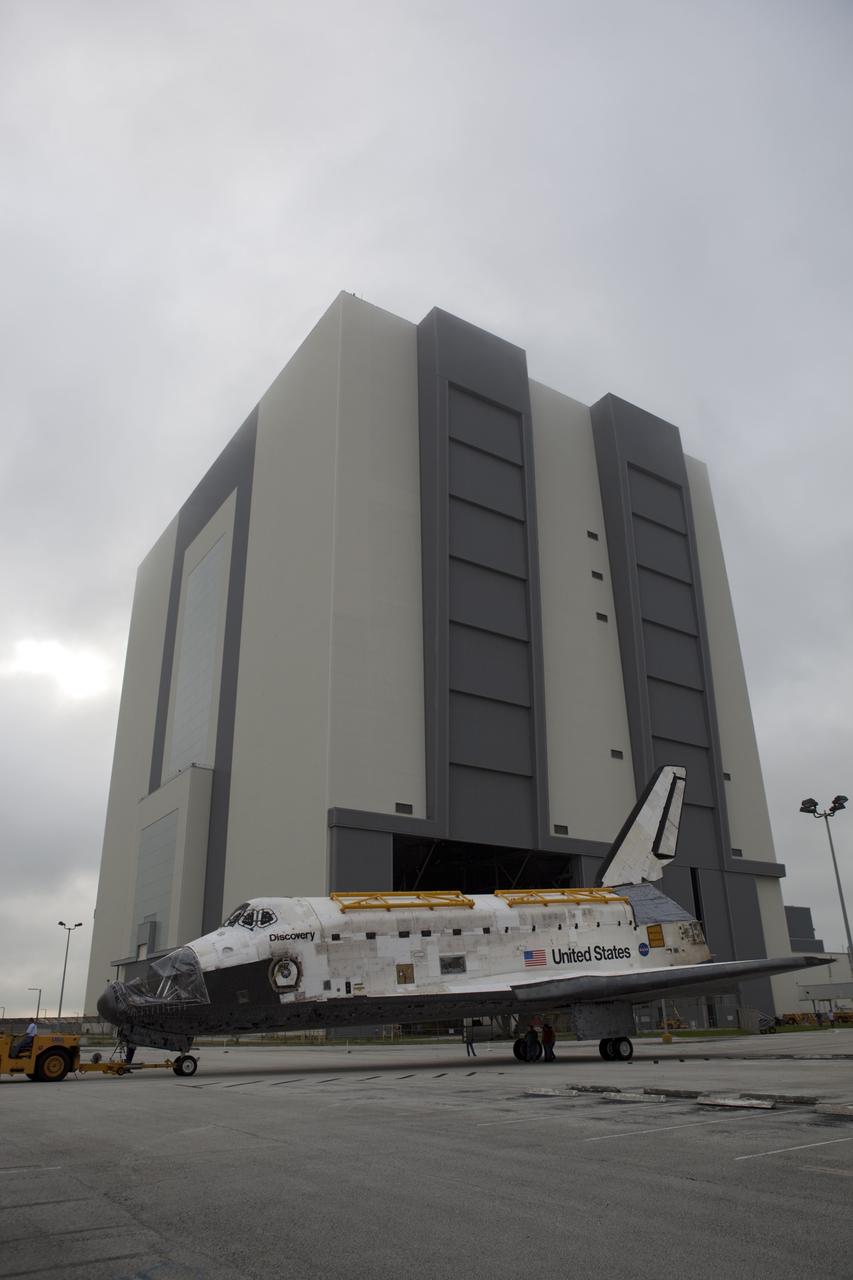
CAPE CANAVERAL, Fla. -- At NASA's Kennedy Space Center in Florida, space shuttle Discovery backs through the open door of the Vehicle Assembly Building (VAB) into public view, beginning its move to Orbiter Processing Facility-1 (OPF-1).  Discovery is switching places with shuttle Endeavour which has been undergoing decommissioning activities in OPF-1.  Both shuttles will stop briefly outside OPF-3 for a "nose-to-nose" photo opportunity. Discovery then will be rolled into OPF-1 and Endeavour into the VAB.    In OPF-1, Discovery will undergo further preparations for public display at the Smithsonian's National Air and Space Museum Steven F. Udvar-Hazy Center in Virginia. Endeavour will be stored in the VAB until October when it will be moved into OPF-2 for further work to get it ready for public display at the California Science Center in Los Angeles.  For more information, visit http://www.nasa.gov/shuttle. Photo credit: NASA/Dimitri Gerondidakis
KSC-2011-6417
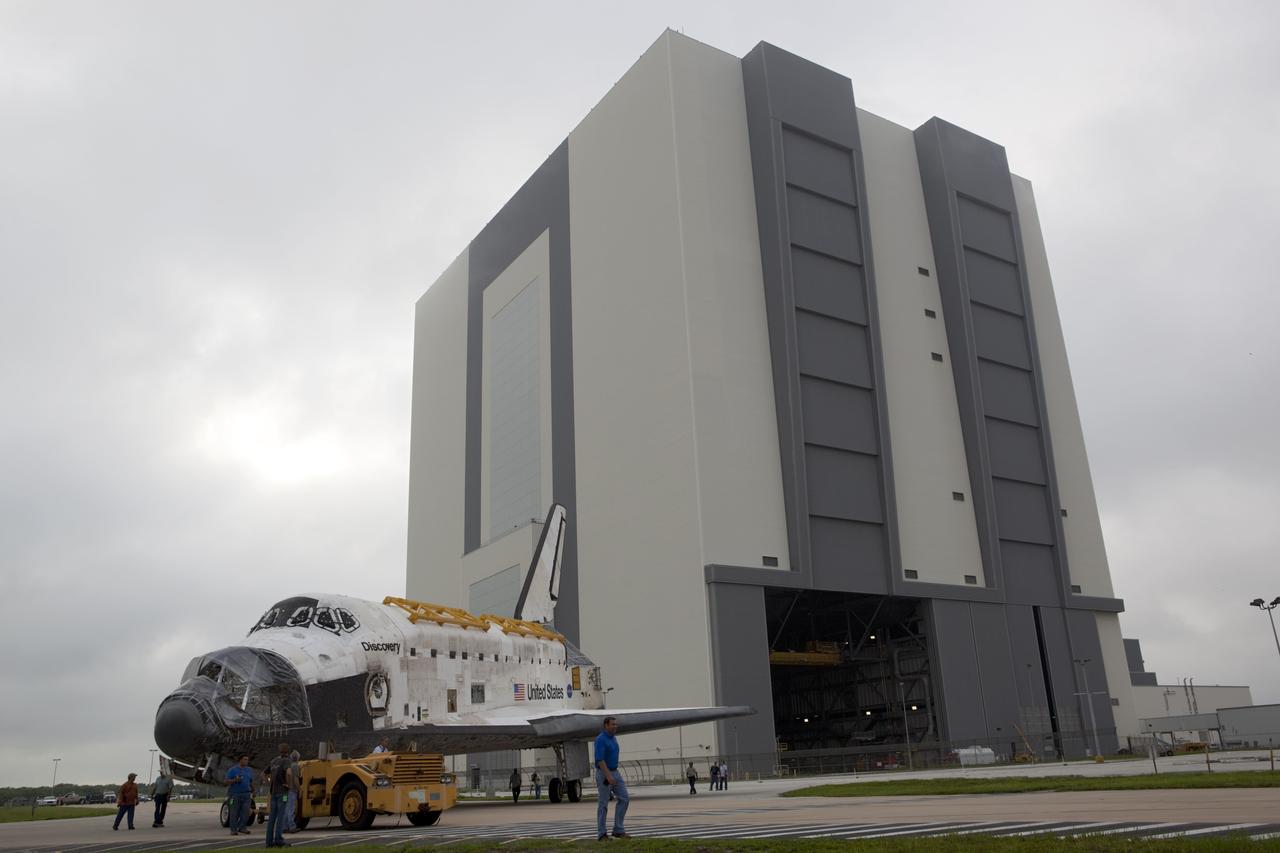
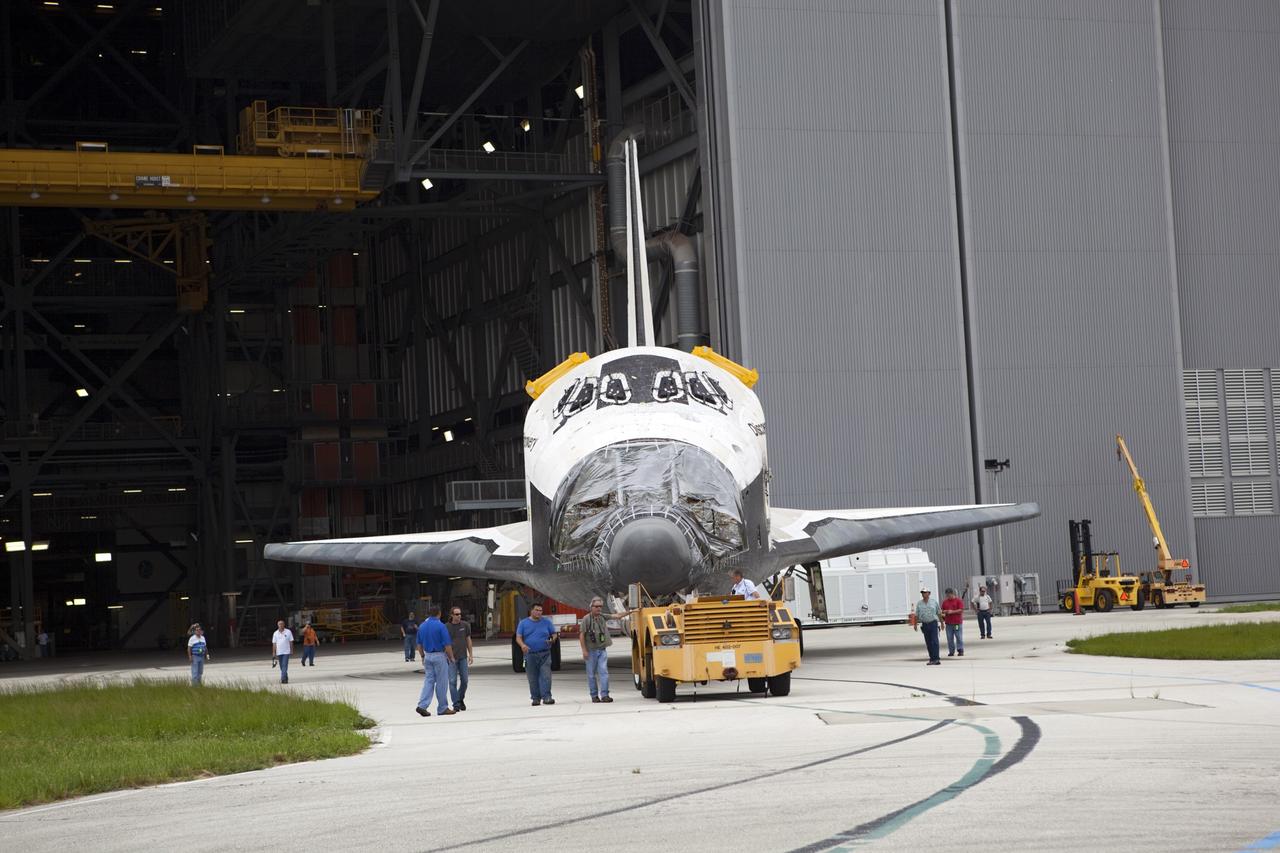
CAPE CANAVERAL, Fla. -- At NASA's Kennedy Space Center in Florida, United Space Alliance employees accompany space shuttle Discovery as it is towed from the Vehicle Assembly Building (VAB), beginning its move to Orbiter Processing Facility-1 (OPF-1).  Discovery is switching places with shuttle Endeavour which has been undergoing decommissioning activities in OPF-1.  Both shuttles will stop briefly outside OPF-3 for a "nose-to-nose" photo opportunity. Discovery then will be rolled into OPF-1 and Endeavour into the VAB.    In OPF-1, Discovery will undergo further preparations for public display at the Smithsonian's National Air and Space Museum Steven F. Udvar-Hazy Center in Virginia. Endeavour will be stored in the VAB until October when it will be moved into OPF-2 for further work to get it ready for public display at the California Science Center in Los Angeles.  For more information, visit http://www.nasa.gov/shuttle. Photo credit: NASA/Dimitri Gerondidakis
KSC-2011-6419
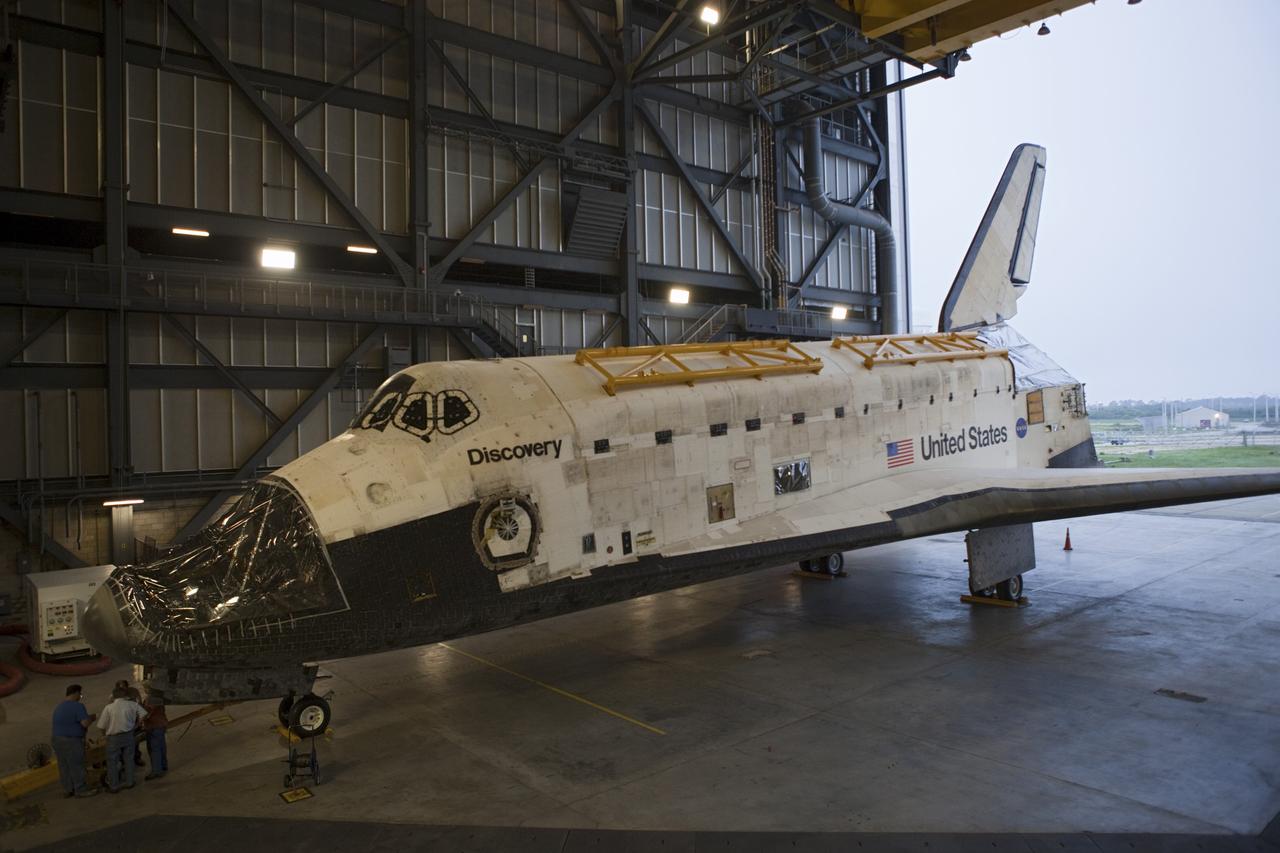
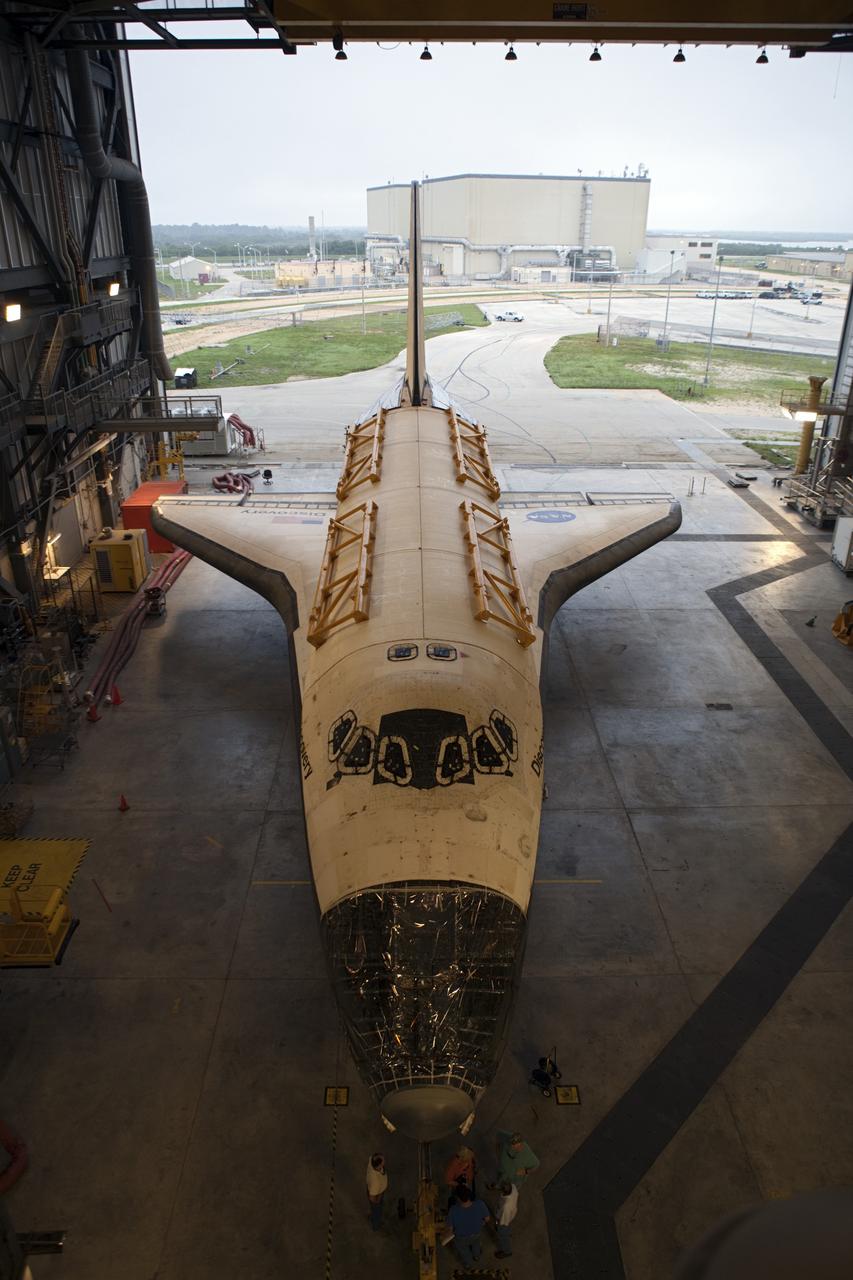
CAPE CANAVERAL, Fla. -- Seen through the open bay door of the Vehicle Assembly Building (VAB) at NASA's Kennedy Space Center in Florida, space shuttle Discovery is being prepared for its move to Orbiter Processing Facility-1 (OPF-1).  Discovery is switching places with shuttle Endeavour which has been undergoing decommissioning activities in OPF-1.  Both shuttles will stop briefly outside OPF-3 for a "nose-to-nose" photo opportunity. Discovery then will be rolled into OPF-1 and Endeavour into the VAB.    In OPF-1, Discovery will undergo further preparations for public display at the Smithsonian's National Air and Space Museum Steven F. Udvar-Hazy Center in Virginia. Endeavour will be stored in the VAB until October when it will be moved into OPF-2 for further work to get it ready for public display at the California Science Center in Los Angeles.  For more information, visit http://www.nasa.gov/shuttle. Photo credit: NASA/Dimitri Gerondidakis
KSC-2011-6414
CAPE CANAVERAL, Fla. -- At NASA's Kennedy Space Center in Florida, work has begun to move space shuttle Discovery from the Vehicle Assembly Building (VAB) to Orbiter Processing Facility-1 (OPF-1), seen in the background.  Discovery is switching places with shuttle Endeavour which has been undergoing decommissioning activities in OPF-1.  Both shuttles will stop briefly outside OPF-3 for a "nose-to-nose" photo opportunity. Discovery then will be rolled into OPF-1 and Endeavour into the VAB.    In OPF-1, Discovery will undergo further preparations for public display at the Smithsonian's National Air and Space Museum Steven F. Udvar-Hazy Center in Virginia. Endeavour will be stored in the VAB until October when it will be moved into OPF-2 for further work to get it ready for public display at the California Science Center in Los Angeles.  For more information, visit http://www.nasa.gov/shuttle. Photo credit: NASA/Dimitri Gerondidakis
KSC-2011-6413
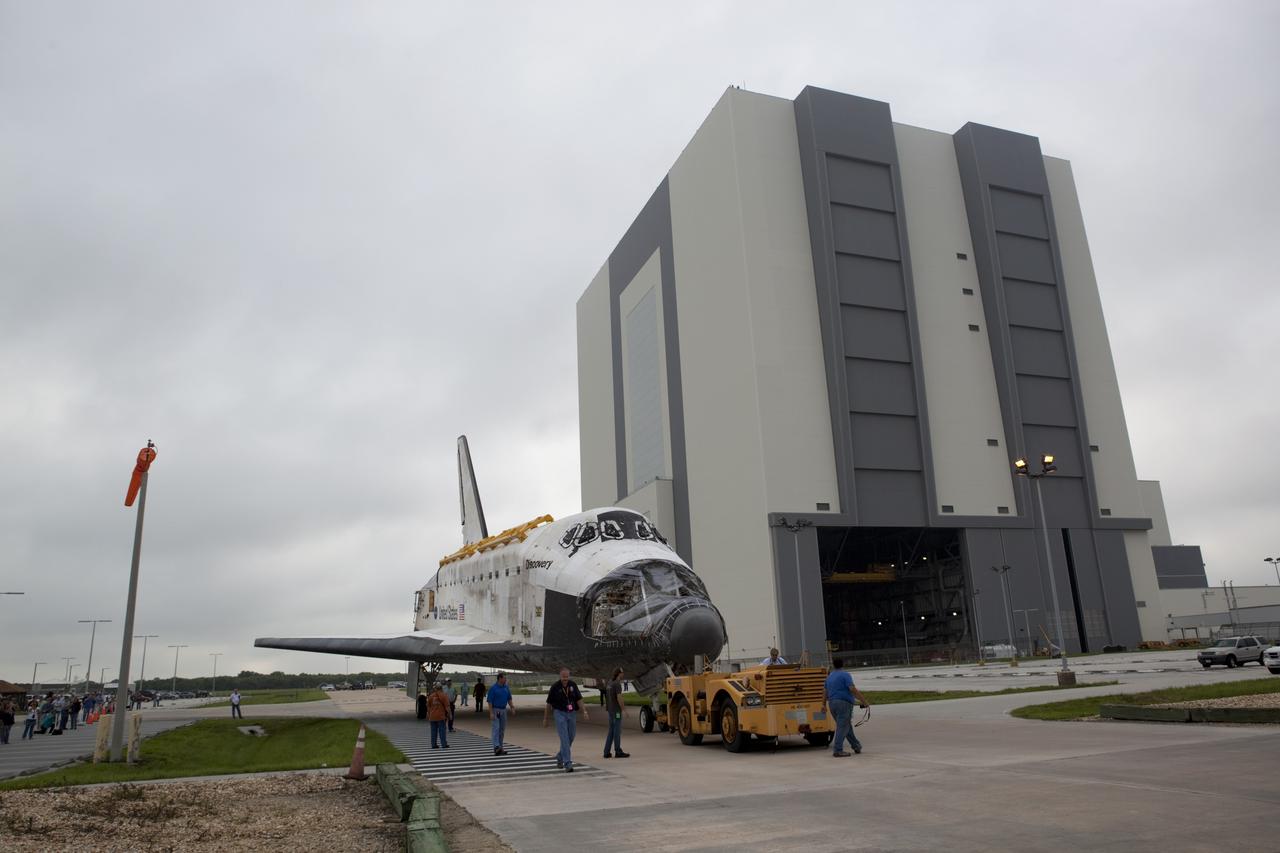
CAPE CANAVERAL, Fla. -- At NASA's Kennedy Space Center in Florida, space shuttle Discovery rounds a curve as it is towed from the 525-foot-tall Vehicle Assembly Building (VAB) to Orbiter Processing Facility-1 (OPF-1).  Discovery is switching places with shuttle Endeavour which has been undergoing decommissioning activities in OPF-1.  Both shuttles will stop briefly outside OPF-3 for a "nose-to-nose" photo opportunity. Discovery then will be rolled into OPF-1 and Endeavour into the VAB.    In OPF-1, Discovery will undergo further preparations for public display at the Smithsonian's National Air and Space Museum Steven F. Udvar-Hazy Center in Virginia. Endeavour will be stored in the VAB until October when it will be moved into OPF-2 for further work to get it ready for public display at the California Science Center in Los Angeles.  For more information, visit http://www.nasa.gov/shuttle. Photo credit: NASA/Dimitri Gerondidakis
KSC-2011-6421
CAPE CANAVERAL, Fla. -- Seen through the open bay door of the Vehicle Assembly Building (VAB) at NASA's Kennedy Space Center in Florida, space shuttle Discovery is being prepared for its move to Orbiter Processing Facility-1 (OPF-1).  Discovery is switching places with shuttle Endeavour which has been undergoing decommissioning activities in OPF-1.  Both shuttles will stop briefly outside OPF-3 for a "nose-to-nose" photo opportunity. Discovery then will be rolled into OPF-1 and Endeavour into the VAB.    In OPF-1, Discovery will undergo further preparations for public display at the Smithsonian's National Air and Space Museum Steven F. Udvar-Hazy Center in Virginia. Endeavour will be stored in the VAB until October when it will be moved into OPF-2 for further work to get it ready for public display at the California Science Center in Los Angeles.  For more information, visit http://www.nasa.gov/shuttle. Photo credit: NASA/Dimitri Gerondidakis
KSC-2011-6415
CAPE CANAVERAL, Fla. -- At NASA's Kennedy Space Center in Florida, space shuttle Discovery makes a three-point turnaround outside the Vehicle Assembly Building (VAB), beginning its move to Orbiter Processing Facility-1 (OPF-1).  Discovery is switching places with shuttle Endeavour which has been undergoing decommissioning activities in OPF-1.  Both shuttles will stop briefly outside OPF-3 for a "nose-to-nose" photo opportunity. Discovery then will be rolled into OPF-1 and Endeavour into the VAB.    In OPF-1, Discovery will undergo further preparations for public display at the Smithsonian's National Air and Space Museum Steven F. Udvar-Hazy Center in Virginia. Endeavour will be stored in the VAB until October when it will be moved into OPF-2 for further work to get it ready for public display at the California Science Center in Los Angeles.  For more information, visit http://www.nasa.gov/shuttle. Photo credit: NASA/Dimitri Gerondidakis
KSC-2011-6418
CAPE CANAVERAL, Fla. -- At NASA's Kennedy Space Center in Florida, preparations have begun to move space shuttle Discovery from the Vehicle Assembly Building (VAB) to Orbiter Processing Facility-1 (OPF-1).  Discovery is switching places with shuttle Endeavour which has been undergoing decommissioning activities in OPF-1.  Both shuttles will stop briefly outside OPF-3 for a "nose-to-nose" photo opportunity. Discovery then will be rolled into OPF-1 and Endeavour into the VAB.    In OPF-1, Discovery will undergo further preparations for public display at the Smithsonian's National Air and Space Museum Steven F. Udvar-Hazy Center in Virginia. Endeavour will be stored in the VAB until October when it will be moved into OPF-2 for further work to get it ready for public display at the California Science Center in Los Angeles.  For more information, visit http://www.nasa.gov/shuttle. Photo credit: NASA/Dimitri Gerondidakis
KSC-2011-6412
CAPE CANAVERAL, Fla. -- At NASA's Kennedy Space Center in Florida, preparations are under way to move space shuttle Discovery from the Vehicle Assembly Building (VAB) to Orbiter Processing Facility-1 (OPF-1).  Discovery is switching places with shuttle Endeavour which has been undergoing decommissioning activities in OPF-1.  Both shuttles will stop briefly outside OPF-3 for a "nose-to-nose" photo opportunity. Discovery then will be rolled into OPF-1 and Endeavour into the VAB.    In OPF-1, Discovery will undergo further preparations for public display at the Smithsonian's National Air and Space Museum Steven F. Udvar-Hazy Center in Virginia. Endeavour will be stored in the VAB until October when it will be moved into OPF-2 for further work to get it ready for public display at the California Science Center in Los Angeles.  For more information, visit http://www.nasa.gov/shuttle. Photo credit: NASA/Dimitri Gerondidakis
KSC-2011-6411
CAPE CANAVERAL, Fla. -- At NASA's Kennedy Space Center in Florida, space shuttle Discovery stops outside the 525-foot-tall Vehicle Assembly Building (VAB), awaiting the arrival of shuttle Endeavour, during its move to the Orbiter Processing Facility-1 (OPF-1).  Discovery is switching places with Endeavour which has been undergoing decommissioning activities in OPF-1.  Both shuttles will stop briefly outside OPF-3 for a "nose-to-nose" photo opportunity. Discovery then will be rolled into OPF-1 and Endeavour into the VAB.    In OPF-1, Discovery will undergo further preparations for public display at the Smithsonian's National Air and Space Museum Steven F. Udvar-Hazy Center in Virginia. Endeavour will be stored in the VAB until October when it will be moved into OPF-2 for further work to get it ready for public display at the California Science Center in Los Angeles.  For more information, visit http://www.nasa.gov/shuttle. Photo credit: NASA/Dimitri Gerondidakis
KSC-2011-6422
CAPE CANAVERAL, Fla. -- At NASA's Kennedy Space Center in Florida, space shuttle Discovery backs through the open door of the Vehicle Assembly Building (VAB) beginning its move to Orbiter Processing Facility-1 (OPF-1).  Discovery is switching places with shuttle Endeavour which has been undergoing decommissioning activities in OPF-1.  Both shuttles will stop briefly outside OPF-3 for a "nose-to-nose" photo opportunity. Discovery then will be rolled into OPF-1 and Endeavour into the VAB.    In OPF-1, Discovery will undergo further preparations for public display at the Smithsonian's National Air and Space Museum Steven F. Udvar-Hazy Center in Virginia. Endeavour will be stored in the VAB until October when it will be moved into OPF-2 for further work to get it ready for public display at the California Science Center in Los Angeles.  For more information, visit http://www.nasa.gov/shuttle. Photo credit: NASA/Dimitri Gerondidakis
KSC-2011-6416
CAPE CANAVERAL, Fla. -- At NASA's Kennedy Space Center in Florida, space shuttle Discovery is towed from the 525-foot-tall Vehicle Assembly Building (VAB), beginning its move to Orbiter Processing Facility-1 (OPF-1).  Discovery is switching places with shuttle Endeavour which has been undergoing decommissioning activities in OPF-1.  Both shuttles will stop briefly outside OPF-3 for a "nose-to-nose" photo opportunity. Discovery then will be rolled into OPF-1 and Endeavour into the VAB.    In OPF-1, Discovery will undergo further preparations for public display at the Smithsonian's National Air and Space Museum Steven F. Udvar-Hazy Center in Virginia. Endeavour will be stored in the VAB until October when it will be moved into OPF-2 for further work to get it ready for public display at the California Science Center in Los Angeles.  For more information, visit http://www.nasa.gov/shuttle. Photo credit: NASA/Dimitri Gerondidakis
KSC-2011-6420
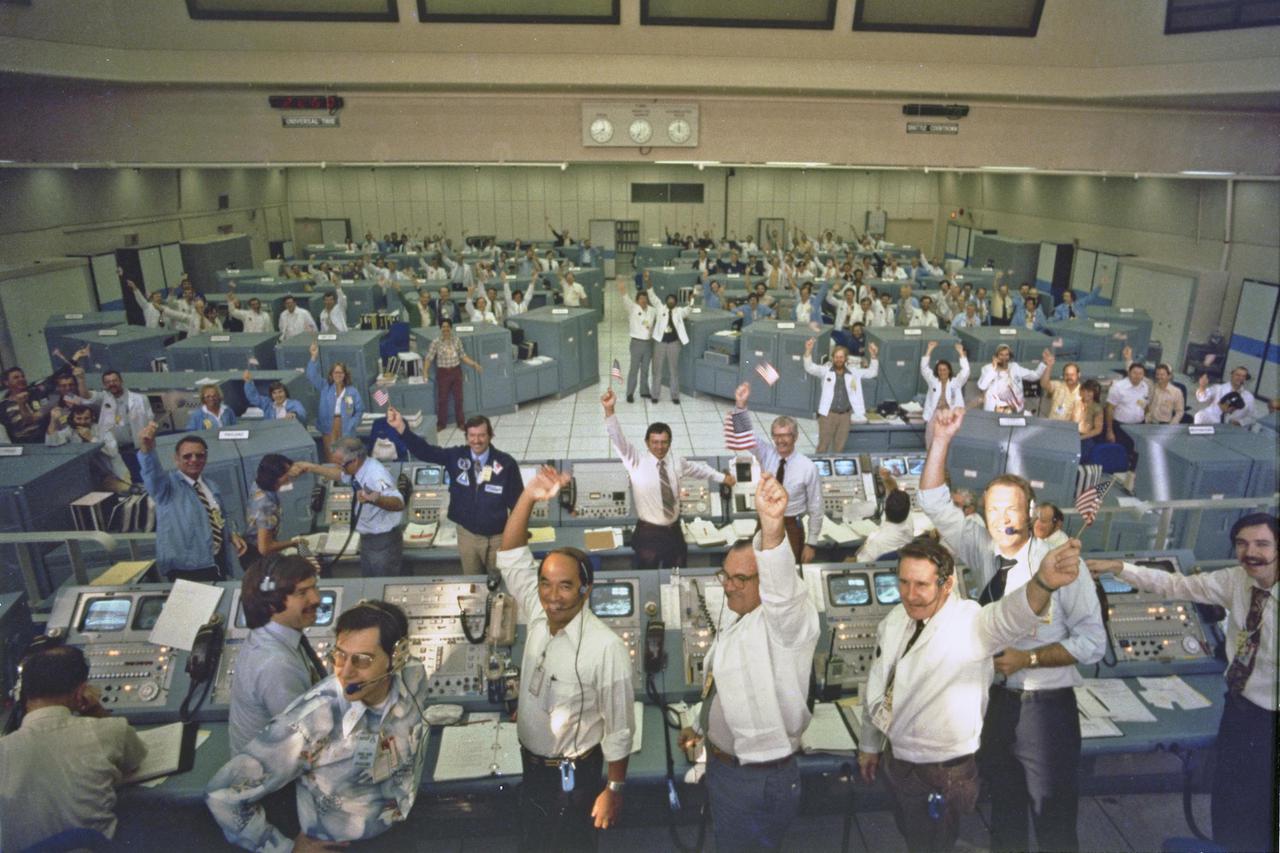
KENNEDY SPACE CENTER, FLA.  -  The STS-1 Space Shuttle Team celebrates a successful liftoff of Columbia form Launch Pad 39A a few seconds past 7 a.m.  The orbital mission is scheduled to last for 54 hours, ending with an unpowered landing at Edwards Air Force Base in California. The STS-1 mission, known as a shuttle systems test flight, will seek to demonstrate safe launch into orbit and safe return of the orbiter and crew and verify the combined performance of the entire shuttle vehicle -- orbiter, solid rocket boosters and external tank.
KSC-81PC-0364
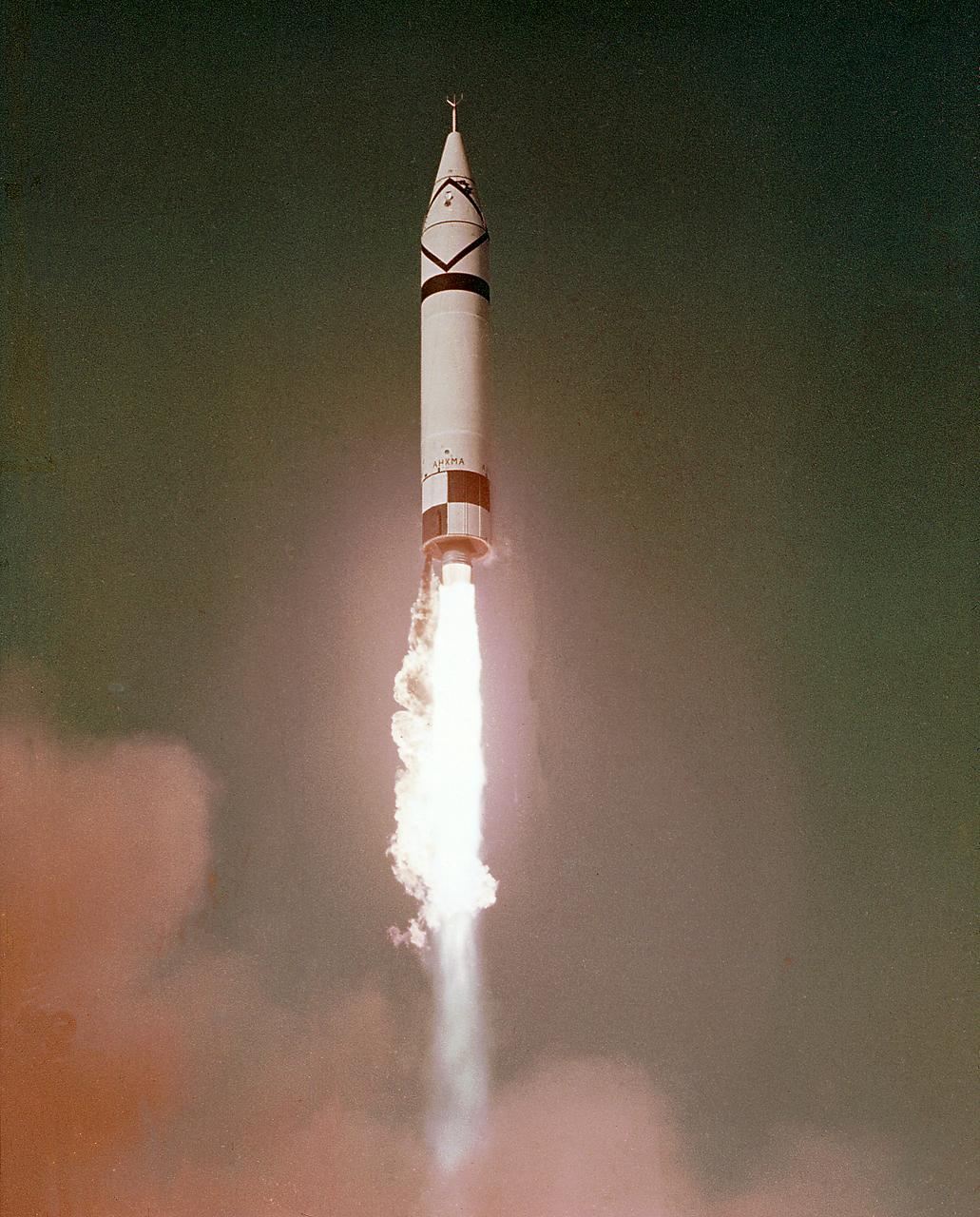
The Jupiter rocket was designed and developed by the Army Ballistic Missile Agency (ABMA). ABMA launched the Jupiter-A at Cape Canaveral, Florida, on March 1, 1957. The Jupiter vehicle was a direct derivative of the Redstone. The Army Ballistic Missile Agency (ABMA) at Redstone Arsenal, Alabama, continued Jupiter development into a successful intermediate ballistic missile, even though the Department of Defense directed its operational development to the Air Force. ABMA maintained a role in Jupiter RD, including high-altitude launches that added to ABMA's understanding of rocket vehicle operations in the near-Earth space environment. It was knowledge that paid handsome dividends later.
Early Rockets
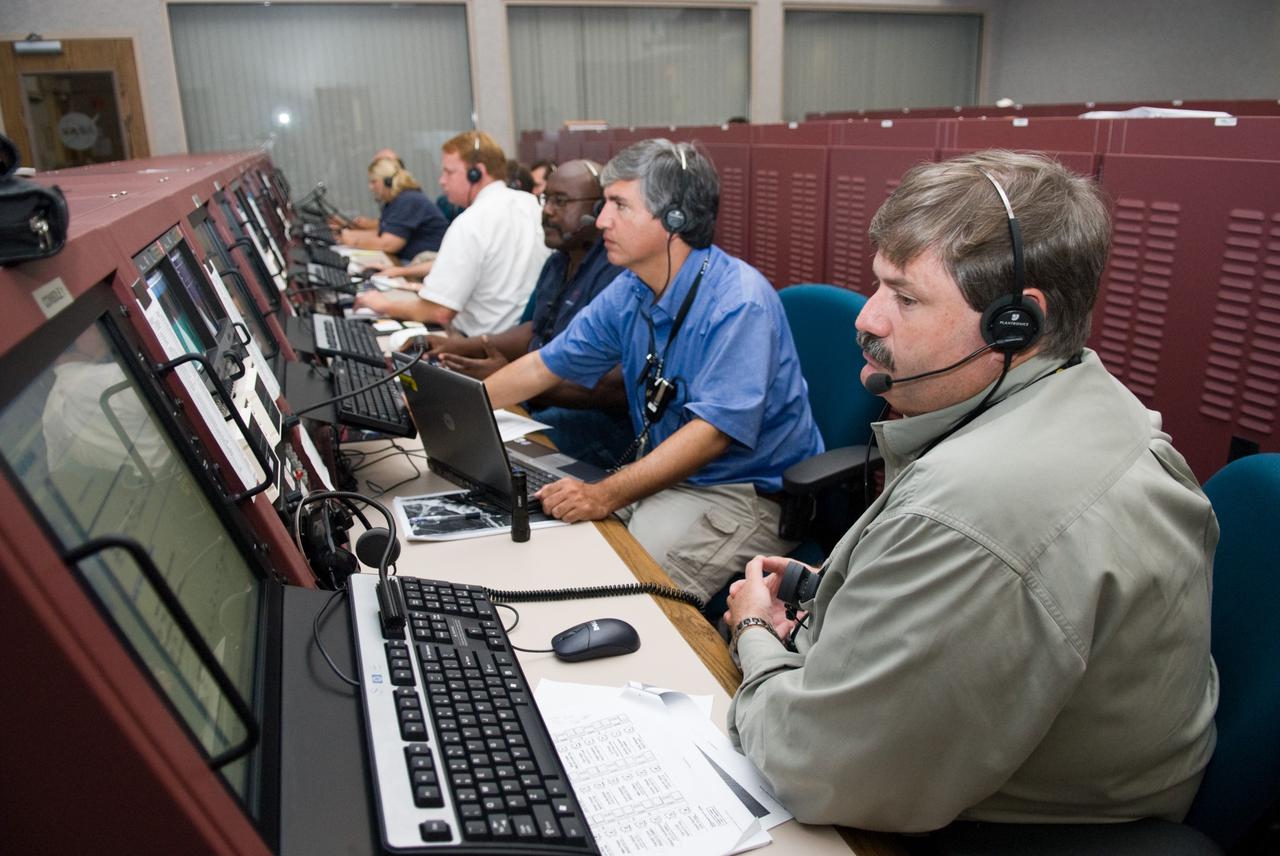
CAPE CANAVERAL, Fla. – In the Launch Vehicle Data Center- 1 in Cape Canaveral Air Force Station's Hangar AE, (from right) JJ Joyner, Jonathan Cruz and Stuart Cooke take part in a countdown simulation for the upcoming Ares I-X flight test. The LVDC was developed by NASA's Kennedy Space Center to support multiple test operations in parallel or a single large launch operation. The LVDC works in tandem with the adjacent Mission Director Center, the control room where NASA launch managers monitor expendable vehicle launches, and where the final decision to launch is made. Photo credit: NASA/Kim Shiflett
KSC-2009-4987
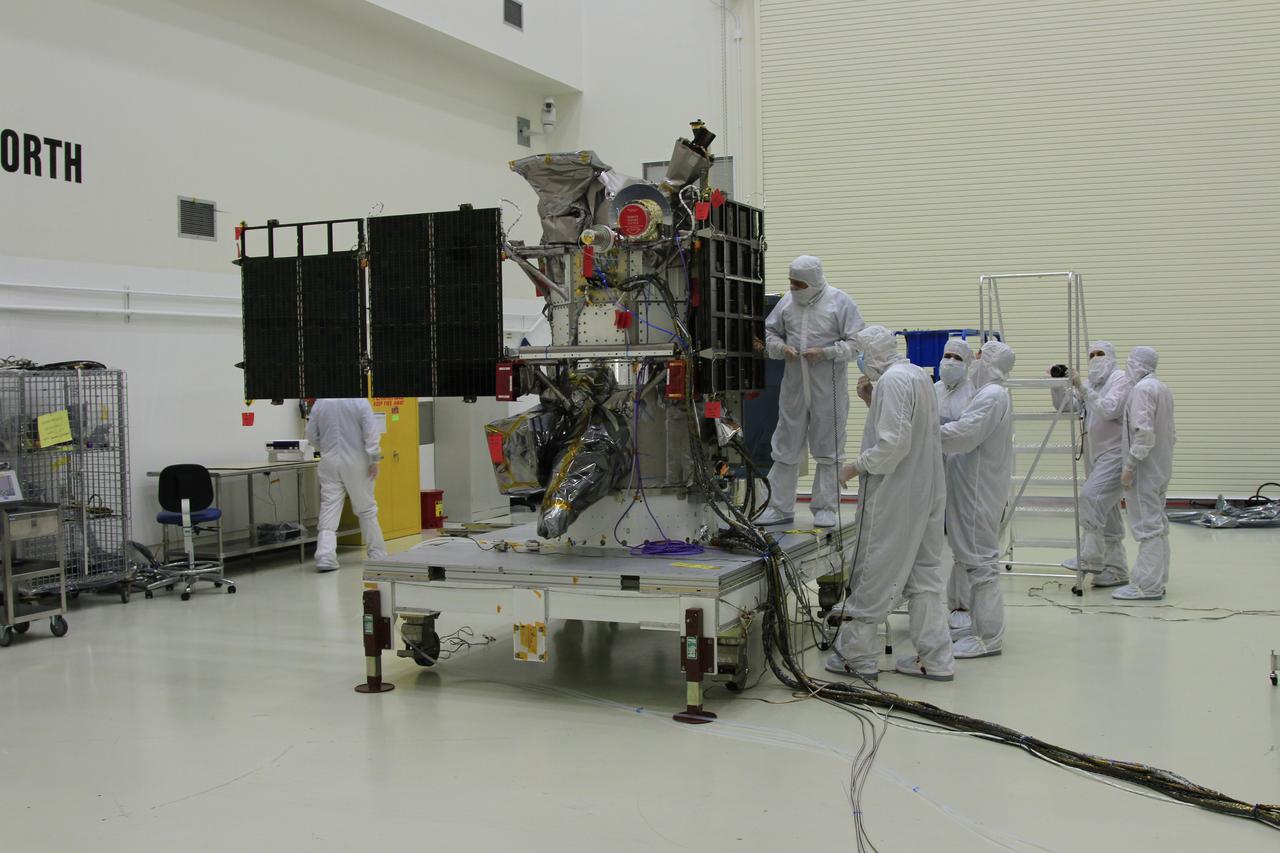
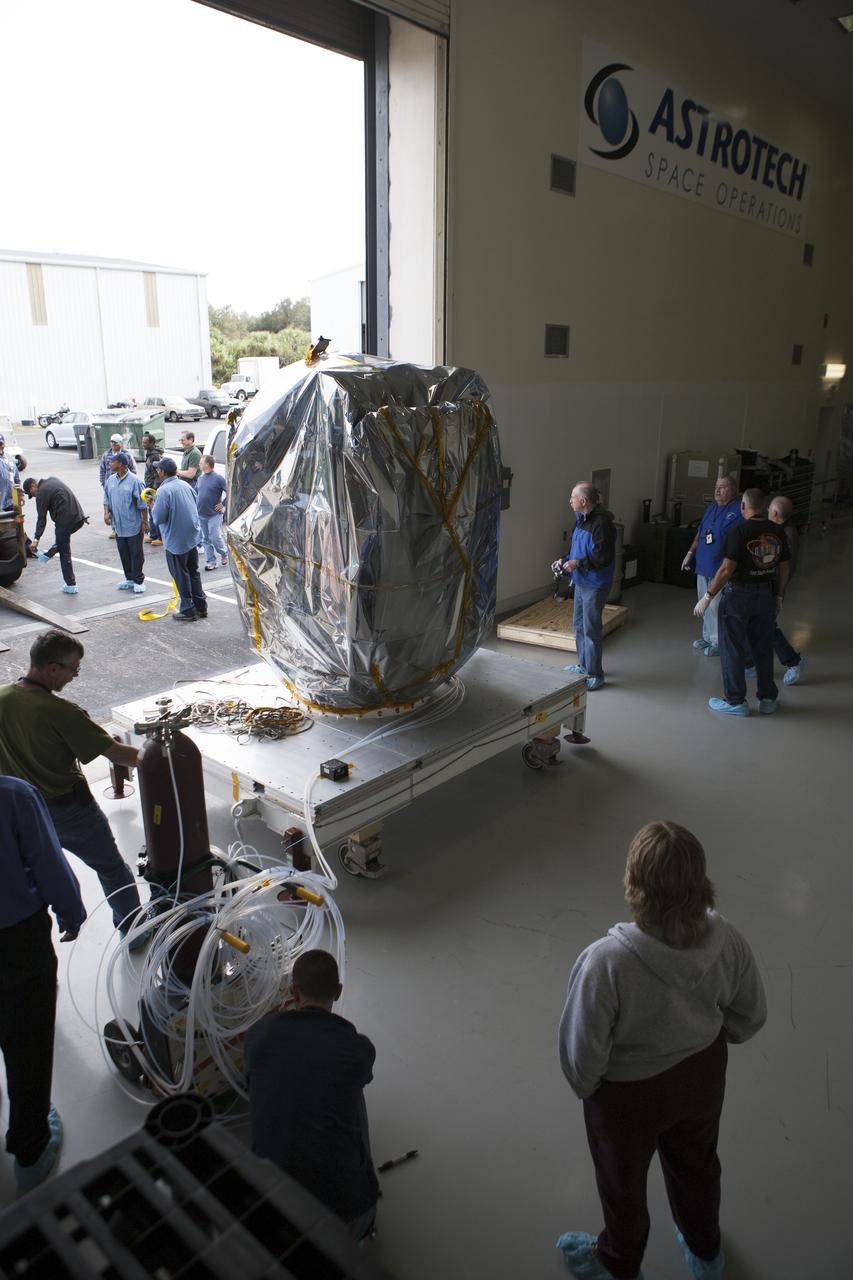
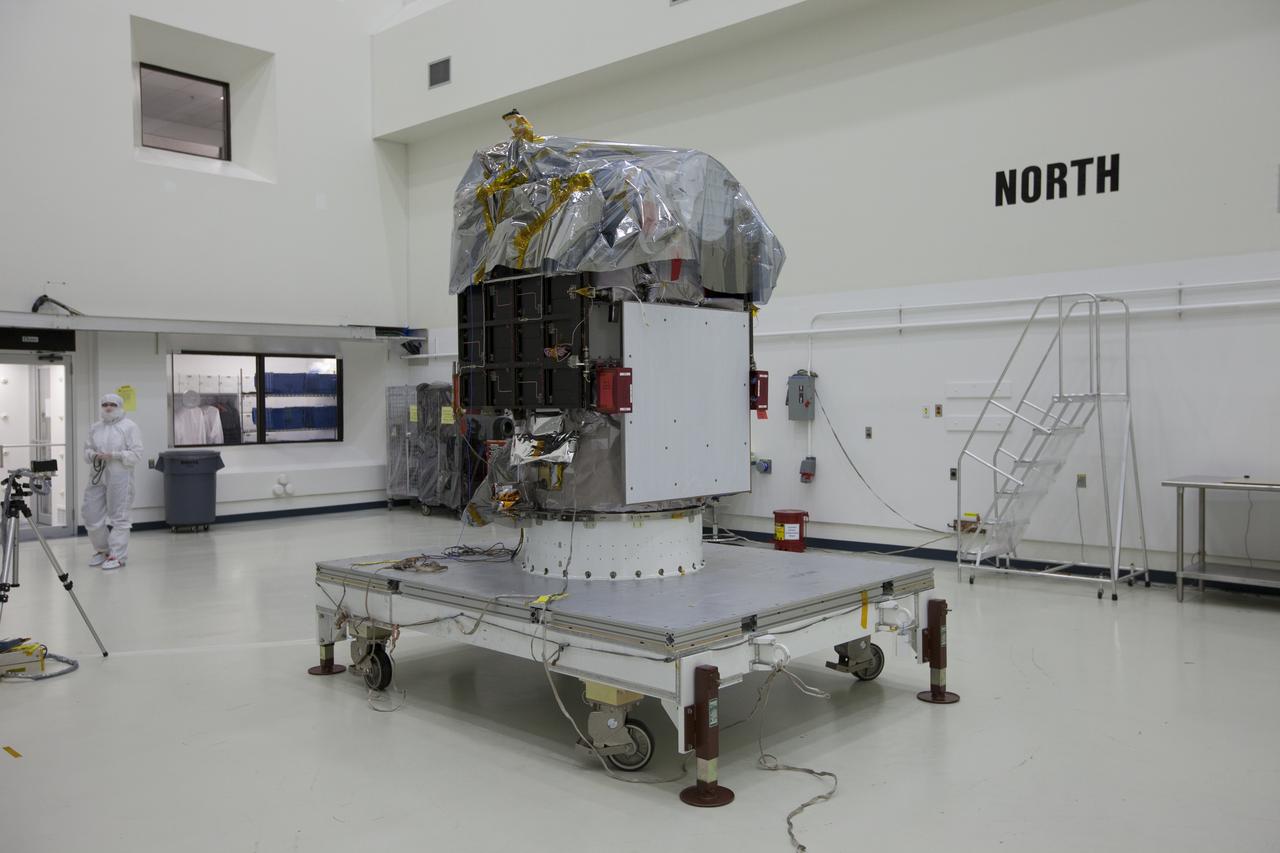
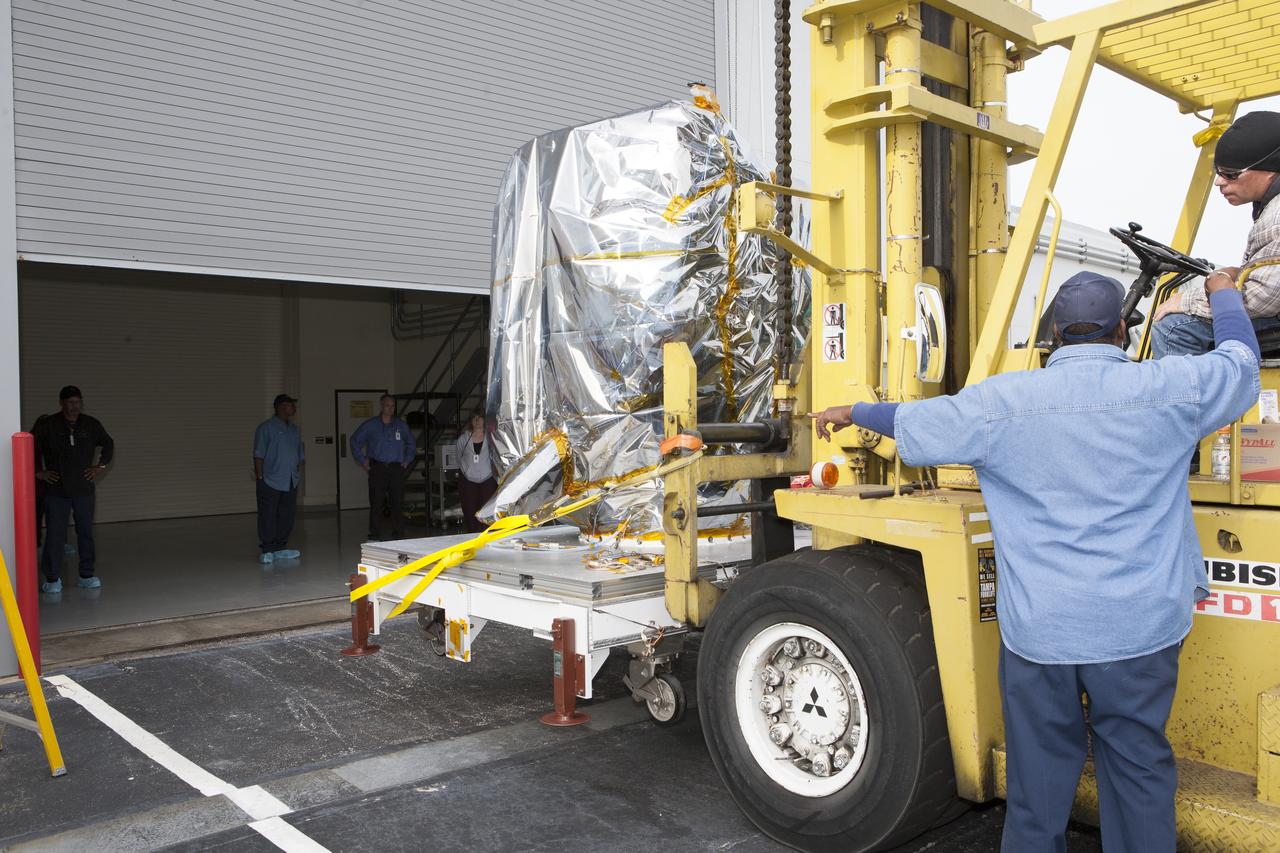
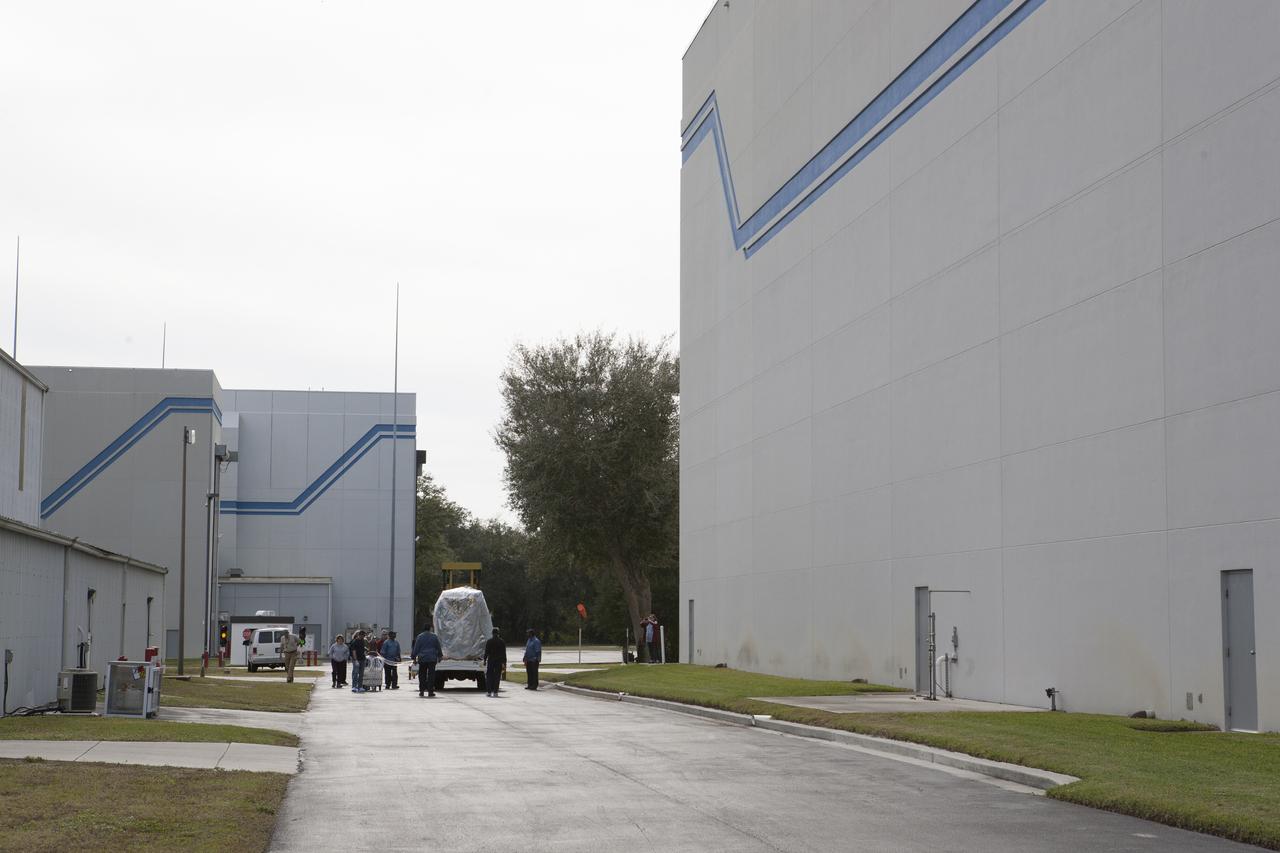
Workers monitor NOAA’s Deep Space Climate Observatory spacecraft, or DSCOVR, wrapped in plastic and secured onto a portable work stand, as it travels between the airlock of Building 2 to the high bay of Building 1 at the Astrotech payload processing facility in Titusville, Florida, near Kennedy Space Center. DSCOVR is a partnership between NOAA, NASA and the U.S. Air Force. DSCOVR will maintain the nation's real-time solar wind monitoring capabilities which are critical to the accuracy and lead time of NOAA's space weather alerts and forecasts. Launch is currently scheduled for January 2015 aboard a SpaceX Falcon 9 v 1.1 launch vehicle from Cape Canaveral Air Force Station, Florida.
DSCOVR Spacecraft Arrival, Offload, & Unpacking
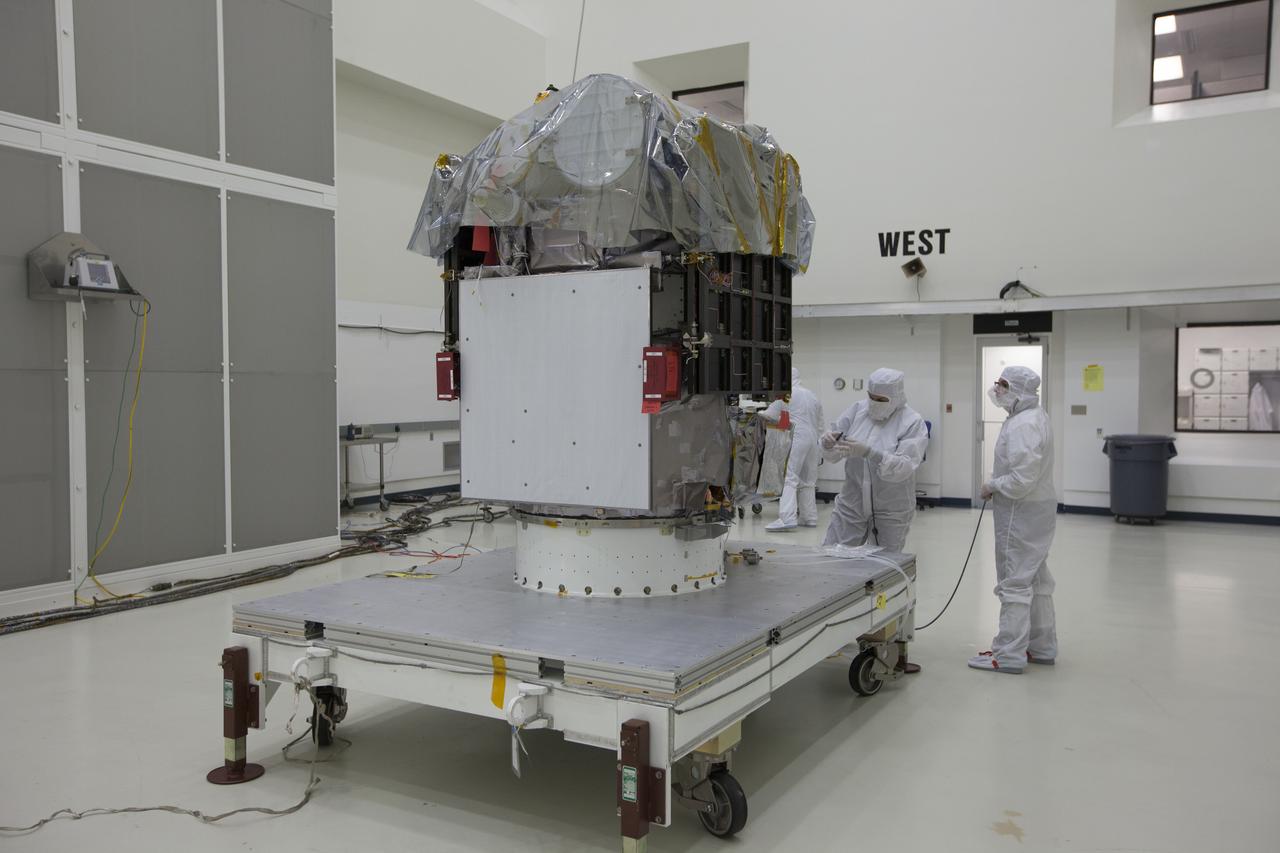
NOAA’s Deep Space Climate Observatory spacecraft, or DSCOVR, has been uncovered and is ready for processing in the high bay of Building 1 at the Astrotech payload processing facility in Titusville, Florida, near Kennedy Space Center. DSCOVR is a partnership between NOAA, NASA and the U.S. Air Force. DSCOVR will maintain the nation's real-time solar wind monitoring capabilities which are critical to the accuracy and lead time of NOAA's space weather alerts and forecasts. Launch is currently scheduled for January 2015 aboard a SpaceX Falcon 9 v 1.1 launch vehicle from Cape Canaveral Air Force Station, Florida.
DSCOVR Spacecraft Arrival, Offload, & Unpacking
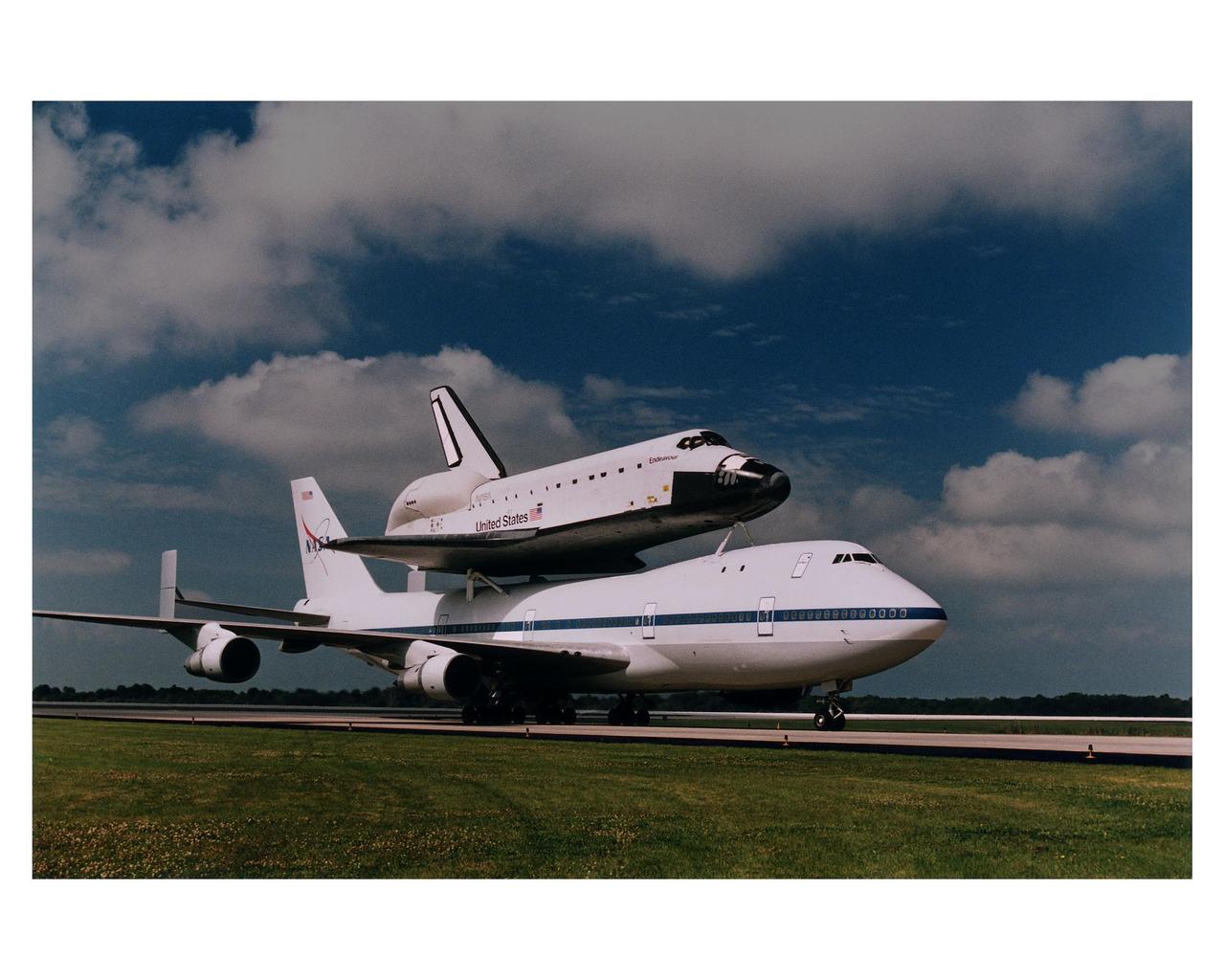
KENNEDY SPACE CENTER, FLA. -- The orbiter Endeavour, riding atop the 747 Shuttle Carrier Aircraft (SCA), landed at KSC's Shuttle Landing Facility at about 9:44 a.m. today, completing its cross-country ferry flight from Palmdale, Calif. Endeavour departed Palmdale at about 9 a.m. EST March 26 and stopped briefly for fuel at Ft. Worth Naval Air Station, Texas. The vehicle then proceeded to Warner Robbins Air Force Base, Ga., where it stayed overnight last night before departing for KSC this morning. Endeavour will be removed from the SCA today and transported to Orbiter Processing Facility bay 1 early tomorrow morning
KSC-97pc551
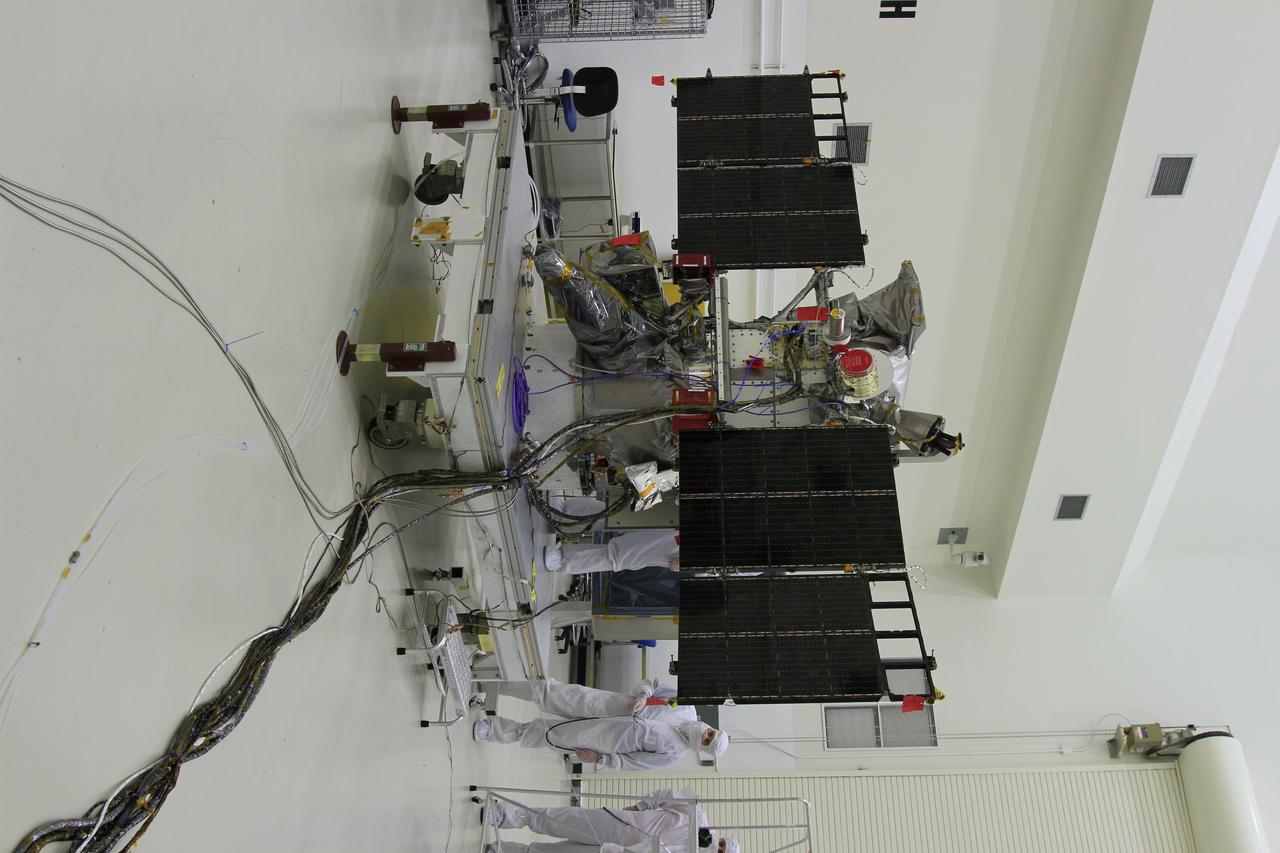
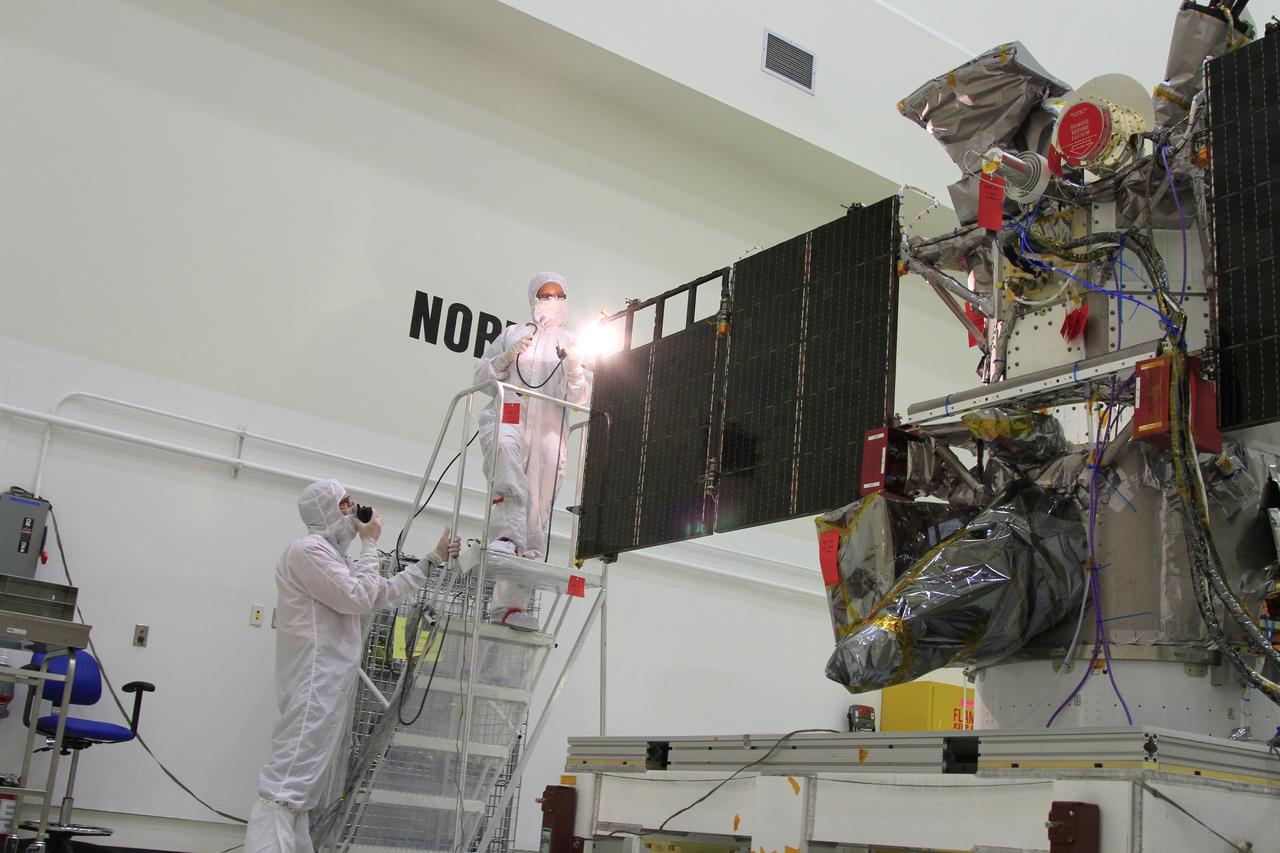
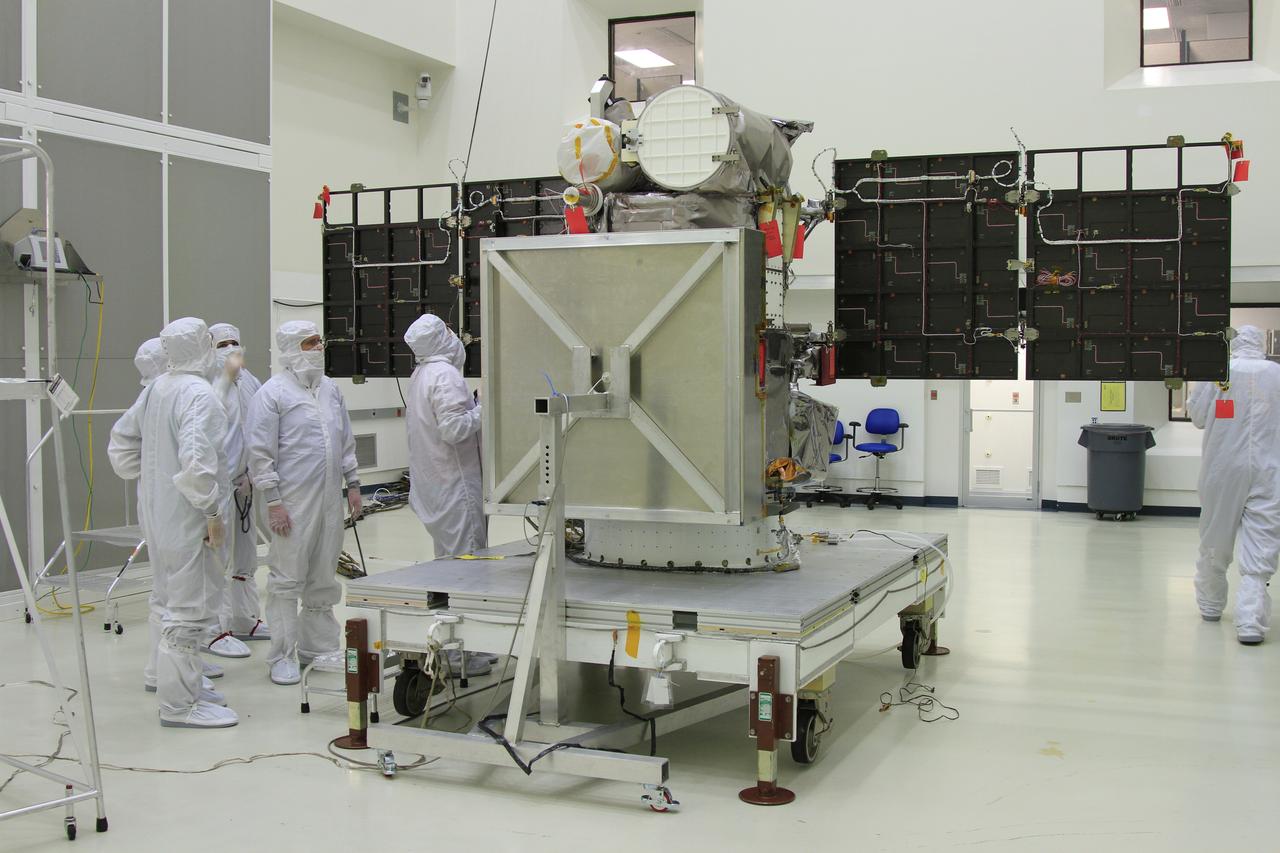
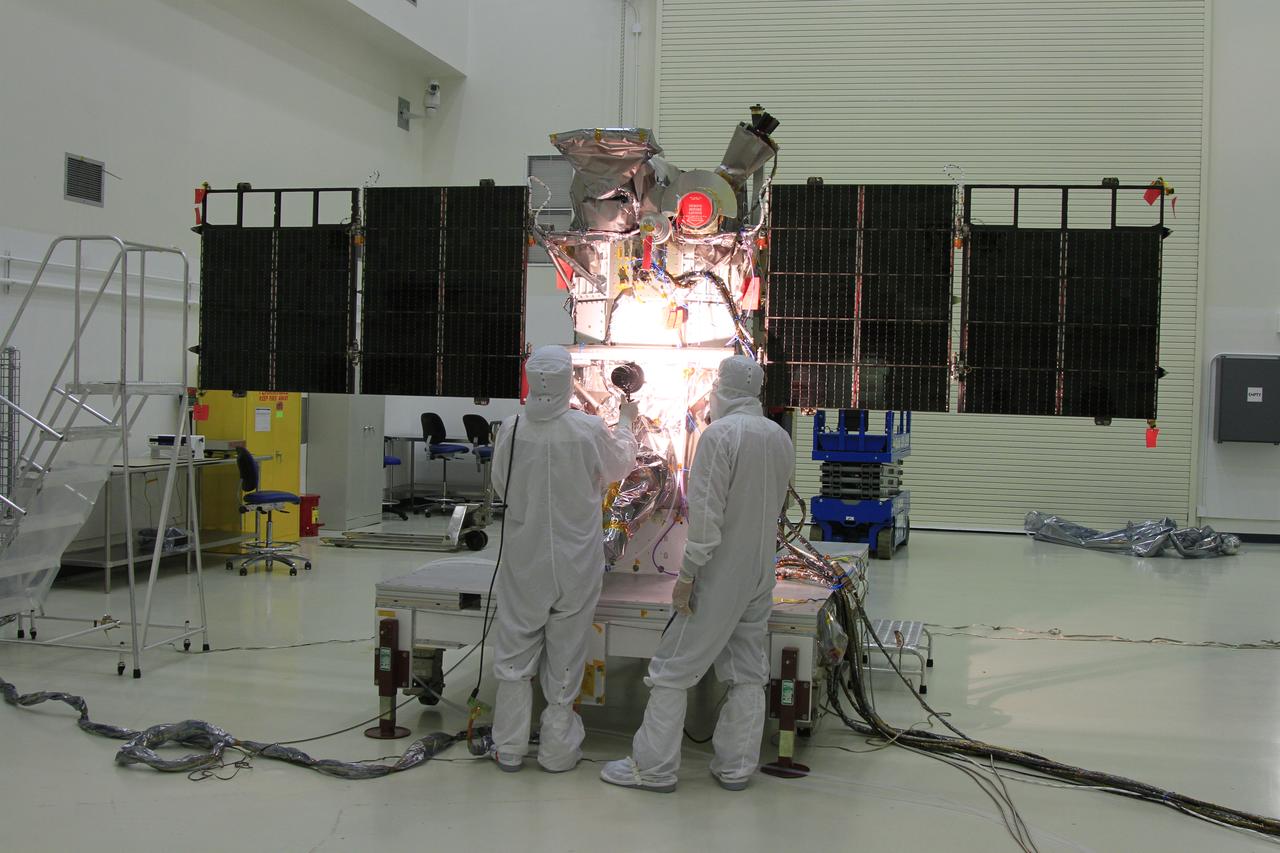
Workers conduct a light test on the solar arrays on NOAA’s Deep Space Climate Observatory spacecraft, or DSCOVR, in the Building 1 high bay at the Astrotech payload processing facility in Titusville, Florida, near Kennedy Space Center. DSCOVR is a partnership between NOAA, NASA and the U.S. Air Force. DSCOVR will maintain the nation's real-time solar wind monitoring capabilities which are critical to the accuracy and lead time of NOAA's space weather alerts and forecasts. Launch is targeted for early 2015 aboard a SpaceX Falcon 9 v 1.1 launch vehicle from Cape Canaveral Air Force Station, Florida.
DSCOVR Satellite Deploy & Light Test
NOAA’s newly arrived Deep Space Climate Observatory spacecraft, or DSCOVR, wrapped in plastic and secured onto a portable work stand, is delivered to the high bay of Building 1 at the Astrotech payload processing facility in Titusville, Florida, near Kennedy Space Center. DSCOVR is a partnership between NOAA, NASA and the U.S. Air Force. DSCOVR will maintain the nation's real-time solar wind monitoring capabilities which are critical to the accuracy and lead time of NOAA's space weather alerts and forecasts. Launch is currently scheduled for January 2015 aboard a SpaceX Falcon 9 v 1.1 launch vehicle from Cape Canaveral Air Force Station, Florida.
DSCOVR Spacecraft Arrival, Offload, & Unpacking
Workers conduct a light test on the solar arrays on NOAA’s Deep Space Climate Observatory spacecraft, or DSCOVR, in the Building 1 high bay at the Astrotech payload processing facility in Titusville, Florida, near Kennedy Space Center. DSCOVR is a partnership between NOAA, NASA and the U.S. Air Force. DSCOVR will maintain the nation's real-time solar wind monitoring capabilities which are critical to the accuracy and lead time of NOAA's space weather alerts and forecasts. Launch is targeted for early 2015 aboard a SpaceX Falcon 9 v 1.1 launch vehicle from Cape Canaveral Air Force Station, Florida.
DSCOVR Satellite Deploy & Light Test
The orbiter Endeavour, riding atop the 747 Shuttle Carrier Aircraft (SCA), landed at KSC's Shuttle Landing Facility at about 9:44 a.m. today, completing is cross-country ferry flight from Palmdale, CA. Endeavour departed Palmdale at about 9 a.m. EST March 26 and stopped briefly for fuel at Ft. Worth Naval Air Station, TX. The vehicle then proceeded to Warner Robbins Air Force Base, GA, where it stayed overnight last night before departing for KSC this morning. Endeavour will be removed from the SCA today and transported to Orbiter Processing Facility bay 1 early tomorrow morning
KSC-97pc549
The solar arrays on NOAA’s Deep Space Climate Observatory spacecraft, or DSCOVR, are unfurled in the Building 1 high bay at the Astrotech payload processing facility in Titusville, Florida, near Kennedy Space Center. DSCOVR is a partnership between NOAA, NASA and the U.S. Air Force. DSCOVR will maintain the nation's real-time solar wind monitoring capabilities which are critical to the accuracy and lead time of NOAA's space weather alerts and forecasts. Launch is targeted for early 2015 aboard a SpaceX Falcon 9 v 1.1 launch vehicle from Cape Canaveral Air Force Station, Florida.
DSCOVR Satellite Deploy & Light Test
Workers conduct a light test on the solar arrays on NOAA’s Deep Space Climate Observatory spacecraft, or DSCOVR, in the Building 1 high bay at the Astrotech payload processing facility in Titusville, Florida, near Kennedy Space Center. DSCOVR is a partnership between NOAA, NASA and the U.S. Air Force. DSCOVR will maintain the nation's real-time solar wind monitoring capabilities which are critical to the accuracy and lead time of NOAA's space weather alerts and forecasts. Launch is targeted for early 2015 aboard a SpaceX Falcon 9 v 1.1 launch vehicle from Cape Canaveral Air Force Station, Florida.
DSCOVR Satellite Deploy & Light Test
Workers deploy the solar arrays on NOAA’s Deep Space Climate Observatory spacecraft, or DSCOVR, in the Building 1 high bay at the Astrotech payload processing facility in Titusville, Florida, near Kennedy Space Center. DSCOVR is a partnership between NOAA, NASA and the U.S. Air Force. DSCOVR will maintain the nation's real-time solar wind monitoring capabilities which are critical to the accuracy and lead time of NOAA's space weather alerts and forecasts. Launch is targeted for early 2015 aboard a SpaceX Falcon 9 v 1.1 launch vehicle from Cape Canaveral Air Force Station, Florida.
DSCOVR Satellite Deploy & Light Test
NOAA’s Deep Space Climate Observatory spacecraft, or DSCOVR, has been uncovered and is ready for processing in the high bay of Building 1 at the Astrotech payload processing facility in Titusville, Florida, near Kennedy Space Center. DSCOVR is a partnership between NOAA, NASA and the U.S. Air Force. DSCOVR will maintain the nation's real-time solar wind monitoring capabilities which are critical to the accuracy and lead time of NOAA's space weather alerts and forecasts. Launch is currently scheduled for January 2015 aboard a SpaceX Falcon 9 v 1.1 launch vehicle from Cape Canaveral Air Force Station, Florida.
DSCOVR Spacecraft Arrival, Offload, & Unpacking
Workers remove the plastic cover from NOAA’s Deep Space Climate Observatory spacecraft, or DSCOVR, in the high bay of Building 1 at the Astrotech payload processing facility in Titusville, Florida, near Kennedy Space Center. DSCOVR is a partnership between NOAA, NASA and the U.S. Air Force. DSCOVR will maintain the nation's real-time solar wind monitoring capabilities which are critical to the accuracy and lead time of NOAA's space weather alerts and forecasts. Launch is currently scheduled for January 2015 aboard a SpaceX Falcon 9 v 1.1 launch vehicle from Cape Canaveral Air Force Station, Florida.
DSCOVR Spacecraft Arrival, Offload, & Unpacking
Workers remove the plastic cover from NOAA’s Deep Space Climate Observatory spacecraft, or DSCOVR, in the high bay of Building 1 at the Astrotech payload processing facility in Titusville, Florida, near Kennedy Space Center. DSCOVR is a partnership between NOAA, NASA and the U.S. Air Force. DSCOVR will maintain the nation's real-time solar wind monitoring capabilities which are critical to the accuracy and lead time of NOAA's space weather alerts and forecasts. Launch is currently scheduled for January 2015 aboard a SpaceX Falcon 9 v 1.1 launch vehicle from Cape Canaveral Air Force Station, Florida.
DSCOVR Spacecraft Arrival, Offload, & Unpacking
VANDENBERG AIR FORCE BASE, Calif. -- On Launch Complex 576-E at Vandenberg Air Force Base in California, NASA's Orbiting Carbon Observatory, OCO, upper stack is lowered toward the Stage 0 motor of the Taurus XL vehicle. The upper stack consists of Stages 1, 2 and 3 of the Taurus. The spacecraft is scheduled for launch aboard Orbital Sciences' Taurus XL rocket Feb. 24 from Vandenberg. The spacecraft will collect precise global measurements of carbon dioxide (CO2) in the Earth's atmosphere. Scientists will analyze OCO data to improve our understanding of the natural processes and human activities that regulate the abundance and distribution of this important greenhouse gas.   Photo credit: NASA/Randy Beaudoin, VAFB
KSC-2009-1687
Workers are on hand to receive NOAA’s Deep Space Climate Observatory spacecraft, or DSCOVR, wrapped in plastic and secured onto a portable work stand, into the high bay of Building 1 at the Astrotech payload processing facility in Titusville, Florida, near Kennedy Space Center. DSCOVR is a partnership between NOAA, NASA and the U.S. Air Force. DSCOVR will maintain the nation's real-time solar wind monitoring capabilities which are critical to the accuracy and lead time of NOAA's space weather alerts and forecasts. Launch is currently scheduled for January 2015 aboard a SpaceX Falcon 9 v 1.1 launch vehicle from Cape Canaveral Air Force Station, Florida.
DSCOVR Spacecraft Arrival, Offload, & Unpacking
A light test on the solar arrays on NOAA’s Deep Space Climate Observatory spacecraft, or DSCOVR, is managed from the control room next to the Building 1 high bay at the Astrotech payload processing facility in Titusville, Florida, near Kennedy Space Center. DSCOVR is a partnership between NOAA, NASA and the U.S. Air Force. DSCOVR will maintain the nation's real-time solar wind monitoring capabilities which are critical to the accuracy and lead time of NOAA's space weather alerts and forecasts. Launch is targeted for early 2015 aboard a SpaceX Falcon 9 v 1.1 launch vehicle from Cape Canaveral Air Force Station, Florida.
DSCOVR Satellite Deploy & Light Test
Workers conduct a light test on the solar arrays on NOAA’s Deep Space Climate Observatory spacecraft, or DSCOVR, in the Building 1 high bay at the Astrotech payload processing facility in Titusville, Florida, near Kennedy Space Center. DSCOVR is a partnership between NOAA, NASA and the U.S. Air Force. DSCOVR will maintain the nation's real-time solar wind monitoring capabilities which are critical to the accuracy and lead time of NOAA's space weather alerts and forecasts. Launch is targeted for early 2015 aboard a SpaceX Falcon 9 v 1.1 launch vehicle from Cape Canaveral Air Force Station, Florida.
DSCOVR Satellite Deploy & Light Test
Workers deploy the solar arrays on NOAA’s Deep Space Climate Observatory spacecraft, or DSCOVR, in the Building 1 high bay at the Astrotech payload processing facility in Titusville, Florida, near Kennedy Space Center. DSCOVR is a partnership between NOAA, NASA and the U.S. Air Force. DSCOVR will maintain the nation's real-time solar wind monitoring capabilities which are critical to the accuracy and lead time of NOAA's space weather alerts and forecasts. Launch is targeted for early 2015 aboard a SpaceX Falcon 9 v 1.1 launch vehicle from Cape Canaveral Air Force Station, Florida.
DSCOVR Satellite Deploy & Light Test
Workers transfer NOAA’s Deep Space Climate Observatory spacecraft, or DSCOVR, wrapped in plastic and secured onto a portable work stand, from the airlock of Building 2 to the high bay of Building 1 at the Astrotech payload processing facility in Titusville, Florida, near Kennedy Space Center. DSCOVR is a partnership between NOAA, NASA and the U.S. Air Force. DSCOVR will maintain the nation's real-time solar wind monitoring capabilities which are critical to the accuracy and lead time of NOAA's space weather alerts and forecasts. Launch is currently scheduled for January 2015 aboard a SpaceX Falcon 9 v 1.1 launch vehicle from Cape Canaveral Air Force Station, Florida.
DSCOVR Spacecraft Arrival, Offload, & Unpacking
Workers conduct a light test on the solar arrays on NOAA’s Deep Space Climate Observatory spacecraft, or DSCOVR, in the Building 1 high bay at the Astrotech payload processing facility in Titusville, Florida, near Kennedy Space Center. DSCOVR is a partnership between NOAA, NASA and the U.S. Air Force. DSCOVR will maintain the nation's real-time solar wind monitoring capabilities which are critical to the accuracy and lead time of NOAA's space weather alerts and forecasts. Launch is targeted for early 2015 aboard a SpaceX Falcon 9 v 1.1 launch vehicle from Cape Canaveral Air Force Station, Florida.
DSCOVR Satellite Deploy & Light Test
The orbiter Endeavour, riding atop the 747 Shuttle Carrier Aircraft (SCA), landed at KSC's Shuttle Landing Facility at about 9:44 a.m. today, completing is cross-country ferry flight from Palmdale, CA. Endeavour departed Palmdale at about 9 a.m. EST March 26 and stopped briefly for fuel at Ft. Worth Naval Air Station, TX. The vehicle then proceeded to Warner Robbins Air Force Base, GA, where it stayed overnight last night before departing for KSC this morning. Endeavour will be removed from the SCA today and transported to Orbiter Processing Facility bay 1 early tomorrow morning
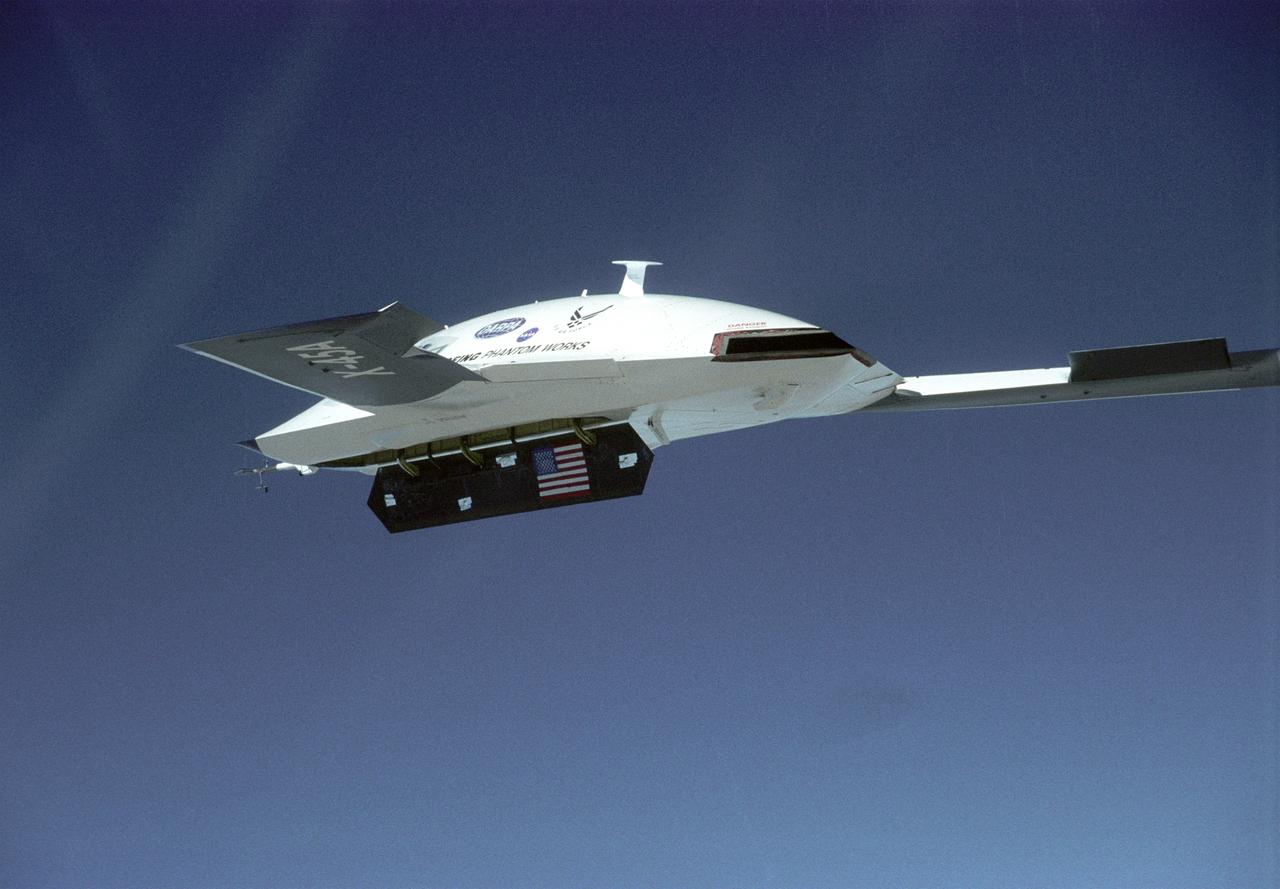
KSC-97pc550
The solar arrays on NOAA’s Deep Space Climate Observatory spacecraft, or DSCOVR, are unfurled in the Building 1 high bay at the Astrotech payload processing facility in Titusville, Florida, near Kennedy Space Center. DSCOVR is a partnership between NOAA, NASA and the U.S. Air Force. DSCOVR will maintain the nation's real-time solar wind monitoring capabilities which are critical to the accuracy and lead time of NOAA's space weather alerts and forecasts. Launch is targeted for early 2015 aboard a SpaceX Falcon 9 v 1.1 launch vehicle from Cape Canaveral Air Force Station, Florida.
DSCOVR Satellite Deploy & Light Test
Workers deploy the solar arrays on NOAA’s Deep Space Climate Observatory spacecraft, or DSCOVR, in the Building 1 high bay at the Astrotech payload processing facility in Titusville, Florida, near Kennedy Space Center. DSCOVR is a partnership between NOAA, NASA and the U.S. Air Force. DSCOVR will maintain the nation's real-time solar wind monitoring capabilities which are critical to the accuracy and lead time of NOAA's space weather alerts and forecasts. Launch is targeted for early 2015 aboard a SpaceX Falcon 9 v 1.1 launch vehicle from Cape Canaveral Air Force Station, Florida.
DSCOVR Satellite Deploy & Light Test
CAPE CANAVERAL, Fla. – Inside Orbiter Processing Facility-1 at NASA’s Kennedy Space Center in Florida, a tow vehicle is used to back space shuttle Discovery out of Orbiter Processing Facility-1 for its move to the Vehicle Assembly Building VAB.    The work is part of the Space Shuttle Program’s transition and retirement processing of shuttle Discovery, which is being prepared for display at Smithsonian’s National Air and Space Museum, Steven F. Udvar-Hazy Center in Chantilly, Va. Discovery will remain in high bay 4 of the VAB until its scheduled transport atop a NASA Shuttle Carrier Aircraft modified 747 jet to Dulles International Airport in Virginia on April 17. Discovery will then be transported to the Smithsonian on April 19. For more information, visit http://www.nasa.gov/shuttle.  Photo credit: NASA/Jim Grossmann
KSC-2012-1702
CAPE CANAVERAL, Fla. -- At NASA's Kennedy Space Center in Florida, space shuttle Discovery continues its trip to  Orbiter Processing Facility-1 (OPF-1) after stopping for a unique "nose-to-nose" photo opportunity outside OPF-3 with shuttle Endeavour.  Endeavour nears the open bay door of the Vehicle Assembly Building (VAB), at right.  Discovery, which temporarily was being stored in the VAB, is switching places with Endeavour, which has been undergoing decommissioning in OPF-1.    In OPF-1, Discovery will undergo further preparations for public display at the Smithsonian's National Air and Space Museum Steven F. Udvar-Hazy Center in Virginia. Endeavour will be stored in the VAB until October when it will be moved into OPF-2 for further work to get it ready for public display at the California Science Center in Los Angeles.  For more information, visit http://www.nasa.gov/shuttle. Photo credit: NASA/Dimitri Gerondidakis
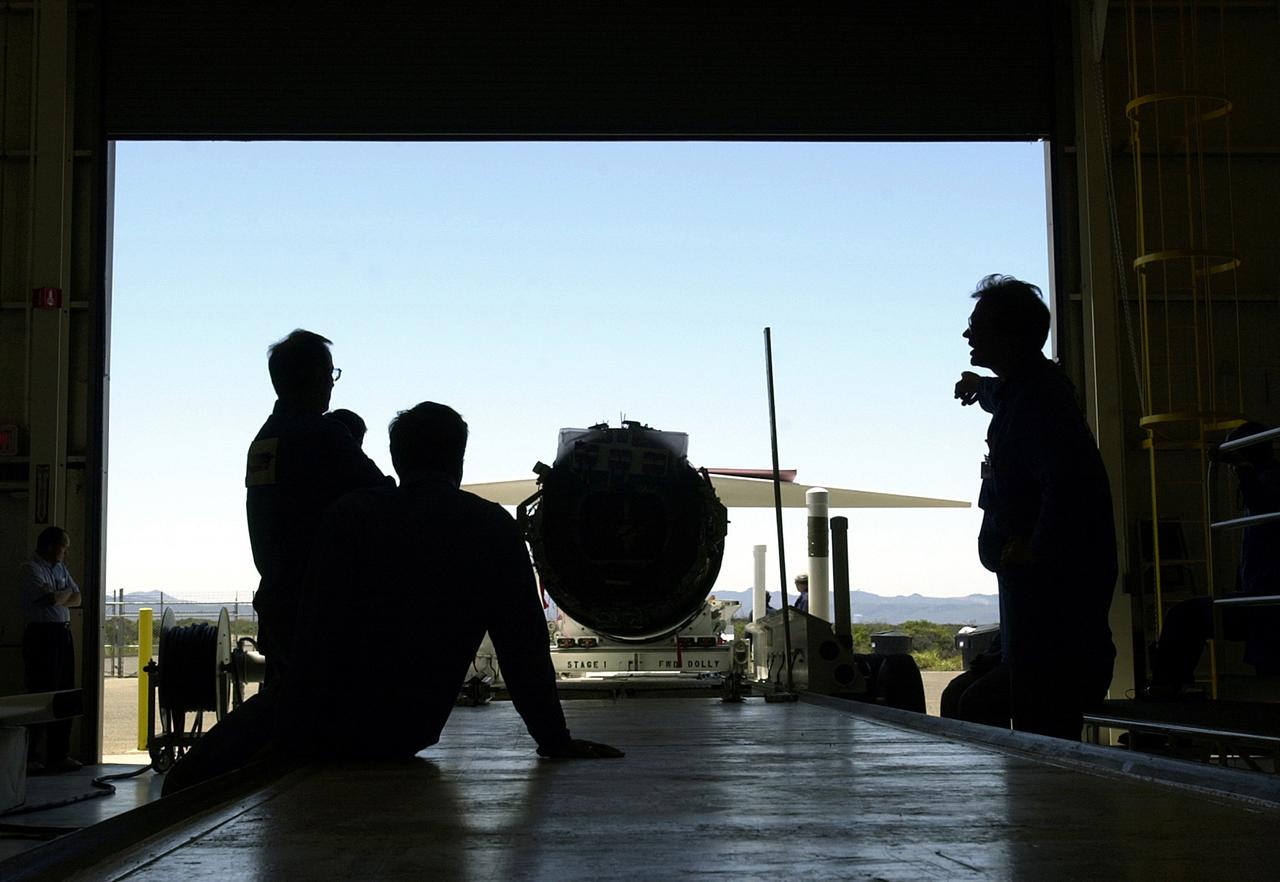
KSC-2011-6429
CAPE CANAVERAL, Fla. -- At NASA's Kennedy Space Center in Florida, space shuttle Endeavour backs out of Orbiter Processing Facility-1 (OPF-1) into public view.  Endeavour is switching places with shuttle Discovery which temporarily has been housed in the Vehicle Assembly Building (VAB).  Both shuttles will stop briefly outside OPF-3 for a "nose-to-nose" photo opportunity. Discovery then will be rolled into OPF-1 and Endeavour into the VAB.    In OPF-1, Discovery will undergo further preparations for public display at the Smithsonian's National Air and Space Museum Steven F. Udvar-Hazy Center in Virginia. Endeavour will be stored in the VAB until October when it will be moved into OPF-2 for further work to get it ready for public display at the California Science Center in Los Angeles.  For more information, visit http://www.nasa.gov/shuttle. Photo credit: NASA/Jim Grossmann
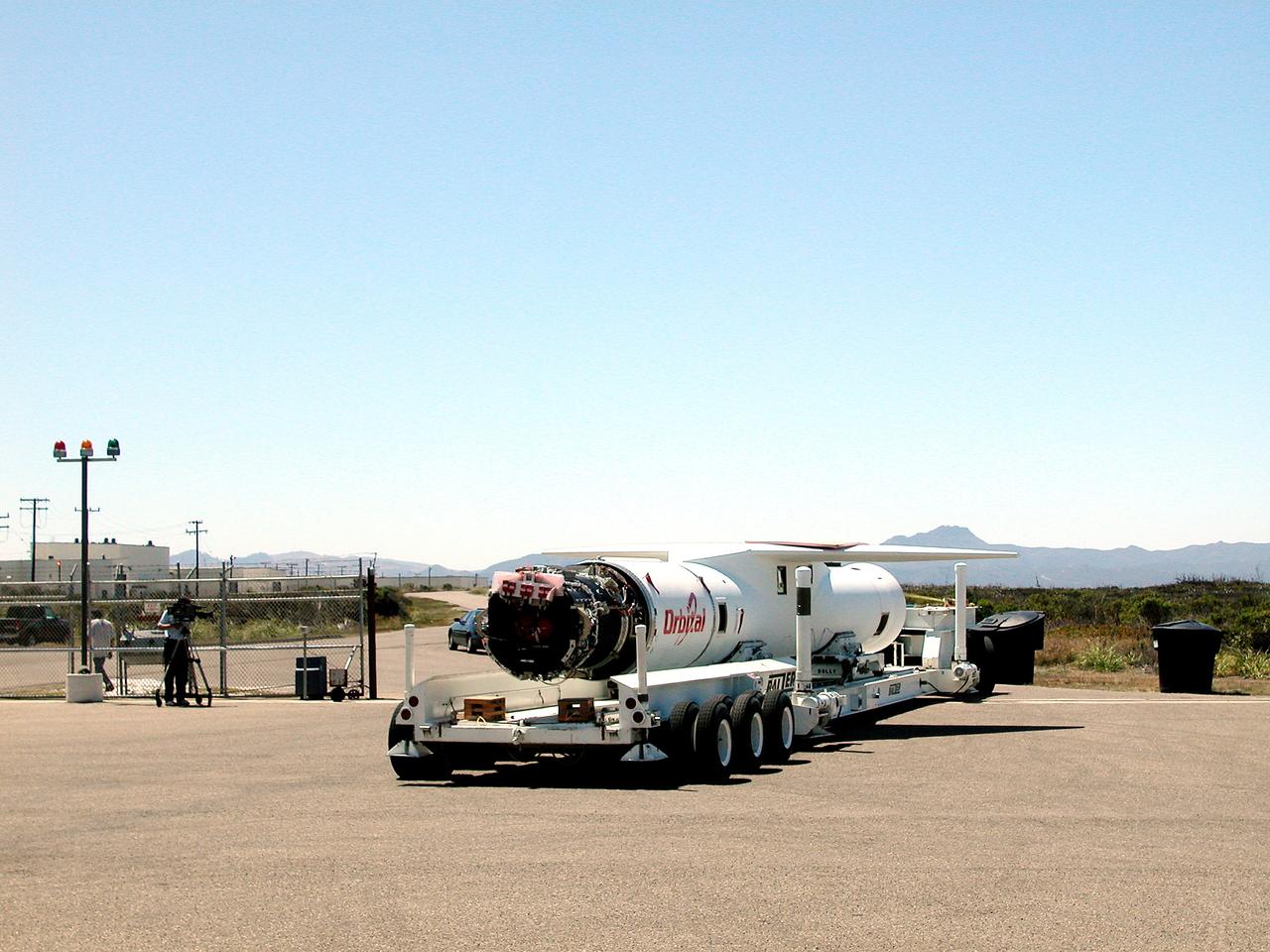
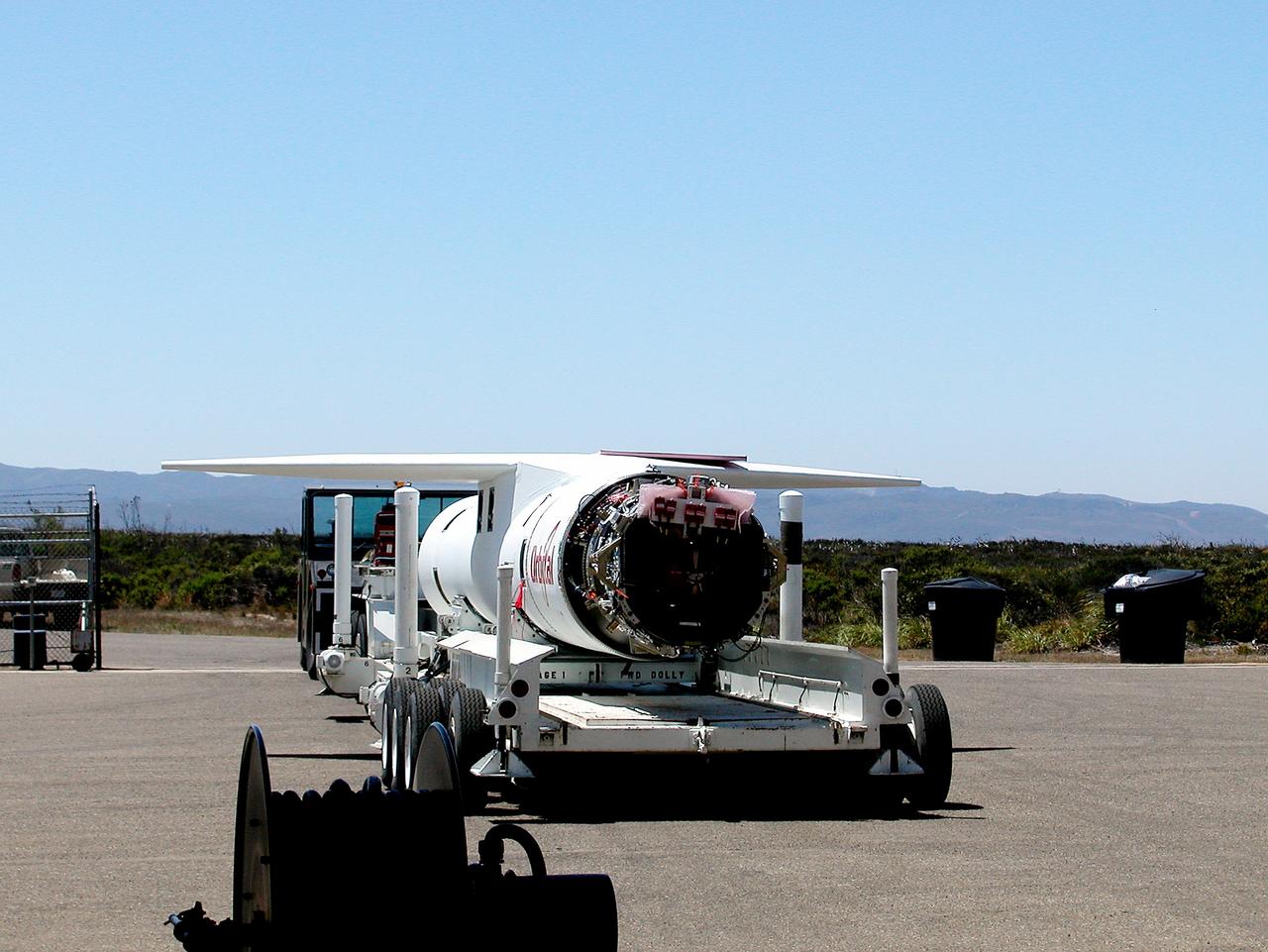
KSC-2011-6386
CAPE CANAVERAL, Fla. -- At NASA's Kennedy Space Center in Florida, space shuttle Endeavour backs out of Orbiter Processing Facility-1 (OPF-1).  Endeavour is switching places with shuttle Discovery which temporarily has been housed in the Vehicle Assembly Building (VAB).  Both shuttles will stop briefly outside OPF-3 for a "nose-to-nose" photo opportunity. Discovery then will be rolled into OPF-1 and Endeavour into the VAB.    The image was taken from the top of the VAB.  In OPF-1, Discovery will undergo further preparations for public display at the Smithsonian's National Air and Space Museum Steven F. Udvar-Hazy Center in Virginia. Endeavour will be stored in the VAB until October when it will be moved into OPF-2 for further work to get it ready for public display at the California Science Center in Los Angeles.  For more information, visit http://www.nasa.gov/shuttle. Photo credit: NASA/Frankie Martin
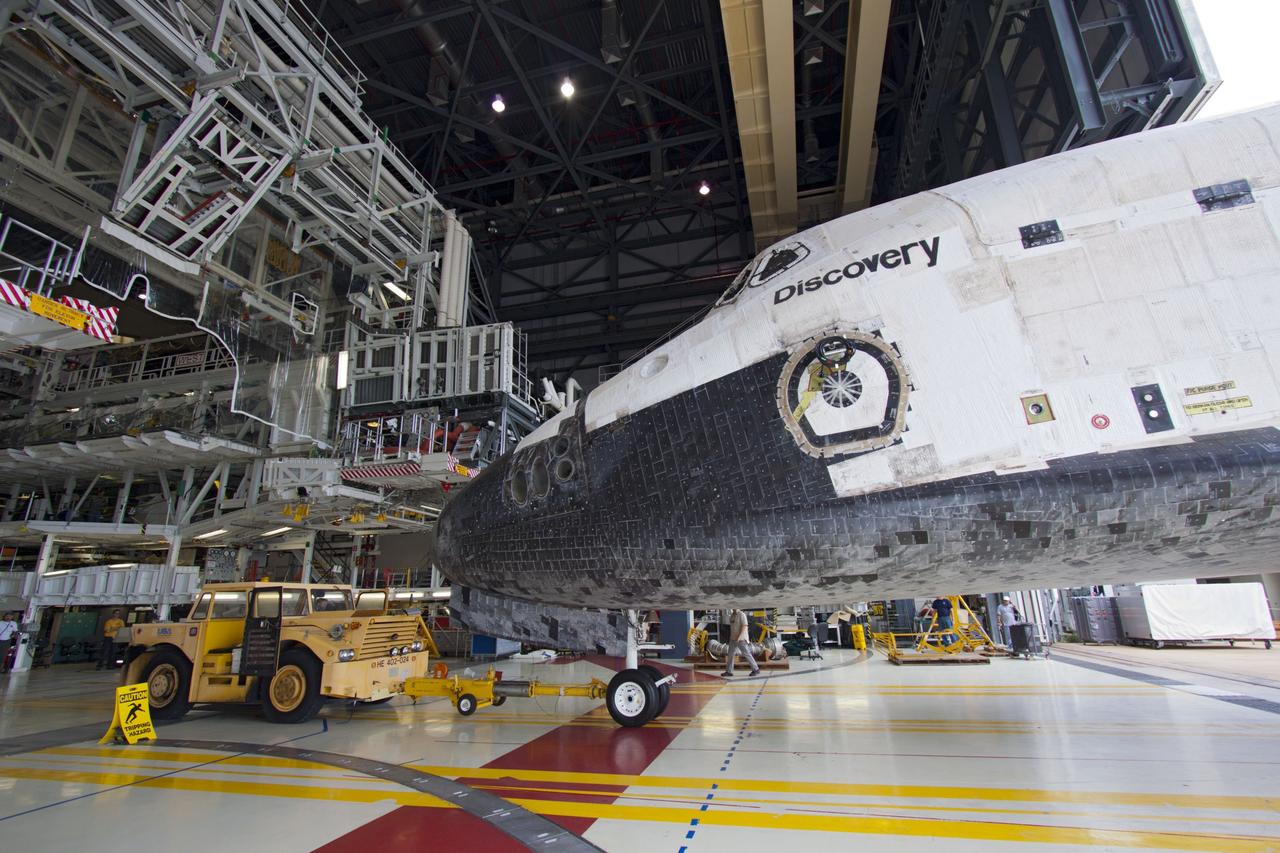
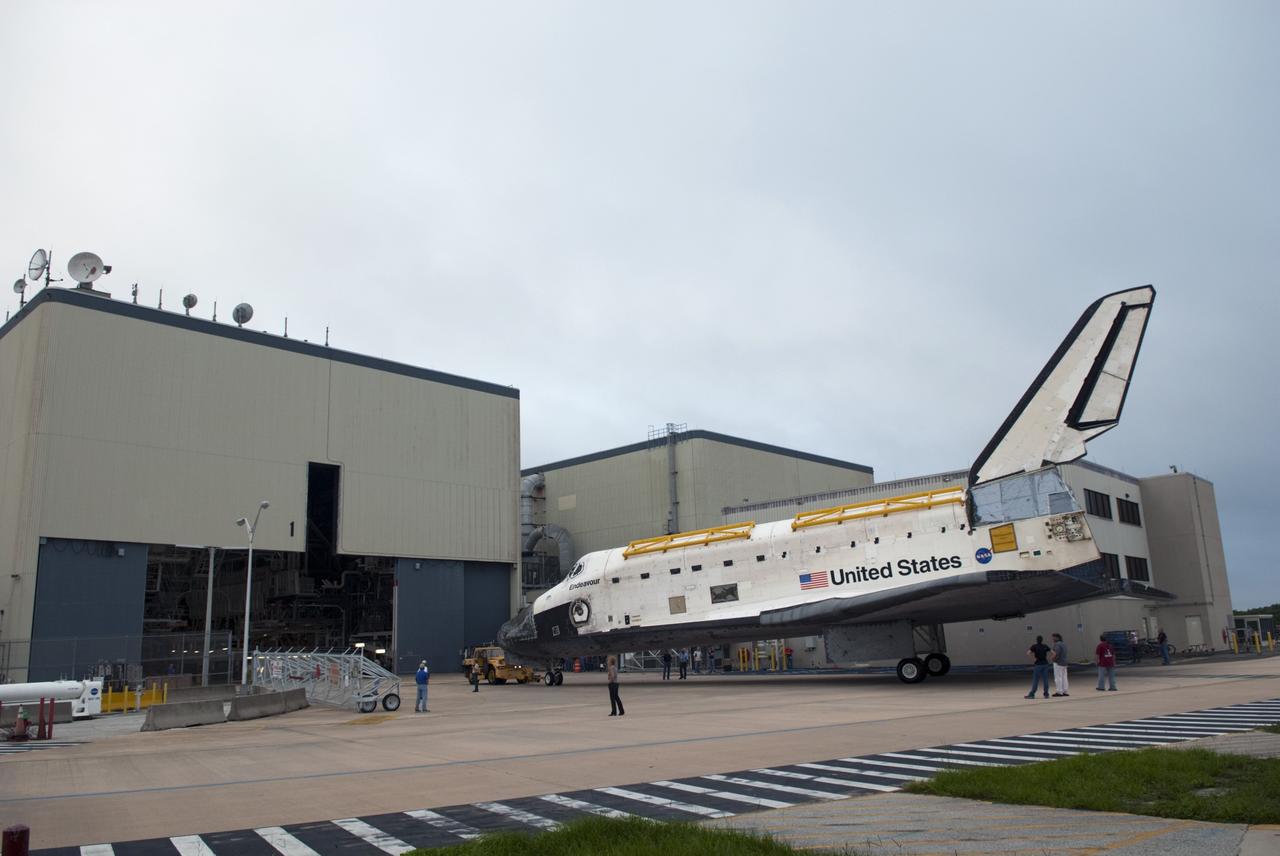
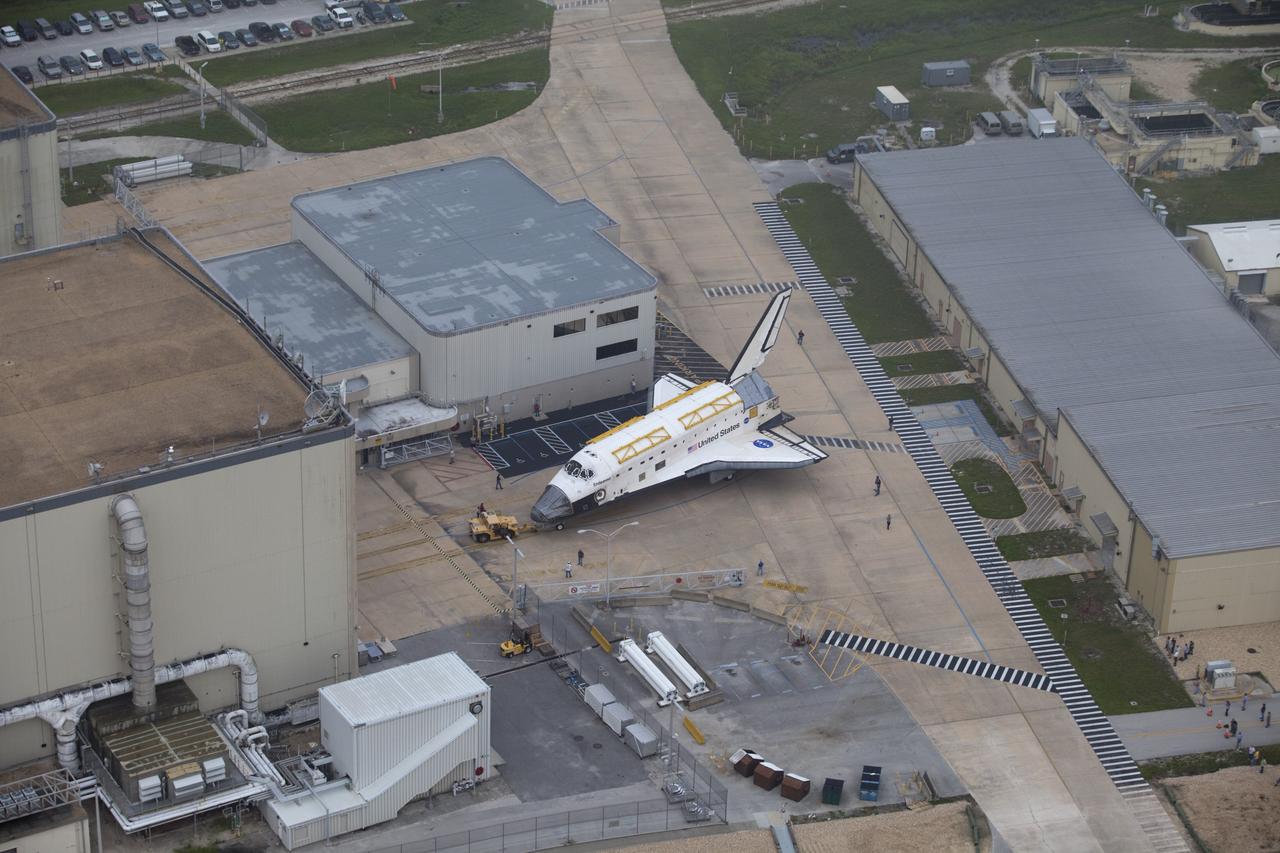
KSC-2011-6359