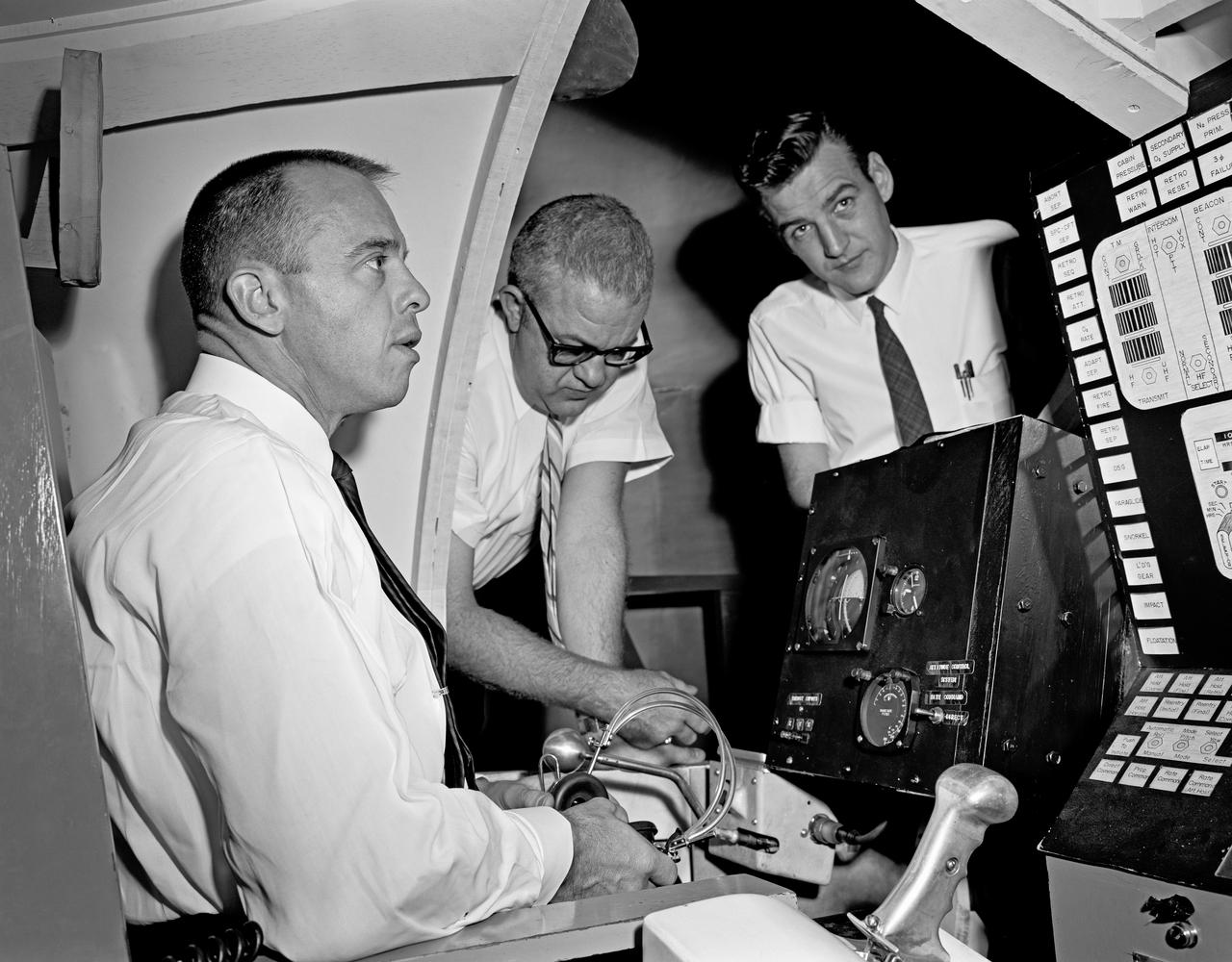
Alan Shepard and engineer looking at equipment, alone in Visual Docking Simulator, with engineers in Visual Docking Simulator.
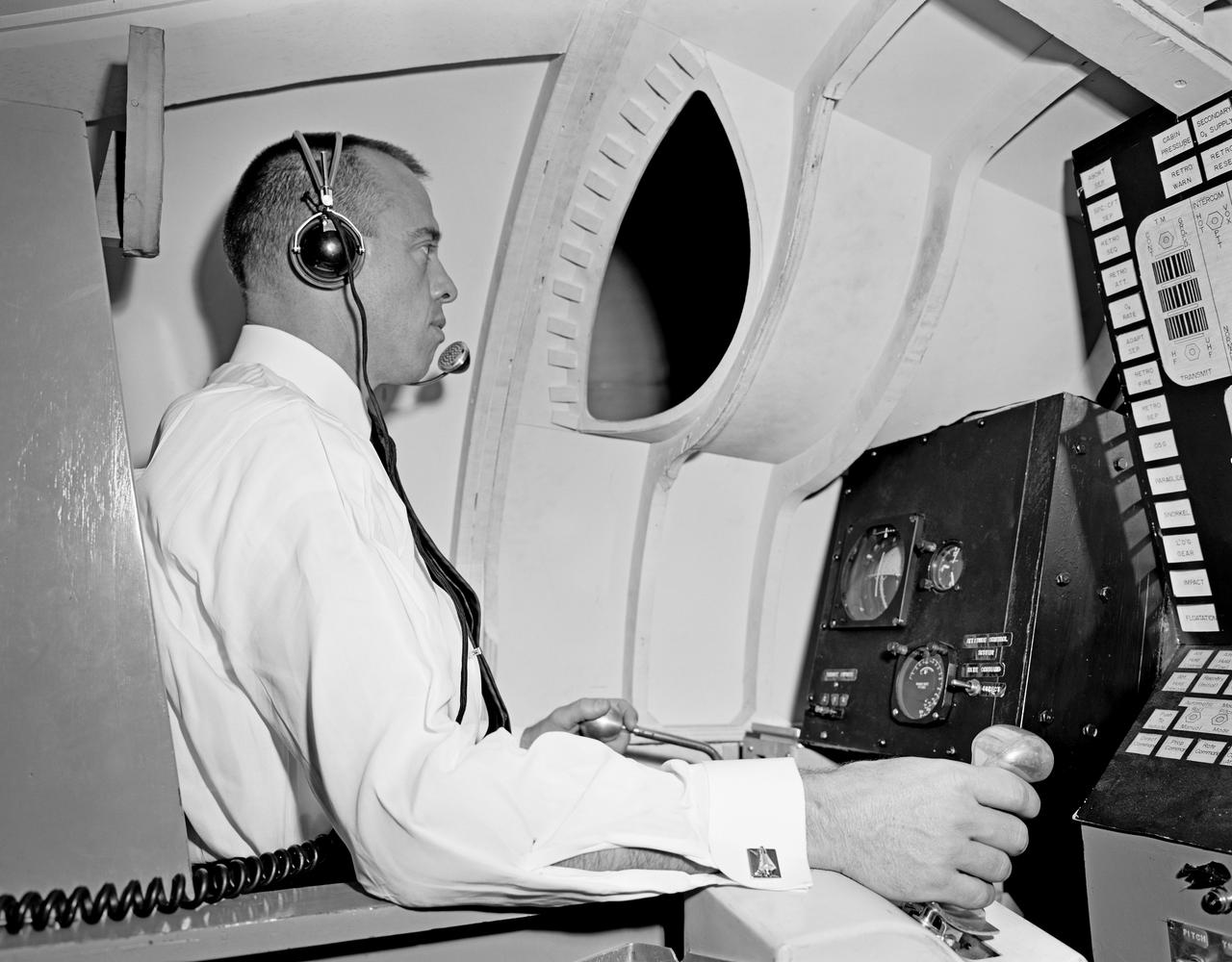
Alan Shepard and engineer looking at equipment, alone in Visual Docking Simulator, with engineers in Visual Docking Simulator.
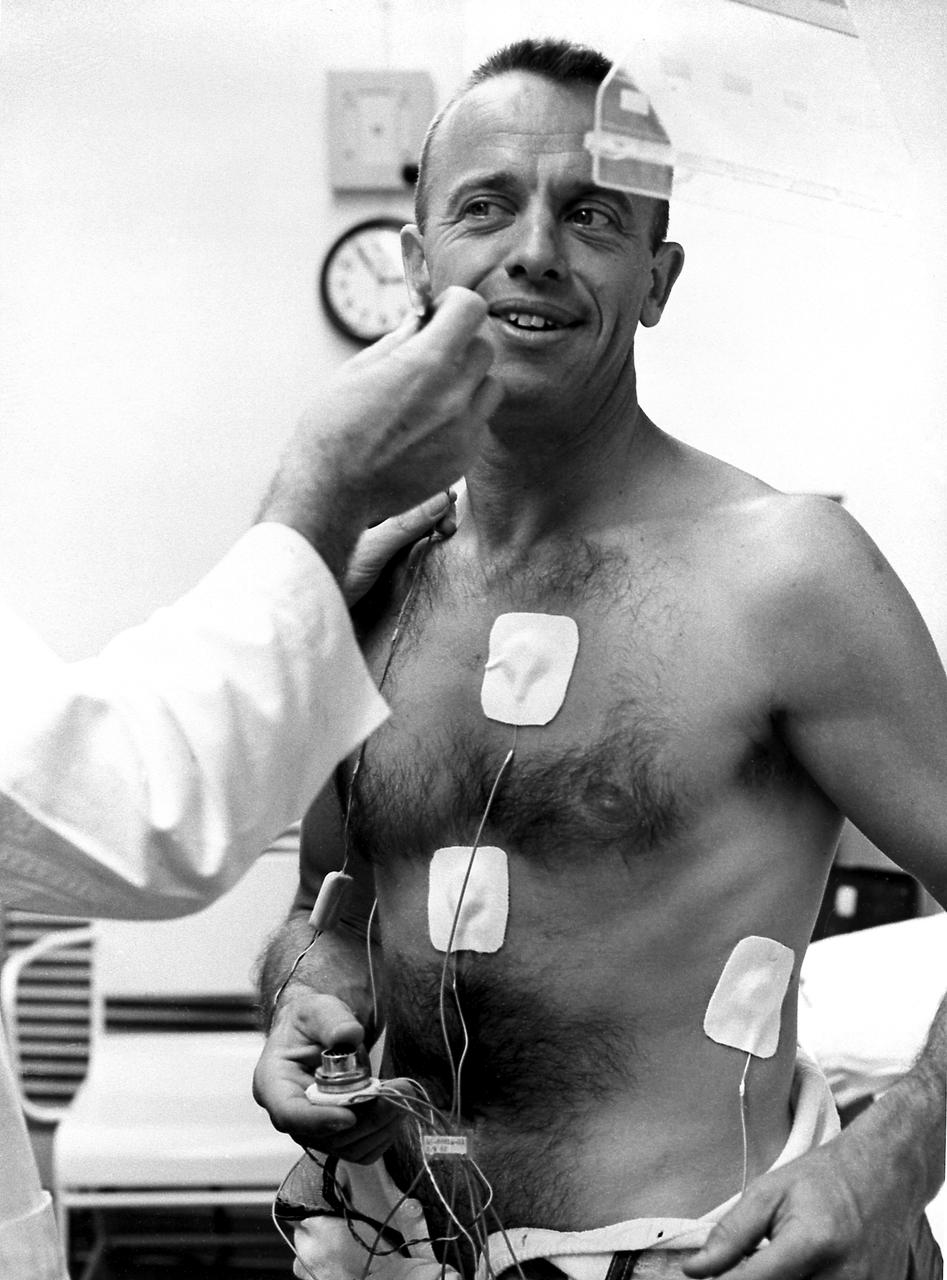
Astronaut Alan Shepard underwent a physical examination prior to the first marned suborbital flight. Freedom 7 carrying Astronaut Alan Shepard, boosted by the Mercury-Redstone launch vehicle, lifted off on May 5, 1961. Astronaut Shepard became the first American in space.
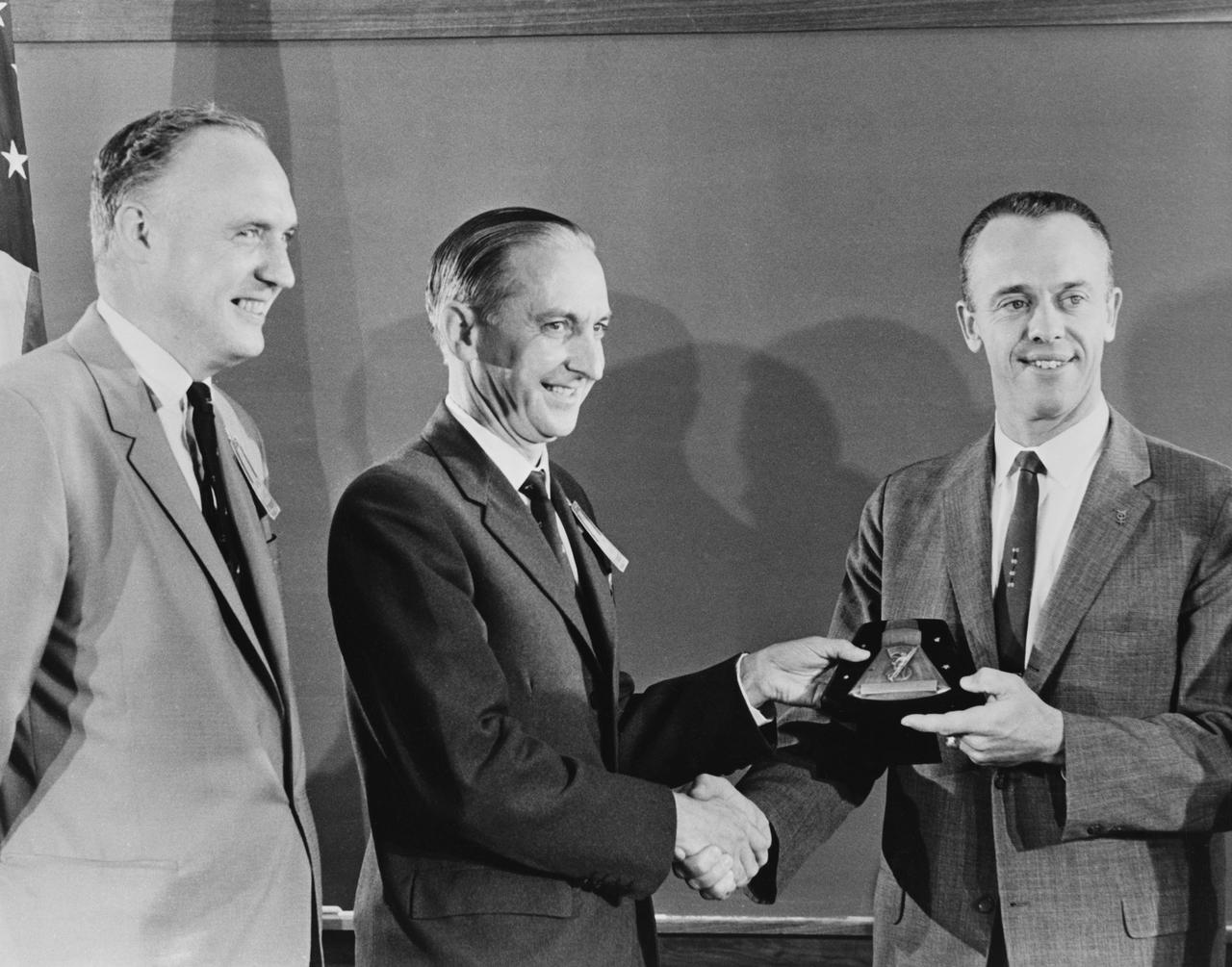
S61-03850 (1 Oct. 1961) --- Astronaut Alan B. Shepard Jr. (right) receives a plaque and award from members of the British Rocket Society. Photo credit: NASA or National Aeronautics and Space Administration
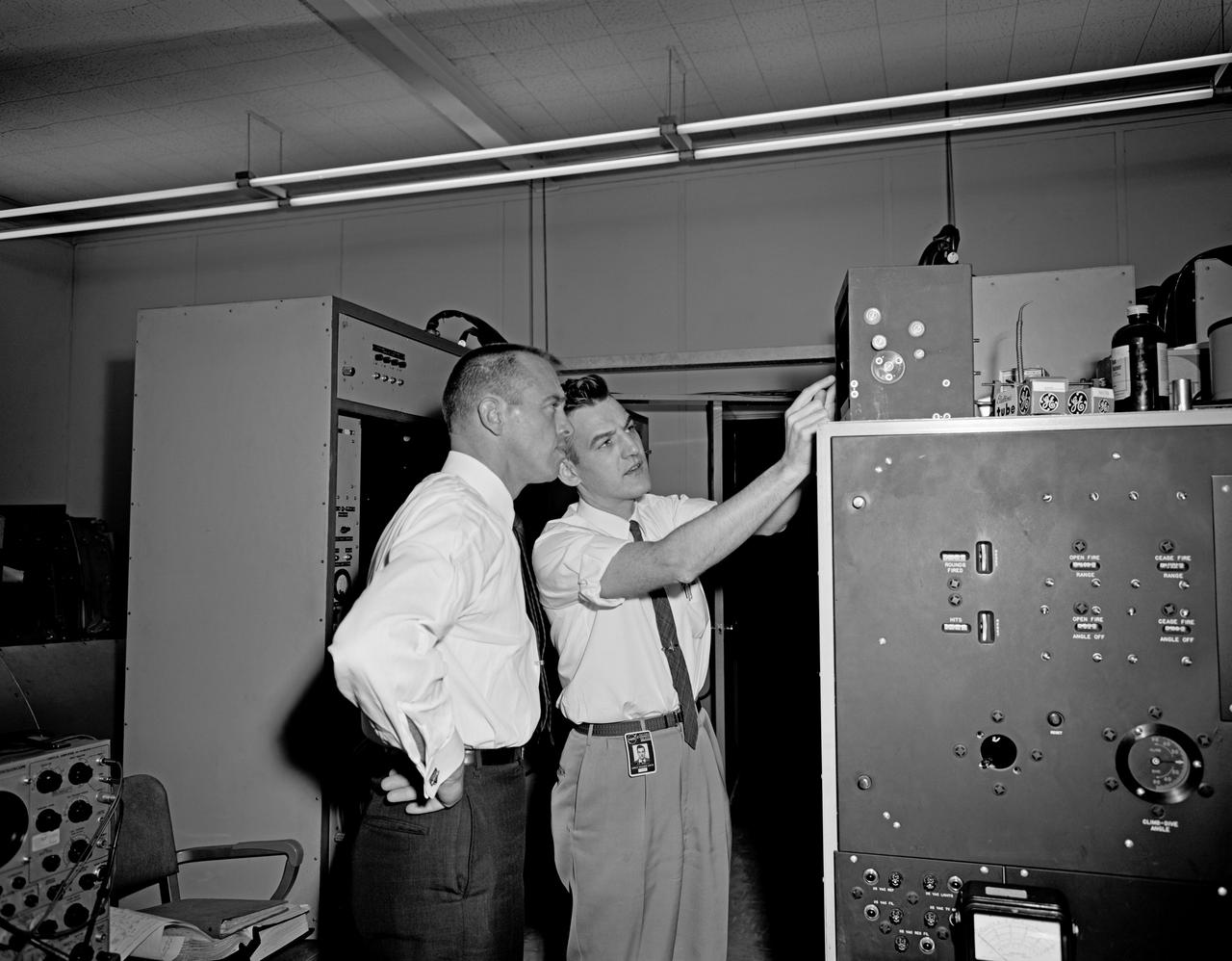
Astronaut Alan Shepard (right) was one of 14 astronauts, 8 NASA test pilots, and 2 McDonnell test pilots who took part in simulator studies. Shepard flew the simulator on November 14, 1963. A.W. Vogeley wrote: "Many of the astronauts have flown this simulator in support of the Gemini studies and they, without exception, appreciated the realism of the visual scene. The simulator has also been used in the development of pilot techniques to handle certain jet malfunctions in order that aborts could be avoided. In these situations large attitude changes are sometimes necessary and the false motion cues that were generated due to earth gravity were somewhat objectionable; however, the pilots were readily able to overlook these false motion cues in favor of the visual realism." Roy F. Brissenden noted that: "The basic Gemini control studies developed the necessary techniques and demonstrated the ability of human pilots to perform final space docking with the specified Gemini-Agena systems using only visual references. ... Results... showed that trained astronauts can effect the docking with direct acceleration control and even with jet malfunctions as long as good visual conditions exist.... Probably more important than data results was the early confidence that the astronauts themselves gained in their ability to perform the maneuver in the ultimate flight mission." Shepard commented: "I had the feeling tonight - a couple of times - that I was actually doing the space mission instead of the simulation. As I said before, I think it is a very good simulation." Shepard also commented on piloting techniques. Most astronauts arrived at this same preferred technique: Shepard: "I believe I have developed the preferred technique for these conditions and the technique appeared to me to be best was to come in slightly above the target so that I was able to use the longitudinal marks on the body of the target as a reference, particularly for a lateral translation and, of course, I used the foreshortening effect for a vertical translation, and this appeared to give me the best results. By that I mean the least number of control motions and the lowest fuel usage and the best end techniques, or the best end conditions, I should say." Engineer: "When you started to run you didn't start thrusting immediately I don't believe. It looked like you started working on your attitudes, then started closing in." Shepard: "That is correct. I did that because I felt that I wanted to get the X-axis translation in the most effective vector and for minimum fuel usage that wouldn't introduce any other lateral or vertical offsets that did not already exist." -- Published in Barton C. Hacker and James M. Grimwood, On the Shoulders of Titans: A History of Project Gemini, NASA SP-4203; A.W. Vogeley, "Discussion of Existing and Planned Simulators For Space Research," Paper presented at the Conference on the Role of Simulation in Space Technology, August 17-21, 1964; Roy F. Brissenden, "Initial Operations with Langley's Rendezvous Docking Facility," Langley Working Paper, LWP-21, 1964.
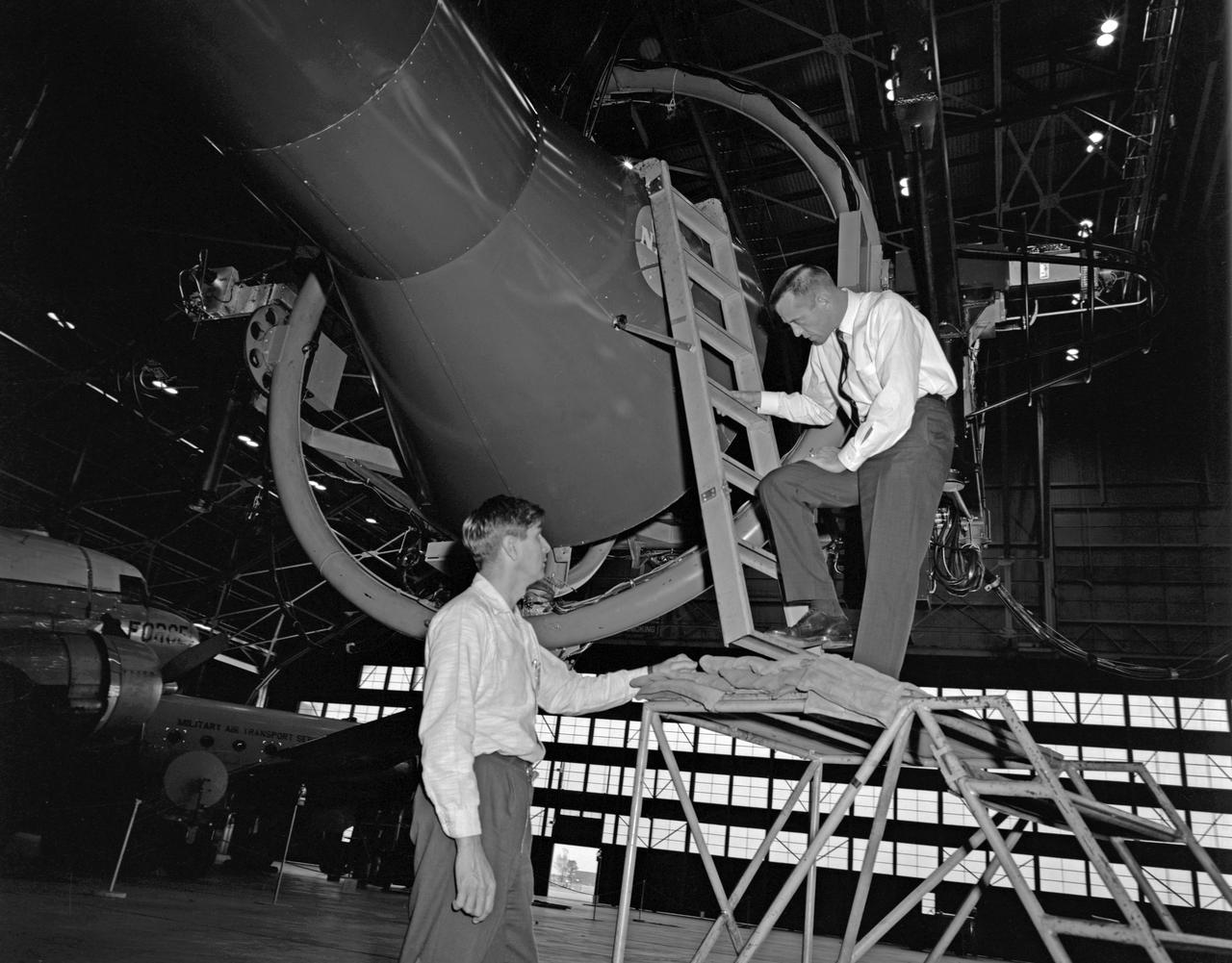
Astronaut Alan Shepard (right) was one of 14 astronauts, 8 NASA test pilots, and 2 McDonnell test pilots who took part in simulator studies. Shepard flew the simulator on November 14, 1963. A.W. Vogeley wrote: "Many of the astronauts have flown this simulator in support of the Gemini studies and they, without exception, appreciated the realism of the visual scene. The simulator has also been used in the development of pilot techniques to handle certain jet malfunctions in order that aborts could be avoided. In these situations large attitude changes are sometimes necessary and the false motion cues that were generated due to earth gravity were somewhat objectionable; however, the pilots were readily able to overlook these false motion cues in favor of the visual realism." Roy F. Brissenden noted that: "The basic Gemini control studies developed the necessary techniques and demonstrated the ability of human pilots to perform final space docking with the specified Gemini-Agena systems using only visual references. ... Results... showed that trained astronauts can effect the docking with direct acceleration control and even with jet malfunctions as long as good visual conditions exist.... Probably more important than data results was the early confidence that the astronauts themselves gained in their ability to perform the maneuver in the ultimate flight mission." Shepard commented: "I had the feeling tonight - a couple of times - that I was actually doing the space mission instead of the simulation. As I said before, I think it is a very good simulation." Shepard also commented on piloting techniques. Most astronauts arrived at this same preferred technique: Shepard: "I believe I have developed the preferred technique for these conditions and the technique appeared to me to be best was to come in slightly above the target so that I was able to use the longitudinal marks on the body of the target as a reference, particularly for a lateral translation and, of course, I used the foreshortening effect for a vertical translation, and this appeared to give me the best results. By that I mean the least number of control motions and the lowest fuel usage and the best end techniques, or the best end conditions, I should say." Engineer: "When you started to run you didn't start thrusting immediately I don't believe. It looked like you started working on your attitudes, then started closing in." Shepard: "That is correct. I did that because I felt that I wanted to get the X-axis translation in the most effective vector and for minimum fuel usage that wouldn't introduce any other lateral or vertical offsets that did not already exist." -- Published in Barton C. Hacker and James M. Grimwood, On the Shoulders of Titans: A History of Project Gemini, NASA SP-4203; A.W. Vogeley, "Discussion of Existing and Planned Simulators For Space Research," Paper presented at the Conference on the Role of Simulation in Space Technology, August 17-21, 1964; Roy F. Brissenden, "Initial Operations with Langley's Rendezvous Docking Facility," Langley Working Paper, LWP-21, 1964.
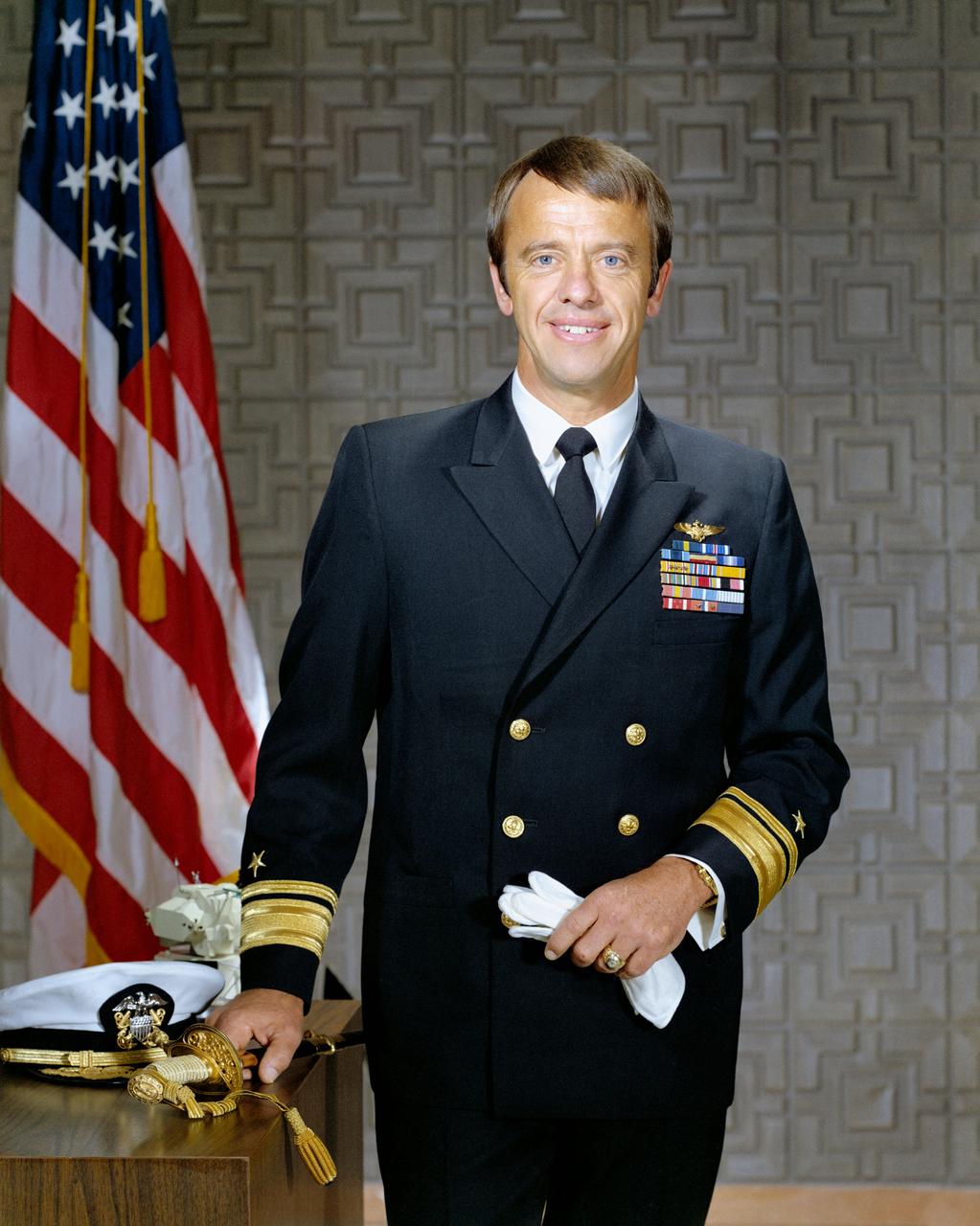
S71-52263 (1971) --- Astronaut Alan B. Shepard Jr.
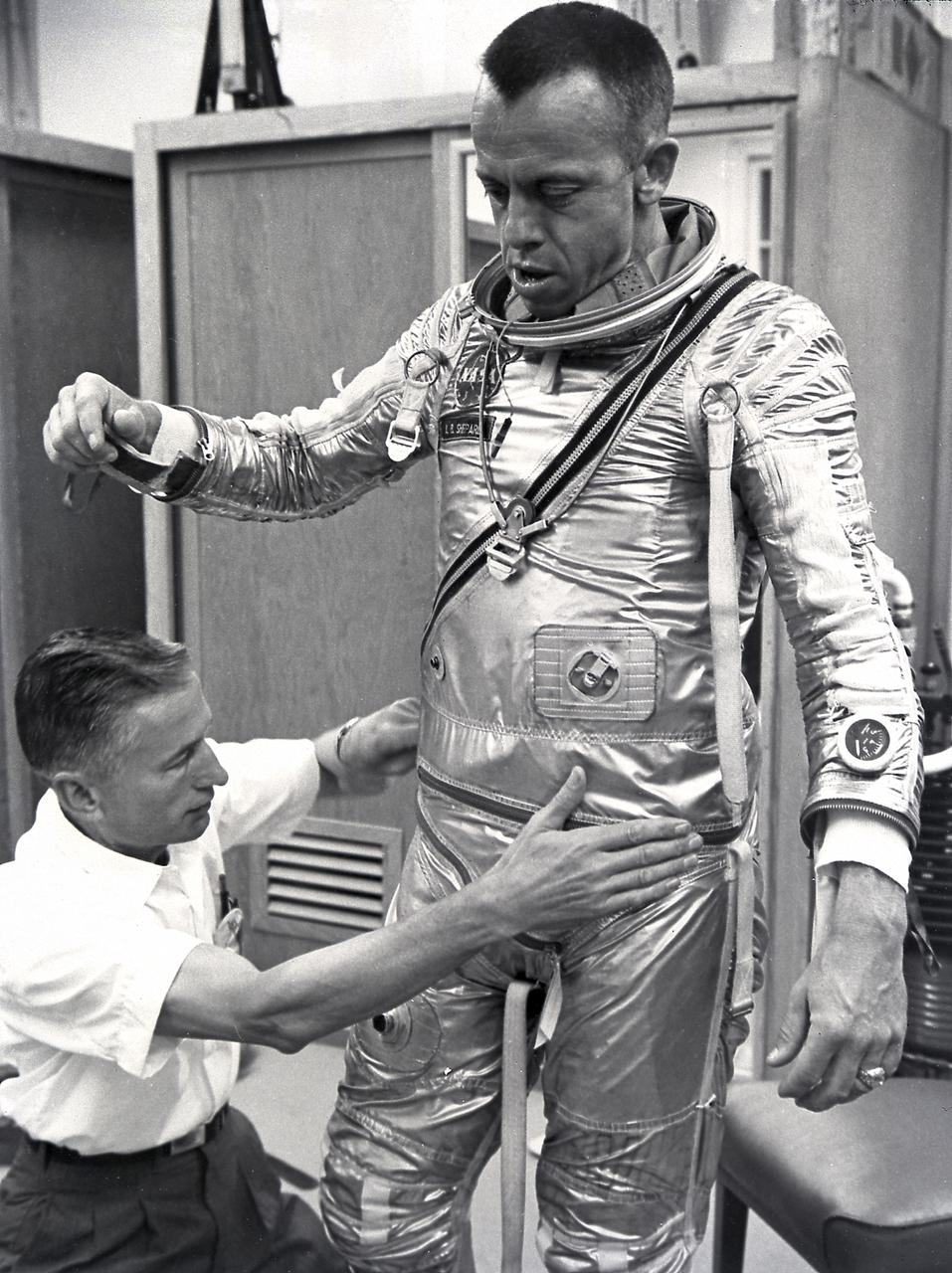
Astronaut Alan Shepard fitted with space suit prior to the first marned suborbital flight. Freedom 7, carrying Astronaut Alan Shepard, boosted by the Mercury-Redstone launch vehicle, lifted off on May 5, 1961. Astronaut Shepard became the first American in space.
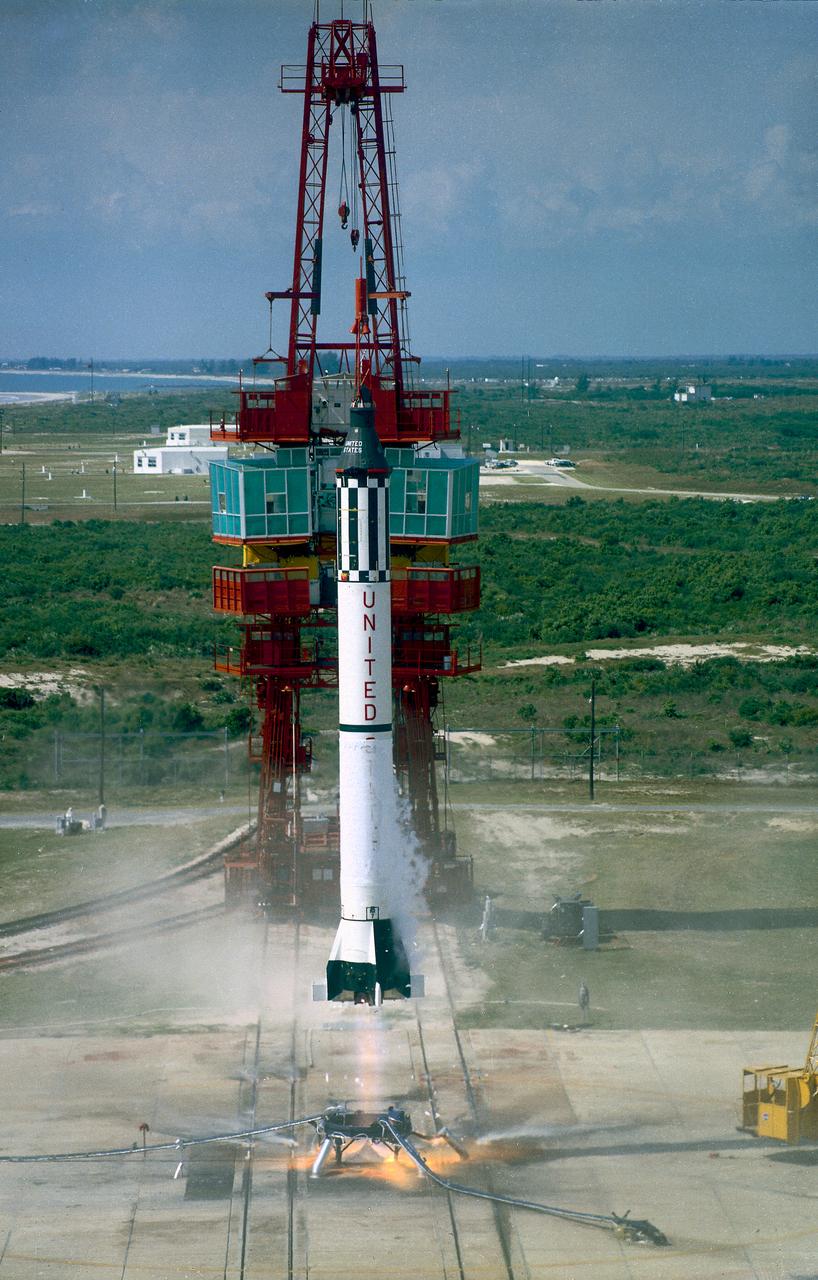
The launch of the Mercury-Redstone (MR-3), Freedom 7. MR-3 placed the first American astronaut, Alan Shepard, in suborbit on May 5, 1961.
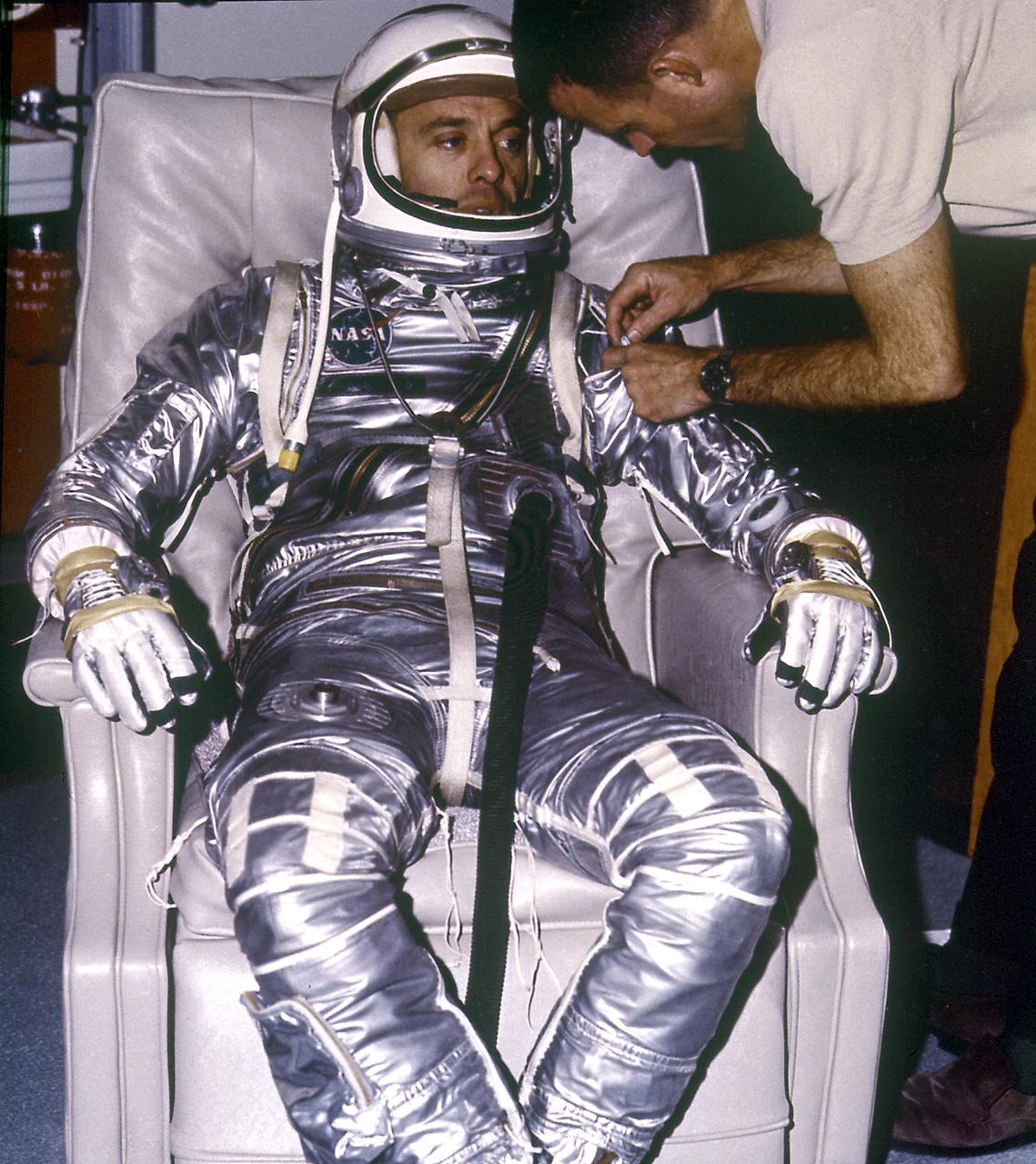
Astronaut Alan B. Shepard, Jr. during suiting for the first manned suborbital flight, MR-3 mission. The Freedom 7 spacecraft, carrying the first American, Astronaut Shepard and boosted by the Mercury-Redstone launch vehicle, lifted off on May 5, 1961.
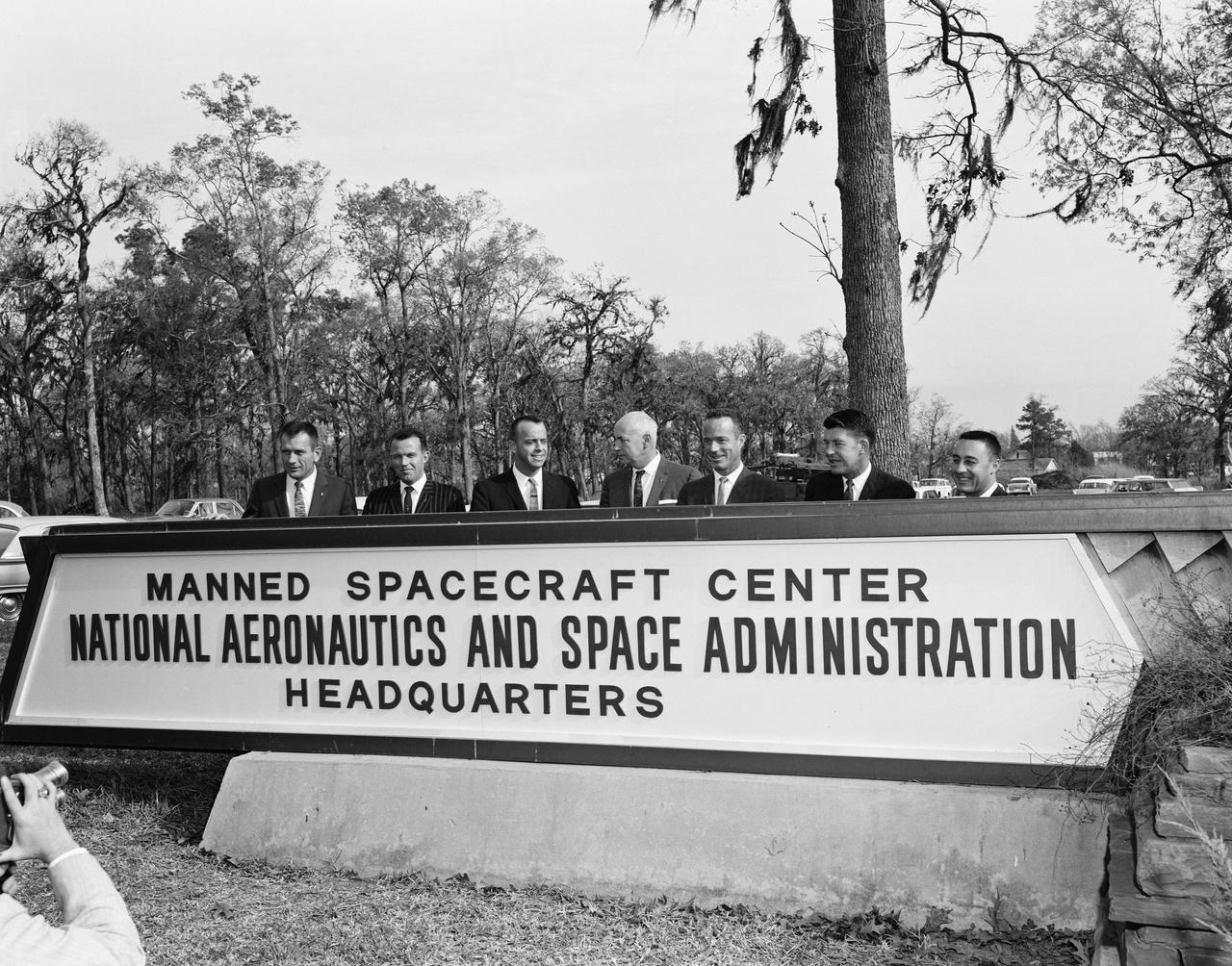
Astronaut Alan Shepard with Gilruth, and Astronauts Slayton, Cooper, Carpenter, Schirra, Grissom around the Manned Spacecraft Center (MSC) sign at the Farnsworth-Chambers Bldg. FARNSWORTH-CHAMBERS BLDG., HOUSTON, TX B&W
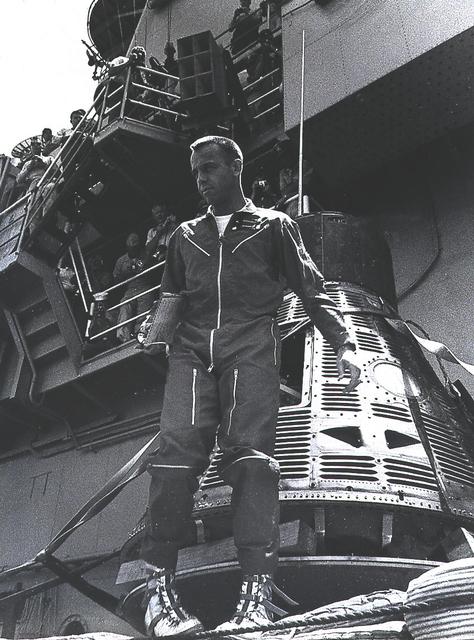
Alan B. Shepard, Jr., America's first astronaut, stands in front of the Freedom 7 spacecraft shortly after completion of the third flight of the Mercury-Redstone (MR-3) vehicle, May 5, 1961. During the 15-minute suborbital flight, the Freedom 7 Mercury spacecraft, launched atop a modified Redstone rocket developed by Dr. Wernher von Braun and the rocket team in Huntsville, Alabama, reached an altitude of 115 miles and traveled 302 miles downrange.
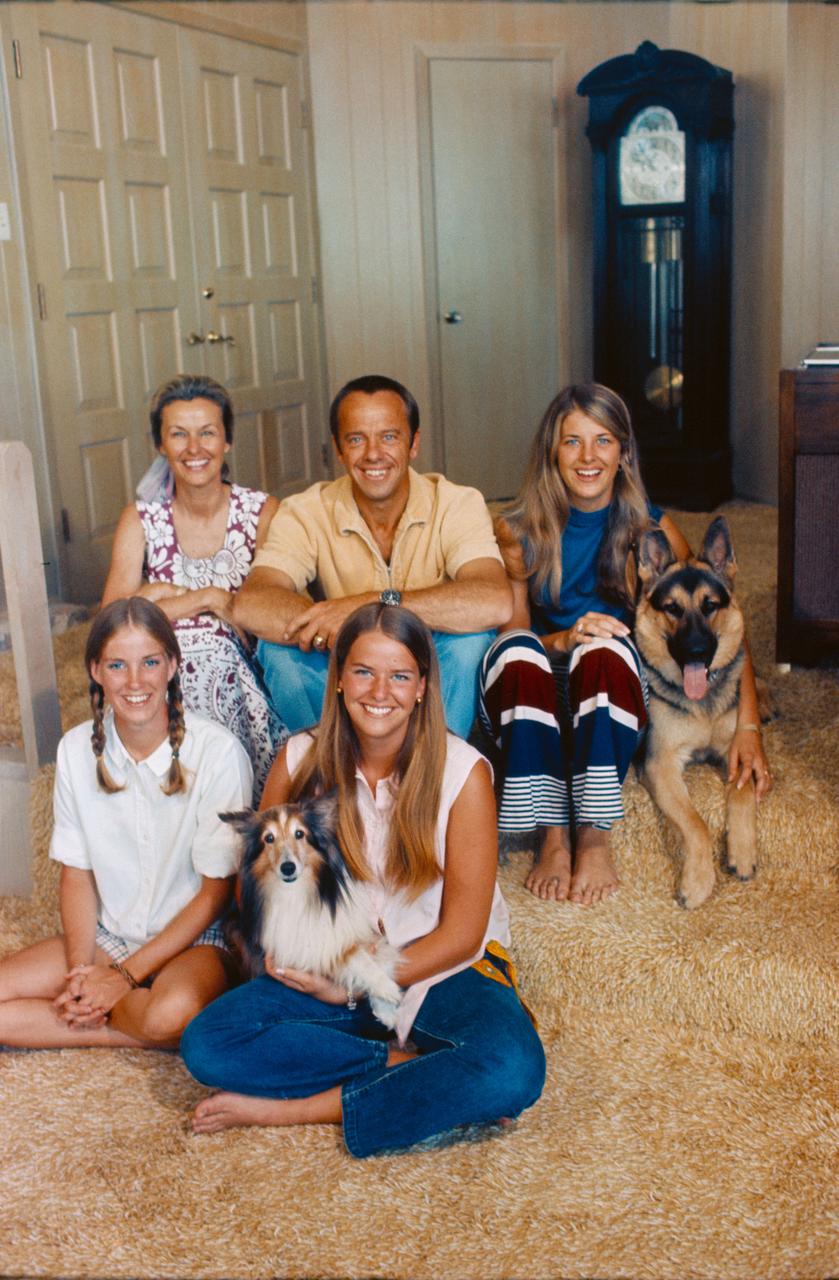
S71-17356 (January 1971) --- This is a family portrait of astronaut Alan B. Shepard Jr. and his family. Shepard is the commander of the Apollo 14 lunar landing mission. The family includes Mrs. Shepard, the former Louise Brewer; Laura Shepard Snyder (seated on Shepard's left), born on July 2, 1947; Julie Shepard (right foreground), born on March 16, 1951; and Alice Shepard (left foreground), a niece of Mrs. Shepard.
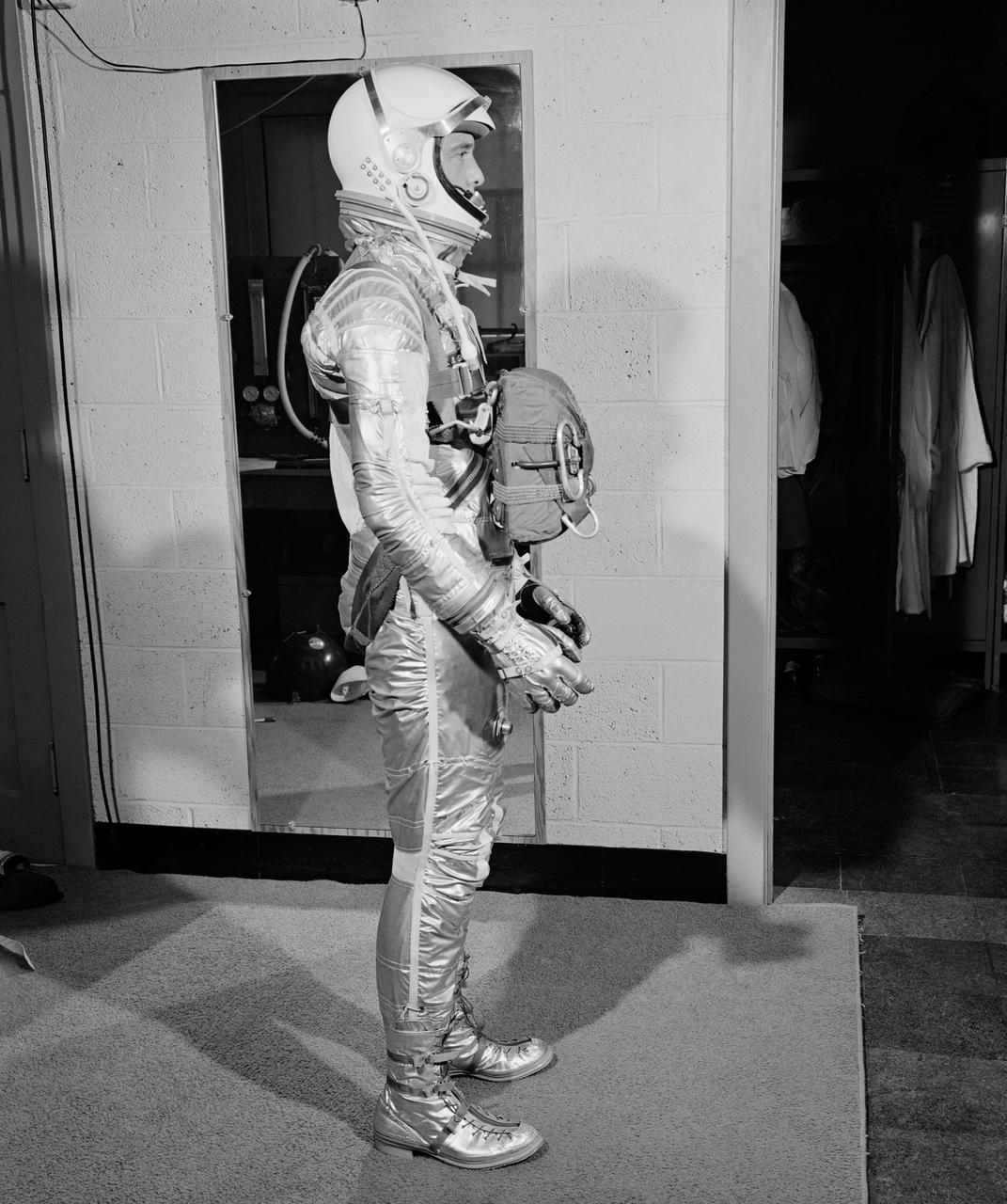
G60-02665 (1960) --- Astronaut Alan B. Shepard Jr., Mercury-Redstone 3 (MR-3) pilot, wearing pressure suit with body parachute. Photo credit: NASA or National Aeronautics and Space Administration
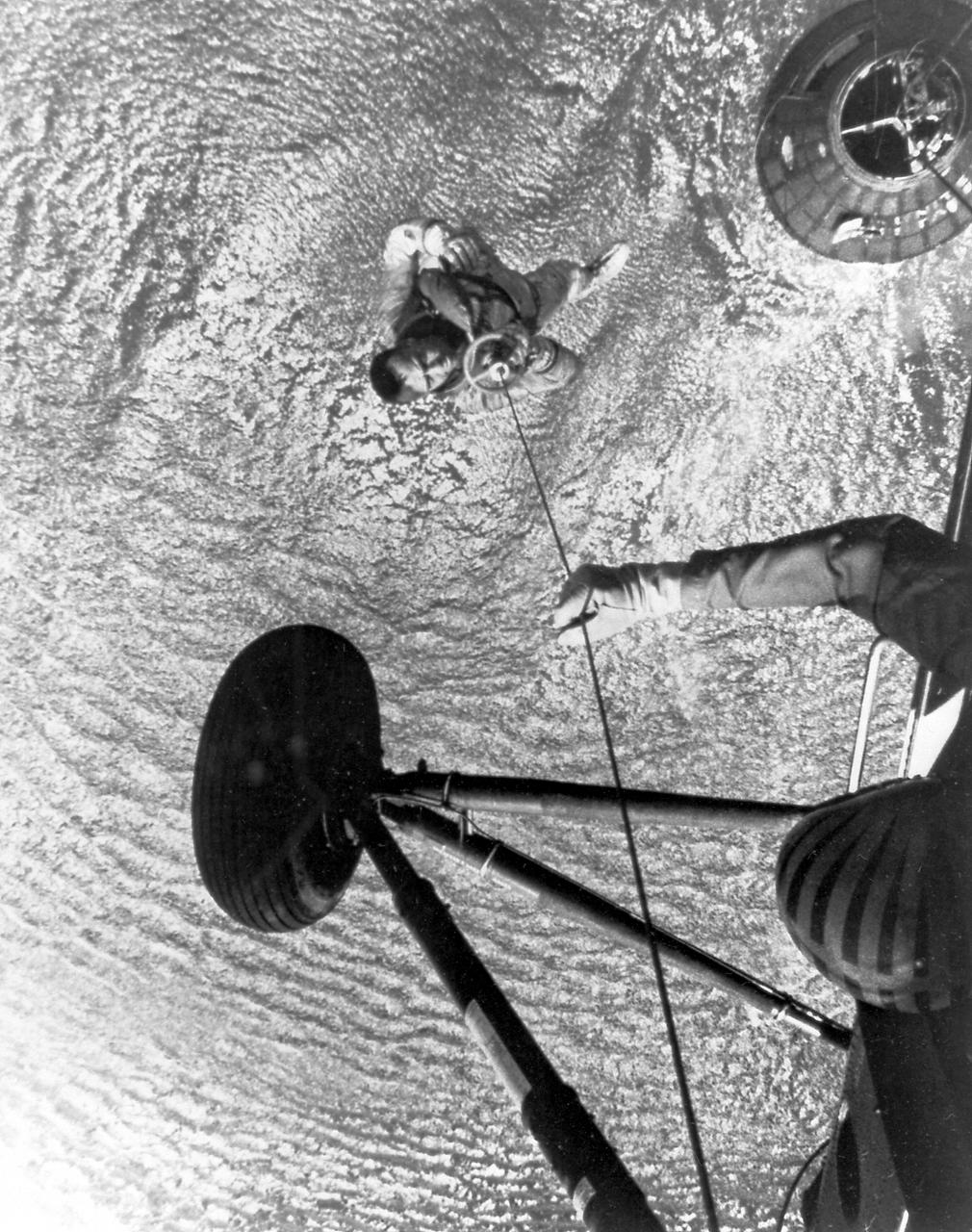
This photo depicts the recovery operations of the MR-3 mission. Astronaut Alan Shepard was picked up by a U.S. Marine helicopter after the completion of the first marned suborbital flight by MR-3 (Mercury-Redstone) with the Freedom 7 capsule.
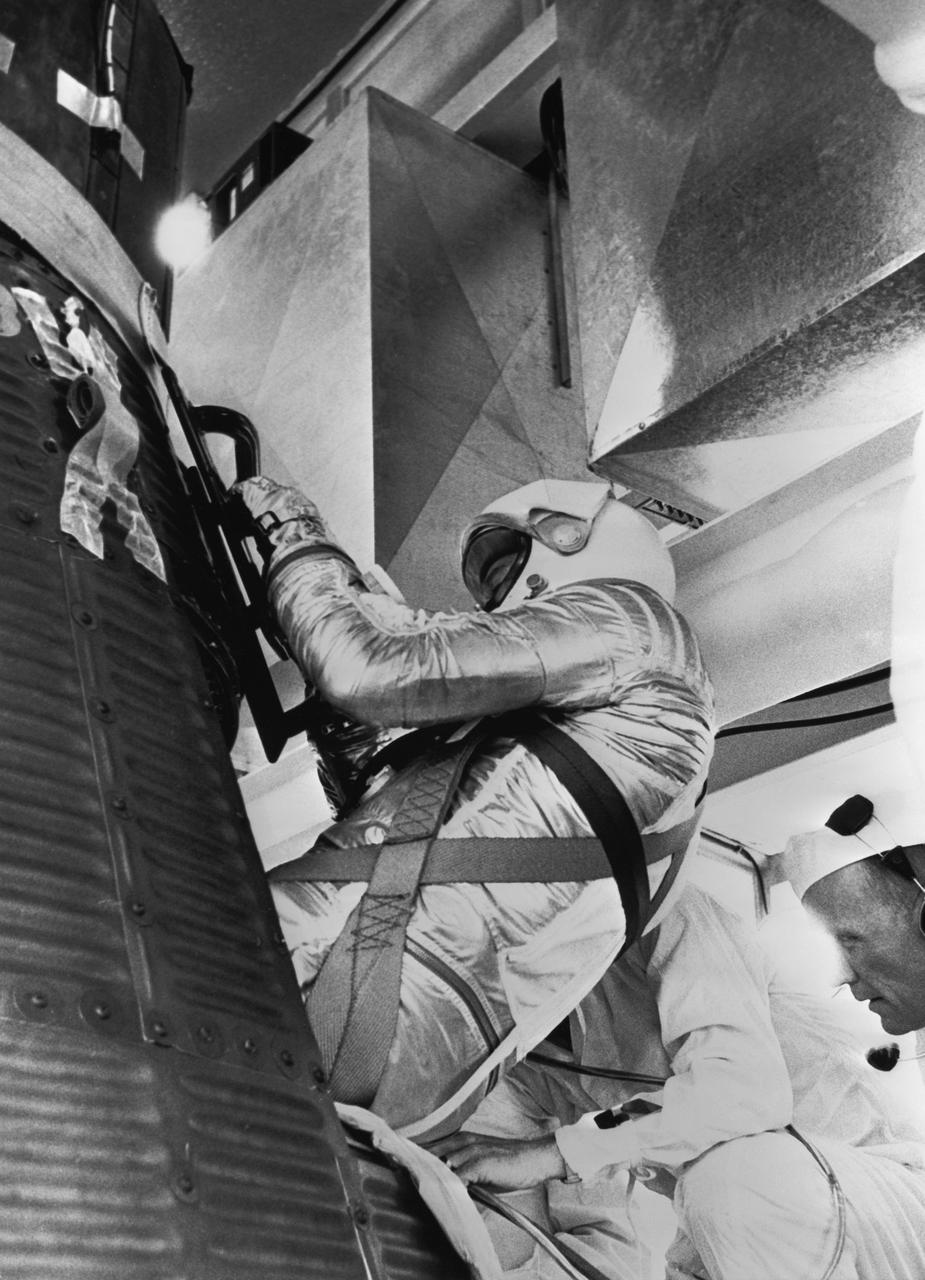
S61-03651 (5 May 1961) --- Astronaut Alan B. Shepard Jr., in his pressure suit and helmet, is being inserted into the Freedom 7 capsule in preparation for the Mercury-Redstone 3 (MR-3) mission. Photo credit: NASA or National Aeronautics and Space Administration
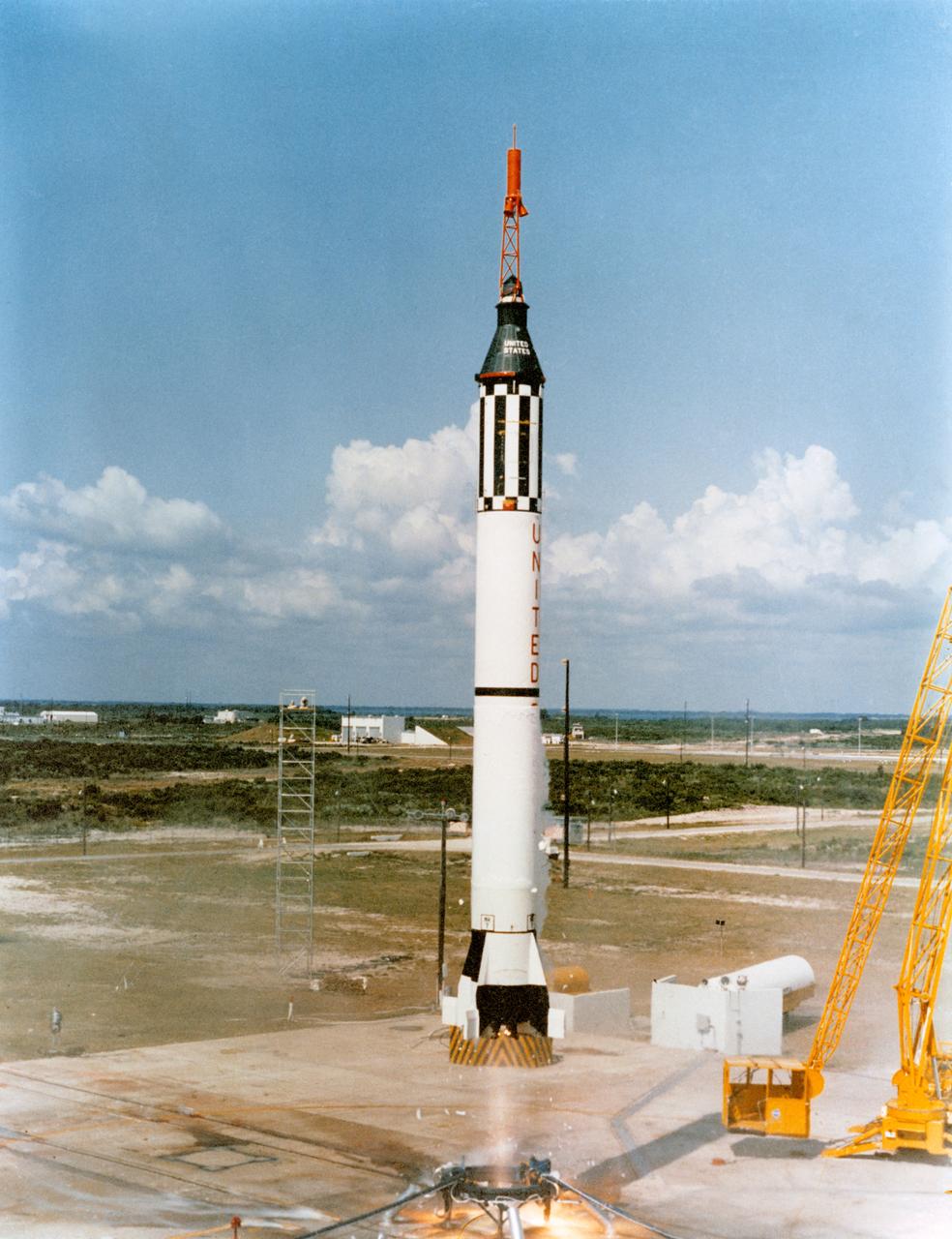
S61-01927 (5 May 1961) --- Mercury-Redstone 3 (MR-3), the United States' first manned spaceflight, is launched from Cape Canaveral on a suborbital mission. Astronaut Alan B. Shepard Jr. was the pilot of the Mercury spacecraft, designated "Freedom 7". The spacecraft attained a maximum speed of 5,180 miles per hour (mph), reached an altitude of 116 1/2 statute miles, and landed 302 statute miles downrange from Cape Canaveral, Florida. Photo credit: NASA or National Aeronautics and Space Administration
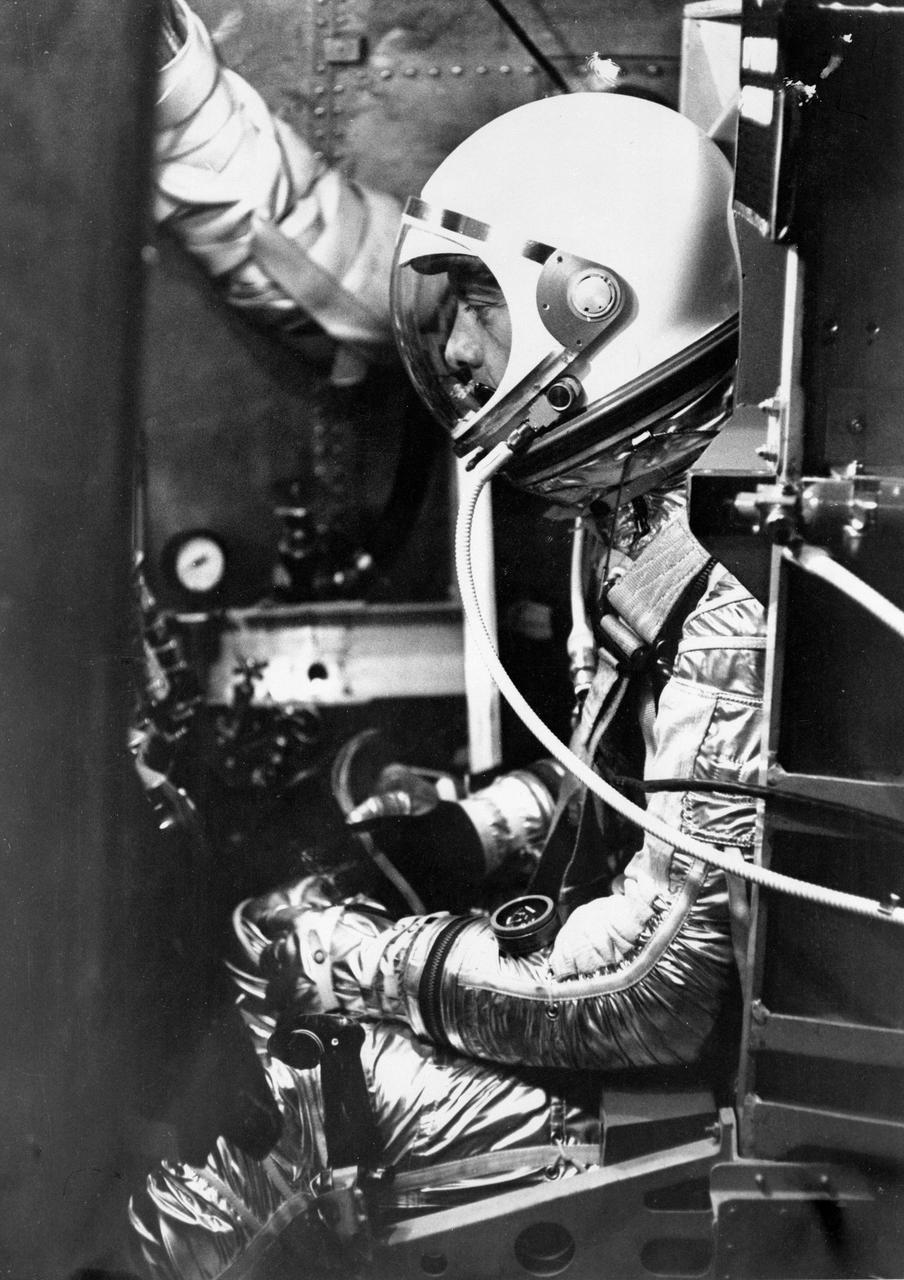
G60-02402 (1960) --- Astronaut Alan B. Shepard Jr. prepares for testing in a capsule of the U.S. Navy's centrifuge at Johnsville, Pennsylvania. Photo credit: NASA or National Aeronautics and Space Administration
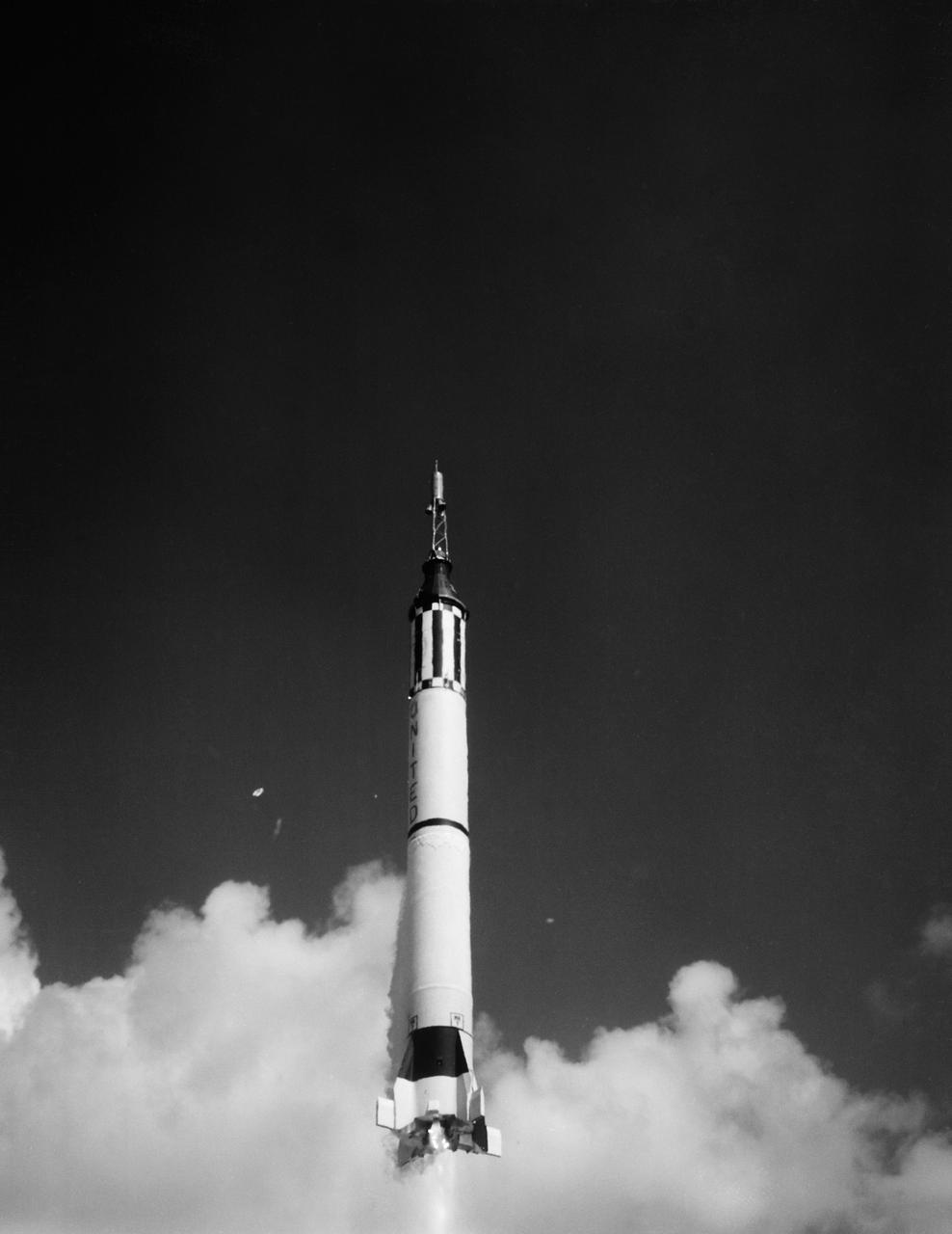
S61-02409 (5 May 1961) --- Launching of the Mercury-Redstone 3 (MR-3) rocket from Cape Canaveral on astronaut Alan B. Shepard?s suborbital mission. Photo credit: NASA or National Aeronautics and Space Administration
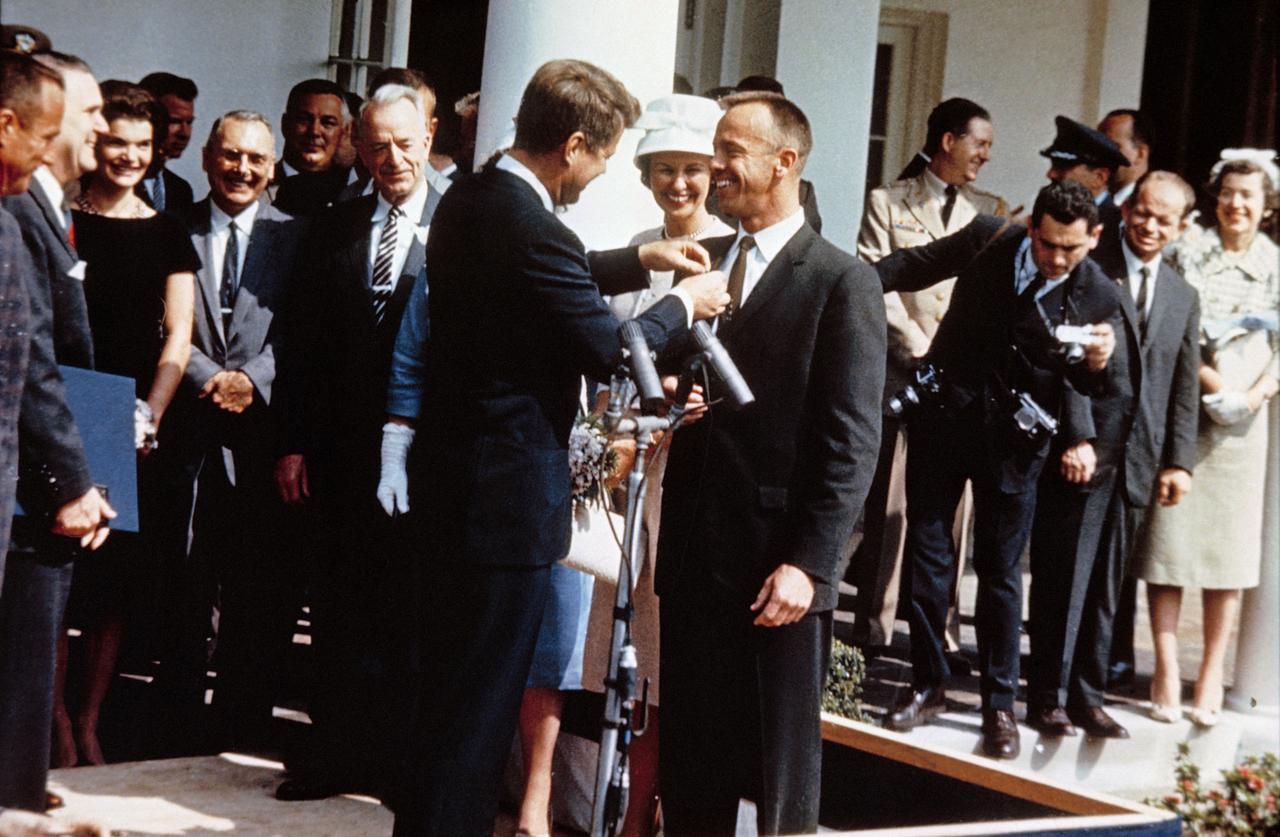
S63-06268 (8 May 1963) --- Astronaut Alan B. Shepard, Jr., receives his NASA's Distinguished Service Medal from President John F. Kennedy, after his Mercury-Redstone 3 (MR-3) flight, in a Rose Garden ceremony on May 8, 1961 at the White House.
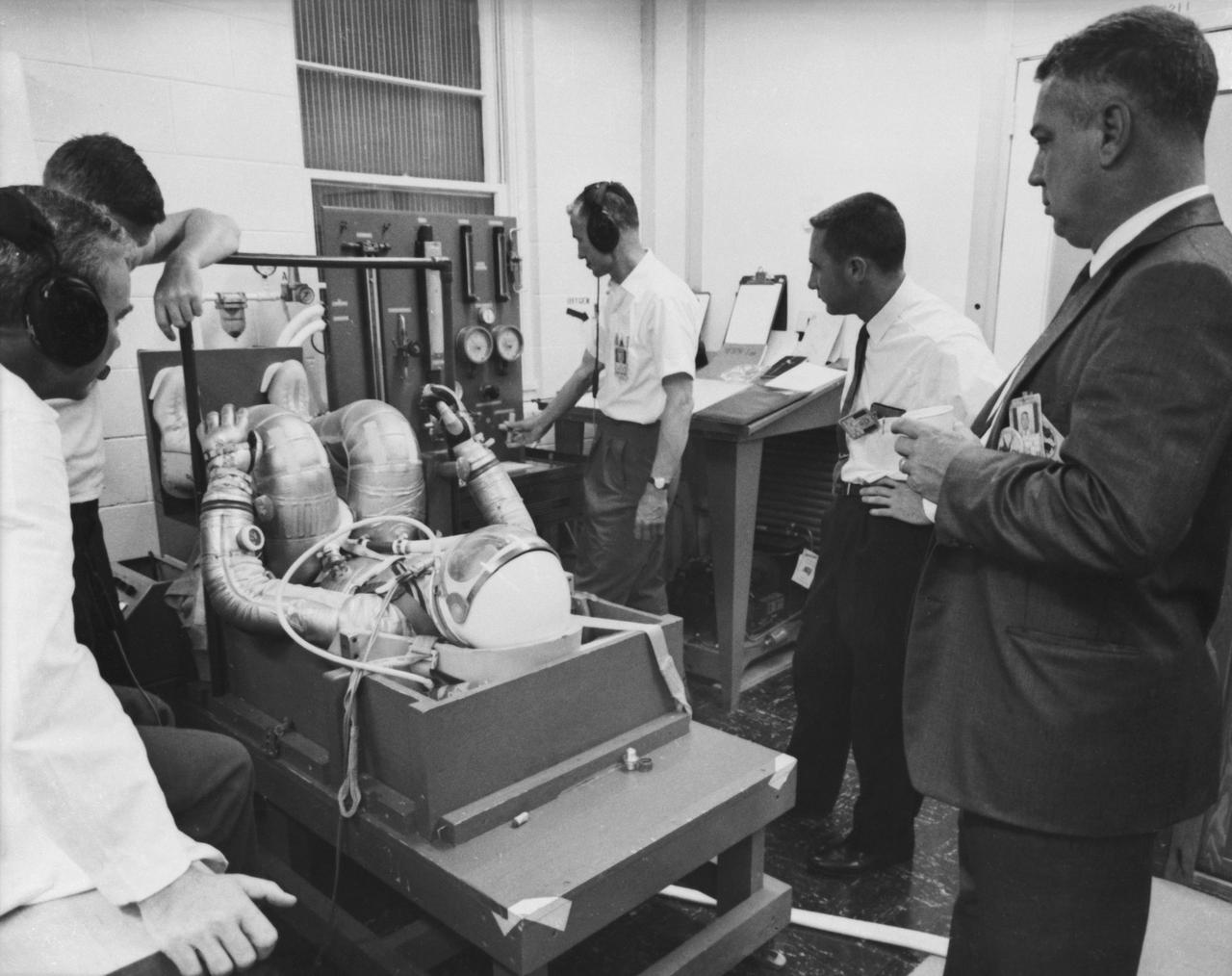
S61-02767 (5 May 1961) --- Astronaut Alan B. Shepard Jr. in flight couch for final check before insertion into capsule for his Mercury-Redstone 3 (MR-3) flight. Photo credit: NASA or National Aeronautics and Space Administration
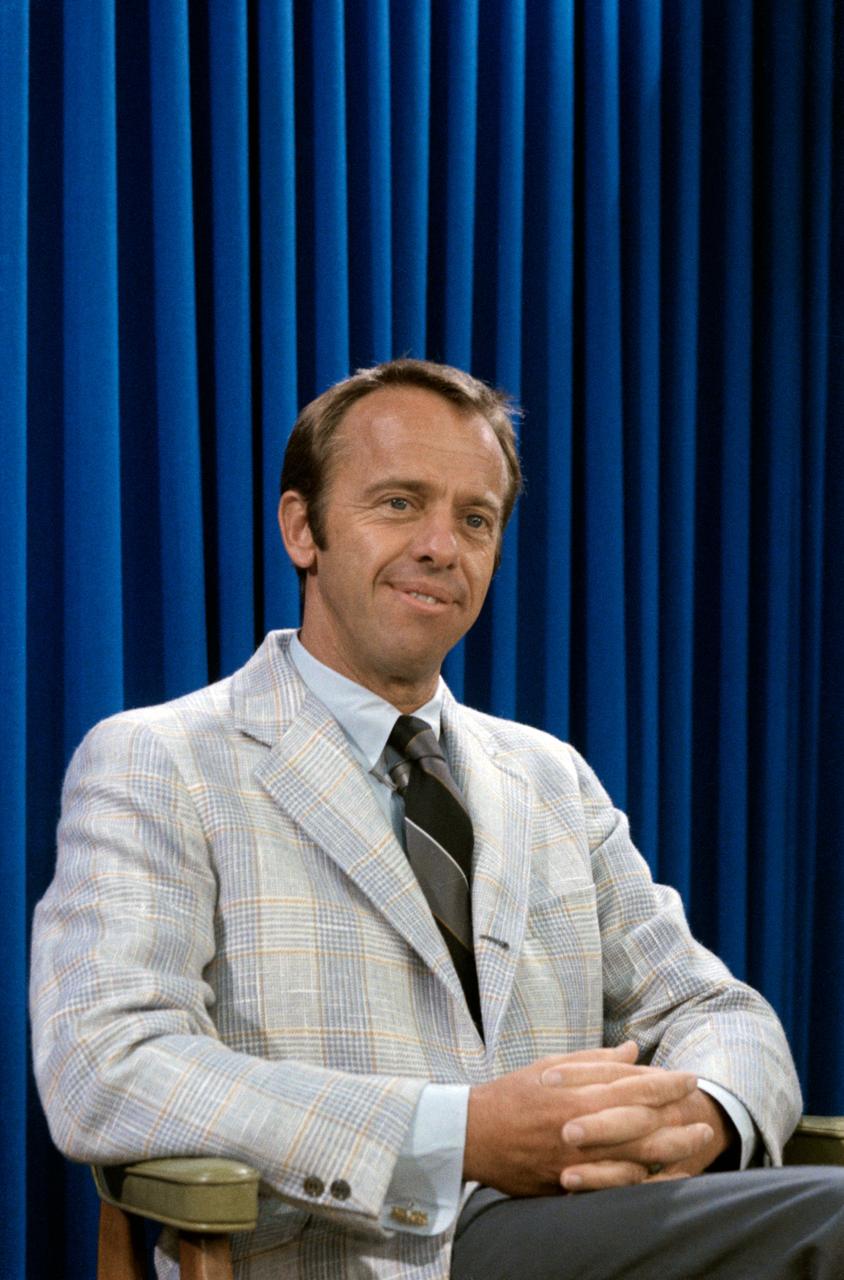
S70-45232 (14 July 1970) --- Astronaut Alan B. Shepard Jr., commander of the Apollo 14 lunar landing mission. Photo credit: NASA
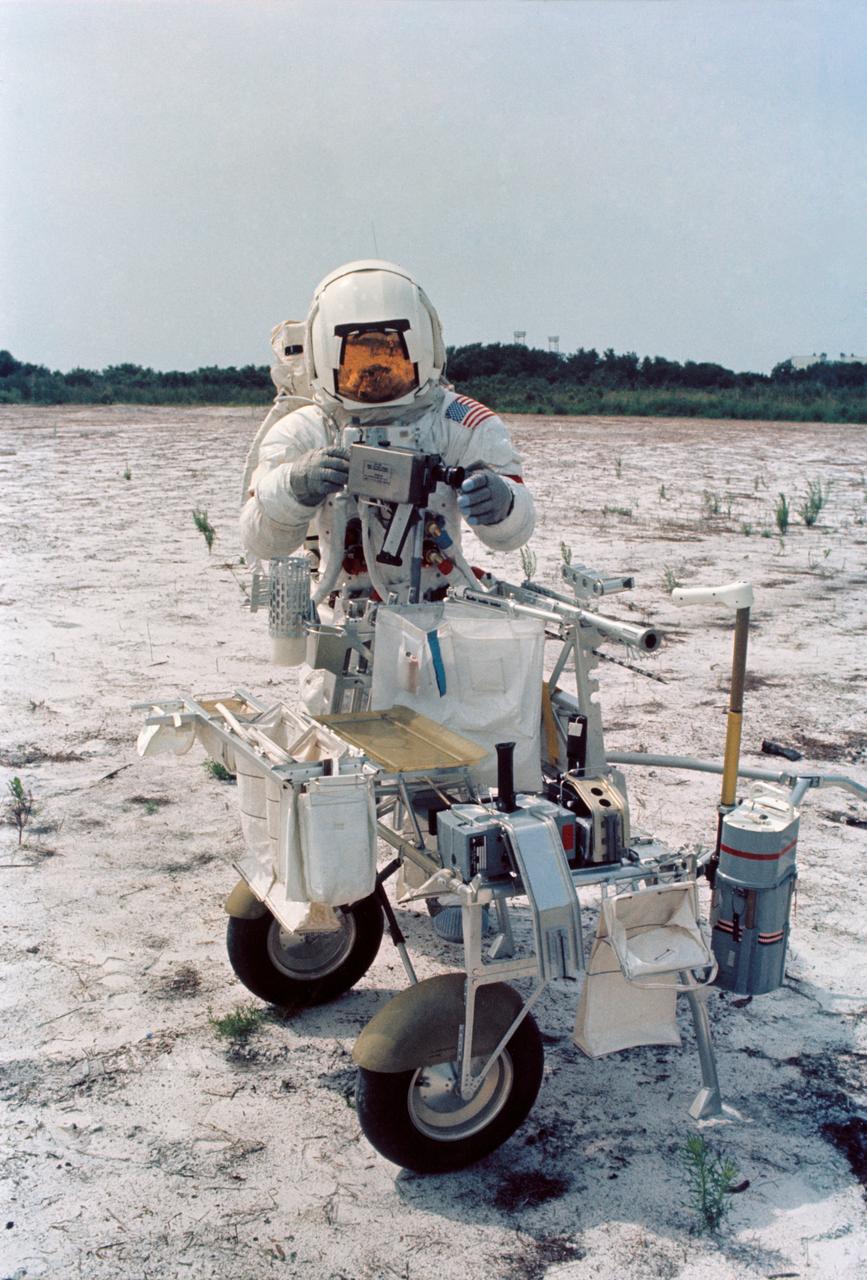
S70-46191 (July 1970) --- Astronaut Alan B. Shepard Jr., commander of the Apollo 14 lunar landing mission, participates in lunar surface training at the Kennedy Space Center (KSC). Shepard is adjusting a camera mounted to the modular equipment transporter (MET). The MET, nicknamed the "Rickshaw", will serve as a portable work bench with a place for the Apollo lunar hand tools and their carrier, three cameras, two sample container bags, a special environment sample container, spare magazines, and a lunar surface Penetrometer. Shepard is wearing an Extravehicular Mobility Unit (EMU).
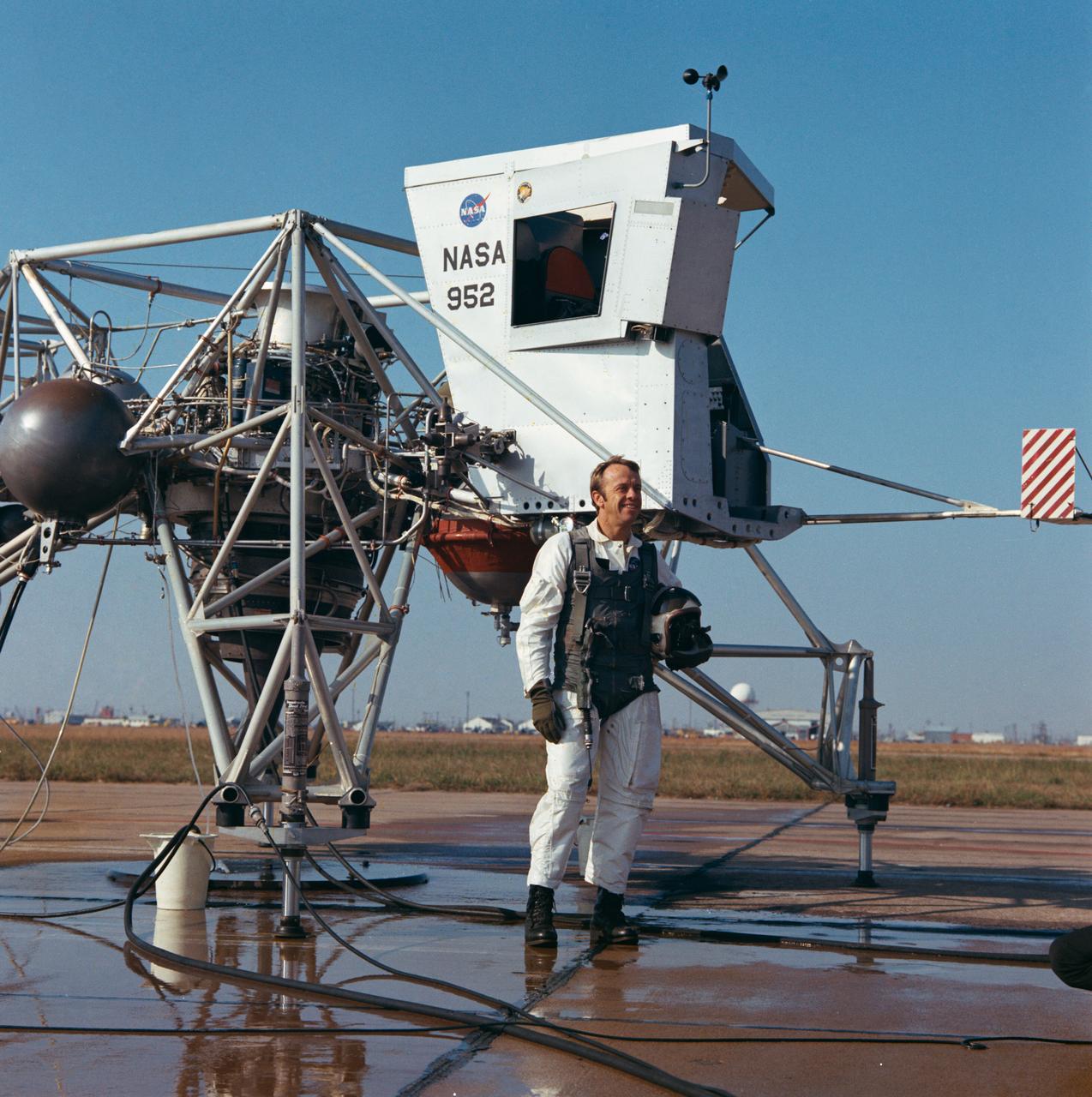
S70-56287 (14 Dec. 1970) --- Astronaut Alan B. Shepard Jr., commander of the Apollo 14 lunar landing mission, stands near a Lunar Landing Training Vehicle (LLTV) prior to a test flight at Ellington Air Force Base, Houston, on Dec. 14, 1970. Shepard will be at the controls of the Apollo 14 Lunar Module (LM) when it lands on the moon in the highlands near Fra Mauro. Astronaut Stuart A. Roosa, command module pilot, will remain with the Command and Service Modules (CSM) in lunar orbit while astronauts Shepard and Edgar D. Mitchell, lunar module pilot, descend in the LM to explore the moon.
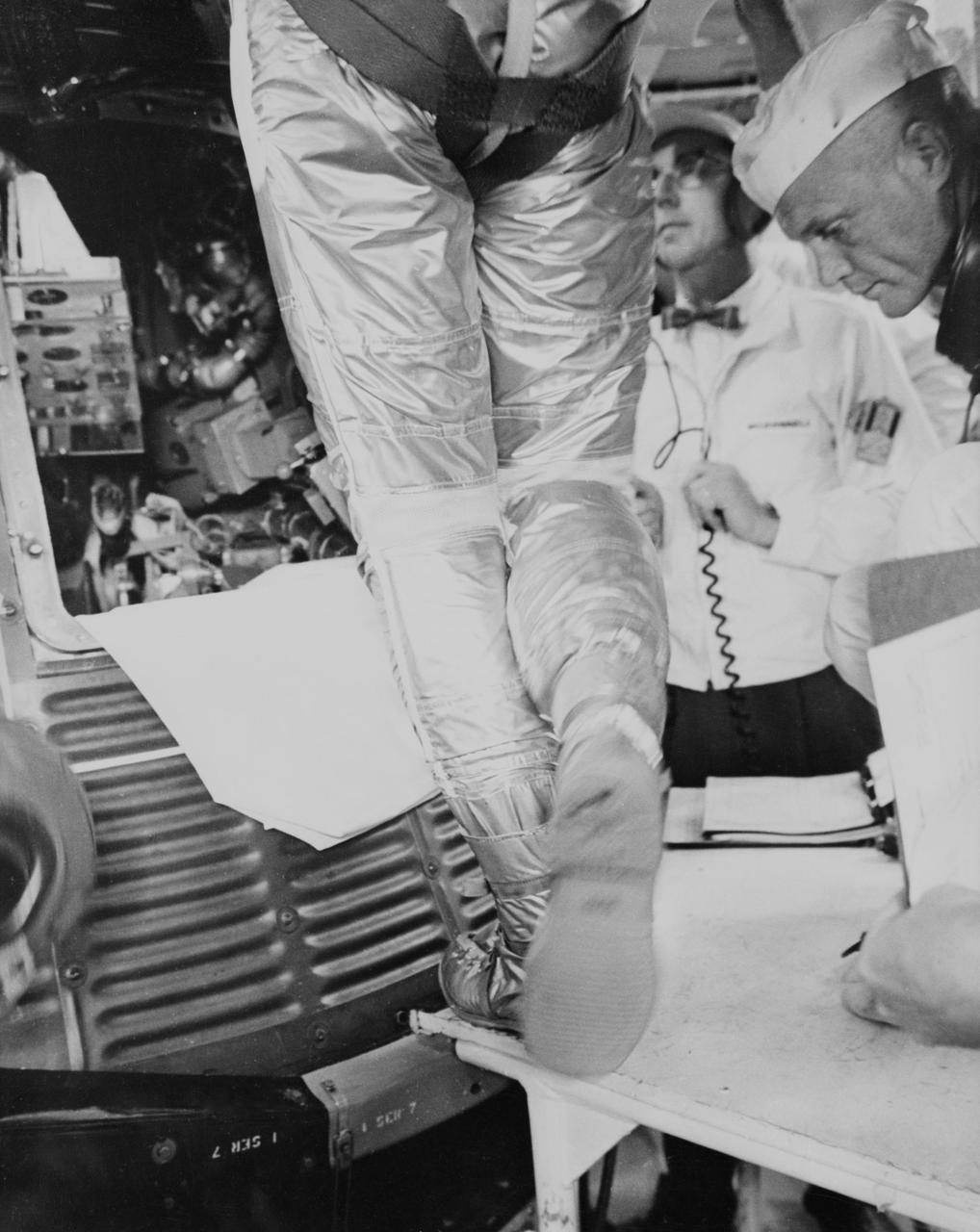
S61-02796 (5 May 1961) --- Rear view of astronaut Alan B. Shepard Jr., in his pressure suit and helmet, as he approaches the Freedom 7 capsule in preparation for ingress before the Mercury-Redstone 3 mission. All that can be seen of the astronaut is his legs. Photo credit: NASA or National Aeronautics and Space Administration

S88-31388 (8 May 1961) --- Astronaut Alan B. Shepard Jr. (center), along with wife Louise, waves to a crowd outside the U.S. Capitol building. Shepard, Mercury-Redstone 3 astronaut, had earlier briefed Congress on the first U.S. manned spaceflight -- a 15-minute suborbital mission on May 5, 1961, aboard the Freedom 7 capsule. (NASA Hq. Photo No., MR3-49) Photo credit: NASA or National Aeronautics and Space Administration
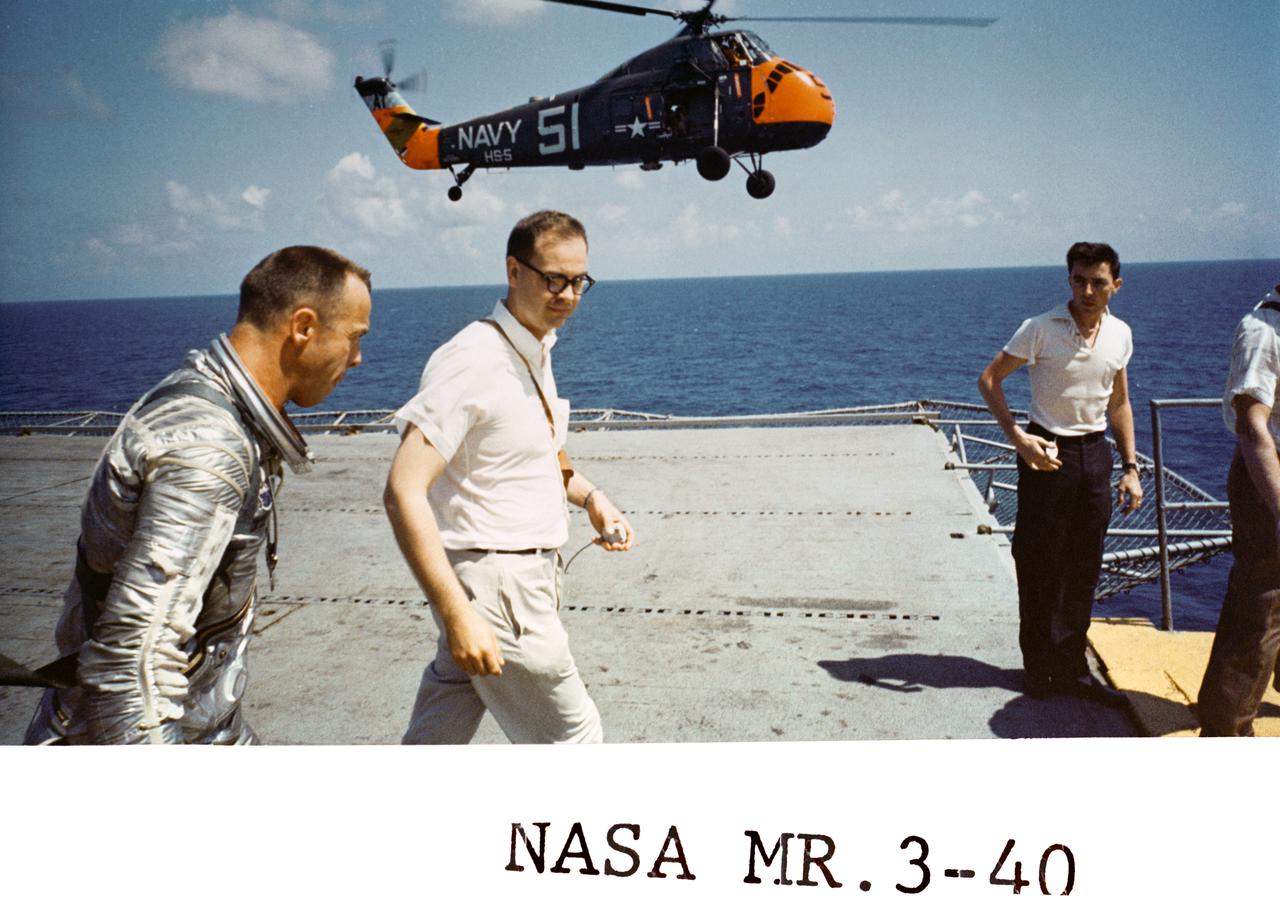
S88-31380 (5 May 1961) --- Astronaut Alan B. Shepard Jr., strides across the deck of the U.S. Navy Carrier Champlain following an inspection of his Freedom 7 capsule. Shepard had just completed the first manned U.S. space mission, a 15-minute suborbital flight. (NASA Hq. Photo No., MR3-40) Photo credit: NASA or National Aeronautics and Space Administration
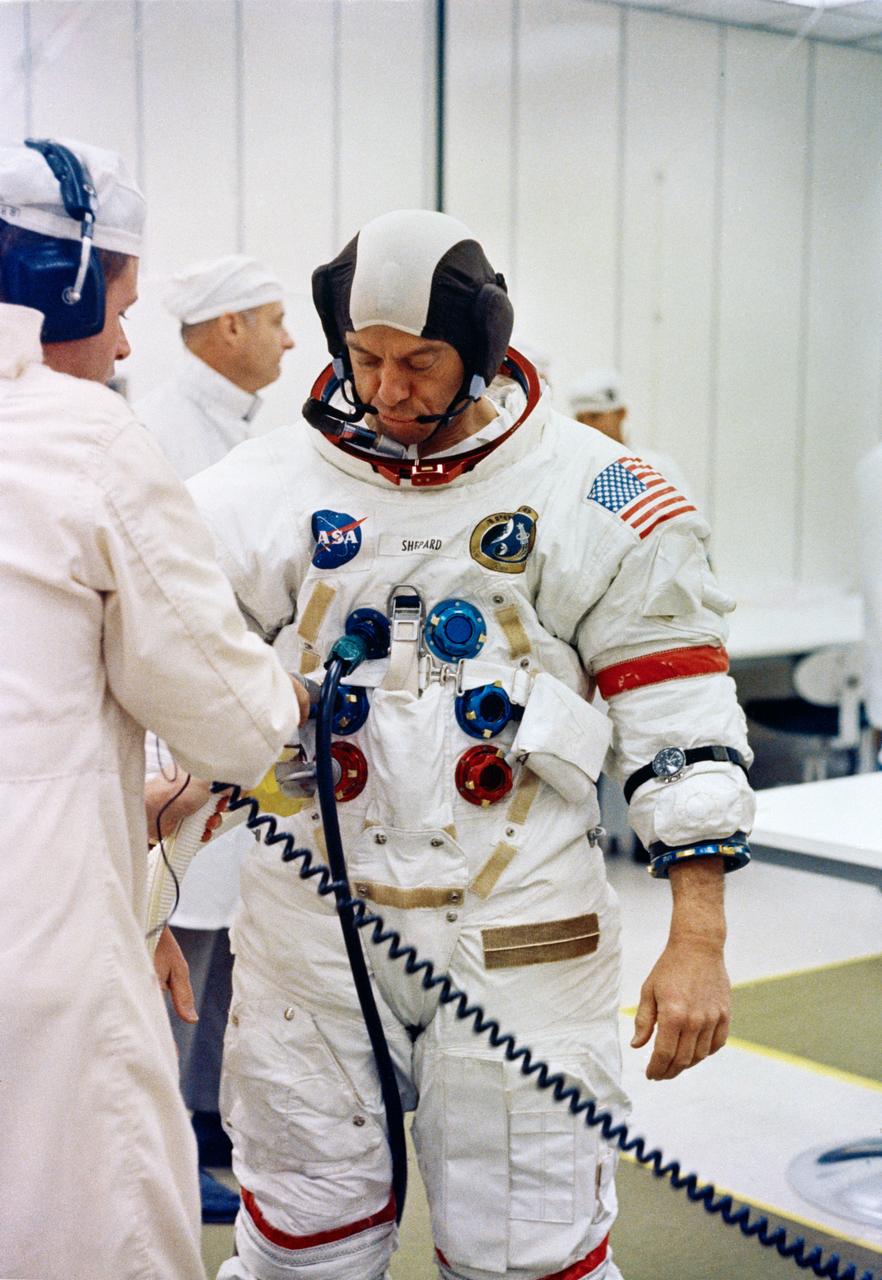
S71-16638 (31 Jan. 1971) --- Astronaut Alan B. Shepard Jr., commander, undergoes suiting up operations at the Kennedy Space Center (KSC) during the Apollo 14 prelaunch countdown. Apollo 14, with astronauts Shepard; Edgar D. Mitchell, lunar module pilot; and Stuart A. Roosa, command module pilot; aboard was launched from Pad A, Launch Complex 39 at 4:03:02 p.m. (EST), Jan. 31, 1971.
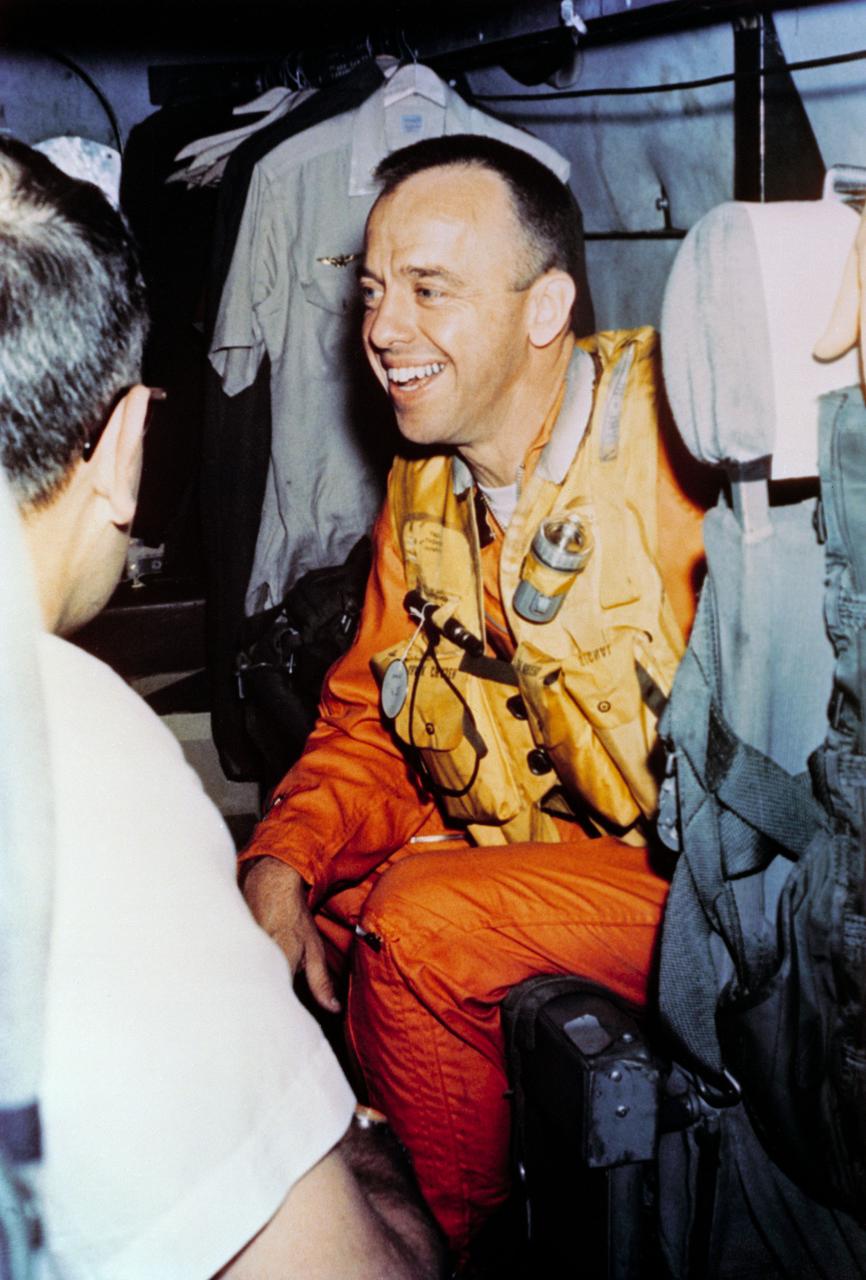
S88-31383 (5 May 1961) --- Astronaut Alan B. Shepard Jr., Mercury-Redstone 3 (MR-3) pilot, jokes with doctors while in-flight between the U.S. Navy Carrier Champlain and the Grand Bahama Islands. Shepard is the first American in space with the successful completion of the 15-minute suborbital mission. Photo credit: NASA or National Aeronautics and Space Administration
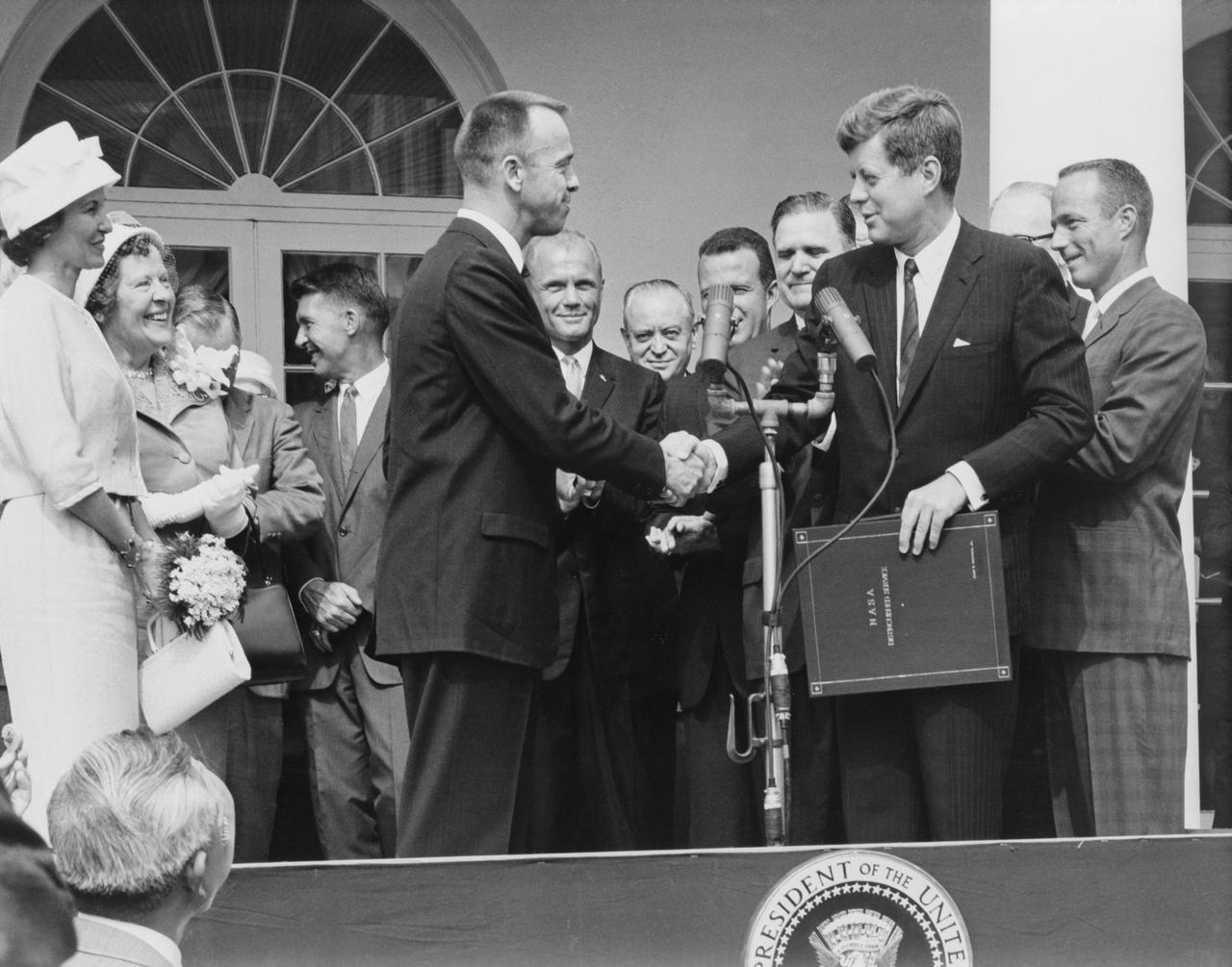
S67-19572 (8 May 1961) --- Astronaut Alan B. Shepard Jr. receives the NASA Distinguished Service Award from United States President John F. Kennedy May 8, 1961, days after his history making MR-3 flight. Shepard's wife and mother on left and the other six Mercury astronauts are in background. Photo credit: NASA or National Aeronautics and Space Administration
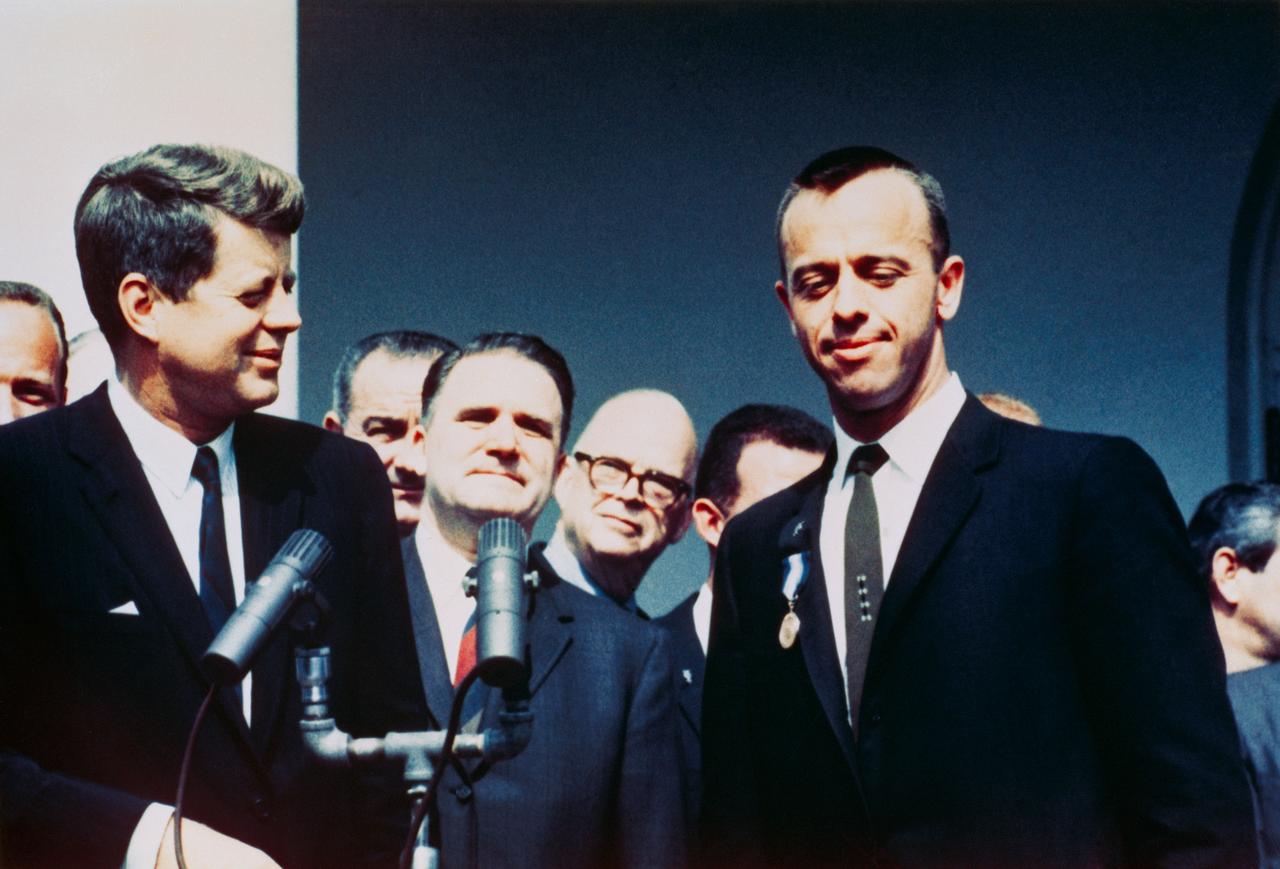
S88-31387 (8 May 1961) --- President John F. Kennedy (left) congratulates NASA's Distinguished Service Medal Award recipient astronaut Alan B. Shepard Jr. in a Rose Garden ceremony on May 8, 1961, at the White House. Vice-President Lyndon B. Johnson, NASA Administrator James E. Webb and several NASA astronauts are in the background. Three days earlier, Shepard made history with a 15-minute suborbital space mission in the Freedom 7, Mercury-Redstone 3 spacecraft. Photo credit: NASA
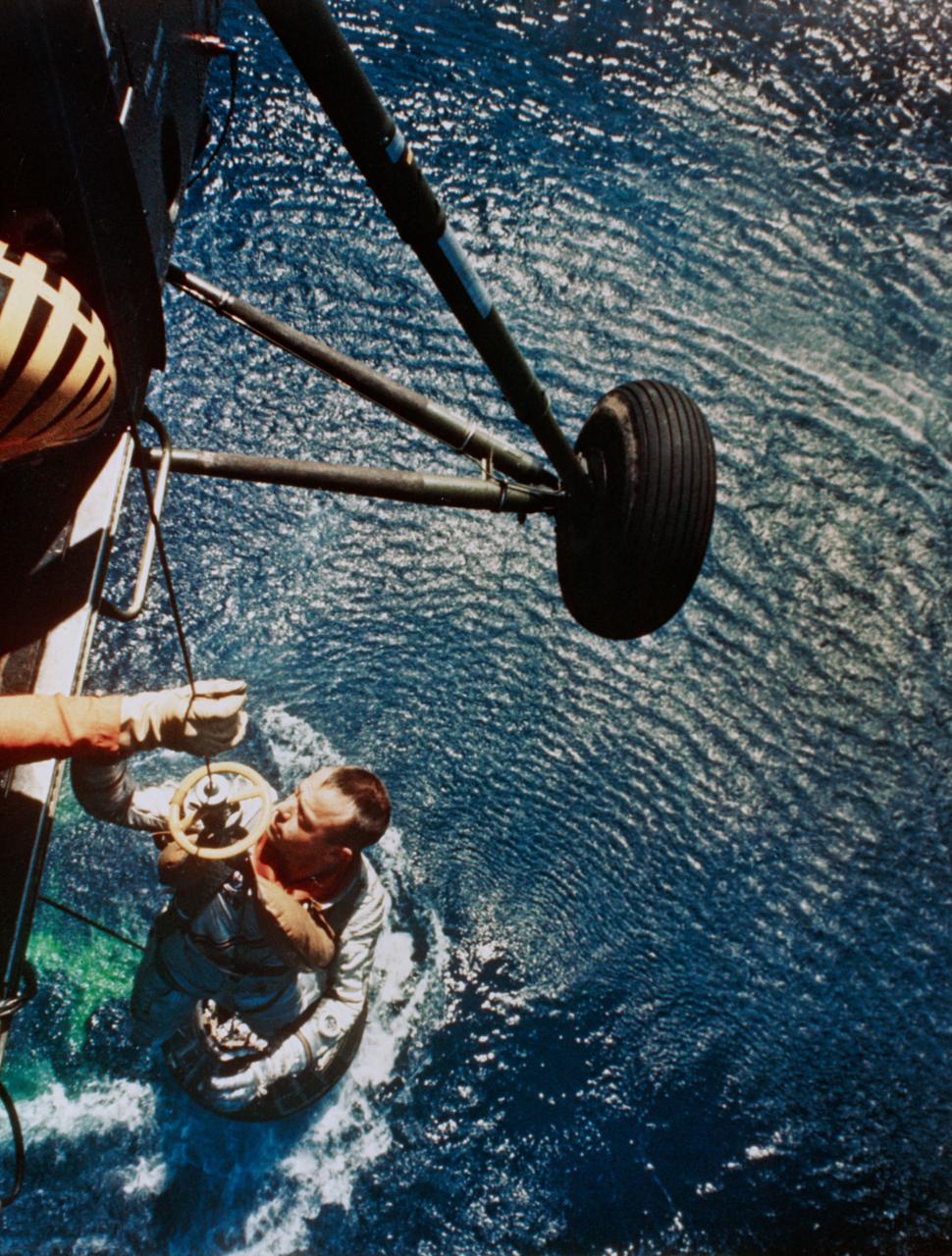
S88-31377 (5 May 1961) --- Astronaut Alan B. Shepard Jr. is rescued by a U. S. Marine helicopter at the termination of his sub-orbital flight May 5, 196l, down range from the Florida eastern coast.
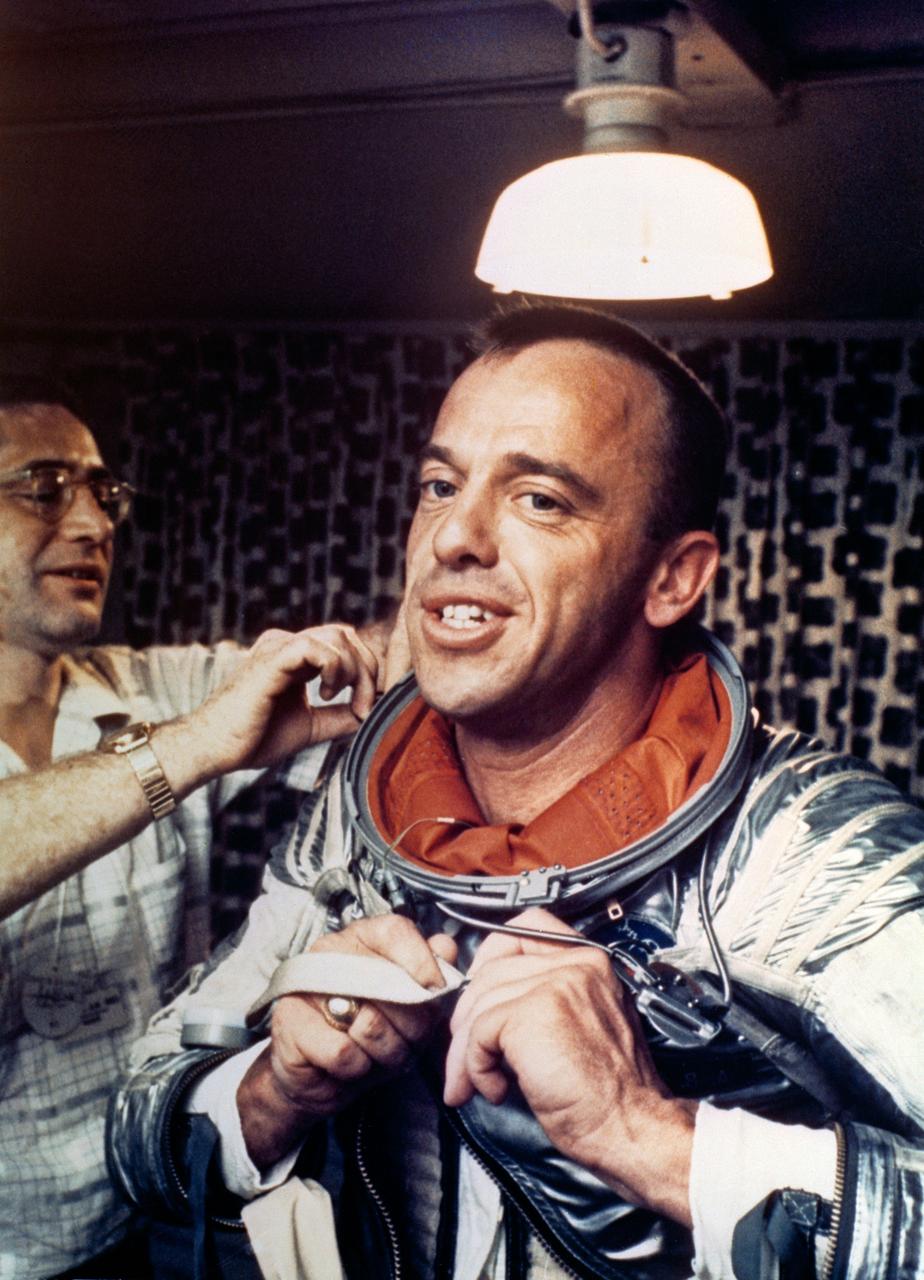
S88-31382 (5 May 1961) --- Astronaut Alan B. Shepard receives assistance in removing his spacesuit while on the U.S. Champlain after the recovery of his Mercury capsule. Photo credit: NASA or National Aeronautics and Space Administration
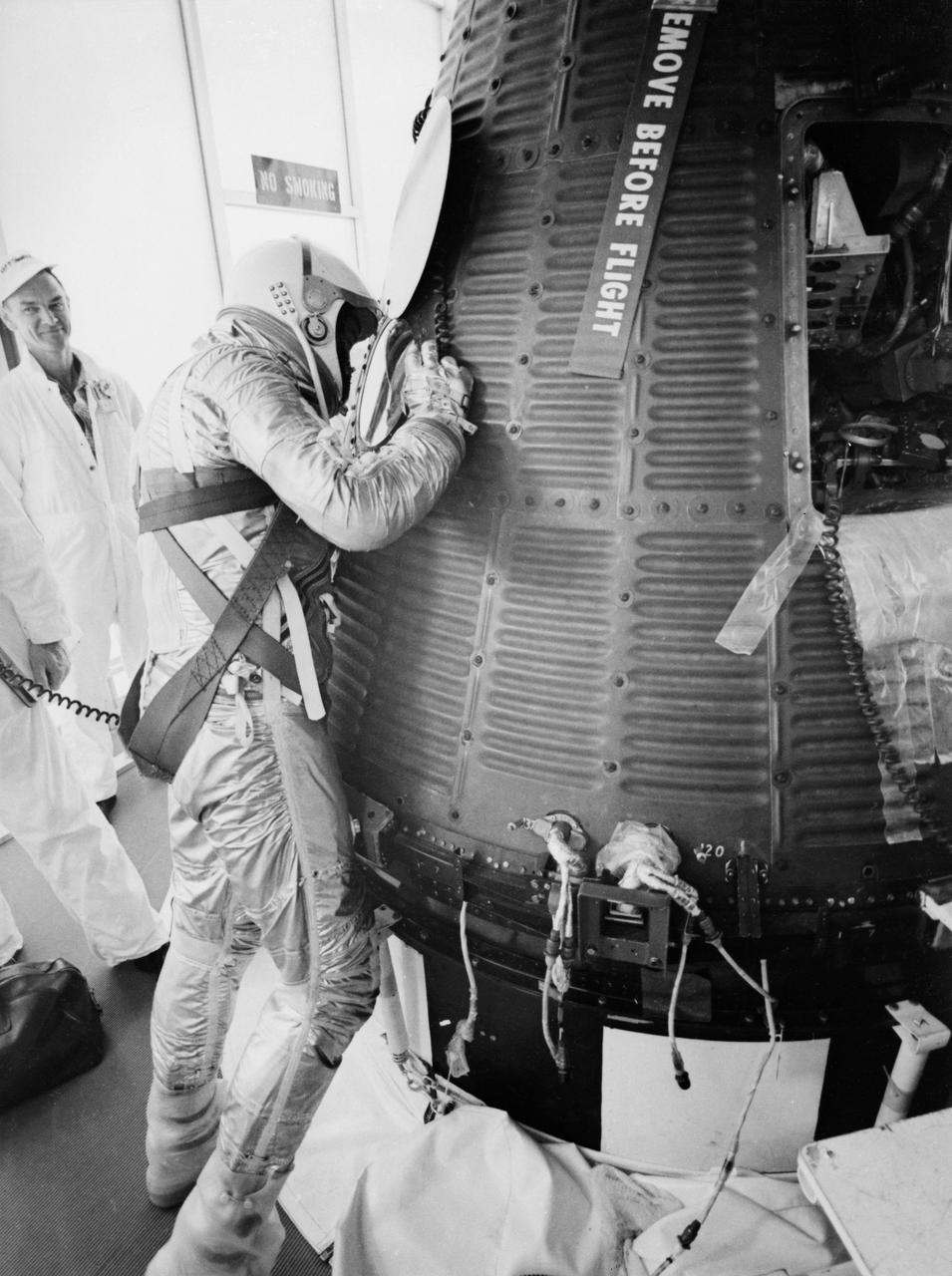
S61-02547 (5 May 1961) --- Astronaut Alan B. Shepard Jr., in his pressure suit and helmet, looks into the Freedom 7 capsule in preparation for ingress before the Mercury-Redstone 3 (MR-3) mission. Photo credit: NASA or National Aeronautics and Space Administration
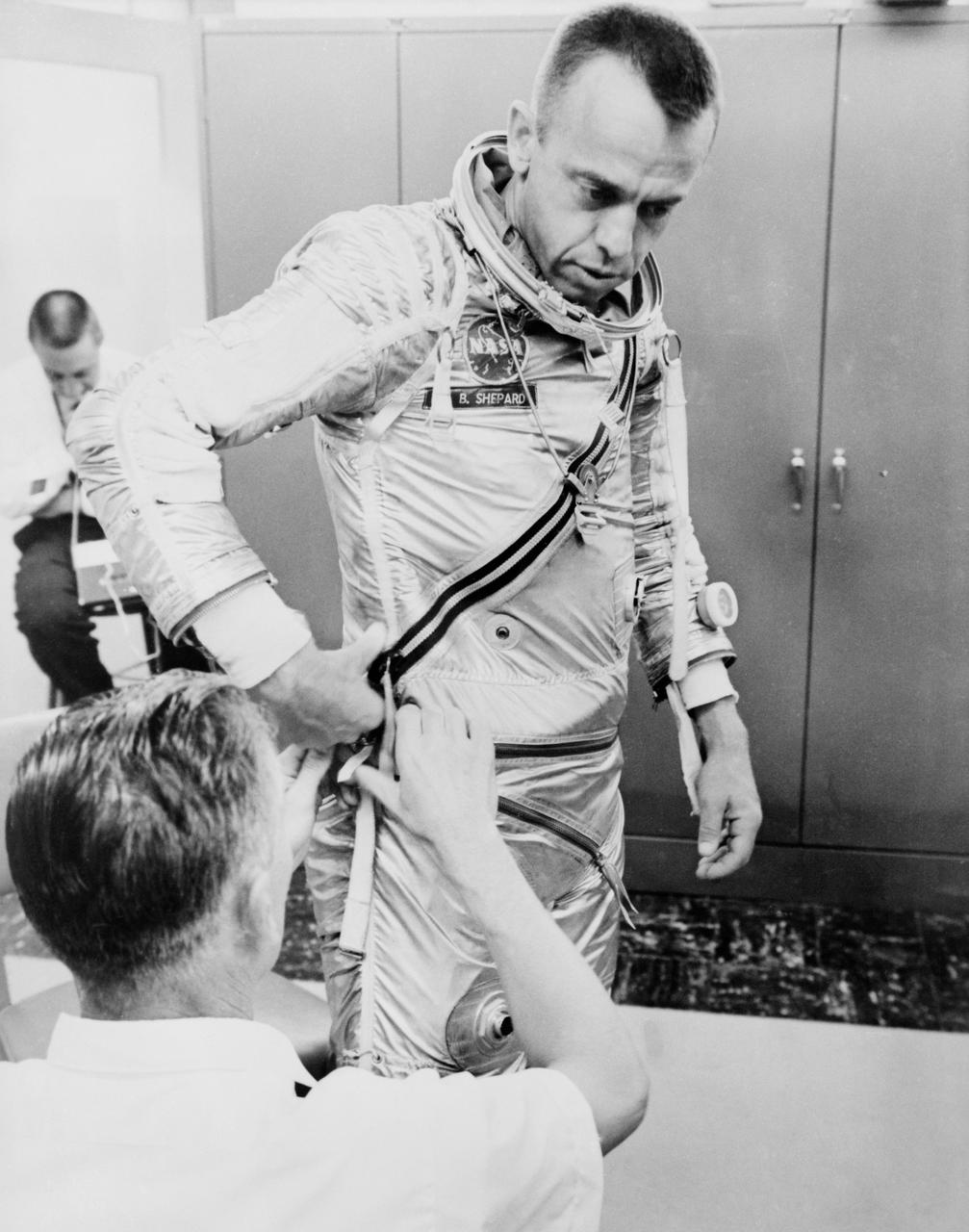
S61-02757 (5 May 1961) --- Astronaut Alan B. Shepard Jr. is being helped into his pressure suit for the Mercury-Redstone 3 (MR-3) flight, the first American manned spaceflight. Photo credit: NASA or National Aeronautics and Space Administration
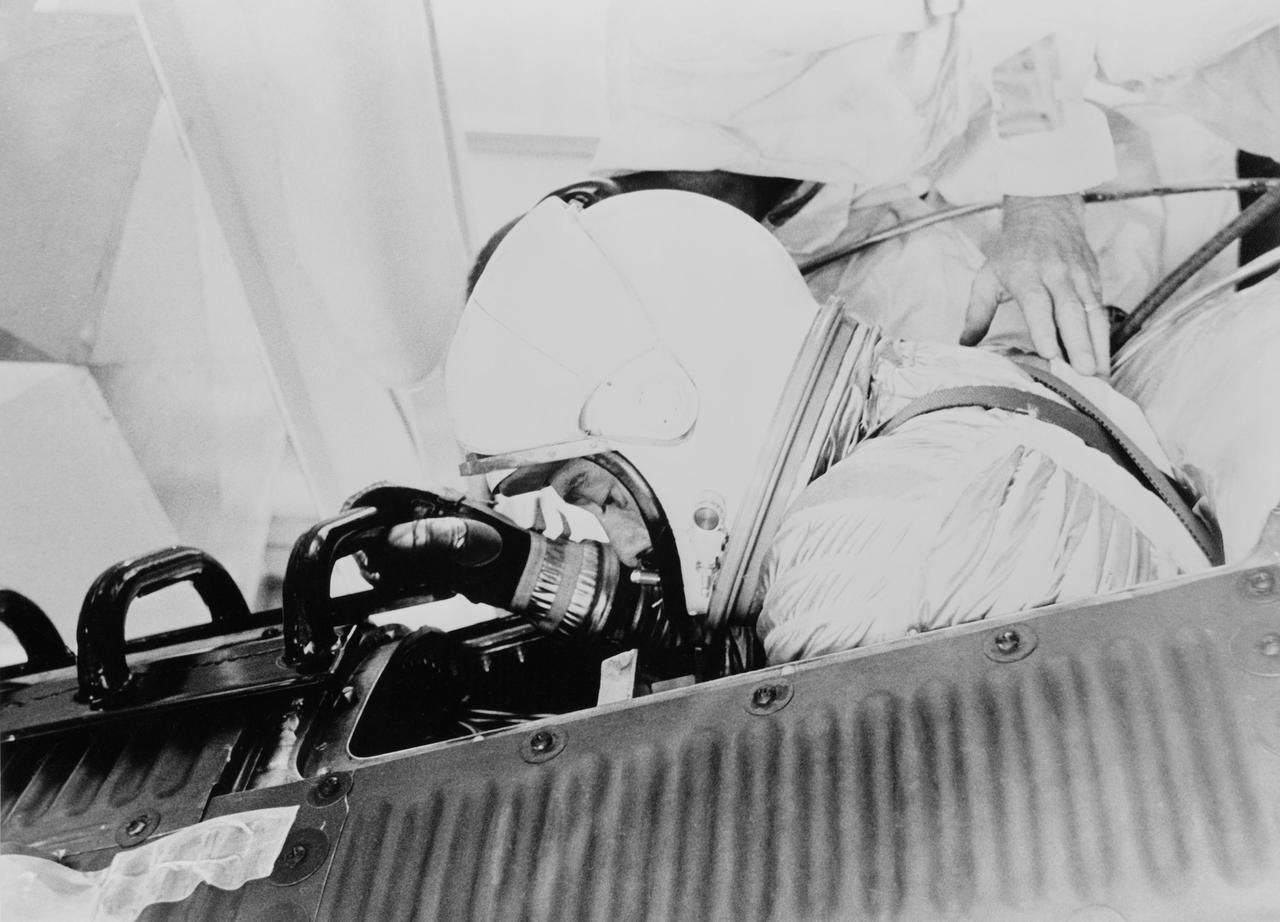
S61-03645 (5 May 1961) --- Close-up of astronaut Alan B. Shepard Jr., in his pressure suit and helmet, ingressing into the Freedom 7 capsule in preparation for the Mercury-Redstone 3 (MR-3) mission. Photo credit: NASA or National Aeronautics and Space Administration
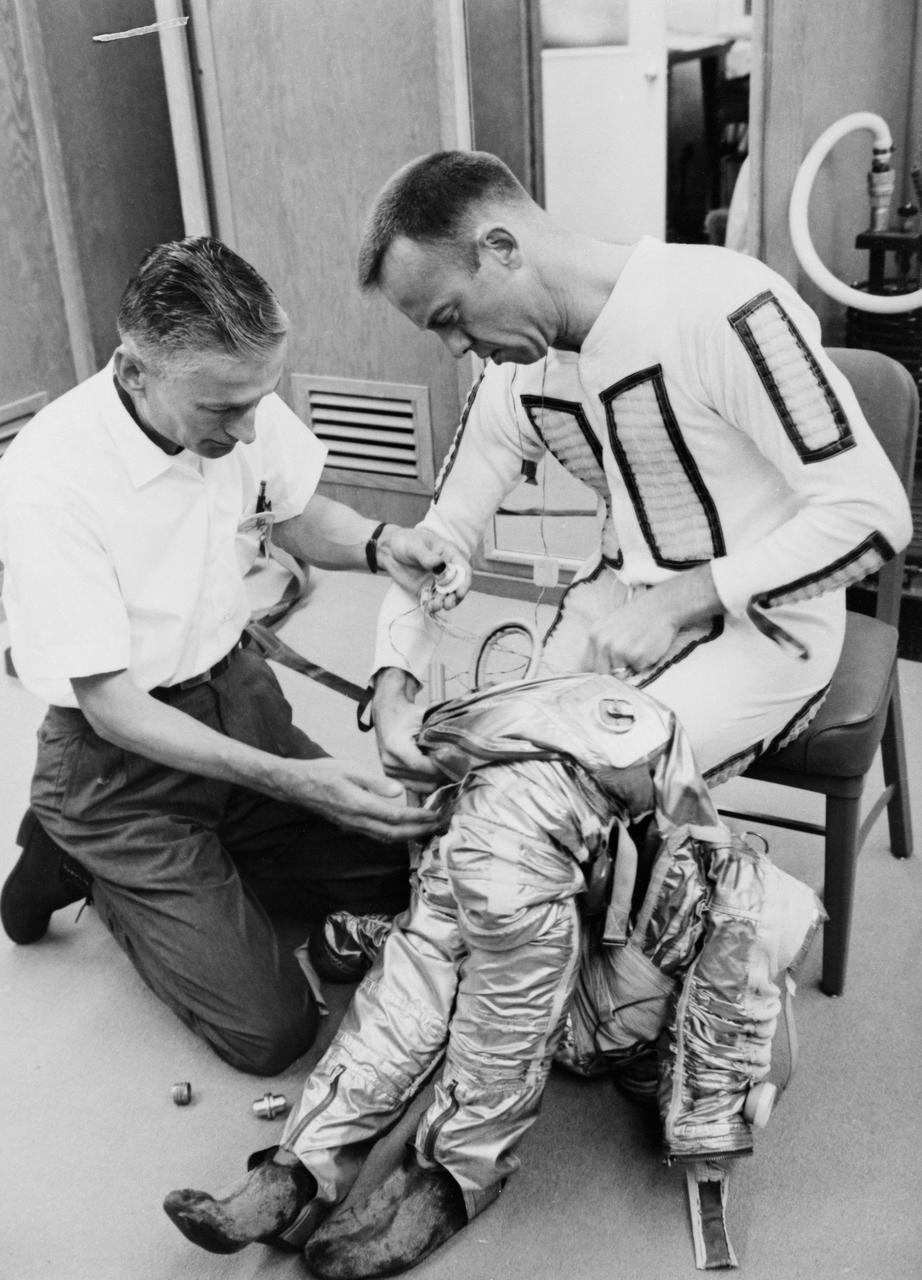
S61-02755 (5 May 1961) --- Astronaut Alan B. Shepard Jr. is being helped into the lower half of his pressure suit for the Mercury-Redstone 3 (MR-3) flight, the first American manned spaceflight. Photo credit: NASA or National Aeronautics and Space Administration
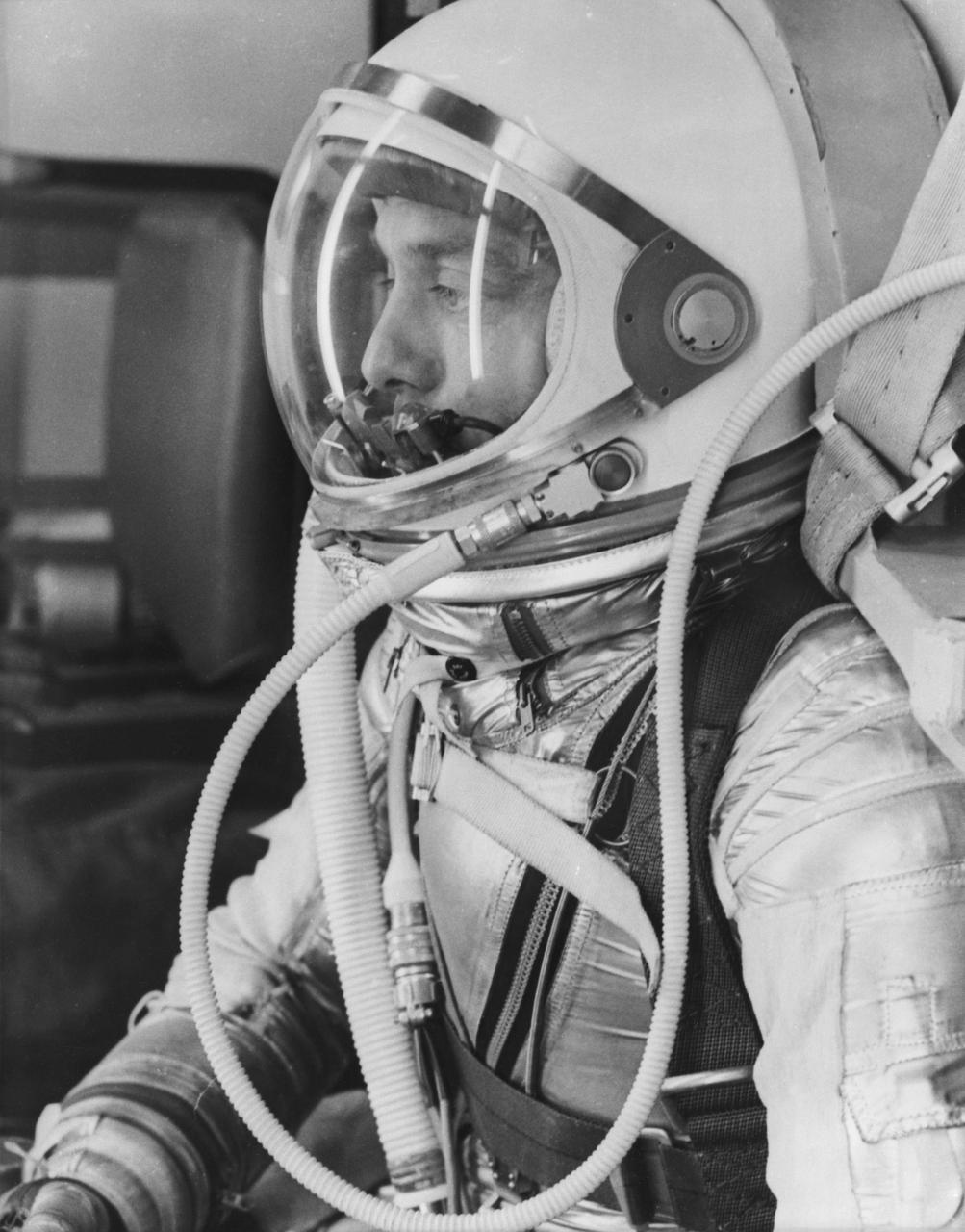
S61-02766 (5 May 1961) --- Side view of astronaut Alan B. Shepard Jr. in his pressure suit, with helmet closed, for the Mercury-Redstone 3 (MR-3) flight, the first American manned spaceflight. Photo credit: NASA or National Aeronautics and Space Administration
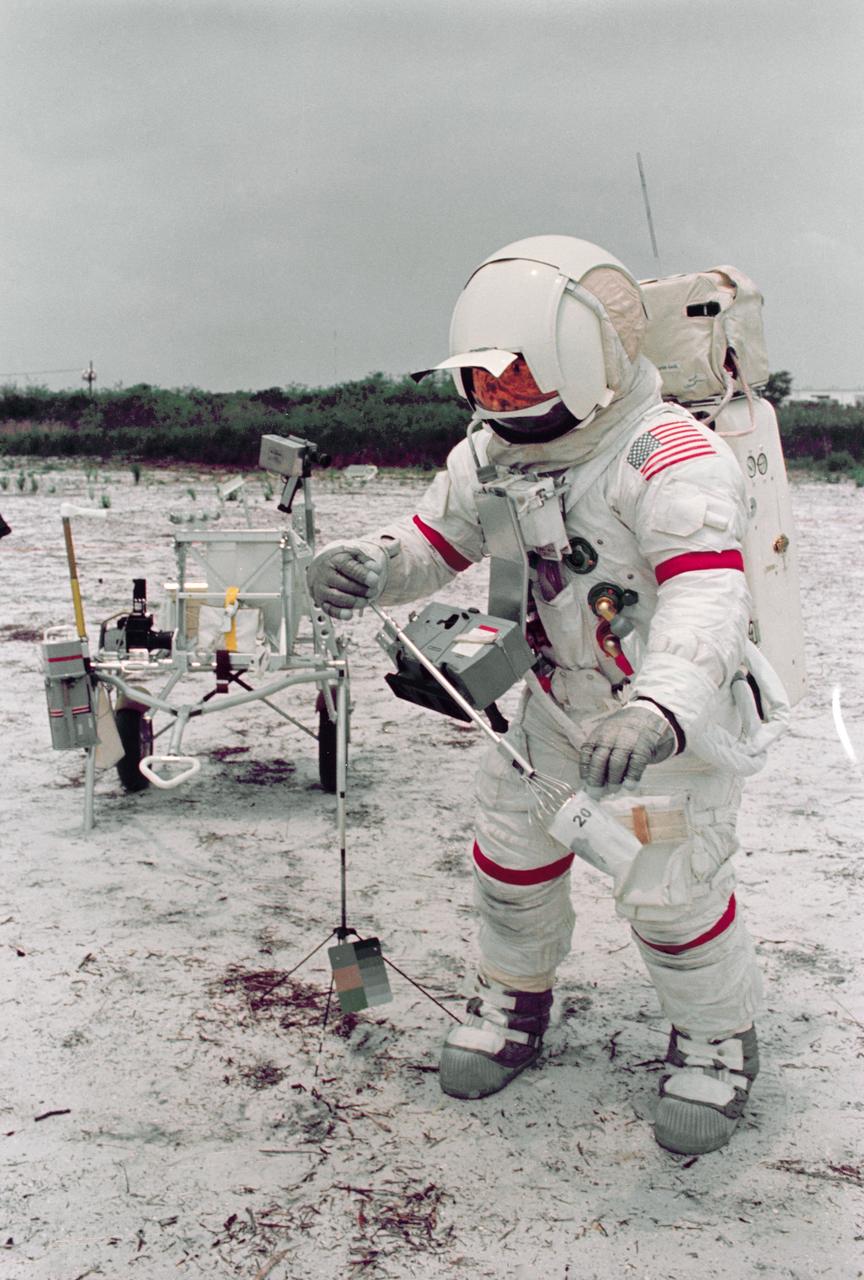
S70-46157 (July 1970) --- Astronaut Alan B. Shepard Jr., commander of the Apollo 14 lunar landing mission, participates in lunar surface simulation training at the Kennedy Space Center (KSC). The modular equipment transporter (MET) is in the left background, in the center foreground is a gnomon. The MET, nicknamed the "Rickshaw", will serve as a portable work bench with a place for the Apollo lunar hand tools and their carrier, three cameras, two sample container bags, a special environment sample container, spare magazines, and a lunar surface Penetrometer. Shepard is wearing an Extravehicular Mobility Unit (EMU).
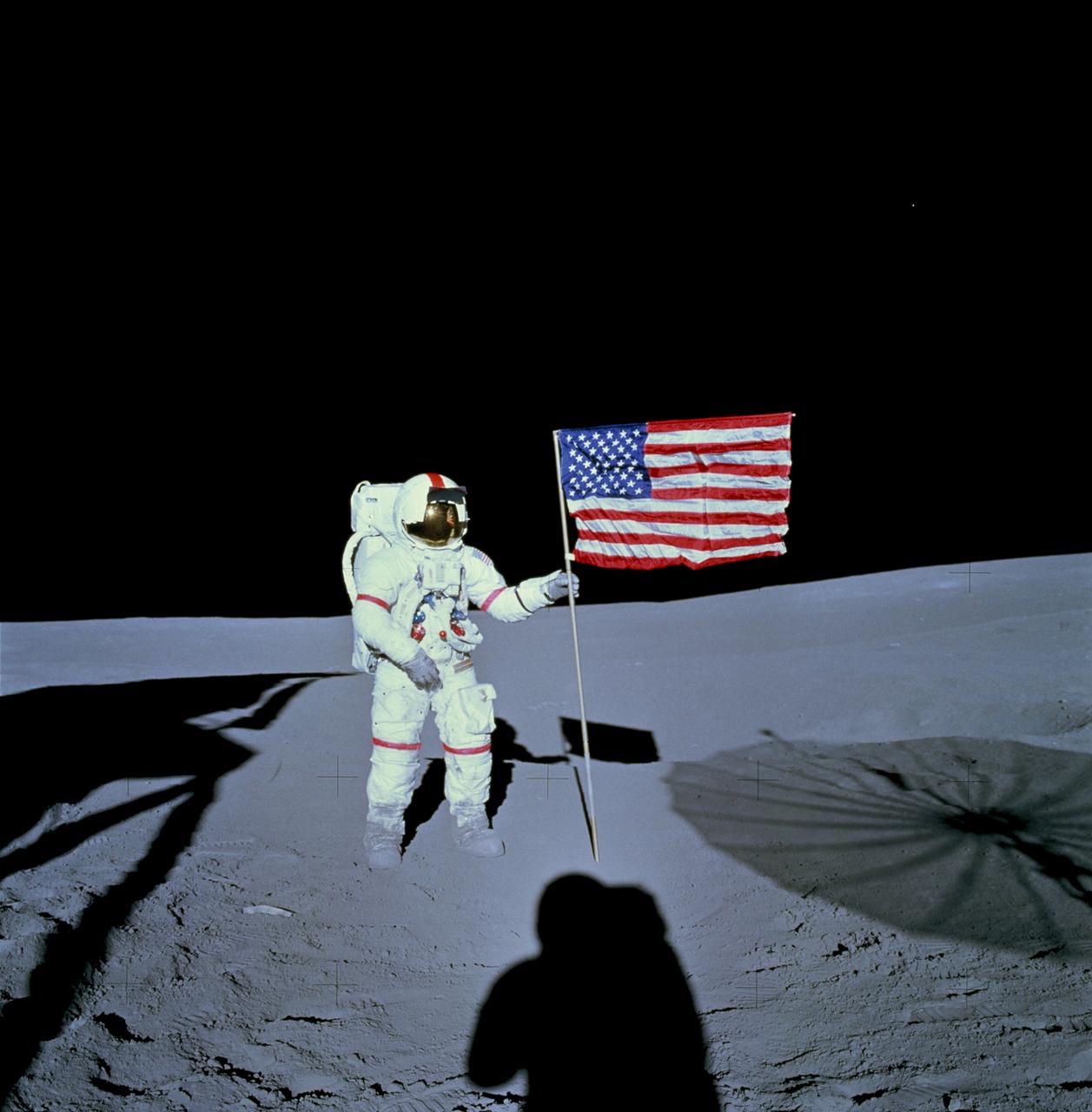
AS14-66-9232 (5 Feb. 1971) --- Astronaut Alan B. Shepard Jr., commander of the Apollo 14 lunar landing mission, stands by the deployed United States flag on the lunar surface during the early moments of the first extravehicular activity (EVA) of the mission. Shadows of the Lunar Module (LM), astronaut Edgar D. Mitchell, lunar module pilot, and the erectable S-Band Antenna surround the scene of the third flag implanting to be performed on the lunar surface. While astronauts Shepard and Mitchell descended in the LM ?Antares? to explore the Fra Mauro region of the moon, astronaut Stuart A. Roosa, command module pilot, remained with the Command and Service Modules (CSM) ?Kitty Hawk? in lunar orbit.
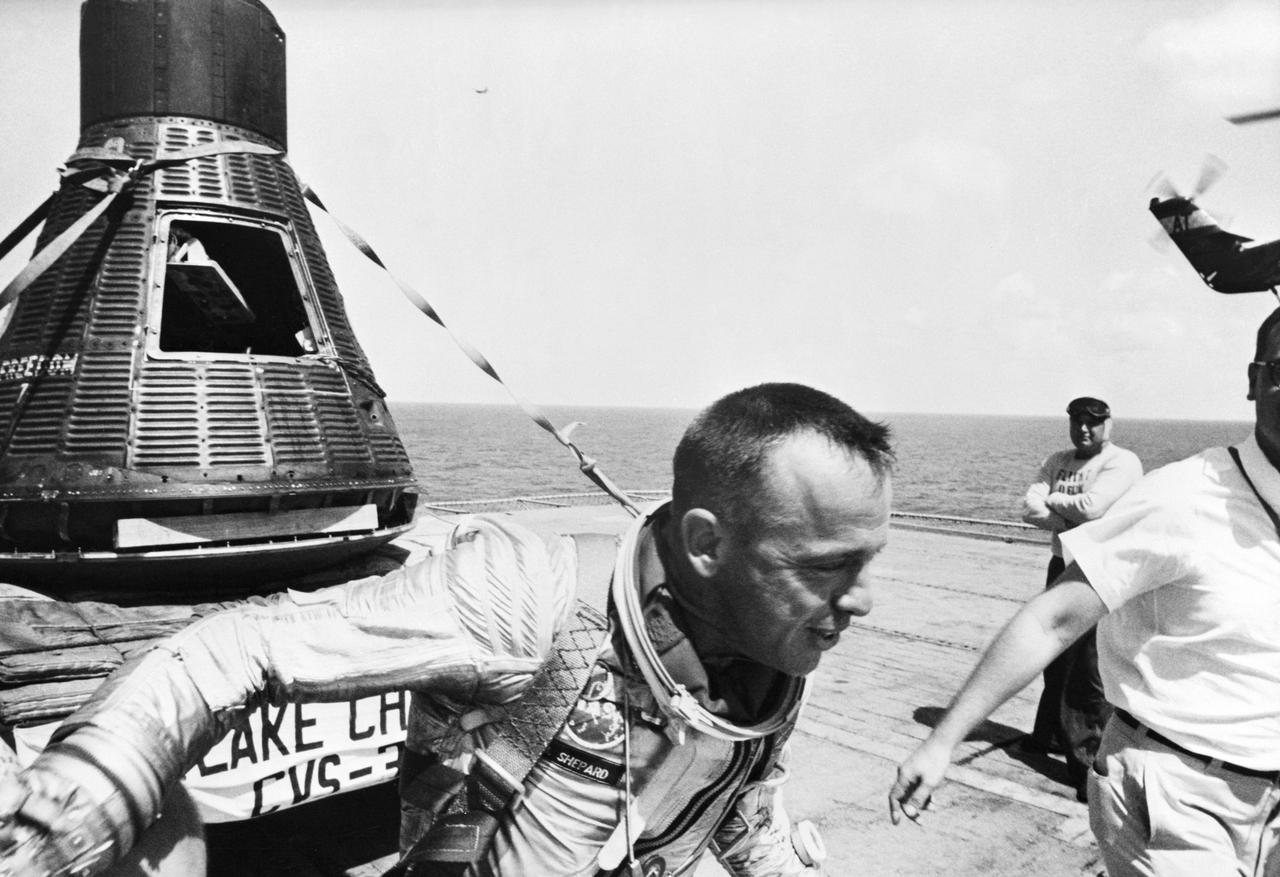
S61-02727 (5 May 1961) --- Astronaut Alan B. Shepard is seen on the deck of the USS Lake Champlain after the recovery of his Mercury capsule in the western Atlantic Ocean. Shepard and the Mercury spacecraft designated the ?Freedom 7? were flown to the deck of the recovery ship within 11 minutes of splashdown. MR-3 was the United States? first manned space mission. The spacecraft attained a maximum speed of 5,180 miles per hour, reached an altitude of 116 1/2 statute miles, and landed 302 statute miles downrange from Cape Canaveral, Florida. The suborbital mission lasted 15 minutes and 22 seconds. Photo credit: NASA or National Aeronautics and Space Administration
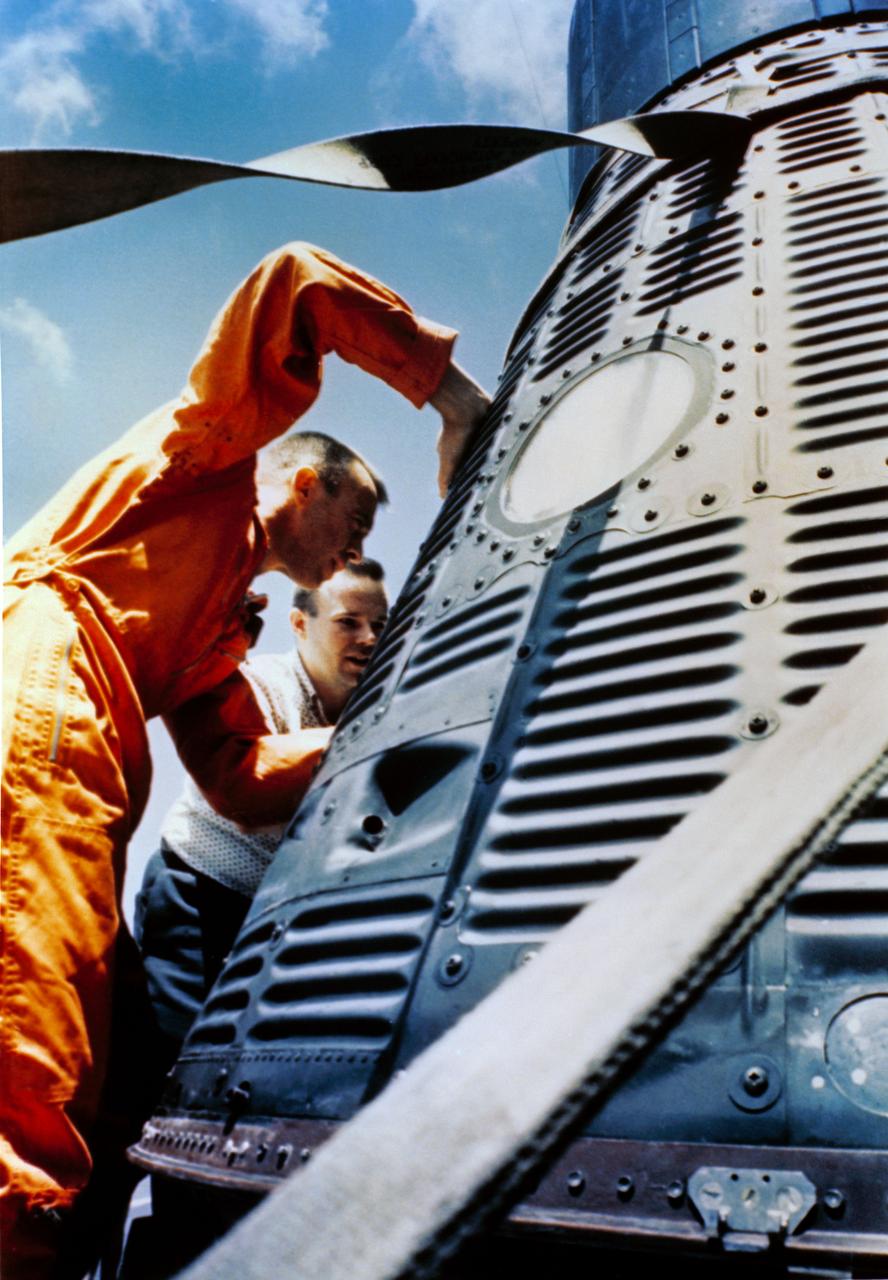
S88-31384 (5 May 1961) --- Astronaut Alan B. Shepard Jr., Mercury-Redstone 3 (MR-3) pilot, is pictured near his Freedom 7 capsule during a postflight inspection aboard the U.S. Navy Carrier Champlain after the recovery of his Mercury vehicle. Earlier Shepard had completed the historical 15-minute suborbital Mercury-Redstone 3 mission, marking the U.S. inaugural manned space mission. (NASA Hq. No. 61-MR3-107 or MR3-44) Photo credit: NASA or National Aeronautics and Space Administration
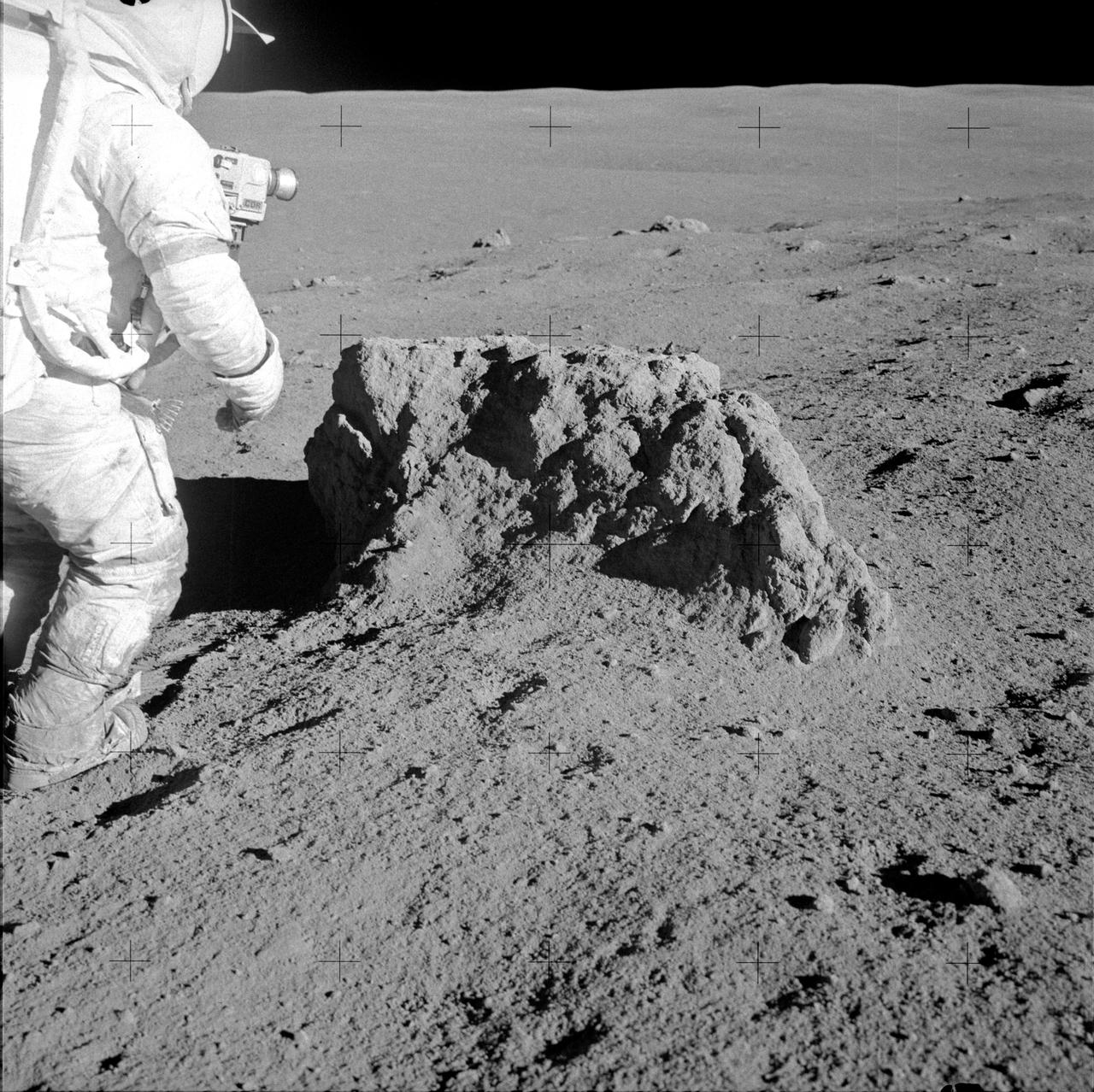
AS14-68-9414 (6 Feb. 1971) --- Astronaut Alan B. Shepard Jr., Apollo 14 commander, stands beside a large boulder on the lunar surface during the mission's second extravehicular activity (EVA), on Feb. 6, 1971. Note the lunar dust clinging to Shepard's space suit. Astronauts Shepard and Edgar D. Mitchell, lunar module pilot, explored the lunar surface while astronaut Stuart A. Roosa, command module pilot, orbited the moon in the Command and Service Modules (CSM).
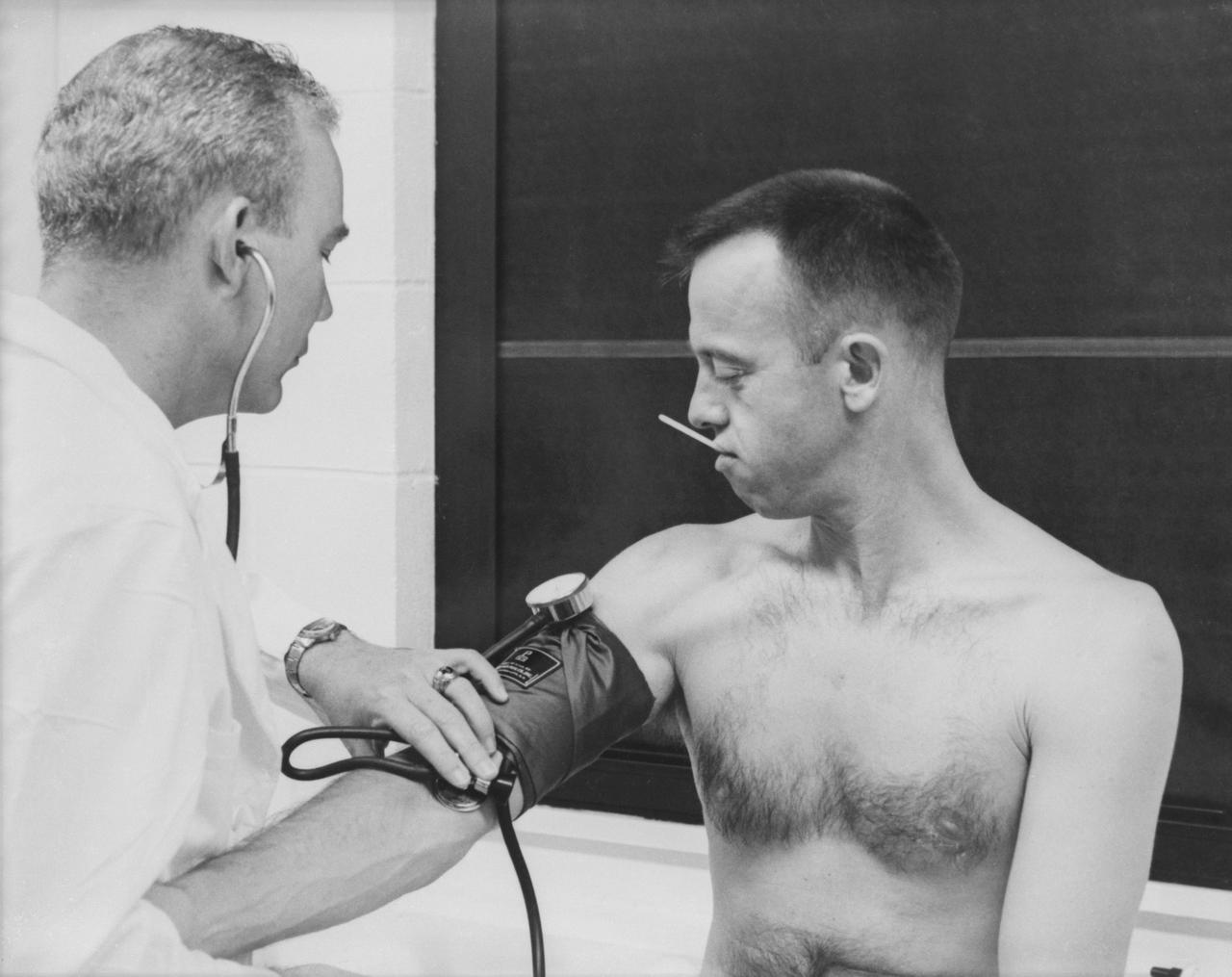
S61-02749 (5 May 1961) --- Astronaut Alan B. Shepard Jr. has his blood pressure and temperature checked prior to his Mercury-Redstone 3 (MR-3) mission, the first American manned spaceflight. The attending physician is Dr. William K. Douglas. Photo credit: NASA or National Aeronautics and Space Administration
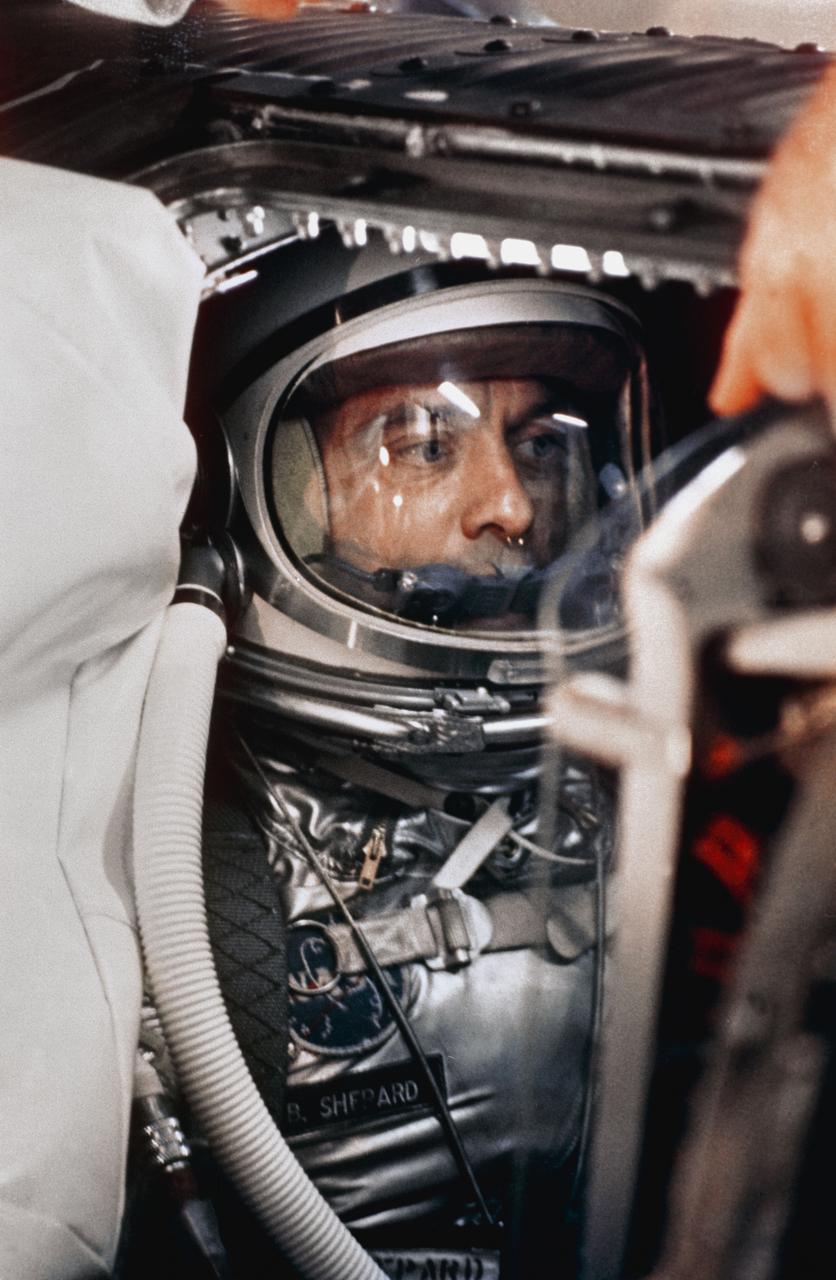
S88-31374 (29 April 1961) --- A close-up of astronaut Alan B. Shepard Jr. in his space suit with his helmet on inside the Mercury capsule. He is undergoing a flight simulation test with the capsule mated to the Redstone booster. This will be the first attempt to put a man into space by the U.S. aboard a Mercury spacecraft, launched atop a Redstone rocket. The suborbital trajectory will be down the Atlantic Missile Range. Photo credit: NASA or National Aeronautics and Space Administration
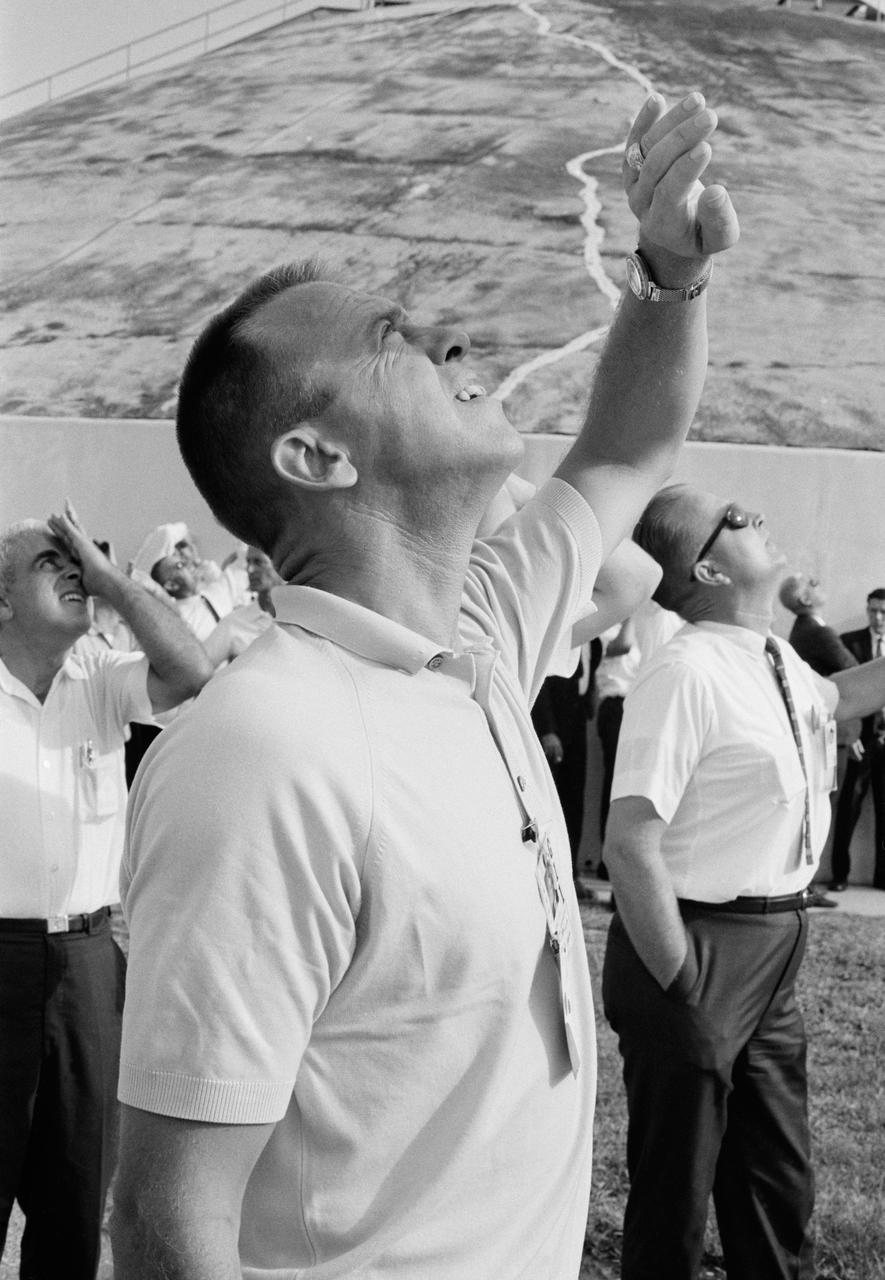
S66-50713 (12 Sept. 1966) --- Astronaut Alan B. Shepard Jr., Chief, MSC Astronaut Office, shields his eyes from the sun as he follows the Gemini-11 liftoff. Onboard were astronauts Charles Conrad Jr., command pilot, and Richard F. Gordon Jr., pilot, scheduled for a three-day mission in space. Liftoff was at 9:42 a.m. (EST), Sept. 12, 1966. Photo credit: NASA
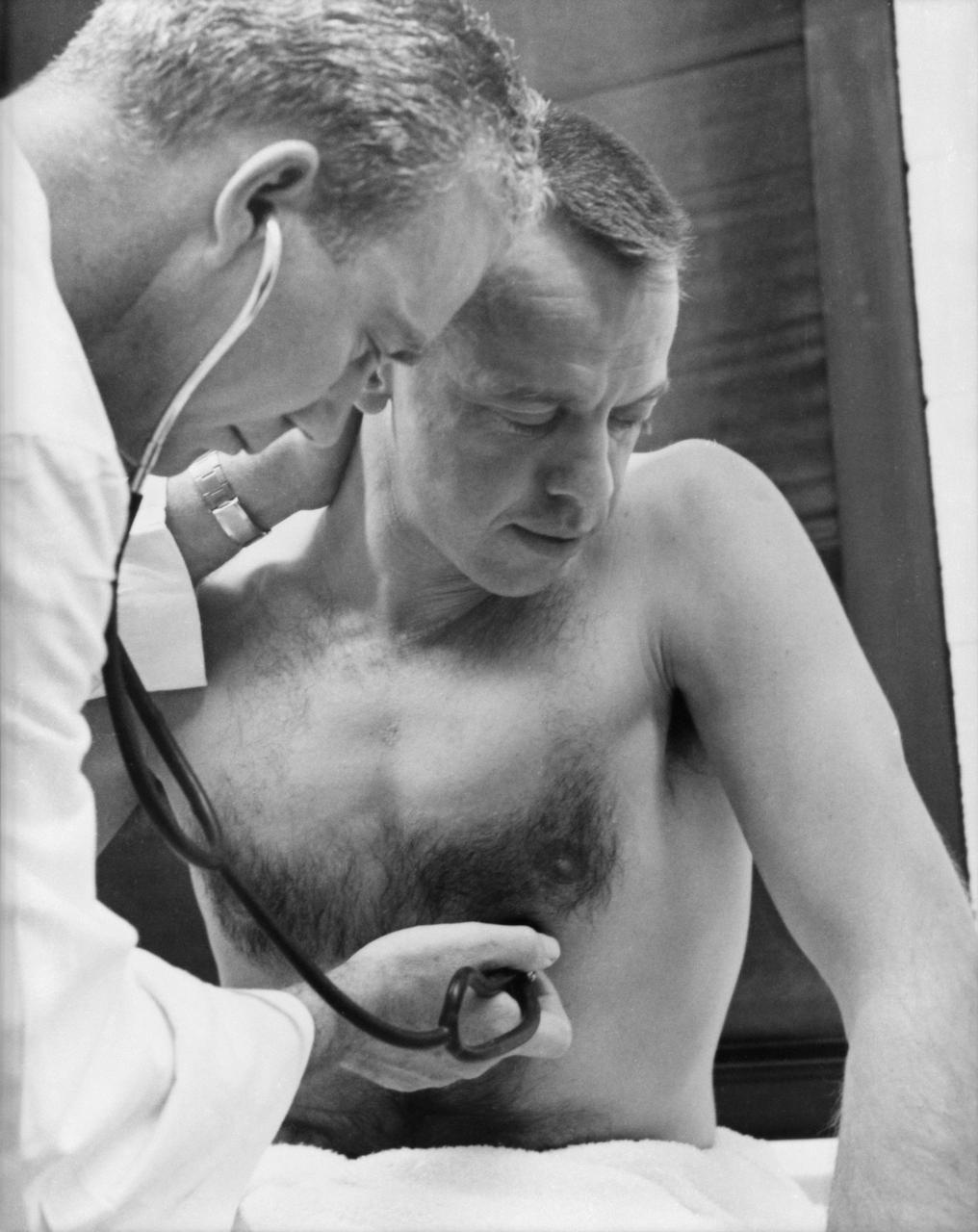
S61-02740 (5 May 1961) --- Astronaut Alan B. Shepard Jr. has his heart rate checked prior to his Mercury-Redstone 3 (MR-3) mission, the first American manned suborbital spaceflight. The attending physician is Dr. William K. Douglas. Photo credit: NASA or National Aeronautics and Space Administration
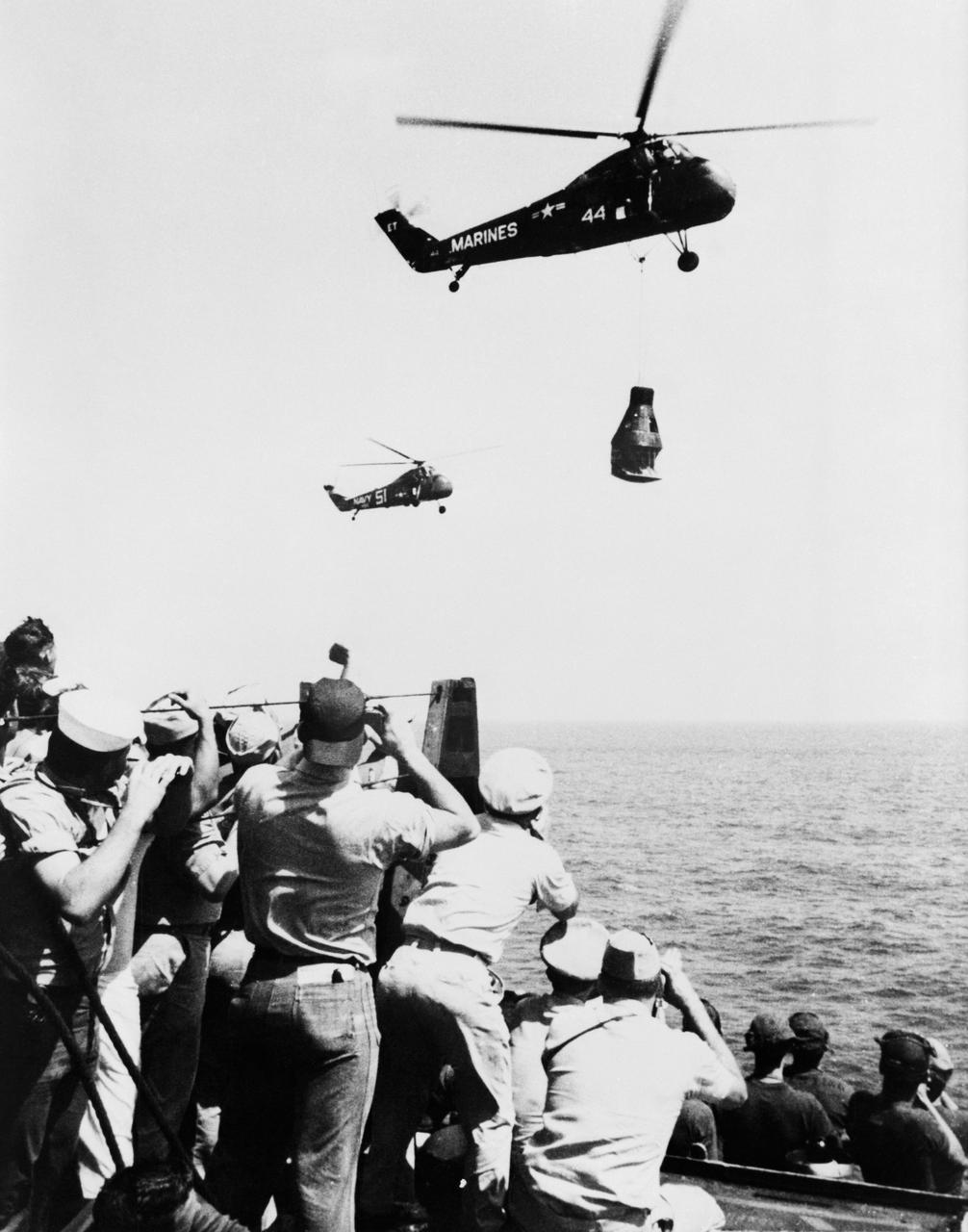
S61-02711 (5 May 1961) --- Crew members of the U.S. Navy Carrier Champlain cheer and take pictures of the arrival of the first Project Mercury pilot to fly a suborbital flight, astronaut Alan B. Shepard Jr. Two helicopters are approaching the ship, one carrying the astronaut and the other the Mercury-Redstone 3 (MR-3) capsule. Photo credit: NASA or National Aeronautics and Space Administration
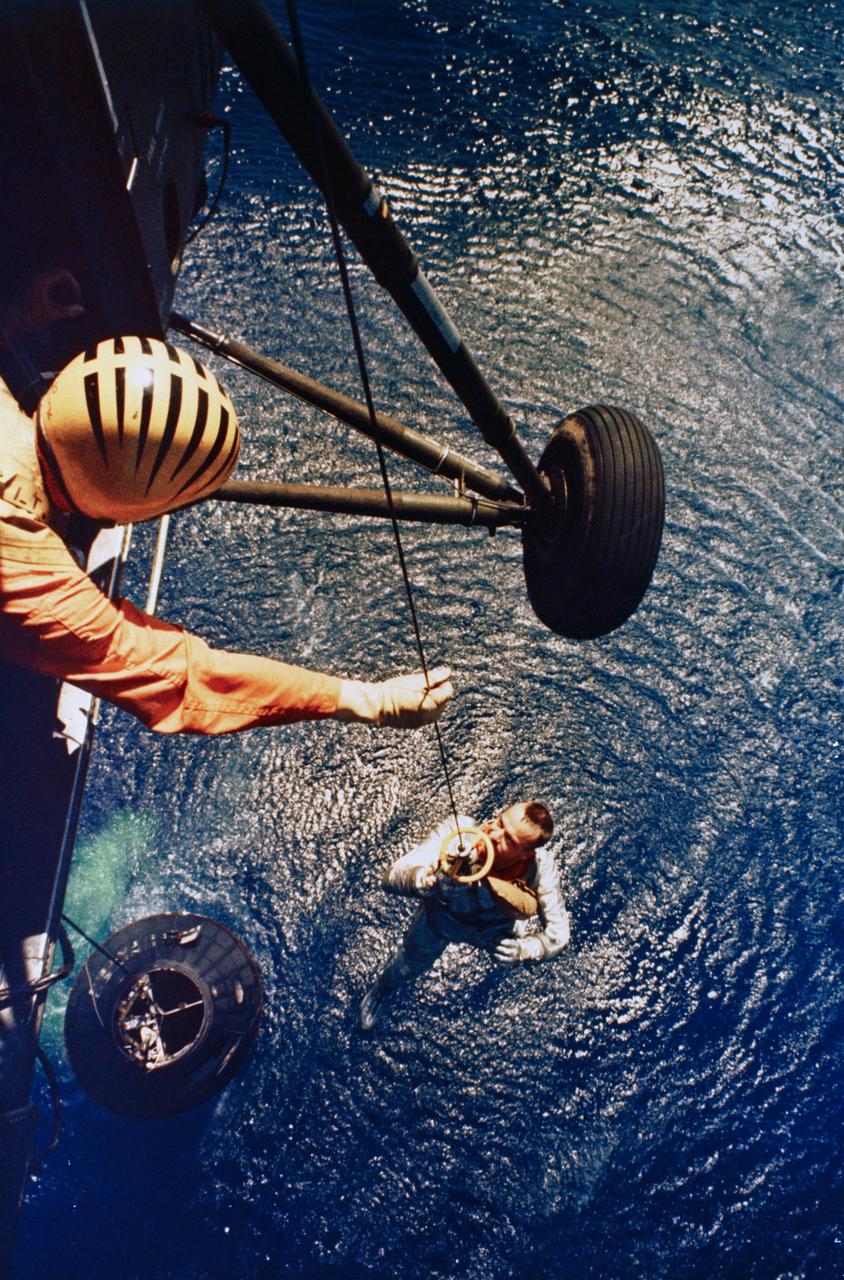
S88-31376 (5 May 1961) --- Astronaut Alan B. Shepard Jr., pilot of the Mercury-Redstone 3 (MR-3) suborbital spaceflight, is retrieved by a helicopter from the USS Lake Champlain during recovery operations in the western Atlantic Ocean. Shepard and the Mercury spacecraft designated the ?Freedom 7? (floating in water below) were flown to the deck of the recovery ship within 11 minutes of splashdown. MR-3 was the United States? first manned space mission. The spacecraft attained a maximum speed of 5,180 miles per hour, reached an altitude of 116 1/2 statute miles, and landed 302 statute miles downrange from Cape Canaveral, Florida. The suborbital mission lasted 15 minutes and 22 seconds. Photo credit: NASA or National Aeronautics and Space Administration
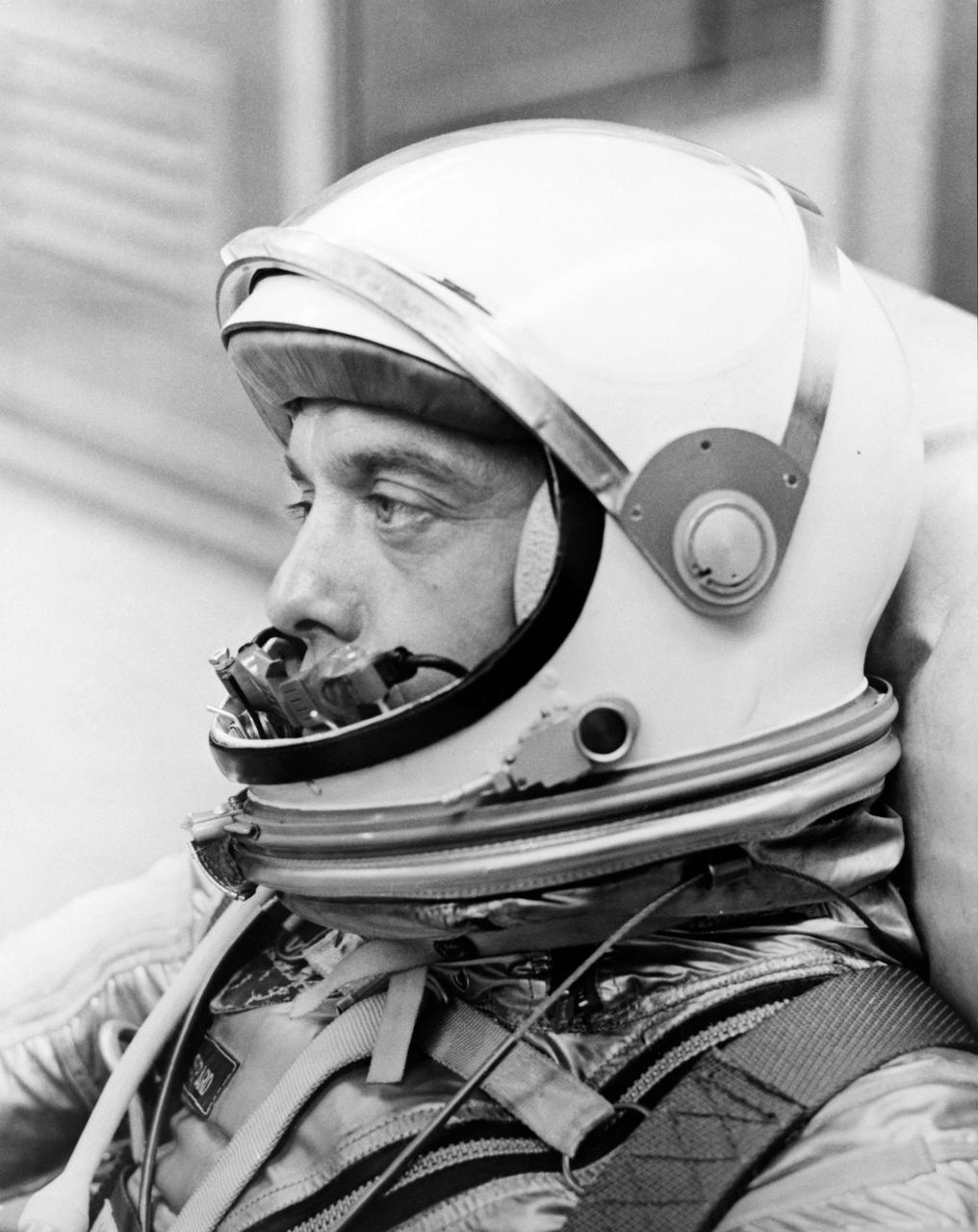
S61-02775 (5 May 1961) --- Close-up view of astronaut Alan B. Shepard Jr. in his pressure suit, with helmet opened, for the Mercury-Redstone 3 (MR-3) flight, the first American manned spaceflight. Photo credit: NASA or National Aeronautics and Space Administration
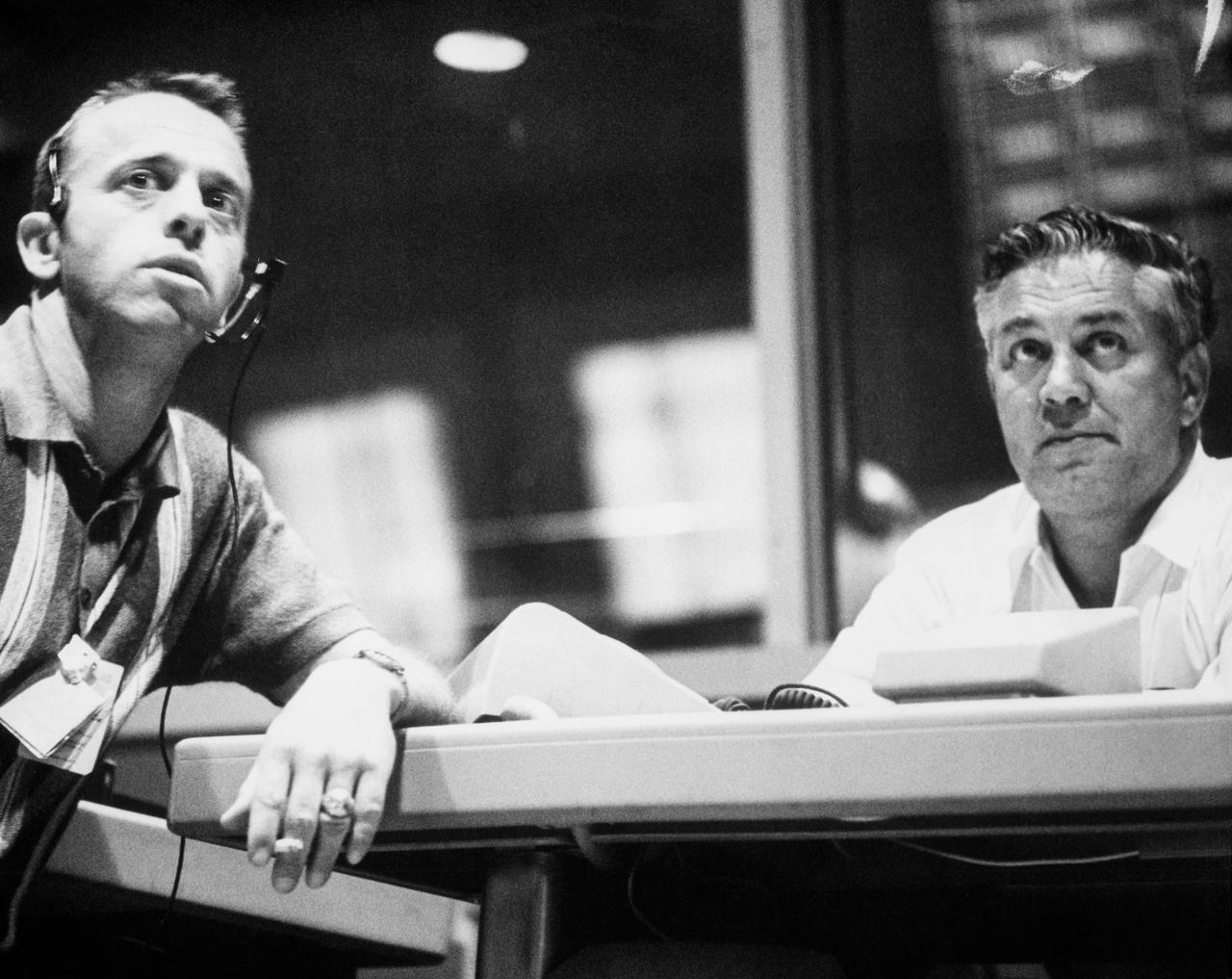
S63-07857 (15-16 May 1963) --- Astronaut Alan Shepard (left) and Walter C. Williams monitor progress of the Mercury Atlas 9 (MA-9) mission from Mercury Control Center, Cape Canaveral, Florida. Photo credit: NASA
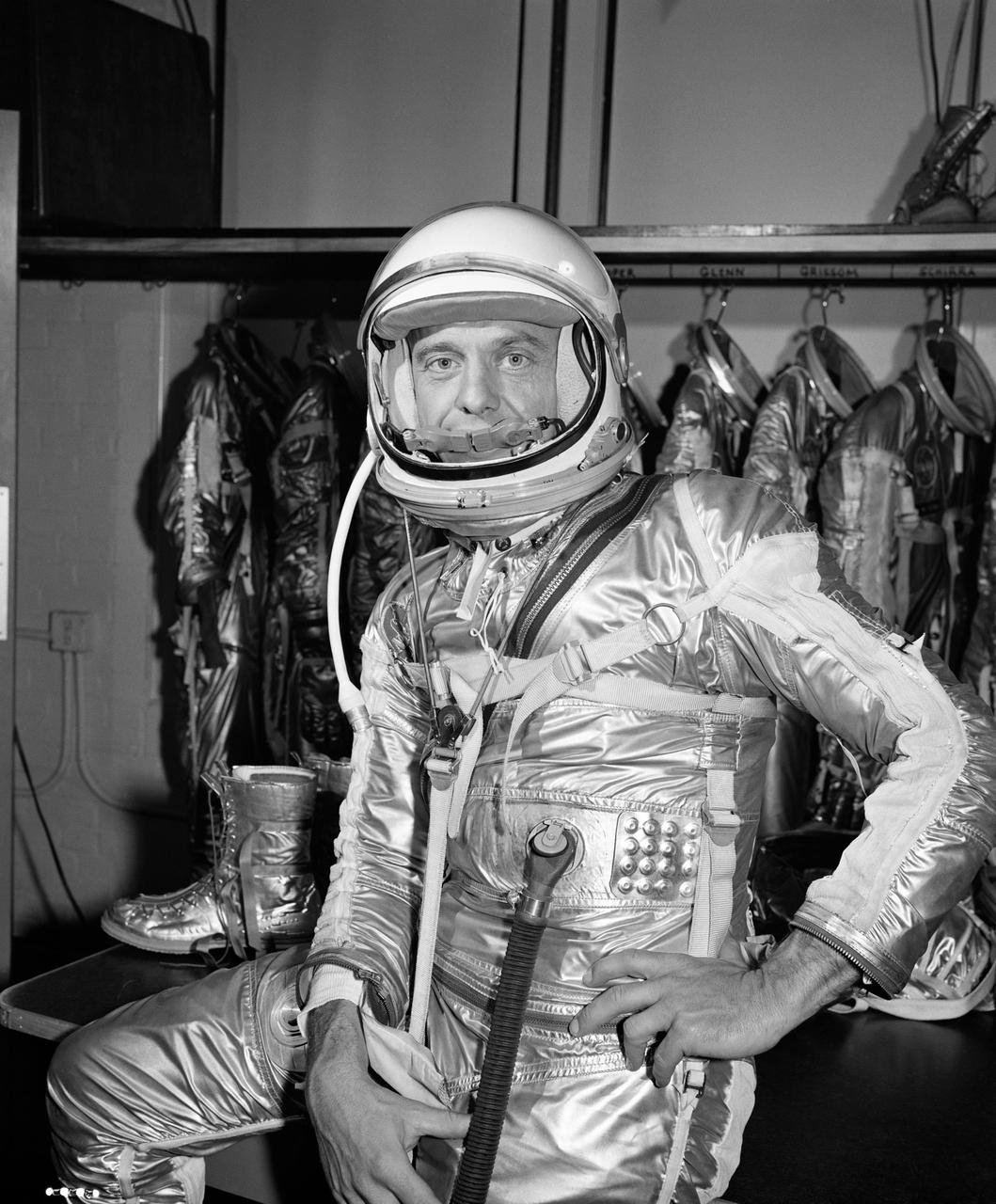
S61-00220 (20 April 1961) --- Close-up view of astronaut Alan B. Shepard Jr. in his pressure suit, with helmet opened, for the Mercury-Redstone 3 (MR-3) flight, the first American manned spaceflight. Photo credit: NASA or National Aeronautics and Space Administration
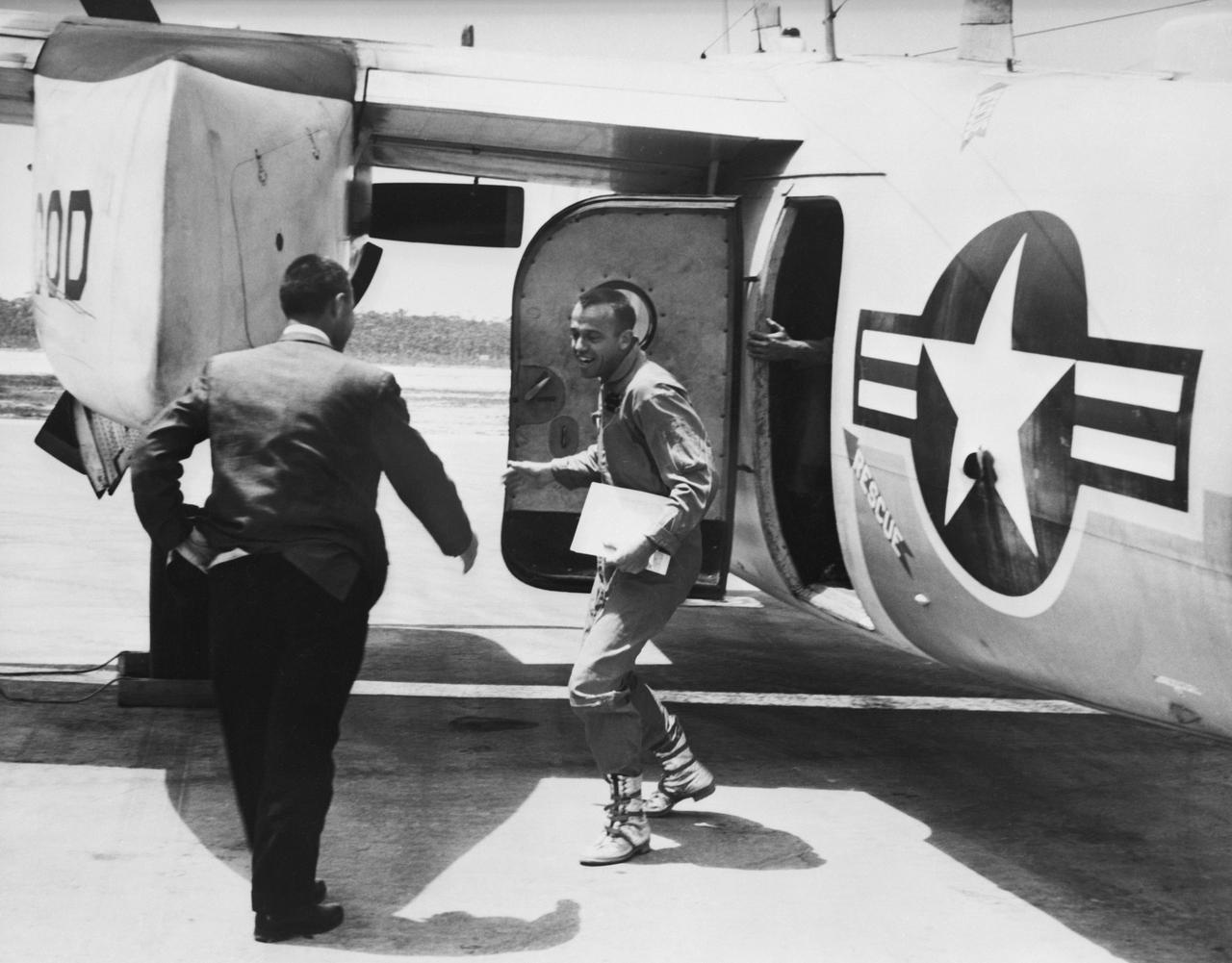
S61-02731 (5 May 1961) --- Astronaut Alan B. Shepard Jr. arrives at Grand Bahamas Island and is greeted by astronaut Virgil I. (Gus) Grissom after the first American suborbital flight. He will participate in a press conference with Grissom and Donald Slayton. Photo credit: NASA or National Aeronautics and Space Administration
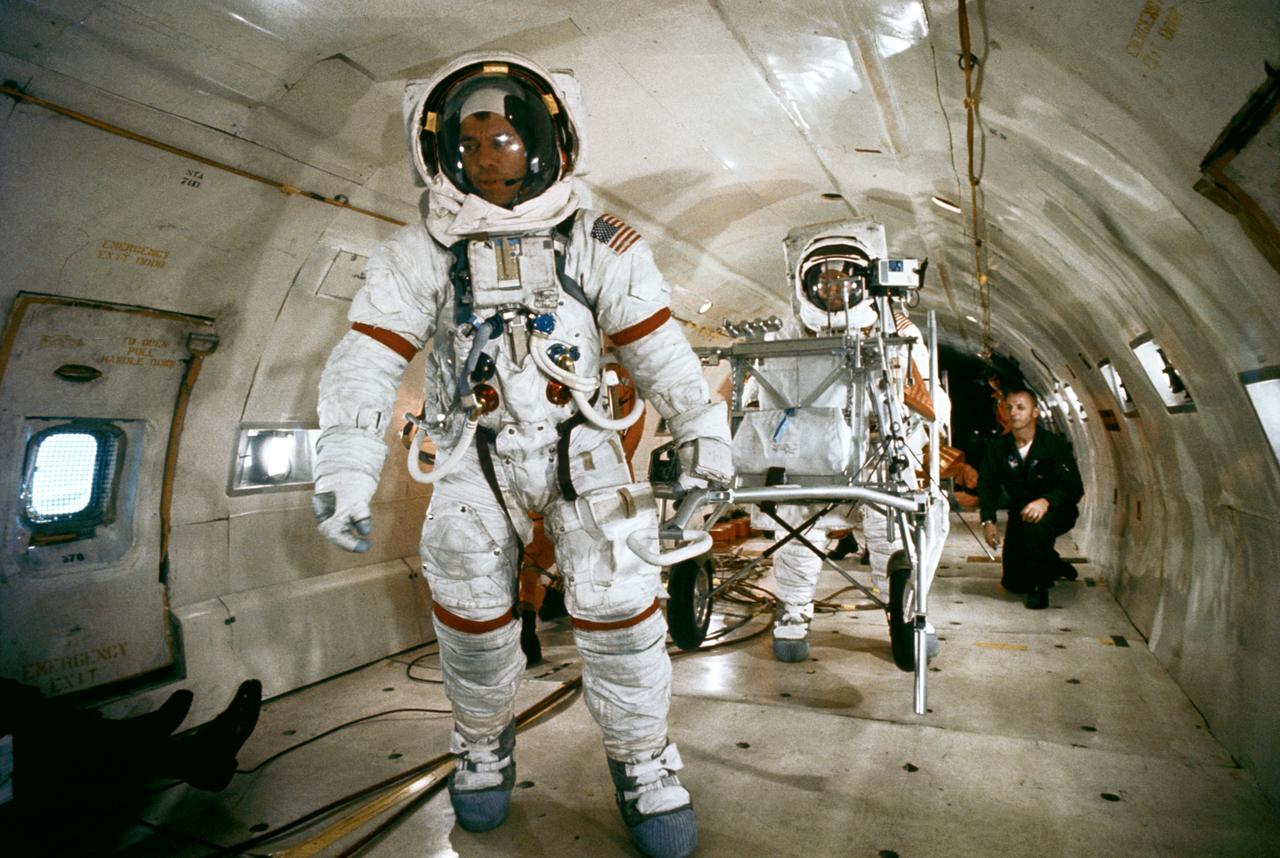
S70-53479 (4 Nov. 1970) -- Astronaut Alan B. Shepard Jr., Apollo 14 commander, pulls the modular equipment transporter (MET) under weightless conditions aboard an Air Force KC-135 out of Patrick Air Force Base. Astronaut Edgar D. Mitchell, Apollo 14 lunar module pilot, is behind the MET. The KC-135 aircraft, flying a parabolic curve, creates a weightless environment providing a training exercise in preparation for the astronauts' extravehicular activities (EVA) on the lunar surface. This training simulates the 1/6 gravity the astronauts will encounter on the moon.
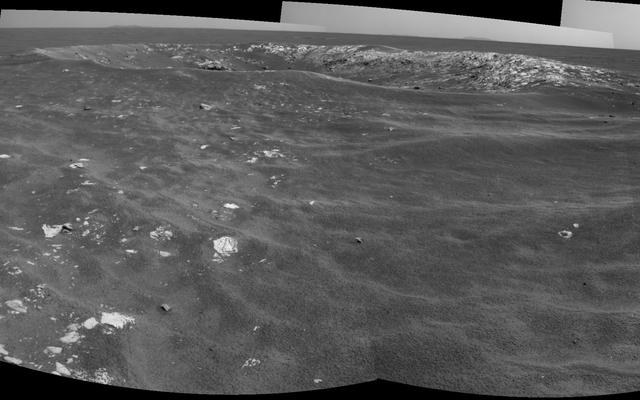
NASA Mars Exploration Rover Opportunity recorded this view of a crater informally named Freedom 7 shortly before the 50th anniversary of the first American in space: astronaut Alan Shepard flight in the Freedom 7 spacecraft.
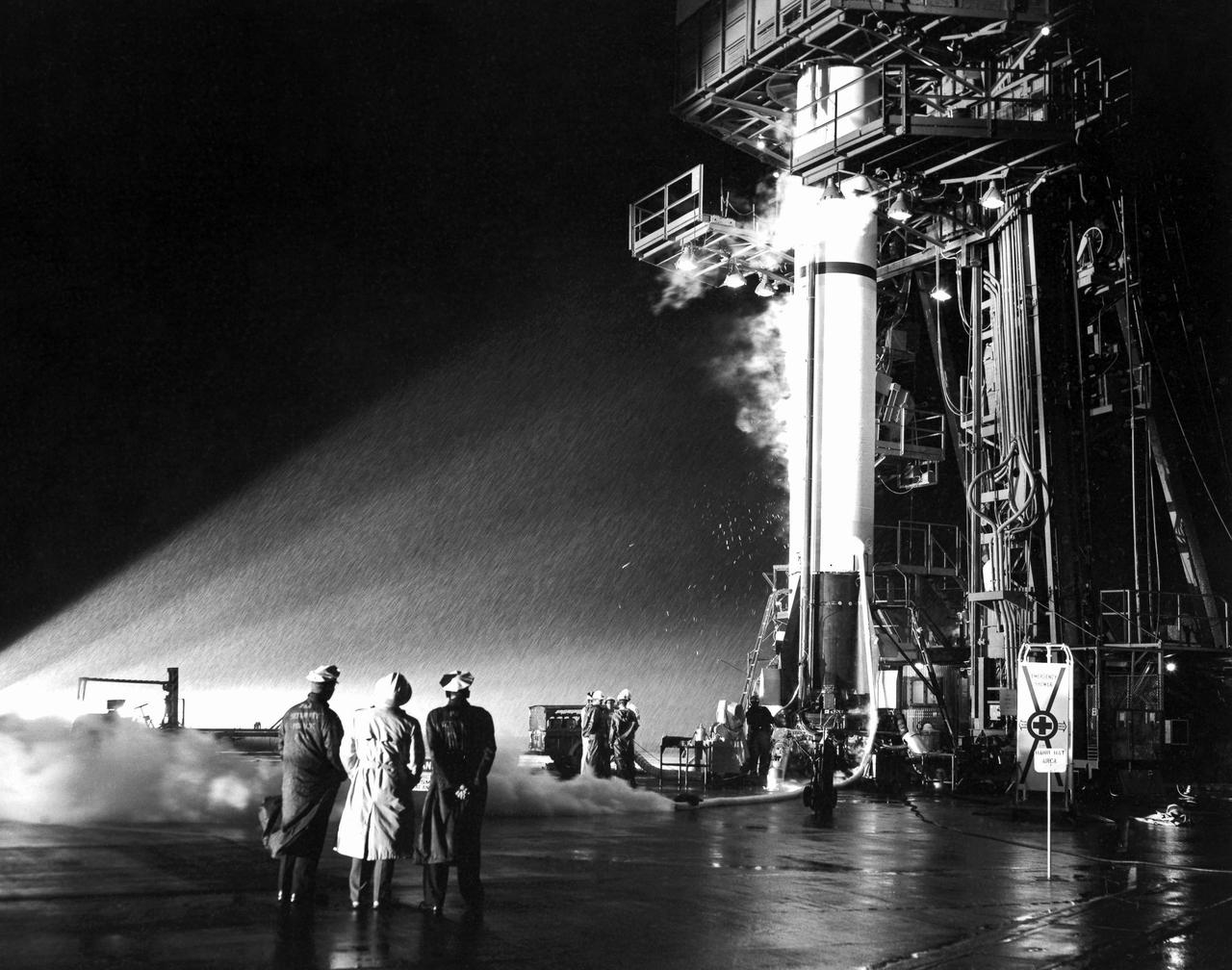
CAPE CANAVERAL, Fla. – MR-3 prelaunch alert. Photo credit: NASA/Santomassino
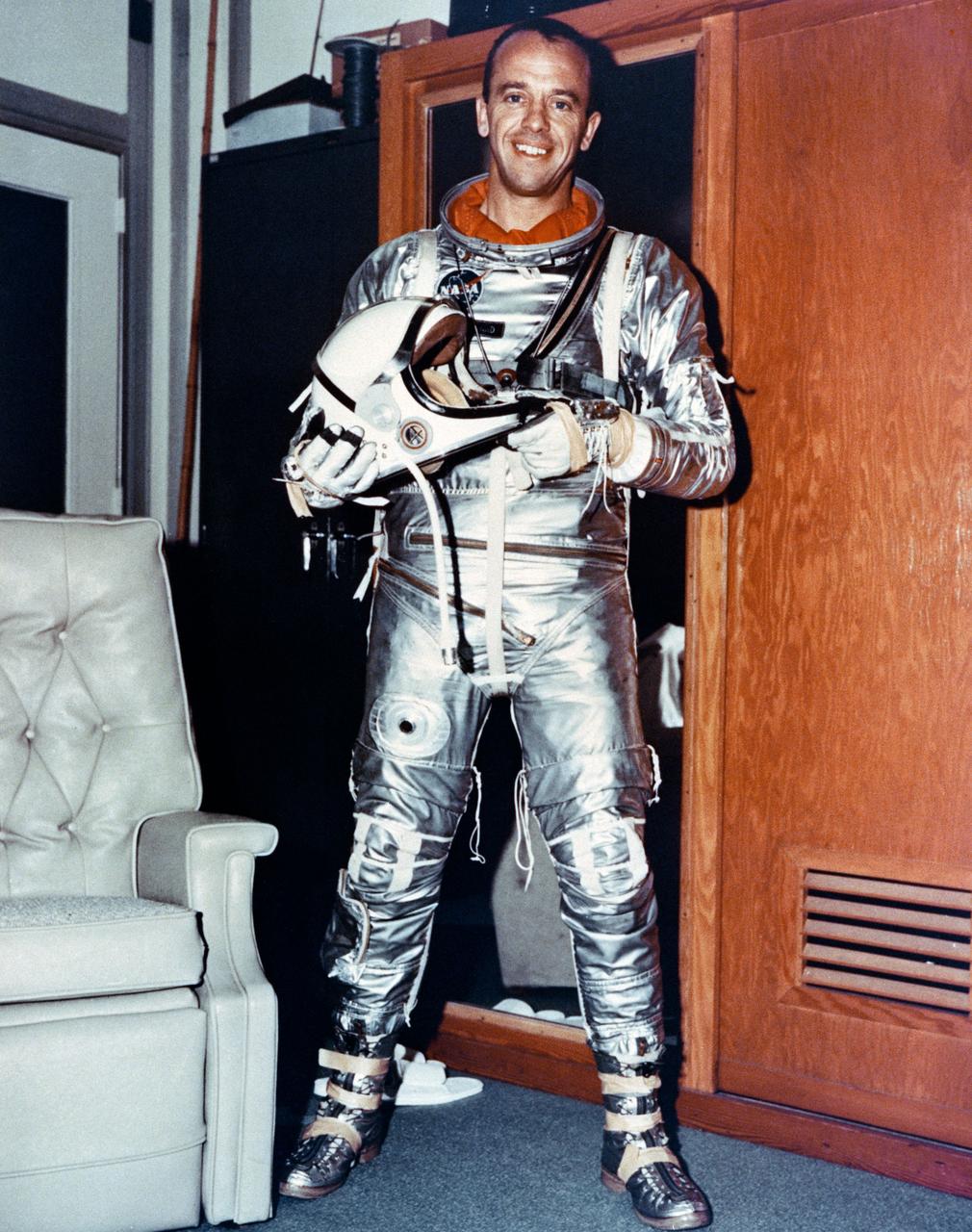
S63-02082 (5 May 1961) --- Astronaut Alan B. Shepard Jr., attired in his Mercury pressure suit, poses for a photo prior to his launch in a Mercury-Redstone 3 (MR-3) spacecraft from Cape Canaveral on a suborbital mission ? the first U.S. manned spaceflight. Photo credit: NASA or National Aeronautics and Space Administration
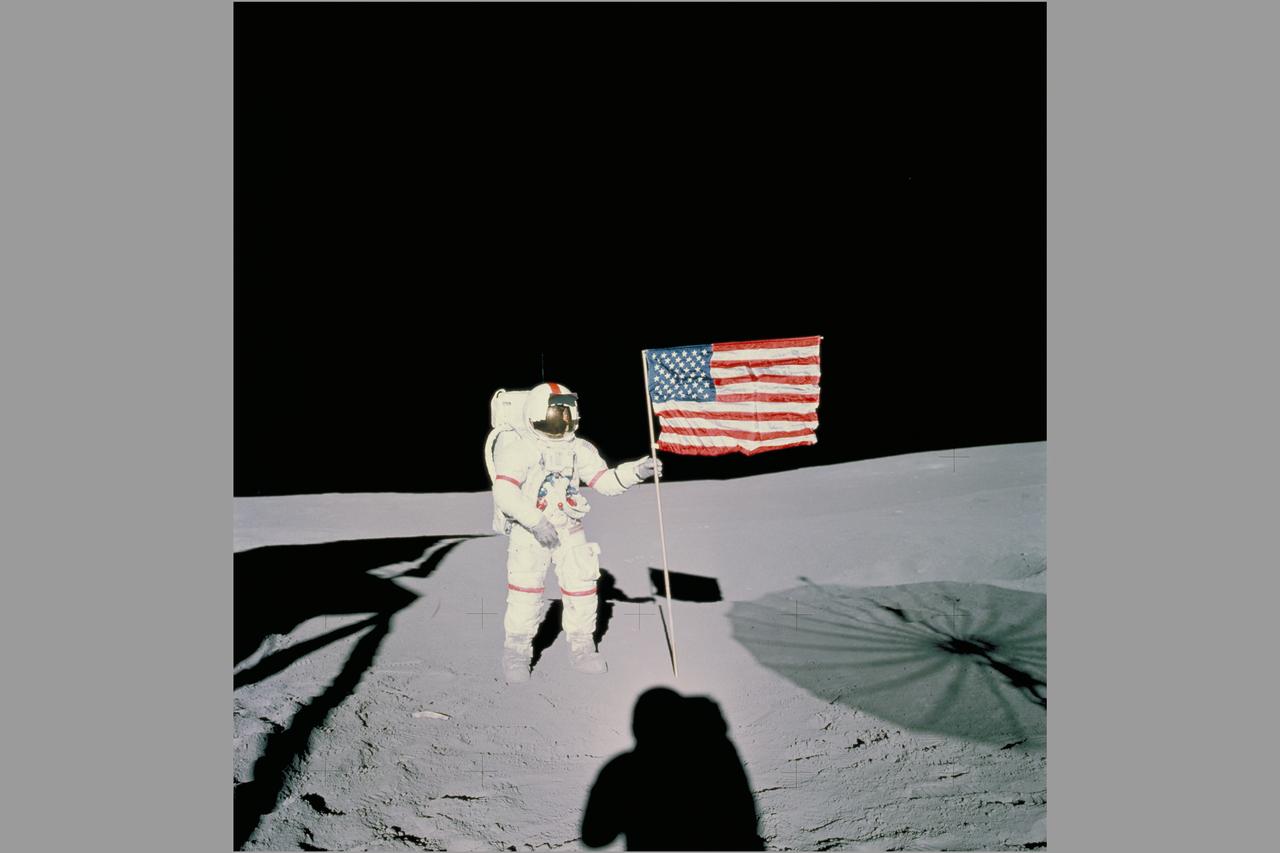
ASTRONAUT ALAN B. SHEPARD STANDING WITH AMERICAN FLAG ON LUNAR SURFACE
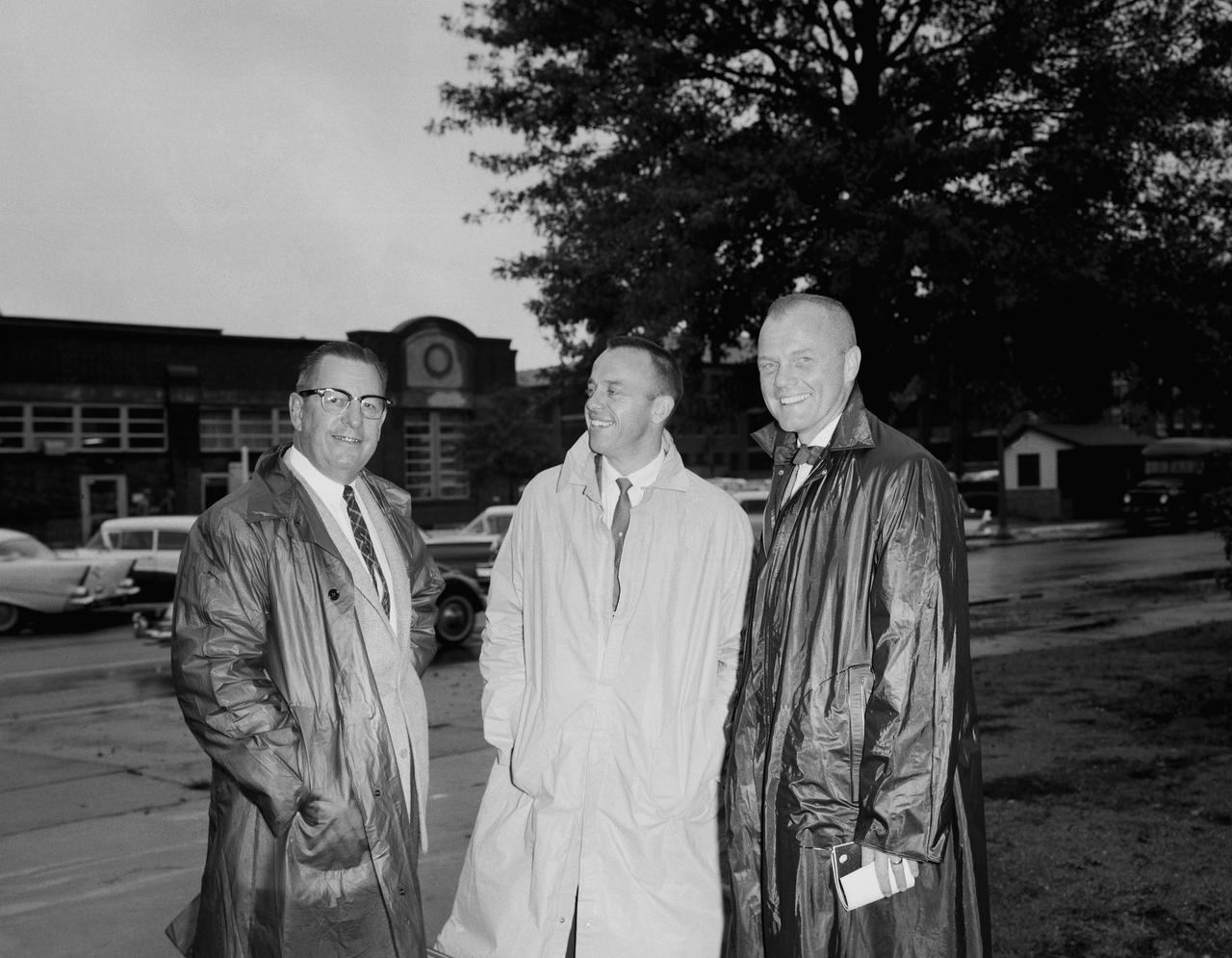
Astronauts at 1959 Langley Inspection. Astronauts at 1959 Langley Inspection: The seven are shown in the Unitary Plan Wind Tunnel NASA Langley. The astronauts left to right: John H. Glenn Jr., M.Scot Carpenter, Virgil I.Grissom, Walter M. Schirra Jr., L. Gordon Cooper, Alan B. Shepard Jr.and Donald K. Slayton.
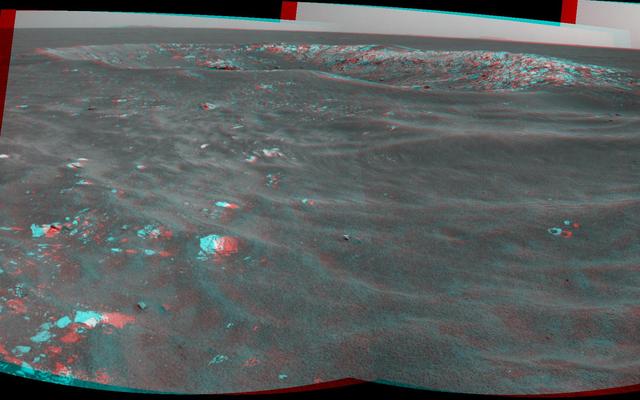
NASA Mars Exploration Rover Opportunity took this stereo view of a crater informally named Freedom 7 shortly before the 50th anniversary of the first American in space: astronaut Alan Shepard flight in the Freedom 7 spacecraft. You need 3D glasses.
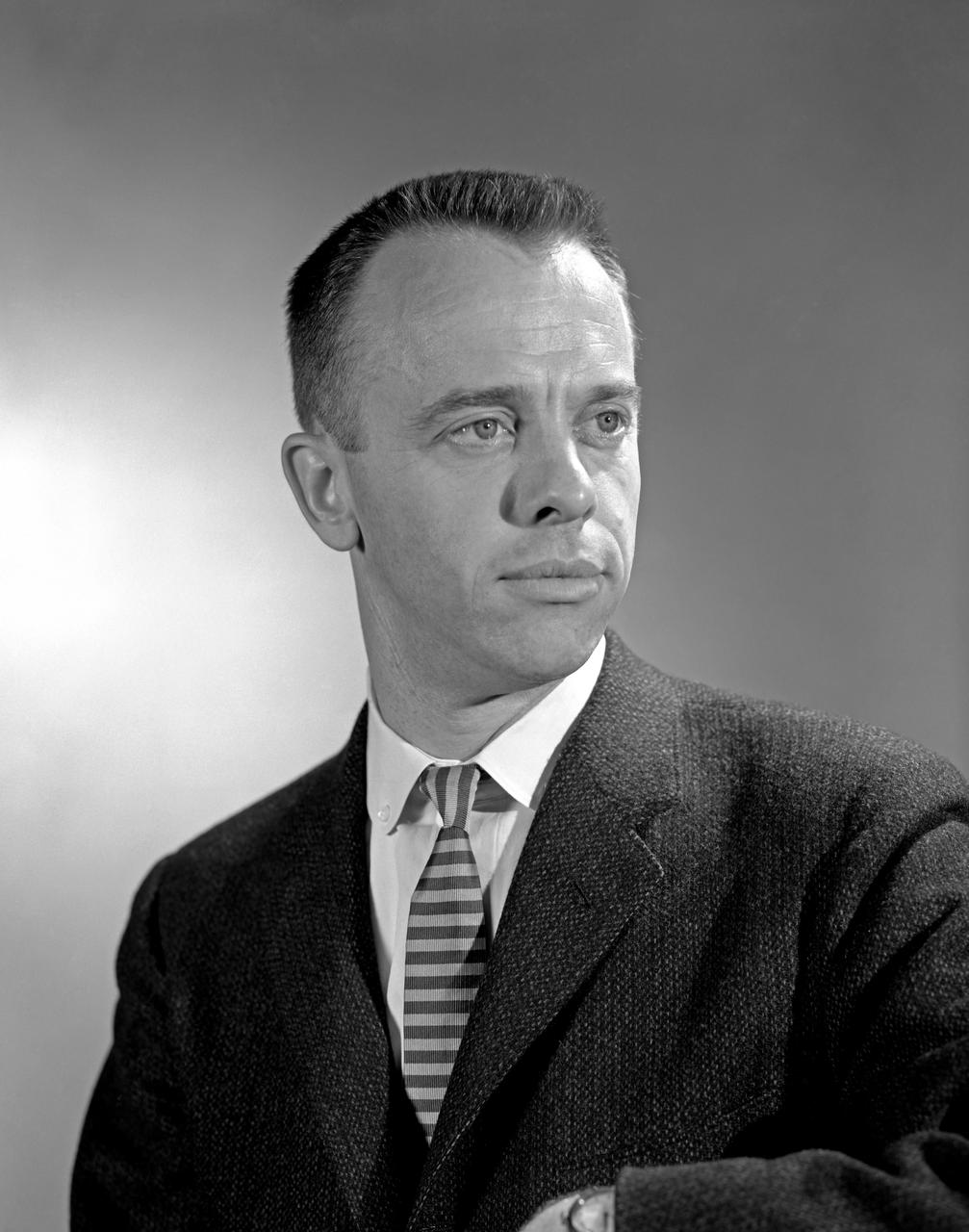
NASA Project Mercury astronaut.
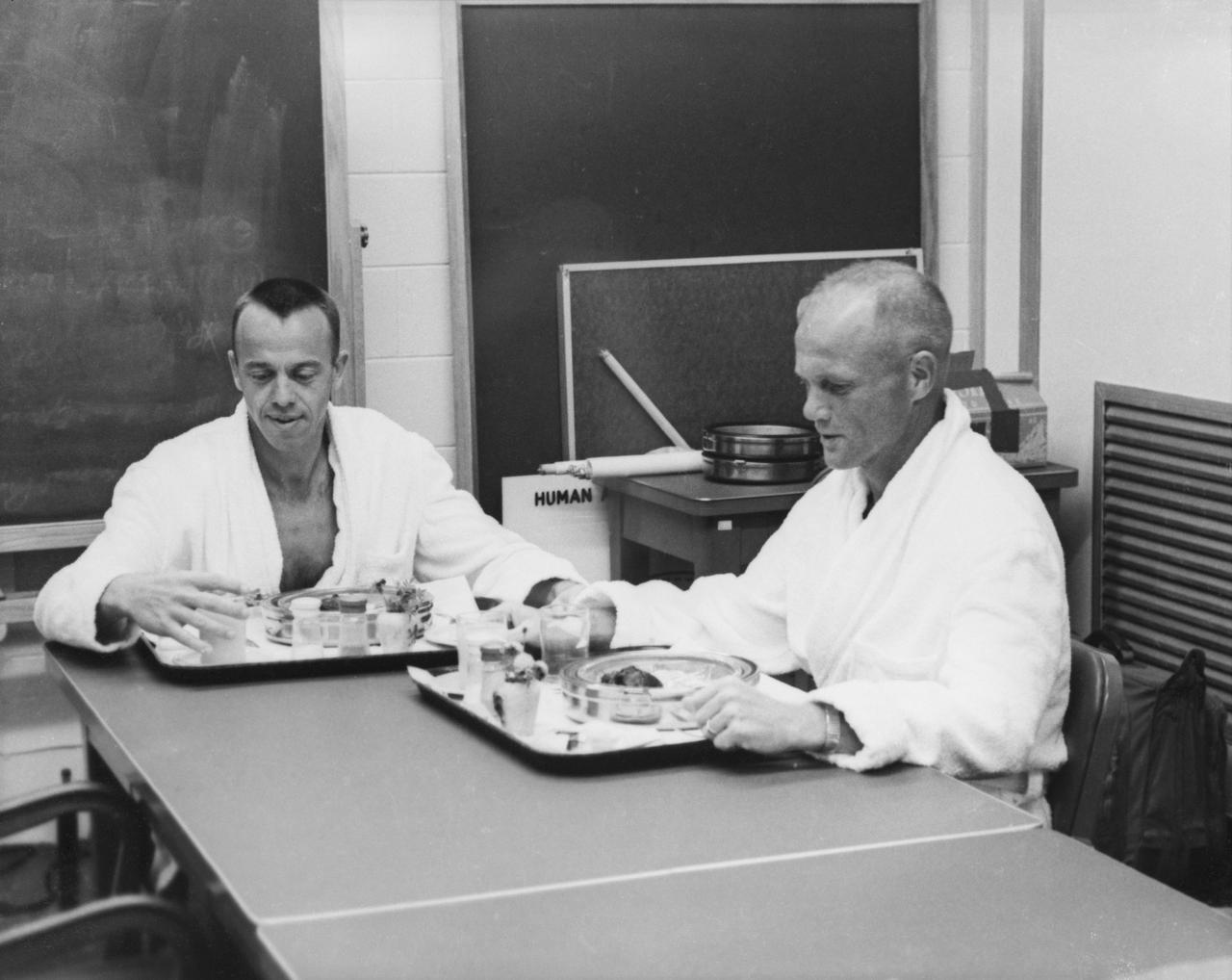
S61-02735 (5 May 1961) --- Astronauts Alan Shepard and John Glenn at breakfast before Shepard's Mercury-Redstone 3 (MR-3) spaceflight. Photo credit: NASA or National Aeronautics and Space Administration
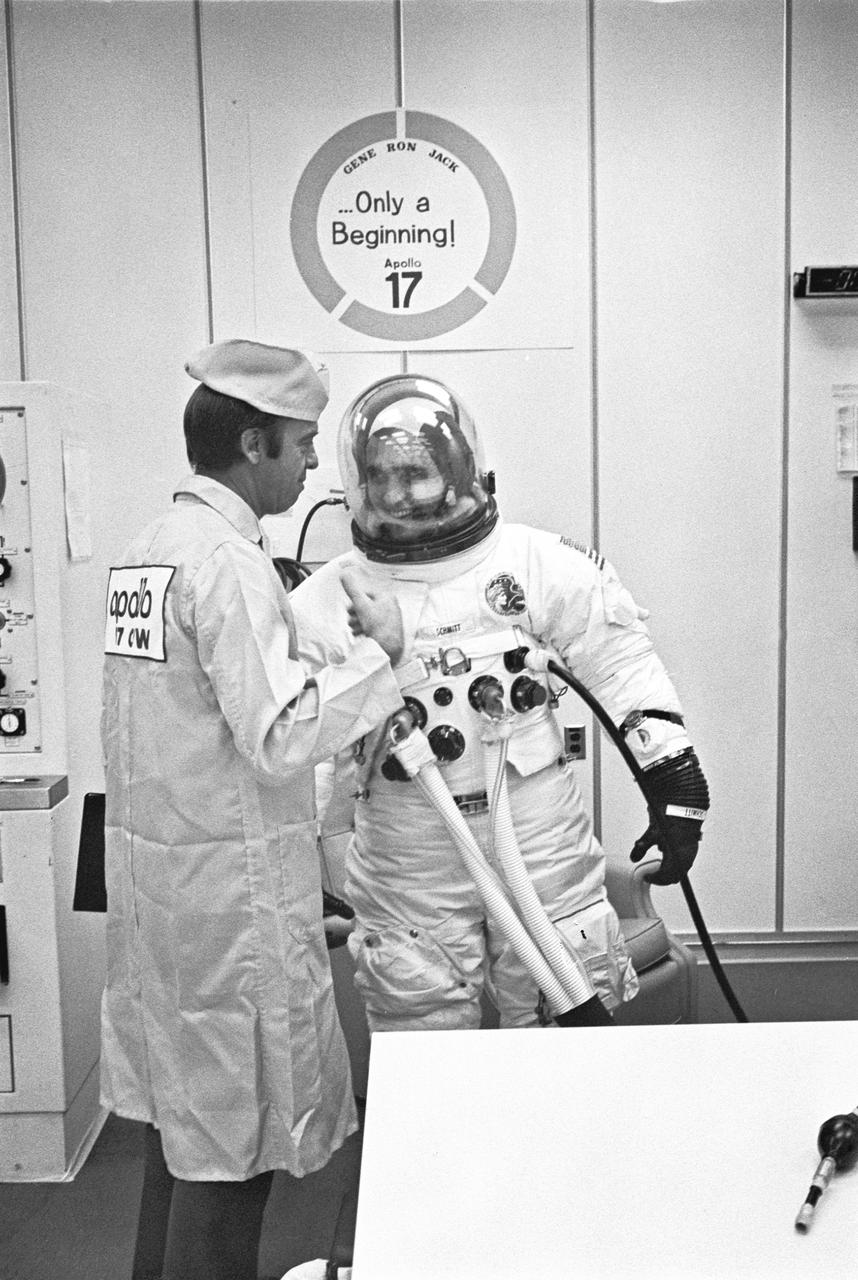
Apollo 17 Lunar module Pilot Harrison H. Schmitt shares a moment of relaxation with astronaut Alan Shepard during prelaunch suiting operations.

Astronaut Alan B. Shepard, one of the original seven astronauts for Mercury Project selected by NASA on April 27, 1959. The Freedom 7 spacecraft boosted by Mercury-Redstone vehicle for the MR-3 mission made the first marned suborbital flight and Astronaut Shepard became the first American in space.
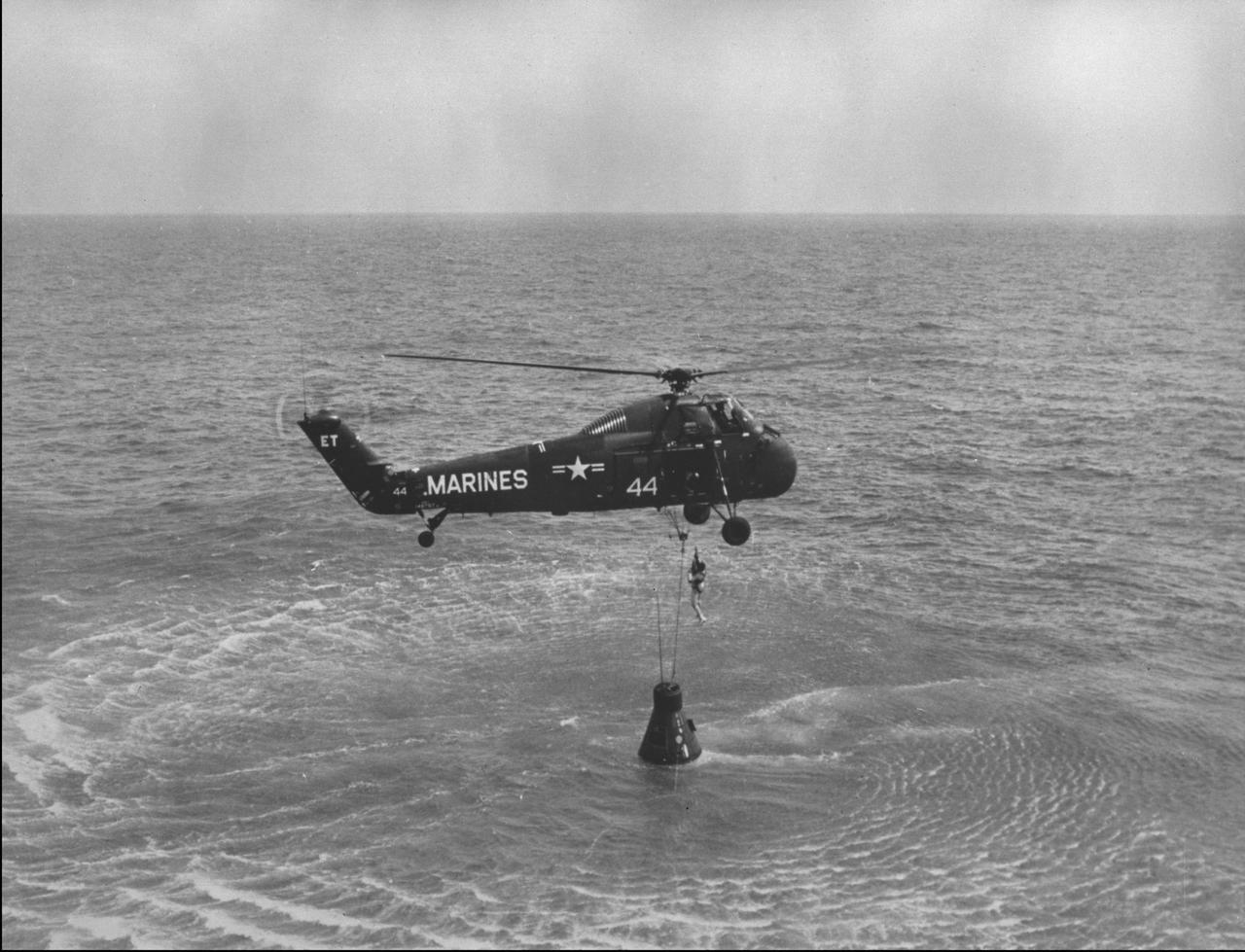
KENNEDY SPACE CENTER, FLA. -- NASA Astronaut Alan B. Shepard Jr. is hoisted up in a body harness by a U.S. Marine helicopter recovery team following the first Project Mercury suborbital space flight. Astronaut Shepard, along with his spacecraft, was then taken to the U.S. Navy Carrier Chaplain.
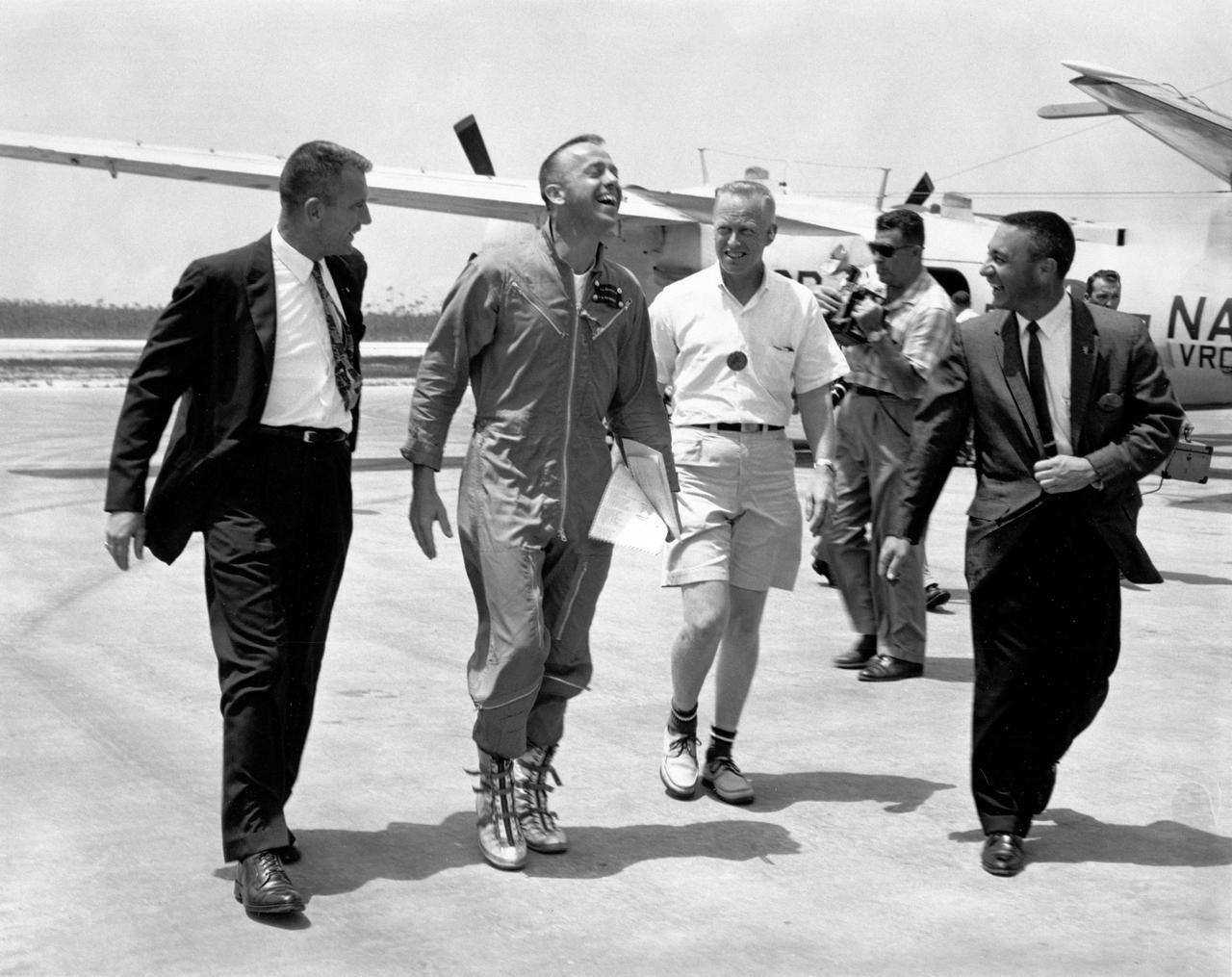
KENNEDY SPACE CENTER, FLA. - Astronauts Deke Slayton, far left, and Virgil Grissom, far right, were on hand to greet Astronaut Alan B. Shepard at Grand Bahama Island after his historic first U.S. manned suborbital flight. Just behind Astronaut Shepard is Dr. Keith Lyndell.
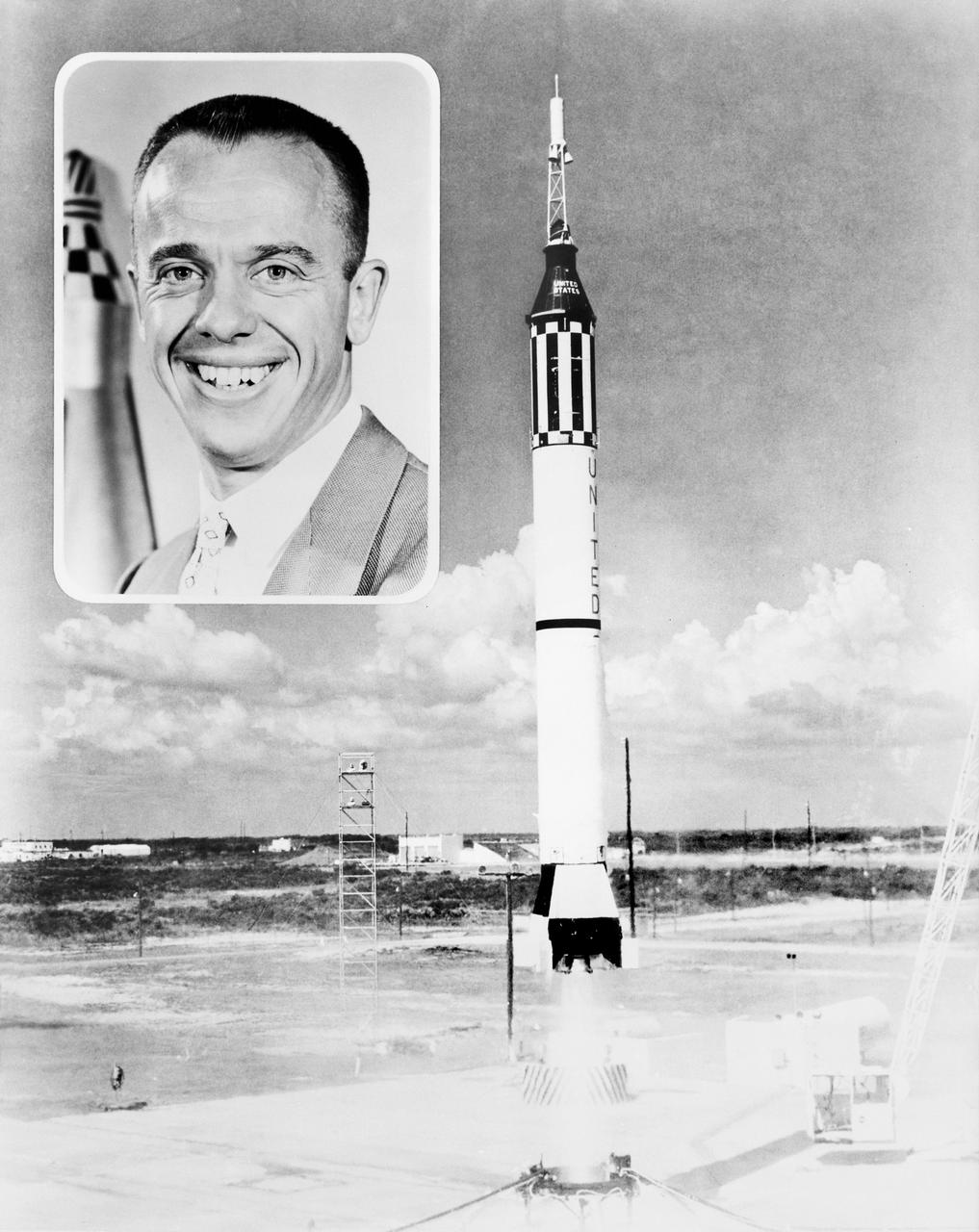
S62-01151 (5 May 1961) --- The liftoff of the Mercury-Redstone 3 (MR-3) on May 5, 1961, piloted by astronaut Alan B. Shepard, Jr., whose portrait is in inset. Shepard went on a 15-minute sub-orbital flight. The spacecraft was designated the ?Freedom? 7.
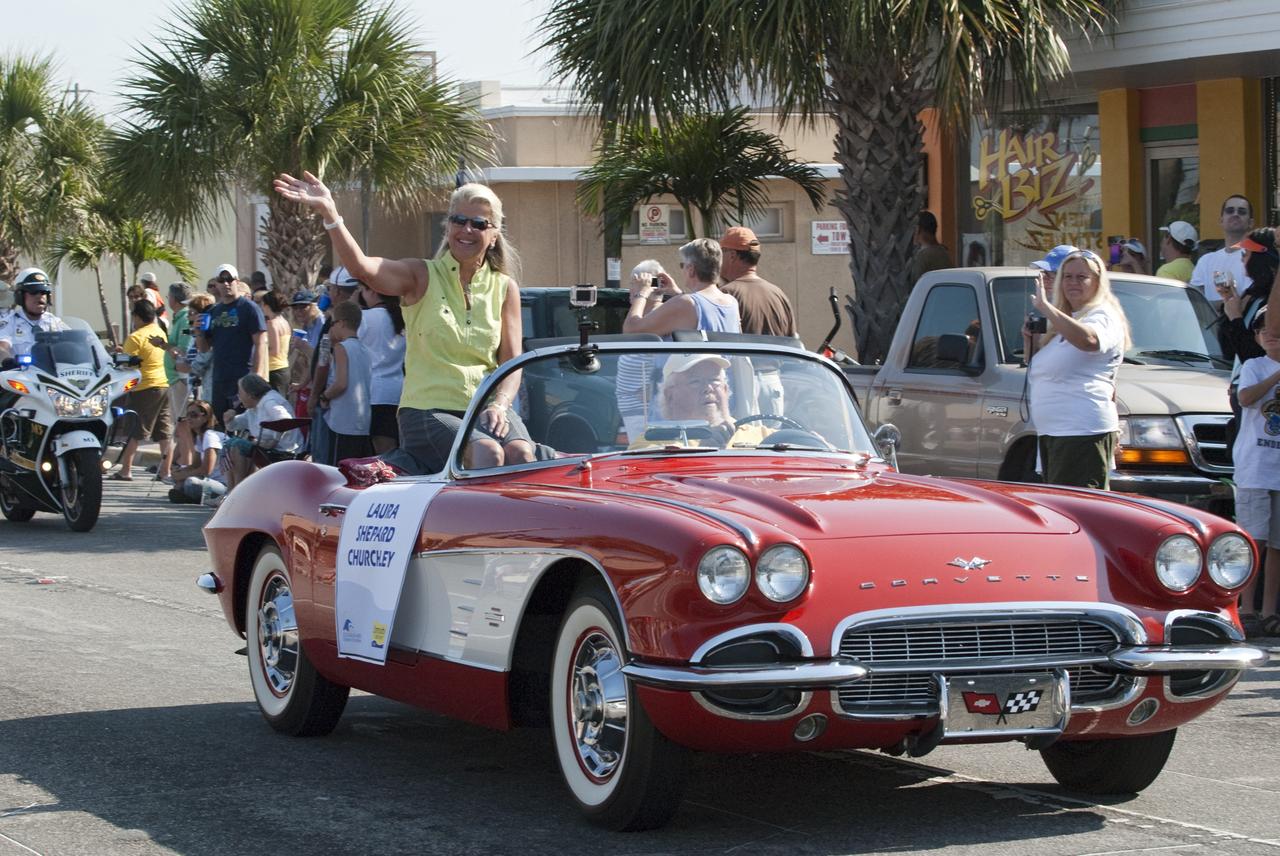
Cape Canaveral, Fla. – Laura Shepard Churchley, representing her late father Mercury 7 astronaut Alan Shepard, waves to spectators from a vintage Chevrolet Corvette during a commemorative parade in Cocoa Beach, Fla. A group of current and retired NASA astronauts gathered in Cocoa Beach to commemorate NASA’s 50 years of accomplishments and to honor astronaut Alan Shepard’s Mercury/Freedom 7 suborbital flight May 5, 1961.The event was marked by a parade, with the astronauts riding in a fleet of Chevrolet Corvettes that corresponded with the time period of their space missions. Members of the Cape Kennedy Corvette Club, a group established in 1967, escorted almost two dozen astronauts or their family representatives in club members' cars. The Corvette parade started at the glass bank building, at 9:34 a.m. EDT, the same time Shepard launched into space. Photo credit: NASA/Kim Shiflett
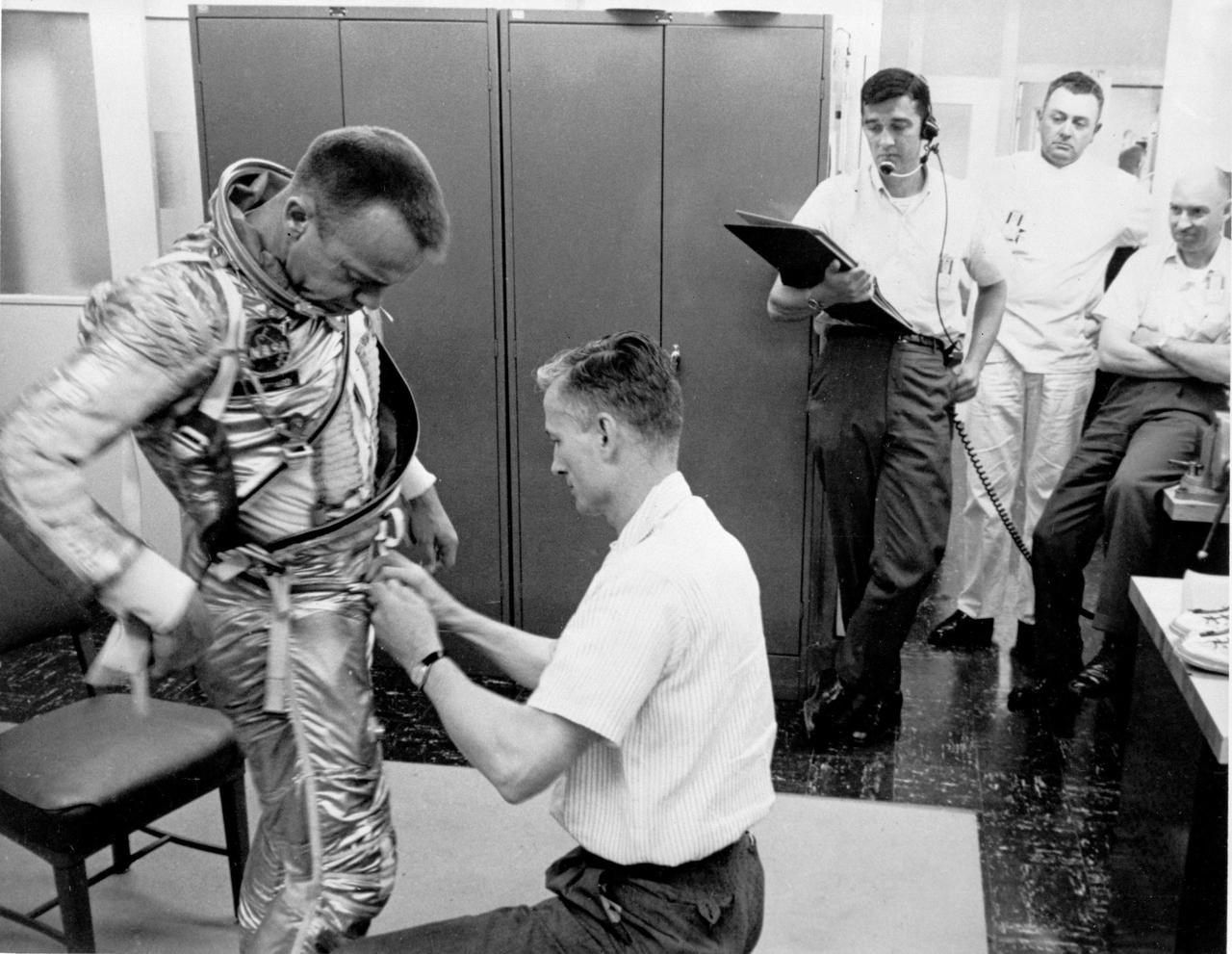
KENNEDY SPACE CENTER, FLA. - Astronaut Alan B. Shepard is being assisted by a technician in getting into his space suit at 2:45 a.m. this morning, beginning the long countdown of the scheduled launch of the Mercury Redstone. After Astronaut Shepard is suited up, he will travel by van to the Redstone Gantry on Pad 5 and be placed into the Mercury Capsule, called Freedom 7, on top of the Redstone booster rocket. Astronaut Shepard will pilot the first U.S. manned sub-orbital space flight of the Manned Mercury Program.
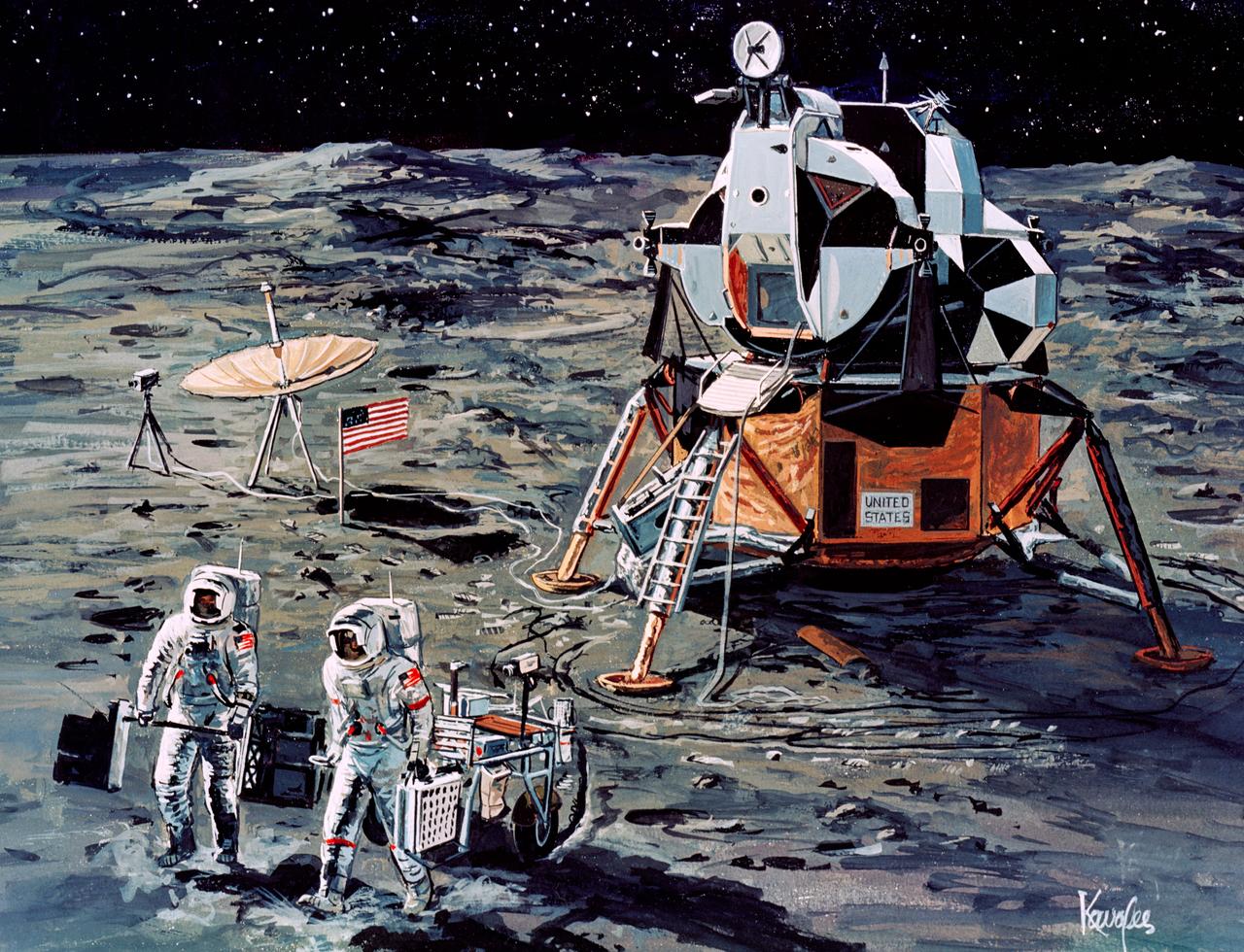
S71-16101 (January 1971) --- A Grumman Aerospace Corporation artist's concept of Apollo 14 crewmen, astronauts Alan B. Shepard Jr., commander, and Edgar D. Mitchell, lunar module pilot, as they set out on their first traverse. Shepard is pulling the Modularized Equipment Transporter (MET) which contains cameras, lunar sample bags, tools and other paraphernalia. Shepard has the Laser Ranging Retro-Reflector (LR-3) in his other hand. Mitchell is carrying the Apollo Lunar Surface Experiments Package (ALSEP) barbell mode.
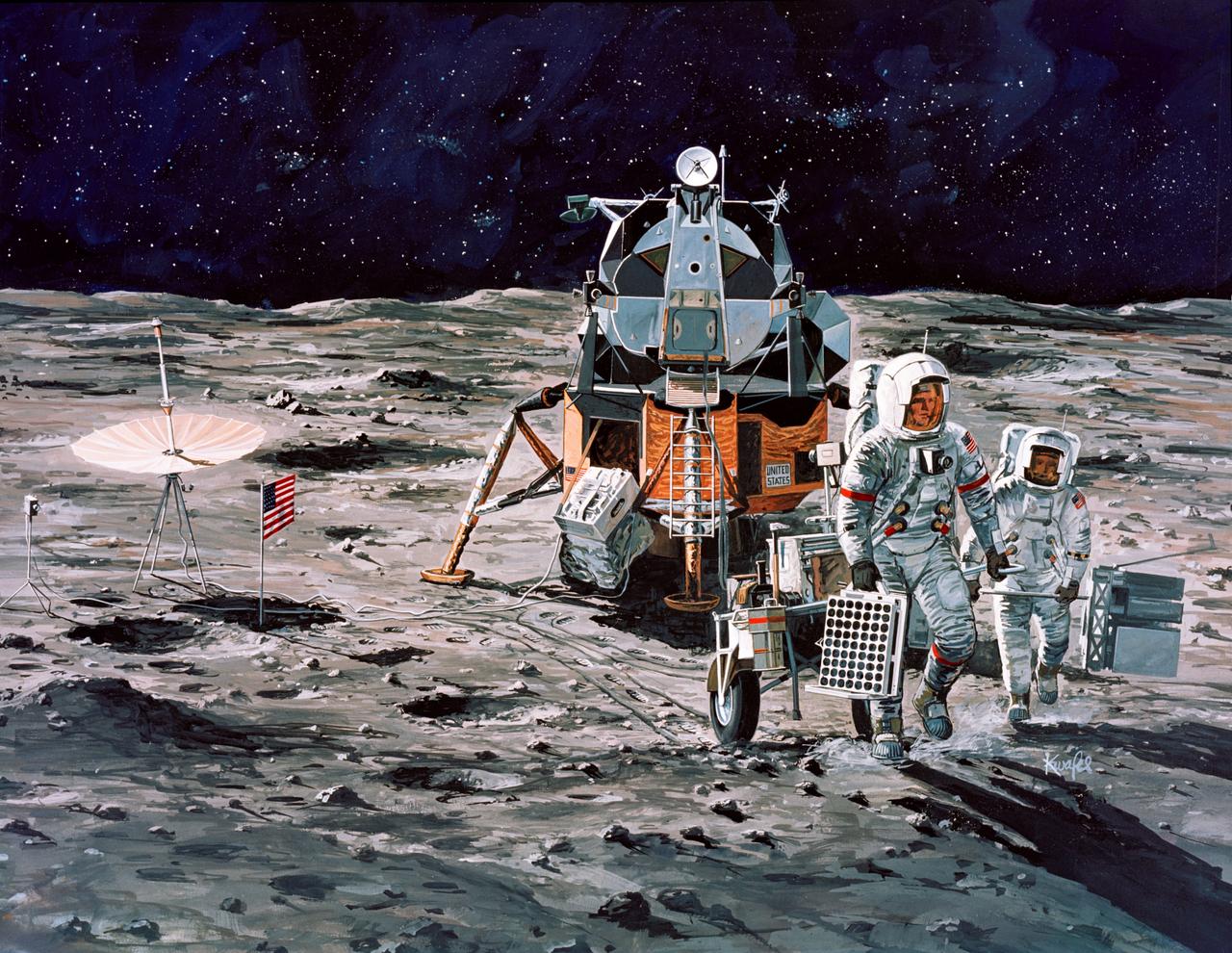
S71-16102 (January 1971) --- A Grumman Aerospace Corporation artist's concept of Apollo 14 crewmen, astronauts Alan B. Shepard Jr., commander, and Edgar D. Mitchell, lunar module pilot, as they set out on their first traverse. Shepard is pulling the Modularized Equipment Transporter (MET) which contains cameras, lunar sample bags, tools and other paraphernalia. Shepard has the Laser Ranging Retro-Reflector (LR3) in his other hand. Mitchell is carrying the Apollo Lunar Surface Experiments Package (ALSEP) barbell mode.
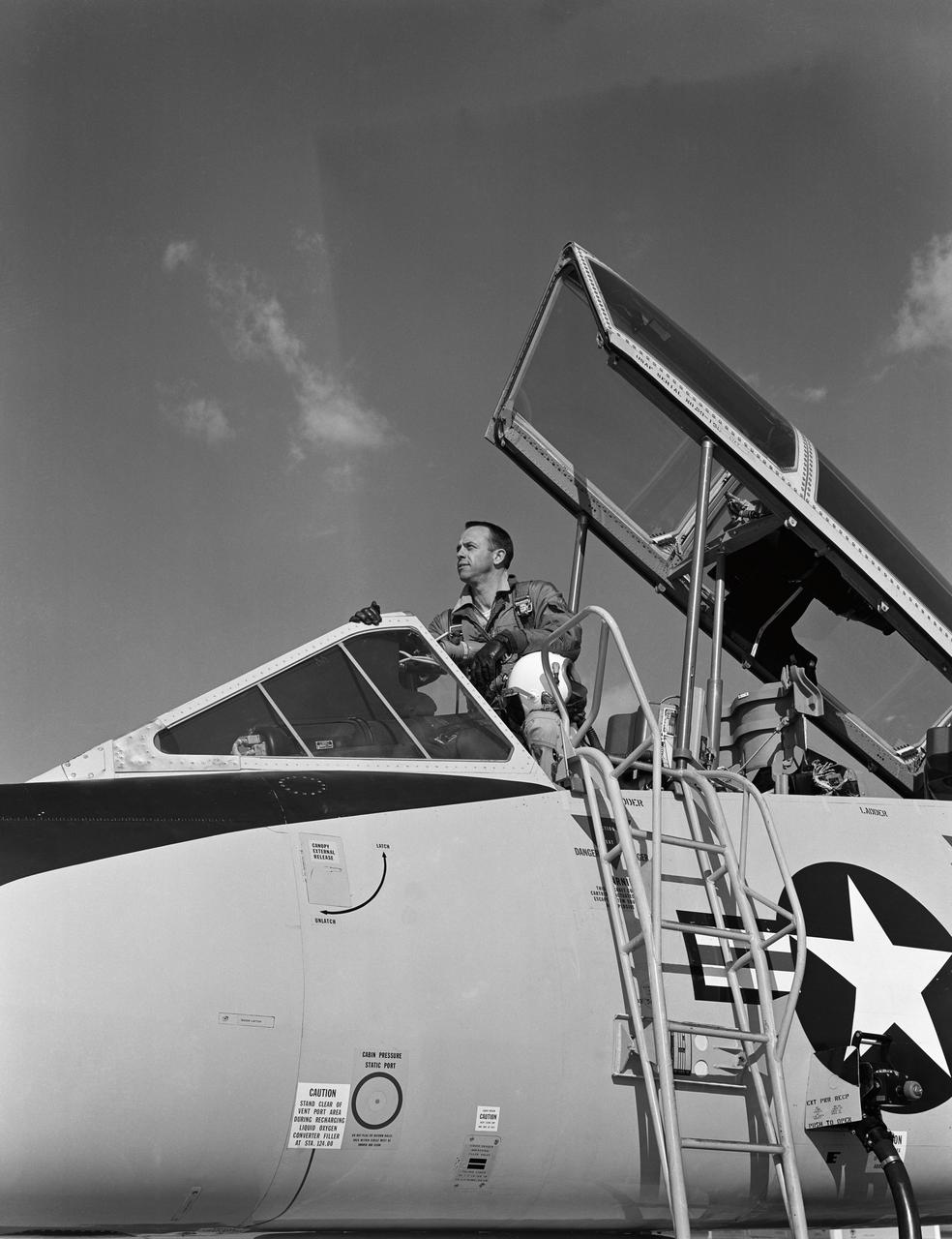
M61-00012 (20 Jan. 1961) --- Astronaut Alan B. Shepard Jr. pictured on the flight line climbing aboard a F-106 aircraft. Photo credit: NASA or National Aeronautics and Space Administration
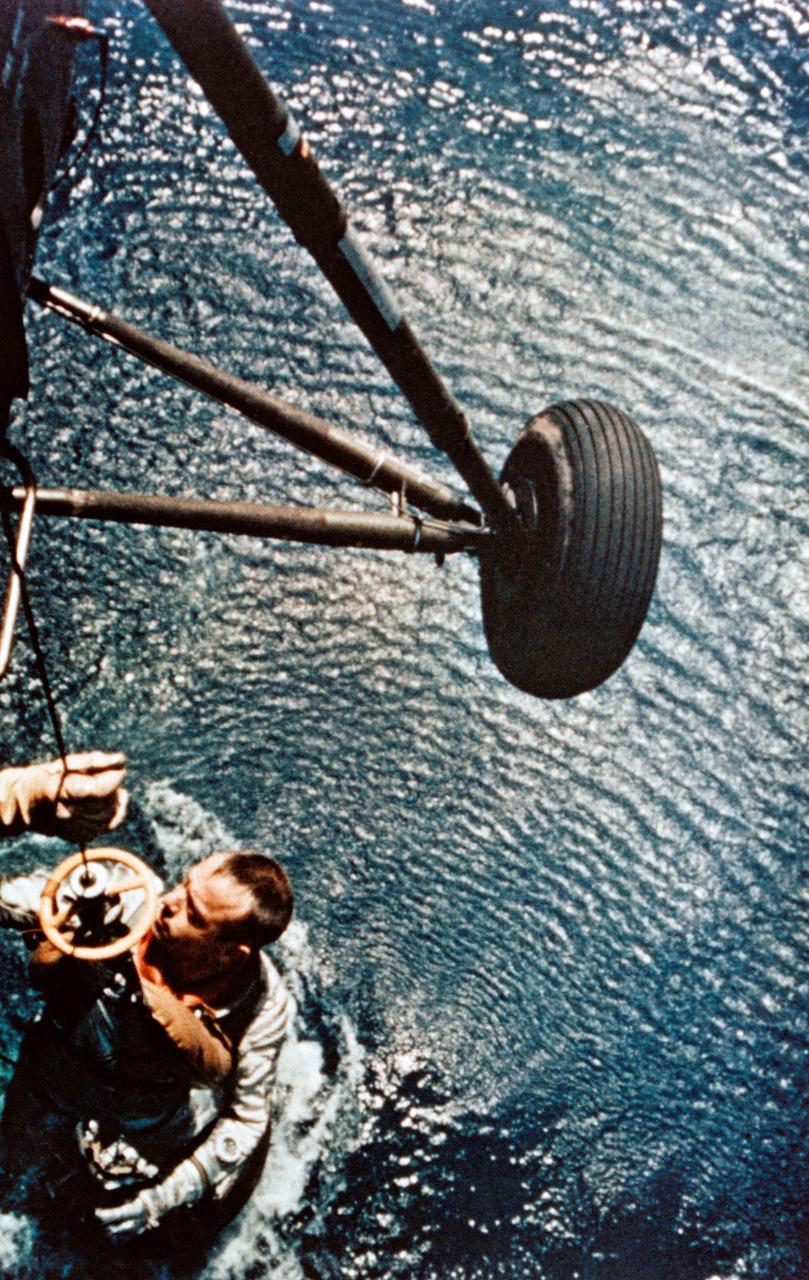
S64-14858 (5 May 1961) --- Astronaut Alan B. Shepard is rescued by a U.S. Marine helicopter at the termination of his sub-orbital flight May 5, 196l down range from the Florida eastern coast.
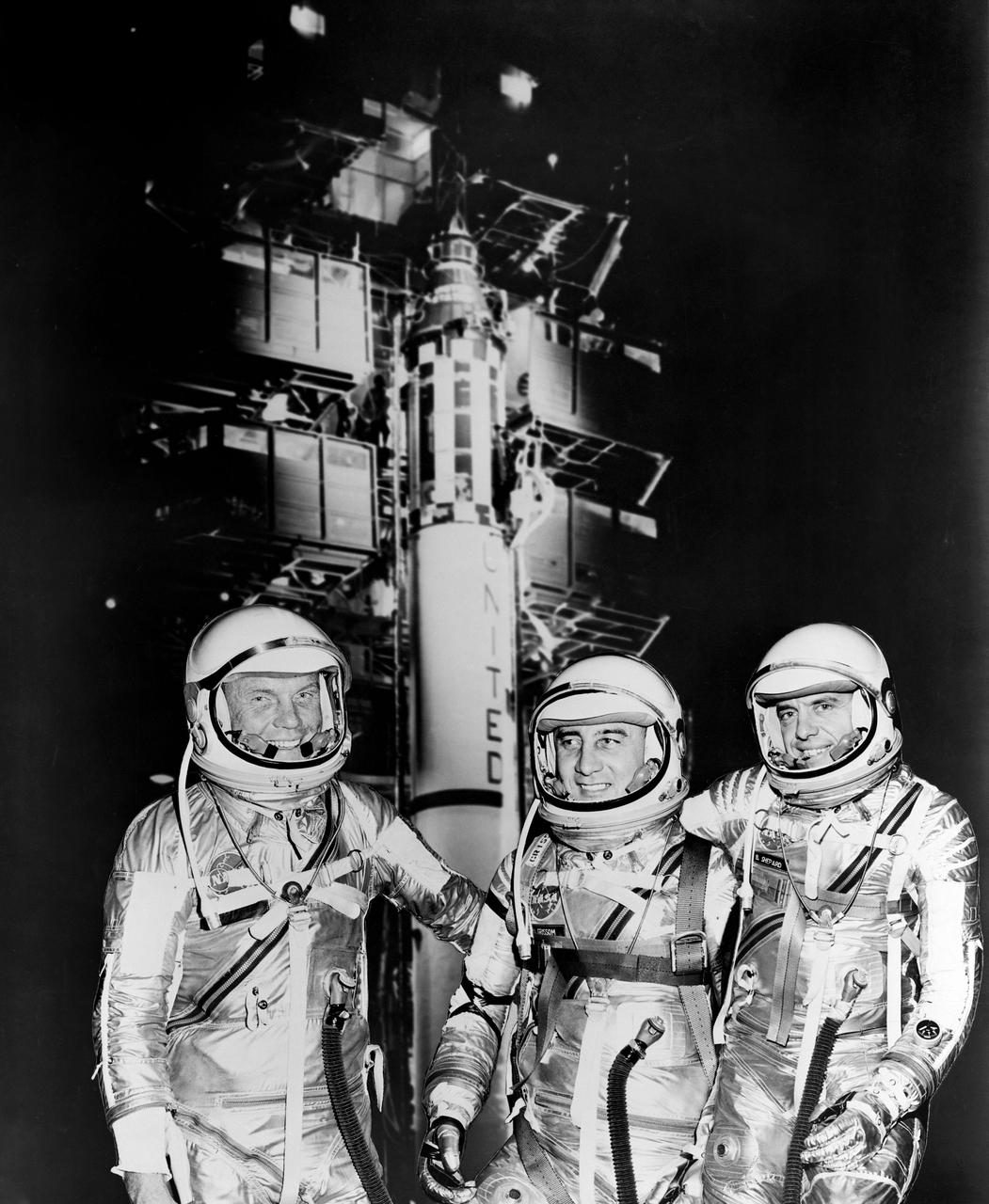
S61-00239 (1961) --- Mercury astronauts John H. Glenn Jr., Virgil I. Grissom and Alan B. Shepard Jr. standing by Redstone rocket in their spacesuits. Photo credit: NASA
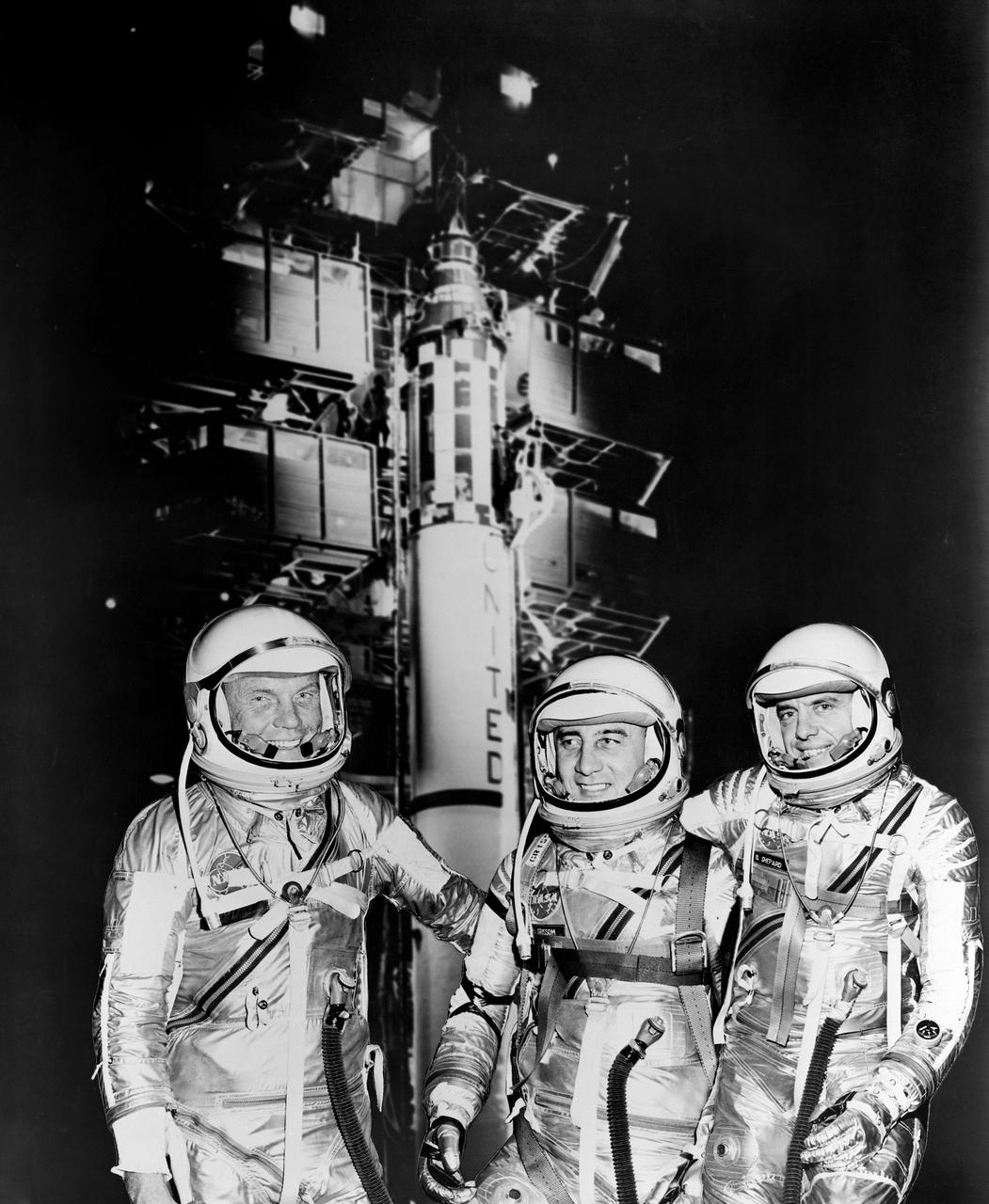
1961 -- The first three Americans in space, Mercury astronauts, from the left, John H. Glenn Jr., Virgil I. (Gus) Grissom and Alan B. Shepard Jr. standing by Redstone rocket in their spacesuits.
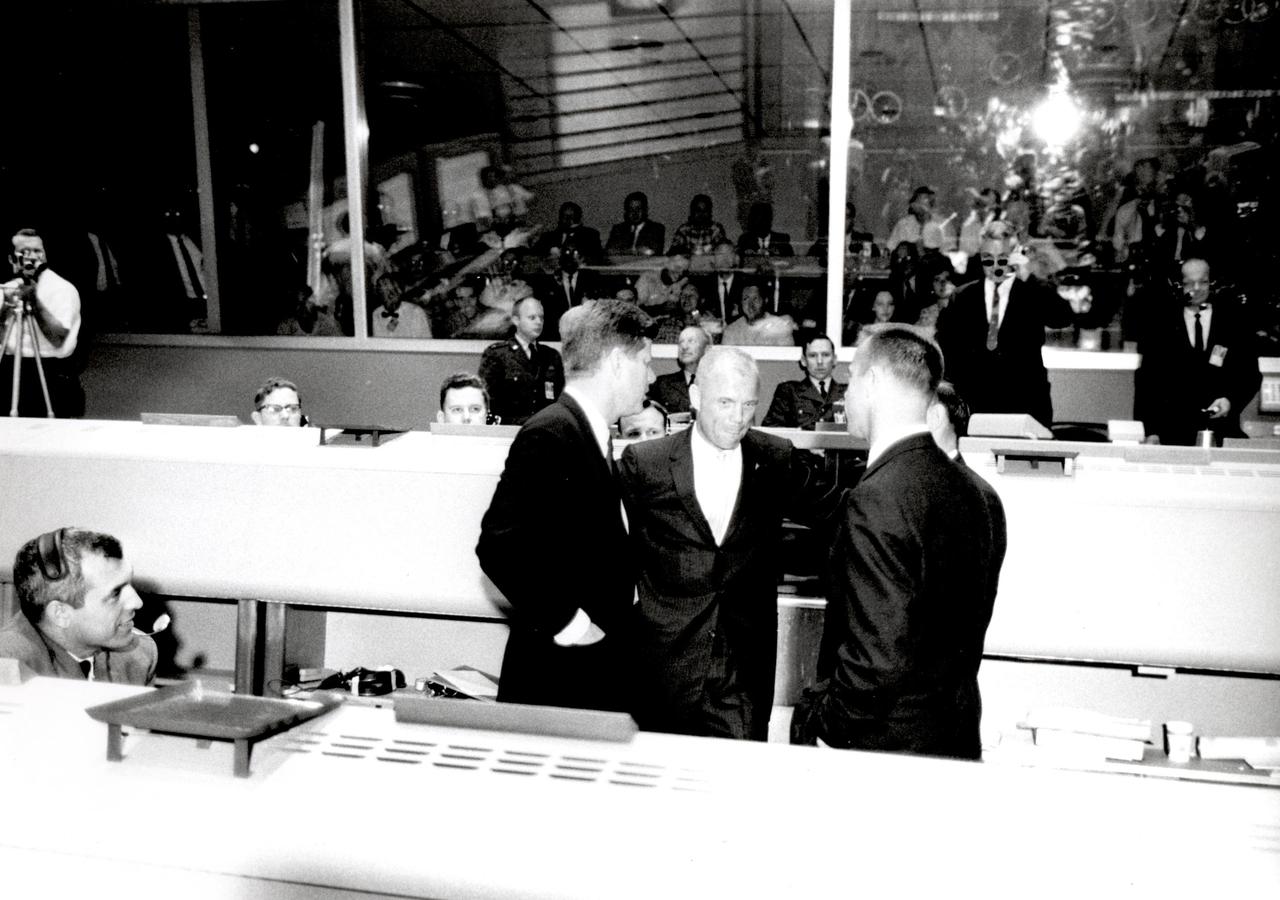
President John F. Kennedy (left) visits Mercury's Flight Control Area a few days after John Glenn's flight in February 1962. To Kennedy's right are Glenn and astronaut Alan Shepard.
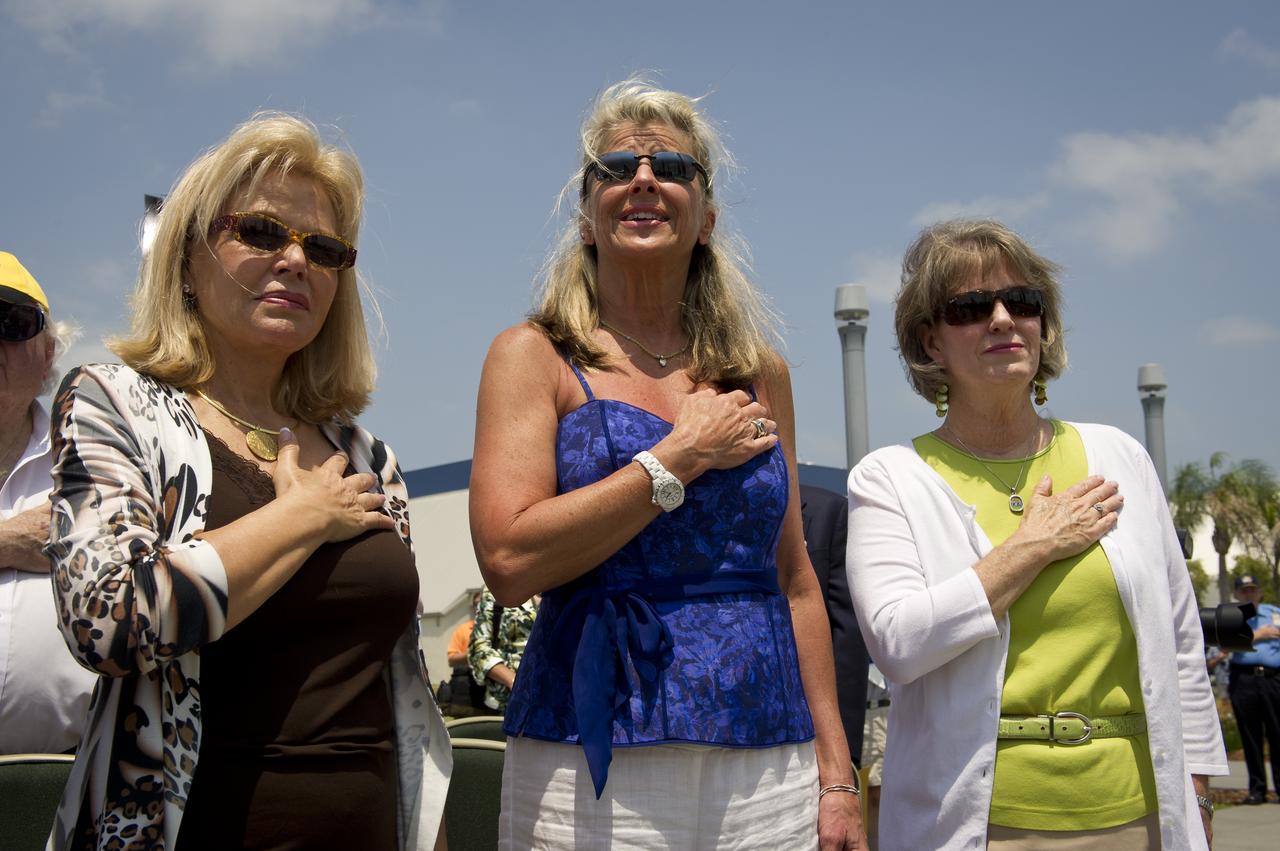
Patty Carpenter, wife of NASA Mercury Astronaut Scott Carpenter, left, Daughters of NASA astronaut Alan Shepard, Laura Shepard Churchley, and, Alice Wackermann, right, sing the National Anthem during an unveiling ceremony of two USPS stamps that commemorate and celebrate 50 years of US Spaceflight and the MESSENGER program during an event, Wednesday, May 4, 2011 at the NASA Kennedy Space Center in Cape Canaveral, Fla. One stamp commemorates NASA’s Project Mercury, America’s first manned spaceflight program, and NASA astronaut Alan Shepard’s historic flight on May 5, 1961, aboard spacecraft Freedom 7. The other stamp draws attention to NASA’s unmanned MESSENGER mission, a scientific investigation of the planet Mercury. On March 17, 2011, MESSENGER became the first spacecraft to enter into orbit around Mercury. Photo Credit: (NASA/Bill Ingalls)
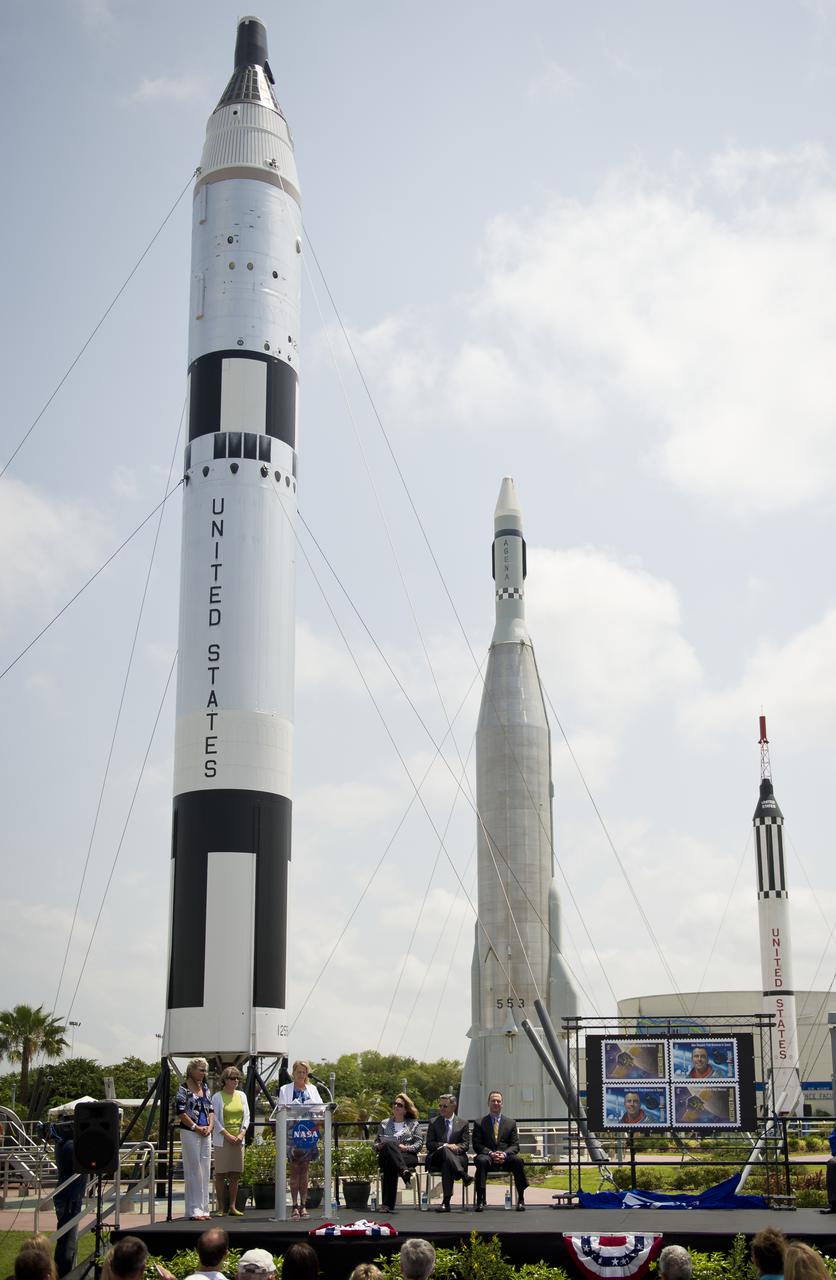
Daughters of NASA astronaut Alan Shepard, Laura Shepard Churchley, standing left, Alice Wackermann and Julie Jenkins, standing right, speak during an unveiling ceremony of two USPS stamps that commemorate and celebrate 50 years of US Spaceflight and the MESSENGER program during an event, Wednesday, May 4, 2011 at the NASA Kennedy Space Center in Cape Canaveral, Fla. One stamp commemorates NASA’s Project Mercury, America’s first manned spaceflight program, and NASA astronaut Alan Shepard’s historic flight on May 5, 1961, aboard spacecraft Freedom 7. The other stamp draws attention to NASA’s unmanned MESSENGER mission, a scientific investigation of the planet Mercury. On March 17, 2011, MESSENGER became the first spacecraft to enter into orbit around Mercury. Photo Credit: (NASA/Bill Ingalls)
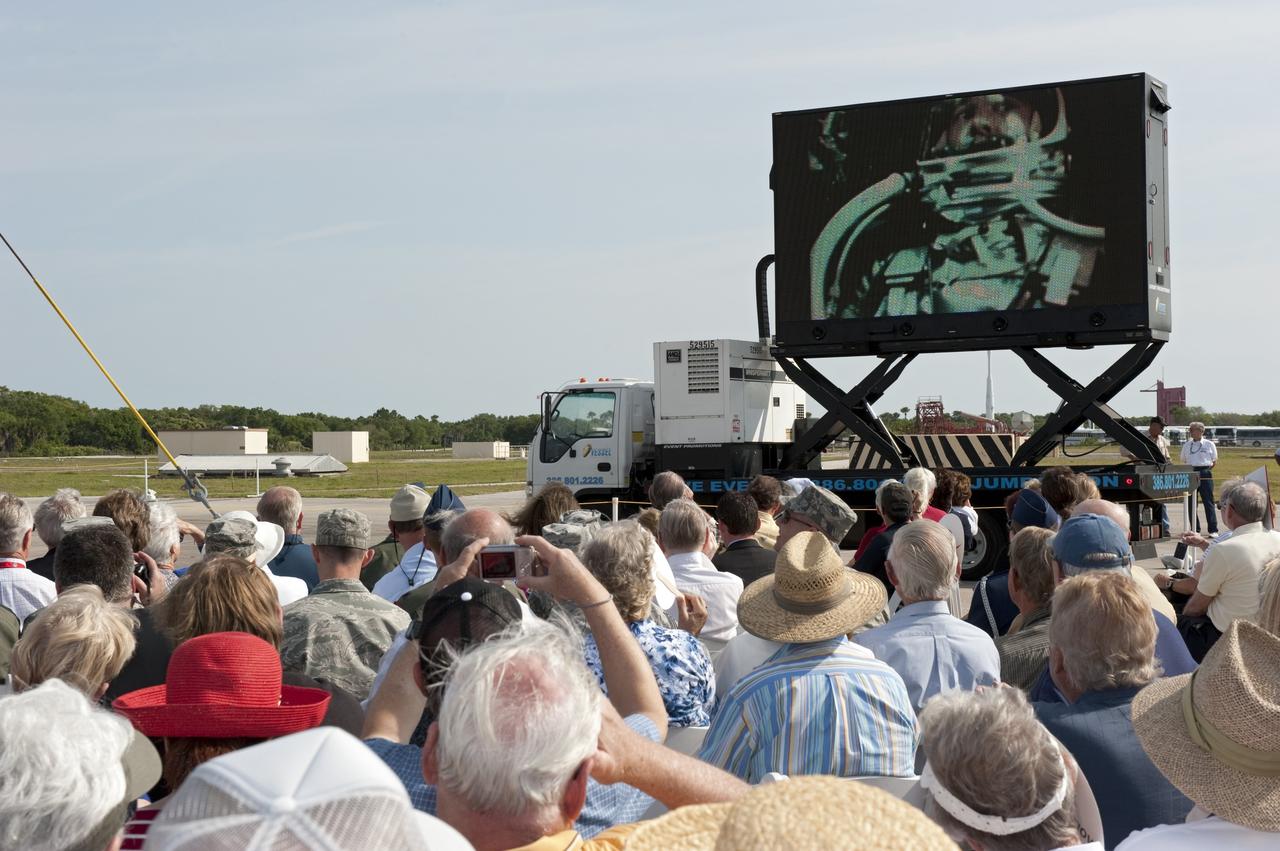
CAPE CANAVERAL, Fla. -- Invited guests enjoy a tribute to astronaut Alan Shepard during a celebration at Complex 5/6 on Cape Canaveral Air Force Station in Florida. The celebration was held at the launch site of the first U.S. manned spaceflight May 5, 1961, to mark the 50th anniversary of the flight. Fifty years ago, astronaut Alan Shepard lifted off inside the Mercury capsule, "Freedom 7," atop an 82-foot-tall Mercury-Redstone rocket at 9:34 a.m. EST, sending him on a remarkably successful, 15-minute suborbital flight. The event was attended by more than 200 workers from the original Mercury program and included a re-creation of Shepard's flight and recovery, as well as a tribute to his contributions as a moonwalker on the Apollo 14 lunar mission. For more information, visit www.nasa.gov/topics/history/milestones/index.html. Photo credit: NASA/Kim Shiflett
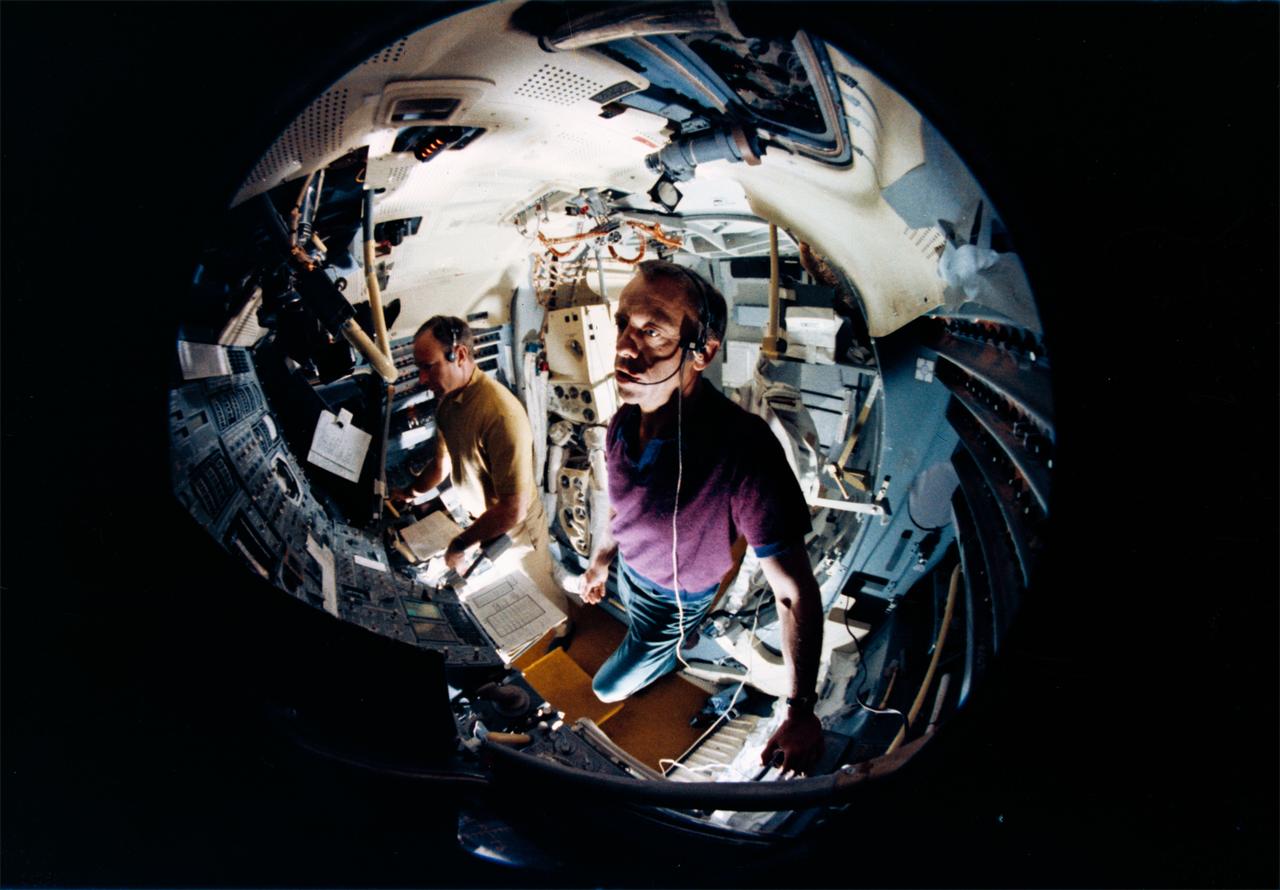
S70-45555 (July 1970) --- A fish-eye lens view showing astronauts Alan B. Shepard Jr. (foreground) and Edgar D. Mitchell in the Apollo lunar module mission simulator at the Kennedy Space Center during preflight training for the Apollo 14 lunar landing mission. Shepard is the Apollo 14 commander; and Mitchell is the lunar module pilot.

S65-20593 (1965) --- Riding the elevator to the white room atop the Gemini Launch Vehicle on Pad 19 are astronauts Alan B. Shepard Jr. (left) and John W. Young. The Gemini-Titan 3 flight is scheduled to launch on March 23, 1965. Young is the pilot of the GT-3 mission. Shepard was the Mercury Redstone 3 pilot.

AS14-66-9241 (5-6 Feb. 1971) --- Astronaut Edgar D. Mitchell, lunar module pilot, makes a pan with the lunar surface television camera during an extravehicular activity (EVA) on the moon. This photograph was taken by fellow astronaut Alan B. Shepard Jr., commander. While Shepard and Mitchell descended in the Lunar Module (LM) to explore the moon, astronaut Stuart A. Roosa, command module pilot, remained with the Command and Service Modules (CSM) in lunar orbit.
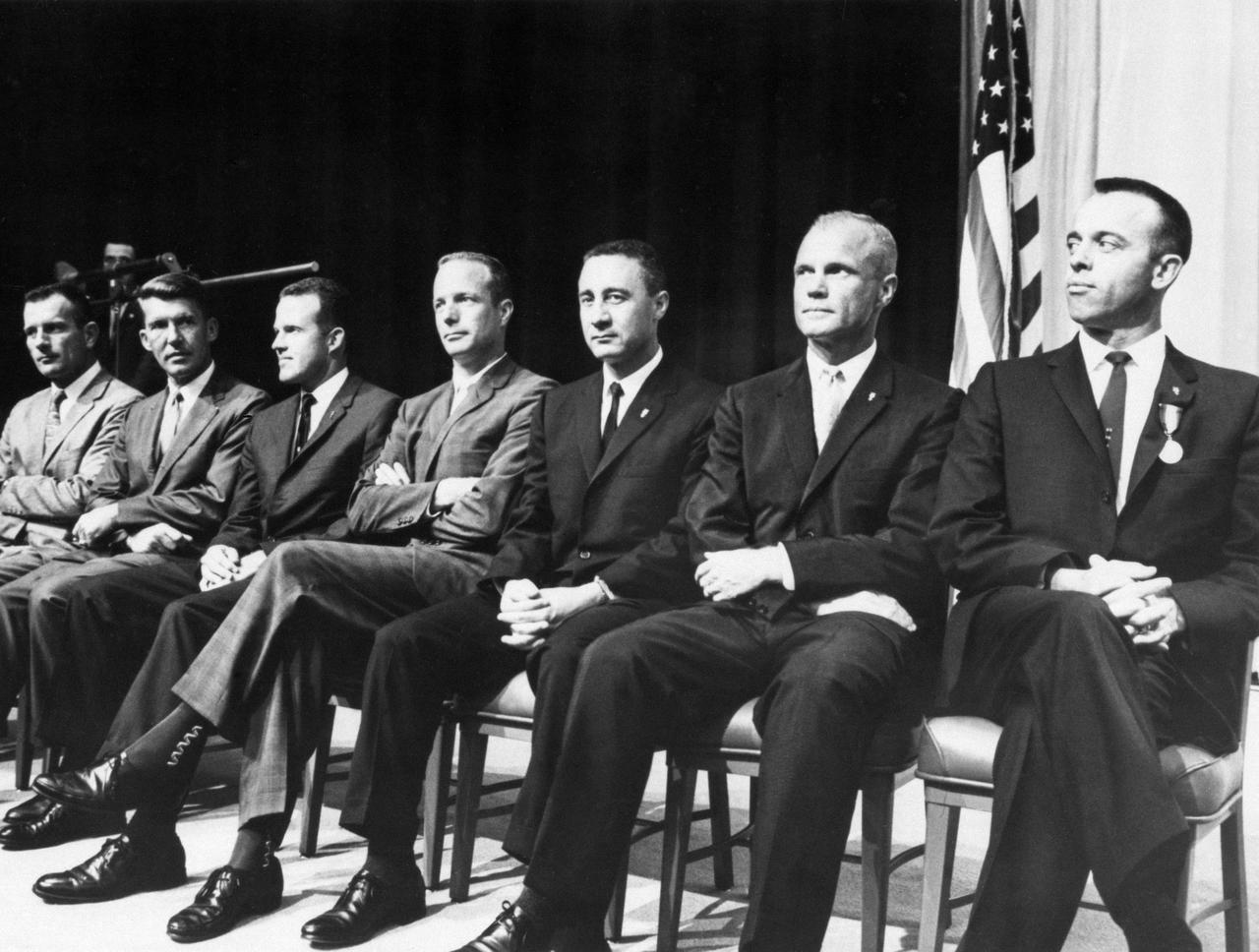
S61-02357 (8 May 1961) --- The original seven Mercury astronauts at the State Department Auditorium on May 8, 1961. The astronauts are (left to right) Donald K. Slayton, Walter M. Schirra, Jr., L. Gordon Cooper, Jr., M. Scott Carpenter, Virgil I. Grissom, John H. Glenn, Jr. and Alan B. Shepard, Jr. Earlier President John F. Kennedy had presented astronaut Shepard with the NASA Distinguished Service Medal (note it on his lapel) in the White House Rose Garden.
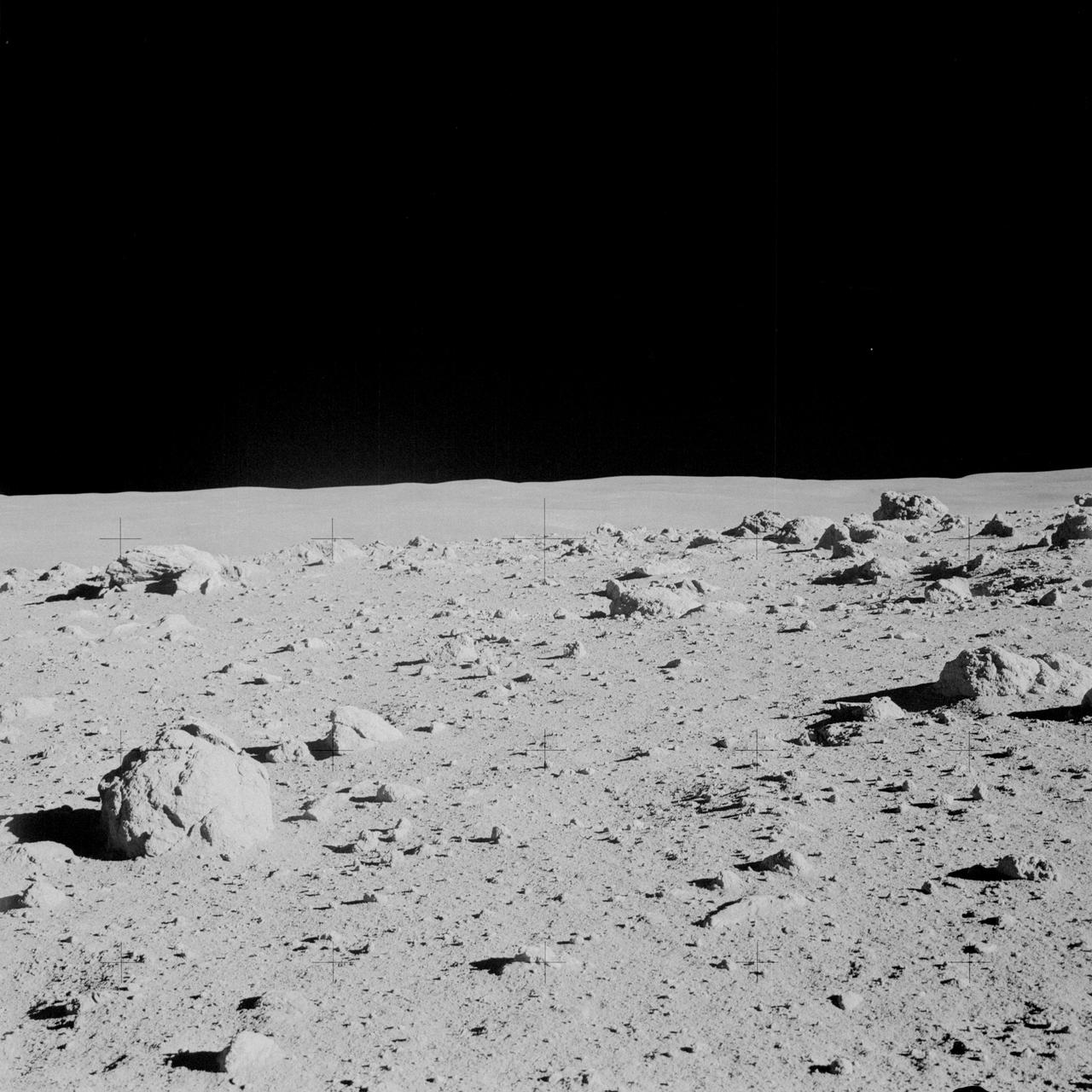
AS14-64-9103 (6 Feb. 1971) --- Astronaut Alan B. Shepard Jr., commander, photographed this overall view of a field of boulders on the flank of Cone Crater during the second extravehicular activity (EVA) on the lunar surface. Astronaut Edgar D. Mitchell, lunar module pilot, joined Shepard in exploring the moon, while astronaut Stuart A. Roosa, command module pilot, remained with the Command and Service Modules (CSM) in lunar orbit.
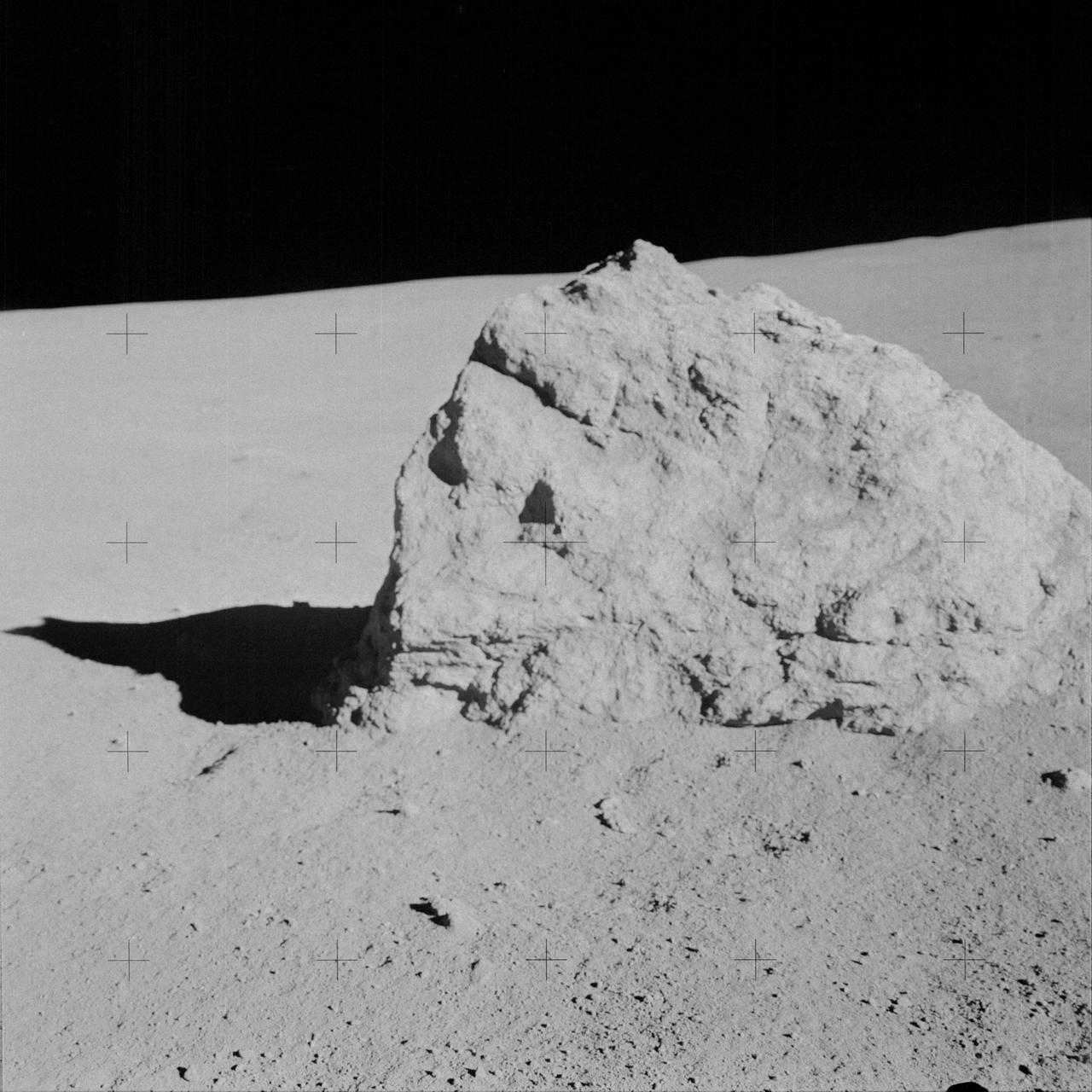
AS14-64-9135 (6 Feb. 1971) --- Astronaut Alan B. Shepard Jr., commander, took this close-up view of a large boulder, approximately five feet long, during the second extravehicular activity (EVA), on Feb. 6, 1971. Astronauts Shepard and Edgar D. Mitchell, lunar module pilot, descended in the Lunar Module (LM) to explore the moon, while astronaut Stuart A. Roosa, command module pilot, remained with the Command and Service Modules (CSM) in lunar orbit.
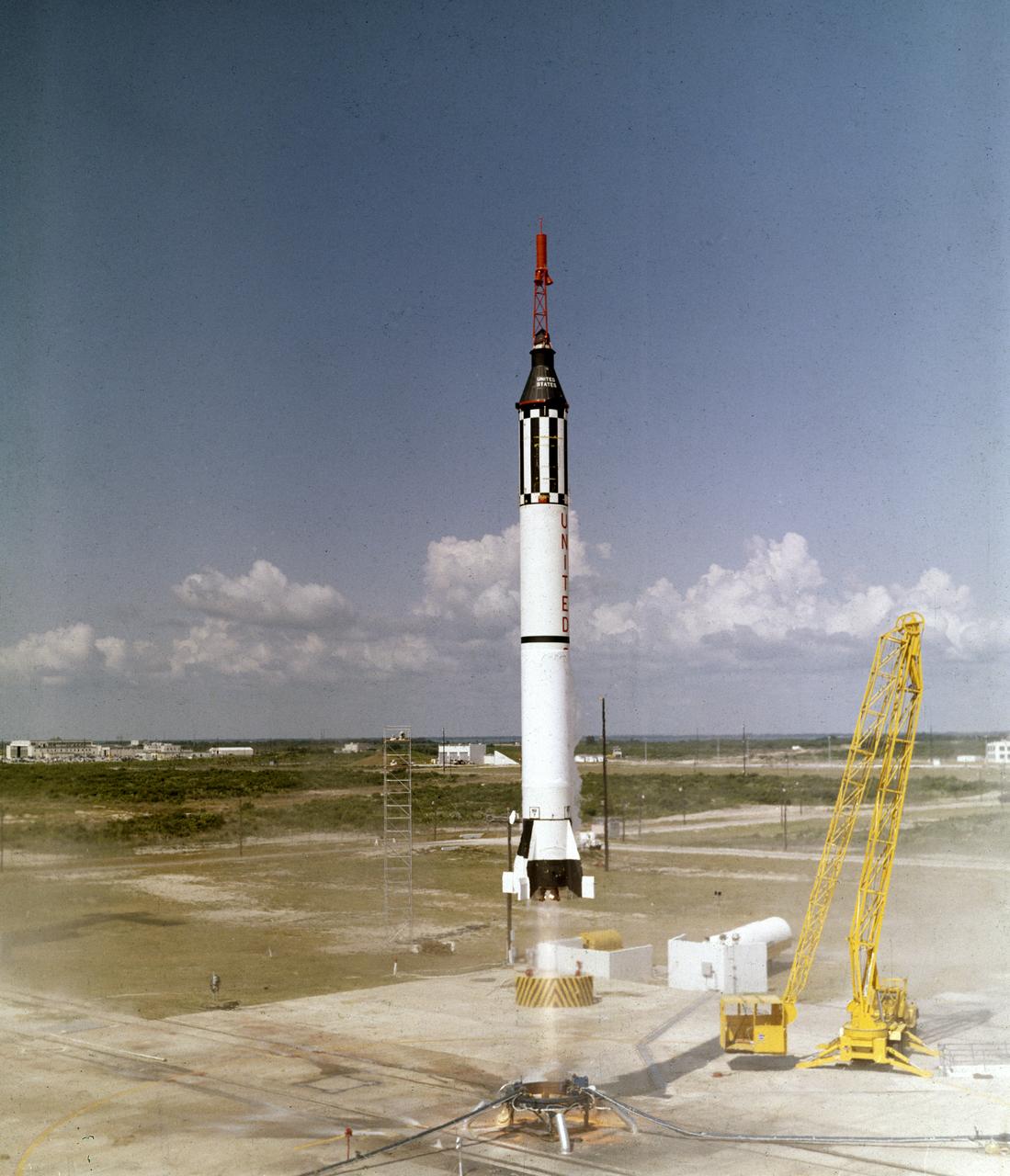
Astronaut Alan B. Shepard, Jr. lifts off in the Freedom 7 Mercury spacecraft on May 5, 1961. This third flight of the Mercury-Redstone (MR-3) vehicle, developed by Dr. Wernher von Braun and the rocket team in Huntsille, Alabama, was the first marned space mission for the United States. During the 15-minute suborbital flight, Shepard reached an altitude of 115 miles and traveled 302 miles downrange.
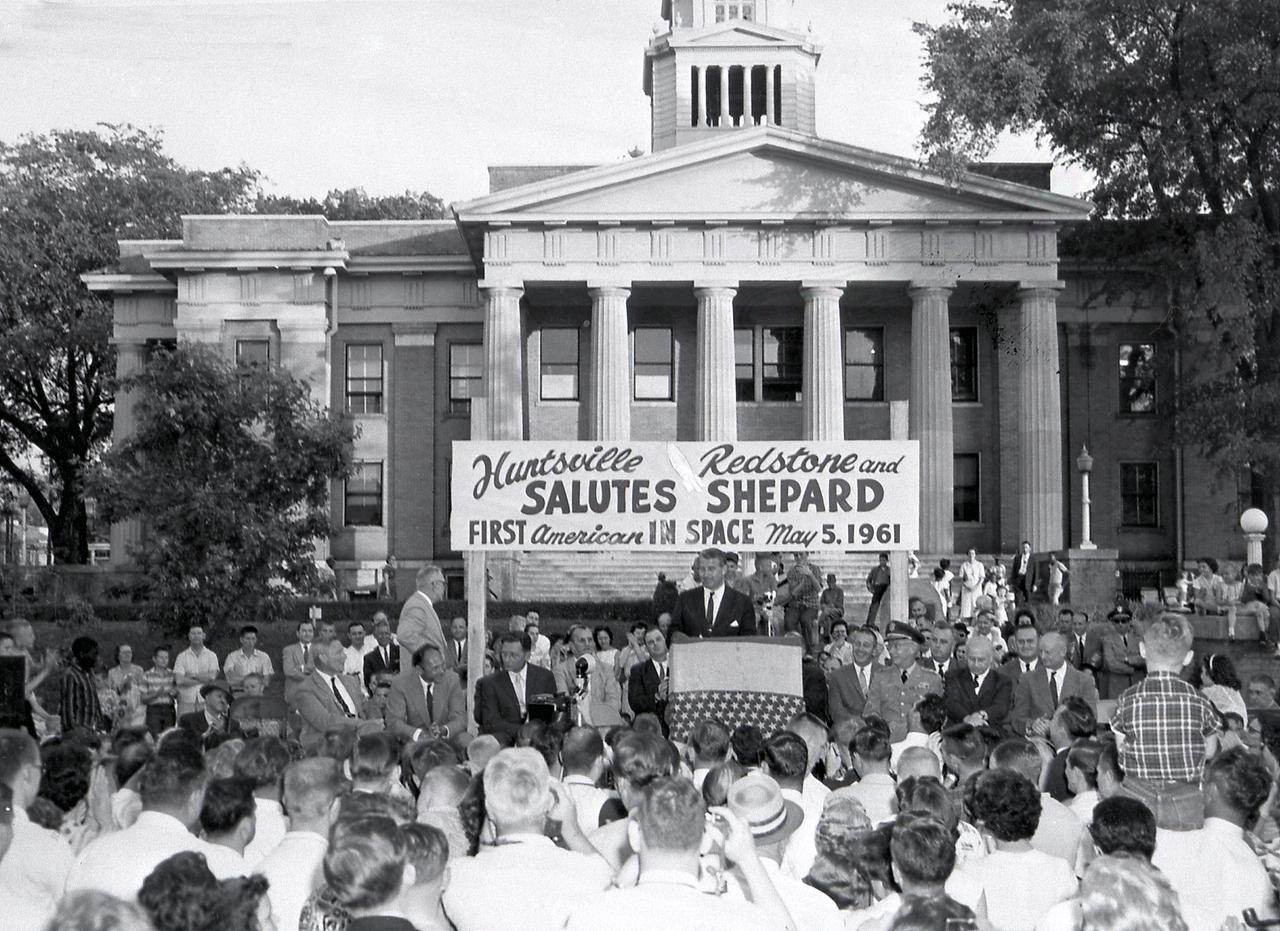
Dr. von Braun addresses a crowd celebrating in front of the Madison County Alabama Courthouse following the successful launch of Astronaut Alan Shepard (America's first astronaut in space) into space on a Mercury-Redstone Launch Vehicle, Freedom 7. Shepard's Mercury Spacecraft, was launched from Cape Canaveral. He reached a speed of 5200 mph. His flight lasted 15-1/2 minutes. May 5, 1961 (Photo: Courtesy of Huntsville/Madison County Public Library)
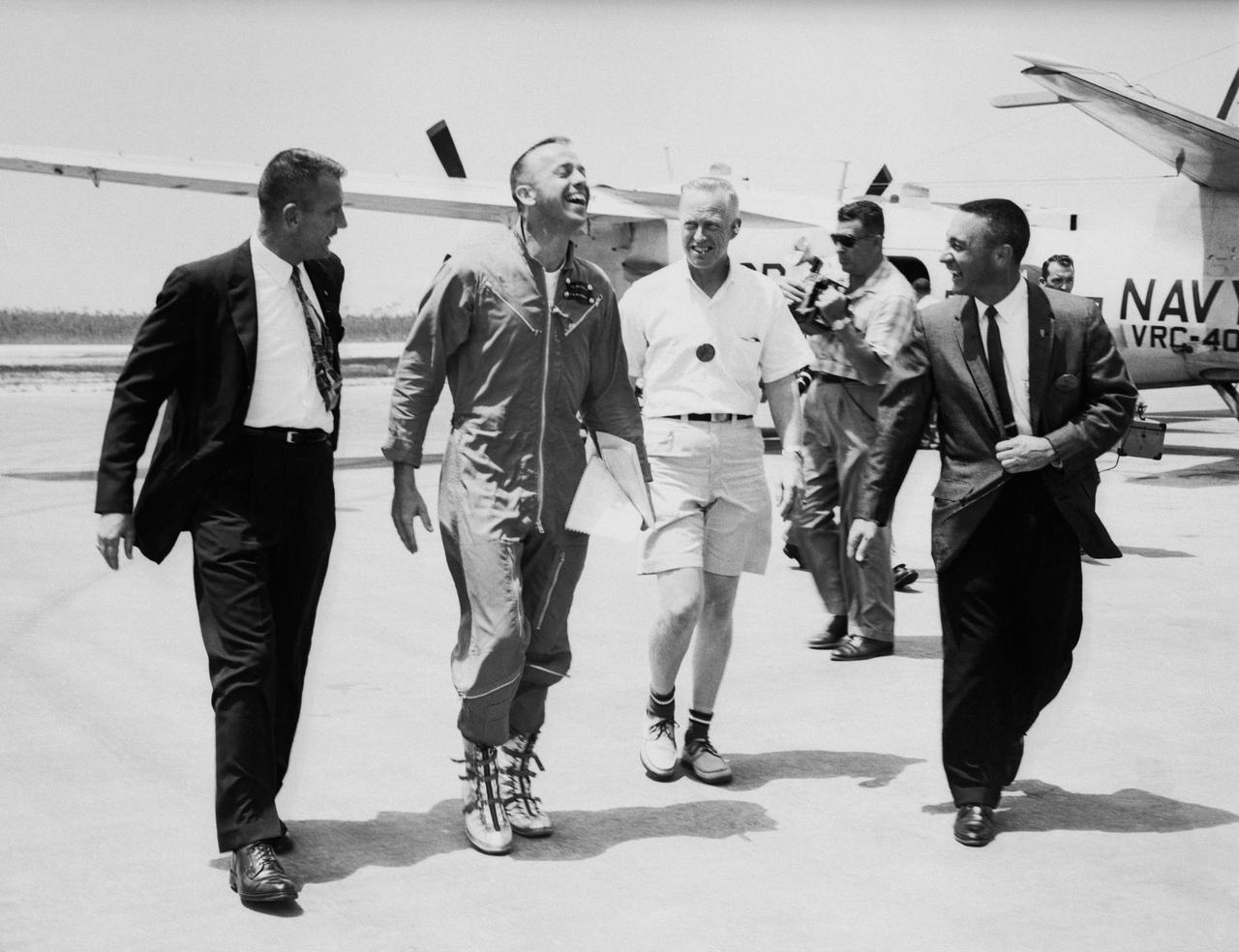
S61-02385 (5 July 1961) --- Astronaut Alan B. Shepard Jr. arrives at Grand Bahamas Island and is greeted by astronauts Virgil I. (Gus) Grissom (right) and Donald Slayton (left) and also by Keith Lindell (between Shepard and Grissom) after the first American suborbital flight. He will participate in a press conference with Grissom and Slayton. Photo credit: NASA or National Aeronautics and Space Administration
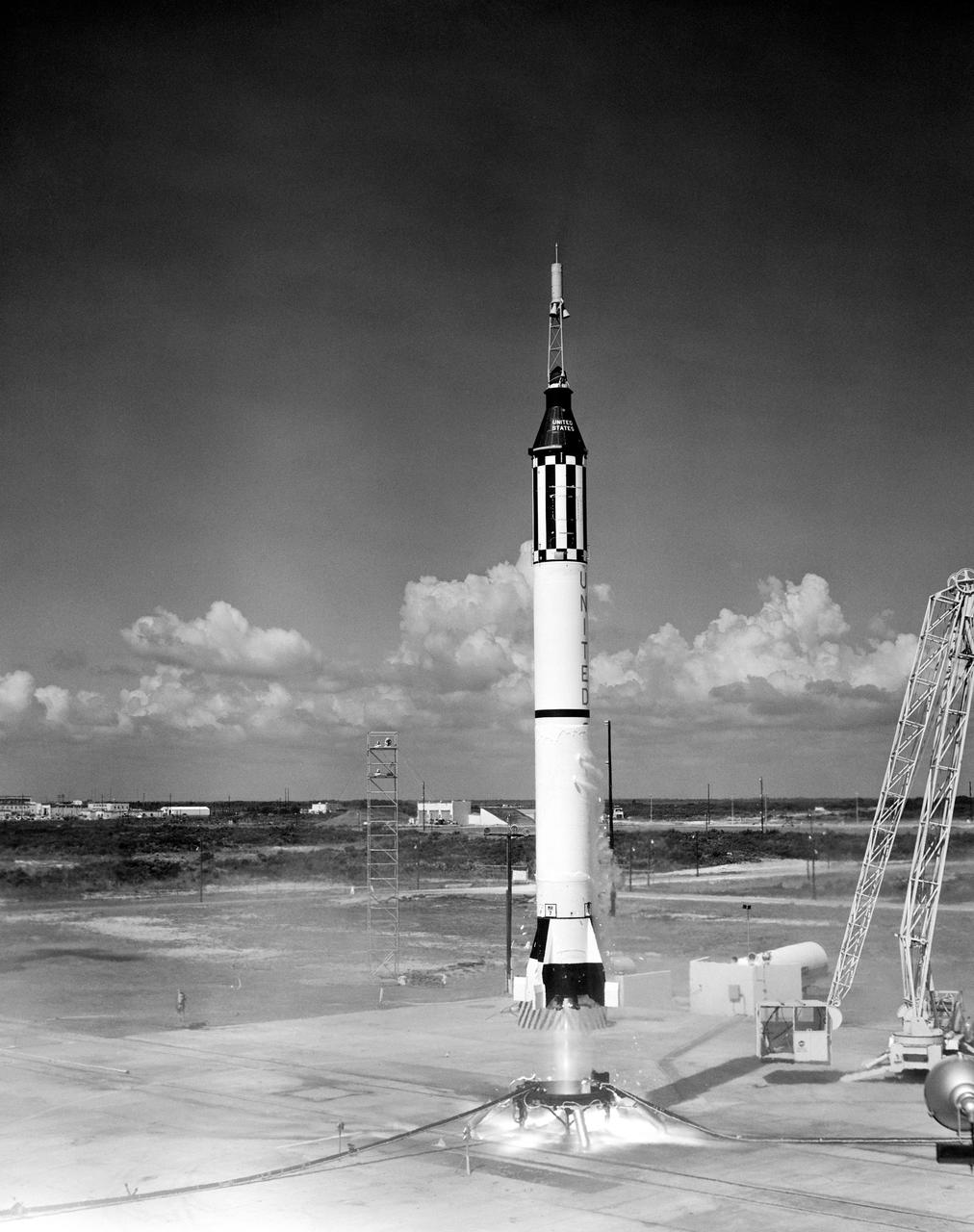
S61-02408 (5 May 1961) --- Launching of the Mercury-Redstone 3 (MR-3) rocket from Cape Canaveral on astronaut Alan B. Shepard?s suborbital mission. Photo credit: NASA or National Aeronautics and Space Administration

The original seven astronauts for the Mercury Project pose in front of an Air Force Jet. From left to right: Scott Carpenter, L. Gordon Cooper, John H. Glenn, Virgil I. Gus Grissom, Walter M. Wally Schirra, Alan B. Shepard, and Donald K. Deke Slayton.
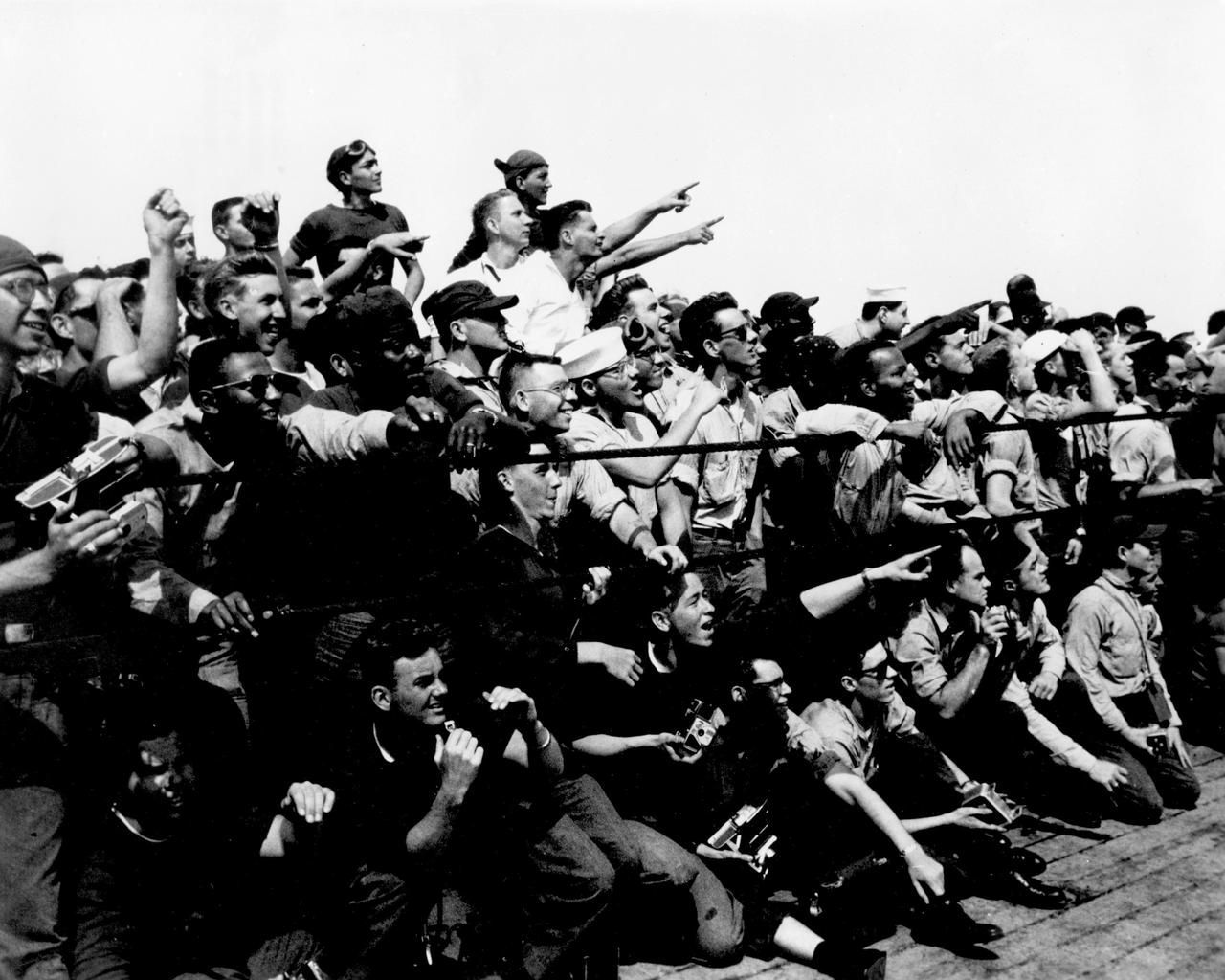
JSC2007-E-046479 (5 May 1961) --- Crew members of the U.S. Navy Carrier Champlain cheer and take pictures of the arrival of the first Project Mercury pilot to fly a suborbital flight, astronaut Alan B. Shepard Jr. Original photo number was 61-MR3-106. Photo credit: NASA
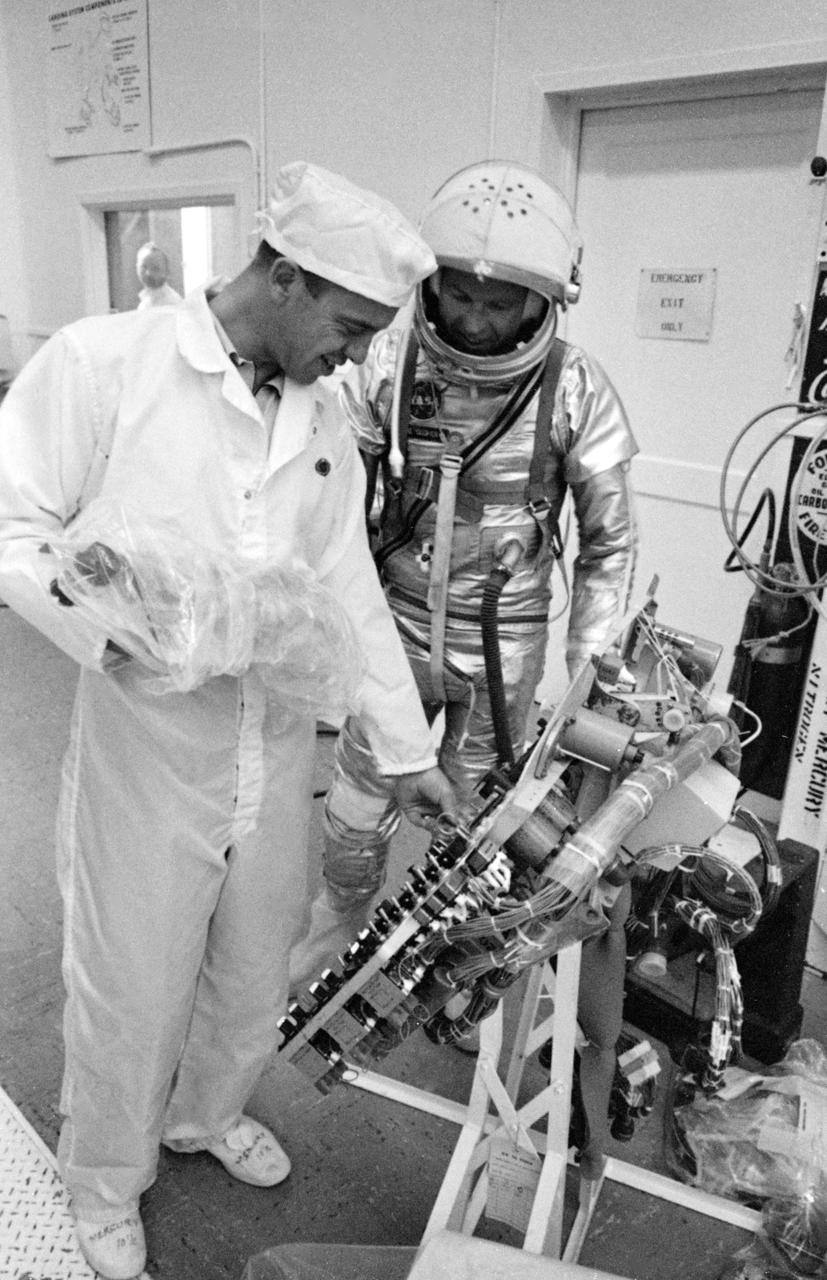
S63-03965 (1963) --- Astronauts Alan Shepard (left) and L. Gordon Cooper Jr.(in suit) check over the instrument panel from Mercury spacecraft #20. It contains the instruments necessary to monitor spacecraft systems and sequencing, the controls required to initiate primary sequences manually, and the necessary flight control displays. Photo credit: NASA

S70-55635 (December 1970) --- These three astronauts are the prime crew of the Apollo 14 lunar landing mission. Left to right, are Edgar D. Mitchell, lunar module pilot; Alan B. Shepard Jr., commander; and Stuart A. Roosa, command module pilot. The Apollo 14 emblem is in the background.
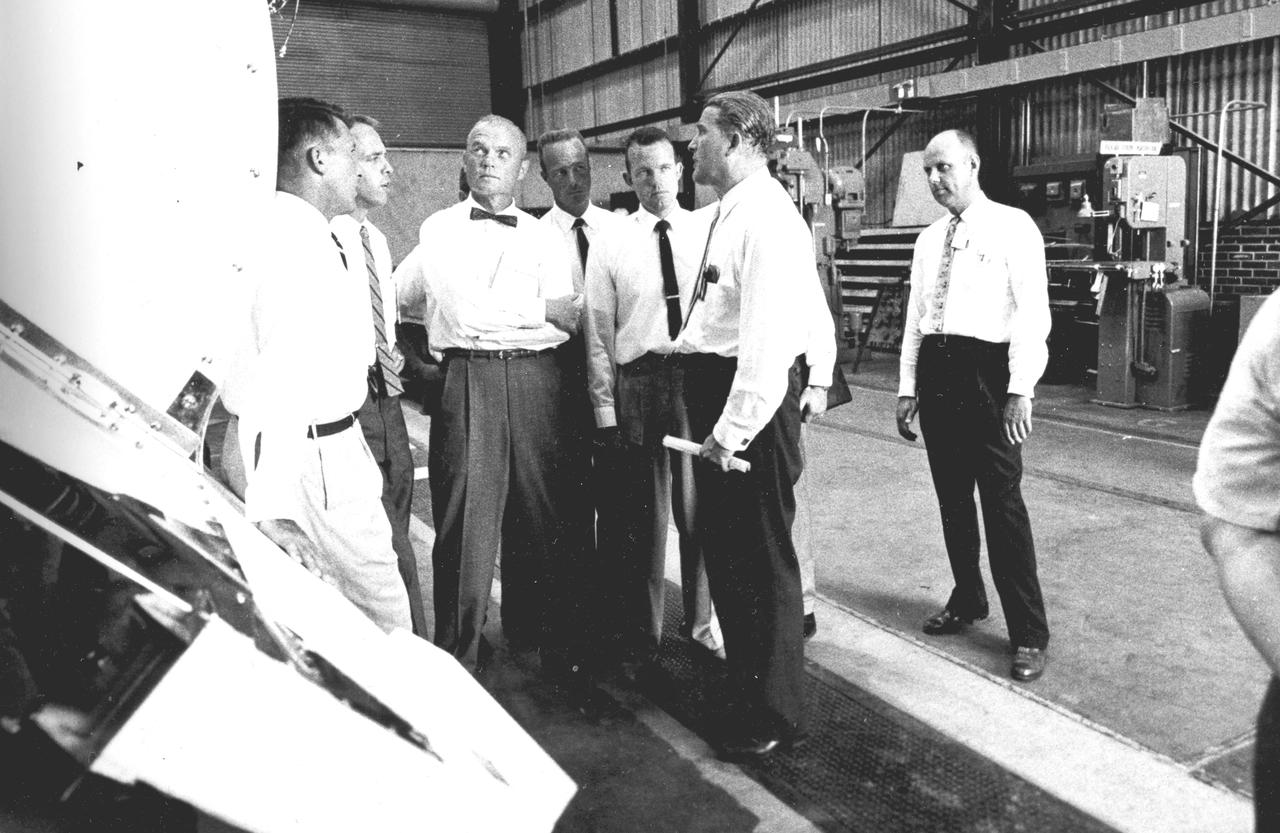
Five of the seven original astronauts are seen with Dr. von Braun inspecting the Mercury-Redstone hardware in the Fabrication Laboratory of Army Ballistic Missile Agency (ABMA) in 1959. Left to right: Astronauts Walter Schirra, Alan Shepard, John Glenn, Scott Carpenter, Gordon Cooper, and Dr. von Braun.

S61-02455 (19 June 1961) --- Astronaut Alan B. Shepard Jr. met and talked with Boy Scouts from Franklin, Virginia on June 19, 1961. They are photographed in front of the NASA Space Task Group building at Langley Space Flight Center. Photo credit: NASA or National Aeronautics and Space Administration
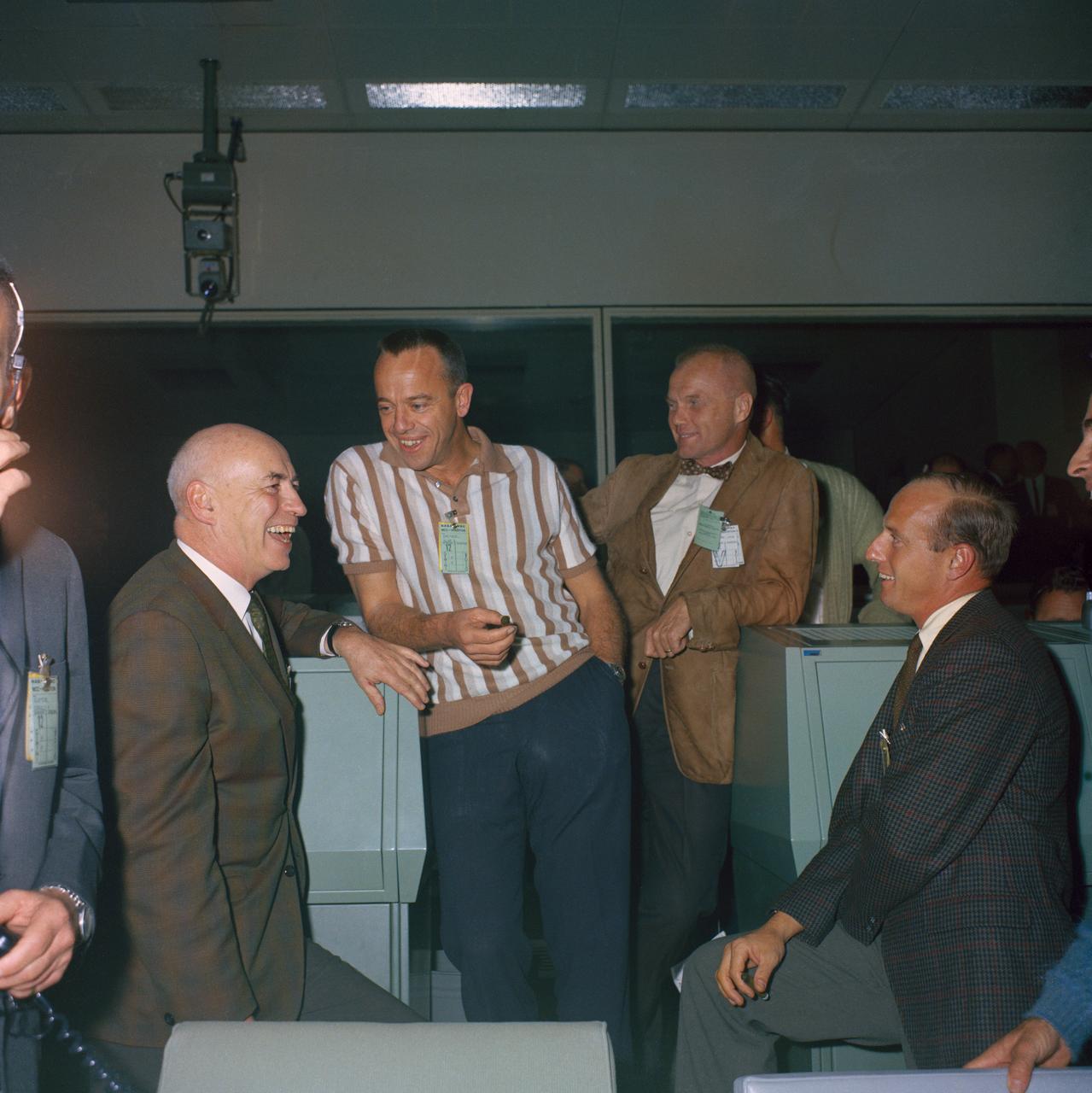
S66-64879 (15 Nov. 1966) --- Dr. Robert R. Gilruth (right), with astronauts, from the left, Charles Conrad Jr., John H. Glenn Jr. and Alan B. Shepard Jr. in Houston's Mission Control Center during the Gemini-12 mission. Photo credit: NASA
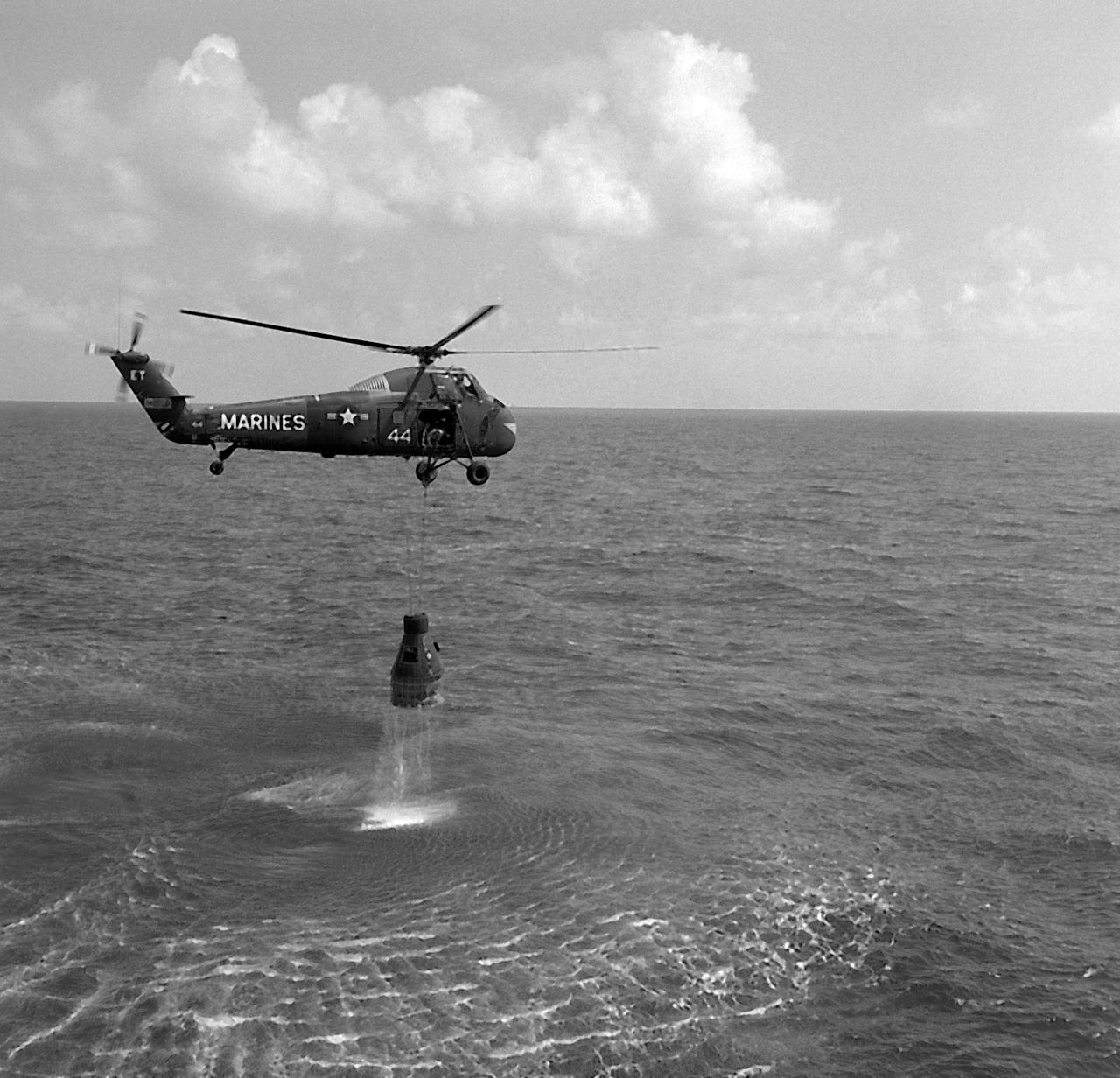
This photo depicts the recovery of the Freedom 7 (MR-3) capsule by a U.S. Marine helicopter. The MR-3 mission successfully placed the first American astronaut, Alan Shepard, in space for 15-1/2 minutes and returned safely to Earth on May 5, 1961.
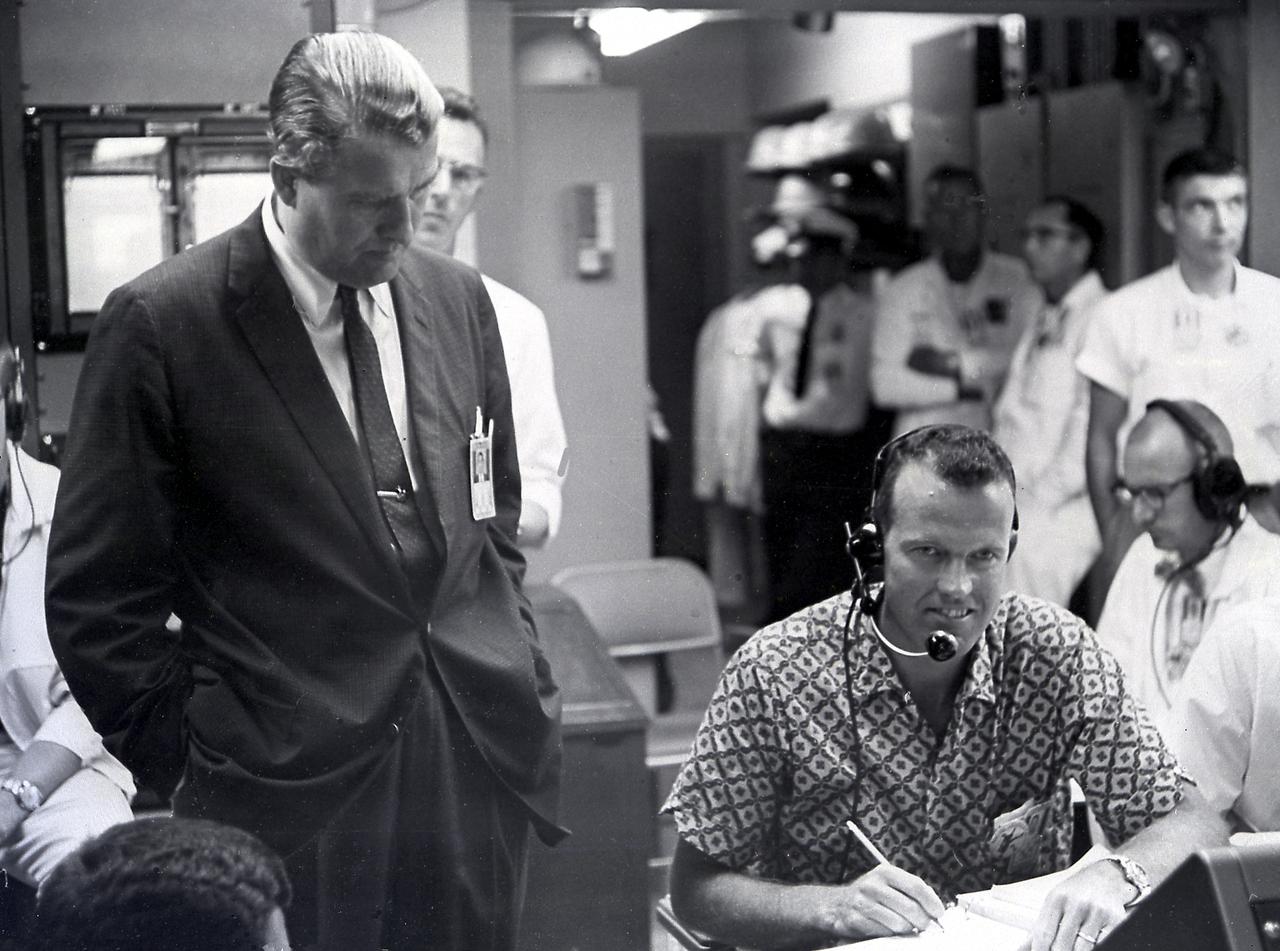
Photographed are Dr. von Braun and Astronaut L. Gordon Cooper in the blockhouse during the recovery operation of the MR-3 (Freedom 7) mission on May 5, 1961. The MR-3 mission, a 15-1/2-minute suborbital test flight, put the first American astronaut, Alan Shepard, in space.
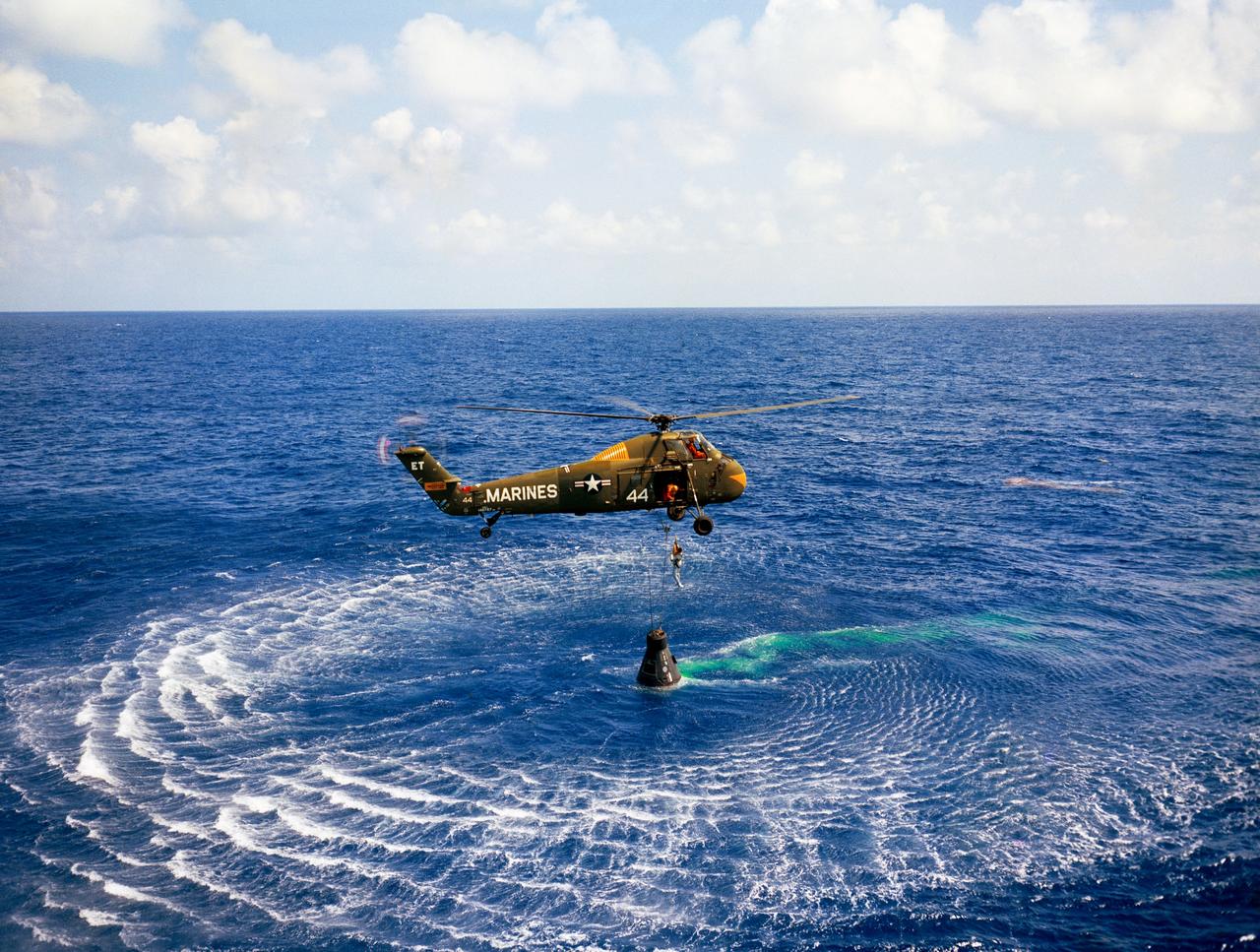
JSC2004-E-19882 (5 May 1961) --- Astronaut Alan B. Shepard Jr. is rescued by a U.S. Marine helicopter at the termination of his suborbital flight May 5, 1961, down range from the Florida eastern coast. Photo credit: NASA
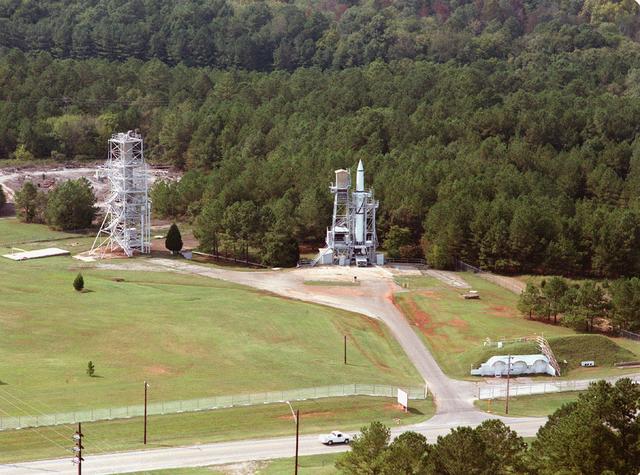
The Redstone Test Stand, shown here, was used throughout the 1950s to test the Redstone missionile, including the modified Redstone that launched America's first astronaut, Alan Shepard. The U. S. Department of the Interior's Park Services designated the Test Stand as a National Historic Landmark January 22, 1986.