!["I was on console as a part of the primary launch team [for Artemis I]. I was the Orion system specialist for Guidance, Navigation, and Control. … In a few missions, we're sending astronauts to the Moon again, so being a part of the very, very first mission [was memorable]. … I wasn't here in 2017 when they first began discussions, but [I can’t even explain how it felt] that within just the four-year journey, I could see how far we had come: from when we were talking about getting the hardware here, to the hardware arriving, and then [to realize] ‘Oh, it's going today, we’re going!’ “… From a personal standpoint, I'm a person of faith, so for me, it was like: We launched at night — it was in the darkest part of the [night]. … Once the rocket launched, [I saw] how it illuminated such a dark space. So even when you're in a dark space, you can let your light shine. And it won't just shine for you and those that are immediately around you, but even people that you don't know will notice it, even people that you will never see will notice your light shining and be inspired.” — Ales-cia Winsley, Guidance, Navigation, and Flight Control Engineer, Kennedy Space Center Interviewer: NASA / Michelle Zajac](https://images-assets.nasa.gov/image/KSC-20231128-PH-CSH01_0003/KSC-20231128-PH-CSH01_0003~medium.jpg)
"I was on console as a part of the primary launch team [for Artemis I]. I was the Orion system specialist for Guidance, Navigation, and Control. … In a few missions, we're sending astronauts to the Moon again, so being a part of the very, very first mission [was memorable]. … I wasn't here in 2017 when they first began discussions, but [I can’t even explain how it felt] that within just the four-year journey, I could see how far we had come: from when we were talking about getting the hardware here, to the hardware arriving, and then [to realize] ‘Oh, it's going today, we’re going!’ “… From a personal standpoint, I'm a person of faith, so for me, it was like: We launched at night — it was in the darkest part of the [night]. … Once the rocket launched, [I saw] how it illuminated such a dark space. So even when you're in a dark space, you can let your light shine. And it won't just shine for you and those that are immediately around you, but even people that you don't know will notice it, even people that you will never see will notice your light shining and be inspired.” — Ales-cia Winsley, Guidance, Navigation, and Flight Control Engineer, Kennedy Space Center Interviewer: NASA / Michelle Zajac
!["I was on console as a part of the primary launch team [for Artemis I]. I was the Orion system specialist for Guidance, Navigation, and Control. … In a few missions, we're sending astronauts to the Moon again, so being a part of the very, very first mission [was memorable]. … I wasn't here in 2017 when they first began discussions, but [I can’t even explain how it felt] that within just the four-year journey, I could see how far we had come: from when we were talking about getting the hardware here, to the hardware arriving, and then [to realize] ‘Oh, it's going today, we’re going!’ “… From a personal standpoint, I'm a person of faith, so for me, it was like: We launched at night — it was in the darkest part of the [night]. … Once the rocket launched, [I saw] how it illuminated such a dark space. So even when you're in a dark space, you can let your light shine. And it won't just shine for you and those that are immediately around you, but even people that you don't know will notice it, even people that you will never see will notice your light shining and be inspired.” — Ales-cia Winsley, Guidance, Navigation, and Flight Control Engineer, Kennedy Space Center Interviewer: NASA / Michelle Zajac](https://images-assets.nasa.gov/image/KSC-20231128-PH-CSH01_0004/KSC-20231128-PH-CSH01_0004~medium.jpg)
"I was on console as a part of the primary launch team [for Artemis I]. I was the Orion system specialist for Guidance, Navigation, and Control. … In a few missions, we're sending astronauts to the Moon again, so being a part of the very, very first mission [was memorable]. … I wasn't here in 2017 when they first began discussions, but [I can’t even explain how it felt] that within just the four-year journey, I could see how far we had come: from when we were talking about getting the hardware here, to the hardware arriving, and then [to realize] ‘Oh, it's going today, we’re going!’ “… From a personal standpoint, I'm a person of faith, so for me, it was like: We launched at night — it was in the darkest part of the [night]. … Once the rocket launched, [I saw] how it illuminated such a dark space. So even when you're in a dark space, you can let your light shine. And it won't just shine for you and those that are immediately around you, but even people that you don't know will notice it, even people that you will never see will notice your light shining and be inspired.” — Ales-cia Winsley, Guidance, Navigation, and Flight Control Engineer, Kennedy Space Center Interviewer: NASA / Michelle Zajac
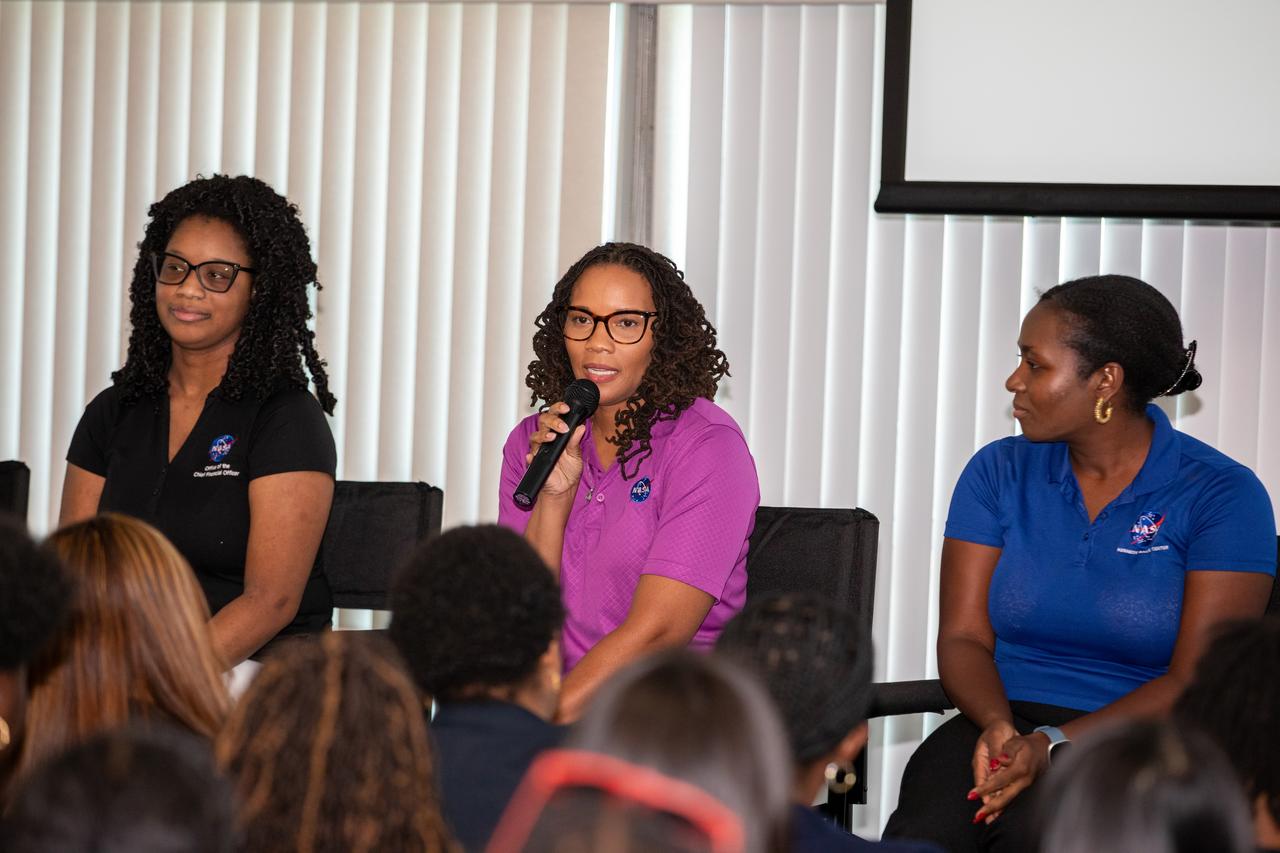
From left to right, Savitri Thomas, management and program analyst; Ales-Cia Winsley, lead Space Launch System avionics engineer; Alexandra Philip, metrology engineer, at NASA’s Kennedy Space Center in Florida, speak on Friday, Sept. 20, 2024, to young women, ages 11 to 18, from the Atlanta, Georgia area, with interests in STEM (science, technology, engineering, and math). NASA Kennedy hosted the Delta Air Lines’ Women Inspiring Our Next Generation (WING) flight to showcase various women-led STEM careers available at the Florida spaceport.
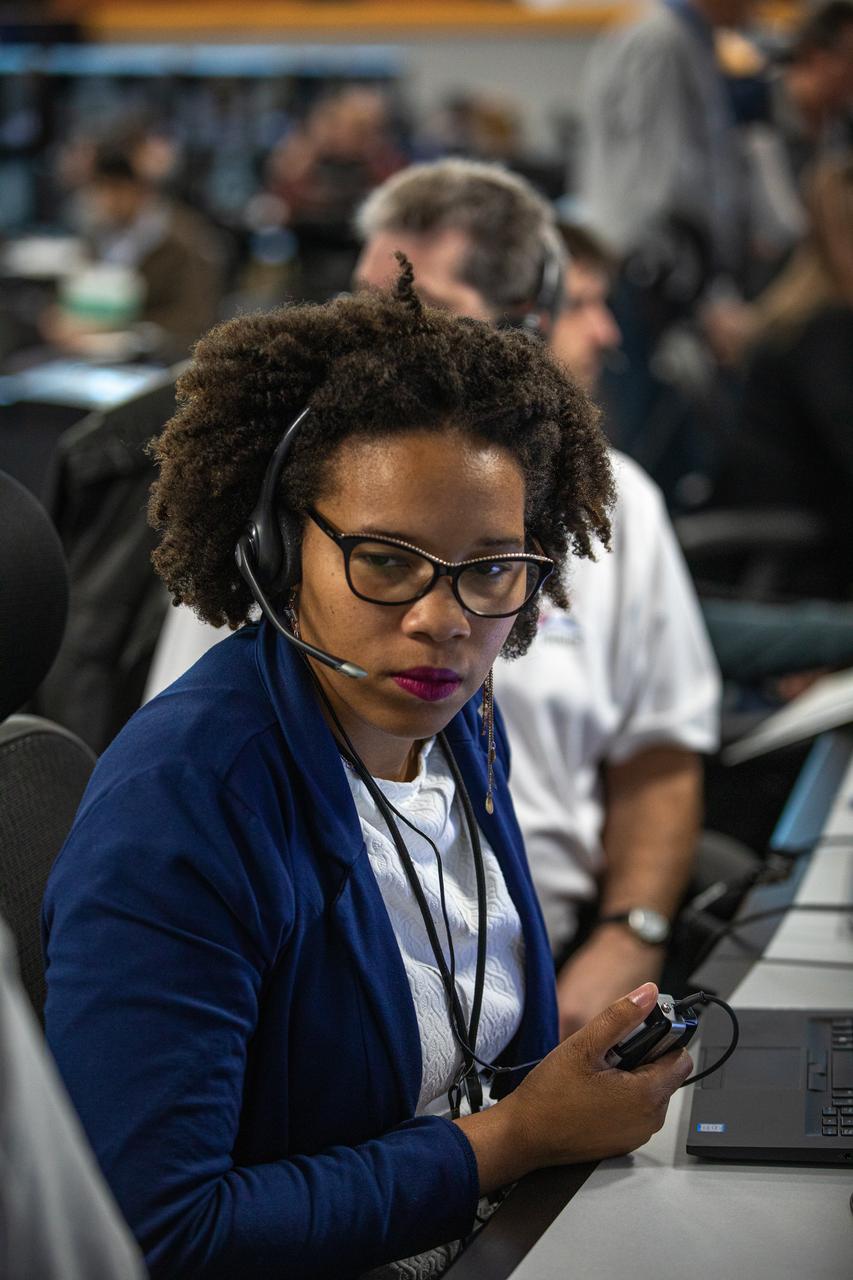
Ales-cia Winsley, a guidance, navigation and control engineer at NASA’s Kennedy Space Center in Florida, participates in an Artemis I launch countdown simulation inside Firing Room 1 in the Launch Control Center on Feb. 3, 2020. Under the leadership of Launch Director Charlie Blackwell-Thompson, a team of nearly 100 engineers from Orion, Space Launch System (SLS) and NASA’s Exploration Ground Systems came together to work through a series of simulated challenges, as well as a final countdown procedure. During these exercises, different issues were introduced to familiarize the team with launch day operations, while providing them with an opportunity to practice how they would handle those issues in real-time. Artemis I will be the first integrated test flight of the Orion spacecraft and SLS rocket – the system that will ultimately land the first woman and the next man on the Moon.