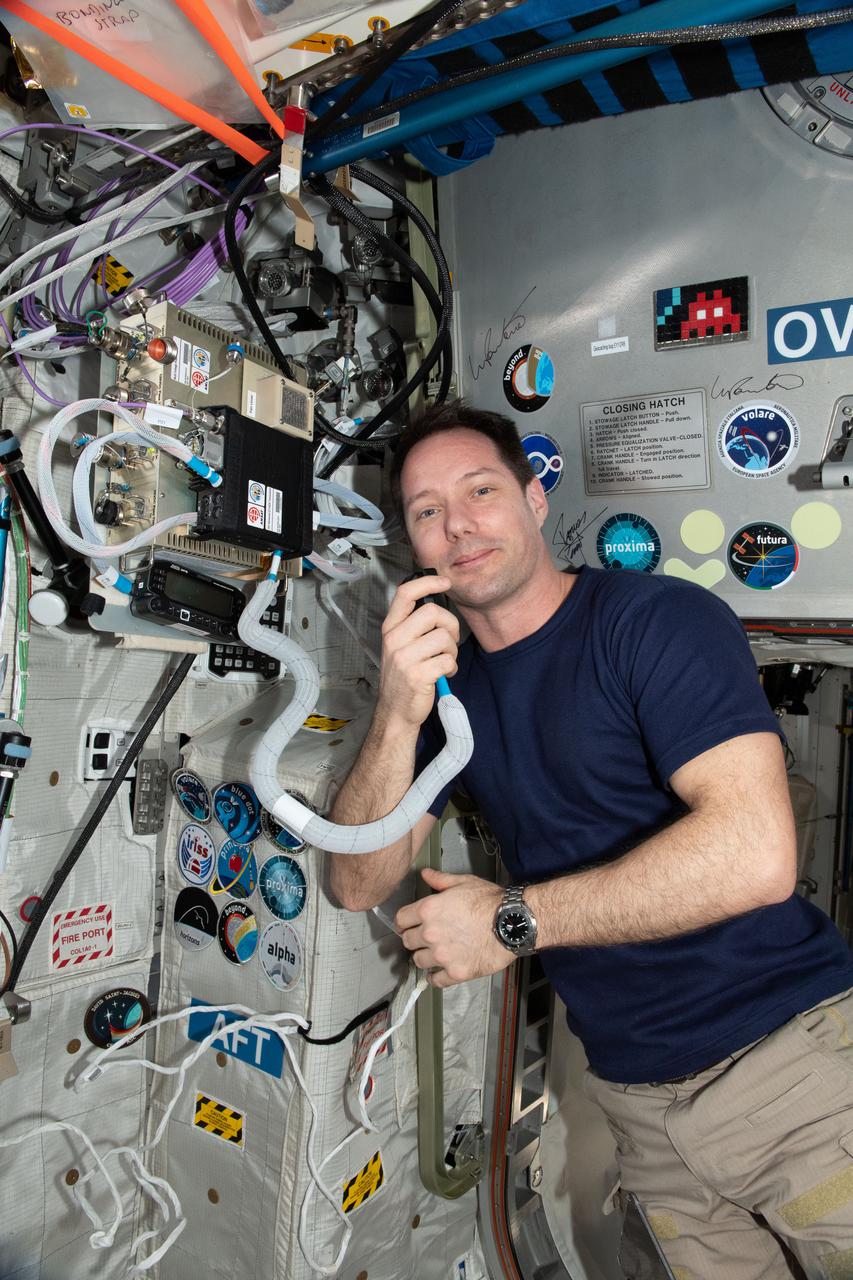
iss066e031742 (November 3, 2021) -- ESA (European Space Agency) astronaut and Expedition 65 Flight Engineer Thomas Pesquet is seen using the Amateur Radio on the International Space Station (ARISS).
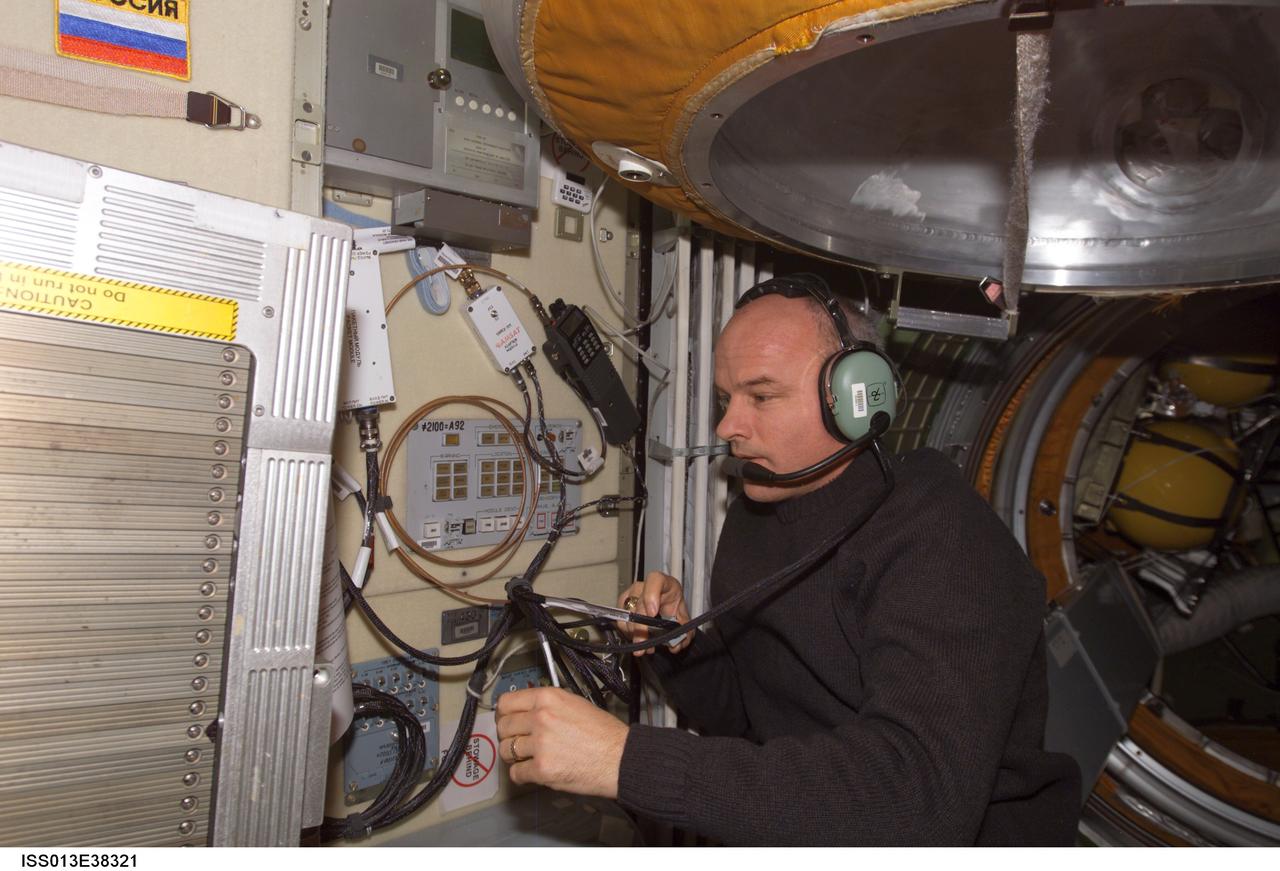
ISS013-E-38321 (17 June 2006) --- Astronaut Jeffrey N. Williams, Expedition 13 NASA space station science officer and flight engineer, uses the amateur radio system in the Zarya functional cargo block (FGB) to talk with school children during an Amateur Radio on the International Space Station (ARISS) contact. Two amateur radio stations are currently installed on the station.
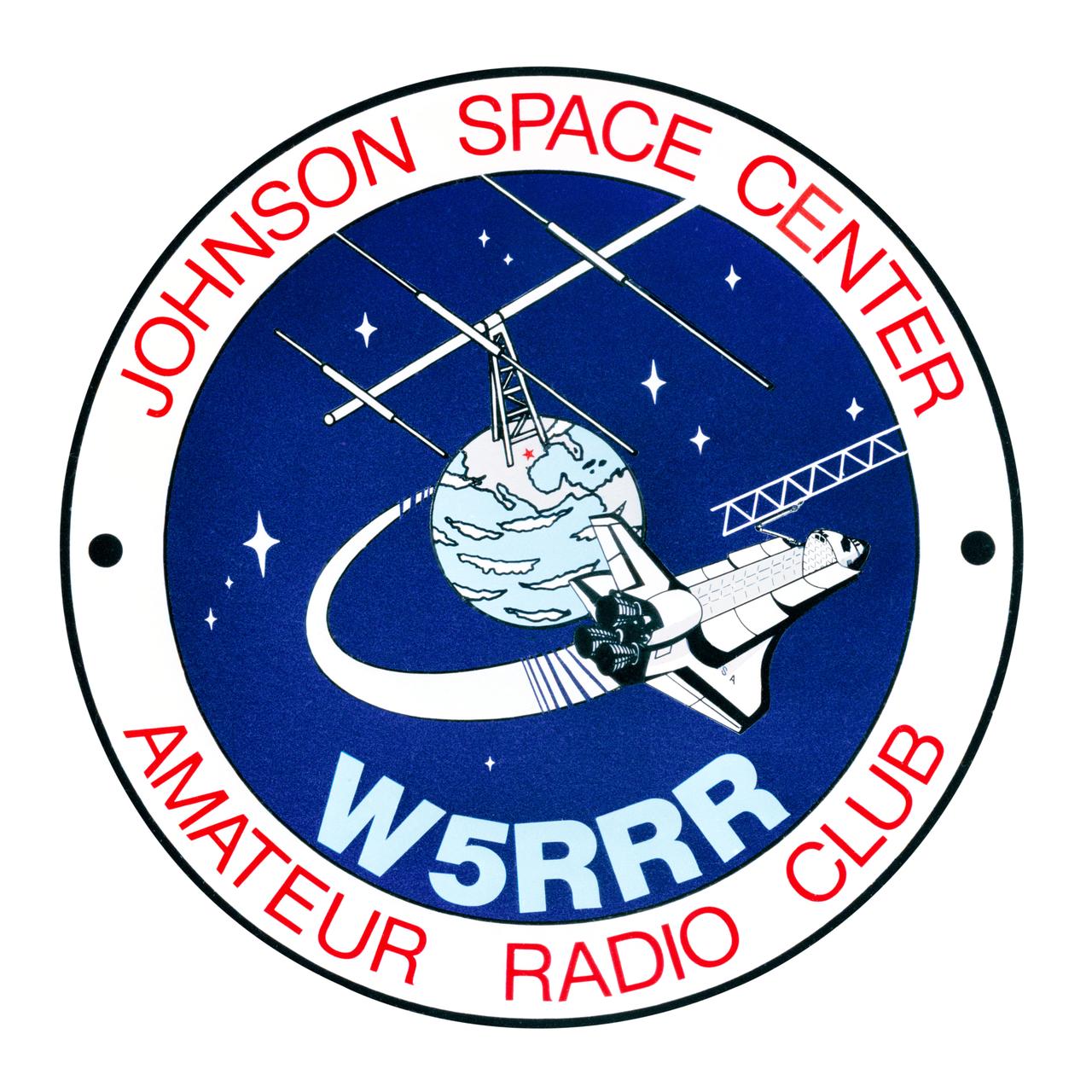
Artist concept of the Johnson Space Center Amateur Radio Club logo.
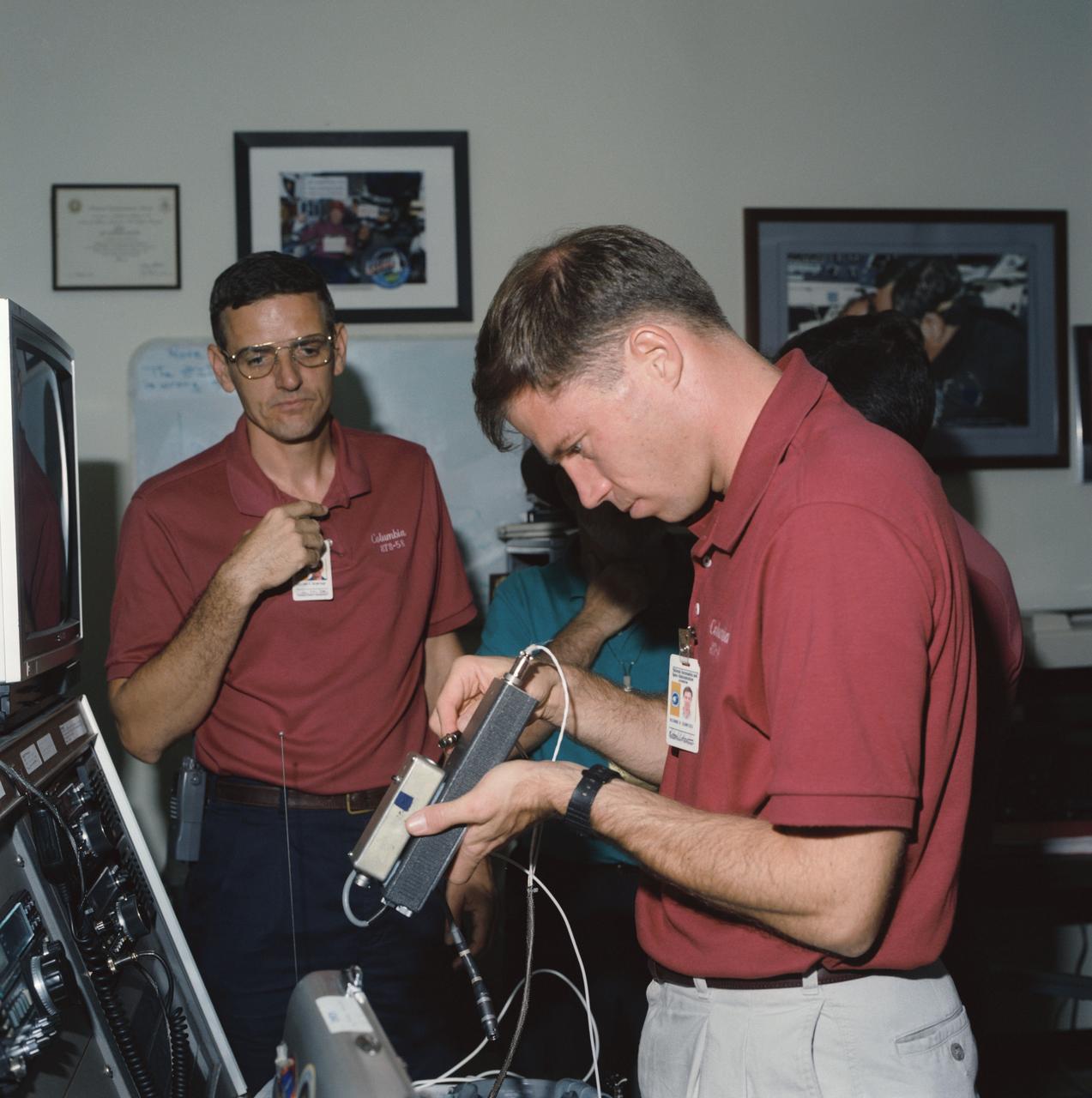
S93-45068 (22 Sept 1993) --- Two members of the STS-58 Spacelab Life Sciences (SLS-2) crew, train with amateur radio equipment at the Johnson Space Center (JSC). They are William S. McArthur (left), mission specialist, and Richard A. Searfoss, pilot. The STS-58 flight will carry the Shuttle Amateur Radio Experiment (SAREX) payload, configuration C, which includes FM voice and packet. Three of the seven crewmembers are licensed amateur radio operators. Searfoss' call letters are KC5CKM; McArthur, KC5ACR; and payload specialist Martin J. Fettman, KC5AXA. Licensed students at a number of schools around the country will have the opportunity to talk directly with the astronauts during the 14-day flight.
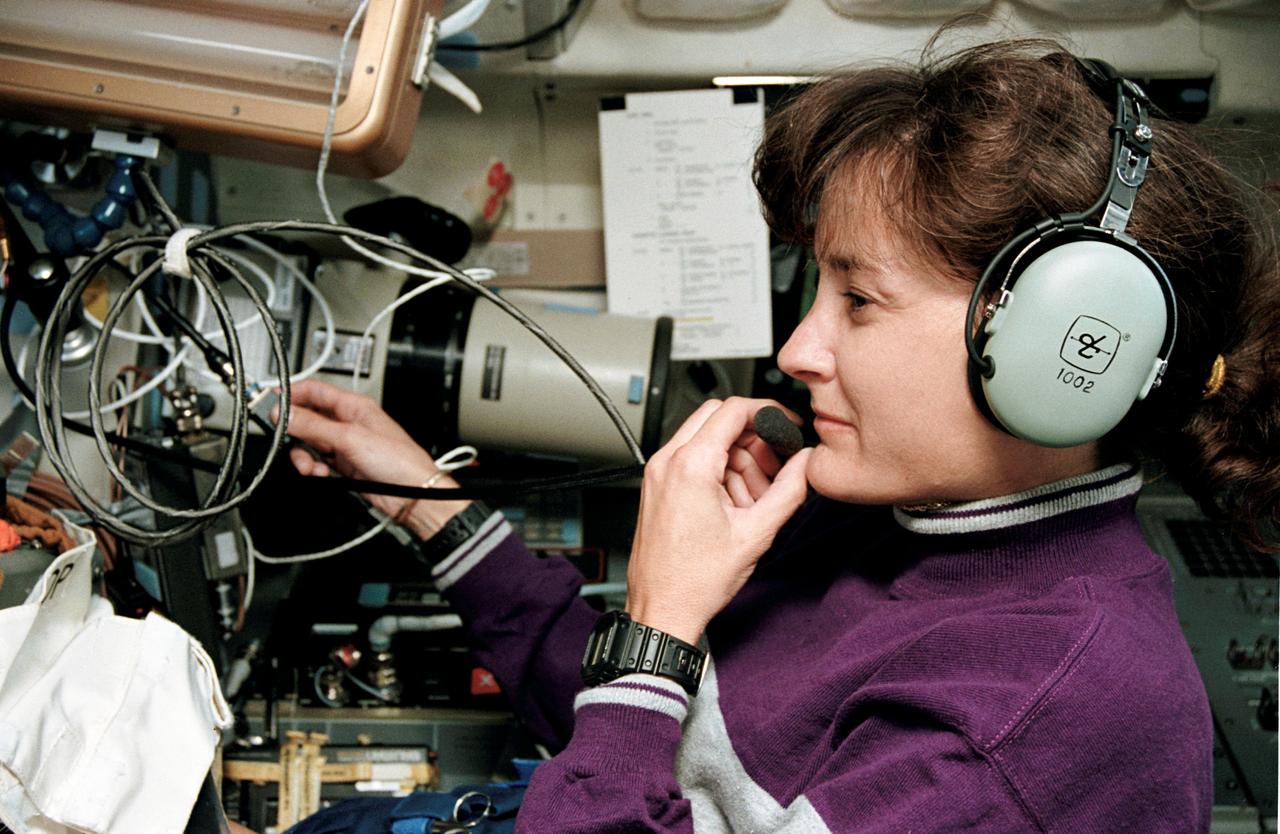
STS059-16-028 (9-20 April 1994) --- Onboard the Space Shuttle Endeavour, astronaut Linda M. Godwin talks to students via the Shuttle Amateur Radio Experiment (SAREX). The payload commander, as well as several other STS-59 crew members spent some off-duty time using the amateur radio equipment to communicate with "Hams" and students on Earth.

51F-S-087 (1985) --- Close-up of Lou McFaddin (W5DID), an amateur radio operator employed at the Johnson Space Center (JSC), as he turns a knob on a console supporting SAREX operations.
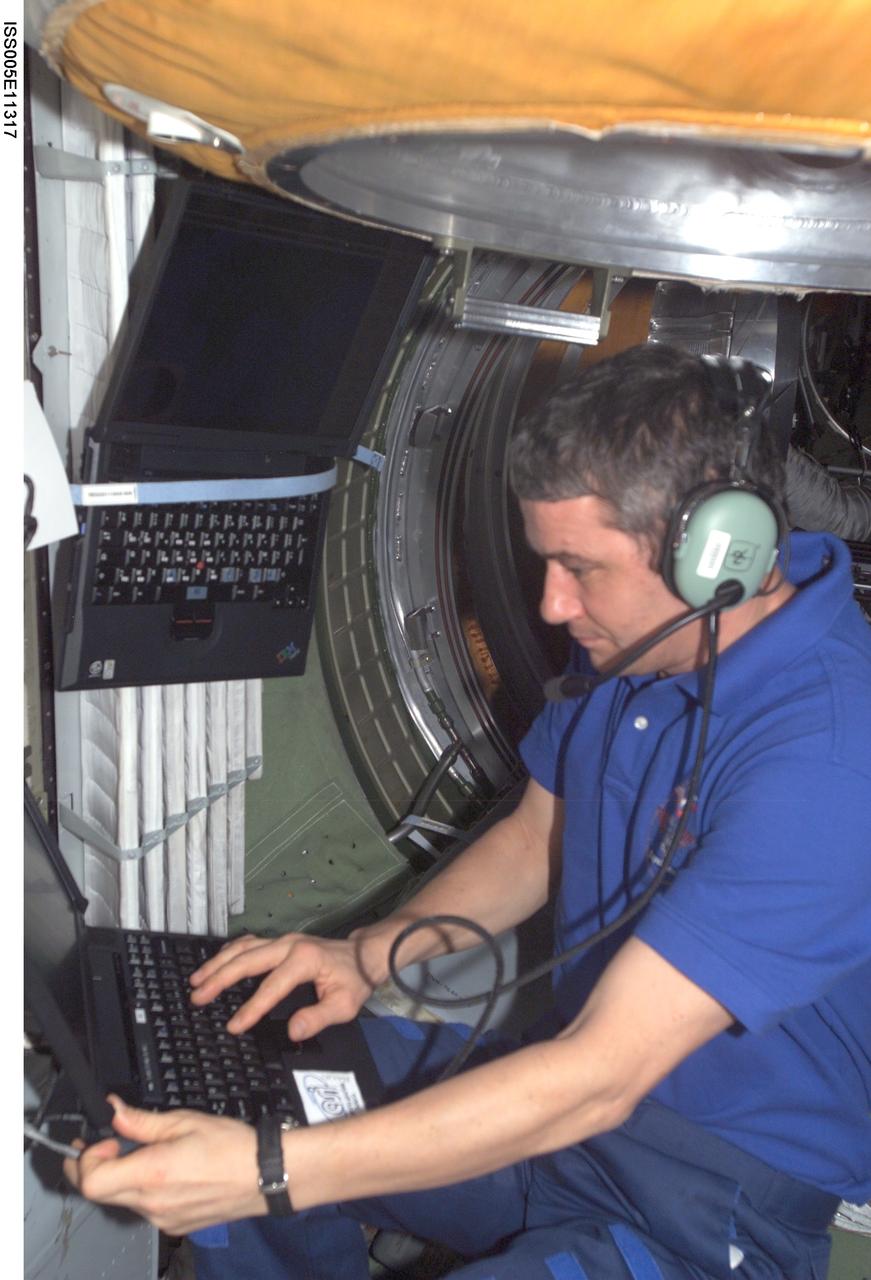
ISS005-E-11317 (27 August 2002) --- Cosmonaut Valery G. Korzun, Expedition Five mission commander, uses an amateur radio in the functional cargo block (FGB) on the International Space Station (ISS). Korzun represents Rosaviakosmos.
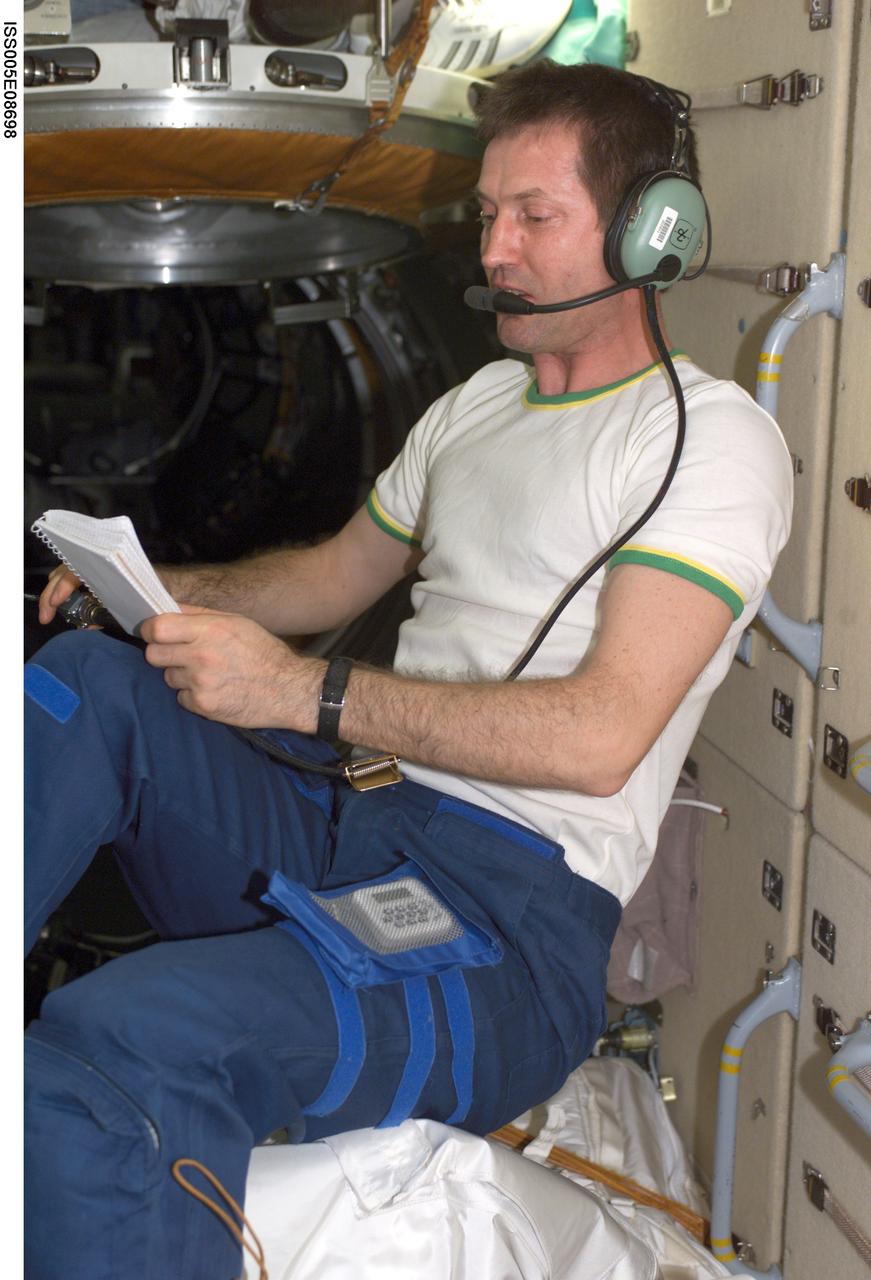
ISS005-E-08698 (6 August 2002) --- Cosmonaut Sergei Y. Treschev, Expedition Five flight engineer, uses an amateur radio in the functional cargo block (FGB) on the International Space Station (ISS). Treschev represents Rosaviakosmos.
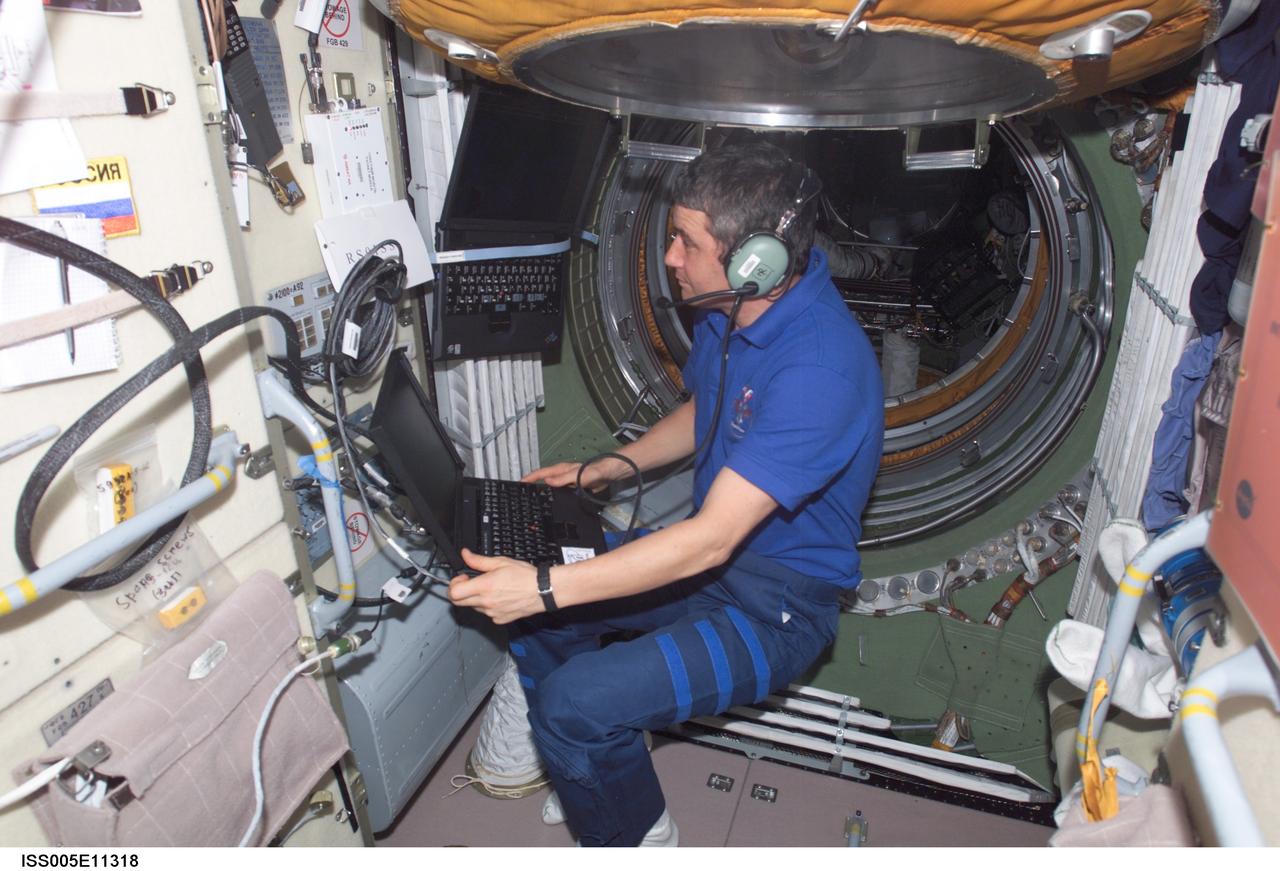
ISS005-E-11318 (27 August 2002) --- Cosmonaut Valery G. Korzun, Expedition Five mission commander, uses an amateur radio in the functional cargo block (FGB) on the International Space Station (ISS). Korzun represents Rosaviakosmos.
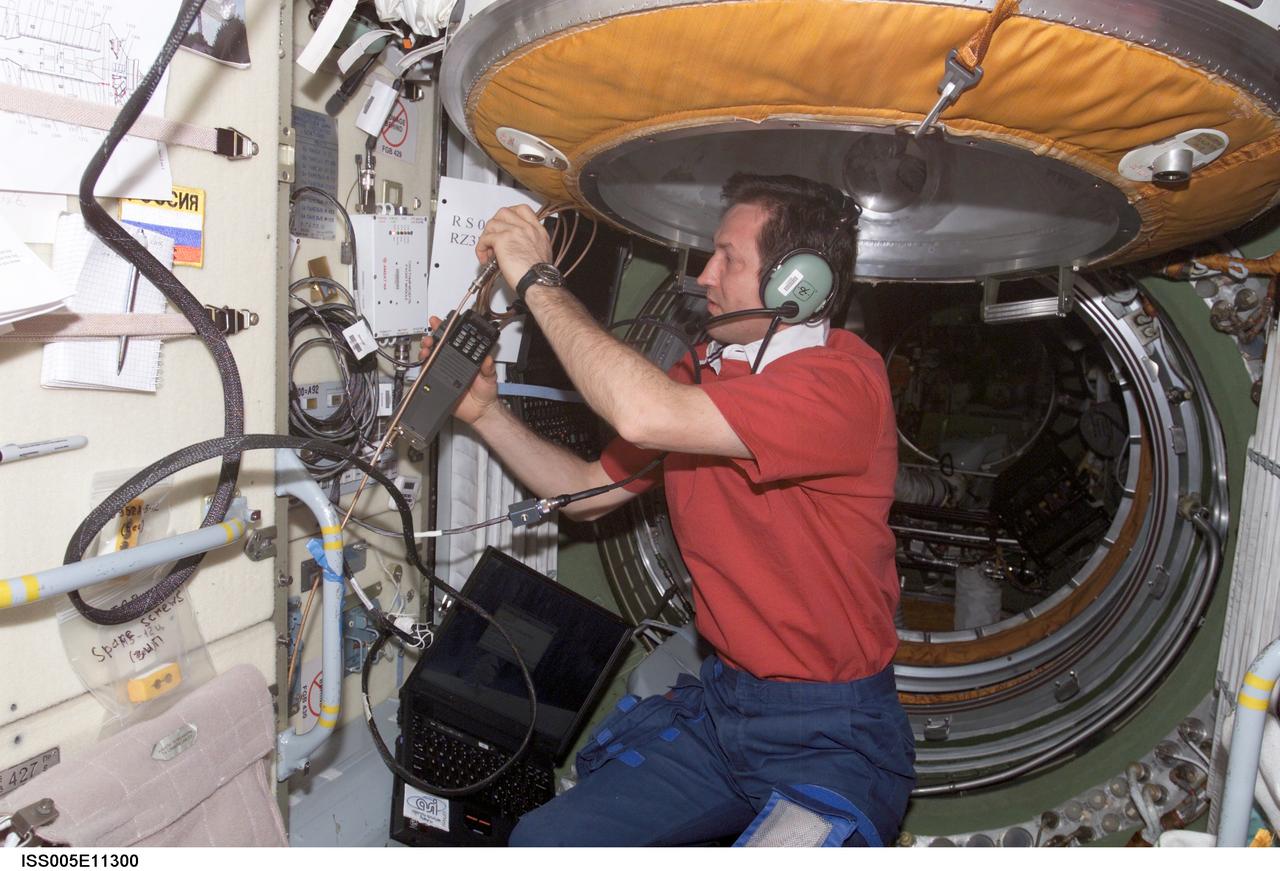
ISS005-E-11300 (27 August 2002) --- Cosmonaut Sergei Y. Treschev, Expedition Five flight engineer, uses an amateur radio in the functional cargo block (FGB) on the International Space Station (ISS). Treschev represents Rosaviakosmos.

ISS004-E-5931 (January 2002) --- Cosmonaut Yury I. Onufrienko, Expedition Four mission commander representing Rosaviakosmos, works with the Amateur Radio (HAM) WA3 Antenna Assembly in the Zvezda Service Module on the International Space Station (ISS). The image was taken with a digital still camera.
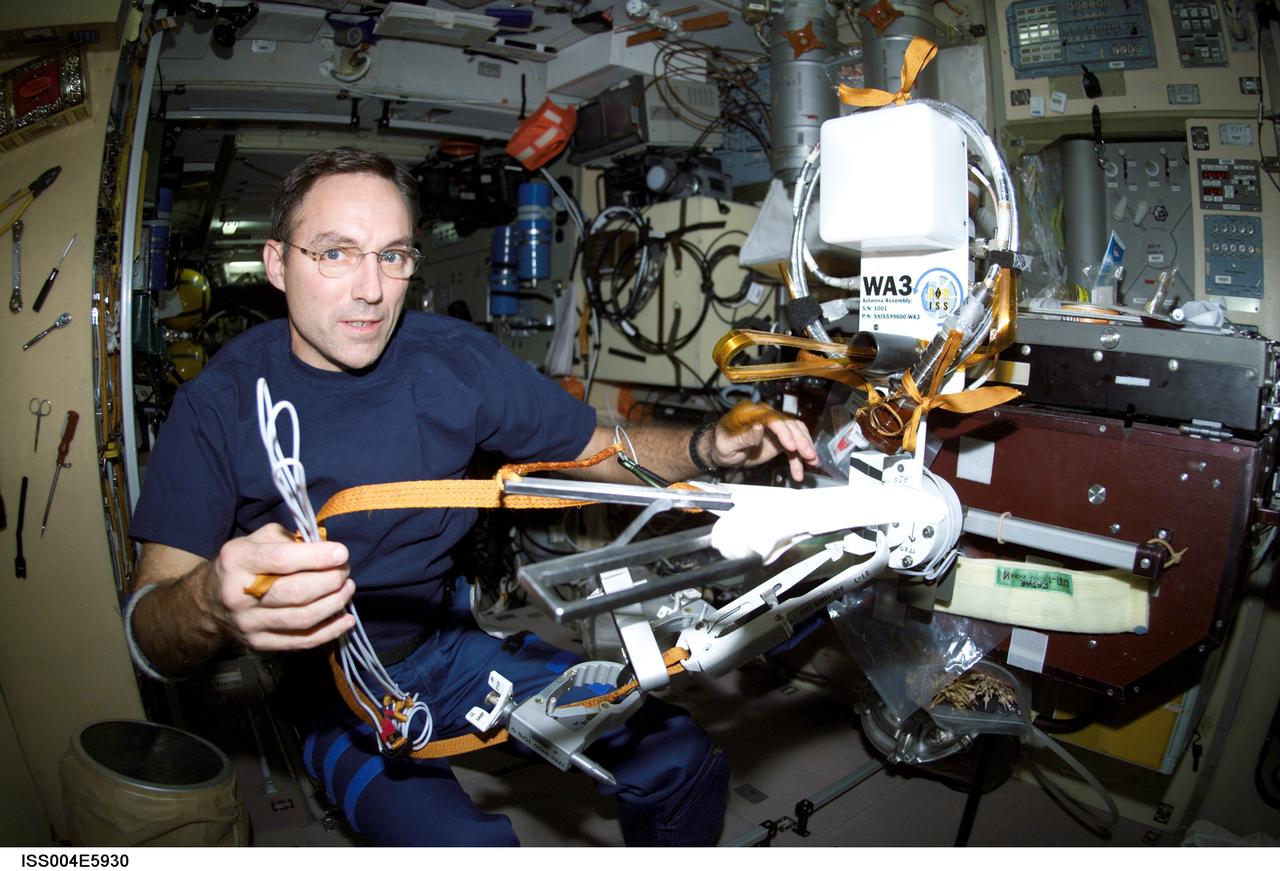
ISS004-E-5930 (January 2002) --- Astronaut Carl E. Walz, Expedition Four flight engineer, works with the Amateur Radio (HAM) WA3 Antenna Assembly in the Zvezda Service Module on the International Space Station (ISS). The image was taken with a digital still camera.

During its close flyby of Earth, NASA Jupiter-bound Juno spacecraft listened for a coordinated, global transmission from amateur radio operators using its radio and plasma wave science instrument, known as Waves.
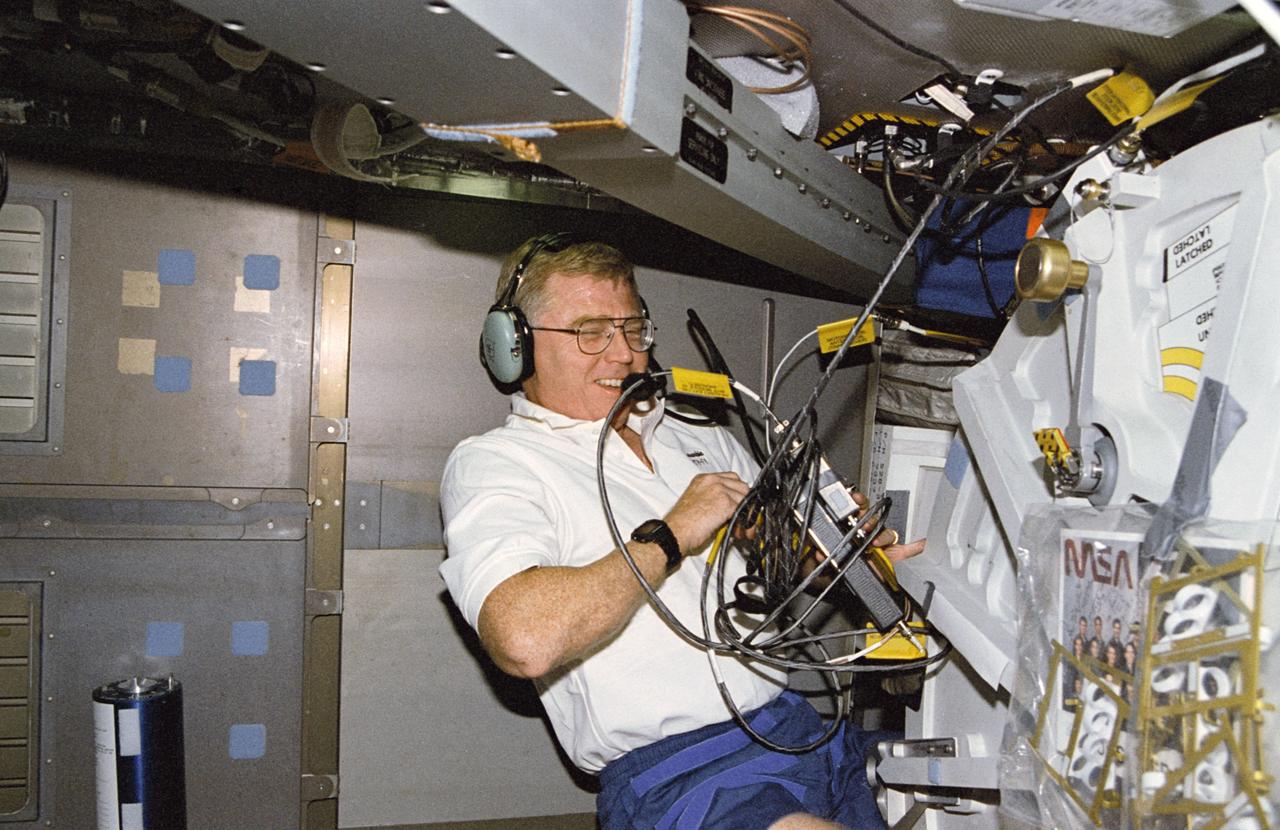
STS078-429-017 (20 June-7 July 1996) --- Aboard the middeck of the Earth-orbiting space shuttle Columbia, astronaut Charles J. Brady, mission specialist and a licensed amateur radio operator or "ham", talks to students on Earth. Some of the crew members devoted some of their off-duty time to continue a long-standing Shuttle tradition of communicating with students and other hams between their shifts of assigned duty. Brady joined four other NASA astronauts and two international payload specialists for almost 17-days of research in support of the Life and Microgravity Spacelab (LMS-1) mission.
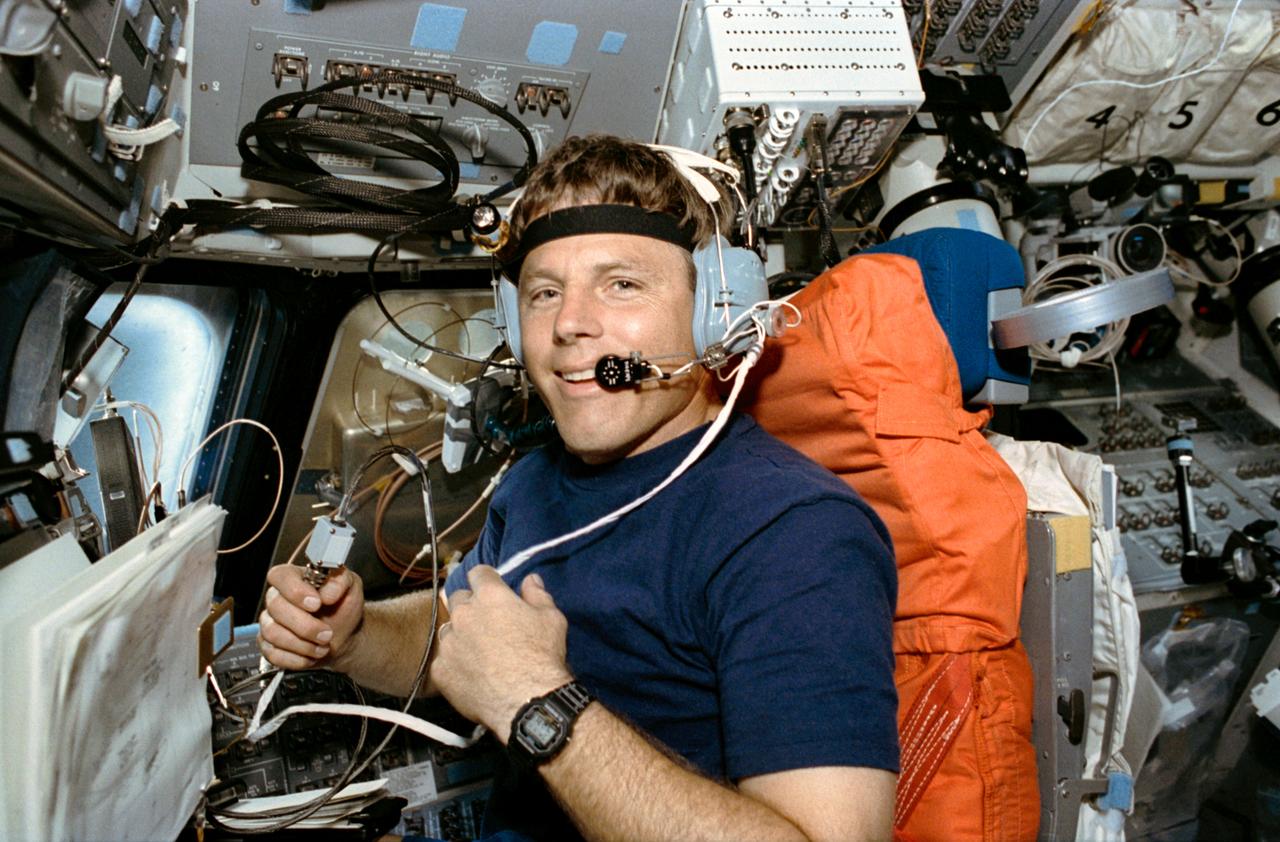
STS056-04-004 (8-17 April 1993) --- Aboard Discovery, Astronaut Stephen S. Oswald, Pilot, talks to amateur radio operators on Earth via the Shuttle Amateur Radio Experiment (SAREX). SAREX was established by NASA, the American Radio League/Amateur Radio Satellite Corporation and the Johnson Space Center Amateur Radio Club to encourage public participation in the space program through a program to demonstrate the effectiveness of conducting short-wave radio transmissions between the Shuttle and ground-based radio operators at low-cost ground stations with amateur and digital techniques. As on several previous missions, SAREX was used on this flight as an educational opportunity for students around the world to learn about space firsthand by speaking directly to astronauts aboard the Shuttle.
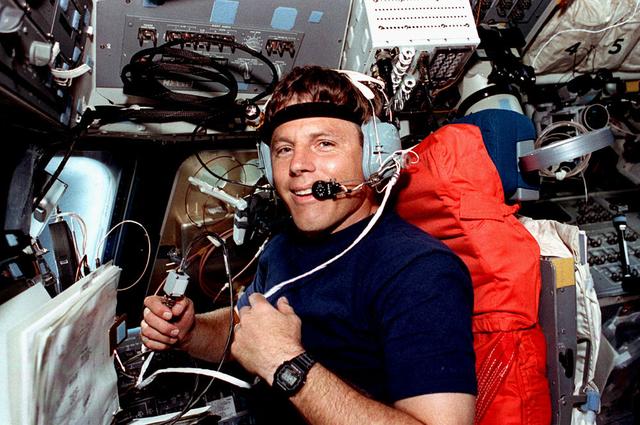
Space Shuttle Discovery (STS-56) onboard photo of Pilot Stephen S. Oswald (wearing a headset) uses the Shuttle Amateur Radio Experiment II (SAREX-II) while sitting at the pilot's station on the forward flight deck. Oswald smiled from behind the microphone as he talks to amateur radio operators on Earth via the SAREX equipment. SAREX cables and the interface module freefloat in front of Oswald. The anterna located in the forward flight deck window is visible in the background. SAREX was established by NASA, the American Radio League/Amateur Radio Satellite Corporation and the Johnson Space Center (JSC) Amateur Radio Club to encourage public participation in the space program through a program to demonstrate the effectiveness of conducting short-wave radio transmissions between the Shuttle and ground-based radio operators at low-cost ground stations with amateur and digital techniques.
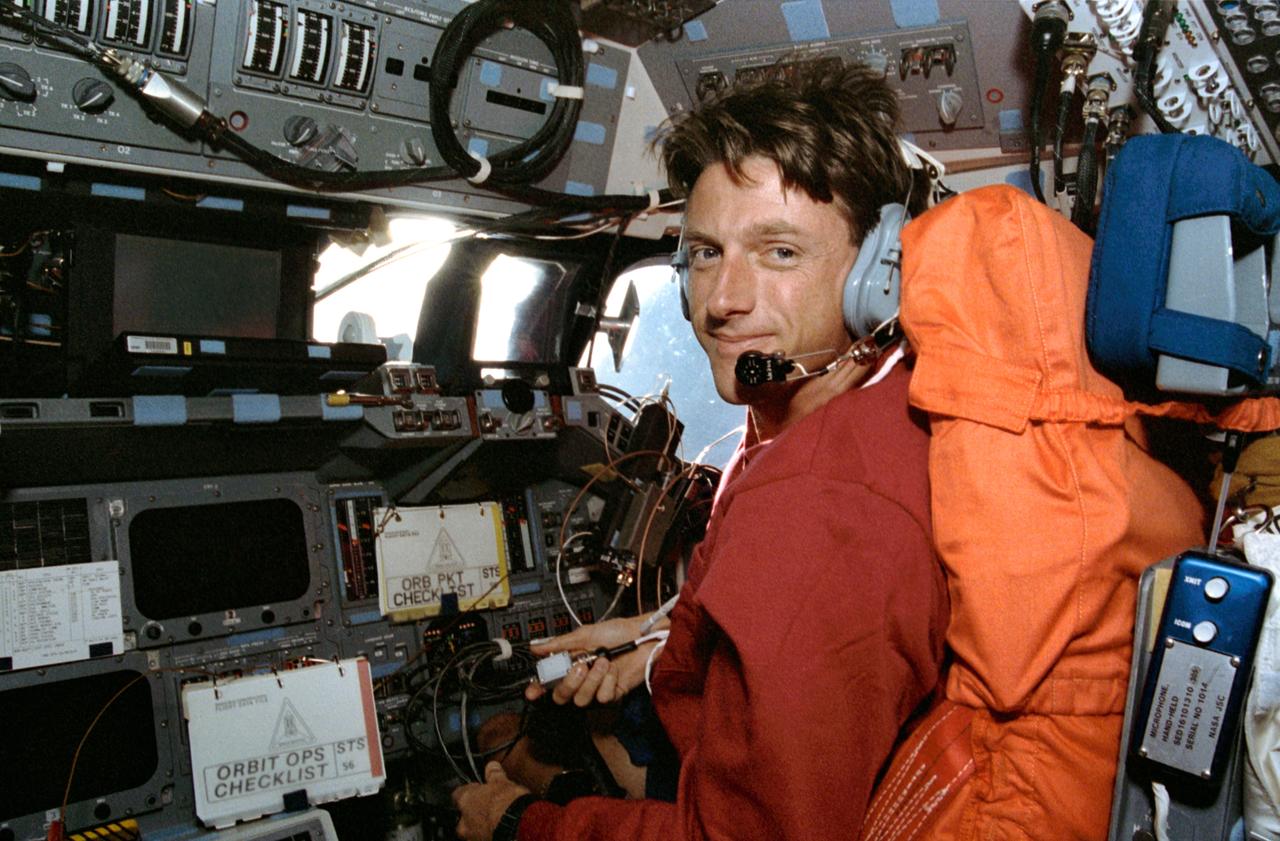
STS056-30-001 (8-17 April 1993) --- Aboard Discovery, astronaut C. Michael Foale, (call letters KB5UAC), talks to amateur radio operators on Earth via the Shuttle Amateur Radio Experiment (SAREX). SAREX was established by NASA, the American Radio League/Amateur Radio Satellite Corporation and the Johnson Space Center Amateur Radio Club to encourage public participation in the space program through an endeavor to demonstrate the effectiveness of conducting short-wave radio transmissions. These transmissions occur between the Shuttle and ground-based radio operators at low cost ground stations with amateur and digital techniques. As on several previous missions, SAREX was used on this flight as an educational opportunity for students around the world to learn about space firsthand by speaking directly to astronauts aboard the Shuttle.
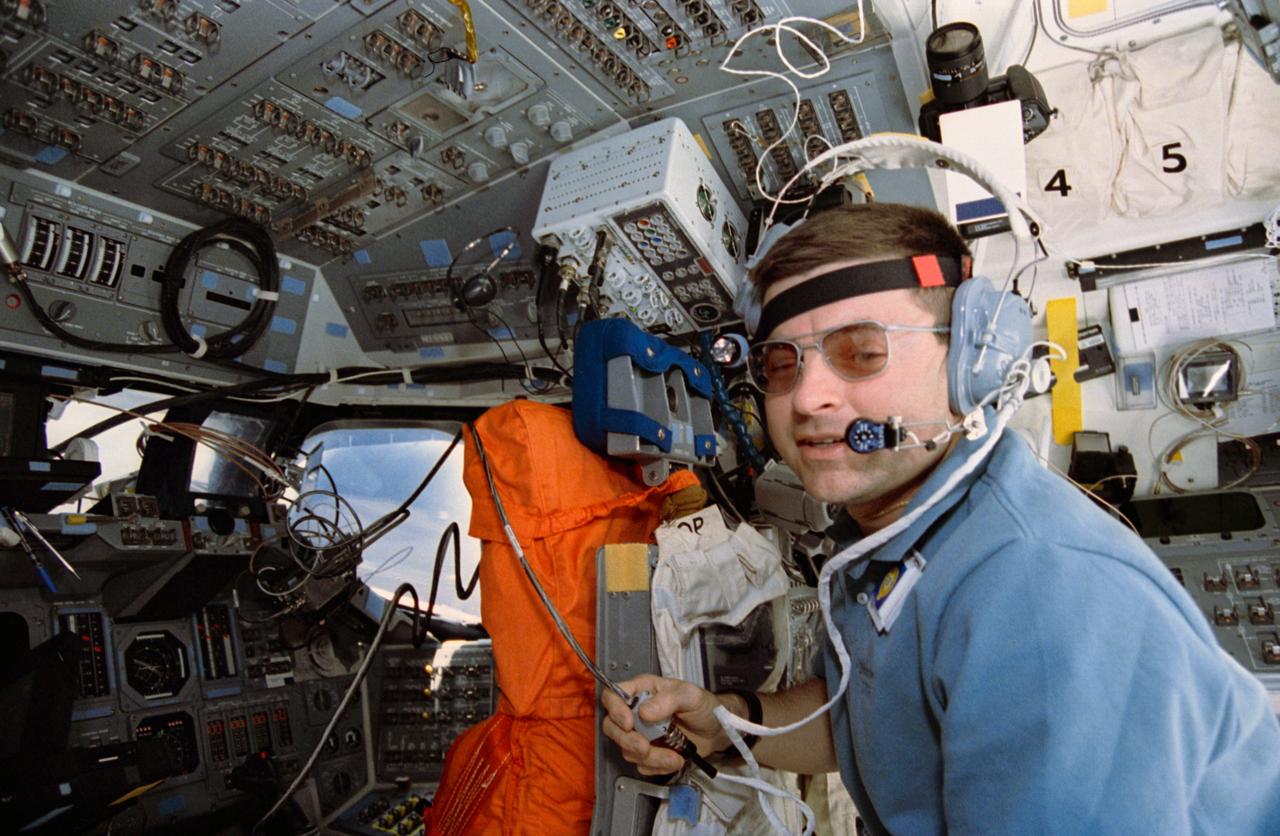
STS056-30-022 (8-17 April 1993) --- Aboard Discovery, astronaut Kenneth D. Cameron (call letters N5AWP), talks to amateur radio operators on Earth via the Shuttle Amateur Radio Experiment (SAREX). SAREX was established by NASA, the American Radio League\Amateur Satellite Corporation and the Johnson Space Center Amateur Radio Club to encourage public participation in the space program. It is part of an endeavor to demonstrate the effectiveness of conducting short-wave radio transmissions between the Shuttle and ground-based radio operators at low cost ground stations with amateur and digital techniques. As on several previous missions, SAREX was used on this flight as an educational opportunity for students around the world to learn about space firsthand by speaking directly to astronauts aboard the Shuttle.
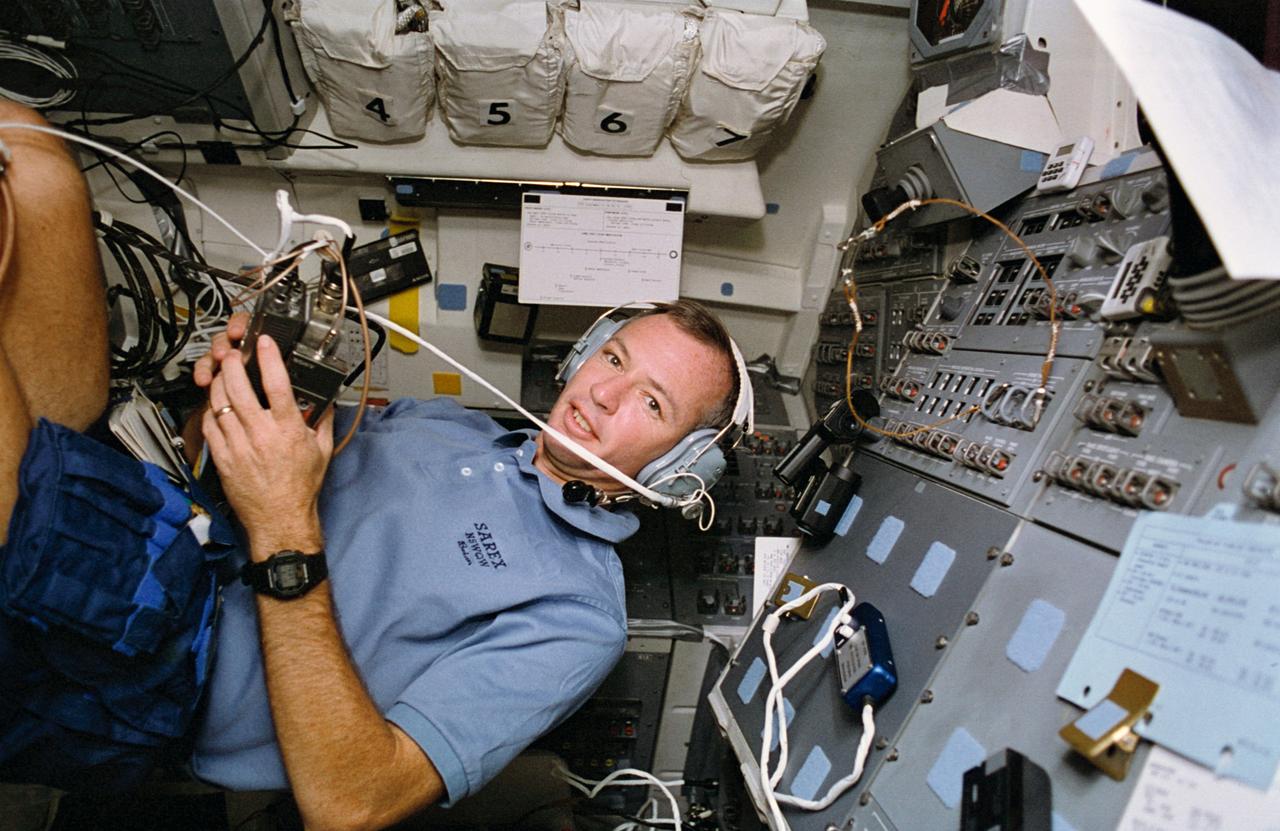
STS057-40-028 (21 June-1 July 1993) --- Astronaut Brian Duffy, pilot, talks to amateur radio operators on Earth from the flight deck of the Earth-orbiting Space Shuttle Endeavour. The space to Earth communications was part of the Shuttle amateur radio experiment (SAREX), which has been included on a number of Space Shuttle missions. Duffy, a licensed amateur radio operator using call letters N5WQW, was among crewmembers talking to students at various points on the ground.
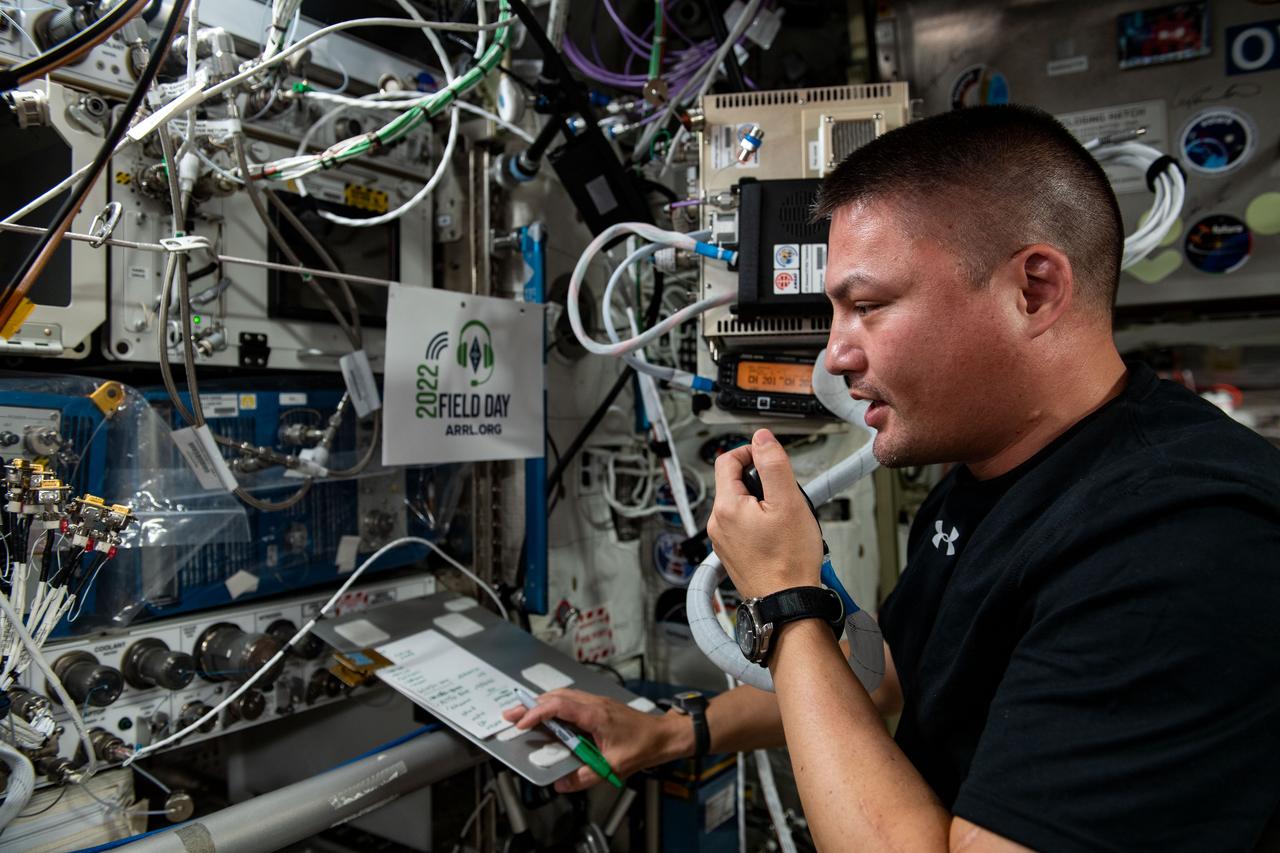
iss067e175040 (6/25/2022) --- NASA astronaut Kjell Lindgren uses the amateur radio in the Columbus module aboard the International Space Station (ISS) to participate in the annual Amateur Radio Relay League (ARRL) Field Day. Field Day allows amateur radio operators the chance to practice operating their equipment under simulated emergency conditions.
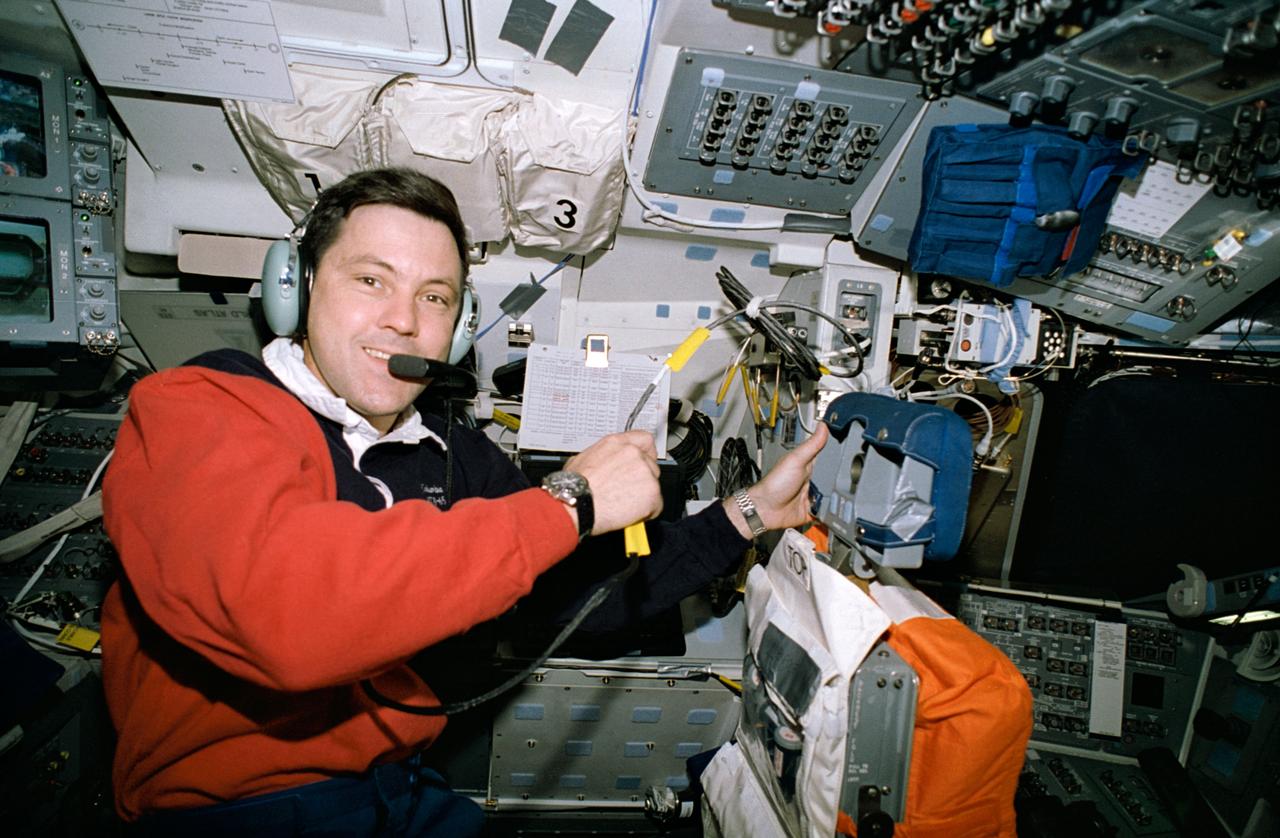
STS065-44-014 (8-23 July 1994) --- Astronaut Robert D. Cabana, mission commander, is seen on the Space Shuttle Columbia's flight deck with the Shuttle Amateur Radio Experiment (SAREX). SAREX was established by NASA, the American Radio League/Amateur Radio Satellite Corporation and the Johnson Space Center (JSC) Amateur Radio Club to encourage public participation in the space program through a project to demonstrate the effectiveness of conducting short-wave radio transmissions between the Shuttle and ground-based radio operators at low-cost ground stations with amateur and digital techniques. As on several previous missions, SAREX was used on this flight as an educational opportunity for students around the world to learn about space firsthand by speaking directly to astronauts aboard the Shuttle.
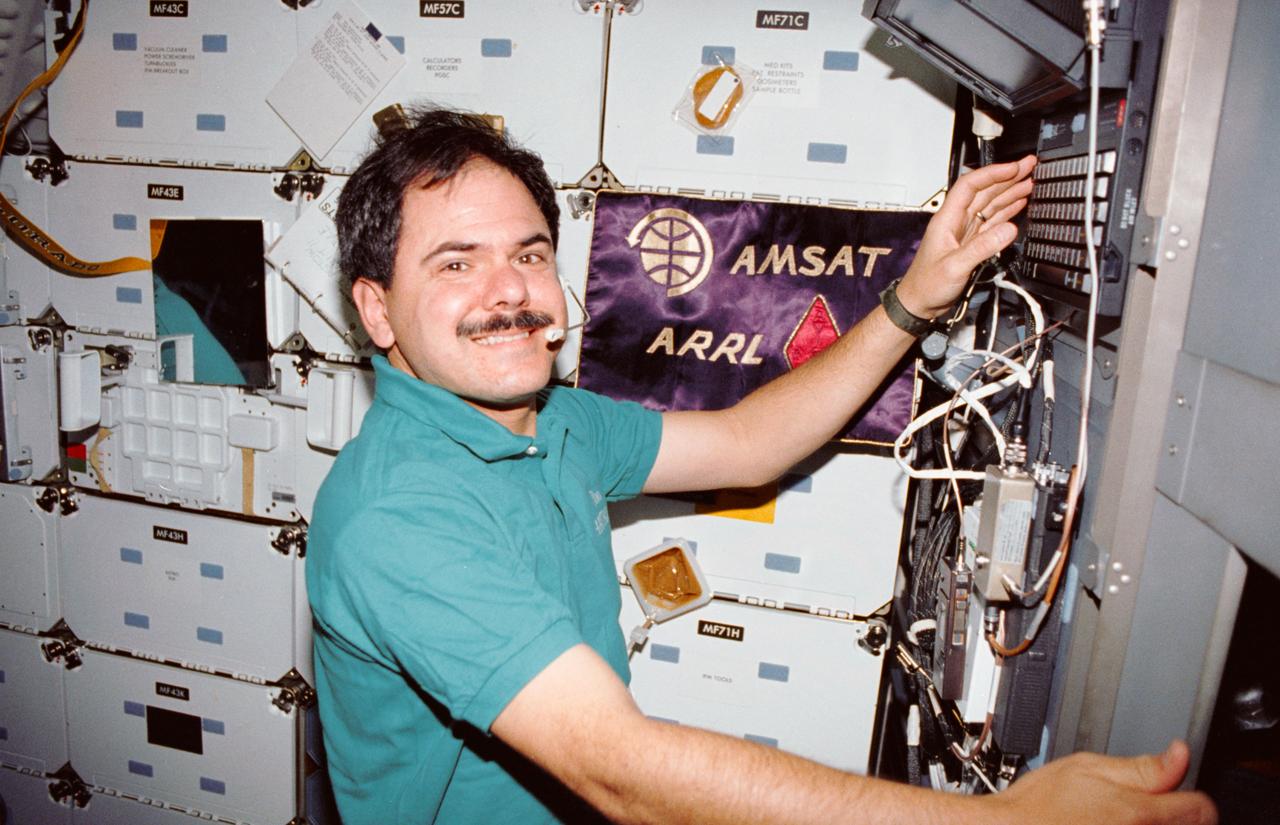
STS-35 Payload Specialist Ronald A. Parise enters data into the payload and general support computer (PGSC) in preparation for Earth communication via the Shuttle Amateur Radio Experiment (SAREX) aboard Columbia, Orbiter Vehicle (OV) 102. The SAREX equipment is secured to the middeck starboard sleep station. SAREX provided radio transmissions between ground based amateur radio operators around the world and Parise, a licensed amateur radio operator. The experiment enabled students to communicate with an astronaut in space, as Parise (call-sign WA4SIR) devoted some of his off-duty time to that purpose. Displayed on the forward lockers beside Parise is a AMSAT (Amateur Radio Satellite Corporation) / ARRL (American Radio Relay League) banner. Food items and checklists are attached to the lockers. In locker position MF43G, the Development Test Objective (DTO) Trash Compaction and Retention System Demonstration extended duration orbiter (EDO) compactor is visible.
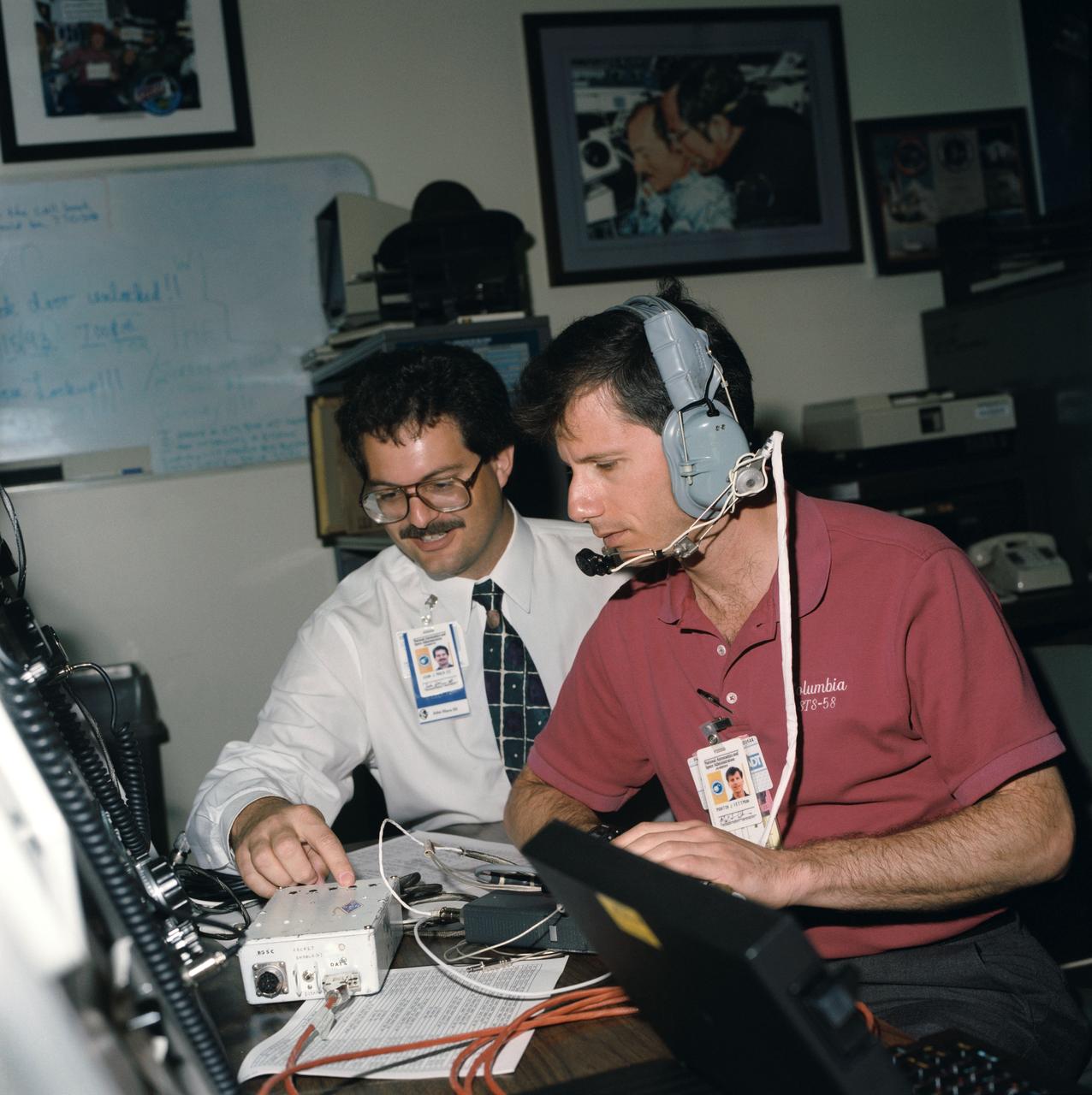
S93-45076 (22 Sept 1993) --- Payload specialist Martin J. Fettman listens to an amateur radio instruction by crew trainer John J. Maca. Members of the STS-58 crew were training with amateur radio equipment at the Johnson Space Center (JSC). The STS-58 flight will carry the Shuttle Amateur Radio Experiment (SAREX) payload, configuration C, which includes FM voice and packet. Three of the seven crew members are licensed amateur radio operators. Fettman's call letters are KC5AXA; William S. McArthur, mission specialist, KC5ACR; and Richard A. Searfoss, pilot, KC5CKM. Licensed students at a number of schools around the country will have the opportunity to talk directly with the astronauts during the 14-day flight.
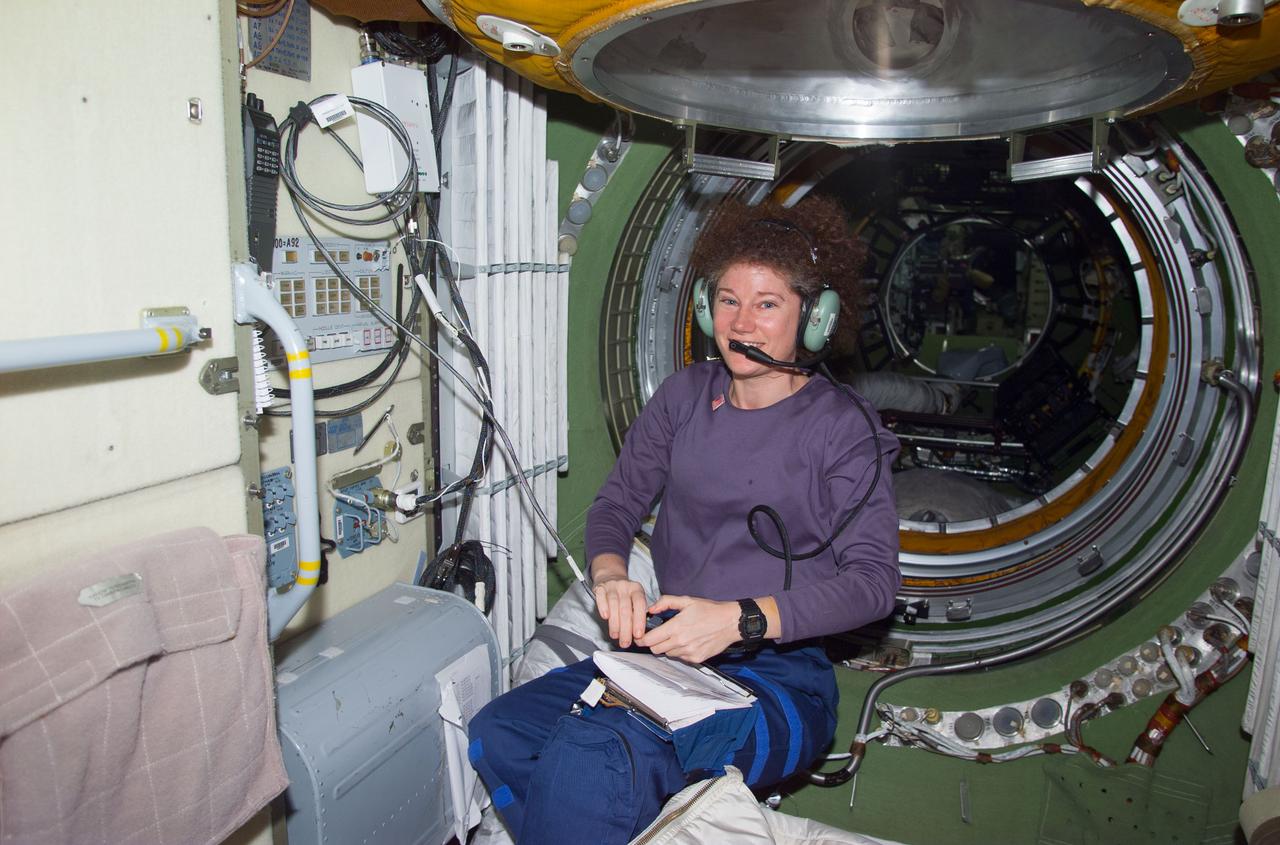
S104-E-5092 (16 July 2001) --- Susan J. Helms, Expedition Two flight engineer, talks to amateur radio operators on Earth from the HAM radio workstation in the Zarya module of the International Space Station (ISS).
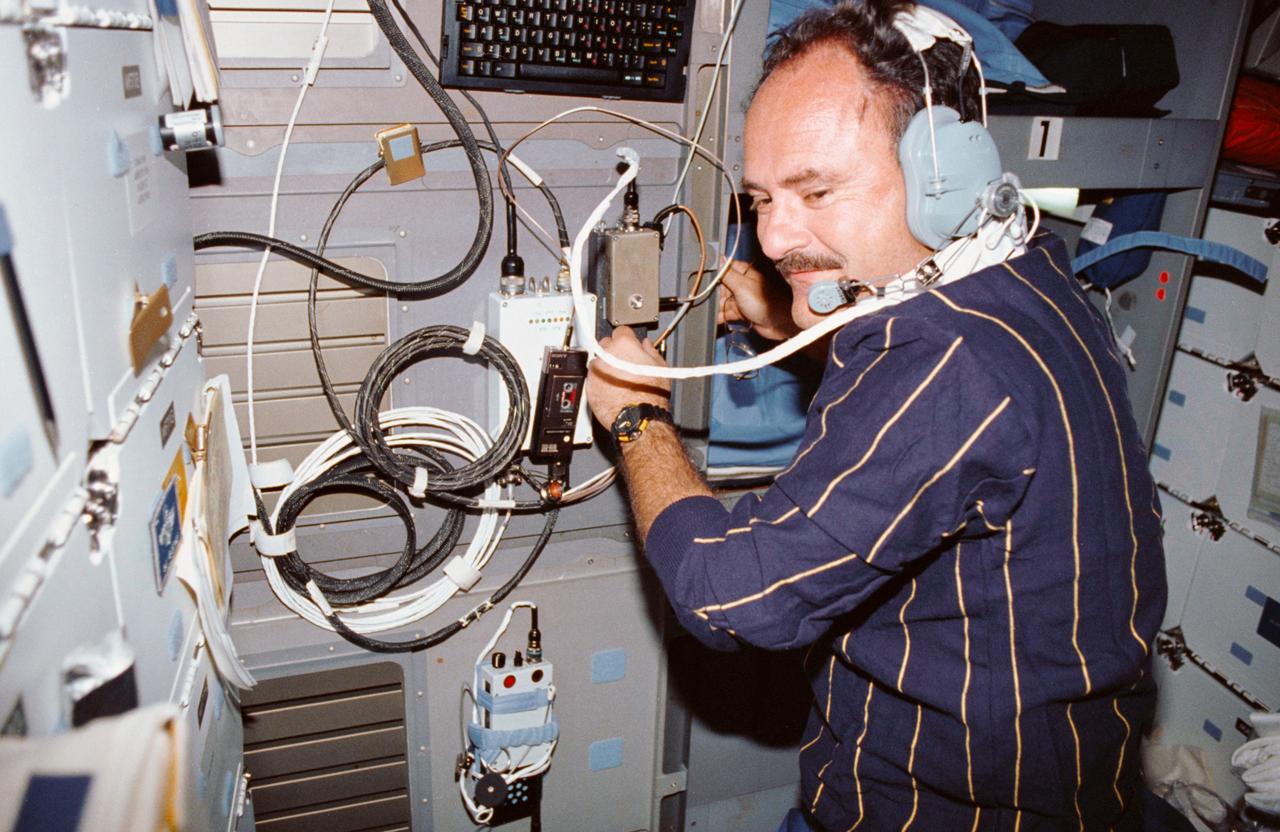
STS035-15-010 (2-11 Dec 1990) --- Astronaut John M. (Mike) Lounge, STS-35 mission specialist, communicates with family members from the middeck of Space Shuttle Columbia in Earth orbit. The STS-35 Shuttle amateur radio experiment (SAREX), allowed the Astro 1 crewmembers to "visit" and briefly share some of their in space experiences with family members. The picture was made with a 35mm camera. Note: Used by Astronomer Ronald A. Parise on his off-duty hours, SAREX provided radio transmissions between ground based amateur radio operators around the world and the Shuttle. Parise is a payload specialist who is also a licensed amateur radio operator (call-sign WA4SIR). The experiment enabled students from all over the United States to have a chance to communicate with an astronaut in space.
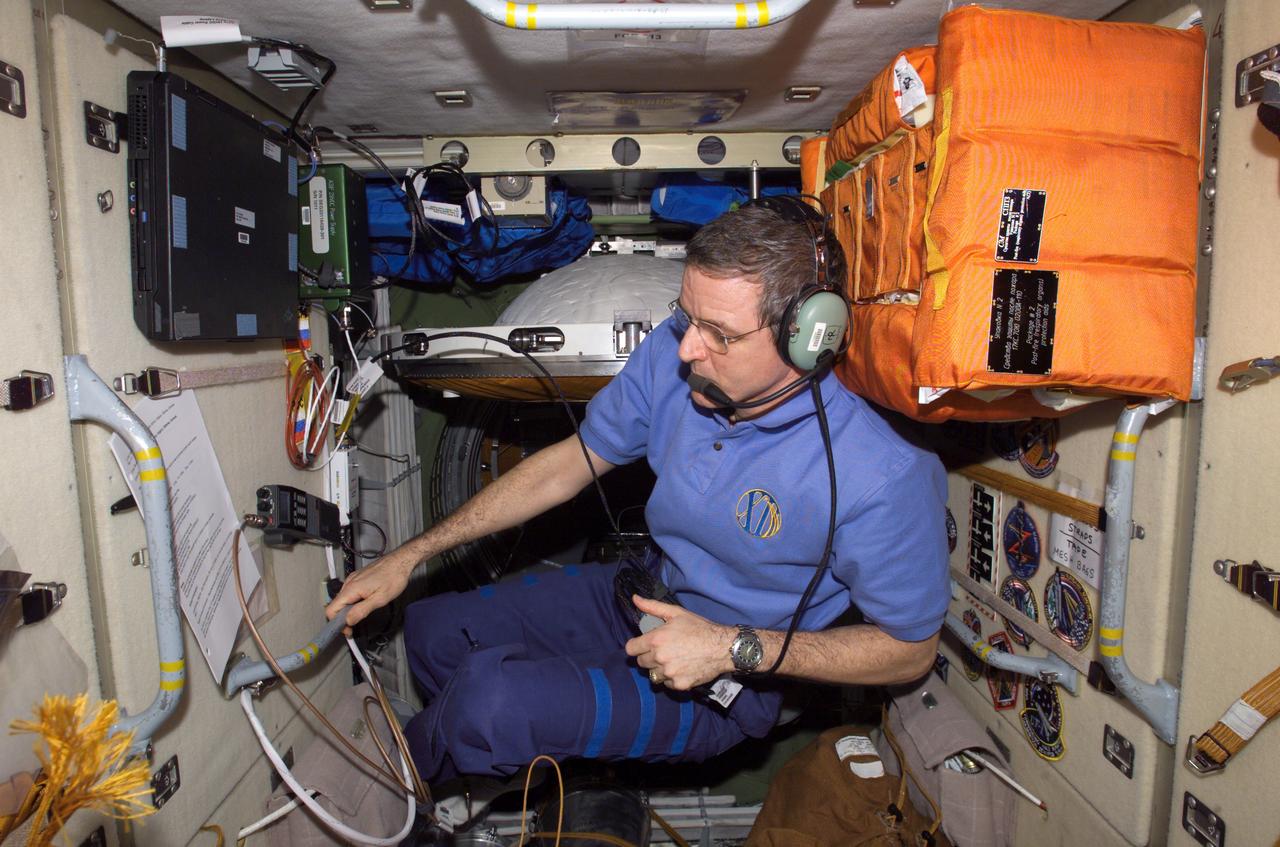
ISS012-E-21181 (21 March 2006) --- Astronaut William S. McArthur Jr., Expedition 12 commander and NASA science officer, talks on the ARISS (Amateur Radio on the International Space Station) inside the Zarya Functional Cargo Block during his scheduled amateur radio session. This session is with the Sir James Lougheed Elementary School, Calgary, Alberta, Canada.
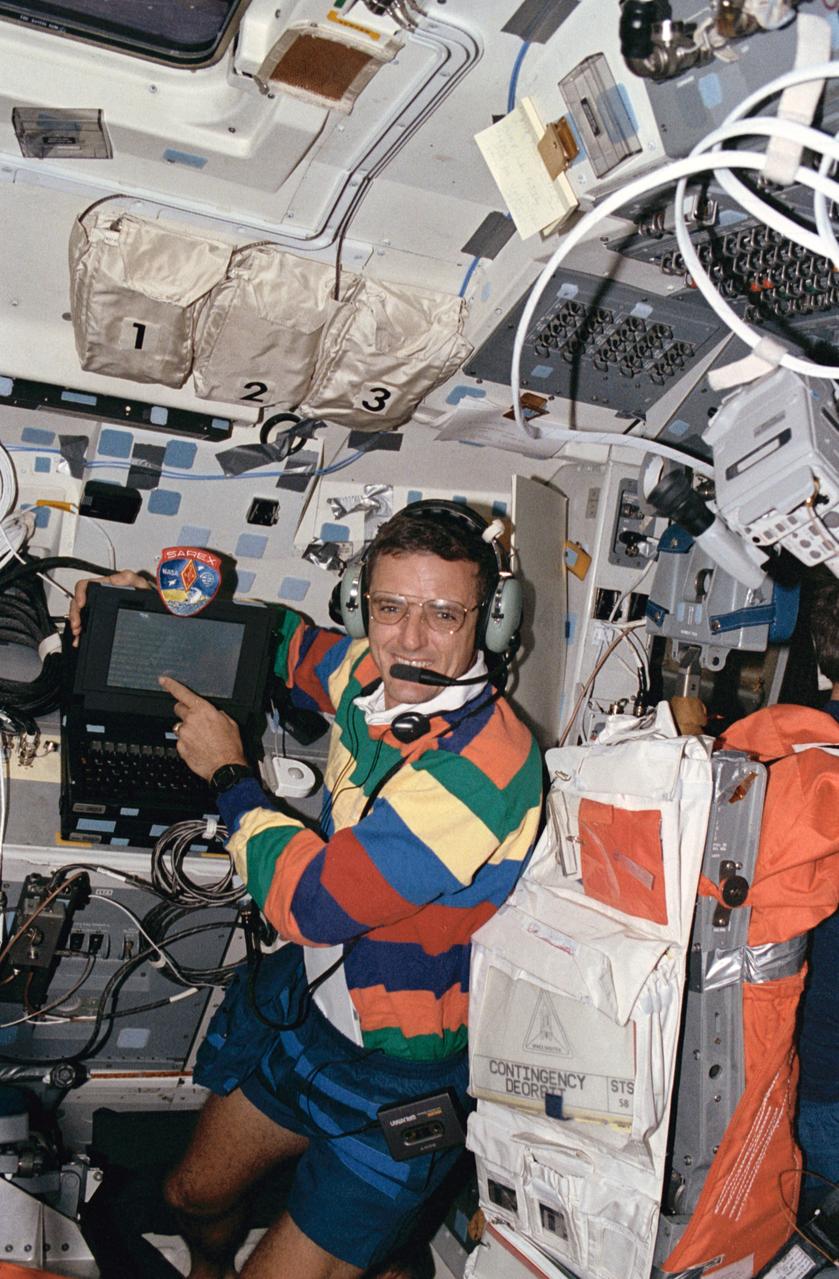
STS058-21-011 (24 Oct 1993) --- From the flight deck of the Earth-orbiting Space Shuttle Columbia, astronaut William S. McArthur talks to students on Earth. The mission specialist's activity was part of the Shuttle Amateur Radio Experiment (SAREX), a frequent payload on Shuttle missions which serves to enlighten students around the world on the topic of space travel. McArthur (call letters KC5ACR) is one of three licensed amateur radio operators on the seven-member flight.
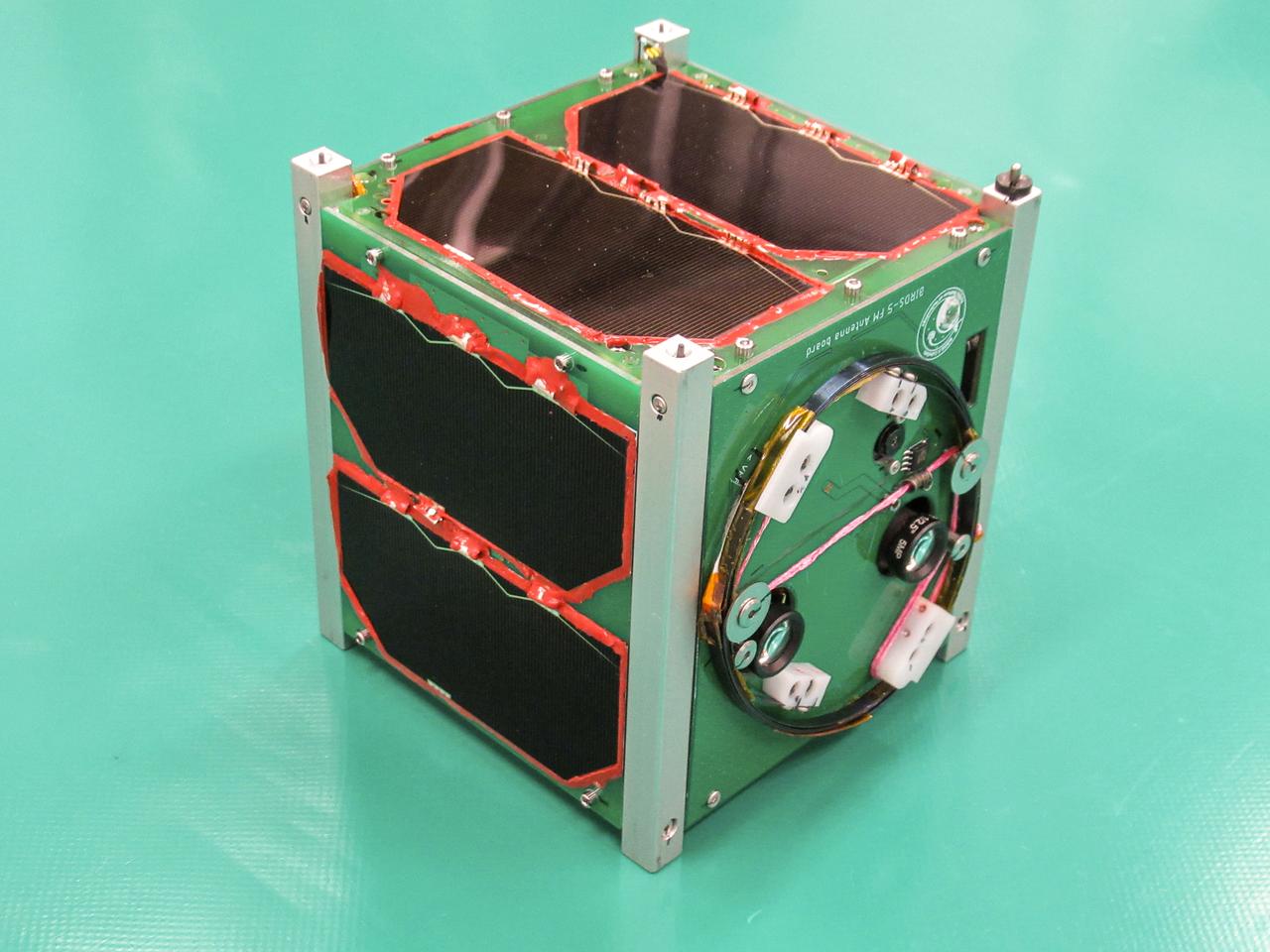
JSC2024E043924 (4/14/2025) --- The CosmoGirl-Sat CubeSat from Japan Aerospace Exploration Agency (JAXA) shows deep blue solar panels at the front of the spacecraft that power three sunken camera lenses (seen on the top of the satellite), amongst a plethora of other subsystems. CosmoGirl-Sat is developed by the Cosmo Women’s Amateur Radio Club, and its primary mission is to transmit imagery to a ground station on Earth. Image courtesy of Cosmo Girls Amateur Radio Club.
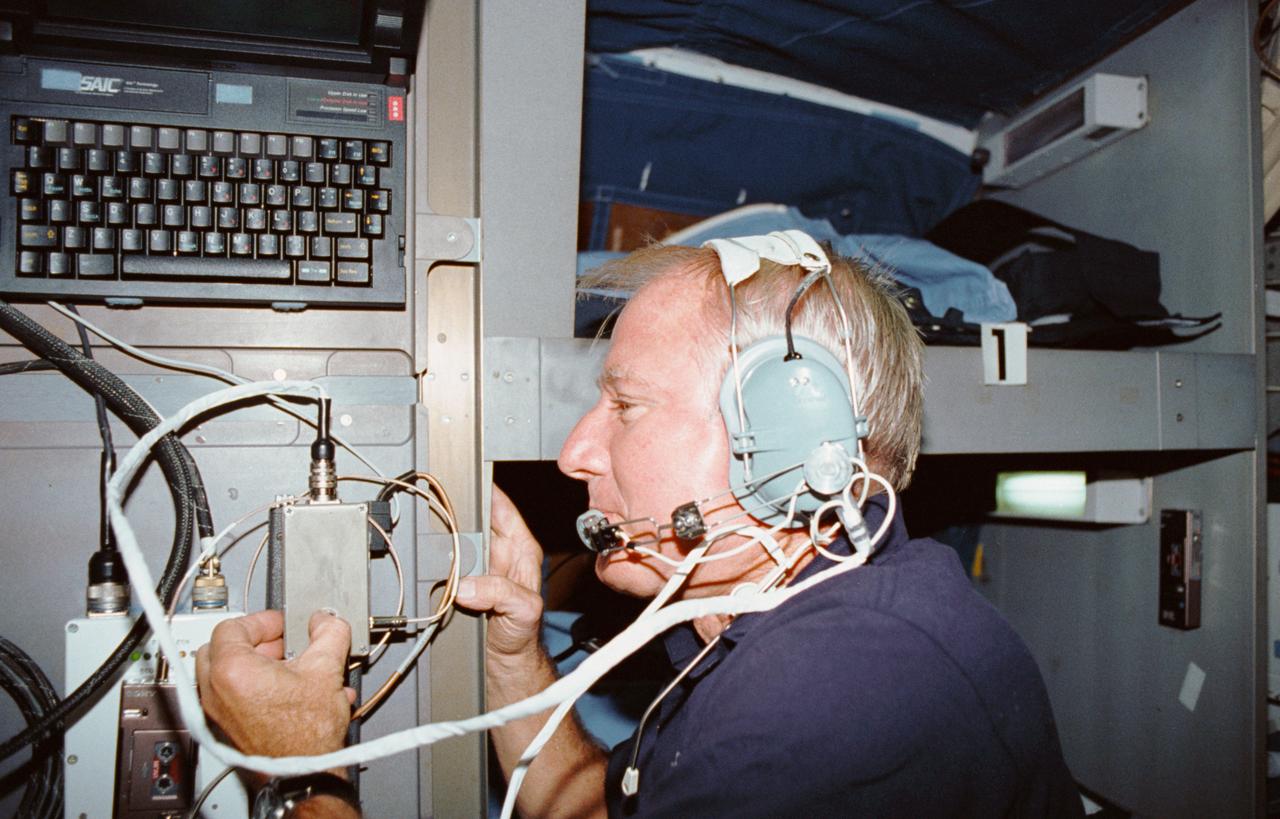
STS035-05-036 (2-10 Dec 1990) --- STS-35 Commander Vance D. Brand, wearing headset, communicates with family members using Shuttle Amateur Radio Experiment (SAREX) on Columbia's, Orbiter Vehicle (OV) 102's, middeck. SAREX and its portable laptop computer mounted on the outside of the middeck sleep station allowed the STS-35 crewmembers to "visit" and briefly share some of their in space experiences with family members. It also provided radio transmissions between ground based amateur radio operators around the world and OV-102. The experiment enabled students from all over the United States to have a chance to communicate with a crewmember in space.
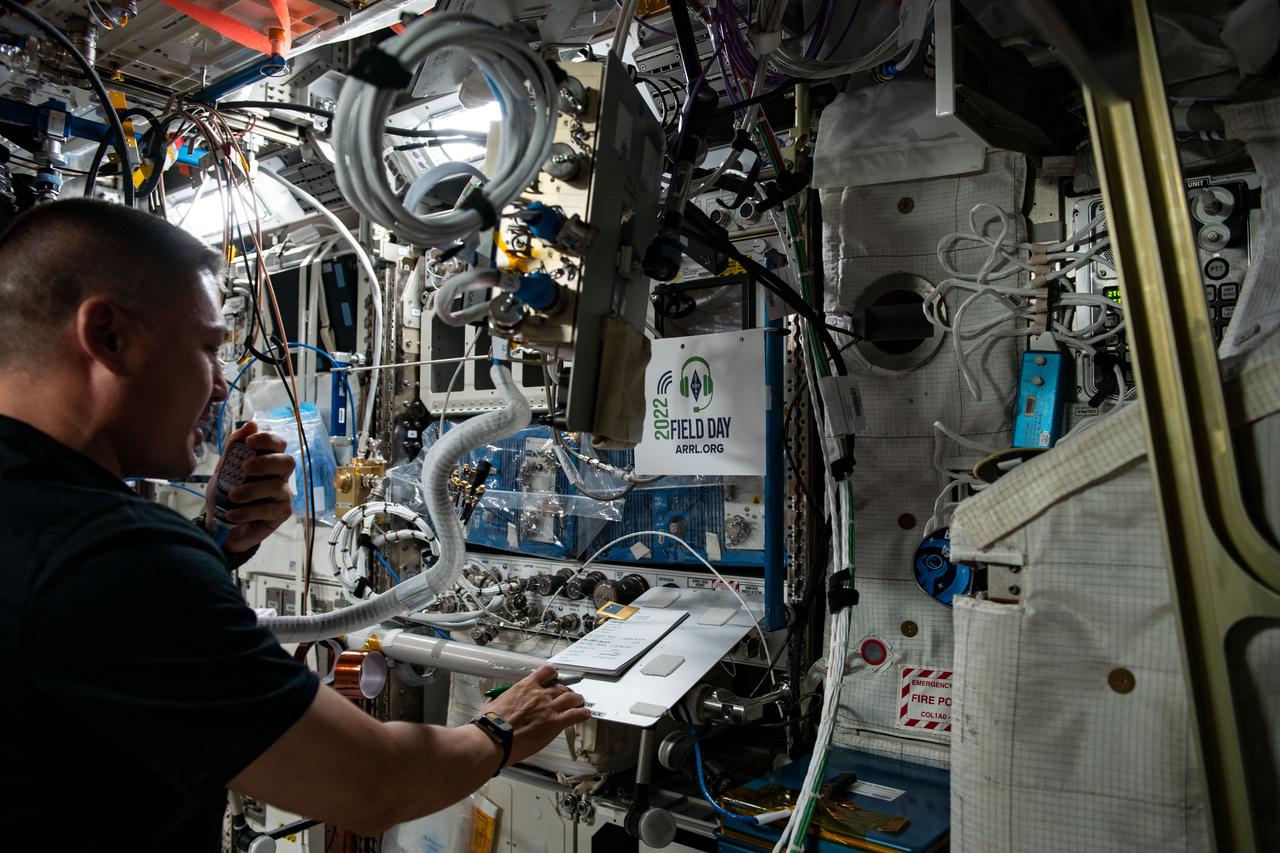
iss067e175034 (June 25, 2022) --- Expedition 67 Flight Engineer and NASA astronaut Kjell Lindgren participates in a ham radio session in commemoration of the Amateur Radio Relay League's 2022 Field Day supporting public service, emergency preparedness, community outreach, and technical skills all in a single event.
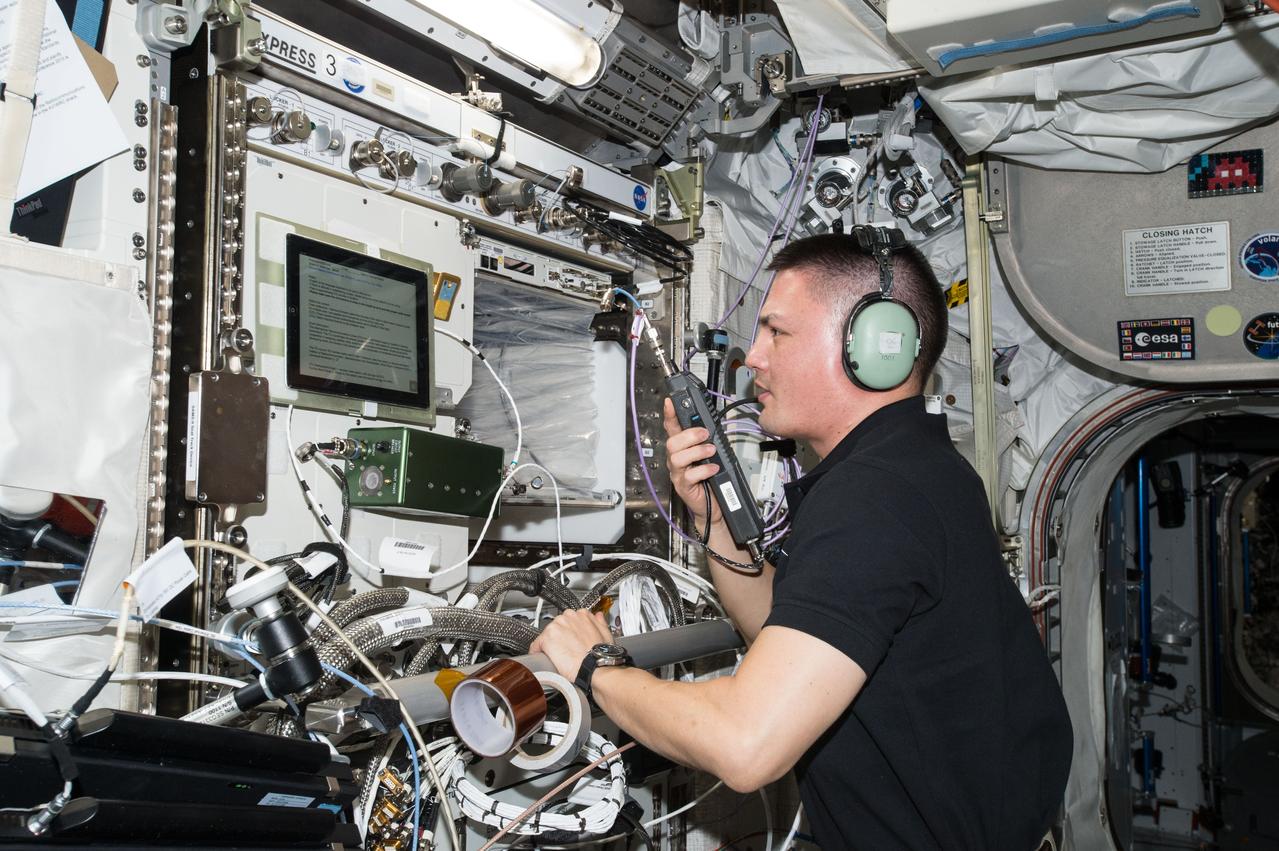
ISS045E089495 (11/04/2015) --- NASA astronaut Kjell Lindgren uses a HAM radio to speak with operators down on Earth. The International Space Station is equipped with amateur radio equipment allowing astronauts to share the excitement of space exploration, inspire and ignite interest among students and others on the ground.
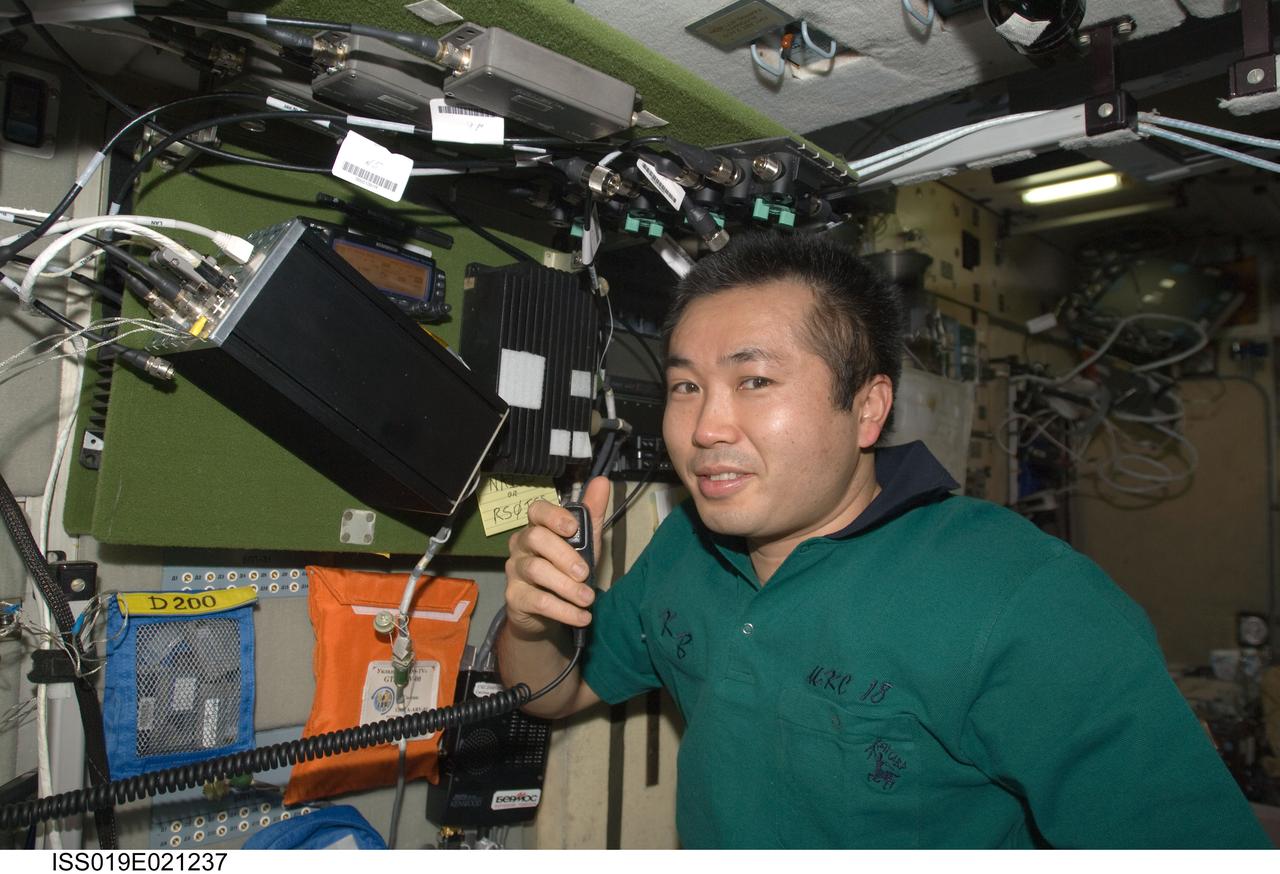
ISS019-E-021237 (26 May 2009) --- Japan Aerospace Exploration Agency (JAXA) astronaut Koichi Wakata, Expedition 19/20 flight engineer, uses an amateur radio in the Zvezda Service Module of the International Space Station.
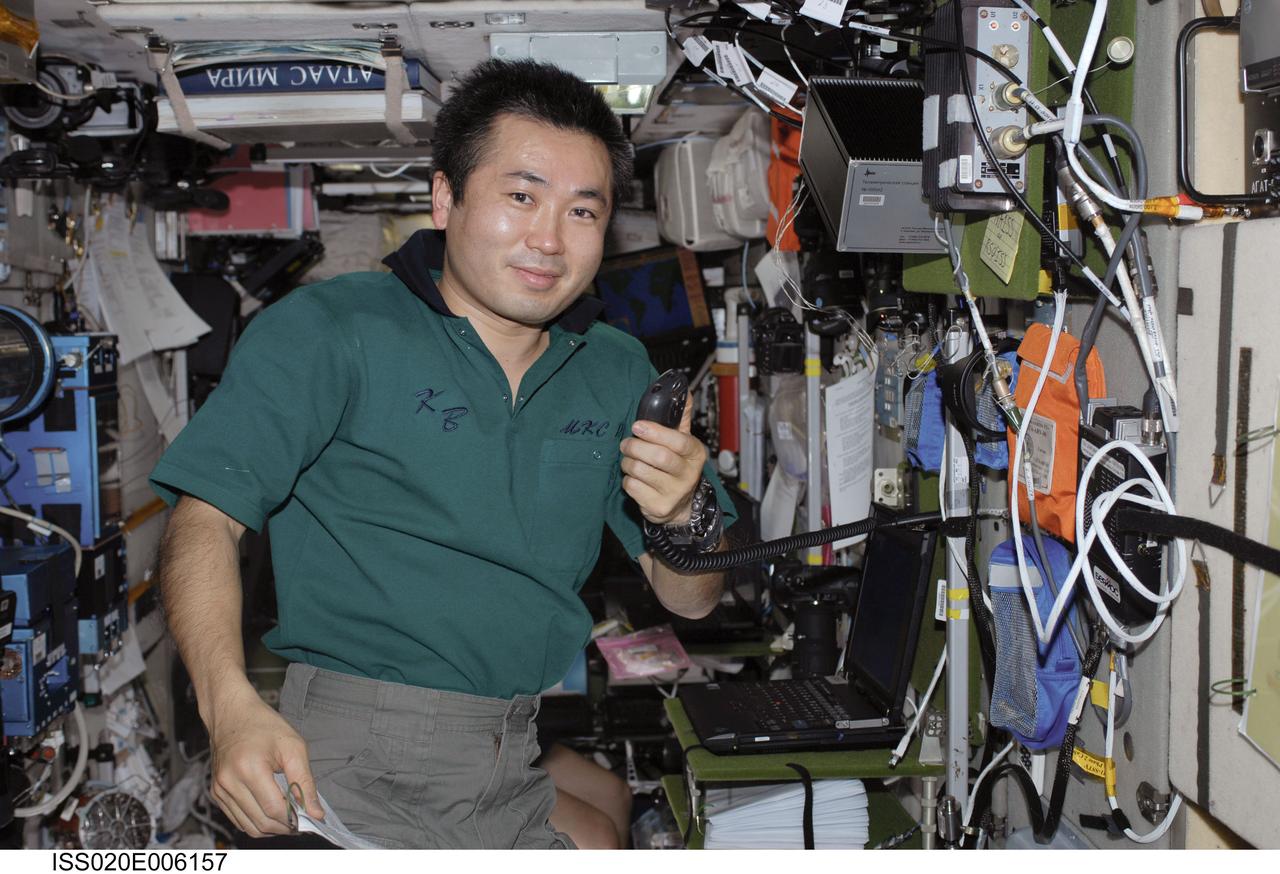
ISS020-E-006157 (3 June 2009) --- Japan Aerospace Exploration Agency (JAXA) astronaut Koichi Wakata, Expedition 20 flight engineer, uses amateur radio gear in the Zvezda Service Module of the International Space Station.
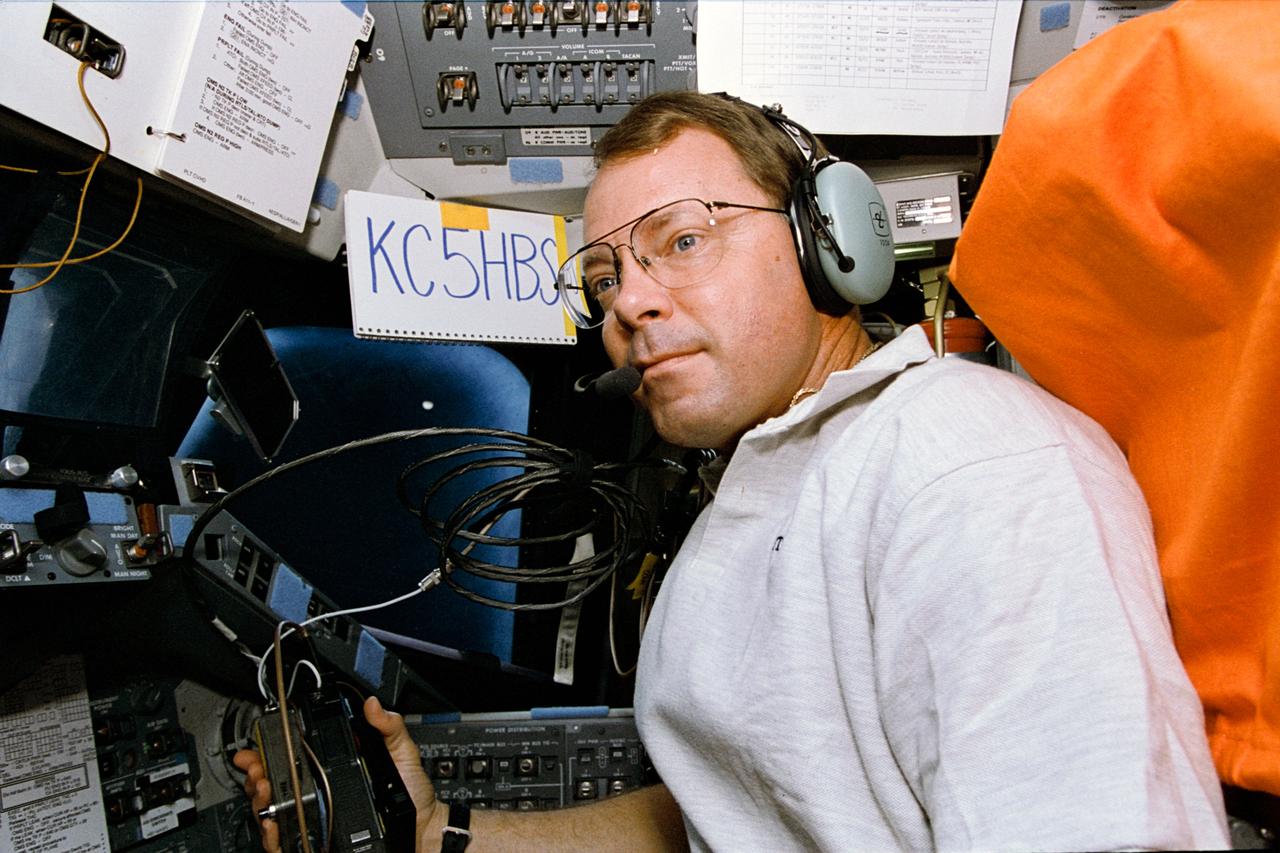
STS064-04-009 (9-20 Sept. 1994) --- Astronaut L. Blaine Hammond, STS-64 pilot, talks to students on Earth via the Shuttle Amateur Radio Experiment (SAREX) on the space shuttle Discovery's flight deck. The recently licensed "Ham" operator and several other crew members throughout the mission were connected with schools around the world with the aid of a number of amateur radio operators. Hammond joined five other NASA astronauts for almost 11 days in Earth orbit aboard Discovery. Photo credit: NASA or National Aeronautics and Space Administration
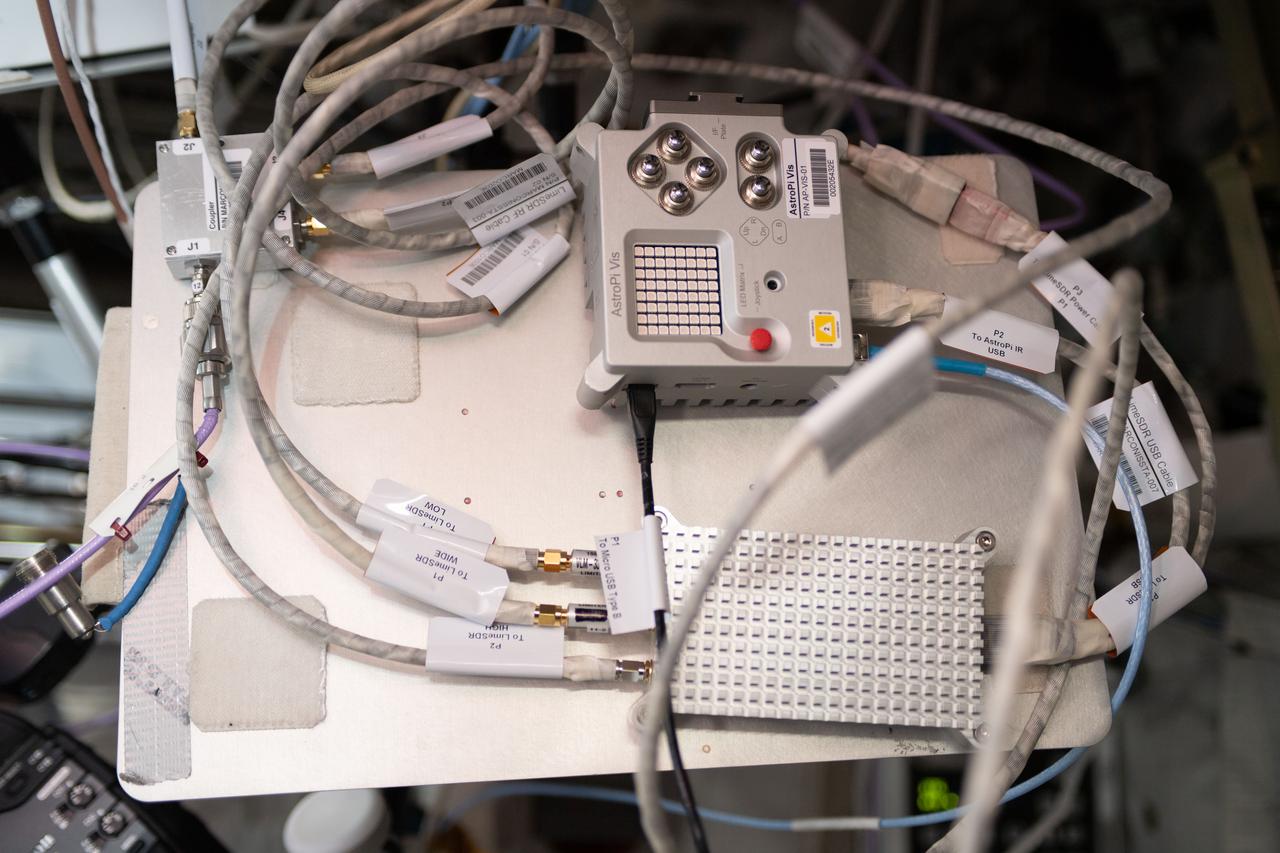
iss056e136189 (8/13/2020) --- A view of the Marconissta setup connected to the Amateur Radio on International Space Station (ARISS) antennas in the Columbus Module aboard the International Space Station (ISS). MarconISSta is a radio spectrum analyzer payload launched to ISS. MarconISSta monitors parts of the radio frequency spectrum in VHF, UHF, L, and S band in order to analyze current use and availability of bands for satellite communication.
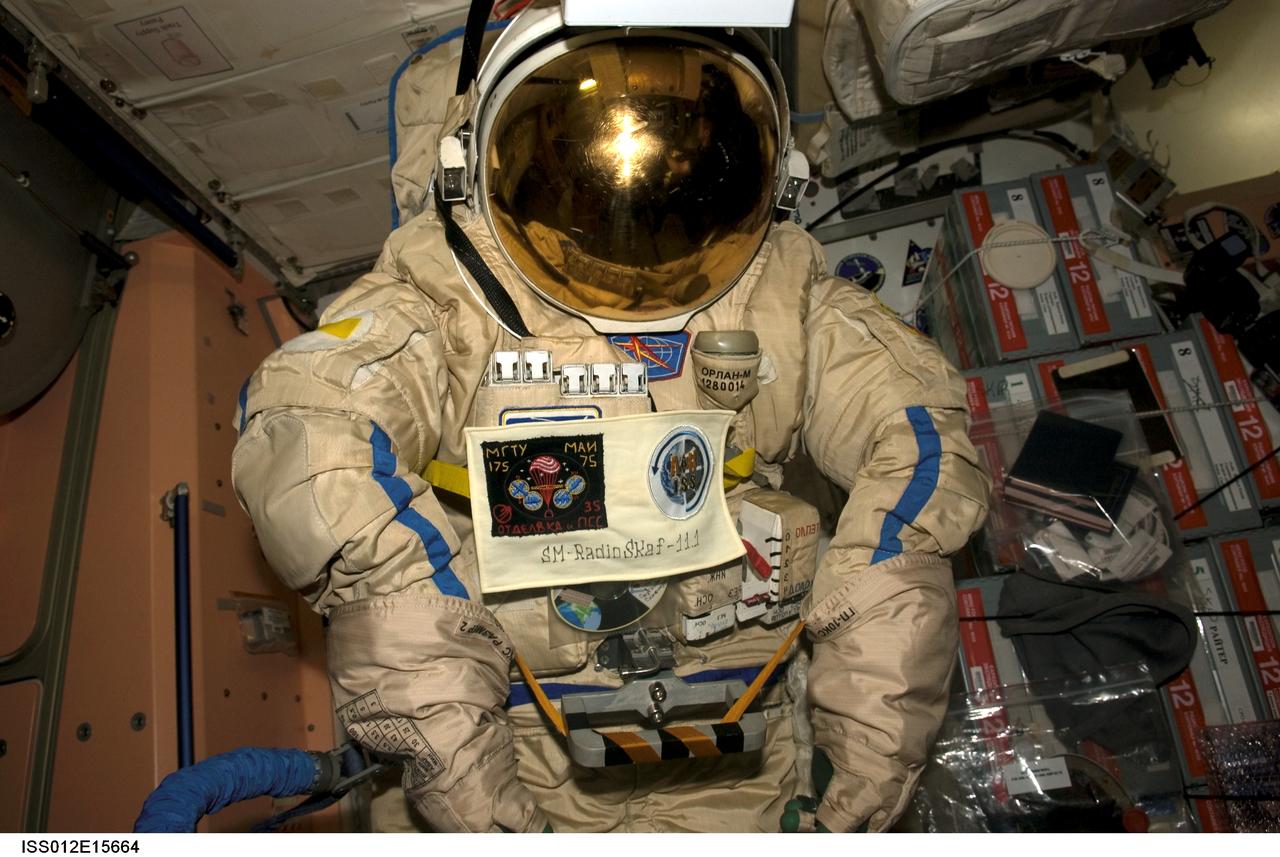
ISS012-E-15664 (24 Jan. 2006) --- An old Russian Orlan spacesuit is photographed in the Unity node of the International Space Station, which will be released by hand from the space station during a spacewalk Feb. 3, 2006. Outfitted with a special radio transmitter and other gear, the spacesuit comprises a Russian experiment called SuitSat. It will fly free from the station as a satellite in orbit for several weeks of scientific research and radio tracking, including communications by amateur radio operators. Eventually, it will enter the atmosphere and be destroyed.
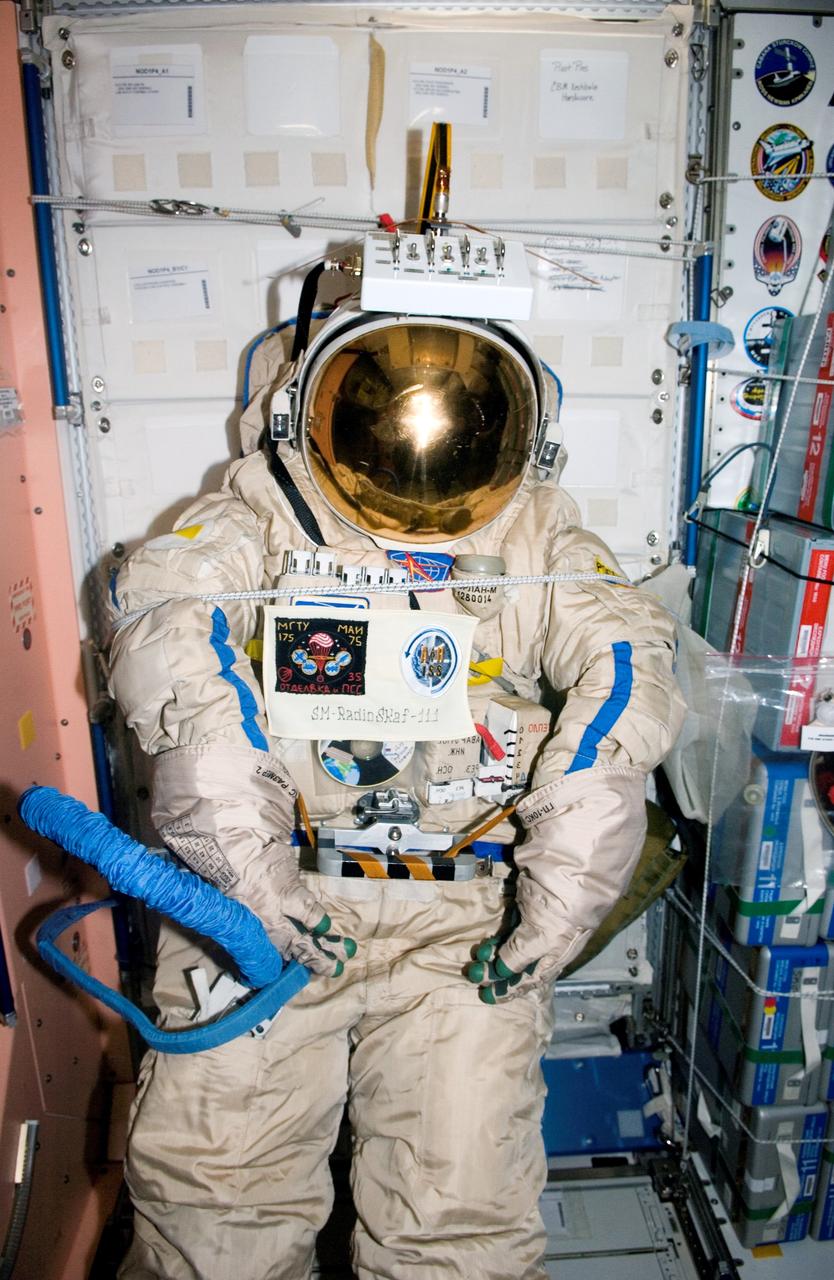
ISS012-E-15666 (24 Jan. 2006) --- An old Russian Orlan spacesuit is photographed in the Unity node of the International Space Station, which will be released by hand from the space station during a spacewalk Feb. 3, 2006. Outfitted with a special radio transmitter and other gear, the spacesuit comprises a Russian experiment called SuitSat. It will fly free from the station as a satellite in orbit for several weeks of scientific research and radio tracking, including communications by amateur radio operators. Eventually, it will enter the atmosphere and be destroyed.
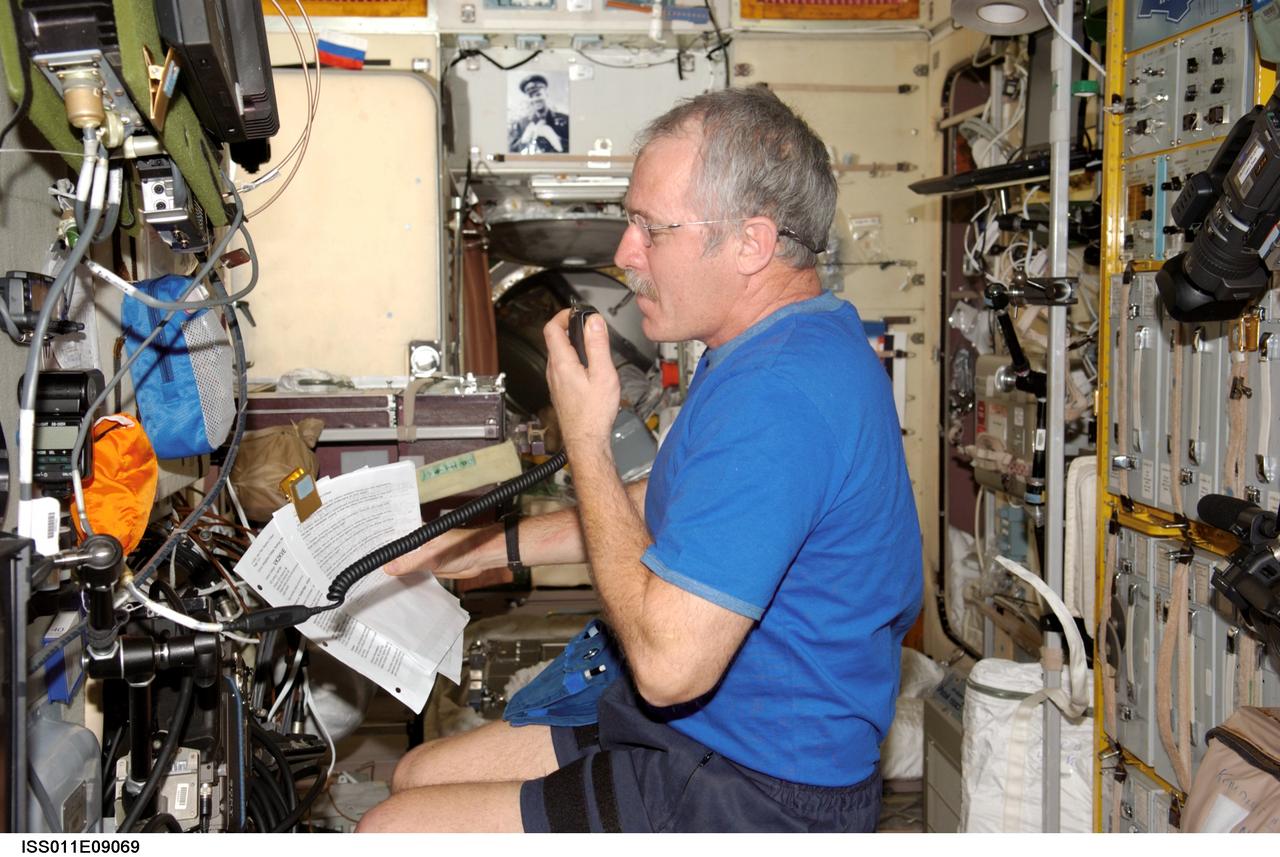
ISS011-E-09069 (2 June 2005) --- Astronaut John L. Phillips, Expedition 11 NASA ISS science officer and flight engineer, uses amateur radio equipment in the Zvezda Service Module of the International Space Station (ISS) while speaking with students from Brigidine College in Sydney, Australia.
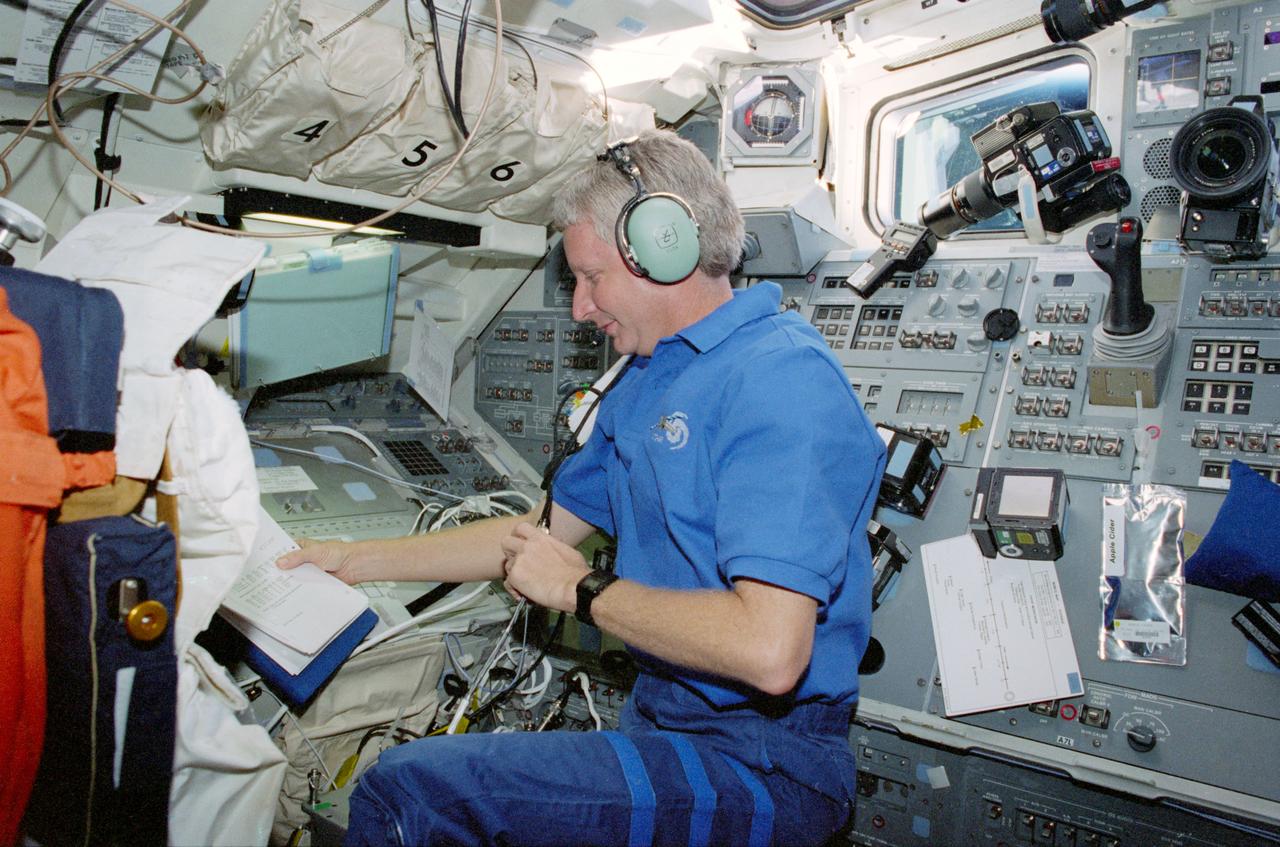
STS093-348-006 (22-27 July 1999) --- Astronaut Steven A. Hawley, mission specialist, communicates with students using the Shuttle Amateur Radio Experiment-2 (SAREX II) equipment on the flight deck of the Earth-orbiting Space Shuttle Columbia.
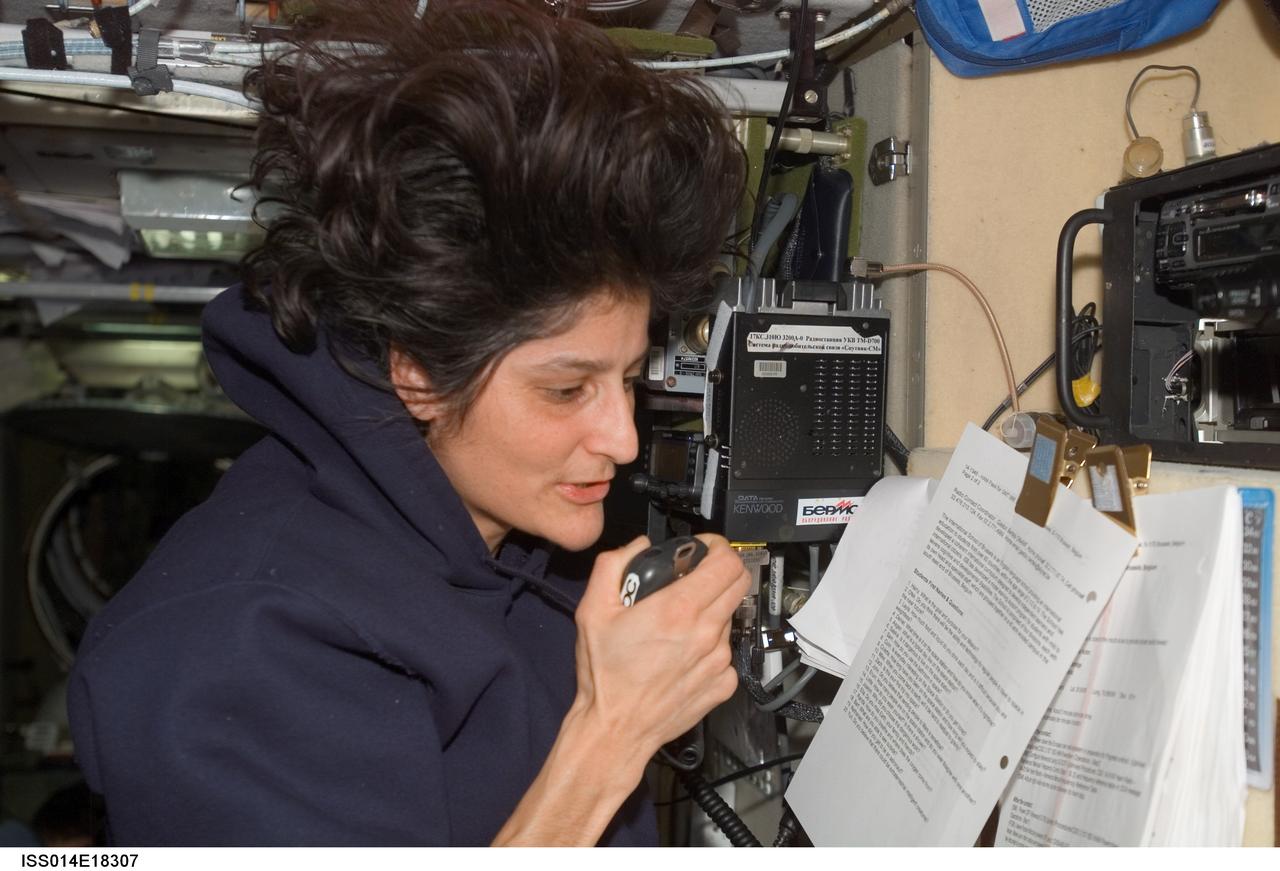
ISS014-E-18307 (27 March 2007) --- Astronaut Sunita L. Williams, Expedition 14 flight engineer, talks with students at the International School of Brussels in Belgium during an Amateur Radio on the International Space Station (ARISS) contact in the Zvezda Service Module.
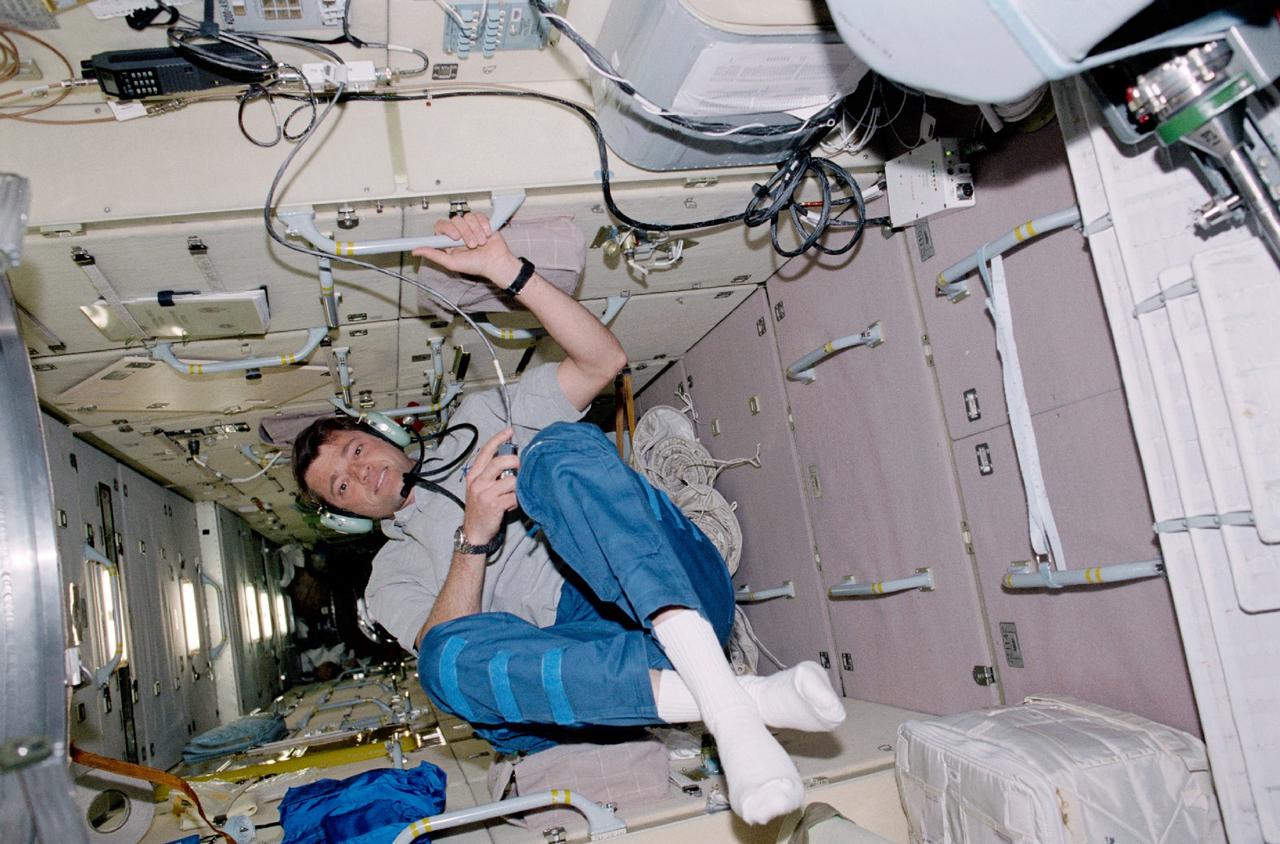
STS100-345-015 (19 April-1 May 2001) --- Astronaut Jeffrey S. Ashby, STS-100 pilot, talks to amateur radio operators on the ground from a special work station on the functional cargo block (FGB) or Zarya module of the International Space Station (ISS).
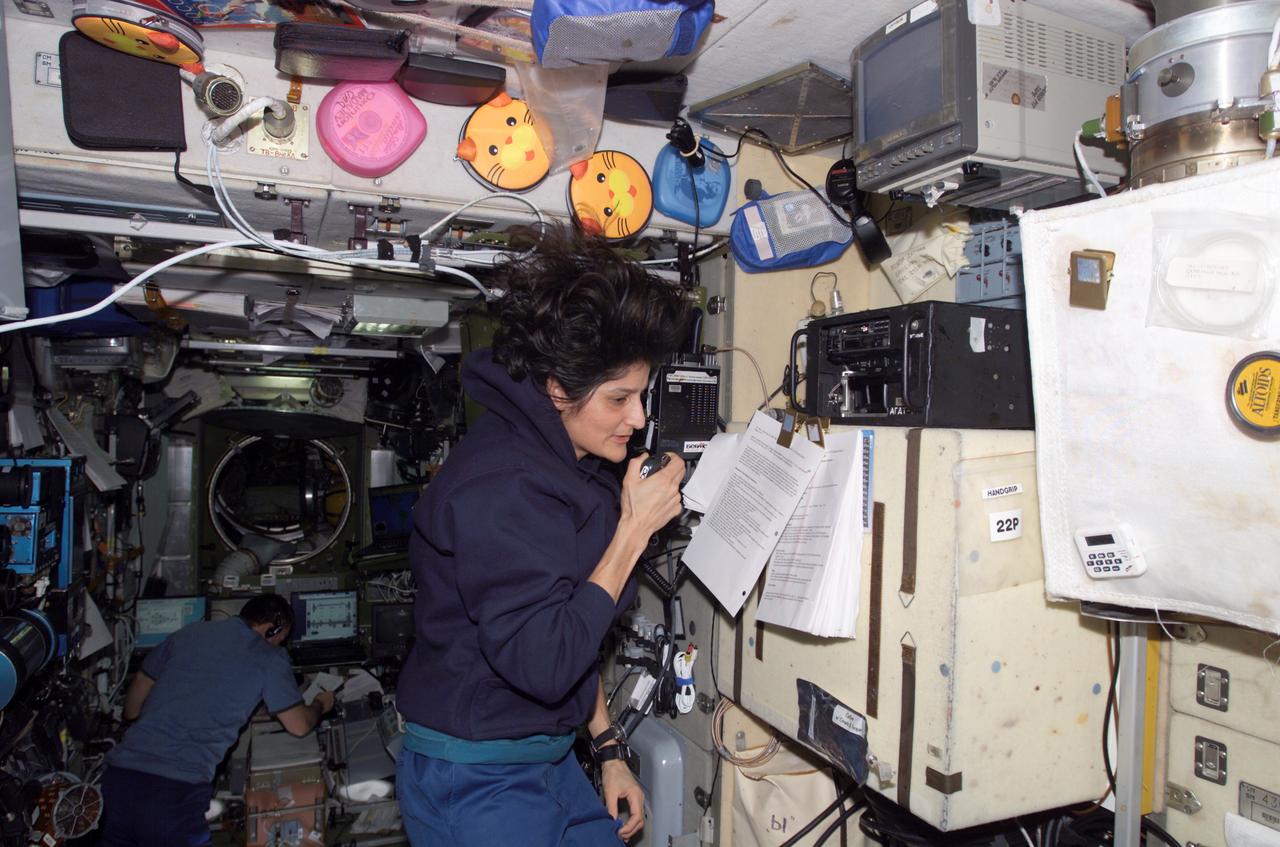
ISS014-E-18306 (27 March 2007) --- Astronaut Sunita L. Williams, Expedition 14 flight engineer, talks with students at the International School of Brussels in Belgium during an Amateur Radio on the International Space Station (ARISS) contact in the Zvezda Service Module.
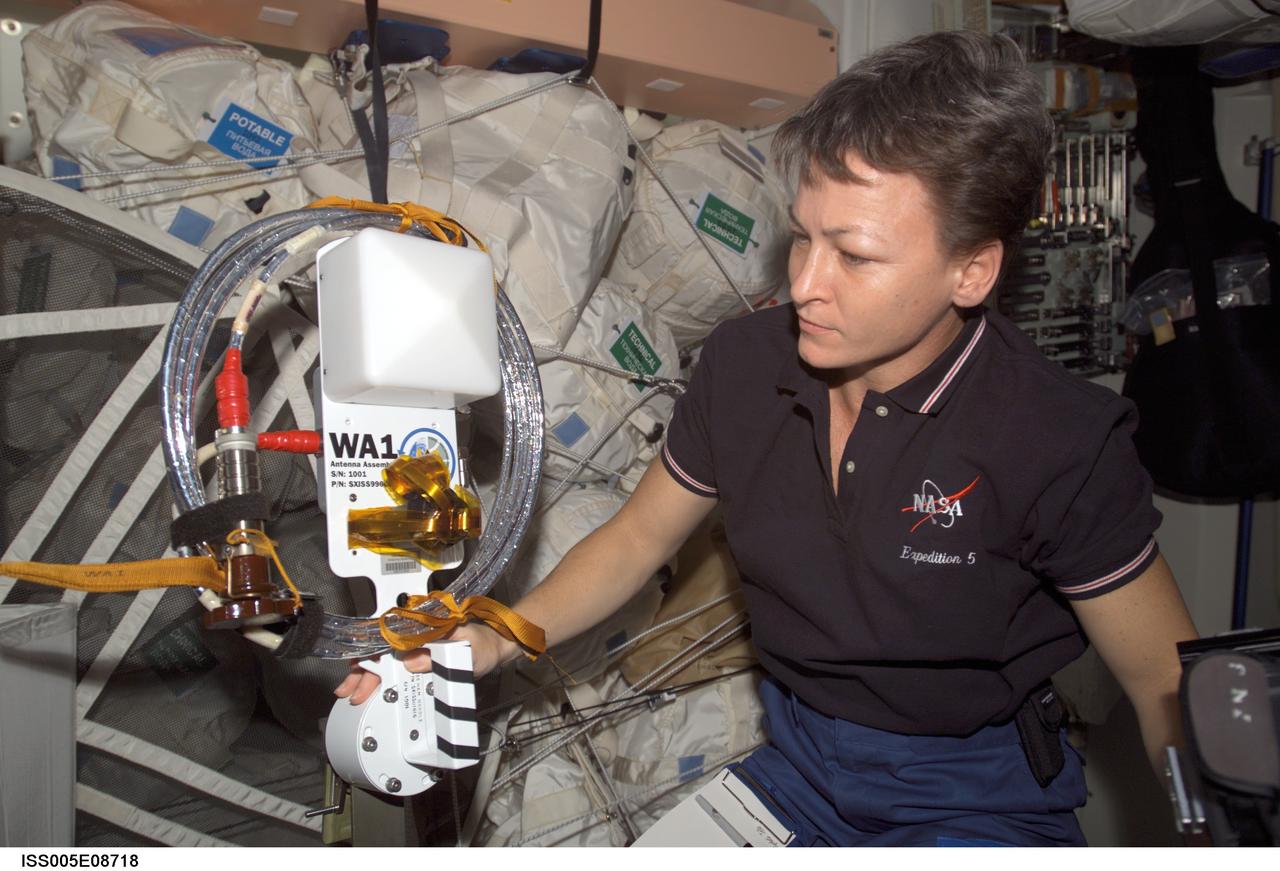
ISS005-E-08718 (6 August 2002) --- Astronaut Peggy A. Whitson, Expedition Five flight engineer, holds one of the two amateur radio antennas in the Unity node on the International Space Station (ISS). The antennas will be installed during a spacewalk scheduled for August 22, 2002.
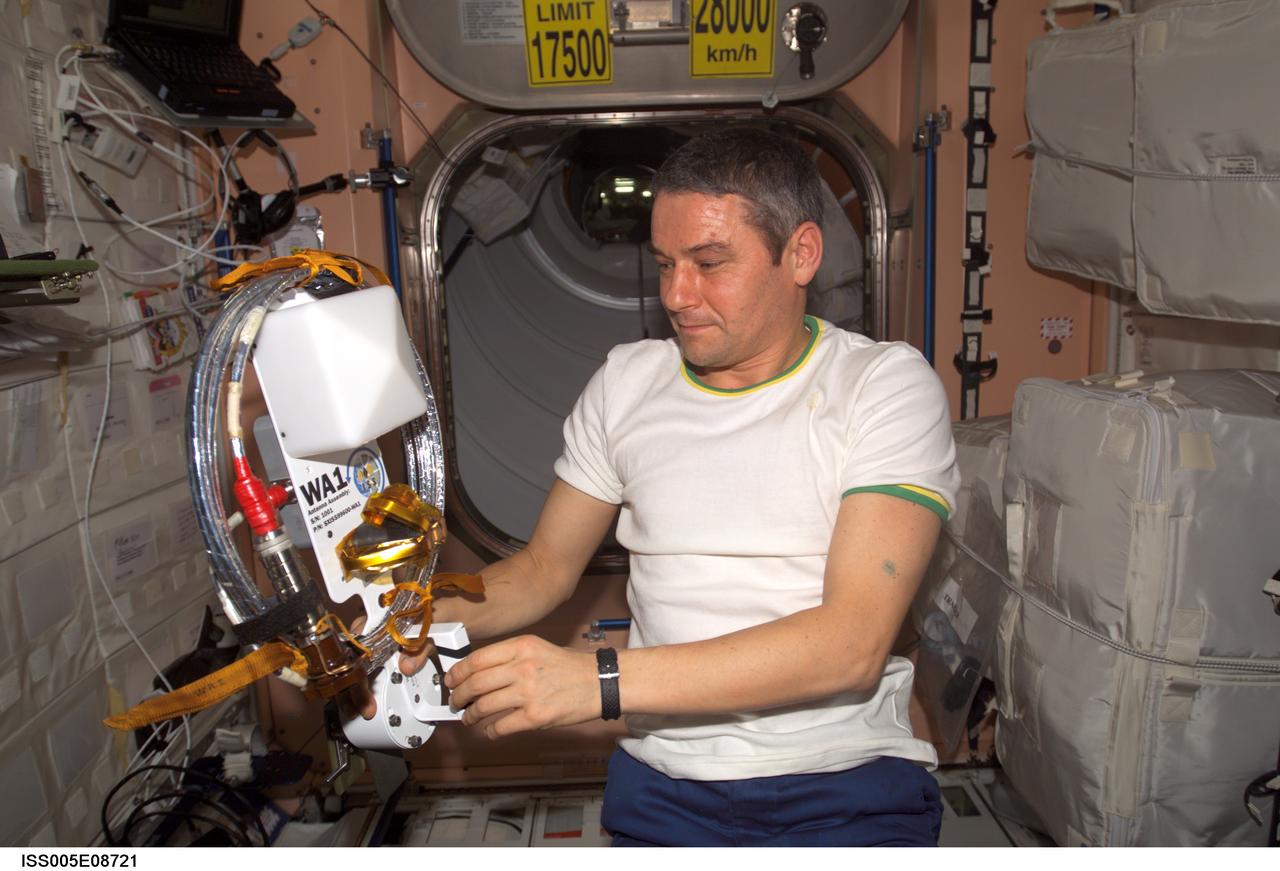
ISS005-E-08721 (6 August 2002) --- Cosmonaut Valery G. Korzun, Expedition Five mission commander, holds one of the two amateur radio antennas in the Unity node on the International Space Station (ISS). The antennas will be installed during a spacewalk scheduled for August 22, 2002. Korzun represents Rosaviakosmos.

iss074e0556775 (May 7, 2026) --- NASA astronaut and Expedition 74 flight engineer Chris Williams speaks to students on the ground using the International Space Station's ham radio. The ARISS, or Amateur Radio on the International Space Station, program gives students around the world the opportunity to talk directly with crew members aboard the orbital outpost, inspiring them to pursue careers in science, technology, engineering, and math. Credit: NASA/Chris Williams
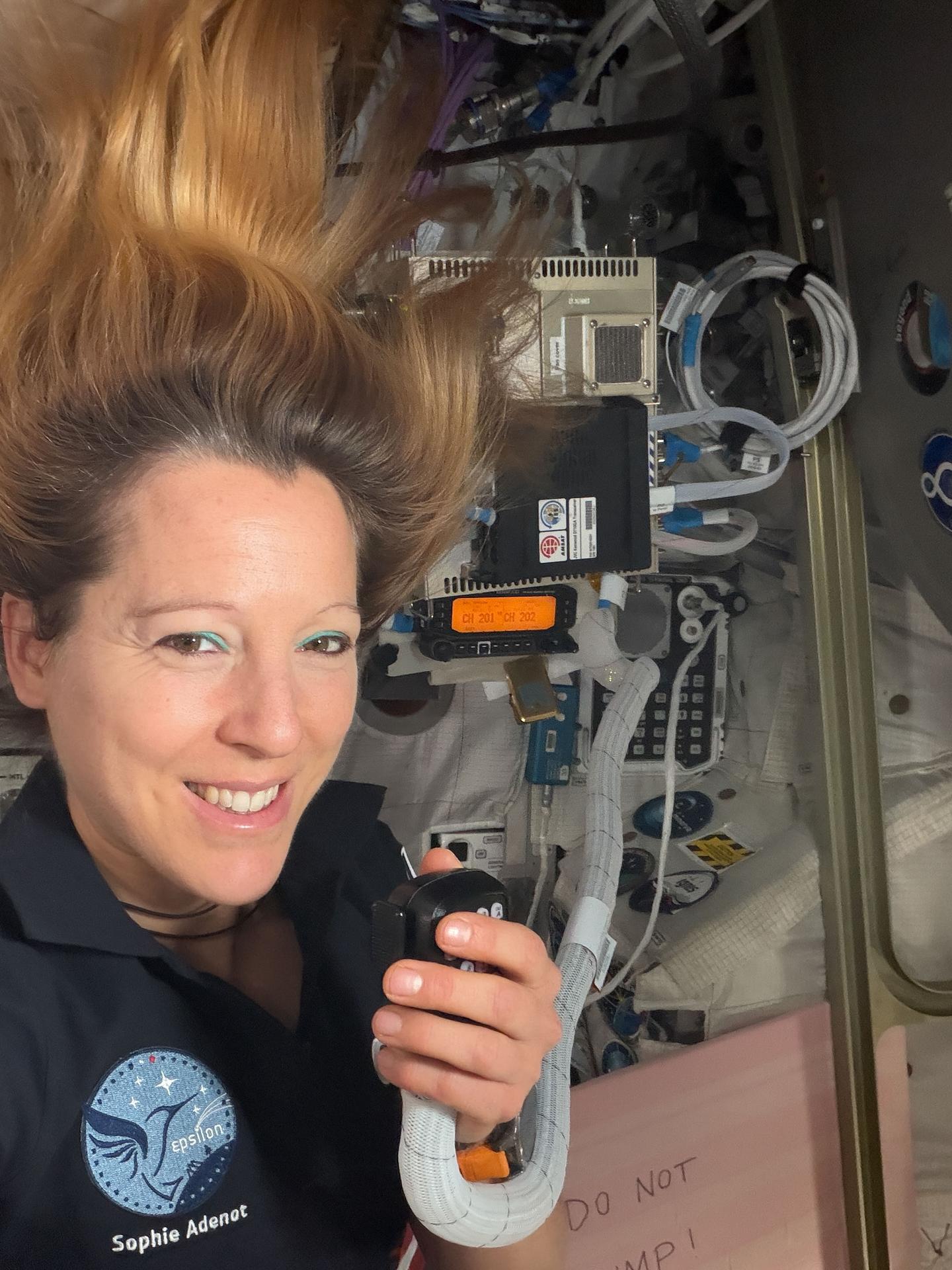
iss074e0545538 (April 18, 2026) --- ESA (European Space Agency) astronaut and Expedition 74 flight engineer Sophie Adenot speaks to students on the ground using the International Space Station's ham radio. The ARISS, or Amateur Radio on the International Space Station, program gives students around the world the opportunity to talk directly with crew members aboard the orbital outpost, inspiring them to pursue careers in science, technology, engineering, and math. Credit: ESA/Sophie Adenot
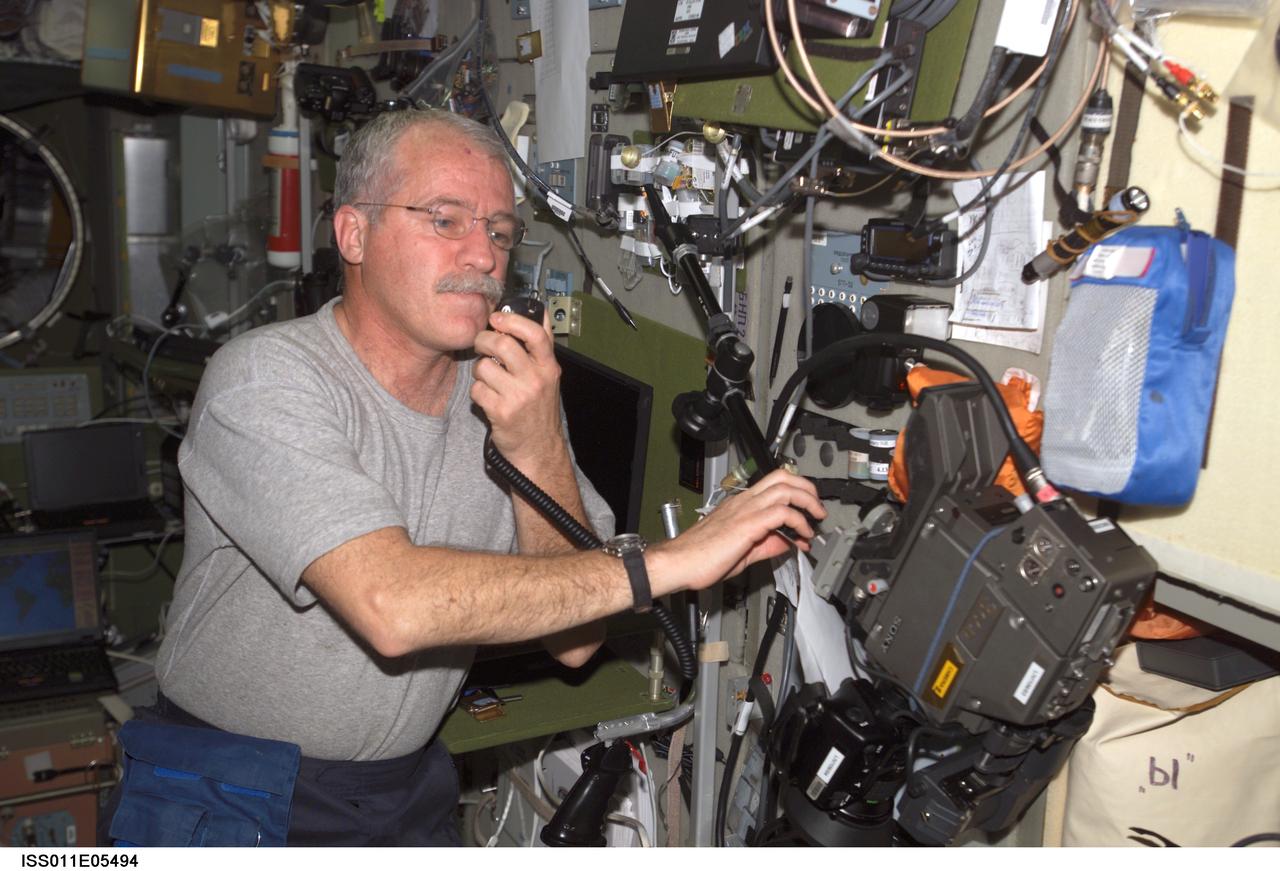
ISS011-E-05494 (4 May 2005) --- Astronaut John L. Phillips, Expedition 11 NASA ISS science officer and flight engineer, sets up amateur radio equipment in the Zvezda Service Module of the International Space Station (ISS) prior to conducting a ham radio exchange with students at Albany Hills State School in Brisbane, Australia.

STS055-203-034 (26 April-6 May 1993) --- Astronaut Steven R. Nagel, STS-55 mission commander, has found an isolated station in the D-2 science module from which to talk to students on Earth. Like many before it, the seven member crew participated in communications with students and licensed radio operators via the Shuttle Amateur Radio Experiment (SAREX). Photo credit: NASA
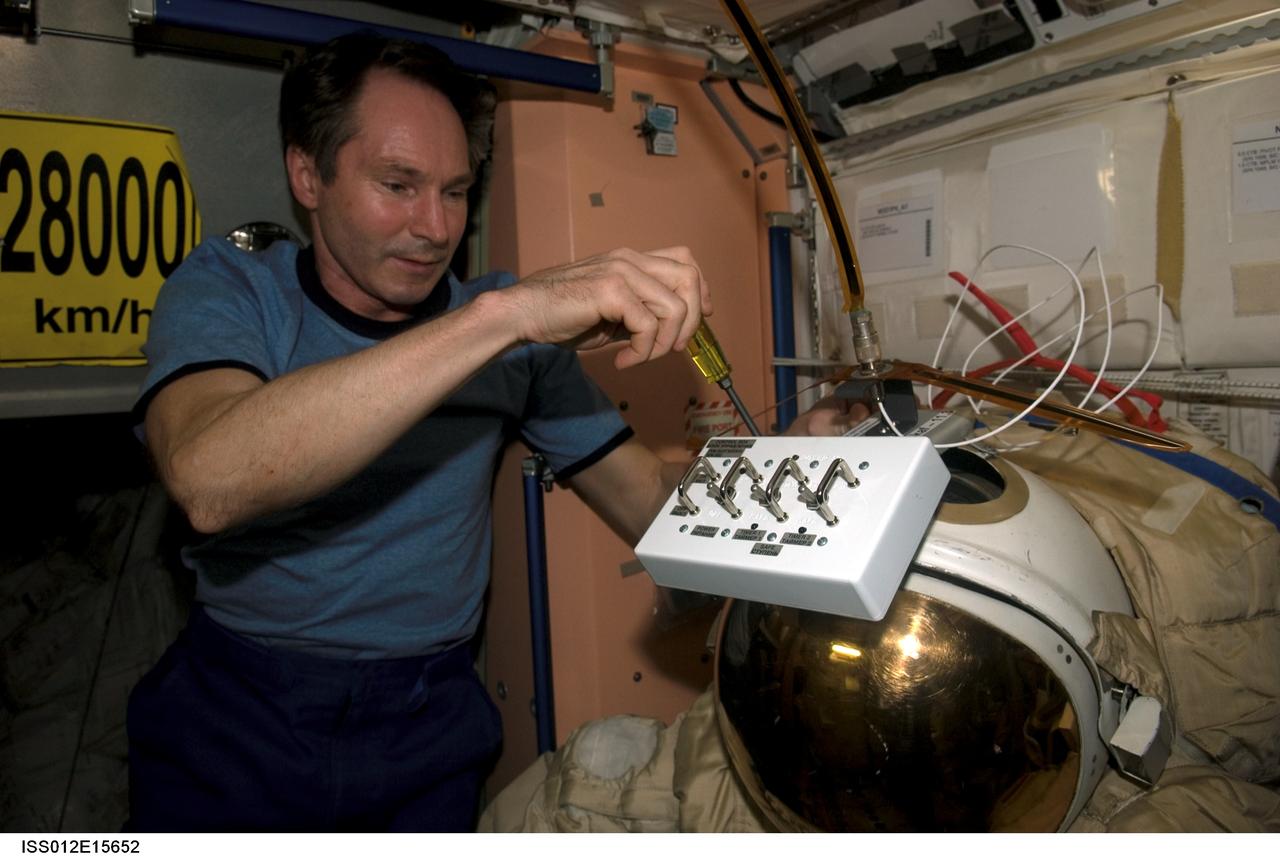
ISS012-E-15652 (24 Jan. 2006) --- In the Unity node of the International Space Station, cosmonaut Valery I. Tokarev, Expedition 12 flight engineer representing Russia's Federal Space Agency, puts finishing touches on an old Russian Orlan spacesuit that will be released by hand from the space station during a spacewalk Feb. 3, 2006. Outfitted with a special radio transmitter and other gear, the spacesuit comprises a Russian experiment called SuitSat. It will fly free from the station as a satellite in orbit for several weeks of scientific research and radio tracking, including communications by amateur radio operators. Eventually, it will enter the atmosphere and be destroyed.
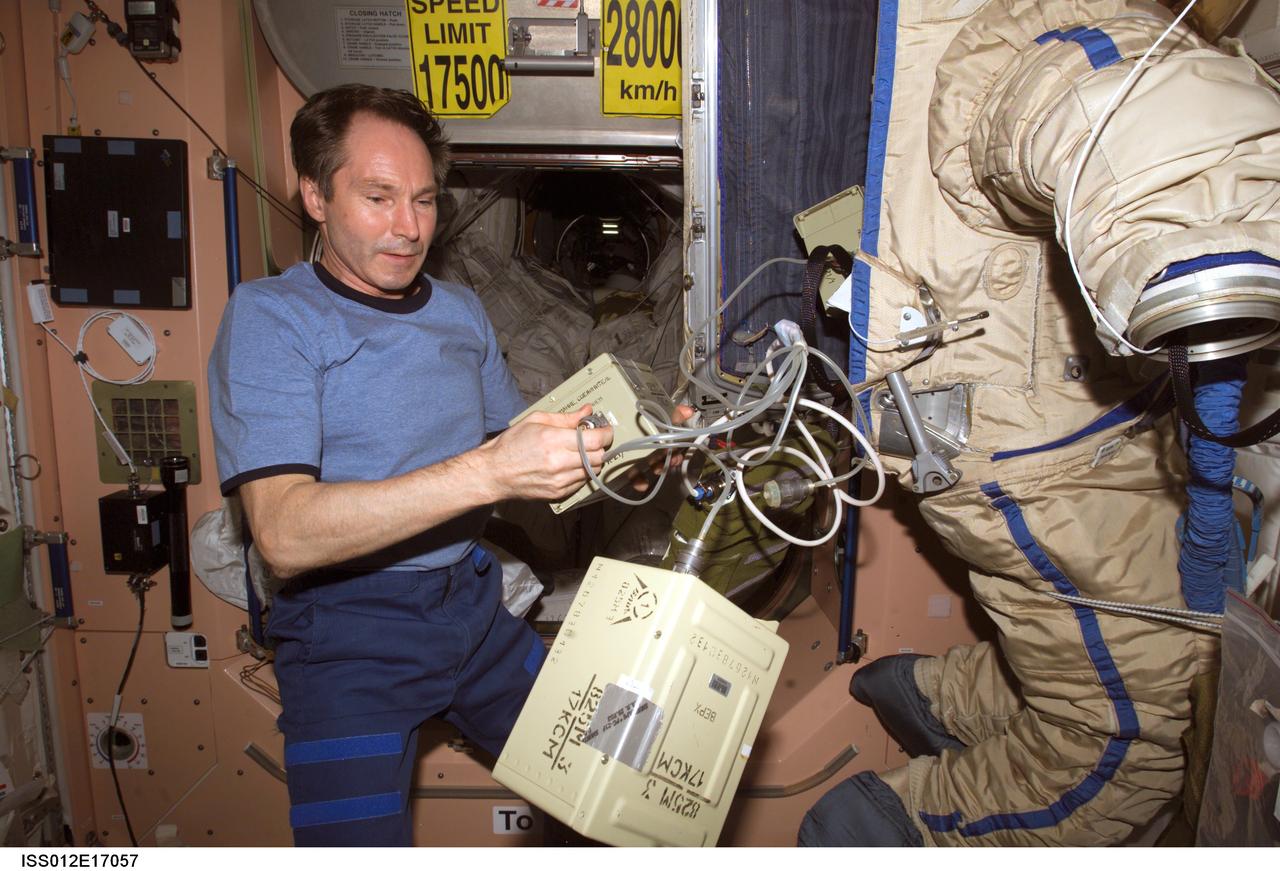
ISS012-E-17057 (24 Jan. 2006) --- In the Unity node of the International Space Station, cosmonaut Valery I. Tokarev, Expedition 12 flight engineer representing Russia's Federal Space Agency, puts finishing touches on an old Russian Orlan spacesuit that will be released by hand from the space station during a spacewalk Feb. 3, 2006. Outfitted with a special radio transmitter and other gear, the spacesuit comprises a Russian experiment called SuitSat. It will fly free from the station as a satellite in orbit for several weeks of scientific research and radio tracking, including communications by amateur radio operators. Eventually, it will enter the atmosphere and be destroyed.
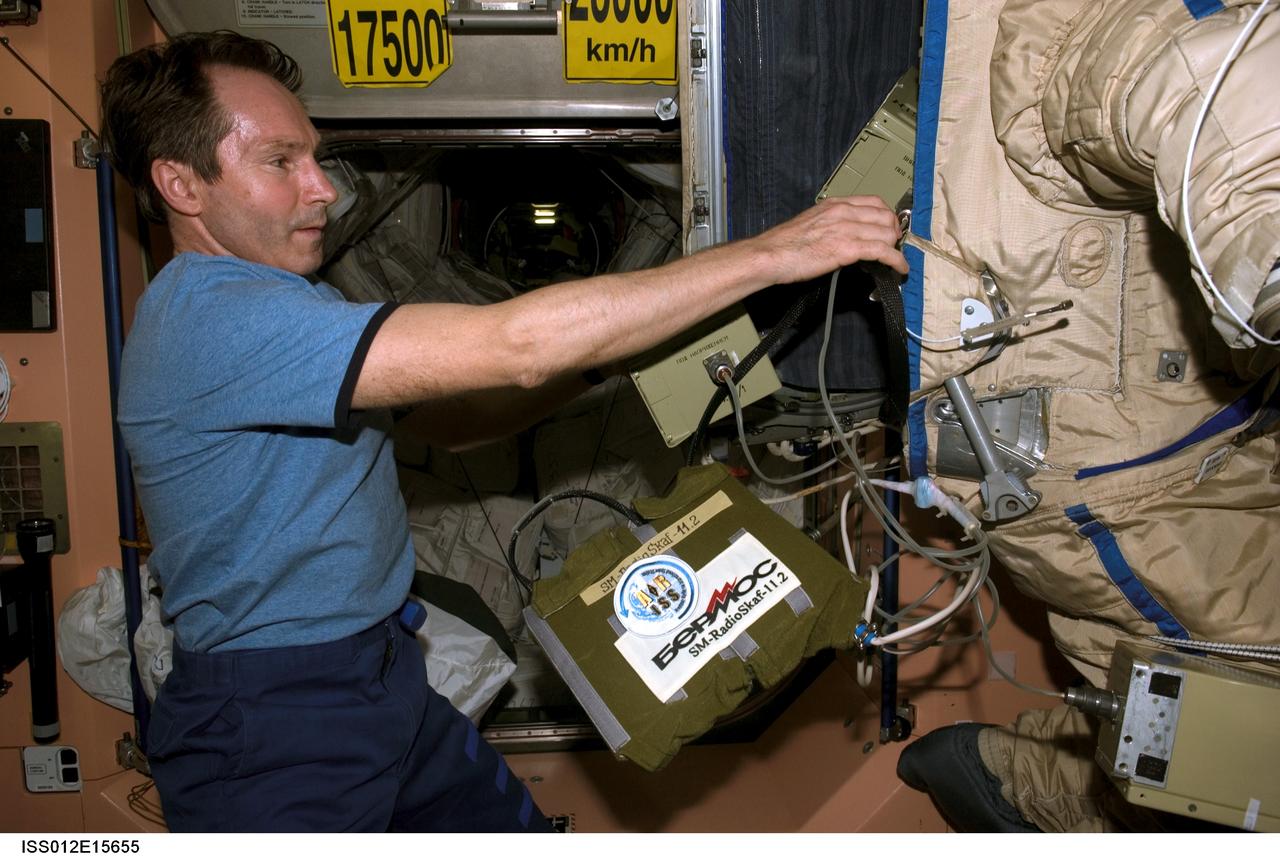
ISS012-E-15655 (24 Jan. 2006) --- In the Unity node of the International Space Station, cosmonaut Valery I. Tokarev, Expedition 12 flight engineer representing Russia's Federal Space Agency, puts finishing touches on an old Russian Orlan spacesuit that will be released by hand from the space station during a spacewalk Feb. 3, 2006. Outfitted with a special radio transmitter and other gear, the spacesuit comprises a Russian experiment called SuitSat. It will fly free from the station as a satellite in orbit for several weeks of scientific research and radio tracking, including communications by amateur radio operators. Eventually, it will enter the atmosphere and be destroyed.
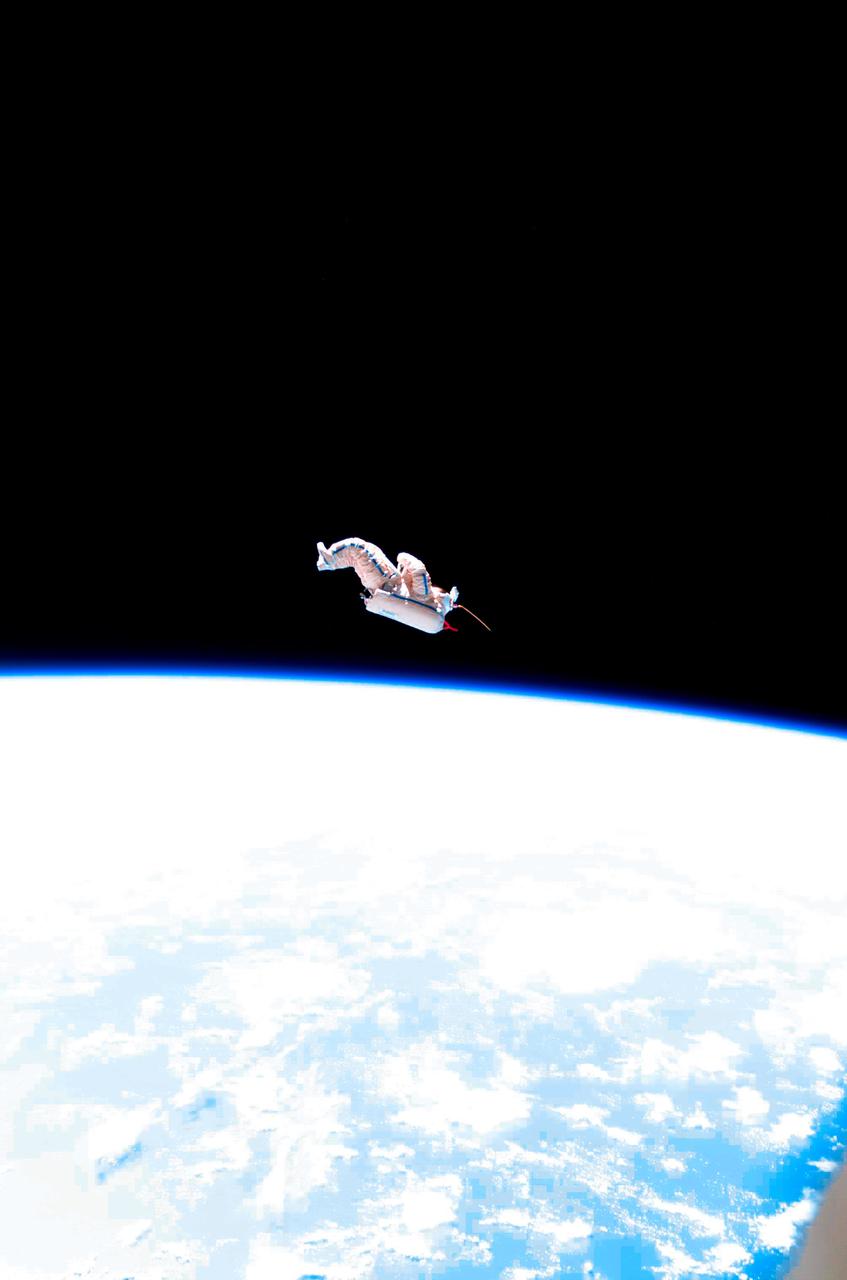
ISS012-E-24449 (3 Feb. 2006) --- Backdropped by the blackness of space and Earth's horizon, a spacesuit-turned-satellite called SuitSat began its orbit around the Earth after being released by the Expedition 12 crewmembers during a session of extravehicular activity (EVA) on Feb. 3, 2006. SuitSat, an unneeded Russian Orlan spacesuit, was outfitted by the crew with three batteries, internal sensors and a radio transmitter, which faintly transmitted recorded voices of school children to amateur radio operators worldwide. The suit will enter the atmosphere and burn up in a few weeks.
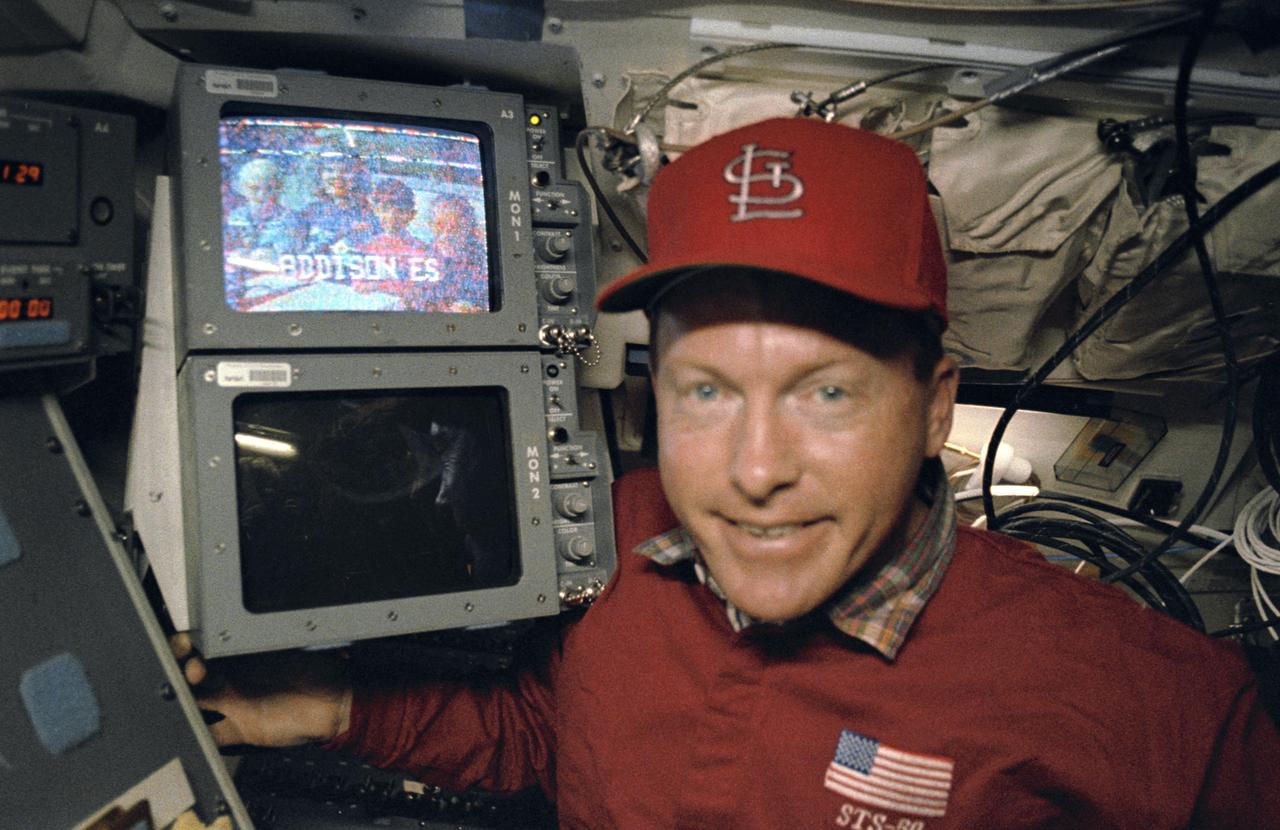
STS50-39-006 (25 June-9 July 1992) --- Astronaut Richard N. Richards, STS-50 mission commander, stands by a monitor displaying a group of elementary pupils (Addison Elementary School, Marietta Georgia) who were among the many students and others on Earth who communicated with members aboard the Earth-orbiting Space Shuttle Columbia. The Shuttle Amateur Radio Experiment (SAREX) has flown on a number of STS missions now, allowing hundreds of students and "hams" the chance to communicate with licensed radio operators in space. Richards is KB5SIW and astronaut Ellen S. Baker, the crew's other licensed operator, is KB5SIX.
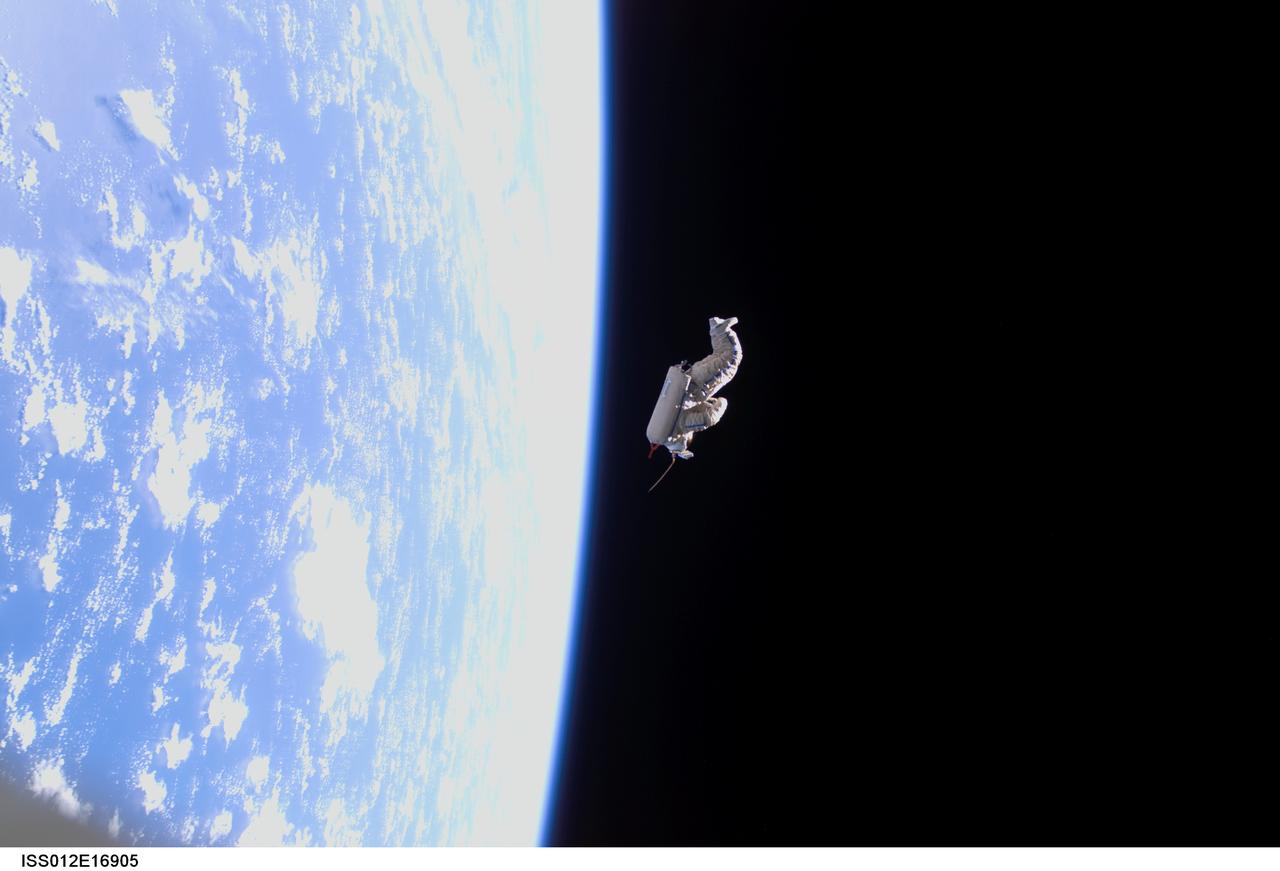
ISS012-E-16905 (3 Feb. 2006) --- Backdropped by the blackness of space and Earth’s horizon, a spacesuit-turned-satellite called SuitSat began its orbit around the Earth after it was released by the Expedition 12 crewmembers during a session of extravehicular activity (EVA) on Feb. 3, 2006. SuitSat, an unneeded Russian Orlan spacesuit, was outfitted by the crew with three batteries, internal sensors and a radio transmitter, which faintly transmitted recorded voices of school children to amateur radio operators worldwide. The suit will enter the atmosphere and burn up in a few weeks.
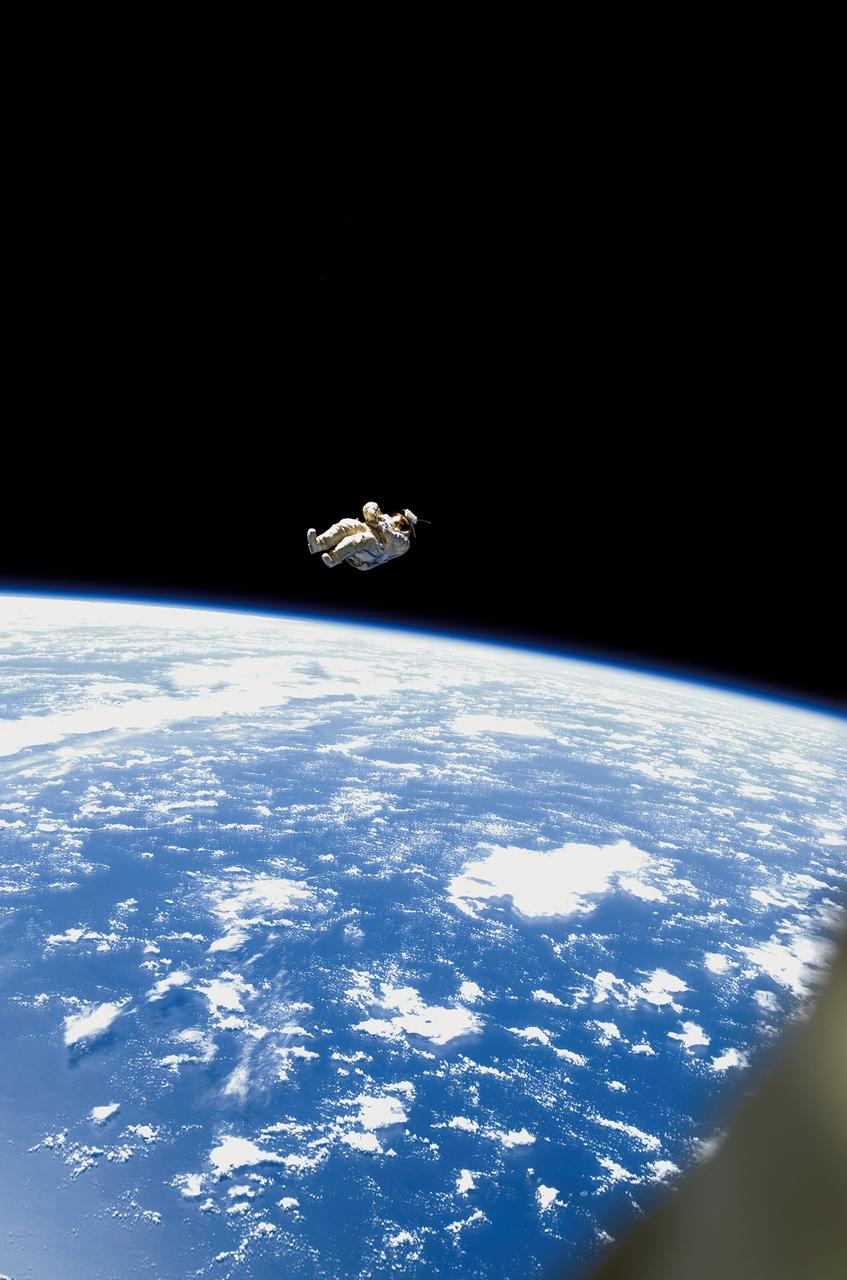
ISS012-E-16908 (3 Feb. 2006) --- Backdropped by the blackness of space and Earth’s horizon, a spacesuit-turned-satellite called SuitSat began its orbit around the Earth after it was released by the Expedition 12 crewmembers during a session of extravehicular activity (EVA) on Feb. 3, 2006. SuitSat, an unneeded Russian Orlan spacesuit, was outfitted by the crew with three batteries, internal sensors and a radio transmitter, which faintly transmitted recorded voices of school children to amateur radio operators worldwide. The suit will enter the atmosphere and burn up in a few weeks.
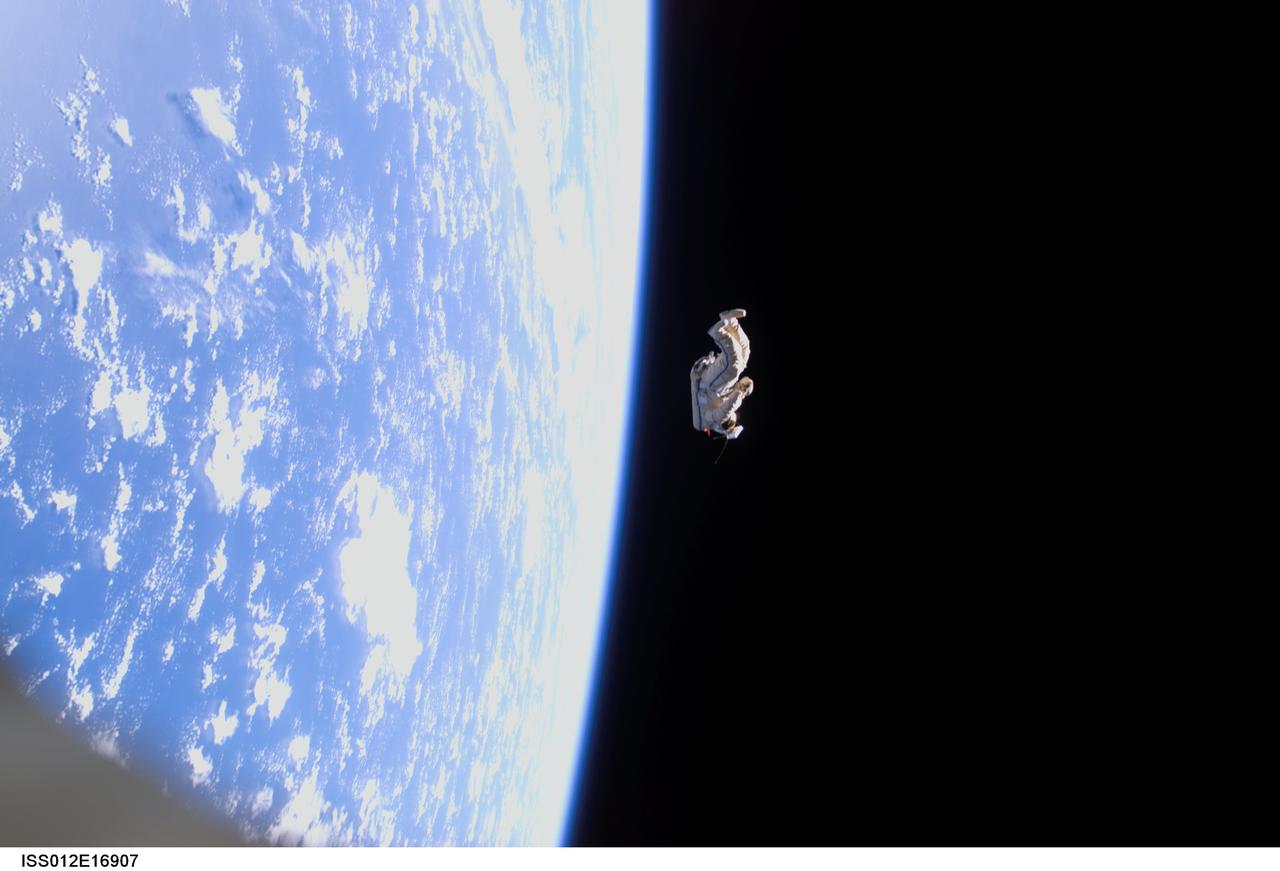
ISS012-E-16907 (3 Feb. 2006) --- Backdropped by the blackness of space and Earth’s horizon, a spacesuit-turned-satellite called SuitSat began its orbit around the Earth after it was released by the Expedition 12 crewmembers during a session of extravehicular activity (EVA) on Feb. 3, 2006. SuitSat, an unneeded Russian Orlan spacesuit, was outfitted by the crew with three batteries, internal sensors and a radio transmitter, which faintly transmitted recorded voices of school children to amateur radio operators worldwide. The suit will enter the atmosphere and burn up in a few weeks.
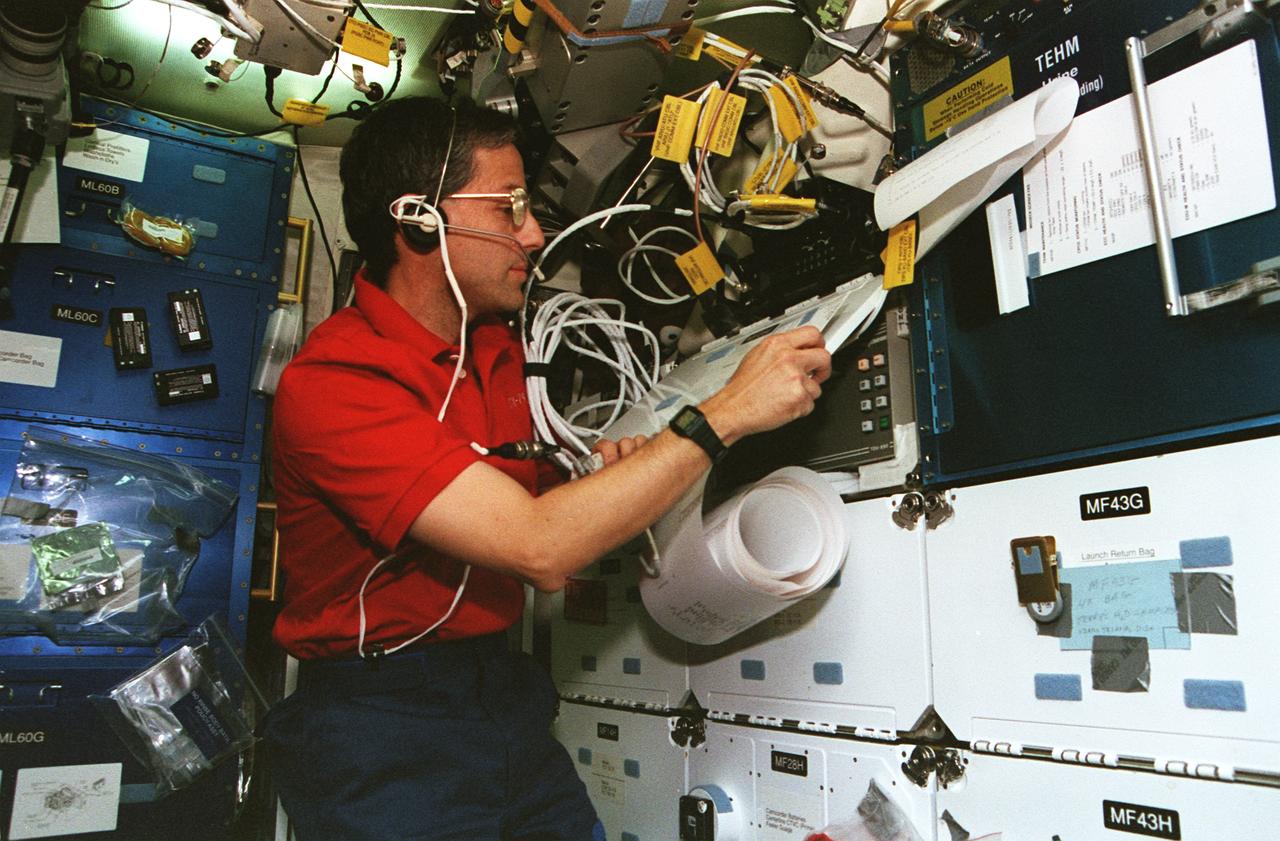
STS079-365-004 (16-26 Sept. 1996) --- During off-duty time, Jerome (Jay) Apt, a licensed amateur radio operator, talks to ground contacts via the Shuttle Amateur Radio Experiment (SAREX). The radio was also used for communications between the Space Shuttle Atlantis and Russia's Mir Space Station during docking and undocking activities. This photograph is one of fifteen 35mm frames (along with four 70mm frames) of still photography documenting the activities of NASA's STS-79 mission, which began with a September 16, 1996, liftoff from Launch Pad 39A the Kennedy Space Center (KSC) and ended with a landing at KSC on September 26, 1996. Onboard for the launch were astronauts William F. Readdy, commander; Terrence W. Wilcutt, pilot; John E. Blaha, Apt, Thomas D. Akers and Carl E. Walz, all mission specialists. On flight day 4, the crew docked with Mir. Shannon W. Lucid, who had spent six months aboard Mir, switched cosmonaut guest researcher roles with Blaha. The latter joined fellow Mir-22 crew members Valeri G. Korzun, commander, and Aleksandr Y. Kaleri, flight engineer.
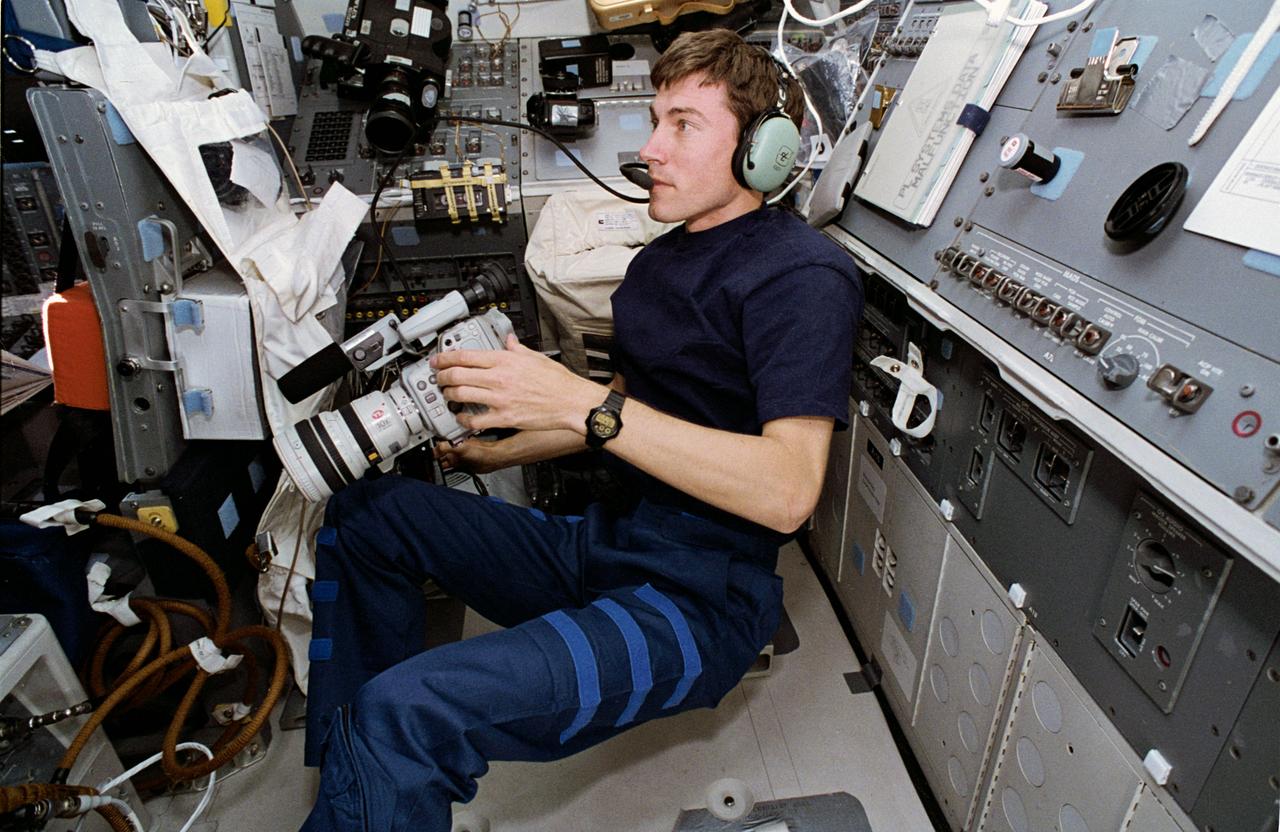
STS60-29-009 (10 Feb 1994) --- On the Space Shuttle Discovery's aft flight deck, Russian cosmonaut Sergei K. Krikalev prepares for one chore while performing another. Using the Shuttle Amateur Radio Experiment (SAREX) gear, the mission specialist was talking with students in Maine. He holds a camcorder, which was later called into action to record inflight activities. Krikalev joined five NASA astronauts for eight days in space aboard Discovery.
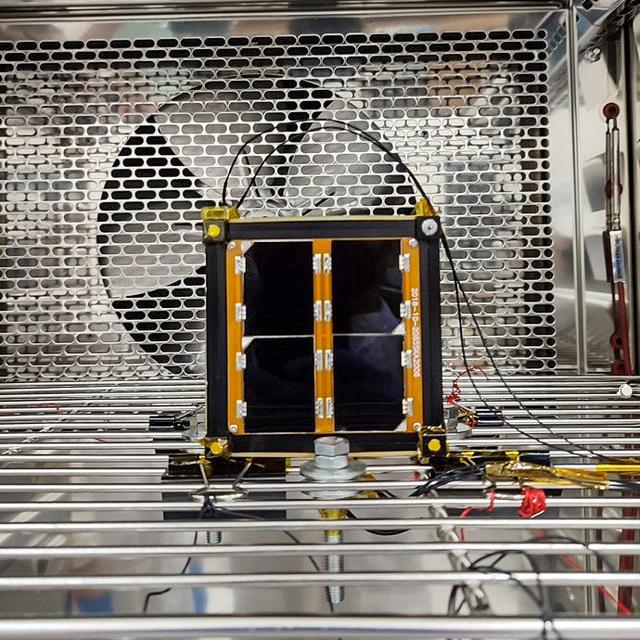
jsc2022e068264 (12/1/2021) --- A preflight view of the Surya Satellite-1 (SS-1) during Thermal Testing. The Surya Satellite-1 (SS-1) is the first Indonesian nanosatellite developed by university students at Surya University. SS-1 tests a satellite telecommunication system to serve amateur radio stations, and serves as a proof of concept of sensoric information transfer in rural areas for disaster mitigation application. Image Courtesy of The SS-1 Team.
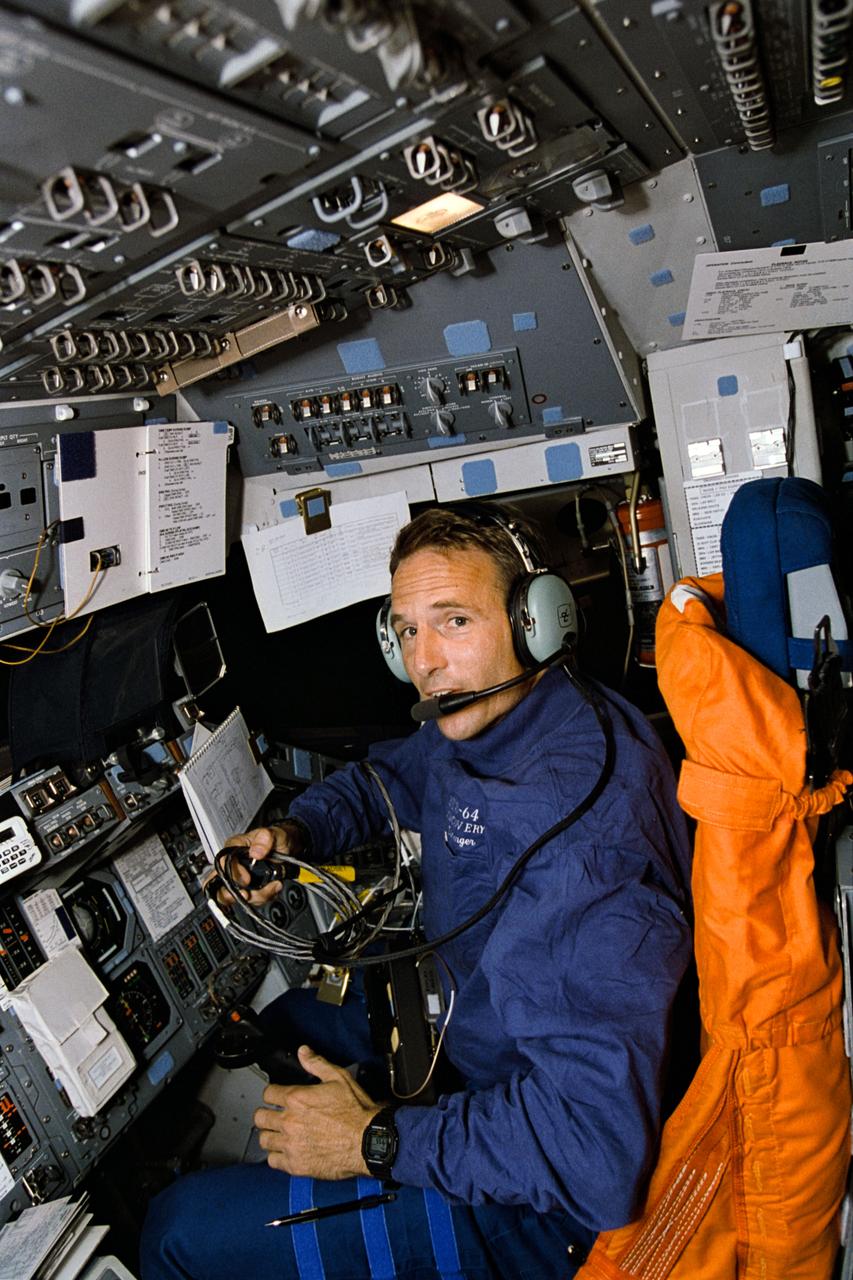
STS064-20-026 (9-20 Sept. 1994) --- Astronaut Jerry M. Linenger, STS-64 mission specialist, uses the Shuttle Amateur Radio Experiment (SAREX) to communicate with students on Earth. Various members of the crew made contact with a number of other "hams" around the world during the almost 11-day mission in Earth orbit. Photo credit: NASA or National Aeronautics and Space Administration
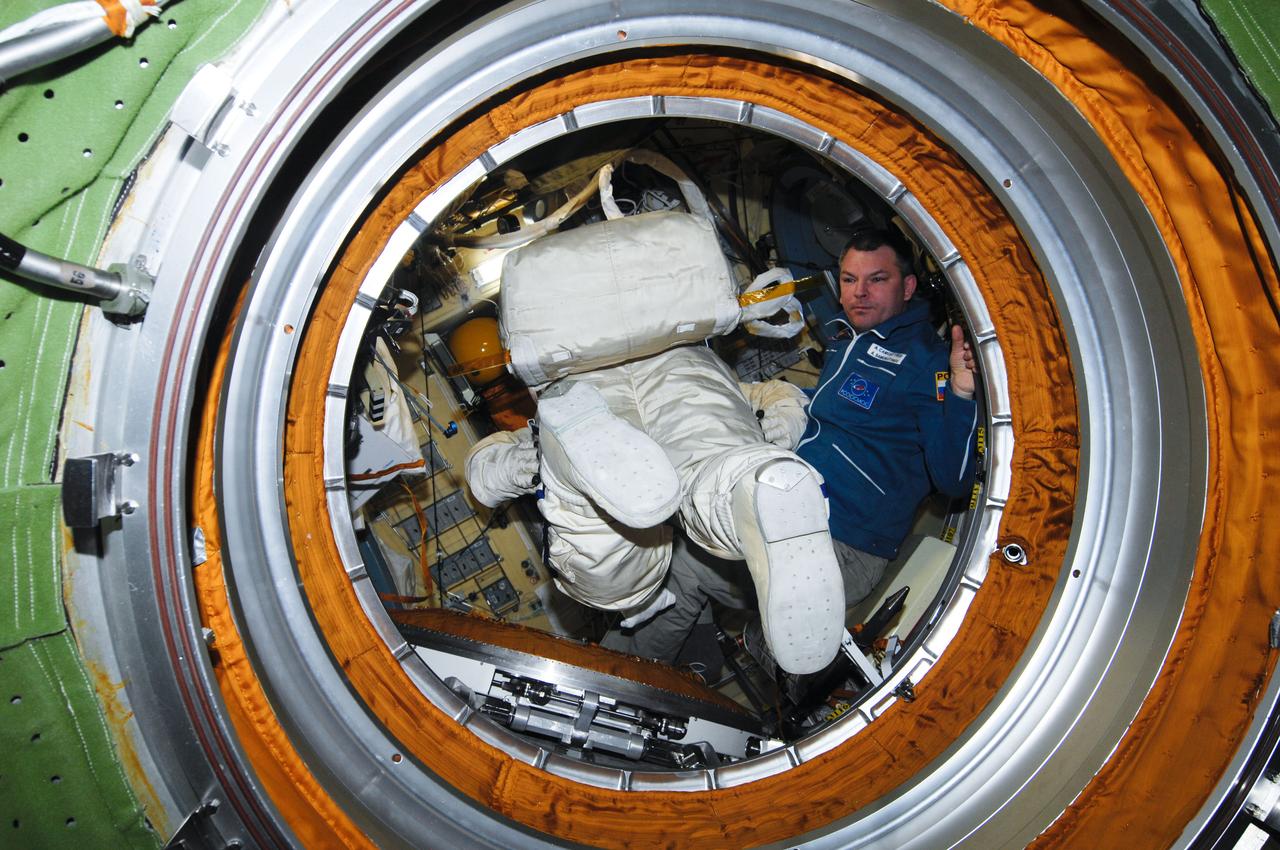
ISS028-E-019437 (29 July 2011) --- Russian cosmonaut Alexander Samokutyaev, Expedition 28 flight engineer, works with Russian Orlan-MK spacesuits in the Pirs Docking Compartment of the International Space Station in preparation for a spacewalk scheduled for Aug. 3, 2011. During the six-hour excursion Samokutyaev and Russian cosmonaut Sergei Volkov (out of frame), flight engineer, will move a cargo boom from one airlock to another, install a prototype laser communications system and deploy an amateur radio micro-satellite.
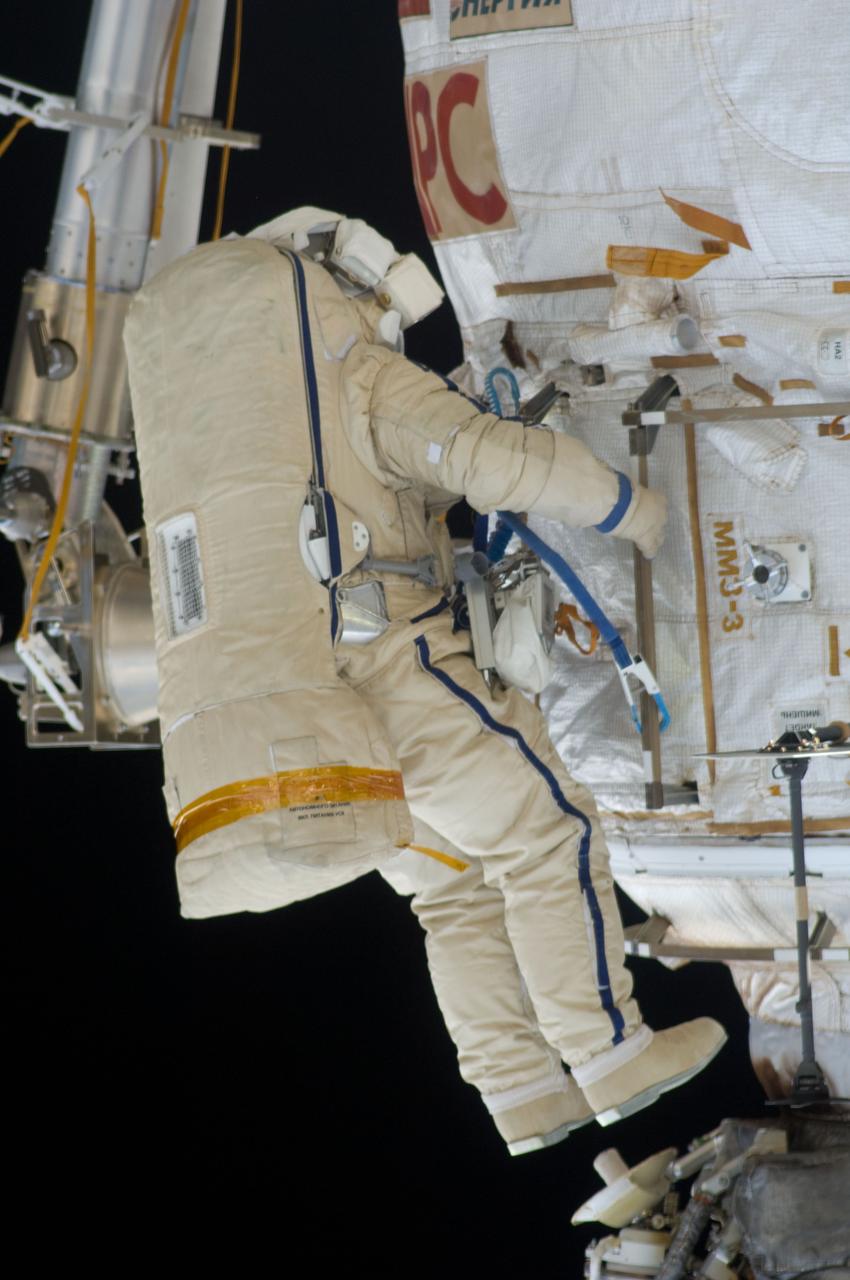
ISS028-E-020928 (3 Aug. 2011) --- Russian cosmonauts Sergei Volkov and Alexander Samokutyaev (out of frame), both Expedition 28 flight engineers, attired in Russian Orlan spacesuits, participate in a session of extravehicular activity (EVA) on the Russian segment of the International Space Station. During the six-hour, 23-minute spacewalk, Volkov and Samokutyaev moved a cargo boom from one airlock to another, installed a prototype laser communications system and deployed an amateur radio micro-satellite.
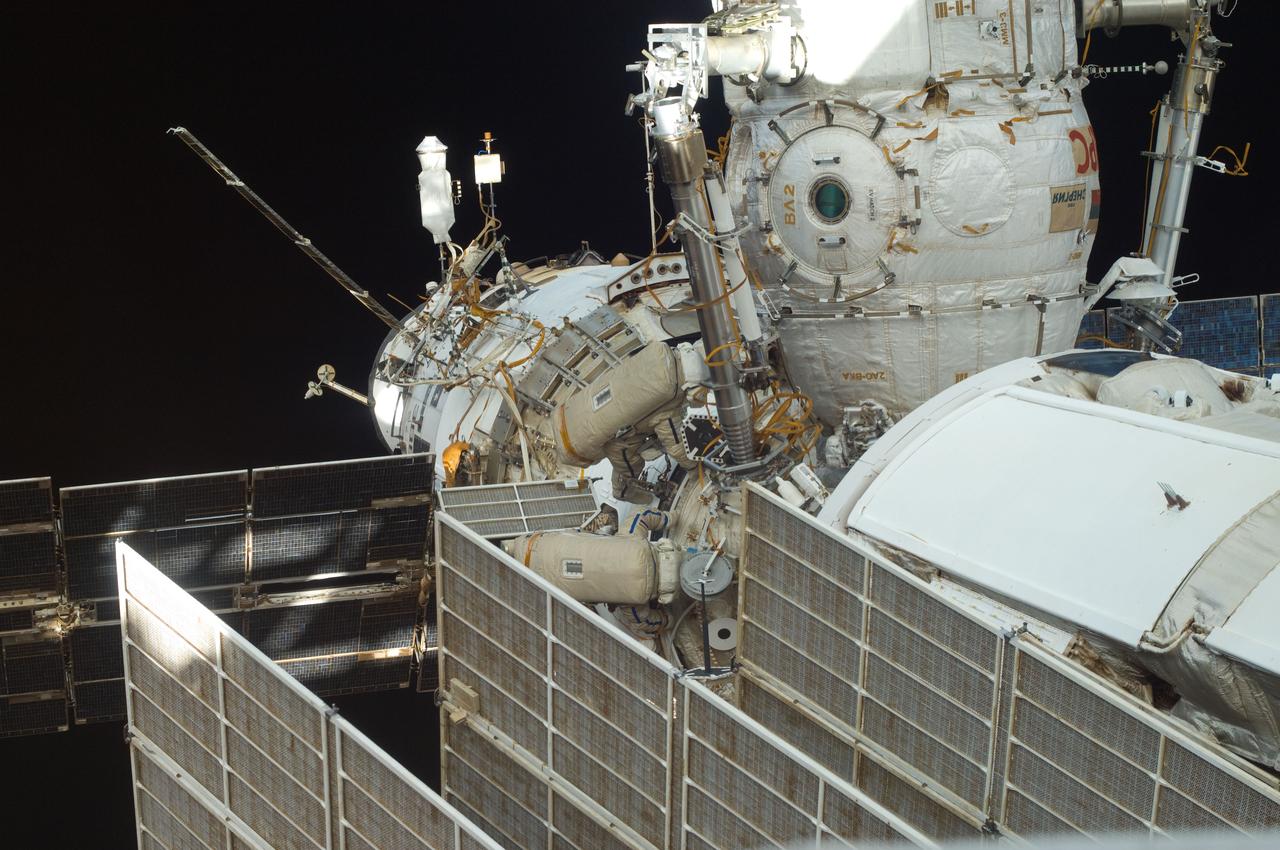
ISS028-E-020962 (3 Aug. 2011) --- Russian cosmonauts Sergei Volkov and Alexander Samokutyaev, both Expedition 28 flight engineers, attired in Russian Orlan spacesuits, participate in a session of extravehicular activity (EVA) on the Russian segment of the International Space Station. During the six-hour, 23-minute spacewalk, Volkov and Samokutyaev moved a cargo boom from one airlock to another, installed a prototype laser communications system and deployed an amateur radio micro-satellite.
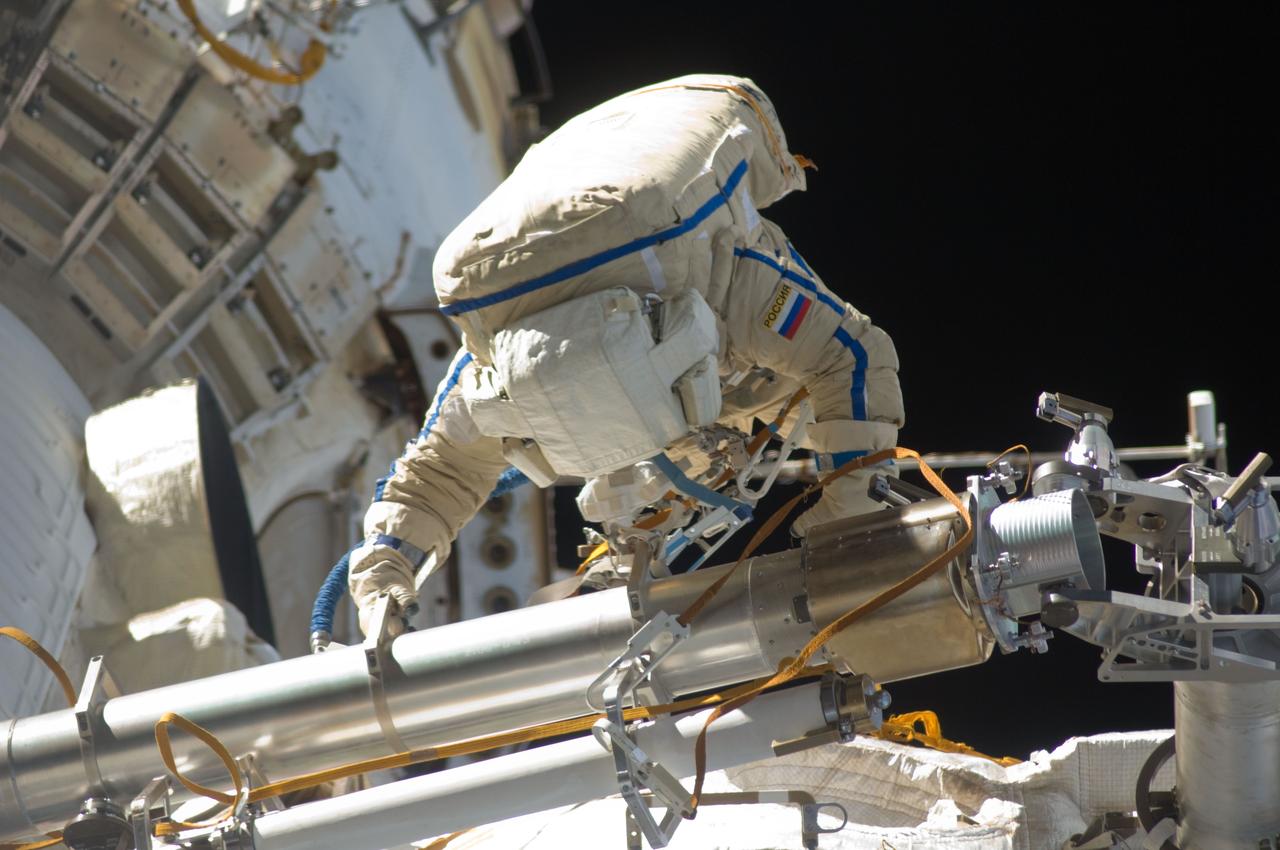
ISS028-E-020926 (3 Aug. 2011) --- Russian cosmonauts Sergei Volkov and Alexander Samokutyaev (out of frame), both Expedition 28 flight engineers, attired in Russian Orlan spacesuits, participate in a session of extravehicular activity (EVA) on the Russian segment of the International Space Station. During the six-hour, 23-minute spacewalk, Volkov and Samokutyaev moved a cargo boom from one airlock to another, installed a prototype laser communications system and deployed an amateur radio micro-satellite.
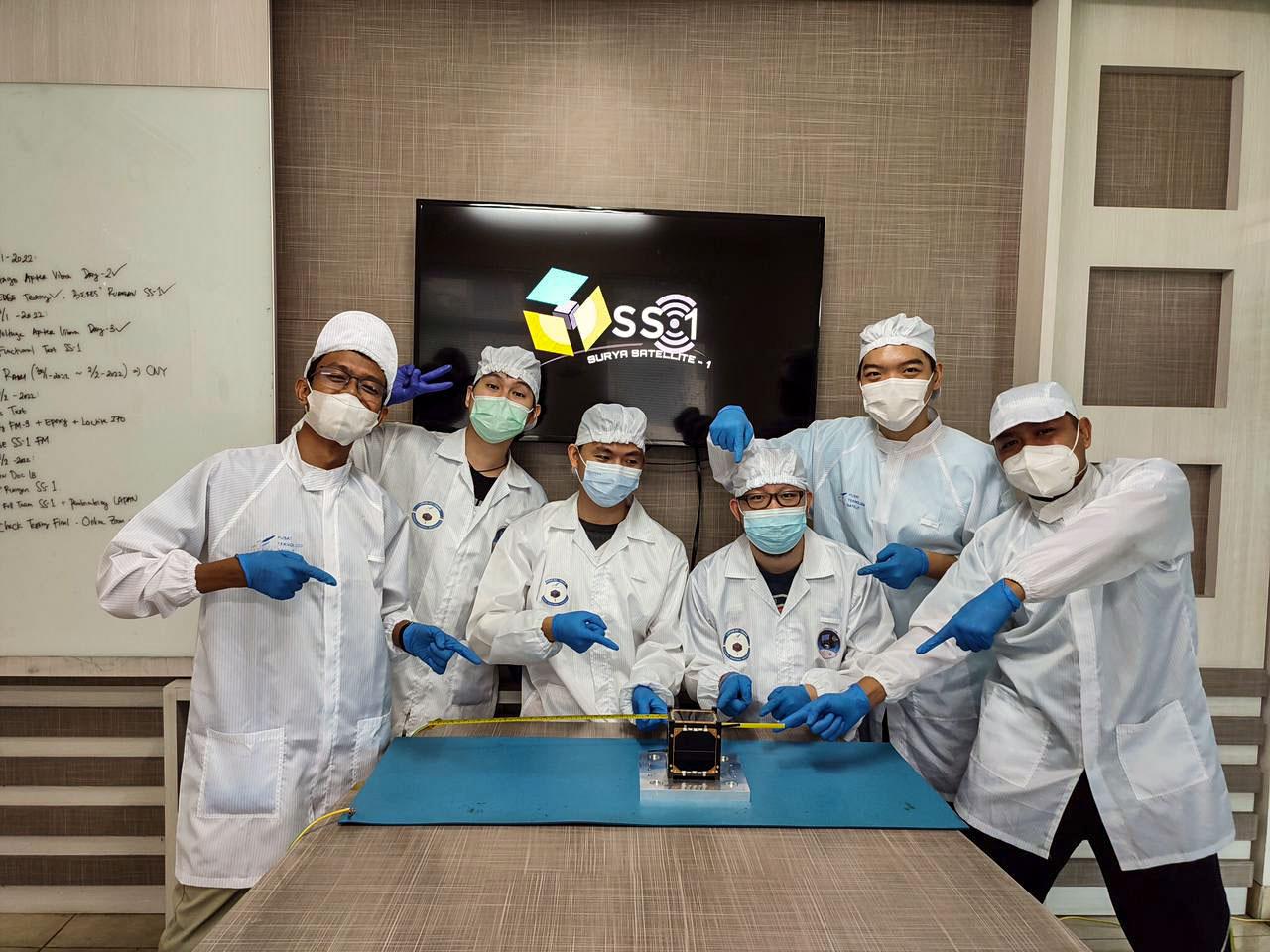
jsc2022e068260 (11/1/2021) --- The Surya Satellite-1 and its Developer Team After Deployment Testing, shown left to right: Zulfa, Hery, Setra, Roberto, Suhan, Afiq. The Surya Satellite-1 (SS-1) is the first Indonesian nanosatellite developed by university students at Surya University. SS-1 tests a satellite telecommunication system to serve amateur radio stations, and serves as a proof of concept of sensoric information transfer in rural areas for disaster mitigation application. Image Courtesy of The SS-1 Team.
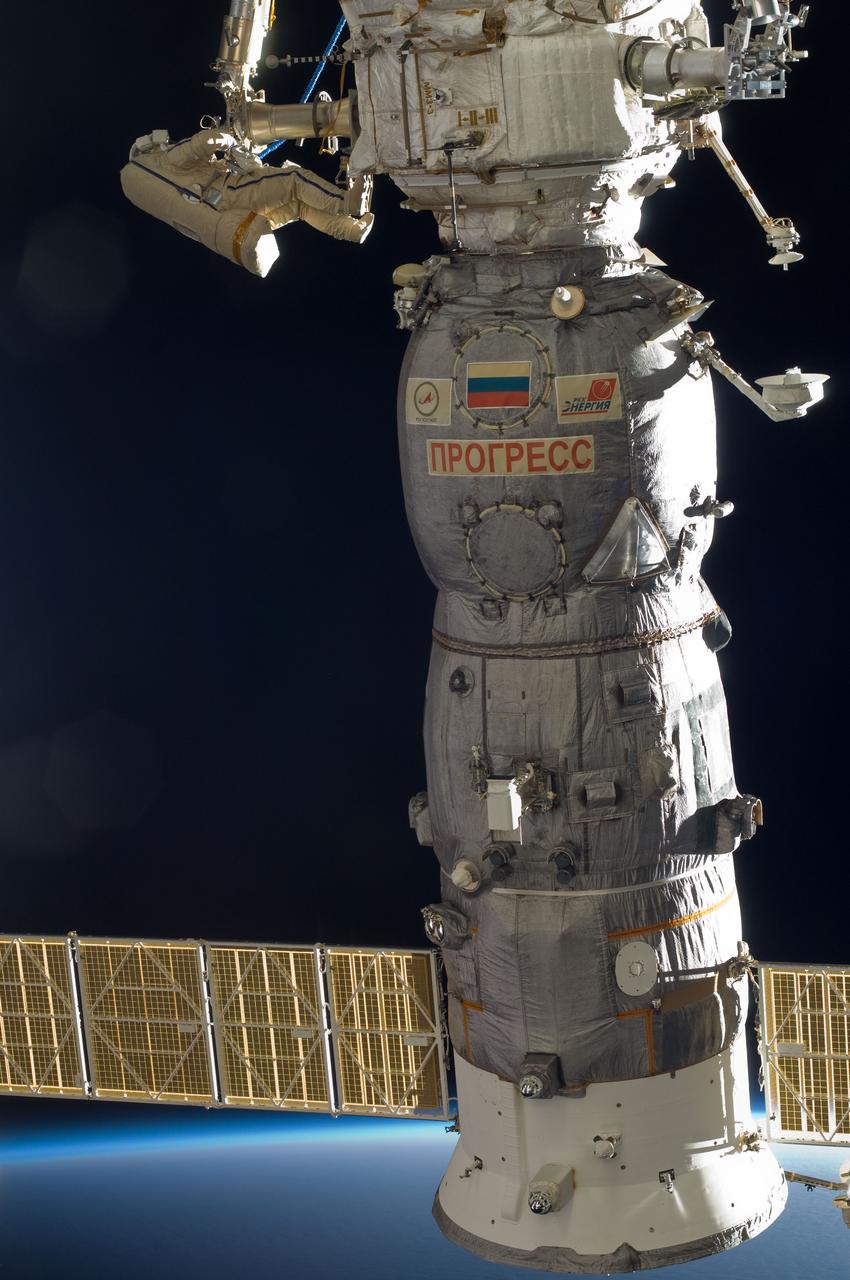
ISS028-E-020969 (3 Aug. 2011) --- Russian cosmonauts Sergei Volkov and Alexander Samokutyaev (out of frame), both Expedition 28 flight engineers, attired in Russian Orlan spacesuits, participate in a session of extravehicular activity (EVA) on the Russian segment of the International Space Station. During the six-hour, 23-minute spacewalk, Volkov and Samokutyaev moved a cargo boom from one airlock to another, installed a prototype laser communications system and deployed an amateur radio micro-satellite.
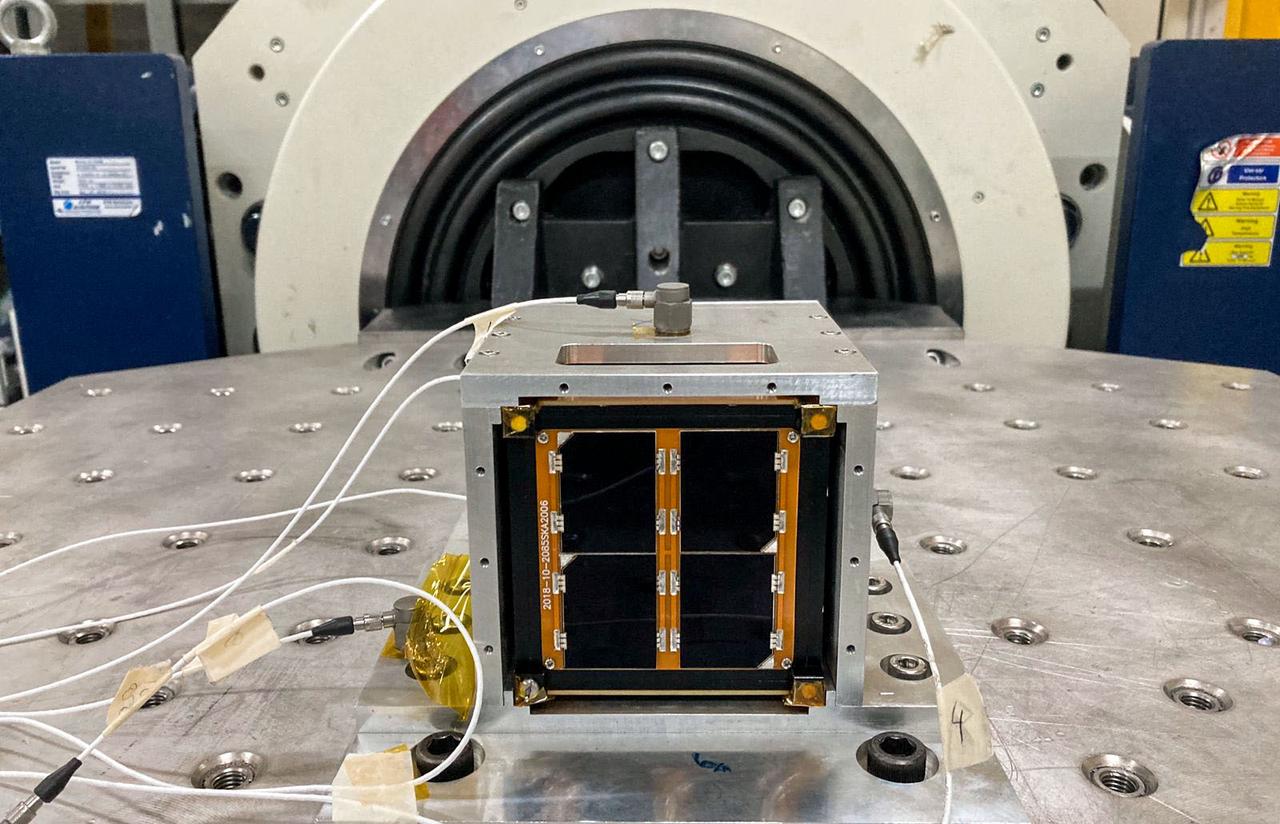
jsc2022e068265 (3/1/2022) --- A preflight view of the Surya Satellite-1 (SS-1) during Vibration Testing. The Surya Satellite-1 (SS-1) is the first Indonesian nanosatellite developed by university students at Surya University. SS-1 tests a satellite telecommunication system to serve amateur radio stations, and serves as a proof of concept of sensoric information transfer in rural areas for disaster mitigation application. Image Courtesy of The SS-1 Team.

jsc2022e068261 (11/1/2021) --- The Surya Satellite-1 and its developer team after Vibration Testing, shown left to right: Afiq, Roberto, Setra, Suhan, Hery, Zulfa. The Surya Satellite-1 (SS-1) is the first Indonesian nanosatellite developed by university students at Surya University. SS-1 tests a satellite telecommunication system to serve amateur radio stations, and serves as a proof of concept of sensoric information transfer in rural areas for disaster mitigation application. Image Courtesy of The SS-1 Team.
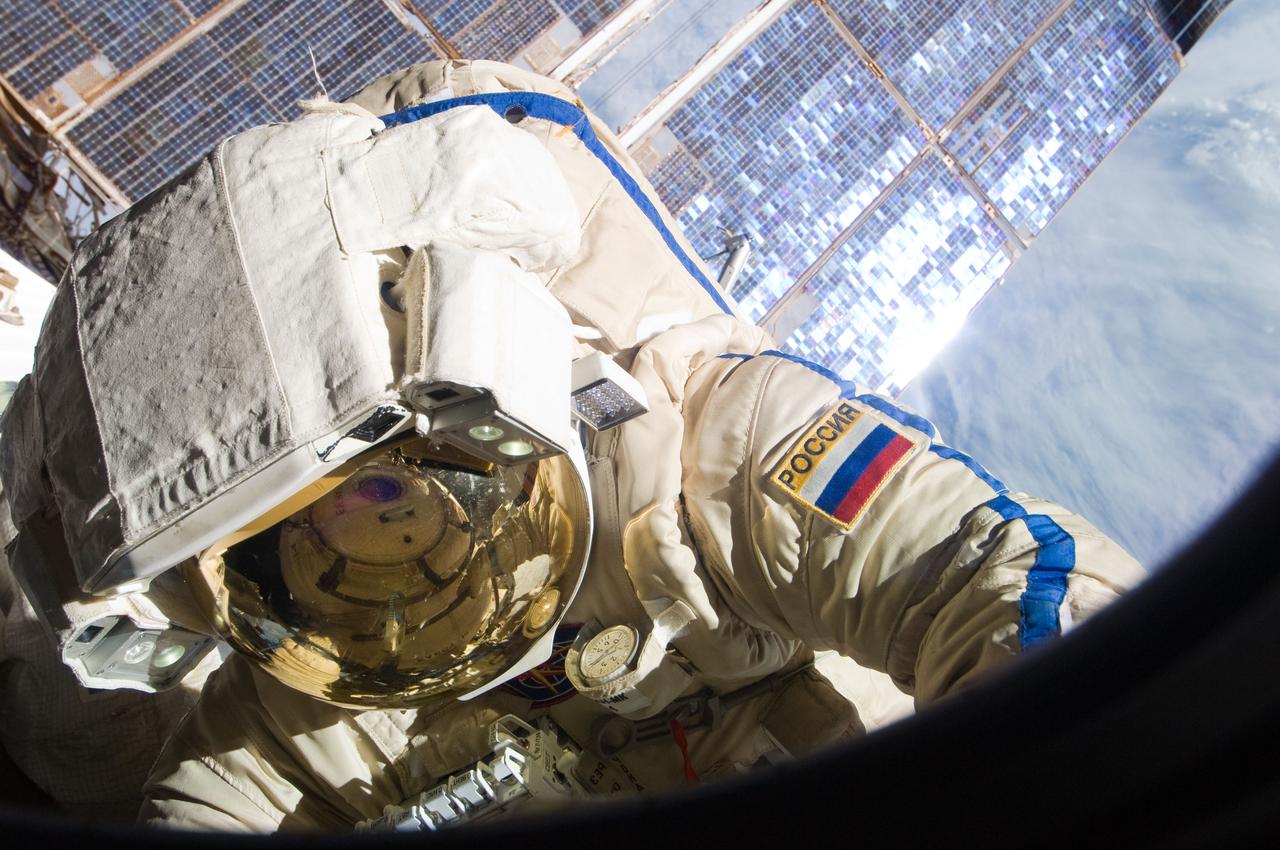
ISS028-E-020778 (3 Aug. 2011) --- Russian cosmonauts Sergei Volkov and Alexander Samokutyaev (out of frame), both Expedition 28 flight engineers, attired in Russian Orlan spacesuits, participate in a session of extravehicular activity (EVA) on the Russian segment of the International Space Station. During the six-hour, 23-minute spacewalk, Volkov and Samokutyaev moved a cargo boom from one airlock to another, installed a prototype laser communications system and deployed an amateur radio micro-satellite.
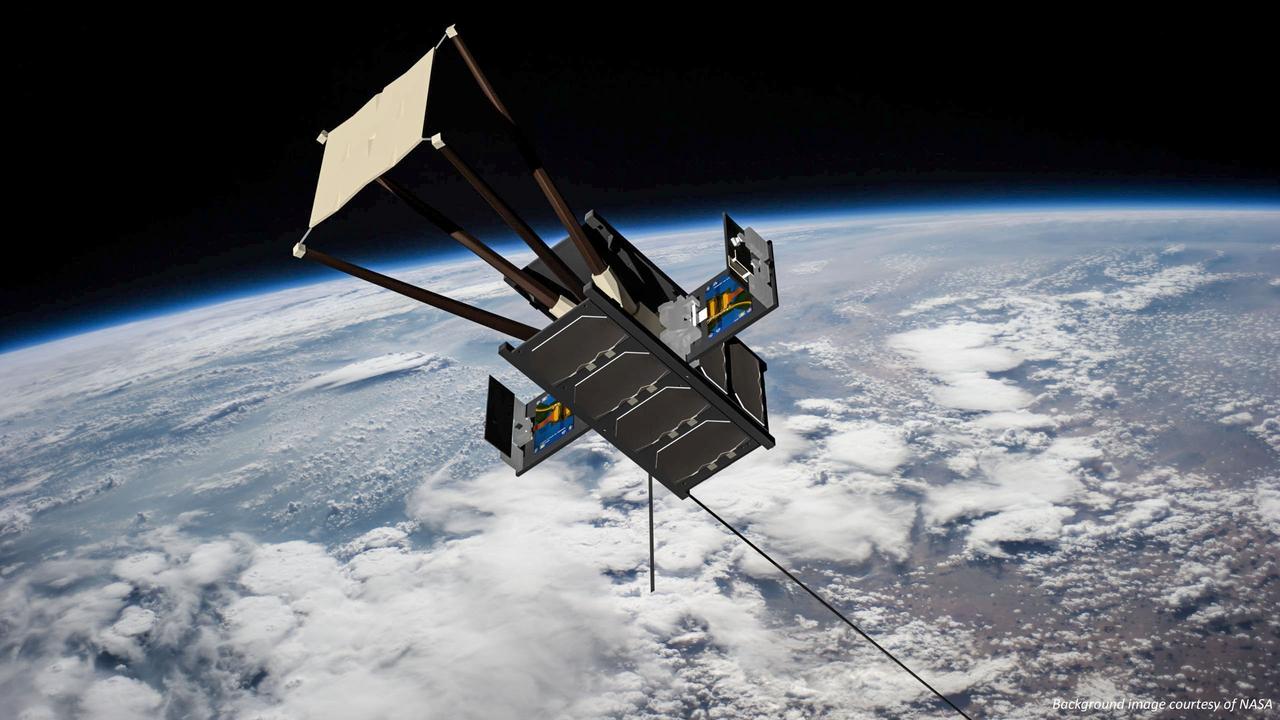
jsc2020e049615 (11/25/2020) --- A CAD model of the OPUSAT-II after deploying the deployment mechanism. The Osaka Prefecture University Satellite-II (OPUSAT-II) has two main missions, the transmission of High-speed data in an amateur radio band and the deployment of a two-dimensional deployable plate for high communications efficiency and high storage performance to demonstrate for use in the next generation of satellites. Image Credit:Osaka Prefecture University
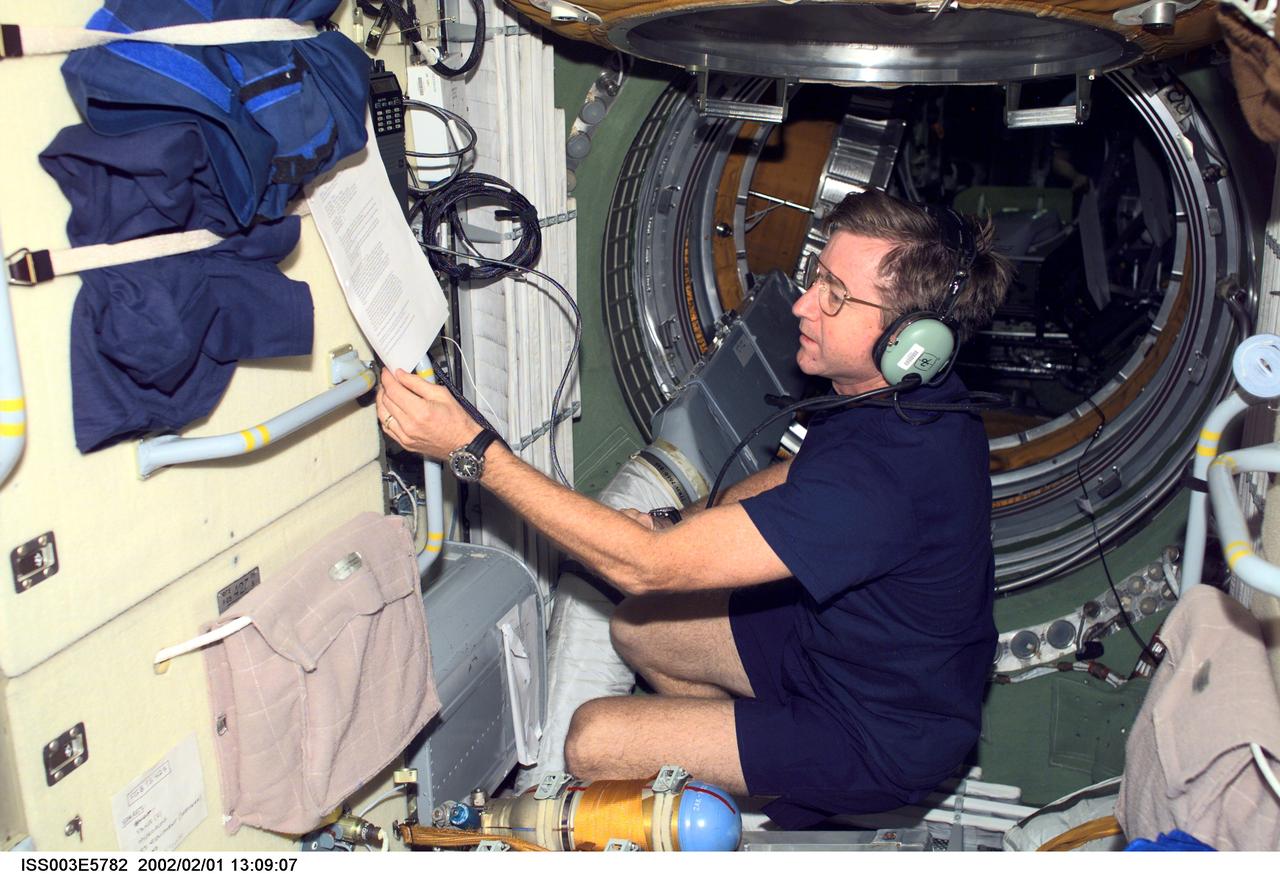
ISS003-E-5782 (September 2001) --- Astronaut Frank L. Culbertson, Jr., Expedition Three mission commander, operates the amateur radio equipment in the Zarya or functional cargo block (FGB) of the International Space Station (ISS). This image was taken with a digital still camera. Please note: The date identifiers on some frames are not accurate due to a technical problem with one of the Expedition Three cameras. When a specific date is given in the text or description portion, it is correct.
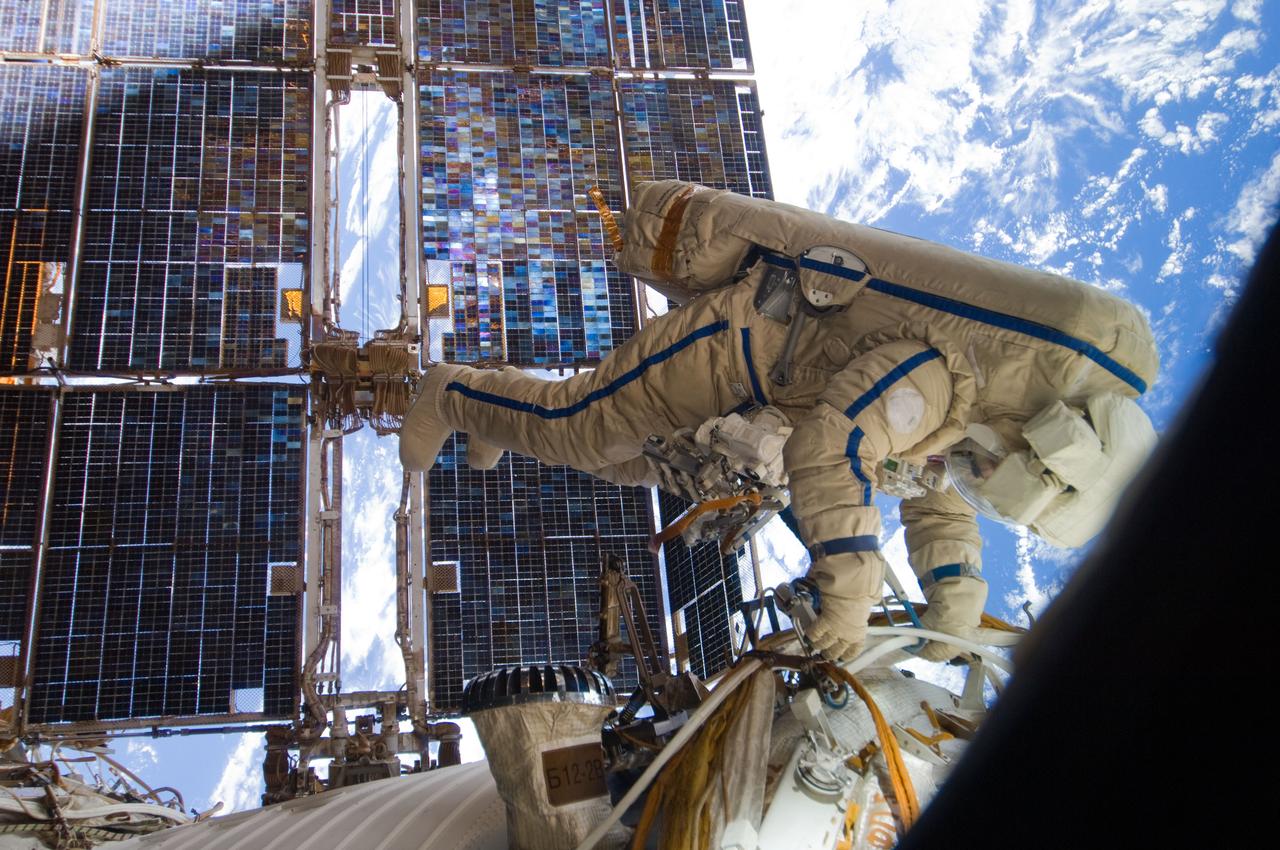
ISS028-E-020716 (3 Aug. 2011) --- Russian cosmonauts Sergei Volkov and Alexander Samokutyaev (out of frame), both Expedition 28 flight engineers, attired in Russian Orlan spacesuits, participate in a session of extravehicular activity (EVA) on the Russian segment of the International Space Station. During the six-hour, 23-minute spacewalk, Volkov and Samokutyaev moved a cargo boom from one airlock to another, installed a prototype laser communications system and deployed an amateur radio micro-satellite.
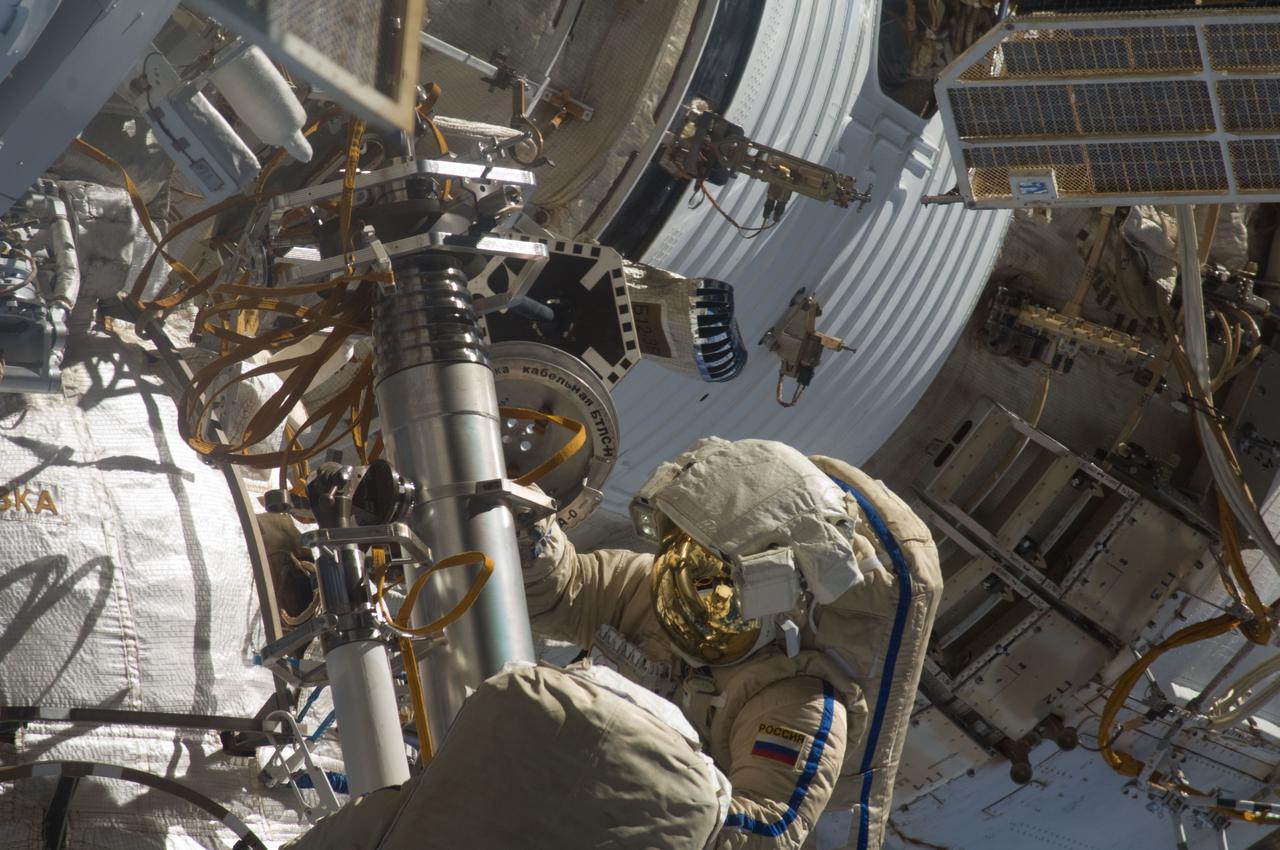
ISS028-E-020919 (3 Aug. 2011) --- Russian cosmonauts Sergei Volkov and Alexander Samokutyaev (out of frame), both Expedition 28 flight engineers, attired in Russian Orlan spacesuits, participate in a session of extravehicular activity (EVA) on the Russian segment of the International Space Station. During the six-hour, 23-minute spacewalk, Volkov and Samokutyaev moved a cargo boom from one airlock to another, installed a prototype laser communications system and deployed an amateur radio micro-satellite.
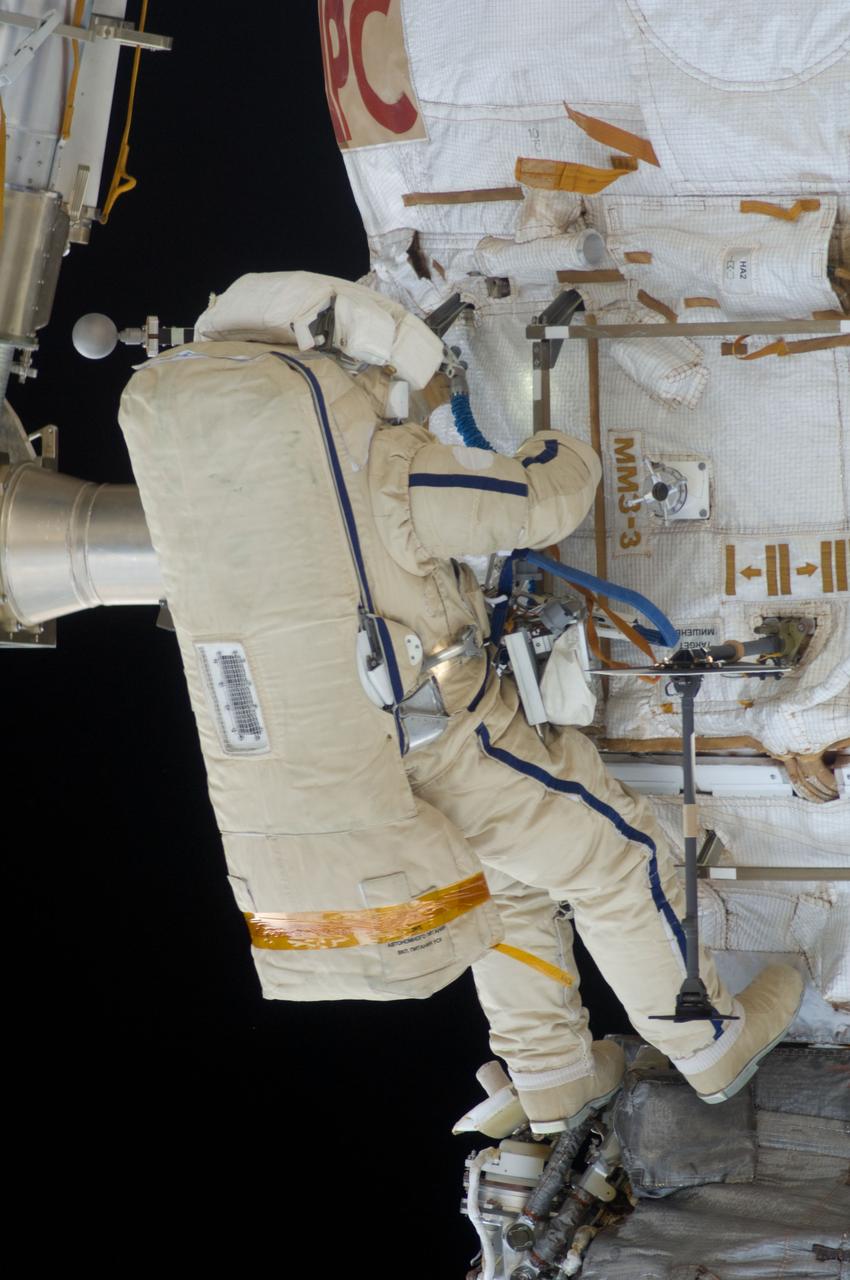
ISS028-E-020929 (3 Aug. 2011) --- Russian cosmonauts Sergei Volkov and Alexander Samokutyaev (out of frame), both Expedition 28 flight engineers, attired in Russian Orlan spacesuits, participate in a session of extravehicular activity (EVA) on the Russian segment of the International Space Station. During the six-hour, 23-minute spacewalk, Volkov and Samokutyaev moved a cargo boom from one airlock to another, installed a prototype laser communications system and deployed an amateur radio micro-satellite.
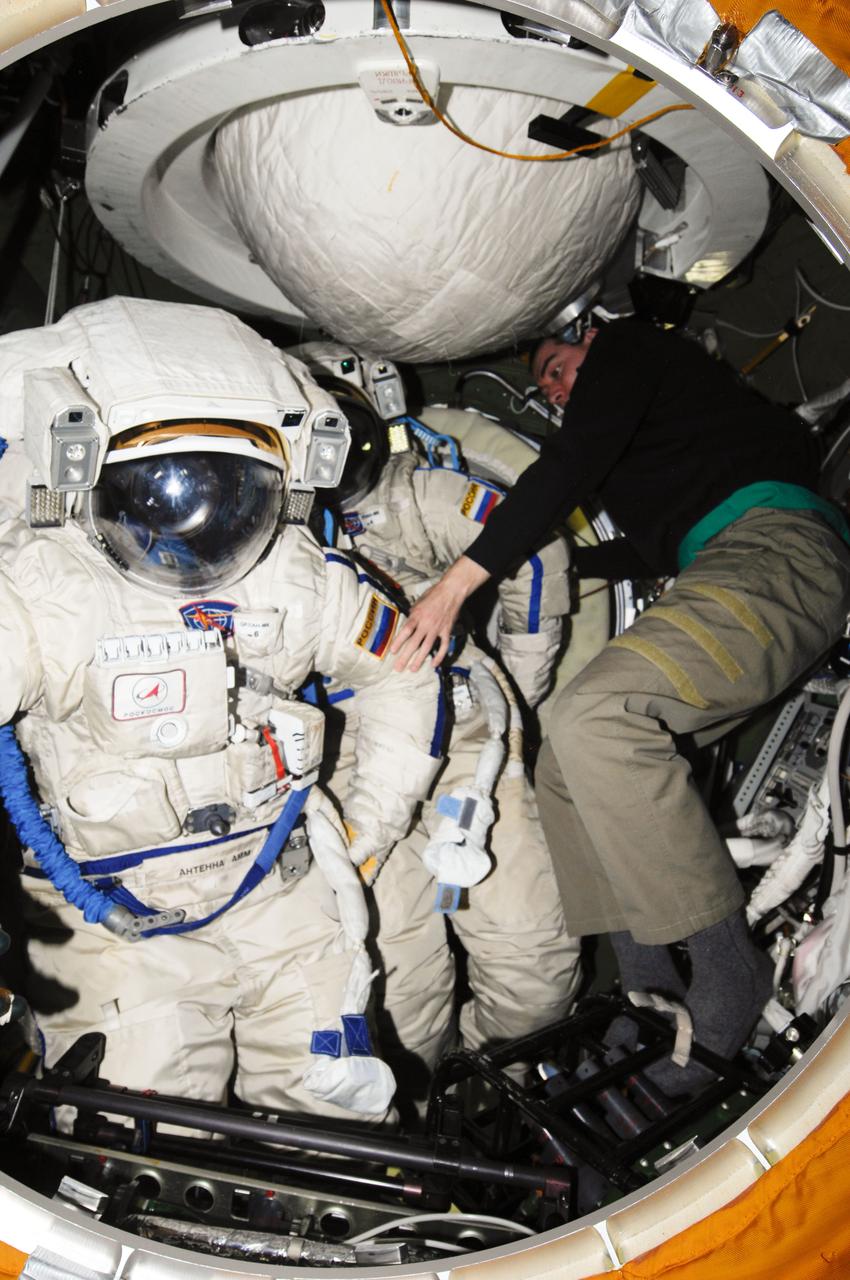
ISS028-E-019440 (29 July 2011) --- Russian cosmonaut Sergei Volkov, Expedition 28 flight engineer, works with Russian Orlan-MK spacesuits in the Pirs Docking Compartment of the International Space Station in preparation for a spacewalk scheduled for Aug. 3, 2011. During the six-hour excursion Volkov and Russian cosmonaut Alexander Samokutyaev (out of frame), flight engineer, will move a cargo boom from one airlock to another, install a prototype laser communications system and deploy an amateur radio micro-satellite.
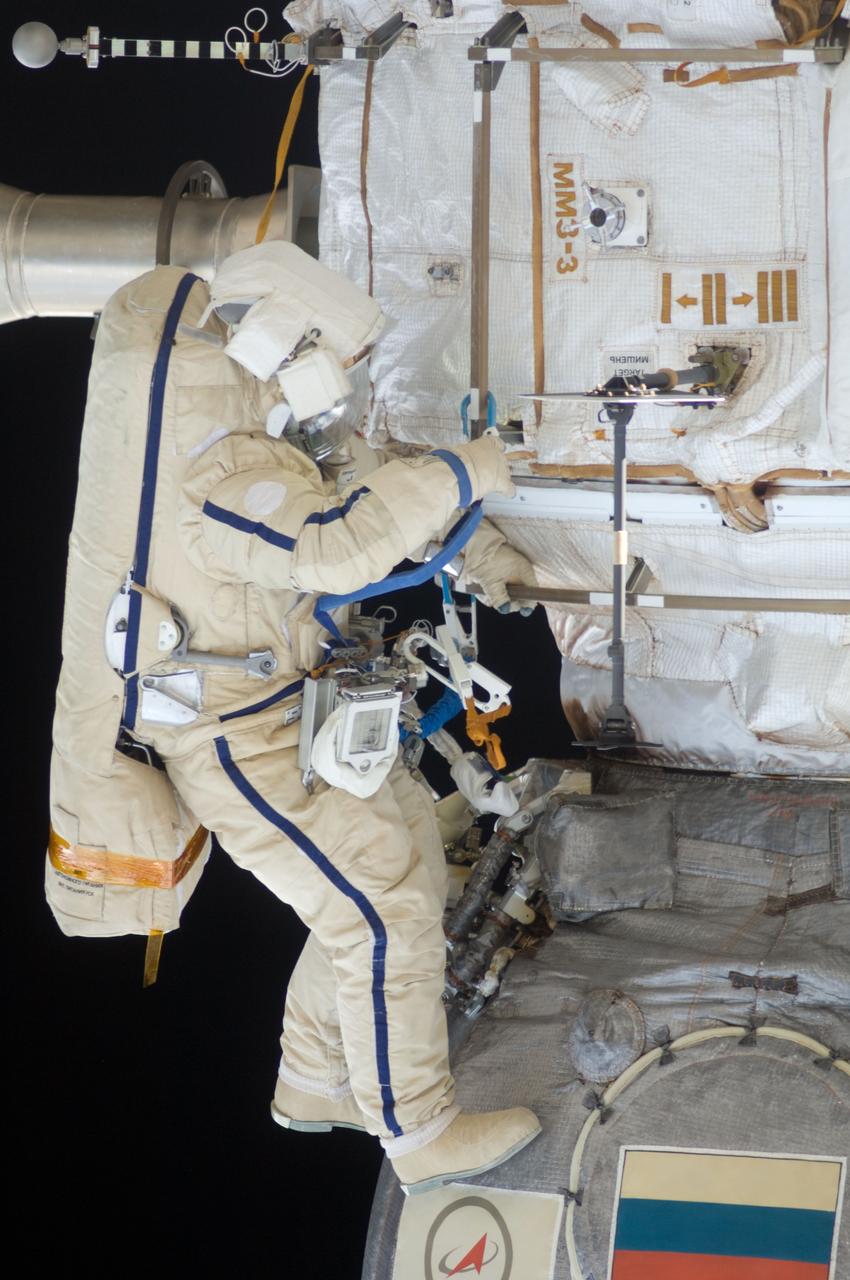
ISS028-E-020930 (3 Aug. 2011) --- Russian cosmonauts Sergei Volkov and Alexander Samokutyaev (out of frame), both Expedition 28 flight engineers, attired in Russian Orlan spacesuits, participate in a session of extravehicular activity (EVA) on the Russian segment of the International Space Station. During the six-hour, 23-minute spacewalk, Volkov and Samokutyaev moved a cargo boom from one airlock to another, installed a prototype laser communications system and deployed an amateur radio micro-satellite.
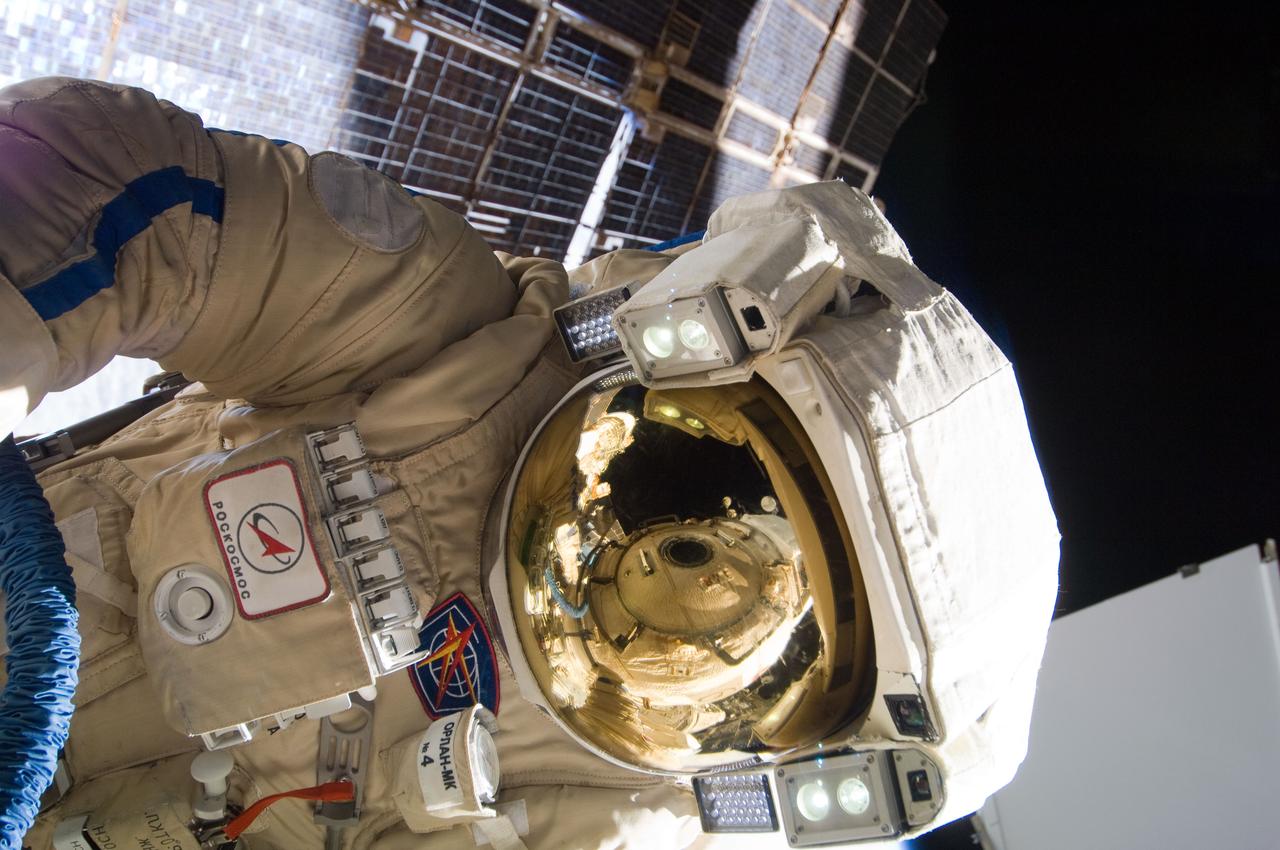
ISS028-E-020805 (3 Aug. 2011) --- Russian cosmonauts Sergei Volkov and Alexander Samokutyaev (out of frame), both Expedition 28 flight engineers, attired in Russian Orlan spacesuits, participate in a session of extravehicular activity (EVA) on the Russian segment of the International Space Station. During the six-hour, 23-minute spacewalk, Volkov and Samokutyaev moved a cargo boom from one airlock to another, installed a prototype laser communications system and deployed an amateur radio micro-satellite.
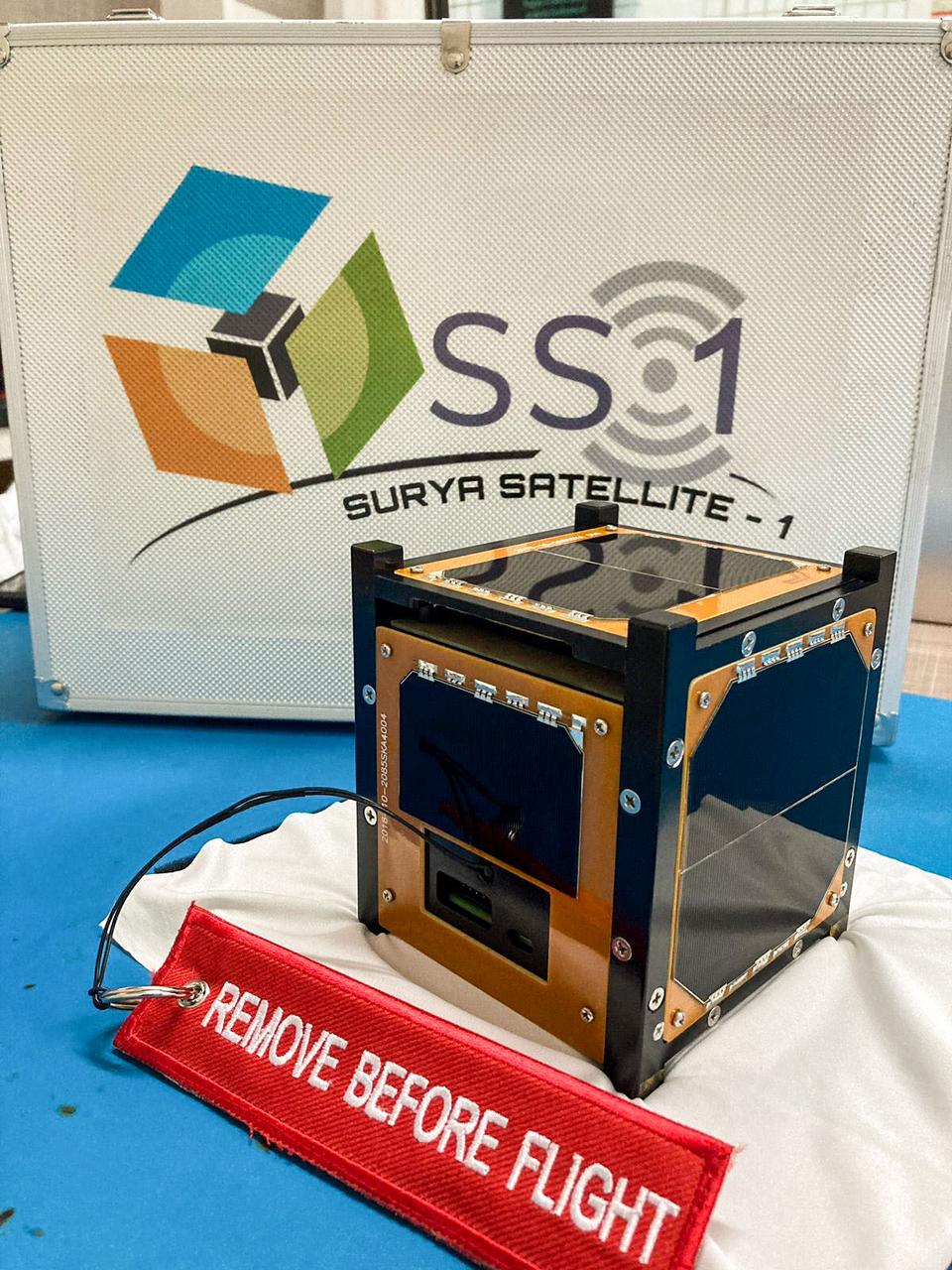
jsc2022e068263 (5/1/2022) --- A preflight view of the Surya Satellite-1 (SS-1) Flight Model. The Surya Satellite-1 (SS-1) is the first Indonesian nanosatellite developed by university students at Surya University. SS-1 tests a satellite telecommunication system to serve amateur radio stations, and serves as a proof of concept of sensoric information transfer in rural areas for disaster mitigation application. Image Courtesy of The SS-1 Team.
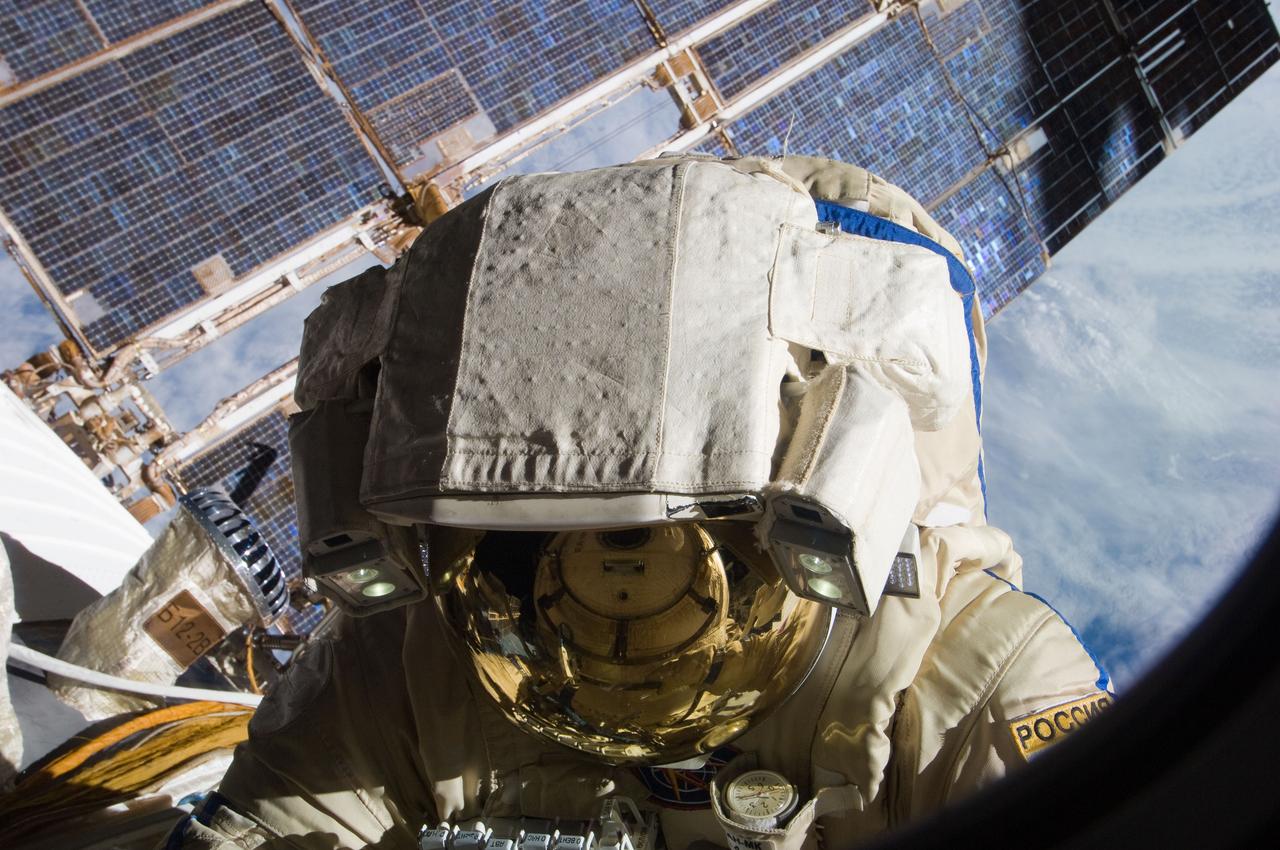
ISS028-E-020782 (3 Aug. 2011) --- Russian cosmonauts Sergei Volkov and Alexander Samokutyaev (out of frame), both Expedition 28 flight engineers, attired in Russian Orlan spacesuits, participate in a session of extravehicular activity (EVA) on the Russian segment of the International Space Station. During the six-hour, 23-minute spacewalk, Volkov and Samokutyaev moved a cargo boom from one airlock to another, installed a prototype laser communications system and deployed an amateur radio micro-satellite.
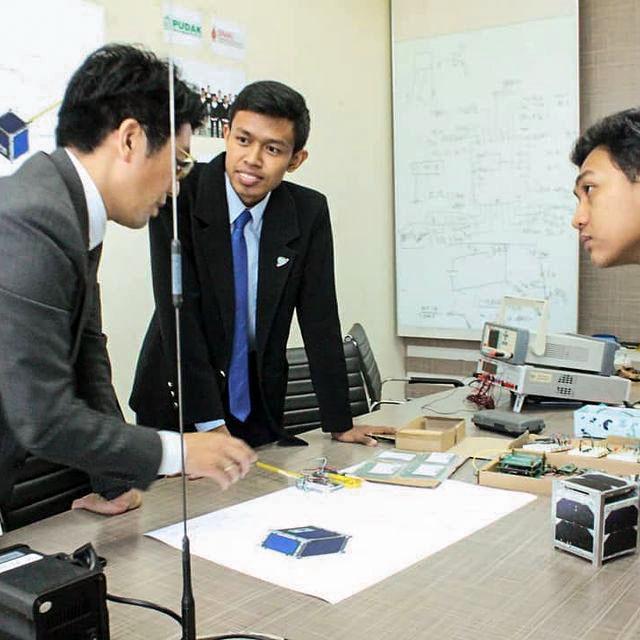
jsc2022e068262 (5/1/2022) --- A view of the SS-1 Team during the JAXA Safety Review. The Surya Satellite-1 (SS-1) is the first Indonesian nanosatellite developed by university students at Surya University. SS-1 tests a satellite telecommunication system to serve amateur radio stations, and serves as a proof of concept of sensoric information transfer in rural areas for disaster mitigation application. Image Courtesy of The SS-1 Team.
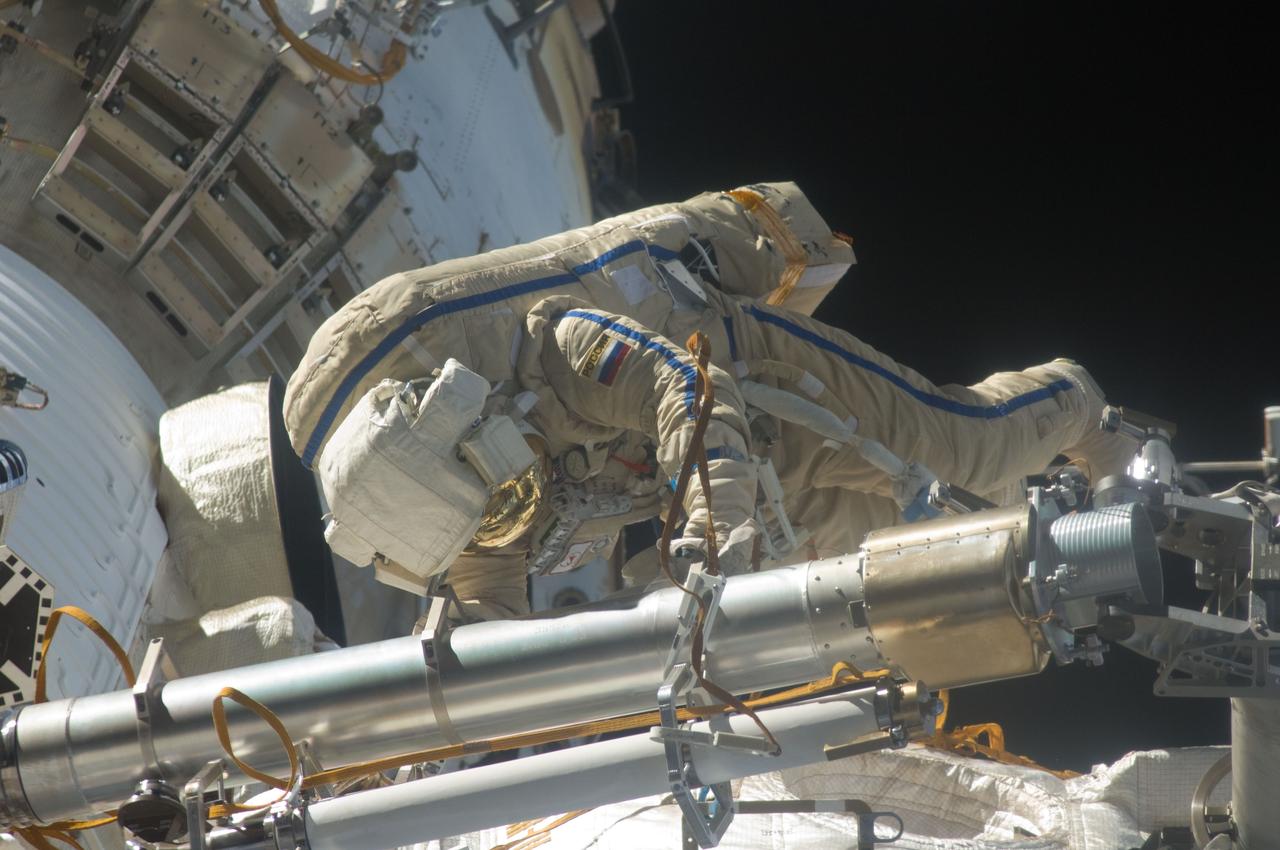
ISS028-E-020924 (3 Aug. 2011) --- Russian cosmonauts Sergei Volkov and Alexander Samokutyaev (out of frame), both Expedition 28 flight engineers, attired in Russian Orlan spacesuits, participate in a session of extravehicular activity (EVA) on the Russian segment of the International Space Station. During the six-hour, 23-minute spacewalk, Volkov and Samokutyaev moved a cargo boom from one airlock to another, installed a prototype laser communications system and deployed an amateur radio micro-satellite.
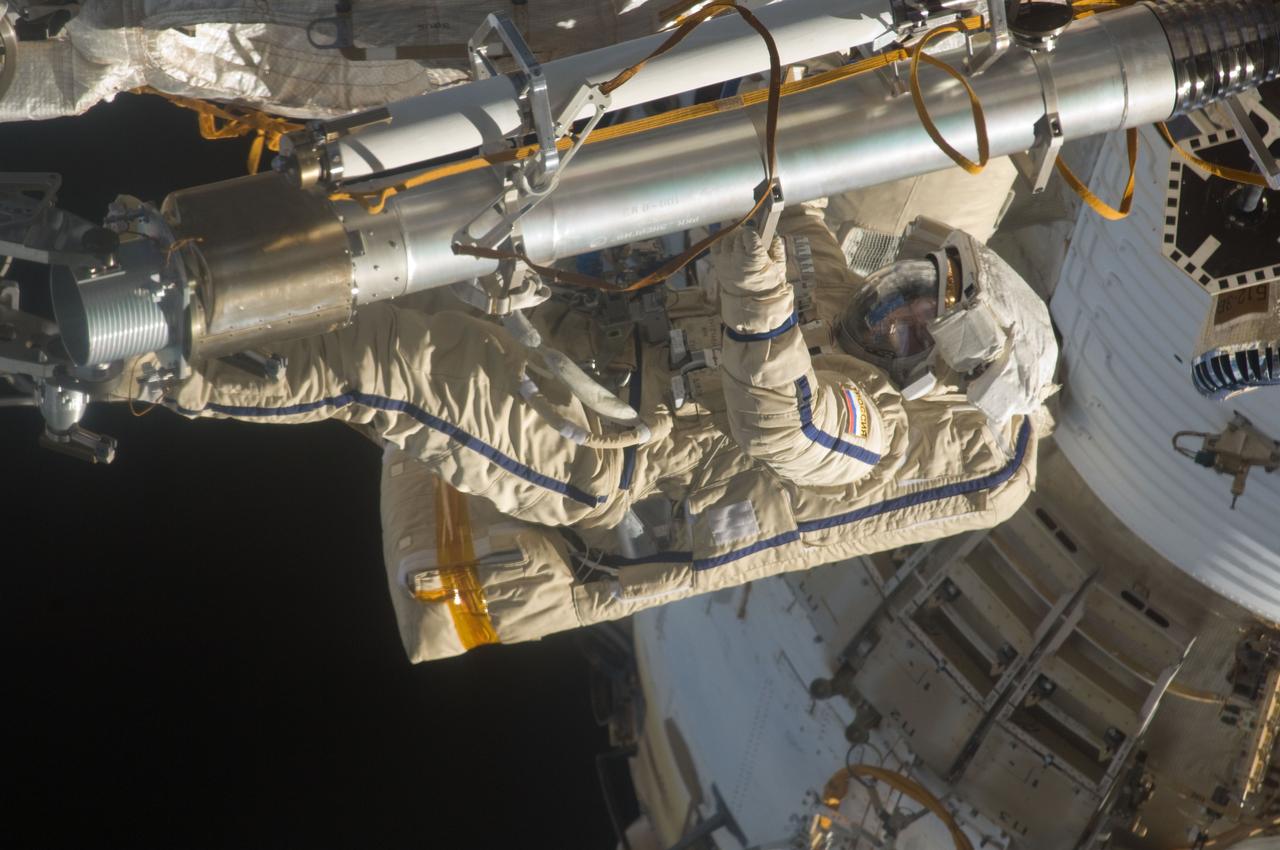
ISS028-E-020911 (3 Aug. 2011) --- Russian cosmonauts Sergei Volkov and Alexander Samokutyaev (out of frame), both Expedition 28 flight engineers, attired in Russian Orlan spacesuits, participate in a session of extravehicular activity (EVA) on the Russian segment of the International Space Station. During the six-hour, 23-minute spacewalk, Volkov and Samokutyaev moved a cargo boom from one airlock to another, installed a prototype laser communications system and deployed an amateur radio micro-satellite.
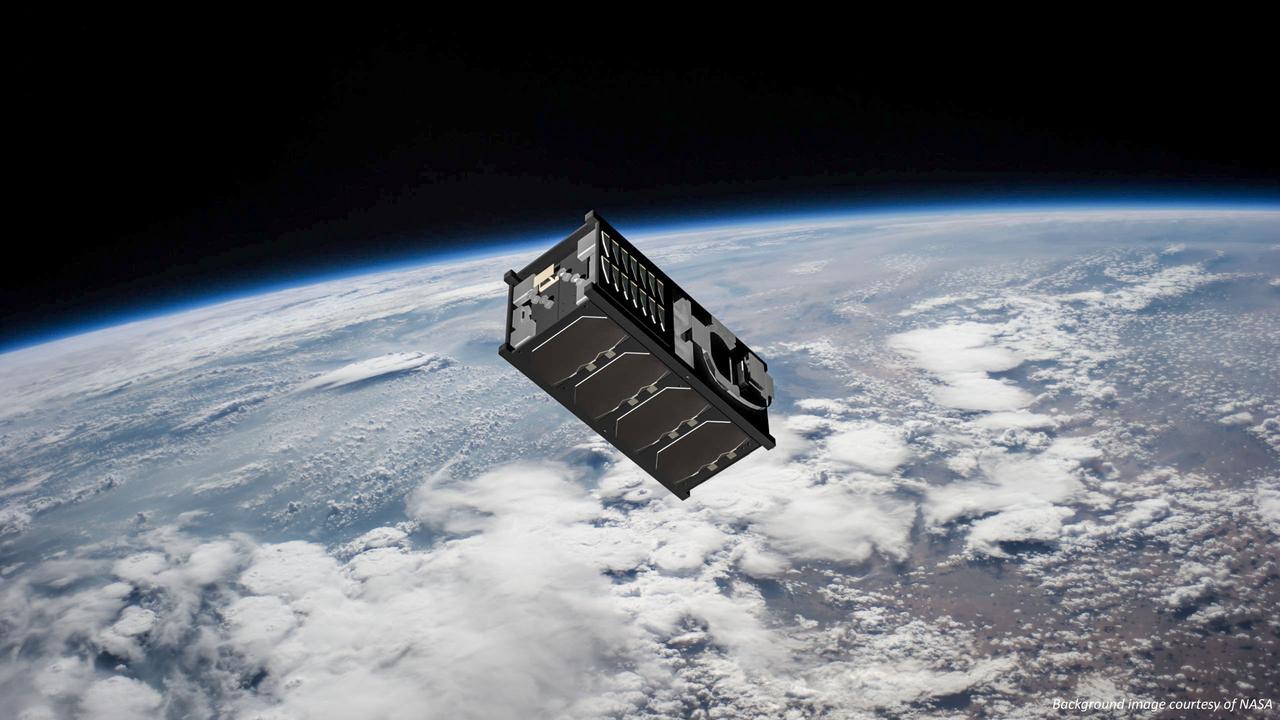
jsc2020e049616 (11/25/2020) --- A CAD model of the OPUSAT-II before deploying the deployment mechanism. The Osaka Prefecture University Satellite-II (OPUSAT-II) has two main missions, the transmission of High-speed data in an amateur radio band and the deployment of a two-dimensional deployable plate for high communications efficiency and high storage performance to demonstrate for use in the next generation of satellites. Image Credit:Osaka Prefecture University
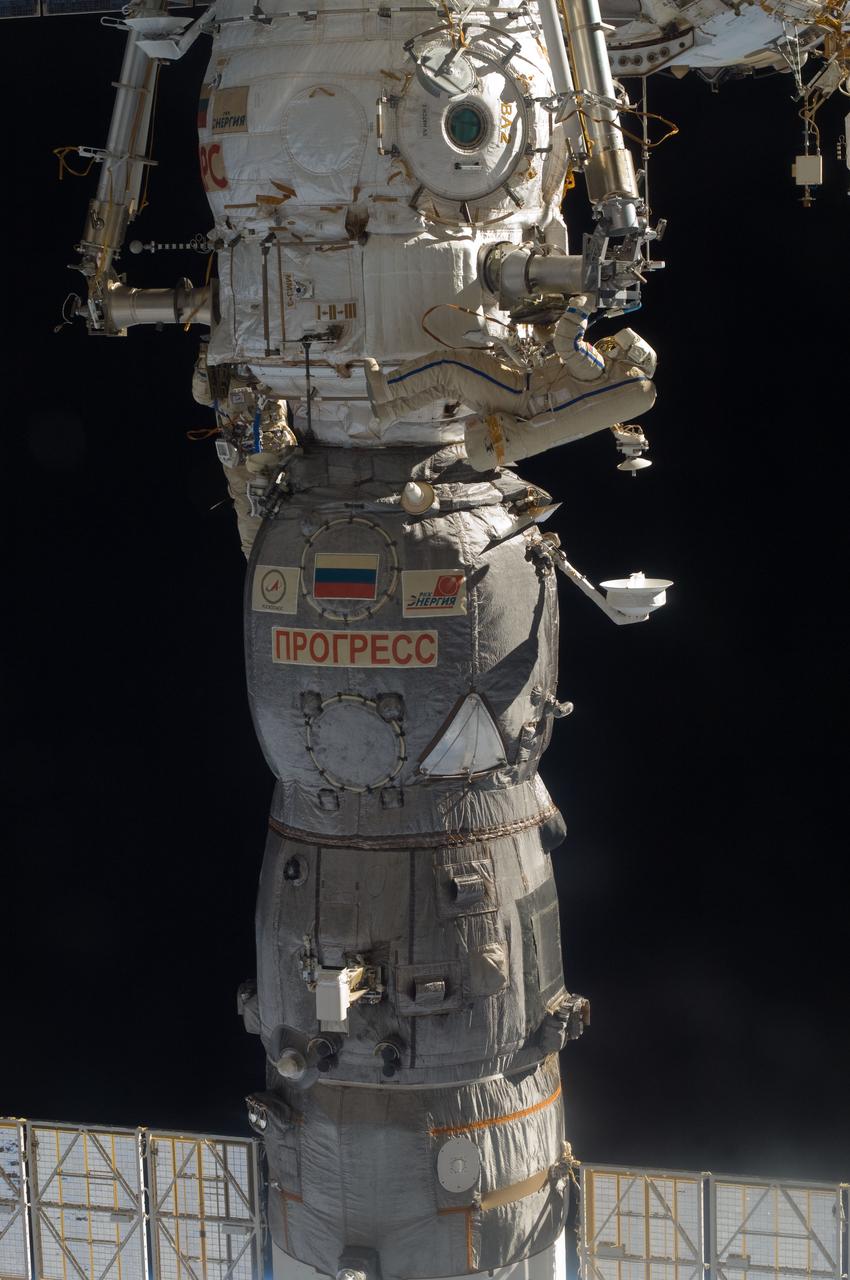
ISS028-E-020965 (3 Aug. 2011) --- Russian cosmonauts Sergei Volkov and Alexander Samokutyaev (out of frame), both Expedition 28 flight engineers, attired in Russian Orlan spacesuits, participate in a session of extravehicular activity (EVA) on the Russian segment of the International Space Station. During the six-hour, 23-minute spacewalk, Volkov and Samokutyaev moved a cargo boom from one airlock to another, installed a prototype laser communications system and deployed an amateur radio micro-satellite.
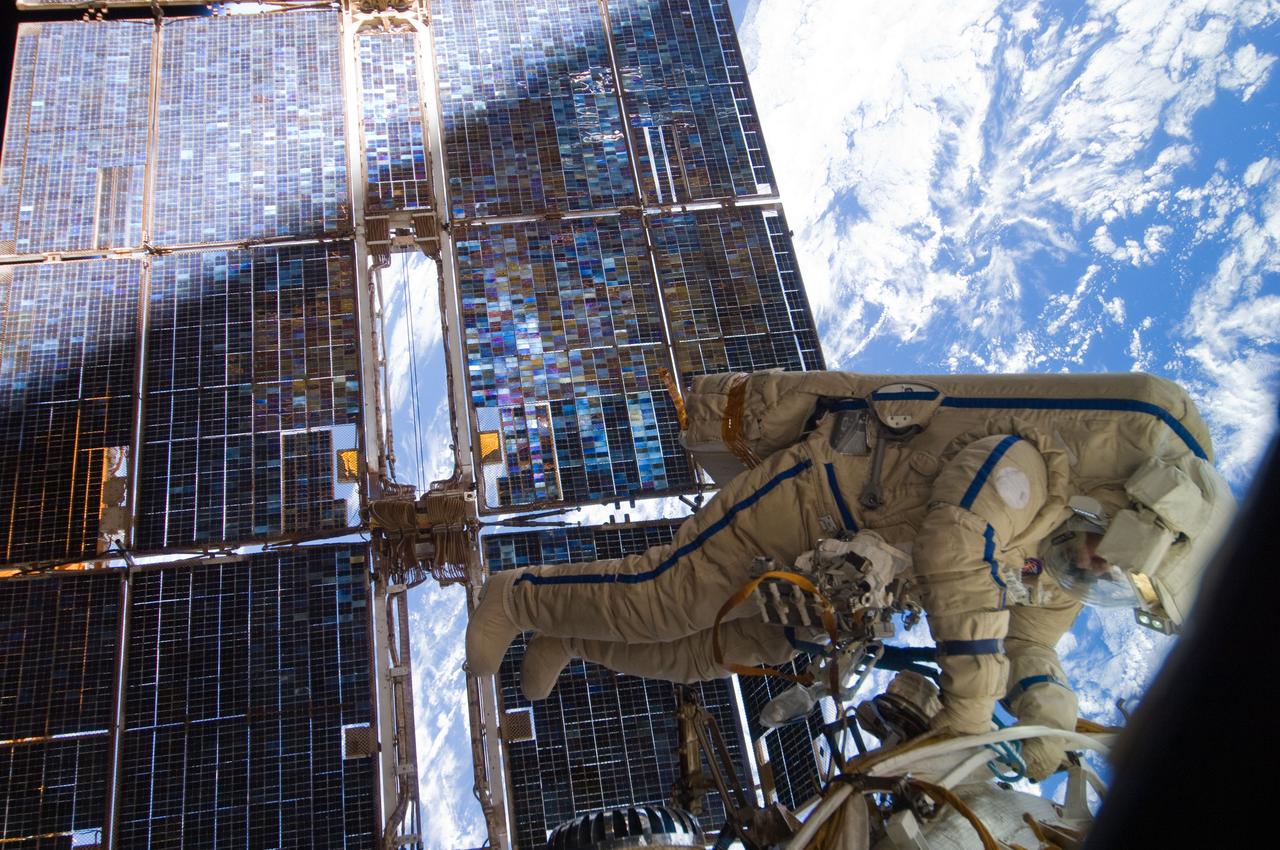
ISS028-E-020718 (3 Aug. 2011) --- Russian cosmonauts Sergei Volkov and Alexander Samokutyaev (out of frame), both Expedition 28 flight engineers, attired in Russian Orlan spacesuits, participate in a session of extravehicular activity (EVA) on the Russian segment of the International Space Station. During the six-hour, 23-minute spacewalk, Volkov and Samokutyaev moved a cargo boom from one airlock to another, installed a prototype laser communications system and deployed an amateur radio micro-satellite.
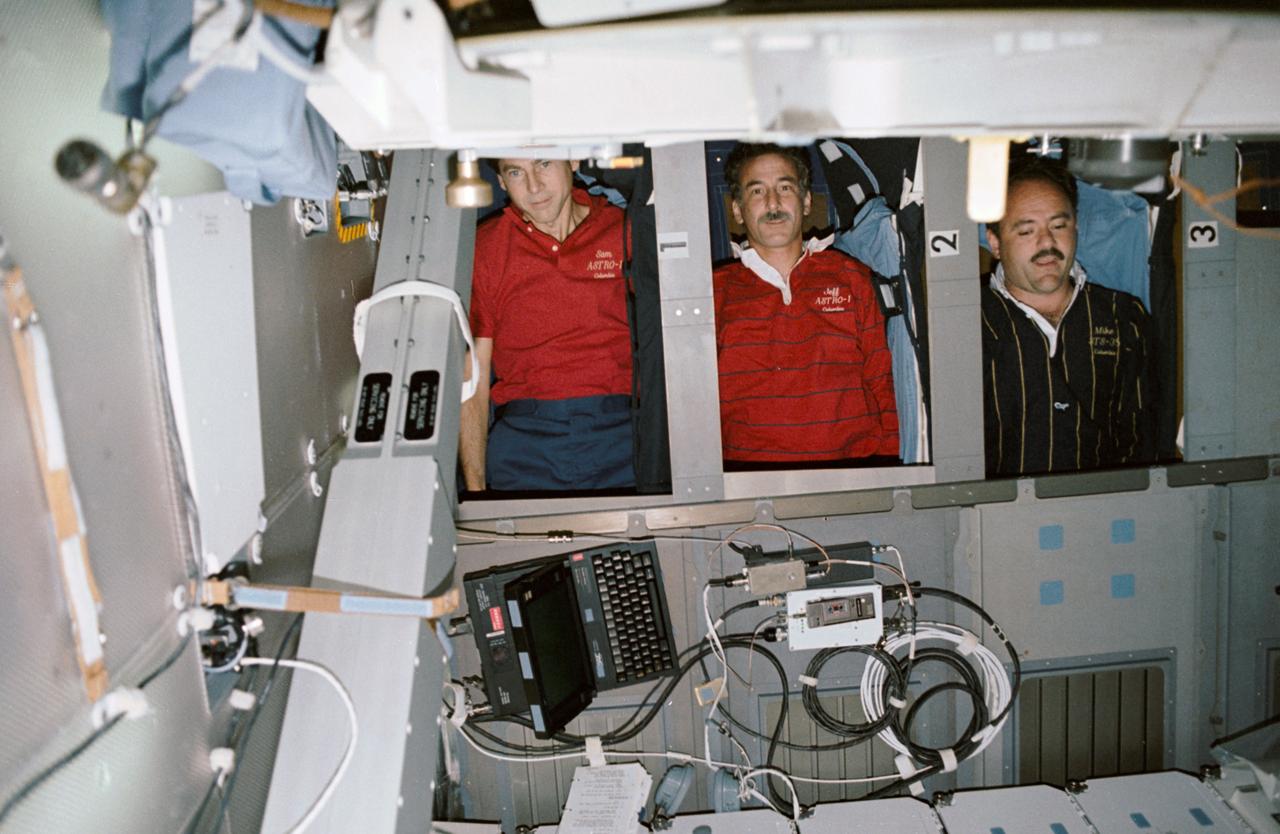
Though they are not actually asleep, three STS-35 crewmembers demonstrate the bunk-style sleep compartments onboard Columbia's, Orbiter Vehicle (OV) 102's, middeck. From top to bottom are Payload Specialist Samuel T. Durrance, Mission Specialist (MS) Jeffrey A. Hoffman, and MS John M. Lounge. At the left is the shuttle amateur radio experiment (SAREX). The crew escape pole (CES) is visible overhead and the open airlock hatch in the foreground. The sleep station is located against the middeck starboard wall.
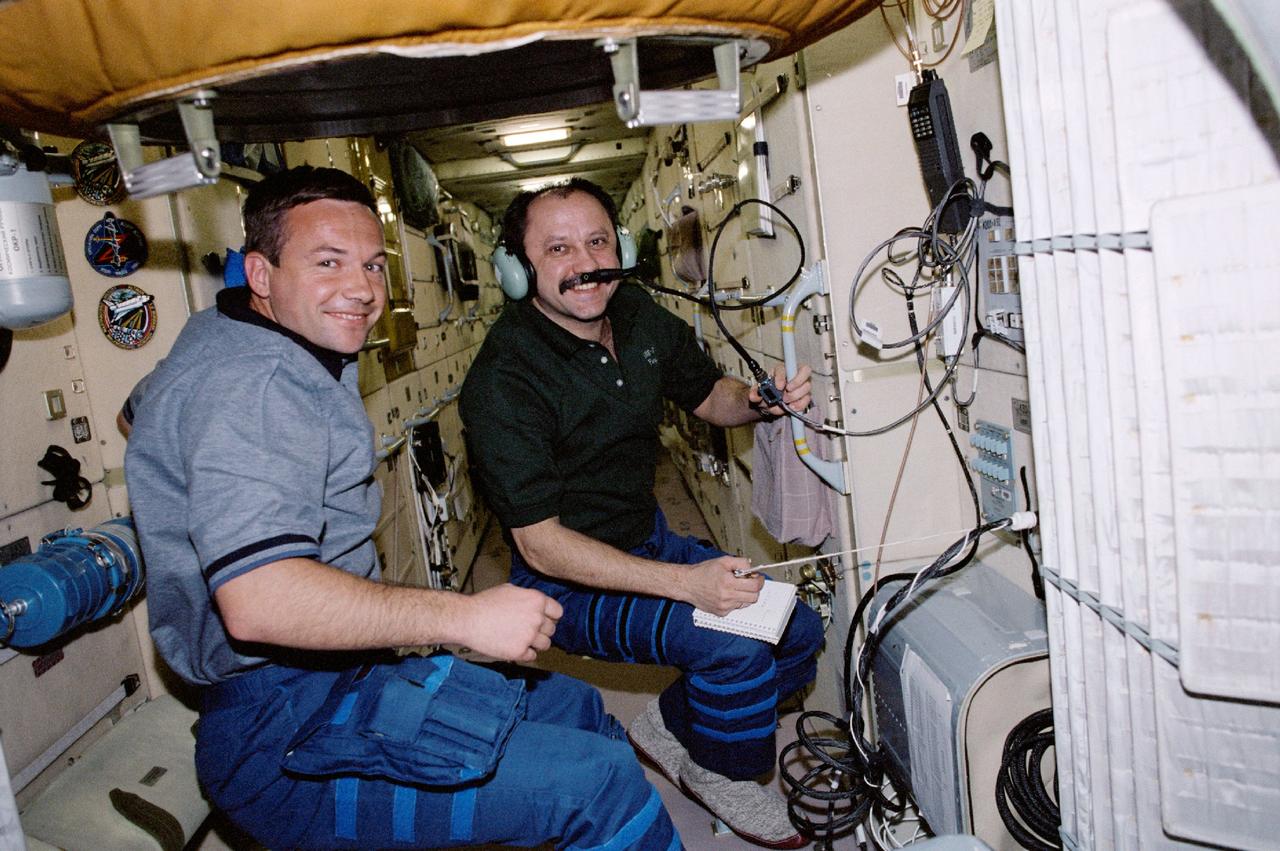
STS100-343-020 (19 April-1 May 2001) --- Cosmonaut Yuri V. Lonchakov (left), STS-100 mission specialist, observes as Yury V. Usachev, Expedition Two commander, talks to amateur radio operators on the ground from a special work station on the functional cargo block (FGB) or Zarya module of the International Space Station (ISS). The two represent Rosaviakosmos.
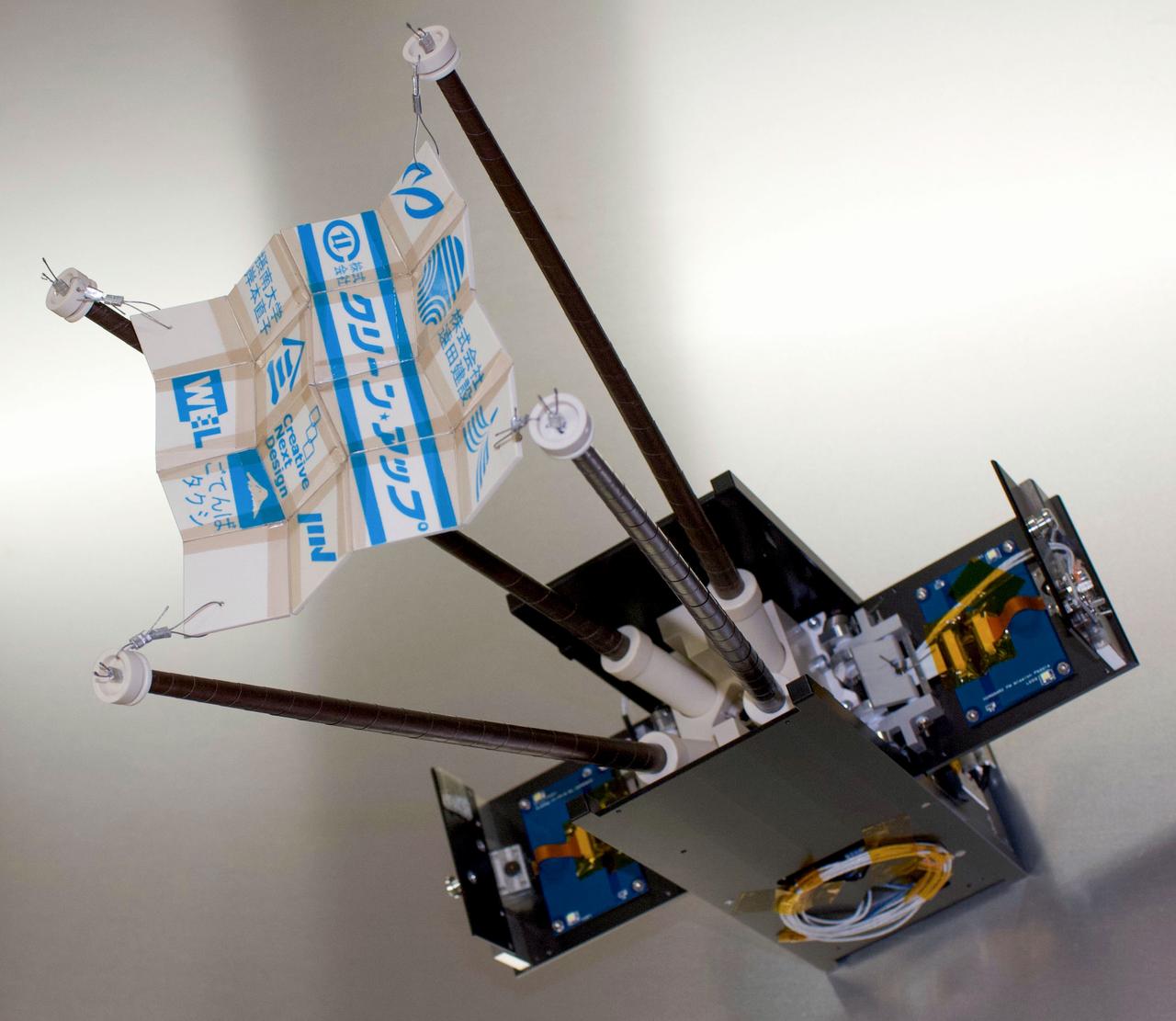
jsc2020e049617 (6/20/2020) --- A preflight view of the OPUSAT-II flight unit. The Osaka Prefecture University Satellite-II (OPUSAT-II) has two main missions, the transmission of High-speed data in an amateur radio band and the deployment of a two-dimensional deployable plate for high communications efficiency and high storage performance to demonstrate for use in the next generation of satellites. Image Credit:Takehiro Aoshima
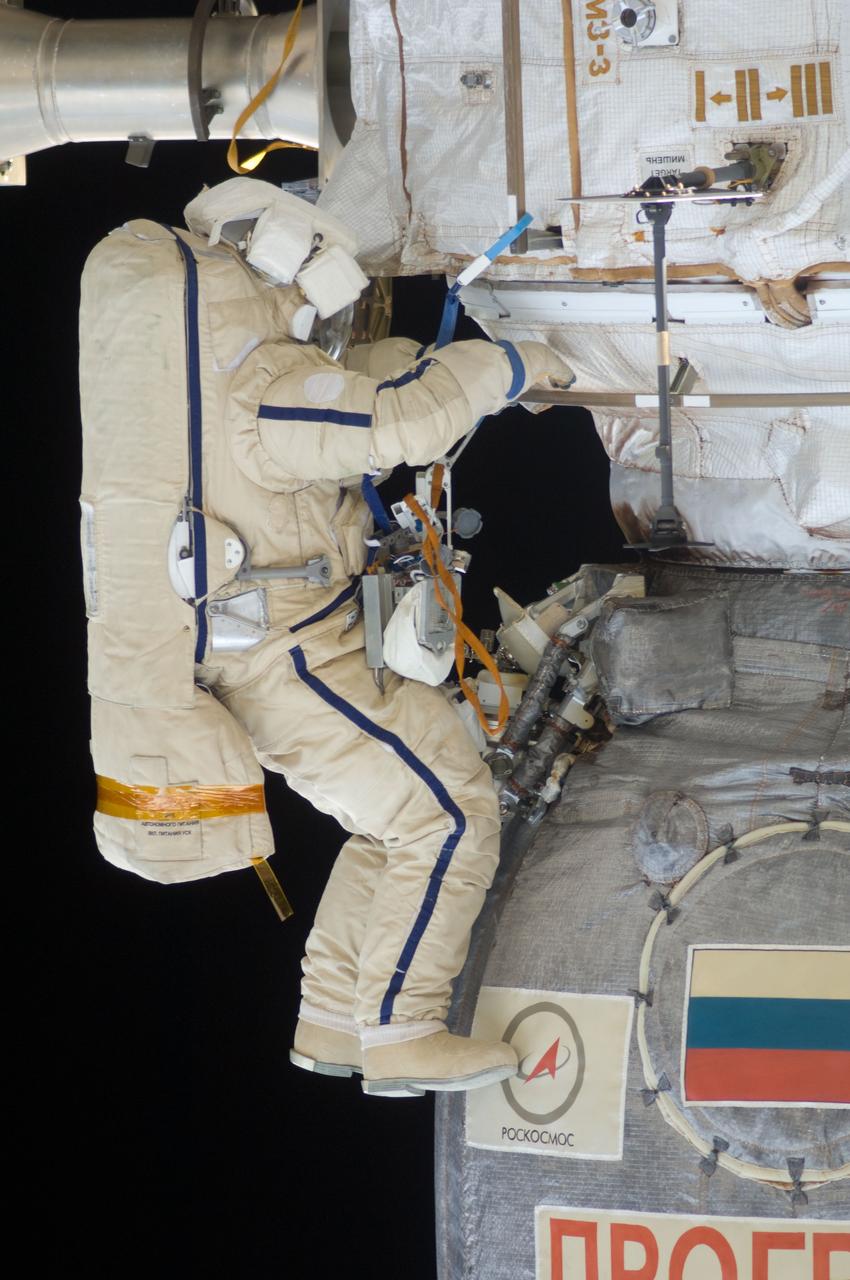
ISS028-E-020931 (3 Aug. 2011) --- Russian cosmonauts Sergei Volkov and Alexander Samokutyaev (out of frame), both Expedition 28 flight engineers, attired in Russian Orlan spacesuits, participate in a session of extravehicular activity (EVA) on the Russian segment of the International Space Station. During the six-hour, 23-minute spacewalk, Volkov and Samokutyaev moved a cargo boom from one airlock to another, installed a prototype laser communications system and deployed an amateur radio micro-satellite.
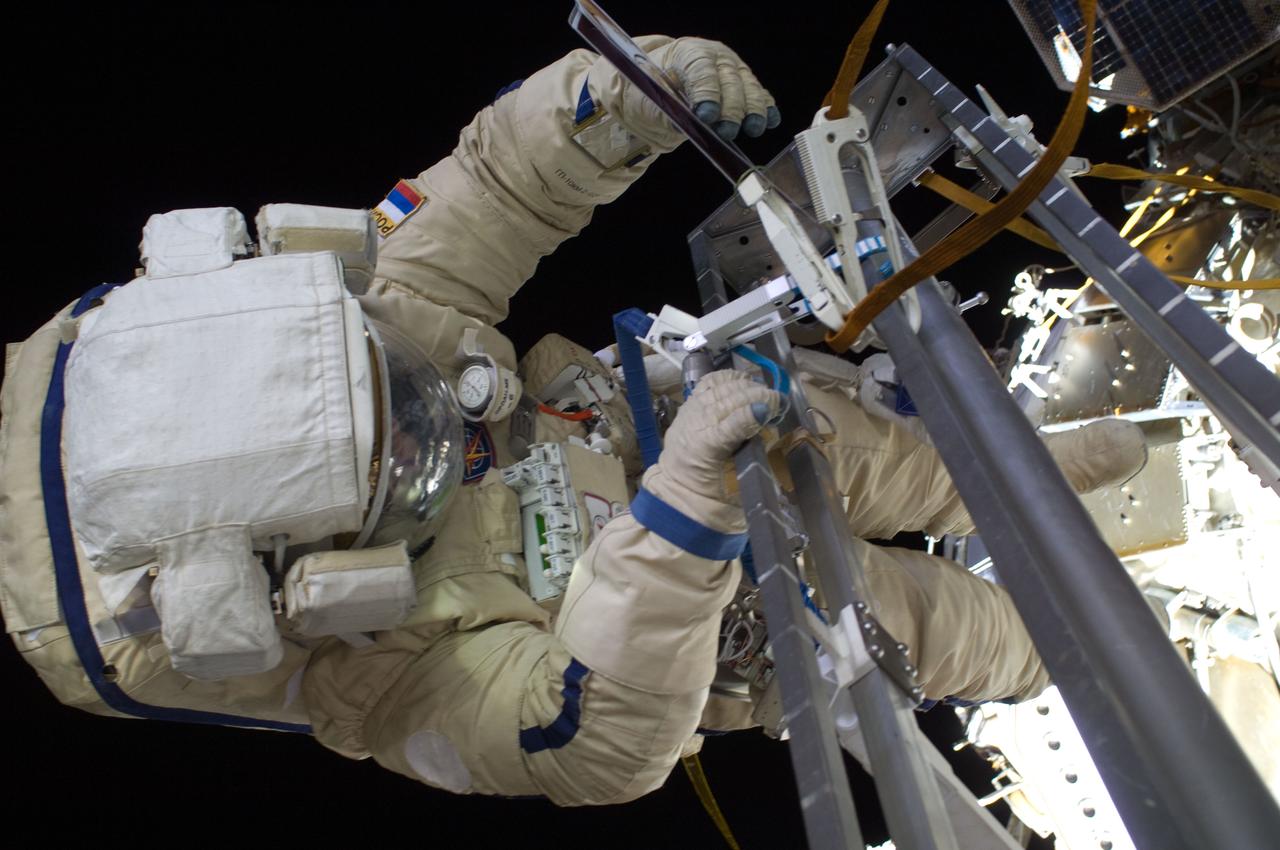
ISS028-E-020581 (3 Aug. 2011) --- Russian cosmonauts Alexander Samokutyaev and Sergei Volkov (out of frame), both Expedition 28 flight engineers, attired in Russian Orlan spacesuits, participate in a session of extravehicular activity on the Russian segment of the International Space Station. During the six-hour, 23-minute spacewalk, Volkov and Samokutyaev moved a cargo boom from one airlock to another, installed a prototype laser communications system and deployed an amateur radio micro-satellite.
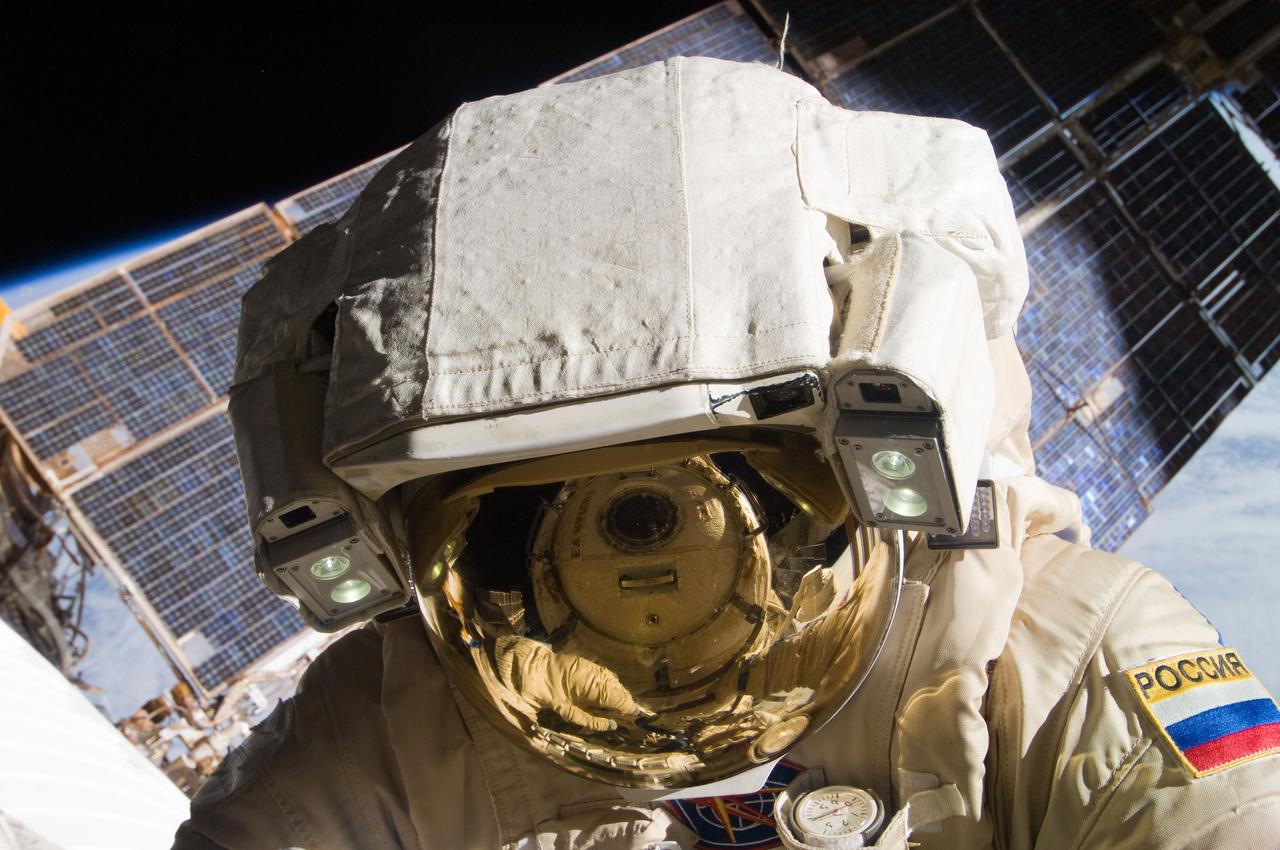
ISS028-E-020792 (3 Aug. 2011) --- Russian cosmonauts Sergei Volkov and Alexander Samokutyaev (out of frame), both Expedition 28 flight engineers, attired in Russian Orlan spacesuits, participate in a session of extravehicular activity (EVA) on the Russian segment of the International Space Station. During the six-hour, 23-minute spacewalk, Volkov and Samokutyaev moved a cargo boom from one airlock to another, installed a prototype laser communications system and deployed an amateur radio micro-satellite.
![[16] ISO: 100 Aprt: F4 Shut: 125 Lens: 35 Exps: P Prog: Po ExpC: -1.3 Metr: Mtrx Fl s: Norm D md: S F md: S F ar: Spot Dist: 1.4m](https://images-assets.nasa.gov/image/s93e5052/s93e5052~medium.jpg)
[16] ISO: 100 Aprt: F4 Shut: 125 Lens: 35 Exps: P Prog: Po ExpC: -1.3 Metr: Mtrx Fl s: Norm D md: S F md: S F ar: Spot Dist: 1.4m

STS047-45-003 (12-20 Sept 1992) --- Payload specialist Mamoru Mohri communicates with students from the aft flight deck of the Earth-orbiting Space Shuttle Endeavour. The communications were an extension of the Shuttle Amateur Radio Experiment (SAREX), which has flown on a number of previous flights. Dr. Mohri represents Japan's National Space Development Agency (NASDA), joining six NASA astronauts for eight-days in space in support of the Spacelab-J mission. Several of the crew members were able to talk with students and other "ham" operators during the mission.

KENNEDY SPACE CENTER, FLA. -- Attached to the second stage of a Boeing Delta II at Pad 17A, Cape Canaveral Air Station, is the Students for the Exploration and Development of Space Satellite-1 (SEDSat-1). An international project, SEDSat-1 is a secondary payload on the Deep Space 1 mission and will be deployed 88 minutes after launch over Hawaii. The satellite includes cameras for imaging Earth, a unique attitude determination system, and amateur radio communication capabilities. Deep Space 1, targeted for launch on Oct. 24, is the first flight in NASA's New Millennium Program and is designed to validate 12 new technologies for scientific space missions of the next century
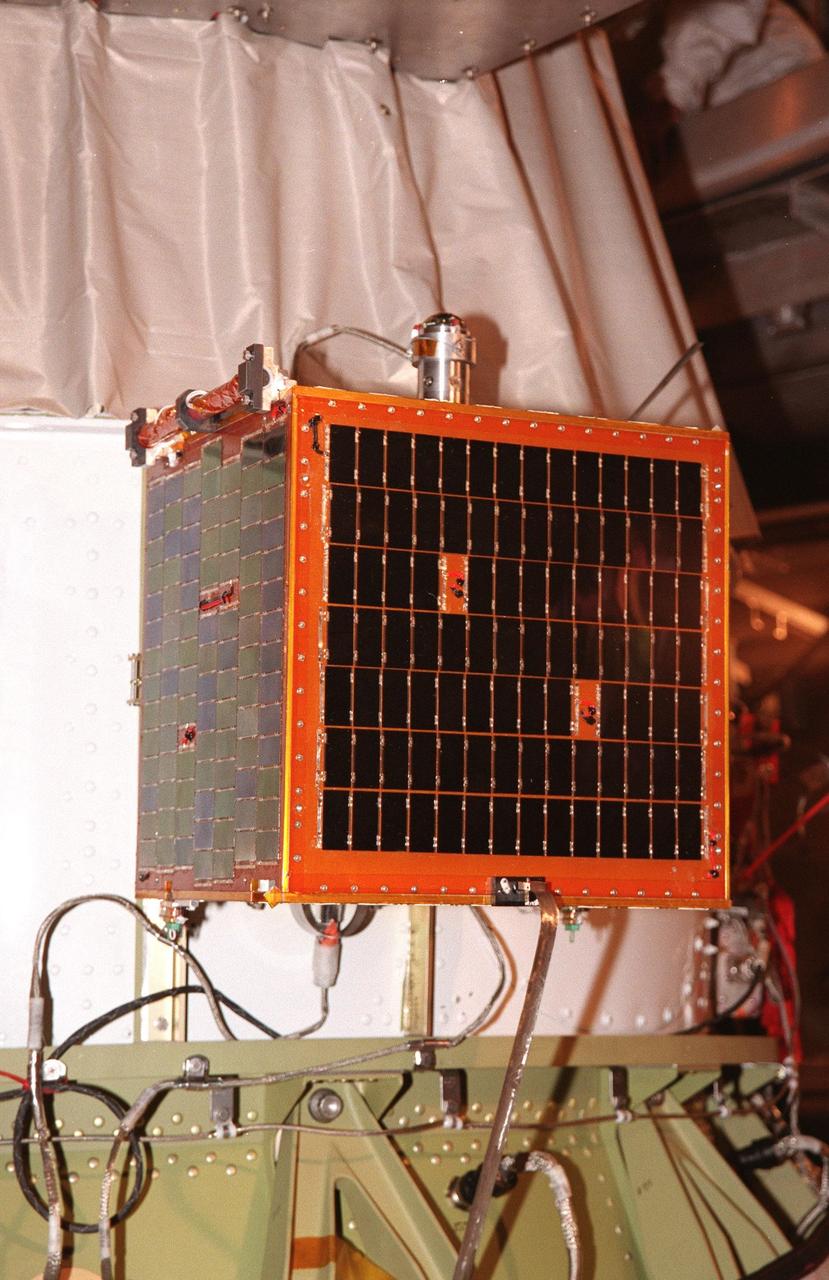
KENNEDY SPACE CENTER, FLA. -- Attached to the second stage of a Boeing Delta II at Pad 17A, Cape Canaveral Air Station, is the Students for the Exploration and Development of Space Satellite-1 (SEDSat-1). An international project, SEDSat-1 is a secondary payload on the Deep Space 1 mission and will be deployed 88 minutes after launch over Hawaii. The satellite includes cameras for imaging Earth, a unique attitude determination system, and amateur radio communication capabilities. Deep Space 1, targeted for launch on Oct. 24, is the first flight in NASA's New Millennium Program and is designed to validate 12 new technologies for scientific space missions of the next century
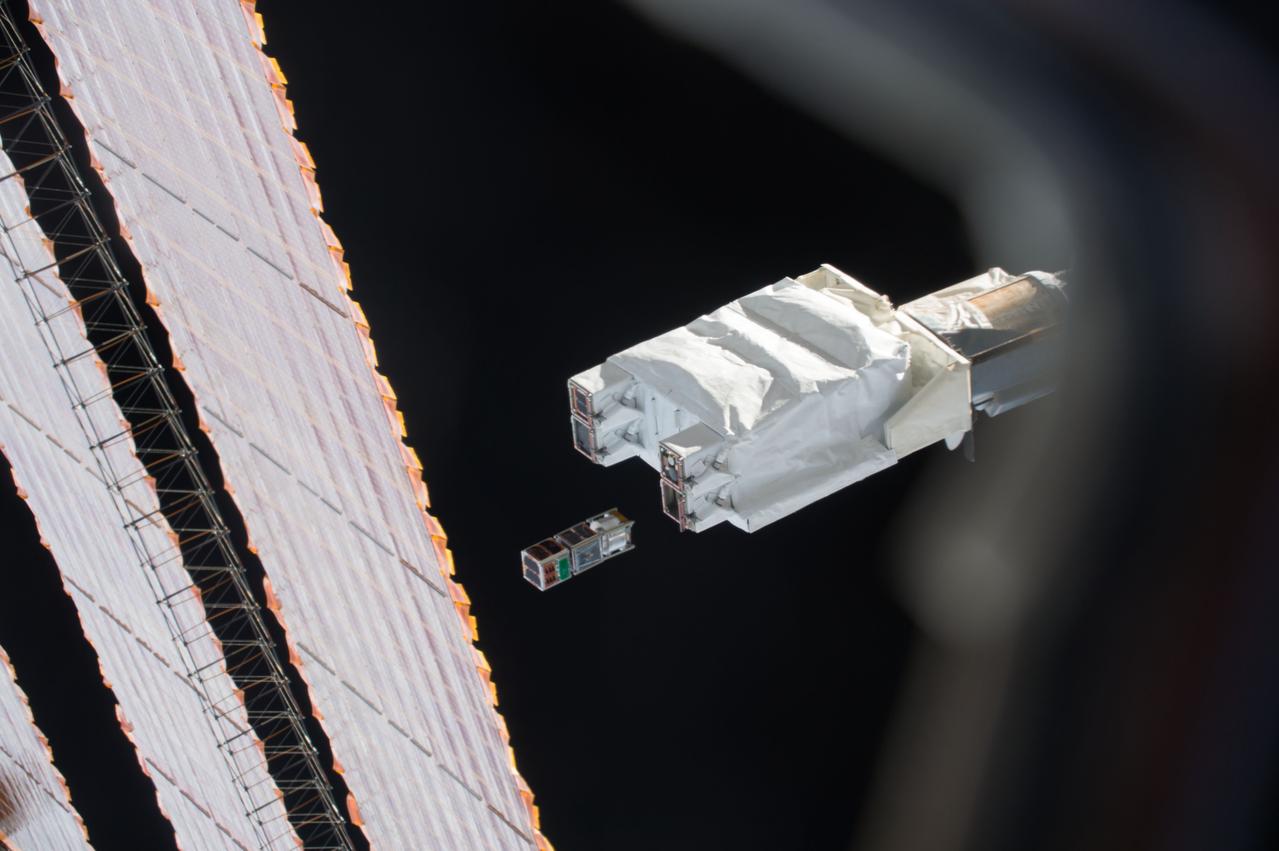
iss050e031198 (1/17/2017) --- Photo documentation of the Japanese-Small Satellite Orbital Deployer-6 (J-SSOD-6) deployment of the ITF-2, Waseda-SAT3 and Freedom CubeSats. The Imagine The Future-2 (ITF-2) CubeSat mission supports amateur radio networking by testing a micro engineered 1/20 wavelength small antenna. The WASEDA SAT-3 is a CubeSat developed by Waseda University aiming to test an ultra-light drag chute for accelerated deorbit. An LCD projector shows images on the chute with imagery sent back to Earth via an onboard camera. FREEDOM is a 1 Unit (1U) CubeSat developed by the Nakashimada Engineering Works and the Tohoku University to demonstrate a deployable deorbit device “DOM” for application in future missions for space debris mitigation.
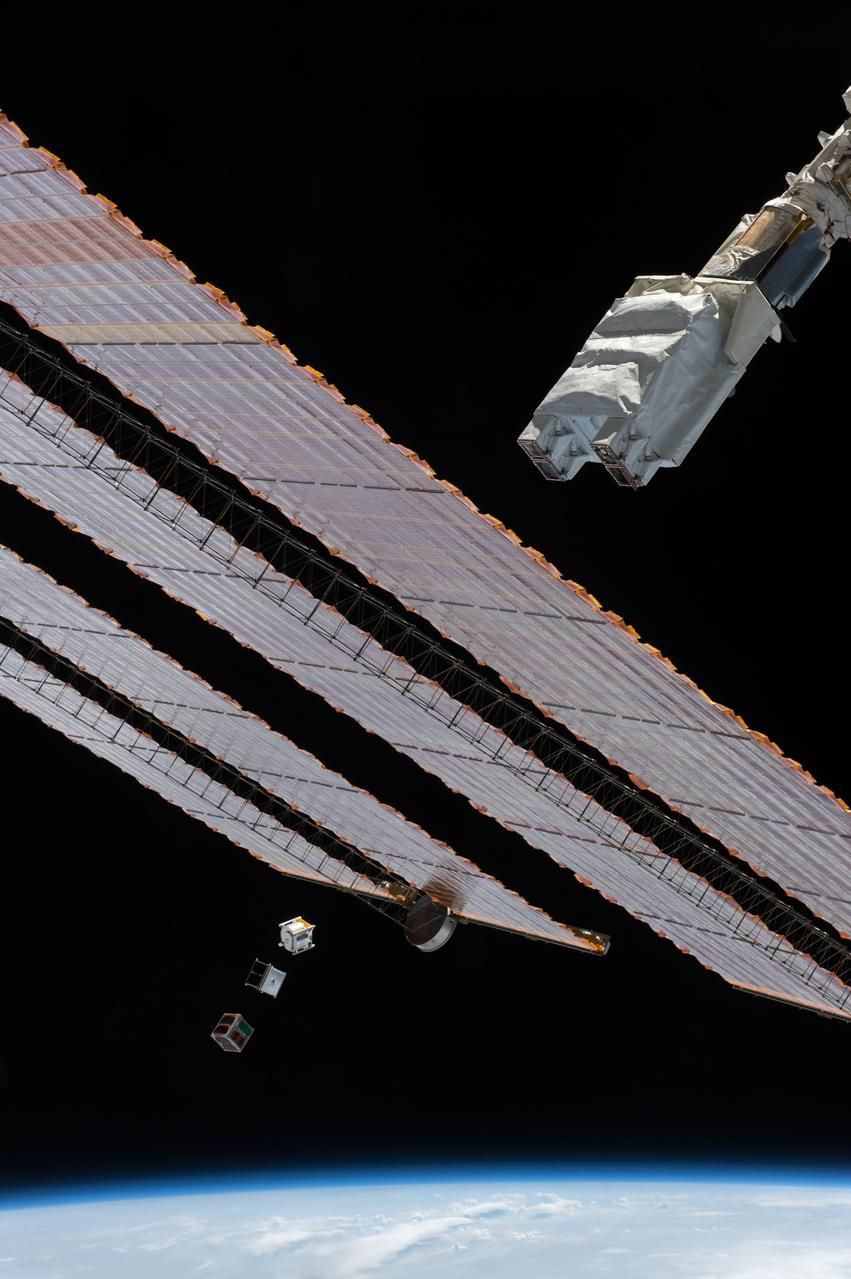
iss050e032565 (1/17/2017) --- Photo documentation of the Japanese-Small Satellite Orbital Deployer-6 (J-SSOD-6) deployment of the ITF-2, Waseda-SAT3 and Freedom CubeSats. The Imagine The Future-2 (ITF-2) CubeSat mission supports amateur radio networking by testing a micro engineered 1/20 wavelength small antenna. The WASEDA SAT-3 is a CubeSat developed by Waseda University aiming to test an ultra-light drag chute for accelerated deorbit. An LCD projector shows images on the chute with imagery sent back to Earth via an onboard camera. FREEDOM is a 1 Unit (1U) CubeSat developed by the Nakashimada Engineering Works and the Tohoku University to demonstrate a deployable deorbit device “DOM” for application in future missions for space debris mitigation.
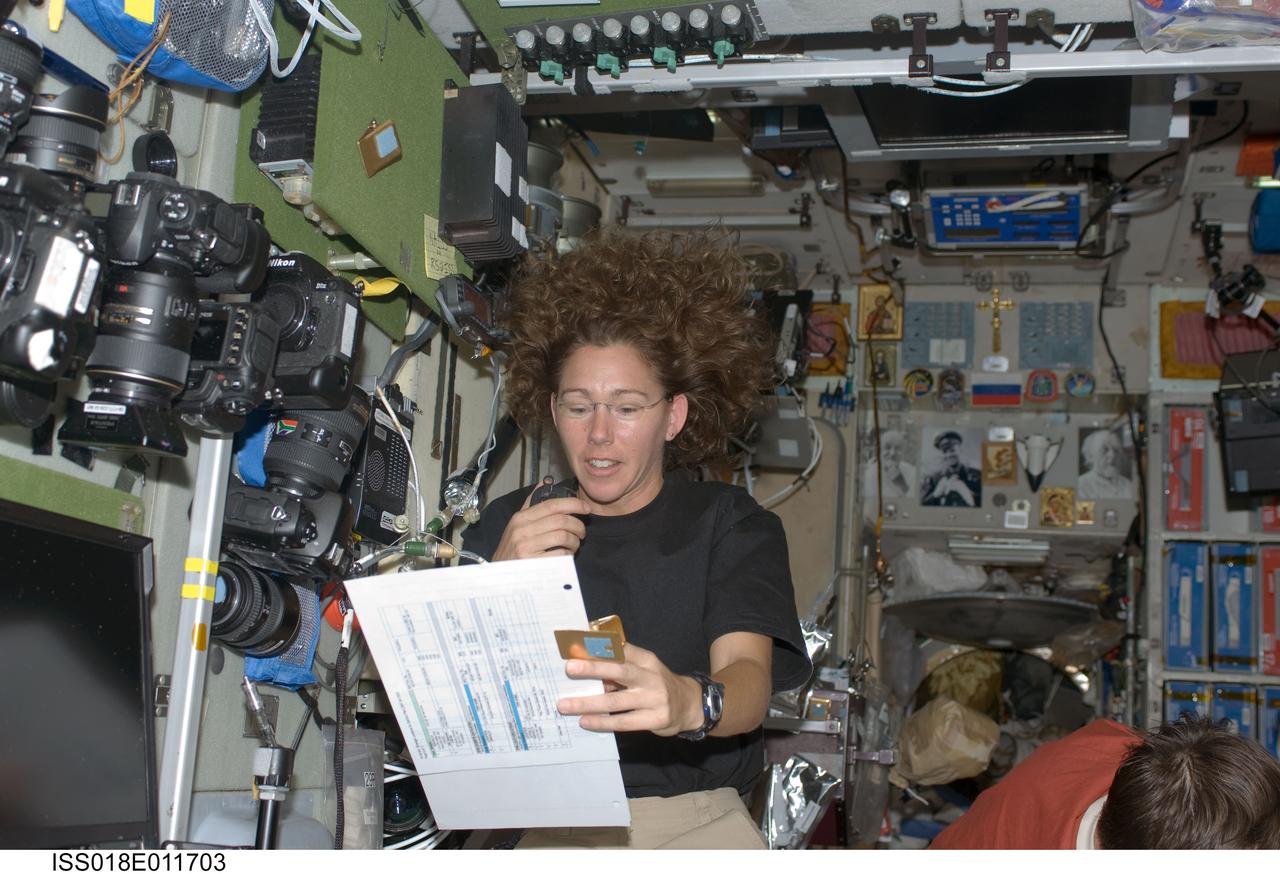
ISS018-E-011703 (9 Dec. 2008) --- Astronaut Sandra Magnus, Expedition 18 flight engineer, uses a communication system while holding a checklist in the Zvezda Service Module of the International Space Station.

ISS013-E-08021 (17 April 2006) --- Cosmonaut Pavel V. Vinogradov, Expedition 13 commander representing Russia's Federal Space Agency, writes notes while using a communication system in the Zvezda Service Module of the International Space Station.
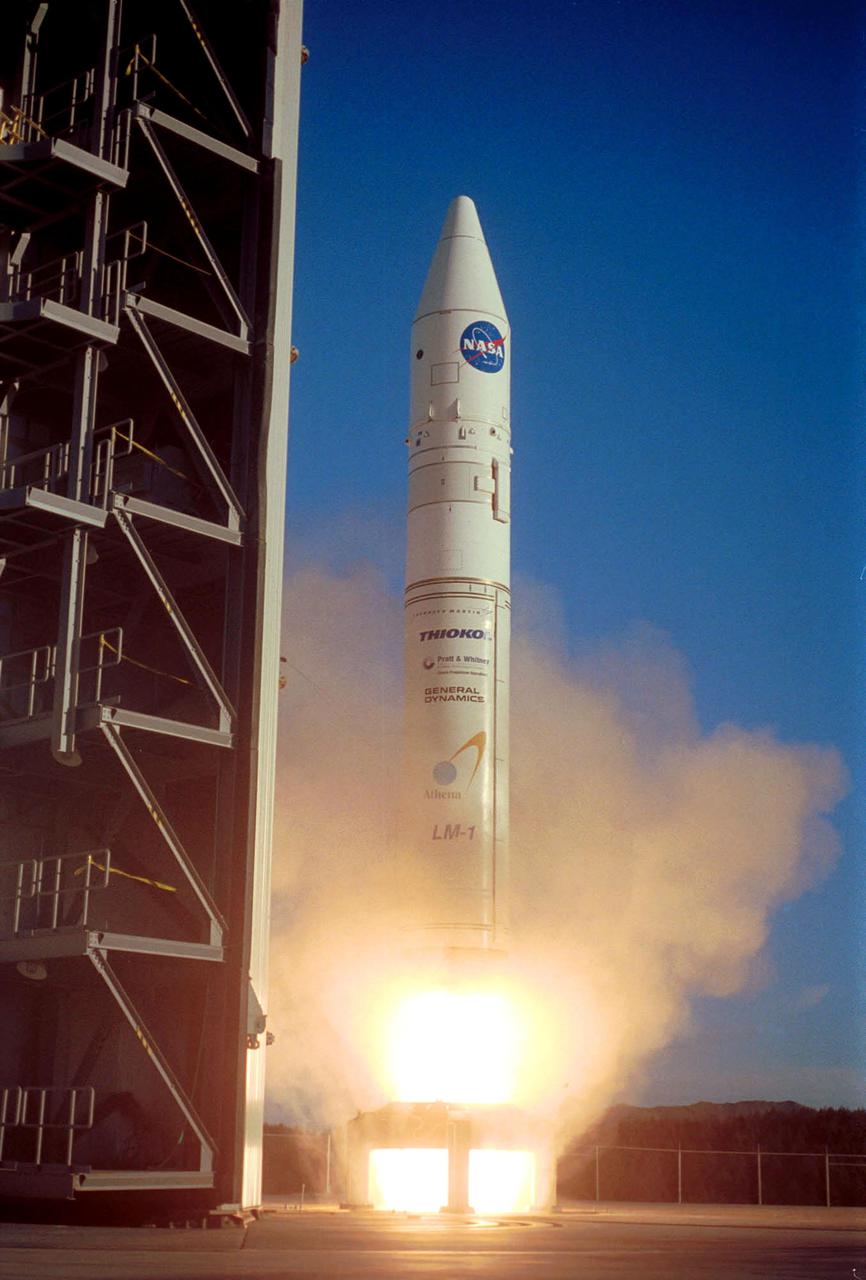
KODIAK ISLAND, Alaska -- Into a still-blue sky, a Lockheed Martin Athena I launch vehicle lifts off the launch pad at Kodiak Launch Complex (KSC) with the Kodiak Star spacecraft on board. Liftoff occurred at 10:40 p.m. EDT, Sept. 29. The Kodiak Star payload consists of four satellites: PICOSat, PCSat, Sapphire and Starshine 3. Starshine is sponsored by NASA. The 200-pound sphere will be used by students to study orbital decay. The other three satellites, also on educational missions, are sponsored by the department of defense. PICOSat is a technology demonstration satellite with four experiments on board. PCSat was designed by midshipmen at the U.S. Naval Academy, and will become part of the amateur radio community's automatic position reporting system. Sapphire is a micro-satellite built by students at Stanford University and Washington University - St. Louis to test infrared sensors for space use. KLC is the newest commercial launch complex in the United States, ideal for launch payloads requiring low-Earth polar or sun-synchronous orbits