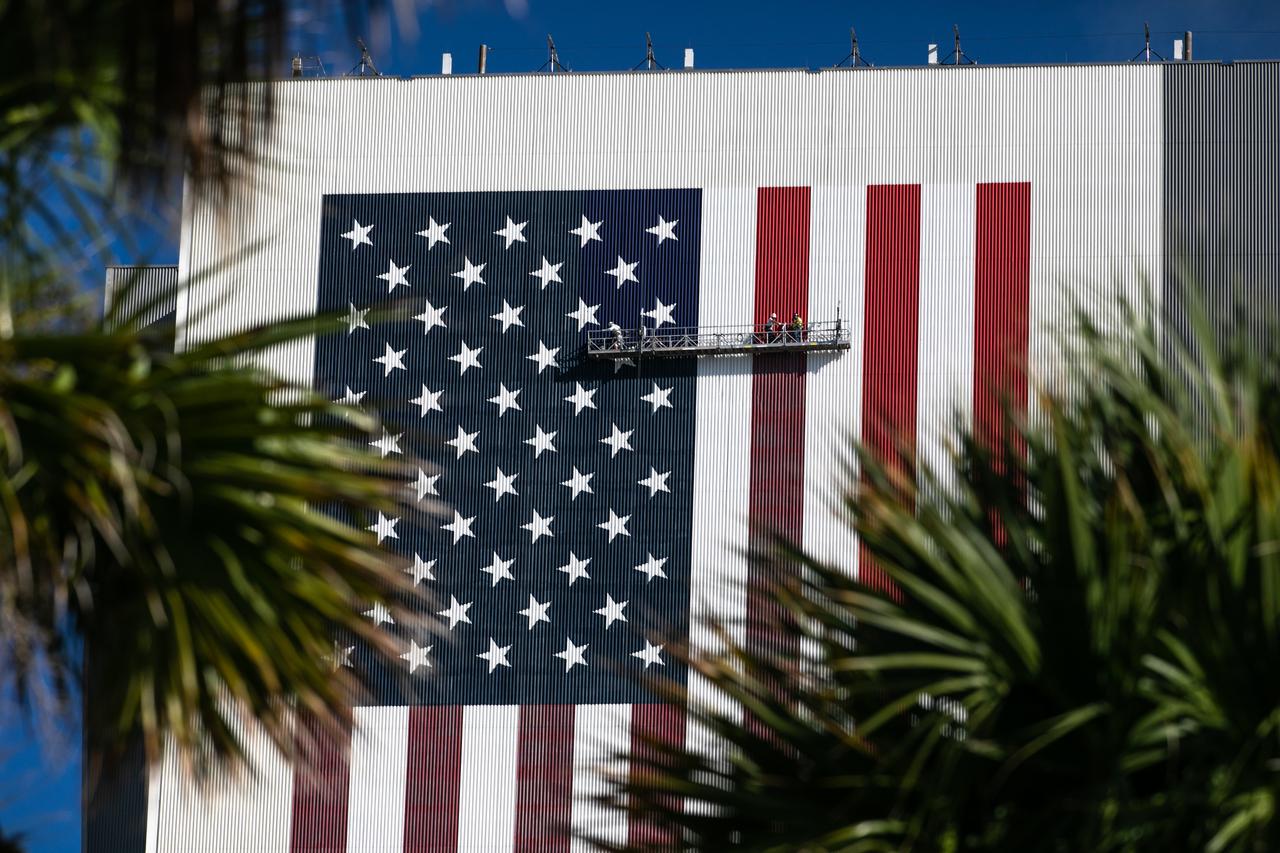
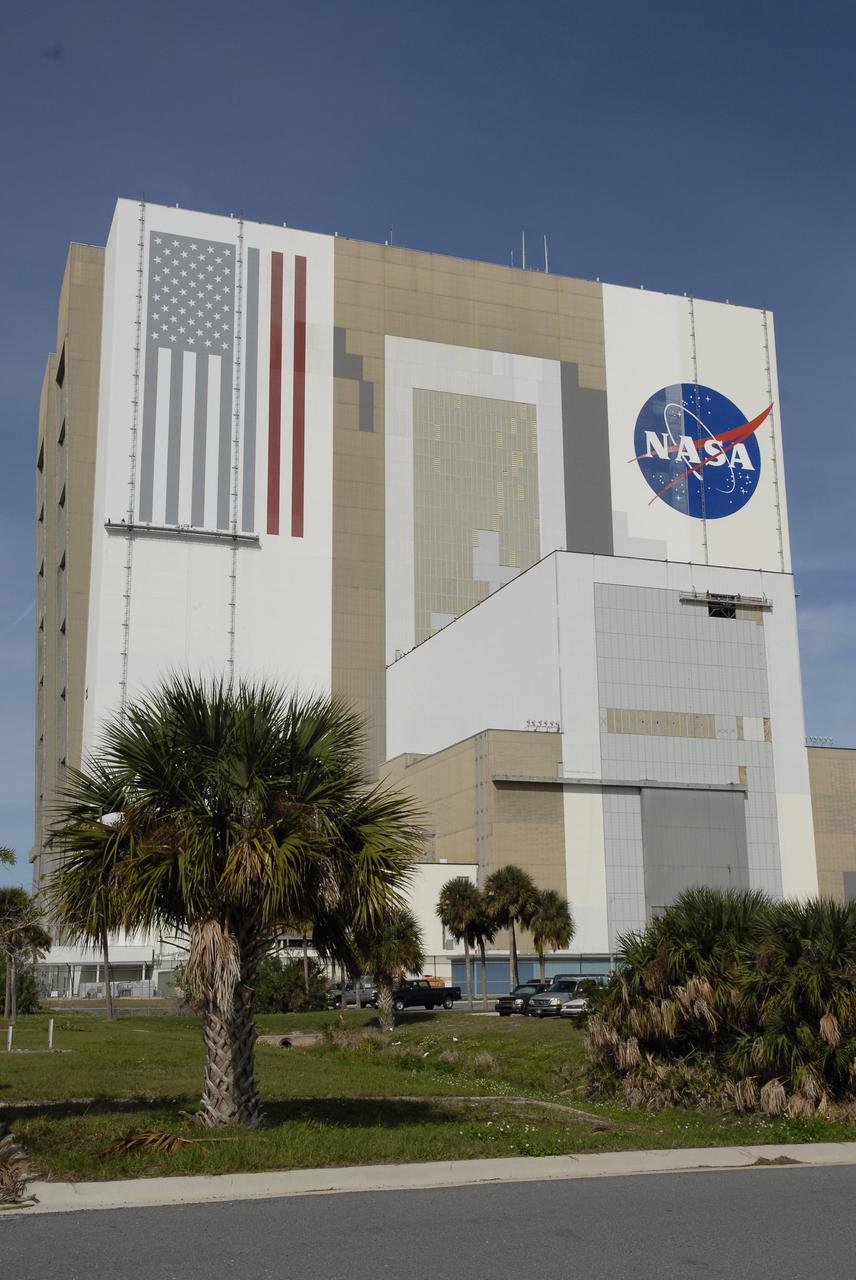
Painting of the U.S. flag continues on the 525-foot-tall Vehicle Assembly Building (VAB) at NASA’s Kennedy Space Center in Florida on Sept. 17, 2020. HM2 and H.I.S. Painting of Titusville, Florida, are repainting the American Flag on the iconic building. The flag is 209 feet long by 110 feet wide. Each star is more than six feet in diameter, and each stripe is nine feet wide. Exploration Ground Systems is overseeing upgrades to the VAB to support the launch of the Space Launch System and Orion for Artemis missions. Under the Artemis program, NASA will send the first woman and next man to the Moon.
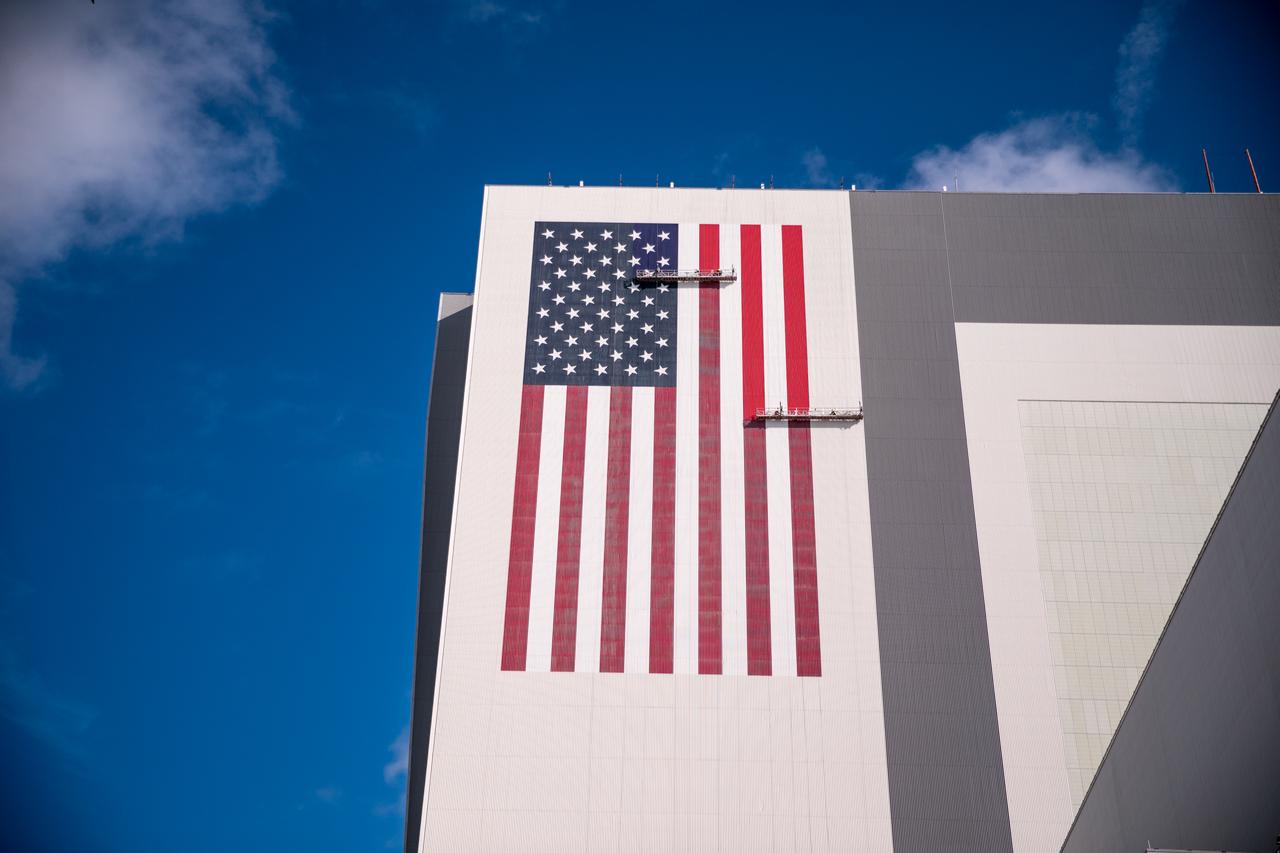
Painting of the U.S. flag continues on the 525-foot-tall Vehicle Assembly Building (VAB) at NASA’s Kennedy Space Center in Florida on Sept. 17, 2020. HM2 and H.I.S. Painting of Titusville, Florida, are repainting the American Flag on the iconic building. The flag is 209 feet long by 110 feet wide. Each star is more than six feet in diameter, and each stripe is nine feet wide. Exploration Ground Systems is overseeing upgrades to the VAB to support the launch of the Space Launch System and Orion for Artemis missions. Under the Artemis program, NASA will send the first woman and next man to the Moon.
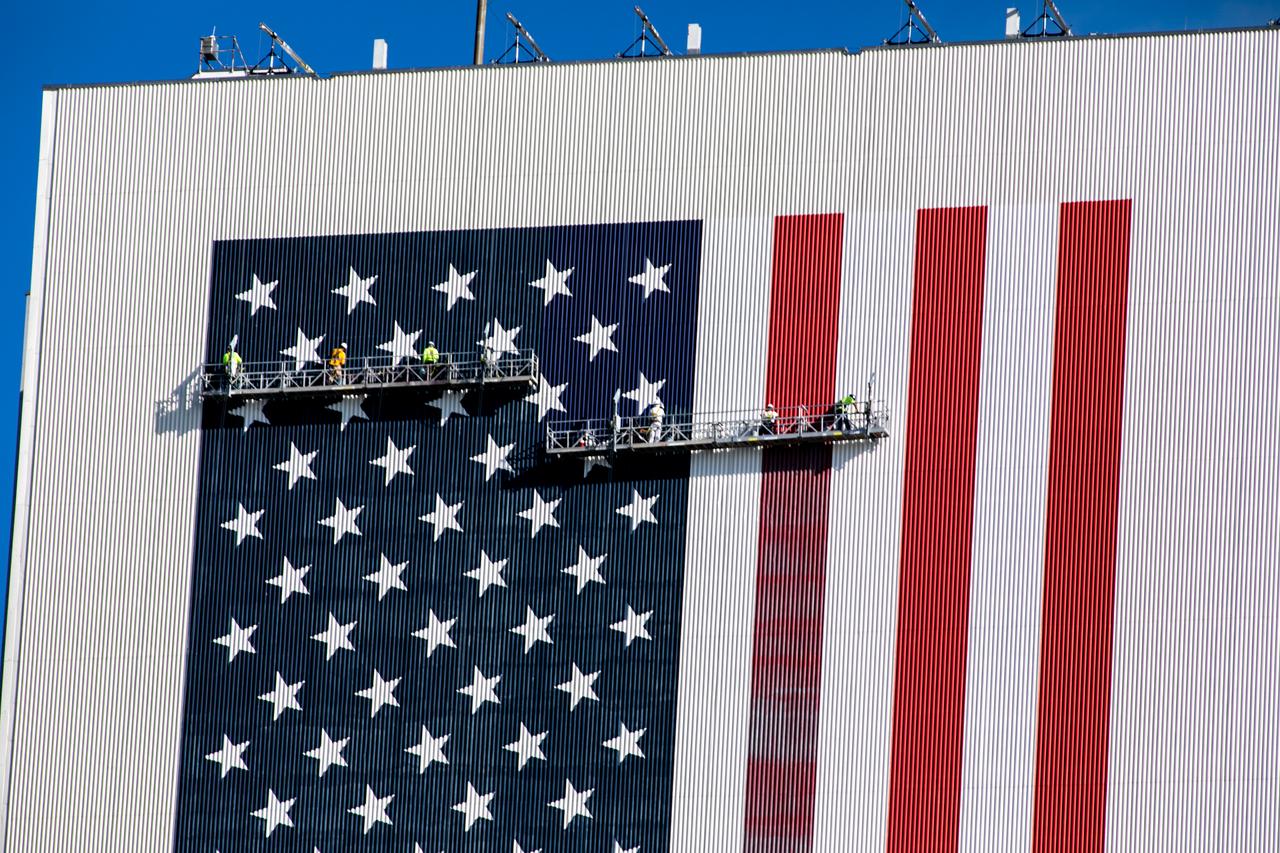
Painting of the U.S. flag continues on the 525-foot-tall Vehicle Assembly Building (VAB) at NASA’s Kennedy Space Center in Florida on Sept. 17, 2020. HM2 and H.I.S. Painting of Titusville, Florida, are repainting the American Flag on the iconic building. The flag is 209 feet long by 110 feet wide. Each star is more than six feet in diameter, and each stripe is nine feet wide. Exploration Ground Systems is overseeing upgrades to the VAB to support the launch of the Space Launch System and Orion for Artemis missions. Under the Artemis program, NASA will send the first woman and next man to the Moon.
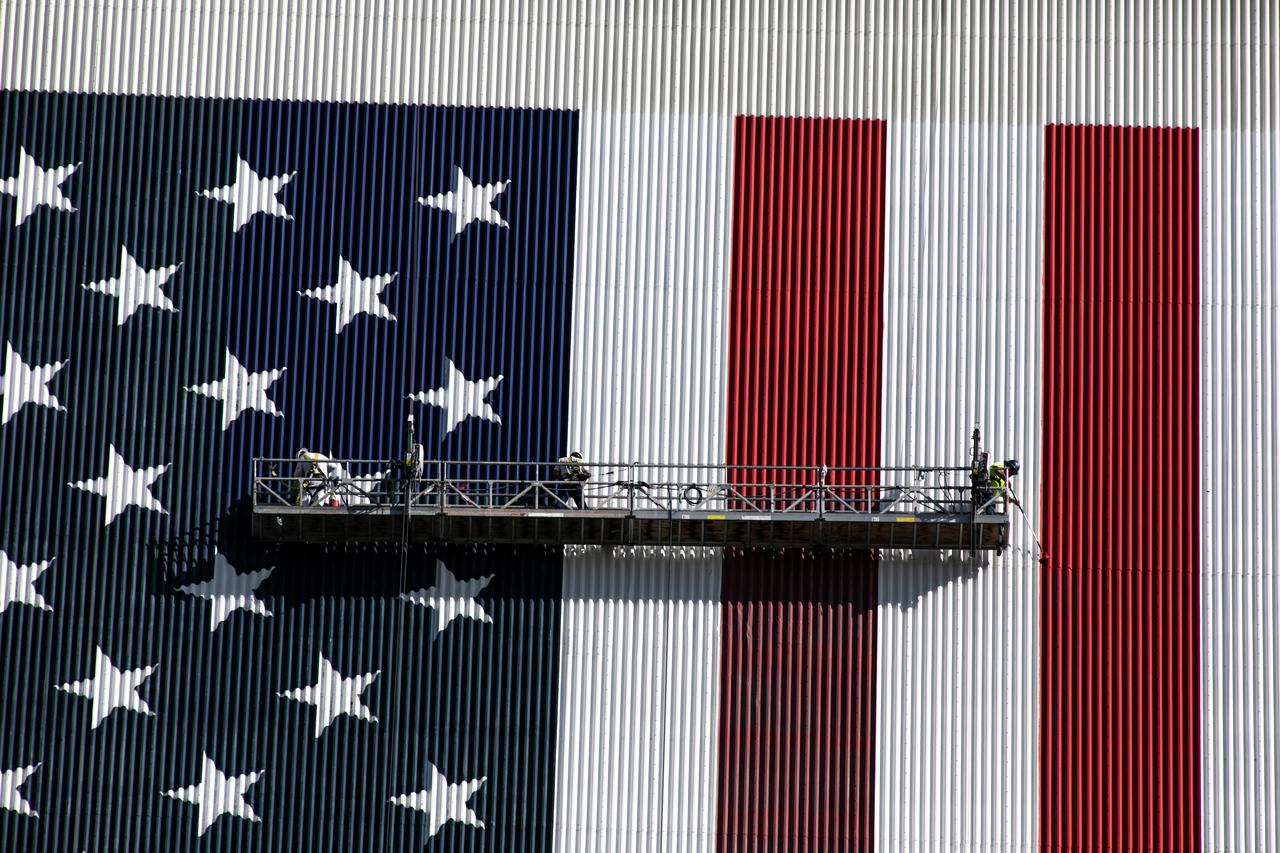
Painting of the U.S. flag continues on the 525-foot-tall Vehicle Assembly Building (VAB) in this close-up view at NASA’s Kennedy Space Center in Florida on Sept. 17, 2020. HM2 and H.I.S. Painting of Titusville, Florida, are repainting the American Flag on the iconic building. The flag is 209 feet long by 110 feet wide. Each star is more than six feet in diameter, and each stripe is nine feet wide. Exploration Ground Systems is overseeing upgrades to the VAB to support the launch of the Space Launch System and Orion for Artemis missions. Under the Artemis program, NASA will send the first woman and next man to the Moon.
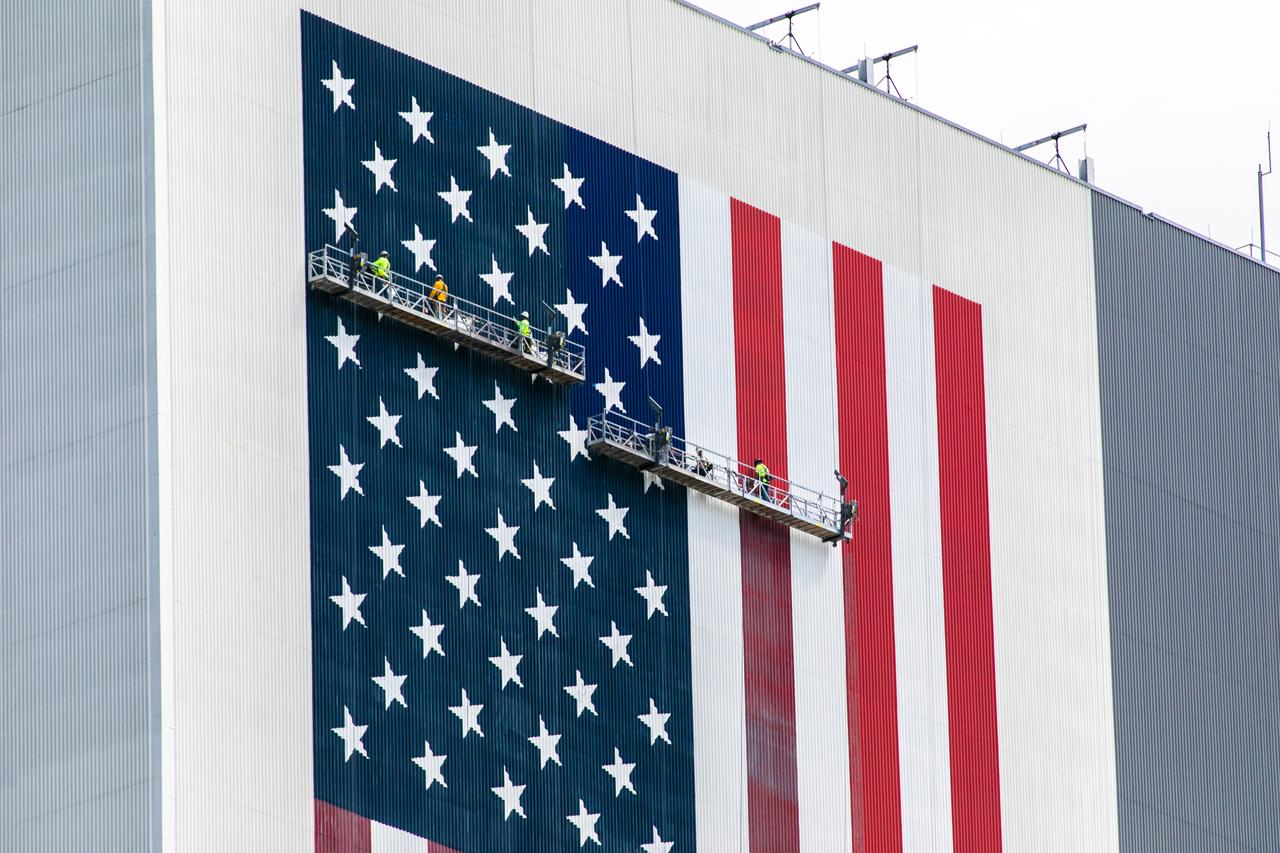
Painting of the U.S. flag continues on the 525-foot-tall Vehicle Assembly Building (VAB) in this close-up view at NASA’s Kennedy Space Center in Florida on Sept. 17, 2020. HM2 and H.I.S. Painting of Titusville, Florida, are repainting the American Flag on the iconic building. The flag is 209 feet long by 110 feet wide. Each star is more than six feet in diameter, and each stripe is nine feet wide. Exploration Ground Systems is overseeing upgrades to the VAB to support the launch of the Space Launch System and Orion for Artemis missions. Under the Artemis program, NASA will send the first woman and next man to the Moon.
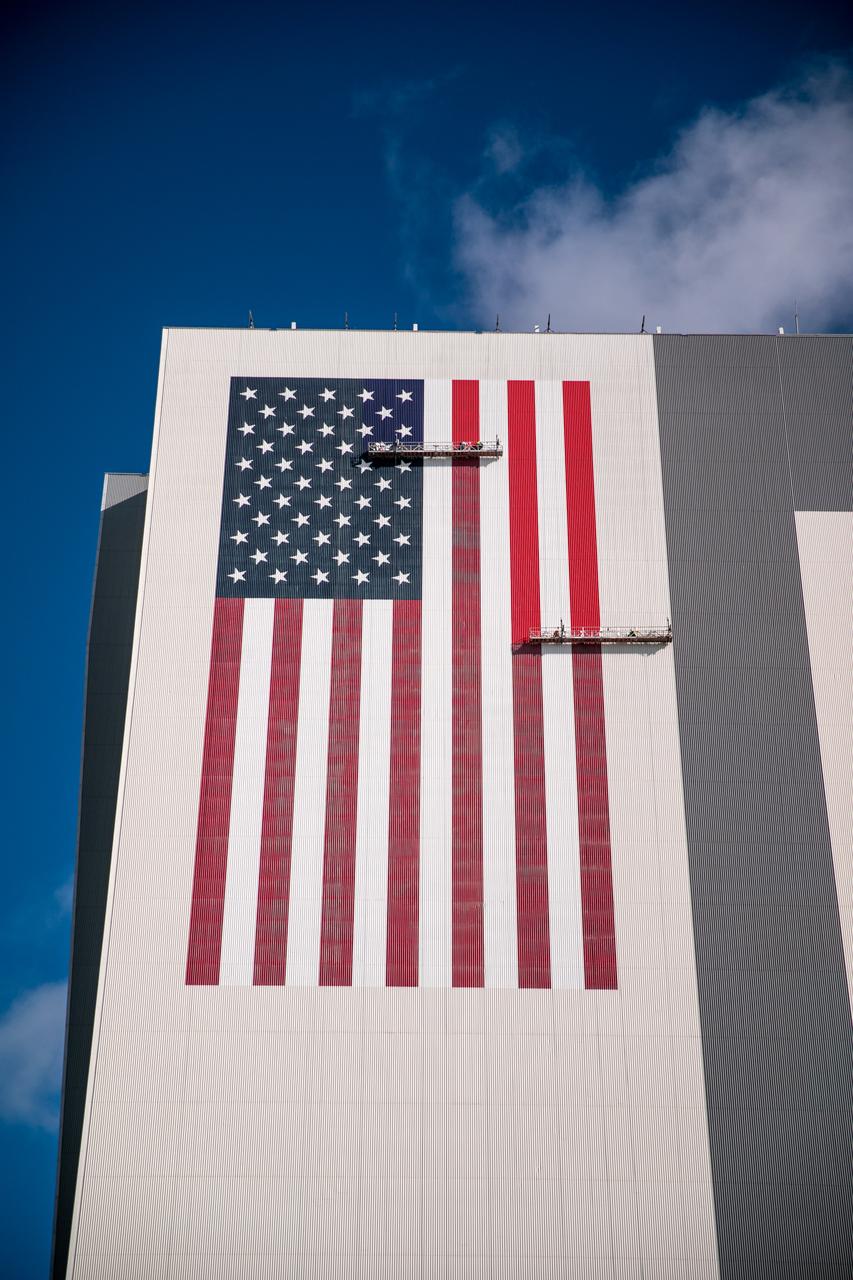
Painting of the U.S. flag continues on the 525-foot-tall Vehicle Assembly Building (VAB) at NASA’s Kennedy Space Center in Florida on Sept. 17, 2020. HM2 and H.I.S. Painting of Titusville, Florida, are repainting the American Flag on the iconic building. The flag is 209 feet long by 110 feet wide. Each star is more than six feet in diameter, and each stripe is nine feet wide. Exploration Ground Systems is overseeing upgrades to the VAB to support the launch of the Space Launch System and Orion for Artemis missions. Under the Artemis program, NASA will send the first woman and next man to the Moon.
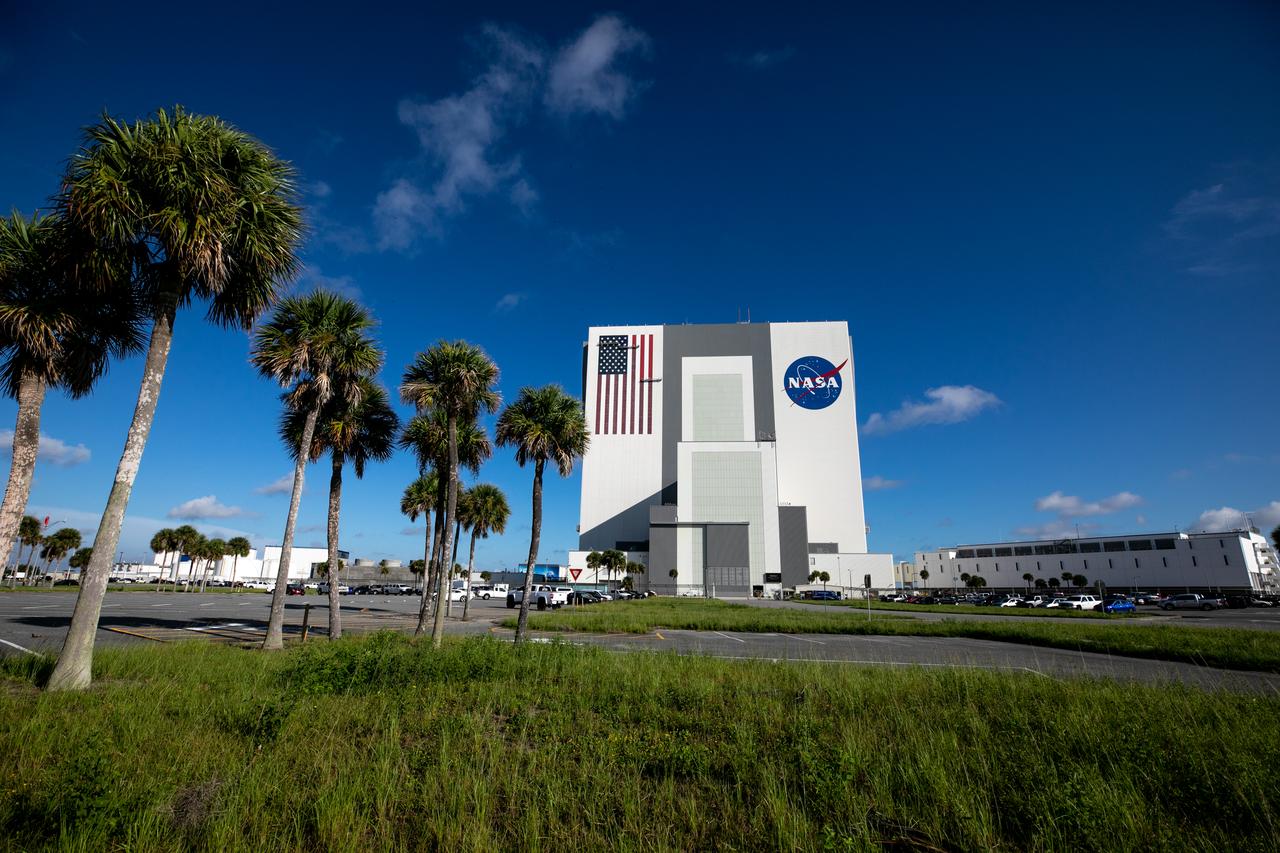
A view of the 525-foot-tall Vehicle Assembly Building (VAB) at NASA’s Kennedy Space Center in Florida, as painting of the U.S. flag continues on the iconic building on Sept. 17, 2020. HM2 and H.I.S. Painting of Titusville, Florida, are repainting the American Flag on the building. The flag is 209 feet long by 110 feet wide. Each star is more than six feet in diameter, and each stripe is nine feet wide. Exploration Ground Systems is overseeing upgrades to the VAB to support the launch of the Space Launch System and Orion for Artemis missions. Under the Artemis program, NASA will send the first woman and next man to the Moon.
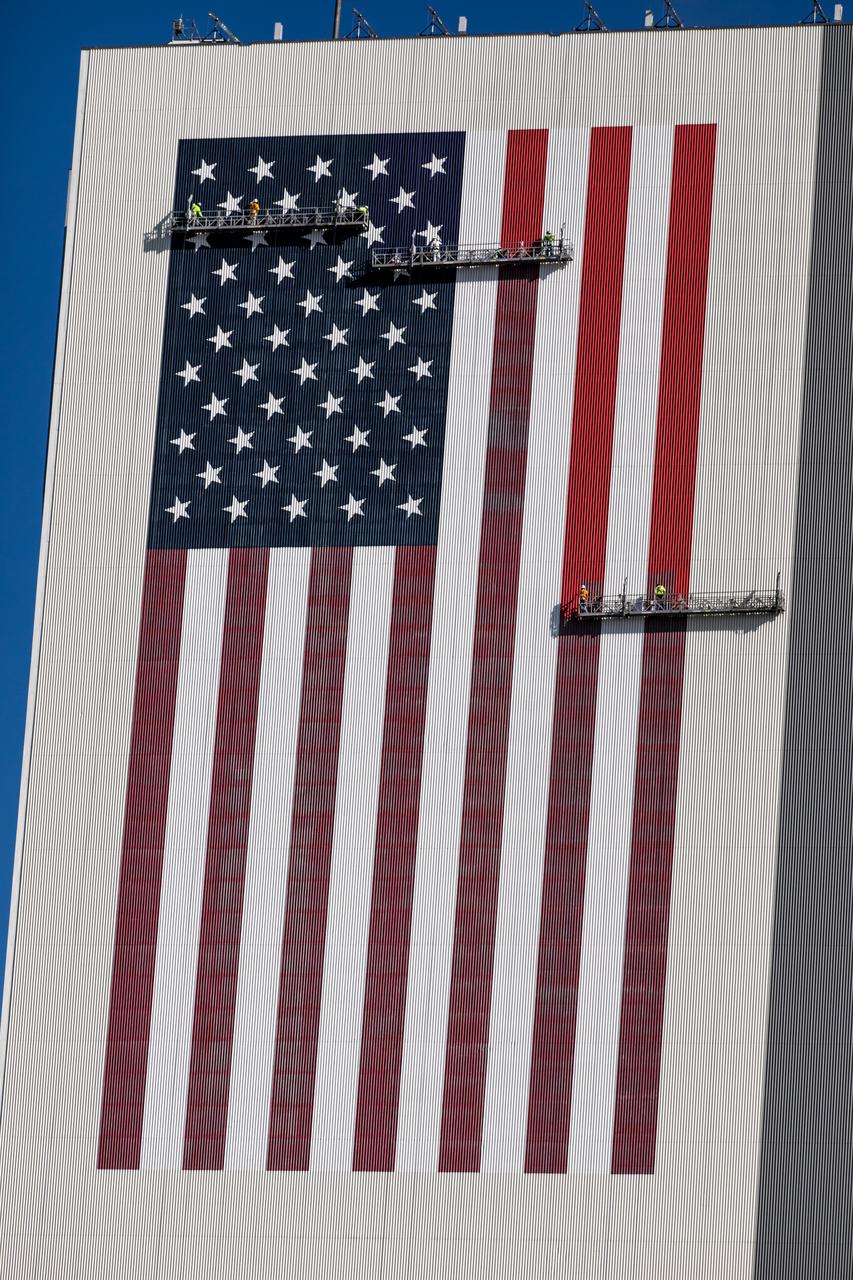
Painting of the U.S. flag continues on the 525-foot-tall Vehicle Assembly Building (VAB) at NASA’s Kennedy Space Center in Florida on Sept. 17, 2020. HM2 and H.I.S. Painting of Titusville, Florida, are repainting the American Flag on the iconic building. The flag is 209 feet long by 110 feet wide. Each star is more than six feet in diameter, and each stripe is nine feet wide. Exploration Ground Systems is overseeing upgrades to the VAB to support the launch of the Space Launch System and Orion for Artemis missions. Under the Artemis program, NASA will send the first woman and next man to the Moon.
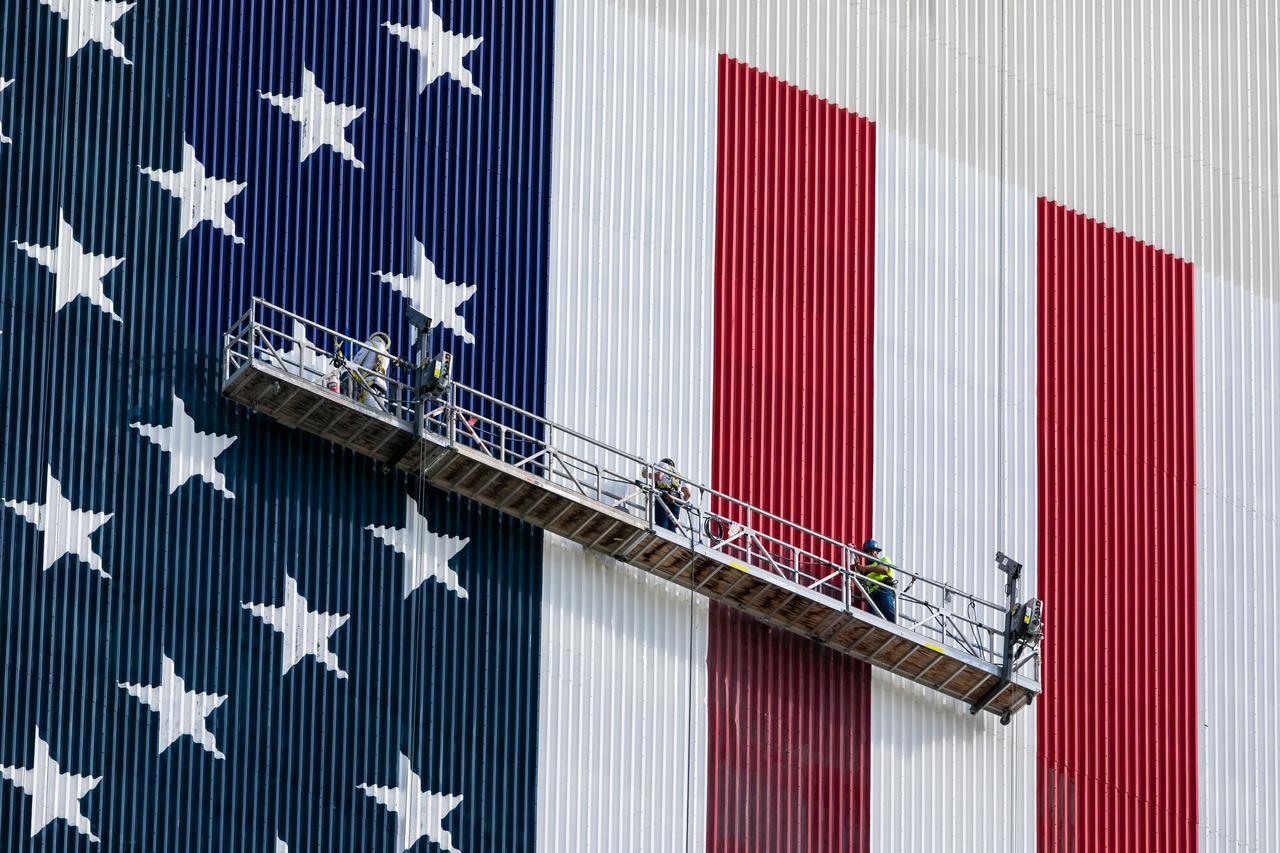
Painting of the U.S. flag continues on the 525-foot-tall Vehicle Assembly Building (VAB) in this close-up view at NASA’s Kennedy Space Center in Florida on Sept. 17, 2020. HM2 and H.I.S. Painting of Titusville, Florida, are repainting the American Flag on the iconic building. The flag is 209 feet long by 110 feet wide. Each star is more than six feet in diameter, and each stripe is nine feet wide. Exploration Ground Systems is overseeing upgrades to the VAB to support the launch of the Space Launch System and Orion for Artemis missions. Under the Artemis program, NASA will send the first woman and next man to the Moon.
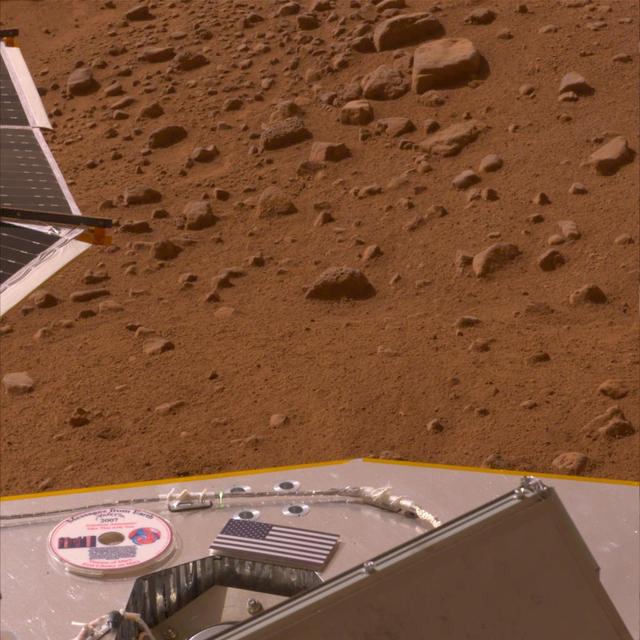
American Flag and Mini-DVD Attached to Deck of Phoenix
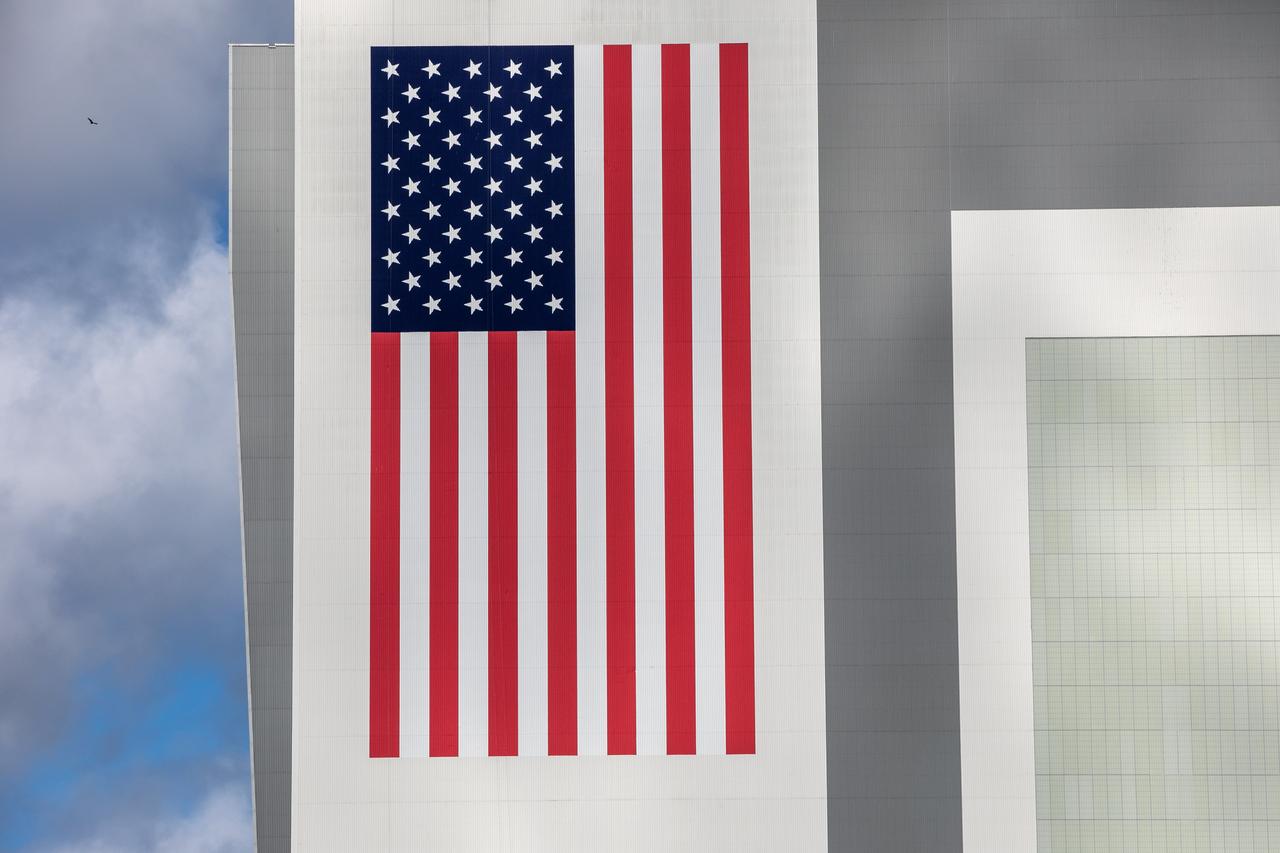
A freshly painted American Flag on the Vehicle Assembly Building (VAB) at NASA’s Kennedy Space Center in Florida is photographed on Oct. 27, 2020. HM2 and H.I.S. Painting of Titusville, Florida, began repainting the NASA logo, referred to as the meatball, and flag on the iconic facility in May. The flag measures 209 feet long by 110 feet wide; each star is more than six feet in diameter, and each stripe is nine feet wide. It took over 500 gallons of paint to repaint the flag and the 110’ X 132’ meatball.

Seen on Oct. 27, 2020, is the Vehicle Assembly Building (VAB) with a vibrant NASA logo, referred to as the meatball, and American Flag at NASA’s Kennedy Space Center in Florida. HM2 and H.I.S. Painting of Titusville, Florida, began repainting the meatball and flag on the iconic facility in May and recently completed the project. The VAB was last painted in 2007, when repairs where completed after Hurricanes Frances and Jeanne tore 845 panels off the building in 2004. It took over 500 gallons of paint to repaint the 209’ X 110’ flag and the 110’ X 132’ meatball.

A ground-level view of a vibrant NASA logo, referred to as the meatball, and American Flag on the Vehicle Assembly Building (VAB) at NASA’s Kennedy Space Center in Florida on Oct. 27, 2020. HM2 and H.I.S. Painting of Titusville, Florida, began repainting the meatball and flag on the iconic facility in May and recently completed the project. The VAB was last painted in 2007, when repairs where completed after Hurricanes Frances and Jeanne tore 845 panels off the building in 2004. It took over 500 gallons of paint to repaint the 209’ X 110’ flag and the 110’ X 132’ meatball.

Seen on Oct. 27, 2020, is the Vehicle Assembly Building (VAB) with a vibrant NASA logo, referred to as the meatball, and American Flag at NASA’s Kennedy Space Center in Florida. HM2 and H.I.S. Painting of Titusville, Florida, began repainting the meatball and flag on the iconic facility in May and recently completed the project. The VAB was last painted in 2007, when repairs where completed after Hurricanes Frances and Jeanne tore 845 panels off the building in 2004. It took over 500 gallons of paint to repaint the 209’ X 110’ flag and the 110’ X 132’ meatball.

A view of the Vehicle Assembly Building (VAB) with a vibrant NASA logo, referred to as the meatball, and American Flag at NASA’s Kennedy Space Center in Florida on Oct. 27, 2020. HM2 and H.I.S. Painting of Titusville, Florida, began repainting the meatball and flag on the iconic facility in May and recently completed the project. The VAB was last painted in 2007, when repairs where completed after Hurricanes Frances and Jeanne tore 845 panels off the building in 2004. It took over 500 gallons of paint to repaint the 209’ X 110’ flag and the 110’ X 132’ meatball.

A view of the Vehicle Assembly Building (VAB) with a vibrant NASA logo, referred to as the meatball, and American Flag at NASA’s Kennedy Space Center in Florida on Oct. 27, 2020. HM2 and H.I.S. Painting of Titusville, Florida, began repainting the meatball and flag on the iconic facility in May and recently completed the project. The VAB was last painted in 2007, when repairs where completed after Hurricanes Frances and Jeanne tore 845 panels off the building in 2004. It took over 500 gallons of paint to repaint the 209’ X 110’ flag and the 110’ X 132’ meatball.

A ground-level view of a vibrant NASA logo, referred to as the meatball, and American Flag on the Vehicle Assembly Building (VAB) at NASA’s Kennedy Space Center in Florida on Oct. 27, 2020. HM2 and H.I.S. Painting of Titusville, Florida, began repainting the meatball and flag on the iconic facility in May and recently completed the project. The VAB was last painted in 2007, when repairs where completed after Hurricanes Frances and Jeanne tore 845 panels off the building in 2004. It took over 500 gallons of paint to repaint the 209’ X 110’ flag and the 110’ X 132’ meatball.
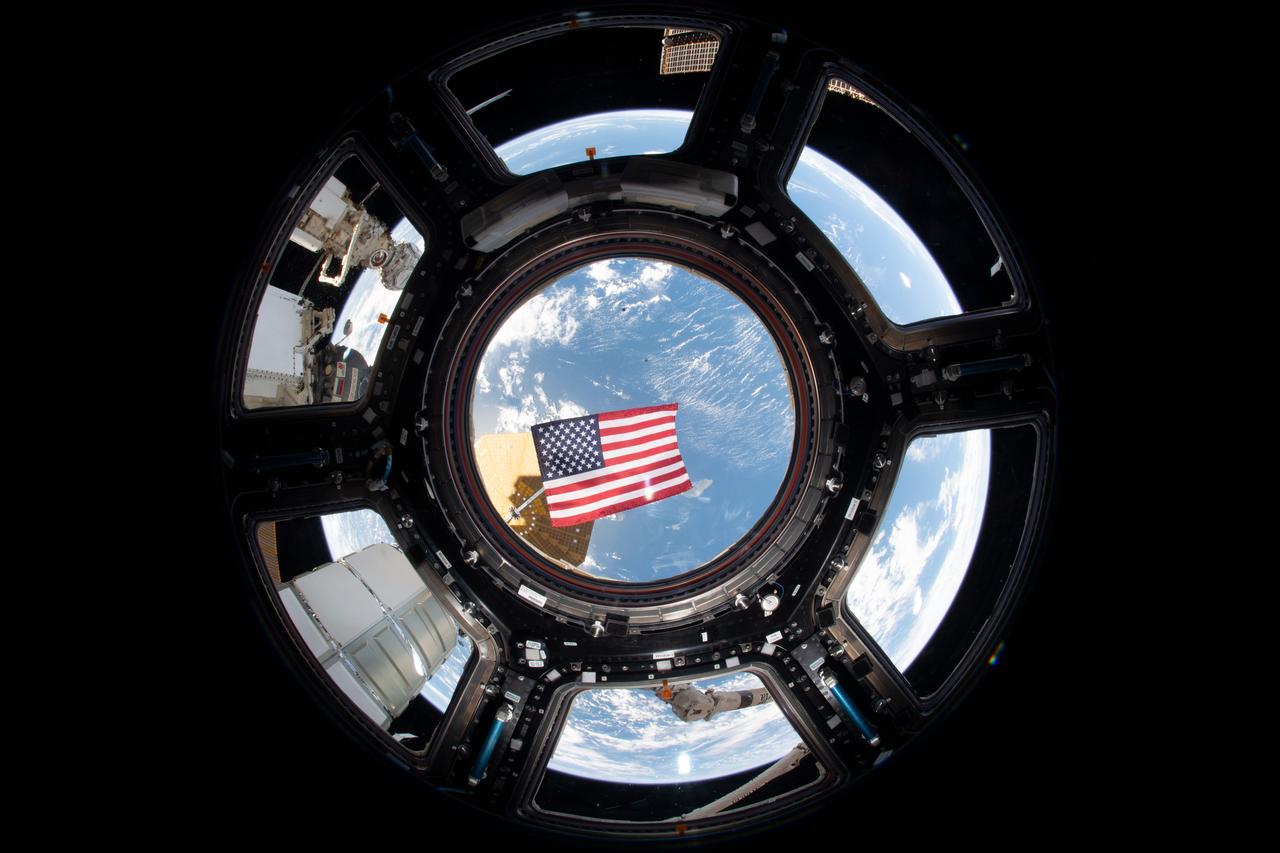
Photo of the American flag floating in front of all seven windows inside the Cupola during Expedition 68.
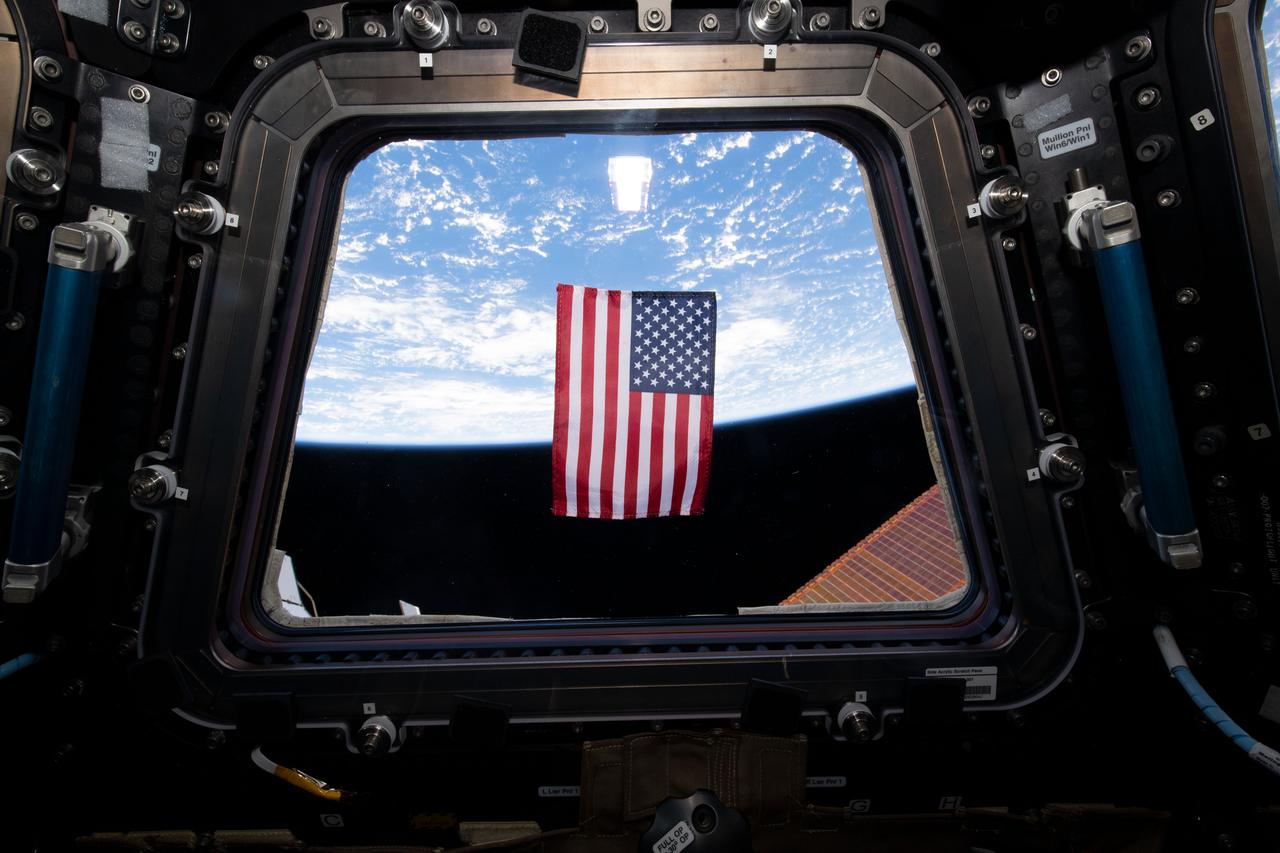
Photo taken during a crew activity with the American flag floating in front of the window in the Cupola during Expedition 68.
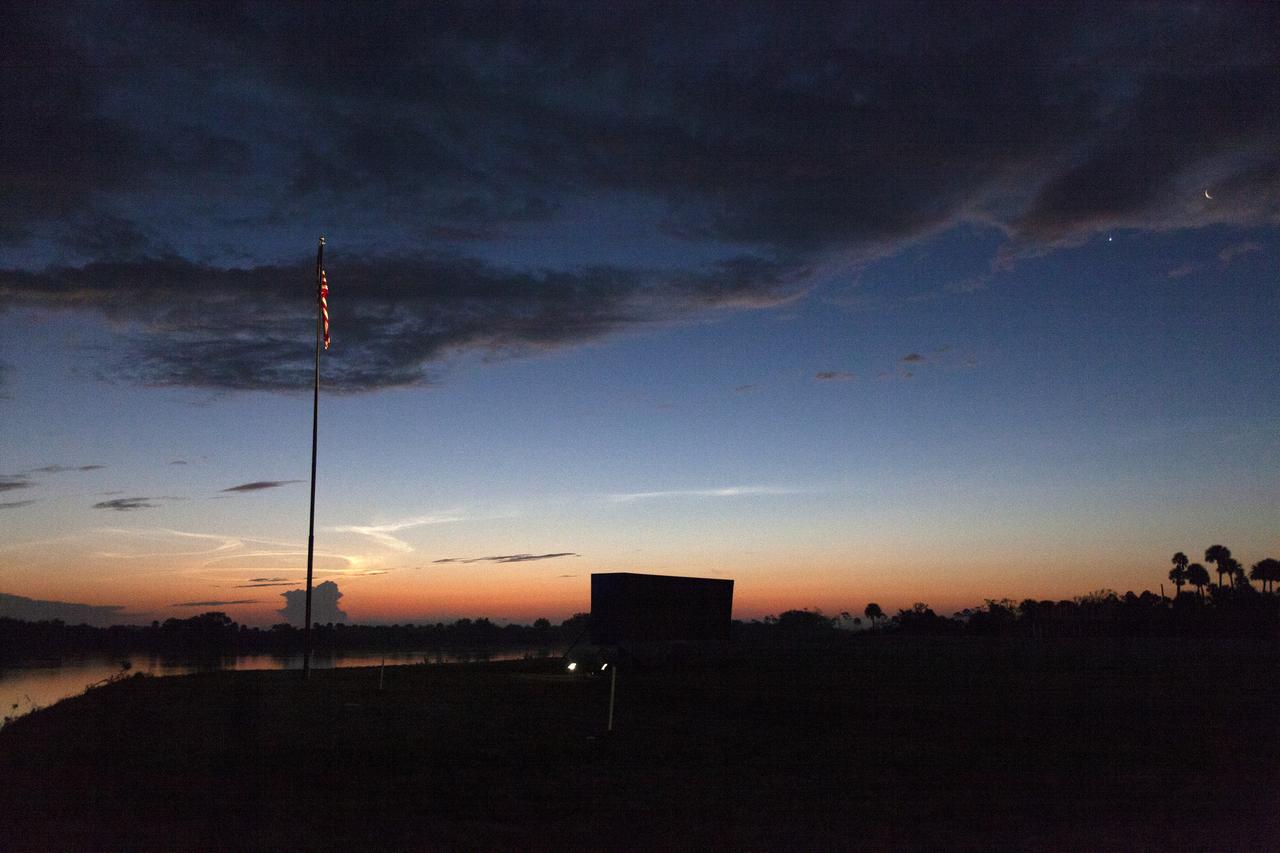
A sunrise serves as the backdrop for the countdown clock and American Flag near the Press Site at NASA’s Kennedy Space Center in Florida following the successful launch of SpaceX’s uncrewed Demo-1 flight test from Launch Complex 39A on March 2, 2019. The company’s Crew Dragon spacecraft lifted off atop a Falcon 9 rocket and traveled to the International Space Station, where it validated end-to-end systems and capabilities in preparation for certification to fly crew.
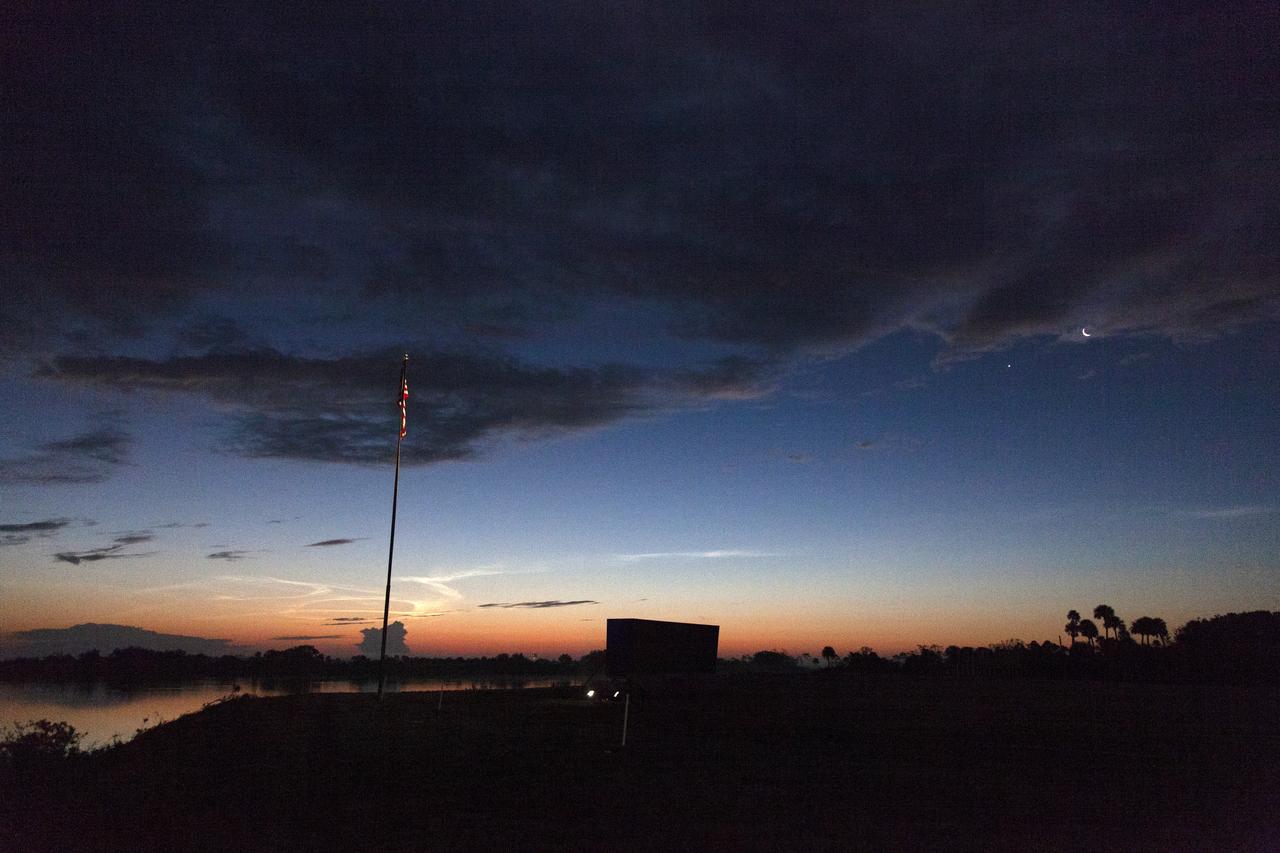
A sunrise serves as the backdrop for the countdown clock and American Flag near the Press Site at NASA’s Kennedy Space Center in Florida following the successful launch of SpaceX’s uncrewed Demo-1 flight test from Launch Complex 39A on March 2, 2019. The company’s Crew Dragon spacecraft lifted off atop a Falcon 9 rocket and traveled to the International Space Station, where it validated end-to-end systems and capabilities in preparation for certification to fly crew.
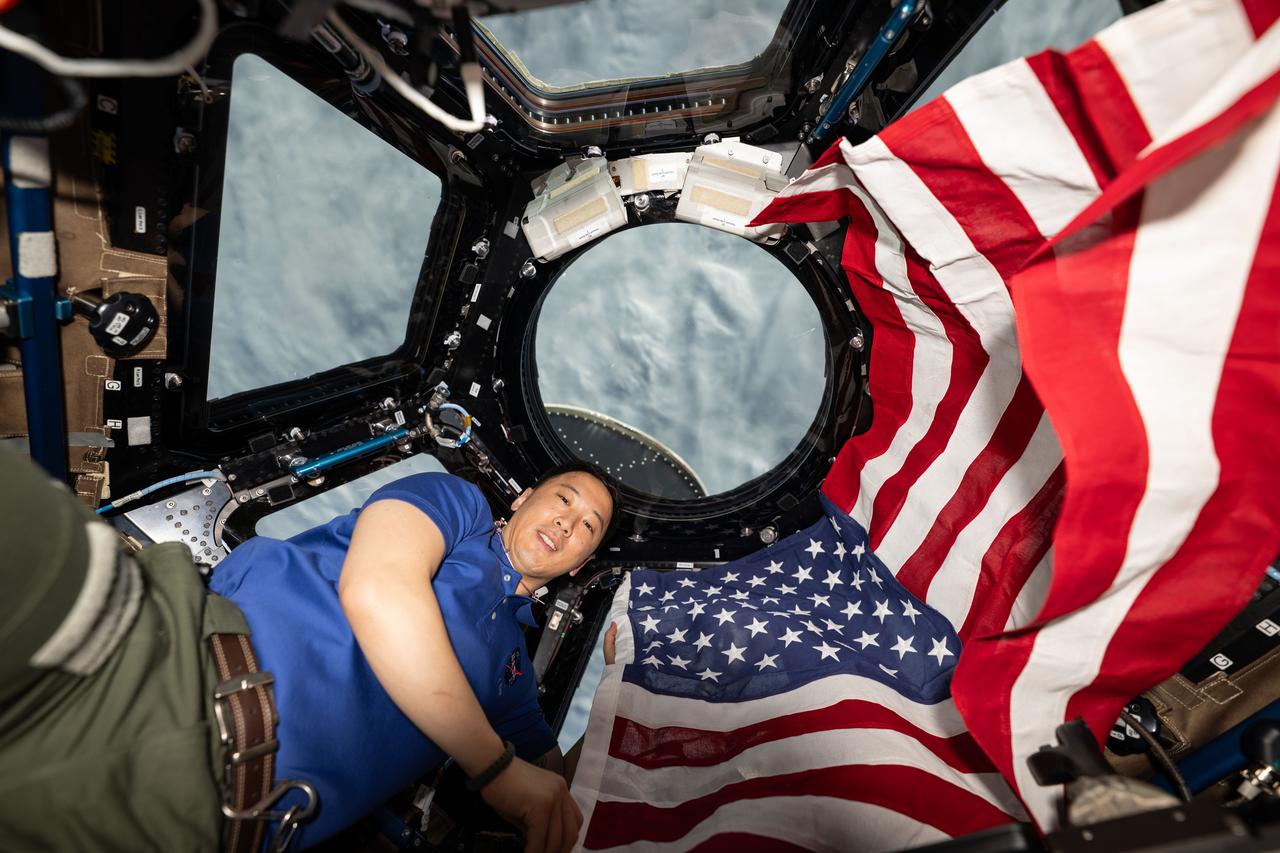
iss073e0420732 (July 4, 2025) --- NASA astronaut and Expedition 73 Flight Engineer Jonnny Kim poses for a portrait with the American flag on the Fourth of July, or Independence Day, inside the International Space Station's "window to the world," the cupola. The orbital outpost was soaring 268 miles above a cloudy Atlantic Ocean at the time of this photograph.
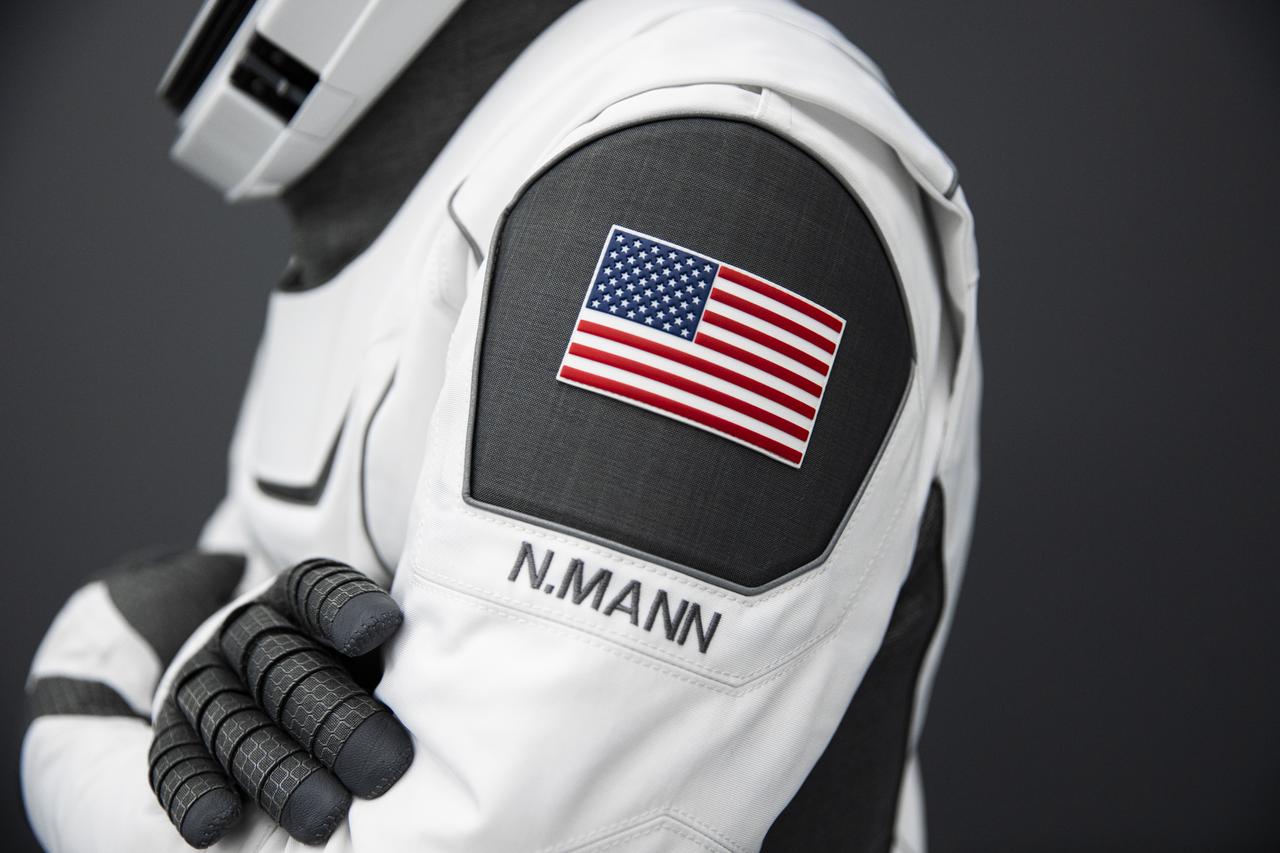
A SpaceX launch and entry suit bears an American flag, and the name of NASA Astronaut Nicole Mann, who will serve as the commander of NASA's SpaceX Crew-5 mission to the International Space Station.
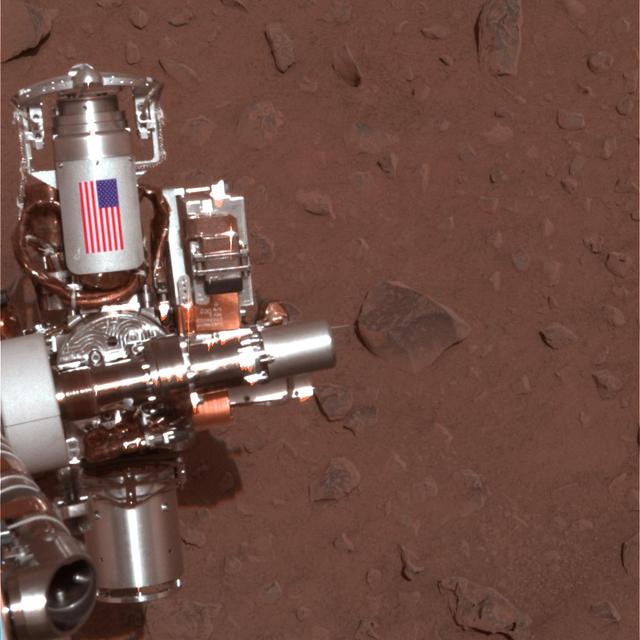
The piece of metal with the American flag on it in this image of a NASA rover on Mars is made of aluminum recovered from the site of the World Trade Center towers in the weeks after their destruction.
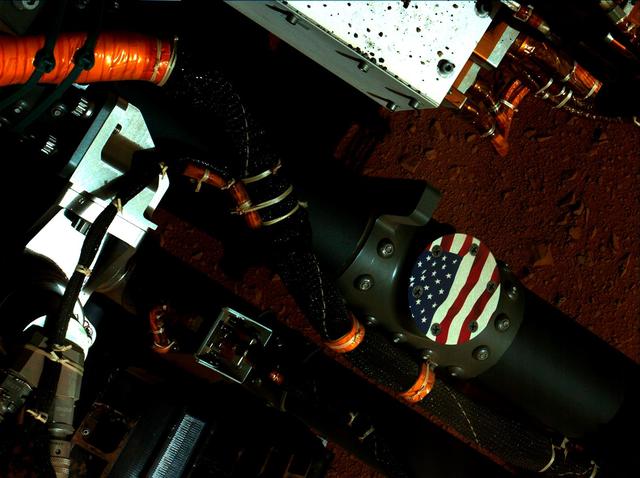
This view of the American flag medallion on NASA Mars rover Curiosity was taken by the rover MAHLI camera during the 44th Martian sol on Sept. 19, 2012. The flag is one of four mobility logos placed on the rover mobility rocker arms.
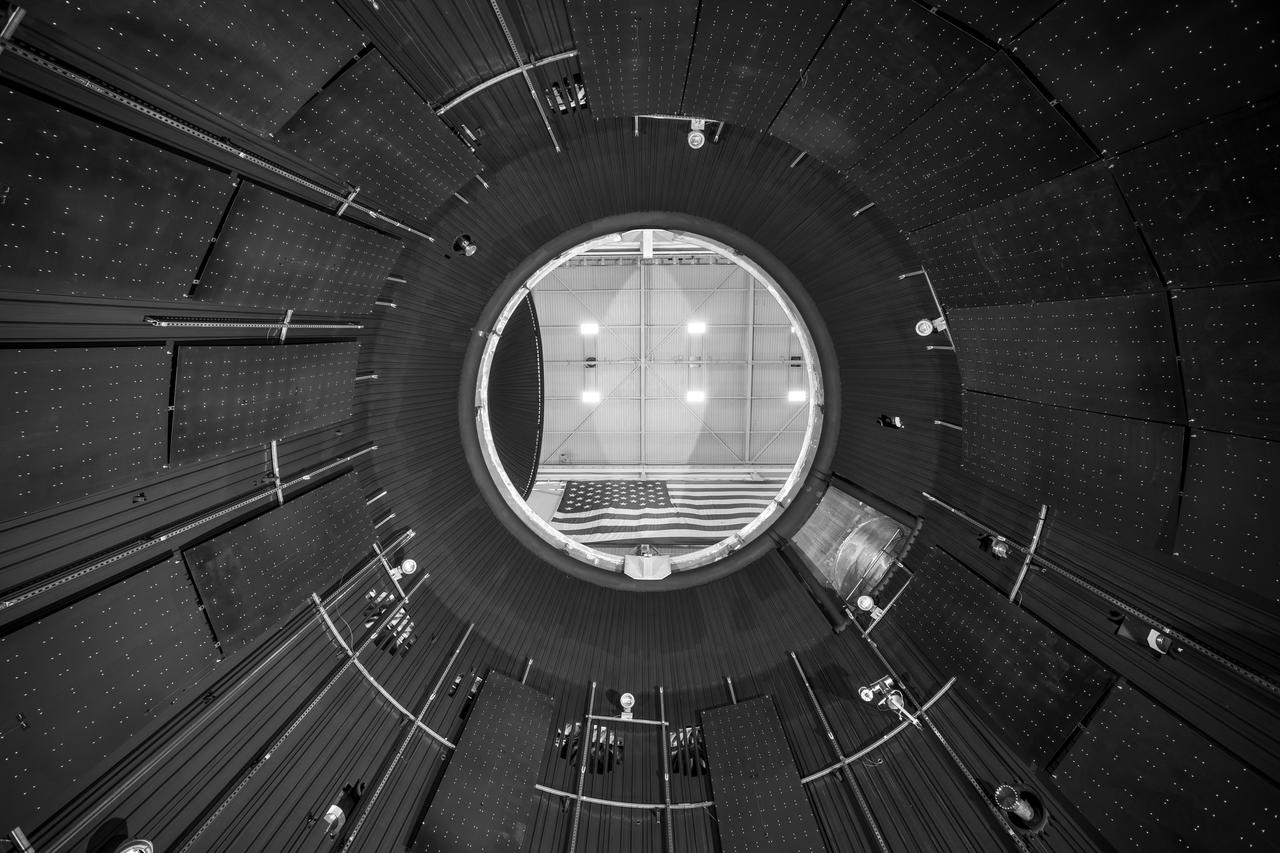
NASA’s In-Space Propulsion Facility located at Neil Armstrong Test Facility in Sandusky Ohio is the world’s only high altitude test facility capable of full-scale rocket engine and launch vehicle system level tests. The facility supports mission profile thermal vacuum simulation and engine firing. The engine or vehicle can be exposed for indefinite periods to low ambient pressures, low-background temperatures, and dynamic solar heating, simulating the environment the hardware will encounter during orbital or interplanetary travel. This is a view from inside the chamber looking up toward the American flag. Photo Credit: (NASA/Jordan Salkin)
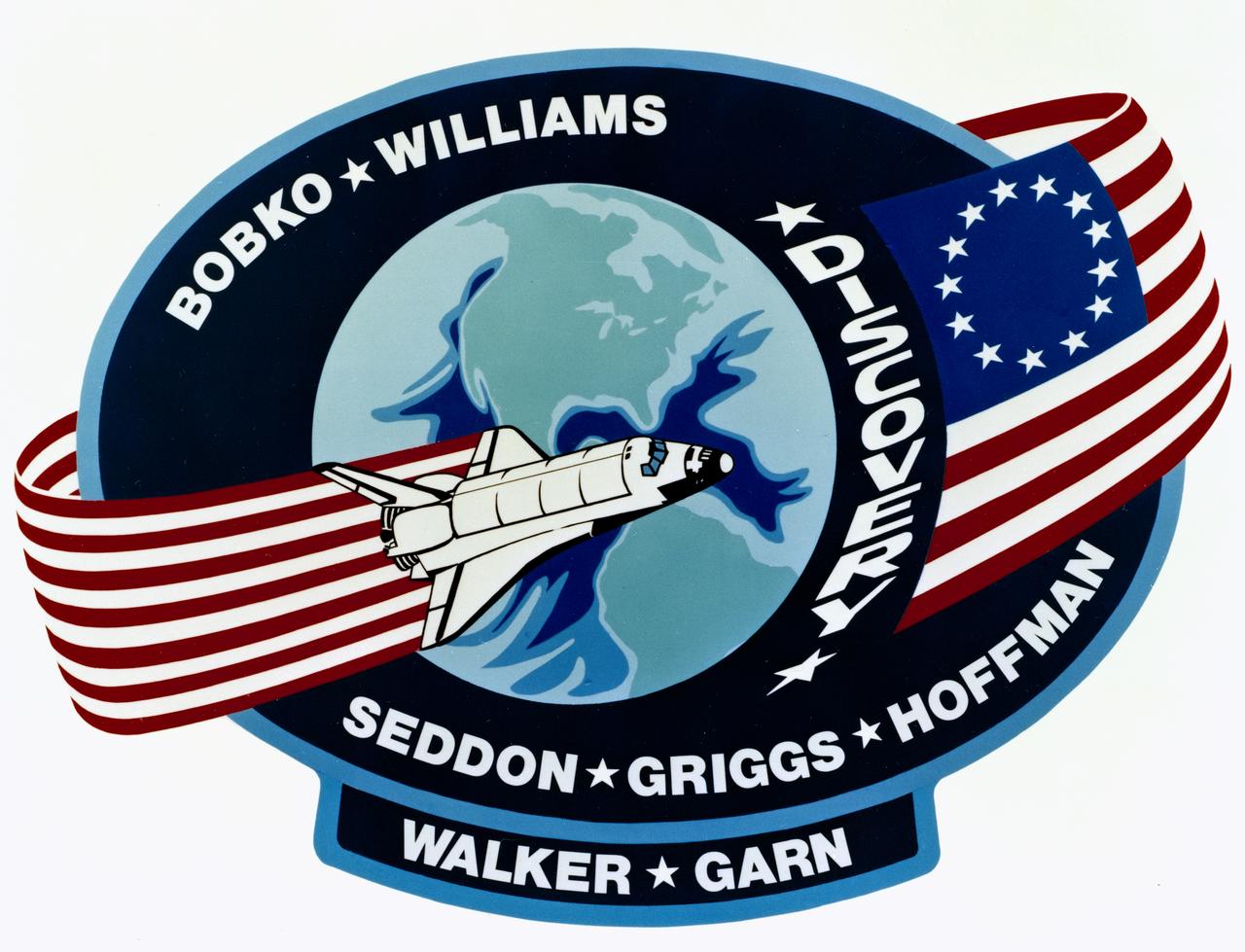
The dominant features of the STS-51D emblem are an orbit formed by a Colonial American flag and a Space Shuttle. The flag in orbit signifies the U.S. flag to indicate that it comes from this country and the American people. The original 13- star flag is used to symbolize a continuity of technical achievement and progress since colonial times. The name Discovery preceding the flag represents the spirit of Discovery and exploration of new frontiers which have been a hallmark of American people even before they were formed together as a nation.
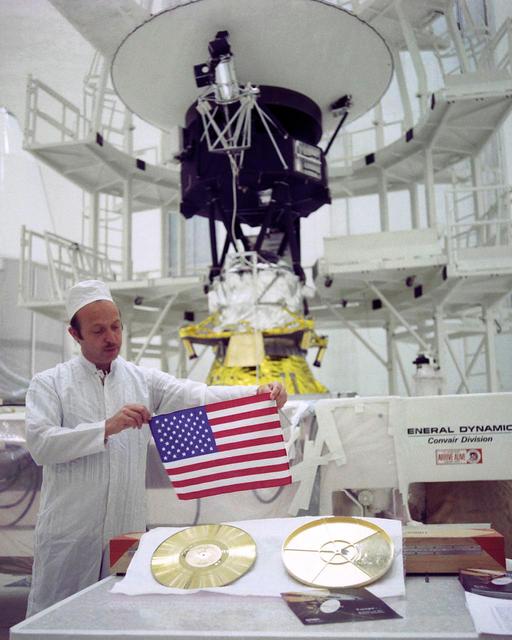
As NASA two Voyager spacecraft travel out into deep space, they carry a small American flag and a Golden Record packed with pictures and sounds -- mementos of our home planet.
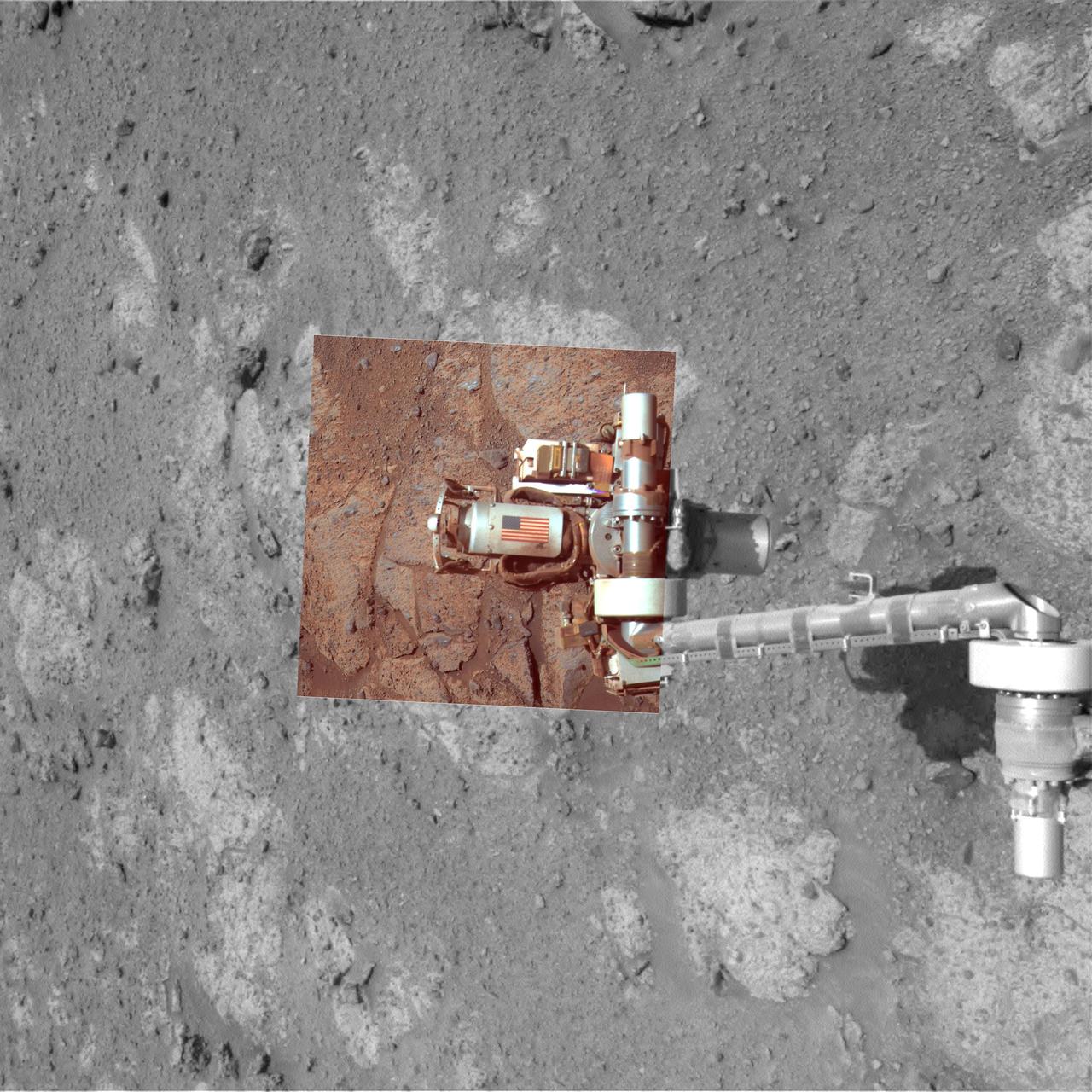
This view from NASA rover Opportunity, of an American flag on metal recovered from the site of the World Trade Center towers shortly after their destruction, was taken on Mars on Sept. 11, 2011, the 10th anniversary of the attacks on the towers.

Charlie Lundquist, NASA Orion deputy program manager, right, presents an American flag flown aboard the Orion capsule during the Exploration Flight Test-1 mission to Armstrong Deputy Director Patrick Stoliker.
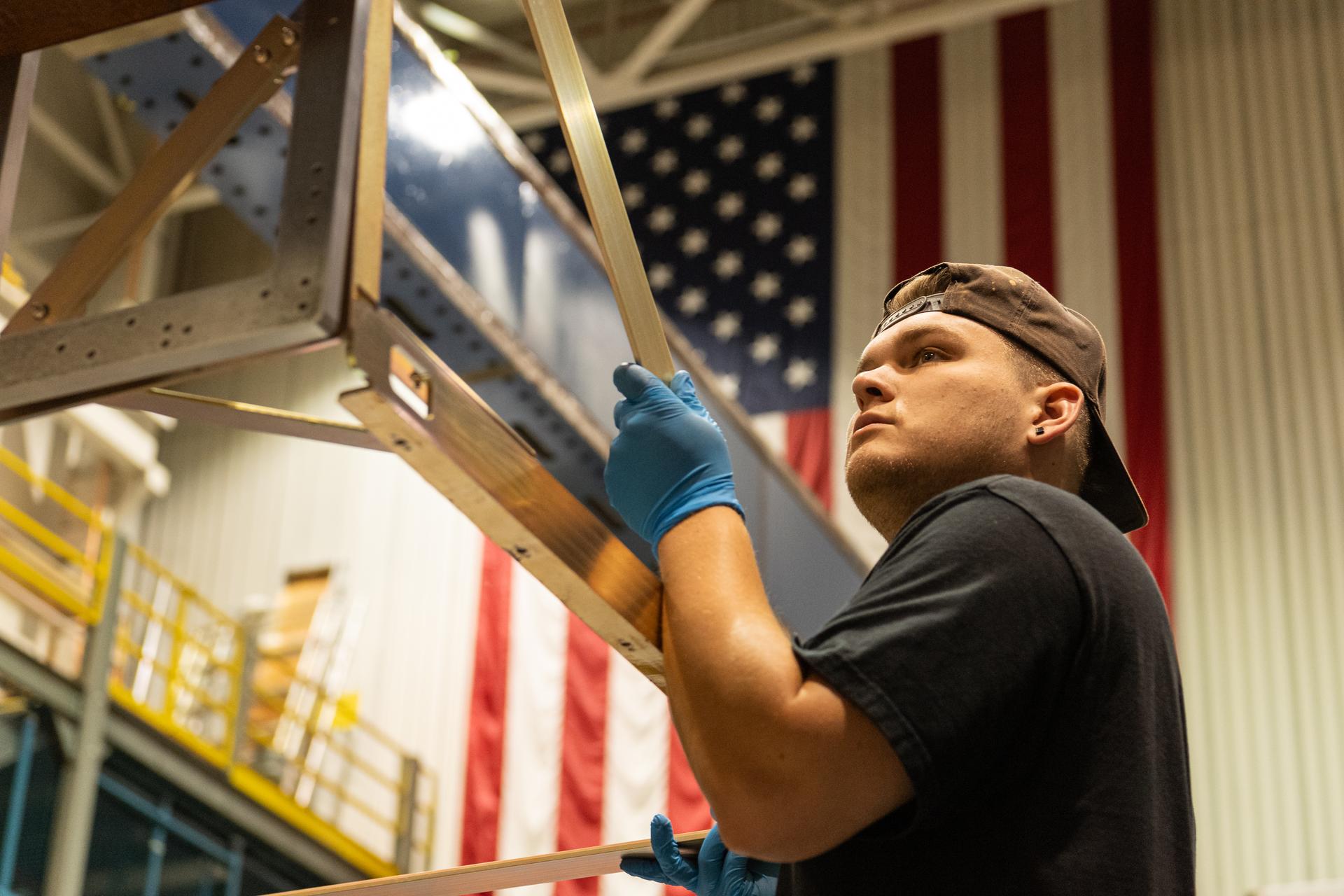
Mechanical engineering and integration technician, Lucas Keim, holds up a piece of ground support equipment during a proof test at Goddard Space Flight Center, Greenbelt Md., June 22, 2023. This photo has been reviewed by OSAM1 project management and the Export Control Office and is released for public view. NASA/Mike Guinto
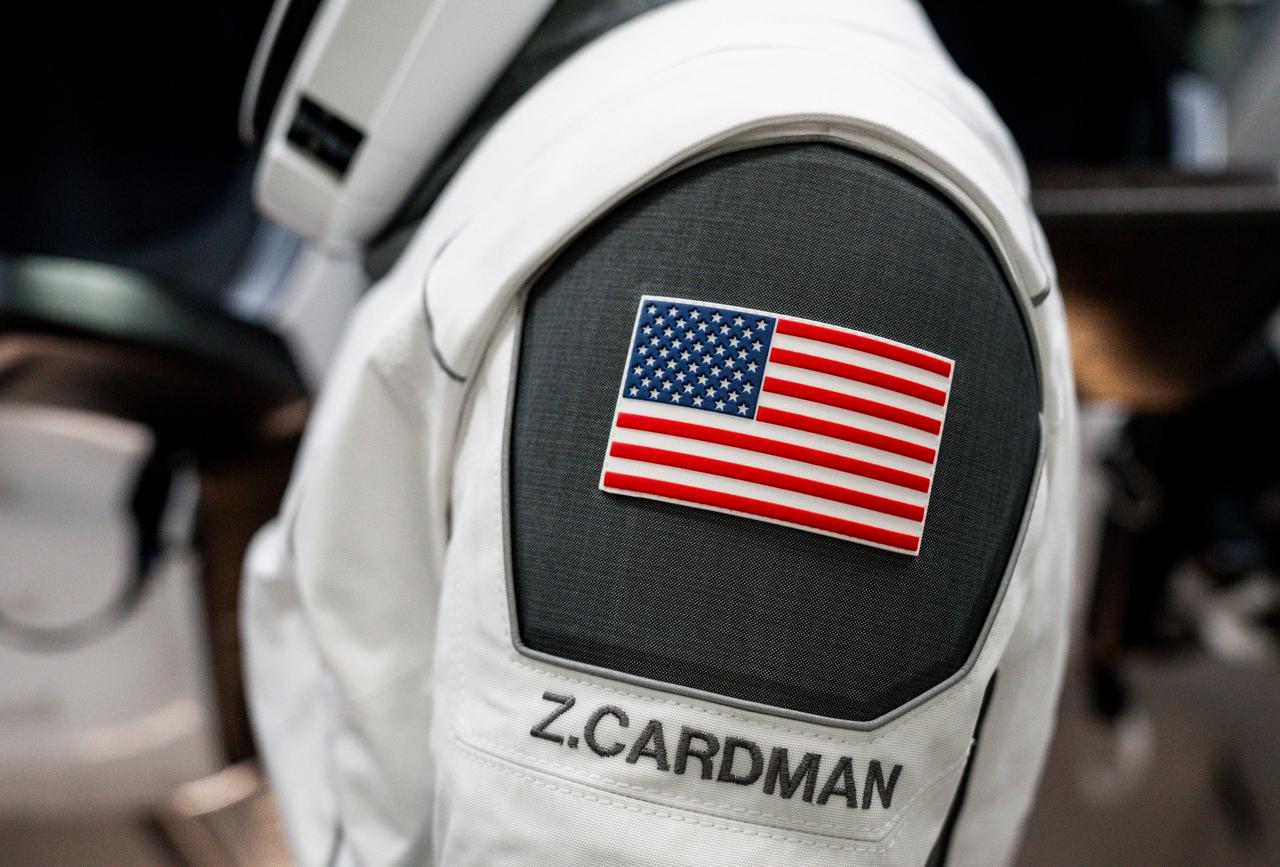
jsc2025e064526 (June 23, 2024) --- NASA’s SpaceX Crew-11 commander and NASA astronaut Zena Cardman participates in a training session at SpaceX facilities in Hawthorne, California. Her name, “Z. Cardman” is prominently shown with the American flag. Credit: SpaceX
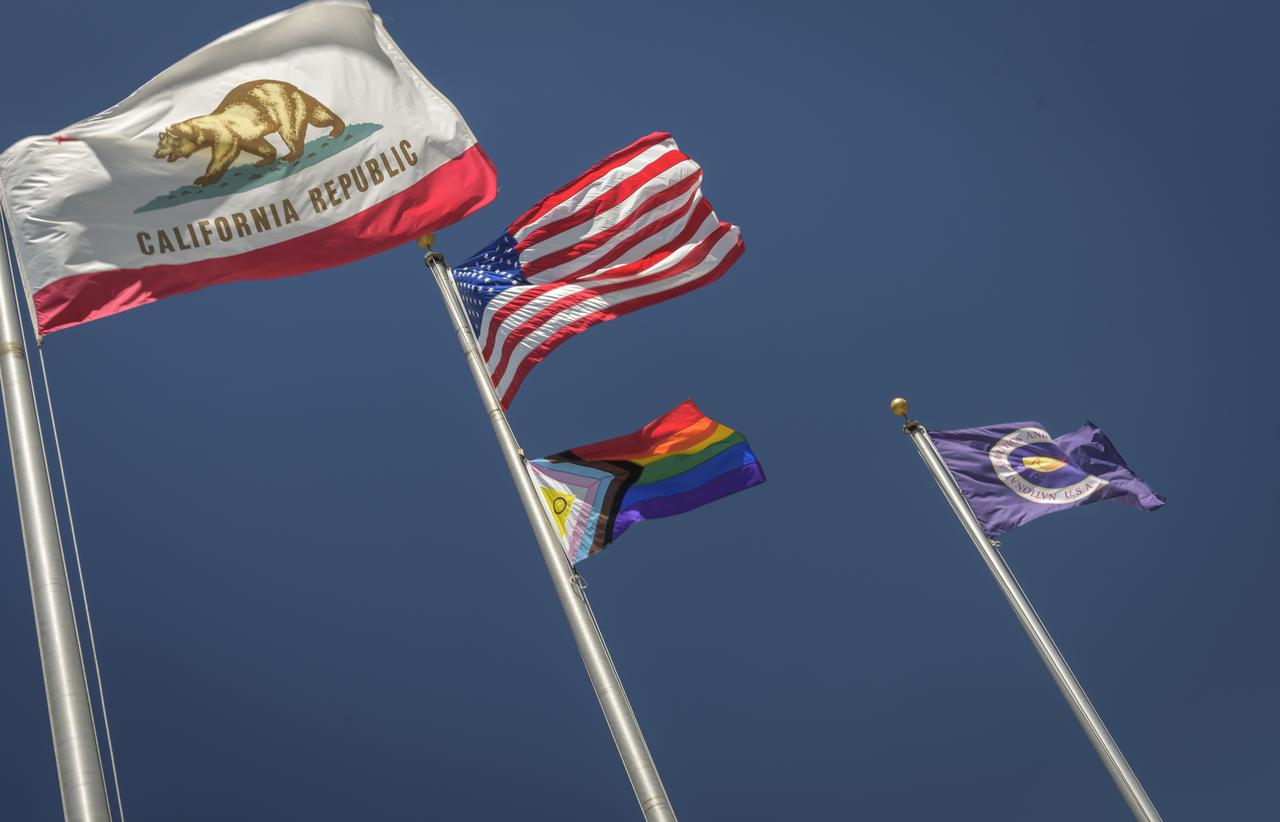
The Intersex Progress Pride flag flies beneath the American flag on the center pole with the California state and NASA flag at either side. The Intersex Progress Pride flag flies for the first time at any NASA center in front of the Ames Administration Building, N200, to commemorate Pride Month.
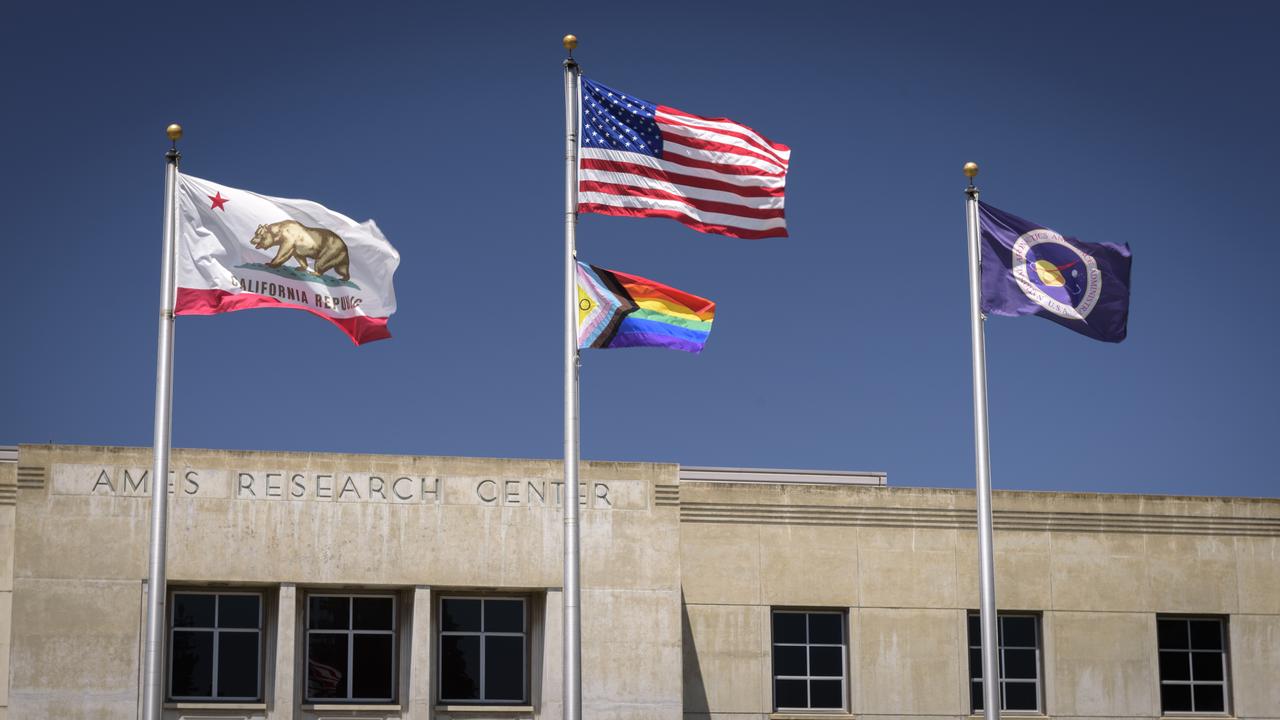
The Intersex Progress Pride flag flies beneath the American flag on the center pole with the California state and NASA flag at either side. The Intersex Progress Pride flag flies for the first time at any NASA center in front of the Ames Administration Building, N200, to commemorate Pride Month.
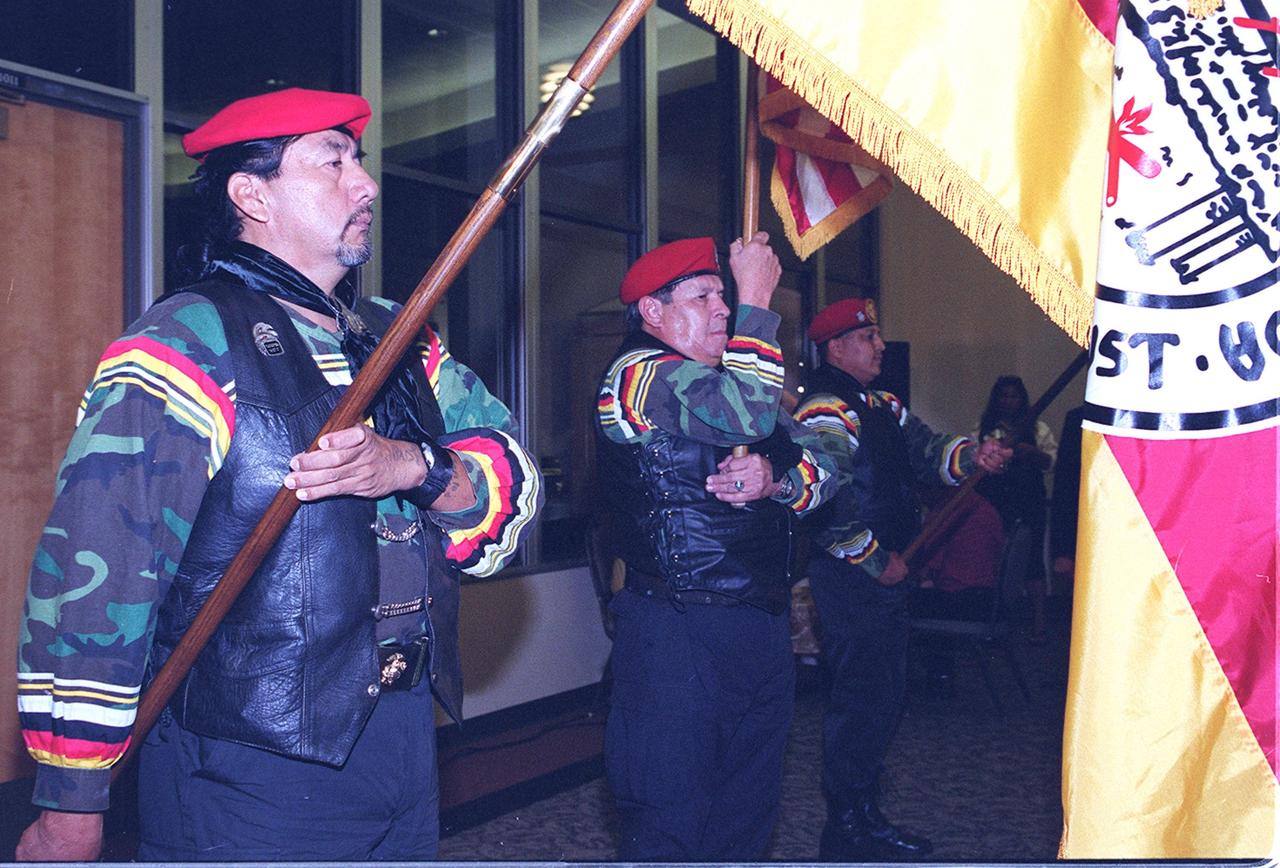
KENNEDY SPACE CENTER, FLA. -- -- The Seminole Native American Veterans Color Guard (Seminole Flag, U.S. Flag, and State of Florida Flag) present colors during a dinner at the Debus Conference Center in the KSC Visitor Complex. The dinner honored John B. Herrington, the first tribally enrolled Native American astronaut to fly on a Shuttle mission. Herrington is a Mission Specialist on STS-113. In addition to the dinner at KSC, several hundred Native Americans from around the country attended a symposium in Orlando commemorating the launch event. The Native Americans, many of them Chickasaw, were here to honor John, who is a Chickasaw from Oklahoma.
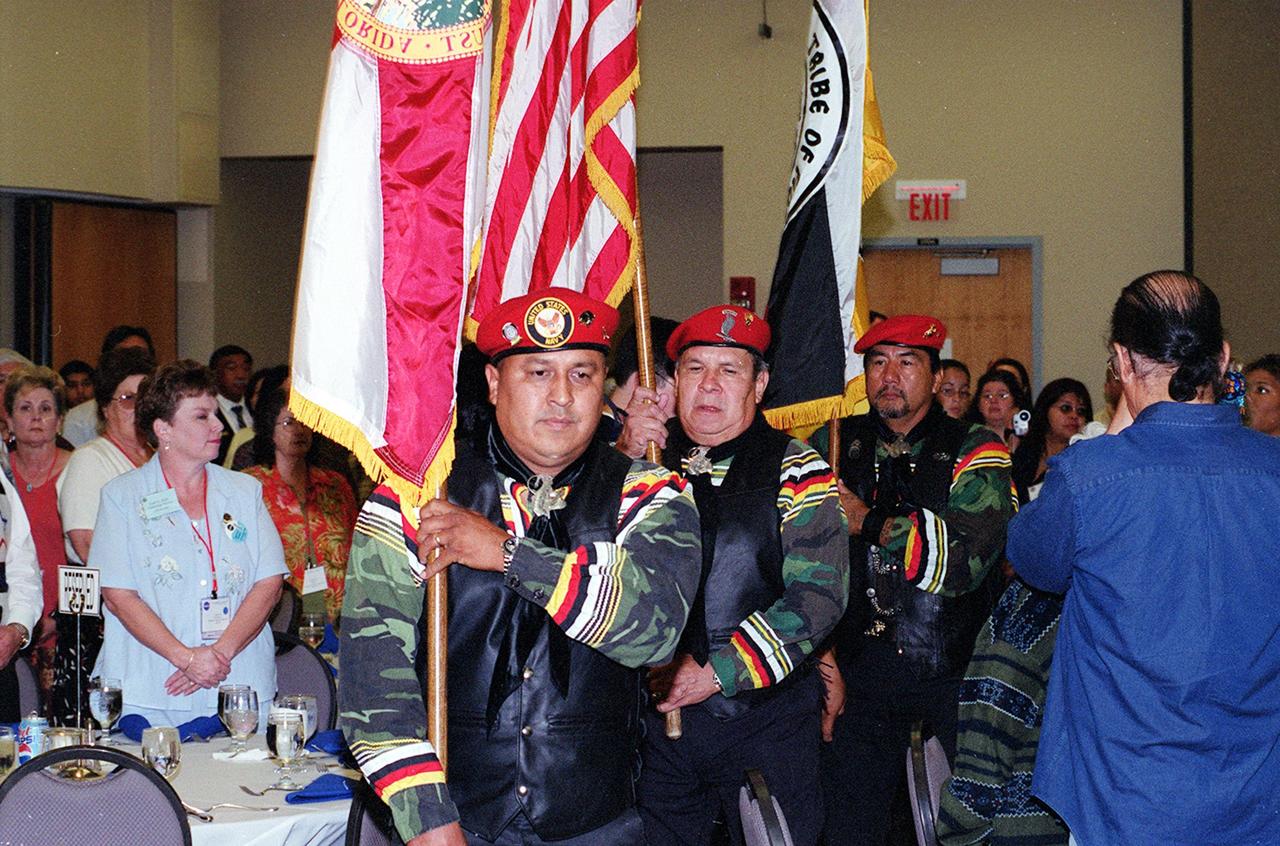
KENNEDY SPACE CENTER, FLA. -- The Seminole Native American Veterans Color Guard (Seminole Flag, U.S. Flag, and State of Florida Flag) enter the Debus Conference Center in the KSC Visitor Complex during a dinner honoring astronaut John B. Herrington, the first tribally enrolled Native American astronaut to fly on a Shuttle mission. Herrington is a Mission Specialist on STS-113. In addition to the dinner at KSC, several hundred Native Americans from around the country attended a symposium in Orlando commemorating the launch event. The Native Americans, many of them Chickasaw, were here to honor John, who is a Chickasaw from Oklahoma.
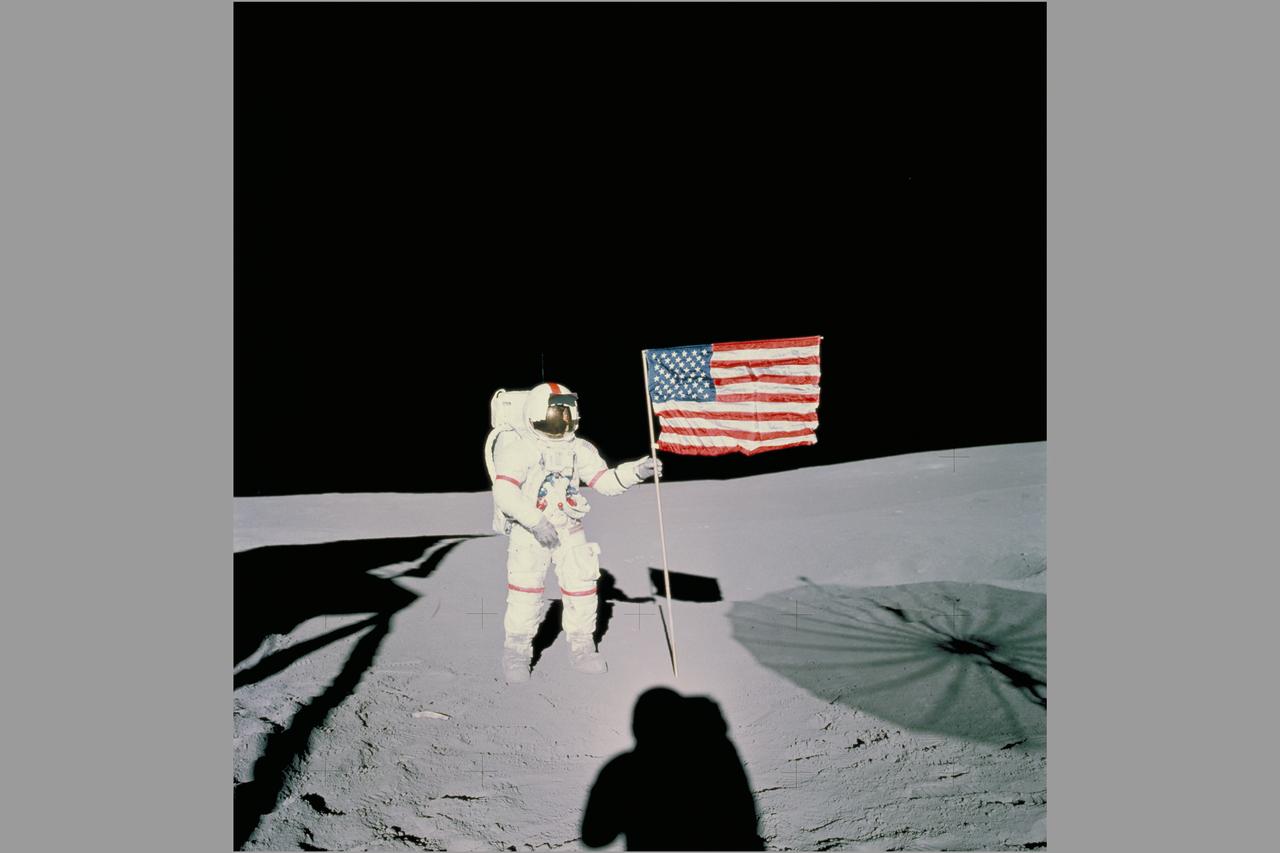
ASTRONAUT ALAN B. SHEPARD STANDING WITH AMERICAN FLAG ON LUNAR SURFACE
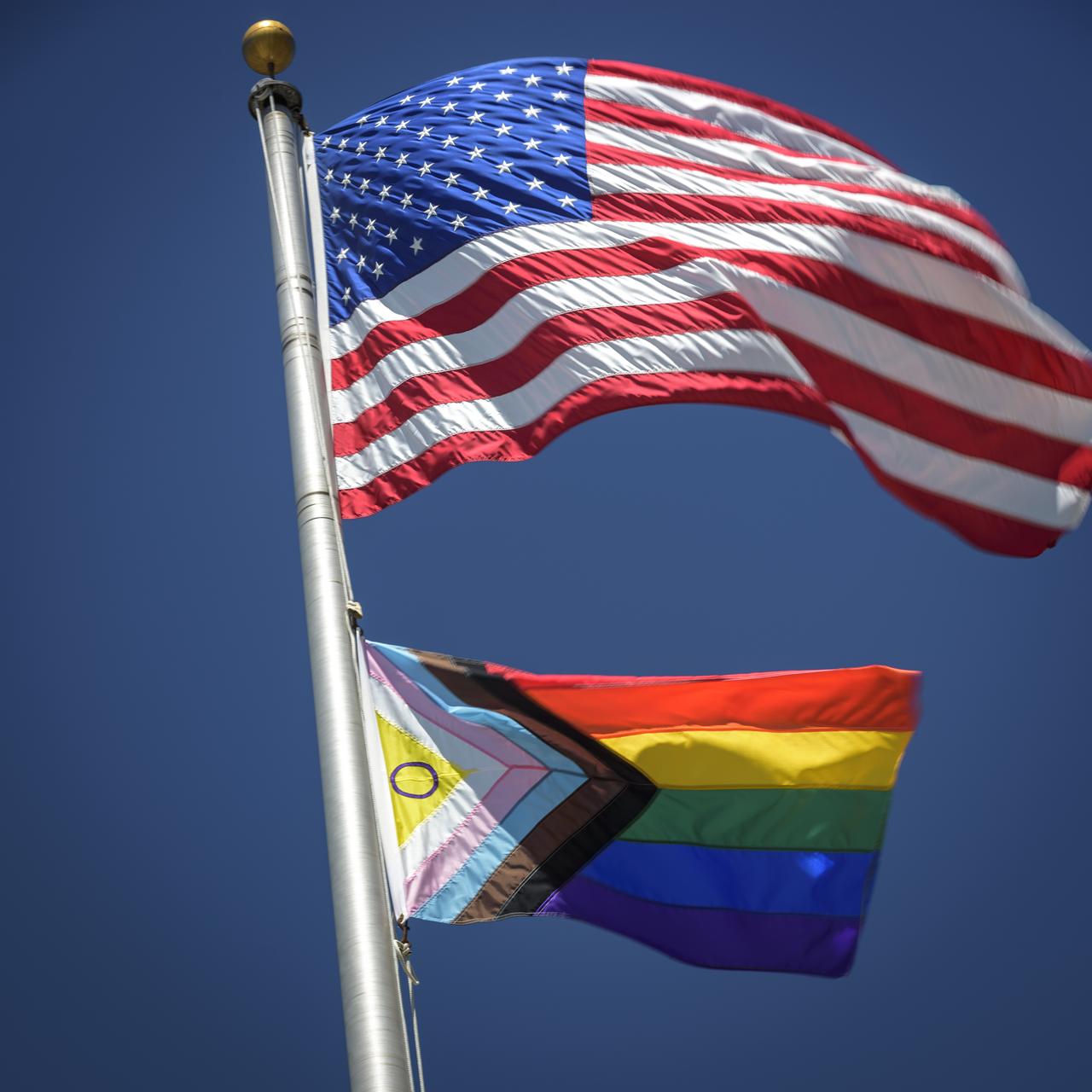
The Intersex Progress Pride flag flies for the first time at any NASA center below the American flag, in front of the Ames Administration Building, N200, to commemorate Pride Month.
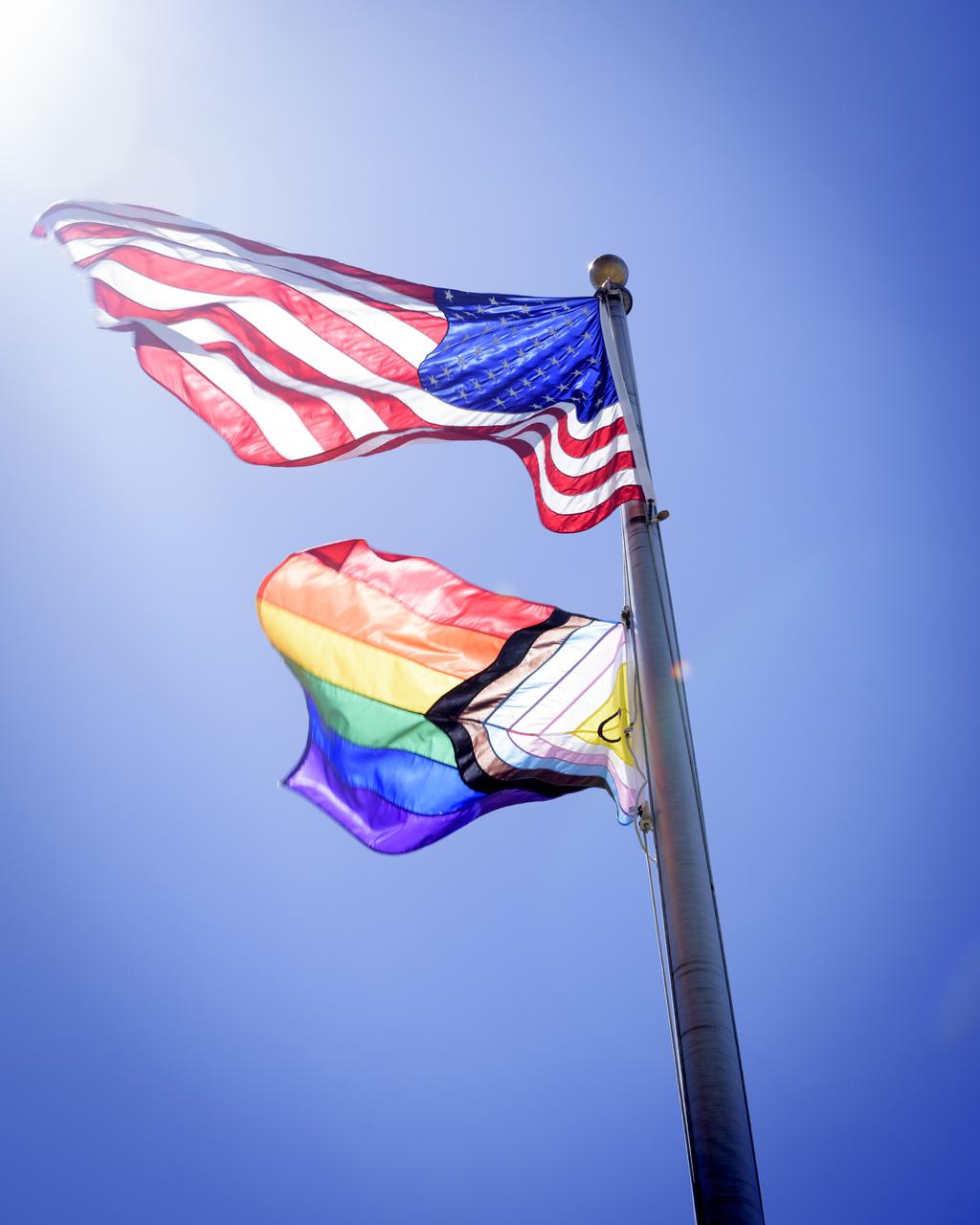
The Intersex Progress Pride flag flies for the first time at any NASA center below the American flag, in front of the Ames Administration Building, N200, to commemorate Pride Month.
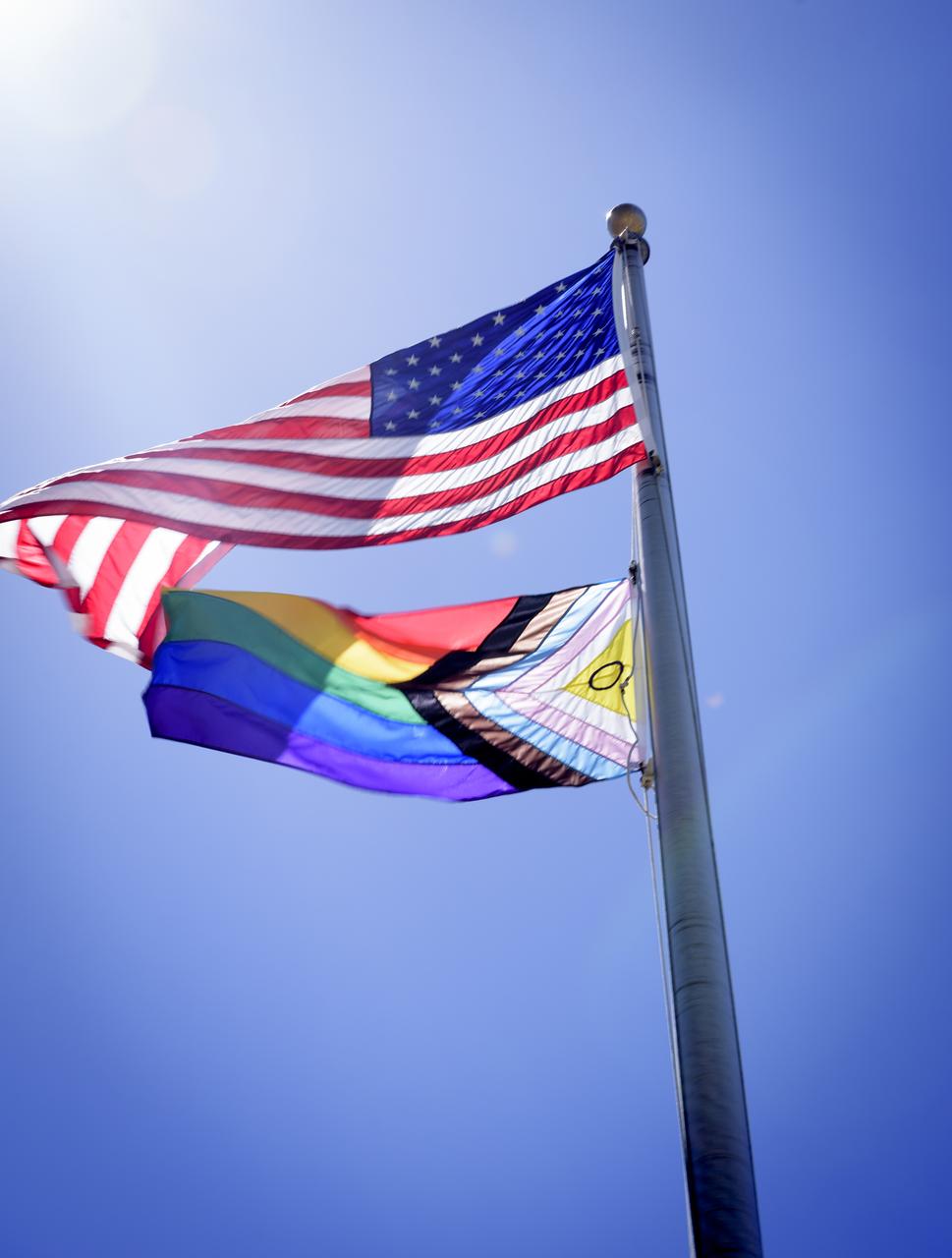
The Intersex Progress Pride flag flies for the first time at any NASA center below the American flag, in front of the Ames Administration Building, N200, to commemorate Pride Month.
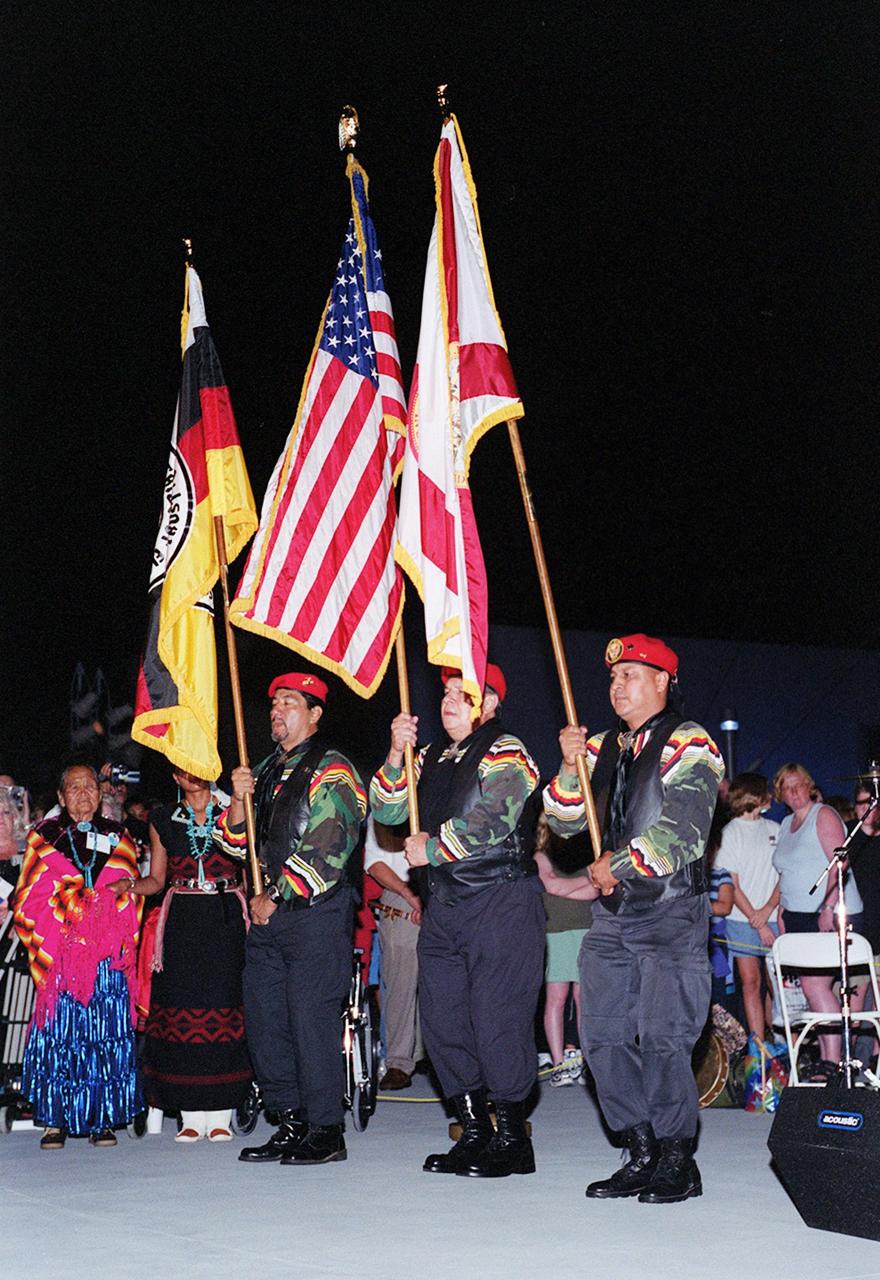
KENNEDY SPACE CENTER, FLA. -- Seminole Native American Veterans serve as color guard during a pre-launch Native American ceremony at the Rocket Garden in the KSC Visitor Complex. David Nunez, U.S. Navy, carries the State of Florida Flag; David Stephen Bowers, U.S. Army, carries the Flag of the United States of America; Charles Billie Hiers, U.S. Marine Corps., carries the Seminole Tribe of Florida Flag. The ceremony was part of several days' activities commemorating John B. Herrington as the first tribally enrolled Native American astronaut to fly on a Shuttle mission. Herrington is a Mission Specialist on STS-113.
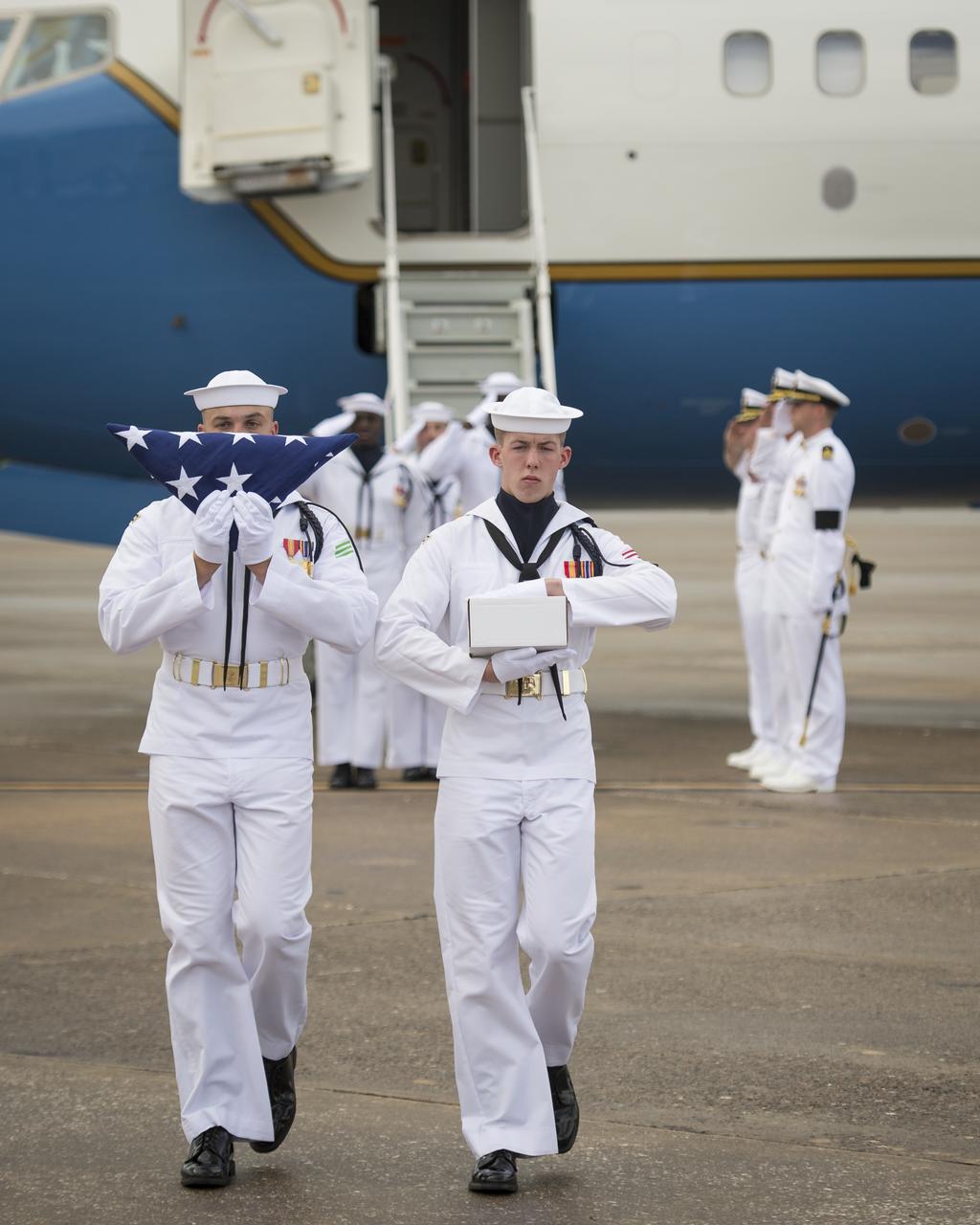
US Navy personnel carry the cremains of Apollo 11 astronaut Neil Armstrong off of a military aircraft at Naval Station Mayport the day before the Armstrong burial at sea service, Thursday, Sept. 13, 2012, Mayport, Fla. Armstrong, the first man to walk on the moon during the 1969 Apollo 11 mission, died Saturday, Aug. 25. He was 82. Photo Credit: (NASA/Bill Ingalls)
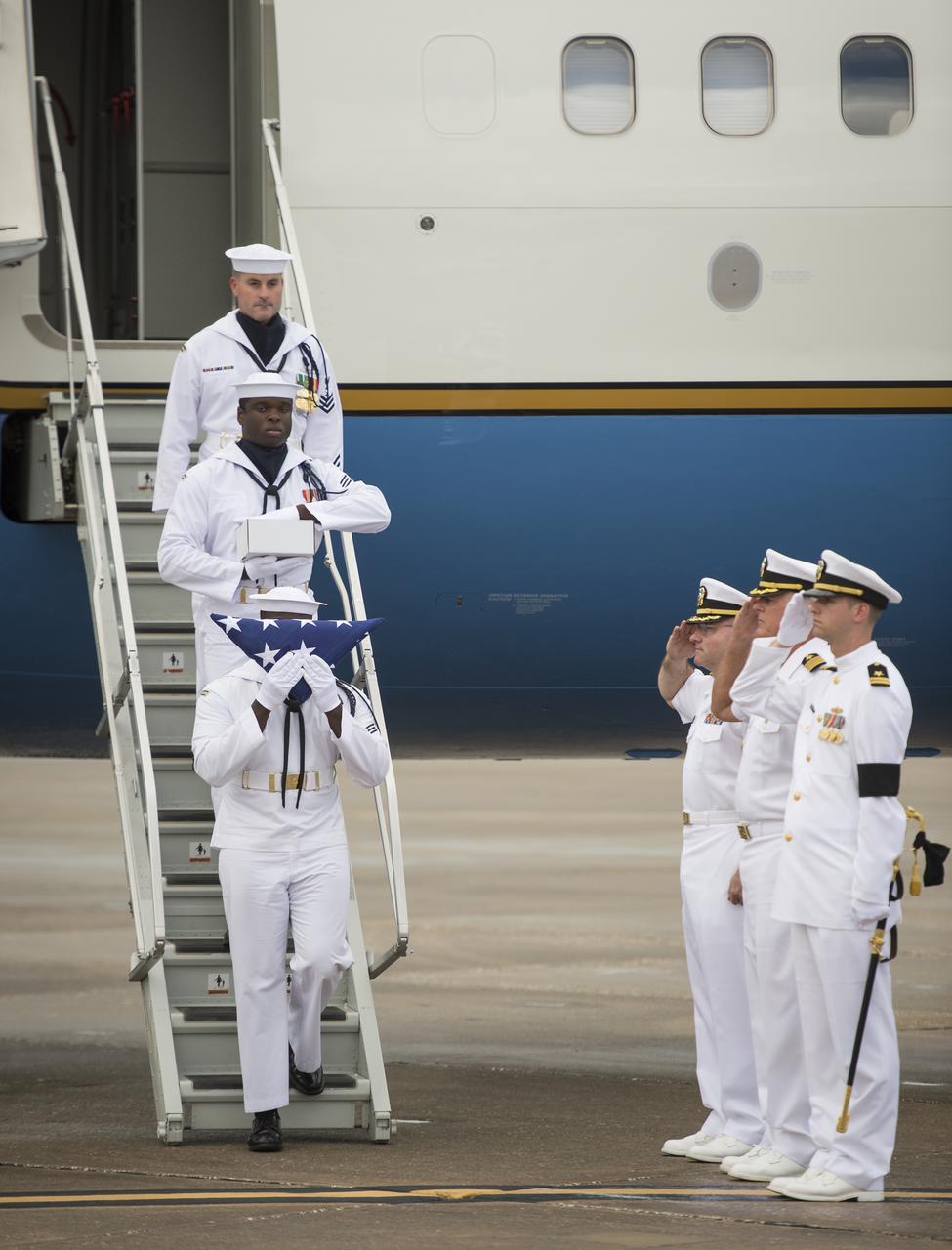
US Navy personnel carry the cremains of Apollo 11 astronaut Neil Armstrong off of a military aircraft at Naval Station Mayport the day before the Armstrong burial at sea service, Thursday, Sept. 13, 2012, Mayport, Fla. Armstrong, the first man to walk on the moon during the 1969 Apollo 11 mission, died Saturday, Aug. 25. He was 82. Photo Credit: (NASA/Bill Ingalls)
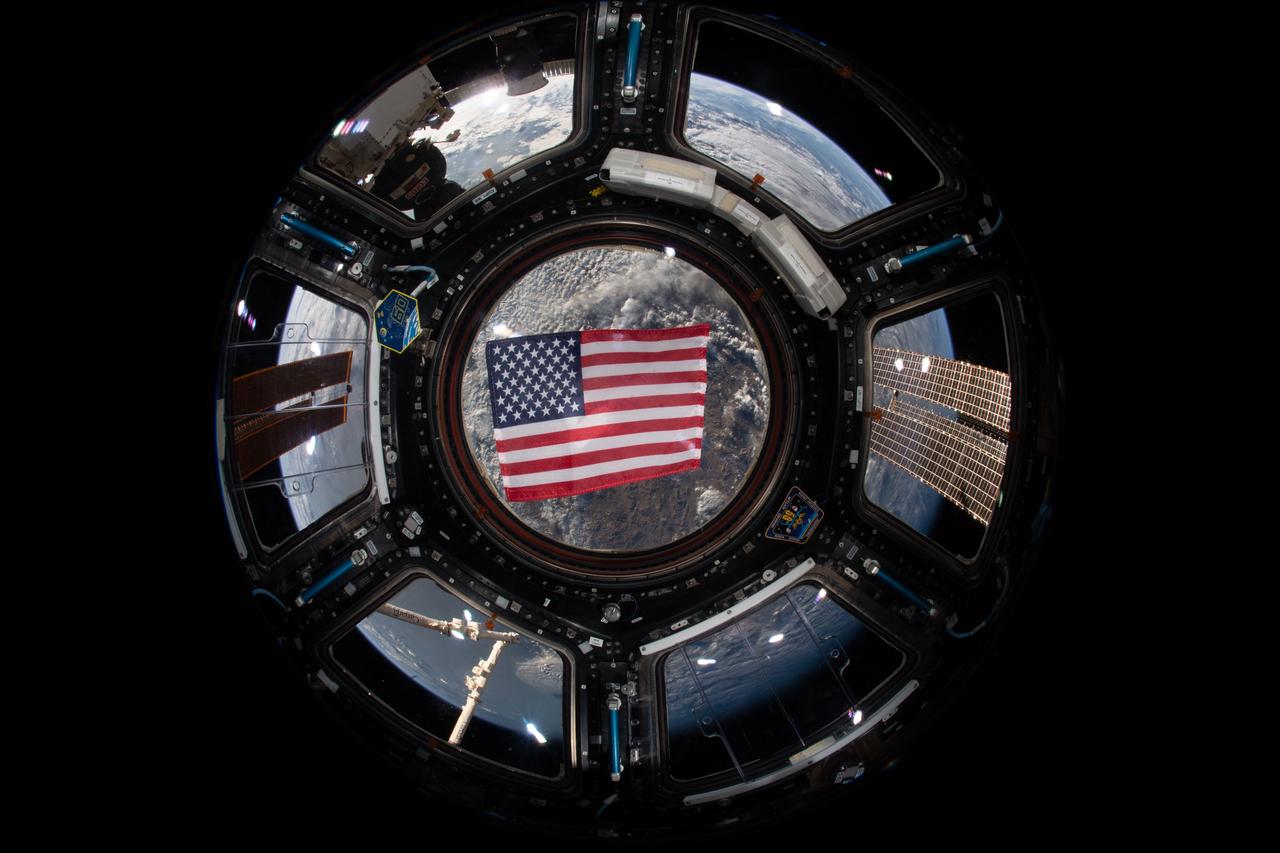
View of crew personal Flight Data File (FDF) item - American flag - floating in front of the Cupola windows.
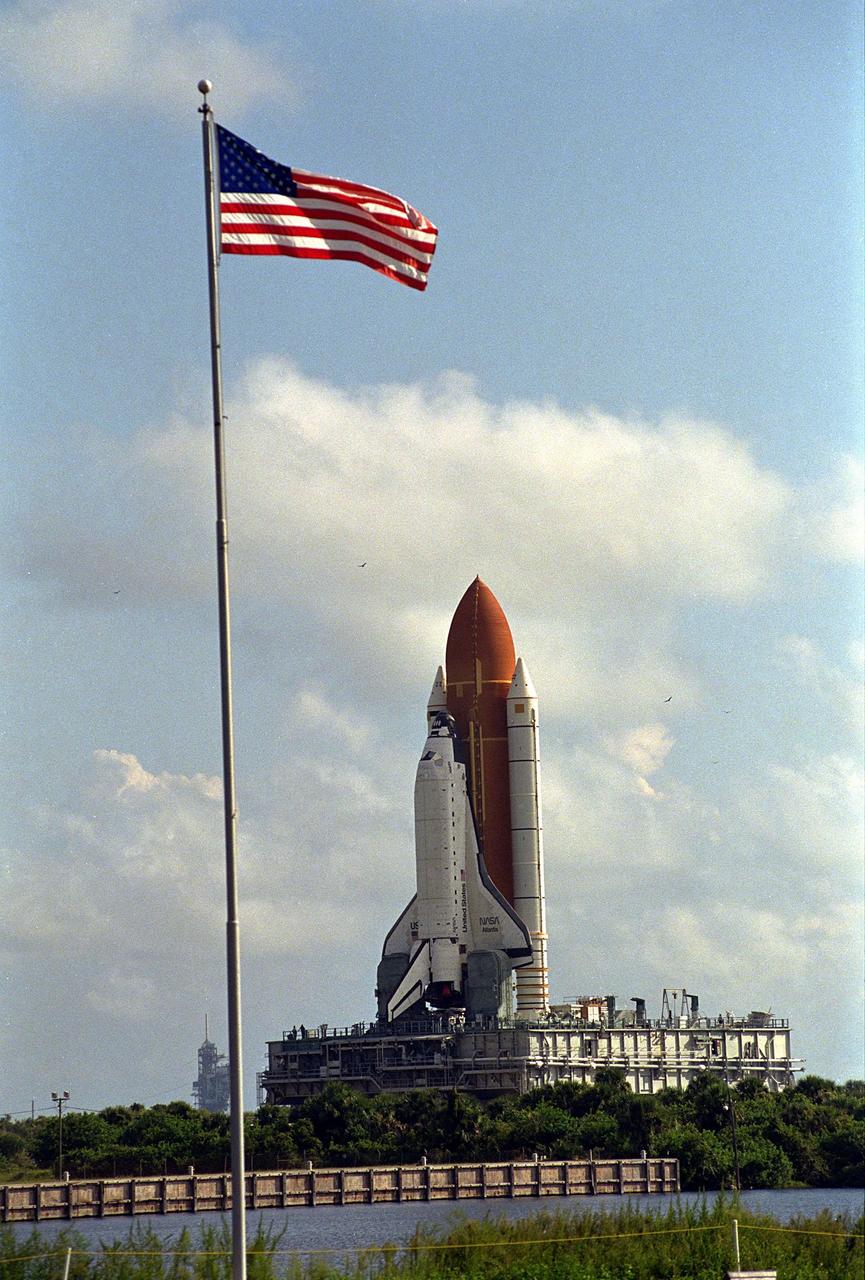
KENNEDY SPACE CENTER, FLA. -- Atlantis passes the American flag as it rolls back to VAB from pad 39A
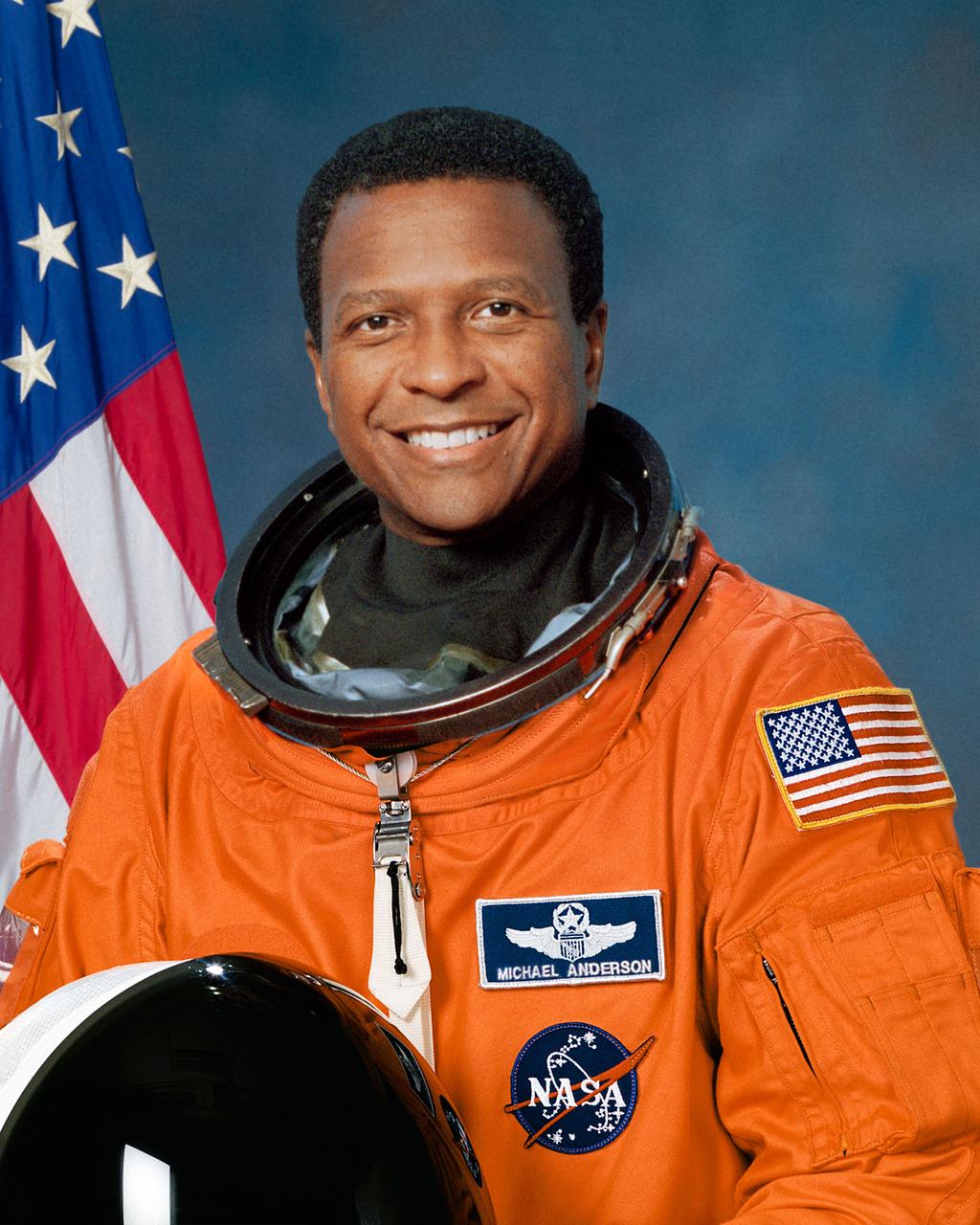
Official Portrait of Astronaut Mike Anderson (STS-107) in his orange launch and landing suit with an American flag in the background.
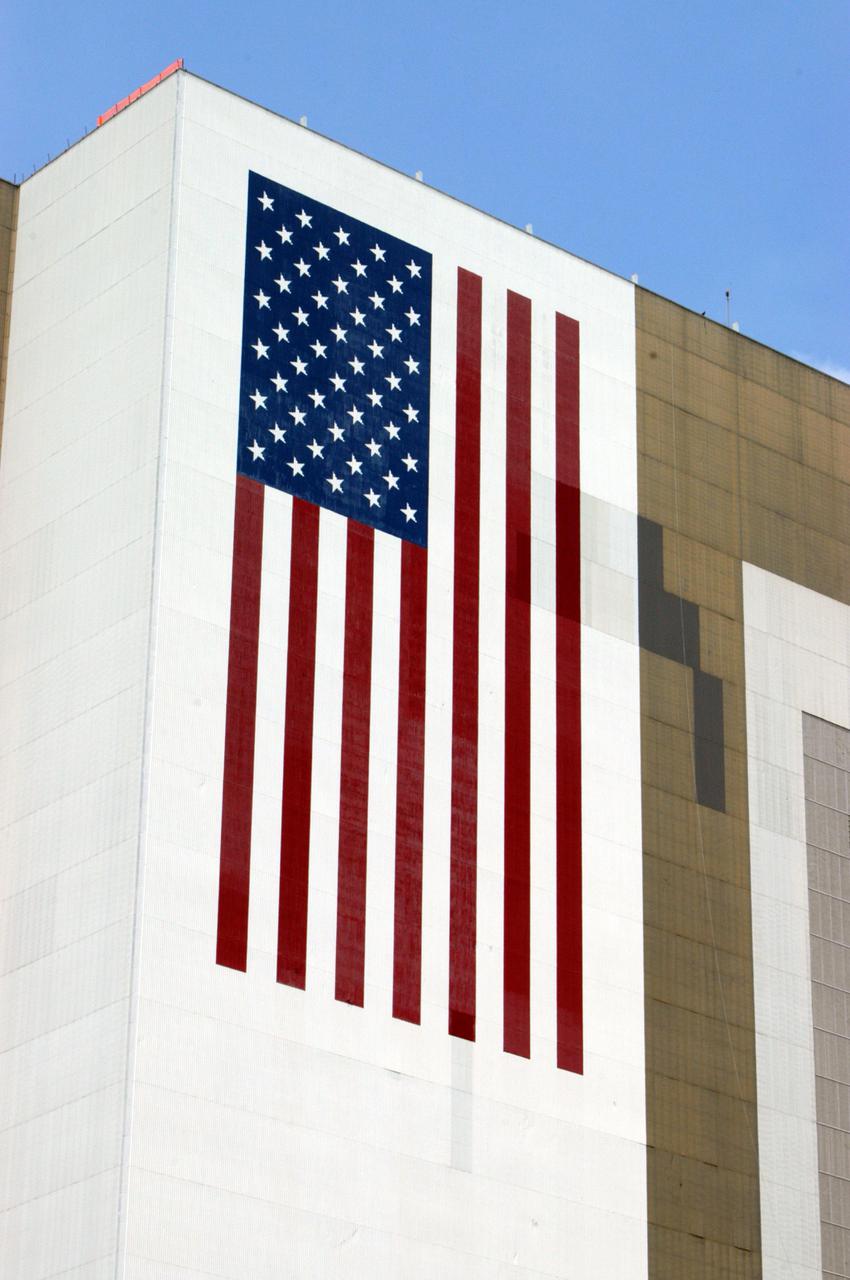
KENNEDY SPACE CENTER, FLA. - The American flag on the side of the Vehicle Assembly Building at NASA’s Kennedy Space Center is newly painted. The flag was damaged in the hurricanes of 2004 that assaulted the east coast of Florida. Winds pulled a number of panels from the side of the 525-foot-high building. The flag is 209 feet by 110 feet. Each star is more than six feet in diameter and each stripe is nine feet wide. The flag sits more than 450 feet above the ground.
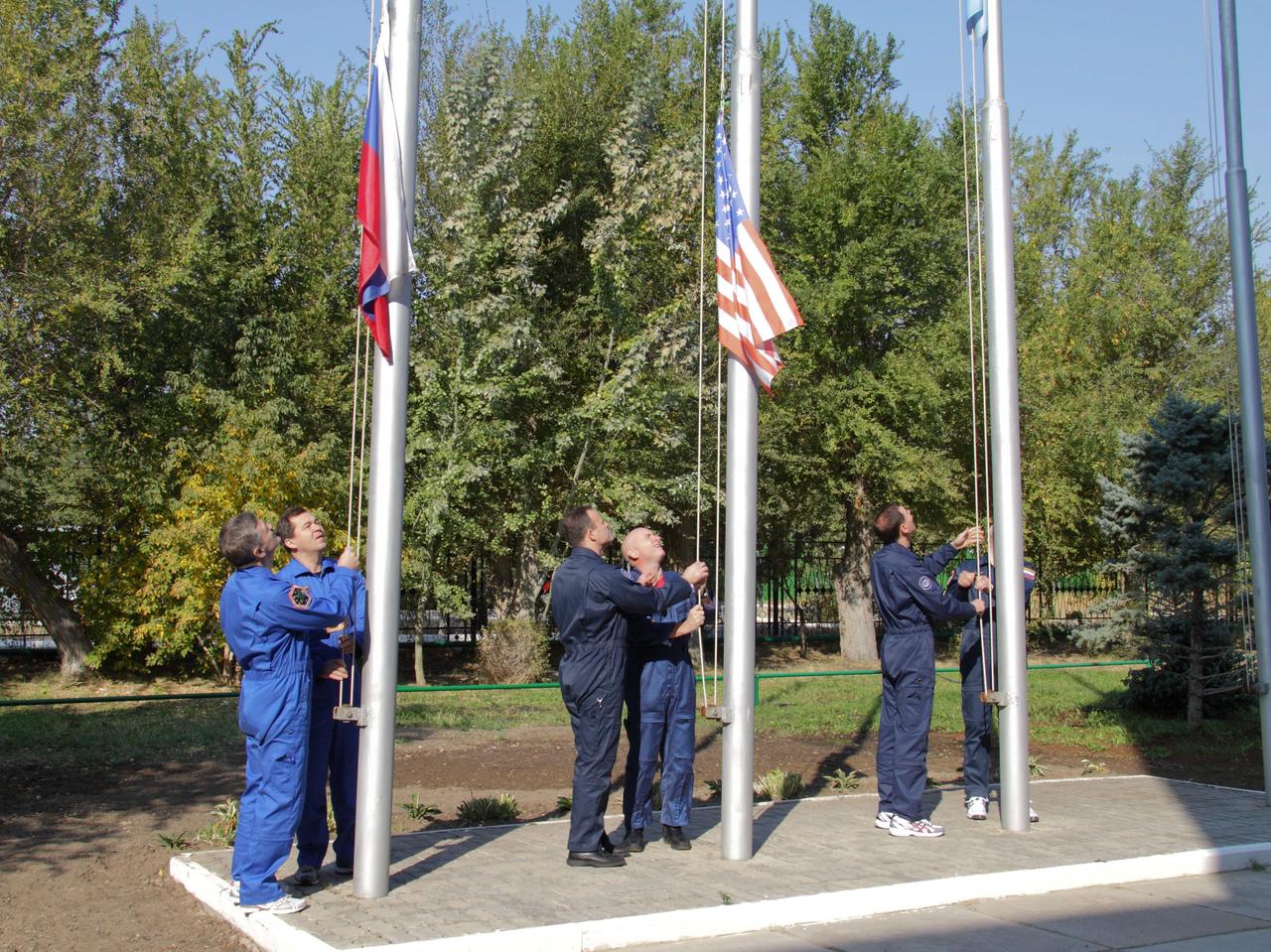
At the Baikonur Cosmodrome in Kazakhstan, the prime and backup crews of Expedition 25 conduct the traditional raising of flags outside their Cosmonaut Hotel crew quarters September 27, 2010. From left to right are prime crew Flight Engineers Alexander Kaleri and Oleg Skripochka raising the Russian flag, backup Ron Garan joining prime crewmember Scott Kelly to raise the American flag and backup crewmembers Sergei Volkov and Oleg Kononenko (hidden) raising the Kazakh flag. Credit: NASA/Victor Zelentsov

KENNEDY SPACE CENTER, FLA. - The American flag on the side of the Vehicle Assembly Building at NASA’s Kennedy Space Center is newly painted. The flag was damaged in the hurricanes of 2004 that assaulted the east coast of Florida. Winds pulled a number of panels from the side of the 525-foot-high building. The flag is 209 feet by 110 feet. Each star is more than six feet in diameter and each stripe is nine feet wide. The flag sits more than 450 feet above the ground.
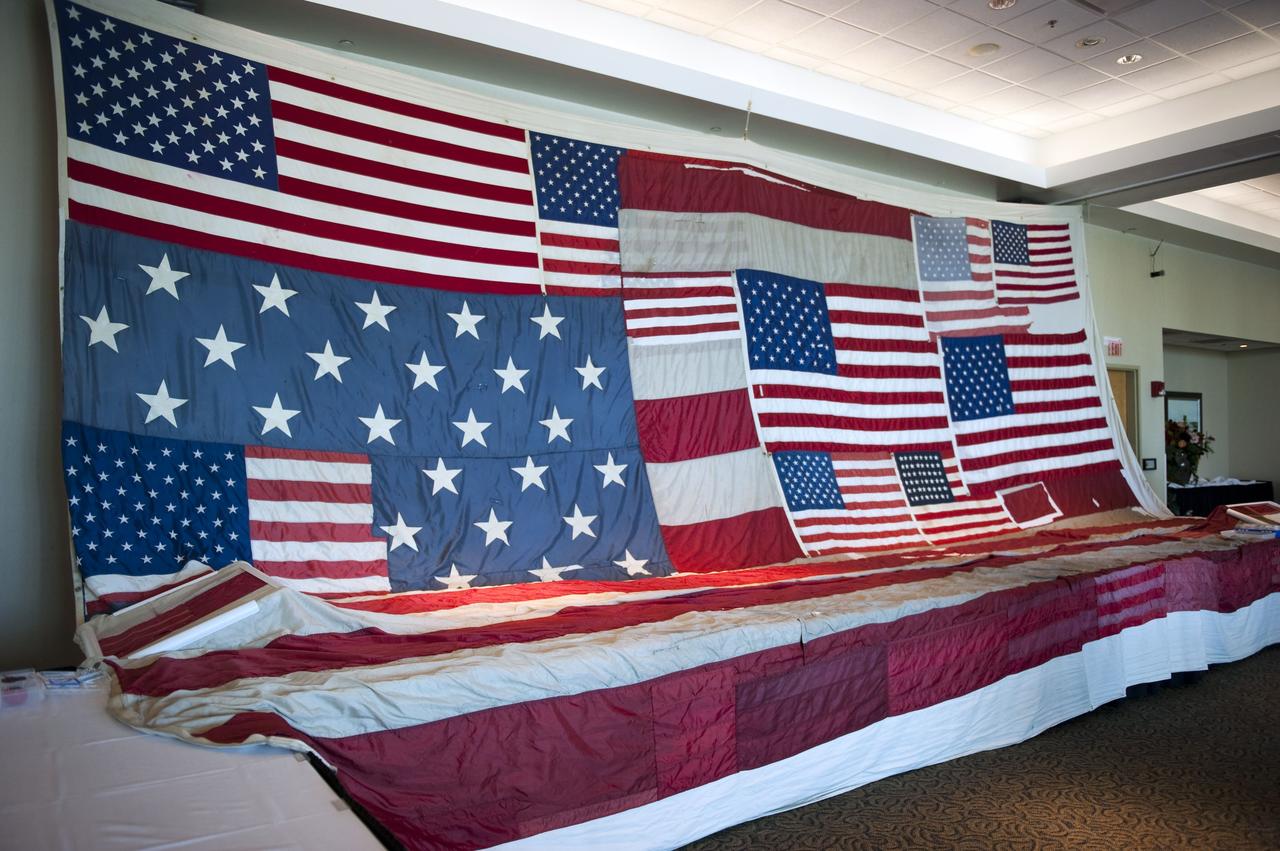
CAPE CANAVERAL, Fla. -- "The National 9/11 Flag" is on display in the Debus Conference Facility at the Kennedy Space Center Visitor Complex in Florida. The contributions of NASA, Kennedy Space Center and the state of Florida were stitched into the fabric of the American Flag, which was recovered near ground zero following the World Trade Center attacks on Sept. 11, 2001. The "New York Says Thank You Foundation" is taking the flag on a cross-country journey to be restored to its original 13-stripe design using pieces of fabric from American flags destined for retirement in all 50 states. Once the flag is restored, it will become a permanent collection of the National September 11 Memorial Museum being built at the World Trade Center site. Photo credit: NASA/Kim Shiflett
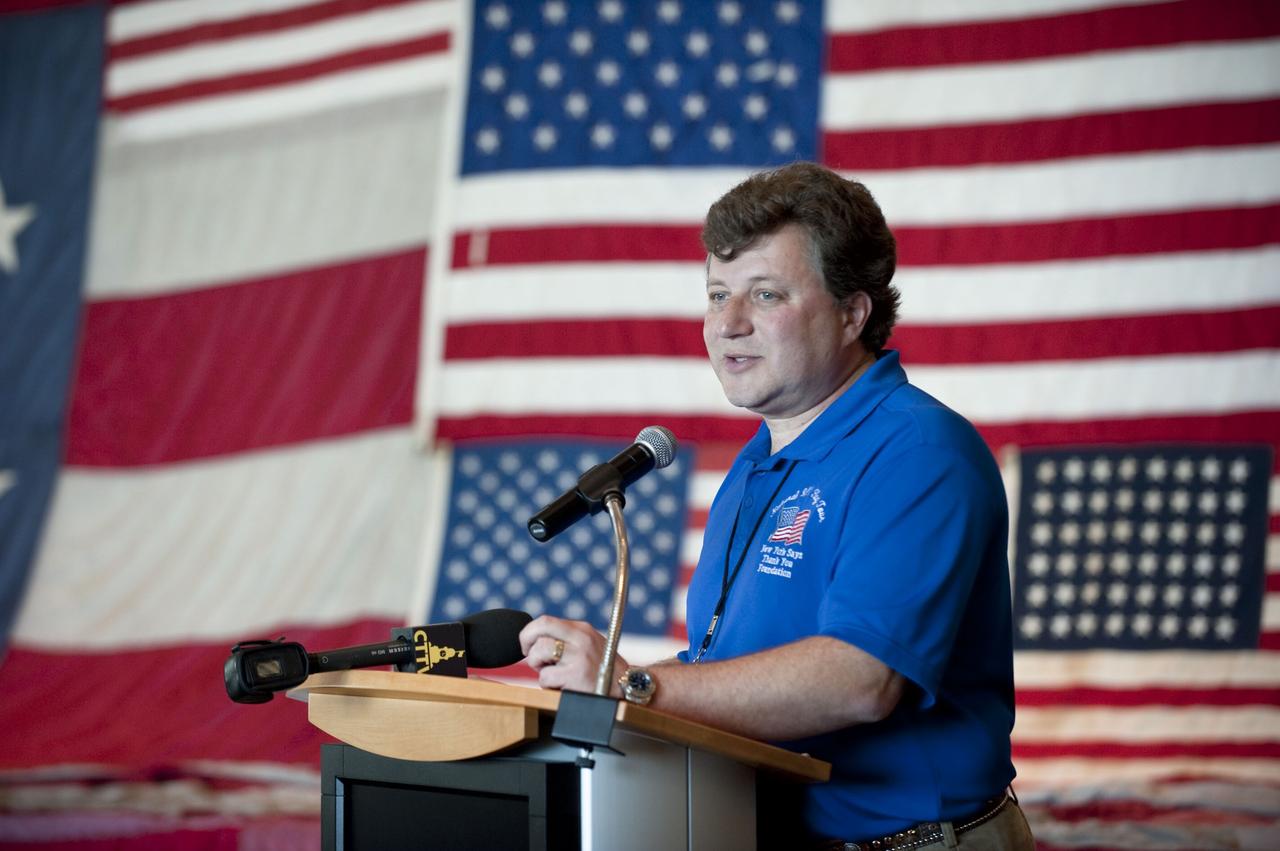
CAPE CANAVERAL, Fla. -- In the Debus Conference Facility at the Kennedy Space Center Visitor Complex in Florida, Jeff Parness, the director, founder and chairman of the "New York Says Thank You Foundation" talks about the work and devotion that has gone into restoring "The National 9/11 Flag." The contributions of NASA, Kennedy Space Center and the state of Florida were stitched into the fabric of the American Flag, which was recovered near ground zero following the World Trade Center attacks on Sept. 11, 2001. The "New York Says Thank You Foundation" is taking the flag on a cross-country journey to be restored to its original 13-stripe design using pieces of fabric from American flags destined for retirement in all 50 states. Once the flag is restored, it will become a permanent collection of the National September 11 Memorial Museum being built at the World Trade Center site. Photo credit: NASA/Kim Shiflett
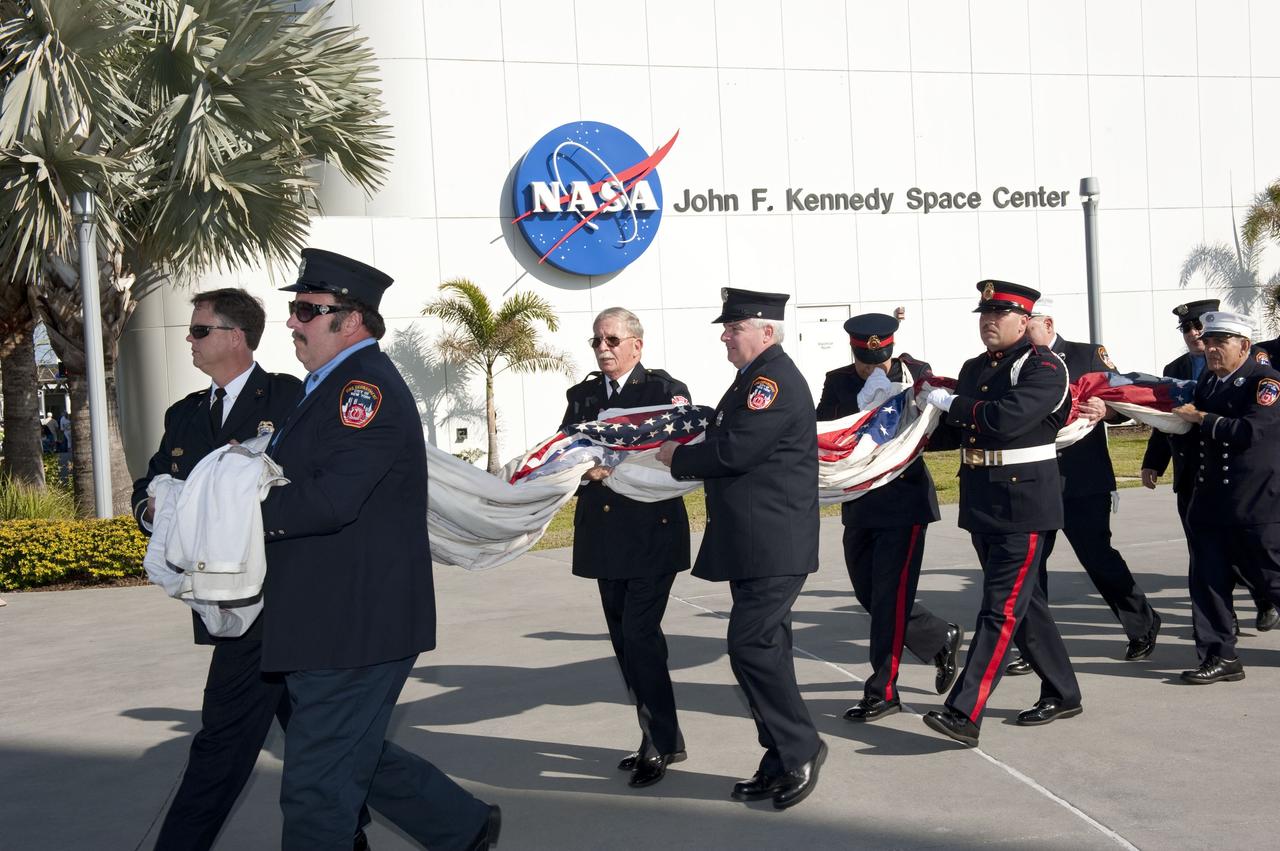
CAPE CANAVERAL, Fla. -- "The National 9/11 Flag" is transported from the Debus Conference Facility to the Rocket Garden at the Kennedy Space Center Visitor Complex in Florida. The contributions of NASA, Kennedy Space Center and the state of Florida were stitched into the fabric of the American Flag, which was recovered near ground zero following the World Trade Center attacks on Sept. 11, 2001. The "New York Says Thank You Foundation" is taking the flag on a cross-country journey to be restored to its original 13-stripe design using pieces of fabric from American flags destined for retirement in all 50 states. Once the flag is restored, it will become a permanent collection of the National September 11 Memorial Museum being built at the World Trade Center site. Photo credit: NASA/Kim Shiflett
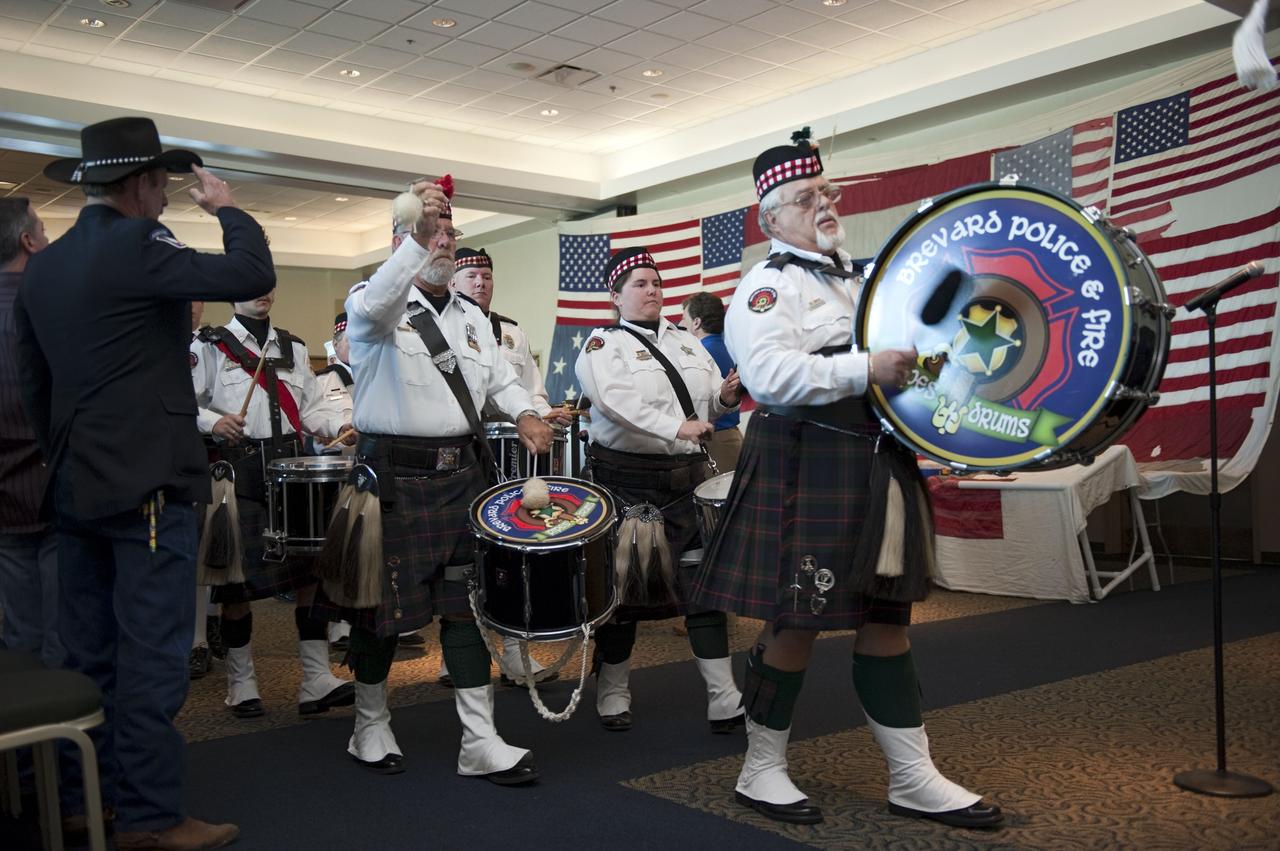
CAPE CANAVERAL, Fla. -- Members of the Brevard Police and Fire Pipes and Drums kick off the "The National 9/11 Flag" stitching ceremony in the Debus Conference Facility at the Kennedy Space Center Visitor Complex in Florida. The contributions of NASA, Kennedy Space Center and the state of Florida were stitched into the fabric of the American Flag, which was recovered near ground zero following the World Trade Center attacks on Sept. 11, 2001. The "New York Says Thank You Foundation" is taking the flag on a cross-country journey to be restored to its original 13-stripe design using pieces of fabric from American flags destined for retirement in all 50 states. Once the flag is restored, it will become a permanent collection of the National September 11 Memorial Museum being built at the World Trade Center site. Photo credit: NASA/Kim Shiflett
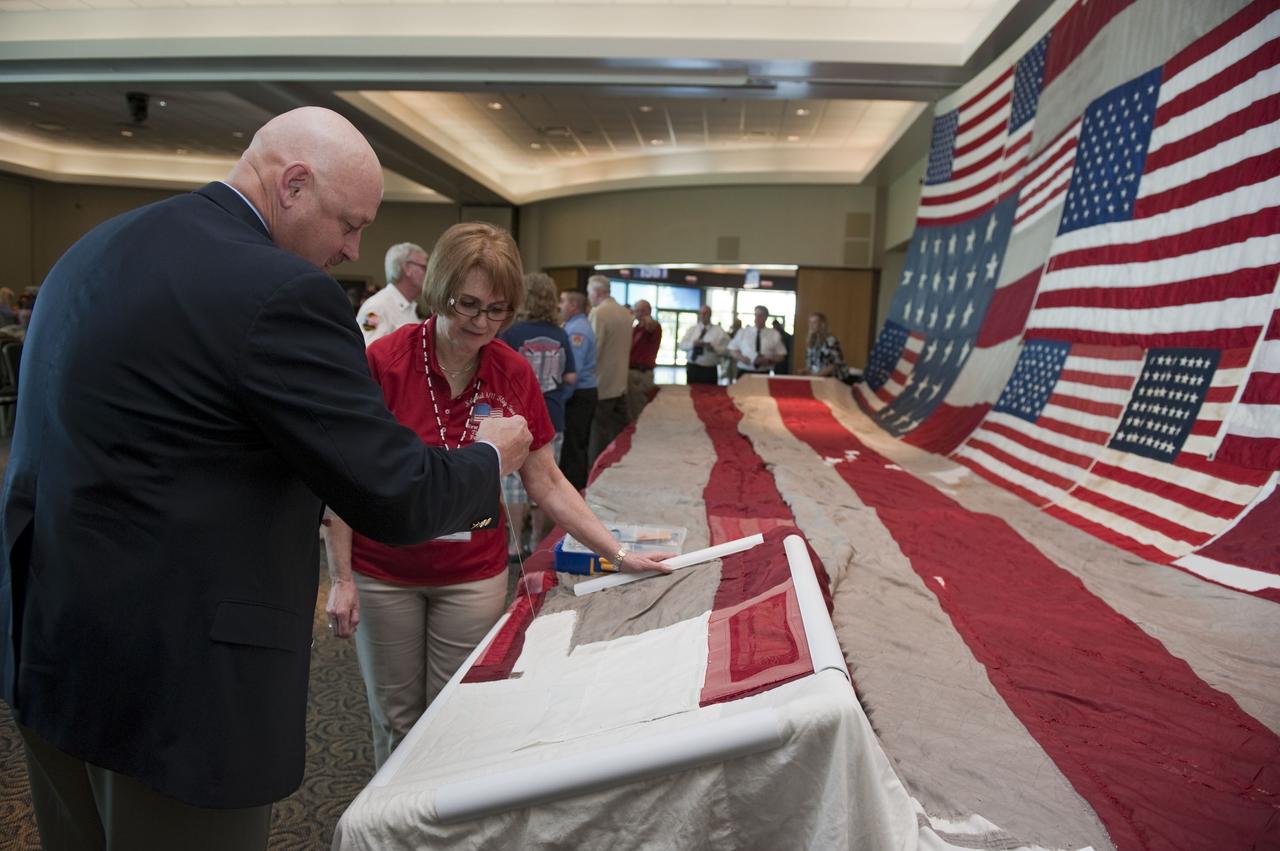
CAPE CANAVERAL, Fla. -- Joe Dowdy, special operations manager at NASA's Kennedy Space Center, contributes stitches to the "National 9/11 Flag" during a ceremony in the Debus Conference Facility at the Kennedy Space Center Visitor Complex in Florida. The contributions of NASA, Kennedy Space Center and the state of Florida were stitched into the fabric of the American Flag, which was recovered near ground zero following the World Trade Center attacks on Sept. 11, 2001. The "New York Says Thank You Foundation" is taking the flag on a cross-country journey to be restored to its original 13-stripe design using pieces of fabric from American flags destined for retirement in all 50 states. Once the flag is restored, it will become a permanent collection of the National September 11 Memorial Museum being built at the World Trade Center site. Photo credit: NASA/Kim Shiflett
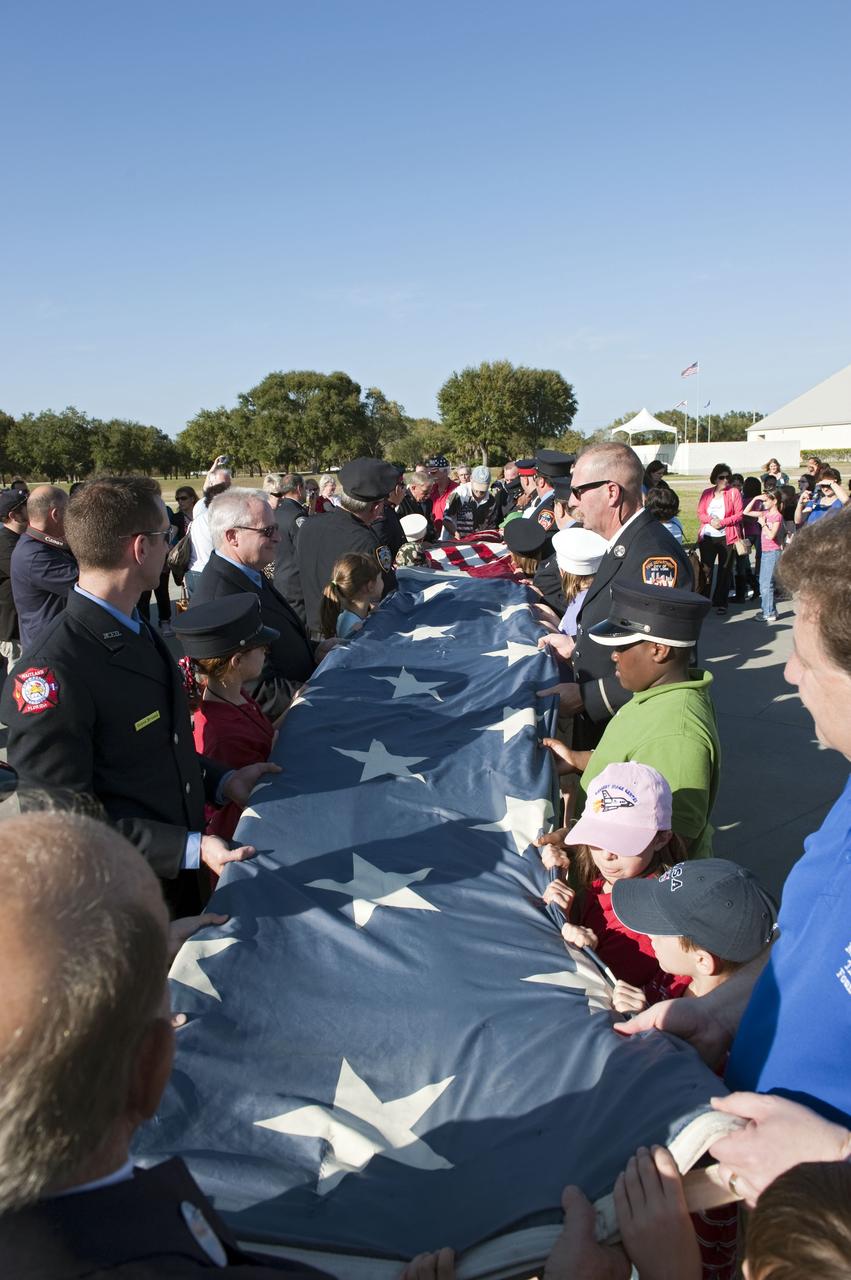
CAPE CANAVERAL, Fla. -- "The National 9/11 Flag" is folded in the Rocket Garden at the Kennedy Space Center Visitor Complex in Florida. The contributions of NASA, Kennedy Space Center and the state of Florida were stitched into the fabric of the American Flag, which was recovered near ground zero following the World Trade Center attacks on Sept. 11, 2001. The "New York Says Thank You Foundation" is taking the flag on a cross-country journey to be restored to its original 13-stripe design using pieces of fabric from American flags destined for retirement in all 50 states. Once the flag is restored, it will become a permanent collection of the National September 11 Memorial Museum being built at the World Trade Center site. Photo credit: NASA/Kim Shiflett
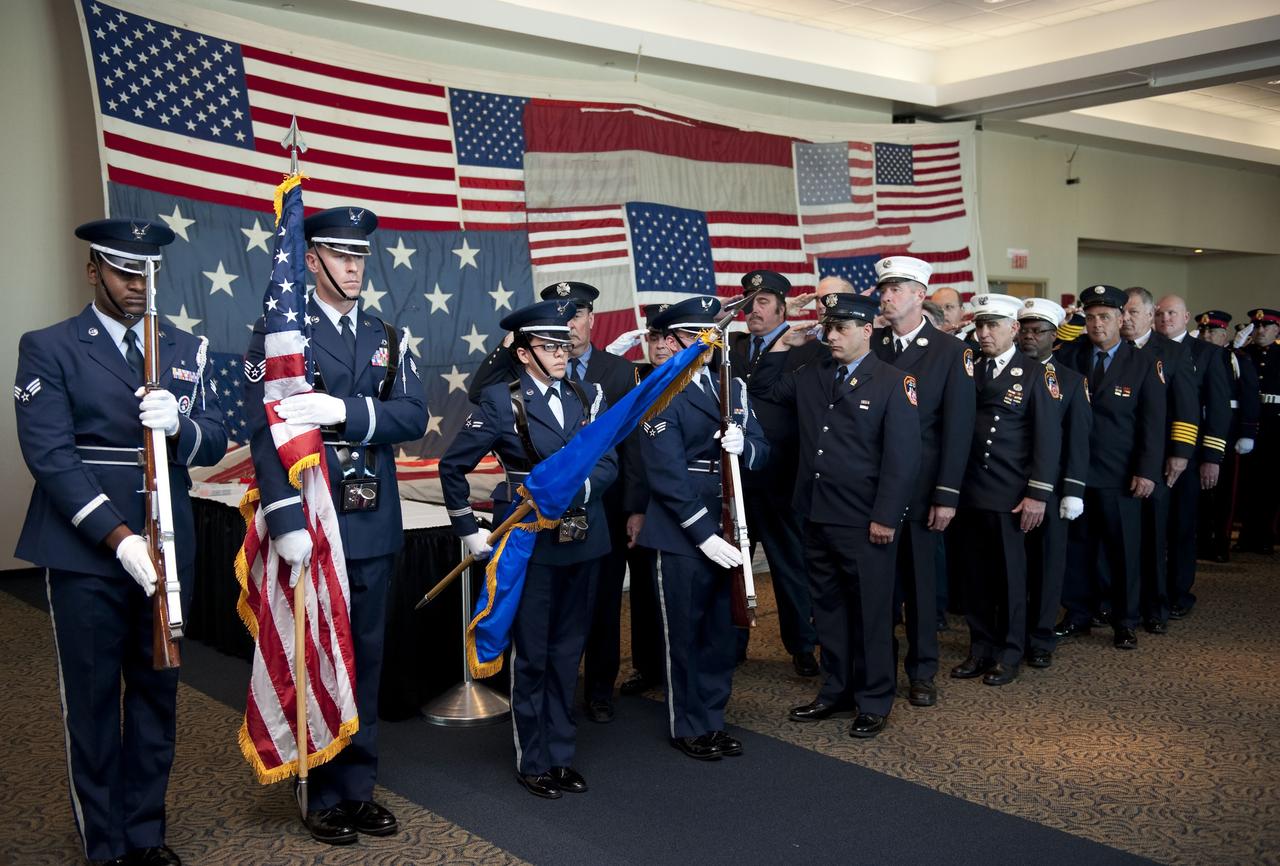
CAPE CANAVERAL, Fla. -- Members of the United States Air Force 45th Space Wing Honor Guard and more than a dozen 9/11 first responders take part in "The National 9/11 Flag" stitching ceremony in the Debus Conference Facility at the Kennedy Space Center Visitor Complex in Florida. The contributions of NASA, Kennedy Space Center and the state of Florida were stitched into the fabric of the American Flag, which was recovered near ground zero following the World Trade Center attacks on Sept. 11, 2001. The "New York Says Thank You Foundation" is taking the flag on a cross-country journey to be restored to its original 13-stripe design using pieces of fabric from American flags destined for retirement in all 50 states. Once the flag is restored, it will become a permanent collection of the National September 11 Memorial Museum being built at the World Trade Center site. Photo credit: NASA/Kim Shiflett

CAPE CANAVERAL, Fla. -- More than a dozen 9/11 first responders take part in "The National 9/11 Flag" stitching ceremony at the Kennedy Space Center Visitor Complex in Florida. The contributions of NASA, Kennedy Space Center and the state of Florida were stitched into the fabric of the American Flag, which was recovered near ground zero following the World Trade Center attacks on Sept. 11, 2001. The "New York Says Thank You Foundation" is taking the flag on a cross-country journey to be restored to its original 13-stripe design using pieces of fabric from American flags destined for retirement in all 50 states. Once the flag is restored, it will become a permanent collection of the National September 11 Memorial Museum being built at the World Trade Center site. Photo credit: NASA/Kim Shiflett
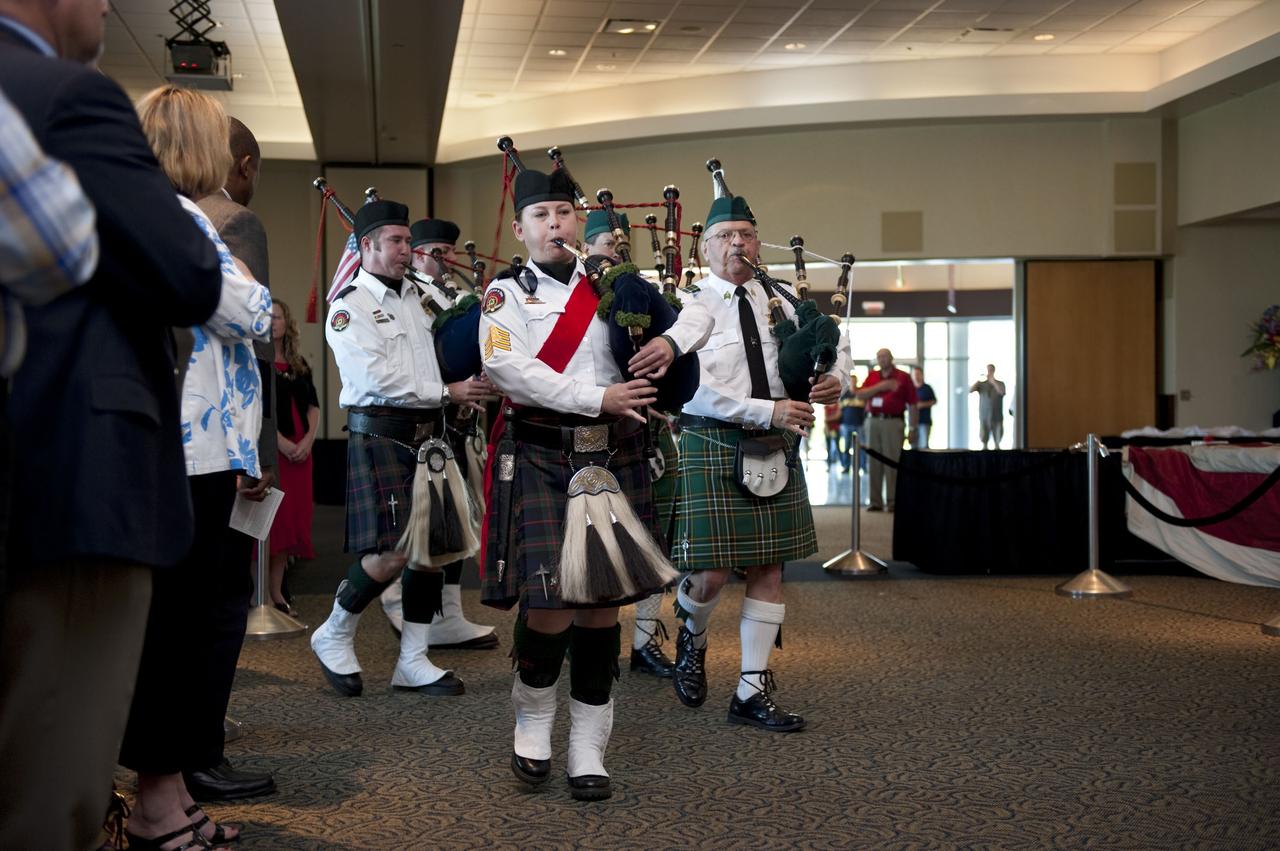
CAPE CANAVERAL, Fla. -- Members of the Brevard Police and Fire Pipes and Drums kick off the "The National 9/11 Flag" stitching ceremony in the Debus Conference Facility at the Kennedy Space Center Visitor Complex in Florida. The contributions of NASA, Kennedy Space Center and the state of Florida were stitched into the fabric of the American Flag, which was recovered near ground zero following the World Trade Center attacks on Sept. 11, 2001. The "New York Says Thank You Foundation" is taking the flag on a cross-country journey to be restored to its original 13-stripe design using pieces of fabric from American flags destined for retirement in all 50 states. Once the flag is restored, it will become a permanent collection of the National September 11 Memorial Museum being built at the World Trade Center site. Photo credit: NASA/Kim Shiflett

CAPE CANAVERAL, Fla. -- "The National 9/11 Flag" is raised in the Rocket Garden at the Kennedy Space Center Visitor Complex in Florida. The contributions of NASA, Kennedy Space Center and the state of Florida were stitched into the fabric of the American Flag, which was recovered near ground zero following the World Trade Center attacks on Sept. 11, 2001. The "New York Says Thank You Foundation" is taking the flag on a cross-country journey to be restored to its original 13-stripe design using pieces of fabric from American flags destined for retirement in all 50 states. Once the flag is restored, it will become a permanent collection of the National September 11 Memorial Museum being built at the World Trade Center site. Photo credit: NASA/Kim Shiflett
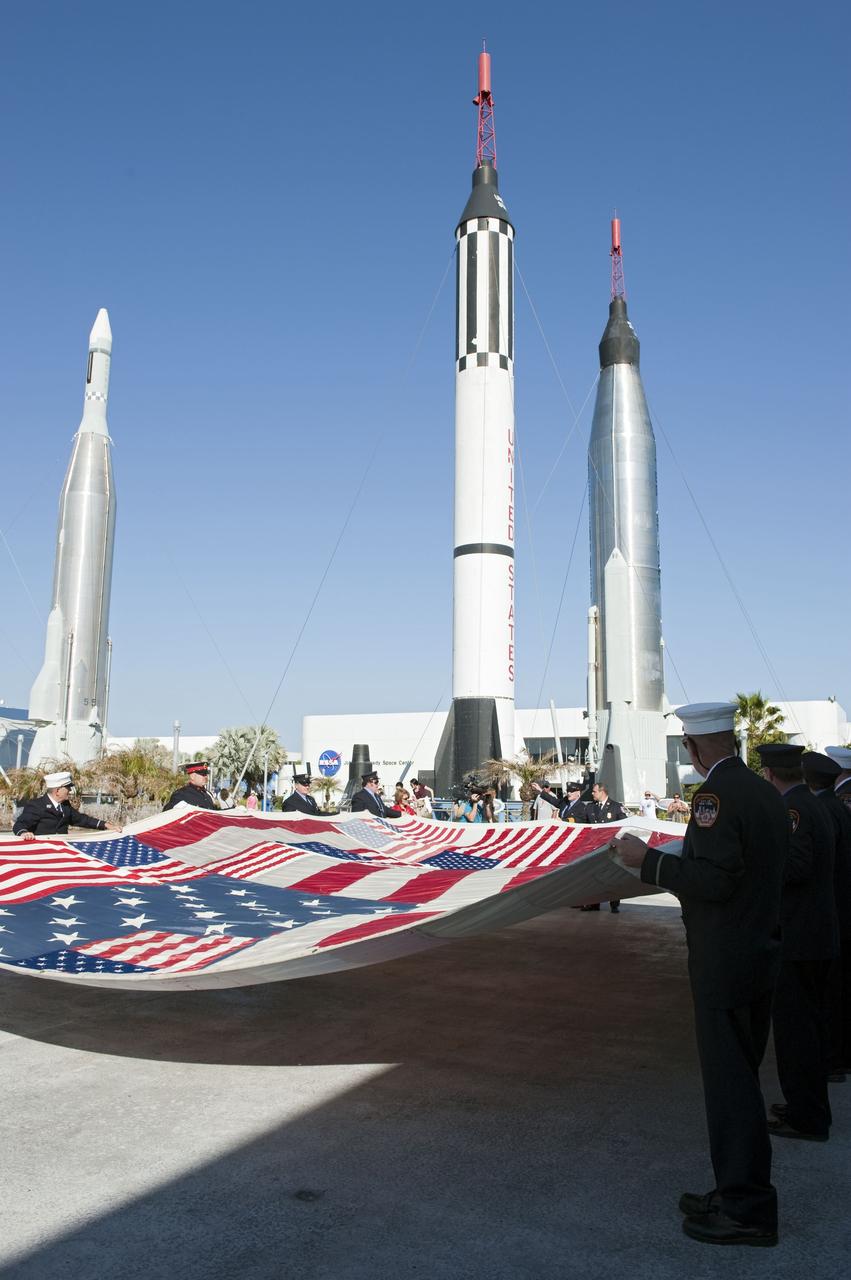
CAPE CANAVERAL, Fla. -- "The National 9/11 Flag" is transported from the Debus Conference Facility to the Rocket Garden at the Kennedy Space Center Visitor Complex in Florida. The contributions of NASA, Kennedy Space Center and the state of Florida were stitched into the fabric of the American Flag, which was recovered near ground zero following the World Trade Center attacks on Sept. 11, 2001. The "New York Says Thank You Foundation" is taking the flag on a cross-country journey to be restored to its original 13-stripe design using pieces of fabric from American flags destined for retirement in all 50 states. Once the flag is restored, it will become a permanent collection of the National September 11 Memorial Museum being built at the World Trade Center site. Photo credit: NASA/Kim Shiflett
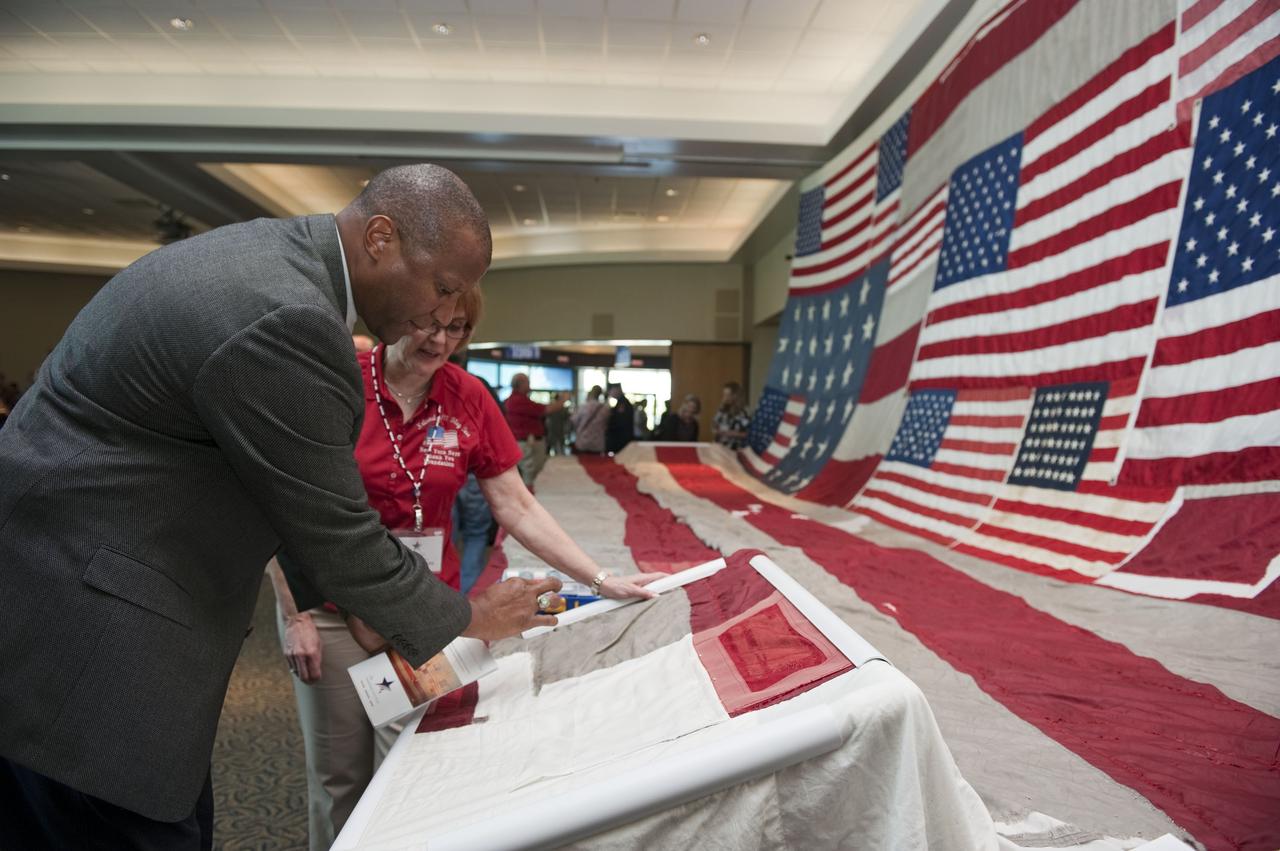
CAPE CANAVERAL, Fla. -- Kelvin Manning, associate director for Business Operations at NASA's Kennedy Space Center, contributes stitches to the "National 9/11 Flag" during a ceremony in the Debus Conference Facility at the Kennedy Space Center Visitor Complex in Florida. The contributions of NASA, Kennedy Space Center and the state of Florida were stitched into the fabric of the American Flag, which was recovered near ground zero following the World Trade Center attacks on Sept. 11, 2001. The "New York Says Thank You Foundation" is taking the flag on a cross-country journey to be restored to its original 13-stripe design using pieces of fabric from American flags destined for retirement in all 50 states. Once the flag is restored, it will become a permanent collection of the National September 11 Memorial Museum being built at the World Trade Center site. Photo credit: NASA/Kim Shiflett
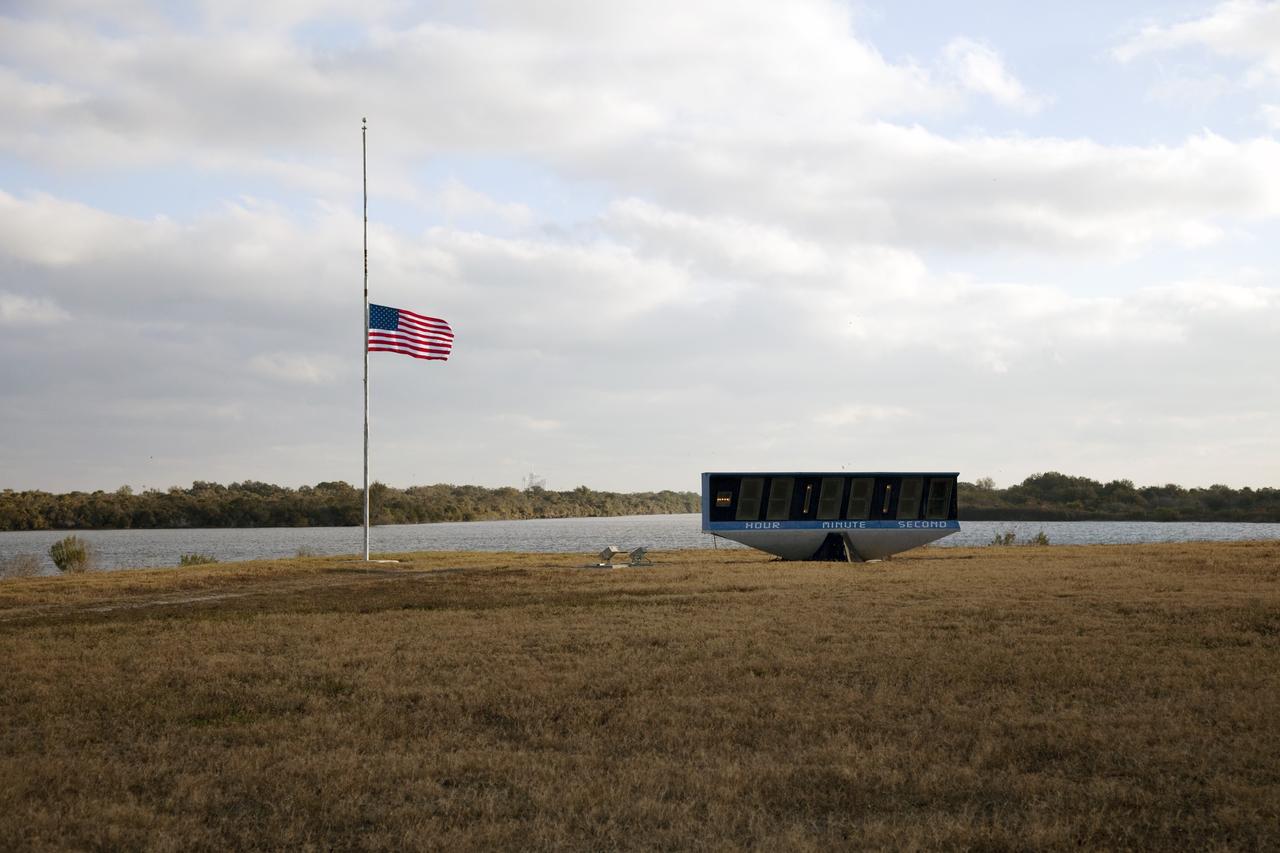
CAPE CANAVERAL, Fla. -- In accordance with a Presidential Proclamation, the American Flag in the Launch Complex 39 area of NASA's Kennedy Space Center in Florida flies at half-staff to honor U.S. Rep. Gabrielle Giffords and others who were wounded or killed during a shooting spree in Tucson, Arizona. This flag and all American Flags at U.S. military and government installations across the country and abroad will remain at half-staff until sunset on Jan. 14. Giffords is the wife of NASA astronaut Mark Kelly, who is scheduled to command space shuttle Endeavour's last mission, STS-134, to the International Space Station later this year. Photo credit: NASA/Frankie Martin
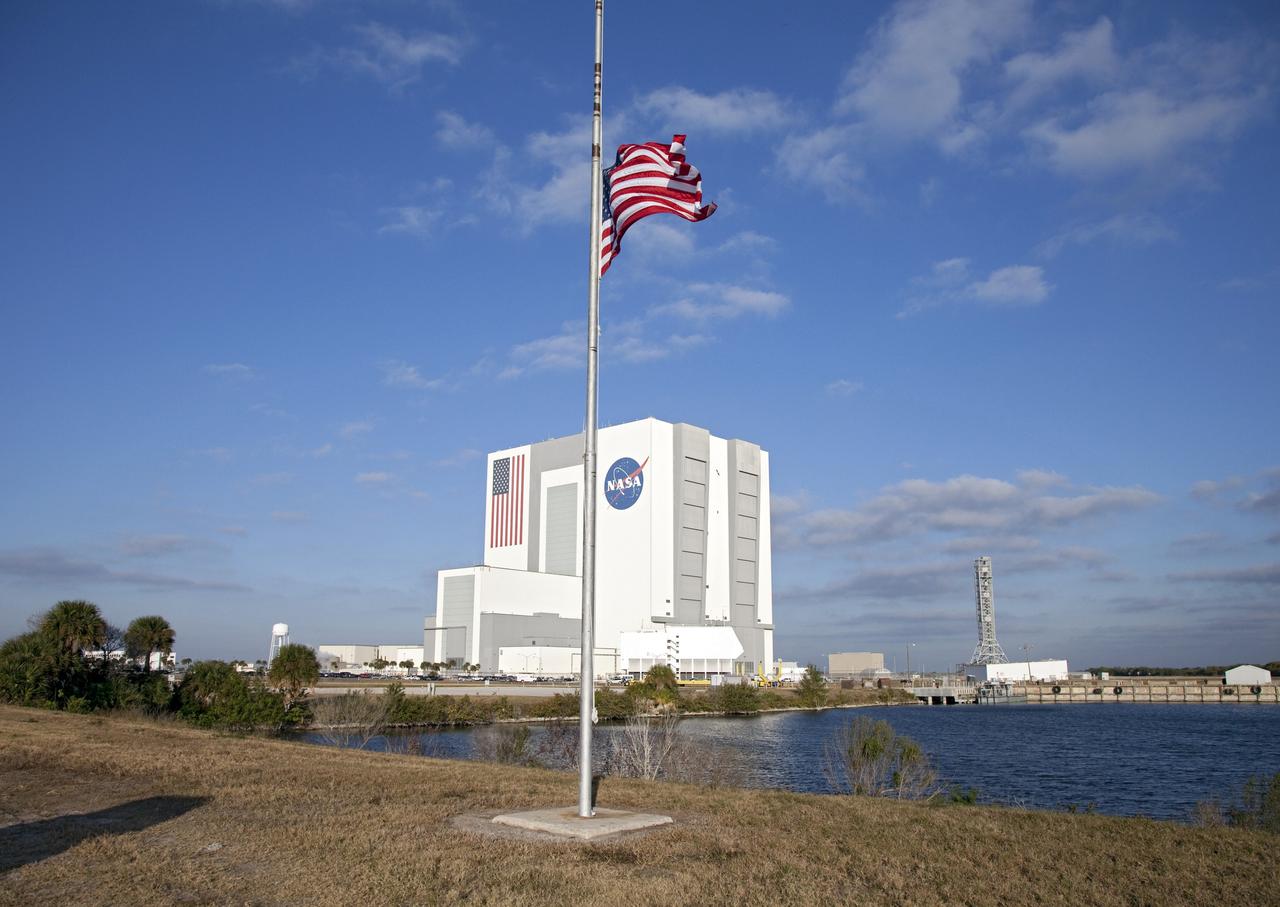
CAPE CANAVERAL, Fla. -- In accordance with a Presidential Proclamation, the American Flag in the Launch Complex 39 area of NASA's Kennedy Space Center in Florida flies at half-staff to honor U.S. Rep. Gabrielle Giffords and others who were wounded or killed during a shooting spree in Tucson, Arizona. This flag and all American Flags at U.S. military and government installations across the country and abroad will remain at half-staff until sunset on Jan. 14. Giffords is the wife of NASA astronaut Mark Kelly, who is scheduled to command space shuttle Endeavour's last mission, STS-134, to the International Space Station later this year. Photo credit: NASA/Frankie Martin
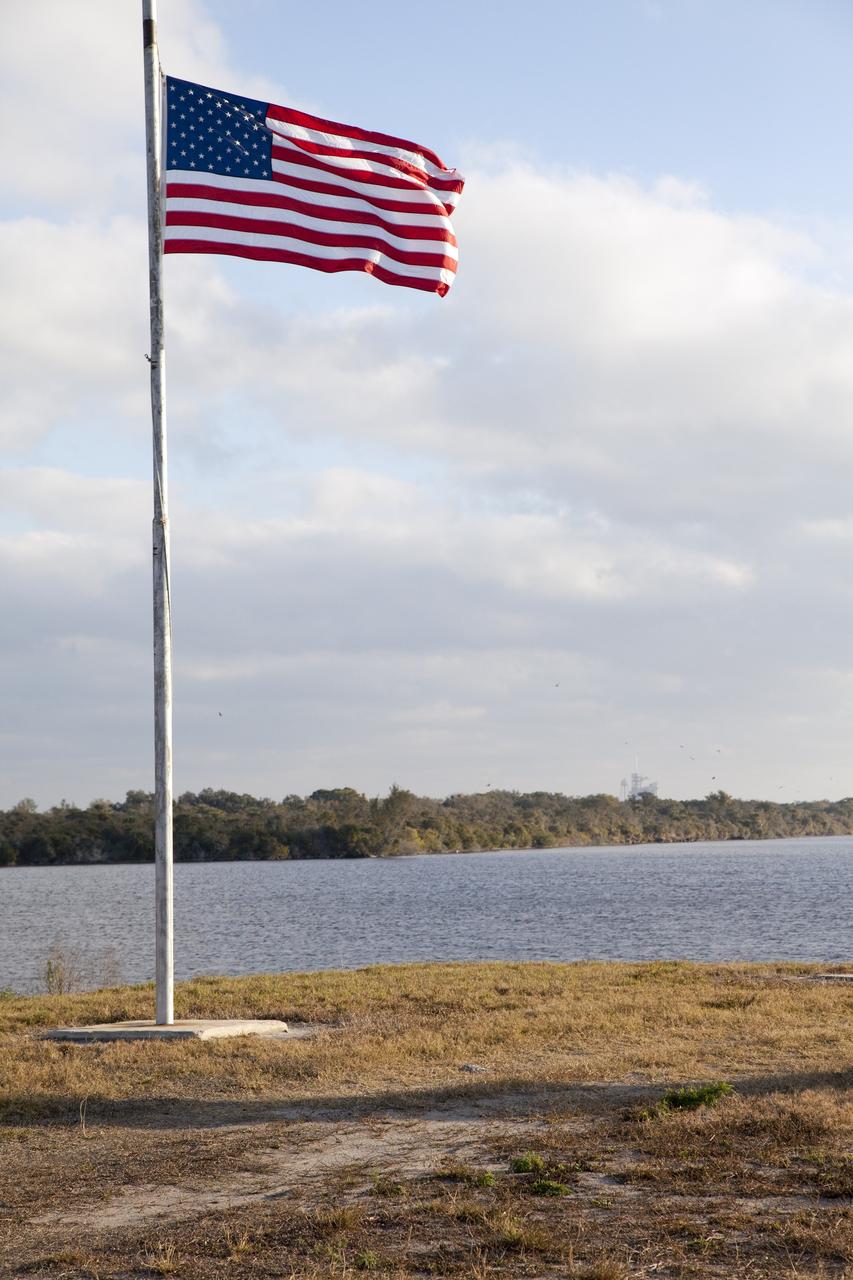
CAPE CANAVERAL, Fla. -- In accordance with a Presidential Proclamation, the American Flag in the Launch Complex 39 area of NASA's Kennedy Space Center in Florida flies at half-staff to honor U.S. Rep. Gabrielle Giffords and others who were wounded or killed during a shooting spree in Tucson, Arizona. This flag and all American Flags at U.S. military and government installations across the country and abroad will remain at half-staff until sunset on Jan. 14. Giffords is the wife of NASA astronaut Mark Kelly, who is scheduled to command space shuttle Endeavour's last mission, STS-134, to the International Space Station later this year. Photo credit: NASA/Frankie Martin
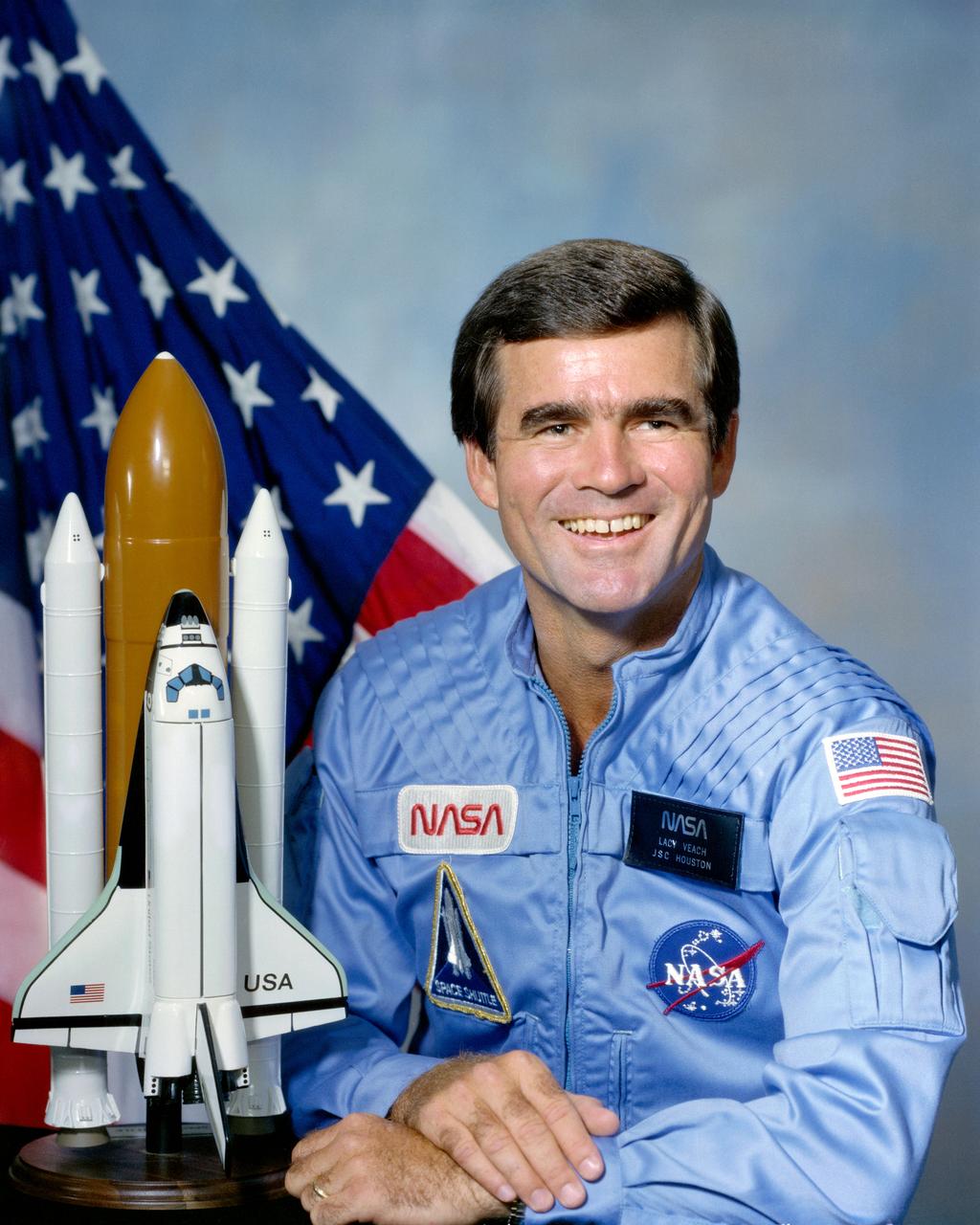
Portrait photograph of Astronaut Charles L. Veach in blue flight suit with Shuttle model and American flag in the background. JSC, HOUSTON, TX

Expedition 9 Flight Engineer and NASA Science Officer Mike Fincke, left and NASA Expedition 9 backup Commander Leroy Chiao prepare to raise the American flag at the flag raising ceremony at the Cosmonaut Hotel, Thursday, April 15, 2004, Baikonur, Kazakhstan. Photo Credit: (NASA/Bill Ingalls)
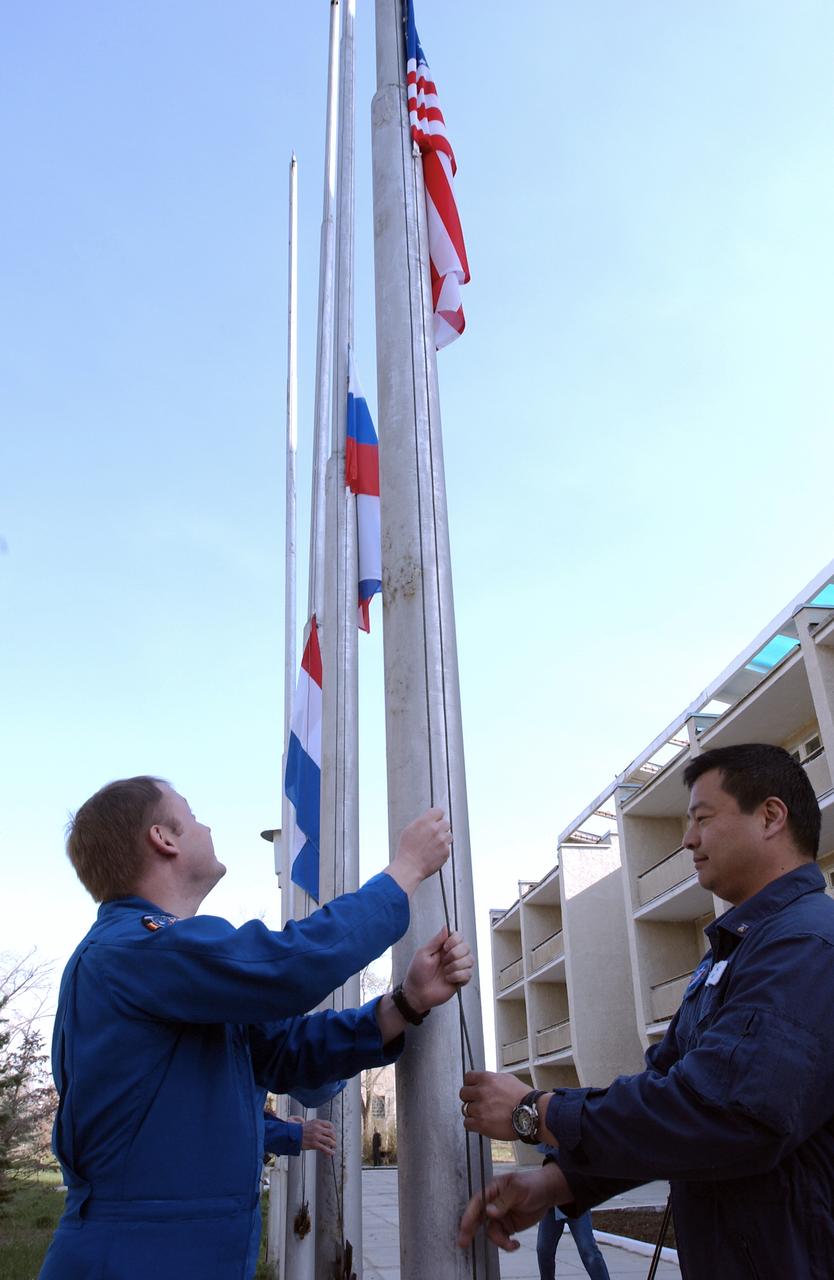
Expedition 9 Flight Engineer and NASA Science Officer Mike Fincke, left and NASA Expedition 9 backup Commander Leroy Chiao prepare to raise the American flag at the flag raising ceremony at the Cosmonaut Hotel, Thursday, April 15, 2004, Baikonur, Kazakhstan. Photo Credit: (NASA/Bill Ingalls)
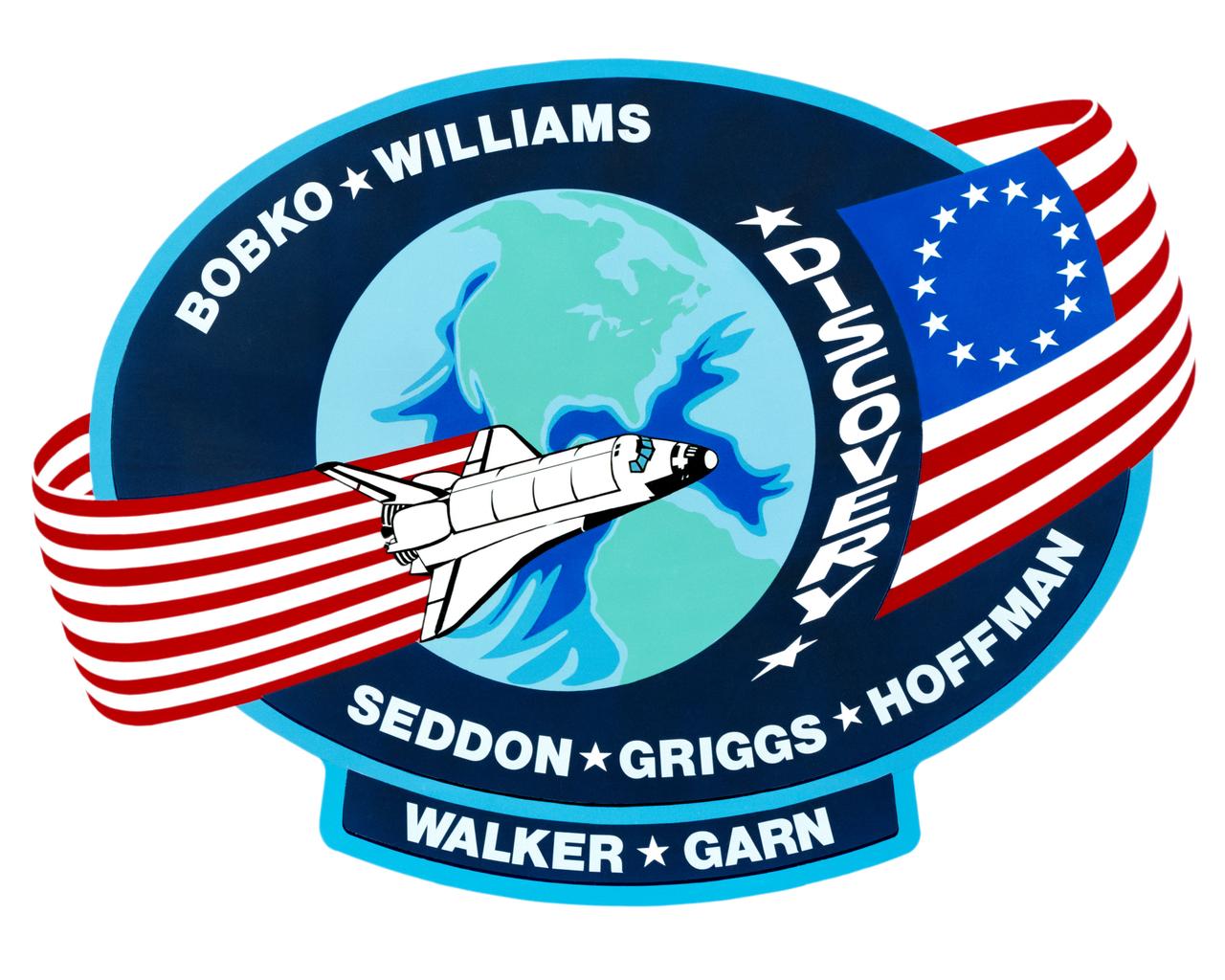
S85-28989 (March 1985) --- The dominant features of the STS-51D emblem are an orbit formed by a Colonial American flag and a space shuttle. The flag in orbit signifies the U.S. flag to indicate that it comes from this country and the American people. The original 13-star flag is used to symbolize a continuity of technical achievement and progress since colonial times. The name Discovery preceding the flag represents the spirit of Discovery and exploration of new frontiers which have been a hallmark of American people even before they were formed together as a nation. The crew members are Karol J. Bobko, Donald E. Williams, Rhea Seddon, S. David Griggs and Jeffrey A. Hoffman of NASA; and Charles D. Walker, representing McDonnell Douglas Corporation; and U. S. Senator Jake Garn. The NASA insignia design for space shuttle flights is reserved for use by the astronauts and for other official use as the NASA Administrator may authorize. Public availability has been approved only in the forms of illustrations by the various news media. When and if there is any change in this policy, which is not anticipated, the change will be publicly announced. Photo credit: NASA
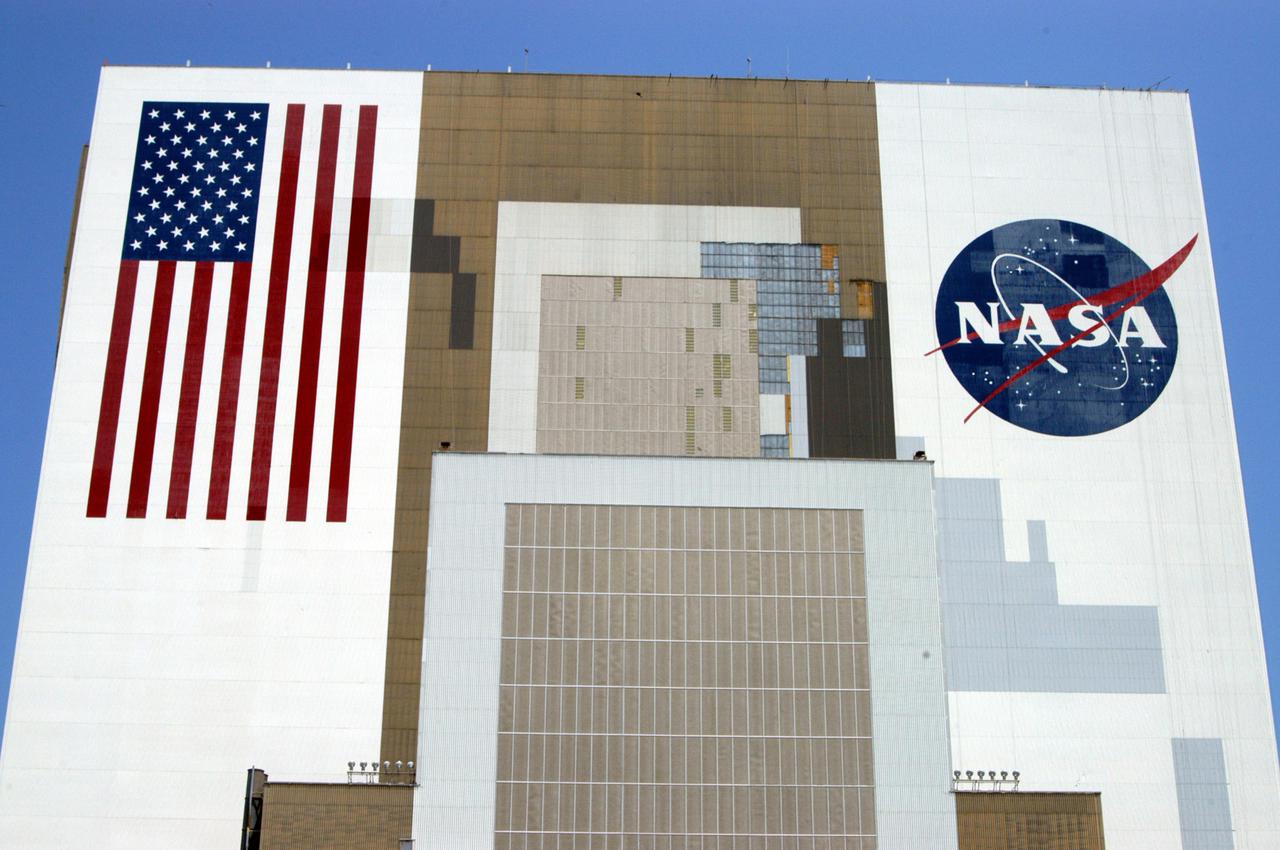
KENNEDY SPACE CENTER, FLA. - The Vehicle Assembly Building at NASA’s Kennedy Space Center is undergoing repairs caused by the hurricanes of 2004 that assaulted the east coast of Florida. Winds pulled a number of panels from the side of the 525-foot-high building. On the left is the American flag that was damaged and now has been repaired and repainted. The flag is 209 feet by 110 feet. Each star is more than six feet in diameter and each stripe is nine feet wide. The flag sits more than 450 feet above the ground.
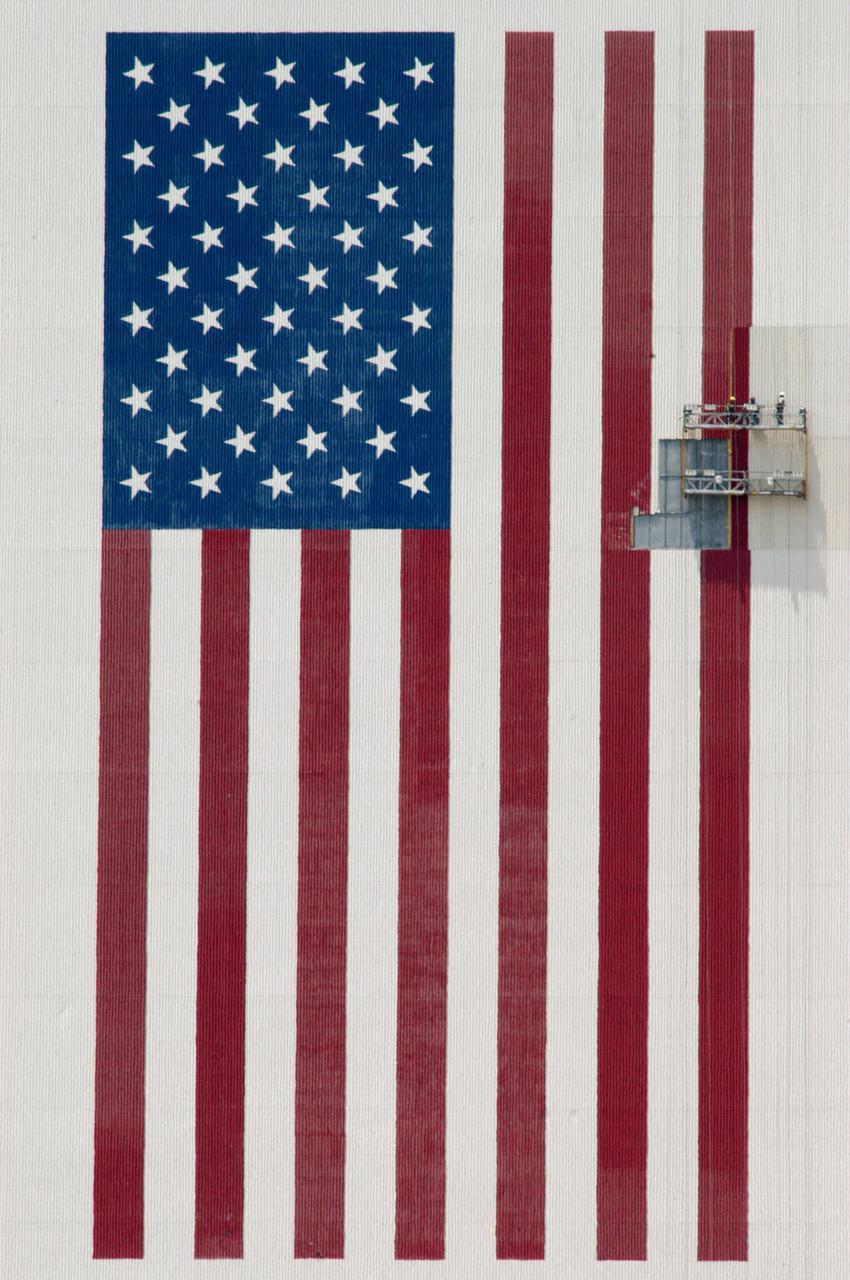
KENNEDY SPACE CENTER, FLA. - About 450 feet above the ground, painters on scaffolding begin preparations to repaint portions of the American flag on the side of the Vehicle Assembly Building at NASA’s Kennedy Space Center. The flag was damaged in the hurricanes of 2004 that assaulted the east coast of Florida. Winds pulled a number of panels from the side of the 525-foot-high building. The flag is 209 feet by 110 feet. Each star is more than six feet in diameter and each stripe is nine feet wide.
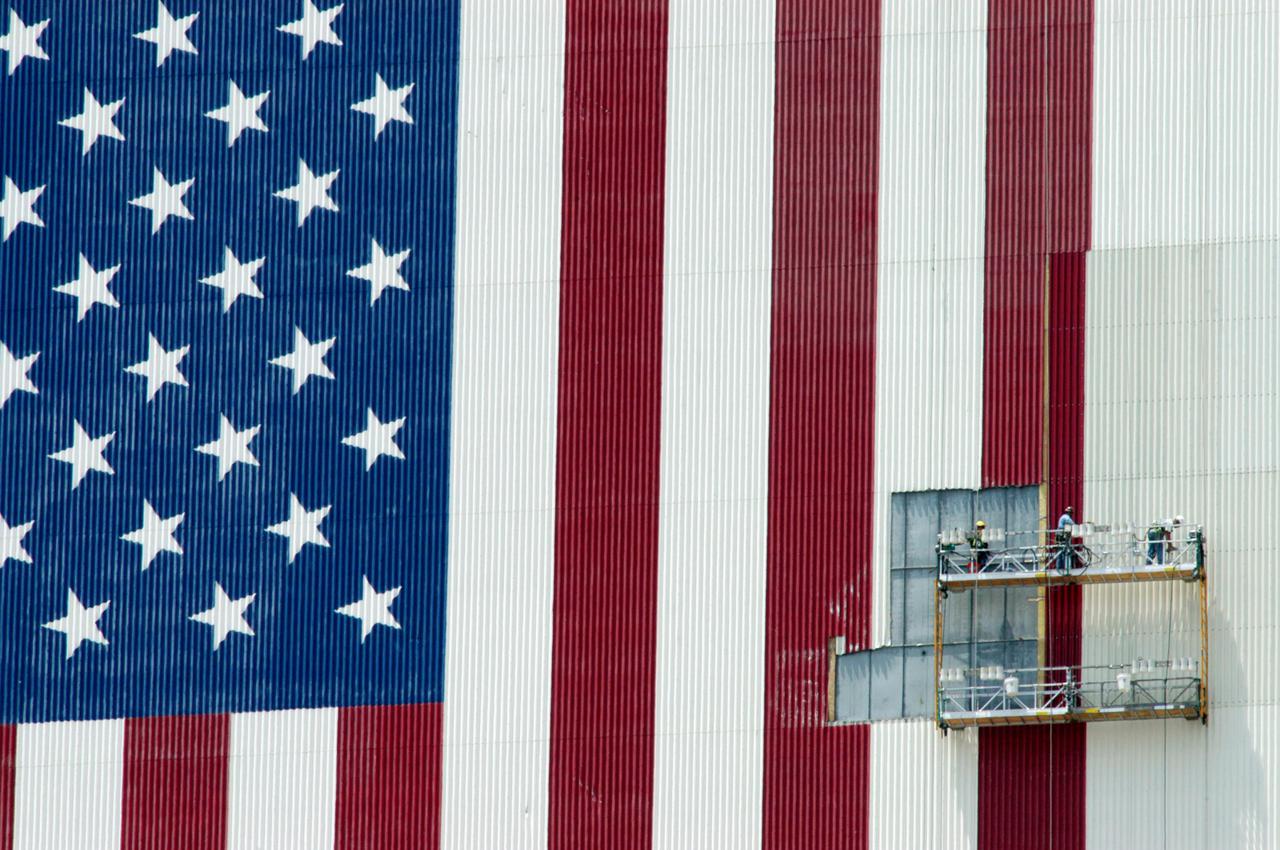
KENNEDY SPACE CENTER, FLA. - About 450 feet above the ground, painters on scaffolding begin preparations to repaint portions of the American flag on the side of the Vehicle Assembly Building at NASA’s Kennedy Space Center. The flag was damaged in the hurricanes of 2004 that assaulted the east coast of Florida. Winds pulled a number of panels from the side of the 525-foot-high building. The flag is 209 feet by 110 feet. Each star is more than six feet in diameter and each stripe is nine feet wide.

iss071e257004 (July 2, 2024) --- The American flag is pictured inside the window of the Boeing Starliner spacecraft that carried NASA astronauts Butch Wilmore and Suni Williams to the International Space Station on NASA's Boeing Crew Flight Test.
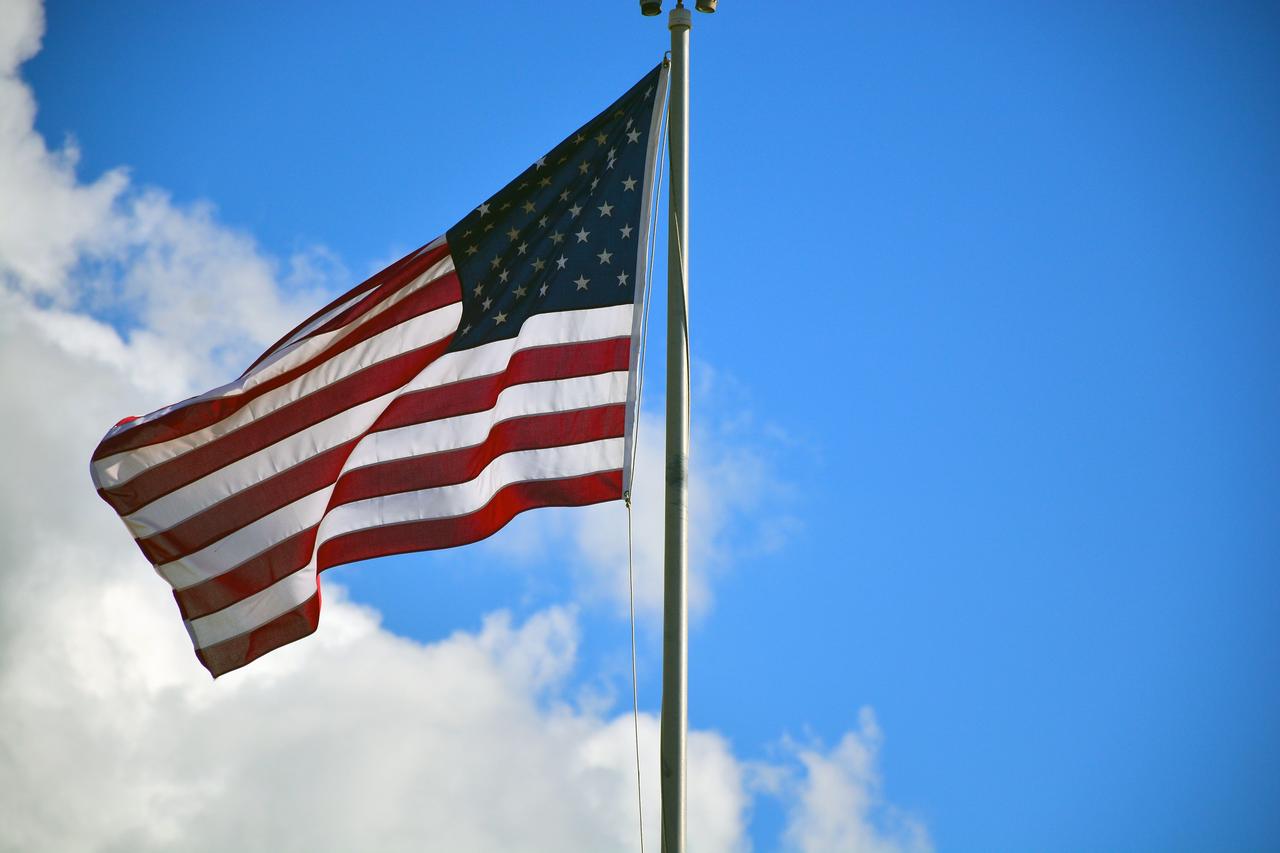
VANDENBERG AFB, California – An American flag flies at Space Launch Complex-2 at Vandenberg AFB, California - the launch site for NASA's SMAP spacecraft. For more, go to www.nasa.gov/smap Photo credit: NASA/Randy Beaudoin
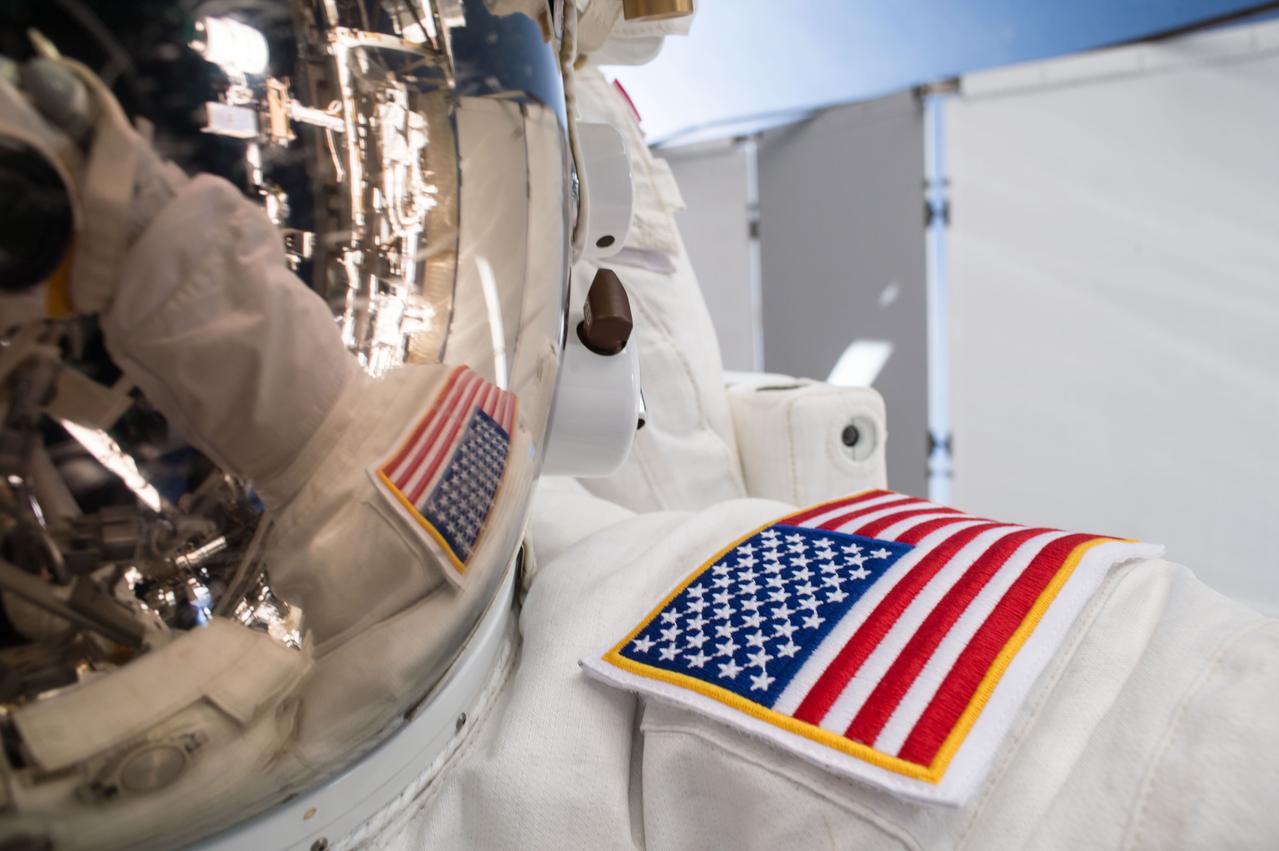
Extravehicular crewmember 1 (EV1) Jeff Williams' camera view of the American flag on his Extravehicular Mobility Unit (EMU). Image was taken during Extravehicular Activity 37 (EVA 37).
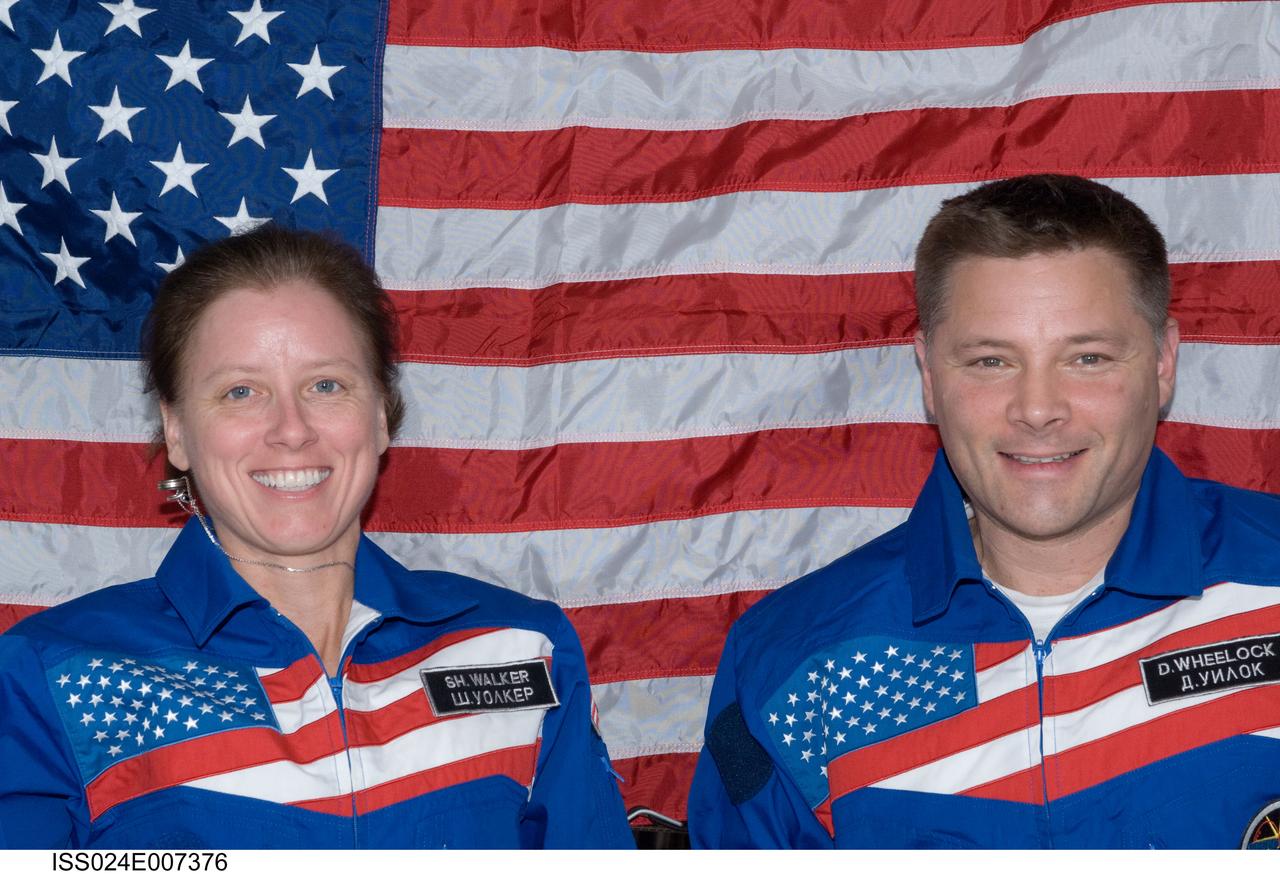
ISS024-E-007376 (3 July 2010) --- NASA astronauts Shannon Walker and Doug Wheelock, both Expedition 24 flight engineers, pose for a photo with an American flag while aboard the International Space Station.
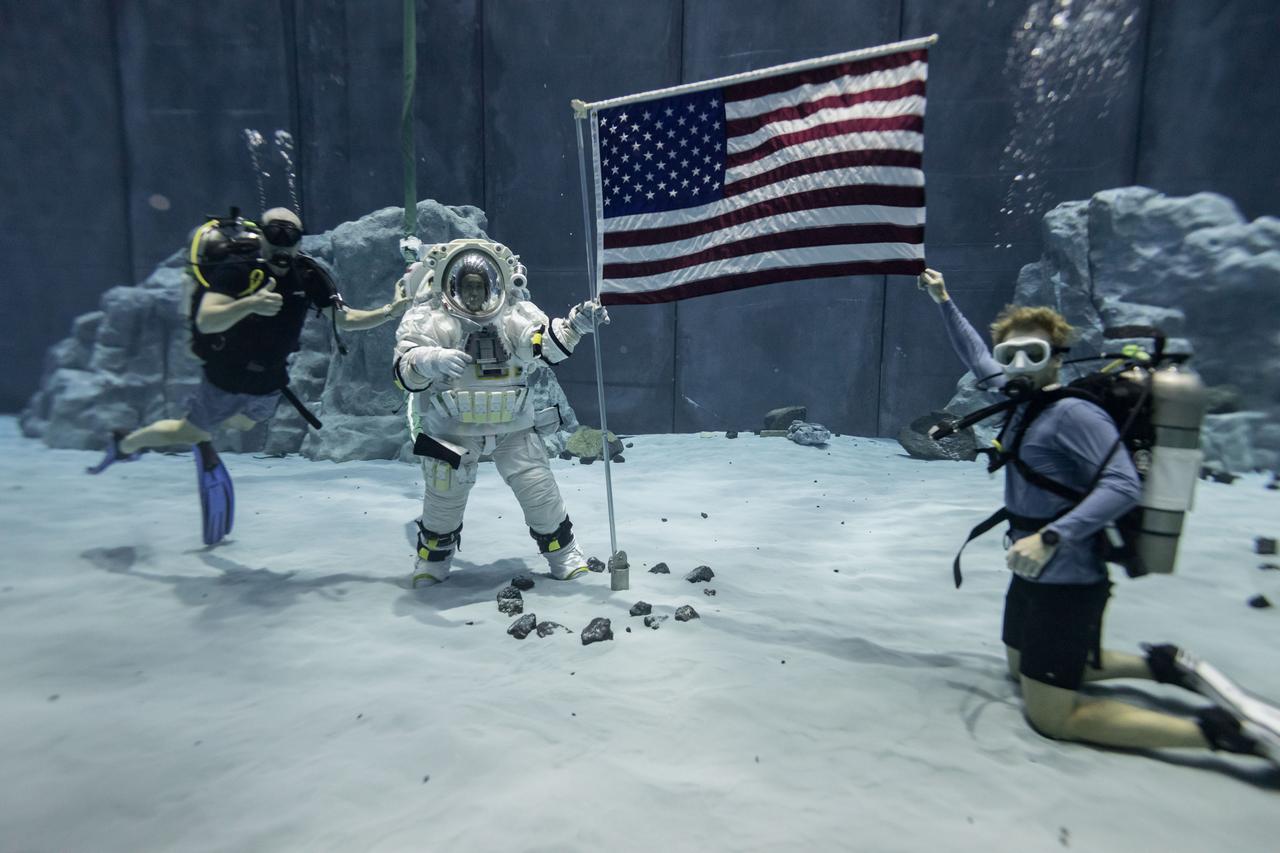
Axiom Space astronaut and Chief Technology Officer Koichi Wakata holds up an American flag in NASA's Neutral Buoyancy Laboratory during the first crewed underwater test of Axiom Space's lunar spacesuit. Image Credit: NASA
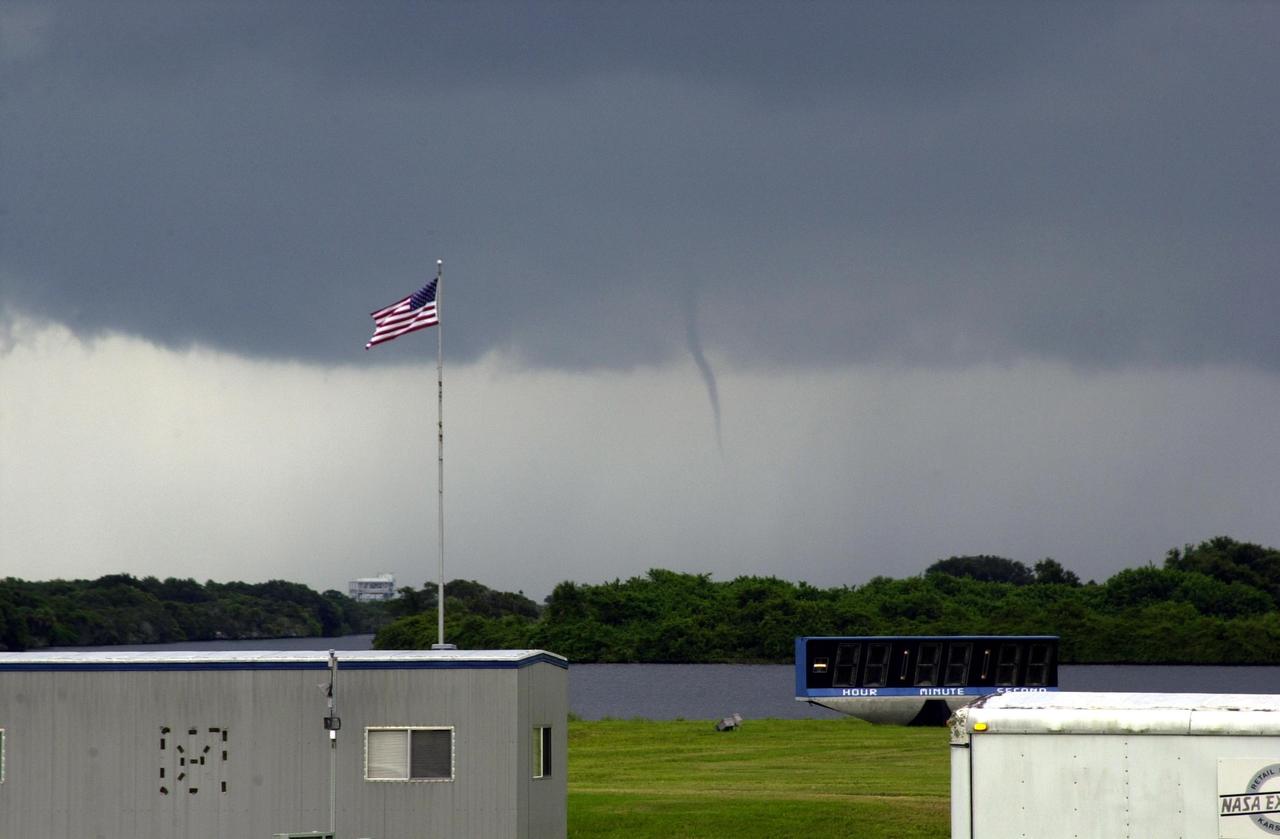
KENNEDY SPACE CENTER, FLA. -- A small water spout forms east of Launch Complex 39, Kennedy Space Center. The American flag is flying at the Press Site, near the mission countdown clock.
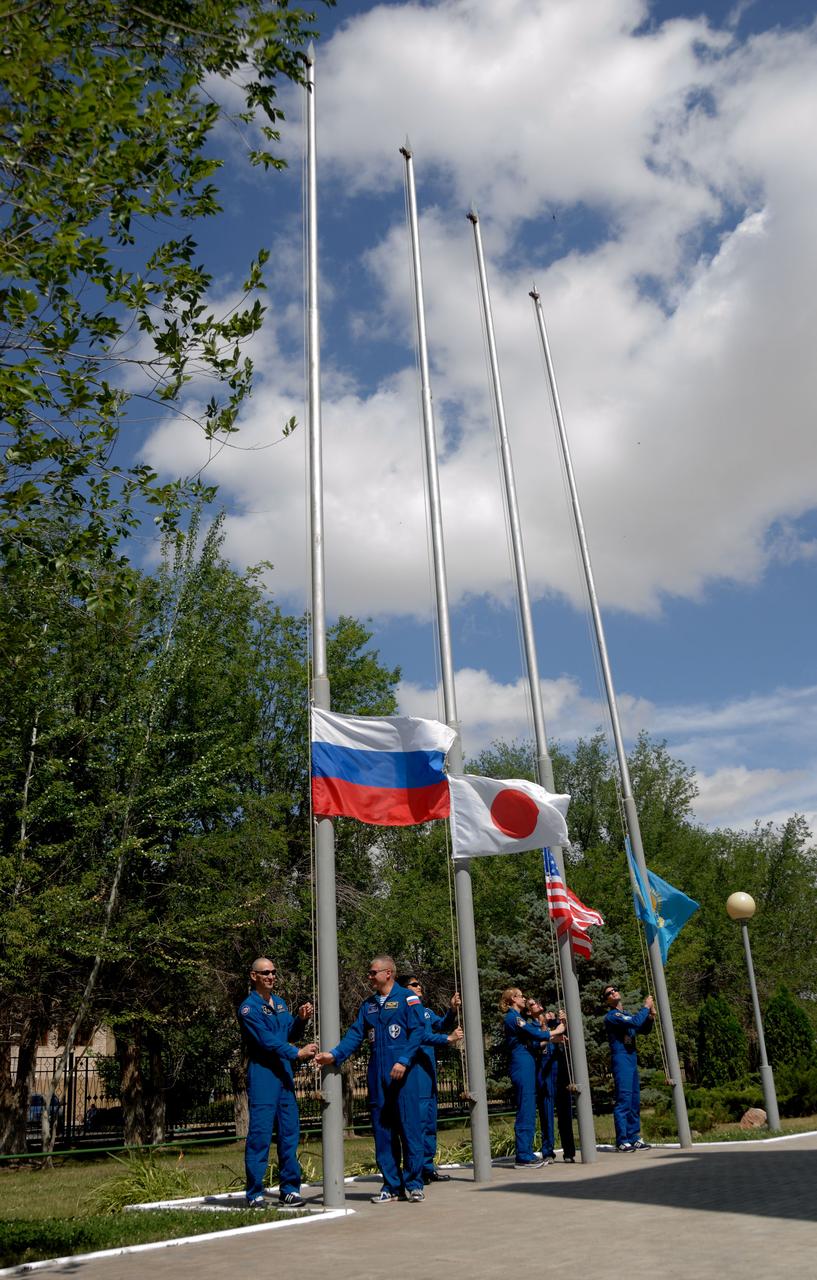
Outside their Cosmonaut Hotel crew quarters in Baikonur, Kazakhstan, the Expedition 48-49 prime and backup crewmembers conduct the traditional raising of the Russian, Japanese, American and Kazakh flags June 26. Prime crewmembers Kate Rubins of NASA, Anatoly Ivanishin of Roscosmos and Takuya Onishi of the Japan Aerospace Exploration Agency will launch on July 7, Baikonur time, on the Soyuz MS-01 spacecraft for a planned four-month mission on the International Space Station. NASA/Alexander Vysotsky
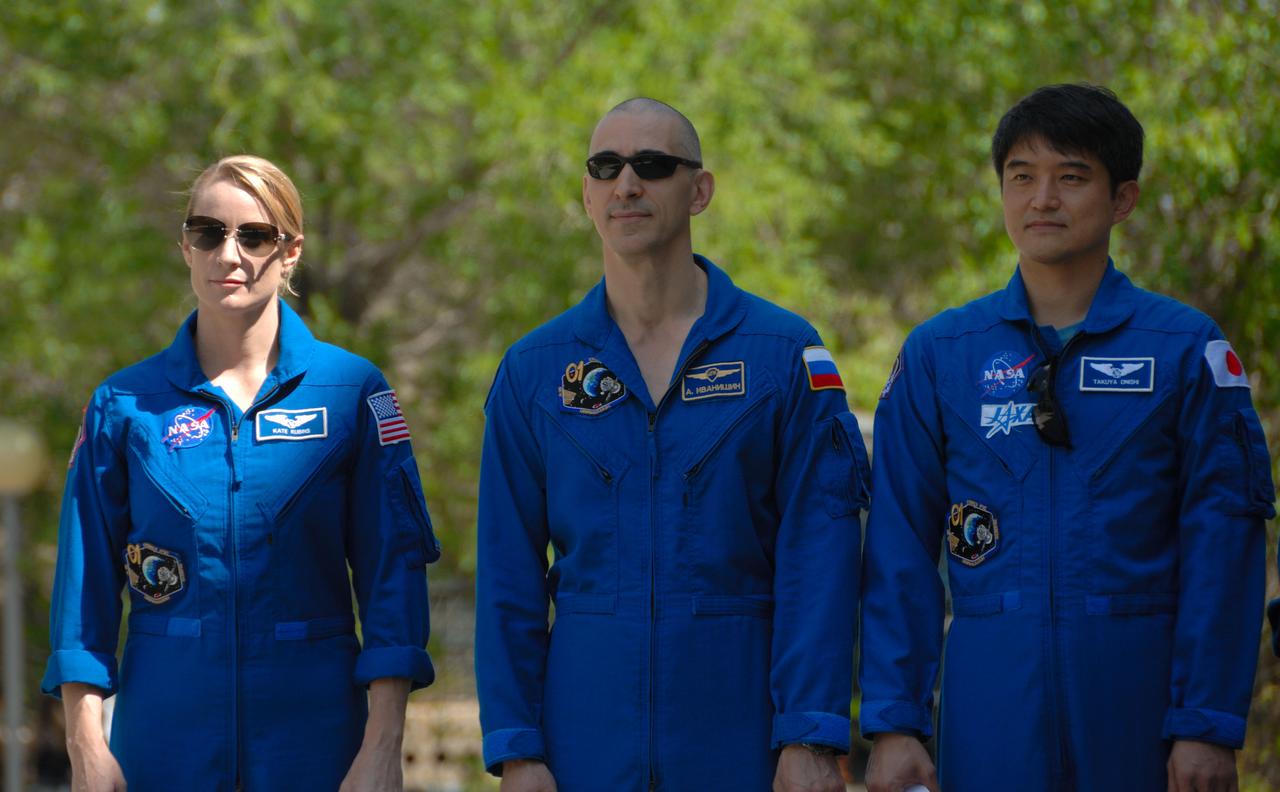
Outside their Cosmonaut Hotel crew quarters in Baikonur, Kazakhstan, Expedition 48-49 crewmembers Kate Rubins of NASA (left), Anatoly Ivanishin of Roscosmos (center) and Takuya Onishi of the Japan Aerospace Exploration Agency (right) listen to remarks June 26 during the traditional raising of the American, Russian, Japanese and Kazakh flags. The trio will launch on July 7, Baikonur time, on the Soyuz MS-01 spacecraft for a planned four-month mission on the International Space Station. NASA/Alexander Vysotsky
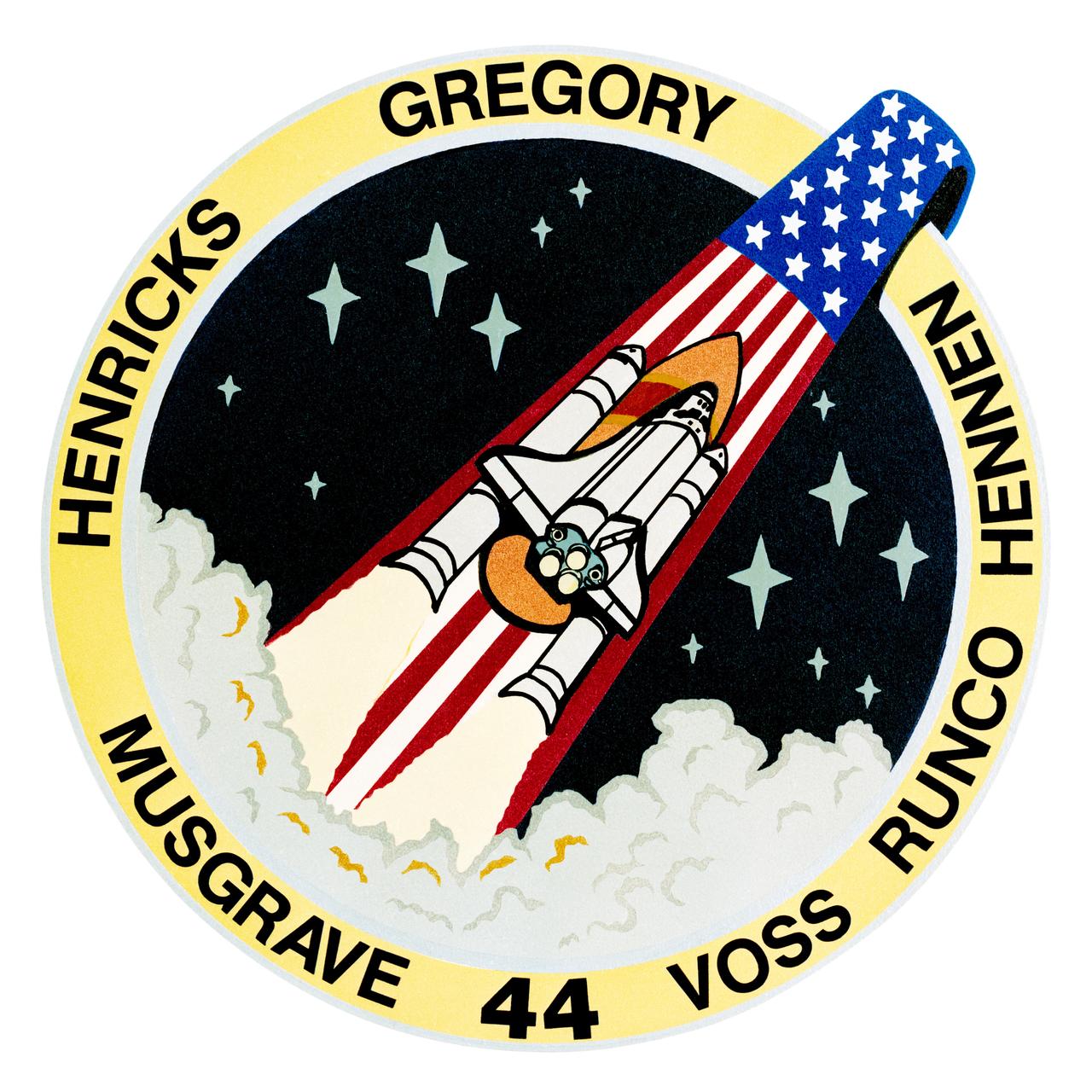
STS044-S-001 (July 1991) --- Designed by the participating crew members, the STS-44 patch shows the space shuttle Atlantis shortly after liftoff as it rolls to ascend into orbit. The orbital path illustrated by the red, white and blue of the stylized American flag represents the American contribution and strength derived from this mission. The black background of space, indicative of the mysteries of the universe, is illuminated by six large stars, which depict the American crew of six and the hopes that travel with them. The smaller stars represent the myriad of unheralded Americans who work in support of this mission. Within the shuttle's payload bay is a Defense Support Program (DSP) Satellite which will help insure peace. The stars of the flag symbolize our leadership in an exciting quest of space and the boundless dreams for mankind's future. In the words of a crew spokesman, "the stars of the flag symbolize our leadership in an exciting quest of space and the boundless dreams for humanity's future." The NASA insignia design for space shuttle flights is reserved for use by the astronauts and for other official use as the NASA Administrator may authorize. Public availability has been approved only in the forms of illustrations by the various news media. When and if there is any change in this policy, which is not anticipated, the change will be publicly announced. Photo credit: NASA

ISS028-E-017451 (18 July 2011)--- Inside the International Space Station's Node 2 or Harmony, the STS-135 crew presented the Expedition 28 crew this special U.S. flag and mounted it on the hatch leading to Atlantis. The flag was flown on the first space shuttle mission, STS-1, and flew on this mission to be presented to the space station crew. It will remain onboard until the next crew launched from the U.S. will retrieve it for return to Earth. It will fly from Earth again, with the crew that launches from the U.S. on a journey of exploration beyond Earth orbit.
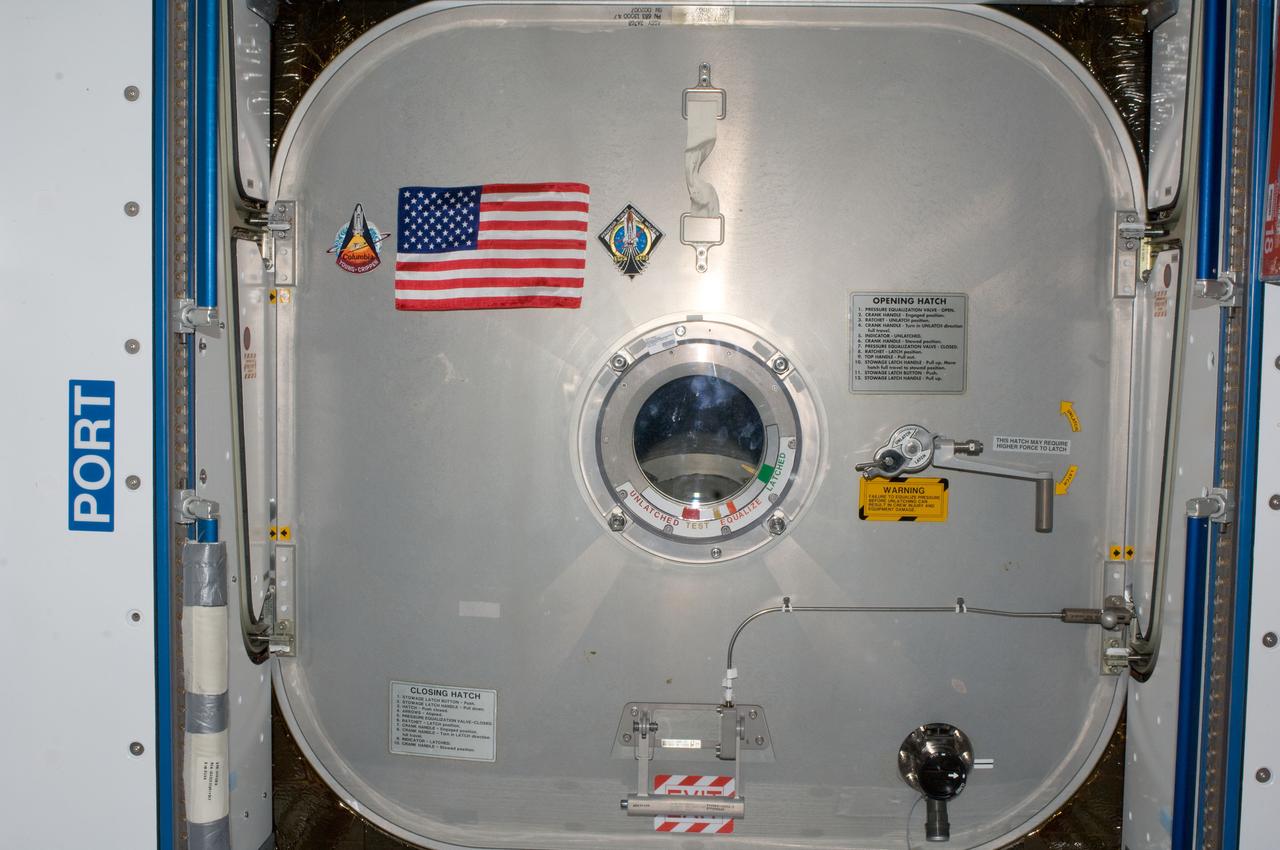
ISS028-E-017457 (18 July 2011)--- Inside the International Space Station's Node 2 or Harmony, the STS-135 crew presented the Expedition 28 crew this special U.S. flag and mounted it on the hatch leading to Atlantis. The flag was flown on the first space shuttle mission, STS-1, and flew on this mission to be presented to the space station crew. It will remain onboard until the next crew launched from the U.S. will retrieve it for return to Earth. It will fly from Earth again, with the crew that launches from the U.S. on a journey of exploration beyond Earth orbit.
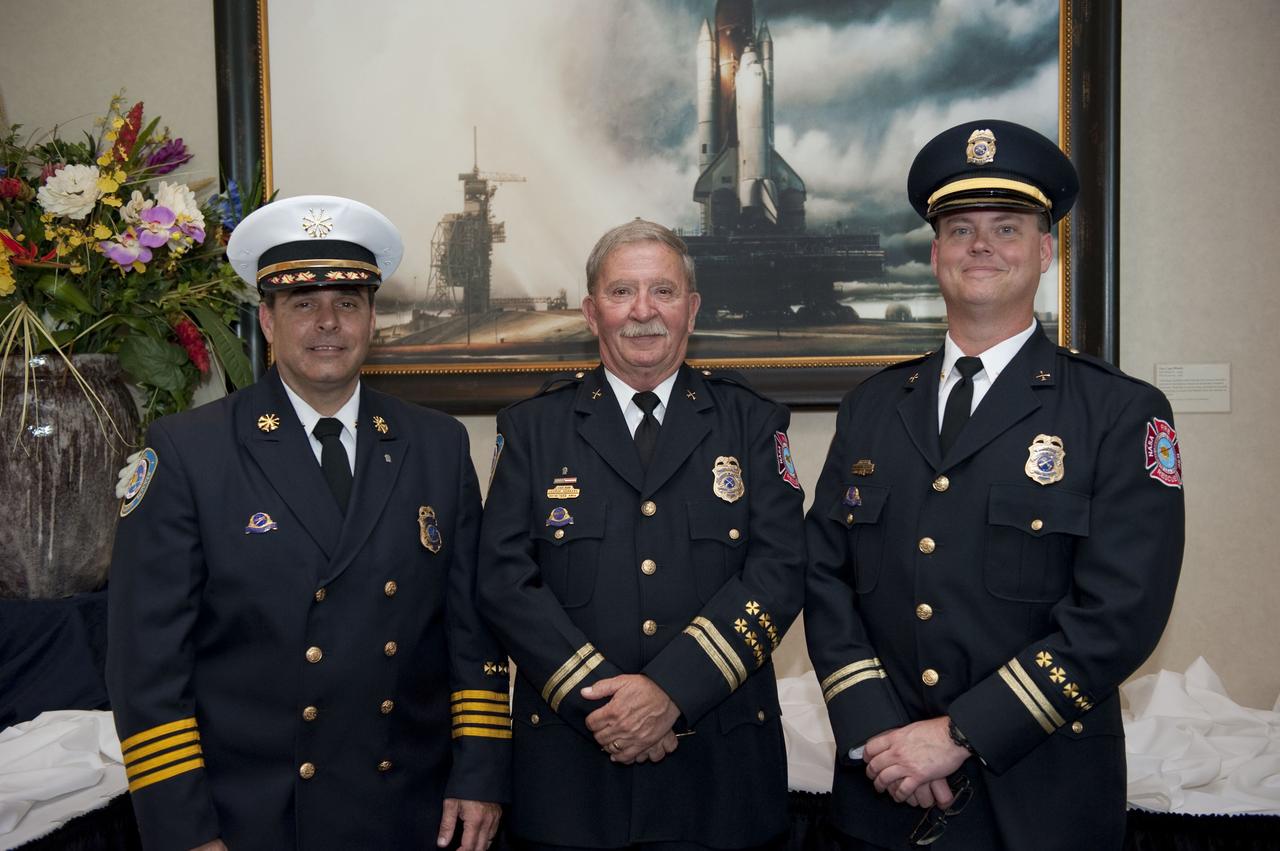
CAPE CANAVERAL, Fla. – Deputy Fire Chief Rick Anderson, left, Chief of Fire Training George Hoggard, and Assistant Chief of Fire Training David Seymour with NASA Kennedy Space Center Protective Services participated in the "National 9/11 Flag" stitching ceremony in the Debus Conference Facility at the Kennedy Space Center Visitor Complex in Florida. The contributions of NASA, Kennedy Space Center and the state of Florida were stitched into the fabric of the American Flag, which was recovered near ground zero following the World Trade Center attacks on Sept. 11, 2001. The "New York Says Thank You Foundation" is taking the flag on a cross-country journey to be restored to its original 13-stripe design using pieces of fabric from American flags destined for retirement in all 50 states. Once the flag is restored, it will become a permanent collection of the National September 11 Memorial Museum being built at the World Trade Center site. Photo credit: NASA/Kim Shiflett

KENNEDY SPACE CENTER, FLA. -- The American flag and the NASA logo shine in the morning sun on the side of the Vehicle Assembly Building after completion of their repainting. The flag spans an area 209 feet by 110 feet, or about 23, 437 square feet. Each stripe is 9 feet wide and each star is 6 feet in diameter. The NASA logo, which is known as the "meatball," measures 110 feet by 132 feet, or about 12,300 square feet. The flag and logo were last painted in 1998, honoring NASA's 40th anniversary. Photo credit: NASA/Jim Grossmann
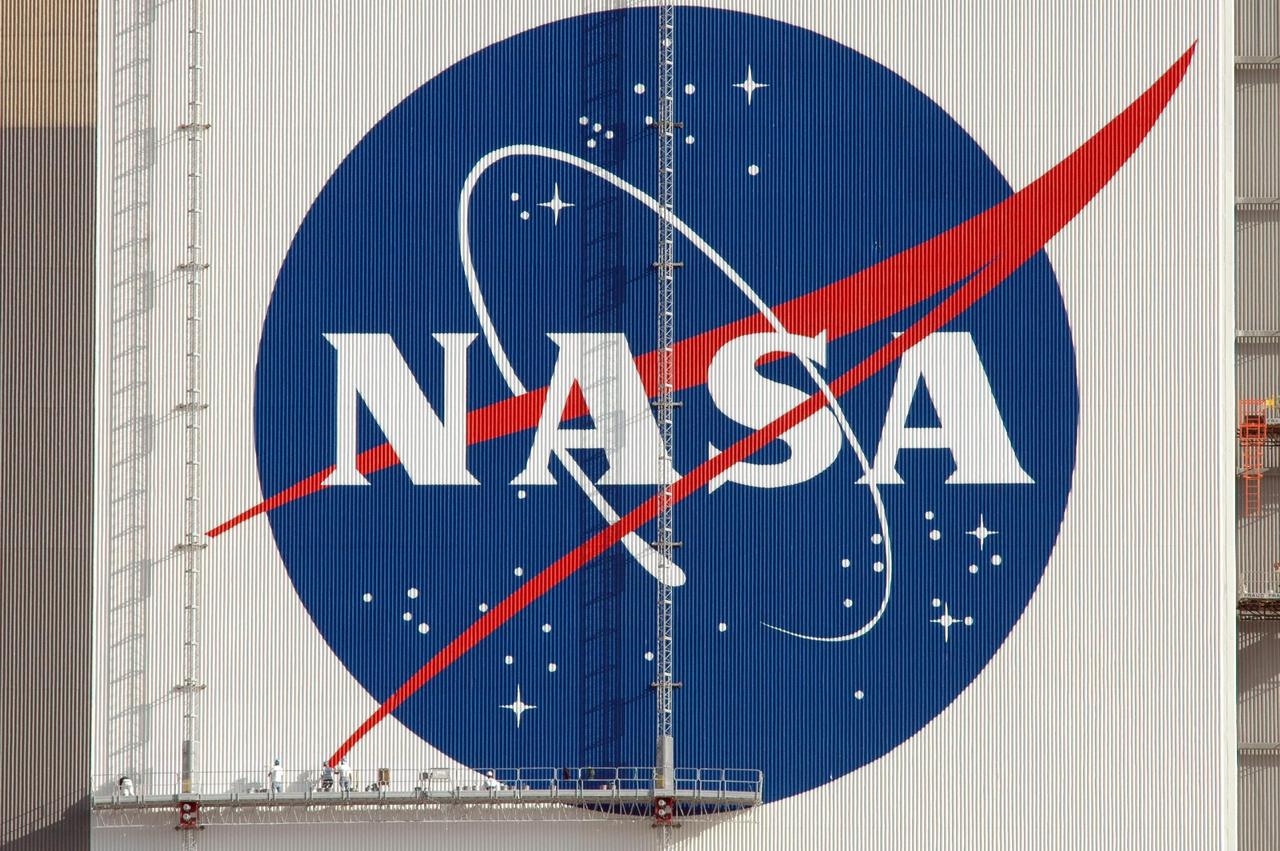
KENNEDY SPACE CENTER, FLA. -- The NASA logo shines in the morning sun on the side of the Vehicle Assembly Building after completion of its repainting. The logo, which is known as the "meatball," measures 110 feet by 132 feet, or about 12,300 square feet. The American flag was also painted on the side of the VAB. The flag spans an area 209 feet by 110 feet, or about 23, 437 square feet. Each stripe is 9 feet wide and each star is 6 feet in diameter. The flag and logo were last painted in 1998, honoring NASA's 40th anniversary. Photo credit: NASA/Jim Grossmann
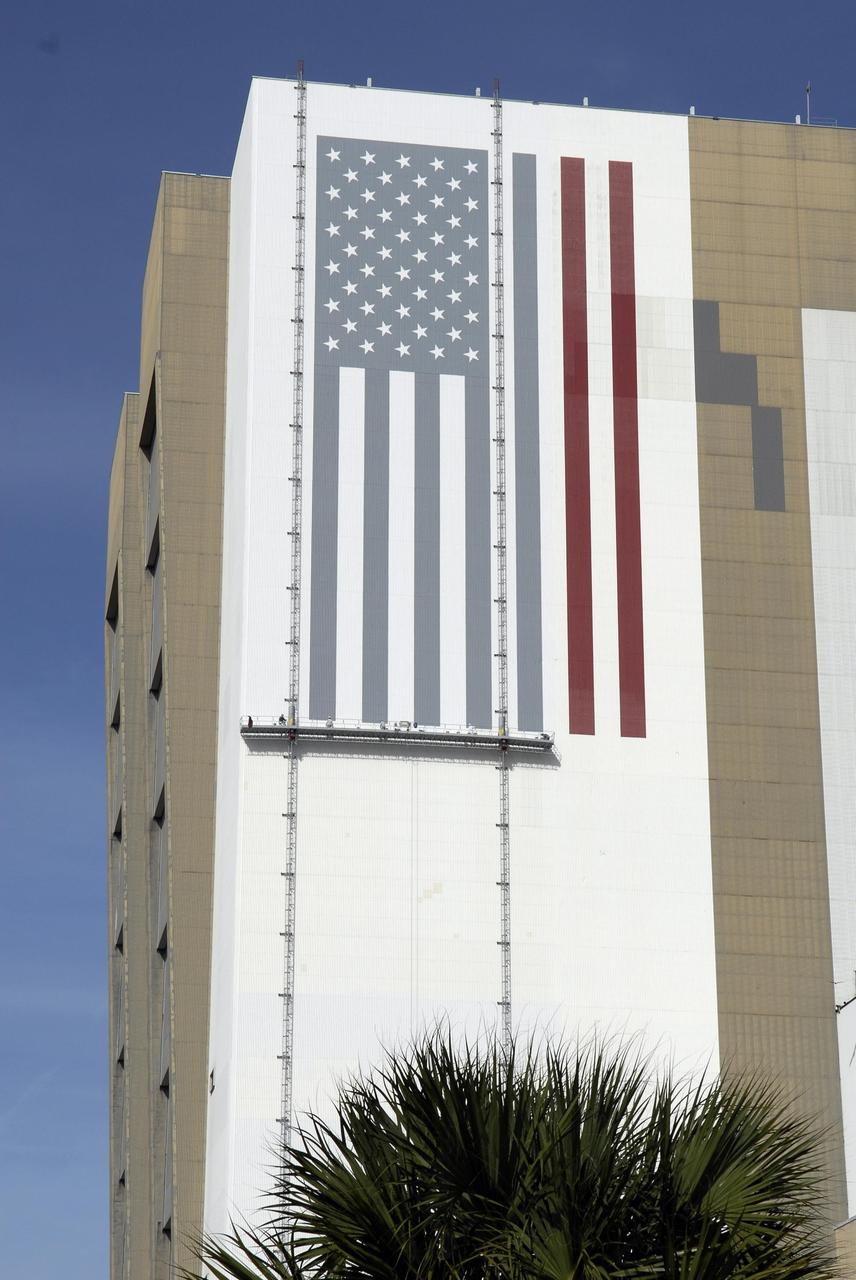
KENNEDY SPACE CENTER, FLA. -- Painters' platforms are seen hanging on the side of Kennedy Space Center's 525-foot-high Vehicle Assembly Building to facilitate the repainting of the American flag. The NASA logo is also being repainted. Workers use rollers and brushes to do the painting. The flag and logo were last painted in 1998, honoring NASA's 40th anniversary. The flag spans an area 209 feet by 110 feet, or about 23,437 square feet. Each stripe is 9 feet wide and each star is 6 feet in diameter. The logo, also known as the "meatball," measures 110 feet by 132 feet, or about 12,300 square feet. Photo credit: NASA/Kim Shiflett
KENNEDY SPACE CENTER, FLA. -- Painters' platforms are seen hanging on the side of Kennedy Space Center's 525-foot-high Vehicle Assembly Building to facilitate the repainting of the American flag and the NASA logo. Workers use rollers and brushes to do the painting. The flag and logo were last painted in 1998, honoring NASA's 40th anniversary. The flag spans an area 209 feet by 110 feet, or about 23,437 square feet. Each stripe is 9 feet wide and each star is 6 feet in diameter. The logo, also known as the "meatball," measures 110 feet by 132 feet, or about 12,300 square feet. Photo credit: NASA/Kim Shiflett
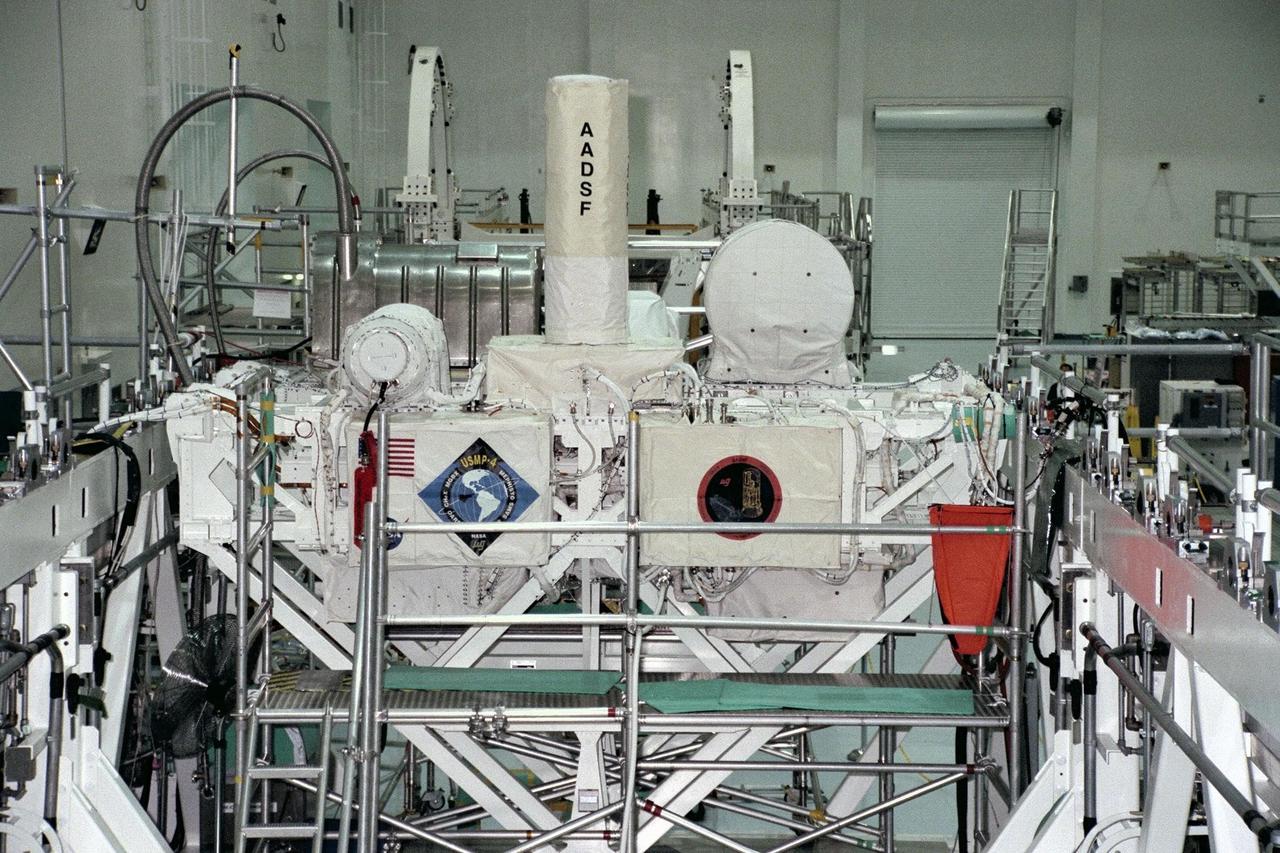
United States Microgravity Payload-4 (USMP-4) experiments are prepared to be flown on Space Shuttle mission STS-87 in the Space Station Processing Facility at Kennedy Space Center (KSC). Seen in the foreground at right is the USMP-4 logo with the acronyms of its experiments. Above the American flag at left is the MEPHISTO experiment, a cooperative American and French investigation of the fundamentals of crystal growth. Scientists will study changes in solidification rates, temperature, and interface shape of an alloy to understand how these changes affect composition and properties of the metal produced. Under the multi-layer insulation with the American flag and mission logo is the Space Acceleration Measurement System, or SAMS, which measures the microgravity conditions in which the experiments are conducted. All USMP-4 experiments are scheduled for launch aboard STS-87 on Nov. 19 from KSC
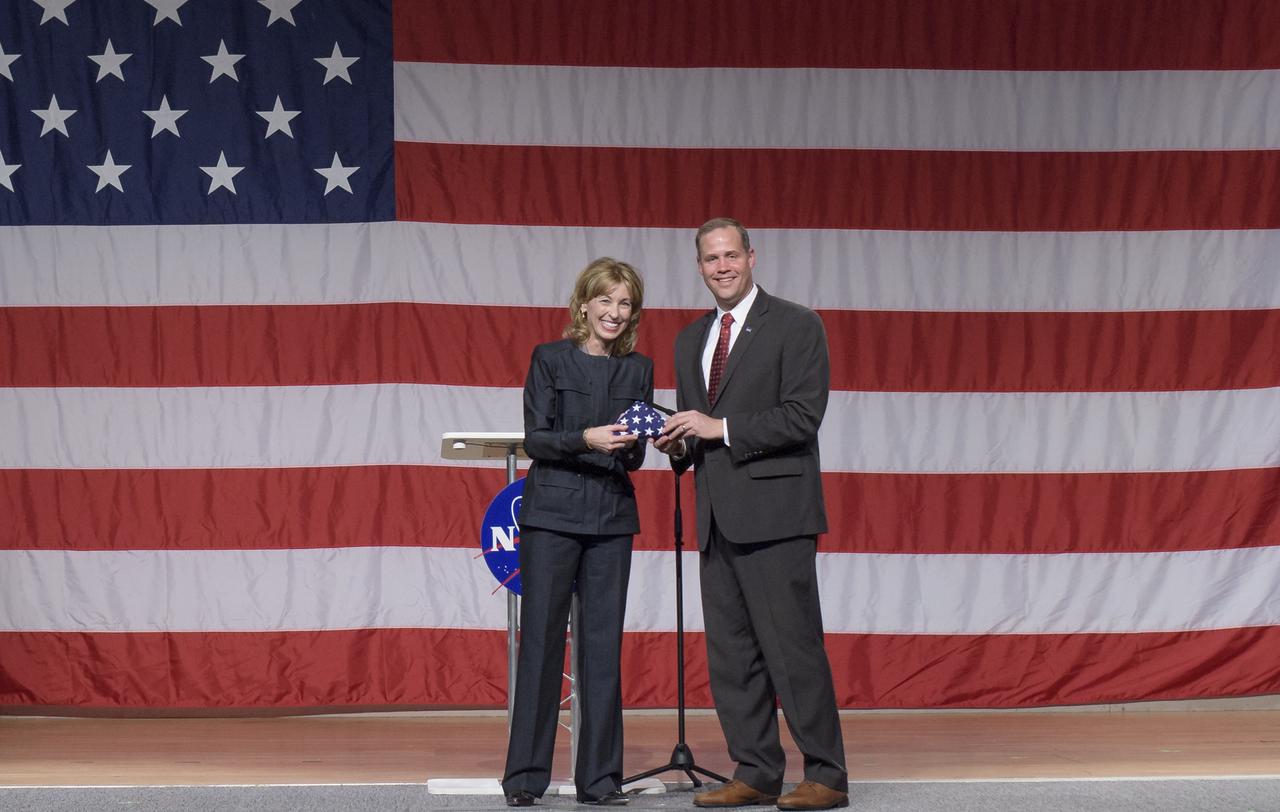
Boeing Defense, Space and Security President and CEO Leanne Caret receives an American flag from NASA Administrator Jim Bridenstine during a NASA event announcing the astronauts assigned to crew the first flight tests and missions of the Boeing CST-100 Starliner and SpaceX Crew Dragon, Friday, Aug. 3, 2018 at NASA’s Johnson Space Center in Houston, Texas. The flag is to be flown to the International Space Station onboard the test flight of Starliner and retrieved later during the first mission of the Starliner. Photo Credit: (NASA/Bill Ingalls)
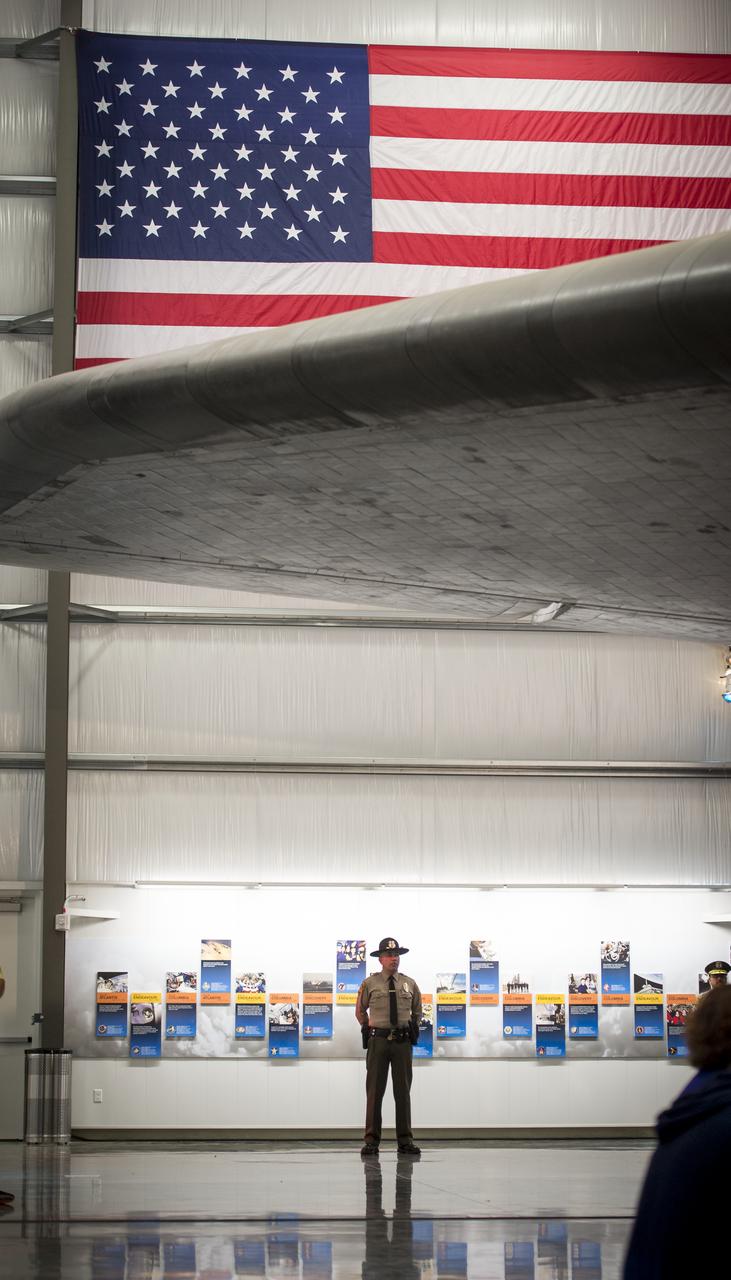
A police officer is seen underneath the wing of the space shuttle Endeavour during the grand opening ceremony for the California Science center's Samuel Oschin Space Shuttle Endeavour Display Pavilion, Tuesday, Oct. 30, 2012, in Los Angeles. Endeavour, built as a replacement for space shuttle Challenger, completed 25 missions, spent 299 days in orbit, and orbited Earth 4,671 times while traveling 122,883,151 miles. Photo Credit: (NASA/Bill Ingalls)
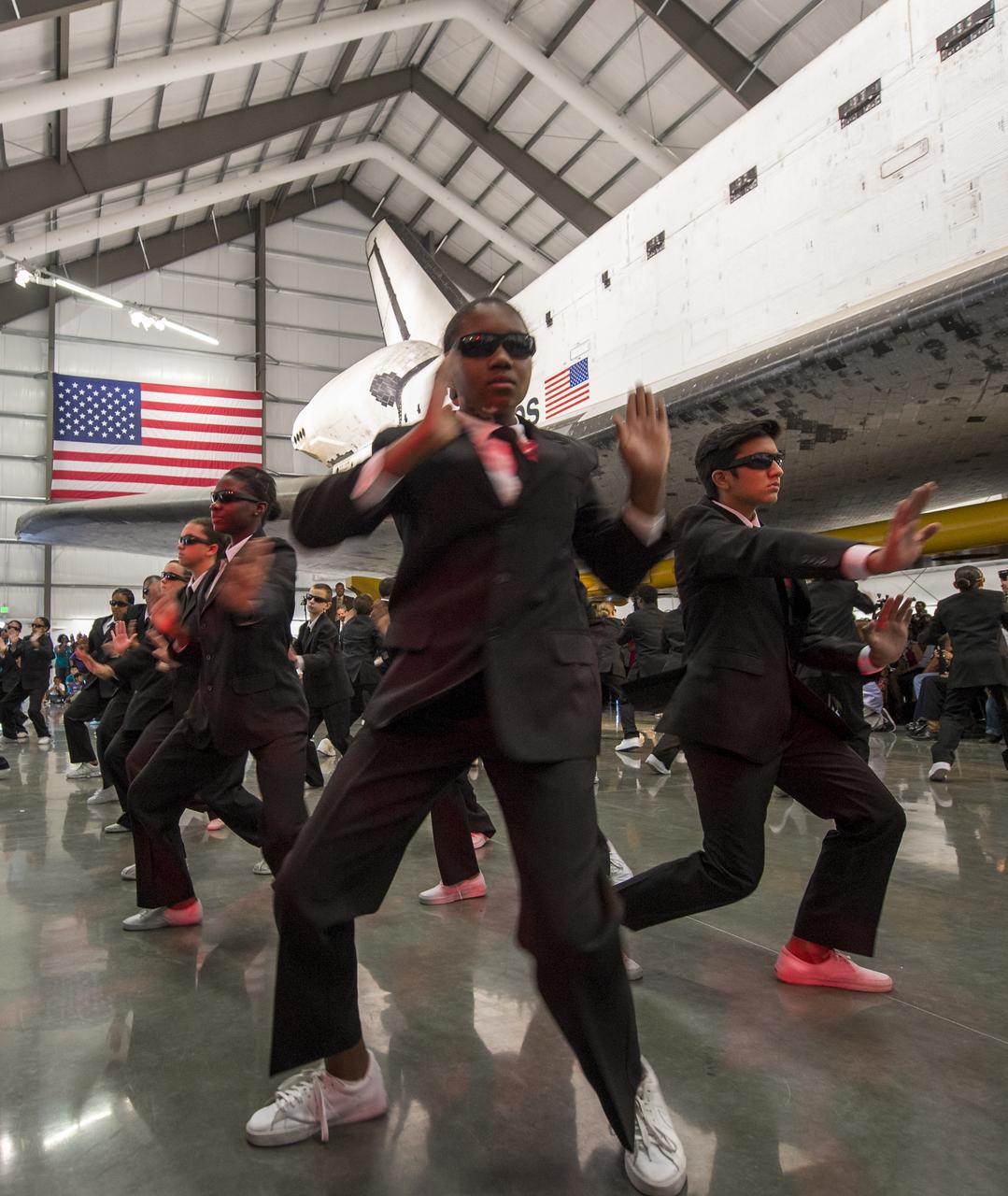
Members of the Debbie Allen Dance Academy perform “Men in Black” choreographed by the legendary Debbie Allen during the grand opening ceremony for the California Science center's Samuel Oschin Space Shuttle Endeavour Display Pavilion, Tuesday, Oct. 30, 2012, in Los Angeles. Endeavour, built as a replacement for space shuttle Challenger, completed 25 missions, spent 299 days in orbit, and orbited Earth 4,671 times while traveling 122,883,151 miles. Photo Credit: (NASA/Bill Ingalls)
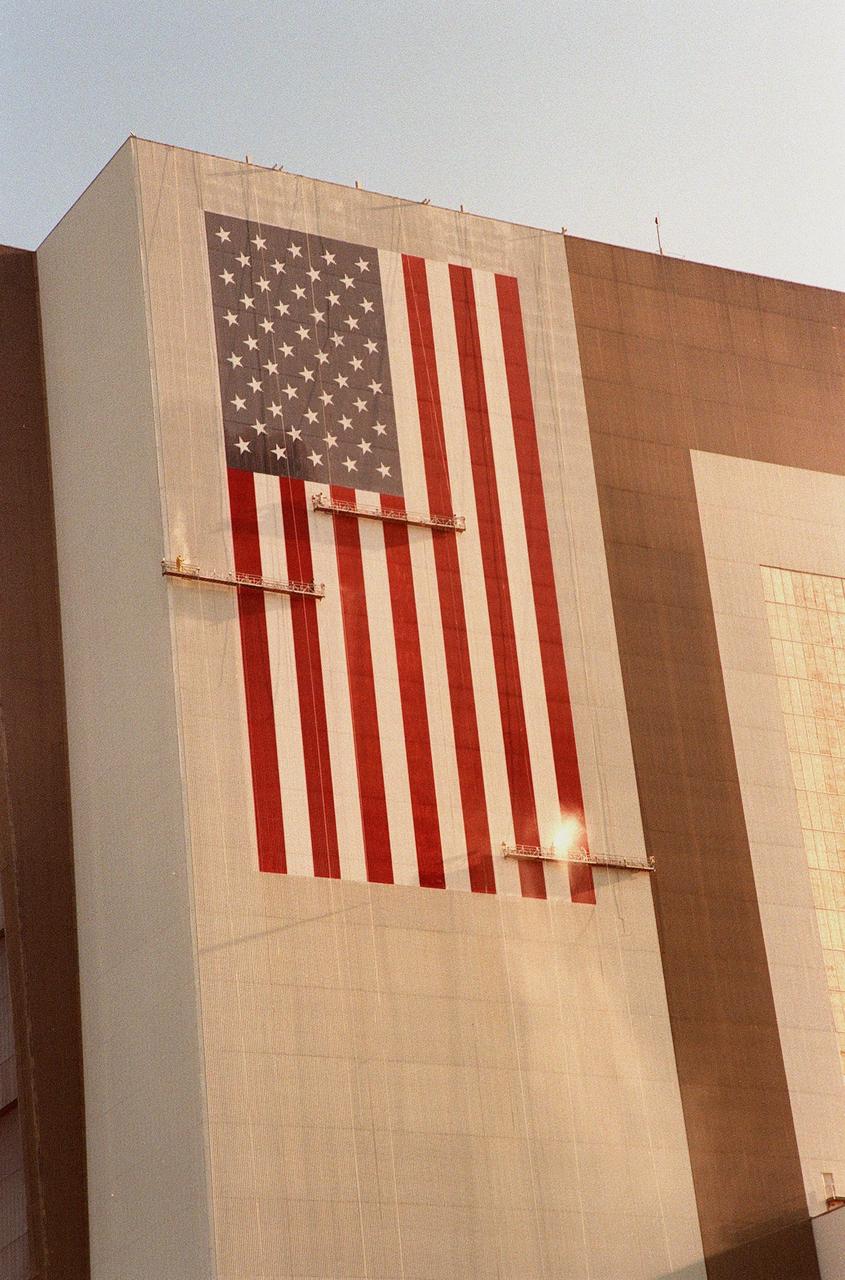
Painters are suspended on platforms from the top of the 525-foot-high Vehicle Assembly Building (VAB) at KSC during repainting of the American flag. The flag spans an area 209 feet by 110 feet and will require 510 gallons of red, white and blue paint. Each stripe of the flag is 9 feet wide and each star is 6 feet in diameter. The platforms are operated by two electric motors and travel 35 feet per minute. Work is being done with rollers, with brushes being used for details. The paint was donated by ICI Devoe of Louisville, Ky. In addition to the flag, the Bicentennial Emblem on the other side of the VAB doors is being replaced by the NASA logo, honoring NASA’s 40th anniversary (in October). The logo covers an area 110 feet by 132 feet. Work is expected to be completed in mid-September
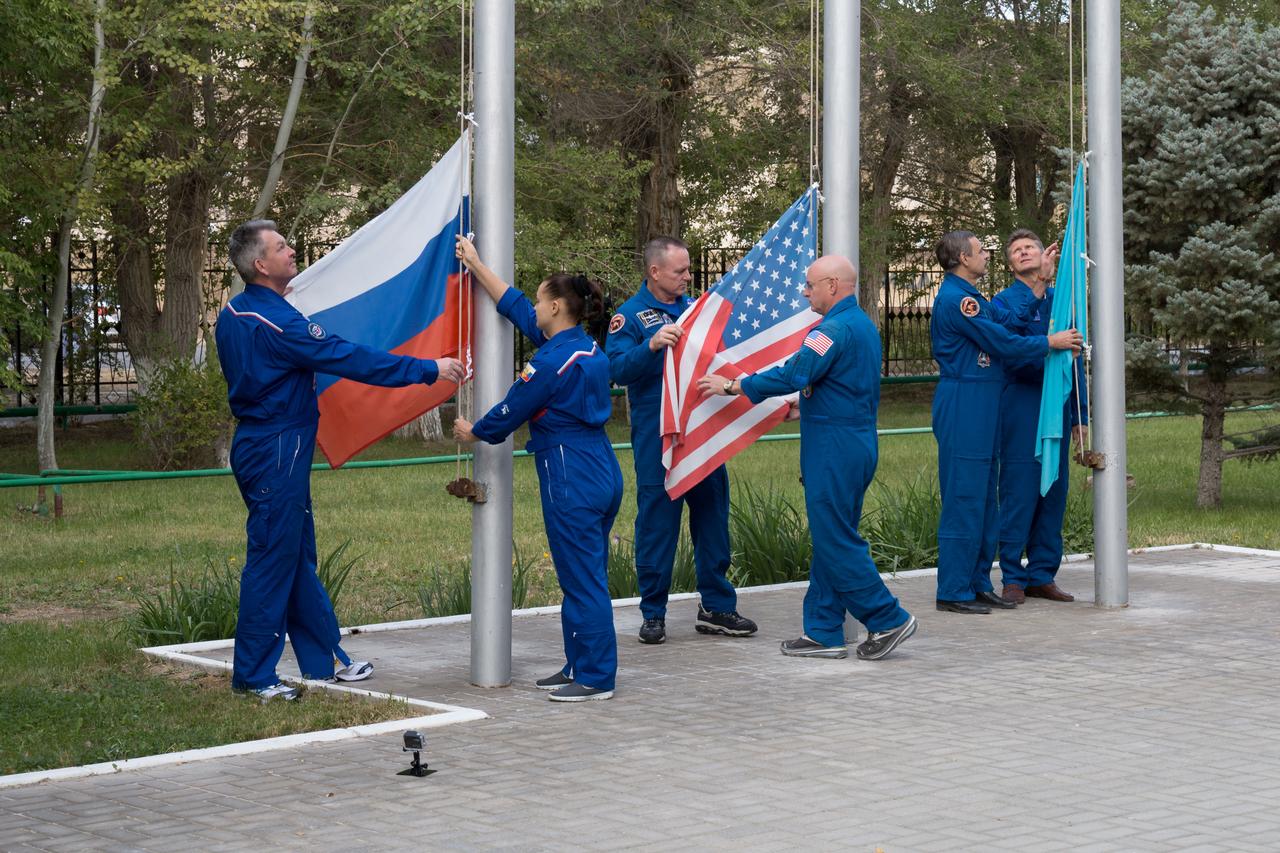
14-11-03-34: (14 Sept. 2014) --- At their Cosmonaut Hotel crew quarters in Baikonur, Kazakhstan, the Expedition 41/42 prime and backup crew members raised the flags of Russia, the U.S. and Kazakhstan during traditional ceremonies Sept. 14. From left to right are prime crew members Elena Serova and Alexander Samokutyaev of the Russian Federal Space Agency (Roscosmos) raising the Russian flag, prime crew member Barry Wilmore and his backup, Scott Kelly of NASA, raising the American flag, and backup crew members Gennady Padalka and Mikhail Kornienko of Roscosmos raising the flag of Kazakhstan. Wilmore, Samokutyaev and Serova will launch on Sept. 26, Kazakh time, in the Soyuz TMA-14M spacecraft to begin a 5 ½ month mission on the International Space Station. Serova will become the fourth Russian woman to fly in space. Photo credit: NASA/Victor Zelentsov
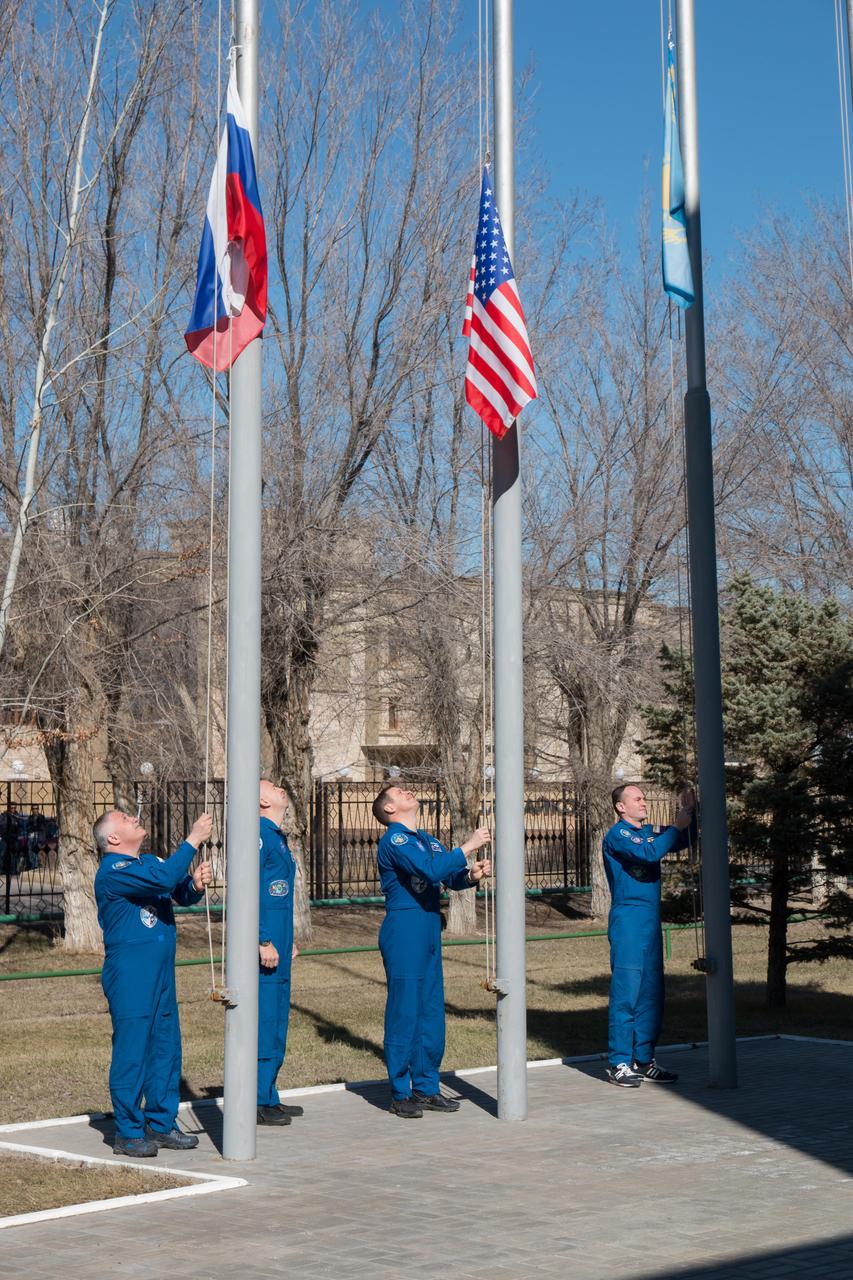
jsc2017e040341 (April 7, 2017) --- At the Cosmonaut Hotel crew quarters in Baikonur, Kazakhstan, the Expedition 51 prime and backup crewmembers raise the flags of Russia, the U.S. and Kazakhstan in traditional ceremonies April 7 as part of their pre-launch activities. From left to right are prime crewmember Fyodor Yurchikhin of the Russian Federal Space Agency (Roscosmos) raising the Russian flag, backup crewmember Randy Bresnik of NASA joining prime crewmember Jack Fischer of NASA to raise the American flag and backup crewmember Sergey Ryazanskiy of Roscosmos raising the Kazakh flag. Yurchikhin and Fischer will launch April 20 on the Soyuz MS-04 spacecraft from the Baikonur Cosmodrome for a four and a half month mission on the International Space Station. NASA/Victor Zelentsov
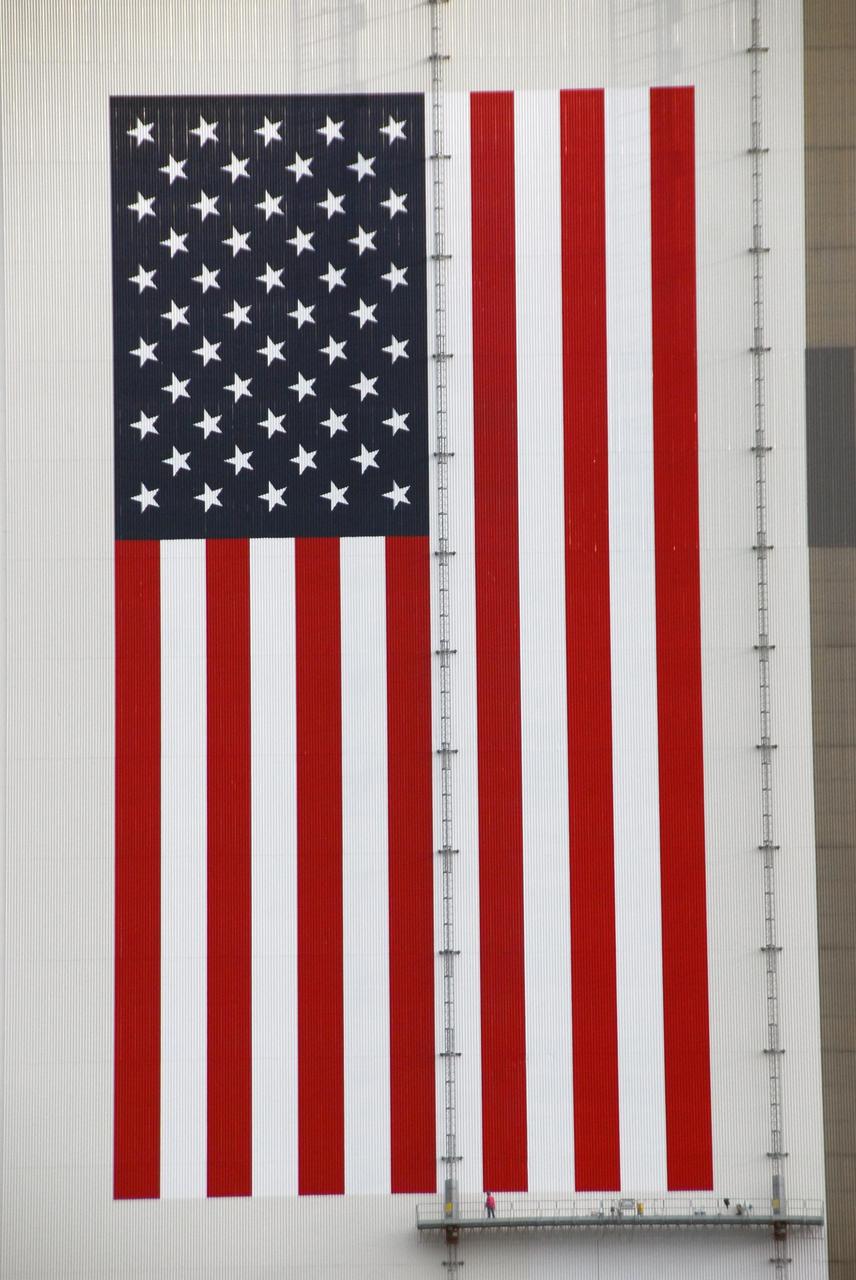
KENNEDY SPACE CENTER, FLA. -- The finishing touches are painted on the American flag that embellishes the southwest side of the Vehicle Assembly Building at NASA's Kennedy Space Center. The flag and the NASA logo, which is on the southeast side, have both been refreshed with new paint. The flag and logo were last painted in 1998, honoring NASA's 40th anniversary. The flag spans an area 209 feet by 110 feet, or about 23, 437 square feet. Each stripe is 9 feet wide and each star is 6 feet in diameter. The logo, which is known as the "meatball," measures 110 feet by 132 feet, or about 12,300 square feet. The building stands 525-feet tall. Photo credit: NASA/George Shelton
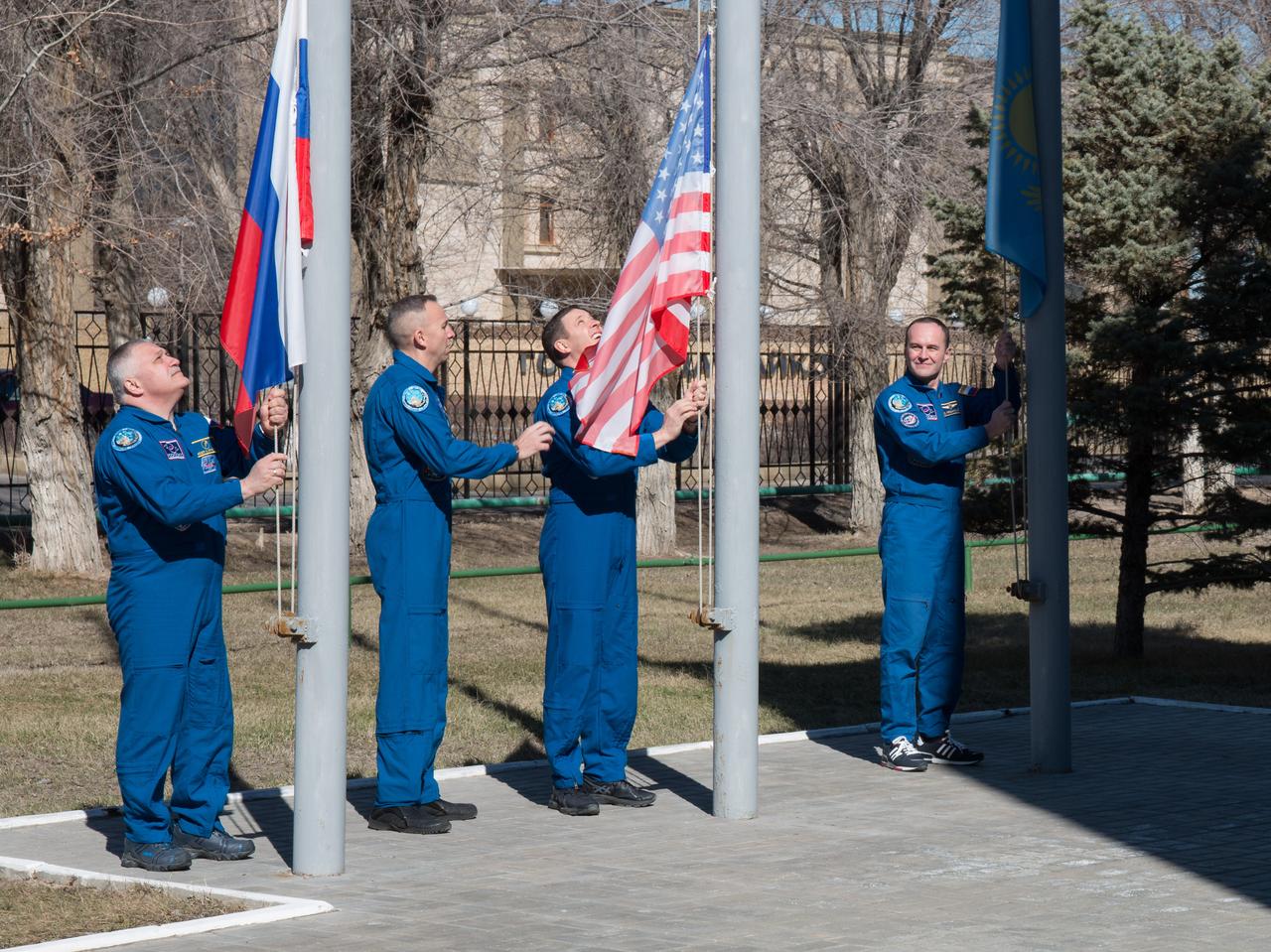
jsc2017e040340 (April 7, 2017) --- At the Cosmonaut Hotel crew quarters in Baikonur, Kazakhstan, the Expedition 51 prime and backup crewmembers raise the flags of Russia, the U.S. and Kazakhstan in traditional ceremonies April 7 as part of their pre-launch activities. From left to right are prime crewmember Fyodor Yurchikhin of the Russian Federal Space Agency (Roscosmos) raising the Russian flag, backup crewmember Randy Bresnik of NASA joining prime crewmember Jack Fischer of NASA to raise the American flag and backup crewmember Sergey Ryazanskiy of Roscosmos raising the Kazakh flag. Yurchikhin and Fischer will launch April 20 on the Soyuz MS-04 spacecraft from the Baikonur Cosmodrome for a four and a half month mission on the International Space Station. NASA/Victor Zelentsov
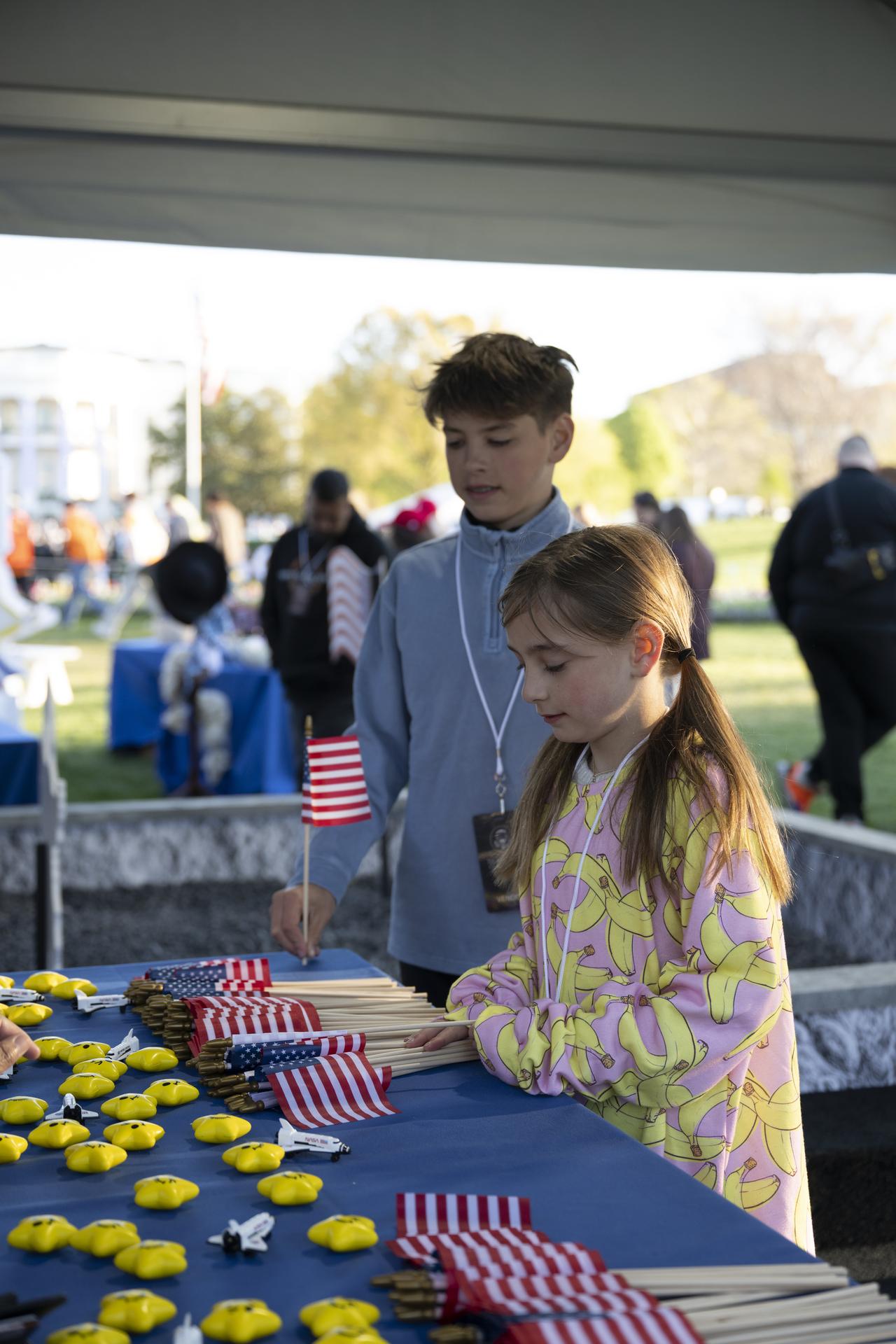
Children explore the NASA Moon Box (Lunar Sandbox) digging for “moon rocks” and planting an American flag, to bringing Artemis exploration to life through curiosity and engagement. during the White House Easter Egg Roll, on the South Lawn in Washington D.C., on April 6, 2026. (Photo Credit: (NASA/Crystal R. Hines)
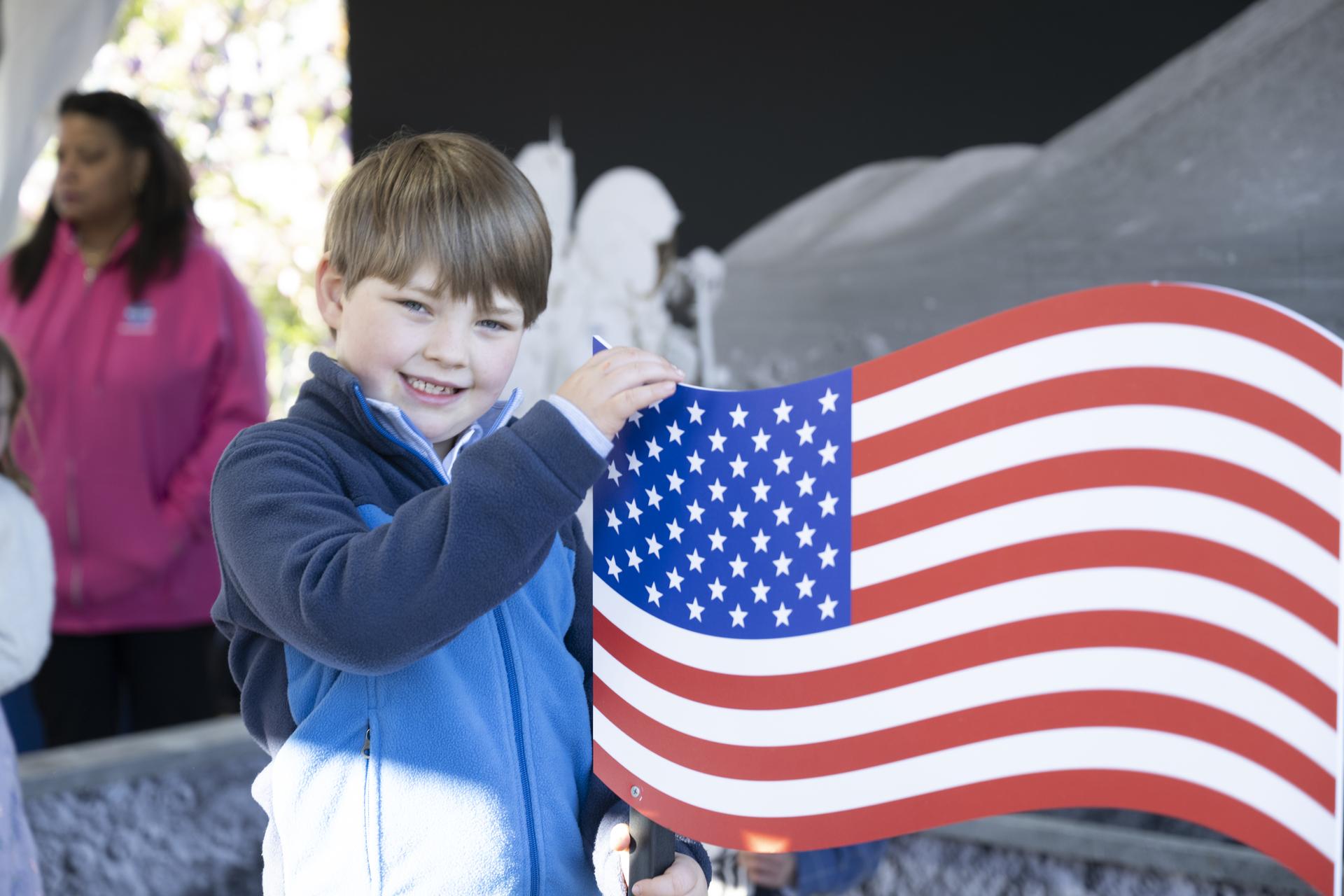
Children explore the NASA Moon Box (Lunar Sandbox) digging for “moon rocks” and planting an American flag, to bringing Artemis exploration to life through curiosity and engagement. during the White House Easter Egg Roll, on the South Lawn in Washington D.C., on April 6, 2026. (Photo Credit: (NASA/Crystal R. Hines)
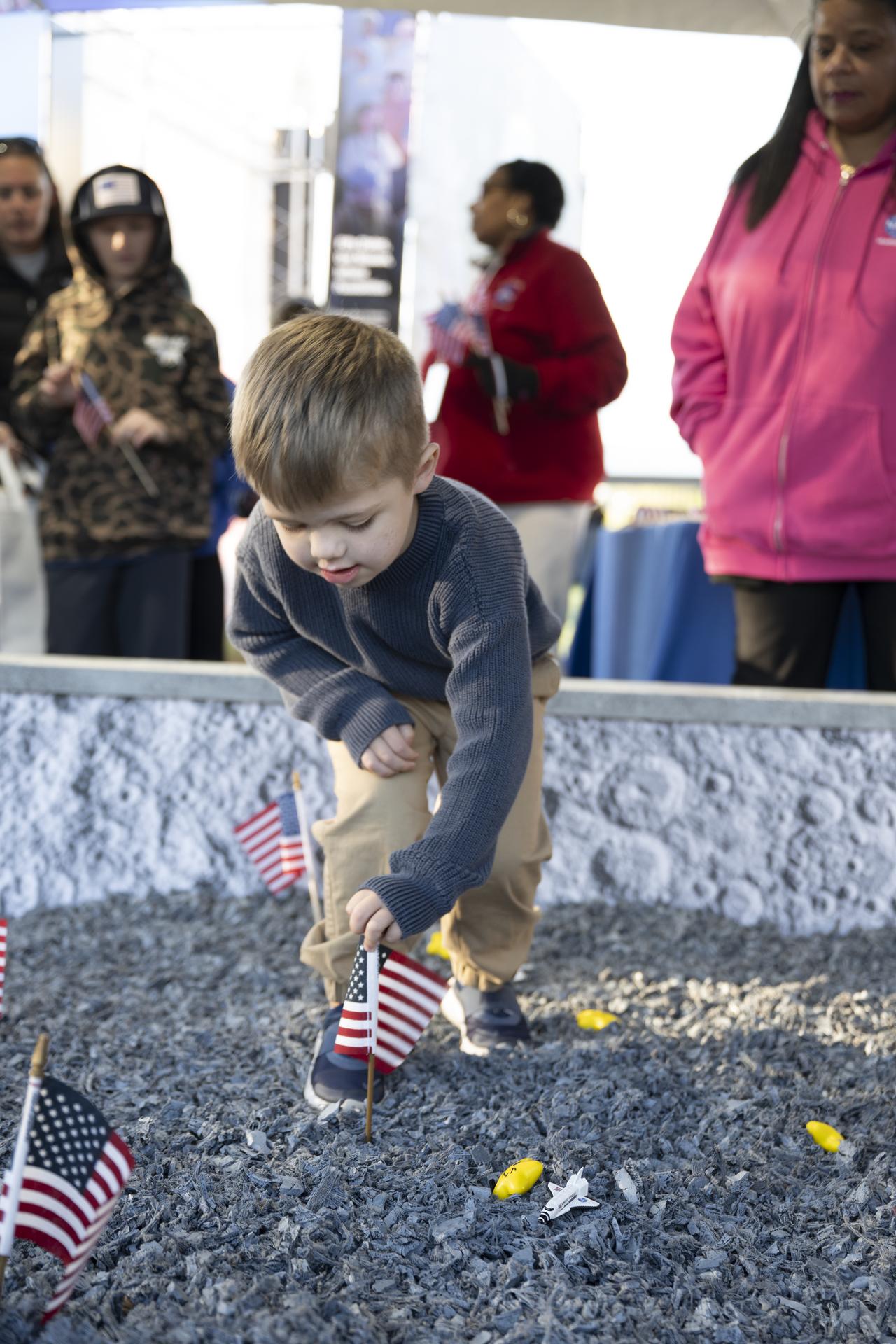
Child explore the NASA Moon Box (Lunar Sandbox) digging for “moon rocks” and planting an American flag, to bringing Artemis exploration to life through curiosity and engagement. during the White House Easter Egg Roll, on the South Lawn in Washington D.C., on April 6, 2026. (Photo Credit: (NASA/Crystal R. Hines)
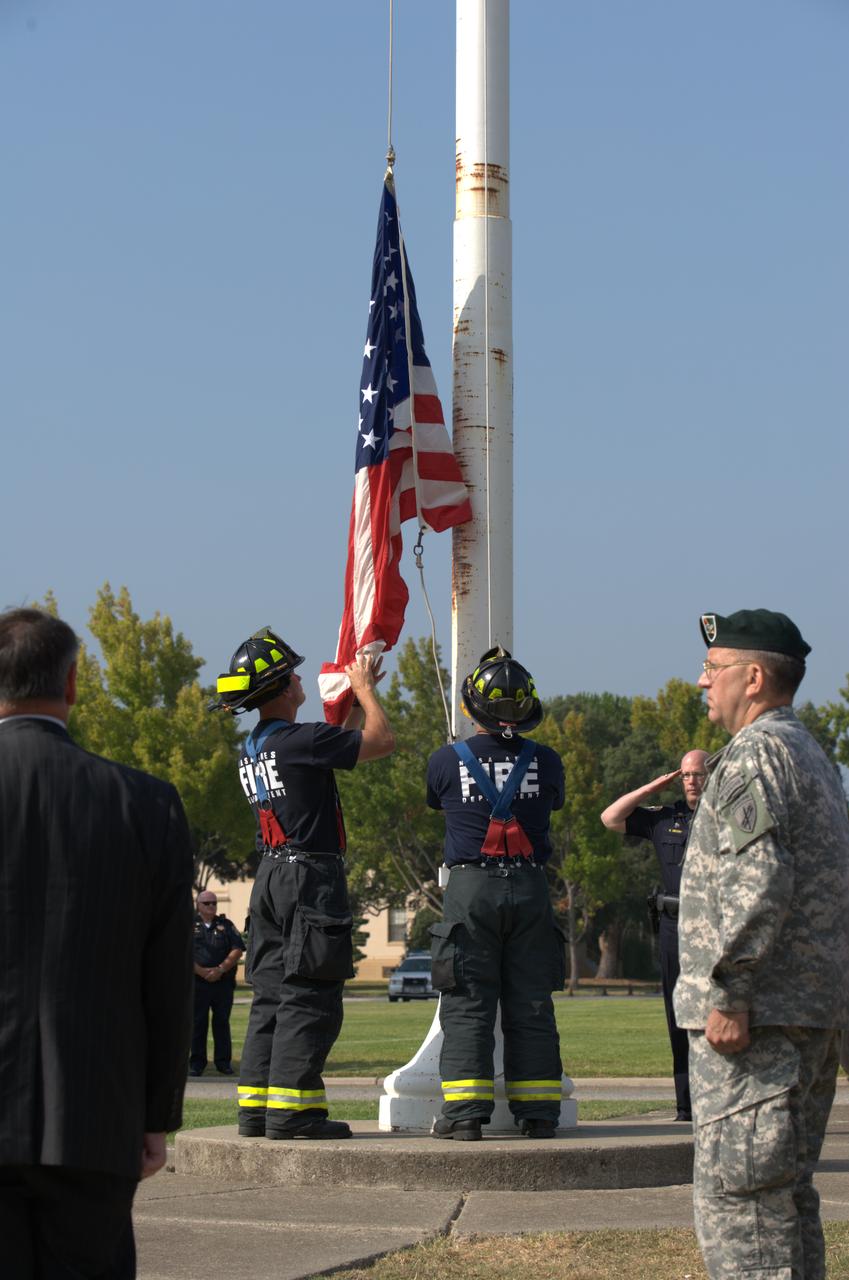
September 11th remembrance ceremony held in front of NASA Research Park Bldg-17 (Lunar Science Institute) hosted by the American Legion, Post 881, Moffett Field. Flag detail - Lt Randy Vincent - NASA Protective Services, Ty Locatelli, Carlos Pinedo - NASA Fire Department