
51I-32-059 (27 August 1985) --- The American Satellite Company (ASC) communications satellite rises from the cargo bay at 6:54 a.m. August 27, 1985.
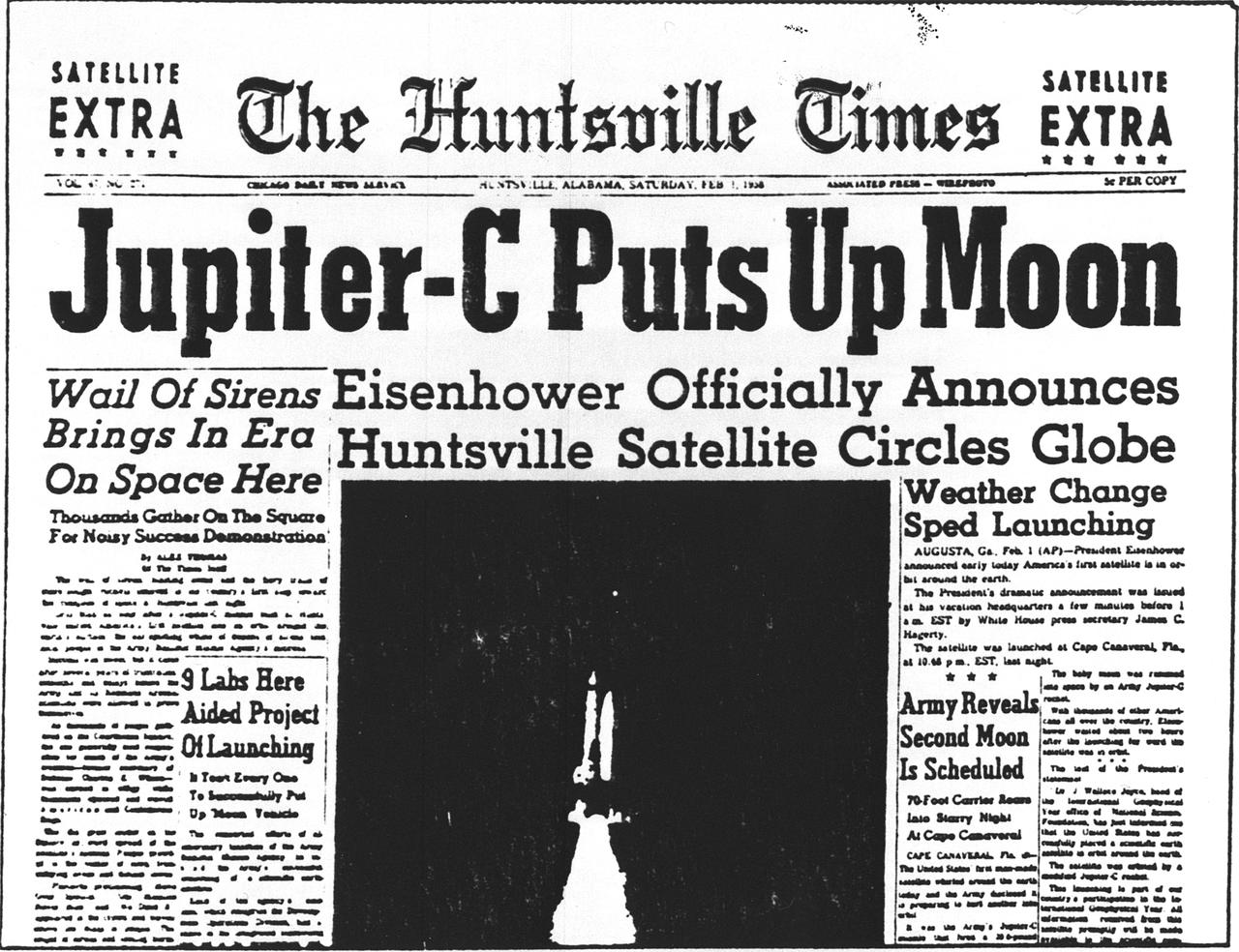
In January 1958, a modified Redstone rocket lifted the first American satellite into orbit just 3 months after the the von Braun team received the go-ahead. This modified Redstone rocket was known as a Jupiter-C. Its satellite payload was called Explorer I.
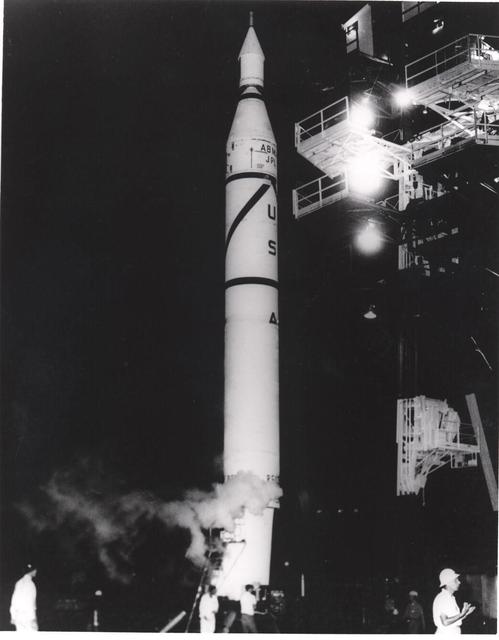
KENNEDY SPACE CENTER, FLA. -- Explorer I, the first American satellite, is scheduled to be launched from Cape Canaveral on Jan. 29, 1958
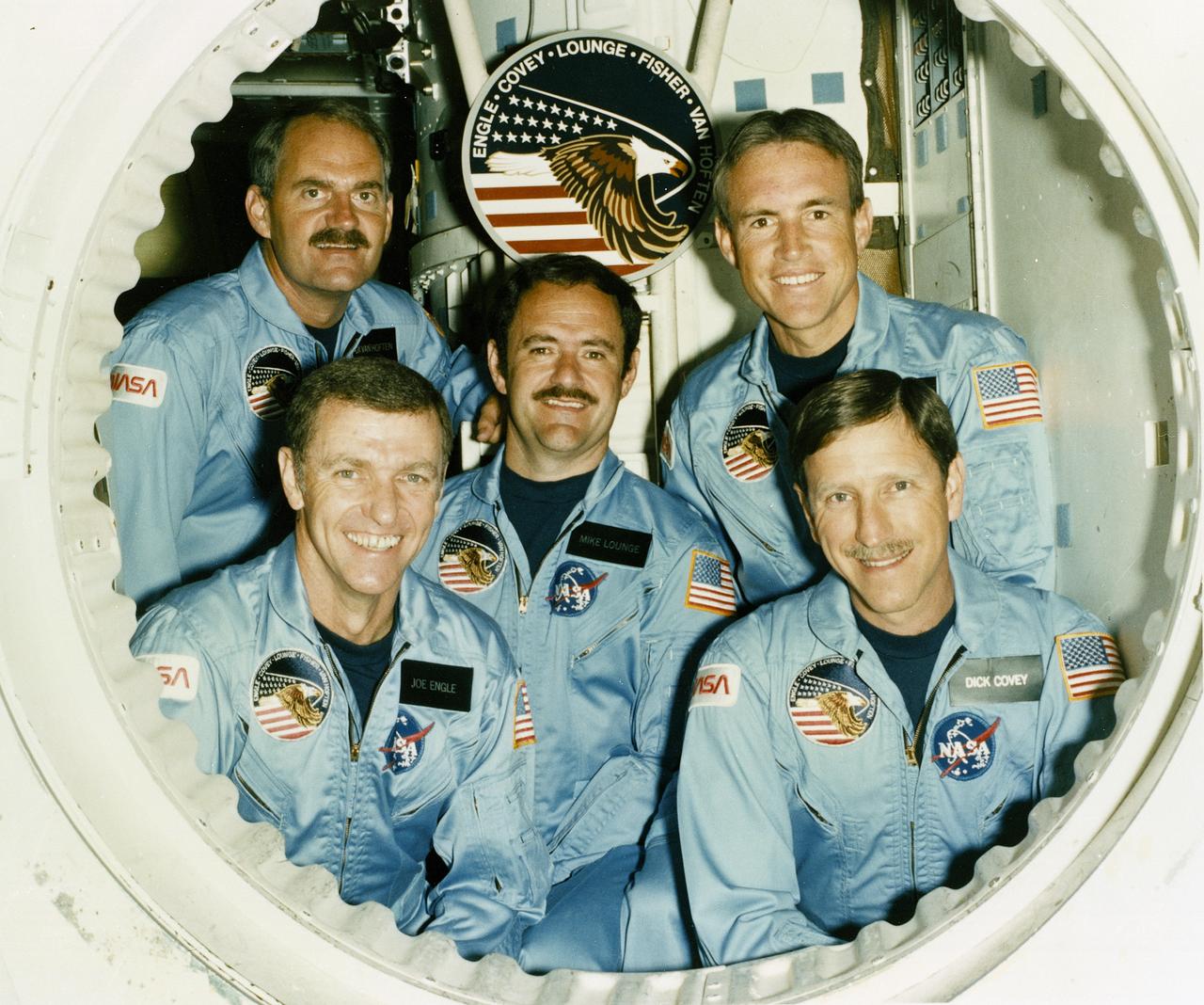
The crew assigned to the STS-51I mission included (front row left to right) Joe H. Engle, commander; and Richard O. Covey, pilot. In the center is John M. (Mike) Lounge, mission specialist. On the back row, from left to right, are mission specialists James D. van Hoften, and William F. Fisher. Launched aboard the Space Shuttle Discovery on August 27, 1985 at 6:58:01 am (EDT), the STS-51I mission’s primary payloads were three communication satellites: the ASC-1 for the American Satellite Company; the AUSSAT-1, an Australian communications satellite; and the SYNCOM-IV-4, the synchronous communications satellite.
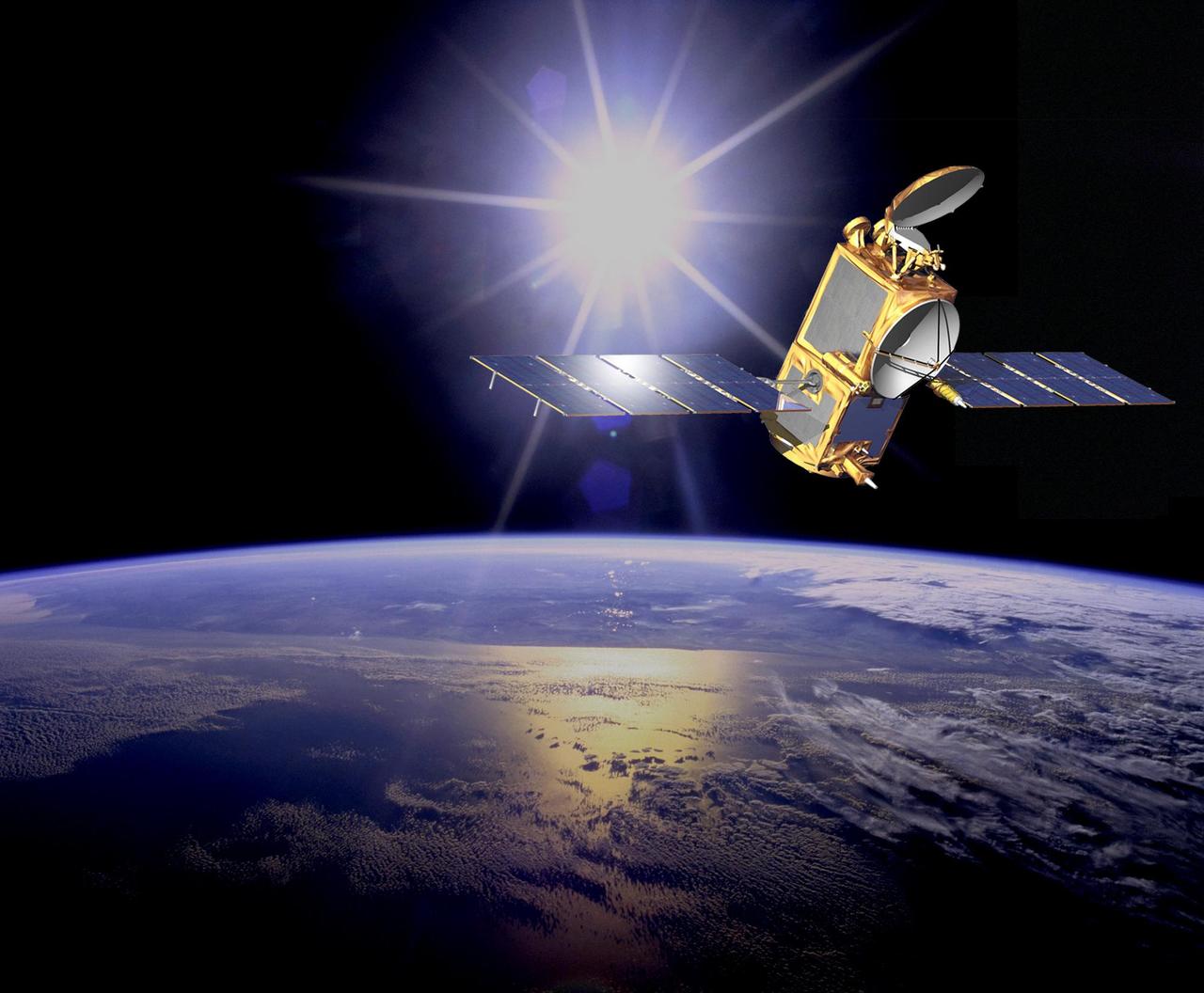
An artist concept of the Ocean Surface Topography Mission/Jason 2 Earth satellite. The Ocean Surface Topography Mission/Jason 2 is an Earth satellite designed to make observations of ocean topography for investigations into sea-level rise and the relationship between ocean circulation and climate change. The satellite also provides data on the forces behind such large-scale climate phenomena as El Niño and La Niña. The mission is a follow-on to the French-American Jason 1 mission, which began collecting data on sea-surface levels in 1992. http://photojournal.jpl.nasa.gov/catalog/PIA18158
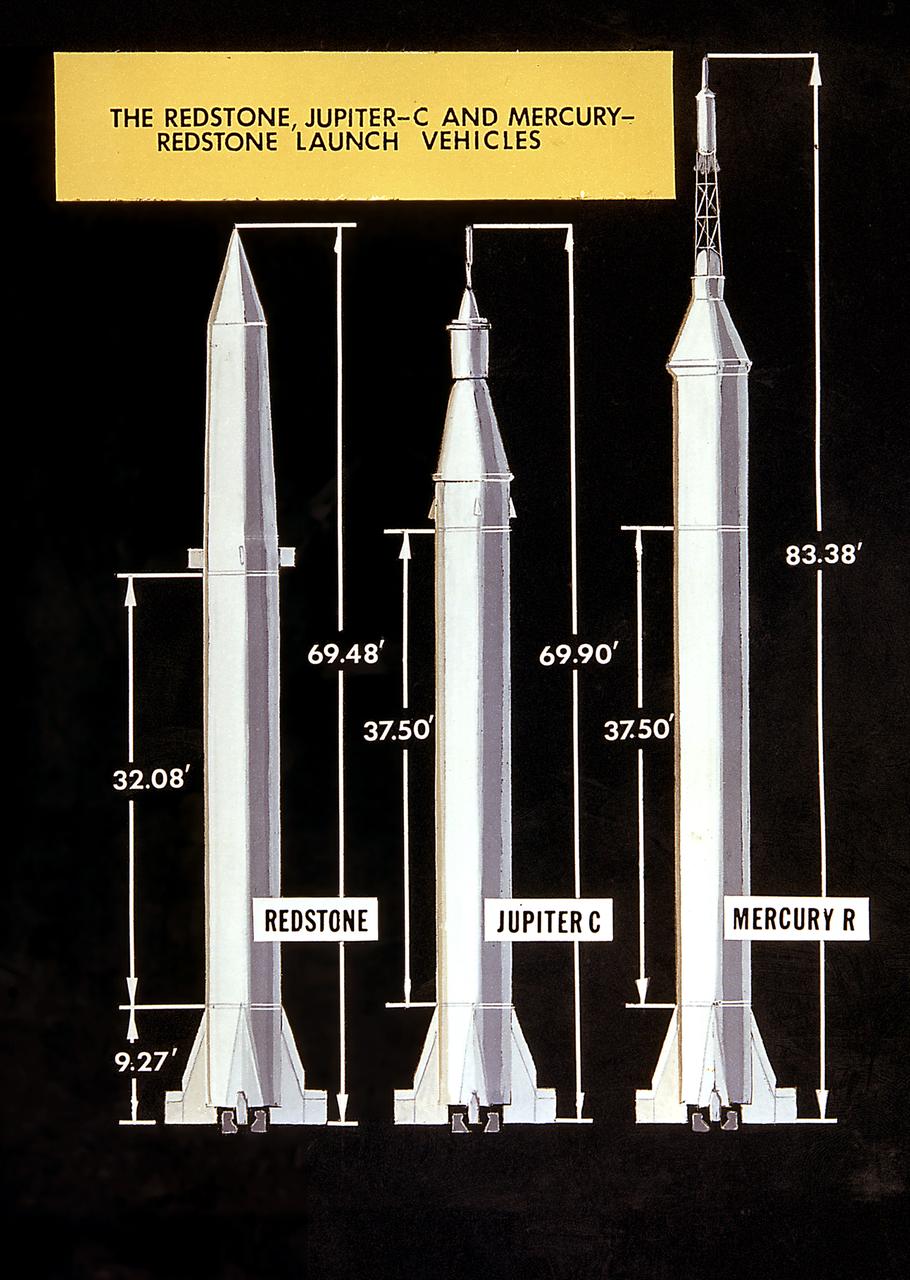
This is a comparison illustration of the Redstone, Jupiter-C, and Mercury Redstone launch vehicles. The Redstone ballistic missile was a high-accuracy, liquid-propelled, surface-to-surface missile. Originally developed as a nose cone re-entry test vehicle for the Jupiter intermediate range ballistic missile, the Jupiter-C was a modification of the Redstone missile and successfully launched the first American Satellite, Explorer-1, in orbit on January 31, 1958. The Mercury Redstone lifted off carrying the first American, astronaut Alan Shepard, in his Mercury spacecraft Freedom 7, on May 5, 1961.
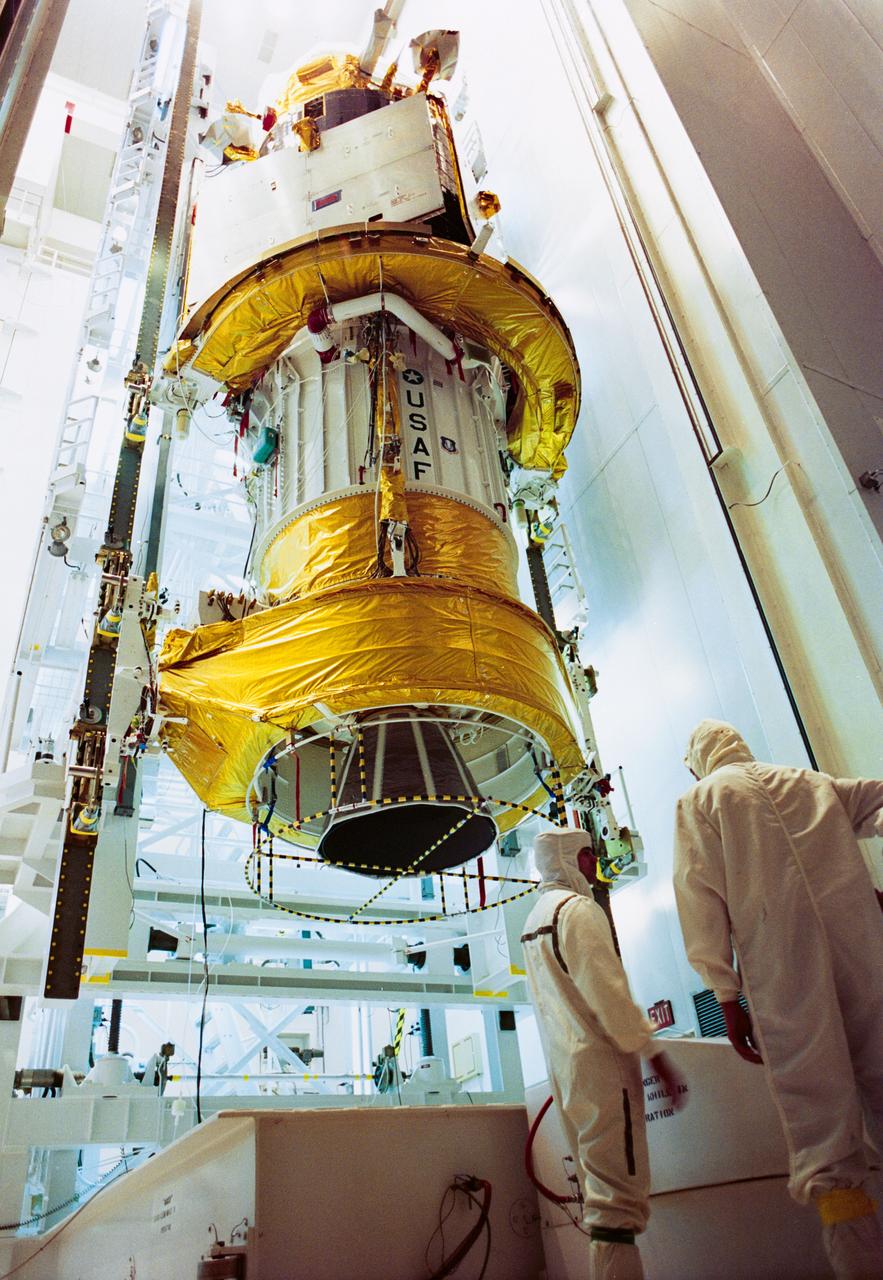
S91-50773 (19 Oct 1991) --- At a processing facility on Cape Canaveral Air Force Station, the Defense Support Program (DSP) satellite is being transferred into the payload canister transporter for shipment to Launch Pad 39A at KSC. The DSP will be deployed during Space Shuttle Mission STS-44 later this year. It is a surveillance satellite, developed for the Department of Defense, which can detect missile and space launches, as well as nuclear detonations. The Inertial Upper Stage which will boost the DSP satellite to its proper orbital position is the lower portion of the payload. DSP satellites have comprised the spaceborne segment of NORAD's (North American Air Defense Command) Tactical Warning and Attack Assessment System since 1970. STS- 44, carrying a crew of six, will be a ten-day flight.
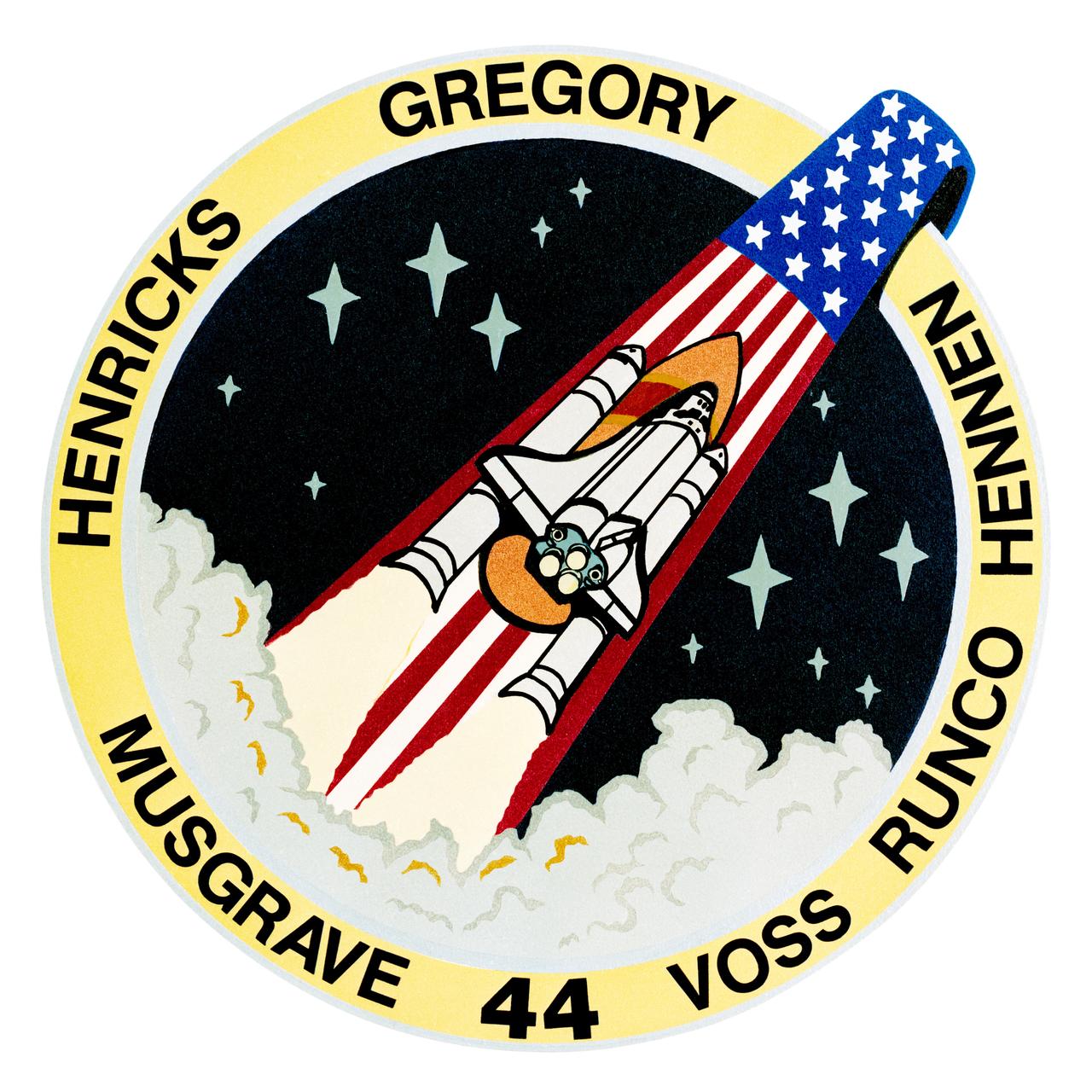
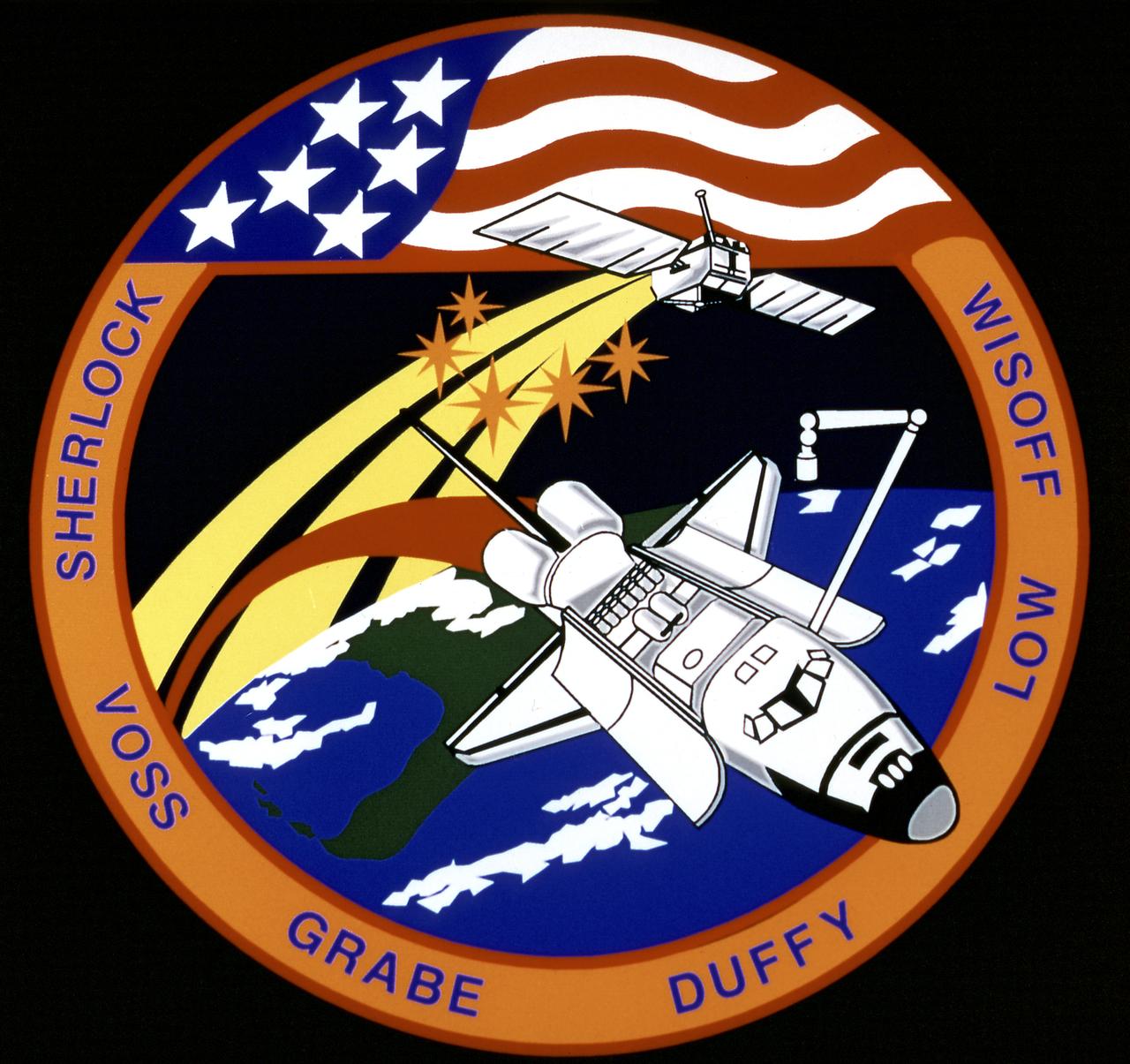
STS044-S-001 (July 1991) --- Designed by the participating crew members, the STS-44 patch shows the space shuttle Atlantis shortly after liftoff as it rolls to ascend into orbit. The orbital path illustrated by the red, white and blue of the stylized American flag represents the American contribution and strength derived from this mission. The black background of space, indicative of the mysteries of the universe, is illuminated by six large stars, which depict the American crew of six and the hopes that travel with them. The smaller stars represent the myriad of unheralded Americans who work in support of this mission. Within the shuttle's payload bay is a Defense Support Program (DSP) Satellite which will help insure peace. The stars of the flag symbolize our leadership in an exciting quest of space and the boundless dreams for mankind's future. In the words of a crew spokesman, "the stars of the flag symbolize our leadership in an exciting quest of space and the boundless dreams for humanity's future." The NASA insignia design for space shuttle flights is reserved for use by the astronauts and for other official use as the NASA Administrator may authorize. Public availability has been approved only in the forms of illustrations by the various news media. When and if there is any change in this policy, which is not anticipated, the change will be publicly announced. Photo credit: NASA
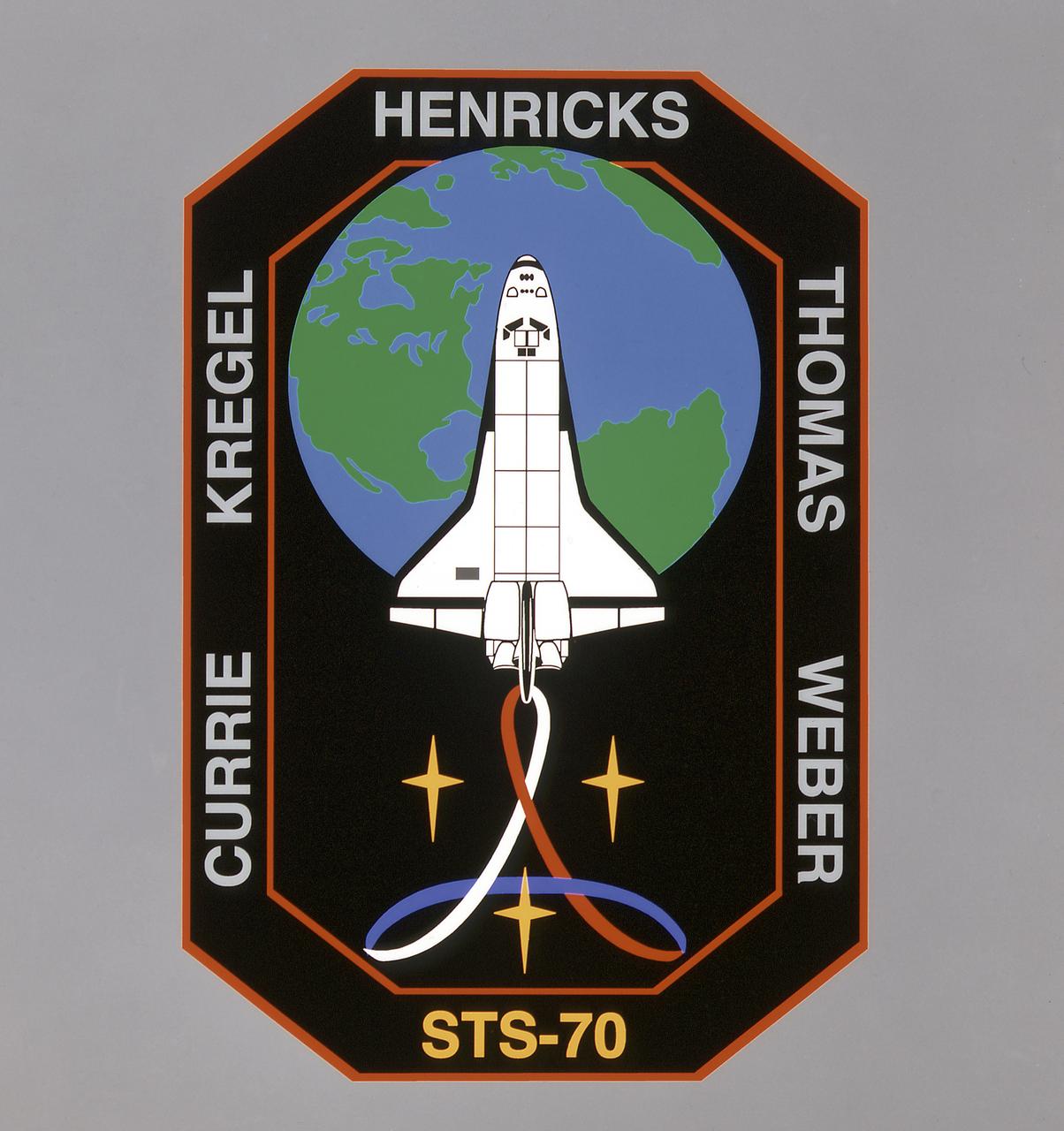
The STS-70 crew patch depicts the Space Shuttle Discovery orbiting Earth in the vast blackness of space. The primary mission of deploying a NASA Tracking and Data Relay Satellite (TDRS) is depicted by three gold stars. They represent the triad composed of spacecraft transmitting data to Earth through the TDRS system. The stylized red, white, and blue ribbon represents the American goal of linking space exploration to the advancement of all humankind.
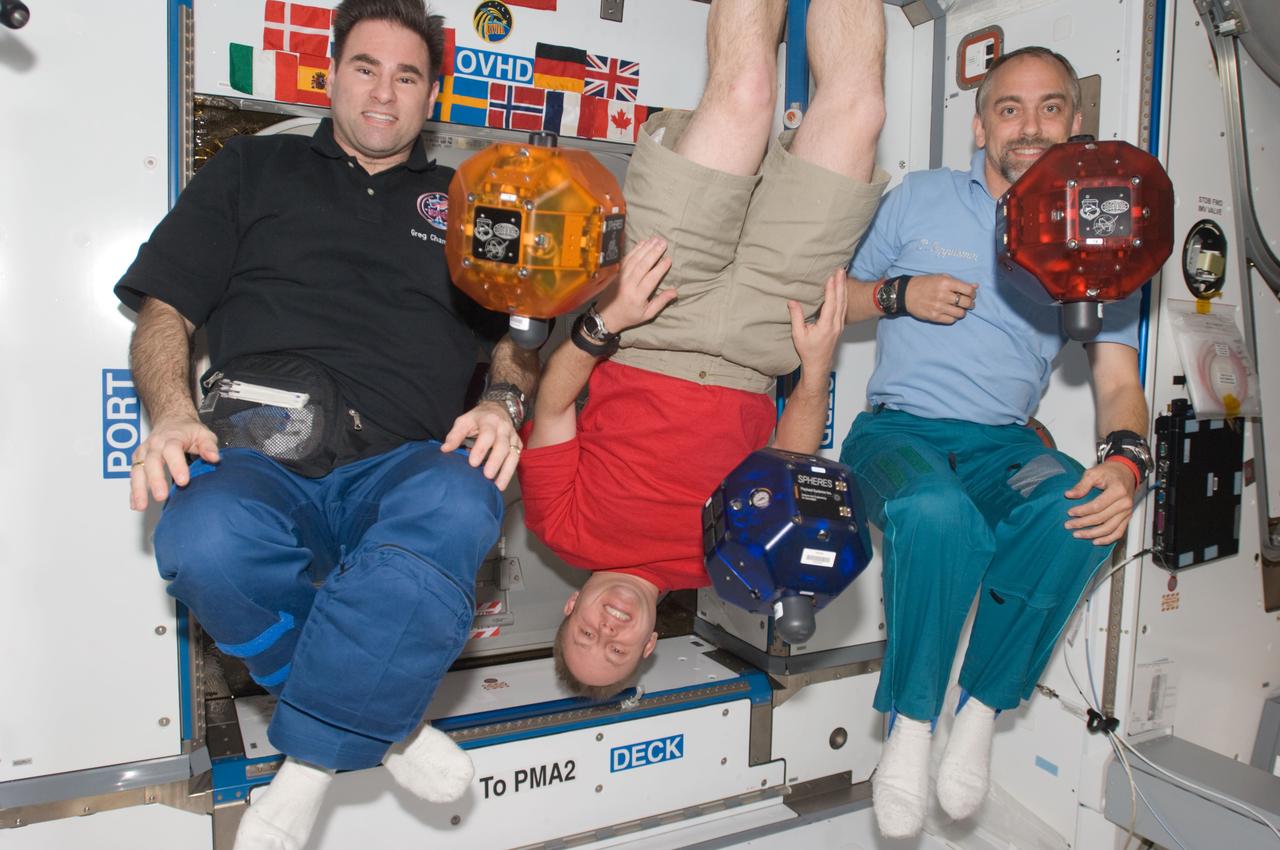
ISS017-E-021362 (22 Oct. 2008) --- Astronauts Greg Chamitoff (left), Michael Fincke, Expedition 18 flight engineer and commander, respectively; and American spaceflight participant Richard Garriott pose for a photo in the Harmony node of the International Space Station. Synchronized Position Hold, Engage, Reorient, Experimental Satellites (SPHERES) float freely in the foreground.
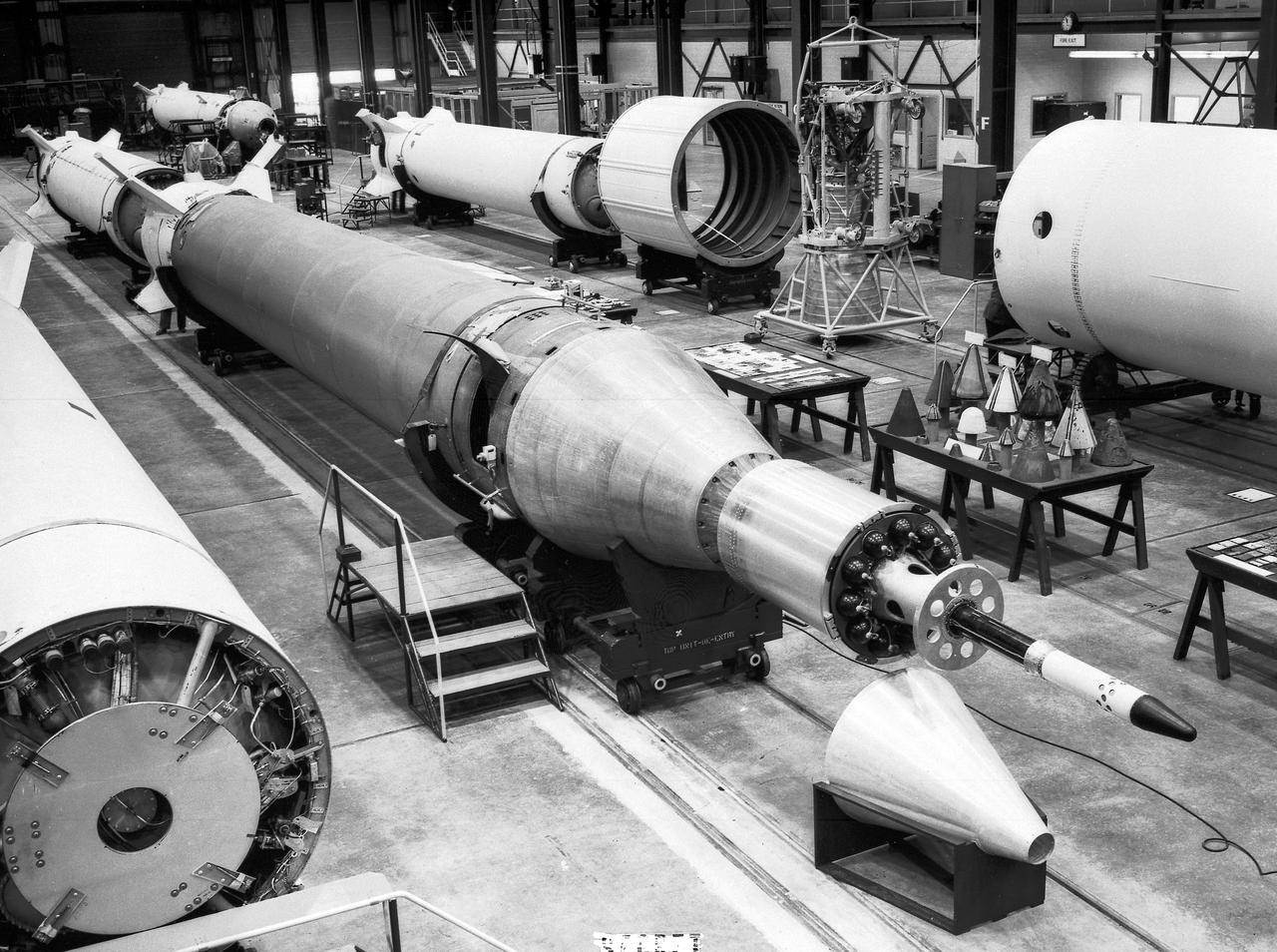
Jupiter-C Missile No. 27 assembly at the Army Ballistic Missile Agency (ABMA), Redstone Arsenal, in Huntsville, Aalabama. The Jupiter-C was a modification of the Redstone Missile, and originally developed as a nose cone re-entry test vehicle for the Jupiter Intermediate Range Ballistic Missile (IRBM). Jupiter-C successfully launched the first American Satellite, Explorer 1, in orbit on January 31, 1958.
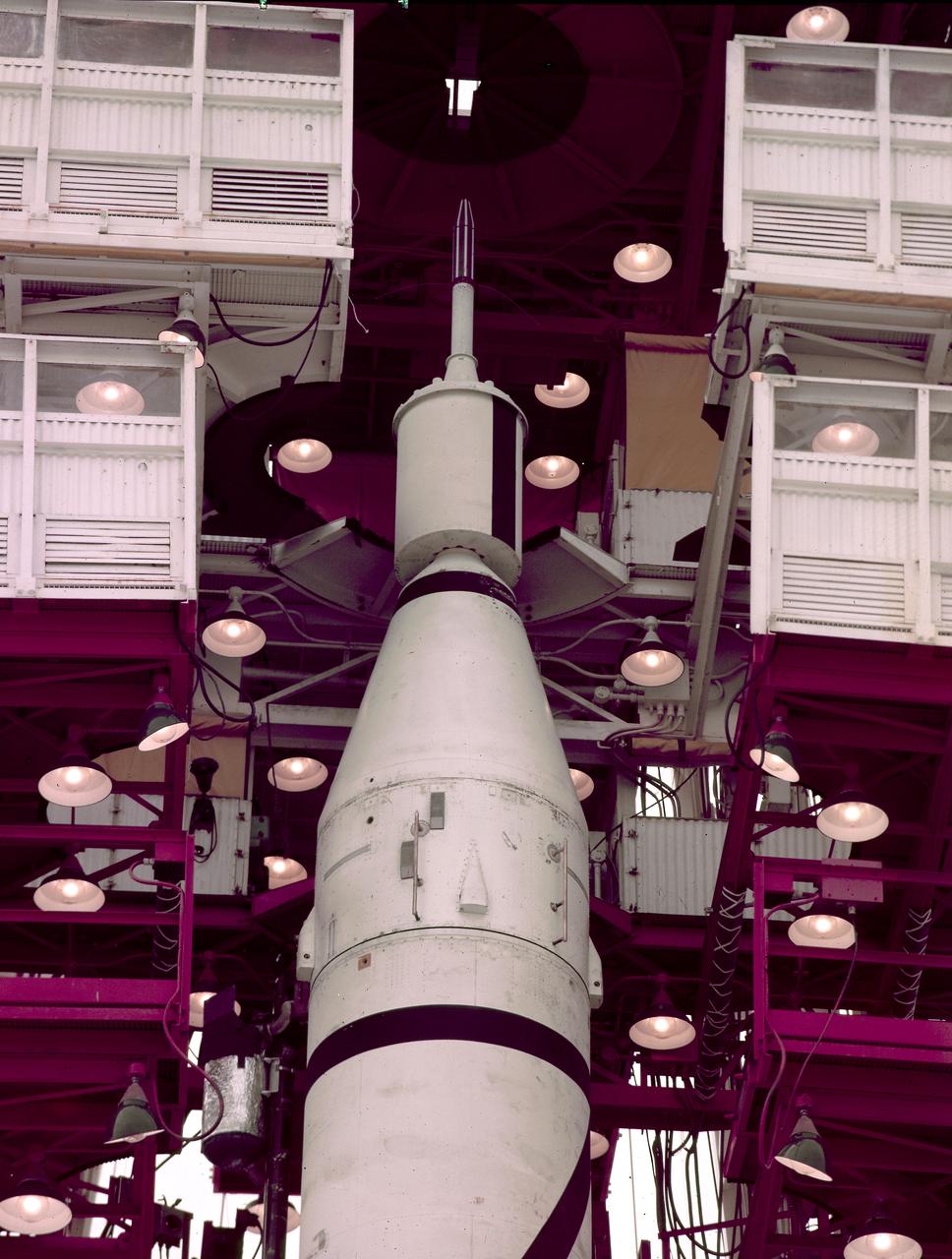
Explorer 1 atop a Jupiter-C in gantry. Jupiter-C carrying the first American satellite, Explorer 1, was successfully launched on January 31, 1958. The Jupiter-C launch vehicle consisted of a modified version of the Redstone rocket's first stage and two upper stages of clustered Baby Sergeant rockets developed by the Jet Propulsion Laboratory and later designated as Juno boosters for space launches
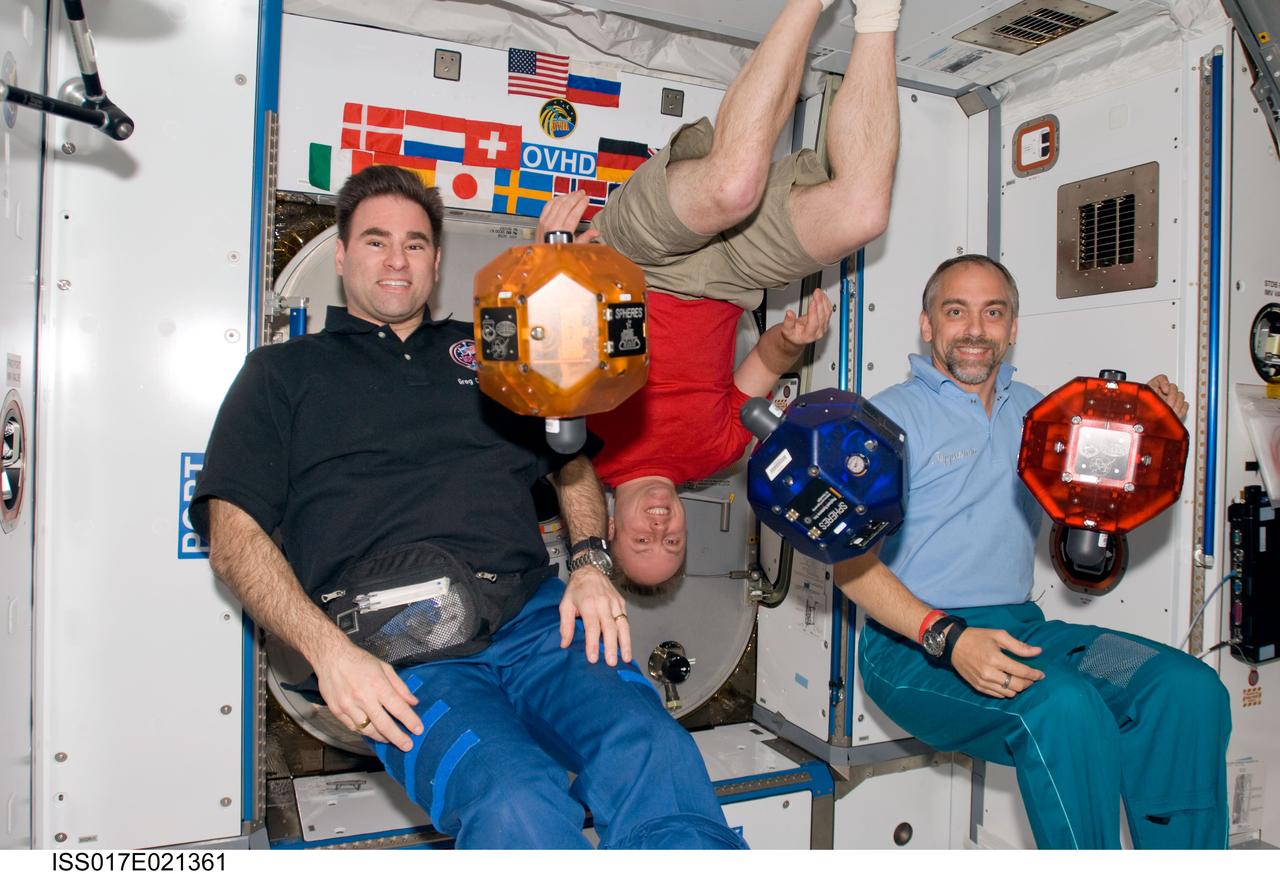
ISS017-E-021361 (22 Oct. 2008) --- Astronauts Greg Chamitoff (left), Michael Fincke, Expedition 18 flight engineer and commander, respectively; and American spaceflight participant Richard Garriott pose for a photo in the Harmony node of the International Space Station. Synchronized Position Hold, Engage, Reorient, Experimental Satellites (SPHERES) float freely in the foreground.
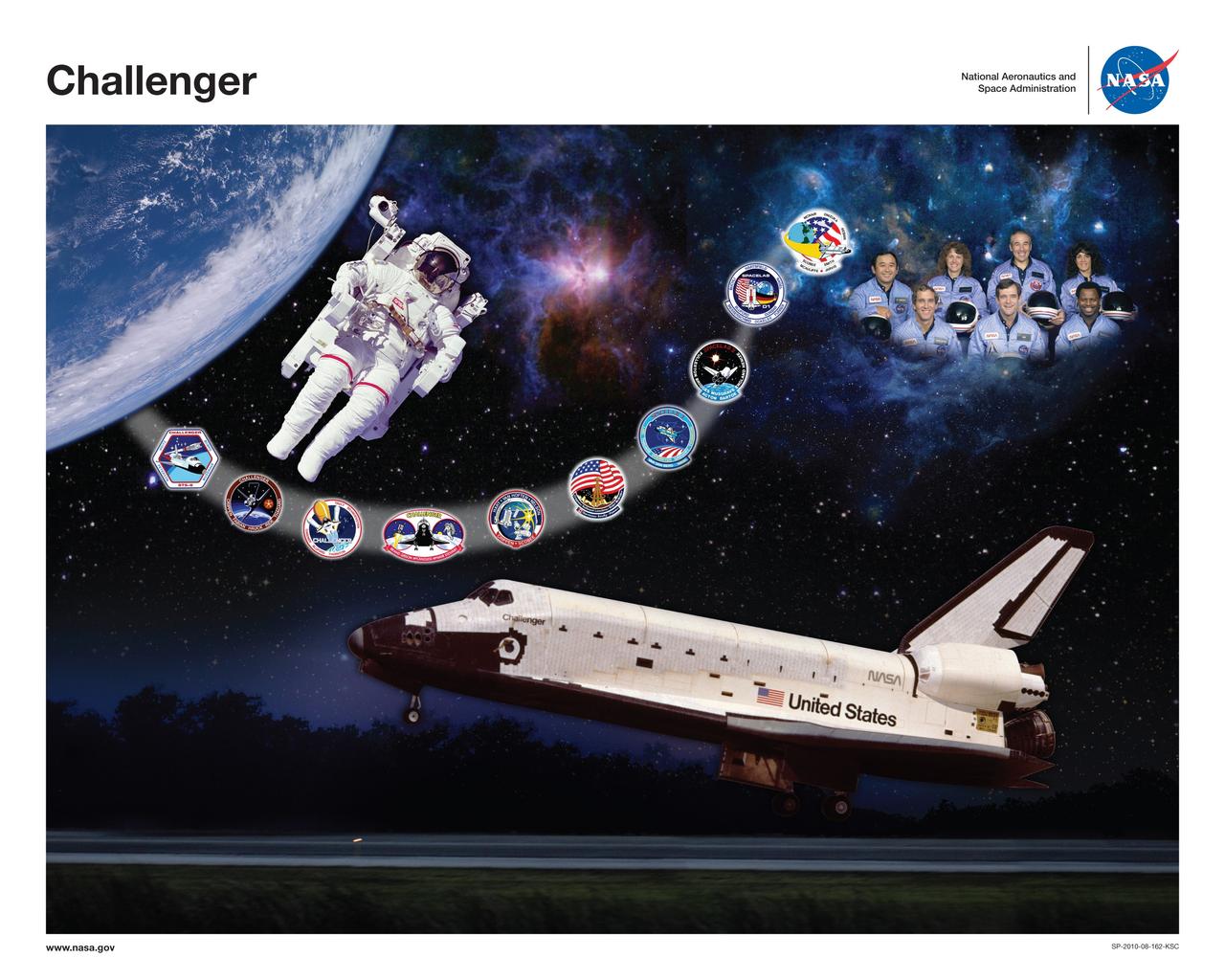
CAPE CANAVERAL, Fla. -- This is a version of space shuttle Challenger's orbiter tribute, or OV-099, which hangs in Firing Room 4 of the Launch Control Center at NASA's Kennedy Space Center in Florida. Challenger's accomplishments include the first night launch and first African-American in space, Guion Bluford, on STS-8, the first in-flight capture, repair and redeployment of an orbiting satellite during STS-41C, the first American woman in space, Sally Ride, on STS-7, and the first American woman to walk in space, Kathryn Sullivan, during STS-41G. Challenger is credited with blazing a trail for NASA's other orbiters with the first night landing at Edwards Air Force Base in California on STS-8 and the first landing at Kennedy on STS-41B. The spacewalker in the tribute represents Challenger’s role in the first spacewalk during STS-6 and the first untethered spacewalk on STS-41B. Crew-designed patches for each of Challenger’s missions lead from Earth toward a remembrance of the STS-51L crew, which was lost 73 seconds after liftoff on Jan. 28, 1986. Five orbiter tributes are on display in the firing room, representing Atlantis, Challenger, Columbia, Endeavour and Discovery. Graphic design credit: NASA/Lynda Brammer. NASA publication number: SP-2010-08-162-KSC
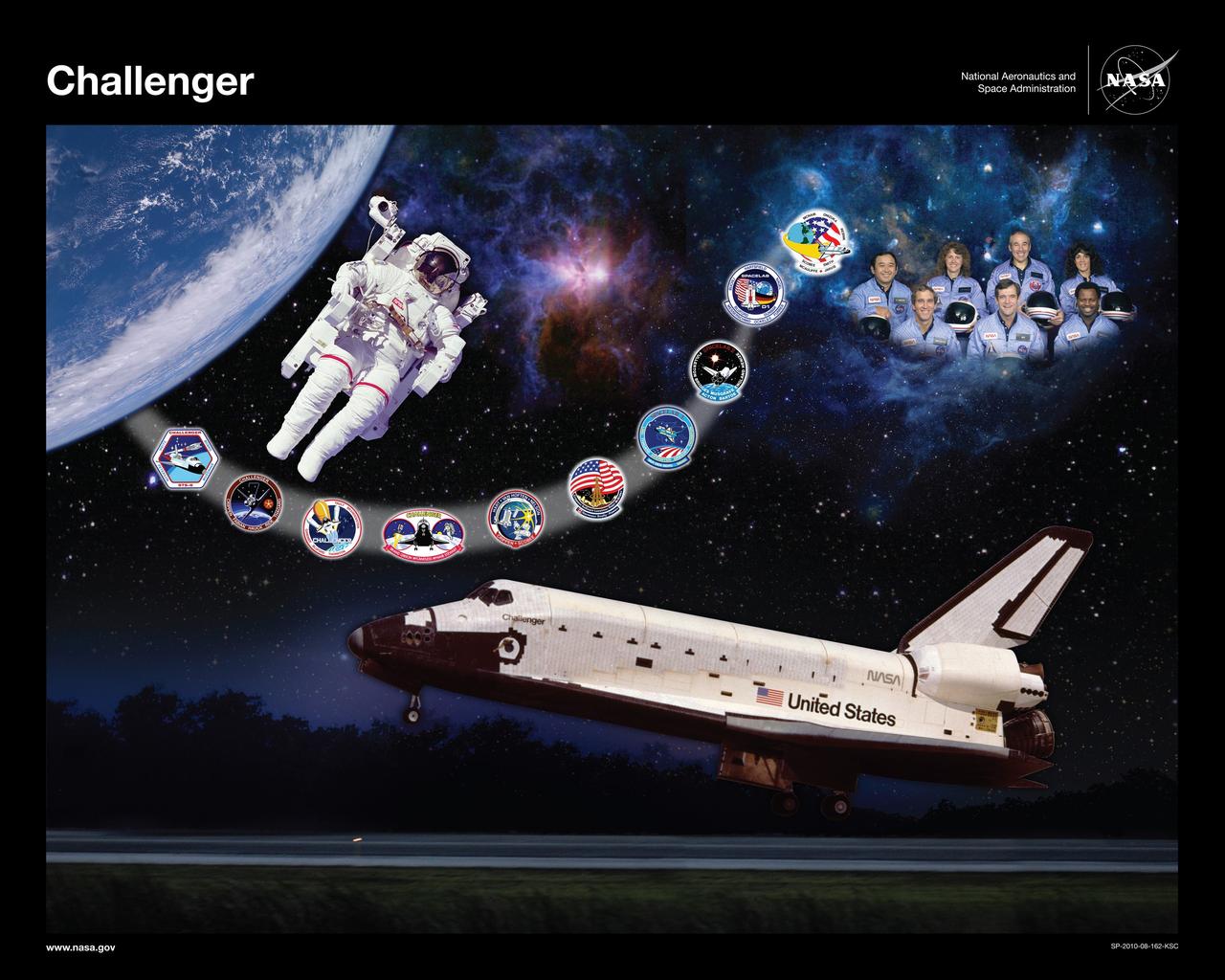
CAPE CANAVERAL, Fla. -- This is a printable version of space shuttle Challenger's orbiter tribute, or OV-099, which hangs in Firing Room 4 of the Launch Control Center at NASA's Kennedy Space Center in Florida. Challenger's accomplishments include the first night launch and first African-American in space, Guion Bluford, on STS-8, the first in-flight capture, repair and redeployment of an orbiting satellite during STS-41C, the first American woman in space, Sally Ride, on STS-7, and the first American woman to walk in space, Kathryn Sullivan, during STS-41G. Challenger is credited with blazing a trail for NASA's other orbiters with the first night landing at Edwards Air Force Base in California on STS-8 and the first landing at Kennedy on STS-41B. The spacewalker in the tribute represents Challenger’s role in the first spacewalk during STS-6 and the first untethered spacewalk on STS-41B. Crew-designed patches for each of Challenger’s missions lead from Earth toward a remembrance of the STS-51L crew, which was lost 73 seconds after liftoff on Jan. 28, 1986. Five orbiter tributes are on display in the firing room, representing Atlantis, Challenger, Columbia, Endeavour and Discovery. Graphic design credit: NASA/Lynda Brammer. NASA publication number: SP-2010-08-162-KSC
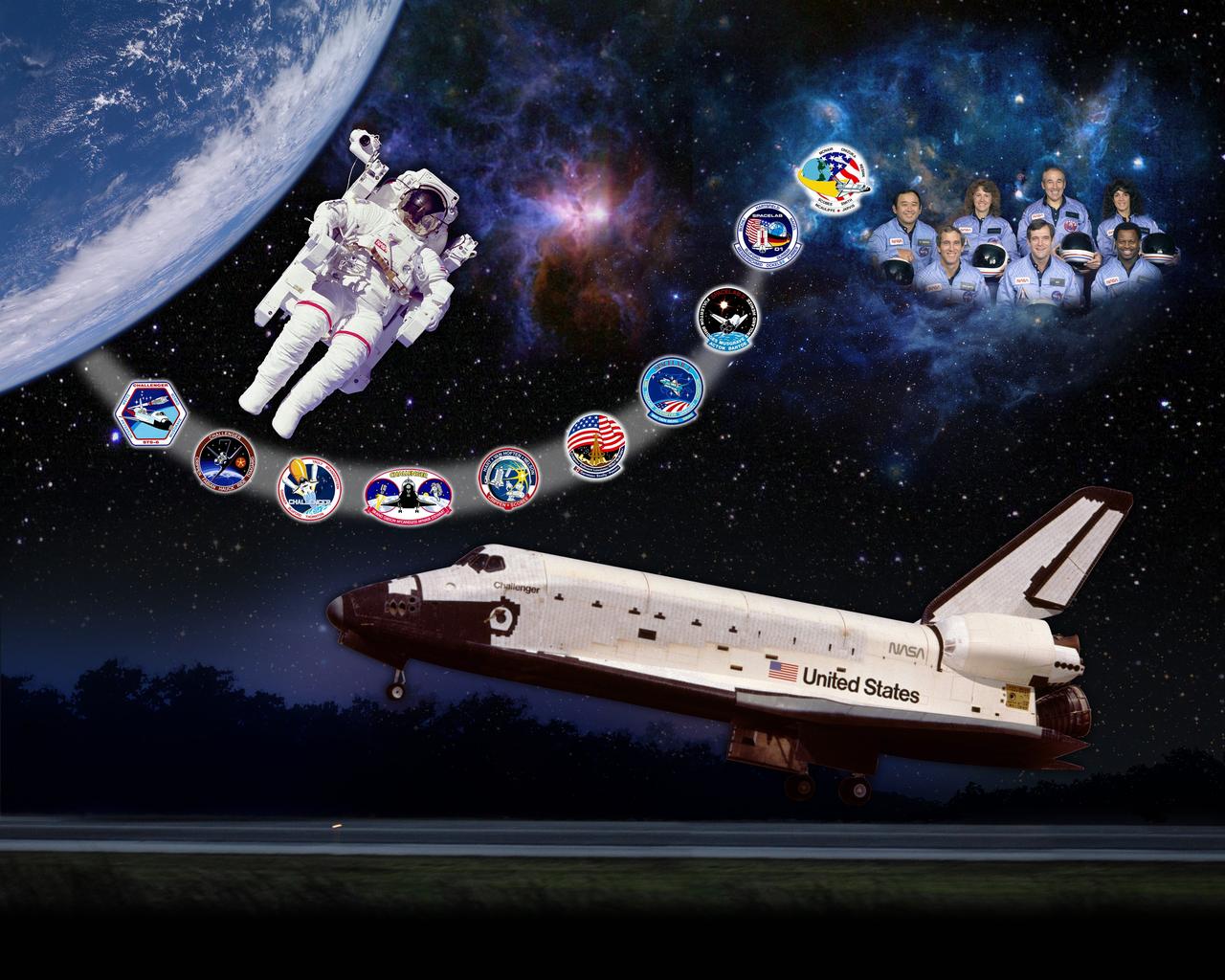
CAPE CANAVERAL, Fla. -- This orbiter tribute of space shuttle Challenger, or OV-099, hangs in Firing Room 4 of the Launch Control Center at NASA's Kennedy Space Center in Florida. Challenger's accomplishments include the first night launch and first African-American in space, Guion Bluford, on STS-8, the first in-flight capture, repair and redeployment of an orbiting satellite during STS-41C, the first American woman in space, Sally Ride, on STS-7, and the first American woman to walk in space, Kathryn Sullivan, during STS-41G. Challenger is credited with blazing a trail for NASA's other orbiters with the first night landing at Edwards Air Force Base in California on STS-8 and the first landing at Kennedy on STS-41B. The spacewalker in the tribute represents Challenger’s role in the first spacewalk during STS-6 and the first untethered spacewalk on STS-41B. Crew-designed patches for each of Challenger’s missions lead from Earth toward a remembrance of the STS-51L crew, which was lost 73 seconds after liftoff on Jan. 28, 1986. Five orbiter tributes are on display in the firing room, representing Atlantis, Challenger, Columbia, Endeavour and Discovery. Graphic design credit: NASA/Lynda Brammer
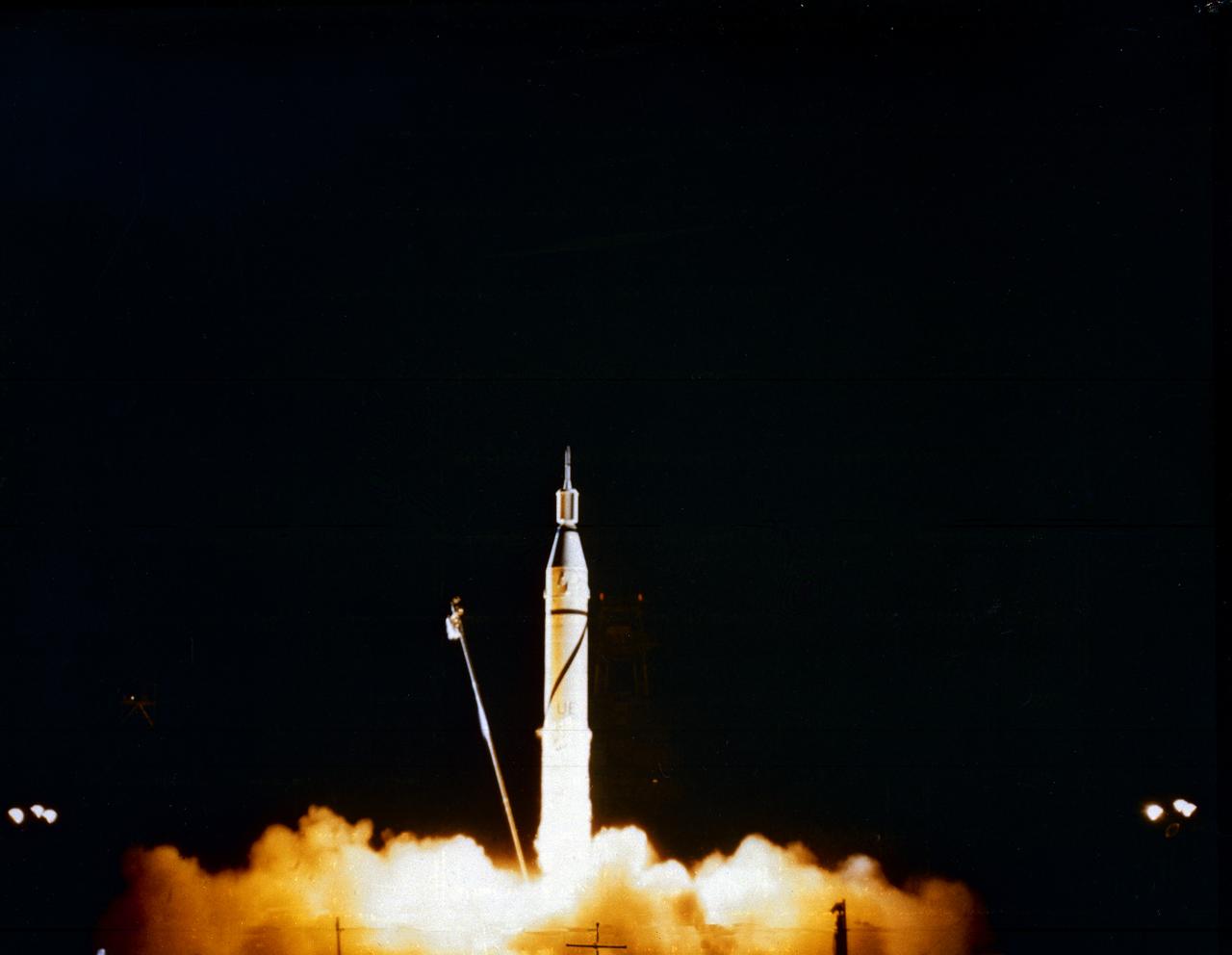
Launch of Jupiter-C/Explorer 1 at Cape Canaveral, Florida on January 31, 1958. After the Russian Sputnik 1 was launched in October 1957, the launching of an American satellite assumed much greater importance. After the Vanguard rocket exploded on the pad in December 1957, the ability to orbit a satellite became a matter of national prestige. On January 31, 1958, slightly more than four weeks after the launch of Sputnik.The ABMA (Army Ballistic Missile Agency) in Redstone Arsenal, Huntsville, Alabama, in cooperation with the Jet Propulsion Laboratory, launched a Jupiter from Cape Canaveral, Florida. The rocket consisted of a modified version of the Redstone rocket's first stage and two upper stages of clustered Baby Sergeant rockets developed by the Jet Propulsion Laboratory and later designated as Juno boosters for space launches

Launch of Jupiter-C/Explorer 1 at Cape Canaveral, Florida on January 31, 1958. After the Russian Sputnik 1 was launched in October 1957, the launching of an American satellite assumed much greater importance. After the Vanguard rocket exploded on the pad in December 1957, the ability to orbit a satellite became a matter of national prestige. On January 31, 1958, slightly more than four weeks after the launch of Sputnik.The ABMA (Army Ballistic Missile Agency) in Redstone Arsenal, Huntsville, Alabama, in cooperation with the Jet Propulsion Laboratory, launched a Jupiter from Cape Canaveral, Florida. The rocket consisted of a modified version of the Redstone rocket's first stage and two upper stages of clustered Baby Sergeant rockets developed by the Jet Propulsion Laboratory and later designated as Juno boosters for space launches
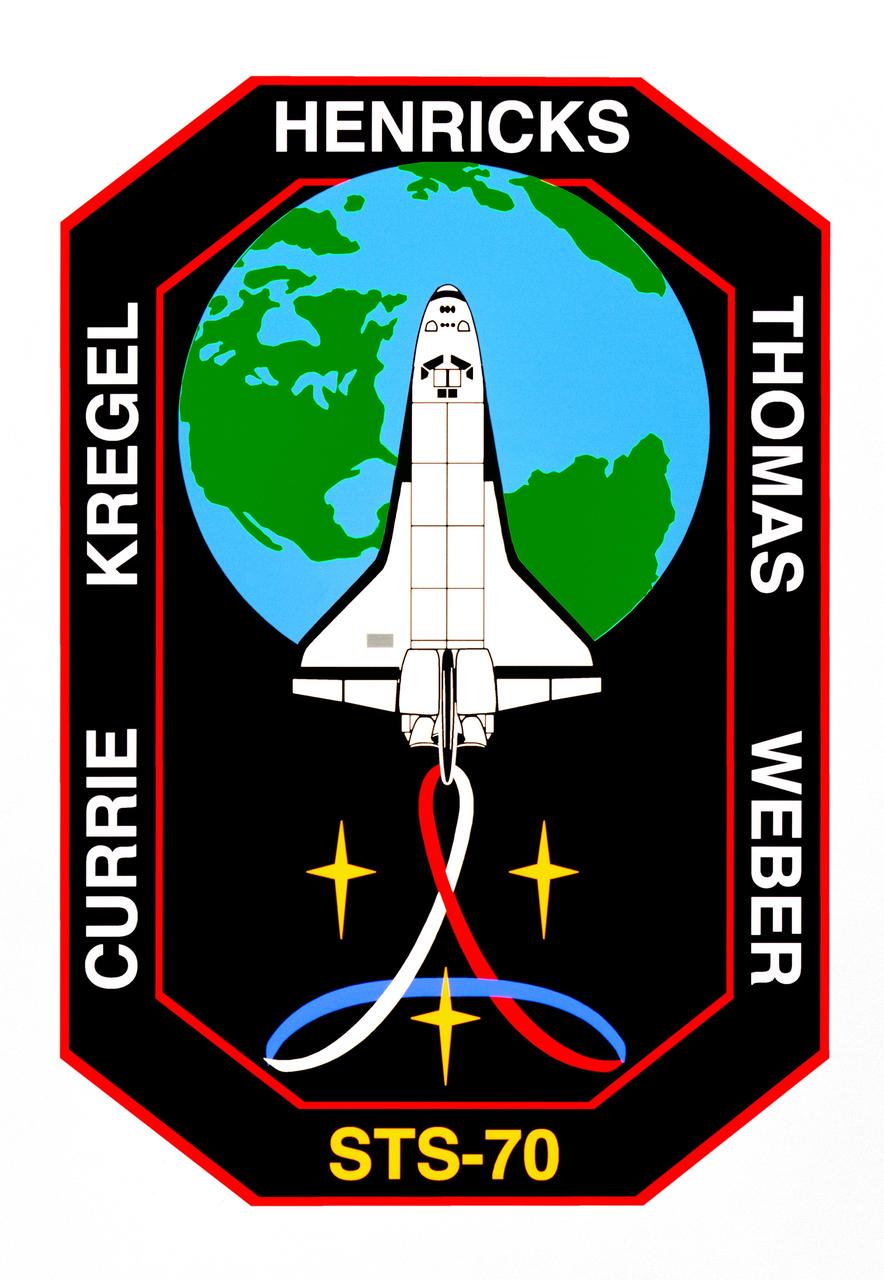
STS070-S-001 (March 1995) --- Designed by the crew members, the STS-70 crew patch depicts the space shuttle Discovery orbiting Earth in the vast blackness of space. The primary mission of deploying a NASA Tracking and Data Relay Satellite (TDRS) is depicted by three gold stars. They represent the triad composed of spacecraft transmitting data to Earth through the Tracking and Data Relay Satellite System (TDRSS). The stylized red, white and blue ribbon represents the American goal of linking space exploration to the advancement of all humankind. Surnames of the five astronaut crew members are spaced around the periphery of the patch. The NASA insignia design for space shuttle flights is reserved for use by the astronauts and for other official use as the NASA Administrator may authorize. Public availability has been approved only in the forms of illustrations by the various news media. When and if there is any change in this policy, which is not anticipated, the change will be publicly announced. Photo credit: NASA
Designed by the mission’s crew members, the STS-57 crew patch depicts the Space Shuttle Endeavour maneuvering to retrieve the European Space Agency's microgravity experiment satellite EURECA. SpaceHab, the first commercial space laboratory, is depicted in the cargo bay, and its characteristic shape is represented by the inner red border of the patch. The three gold plumes surrounded by the five stars trailing EURECA are suggestive of the U.S. astronaut logo. The five gold stars together with the shape of the orbiter's mechanical arm form the mission's numerical designation. The six stars on the American flag represent the U.S. astronauts who comprise the crew. With detailed input from the crew members, the final artwork was accomplished by artist Tim Hall.
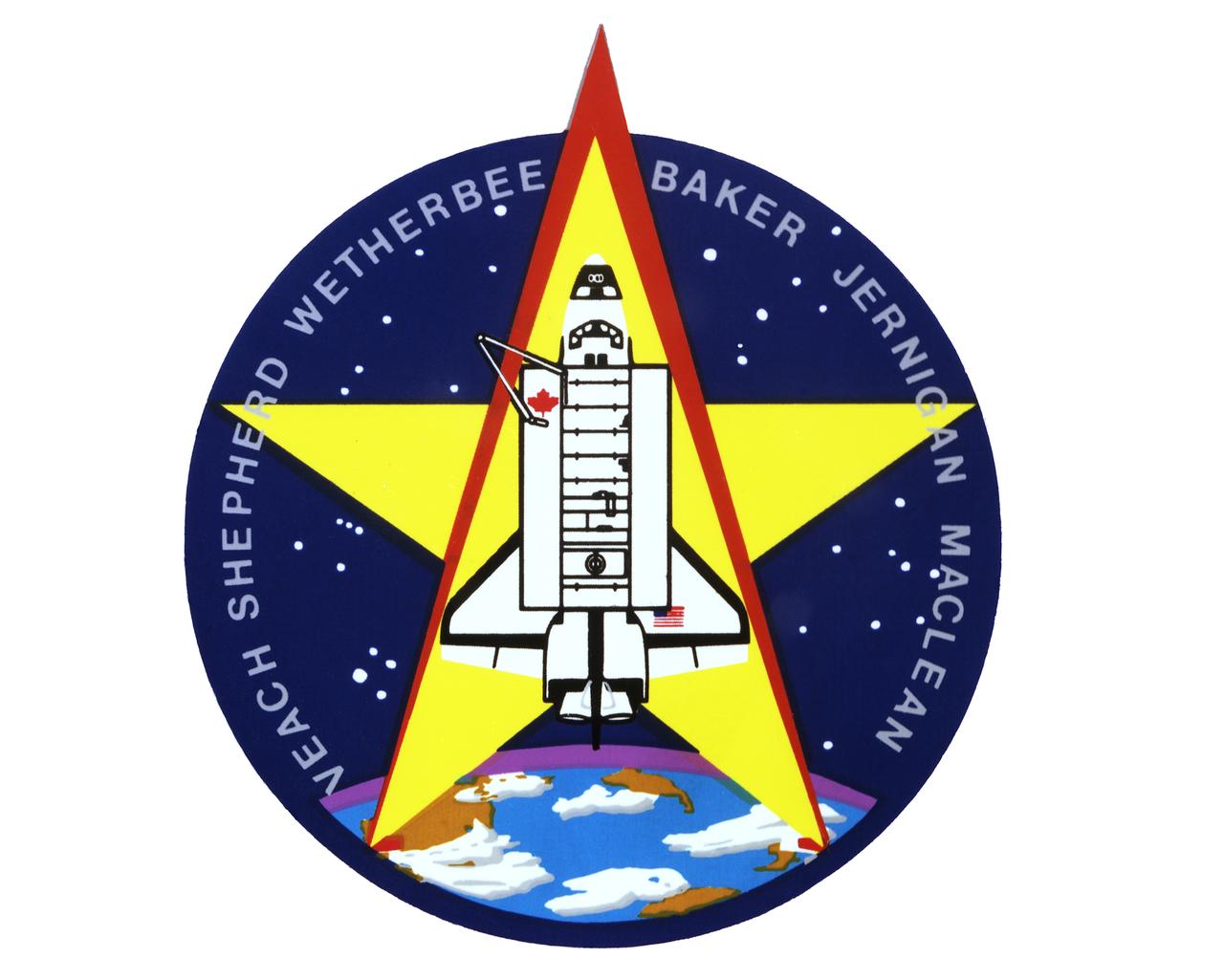
The STS-52 insignia, designed by the mission’s crew members, features a large gold star to symbolize the crew's mission on the frontiers of space. A gold star is often used to symbolize the frontier period of the American West. The red star in the shape of the Greek letter lambda represents both the laser measurements taken from the Laser Geodynamic Satellite (LAGEOS II) and the Lambda Point Experiment, which was part of the United States Microgravity Payload (USMP-l). The remote manipulator and maple leaf are emblematic of the Canadian payload specialist who conducted a series of Canadian flight experiments (CANEX-2), including the Space Vision System test.
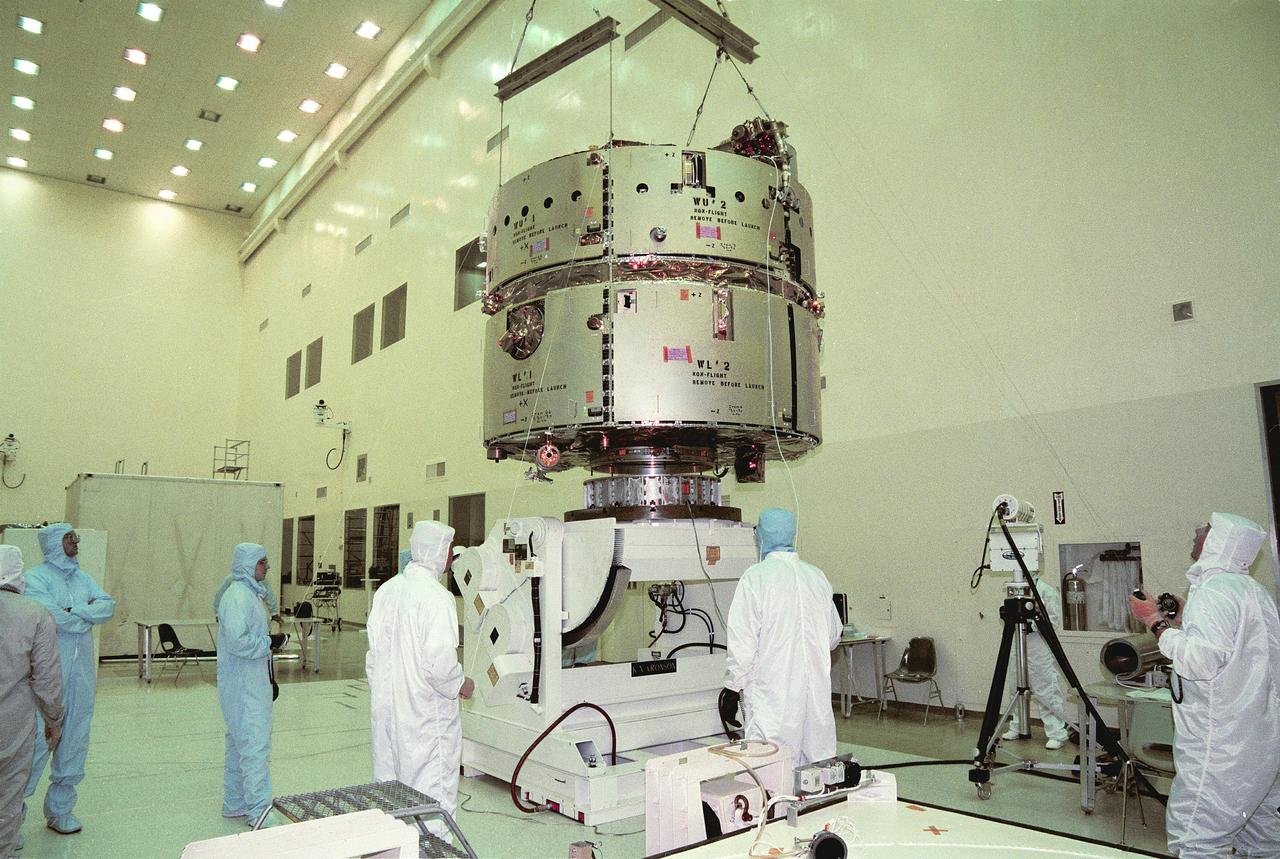
CAPE CANAVERAL, Fla. -- At Cape Canaveral Air Force Station in Florida, technicians in NASA’s AO Building on Cape Canaveral Air Station move the Wind spacecraft to a work stand. Wind is scheduled for launch on a Delta II expendable launch vehicle. Wind is the first of two missions of the Global Geospace Science Initiative, part of the worldwide collaboration for the International Solar-Terrestrial Physics ISTP program. It will carry six U.S. instruments, one French instrument and the first Russian instrument to ever fly on an American satellite, as part of an effort to measure properties of the solar wind before it reaches Earth. Photo Credit: NASA
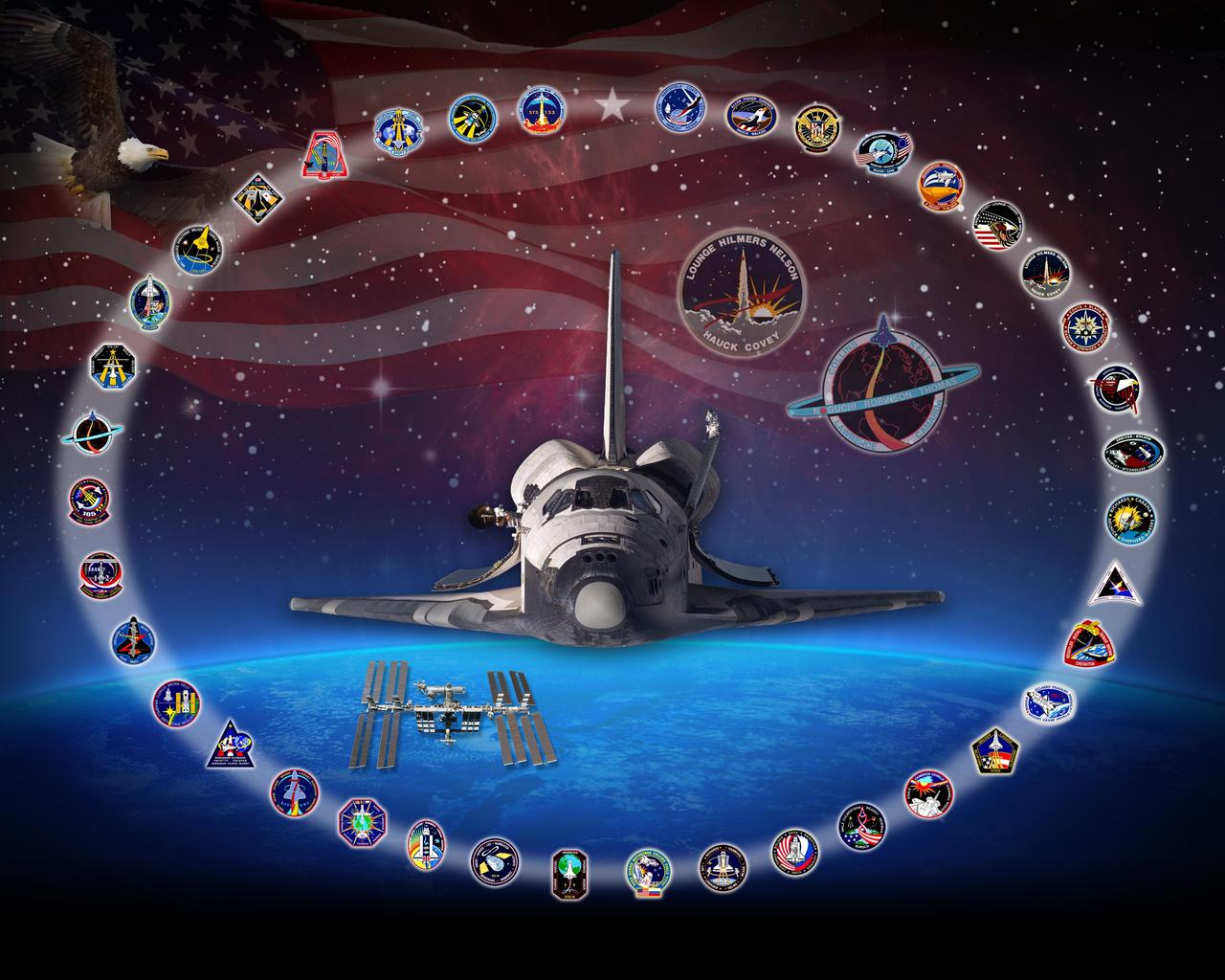
CAPE CANAVERAL, Fla. -- This orbiter tribute of space shuttle Discovery, or OV-103, hangs in Firing Room 4 of the Launch Control Center at NASA's Kennedy Space Center in Florida. Discovery’s accomplishments include the first female shuttle pilot, Eileen Collins, on STS-63, John Glenn’s legendary return to space on STS-95, and the celebration of the 100th shuttle mission with STS-92. In addition, Discovery supported a number of Department of Defense programs, satellite deploy and repair missions and 13 International Space Station construction and operation flights. The tribute features Discovery demonstrating the rendezvous pitch maneuver on approach to the International Space Station during STS-114. Having accumulated the most space shuttle flights, Discovery’s 39 mission patches are shown circling the spacecraft. The background image was taken from the Hubble Space Telescope, which launched aboard Discovery on STS-31 and serviced by Discovery on STS-82 and STS-103. The American Flag and Bald Eagle represent Discovery’s two Return-to-Flight missions -- STS-26 and STS-114 -- and symbolize Discovery’s role in returning American astronauts to space. Five orbiter tributes are on display in the firing room, representing Atlantis, Challenger, Columbia, Endeavour and Discovery. Graphic design credit: NASA/Amy Lombardo
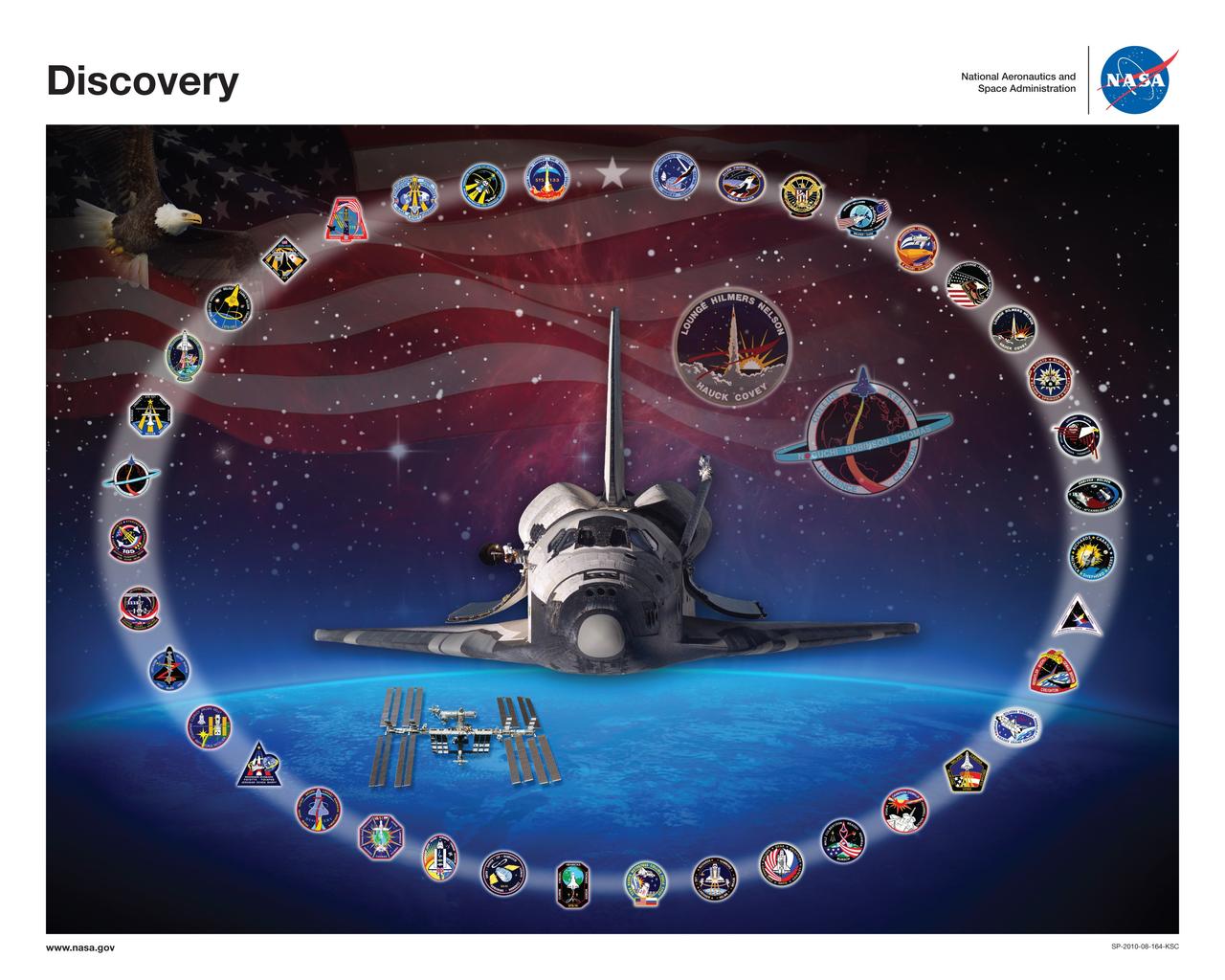
CAPE CANAVERAL, Fla. -- This is a version of space shuttle Discovery's orbiter tribute, or OV-103, which hangs in Firing Room 4 of the Launch Control Center at NASA's Kennedy Space Center in Florida. Discovery’s accomplishments include the first female shuttle pilot, Eileen Collins, on STS-63, John Glenn’s legendary return to space on STS-95, and the celebration of the 100th shuttle mission with STS-92. In addition, Discovery supported a number of Department of Defense programs, satellite deploy and repair missions and 13 International Space Station construction and operation flights. The tribute features Discovery demonstrating the rendezvous pitch maneuver on approach to the International Space Station during STS-114. Having accumulated the most space shuttle flights, Discovery’s 39 mission patches are shown circling the spacecraft. The background image was taken from the Hubble Space Telescope, which launched aboard Discovery on STS-31 and serviced by Discovery on STS-82 and STS-103. The American Flag and Bald Eagle represent Discovery’s two Return-to-Flight missions -- STS-26 and STS-114 -- and symbolize Discovery’s role in returning American astronauts to space. Five orbiter tributes are on display in the firing room, representing Atlantis, Challenger, Columbia, Endeavour and Discovery. Graphic design credit: NASA/Amy Lombardo. NASA publication number: SP-2010-08-164-KSC
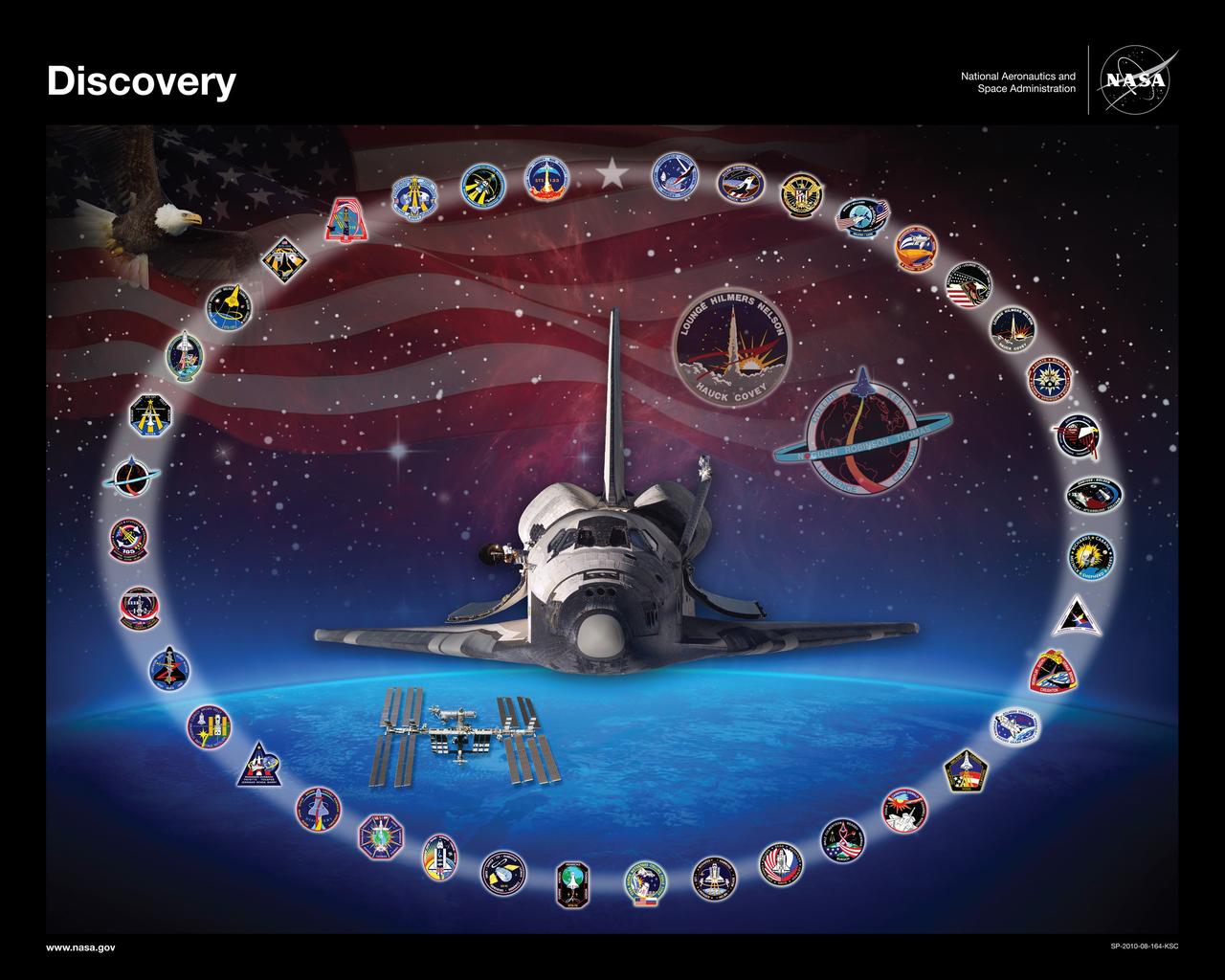
CAPE CANAVERAL, Fla. -- This is a printable version of space shuttle Discovery's orbiter tribute, or OV-103, which hangs in Firing Room 4 of the Launch Control Center at NASA's Kennedy Space Center in Florida. Discovery’s accomplishments include the first female shuttle pilot, Eileen Collins, on STS-63, John Glenn’s legendary return to space on STS-95, and the celebration of the 100th shuttle mission with STS-92. In addition, Discovery supported a number of Department of Defense programs, satellite deploy and repair missions and 13 International Space Station construction and operation flights. The tribute features Discovery demonstrating the rendezvous pitch maneuver on approach to the International Space Station during STS-114. Having accumulated the most space shuttle flights, Discovery’s 39 mission patches are shown circling the spacecraft. The background image was taken from the Hubble Space Telescope, which launched aboard Discovery on STS-31 and serviced by Discovery on STS-82 and STS-103. The American Flag and Bald Eagle represent Discovery’s two Return-to-Flight missions -- STS-26 and STS-114 -- and symbolize Discovery’s role in returning American astronauts to space. Five orbiter tributes are on display in the firing room, representing Atlantis, Challenger, Columbia, Endeavour and Discovery. Graphic design credit: NASA/Amy Lombardo. NASA publication number: SP-2010-08-164-KSC
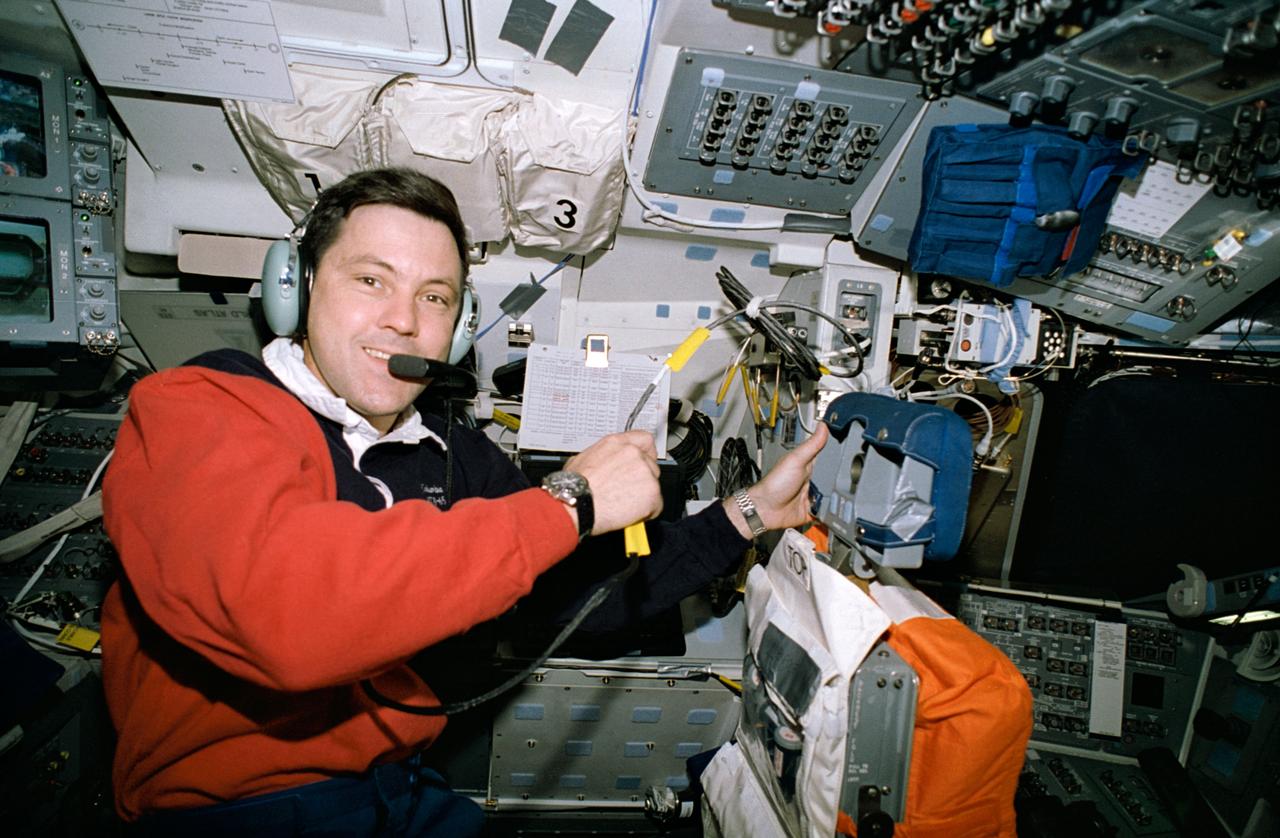
STS065-44-014 (8-23 July 1994) --- Astronaut Robert D. Cabana, mission commander, is seen on the Space Shuttle Columbia's flight deck with the Shuttle Amateur Radio Experiment (SAREX). SAREX was established by NASA, the American Radio League/Amateur Radio Satellite Corporation and the Johnson Space Center (JSC) Amateur Radio Club to encourage public participation in the space program through a project to demonstrate the effectiveness of conducting short-wave radio transmissions between the Shuttle and ground-based radio operators at low-cost ground stations with amateur and digital techniques. As on several previous missions, SAREX was used on this flight as an educational opportunity for students around the world to learn about space firsthand by speaking directly to astronauts aboard the Shuttle.
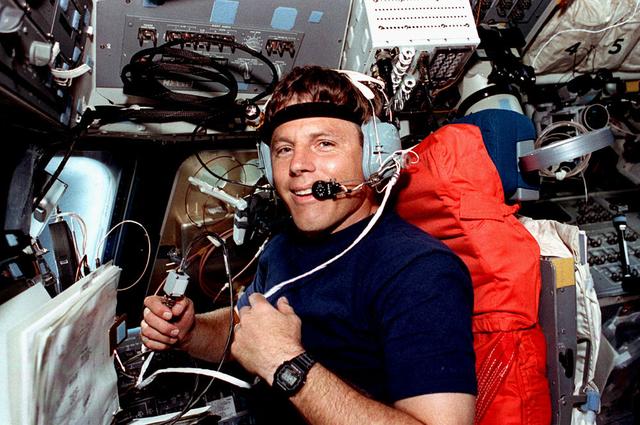
Space Shuttle Discovery (STS-56) onboard photo of Pilot Stephen S. Oswald (wearing a headset) uses the Shuttle Amateur Radio Experiment II (SAREX-II) while sitting at the pilot's station on the forward flight deck. Oswald smiled from behind the microphone as he talks to amateur radio operators on Earth via the SAREX equipment. SAREX cables and the interface module freefloat in front of Oswald. The anterna located in the forward flight deck window is visible in the background. SAREX was established by NASA, the American Radio League/Amateur Radio Satellite Corporation and the Johnson Space Center (JSC) Amateur Radio Club to encourage public participation in the space program through a program to demonstrate the effectiveness of conducting short-wave radio transmissions between the Shuttle and ground-based radio operators at low-cost ground stations with amateur and digital techniques.
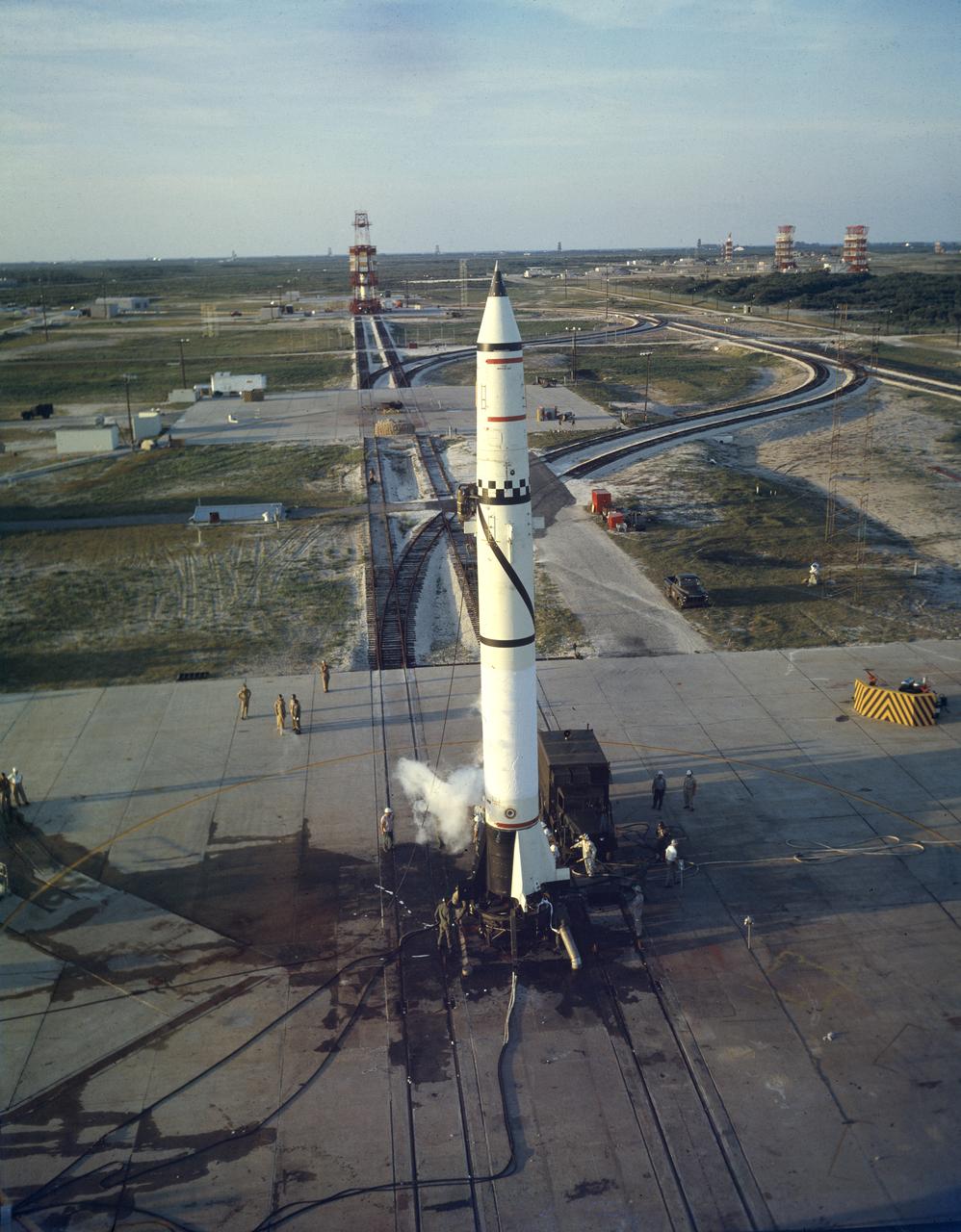
Redstone missile No. 1002 on the launch pad at Cape Canaveral, Florida, on May 16, 1958. The Redstone ballistic missile was a high-accuracy, liquid-propelled, surface-to-surface missile developed by the Army Ballistic Missile Agency, Redstone Arsenal, in Huntsville, Alabama, under the direction of Dr. von Braun. The Redstone engine was a modified and improved version of the Air Force's Navaho cruise missile engine of the late forties. The A-series, as this would be known, utilized a cylindrical combustion chamber as compared with the bulky, spherical V-2 chamber. By 1951, the Army was moving rapidly toward the design of the Redstone missile, and production was begun in 1952. Redstone rockets became the "reliable workhorse" for America's early space program. As an example of the versatility, Redstone was utilized in the booster for Explorer 1, the first American satellite, with no major changes to the engine or missile
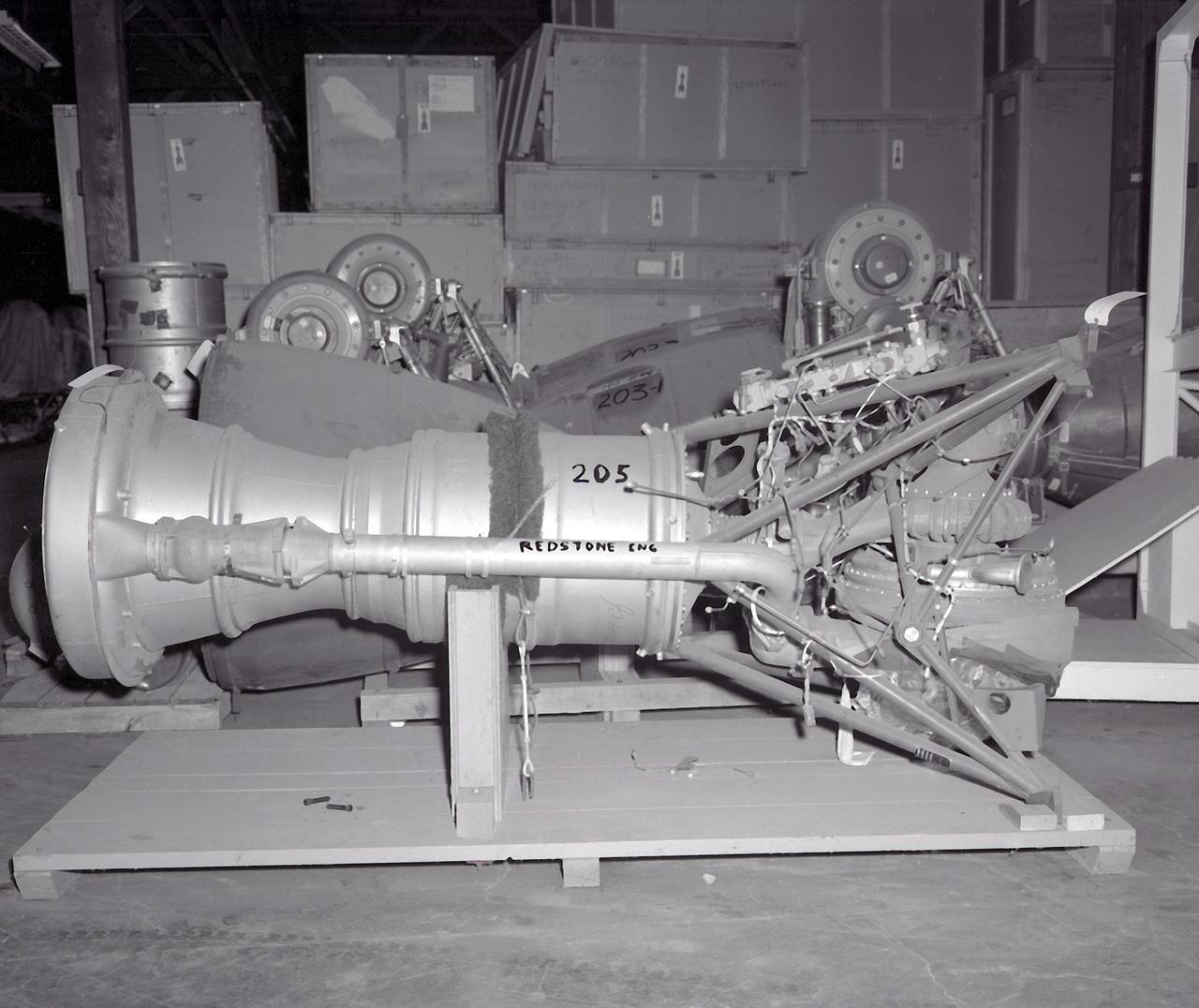
This photograph is of the engine for the Redstone rocket. The Redstone ballistic missile was a high-accuracy, liquid-propelled, surface-to-surface missile developed by the Army Ballistic Missile Agency, Redstone Arsenal, in Huntsville, Alabama, under the direction of Dr. von Braun. The Redstone engine was a modified and improved version of the Air Force's Navaho cruise missile engine of the late forties. The A-series, as this would be known, utilized a cylindrical combustion chamber as compared with the bulky, spherical V-2 chamber. By 1951, the Army was moving rapidly toward the design of the Redstone missile, and the production was begun in 1952. Redstone rockets became the "reliable workhorse" for America's early space program. As an example of its versatility, the Redstone was utilized in the booster for Explorer 1, the first American satellite, with no major changes to the engine or missile.
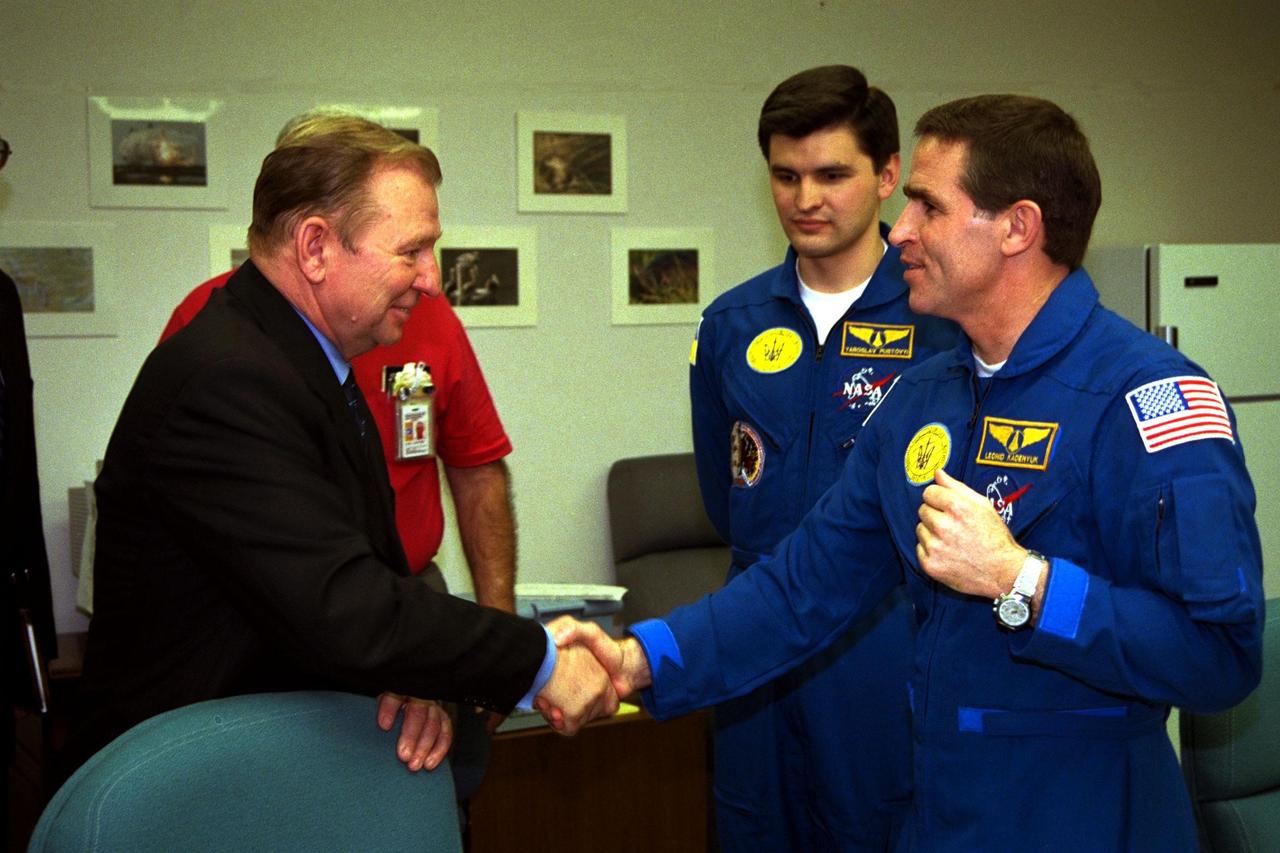
The president of the Ukraine, Leonid Kuchma, shakes hands with Payload Specialist Leonid Kadenyuk, at right, as backup Payload Specialist Yaroslav Pustovyi, both of the National Space Agency of Ukraine, looks on during prelaunch activities leading up to the scheduled Nov. 19 launch of STS-87. STS-87 will be the fourth flight of the United States Microgravity Payload and the Spartan-201 deployable satellite. During the mission, Kadenyuk will pollinate Brassica rapa plants as part of the Collaborative Ukrainian Experiment, or CUE, aboard Columbia during its 16-day mission. The CUE experiment is a collection of 10 plant space biology experiments that will fly in Columbia's middeck and will feature an educational component that involves evaluating the effects of microgravity on Brassica rapa seedlings. Students in Ukrainian and American schools will participate in the same experiment with Kadenyuk in space. Kadenyuk will be flying his first Shuttle mission on STS-87
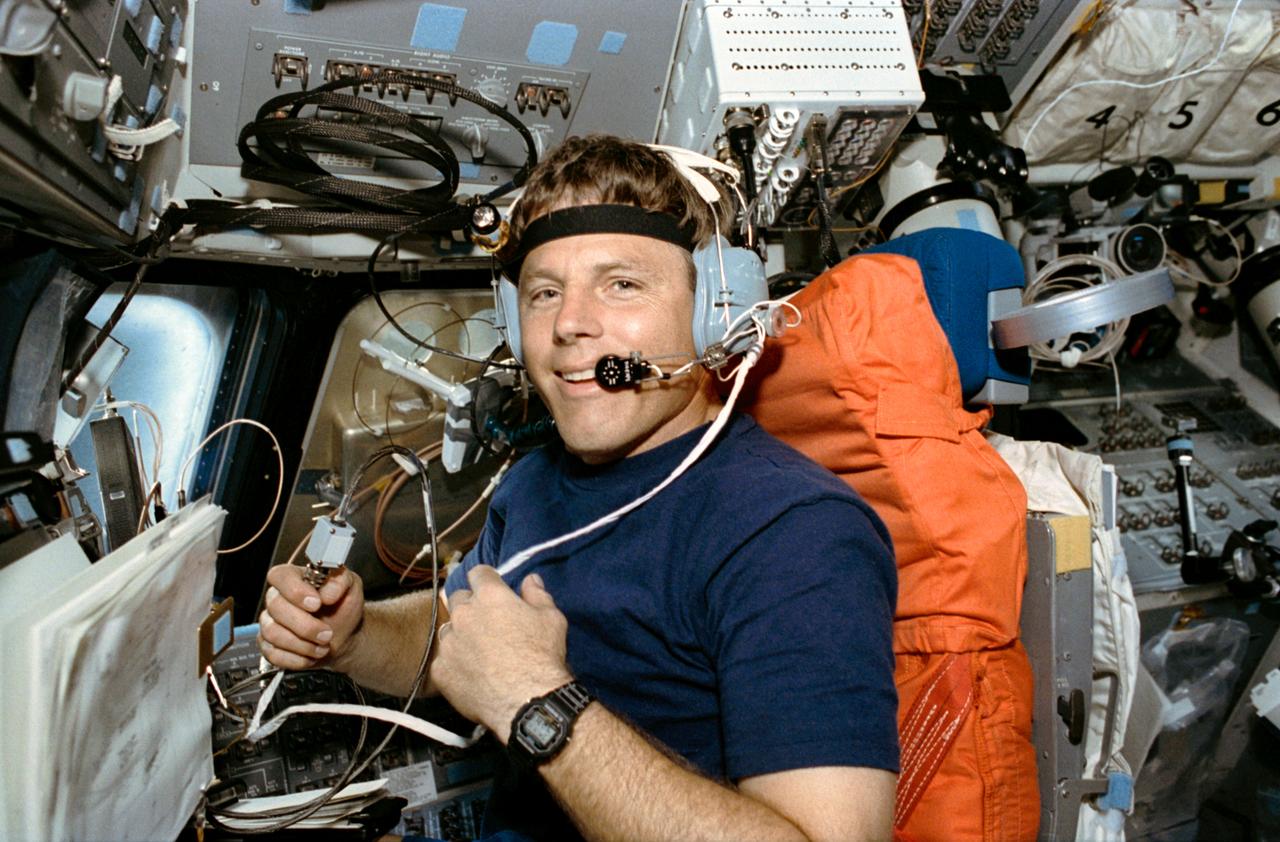
STS056-04-004 (8-17 April 1993) --- Aboard Discovery, Astronaut Stephen S. Oswald, Pilot, talks to amateur radio operators on Earth via the Shuttle Amateur Radio Experiment (SAREX). SAREX was established by NASA, the American Radio League/Amateur Radio Satellite Corporation and the Johnson Space Center Amateur Radio Club to encourage public participation in the space program through a program to demonstrate the effectiveness of conducting short-wave radio transmissions between the Shuttle and ground-based radio operators at low-cost ground stations with amateur and digital techniques. As on several previous missions, SAREX was used on this flight as an educational opportunity for students around the world to learn about space firsthand by speaking directly to astronauts aboard the Shuttle.
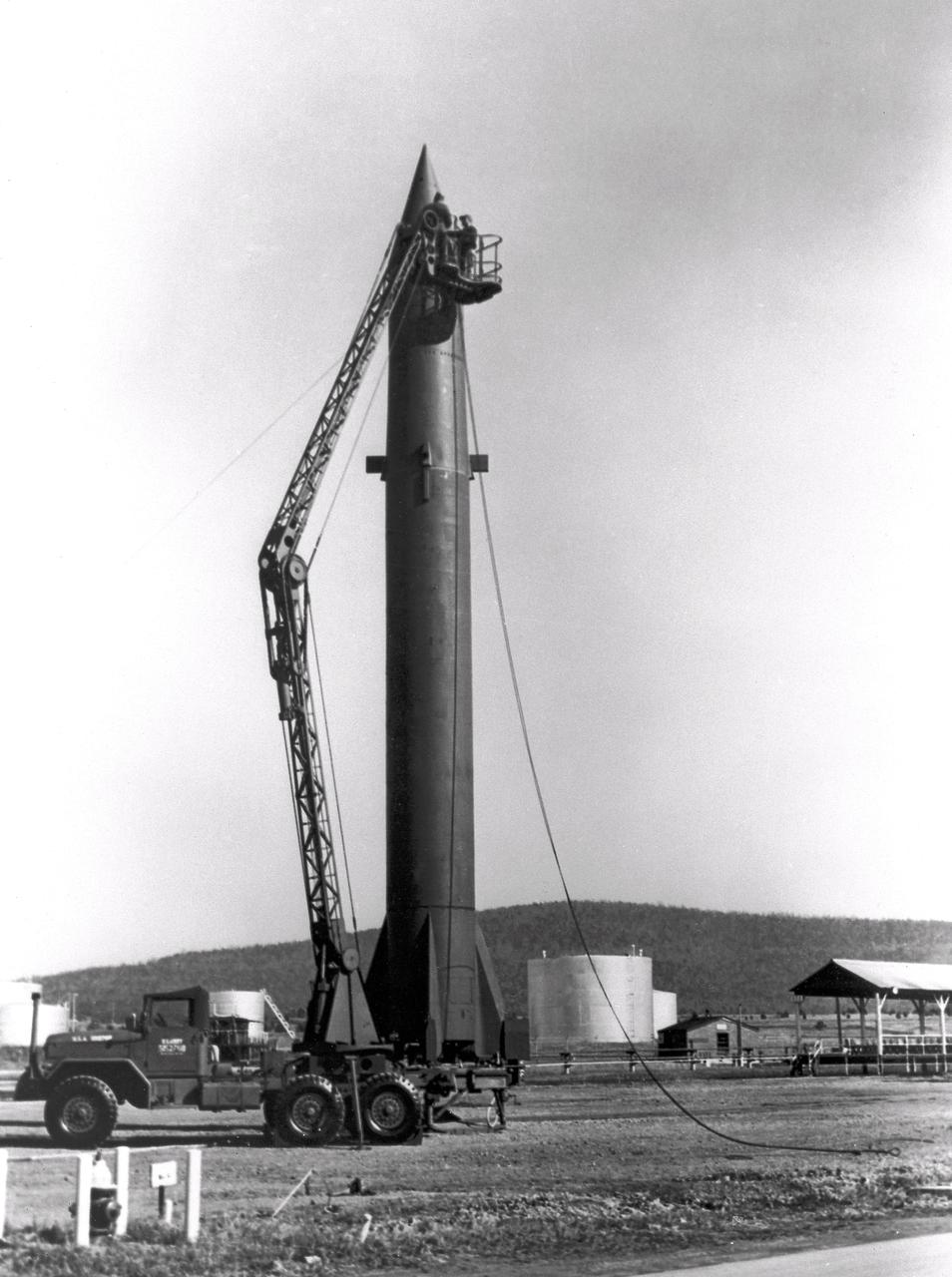
The image depicts Redstone missile being erected. The Redstone ballistic missile was a high-accuracy, liquid-propelled, surface-to-surface missile developed by Army Ballistic Missile Agency, Redstone Arsenal, in Huntsville, Alabama, under the direction of Dr. von Braun. The Redstone engine was a modified and improved version of the Air Force's Navaho cruise missile engine of the late forties. The A-series, as this would be known, utilized a cylindrical combustion chamber as compared with the bulky, spherical V-2 chamber. By 1951, the Army was moving rapidly toward the design of the Redstone missile, and the production was begun in 1952. Redstone rockets became the "reliable workhorse" for America's early space program. As an example of the versatility, Redstone was utilized in the booster for Explorer 1, the first American satellite, with no major changes to the engine or missile
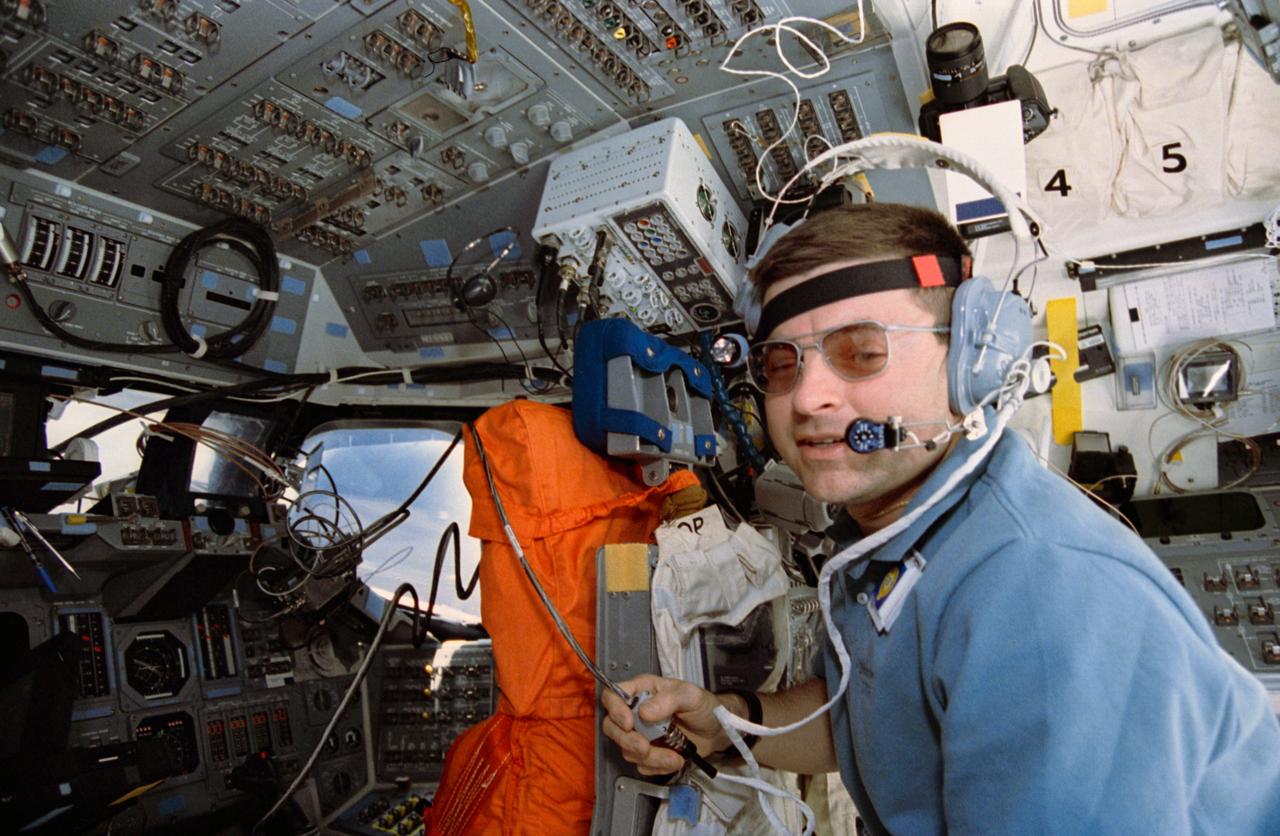
STS056-30-022 (8-17 April 1993) --- Aboard Discovery, astronaut Kenneth D. Cameron (call letters N5AWP), talks to amateur radio operators on Earth via the Shuttle Amateur Radio Experiment (SAREX). SAREX was established by NASA, the American Radio League\Amateur Satellite Corporation and the Johnson Space Center Amateur Radio Club to encourage public participation in the space program. It is part of an endeavor to demonstrate the effectiveness of conducting short-wave radio transmissions between the Shuttle and ground-based radio operators at low cost ground stations with amateur and digital techniques. As on several previous missions, SAREX was used on this flight as an educational opportunity for students around the world to learn about space firsthand by speaking directly to astronauts aboard the Shuttle.
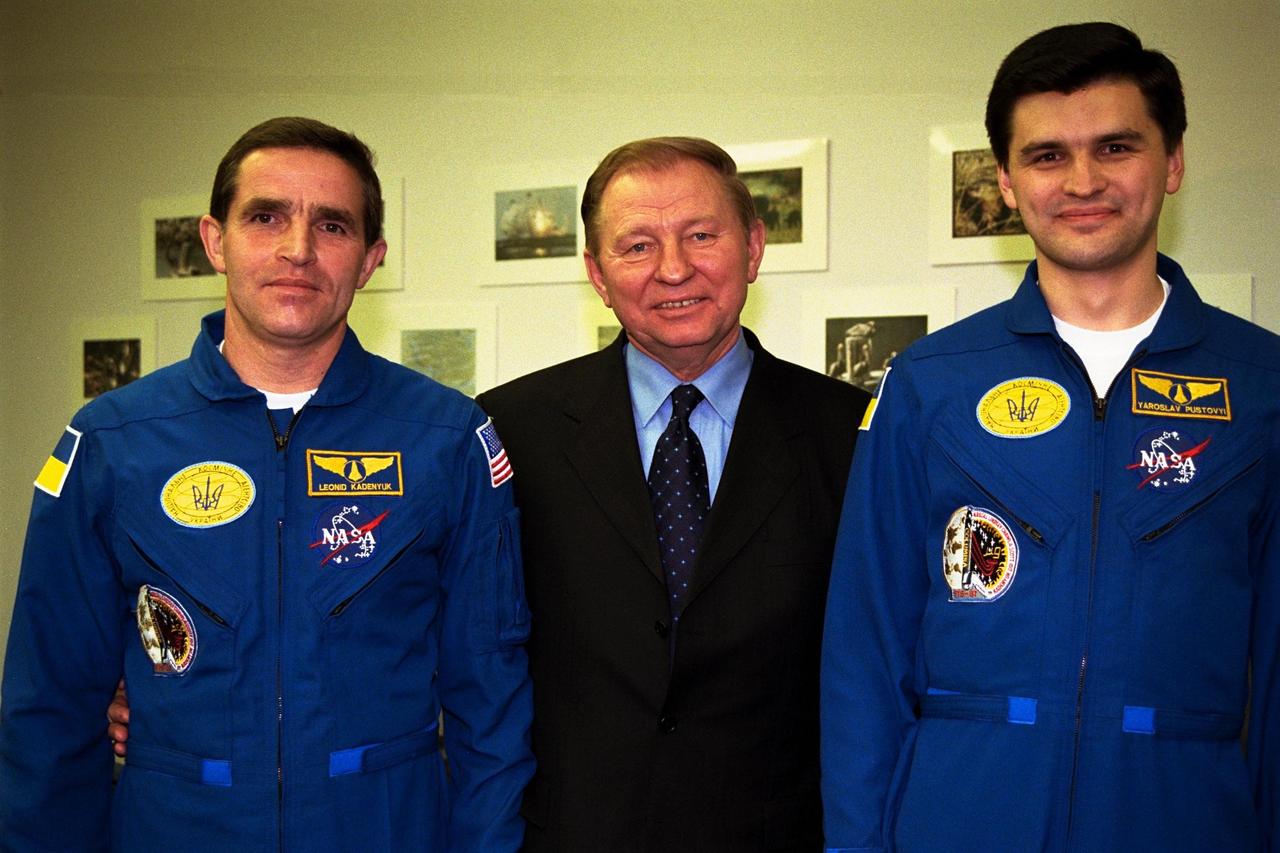
The president of the Ukraine, Leonid Kuchma, is flanked by Payload Specialist Leonid Kadenyuk, at left, and backup Payload Specialist Yaroslav Pustovyi, at right, both of the National Space Agency of Ukraine, during prelaunch activities leading up to the scheduled Nov. 19 launch of STS-87. STS-87 will be the fourth flight of the United States Microgravity Payload and the Spartan-201 deployable satellite. During the mission, Kadenyuk will pollinate Brassica rapa plants as part of the Collaborative Ukrainian Experiment, or CUE, aboard Columbia during its 16-day mission. The CUE experiment is a collection of 10 plant space biology experiments that will fly in Columbia's middeck and will feature an educational component that involves evaluating the effects of microgravity on Brassica rapa seedlings. Students in Ukrainian and American schools will participate in the same experiment with Kadenyuk in space. Kadenyuk will be flying his first Shuttle mission on STS-87
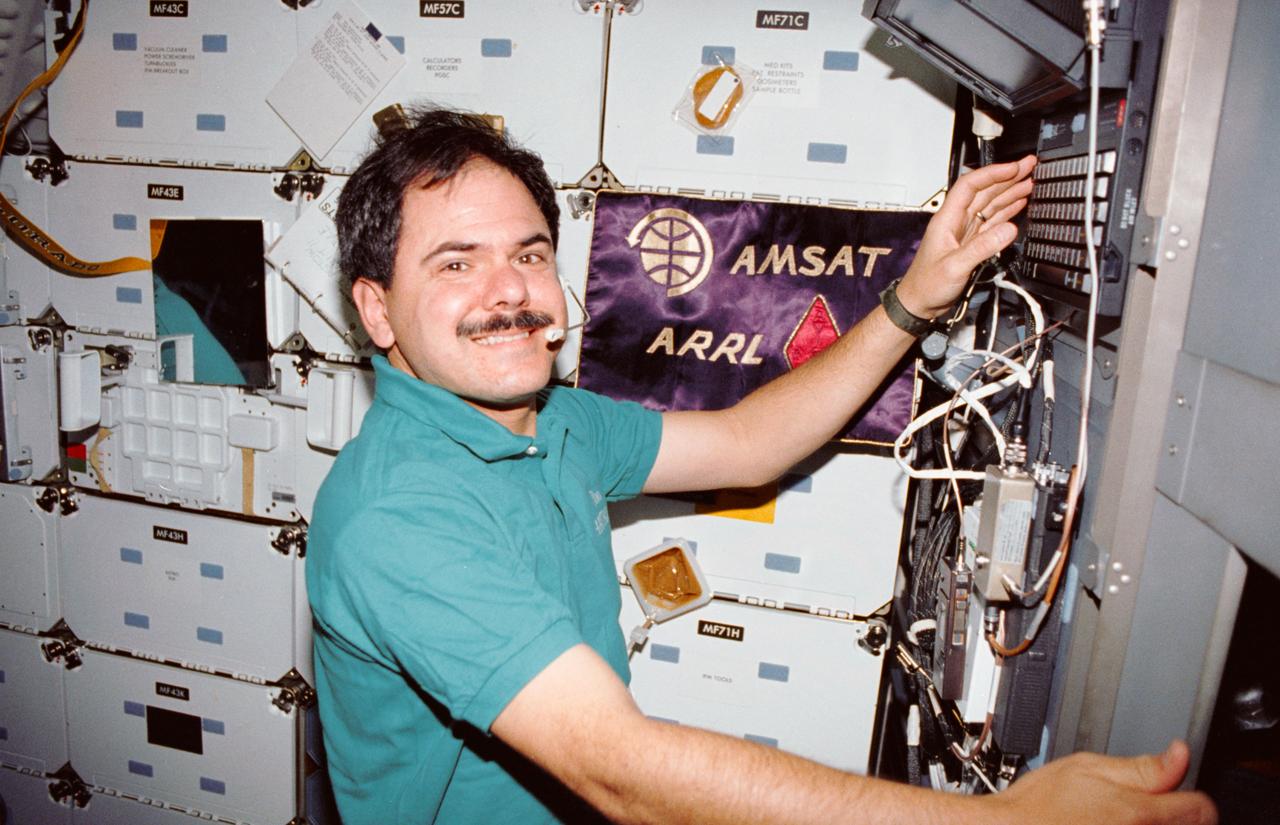
STS-35 Payload Specialist Ronald A. Parise enters data into the payload and general support computer (PGSC) in preparation for Earth communication via the Shuttle Amateur Radio Experiment (SAREX) aboard Columbia, Orbiter Vehicle (OV) 102. The SAREX equipment is secured to the middeck starboard sleep station. SAREX provided radio transmissions between ground based amateur radio operators around the world and Parise, a licensed amateur radio operator. The experiment enabled students to communicate with an astronaut in space, as Parise (call-sign WA4SIR) devoted some of his off-duty time to that purpose. Displayed on the forward lockers beside Parise is a AMSAT (Amateur Radio Satellite Corporation) / ARRL (American Radio Relay League) banner. Food items and checklists are attached to the lockers. In locker position MF43G, the Development Test Objective (DTO) Trash Compaction and Retention System Demonstration extended duration orbiter (EDO) compactor is visible.
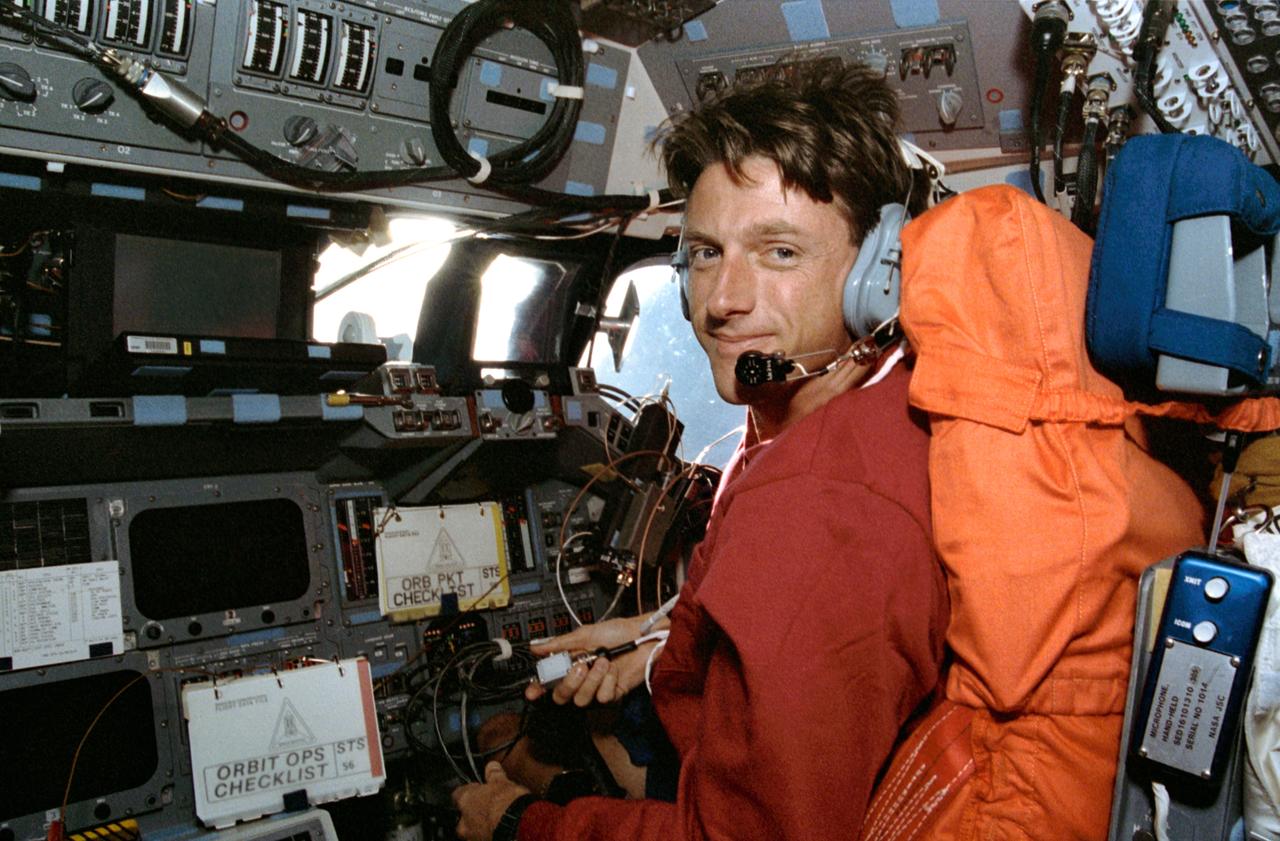
STS056-30-001 (8-17 April 1993) --- Aboard Discovery, astronaut C. Michael Foale, (call letters KB5UAC), talks to amateur radio operators on Earth via the Shuttle Amateur Radio Experiment (SAREX). SAREX was established by NASA, the American Radio League/Amateur Radio Satellite Corporation and the Johnson Space Center Amateur Radio Club to encourage public participation in the space program through an endeavor to demonstrate the effectiveness of conducting short-wave radio transmissions. These transmissions occur between the Shuttle and ground-based radio operators at low cost ground stations with amateur and digital techniques. As on several previous missions, SAREX was used on this flight as an educational opportunity for students around the world to learn about space firsthand by speaking directly to astronauts aboard the Shuttle.
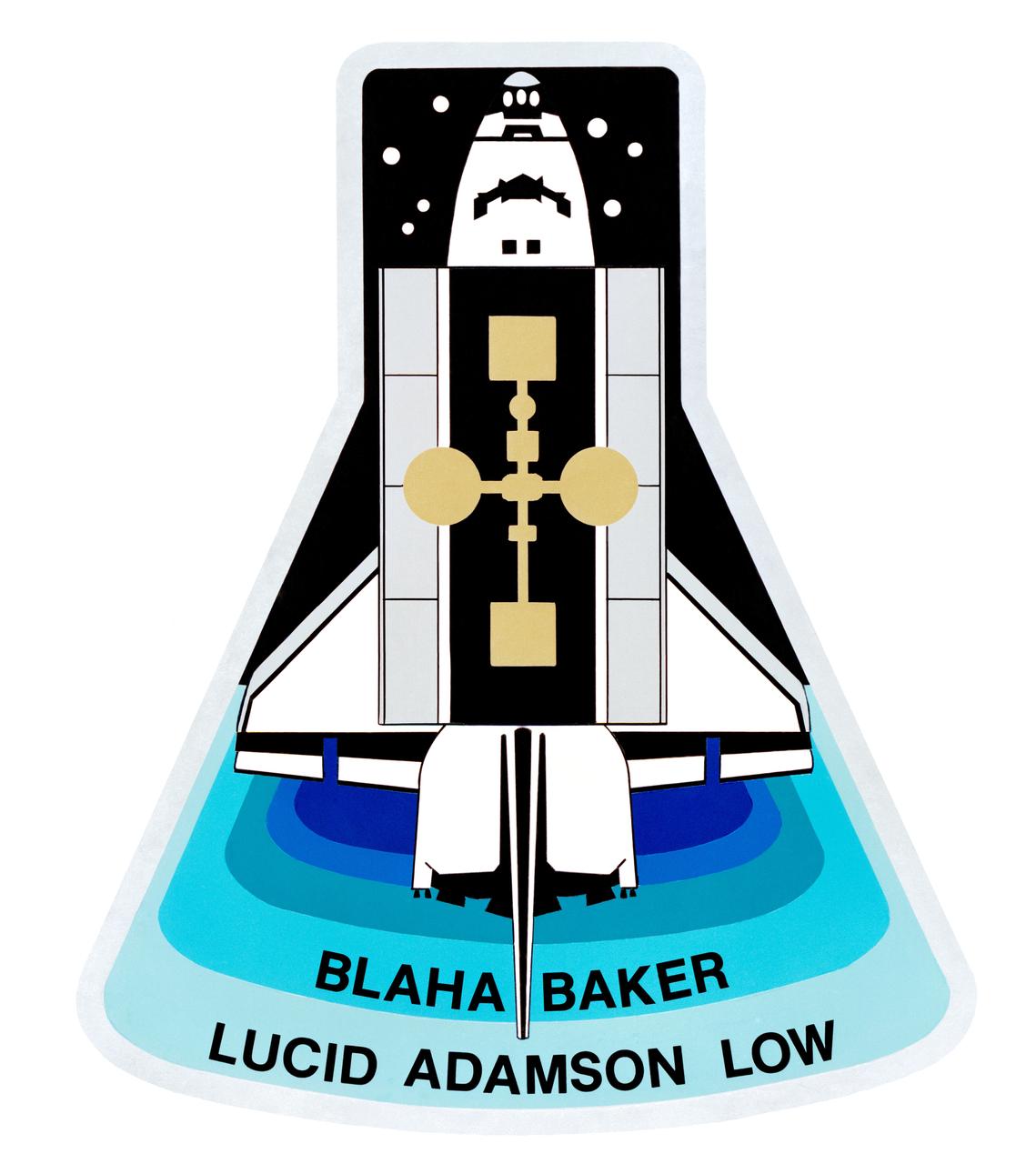
STS043-S-001 (6 Feb. 1991) --- Designed by the astronauts assigned to fly on the mission, the STS-43 patch portrays the evolution and continuity of the United States of America's space program by highlighting 30 years of American manned space flight experience - from Mercury to the space shuttle. The emergence of the space shuttle Atlantis from the outlined configuration of the Mercury space capsule commemorates this special relationship. The energy and momentum of launch are conveyed by the gradations of blue which mark the space shuttle's ascent from Earth to space. Once in Earth orbit, Atlantis' cargo bay opens to reveal the Tracking and Data Relay Satellite (TDRS) which appears in gold emphasis against the white wings of the space shuttle Atlantis and the stark blackness of space. A primary mission objective, the Tracking and Data Relay Satellite System (TDRSS) will enable almost continuous communication from Earth to space for future space shuttle missions. The stars on the patch are arranged to suggest this mission's numerical designation, with four stars left of Atlantis and three to the right. The NASA insignia design for space shuttle flights is reserved for use by the astronauts and for other official use as the NASA Administrator may authorize. Public availability has been approved only in the forms of illustrations by the various news media. When and if there is any change in this policy, which is not anticipated, the change will be publicly announced. Photo credit: NASA
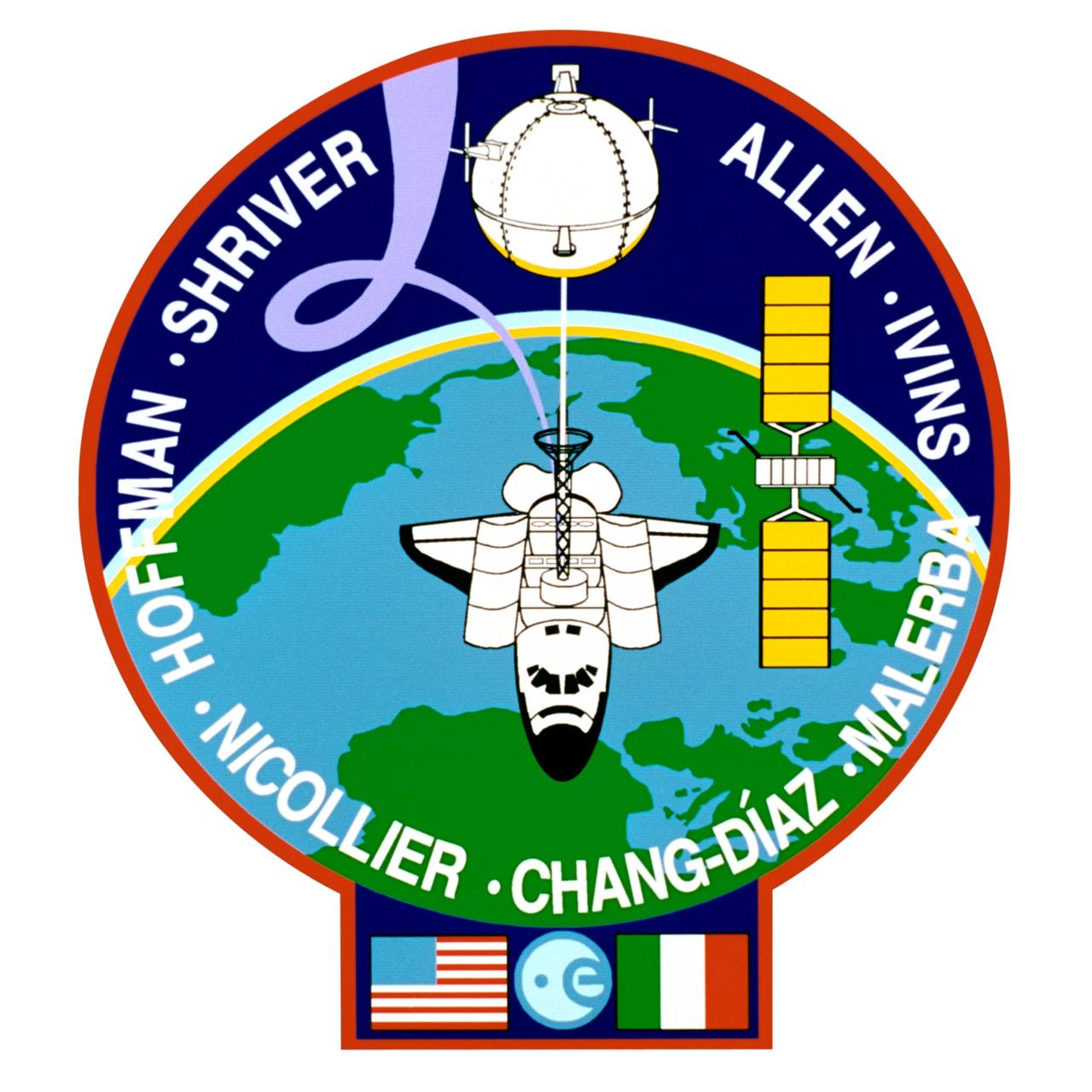
STS046-S-001 (May 1992) --- Designed by the crew members assigned to the flight, the crew patch depicts the space shuttle Atlantis in orbit around Earth, accompanied by major payloads: the European Retrievable Carrier (EURECA) and the Tethered Satellite System (TSS-1). In the depiction, EURECA has been activated and released, its antennae and solar arrays deployed, and it is about to start its ten-month scientific mission. The tethered satellite is linked to the orbiter by a 20-kilometer tether. The purple beam emanating from an electron generator in the payload bay spirals around Earth's magnetic field. The TSS mission will study the dynamics and electrodynamics of tethered systems in space and the physics of Earth's ionosphere. Visible on Earth's surface are the United States of America and the thirteen-member countries of the European Space Agency (ESA), in particular, Italy - partner with the United States in the TSS program. The American and Italian flags, as well as the ESA logo, further serve to illustrate the international character of STS-46. The NASA insignia design for space shuttle flights is reserved for use by the astronauts and for other official use as the NASA Administrator may authorize. Public availability has been approved only in the forms of illustrations by the various news media. When and if there is any change in this policy, which is not anticipated, the change will be publicly announced. Photo credit: NASA
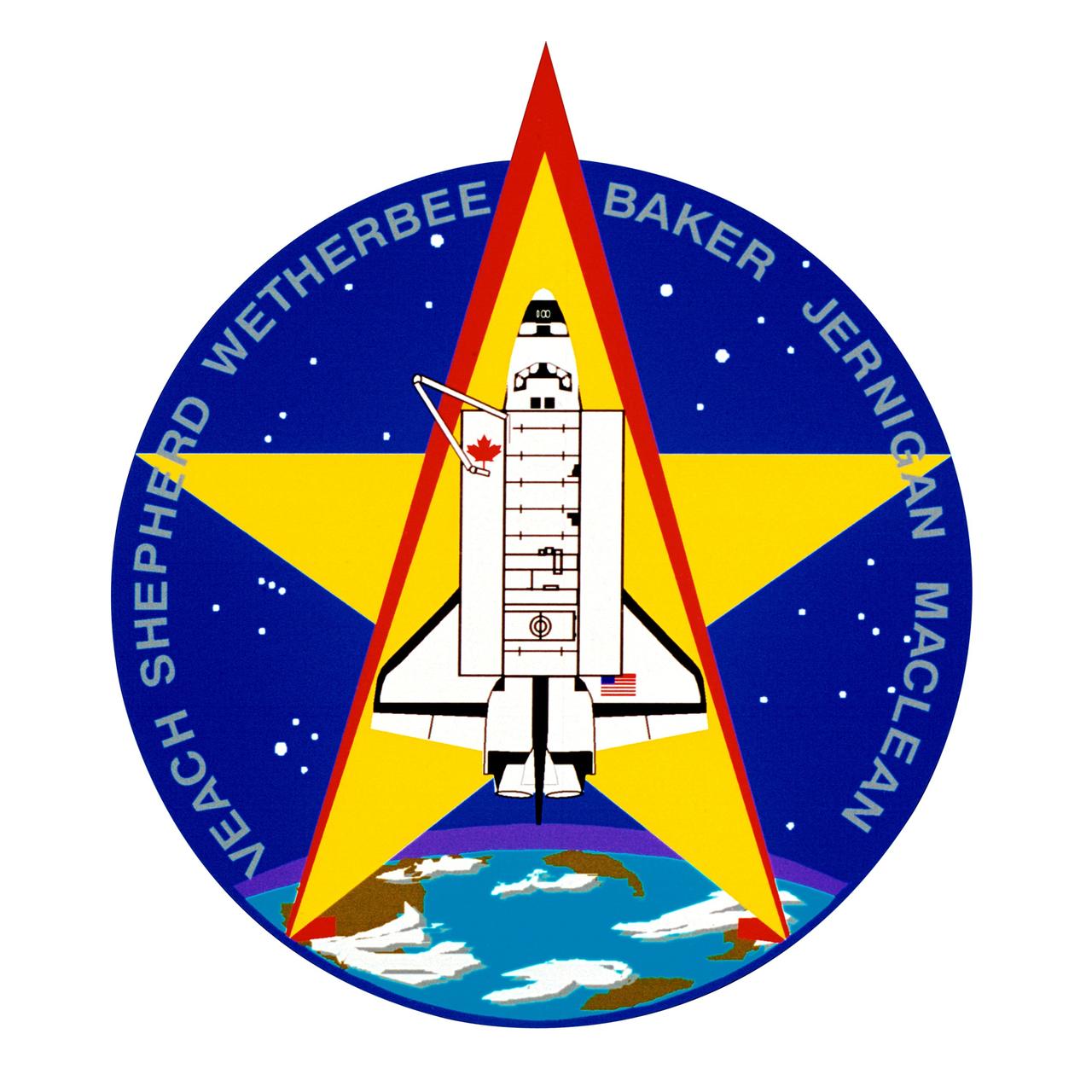
STS052-S-001 (July 1992) --- The insignia, designed by the STS-52 crew members, features a large gold star to symbolize the crew's mission on the frontiers of space. A gold star is often used to symbolize the frontier period of the American West. The red star in the shape of the Greek letter lambda represents both the laser measurements to be taken from the Laser Geodynamic Satellite (LAGEOS II) and the Lambda Point Experiment, which is part of the United States Microgravity Payload (USMP-1). The LAGEOS II is a joint Italian\United States satellite project intended to further our understanding of global plate tectonics. The USMP-1 is a microgravity facility which has French and United States experiments designed to test the theory of cooperative phase transitions and to study the solid\liquid interface of a metallic alloy in the low gravity environment. The Remote Manipulator System (RMS) and maple leaf are emblematic of the Canadian payload specialist who will conduct a series of Canadian flight experiments (CANEX-2), including the Space Vision System test. The NASA insignia design for space shuttle flights is reserved for use by the astronauts and for other official use as the NASA Administrator may authorize. Public availability has been approved only in the form of illustrations by the various news media. When and if there is any change in this policy, which we do not anticipate, it will be publicly announced. Photo credit: NASA
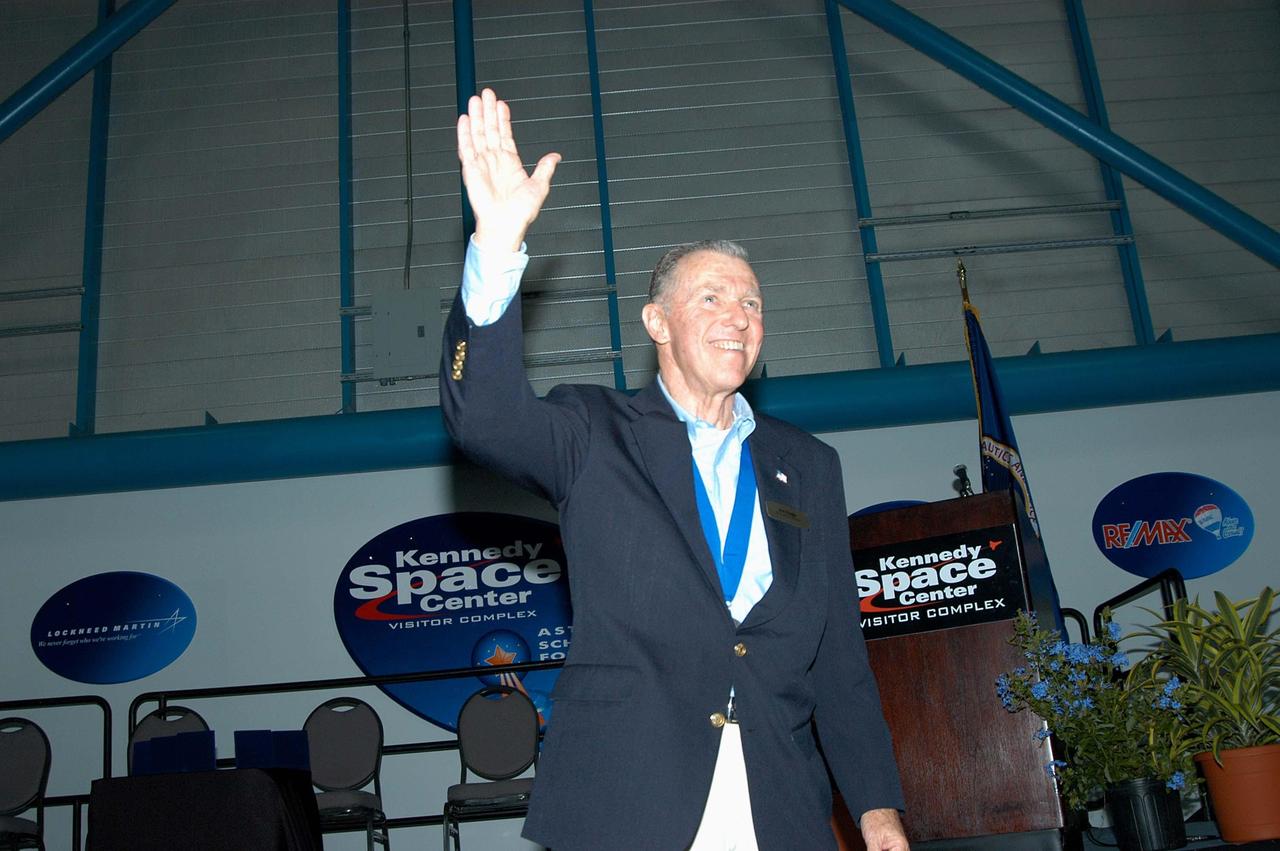
KENNEDY SPACE CENTER, FLA. -- Former astronaut Joe Engle acknowledges the applause as he is introduced as a previous inductee into the U.S. Astronaut Hall of Fame. He and other Hall of Fame members were present for the induction of five new space program heroes into the U.S. Astronaut Hall of Fame: Richard O. Covey, commander of the Hubble Space Telescope repair mission; Norman E. Thagard, the first American to occupy Russia’s Mir space station; the late Francis R. "Dick" Scobee, commander of the ill-fated 1986 Challenger mission; Kathryn D. Sullivan, the first American woman to walk in space; and Frederick D. Gregory, the first African-American to command a space mission and the current NASA deputy administrator. Engle made 16 flights in the X-15 rocket plane before he became a NASA astronaut and flew two Space Shuttle missions. In 1981, he commanded the second flight of Columbia, the first manned spacecraft to be reflown in space, and in 1985 he commanded a five-man crew on the 20th shuttle flight, a satellite-deploy and repair mission. The induction ceremony was held at the Apollo/Saturn V Center at KSC. The U.S. Astronaut Hall of Fame opened in 1990 to provide a place where space travelers could be remembered for their participation and accomplishments in the U.S. space program. The five inductees join 52 previously honored astronauts from the ranks of the Gemini, Apollo, Skylab, Apollo-Soyuz, and Space Shuttle programs.
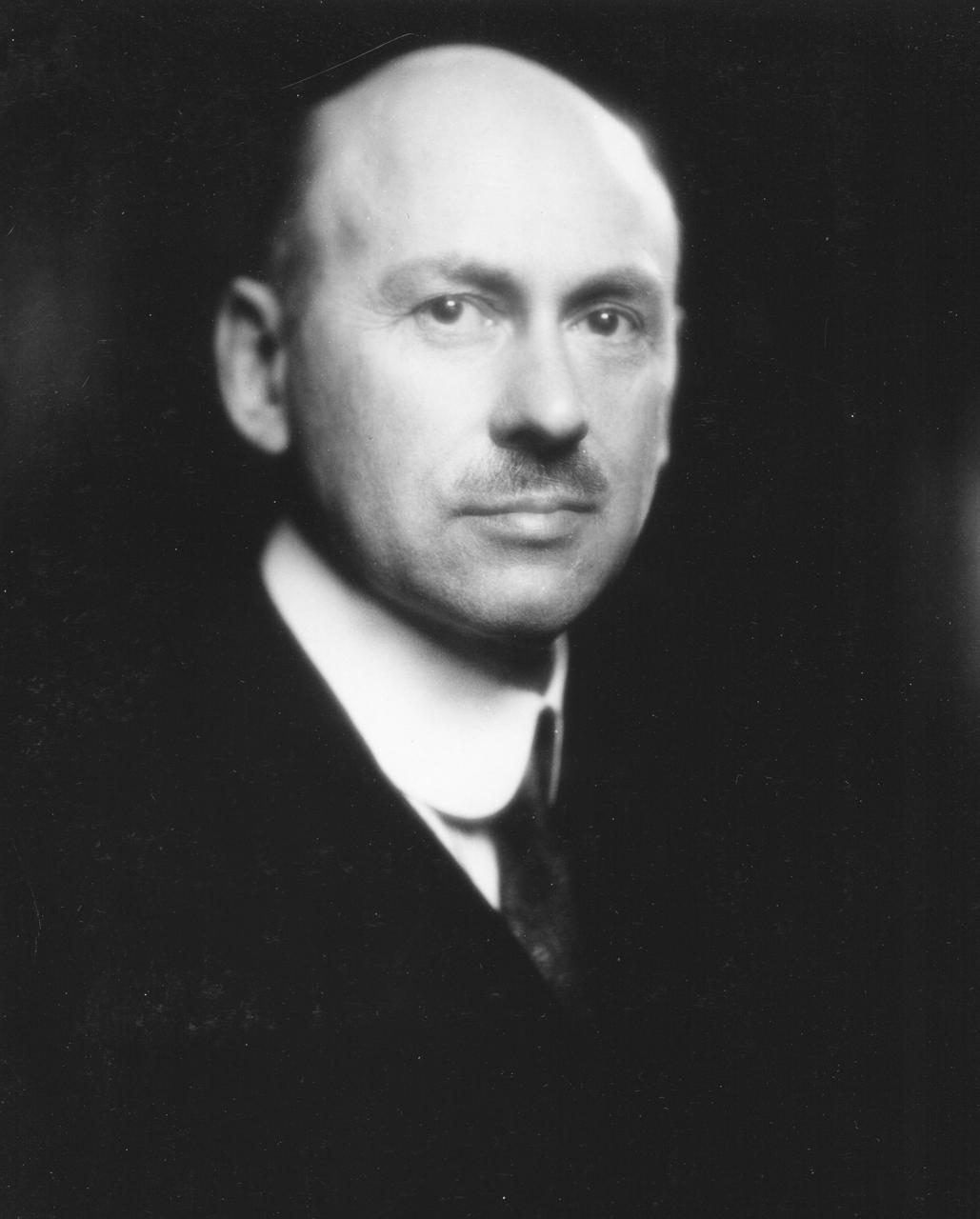
Dr. Robert Hutchings Goddard (1882-1945). Dr. Goddard has been recognized as the father of American rocketry and as one of the pioneers in the theoretical exploration of space. Robert Hutchings Goddard, born in Worcester, Massachusetts, on October 5, 1882, was theoretical scientist as well as a practical engineer. His dream was the conquest of the upper atmosphere and ultimately space through the use of rocket propulsion. Dr. Goddard, died in 1945, but was probably as responsible for the dawning of the Space Age as the Wrights were for the beginning of the Air Age. Yet his work attracted little serious attention during his lifetime. However, when the United States began to prepare for the conquest of space in the 1950's, American rocket scientists began to recognize the debt owed to the New England professor. They discovered that it was virtually impossible to construct a rocket or launch a satellite without acknowledging the work of Dr. Goddard. More than 200 patents, many of which were issued after his death, covered this great legacy. <b><a href="http://www.nasa.gov/centers/goddard/home/index.html" rel="nofollow">NASA Goddard Space Flight Center</a></b> enables NASA’s mission through four scientific endeavors: Earth Science, Heliophysics, Solar System Exploration, and Astrophysics. Goddard plays a leading role in NASA’s accomplishments by contributing compelling scientific knowledge to advance the Agency’s mission. <b>Follow us on <a href="http://twitter.com/NASA_GoddardPix" rel="nofollow">Twitter</a></b> <b>Join us on <a href="http://www.facebook.com/pages/Greenbelt-MD/NASA-Goddard/395013845897?ref=tsd" rel="nofollow">Facebook</a></b>
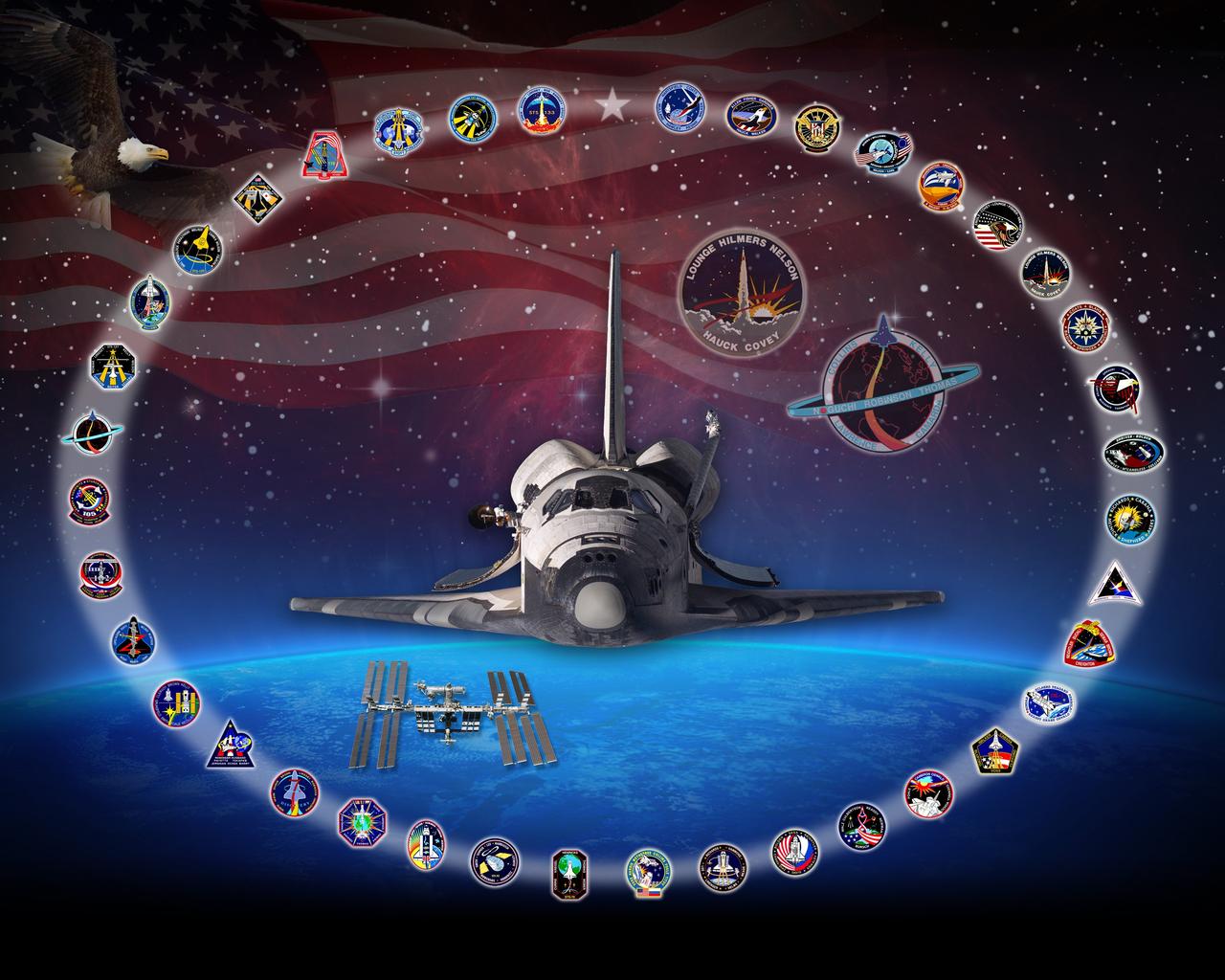
CAPE CANAVERAL, Fla. -- This orbiter tribute of space shuttle Discovery, or OV-103, hangs in Firing Room 4 of the Launch Control Center at NASA's Kennedy Space Center in Florida. In 2011, the tribute was updated to reflect the crew member change on Discovery's final mission -- STS-133. Steve Bowen replaced Tim Kopra as a mission specialist on STS-133, after Kopra was injured in a bicycle accident that prevented him from flying into space. Discovery’s accomplishments include the first female shuttle pilot, Eileen Collins, on STS-63, John Glenn’s legendary return to space on STS-95, and the celebration of the 100th shuttle mission with STS-92. In addition, Discovery supported a number of Department of Defense programs, satellite deploy and repair missions and 13 International Space Station construction and operation flights. The tribute features Discovery demonstrating the rendezvous pitch maneuver on approach to the International Space Station during STS-114. Having accumulated the most space shuttle flights, Discovery’s 39 mission patches are shown circling the spacecraft. The background image was taken from the Hubble Space Telescope, which launched aboard Discovery on STS-31 and serviced by Discovery on STS-82 and STS-103. The American Flag and Bald Eagle represent Discovery’s two Return-to-Flight missions -- STS-26 and STS-114 -- and symbolize Discovery’s role in returning American astronauts to space. Five orbiter tributes are on display in the firing room, representing Atlantis, Challenger, Columbia, Endeavour and Discovery. Graphic design credit: NASA/Amy Lombardo. NASA publication number: SP-2010-08-164-KSC
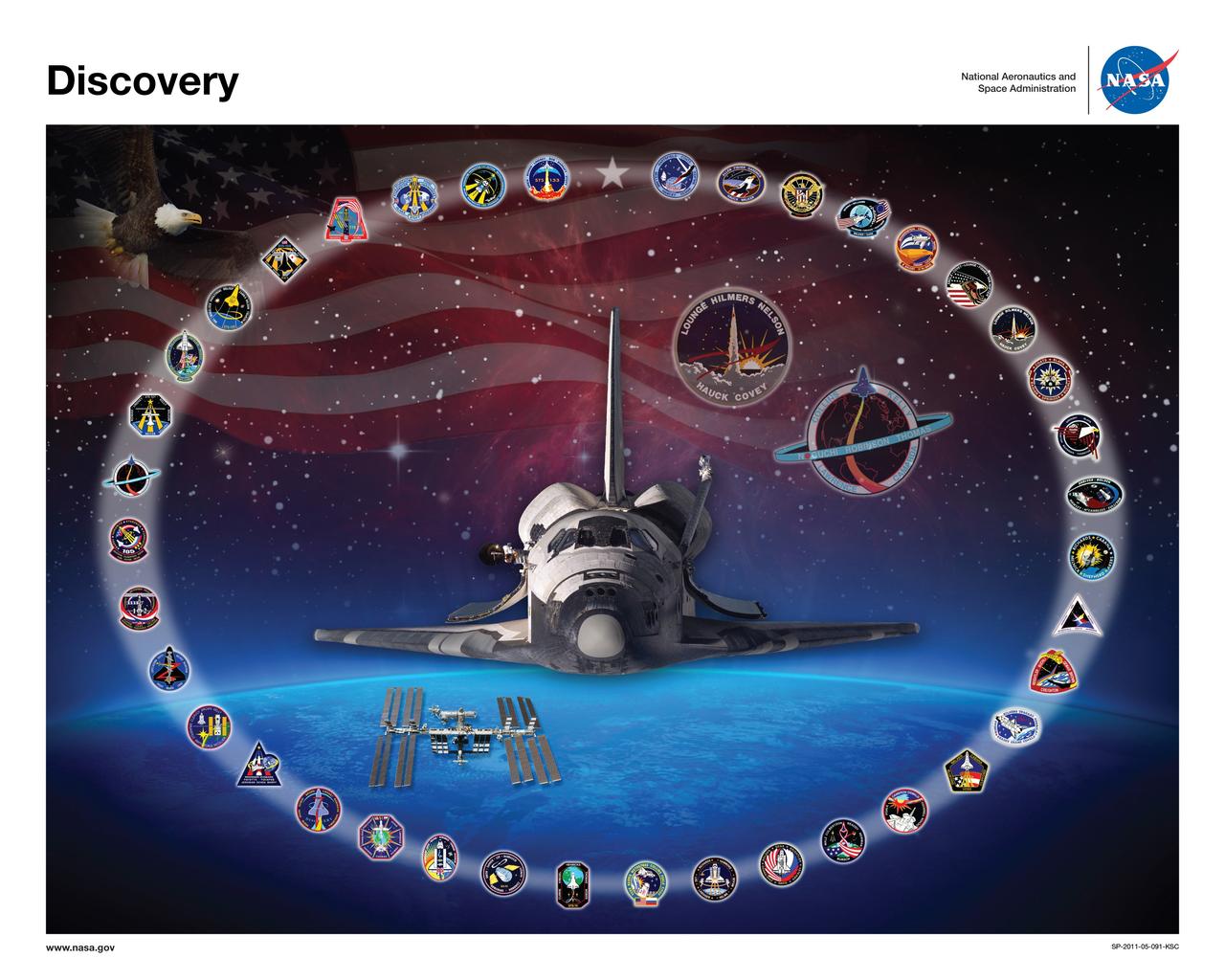
CAPE CANAVERAL, Fla. -- This is a version of space shuttle Discovery's orbiter tribute, or OV-103, which hangs in Firing Room 4 of the Launch Control Center at NASA's Kennedy Space Center in Florida. In 2011, the tribute was updated to reflect the crew member change on Discovery's final mission -- STS-133. Steve Bowen replaced Tim Kopra as a mission specialist on STS-133, after Kopra was injured in a bicycle accident that prevented him from flying into space. Discovery’s accomplishments include the first female shuttle pilot, Eileen Collins, on STS-63, John Glenn’s legendary return to space on STS-95, and the celebration of the 100th shuttle mission with STS-92. In addition, Discovery supported a number of Department of Defense programs, satellite deploy and repair missions and 13 International Space Station construction and operation flights. The tribute features Discovery demonstrating the rendezvous pitch maneuver on approach to the International Space Station during STS-114. Having accumulated the most space shuttle flights, Discovery’s 39 mission patches are shown circling the spacecraft. The background image was taken from the Hubble Space Telescope, which launched aboard Discovery on STS-31 and serviced by Discovery on STS-82 and STS-103. The American Flag and Bald Eagle represent Discovery’s two Return-to-Flight missions -- STS-26 and STS-114 -- and symbolize Discovery’s role in returning American astronauts to space. Five orbiter tributes are on display in the firing room, representing Atlantis, Challenger, Columbia, Endeavour and Discovery. Graphic design credit: NASA/Amy Lombardo. NASA publication number: SP-2010-08-164-KSC
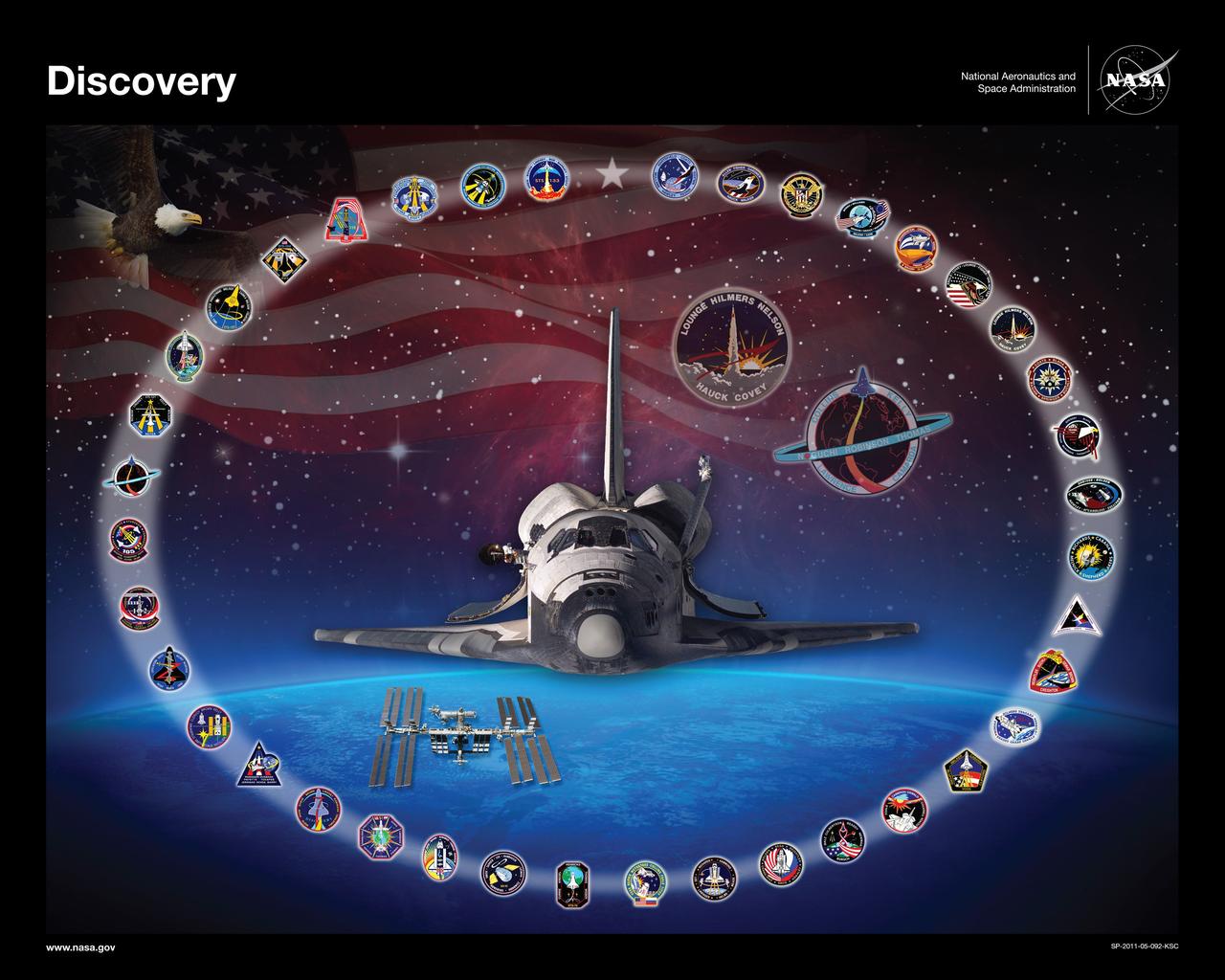
CAPE CANAVERAL, Fla. -- This is a printable version of space shuttle Discovery's orbiter tribute, or OV-103, which hangs in Firing Room 4 of the Launch Control Center at NASA's Kennedy Space Center in Florida. In 2011, the tribute was updated to reflect the crew member change on Discovery's final mission -- STS-133. Steve Bowen replaced Tim Kopra as a mission specialist on STS-133, after Kopra was injured in a bicycle accident that prevented him from flying into space. Discovery’s accomplishments include the first female shuttle pilot, Eileen Collins, on STS-63, John Glenn’s legendary return to space on STS-95, and the celebration of the 100th shuttle mission with STS-92. In addition, Discovery supported a number of Department of Defense programs, satellite deploy and repair missions and 13 International Space Station construction and operation flights. The tribute features Discovery demonstrating the rendezvous pitch maneuver on approach to the International Space Station during STS-114. Having accumulated the most space shuttle flights, Discovery’s 39 mission patches are shown circling the spacecraft. The background image was taken from the Hubble Space Telescope, which launched aboard Discovery on STS-31 and serviced by Discovery on STS-82 and STS-103. The American Flag and Bald Eagle represent Discovery’s two Return-to-Flight missions -- STS-26 and STS-114 -- and symbolize Discovery’s role in returning American astronauts to space. Five orbiter tributes are on display in the firing room, representing Atlantis, Challenger, Columbia, Endeavour and Discovery. Graphic design credit: NASA/Amy Lombardo. NASA publication number: SP-2010-08-164-KSC
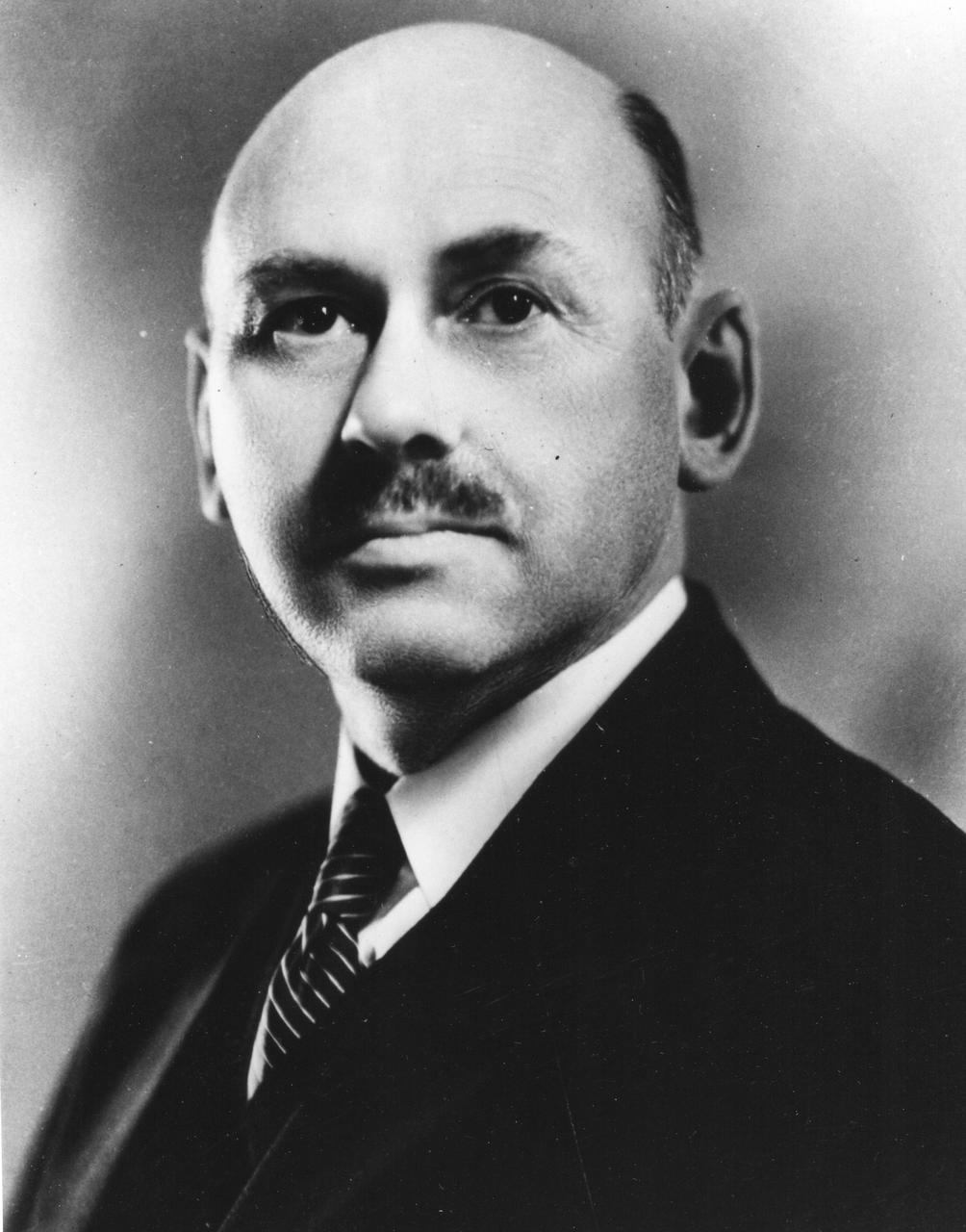
Dr. Robert Hutchings Goddard (1882-1945). Dr. Goddard has been recognized as the father of American rocketry and as one of the pioneers in the theoretical exploration of space. Robert Hutchings Goddard, born in Worcester, Massachusetts, on October 5, 1882, was theoretical scientist as well as a practical engineer. His dream was the conquest of the upper atmosphere and ultimately space through the use of rocket propulsion. Dr. Goddard, died in 1945, but was probably as responsible for the dawning of the Space Age as the Wrights were for the beginning of the Air Age. Yet his work attracted little serious attention during his lifetime. However, when the United States began to prepare for the conquest of space in the 1950's, American rocket scientists began to recognize the debt owed to the New England professor. They discovered that it was virtually impossible to construct a rocket or launch a satellite without acknowledging the work of Dr. Goddard. More than 200 patents, many of which were issued after his death, covered this great legacy. <b><a href="http://www.nasa.gov/centers/goddard/home/index.html" rel="nofollow">NASA Goddard Space Flight Center</a></b> enables NASA’s mission through four scientific endeavors: Earth Science, Heliophysics, Solar System Exploration, and Astrophysics. Goddard plays a leading role in NASA’s accomplishments by contributing compelling scientific knowledge to advance the Agency’s mission. <b>Follow us on <a href="http://twitter.com/NASA_GoddardPix" rel="nofollow">Twitter</a></b> <b>Join us on <a href="http://www.facebook.com/pages/Greenbelt-MD/NASA-Goddard/395013845897?ref=tsd" rel="nofollow">Facebook</a></b>
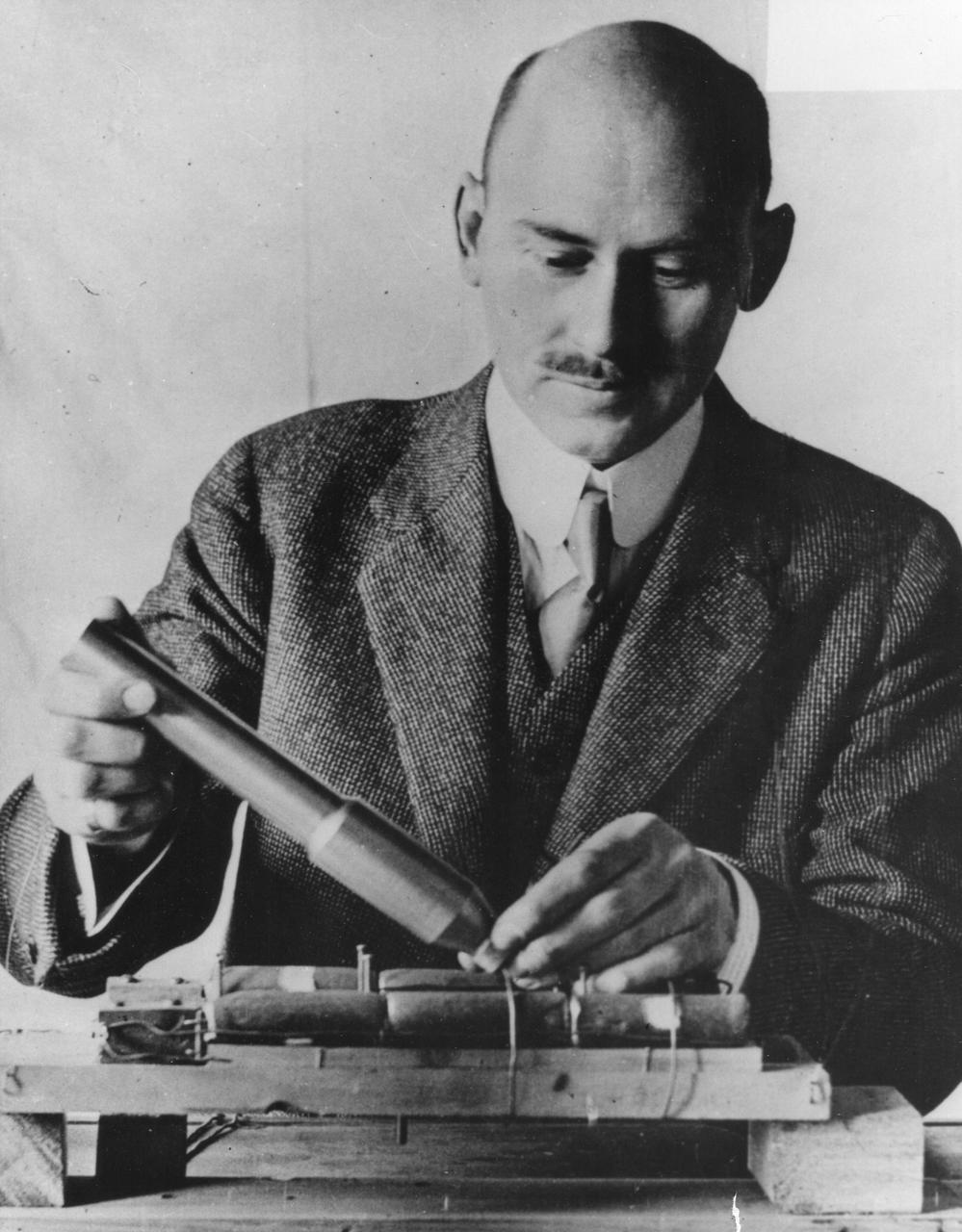
Dr. Robert Hutchings Goddard (1882-1945). Dr. Goddard has been recognized as the father of American rocketry and as one of the pioneers in the theoretical exploration of space. Robert Hutchings Goddard, born in Worcester, Massachusetts, on October 5, 1882, was theoretical scientist as well as a practical engineer. His dream was the conquest of the upper atmosphere and ultimately space through the use of rocket propulsion. Dr. Goddard, died in 1945, but was probably as responsible for the dawning of the Space Age as the Wrights were for the beginning of the Air Age. Yet his work attracted little serious attention during his lifetime. However, when the United States began to prepare for the conquest of space in the 1950's, American rocket scientists began to recognize the debt owed to the New England professor. They discovered that it was virtually impossible to construct a rocket or launch a satellite without acknowledging the work of Dr. Goddard. More than 200 patents, many of which were issued after his death, covered this great legacy. <b><a href="http://www.nasa.gov/centers/goddard/home/index.html" rel="nofollow">NASA Goddard Space Flight Center</a></b> enables NASA’s mission through four scientific endeavors: Earth Science, Heliophysics, Solar System Exploration, and Astrophysics. Goddard plays a leading role in NASA’s accomplishments by contributing compelling scientific knowledge to advance the Agency’s mission. <b>Follow us on <a href="http://twitter.com/NASA_GoddardPix" rel="nofollow">Twitter</a></b> <b>Join us on <a href="http://www.facebook.com/pages/Greenbelt-MD/NASA-Goddard/395013845897?ref=tsd" rel="nofollow">Facebook</a></b>
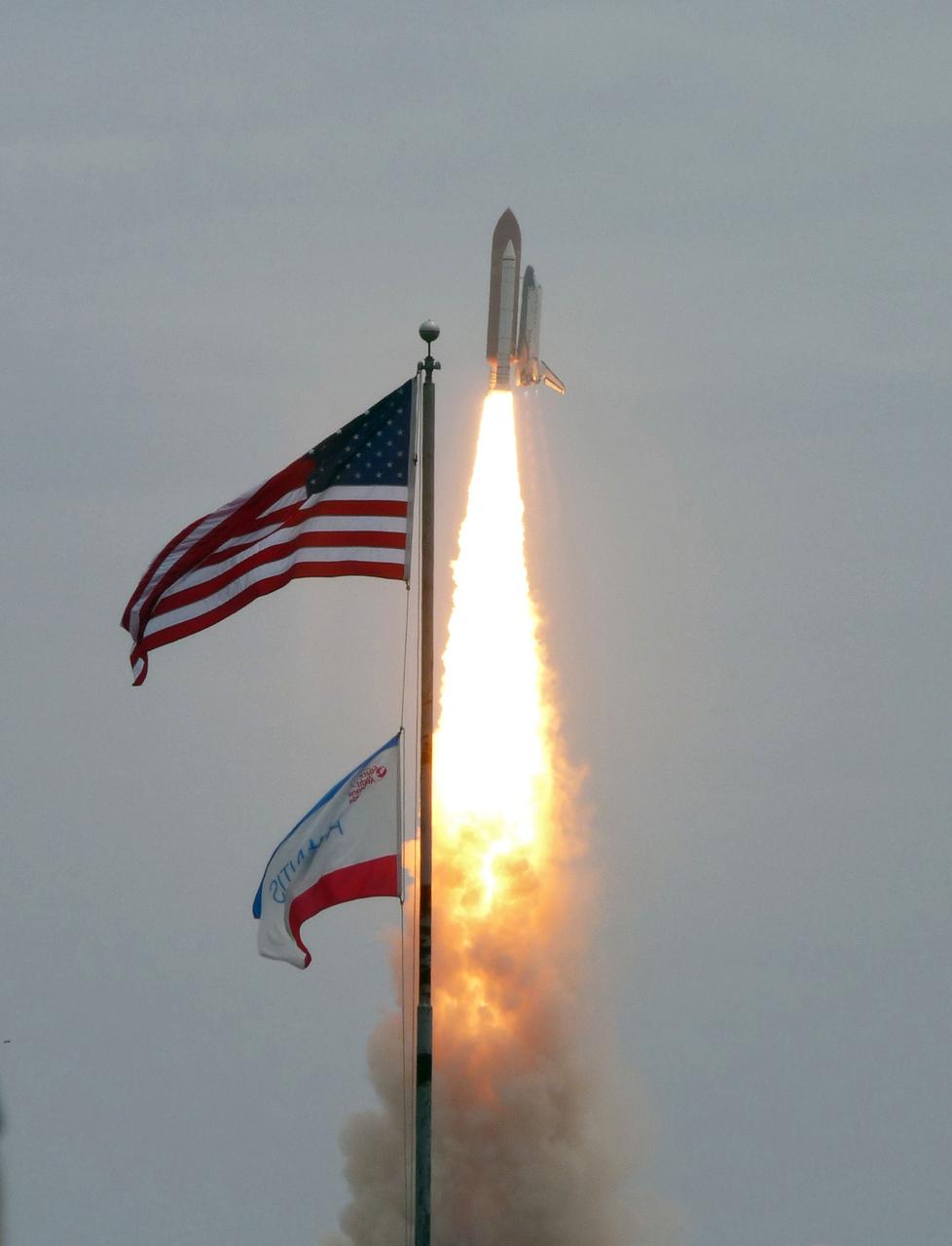
CAPE CANAVERAL, Fla. -- After 30 years and 135 missions, residents and visitors to Florida's Space Coast see this rocket's red glare for the last time as space shuttle Atlantis soars past the American flag after lifting off Launch Pad 39A at NASA's Kennedy Space Center in Florida at 11:29 a.m. EDT on July 8. On board are four experienced astronauts -- STS-135 Commander Chris Ferguson, Pilot Doug Hurley, and Mission Specialists Sandy Magnus and Rex Walheim. STS-135 will deliver the Raffaello multi-purpose logistics module packed with supplies and spare parts for the International Space Station. Atlantis also will fly the Robotic Refueling Mission experiment that will investigate the potential for robotically refueling existing satellites in orbit. In addition, Atlantis will return with a failed ammonia pump module to help NASA better understand the failure mechanism and improve pump designs for future systems. STS-135 will be the 33rd flight of Atlantis, the 37th shuttle mission to the space station, and the 135th and final mission of NASA's Space Shuttle Program. For more information visit, www.nasa.gov/mission_pages/shuttle/shuttlemissions/sts135/index.html. Photo credit: NASA/Fletcher Hildreth
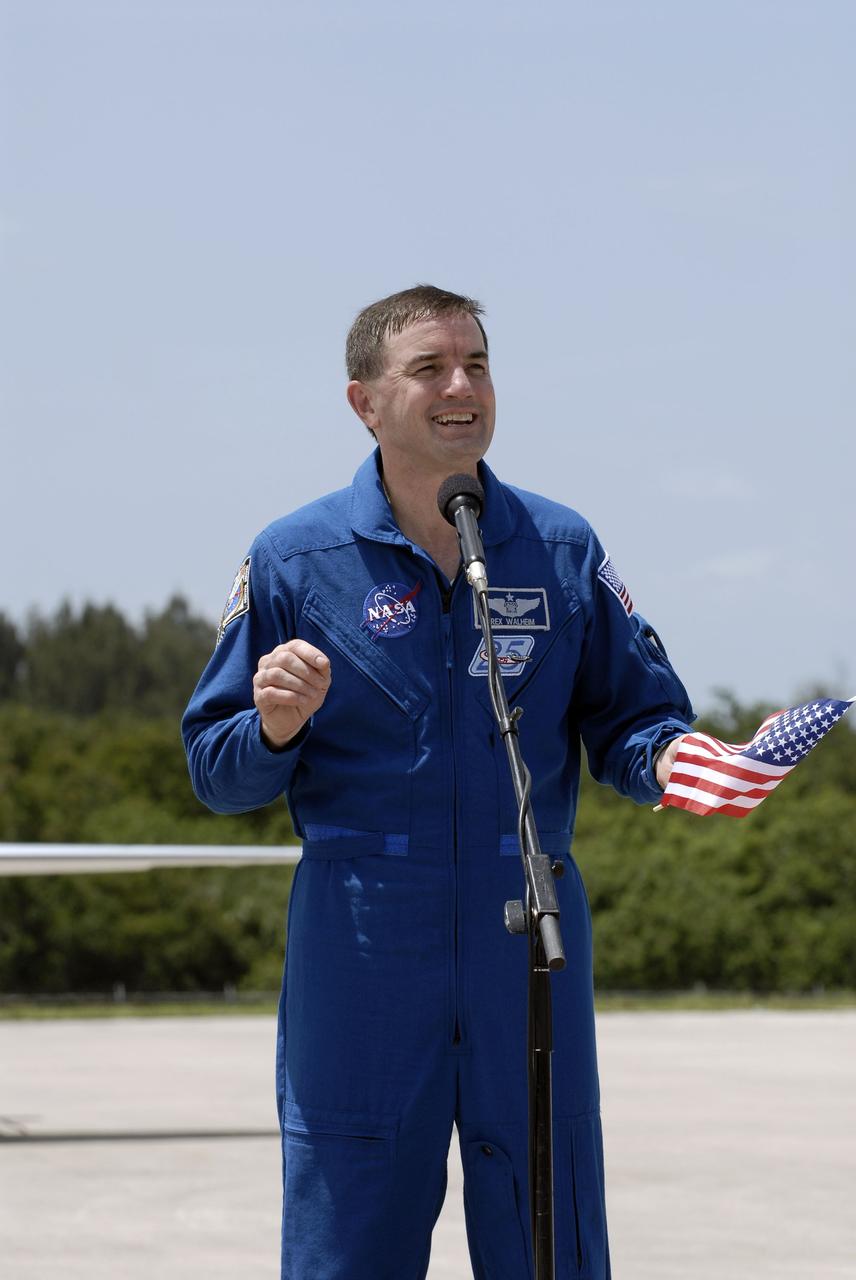
CAPE CANAVERAL, Fla. -- STS-135 Mission Specialist Rex Walheim, holding an American flag to commemorate the U.S. Independence Day holiday, speaks to media at the Shuttle Landing Facility at NASA's Kennedy Space Center in Florida. The STS-135 astronauts arrived at Kennedy about 2:30 p.m. EDT on July 4 for final preparations for space shuttle Atlantis' STS-135 mission to the International Space Station. Atlantis is scheduled to lift off on July 8 to deliver the Raffaello multi-purpose logistics module packed with supplies and spare parts to the station. The STS-135 mission also will fly a system to investigate the potential for robotically refueling existing satellites and return a failed ammonia pump module to help NASA better understand the failure mechanism and improve pump designs for future systems. STS-135 will be the 33rd flight of Atlantis, the 37th shuttle mission to the space station, and the 135th and final mission of NASA's Space Shuttle Program. For more information visit, www.nasa.gov/mission_pages/shuttle/shuttlemissions/sts135/index.html. Photo credit: NASA/Kim Shiflett

STS057-S-001 (February 1993) --- Designed by the crew members, the STS-57 crew patch depicts the space shuttle Endeavour maneuvering to retrieve the European Space Agency's (ESA) microgravity experiment satellite EURECA. SpaceHab - the first commercial space laboratory - is depicted in the cargo bay, and its characteristic shape is represented by the inner red border of the patch. The three gold plumes surrounded by the five stars trailing EURECA are suggestive of the United States astronaut logo. The five gold stars together with the shape of the orbiter's mechanical arm form the mission's numerical designation. The six stars on the American flag represent the United States astronauts who comprise the crew. With detailed input from the crew members, the final artwork was accomplished by artist Tim Hall. The NASA insignia design for space shuttle flights is reserved for use by the astronauts and for other official use as the NASA Administrator may authorize. Public availability has been approved only in the form of illustrations by the various news media. When and if there is any change in this policy, which we do not anticipate, it will be publicly announced. Photo credit: NASA
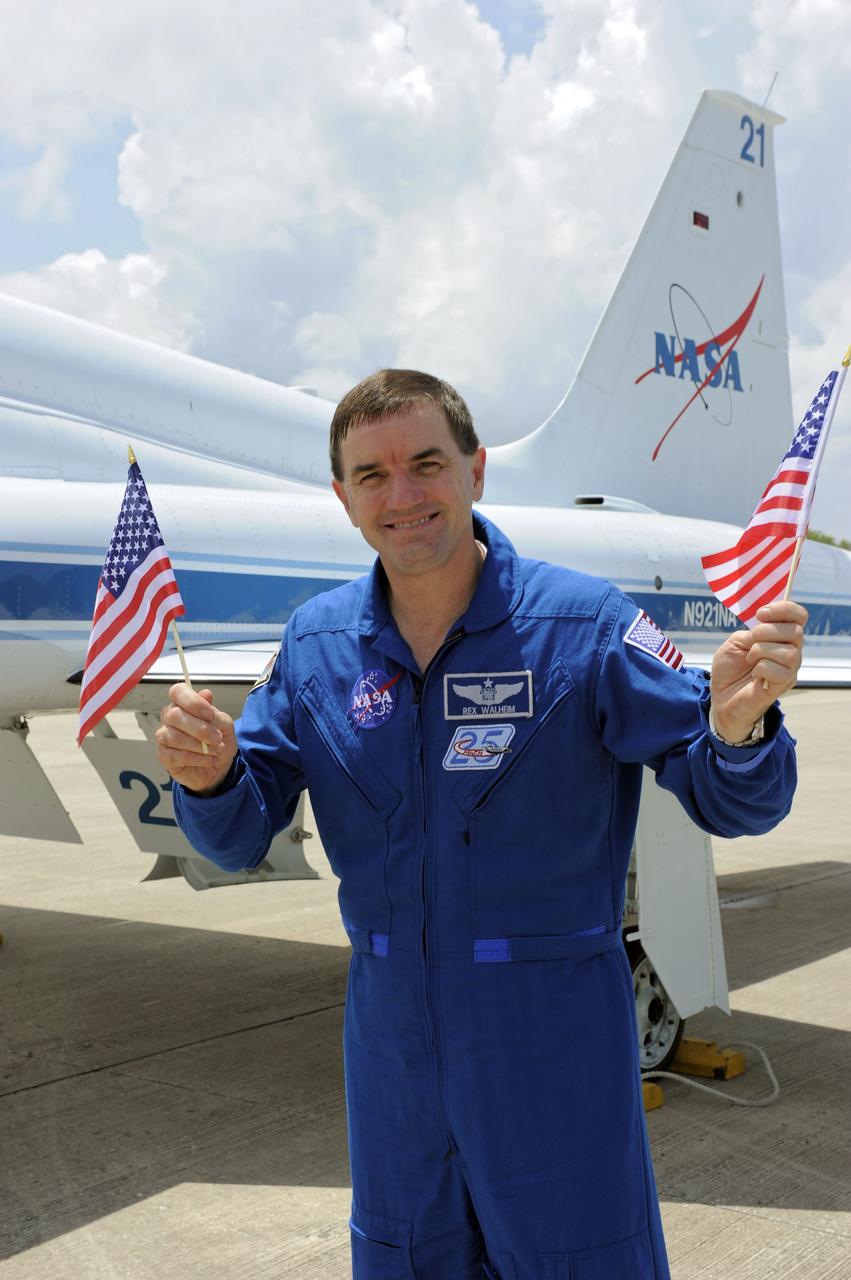
CAPE CANAVERAL, Fla. -- STS-135 Mission Specialists Rex Walheim waves the American flag to commemorate the U.S. Independence Day holiday after disembarking from a T-38 jet at the Shuttle Landing Facility at NASA's Kennedy Space Center in Florida. The STS-135 crew members arrived at Kennedy at about 2:30 p.m. EDT on July 4 for final preparations for space shuttle Atlantis' STS-135 mission to the International Space Station. Atlantis is scheduled to lift off on July 8 to deliver the Raffaello multi-purpose logistics module packed with supplies and spare parts to the station. The STS-135 mission also will fly a system to investigate the potential for robotically refueling existing satellites and return a failed ammonia pump module to help NASA better understand the failure mechanism and improve pump designs for future systems. STS-135 will be the 33rd flight of Atlantis, the 37th shuttle mission to the space station, and the 135th and final mission of NASA's Space Shuttle Program. For more information visit, www.nasa.gov/mission_pages/shuttle/shuttlemissions/sts135/index.html. Photo credit: NASA/Kim Shiflett
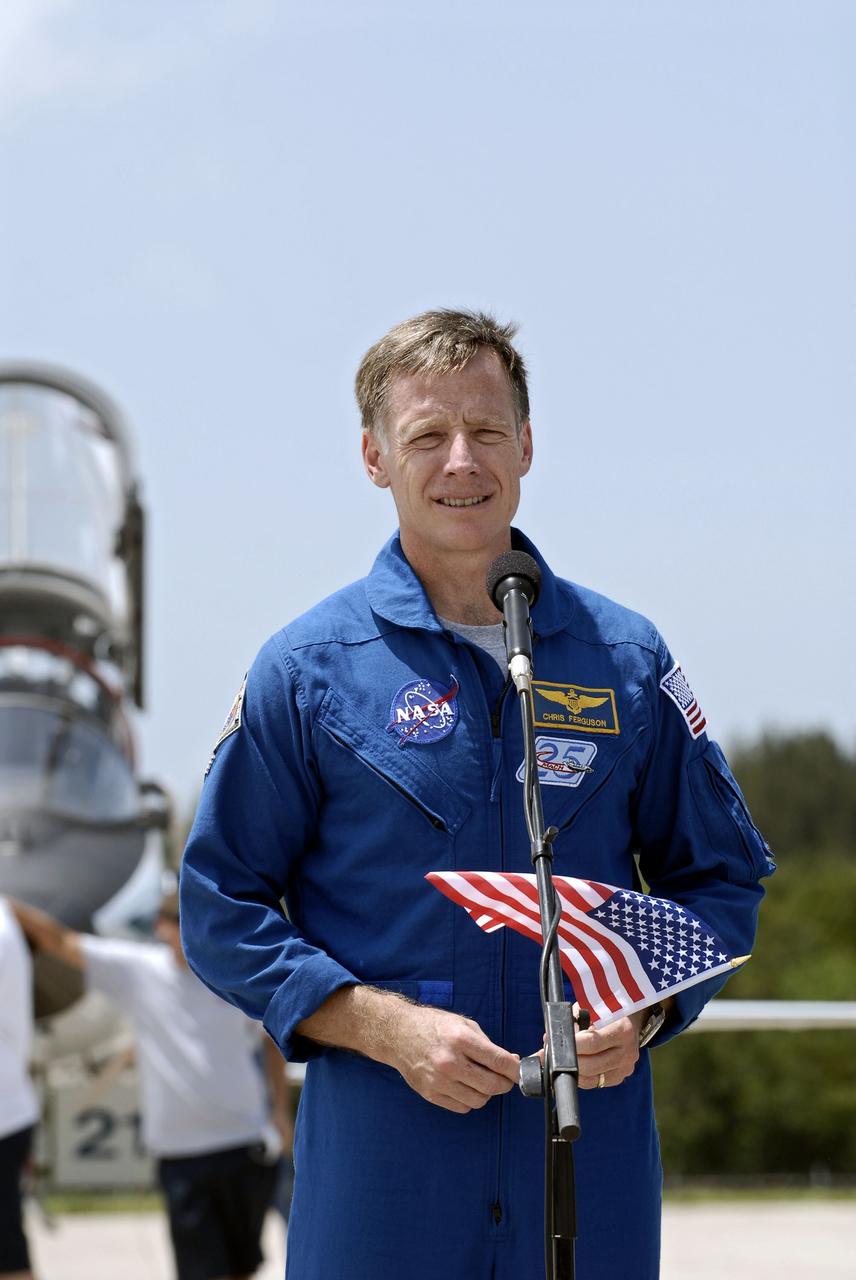
CAPE CANAVERAL, Fla. -- STS-135 Commander Chris Ferguson, holding an American flag to commemorate the U.S. Independence Day holiday, speaks to media at the Shuttle Landing Facility at NASA's Kennedy Space Center in Florida. The STS-135 astronauts arrived at Kennedy about 2:30 p.m. EDT on July 4 for final preparations for space shuttle Atlantis' STS-135 mission to the International Space Station. Atlantis is scheduled to lift off on July 8 to deliver the Raffaello multi-purpose logistics module packed with supplies and spare parts to the station. The STS-135 mission also will fly a system to investigate the potential for robotically refueling existing satellites and return a failed ammonia pump module to help NASA better understand the failure mechanism and improve pump designs for future systems. STS-135 will be the 33rd flight of Atlantis, the 37th shuttle mission to the space station, and the 135th and final mission of NASA's Space Shuttle Program. For more information visit, www.nasa.gov/mission_pages/shuttle/shuttlemissions/sts135/index.html. Photo credit: NASA/Kim Shiflett
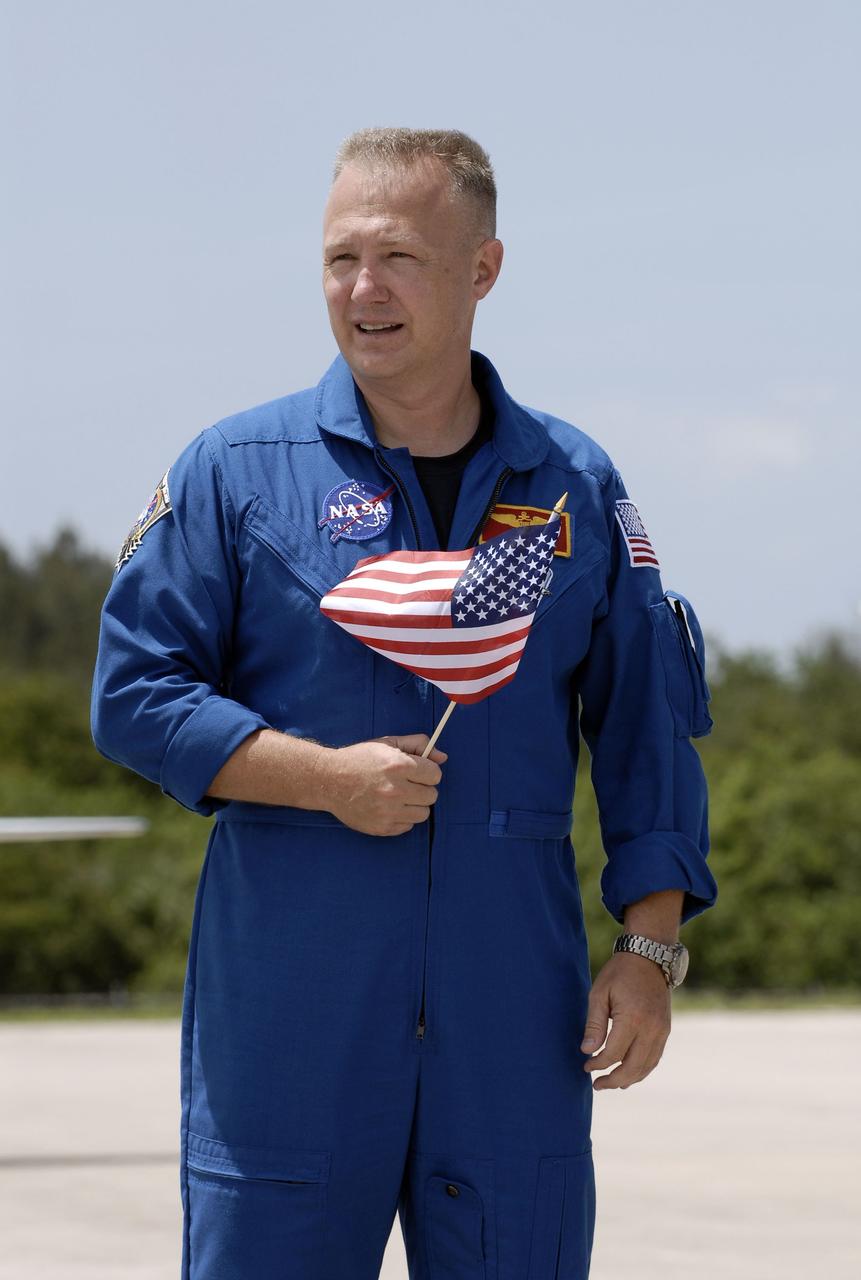
CAPE CANAVERAL, Fla. -- STS-135 Pilot Doug Hurley, holding an American flag to commemorate the U.S. Independence Day holiday, pauses for a photo at the Shuttle Landing Facility at NASA's Kennedy Space Center in Florida. The STS-135 astronauts arrived at Kennedy about 2:30 p.m. EDT on July 4 for final preparations for space shuttle Atlantis' STS-135 mission to the International Space Station. Atlantis is scheduled to lift off on July 8 to deliver the Raffaello multi-purpose logistics module packed with supplies and spare parts to the station. The STS-135 mission also will fly a system to investigate the potential for robotically refueling existing satellites and return a failed ammonia pump module to help NASA better understand the failure mechanism and improve pump designs for future systems. STS-135 will be the 33rd flight of Atlantis, the 37th shuttle mission to the space station, and the 135th and final mission of NASA's Space Shuttle Program. For more information visit, www.nasa.gov/mission_pages/shuttle/shuttlemissions/sts135/index.html. Photo credit: NASA/Kim Shiflett
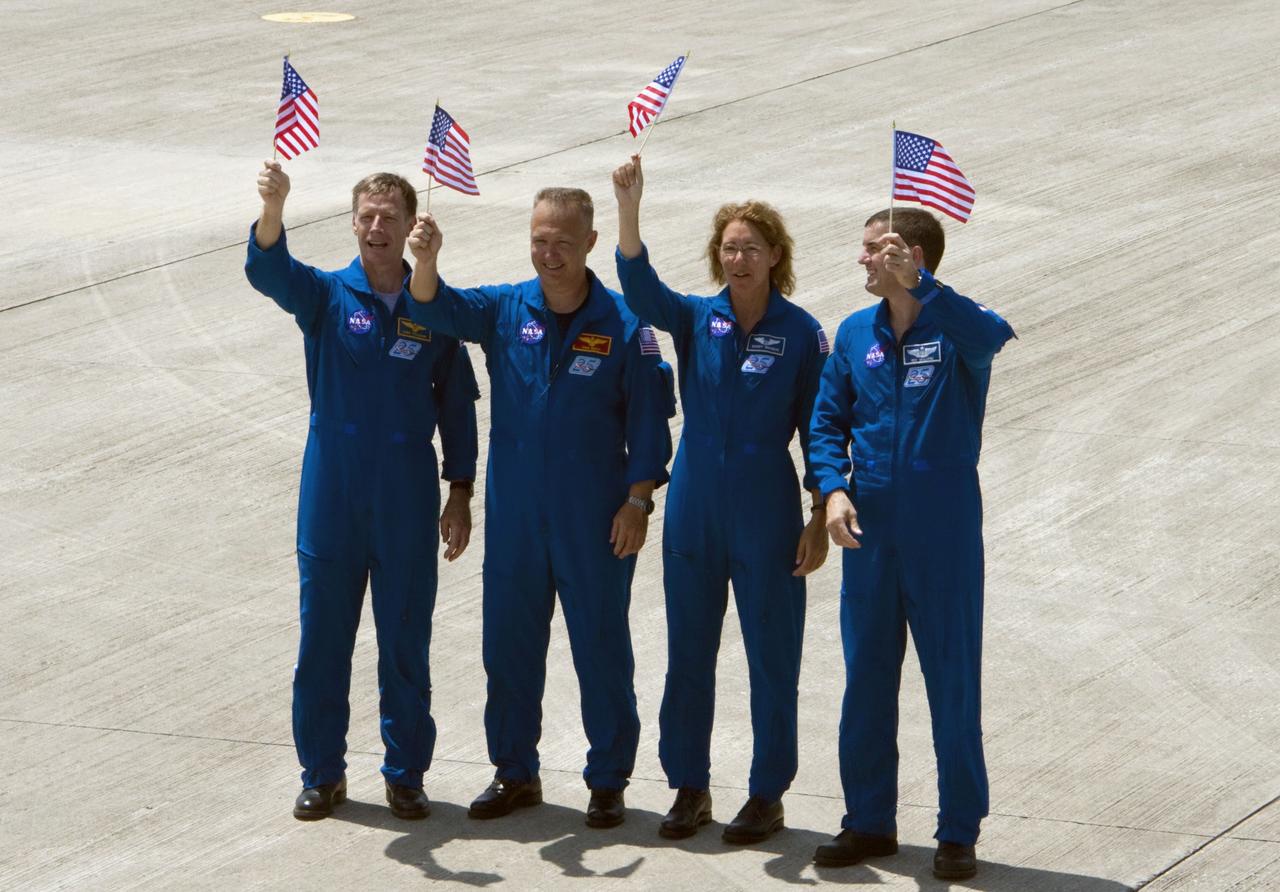
CAPE CANAVERAL, Fla. -- On the Shuttle Landing Facility at NASA's Kennedy Space Center in Florida, the STS-135 crew wave an American flag that commemorates the U.S. Independence Day holiday. From left are Commander Chris Ferguson, Pilot Doug Hurley and Mission Specialists Sandy Magnus and Rex Walheim. The STS-135 astronauts arrived at Kennedy about 2:30 p.m. EDT on July 4 for final preparations for space shuttle Atlantis' STS-135 mission to the International Space Station. Atlantis is scheduled to lift off on July 8 to deliver the Raffaello multi-purpose logistics module packed with supplies and spare parts to the station. The STS-135 mission also will fly a system to investigate the potential for robotically refueling existing satellites and return a failed ammonia pump module to help NASA better understand the failure mechanism and improve pump designs for future systems. STS-135 will be the 33rd flight of Atlantis, the 37th shuttle mission to the space station, and the 135th and final mission of NASA's Space Shuttle Program. For more information visit, www.nasa.gov/mission_pages/shuttle/shuttlemissions/sts135/index.html. Photo credit: NASA/Ken Thornsley
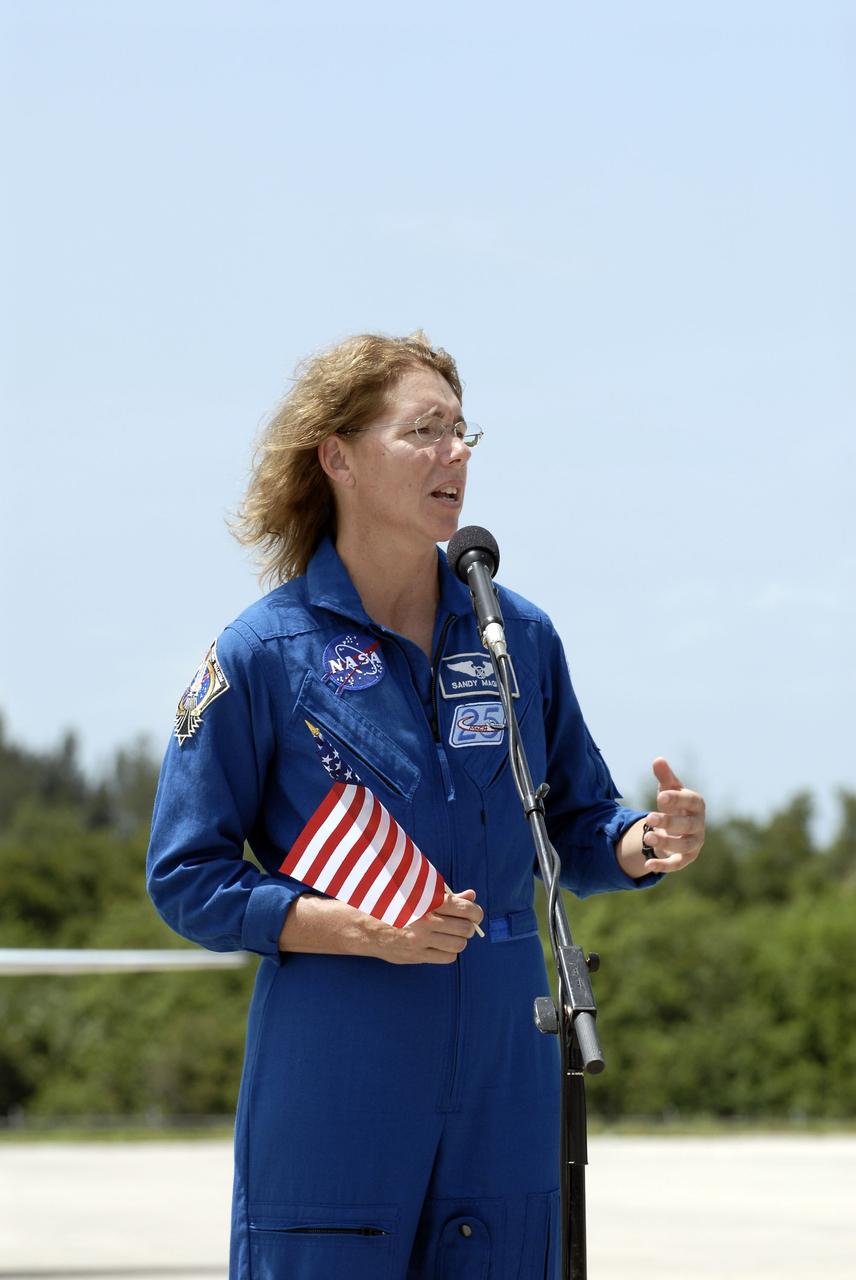
CAPE CANAVERAL, Fla. -- STS-135 Mission Specialist Sandy Magnus, holding an American flag to commemorate the U.S. Independence Day holiday, speaks to media at the Shuttle Landing Facility at NASA's Kennedy Space Center in Florida. The STS-135 astronauts arrived at Kennedy about 2:30 p.m. EDT on July 4 for final preparations for space shuttle Atlantis' STS-135 mission to the International Space Station. Atlantis is scheduled to lift off on July 8 to deliver the Raffaello multi-purpose logistics module packed with supplies and spare parts to the station. The STS-135 mission also will fly a system to investigate the potential for robotically refueling existing satellites and return a failed ammonia pump module to help NASA better understand the failure mechanism and improve pump designs for future systems. STS-135 will be the 33rd flight of Atlantis, the 37th shuttle mission to the space station, and the 135th and final mission of NASA's Space Shuttle Program. For more information visit, www.nasa.gov/mission_pages/shuttle/shuttlemissions/sts135/index.html. Photo credit: NASA/Kim Shiflett
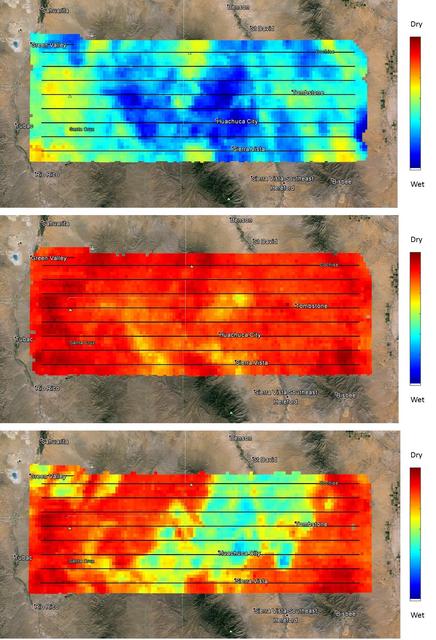
NASA's SMAP (Soil Moisture Active Passive) satellite observatory conducted a field experiment as part of its soil moisture data product validation program in southern Arizona on Aug. 2-18, 2015. The images here represent the distribution of soil moisture over the SMAPVEX15 (SMAP Validation Experiment 2015) experiment domain, as measured by the Passive Active L-band System (PALS) developed by NASA's Jet Propulsion Laboratory, Pasadena, California, which was installed onboard a DC-3 aircraft operated by Airborne Imaging, Inc. Blue and green colors denote wet conditions and dry conditions are marked by red and orange. The black lines show the nominal flight path of PALS. The measurements show that on the first day, the domain surface was wet overall, but had mostly dried down by the second measurement day. On the third day, there was a mix of soil wetness. The heterogeneous soil moisture distribution over the domain is typical for the area during the North American Monsoon season and provides excellent conditions for SMAP soil moisture product validation and algorithm enhancement. The images are based on brightness temperature measured by the PALS instrument gridded on a grid with 0.6-mile (1-kilometer) pixel size. They do not yet compensate for surface characteristics, such as vegetation and topography. That work is currently in progress. http://photojournal.jpl.nasa.gov/catalog/PIA19879
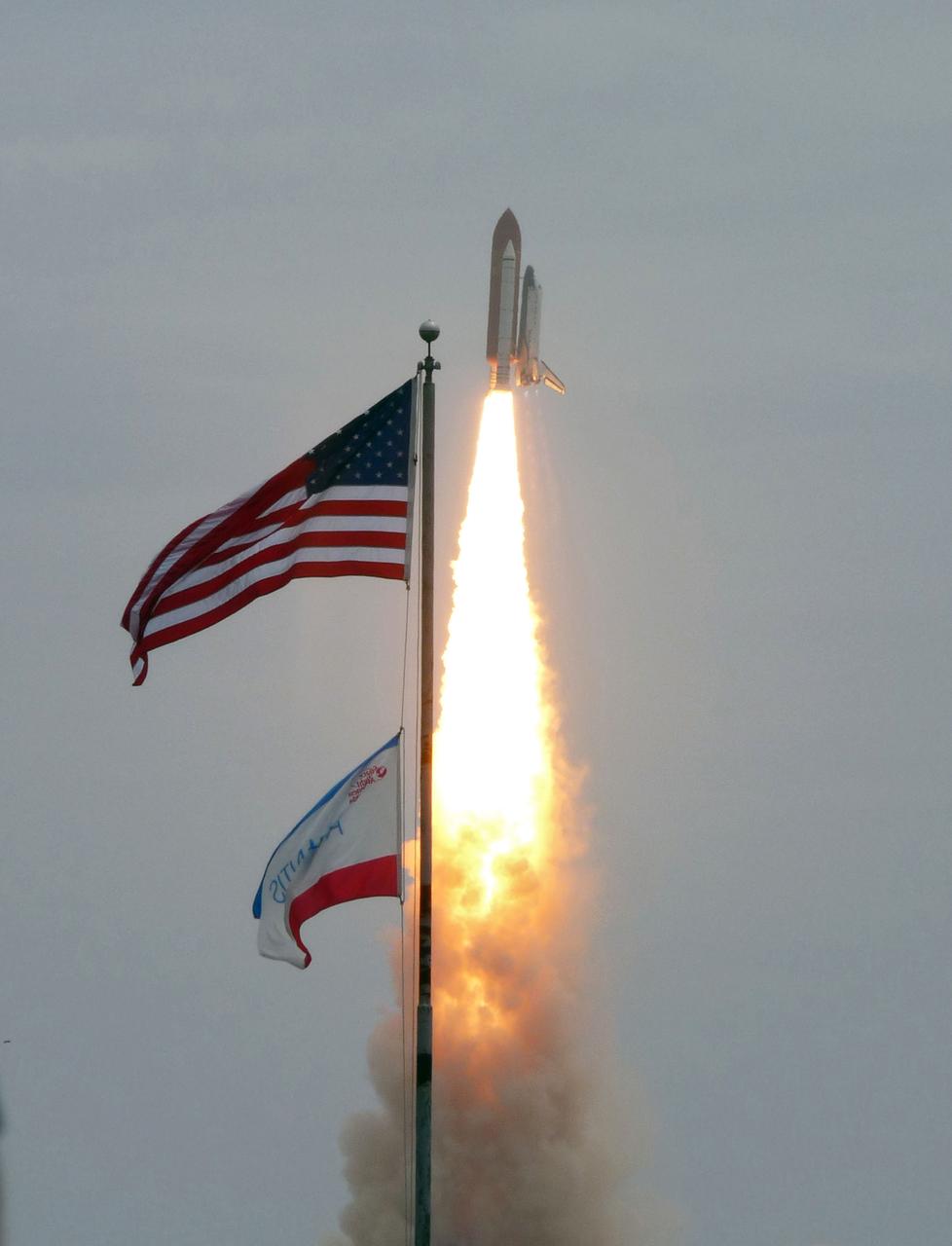
STS135-S-027 (8 July 2011) --- Space shuttle Atlantis soars past the American flag after lifting off Launch Pad 39A at NASA's Kennedy Space Center in Florida at 11:29 a.m. (EDT) on July 8, 2011. Onboard are NASA astronauts Chris Ferguson, STS-135 commander; Doug Hurley, pilot; Sandy Magnus and Rex Walheim, both mission specialists. STS-135 will deliver the Raffaello multi-purpose logistics module packed with supplies and spare parts for the International Space Station. Atlantis also will fly the Robotic Refueling Mission experiment that will investigate the potential for robotically refueling existing satellites in orbit. In addition, Atlantis will return with a failed ammonia pump module to help NASA better understand the failure mechanism and improve pump designs for future systems. STS-135 will be the 33rd flight of Atlantis, the 37th shuttle mission to the space station, and the 135th and final mission of NASA's Space Shuttle Program. Photo credit: NASA
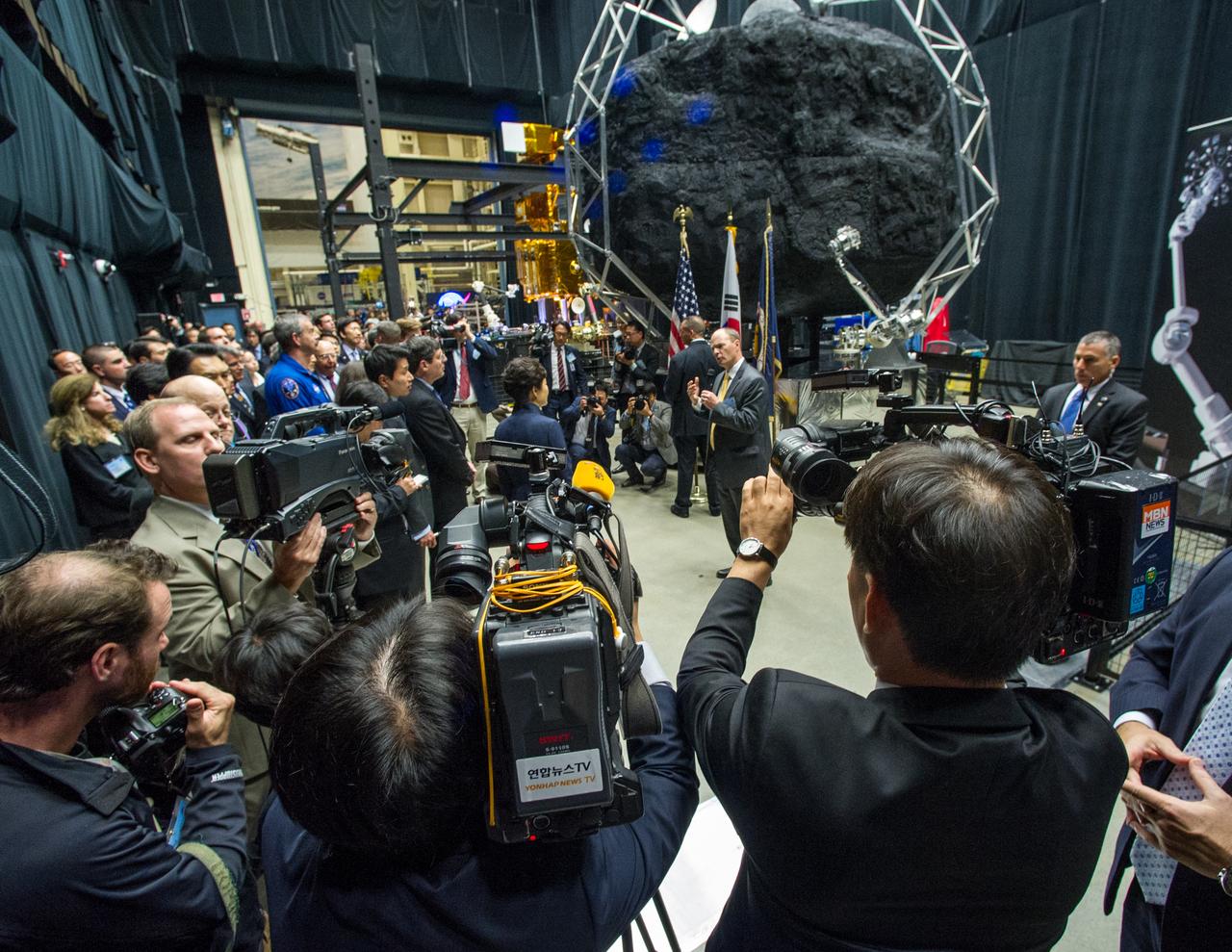
President Park Geun-hye of South Korea and Center Director Christopher Scolese are greeted by Frank Cepollina, Associate Director of the Satellite Servicing Capabilities Office, and Benjamin Reed, Deputy Project Manager of the Satellite Servicing Capabilities Office. As part of her visit to the United States, President Park Geun-hye of South Korea visited NASA’s Goddard Space Flight Center in Greenbelt, Md. On Oct. 14, 2015. The visit offered an opportunity to celebrate past collaborative efforts between the American and South Korean space programs along with presentations on current projects and programs underway at Goddard. Credit: NASA/Goddard/Bill Hrybyk <b><a href="http://www.nasa.gov/audience/formedia/features/MP_Photo_Guidelines.html" rel="nofollow">NASA image use policy.</a></b> <b><a href="http://www.nasa.gov/centers/goddard/home/index.html" rel="nofollow">NASA Goddard Space Flight Center</a></b> enables NASA’s mission through four scientific endeavors: Earth Science, Heliophysics, Solar System Exploration, and Astrophysics. Goddard plays a leading role in NASA’s accomplishments by contributing compelling scientific knowledge to advance the Agency’s mission. <b>Follow us on <a href="http://twitter.com/NASAGoddardPix" rel="nofollow">Twitter</a></b> <b>Like us on <a href="http://www.facebook.com/pages/Greenbelt-MD/NASA-Goddard/395013845897?ref=tsd" rel="nofollow">Facebook</a></b> <b>Find us on <a href="http://instagrid.me/nasagoddard/?vm=grid" rel="nofollow">Instagram</a></b>
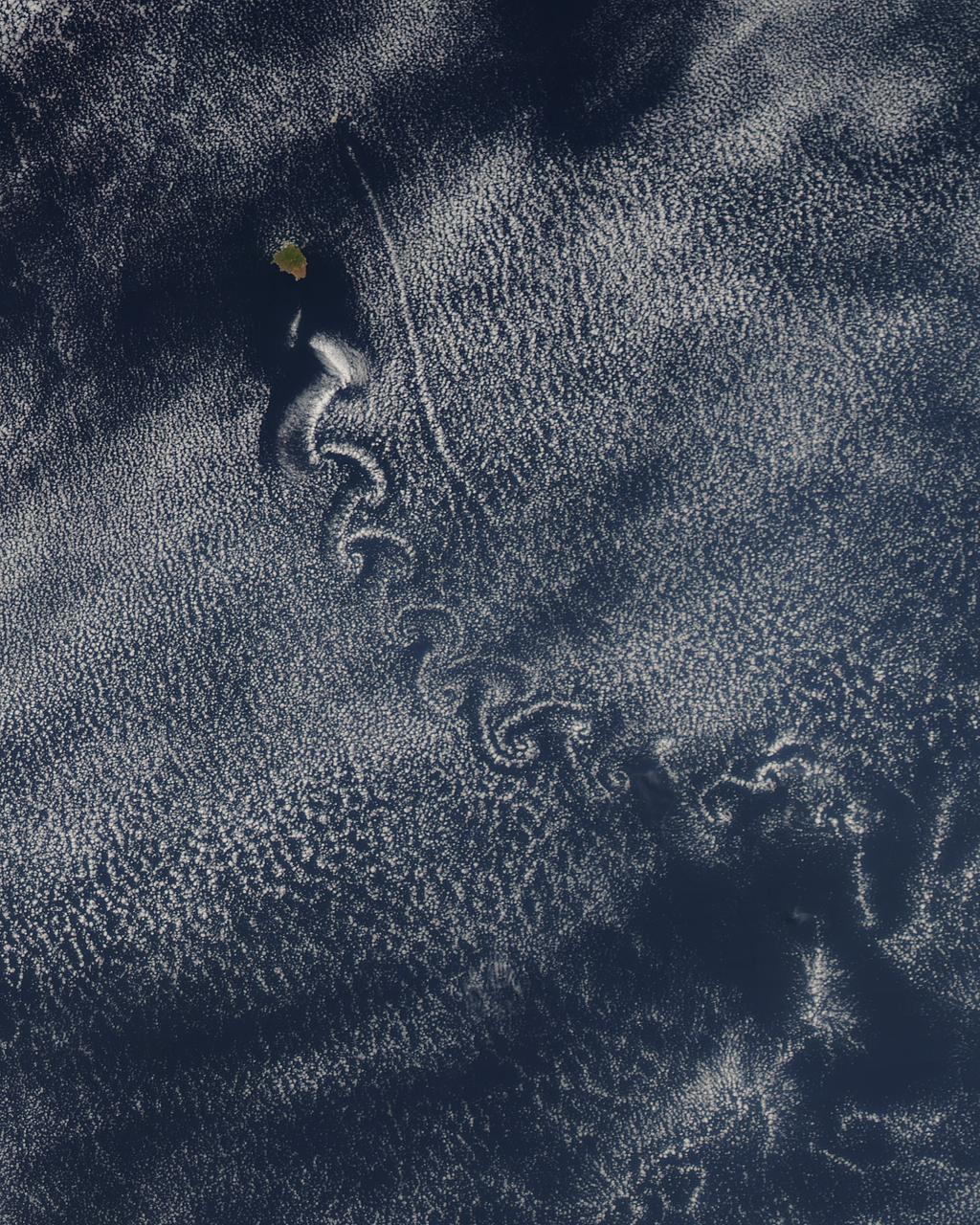
Theodore von Kármán, a Hungarian-American physicist, was the first to describe the physical processes that create long chains of spiral eddies like the one shown above. Known as von Kármán vortices the patterns can form nearly anywhere that fluid flow is disturbed by an object. Since the atmosphere behaves like a fluid, the wing of an airplane, a bridge, even an island can trigger the distinctive phenomenon. On May 22, 2013, the Moderate Resolution Imaging Spectroradiometer (MODIS) on NASA’s Terra satellite captured this natural-color image of cloud vortices behind Isla Socorro, a volcanic island located in the Pacific Ocean. The island, which is located a few hundred kilometers off the west coast of Mexico and the southern tip of Baja California, is part of the Revillagigedo Archipelago. Satellite sensors have spotted von Kármán vortices around the globe, including off of Guadalupe Island, near the coast of Chile, in the Greenland Sea, in the Arctic, and even next to a tropical storm. NASA image courtesy Jeff Schmaltz, LANCE/EOSDIS MODIS Rapid Response Team at NASA GSFC. Caption by Adam Voiland. Instrument: Terra - MODIS More info: <a href="http://1.usa.gov/14VSDQa" rel="nofollow">1.usa.gov/14VSDQa</a> Credit: <b><a href="http://www.earthobservatory.nasa.gov/" rel="nofollow"> NASA Earth Observatory</a></b> <b><a href="http://www.nasa.gov/audience/formedia/features/MP_Photo_Guidelines.html" rel="nofollow">NASA image use policy.</a></b> <b><a href="http://www.nasa.gov/centers/goddard/home/index.html" rel="nofollow">NASA Goddard Space Flight Center</a></b> enables NASA’s mission through four scientific endeavors: Earth Science, Heliophysics, Solar System Exploration, and Astrophysics. Goddard plays a leading role in NASA’s accomplishments by contributing compelling scientific knowledge to advance the Agency’s mission. <b>Follow us on <a href="http://twitter.com/NASA_GoddardPix" rel="nofollow">Twitter</a></b> <b>Like us on <a href="http://www.facebook.com/pages/Greenbelt-MD/NASA-Goddard/395013845897?ref=tsd" rel="nofollow">Facebook</a></b> <b>Find us on <a href="http://instagram.com/nasagoddard?vm=grid" rel="nofollow">Instagram</a></b>

Caption: President Park Geun-hye of South Korea and Center Director Christopher Scolese are greeted by Frank Cepollina, Associate Director of the Satellite Servicing Capabilities Office, and Benjamin Reed, Deputy Project Manager of the Satellite Servicing Capabilities Office. GODDARD VISIT BY SOUTH KOREAN PRESIDENT – 14-OCT-2015 As part of her visit to the United States, President Park Geun-hye of South Korea visited NASA’s Goddard Space Flight Center in Greenbelt, Md. On Oct. 14, 2015. The visit offered an opportunity to celebrate past collaborative efforts between the American and South Korean space programs along with presentations on current projects and programs underway at Goddard. Credit: NASA/Goddard/Rebecca Roth <b><a href="http://www.nasa.gov/audience/formedia/features/MP_Photo_Guidelines.html" rel="nofollow">NASA image use policy.</a></b> <b><a href="http://www.nasa.gov/centers/goddard/home/index.html" rel="nofollow">NASA Goddard Space Flight Center</a></b> enables NASA’s mission through four scientific endeavors: Earth Science, Heliophysics, Solar System Exploration, and Astrophysics. Goddard plays a leading role in NASA’s accomplishments by contributing compelling scientific knowledge to advance the Agency’s mission. <b>Follow us on <a href="http://twitter.com/NASAGoddardPix" rel="nofollow">Twitter</a></b> <b>Like us on <a href="http://www.facebook.com/pages/Greenbelt-MD/NASA-Goddard/395013845897?ref=tsd" rel="nofollow">Facebook</a></b> <b>Find us on <a href="http://instagrid.me/nasagoddard/?vm=grid" rel="nofollow">Instagram</a></b>
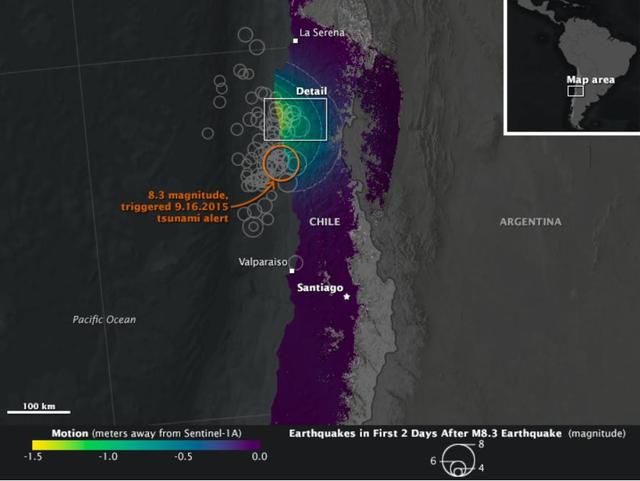
On Sept. 16, 2015, a magnitude 8.3 earthquake struck near the coast of central Chile along the boundary of the Nazca and South American tectonic plates. Dubbed the Illapel earthquake, the shaking lasted at least three minutes and propelled a 15-foot (4.5-meter) tsunami that washed into Coquimbo and other coastal areas. Smaller tsunami waves raced across the Pacific and showed up on the shores of Hawaii and other islands. The earthquake and tsunami caused substantial damage in several Chilean coastal towns, and at least 13 deaths have been reported. Demanding building codes and extensive disaster preparedness helped to limit the loss of life and property. The maps above, known as interferograms, show how the quake moved the ground, as observed by the Copernicus Sentinel-1A satellite (operated by the European Space Agency) and reported by ground stations to the U.S. Geological Survey. Sentinel-1A carries a synthetic aperture radar (SAR) instrument, which beams radio signals toward the ground and measures the reflections to determine the distance between the ground and the satellite. By comparing measurements made on Aug. 24 and Sept. 17, Cunren Liang, Eric Fielding, and other researchers from NASA's Jet Propulsion Laboratory were able to determine how the land surface shifted during and after the earthquake. Interferograms can be used to estimate where the fault moved deep in Earth and which areas have increased stress and higher likelihood of future earthquakes. The details can also provide important information to better understand the earthquake process. On both the close-up and the broad-view maps, the amount of land motion is represented in shades from yellow to purple. Areas where the ground shifted the most (vertically, horizontally, or both) are represented in yellow, while areas with little change are represented in purple. Circles show the location of earthquakes and aftershocks in the two days after the initial 8.3 earthquake, as reported by the USGS National Earthquake Information Center. Larger quakes are represented by larger circles. The base map layer uses a digital elevation model and a bathymetry map to show the contours of the land surface and seafloor. The interferograms above show that land moved as much as 1.4 meters toward to satellite (generally in the vertical direction) near the coast, and early estimates of the horizontal motion suggest it was as much as 2 meters. While SAR can see through clouds and the dark of night, it cannot see much through water. It is likely that much of the ground deformation from the earthquake occurred underwater, which explains the formation of the tsunami and the location of many aftershocks. http://photojournal.jpl.nasa.gov/catalog/PIA20002
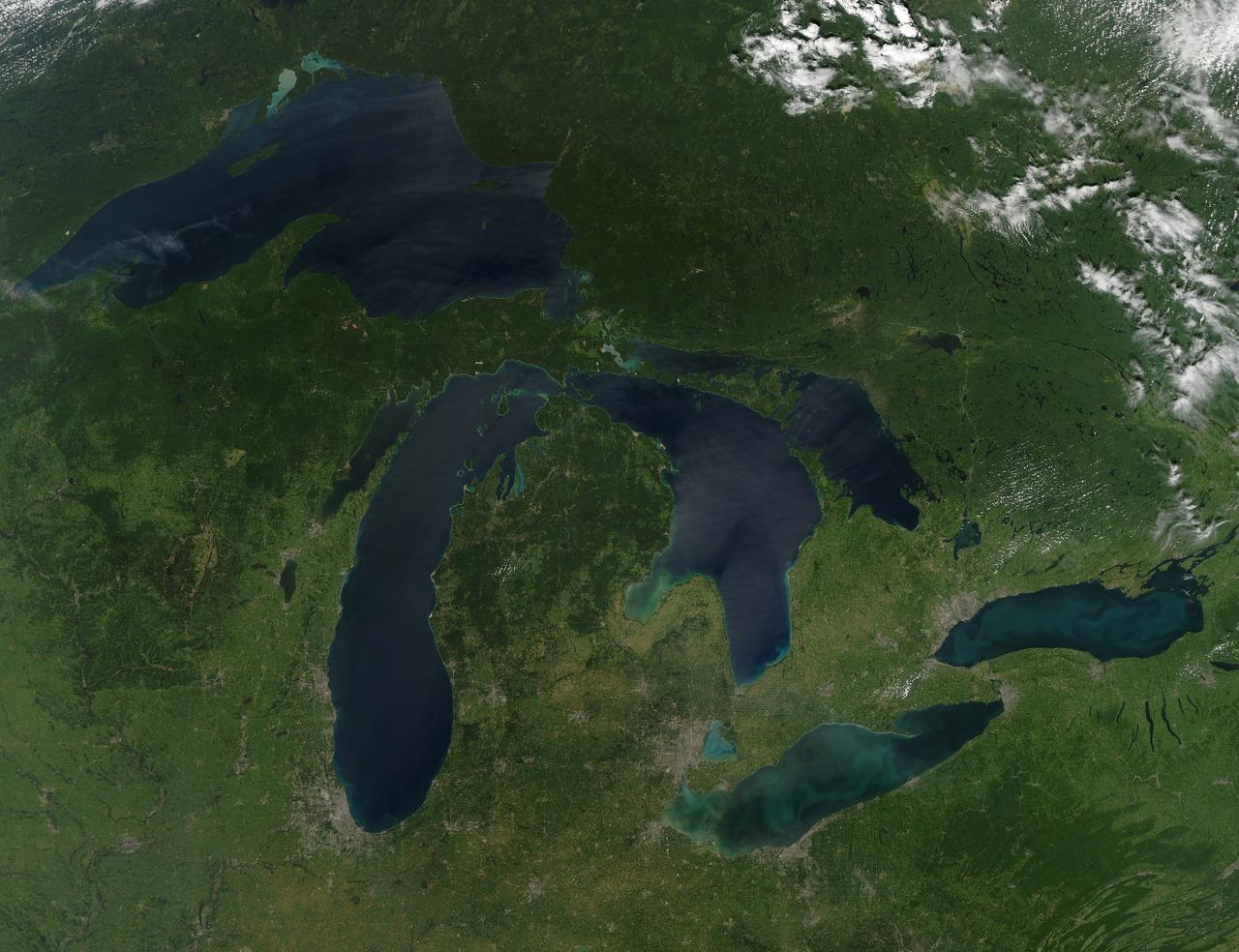
NASA image acquired August 28, 2010 Late August 2010 provided a rare satellite view of a cloudless summer day over the entire Great Lakes region. North Americans trying to sneak in a Labor Day weekend getaway on the lakes were hoping for more of the same. The Great Lakes comprise the largest collective body of fresh water on the planet, containing roughly 18 percent of Earth's supply. Only the polar ice caps contain more fresh water. The region around the Great Lakes basin is home to more than 10 percent of the population of the United States and 25 percent of the population of Canada. Many of those people have tried to escape record heat this summer by visiting the lakes. What they found, according to The Hamilton Spectator, was record-breaking water temperatures fueled by record-breaking air temperatures in the spring and summer. By mid-August, the waters of Lake Superior were 6 to 8°C (11 to 14°F) above normal. Lake Michigan set records at about 4°C (7°F) above normal. The other three Great Lakes – Huron, Erie, and Ontario -- were above normal temperatures, though no records were set. The image was gathered by the Moderate Resolution Imaging Spectroradiometer (MODIS) on NASA’s Aqua satellite at 1:30 p.m. Central Daylight Time (18:30 UTC) on August 28. Open water appears blue or nearly black. The pale blue and green swirls near the coasts are likely caused by algae or phytoplankton blooms, or by calcium carbonate (chalk) from the lake floor. The sweltering summer temperatures have produced an unprecedented bloom of toxic blue-green algae in western Lake Erie, according to the Cleveland Plain Dealer. NASA image by Jeff Schmaltz, MODIS Rapid Response Team, Goddard Space Flight Center. Caption by Mike Carlowicz. Instrument: Aqua - MODIS Click here to see more images from <b><a href="#//earthobservatory.nasa.gov/" rel="nofollow"> NASA Goddard’s Earth Observatory</a></b> <b><a href="http://www.nasa.gov/centers/goddard/home/index.html" rel="nofollow">NASA Goddard Space Flight Center</a></b> is home to the nation's largest organization of combined scientists, engineers and technologists that build spacecraft, instruments and new technology to study the Earth, the sun, our solar system, and the universe. <b>Follow us on <a href="http://twitter.com/NASA_GoddardPix" rel="nofollow">Twitter</a></b> <b>Join us on <a href="http://www.facebook.com/pages/Greenbelt-MD/NASA-Goddard/395013845897?ref=tsd" rel="nofollow">Facebook</a></b>
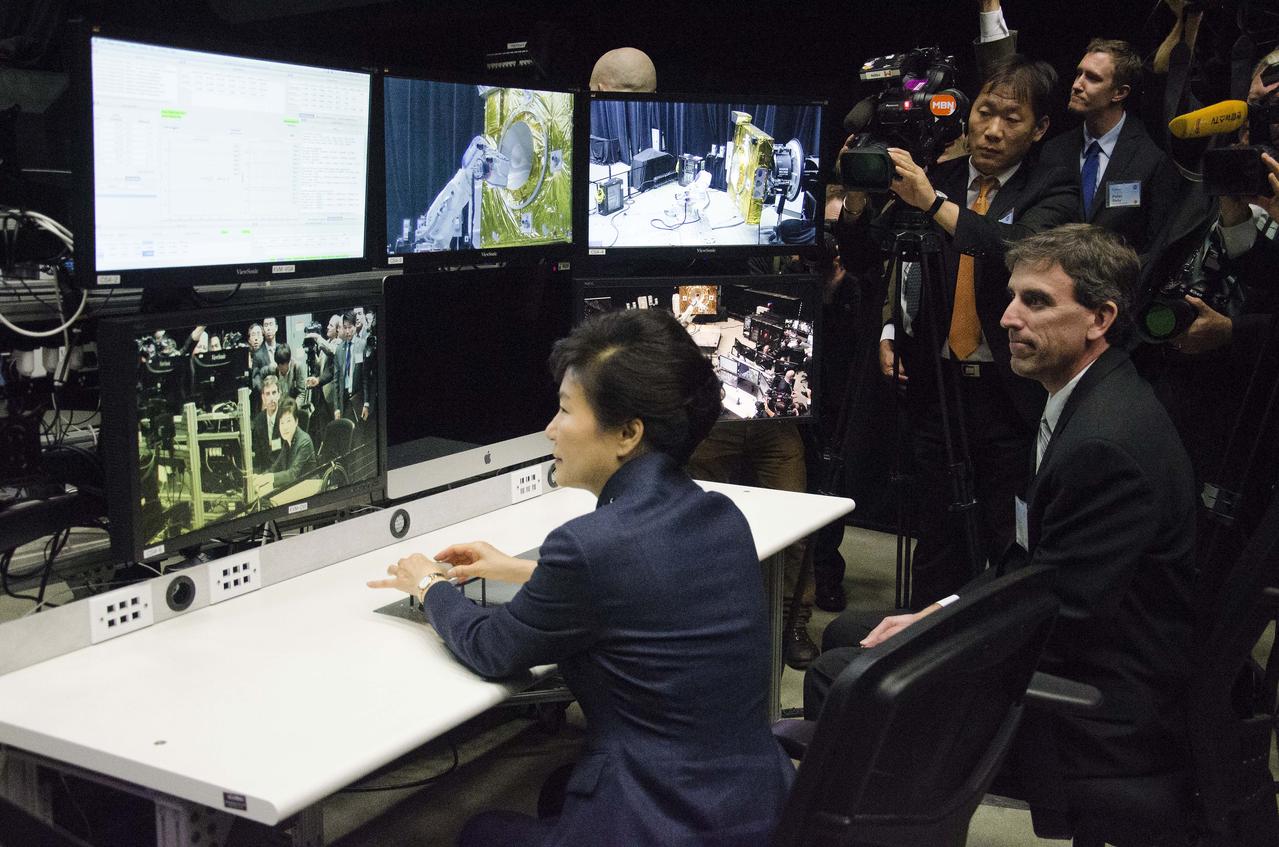
Caption: President Park Geun-hye of South Korea operates a robotic arm as Brian Roberts, Robotic Operations Manager at NASA Goddard describes the operations that take place in the Satellite Servicing Capabilities Office’s robotic lab. GODDARD VISIT BY SOUTH KOREAN PRESIDENT – 14-OCT-2015 As part of her visit to the United States, President Park Geun-hye of South Korea visited NASA’s Goddard Space Flight Center in Greenbelt, Md. On Oct. 14, 2015. The visit offered an opportunity to celebrate past collaborative efforts between the American and South Korean space programs along with presentations on current projects and programs underway at Goddard. Credit: NASA/Goddard/Rebecca Roth <b><a href="http://www.nasa.gov/audience/formedia/features/MP_Photo_Guidelines.html" rel="nofollow">NASA image use policy.</a></b> <b><a href="http://www.nasa.gov/centers/goddard/home/index.html" rel="nofollow">NASA Goddard Space Flight Center</a></b> enables NASA’s mission through four scientific endeavors: Earth Science, Heliophysics, Solar System Exploration, and Astrophysics. Goddard plays a leading role in NASA’s accomplishments by contributing compelling scientific knowledge to advance the Agency’s mission. <b>Follow us on <a href="http://twitter.com/NASAGoddardPix" rel="nofollow">Twitter</a></b> <b>Like us on <a href="http://www.facebook.com/pages/Greenbelt-MD/NASA-Goddard/395013845897?ref=tsd" rel="nofollow">Facebook</a></b> <b>Find us on <a href="http://instagrid.me/nasagoddard/?vm=grid" rel="nofollow">Instagram</a></b>
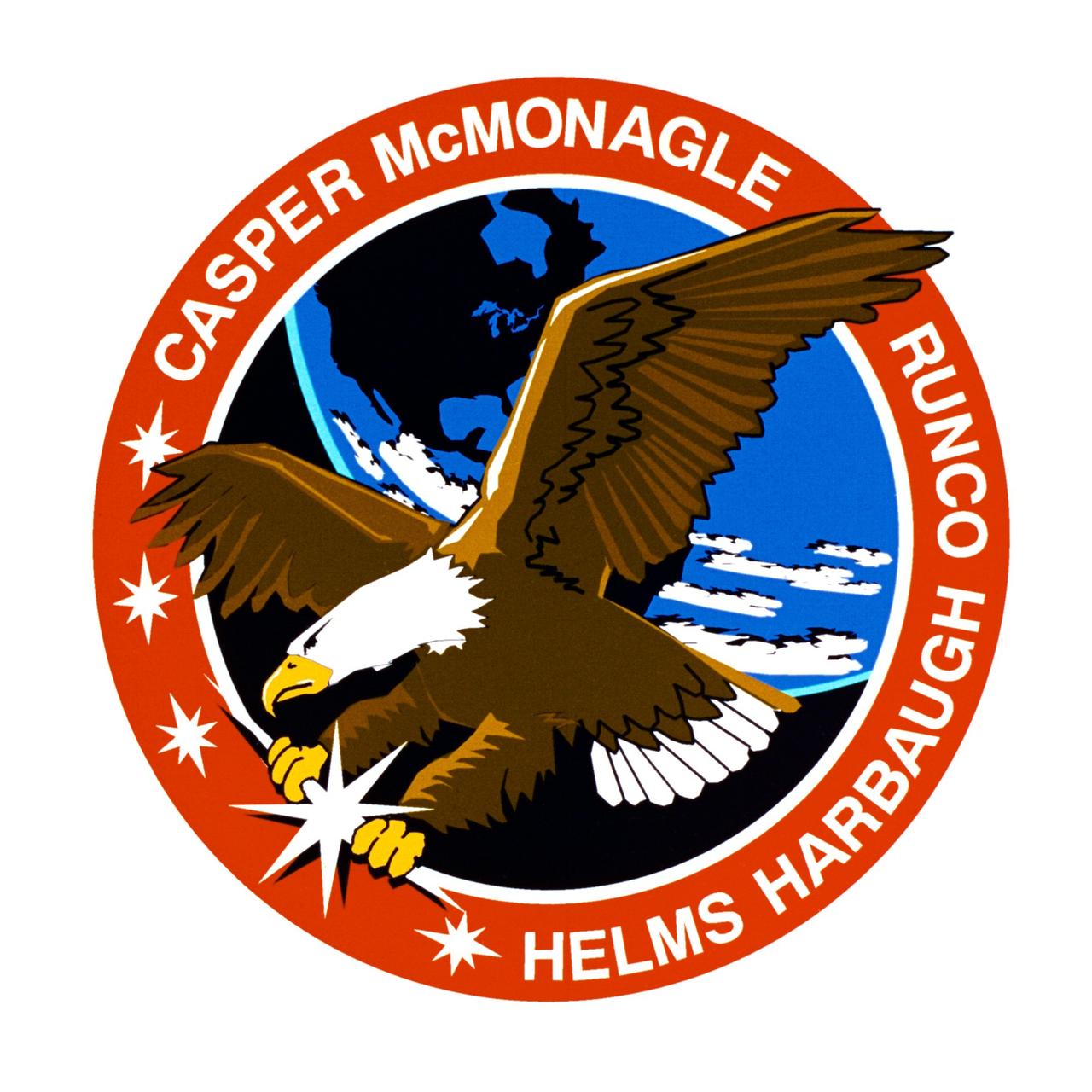
STS054-S-001 (July 1992) --- Designed by the crew members, the STS-54 crew patch depicts our national symbol, the American bald eagle, soaring above the Earth; and represents the United States Space Shuttle as a national asset in service to America and the world. The eagle is clutching an eight pointed star in its talons and is placing this larger star among a constellation of four others representing the placement of the fifth Tracking and Data Relay Satellite (TDRS) into orbit among the four already in service. The blackness of space with stars conspicuously absent represents the mission?s other primary objective in carrying the Diffuse X-ray Spectrometer into orbit to conduct astronomical observations of x-ray sources within the galaxy and throughout the universe. The depiction of our planet showing the crew?s home continent of North America is an expression of their and NASA?s intention that the medical and scientific experiments conducted onboard are for the benefit of all mankind. The clouds and blue of the Earth represent the crew?s part in NASA?s Mission to Planet Earth in conducting Earth observation photography. The NASA insignia design for space shuttle flights is reserved for use by the astronauts and for other official use as the NASA Administrator may authorize. Public availability has been approved only in the form of illustrations by the various news media. When and if there is any change in this policy, which we do not anticipate, it will be publicly announced. Photo credit: NASA
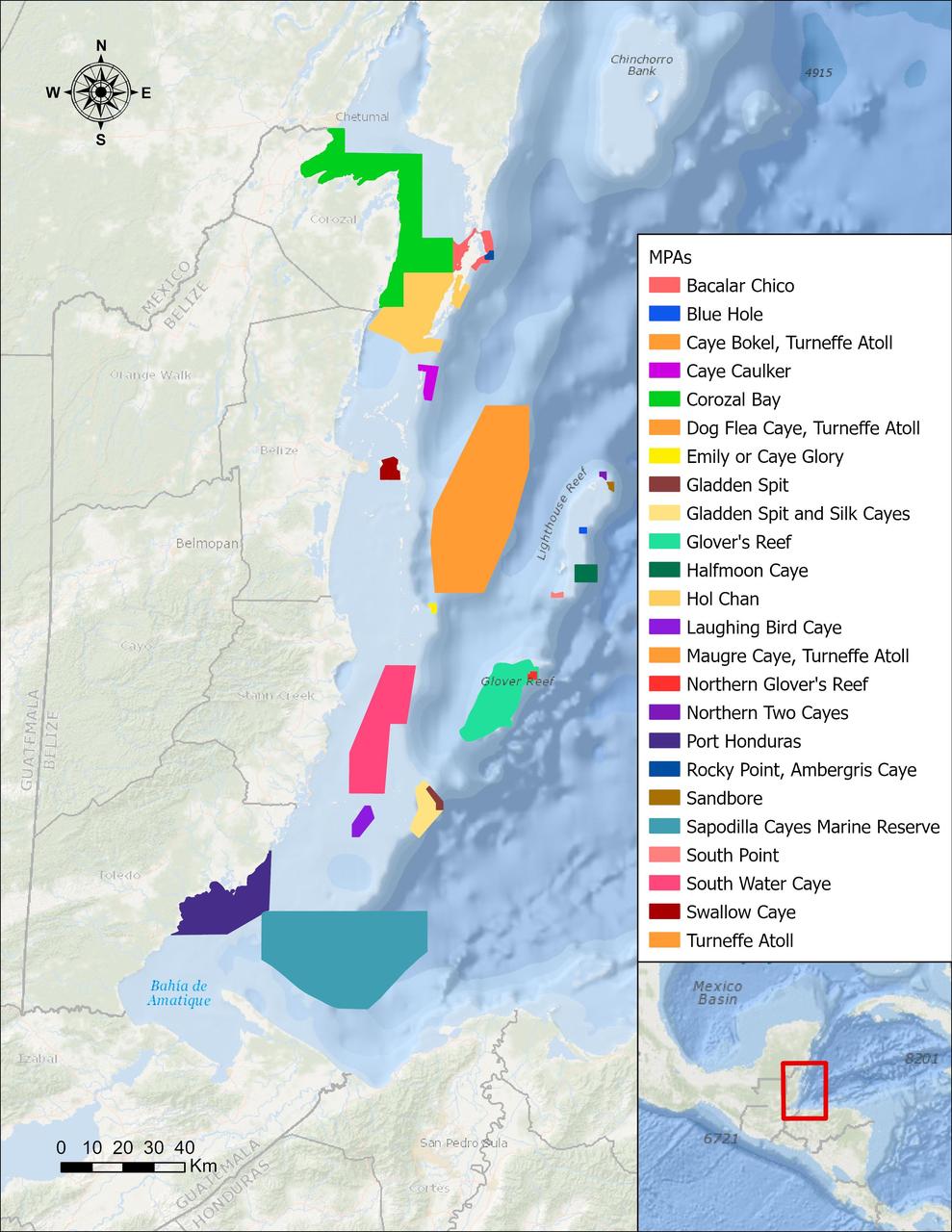
In a paper published in November 2022 in Frontiers in Remote Sensing, researchers at NASA's Jet Propulsion Laboratory, with colleagues in Belize, used data from the Moderate Resolution Imaging Spectroradiometer (MODIS) instrument aboard NASA's Aqua satellite to rank 24 protected marine areas off the Belizean coast based on the risks coral face from murky water and rising temperatures. All the areas are part of the 185-mile-long (298-kilometer-long) Belize Barrier Reef Reserve System, which encompasses a vibrant network of marine environments that supports thousands of animal and plant species and drives the Central American country's largest industry, tourism. The system is one of about 1,200 UNESCO World Heritage sites around the world. Analyzing imagery from 2002 to 2022, researchers developed a coral vulnerability index – a score between 2 and 12 that characterizes the risk to coral, with higher scores signifying greater risk. Their findings could help management authorities protect the reefs from human impacts such as development, overfishing, pollution, and climate change. Port Honduras Marine Reserve, a 156-square-mile (40,000-hectare) protected area in southern Belize, showed the highest coral vulnerability score: 10 out of 12. Based on the index, the study flags Port Honduras, Swallow Caye Wildlife Sanctuary, Sapodilla Cayes Marine Reserve, and Corozal Bay Wildlife Sanctuary as areas for concern. https://photojournal.jpl.nasa.gov/catalog/PIA25862
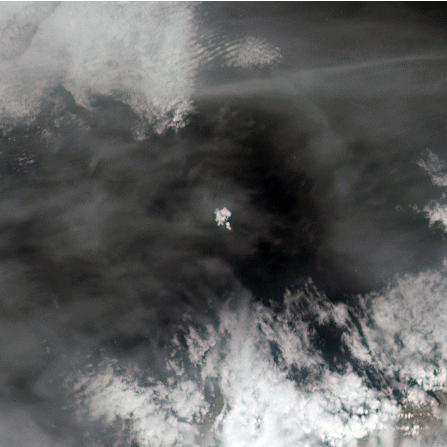
The tiny Aleutian island of Bogoslof in Alaska, erupting regularly since December 2016, produced fresh activity on Sunday, May 28, 2017. Bogoslof is a stratovolcano fueled by the subduction of the Pacific Plate under the North American Plate and forms part of the larger Aleutian Arc, which includes more than 60 volcanoes on the Aleutian Islands and the Aleutian Range on the Alaska mainland. Previous to its recent period of activity, Bogoslof had last erupted in 1992, and its above-water surface area was a mere 0.11 square miles (0.29 square kilometers). As of March 11, the most recent data available, the area of the island had tripled to 0.38 square miles (0.98 square kilometers). The event on May 28 produced an ash cloud that reached 40,000 feet (12 km) in altitude, causing the Alaskan Volcano Observatory to issue a red alert for air travel in the area. Volcanic ash can cause major damage to aircraft engines, and the region is close to several major air routes between North America and Asia. On May 28, 2017, at approximately 2:23 p.m. local time, NASA's Terra satellite passed over Bogoslof, less than 10 minutes after the eruption began. MISR has nine cameras that view Earth at different angles. It takes slightly less than seven minutes for all nine cameras to view the same location on Earth. An animation made from the images from the nine MISR cameras, captured between 2:19 and 2:26 p.m., demonstrates how the angled views give a glimpse of the underside of the growing plume of volcanic ash, showing the eruption column widening into the cloud at the top. The animation is available at https://photojournal.jpl.nasa.gov/catalog/PIA21655
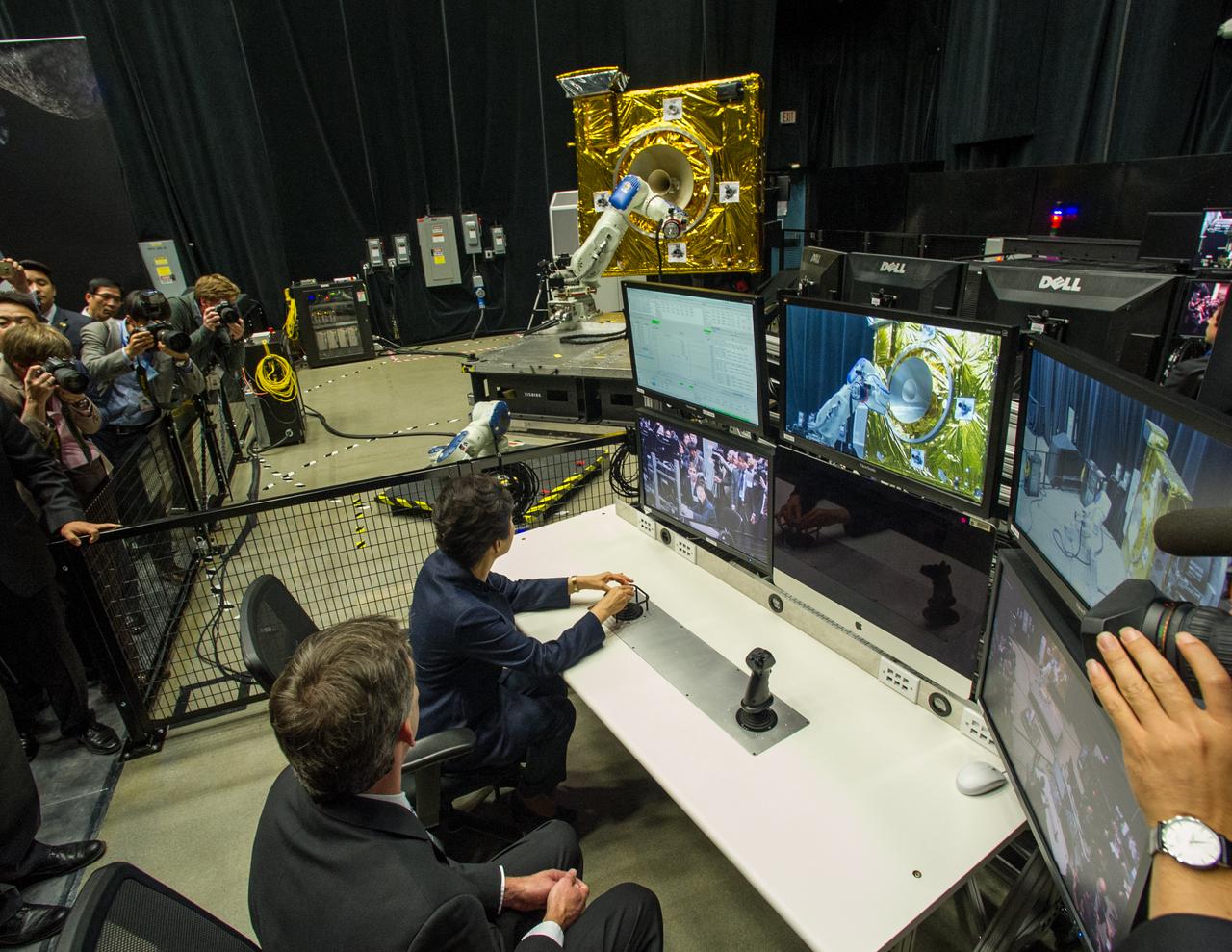
President Park Geun-hye of South Korea operates a robotic arm as Brian Roberts, Robotic Operations Manager at NASA Goddard describes the operations that take place in the Satellite Servicing Capabilities Office’s robotic lab. As part of her visit to the United States, President Park Geun-hye of South Korea visited NASA’s Goddard Space Flight Center in Greenbelt, Md. On Oct. 14, 2015. The visit offered an opportunity to celebrate past collaborative efforts between the American and South Korean space programs along with presentations on current projects and programs underway at Goddard. Credit: NASA/Goddard/Bill Hrybyk <b><a href="http://www.nasa.gov/audience/formedia/features/MP_Photo_Guidelines.html" rel="nofollow">NASA image use policy.</a></b> <b><a href="http://www.nasa.gov/centers/goddard/home/index.html" rel="nofollow">NASA Goddard Space Flight Center</a></b> enables NASA’s mission through four scientific endeavors: Earth Science, Heliophysics, Solar System Exploration, and Astrophysics. Goddard plays a leading role in NASA’s accomplishments by contributing compelling scientific knowledge to advance the Agency’s mission. <b>Follow us on <a href="http://twitter.com/NASAGoddardPix" rel="nofollow">Twitter</a></b> <b>Like us on <a href="http://www.facebook.com/pages/Greenbelt-MD/NASA-Goddard/395013845897?ref=tsd" rel="nofollow">Facebook</a></b> <b>Find us on <a href="http://instagrid.me/nasagoddard/?vm=grid" rel="nofollow">Instagram</a></b>
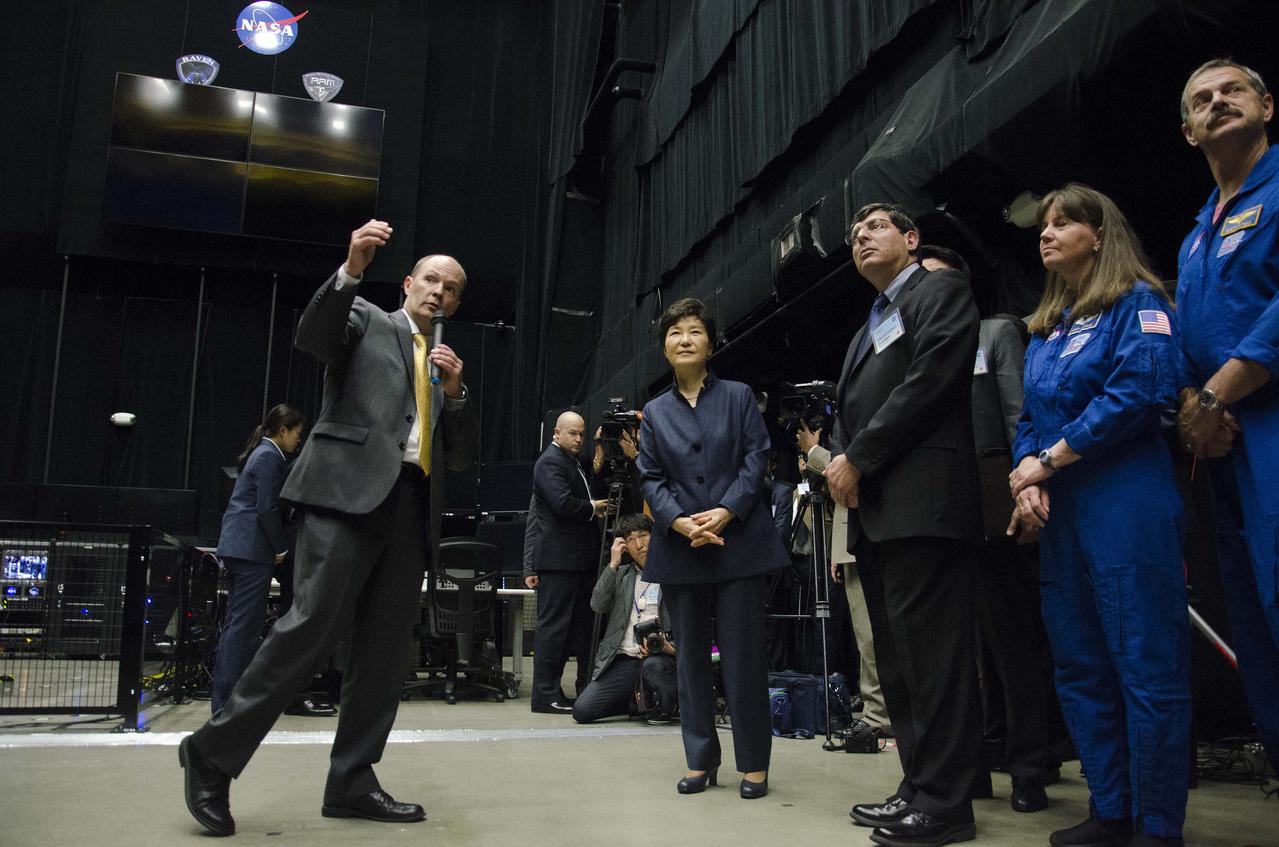
Caption: Benjamin Reed gives brief overview of NASA Goddard’s Satellite Servicing Capabilities Office to President Park Geun-hye of South Korea and (left to right) Goddard Center Director Christopher Scolese, NASA Astronauts Cady Coleman and Scott Altman. As part of her visit to the United States, President Park Geun-hye of South Korea visited NASA’s Goddard Space Flight Center in Greenbelt, Md. On Oct. 14, 2015. The visit offered an opportunity to celebrate past collaborative efforts between the American and South Korean space programs along with presentations on current projects and programs underway at Goddard. Credit: NASA/Goddard/Rebecca Roth <b><a href="http://www.nasa.gov/audience/formedia/features/MP_Photo_Guidelines.html" rel="nofollow">NASA image use policy.</a></b> <b><a href="http://www.nasa.gov/centers/goddard/home/index.html" rel="nofollow">NASA Goddard Space Flight Center</a></b> enables NASA’s mission through four scientific endeavors: Earth Science, Heliophysics, Solar System Exploration, and Astrophysics. Goddard plays a leading role in NASA’s accomplishments by contributing compelling scientific knowledge to advance the Agency’s mission. <b>Follow us on <a href="http://twitter.com/NASAGoddardPix" rel="nofollow">Twitter</a></b> <b>Like us on <a href="http://www.facebook.com/pages/Greenbelt-MD/NASA-Goddard/395013845897?ref=tsd" rel="nofollow">Facebook</a></b> <b>Find us on <a href="http://instagrid.me/nasagoddard/?vm=grid" rel="nofollow">Instagram</a></b>
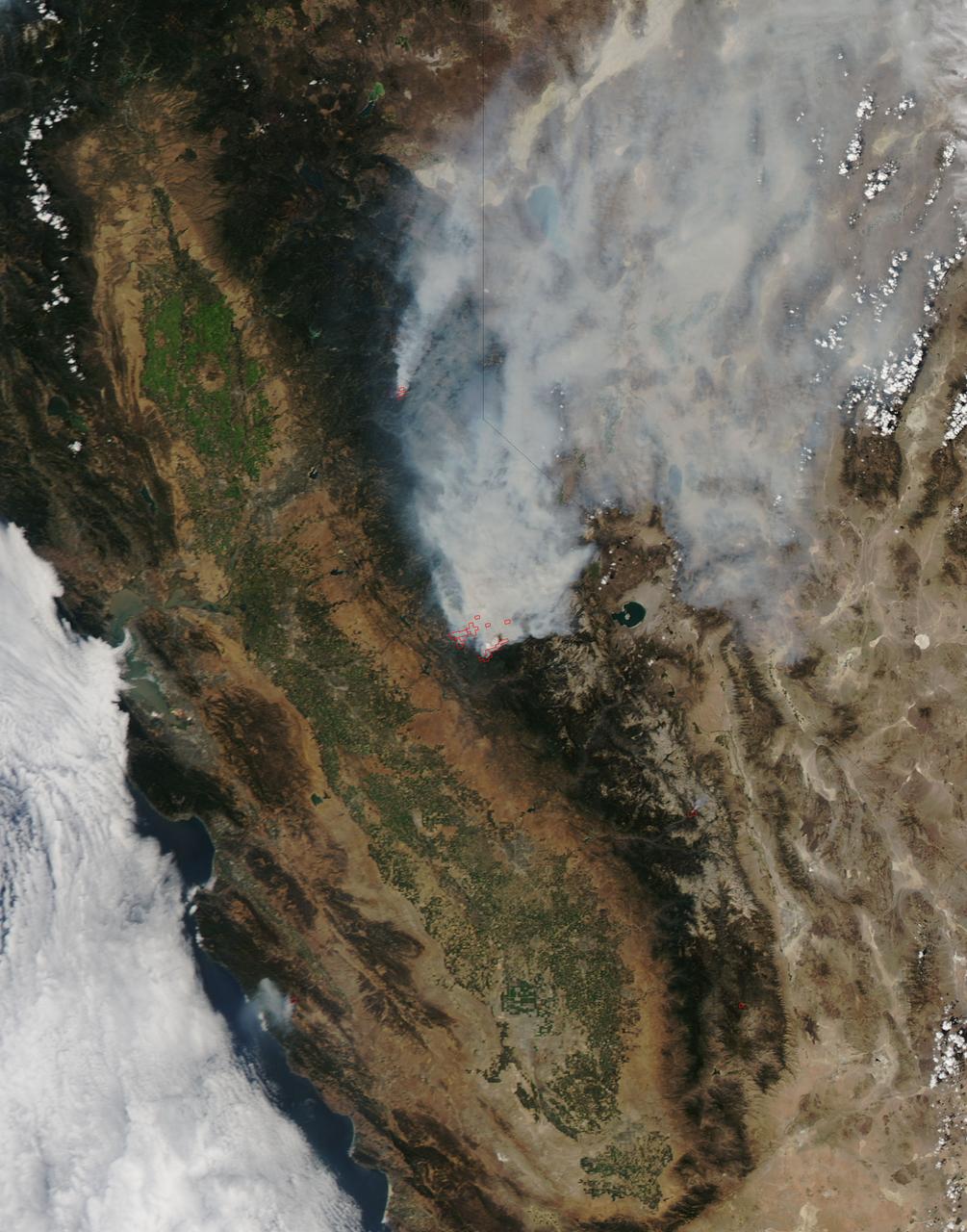
On August 23, 2013, the Moderate Resolution Imaging Spectroradiometer (MODIS) on NASA’s Aqua satellite acquired this image of the drought-fueled Rim fire burning in central California, near Yosemite National Park. Red outlines indicate hot spots where MODIS detected unusually warm surface temperatures associated with fires. Winds blew a thick smoke plume toward the northeast. A smaller fire—American fire—burned to the north. The lower image is a photograph that shows the fire burning at night on August 21. Started on August 17, 2013, the fast-moving fire had already charred more than 100,000 acres (40,000 hectares) by August 23, despite the efforts of more than 2,000 firefighters. Hundreds of people were forced to evacuate their homes, and roads in the area were closed. As of August 23, no structures had been reported destroyed, but the fire threatened the towns of Groveland and Pine Mountain Lake. By late August, wildfires had burned 3.4 million acres in the United States, making 2013 somewhat less active than other recent years. Over the last decade, fires charred 5.7 million acres on average by August 22, according to statistics published the National Interagency Fire Center. NASA image by Jeff Schmaltz, LANCE/EOSDIS Rapid Response. Caption by Adam Voiland. Instrument: Aqua - MODIS Credit: <b><a href="http://www.earthobservatory.nasa.gov/" rel="nofollow"> NASA Earth Observatory</a></b> <b><a href="http://www.nasa.gov/audience/formedia/features/MP_Photo_Guidelines.html" rel="nofollow">NASA image use policy.</a></b> <b><a href="http://www.nasa.gov/centers/goddard/home/index.html" rel="nofollow">NASA Goddard Space Flight Center</a></b> enables NASA’s mission through four scientific endeavors: Earth Science, Heliophysics, Solar System Exploration, and Astrophysics. Goddard plays a leading role in NASA’s accomplishments by contributing compelling scientific knowledge to advance the Agency’s mission. <b>Follow us on <a href="http://twitter.com/NASA_GoddardPix" rel="nofollow">Twitter</a></b> <b>Like us on <a href="http://www.facebook.com/pages/Greenbelt-MD/NASA-Goddard/395013845897?ref=tsd" rel="nofollow">Facebook</a></b> <b>Find us on <a href="http://instagram.com/nasagoddard?vm=grid" rel="nofollow">Instagram</a></b>
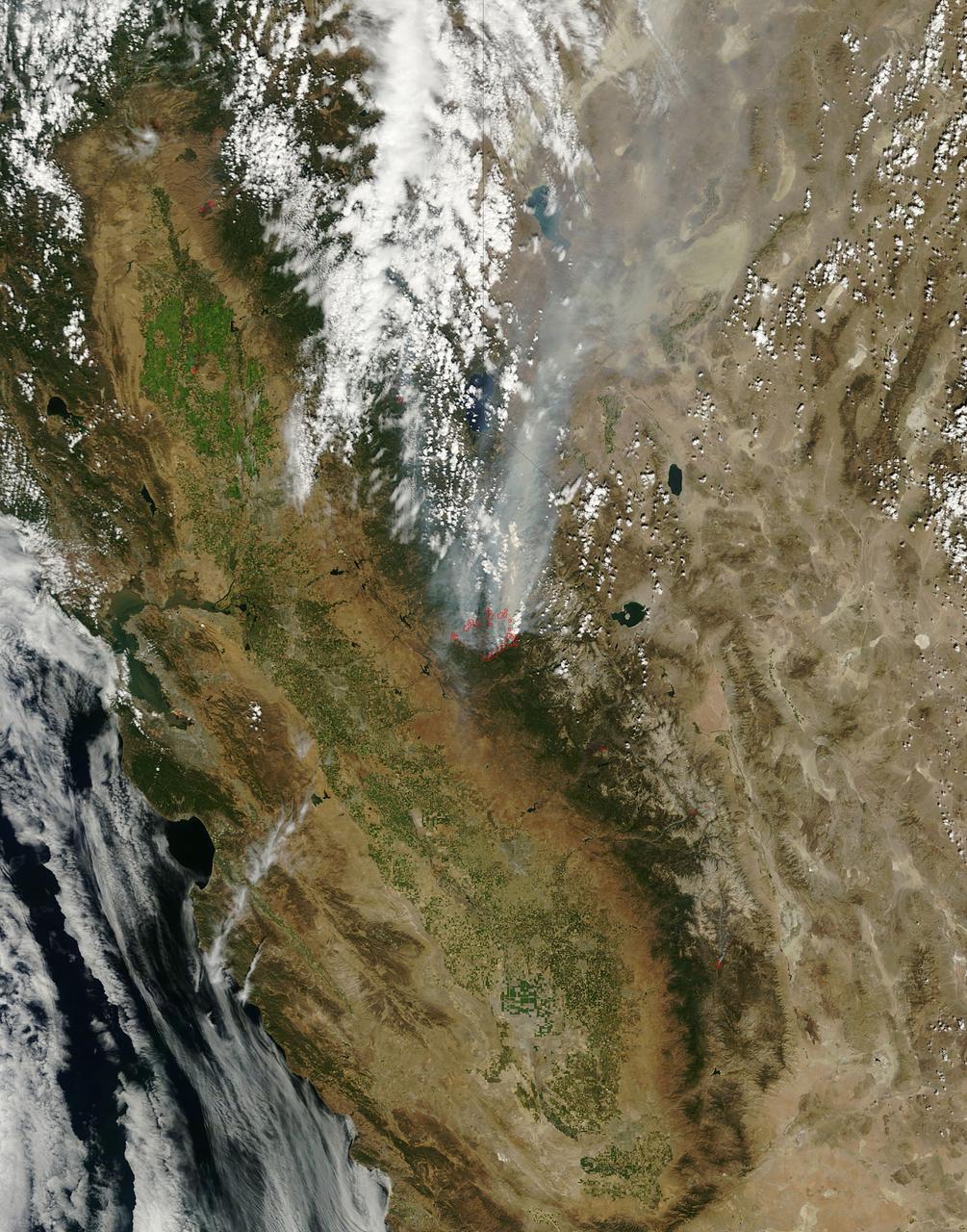
On August 25, 2013, the Moderate Resolution Imaging Spectroradiometer (MODIS) on NASA’s Terra satellite acquired this image of the drought-fueled Rim fire burning in central California, near Yosemite National Park. Red outlines indicate hot spots where MODIS detected unusually warm surface temperatures associated with fires. Winds blew a thick smoke plume toward the northeast. A smaller fire—American fire—burned to the north. Started on August 17, 2013, the fast-moving fire had already charred more than 100,000 acres (40,000 hectares) by August 23, despite the efforts of more than 2,000 firefighters. Hundreds of people were forced to evacuate their homes, and roads in the area were closed. As of August 23, no structures had been reported destroyed, but the fire threatened the towns of Groveland and Pine Mountain Lake. By late August, wildfires had burned 3.4 million acres in the United States, making 2013 somewhat less active than other recent years. Over the last decade, fires charred 5.7 million acres on average by August 22, according to statistics published the National Interagency Fire Center. NASA image by Jeff Schmaltz, LANCE/EOSDIS Rapid Response. Caption by Adam Voiland. Instrument: Terra - MODIS Credit: <b><a href="http://www.earthobservatory.nasa.gov/" rel="nofollow"> NASA Earth Observatory</a></b> <b><a href="http://www.nasa.gov/audience/formedia/features/MP_Photo_Guidelines.html" rel="nofollow">NASA image use policy.</a></b> <b><a href="http://www.nasa.gov/centers/goddard/home/index.html" rel="nofollow">NASA Goddard Space Flight Center</a></b> enables NASA’s mission through four scientific endeavors: Earth Science, Heliophysics, Solar System Exploration, and Astrophysics. Goddard plays a leading role in NASA’s accomplishments by contributing compelling scientific knowledge to advance the Agency’s mission. <b>Follow us on <a href="http://twitter.com/NASA_GoddardPix" rel="nofollow">Twitter</a></b> <b>Like us on <a href="http://www.facebook.com/pages/Greenbelt-MD/NASA-Goddard/395013845897?ref=tsd" rel="nofollow">Facebook</a></b> <b>Find us on <a href="http://instagram.com/nasagoddard?vm=grid" rel="nofollow">Instagram</a></b>