
This image is from NASA Galaxy Evolution Explorer is an observation of the large galaxy in Andromeda, Messier 31. The Andromeda galaxy is the most massive in the local group of galaxies that includes our Milky Way.

This image of the Andromeda galaxy, or M31, includes data from the ESA (European Space Agency) Herschel mission, supplemented with data from ESA's retired Planck observatory and two retired NASA missions: the Infrared Astronomical Satellite (IRAS) and Cosmic Background Explorer (COBE). Operated from 2009 to 2013, Herschel detected wavelengths of light in the far-infrared and microwave ranges, and was ideal for studying dust in nearby galaxies because it could capture small-scale structures in the dust clouds in high resolution. However, Herschel often couldn't detect light from diffuse dust clouds – especially in the outer regions of galaxies, where the gas and dust become sparse and thus fainter. As a result, the mission missed up to 30% of all the light given off by dust. Combining the Herschel observations with data from other observatories creates a more complete picture of the dust in the galaxy. In the image, red indicates hydrogen gas; green indicates cold dust; and warmer dust is shown in blue. Launched in 1983, IRAS was the first space telescope to detect infrared light, setting the stage for future observatories like NASA's Spitzer Space Telescope and James Webb Space Telescope. The Planck observatory, launched in 2009, and COBE, launched in 1989, both studied the cosmic microwave background, or light left over from the big bang. Red indicates hydrogen gas detected using the Green Bank Telescope in West Virginia, the Westerbork Synthesis Radio Telescope in the Netherlands, and the Institute for Radio Astronomy in the Millimeter Range 30-meter telescope in Spain. https://photojournal.jpl.nasa.gov/catalog/PIA25163
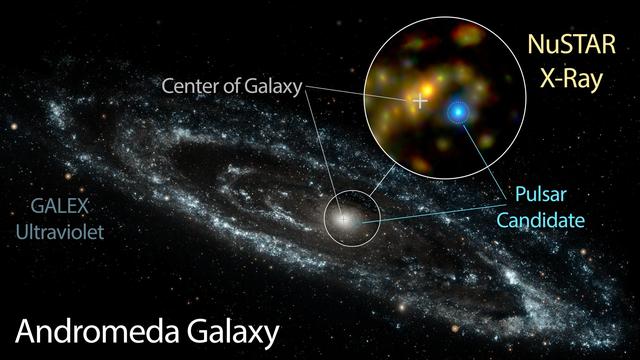
NASA's Nuclear Spectroscope Telescope Array, or NuSTAR, has identified a candidate pulsar in Andromeda -- the nearest large galaxy to the Milky Way. This likely pulsar is brighter at high energies than the Andromeda galaxy's entire black hole population. The inset image shows the pulsar candidate in blue, as seen in X-ray light by NuSTAR. The background image of Andromeda was taken by NASA's Galaxy Evolution Explorer in ultraviolet light. Andromeda is a spiral galaxy like our Milky Way but larger in size. It lies 2.5 million light-years away in the Andromeda constellation. http://photojournal.jpl.nasa.gov/catalog/PIA20970
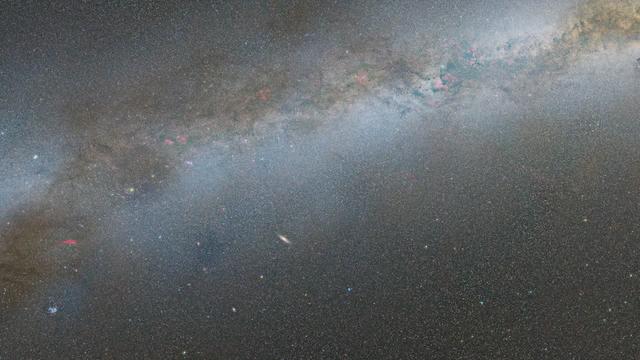
Zoom into the Andromeda galaxy. The largest NASA Hubble Space Telescope image ever assembled, this sweeping view of a portion of the Andromeda galaxy (M31) is the sharpest large composite image ever taken of our galactic neighbor. Though the galaxy is over 2 million light-years away, the Hubble telescope is powerful enough to resolve individual stars in a 61,000-light-year-long section of the galaxy's pancake-shaped disk. It's like photographing a beach and resolving individual grains of sand. And, there are lots of stars in this sweeping view — over 100 million, with some of them in thousands of star clusters seen embedded in the disk. This ambitious photographic cartography of the Andromeda galaxy represents a new benchmark for precision studies of large spiral galaxies which dominate the universe's population of over 100 billion galaxies. Never before have astronomers been able to see individual stars over a major portion of an external spiral galaxy. Most of the stars in the universe live inside such majestic star cities, and this is the first data that reveal populations of stars in context to their home galaxy. Credit: NASA, ESA, and G. Bacon (STScI) <b><a href="http://www.nasa.gov/audience/formedia/features/MP_Photo_Guidelines.html" rel="nofollow">NASA image use policy.</a></b> <b><a href="http://www.nasa.gov/centers/goddard/home/index.html" rel="nofollow">NASA Goddard Space Flight Center</a></b> enables NASA’s mission through four scientific endeavors: Earth Science, Heliophysics, Solar System Exploration, and Astrophysics. Goddard plays a leading role in NASA’s accomplishments by contributing compelling scientific knowledge to advance the Agency’s mission. <b>Follow us on <a href="http://twitter.com/NASAGoddardPix" rel="nofollow">Twitter</a></b> <b>Like us on <a href="http://www.facebook.com/pages/Greenbelt-MD/NASA-Goddard/395013845897?ref=tsd" rel="nofollow">Facebook</a></b> <b>Find us on <a href="http://instagram.com/nasagoddard?vm=grid" rel="nofollow">Instagram</a></b>
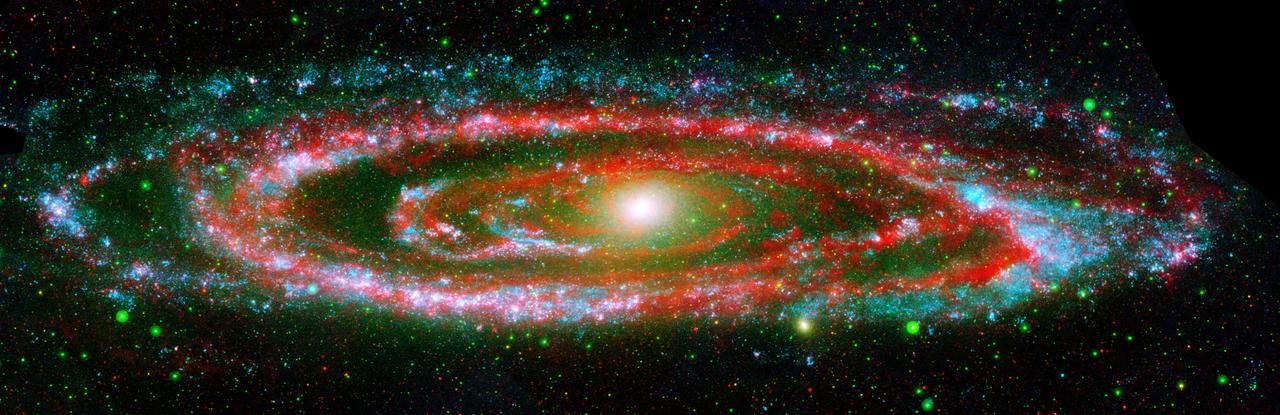
The many personalities of our great galactic neighbor, the Andromeda galaxy, are exposed in this new composite image from NASA Galaxy Evolution Explorer and Spitzer Space Telescope.
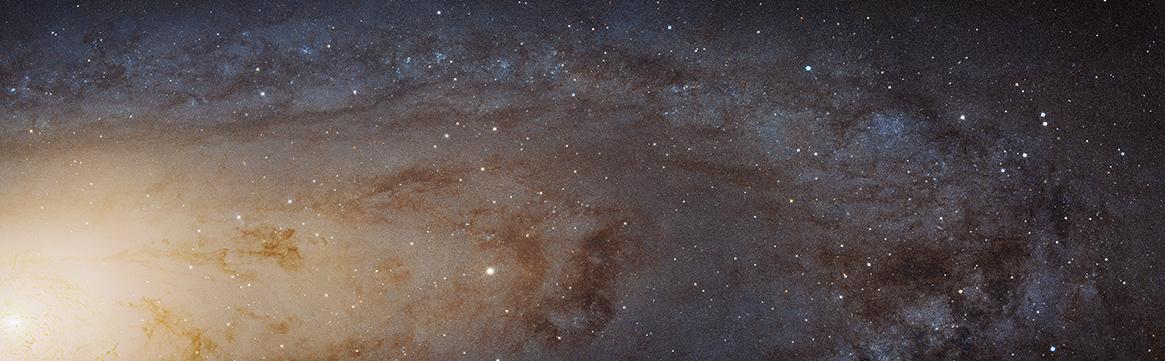
The largest NASA Hubble Space Telescope image ever assembled, this sweeping bird’s-eye view of a portion of the Andromeda galaxy (M31) is the sharpest large composite image ever taken of our galactic next-door neighbor. Though the galaxy is over 2 million light-years away, The Hubble Space Telescope is powerful enough to resolve individual stars in a 61,000-light-year-long stretch of the galaxy’s pancake-shaped disk. It's like photographing a beach and resolving individual grains of sand. And there are lots of stars in this sweeping view -- over 100 million, with some of them in thousands of star clusters seen embedded in the disk. This ambitious photographic cartography of the Andromeda galaxy represents a new benchmark for precision studies of large spiral galaxies that dominate the universe's population of over 100 billion galaxies. Never before have astronomers been able to see individual stars inside an external spiral galaxy over such a large contiguous area. Most of the stars in the universe live inside such majestic star cities, and this is the first data that reveal populations of stars in context to their home galaxy. Hubble traces densely packed stars extending from the innermost hub of the galaxy seen at the left. Moving out from this central galactic bulge, the panorama sweeps from the galaxy's central bulge across lanes of stars and dust to the sparser outer disk. Large groups of young blue stars indicate the locations of star clusters and star-forming regions. The stars bunch up in the blue ring-like feature toward the right side of the image. The dark silhouettes trace out complex dust structures. Underlying the entire galaxy is a smooth distribution of cooler red stars that trace Andromeda’s evolution over billions of years. Because the galaxy is only 2.5 million light-years from Earth, it is a much bigger target in the sky than the myriad galaxies Hubble routinely photographs that are billions of light-years away. This means that the Hubble survey is assembled together into a mosaic image using 7,398 exposures taken over 411 individual pointings. Read more: <a href="http://1.usa.gov/1y0i3H8" rel="nofollow">1.usa.gov/1y0i3H8</a> Credit: NASA, ESA, J. Dalcanton, B.F. Williams, and L.C. Johnson (University of Washington), the PHAT team, and R. Gendler <b><a href="http://www.nasa.gov/audience/formedia/features/MP_Photo_Guidelines.html" rel="nofollow">NASA image use policy.</a></b> <b><a href="http://www.nasa.gov/centers/goddard/home/index.html" rel="nofollow">NASA Goddard Space Flight Center</a></b> enables NASA’s mission through four scientific endeavors: Earth Science, Heliophysics, Solar System Exploration, and Astrophysics. Goddard plays a leading role in NASA’s accomplishments by contributing compelling scientific knowledge to advance the Agency’s mission. <b>Follow us on <a href="http://twitter.com/NASAGoddardPix" rel="nofollow">Twitter</a></b> <b>Like us on <a href="http://www.facebook.com/pages/Greenbelt-MD/NASA-Goddard/395013845897?ref=tsd" rel="nofollow">Facebook</a></b> <b>Find us on <a href="http://instagram.com/nasagoddard?vm=grid" rel="nofollow">Instagram</a></b>

Andromeda Galaxy (ref; P-26394C)

Andromeda galaxy from Palomar Observatory

Andromeda galaxy from Infrared Astronomical Satellite (ref; 83-HC-316)

The Andromeda Galaxy, also known as M31 since it is the 31st object on Messier's list of diffuse sky objects, is the nearest large galaxy to our own Milky Way galaxy. Our galaxy is thought to look much like Andromeda, but it is about four times as massive as the Milky Way. Together these two galaxies dominate the Local Group of galaxies. The diffused light from Andromeda is caused by hundreds of billions of stars that compose it. The several distinct stars that surround Andromeda's image are actually stars in our galaxy that are well in front of the background object. Andromeda is so distant that it takes approximately two millions years for light to reach us from there.

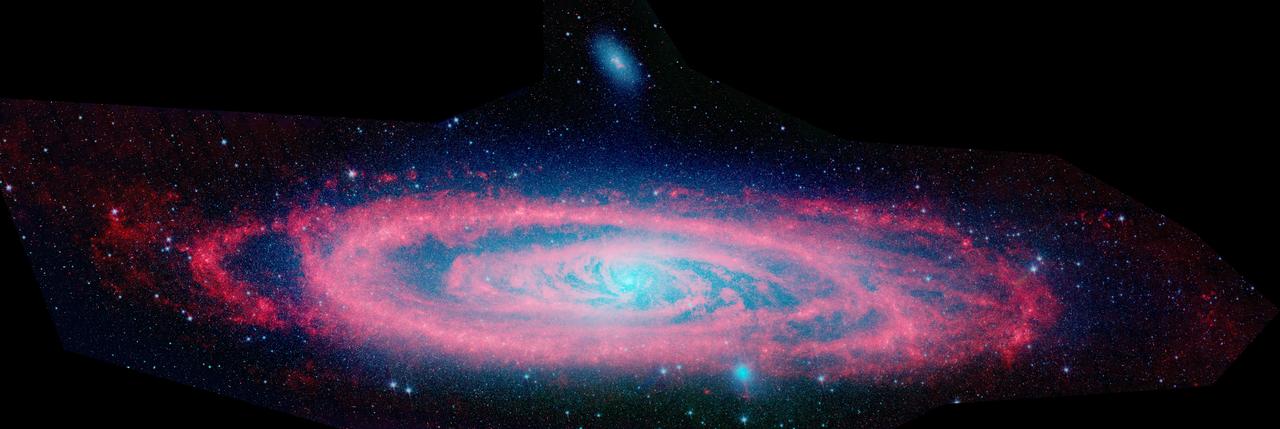
This image from NASA's retired Spitzer Space Telescope highlights the stars and dust clouds in the Andromeda galaxy. One of Earth's nearest galactic neighbors, Andromeda spans a swath of sky nearly 3.8 degrees across, which is close to the width of eight full Moons lined up side by side. The area around the galaxy includes data from NASA's Wide-field Infrared Survey Explorer (WISE). Spitzer observed infrared light, a range of wavelengths longer than what human eyes can detect. In this image, starlight glows blue and cyan (representing infrared wavelengths of 3.6 and 4.5 microns). Dust dominates the galaxy in red (8 microns). The longest wavelength detected by Spitzer (24 microns) gives an indication of the dust's temperature and is represented in green; it combines with the red to create orange and yellow, indicating regions where stars are forming. https://photojournal.jpl.nasa.gov/catalog/PIA26276

Chandra X-Ray Observatory took this first x-ray picture of the Andromeda Galaxy (M31) on October 13, 1999. The blue dot in the center of the image is a "cool" million-degree x-ray source where a supermassive black hole with the mass of 30-million suns is located. The x-rays are produced by matter furneling toward the black hole. Numerous other hotter x-ray sources are also apparent. Most of these are probably due to x-ray binary systems, in which a neutron star or black hole is in close orbit around a normal star. While the gas falling into the central black hole is cool, it is only cool by comparison to the 100 other x-ray sources in the Andromeda Galaxy. To be detected by an x-ray telescope, the gas must have a temperature of more than a million degrees. The Andromeda Galaxy is our nearest neighbor spiral galaxy at a distance of two million light years. It is similar to our own Milky Way in size, shape, and also contains a supermassive black hole at the center. (Photo Credit: NASA/CXC/SAO/S. Murray, M. Garcia)

The immense Andromeda galaxy, also known as Messier 31, is captured in full in this image from NASA Wide-field Infrared Survey Explorer. Andromeda is the closest large galaxy to our Milky Way galaxy, and is located 2.5 million light-years from our sun.
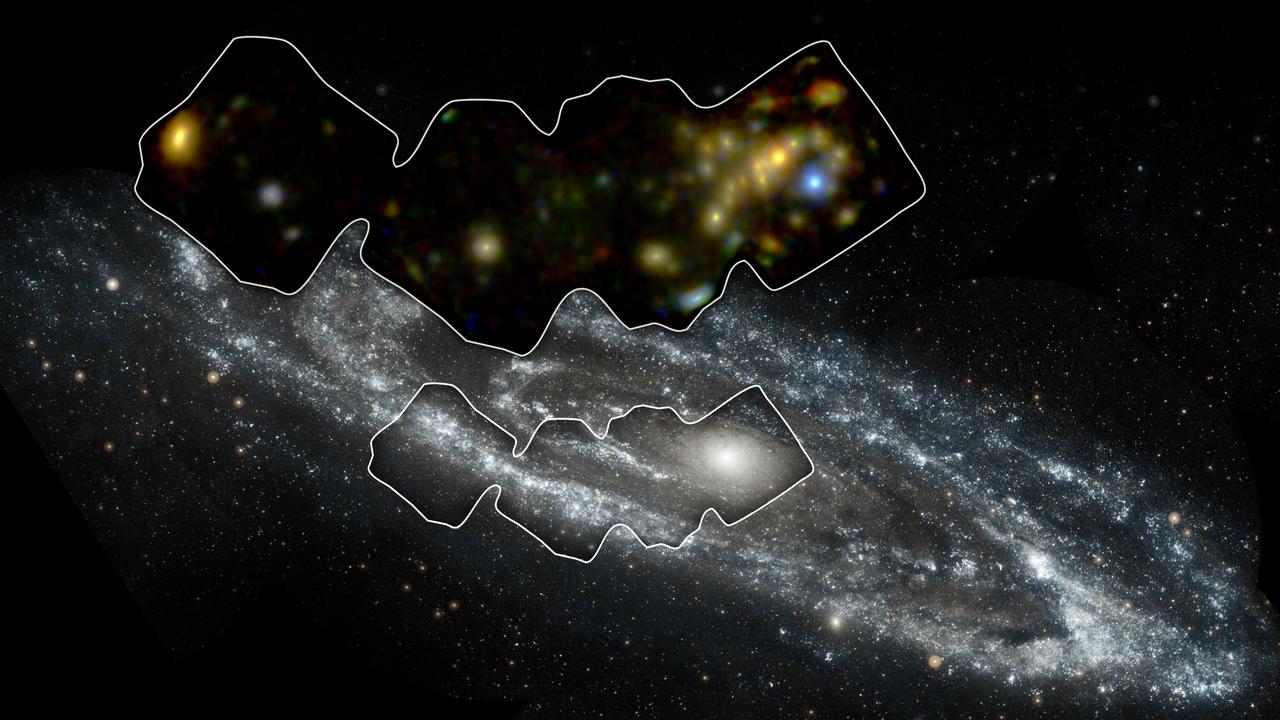
These images from NASA GALEX and NuSTAR is of Andromeda, a spiral galaxy like our Milky Way but larger in size. It lies 2.5 million light-years away in the Andromeda constellation.
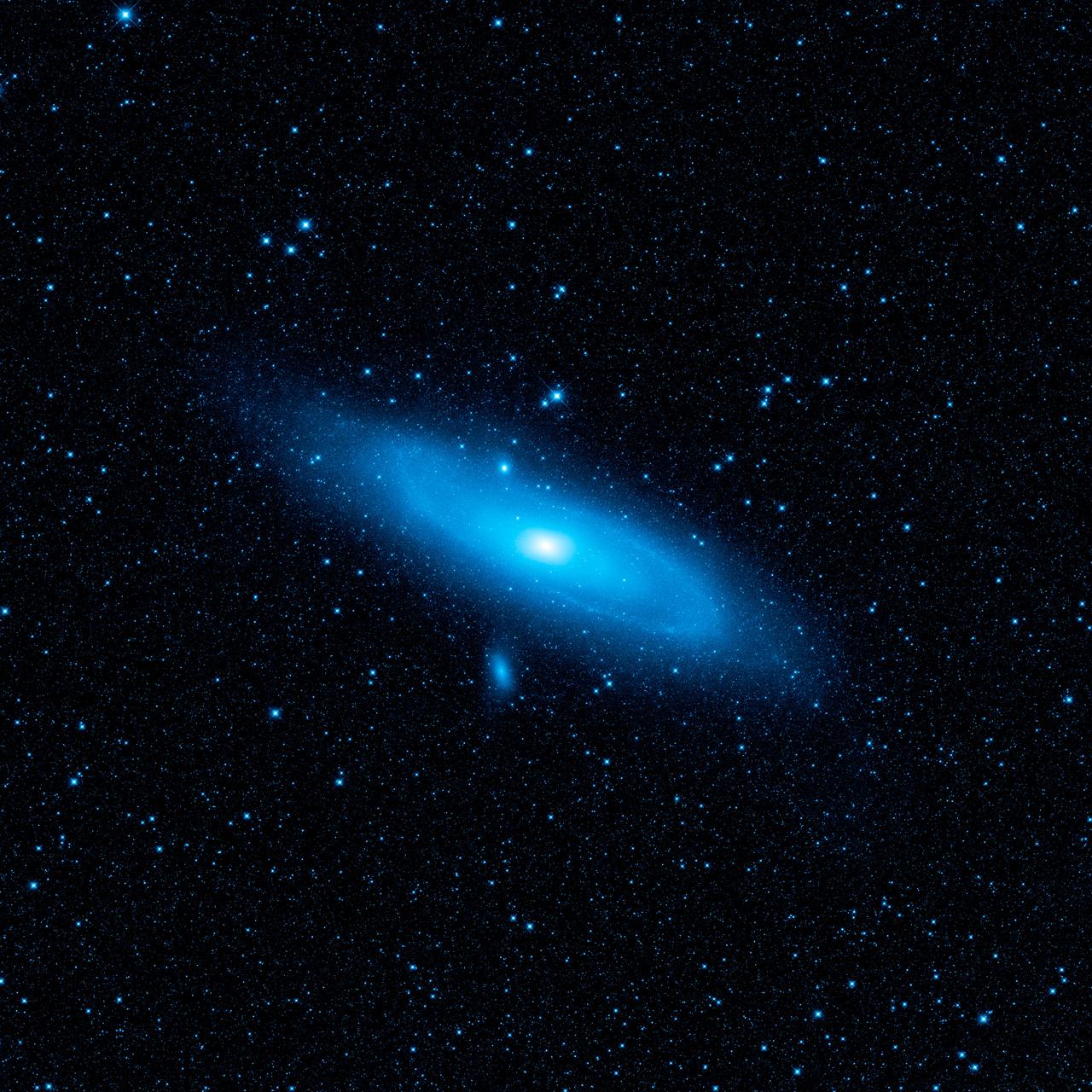
This image from NASA Wide-field Infrared Survey Explorer highlights the Andromeda galaxy older stellar population in blue. A pronounced warp in the disk of the galaxy, the aftermath of a collision with another galaxy, can be seen in the spiral arm.
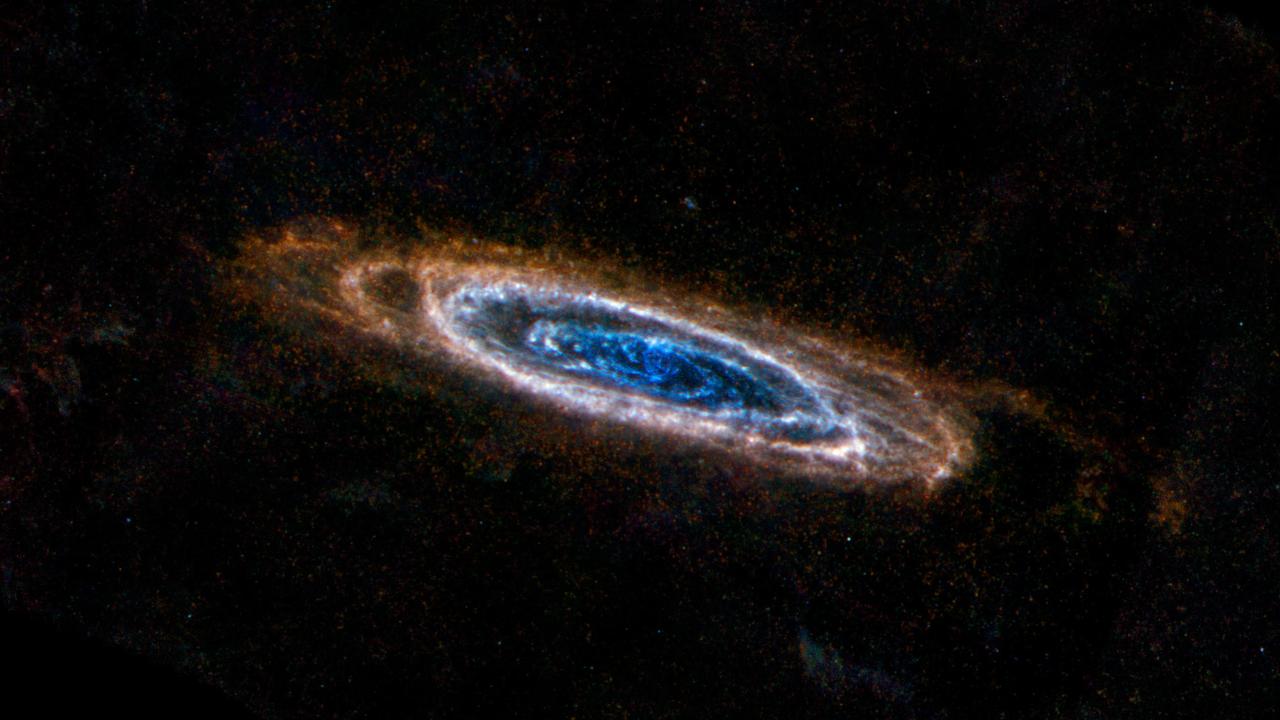
The ring-like swirls of dust filling the Andromeda galaxy stand out colorfully in this new image from the Herschel Space Observatory.
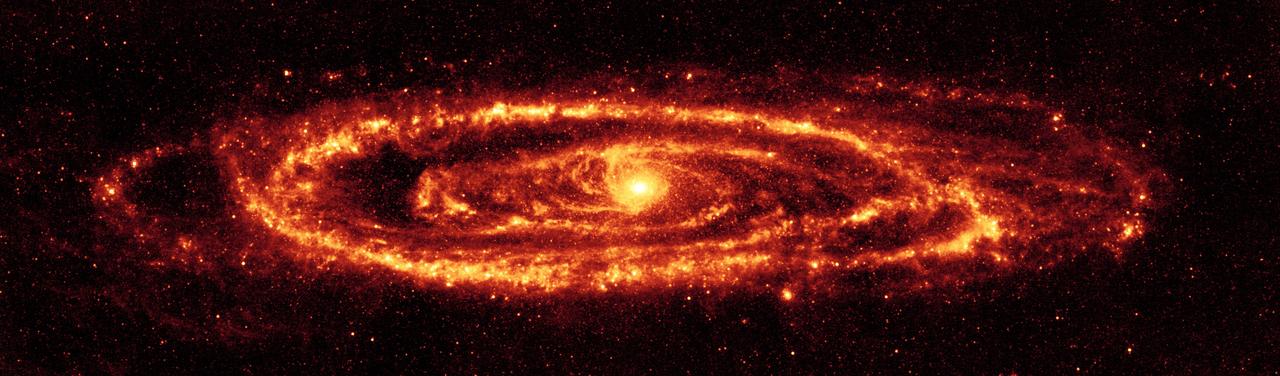
NASA Spitzer Space Telescope has captured this stunning infrared view of the famous galaxy Messier 31, also known as Andromeda.
This image shows the Andromeda galaxy, first as seen in visible light by the National Optical Astronomy Observatory, then as seen in infrared by NASA Spitzer Space Telescope.
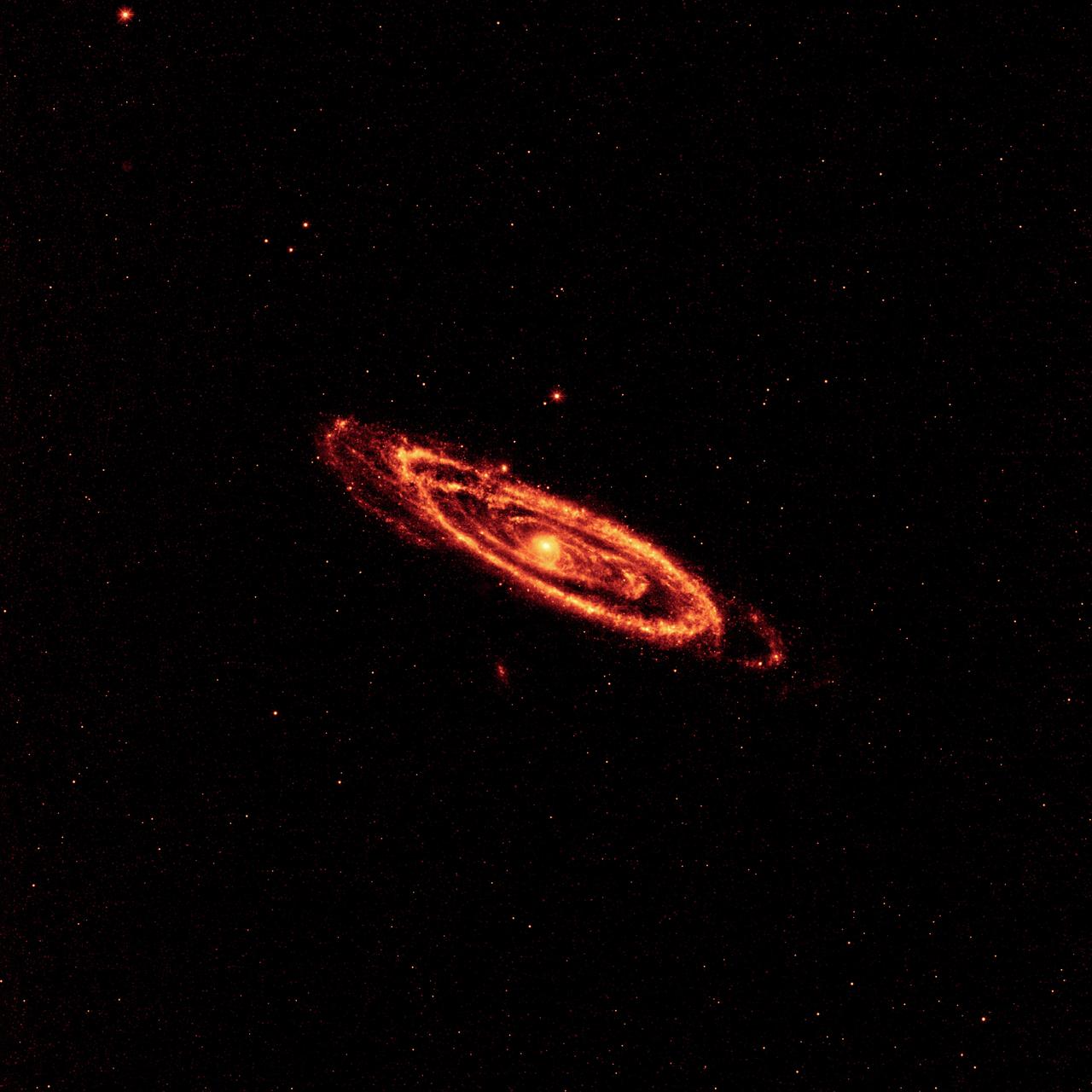
This image from NASA Wide-field Infrared Survey Explorer highlights the dust that speckles the Andromeda galaxy spiral arms. The hot dust, which is being heated by newborn stars, traces the spidery arms all the way to the center of the galaxy.
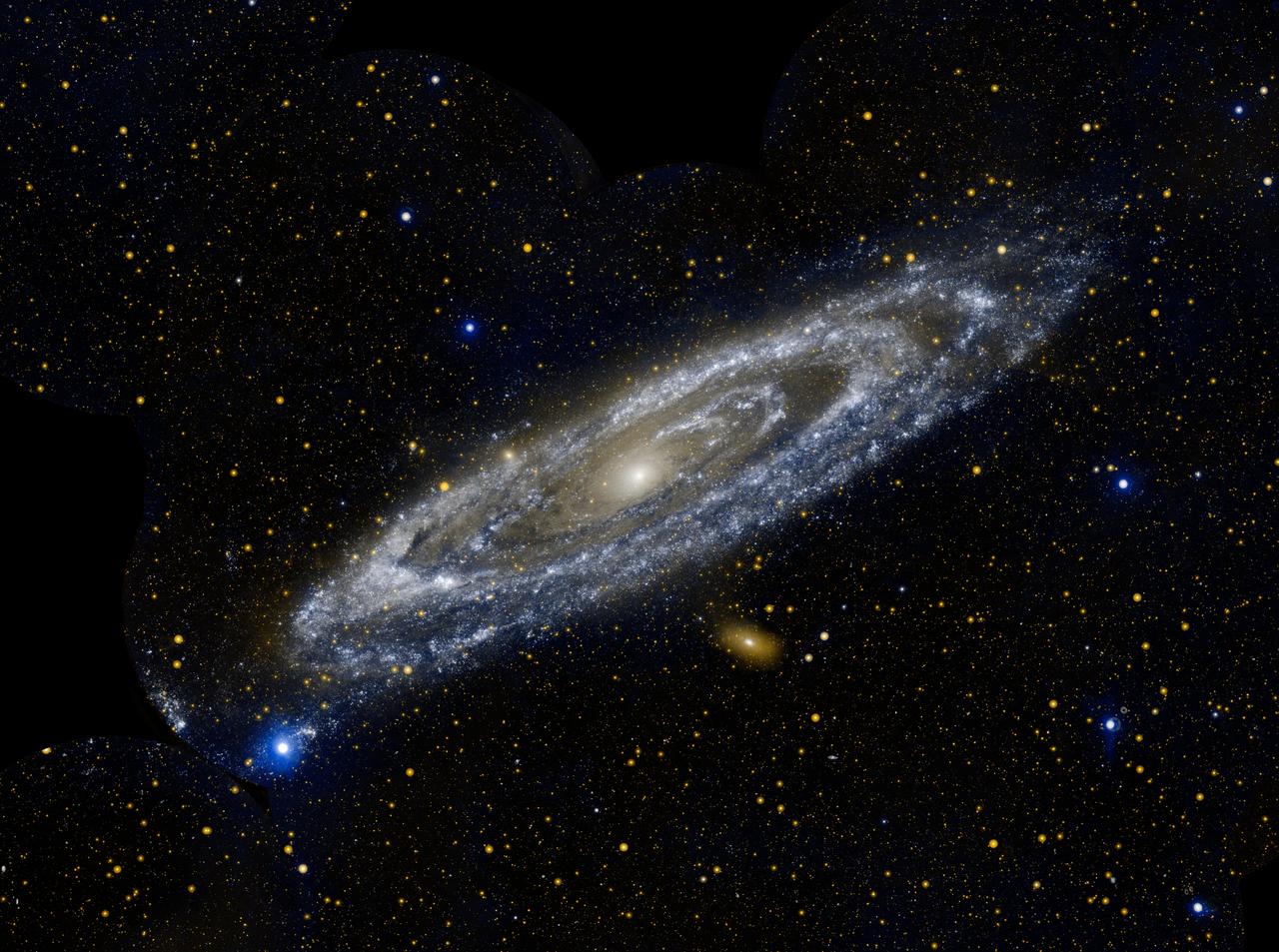
Hot stars burn brightly in this new image from NASA Galaxy Evolution Explorer, showing the ultraviolet side of a familiar face. Approximately 2.5 million light-years away, the Andromeda galaxy, or M31, is our Milky Way largest galactic neighbor.
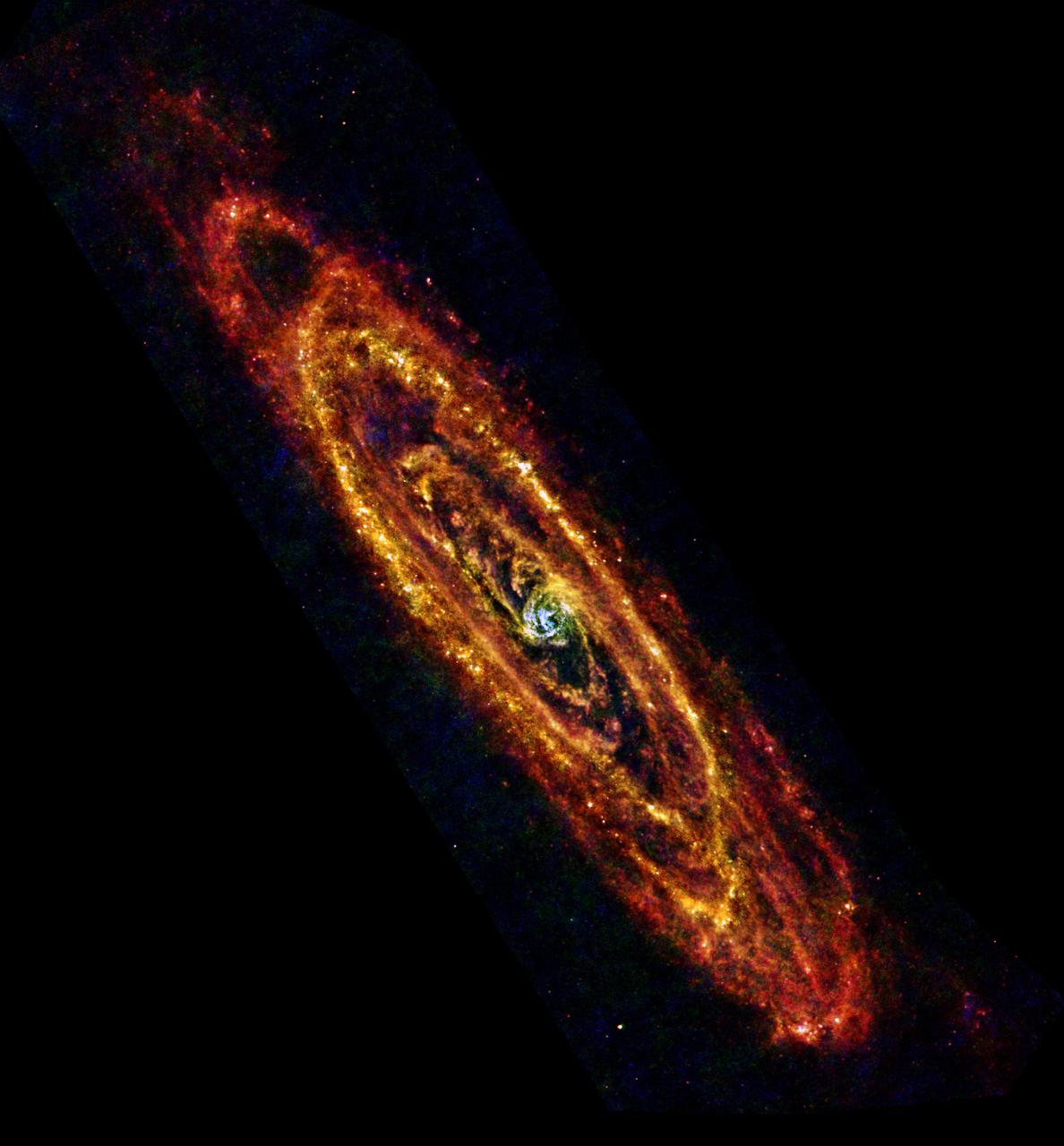
In this new view of the Andromeda, also known as M31, galaxy from the Herschel space observatory, cool lanes of forming stars are revealed in the finest detail yet. M31 is the nearest major galaxy to our own Milky Way at a distance of 2.5 million light-ye
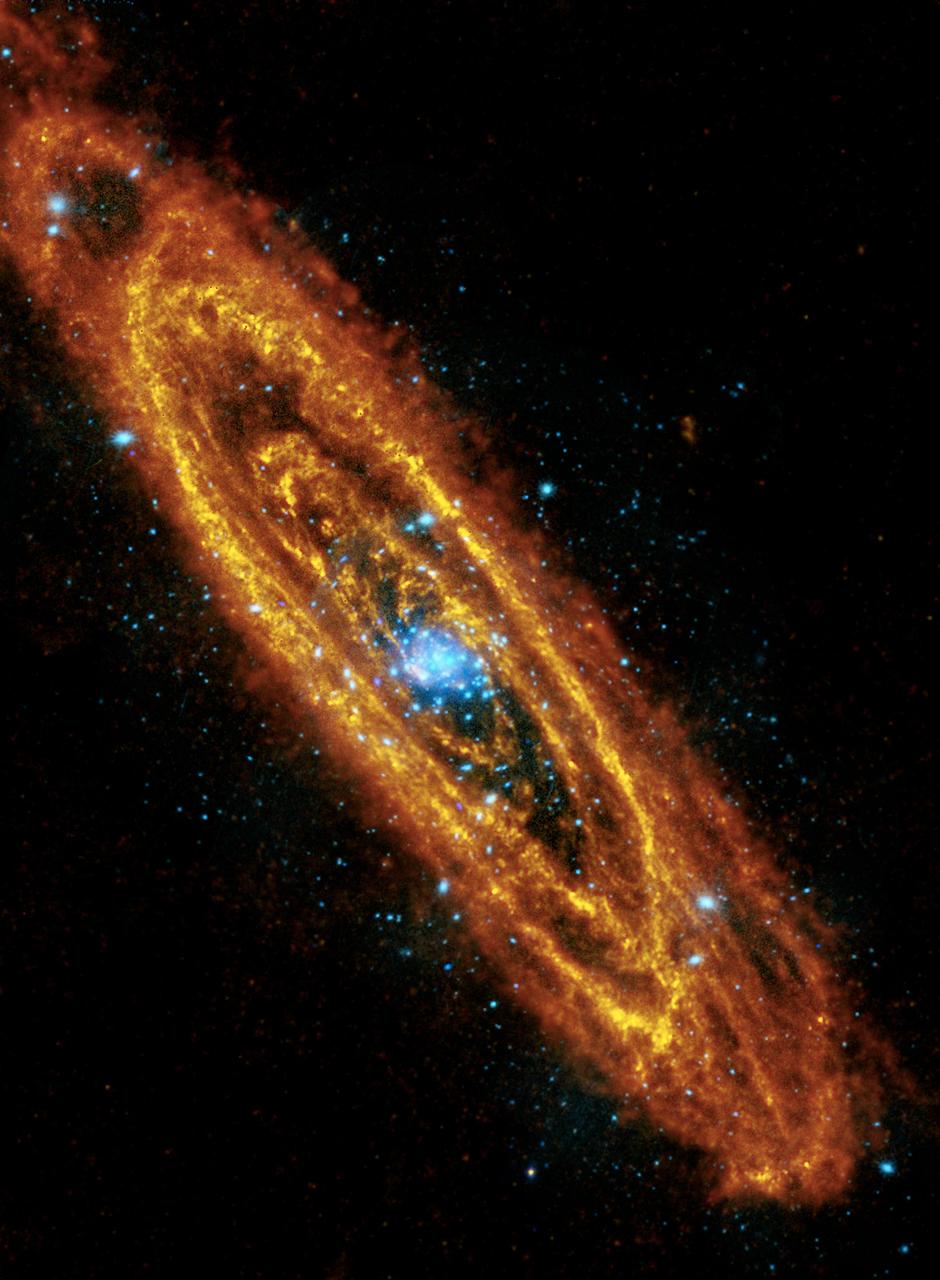
This mosaic of the Andromeda spiral galaxy highlights explosive stars in its interior, and cooler, dusty stars forming in its many rings. This is a combination of observations from the Herschel Space Observatory and the XMM-Newton telescope.
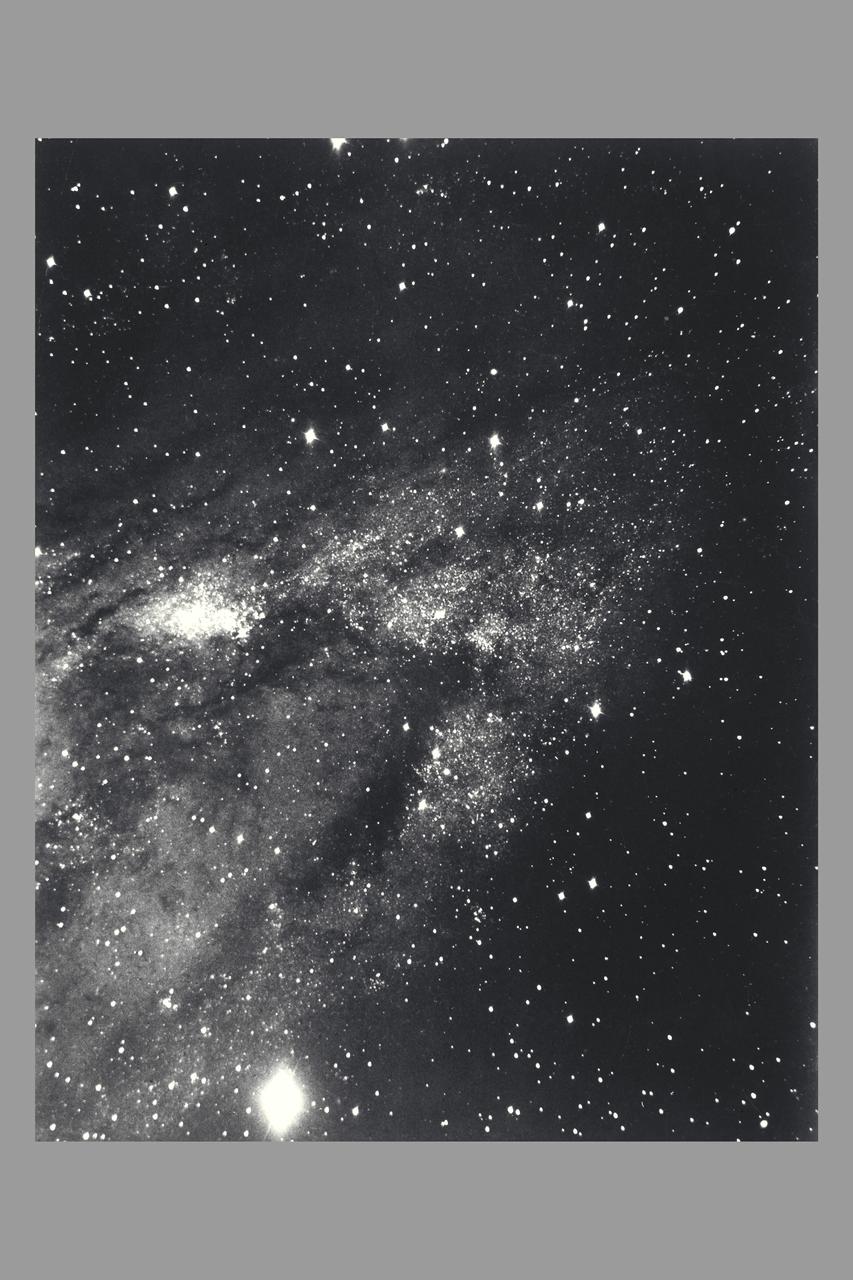
Credit: Mt Wilson/Palomar Observatories - NGC 224 The Great Galaxy, in Andromeda, type Sb. Shows south preceding region resolved inot stars 100-inch

NASA image release January 10, 2011 The Triangulum, located nearly 3 million light years from Earth, is another far galaxy where researchers have found diffuse interstellar bands (DIBs). The detailed observations needed to see DIBs along a straight line from Earth to an individual star in such a distant galaxy stretch the limits of even the largest telescopes. Credit: NASA/Swift Science Team/Stefan Immler To read more go to: <a href="http://www.nasa.gov/topics/universe/features/molecule-fingerprints.html" rel="nofollow">www.nasa.gov/topics/universe/features/molecule-fingerprin...</a> <b><a href="http://www.nasa.gov/centers/goddard/home/index.html" rel="nofollow">NASA Goddard Space Flight Center</a></b> enables NASA’s mission through four scientific endeavors: Earth Science, Heliophysics, Solar System Exploration, and Astrophysics. Goddard plays a leading role in NASA’s accomplishments by contributing compelling scientific knowledge to advance the Agency’s mission. <b>Follow us on <a href="http://twitter.com/NASA_GoddardPix" rel="nofollow">Twitter</a></b> <b>Join us on <a href="http://www.facebook.com/pages/Greenbelt-MD/NASA-Goddard/395013845897?ref=tsd" rel="nofollow">Facebook</a></b>
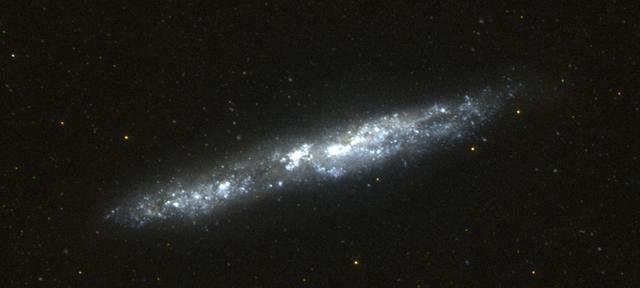
This image of the nearby edge-on spiral galaxy NGC 55 was taken by Galaxy Evolution Explorer on September 14, 2003, during 2 orbits. This galaxy lies 5.4 million light years from our Milky Way galaxy and is a member of the "local group" of galaxies that also includes the Andromeda galaxy (M31), the Magellanic clouds, and 40 other galaxies. The spiral disk of NGC 55 is inclined to our line of sight by approximately 80 degrees and so this galaxy looks cigar-shaped. This picture is a combination of Galaxy Evolution Explorer images taken with the far ultraviolet (colored blue) and near ultraviolet detectors, (colored red). The bright blue regions in this image are areas of active star formation detected in the ultraviolet by Galaxy Evolution Explorer. The red stars in this image are foreground stars in our own Milky Way galaxy. http://photojournal.jpl.nasa.gov/catalog/PIA04923
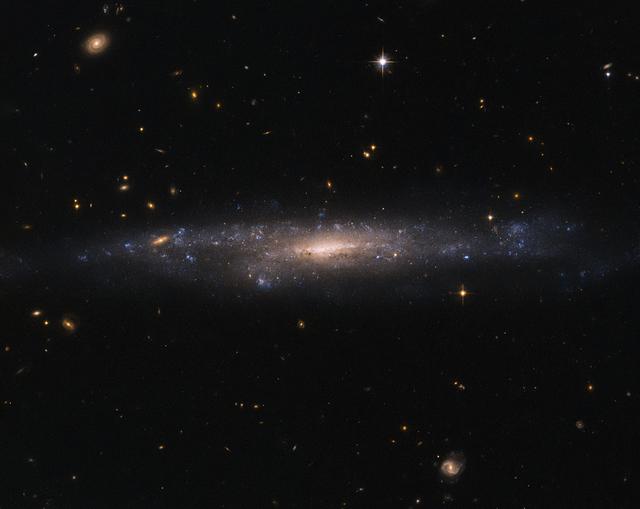
This striking NASA/ESA Hubble Space Telescope image captures the galaxy UGC 477, located just over 110 million light-years away in the constellation of Pisces (The Fish). UGC 477 is a low surface brightness (LSB) galaxy. First proposed in 1976 by Mike Disney, the existence of LSB galaxies was confirmed only in 1986 with the discovery of Malin 1. LSB galaxies like UGC 477 are more diffusely distributed than galaxies such as Andromeda and the Milky Way. With surface brightnesses up to 250 times fainter than the night sky, these galaxies can be incredibly difficult to detect. Most of the matter present in LSB galaxies is in the form of hydrogen gas, rather than stars. Unlike the bulges of normal spiral galaxies, the centres of LSB galaxies do not contain large numbers of stars. Astronomers suspect that this is because LSB galaxies are mainly found in regions devoid of other galaxies, and have therefore experienced fewer galactic interactions and mergers capable of triggering high rates of star formation. LSB galaxies such as UGC 477 instead appear to be dominated by dark matter, making them excellent objects to study to further our understanding of this elusive substance. However, due to an underrepresentation in galactic surveys — caused by their characteristic low brightness — their importance has only been realised relatively recently.
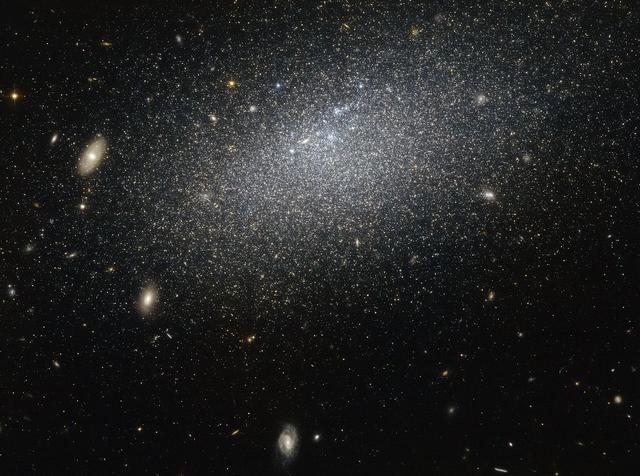
The drizzle of stars scattered across this image forms a galaxy known as UGC 4879. UGC 4879 is an irregular dwarf galaxy — as the name suggests, galaxies of this type are a little smaller and messier than their cosmic cousins, lacking the majestic swirl of a spiral or the coherence of an elliptical. This galaxy is also very isolated. There are about 2.3 million light years between UGC 4879 and its closest neighbour, Leo A, which is about the same distance as that between the Andromeda Galaxy and the Milky Way. This galaxy’s isolation means that it has not interacted with any surrounding galaxies, making it an ideal laboratory for studying star formation uncomplicated by interactions with other galaxies. Studies of UGC 4879 have revealed a significant amount of star formation in the first 4-billion-years after the Big Bang, followed by a strange nine-billion-year lull in star formation, ended 1-billion-years ago by a more recent reignition. The reason for this behaviour, however, remains mysterious, and the solitary galaxy continues to provide ample study material for astronomers looking to understand the complex mysteries of starbirth throughout the Universe.
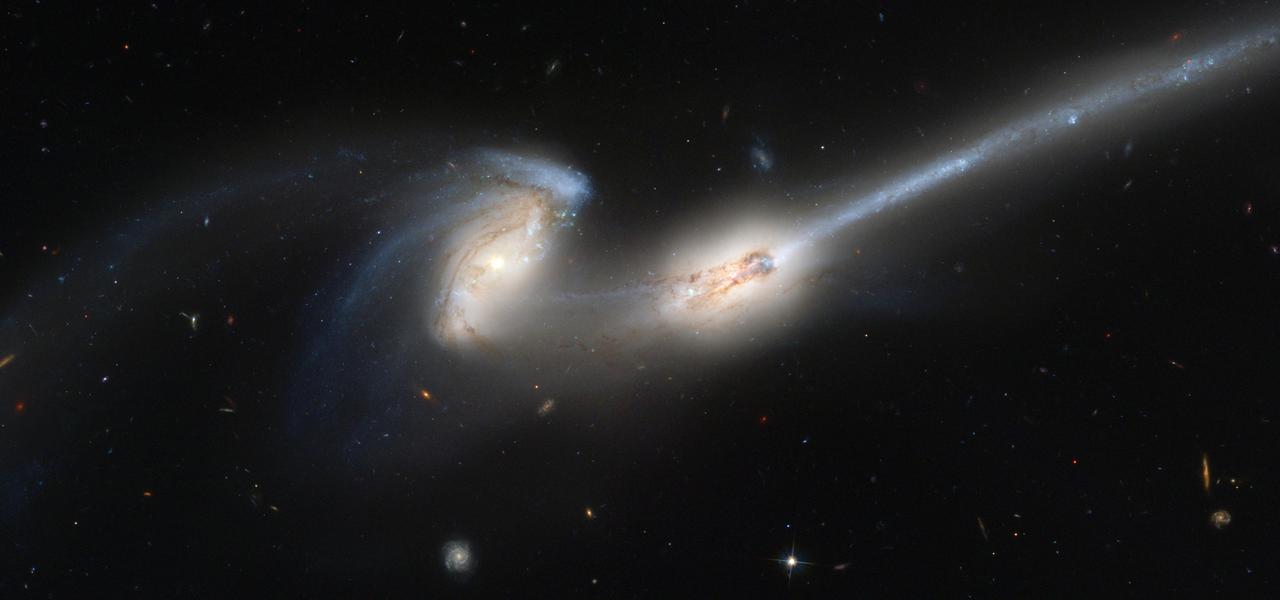
The Advanced Camera for Surveys (ACS), the newest camera on the Hubble Space Telescope, has captured a spectacular pair of galaxies. Located 300 million light-years away in the constellation Coma Berenices, the colliding galaxies have been nicknamed "The Mice" because of the long tails of stars and gas emanating from each galaxy. Otherwise known as NGC 4676, the pair will eventually merge into a single giant galaxy. In the galaxy at left, the bright blue patch is resolved into a vigorous cascade of clusters and associations of young, hot blue stars, whose formation has been triggered by the tidal forces of the gravitational interaction. The clumps of young stars in the long, straight tidal tail (upper right) are separated by fainter regions of material. These dim regions suggest that the clumps of stars have formed from the gravitational collapse of the gas and dust that once occupied those areas. Some of the clumps have luminous masses comparable to dwarf galaxies that orbit the halo of our own Milky Way Galaxy. Computer simulations by astronomers show that we are seeing two near identical spiral galaxies approximately 160 million years after their closest encounter. The simulations also show that the pair will eventually merge, forming a large, nearly spherical galaxy (known as an elliptical galaxy). The Mice presage what may happen to our own Milky Way several billion years from now when it collides with our nearest large neighbor, the Andromeda Galaxy (M31). This picture is assembled from three sets of images taken on April 7, 2002, in blue, orange, and near-infrared filters. Credit: NASA, H. Fort (JHU), G. Illingworth (USCS/LO), M. Clampin (STScI), G. Hartig (STScI), the ACS Science Team, and ESA.

Discovered by British astronomer William Herschel over 200 years ago, NGC 2500 lies about 30 million light-years away in the northern constellation of Lynx. As this NASA/ESA Hubble Space Telescope image shows, NGC 2500 is a particular kind of spiral galaxy known as a barred spiral, its wispy arms swirling out from a bright, elongated core. Barred spirals are actually more common than was once thought. Around two-thirds of all spiral galaxies — including the Milky Way — exhibit these straight bars cutting through their centers. These cosmic structures act as glowing nurseries for newborn stars, and funnel material towards the active core of a galaxy. NGC 2500 is still actively forming new stars, although this process appears to be occurring very unevenly. The upper half of the galaxy — where the spiral arms are slightly better defined — hosts many more star-forming regions than the lower half, as indicated by the bright, dotted islands of light. There is another similarity between NGC 2500 and our home galaxy. Together with Andromeda, Triangulum and many smaller natural satellites, the Milky Way is part of the Local Group of galaxies, a gathering of over 50 galaxies all loosely held together by gravity. NGC 2500 forms a similar group with some of its nearby neighbors, including NGC 2541, NGC 2552, NGC 2537 and the bright, Andromeda-like spiral NGC 2481 (known collectively as the NGC 2841 group). Image Credit: ESA/Hubble/NASA <b><a href="http://www.nasa.gov/audience/formedia/features/MP_Photo_Guidelines.html" rel="nofollow">NASA image use policy.</a></b> <b><a href="http://www.nasa.gov/centers/goddard/home/index.html" rel="nofollow">NASA Goddard Space Flight Center</a></b> enables NASA’s mission through four scientific endeavors: Earth Science, Heliophysics, Solar System Exploration, and Astrophysics. Goddard plays a leading role in NASA’s accomplishments by contributing compelling scientific knowledge to advance the Agency’s mission. <b>Follow us on <a href="http://twitter.com/NASAGoddardPix" rel="nofollow">Twitter</a></b> <b>Like us on <a href="http://www.facebook.com/pages/Greenbelt-MD/NASA-Goddard/395013845897?ref=tsd" rel="nofollow">Facebook</a></b> <b>Find us on <a href="http://instagrid.me/nasagoddard/?vm=grid" rel="nofollow">Instagram</a></b>
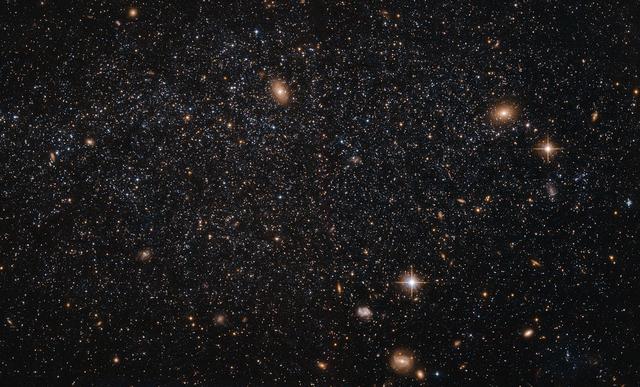
At first glance this NASA/ESA Hubble Space Telescope image seems to show an array of different cosmic objects, but the speckling of stars shown here actually forms a single body — a nearby dwarf galaxy known as Leo A. Its few million stars are so sparsely distributed that some distant background galaxies are visible through it. Leo A itself is at a distance of about 2.5 million light-years from Earth and a member of the Local Group of galaxies; a group that includes the Milky Way and the well-known Andromeda galaxy. Astronomers study dwarf galaxies because they are very numerous and are simpler in structure than their giant cousins. However, their small size makes them difficult to study at great distances. As a result, the dwarf galaxies of the Local Group are of particular interest, as they are close enough to study in detail. As it turns out, Leo A is a rather unusual galaxy. It is one of the most isolated galaxies in the Local Group, has no obvious structural features beyond being a roughly spherical mass of stars, and shows no evidence for recent interactions with any of its few neighbours. However, the galaxy’s contents are overwhelmingly dominated by relatively young stars, something that would normally be the result of a recent interaction with another galaxy. Around 90% of the stars in Leo A are less than eight billion years old — young in cosmic terms! This raises a number of intriguing questions about why star formation in Leo A did not take place on the “usual” timescale, but instead waited until it was good and ready.
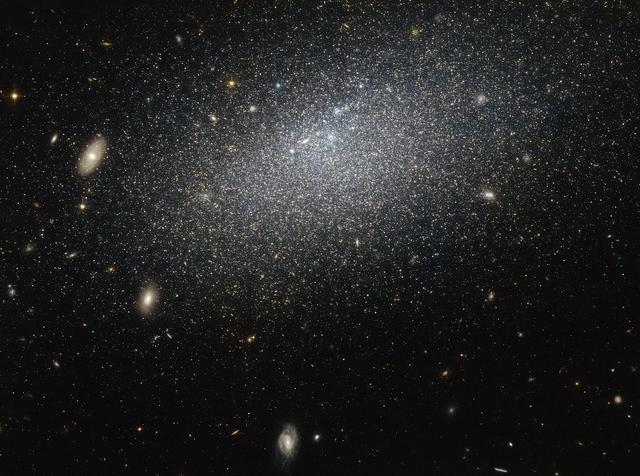
This irregular dwarf galaxy's closes neighbor is 2.3 million light years away, so yeah, we're calling it "isolated". The drizzle of stars scattered across this image forms a galaxy known as UGC 4879. UGC 4879 is an irregular dwarf galaxy — as the name suggests, galaxies of this type are a little smaller and messier than their cosmic cousins, lacking the majestic swirl of a spiral or the coherence of an elliptical. This galaxy is also very isolated. There are about 2.3 million light years between UGC 4879 and its closest neighbor, Leo A, which is about the same distance as that between the Andromeda Galaxy and the Milky Way. This galaxy’s isolation means that it has not interacted with any surrounding galaxies, making it an ideal laboratory for studying star formation uncomplicated by interactions with other galaxies. Studies of UGC 4879 have revealed a significant amount of star formation in the first 4 billion years after the Big Bang, followed by a strange 9-billion-year lull in star formation that ended 1 billion years ago by a more recent re-ignition. The reason for this behavior, however, remains mysterious, and the solitary galaxy continues to provide ample study material for astronomers looking to understand the complex mysteries of star birth throughout the universe. Image credit: NASA/ESA <b><a href="http://www.nasa.gov/audience/formedia/features/MP_Photo_Guidelines.html" rel="nofollow">NASA image use policy.</a></b> <b><a href="http://www.nasa.gov/centers/goddard/home/index.html" rel="nofollow">NASA Goddard Space Flight Center</a></b> enables NASA’s mission through four scientific endeavors: Earth Science, Heliophysics, Solar System Exploration, and Astrophysics. Goddard plays a leading role in NASA’s accomplishments by contributing compelling scientific knowledge to advance the Agency’s mission. <b>Follow us on <a href="http://twitter.com/NASAGoddardPix" rel="nofollow">Twitter</a></b> <b>Like us on <a href="http://www.facebook.com/pages/Greenbelt-MD/NASA-Goddard/395013845897?ref=tsd" rel="nofollow">Facebook</a></b> <b>Find us on <a href="http://instagrid.me/nasagoddard/?vm=grid" rel="nofollow">Instagram</a></b>
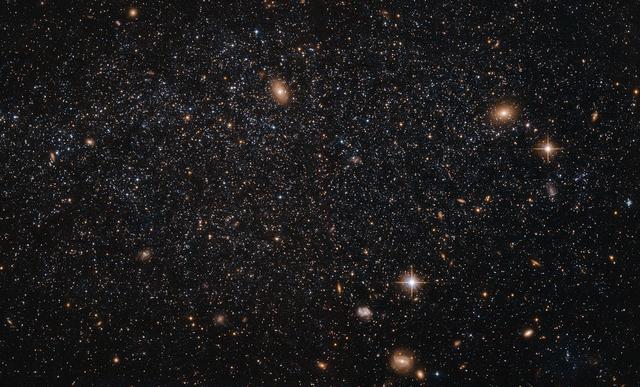
At first glance, this NASA/ESA Hubble Space Telescope image seems to show an array of different cosmic objects, but the speckling of stars shown here actually forms a single body — a nearby dwarf galaxy known as Leo A. Its few million stars are so sparsely distributed that some distant background galaxies are visible through it. Leo A itself is at a distance of about 2.5 million light-years from Earth and a member of the Local Group of galaxies; a group that includes the Milky Way and the well-known Andromeda galaxy. Astronomers study dwarf galaxies because they are very numerous and are simpler in structure than their giant cousins. However, their small size makes them difficult to study at great distances. As a result, the dwarf galaxies of the Local Group are of particular interest, as they are close enough to study in detail. As it turns out, Leo A is a rather unusual galaxy. It is one of the most isolated galaxies in the Local Group, has no obvious structural features beyond being a roughly spherical mass of stars, and shows no evidence for recent interactions with any of its few neighbors. However, the galaxy’s contents are overwhelmingly dominated by relatively young stars, something that would normally be the result of a recent interaction with another galaxy. Around 90% of the stars in Leo A are less than eight billion years old — young in cosmic terms! This raises a number of intriguing questions about why star formation in Leo A did not take place on the “usual” timescale, but instead waited until it was good and ready. Image credit: ESA/Hubble & NASA; Acknowledgment: Judy Schmidt
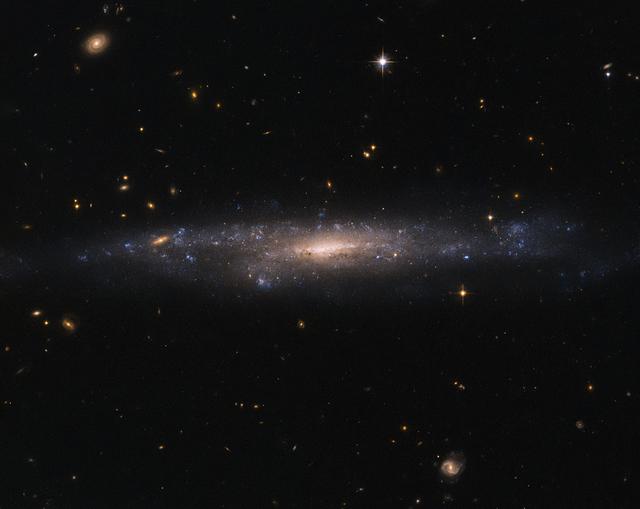
This striking NASA/ESA Hubble Space Telescope image captures the galaxy UGC 477, located just over 110 million light-years away in the constellation of Pisces (The Fish). UGC 477 is a low surface brightness (LSB) galaxy. First proposed in 1976 by Mike Disney, the existence of LSB galaxies was confirmed only in 1986 with the discovery of Malin 1. LSB galaxies like UGC 477 are more diffusely distributed than galaxies such as Andromeda and the Milky Way. With surface brightnesses up to 250 times fainter than the night sky, these galaxies can be incredibly difficult to detect. Most of the matter present in LSB galaxies is in the form of hydrogen gas, rather than stars. Unlike the bulges of normal spiral galaxies, the centers of LSB galaxies do not contain large numbers of stars. Astronomers suspect that this is because LSB galaxies are mainly found in regions devoid of other galaxies, and have therefore experienced fewer galactic interactions and mergers capable of triggering high rates of star formation. LSB galaxies such as UGC 477 instead appear to be dominated by dark matter, making them excellent objects to study to further our understanding of this elusive substance. However, due to an underrepresentation in galactic surveys — caused by their characteristic low brightness — their importance has only been realized relatively recently. Image credit: ESA/Hubble & NASA, Acknowledgement: Judy Schmidt <b><a href="http://www.nasa.gov/audience/formedia/features/MP_Photo_Guidelines.html" rel="nofollow">NASA image use policy.</a></b> <b><a href="http://www.nasa.gov/centers/goddard/home/index.html" rel="nofollow">NASA Goddard Space Flight Center</a></b> enables NASA’s mission through four scientific endeavors: Earth Science, Heliophysics, Solar System Exploration, and Astrophysics. Goddard plays a leading role in NASA’s accomplishments by contributing compelling scientific knowledge to advance the Agency’s mission. <b>Follow us on <a href="http://twitter.com/NASAGoddardPix" rel="nofollow">Twitter</a></b> <b>Like us on <a href="http://www.facebook.com/pages/Greenbelt-MD/NASA-Goddard/395013845897?ref=tsd" rel="nofollow">Facebook</a></b> <b>Find us on <a href="http://instagrid.me/nasagoddard/?vm=grid" rel="nofollow">Instagram</a></b>
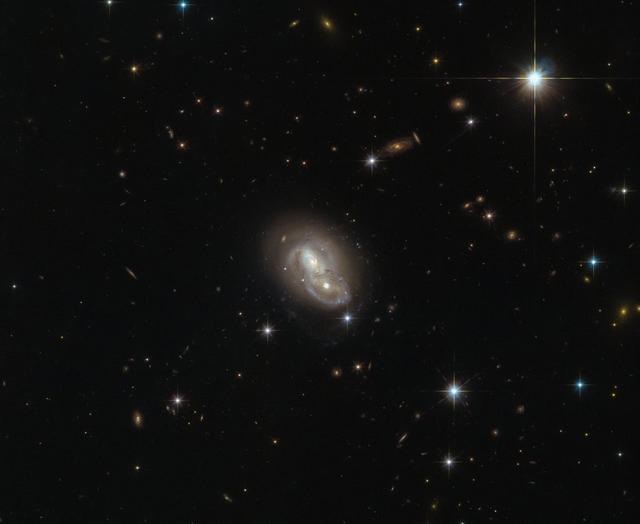
This image from the NASA/ESA Hubble Space Telescope shows the unusual galaxy IRAS 06076-2139, found in the constellation Lepus (The Hare). Hubble’s Wide Field Camera 3 (WFC3) and Advanced Camera for Surveys (ACS) instruments observed the galaxy from a distance of 500 million light-years. This particular object stands out from the crowd by actually being composed of two separate galaxies rushing past each other at about 2 million kilometers (1,243,000 miles) per hour. This speed is most likely too fast for them to merge and form a single galaxy. However, because of their small separation of only about 20,000 light-years, the galaxies will distort one another through the force of gravity while passing each other, changing their structures on a grand scale. Such galactic interactions are a common sight for Hubble, and have long been a field of study for astronomers. The intriguing behaviors of interacting galaxies take many forms; galactic cannibalism, galaxy harassment and even galaxy collisions. The Milky Way itself will eventually fall victim to the latter, merging with the Andromeda Galaxy in about 4.5 billion years. The fate of our galaxy shouldn’t be alarming though: while galaxies are populated by billions of stars, the distances between individual stars are so large that hardly any stellar collisions will occur. Credit: ESA/Hubble & NASA <b><a href="http://www.nasa.gov/audience/formedia/features/MP_Photo_Guidelines.html" rel="nofollow">NASA image use policy.</a></b> <b><a href="http://www.nasa.gov/centers/goddard/home/index.html" rel="nofollow">NASA Goddard Space Flight Center</a></b> enables NASA’s mission through four scientific endeavors: Earth Science, Heliophysics, Solar System Exploration, and Astrophysics. Goddard plays a leading role in NASA’s accomplishments by contributing compelling scientific knowledge to advance the Agency’s mission. <b>Follow us on <a href="http://twitter.com/NASAGoddardPix" rel="nofollow">Twitter</a></b> <b>Like us on <a href="http://www.facebook.com/pages/Greenbelt-MD/NASA-Goddard/395013845897?ref=tsd" rel="nofollow">Facebook</a></b> <b>Find us on <a href="http://instagrid.me/nasagoddard/?vm=grid" rel="nofollow">Instagram</a></b>
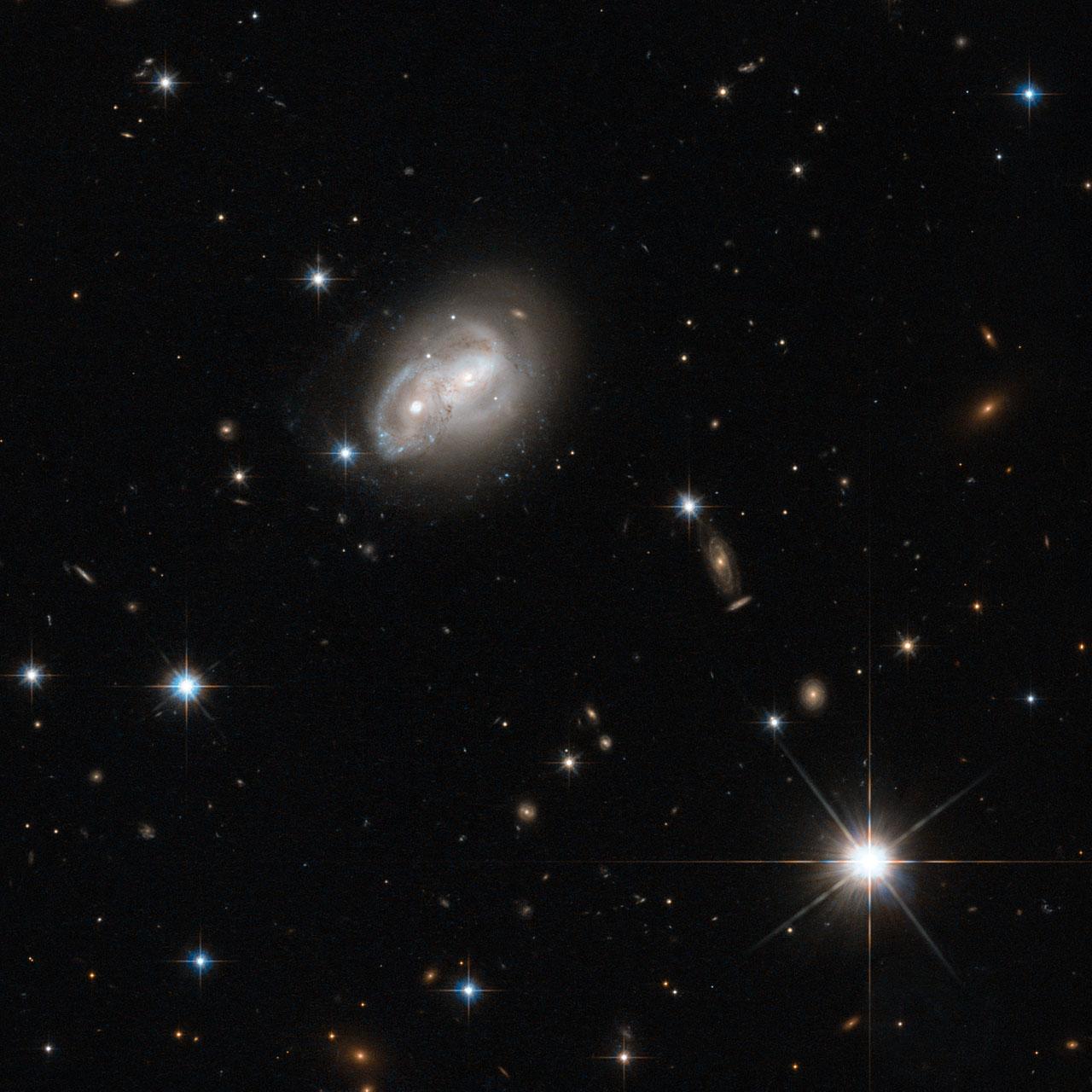
From objects as small as Newton's apple to those as large as a galaxy, no physical body is free from the stern bonds of gravity, as evidenced in this stunning picture captured by the Wide Field Camera 3 and Advanced Camera for Surveys onboard the NASA/ESA Hubble Space Telescope. Here we see two spiral galaxies engaged in a cosmic tug-of-war — but in this contest, there will be no winner. The structures of both objects are slowly distorted to resemble new forms, and in some cases, merge together to form new, super galaxies. This particular fate is similar to that of the Milky Way Galaxy, when it will ultimately merge with our closest galactic partner, the Andromeda Galaxy. There is no need to panic however, as this process takes several hundreds of millions of years. Not all interacting galaxies result in mergers though. The merger is dependent on the mass of each galaxy, as well as the relative velocities of each body. It is quite possible that the event pictured here, romantically named 2MASX J06094582-2140234, will avoid a merger event altogether, and will merely distort the arms of each spiral without colliding — the cosmic equivalent of a hair ruffling! These galactic interactions also trigger new regions of star formation in the galaxies involved, causing them to be extremely luminous in the infrared part of the spectrum. For this reason, these types of galaxies are referred to as LIRGs, or Luminous Infrared Galaxies. This image was taken as part of as part of a Hubble survey of the central regions of LIRGs in the local Universe, which also used the Near Infrared Camera and Multi-Object Spectrometer (NICMOS) instrument. Credit: ESA/Hubble & NASA, Acknowledgement: Luca Limatola <b><a href="http://www.nasa.gov/audience/formedia/features/MP_Photo_Guidelines.html" rel="nofollow">NASA image use policy.</a></b> <b><a href="http://www.nasa.gov/centers/goddard/home/index.html" rel="nofollow">NASA Goddard Space Flight Center</a></b> enables NASA’s mission through four scientific endeavors: Earth Science, Heliophysics, Solar System Exploration, and Astrophysics. Goddard plays a leading role in NASA’s accomplishments by contributing compelling scientific knowledge to advance the Agency’s mission. <b>Follow us on <a href="http://twitter.com/NASAGoddardPix" rel="nofollow">Twitter</a></b> <b>Like us on <a href="http://www.facebook.com/pages/Greenbelt-MD/NASA-Goddard/395013845897?ref=tsd" rel="nofollow">Facebook</a></b> <b>Find us on <a href="http://instagram.com/nasagoddard?vm=grid" rel="nofollow">Instagram</a></b>

NASA image release Thursday, May 31, 2012 <b>To view a video from this Hubble release go to: <a href="http://www.flickr.com/photos/gsfc/7309212940">www.flickr.com/photos/gsfc/7309212940</a> </b> Caption: This illustration shows a stage in the predicted merger between our Milky Way galaxy and the neighboring Andromeda galaxy, as it will unfold over the next several billion years. In this image, representing Earth's night sky in 3.75 billion years, Andromeda (left) fills the field of view and begins to distort the Milky Way with tidal pull. Credit: NASA; ESA; Z. Levay and R. van der Marel, STScI; T. Hallas; and A. Mellinger To read more go to: <a href="http://www.nasa.gov/mission_pages/hubble/science/milky-way-collide.html" rel="nofollow">www.nasa.gov/mission_pages/hubble/science/milky-way-colli...</a> <b><a href="http://www.nasa.gov/audience/formedia/features/MP_Photo_Guidelines.html" rel="nofollow">NASA image use policy.</a></b> <b><a href="http://www.nasa.gov/centers/goddard/home/index.html" rel="nofollow">NASA Goddard Space Flight Center</a></b> enables NASA’s mission through four scientific endeavors: Earth Science, Heliophysics, Solar System Exploration, and Astrophysics. Goddard plays a leading role in NASA’s accomplishments by contributing compelling scientific knowledge to advance the Agency’s mission. <b>Follow us on <a href="http://twitter.com/NASA_GoddardPix" rel="nofollow">Twitter</a></b> <b>Like us on <a href="http://www.facebook.com/pages/Greenbelt-MD/NASA-Goddard/395013845897?ref=tsd" rel="nofollow">Facebook</a></b> <b>Find us on <a href="http://instagrid.me/nasagoddard/?vm=grid" rel="nofollow">Instagram</a></b>
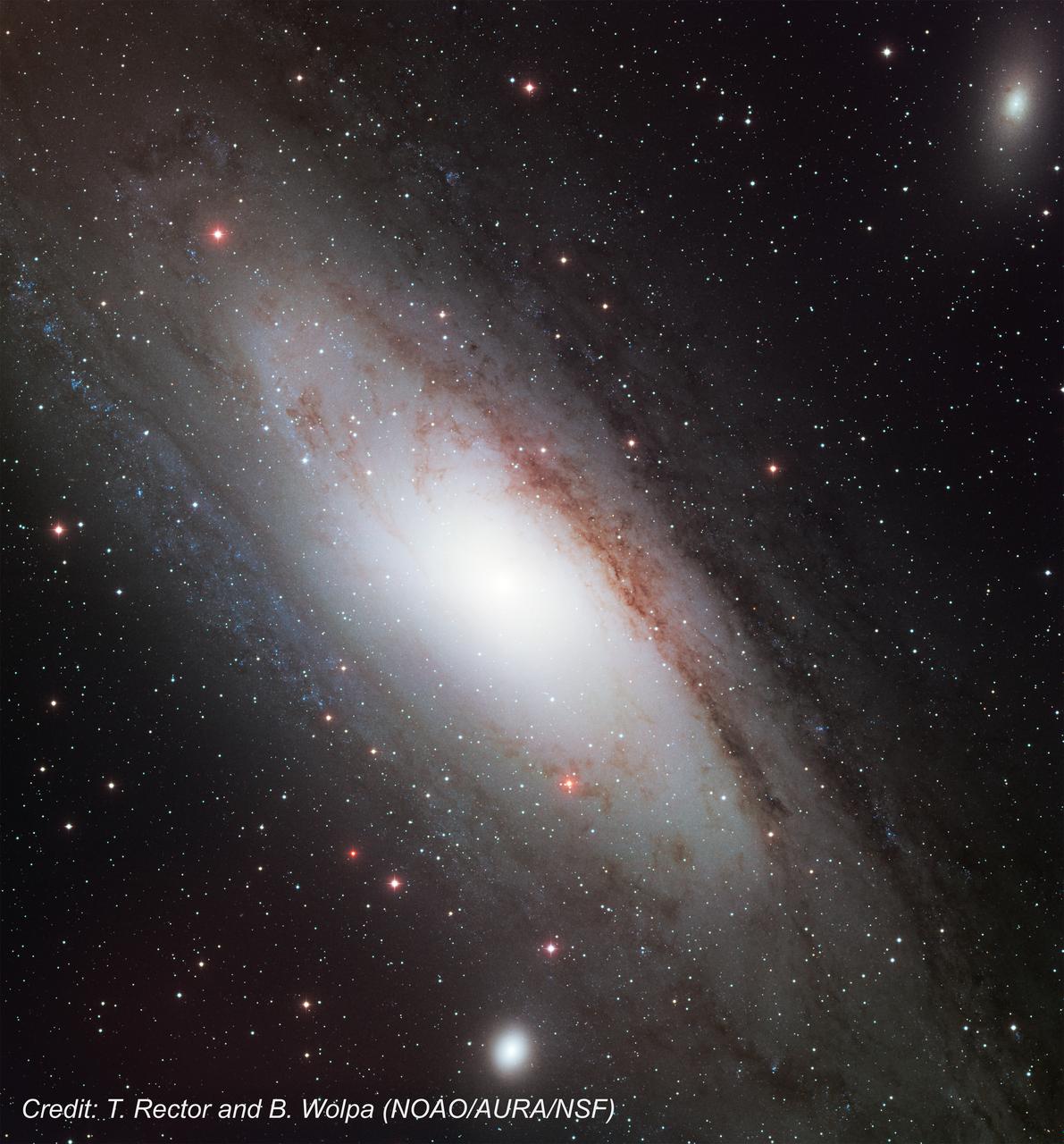
Image release January 11, 2012 A new Hubble Space Telescope image centers on the 100-million-solar-mass black hole at the hub of the neighboring spiral galaxy M31, or the Andromeda galaxy, one of the few galaxies outside the Milky Way visible to the naked eye and the only other giant galaxy in the Local Group. This is the sharpest visible-light image ever made of the nucleus of an external galaxy. The Hubble image is being presented today at the meeting of the American Astronomical Society in Austin, Texas. To read more go to: <a href="http://www.nasa.gov/mission_pages/hubble/science/ultra-blue.html" rel="nofollow">www.nasa.gov/mission_pages/hubble/science/ultra-blue.html</a> <b><a href="http://www.nasa.gov/audience/formedia/features/MP_Photo_Guidelines.html" rel="nofollow">NASA image use policy.</a></b> <b><a href="http://www.nasa.gov/centers/goddard/home/index.html" rel="nofollow">NASA Goddard Space Flight Center</a></b> enables NASA’s mission through four scientific endeavors: Earth Science, Heliophysics, Solar System Exploration, and Astrophysics. Goddard plays a leading role in NASA’s accomplishments by contributing compelling scientific knowledge to advance the Agency’s mission. <b>Follow us on <a href="http://twitter.com/NASA_GoddardPix" rel="nofollow">Twitter</a></b> <b>Like us on <a href="http://www.facebook.com/pages/Greenbelt-MD/NASA-Goddard/395013845897?ref=tsd" rel="nofollow">Facebook</a></b> <b>Find us on <a href="http://instagrid.me/nasagoddard/?vm=grid" rel="nofollow">Instagram</a></b>