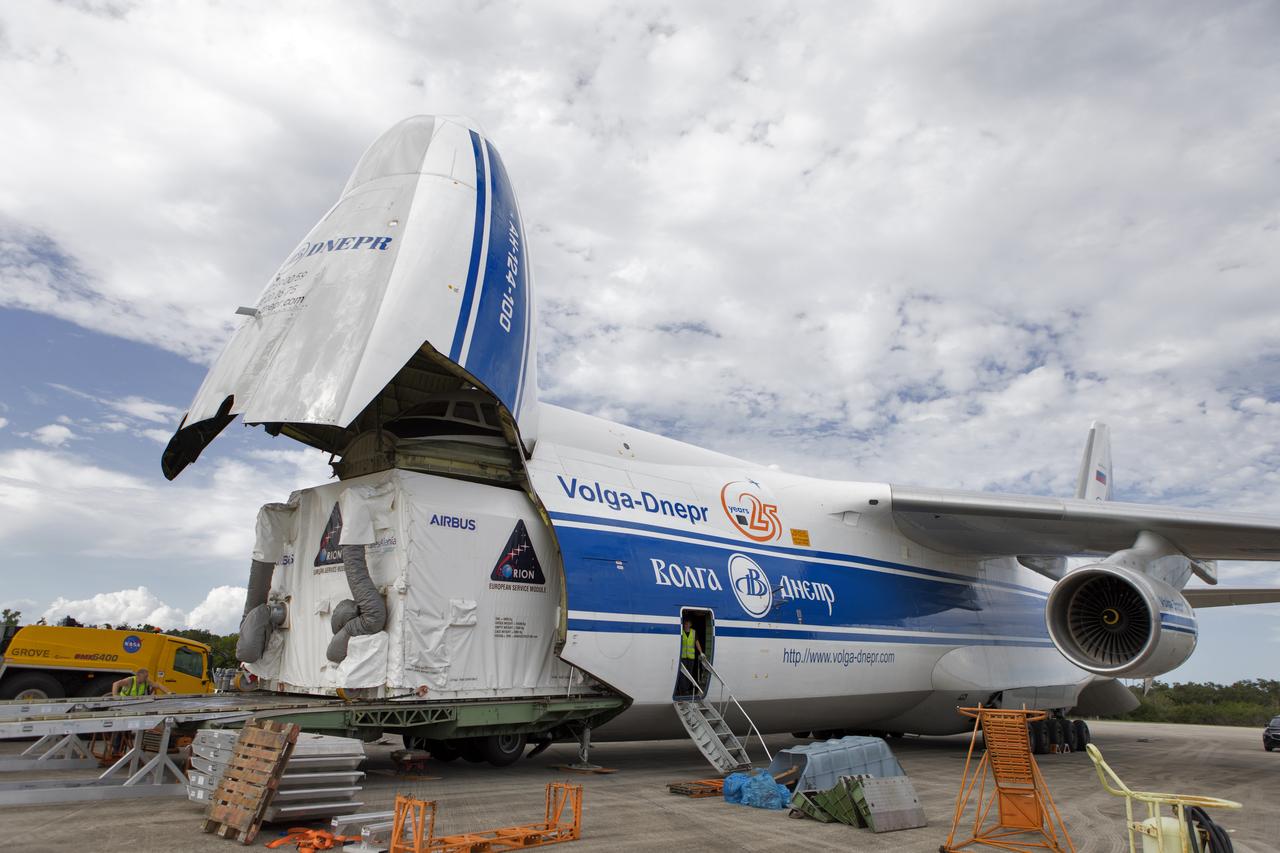
The shipping container holding the European Service Module (ESM) is moved out of the cargo hold of the Antonov cargo aircraft at the Shuttle Landing Facility at NASA's Kennedy Space Center in Florida on Nov. 6, 2018. The ESM, built by the European Space Agency, will supply the main propulsion system and power to the Orion spacecraft for Exploration Mission-1 (EM-1), a mission to the Moon. The ESM also will house air and water for astronauts on future missions. EM-1 will be an uncrewed flight test that will provide a foundation for human deep space exploration to destinations beyond Earth orbit. EM-1 will be the first integrated test of NASA's Space Launch System, Orion and the ground systems at Kennedy.
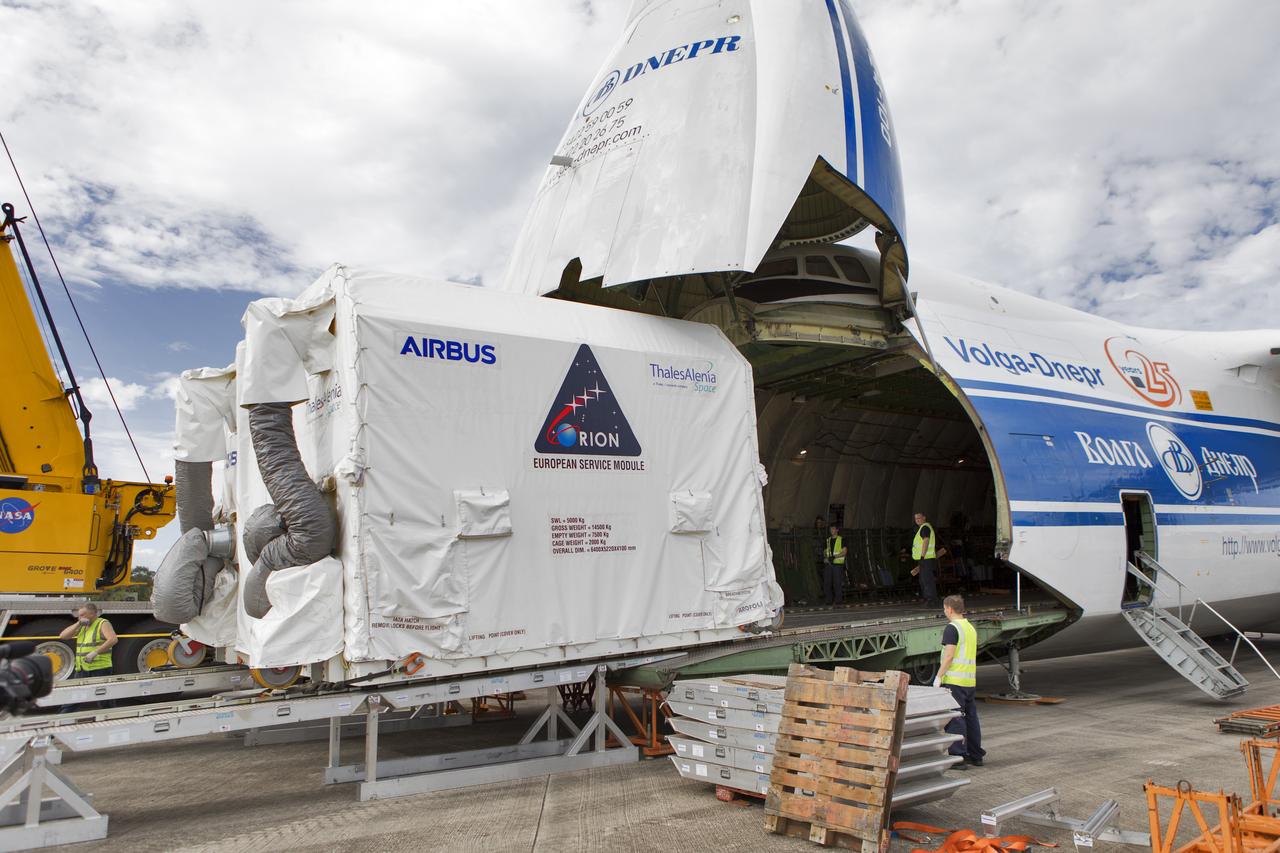
The shipping container holding the European Service Module (ESM) is moved out of the cargo hold of the Antonov cargo aircraft at the Shuttle Landing Facility at NASA's Kennedy Space Center in Florida on Nov. 6, 2018. The ESM, built by the European Space Agency, will supply the main propulsion system and power to the Orion spacecraft for Exploration Mission-1 (EM-1), a mission to the Moon. The ESM also will house air and water for astronauts on future missions. EM-1 will be an uncrewed flight test that will provide a foundation for human deep space exploration to destinations beyond Earth orbit. EM-1 will be the first integrated test of NASA's Space Launch System, Orion and the ground systems at Kennedy.
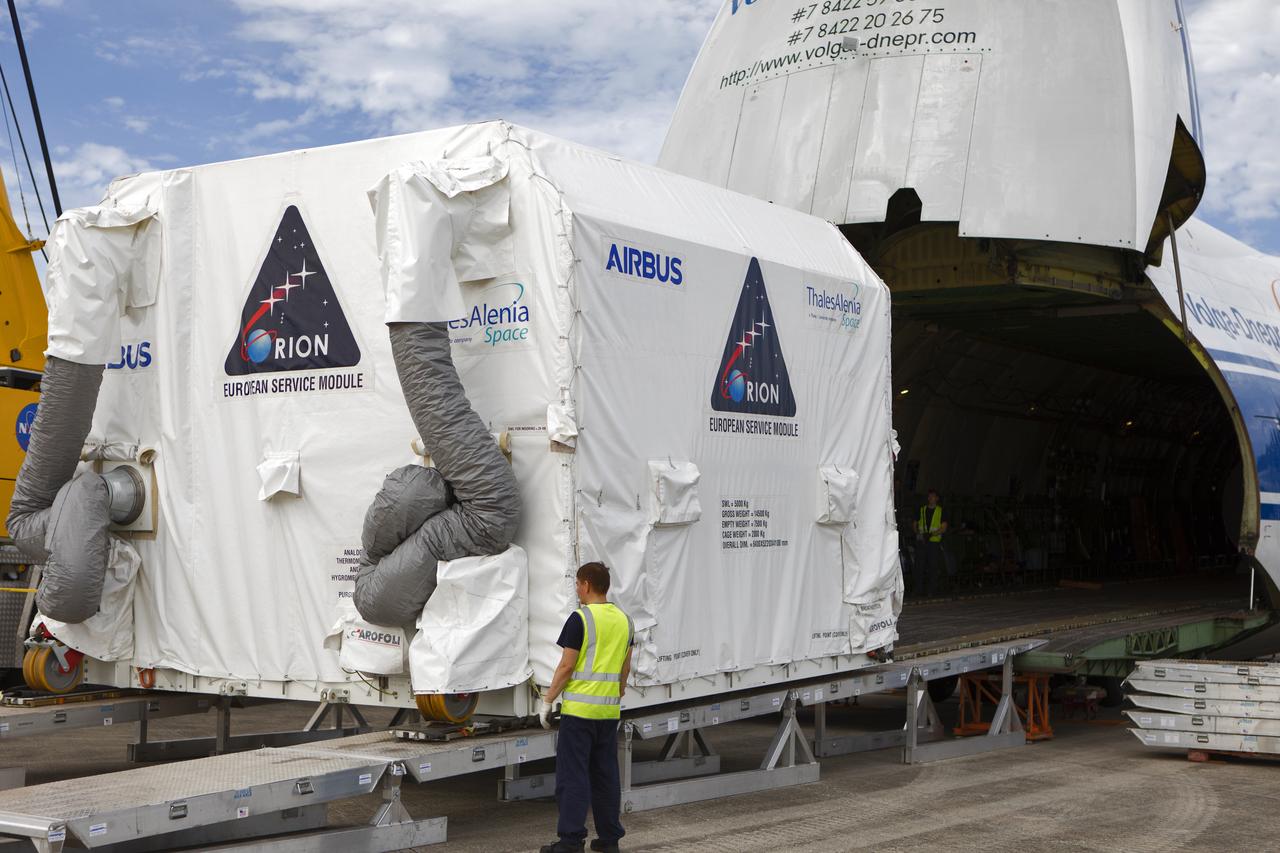
The shipping container holding the European Service Module (ESM) is moved out of the cargo hold of the Antonov cargo aircraft at the Shuttle Landing Facility at NASA's Kennedy Space Center in Florida on Nov. 6, 2018. The ESM, built by the European Space Agency, will supply the main propulsion system and power to the Orion spacecraft for Exploration Mission-1 (EM-1), a mission to the Moon. The ESM also will house air and water for astronauts on future missions. EM-1 will be an uncrewed flight test that will provide a foundation for human deep space exploration to destinations beyond Earth orbit. EM-1 will be the first integrated test of NASA's Space Launch System, Orion and the ground systems at Kennedy.
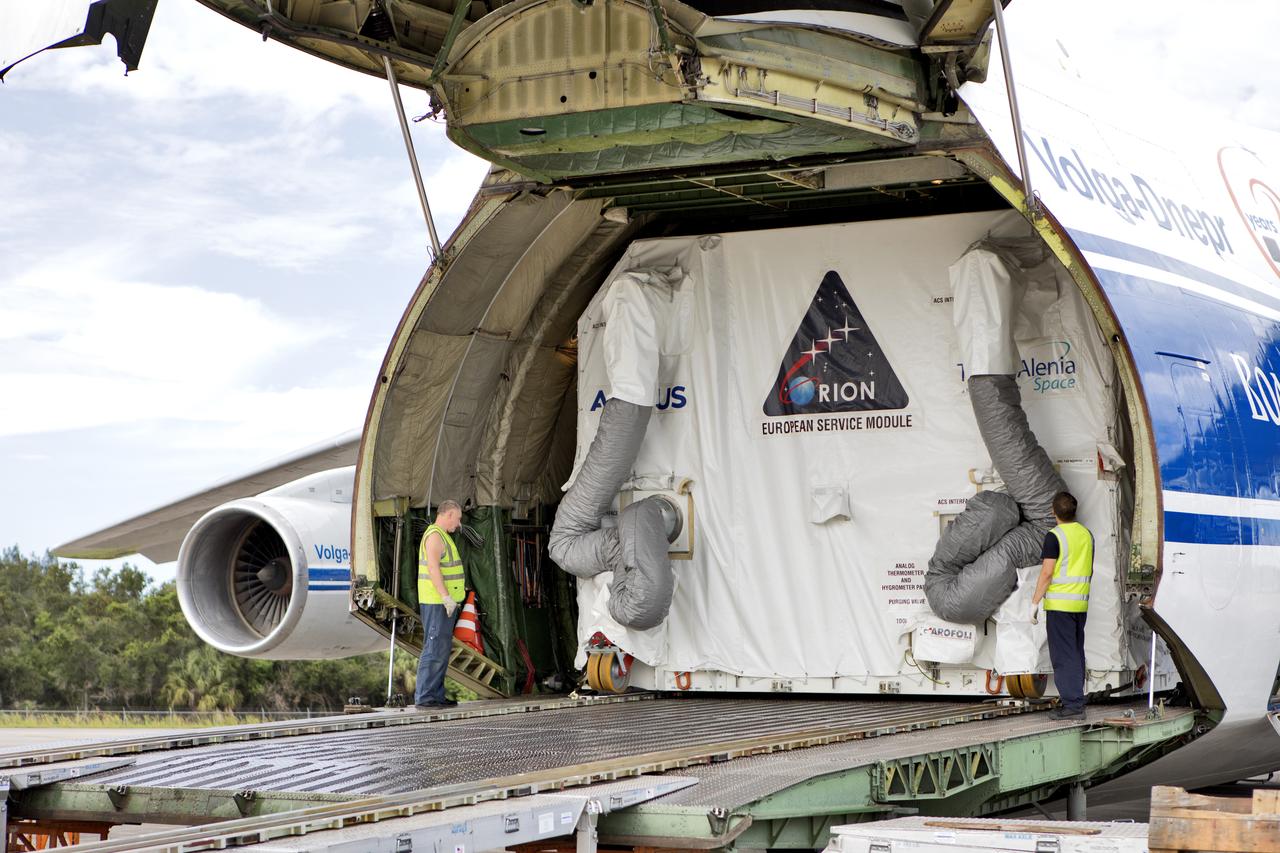
The shipping container holding the European Service Module (ESM) is moved out of the cargo hold of the Antonov cargo aircraft at the Shuttle Landing Facility at NASA's Kennedy Space Center in Florida on Nov. 6, 2018. The ESM, built by the European Space Agency, will supply the main propulsion system and power to the Orion spacecraft for Exploration Mission-1 (EM-1), a mission to the Moon. The ESM also will house air and water for astronauts on future missions. EM-1 will be an uncrewed flight test that will provide a foundation for human deep space exploration to destinations beyond Earth orbit. EM-1 will be the first integrated test of NASA's Space Launch System, Orion and the ground systems at Kennedy.
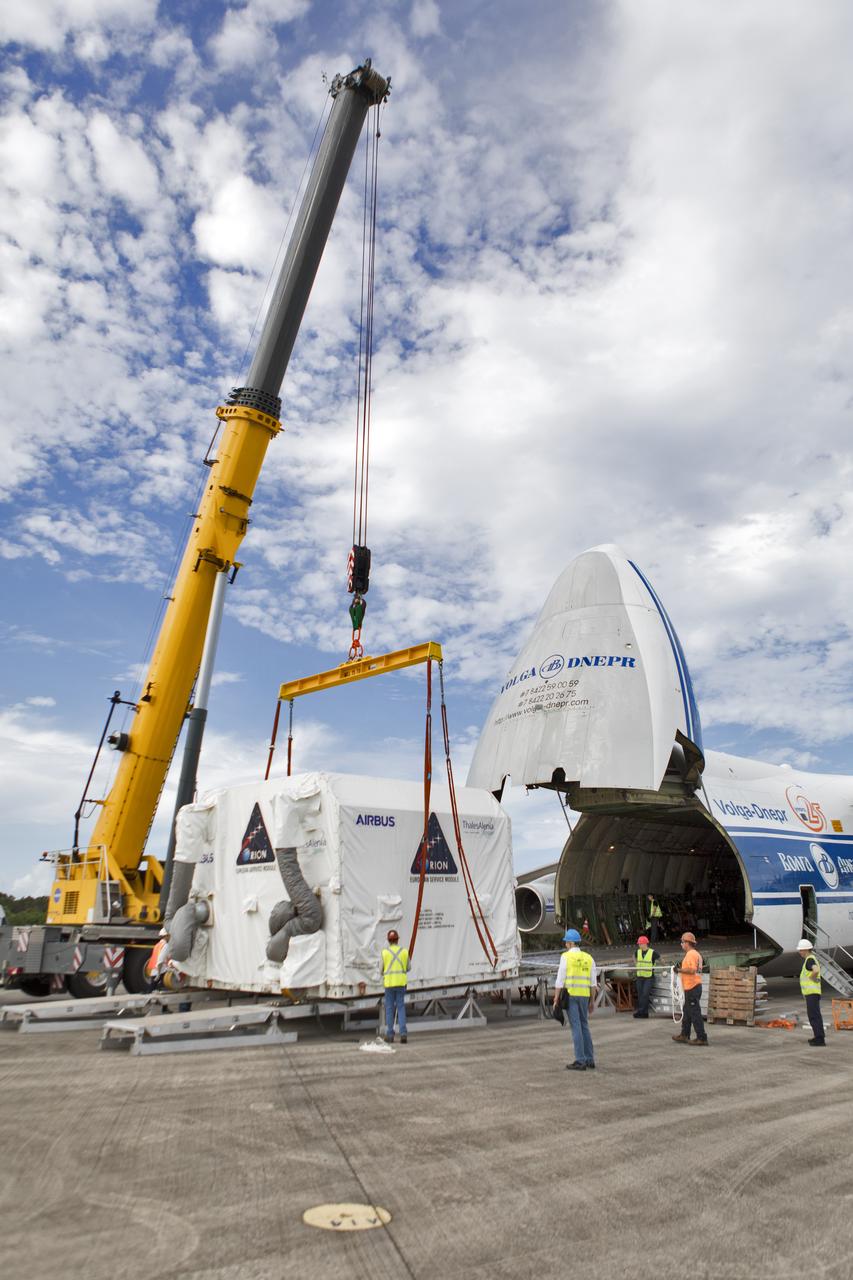
A crane is attached to the shipping container holding the European Service Module (ESM) after it was moved out of the cargo hold of the Antonov cargo aircraft at the Shuttle Landing Facility at NASA's Kennedy Space Center in Florida on Nov. 6, 2018. The ESM, built by the European Space Agency, will supply the main propulsion system and power to the Orion spacecraft for Exploration Mission-1 (EM-1), a mission to the Moon. The ESM also will house air and water for astronauts on future missions. EM-1 will be an uncrewed flight test that will provide a foundation for human deep space exploration to destinations beyond Earth orbit. EM-1 will be the first integrated test of NASA's Space Launch System, Orion and the ground systems at Kennedy.
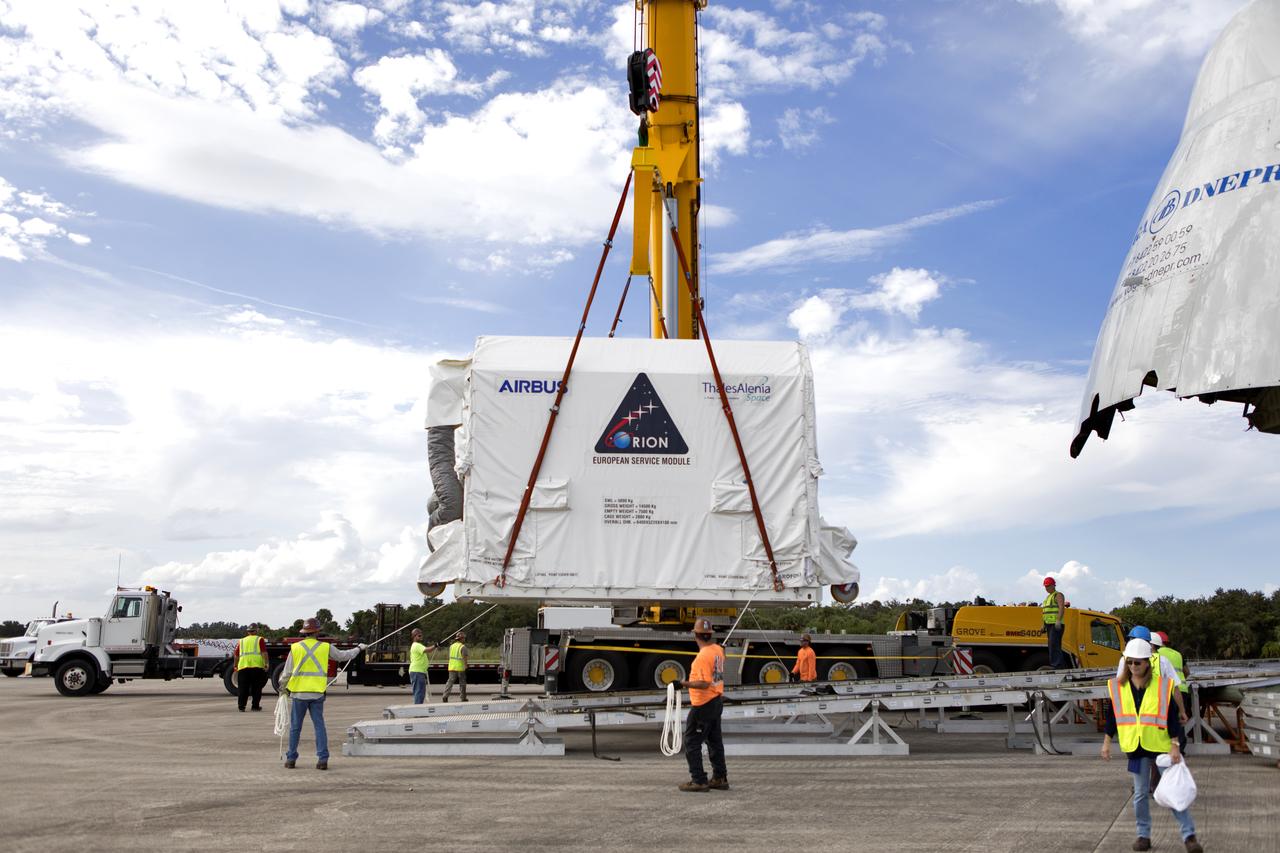
A crane lifts the shipping container holding the European Service Module (ESM) after it was moved out of the cargo hold of the Antonov cargo aircraft at the Shuttle Landing Facility at NASA's Kennedy Space Center in Florida on Nov. 6, 2018. The ESM, built by the European Space Agency, will supply the main propulsion system and power to the Orion spacecraft for Exploration Mission-1 (EM-1), a mission to the Moon. The ESM also will house air and water for astronauts on future missions. EM-1 will be an uncrewed flight test that will provide a foundation for human deep space exploration to destinations beyond Earth orbit. EM-1 will be the first integrated test of NASA's Space Launch System, Orion and the ground systems at Kennedy.

Technicians operate a forklift to lift the European Service Module (ESM) out of the cargo hold of the Antonov cargo aircraft at the Shuttle Landing Facility at NASA's Kennedy Space Center in Florida on Nov. 6, 2018. The ESM, built by the European Space Agency, will supply the main propulsion system and power to the Orion spacecraft for Exploration Mission-1 (EM-1), a mission to the Moon. The ESM also will house air and water for astronauts on future missions. EM-1 will be an uncrewed flight test that will provide a foundation for human deep space exploration to destinations beyond Earth orbit. EM-1 will be the first integrated test of NASA's Space Launch System, Orion and the ground systems at Kennedy.
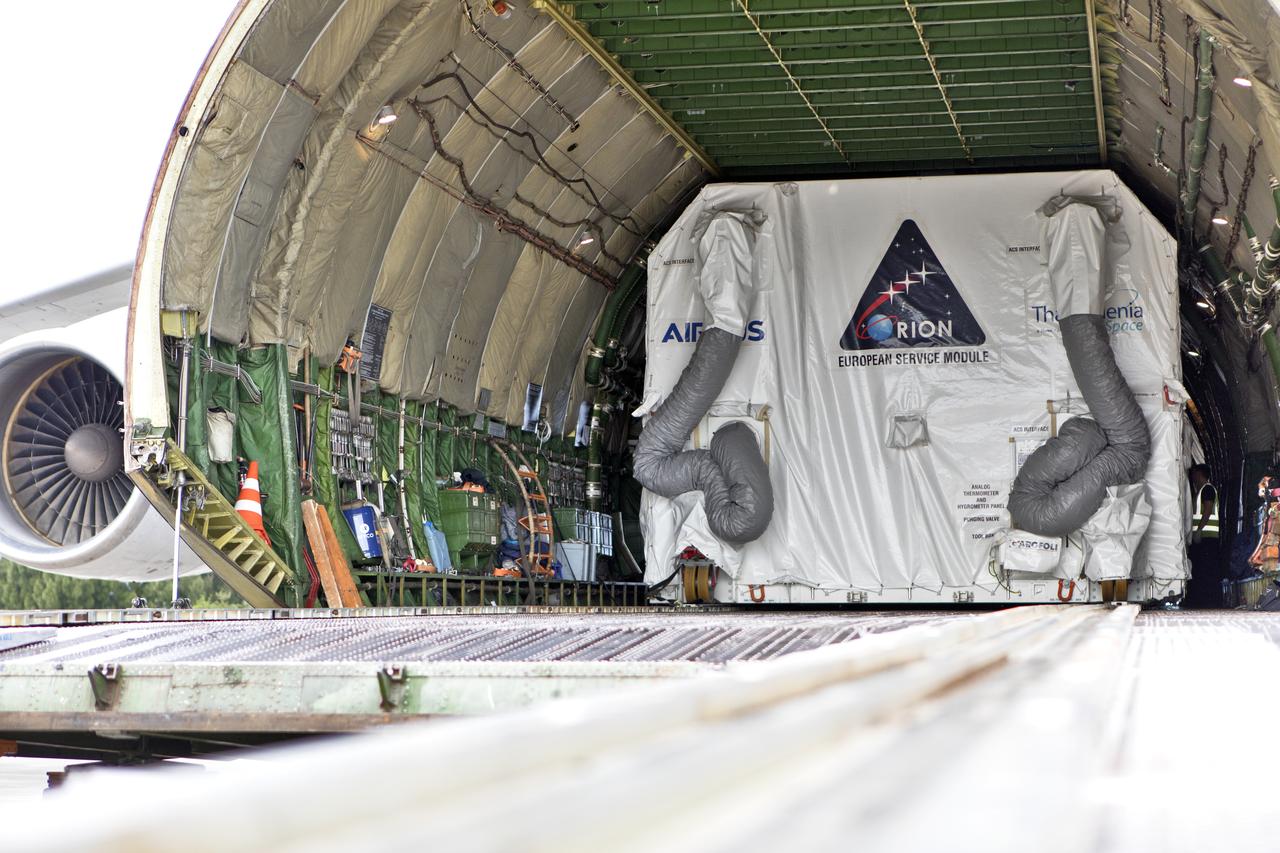
The shipping container holding the European Service Module (ESM) is in view inside the cargo hold of the Antonov cargo aircraft at the Shuttle Landing Facility at NASA's Kennedy Space Center in Florida on Nov. 6, 2018. The ESM for Exploration Mission-1 (EM-1) will be offloaded from the cargo hold. The ESM, built by the European Space Agency, will supply the main propulsion system and power to the Orion spacecraft for Exploration Mission-1 (EM-1), a mission to the Moon. The ESM also will house air and water for astronauts on future missions. EM-1 will be an uncrewed flight test that will provide a foundation for human deep space exploration to destinations beyond Earth orbit. EM-1 will be the first integrated test of NASA's Space Launch System, Orion and the ground systems at Kennedy.
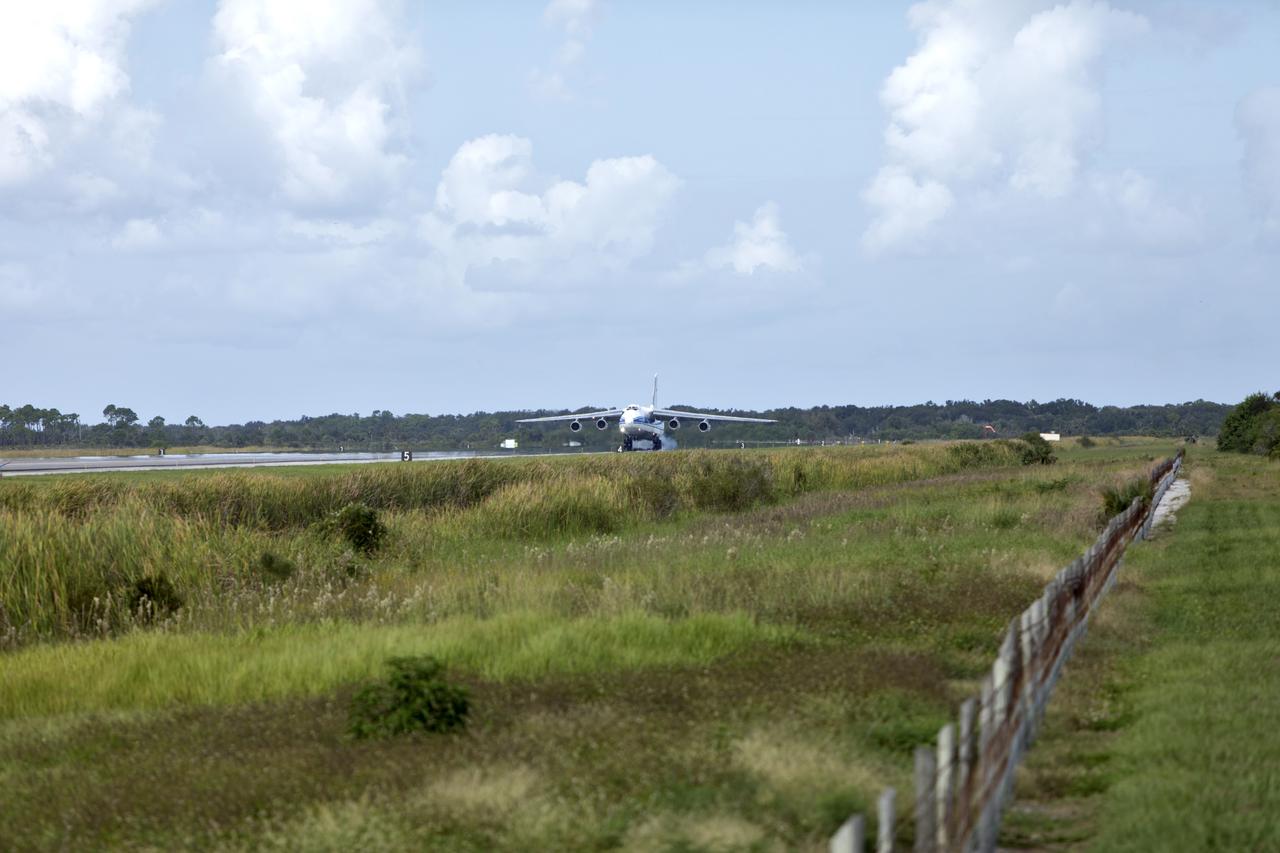
The Antonov cargo aircraft touches down at the Shuttle Landing Facility at NASA's Kennedy Space Center in Florida on Nov. 6, 2018, carrying the European Service Module (ESM) for Exploration Mission-1 (EM-1). The ESM, built by the European Space Agency, will supply the main propulsion system and power to the Orion spacecraft for Exploration Mission-1 (EM-1), a mission to the Moon. The ESM also will house air and water for astronauts on future missions. EM-1 will be an uncrewed flight test that will provide a foundation for human deep space exploration to destinations beyond Earth orbit. EM-1 will be the first integrated test of NASA's Space Launch System, Orion and the ground systems at Kennedy.

The Antonov cargo aircraft descends toward the Shuttle Landing Facility at NASA's Kennedy Space Center in Florida on Nov. 6, 2018, carrying the European Service Module (ESM) for Exploration Mission-1 (EM-1). The ESM, built by the European Space Agency, will supply the main propulsion system and power to the Orion spacecraft for Exploration Mission-1 (EM-1), a mission to the Moon. The ESM also will house air and water for astronauts on future missions. EM-1 will be an uncrewed flight test that will provide a foundation for human deep space exploration to destinations beyond Earth orbit. EM-1 will be the first integrated test of NASA's Space Launch System, Orion and the ground systems at Kennedy.
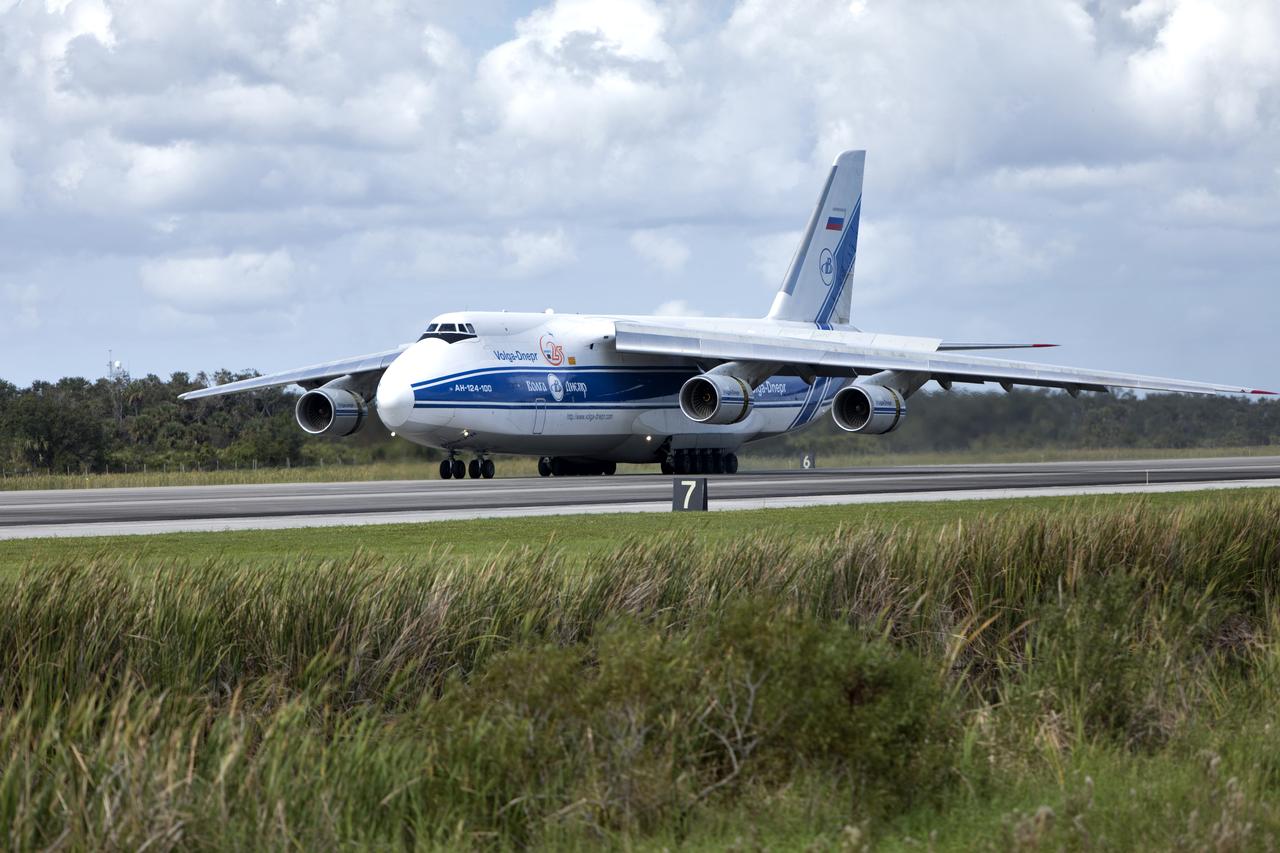
The Antonov cargo aircraft touches down at the Shuttle Landing Facility at NASA's Kennedy Space Center in Florida on Nov. 6, 2018, carrying the European Service Module (ESM) for Exploration Mission-1 (EM-1). The ESM, built by the European Space Agency, will supply the main propulsion system and power to the Orion spacecraft for Exploration Mission-1 (EM-1), a mission to the Moon. The ESM also will house air and water for astronauts on future missions. EM-1 will be an uncrewed flight test that will provide a foundation for human deep space exploration to destinations beyond Earth orbit. EM-1 will be the first integrated test of NASA's Space Launch System, Orion and the ground systems at Kennedy.
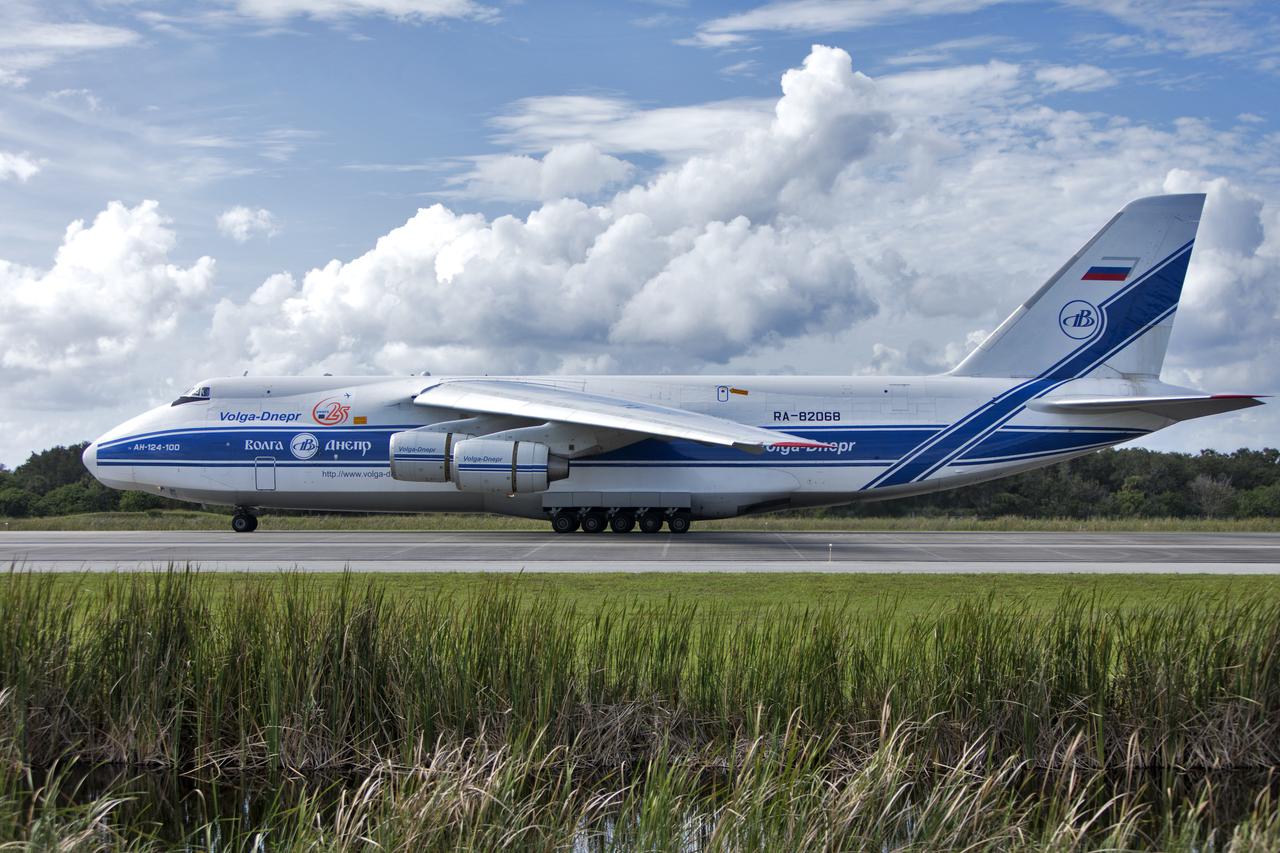
The Antonov cargo aircraft arrives at the Shuttle Landing Facility at NASA's Kennedy Space Center in Florida on Nov. 6, 2018, carrying the European Service Module (ESM) for Exploration Mission-1 (EM-1). The ESM, built by the European Space Agency, will supply the main propulsion system and power to the Orion spacecraft for Exploration Mission-1 (EM-1), a mission to the Moon. The ESM also will house air and water for astronauts on future missions. EM-1 will be an uncrewed flight test that will provide a foundation for human deep space exploration to destinations beyond Earth orbit. EM-1 will be the first integrated test of NASA's Space Launch System, Orion and the ground systems at Kennedy.
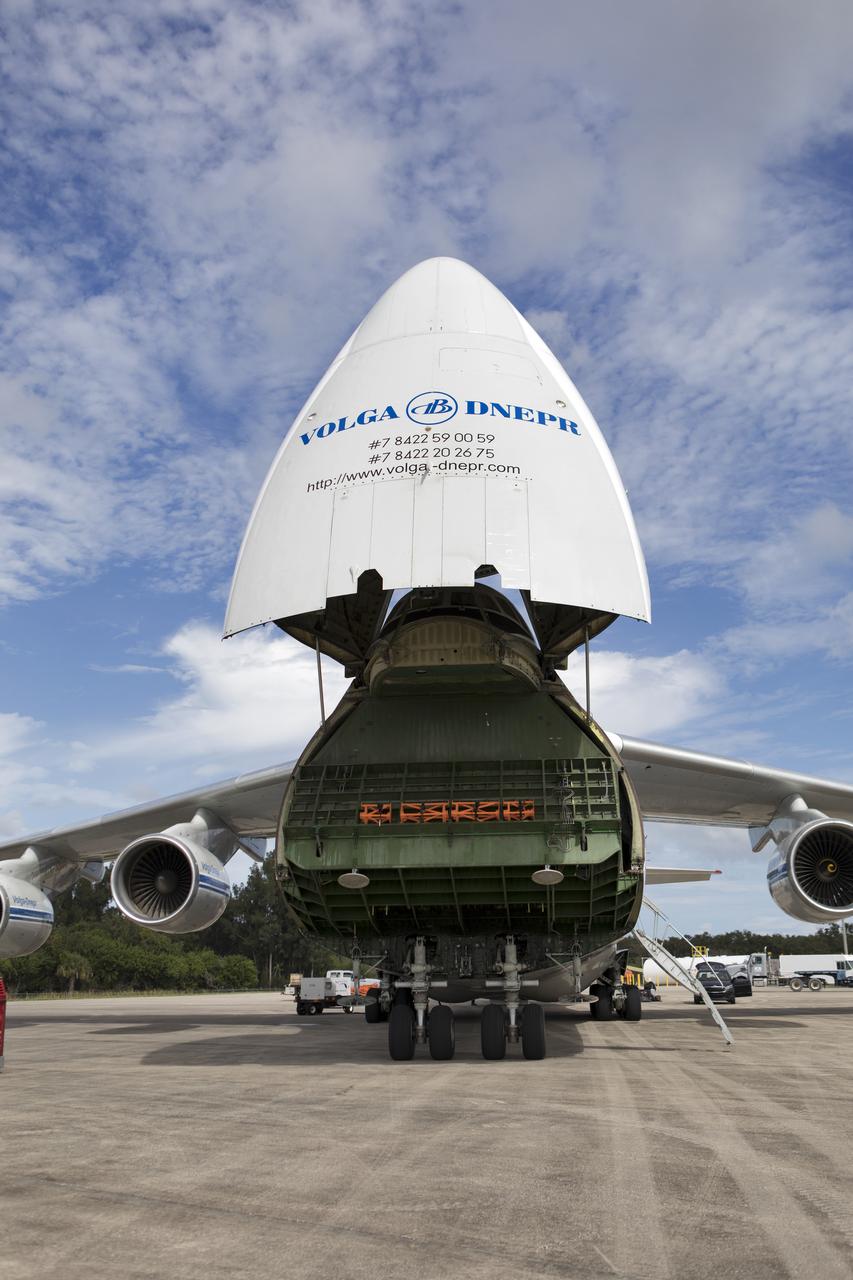
The Antonov cargo aircraft is open on the tarmac at the Shuttle Landing Facility at NASA's Kennedy Space Center in Florida on Nov. 6, 2018. The European Service Module (ESM) for Exploration Mission-1 (EM-1) will be offloaded from the cargo hold. The ESM, built by the European Space Agency, will supply the main propulsion system and power to the Orion spacecraft for Exploration Mission-1 (EM-1), a mission to the Moon. The ESM also will house air and water for astronauts on future missions. EM-1 will be an uncrewed flight test that will provide a foundation for human deep space exploration to destinations beyond Earth orbit. EM-1 will be the first integrated test of NASA's Space Launch System, Orion and the ground systems at Kennedy.
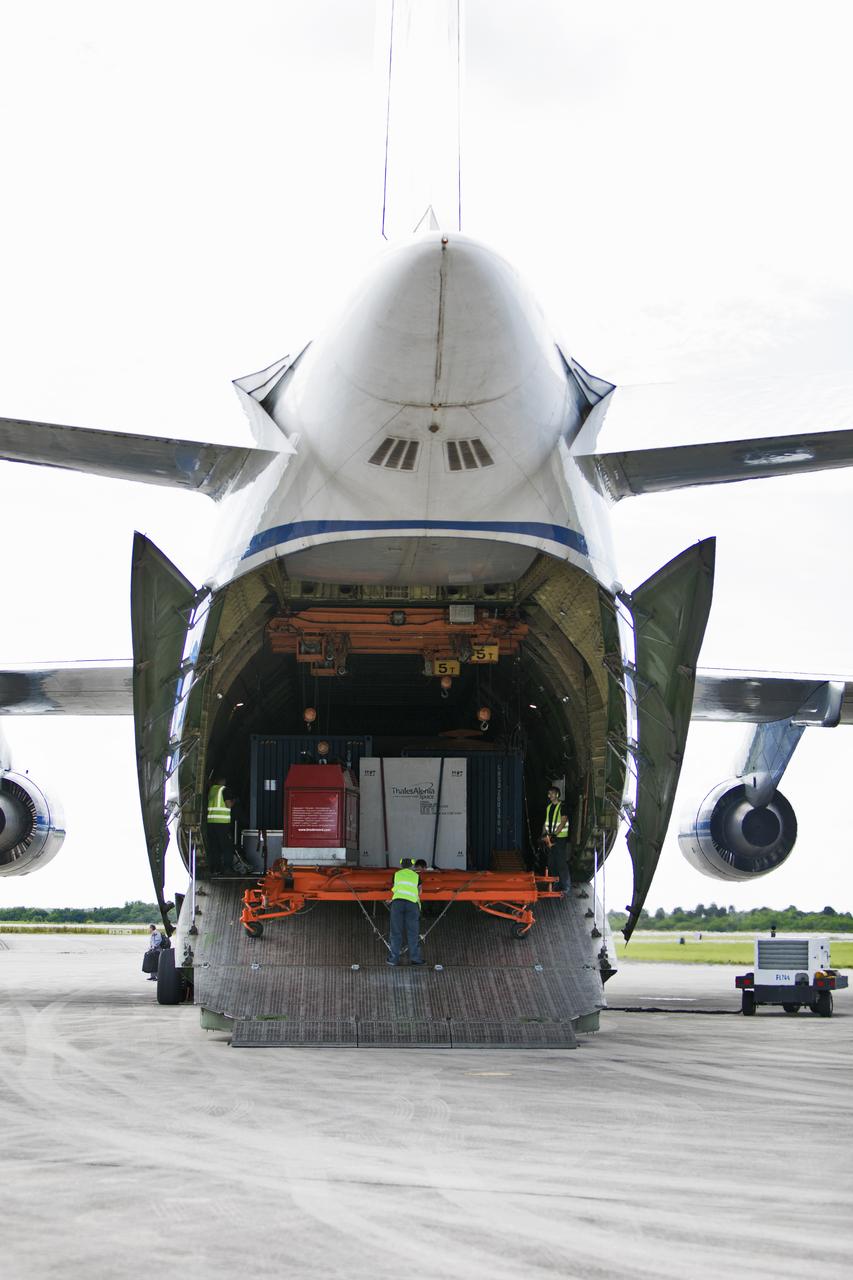
The Antonov cargo aircraft is open on the tarmac at the Shuttle Landing Facility at NASA's Kennedy Space Center in Florida on Nov. 6, 2018. The European Service Module (ESM) for Exploration Mission-1 (EM-1) will be offloaded from the cargo hold. The ESM, built by the European Space Agency, will supply the main propulsion system and power to the Orion spacecraft for Exploration Mission-1 (EM-1), a mission to the Moon. The ESM also will house air and water for astronauts on future missions. EM-1 will be an uncrewed flight test that will provide a foundation for human deep space exploration to destinations beyond Earth orbit. EM-1 will be the first integrated test of NASA's Space Launch System, Orion and the ground systems at Kennedy.
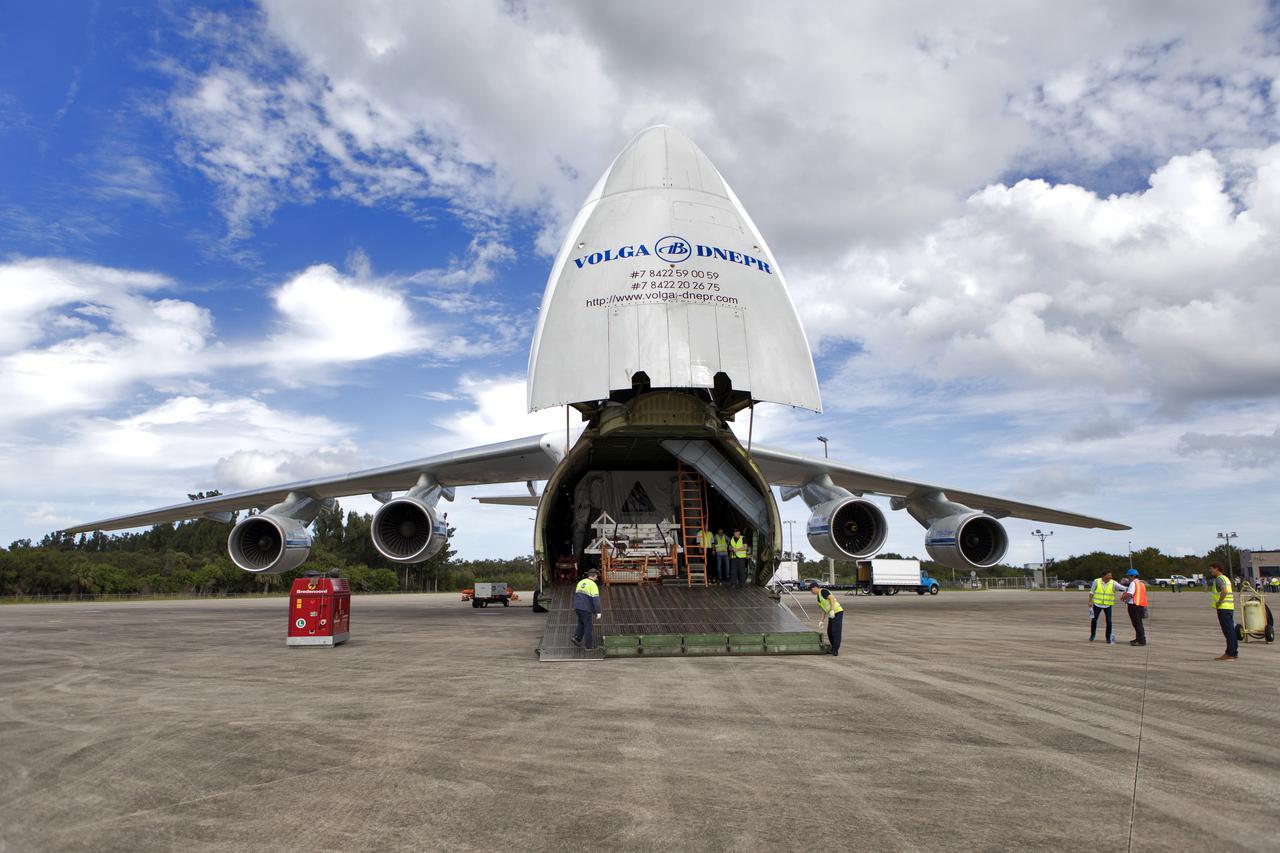
The Antonov cargo aircraft is open on the tarmac at the Shuttle Landing Facility at NASA's Kennedy Space Center in Florida on Nov. 6, 2018. The European Service Module (ESM) for Exploration Mission-1 (EM-1) will be offloaded from the cargo hold. The ESM, built by the European Space Agency, will supply the main propulsion system and power to the Orion spacecraft for Exploration Mission-1 (EM-1), a mission to the Moon. The ESM also will house air and water for astronauts on future missions. EM-1 will be an uncrewed flight test that will provide a foundation for human deep space exploration to destinations beyond Earth orbit. EM-1 will be the first integrated test of NASA's Space Launch System, Orion and the ground systems at Kennedy.
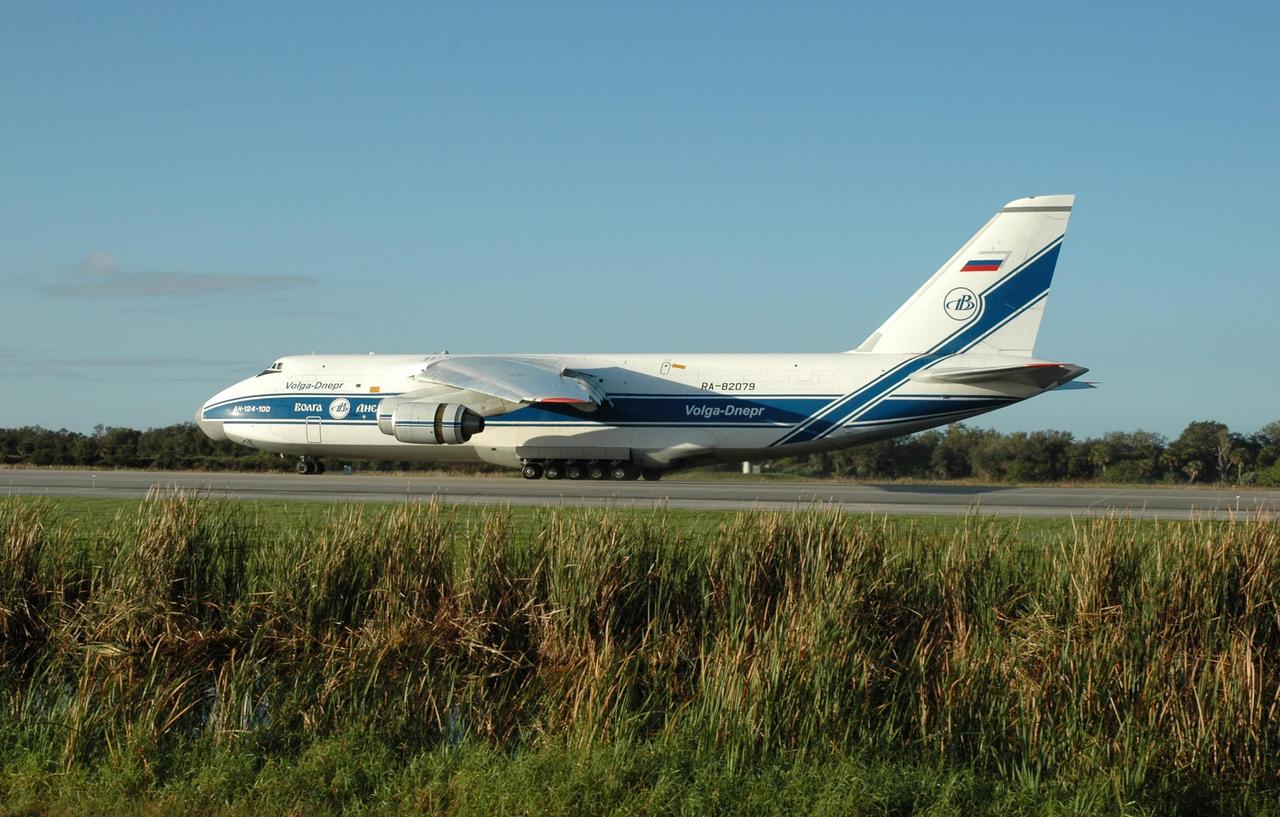
KENNEDY SPACE CENTER, FLA. -- At the KSC Shuttle Landing Facility, the Antonov 124 aircraft arrives with its cargo, the remote manipulator system for the Japanese Experiment Module. The JEM, named "Kibo" (Hope), is Japan's primary contribution to the International Space Station. It will enhance the unique research capabilities of the orbiting complex by providing an additional environment for astronauts to conduct science experiments. The Japanese Aerospace Exploration Agency developed the laboratory. Both the JEM and RMS are targeted for mission STS-124, to launch in early 2008. Photo credit: NASA/Jack Pfaller

CAPE CANAVERAL, Fla. -- At Cape Canaveral Air Force Station in Florida, a Volga-Dnepr Antonov AN-124-100, a Ukranian/Russian cargo aircraft has landed on the Skid Strip. The aircraft is delivering the booster stage of a United Launch Alliance Atlas V rocket slated to launch NASA's Juno spacecraft Aug. 5. The solar-powered spacecraft will orbit Jupiter's poles 33 times to find out more about the gas giant's origins, structure, atmosphere and magnetosphere and investigate the existence of a solid planetary core. For more information visit: www.nasa.gov/juno. Photo credit: NASA/Jack Pfaller
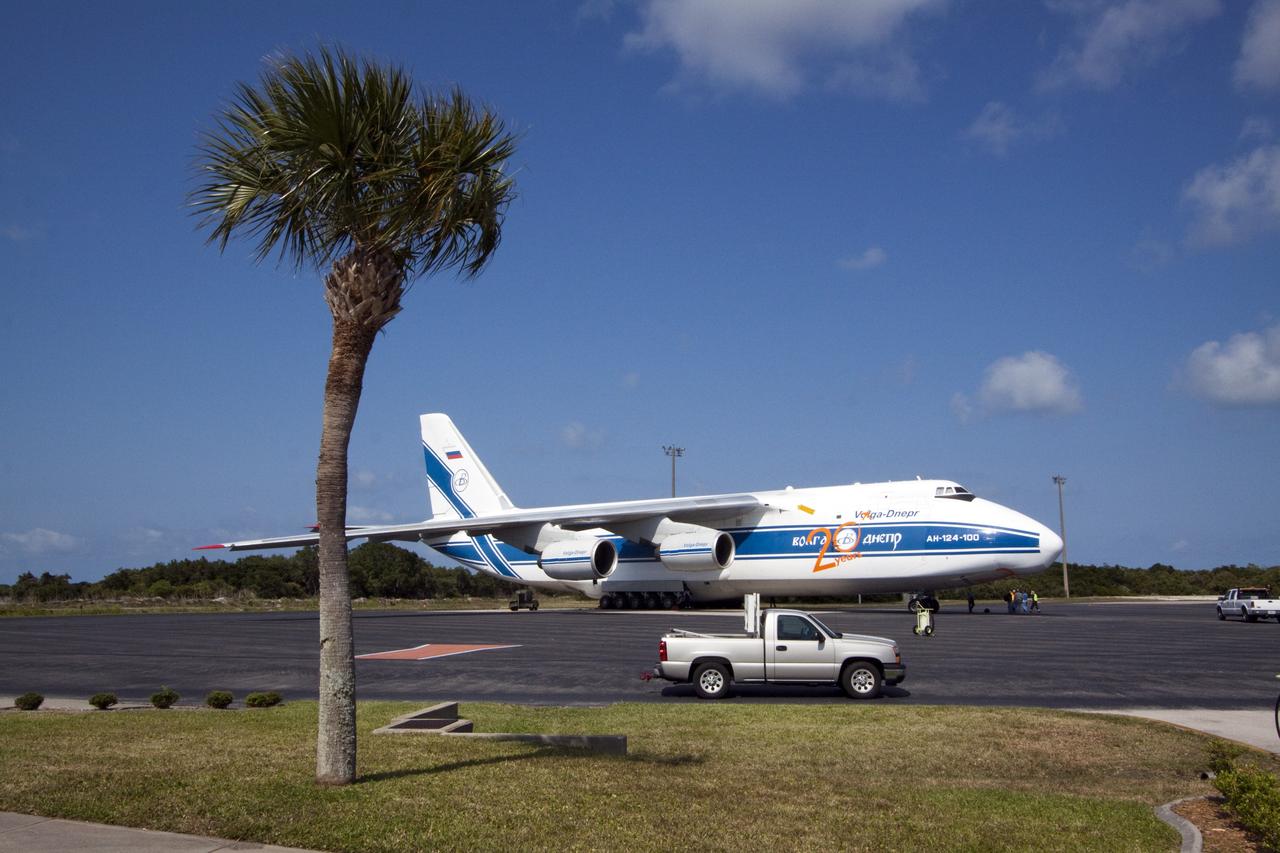
CAPE CANAVERAL, Fla. -- At Cape Canaveral Air Force Station in Florida, a Volga-Dnepr Antonov AN-124-100, Ukranian/Russian cargo aircraft has landed on the Skid Strip. The aircraft is delivering the Centaur upper stage of a United Launch Alliance Atlas V rocket. NASA's Juno spacecraft is scheduled to launch aboard the Atlas V from Cape Canaveral, Fla. Aug. 5.The solar-powered spacecraft will orbit Jupiter's poles 33 times to find out more about the gas giant's origins, structure, atmosphere and magnetosphere and investigate the existence of a solid planetary core. For more information visit: www.nasa.gov/juno. Photo credit: NASA/Jack Pfaller
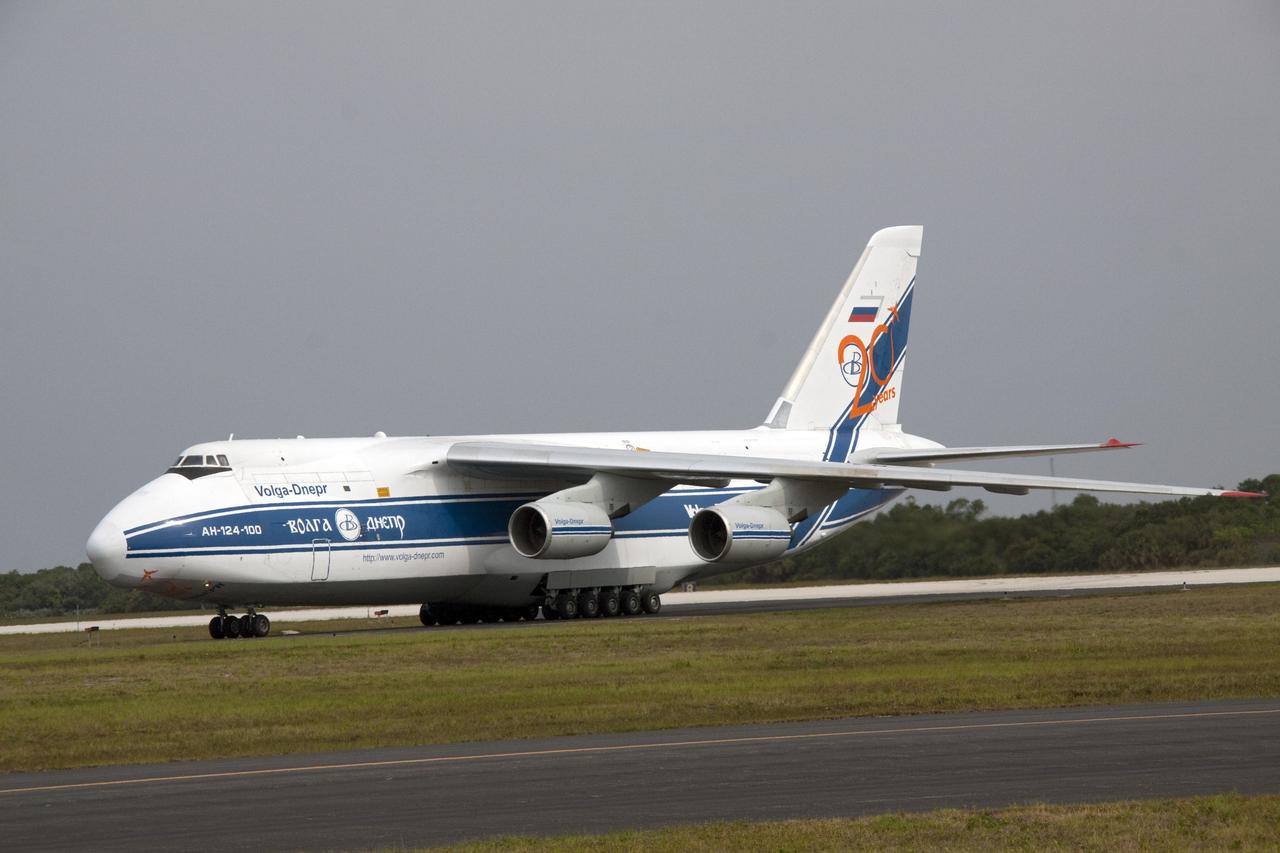
CAPE CANAVERAL, Fla. -- At Cape Canaveral Air Force Station in Florida, a Volga-Dnepr Antonov AN-124-100, a Ukranian/Russian cargo aircraft has landed on the Skid Strip. The aircraft is delivering the booster stage of a United Launch Alliance Atlas V rocket slated to launch NASA's Juno spacecraft Aug. 5. The solar-powered spacecraft will orbit Jupiter's poles 33 times to find out more about the gas giant's origins, structure, atmosphere and magnetosphere and investigate the existence of a solid planetary core. For more information visit: www.nasa.gov/juno. Photo credit: NASA/Jack Pfaller
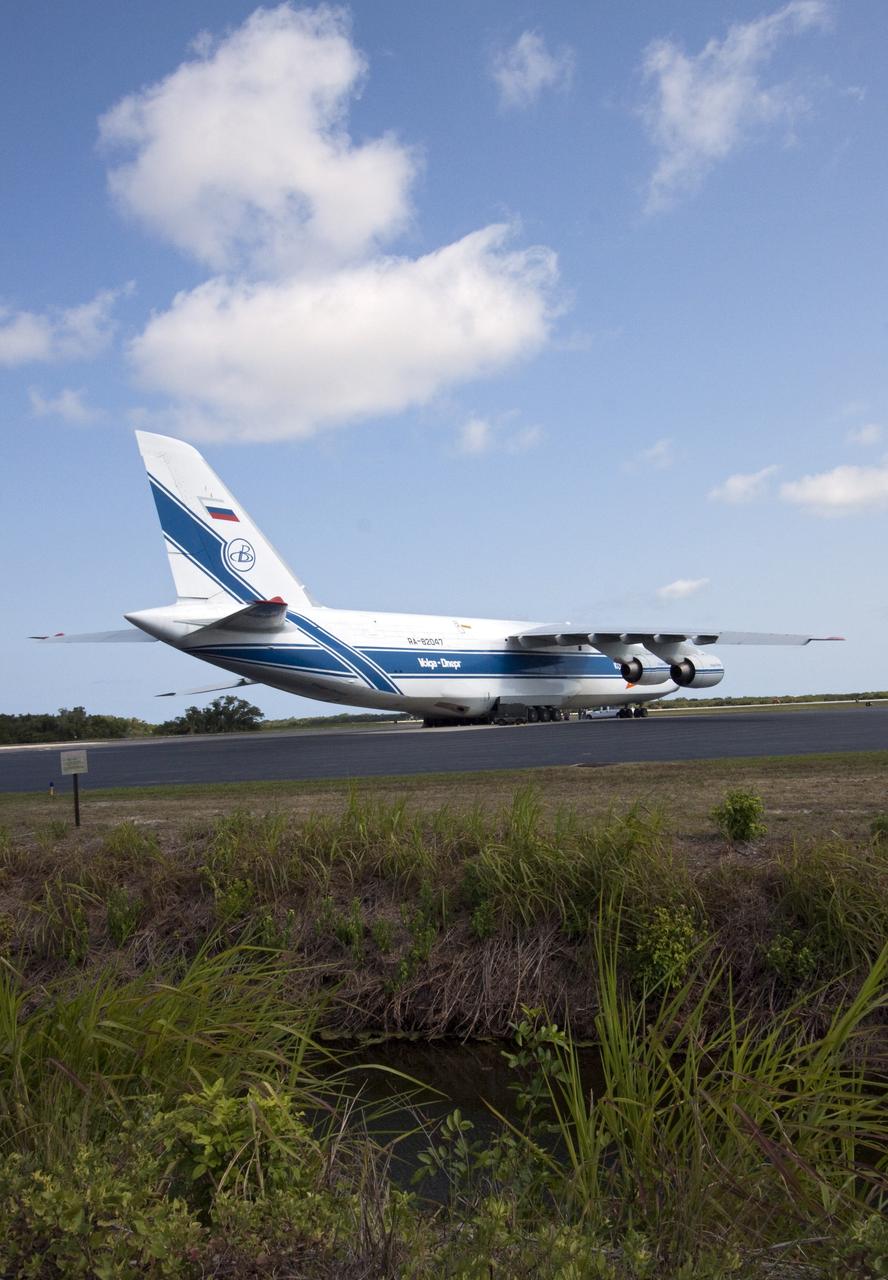
CAPE CANAVERAL, Fla. -- At Cape Canaveral Air Force Station in Florida, a Volga-Dnepr Antonov AN-124-100, Ukranian/Russian cargo aircraft has landed on the Skid Strip. The aircraft is delivering the Centaur upper stage of a United Launch Alliance Atlas V rocket. NASA's Juno spacecraft is scheduled to launch aboard the Atlas V from Cape Canaveral, Fla. Aug. 5.The solar-powered spacecraft will orbit Jupiter's poles 33 times to find out more about the gas giant's origins, structure, atmosphere and magnetosphere and investigate the existence of a solid planetary core. For more information visit: www.nasa.gov/juno. Photo credit: NASA/Jack Pfaller
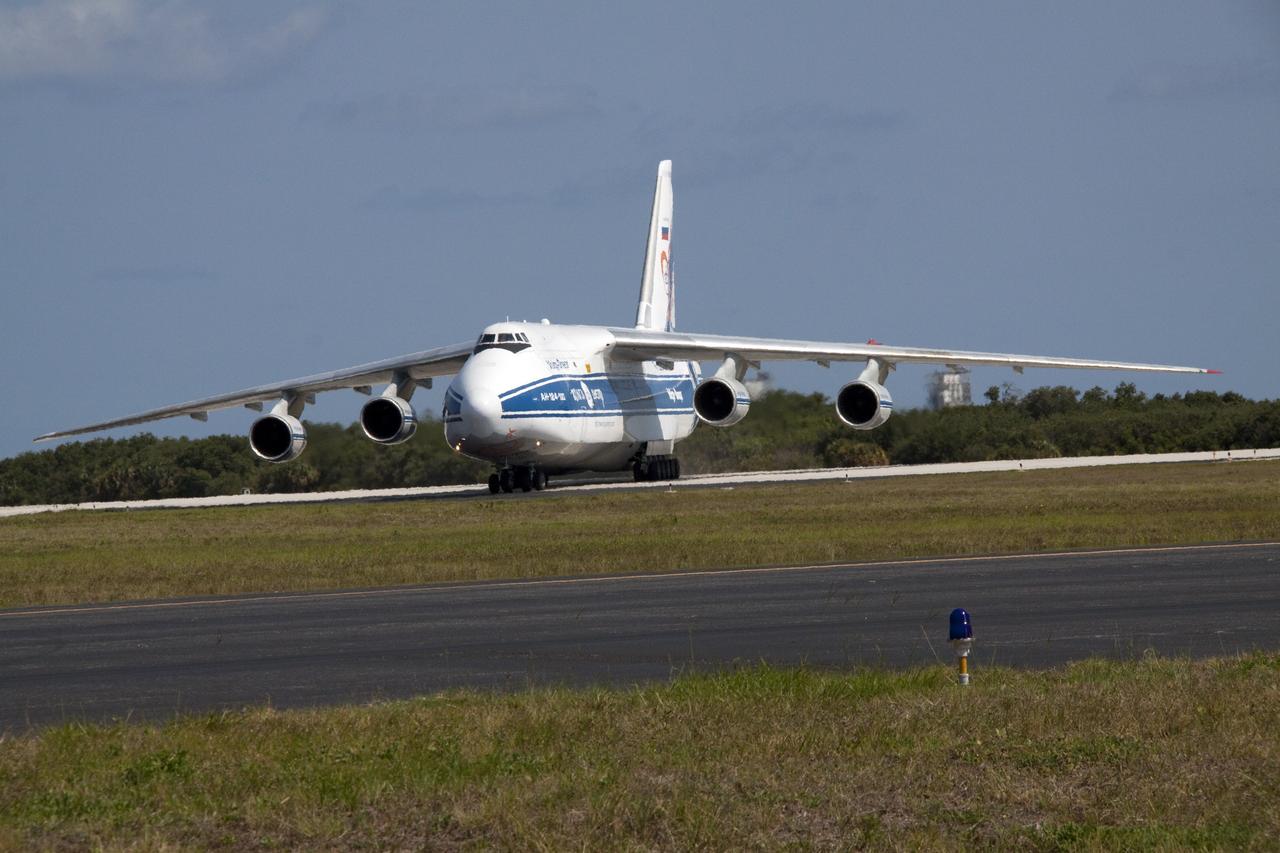
CAPE CANAVERAL, Fla. -- At Cape Canaveral Air Force Station in Florida, a Volga-Dnepr Antonov AN-124-100, Ukranian/Russian cargo aircraft has landed on the Skid Strip. The aircraft is delivering the Centaur upper stage of a United Launch Alliance Atlas V rocket. NASA's Juno spacecraft is scheduled to launch aboard the Atlas V from Cape Canaveral, Fla. Aug. 5.The solar-powered spacecraft will orbit Jupiter's poles 33 times to find out more about the gas giant's origins, structure, atmosphere and magnetosphere and investigate the existence of a solid planetary core. For more information visit: www.nasa.gov/juno. Photo credit: NASA/Jack Pfaller
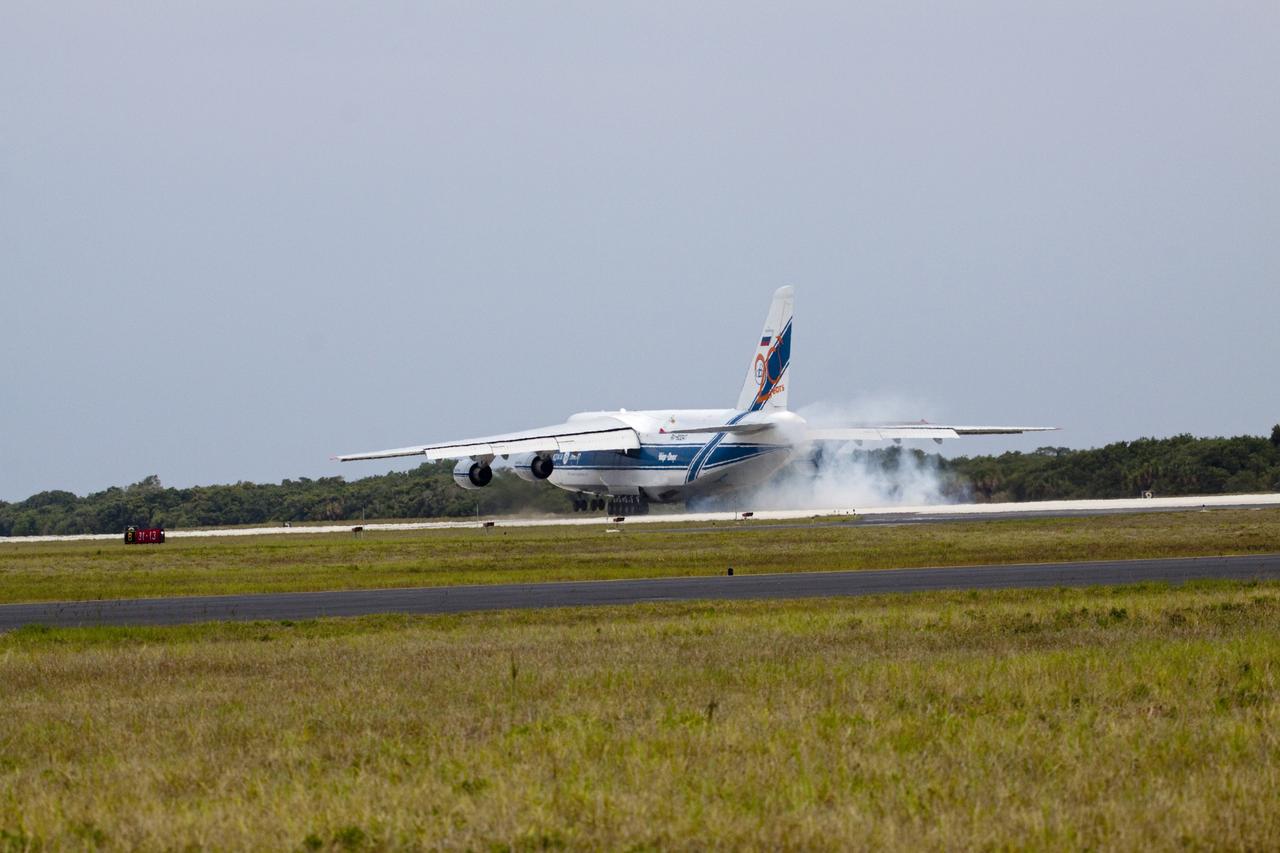
CAPE CANAVERAL, Fla. -- At Cape Canaveral Air Force Station in Florida, a Volga-Dnepr Antonov AN-124-100, a Ukranian/Russian cargo aircraft comes in for a landing on the Skid Strip. The aircraft is delivering the booster stage of a United Launch Alliance Atlas V rocket slated to launch NASA's Juno spacecraft Aug. 5. The solar-powered spacecraft will orbit Jupiter's poles 33 times to find out more about the gas giant's origins, structure, atmosphere and magnetosphere and investigate the existence of a solid planetary core. For more information visit: www.nasa.gov/juno. Photo credit: NASA/Jack Pfaller
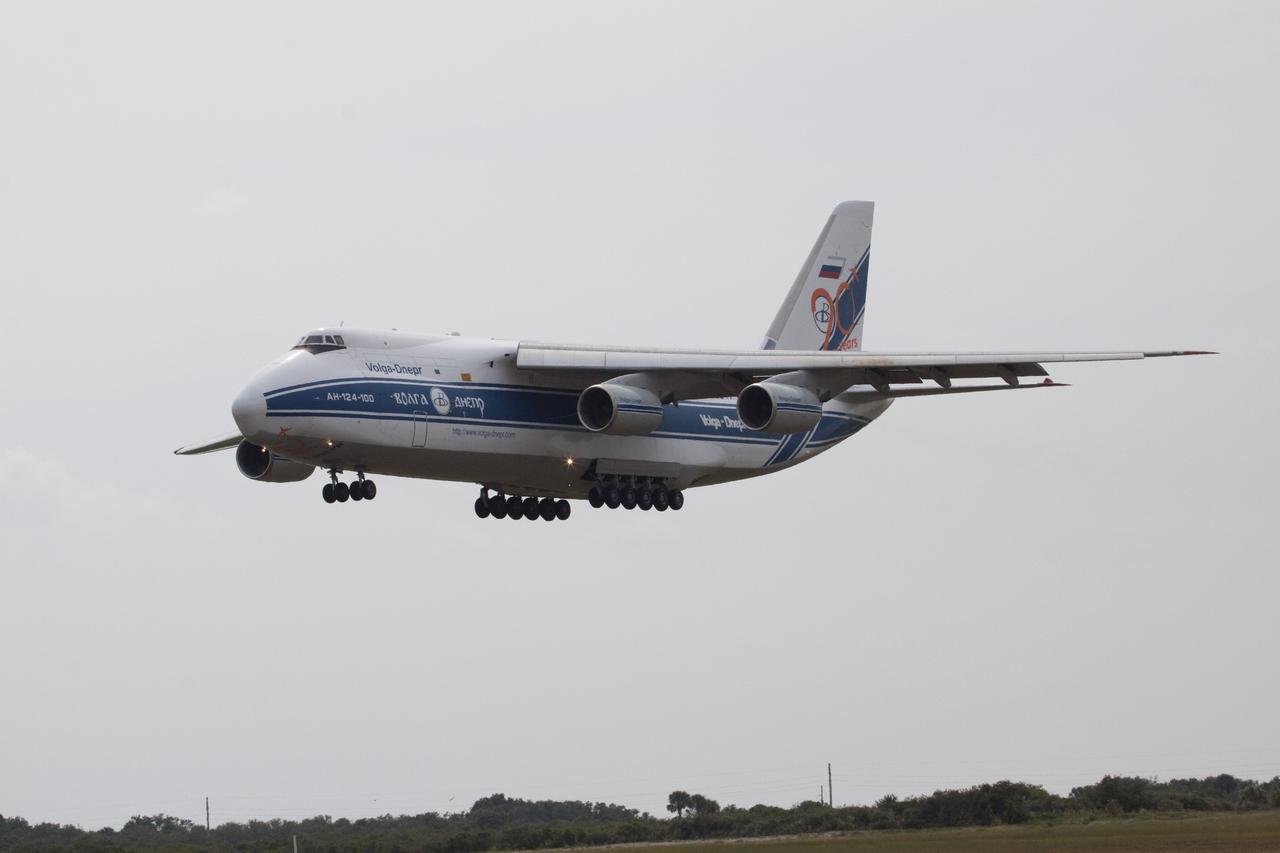
CAPE CANAVERAL, Fla. -- At Cape Canaveral Air Force Station in Florida, a Volga-Dnepr Antonov AN-124-100, a Ukranian/Russian cargo aircraft comes in for a landing on the Skid Strip. The aircraft is delivering the booster stage of a United Launch Alliance Atlas V rocket slated to launch NASA's Juno spacecraft Aug. 5. The solar-powered spacecraft will orbit Jupiter's poles 33 times to find out more about the gas giant's origins, structure, atmosphere and magnetosphere and investigate the existence of a solid planetary core. For more information visit: www.nasa.gov/juno. Photo credit: NASA/Jack Pfaller
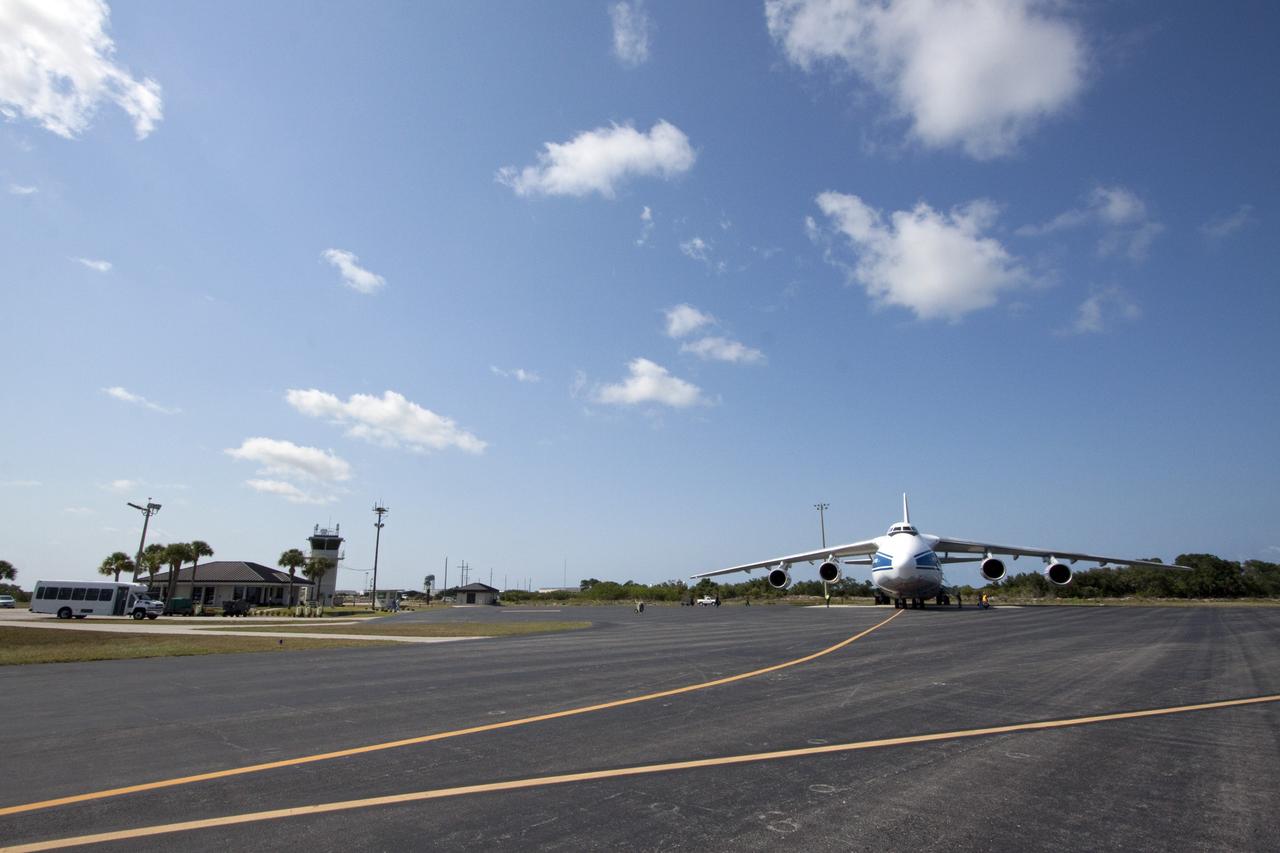
CAPE CANAVERAL, Fla. -- At Cape Canaveral Air Force Station in Florida, a Volga-Dnepr Antonov AN-124-100, Ukranian/Russian cargo aircraft has landed on the Skid Strip. The aircraft is delivering the Centaur upper stage of a United Launch Alliance Atlas V rocket. NASA's Juno spacecraft is scheduled to launch aboard the Atlas V from Cape Canaveral, Fla. Aug. 5.The solar-powered spacecraft will orbit Jupiter's poles 33 times to find out more about the gas giant's origins, structure, atmosphere and magnetosphere and investigate the existence of a solid planetary core. For more information visit: www.nasa.gov/juno. Photo credit: NASA/Jack Pfaller
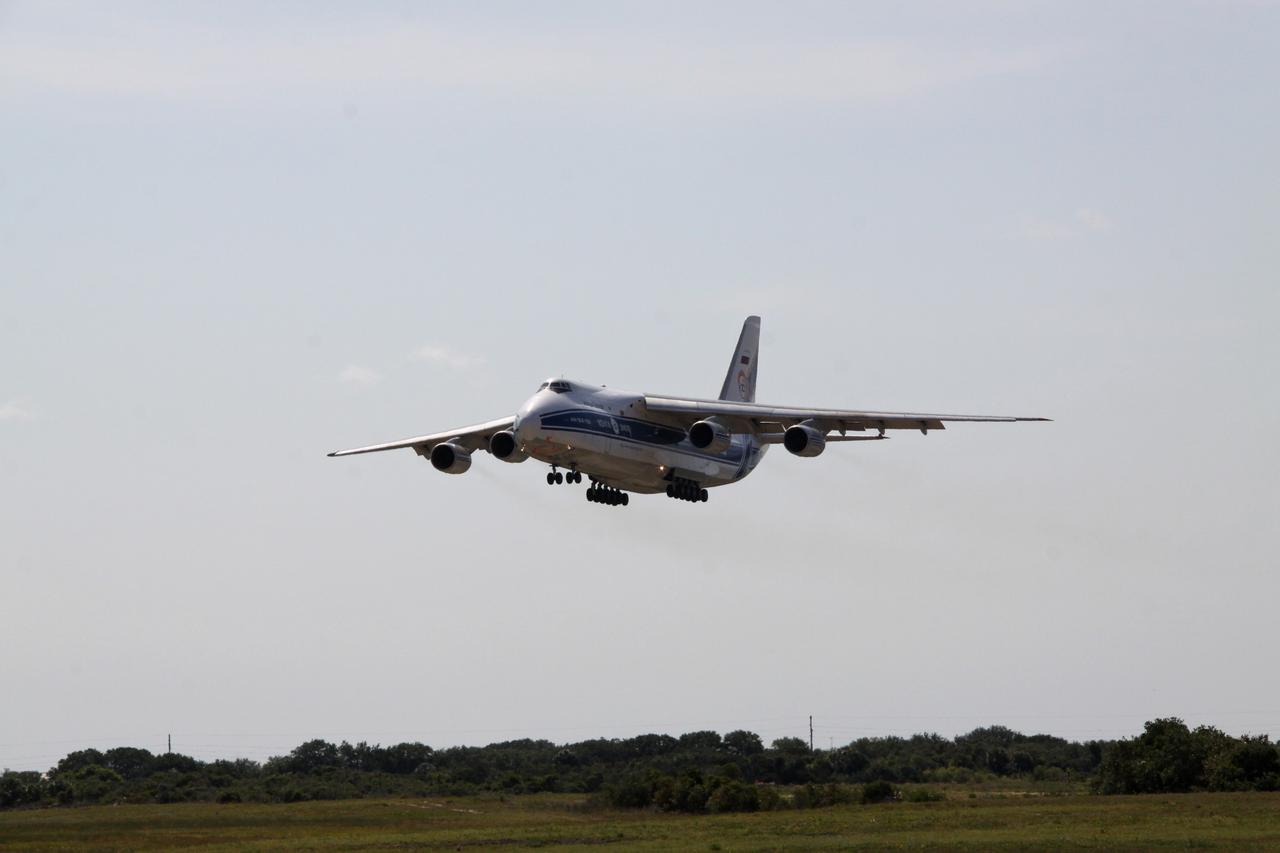
CAPE CANAVERAL, Fla. -- At Cape Canaveral Air Force Station in Florida, a Volga-Dnepr Antonov AN-124-100, Ukranian/Russian cargo aircraft comes in for a landing on the Skid Strip. The aircraft is delivering the Centaur upper stage of a United Launch Alliance Atlas V rocket. NASA's Juno spacecraft is scheduled to launch aboard the Atlas V from Cape Canaveral, Fla. Aug. 5.The solar-powered spacecraft will orbit Jupiter's poles 33 times to find out more about the gas giant's origins, structure, atmosphere and magnetosphere and investigate the existence of a solid planetary core. For more information visit: www.nasa.gov/juno. Photo credit: NASA/Jack Pfaller
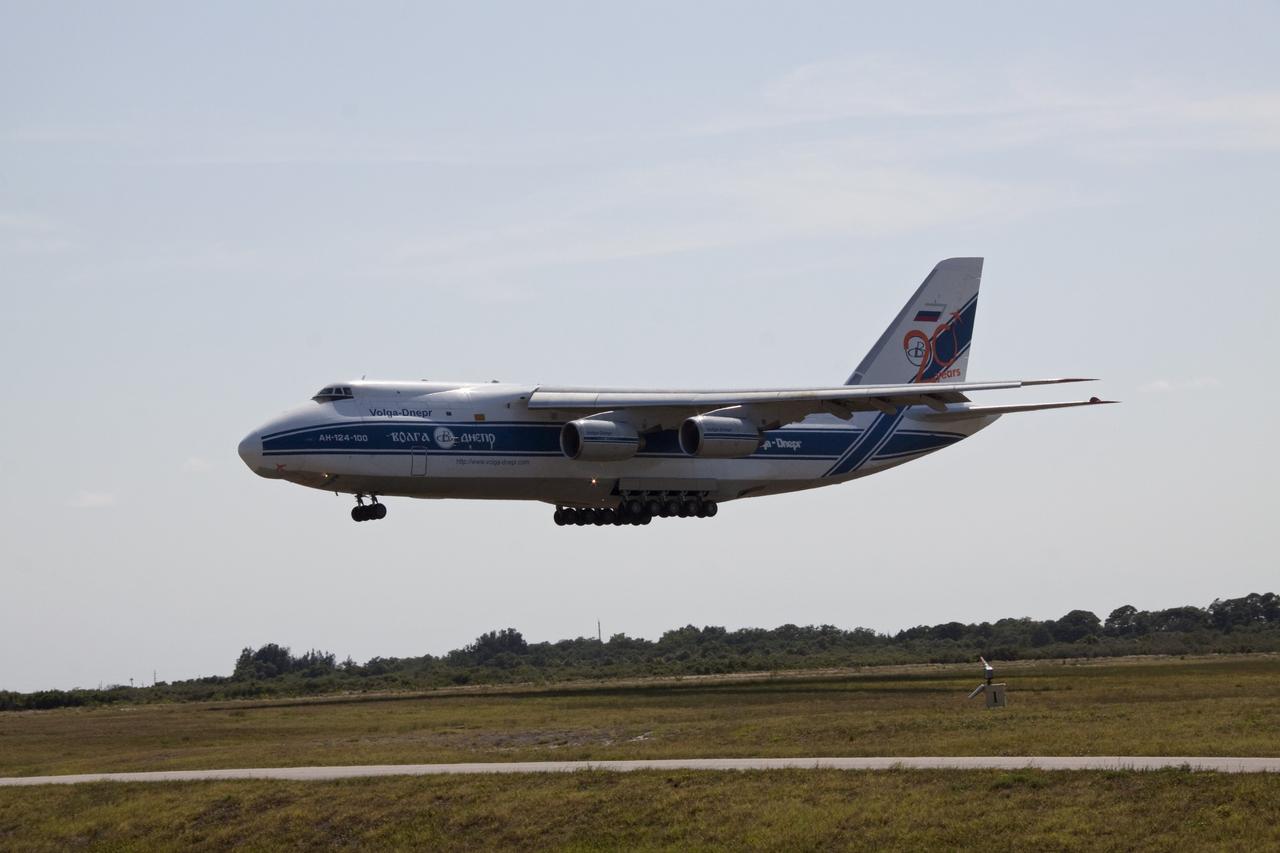
CAPE CANAVERAL, Fla. -- At Cape Canaveral Air Force Station in Florida, a Volga-Dnepr Antonov AN-124-100, Ukranian/Russian cargo aircraft comes in for a landing on the Skid Strip. The aircraft is delivering the Centaur upper stage of a United Launch Alliance Atlas V rocket. NASA's Juno spacecraft is scheduled to launch aboard the Atlas V from Cape Canaveral, Fla. Aug. 5.The solar-powered spacecraft will orbit Jupiter's poles 33 times to find out more about the gas giant's origins, structure, atmosphere and magnetosphere and investigate the existence of a solid planetary core. For more information visit: www.nasa.gov/juno. Photo credit: NASA/Jack Pfaller
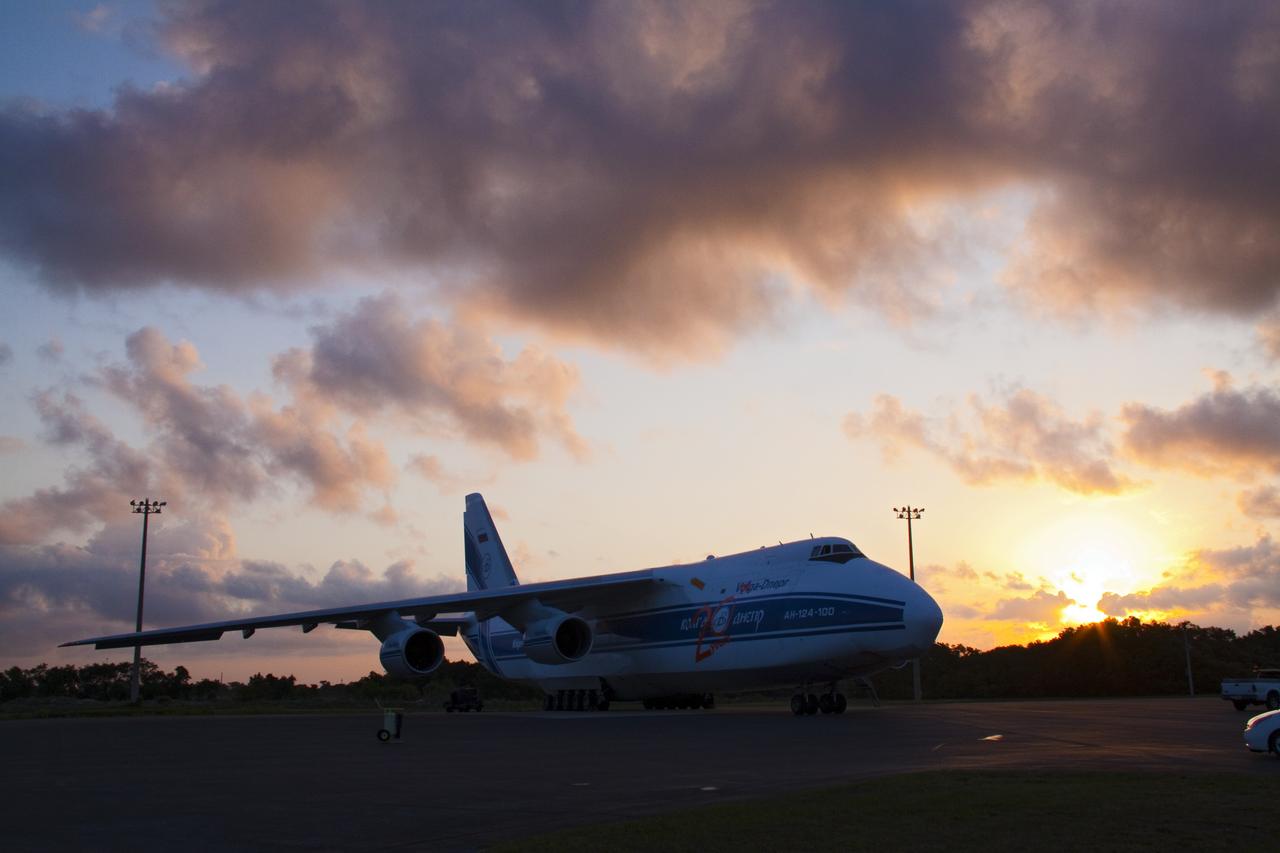
CAPE CANAVERAL, Fla. -- At Cape Canaveral Air Force Station in Florida, a Volga-Dnepr Antonov AN-124-100, Ukranian/Russian cargo aircraft has landed on the Skid Strip. The aircraft is delivering the Centaur upper stage of a United Launch Alliance Atlas V rocket. NASA's Juno spacecraft is scheduled to launch aboard the Atlas V from Cape Canaveral, Fla. Aug. 5.The solar-powered spacecraft will orbit Jupiter's poles 33 times to find out more about the gas giant's origins, structure, atmosphere and magnetosphere and investigate the existence of a solid planetary core. For more information visit: www.nasa.gov/juno. Photo credit: NASA/Jack Pfaller
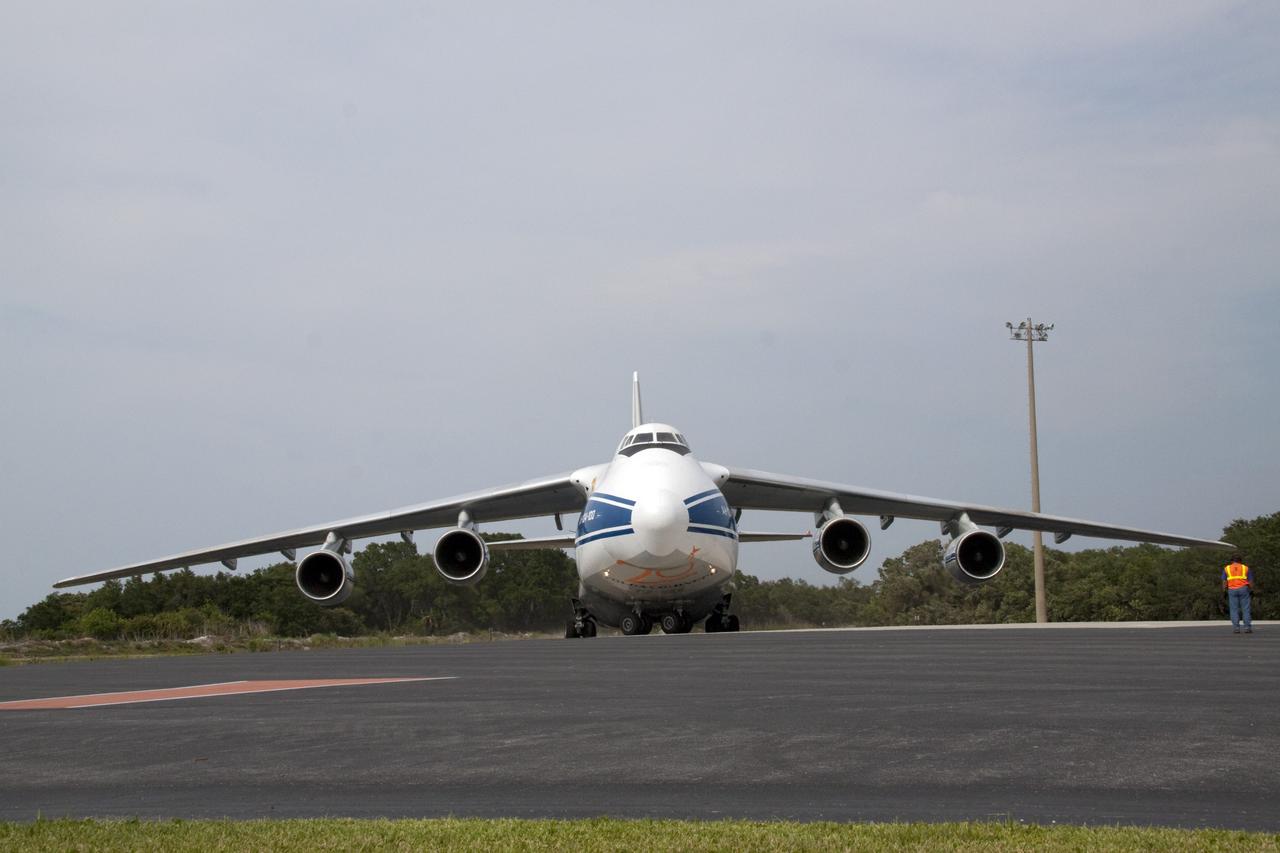
CAPE CANAVERAL, Fla. -- At Cape Canaveral Air Force Station in Florida, a Volga-Dnepr Antonov AN-124-100, a Ukranian/Russian cargo aircraft has landed on the Skid Strip. The aircraft is delivering the booster stage of a United Launch Alliance Atlas V rocket slated to launch NASA's Juno spacecraft Aug. 5. The solar-powered spacecraft will orbit Jupiter's poles 33 times to find out more about the gas giant's origins, structure, atmosphere and magnetosphere and investigate the existence of a solid planetary core. For more information visit: www.nasa.gov/juno. Photo credit: NASA/Jack Pfaller
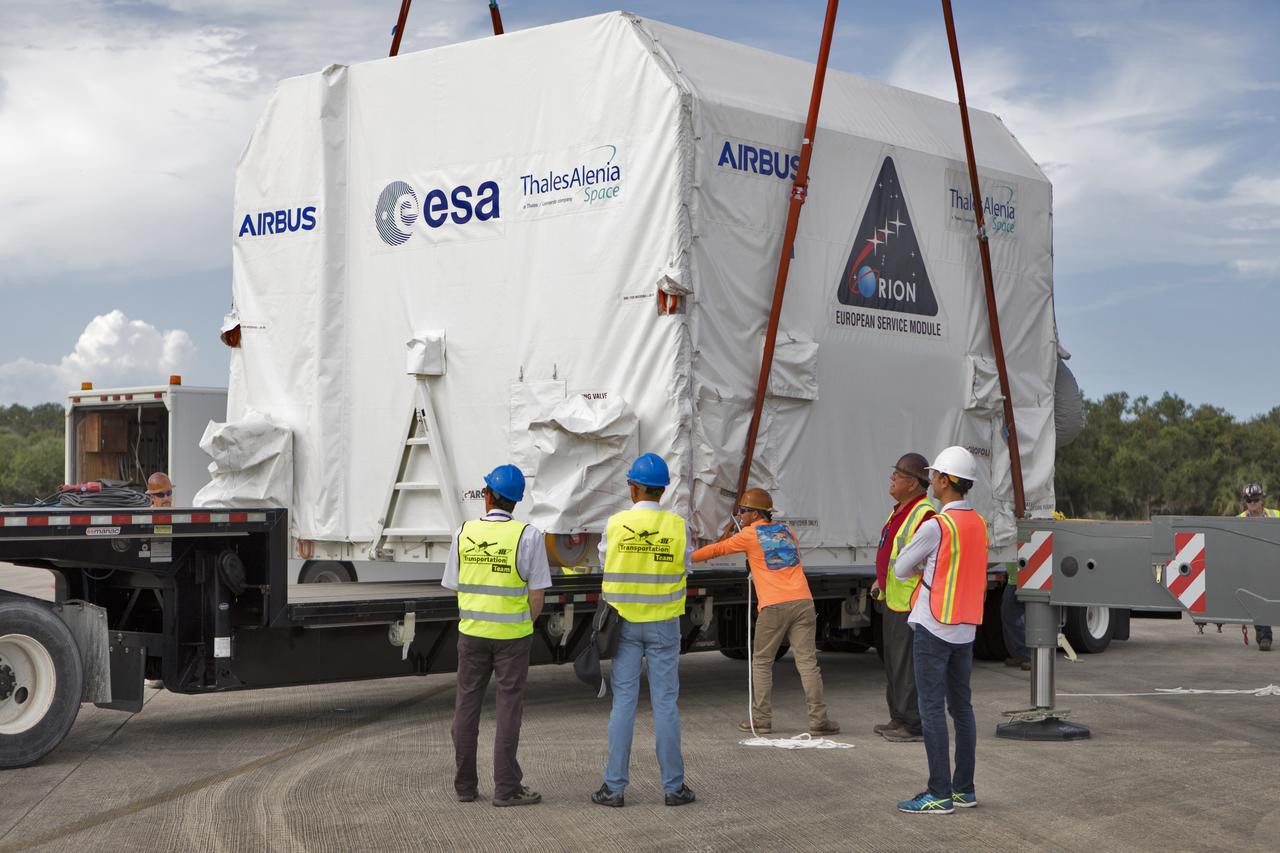
A crane lowers the shipping container holding the European Service Module (ESM) onto a flatbed truck at the Shuttle Landing Facility at NASA's Kennedy Space Center in Florida on Nov. 6, 2018. The ESM, built by the European Space Agency, will supply the main propulsion system and power to the Orion spacecraft for Exploration Mission-1 (EM-1), a mission to the Moon. The ESM also will house air and water for astronauts on future missions. EM-1 will be an uncrewed flight test that will provide a foundation for human deep space exploration to destinations beyond Earth orbit. EM-1 will be the first integrated test of NASA's Space Launch System, Orion and the ground systems at Kennedy.
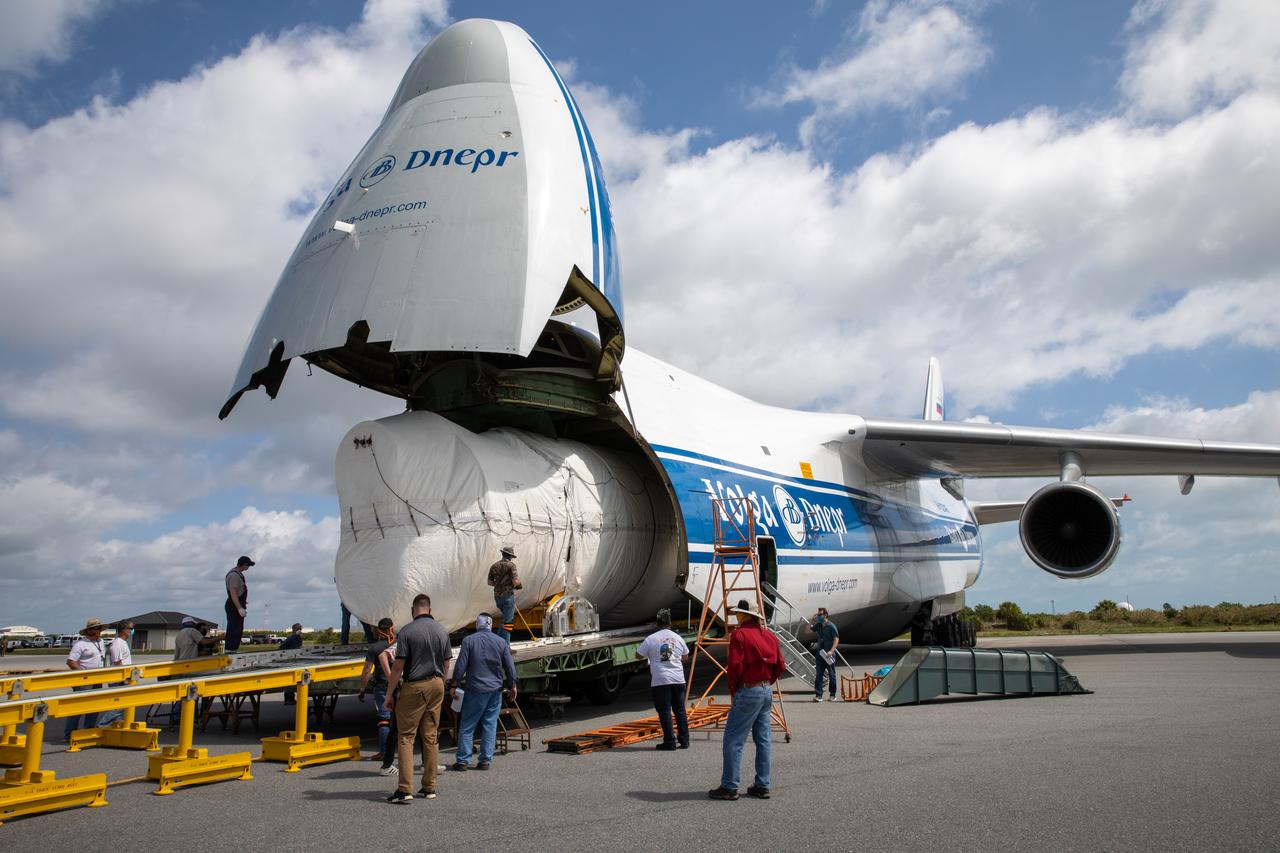
Workers help offload the United Launch Alliance booster for NASA’s Mars Perseverance rover from the Antonov 124 cargo aircraft at the Skid Strip at Cape Canaveral Air Force Station (CCAFS) in Florida on May 19, 2020. The Mars Perseverance rover is scheduled to launch in mid-July atop a United Launch Alliance Atlas V 541 rocket from Pad 41 at CCAFS. The rover is part of NASA’s Mars Exploration Program, a long-term effort of robotic exploration of the Red Planet. The rover will search for habitable conditions in the ancient past and signs of past microbial life on Mars. The Launch Services Program at Kennedy is responsible for launch management.
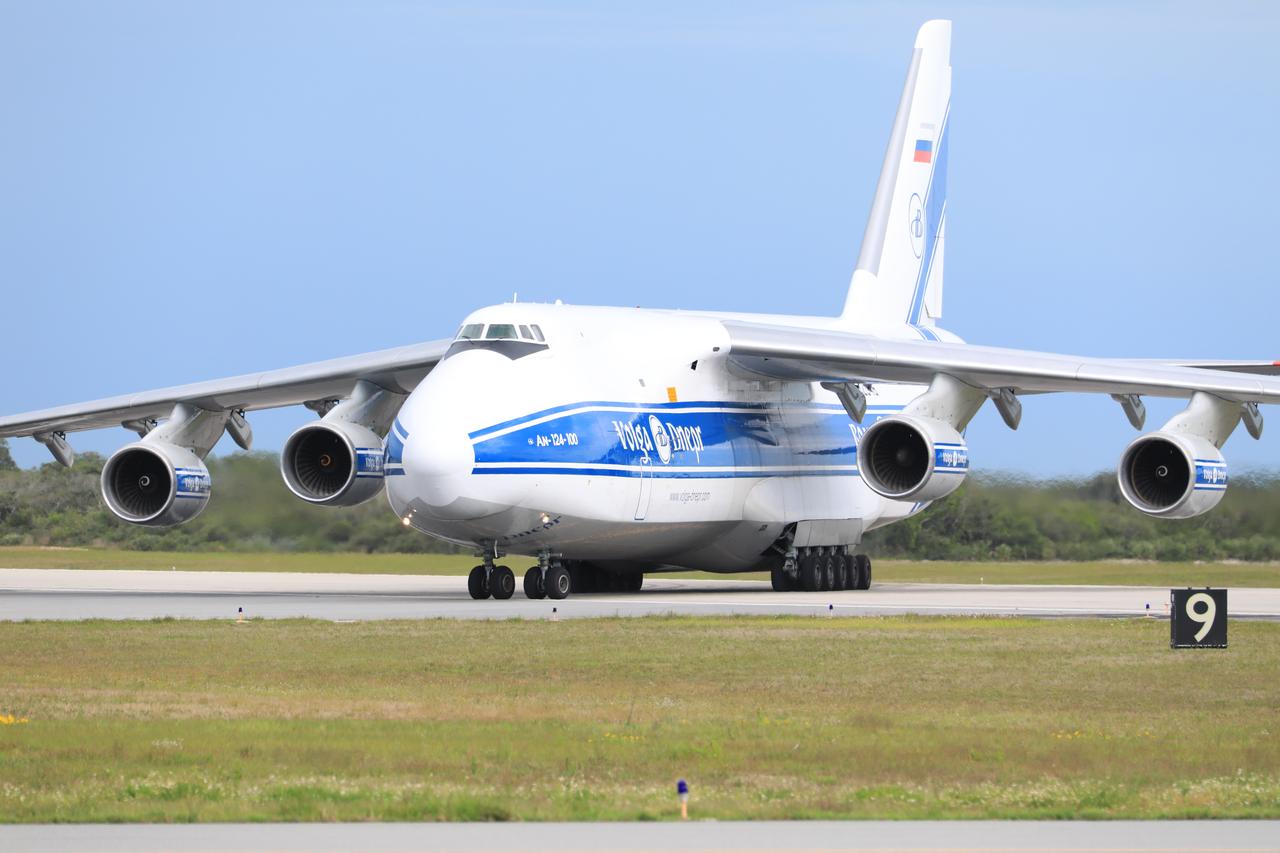
The Antonov 124 cargo aircraft, carrying the United Launch Alliance booster for NASA’s Mars Perseverance rover, taxis off the runway at the Skid Strip at Cape Canaveral Air Force Station (CCAFS) in Florida on May 18, 2020. The Mars Perseverance rover is scheduled to launch in mid-July atop a United Launch Alliance Atlas V 541 rocket from Pad 41 at CCAFS. The rover is part of NASA’s Mars Exploration Program, a long-term effort of robotic exploration of the Red Planet. The rover will search for habitable conditions in the ancient past and signs of past microbial life on Mars. The Launch Services Program at Kennedy is responsible for launch management.
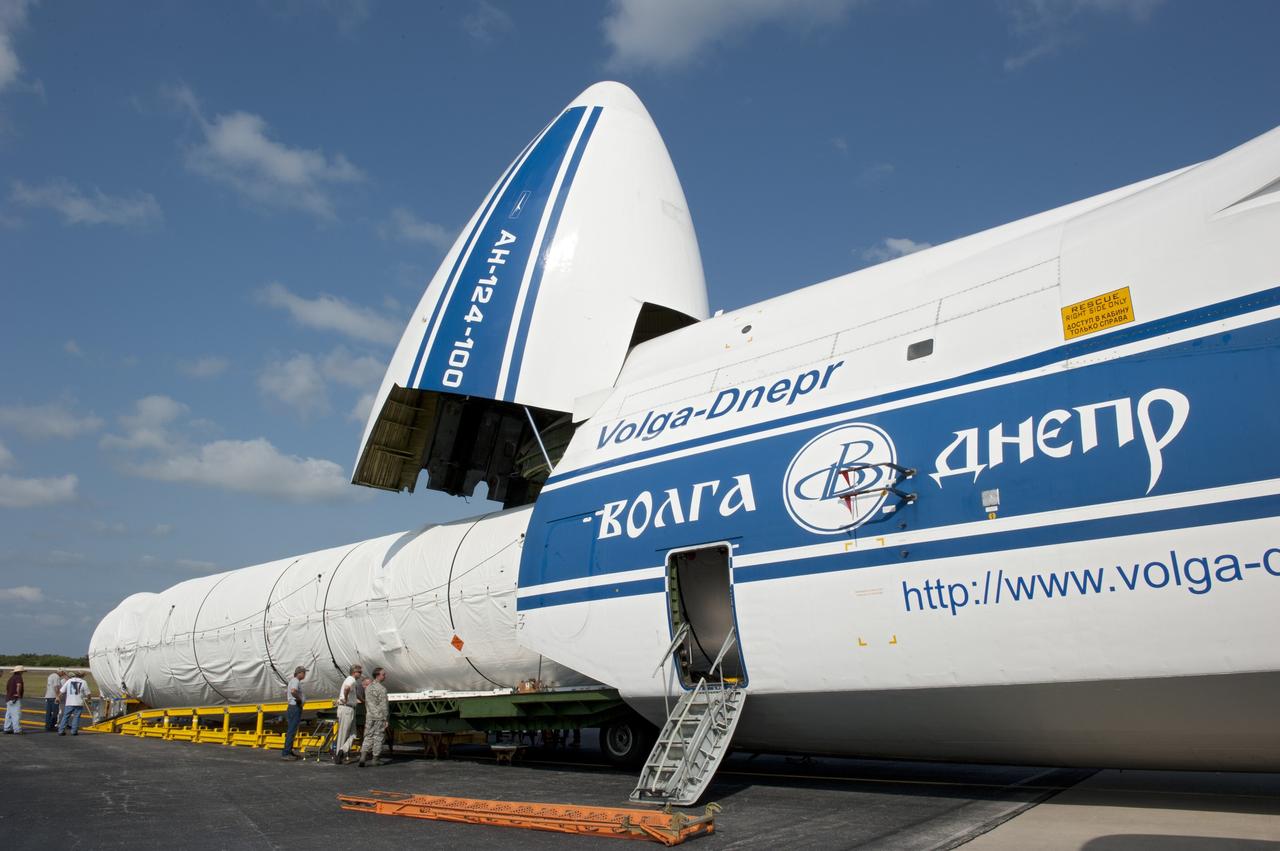
CAPE CANAVERAL, Fla. -- On the Skid Strip at Cape Canaveral Air Force Station in Florida, workers unload the first stage of the United Launch Alliance Atlas V rocket slated to launch NASA's Juno spacecraft from a Volga-Dnepr Antonov AN-124-100, a Ukranian/Russian cargo aircraft. Juno is scheduled to launch aboard an Atlas V rocket from Cape Canaveral, Fla., Aug. 5.The solar-powered spacecraft will orbit Jupiter's poles 33 times to find out more about the gas giant's origins, structure, atmosphere and magnetosphere and investigate the existence of a solid planetary core. For more information, visit www.nasa.gov/juno. Photo credit: NASA/Kim Shiflett
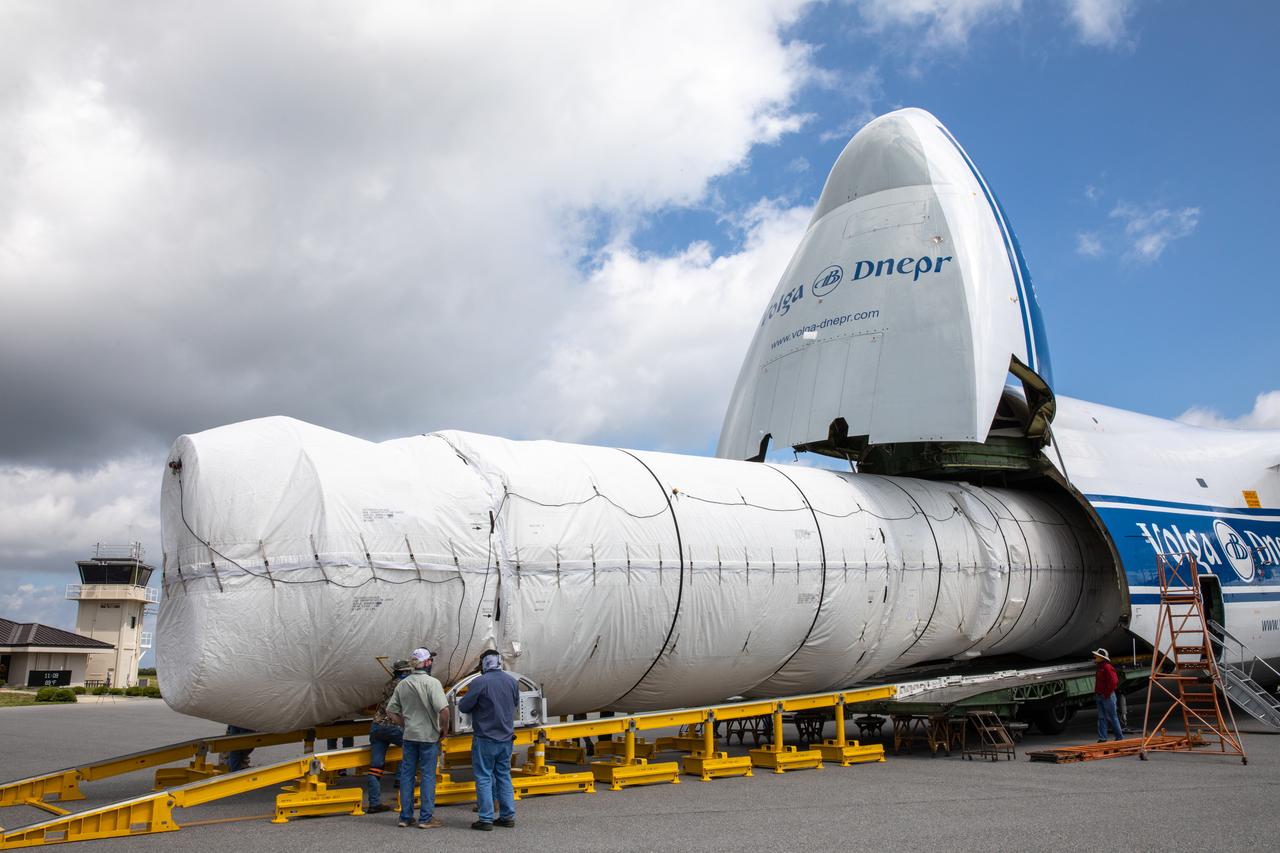
The United Launch Alliance booster for NASA’s Mars Perseverance rover is offloaded from the Antonov 124 cargo aircraft at the Skid Strip at Cape Canaveral Air Force Station (CCAFS) in Florida on May 19, 2020. The Mars Perseverance rover is scheduled to launch in mid-July atop a United Launch Alliance Atlas V 541 rocket from Pad 41 at CCAFS. The rover is part of NASA’s Mars Exploration Program, a long-term effort of robotic exploration of the Red Planet. The rover will search for habitable conditions in the ancient past and signs of past microbial life on Mars. The Launch Services Program at Kennedy is responsible for launch management.
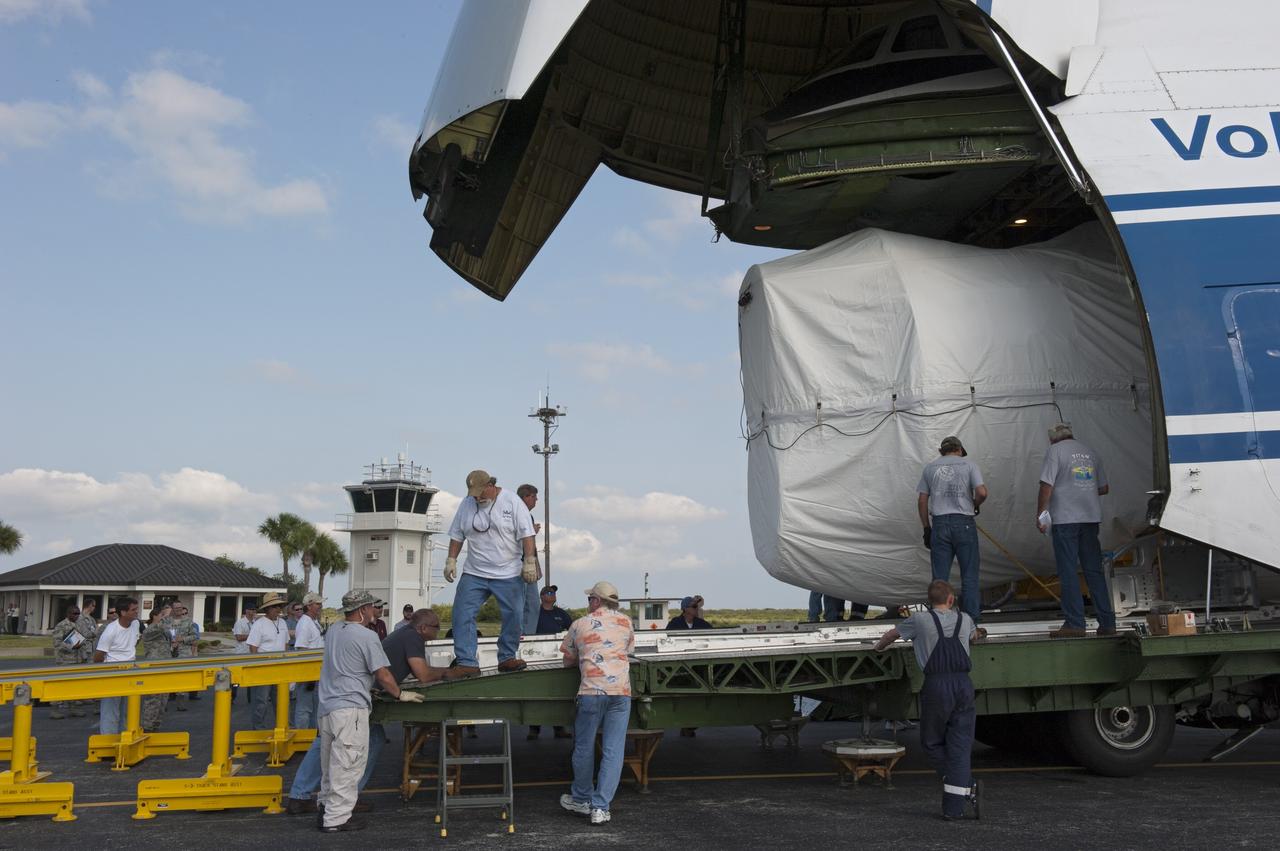
CAPE CANAVERAL, Fla. -- On the Skid Strip at Cape Canaveral Air Force Station in Florida, workers unload the first stage of the United Launch Alliance Atlas V rocket slated to launch NASA's Juno spacecraft from a Volga-Dnepr Antonov AN-124-100, a Ukranian/Russian cargo aircraft. Juno is scheduled to launch aboard an Atlas V rocket from Cape Canaveral, Fla., Aug. 5.The solar-powered spacecraft will orbit Jupiter's poles 33 times to find out more about the gas giant's origins, structure, atmosphere and magnetosphere and investigate the existence of a solid planetary core. For more information, visit www.nasa.gov/juno. Photo credit: NASA/Kim Shiflett
CAPE CANAVERAL, Fla. -- On the Skid Strip at Cape Canaveral Air Force Station in Florida, workers begin to unload the first stage of the United Launch Alliance Atlas V rocket slated to launch NASA's Juno spacecraft from a Volga-Dnepr Antonov AN-124-100, a Ukranian/Russian cargo aircraft. Juno is scheduled to launch aboard an Atlas V rocket from Cape Canaveral, Fla., Aug. 5.The solar-powered spacecraft will orbit Jupiter's poles 33 times to find out more about the gas giant's origins, structure, atmosphere and magnetosphere and investigate the existence of a solid planetary core. For more information, visit www.nasa.gov/juno. Photo credit: NASA/Kim Shiflett
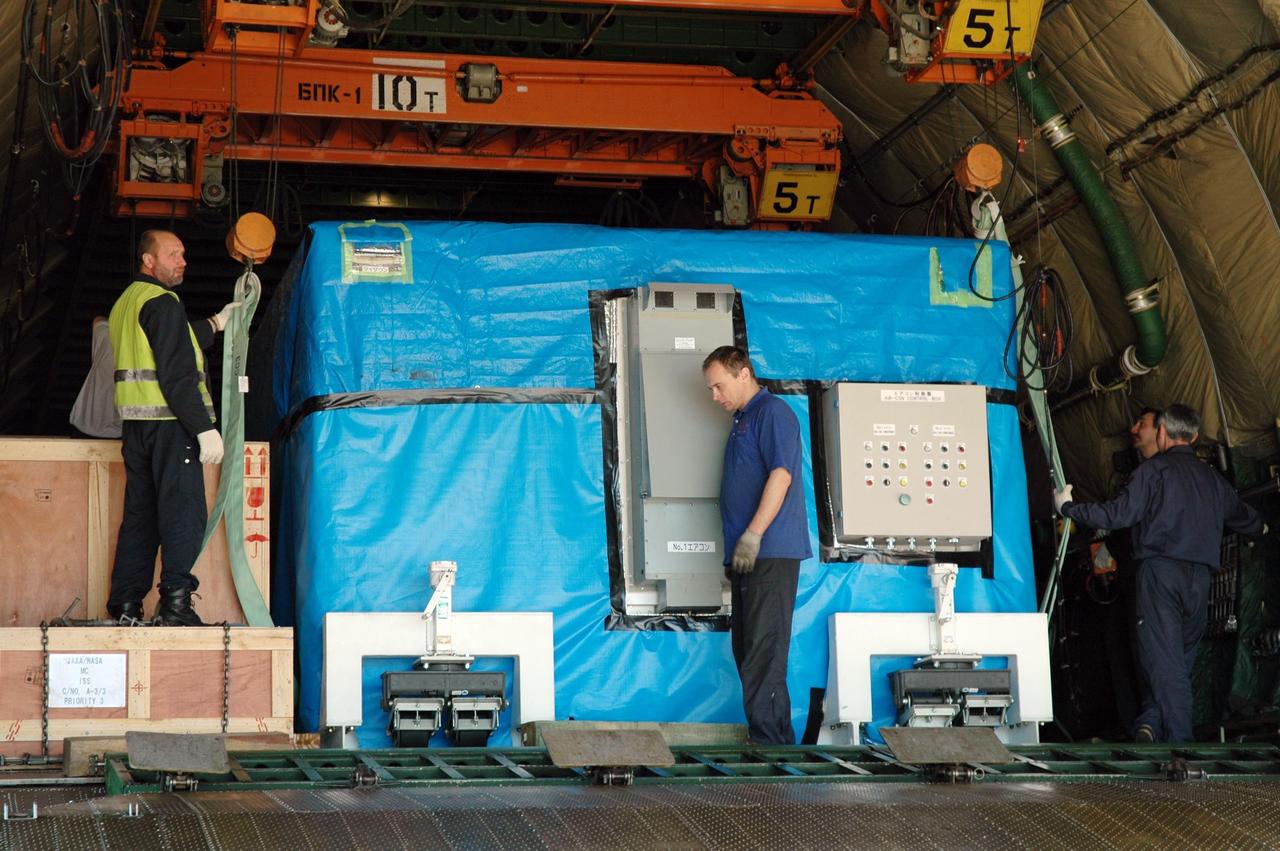
KENNEDY SPACE CENTER, FLA. -- At the KSC Shuttle Landing Facility, workers get ready to offload the newly arrived cargo of the Antonov 124 aircraft, the remote manipulator system for the Japanese Experiment Module. The RMS will be transported to the Space Station Processing Facility. The JEM, named "Kibo" (Hope), is Japan's primary contribution to the International Space Station. It will enhance the unique research capabilities of the orbiting complex by providing an additional environment for astronauts to conduct science experiments. The Japanese Aerospace Exploration Agency developed the laboratory. Both the JEM and RMS are targeted for mission STS-124, to launch in early 2008. Photo credit: NASA/Dimitrios Gerondidakis
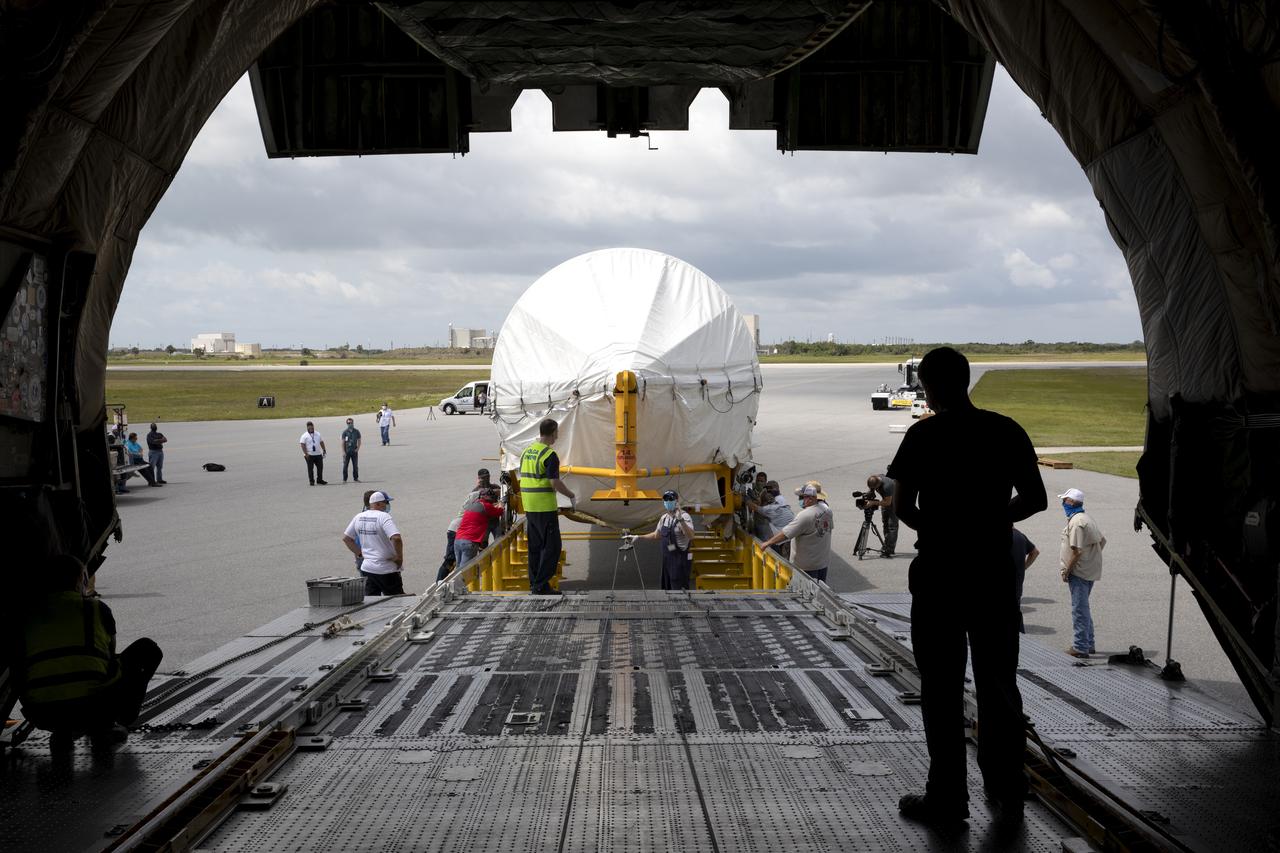
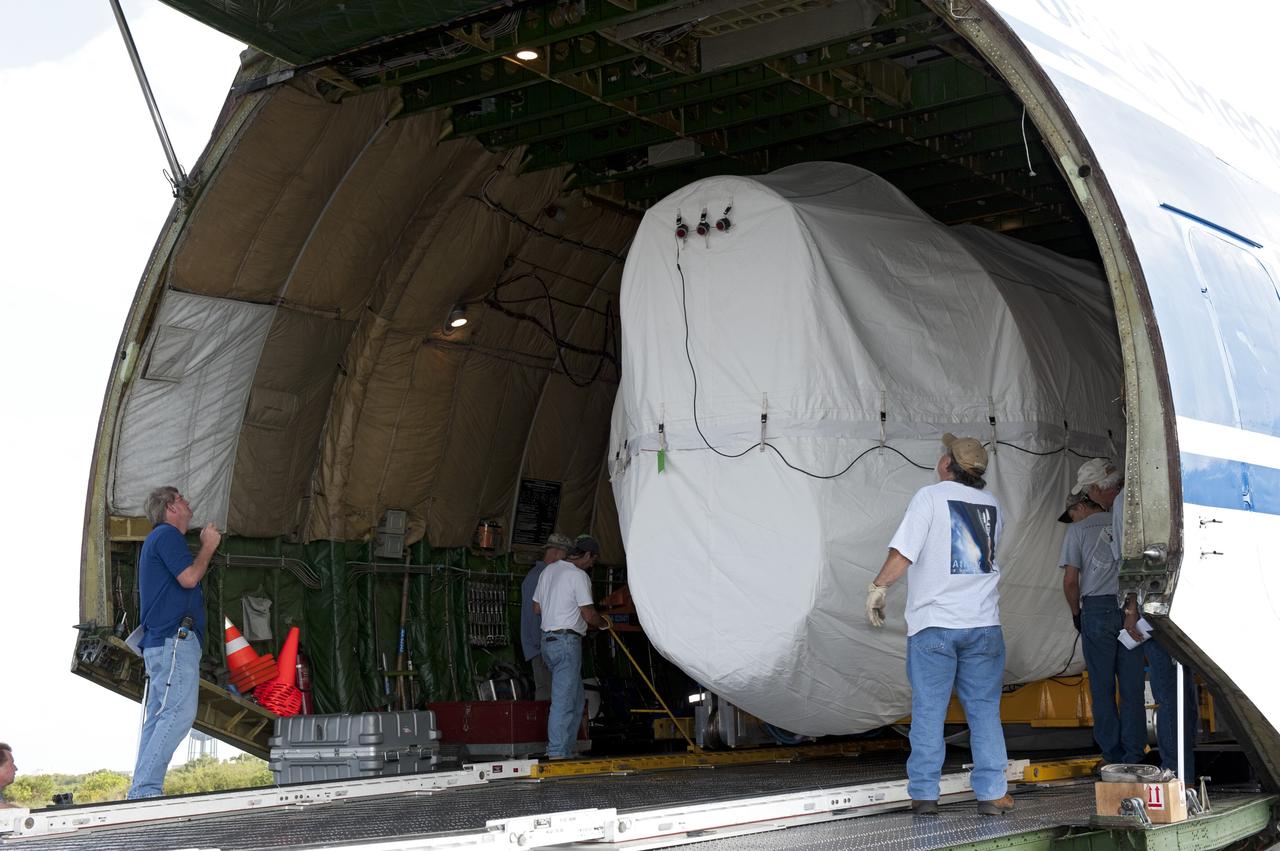
In this view from inside the Antonov 124 cargo aircraft, the United Launch Alliance booster for NASA’s Mars Perseverance rover is offloaded at the Skid Strip at Cape Canaveral Air Force Station (CCAFS) in Florida on May 19, 2020. The Mars Perseverance rover is scheduled to launch in mid-July atop a United Launch Alliance Atlas V 541 rocket from Pad 41 at CCAFS. The rover is part of NASA’s Mars Exploration Program, a long-term effort of robotic exploration of the Red Planet. The rover will search for habitable conditions in the ancient past and signs of past microbial life on Mars. The Launch Services Program at Kennedy is responsible for launch management.
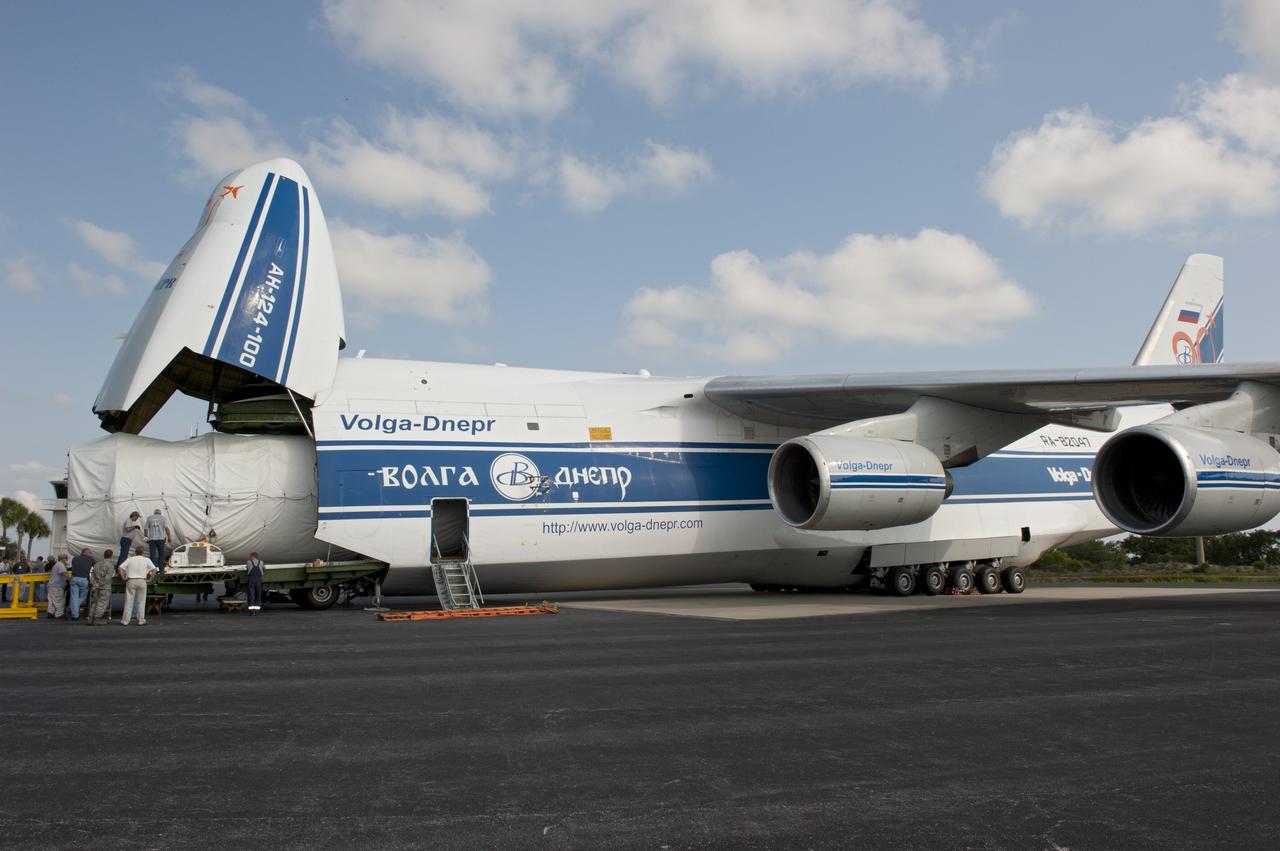
CAPE CANAVERAL, Fla. -- On the Skid Strip at Cape Canaveral Air Force Station in Florida, workers unload the first stage of the United Launch Alliance Atlas V rocket slated to launch NASA's Juno spacecraft from a Volga-Dnepr Antonov AN-124-100, a Ukranian/Russian cargo aircraft. Juno is scheduled to launch aboard an Atlas V rocket from Cape Canaveral, Fla., Aug. 5.The solar-powered spacecraft will orbit Jupiter's poles 33 times to find out more about the gas giant's origins, structure, atmosphere and magnetosphere and investigate the existence of a solid planetary core. For more information, visit www.nasa.gov/juno. Photo credit: NASA/Kim Shiflett
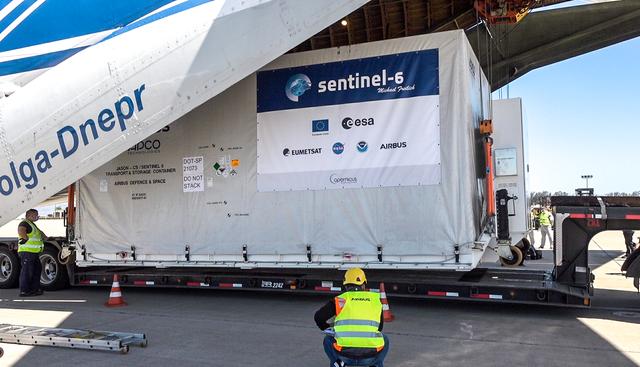
The Sentinel-6 Michael Freilich satellite, secured inside a shipping container, arrives at Vandenberg Air Force Base in California on Sept. 24, 2020, aboard an Antonov cargo aircraft. The mission is an international partnership and the first launch of a constellation of two satellites that will observe changes in Earth’s sea levels for at least the next decade. Launching atop a SpaceX Falcon 9 rocket, Sentinel-6 Michael Freilich is targeted to lift off from Vandenberg’s Space Launch Complex 4 on Nov. 10, 2020. The Launch Services Program at Kennedy is responsible for launch management.
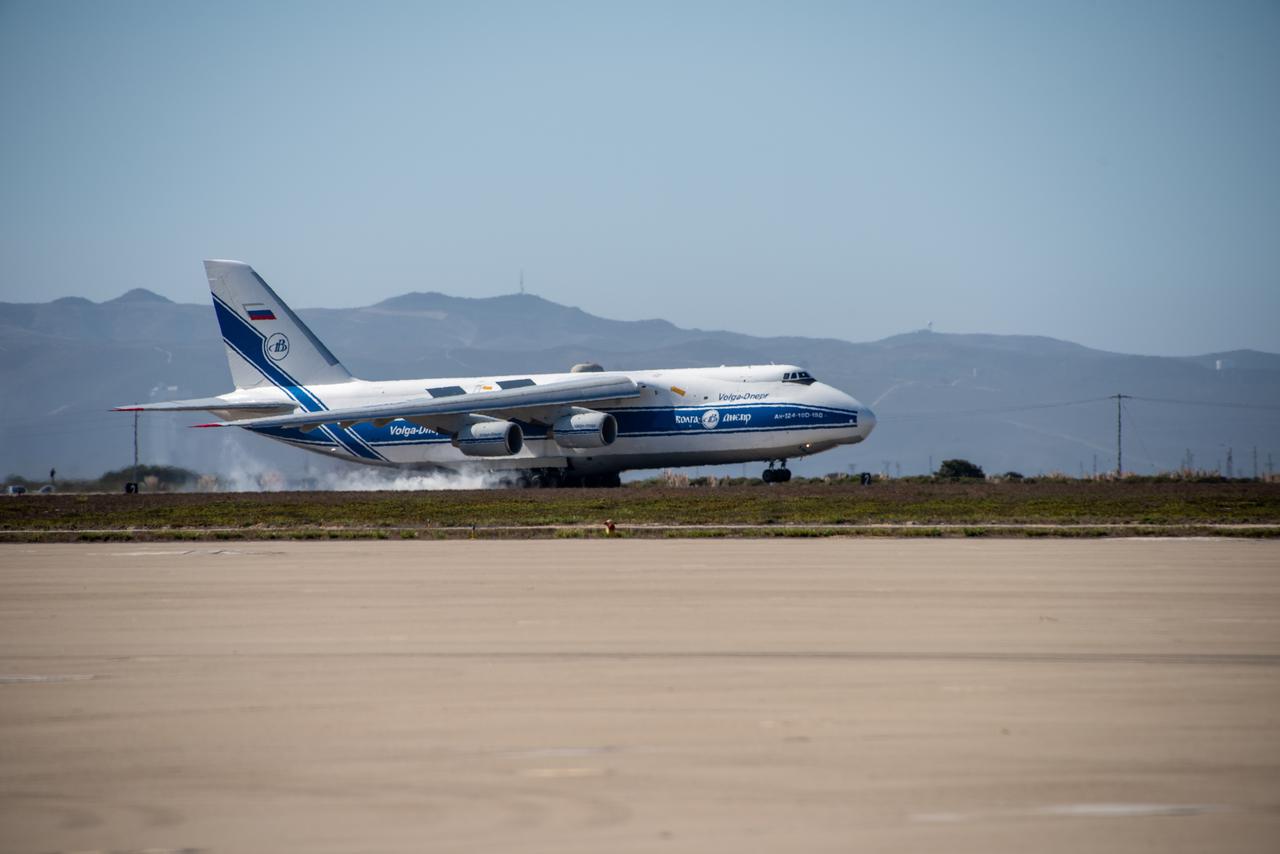
The Antonov cargo aircraft carrying the Sentinel-6 Michael Freilich satellite touches down on the runway at Vandenberg Air Force Base in California on Sept. 24, 2020. The mission is an international partnership and the first launch of a constellation of two satellites that will observe changes in Earth’s sea levels for at least the next decade. Launching atop a SpaceX Falcon 9 rocket, Sentinel-6 Michael Freilich is targeted to lift off from Vandenberg’s Space Launch Complex 4 on Nov. 10, 2020. The Launch Services Program at Kennedy is responsible for launch management.
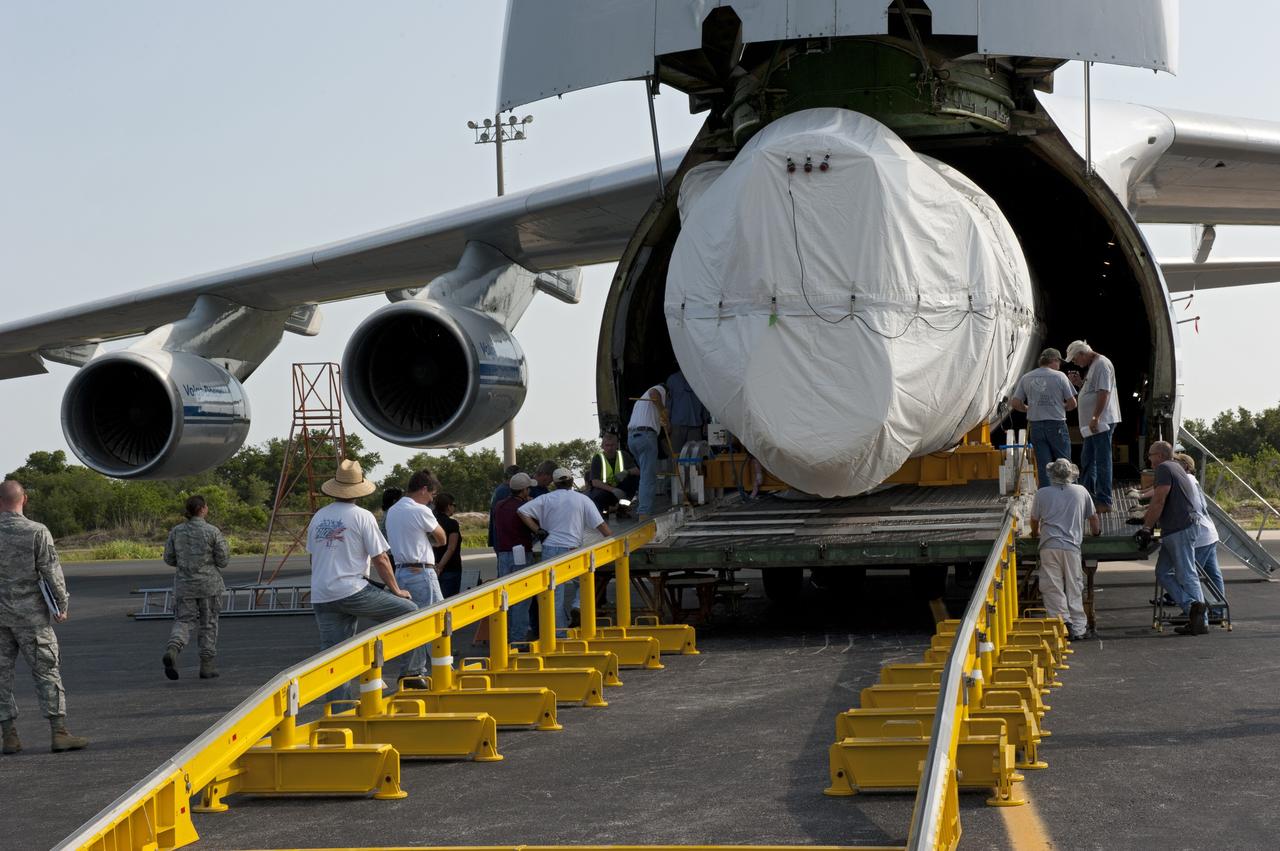
CAPE CANAVERAL, Fla. -- On the Skid Strip at Cape Canaveral Air Force Station in Florida, workers unload the first stage of the United Launch Alliance Atlas V rocket slated to launch NASA's Juno spacecraft from a Volga-Dnepr Antonov AN-124-100, a Ukranian/Russian cargo aircraft. Juno is scheduled to launch aboard an Atlas V rocket from Cape Canaveral, Fla., Aug. 5.The solar-powered spacecraft will orbit Jupiter's poles 33 times to find out more about the gas giant's origins, structure, atmosphere and magnetosphere and investigate the existence of a solid planetary core. For more information, visit www.nasa.gov/juno. Photo credit: NASA/Kim Shiflett
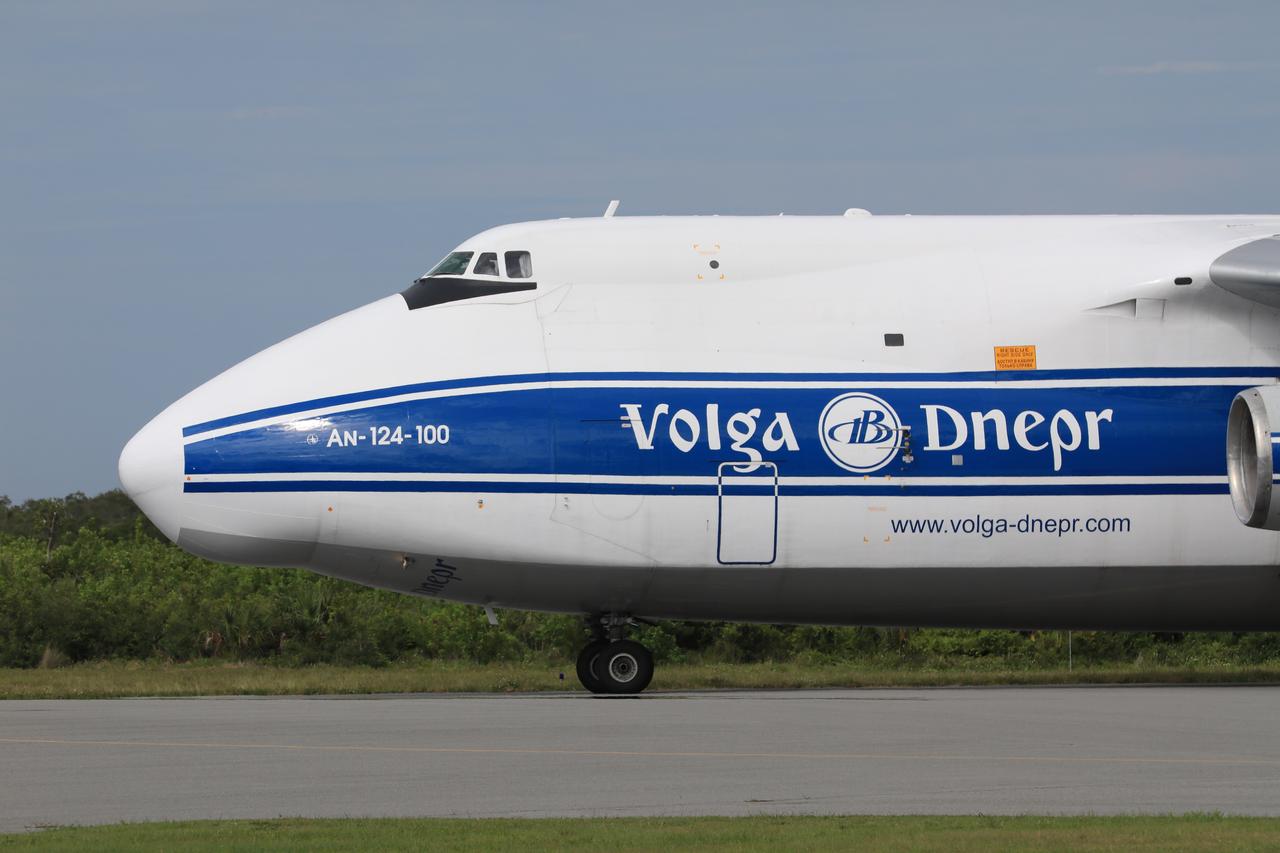
The Antonov 124 cargo aircraft, carrying the United Launch Alliance booster for NASA’s Mars Perseverance rover, taxis off the runway at the Skid Strip at Cape Canaveral Air Force Station (CCAFS) in Florida on May 18, 2020. The Mars Perseverance rover is scheduled to launch in mid-July atop a United Launch Alliance Atlas V 541 rocket from Pad 41 at CCAFS. The rover is part of NASA’s Mars Exploration Program, a long-term effort of robotic exploration of the Red Planet. The rover will search for habitable conditions in the ancient past and signs of past microbial life on Mars. The Launch Services Program at Kennedy is responsible for launch management.
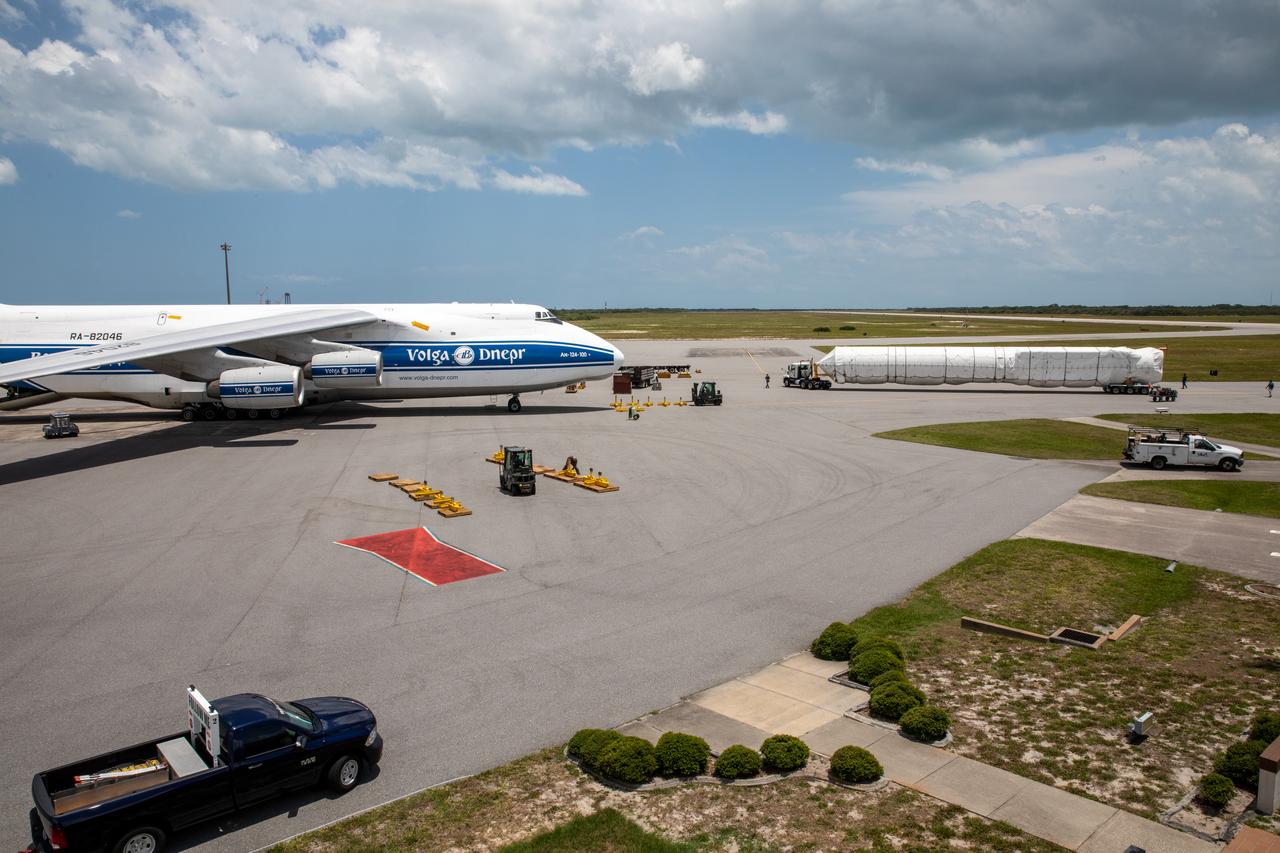
The United Launch Alliance booster for NASA’s Mars Perseverance rover is secured on a flatbed truck after being offloaded from the Antonov 124 cargo aircraft at the Skid Strip at Cape Canaveral Air Force Station (CCAFS) in Florida on May 19, 2020. The Mars Perseverance rover is scheduled to launch in mid-July atop a United Launch Alliance Atlas V 541 rocket from Pad 41 at CCAFS. The rover is part of NASA’s Mars Exploration Program, a long-term effort of robotic exploration of the Red Planet. The rover will search for habitable conditions in the ancient past and signs of past microbial life on Mars. The Launch Services Program at Kennedy is responsible for launch management.
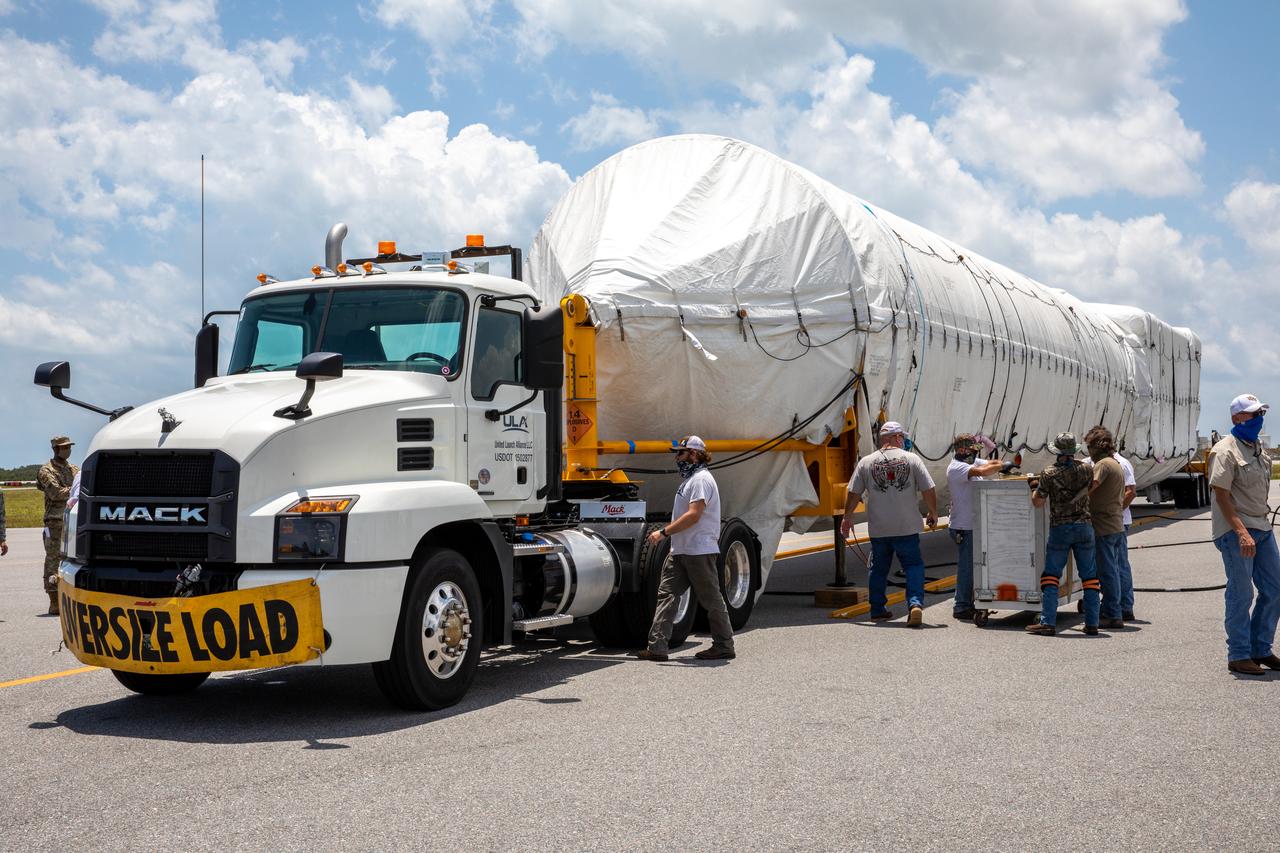
The United Launch Alliance booster for NASA’s Mars Perseverance rover is secured on a flatbed truck after being offloaded from the Antonov 124 cargo aircraft at the Skid Strip at Cape Canaveral Air Force Station (CCAFS) in Florida on May 19, 2020. The Mars Perseverance rover is scheduled to launch in mid-July atop a United Launch Alliance Atlas V 541 rocket from Pad 41 at CCAFS. The rover is part of NASA’s Mars Exploration Program, a long-term effort of robotic exploration of the Red Planet. The rover will search for habitable conditions in the ancient past and signs of past microbial life on Mars. The Launch Services Program at Kennedy is responsible for launch management.
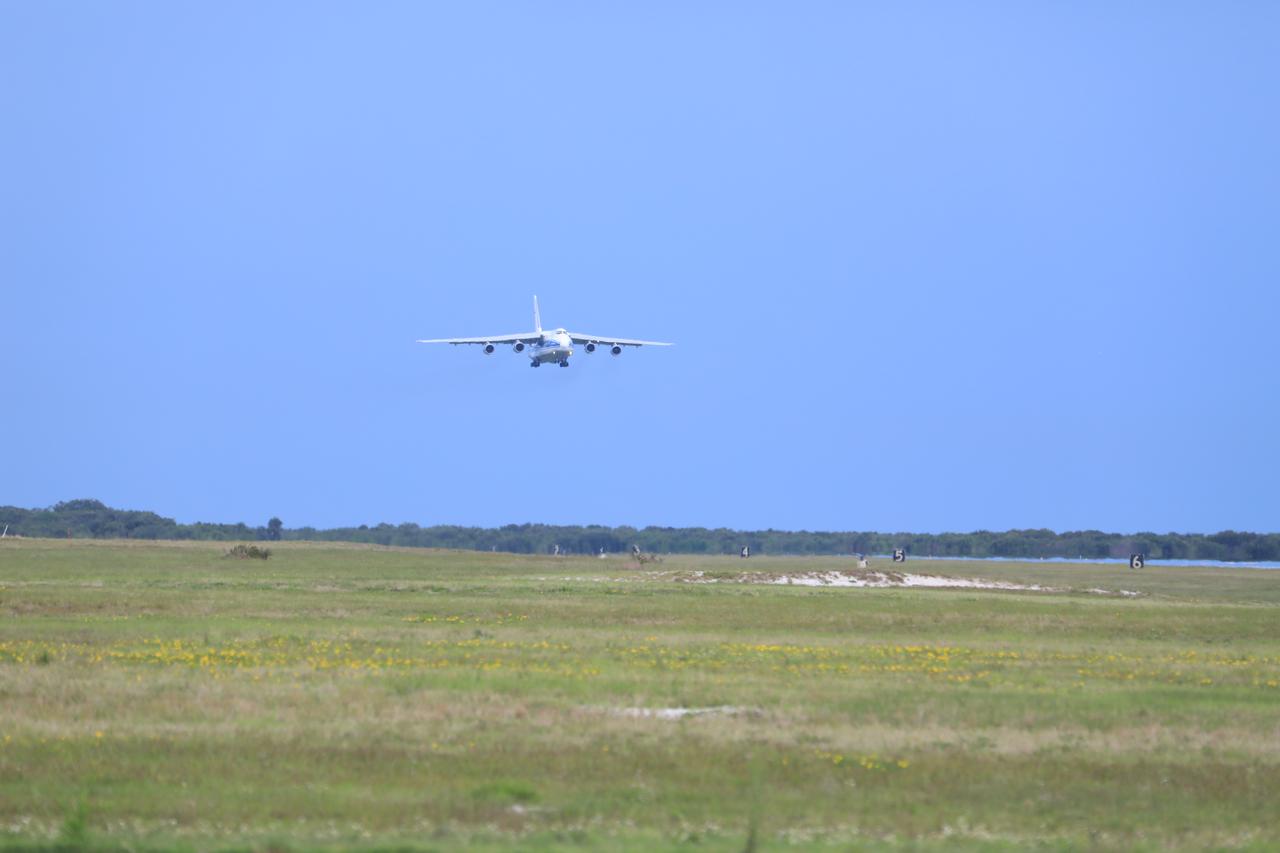
The Antonov 124 cargo aircraft, carrying the United Launch Alliance booster for NASA’s Mars Perseverance rover, descends toward the Skid Strip at Cape Canaveral Air Force Station (CCAFS) in Florida on May 18, 2020. The Mars Perseverance rover is scheduled to launch in mid-July atop a United Launch Alliance Atlas V 541 rocket from Pad 41 at CCAFS. The rover is part of NASA’s Mars Exploration Program, a long-term effort of robotic exploration of the Red Planet. The rover will search for habitable conditions in the ancient past and signs of past microbial life on Mars. The Launch Services Program at Kennedy is responsible for launch management.

The Sentinel-6 Michael Freilich satellite, secured inside a shipping container, arrives at Vandenberg Air Force Base in California on Sept. 24, 2020, aboard an Antonov cargo aircraft. The mission is an international partnership and the first launch of a constellation of two satellites that will observe changes in Earth’s sea levels for at least the next decade. Launching atop a SpaceX Falcon 9 rocket, Sentinel-6 Michael Freilich is targeted to lift off from Vandenberg’s Space Launch Complex 4 on Nov. 10, 2020. The Launch Services Program at Kennedy is responsible for launch management.
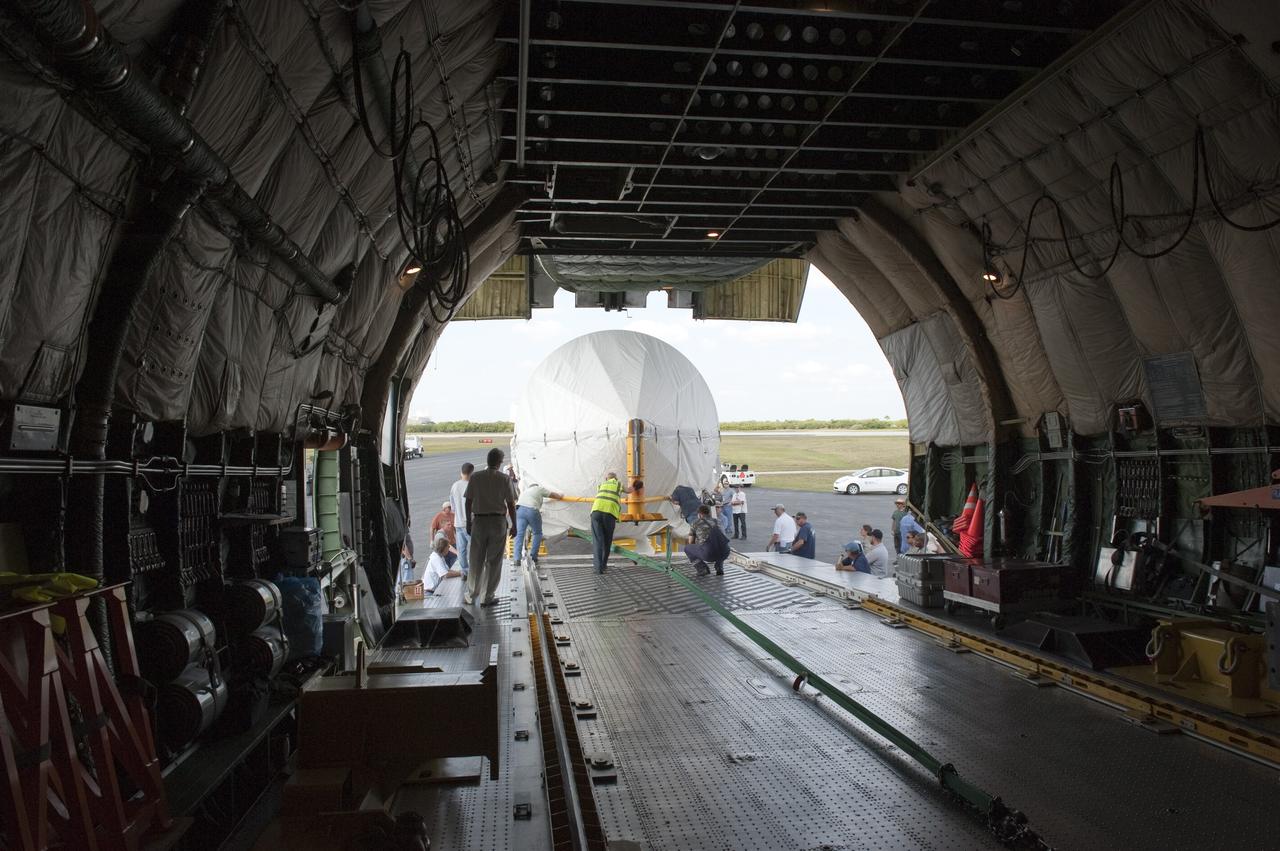
CAPE CANAVERAL, Fla. -- On the Skid Strip at Cape Canaveral Air Force Station in Florida, workers unload the first stage of the United Launch Alliance Atlas V rocket slated to launch NASA's Juno spacecraft from a Volga-Dnepr Antonov AN-124-100, a Ukranian/Russian cargo aircraft. Juno is scheduled to launch aboard an Atlas V rocket from Cape Canaveral, Fla., Aug. 5.The solar-powered spacecraft will orbit Jupiter's poles 33 times to find out more about the gas giant's origins, structure, atmosphere and magnetosphere and investigate the existence of a solid planetary core. For more information, visit www.nasa.gov/juno. Photo credit: NASA/Kim Shiflett
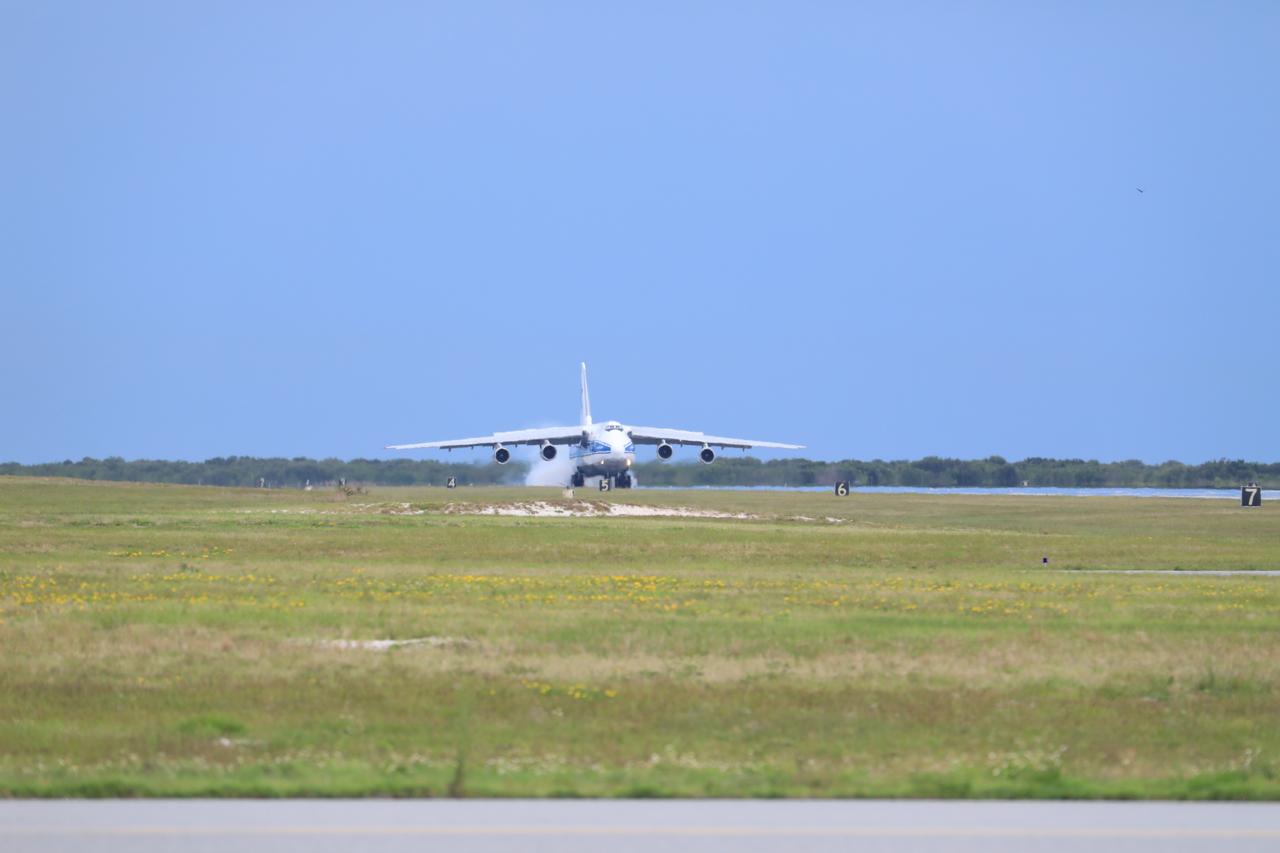
The Antonov 124 cargo aircraft, carrying the United Launch Alliance booster for NASA’s Mars Perseverance rover, touches down on the Skid Strip at Cape Canaveral Air Force Station (CCAFS) in Florida on May 18, 2020. The Mars Perseverance rover is scheduled to launch in mid-July atop a United Launch Alliance Atlas V 541 rocket from Pad 41 at CCAFS. The rover is part of NASA’s Mars Exploration Program, a long-term effort of robotic exploration of the Red Planet. The rover will search for habitable conditions in the ancient past and signs of past microbial life on Mars. The Launch Services Program at Kennedy is responsible for launch management.
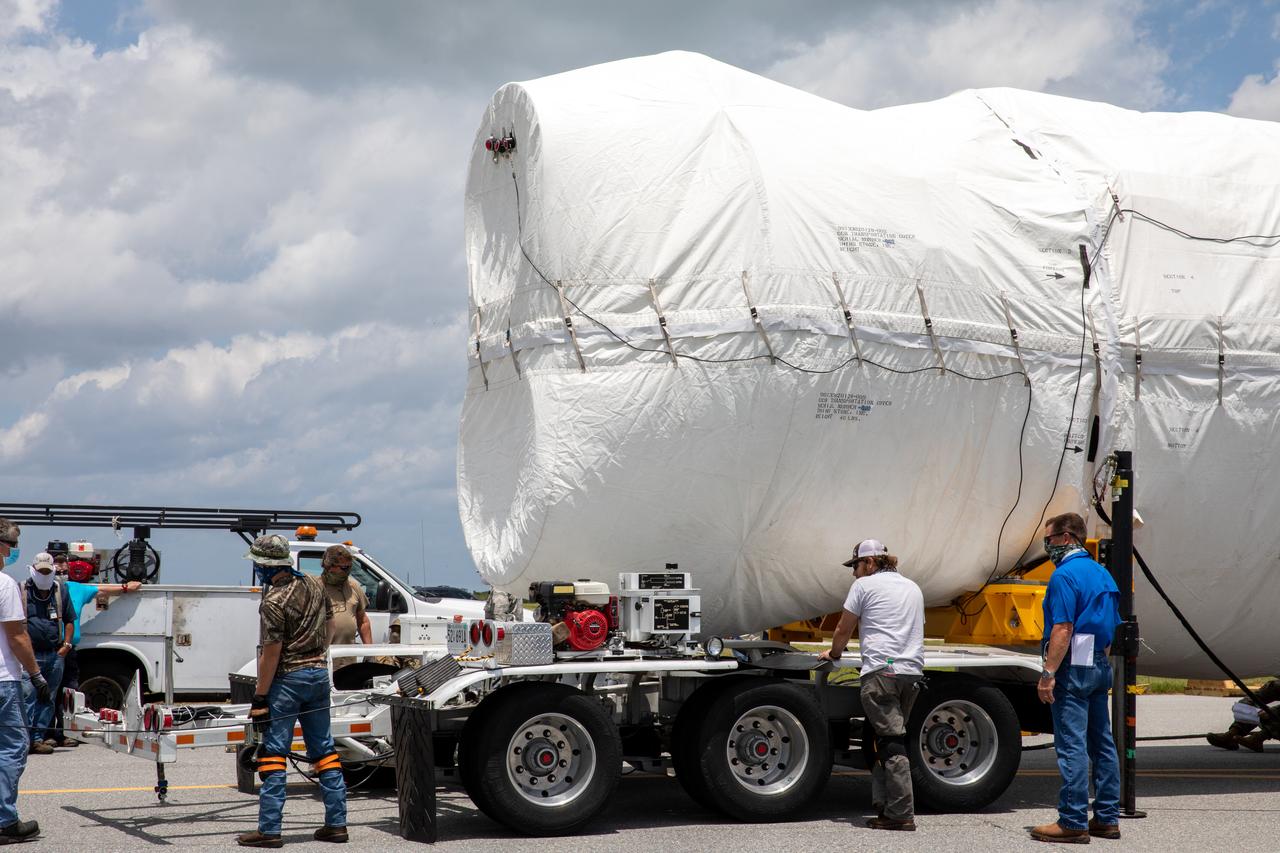
The United Launch Alliance booster for NASA’s Mars Perseverance rover is secured on a flatbed truck after being offloaded from the Antonov 124 cargo aircraft at the Skid Strip at Cape Canaveral Air Force Station (CCAFS) in Florida on May 19, 2020. The Mars Perseverance rover is scheduled to launch in mid-July atop a United Launch Alliance Atlas V 541 rocket from Pad 41 at CCAFS. The rover is part of NASA’s Mars Exploration Program, a long-term effort of robotic exploration of the Red Planet. The rover will search for habitable conditions in the ancient past and signs of past microbial life on Mars. The Launch Services Program at Kennedy is responsible for launch management.
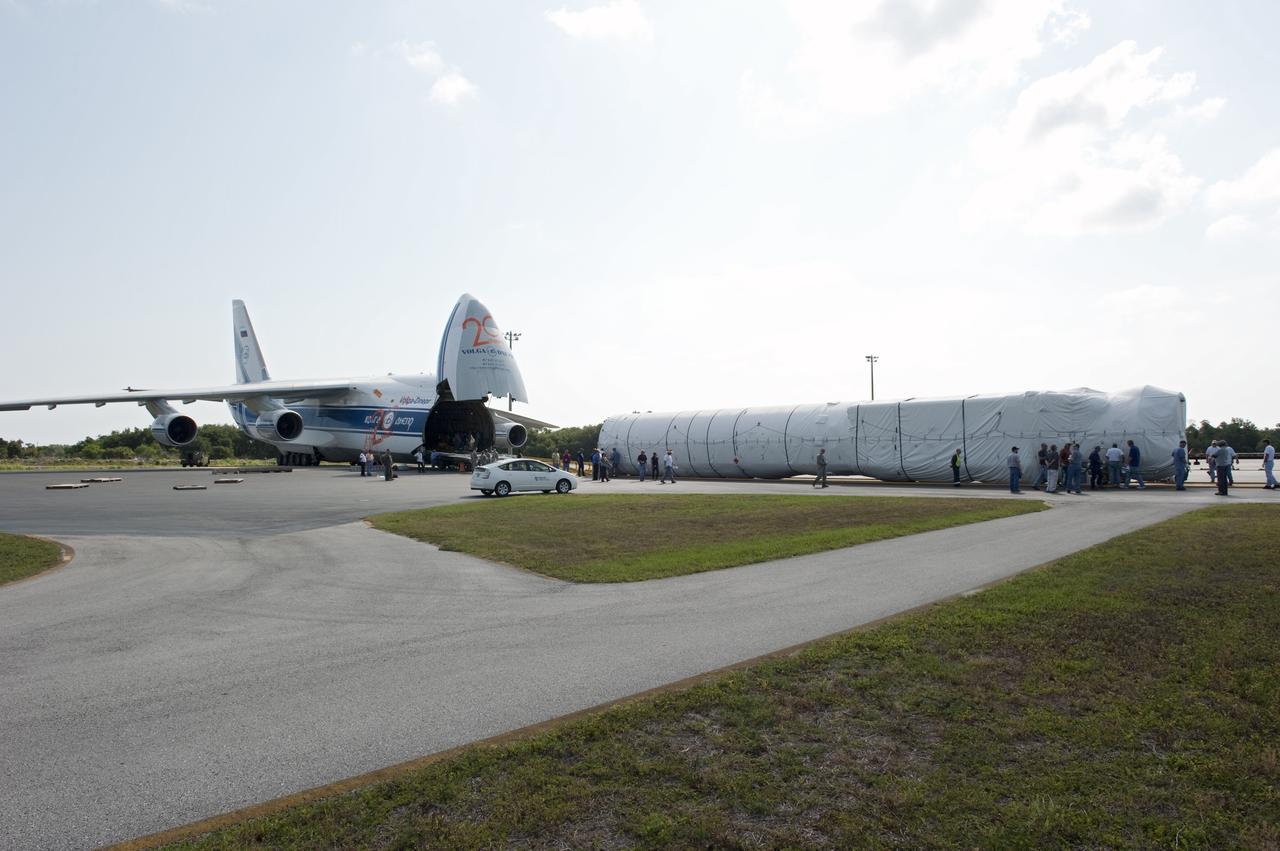
CAPE CANAVERAL, Fla. -- On the Skid Strip at Cape Canaveral Air Force Station in Florida, workers have unloaded the first stage of the United Launch Alliance Atlas V rocket slated to launch NASA's Juno spacecraft from a Volga-Dnepr Antonov AN-124-100, a Ukranian/Russian cargo aircraft. Juno is scheduled to launch aboard an Atlas V rocket from Cape Canaveral, Fla., Aug. 5.The solar-powered spacecraft will orbit Jupiter's poles 33 times to find out more about the gas giant's origins, structure, atmosphere and magnetosphere and investigate the existence of a solid planetary core. For more information, visit www.nasa.gov/juno. Photo credit: NASA/Kim Shiflett
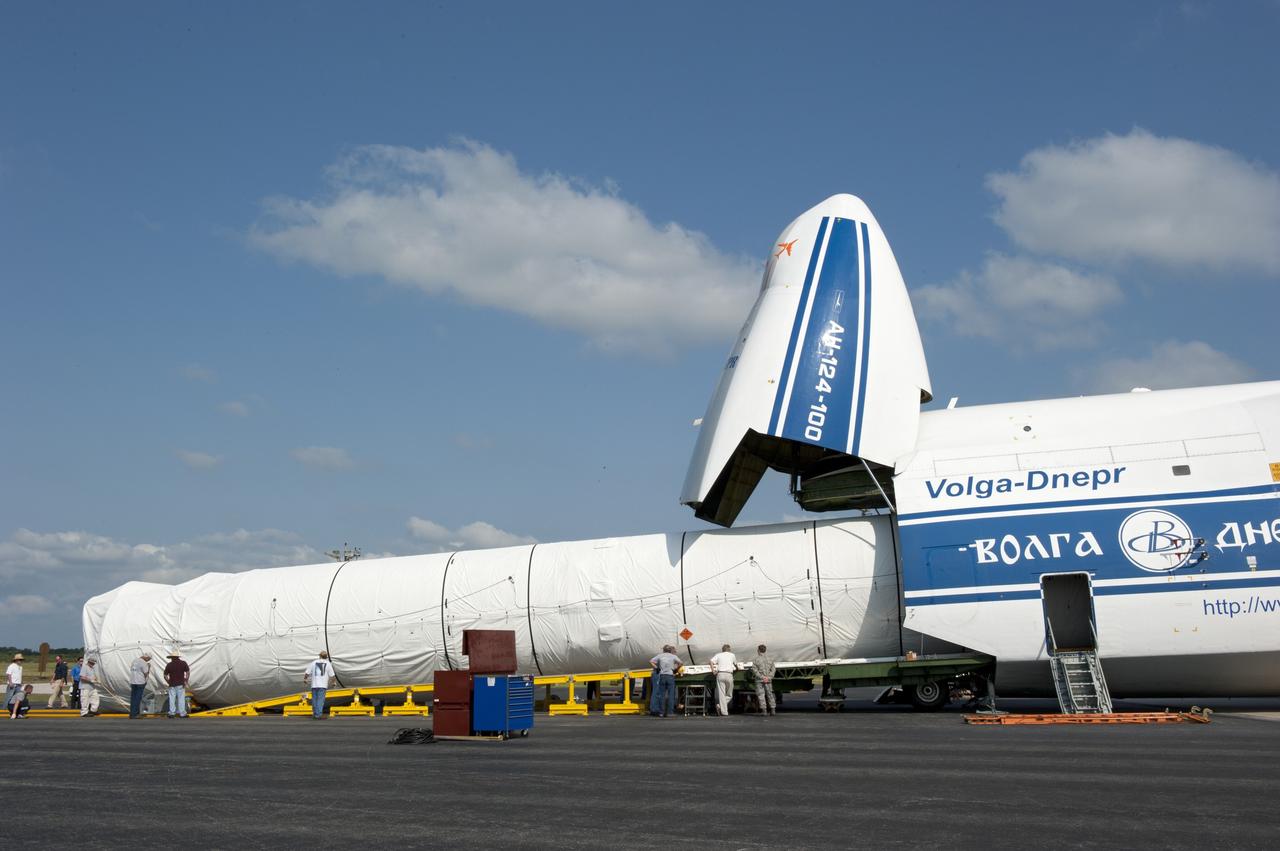
CAPE CANAVERAL, Fla. -- On the Skid Strip at Cape Canaveral Air Force Station in Florida, workers unload the first stage of the United Launch Alliance Atlas V rocket slated to launch NASA's Juno spacecraft from a Volga-Dnepr Antonov AN-124-100, a Ukranian/Russian cargo aircraft. Juno is scheduled to launch aboard an Atlas V rocket from Cape Canaveral, Fla., Aug. 5.The solar-powered spacecraft will orbit Jupiter's poles 33 times to find out more about the gas giant's origins, structure, atmosphere and magnetosphere and investigate the existence of a solid planetary core. For more information, visit www.nasa.gov/juno. Photo credit: NASA/Kim Shiflett
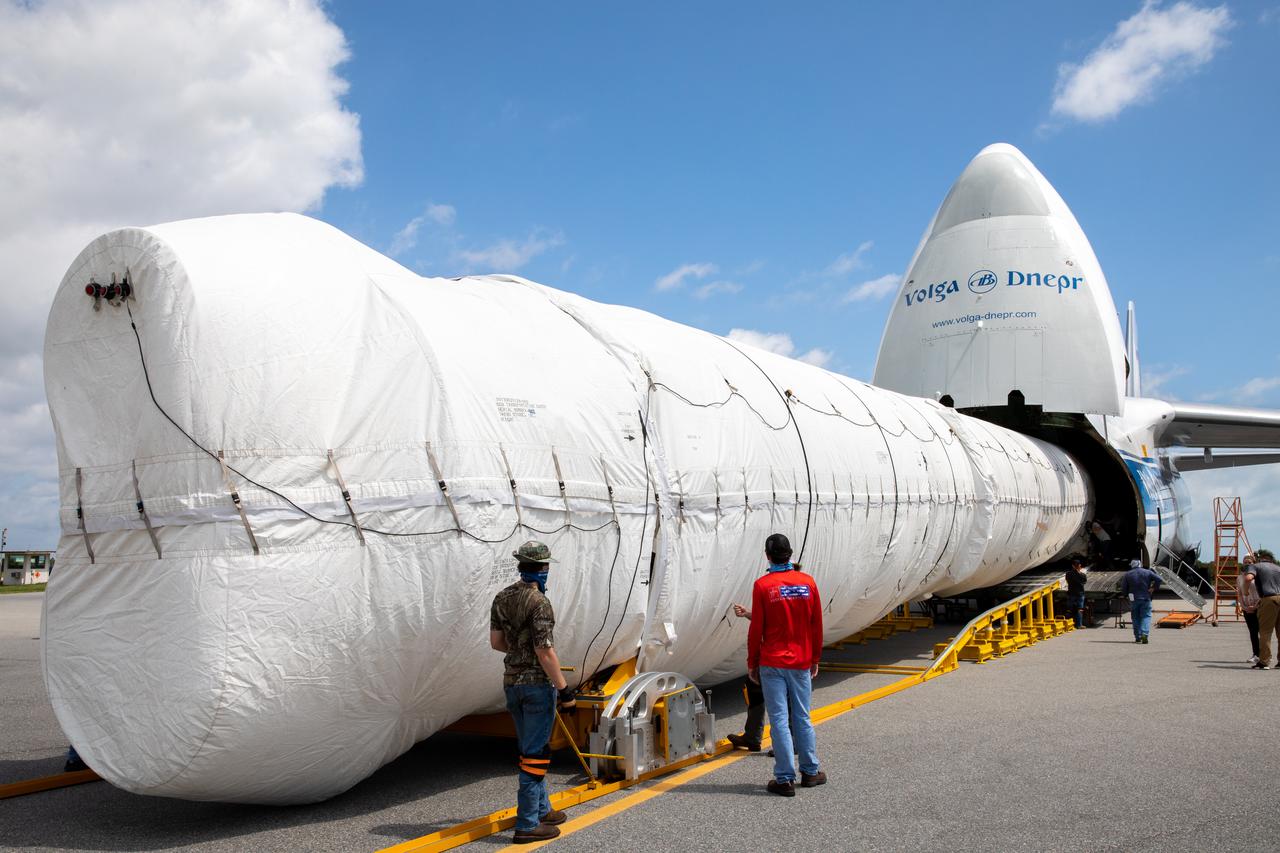
The United Launch Alliance booster for NASA’s Mars Perseverance rover is offloaded from the Antonov 124 cargo aircraft at the Skid Strip at Cape Canaveral Air Force Station (CCAFS) in Florida on May 19, 2020. The Mars Perseverance rover is scheduled to launch in mid-July atop a United Launch Alliance Atlas V 541 rocket from Pad 41 at CCAFS. The rover is part of NASA’s Mars Exploration Program, a long-term effort of robotic exploration of the Red Planet. The rover will search for habitable conditions in the ancient past and signs of past microbial life on Mars. The Launch Services Program at Kennedy is responsible for launch management.
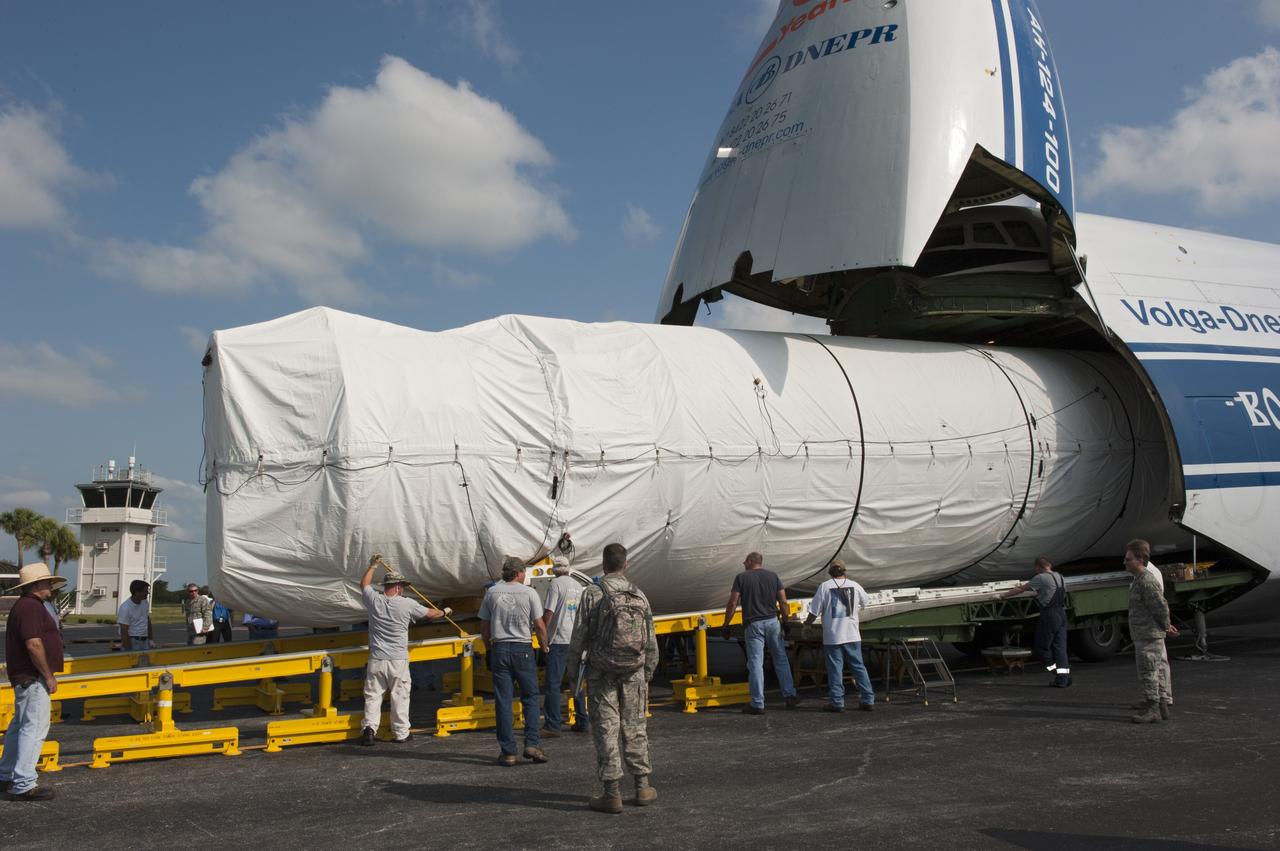
CAPE CANAVERAL, Fla. -- On the Skid Strip at Cape Canaveral Air Force Station in Florida, workers unload the first stage of the United Launch Alliance Atlas V rocket slated to launch NASA's Juno spacecraft from a Volga-Dnepr Antonov AN-124-100, a Ukranian/Russian cargo aircraft. Juno is scheduled to launch aboard an Atlas V rocket from Cape Canaveral, Fla., Aug. 5.The solar-powered spacecraft will orbit Jupiter's poles 33 times to find out more about the gas giant's origins, structure, atmosphere and magnetosphere and investigate the existence of a solid planetary core. For more information, visit www.nasa.gov/juno. Photo credit: NASA/Kim Shiflett
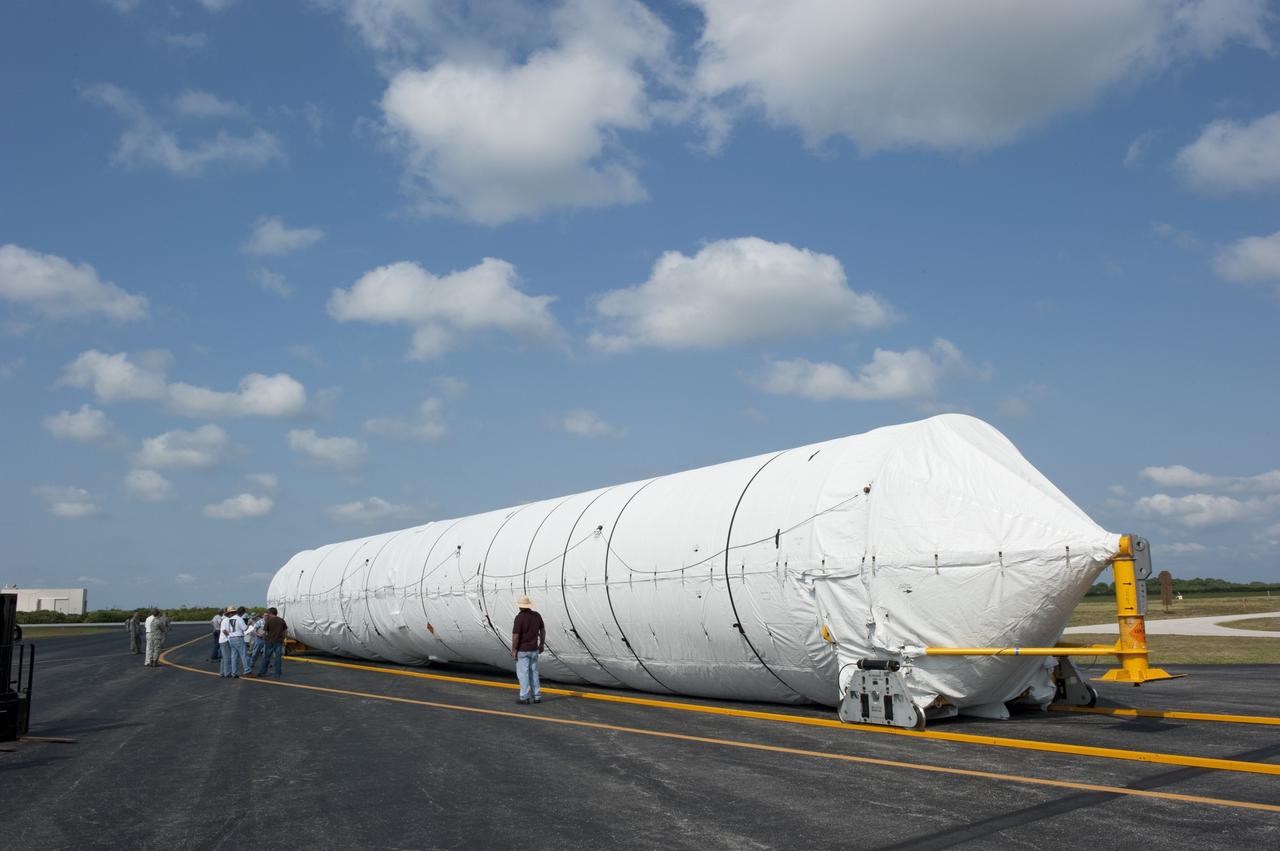
CAPE CANAVERAL, Fla. -- On the Skid Strip at Cape Canaveral Air Force Station in Florida, workers have unloaded the first stage of the United Launch Alliance Atlas V rocket slated to launch NASA's Juno spacecraft from a Volga-Dnepr Antonov AN-124-100, a Ukranian/Russian cargo aircraft. Juno is scheduled to launch aboard an Atlas V rocket from Cape Canaveral, Fla., Aug. 5.The solar-powered spacecraft will orbit Jupiter's poles 33 times to find out more about the gas giant's origins, structure, atmosphere and magnetosphere and investigate the existence of a solid planetary core. For more information, visit www.nasa.gov/juno. Photo credit: NASA/Kim Shiflett

The Sentinel-6 Michael Freilich satellite, secured inside a shipping container, is offloaded from the Antonov cargo aircraft that delivered it to Vandenberg Air Force Base in California on Sept. 24, 2020. The mission is an international partnership and the first launch of a constellation of two satellites that will observe changes in Earth’s sea levels for at least the next decade. Launching atop a SpaceX Falcon 9 rocket, Sentinel-6 Michael Freilich is targeted to lift off from Vandenberg’s Space Launch Complex 4 on Nov. 10, 2020. The Launch Services Program at Kennedy is responsible for launch management.
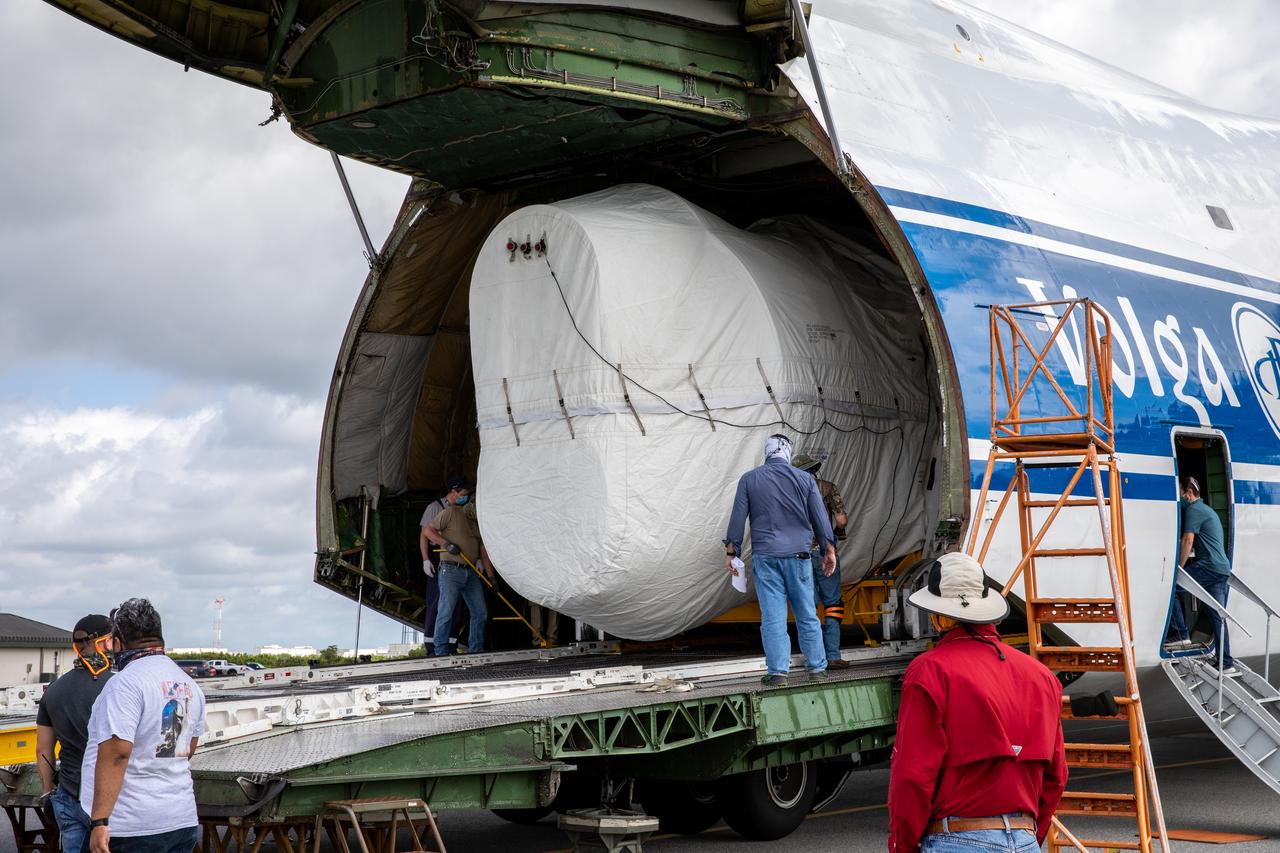
Preparations are underway to offload the United Launch Alliance booster for NASA’s Mars Perseverance rover from the Antonov 124 cargo aircraft at the Skid Strip at Cape Canaveral Air Force Station (CCAFS) in Florida on May 19, 2020. The Mars Perseverance rover is scheduled to launch in mid-July atop a United Launch Alliance Atlas V 541 rocket from Pad 41 at CCAFS. The rover is part of NASA’s Mars Exploration Program, a long-term effort of robotic exploration of the Red Planet. The rover will search for habitable conditions in the ancient past and signs of past microbial life on Mars. The Launch Services Program at Kennedy is responsible for launch management.
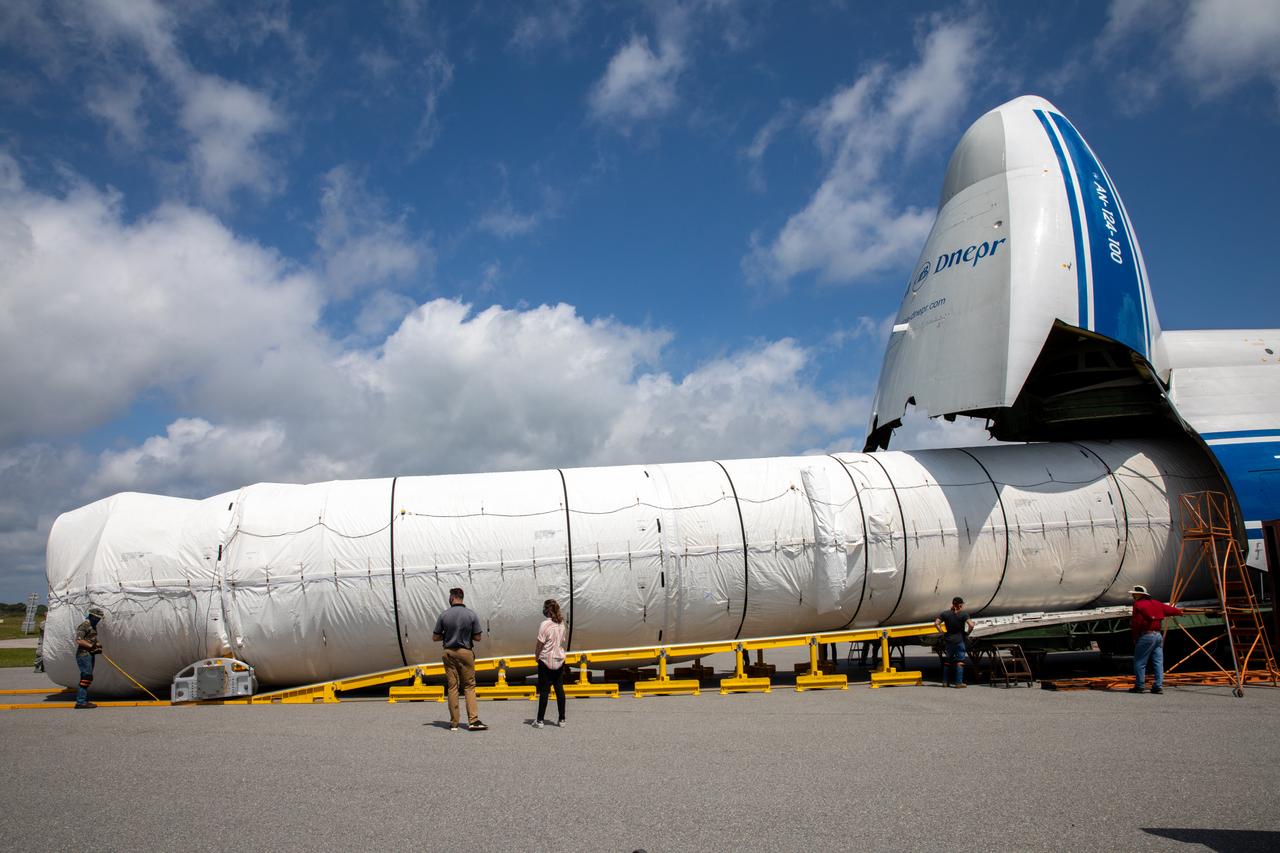
The United Launch Alliance booster for NASA’s Mars Perseverance rover is offloaded from the Antonov 124 cargo aircraft at the Skid Strip at Cape Canaveral Air Force Station (CCAFS) in Florida on May 19, 2020. The Mars Perseverance rover is scheduled to launch in mid-July atop a United Launch Alliance Atlas V 541 rocket from Pad 41 at CCAFS. The rover is part of NASA’s Mars Exploration Program, a long-term effort of robotic exploration of the Red Planet. The rover will search for habitable conditions in the ancient past and signs of past microbial life on Mars. The Launch Services Program at Kennedy is responsible for launch management.
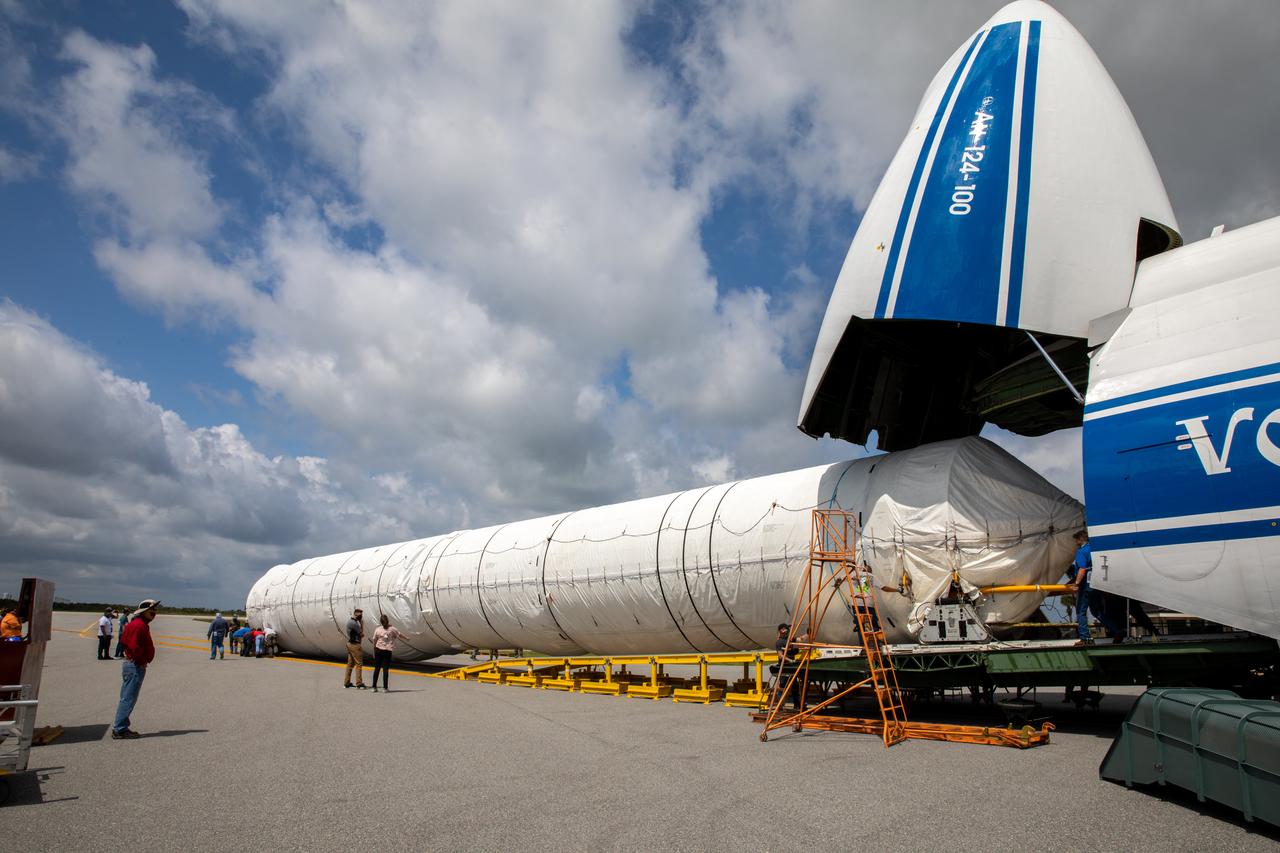
The United Launch Alliance booster for NASA’s Mars Perseverance rover is offloaded from the Antonov 124 cargo aircraft at the Skid Strip at Cape Canaveral Air Force Station (CCAFS) in Florida on May 19, 2020. The Mars Perseverance rover is scheduled to launch in mid-July atop a United Launch Alliance Atlas V 541 rocket from Pad 41 at CCAFS. The rover is part of NASA’s Mars Exploration Program, a long-term effort of robotic exploration of the Red Planet. The rover will search for habitable conditions in the ancient past and signs of past microbial life on Mars. The Launch Services Program at Kennedy is responsible for launch management.
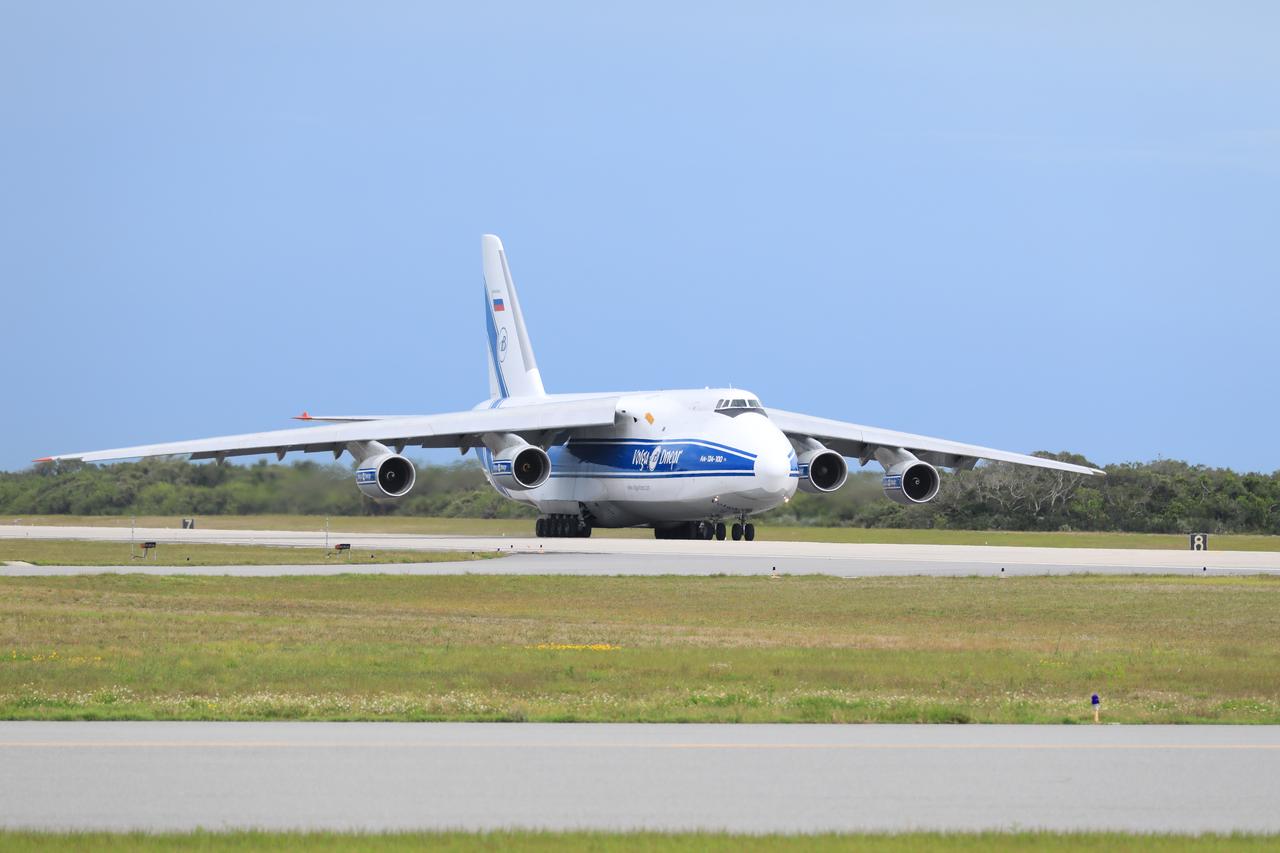
The Antonov 124 cargo aircraft, carrying the United Launch Alliance booster for NASA’s Mars Perseverance rover, touches down on the Skid Strip at Cape Canaveral Air Force Station (CCAFS) in Florida on May 18, 2020. The Mars Perseverance rover is scheduled to launch in mid-July atop a United Launch Alliance Atlas V 541 rocket from Pad 41 at CCAFS. The rover is part of NASA’s Mars Exploration Program, a long-term effort of robotic exploration of the Red Planet. The rover will search for habitable conditions in the ancient past and signs of past microbial life on Mars. The Launch Services Program at Kennedy is responsible for launch management.
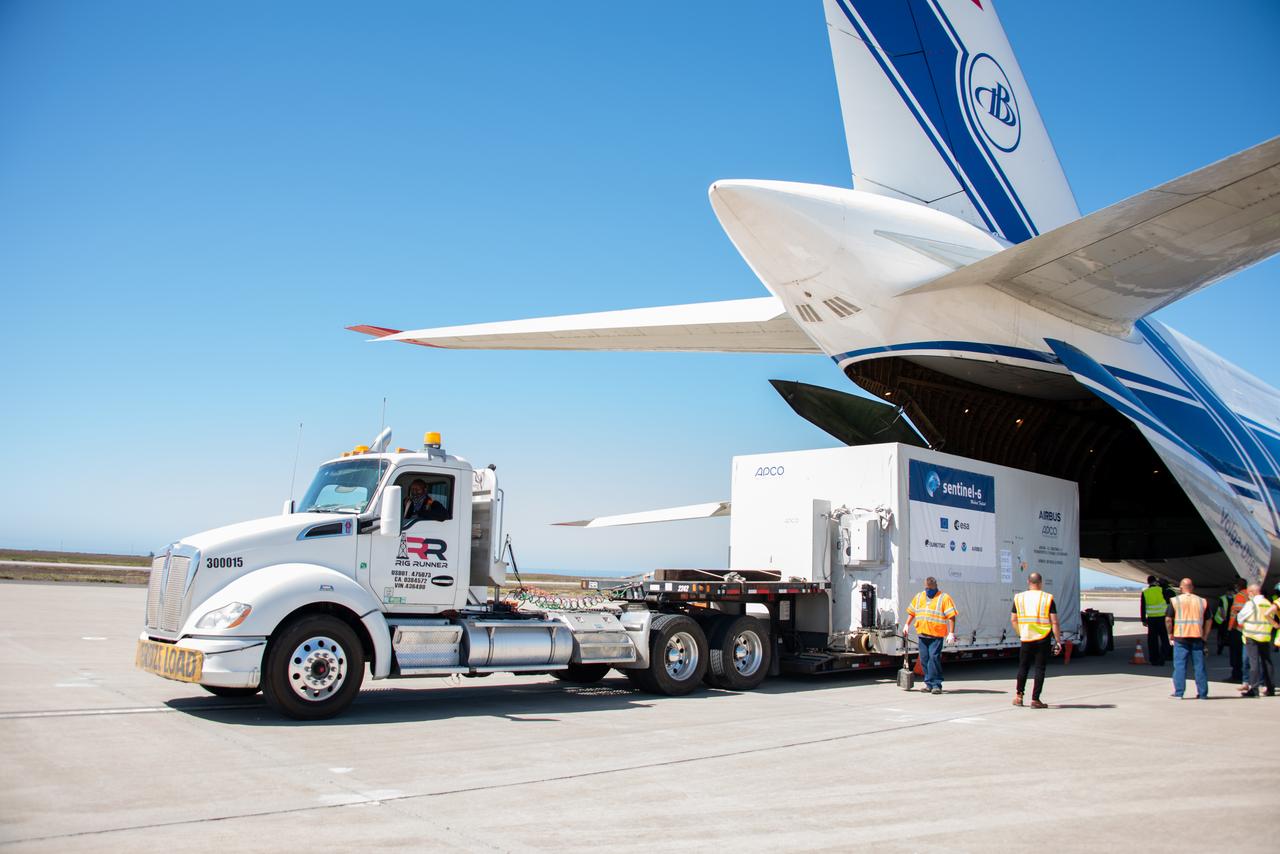
The Sentinel-6 Michael Freilich satellite, secured inside a shipping container, is placed on a transport vehicle after the spacecraft’s arrival at Vandenberg Air Force Base in California aboard a Antonov cargo aircraft, Sept. 24, 2020. The mission is an international partnership and the first launch of a constellation of two satellites that will observe changes in Earth’s sea levels for at least the next decade. Launching atop a SpaceX Falcon 9 rocket, Sentinel-6 Michael Freilich is targeted to lift off from Vandenberg’s Space Launch Complex 4 on Nov. 10, 2020. The Launch Services Program at Kennedy is responsible for launch management.
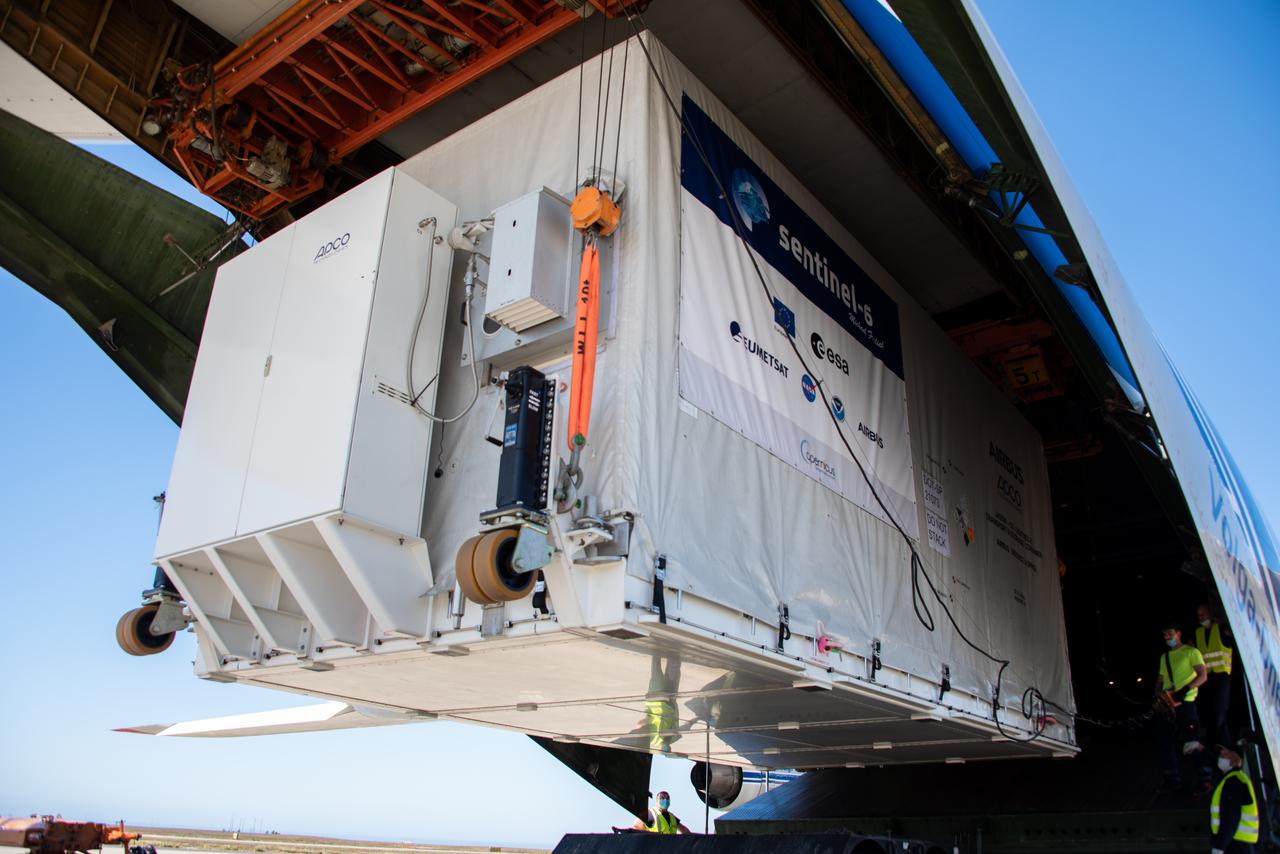
The Sentinel-6 Michael Freilich satellite, secured inside a shipping container, is offloaded from the Antonov cargo aircraft that delivered it to Vandenberg Air Force Base in California on Sept. 24, 2020. The mission is an international partnership and the first launch of a constellation of two satellites that will observe changes in Earth’s sea levels for at least the next decade. Launching atop a SpaceX Falcon 9 rocket, Sentinel-6 Michael Freilich is targeted to lift off from Vandenberg’s Space Launch Complex 4 on Nov. 10, 2020. The Launch Services Program at Kennedy is responsible for launch management.
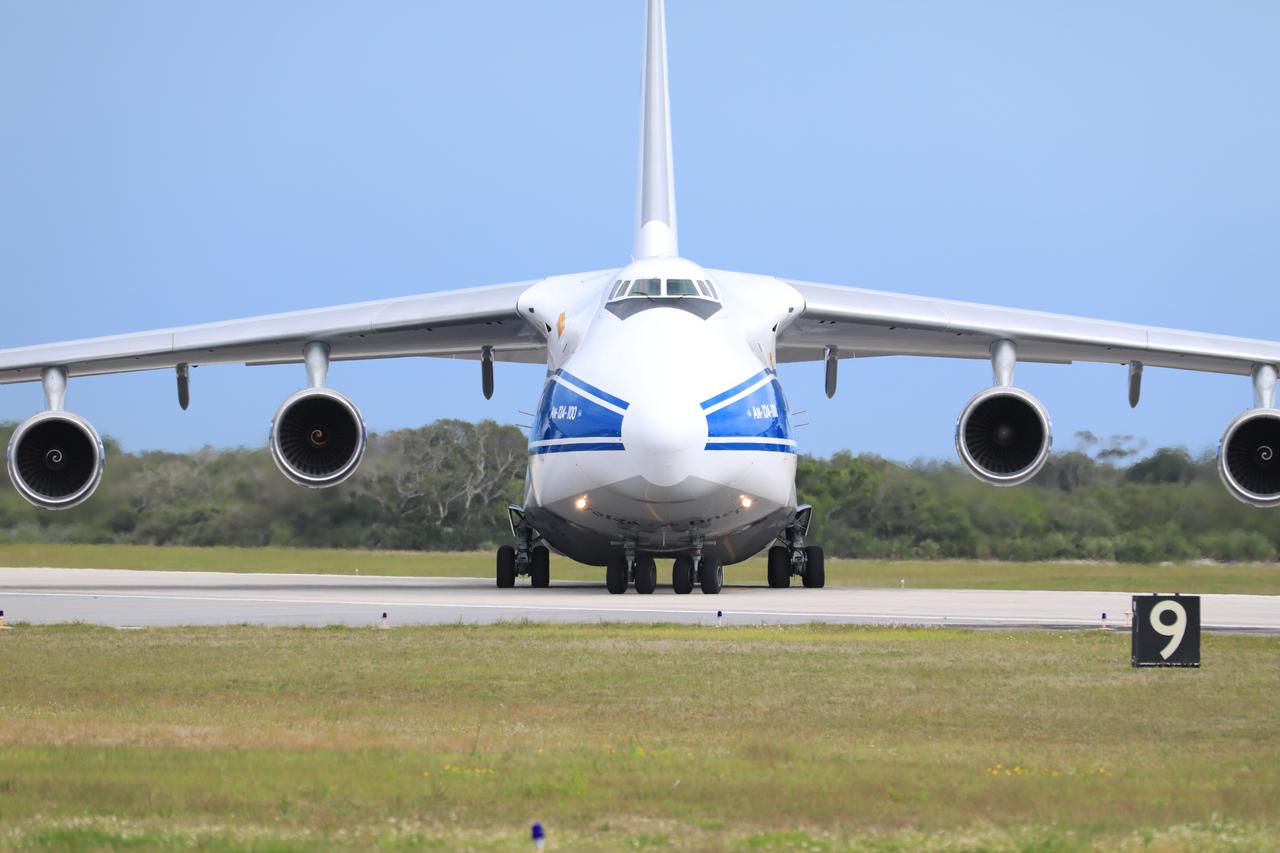
The Antonov 124 cargo aircraft, carrying the United Launch Alliance booster for NASA’s Mars Perseverance rover, taxis off the runway at the Skid Strip at Cape Canaveral Air Force Station (CCAFS) in Florida on May 18, 2020. The Mars Perseverance rover is scheduled to launch in mid-July atop a United Launch Alliance Atlas V 541 rocket from Pad 41 at CCAFS. The rover is part of NASA’s Mars Exploration Program, a long-term effort of robotic exploration of the Red Planet. The rover will search for habitable conditions in the ancient past and signs of past microbial life on Mars. The Launch Services Program at Kennedy is responsible for launch management.
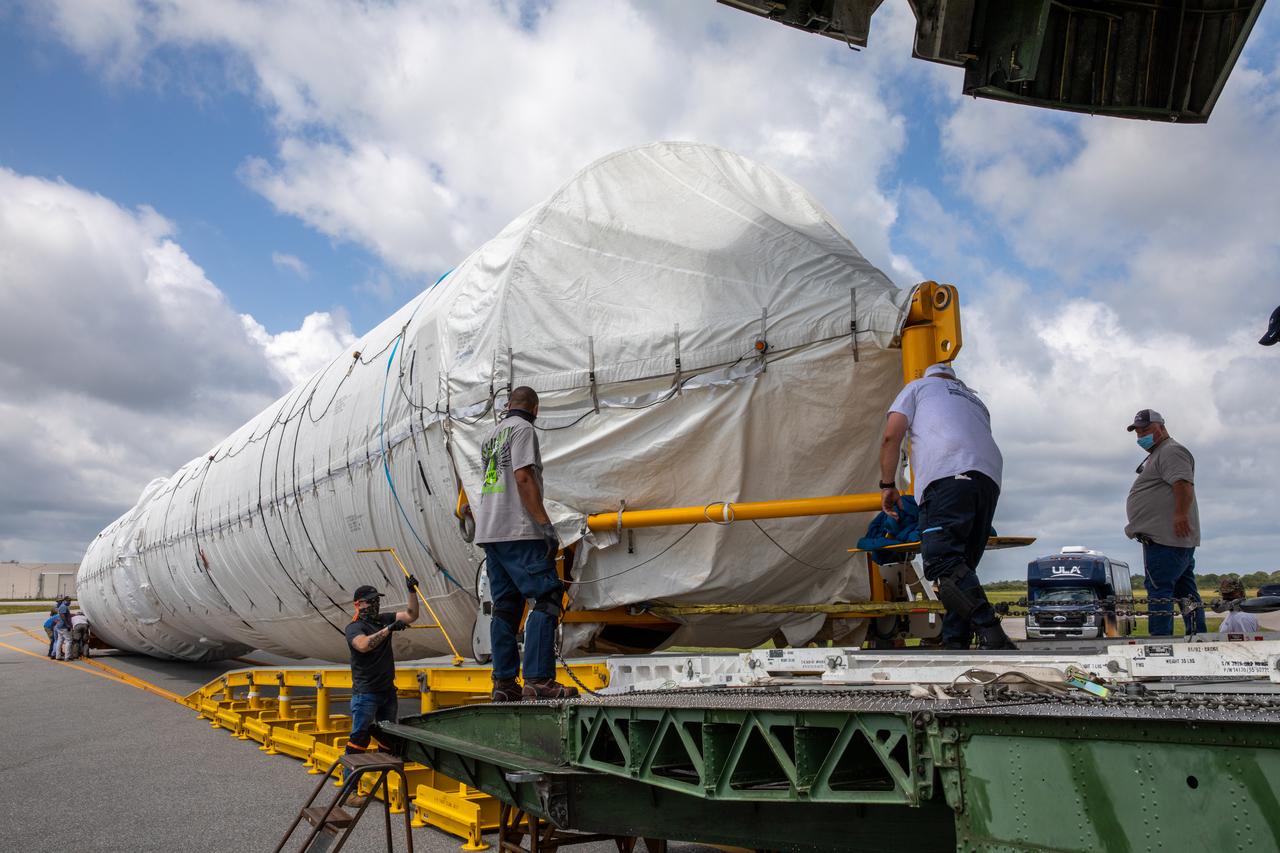
Workers secure the United Launch Alliance booster for NASA’s Mars Perseverance rover as it is offloaded from the Antonov 124 cargo aircraft at the Skid Strip at Cape Canaveral Air Force Station (CCAFS) in Florida on May 19, 2020. The Mars Perseverance rover is scheduled to launch in mid-July atop a United Launch Alliance Atlas V 541 rocket from Pad 41 at CCAFS. The rover is part of NASA’s Mars Exploration Program, a long-term effort of robotic exploration of the Red Planet. The rover will search for habitable conditions in the ancient past and signs of past microbial life on Mars. The Launch Services Program at Kennedy is responsible for launch management.
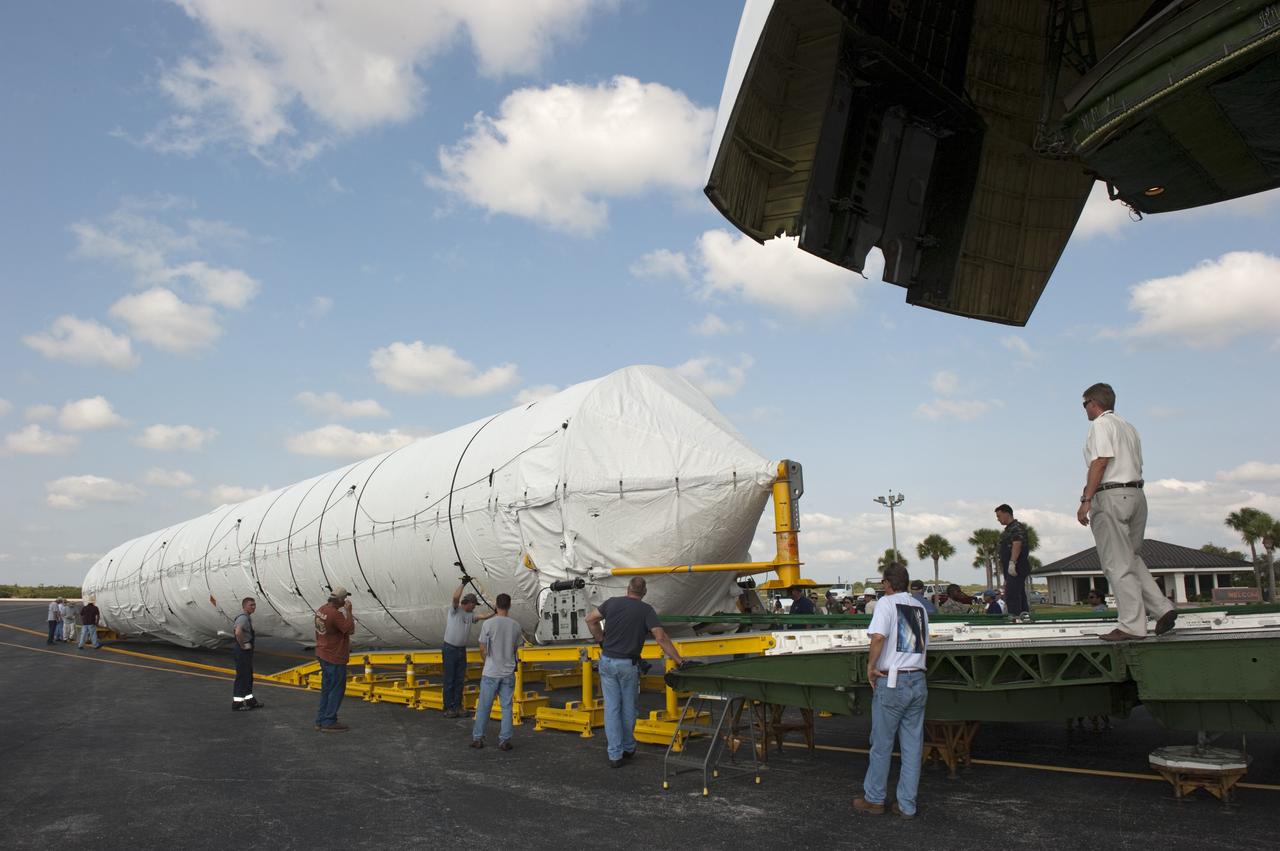
CAPE CANAVERAL, Fla. -- On the Skid Strip at Cape Canaveral Air Force Station in Florida, workers unload the first stage of the United Launch Alliance Atlas V rocket slated to launch NASA's Juno spacecraft from a Volga-Dnepr Antonov AN-124-100, a Ukranian/Russian cargo aircraft. Juno is scheduled to launch aboard an Atlas V rocket from Cape Canaveral, Fla., Aug. 5.The solar-powered spacecraft will orbit Jupiter's poles 33 times to find out more about the gas giant's origins, structure, atmosphere and magnetosphere and investigate the existence of a solid planetary core. For more information, visit www.nasa.gov/juno. Photo credit: NASA/Kim Shiflett
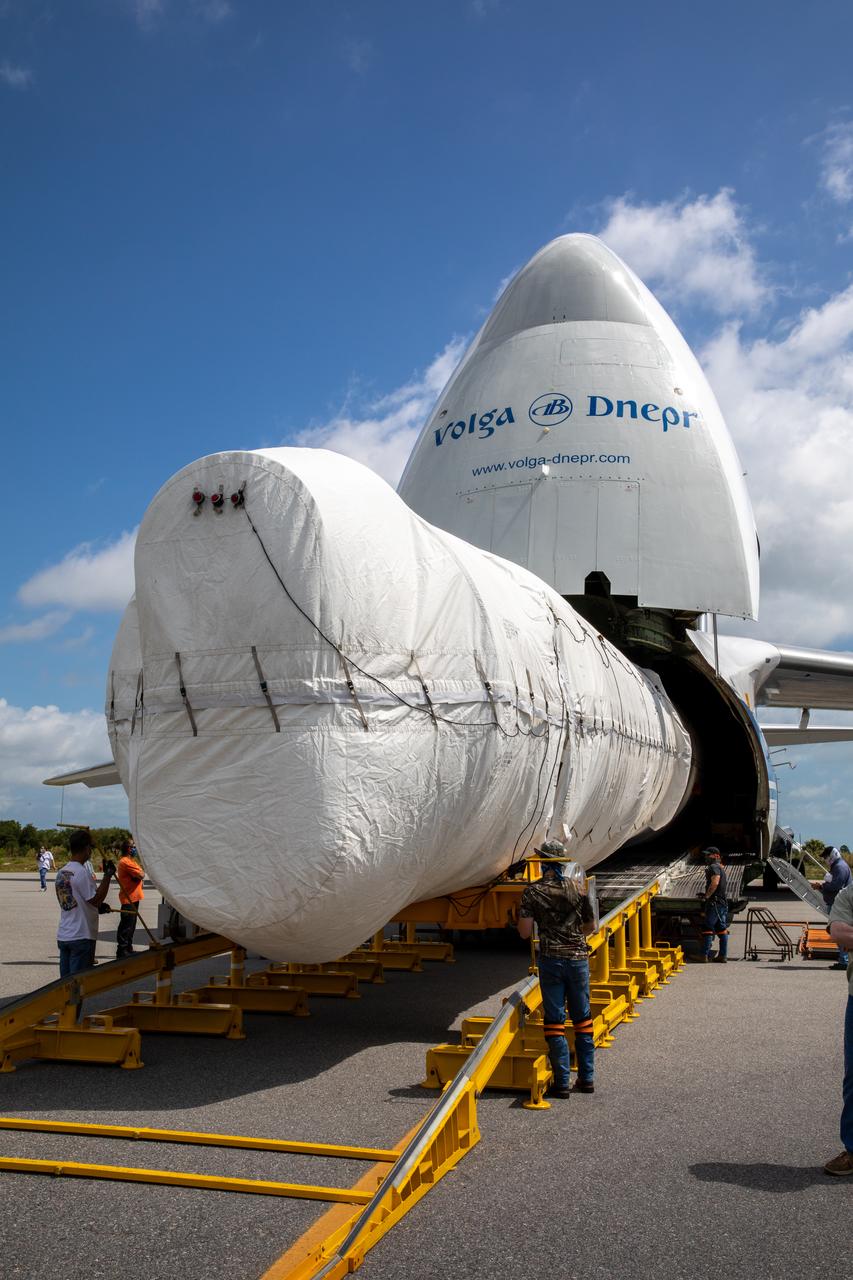
The United Launch Alliance booster for NASA’s Mars Perseverance rover is offloaded from the Antonov 124 cargo aircraft at the Skid Strip at Cape Canaveral Air Force Station (CCAFS) in Florida on May 19, 2020. The Mars Perseverance rover is scheduled to launch in mid-July atop a United Launch Alliance Atlas V 541 rocket from Pad 41 at CCAFS. The rover is part of NASA’s Mars Exploration Program, a long-term effort of robotic exploration of the Red Planet. The rover will search for habitable conditions in the ancient past and signs of past microbial life on Mars. The Launch Services Program at Kennedy is responsible for launch management.
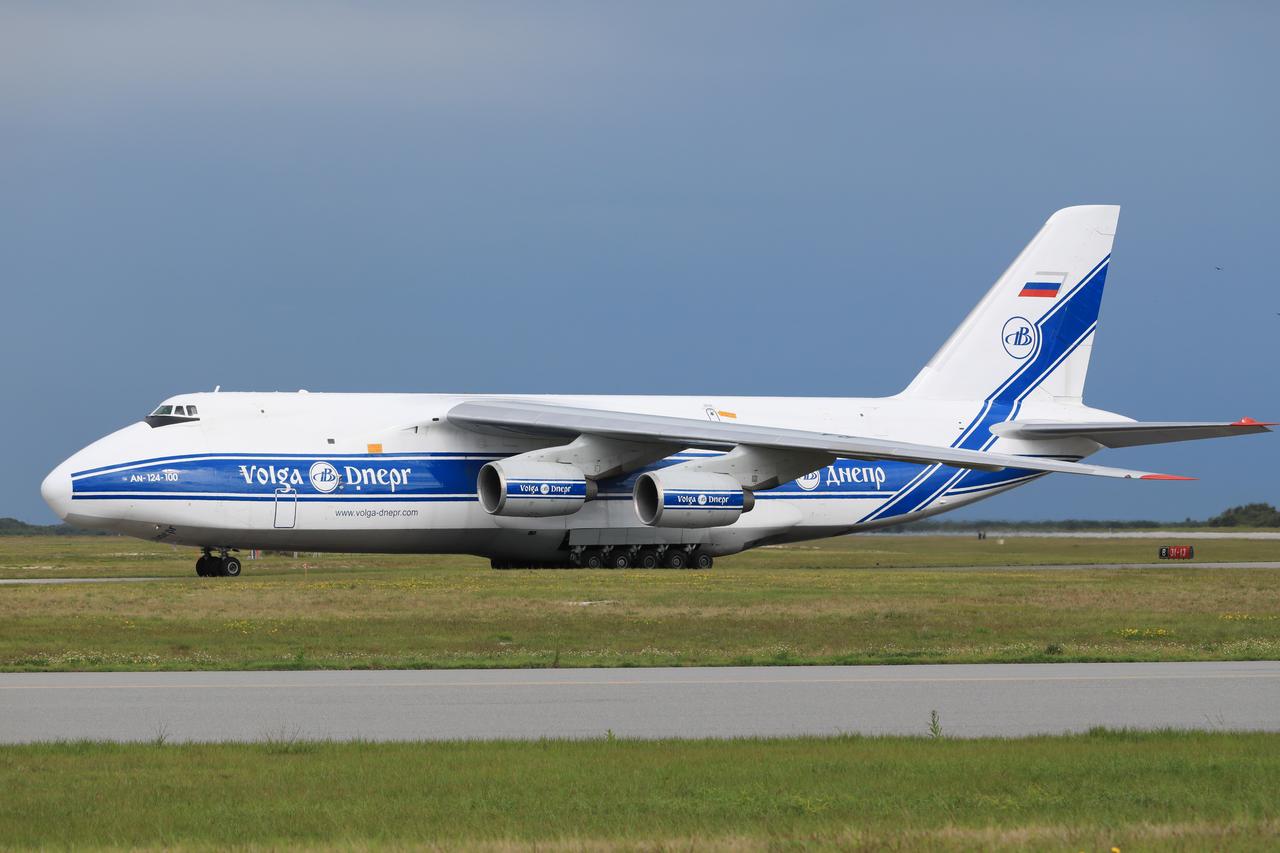
The Antonov 124 cargo aircraft, carrying the United Launch Alliance booster for NASA’s Mars Perseverance rover, taxis off the runway at the Skid Strip at Cape Canaveral Air Force Station (CCAFS) in Florida on May 18, 2020. The Mars Perseverance rover is scheduled to launch in mid-July atop a United Launch Alliance Atlas V 541 rocket from Pad 41 at CCAFS. The rover is part of NASA’s Mars Exploration Program, a long-term effort of robotic exploration of the Red Planet. The rover will search for habitable conditions in the ancient past and signs of past microbial life on Mars. The Launch Services Program at Kennedy is responsible for launch management.
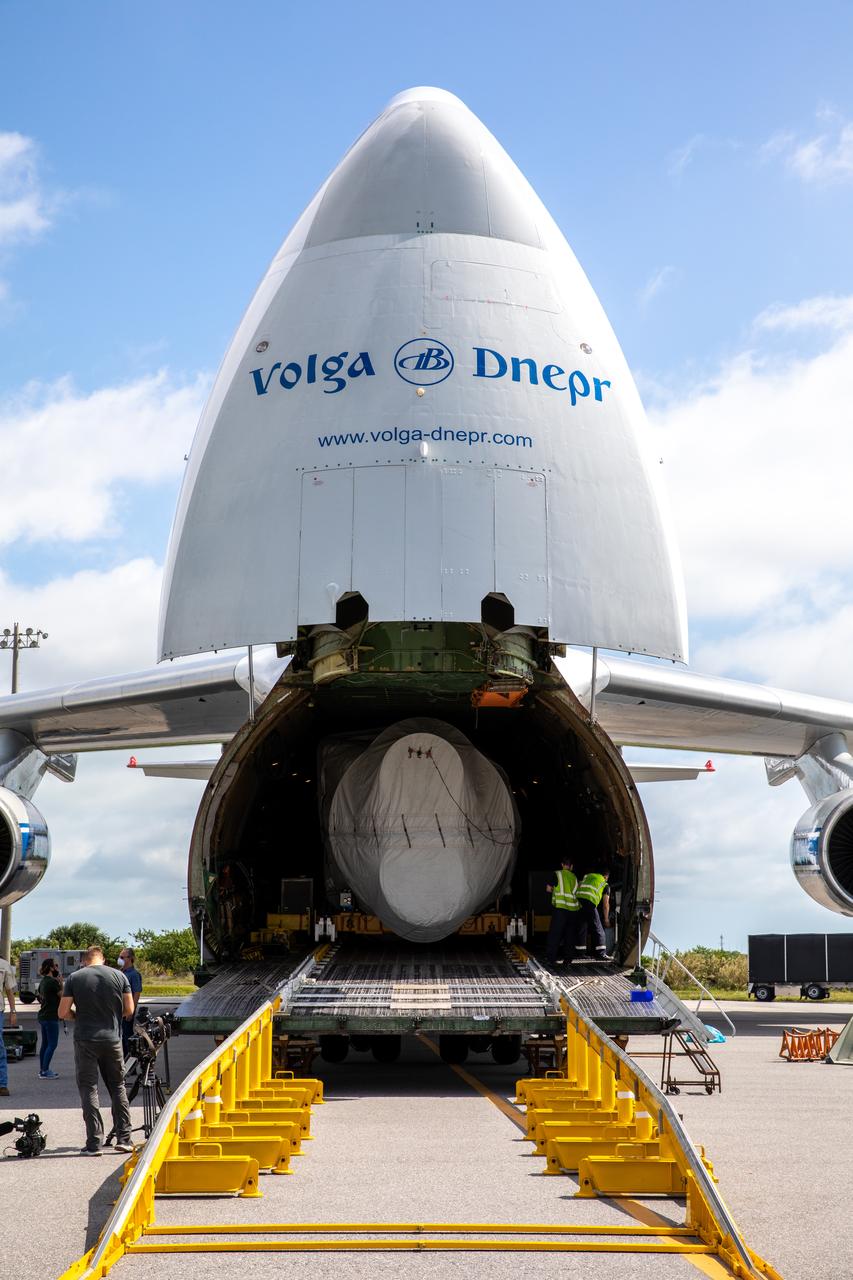
Preparations are underway to offload the United Launch Alliance booster for NASA’s Mars Perseverance rover from the Antonov 124 cargo aircraft at the Skid Strip at Cape Canaveral Air Force Station (CCAFS) in Florida on May 19, 2020. The Mars Perseverance rover is scheduled to launch in mid-July atop a United Launch Alliance Atlas V 541 rocket from Pad 41 at CCAFS. The rover is part of NASA’s Mars Exploration Program, a long-term effort of robotic exploration of the Red Planet. The rover will search for habitable conditions in the ancient past and signs of past microbial life on Mars. The Launch Services Program at Kennedy is responsible for launch management.
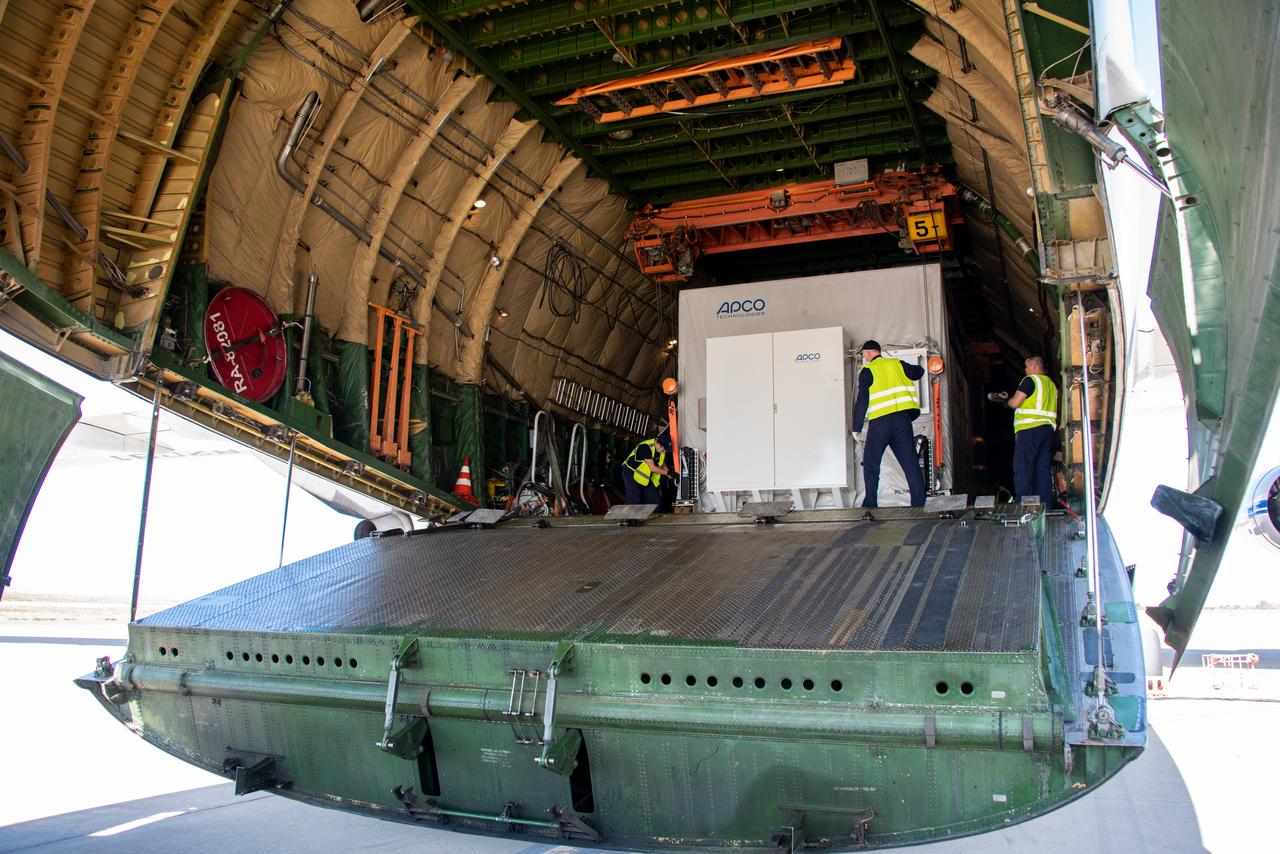
The Sentinel-6 Michael Freilich satellite, secured inside a shipping container, is visible inside the Antonov cargo aircraft that delivered it to Vandenberg Air Force Base in California on Sept. 24, 2020. The mission is an international partnership and the first launch of a constellation of two satellites that will observe changes in Earth’s sea levels for at least the next decade. Launching atop a SpaceX Falcon 9 rocket, Sentinel-6 Michael Freilich is targeted to lift off from Vandenberg’s Space Launch Complex 4 on Nov. 10, 2020. The Launch Services Program at Kennedy is responsible for launch management.
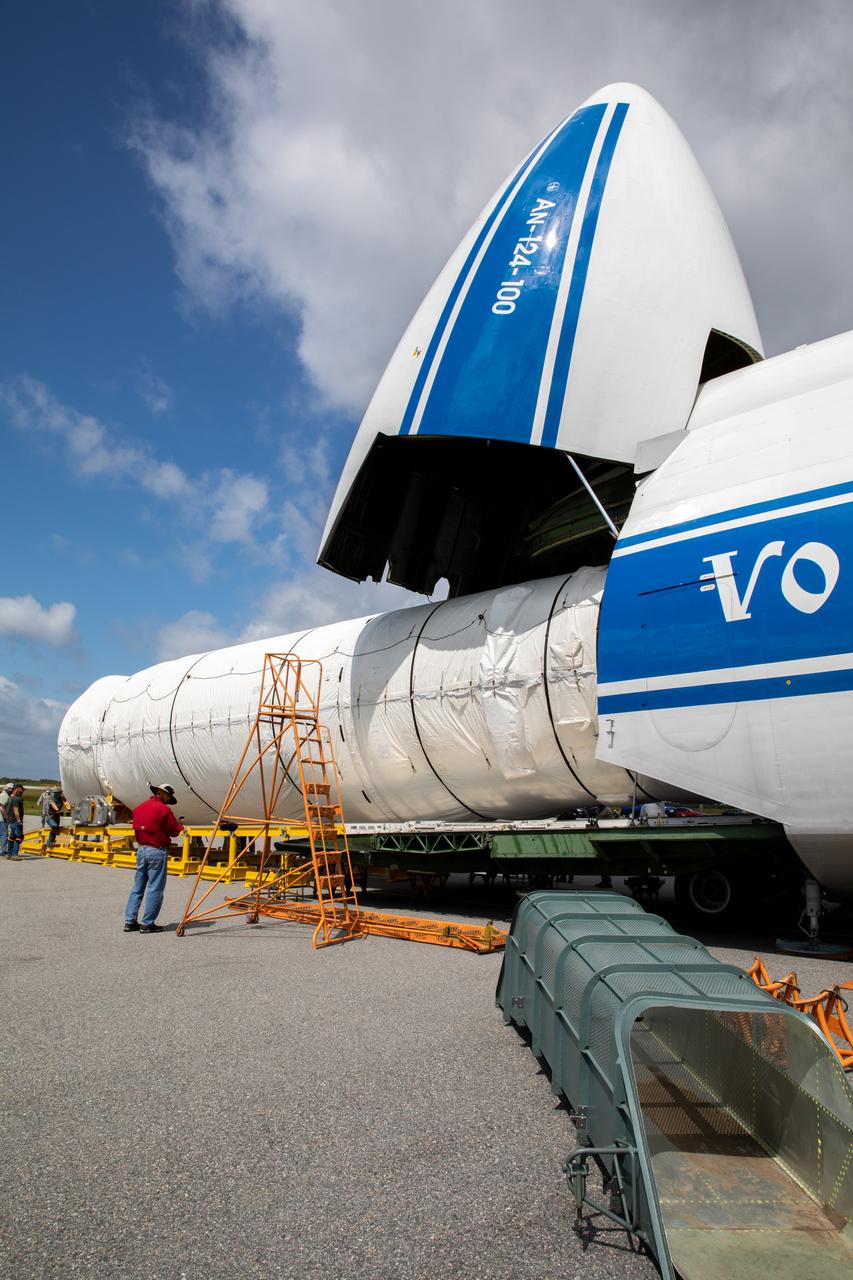
The United Launch Alliance booster for NASA’s Mars Perseverance rover is offloaded from the Antonov 124 cargo aircraft at the Skid Strip at Cape Canaveral Air Force Station (CCAFS) in Florida on May 19, 2020. The Mars Perseverance rover is scheduled to launch in mid-July atop a United Launch Alliance Atlas V 541 rocket from Pad 41 at CCAFS. The rover is part of NASA’s Mars Exploration Program, a long-term effort of robotic exploration of the Red Planet. The rover will search for habitable conditions in the ancient past and signs of past microbial life on Mars. The Launch Services Program at Kennedy is responsible for launch management.
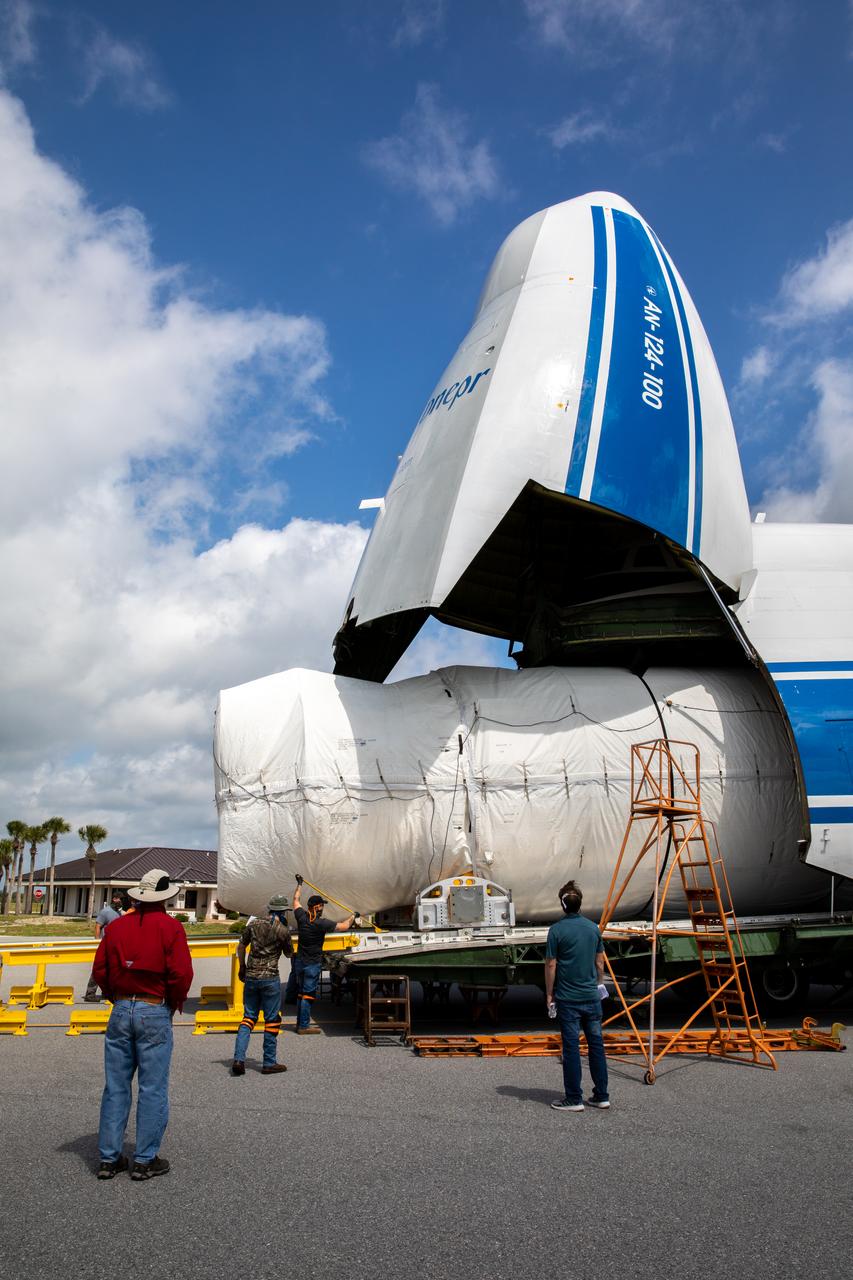
Workers help offload the United Launch Alliance booster for NASA’s Mars Perseverance rover from the Antonov 124 cargo aircraft at the Skid Strip at Cape Canaveral Air Force Station (CCAFS) in Florida on May 19, 2020. The Mars Perseverance rover is scheduled to launch in mid-July atop a United Launch Alliance Atlas V 541 rocket from Pad 41 at CCAFS. The rover is part of NASA’s Mars Exploration Program, a long-term effort of robotic exploration of the Red Planet. The rover will search for habitable conditions in the ancient past and signs of past microbial life on Mars. The Launch Services Program at Kennedy is responsible for launch management.
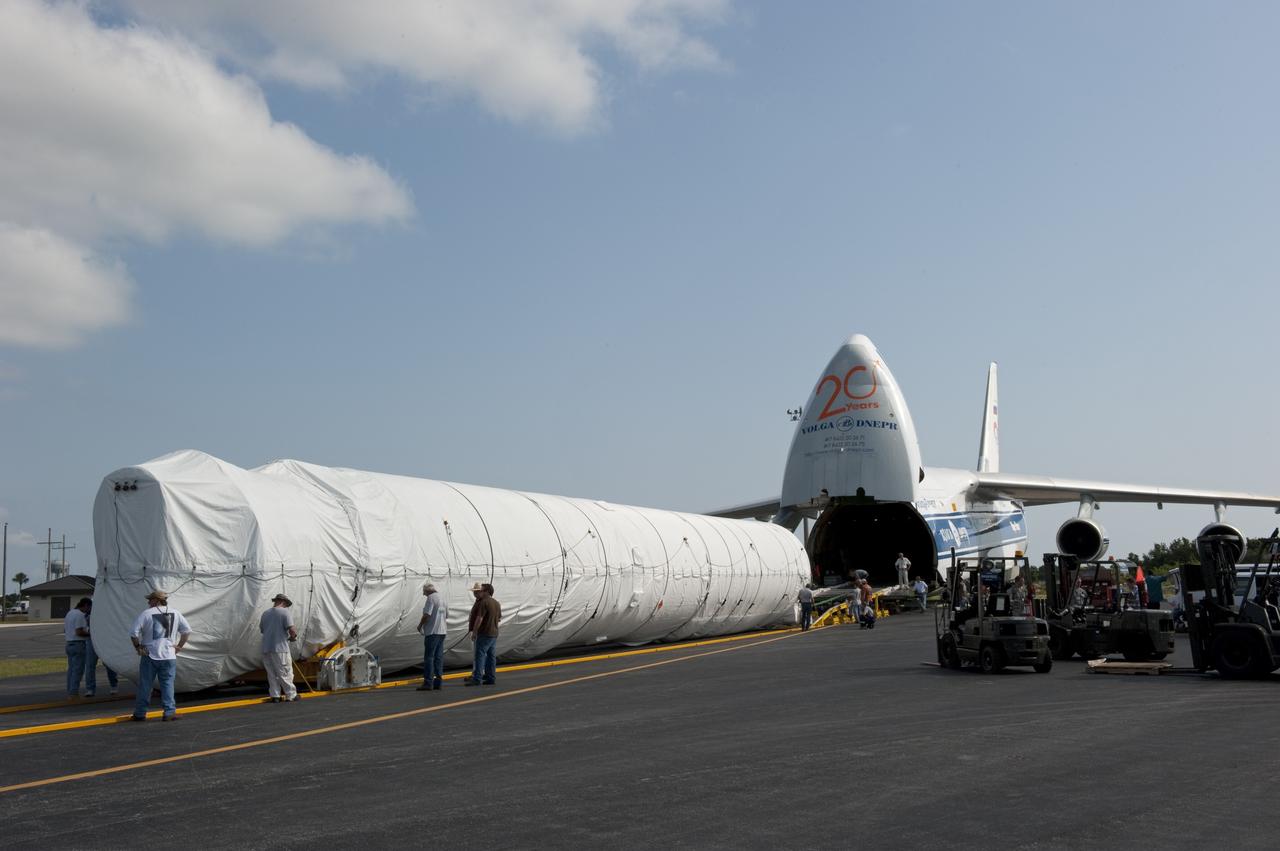
CAPE CANAVERAL, Fla. -- On the Skid Strip at Cape Canaveral Air Force Station in Florida, workers have unloaded the first stage of the United Launch Alliance Atlas V rocket slated to launch NASA's Juno spacecraft from a Volga-Dnepr Antonov AN-124-100, a Ukranian/Russian cargo aircraft. Juno is scheduled to launch aboard an Atlas V rocket from Cape Canaveral, Fla., Aug. 5.The solar-powered spacecraft will orbit Jupiter's poles 33 times to find out more about the gas giant's origins, structure, atmosphere and magnetosphere and investigate the existence of a solid planetary core. For more information, visit www.nasa.gov/juno. Photo credit: NASA/Kim Shiflett
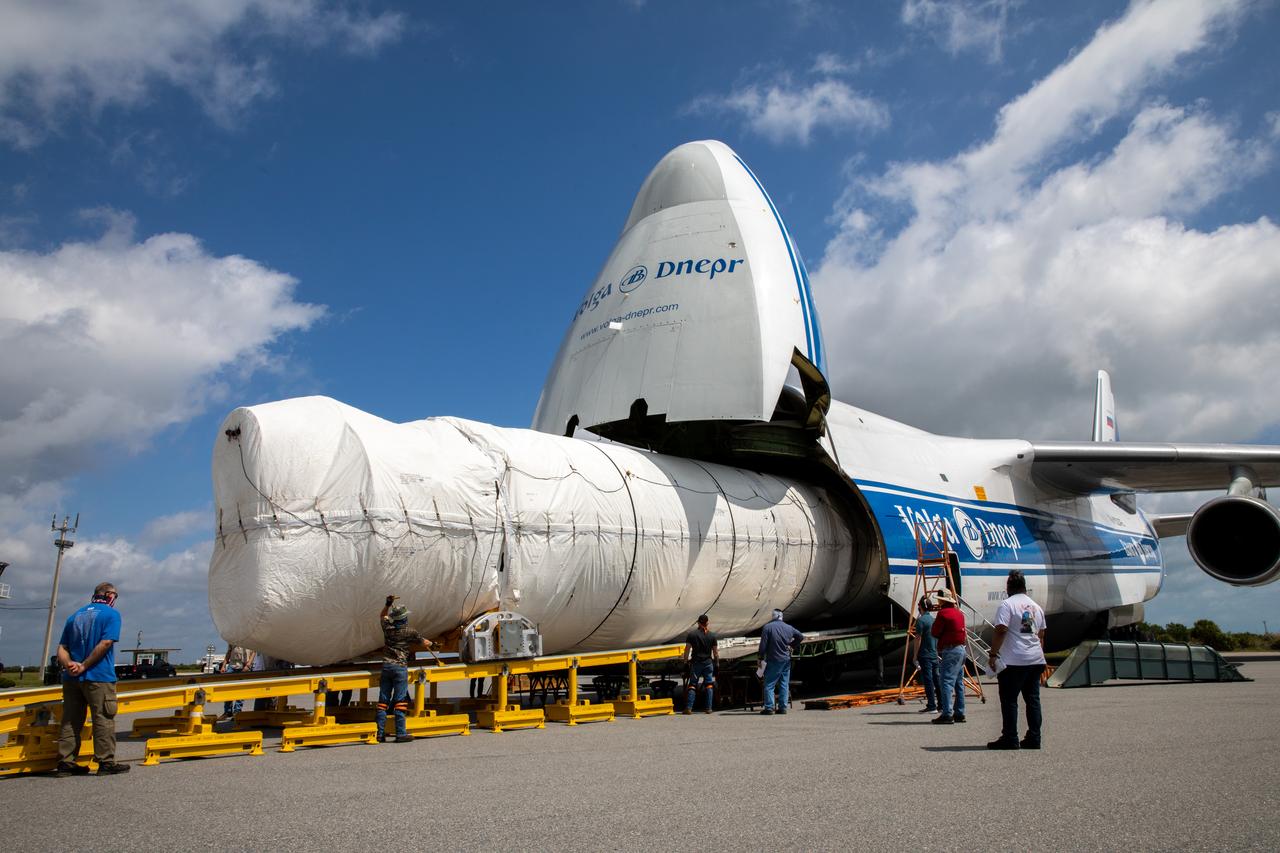
The United Launch Alliance booster for NASA’s Mars Perseverance rover is offloaded from the Antonov 124 cargo aircraft at the Skid Strip at Cape Canaveral Air Force Station (CCAFS) in Florida on May 19, 2020. The Mars Perseverance rover is scheduled to launch in mid-July atop a United Launch Alliance Atlas V 541 rocket from Pad 41 at CCAFS. The rover is part of NASA’s Mars Exploration Program, a long-term effort of robotic exploration of the Red Planet. The rover will search for habitable conditions in the ancient past and signs of past microbial life on Mars. The Launch Services Program at Kennedy is responsible for launch management.
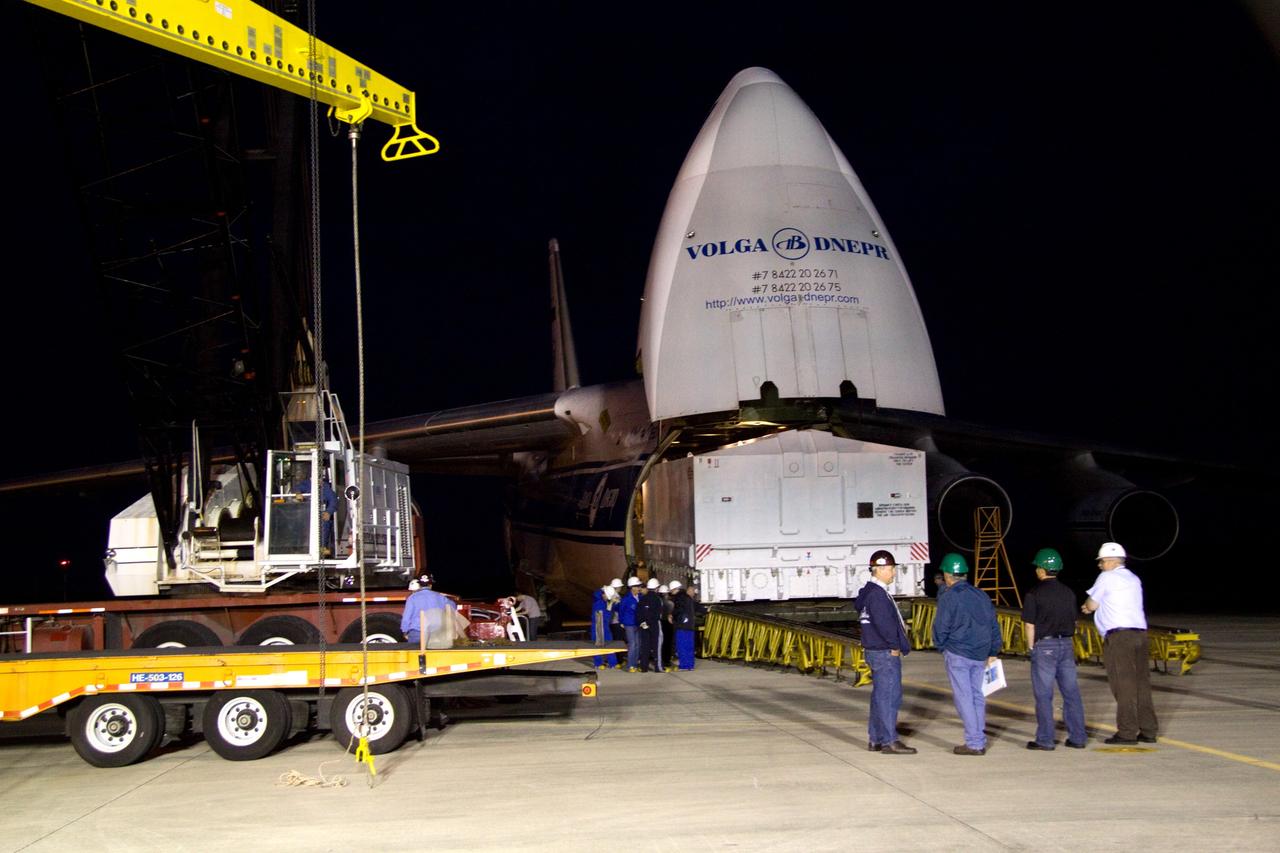
CAPE CANAVERAL, Fla. - At the Shuttle Landing Facility at NASA's Kennedy Space Center in Florida, workers prepare to roll the transportation case protecting the Russian-built Mini Research Module1, or MRM1, from the cargo bay of a Volga-Dnepr Antonov AN-124-100, a Ukranian/Russian aircraft. The second in a series of new pressurized components for Russia, the module, named Rassvet, will be permanently attached to the International Space Station's Zarya module on space shuttle Atlantis' STS-132 mission. An Integrated Cargo Carrier will join the MRM in Atlantis' payload bay. Three spacewalks are planned to store spare components outside the station, including six spare batteries, a boom assembly for the Ku-band antenna and spares for the Canadian Dextre robotic arm extension. A radiator, airlock, and European robotic arm for the Russian Multi-purpose Laboratory Module also will be delivered to the station. Launch is targeted for May 14, 2010. Photo credit: NASA/Jack Pfaller
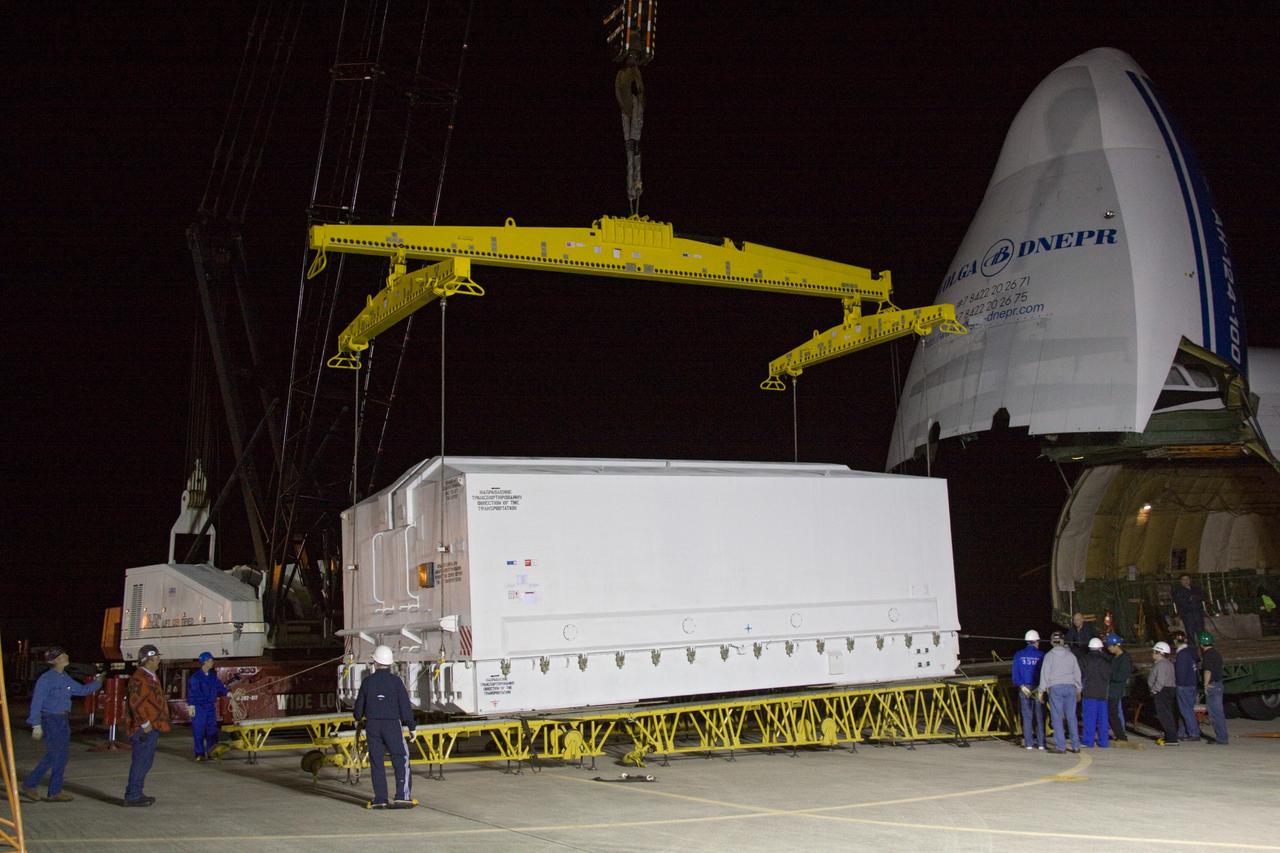
CAPE CANAVERAL, Fla. - At the Shuttle Landing Facility at NASA's Kennedy Space Center in Florida, workers roll the transportation case protecting the Russian-built Mini Research Module1, or MRM1, from the cargo bay of a Volga-Dnepr Antonov AN-124-100, a Ukranian/Russian aircraft. The second in a series of new pressurized components for Russia, the module, named Rassvet, will be permanently attached to the International Space Station's Zarya module on space shuttle Atlantis' STS-132 mission. An Integrated Cargo Carrier will join the MRM in Atlantis' payload bay. Three spacewalks are planned to store spare components outside the station, including six spare batteries, a boom assembly for the Ku-band antenna and spares for the Canadian Dextre robotic arm extension. A radiator, airlock, and European robotic arm for the Russian Multi-purpose Laboratory Module also will be delivered to the station. Launch is targeted for May 14, 2010. Photo credit: NASA/Jack Pfaller
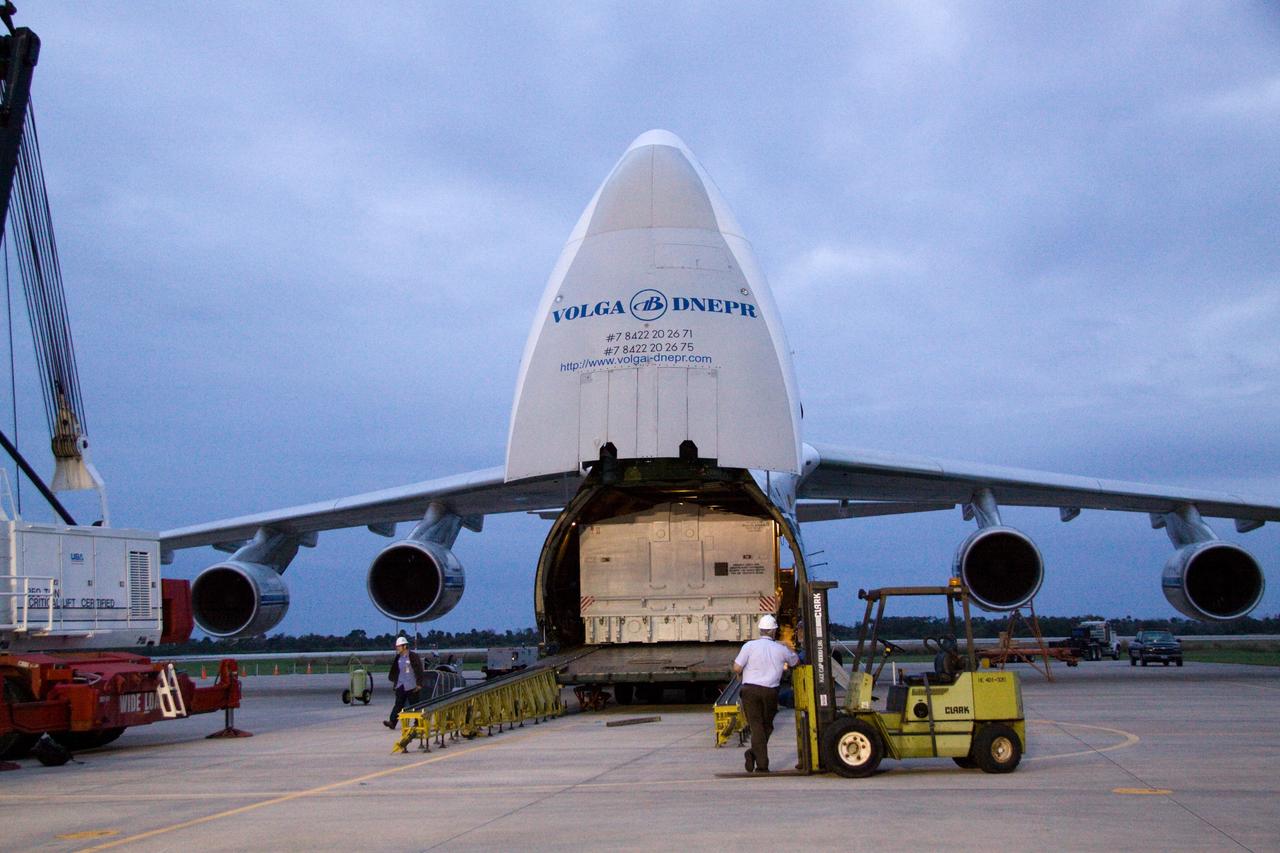
CAPE CANAVERAL, Fla. - At the Shuttle Landing Facility at NASA's Kennedy Space Center in Florida, a transportation case protecting the Russian-built Mini Research Module1, or MRM1, awaits offloading from a Volga-Dnepr Antonov AN-124-100, a Ukranian/Russian aircraft. The second in a series of new pressurized components for Russia, the module, named Rassvet, will be permanently attached to the International Space Station's Zarya module on space shuttle Atlantis' STS-132 mission. An Integrated Cargo Carrier will join the MRM in Atlantis' payload bay. Three spacewalks are planned to store spare components outside the station, including six spare batteries, a boom assembly for the Ku-band antenna and spares for the Canadian Dextre robotic arm extension. A radiator, airlock, and European robotic arm for the Russian Multi-purpose Laboratory Module also will be delivered to the station. Launch is targeted for May 14, 2010. Photo credit: NASA/Jack Pfaller
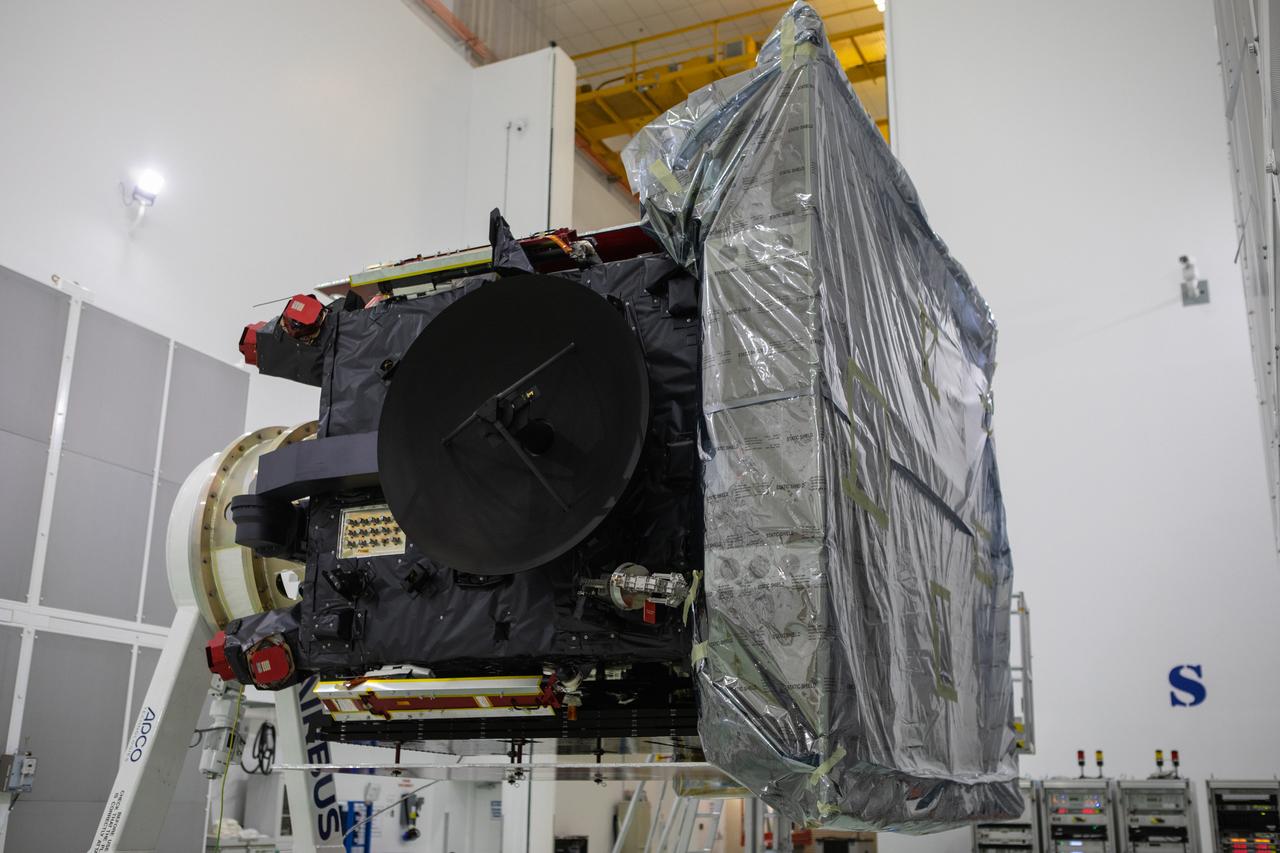
The Solar Orbiter spacecraft has been removed from its shipping container inside the Astrotech Space Operations facility in Titusville, Florida, on Nov. 18, 2019. The spacecraft was flown aboard an Antonov cargo aircraft from Munich, Germany, arriving at NASA’s Kennedy Space Center on Nov. 1, 2019. Solar Orbiter is a European Space Agency mission with strong NASA participation. The mission aims to study the Sun, its outer atmosphere and solar winds. The spacecraft will provide the first images of the Sun’s poles. NASA’s Launch Services Program based at Kennedy is managing the launch. Liftoff is scheduled for Feb. 5, 2020, from Cape Canaveral Air Force Station aboard a United Launch Alliance Atlas V rocket.
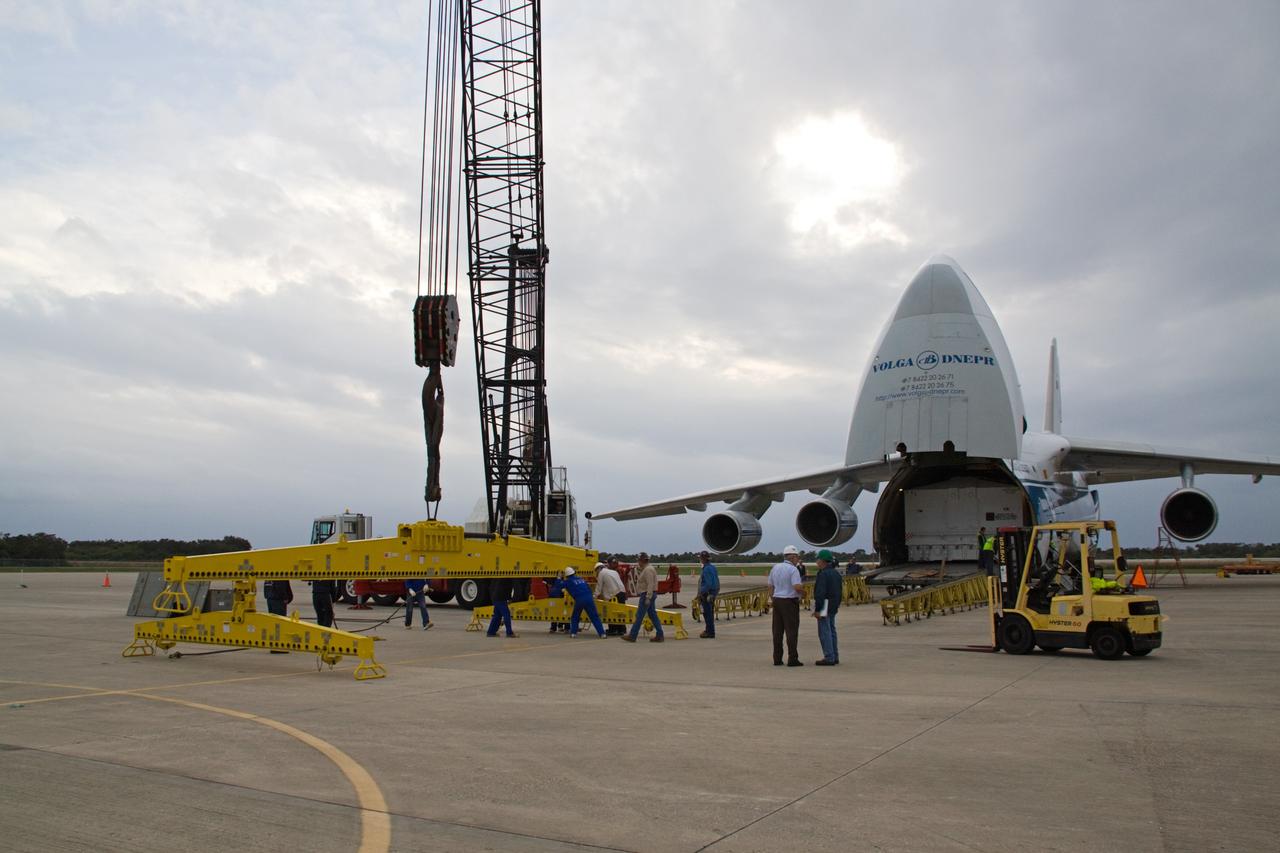
CAPE CANAVERAL, Fla. - At the Shuttle Landing Facility at NASA's Kennedy Space Center in Florida, workers prepare a crane to assist with the offloading of the Russian-built Mini Research Module1, or MRM1, from a Volga-Dnepr Antonov AN-124-100, a Ukranian/Russian aircraft. The second in a series of new pressurized components for Russia, the module, named Rassvet, will be permanently attached to the International Space Station's Zarya module on space shuttle Atlantis' STS-132 mission. An Integrated Cargo Carrier will join the MRM in Atlantis' payload bay. Three spacewalks are planned to store spare components outside the station, including six spare batteries, a boom assembly for the Ku-band antenna and spares for the Canadian Dextre robotic arm extension. A radiator, airlock, and European robotic arm for the Russian Multi-purpose Laboratory Module also will be delivered to the station. Launch is targeted for May 14, 2010. Photo credit: NASA/Jack Pfaller
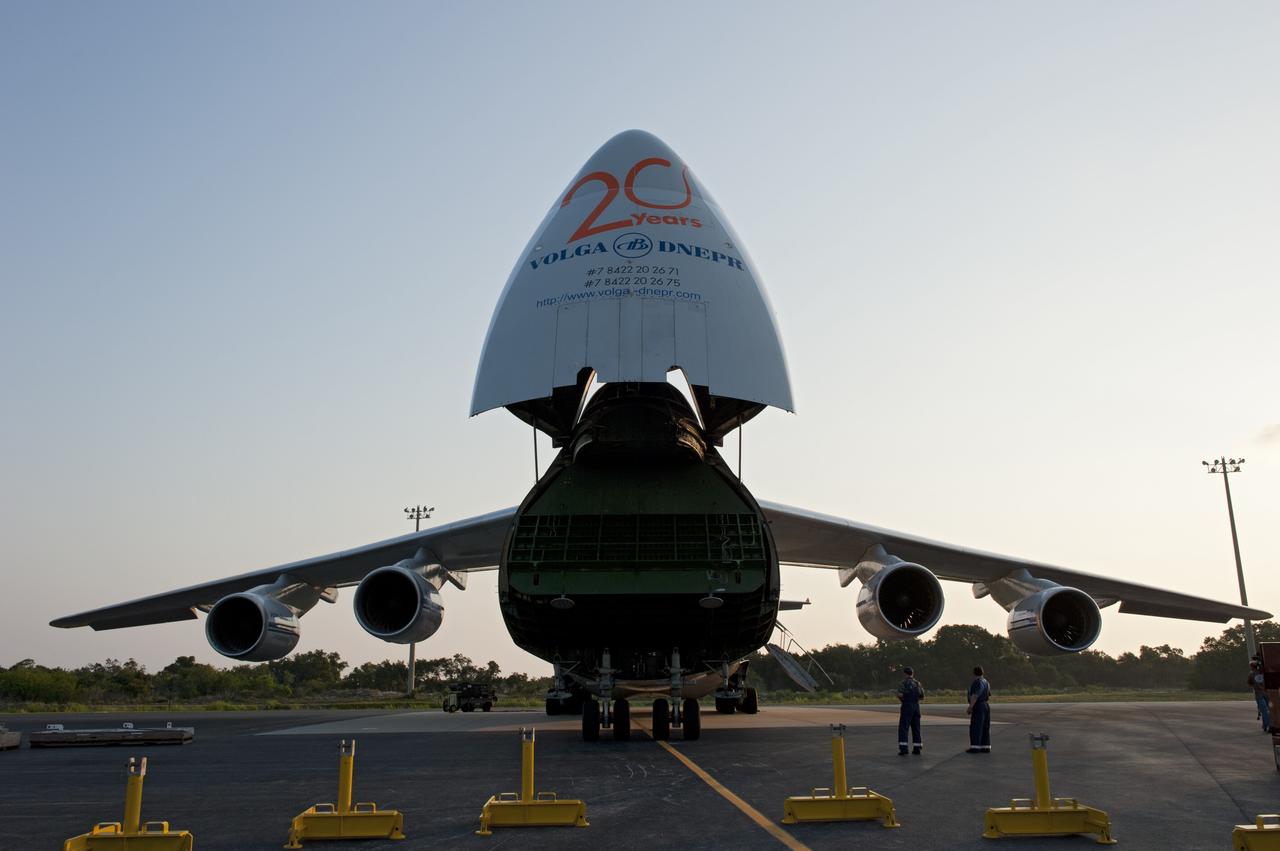
CAPE CANAVERAL, Fla. -- On the Skid Strip at Cape Canaveral Air Force Station in Florida, workers prepare to unload a Volga-Dnepr Antonov AN-124-100, a Ukranian/Russian cargo aircraft that has delivered the first stage of the United Launch Alliance Atlas V rocket slated to launch NASA's Juno spacecraft. Juno is scheduled to launch aboard an Atlas V rocket from Cape Canaveral, Fla., Aug. 5.The solar-powered spacecraft will orbit Jupiter's poles 33 times to find out more about the gas giant's origins, structure, atmosphere and magnetosphere and investigate the existence of a solid planetary core. For more information, visit www.nasa.gov/juno. Photo credit: NASA/Kim Shiflett
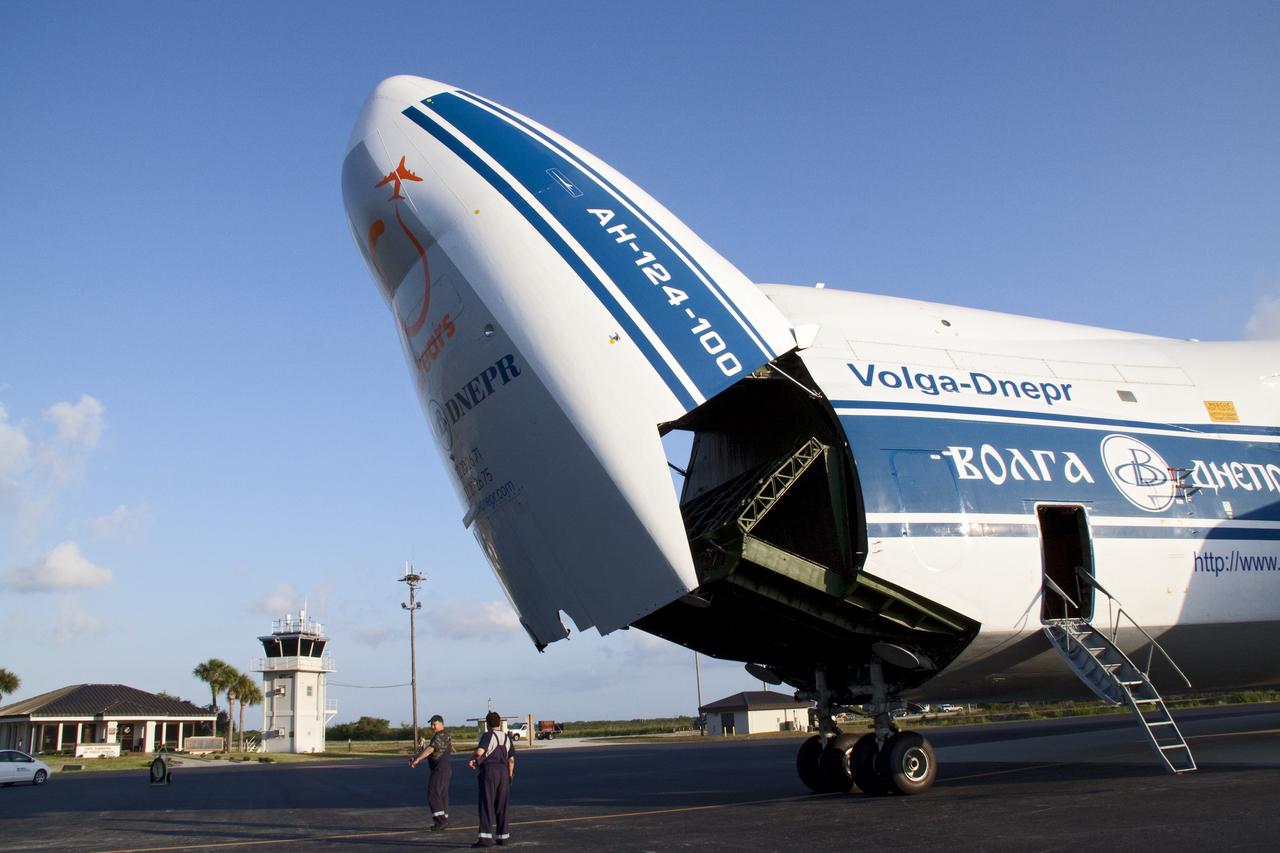
CAPE CANAVERAL, Fla. -- On the Skid Strip at Cape Canaveral Air Force Station in Florida, workers prepare to unload a Volga-Dnepr Antonov AN-124-100, a Ukranian/Russian cargo aircraft that has delivered the Centaur upper stage of the United Launch Alliance Atlas V rocket slated to launch NASA's Juno spacecraft. NASA's Juno spacecraft is scheduled to launch aboard the Atlas V from Cape Canaveral, Fla. Aug. 5.The solar-powered spacecraft will orbit Jupiter's poles 33 times to find out more about the gas giant's origins, structure, atmosphere and magnetosphere and investigate the existence of a solid planetary core. For more information visit: www.nasa.gov/juno. Photo credit: NASA/Jack Pfaller
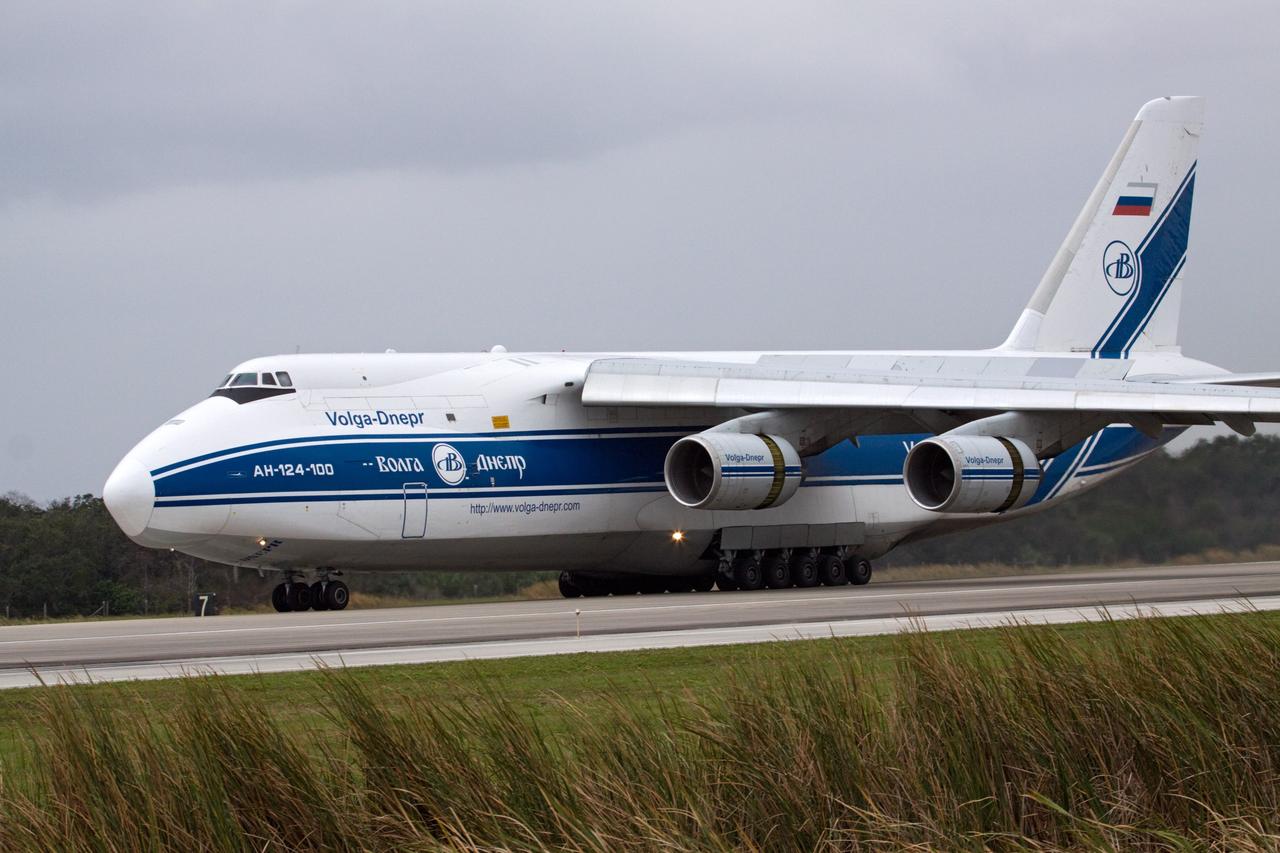
CAPE CANAVERAL, Fla. - A Volga-Dnepr Antonov AN-124-100, a Ukranian/Russian aircraft, lands at the Shuttle Landing Facility at NASA's Kennedy Space Center in Florida with the Russian-built Mini Research Module1, or MRM1, aboard. The second in a series of new pressurized components for Russia, the module, named Rassvet, will be permanently attached to the International Space Station's Zarya module on space shuttle Atlantis' STS-132 mission. An Integrated Cargo Carrier will join the MRM in Atlantis' payload bay. Three spacewalks are planned to store spare components outside the station, including six spare batteries, a boom assembly for the Ku-band antenna and spares for the Canadian Dextre robotic arm extension. A radiator, airlock, and European robotic arm for the Russian Multi-purpose Laboratory Module also will be delivered to the station. Launch is targeted for May 14, 2010. Photo credit: NASA/Jack Pfaller
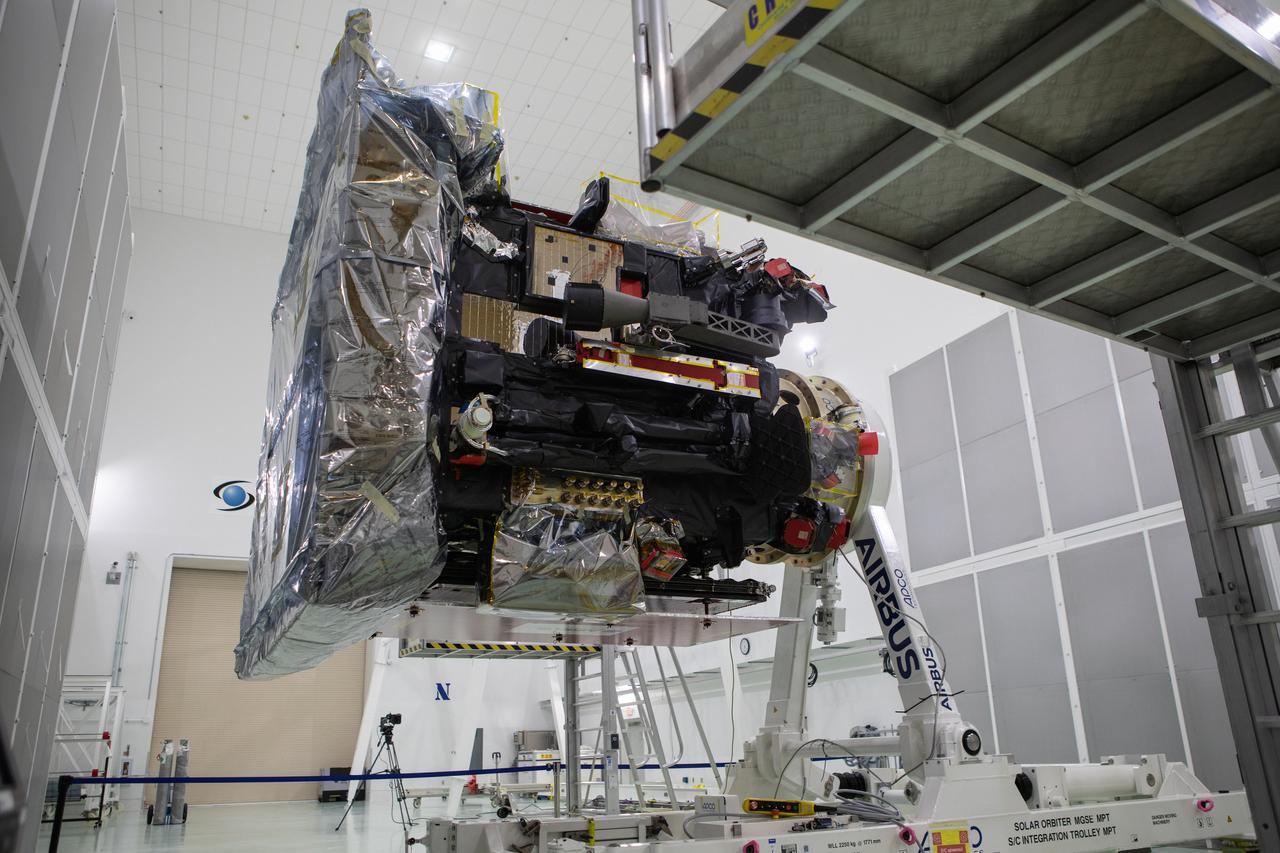
The Solar Orbiter spacecraft has been removed from its shipping container inside the Astrotech Space Operations facility in Titusville, Florida, on Nov. 18, 2019. The spacecraft was flown aboard an Antonov cargo aircraft from Munich, Germany, arriving at NASA’s Kennedy Space Center on Nov. 1, 2019. Solar Orbiter is a European Space Agency mission with strong NASA participation. The mission aims to study the Sun, its outer atmosphere and solar winds. The spacecraft will provide the first images of the Sun’s poles. NASA’s Launch Services Program based at Kennedy is managing the launch. Liftoff is scheduled for Feb. 5, 2020, from Cape Canaveral Air Force Station aboard a United Launch Alliance Atlas V rocket.
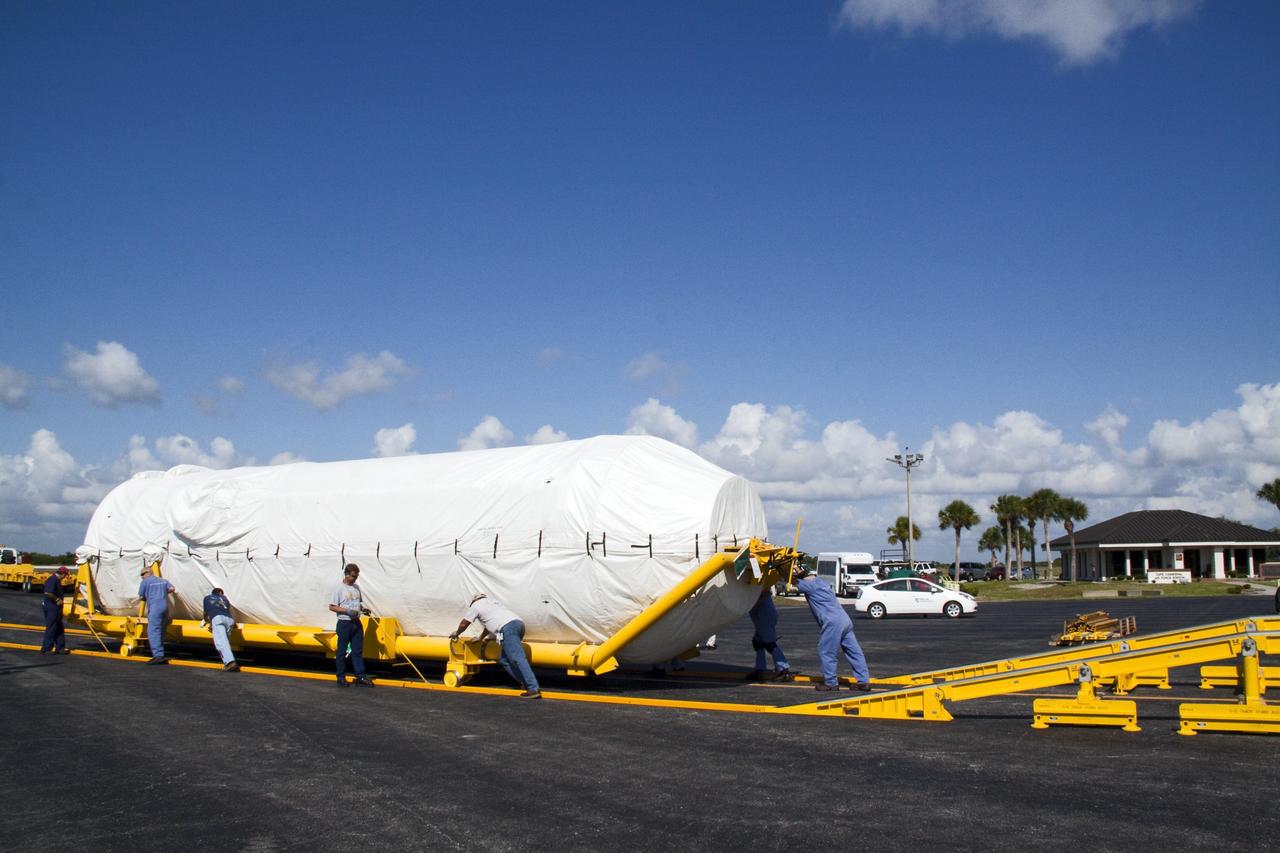
CAPE CANAVERAL, Fla. -- On the Skid Strip at Cape Canaveral Air Force Station in Florida, workers unload the Centaur upper stage of the United Launch Alliance Atlas V rocket slated to launch NASA's Juno spacecraft from a Volga-Dnepr Antonov AN-124-100, a Ukranian/Russian cargo aircraft. NASA's Juno spacecraft is scheduled to launch aboard the Atlas V from Cape Canaveral, Fla. Aug. 5.The solar-powered spacecraft will orbit Jupiter's poles 33 times to find out more about the gas giant's origins, structure, atmosphere and magnetosphere and investigate the existence of a solid planetary core. For more information visit: www.nasa.gov/juno. Photo credit: NASA/Jack Pfaller
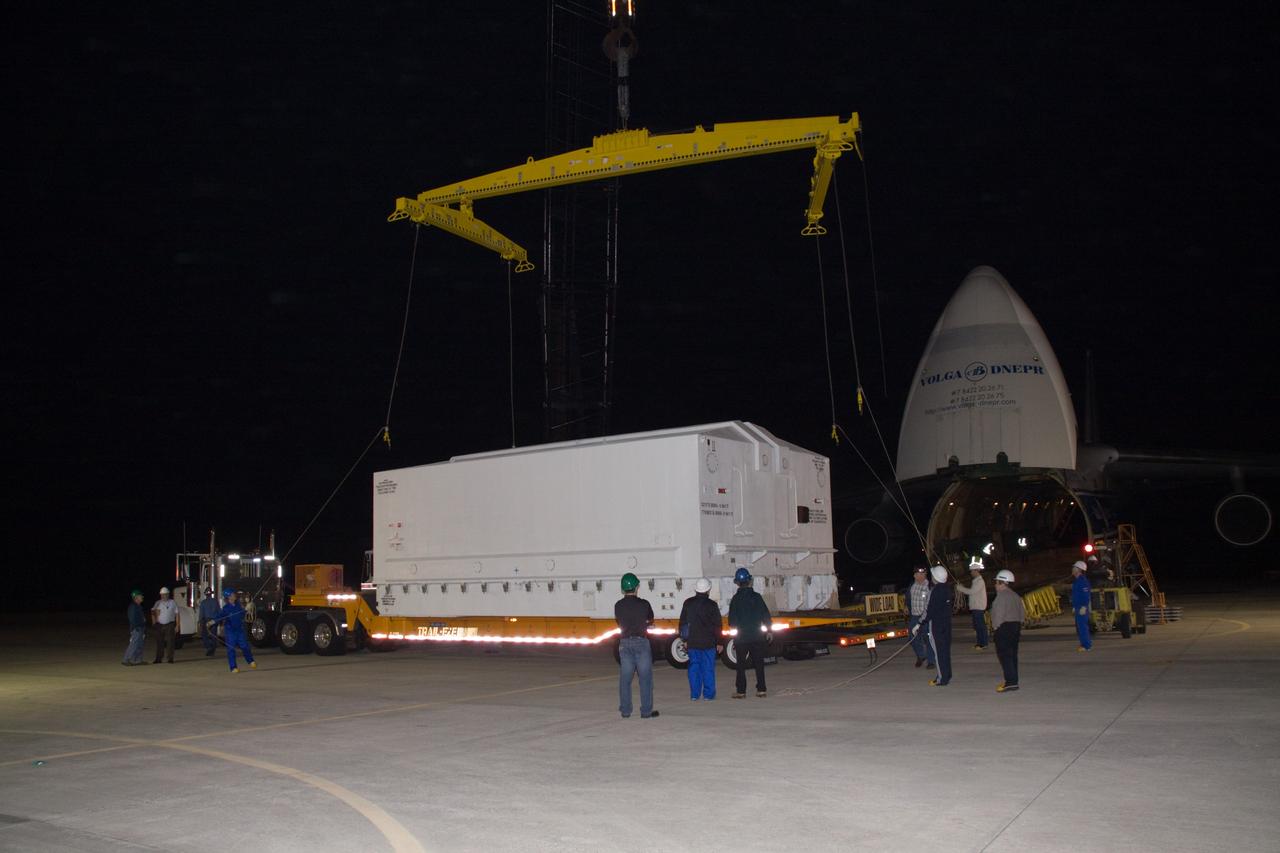
CAPE CANAVERAL, Fla. - At the Shuttle Landing Facility at NASA's Kennedy Space Center in Florida, a crane deposits the transportation case protecting the Russian-built Mini Research Module1, or MRM1, onto a transporter. The MRM was delivered to Kennedy aboard the Volga-Dnepr Antonov AN-124-100, a Ukranian/Russian aircraft, in the background. The second in a series of new pressurized components for Russia, the module, named Rassvet, will be permanently attached to the International Space Station's Zarya module on space shuttle Atlantis' STS-132 mission. An Integrated Cargo Carrier will join the MRM in Atlantis' payload bay. Three spacewalks are planned to store spare components outside the station, including six spare batteries, a boom assembly for the Ku-band antenna and spares for the Canadian Dextre robotic arm extension. A radiator, airlock, and European robotic arm for the Russian Multi-purpose Laboratory Module also will be delivered to the station. Launch is targeted for May 14, 2010. Photo credit: NASA/Jack Pfaller
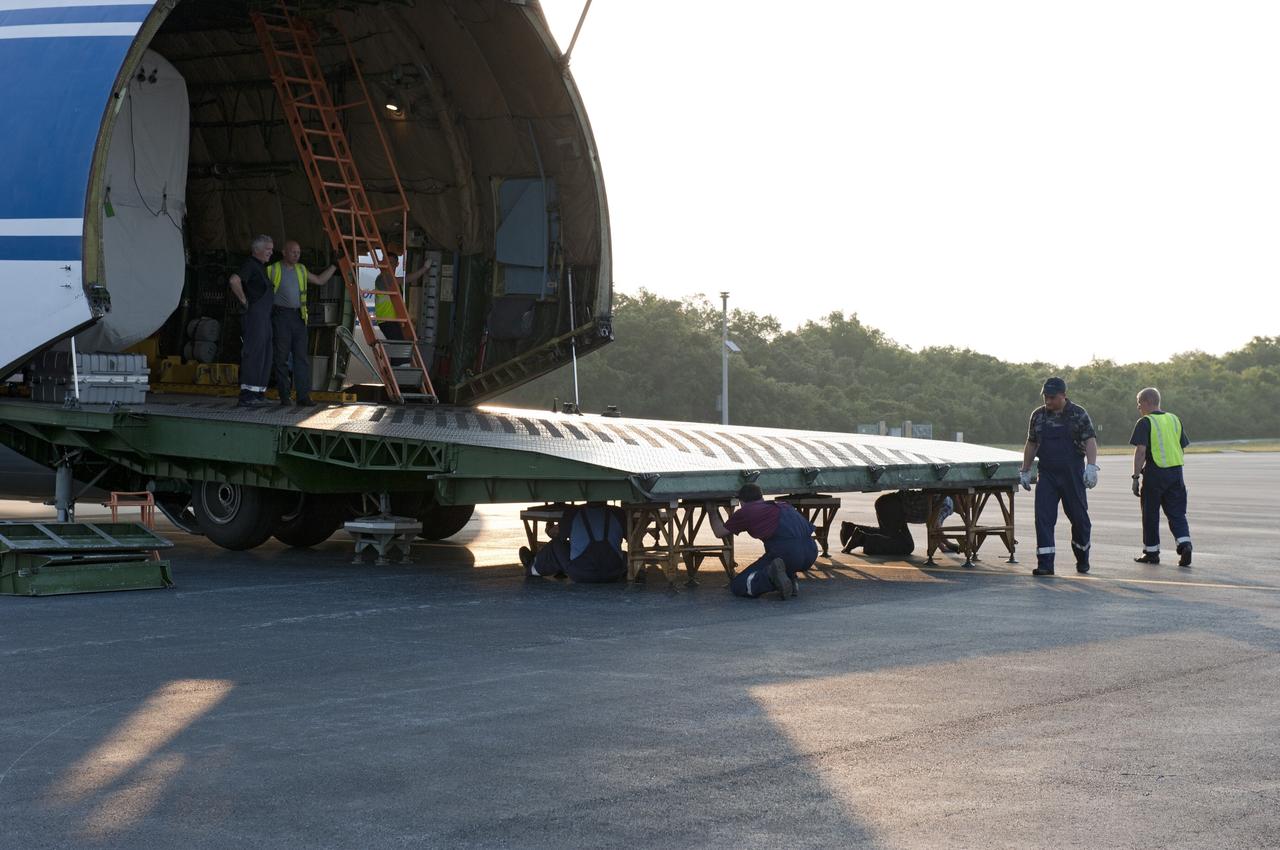
CAPE CANAVERAL, Fla. -- On the Skid Strip at Cape Canaveral Air Force Station in Florida, workers prepare to unload a Volga-Dnepr Antonov AN-124-100, a Ukranian/Russian cargo aircraft that has delivered the first stage of the United Launch Alliance Atlas V rocket slated to launch NASA's Juno spacecraft. Juno is scheduled to launch aboard an Atlas V rocket from Cape Canaveral, Fla., Aug. 5.The solar-powered spacecraft will orbit Jupiter's poles 33 times to find out more about the gas giant's origins, structure, atmosphere and magnetosphere and investigate the existence of a solid planetary core. For more information, visit www.nasa.gov/juno. Photo credit: NASA/Kim Shiflett
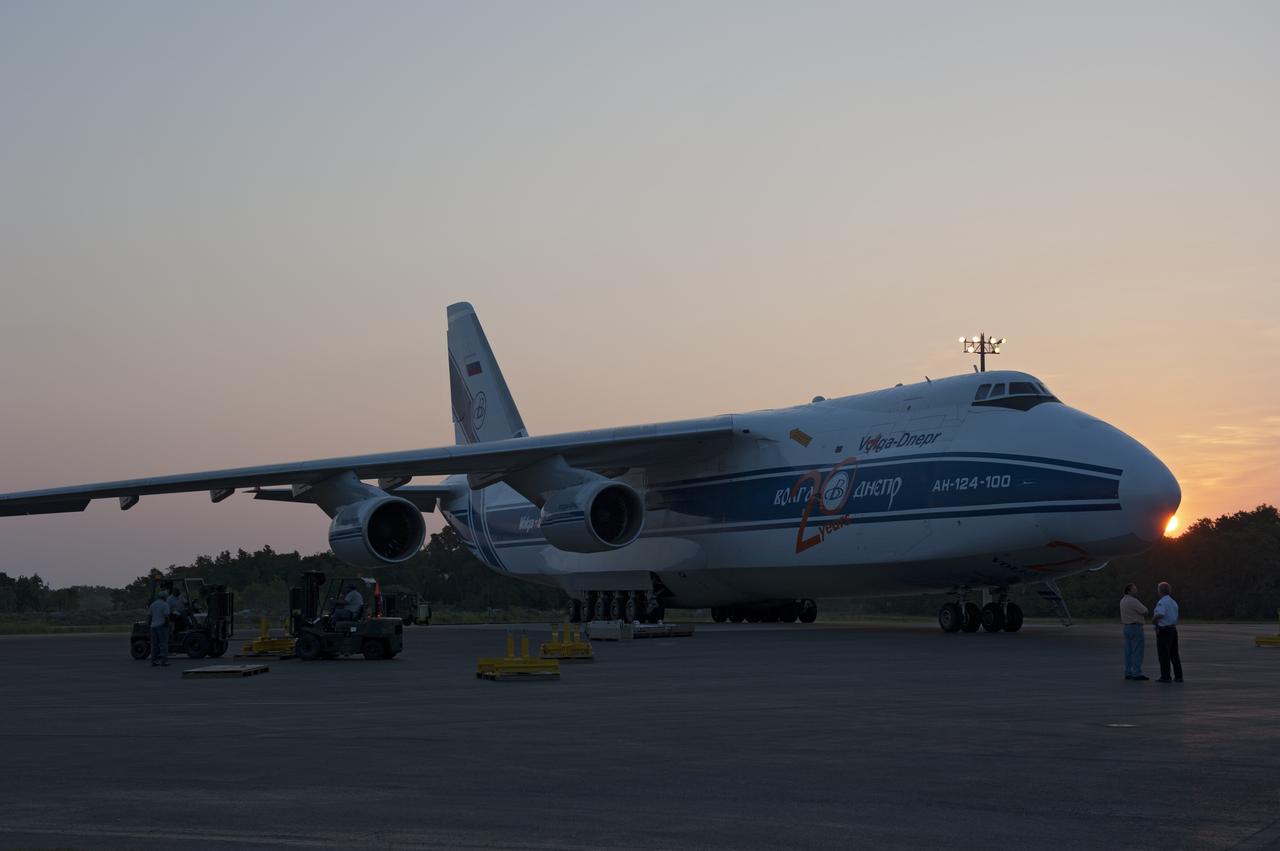
CAPE CANAVERAL, Fla. -- On the Skid Strip at Cape Canaveral Air Force Station in Florida, workers prepare to unload a Volga-Dnepr Antonov AN-124-100, a Ukranian/Russian cargo aircraft that has delivered the first stage of the United Launch Alliance Atlas V rocket slated to launch NASA's Juno spacecraft. Juno is scheduled to launch aboard an Atlas V rocket from Cape Canaveral, Fla., Aug. 5.The solar-powered spacecraft will orbit Jupiter's poles 33 times to find out more about the gas giant's origins, structure, atmosphere and magnetosphere and investigate the existence of a solid planetary core. For more information, visit www.nasa.gov/juno. Photo credit: NASA/Kim Shiflett
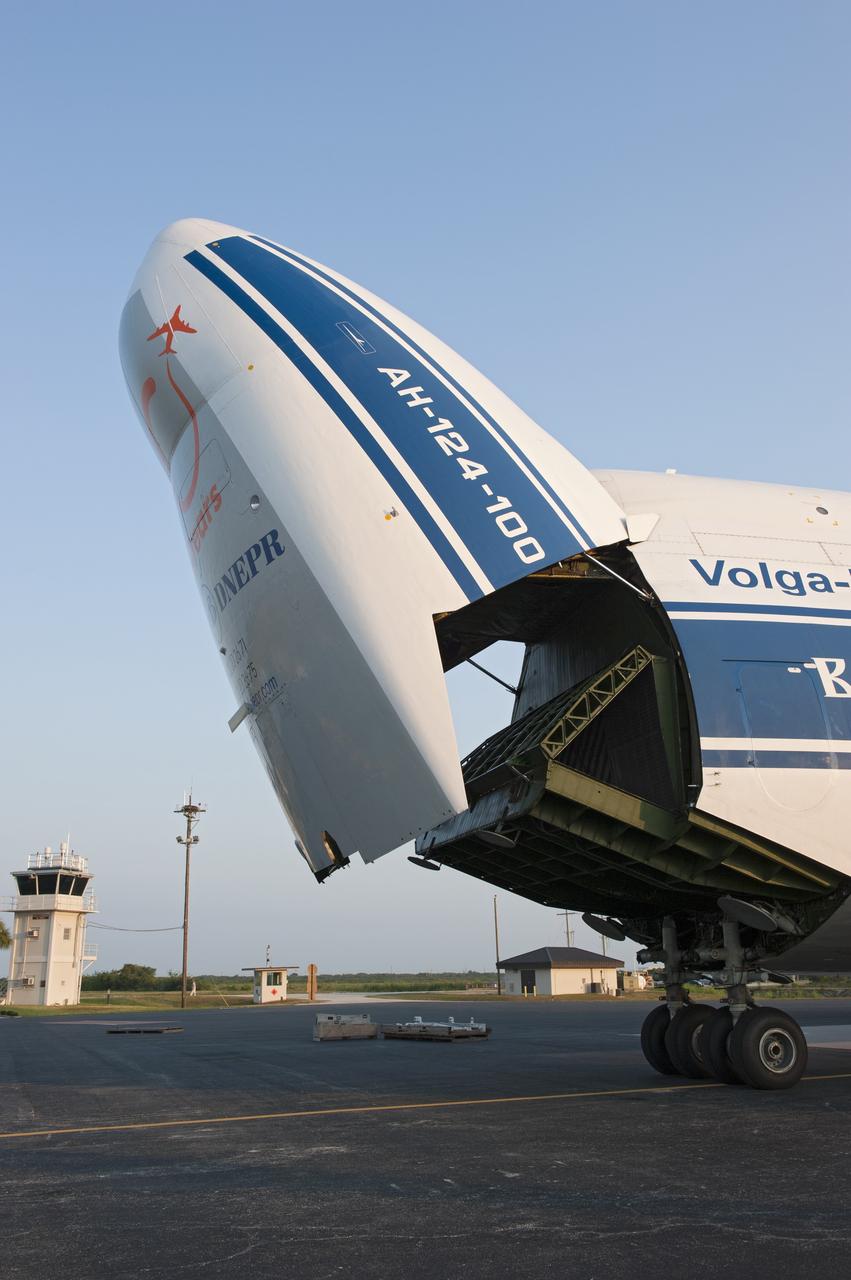
CAPE CANAVERAL, Fla. -- On the Skid Strip at Cape Canaveral Air Force Station in Florida, workers prepare to unload a Volga-Dnepr Antonov AN-124-100, a Ukranian/Russian cargo aircraft that has delivered the first stage of the United Launch Alliance Atlas V rocket slated to launch NASA's Juno spacecraft. Juno is scheduled to launch aboard an Atlas V rocket from Cape Canaveral, Fla., Aug. 5.The solar-powered spacecraft will orbit Jupiter's poles 33 times to find out more about the gas giant's origins, structure, atmosphere and magnetosphere and investigate the existence of a solid planetary core. For more information, visit www.nasa.gov/juno. Photo credit: NASA/Kim Shiflett
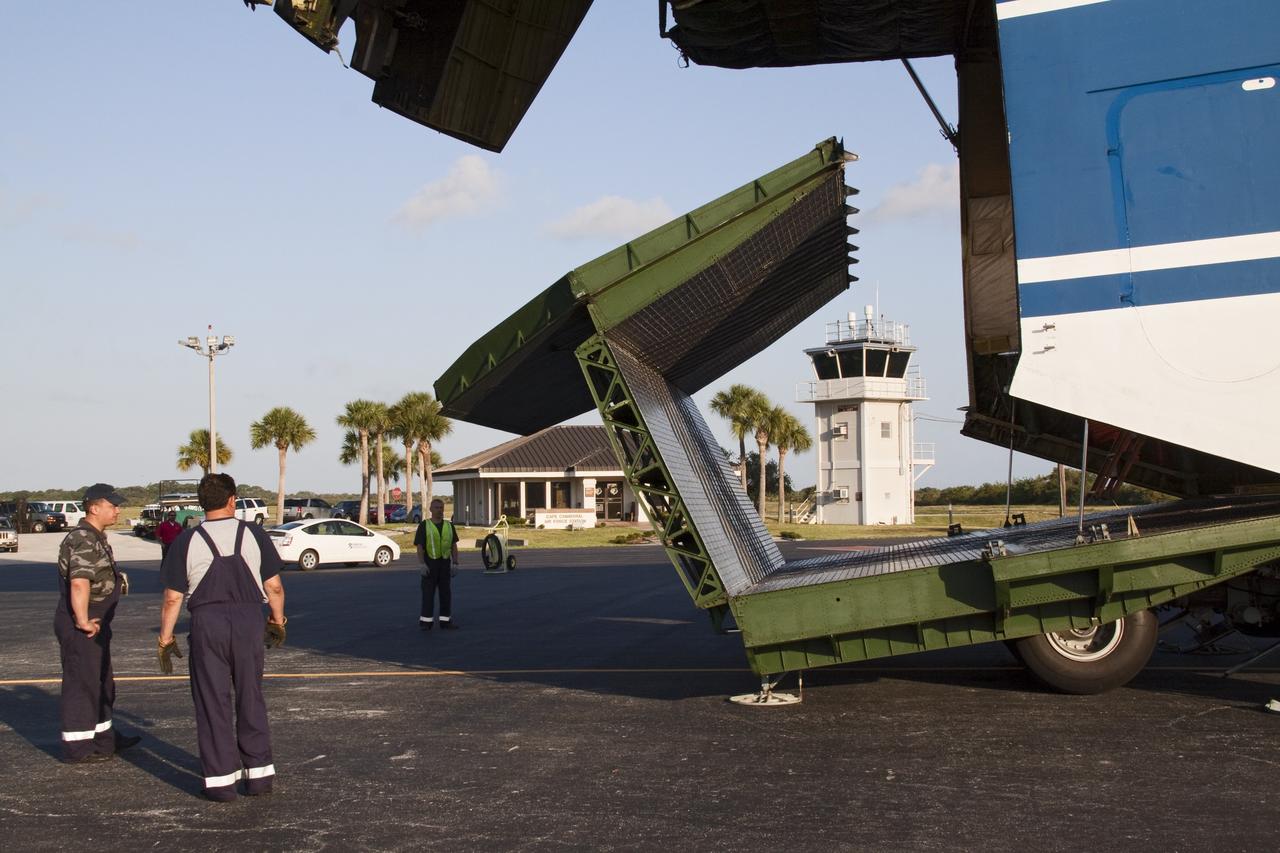
CAPE CANAVERAL, Fla. -- On the Skid Strip at Cape Canaveral Air Force Station in Florida, workers prepare to unload a Volga-Dnepr Antonov AN-124-100, a Ukranian/Russian cargo aircraft that has delivered the Centaur upper stage of the United Launch Alliance Atlas V rocket slated to launch NASA's Juno spacecraft. NASA's Juno spacecraft is scheduled to launch aboard the Atlas V from Cape Canaveral, Fla. Aug. 5.The solar-powered spacecraft will orbit Jupiter's poles 33 times to find out more about the gas giant's origins, structure, atmosphere and magnetosphere and investigate the existence of a solid planetary core. For more information visit: www.nasa.gov/juno. Photo credit: NASA/Jack Pfaller
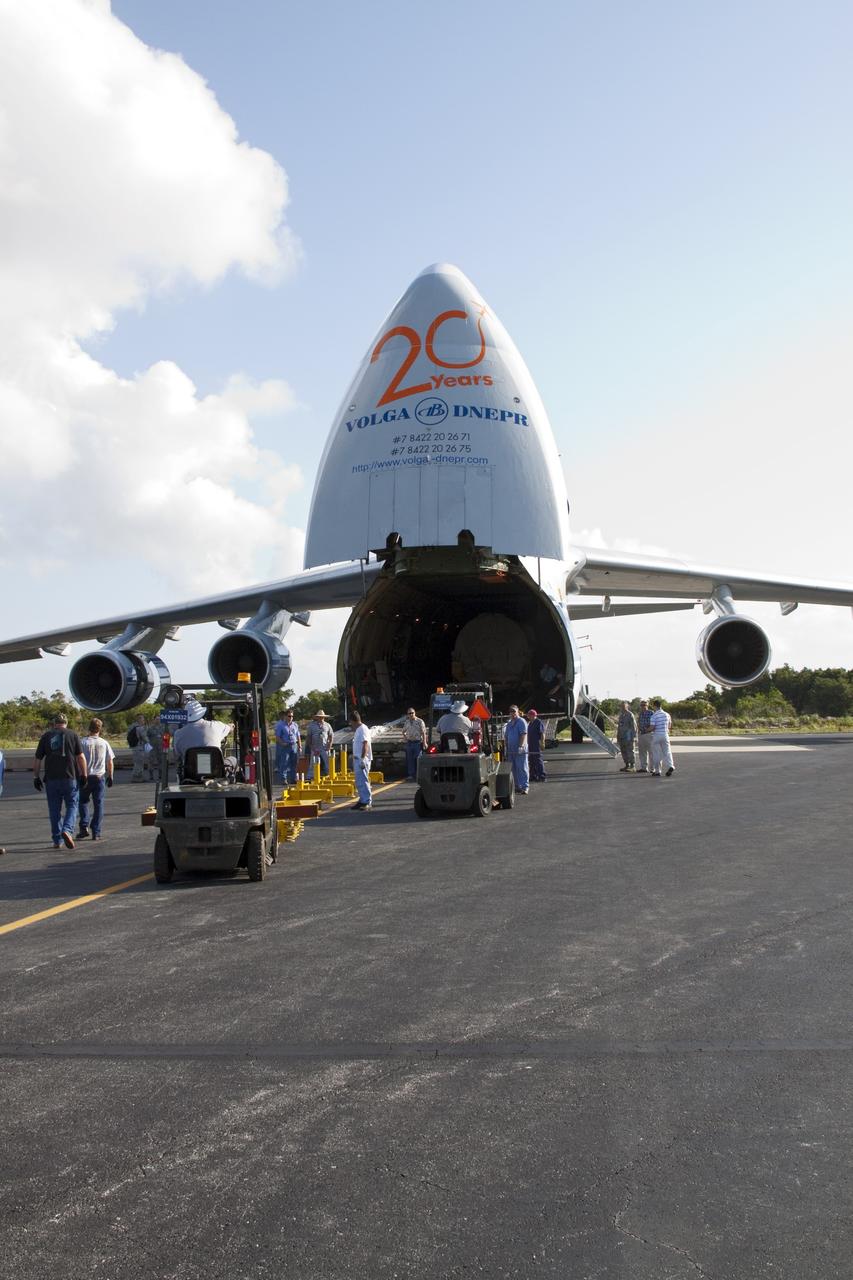
CAPE CANAVERAL, Fla. -- On the Skid Strip at Cape Canaveral Air Force Station in Florida, workers prepare to unload a Volga-Dnepr Antonov AN-124-100, a Ukranian/Russian cargo aircraft that has delivered the Centaur upper stage of the United Launch Alliance Atlas V rocket slated to launch NASA's Juno spacecraft. NASA's Juno spacecraft is scheduled to launch aboard the Atlas V from Cape Canaveral, Fla. Aug. 5.The solar-powered spacecraft will orbit Jupiter's poles 33 times to find out more about the gas giant's origins, structure, atmosphere and magnetosphere and investigate the existence of a solid planetary core. For more information visit: www.nasa.gov/juno. Photo credit: NASA/Jack Pfaller
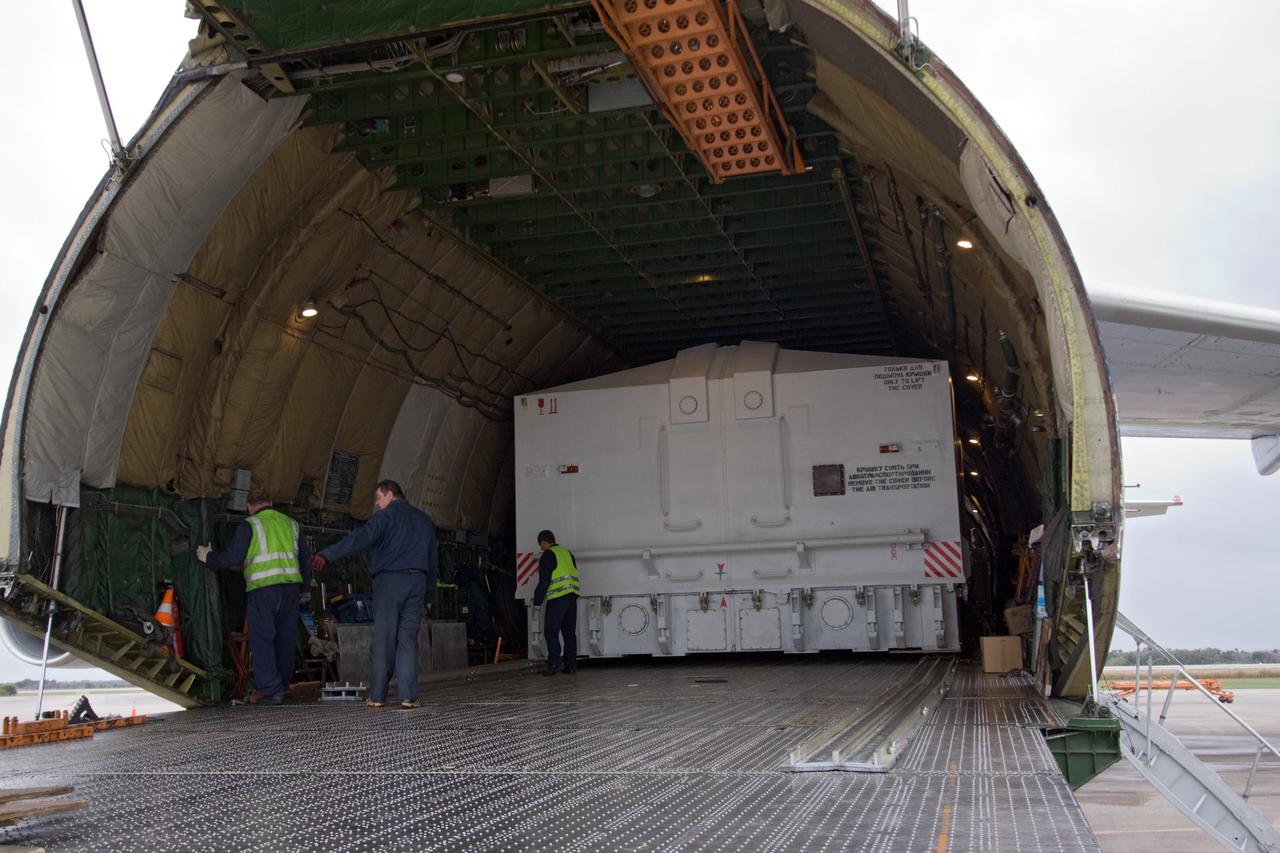
CAPE CANAVERAL, Fla. - At the Shuttle Landing Facility at NASA's Kennedy Space Center in Florida, preparations are under way to offload the Russian-built Mini Research Module1, or MRM1, from a Volga-Dnepr Antonov AN-124-100, a Ukranian/Russian aircraft. The second in a series of new pressurized components for Russia, the module, named Rassvet, will be permanently attached to the International Space Station's Zarya module on space shuttle Atlantis' STS-132 mission. An Integrated Cargo Carrier will join the MRM in Atlantis' payload bay. Three spacewalks are planned to store spare components outside the station, including six spare batteries, a boom assembly for the Ku-band antenna and spares for the Canadian Dextre robotic arm extension. A radiator, airlock, and European robotic arm for the Russian Multi-purpose Laboratory Module also will be delivered to the station. Launch is targeted for May 14, 2010. Photo credit: NASA/Jack Pfaller
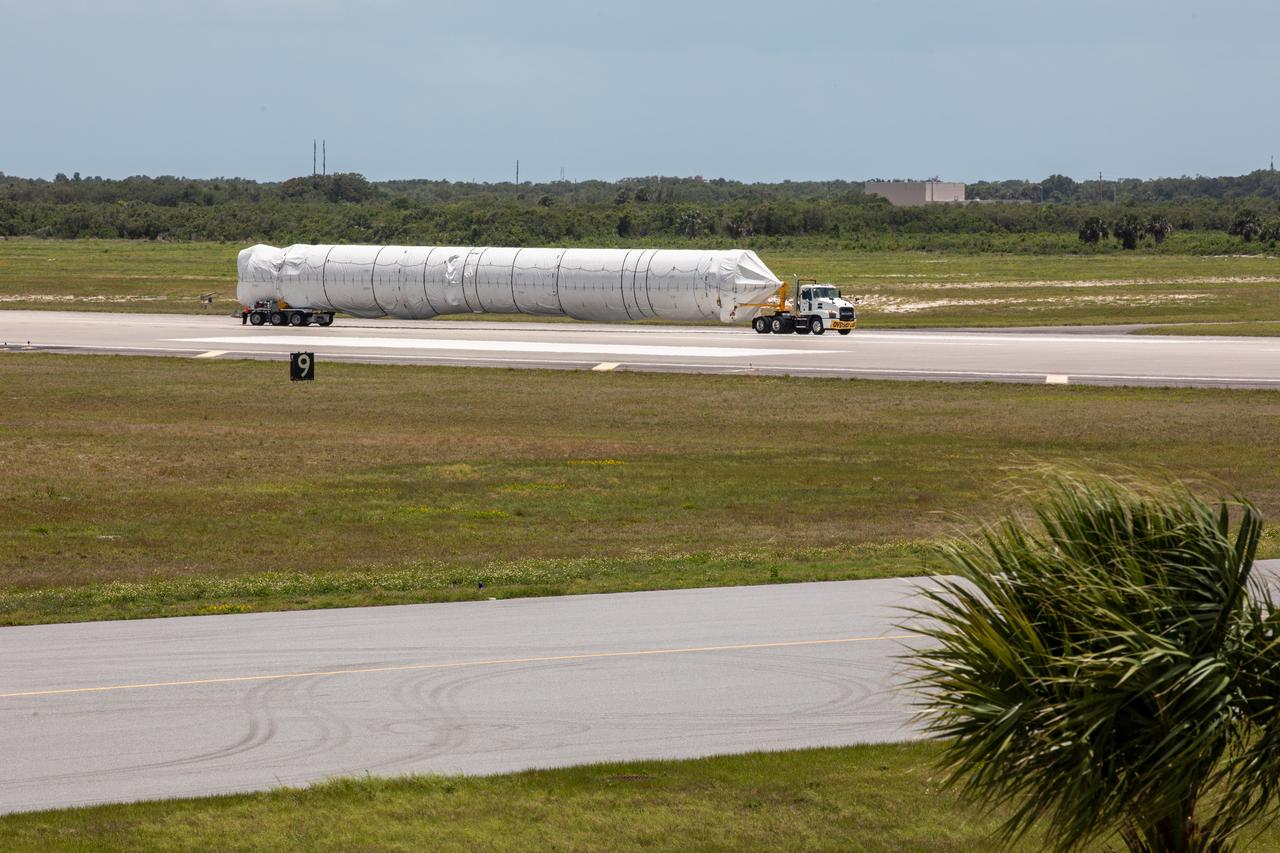
A flatbed truck carrying the United Launch Alliance booster for NASA’s Mars Perseverance rover departs the Skid Strip at Cape Canaveral Air Force Station (CCAFS) in Florida on May 19, 2020. The booster arrived aboard the Antonov 124 cargo aircraft at the Skid Strip on May 18, 2020. The Mars Perseverance rover is scheduled to launch in mid-July atop a United Launch Alliance Atlas V 541 rocket from Pad 41 at CCAFS. The rover is part of NASA’s Mars Exploration Program, a long-term effort of robotic exploration of the Red Planet. The rover will search for habitable conditions in the ancient past and signs of past microbial life on Mars. The Launch Services Program at Kennedy is responsible for launch management.
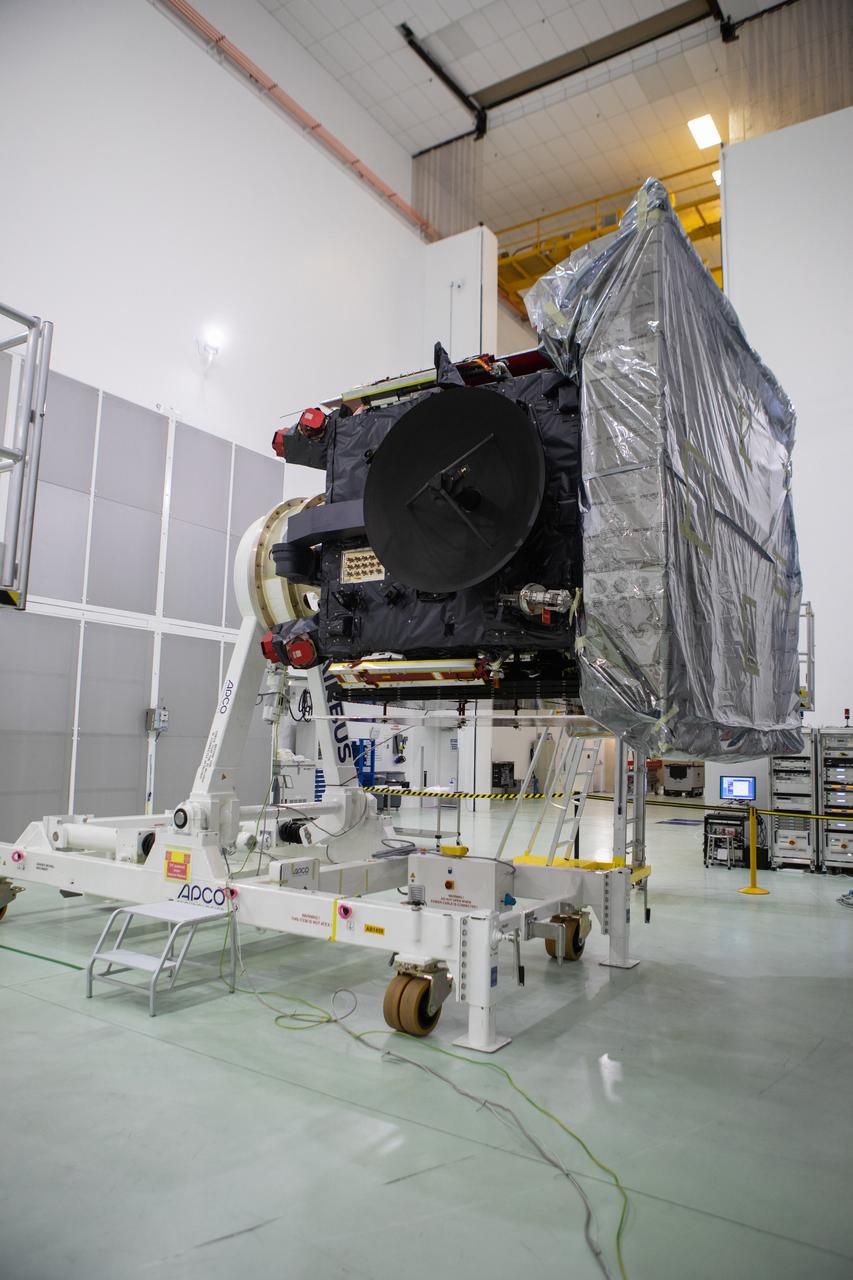
The Solar Orbiter spacecraft was removed from its shipping container inside the Astrotech Space Operations facility in Titusville, Florida, on Nov. 18, 2019. The spacecraft was flown aboard an Antonov cargo aircraft from Munich, Germany, arriving at NASA’s Kennedy Space Center on Nov. 1, 2019. Solar Orbiter is a European Space Agency mission with strong NASA participation. The mission aims to study the Sun, its outer atmosphere and solar winds. The spacecraft will provide the first images of the Sun’s poles. NASA’s Launch Services Program based at Kennedy is managing the launch. Liftoff is scheduled for Feb. 5, 2020, from Cape Canaveral Air Force Station aboard a United Launch Alliance Atlas V rocket.
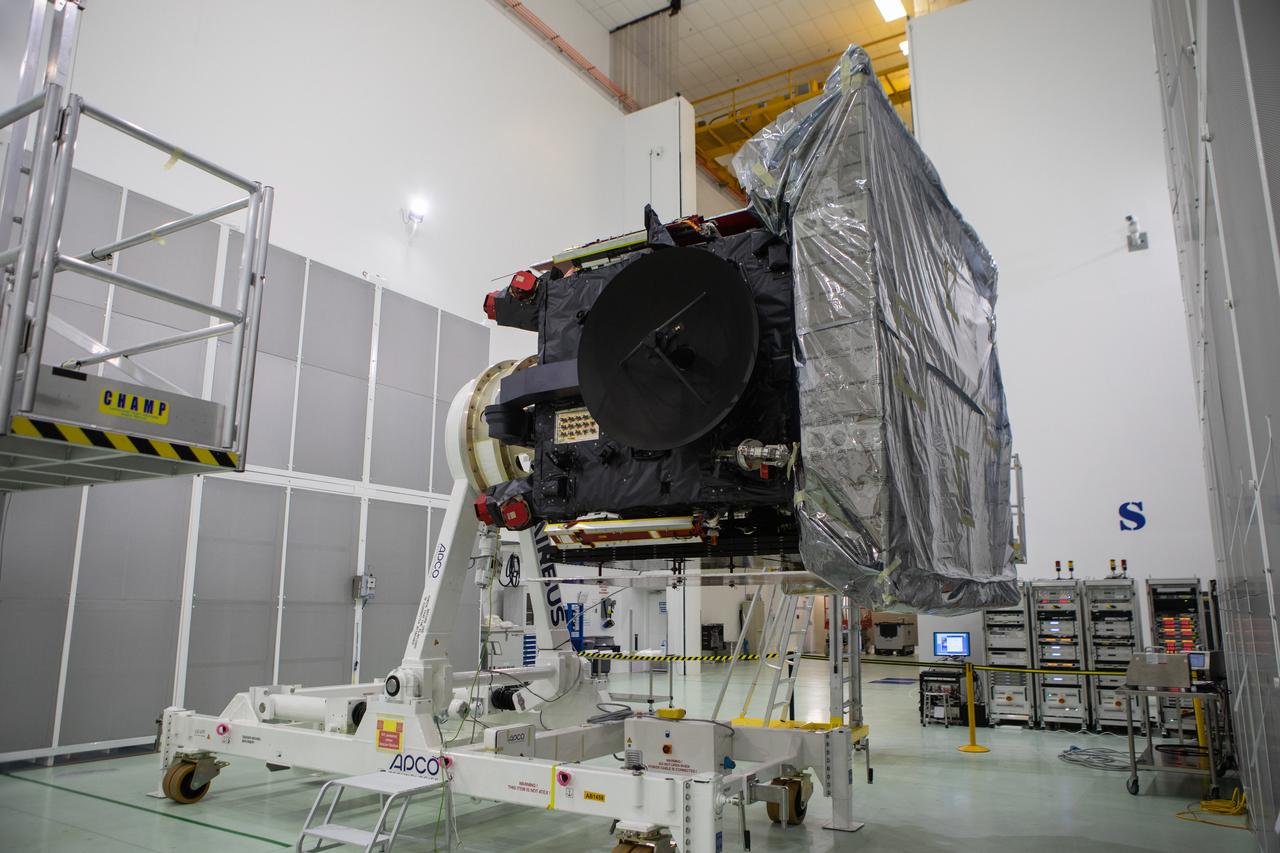
The Solar Orbiter spacecraft has been removed from its shipping container inside the Astrotech Space Operations facility in Titusville, Florida, on Nov. 18, 2019. The spacecraft was flown aboard an Antonov cargo aircraft from Munich, Germany, arriving at NASA’s Kennedy Space Center on Nov. 1, 2019. Solar Orbiter is a European Space Agency mission with strong NASA participation. The mission aims to study the Sun, its outer atmosphere and solar winds. The spacecraft will provide the first images of the Sun’s poles. NASA’s Launch Services Program based at Kennedy is managing the launch. Liftoff is scheduled for Feb. 5, 2020, from Cape Canaveral Air Force Station aboard a United Launch Alliance Atlas V rocket.
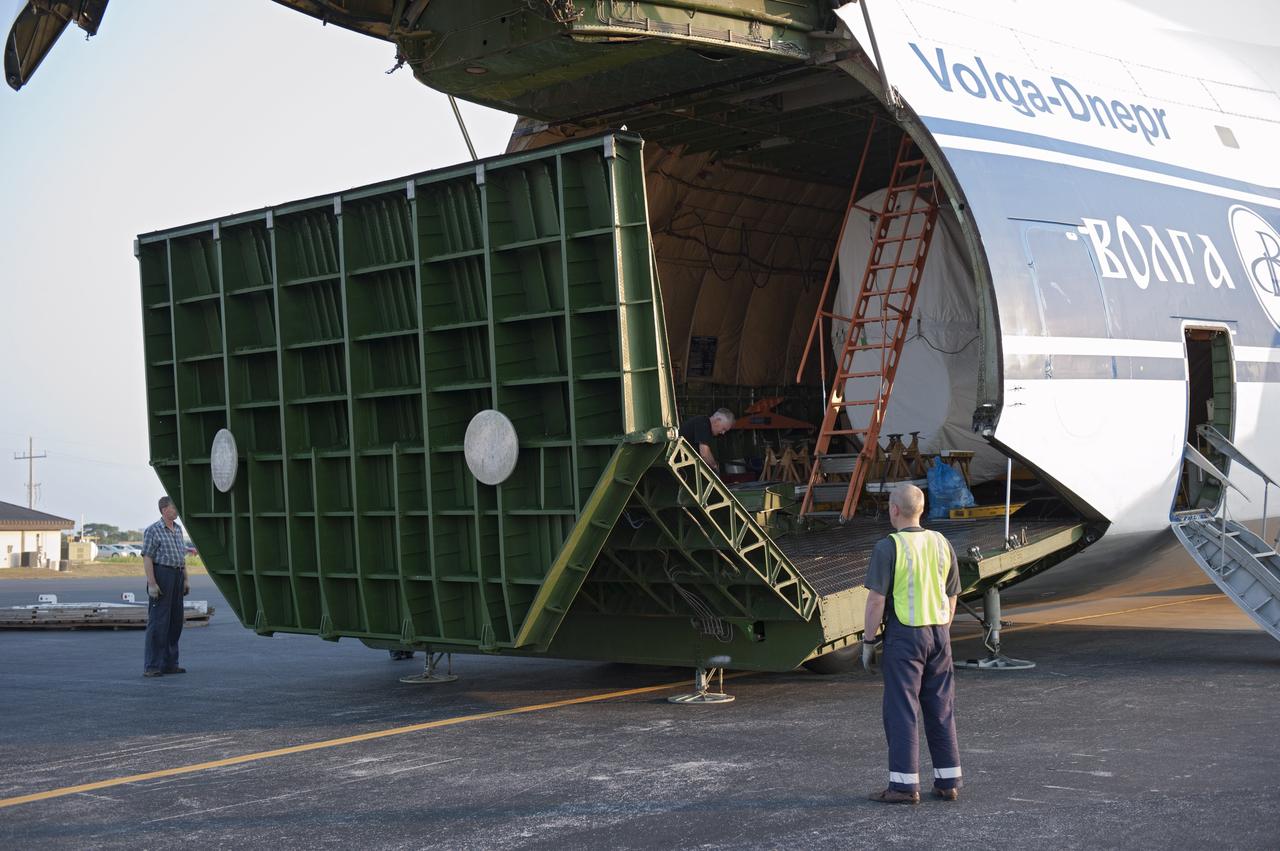
CAPE CANAVERAL, Fla. -- On the Skid Strip at Cape Canaveral Air Force Station in Florida, workers prepare to unload a Volga-Dnepr Antonov AN-124-100, a Ukranian/Russian cargo aircraft that has delivered the first stage of the United Launch Alliance Atlas V rocket slated to launch NASA's Juno spacecraft. Juno is scheduled to launch aboard an Atlas V rocket from Cape Canaveral, Fla., Aug. 5.The solar-powered spacecraft will orbit Jupiter's poles 33 times to find out more about the gas giant's origins, structure, atmosphere and magnetosphere and investigate the existence of a solid planetary core. For more information, visit www.nasa.gov/juno. Photo credit: NASA/Kim Shiflett
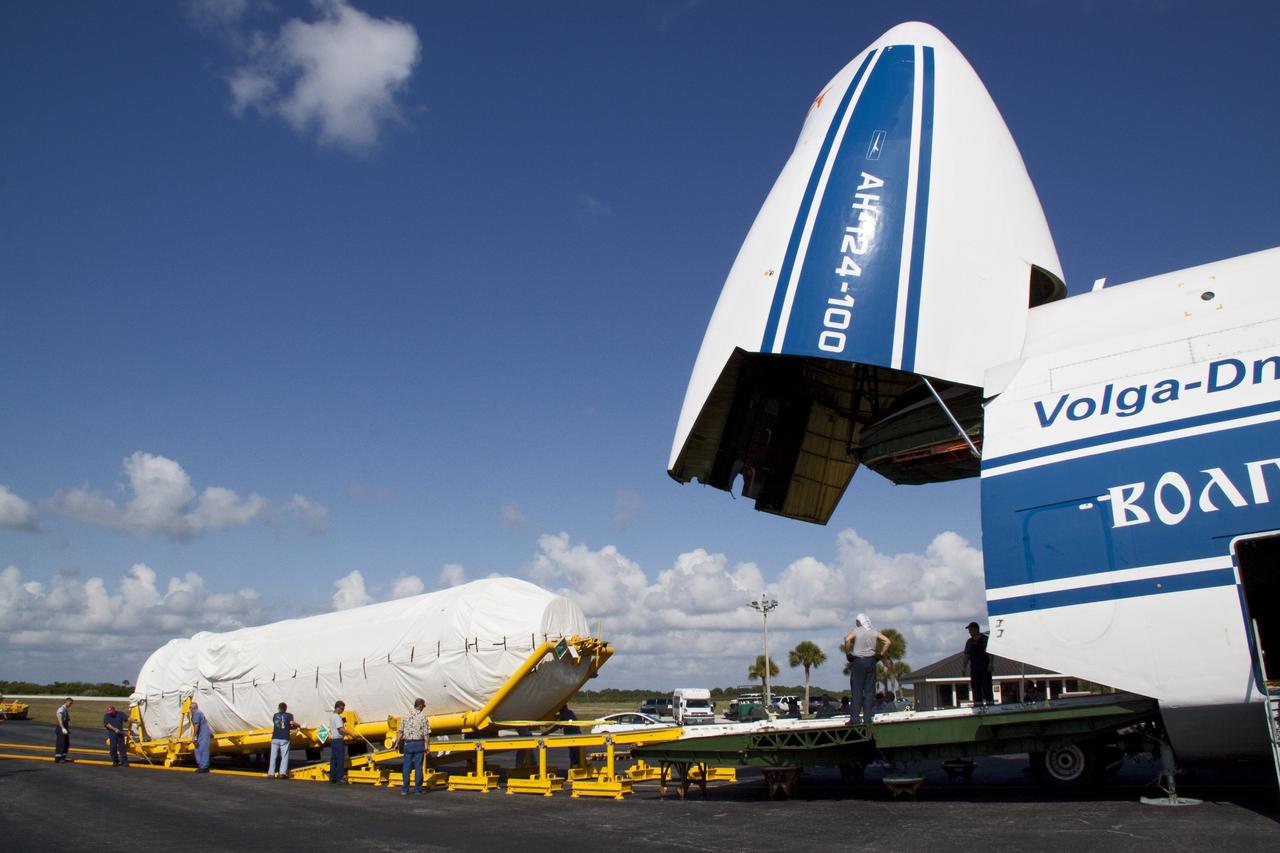
CAPE CANAVERAL, Fla. -- On the Skid Strip at Cape Canaveral Air Force Station in Florida, workers begin to unload the Centaur upper stage of the United Launch Alliance Atlas V rocket slated to launch NASA's Juno spacecraft from a Volga-Dnepr Antonov AN-124-100, a Ukranian/Russian cargo aircraft. NASA's Juno spacecraft is scheduled to launch aboard the Atlas V from Cape Canaveral, Fla. Aug. 5.The solar-powered spacecraft will orbit Jupiter's poles 33 times to find out more about the gas giant's origins, structure, atmosphere and magnetosphere and investigate the existence of a solid planetary core. For more information visit: www.nasa.gov/juno. Photo credit: NASA/Jack Pfaller
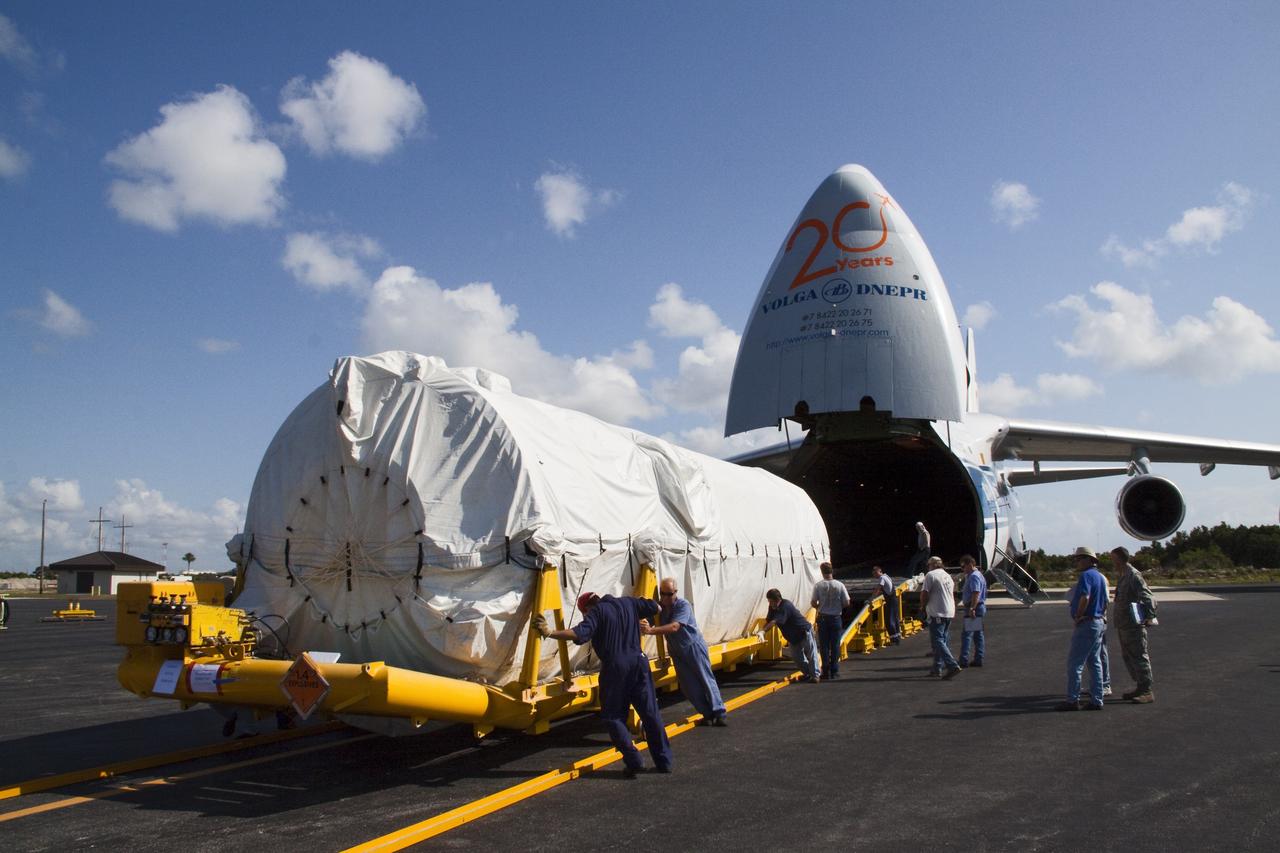
CAPE CANAVERAL, Fla. -- On the Skid Strip at Cape Canaveral Air Force Station in Florida, workers unload the Centaur upper stage of the United Launch Alliance Atlas V rocket slated to launch NASA's Juno spacecraft from a Volga-Dnepr Antonov AN-124-100, a Ukranian/Russian cargo aircraft. NASA's Juno spacecraft is scheduled to launch aboard the Atlas V from Cape Canaveral, Fla. Aug. 5.The solar-powered spacecraft will orbit Jupiter's poles 33 times to find out more about the gas giant's origins, structure, atmosphere and magnetosphere and investigate the existence of a solid planetary core. For more information visit: www.nasa.gov/juno. Photo credit: NASA/Jack Pfaller
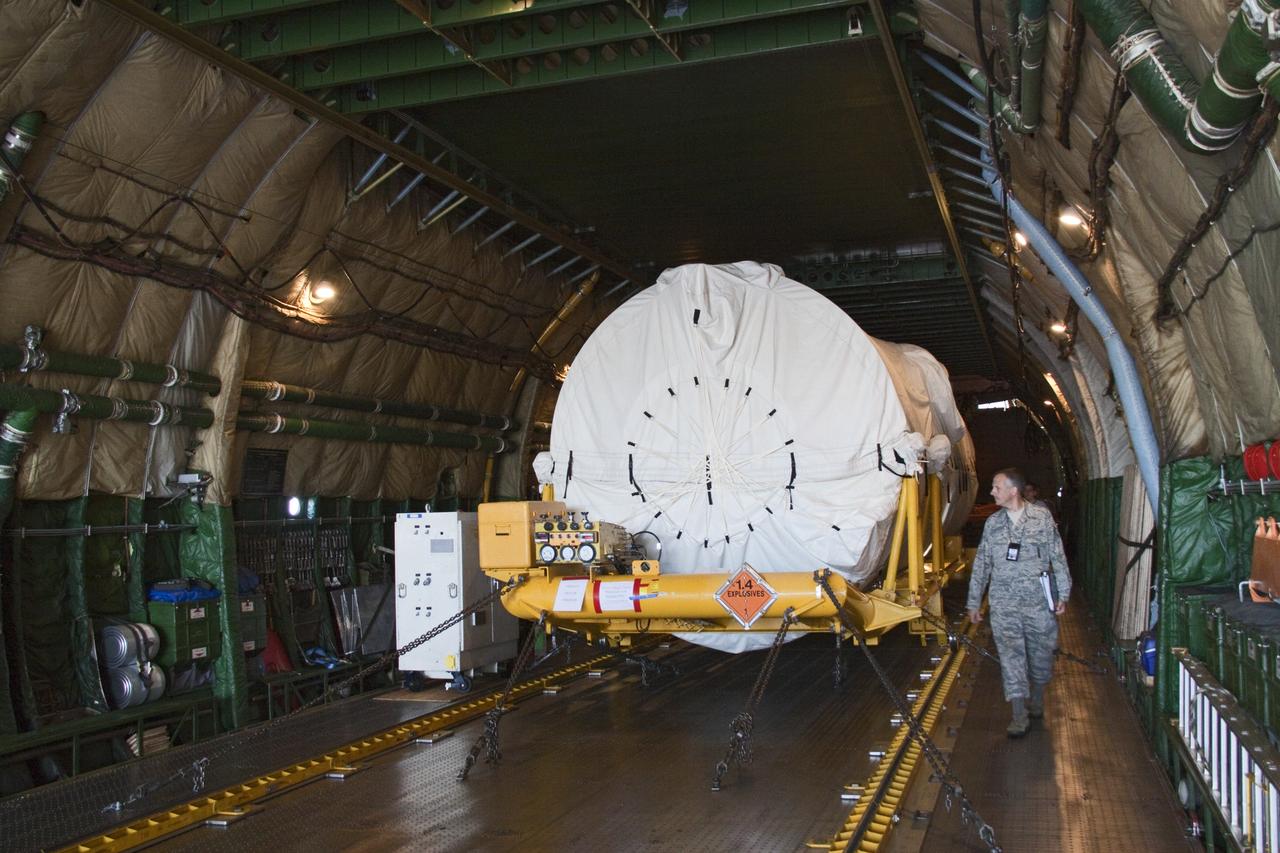
CAPE CANAVERAL, Fla. -- On the Skid Strip at Cape Canaveral Air Force Station in Florida, workers unload the Centaur upper stage of the United Launch Alliance Atlas V rocket slated to launch NASA's Juno spacecraft from a Volga-Dnepr Antonov AN-124-100, a Ukranian/Russian cargo aircraft. NASA's Juno spacecraft is scheduled to launch aboard the Atlas V from Cape Canaveral, Fla. Aug. 5.The solar-powered spacecraft will orbit Jupiter's poles 33 times to find out more about the gas giant's origins, structure, atmosphere and magnetosphere and investigate the existence of a solid planetary core. For more information visit: www.nasa.gov/juno. Photo credit: NASA/Jack Pfaller
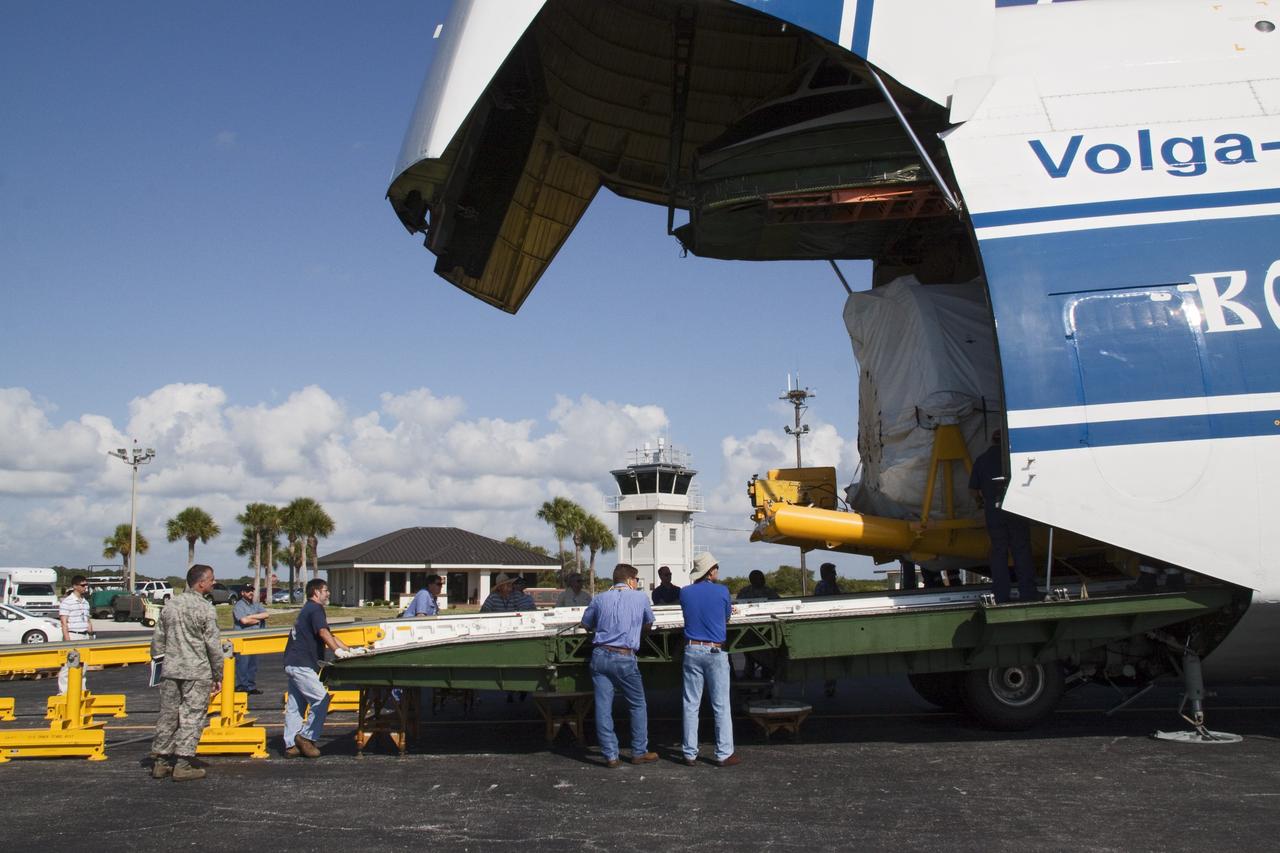
CAPE CANAVERAL, Fla. -- On the Skid Strip at Cape Canaveral Air Force Station in Florida, workers prepare to unload a Volga-Dnepr Antonov AN-124-100, a Ukranian/Russian cargo aircraft that has delivered the Centaur upper stage of the United Launch Alliance Atlas V rocket slated to launch NASA's Juno spacecraft. NASA's Juno spacecraft is scheduled to launch aboard the Atlas V from Cape Canaveral, Fla. Aug. 5.The solar-powered spacecraft will orbit Jupiter's poles 33 times to find out more about the gas giant's origins, structure, atmosphere and magnetosphere and investigate the existence of a solid planetary core. For more information visit: www.nasa.gov/juno. Photo credit: NASA/Jack Pfaller
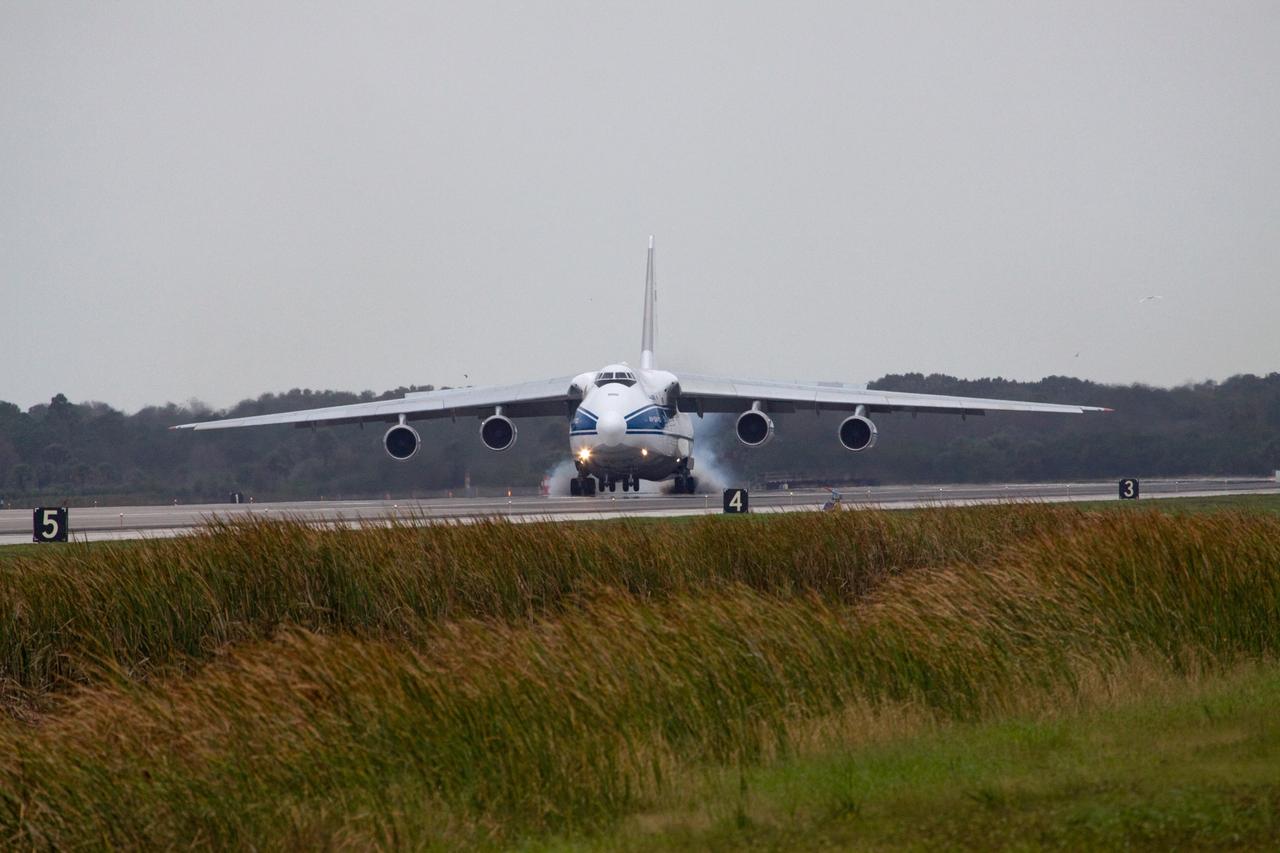
CAPE CANAVERAL, Fla. - A Volga-Dnepr Antonov AN-124-100, a Ukranian/Russian aircraft, delivers the Russian-built Mini Research Module1, or MRM1, to the Shuttle Landing Facility at NASA's Kennedy Space Center in Florida. The second in a series of new pressurized components for Russia, the module, named Rassvet, will be permanently attached to the International Space Station's Zarya module on space shuttle Atlantis' STS-132 mission. An Integrated Cargo Carrier will join the MRM in Atlantis' payload bay. Three spacewalks are planned to store spare components outside the station, including six spare batteries, a boom assembly for the Ku-band antenna and spares for the Canadian Dextre robotic arm extension. A radiator, airlock, and European robotic arm for the Russian Multi-purpose Laboratory Module also will be delivered to the station. Launch is targeted for May 14, 2010. Photo credit: NASA/Jack Pfaller
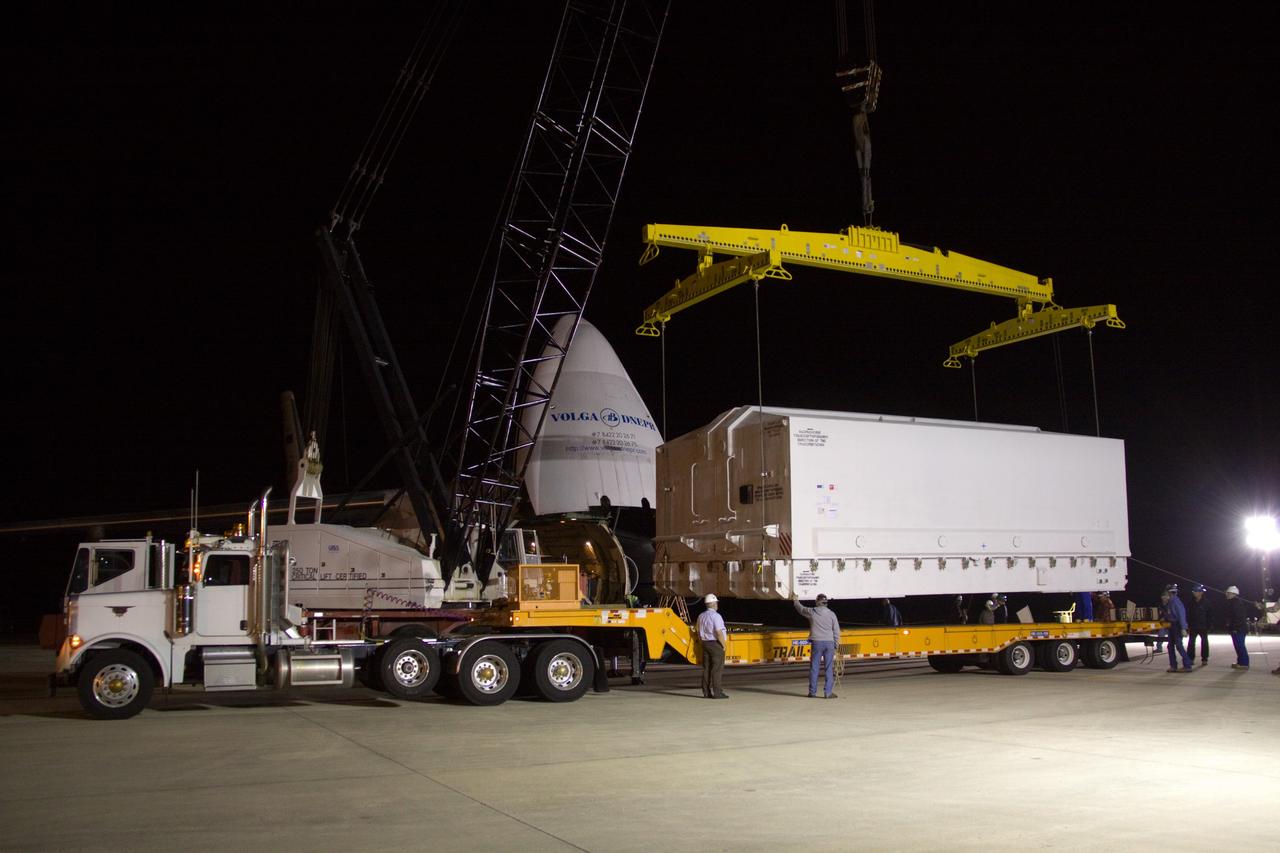
CAPE CANAVERAL, Fla. - At the Shuttle Landing Facility at NASA's Kennedy Space Center in Florida, the transportation case protecting the Russian-built Mini Research Module1, or MRM1, is lifted onto a transporter. The MRM was delivered to Kennedy aboard the Volga-Dnepr Antonov AN-124-100, a Ukranian/Russian aircraft, in the background. The second in a series of new pressurized components for Russia, the module, named Rassvet, will be permanently attached to the International Space Station's Zarya module on space shuttle Atlantis' STS-132 mission. An Integrated Cargo Carrier will join the MRM in Atlantis' payload bay. Three spacewalks are planned to store spare components outside the station, including six spare batteries, a boom assembly for the Ku-band antenna and spares for the Canadian Dextre robotic arm extension. A radiator, airlock, and European robotic arm for the Russian Multi-purpose Laboratory Module also will be delivered to the station. Launch is targeted for May 14, 2010. Photo credit: NASA/Jack Pfaller
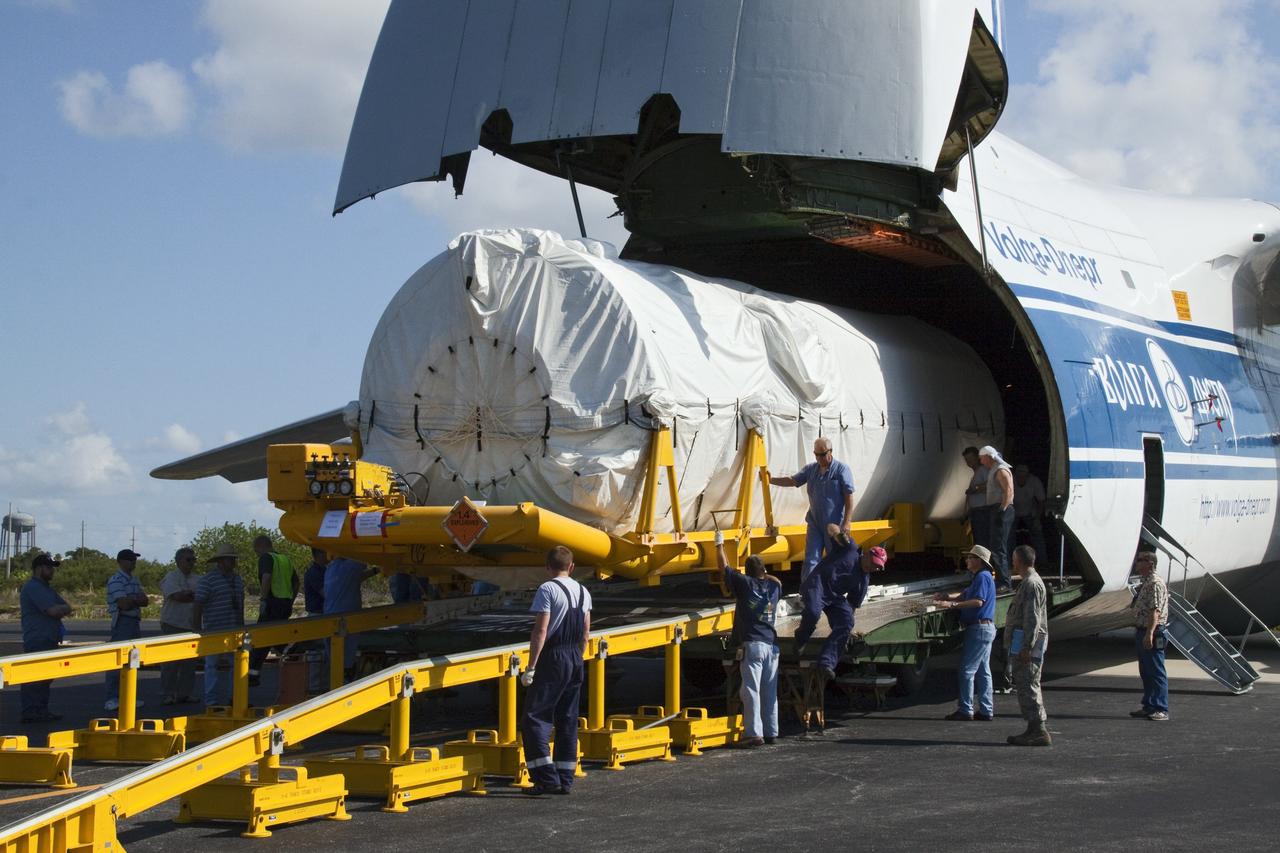
CAPE CANAVERAL, Fla. -- On the Skid Strip at Cape Canaveral Air Force Station in Florida, workers unload the Centaur upper stage of the United Launch Alliance Atlas V rocket slated to launch NASA's Juno spacecraft from a Volga-Dnepr Antonov AN-124-100, a Ukranian/Russian cargo aircraft. NASA's Juno spacecraft is scheduled to launch aboard the Atlas V from Cape Canaveral, Fla. Aug. 5.The solar-powered spacecraft will orbit Jupiter's poles 33 times to find out more about the gas giant's origins, structure, atmosphere and magnetosphere and investigate the existence of a solid planetary core. For more information visit: www.nasa.gov/juno. Photo credit: NASA/Jack Pfaller