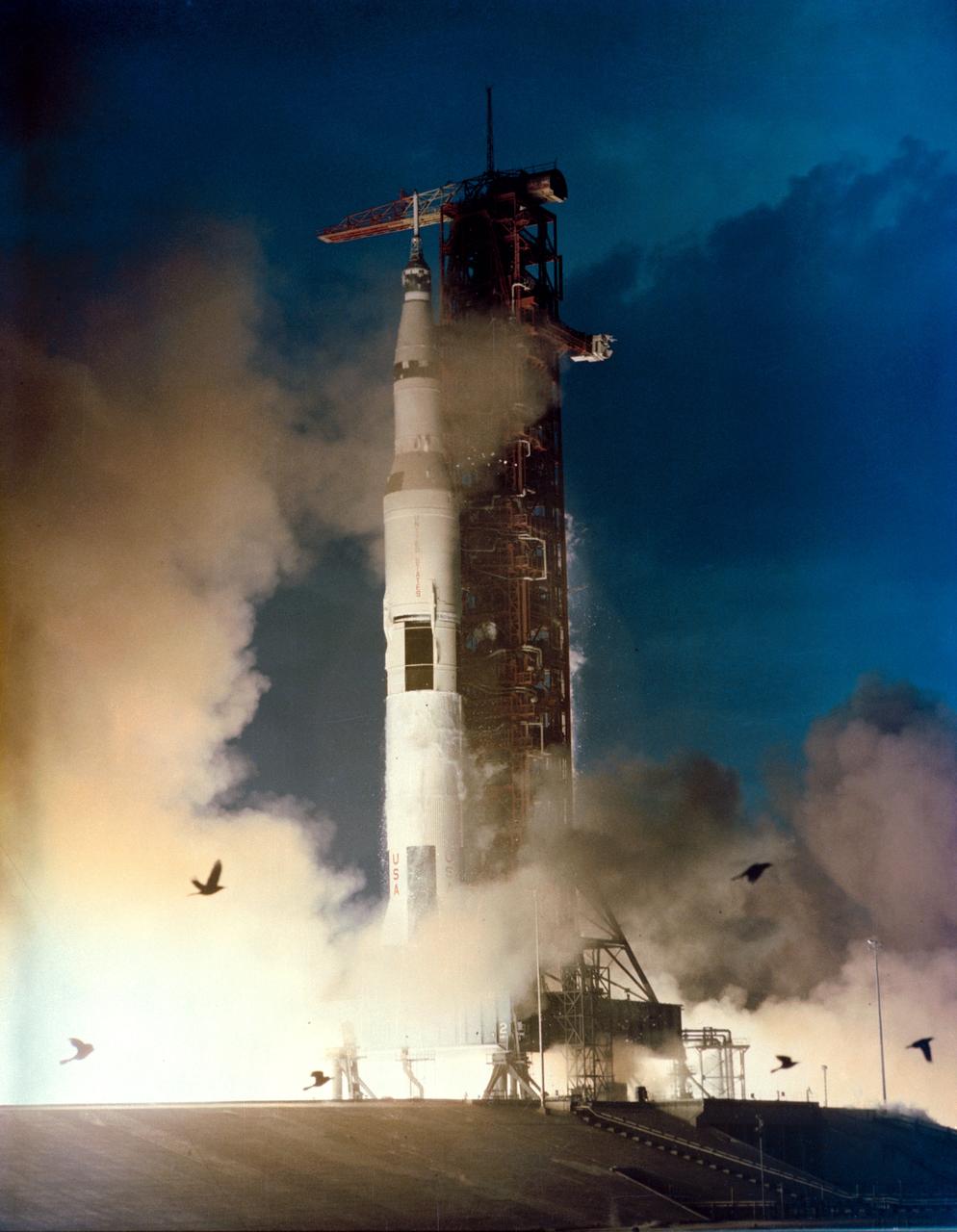
S71-18395 (31 Jan. 1971) --- The huge, 363-feet tall Apollo 14 (Spacecraft 110/Lunar Module 8/Saturn 509) space vehicle is launched from Pad A, Launch Complex 39, Kennedy Space Center (KSC), Florida at 4:03:02 p.m. (EST), Jan. 31, 1971, on a lunar landing mission. Aboard the Apollo 14 spacecraft were astronauts Alan B. Shepard Jr., commander; Stuart A. Roosa, command module pilot; and Edgar D. Mitchell, lunar module pilot.
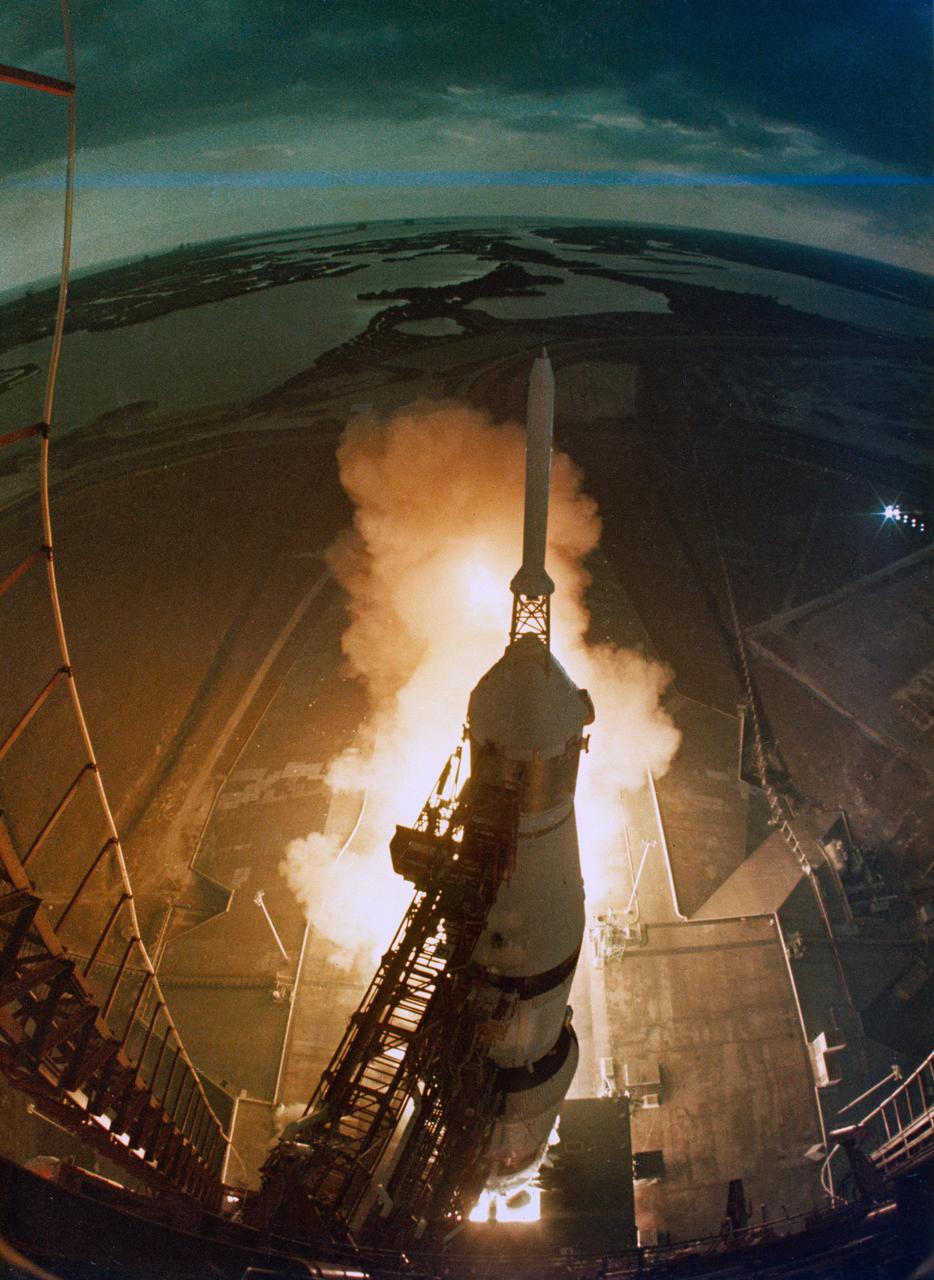
S71-17620 (31 Jan. 1971) --- The huge, 363-feet tall Apollo 14 (Spacecraft 110/Lunar Module 8/Saturn 509) space vehicle is launched from Pad A, Launch Complex 39, Kennedy Space Center, Florida, at 4:03:02 p.m. (EST), Jan. 31, 1981, on a lunar landing mission. This view of the liftoff was taken by a camera mounted on the mobile launch tower. Aboard the Apollo 14 spacecraft were astronauts Alan B. Shepard Jr., commander; Stuart A. Roosa, command module pilot; and Edgar D. Mitchell, lunar module pilot.
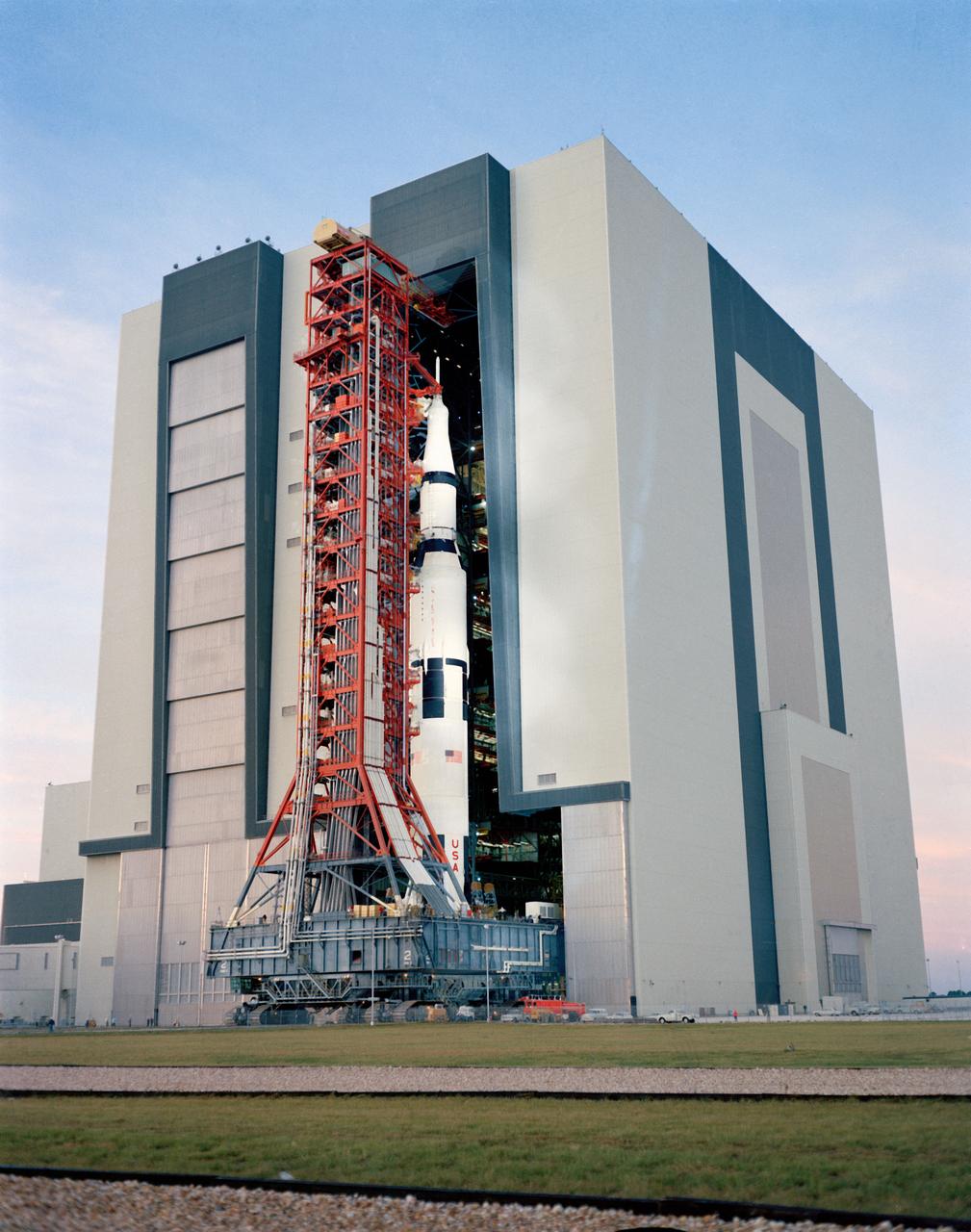
S70-54121 (9 Nov. 1970) --- A ground level view at Launch Complex 39, Kennedy Space Center (KSC), showing the Apollo 14 (Spacecraft 110/Lunar Module 8/Saturn 509) space vehicle leaving the Vehicle Assembly Building (VAB). The Saturn V stack and its mobile launch tower, atop a huge crawler-transporter, were rolled out to Pad A. The Apollo 14 crewmen will be astronauts Alan B. Shepard Jr., commander; Stuart A. Roosa, command module pilot; and Edgar D. Mitchell, lunar module pilot.
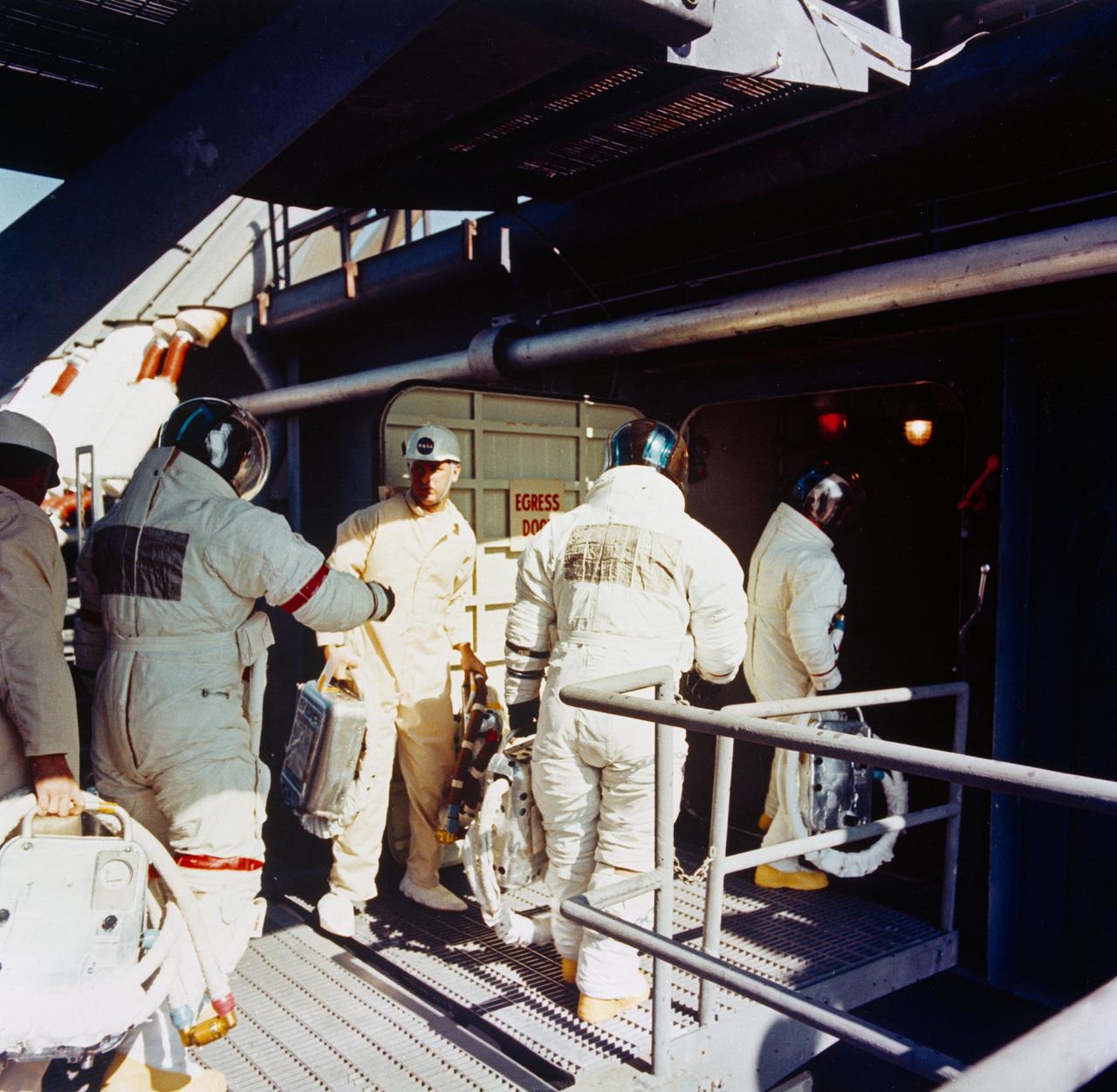
S71-16635 (31 Jan. 1971) --- The three Apollo 14 astronauts arrive at the White Room atop Pad A, Launch Complex 39, during the Apollo 14 prelaunch countdown. Apollo 14, with Alan B. Shepard Jr., commander; Stuart A. Roosa, command module pilot; and Edgar D. Mitchell, lunar module pilot, aboard was launched at 4:03:02 p.m. (EST), Jan. 31, 1971, on a lunar landing mission. Note identifying bands on the sleeve and leg of Shepard. Standing in the center foreground is astronaut Thomas P. Stafford, chief of the MSC Astronaut Office.
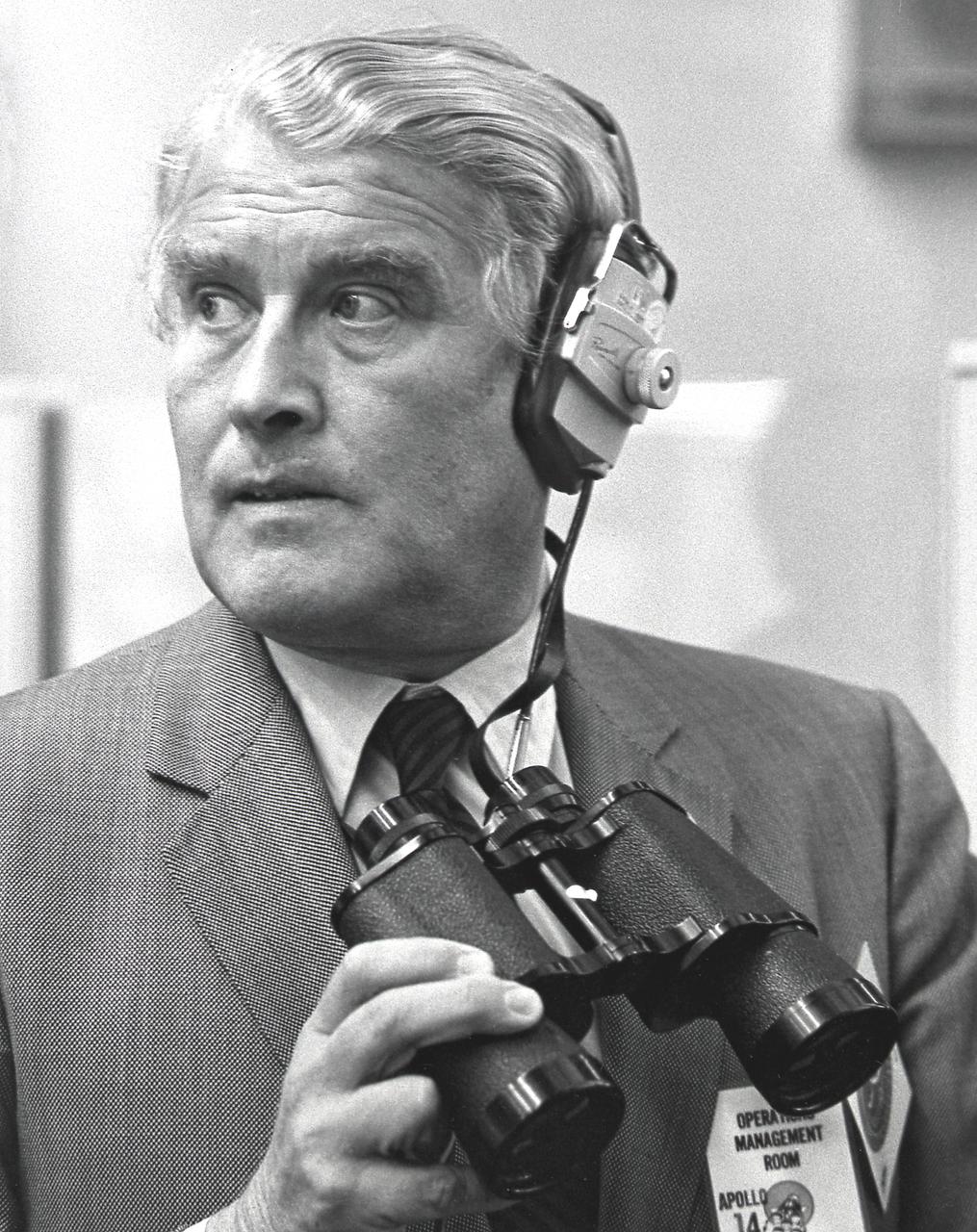
Dr. Wernher von Braun, NASA Deputy Associate Administrator for Future Programs, uses binoculars to monitor data on the closed-circuit TV screen in the Firing Room of the Launch Control Center at Kennedy Space Center (KSC) during the final preparation for the Apollo 14 launch.
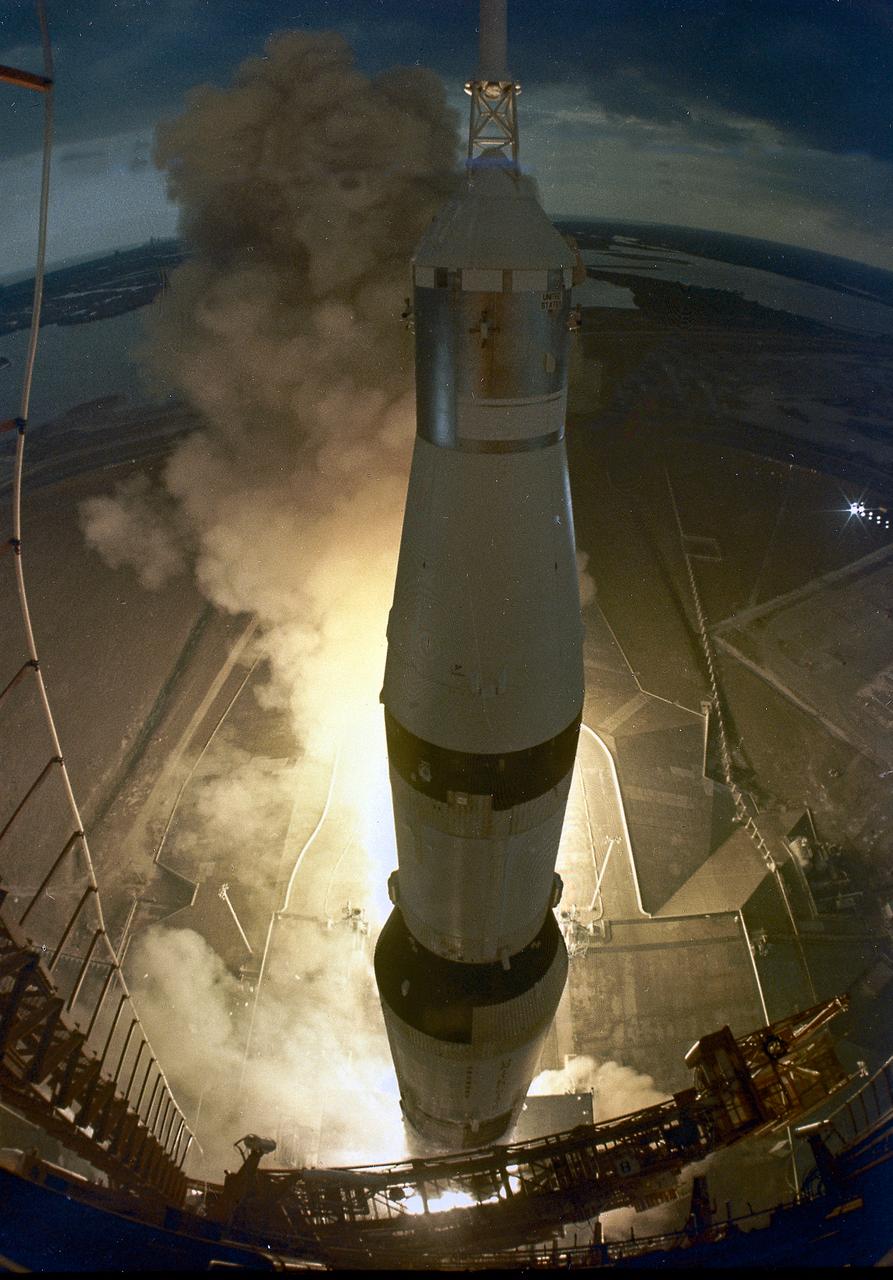
This is a view from sequential photographs of the Apollo 14 liftoff taken by a remote camera atop the 360-foot gantry level of Launch Complex 39A. The Apollo 14, carrying a crew of three astronauts: Mission commander Alan B. Shepard Jr., Command Module pilot Stuart A. Roosa, and Lunar Module pilot Edgar D. Mitchell, lifted off from launch complex 39A at the Kennedy Space Center on January 31, 1971. It was the third manned lunar landing, the first manned landing in exploration of the lunar highlands, and it demonstrated pinpoint landing capability. The major goal of Apollo 14 was the scientific exploration of the Moon in the foothills of the rugged Fra Mauro region. Activities of astronauts Shepard and Mitchell, during extravehicular activity (EVA) on the lunar surface, included setting up an automated scientific laboratory called Apollo Lunar Scientific Experiments Package (ALSEP), and collecting a total of about 95 pounds (43 kilograms) of Moon rock and soil for a geological investigation back on the Earth.
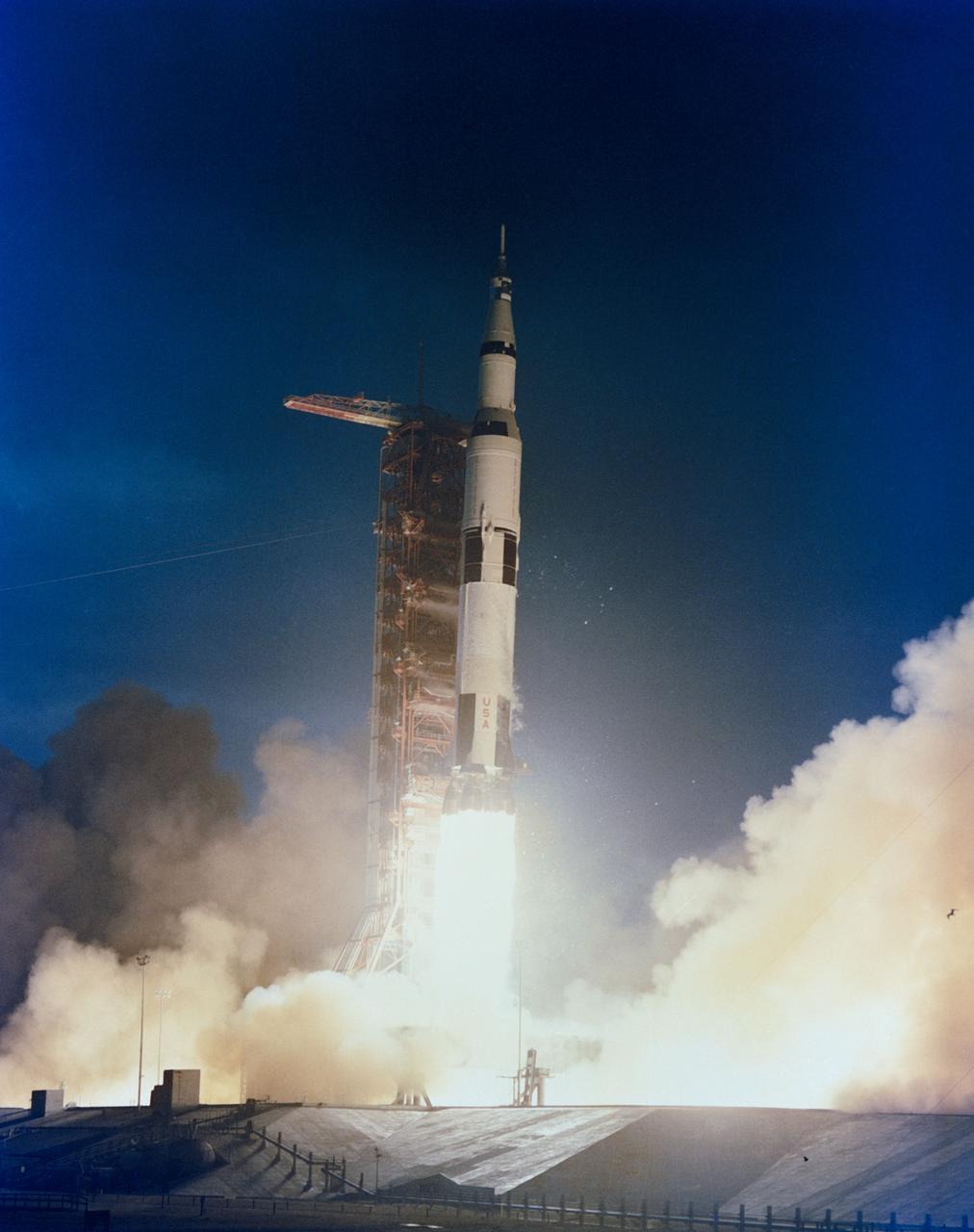
S71-17621 (31 Jan. 1971) --- The huge, 363-feet tall Apollo 14 (Spacecraft 110/Lunar Module 8/Saturn 509) space vehicle is launched from Pad A, Launch Complex 39, Kennedy Space Center, Florida, at 4:03:02 p.m. (EST), Jan. 31, 1981, on a lunar landing mission. Aboard the Apollo 14 spacecraft were astronauts Alan B. Shepard Jr., commander; Stuart A. Roosa, command module pilot; and Edgar D. Mitchell, lunar module pilot.
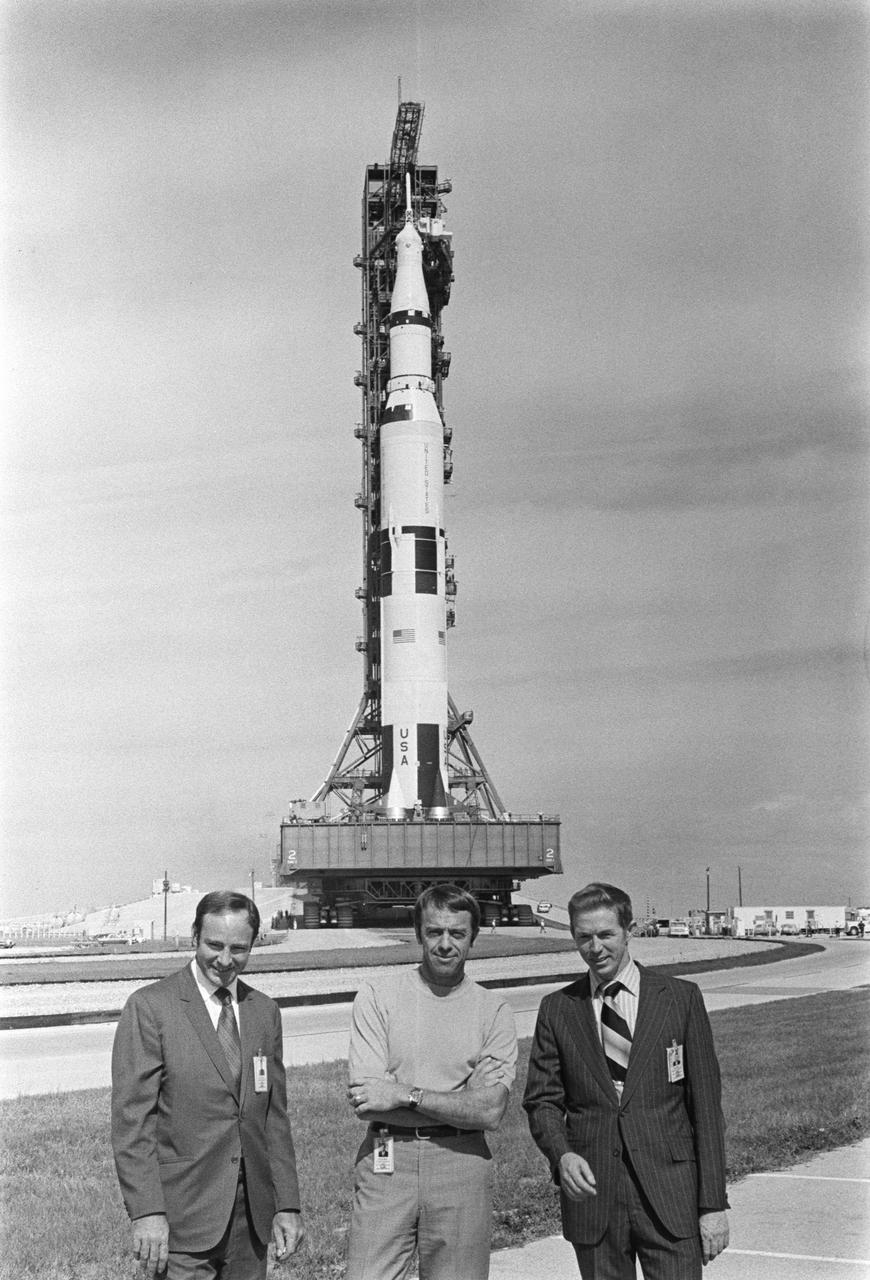
S70-55689 (9 Nov. 1970) --- The Apollo 14 (Spacecraft 110/Lunar Module 8/Saturn 509) space vehicle arrives at Pad A, Launch Complex 39, during the Apollo 14 roll out from the Kennedy Space Center's Vehicle Assembly Building. The Saturn V stack and its mobile launch tower atop a huge crawler-transporter. The three members of the Apollo 14 prime crew are in the foreground. They are (left to right) astronauts Edgar D. Mitchell, lunar module pilot; Alan B. Shepard Jr., commander; and Stuart A. Roosa, command module pilot.
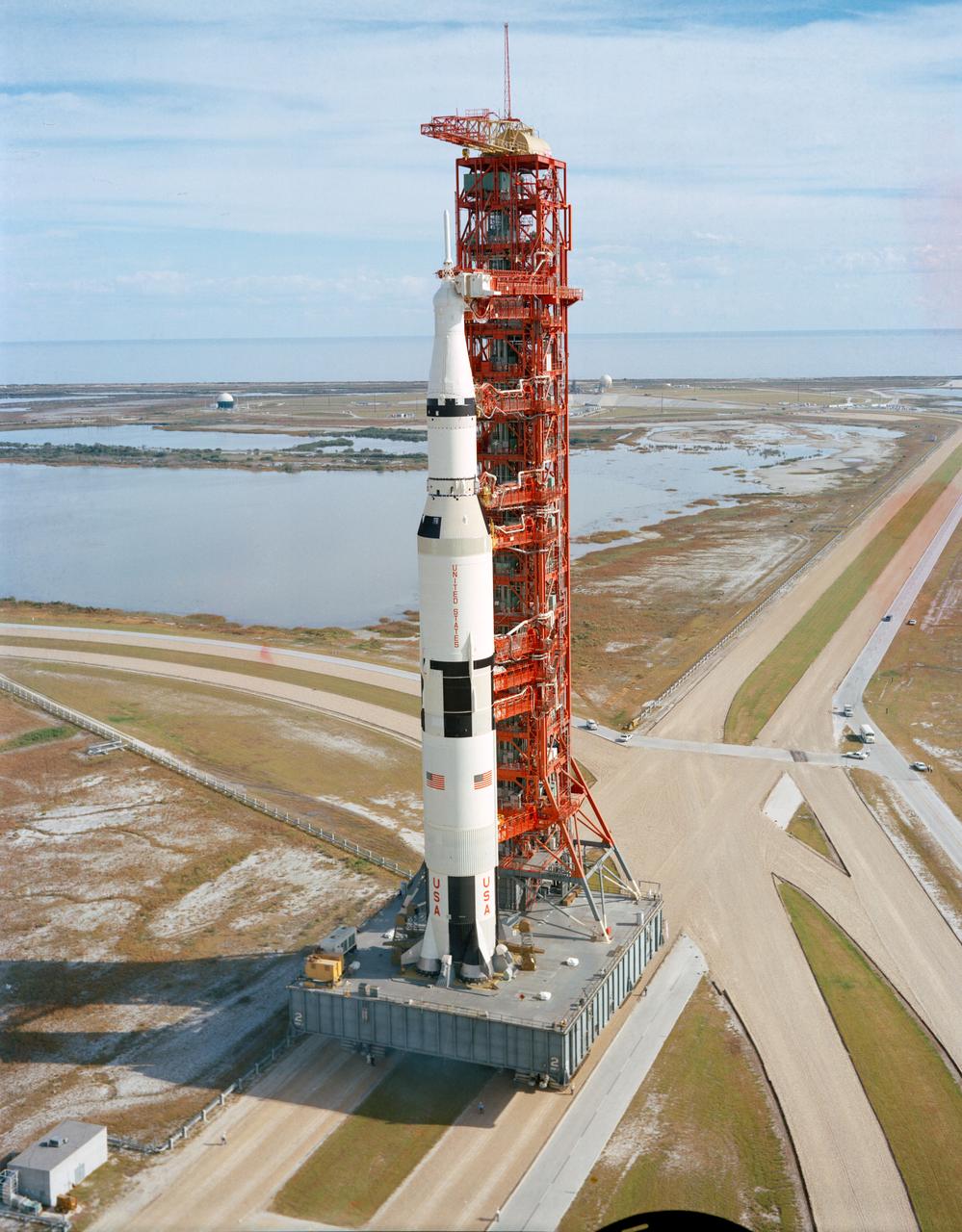
S70-54127 (9 Nov. 1970) --- A high-angle view at Launch Complex 39, Kennedy Space Center (KSC), showing the Apollo 14 (Spacecraft 110/Lunar Module 8/Saturn 509) space vehicle on the way from the Vehicle Assembly Building (VAB) to Pad A. The Saturn V stack and its mobile launch tower sit atop a huge crawler-transporter. The Apollo 14 crewmen will be astronauts Alan B. Shepard Jr., commander; Stuart A. Roosa, command module pilot; and Edgar D. Mitchell, lunar module pilot.
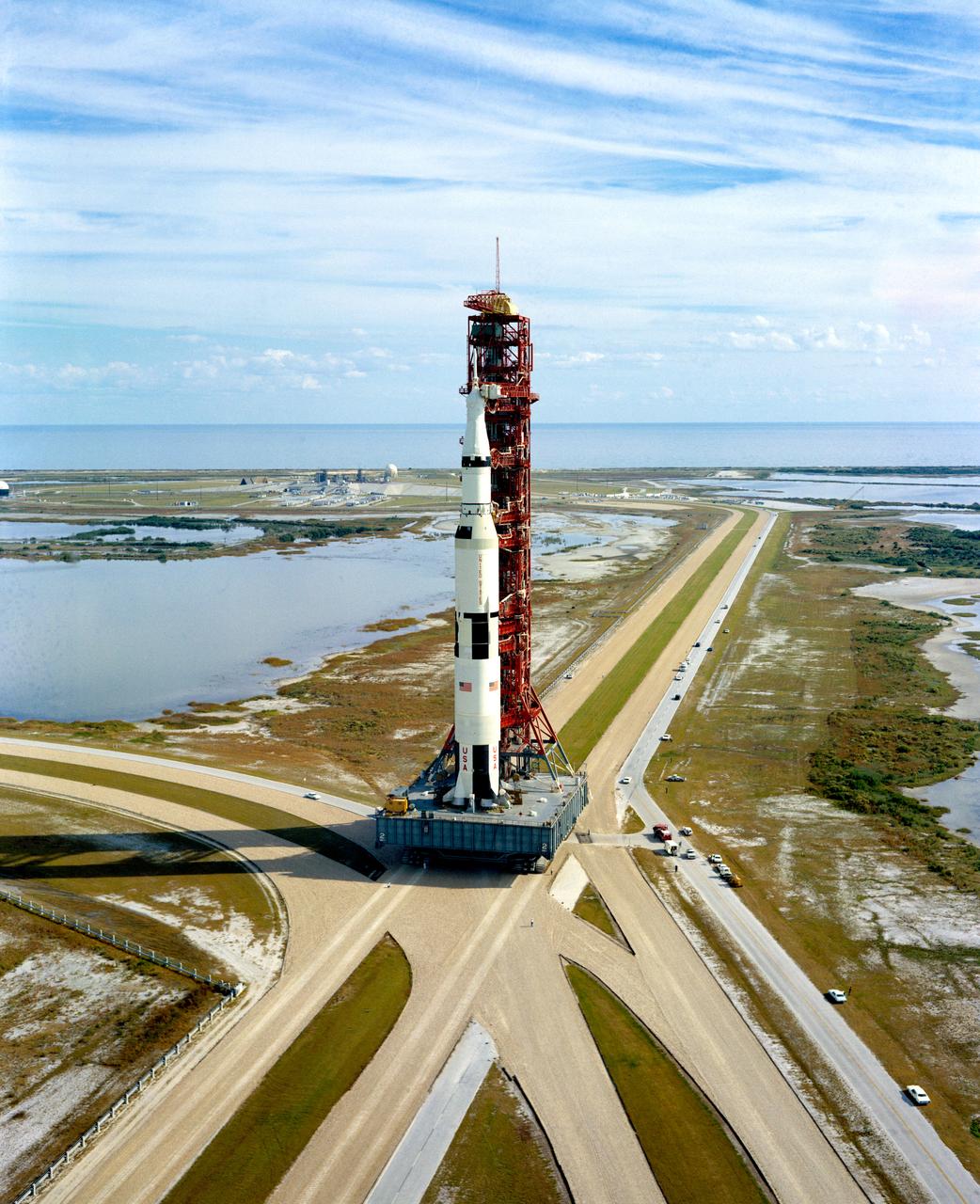
S70-54119 (9 Nov. 1970) --- A high-angle view at Launch Complex 39, Kennedy Space Center (KSC), showing the Apollo 14 (Spacecraft 110/Lunar Module 8/Saturn 509) space vehicle on the way from the Vehicle Assembly Building (VAB) to Pad A. The Saturn V stack and its mobile launch tower sit atop a huge crawler-transporter. The Apollo 14 crewmen will be astronauts Alan B. Shepard Jr., commander; Stuart A. Roosa, command module pilot; and Edgar D. Mitchell, lunar module pilot.
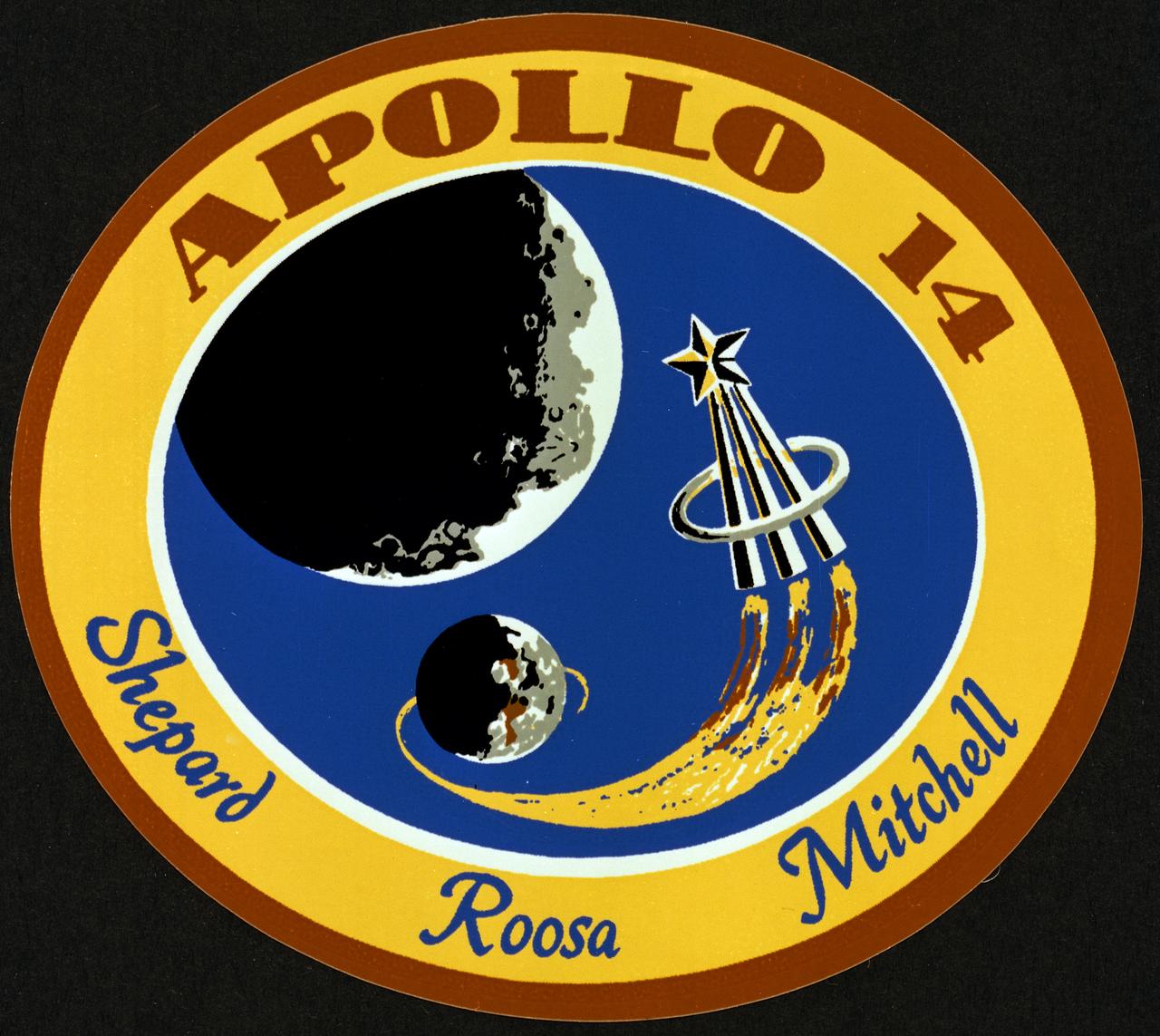
This is the Apollo 14 mission insignia or logo. The Apollo 14, carrying a crew of three astronauts: Stuart A. Roosa, Command Module pilot; Alan B. Shepard, Jr., mission commander; and Edgar D. Mitchell, Lunar Module pilot, lifted off from launch complex 39A at KSC on January 31, 1971. It was the third manned lunar landing, the first manned landing in exploration of the lunar highlands, and it demonstrated pinpoint landing capability. The major goal of Apollo 14 was the scientific exploration of the Moon in the foothills of the rugged Fra Mauro region. The lunar surface extravehicular activity (EVA) of astronauts Shepard and Mitchell included setting up an automated scientific laboratory called Apollo Lunar Scientific Experiments Package (ALSEP), and collecting a total of about 95 pounds (43 kilograms) of Moon rock and soil for a geological investigation back on the Earth. Apollo 14 safely returned to Earth on February 9, 1971.

Stuart A. Roosa, Apollo 14 Command Module pilot, undergoes a final space suit check prior to liftoff. The Apollo 14, carrying a crew of three astronauts: Roosa; Alan B. Shepard, Jr., Mission Commander; and Edgar D. Mitchell, Lunar Module pilot, lifted off from launch complex 39A at KSC on January 31, 1971. It was the third manned lunar landing, the first manned landing in exploration of the lunar highlands, and it demonstrated pinpoint landing capability. The major goal of Apollo 14 was the scientific exploration of the Moon in the foothills of the rugged Fra Mauro region. The lunar surface extravehicular activity (EVA) of astronauts Shepard and Mitchell included setting up an automated scientific laboratory called Apollo Lunar Scientific Experiments Package (ALSEP), and collecting a total of about 95 pounds (43 kilograms) of Moon rock and soil for a geological investigation back on the Earth. Apollo 14 safely returned to Earth on February 9, 1971.
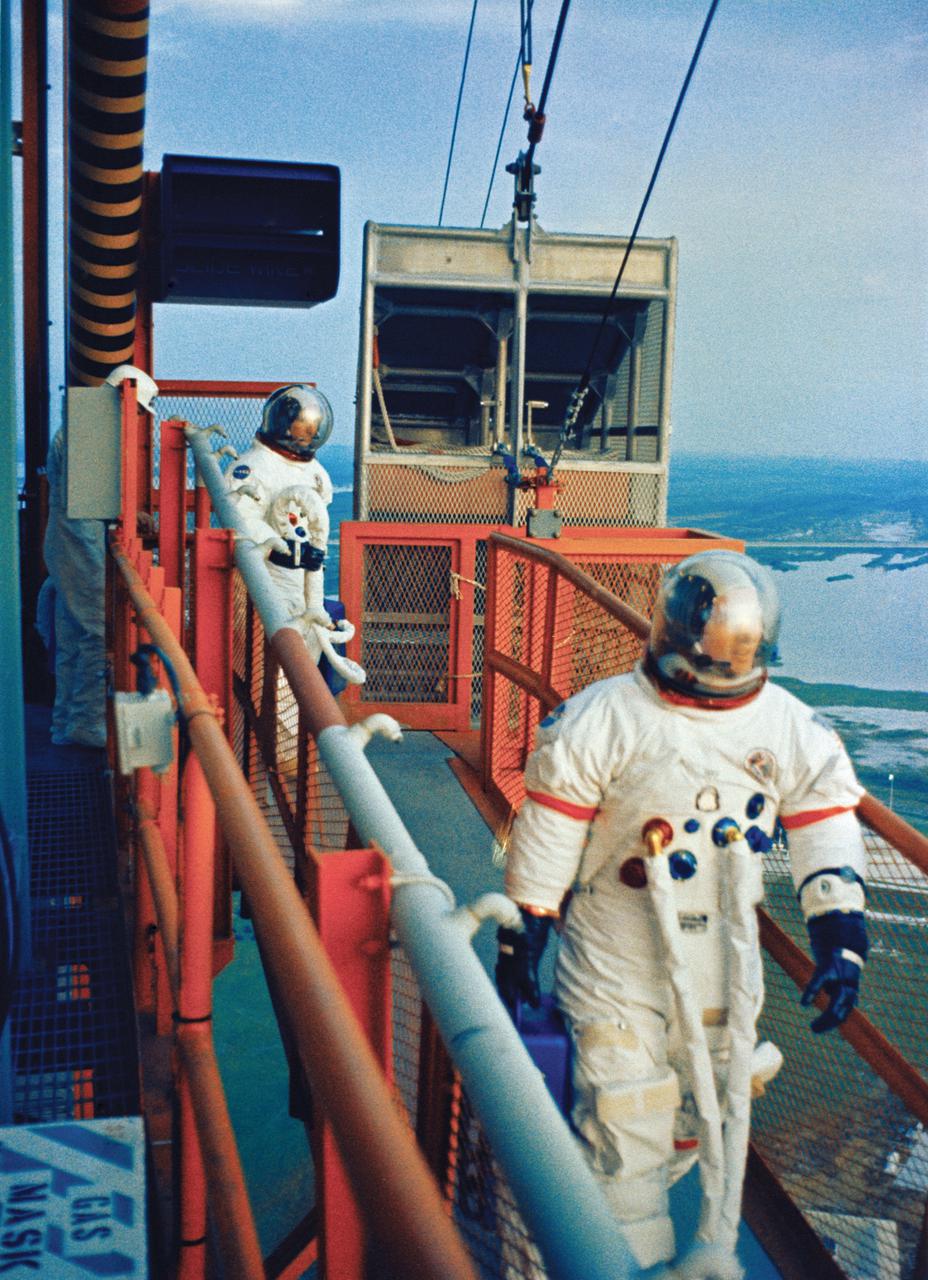
CAPE CANAVERAL, Fla. – The Apollo 15 crew walks around the launch tower July 14, 1971. Photo credit: NASA
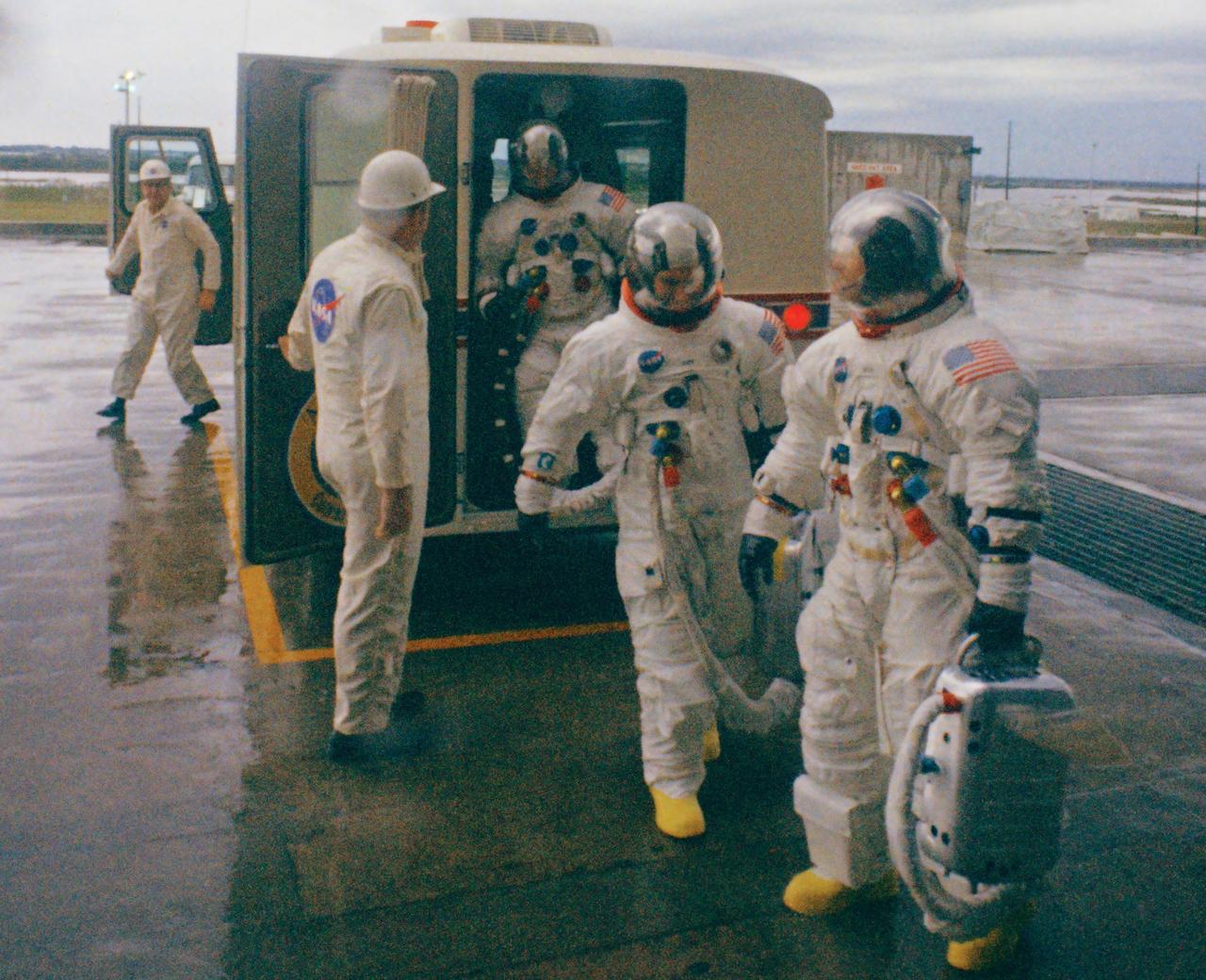
CAPE CANAVERAL, Fla. – The Apollo 12 crew walks to the launch pad Nov. 14, 1969, for launch on their mission. Photo credit: NASA
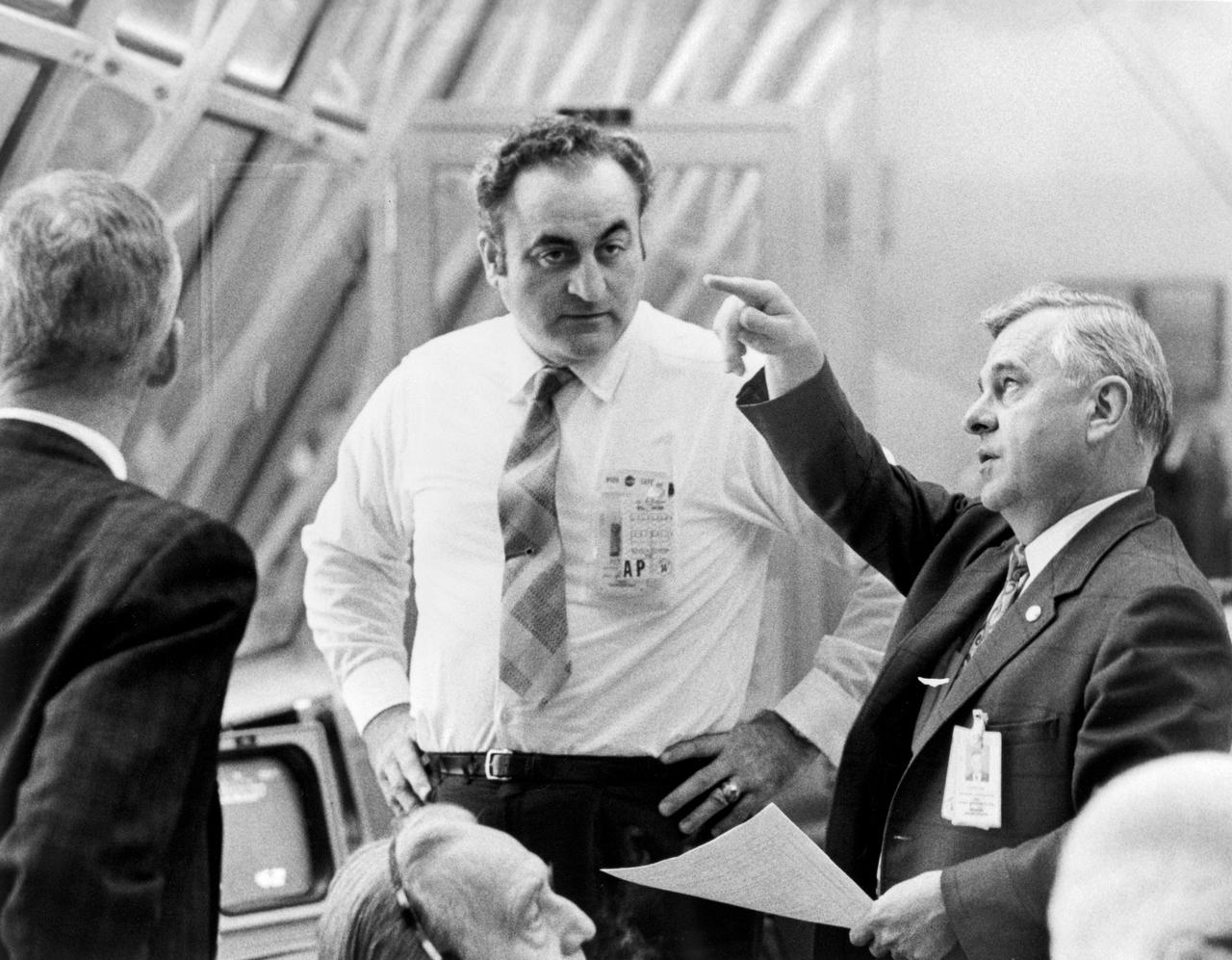
In the launch control center at Kennedy Space Flight Center (KSC), Walter J. Kapryan, Director of Launch Operations (center), discusses an aspect of the Apollo 14 flight with Marshall Space Flight Center’s (MSFC) Dr. Rocco A. Petrone, Apollo Program Director (right). The Apollo 14, carrying a crew of three astronauts: Mission commander Alan B. Shepard Jr., Command Module pilot Stuart A. Roosa, and Lunar Module pilot Edgar D. Mitchell, lifted off from launch complex 39A at KSC on January 31, 1971. It was the third manned lunar landing, the first manned landing in exploration of the lunar highlands, and it demonstrated pinpoint landing capability. The major goal of Apollo 14 was the scientific exploration of the Moon in the foothills of the rugged Fra Mauro region. The extravehicular activity (EVA) of astronauts Shepard and Mitchell included setting up an automated scientific laboratory called Apollo Lunar Scientific Experiments Package (ALSEP), and collecting a total of about 95 pounds (43 kilograms) of Moon rock and soil for a geological investigation back on the Earth. Apollo 14 safely returned to Earth on February 9, 1971.
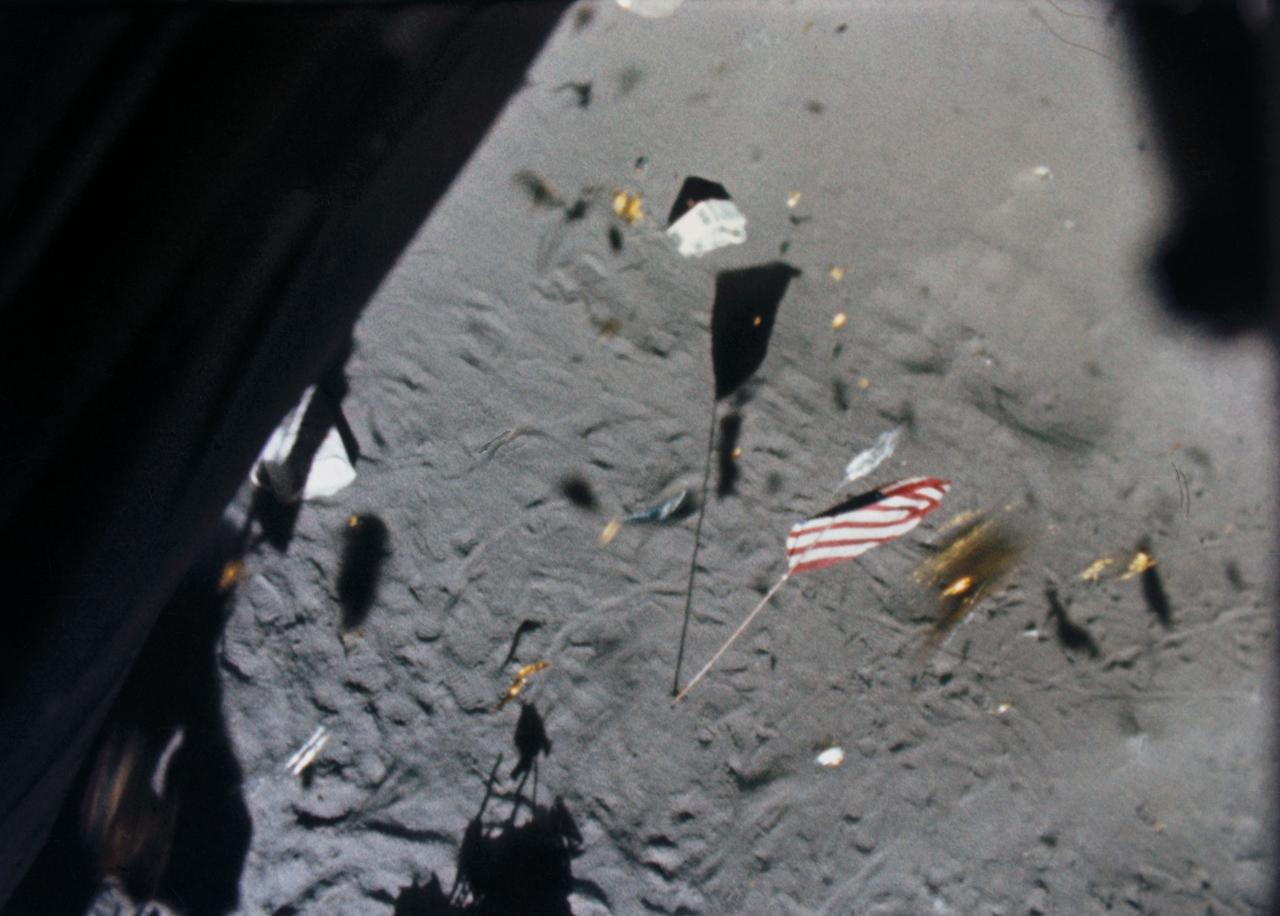
S71-19500 (6 Feb. 1971) --- The Apollo 14 Lunar Module (LM) ascent stage lifts off the lunar surface and the powerful LM engine causes a brief force of wind which scatters gold-colored foil, covering the LM, and disturbs the U.S. flag. This picture was taken from film exposed by the 16mm data acquisition camera - which was mounted inside the LM.

S69-58881 (14 Nov. 1969) --- The three Apollo 12 crew men leave the Kennedy Space Center's (KSC) Manned Spacecraft Operations Building (MSOB) during the Apollo 12 prelaunch countdown. Leading is astronaut Charles Conrad Jr., commander; followed by astronauts Richard F. Gordon Jr., command module pilot; and Alan L. Bean, lunar module pilot. They rode a special transport van over the Pad A, Launch Complex 39, where their spacecraft awaited. The Apollo 12 liftoff occurred at 11:22 a.m. (EST), Nov. 14, 1969. Apollo 12 is the United States' second lunar landing mission.
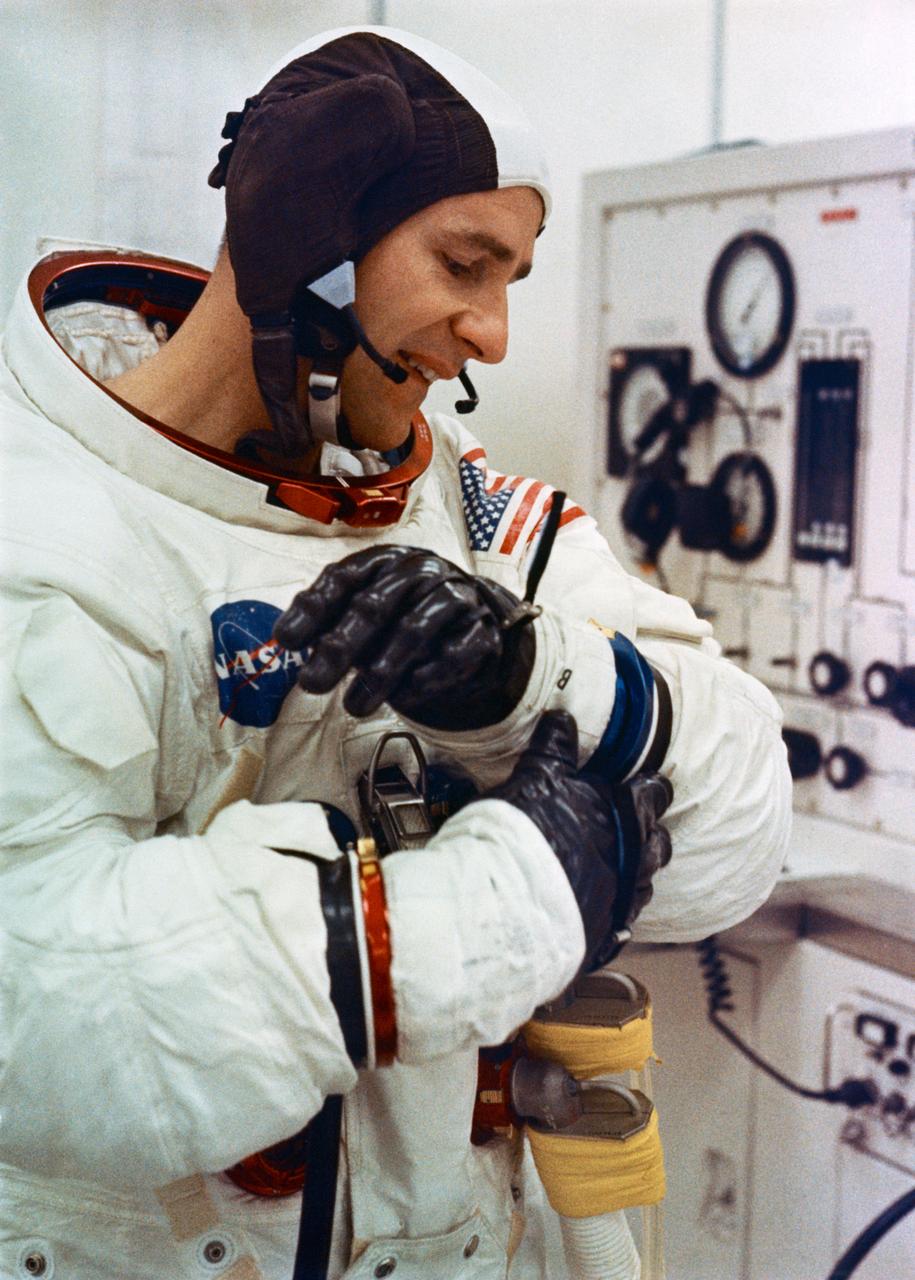
S69-58880 (14 Nov. 1969) --- Astronaut Alan L. Bean, Apollo 12 lunar module pilot, suits up in the Kennedy Space Center's (KSC) Manned Spacecraft Operations Building during the Apollo 12 prelaunch countdown. Minutes later astronauts Bean; Charles Conrad Jr., commander; and Richard F. Gordon Jr., command module pilot, rode a special transport van over to Pad A, Launch Complex 39, where their spacecraft awaited. The Apollo 12 liftoff occurred at 11:22 a.m. (EST), Nov. 14, 1969. Apollo 12 is the United States' second lunar landing mission.
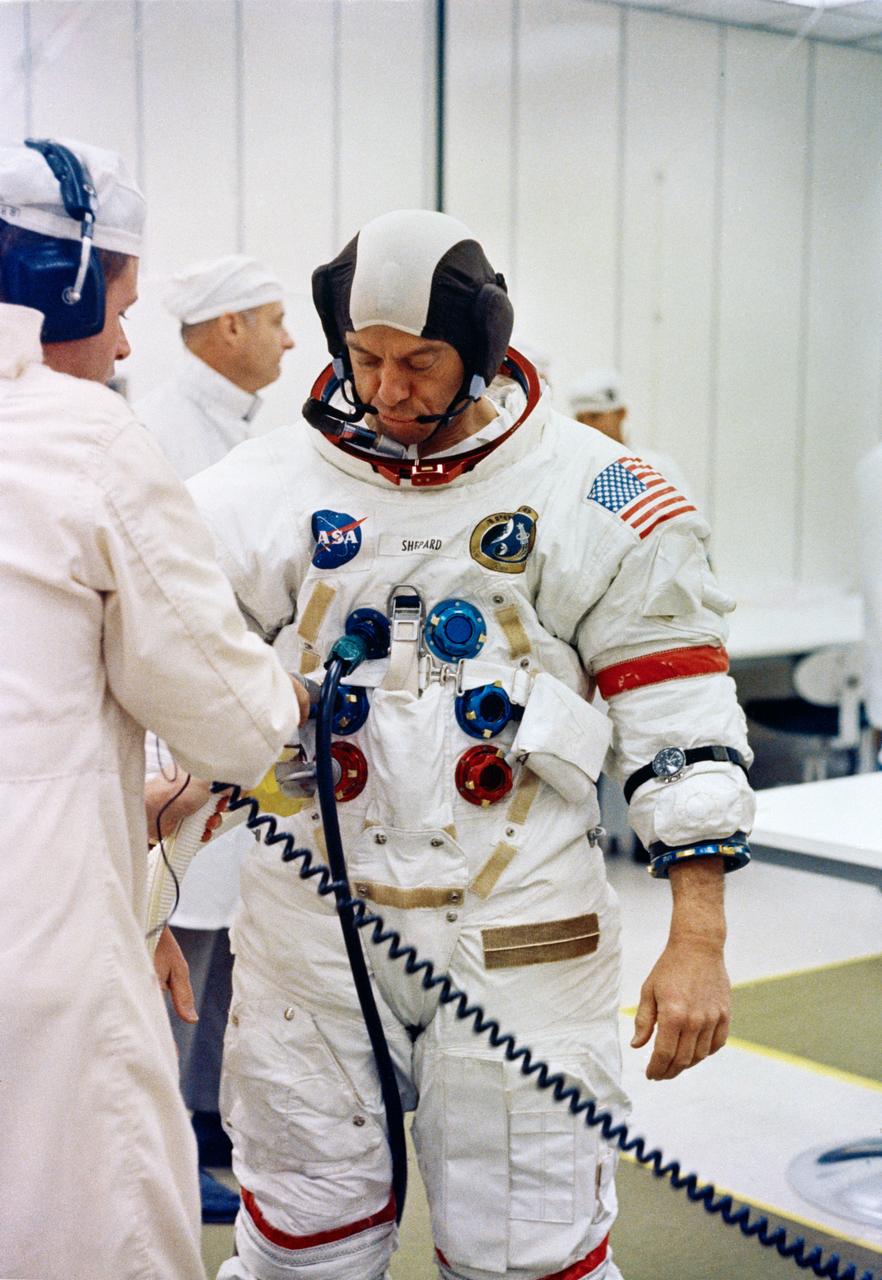
S71-16638 (31 Jan. 1971) --- Astronaut Alan B. Shepard Jr., commander, undergoes suiting up operations at the Kennedy Space Center (KSC) during the Apollo 14 prelaunch countdown. Apollo 14, with astronauts Shepard; Edgar D. Mitchell, lunar module pilot; and Stuart A. Roosa, command module pilot; aboard was launched from Pad A, Launch Complex 39 at 4:03:02 p.m. (EST), Jan. 31, 1971.
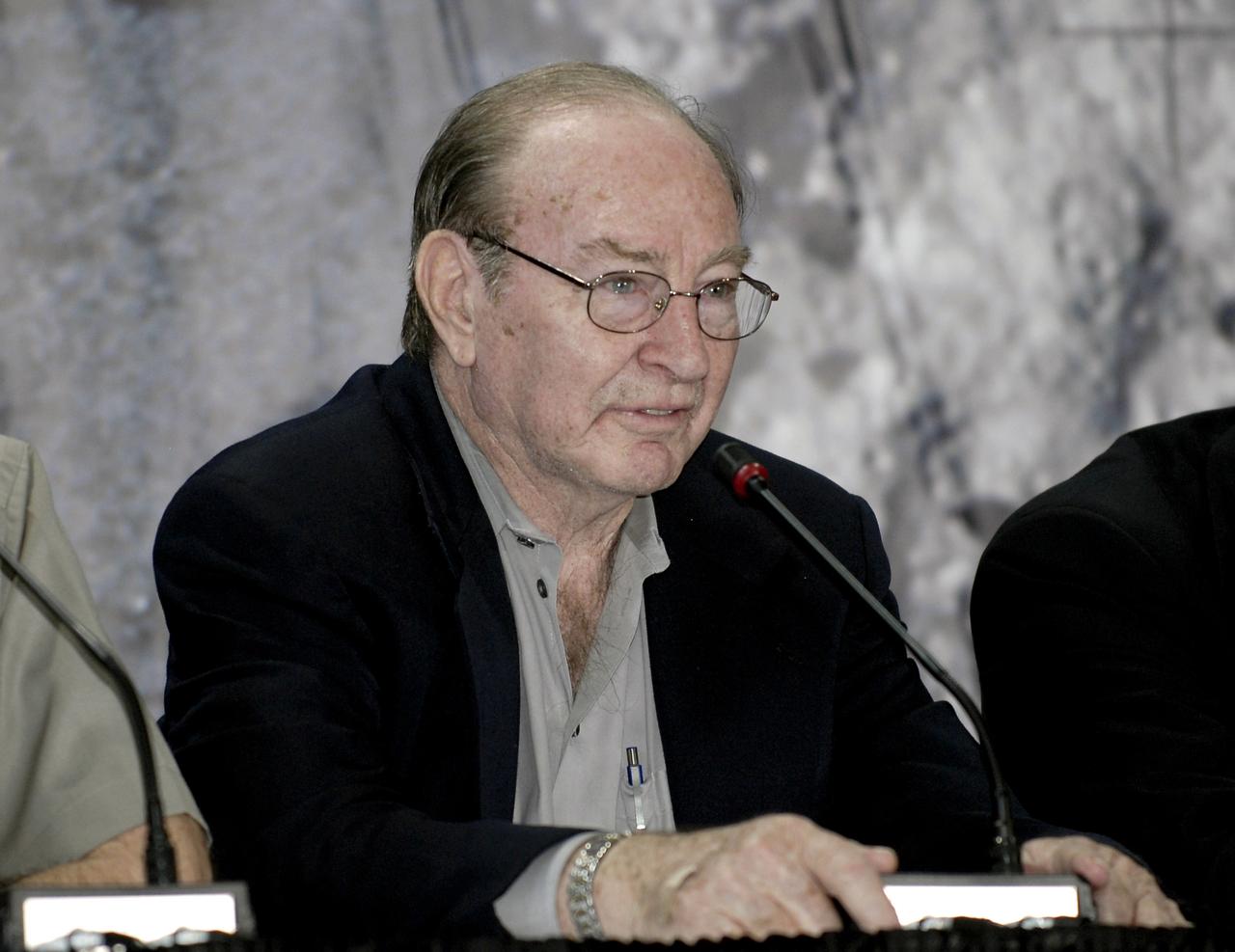
CAPE CANAVERAL, Fla. – At the Apollo/Saturn V Center at NASA's Kennedy Space Center in Florida, Apollo astronaut Edgar Mitchell shares his experiences with an eager crowd gathered for NASA's 40th Anniversary of Apollo Celebration of the July 1969 launch and landing on the moon. Mitchell walked on the moon on the Apollo 14 mission in 1971 and was backup lunar module pilot for Apollo 16. Photo credit: NASA/Kim Shiflett
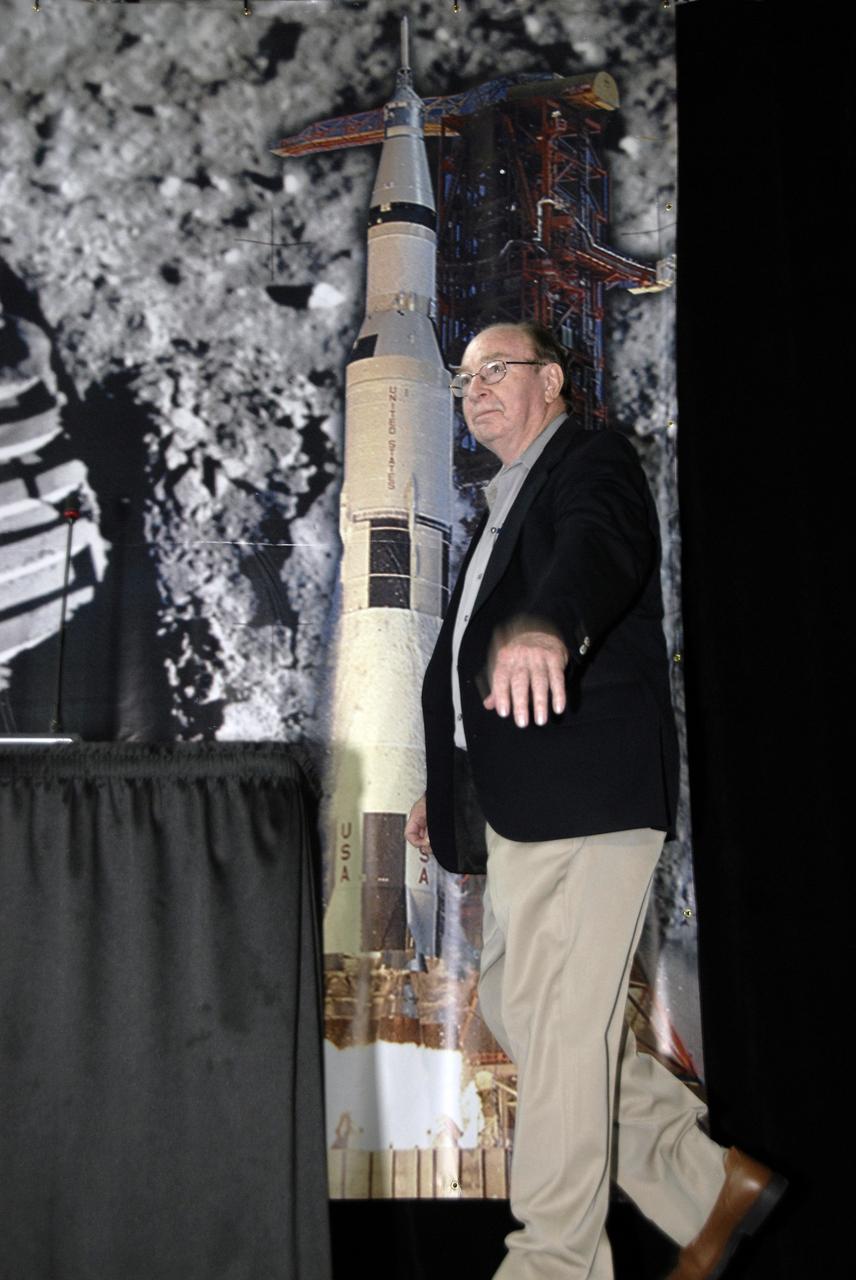
CAPE CANAVERAL, Fla. – At the Apollo/Saturn V Center at NASA's Kennedy Space Center in Florida, Apollo astronaut Edgar Mitchell is introduced during NASA's 40th Anniversary of Apollo Celebration of the July 1969 launch and landing on the moon. He was joined by seven others involved in the program. Mitchell walked on the moon on the Apollo 14 mission in 1971 and was backup lunar module pilot for Apollo 16. Photo credit: NASA/Kim Shiflett
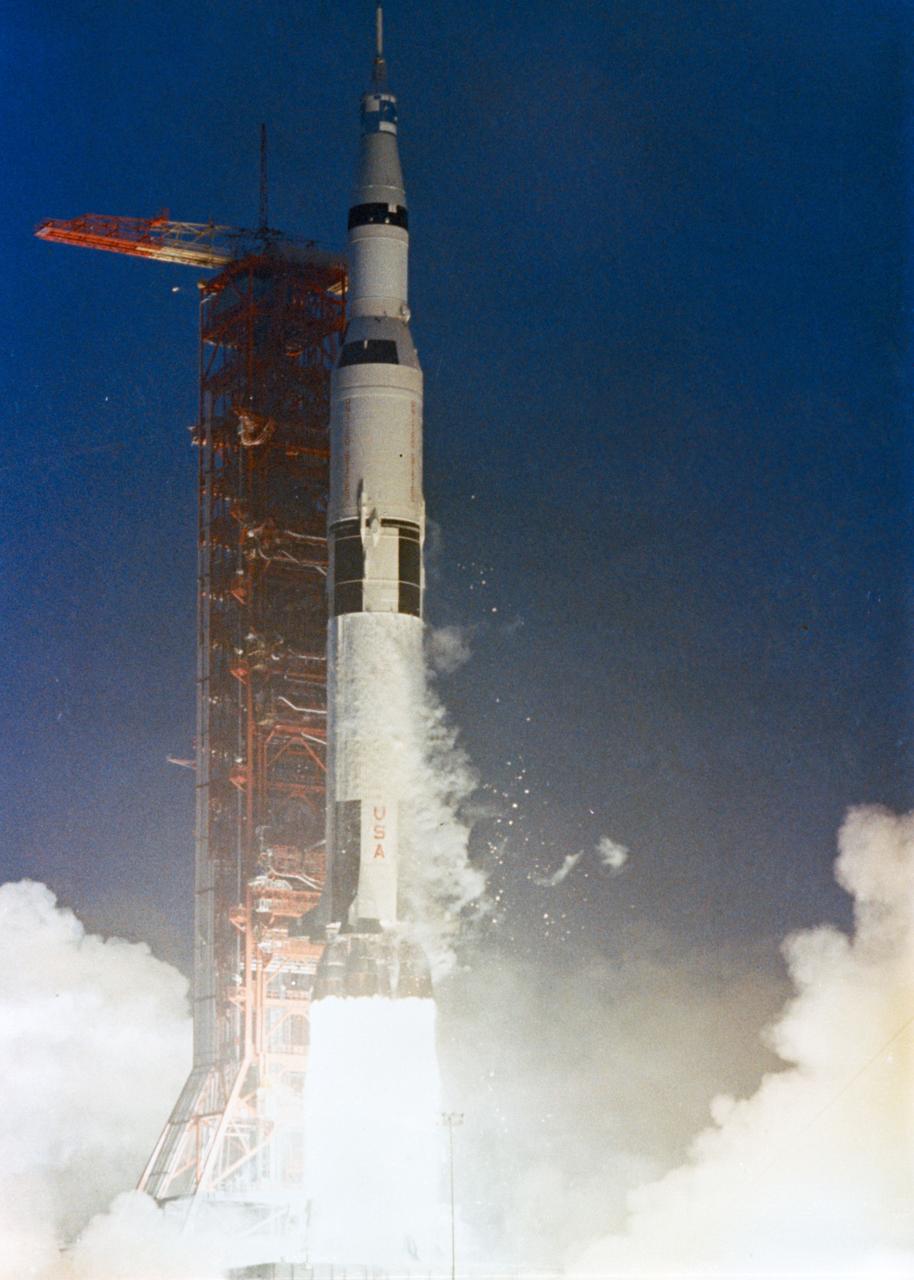
S69-58883 (14 Nov. 1969) --- The huge, 363-feet tall Apollo 12 (Spacecraft 108/Lunar Module 6/Saturn 507) space vehicle is launched from Pad A, Launch Complex 39, Kennedy Space Center (KSC), at 11:22 a.m. (EST), Nov. 14, 1969. Aboard the Apollo 12 spacecraft were astronauts Charles Conrad Jr., commander; Richard F. Gordon Jr., command module pilot; and Alan L. Bean, lunar module pilot. Apollo 12 is the United States' second lunar landing mission.

S69-58884 (14 Nov. 1969) --- The huge, 363-feet tall Apollo 12 (Spacecraft 108/Lunar Module 6/Saturn 507) space vehicle is launched from Pad A, Launch Complex 39, Kennedy Space Center (KSC), at 11:22 a.m. (EST), Nov. 14, 1969. Aboard the Apollo 12 spacecraft were astronauts Charles Conrad Jr., commander; Richard F. Gordon Jr., command module pilot; and Alan L. Bean, lunar module pilot. Apollo 12 is the United States' second lunar landing mission.
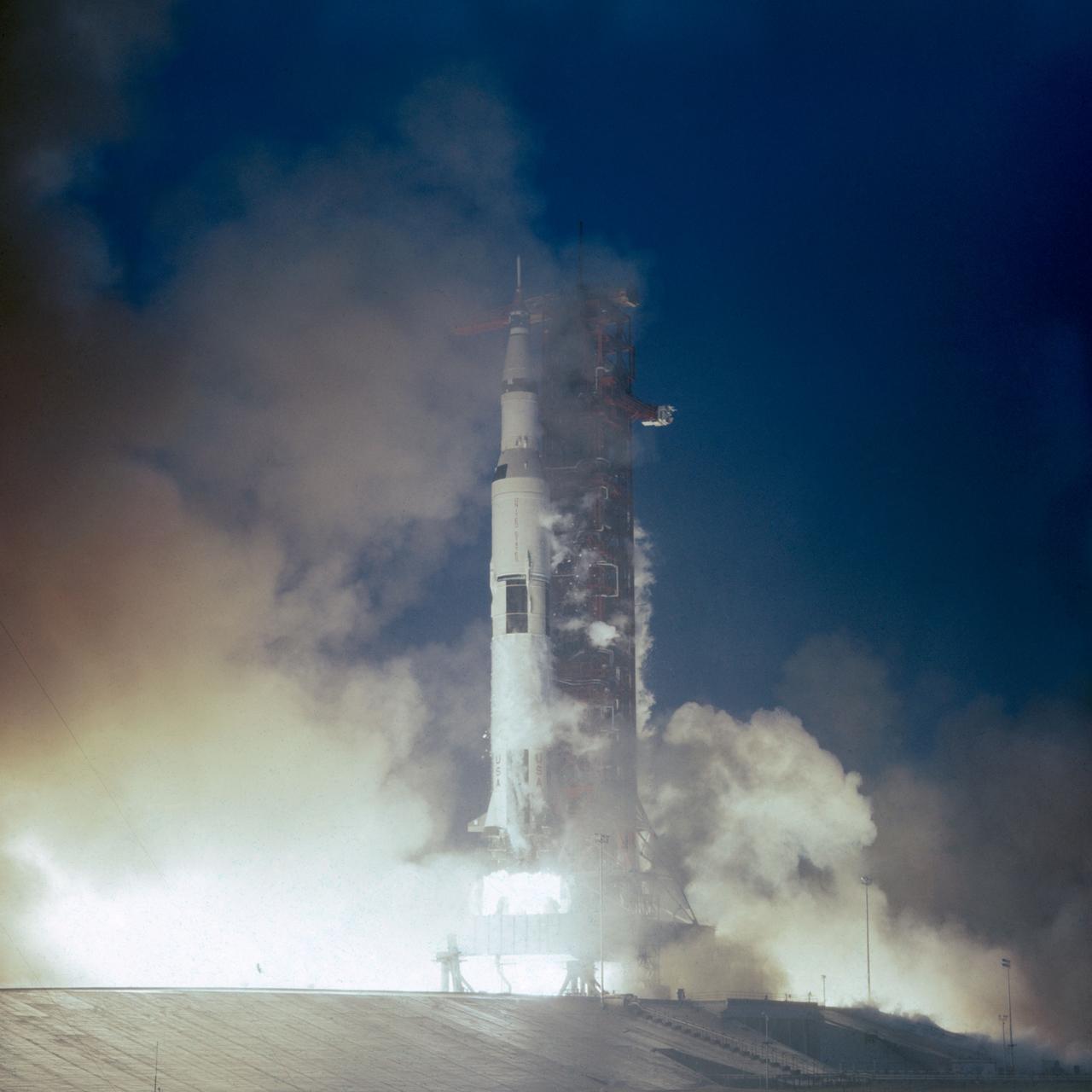
S69-58879 (14 Nov. 1969) --- The huge, 363-feet tall Apollo 12 (Spacecraft 108/Lunar Module 6/Saturn 507) space vehicle is launched from Pad A, Launch Complex 39, Kennedy Space Center (KSC), at 11:22 a.m. (EST), Nov. 14, 1969. Aboard the Apollo 12 spacecraft were astronauts Charles Conrad Jr., commander; Richard F. Gordon Jr., command module pilot, and Alan L. Bean, lunar module pilot. Apollo 12 is the United States' second lunar landing mission.
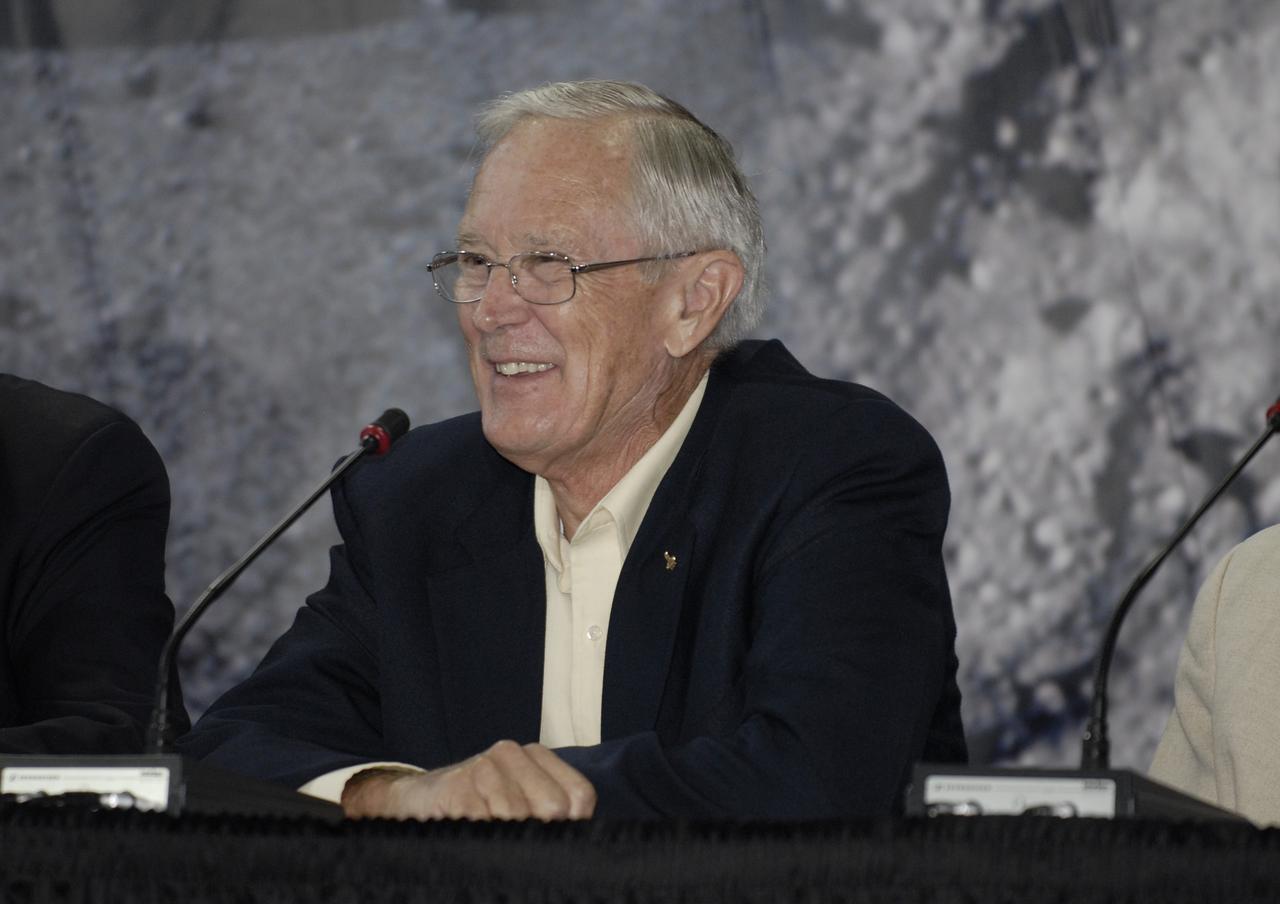
CAPE CANAVERAL, Fla. – At the Apollo/Saturn V Center at NASA's Kennedy Space Center in Florida, Apollo astronaut Charlie Duke shares his experiences with spectators crowd gathered for NASA's 40th Anniversary of Apollo Celebration of the July 1969 launch and landing on the moon. Duke served as lunar module pilot on Apollo 16 in 1972. He and astronaut John Young set a record of 72 hours and 14 minutes on the lunar surface. Photo credit: NASA/Kim Shiflett
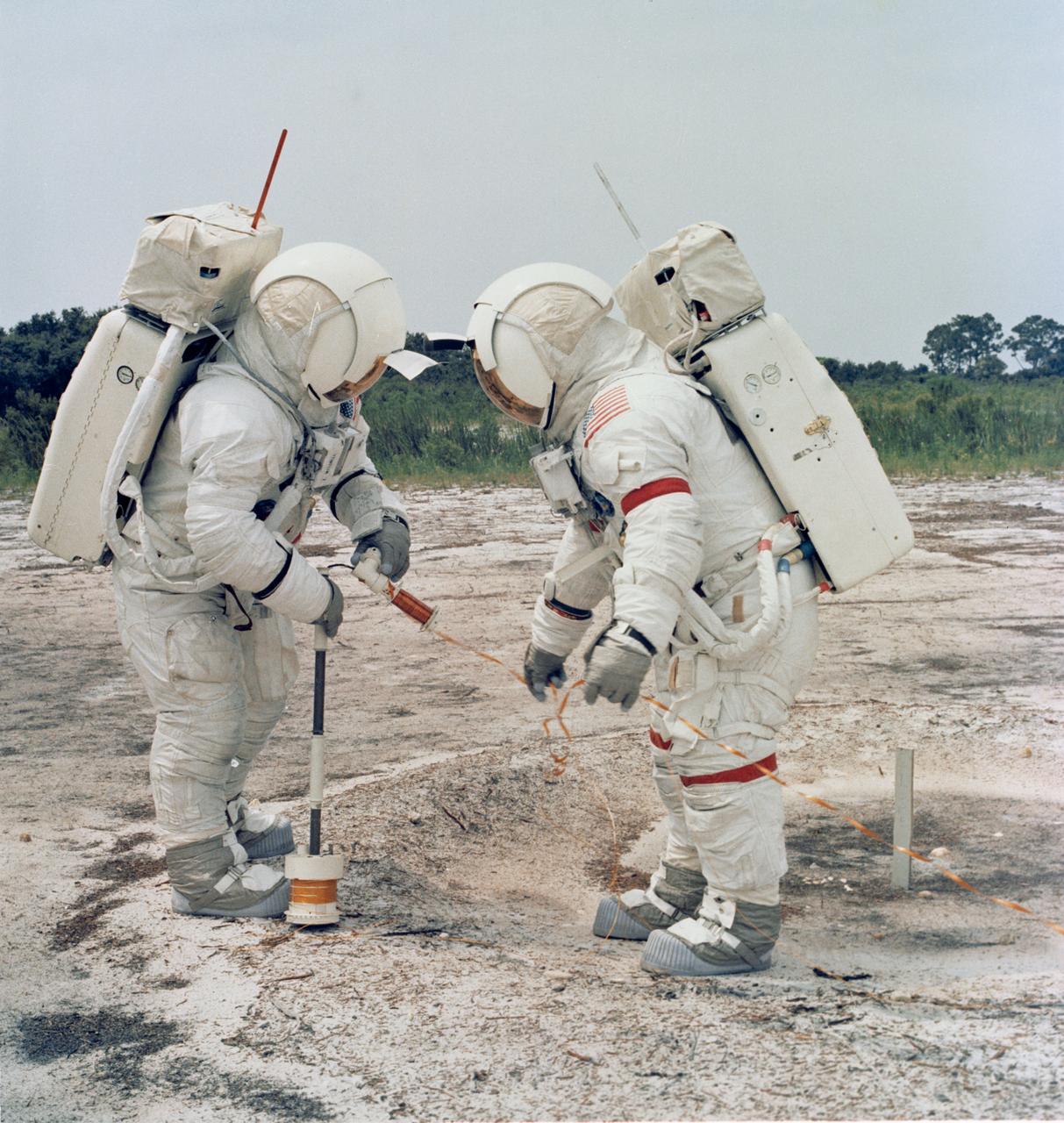
S71-15273 (October 1970) --- Apollo 14 astronauts Alan B. Shepard Jr., commander (right); and Edgar D. Mitchell, lunar module pilot, practice using the Active Seismic Experiment (ASE) to set off explosions on the lunar surface and arm a mortar to launch four grenades after they leave. Measurements of the ensuing vibrations of the moon, radioed to Earth, will give scientists new information on the shape, structure and thickness of the outer lunar crust. ASE will be deployed during one of two Apollo 14 extravehicular activity (EVA) periods.
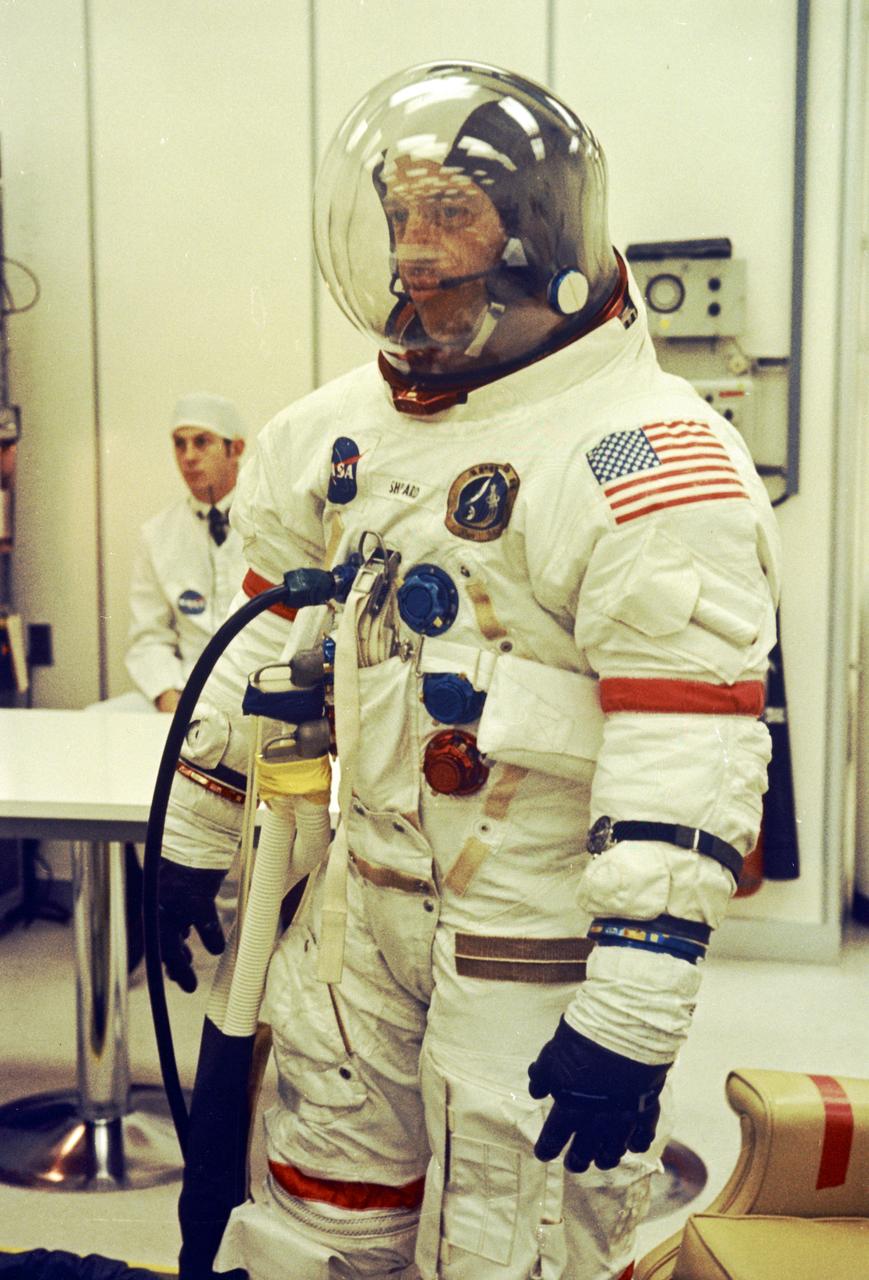
Alan B. Shepard, Jr., Apollo 14 mission commander, watches a technician conduct space suit checks during a demonstration test prior to countdown. The Apollo 14, carrying a crew of three astronauts: Shepard; Command Module pilot Stuart A. Roosa, and Lunar Module pilot Edgar D. Mitchell, lifted off from launch complex 39A at KSC on January 31, 1971. It was the third manned lunar landing, the first manned landing in exploration of the lunar highlands, and it demonstrated pinpoint landing capability. The major goal of Apollo 14 was the scientific exploration of the Moon in the foothills of the rugged Fra Mauro region. The extravehicular activities (EVA) of astronauts Shepard and Mitchell included setting up an automated scientific laboratory called Apollo Lunar Scientific Experiments Package (ALSEP), and collecting a total of about 95 pounds (43 kilograms) of Moon rock and soil for a geological investigation back on the Earth. Apollo 14 safely returned to Earth on February 9, 1971.
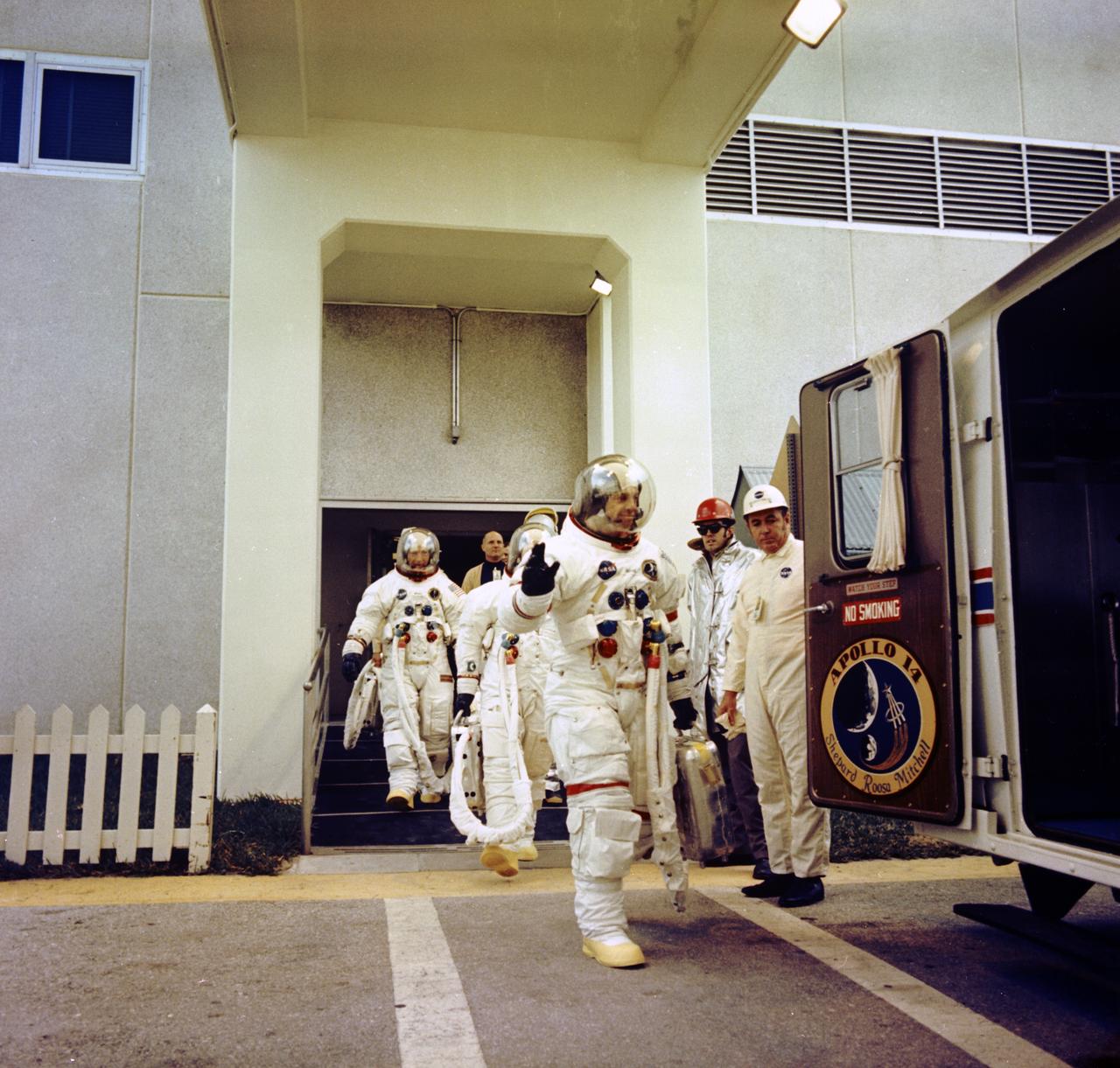
Apollo 14 Mission Commander, Alan B. Shepard, Jr., waves to well-wishers as he and astronauts Stuart A. Roosa, Command Module pilot; and Edgar D. Mitchell, Lunar Module pilot, walk to the transfer van during the countdown demonstration test. The Apollo 14, carrying the crew of three lifted off from launch complex 39A at KSC on January 31, 1971. It was the third manned lunar landing, the first manned landing in exploration of the lunar highlands, and it demonstrated pinpoint landing capability. The major goal of Apollo 14 was the scientific exploration of the Moon in the foothills of the rugged Fra Mauro region. The lunar surface extravehicular activity (EVA) of astronauts Shepard and Mitchell included setting up an automated scientific laboratory called Apollo Lunar Scientific Experiments Package (ALSEP), and collecting a total of about 95 pounds (43 kilograms) of Moon rock and soil for a geological investigation back on the Earth. Apollo 14 safely returned to Earth on February 9, 1971.
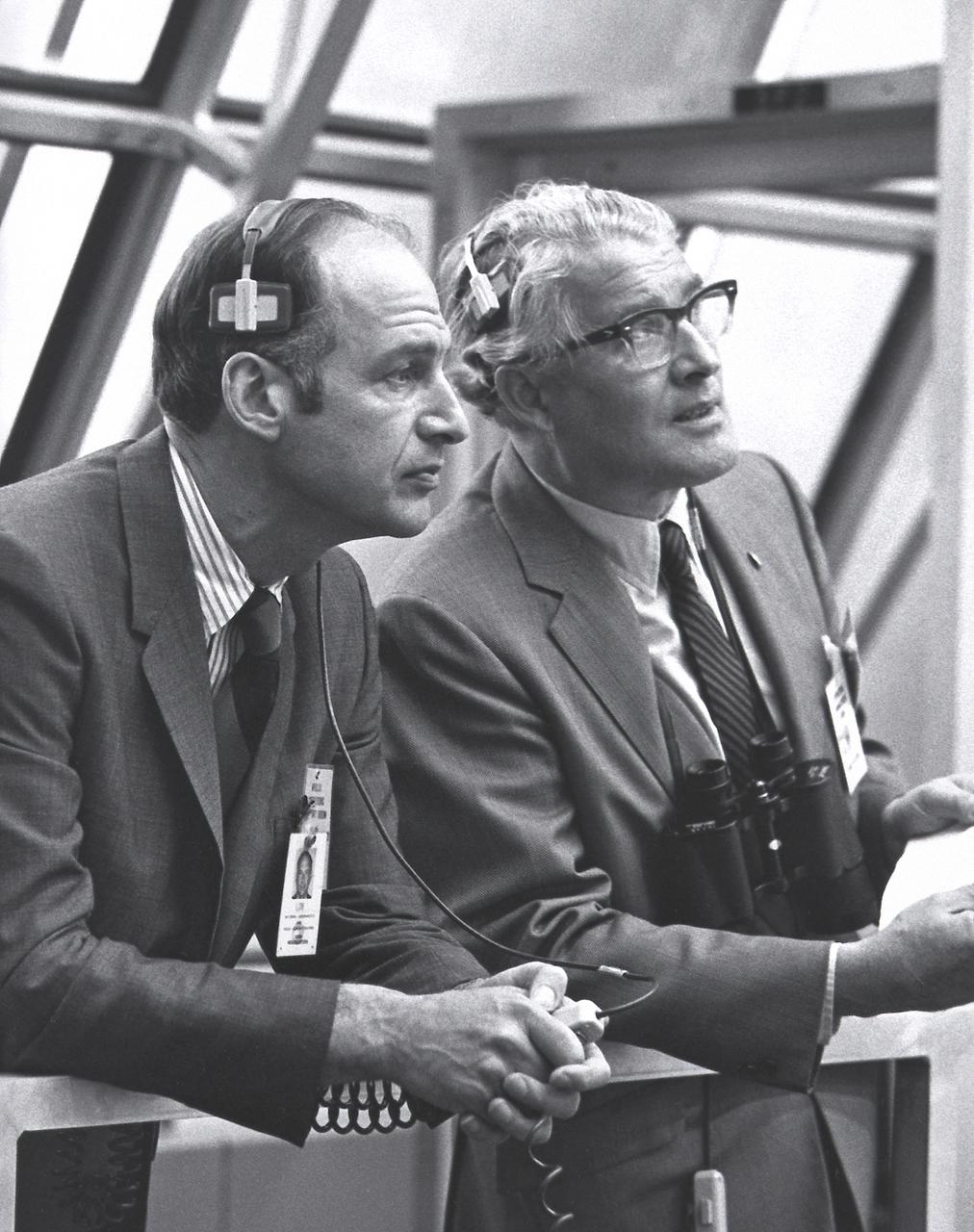
Dr. George M. Lowe, left, Acting Administrator of NASA, and Dr. von Braun monitor the Apollo 14 prelaunch activities in the Firing Room of the Launch Control Center at the Kennedy Space Center.
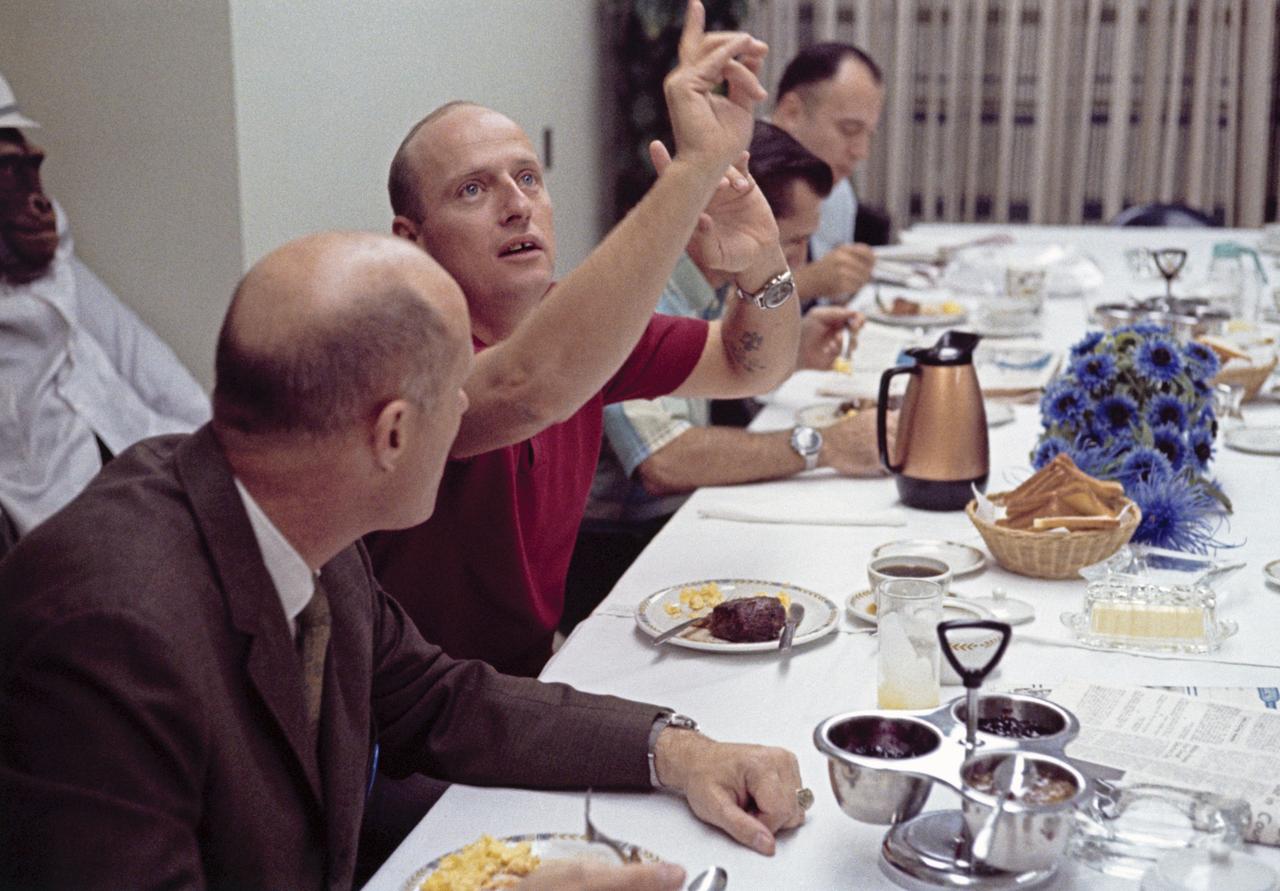
CAPE CANAVERAL, Fla. - Apollo 12 commander Charles "Pete" Conrad, in red shirt, talks during the breakfast on launch day Nov. 14, 1969. Photo credit: NASA
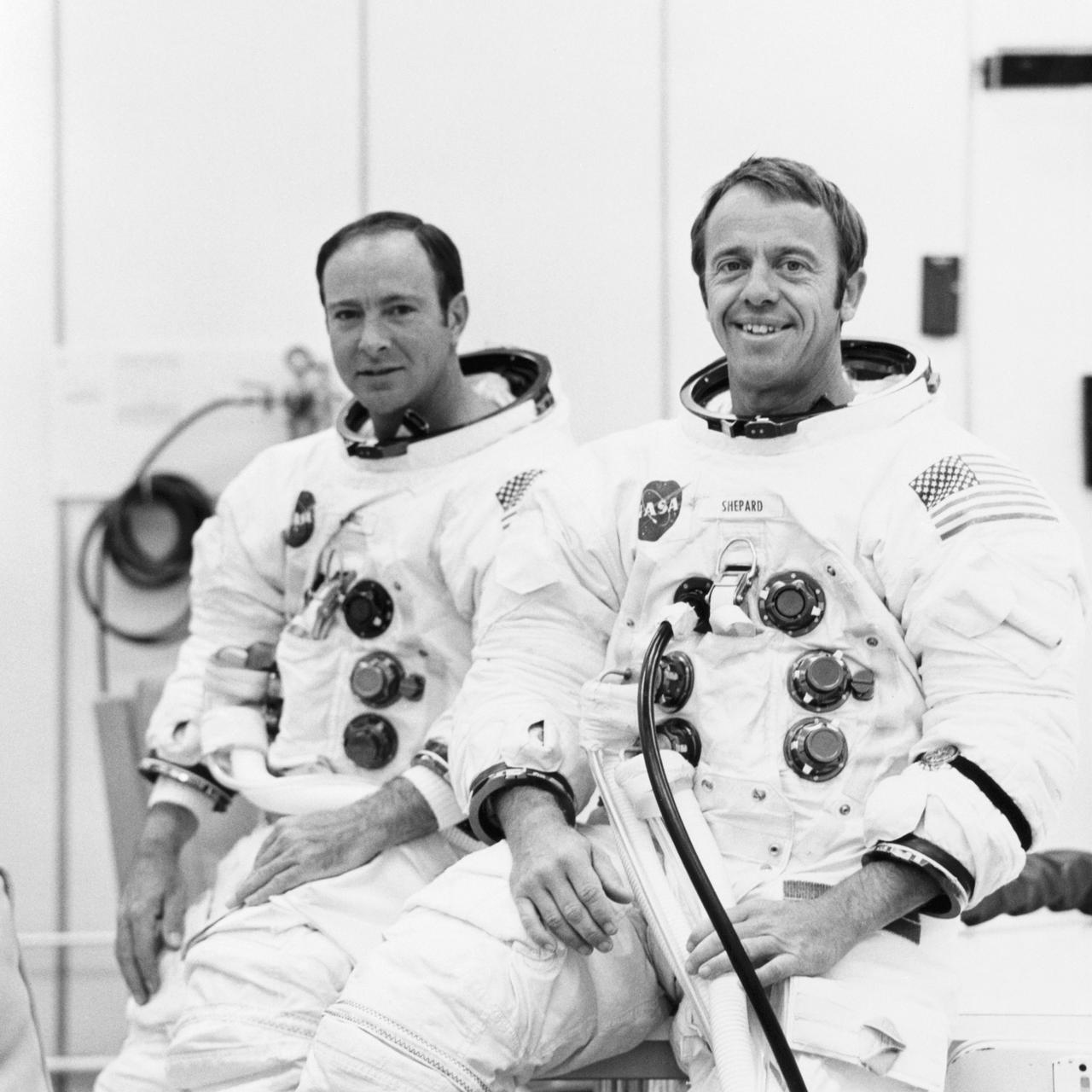
S70-19764 (18 Sept. 1970) --- Astronauts Alan B. Shepard Jr. (right), commander, and Edgar D. Mitchell, lunar module pilot, are suited up for a manned altitude run in the Apollo 14 Lunar Module. The manned run in a vacuum chamber of the Manned Spacecraft Operations Building was conducted to validate the LM's communications and guidance and navigation systems. Apollo 14 is scheduled for launch from Cape Kennedy on Jan. 31, 1971, on a lunar exploration mission which is to carry Shepard and Mitchell down to the moon's rugged Fra Maura highlands region. Astronaut Stuart A. Roosa, command module pilot, will remain with the Apollo 14 Command and Service Modules in lunar orbit while the other two astronauts explore the moon.
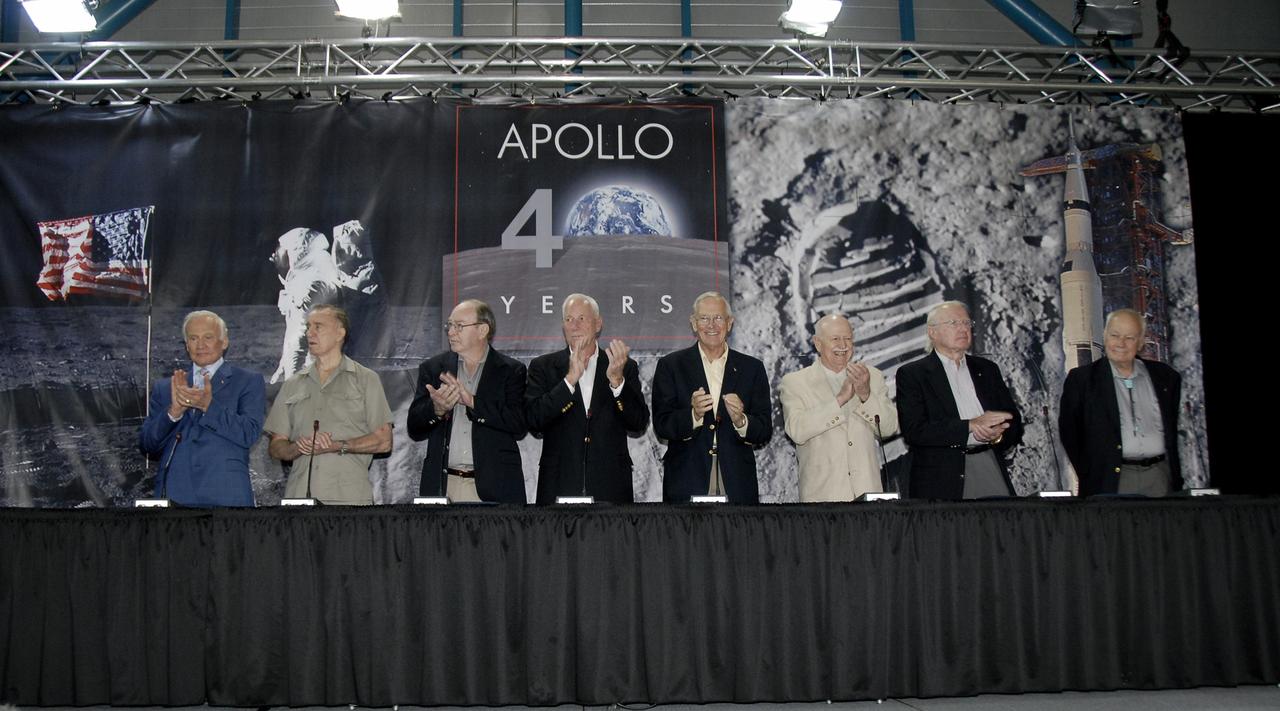
CAPE CANAVERAL, Fla. – At the Apollo/Saturn V Center at NASA's Kennedy Space Center in Florida, Apollo astronauts (from left) Buzz Aldrin, Walt Cunningham, Edgar Mitchell, Al Worden, Charlie Duke, Vance Brand and Gerald Carr applaud the addition of Apollo astronaut Bruce McCandless on stage for NASA's 40th Anniversary of Apollo Celebration of the July 1969 launch and landing on the moon. McCandless was a member of the astronaut support crew for the Apollo 14 mission and was backup pilot for the first manned Skylab mission. Among other accomplishments, he collaborated on the development of the Manned Maneuvering Unit used during shuttle EVAs. Photo credit: NASA/Kim Shiflett

CAPE CANAVERAL, Fla. – At the Apollo/Saturn V Center at NASA's Kennedy Space Center in Florida, Apollo astronaut Charlie Duke (far right) joins Buzz Aldrin, Walt Cunningham, Edgar Mitchell and Al Worden on the stage at NASA's 40th Anniversary of Apollo Celebration of the July 1969 launch and landing on the moon. Eight Apollo astronauts participated in the ceremony. Duke served as lunar module pilot on Apollo 16 in 1972. He and astronaut John Young set a record of 72 hours and 14 minutes on the lunar surface. Photo credit: NASA/Kim Shiflett
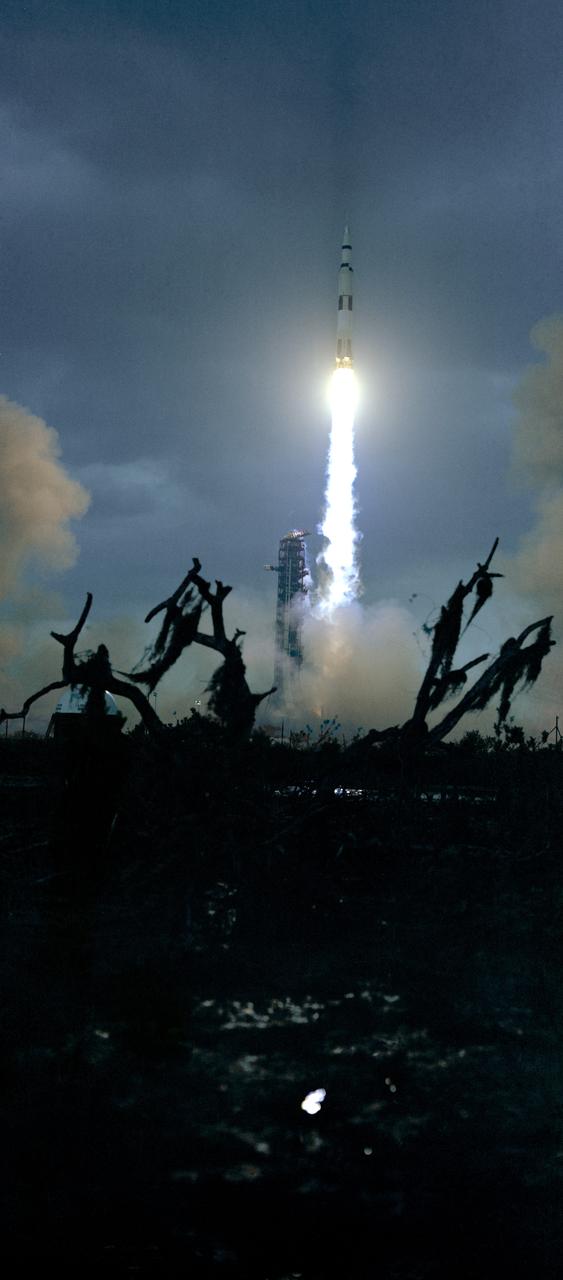
S71-18398 (31 Jan. 1971) --- The huge, 363-feet tall Apollo 14 (Spacecraft 110/Lunar Module 8/Saturn 509) space vehicle is launched from Pad A, Launch Complex 39, Kennedy Space Center (KSC), Florida at 4:03:02 p.m. (EST), Jan. 31, 1971, on a lunar landing mission. This view is framed by moss-covered dead trees in the dark foreground. Aboard the Apollo 14 spacecraft were astronauts Alan B. Shepard Jr., commander; Stuart A. Roosa, command module pilot; and Edgar D. Mitchell, lunar module pilot.
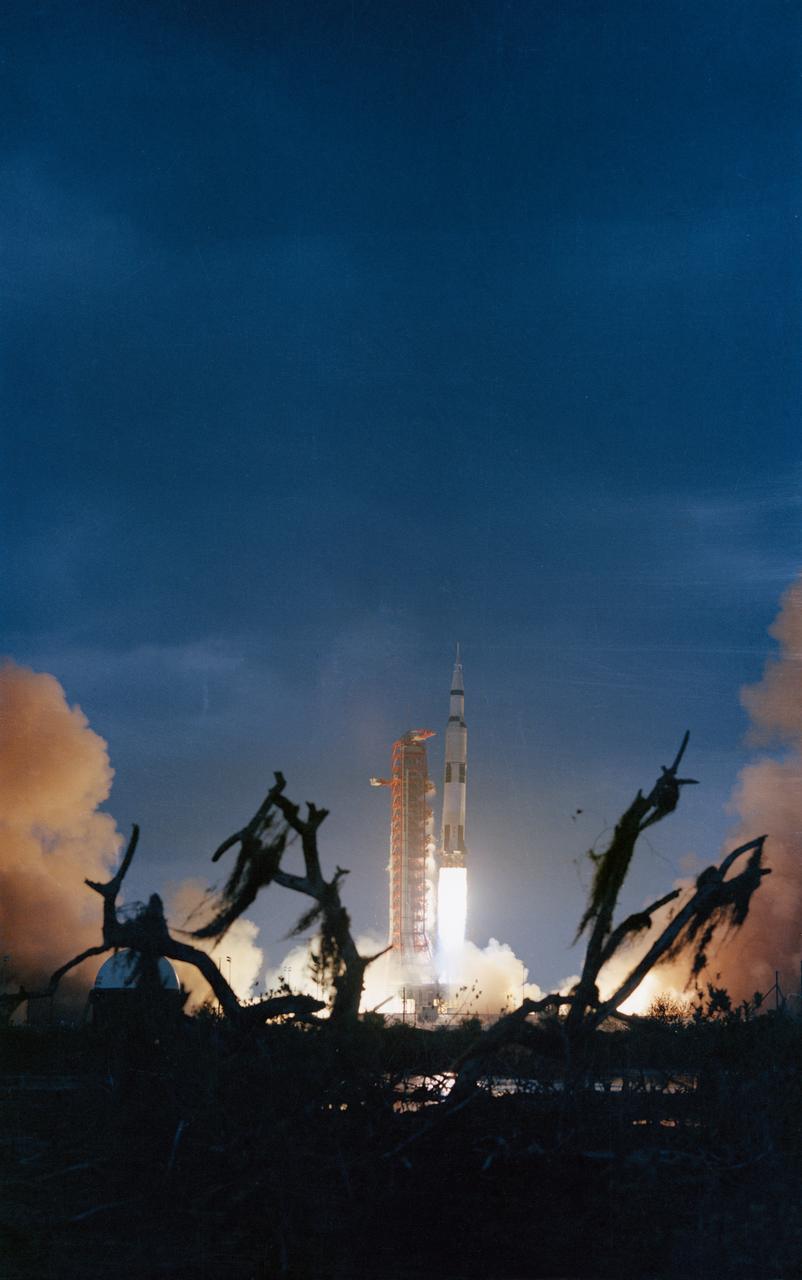
S71-18399 (31 Jan. 1971) --- The huge, 363-feet tall Apollo 14 (Spacecraft 110/Lunar Module 8/Saturn 509) space vehicle is launched from Pad A, Launch Complex 39, Kennedy Space Center (KSC), Florida at 4:03:02 p.m. (EST), Jan. 31, 1971, on a lunar landing mission. This view is framed by moss-covered dead trees in the dark foreground. Aboard the Apollo 14 spacecraft were astronauts Alan B. Shepard Jr., commander; Stuart A. Roosa, command module pilot; and Edgar D. Mitchell, lunar module pilot.
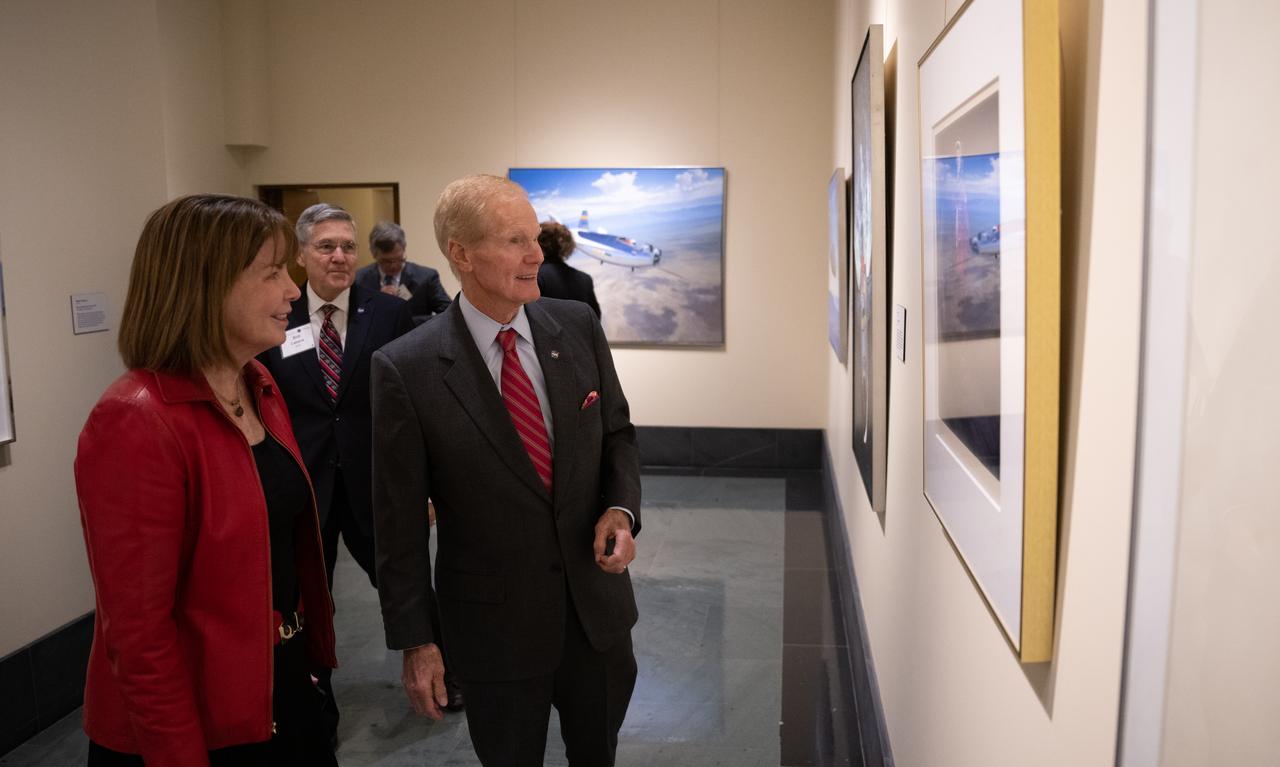
Colleen Hartman, director of physics, aeronautics, and space science at the National Academies of Science , left, and NASA Administrator Bill Nelson are seen as they view the NASA Art Program Exhibition “Launching the Future: Looking Back to Look Forward” during an event celebrating the 50th anniversary of the Apollo 17 mission, Wednesday, Dec. 14, 2022, at the National Academies of Science in Washington. The three-astronaut crew of Apollo 17 - commander Eugene Cernan, lunar module pilot Harrison Schmitt, and command module pilot Ronald Evans, embarked on the last mission of the Apollo program to land humans on the Moon in December of 1972. Cernan and Schmitt spent three days on the lunar surface collecting samples and performing scientific experiments before lifting off from the Taurus-Littrow Valley on December 14, 1972. Photo Credit: (NASA/Joel Kowsky)

The moon bound Apollo 14, carrying a crew of three astronauts: Mission commander Alan B. Shepard Jr., Command Module pilot Stuart A. Roosa, and Lunar Module pilot Edgar D. Mitchell, lifted off from launch complex 39A at the Kennedy Space Center on January 31, 1971, and safely returned to Earth on February 9, 1971. It was the third manned lunar landing, the first manned landing in exploration of the lunar highlands, and it demonstrated pinpoint landing capability. The major goal of Apollo 14 was the scientific exploration of the Moon in the foothills of the rugged Fra Mauro region. The extravehicular activity (EVA) of astronauts Shepard and Mitchell included setting up an automated scientific laboratory called Apollo Lunar Scientific Experiments Package (ALSEP), shown here fully deployed. In addition, they collected a total of about 95 pounds (43 kilograms) of Moon rock and soil for a geological investigation back on the Earth.
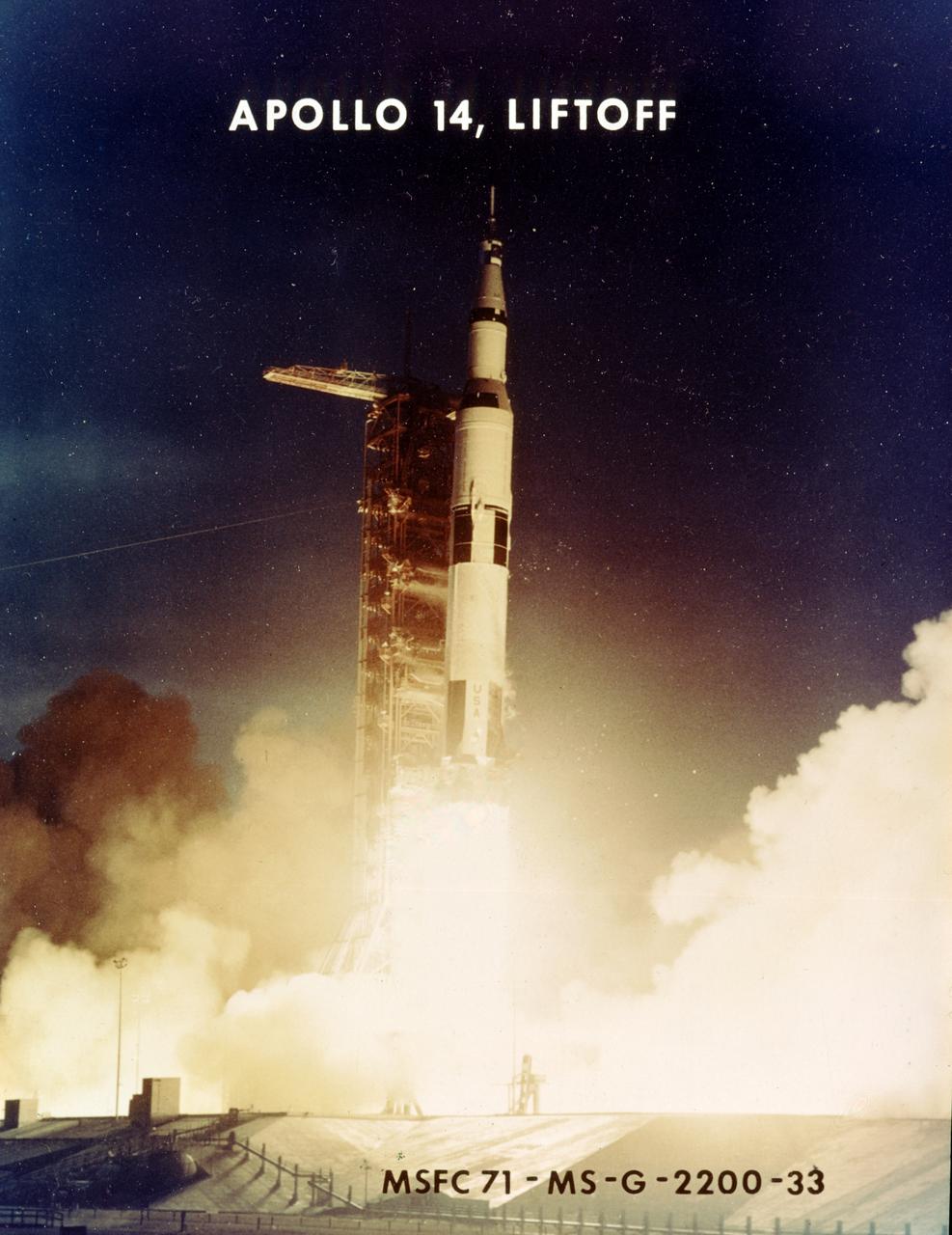
The moon bound Apollo 14, carrying a crew of three astronauts: Mission commander Alan B. Shepard Jr., Command Module pilot Stuart A. Roosa, and Lunar Module pilot Edgar D. Mitchell, lifted off from launch complex 39A at the Kennedy Space Center on January 31, 1971. It was the third manned lunar landing, the first manned landing in exploration of the lunar highlands, and it demonstrated pinpoint landing capability. The major goal of Apollo 14 was the scientific exploration of the Moon in the foothills of the rugged Fra Mauro region. The lunar surface extravehicular activity (EVA) of astronauts Shepard and Mitchell included setting up an automated scientific laboratory called Apollo Lunar Scientific Experiments Package (ALSEP), and collecting a total of about 95 pounds (43 kilograms) of Moon rock and soil for a geological investigation back on the Earth. The mission safely returned to Earth on February 9, 1971.
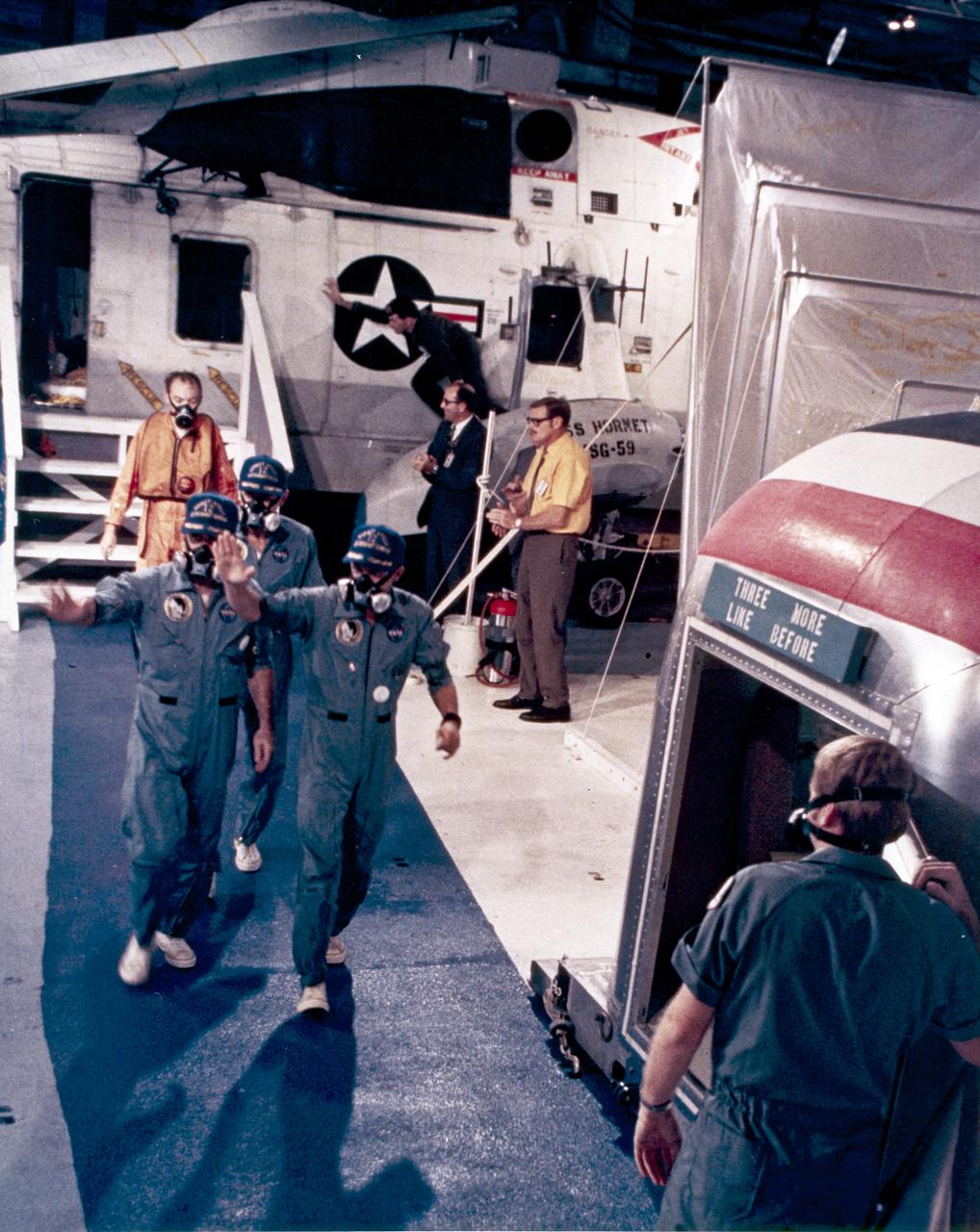
Aboard the recovery ship, USS Hornet, Apollo 12 astronauts wave to the crowd as they enter the mobile quarantine facility. The recovery operation took place in the Pacific Ocean after the splashdown of the Command Module capsule. Navy para-rescue men recovered the capsule housing the 3-man Apollo 12 crew. The second manned lunar landing mission, Apollo 12 launched from launch pad 39-A at Kennedy Space Center in Florida on November 14, 1969 via a Saturn V launch vehicle. The Saturn V was developed by the Marshall Space Flight Center (MSFC) under the direction of Dr. Wernher von Braun. Aboard Apollo 12 was a crew of three astronauts: Alan L. Bean, pilot of the Lunar Module (LM), Intrepid; Richard Gordon, pilot of the Command Module (CM), Yankee Clipper; and Spacecraft Commander Charles Conrad. The LM, Intrepid, landed astronauts Conrad and Bean on the lunar surface in what’s known as the Ocean of Storms while astronaut Richard Gordon piloted the CM, Yankee Clipper, in a parking orbit around the Moon. Lunar soil activities included the deployment of the Apollo Lunar Surface Experiments Package (ALSEP), finding the unmanned Surveyor 3 that landed on the Moon on April 19, 1967, and collecting 75 pounds (34 kilograms) of rock samples. Apollo 12 safely returned to Earth on November 24, 1969.
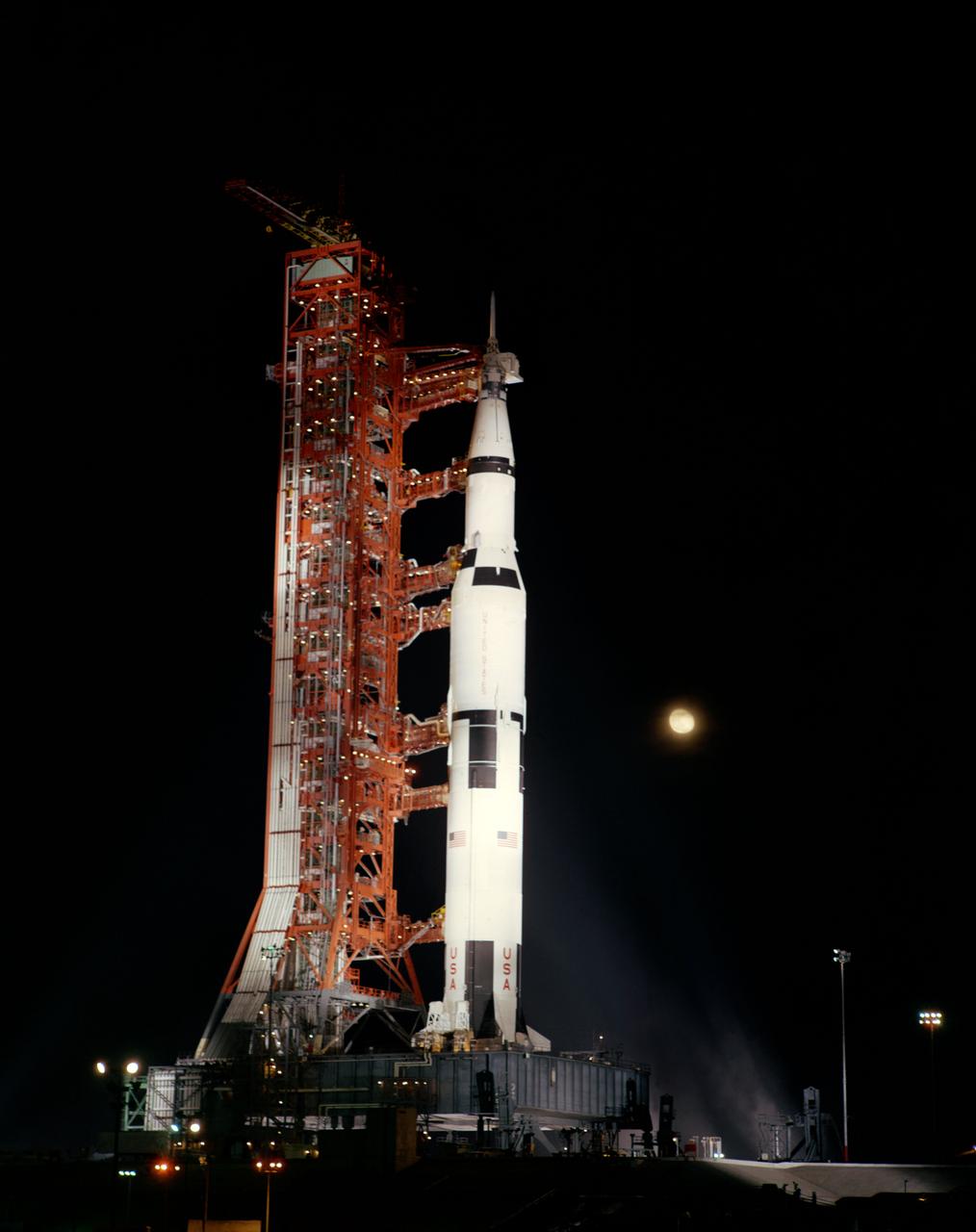
S69-56596 (28 Oct. 1969) --- A nighttime, ground-level view of Pad A, Launch Complex 39, Kennedy Space Center (KSC) showing the Apollo 12 (Spacecraft 108/Lunar Module 6/Saturn 507) space vehicle, during the terminal phase of a Countdown Demonstration Test (CDDT). The crew of the National Aeronautics and Space Administration's (NASA) second lunar landing mission will be astronauts Charles Conrad Jr., commander; Richard F. Gordon Jr., command module pilot; and Alan L. Bean, lunar module pilot. The Apollo 12 launch has been scheduled for 11:22 a.m. (EST) on Nov. 14, 1969.
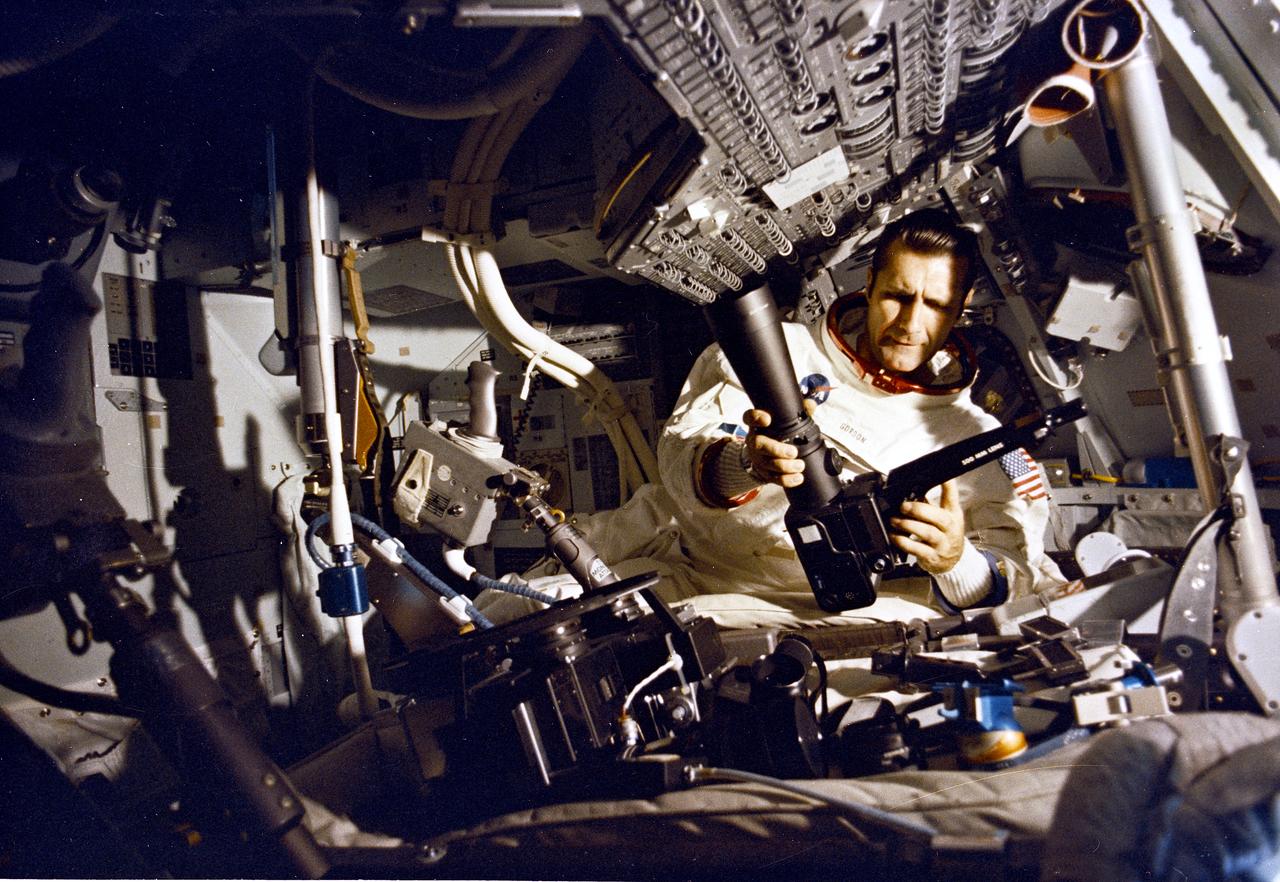
This is a view of astronaut Richard F. Gordon attaching a high resolution telephoto lens to a camera aboard the Apollo 12 Command Module (CM) Yankee Clipper. The second manned lunar landing mission, Apollo 12 launched from launch pad 39-A at Kennedy Space Center in Florida on November 14, 1969 via a Saturn V launch vehicle. The Saturn V vehicle was developed by the Marshall Space Flight Center (MSFC) under the direction of Dr. Wernher von Braun. Aboard Apollo 12 was a crew of three astronauts: Alan L. Bean, pilot of the Lunar Module (LM), Intrepid; Richard Gordon, pilot of the Command Module (CM), Yankee Clipper; and Spacecraft Commander Charles Conrad. The LM, Intrepid, landed astronauts Conrad and Bean on the lunar surface in what’s known as the Ocean of Storms. Their lunar soil activities included the deployment of the Apollo Lunar Surface Experiments Package (ALSEP), finding the unmanned Surveyor 3 that landed on the Moon on April 19, 1967, and collecting 75 pounds (34 kilograms) of rock samples. Astronaut Richard Gordon piloted the CM, Yankee Clipper, in a parking orbit around the Moon. Apollo 12 safely returned to Earth on November 24, 1969.
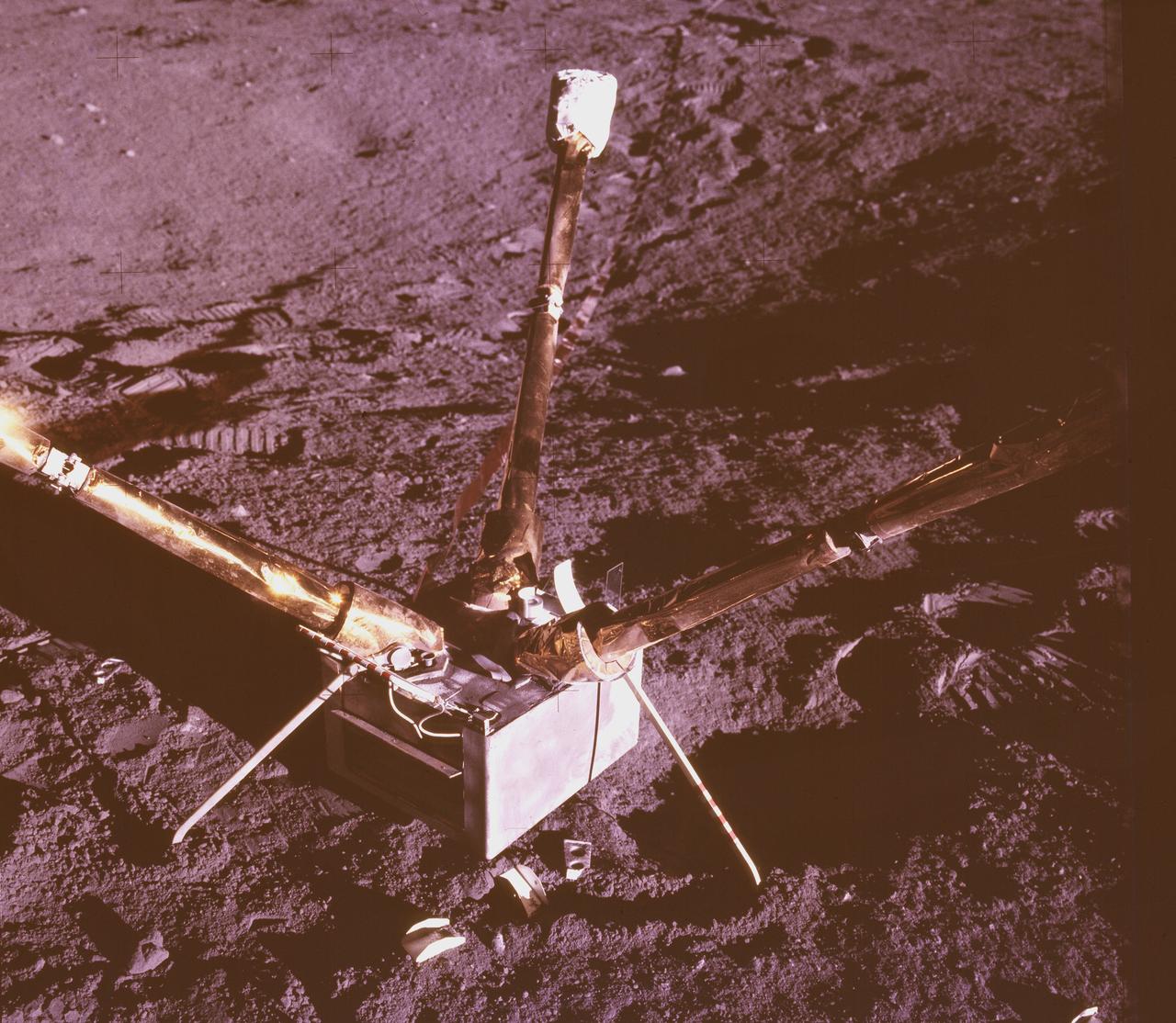
Sitting on the lunar surface, this magnetometer provided new data on the Moon’s magnetic field. This was one of the instruments used during the Apollo 12 mission. The second manned lunar landing mission, Apollo 12 launched from launch pad 39-A at Kennedy Space Center in Florida on November 14, 1969 via a Saturn V launch vehicle. The Saturn V vehicle was developed by the Marshall Space Flight Center (MSFC) under the direction of Dr. Wernher von Braun. Aboard Apollo 12 was a crew of three astronauts: Alan L. Bean, pilot of the Lunar Module (LM), Intrepid; Richard Gordon, pilot of the Command Module (CM), Yankee Clipper; and Spacecraft Commander Charles Conrad. The LM, Intrepid, landed astronauts Conrad and Bean on the lunar surface in what’s known as the Ocean of Storms while astronaut Richard Gordon piloted the CM, Yankee Clipper, in a parking orbit around the Moon. Lunar soil activities included the deployment of the Apollo Lunar Surface Experiments Package (ALSEP), finding the unmanned Surveyor 3 that landed on the Moon on April 19, 1967, and collecting 75 pounds (34 kilograms) of rock samples. Apollo 12 safely returned to Earth on November 24, 1969.

Sitting on the lunar surface, this Solar Wind Spectrometer is measuring the energies of the particles that make up the solar wind. This was one of the instruments used during the Apollo 12 mission. The second manned lunar landing mission, Apollo 12 launched from launch pad 39-A at Kennedy Space Center in Florida on November 14, 1969 via a Saturn V launch vehicle. The Saturn V vehicle was developed by the Marshall Space Flight Center (MSFC) under the direction of Dr. Wernher von Braun. Aboard Apollo 12 was a crew of three astronauts: Alan L. Bean, pilot of the Lunar Module (LM), Intrepid; Richard Gordon, pilot of the Command Module (CM), Yankee Clipper; and Spacecraft Commander Charles Conrad. The LM, Intrepid, landed astronauts Conrad and Bean on the lunar surface in what’s known as the Ocean of Storms while astronaut Richard Gordon piloted the CM, Yankee Clipper, in a parking orbit around the Moon. Lunar soil activities included the deployment of the Apollo Lunar Surface Experiments Package (ALSEP), finding the unmanned Surveyor 3 that landed on the Moon on April 19, 1967, and collecting 75 pounds (34 kilograms) of rock samples. Apollo 12 safely returned to Earth on November 24, 1969.
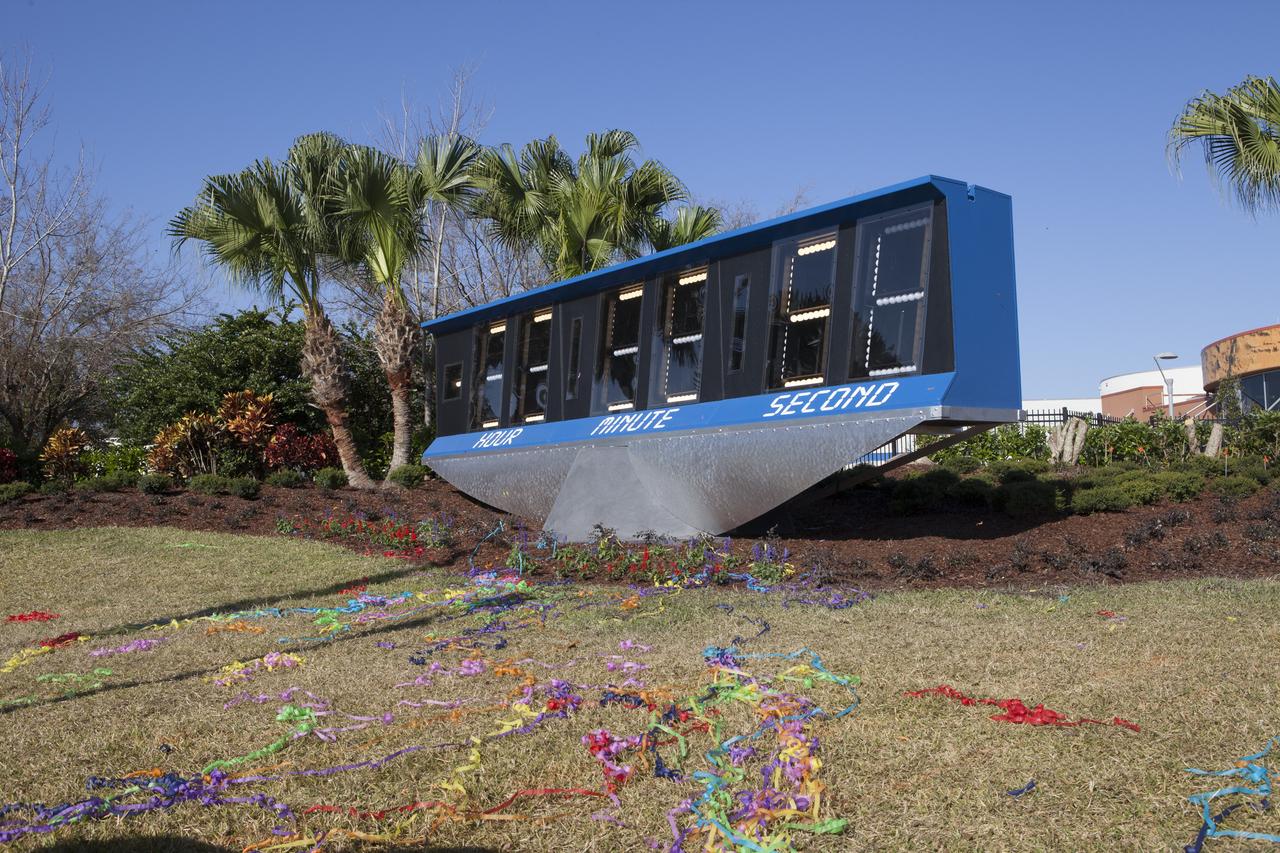
Confetti is launched as the spaceport's historic countdown clock is dedicated as the newest display at the Kennedy Space Center Visitor Complex. Now located at the entrance to the visitor complex, the spaceport's historic countdown clock was used starting with the launch of Apollo 12 on Nov. 14, 1969. Originally set up at the space center's Press Site, the clock operated through the final space shuttle mission, STS-135, launched on July 8, 2011. The old countdown clock was replaced in 2014 with a modern light emitting diode, or LED, display.
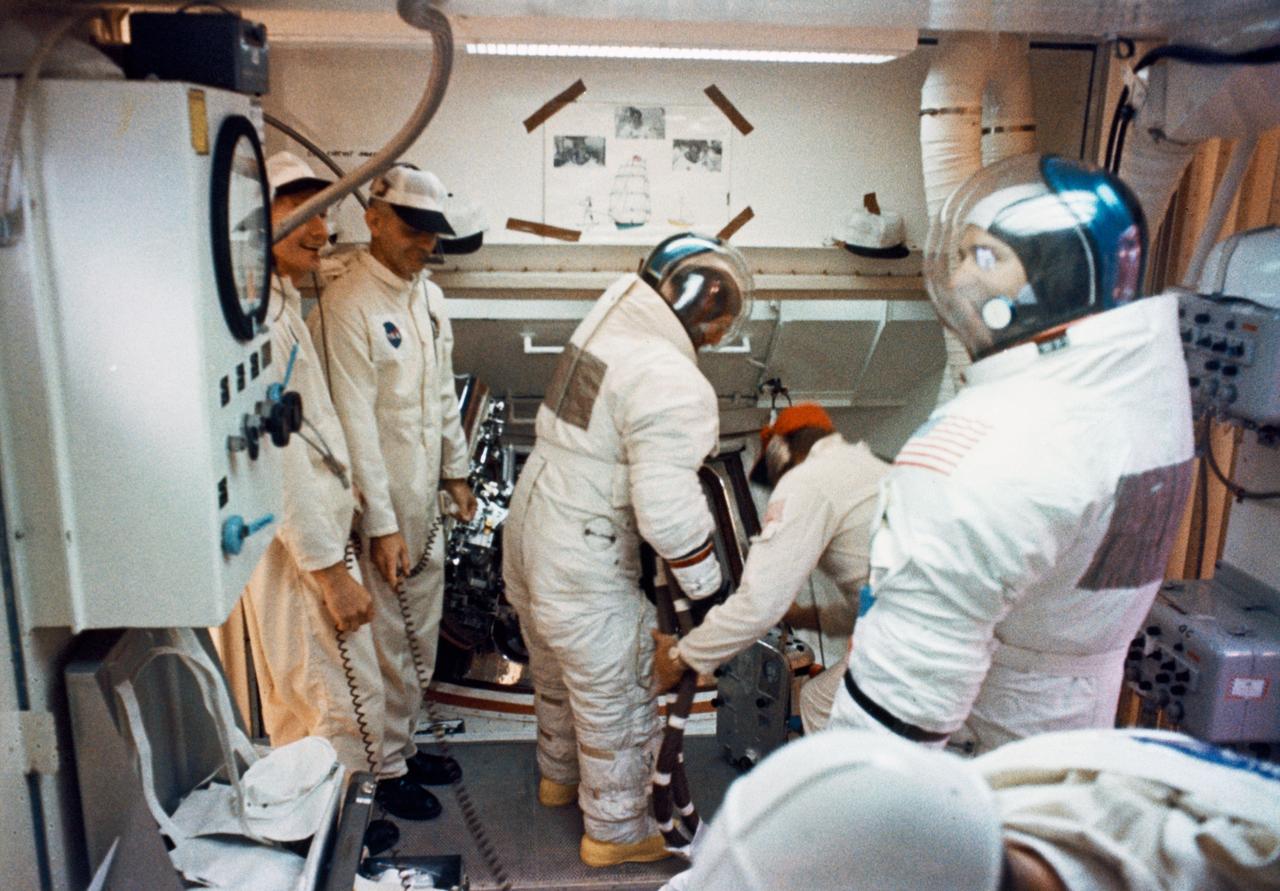
S69-58885 (14 Nov. 1969) --- Interior view of the White Room atop Pad A, Launch Complex 39, Kennedy Space Center (KSC), during the insertion of the Apollo 12 crew. In the center background preparing to ingress the spacecraft is astronaut Charles Conrad Jr., commander. Astronaut Alan L. Bean, lunar module pilot, stands in the right foreground. Awaiting his turn to ingress, but out of view, is astronaut Richard F. Gordon Jr., command module pilot. The Apollo 12 is the United States' second lunar landing mission.
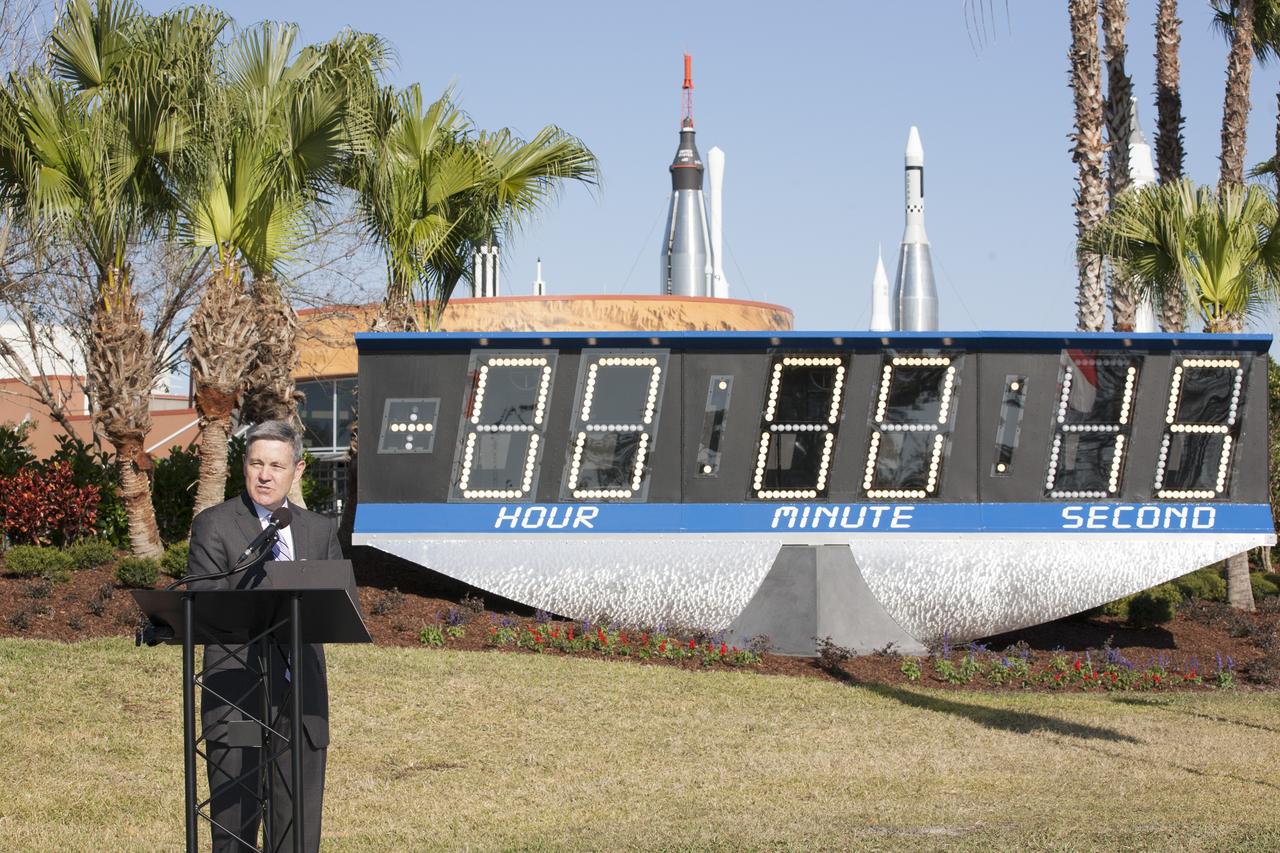
Kennedy Space Center Director Bob Cabana speaks at the dedication of the newest display at the entrance to the center's visitor complex. The historic countdown clock was originally set up at the space center's Press Site and was used from the launch of Apollo 12 on Nov. 14, 1969 to the final space shuttle mission, STS-135, launched on July 8, 2011. The old countdown clock was replaced in 2014 with a modern light emitting diode, or LED, display.
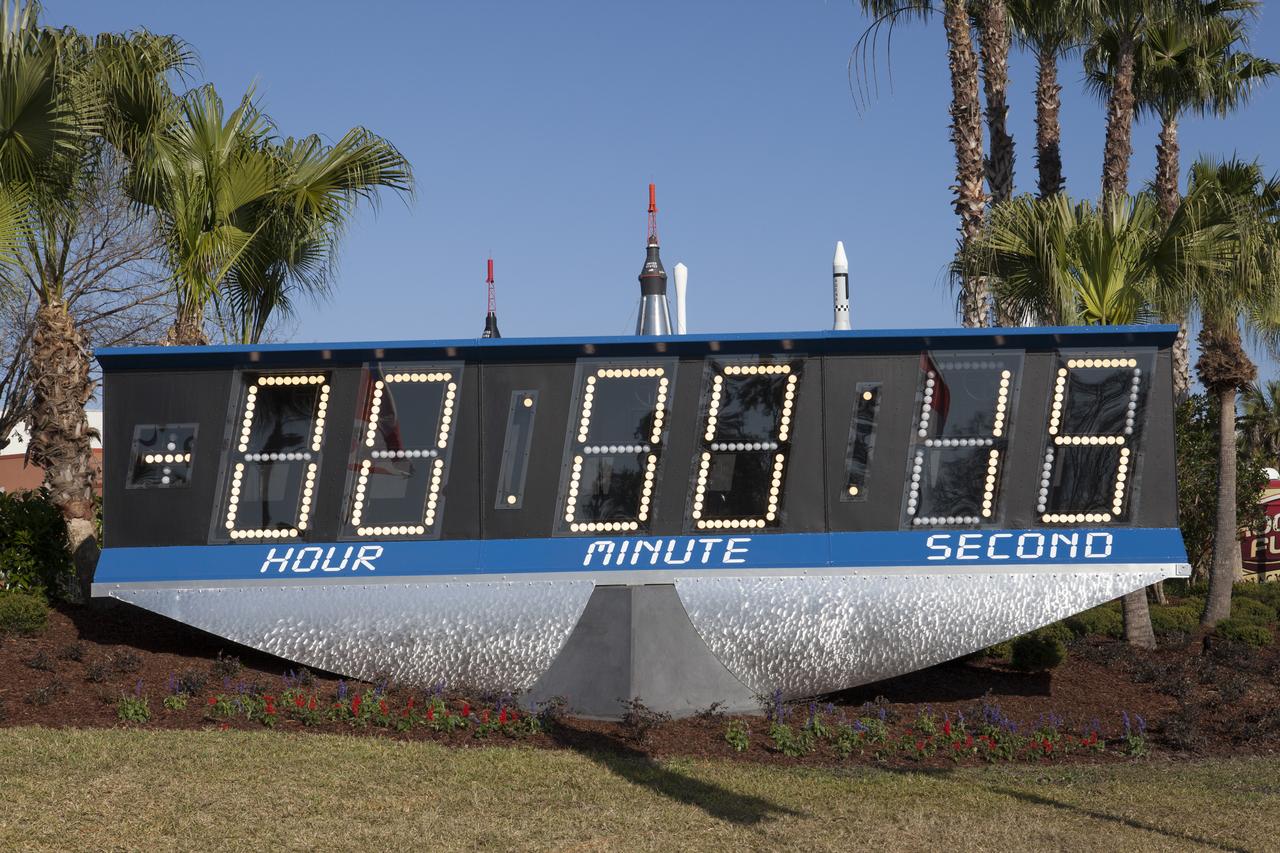
The newest display at the Kennedy Space Center Visitor Complex is the spaceport's historic countdown clock. It is now located at the entrance to the visitor complex. The clock was set up at the space center's Press Site and used from the launch of Apollo 12 on Nov. 14, 1969 to the final space shuttle mission, STS-135, launched on July 8, 2011. The old countdown clock was replaced in 2014 with a modern light emitting diode, or LED, display.
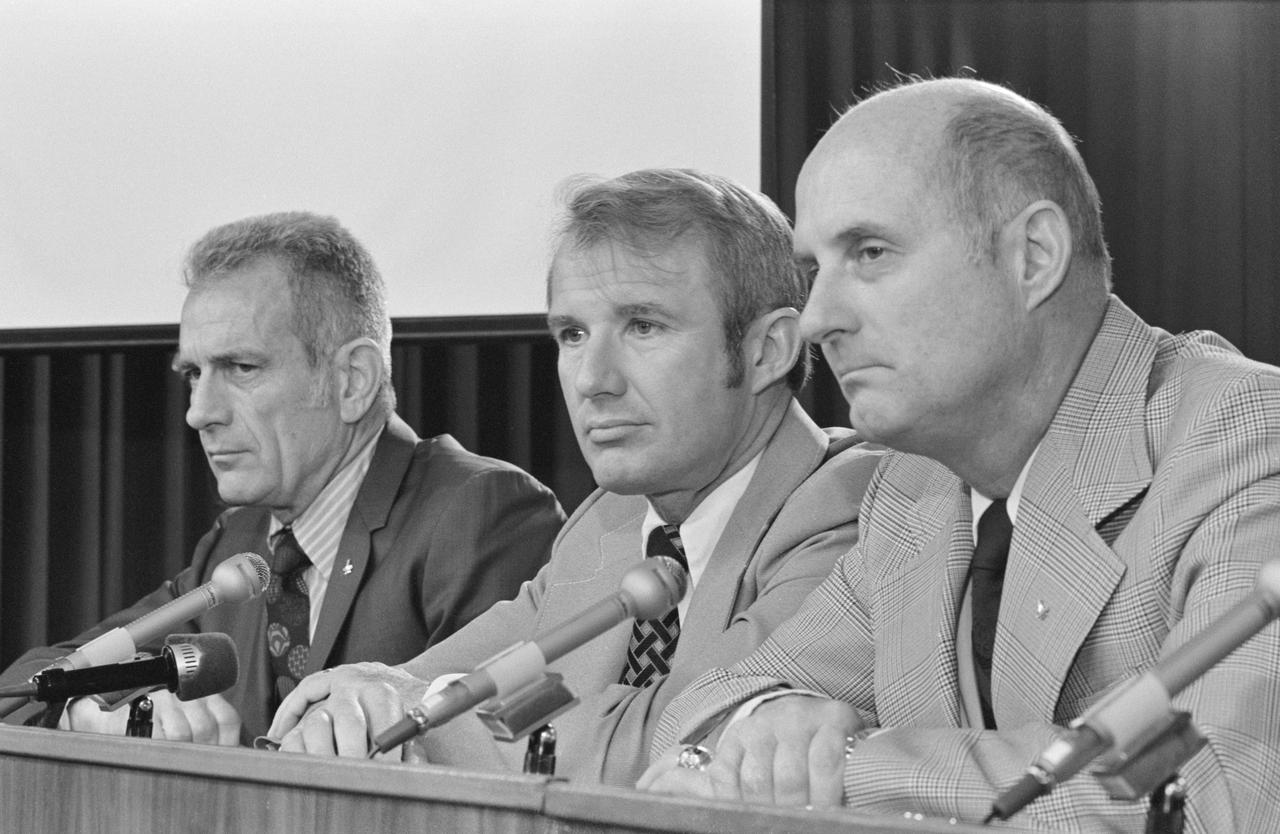
S75-26573 (14 May 1975) --- The three members of the American ASTP prime crew participate in an Apollo-Soyuz Test Project press conference conducted on May 14, 1975 in the Building 2 briefing room at NASA's Johnson Space Center. They are, left to right, Donald K. Slayton, docking module pilot; Vance D. Brand, command module pilot; and Thomas P. Stafford, commander. The astronauts discussed with the news media their recent ASTP joint training session in the Soviet Union, and the crew?s tour of the USSR?s Baikonur launch complex in Kazakhstan.
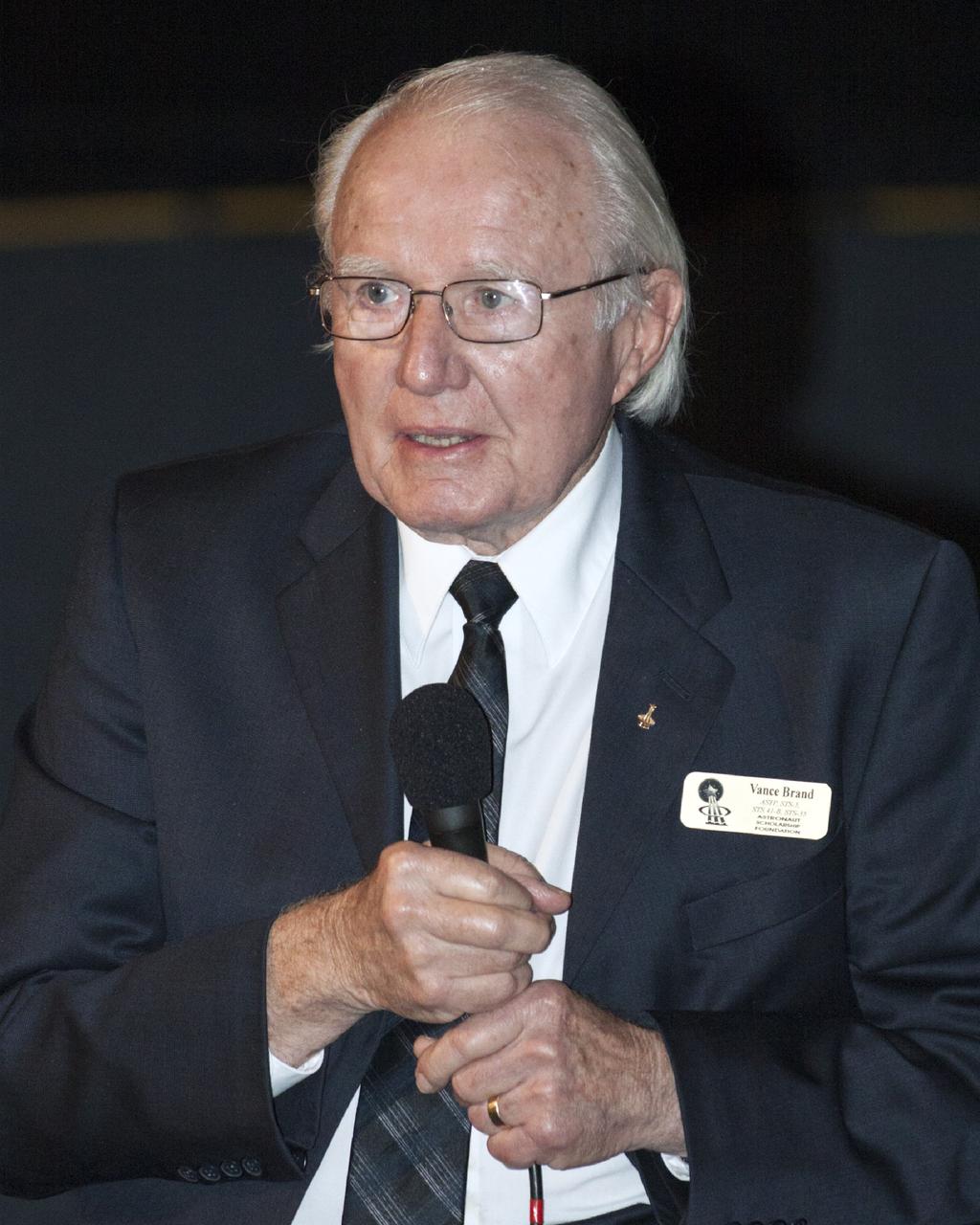
CAPE CANAVERAL, Fla. – At the Kennedy Space Center's Apollo/Saturn V Center, former NASA astronaut Vance Brand speaks to guests at the Astronaut Scholarship Foundation's event celebrating the 40th anniversary of Skylab. Brand, along with astronaut Don Lind, were prepared to fly a mission to rescue a Skylab crew if their Apollo command-service module was unusable. Brand went on to fly as pilot on the Apollo-Soyuz Test Project and missions aboard the space shuttle. The gala commemorating the 40th anniversary of Skylab included six of the nine astronauts who flew missions to America's first space station. The orbiting laboratory was launched unpiloted from Kennedy on May 14, 1973. Between May 25, 1973 and Feb. 8, 1974, crews of three spent 28, 59 and 84 days living and working in low-Earth orbit aboard the station. For more information, visit http://www.nasa.gov/mission_pages/skylab/ Photo credit: NASA/Kim Shiflett

The second manned lunar landing mission, Apollo 12 launched from launch pad 39-A at Kennedy Space Center in Florida on November 14, 1969 via a Saturn Five launch vehicle. The Saturn V vehicle was developed by the Marshall Space Flight Center (MSFC) under the direction of Dr. Wernher von Braun. Aboard Apollo 12 was a crew of three astronauts: Alan L. Bean, pilot of the Lunar Module (LM), Intrepid; Richard Gordon, pilot of the Command Module (CM), Yankee Clipper; and Spacecraft Commander Charles Conrad. The LM, Intrepid, landed astronauts Conrad and Bean on the lunar surface in what’s known as the Ocean of Storms while astronaut Richard Gordon piloted the CM, Yankee Clipper, in a parking orbit around the Moon. Their lunar soil activities included the deployment of the Apollo Lunar Surface Experiments Package (ALSEP), finding the unmanned Surveyor 3 that landed on the Moon on April 19, 1967, and collecting 75 pounds (34 kilograms) of rock samples. In this photograph, one of the astronauts on the Moon’s surface is holding a container of lunar soil. The other astronaut is seen reflected in his helmet. Apollo 12 safely returned to Earth on November 24, 1969.

The smiling Apollo 12 astronauts peer out of the window of the mobile quarantine facility aboard the recovery ship, USS Hornet. Pictured (Left to right) are Spacecraft Commander, Charles Conrad; Command Module (CM) Pilot, Richard Gordon; and Lunar Module (LM) Pilot, Alan L. Bean. The crew were housed in the quarantine facility immediately after the Pacific recovery operation took place. The second manned lunar landing mission, Apollo 12 launched from launch pad 39-A at Kennedy Space Center in Florida on November 14, 1969 via a Saturn V launch vehicle. The Saturn V vehicle was developed by the Marshall Space Flight Center (MSFC) under the direction of Dr. Wernher von Braun. The LM, Intrepid, landed astronauts Conrad and Bean on the lunar surface in what’s known as the Ocean of Storms while astronaut Richard Gordon piloted the CM, Yankee Clipper, in a parking orbit around the Moon. Lunar soil activities included the deployment of the Apollo Lunar Surface Experiments Package (ALSEP), finding the unmanned Surveyor 3 that landed on the Moon on April 19, 1967, and collecting 75 pounds (34 kilograms) of rock samples. Apollo 12 returned safely to Earth on November 24, 1969.
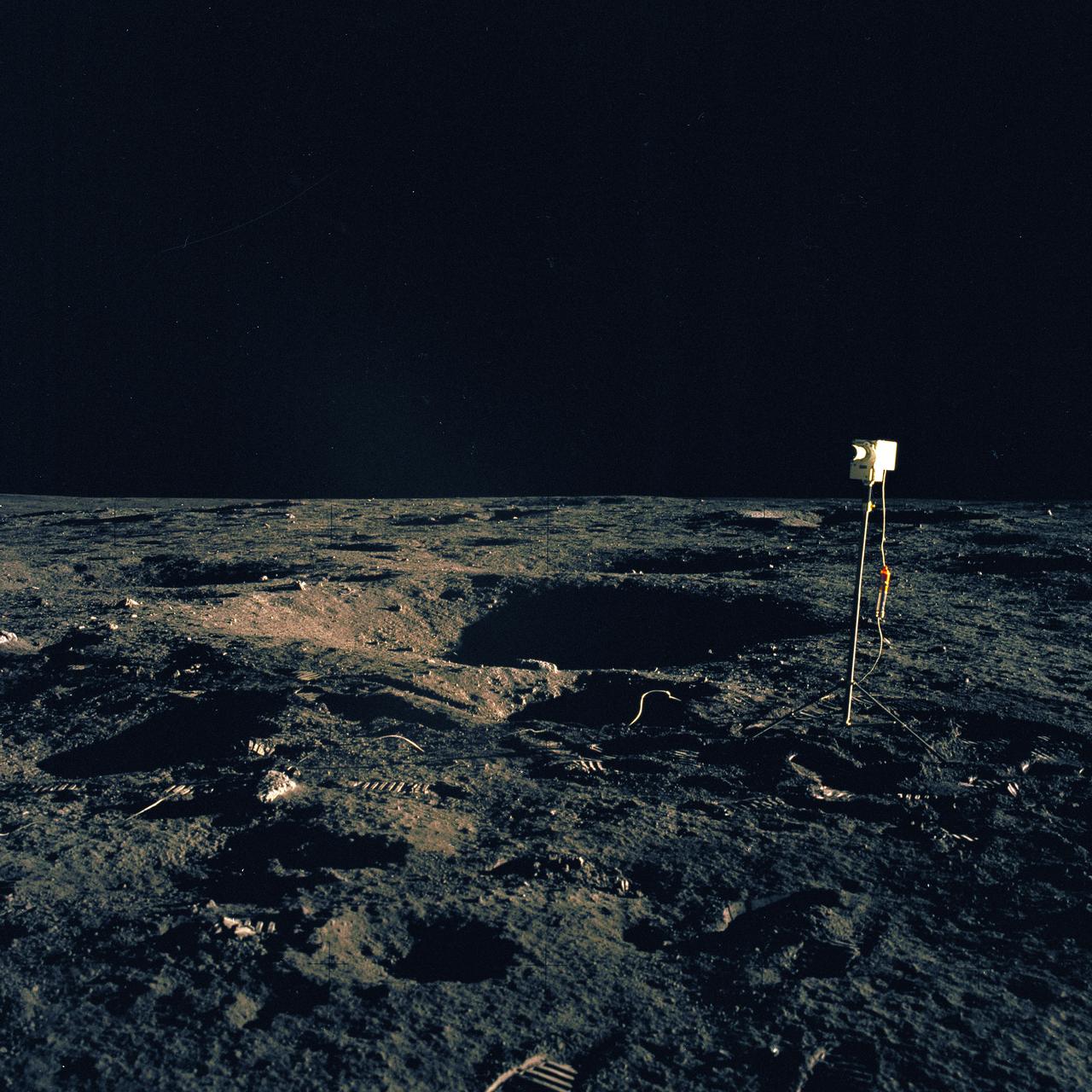
The second manned lunar landing mission, Apollo 12, launched from launch pad 39-A at Kennedy Space Center in Florida on November 14, 1969 via a Saturn V launch vehicle. The Saturn V vehicle was developed by the Marshall Space Flight Center (MSFC) under the direction of Dr. Wernher von Braun. Aboard Apollo 12 was a crew of three astronauts: Alan L. Bean, pilot of the Lunar Module (LM), Intrepid; Richard Gordon, pilot of the Command Module (CM), Yankee Clipper; and Spacecraft Commander Charles Conrad. The LM, Intrepid, landed astronauts Conrad and Bean on the lunar surface in what’s known as the Ocean of Storms while astronaut Richard Gordon piloted the CM, Yankee Clipper, in a parking orbit around the Moon. Lunar soil activities included the deployment of the Apollo Lunar Surface Experiments Package (ALSEP), finding the unmanned Surveyor 3 that landed on the Moon on April 19, 1967, and collecting 75 pounds (34 kilograms) of rock samples. This is the twenty-first of 25 images captured by the crew in attempt to provide a 360 degree Lunar surface scene. Apollo 12 safely returned to Earth on November 24, 1969.
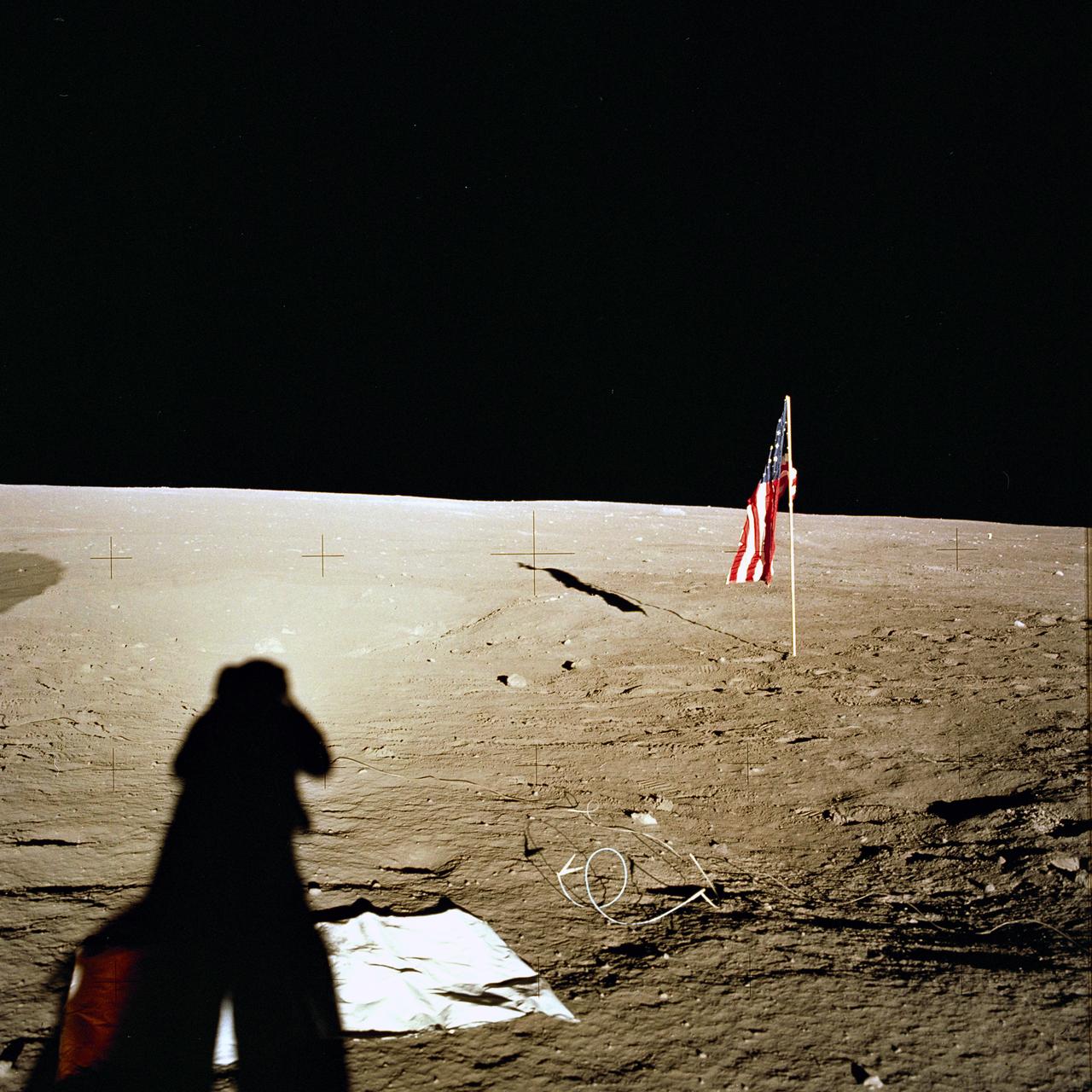
The second manned lunar landing mission, Apollo 12 launched from launch pad 39-A at Kennedy Space Center in Florida on November 14, 1969 via a Saturn V launch vehicle. The Saturn V vehicle was developed by the Marshall Space Flight Center (MSFC) under the direction of Dr. Wernher von Braun. Aboard Apollo 12 was a crew of three astronauts: Alan L. Bean, pilot of the Lunar Module (LM), Intrepid; Richard Gordon, pilot of the Command Module (CM), Yankee Clipper; and Spacecraft Commander Charles Conrad. The LM, Intrepid, landed astronauts Conrad and Bean on the lunar surface in what’s known as the Ocean of Storms while astronaut Richard Gordon piloted the CM, Yankee Clipper, in a parking orbit around the Moon. Lunar soil activities included the deployment of the Apollo Lunar Surface Experiments Package (ALSEP), finding the unmanned Surveyor 3 that landed on the Moon on April 19, 1967, and collecting 75 pounds (34 kilograms) of rock samples. This is the third of 25 images captured by the crew in attempt to provide a 360 degree Lunar surface scene. Apollo 12 safely returned to Earth on November 24, 1969.
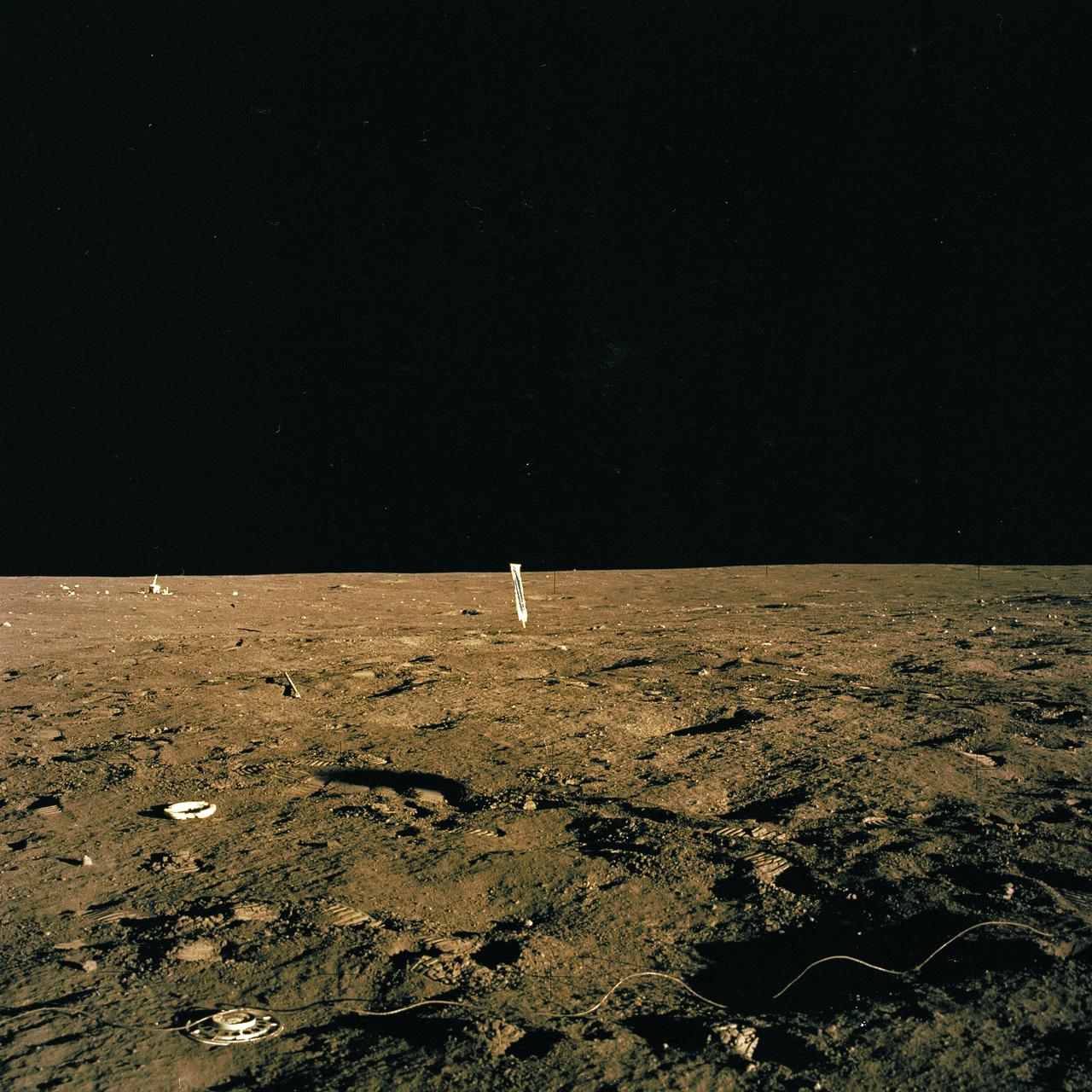
The second manned lunar landing mission, Apollo 12, launched from launch pad 39-A at Kennedy Space Center in Florida on November 14, 1969 via a Saturn V launch vehicle. The Saturn V vehicle was developed by the Marshall Space Flight Center (MSFC) under the direction of Dr. Wernher von Braun. Aboard Apollo 12 was a crew of three astronauts: Alan L. Bean, pilot of the Lunar Module (LM), Intrepid; Richard Gordon, pilot of the Command Module (CM), Yankee Clipper; and Spacecraft Commander Charles Conrad. The LM, Intrepid, landed astronauts Conrad and Bean on the lunar surface in what’s known as the Ocean of Storms while astronaut Richard Gordon piloted the CM, Yankee Clipper, in a parking orbit around the Moon. Lunar soil activities included the deployment of the Apollo Lunar Surface Experiments Package (ALSEP), finding the unmanned Surveyor 3 that landed on the Moon on April 19, 1967, and collecting 75 pounds (34 kilograms) of rock samples. This is the twenty-fifth of 25 images captured by the crew in attempt to provide a 360 degree Lunar surface scene. Apollo 12 safely returned to Earth on November 24, 1969.
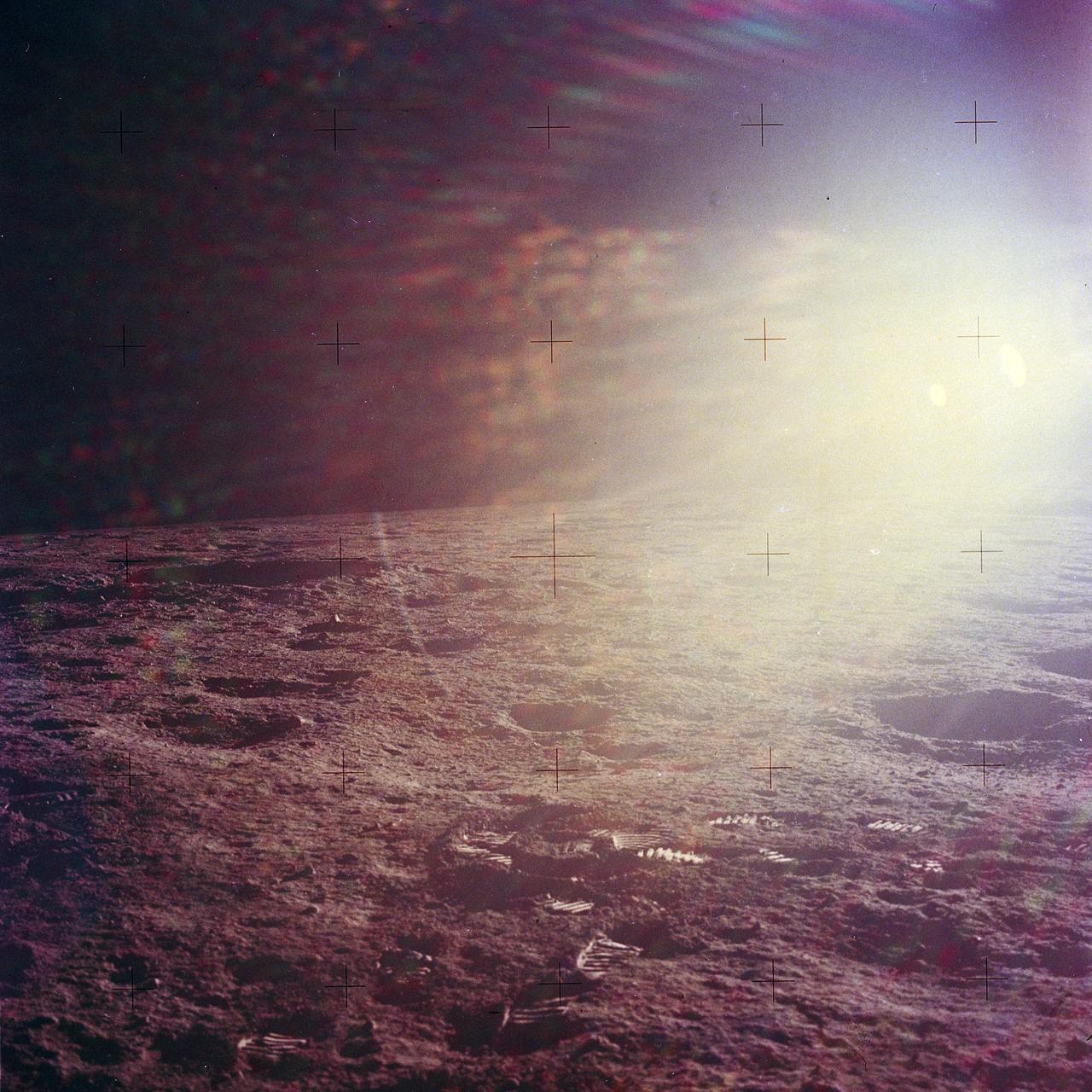
The second manned lunar landing mission, Apollo 12, launched from launch pad 39-A at Kennedy Space Center in Florida on November 14, 1969 via a Saturn V launch vehicle. The Saturn V vehicle was developed by the Marshall Space Flight Center (MSFC) under the direction of Dr. Wernher von Braun. Aboard Apollo 12 was a crew of three astronauts: Alan L. Bean, pilot of the Lunar Module (LM), Intrepid; Richard Gordon, pilot of the Command Module (CM), Yankee Clipper; and Spacecraft Commander Charles Conrad. The LM, Intrepid, landed astronauts Conrad and Bean on the lunar surface in what’s known as the Ocean of Storms while astronaut Richard Gordon piloted the CM, Yankee Clipper, in a parking orbit around the Moon. Lunar soil activities included the deployment of the Apollo Lunar Surface Experiments Package (ALSEP), finding the unmanned Surveyor 3 that landed on the Moon on April 19, 1967, and collecting 75 pounds (34 kilograms) of rock samples. This is the eighteenth of 25 images captured by the crew in attempt to provide a 360 degree Lunar surface scene. Apollo 12 safely returned to Earth on November 24, 1969.
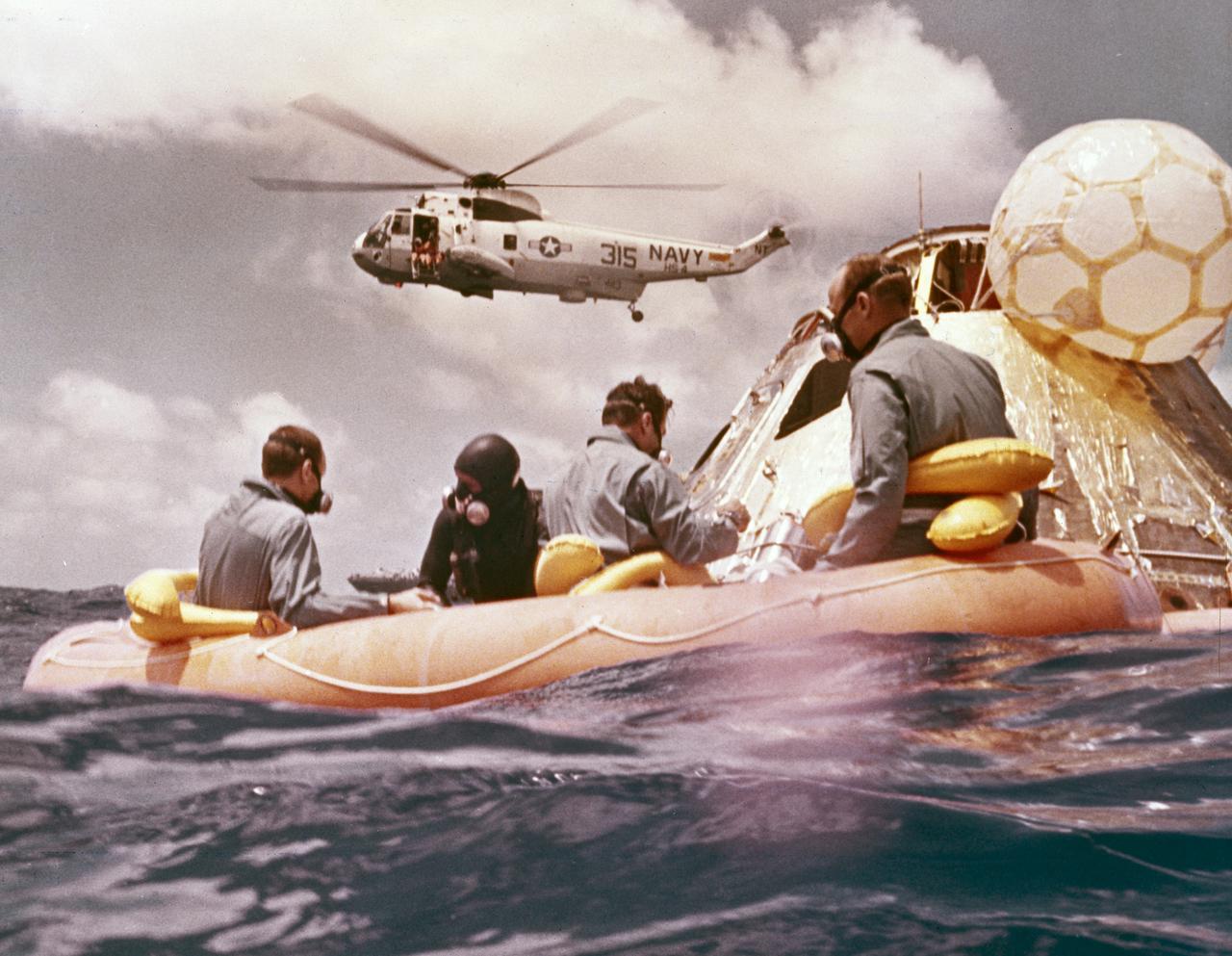
Sitting in the life raft, during the Apollo 12 Pacific recovery, are the three mission astronauts; Alan L. Bean, pilot of the Lunar Module (LM), Intrepid; Richard Gordon, pilot of the Command Module (CM), Yankee Clipper; and Spacecraft Commander Charles Conrad. The second manned lunar landing mission, Apollo 12 launched from launch pad 39-A at Kennedy Space Center in Florida on November 14, 1969 via a Saturn V launch vehicle. The Saturn V vehicle was developed by the Marshall Space Flight Center (MSFC) under the direction of Dr. Wernher von Braun. The LM, Intrepid, landed astronauts Conrad and Bean on the lunar surface in what’s known as the Ocean of Storms, while astronaut Richard Gordon piloted the CM, Yankee Clipper, in a parking orbit around the Moon. Lunar soil activities included the deployment of the Apollo Lunar Surface Experiments Package (ALSEP), finding the unmanned Surveyor 3 that landed on the Moon on April 19, 1967, and collecting 75 pounds (34 kilograms) of rock samples. Apollo 12 safely returned to Earth on November 24, 1969.
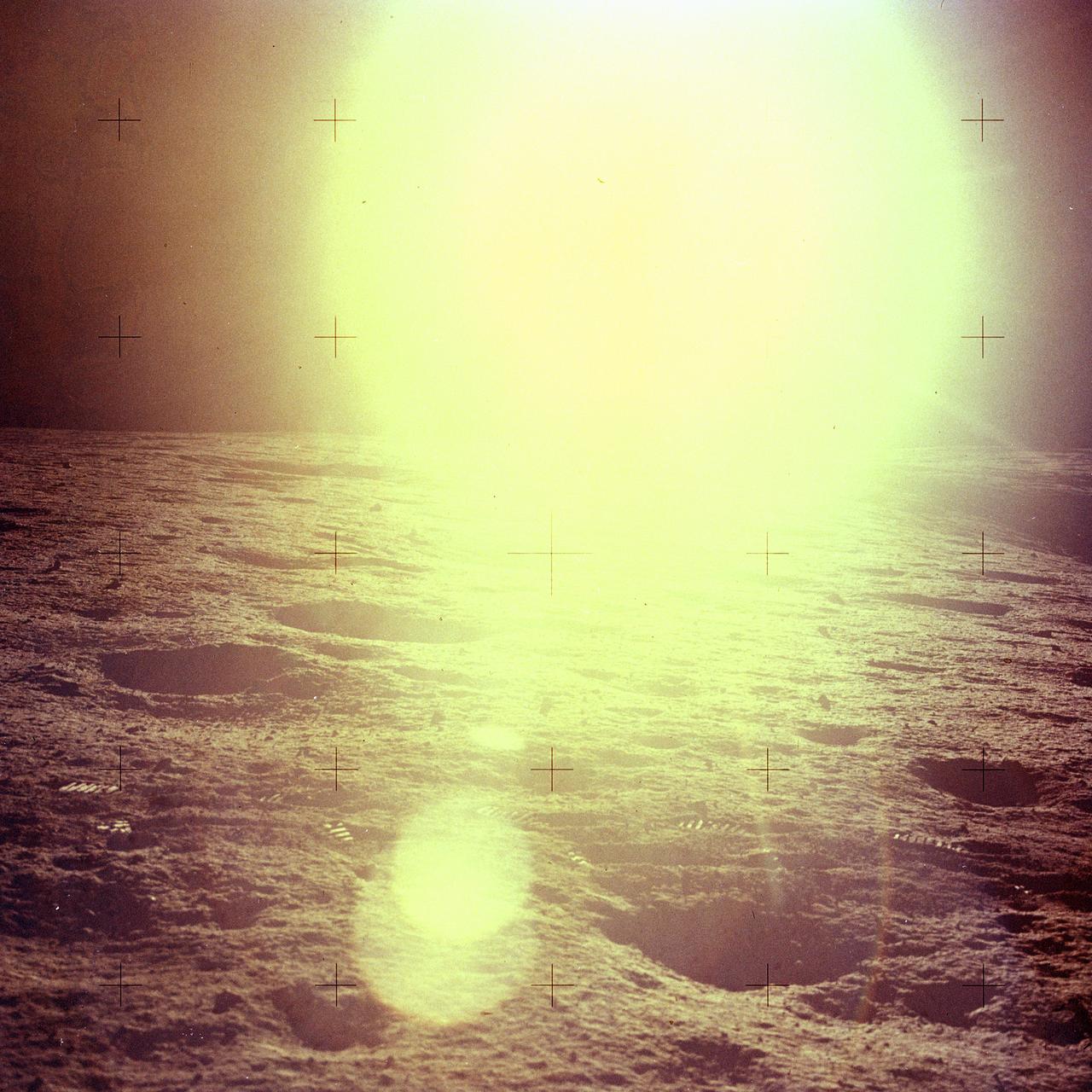
The second manned lunar landing mission, Apollo 12, launched from launch pad 39-A at Kennedy Space Center in Florida on November 14, 1969 via a Saturn V launch vehicle. The Saturn V vehicle was developed by the Marshall Space Flight Center (MSFC) under the direction of Dr. Wernher von Braun. Aboard Apollo 12 was a crew of three astronauts: Alan L. Bean, pilot of the Lunar Module (LM), Intrepid; Richard Gordon, pilot of the Command Module (CM), Yankee Clipper; and Spacecraft Commander Charles Conrad. The LM, Intrepid, landed astronauts Conrad and Bean on the lunar surface in what’s known as the Ocean of Storms while astronaut Richard Gordon piloted the CM, Yankee Clipper, in a parking orbit around the Moon. Lunar soil activities included the deployment of the Apollo Lunar Surface Experiments Package (ALSEP), finding the unmanned Surveyor 3 that landed on the Moon on April 19, 1967, and collecting 75 pounds (34 kilograms) of rock samples. This is the sixteenth of 25 images captured by the crew in attempt to provide a 360 degree Lunar surface scene. Apollo 12 safely returned to Earth on November 24, 1969.
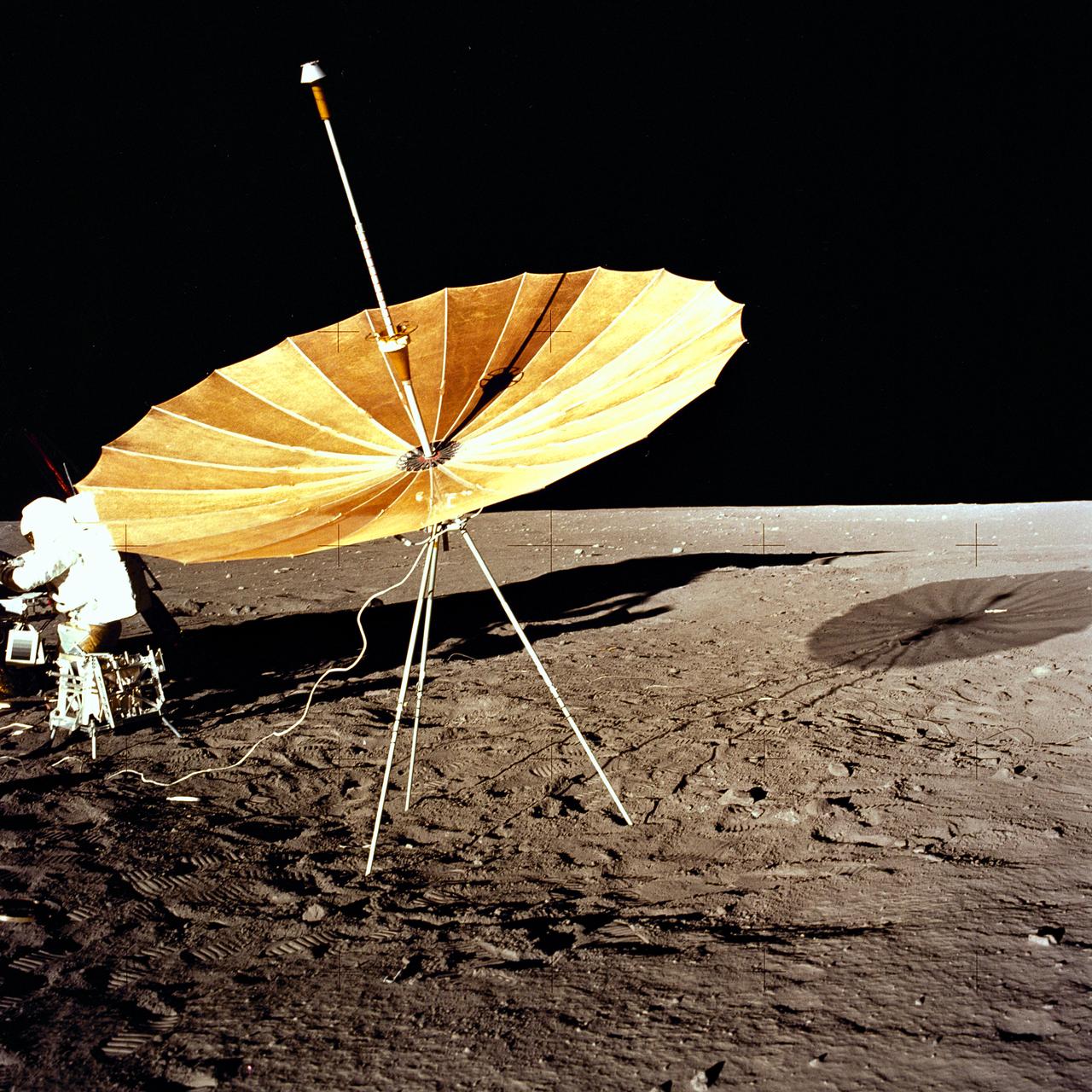
The second manned lunar landing mission, Apollo 12 launched from launch pad 39-A at Kennedy Space Center in Florida on November 14, 1969 via a Saturn V launch vehicle. The Saturn V vehicle was developed by the Marshall Space Flight Center (MSFC) under the direction of Dr. Wernher von Braun. Aboard Apollo 12 was a crew of three astronauts: Alan L. Bean, pilot of the Lunar Module (LM), Intrepid; Richard Gordon, pilot of the Command Module (CM), Yankee Clipper; and Spacecraft Commander Charles Conrad. The LM, Intrepid, landed astronauts Conrad and Bean on the lunar surface in what’s known as the Ocean of Storms while astronaut Richard Gordon piloted the CM, Yankee Clipper, in a parking orbit around the Moon. Lunar soil activities included the deployment of the Apollo Lunar Surface Experiments Package (ALSEP), finding the unmanned Surveyor 3 that landed on the Moon on April 19, 1967, and collecting 75 pounds (34 kilograms) of rock samples. This is the sixth of 25 images captured by the crew in attempt to provide a 360 degree Lunar surface scene. Apollo 12 safely returned to Earth on November 24, 1969.
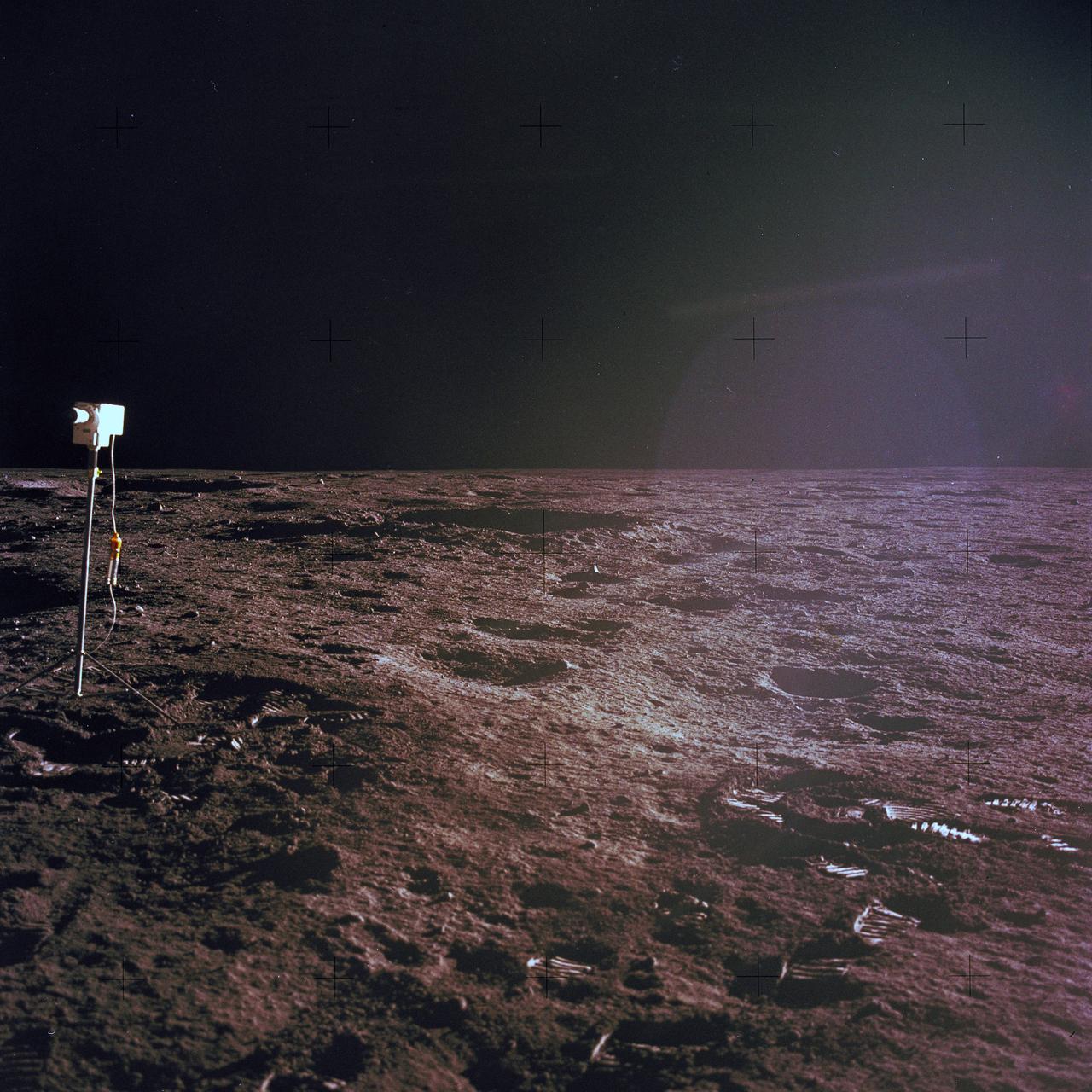
The second manned lunar landing mission, Apollo 12, launched from launch pad 39-A at Kennedy Space Center in Florida on November 14, 1969 via a Saturn V launch vehicle. The Saturn V vehicle was developed by the Marshall Space Flight Center (MSFC) under the direction of Dr. Wernher von Braun. Aboard Apollo 12 was a crew of three astronauts: Alan L. Bean, pilot of the Lunar Module (LM), Intrepid; Richard Gordon, pilot of the Command Module (CM), Yankee Clipper; and Spacecraft Commander Charles Conrad. The LM, Intrepid, landed astronauts Conrad and Bean on the lunar surface in what’s known as the Ocean of Storms while astronaut Richard Gordon piloted the CM, Yankee Clipper, in a parking orbit around the Moon. Lunar soil activities included the deployment of the Apollo Lunar Surface Experiments Package (ALSEP), finding the unmanned Surveyor 3 that landed on the Moon on April 19, 1967, and collecting 75 pounds (34 kilograms) of rock samples. This is the nineteenth of 25 images captured by the crew in attempt to provide a 360 degree Lunar surface scene. Apollo 12 safely returned to Earth on November 24, 1969.
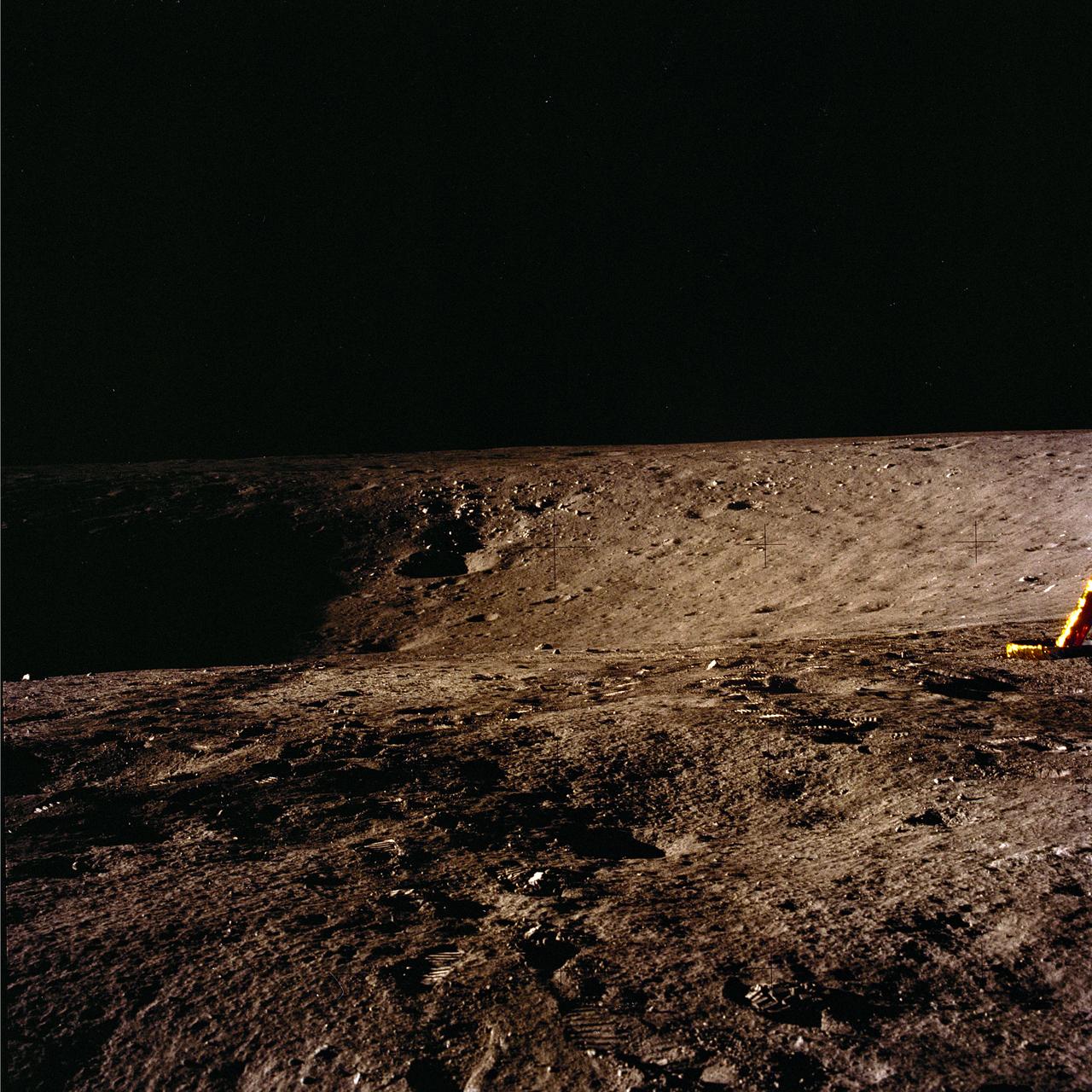
The second manned lunar landing mission, Apollo 12 launched from launch pad 39-A at Kennedy Space Center in Florida on November 14, 1969 via a Saturn V launch vehicle. The Saturn V vehicle was developed by the Marshall Space Flight Center (MSFC) under the direction of Dr. Wernher von Braun. Aboard Apollo 12 was a crew of three astronauts: Alan L. Bean, pilot of the Lunar Module (LM), Intrepid; Richard Gordon, pilot of the Command Module (CM), Yankee Clipper; and Spacecraft Commander Charles Conrad. The LM, Intrepid, landed astronauts Conrad and Bean on the lunar surface in what’s known as the Ocean of Storms while astronaut Richard Gordon piloted the CM, Yankee Clipper, in a parking orbit around the Moon. Lunar soil activities included the deployment of the Apollo Lunar Surface Experiments Package (ALSEP), finding the unmanned Surveyor 3 that landed on the Moon on April 19, 1967, and collecting 75 pounds (34 kilograms) of rock samples. This is the tenth of 25 images captured by the crew in attempt to provide a 360 degree Lunar surface scene. Apollo 12 safely returned to Earth on November 24, 1969.
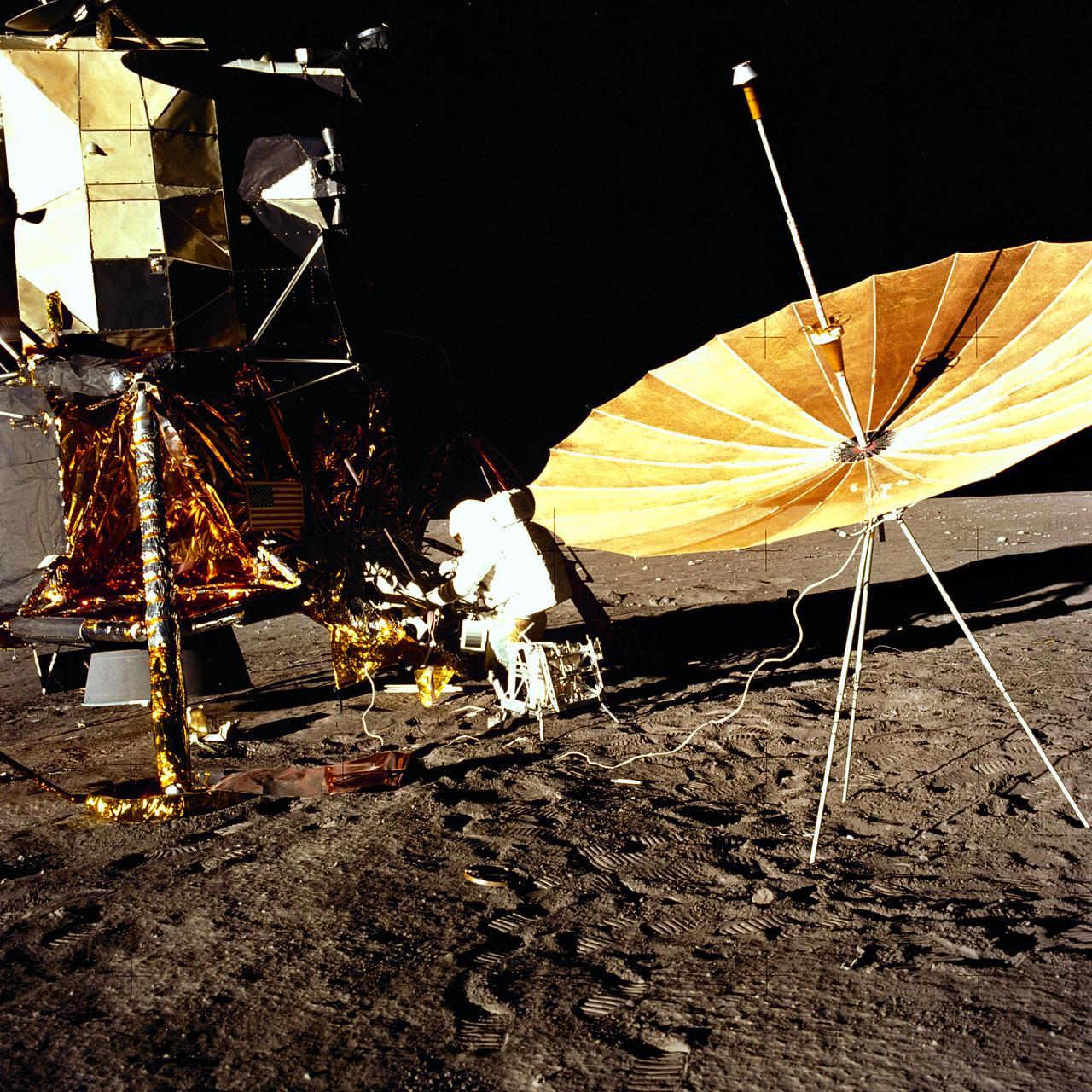
The second manned lunar landing mission, Apollo 12 launched from launch pad 39-A at Kennedy Space Center in Florida on November 14, 1969 via a Saturn V launch vehicle. The Saturn V vehicle was developed by the Marshall Space Flight Center (MSFC) under the direction of Dr. Wernher von Braun. Aboard Apollo 12 was a crew of three astronauts: Alan L. Bean, pilot of the Lunar Module (LM), Intrepid; Richard Gordon, pilot of the Command Module (CM), Yankee Clipper; and Spacecraft Commander Charles Conrad. The LM, Intrepid, landed astronauts Conrad and Bean on the lunar surface in what’s known as the Ocean of Storms while astronaut Richard Gordon piloted the CM, Yankee Clipper, in a parking orbit around the Moon. Lunar soil activities included the deployment of the Apollo Lunar Surface Experiments Package (ALSEP), finding the unmanned Surveyor 3 that landed on the Moon on April 19, 1967, and collecting 75 pounds (34 kilograms) of rock samples. This is the seventh of 25 images captured by the crew in attempt to provide a 360 degree Lunar surface scene. Apollo 12 safely returned to Earth on November 24, 1969.
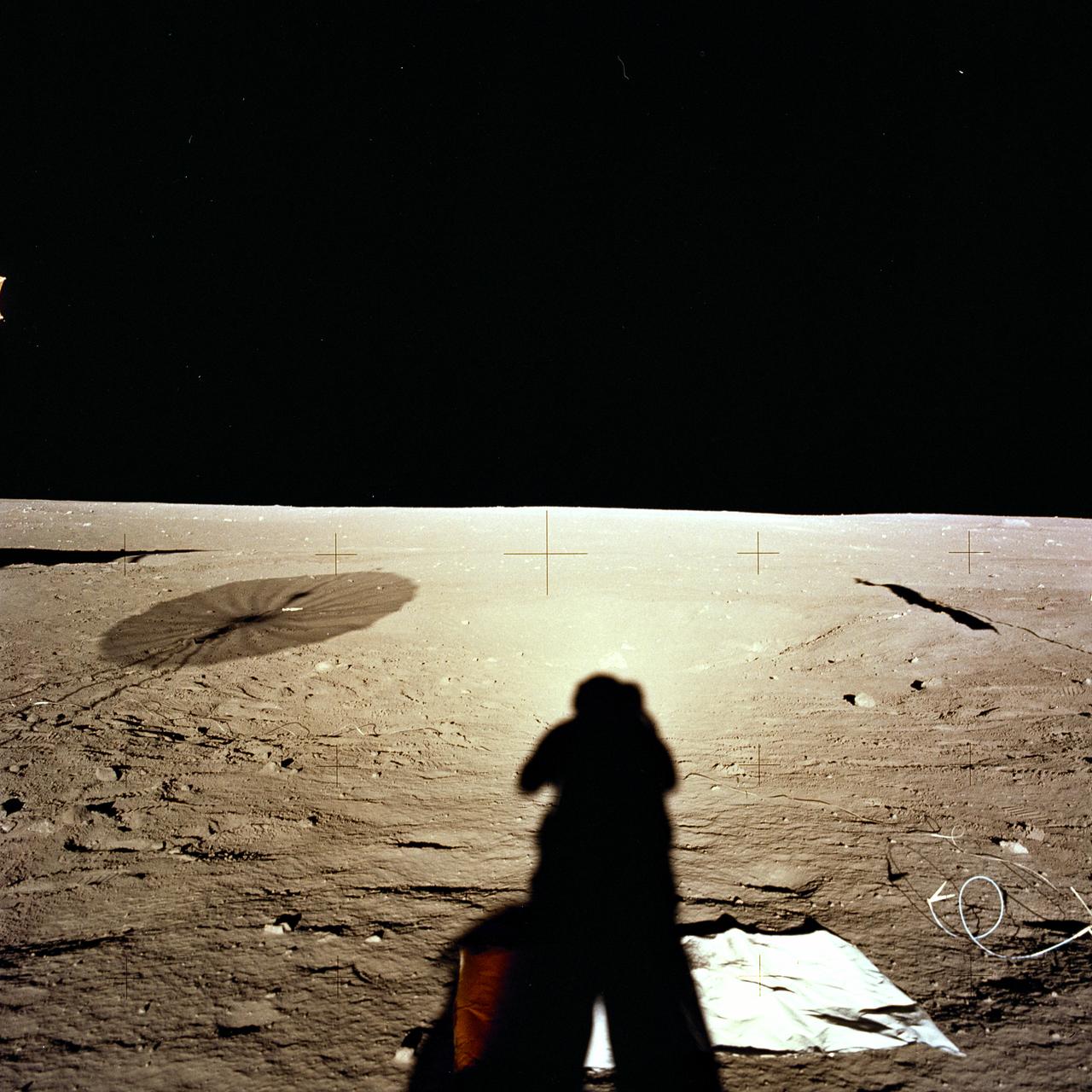
The second manned lunar landing mission, Apollo 12 launched from launch pad 39-A at Kennedy Space Center in Florida on November 14, 1969 via a Saturn V launch vehicle. The Saturn V vehicle was developed by the Marshall Space Flight Center (MSFC) under the direction of Dr. Wernher von Braun. Aboard Apollo 12 was a crew of three astronauts: Alan L. Bean, pilot of the Lunar Module (LM), Intrepid; Richard Gordon, pilot of the Command Module (CM), Yankee Clipper; and Spacecraft Commander Charles Conrad. The LM, Intrepid, landed astronauts Conrad and Bean on the lunar surface in what’s known as the Ocean of Storms while astronaut Richard Gordon piloted the CM, Yankee Clipper, in a parking orbit around the Moon. Lunar soil activities included the deployment of the Apollo Lunar Surface Experiments Package (ALSEP), finding the unmanned Surveyor 3 that landed on the Moon on April 19, 1967, and collecting 75 pounds (34 kilograms) of rock samples. This is the fourth of 25 images captured by the crew in attempt to provide a 360 degree Lunar surface scene. Apollo 12 safely returned to Earth on November 24, 1969.
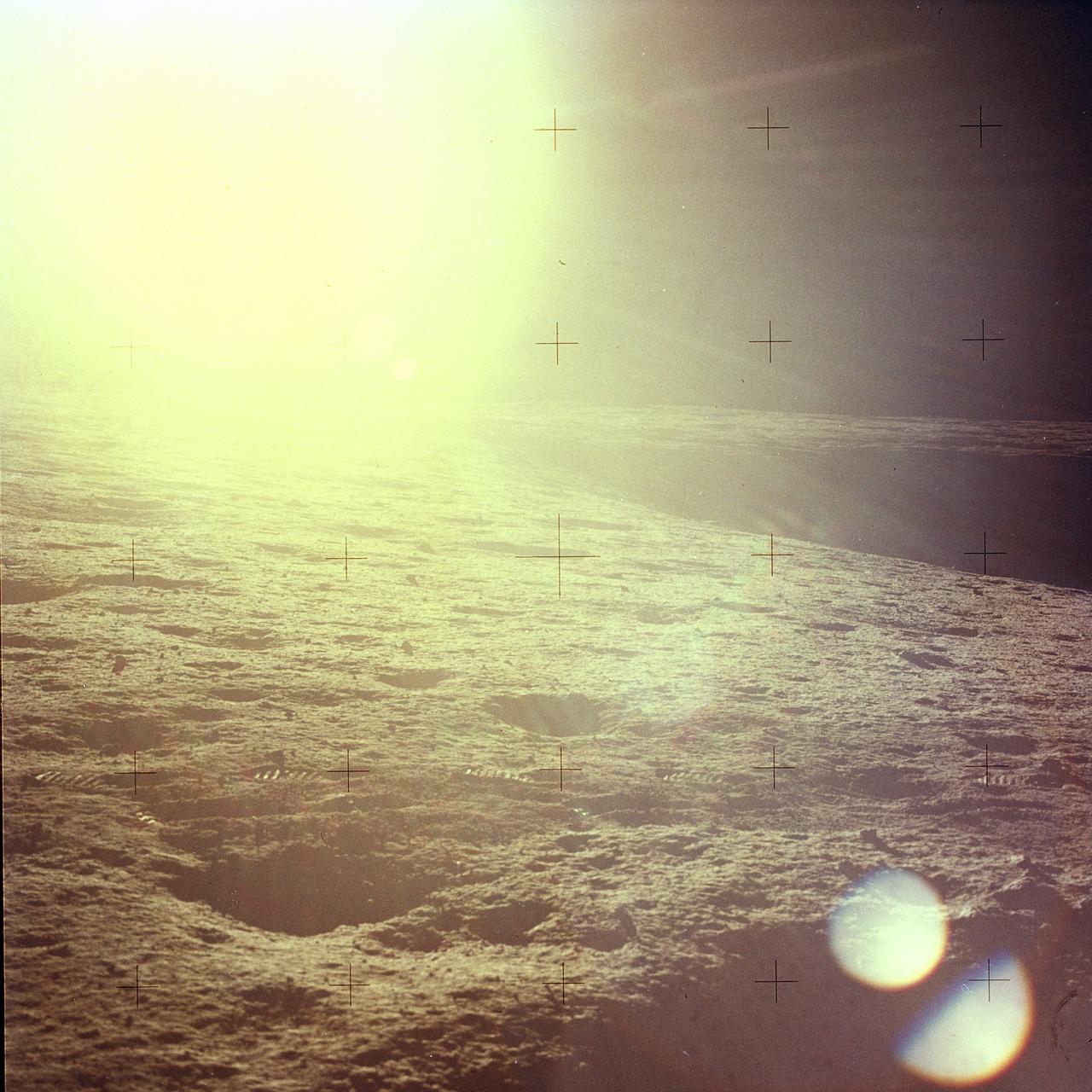
The second manned lunar landing mission, Apollo 12, launched from launch pad 39-A at Kennedy Space Center in Florida on November 14, 1969 via a Saturn V launch vehicle. The Saturn V vehicle was developed by the Marshall Space Flight Center (MSFC) under the direction of Dr. Wernher von Braun. Aboard Apollo 12 was a crew of three astronauts: Alan L. Bean, pilot of the Lunar Module (LM), Intrepid; Richard Gordon, pilot of the Command Module (CM), Yankee Clipper; and Spacecraft Commander Charles Conrad. The LM, Intrepid, landed astronauts Conrad and Bean on the lunar surface in what’s known as the Ocean of Storms while astronaut Richard Gordon piloted the CM, Yankee Clipper, in a parking orbit around the Moon. Lunar soil activities included the deployment of the Apollo Lunar Surface Experiments Package (ALSEP), finding the unmanned Surveyor 3 that landed on the Moon on April 19, 1967, and collecting 75 pounds (34 kilograms) of rock samples. This is the fifteenth of 25 images captured by the crew in attempt to provide a 360 degree Lunar surface scene. Apollo 12 safely returned to Earth on November 24, 1969.
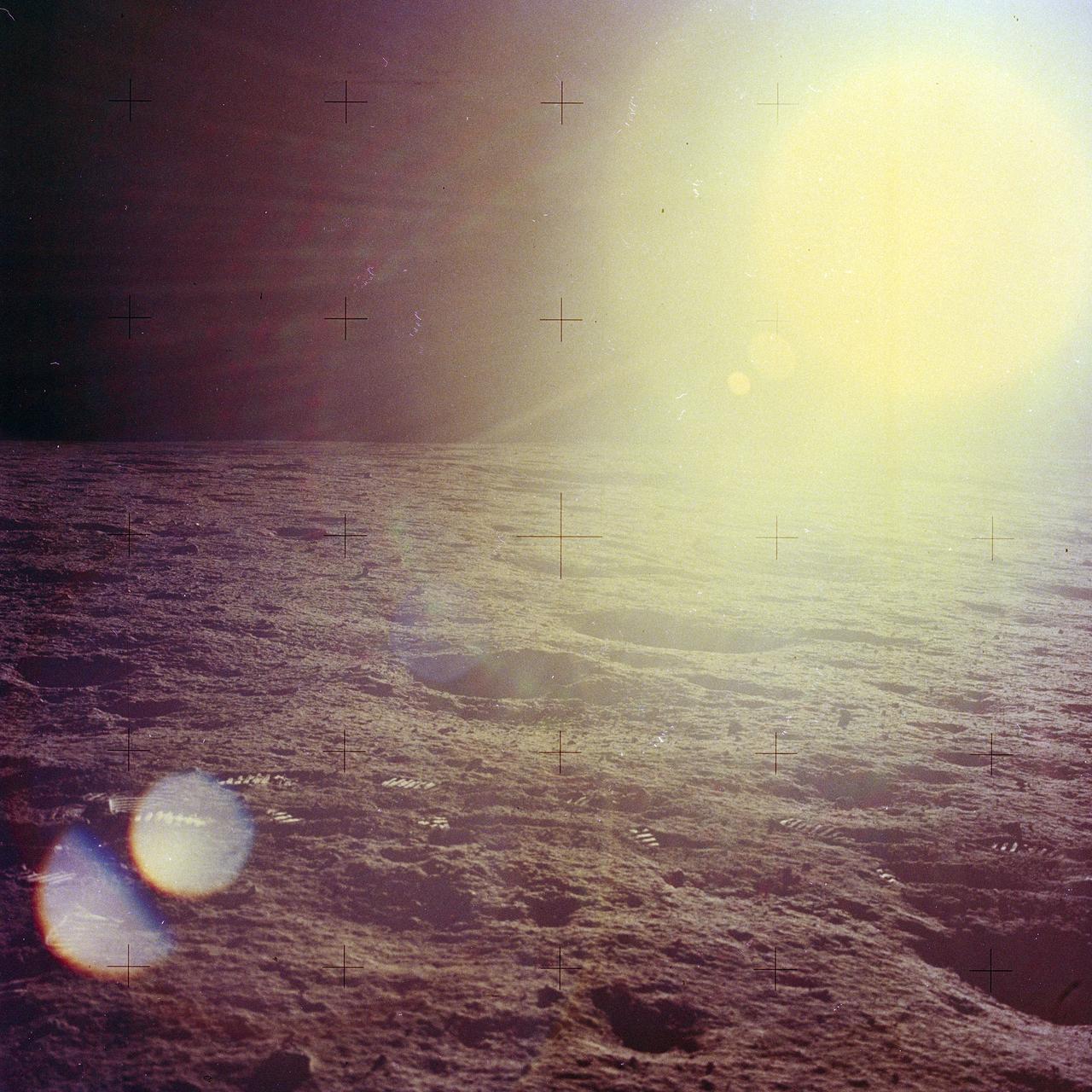
The second manned lunar landing mission, Apollo 12, launched from launch pad 39-A at Kennedy Space Center in Florida on November 14, 1969 via a Saturn V launch vehicle. The Saturn V vehicle was developed by the Marshall Space Flight Center (MSFC) under the direction of Dr. Wernher von Braun. Aboard Apollo 12 was a crew of three astronauts: Alan L. Bean, pilot of the Lunar Module (LM), Intrepid; Richard Gordon, pilot of the Command Module (CM), Yankee Clipper; and Spacecraft Commander Charles Conrad. The LM, Intrepid, landed astronauts Conrad and Bean on the lunar surface in what’s known as the Ocean of Storms while astronaut Richard Gordon piloted the CM, Yankee Clipper, in a parking orbit around the Moon. Lunar soil activities included the deployment of the Apollo Lunar Surface Experiments Package (ALSEP), finding the unmanned Surveyor 3 that landed on the Moon on April 19, 1967, and collecting 75 pounds (34 kilograms) of rock samples. This is the seventeenth of 25 images captured by the crew in attempt to provide a 360 degree Lunar surface scene. Apollo 12 safely returned to Earth on November 24, 1969.
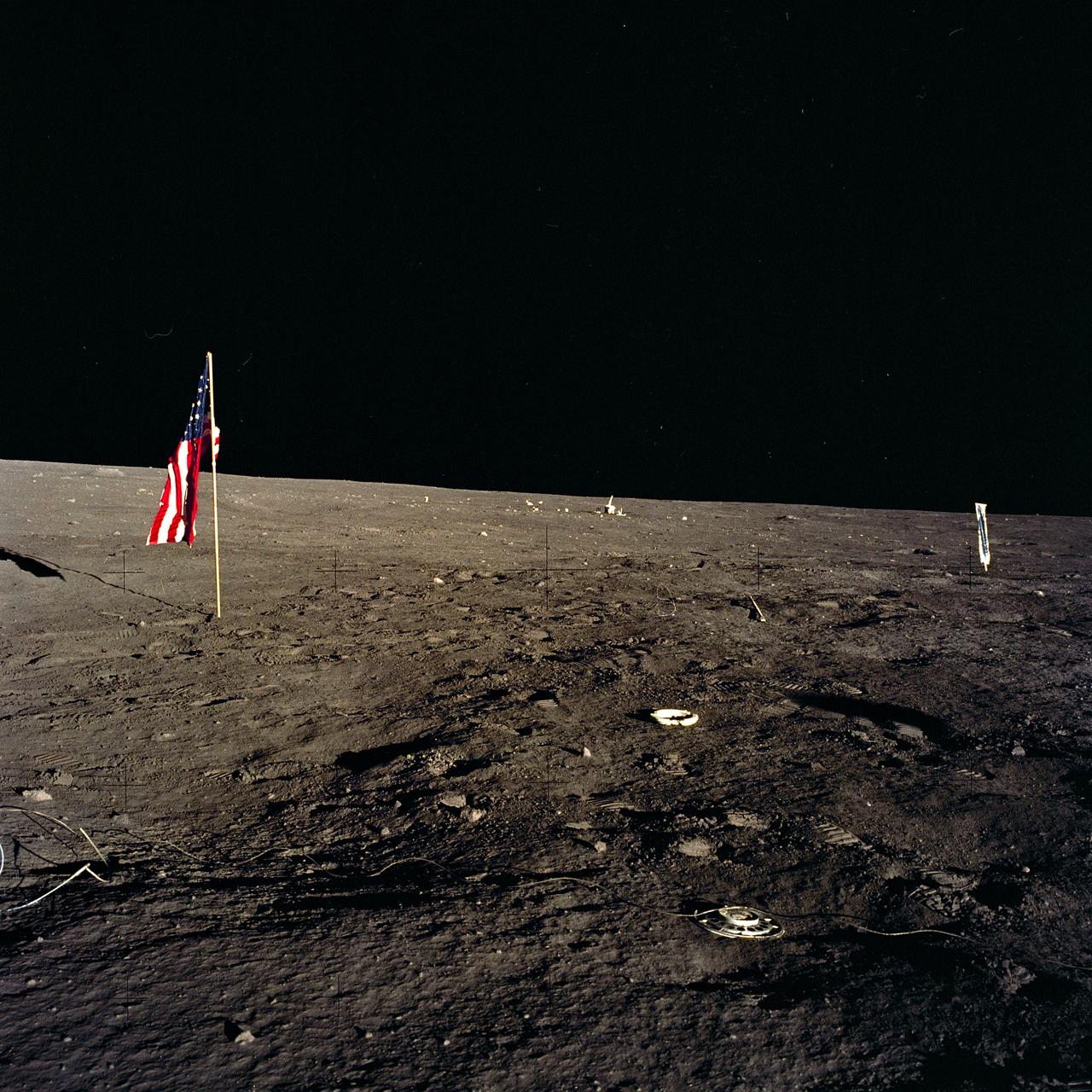
The second manned lunar landing mission, Apollo 12 launched from launch pad 39-A at Kennedy Space Center in Florida on November 14, 1969 via a Saturn V launch vehicle. The Saturn V vehicle was developed by the Marshall Space Flight Center (MSFC) under the direction of Dr. Wernher von Braun. Aboard Apollo 12 was a crew of three astronauts: Alan L. Bean, pilot of the Lunar Module (LM), Intrepid; Richard Gordon, pilot of the Command Module (CM), Yankee Clipper; and Spacecraft Commander Charles Conrad. The LM, Intrepid, landed astronauts Conrad and Bean on the lunar surface in what’s known as the Ocean of Storms while astronaut Richard Gordon piloted the CM, Yankee Clipper, in a parking orbit around the Moon. Lunar soil activities included the deployment of the Apollo Lunar Surface Experiments Package (ALSEP), finding the unmanned Surveyor 3 that landed on the Moon on April 19, 1967, and collecting 75 pounds (34 kilograms) of rock samples. This is the first of 25 images captured by the crew in attempt to provide a 360 degree Lunar surface scene. Apollo 12 safely returned to Earth on November 24, 1969.
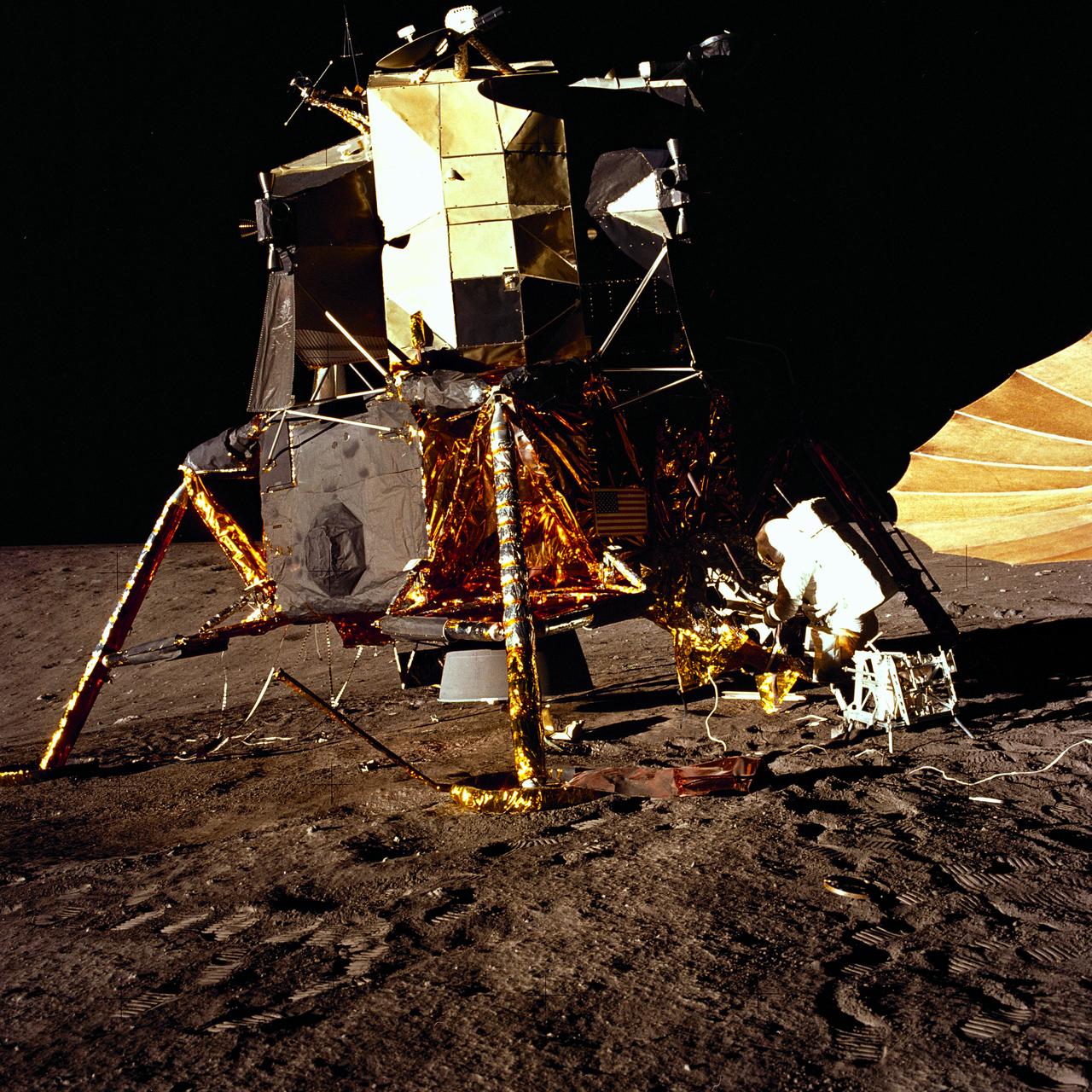
The second manned lunar landing mission, Apollo 12, launched from launch pad 39-A at Kennedy Space Center in Florida on November 14, 1969 via a Saturn V launch vehicle. The Saturn V vehicle was developed by the Marshall Space Flight Center (MSFC) under the direction of Dr. Wernher von Braun. Aboard Apollo 12 was a crew of three astronauts: Alan L. Bean, pilot of the Lunar Module (LM), Intrepid; Richard Gordon, pilot of the Command Module (CM), Yankee Clipper; and Spacecraft Commander Charles Conrad. The LM, Intrepid, landed astronauts Conrad and Bean on the lunar surface in what’s known as the Ocean of Storms while astronaut Richard Gordon piloted the CM, Yankee Clipper, in a parking orbit around the Moon. Lunar soil activities included the deployment of the Apollo Lunar Surface Experiments Package (ALSEP), finding the unmanned Surveyor 3 that landed on the Moon on April 19, 1967, and collecting 75 pounds (34 kilograms) of rock samples. This is the eighth of 25 images captured by the crew in attempt to provide a 360 degree Lunar surface scene. Apollo 12 safely returned to Earth on November 24, 1969.
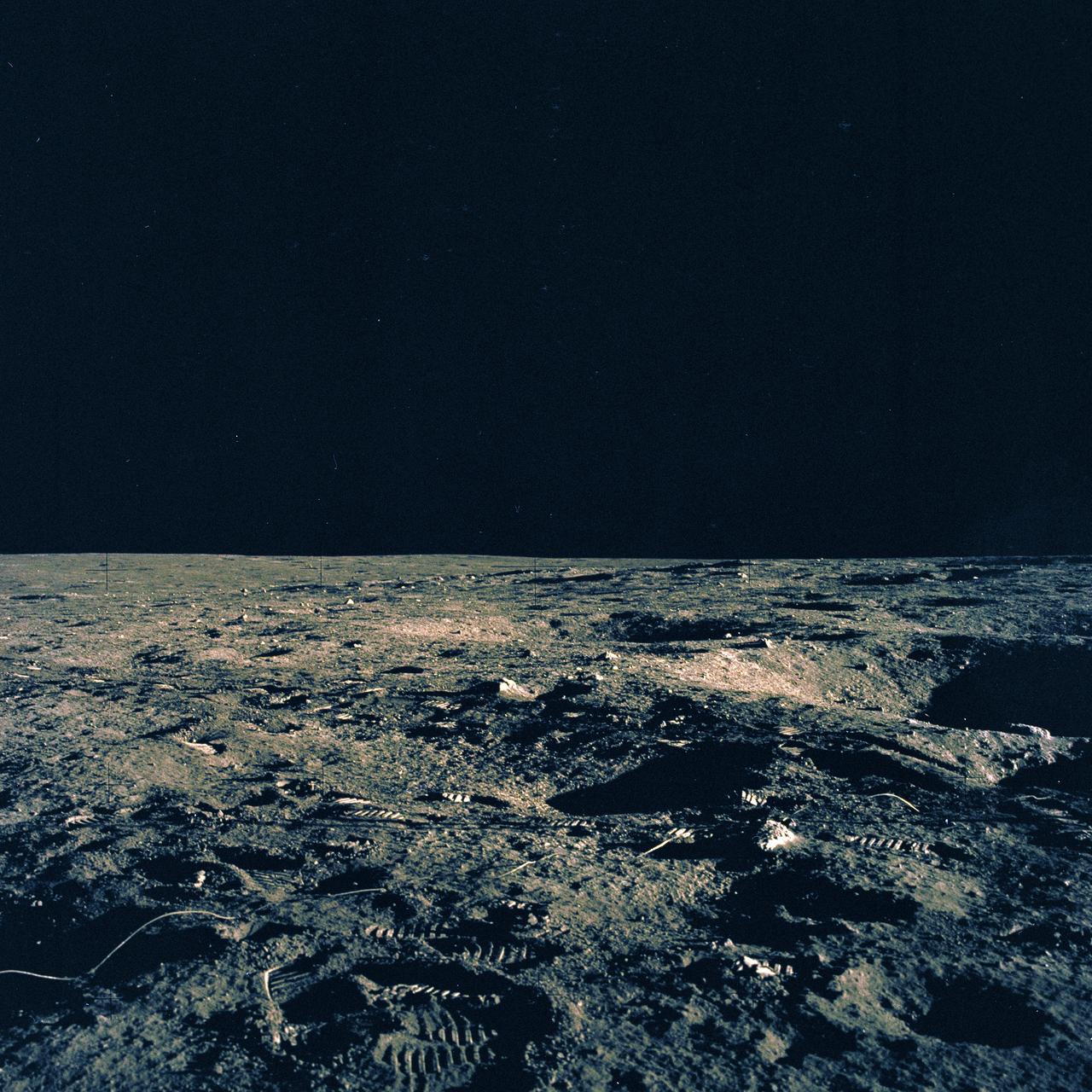
The second manned lunar landing mission, Apollo 12, launched from launch pad 39-A at Kennedy Space Center in Florida on November 14, 1969 via a Saturn V launch vehicle. The Saturn V vehicle was developed by the Marshall Space Flight Center (MSFC) under the direction of Dr. Wernher von Braun. Aboard Apollo 12 was a crew of three astronauts: Alan L. Bean, pilot of the Lunar Module (LM), Intrepid; Richard Gordon, pilot of the Command Module (CM), Yankee Clipper; and Spacecraft Commander Charles Conrad. The LM, Intrepid, landed astronauts Conrad and Bean on the lunar surface in what’s known as the Ocean of Storms while astronaut Richard Gordon piloted the CM, Yankee Clipper, in a parking orbit around the Moon. Lunar soil activities included the deployment of the Apollo Lunar Surface Experiments Package (ALSEP), finding the unmanned Surveyor 3 that landed on the Moon on April 19, 1967, and collecting 75 pounds (34 kilograms) of rock samples. This is the twenty-third of 25 images captured by the crew in attempt to provide a 360 degree Lunar surface scene. Apollo 12 safely returned to Earth on November 24, 1969.
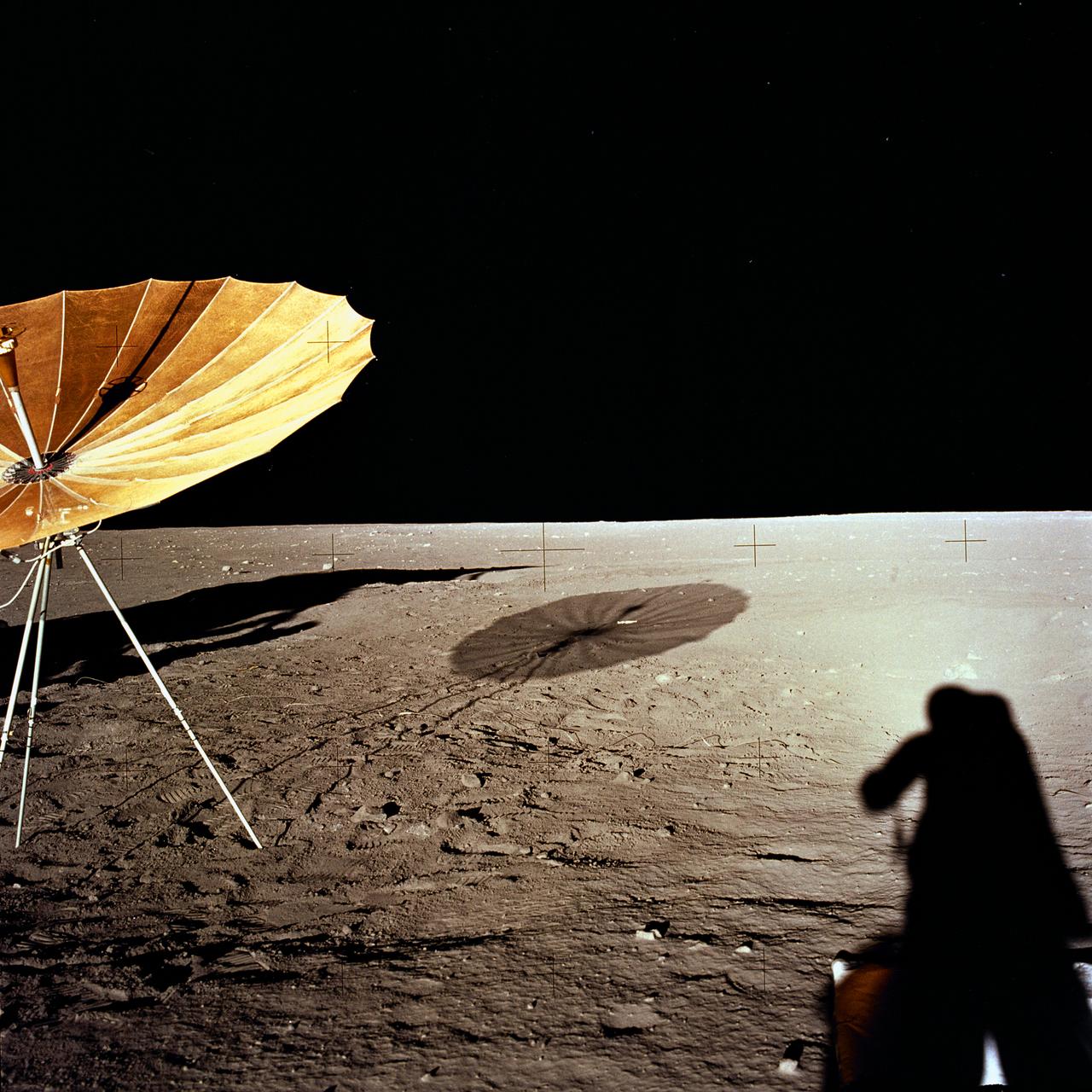
The second manned lunar landing mission, Apollo 12 launched from launch pad 39-A at Kennedy Space Center in Florida on November 14, 1969 via a Saturn V launch vehicle. The Saturn V vehicle was developed by the Marshall Space Flight Center (MSFC) under the direction of Dr. Wernher von Braun. Aboard Apollo 12 was a crew of three astronauts: Alan L. Bean, pilot of the Lunar Module (LM), Intrepid; Richard Gordon, pilot of the Command Module (CM), Yankee Clipper; and Spacecraft Commander Charles Conrad. The LM, Intrepid, landed astronauts Conrad and Bean on the lunar surface in what’s known as the Ocean of Storms while astronaut Richard Gordon piloted the CM, Yankee Clipper, in a parking orbit around the Moon. Lunar soil activities included the deployment of the Apollo Lunar Surface Experiments Package (ALSEP), finding the unmanned Surveyor 3 that landed on the Moon on April 19, 1967, and collecting 75 pounds (34 kilograms) of rock samples. This is the fifth of 25 images captured by the crew in attempt to provide a 360 degree Lunar surface scene. Apollo 12 safely returned to Earth on November 24, 1969.
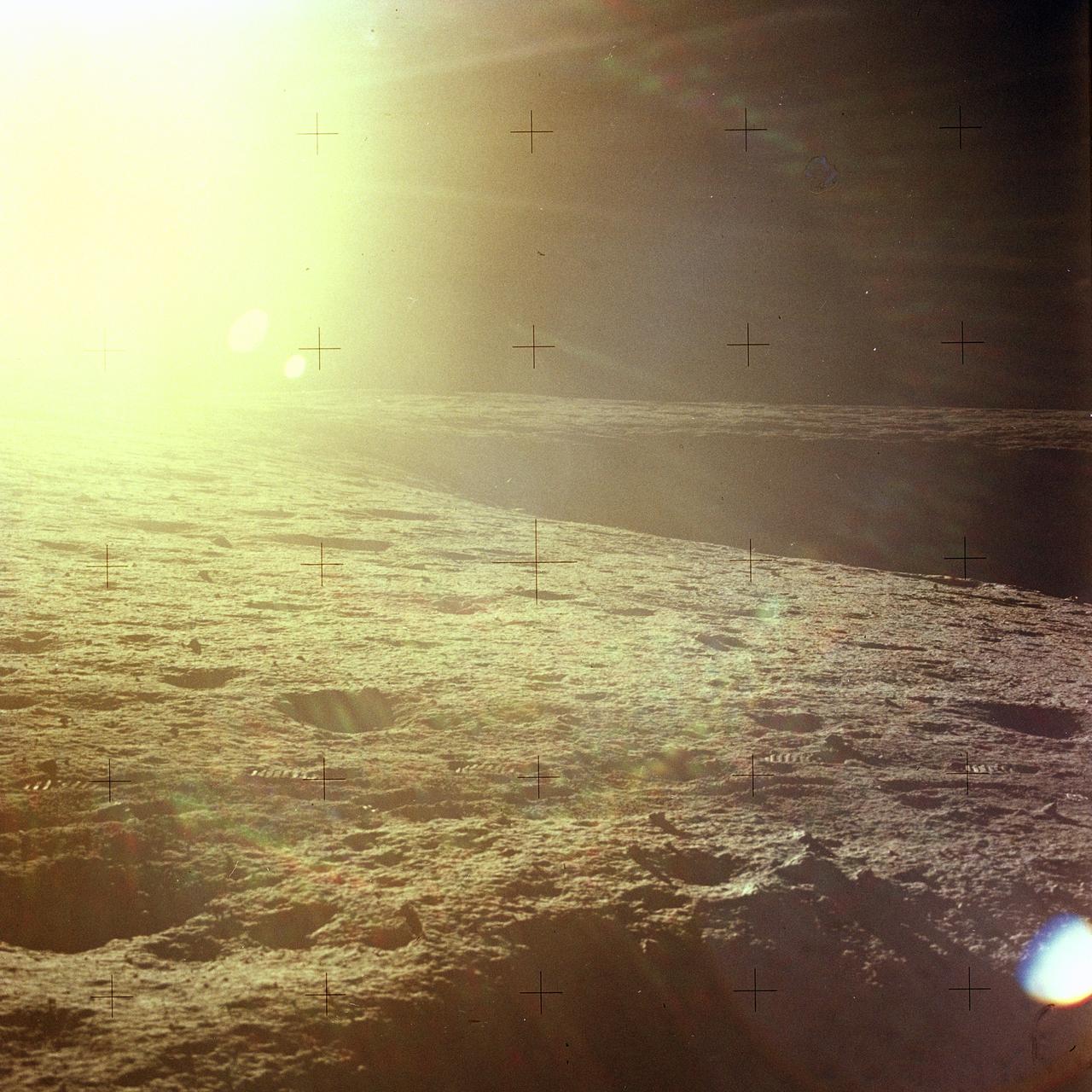
The second manned lunar landing mission, Apollo 12, launched from launch pad 39-A at Kennedy Space Center in Florida on November 14, 1969 via a Saturn V launch vehicle. The Saturn V vehicle was developed by the Marshall Space Flight Center (MSFC) under the direction of Dr. Wernher von Braun. Aboard Apollo 12 was a crew of three astronauts: Alan L. Bean, pilot of the Lunar Module (LM), Intrepid; Richard Gordon, pilot of the Command Module (CM), Yankee Clipper; and Spacecraft Commander Charles Conrad. The LM, Intrepid, landed astronauts Conrad and Bean on the lunar surface in what’s known as the Ocean of Storms while astronaut Richard Gordon piloted the CM, Yankee Clipper, in a parking orbit around the Moon. Lunar soil activities included the deployment of the Apollo Lunar Surface Experiments Package (ALSEP), finding the unmanned Surveyor 3 that landed on the Moon on April 19, 1967, and collecting 75 pounds (34 kilograms) of rock samples. This is the ninth of 25 images captured by the crew in attempt to provide a 360 degree Lunar surface scene. Apollo 12 safely returned to Earth on November 24, 1969.
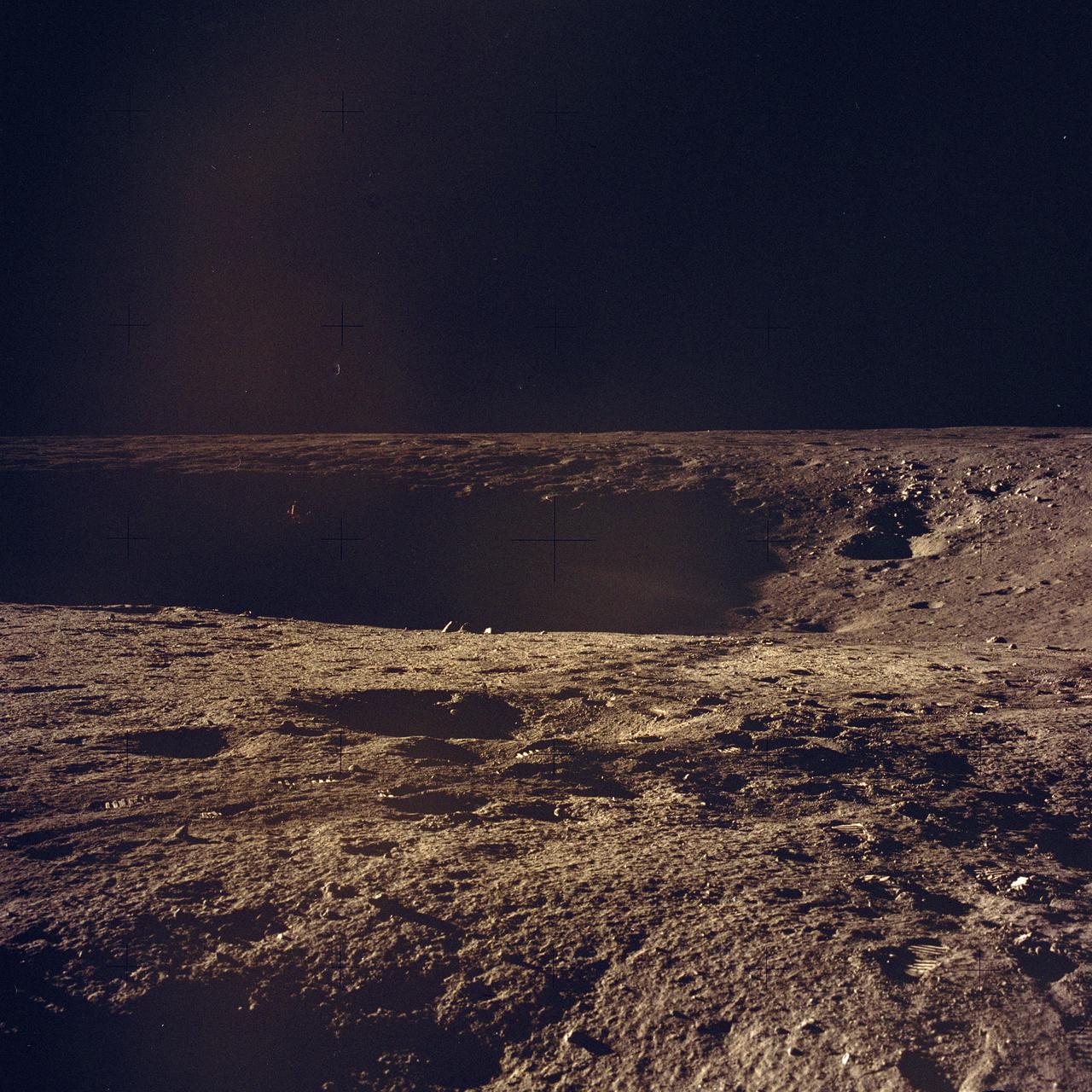
The second manned lunar landing mission, Apollo 12, launched from launch pad 39-A at Kennedy Space Center in Florida on November 14, 1969 via a Saturn V launch vehicle. The Saturn V vehicle was developed by the Marshall Space Flight Center (MSFC) under the direction of Dr. Wernher von Braun. Aboard Apollo 12 was a crew of three astronauts: Alan L. Bean, pilot of the Lunar Module (LM), Intrepid; Richard Gordon, pilot of the Command Module (CM), Yankee Clipper; and Spacecraft Commander Charles Conrad. The LM, Intrepid, landed astronauts Conrad and Bean on the lunar surface in what’s known as the Ocean of Storms while astronaut Richard Gordon piloted the CM, Yankee Clipper, in a parking orbit around the Moon. Lunar soil activities included the deployment of the Apollo Lunar Surface Experiments Package (ALSEP), finding the unmanned Surveyor 3 that landed on the Moon on April 19, 1967, and collecting 75 pounds (34 kilograms) of rock samples. This is the fourteenth of 25 images captured by the crew in attempt to provide a 360 degree Lunar surface scene. Apollo 12 safely returned to Earth on November 24, 1969.
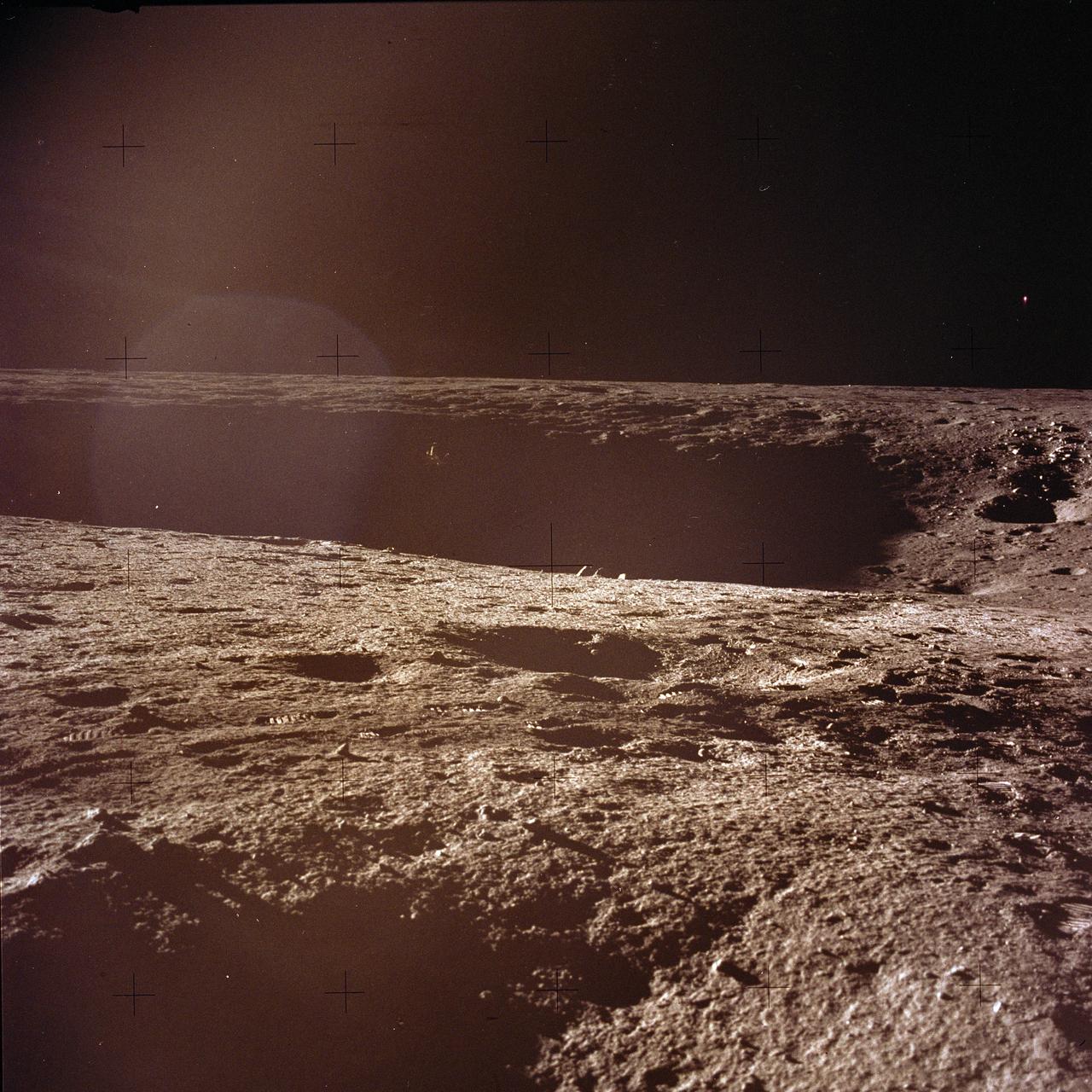
The second manned lunar landing mission, Apollo 12, launched from launch pad 39-A at Kennedy Space Center in Florida on November 14, 1969 via a Saturn V launch vehicle. The Saturn V vehicle was developed by the Marshall Space Flight Center (MSFC) under the direction of Dr. Wernher von Braun. Aboard Apollo 12 was a crew of three astronauts: Alan L. Bean, pilot of the Lunar Module (LM), Intrepid; Richard Gordon, pilot of the Command Module (CM), Yankee Clipper; and Spacecraft Commander Charles Conrad. The LM, Intrepid, landed astronauts Conrad and Bean on the lunar surface in what’s known as the Ocean of Storms while astronaut Richard Gordon piloted the CM, Yankee Clipper, in a parking orbit around the Moon. Lunar soil activities included the deployment of the Apollo Lunar Surface Experiments Package (ALSEP), finding the unmanned Surveyor 3 that landed on the Moon on April 19, 1967, and collecting 75 pounds (34 kilograms) of rock samples. This is the eleventh of 25 images captured by the crew in attempt to provide a 360 degree Lunar surface scene. Apollo 12 safely returned to Earth on November 24, 1969.
The second manned lunar landing mission, Apollo 12, launched from launch pad 39-A at Kennedy Space Center in Florida on November 14, 1969 via a Saturn V launch vehicle. The Saturn V vehicle was developed by the Marshall Space Flight Center (MSFC) under the direction of Dr. Wernher von Braun. Aboard Apollo 12 was a crew of three astronauts: Alan L. Bean, pilot of the Lunar Module (LM), Intrepid; Richard Gordon, pilot of the Command Module (CM), Yankee Clipper; and Spacecraft Commander Charles Conrad. The LM, Intrepid, landed astronauts Conrad and Bean on the lunar surface in what’s known as the Ocean of Storms while astronaut Richard Gordon piloted the CM, Yankee Clipper, in a parking orbit around the Moon. Lunar soil activities included the deployment of the Apollo Lunar Surface Experiments Package (ALSEP), finding the unmanned Surveyor 3 that landed on the Moon on April 19, 1967, and collecting 75 pounds (34 kilograms) of rock samples. This is the twelfth of 25 images captured by the crew in attempt to provide a 360 degree Lunar surface scene. Apollo 12 safely returned to Earth on November 24, 1969.
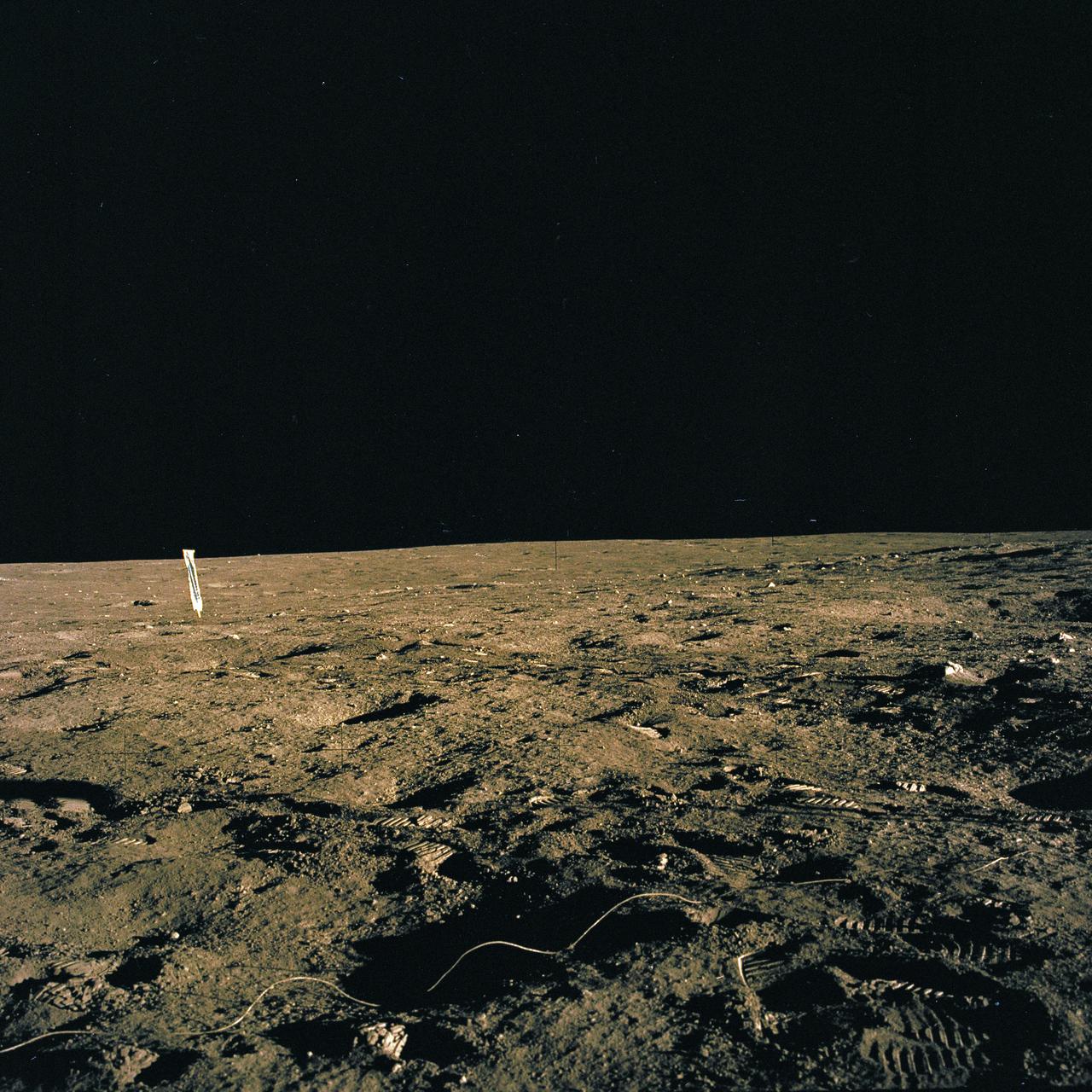
The second manned lunar landing mission, Apollo 12, launched from launch pad 39-A at Kennedy Space Center in Florida on November 14, 1969 via a Saturn V launch vehicle. The Saturn V vehicle was developed by the Marshall Space Flight Center (MSFC) under the direction of Dr. Wernher von Braun. Aboard Apollo 12 was a crew of three astronauts: Alan L. Bean, pilot of the Lunar Module (LM), Intrepid; Richard Gordon, pilot of the Command Module (CM), Yankee Clipper; and Spacecraft Commander Charles Conrad. The LM, Intrepid, landed astronauts Conrad and Bean on the lunar surface in what’s known as the Ocean of Storms while astronaut Richard Gordon piloted the CM, Yankee Clipper, in a parking orbit around the Moon. Lunar soil activities included the deployment of the Apollo Lunar Surface Experiments Package (ALSEP), finding the unmanned Surveyor 3 that landed on the Moon on April 19, 1967, and collecting 75 pounds (34 kilograms) of rock samples. This is the twenty-fourth of 25 images captured by the crew in attempt to provide a 360 degree Lunar surface scene. Apollo 12 safely returned to Earth on November 24, 1969.
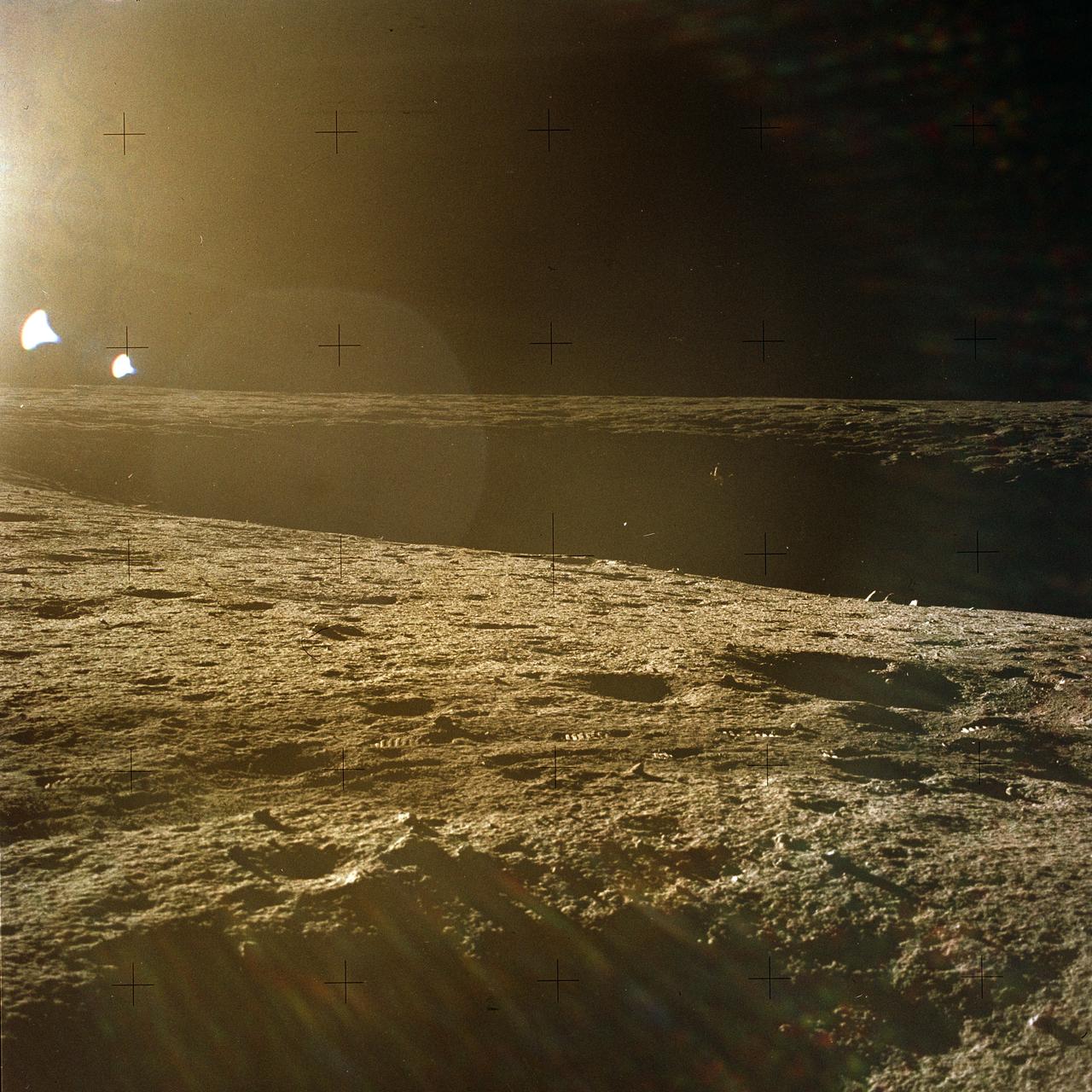
The second manned lunar landing mission, Apollo 12, launched from launch pad 39-A at Kennedy Space Center in Florida on November 14, 1969 via a Saturn V launch vehicle. The Saturn V vehicle was developed by the Marshall Space Flight Center (MSFC) under the direction of Dr. Wernher von Braun. Aboard Apollo 12 was a crew of three astronauts: Alan L. Bean, pilot of the Lunar Module (LM), Intrepid; Richard Gordon, pilot of the Command Module (CM), Yankee Clipper; and Spacecraft Commander Charles Conrad. The LM, Intrepid, landed astronauts Conrad and Bean on the lunar surface in what’s known as the Ocean of Storms while astronaut Richard Gordon piloted the CM, Yankee Clipper, in a parking orbit around the Moon. Lunar soil activities included the deployment of the Apollo Lunar Surface Experiments Package (ALSEP), finding the unmanned Surveyor 3 that landed on the Moon on April 19, 1967, and collecting 75 pounds (34 kilograms) of rock samples. This is the thirteenth of 25 images captured by the crew in attempt to provide a 360 degree Lunar surface scene. Apollo 12 safely returned to Earth on November 24, 1969.
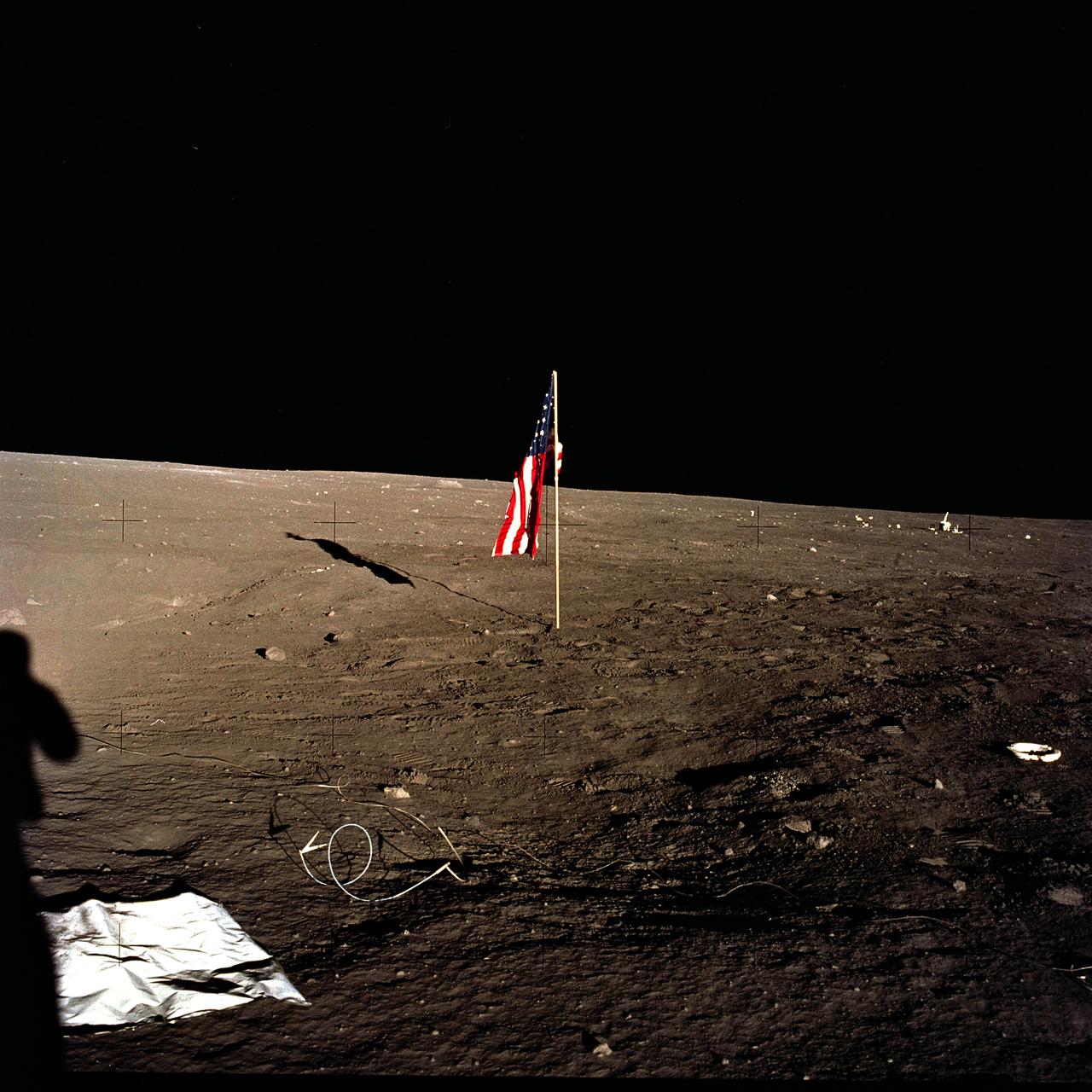
The second manned lunar landing mission, Apollo 12 launched from launch pad 39-A at Kennedy Space Center in Florida on November 14, 1969 via a Saturn V launch vehicle. The Saturn V vehicle was developed by the Marshall Space Flight Center (MSFC) under the direction of Dr. Wernher von Braun. Aboard Apollo 12 was a crew of three astronauts: Alan L. Bean, pilot of the Lunar Module (LM), Intrepid; Richard Gordon, pilot of the Command Module (CM), Yankee Clipper; and Spacecraft Commander Charles Conrad. The LM, Intrepid, landed astronauts Conrad and Bean on the lunar surface in what’s known as the Ocean of Storms while astronaut Richard Gordon piloted the CM, Yankee Clipper, in a parking orbit around the Moon. Lunar soil activities included the deployment of the Apollo Lunar Surface Experiments Package (ALSEP), finding the unmanned Surveyor 3 that landed on the Moon on April 19, 1967, and collecting 75 pounds (34 kilograms) of rock samples. This is the second of 25 images captured by the crew in attempt to provide a 360 degree Lunar surface scene. Apollo 12 safely returned to Earth on November 24, 1969.
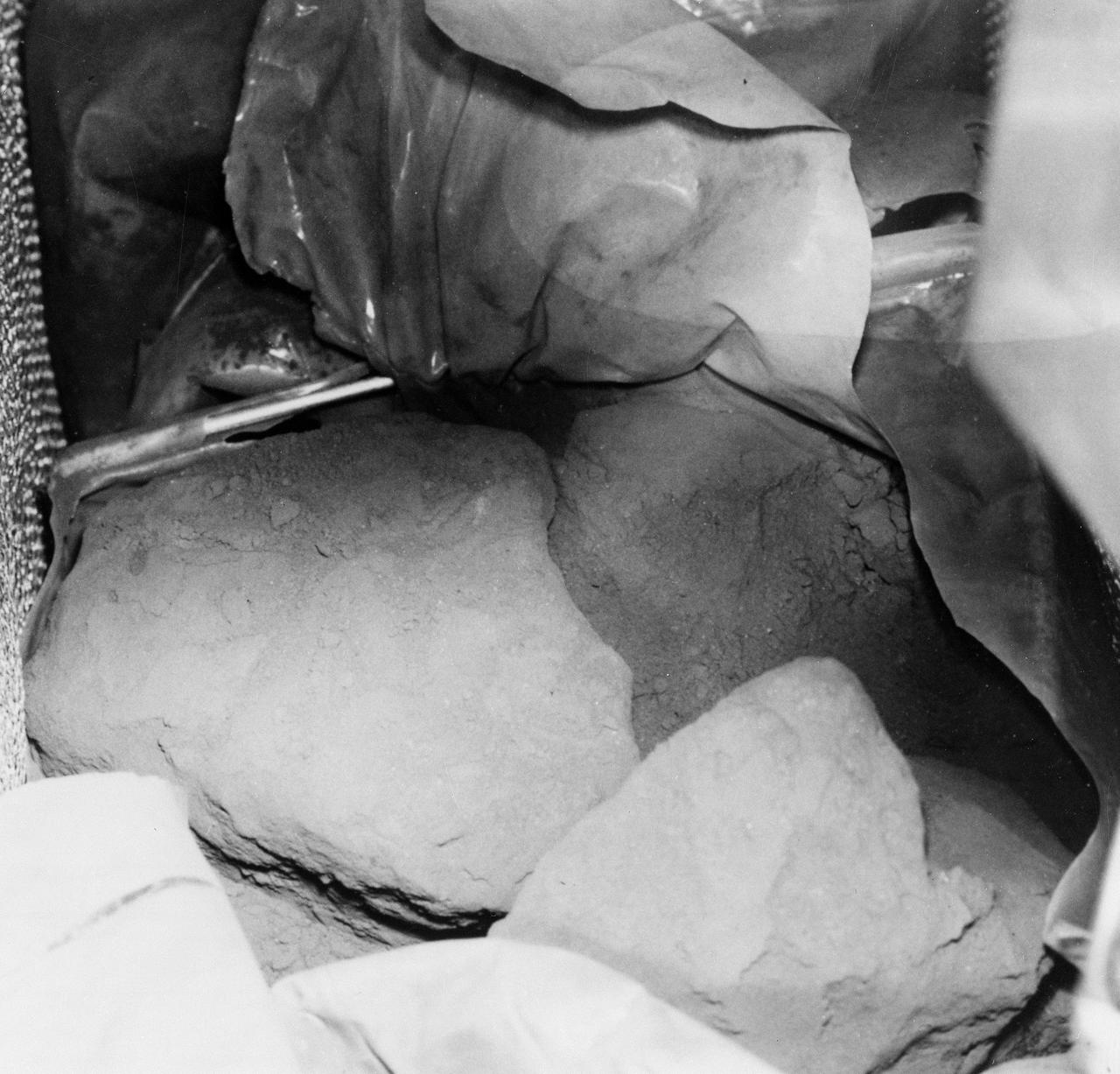
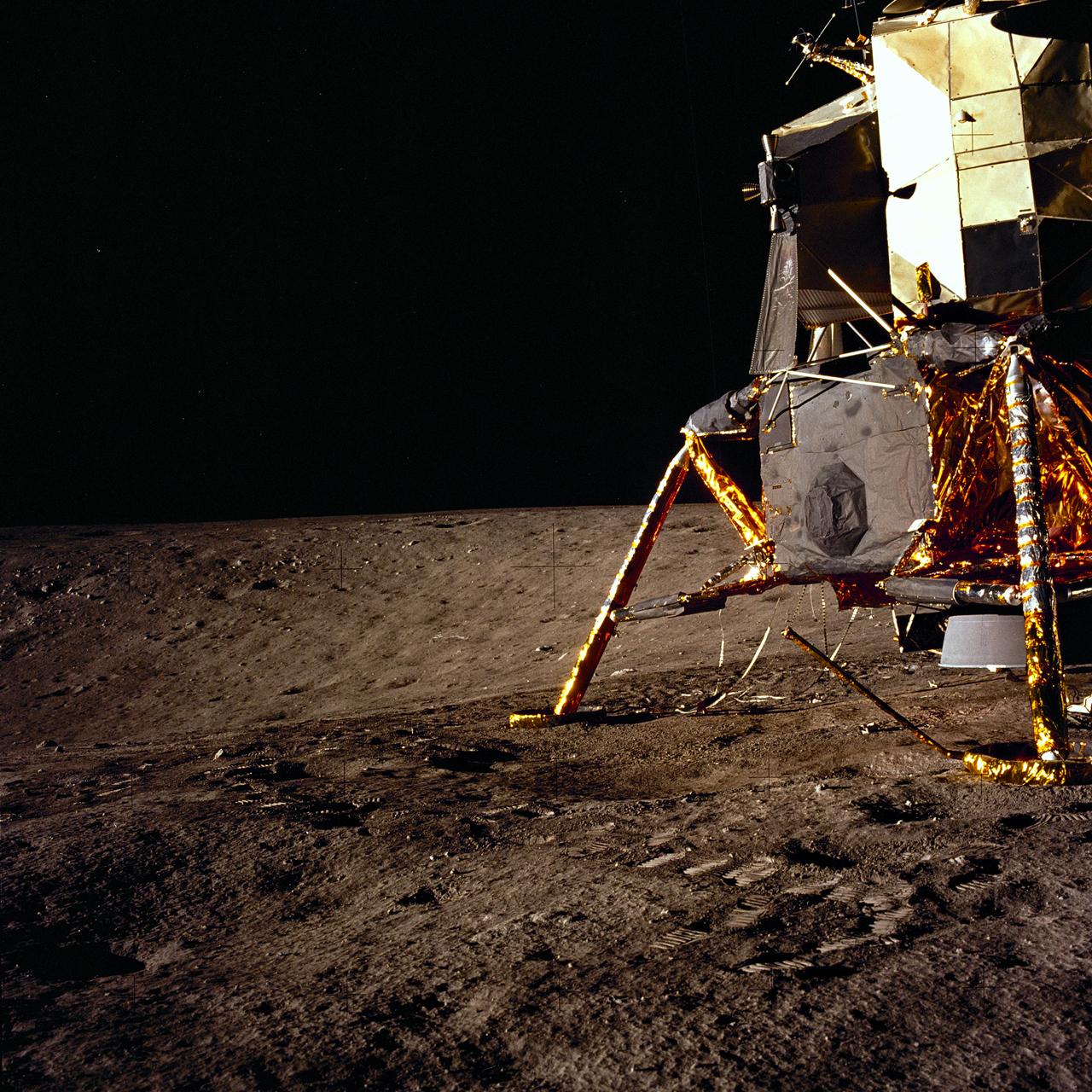
The second manned lunar landing mission, Apollo 12 launched from launch pad 39-A at Kennedy Space Center in Florida on November 14, 1969 via a Saturn V launch vehicle. The Saturn V vehicle was developed by the Marshall Space Flight Center (MSFC) under the direction of Dr. Wernher von Braun. Aboard Apollo 12 was a crew of three astronauts: Alan L. Bean, pilot of the Lunar Module (LM), Intrepid; Richard Gordon, pilot of the Command Module (CM), Yankee Clipper; and Spacecraft Commander Charles Conrad. The LM, Intrepid, landed astronauts Conrad and Bean on the lunar surface in what’s known as the Ocean of Storms while astronaut Richard Gordon piloted the CM, Yankee Clipper, in a parking orbit around the Moon. Lunar soil activities included the deployment of the Apollo Lunar Surface Experiments Package (ALSEP), finding the unmanned Surveyor 3 that landed on the Moon on April 19, 1967, and collecting 75 pounds (34 kilograms) of rock samples, some of which can be seen in this photograph. Apollo 12 safely returned to Earth on November 24, 1969.
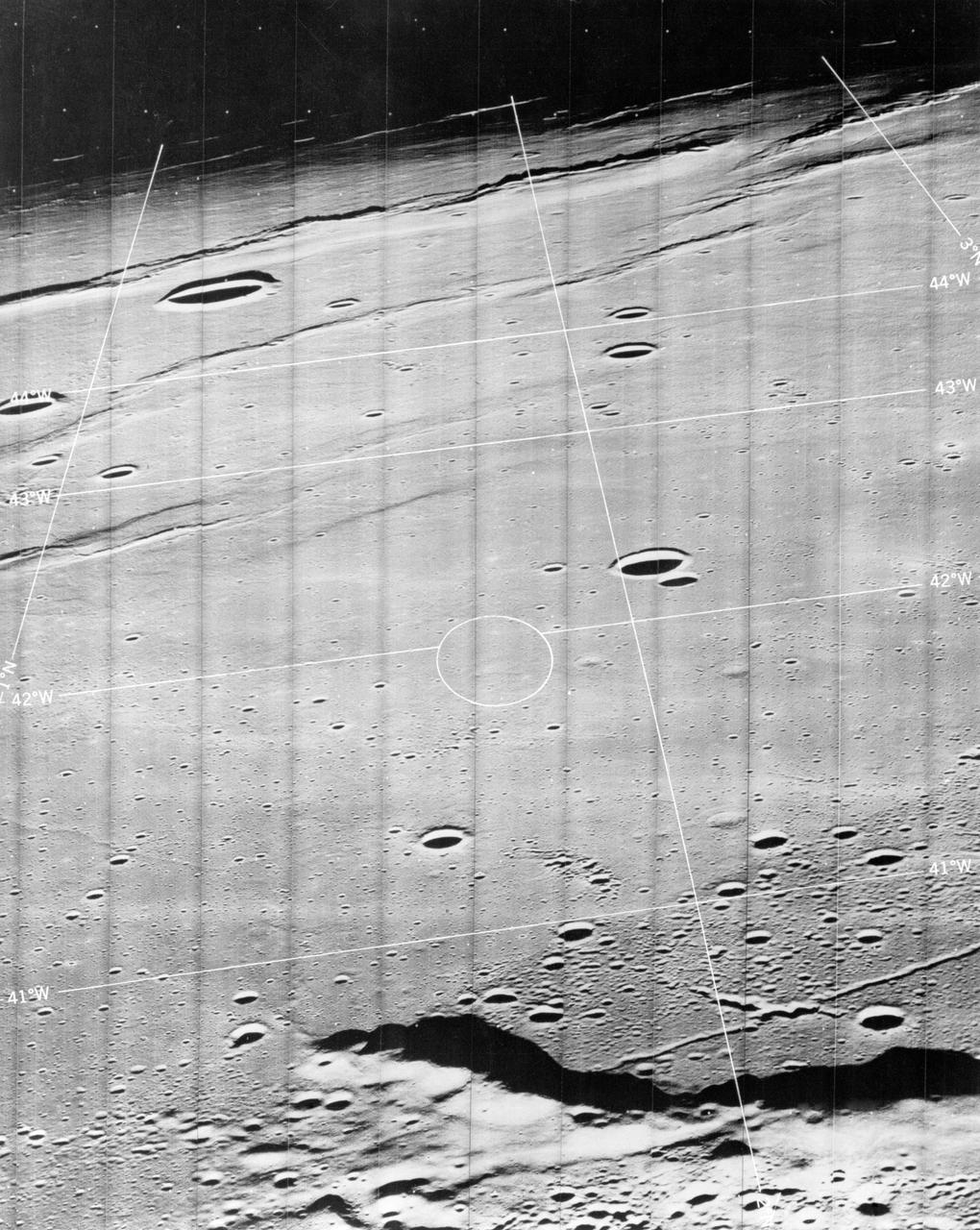
S69-54553 (October 1969) --- If the Apollo 12 launch is postponed until Nov. 16, 1969, the lunar landing will be made in this area in the Sea of Storms. (The prime launch window is Nov. 14, 1969, at 11:22 a.m. (EST), landing at Site 7.) This site (Site 5) is located at 41 degrees 40 minutes west longitude and 1 degree 40 minutes north latitude. This photograph was taken by Lunar Orbiter 3 on Feb. 21, 1967, at an altitude of 32 miles (51.8 kilometers) above the moon. This view is looking west with the sun almost directly behind the spacecraft. These approximates show the landing site as it will look to Apollo astronauts as they approach the site. The actual target site is represented by the ellipse which measures three by five miles. The lines indicate coordinates on the moon near the target site.
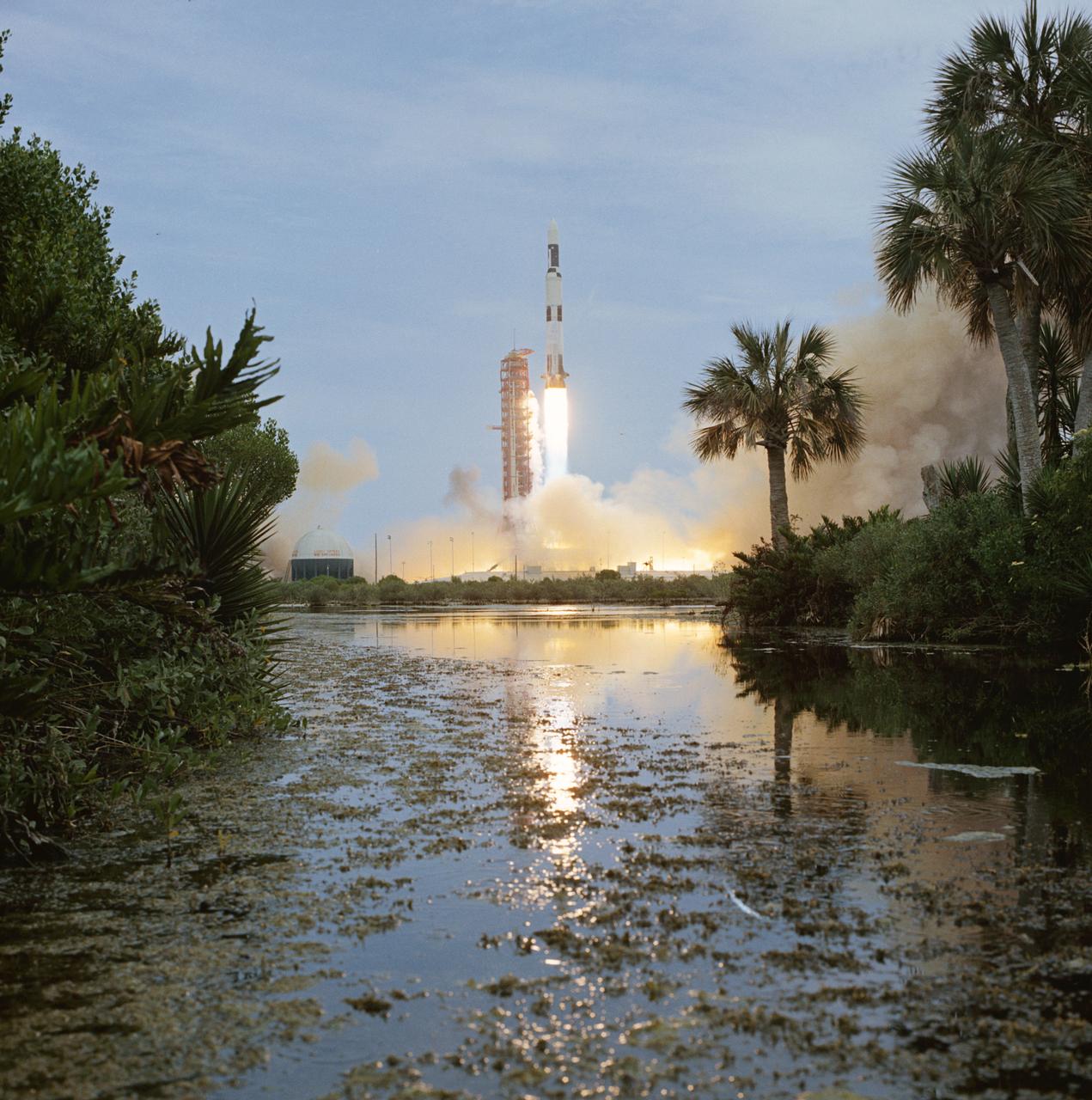
S73-26913 (14 May 1973) --- The unmanned Skylab 1/Saturn V space vehicle is launched from Pad A, Launch Complex 39, Kennedy Space Center, Florida, at 12:00 noon (EDT), May 14, 1973, to place the Skylab space station cluster in Earth orbit. The Skylab 1 payload included four of the five major components of the space station Orbital Workshop, Apollo Telescope Mount, Multiple Docking Adapter, and Airlock Module. In addition to the payload, the Skylab 1/Saturn V second (S-11) stage. The fifth major component of the space station, the Command Service Module with the Skylab 2 crew aboard, was launched at a later date by a Saturn 1B from Pad B. Photo credit: NASA
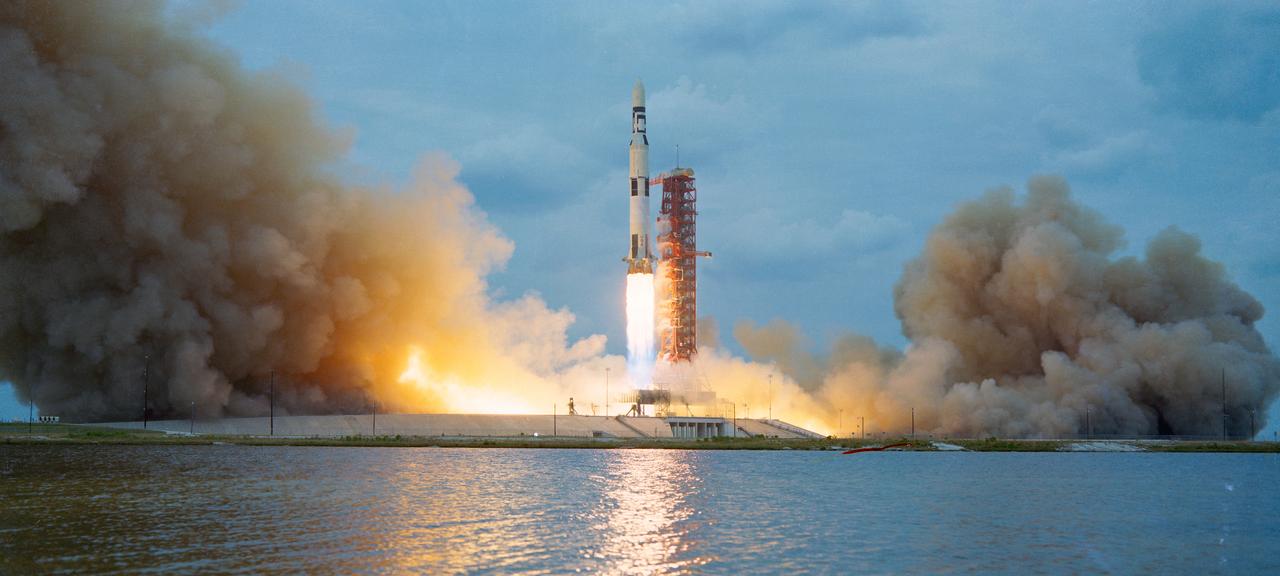
S73-26912 (14 May 1973) --- The unmanned Skylab 1/Saturn V space vehicle is launched from Pad A, Launch Complex 39, Kennedy Space Center, Florida, at 12:00 noon (EDT), May 14, 1973, to place the Skylab space station cluster in Earth orbit. The Skylab 1 payload included four of the five major components of the space station Orbital Workshop, Apollo Telescope Mount, Multiple Docking Adapter, and Airlock Module. In addition to the payload, the Skylab 1/Saturn V second (S-11) stage. The fifth major component of the space station, the Command Service Module with the Skylab 2 crew aboard, was launched at a later date by a Saturn 1B from Pad B. Photo credit: NASA
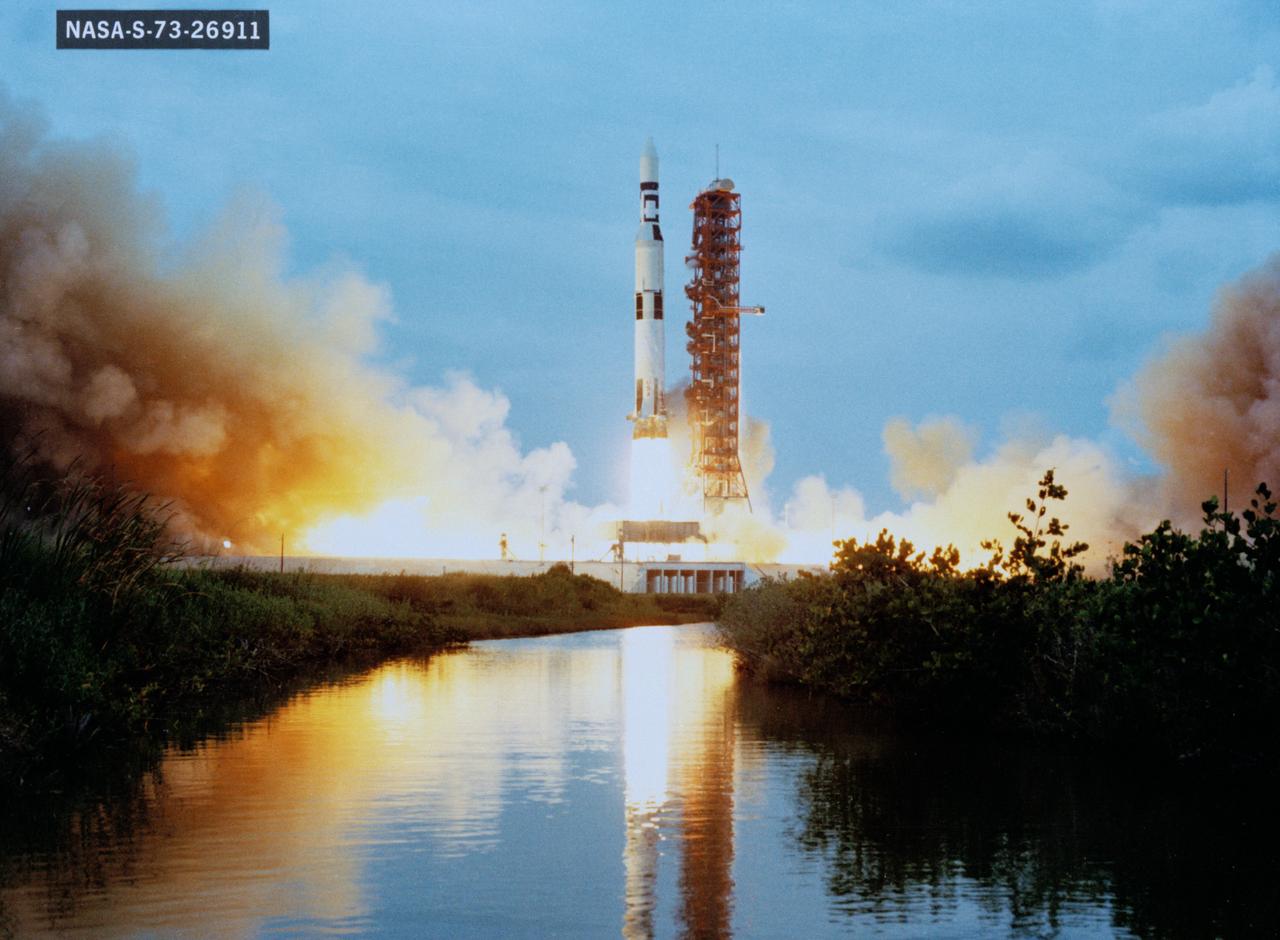
S73-26911 (14 May 1973) --- The unmanned Skylab 1/Saturn V space vehicle is launched from Pad A, Launch Complex 39, Kennedy Space Center, Florida, at 12:00 noon (EDT), May 14, 1973, to place the Skylab space station cluster in Earth orbit. The Skylab 1 payload included four of the five major components of the space station-Orbital Workshop, Apollo Telescope Mount, Multiple Docking Adapter, and Airlock Module. In addition to the payload, the Skylab 1/Saturn V second (S-11) stage. The fifth major component of the space station, the Command Service Module with the Skylab 2 crew aboard, was launched at a later date by a Saturn 1B from Pad B. Photo credit: NASA
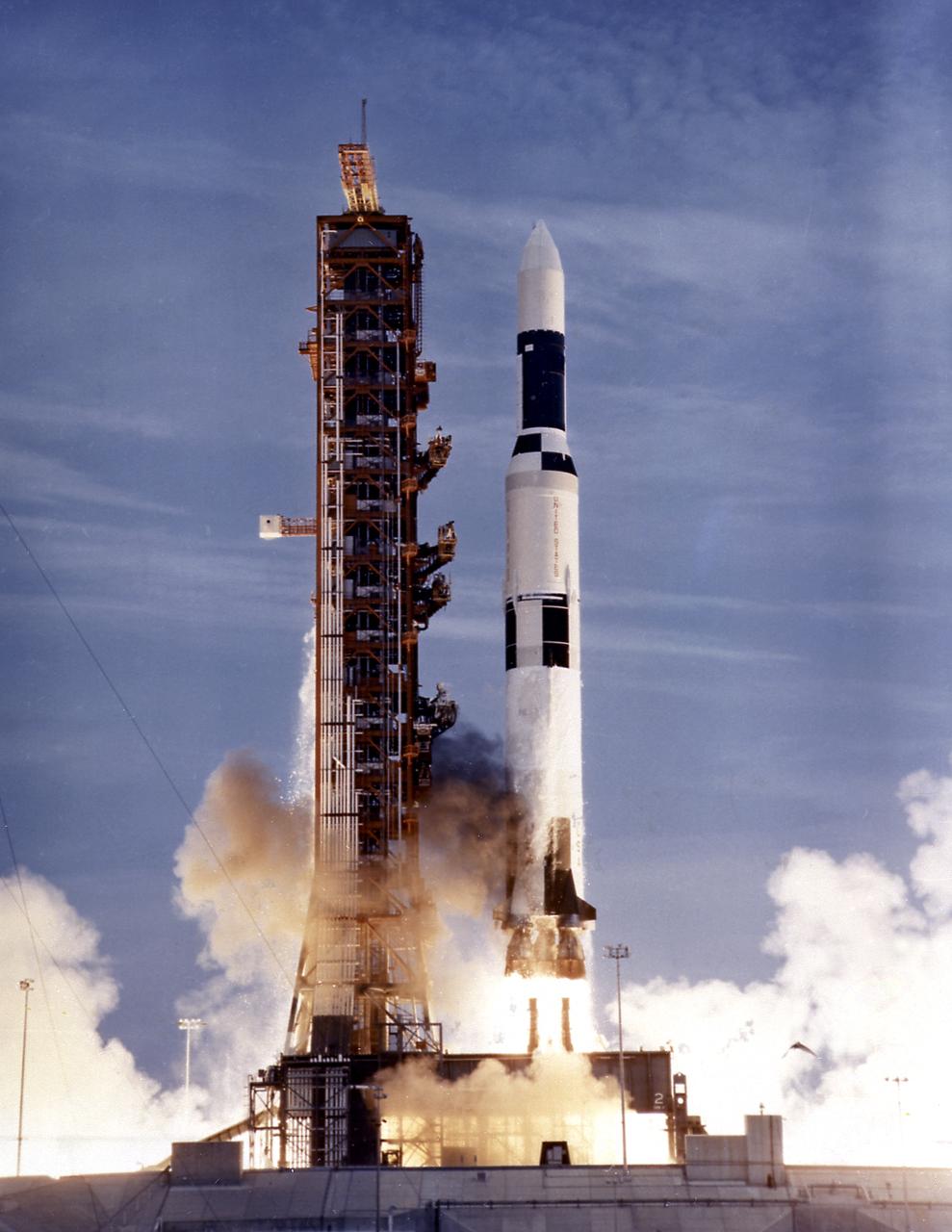
This photograph shows the launch of the SA-513, a modified unmarned two-stage Saturn V vehicle for the Skylab-1 mission, which placed the Skylab cluster into the Earth orbit on May 14, 1973. The initial step in the Skylab mission was the launch of a two-stage Saturn V booster, consisting of the S-IC first stage and the S-II second stage, from Launch Complex 39A at the Kennedy Space Center in Florida. Its payload was the unmanned Skylab, which consisted of the Orbital Workshop, the Airlock Module, the Multiple Docking Adapter, the Apollo Telescope Mount and an Instrument Unit.
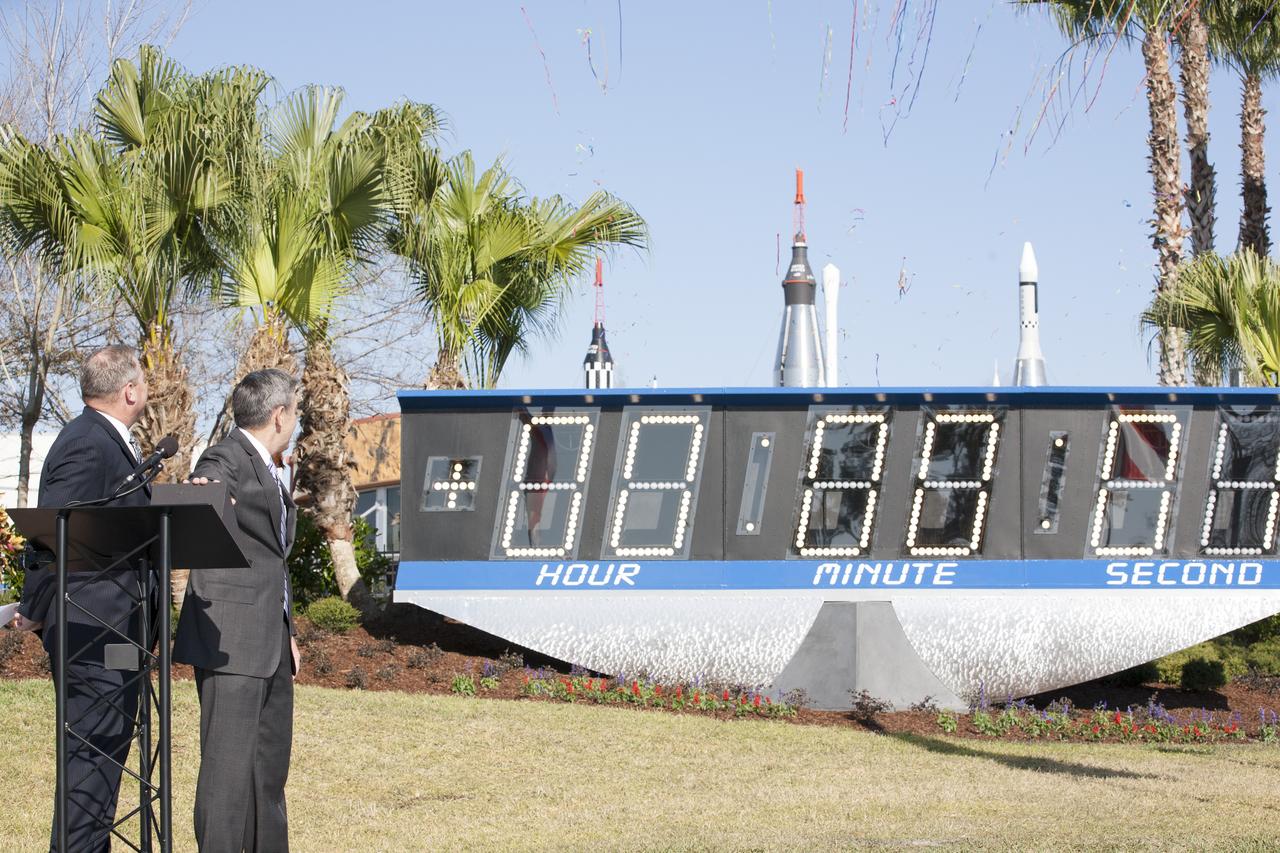
Therrin Protze, chief operating officer of the Kennedy Space Center Visitor Complex, left, and center director Bob Cabana watch as confetti was launched as the spaceport's historic countdown clock is dedicated as the newest display at the entrance to Kennedy's visitor complex. The spaceport's historic countdown clock was used beginning with the launch of Apollo 12 on Nov. 14, 1969. Originally set up at the space center's Press Site, the clock was used through the final space shuttle mission, STS-135, launched on July 8, 2011. The old countdown clock was replaced in 2014 with a modern light emitting diode, or LED, display.
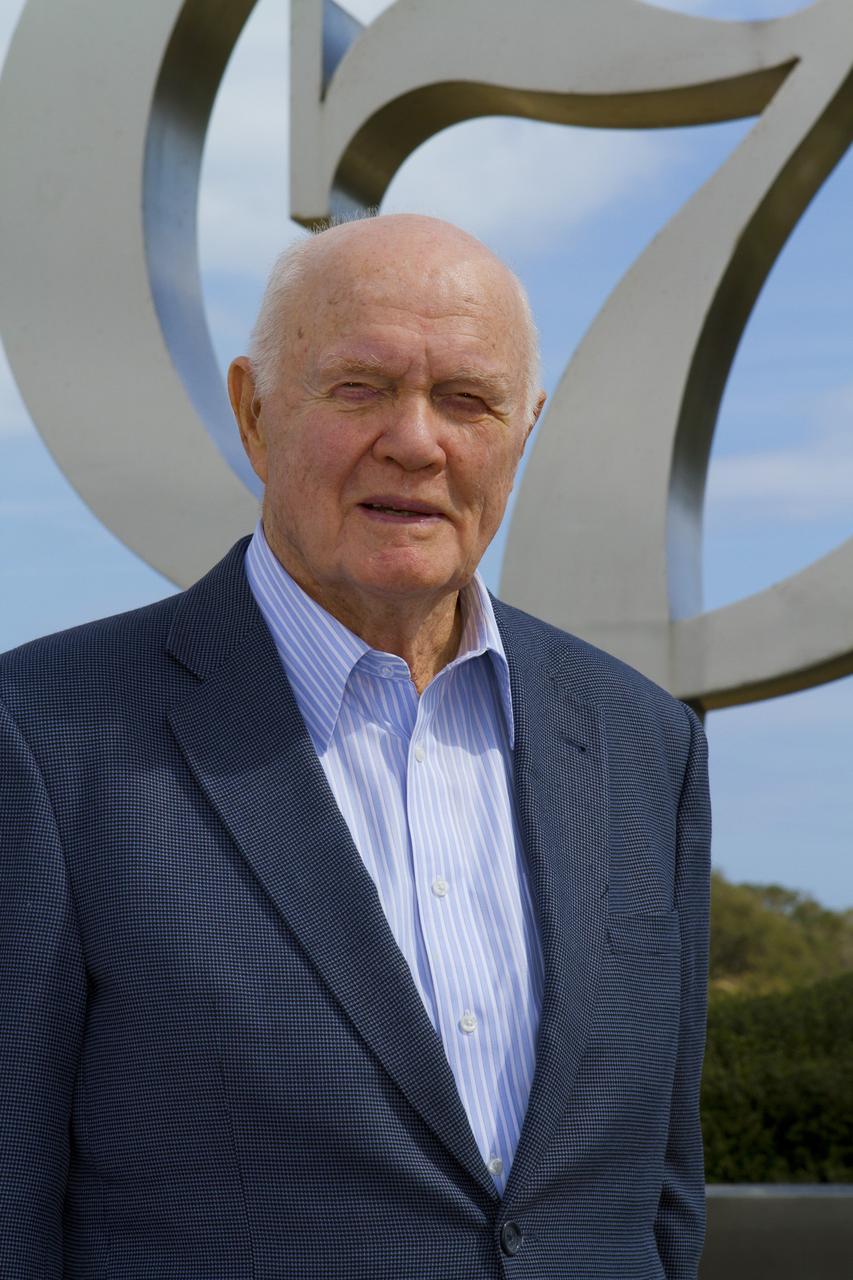
CAPE CANAVERAL, Fla. -- Mercury astronaut John Glenn poses for a photo in front of the Project Mercury monument at Launch Complex-14 LC-14 at Cape Canaveral Air Force Station in Florida. During events at the Cape and NASA's Kennedy Space Center, Glenn is marking the 50th anniversary of being the first American astronaut to orbit the Earth inside the Friendship 7 capsule on Feb. 20, 1962. Glenn's launch aboard an Atlas rocket took with it the hopes of an entire nation and ushered in a new era of space travel that eventually led to Americans walking on the moon by the end of the 1960s. Glenn soon was followed into orbit by Scott Carpenter, Walter Schirra and Gordon Cooper. Their fellow Mercury astronauts Alan Shepard and Virgil "Gus" Grissom flew earlier suborbital flights. Deke Slayton, a member of NASA's original Mercury 7 astronauts, was grounded by a medical condition until the Apollo-Soyuz Test Project in 1975. Photo credit: Kim Shiflett
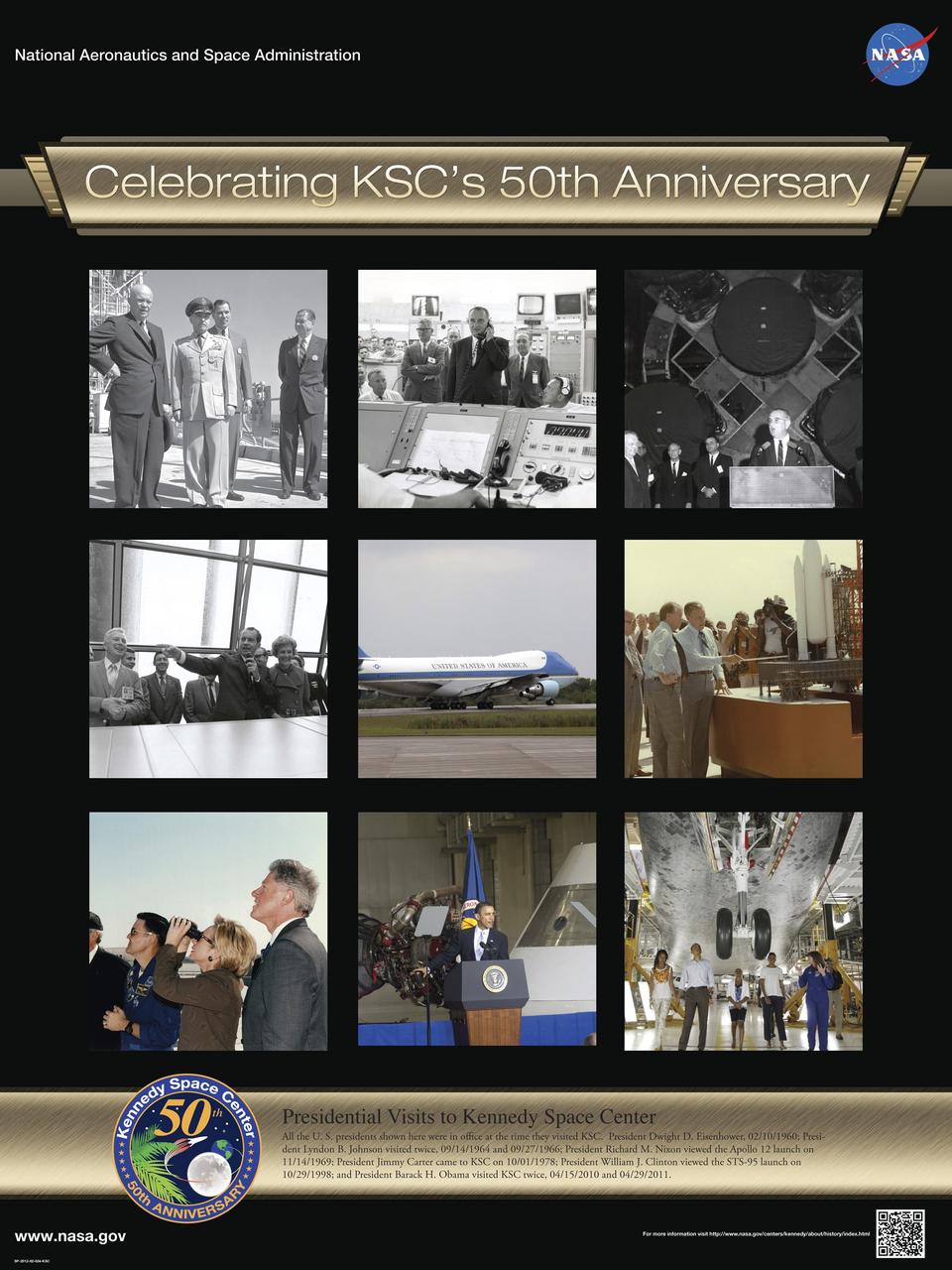
Presidential Visits to Kennedy Space Center: All the U. S. presidents shown here were in office at the time they visited KSC. President Dwight D. Eisenhower, 02/10/1960 President Lyndon B. Johnson visited twice, 09/14/1964 and 09/27/1966 President Richard M. Nixon viewed the Apollo 12 launch on 11/14/1969 President Jimmy Carter came to KSC on 10/01/1978 President William J. Clinton viewed the STS-95 launch on 10/29/1998 and President Barack H. Obama visited KSC twice, 04/15/2010 and 04/29/2011. Poster designed by Kennedy Space Center Graphics Department/Greg Lee. Credit: NASA
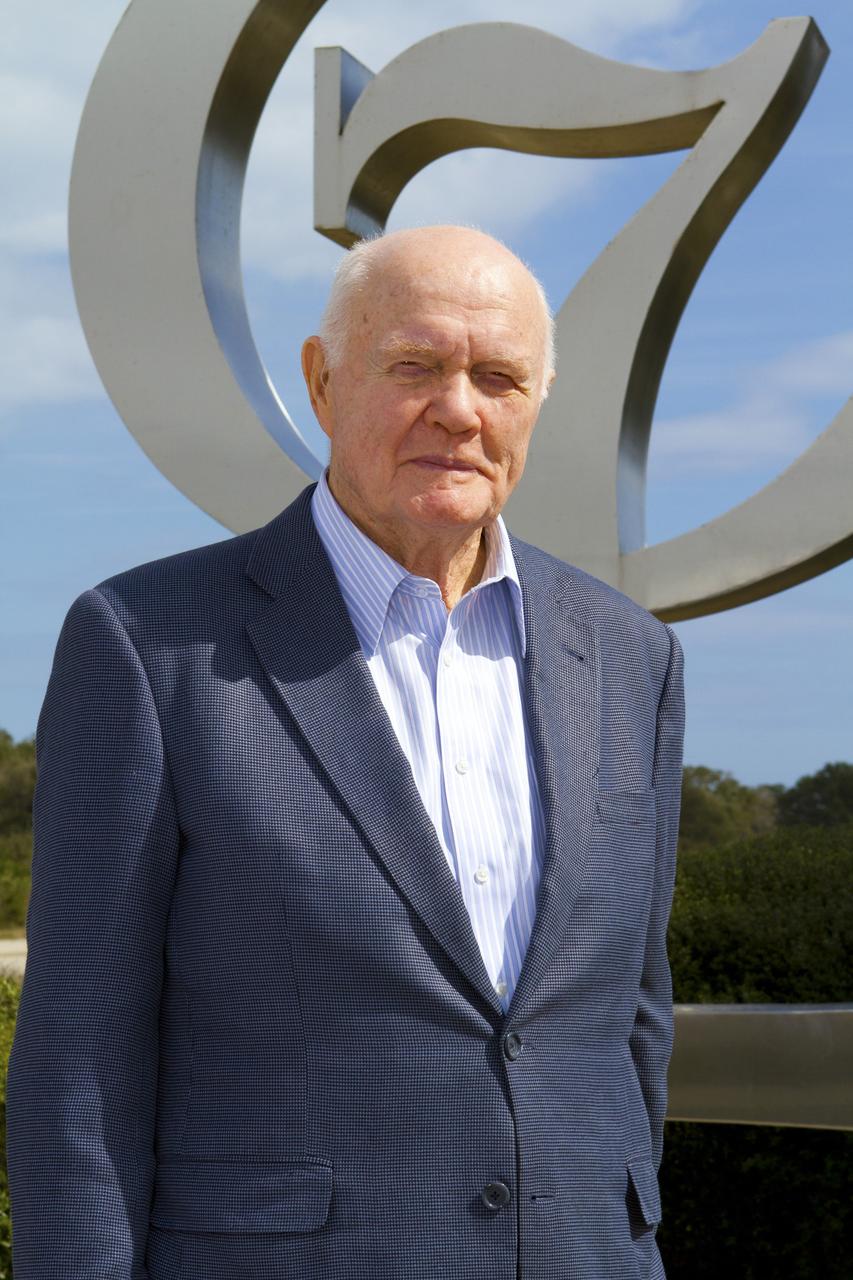
CAPE CANAVERAL, Fla. -- Mercury astronaut John Glenn poses for a photo in front of the Project Mercury monument at Launch Complex-14 LC-14 at Cape Canaveral Air Force Station in Florida. During events at the Cape and NASA's Kennedy Space Center, Glenn is marking the 50th anniversary of being the first American astronaut to orbit the Earth inside the Friendship 7 capsule on Feb. 20, 1962. Glenn's launch aboard an Atlas rocket took with it the hopes of an entire nation and ushered in a new era of space travel that eventually led to Americans walking on the moon by the end of the 1960s. Glenn soon was followed into orbit by Scott Carpenter, Walter Schirra and Gordon Cooper. Their fellow Mercury astronauts Alan Shepard and Virgil "Gus" Grissom flew earlier suborbital flights. Deke Slayton, a member of NASA's original Mercury 7 astronauts, was grounded by a medical condition until the Apollo-Soyuz Test Project in 1975. Photo credit: Kim Shiflett
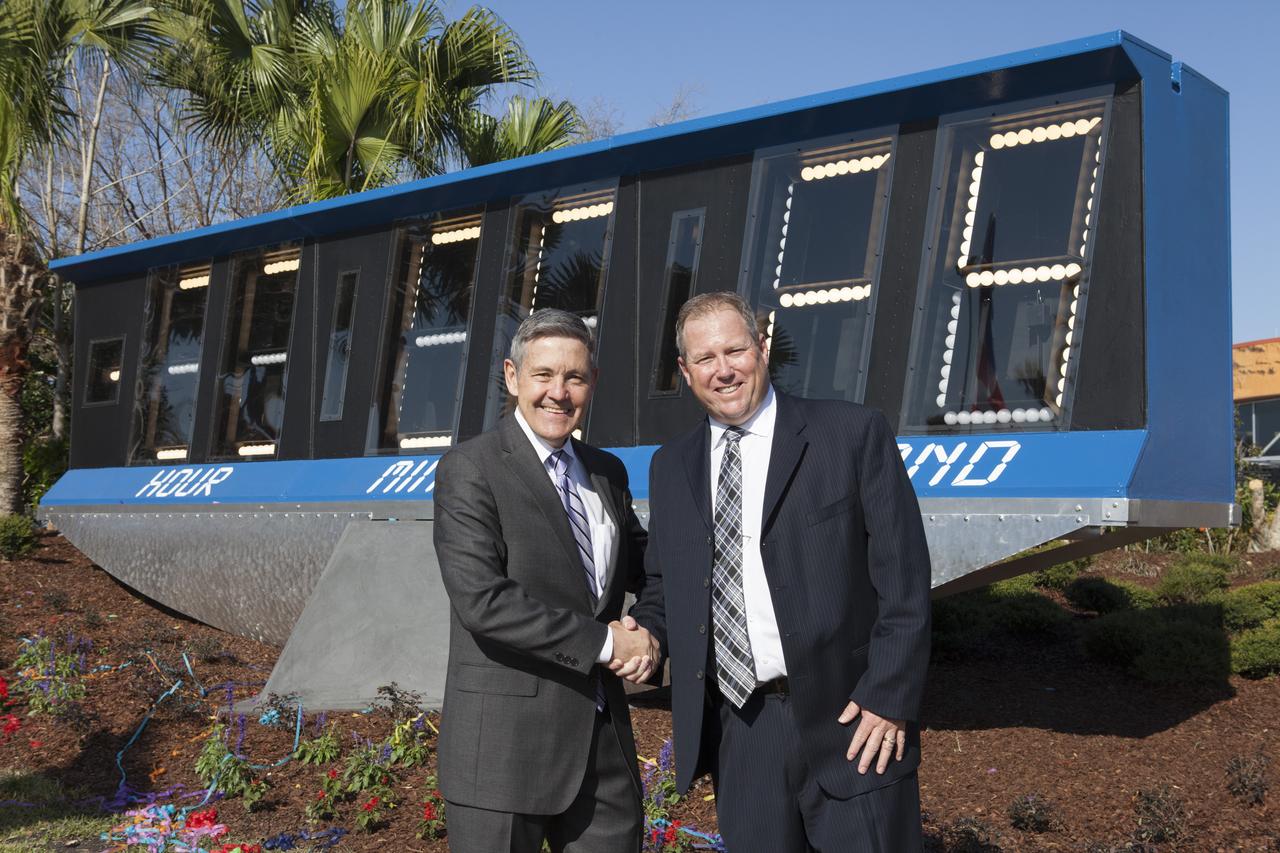
Kennedy Space Center Director Bob Cabana, left, and Therrin Protze, chief operating officer of Kennedy's Visitor Complex, celebrate the dedication of the spaceport's historic countdown clock as the newest display at the center's visitor complex. Now located at the entrance to the visitor complex, the spaceport's historic countdown clock was used starting with the launch of Apollo 12 on Nov. 14, 1969. Originally set up at the space center's Press Site, the clock operated through the final space shuttle mission, STS-135, launched on July 8, 2011. The old countdown clock was replaced in 2014 with a modern light emitting diode, or LED, display.
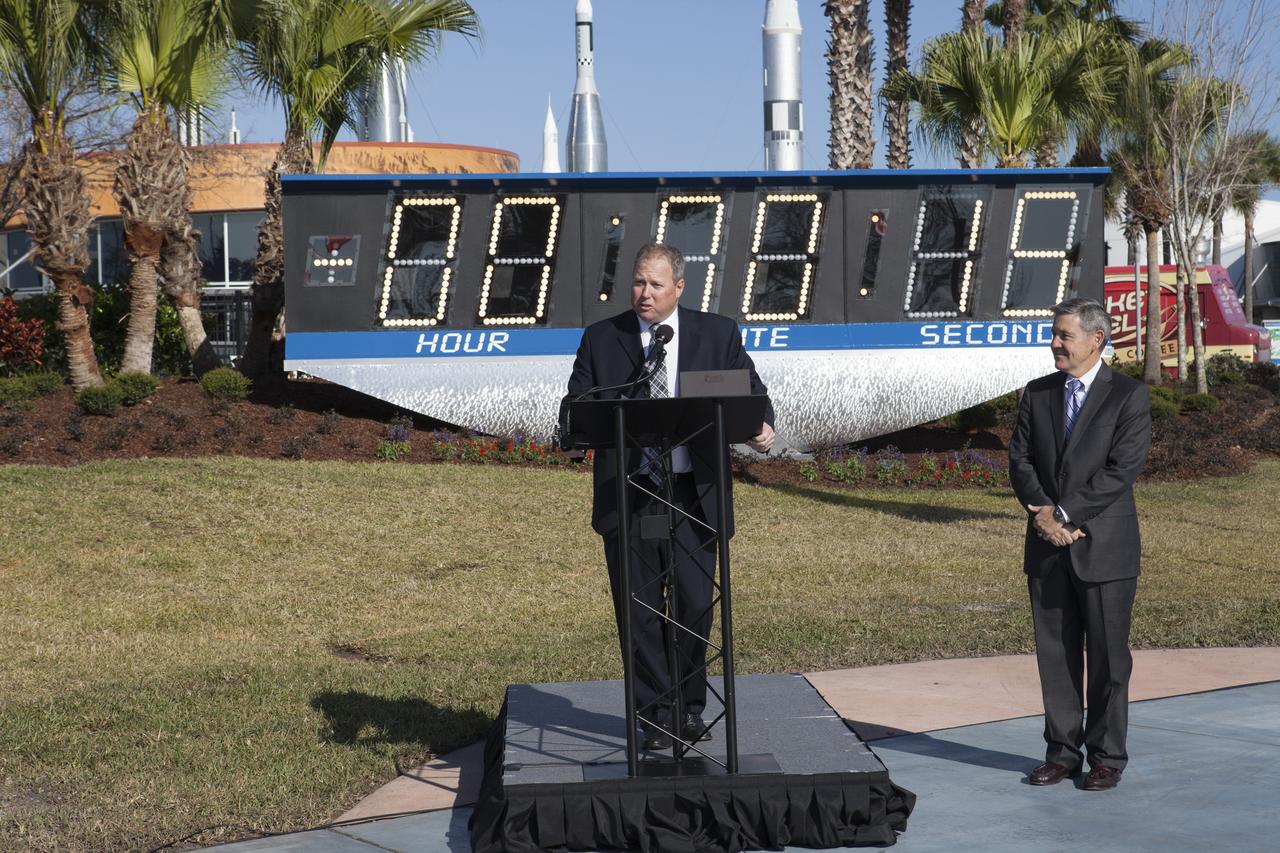
Therrin Protze, chief operating officer of the Kennedy Space Center Visitor Complex, speaks at the dedication of the center's historic countdown clock. To the right is space center director Bob Cabana. Now located at the entrance to the visitor complex, the spaceport's historic countdown clock was used starting with the launch of Apollo 12 on Nov. 14, 1969. Originally set up at the space center's Press Site, the clock was used through the final space shuttle mission, STS-135, launched on July 8, 2011. The old countdown clock was replaced in 2014 with a modern light emitting diode, or LED, display.
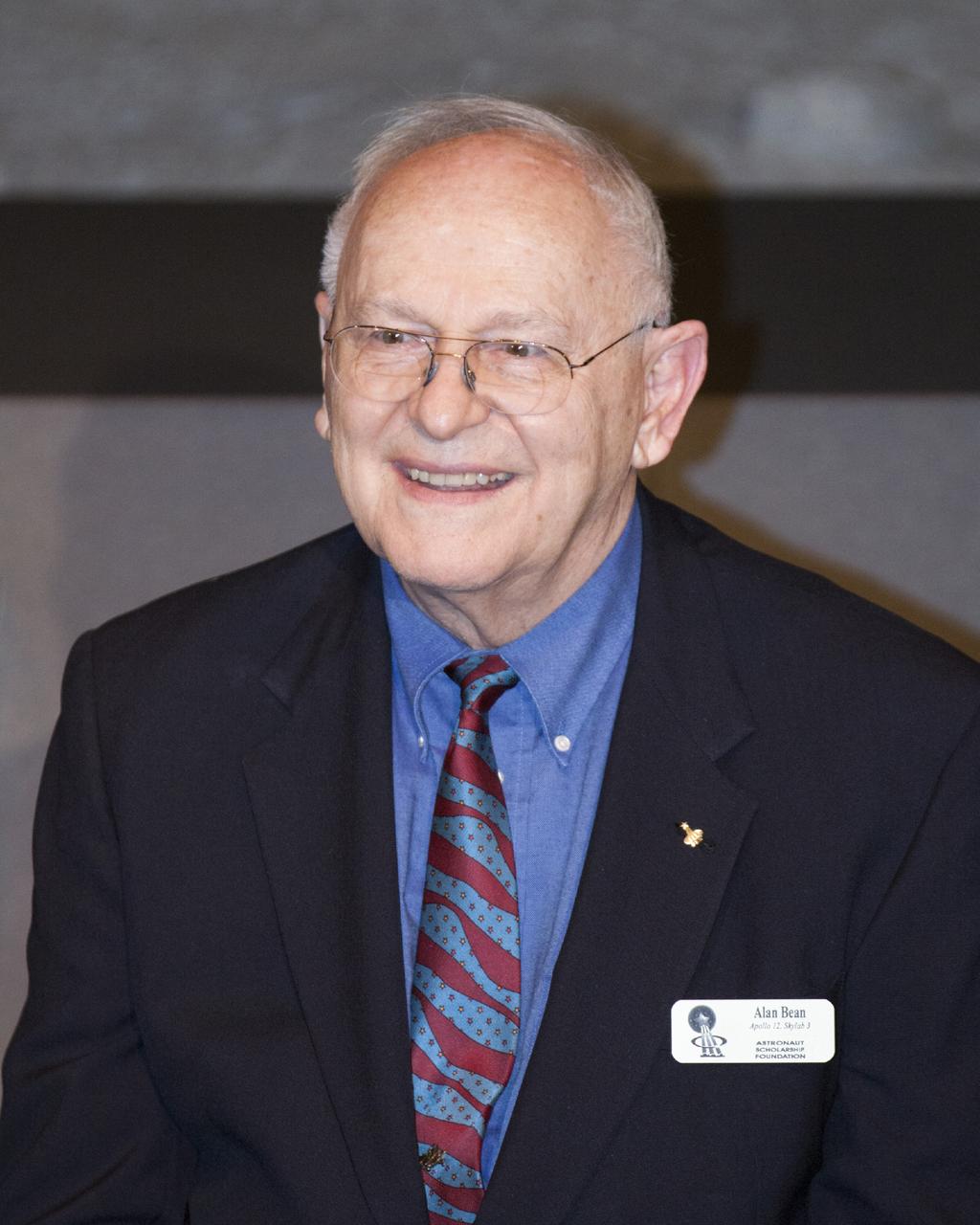
CAPE CANAVERAL, Fla. – At the Kennedy Space Center's Apollo/Saturn V Center, former NASA astronaut Alan Bean speaks to guests at the Astronaut Scholarship Foundation's event celebrating the 40th anniversary of Skylab. Bean served as commander of Skylab 3, the second piloted mission to the space station. In 1969, Bean was lunar module pilot on Apollo 12, the second mission to land on the moon. The gala commemorating the 40th anniversary of Skylab included six of the nine astronauts who flew missions to America's first space station. The orbiting laboratory was launched unpiloted from Kennedy on May 14, 1973. Between May 25, 1973 and Feb. 8, 1974, crews of three spent 28, 59 and 84 days living and working in low-Earth orbit aboard the station. For more information, visit http://www.nasa.gov/mission_pages/skylab/ Photo credit: NASA/Kim Shiflett
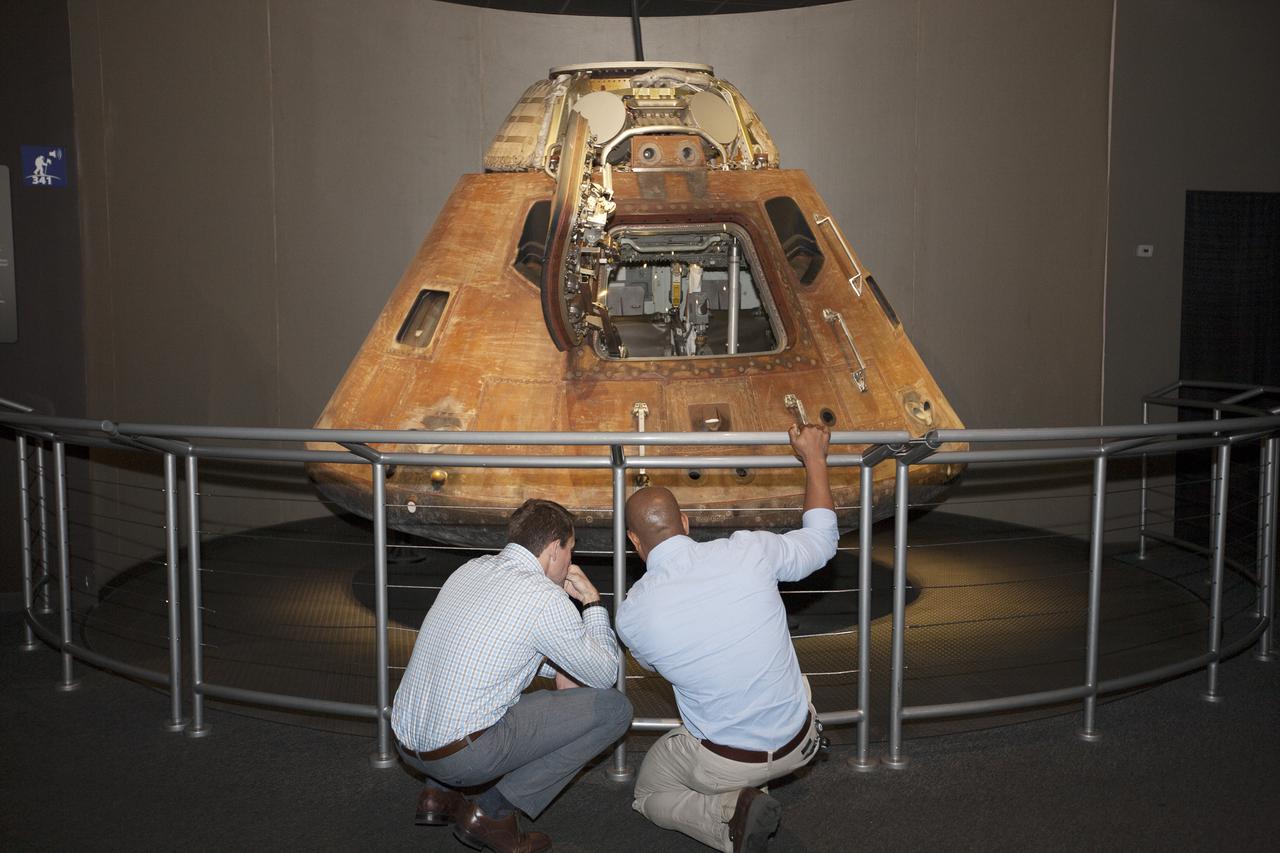
CAPE CANAVERAL, Fla. – NASA astronaut candidates Josh Cassada, left, and Victor Glover observe the Apollo 14 command module which carried astronauts Alan Shepard, Stu Roosa and Edgar Mitchell on their lunar landing mission in 1971.The astronauts toured the Apollo Saturn V Center at Kennedy Space Center in Florida during a daylong set of briefings and tours of different facilities at NASA's primary launch center. The astronaut class of 2013 was selected by NASA after an extensive year-and-a-half search. The new group will help the agency push the boundaries of exploration and travel to new destinations in the solar system. To learn more about the astronaut class of 2013, visit: http:__www.nasa.gov_astronauts_2013astroclass.html Photo credit: NASA_Kim Shiflett
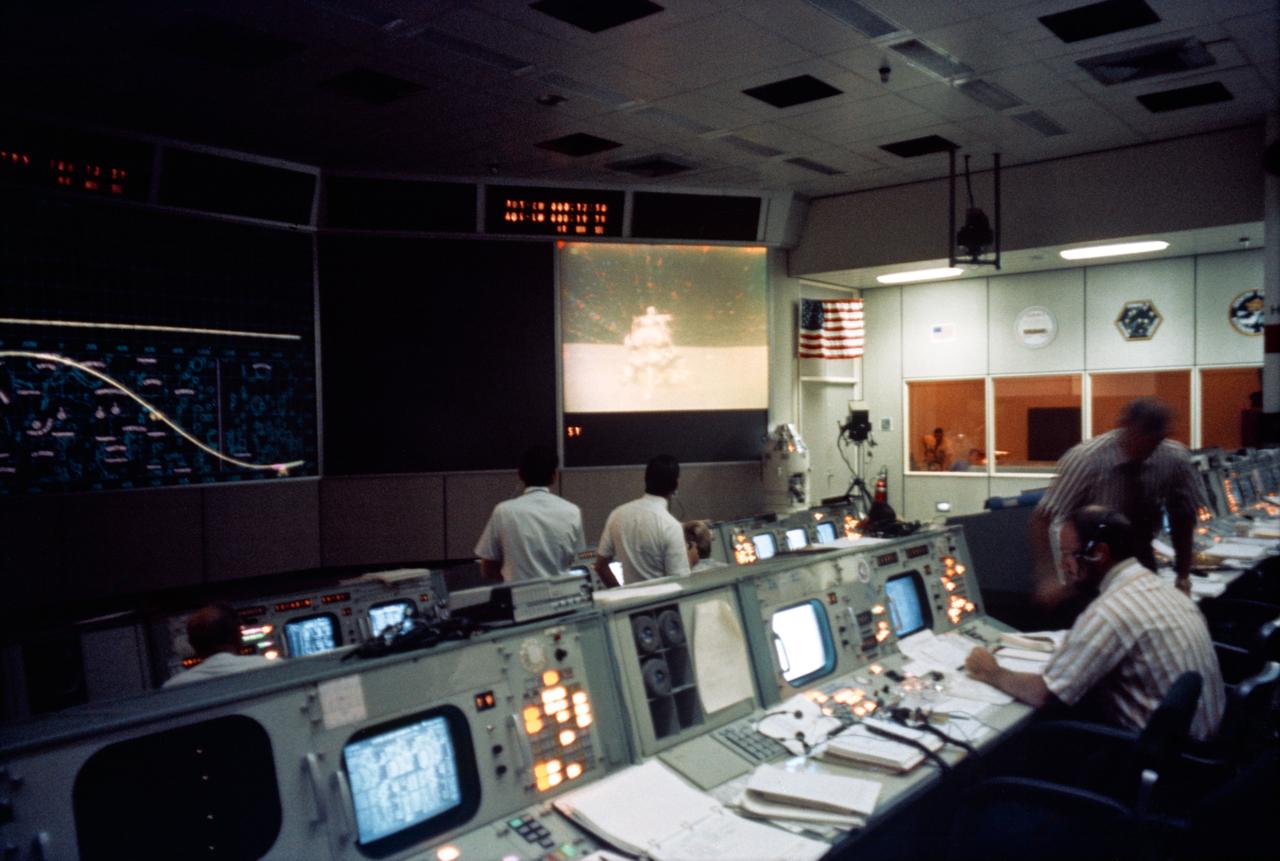
S71-41759 (2 Aug. 1971) --- A partial view of activity in the Mission Operations Control Room in the Mission Control Center during the liftoff of the Apollo 15 Lunar Module "Falcon" ascent stage from the lunar surface. An RCA color television camera mounted on the Lunar Roving Vehicle made it possible for people on Earth to watch the LM's spectacular launch from the moon. The LM liftoff was at 171:37 ground elapsed time. The LRV was parked about 300 feet east of the LM. The TV camera was remotely controlled from a console in the MOCR. Seated in the right foreground is astronaut Edgar D. Mitchell, a spacecraft communicator. Mitchell was lunar module pilot of the Apollo 14 lunar landing mission. Note liftoff on the television monitor in the center background.
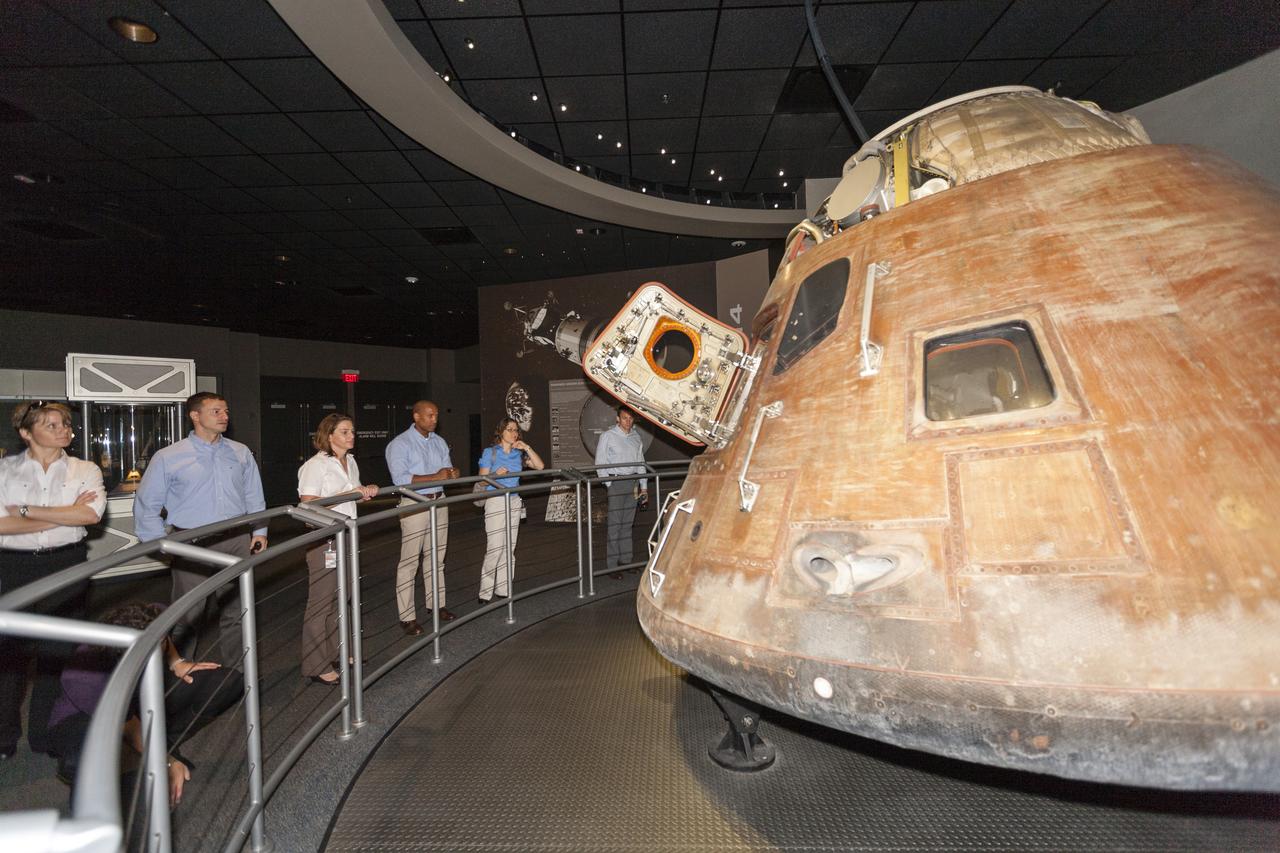
CAPE CANAVERAL, Fla. – NASA astronaut candidates Anne McClain, from left, Andrew Morgan, Nicole Mann, Victor Glover, Christina Hammock and Josh Cassada observe the Apollo 14 command module which carried astronauts Alan Shepard, Stu Roosa and Edgar Mitchell on their lunar landing mission in 1971.The astronauts toured the Apollo Saturn V Center at Kennedy Space Center in Florida during a daylong set of briefings and tours of different facilities at NASA's primary launch center. The astronaut class of 2013 was selected by NASA after an extensive year-and-a-half search. The new group will help the agency push the boundaries of exploration and travel to new destinations in the solar system. To learn more about the astronaut class of 2013, visit: http://www.nasa.gov/astronauts/2013astroclass.html Photo credit: NASA/Kim Shiflett
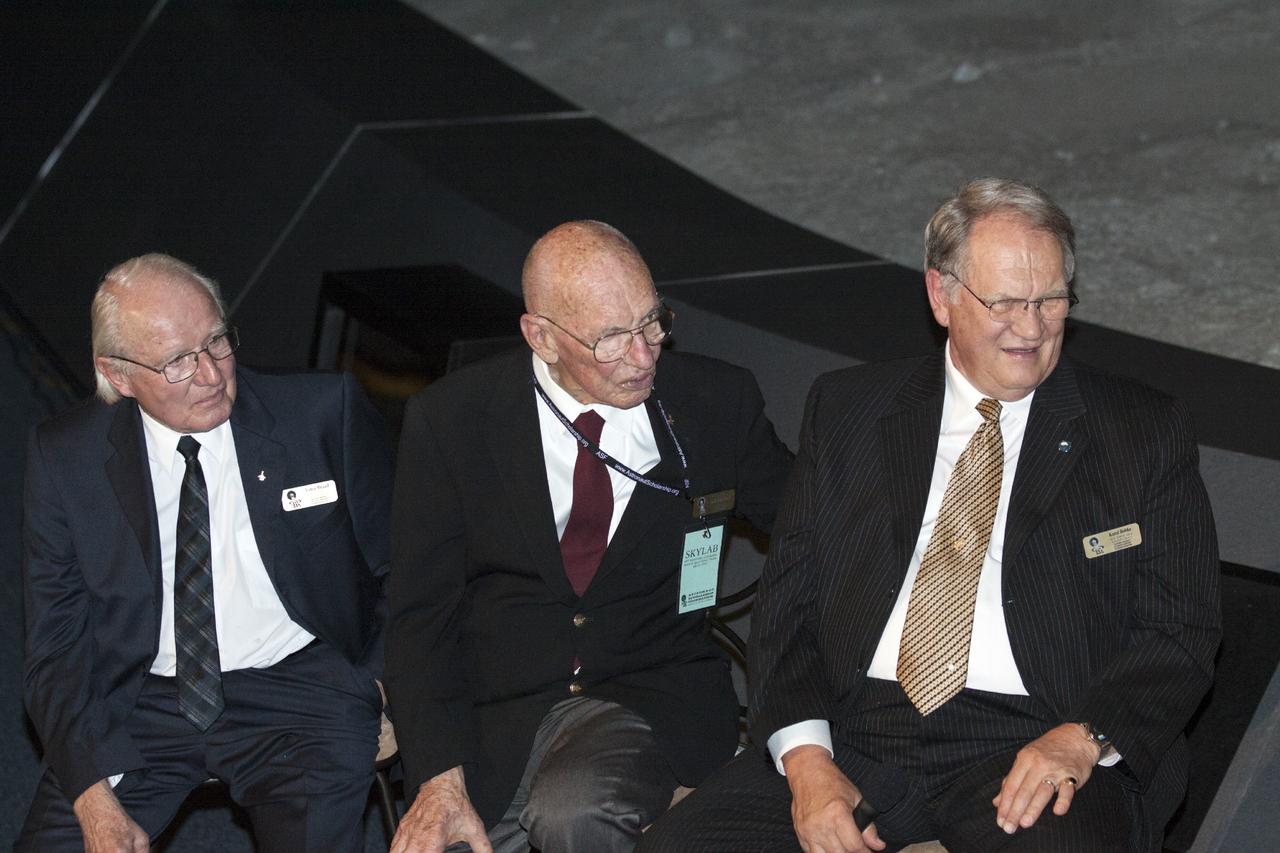
CAPE CANAVERAL, Fla. – At the Kennedy Space Center's Apollo/Saturn V Center, former NASA astronauts, from the left, Vance Brand, William Thornton and Karol Bobko recall experiences during the Astronaut Scholarship Foundation's event celebrating the 40th anniversary of Skylab. Each went on to fly missions during the Space Shuttle Program. Brand was also pilot on the Apollo-Soyuz Test Project. The gala commemorating the 40th anniversary of Skylab included six of the nine astronauts who flew missions to America's first space station. The orbiting laboratory was launched unpiloted from Kennedy on May 14, 1973. Between May 25, 1973 and Feb. 8, 1974, crews of three spent 28, 59 and 84 days living and working in low-Earth orbit aboard the station. For more information, visit http://www.nasa.gov/mission_pages/skylab/ Photo credit: NASA/Kim Shiflett
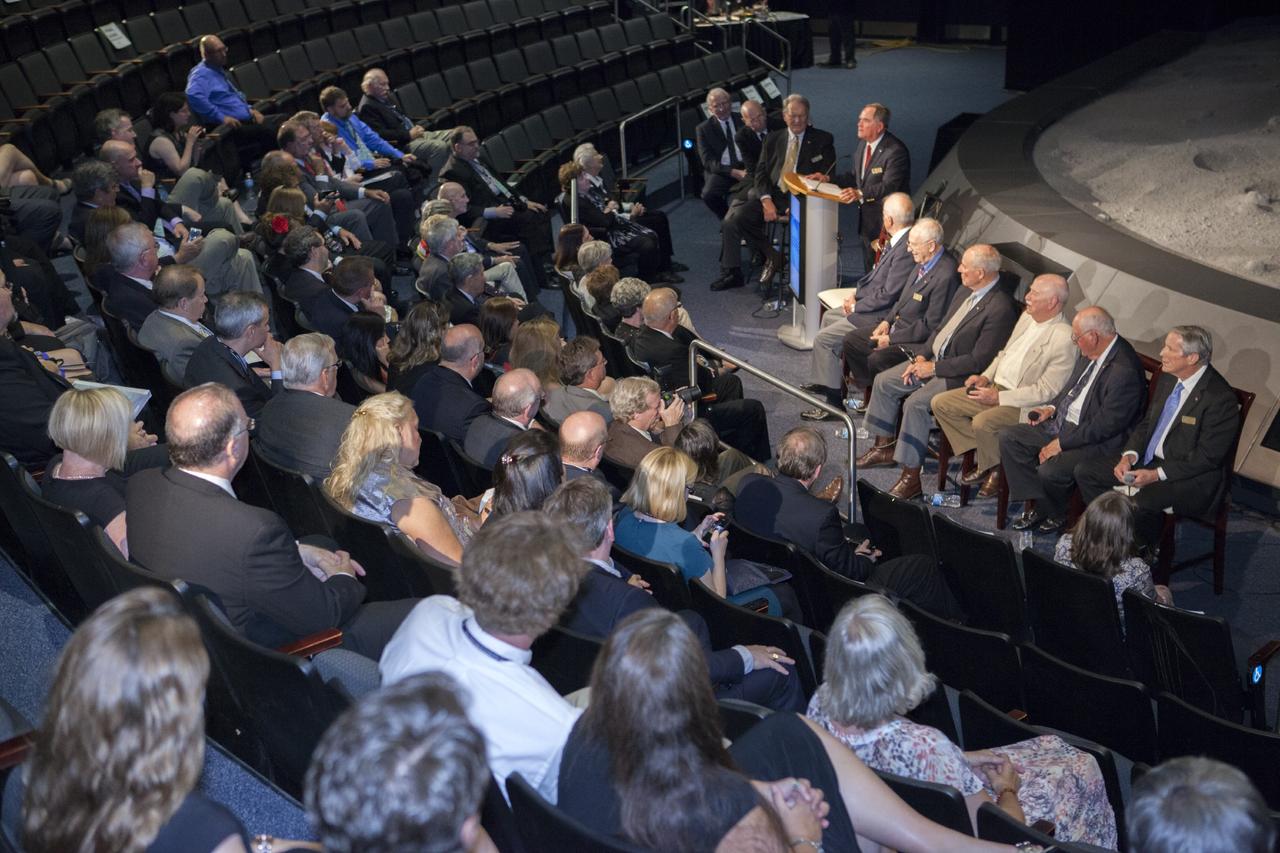
CAPE CANAVERAL, Fla. – Astronaut Scholarship Foundation guests at the Kennedy Space Center's Apollo/Saturn V Center listen as Skylab era astronauts celebrate the 40th anniversary of Skylab. The gala commemorating the 40th anniversary of Skylab included six of the nine astronauts who flew missions to America's first space station. The orbiting laboratory was launched unpiloted from Kennedy on May 14, 1973. Between May 25, 1973 and Feb. 8, 1974, crews of three spent 28, 59 and 84 days living and working in low-Earth orbit aboard the station. For more information, visit http://www.nasa.gov/mission_pages/skylab/ Photo credit: NASA/Kim Shiflett
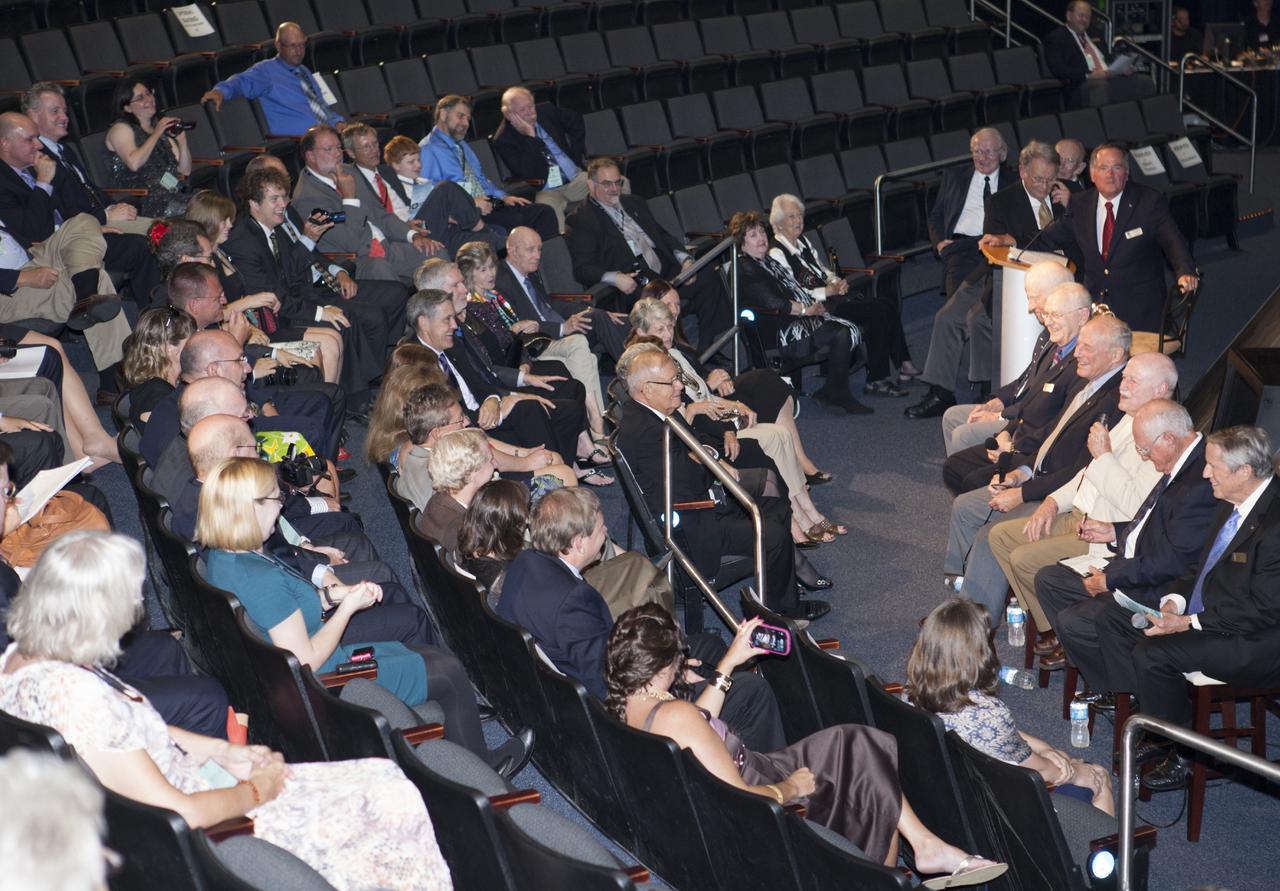
CAPE CANAVERAL, Fla. – Astronaut Scholarship Foundation guests at the Kennedy Space Center's Apollo/Saturn V Center listen as Skylab era astronauts celebrate the 40th anniversary of Skylab. The gala commemorating the 40th anniversary of Skylab included six of the nine astronauts who flew missions to America's first space station. The orbiting laboratory was launched unpiloted from Kennedy on May 14, 1973. Between May 25, 1973 and Feb. 8, 1974, crews of three spent 28, 59 and 84 days living and working in low-Earth orbit aboard the station. For more information, visit http://www.nasa.gov/mission_pages/skylab/ Photo credit: NASA/Kim Shiflett
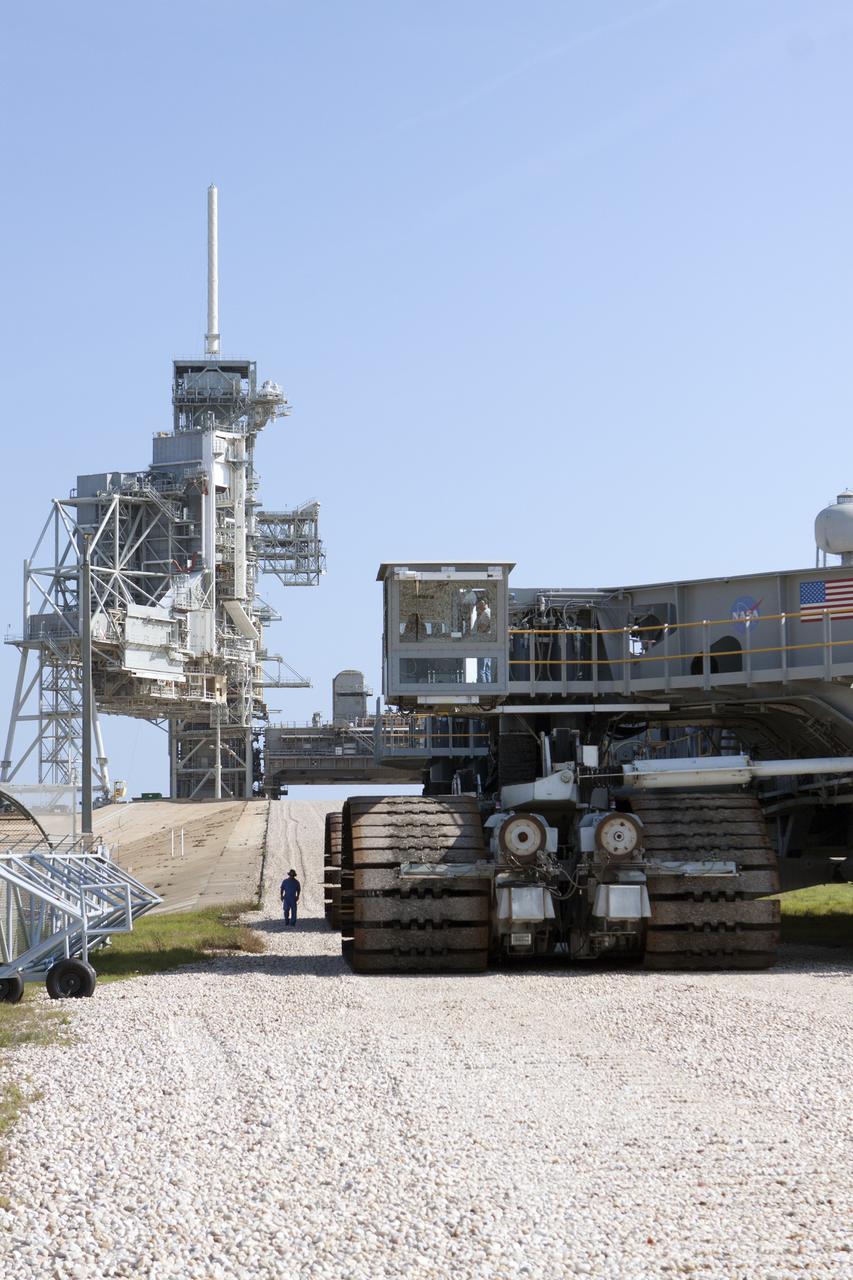
CAPE CANAVERAL, Fla. -- A crawler-transporter begins its climb to the hardstand at Launch Pad 39A at NASA's Kennedy Space Center in Florida. Operations are underway to move Mobile Launcher Platform-2, or MLP-2, from the pad to a nearby park site in Launch Complex 39. The historic launch pad was the site from which numerous Apollo and space shuttle missions began and is beginning a new mission as a commercial launch site. NASA signed a property agreement with Space Exploration Technologies Corp., or SpaceX, of Hawthorne, California, on April 14 for use and occupancy of the seaside complex along Florida's central east coast. It will serve as a platform for SpaceX to support their commercial launch activities. For more information on Launch Pad 39A, visit http://www.nasa.gov/centers/kennedy/pdf/167416main_LC39-08.pdf. For learn more about the crawler-transporter, visit http://www.nasa.gov/centers/kennedy/pdf/167402main_crawlertransporters07.pdf. Photo credit: NASA/Kim Shiflett

CAPE CANAVERAL, Fla. -- A crawler-transporter creeps toward Mobile Launcher Platform-2, or MLP-2, on the hardstand at Launch Pad 39A at NASA's Kennedy Space Center in Florida. Operations are underway to move the MLP to a nearby park site in Launch Complex 39. The historic launch pad was the site from which numerous Apollo and space shuttle missions began and is beginning a new mission as a commercial launch site. NASA signed a property agreement with Space Exploration Technologies Corp., or SpaceX, of Hawthorne, California, on April 14 for use and occupancy of the seaside complex along Florida's central east coast. It will serve as a platform for SpaceX to support their commercial launch activities. For more information on Launch Pad 39A, visit http://www.nasa.gov/centers/kennedy/pdf/167416main_LC39-08.pdf. For learn more about the crawler-transporter, visit http://www.nasa.gov/centers/kennedy/pdf/167402main_crawlertransporters07.pdf. Photo credit: NASA/Kim Shiflett

CAPE CANAVERAL, Fla. -- A crawler-transporter carries Mobile Launcher Platform-2, or MLP-2, away from Launch Pad 39A at NASA's Kennedy Space Center in Florida. The MLP is being moved to a nearby park site in Launch Complex 39. The historic launch pad was the site from which numerous Apollo and space shuttle missions began and is beginning a new mission as a commercial launch site. NASA signed a property agreement with Space Exploration Technologies Corp., or SpaceX, of Hawthorne, California, on April 14 for use and occupancy of the seaside complex along Florida's central east coast. It will serve as a platform for SpaceX to support their commercial launch activities. For more information on Launch Pad 39A, visit http://www.nasa.gov/centers/kennedy/pdf/167416main_LC39-08.pdf. For learn more about the crawler-transporter, visit http://www.nasa.gov/centers/kennedy/pdf/167402main_crawlertransporters07.pdf. Photo credit: NASA/Kim Shiflett
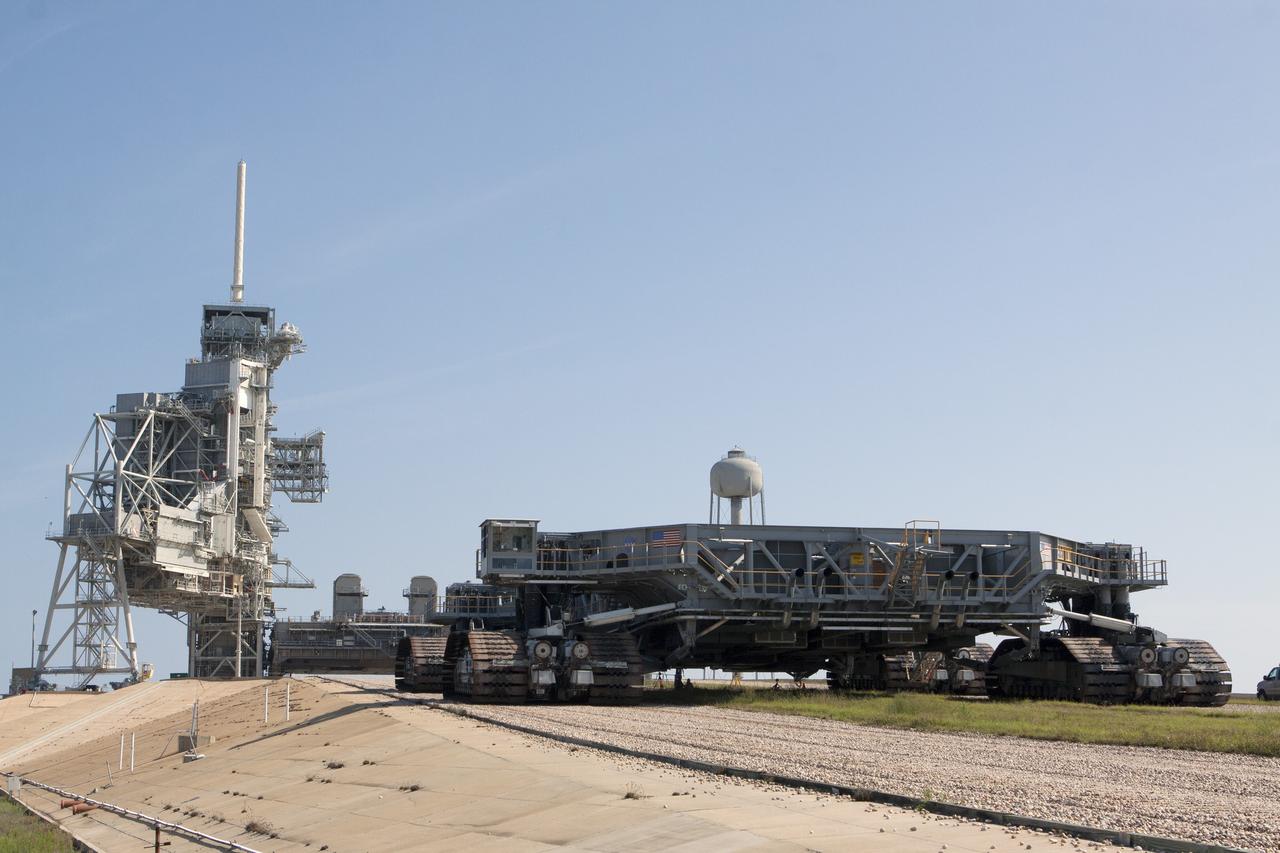
CAPE CANAVERAL, Fla. -- A crawler-transporter begins its climb toward Mobile Launcher Platform-2, or MLP-2, on the hardstand at Launch Pad 39A at NASA's Kennedy Space Center in Florida. Operations are underway to move the MLP to a nearby park site in Launch Complex 39. The historic launch pad was the site from which numerous Apollo and space shuttle missions began and is beginning a new mission as a commercial launch site. NASA signed a property agreement with Space Exploration Technologies Corp., or SpaceX, of Hawthorne, California, on April 14 for use and occupancy of the seaside complex along Florida's central east coast. It will serve as a platform for SpaceX to support their commercial launch activities. For more information on Launch Pad 39A, visit http://www.nasa.gov/centers/kennedy/pdf/167416main_LC39-08.pdf. For learn more about the crawler-transporter, visit http://www.nasa.gov/centers/kennedy/pdf/167402main_crawlertransporters07.pdf. Photo credit: NASA/Kim Shiflett
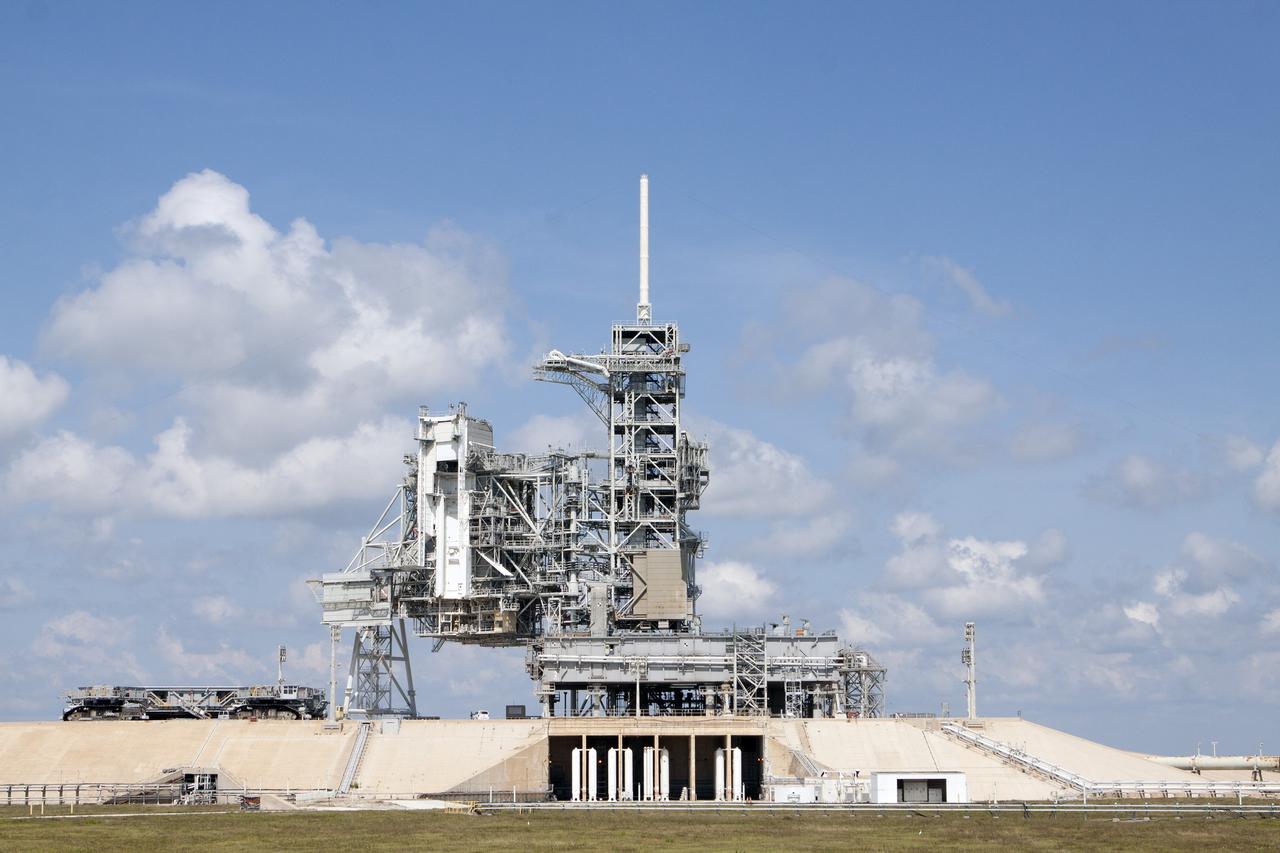
CAPE CANAVERAL, Fla. -- A crawler-transporter nears the Mobile Launcher Platform-2, or MLP-2, positioned over the flame trench at Launch Pad 39A at NASA's Kennedy Space Center in Florida. Operations are underway to move the MLP to a nearby park site in Launch Complex 39. The historic launch pad was the site from which numerous Apollo and space shuttle missions began and is beginning a new mission as a commercial launch site. NASA signed a property agreement with Space Exploration Technologies Corp., or SpaceX, of Hawthorne, California, on April 14 for use and occupancy of the seaside complex along Florida's central east coast. It will serve as a platform for SpaceX to support their commercial launch activities. For more information on Launch Pad 39A, visit http://www.nasa.gov/centers/kennedy/pdf/167416main_LC39-08.pdf. For learn more about the crawler-transporter, visit http://www.nasa.gov/centers/kennedy/pdf/167402main_crawlertransporters07.pdf. Photo credit: NASA/Kim Shiflett
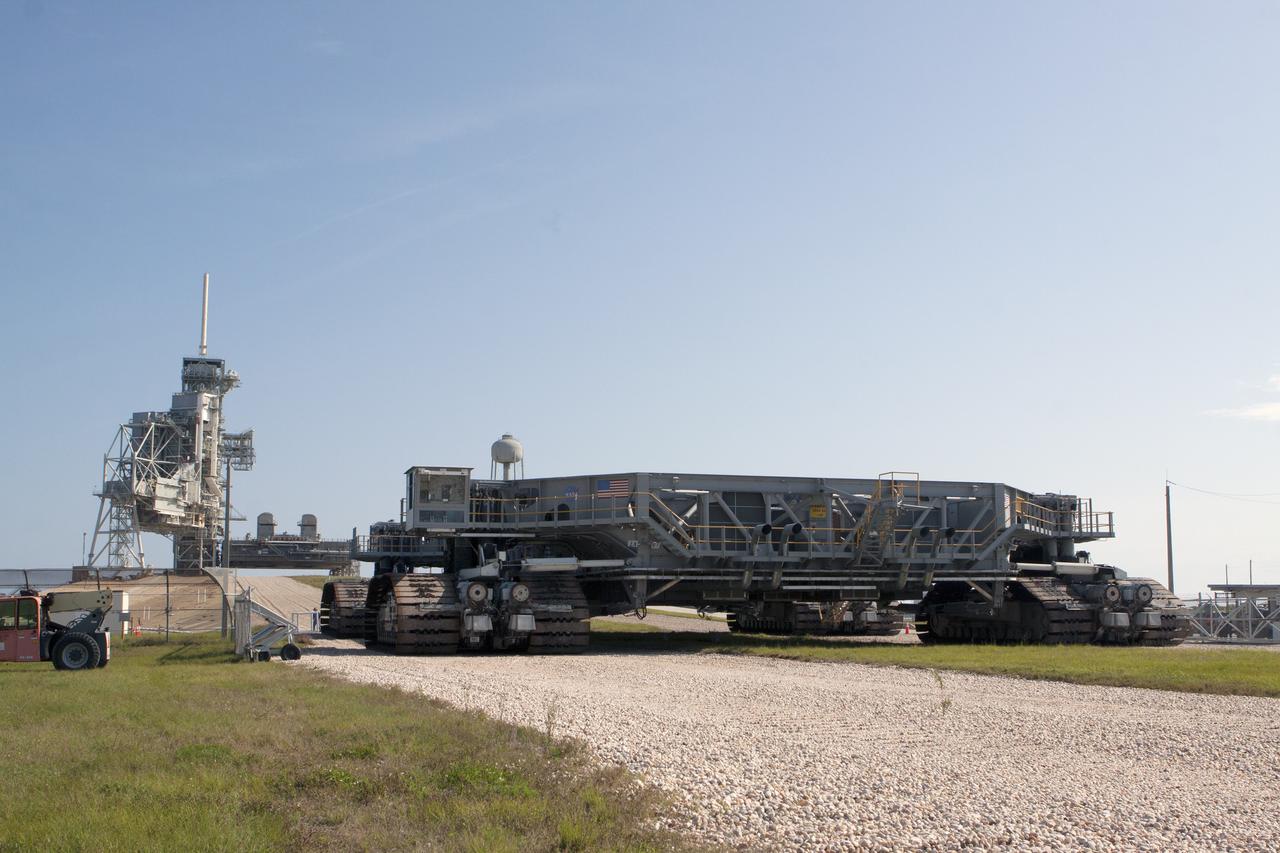
CAPE CANAVERAL, Fla. -- A crawler-transporter rolls toward Launch Pad 39A at NASA's Kennedy Space Center in Florida. Operations are underway to move Mobile Launcher Platform-2, or MLP-2, from the pad to a nearby park site in Launch Complex 39. The historic launch pad was the site from which numerous Apollo and space shuttle missions began and is beginning a new mission as a commercial launch site. NASA signed a property agreement with Space Exploration Technologies Corp., or SpaceX, of Hawthorne, California, on April 14 for use and occupancy of the seaside complex along Florida's central east coast. It will serve as a platform for SpaceX to support their commercial launch activities. For more information on Launch Pad 39A, visit http://www.nasa.gov/centers/kennedy/pdf/167416main_LC39-08.pdf. For learn more about the crawler-transporter, visit http://www.nasa.gov/centers/kennedy/pdf/167402main_crawlertransporters07.pdf. Photo credit: NASA/Kim Shiflett