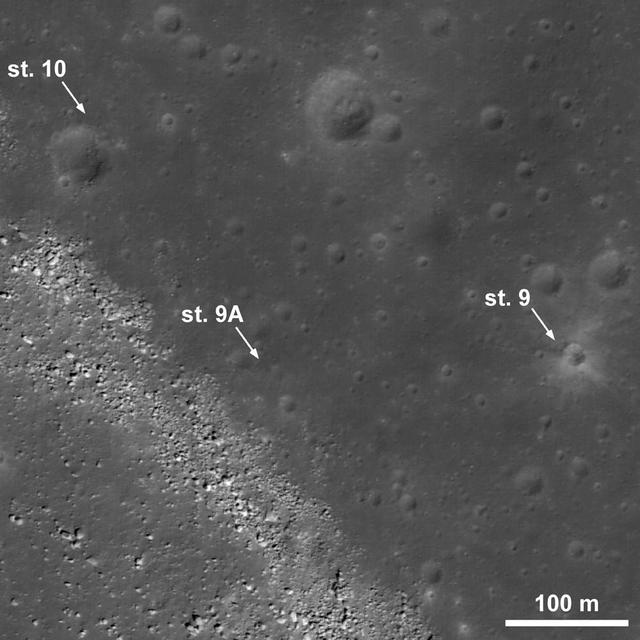
Retracing the Steps of Apollo 15
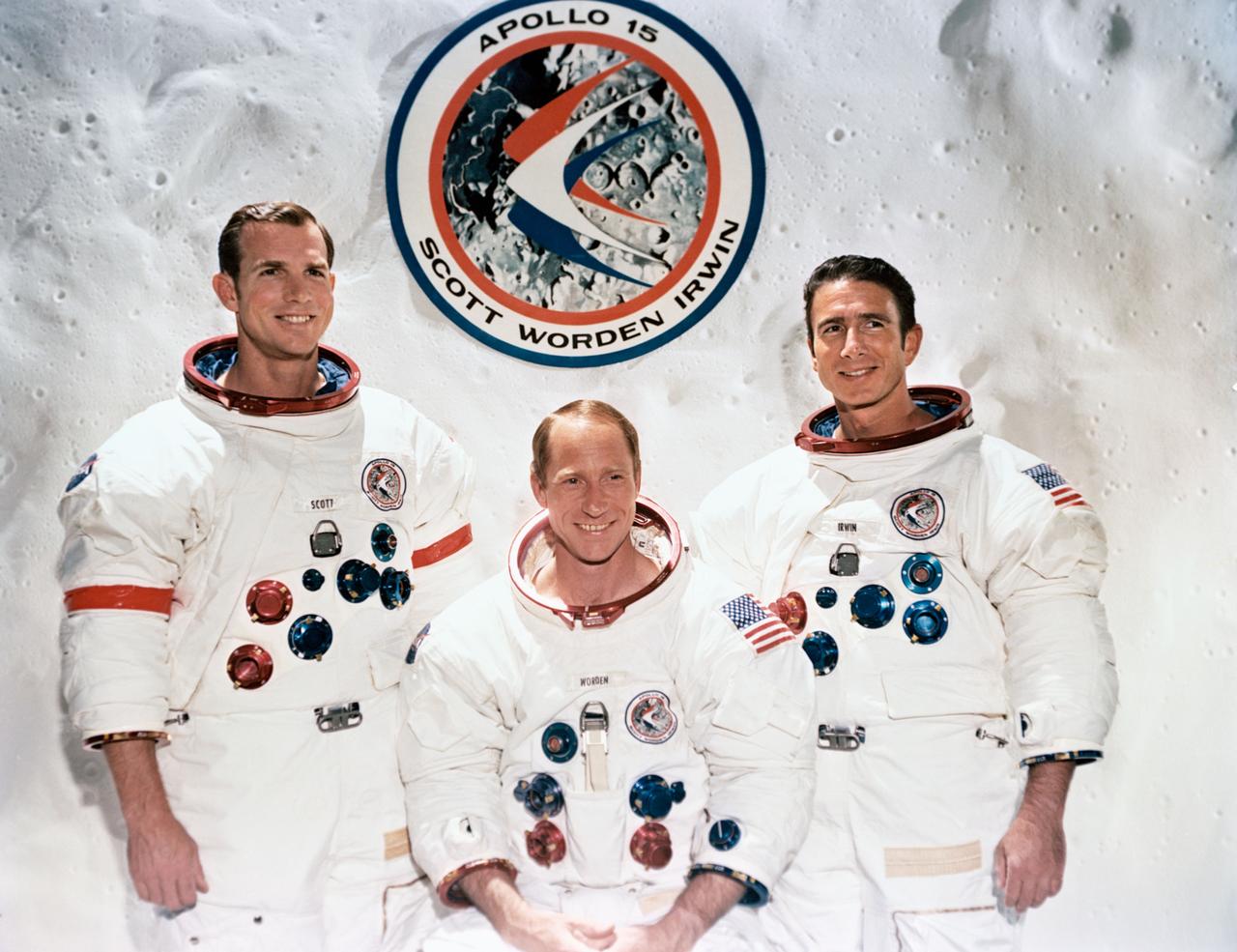
S71-37963 (July 1971) --- These three astronauts are the prime crew of the Apollo 15 lunar landing mission. They are, left to right, David R. Scott, commander; Alfred M. Worden, command module pilot; and James B. Irwin, lunar module pilot. The Apollo 15 emblem is in the background.
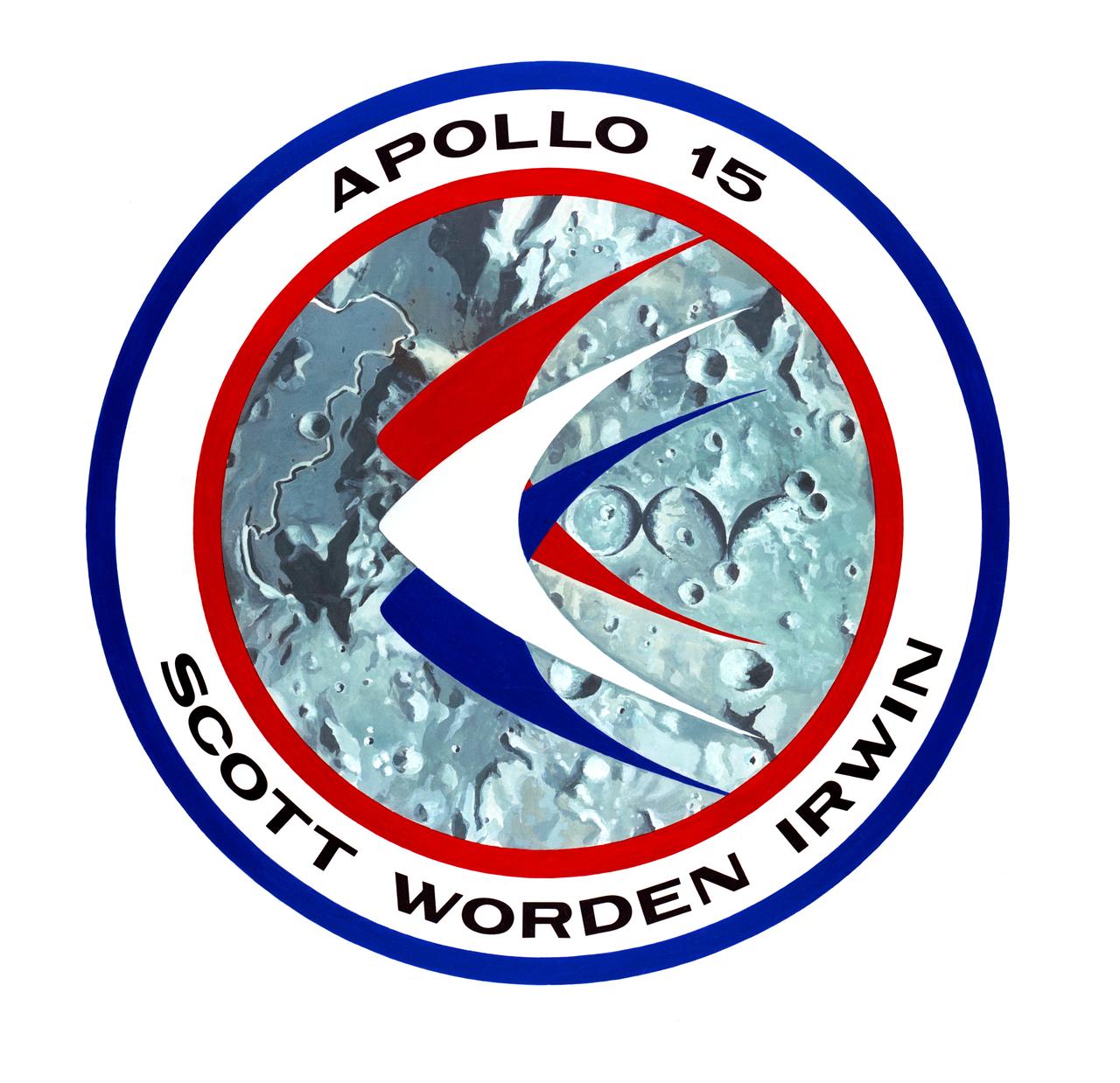
S71-30463 (May 1971) --- This is the insignia designed for the Apollo 15 lunar landing mission. The circular design features the colors red, white and blue. On the outer portion of the patch a narrow band of blue and a narrow band of red encircle a wider band of white. The large disc in the center of the emblem has red, white and blue symbols of flight, superimposed over an artist's concept of the Apollo 15 Hadley-Apennine landing site of gray tone. The surnames of the three names are centered in the white band at the bottom of the insignia. The Apollo 15 prime crew men are David R. Scott, commander; Alfred M. Worden, command module pilot; and James B. Irwin, lunar module pilot. This is the official Apollo 15 emblem, property of the government of the United States. It has been authorized only for use by the astronauts. Its production in any form other than in news, information and education media is not authorized without approval. Unauthorized use of the photograph is subject to the provisions of Title 18, U.S. Code, Section 701.
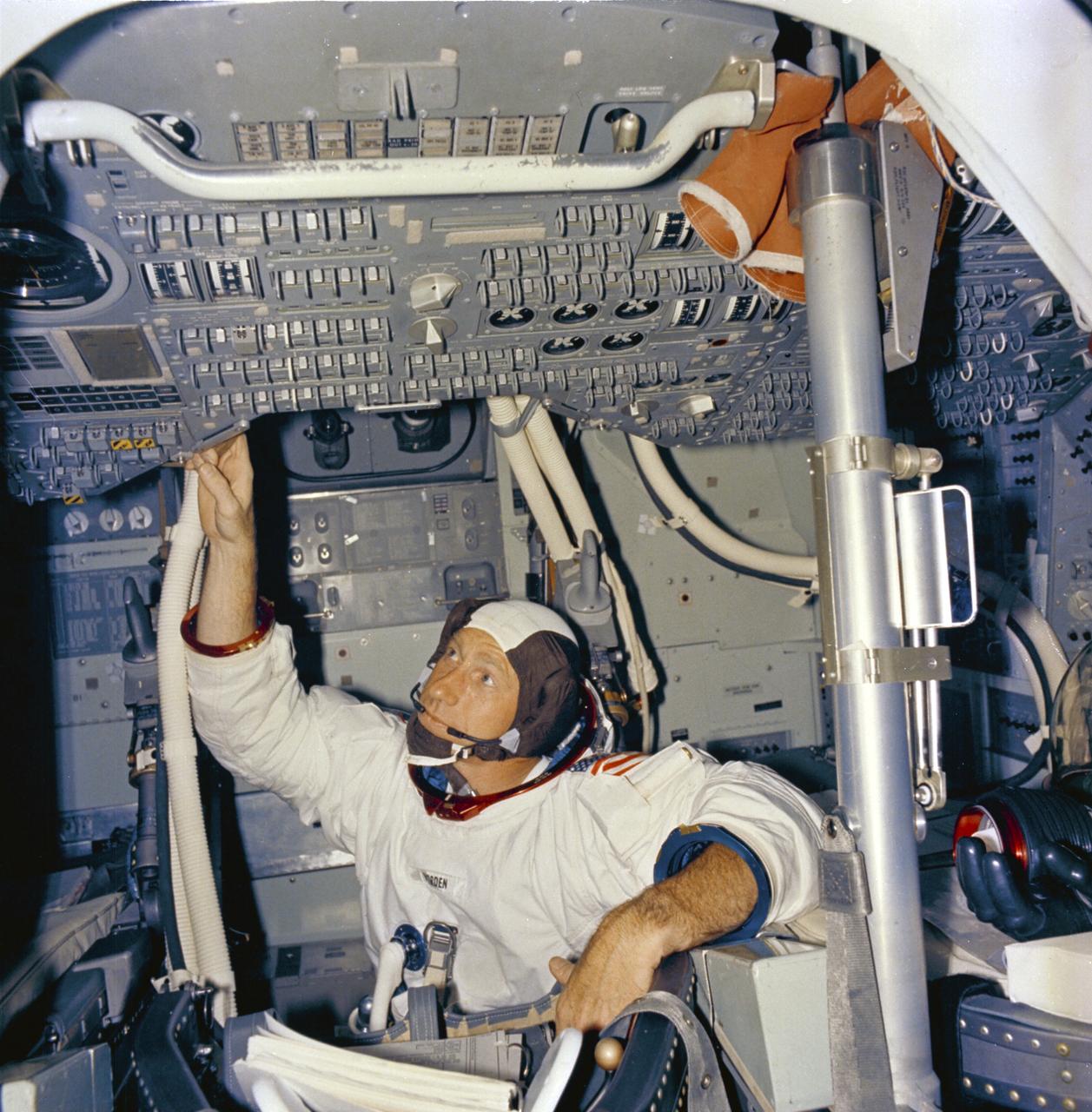
Apollo 15 Command Module Pilot Alfred M. Worden practices alone in a mission simulator at the Kennedy Space Center in preparation for his upcoming launch to the Moon with Mission Commander David R. Scott and Lunar Module Pilot James B. Irwin. Worden will maintain the command module in lunar orbit while the other two crewmen remain on the surface for as long as 67 hours. Launch to the moon is scheduled for no earlier than July 26, 1971.
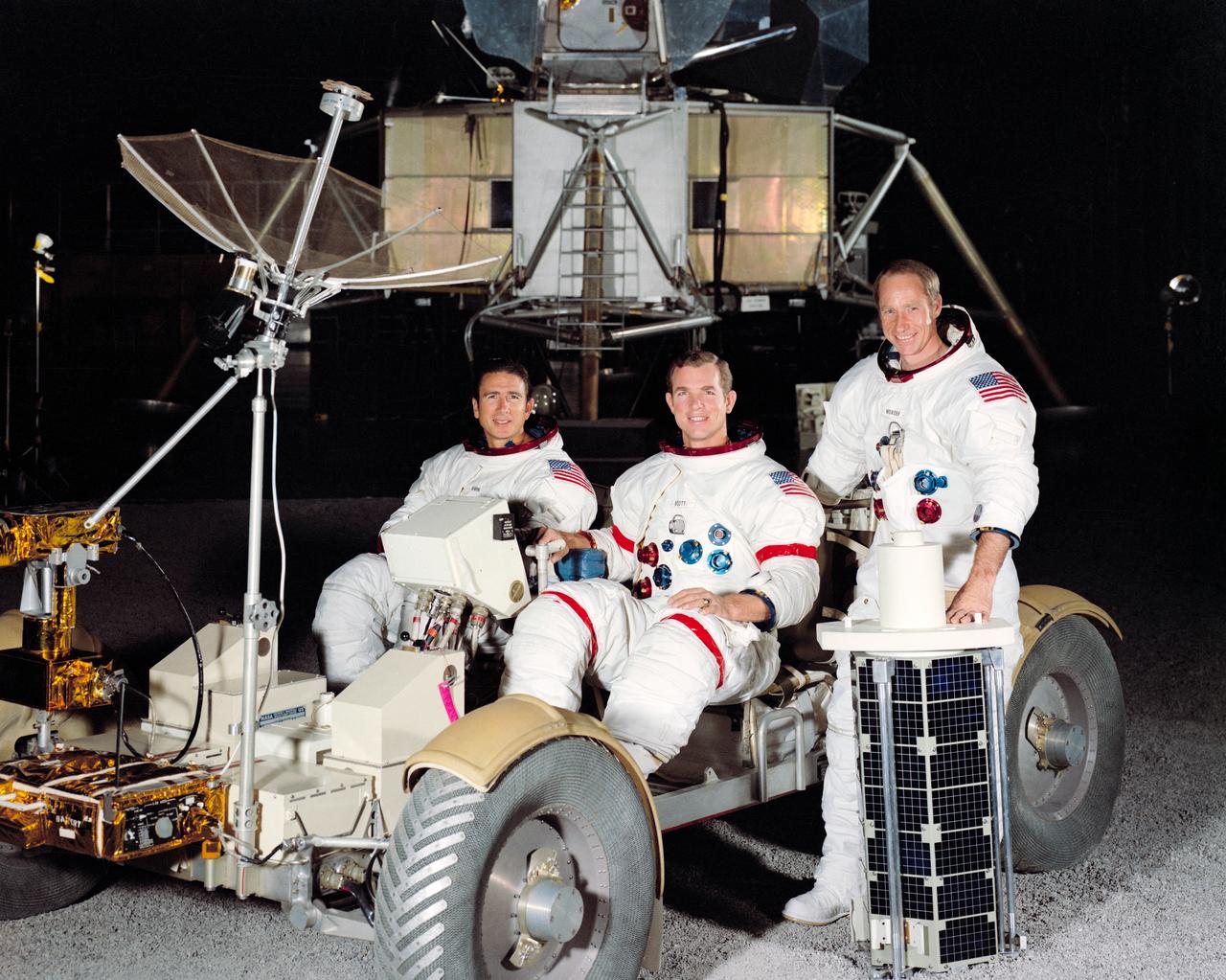
S71-22407 (March 1971) --- These three astronauts have been named by the National Aeronautics and Space Administration (NASA) as the prime crew men of the Apollo 15 lunar landing mission. They are, left to right, James B. Irwin, lunar module pilot; David R. Scott, commander; and Alfred M. Worden, command module pilot.
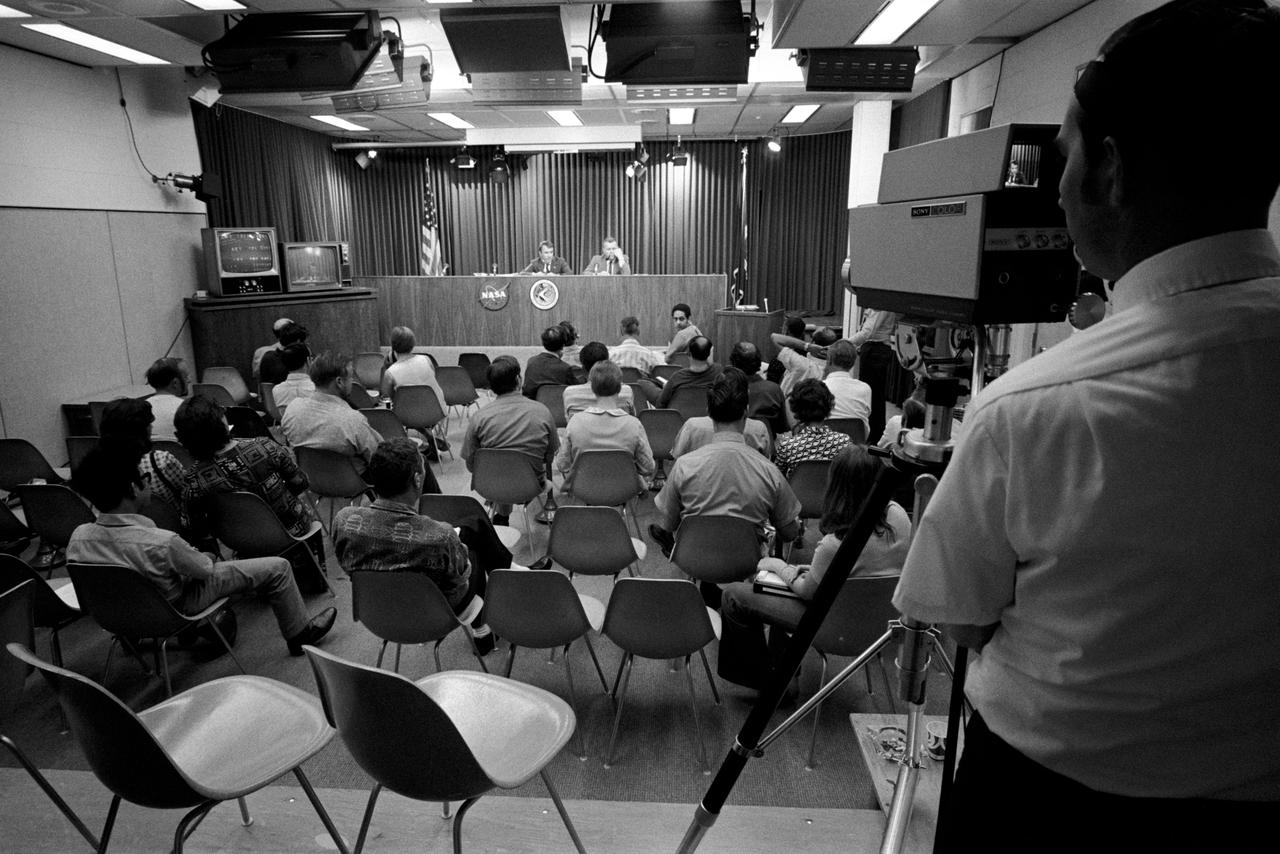
S71-41842 (July 1971) --- Newsmen put questions to Gerald D. Griffin, left at lectern, a flight director for the Apollo 15 lunar landing mission, during a change of shift briefing in the small briefing room in Building One at the Manned Spacecraft Center (MSC). Representing Public Affairs Office at the briefing is Terry White, right at lectern.
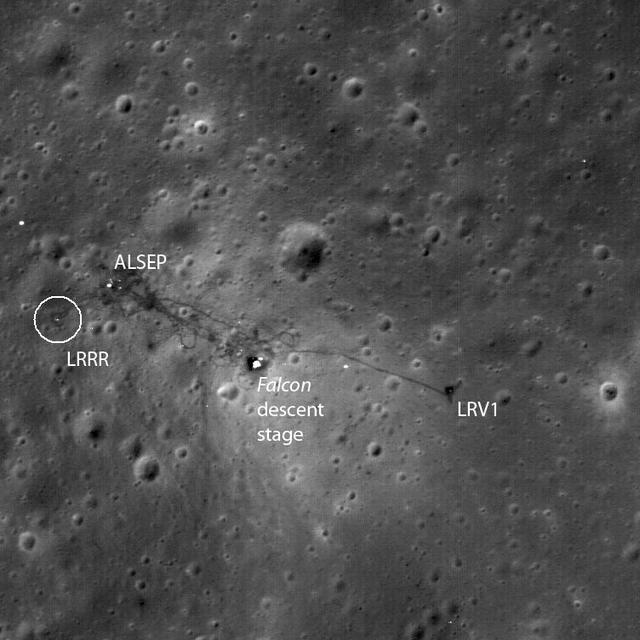
The Apollo 15 Lunar Laser Ranging Retroreflector - A Fundamental Point on the Moon
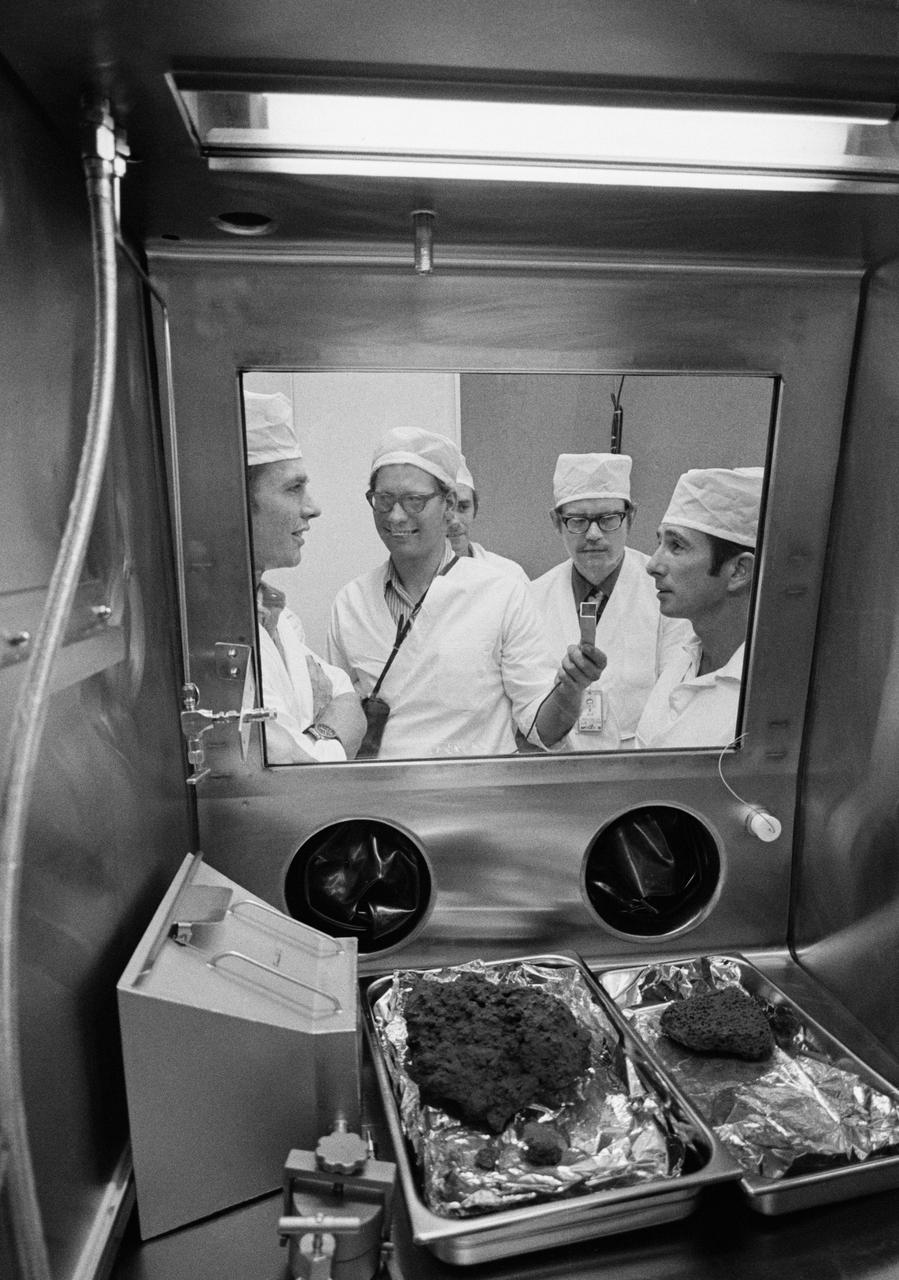
S71-43203 (9 Aug. 1971) --- Astronauts David R. Scott, left foreground, and James B. Irwin, right foreground, join the Manned Spacecraft Center's (MSC) geologists in getting first looks at some of the first Apollo 15 samples to be opened in the Non-Sterile Nitrogen Processing Line (NNPL) in the MSC Lunar Receiving Laboratory (LRL). Holding the microphone and making recorded tapes of the two Apollo 15 crew men's comments is Dr. Gary Lofgren. Partially obscured, near center of photo is Dr. William Phinney, and to his left is Dr. James W. Head.
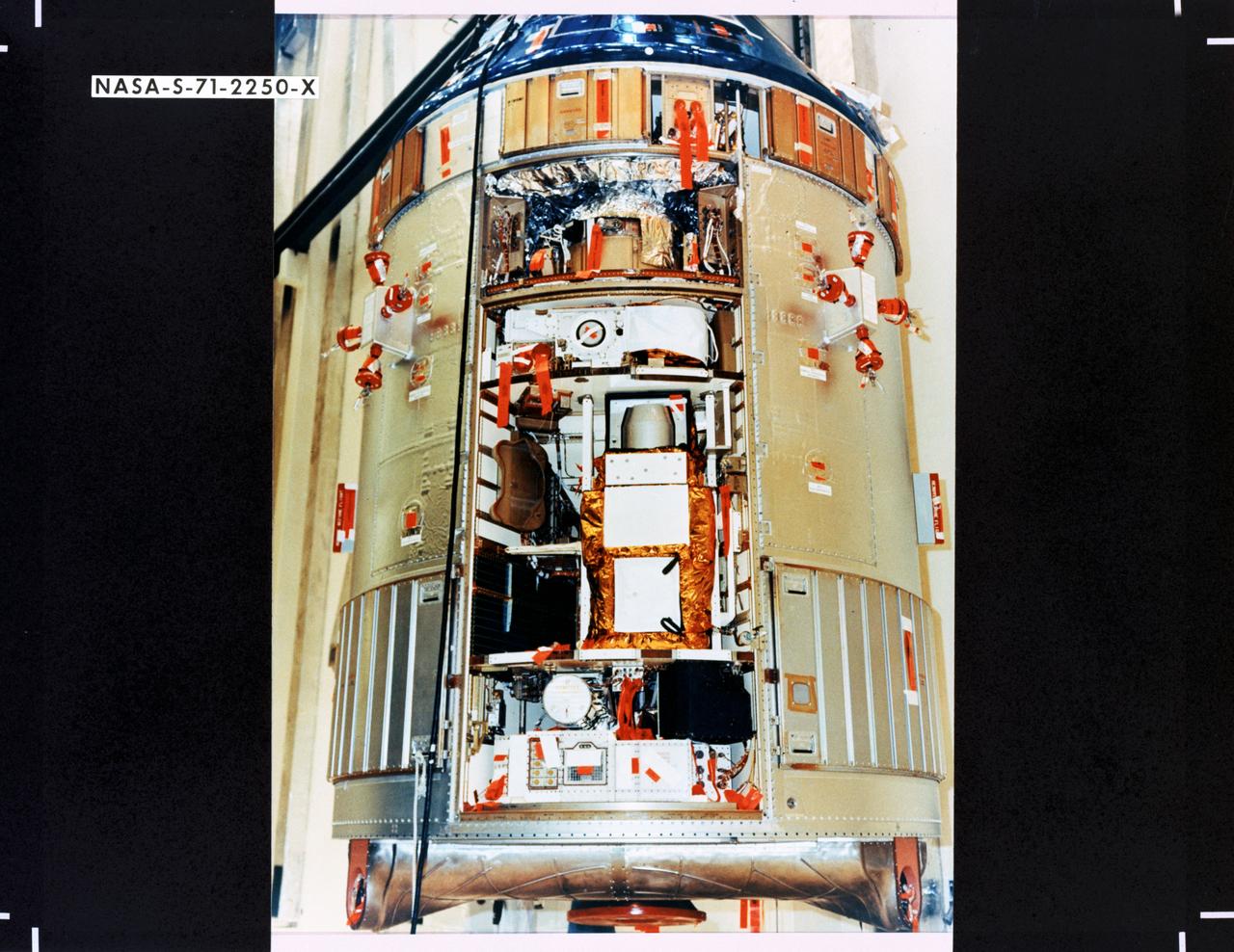
S71-2250X (June 1971) --- A close-up view of the Scientific Instrument Module (SIM) to be flown for the first time on the Apollo 15 lunar landing mission. Mounted in a previously vacant sector of the Apollo Service Module (SM), the SIM carries specialized cameras and instrumentation for gathering lunar orbit scientific data. SIM equipment includes a laser altimeter for accurate measurement of height above the lunar surface; a large-format panoramic camera for mapping, correlated with a metric camera and the laser altimeter for surface mapping; a gamma ray spectrometer on a 25-feet extendible boom; a mass spectrometer on a 21-feet extendible boom; X-ray and alpha particle spectrometers; and a subsatellite which will be injected into lunar orbit carrying a particle and magnetometer, and the S-Band transponder.
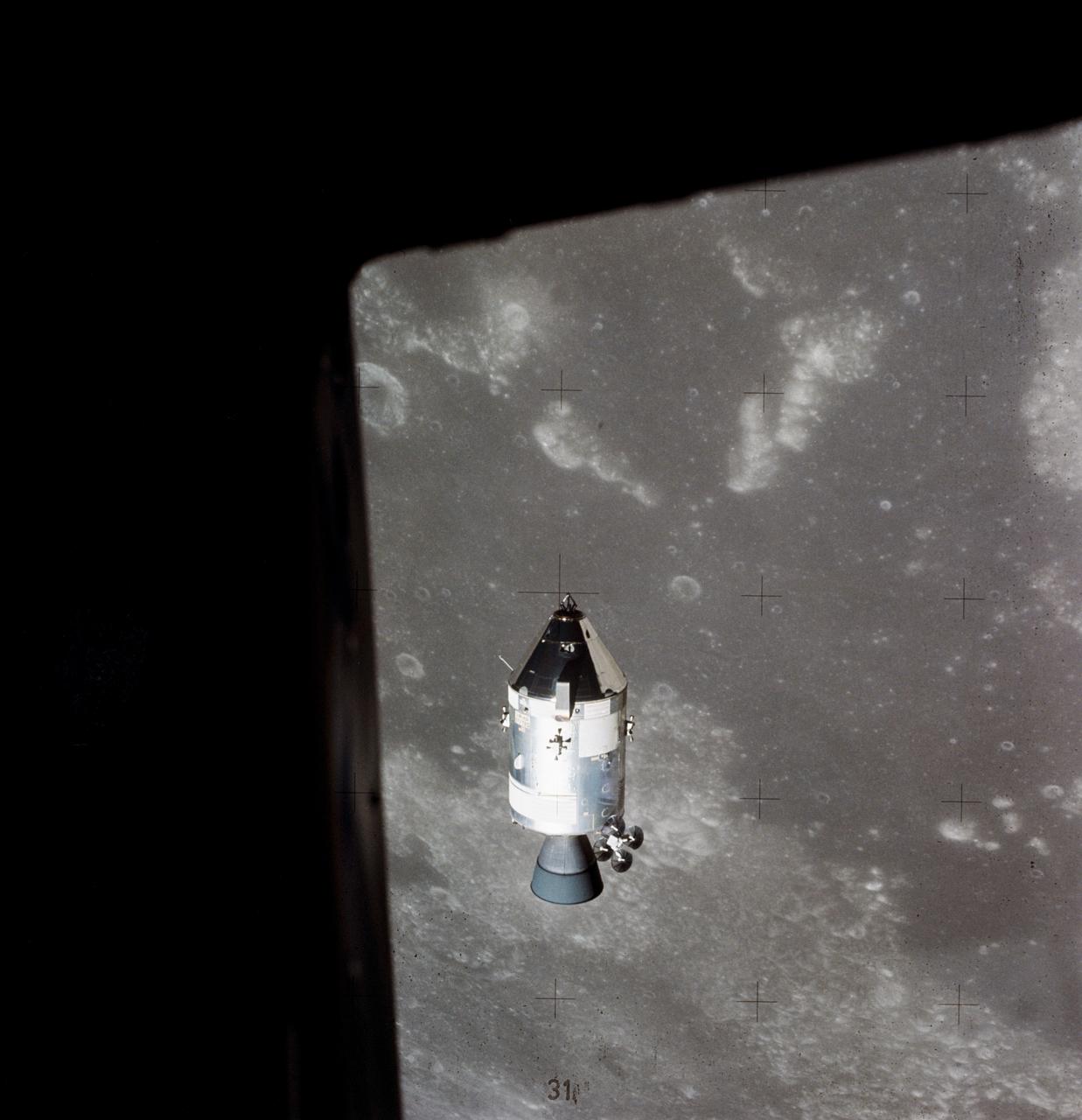
AS15-88-11974 (30 July 1971) --- A view of the Apollo 15 Command and Service Modules (CSM) in lunar orbit as photographed from the Lunar Module (LM) just after rendezvous. The lunar nearside is in the background. This view is looking southeast into the Sea of Fertility. The crater Taruntius is at the right center edge of the picture.
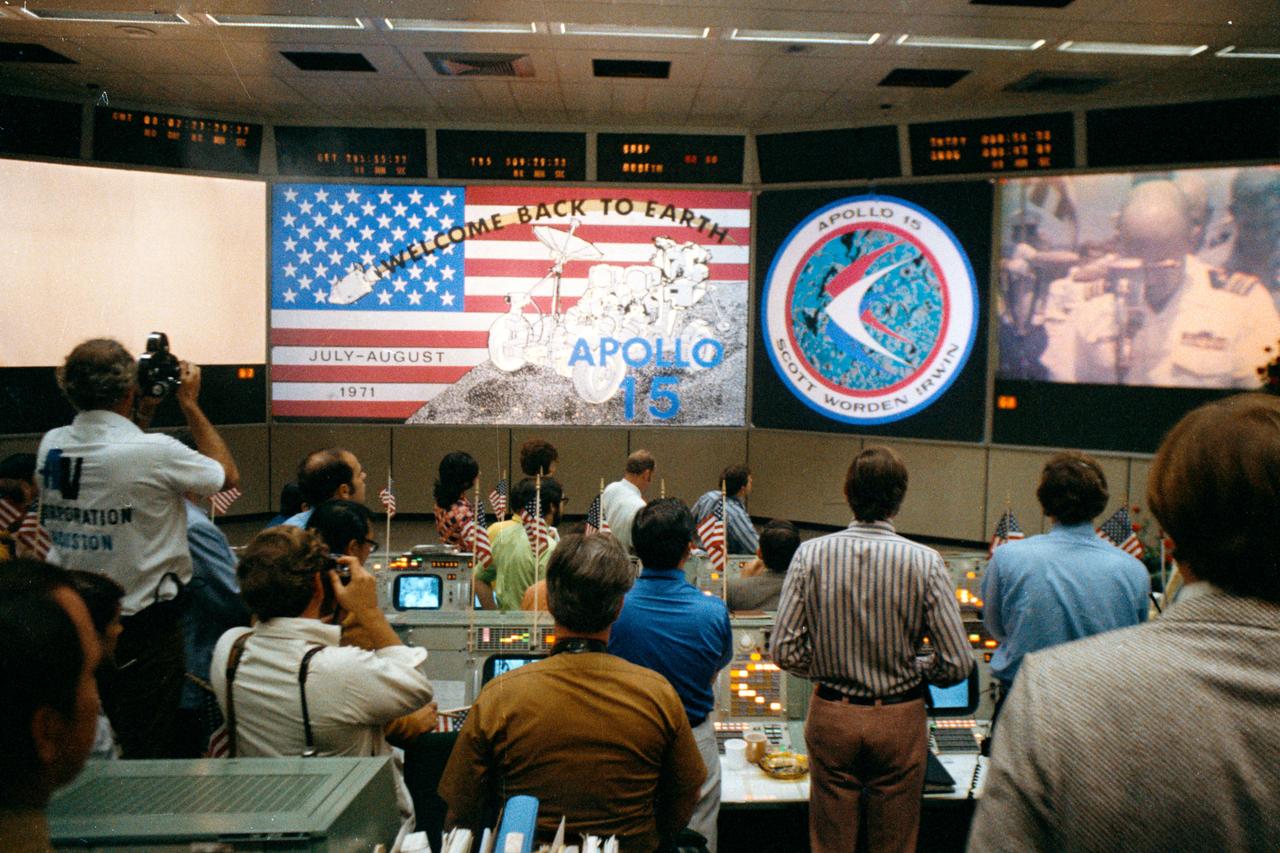
An overall view of activity in the Mission Operations Control Room in the Mission Control Center at the conclusion of the Apollo 15 lunar landing mission. The television monitor in the right background shows the welcome ceremonies aboard the prime recovery ship, U.S.S. Okinawa, in the mid-Pacific Ocean.
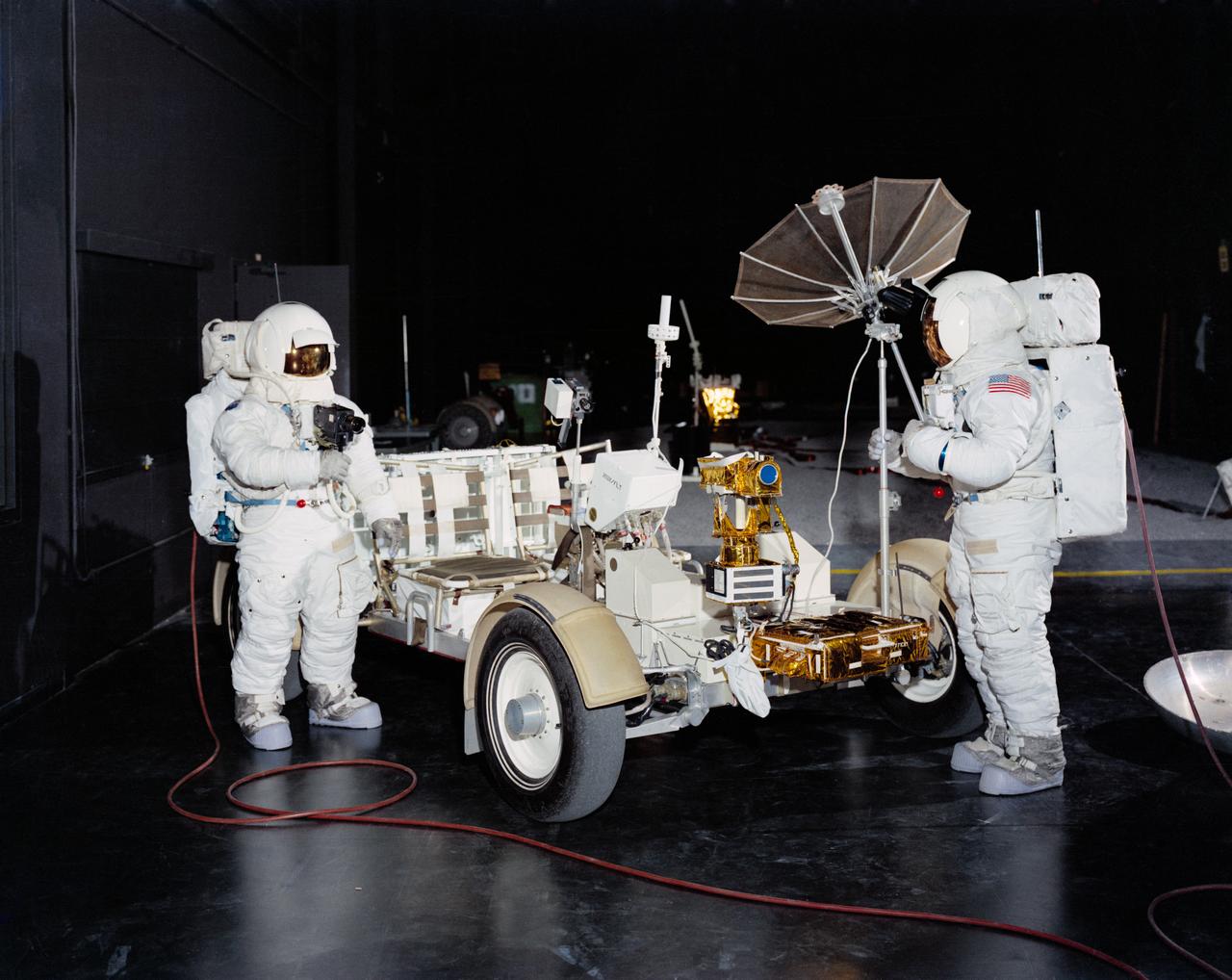
S71-16722 (January 1971) --- Two members of the prime crew of the Apollo 15 lunar landing mission are shown with the Lunar Roving Vehicle "one G" trainer in Building 5, Mission Simulation and Training Facility, Manned Spacecraft Center. Astronaut David R. Scott (on right) is the Apollo 15 commander; and astronaut James B. Irwin is the lunar module pilot. A Lunar Roving Vehicle similar to this trainer will be used by Scott and Irwin during their Apollo 15 lunar surface extravehicular activity.
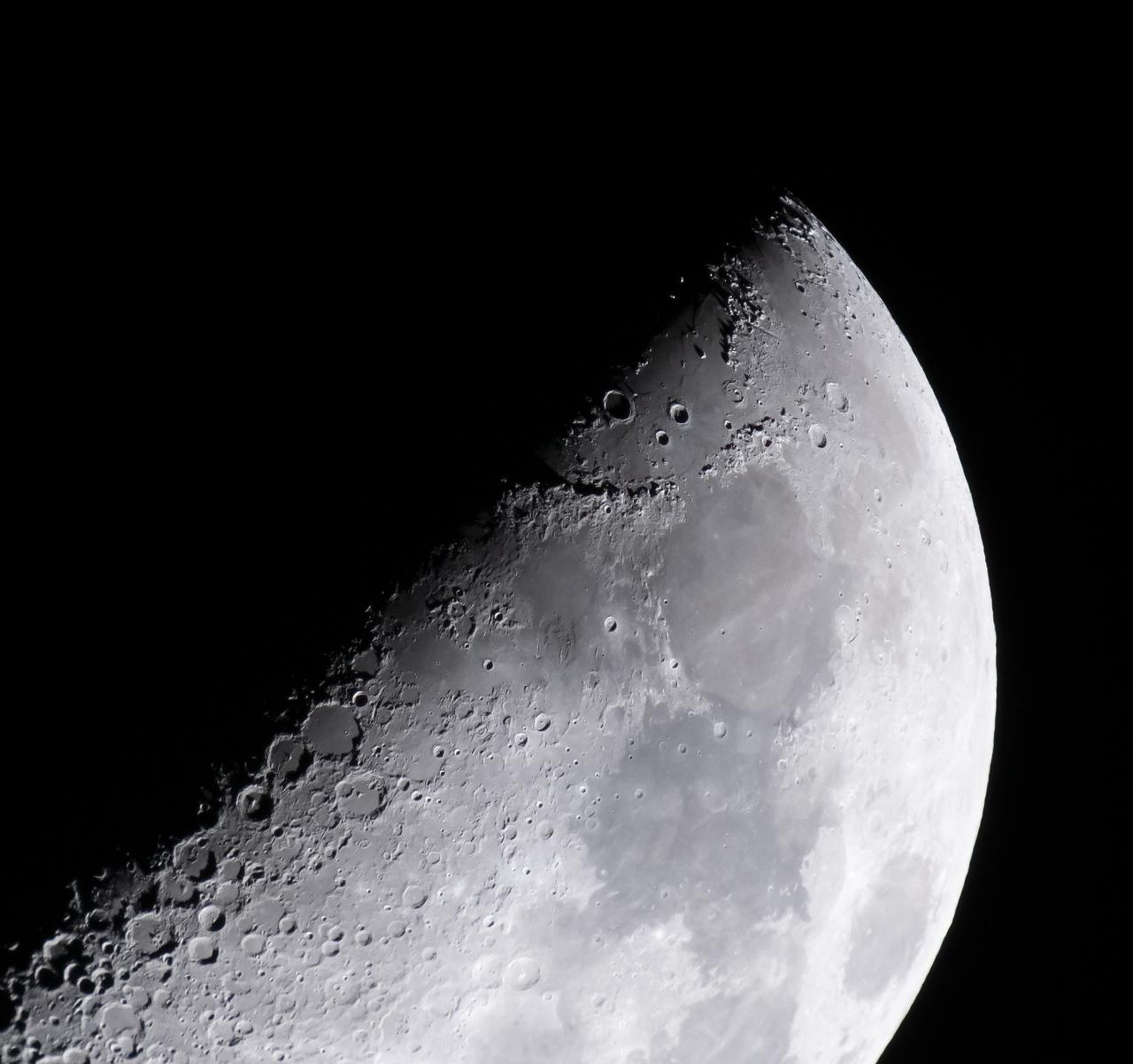
NASA’s Exploration Ground Systems’ Program Manager Shawn Quinn captured this image of the Hadley–Apennine region of the moon including the Apollo 15 landing site (very near the edge of the shadow of one of the lunar mountains in the area). Image is a crop of a full frame image. Apollo 11, 16 and 17 landing sites are also visible in this image. Hadley–Apennine is a region on the near side of Earth's Moon that served as the landing site for the American Apollo 15 mission, the fourth crewed landing on the Moon and the first of the "J-missions", in July 1971. The site is located on the eastern edge of Mare Imbrium on a lava plain known as Palus Putredinis. Hadley–Apennine is bordered by the Montes Apenninus (often referred to as "Apennine Front"), a mountain range, and Hadley Rille, a meandering channel, on the east and west, respectively.
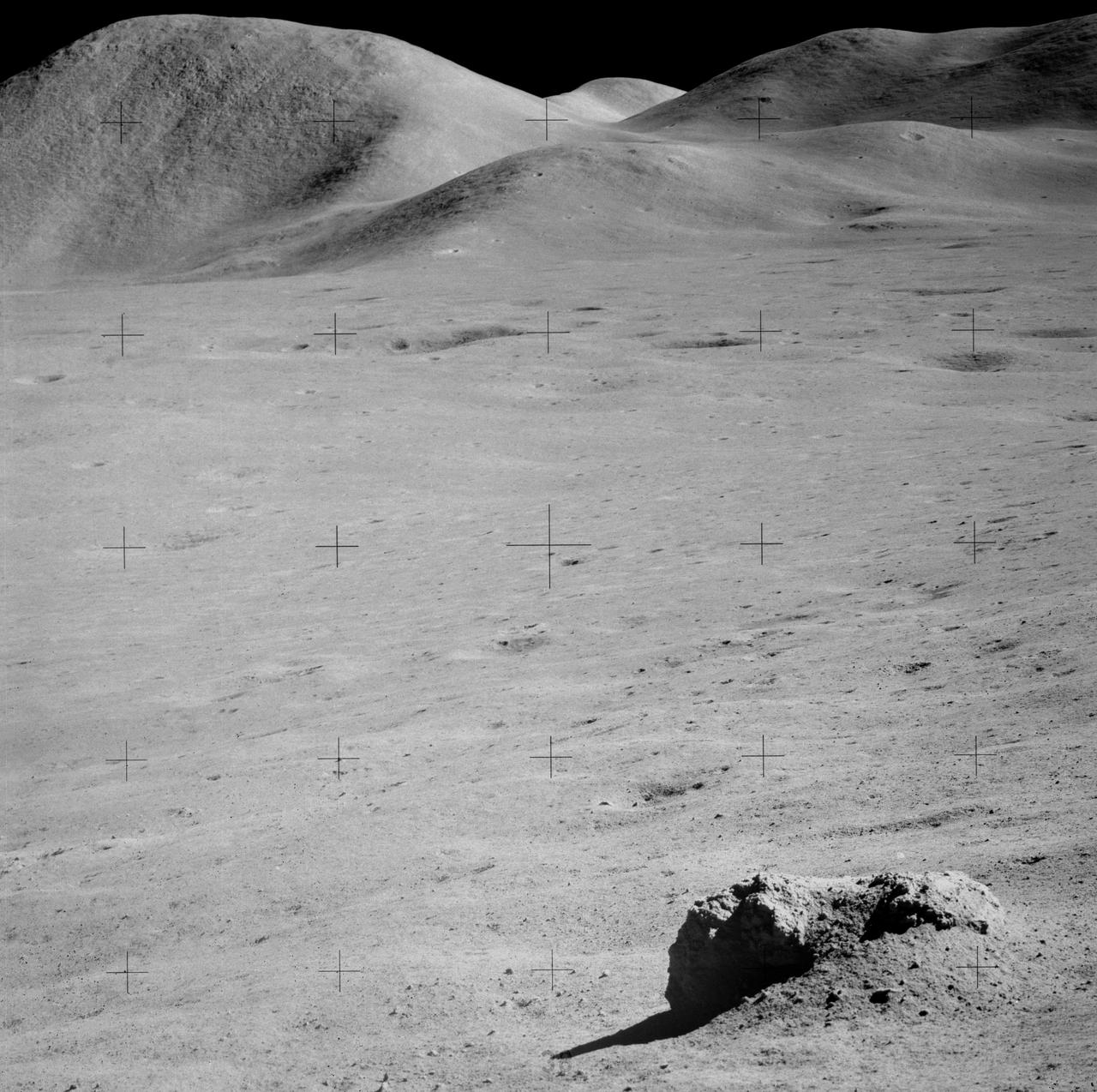
AS15-90-12187 (31 July-2 Aug. 1971) --- This view, looking generally north, shows the tall Mount Hadley in the left background. The photograph was taken from the slope of Hadley Delta during Apollo 15 extravehicular activity (EVA). The crewmen of Apollo 15 noted the visible layering feature of the mountain. Note boulder in foreground. Mount Hadley rises approximately 14,765 feet (about 4,500 meters) above the plain.

AS15-91-12343 (26 July 1971) --- This view of Earth was photographed by the Apollo 15 crewmen as they sped toward the fourth lunar landing. The spacecraft was between 25,000 and 30,000 nautical miles from Earth when this photo was made. The United States (note Florida), Central America and part of Canada can be seen at the left side of the picture, with South America at lower center. Spain and the northwest part of Africa can be seen at right. The Bahamas Banks, unique geological feature, can be seen (different shade of blue) east of Florida. Also note large North Atlantic storm front moving over Greenland in upper center.
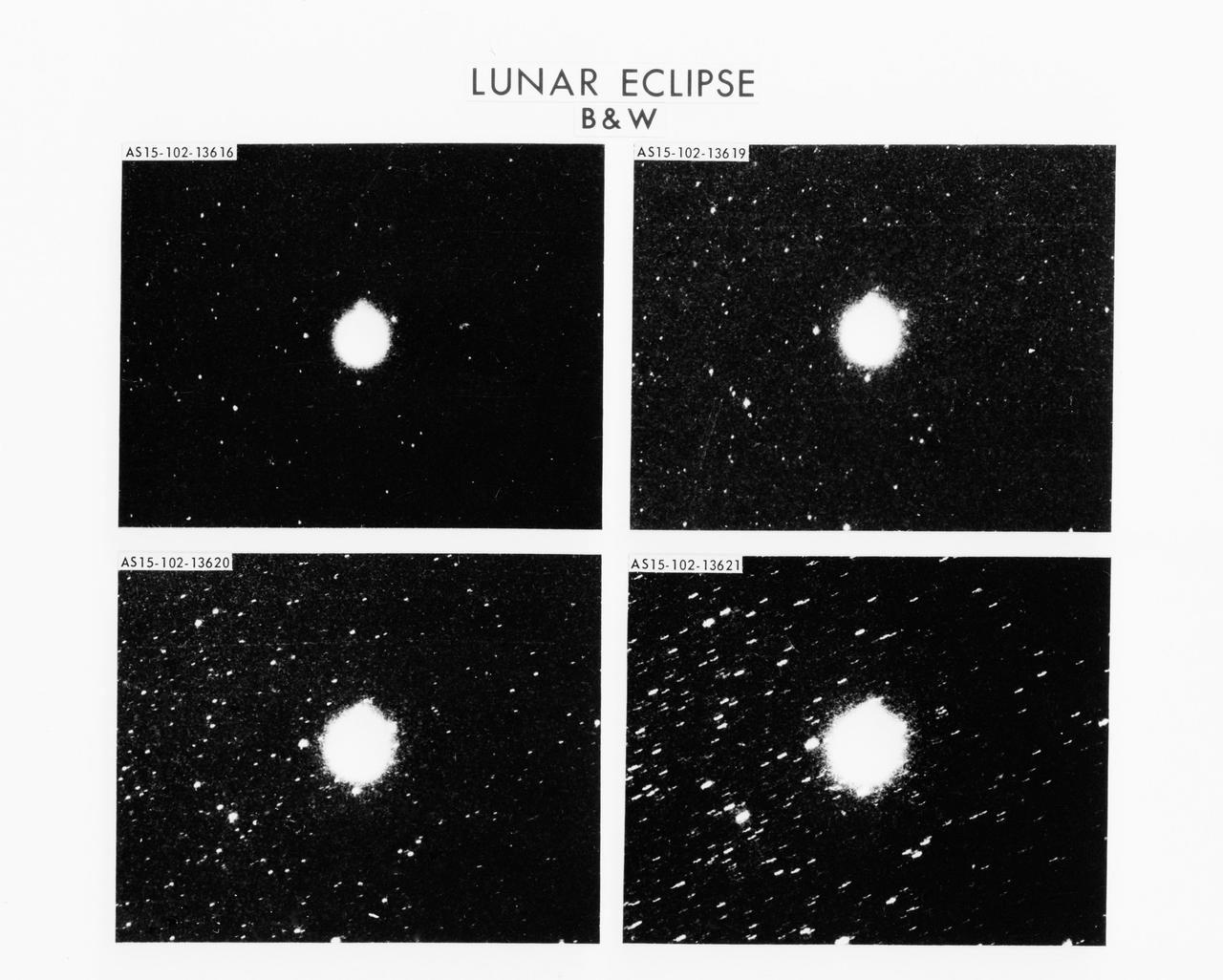
S71-58222 (31 July-2 Aug. 1971) --- During the lunar eclipse that occurred during the Apollo 15 lunar landing mission, astronaut Alfred M. Worden, command module pilot, used a 35mm Nikon camera to obtain a series of 15 photographs while the moon was entering and exiting Earth's umbra. Although it might seem that there should be no light on the moon when it is in Earth's shadow, sunlight is scattered into this region by Earth's atmosphere. This task was an attempt to measure by photographic photometry the amount of scattered light reaching the moon. The four views from upper left to lower right were selected to show the moon as it entered Earth's umbra. The first is a four-second exposure which was taken at the moment when the moon had just entered umbra; the second is a 15-second exposure taken two minutes after entry; the third, a 30-second exposure three minutes after entry; and the fourth is a 60-second exposure four minutes after entry. In all cases the light reaching the moon was so bright on the very high speed film (Eastman Kodak type 2485 emulsion) that the halation obscures the lunar image, which should be about one-third as big as the circle of light. The background star field is clearly evident, and this is very important for these studies. The spacecraft was in full sunlight when these photographs were taken, and it was pointed almost directly away from the sun so that the windows and a close-in portion of the camera's line-of-sight were in shadow. The environment around the vehicle at this time appears to be very "clean" with no light scattering particles noticeable.
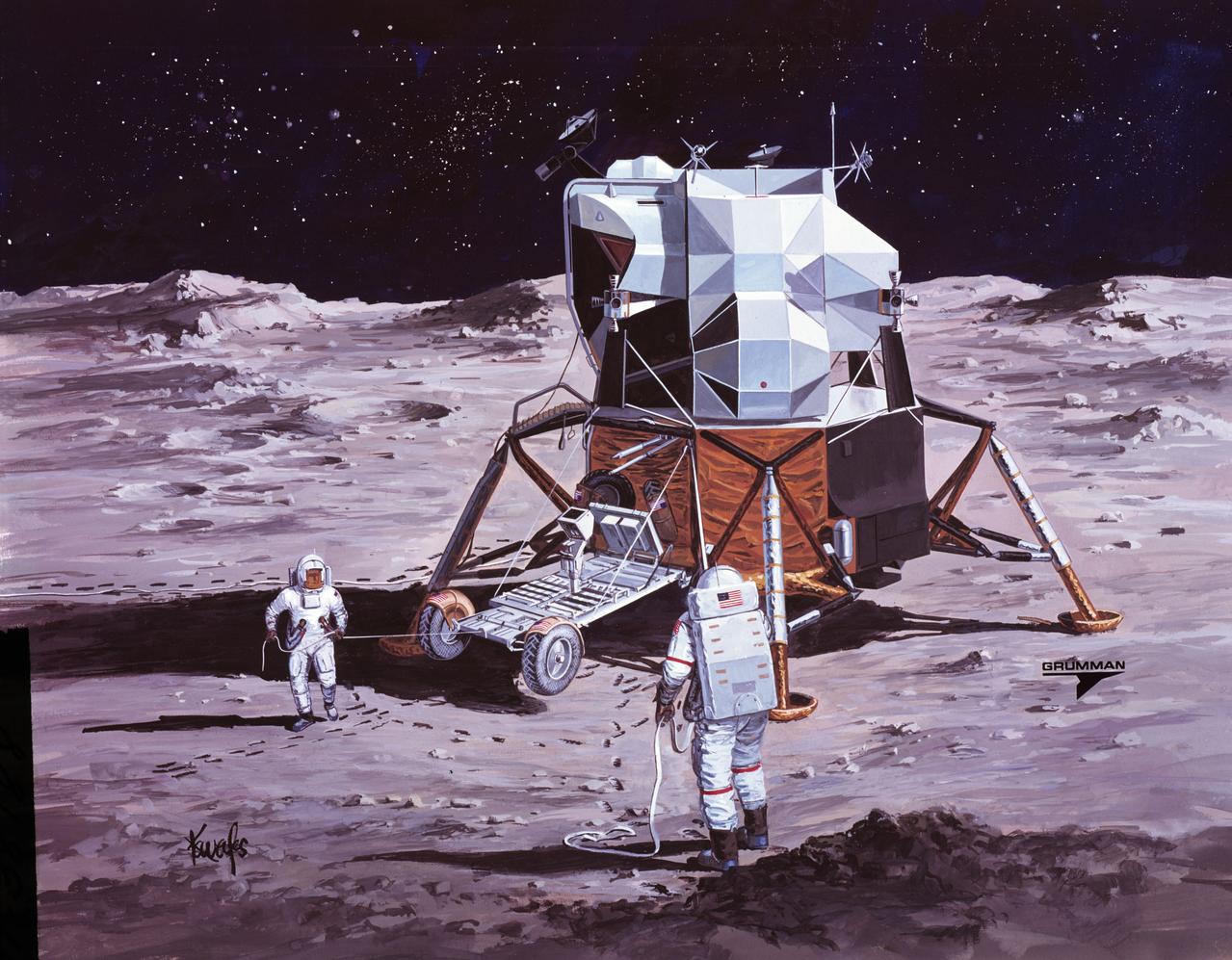
S71-38188 (26 June 1971) --- An artist's concept showing the Apollo 15 mission commander and the lunar module pilot performing deployment of the Lunar Roving Vehicle (LRV) on the lunar surface. The figure on the left represents astronaut James B. Irwin, lunar module pilot, who here is maintaining a constant pull on the deployment cable to help the LRV unfold, while astronaut David R. Scott (right), commander, pulls the tapes that lower the LRV to the surface. (This is the third in a series of Grumman Aerospace Corporation artist's concepts telling the lunar surface LRV deployment story of the Apollo 15 mission).
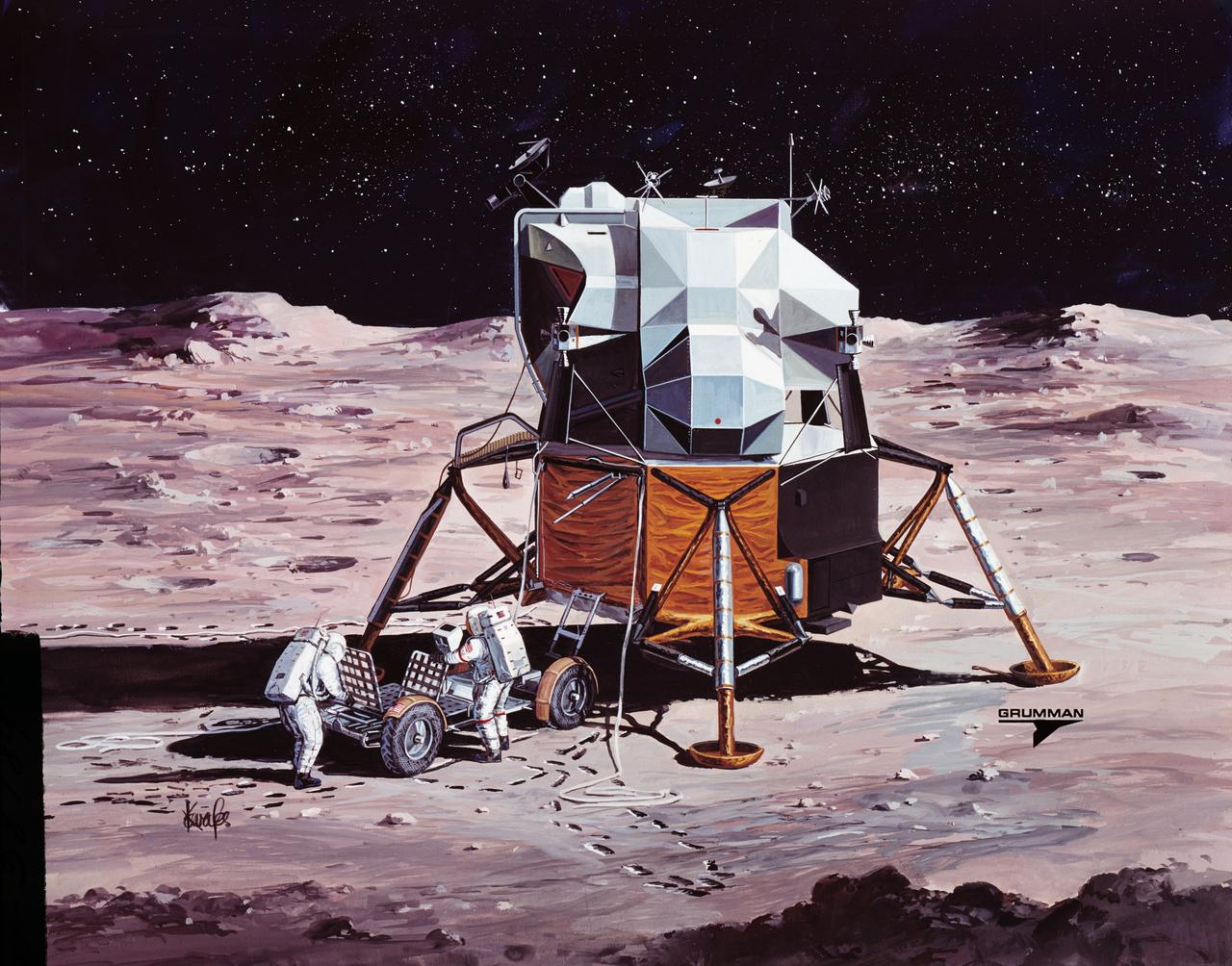
S71-38189 (26 June 1971) --- An artist's concept showing the final steps of readying the Apollo 15 Lunar Roving Vehicle (LRV) or Rover 1 for mobility on the lunar surface. Performing the last few LRV deployment tasks here are, left to right, astronauts James B. Irwin, lunar module pilot, and David R. Scott, commander. More specifically the tasks depicted here include the setting up of the seats and the total releasing of the LRV from the LM. (This is the fourth in a series of four Grumman Aerospace Corporation artist's concepts telling the lunar surface LRV deployment story for Apollo 15).
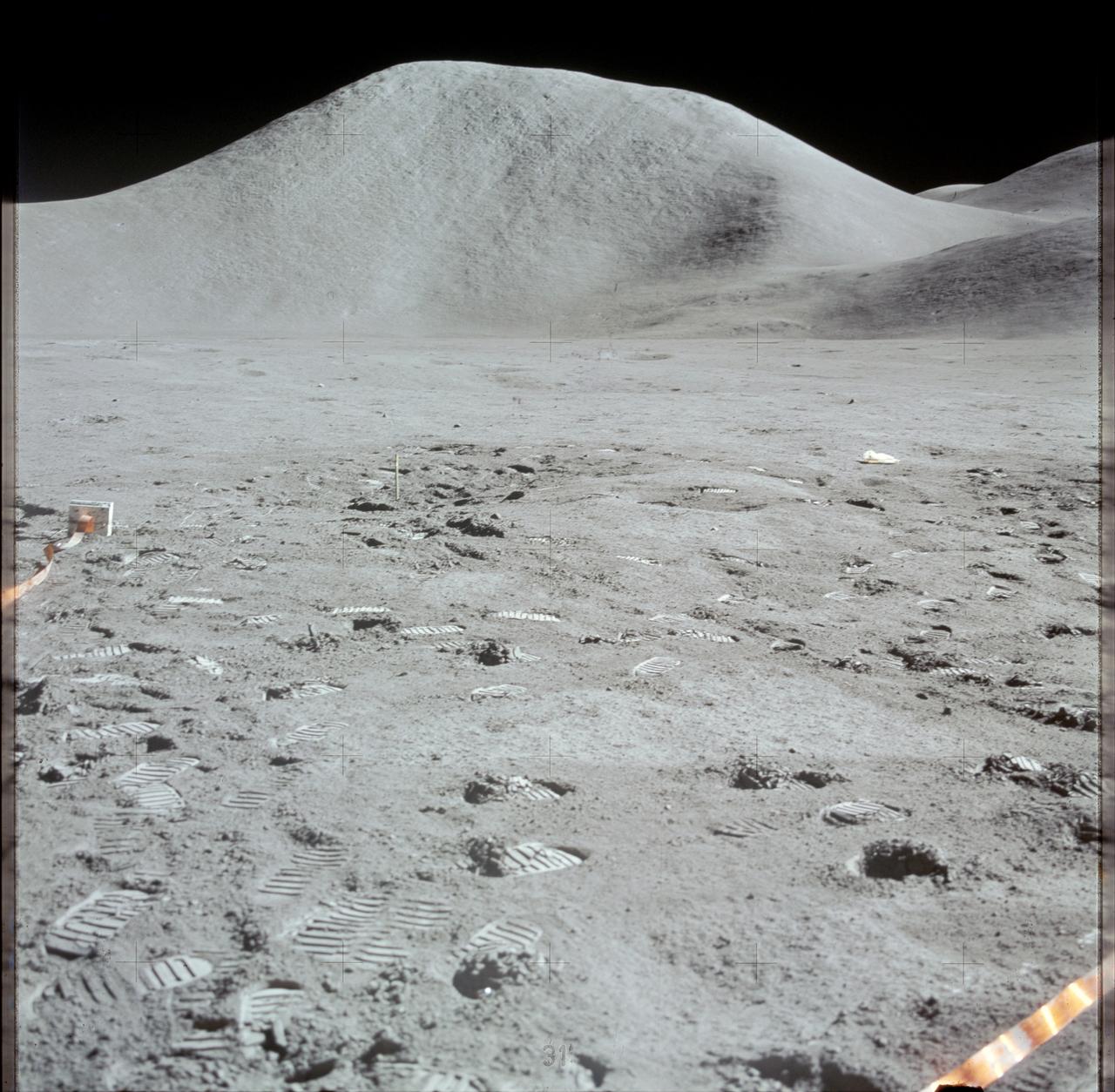
AS15-87-11849 (31 July-2 Aug. 1971) --- An excellent view of Mount Hadley, fully lighted, showing abundant linear features, as photographed during the Apollo 15 lunar surface extravehicular activity (EVA). This view is looking north from the Apollo Lunar Surface Experiments Package (ALSEP) site. Mount Hadley rises about 4,500 meters (approximately 14,765 feet) above the plain. While astronauts David R. Scott, commander, and James B. Irwin, lunar module pilot, descended in the Apollo 15 Lunar Module (LM) "Falcon" to explore the Hadley-Apennine area of the moon, astronaut Alfred M. Worden, command module pilot, remained with the Command and Service Modules (CSM) in lunar orbit.
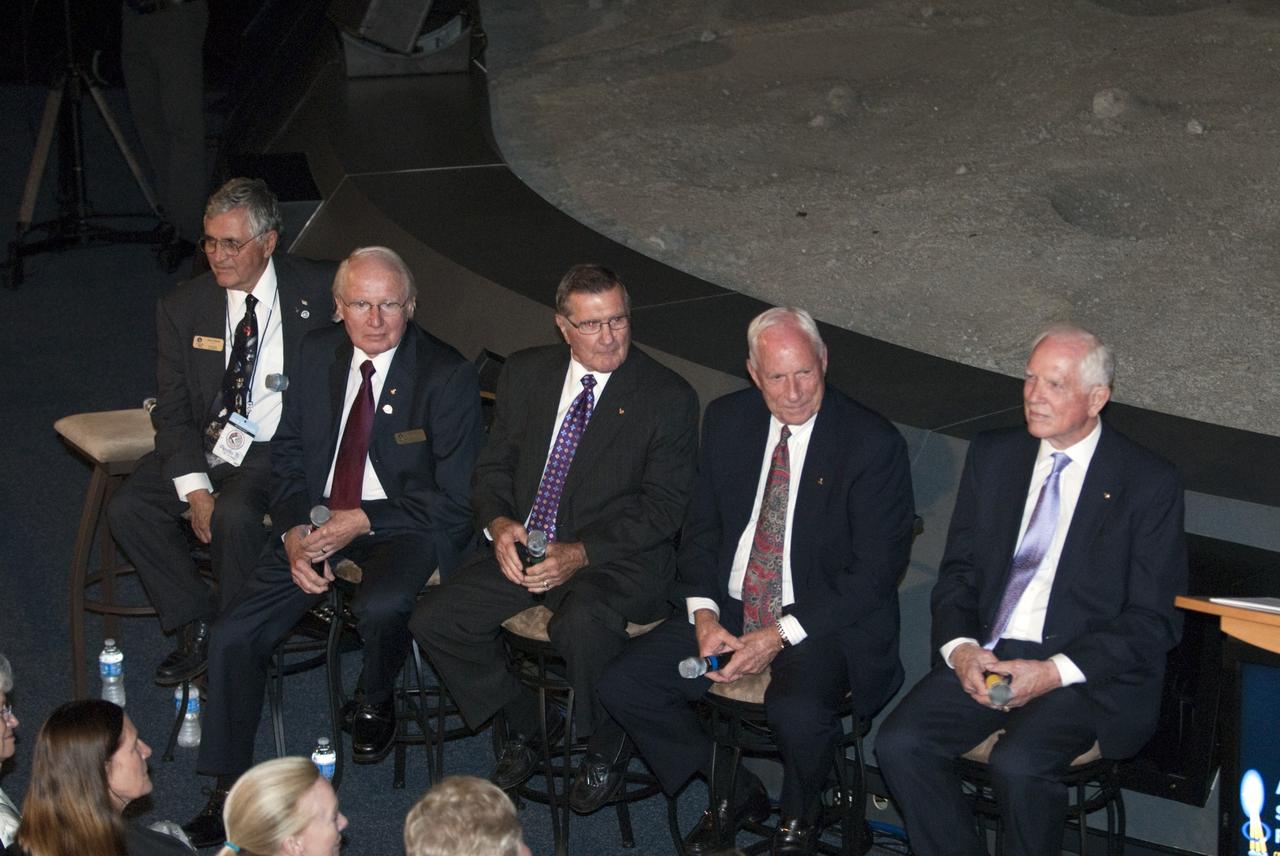
CAPE CANAVERAL, Fla. -- The Apollo/Saturn V Center at NASA's Kennedy Space Center in Florida hosted a celebration on the 40th anniversary of NASA's Apollo 15 mission. Apollo 15 Commander Dave Scott and Command Module Pilot Al Worden and an elite gathering of Apollo-era astronauts were on hand for the event and panel discussion. Seen here are Apollo 15 astronaut backup support crew members, Jack Schmitt (left), Vance Brand and Dick Gordon; Al Worden and Dave Scott. Worden circled the moon while Scott and the late Jim Irwin, the Lunar Module commander, made history when they became the first humans to drive a vehicle on the surface of the moon. They also provided extensive descriptions and photographic documentation of geologic features in the vicinity of the Hadley Rille landing site during their three days on the lunar surface. Photo credit: NASA/Kim Shiflett
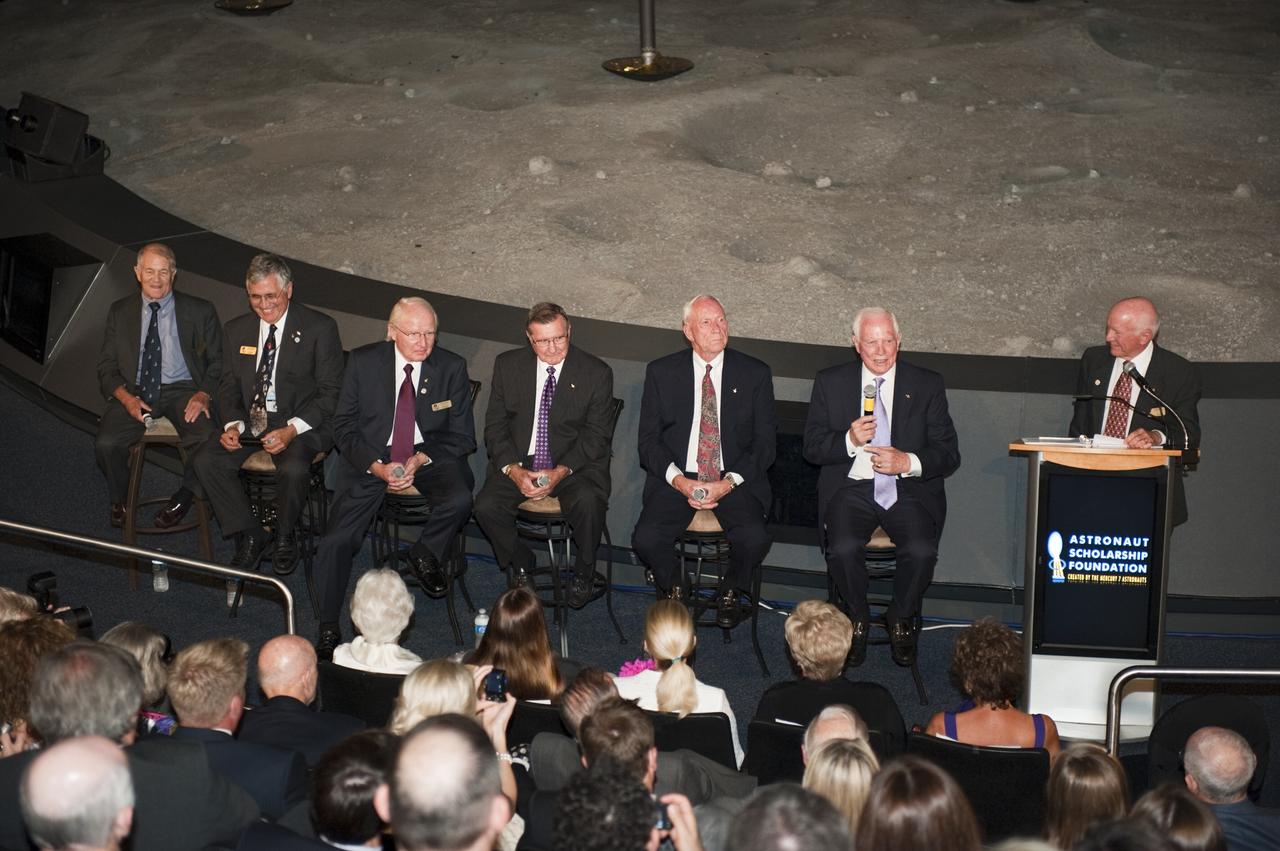
CAPE CANAVERAL, Fla. -- The Apollo/Saturn V Center at NASA's Kennedy Space Center in Florida hosted a celebration on the 40th anniversary of NASA's Apollo 15 mission. An elite gathering of Apollo-era astronauts were on hand for the event and panel discussion. Gerry Griffin, Apollo 15 flight director moderates the question-and-answer period with the panel. From left are: Apollo 15 astronaut backup support crew members, Joe Allen, Jack Schmitt, Vance Brand and Dick Gordon; Al Worden and Dave Scott. Worden circled the moon while Scott and the late Jim Irwin, the Lunar Module commander, made history when they became the first humans to drive a vehicle on the surface of the moon. They also provided extensive descriptions and photographic documentation of geologic features in the vicinity of the Hadley Rille landing site during their three days on the lunar surface. Photo credit: NASA/Kim Shiflett
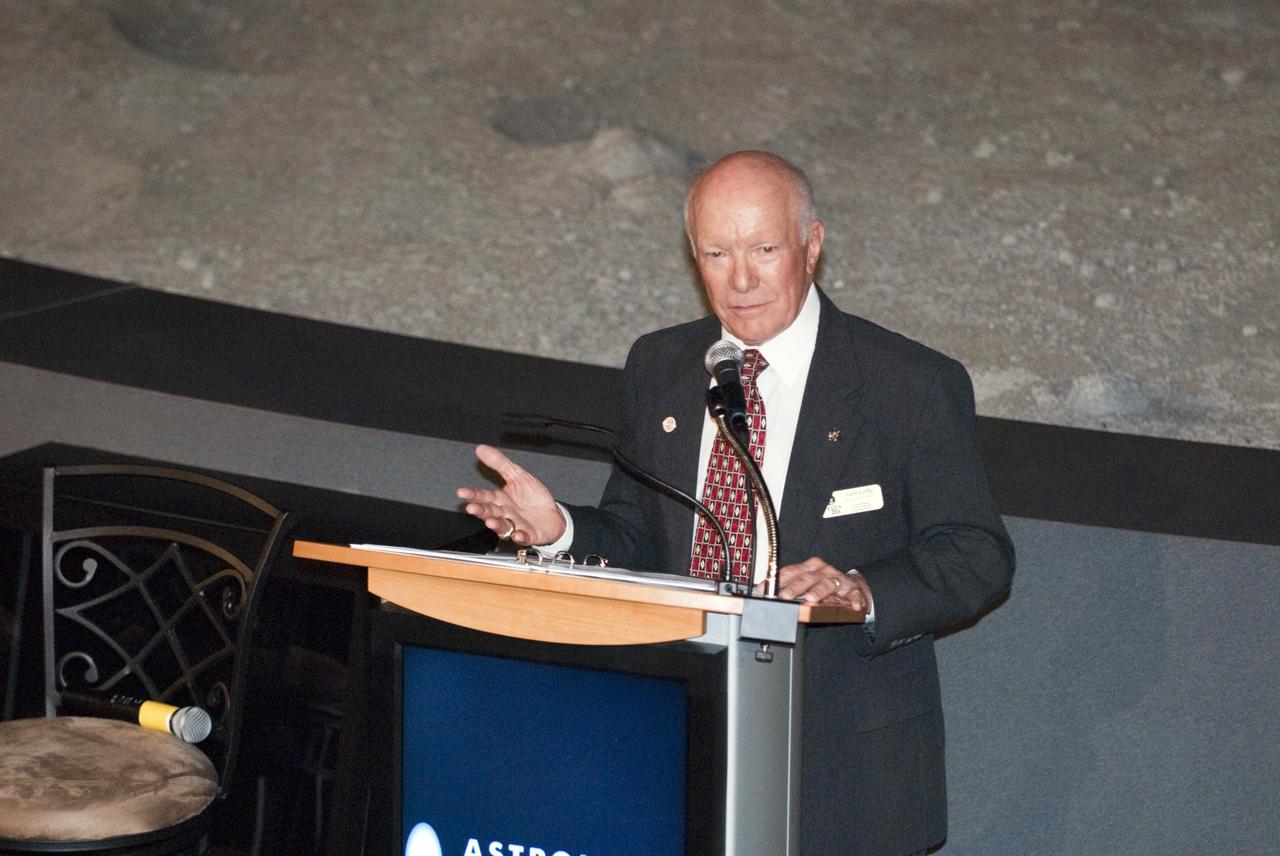
CAPE CANAVERAL, Fla. -- The Apollo/Saturn V Center at NASA's Kennedy Space Center in Florida hosted a celebration on the 40th anniversary of NASA's Apollo 15 mission. Apollo 15 Commander Dave Scott and Command Module Pilot Al Worden and an elite gathering of Apollo-era astronauts were on hand for the event and panel discussion. Here, Gerry Griffin, Apollo 15 flight director, speaks to the invited guests. Worden circled the moon while Scott and the late Jim Irwin, the Lunar Module commander, made history when they became the first humans to drive a vehicle on the surface of the moon. They also provided extensive descriptions and photographic documentation of geologic features in the vicinity of the Hadley Rille landing site during their three days on the lunar surface. Photo credit: NASA/Kim Shiflett
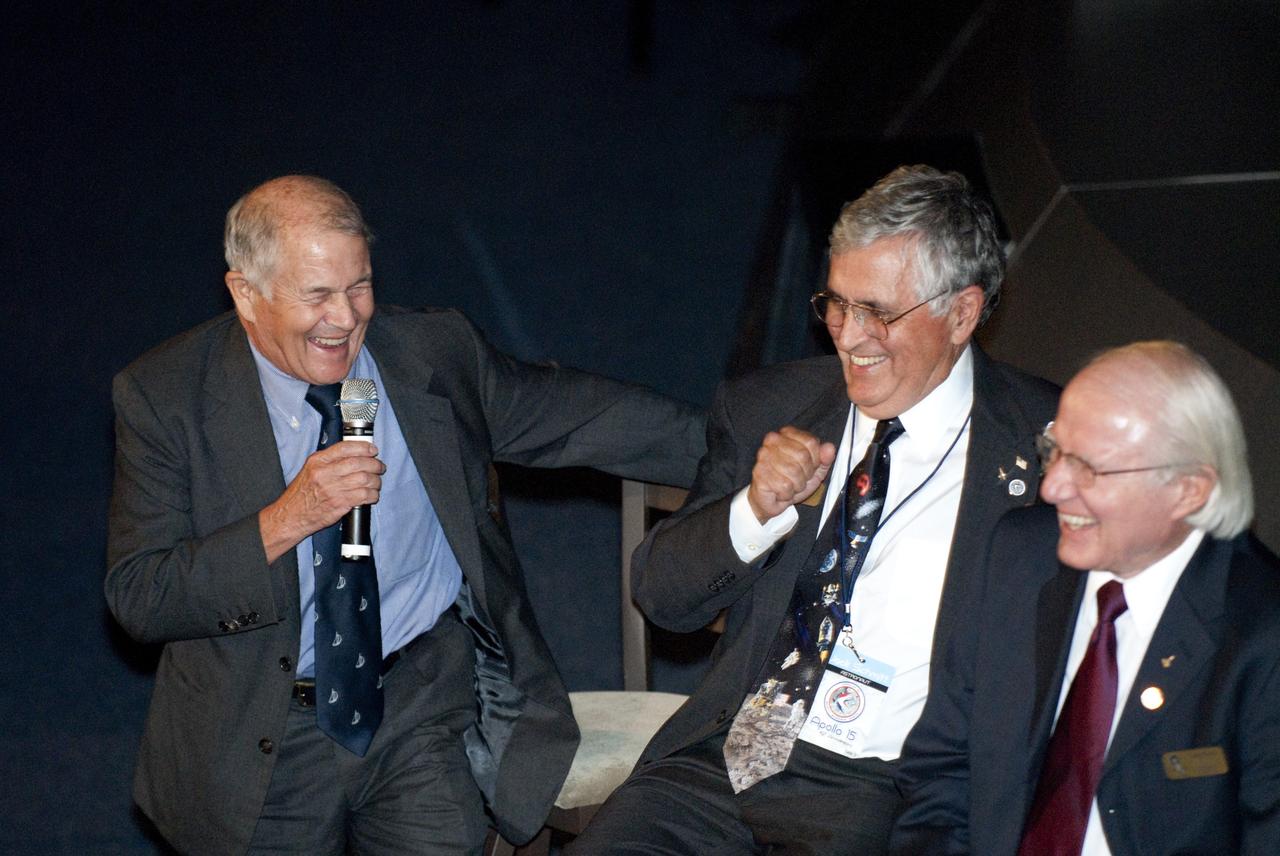
CAPE CANAVERAL, Fla. -- The Apollo/Saturn V Center at NASA's Kennedy Space Center in Florida hosted a celebration on the 40th anniversary of NASA's Apollo 15 mission. Apollo 15 Commander Dave Scott and Command Module Pilot Al Worden and an elite gathering of Apollo-era astronauts were on hand for the event and panel discussion. Here, sharing a light moment are from left, Apollo 15 astronaut support crew members, Joe Allen, Jack Schmitt and Vance Brand. Worden circled the moon while Scott and the late Jim Irwin, the Lunar Module commander, made history when they became the first humans to drive a vehicle on the surface of the moon. They also provided extensive descriptions and photographic documentation of geologic features in the vicinity of the Hadley Rille landing site during their three days on the lunar surface. Photo credit: NASA/Kim Shiflett
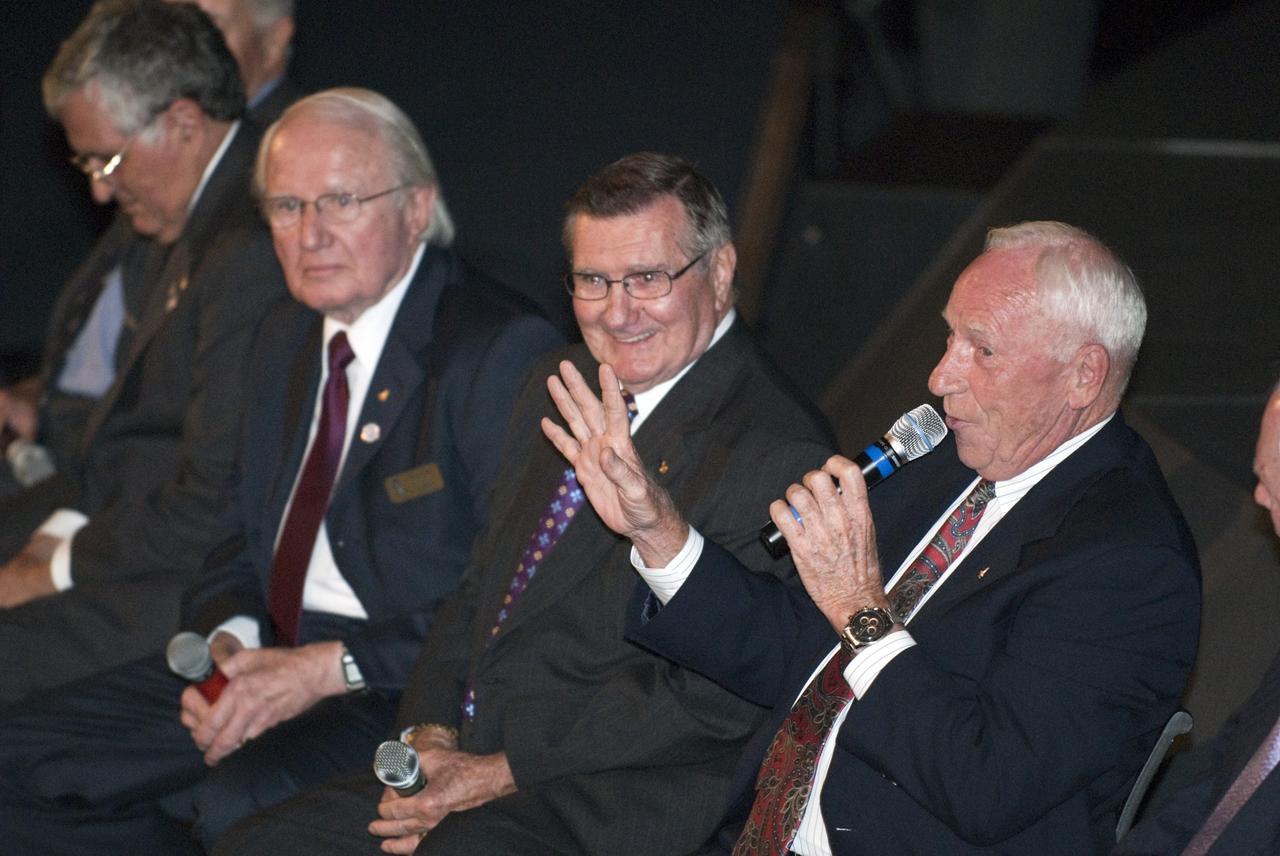
CAPE CANAVERAL, Fla. -- The Apollo/Saturn V Center at NASA's Kennedy Space Center in Florida hosted a celebration on the 40th anniversary of NASA's Apollo 15 mission. Apollo 15 Commander Dave Scott and Command Module Pilot Al Worden and an elite gathering of Apollo-era astronauts were on hand for the event and panel discussion. Seen here are Al Worden (right), and Apollo 15 astronaut backup support crew members, Dick Gordon, Vance Brand and Jack Schmitt. Worden circled the moon while Scott and the late Jim Irwin, the Lunar Module commander, made history when they became the first humans to drive a vehicle on the surface of the moon. They also provided extensive descriptions and photographic documentation of geologic features in the vicinity of the Hadley Rille landing site during their three days on the lunar surface. Photo credit: NASA/Kim Shiflett
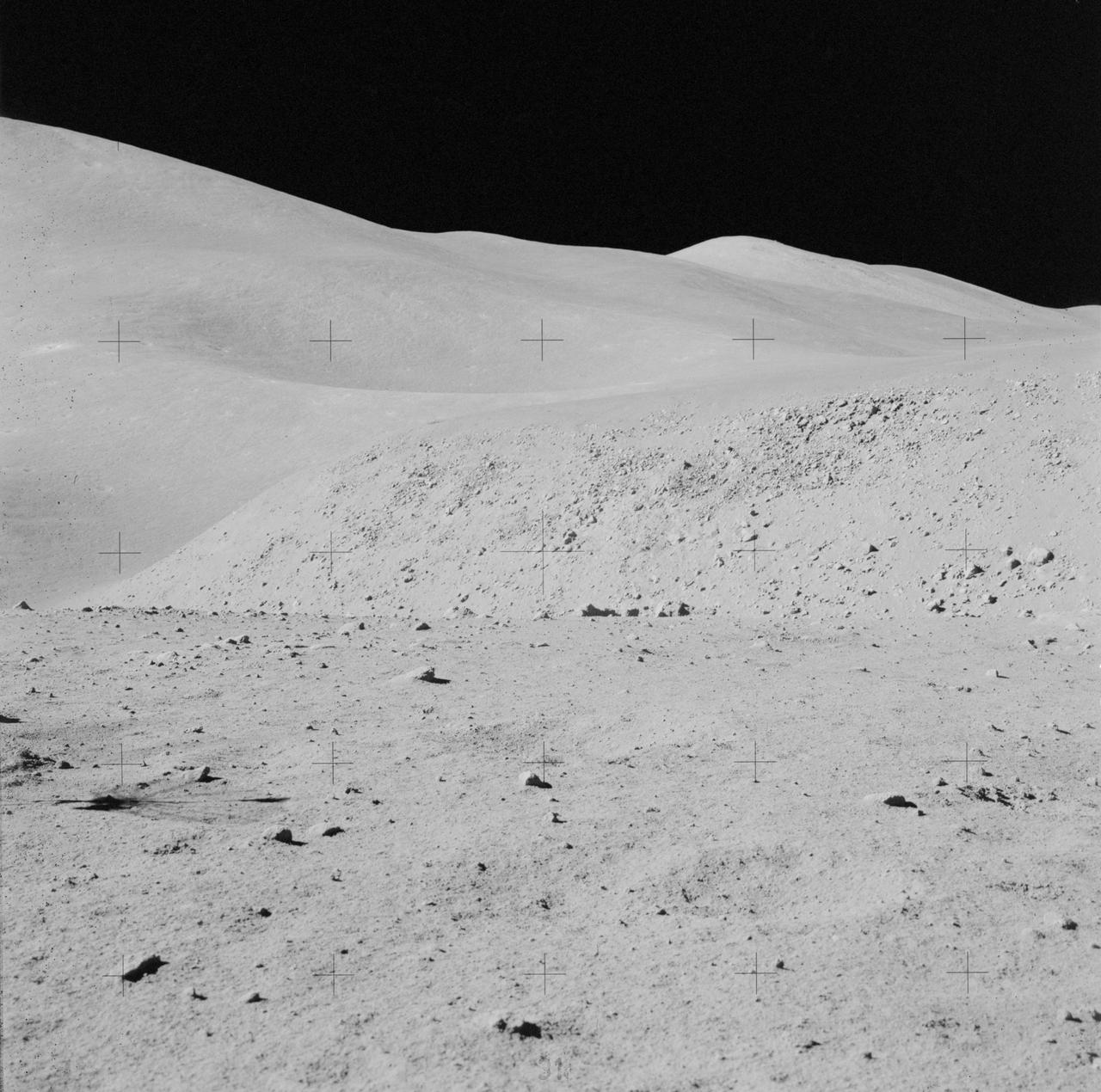
AS15-82-11123 (2 Aug. 1971) --- A view of the "strewn rock" scene encountered by Apollo 15 astronauts David R. Scott, commander, and James B. Irwin, lunar module pilot, during their third extravehicular activity (EVA) of the mission. Irwin took this photograph with a handheld 70mm camera. While astronauts Scott and Irwin descended in the Lunar Module (LM) "Falcon" to explore the moon, astronaut Alfred M. Worden, command module pilot, remained with the Command and Service Modules (CSM) in lunar orbit.
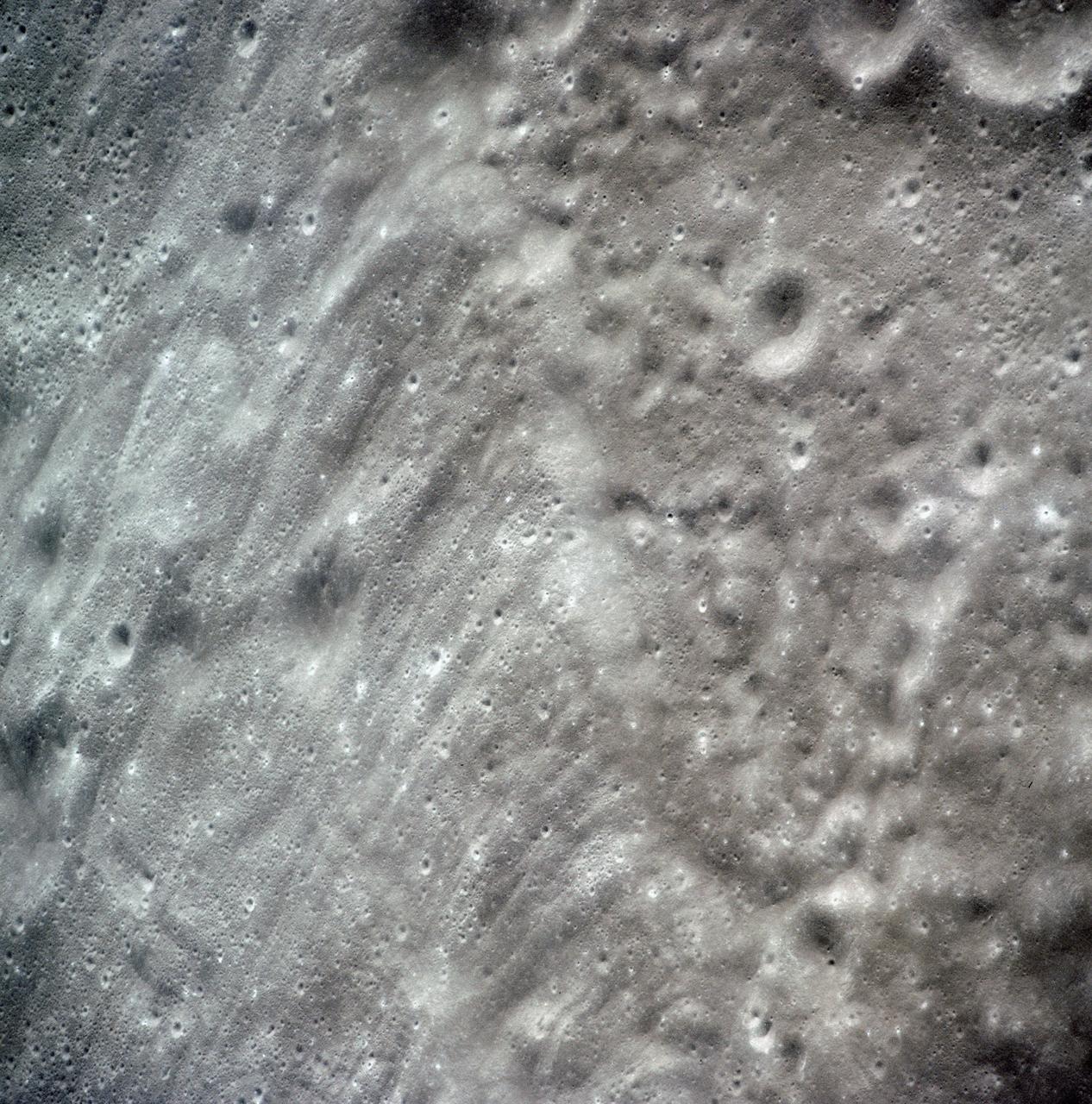
AS15-97-13168 (31 July-2 Aug. 1971) --- A view of the flow structure on the rim and edge of the crater Tsiolkovsky in the highlands of the lunar farside, as photographed from lunar orbit by astronaut Alfred M. Worden in the Apollo 15 Command and Service Module (CSM). Note the scarp at the edge of the flow and elongated grooves on the flow surface. While astronauts David R. Scott and James B. Irwin descended in the Lunar Module (LM) "Falcon" to explore the moon's Hadley-Apennine landing site, Worden remained with the CSM in lunar orbit.
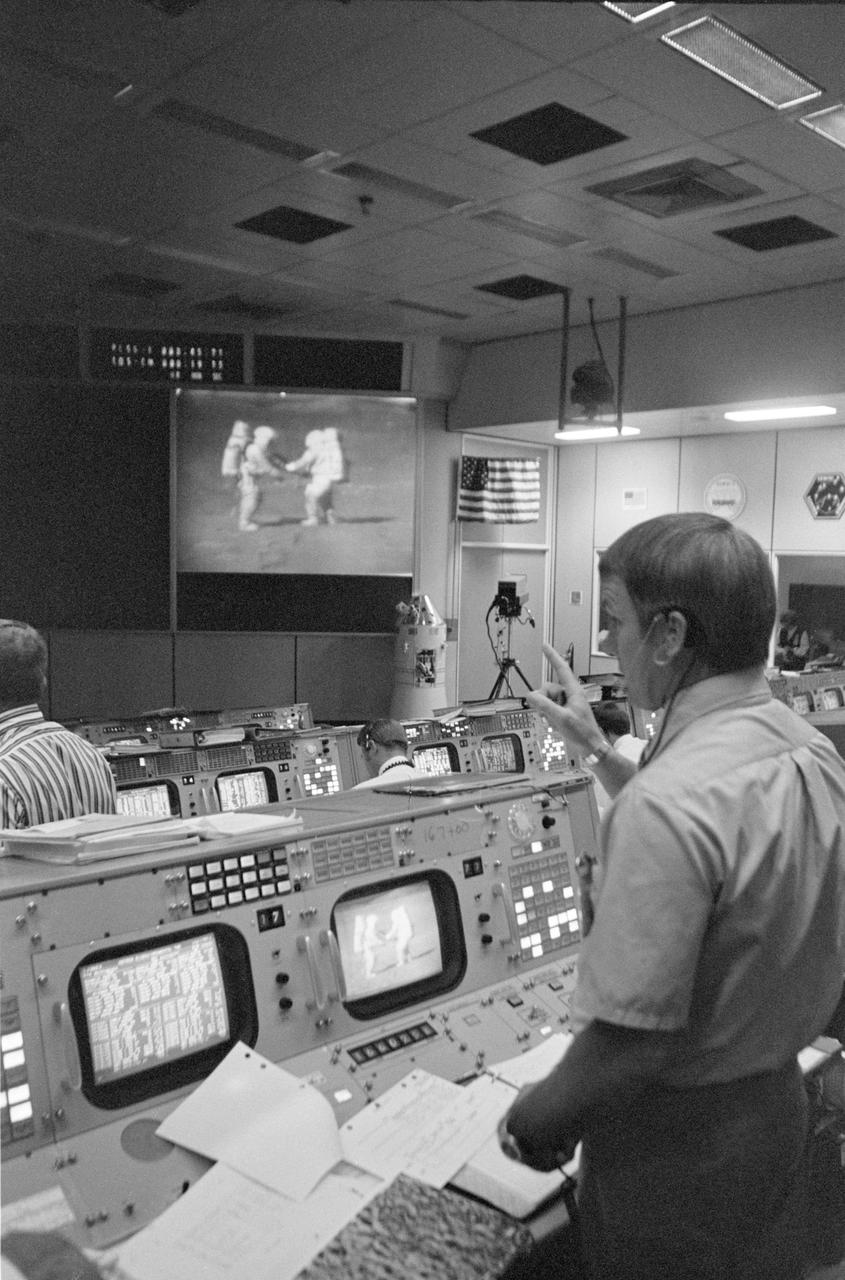
S71-41852 (2 Aug. 1971) --- Gerald D. Griffin, foreground, stands near his console in the Mission Operations Control Room (MOCR) during Apollo 15's third extravehicular activity (EVA) on the lunar surface. Griffin is Gold Team (Shift 1) flight director for the Apollo 15 mission. Astronauts David R. Scott and James B. Irwin can be seen on the large screen at the front of the MOCR as they participate in sample-gathering on the lunar surface.
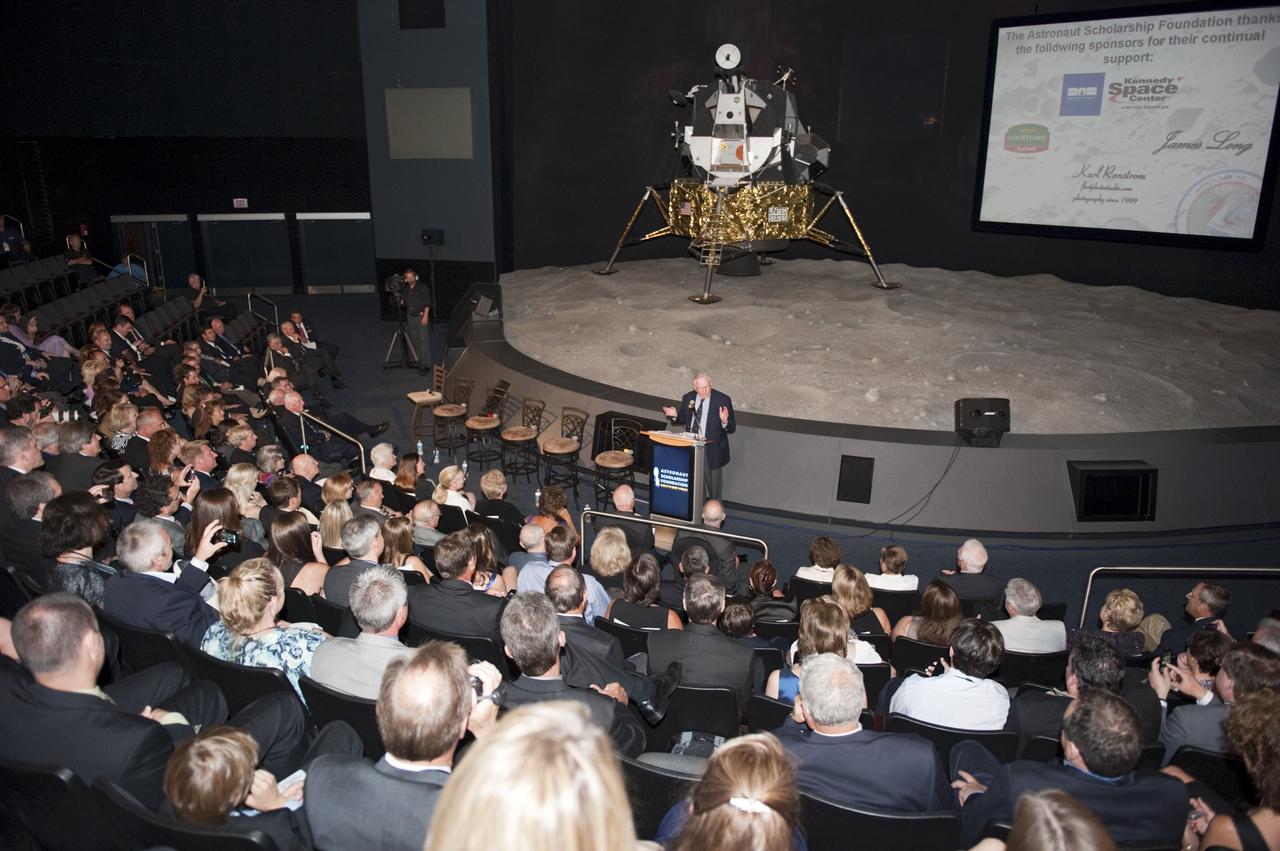
CAPE CANAVERAL, Fla. -- The Apollo/Saturn V Center at NASA's Kennedy Space Center in Florida hosted a celebration on the 40th anniversary of NASA's Apollo 15 mission. Apollo 15 Commander Dave Scott and Command Module Pilot Al Worden and an elite gathering of Apollo-era astronauts were on hand for the event and panel discussion. Here, Apollo 11 Commander Neil Armstrong speaks to the invited guests. In the background is a model of the Lunar Module, part of the lander portion of the Apollo spacecraft. Worden circled the moon while Scott and the late Jim Irwin, the Lunar Module commander, made history when they became the first humans to drive a vehicle on the surface of the moon. They also provided extensive descriptions and photographic documentation of geologic features in the vicinity of the Hadley Rille landing site during their three days on the lunar surface. Photo credit: NASA/Kim Shiflett
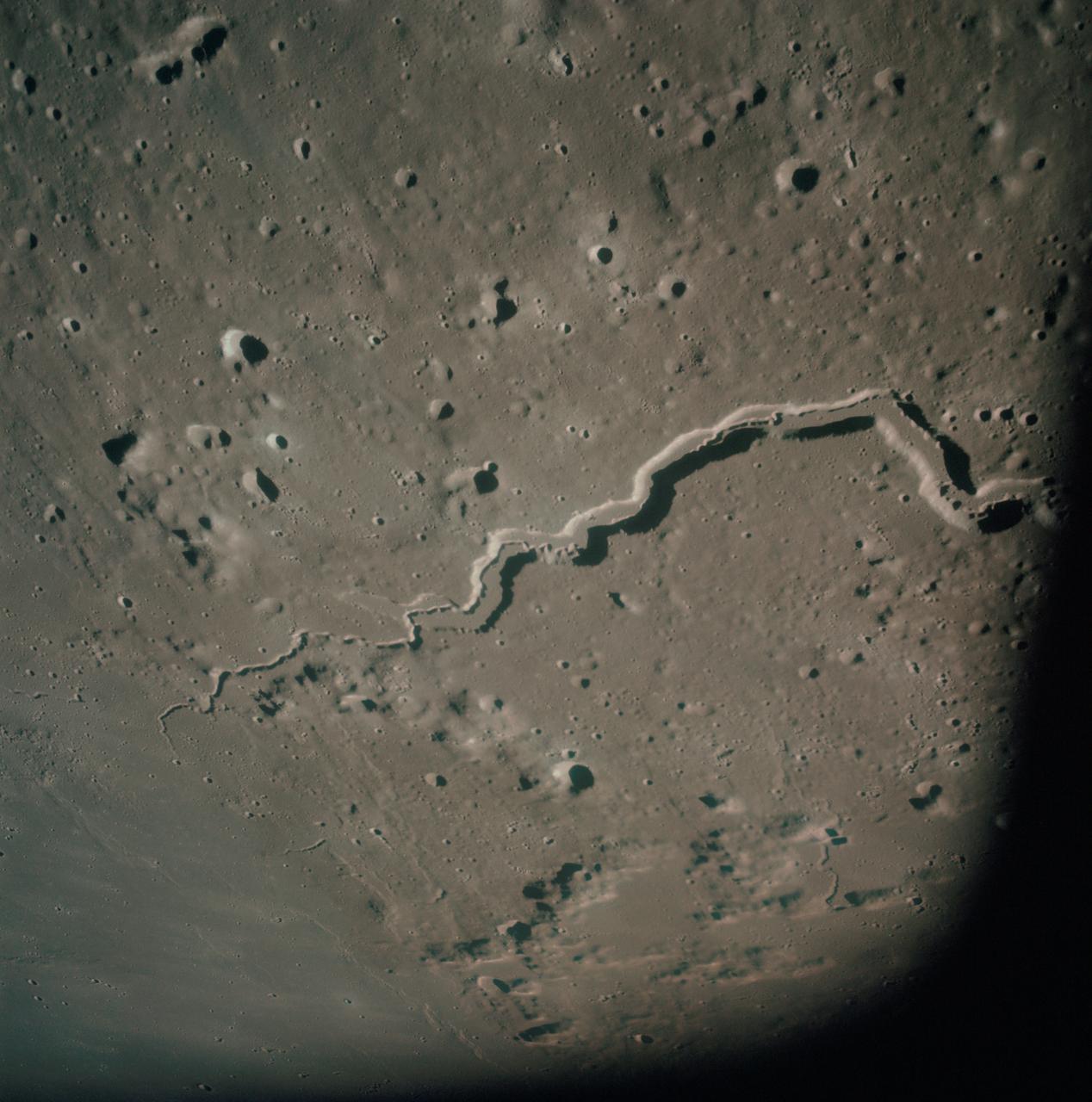
AS15-93-12628 (31 July 1971) --- The snake-like rille feature in this 70mm frame, photographed from the lunar-orbiting Apollo 15 Command and Service Modules (CSM) by astronaut Alfred M. Worden, command module pilot, is Schroter's Valley. The long feature is located not far from the crater Aristarcus (out of frame) on the western side of the moon. Center coordinates of the area pictured are located at 25 degrees north latitude and 52.5 degrees west longitude. While astronauts David R. Scott, commander, and James B. Irwin, lunar module pilot, descended in the Lunar Module (LM) "Falcon" to explore the Hadley-Apennine area of the moon, astronaut Worden remained with the CSM in lunar orbit.
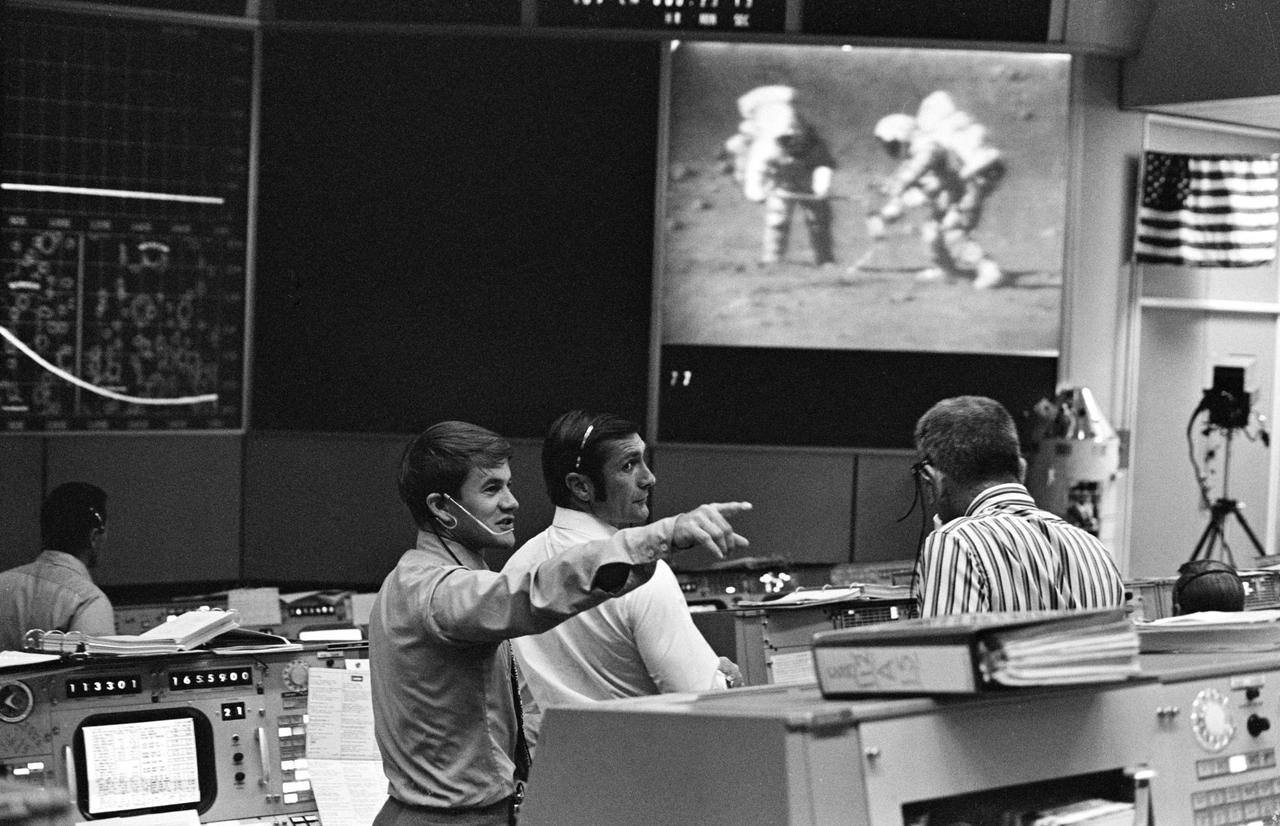
S71-41836 (2 Aug. 1971) --- Scientist-astronaut Joseph P. Allen, left, directs the attention of astronaut Richard F. Gordon Jr., to an occurrence out of view at right in the Mission Control Center's (MCC) Mission Operations Control Room (MOCR), while Dr. Donald K. (Deke) Slayton, on right with back to camera, views activity of Apollo 15 on a large screen at the front of the MOCR. Astronauts David R. Scott and James B. Irwin are seen on the screen performing tasks of the mission's third extravehicular activity (EVA), on Aug. 2, 1971. Dr. Slayton is director of Flight Crew Operations, NASA-MSC; Gordon is Apollo 15 backup commander; and Dr. Allen is an Apollo 15 spacecraft communicator.
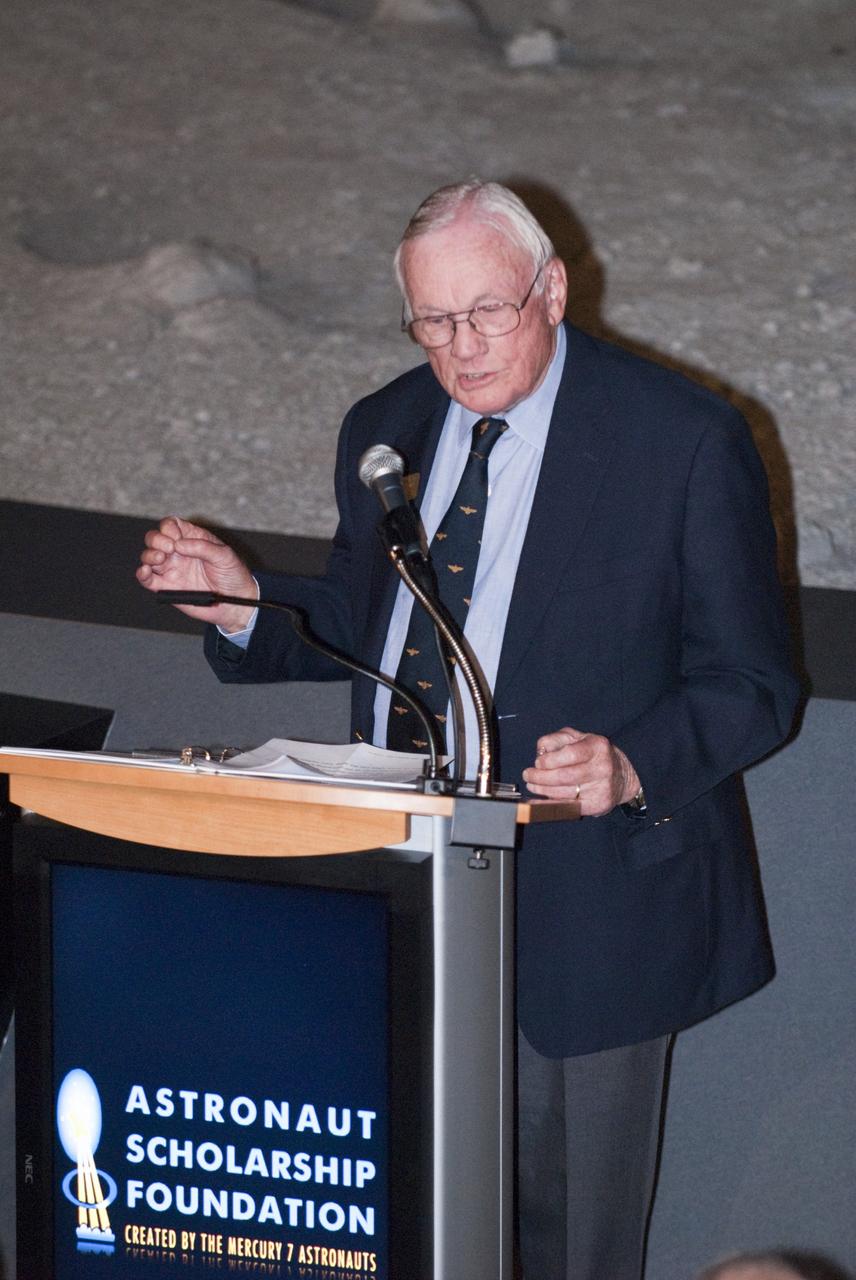
CAPE CANAVERAL, Fla. -- The Apollo/Saturn V Center at NASA's Kennedy Space Center in Florida hosted a celebration on the 40th anniversary of NASA's Apollo 15 mission. Apollo 15 Commander Dave Scott, Command Module Pilot Al Worden and an elite gathering of Apollo-era astronauts were on hand for the event and panel discussion. Here, Apollo 11 Commander Neil Armstrong speaks to the invited guests. Worden circled the moon while Scott and the late Jim Irwin, the Lunar Module commander, made history when they became the first humans to drive a vehicle on the surface of the moon. They also provided extensive descriptions and photographic documentation of geologic features in the vicinity of the Hadley Rille landing site during their three days on the lunar surface. Photo credit: NASA/Kim Shiflett
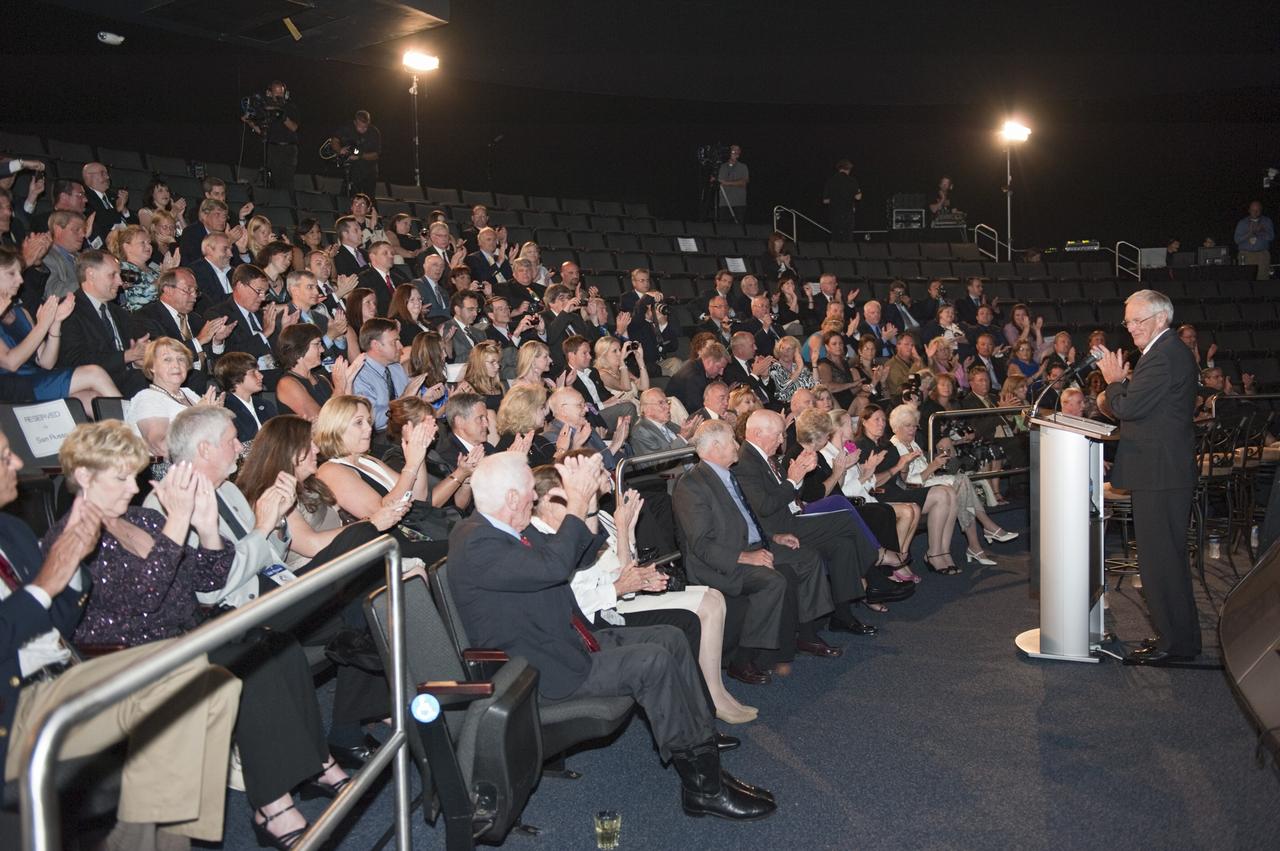
CAPE CANAVERAL, Fla. -- The Apollo/Saturn V Center at NASA's Kennedy Space Center in Florida hosted a celebration on the 40th anniversary of NASA's Apollo 15 mission. Apollo 15 Commander Dave Scott, Command Module Pilot Al Worden and an elite gathering of Apollo-era astronauts were on hand for the event and panel discussion. Here, Apollo 16 Lunar Module Pilot Charlie Duke welcomes the invited guests and introduces the guests of honor. Worden circled the moon while Scott and the late Jim Irwin, the Lunar Module commander, made history when they became the first humans to drive a vehicle on the surface of the moon. They also provided extensive descriptions and photographic documentation of geologic features in the vicinity of the Hadley Rille landing site during their three days on the lunar surface. Photo credit: NASA/Kim Shiflett

CAPE CANAVERAL, Fla. -- The Apollo/Saturn V Center at NASA's Kennedy Space Center in Florida hosted a celebration on the 40th anniversary of NASA's Apollo 15 mission. Apollo 15 Commander Dave Scott and Command Module Pilot Al Worden and an elite gathering of Apollo-era astronauts were on hand for the event and panel discussion. Here, Al Worden with microphone in hand, speaks to the invited guests. Worden circled the moon while Scott and the late Jim Irwin, the Lunar Module commander, made history when they became the first humans to drive a vehicle on the surface of the moon. They also provided extensive descriptions and photographic documentation of geologic features in the vicinity of the Hadley Rille landing site during their three days on the lunar surface. Photo credit: NASA/Kim Shiflett
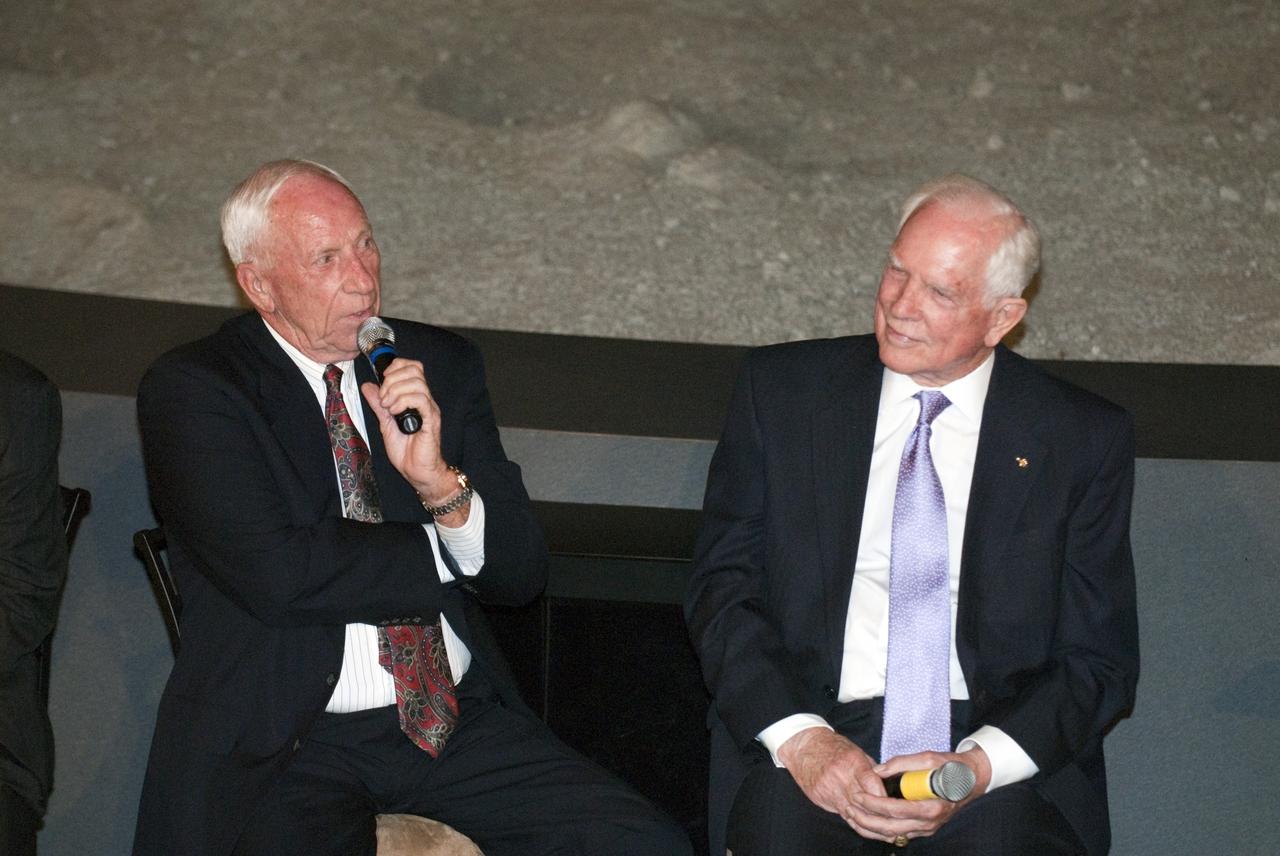
CAPE CANAVERAL, Fla. -- The Apollo/Saturn V Center at NASA's Kennedy Space Center in Florida hosted a celebration on the 40th anniversary of NASA's Apollo 15 mission. Apollo 15 Commander Dave Scott (right) and Command Module Pilot Al Worden and an elite gathering of Apollo-era astronauts were on hand for the event and panel discussion. Worden circled the moon while Scott and the late Jim Irwin, the Lunar Module commander, made history when they became the first humans to drive a vehicle on the surface of the moon. They also provided extensive descriptions and photographic documentation of geologic features in the vicinity of the Hadley Rille landing site during their three days on the lunar surface. Photo credit: NASA/Kim Shiflett
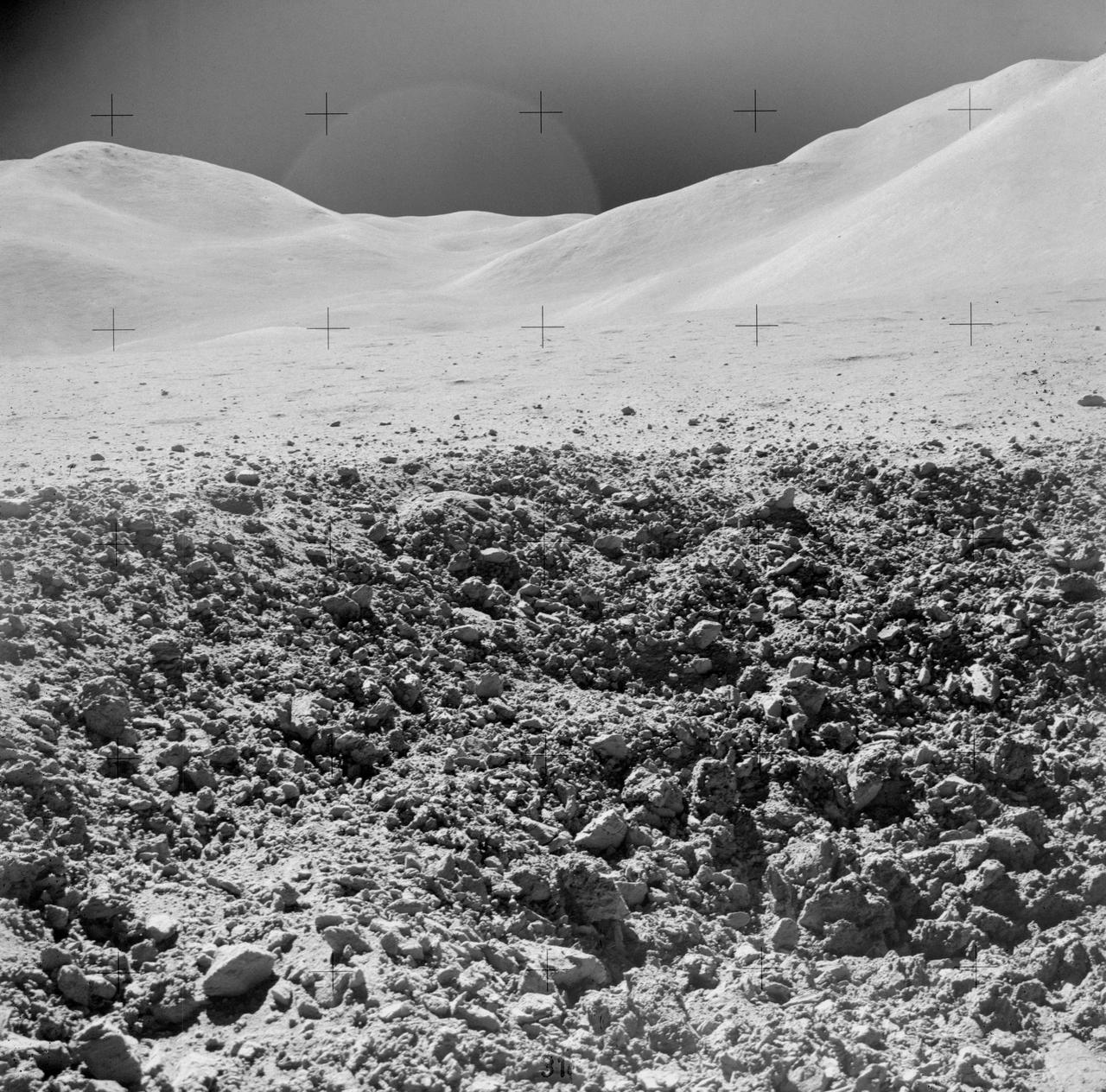
AS15-82-11082 (2 Aug. 1971) --- A close-up view of a portion of a "relatively fresh" crater, looking southeast, as photographed during the third Apollo 15 lunar surface extravehicular activity (EVA), on Aug. 2, 1971, at EVA Station No. 9, near Scarp Crater. The crater pictured is unnamed. The Apennine Front is in the background, and Hadley Delta Mountain is in the right background. While astronauts David R. Scott, commander, and James B. Irwin, lunar module pilot, descended in the Lunar Module (LM) "Falcon" to explore the moon, astronaut Alfred M. Worden, command module pilot, remained with the Command and Service Modules (CSM) in lunar orbit.
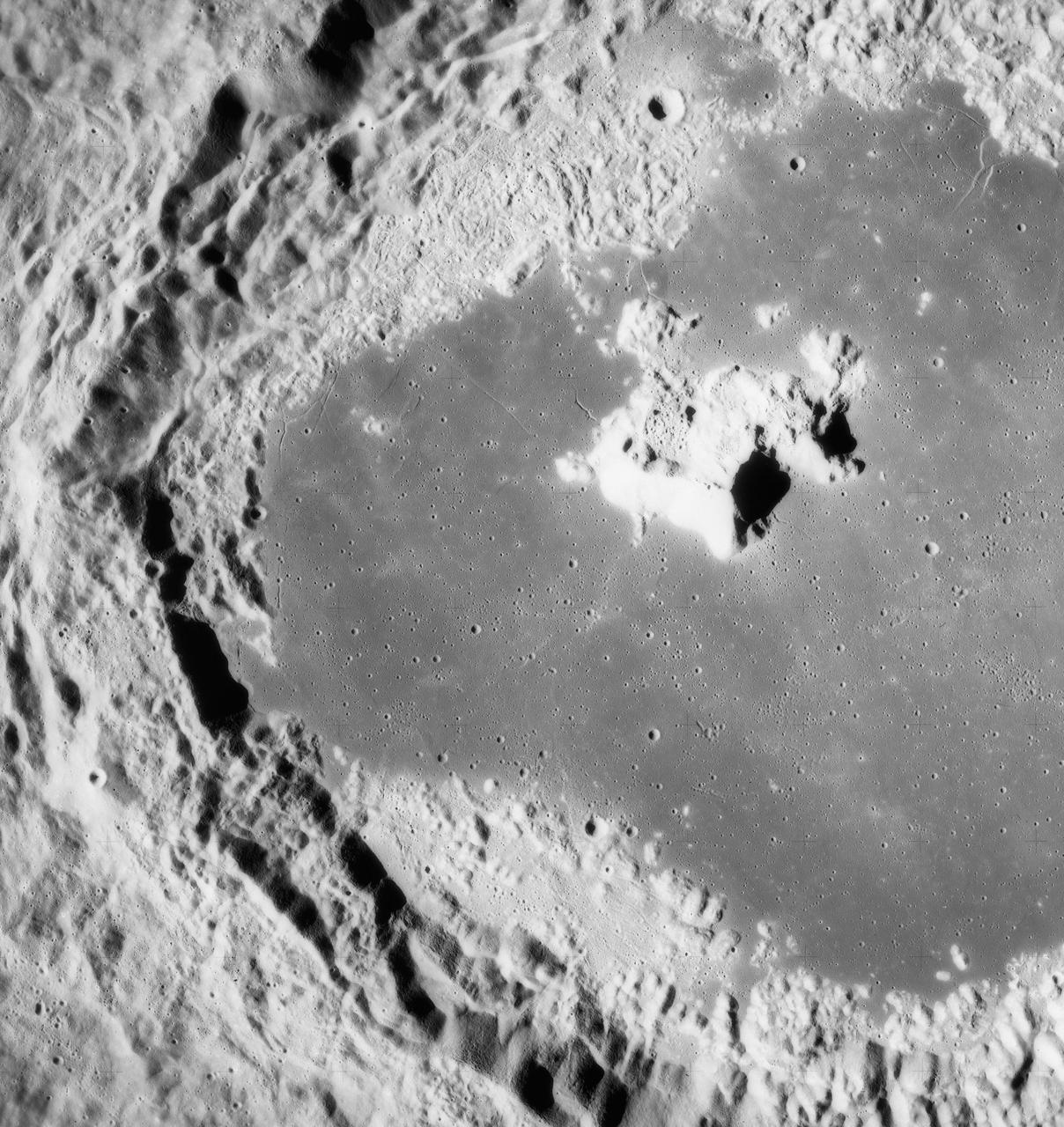
S71-44670 (31 July 1971) --- A near vertical view of the crater Tsiolkovsky on the lunar farside, as photographed by the Fairchild metric camera in the Scientific Instrument Module (SIM) bay of the Apollo 15 Command and Service Modules (CSM) in lunar orbit. This view is looking northerly. The coordinates of the crater's central peaks are 128 degrees east longitude and 20 degrees south latitude. The mare area measured from east to west is approximately 145 kilometers (90 statute miles) across. The three-inch mapping camera was one of eight lunar orbital science experiments mounted in the SIM bay.
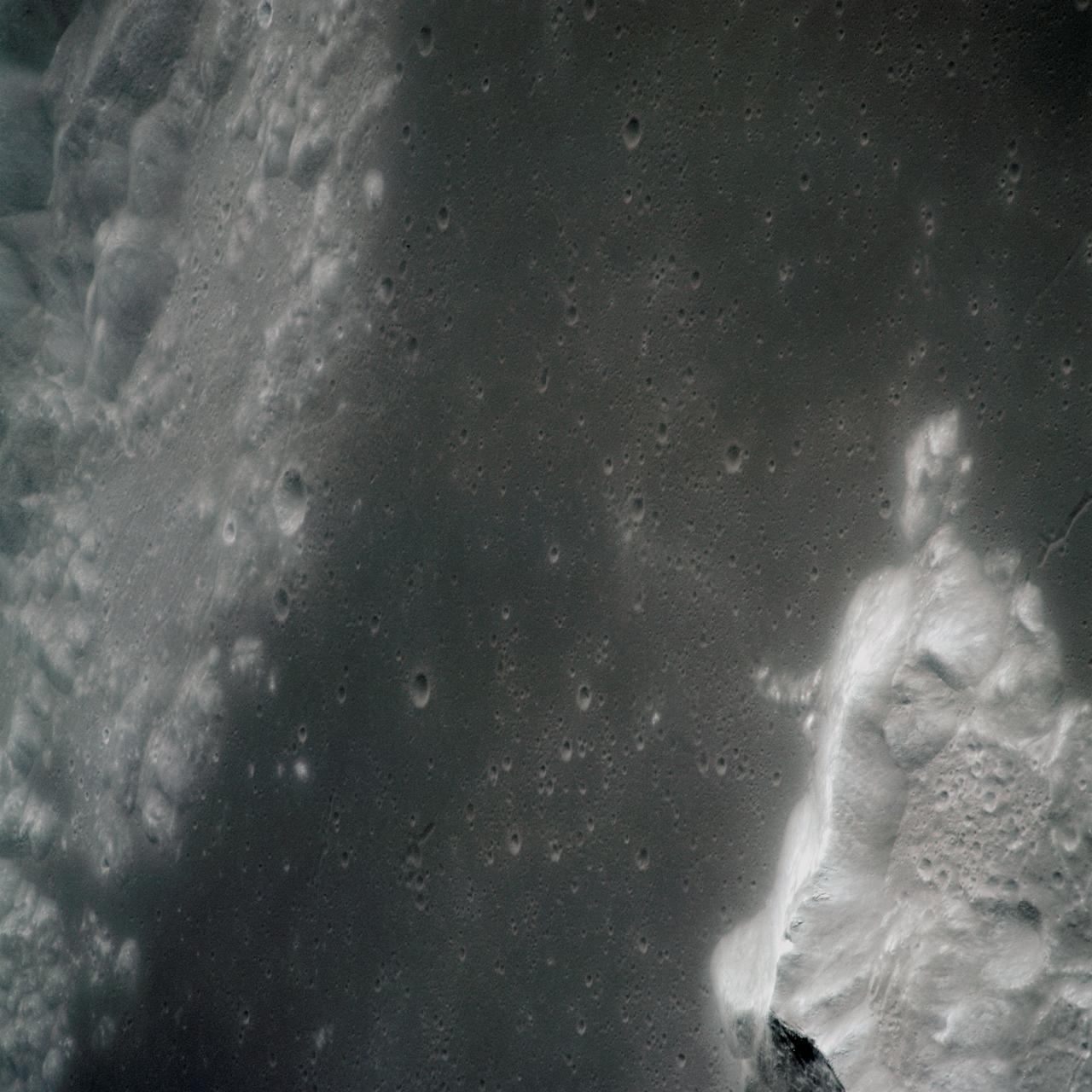
AS15-97-13160 (31 July-2 Aug. 1971) --- A view of a portion of the crater Tsiolkovsky located in the highlands on the farside of the moon, as photographed from the Apollo 15 Command and Service Modules (CSM) by astronaut Alfred M. Worden, command module pilot. Note the dark, flat crater floor surrounding the very prominent central mountains. The mountains are in the northeastern corner of the photograph. The other upland area comprises part of the southwestern edge of the crater. While astronauts David R. Scott, commander, and James B. Irwin, lunar module pilot, descended in the Lunar Module (LM) "Falcon" to explore the moon, astronaut Worden remained with the CSM in lunar orbit.
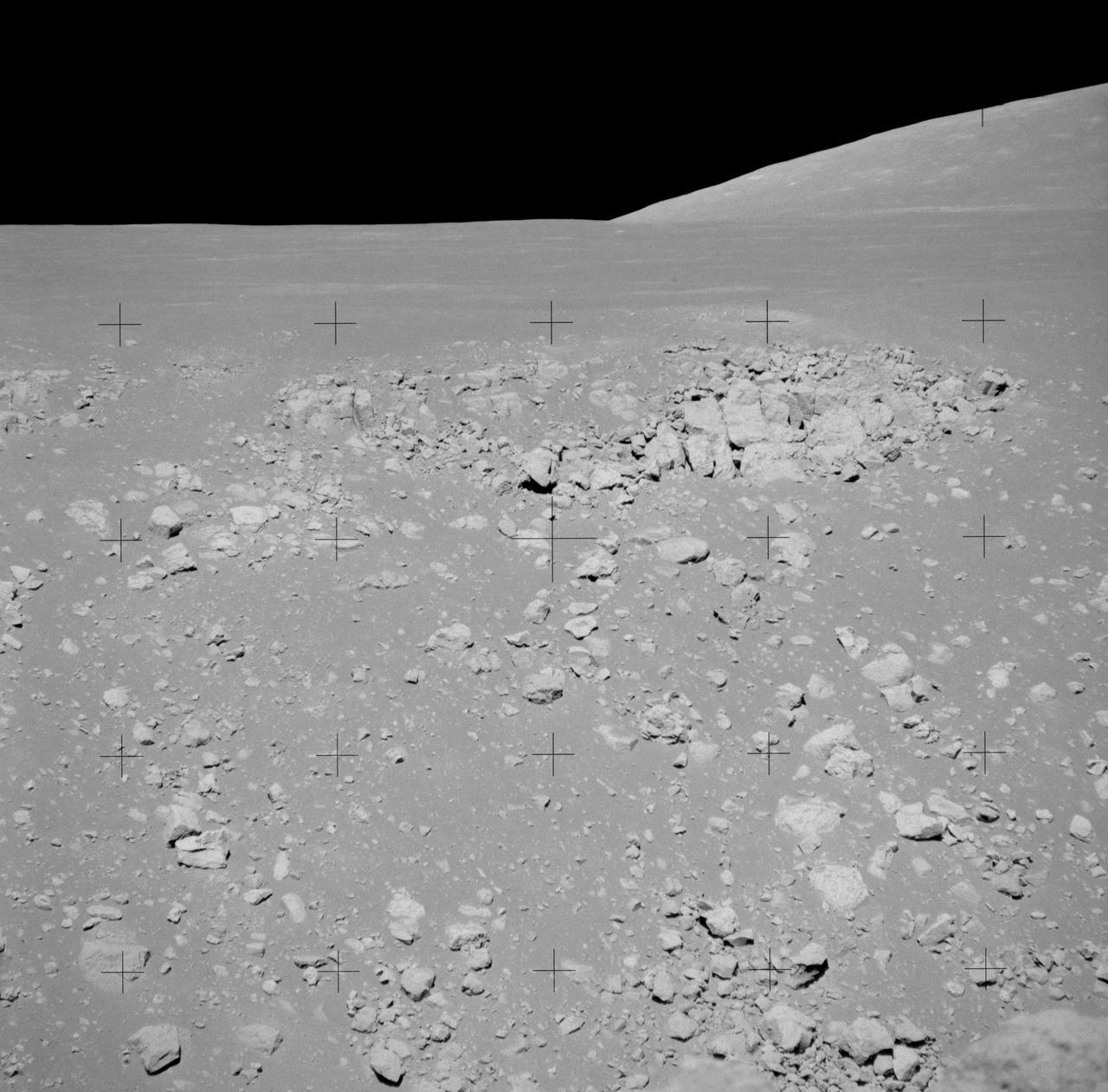
AS15-89-12100 (2 Aug. 1971) --- A telephoto lens view looking across Hadley Rille, photographed during the third Apollo 15 lunar surface extravehicular activity (EVA) at the Hadley-Apennine landing site on the nearside of the moon. The blocky outcrop at the top of the west wall of the rille is about 1.9 kilometers (1.1 statute miles) from the camera. About one-half of the debris-covered wall is visible in the photograph. On the horizon the northern end of Hill 305 is more than 16 kilometers (10 statute miles) from the camera.
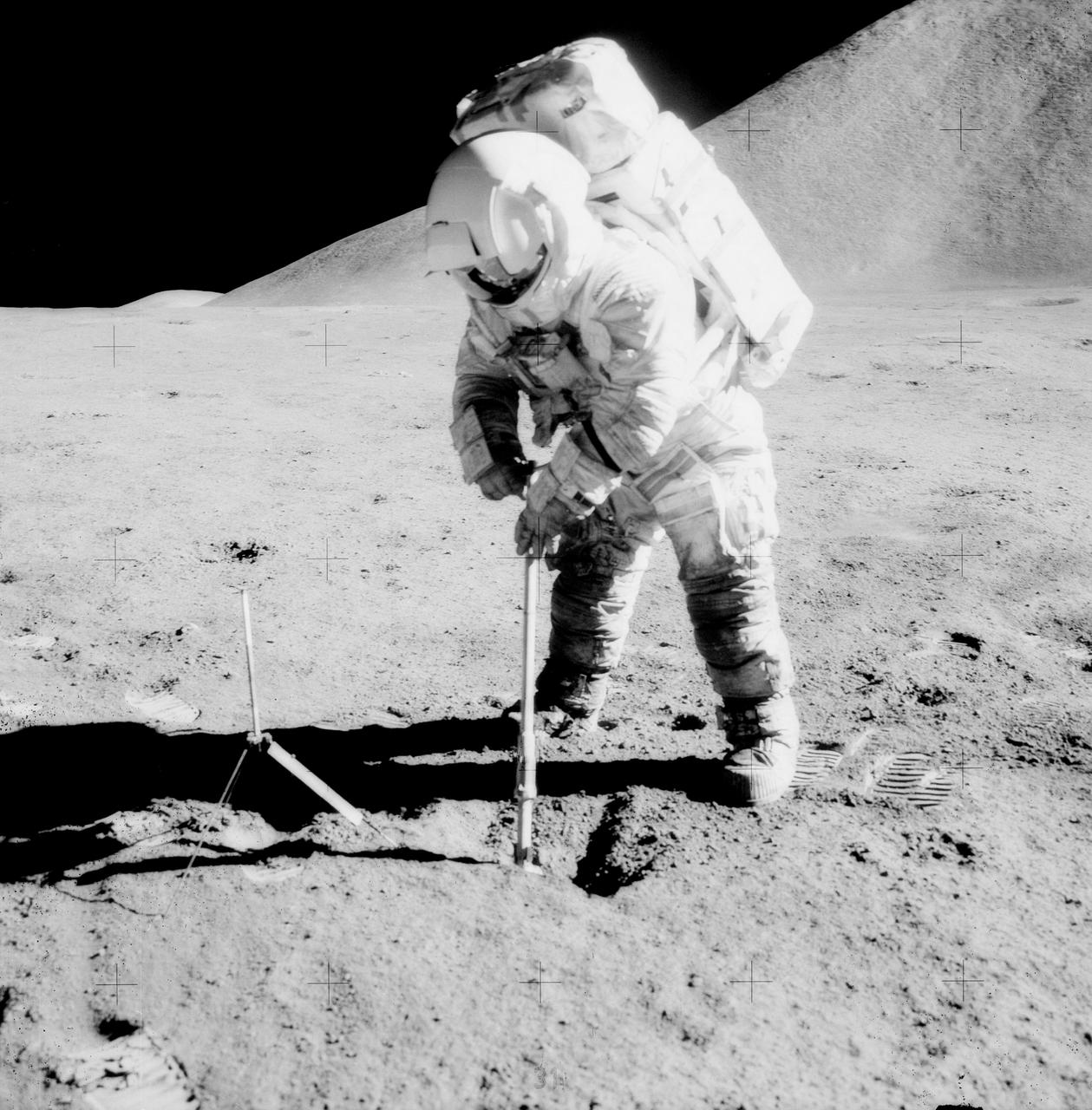
AS15-92-12424 (31 July-2 Aug. 1971) --- Astronaut James B. Irwin, lunar module pilot, uses a scoop in making a trench in the lunar soil during Apollo 15 extravehicular activity (EVA) on the moon. Mount Hadley, which rises approximately 14,765 feet (about 4,500 meters) above the plain, is in the background. Its base is some 14 kilometers (about 8.4 miles) away. The gnomon is at left. While astronauts Irwin, and David R. Scott, commander, descended in the Lunar Module (LM) to explore the moon, astronaut Alfred M. Worden, command module pilot, remained with the Command and Service Modules (CSM) in lunar orbit.
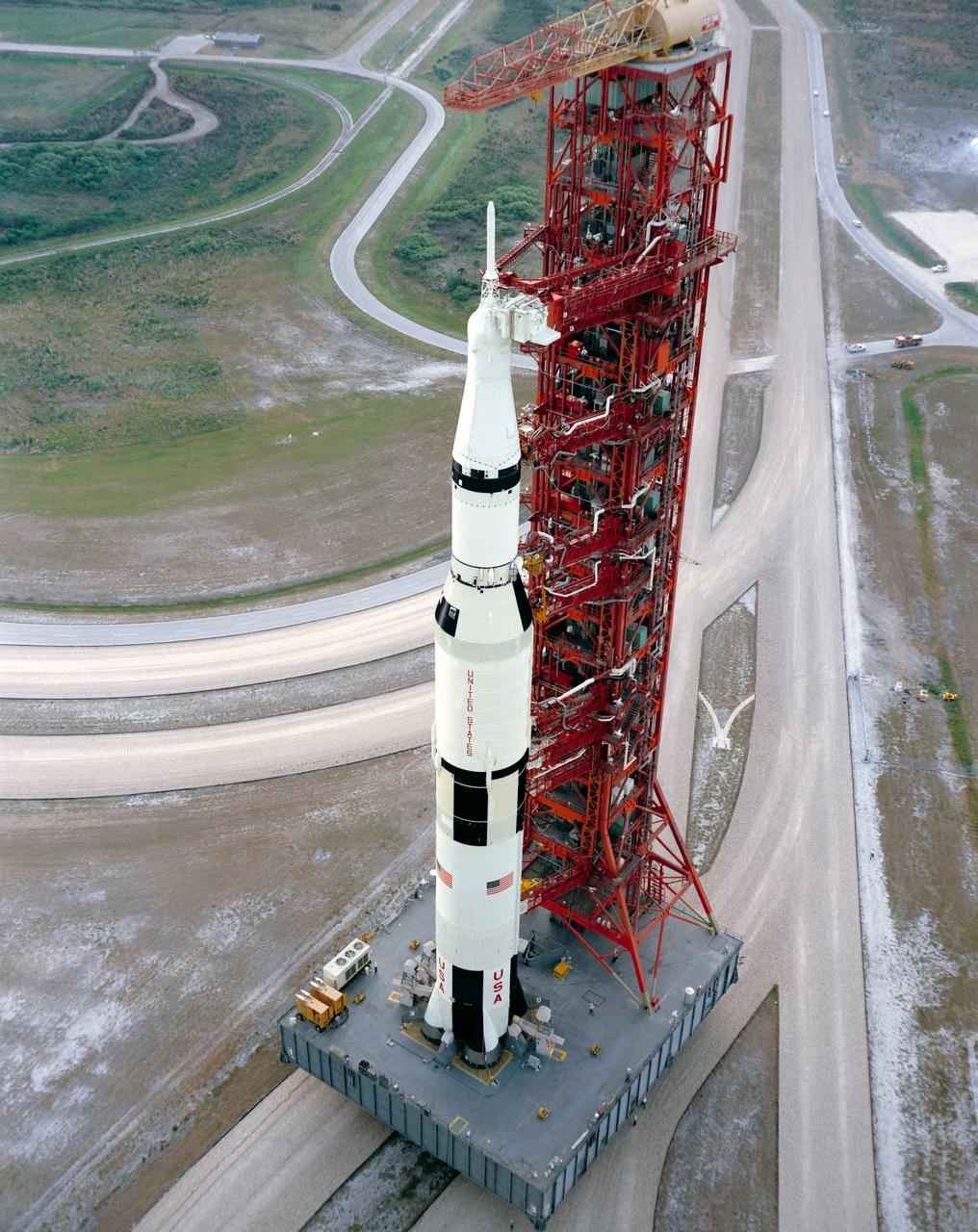
S71-33781 (11 May 1971) --- High angle view showing the Apollo 15 (Spacecraft 112/Lunar Module 10/Saturn 510) space vehicle on the way from the Vehicle Assembly Building (VAB) to Pad A, Launch Complex 39, Kennedy Space Center (KSC). The Saturn V stack and its mobile launch tower are atop a huge crawler-transporter. Apollo 15 is scheduled as the fourth manned lunar landing mission by the National Aeronautics and Space Administration (NASA). The crew men will be astronauts David R. Scott, commander; Alfred M. Worden, command module pilot; and James B. Irwin, lunar module pilot. While astronauts Scott and Irwin descend in the Lunar Module (LM) to explore the moon, astronaut Worden will remain with the Command and Service Modules (CSM) in lunar orbit.
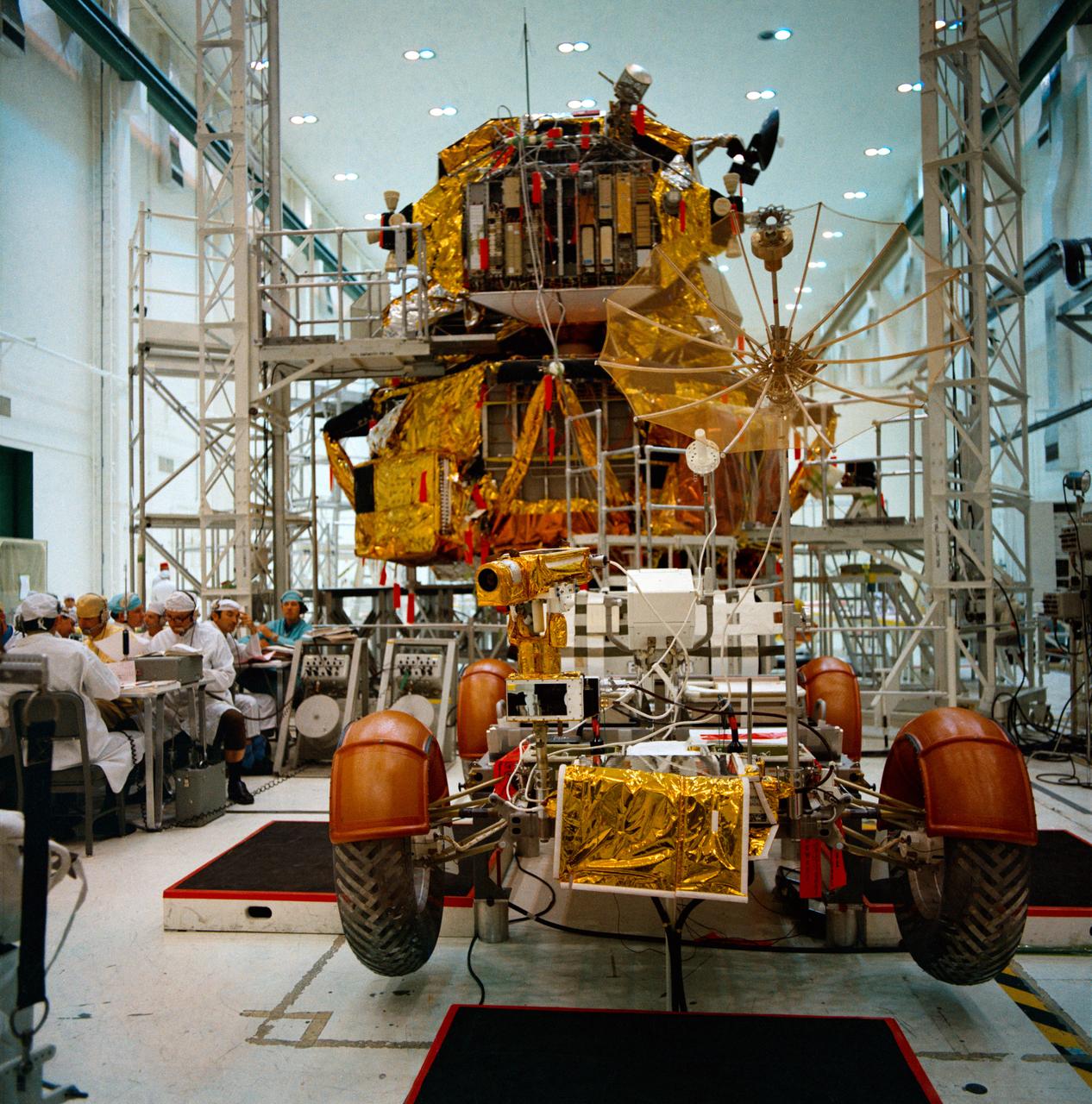
S71-30542 (21 April 1971) --- An overall view of the Apollo 15 Lunar Roving Vehicle (LRV) and the Lunar Module (LM) during simulations at the Kennedy Space Center (KSC). Astronauts David R. Scott, commander, and James B. Irwin, lunar module pilot, will man the LRV on the lunar surface during their August 1971 traverses. Rover 1 will permit the astronauts to cover a larger area of the moon for exploration and sample collecting than on previous missions.
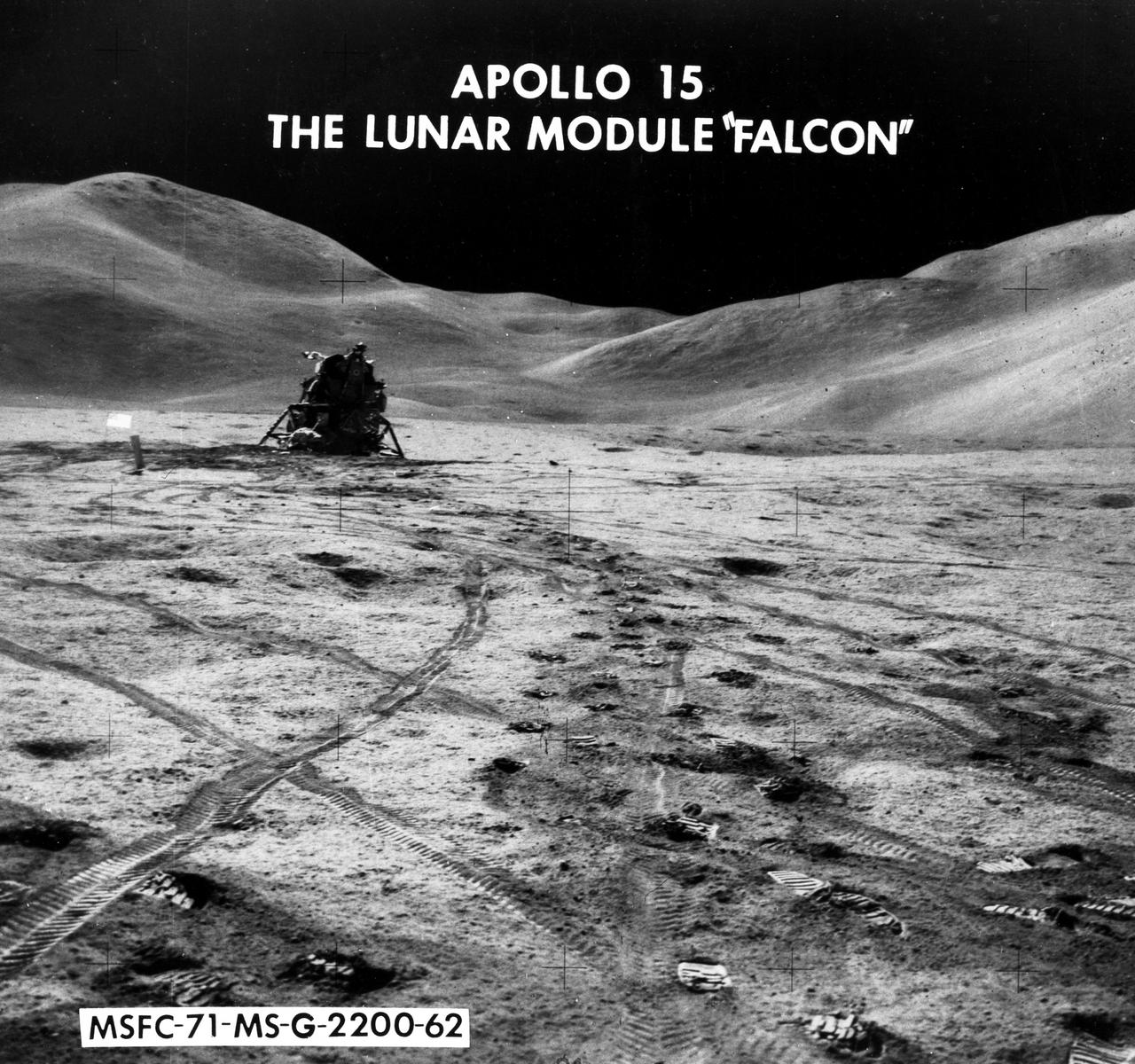
This is a photo of the Apollo 15 Lunar Module, Falcon, on the lunar surface. Apollo 15 launched from Kennedy Space Center (KSC) on July 26, 1971 via a Saturn V launch vehicle. Aboard was a crew of three astronauts including David R. Scott, Mission Commander; James B. Irwin, Lunar Module Pilot; and Alfred M. Worden, Command Module Pilot. The first mission designed to explore the Moon over longer periods, greater ranges and with more instruments for the collection of scientific data than on previous missions, the mission included the introduction of a $40,000,000 lunar roving vehicle (LRV) that reached a top speed of 16 kph (10 mph) across the Moon's surface. The successful Apollo 15 lunar landing mission was the first in a series of three advanced missions planned for the Apollo program. The primary scientific objectives were to observe the lunar surface, survey and sample material and surface features in a preselected area of the Hadley-Apennine region, setup and activation of surface experiments and conduct in-flight experiments and photographic tasks from lunar orbit. Apollo 15 televised the first lunar liftoff and recorded a walk in deep space by Alfred Worden. Both the Saturn V rocket and the LRV were developed at the Marshall Space Flight Center.
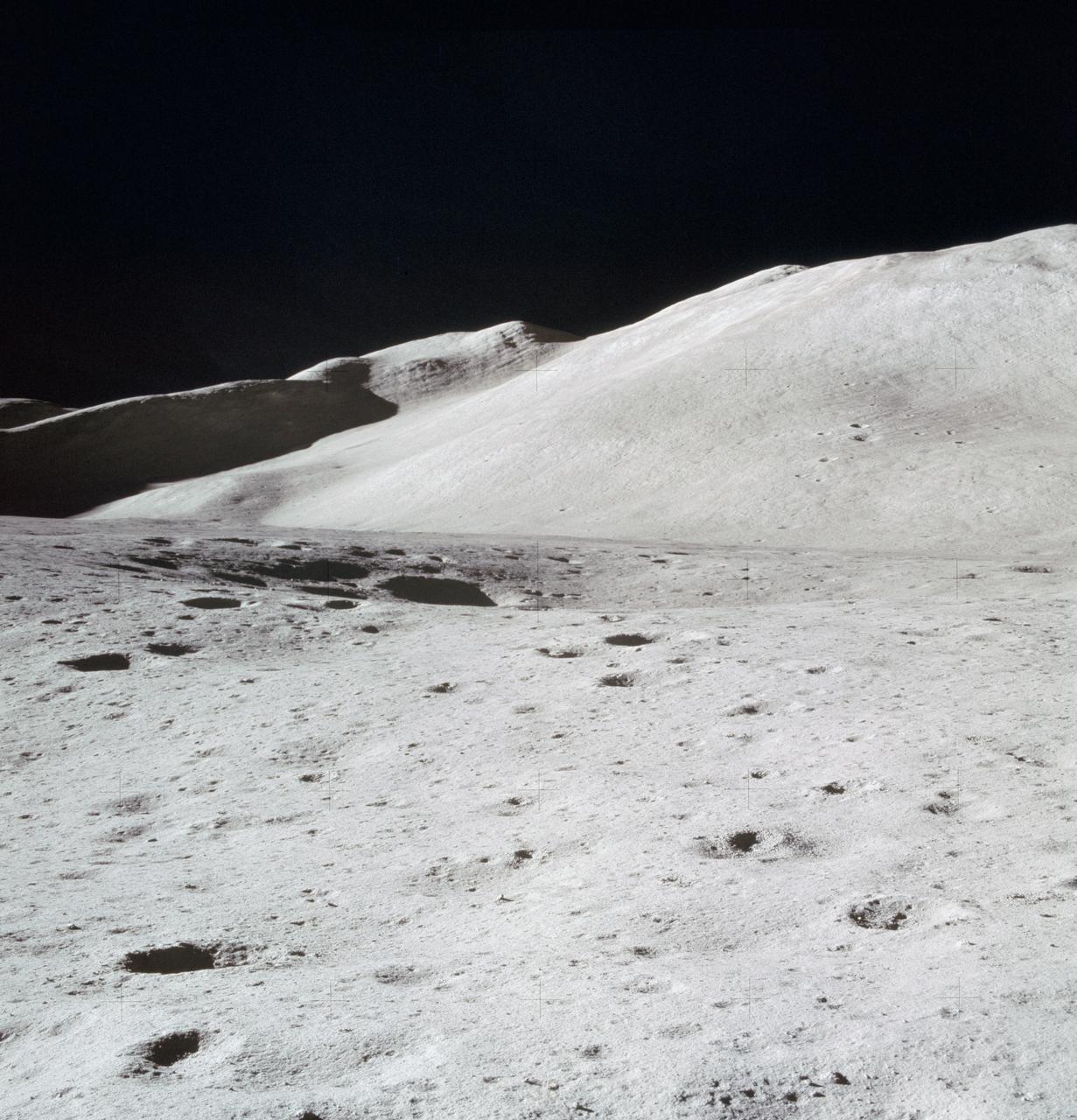
AS15-87-11748 (31 July 1971) --- A view of Hadley Delta, looking southeasterly, as photographed from the top hatch of the Apollo 15 Lunar Module (LM) by astronaut David R. Scott, commander, during his stand-up extravehicular activity (EVA) just after the LM "Falcon" touched down at the Hadley-Apennine landing site. The prominent feature on the horizon in the center of the picture was called Silver Spur by the Apollo 15 crew men. Hadley Delta Mountain rises approximately 4,000 meters (about 13,124 feet) above the plain. While astronauts Scott and James B. Irwin, lunar module pilot, descended in the LM to explore the moon, astronaut Alfred M. Worden, command module pilot, remained with the Command and Service Module's (CSM) in lunar orbit.
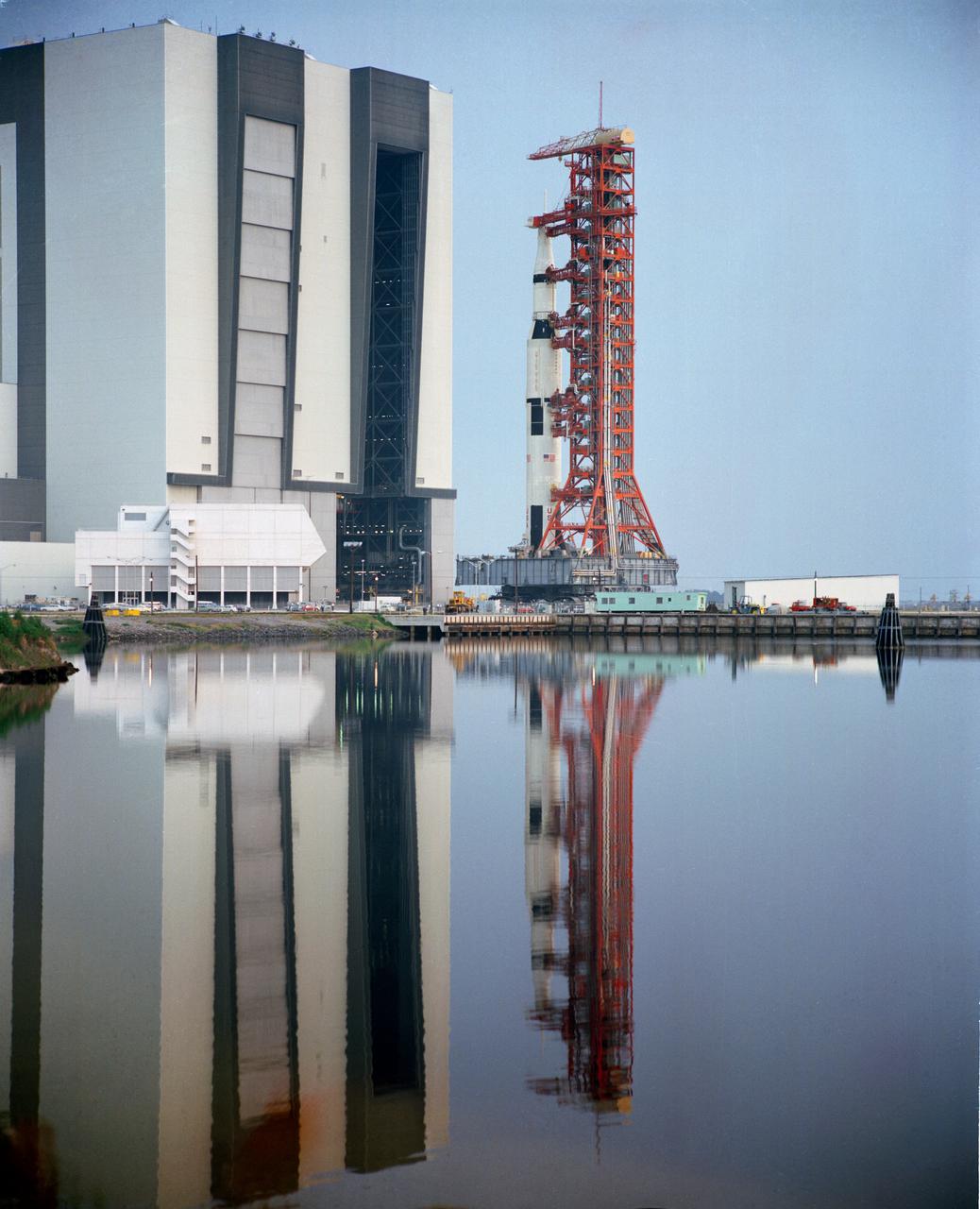
S71-33786 (11 May 1971) --- The 363-feet tall Apollo (Spacecraft 112/Lunar Module 10/Saturn 510) space vehicle which leaves the Vehicle Assembly Building (VAB) to Pad A, Launch Complex 39, Kennedy Space Center (KSC). The Saturn V stack and its mobile launch tower are atop a huge crawler-transporter. Apollo 15 is scheduled as the fourth manned lunar landing mission by the National Aeronautics and Space Administration (NASA) and is scheduled to lift off on July 26, 1971. The crew men will be astronauts David R. Scott, commander; Alfred M. Worden, command module pilot; and James B. Irwin, lunar module pilot. While astronaut Scott and Irwin will descend in the Lunar Module (LM) to explore the moon, astronaut Worden will remain with the Command and Service Modules (CSM) in lunar orbit.
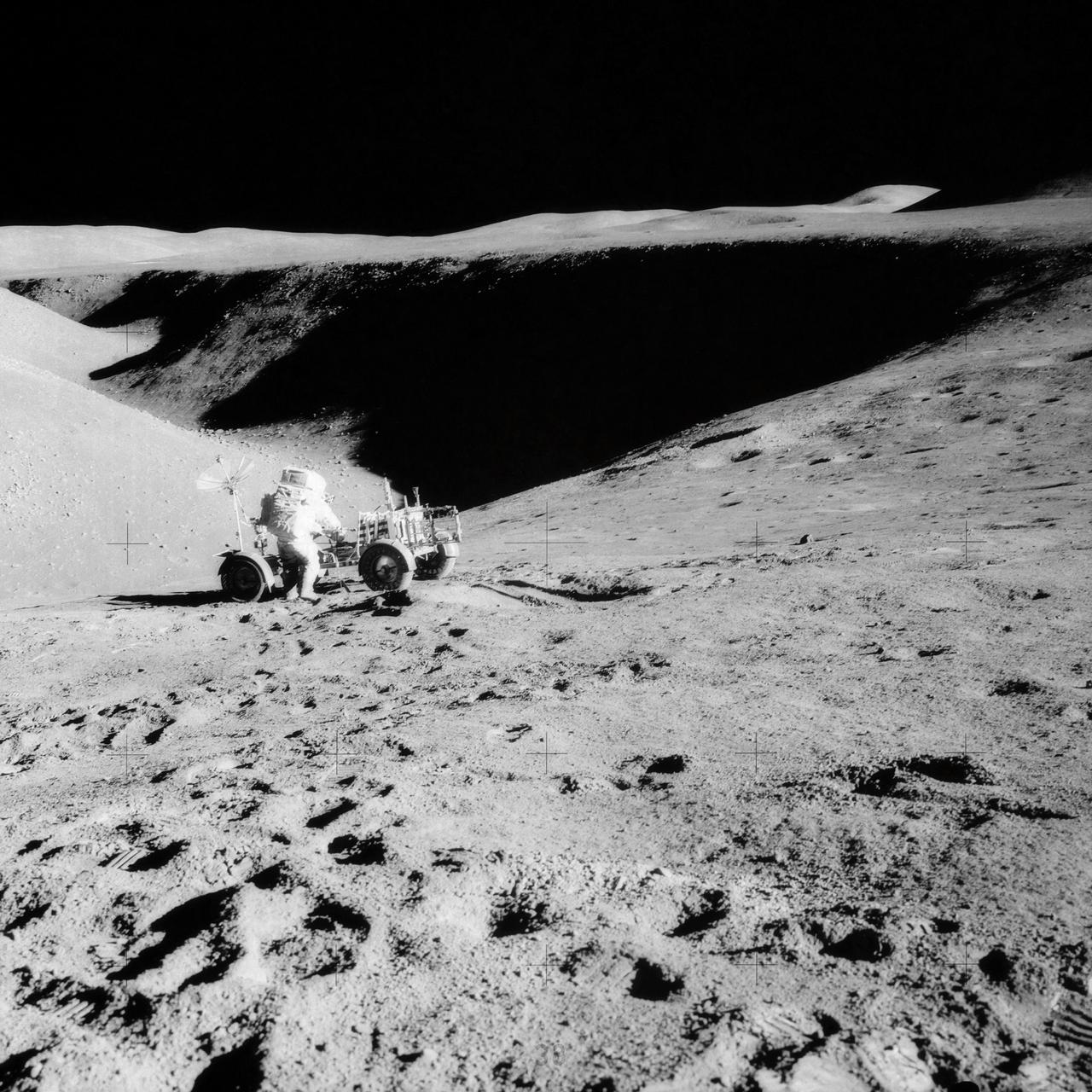
AS15-85-11451 (31 July 1971) --- Astronaut David R. Scott, mission commander, performs a task at the Lunar Roving Vehicle parked on the edge of Hadley Rille during the first Apollo 15 lunar surface extravehicular activity (EVA). This photograph was taken by astronaut James B. Irwin, lunar module pilot, from the flank of St. George Crater. The view is looking north along the rille.
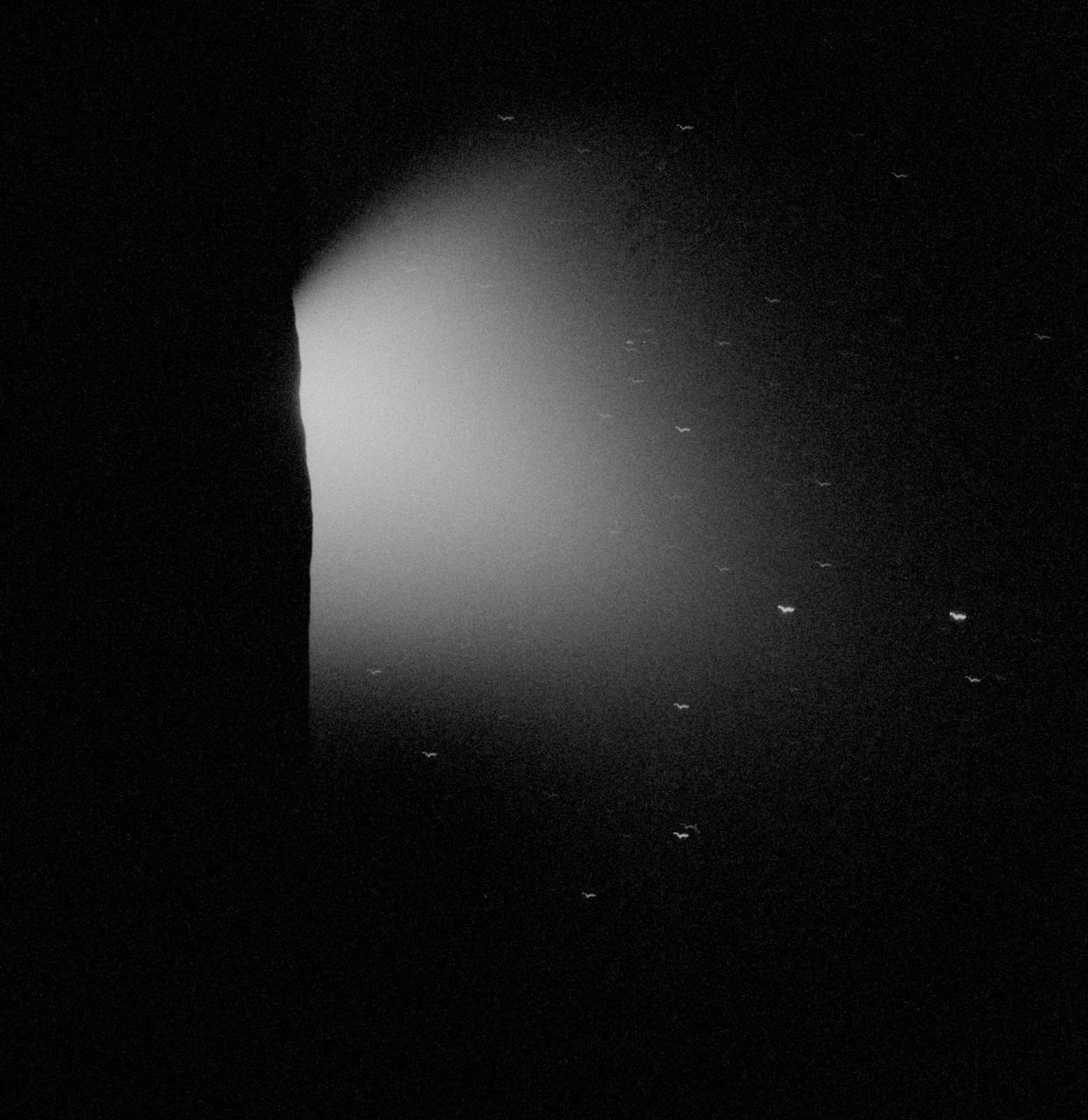
AS15-98-13311 (31 July 1971) --- The solar corona, as photographed from the Apollo 15 spacecraft about one minute prior to sunrise on July 31, 1971, is seen just beyond the lunar horizon. The bright object on the opposite of the frame is the planet Mercury. The bright star near the frame center is Regulus, and the lesser stars form the head of the constellation Leo. Mercury is approximately 28 degrees from the center of the sun. The solar coronal streamers, therefore, appear to extend about eight degrees from the sun's center. This solar corona photograph was the second in a series of seven. Three such series were obtained by astronaut Alfred M. Worden, command module pilot, during the solo part of his lunar orbital flight. They represent man's first view of this part of the sun's light. While astronauts David R. Scott, commander, and James B. Irwin, lunar module pilot, descended in the Lunar Module (LM) "Falcon" to explore the Hadley-Apennine area of the moon, astronaut Worden remained with the Command and Service Modules (CSM) in lunar orbit.
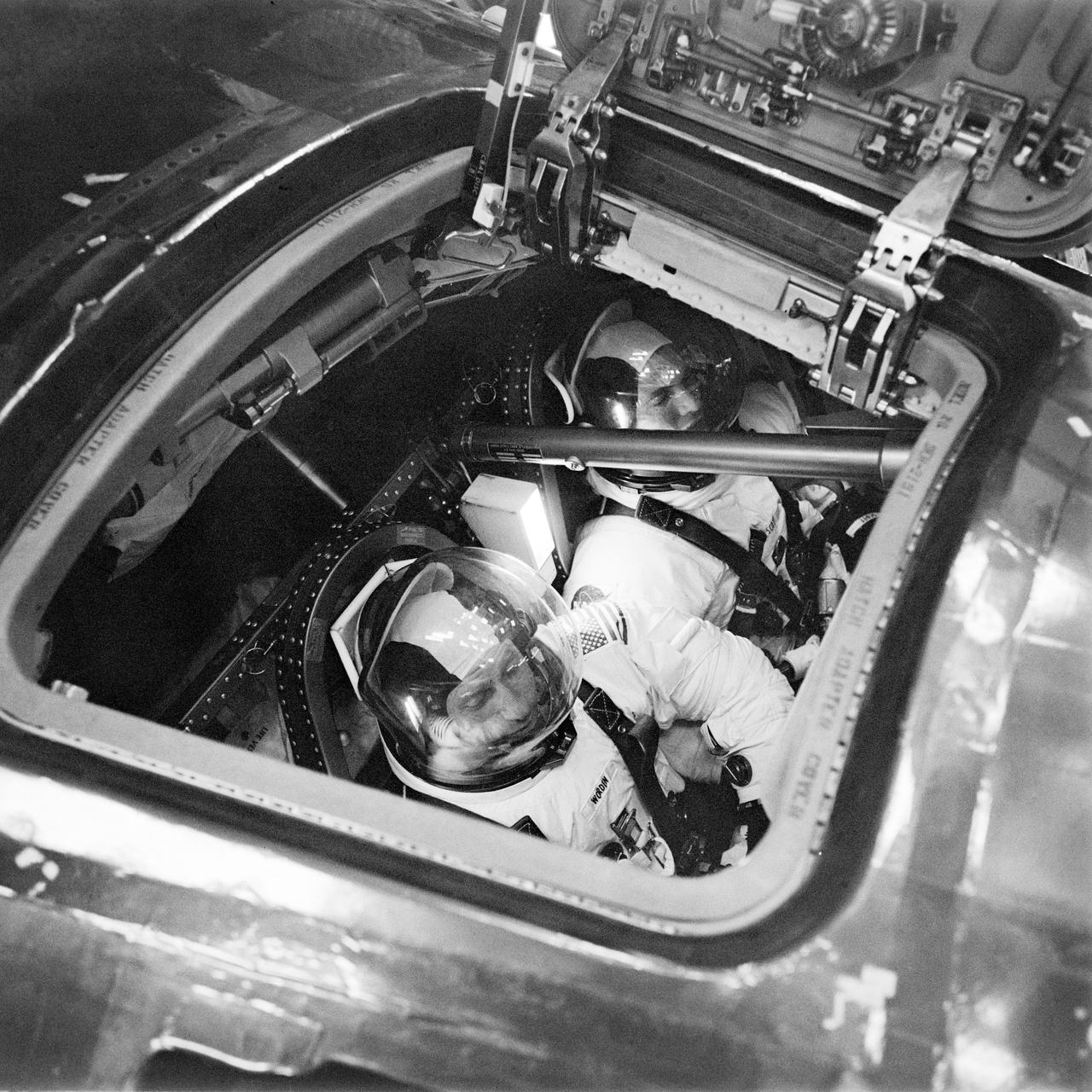
S71-29951 (26 March 1971) --- Two Apollo 15 prime crew members can be seen inside the Apollo 15 Command Module (CM) during simulation training at the Kennedy Space Center (KSC). Astronaut David R. Scott, commander, is in the background. Astronaut Alfred M. Worden, foreground, is the command module pilot. Out of view is astronaut James B. Irwin, lunar module pilot.
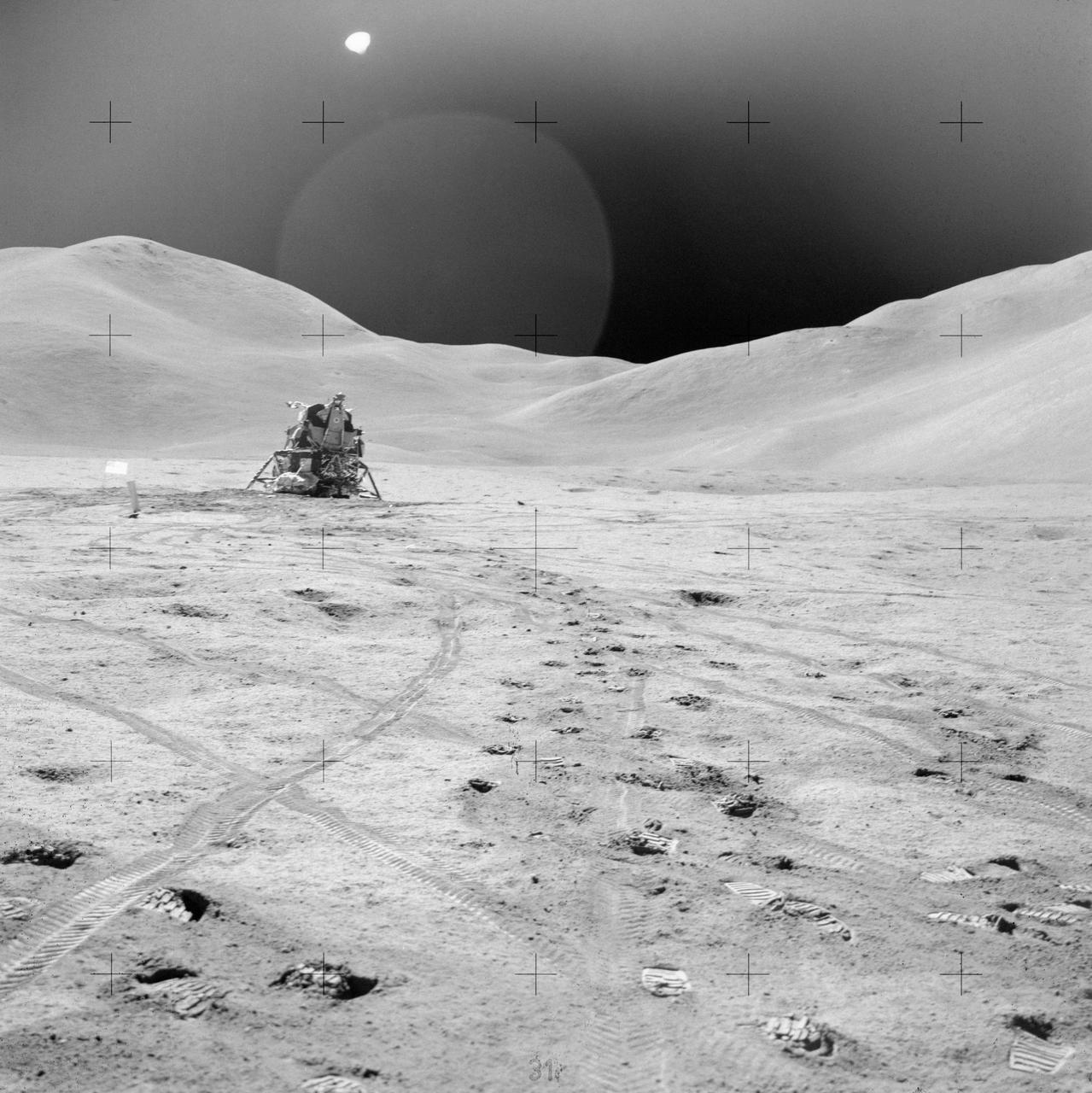
AS15-82-11057 (2 Aug. 1971) --- The Lunar Module (LM) "Falcon" is photographed against the barren lunarscape during the third Apollo 15 lunar surface extravehicular activity (EVA) at the Hadley-Apennine landing site on the lunar nearside. This view is looking southeast. The Apennine Front is in the left background; and Hadley Delta Mountain is in the right background. The object next to the United States flag is the Solar Wind Composition (SWC) experiment. Last Crater is to the right of the LM. Note bootprints and tracks of the Lunar Roving Vehicle (LRV). The light spherical object at the top is a reflection in the lens of the camera. While astronauts David R. Scott and James B. Irwin descended in the LM to explore the moon, astronaut Alfred M. Worden remained with the Command and Service Modules (CSM) in lunar orbit.

S71-22401 (March 1971) --- These three astronauts have been named by the National Aeronautics and Space Administration (NASA) as the prime crew members of the Apollo 15 lunar landing mission. They are, left to right, David R. Scott, commander; Alfred M. Worden, command module pilot; and James B. Irwin, lunar module pilot. The crew is posed behind the subsatellite that they will deploy from the lunar surface during the Apollo 15 mission. Astronauts Scott and Irwin will descend in the Lunar Module (LM) to explore the moon, while astronaut Worden will remain with the Command and Service Modules (CSM) in lunar orbit.
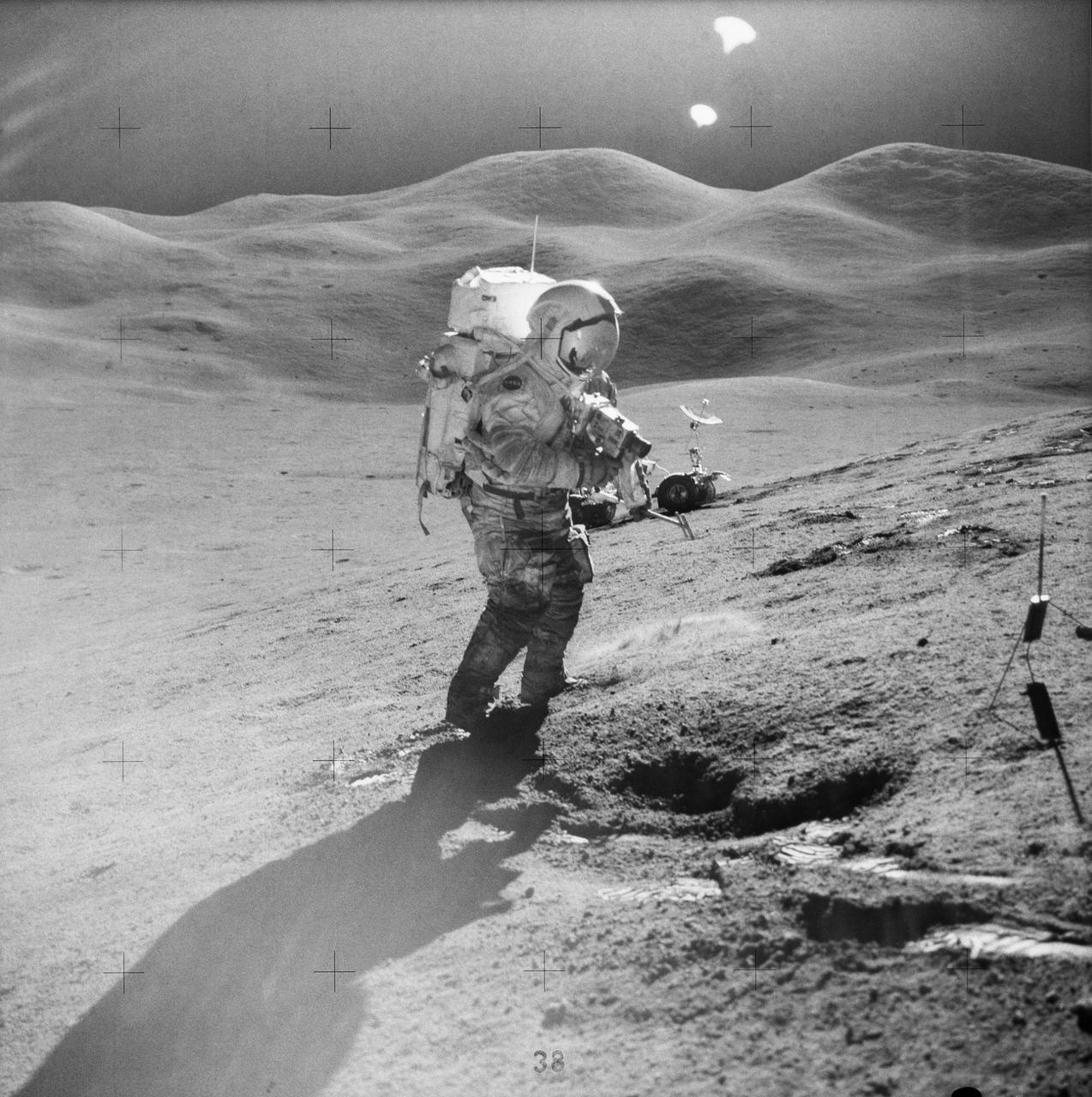
AS15-85-11514 (31 July-2 Aug. 1971) --- Astronaut David R. Scott, commander, standing on the slope of Hadley Delta, uses a 70mm camera during Apollo 15 extravehicular activity (EVA) on the lunar surface. He is 10.5 miles (or 17.5 kilometers) from the base of the Apennine Mountains seen in the background. Scott carries tongs in his left hand. The Lunar Roving Vehicle (LRV) is in the background. This view is looking east. While astronauts Scott and James B. Irwin, lunar module pilot, descended in the Lunar Module (LM) "Falcon" to explore the moon, astronaut Alfred M. Worden, command module pilot, remained with the Command and Service Modules (CSM) in lunar orbit.

AS15-85-11437 (31 July 1971) --- Astronaut David R. Scott, commander, with tongs and gnomon in hand, studies a boulder on the slope of Hadley Delta during the Apollo 15 lunar landing mission's first extravehicular activity (EVA). The Lunar Roving Vehicle (LRV), "Rover", is in the right foreground. The view is looking slightly south of west. "Bennett Hill" is at extreme right. Astronaut James B. Irwin, lunar module pilot, took this photograph. While astronauts Scott and Irwin descended together in the Lunar Module (LM) "Falcon" to explore the Hadley-Apennine area of the moon, astronaut Alfred M. Worden, command module pilot, remained with the Command and Service Modules (CSM) in lunar orbit.
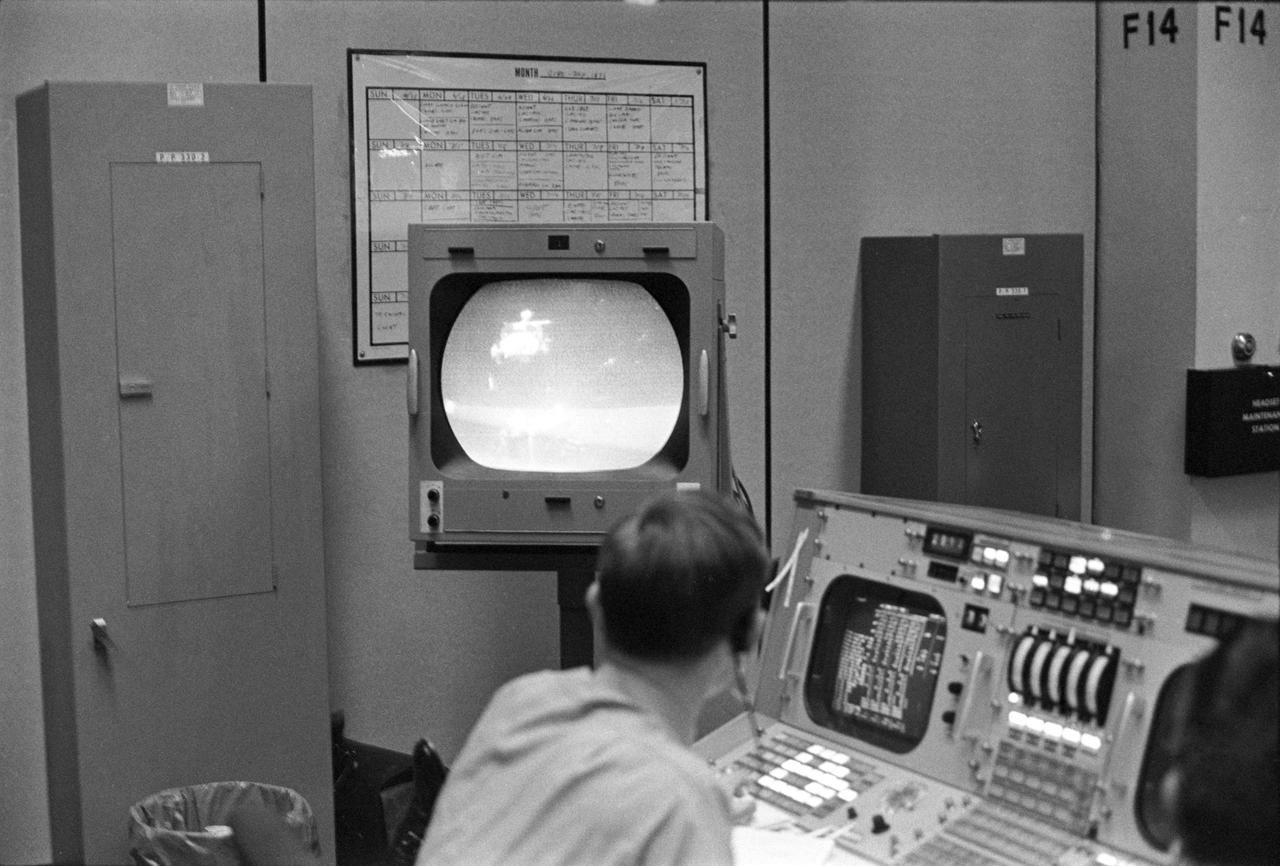
View of a photograph of the television (TV) monitor in the MCC showing a picture being transmitted from the color TV camera mounted on the parked Lunar Roving Vehicle (LRV) at the Hadley-Apennine Landing Site showing the liftoff of the Apollo 15 Lunar Module (LM) Ascent Stage from the Lunar surface. MSC, Houston, TX
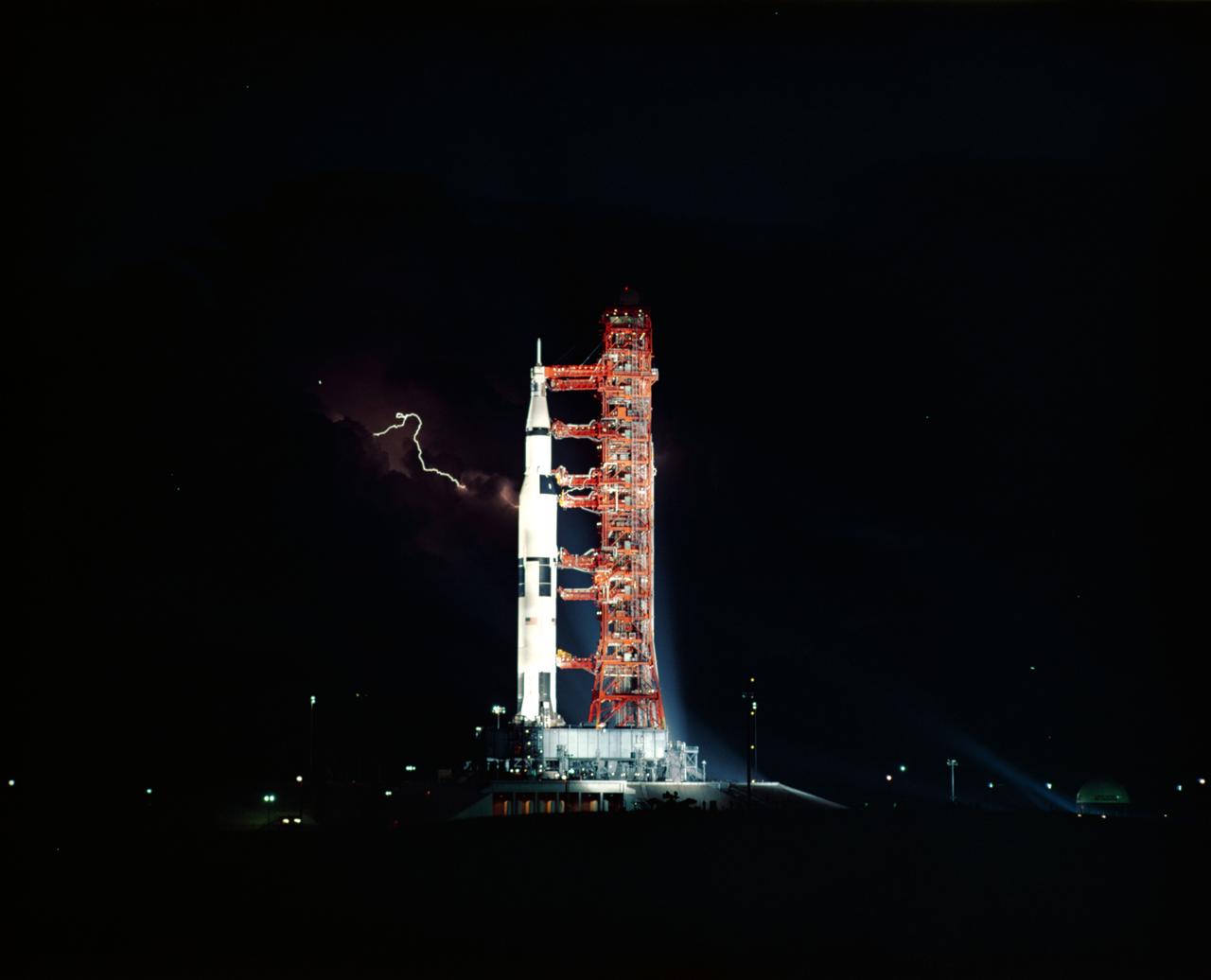
S89-41564 (25 July 1971) --- Lightning streaks through the sky around the Apollo 15 stack of hardware prior to the Apollo 15 launch. The huge 363-feet tall Apollo 15 (Spacecraft 112/Lunar Module 10/Saturn 510) space vehicle is scheduled to launch from Pad A, Launch Complex 39, at 9:34:00:79 p.m. (EDT) on July 26, 1971. The prime crewmembers for the Apollo 15 mission are astronauts David R. Scott, commander; James B. Irwin, lunar module pilot; and Alfred M. Worden, command module pilot.
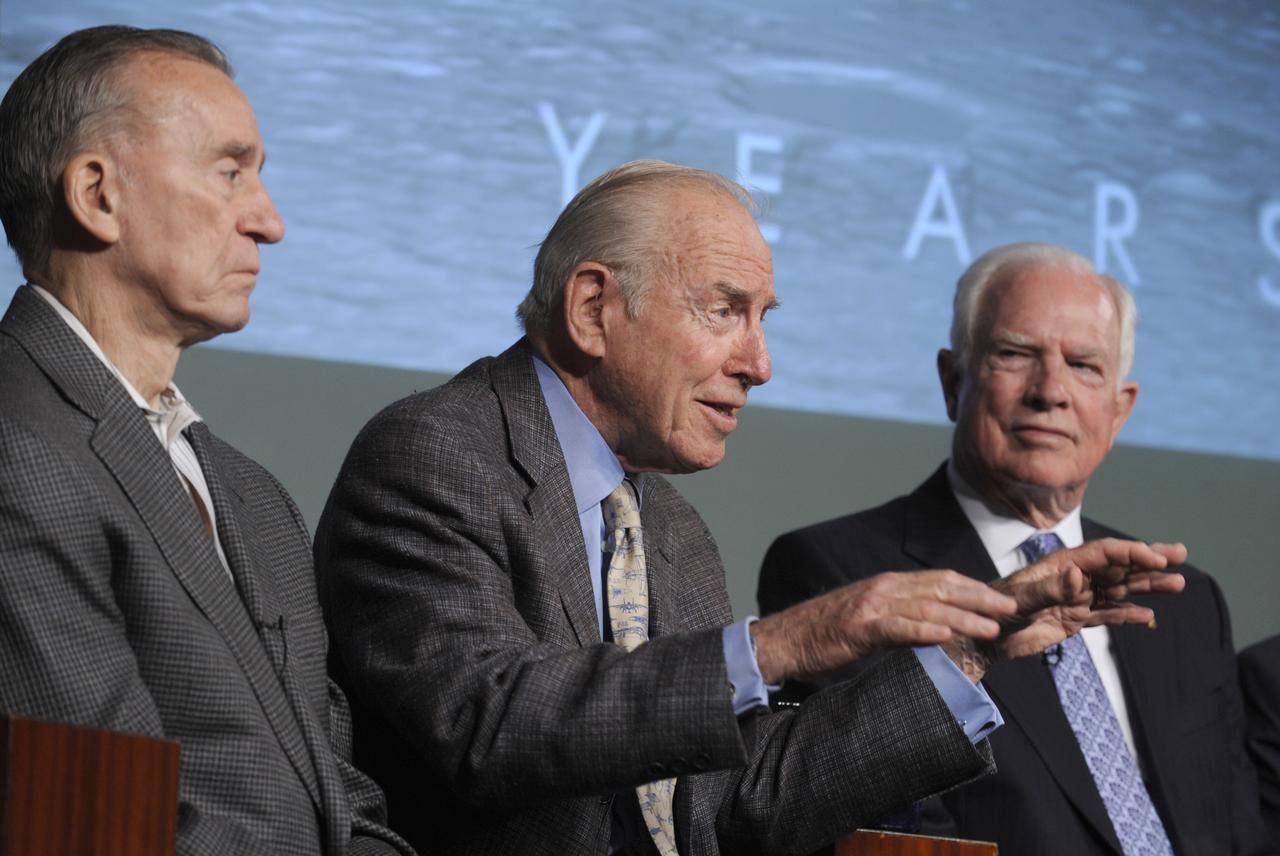
Astronaut James Lovell (Apollo 8 Apollo 13), center, flanked by Walt Cunningham (Apollo 7), left, and David Scott (Apollo 9 Apollo 15) responds during the 40th anniversary of the Apollo 11 mission and the walk on the moon press conference, Monday, July 20, 2009, at NASA Headquarters in Washington. Photo Credit: (NASA/Paul E. Alers)
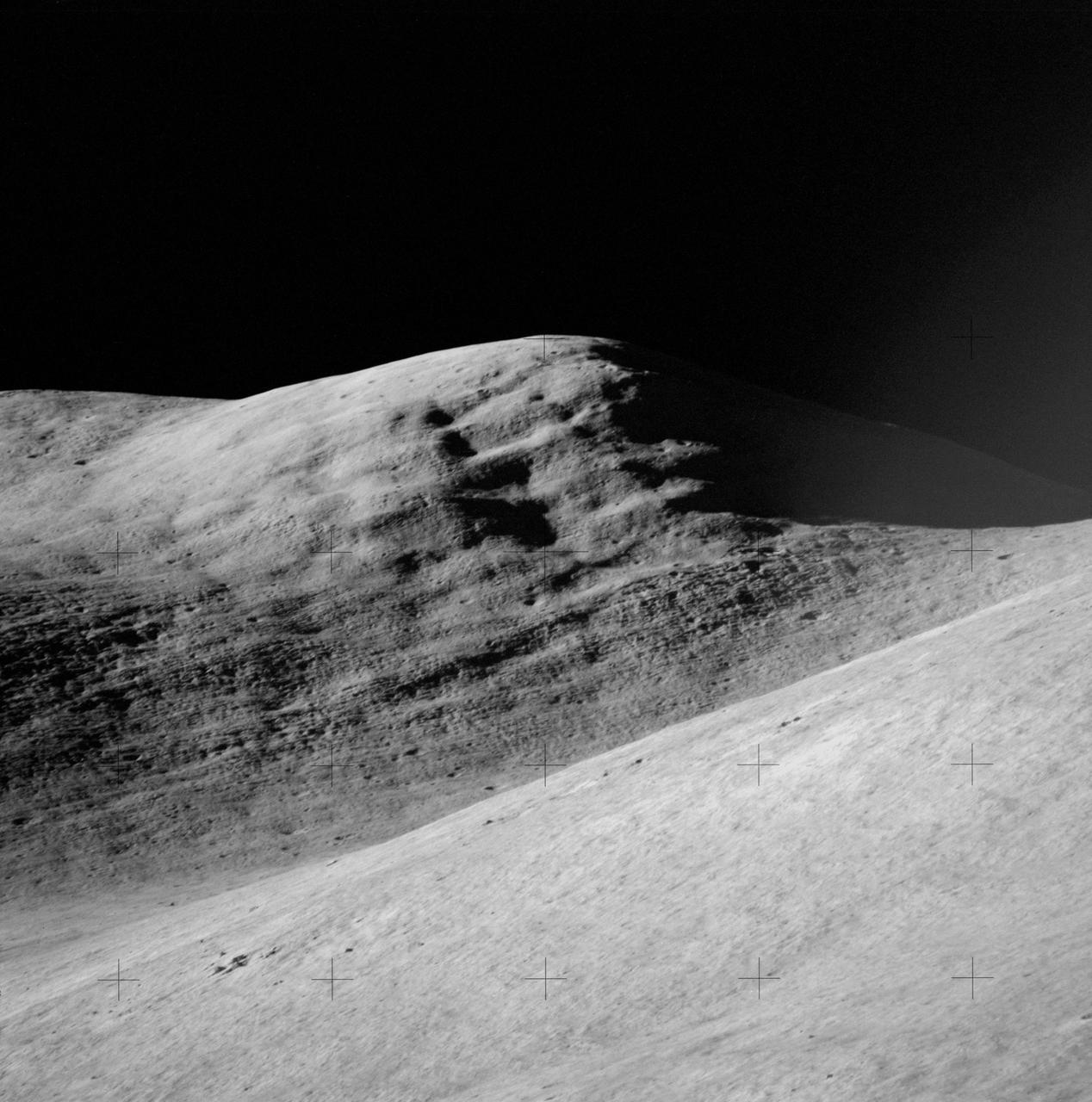
AS15-84-11250 (31 July-2 Aug. 1971) --- A telephoto lens view of the prominent feature called Silver Spur in the Hadley Delta region, photographed during the Apollo 15 lunar surface extravehicular activity (EVA) at the Hadley-Apennine landing site. The distance from the camera to the spur is about 10 miles. The field of view across the bottom is about one mile. Structural formations in the mountain are clearly visible. There are two major units. The upper unit is characterized by massive subunits, each one of which is approximately 200 feet deep. The lower major unit is characterized by thinner bedding and cross bedding.
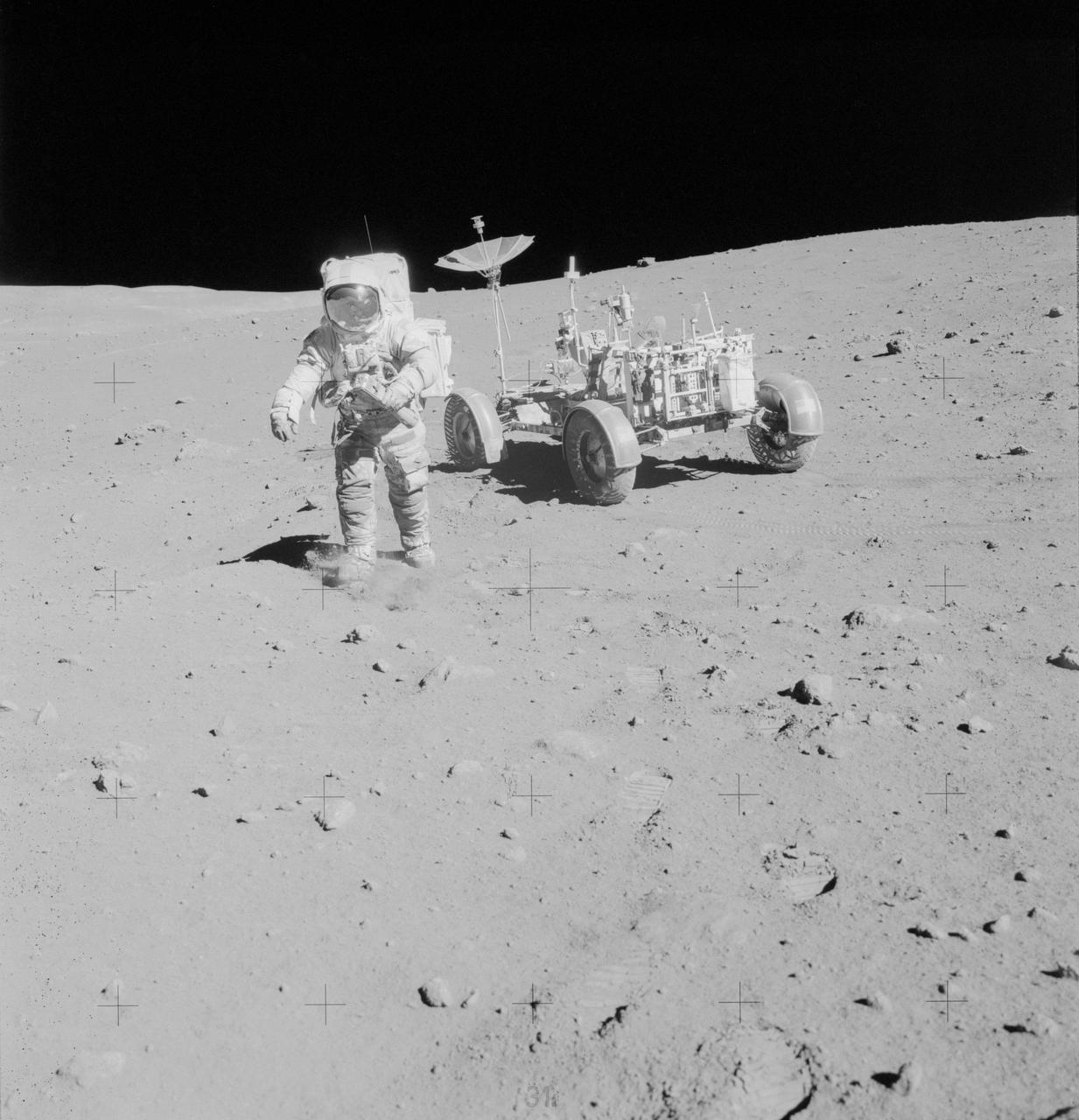
AS15-82-11168 (2 Aug. 1971) --- Astronaut James B. Irwin, lunar module pilot, walks away from the Lunar Roving Vehicle (LRV) during the third Apollo 15 lunar surface extravehicular activity (EVA) at the Hadley-Apennine landing site. The LRV is parked a short distance from the rim of Hadley Rille. The far wall of the rille is in the distance at extreme upper left. Irwin is holding the 500mm Hasselblad camera in his left hand. This photograph was taken by astronaut David R. Scott, commander. While astronauts Scott and Irwin descended in the Lunar Module (LM) to explore the moon, astronaut Alfred M. Worden, command module pilot, remained with the Command and Service Modules (CSM) in lunar orbit.
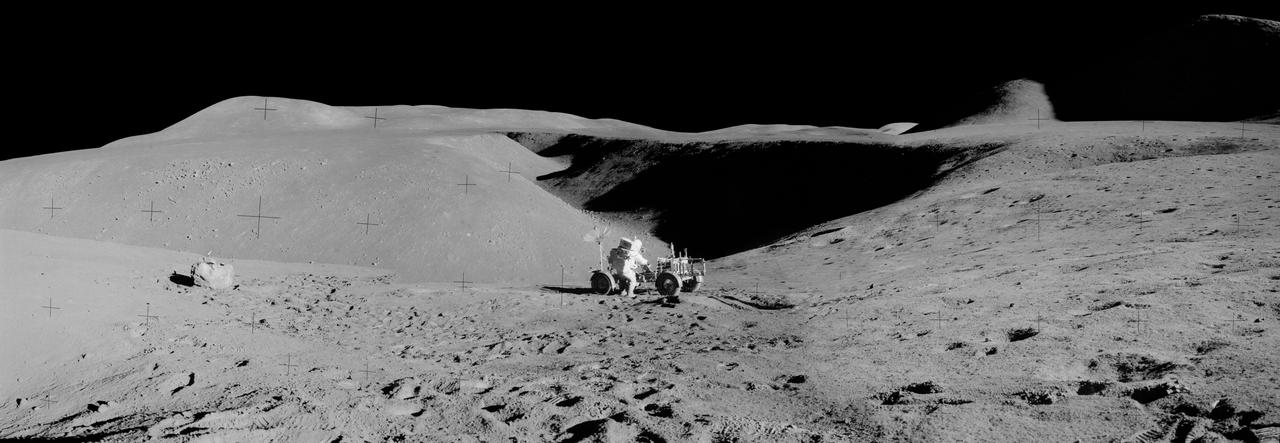
jsc2011e118359 - Panorama view of Apollo 15 lunar surface photos south of Station 2 taken by lunar module pilot James B. Irwin. Astronaut David R. Scott, mission commander, performs a task at the Lunar Roving Vehicle parked on the edge of Hadley Rille (Rima Hadley) during the first moonwalk of the mission. The panoramas were built by combining Apollo 15 images starting with frame AS15-85-11448 thru end frame AS15-85-11453. The panoramic images received minimal retouching by NASA imagery specialists, including the removal of lens flares that were problematic in stitching together the individual frames and blacking out the sky to the lunar horizon. These adjustments were made based on observations of the Moon walkers who reported that there are no stars visible in the sky due to the bright lunar surface reflection of the Sun.
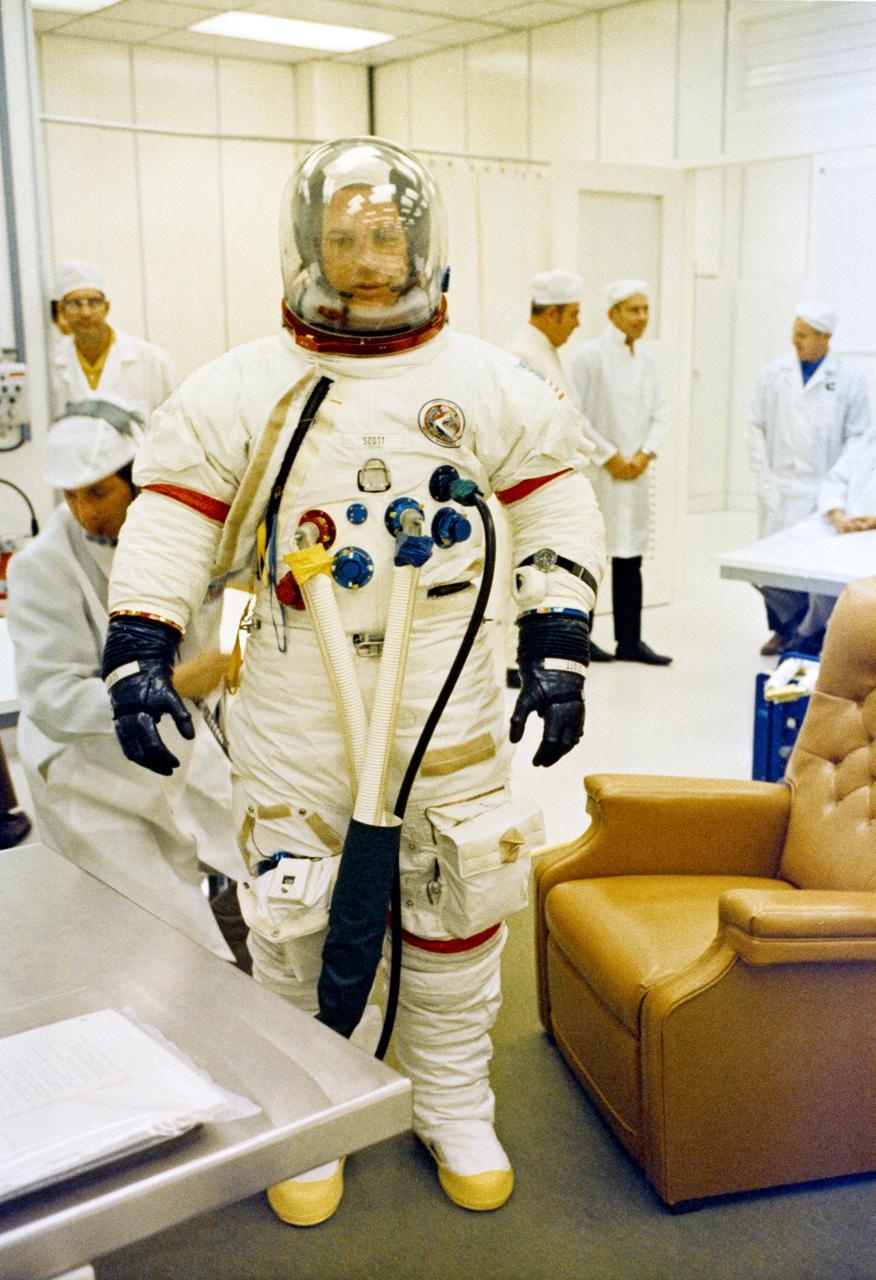
S71-41409 (26 July 1971) --- Astronaut David R. Scott, commander of the Apollo 15 lunar landing mission, goes through suiting up operations in the Kennedy Space Center's (KSC) Manned Spacecraft Operations Building (MSOB) during the Apollo 15 prelaunch countdown. Minutes later astronauts Scott; Alfred M. Worden, command module pilot; and James B. Irwin, lunar module pilot, rode a special transport van over to Pad A, Launch Complex 39, where their spacecraft awaited them. The Apollo 15 space vehicle was launched at 9:34:00:79 a.m. (EDT), July 26, 1971.
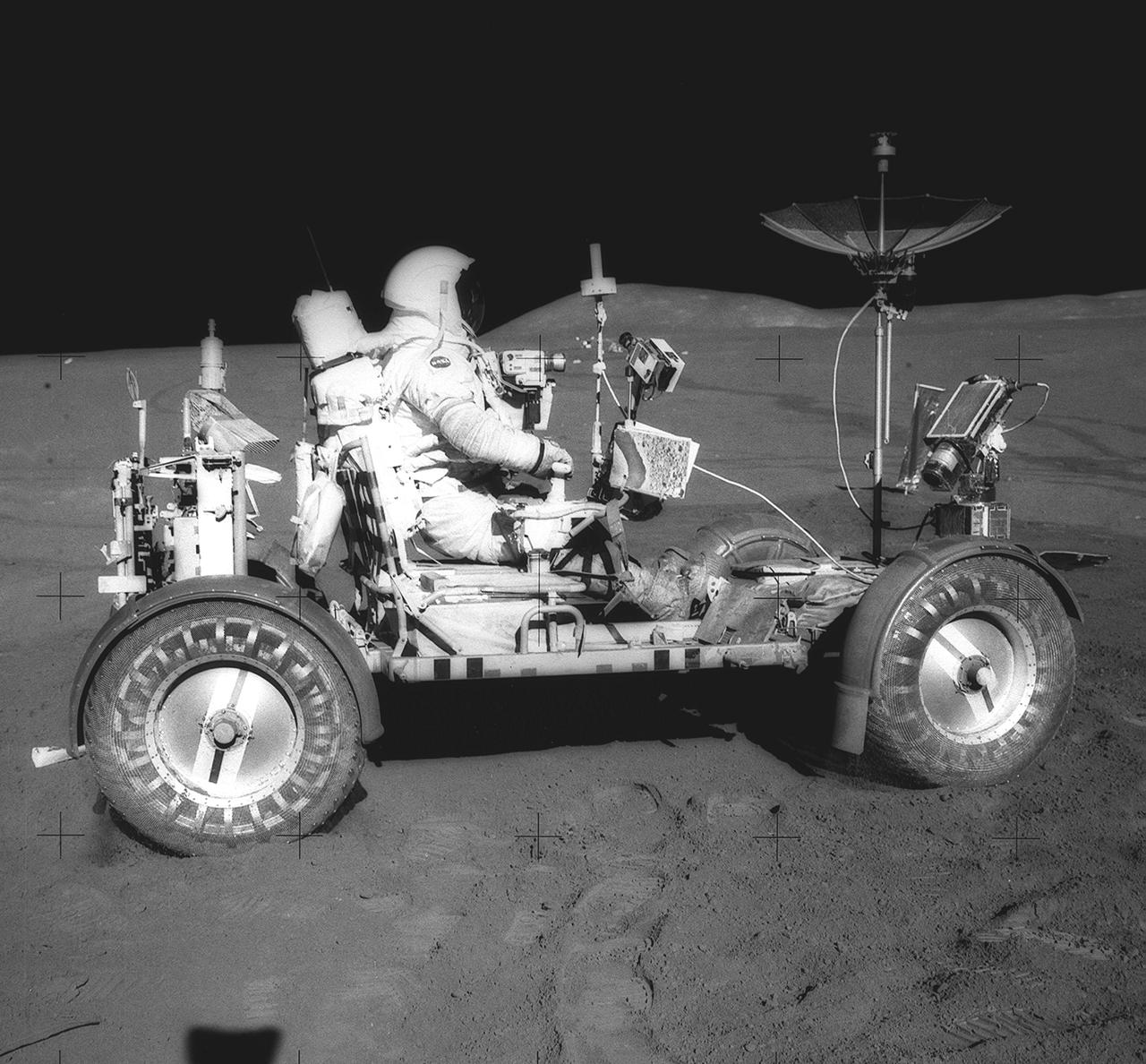
This photograph was taken during the Apollo 15 mission on the lunar surface. Astronaut David R. Scott waits in the Lunar Roving Vehicle (LRV) for astronaut James Irwin for the return trip to the Lunar Module, Falcon, with rocks and soil collected near the Hadley-Apernine landing site. The Apollo 15 was the first mission to use the LRV. Powered by battery, the lightweight electric car greatly increased the range of mobility and productivity on the scientific traverses for astronauts. It weighed 462 pounds (77 pounds on the Moon) and could carry two suited astronauts, their gear and cameras, and several hundred pounds of bagged samples. The LRV's mobility was quite high. It could climb and descend slopes of about 25 degrees. The LRV was designed and developed by the Marshall Space Flight Center and built by the Boeing Company.

During the Apollo 15 launch activities in the launch control center's firing room 1 at Kennedy Space Center, Dr. Wernher von Braun, NASA's Deputy Associate Administrator for planning, takes a closer look at the launch pad through binoculars. The fifth manned lunar landing mission, Apollo 15 (SA-510), carrying a crew of three astronauts: Mission commander David R. Scott, Lunar Module pilot James B. Irwin, and Command Module pilot Alfred M. Worden Jr., lifted off on July 26, 1971. Astronauts Scott and Irwin were the first to use a wheeled surface vehicle, the Lunar Roving Vehicle, or the Rover, which was designed and developed by the Marshall Space Flight Center, and built by the Boeing Company. Astronauts spent 13 days, nearly 67 hours, on the Moon's surface to inspect a wide variety of its geological features.
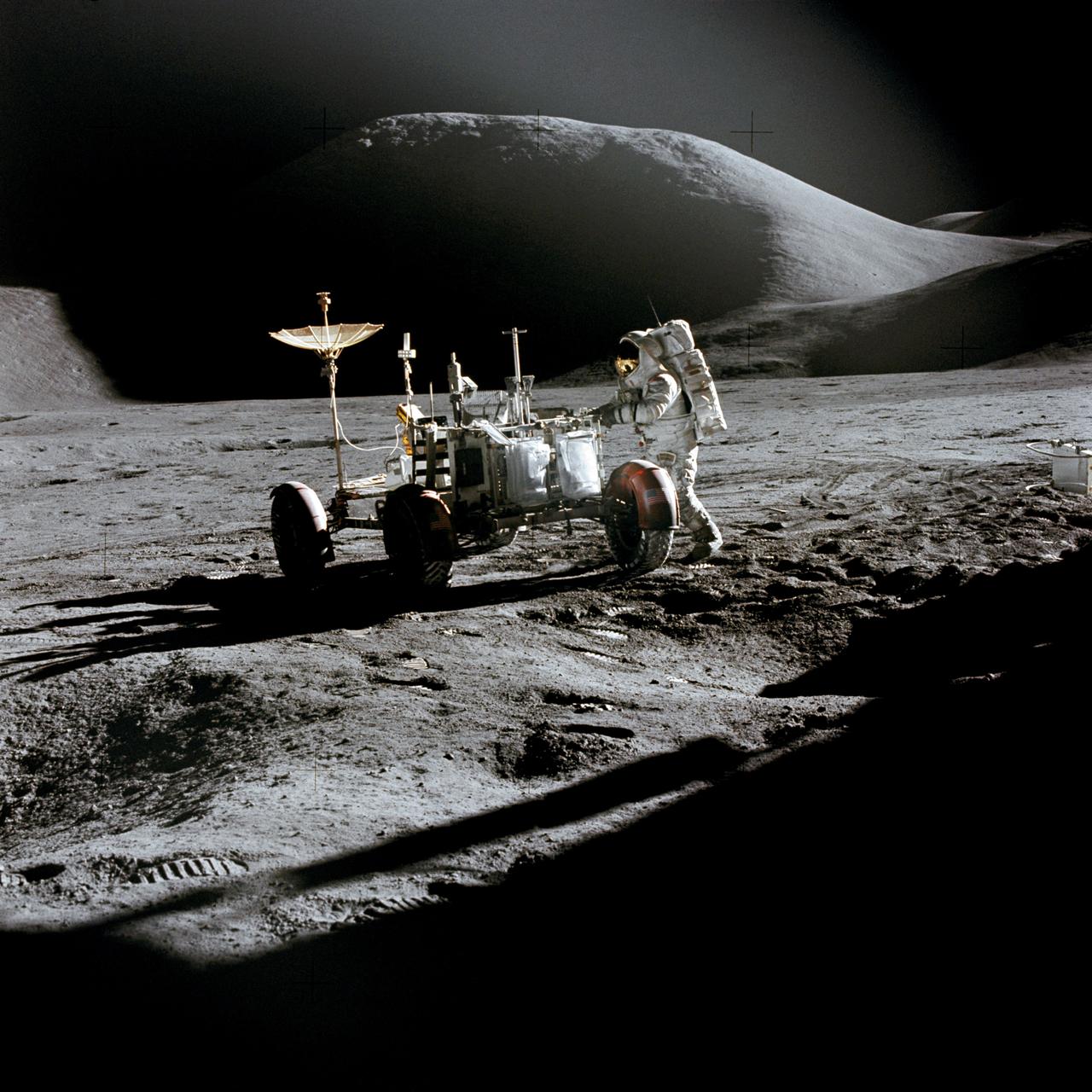
AS15-86-11603 (31 July 1971) --- Astronaut James B. Irwin, lunar module pilot, works at the Lunar Roving Vehicle during the first Apollo 15 lunar surface extravehicular activity (EVA) at the Hadley-Apennine landing site. The shadow of the Lunar Module "Falcon" is in the foreground. This view is looking northeast, with Mount Hadley in the background. This photograph was taken by astronaut David R. Scott, commander.
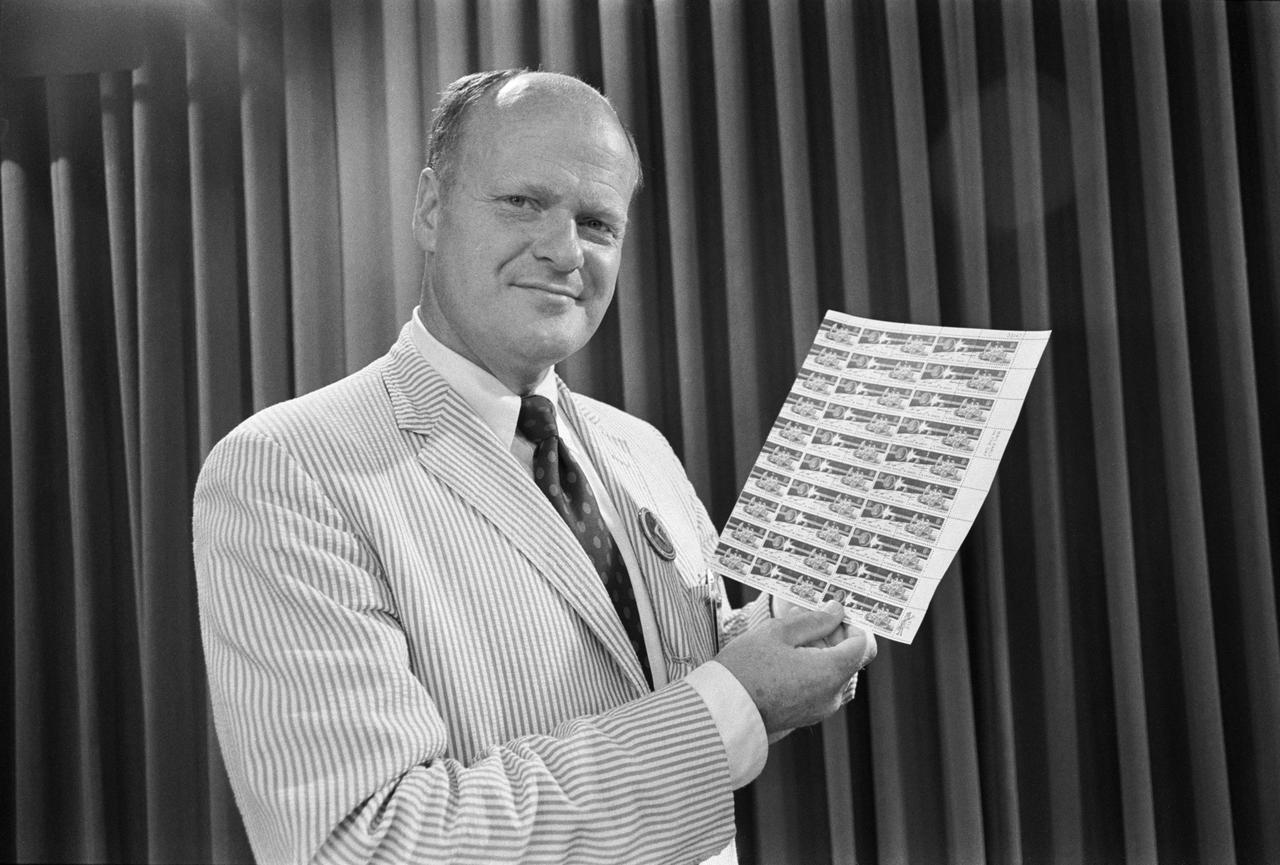
S71-41694 (2 Aug. 1971) --- Artist Robert McCall of Paradise Valley, Arizona, holds a sheet of commemorative postage stamps commemorating the Apollo 15 lunar landing mission. McCall was chose by the U.S. Postal Service to design the eight-cent stamp which heralds: "United States in Space -- A Decade of Achievement." McCall, who has maintained a close tie with the space program for many years, has been commissioned by the National Aeronautics and Space Administration to portray Apollo 15 activities from the Mission Control Center at the Manned Spacecraft Center, Houston, Texas.
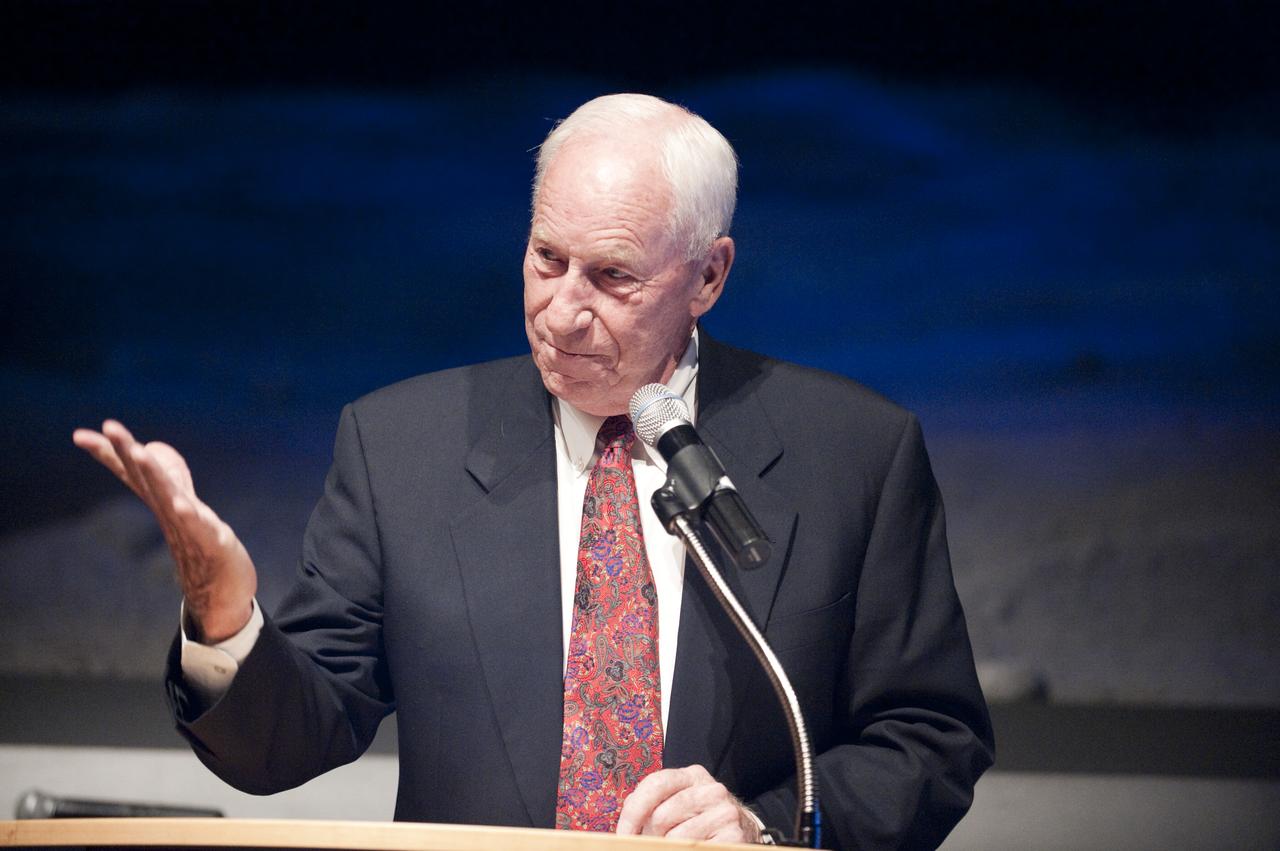
Apollo astronaut Al Worden speaks during a ceremony, Thursday, July 30, 2009, where he was honored with the presentation of the an Ambassador of Exploration Award for his contributions to the U.S. space program at Kennedy Space Center, Fla. Worden served as command module pilot for the Apollo 15 mission. Photo Credit: (NASA/Bill Ingalls)
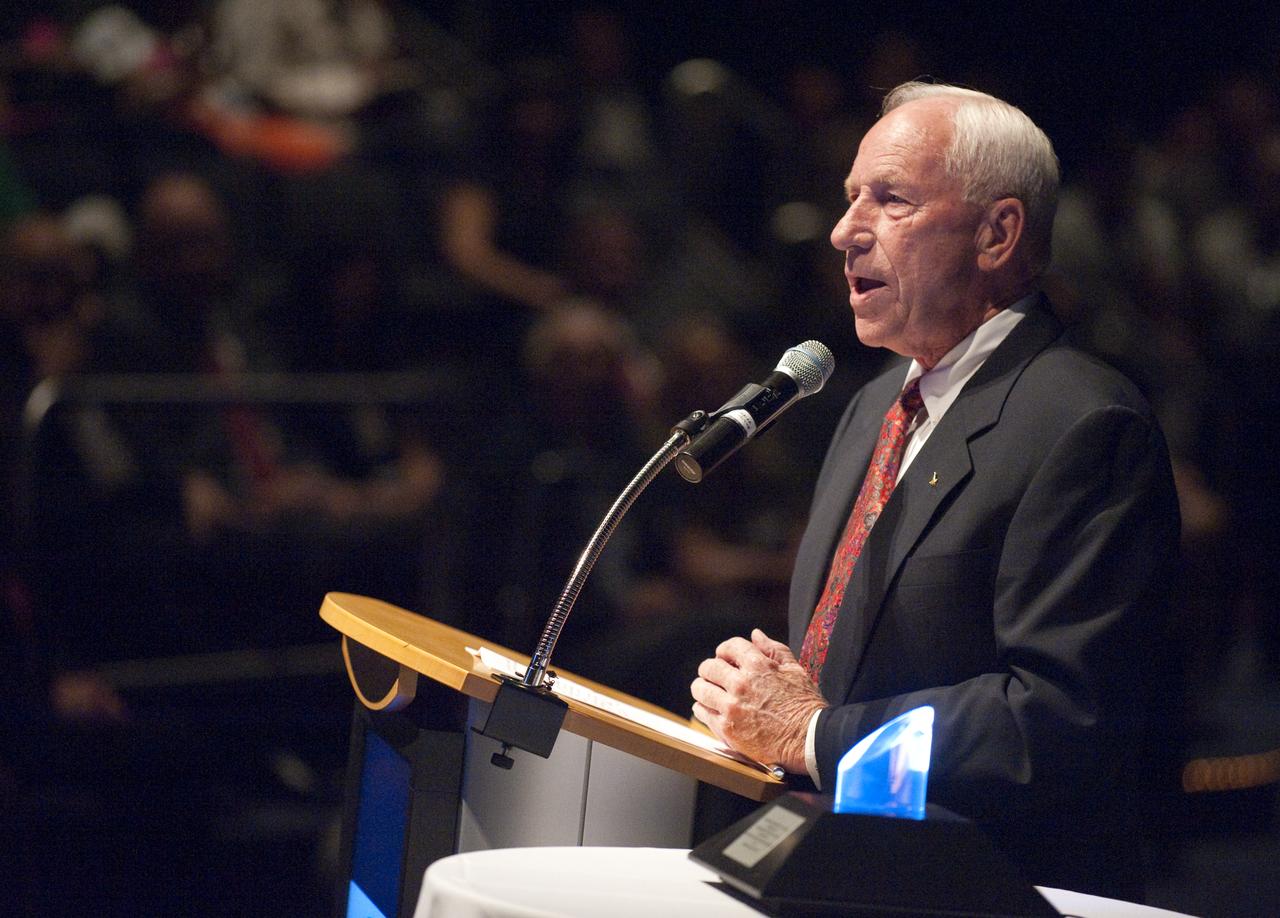
Apollo astronaut Al Worden speaks during a ceremony, Thursday, July 30, 2009, where he was honored with the presentation of the an Ambassador of Exploration Award for his contributions to the U.S. space program at Kennedy Space Center, Fla. Worden served as command module pilot for the Apollo 15 mission. Photo Credit: (NASA/Bill Ingalls)
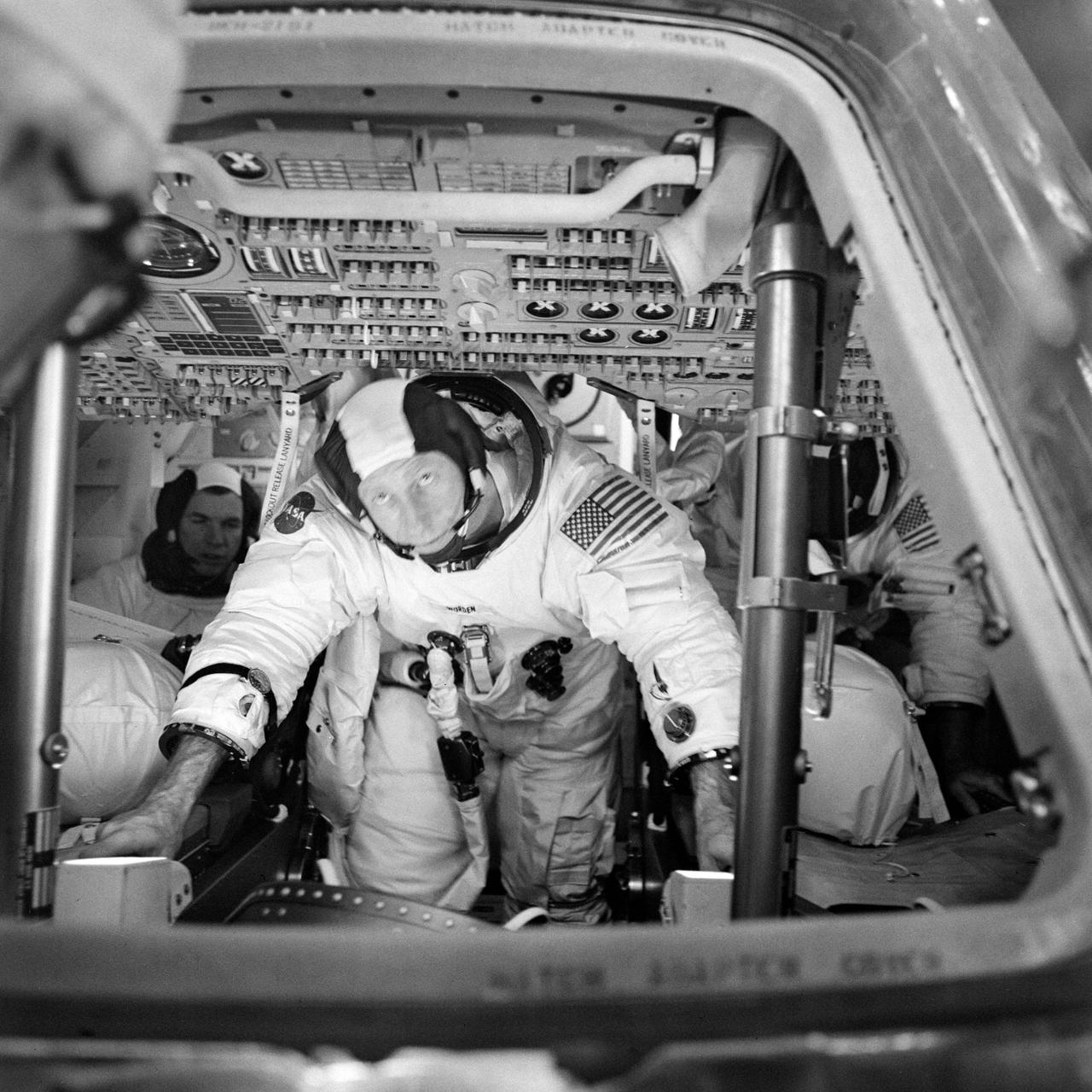
S71-29952 (26 March 1971) --- The three Apollo 15 prime crew members can be seen inside the Apollo 15 Command Module (CM) during simulation training at the Kennedy Space Center (KSC). Astronaut David R. Scott, commander, is in the background to the left. Astronaut Alfred M. Worden, center foreground, is the command module pilot. Out of view, to the right background, is astronaut James B. Irwin, lunar module pilot.
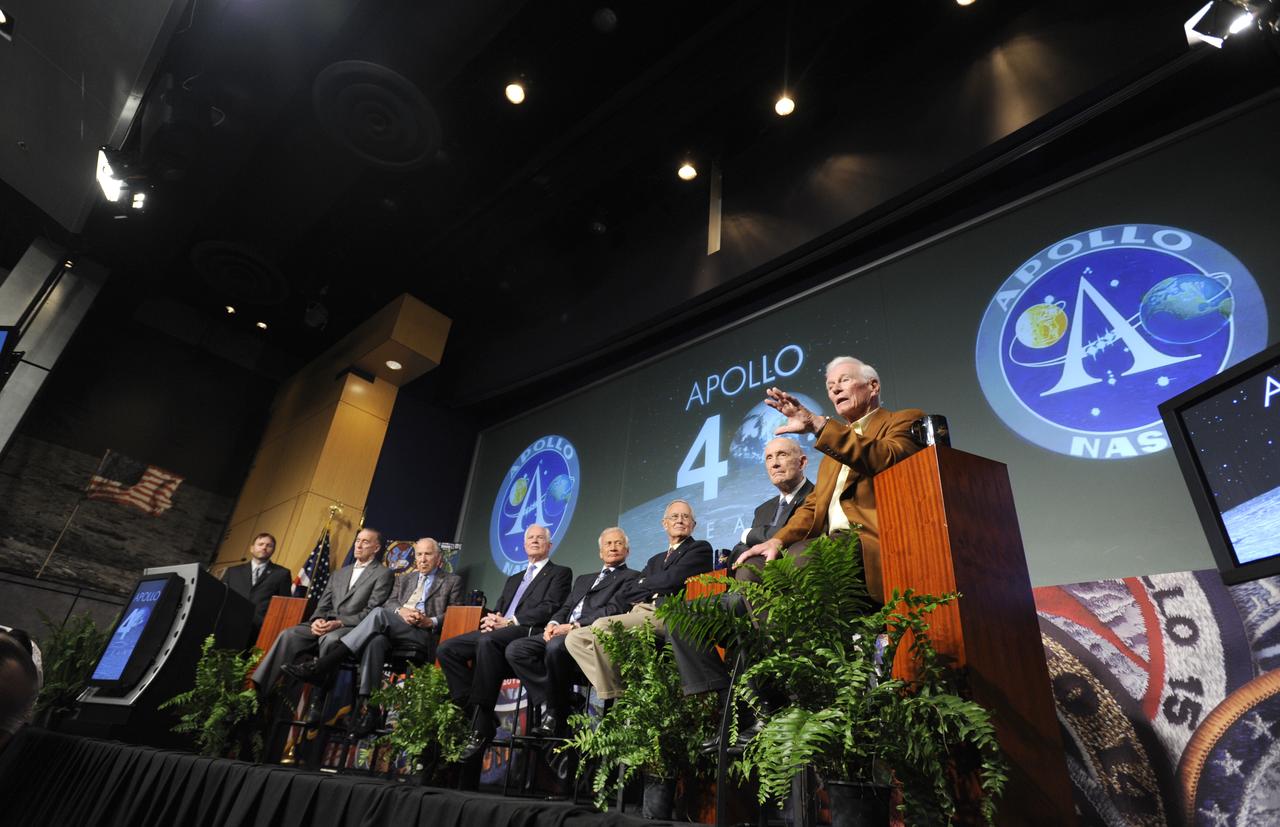
Apollo astronauts from left, Walt Cunningham (Apollo 17), James Lovell (Apollo 8 Apollo 13), David Scott (Apollo 9 Apollo 15), Buzz Aldrin (Apollo 11), Charles Duke (Apollo 16), Thomas Stafford (Apollo 10) and Eugene Cernan (Apollo 17) are seen during the 40th anniversary of the Apollo 11 mission and the walk on the moon press conference, Monday, July 20, 2009, at NASA Headquarters in Washington. Photo Credit: (NASA/Paul E. Alers)
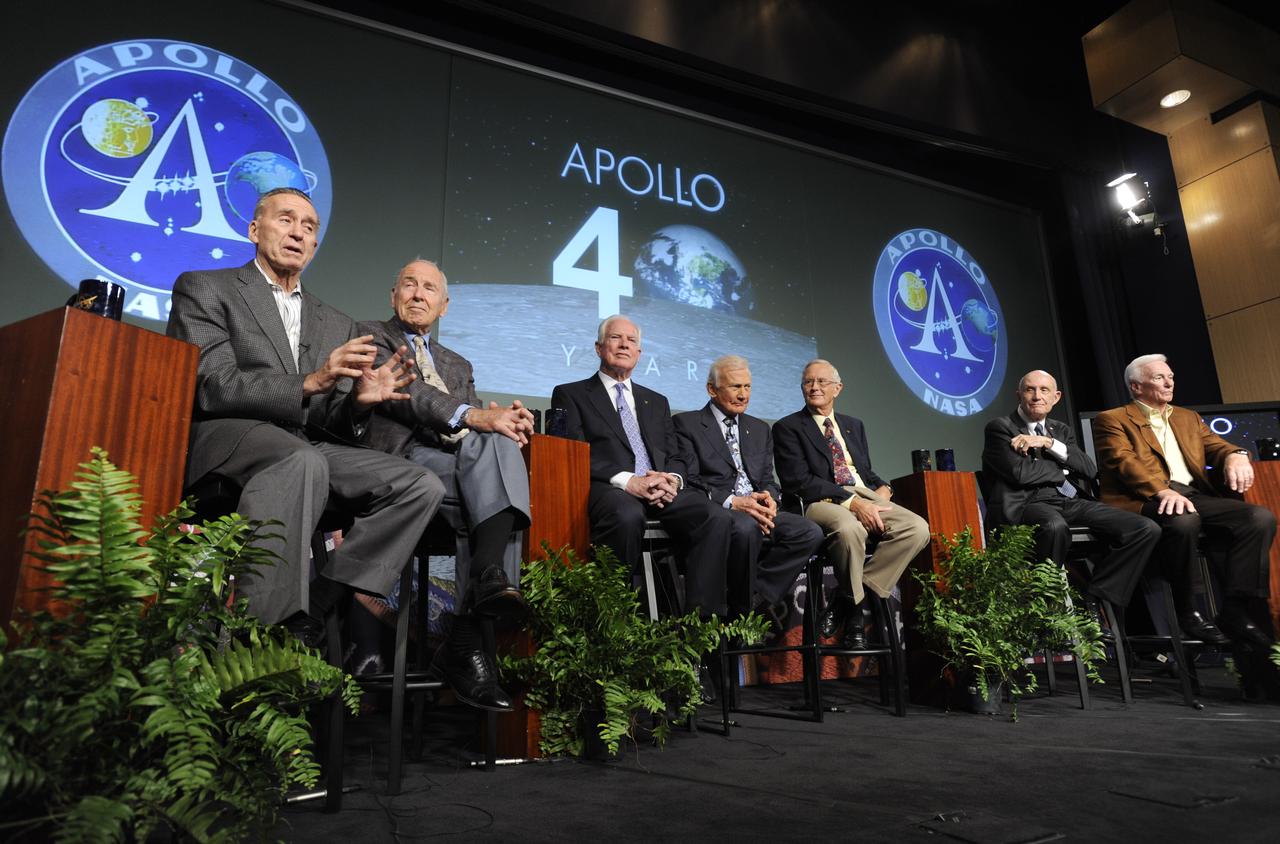
Apollo astronauts from left, Walt Cunningham (Apollo 17), James Lovell (Apollo 8 Apollo 13), David Scott (Apollo 9 Apollo 15), Buzz Aldrin (Apollo 11), Charles Duke (Apollo 16), Thomas Stafford (Apollo 10) and Eugene Cernan (Apollo 17) are seen during the 40th anniversary of the Apollo 11 mission and the walk on the moon press conference, Monday, July 20, 2009, at NASA Headquarters in Washington. Photo Credit: (NASA/Paul E. Alers)

Apollo astronauts from left, Walt Cunningham (Apollo 17), James Lovell (Apollo 8 Apollo 13), David Scott (Apollo 9 Apollo 15), Buzz Aldrin (Apollo 11), Charles Duke (Apollo 16), Thomas Stafford (Apollo 10) and Eugene Cernan (Apollo 17) are seen during the 40th anniversary of the Apollo 11 mission and the walk on the moon press conference, Monday, July 20, 2009, at NASA Headquarters in Washington. Photo Credit: (NASA/Paul E. Alers)
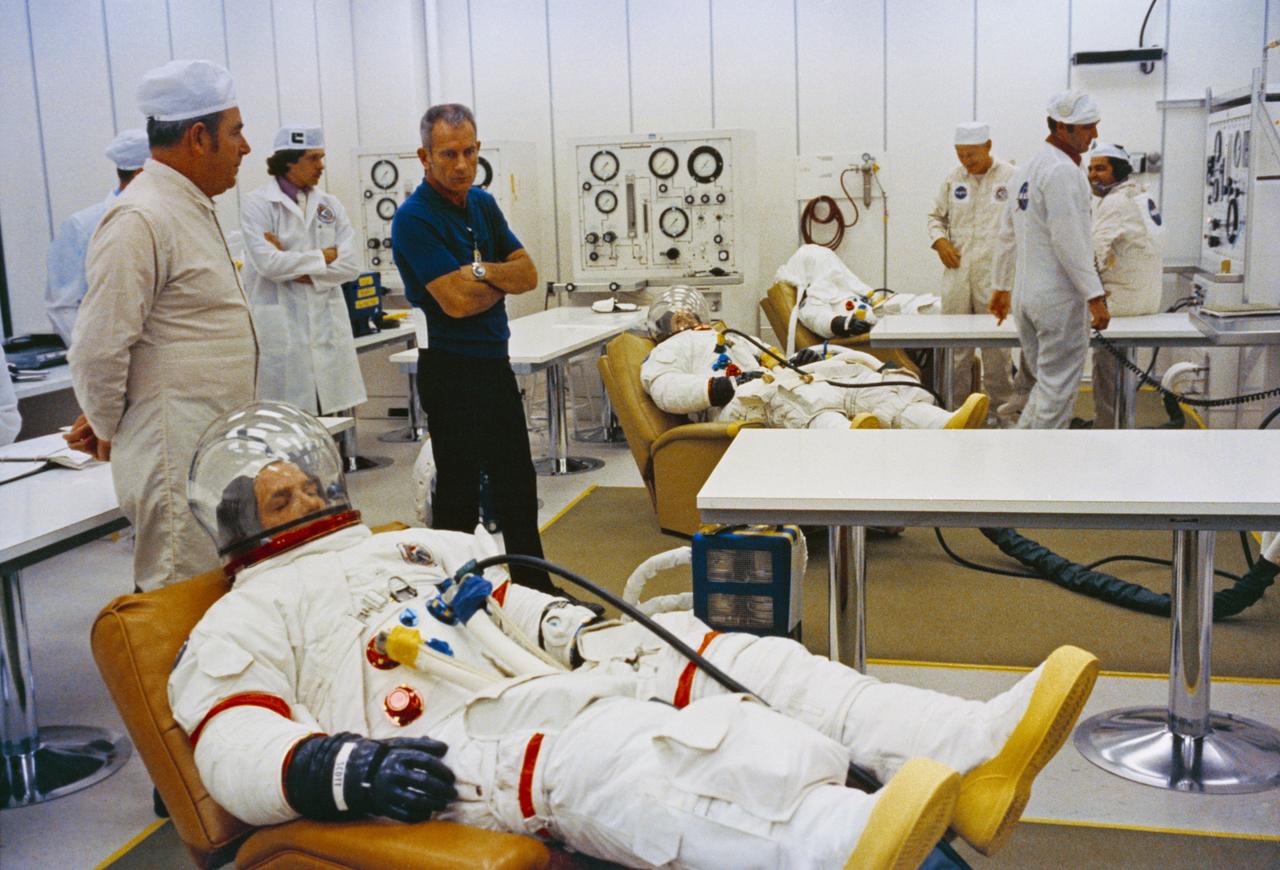
S71-41408 (26 July 1971) --- The three Apollo 15 astronauts go through suiting up operations in the Kennedy Space Center's (KSC) Manned Spacecraft Operations Building (MSOB) during the Apollo 15 prelaunch countdown. They are David R. Scott (foreground), commander; Alfred M. Worden (center), command module pilot; and James B. Irwin (background), lunar module pilot. Minutes later the crew rode a special transport van over to Pad A, Launch Complex 39, where their spacecraft awaited them. With the crew was Dr. Donald (Deke) K. Slayton (wearing dark blue sport shirt), director of Flight Crew Operations, Manned Spacecraft Center (MSC). The Apollo 15 space vehicle was launched at 9:34:00:79 a.m. (EDT), July 26, 1971, on a lunar landing mission.
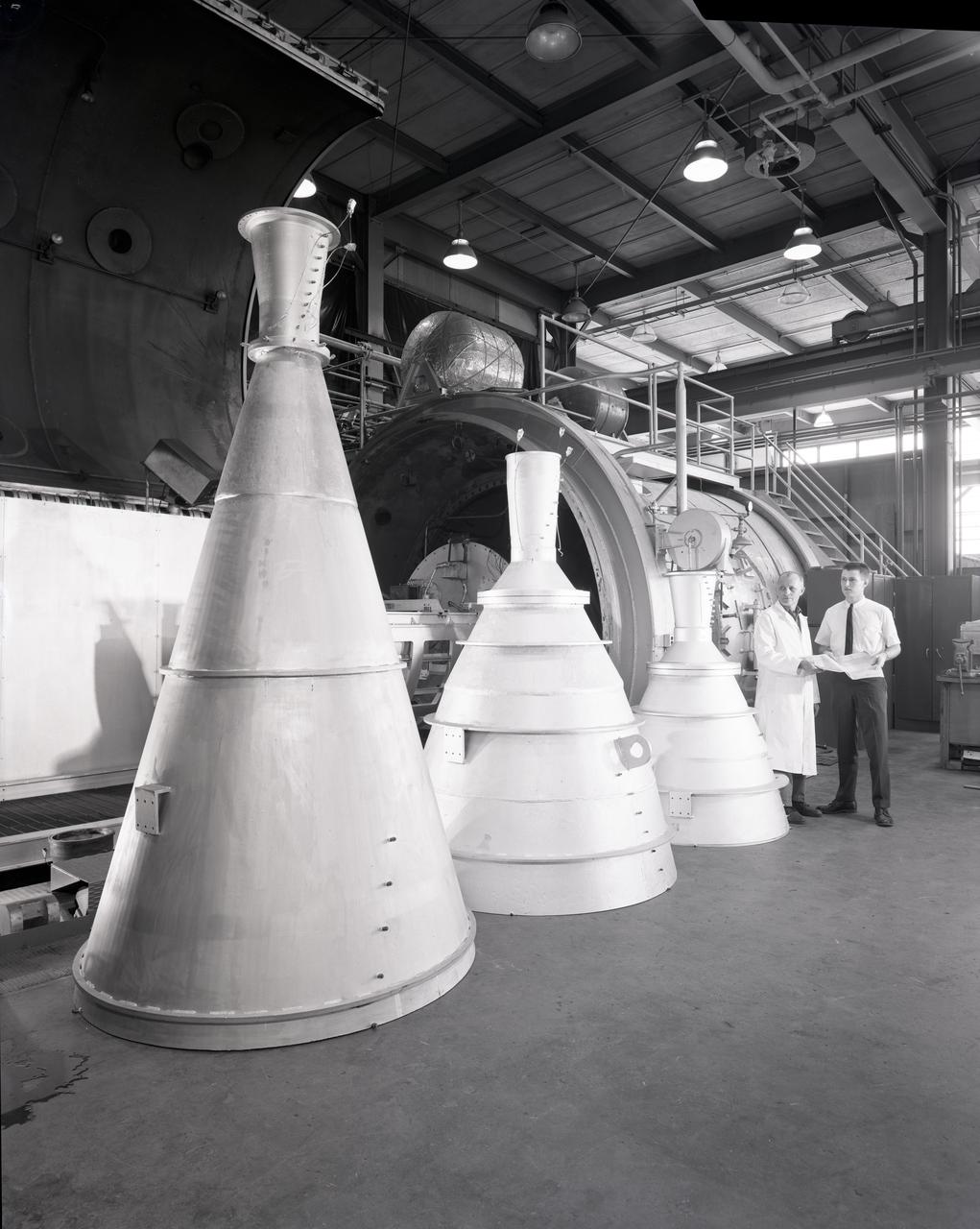
15 DEGREE CONICAL NOZZLE - TITAN TRANSTAGE CONTOUR ENGINE - APOLLO
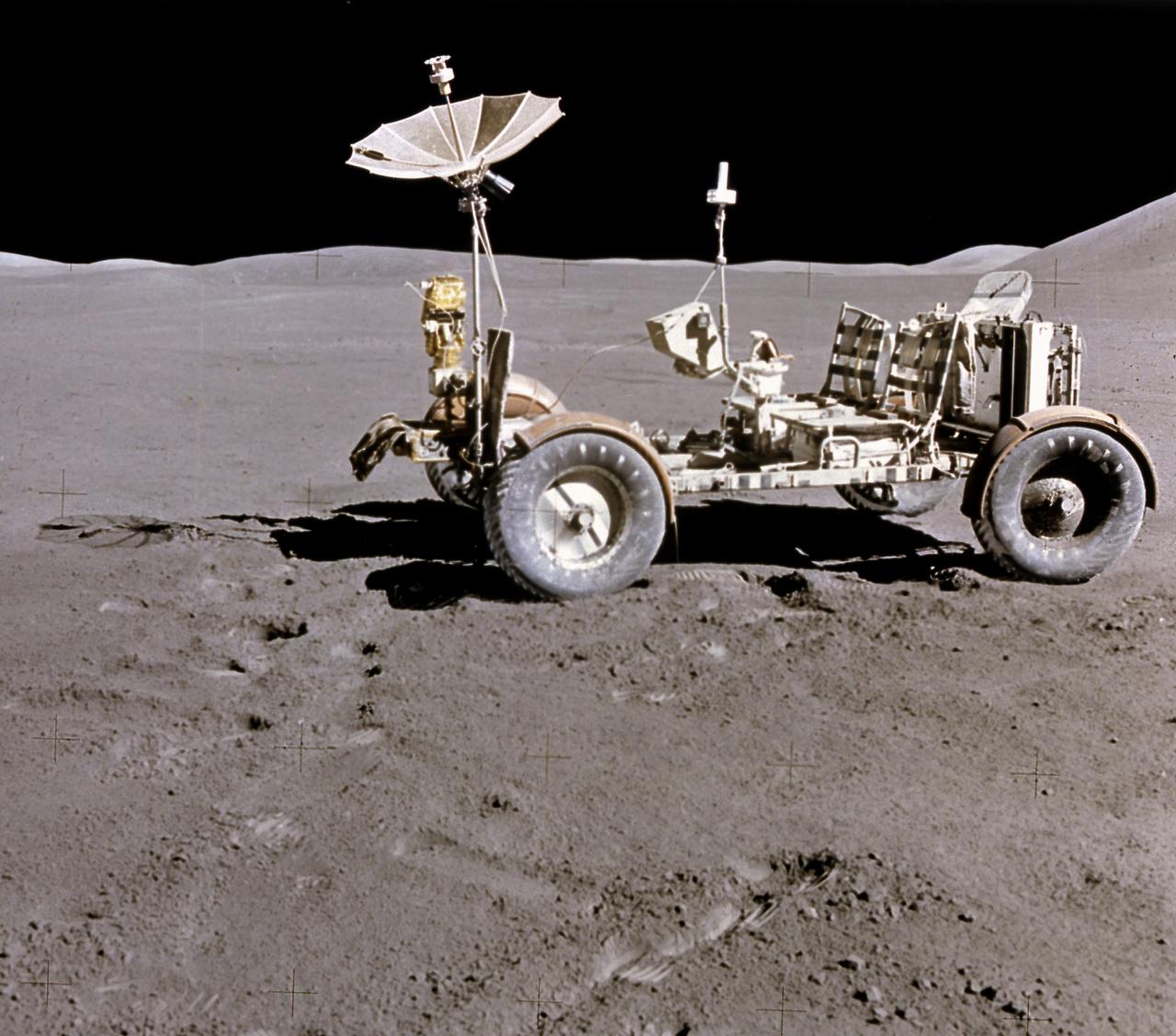
This photograph of the Lunar Roving Vehicle (LRV) was taken during the Apollo 15 mission. Powered by battery, the lightweight electric car greatly increased the range of mobility and productivity on the scientific traverses for astronauts. It weighed 462 pounds (77 pounds on the Moon) and could carry two suited astronauts, their gear and cameras, and several hundred pounds of bagged samples. The LRV's mobility was quite high. It could climb and descend slopes of about 25 degrees. The LRV was designed and developed by the Marshall Space Flight Center and built by the Boeing Company.
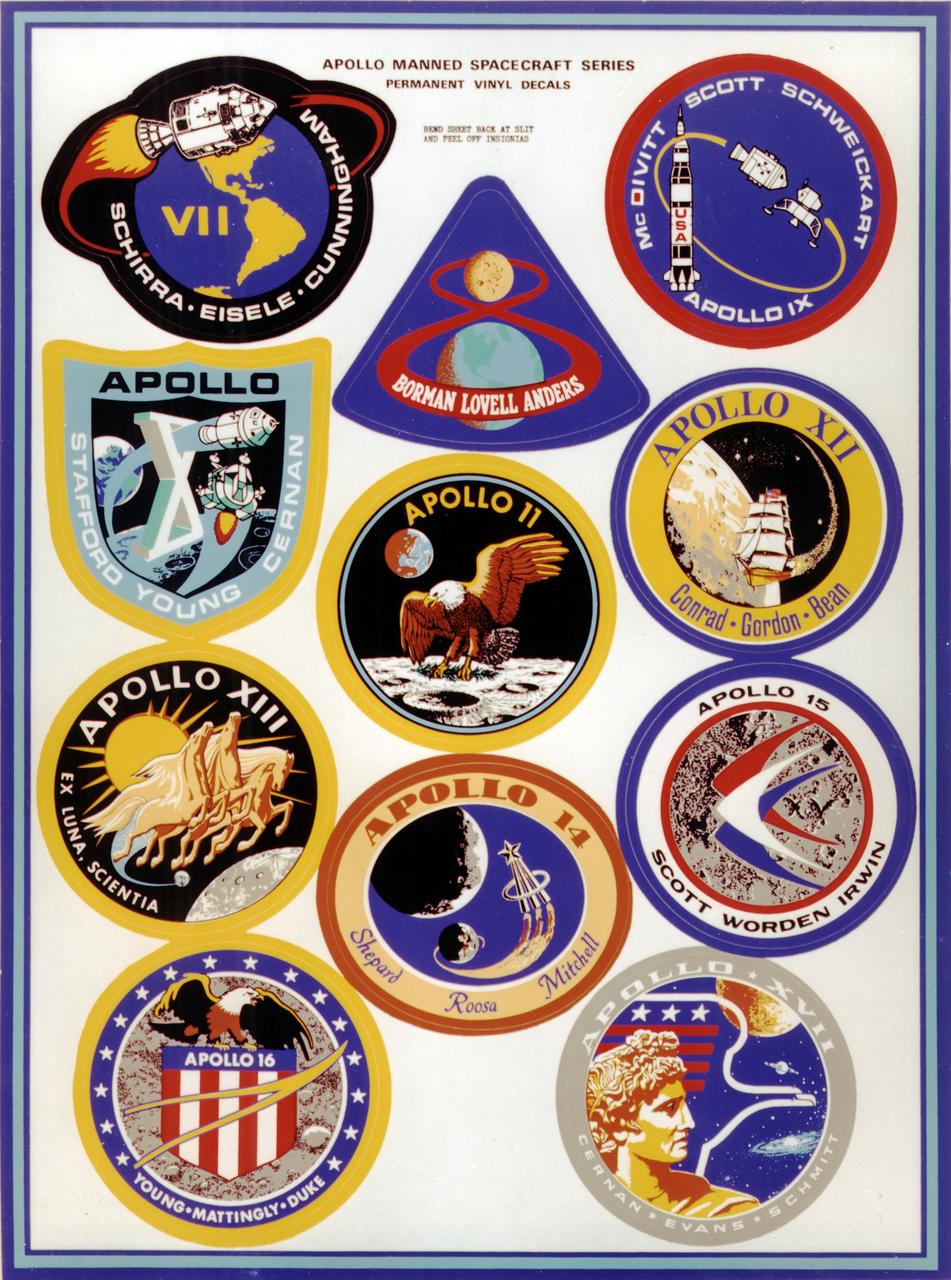
This montage depicts the flight crew patches for the manned Apollo 7 thru Apollo 17 missions. The Apollo 7 through 10 missions were basically manned test flights that paved the way for lunar landing missions. Primary objectives met included the demonstration of the Command Service Module (CSM) crew performance; crew/space vehicle/mission support facilities performance and testing during a manned CSM mission; CSM rendezvous capability; translunar injection demonstration; the first manned Apollo docking, the first Apollo Extra Vehicular Activity (EVA), performance of the first manned flight of the lunar module (LM); the CSM-LM docking in translunar trajectory, LM undocking in lunar orbit, LM staging in lunar orbit, and manned LM-CSM docking in lunar orbit. Apollo 11 through 17 were lunar landing missions with the exception of Apollo 13 which was forced to circle the moon without landing due to an onboard explosion. The craft was,however, able to return to Earth safely. Apollo 11 was the first manned lunar landing mission and performed the first lunar surface EVA. Landing site was the Sea of Tranquility. A message for mankind was delivered, the U.S. flag was planted, experiments were set up and 47 pounds of lunar surface material was collected for analysis back on Earth. Apollo 12, the 2nd manned lunar landing mission landed in the Ocean of Storms and retrieved parts of the unmanned Surveyor 3, which had landed on the Moon in April 1967. The Apollo Lunar Surface Experiments Package (ALSEP) was deployed, and 75 pounds of lunar material was gathered. Apollo 14, the 3rd lunar landing mission landed in Fra Mauro. ALSEP and other instruments were deployed, and 94 pounds of lunar materials were gathered, using a hand cart for first time to transport rocks. Apollo 15, the 4th lunar landing mission landed in the Hadley-Apennine region. With the first use of the Lunar Roving Vehicle (LRV), the crew was bale to gather 169 pounds of lunar material. Apollo 16, the 5th lunar landing mission, landed in the Descartes Highlands for the first study of highlands area. Selected surface experiments were deployed, the ultraviolet camera/spectrograph was used for first time on the Moon, and the LRV was used for second time for a collection of 213 pounds of lunar material. The Apollo program came to a close with Apollo 17, the 6th and final manned lunar landing mission that landed in the Taurus-Littrow highlands and valley area. This mission hosted the first scientist-astronaut, Schmitt, to land on the Moon. The 6th automated research station was set up, and 243 ponds of lunar material was gathered using the LRV.
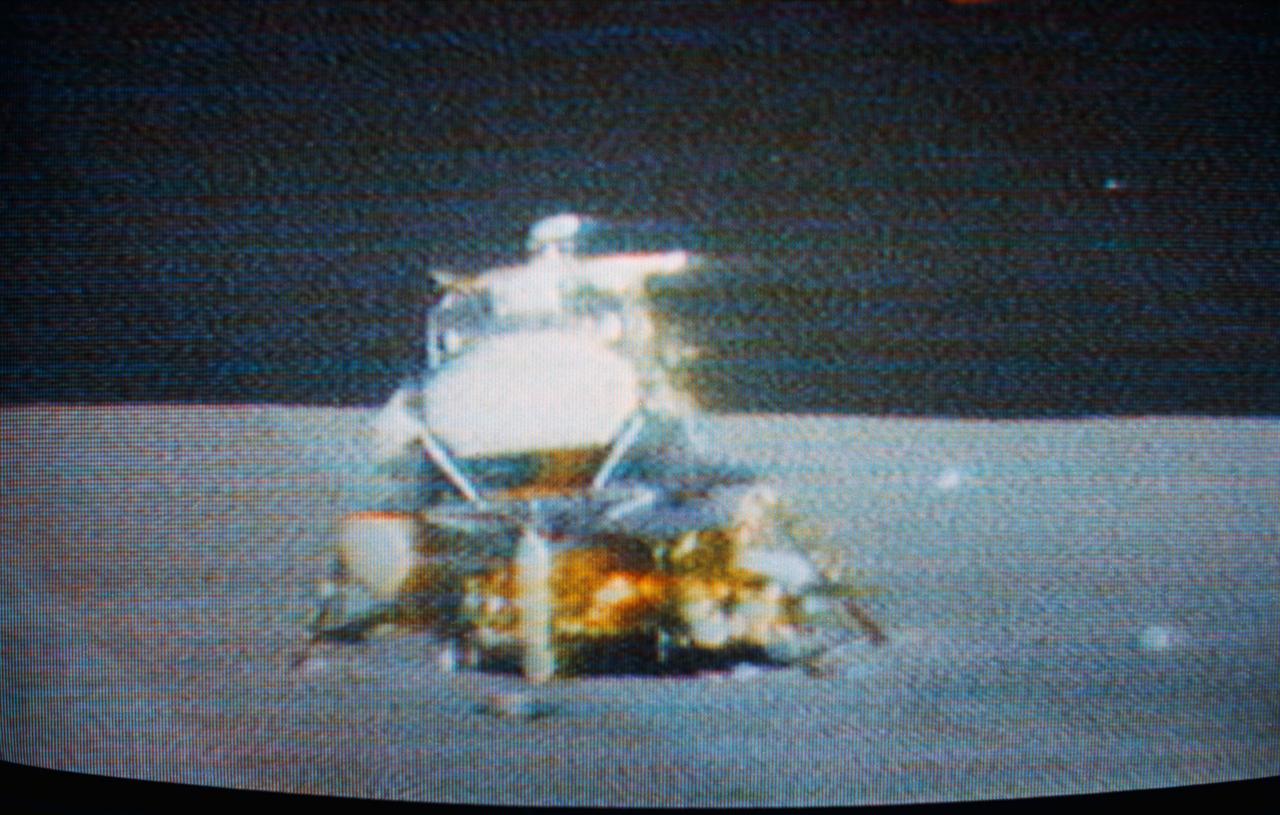
S71-41511 (2 Aug. 1971) --- The Apollo 15 Lunar Module (LM) "Falcon" is seen only seconds before ascent stage liftoff in this color reproduction taken from a transmission made by the RCA color television camera mounted on the Lunar Roving Vehicle (LRV). The LRV was parked about 300 feet east of the LM. The LRV-mounted TV camera, remotely controlled from the Mission Control Center (MCC), made it possible for people on Earth to watch the LM's launch from the moon. The LM liftoff was at 171:37 ground elapsed time. The "Falcon" ascent stage, with astronauts David R. Scott, commander; and James B. Irwin, lunar module pilot, aboard, returned from the lunar surface to rejoin the Command and Service Modules (CSM) orbiting the moon. Astronaut Alfred M. Worden, command module pilot, remained with the CSM in lunar orbit while Scott and Irwin explored the moon. The LM descent stage is used as a launching platform and remains behind on the moon. This is part one of a four-part sequence.
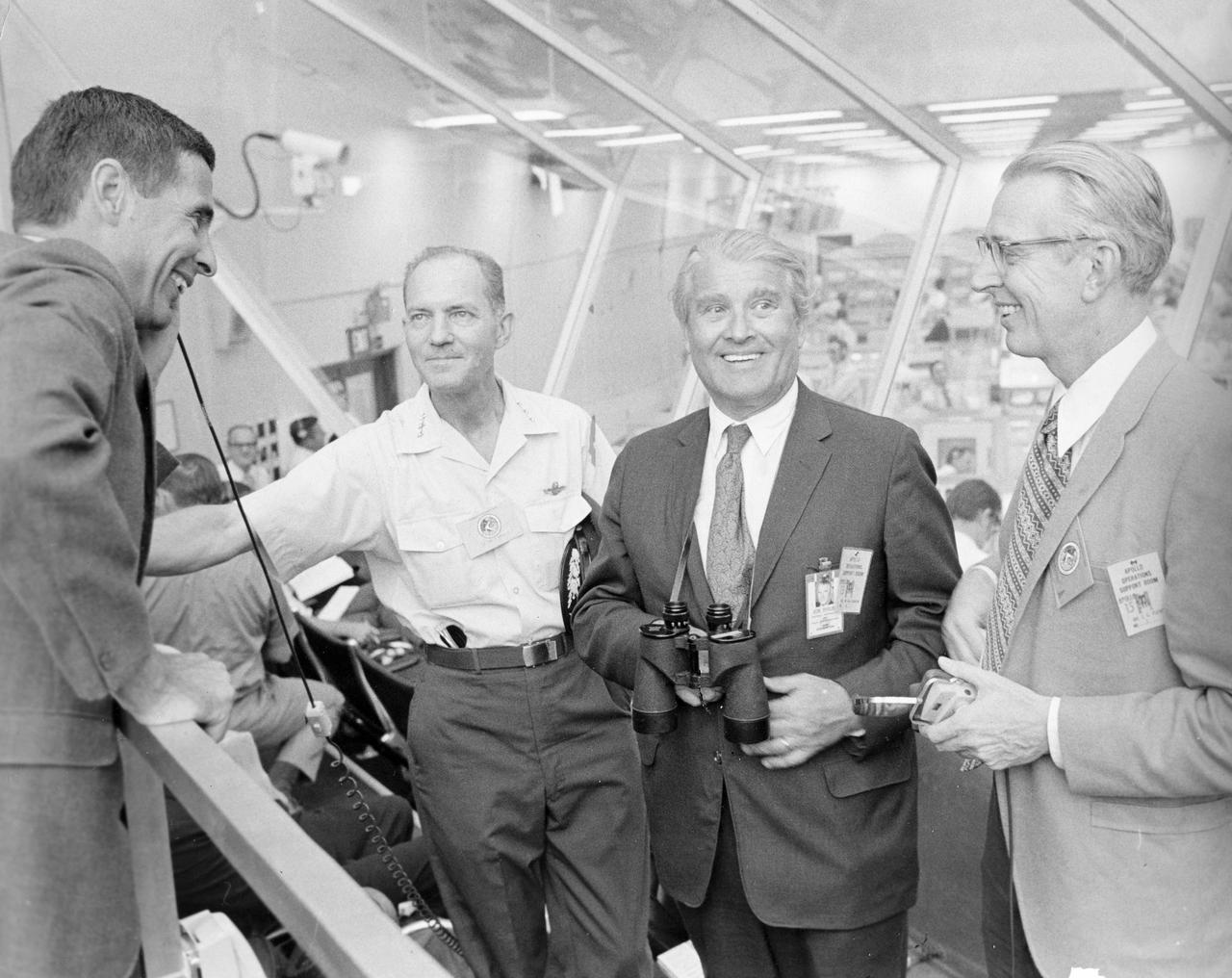
During the Apollo 15 pre-launch activity in the launch control center's firing room 1 at Kennedy Space Center, the then recently appointed NASA Administrator, Dr. James C. Fletcher (right) speaks with (Left to right) William Anders, executive secretary of the National Aeronautics and Space Council; Lt. General Sam Phillips, former Apollo Program Director; and Dr. Wernher von Braun, NASA's Deputy Associate Administrator for planning.
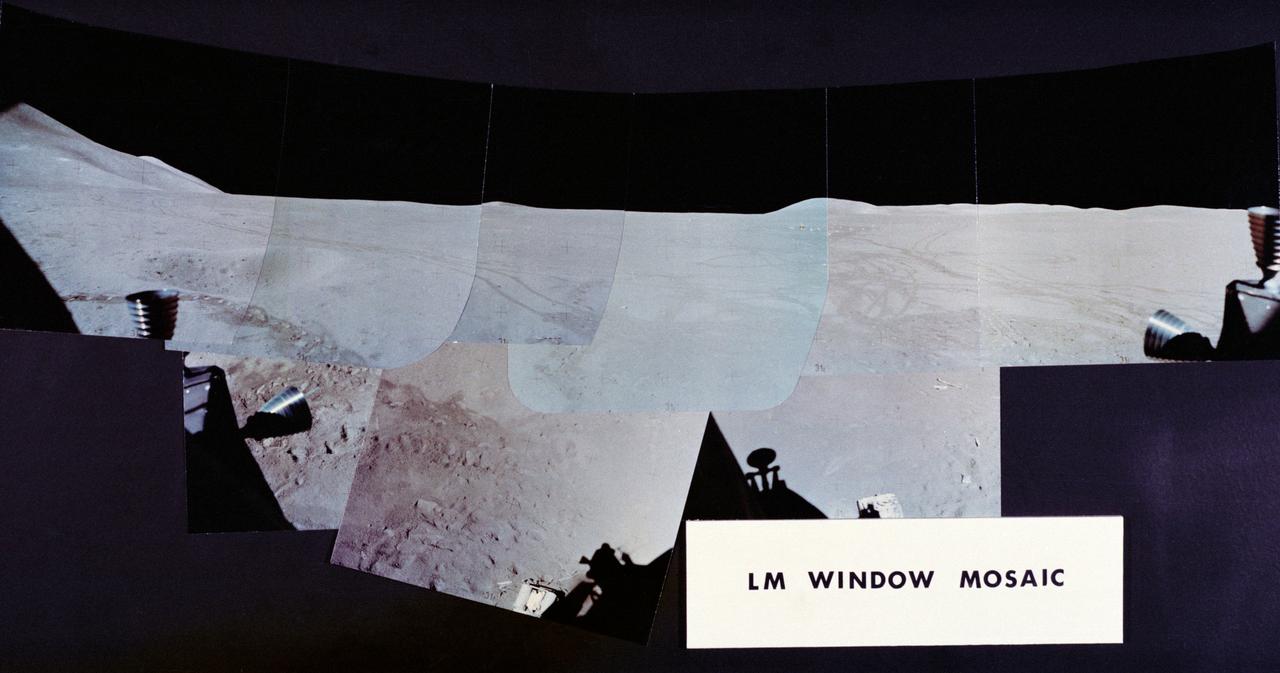
S71-43941 (2 Aug. 1971) --- A photographic mosaic showing a portion of the Apollo 15 Hadley-Apennine landing site with a field of view from about south by southwest to about north by northwest. The photographs were taken from the windows of the Lunar Module (LM) which was resting on the lunar surface facing west. Note bootprints and tracks of the Lunar Roving Vehicle (LRV) in the foreground. Visible on the horizon from left to right are: Hadley Delta Mountain and St. George Crater; Bennett Hill; and Hill 305, with the ALSEP equipment deployed in front of it.
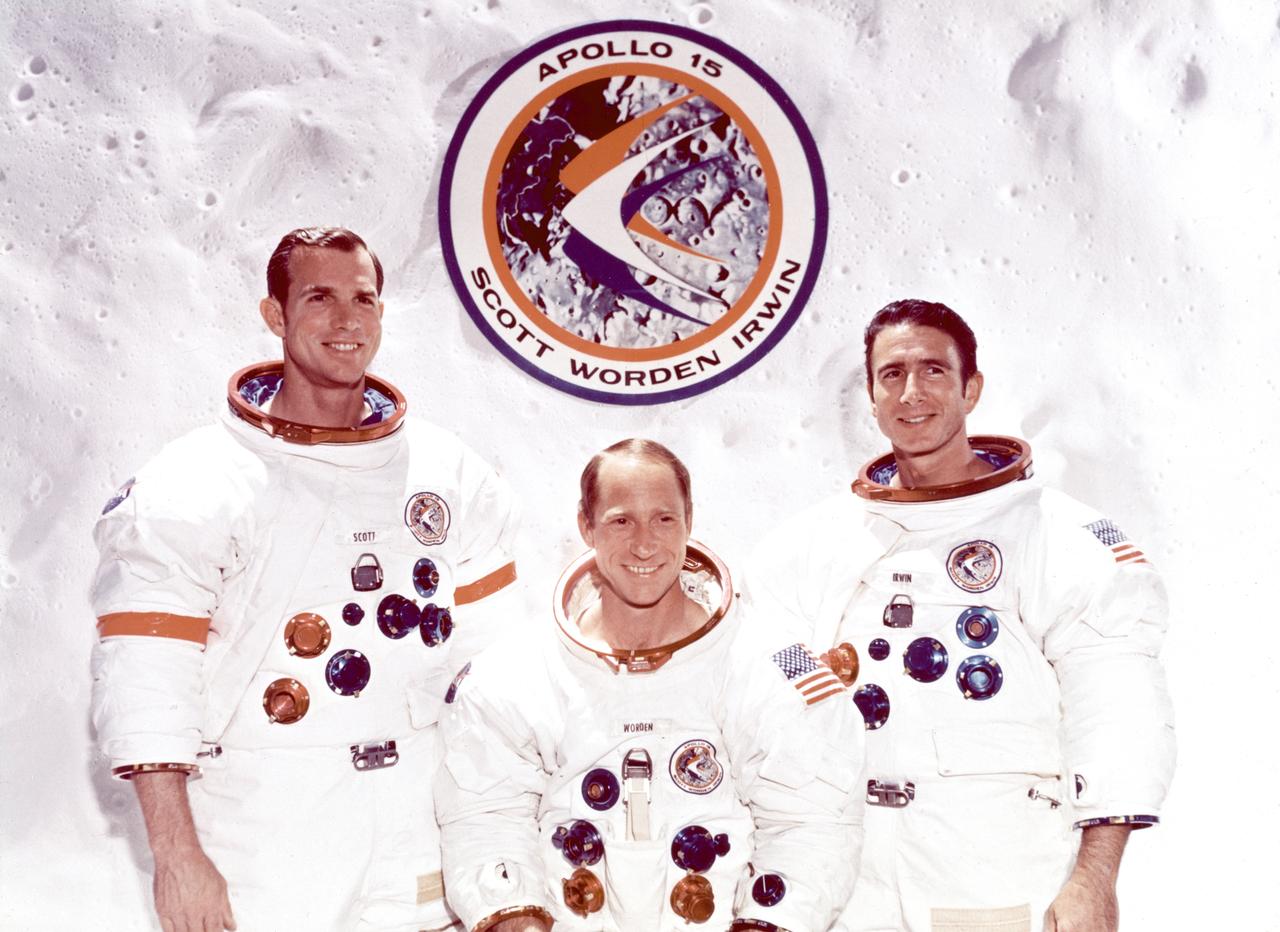
This is the official three-member crew portrait of the Apollo 15 (SA-510). Pictured from left to right are: David R. Scott, Mission Commander; Alfred M. Worden Jr., Command Module pilot; and James B. Irwin, Lunar Module pilot. The fifth marned lunar landing mission, Apollo 15 (SA-510), lifted off on July 26, 1971. Astronauts Scott and Irwin were the first to use a wheeled surface vehicle, the Lunar Roving Vehicle (LRV), or the Rover, which was designed and developed by the Marshall Space Flight Center, and built by the Boeing Company. The astronauts spent 13 days, nearly 67 hours, on the Moon's surface to inspect a wide variety of its geological features.
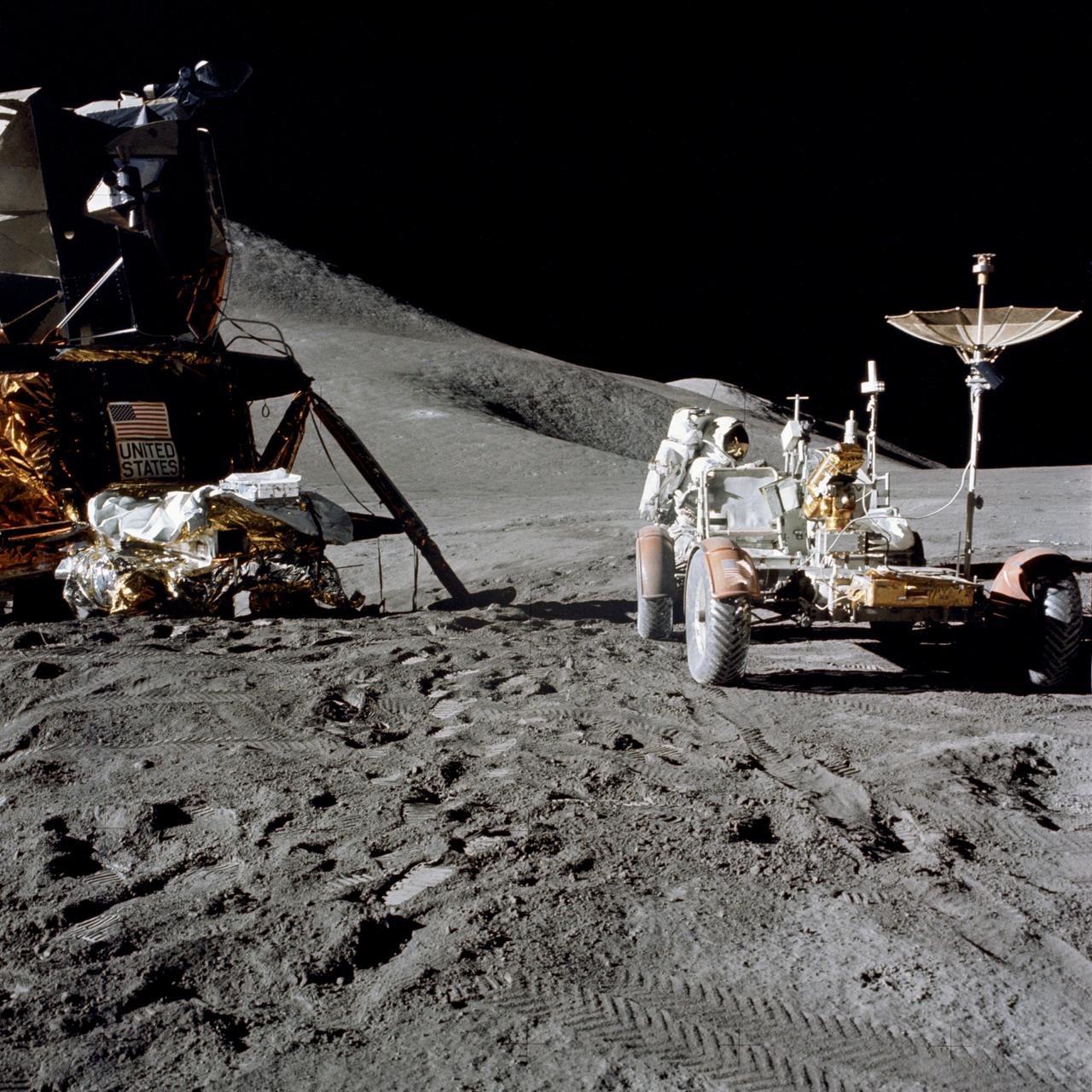
AS15-86-11602 (31 July 1971) --- Astronaut James B. Irwin, lunar module pilot, works at the Lunar Roving Vehicle (LRV) during the first Apollo 15 lunar surface extravehicular activity (EVA) at the Hadley-Apennine landing site. A portion of the Lunar Module (LM) "Falcon" is on the left. The undeployed Laser Ranging Retro Reflector (LR-3) lies atop the LM's modular equipment stowage assembly (MESA). This view is looking slightly west of south. Hadley Delta and the Apennine Front are in the background to the left. St. George crater is approximately five kilometers (about three statute miles) in the distance behind Irwin's head. This photograph was taken by astronaut David R. Scott, commander. While astronauts Scott and Irwin descended in the LM to explore the moon, astronaut Alfred M. Worden, command module pilot, remained with the Command and Service Modules (CSM) in lunar orbit.
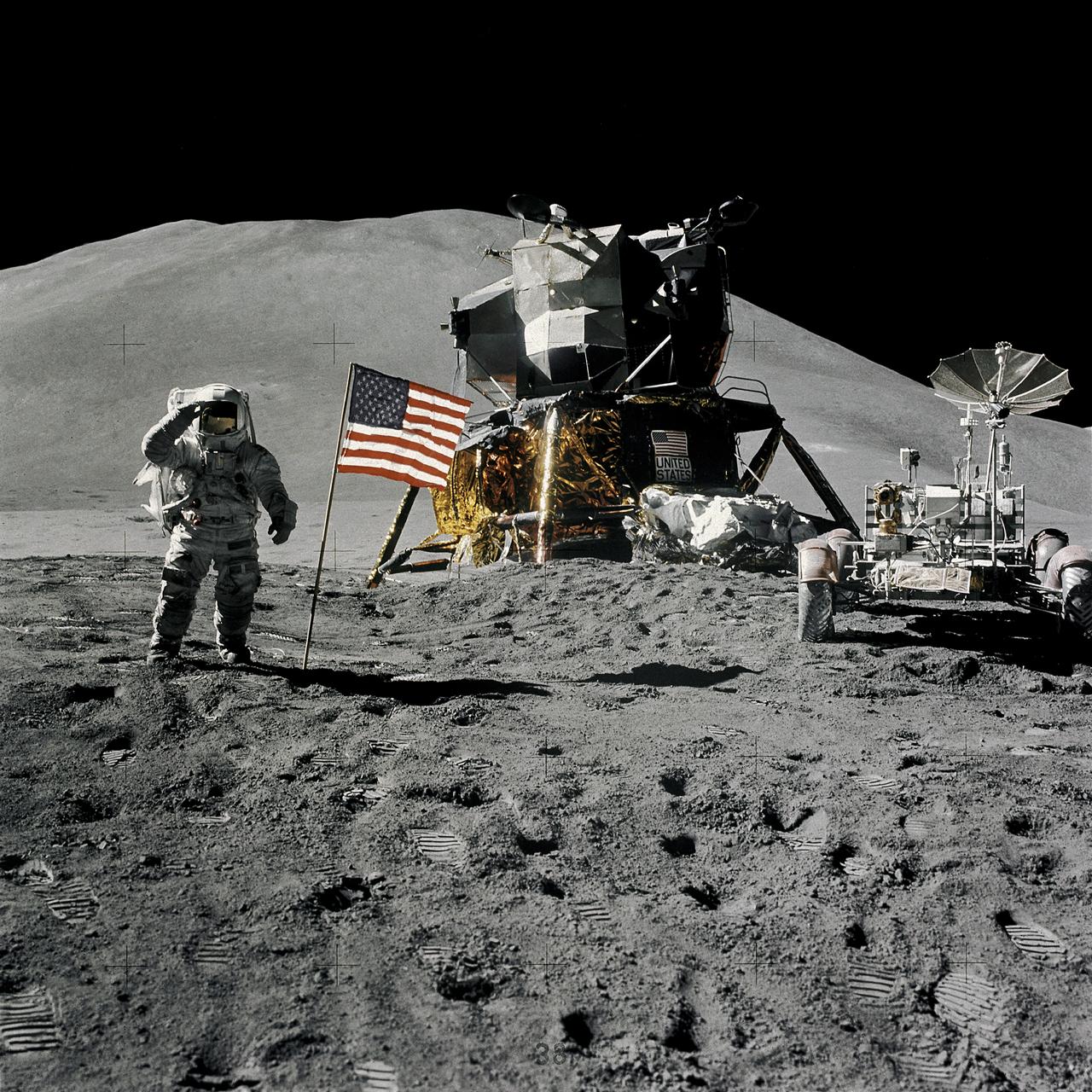
AS15-88-11866 (1 Aug. 1971) --- Astronaut James B. Irwin, lunar module pilot, gives a military salute while standing beside the deployed United States flag during the Apollo 15 lunar surface extravehicular activity (EVA) at the Hadley-Apennine landing site. The flag was deployed toward the end of EVA-2. The Lunar Module (LM) "Falcon" is in the center. On the right is the Lunar Roving Vehicle (LRV). This view is looking almost due south. Hadley Delta in the background rises approximately 4,000 meters (about 13,124 feet) above the plain. The base of the mountain is approximately 5 kilometers (about 3 statute miles) away. This photograph was taken by astronaut David R. Scott, Apollo 15 commander. While astronauts Scott and Irwin descended in the LM to explore the moon, astronaut Alfred M. Worden, command module pilot, remained with the Command and Service Modules (CSM) in lunar orbit.
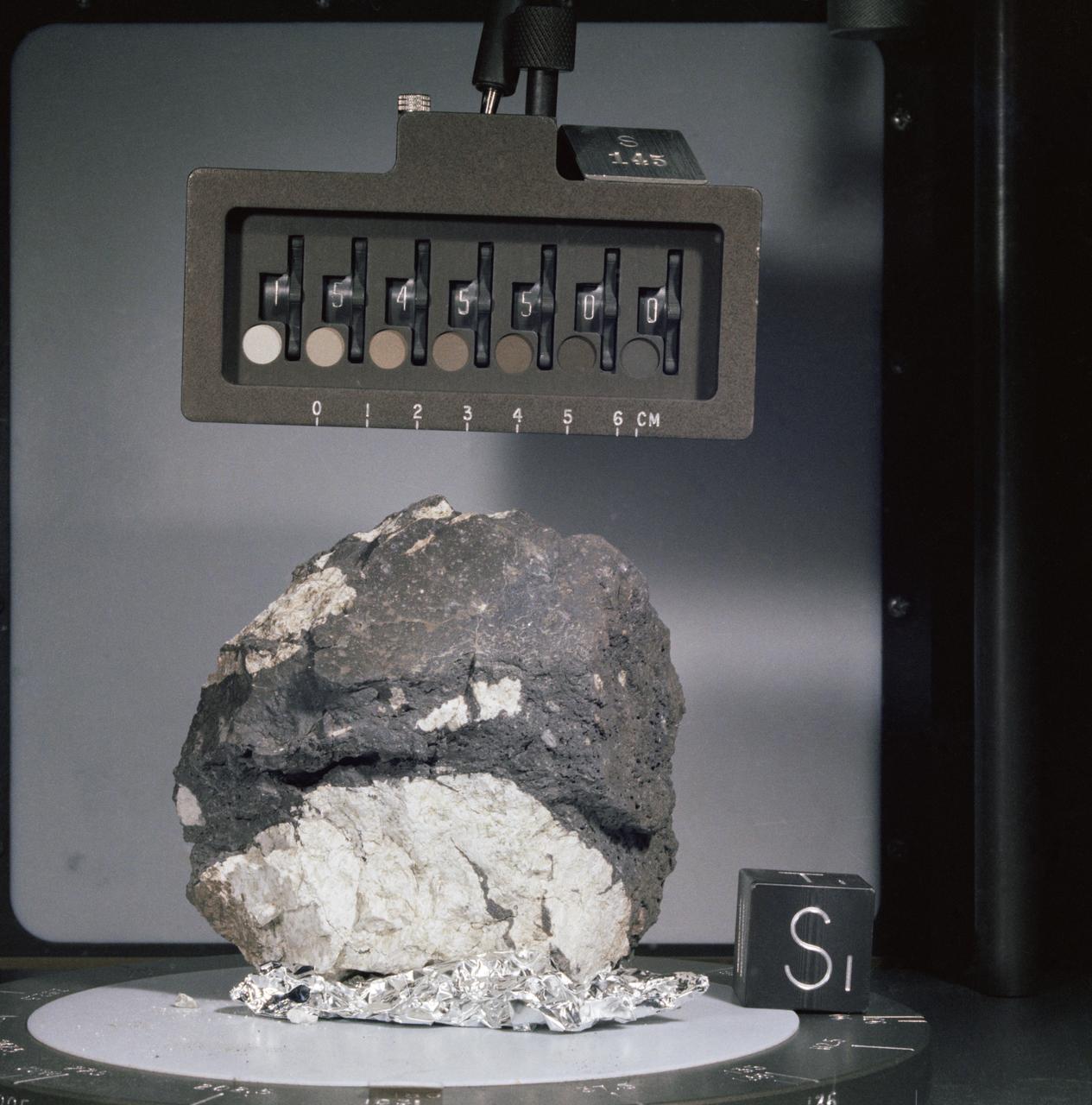
Generic: 15556. Mission: Apollo 15. Station: 9A. Landmark: HADLEY RILLE. BagNumber: SCB 2. OriginalWeight: 1542. SuperClass: Basalt. SubClass: Olivine. Category: ROCK. Classifications: F.G. ol-norm . Description: F.G. ol-norm. Classification 1: BASALT.
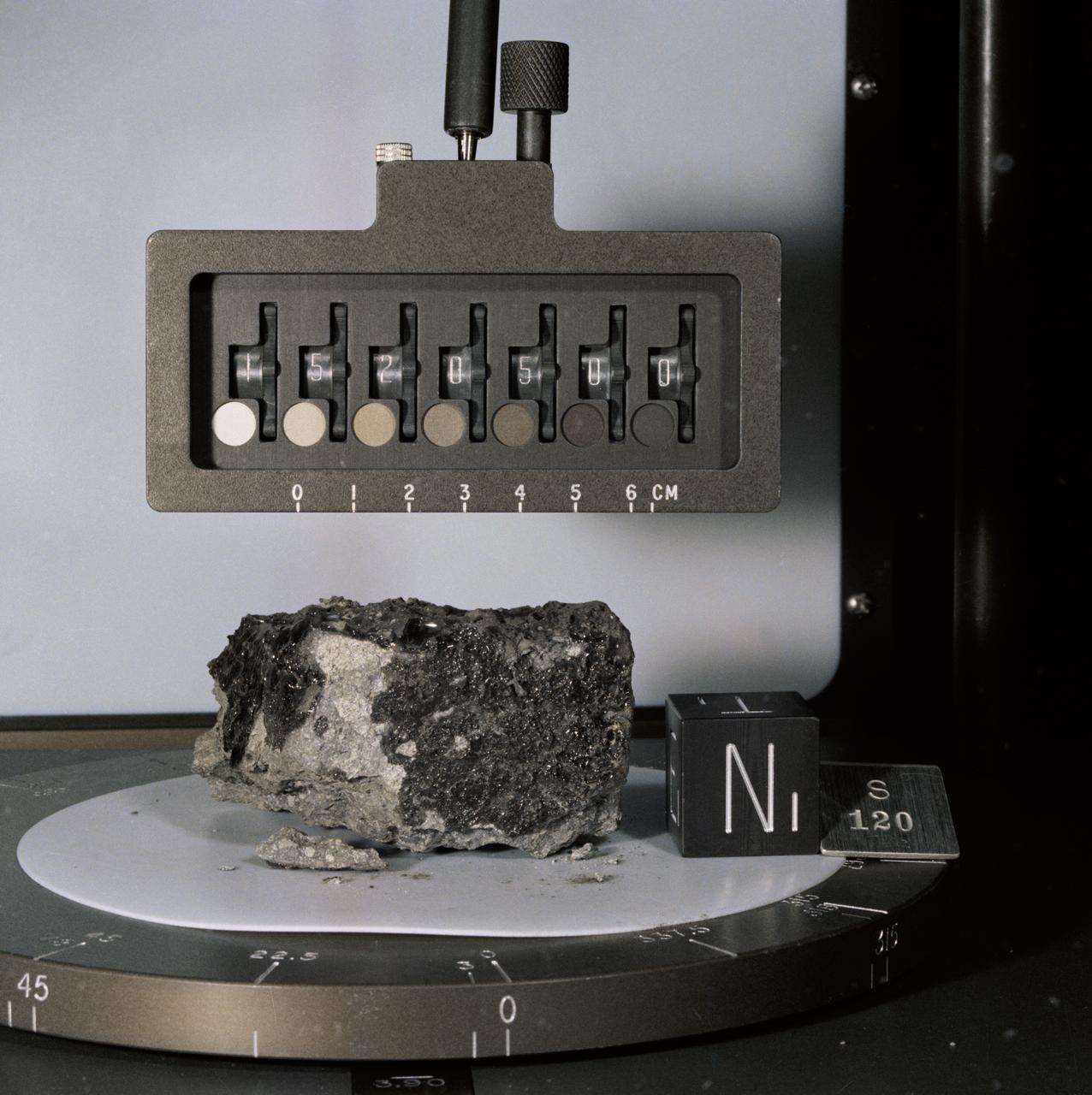
Generic: 15205. Mission: Apollo 15. Station: 2. Landmark: ST. GEORGE CRATER. BagNumber: SCB 1 161. OrignalWeight: 337.3. SuperClass: Breccia. SubClass: Regolith. Category: ROCK . Classifications: Glass-coated. Description: Glass-coated. Classificaiton 1: BRECCIA.
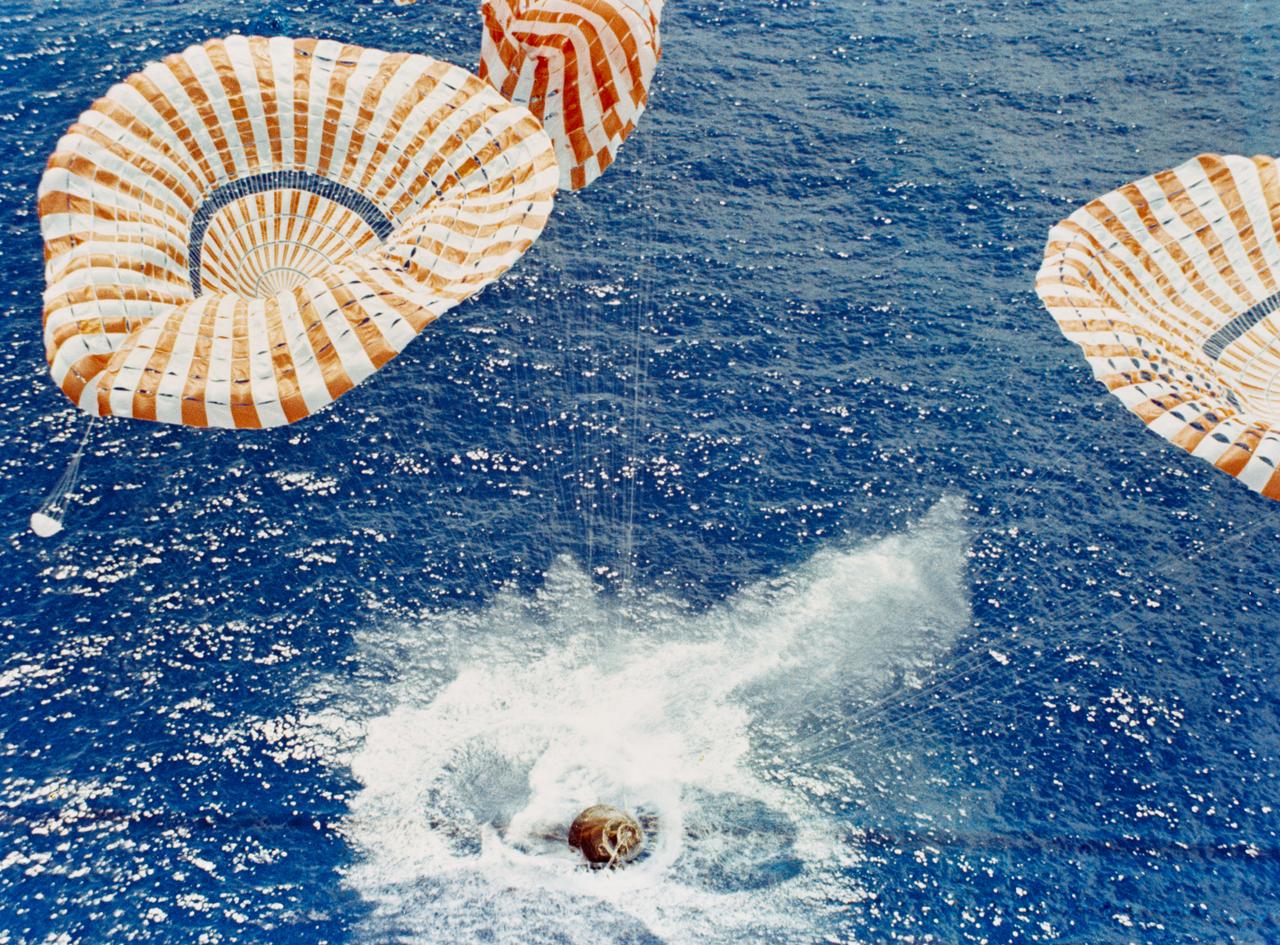
S71-43542 (7 Aug. 1971) --- The Apollo 15 Command Module (CM), with astronauts David R. Scott, commander; Alfred M. Worden, command module pilot; and James B. Irwin, lunar module pilot, aboard safely touches down in the mid-Pacific Ocean to conclude a highly successful lunar landing mission. Although causing no harm to the crew men, one of the three main parachutes failed to function properly. The splashdown occurred at 3:45:53 p.m. (CDT), Aug. 7, 1971, some 330 miles north of Honolulu, Hawaii. The three astronauts were picked up by helicopter and flown to the prime recovery ship, USS Okinawa, which was only 6 1/2 miles away.
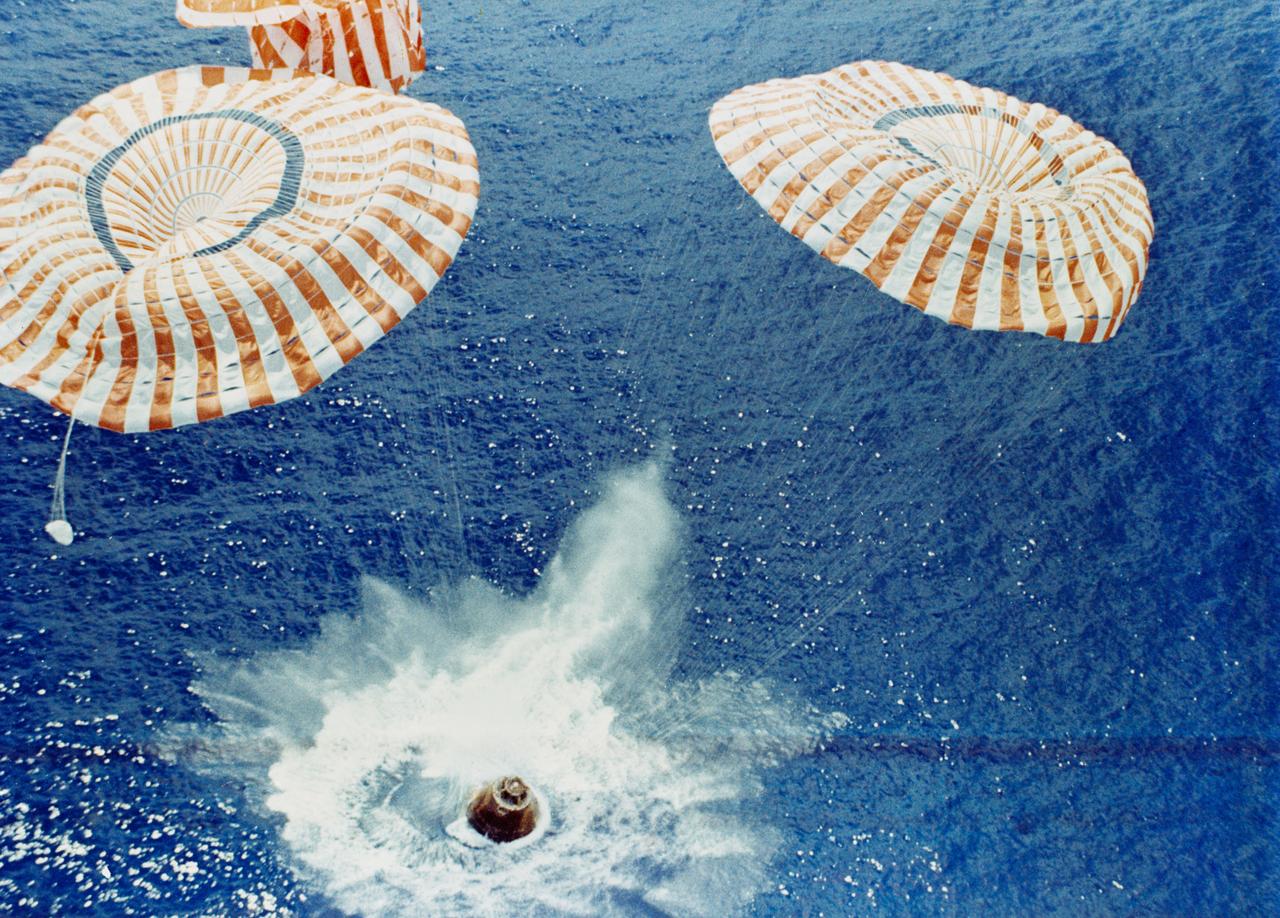
S71-43541 (7 Aug. 1971) --- The Apollo 15 Command Module (CM), with astronauts David R. Scott, commander; Alfred M. Worden, command module pilot; and James B. Irwin, lunar module pilot, aboard safely touches down in the mid-Pacific Ocean to conclude a highly successful lunar landing mission. Although causing no harm to the crew men, one of the three main parachutes failed to function properly. The splashdown occurred at 3:45:53 p.m. (CDT), Aug. 7, 1971, some 330 miles north of Honolulu, Hawaii. The three astronauts were picked up by helicopter and flown to the prime recovery ship, USS Okinawa, which was only 6 1/2 miles away.
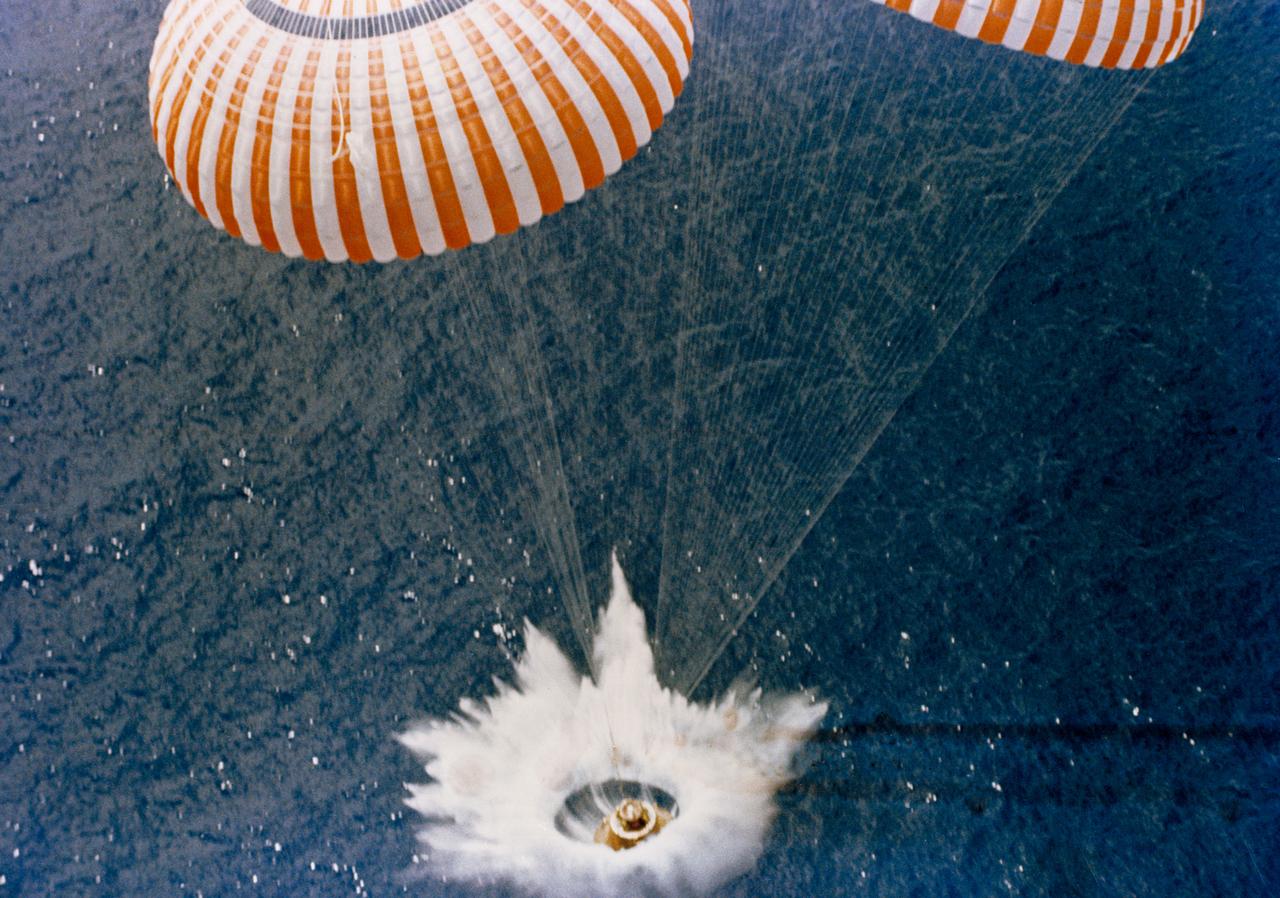
S71-43543 (7 Aug. 1971) --- The Apollo 15 Command Module (CM), with astronauts David R. Scott, commander; Alfred M. Worden, command module pilot; and James B. Irwin, lunar module pilot, aboard safely touches down in the mid-Pacific Ocean to conclude a highly successful lunar landing mission. Although causing no harm to the crew men, one of the three main parachutes failed to function properly. The splashdown occurred at 3:45:53 p.m. (CDT), Aug. 7, 1971, some 330 miles north of Honolulu, Hawaii. The three astronauts were picked up by helicopter and flown to the prime recovery ship, USS Okinawa, which was only 6 1/2 miles away.
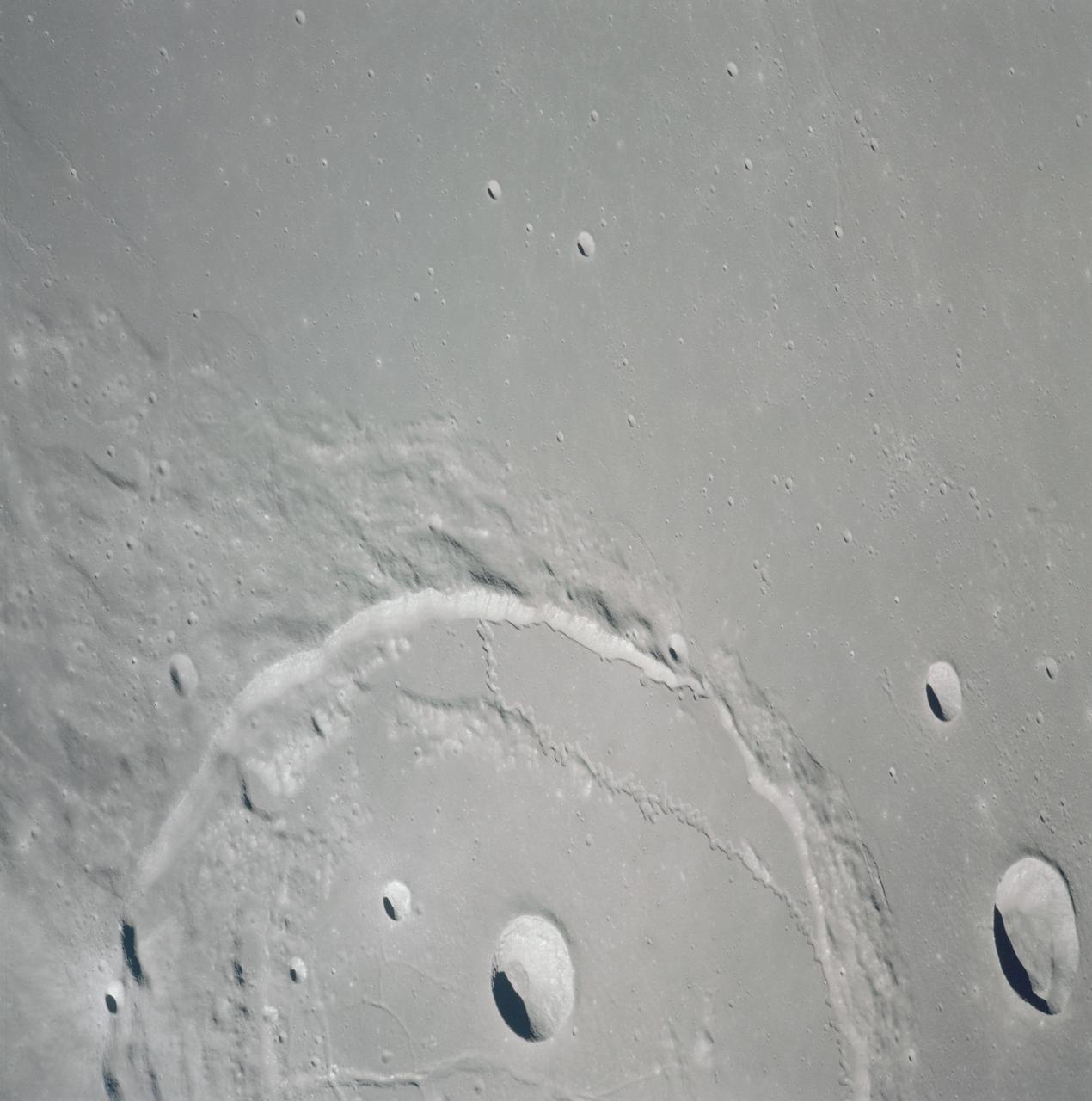
AS15-91-12366 (31 July-2 Aug. 1971) --- The crater Posidonius at the northeastern edge of the Sea of Serenity, was photographed with a 70mm handheld Hasselblad from the Command and Service Module (CSM) by astronaut Alfred M. Worden, command module pilot, in lunar orbit. While Worden remained with the CSM in lunar orbit, astronauts David R. Scott and James B. Irwin descended in the Lunar Module (LM) "Falcon" to explore the lunar surface.
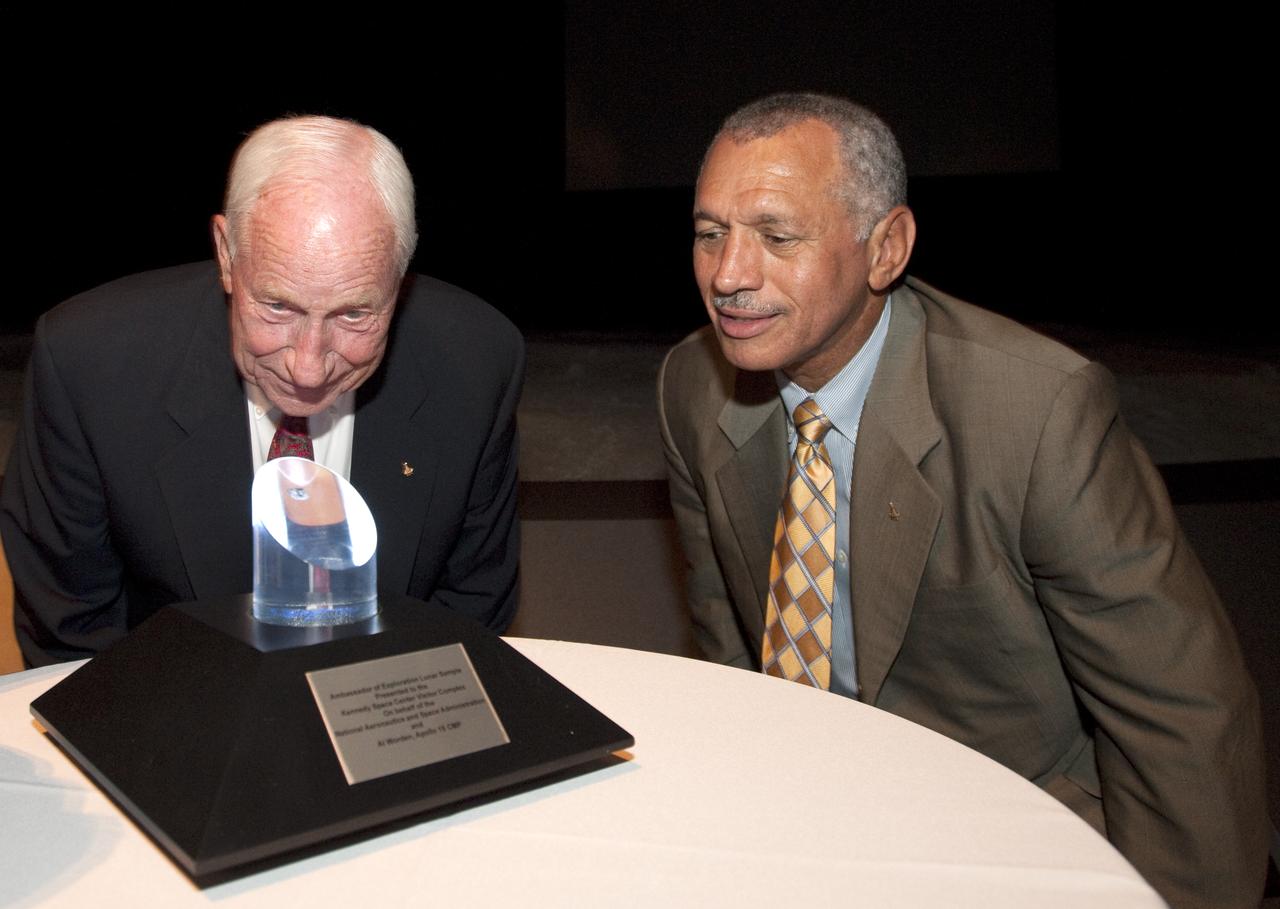
Apollo astronaut Al Worden, left, and NASA Administrator Charles Bolden, take a close look at Worden's Ambassador of Exploration Award for his contributions to the U.S. space program following a ceremony, Thursday, July 30, 2009, where Worden was honored with the presentation of the award at Kennedy Space Center, Fla. Worden served as command module pilot for the Apollo 15 mission. Photo Credit: (NASA/Bill Ingalls)
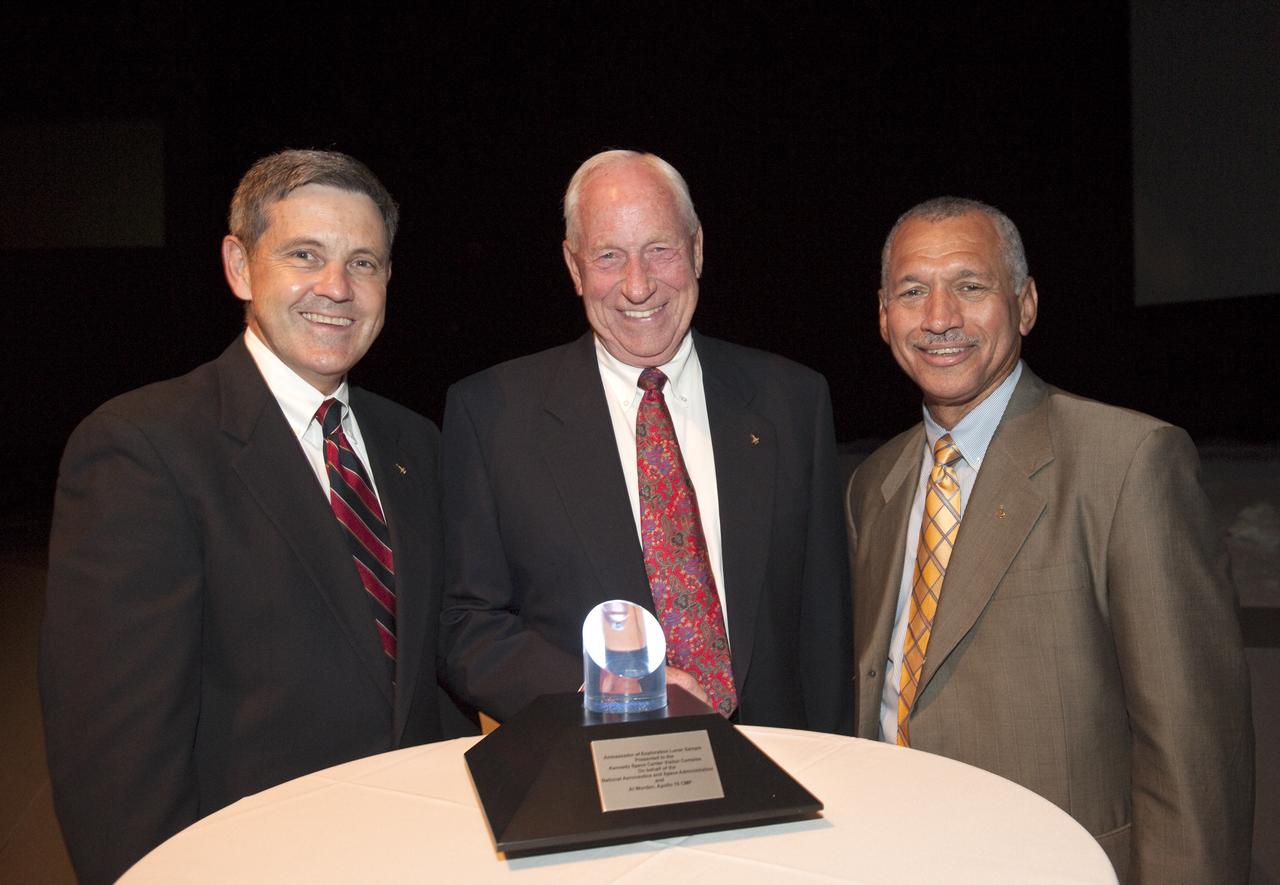
Apollo astronaut Al Worden, center, is flanked by NASA Administrator Charles Bolden, right, and Kennedy Space Center Director Bob Cabana at a ceremony, Thursday, July 30, 2009, where Worden was honored with the presentation of the an Ambassador of Exploration Award for his contributions to the U.S. space program at Kennedy Space Center, Fla. Worden served as command module pilot for the Apollo 15 mission. Photo Credit: (NASA/Bill Ingalls)
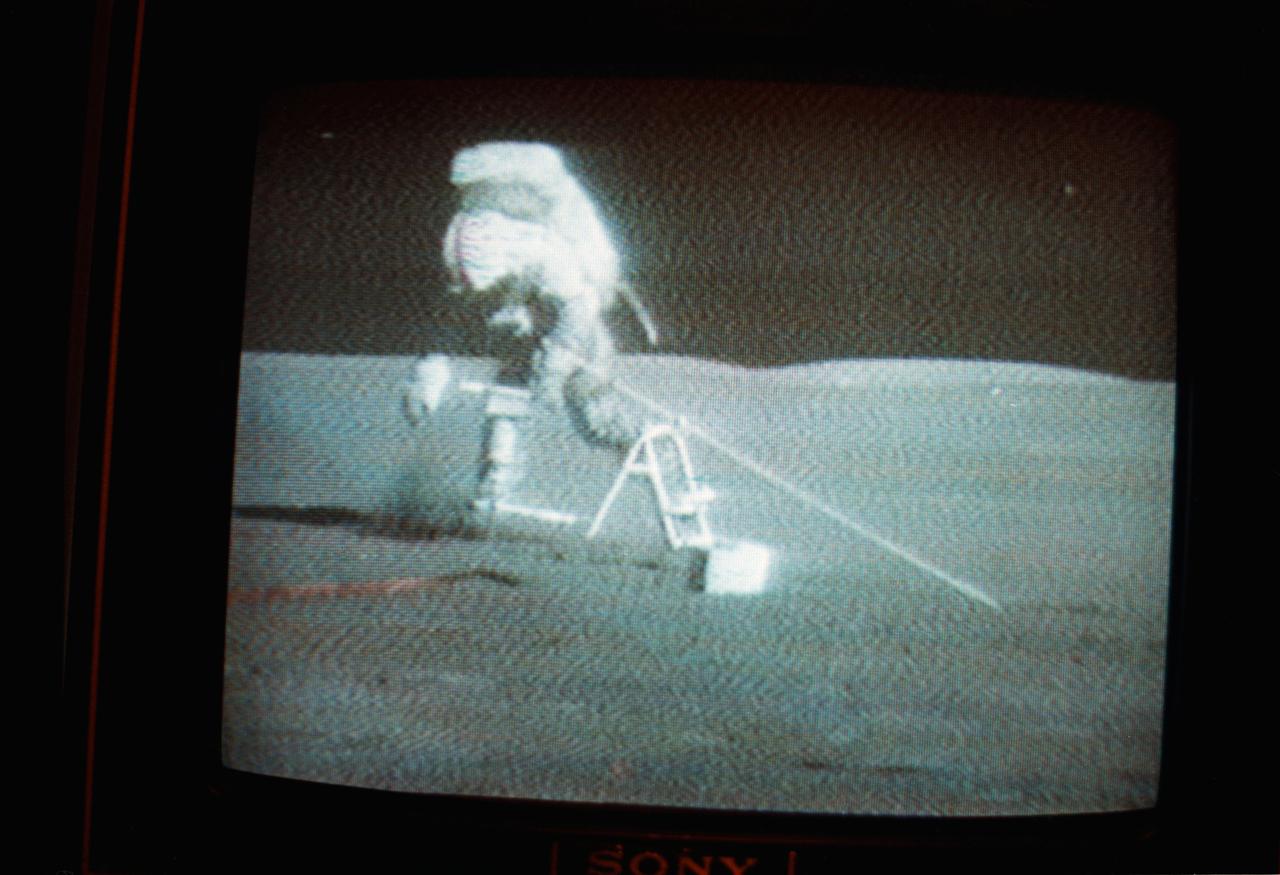
S71-41501 (1 Aug. 1971) --- Astronaut David R. Scott, Apollo 15 commander, is seen carrying the Apollo Lunar Surface Drill (ALSD) during the second lunar surface extravehicular activity (EVA) in this black and white reproduction taken from a color transmission made by the RCA color television camera mounted on the Lunar Roving Vehicle (LRV). This transmission was the fourth made during the mission.
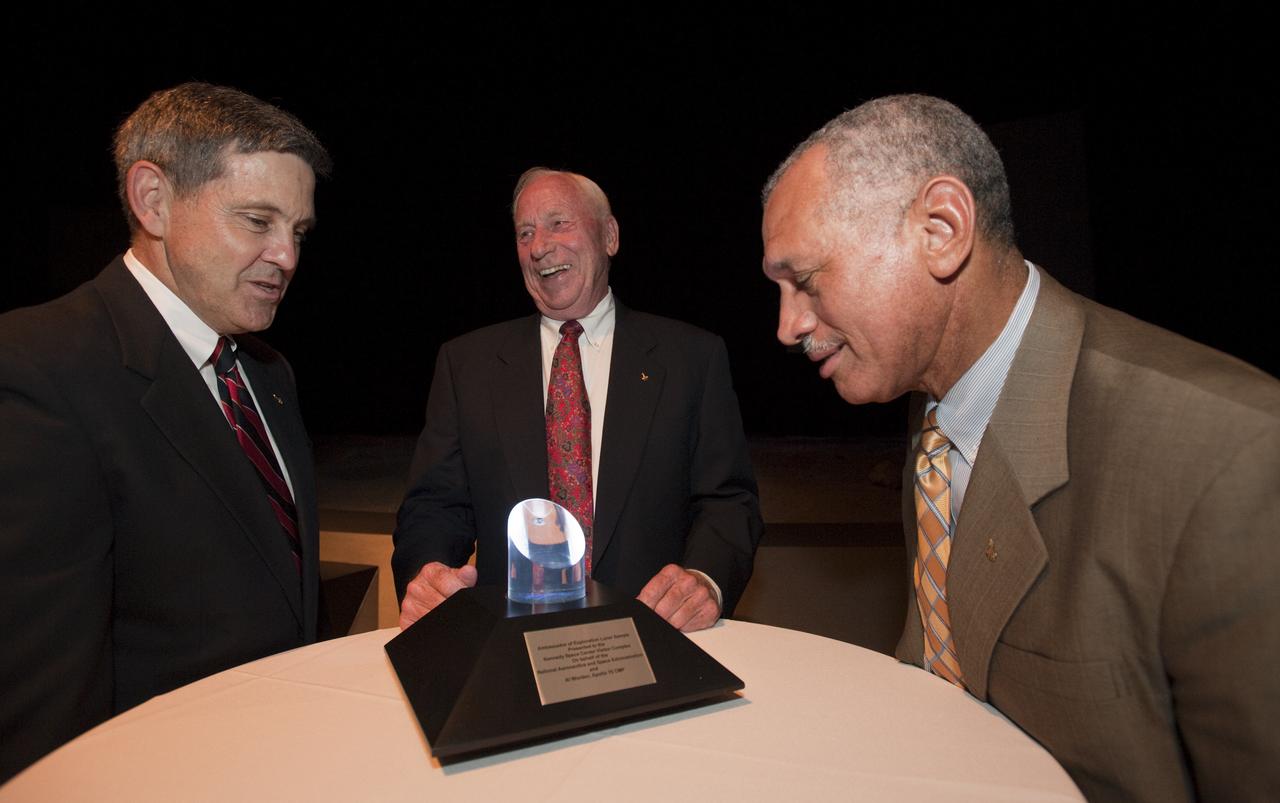
Apollo astronaut Al Worden, center, flanked by NASA Administrator Charles Bolden, right, and Kennedy Space Center Director Bob Cabana following a ceremony, Thursday, July 30, 2009, where Worden was honored with the presentation of the an Ambassador of Exploration Award for his contributions to the U.S. space program at Kennedy Space Center, Fla. Worden served as command module pilot for the Apollo 15 mission. Photo Credit: (NASA/Bill Ingalls)
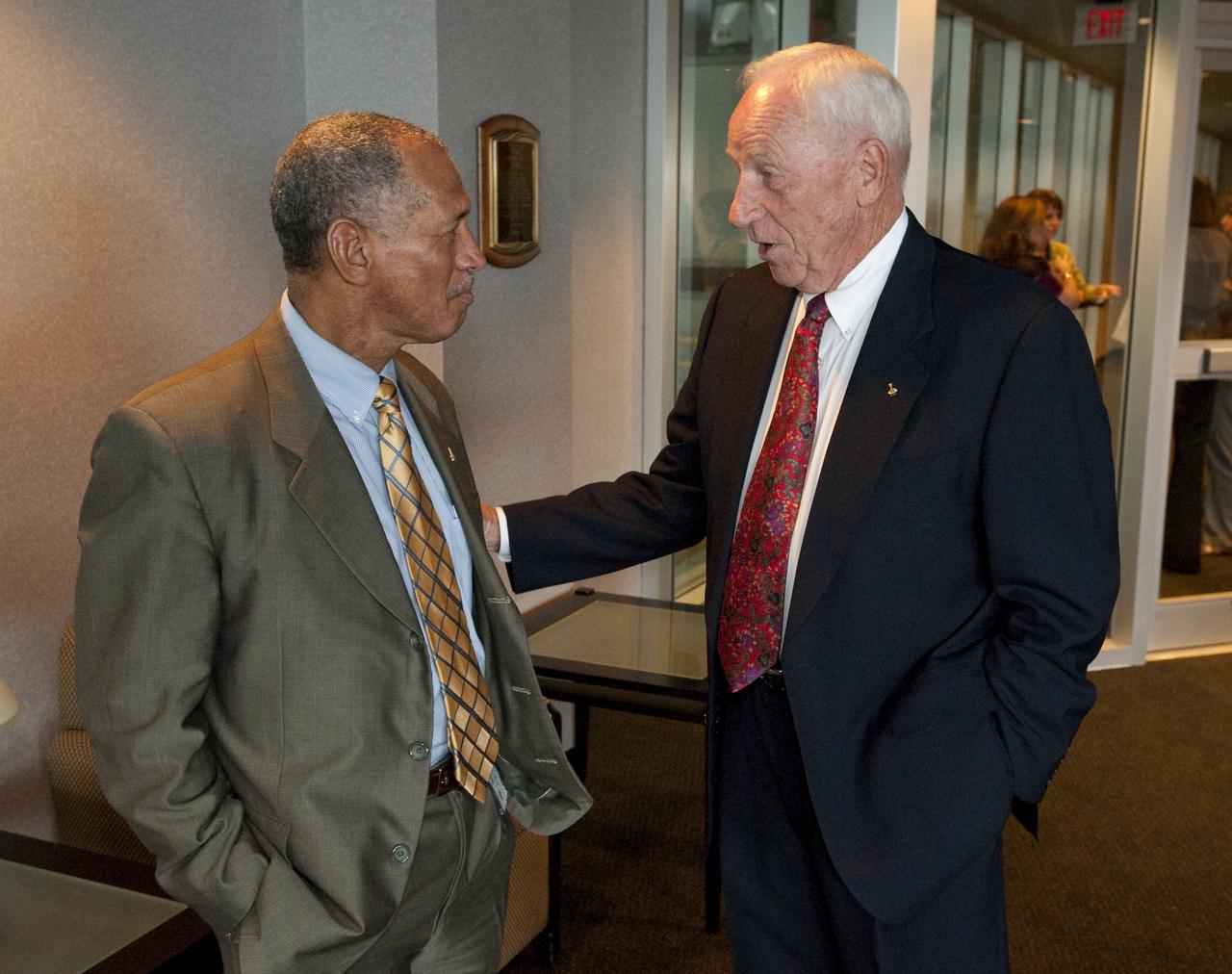
NASA Administrator Charles Bolden, left, visits with Apollo astronaut Al Worden prior to a ceremony, Thursday, July 30, 2009, where Worden was honored with the presentation of the an Ambassador of Exploration Award for his contributions to the U.S. space program at Kennedy Space Center, Fla. Worden served as command module pilot for the Apollo 15 mission. Photo Credit: (NASA/Bill Ingalls)
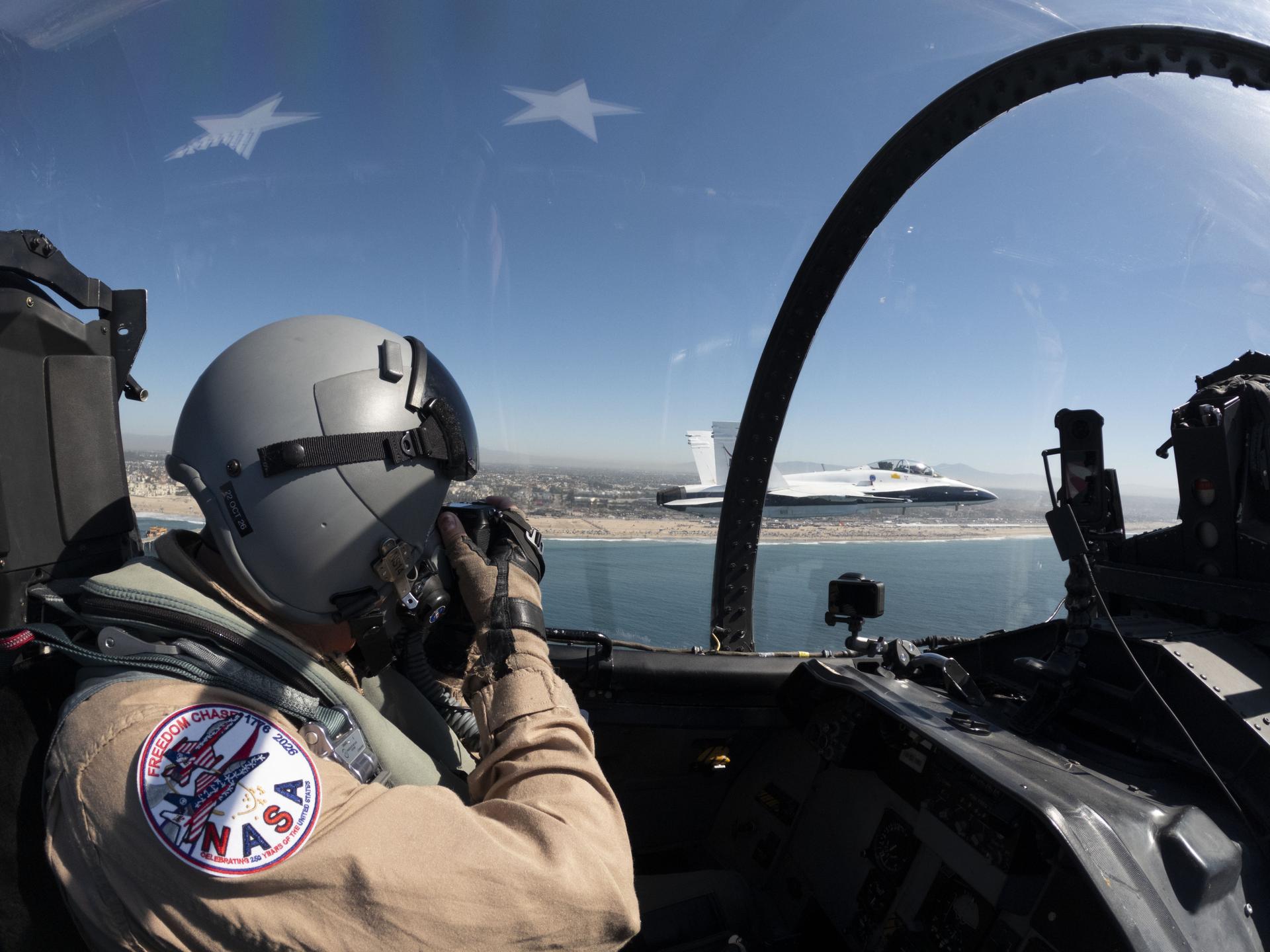
Photographer Jim Ross captures images of NASA’s F/A‑18 from the back seat of an F‑15 flying alongside during the Pacific Airshow at Huntington Beach, California, Friday, Oct. 2, 2026. NASA is also hosting an exhibit featuring Artemis, the X‑59, SkyFall, a lunar globe, and an Apollo 15 Moon rock.
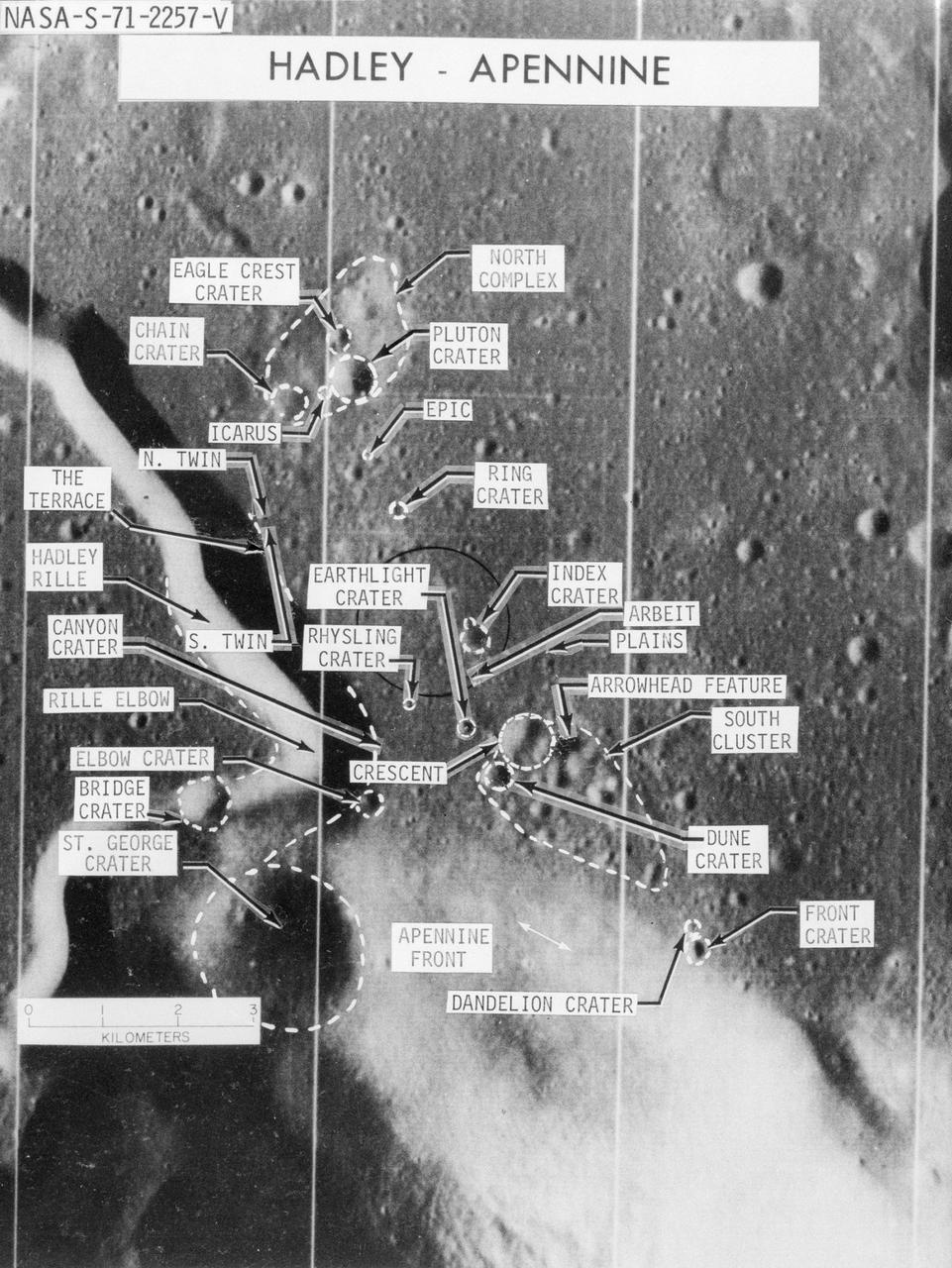
S71-02257 (June 1971) --- An enlarged Lunar Orbiter photograph showing the Apollo 15 landing area in the Hadley-Apennine region on the lunar nearside. The overlay identifies numerous lunar features in the area.
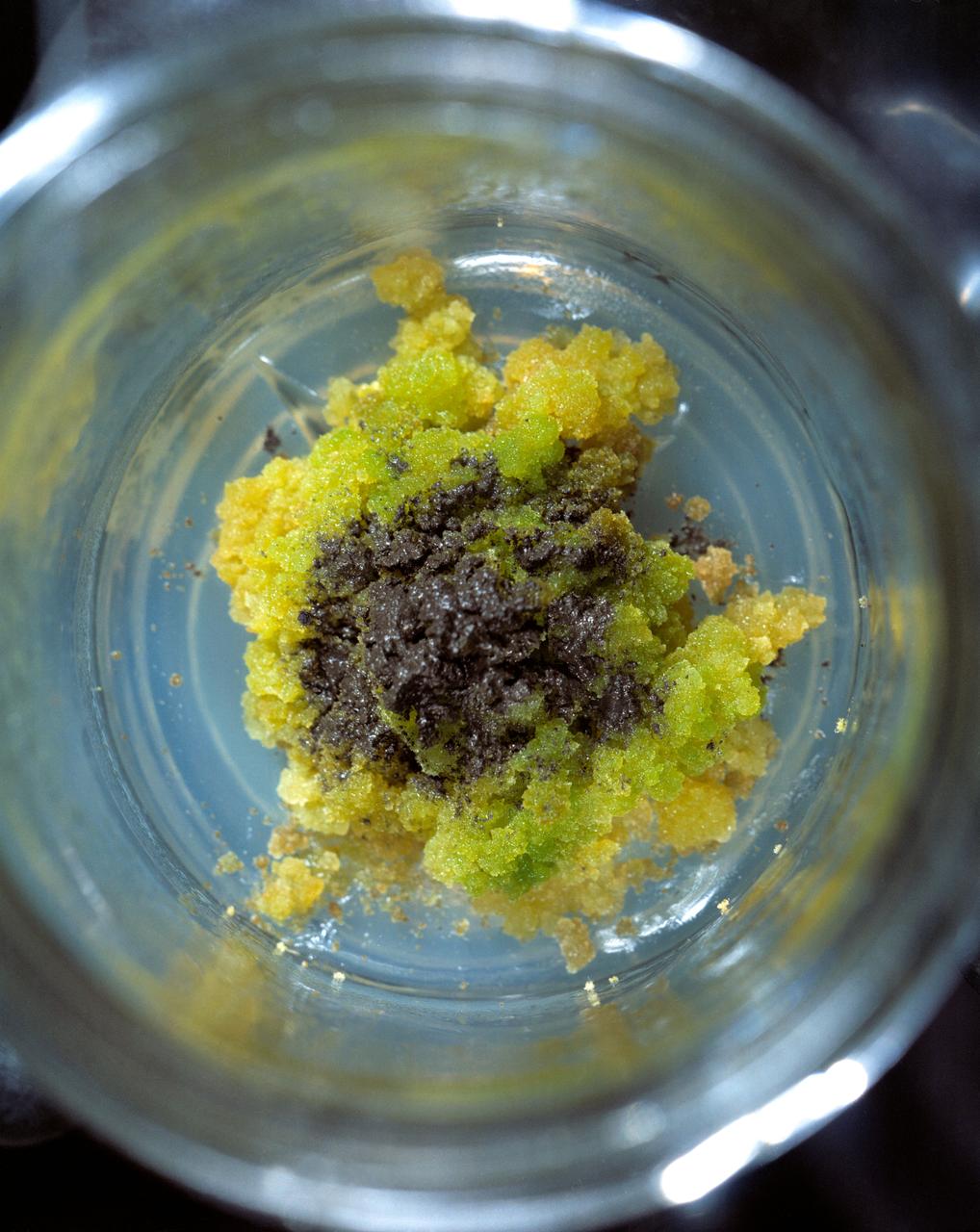
S71-51315 (1 Oct. 1971) --- A close-up view of soybean tissue culture growing in a synthetic medium and Apollo 15 lunar material. Note the greening occurring in areas in contact with the soil particles.
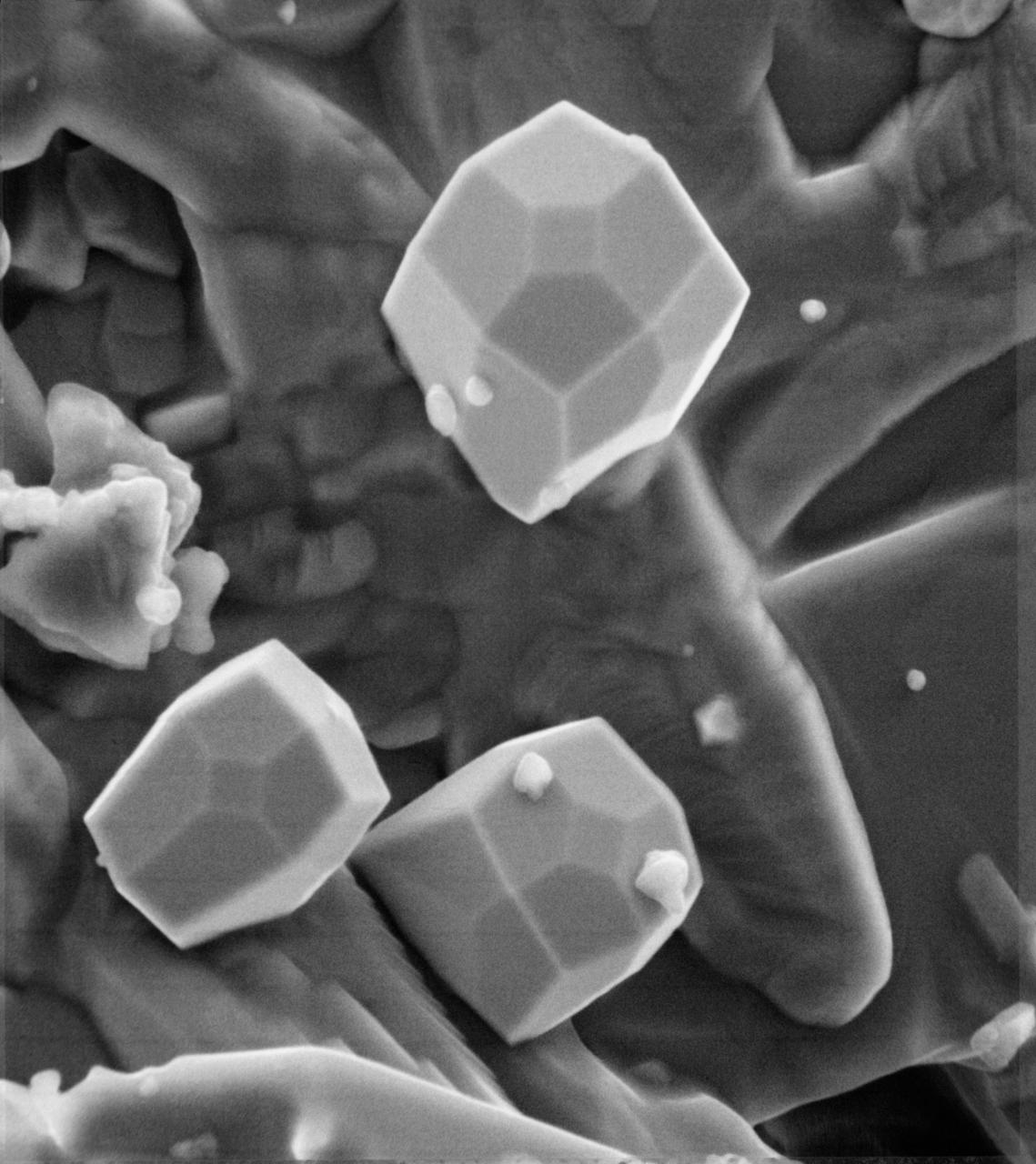
A scanning electron microscope photograph of iron crystals which grow in a small vug or cavity in a recrystallized breccia (fragmented rock) from the Apollo 15 Hadley-Apennino lunar landing site. The largest crystal is three microns across. Perfectly developed crystals such as these indicate slow formation from a hot vapor as the rock was cooling. The crystals are resting on an interlocking lattice of pyroxene (calsium-magnesium-iron silicate).
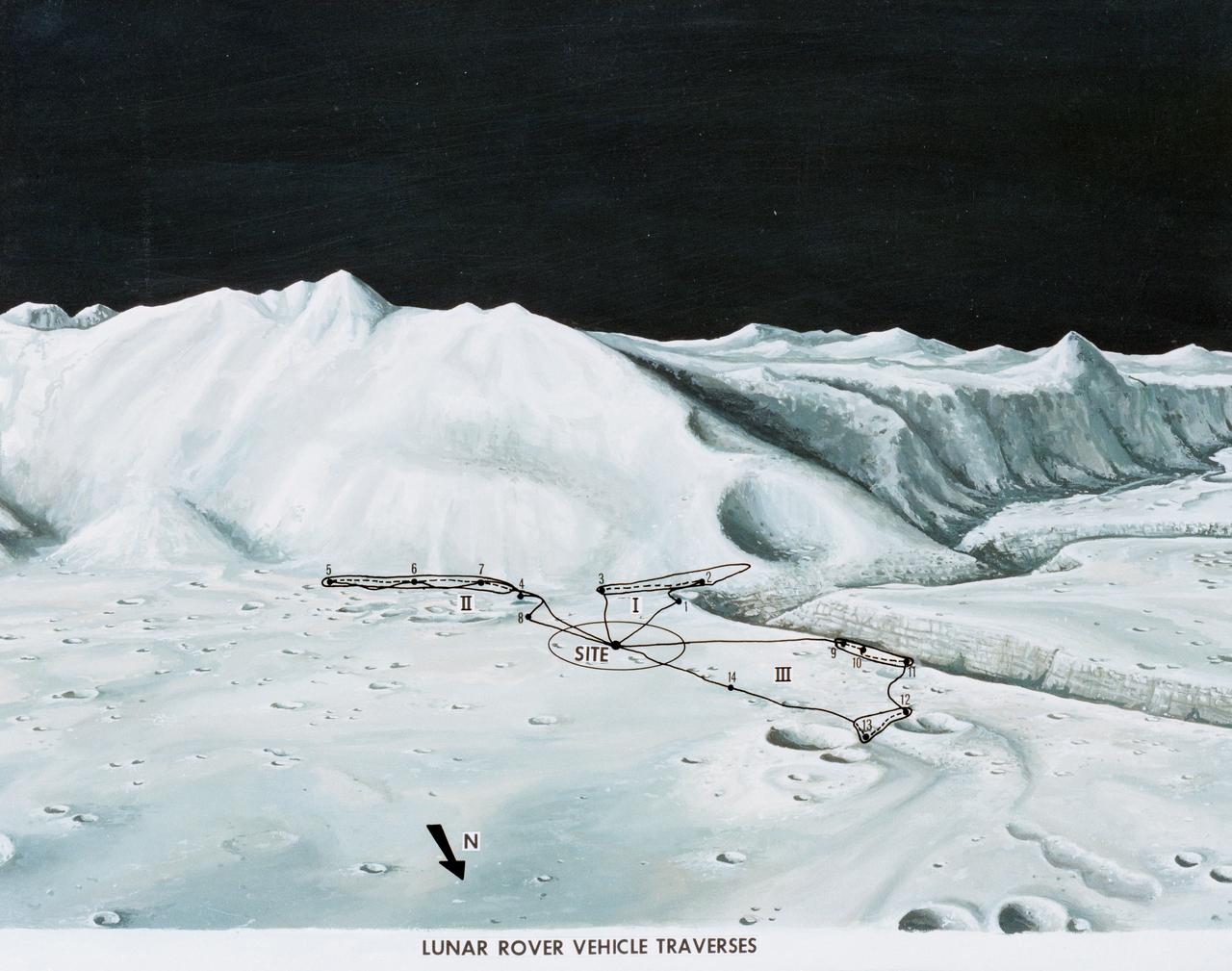
S71-33433 (1 July 1971) --- An artist's concept of the Hadley-Apennine landing site, depicting the traverses planned on the Apollo 15 lunar landing mission using the Lunar Roving Vehicle (LRV). The Roman numerals indicate the three periods of extravehicular activity (EVA). The Arabic numbers represent the station stops. This artist's concept was excerpted from "On the Moon with Apollo 15: A Guidebook to Hadley Rille and the Apennine Mountains," by Gene Simmons. The station stops indicated here are keyed to information given in the publication. Artwork by Jerry Elmore.
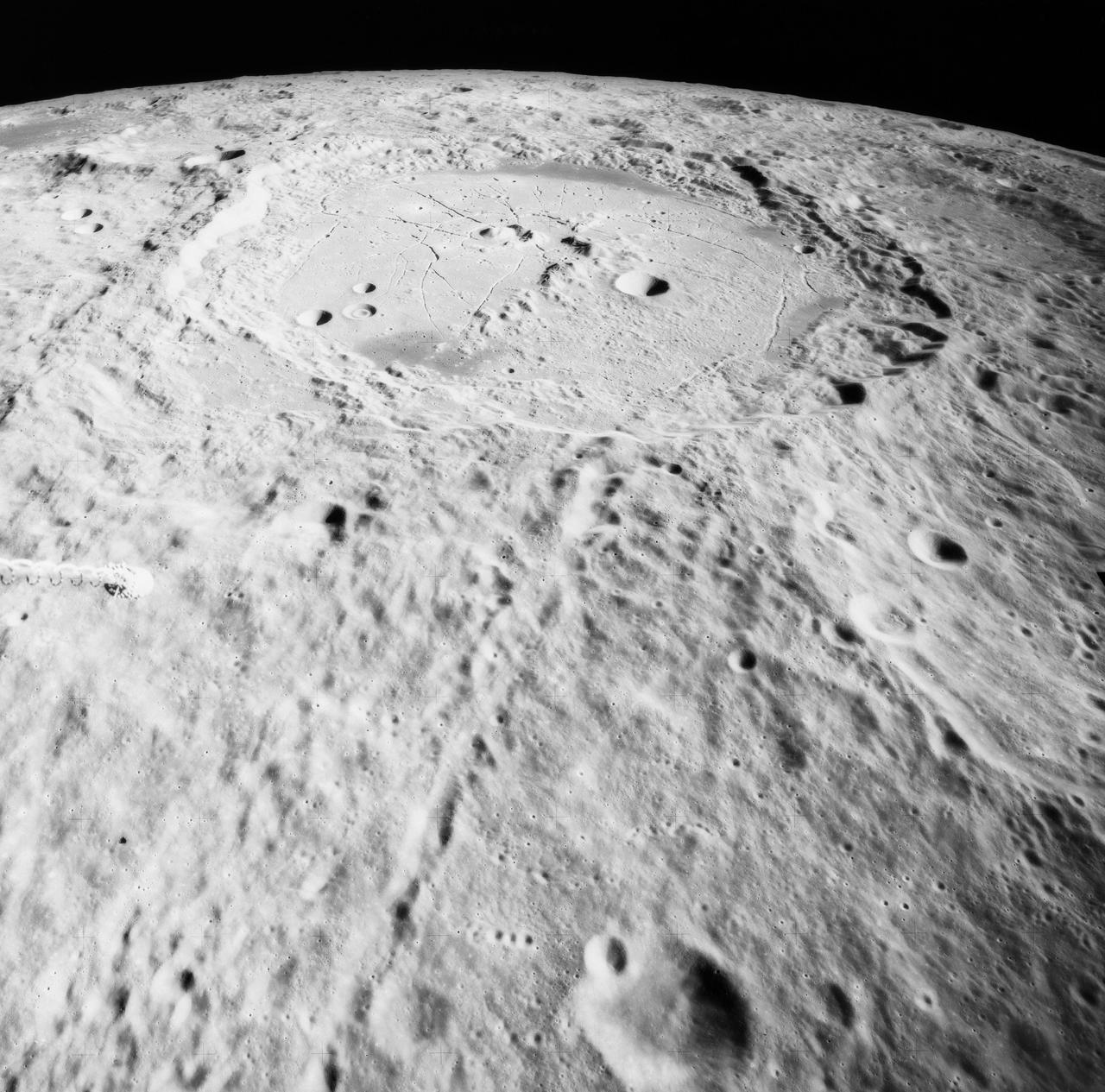
S71-44668 (31 July-2 Aug. 1971) --- An oblique view of the crater Humboldt, as photographed by the Fairchild metric camera in the Scientific Instrument Module (SIM) bay of the Apollo 15 Command and Service Modules (CSM) in lunar orbit. This view is looking southerly. Humboldt, which is 200 kilometers (124 statute miles) in diameter, is located at 81 degrees east longitude and 27 degrees south latitude. The three-inch mapping camera was one of eight lunar orbital science experiments located in the SIM bay.
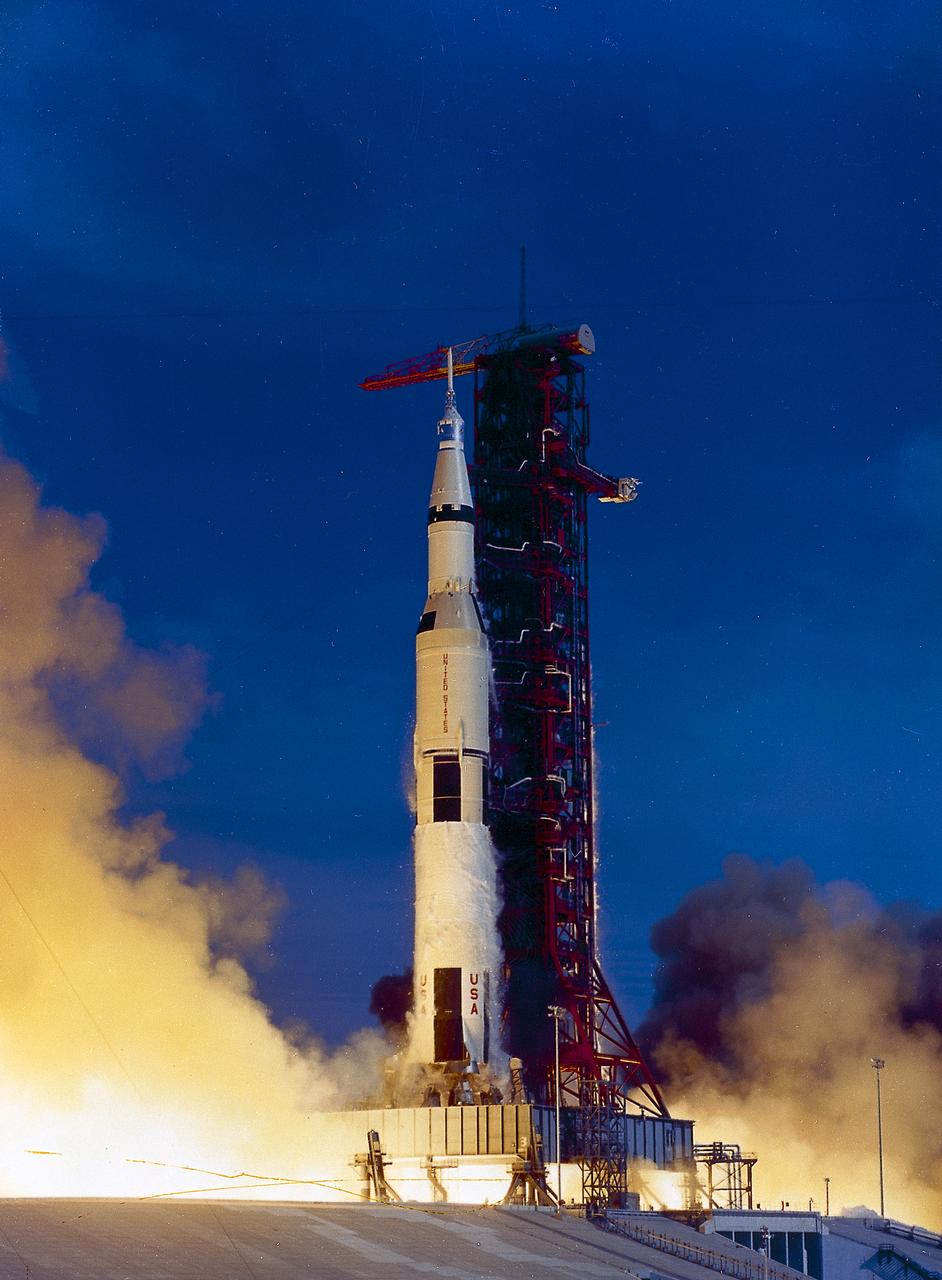
The fifth marned lunar landing mission, Apollo 15 (SA-510), carrying a crew of three astronauts: Mission commander David R. Scott, Lunar Module pilot James B. Irwin, and Command Module pilot Alfred M. Worden Jr., lifted off on July 26, 1971. Astronauts Scott and Irwin were the first to use a wheeled surface vehicle, the Lunar Roving Vehicle, or the Rover, which was designed and developed by the Marshall Space Flight Center, and built by the Boeing Company. Astronauts spent 13 days, nearly 67 hours, on the Moon's surface to inspect a wide variety of its geological features.
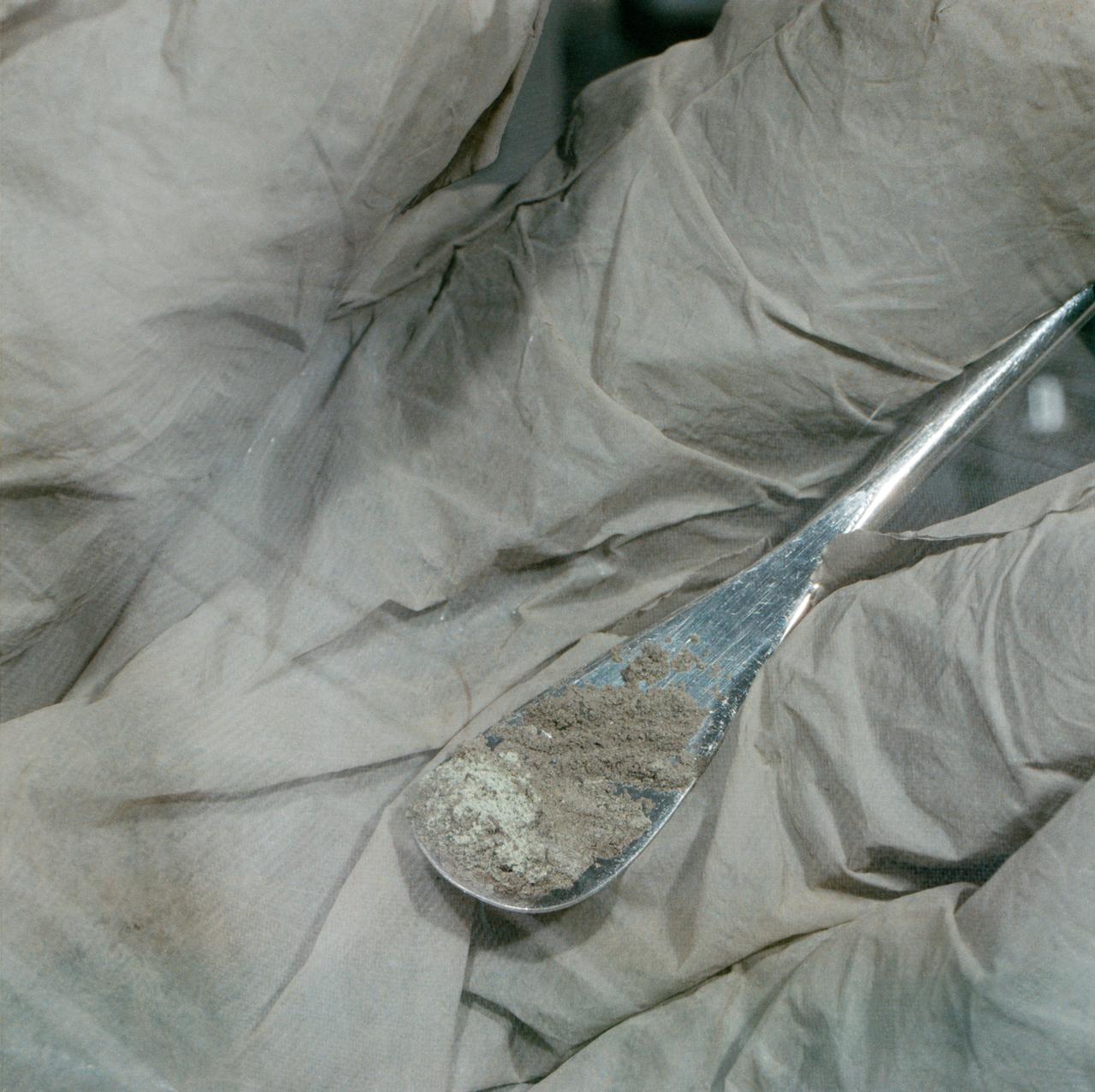
S71-43050 (August 1971) --- A close-up view of Apollo 15 lunar sample No. 15305 in the Non-sterile Nitrogen Processing Line (NNPL) in the Lunar Receiving Laboratory (LRL) at the Manned Spacecraft Center (MSC). This sample, pictured on a small spatula in a lab technician's glove, is green and is one of six recently taken from container No. 173, made up of comprehensive fines from the Apennine Front, Site No. 7. Astronauts David R. Scott, commander; and James B. Irwin, lunar module pilot, took the sample during their second extravehicular activity (EVA), at a ground elapsed time (GET) of 146:05 to 146:06.
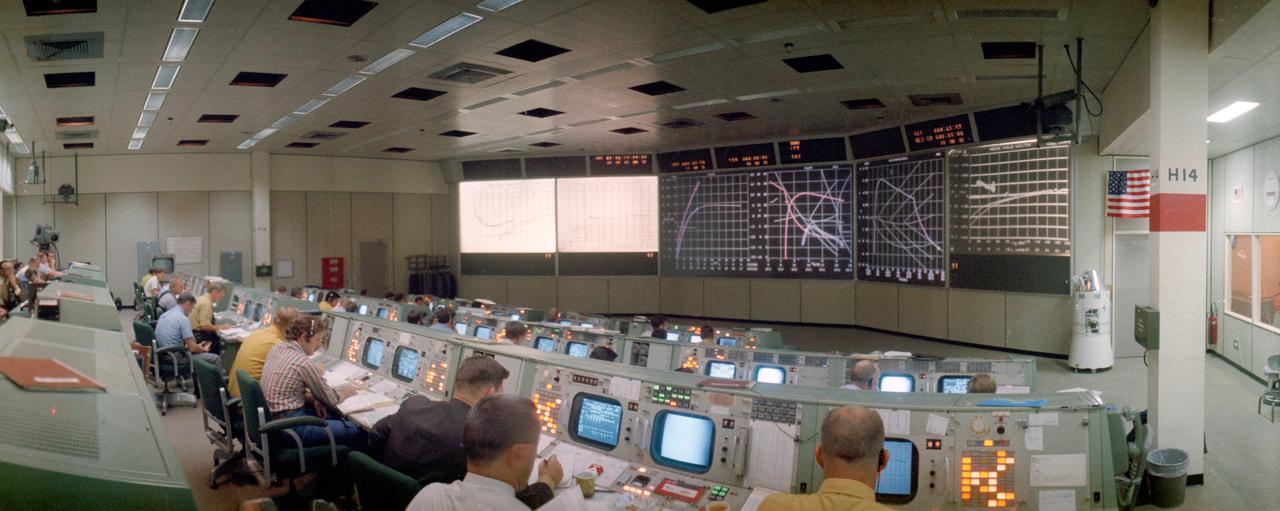
S71-41357 (26 July 1971) --- An overall, wide-angle lens view of activity in the Mission Operations Control Room in the Mission Control Center minutes after the launch of the Apollo 15 lunar landing mission. Ground elapsed time was 45 minutes and 42 seconds when this photograph was taken.
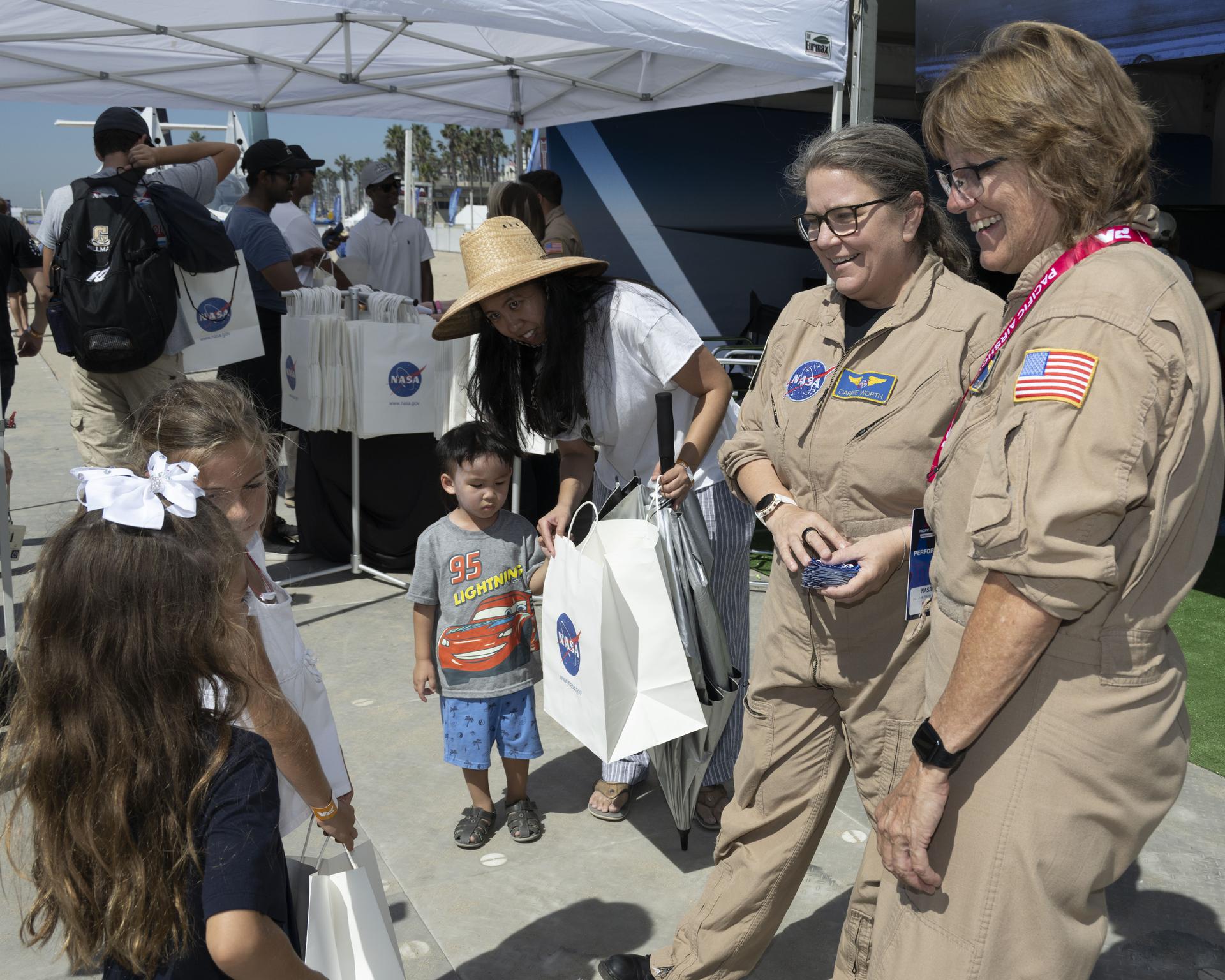
NASA videographer Lori Losey, right, and research pilot Carrie Worth speak with young visitors at the NASA exhibit during the Pacific Airshow at Huntington Beach, California, Friday, Oct. 2, 2026. The exhibit features Artemis, the X‑59, SkyFall, a lunar globe, and an Apollo 15 Moon rock.
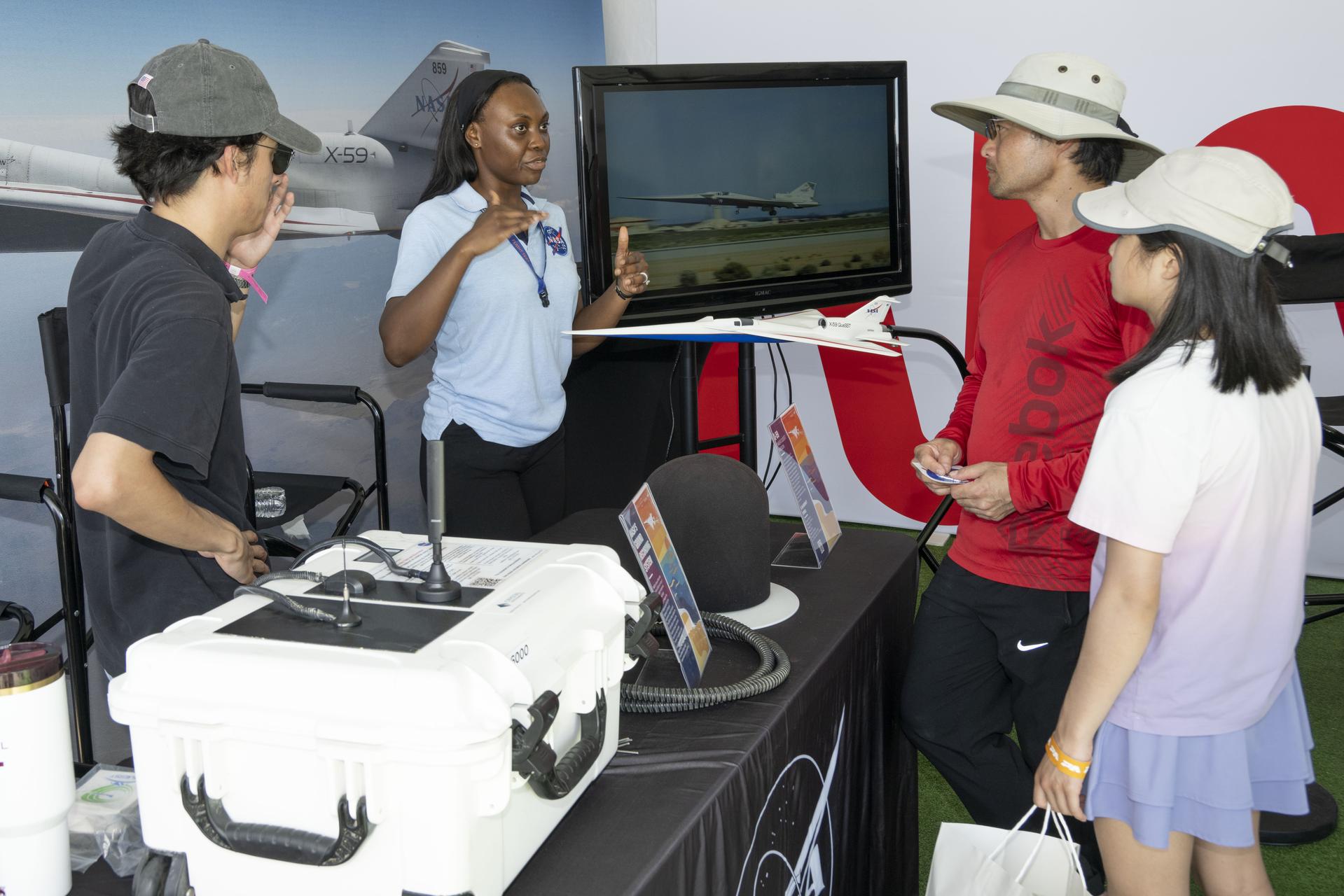
Akosua Dufie, F‑18 lead operations engineer, talks with visitors at the NASA exhibit during the Pacific Airshow at Huntington Beach, California, Friday, Oct. 2, 2026. The exhibit highlights Artemis, the X‑59, SkyFall, a lunar globe, and an Apollo 15 Moon rock.