
The Saturn IB launch vehicle (SA204) for the Apollo 5 mission lifted off on January 22, 1968. The unmarned Apollo 5 mission verified the ascent and descent stage propulsion systems, including restart and throttle operations of the Lunar Module.

Workmen at the Kennedy Space Center position the nose cone for the 204LM-1, an unmanned Apollo mission that tested the Apollo Lunar Module (LM) in Earth orbit. Also known as Apollo 5, the spacecraft was launched on the fourth Saturn IBC launch vehicle. Developed by the Marshall Space Flight Center (MSFC) as an interim vehicle in MSFC's "building block" approach to the Saturn rocket development, the Saturn IBC utilized Saturn I technology to further develop and refine a larger booster and the Apollo spacecraft capabilities required for the manned lunar missions.

Workmen at the Kennedy Space Center position the nose cone for the 204LM-1, an unmanned Apollo mission that tested the Apollo Lunar Module (LM) in Earth orbit. Also known as Apollo 5, the spacecraft was launched on the fourth Saturn IBC launch vehicle. Developed by the Marshall Space Flight Center (MSFC) as an interim vehicle in MSFC's "building block" approach to the Saturn rocket development, the Saturn IBC utilized Saturn I technology to further develop and refine a larger booster and the Apollo spacecraft capabilities required for the manned lunar missions.

S68-19459 (22 Jan. 1968) --- The Apollo 5 (LM-1/Saturn 204) unmanned space mission was launched from the Kennedy Space Center's Launch Complex 37 at 5:48:09 p.m. (EST), Jan. 22, 1968. The Lunar Module-1 payload was boosted into Earth orbit by a launch vehicle composed of a Saturn IB first stage and a Saturn S-IVB second stage. The Apollo lunar module's first flight test was called a complete success. Ascent and descent propulsion systems and the ability to abort a lunar landing and return to orbit were demonstrated.

S68-19460 (22 Jan. 1968) --- The Apollo 5 (LM-1/Saturn 204) unmanned space mission was launched from the Kennedy Space Center's Launch Complex 37 at 5:48:09 p.m. (EST), Jan. 22, 1968. The Lunar Module-1 payload was boosted into Earth orbit by a launch vehicle composed of a Saturn IB first stage and a Saturn S-IVB second stage. The Apollo lunar module's first flight test was called a complete success. Ascent and descent propulsion systems and the ability to abort a lunar landing and return to orbit were demonstrated.

AS-204, the fourth Saturn IB launch vehicle, developed by the Marshall Space Flight Center (MSFC), awaits its January 22, 1968 liftoff from Cape Canaveral, Florida for the unmarned Apollo 5 mission. Primary mission objectives included the verification of the Apollo Lunar Module's (LM) ascent and descent propulsion systems and an evaluation of the S-IVB stage instrument unit performance. In all, nine Saturn IB flights were made, ending with the Apollo-Soyuz Test Project in July 1975.

Workmen at the Kennedy Space Center hoist the Saturn Lunar Module (LM) Adapter into position during assembly of the 204LM-1, an unmanned Apollo mission that tested the Apollo Lunar Module in Earth orbit. Also known as Apollo 5, the spacecraft was launched on the fourth Saturn IB launch vehicle. Developed by the Marshall Space Flight Center (MSFC) as an interim vehicle in MSFC's "building block" approach to the Saturn rocket development, the Saturn IB utilized Saturn I technology to further develop and refine a larger booster and the Apollo spacecraft capabilities required for the manned lunar missions.

Apollo 11 astronaut Buzz Aldrin and tour guide Mary Ann Harness check out models of the Ares 1 and Ares 5 space vehicles during Aldrin's tour of NASA Dryden.

S68-18733 (22 Jan. 1968) --- Dr. Robert R. Gilruth (right), MSC Director, sits with Dr. Christopher C. Kraft Jr., MSC director of flight operations, at his flight operations director console in the Mission Control Center, Building 30, during the Apollo 5 (LM-1/Saturn 204) unmanned space mission.

jsc2004e20304 - Panorama view of Apollo 17 lunar surface photos for Station 5 at the Taurus-Littrow landing site taken during the second moonwalk of the mission by Apollo 17 commander Eugene Cernan and lunar module pilot Harrison (Jack) Schmitt. The panoramas were built by combining Apollo 17 images starting with frame AS17-145-22159 through end frame AS17-145-22181. The panoramic images received minimal retouching by NASA imagery specialists, including the removal of lens flares that were problematic in stitching together the individual frames and blacking out the sky to the lunar horizon. These adjustments were made based on observations of the Moon walkers who reported that there are no stars visible in the sky due to the bright lunar surface reflection of the Sun.
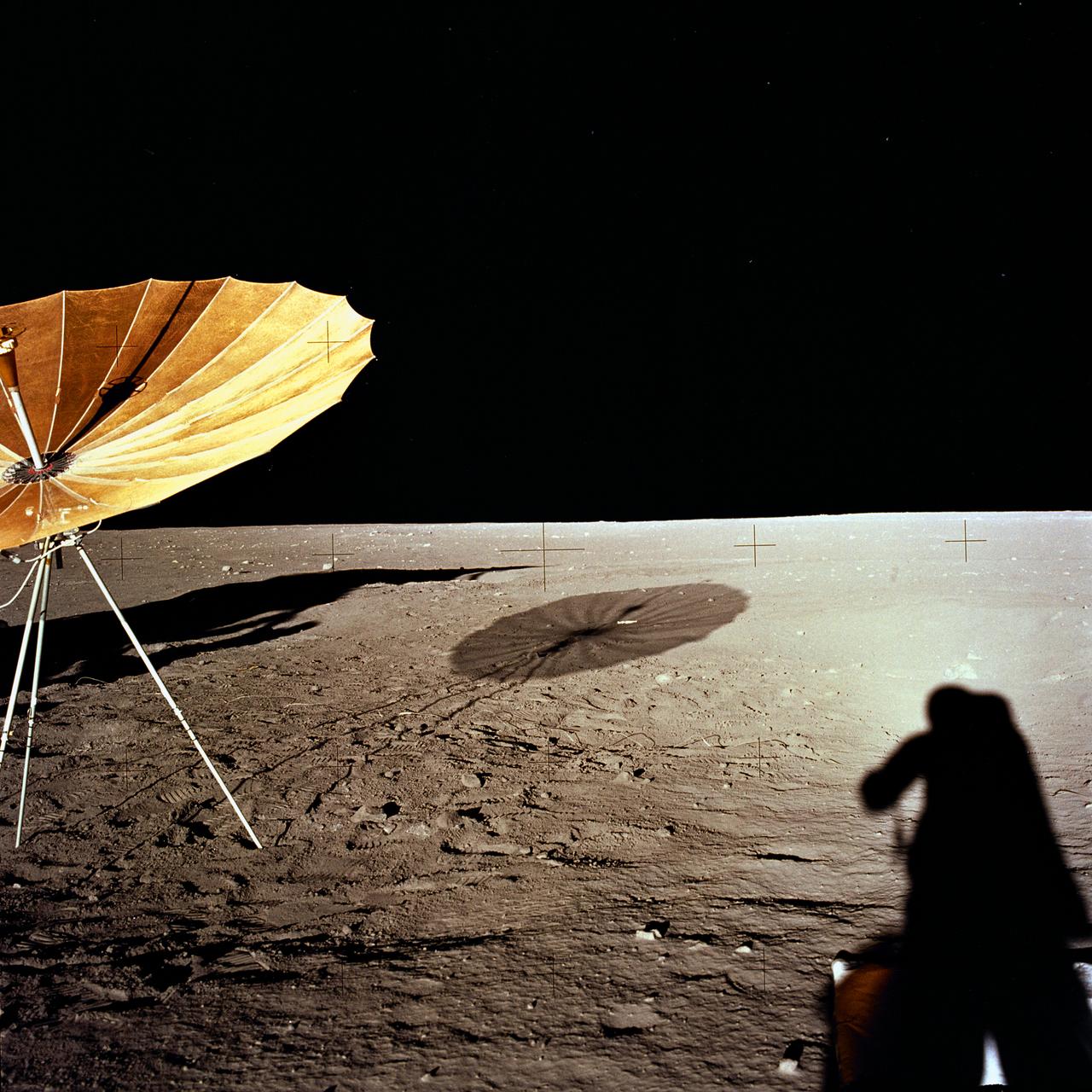
The second manned lunar landing mission, Apollo 12 launched from launch pad 39-A at Kennedy Space Center in Florida on November 14, 1969 via a Saturn V launch vehicle. The Saturn V vehicle was developed by the Marshall Space Flight Center (MSFC) under the direction of Dr. Wernher von Braun. Aboard Apollo 12 was a crew of three astronauts: Alan L. Bean, pilot of the Lunar Module (LM), Intrepid; Richard Gordon, pilot of the Command Module (CM), Yankee Clipper; and Spacecraft Commander Charles Conrad. The LM, Intrepid, landed astronauts Conrad and Bean on the lunar surface in what’s known as the Ocean of Storms while astronaut Richard Gordon piloted the CM, Yankee Clipper, in a parking orbit around the Moon. Lunar soil activities included the deployment of the Apollo Lunar Surface Experiments Package (ALSEP), finding the unmanned Surveyor 3 that landed on the Moon on April 19, 1967, and collecting 75 pounds (34 kilograms) of rock samples. This is the fifth of 25 images captured by the crew in attempt to provide a 360 degree Lunar surface scene. Apollo 12 safely returned to Earth on November 24, 1969.
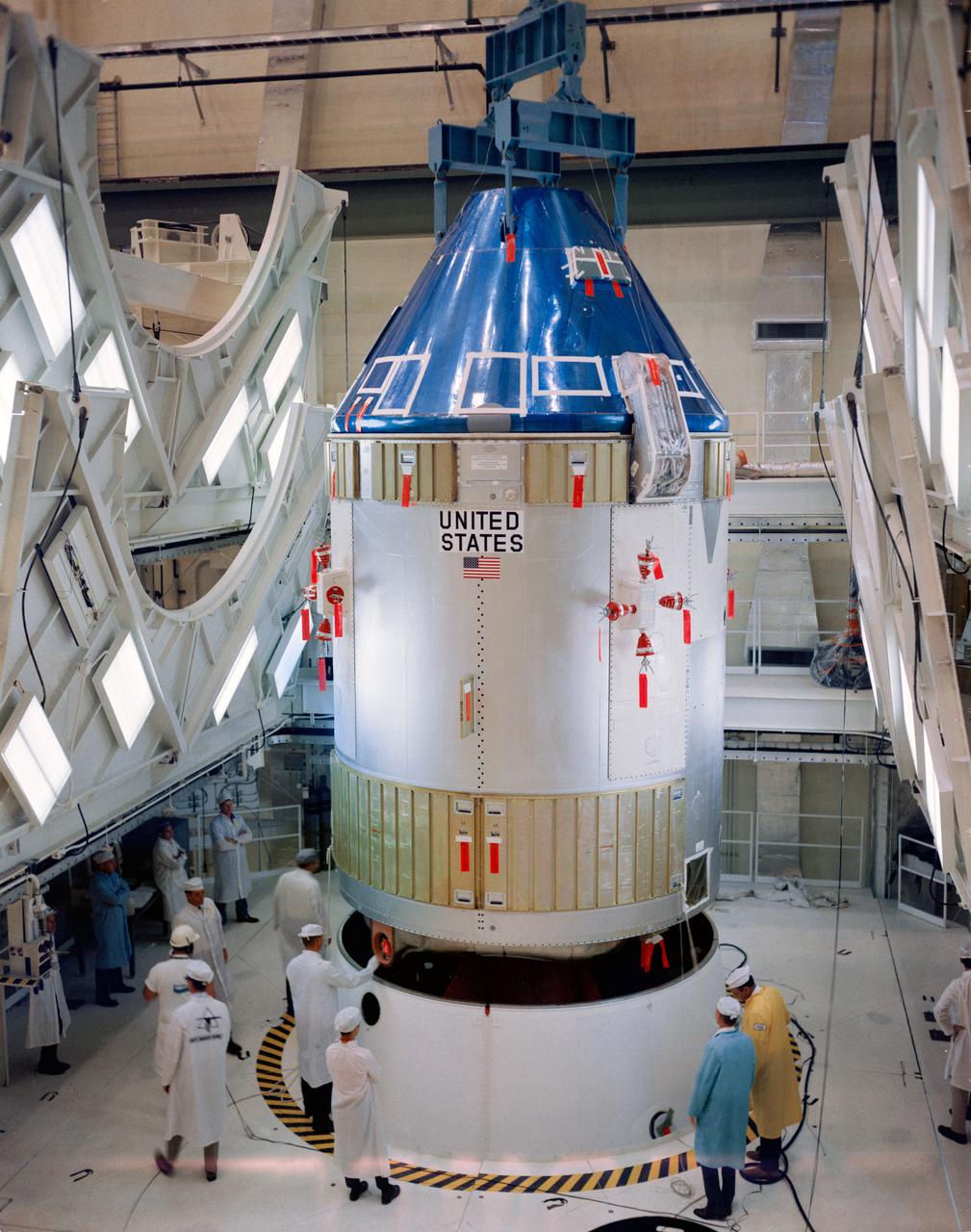
S68-42513 (5 Aug. 1968) --- Apollo Spacecraft 101 Command/Service Modules being moved into position for mating with Spacecraft Lunar Module Adapter (SLA)-5 in the Kennedy Space Center's Manned Spacecraft Operations Building. Apollo Spacecraft 101 will be flown on the first manned Apollo space mission, Apollo 7 (Spacecraft 101/Saturn 205).
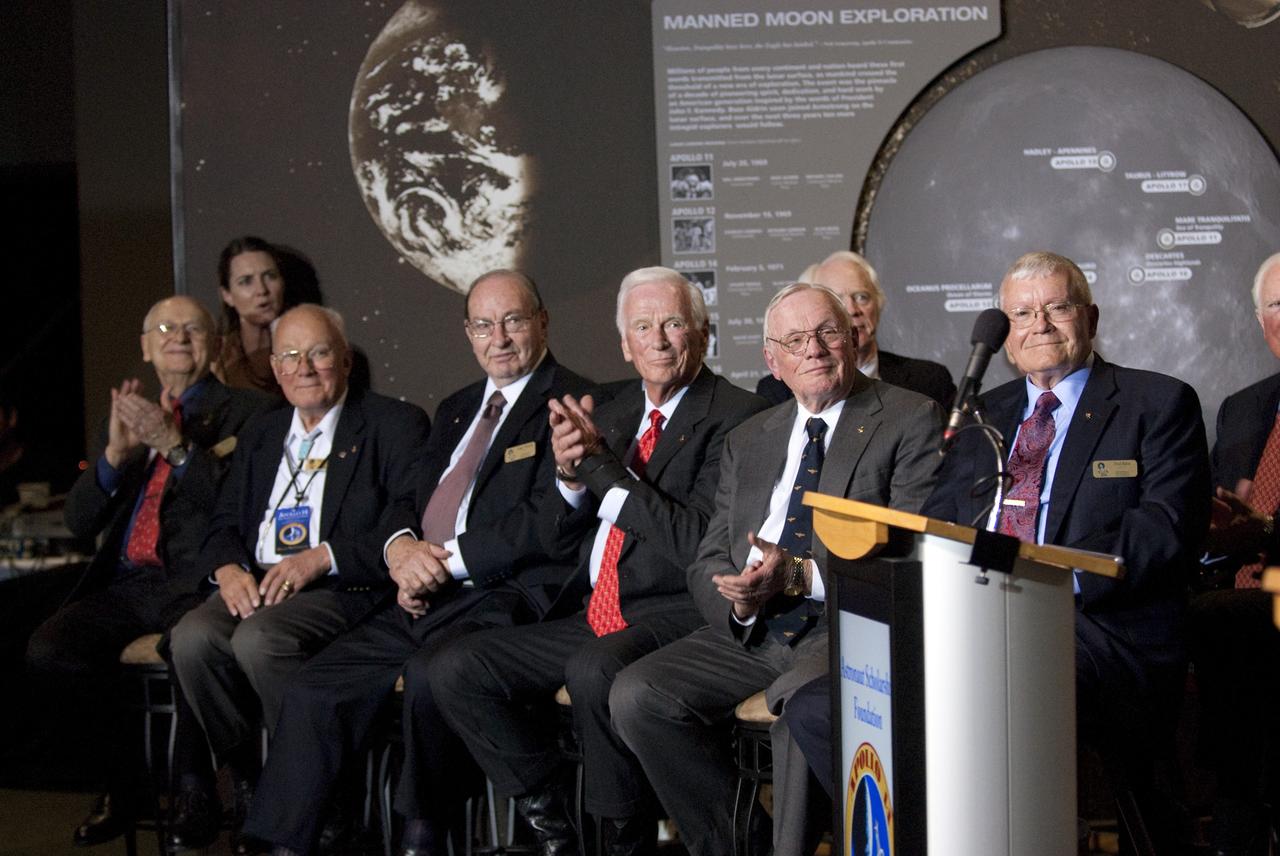
CAPE CANAVERAL, Fla. -- Apollo Program legends attend the Apollo 14 Anniversary Soirée at the Kennedy Space Center Visitor Complex's Saturn V Center. The celebration was hosted by the Astronaut Scholarship Foundation. Apollo 14 landed on the lunar surface 40 years ago on Feb. 5, 1971. Photo credit: NASA/Kim Shiflett
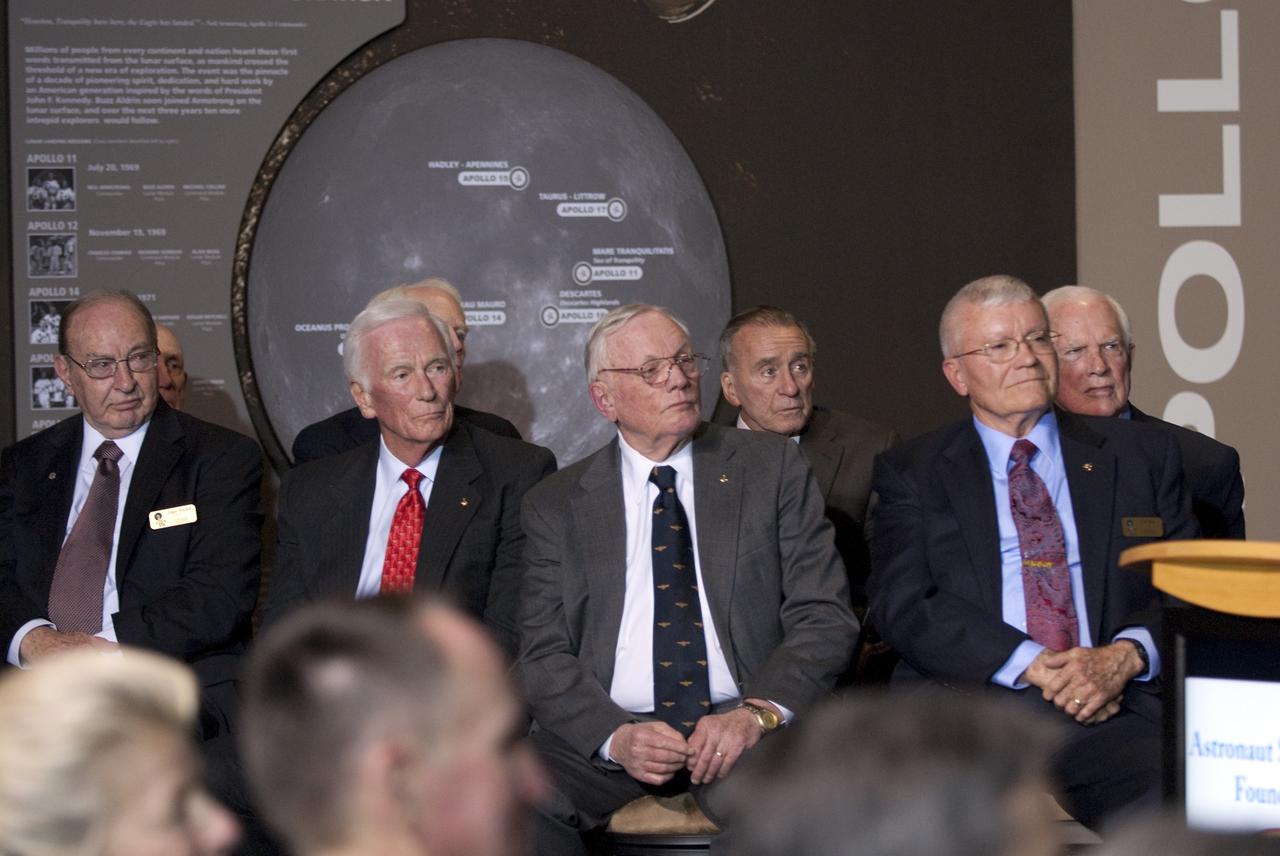
CAPE CANAVERAL, Fla. -- Apollo Program legends attend the Apollo 14 Anniversary Soirée at the Kennedy Space Center Visitor Complex's Saturn V Center. The celebration was hosted by the Astronaut Scholarship Foundation. Apollo 14 landed on the lunar surface 40 years ago on Feb. 5, 1971. Photo credit: NASA/Kim Shiflett
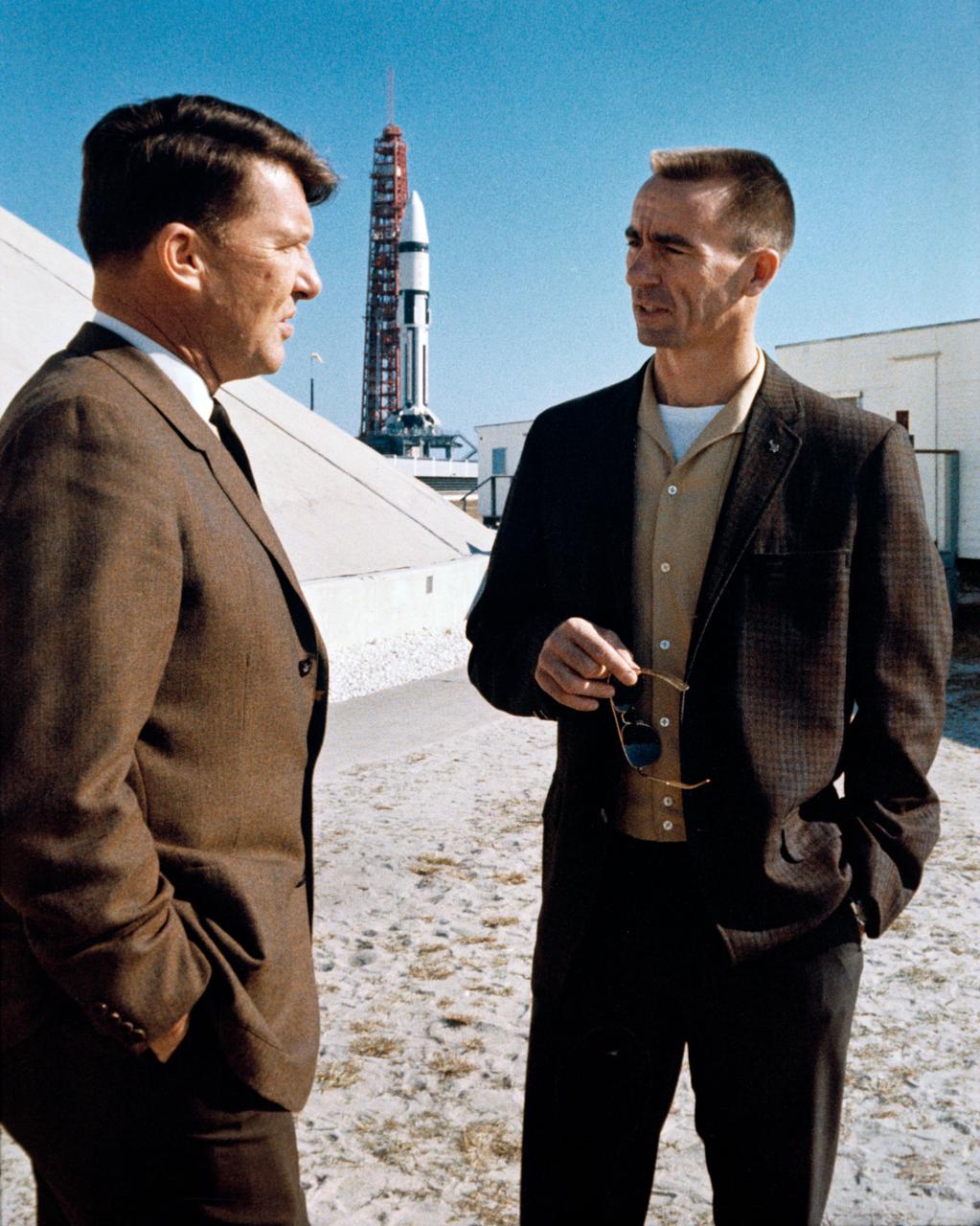
S68-18700 (22 Jan. 1968) --- Two prime crew members of the first manned Apollo space flight were present at Cape Kennedy for the launch of the Apollo V (LM-1/Saturn 204) unmanned space mission. On left is astronaut Walter M. Schirra Jr.; and on right is astronaut R. Walter Cunningham. In background is the Apollo V stack at Launch Complex 37 ready for launch.
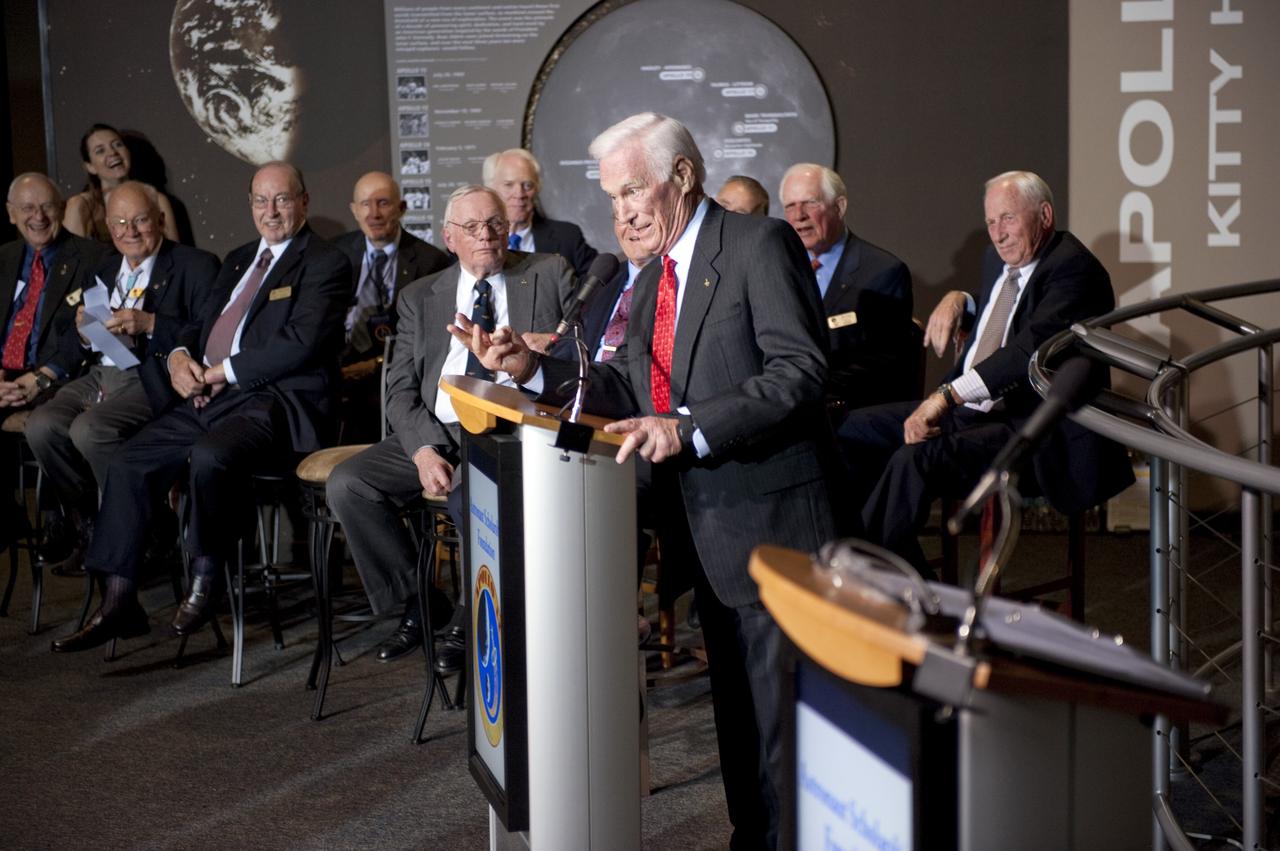
CAPE CANAVERAL, Fla. -- Lunar module pilot of Apollo 10 and commander of Apollo 17 Gene Cernan talks to attendees of the Apollo 14 Anniversary Soirée at the Kennedy Space Center Visitor Complex's Saturn V Center. The celebration was hosted by the Astronaut Scholarship Foundation. Apollo 14 landed on the lunar surface 40 years ago on Feb. 5, 1971. Cernan was the backup commander for the Apollo 14 mission. Photo credit: NASA/Kim Shiflett

jsc2019e063626 (Nov. 5, 2019) --- Sample 73002 after being extruded Nov. 5, 2019 from its Apollo 17 drive tube container at NASA's Johnson Space Center.
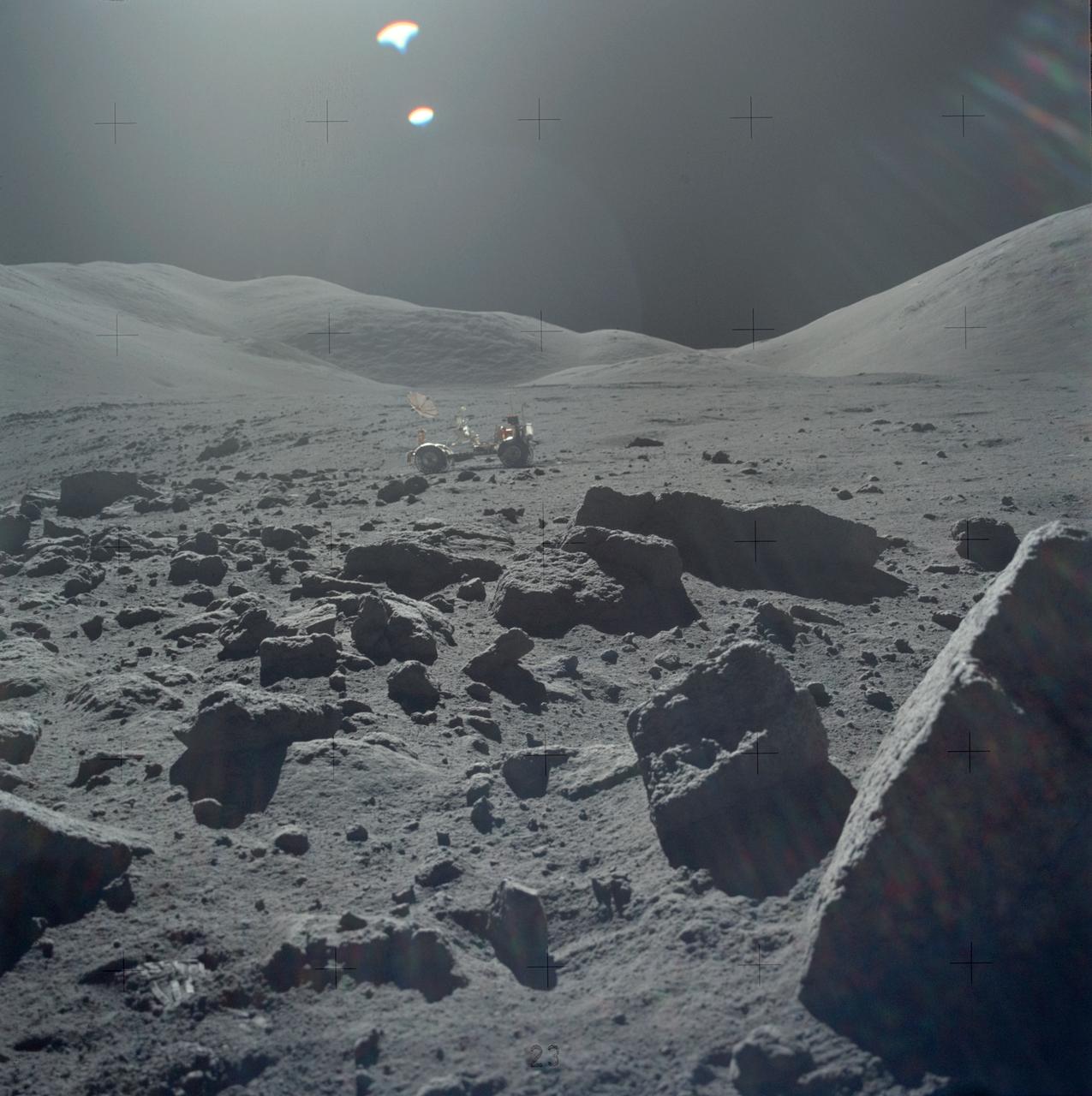
AS17-145-22162 (7-19 Dec. 1972) --- One of the Apollo 17 crew photographed this view during lunar surface extravehicular activities (EVA) at the Taurus-Littrow landing site. The Lunar Rover Vehicle (LRV), which was used extensively by astronauts Eugene A. Cernan and Harrison H. Schmitt, is visible in the background.
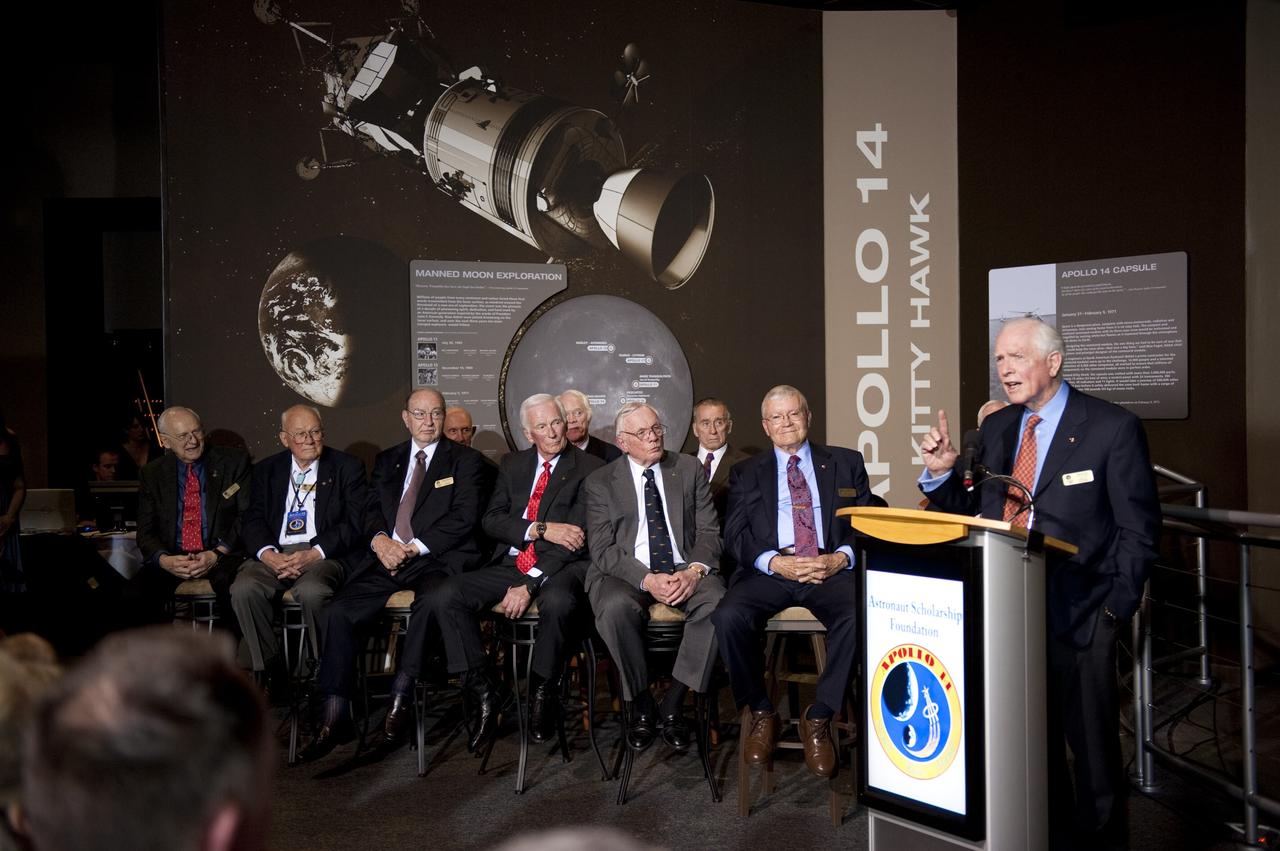
CAPE CANAVERAL, Fla. -- Command module pilot of Apollo 9 and commander of Apollo 15 David Scott talks to attendees of the Apollo 14 Anniversary Soirée at the Kennedy Space Center Visitor Complex's Saturn V Center. The celebration was hosted by the Astronaut Scholarship Foundation. Apollo 14 landed on the lunar surface 40 years ago on Feb. 5, 1971. Photo credit: NASA/Kim Shiflett
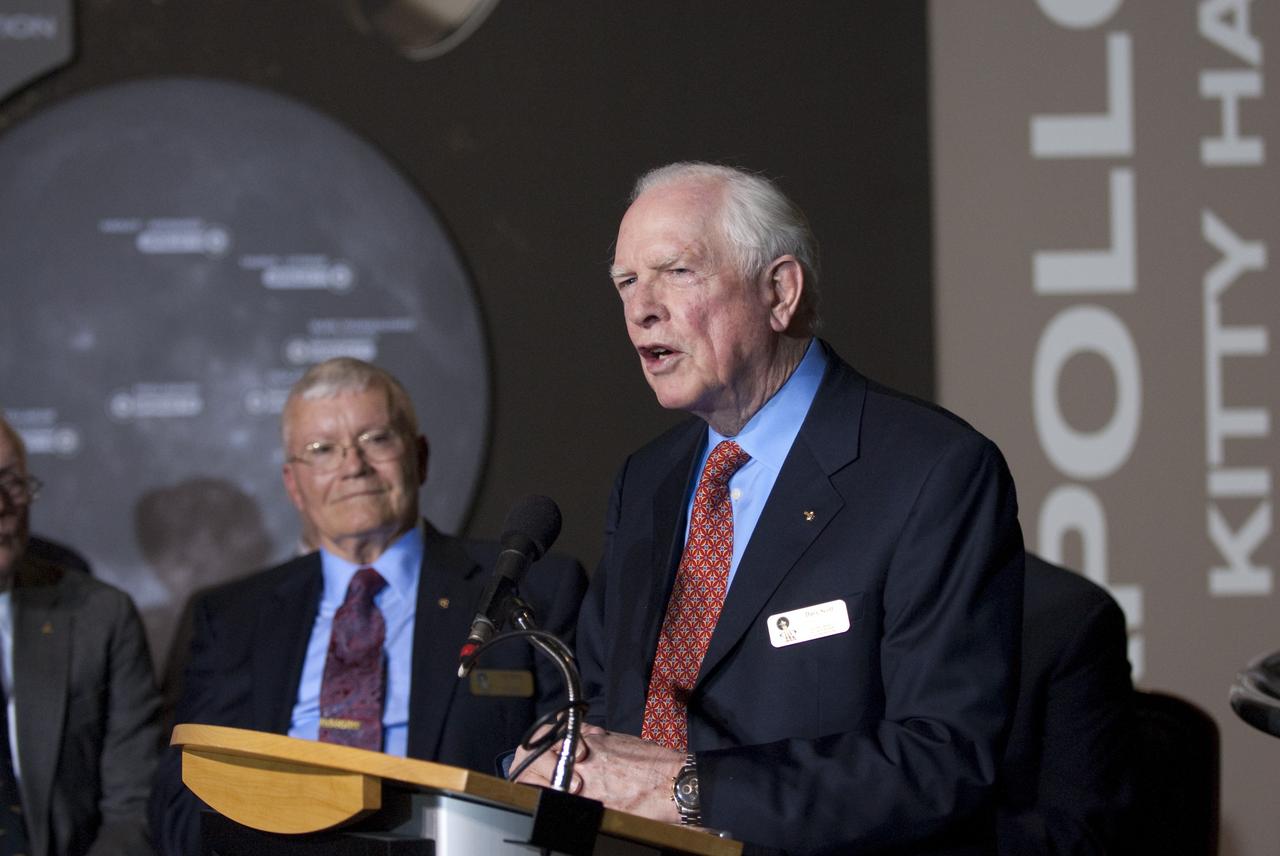
CAPE CANAVERAL, Fla. -- Command module pilot of Apollo 9 and commander of Apollo 15 David Scott talks to attendees of the Apollo 14 Anniversary Soirée at the Kennedy Space Center Visitor Complex's Saturn V Center. The celebration was hosted by the Astronaut Scholarship Foundation. Apollo 14 landed on the lunar surface 40 years ago on Feb. 5, 1971. Photo credit: NASA/Kim Shiflett
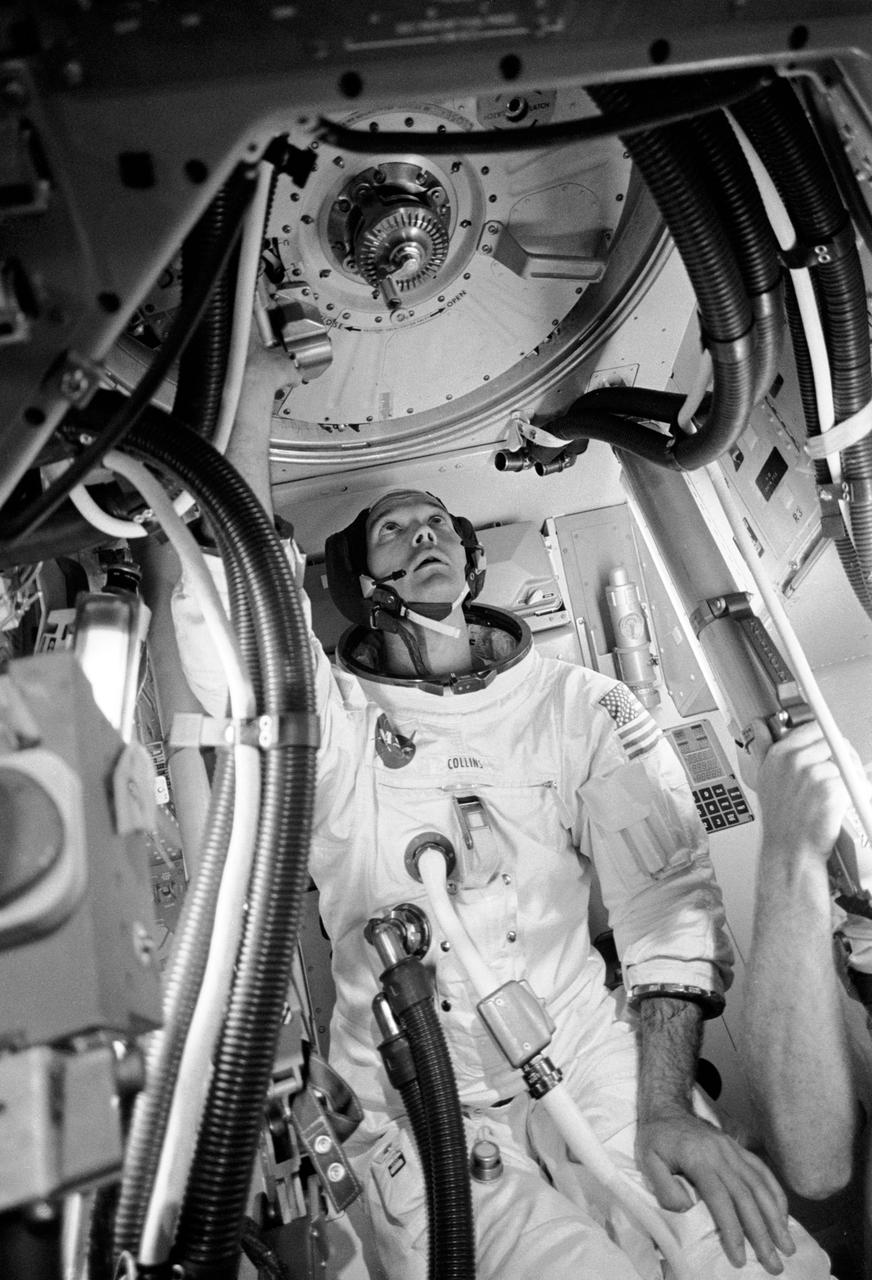
S69-38323 (28 June 1969) --- Astronaut Michael Collins, command module pilot of the Apollo 11 flight, is seen inside an Apollo Command Module (CM) mockup in Building 5 practicing procedures with the Apollo docking mechanism in preparation for the scheduled Apollo 11 lunar landing mission. Collins is at the CM's docking tunnel which provides passageway to and from the Lunar Module (LM) following docking, and after removal of the tunnel hatches, docking probe and drogue.
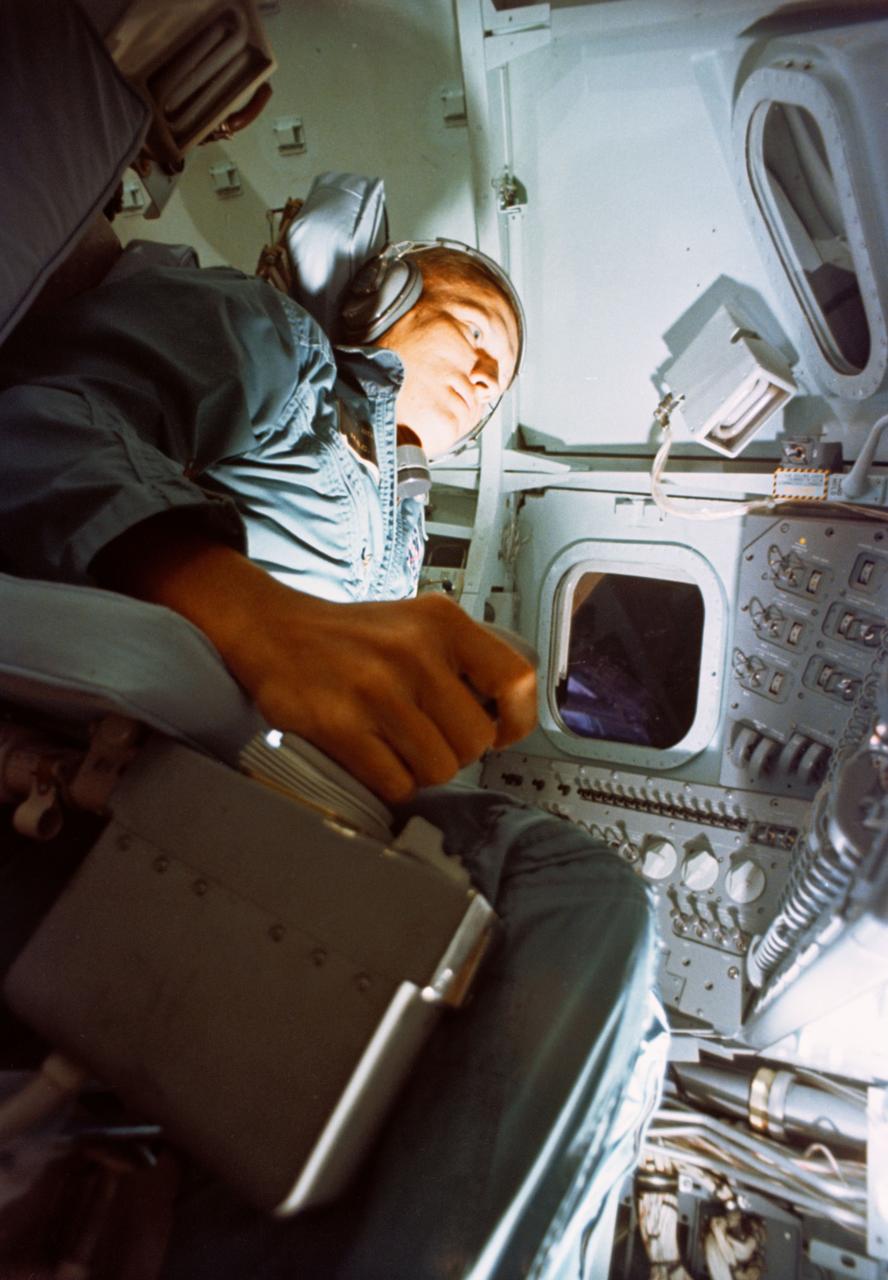
S67-50590 (1867) --- Astronaut Frank Borman, assigned duty as commander of the Apollo 8 mission, participates in a training exercise in the Apollo Mission simulator in the Mission Simulation and training Facility, Building 5, at the Manned Spacecraft Center, Houston, Texas. Photo credit: NASA
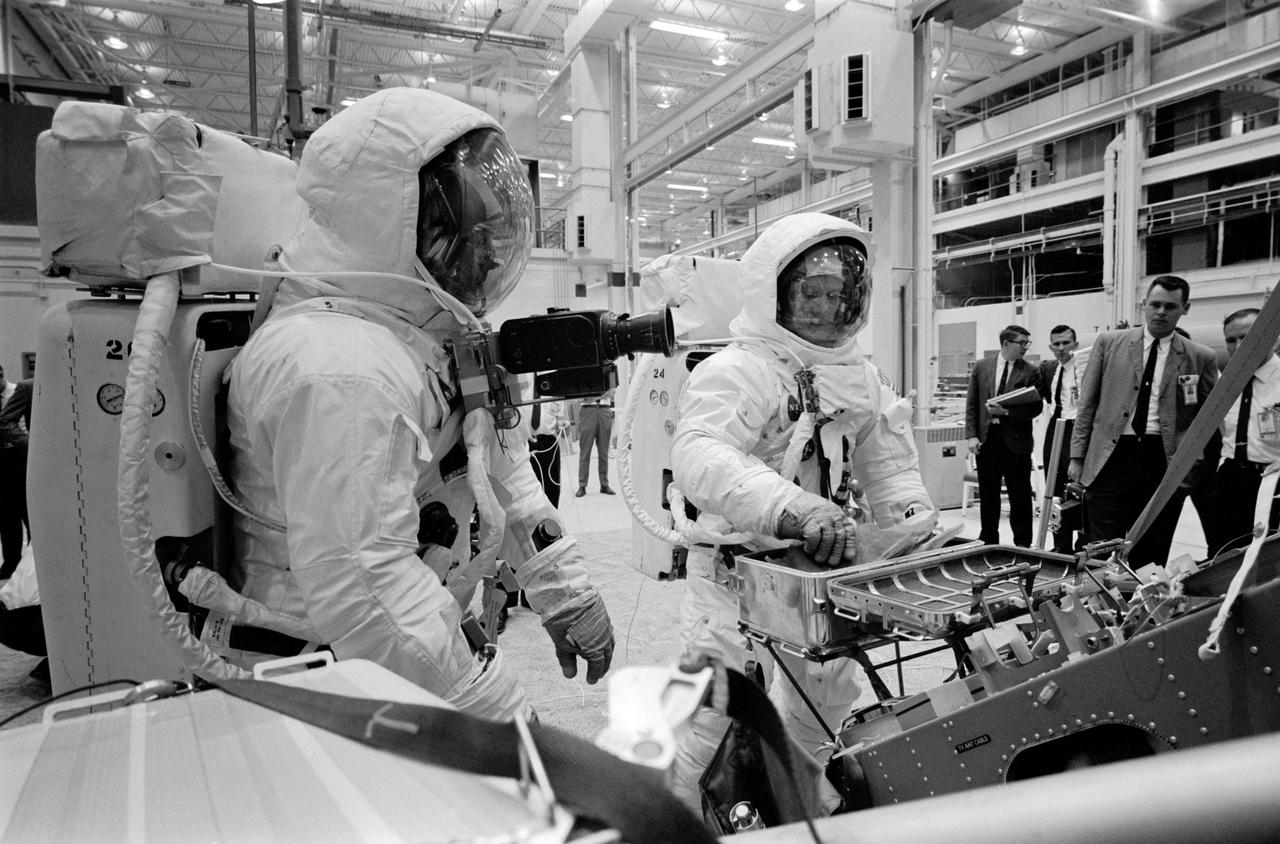
Suited Apollo XI Crewmen Armstrong and Aldrin training in Apollo Lunar Surface Experiments Package (ALSEP) deployment in Building 5, as Astronaut Mike Collins trains in the Building 20 Centrifuge. S-Band Antenna (31148 thru 31165, 31178 thru 31179) MSC, HOUSTON, TX
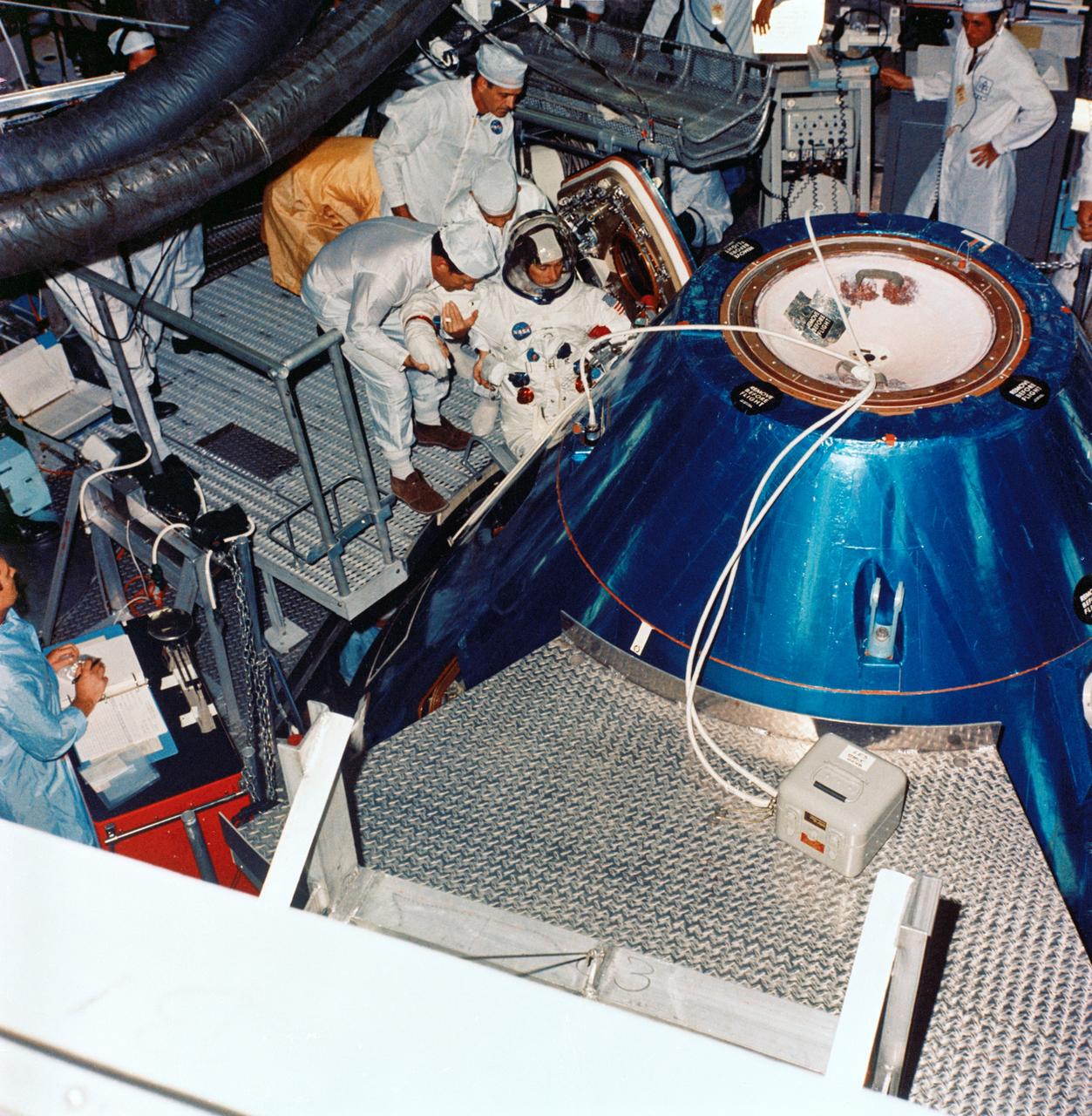
S68-40875 (5 July 1968) --- Astronaut John W. Young, Apollo 7 backup command module pilot, ingresses Apollo Spacecraft 101 Command Module during simulated altitude runs at the Kennedy Space Center's Pad 34.

S68-42343 (5 Aug. 1968) --- The prime crew of the first manned Apollo space mission, Apollo 7, stands on the deck of the NASA Motor Vessel Retriever after suiting up for water egress training in the Gulf of Mexico. Left to right, are astronauts Walter Cunningham, Donn F. Eisele, and Walter M. Schirra Jr.
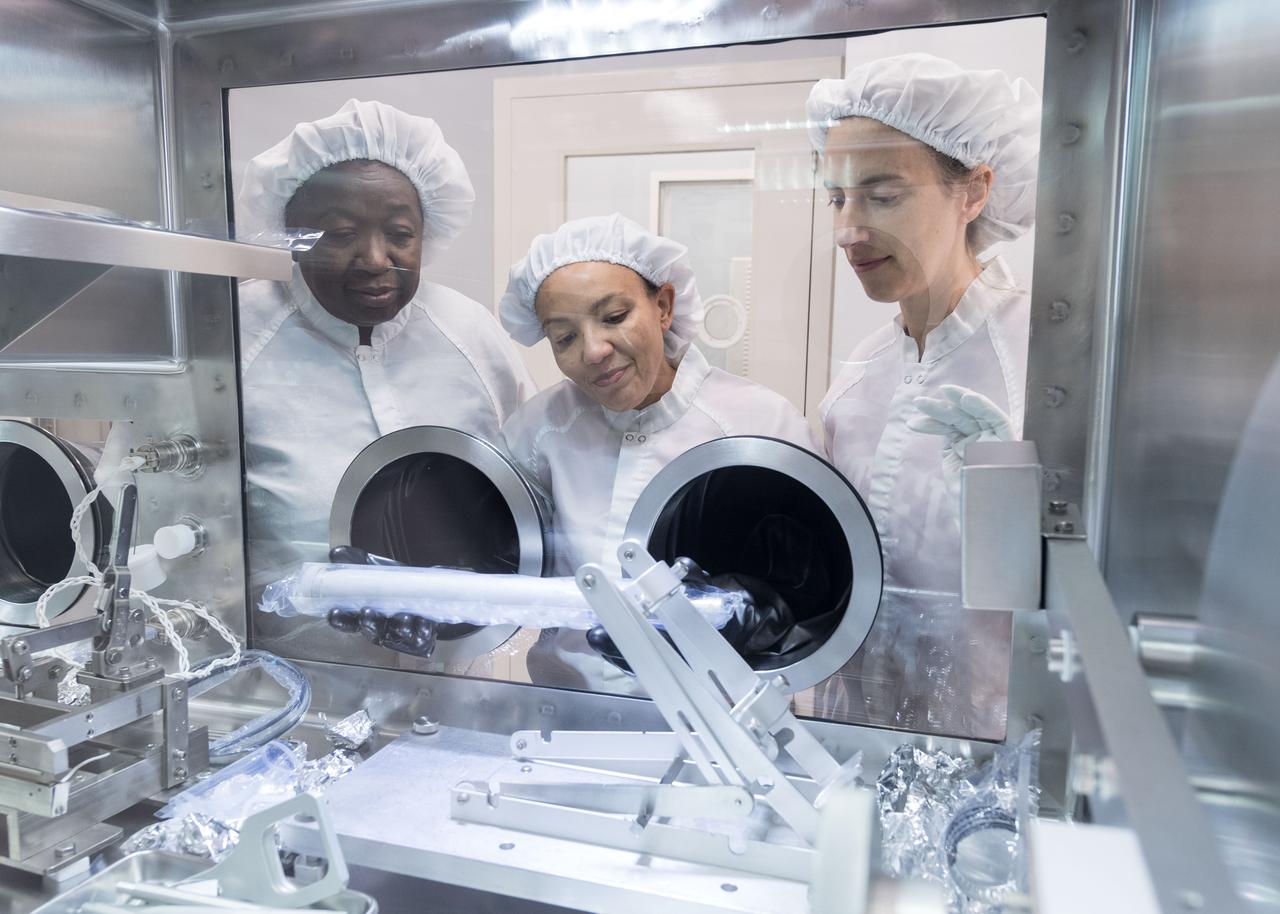
jsc2019e063585 (Nov. 5, 2019) --- (From left) Andria Mosie, Charis Krysher and Juliane Gross, lunar sample curators, positioning the Apollo 17 drive tube prior to removing from its teflon bag and extruding sample 73002 at NASA's Johnson Space Center. The extrusion, which occurred Nov. 5, 2019 at Johnson Space Center in Houston, was done as part of NASA’s Apollo Next-Generation Sample Analysis initiative
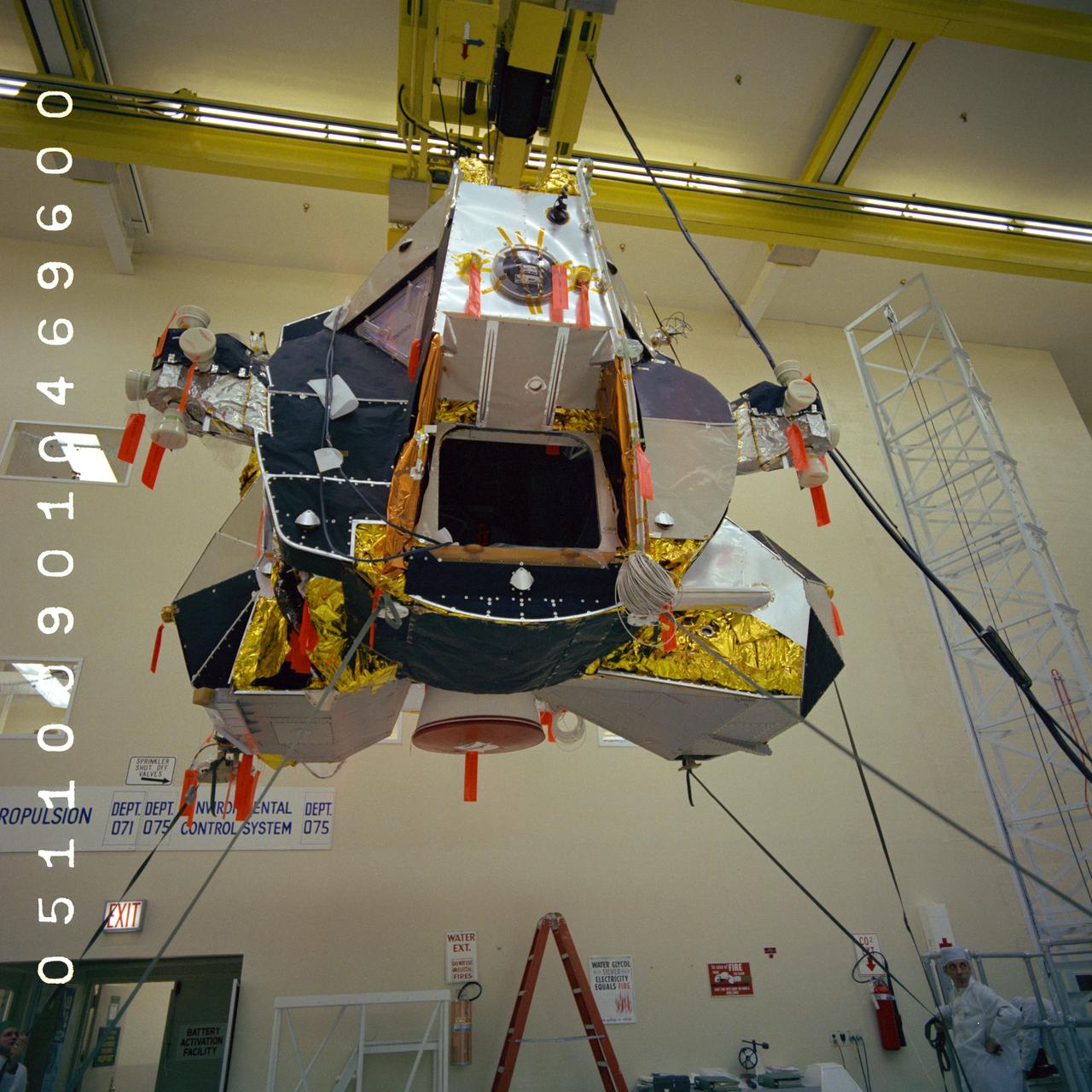
S69-19644 (4 Jan. 1969) --- Lunar Module (LM) 5 ascent stage in Final Assembly Area on overhead hoist being moved to dolly for roll-out inspection. LM-5 will be flown on the Apollo 11 lunar landing mission. Photo credit: NASA/Grumman
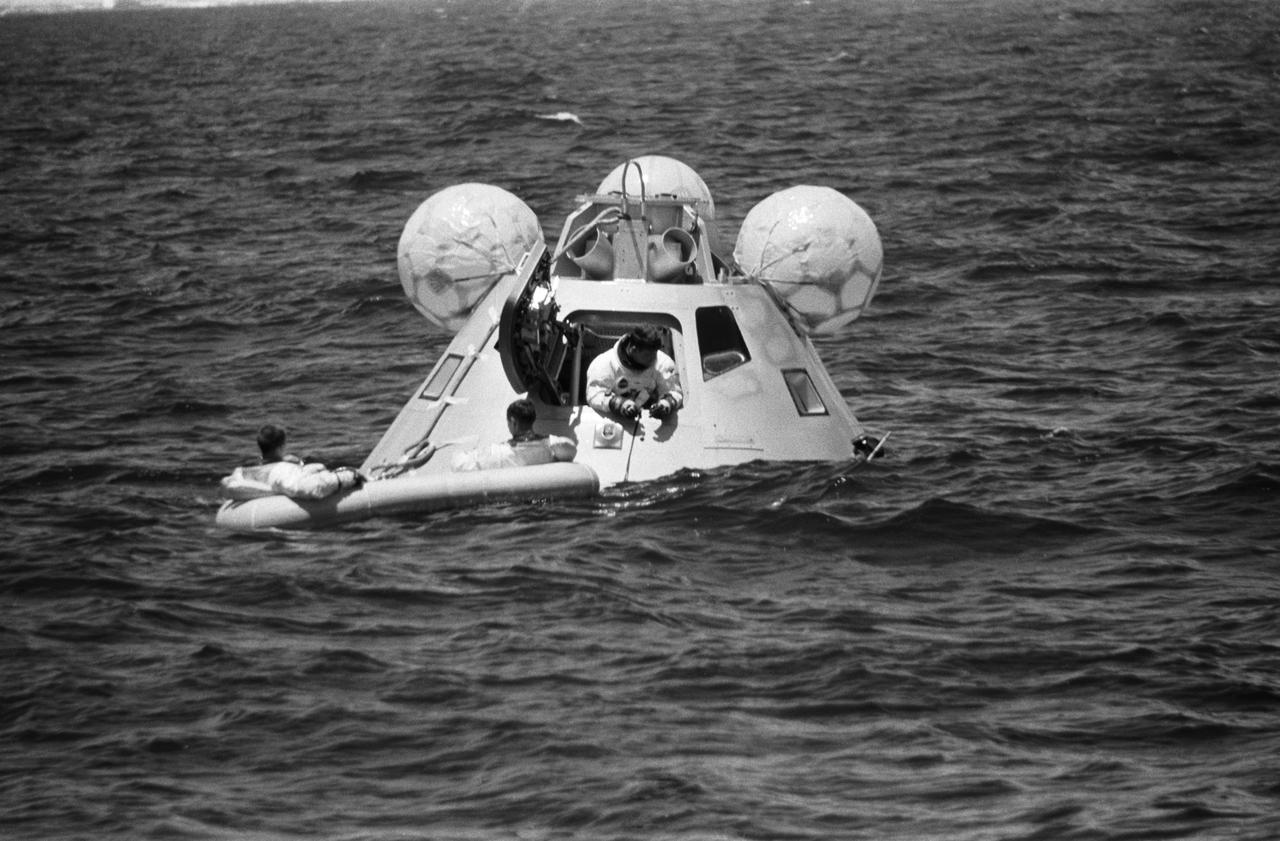
S68-42197 (5 Aug. 1968) --- The prime crew of the first manned Apollo space mission, Apollo 7, participates in water egress training in the Gulf of Mexico. In hatch of the Apollo egress trainer (command module) is astronaut Walter M. Schirra Jr. Sitting in life raft are astronauts Walter Cunningham (on left) and Donn F. Eisele. A team of MSC swimmers assisted with the training exercise. The inflated bags were used to upright the trainer prior to egress.
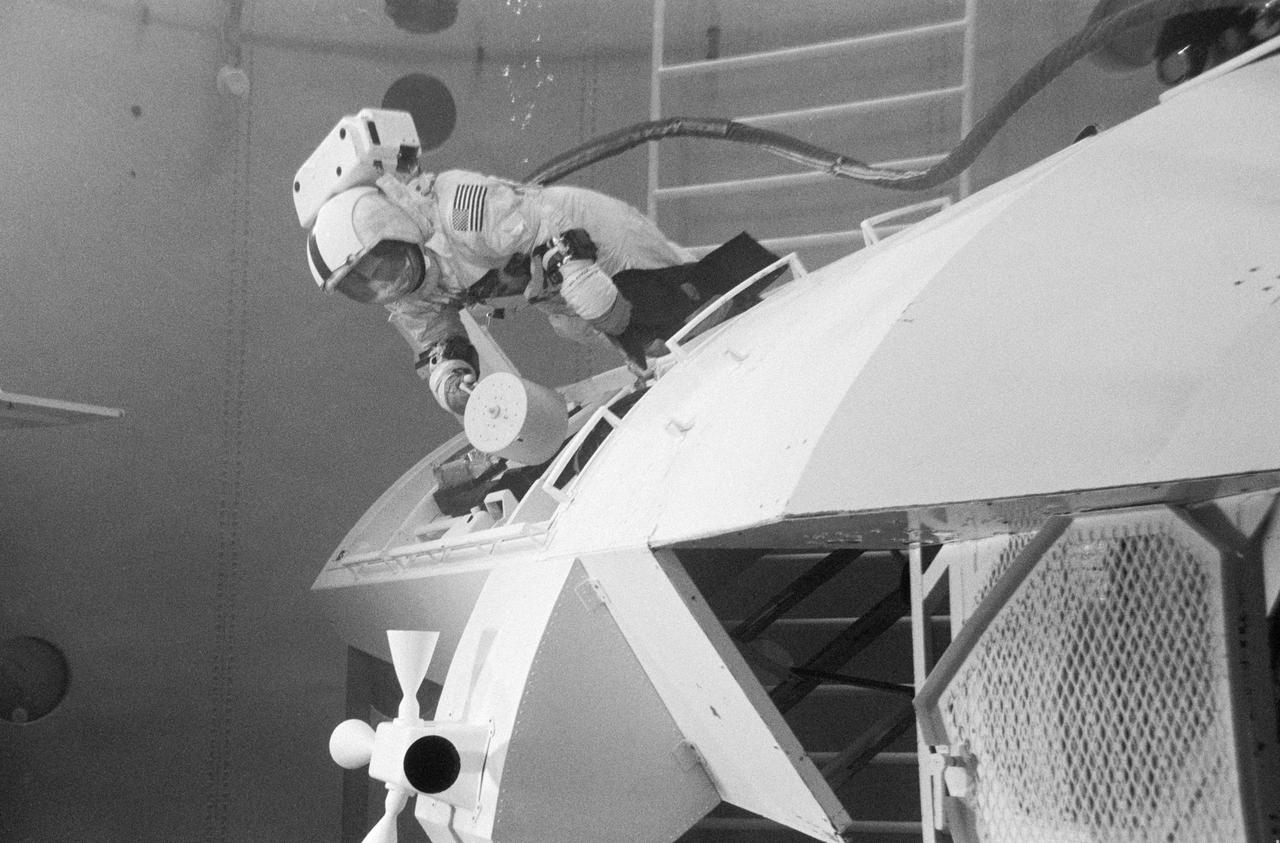
S72-49971 (29 Sept. 1972) --- Astronaut Ronald E. Evans, command module pilot of the Apollo 17 lunar landing mission, participates in extravehicular activity training in a water tank in Building 5 at the Manned Spacecraft Center. Evans is scheduled to perform trans-Earth extravehicular activity after the Apollo 17 spacecraft leaves lunar orbit on its way back home. The structure in the picture simulates the Scientific Instrument Module (SIM) bay of the Apollo 17 Service Module.
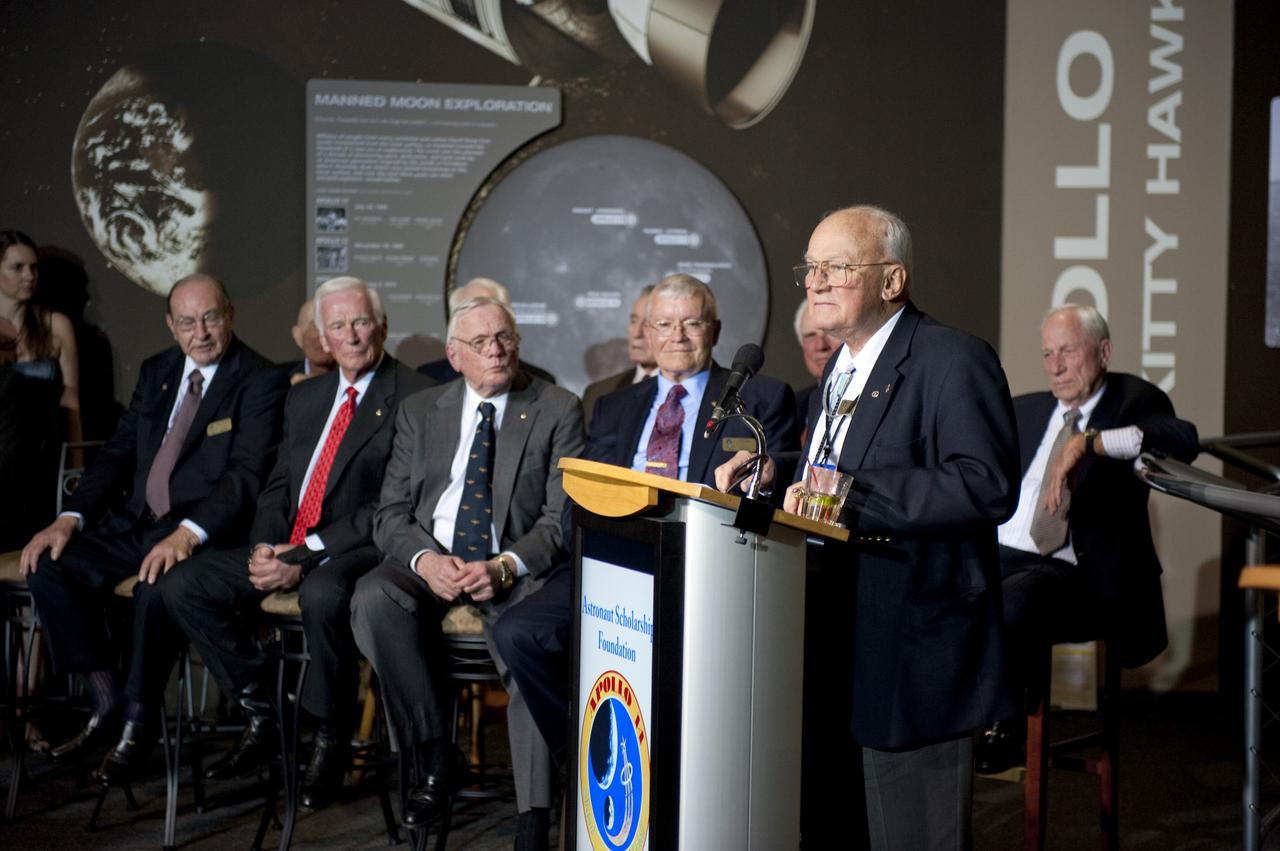
CAPE CANAVERAL, Fla. -- Apollo 14 Capcom Bruce McCandless talks to attendees of the Apollo 14 Anniversary Soirée at the Kennedy Space Center Visitor Complex's Saturn V Center. The celebration was hosted by the Astronaut Scholarship Foundation. Apollo 14 landed on the lunar surface 40 years ago on Feb. 5, 1971. Photo credit: NASA/Kim Shiflett
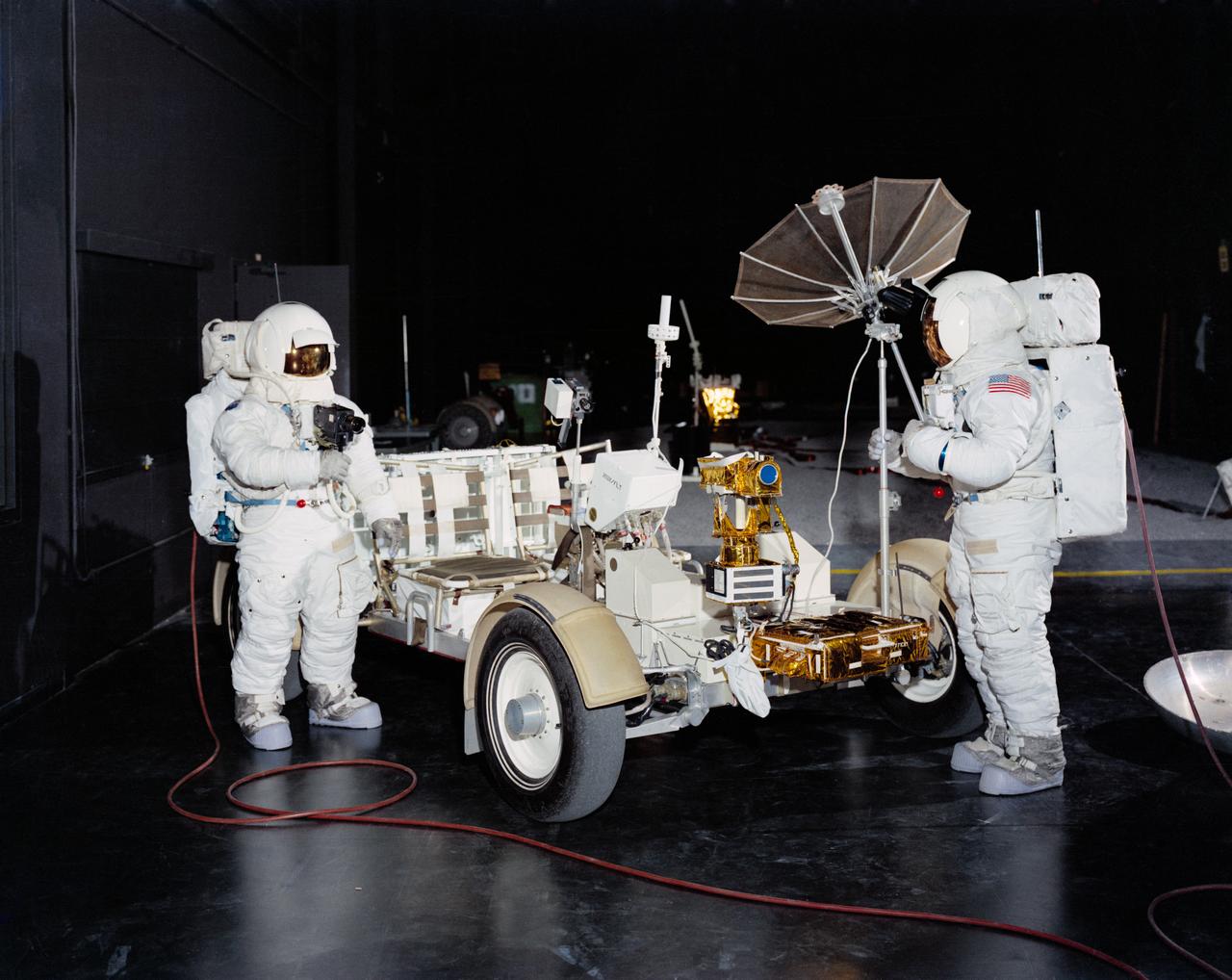
S71-16722 (January 1971) --- Two members of the prime crew of the Apollo 15 lunar landing mission are shown with the Lunar Roving Vehicle "one G" trainer in Building 5, Mission Simulation and Training Facility, Manned Spacecraft Center. Astronaut David R. Scott (on right) is the Apollo 15 commander; and astronaut James B. Irwin is the lunar module pilot. A Lunar Roving Vehicle similar to this trainer will be used by Scott and Irwin during their Apollo 15 lunar surface extravehicular activity.
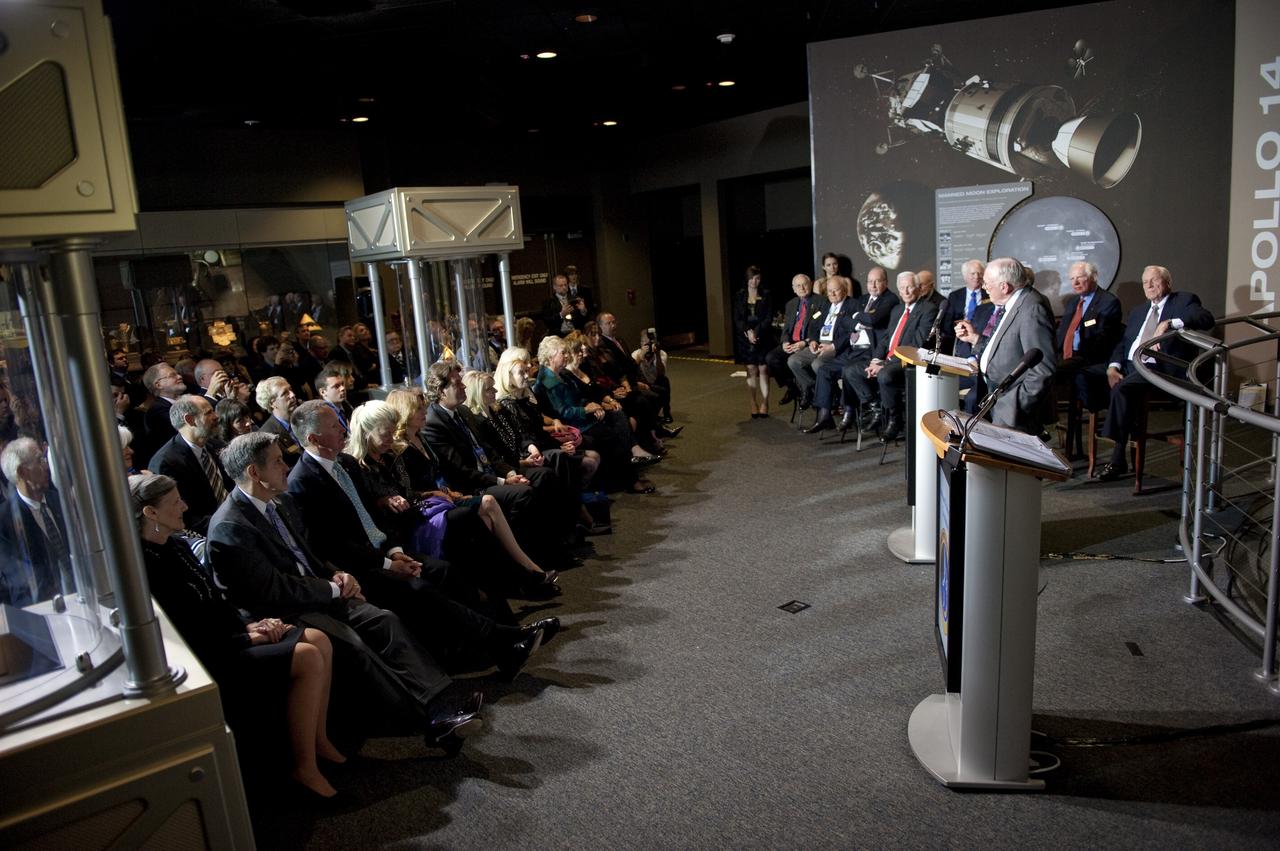
CAPE CANAVERAL, Fla. -- Apollo 11 Commander Neil Armstrong talks to attendees of the Apollo 14 Anniversary Soirée at the Kennedy Space Center Visitor Complex's Saturn V Center. The celebration was hosted by the Astronaut Scholarship Foundation. Apollo 14 landed on the lunar surface 40 years ago on Feb. 5, 1971. In 1969, Armstrong gained the distinction of being the first human to step foot on the surface of the moon. Photo credit: NASA/Kim Shiflett
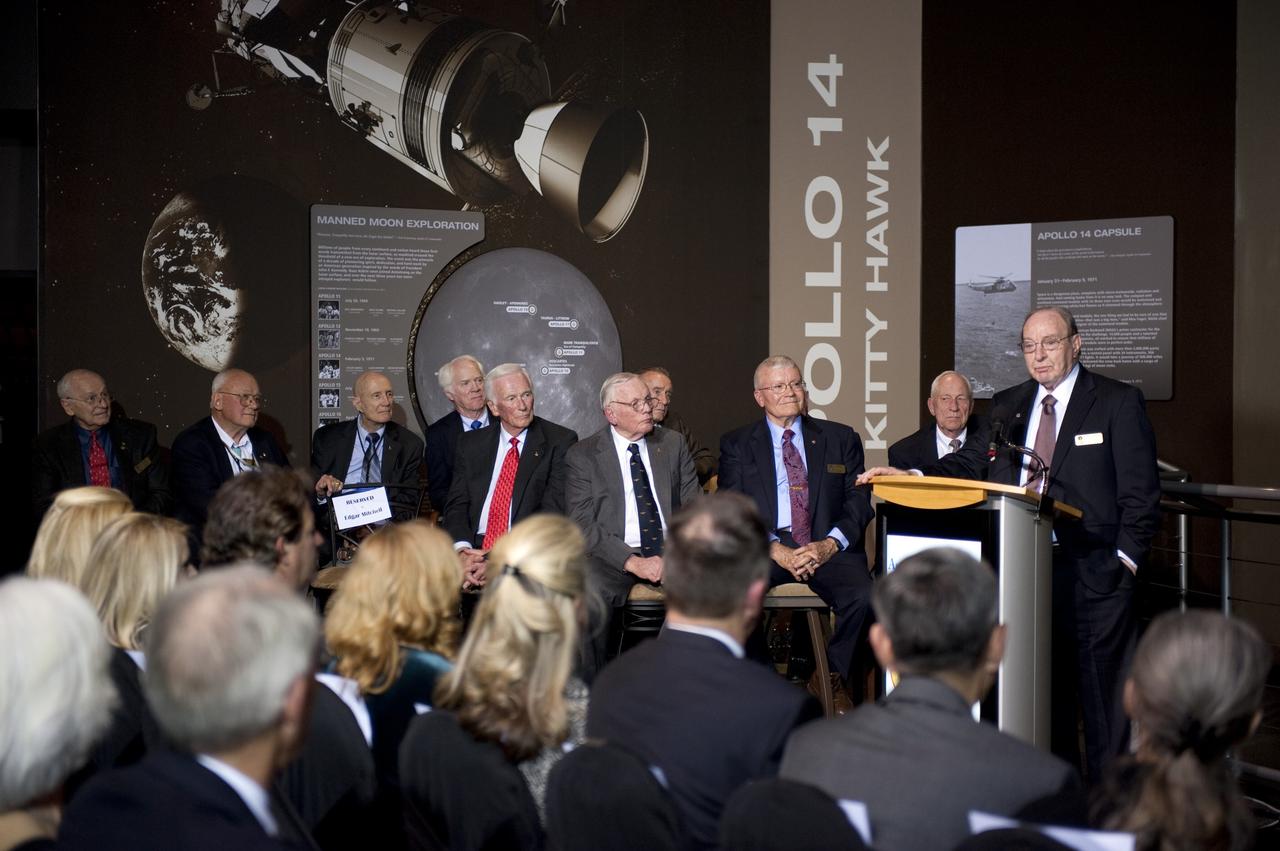
CAPE CANAVERAL, Fla. -- Apollo 14 Lunar Module Pilot Edgar Mitchell talks to attendees of the Apollo 14 Anniversary Soirée at the Kennedy Space Center Visitor Complex's Saturn V Center. The celebration was hosted by the Astronaut Scholarship Foundation. Apollo 14 landed on the lunar surface 40 years ago on Feb. 5, 1971. Photo credit: NASA/Kim Shiflett
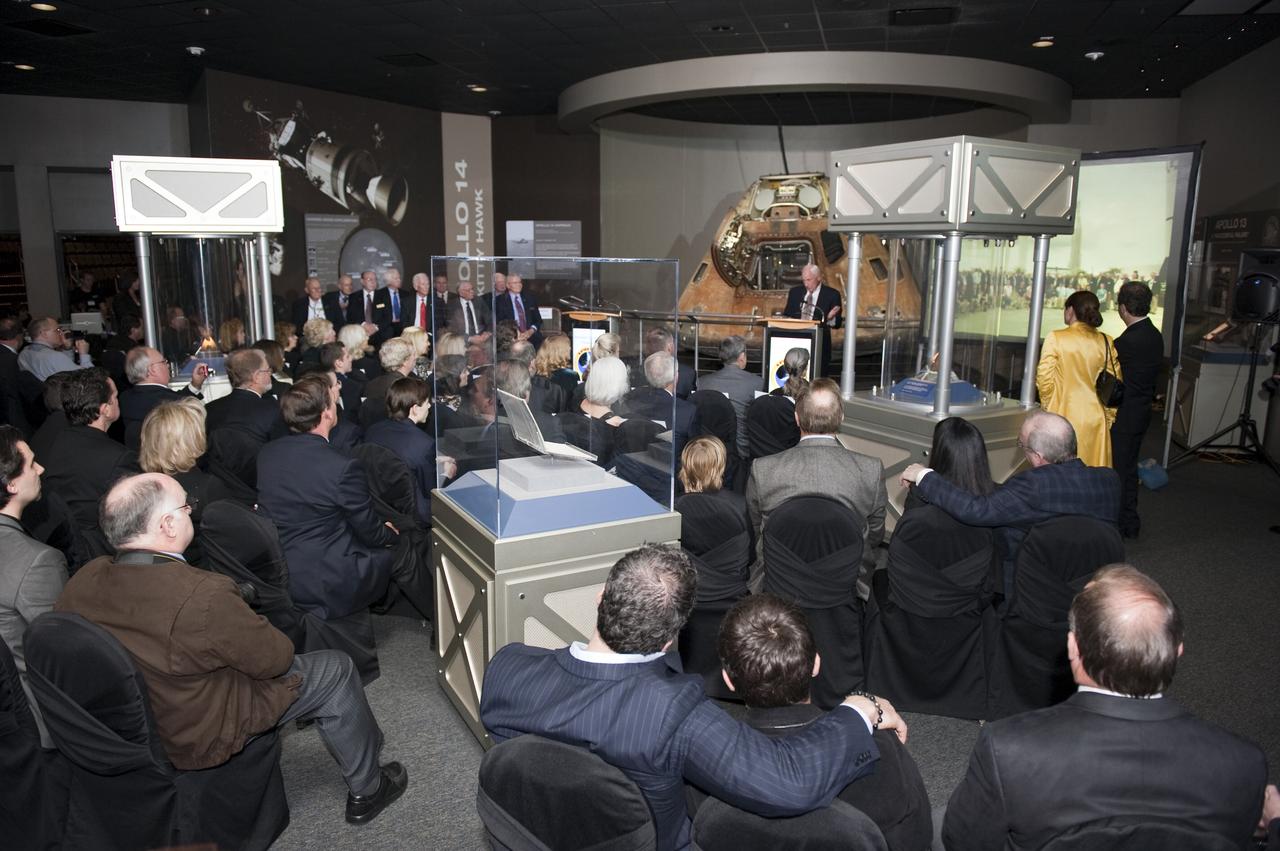
CAPE CANAVERAL, Fla. -- Command module pilot for Apollo 15 Al Worden talks to attendees of the Apollo 14 Anniversary Soirée at the Kennedy Space Center Visitor Complex's Saturn V Center. The celebration was hosted by the Astronaut Scholarship Foundation. Apollo 14 landed on the lunar surface 40 years ago on Feb. 5, 1971. Photo credit: NASA/Kim Shiflett
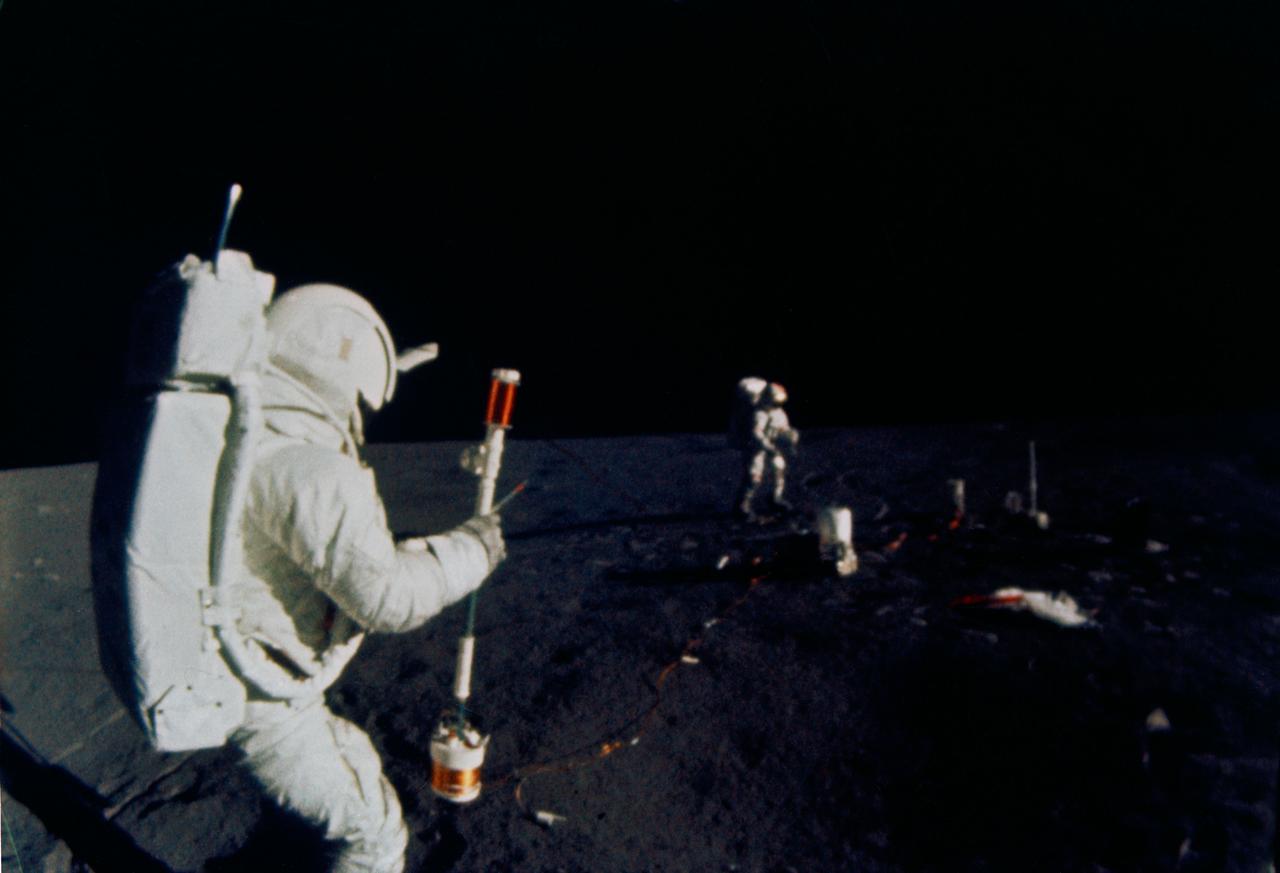
S71-19509 (5 Feb. 1971) --- Astronaut Edgar D. Mitchell, lunar module pilot, operates the Active Seismic Experiment's (ASE) thumper during the first Apollo 14 extravehicular activity (EVA) on the moon. Astronaut Alan B. Shepard Jr., commander, walks near deployed components of the Apollo Lunar Surface Experiments Package (ALSEP) in the background. This photograph was taken by an automatic 16mm camera mounted on the Apollo lunar hand tool carrier aboard the Modularized Equipment Transporter (MET). While astronauts Shepard and Mitchell descended in the LM to explore the moon, astronaut Stuart A. Roosa, command module pilot, remained with the Command and Service Modules (CSM) in lunar orbit.

AS14-66-9278 (5 Feb. 1971) --- An excellent view of the Apollo 14 Lunar Module (LM) on the moon, as photographed during the first Apollo 14 extravehicular activity (EVA) on the lunar surface. While astronauts Alan B. Shepard Jr., commander, and Edgar D. Mitchell, lunar module pilot, descended in the LM to explore the moon, astronaut Stuart A. Roosa, command module pilot, remained with the Command and Service Modules (CSM) in lunar orbit.
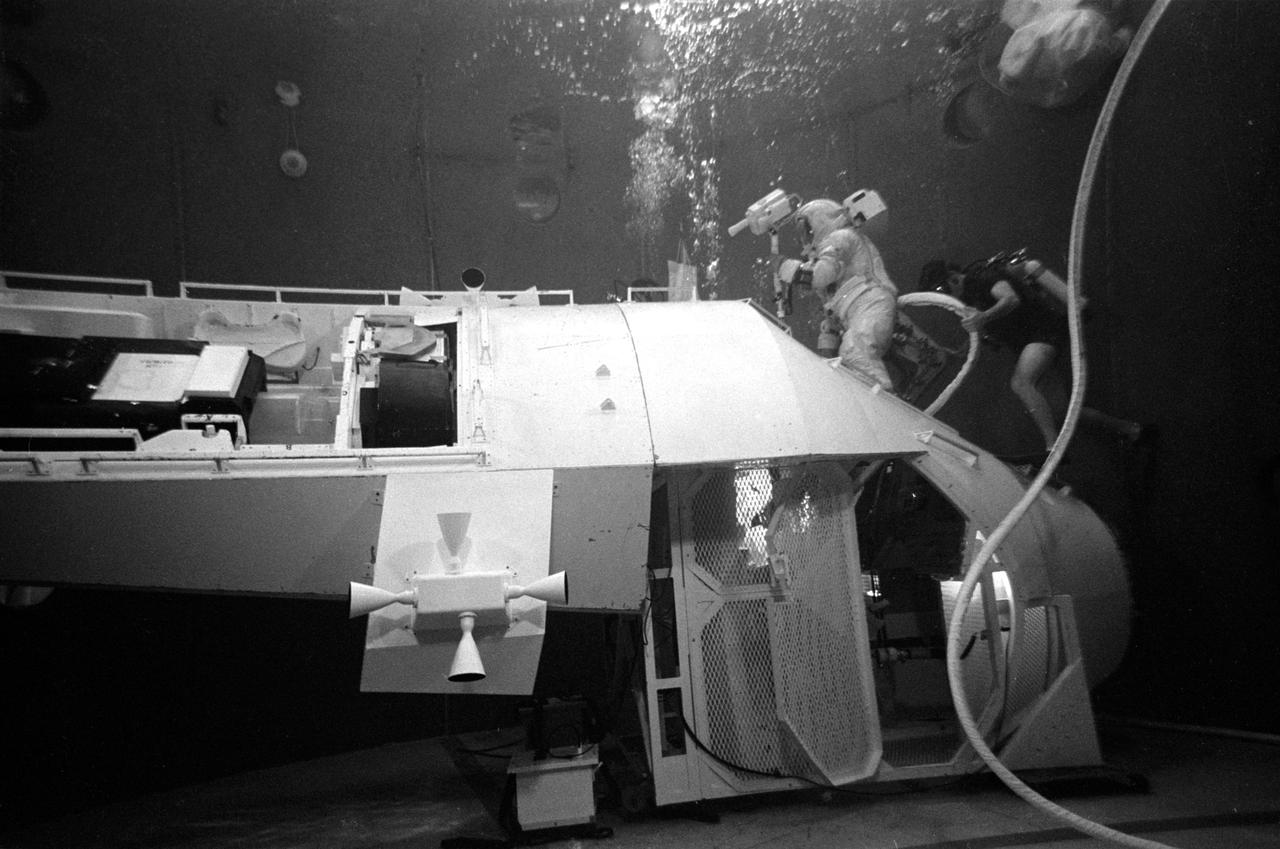
S71-58148 (1 Dec. 1971) --- Astronaut Thomas K. Mattingly II, command module pilot of the planned Apollo 16 lunar landing mission, participates in extravehicular activity (EVA) simulations in the water facility tank in Building 5 at the Manned Spacecraft Center (MSC), Houston, Texas, during training preparations for the forthcoming mission. Mattingly is scheduled to perform EVA during the trans-Earth journey of the Apollo 16 mission.
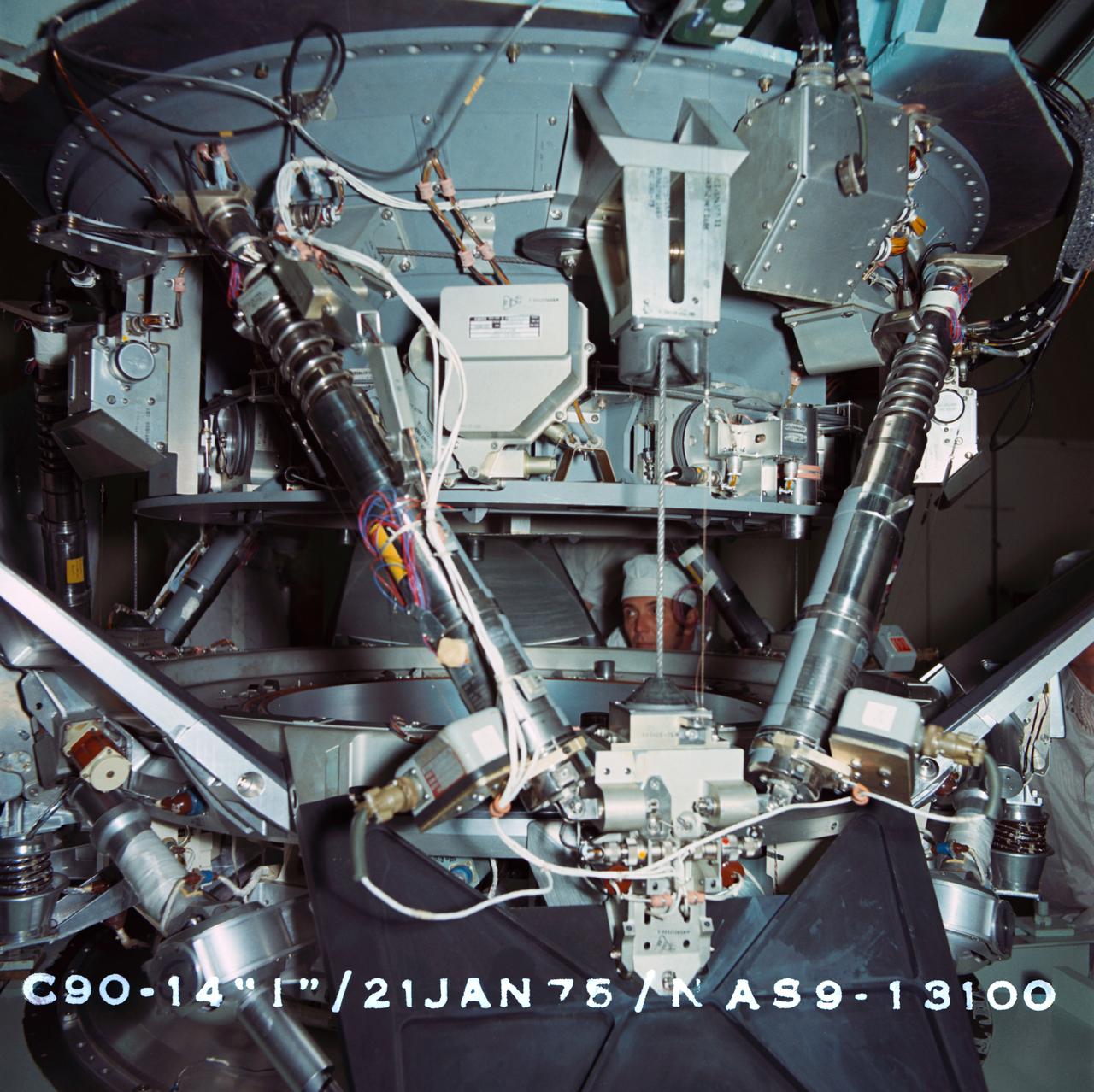
S95-02815 (21 Jan. 1975) --- Soviet junior researcher Y.G. Pobrov observes testing of the Apollo-Soyuz docking system at Rockwell International's plant in Downey, California. The United States' Docking System 3 (DS-3) here is being positioned onto the USSR's CA-4 system during a Pin and Socket Alignment Test. DS-5 has been designated as the prime flight article for the joint U.S.-USSR Apollo-Soyuz Test Project (ASTP) docking mission in Earth orbit, scheduled for July 1975.
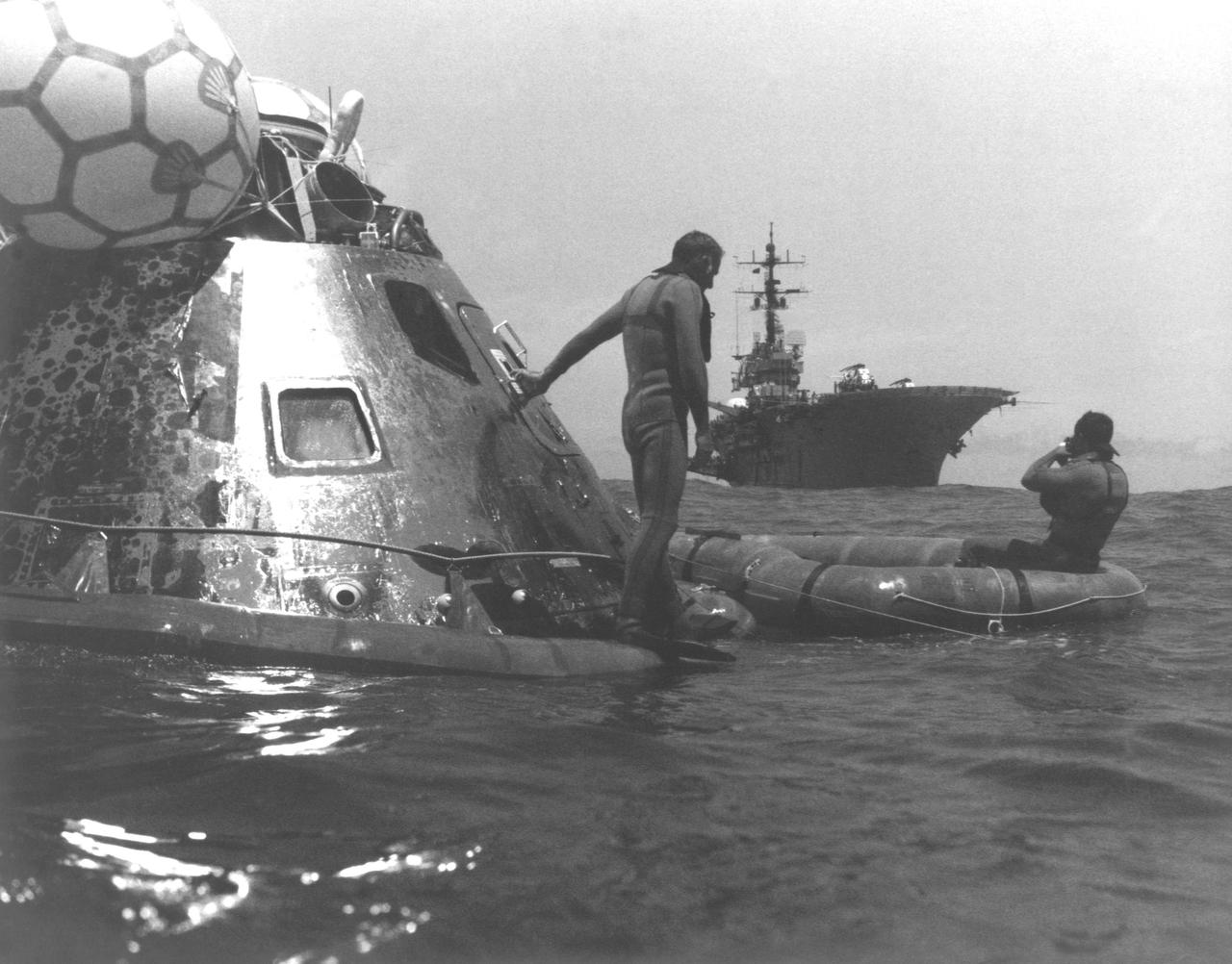
KENNEDY SPACE CENTER, FLA. -- Members of the Pacific Recovery Task Force secure the ASTP Apollo spacecraft as the USS New Orleans approaches to pick up the spacecraft and astronauts Thomas Stafford, Vance Brand and Donald Slayton. The Apollo splashed down in the Pacific Ocean, west of Hawaii, at 5:18 p.m., ending the nine-day joint US_USSR space mission.
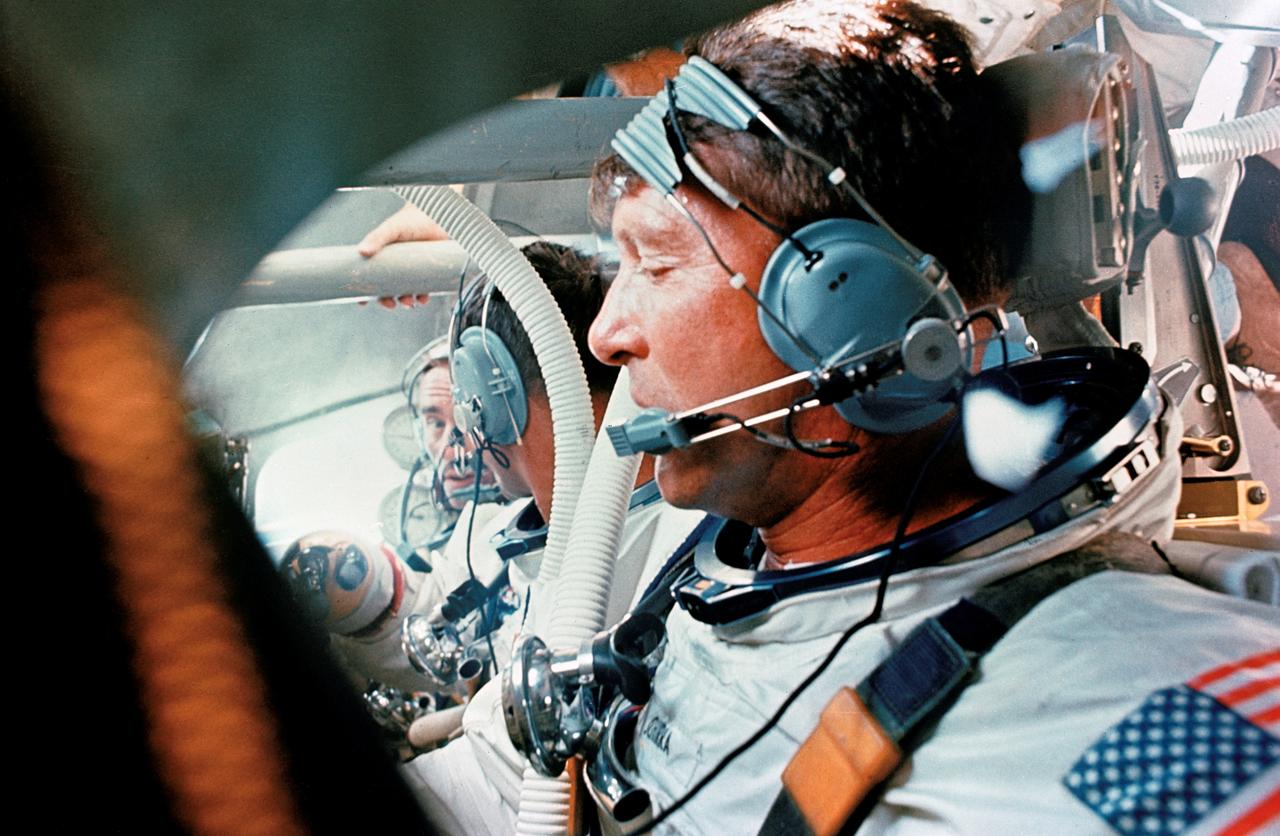
S68-46604 (5 Aug. 1968) --- The prime crew of the first manned Apollo mission (Spacecraft 101/Saturn 205) is seen in Apollo Command Module Boilerplate 1102 during water egress training in the Gulf of Mexico. In foreground is astronaut Walter M. Schirra Jr., in center is astronaut Donn F. Eisele, and in background is astronaut Walter Cunningham.
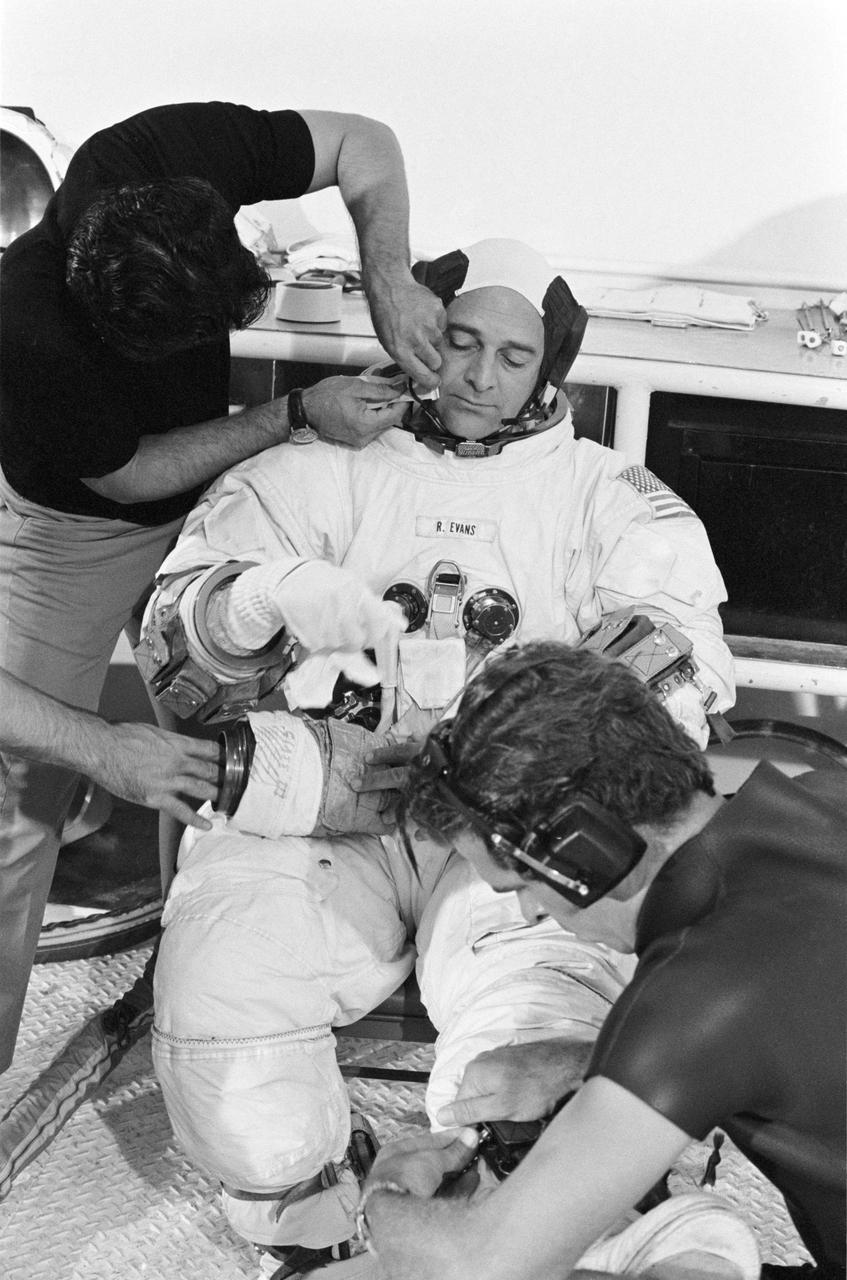
S72-49970 (29 Sept. 1972) --- Astronaut Ronald E. Evans, command module pilot of the Apollo 17 lunar landing mission, is suited up in preparation for extravehicular activity training in a water tank in Building 5 at the Manned Spacecraft Center. Evans is scheduled to perform trans-Earth extravehicular activity after the Apollo 17 spacecraft leaves lunar orbit on its way back home.
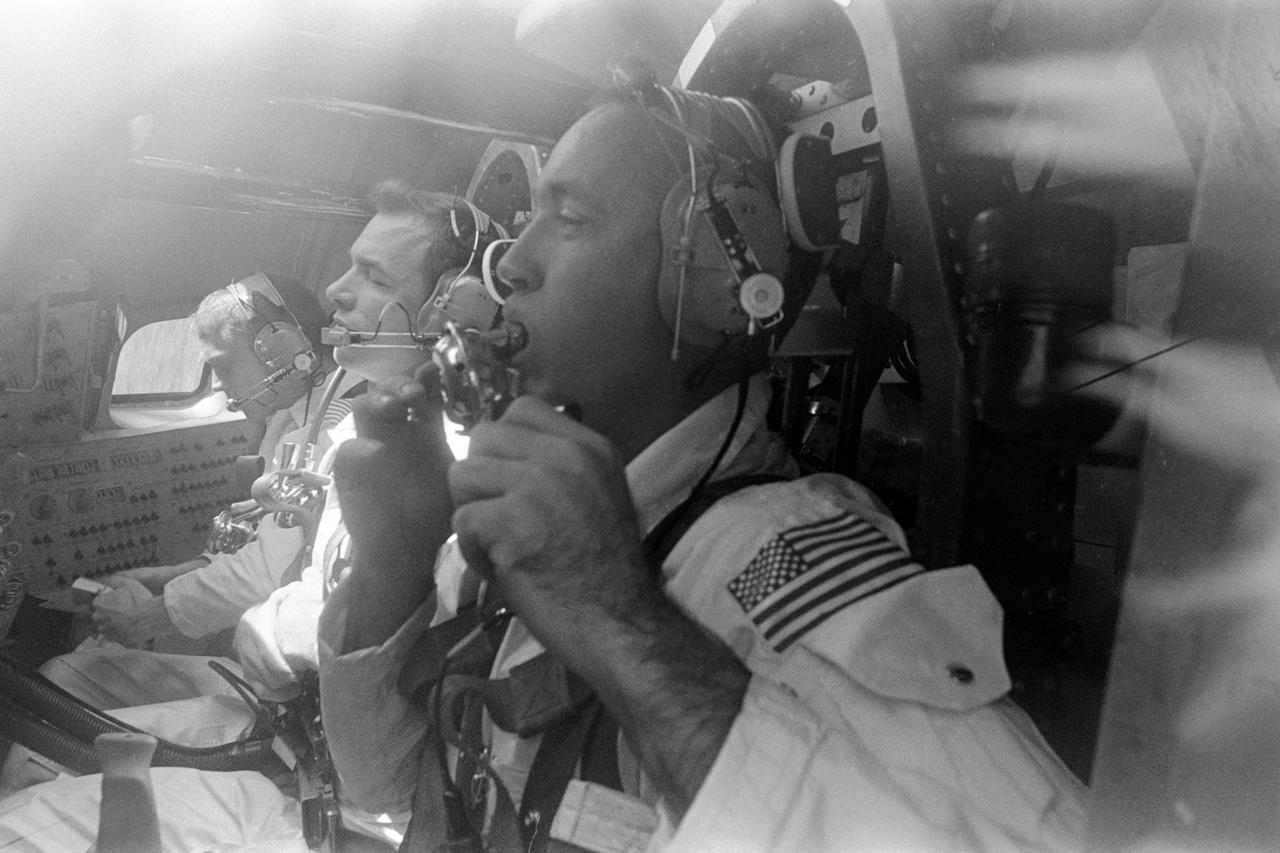
S68-54850 (5 Nov. 1968) --- The prime crew of the Apollo 9 (Spacecraft 104/Lunar Module 3/Saturn 504) space mission are seen inside an Apollo command module boilerplate during water egress training activity in the Gulf of Mexico. From foreground, are astronauts James A. McDivitt, commander; David R. Scott, command module pilot; and Russell L. Schweickart, lunar module pilot.
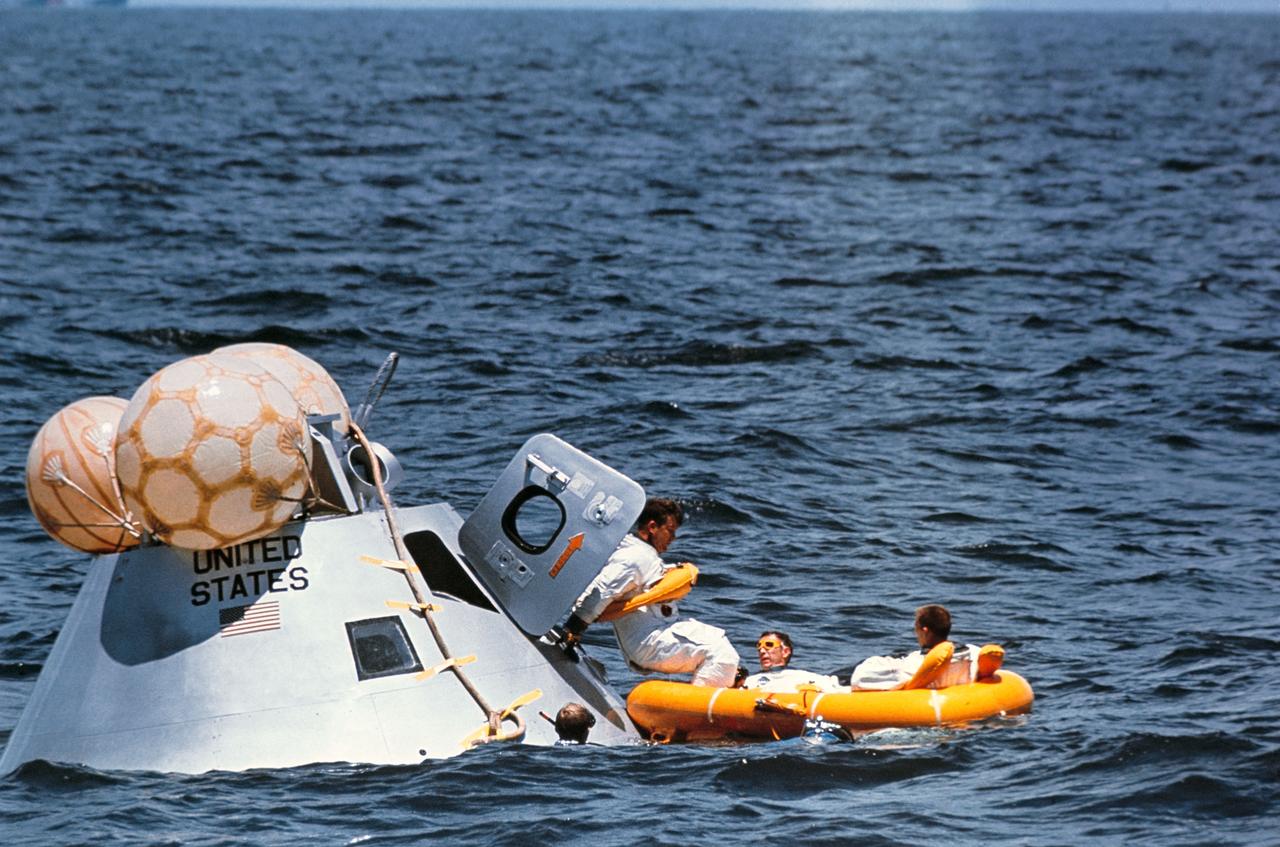
S68-46605 (5 Aug. 1968) --- The prime crew of the first manned Apollo mission (Spacecraft 101/Saturn 205) participates in water egress training in the Gulf of Mexico. Left to right, are astronauts Walter M. Schirra Jr. (stepping into life raft), Donn F. Eisele, and Walter Cunningham. They have just egressed Apollo Command Module Boilerplate 1102, and are awaiting helicopter pickup. Inflated bags were used to upright the boilerplate. MSC swimmers assisted in the training exercise.
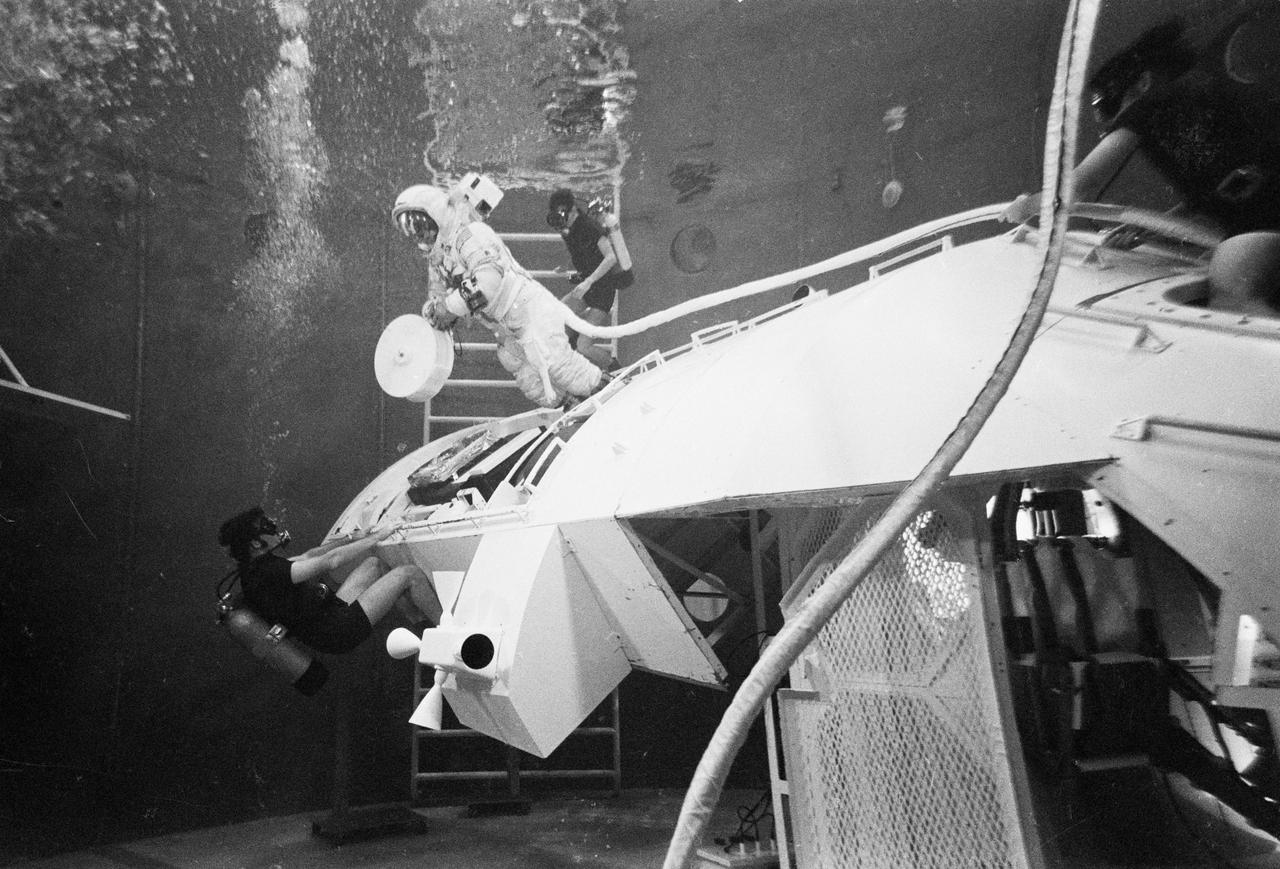
Astronaut Thomas K. Mattingly II, command module pilot of the planned Apollo 16 lunar landing mission, participates in extravehicular activity (EVA) simulations in the water facility tank in building 5 at the Manned Spacecraft Center during training preparations for the forthcoming mission. Mattinly is scheduled to perform EVA during the transearth journey of the Apollo 16 mission.
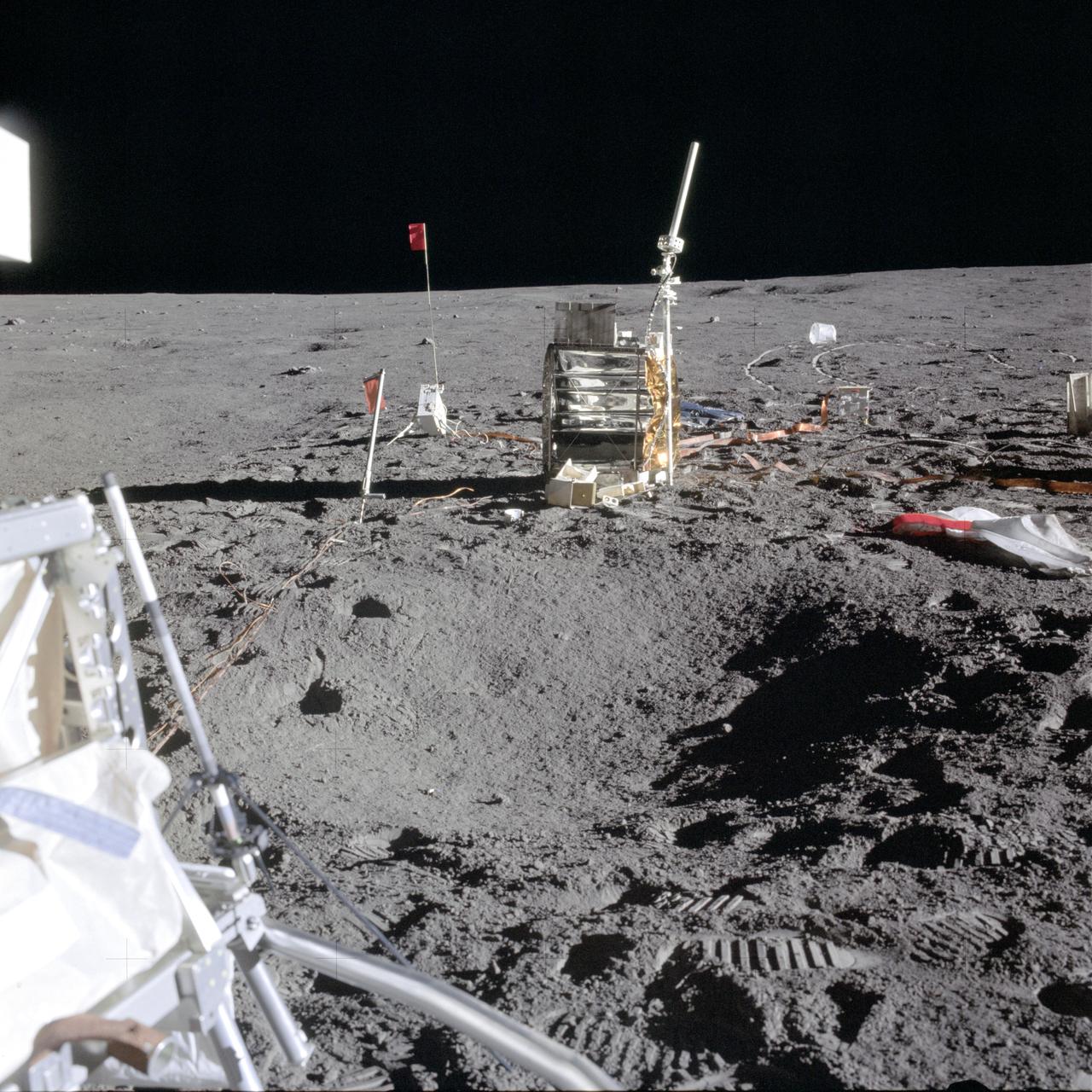
AS14-67-9376 (5 Feb. 1971) --- Several components of the Apollo lunar surface experiments package (ASLEP) are deployed in this photograph taken during the first Apollo 14 extravehicular activity (EVA). The larger object with antenna is the ALSEP central station (CS). The active seismic experiment (ASE) mortar package assembly is to the rear left of the CS. The charged particle lunar environment experiment (CPLEE) is to the right rear of the CS. A portion of the modularized equipment transporter (MET) can be seen in the left foreground.
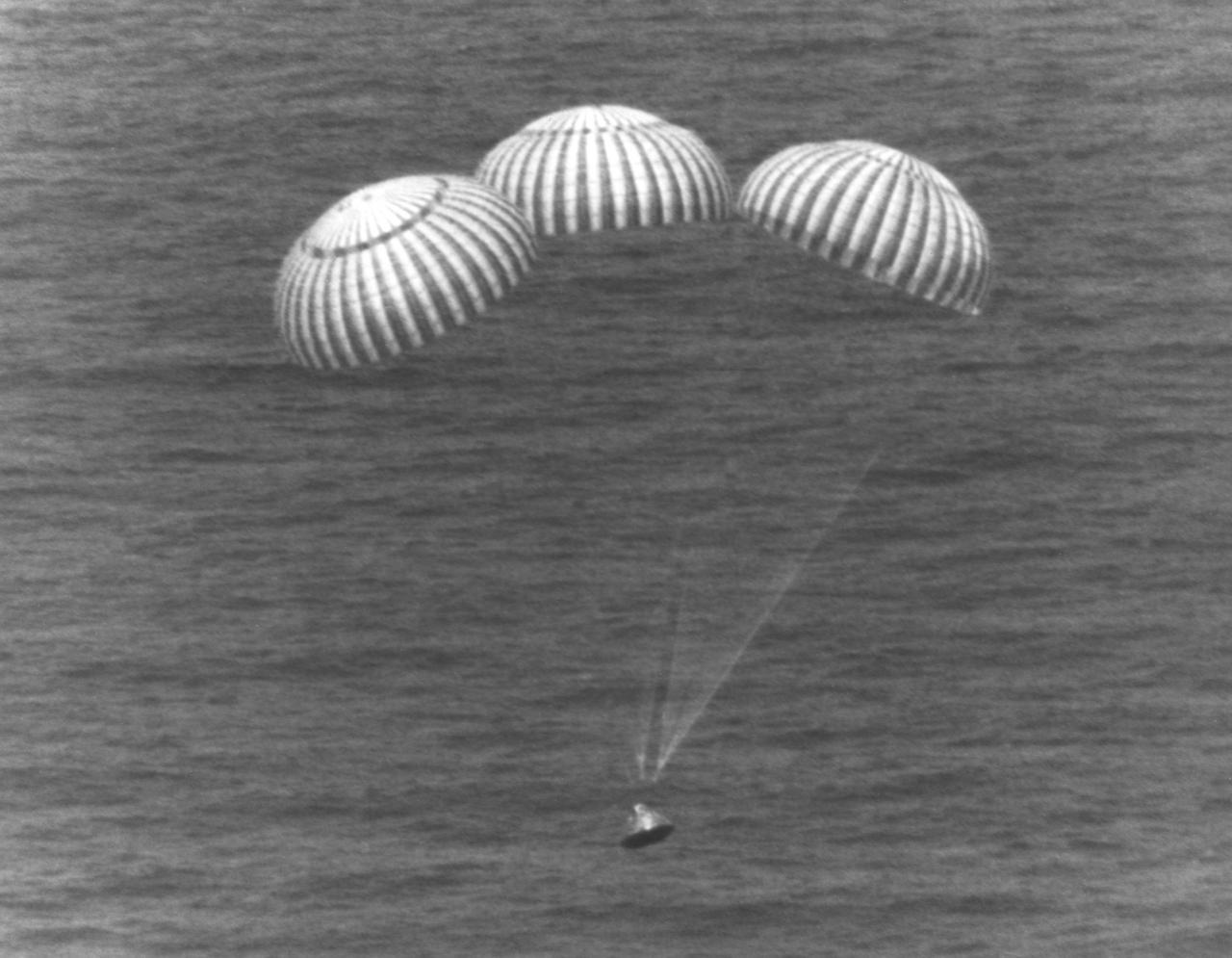
KENNEDY SPACE CENTER, FLA. -- The three main parachutes lower the ASTP Apollo Command Module into the Pacific Ocean west of Hawaii. The splashdown at 5:18 p.m. ended the nine-day mission for ASTP astronauts Thomas Stafford, Vance Brand and Donald Slayton. The Apollo was picked up by the USS New Orleans after which the crewmen participated in ceremonies on the ship's deck.
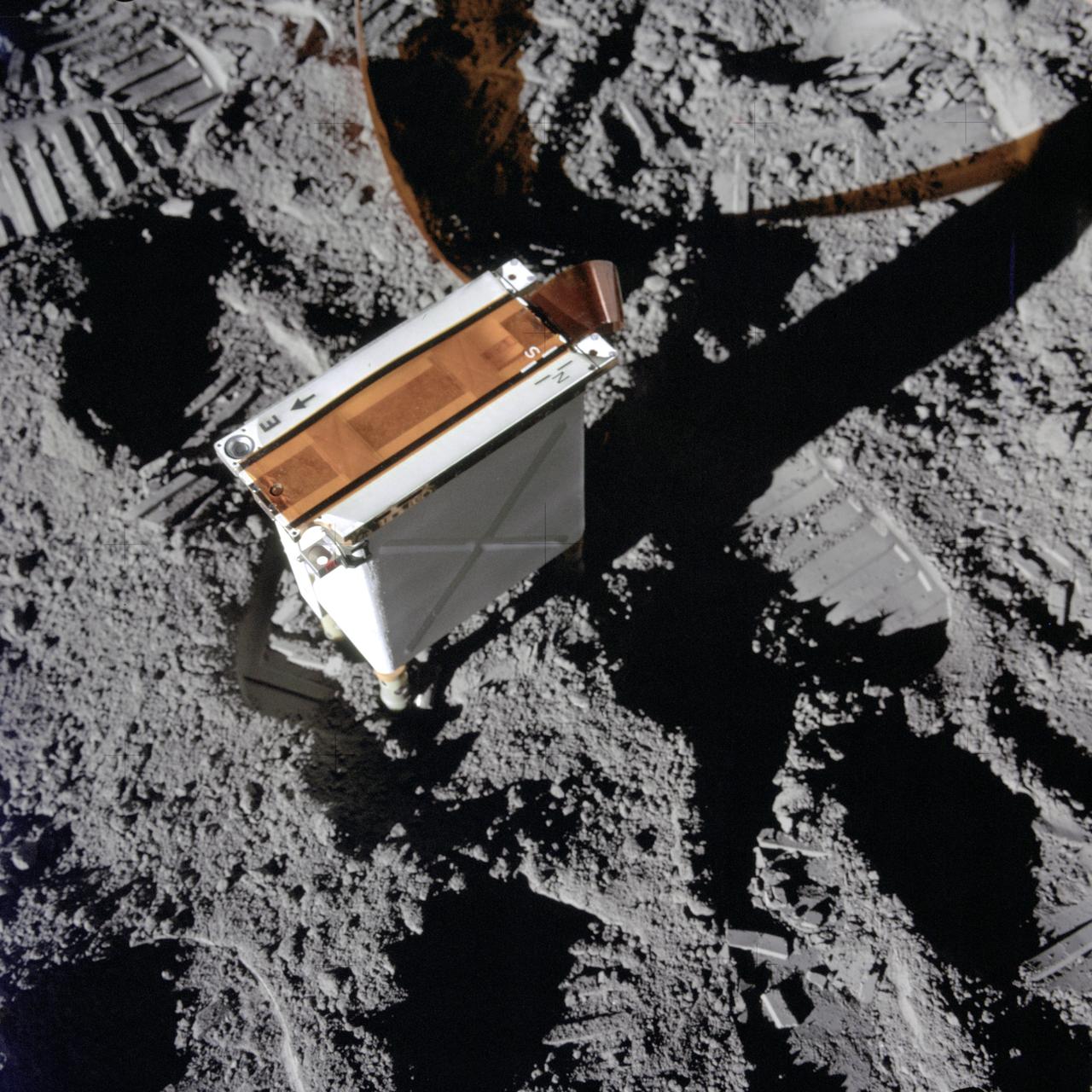
AS14-67-9364 (5 Feb. 1971) --- A close-up view of the charged particle lunar environment experiment (CPLEE), a component of the Apollo lunar surface experiments package (ALSEP) which was deployed on the moon by the Apollo 14 astronauts. While astronauts Alan B. Shepard Jr., commander, and Edgar D. Mitchell, lunar module pilot, descended in the Lunar Module (LM) to explore the moon, astronaut Stuart A. Roosa, command module pilot, remained with the Command and Service Modules (CSM) in lunar orbit.
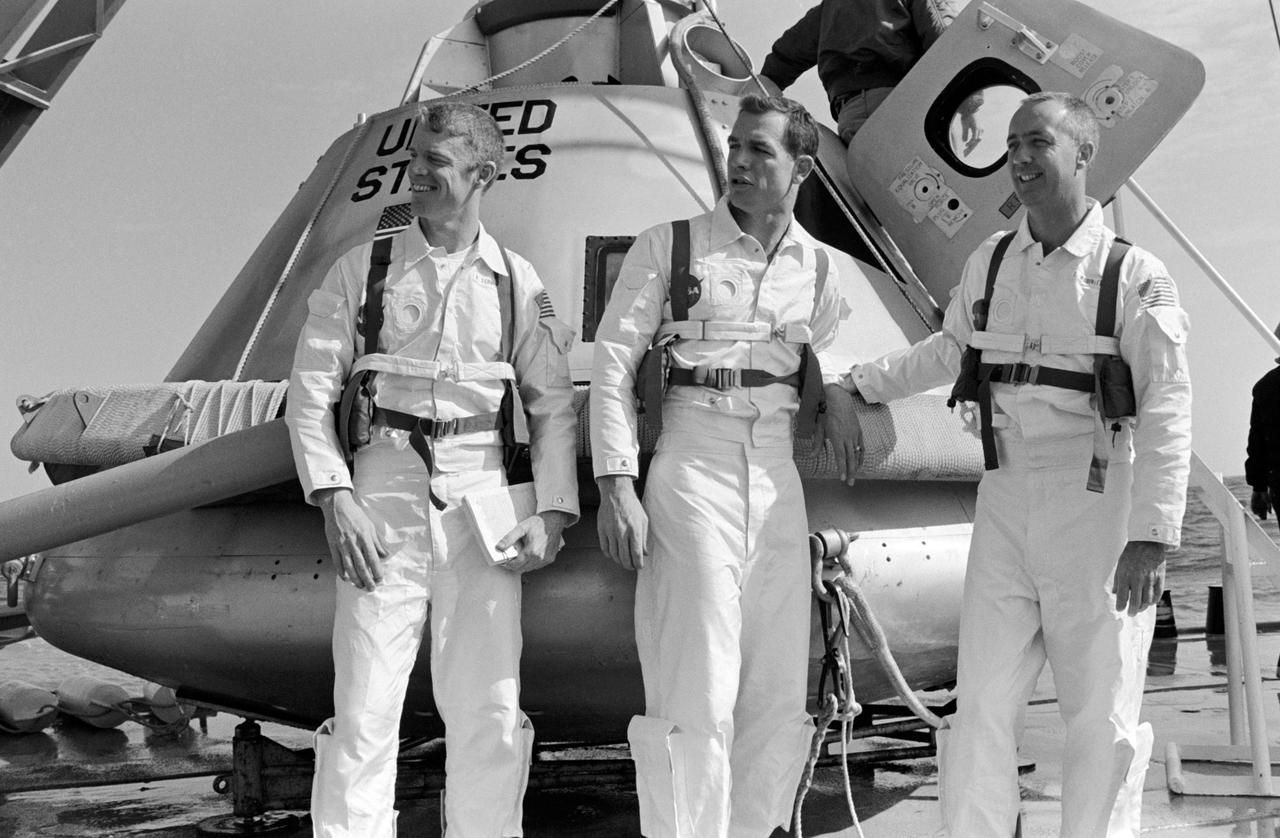
S68-54841 (5 Nov. 1968) --- The prime crew of the Apollo 9 (Spacecraft 104/Lunar Module 3/Saturn 504) space mission stands on the deck of the NASA Motor Vessel Retriever (MVR) prior to participating in water egress training in the Gulf of Mexico. Left to right, are astronauts Russell L. Schweickart, lunar module pilot; David R. Scott, command module pilot; and James A. McDivitt, commander. In background is the Apollo Command Module (CM) boilerplate which was used in the training exercise.
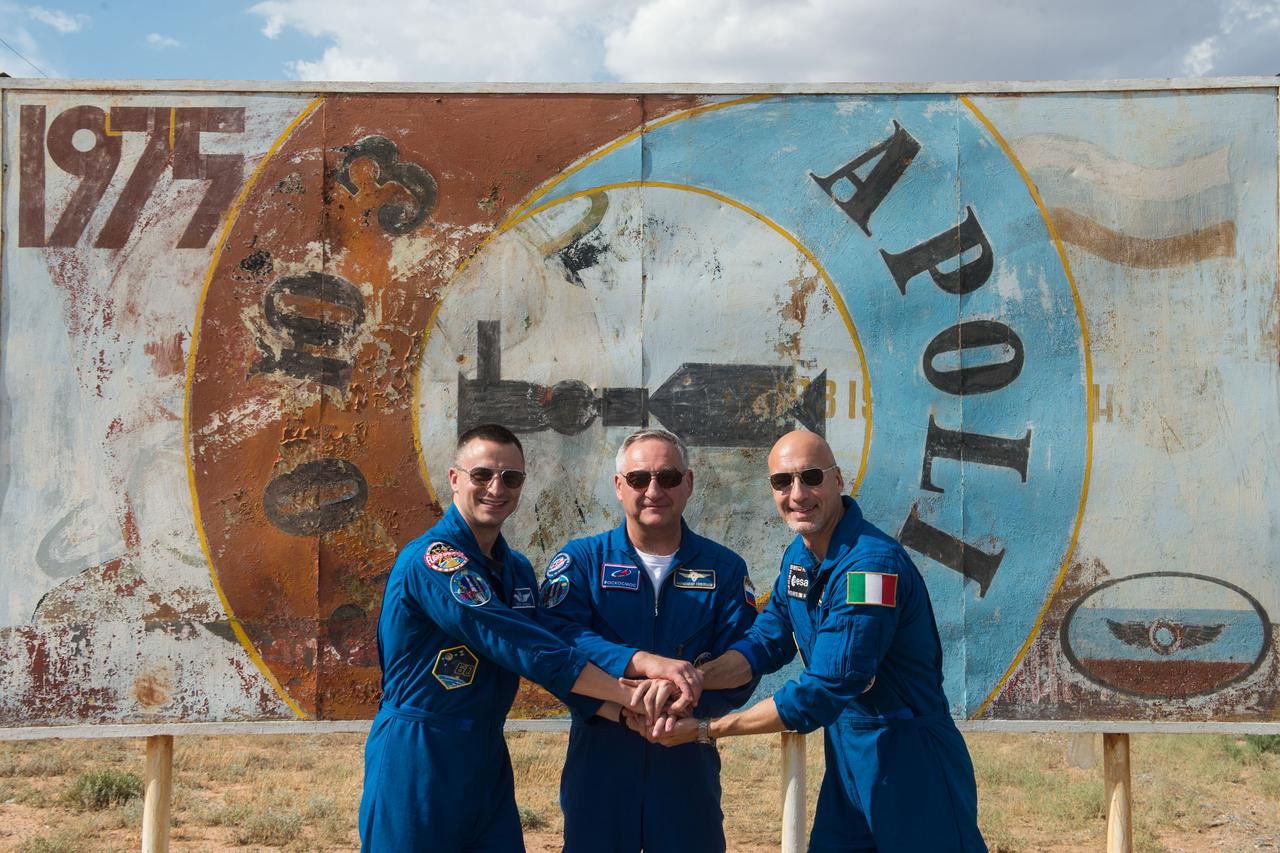
jsc2019e038379 - At the Baikonur Cosmodrome in Kazakhstan, Expedition 60 crewmembers Drew Morgan of NASA (left), Alexander Skvortsov of Roscosmos (center) and Luca Parmitano of the European Space Agency (right) pose for pictures July 5 in front of a mural bearing the insignia of the 1975 Apollo-Soyuz mission. They will launch July 20 on the 50th anniversary of humanity’s first landing on the moon during Apollo 11 on the Soyuz MS-13 spacecraft from the Baikonur Cosmodrome for a mission on the International Space Station...Andrey Shelepin/GCTC.
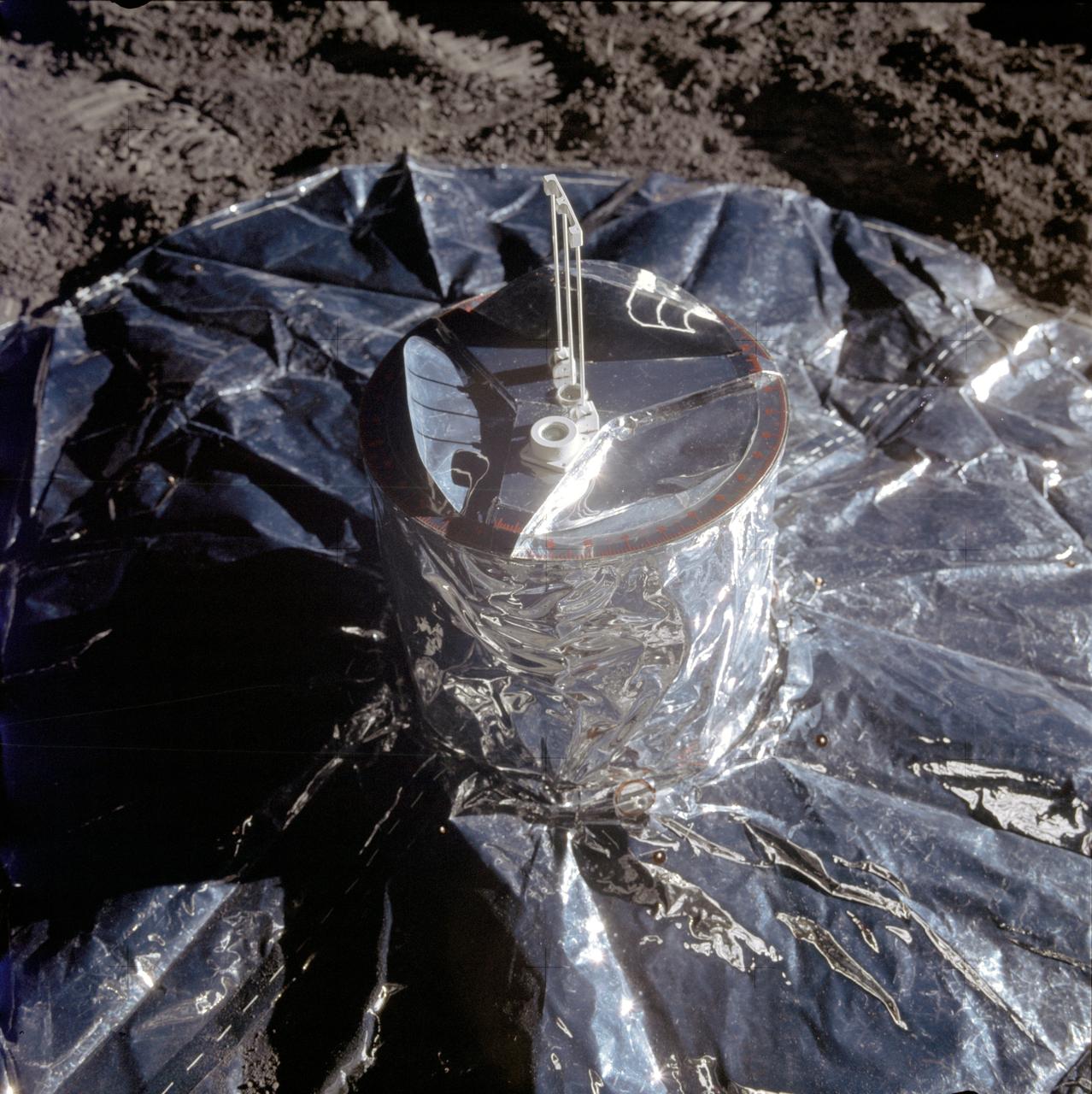
AS14-67-9362 (5 Feb. 1971) --- A close-up view of the passive seismic experiment (PSE), a component of the Apollo lunar surface experiments package (ALSEP), which was deployed on the moon by the Apollo 14 astronauts during their first extravehicular activity (EVA). While astronauts Alan B. Shepard Jr., commander, and Edgar D. Mitchell, lunar module pilot, descended in the Lunar Module (LM) to explore the moon, astronaut Stuart A. Roosa, command module pilot, remained with the Command and Service Modules (CSM) in lunar orbit.
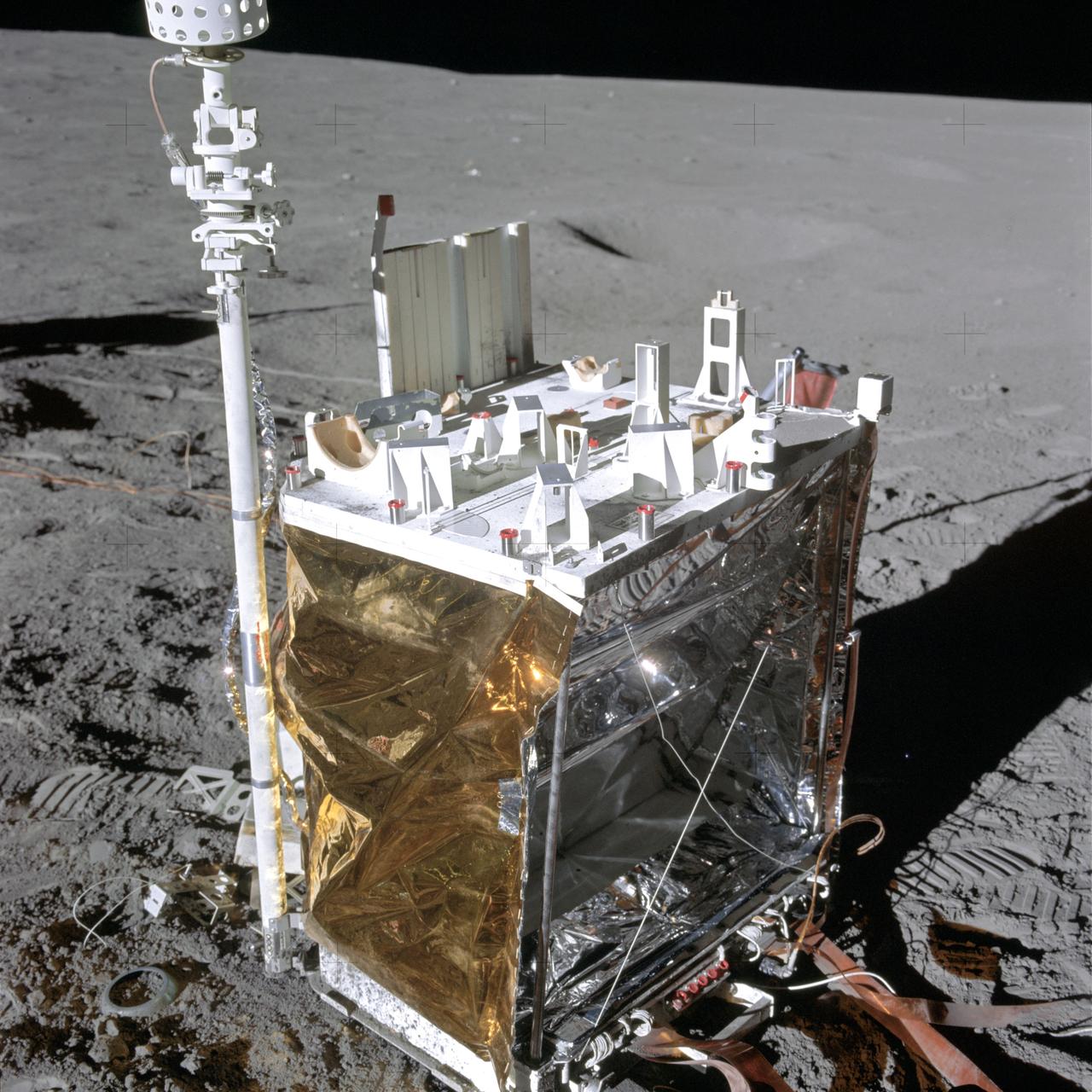
AS14-67-9379 (5 Feb. 1971) --- A close-up view of the central station (CS) of the Apollo lunar surface experiments package (ALSEP), which was deployed on the moon by the Apollo 14 astronauts during their first extravehicular activity (EVA). While astronauts Alan B. Shepard Jr., commander, and Edgar D. Mitchell, lunar module pilot, descended in the Lunar Module (LM) to explore the moon, astronaut Stuart A. Roosa, command module pilot, remained with the Command and Service Modules (CSM) in lunar orbit.
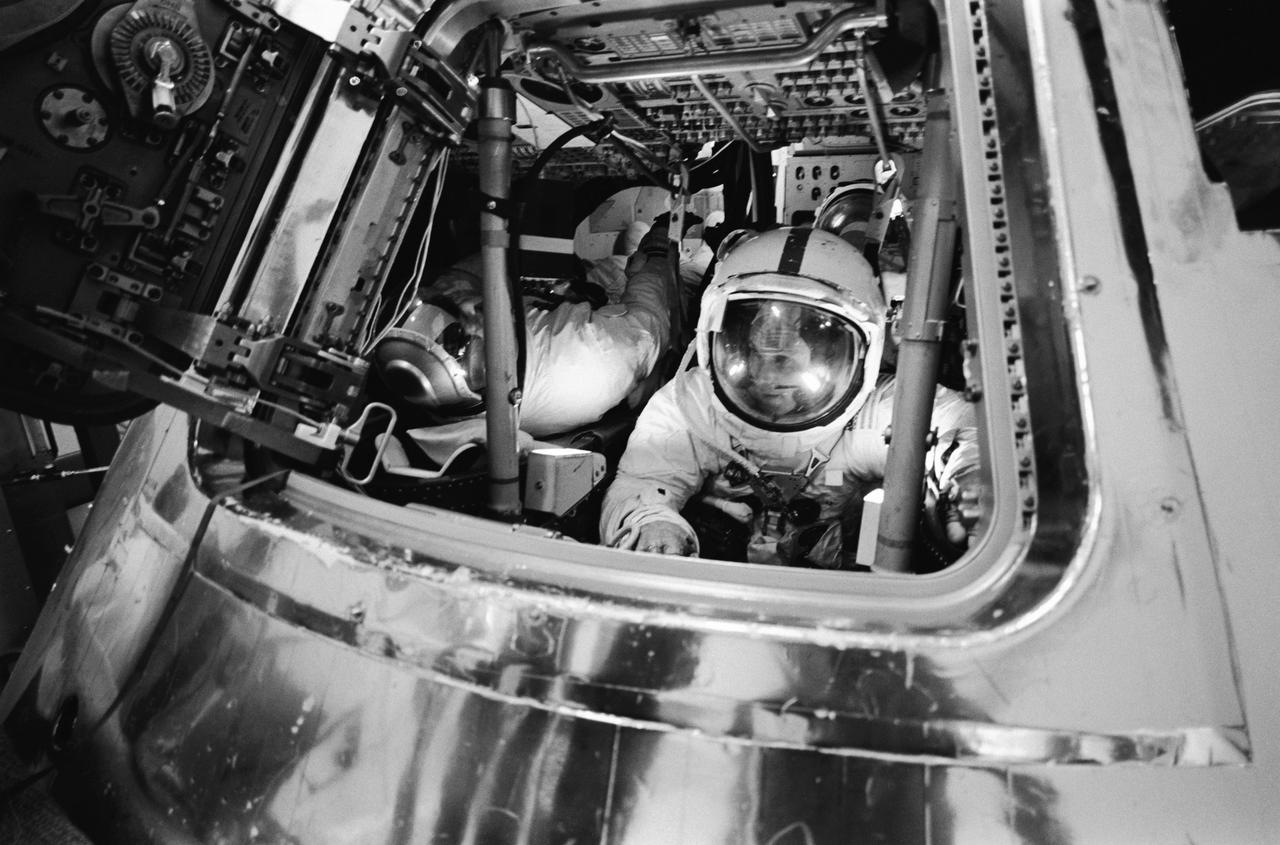
S72-31047 (March 1972) --- Astronaut Thomas K. Mattingly II (right foreground), command module pilot of the Apollo 16 lunar landing mission, participates in extravehicular activity (EVA) training in Building 5 at the Manned Spacecraft Center (MSC). Mattingly is scheduled to perform EVA during the Apollo 16 journey home from the moon. Astronaut John W. Young, commander, can be seen in the left background. In the right background is astronaut Charles M. Duke Jr., lunar module pilot. They are inside the Apollo Command Module Mission Simulator. While Mattingly remains with the Apollo 16 Command and Service Modules (CSM) in lunar orbit, Young and Duke will descend in the Lunar Module (LM) to the moon's Descartes landing site.
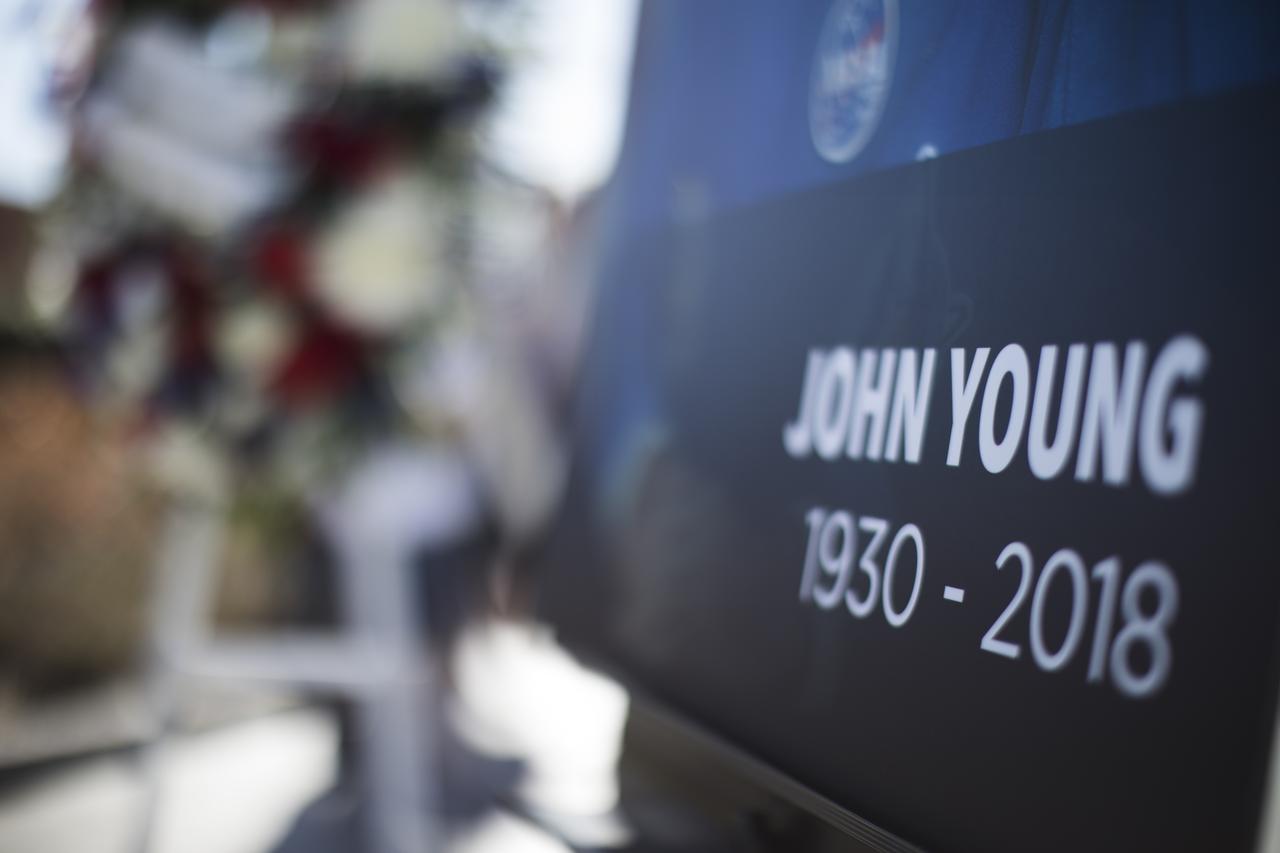
NASA astronaut John Young was remembered in a ceremony at the Heroes and Legends exhibit at the Kennedy Space Center Visitor Complex. The brief memorial took place on the afternoon of Jan. 11, 2018. Young died Jan. 5, 2018, in Houston at the age of 87. He was the only astronaut to fly in NASA's Gemini, Apollo and Space Shuttle Programs.
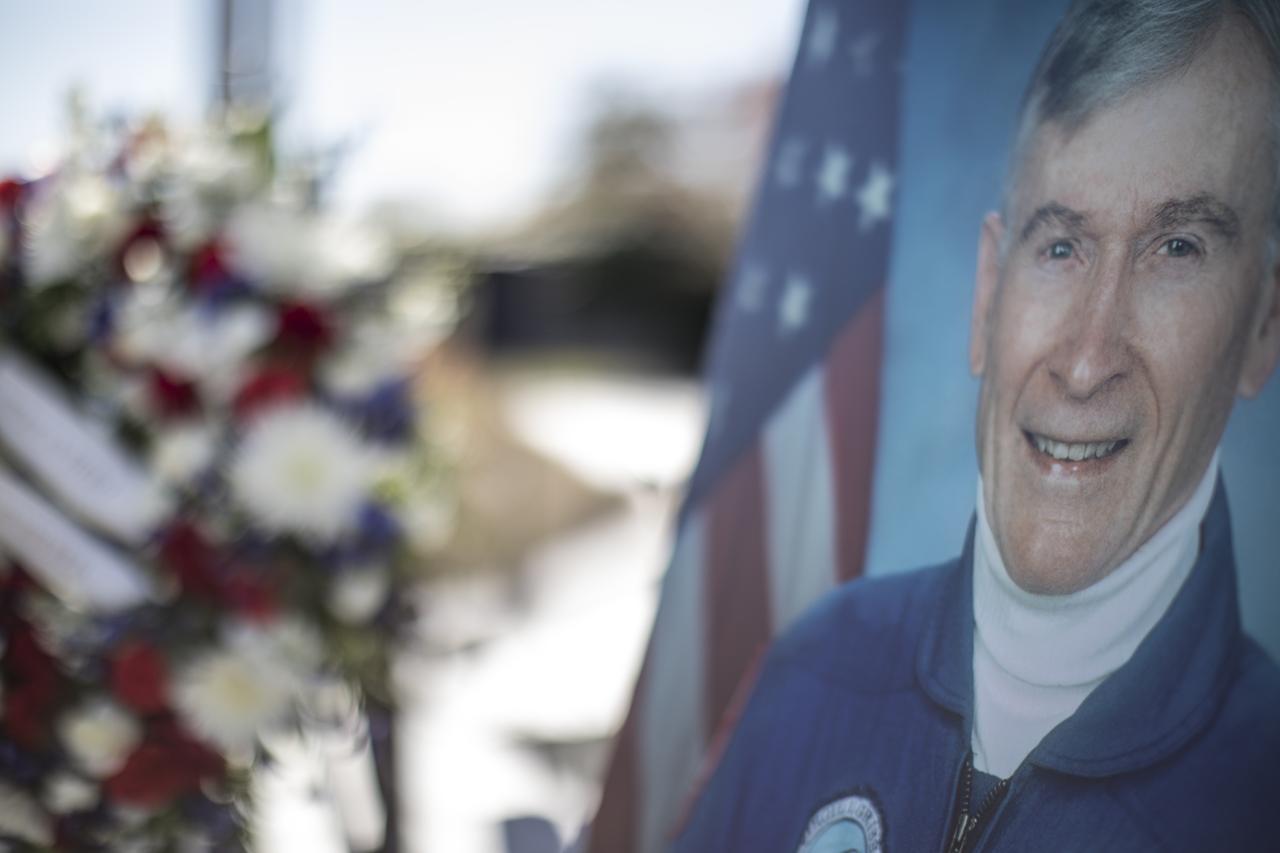
NASA astronaut John Young was remembered in a ceremony at the Heroes and Legends exhibit at the Kennedy Space Center Visitor Complex. The brief memorial took place on the afternoon of Jan. 11, 2018. Young died Jan. 5, 2018, in Houston at the age of 87. He was the only astronaut to fly in NASA's Gemini, Apollo and Space Shuttle Programs.
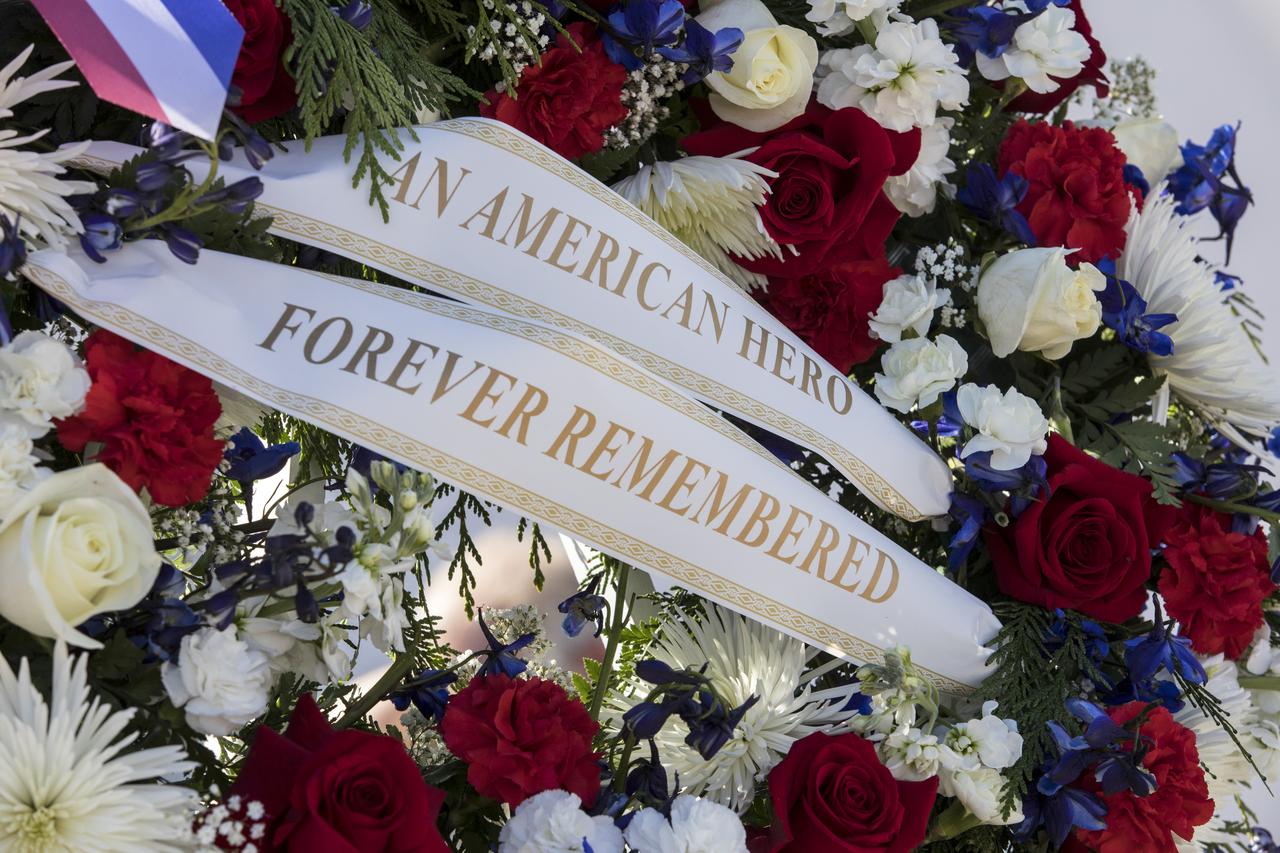
NASA astronaut John Young was remembered in a ceremony at the Heroes and Legends exhibit at the Kennedy Space Center Visitor Complex. The brief memorial took place on the afternoon of Jan. 11, 2018. Young died Jan. 5, 2018, in Houston at the age of 87. He was the only astronaut to fly in NASA's Gemini, Apollo and Space Shuttle Programs.
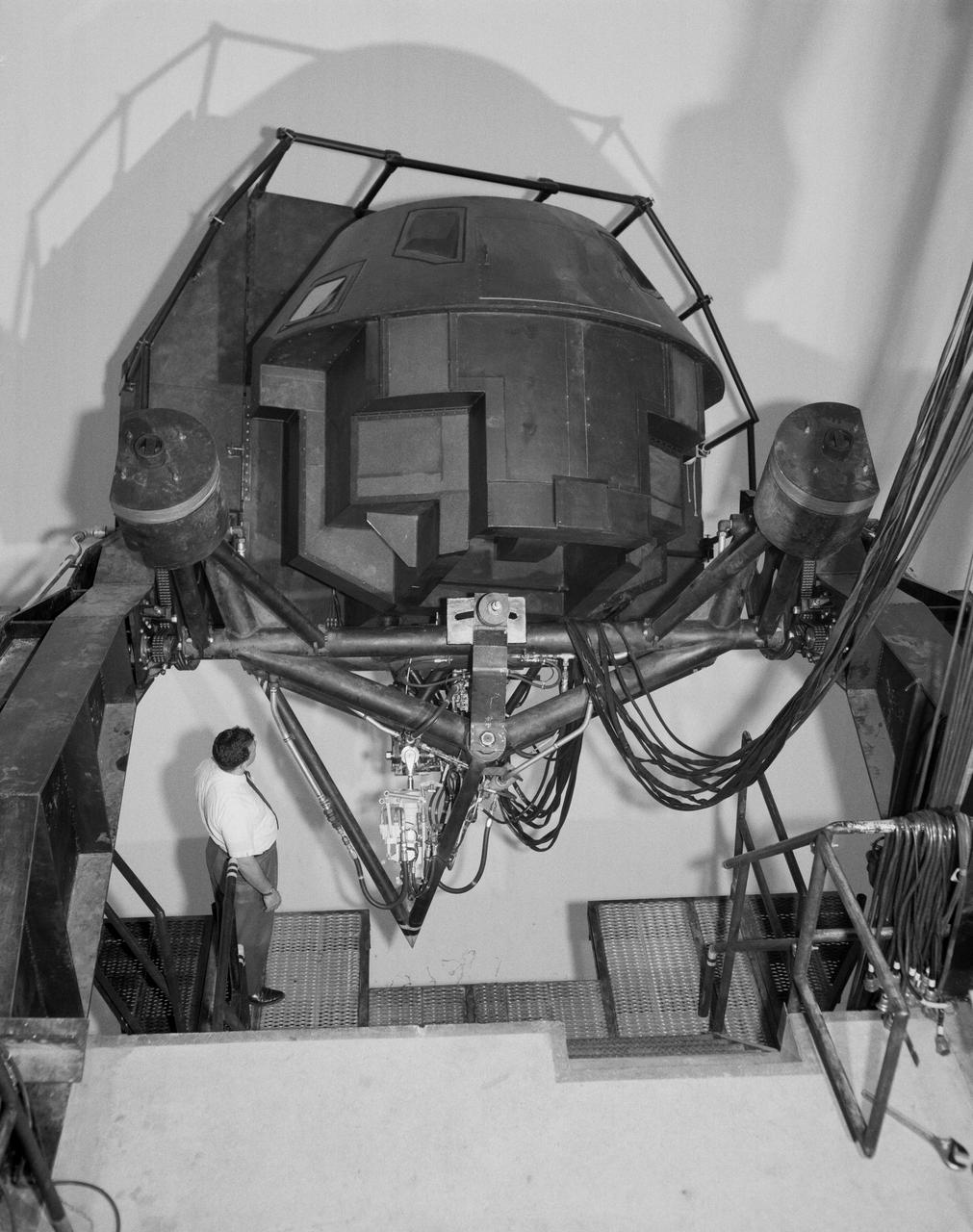
S66-21296 (1967) --- This is a medium exterior view of the Dynamic Crew Procedures Trainer, Command Module configuration, one of the Apollo astronaut training components located in the Mission Simulation and Training Facility, Building 5, Manned Spacecraft Center, Houston, Texas. Photo credit: NASA
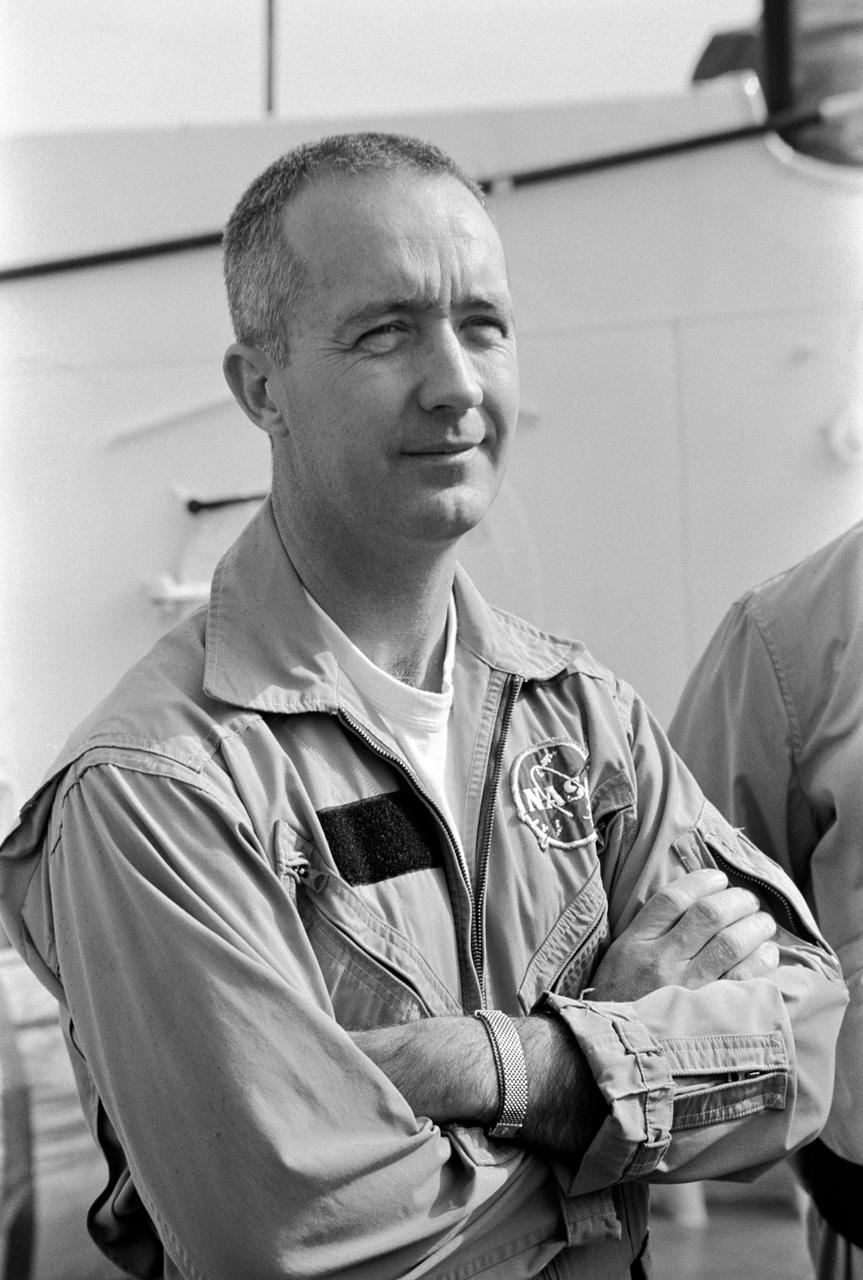
S68-54805 (5 Nov. 1968) --- Astronaut James A. McDivitt, commander of the Apollo 9 (Spacecraft 104/Lunar Module 3/Saturn 504) space mission, relaxes on the deck of the NASA Motor Vessel Retriever (MVR) prior to participating in water egress training in the Gulf of Mexico.
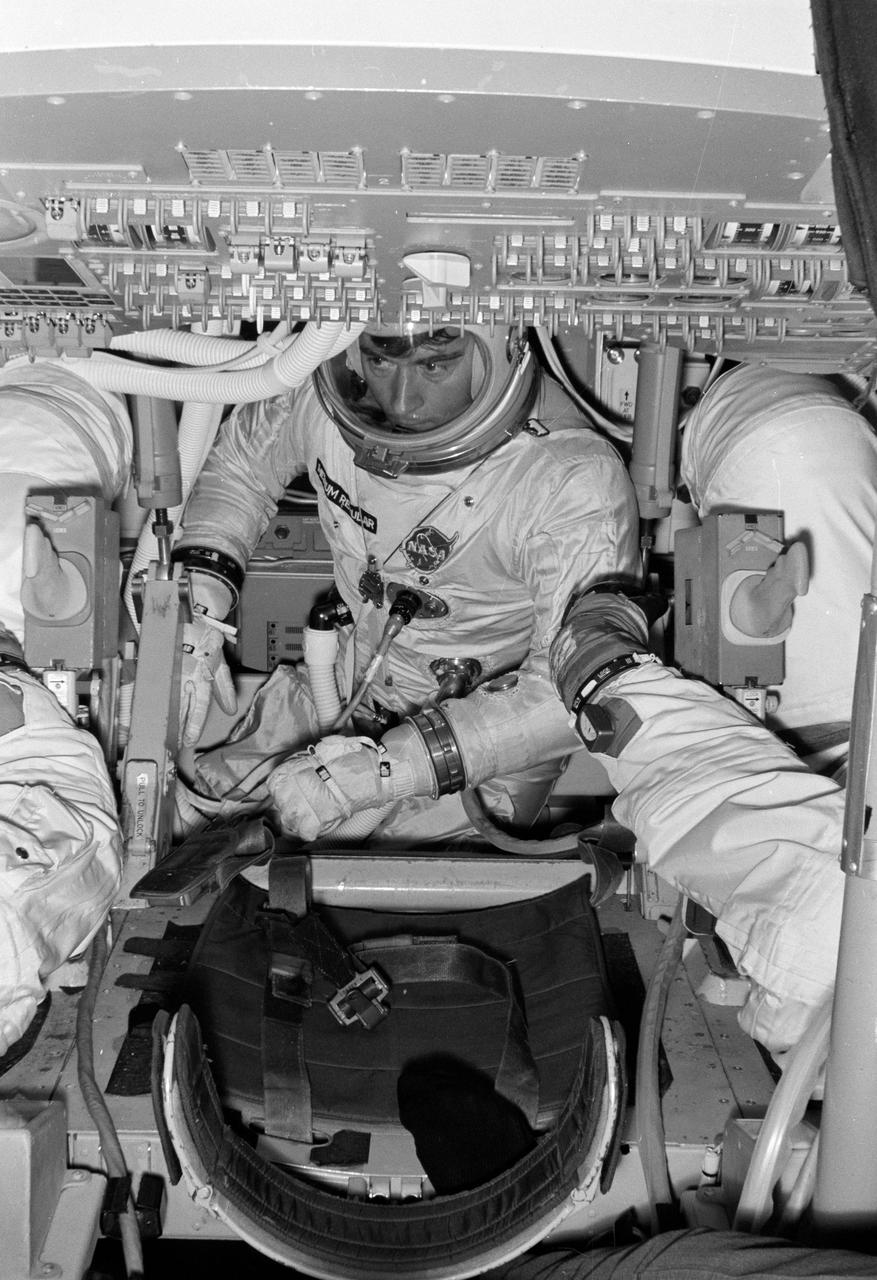
S68-15979 (15 Jan. 1968) --- Astronaut John W. Young, command module pilot, inside the Command Module Simulator in Building 5 during an Apollo Simulation. Out of view are astronaut Thomas P. Stafford (on the left), commander; and astronaut Eugene A. Cernan (on the right), lunar module pilot.
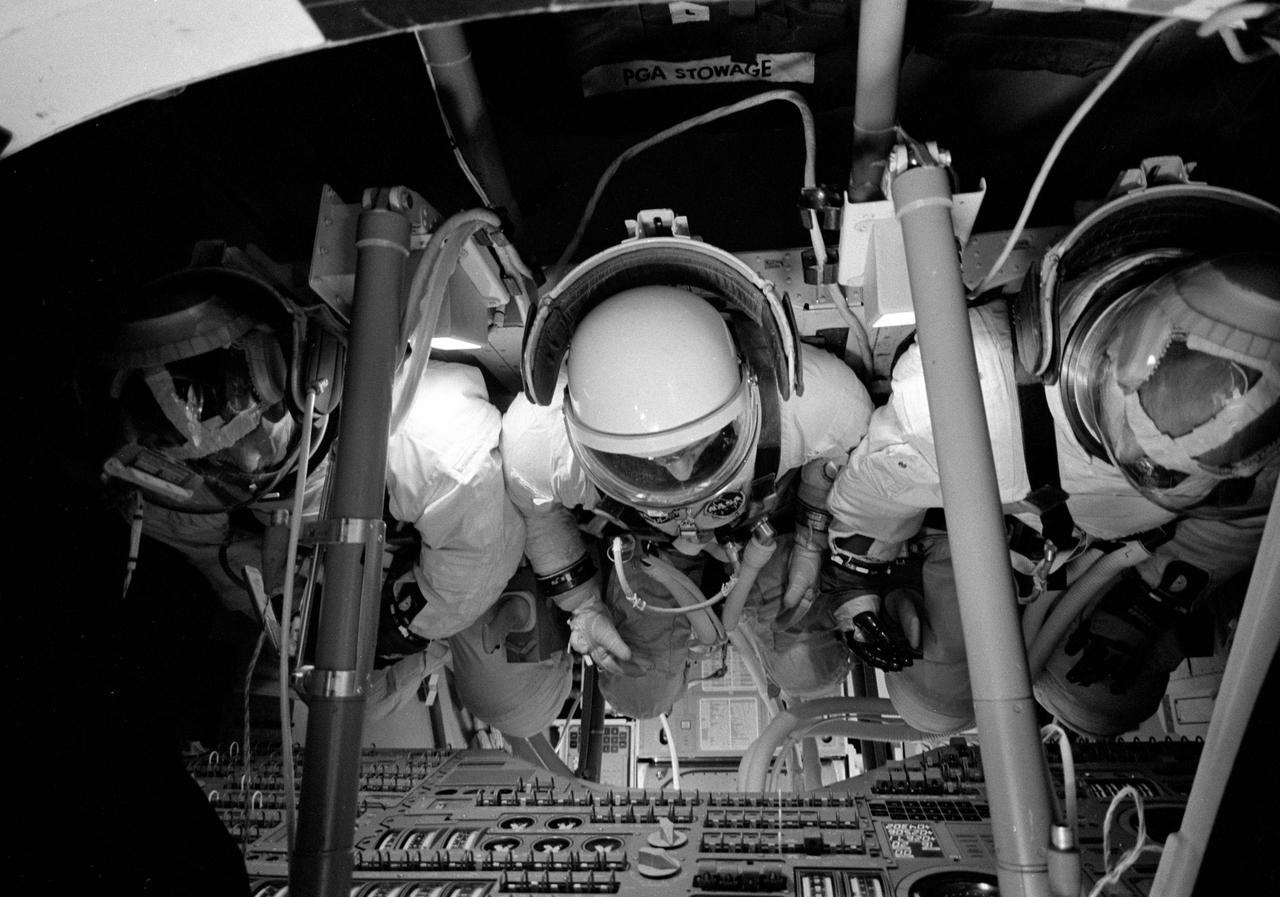
S68-15952 (15 Jan. 1968) --- Three astronauts inside the Command Module Simulator in Building 5 during an Apollo Simulation. Left to right, are astronauts Thomas P. Stafford, commander; John W. Young, command module pilot; and Eugene A. Cernan, lunar module pilot.
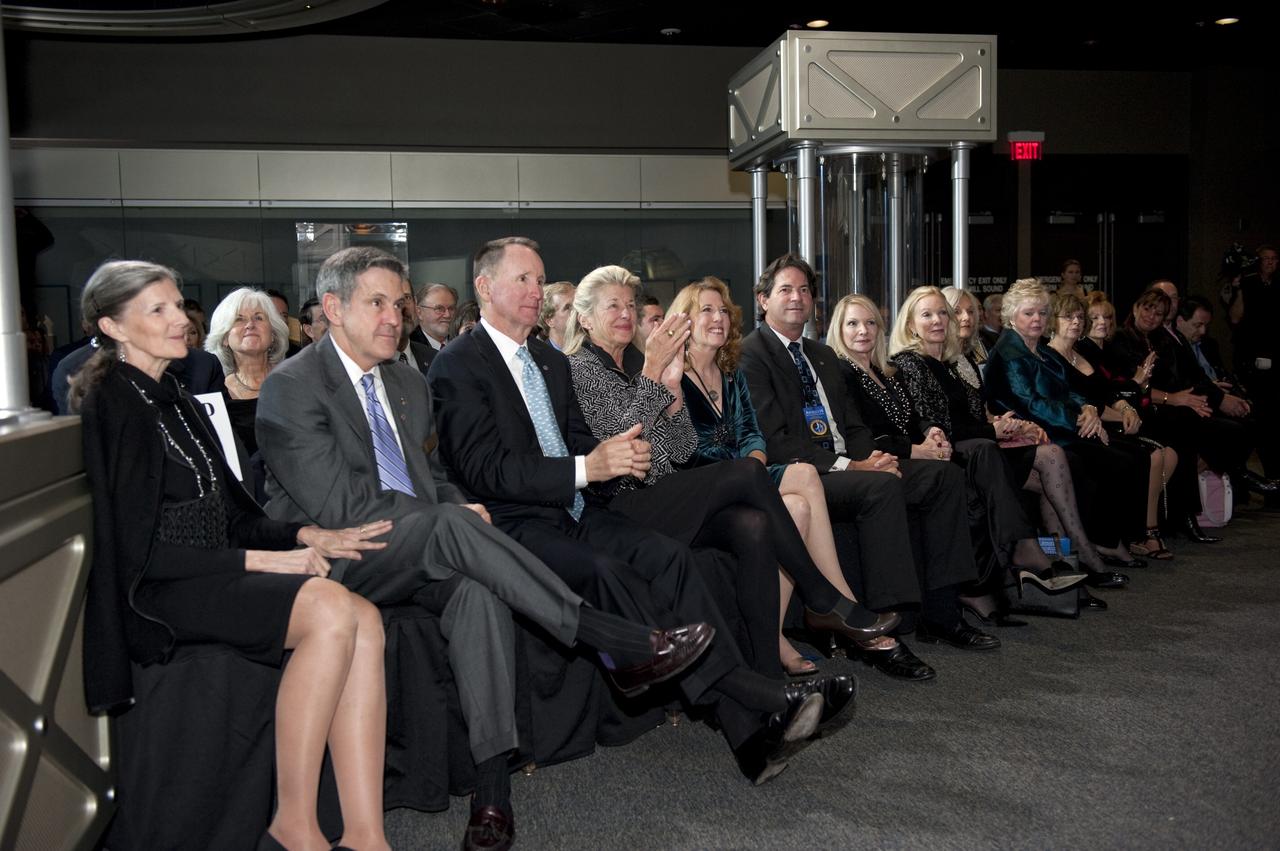
CAPE CANAVERAL, Fla. -- The Astronaut Scholarship Foundation helps celebrate the 40th anniversary of Apollo 14's lunar landing, which occurred Feb. 5, 1971, with a soiree at the Kennedy Space Center Visitor Complex's Saturn V Center. Photo credit: NASA/Kim Shiflett
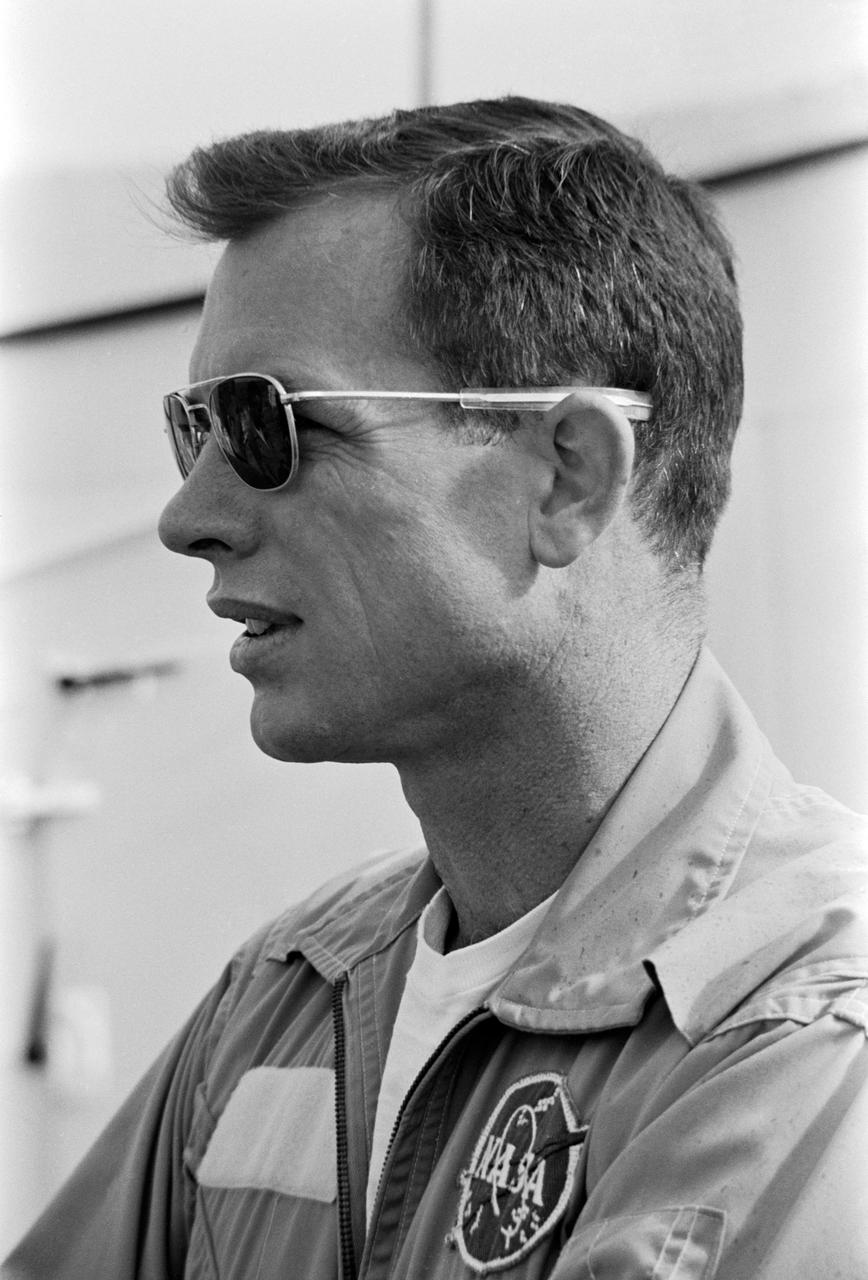
S68-54810 (5 Nov. 1968) --- Astronaut David R. Scott, command module pilot of the Apollo 9 (Spacecraft 104/Lunar Module 3/Saturn 504) space mission, relaxes on the deck of the NASA Motor Vessel Retriever prior to participating in water egress training in the Gulf of Mexico.
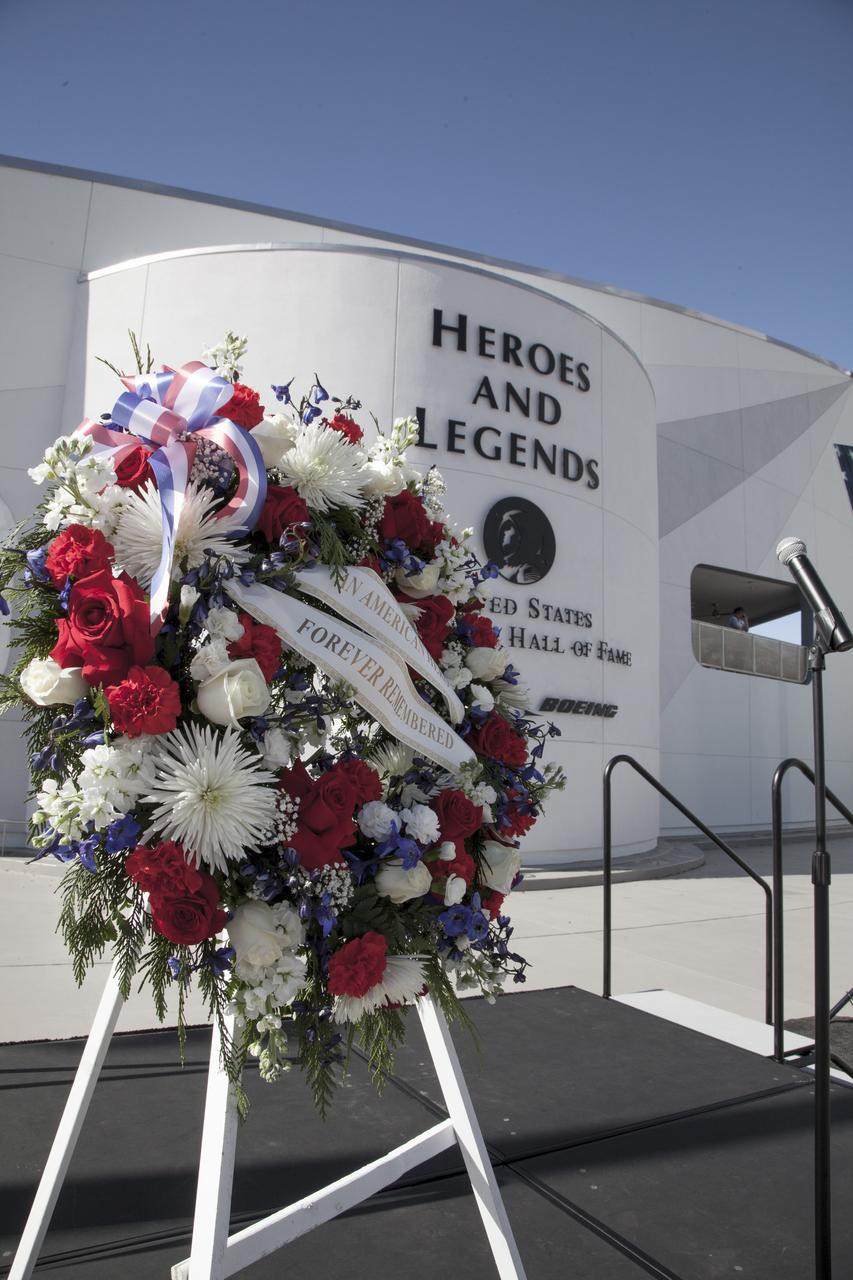
NASA astronaut John Young was remembered in a ceremony at the Heroes and Legends exhibit at the Kennedy Space Center Visitor Complex. The brief memorial took place on the afternoon of Jan. 11, 2018. Young died Jan. 5, 2018, in Houston at the age of 87. He was the only astronaut to fly in NASA's Gemini, Apollo and Space Shuttle Programs.
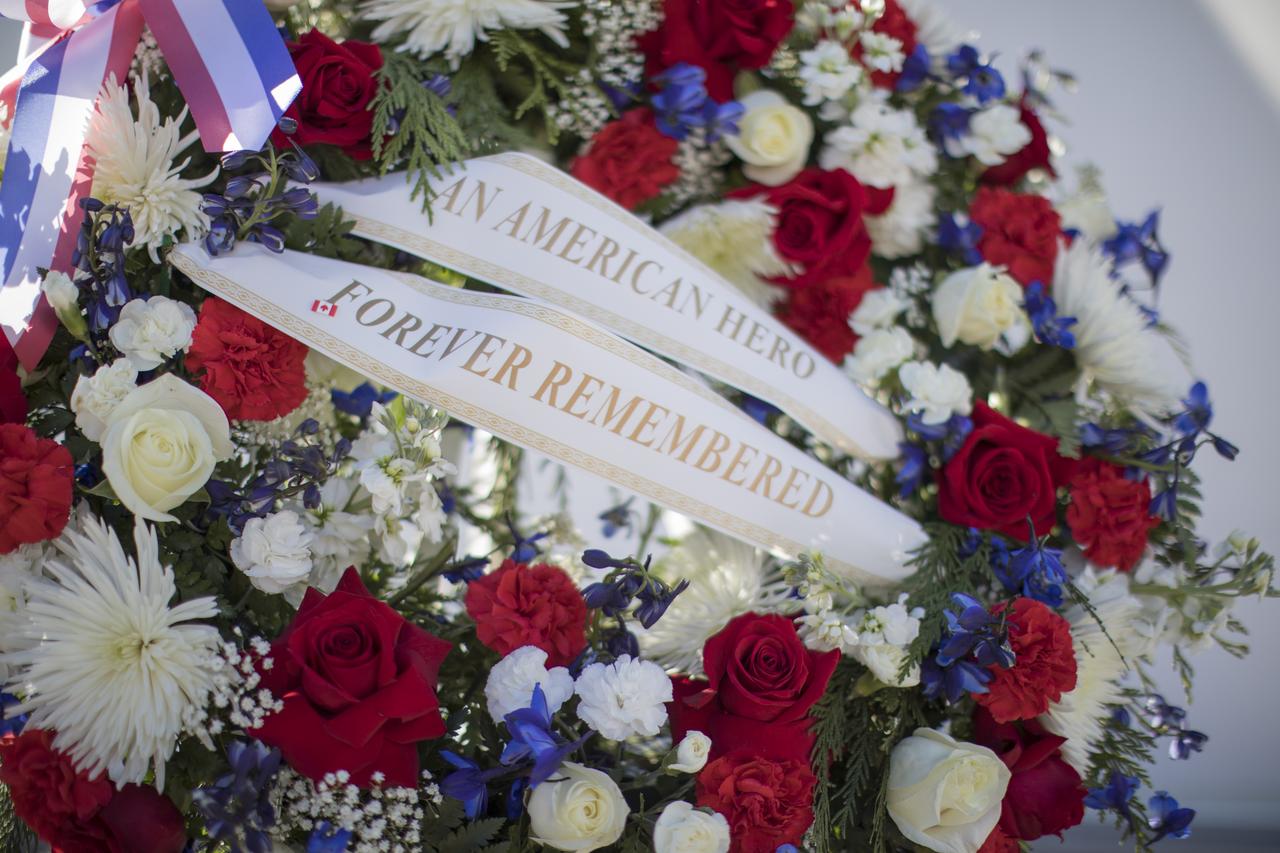
NASA astronaut John Young was remembered in a ceremony at the Heroes and Legends exhibit at the Kennedy Space Center Visitor Complex. The brief memorial took place on the afternoon of Jan. 11, 2018. Young died Jan. 5, 2018, in Houston at the age of 87. He was the only astronaut to fly in NASA's Gemini, Apollo and Space Shuttle Programs.
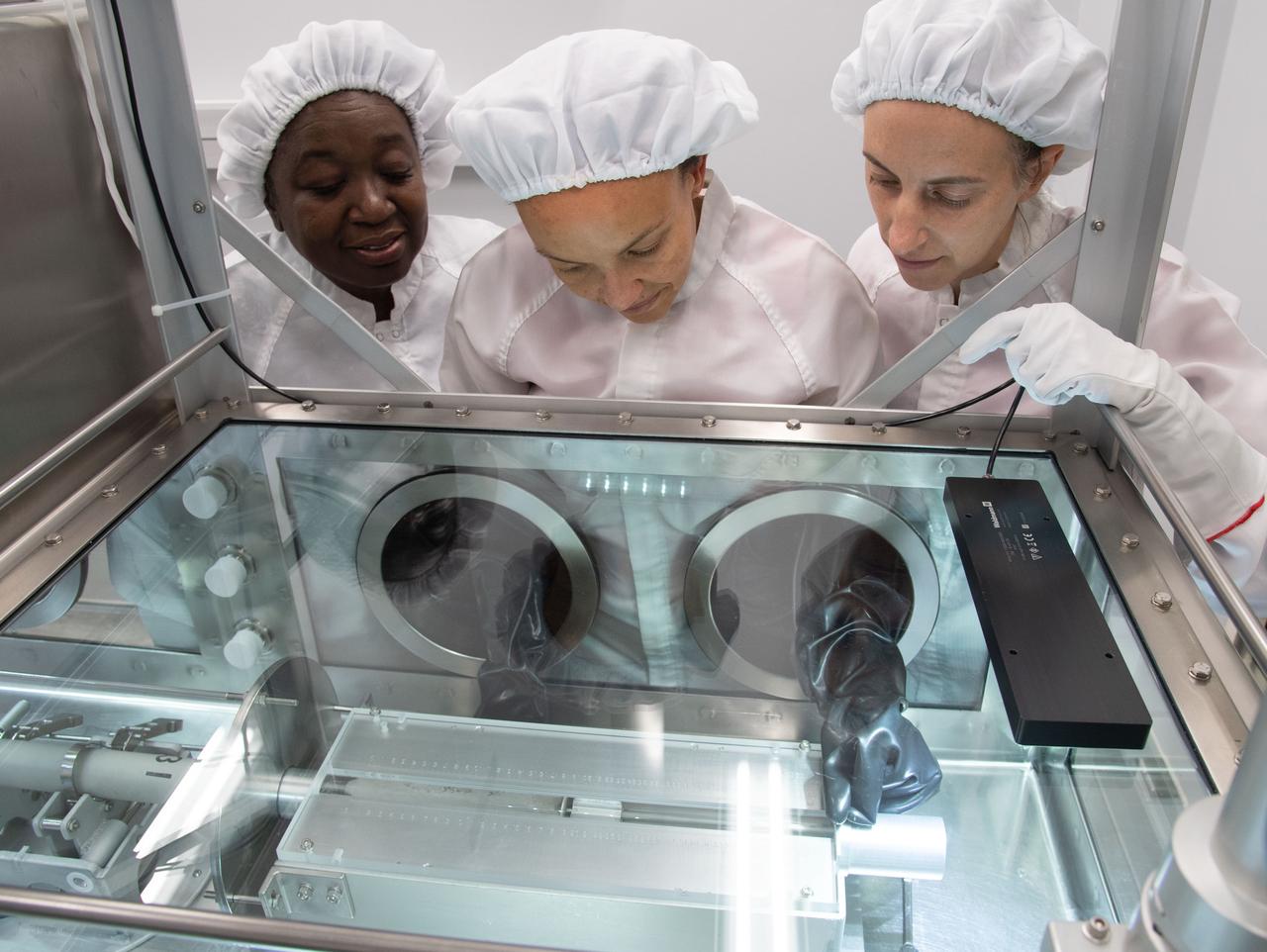
jsc2019e063626 (Nov. 5, 2019) --- (From left) Andria Mosie, Charis Krysher and Juliane Gross, lunar sample curators, extruding sample 73002 from its container in a glove box at NASA's Johnson Space Center. The extrusion, which occurred Nov. 5, 2019 at Johnson Space Center in Houston, was done as part of NASA’s Apollo Next-Generation Sample Analysis initiative.
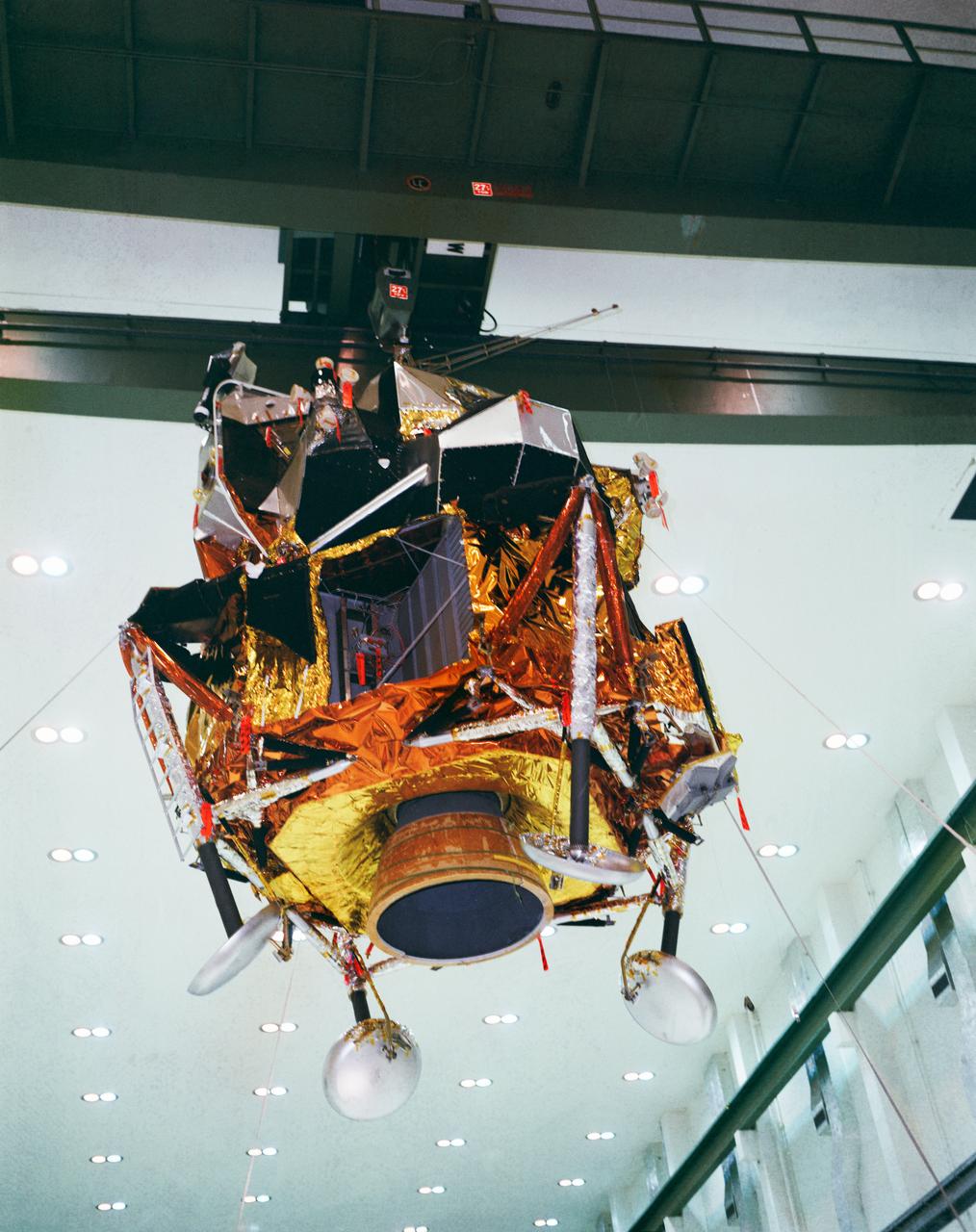
S69-32396 (4 April 1969) --- Interior view of the Kennedy Space Center's (KSC) Manned Spacecraft Operations Building showing Lunar Module (LM) 5 being moved from work stand for mating with its Spacecraft Lunar Module Adapter (SLA). LM-5 is scheduled to be flown on the Apollo 11 lunar landing mission.
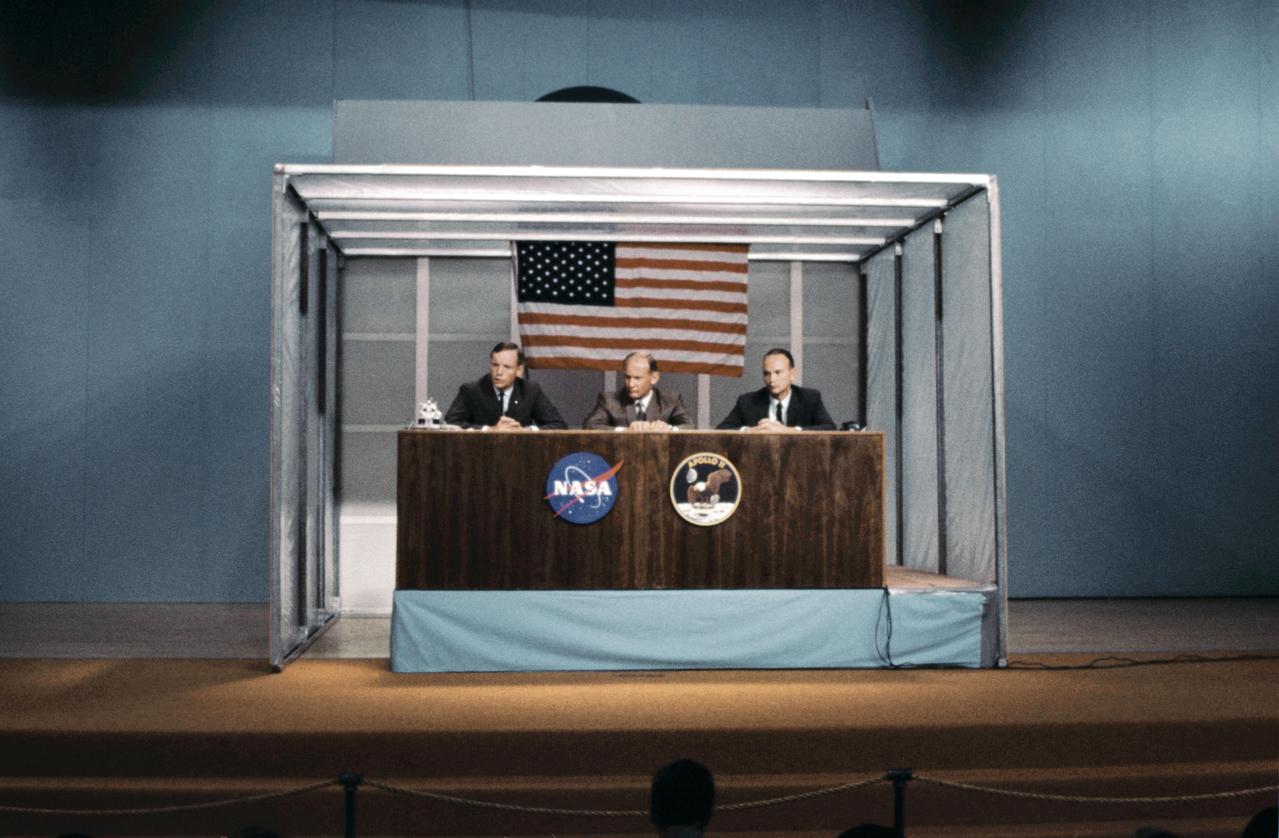
S69-38847 (5 July 1969) --- The three prime crewmen of the Apollo 11 lunar landing mission participate in a preflight press conference in the Building 1 auditorium on July 5, 1969. Left to right, are astronauts Neil A. Armstrong, commander; Edwin E. Aldrin Jr., lunar module pilot; and Michael Collins, command module pilot. The box-like enclosure surrounding the three astronauts was part of elaborate precautions in effect to reduce the possibility of exposing the crewmen to infectious disease in the preflight period.
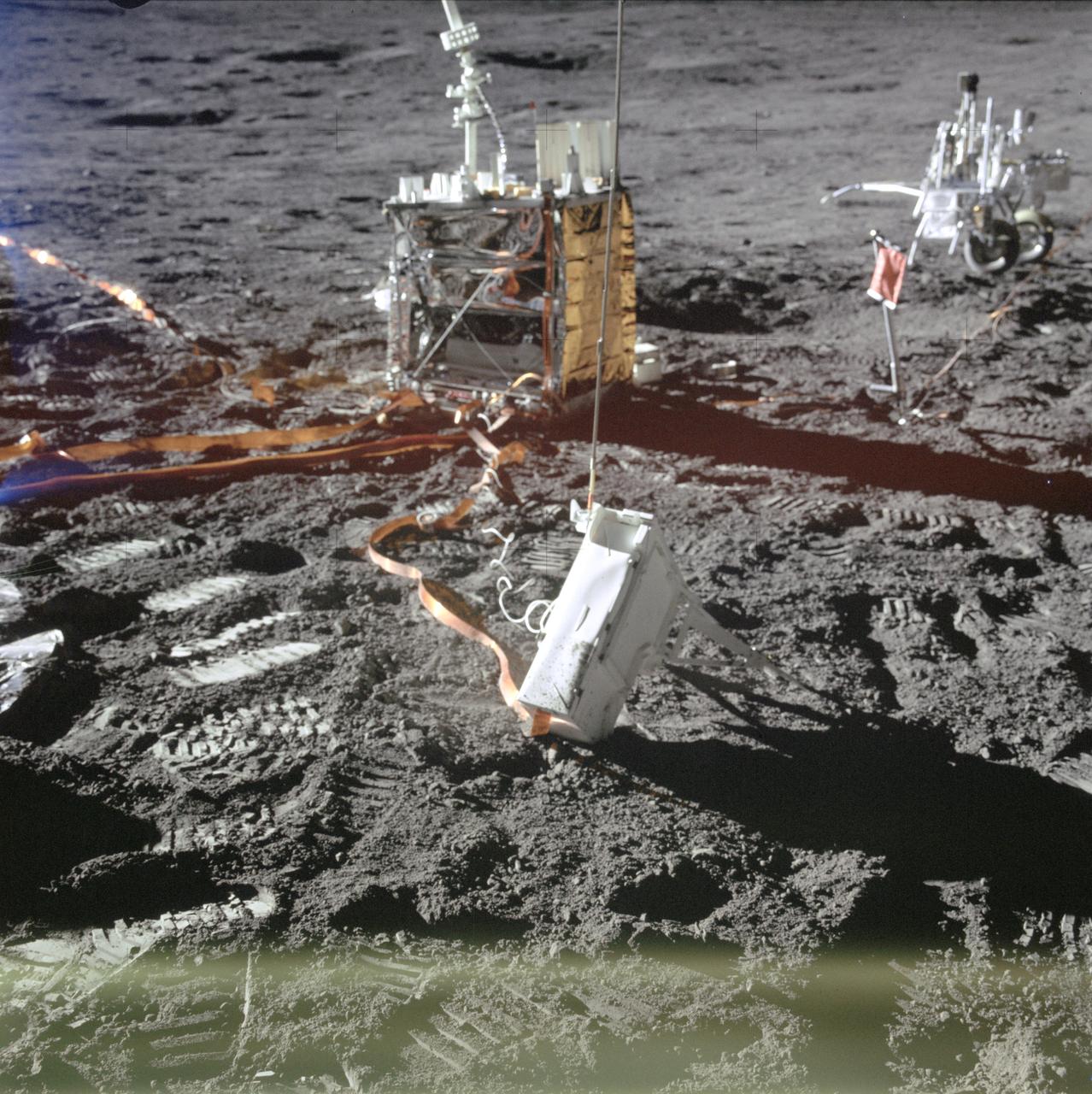
AS14-67-9361 (5 Feb. 1971) --- A close-up view of two components of the Apollo lunar surface experiments package (ALSEP) which the Apollo 14 astronauts deployed on the moon during their first extravehicular activity (EVA). In the center background is the ALSEP's central station (CS); and in the foreground is the mortar package assembly of the ALSEP's active seismic experiment (ASE). The modularized equipment transporter (MET) can be seen in the right background. While astronauts Alan B. Shepard Jr., commander, and Edgar D. Mitchell, lunar module pilot, descended in the Lunar Module (LM) to explore the moon, astronaut Stuart A. Roosa, command module pilot, remained with the Command and Service Modules (CSM) in lunar orbit.
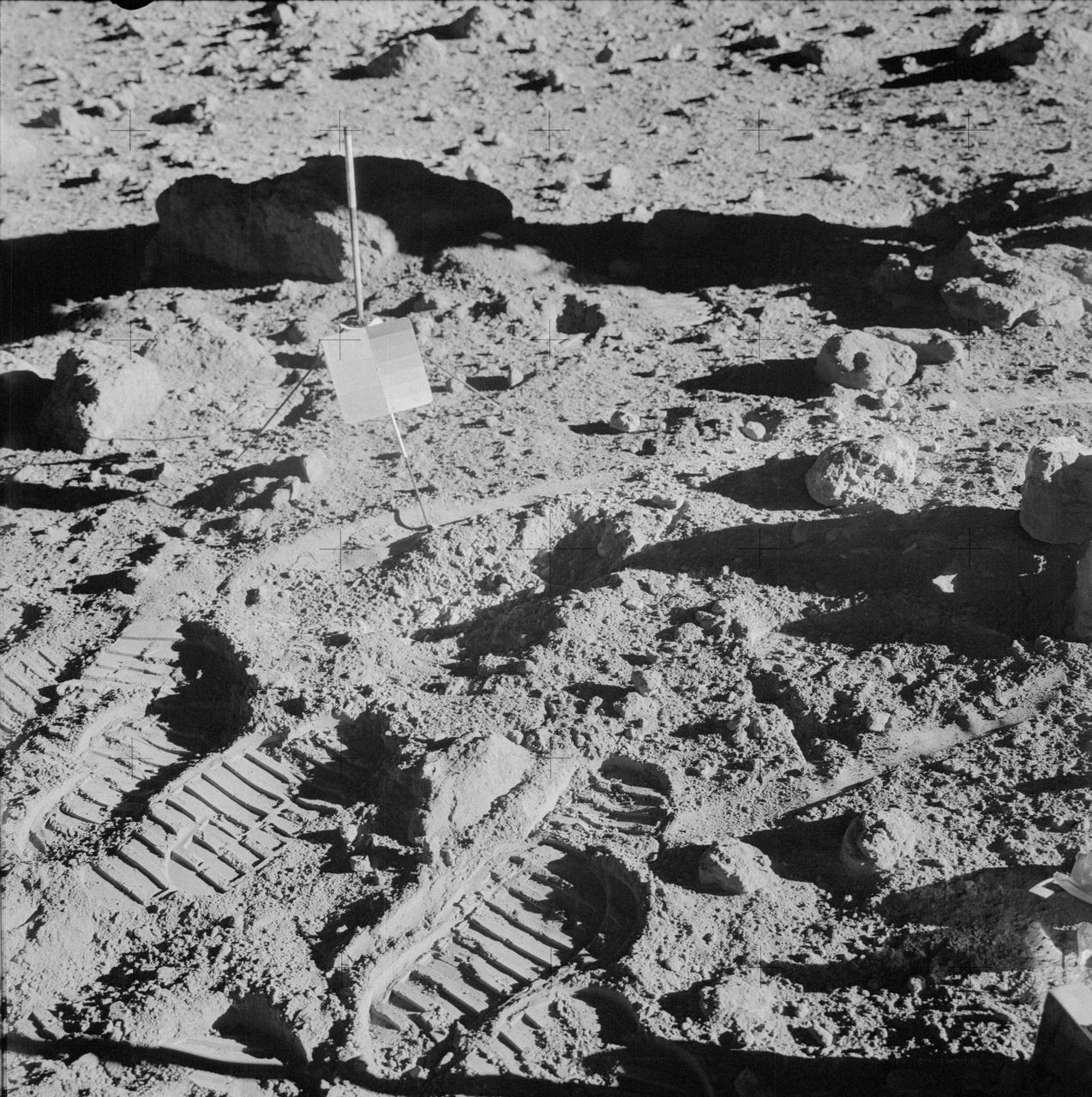
AS14-64-9127 (5-6 Feb. 1971) --- A close-up view of lunar soil, showing bootprints made by the Apollo 14 astronauts during extravehicular activity (EVA) on the lunar surface. Also visible are tracks made by the modularized equipment transporter (MET) and deployed gnomon. Astronauts Alan B. Shepard Jr., commander, and Edgar D. Mitchell, lunar module pilot, descended in the Apollo 14 Lunar Module (LM) to explore the moon, while astronaut Stuart A. Roosa, command module pilot, remained with the Command and Service Modules (CSM) in lunar orbit.
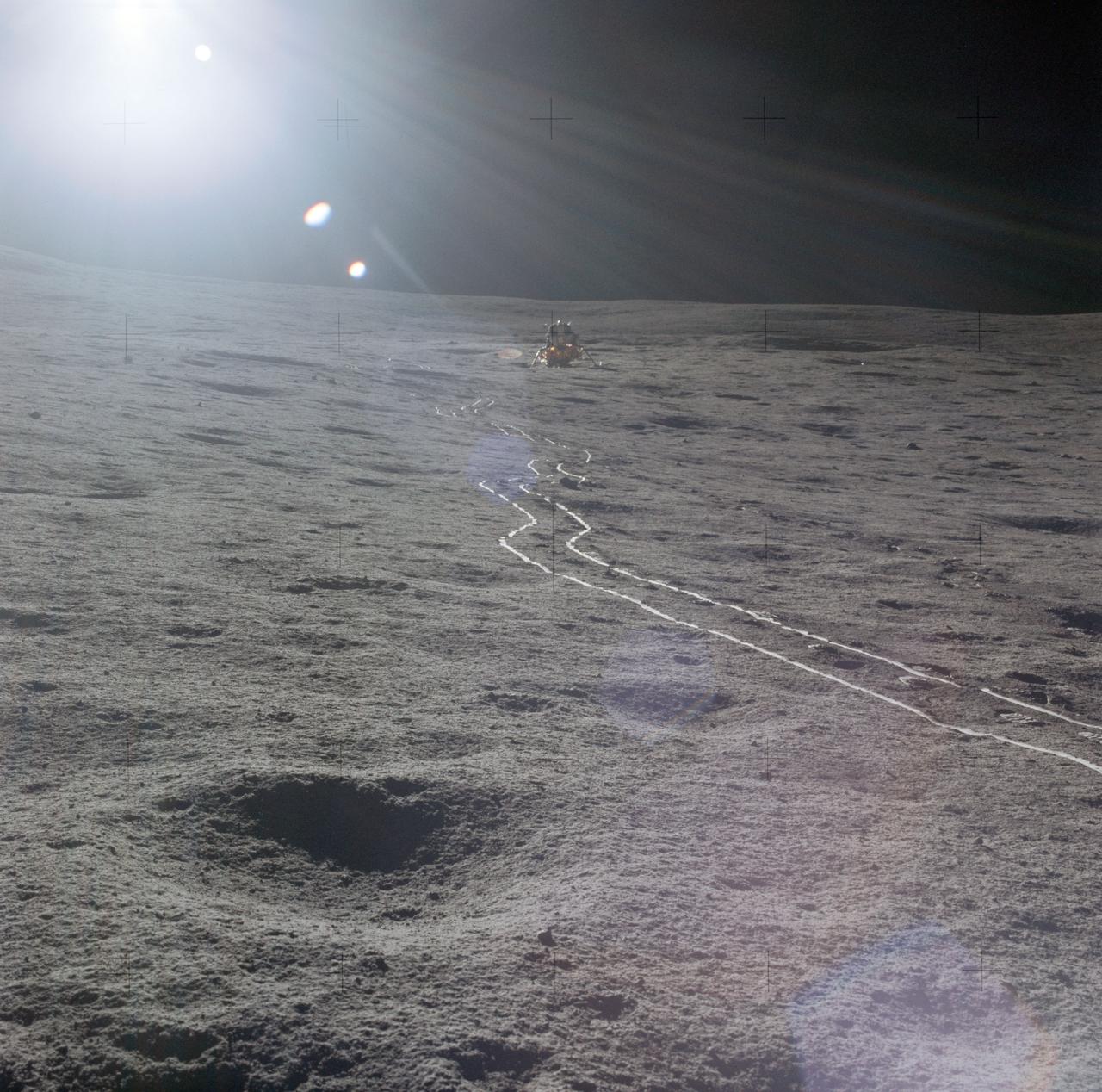
AS14-67-9367 (5 Feb. 1971) --- The Apollo 14 Lunar Module (LM) as seen by the two moon-exploring crewmen of the Apollo 14 lunar landing mission, photographed against a brilliant sun glare during the first extravehicular activity (EVA). A bright trail left in the lunar soil by the two-wheeled modularized equipment transporter (MET) leads from the LM. While astronauts Alan B. Shepard Jr., commander, and Edgar D. Mitchell, lunar module pilot, were exploring the moon, astronaut Stuart A. Roosa, command module pilot, was maneuvering the Command and Service Modules (CSM) in lunar orbit.
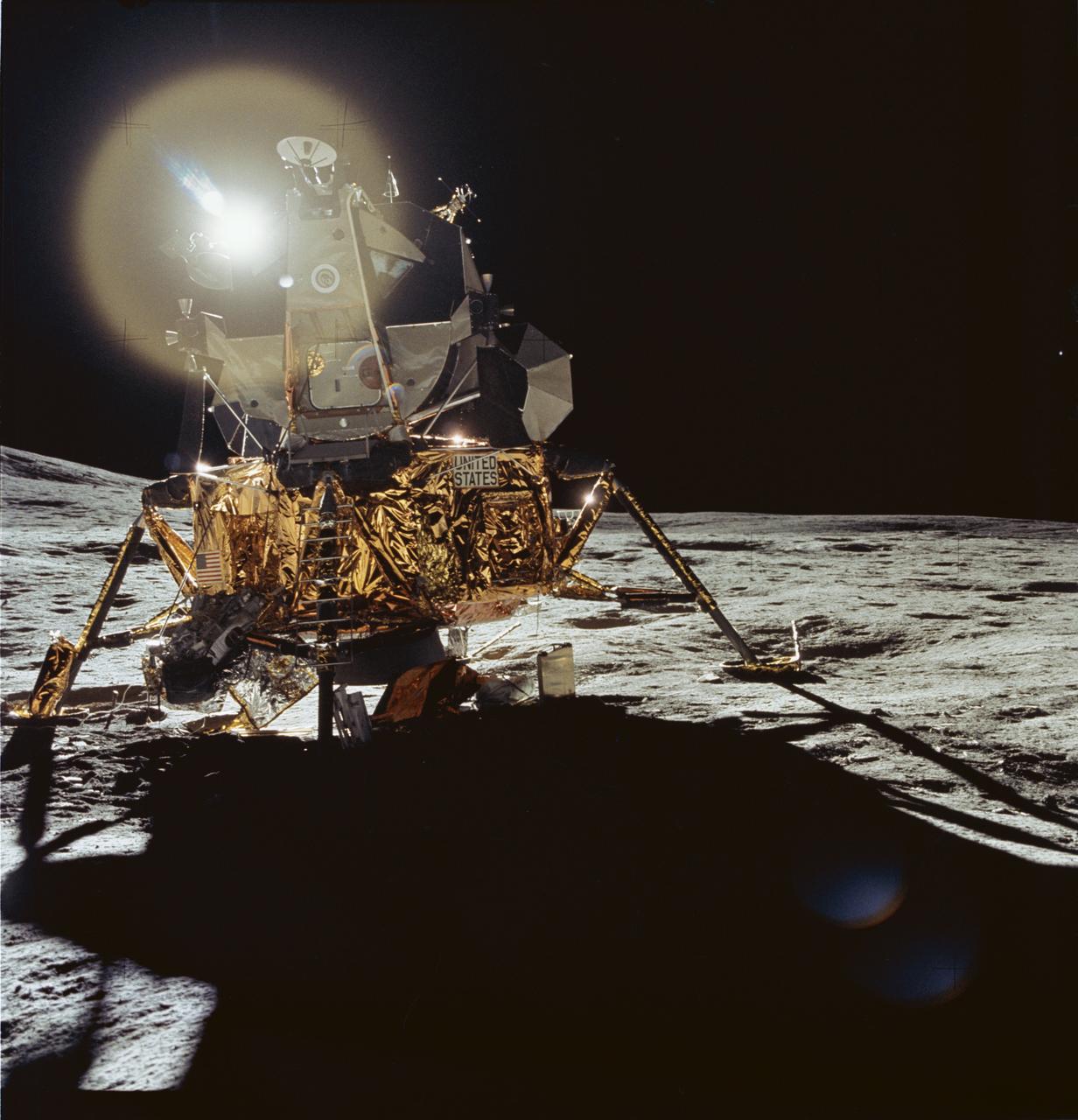
AS14-66-9306 (5 Feb. 1971) --- A front view of the Apollo 14 Lunar Module (LM), which reflects a circular flare caused by the brilliant sun, as seen by the two moon-exploring crew men of the Apollo 14 lunar landing mission during their first extravehicular activity (EVA). The unusual ball of light was said by the astronauts to have a jewel-like appearance. At the extreme left the lower slope of Cone Crater can be seen. Astronauts Alan B. Shepard Jr., commander; and Edgar D. Mitchell, lunar module pilot; descended in the LM, while astronaut Stuart A. Roosa, command module pilot; remained with the Command and Service Modules (CSM) in lunar orbit.
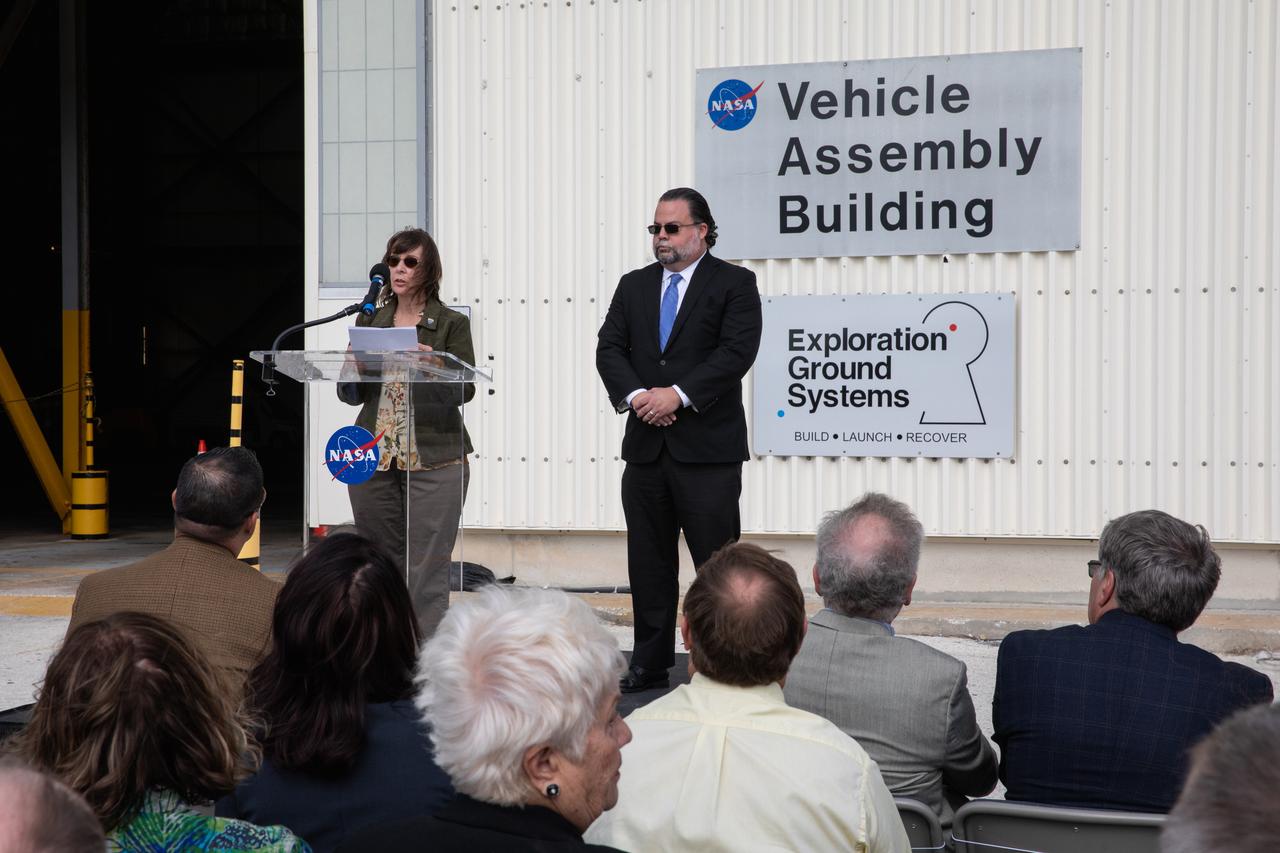
Carol Stevens, History and Heritage Committee member with the American Society of Civil Engineers (ASCE), speaks to attendees during a ceremony on Jan. 10, 2020, to recognize the Vehicle Assembly Building with the National Historic Civil Engineering Landmark award. At right is Peter Moore, ASCE Region 5 director. The Florida Section ASCE nominated the historic building and bestowed the award. The VAB is the first building at Kennedy Space Center to earn this distinction. At the time of its completion, the 129-million-cubic-foot structure was the largest building in the world. Originally designed and built to accommodate the Saturn V/Apollo used in Project Apollo, the VAB was later modified for its role in the Space Shuttle Program.
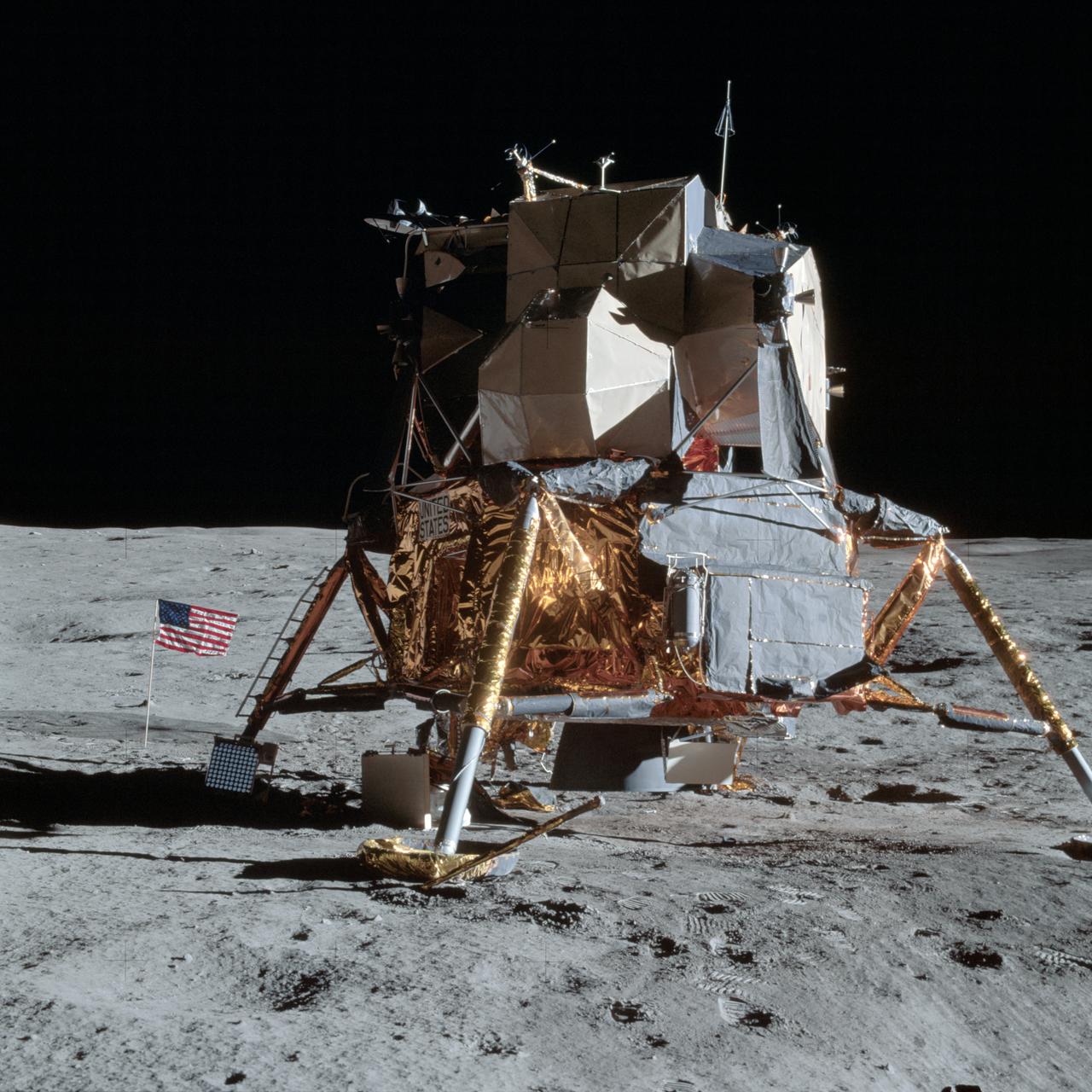
AS14-66-9277 (5 Feb. 1971) --- An excellent view of the Apollo 14 Lunar Module (LM) on the moon, as photographed during the first Apollo 14 extravehicular activity (EVA) on the lunar surface. The astronauts have already deployed the U.S. flag. Note the laser ranging retro reflector (LR-3) at the foot of the LM ladder. The LR-3 was deployed later. While astronauts Alan B. Shepard Jr., commander, and Edgar D. Mitchell, lunar module pilot, descended in the LM to explore the moon, astronaut Stuart A. Roosa, command module pilot, remained with the Command and Service Modules (CSM) in lunar orbit.
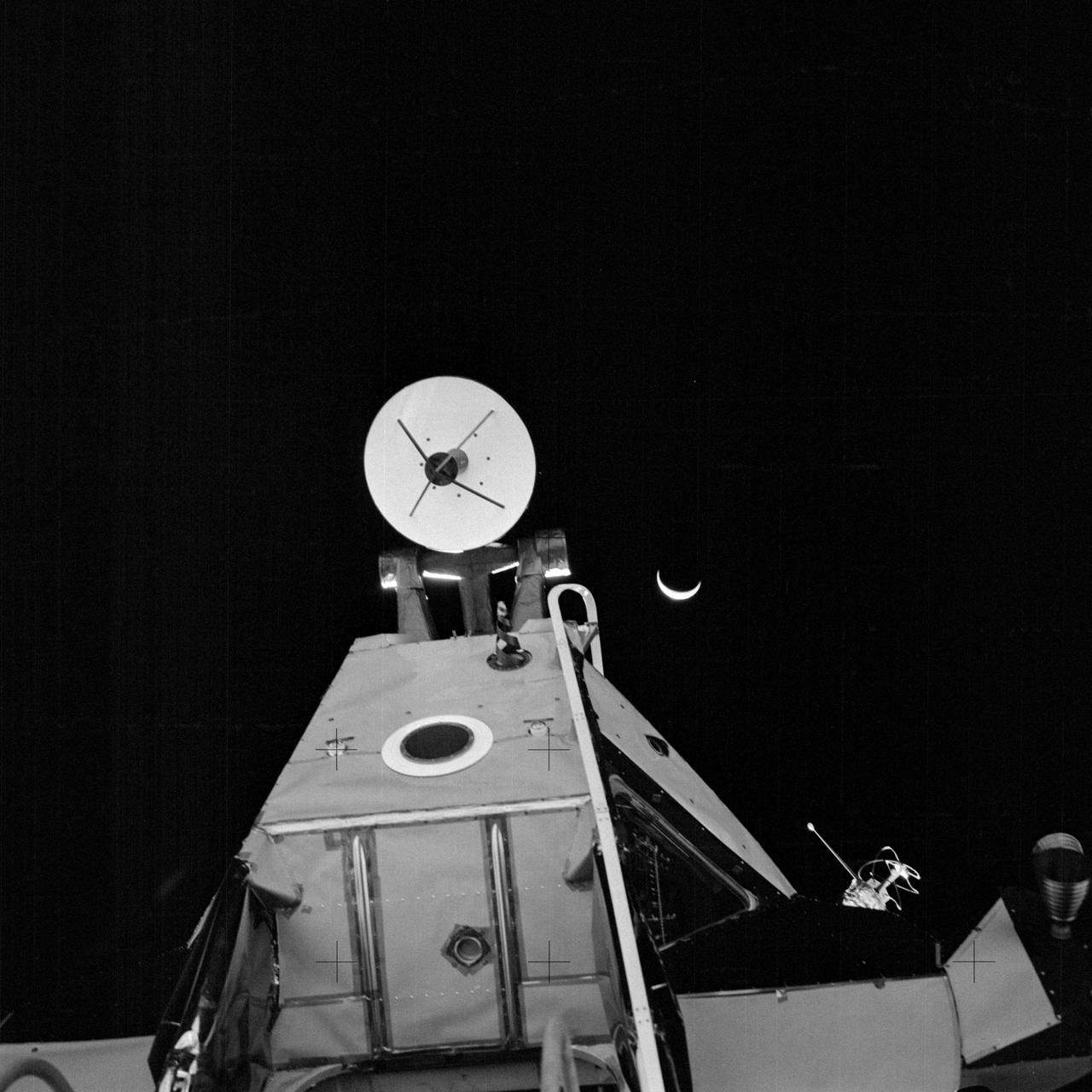
AS14-64-9193 (5 Feb. 1971) --- A close-up view of the forward section of the Apollo 14 Lunar Module (LM) ascent stage, looking upward from the LM ladder. This photograph was taken by one of the Apollo 14 astronauts at the close of their first extravehicular activity (EVA). The LM's ingress/egress hatch is just out of view at the bottom, near center. At the top center is the rendezvous radar antenna. An RCS thruster is visible at the far right. One of the two VHF antennas is on the right. The LM's optical alignment telescope is located at the black circle which has a wide, white ring around it. The crescent Earth can be seen in the far distant background.
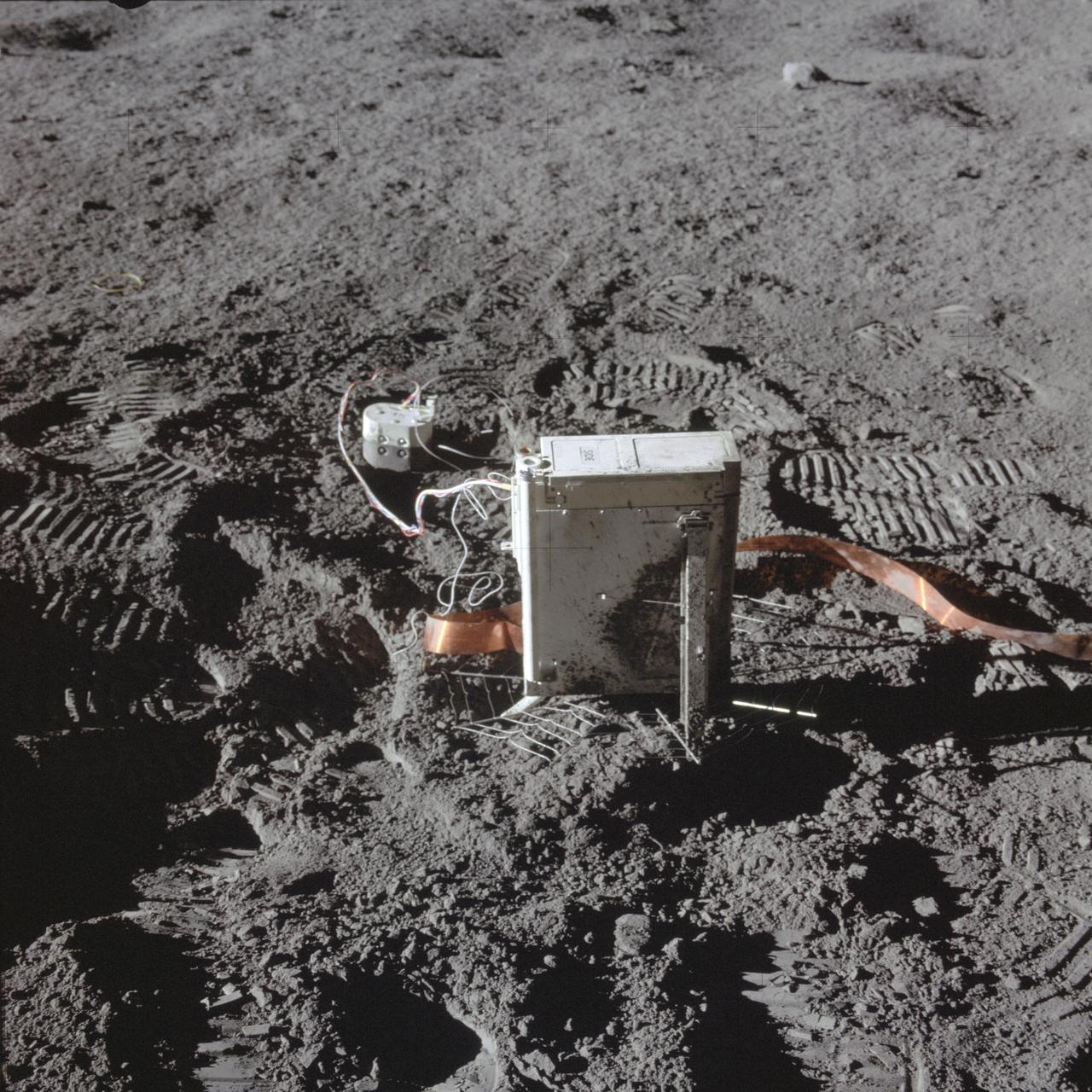
AS14-67-9369 (5 Feb. 1971) --- A close-up view of the Suprathermal ion detector experiment (SIDE), foreground, and cold cathode ion gauge (CCIG), smaller object in background, components of the Apollo lunar surface experiments package (ALSEP), which was deployed on the moon by the Apollo 14 astronauts during their first extravehicular activity (EVA). While astronauts Alan B. Shepard Jr. and Edgar D. Mitchell descended in the Lunar Module (LM) to explore the moon, astronaut Stuart A. Roosa remained with the Command and Service Modules (CSM) in lunar orbit.
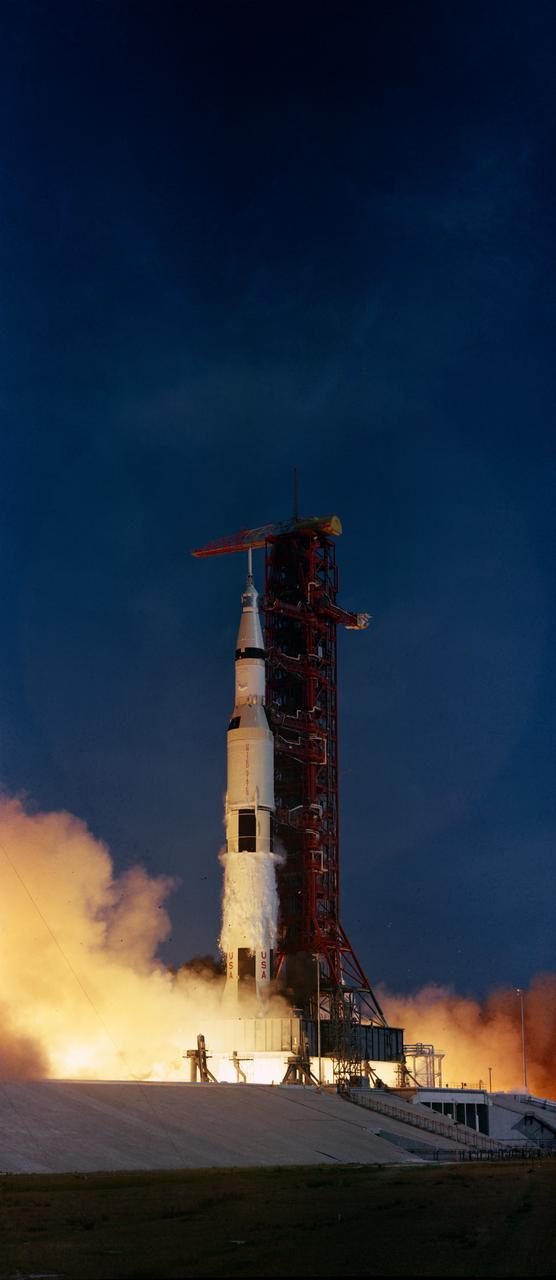
S69-39525 (16 July 1969) --- The huge, 363-feet tall Apollo 11 (Spacecraft 107/Lunar Module 5/Saturn 506) space vehicle is launched from Pad A, Launch Complex 39, Kennedy Space Center (KSC), at 9:32 a.m. (EDT), July 16, 1969. Onboard the Apollo 11 spacecraft were astronauts Neil A. Armstrong, commander; Michael Collins, command module pilot; and Edwin E. Aldrin Jr., lunar module pilot. Apollo 11 is the United States first lunar landing mission. While astronauts Armstrong and Aldrin descend in the Lunar Module (LM) "Eagle" to explore the Sea of Tranquility region of the moon, astronaut Collins will remain with the Command and Service Modules (CSM) "Columbia" in lunar orbit.
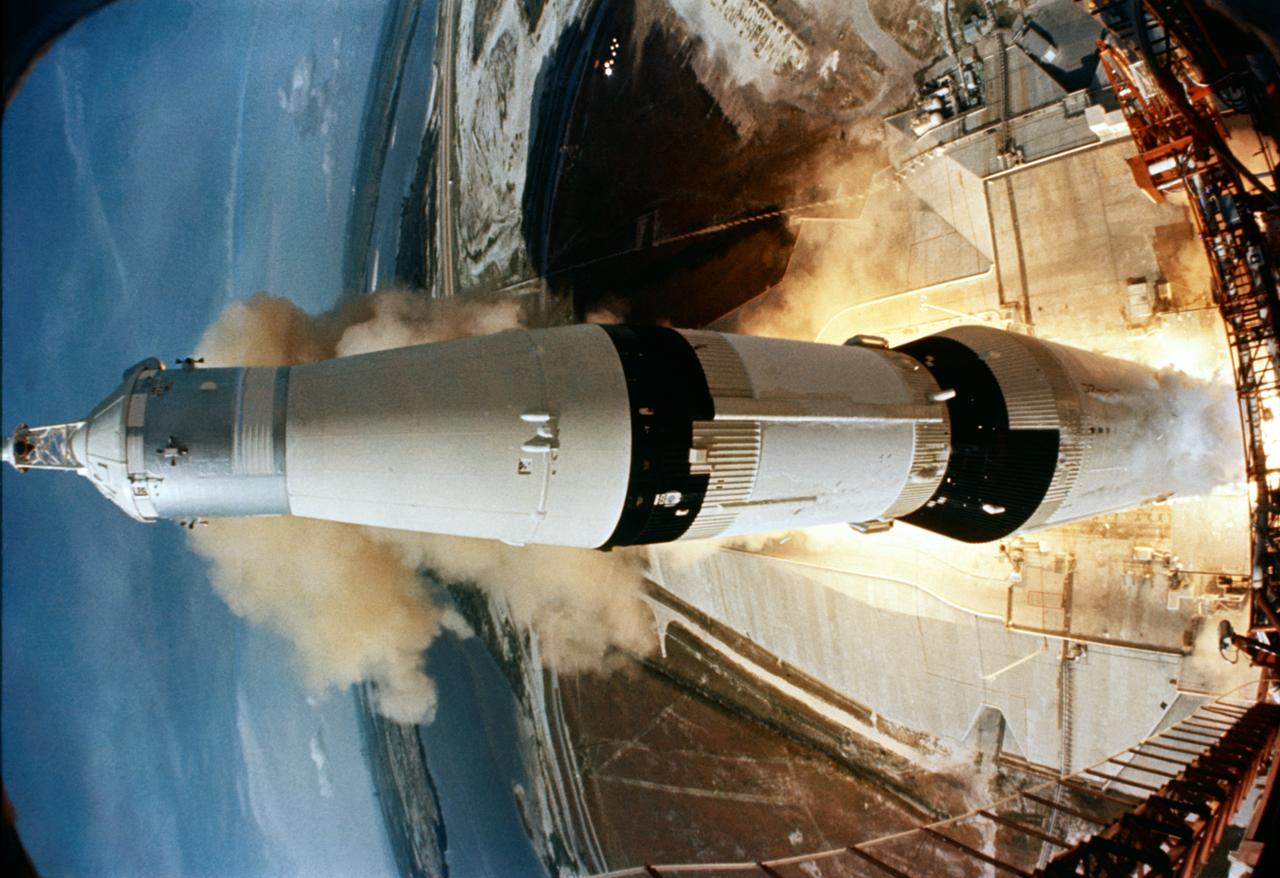
S69-39959 (16 July 1969) --- The huge, 363-feet tall Apollo 11 (Spacecraft 107/Lunar Module 5/ Saturn 506) space vehicle is launched from Pad A, Launch Complex 39, Kennedy Space Center (KSC), at 9:32 a.m. (EDT), July 16, 1969. Aboard the Apollo 11 spacecraft were astronauts Neil A. Armstrong, commander; Michael Collins, command module pilot; and Edwin E. Aldrin Jr., lunar module pilot. Apollo 11 is the United States' first lunar landing mission. This view of the liftoff was taken by a camera mounted on the mobile launch tower. While astronauts Armstrong and Aldrin descend in the Lunar Module (LM) "Eagle" to explore the Sea of Tranquility region of the moon, astronaut Collins will remain with the Command and Service Modules (CSM) "Columbia" in lunar orbit. Photo credit: NASA

S69-39526 (16 July 1969) --- The huge, 363-feet tall Apollo 11 (Spacecraft 107/Lunar Module 5/Saturn 506) space vehicle is launched from Pad A, Launch Complex 39 Kennedy Space Center (KSC), at 9:32 a.m. (EDT), July 16, 1969. Onboard the Apollo 11 spacecraft were astronauts Neil A. Armstrong, commander; Michael Collins, command module pilot; and Edwin E. Aldrin Jr., lunar module pilot. Apollo 11 is the United States first lunar landing mission. Astronauts Armstrong and Aldrin will descend in the Lunar Module (LM) "Eagle" to explore the Sea of Tranquility region of the moon, while astronaut Collins remains with the Command and Service Modules (CSM) "Columbia" in lunar orbit.

S69-39529 (16 July 1969) --- The huge, 363-feet tall Apollo 11 (Spacecraft 107/Lunar Module 5/Saturn 506) space vehicle is launched from Pad A, Launch Complex 39, Kennedy Space Center (KSC), at 9:32 a.m. (EDT), July 16, 1969. Onboard the Apollo 11 spacecraft were astronauts Neil A. Armstrong, commander; Michael Collins, command module pilot; and Edwin E. Aldrin Jr., lunar module pilot. Apollo 11 is the United States first lunar landing mission. While astronauts Armstrong and Aldrin descend in the Lunar Module (LM) "Eagle" to explore the Sea of Tranquility region of the moon, astronaut Collins will remain with the Command and Service Modules (CSM) "Columbia" in lunar orbit.
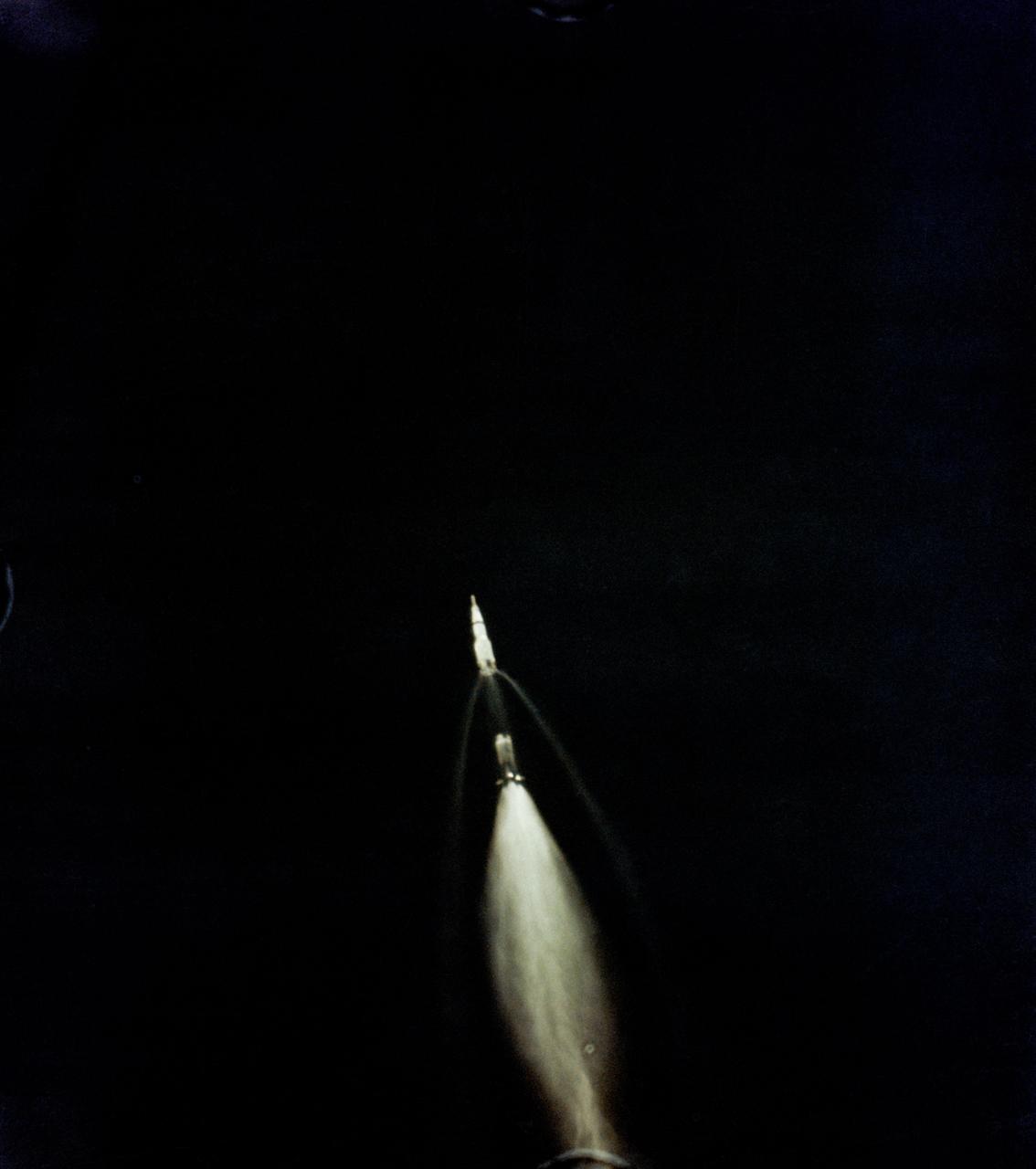
S69-39958 (16 July 1969) --- A 70mm Airborne Lightweight Optical Tracking System (ALOTS) camera, mounted in a pod on a cargo door of a U.S. Air Force EC-135N aircraft, photographed this event in the early moments of the Apollo 11 launch. The mated Apollo spacecraft and Saturn V second (S-II) and third (S-IVB) stages pull away from the expended first (S-1C) stage. Separation occurred at an altitude of about 38 miles, some 55 miles downrange from Cape Kennedy. The aircraft's pod is 20 feet long and 5 feet in diameter. The crew of the Apollo 11 lunar landing mission are astronauts Neil A. Armstrong, Michael Collins, and Edwin E. Aldrin Jr.

S69-39527 (16 July 1969) --- The huge, 363-feet tall Apollo 11 (Spacecraft 107/ Lunar Module 5/Saturn 506) space vehicle is launched from Pad A, Launch Complex 39, Kennedy Space Center (KSC), at 9:32 a.m. (EDT), July 16, 1969. Aboard the Apollo 11 spacecraft are astronauts Neil A. Armstrong, commander; Michael Collins, command module pilot; and Edwin E. Aldrin Jr., lunar module pilot. Apollo 11 is the United States' first lunar landing mission. While Armstrong and Aldrin descend in the Lunar Module (LM) "Eagle" to explore the Sea of Tranquility region of the moon, astronaut Collins will remain with the Command and Service Modules (CSM) "Columbia" in lunar orbit.
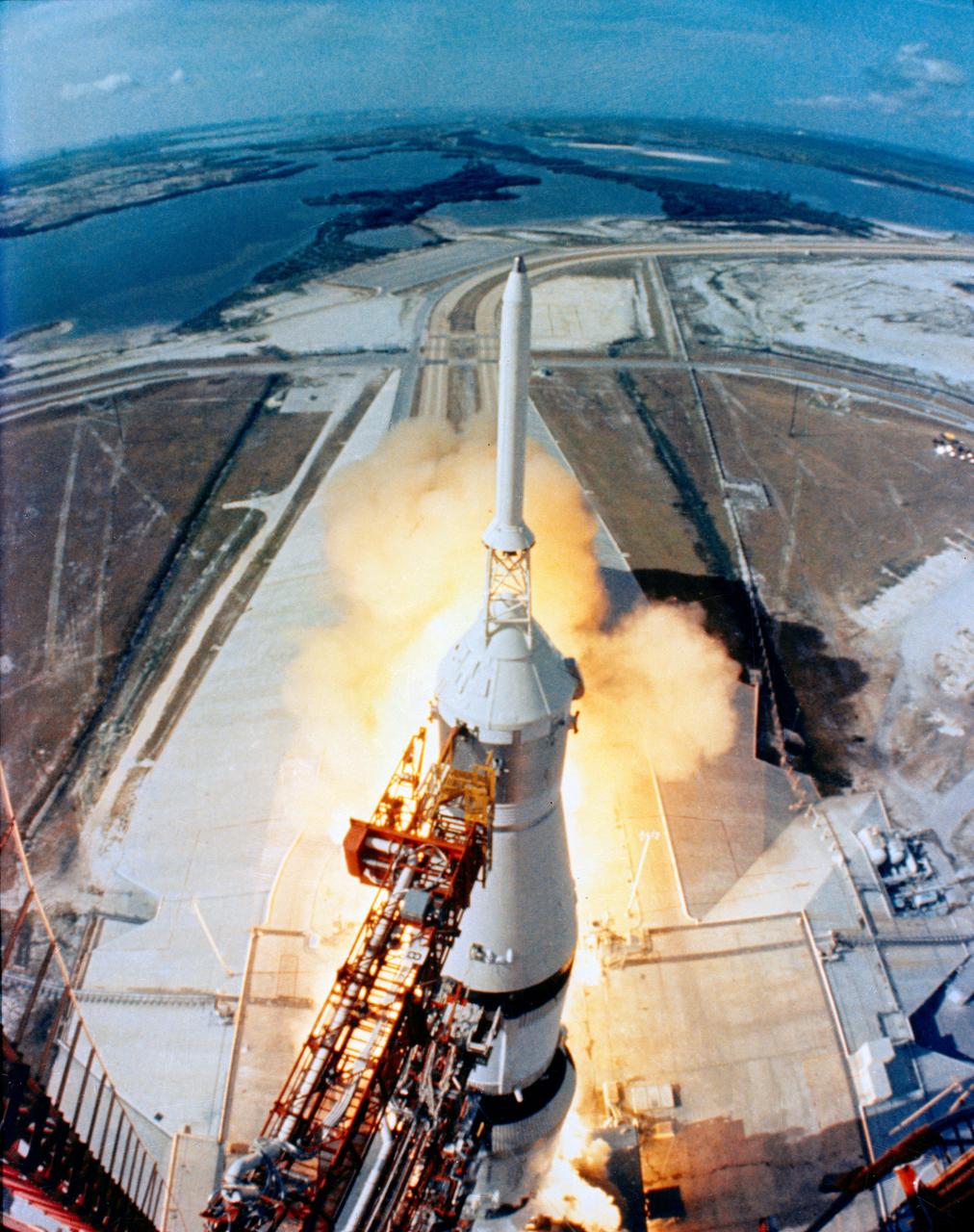
S69-39962 (16 July 1969) --- The huge, 363-feet tall Apollo 11 (Spacecraft 107/Lunar Module 5/Saturn 506) space vehicle is launched from Pad A, Launch Complex 39, Kennedy Space Center (KSC), at 9:32 a.m. (EDT), July 16, 1969. Aboard the Apollo 11 spacecraft were astronauts Neil A. Armstrong, commander; Michael Collins, command module pilot; and Edwin E. Aldrin Jr., lunar module pilot. Apollo 11 is the United States' first lunar landing mission. This view of the liftoff was taken by a camera mounted on the mobile launch tower. While astronauts Armstrong and Aldrin descend in the Lunar Module (LM) "Eagle" to explore the Sea of Tranquility region of the moon, astronaut Collins will remain with the Command and Service Modules (CSM) "Columbia" in lunar orbit.
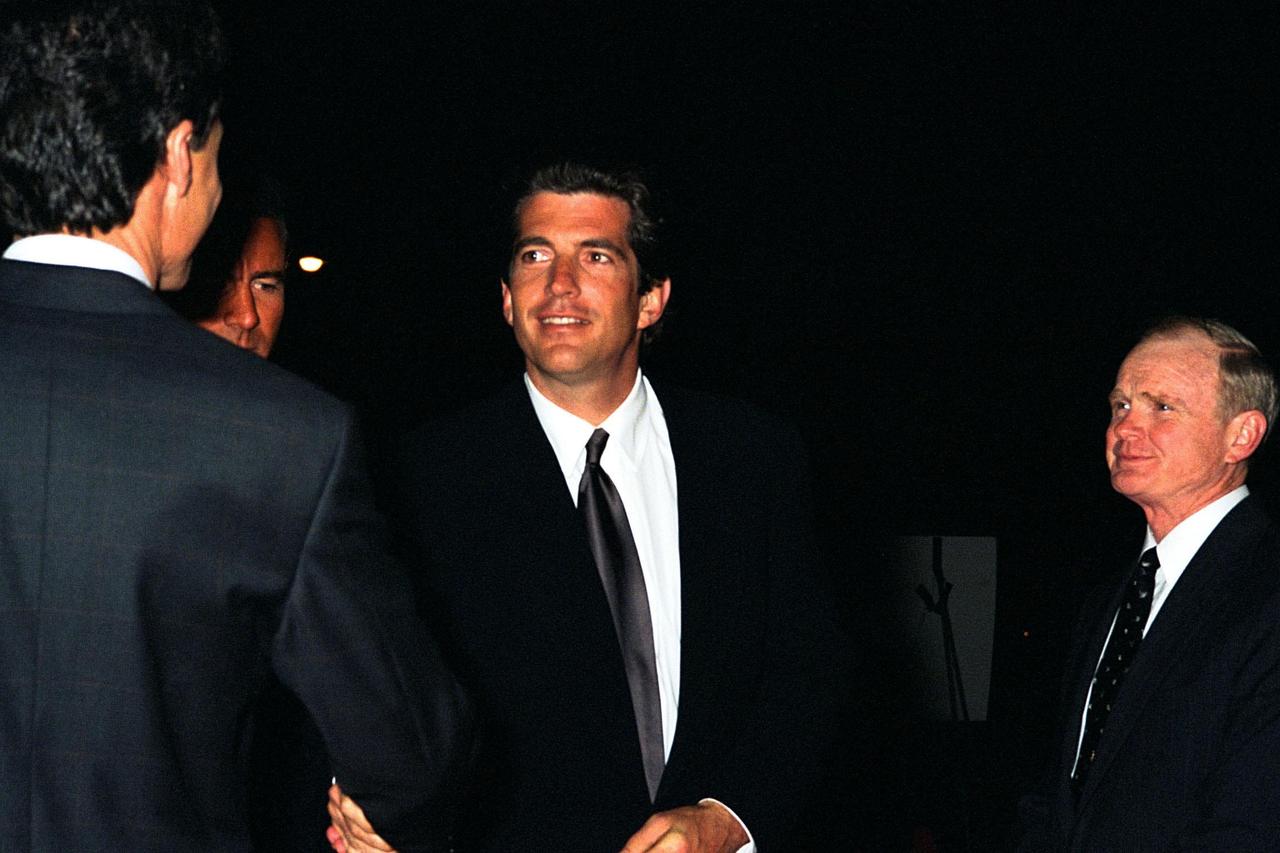
KENNEDY SPACE CENTER, FLA. -- John F. Kennedy Jr., editor-in-chief of George Magazine, greets invited guests at the Home Box Office (HBO) and Imagine Entertainment premiere of the 12-part miniseries "From the Earth to the Moon" at Kennedy Space Center (KSC). The series was filmed in part on location at KSC and dramatizes the human aspects of NASA's efforts to launch Americans to the Moon. The miniseries highlights NASA's Apollo program and the events leading up to and including the six successful missions to the Moon. A special 500-seat theater was constructed next to the Apollo/Saturn V Center for the KSC premiere showing. Speakers at the event included KSC Director Roy Bridges (at right); Jeff Bewkes, chairman and CEO for HBO; and John F. Kennedy Jr. Also attending the event, which featured the episode entitled "1968," were Buzz Aldrin, Apollo 11 astronaut, and Al Worden, Apollo 15 astronaut. The original miniseries event, created for HBO by actor Tom Hanks and Imagine Entertainment, will premiere on HBO beginning April 5, 1998
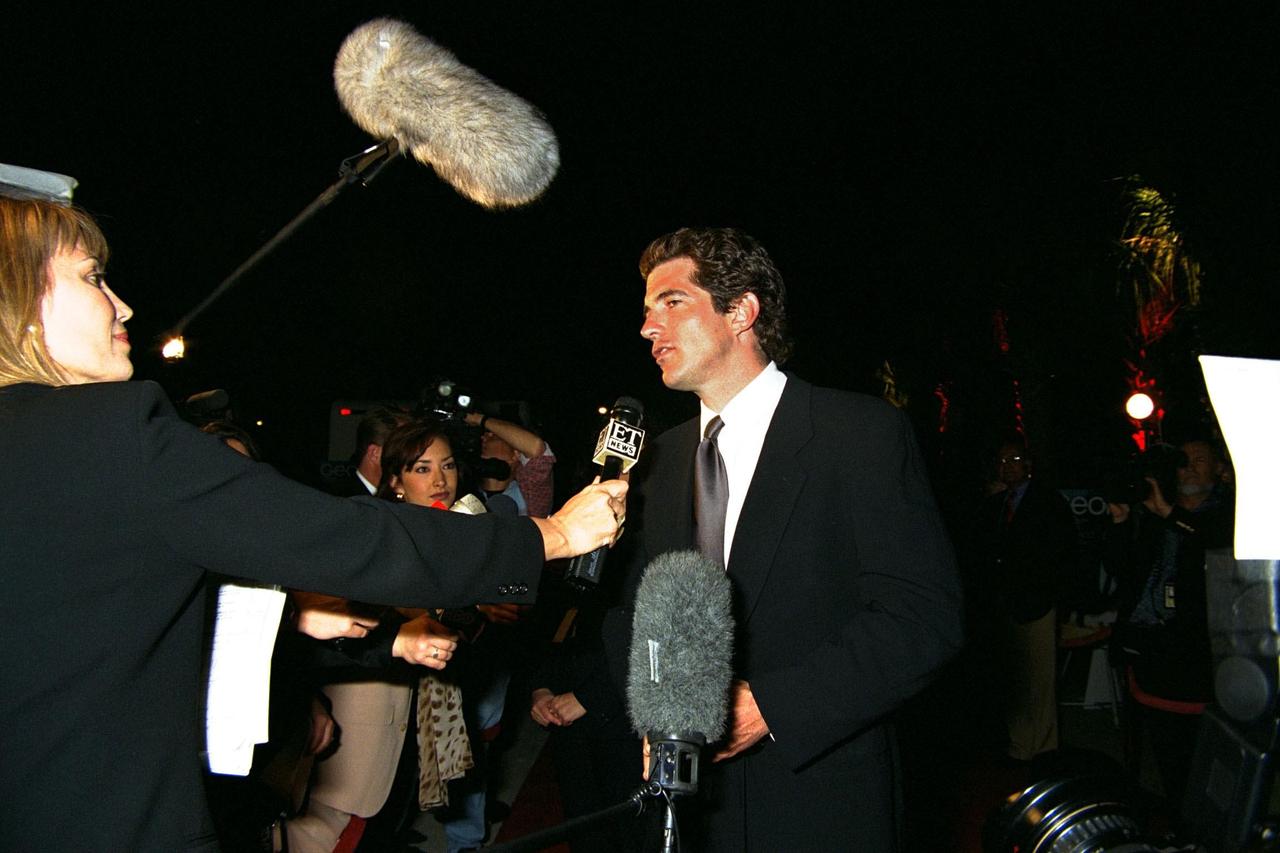
KENNEDY SPACE CENTER, FLA. -- John F. Kennedy Jr., editor-in-chief of George Magazine, speaks with members of the national media at the Home Box Office (HBO) and Imagine Entertainment premiere of the 12-part miniseries "From the Earth to the Moon" at Kennedy Space Center (KSC). The series was filmed in part on location at KSC and dramatizes the human aspects of NASA's efforts to launch Americans to the Moon. The miniseries highlights NASA's Apollo program and the events leading up to and including the six successful missions to the Moon. A special 500-seat theater was constructed next to the Apollo/Saturn V Center for the KSC premiere showing. Speakers at the event included KSC Director Roy Bridges (at right); Jeff Bewkes, chairman and CEO for HBO; and John F. Kennedy Jr. Also attending the event, which featured the episode entitled "1968," were Buzz Aldrin, Apollo 11 astronaut, and Al Worden, Apollo 15 astronaut. The original miniseries event, created for HBO by actor Tom Hanks and Imagine Entertainment, will premiere on HBO beginning April 5, 1998
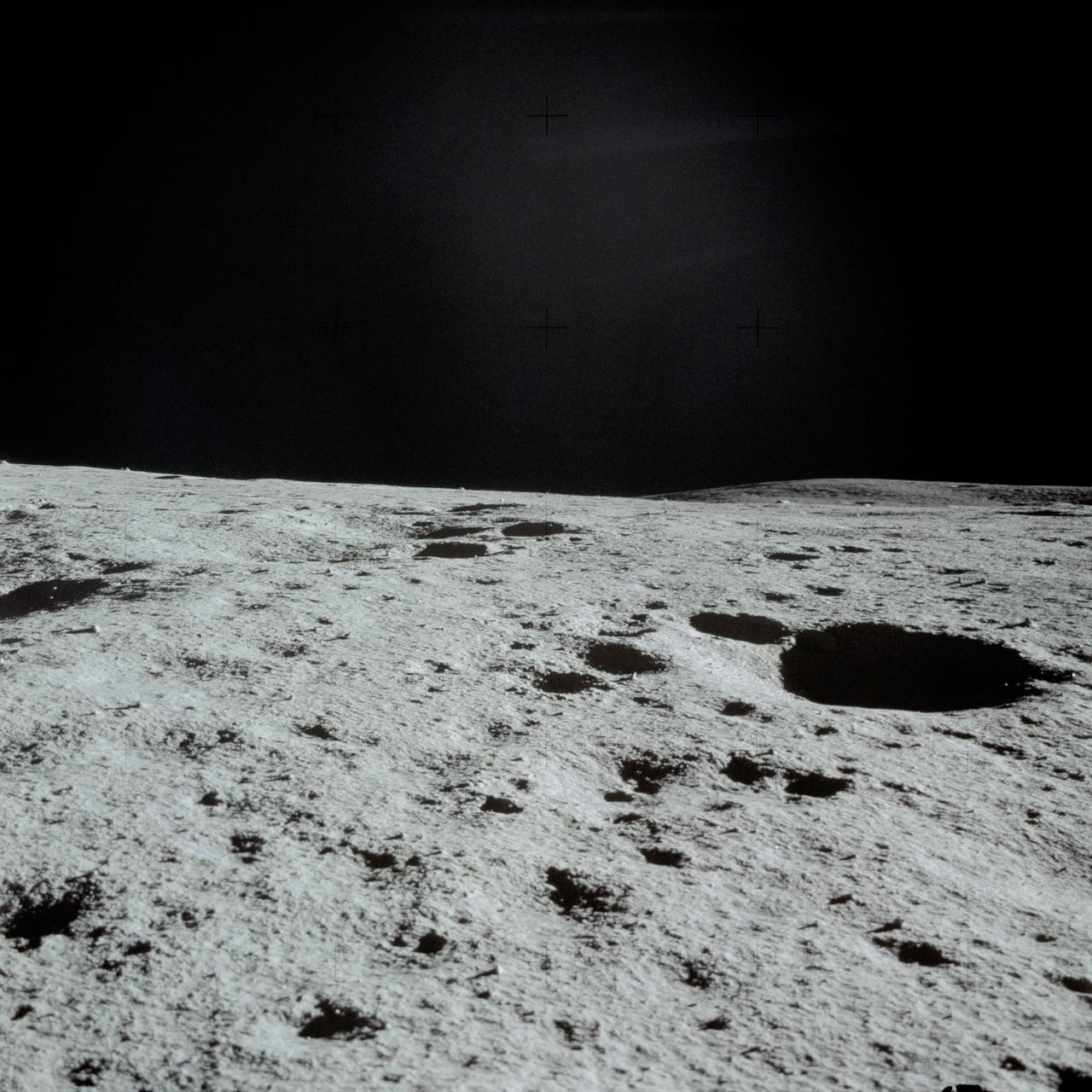
AS14-66-9244 (5-6 Feb. 1971) --- An excellent view of the lunar terrain looking through the right window of the Lunar Module (LM), photographed by one of the Apollo 14 astronauts during their stay on the lunar surface. Pothole-sized craters can be seen in the foreground. While astronauts Alan B. Shepard Jr., commander, and Edgar D. Mitchell, lunar module pilot, descended in the LM to explore the moon, astronaut Stuart A. Roosa, command module pilot, remained with the Command and Service Modules (CSM) in lunar orbit.
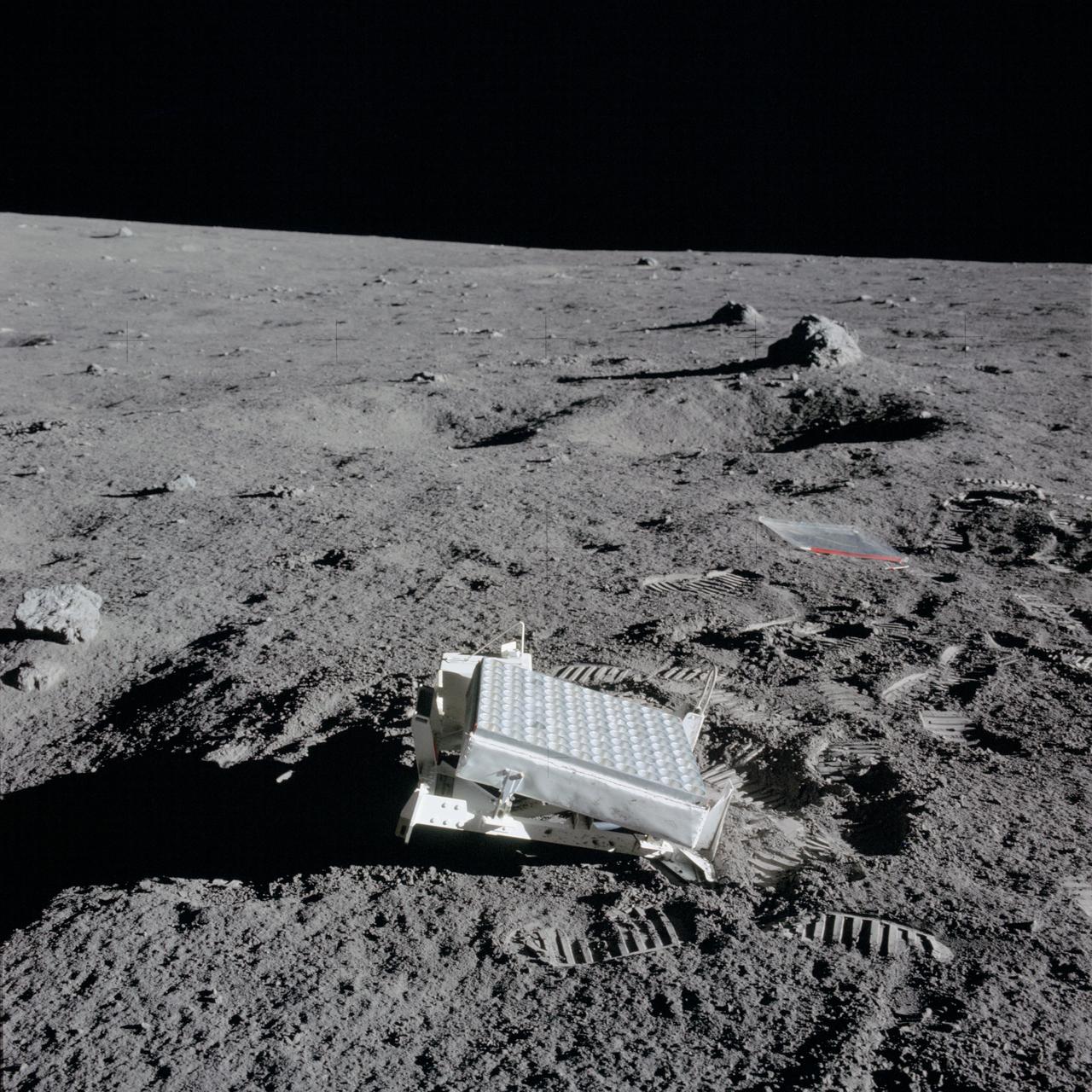
AS14-67-9386 (5 Feb. 1971) --- A close-up view of the laser ranging retro reflector (LR3) which the Apollo 14 astronauts deployed on the moon during their lunar surface extravehicular activity (EVA). While astronauts Alan B. Shepard Jr., commander, and Edgar D. Mitchell, lunar module pilot, descended in the Lunar Module (LM) to explore the moon, astronaut Stuart A. Roosa, command module pilot, remained with the Command and Service Modules (CSM) in lunar orbit.
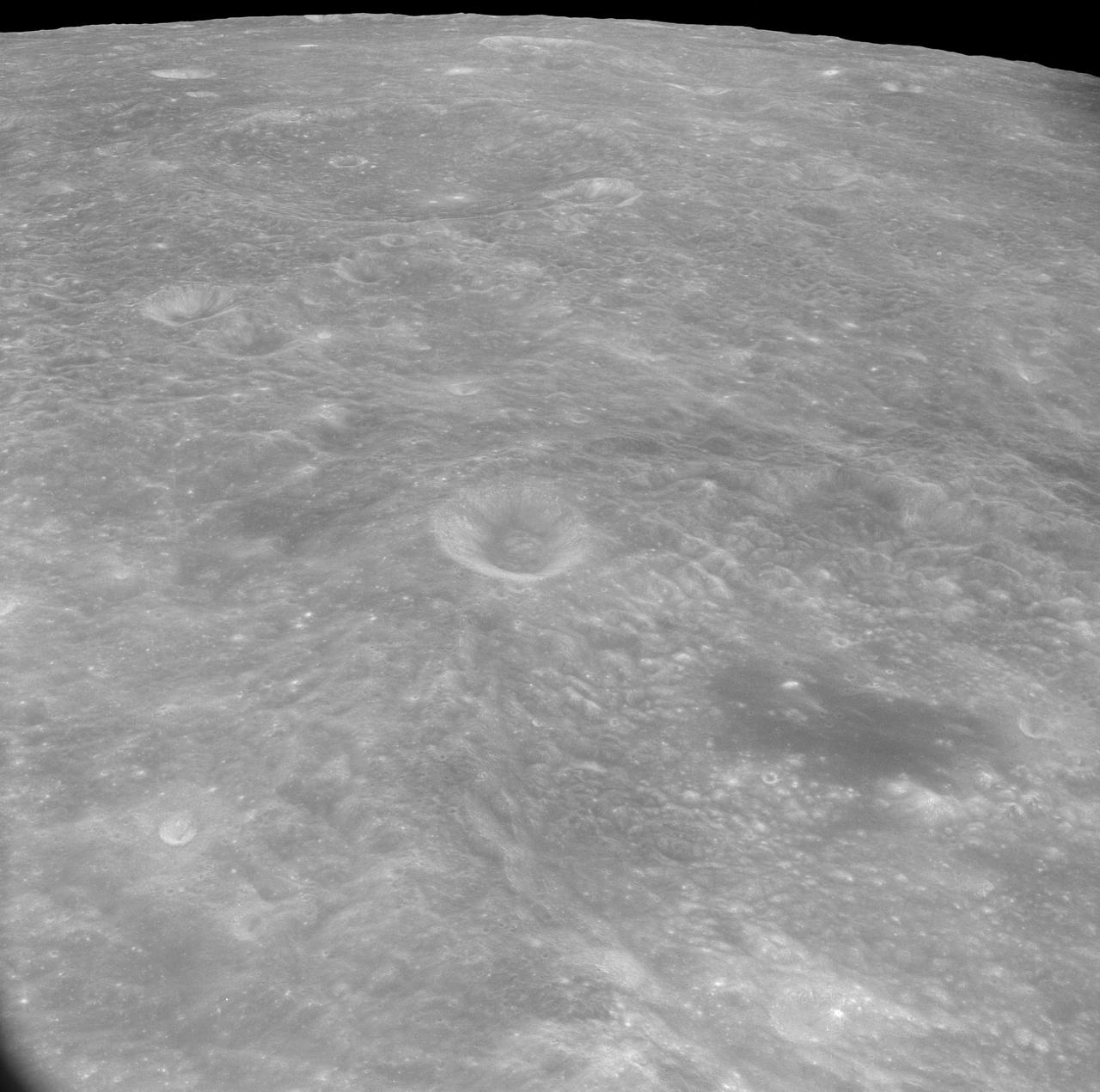
AS8-17-2744 (21-27 Dec. 1968) --- Oblique view of the lunar surface taken from the Apollo 8 spacecraft looking westward showing typical lunar farside terrain. (HOLD PICTURE SO THAT DARK IRREGULAR AREA SURROUNDED BY LIGHT SPOTS IS IN THE LOWER RIGHT QUARTER). The sharp crater near the center of then scene is near 117 degrees east longitude and 5 degrees south latitude; and it is 25 kilometers (15 statute miles) in diameter. That crater is on the rim of a large crater that occupies the lower right quarter of the photograph.
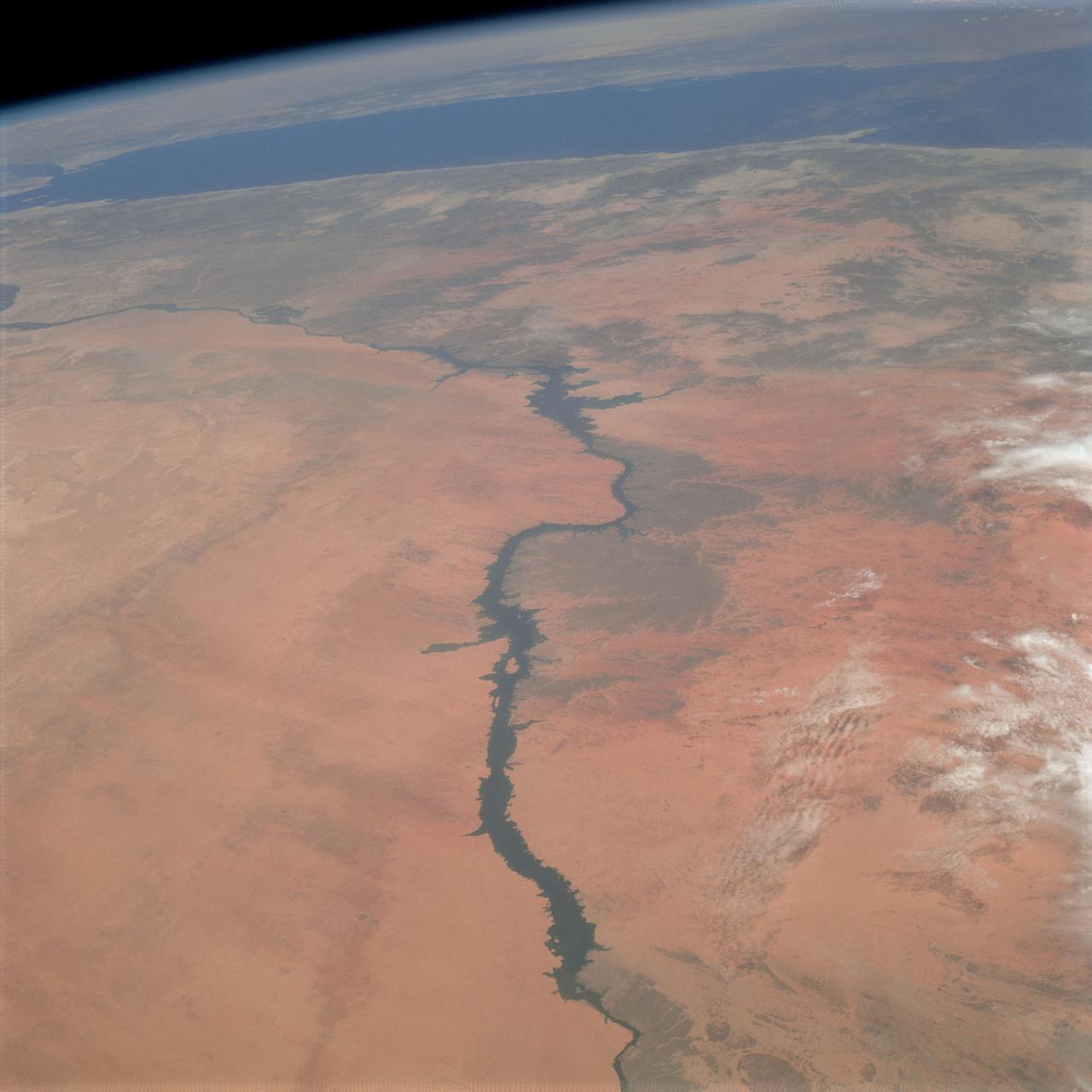
Oblique Earth Observation taken by the Apollo 9 crew. View is the United Arab Republic,the Nile River,The Red Sea and the Aswan Dam. Film magazine was E,film type was SO-368 Ektachrome with 0.460 - 0.710 micrometers film / filter transmittance response and haze filter,80mm lens. Latitude was 19.38 N by Longitude 30.24 E, Overlap was 50%, Altitude was 97 nautical miles and cloud cover was 5%.
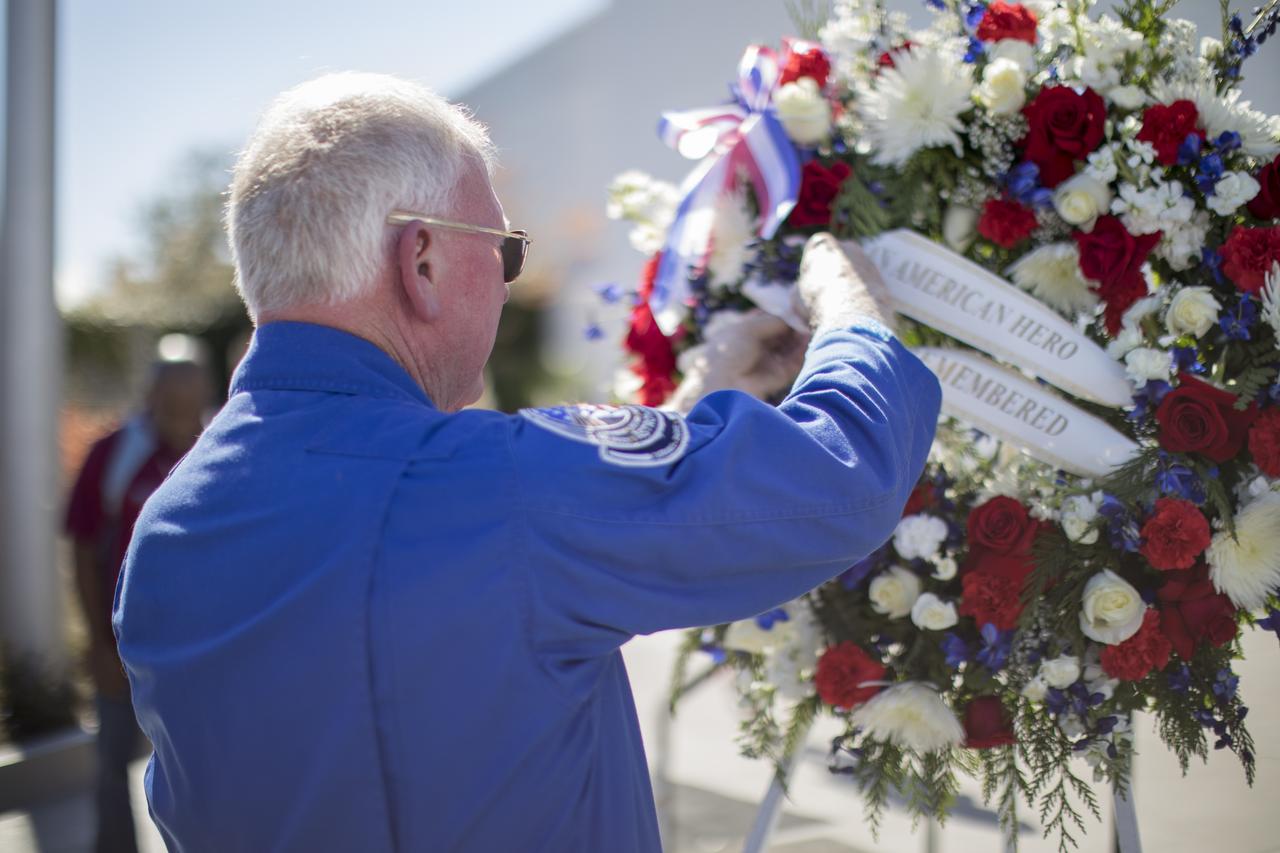
Former NASA astronaut Jon McBride places a wreath at the Heroes and Legends exhibit at the Kennedy Space Center Visitor Complex. The brief memorial honoring NASA astronaut John Young took place on the afternoon of Jan. 11, 2018. Young died Jan. 5, 2018, in Houston at the age of 87. He was the only astronaut to fly in NASA's Gemini, Apollo and Space Shuttle Programs.
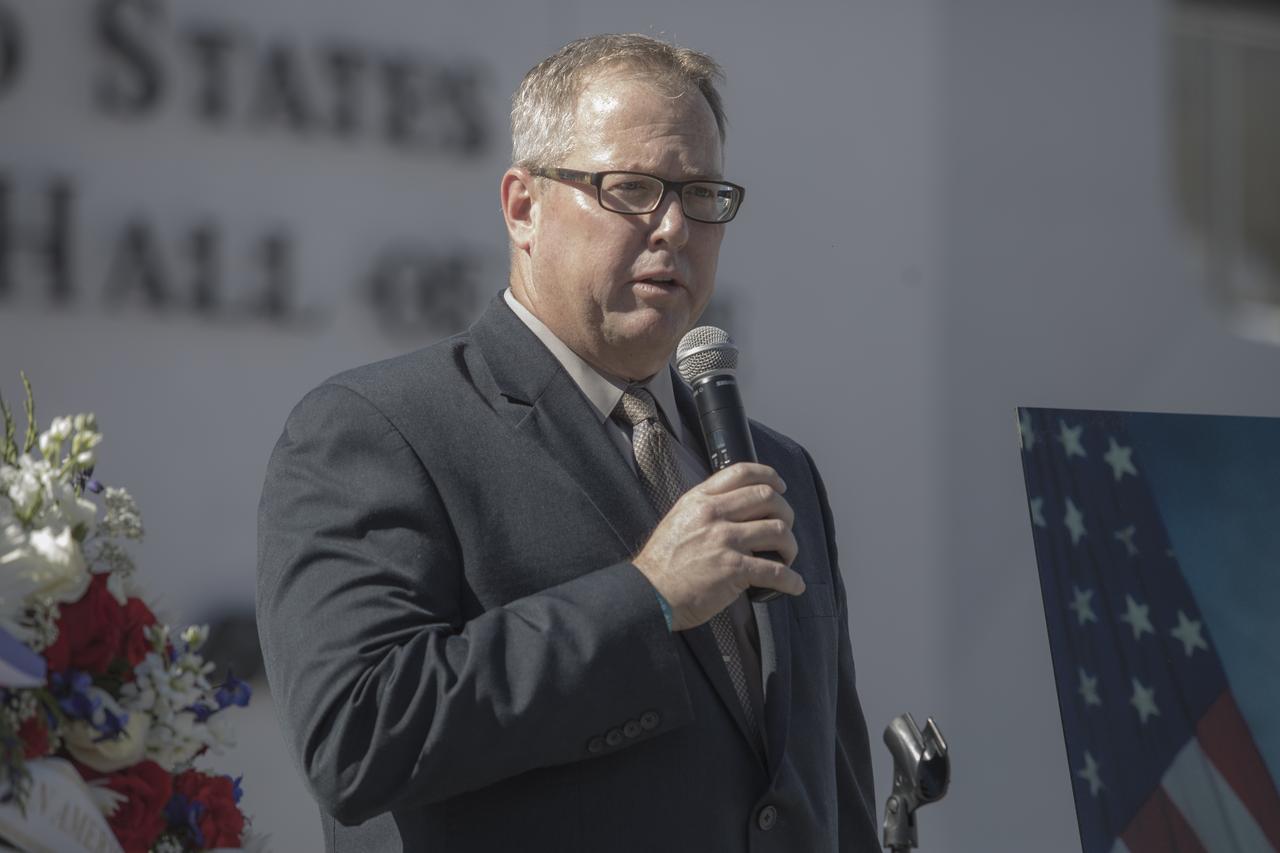
Delaware North COO Therrin Protze speaks during a ceremony at the Heroes and Legends exhibit at the Kennedy Space Center Visitor Complex. The brief memorial honoring NASA astronaut John Young took place on the afternoon of Jan. 11, 2018. Young died Jan. 5, 2018, in Houston at the age of 87. He was the only astronaut to fly in NASA's Gemini, Apollo and Space Shuttle Programs.
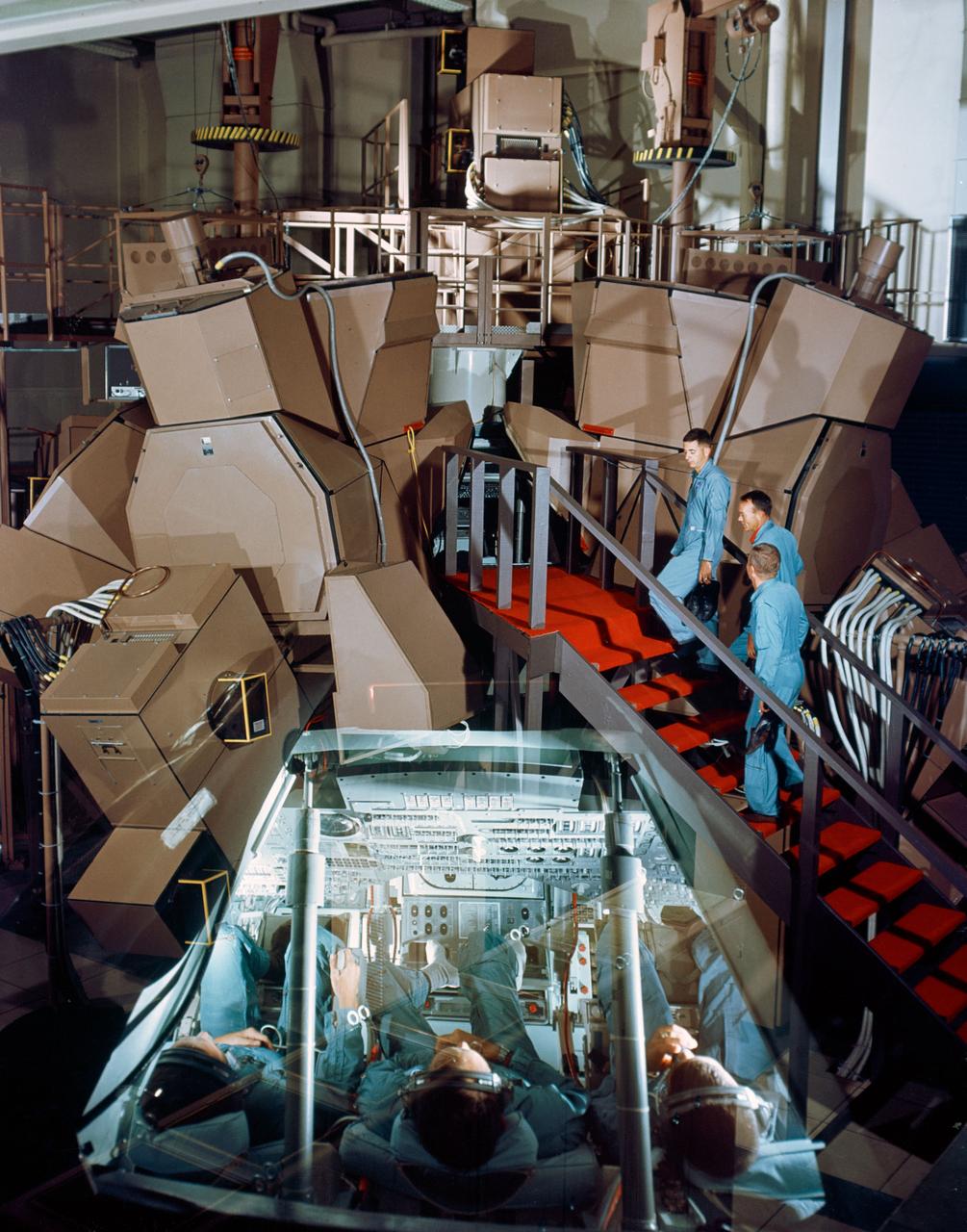
S67-50585 (1967) --- This is an intentional double exposure showing the Apollo Mission Simulator in the Mission Simulation and Training Facility, Building 5 at the Manned Spacecraft Center. In the exterior view astronauts William A. Anders, Michael Collins, and Frank Borman (reading from top of stairs) are about to enter the simulator. The interior view shows the three astronauts in the simulator. They are (left to right) Borman, Collins, and Anders. Photo credit: NASA
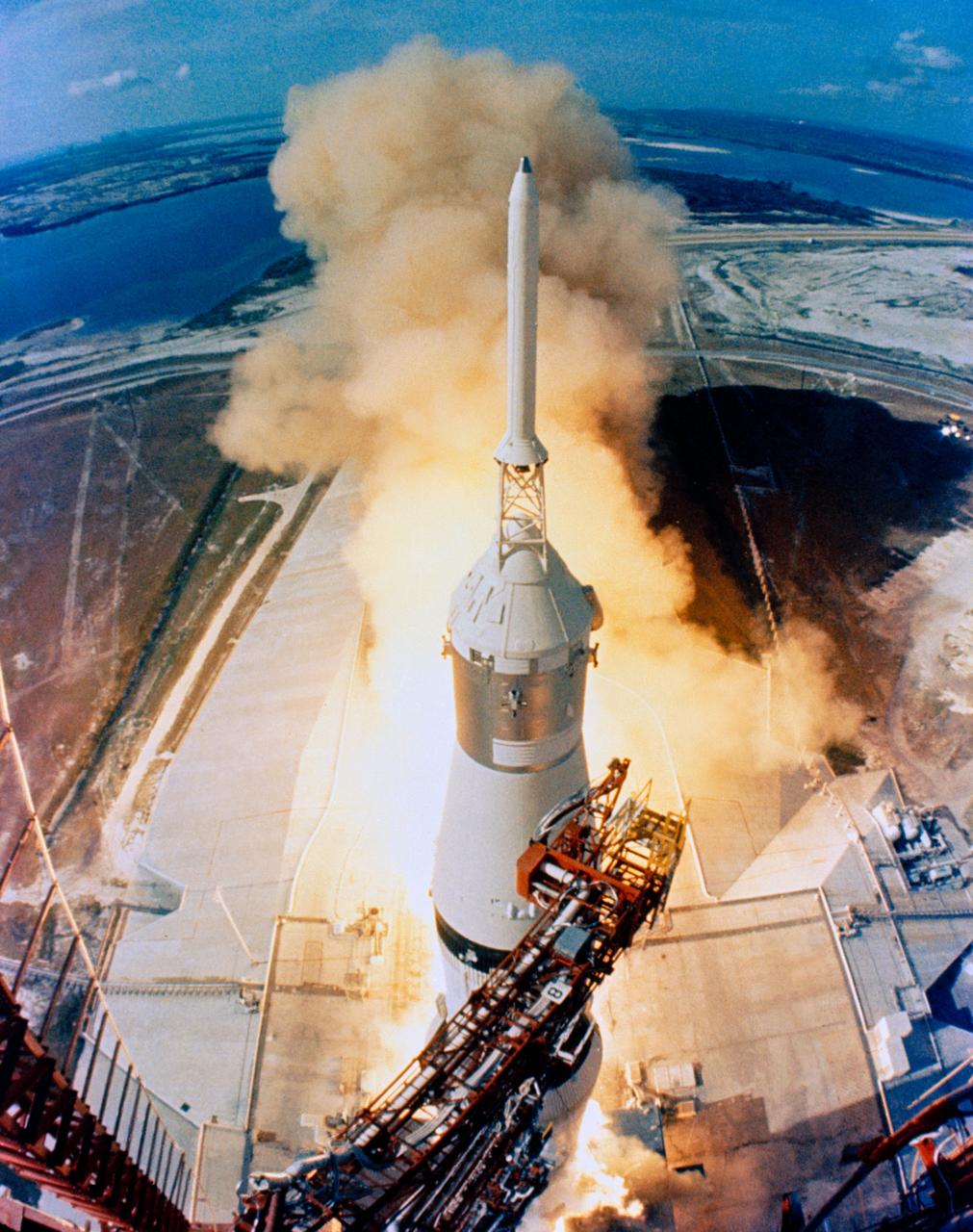
The huge, 363-foot tall Apollo XI Spacecraft 107/Lunar Module (LM)-5/Saturn 506) Space Vehicle is launched from Pad "A", Launch Complex (LC)-39, KSC, at 9:32 a.m. (EDT), 07/16/1969. This view of the liftoff was taken by a camera mounted on the Mobile Launch Tower. KSC, FL
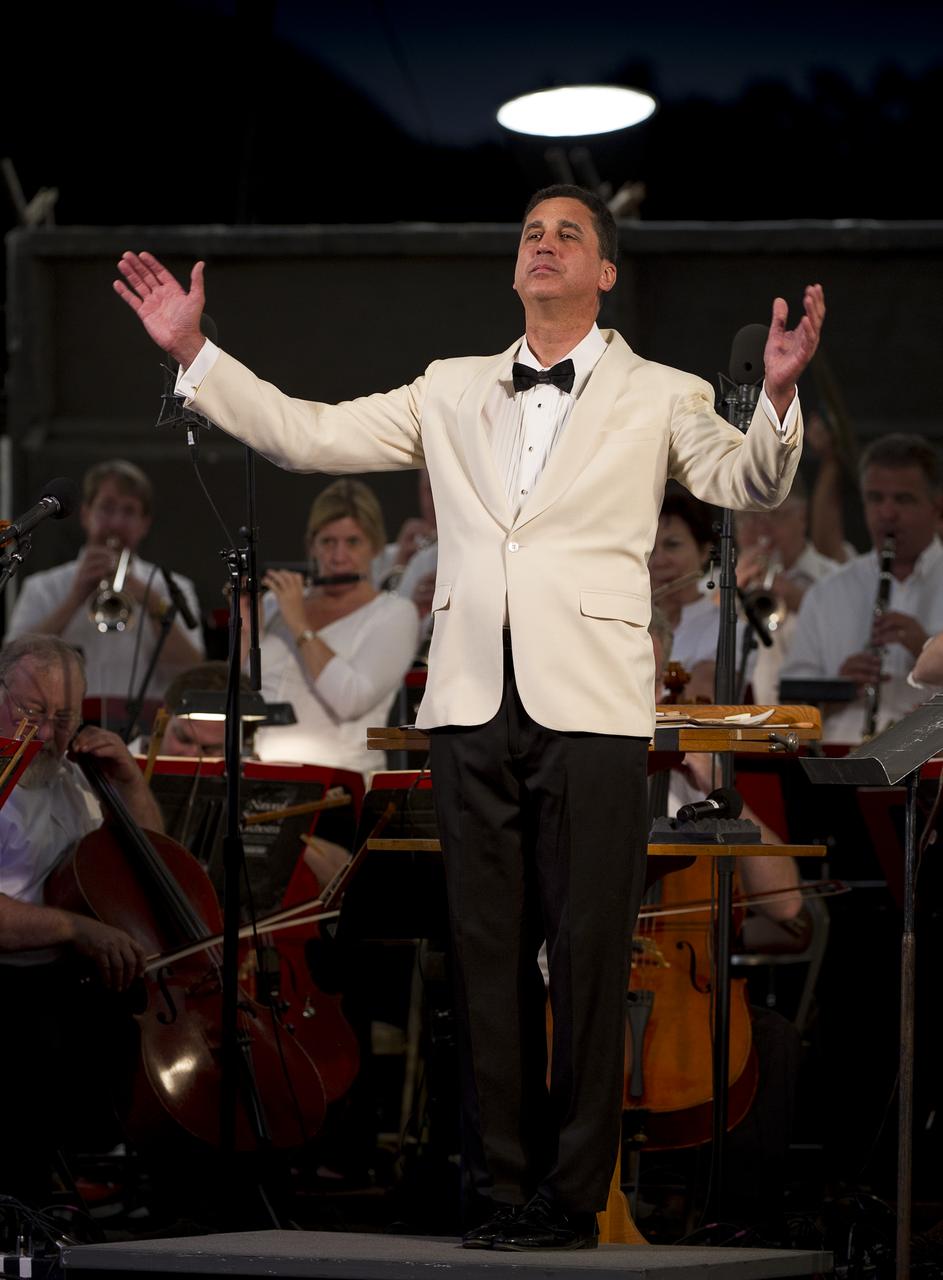
National Symphony Orchestra Conductor Emil de Cou leads the National Symphony Orchestra during the Labor Day Weekend concert on the West Lawn of the U.S. Capitol, Sunday, September 5, 2010 in Washington. NASA Administrator Charles Bolden joined the Orchestra to introduce one the program's segments, music from the film "Apollo 13". Photo Credit: (NASA/Bill Ingalls)
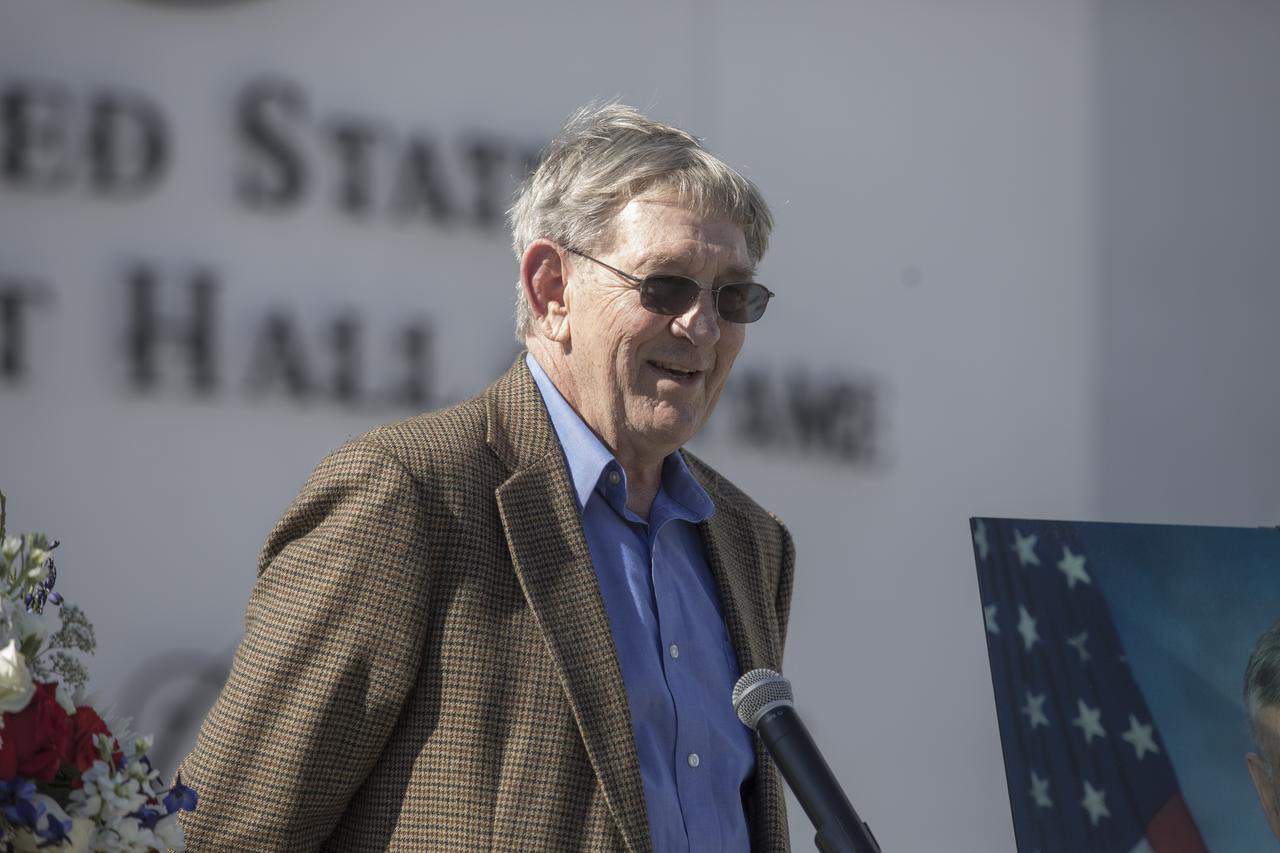
Former NASA astronaut Mike McCulley speaks during a ceremony at the Heroes and Legends exhibit at the Kennedy Space Center Visitor Complex. The brief memorial honoring NASA astronaut John Young took place on the afternoon of Jan. 11, 2018. Young died Jan. 5, 2018, in Houston at the age of 87.He was the only astronaut to fly in NASA's Gemini, Apollo and Space Shuttle Programs.
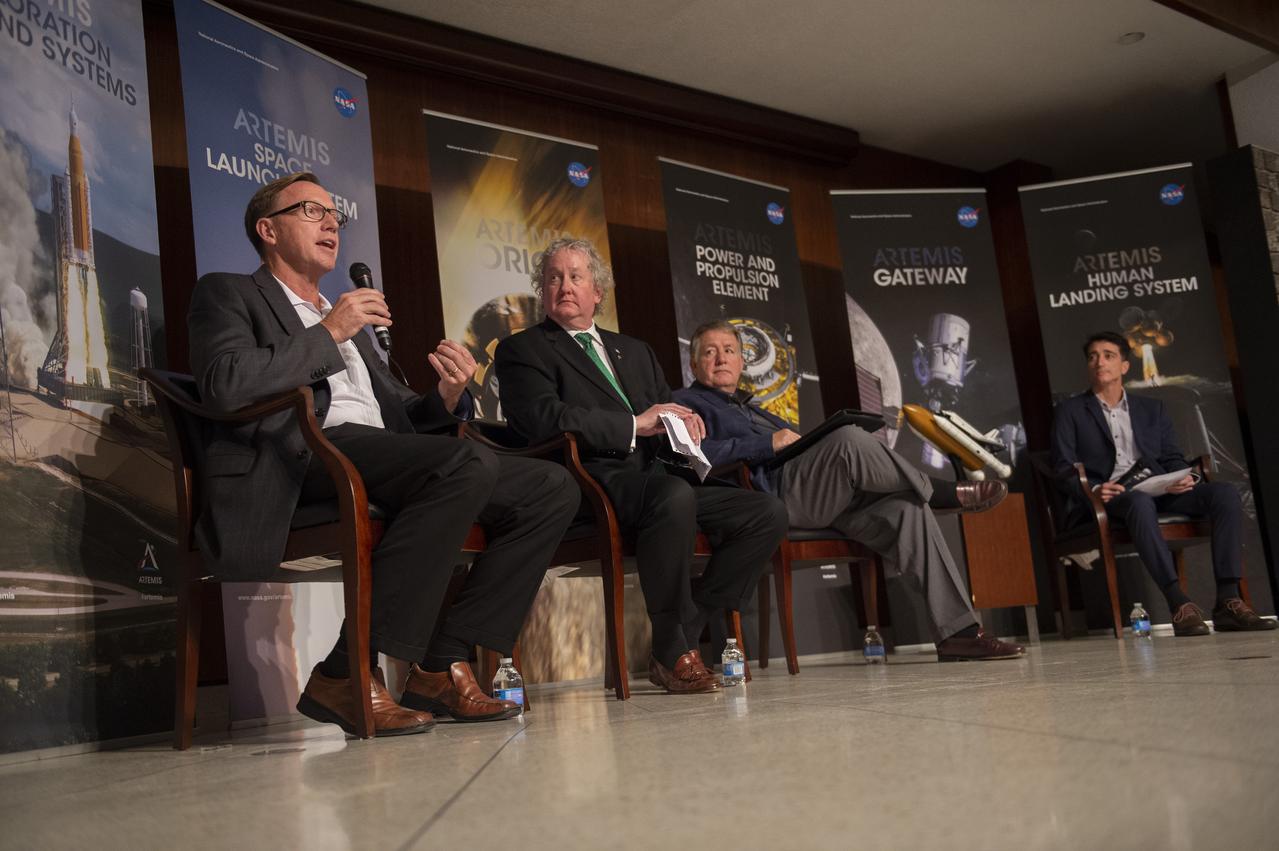
A Nov. 5 panel at NASA’s Marshall Space Flight Center discusses lessons learned from Columbia including, from left, Steve Miley, associate director of Marshall; Bill Hill, director of advanced technology at Marshall; Preston Jones, associate director, technical, at Marshall; and Mike Ciannilli, Apollo Challenger Columbia Lessons Learned Program manager at NASA’s Kennedy Space Center.
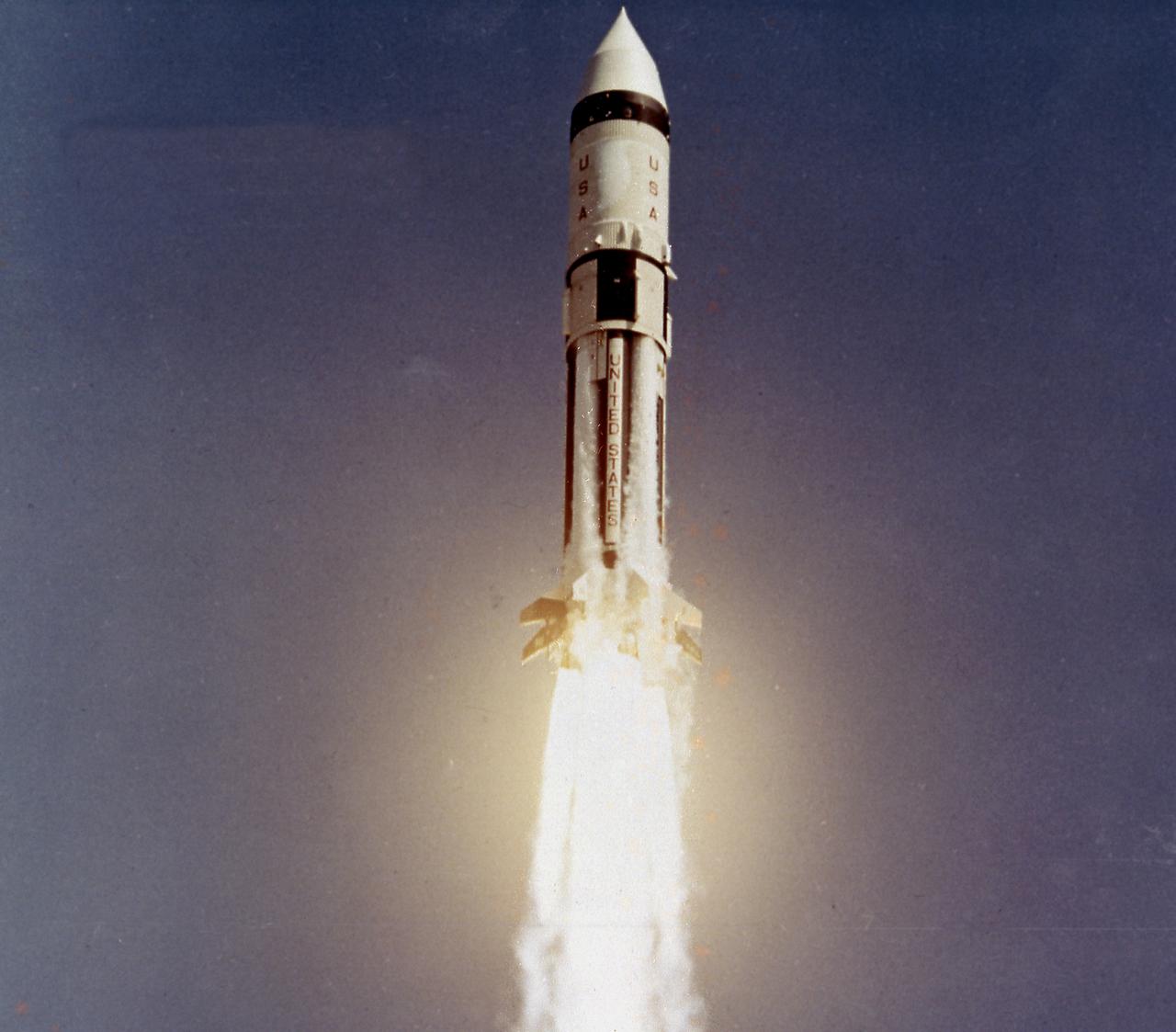
AS-203, the third Saturn IB launch vehicle developed by the Marshall Space Flight Center, lifts off from Cape Canaveral, Florida , July 5, 1966. Primary mission objectives included evaluation of the S-IVB stage's hydrogen venting and engine restart capabilities in an orbital environment. In all, nine Saturn IB flights were made, ending with the Apollo-Soyuz Test Project (ASTP) in July 1975.
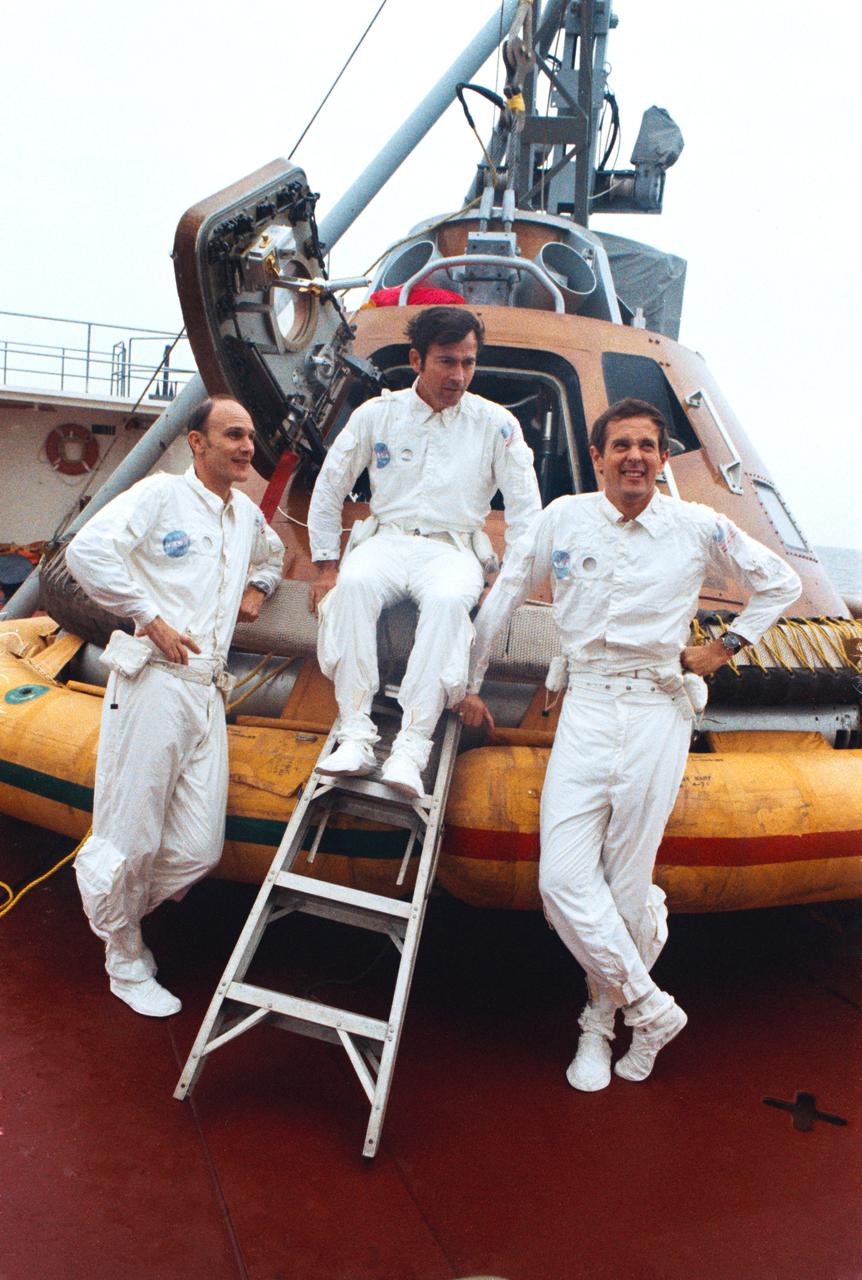
S72-30160 (5 May 1972) --- The Apollo 16 prime crew relax aboard the NASA Motor Vessel Retriever during water egress training activity in the Gulf of Mexico. They are, left to right, astronauts Thomas K. Mattingly II, command module pilot; John W. Young, commander; and Charles M. Duke Jr., lunar module pilot. The Command Module trainer was used in the training exercise.
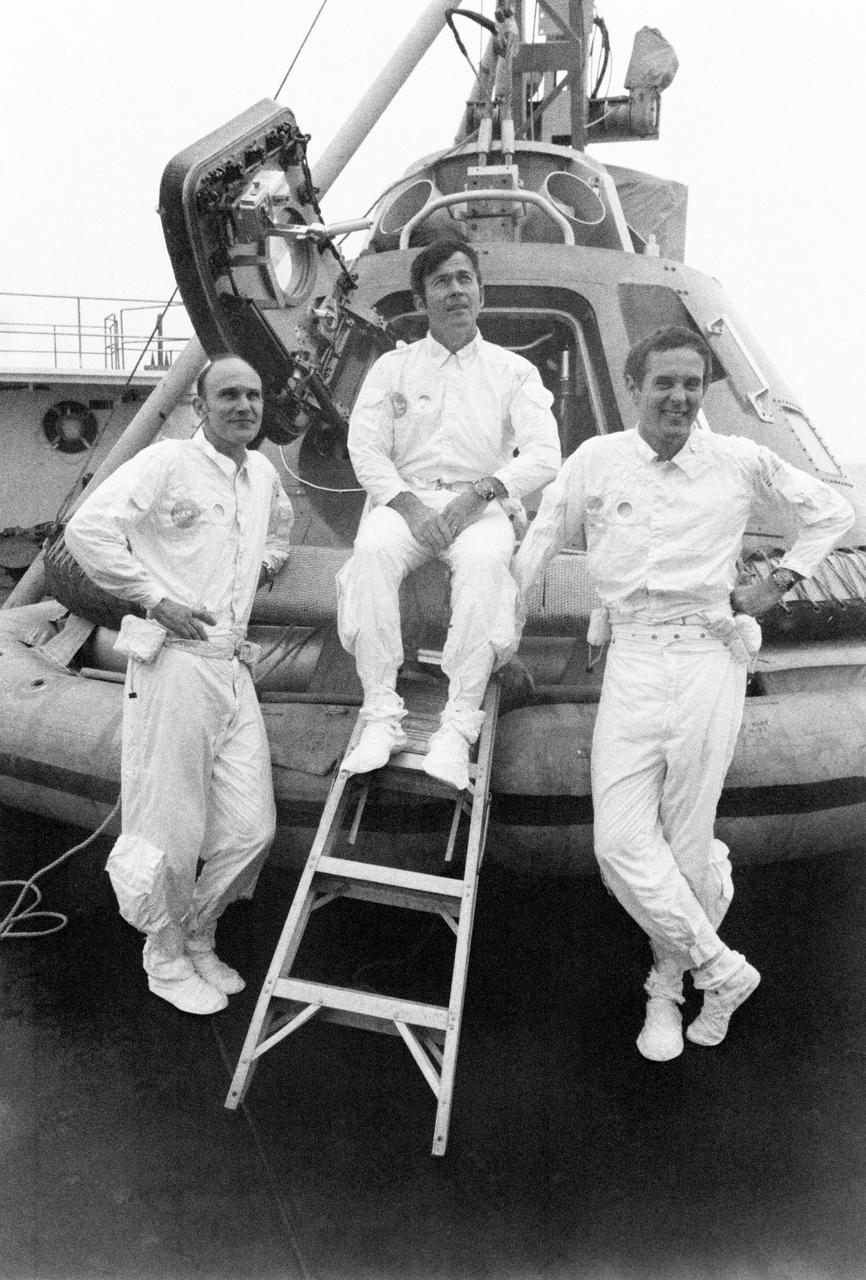
S72-30166 (5 May 1972) --- The Apollo 16 prime crew relax aboard the NASA Motor Vessel Retriever during water egress training activity in the Gulf of Mexico. They are, left to right, astronauts Thomas K. Mattingly II, command module pilot; John W. Young, commander; and Charles M. Duke Jr., lunar module pilot. The Command Module trainer was used in the training exercise.
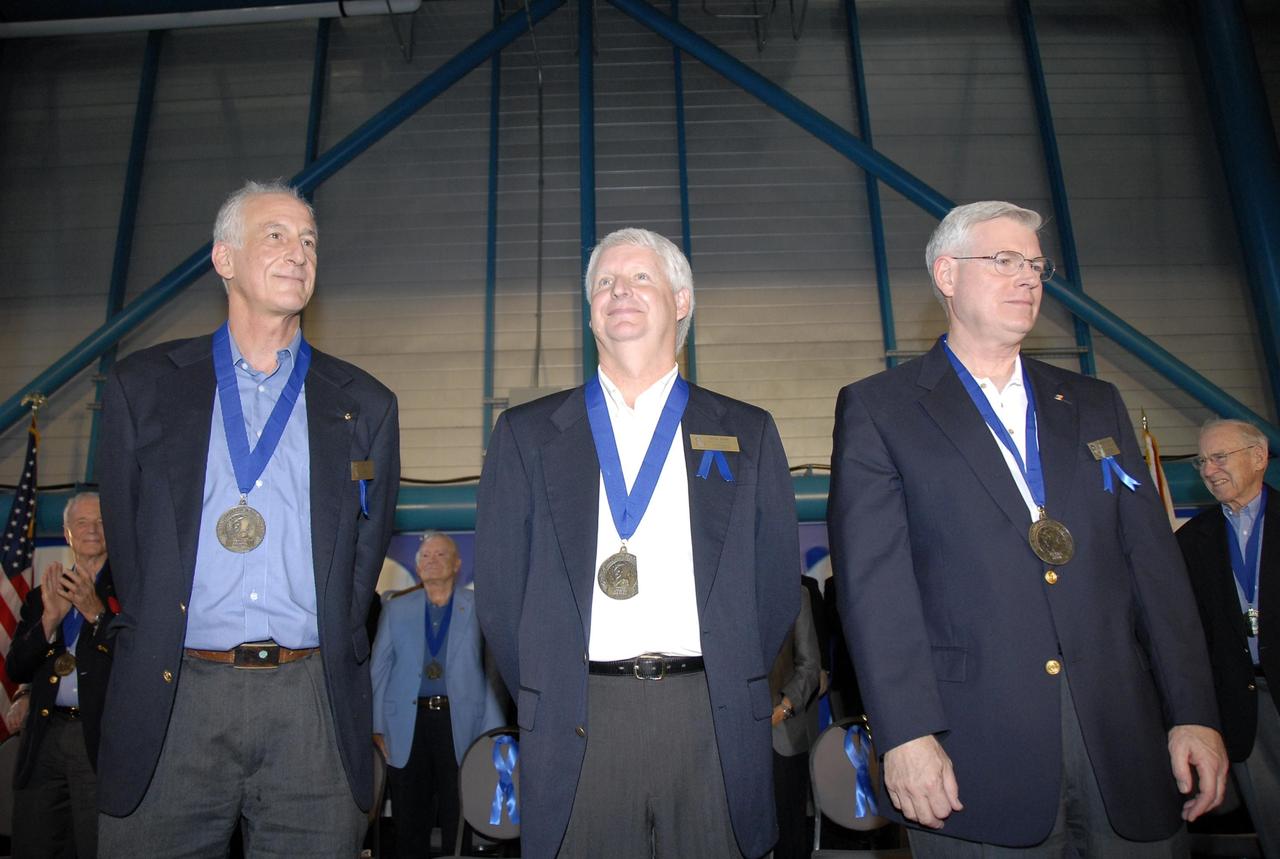
KENNEDY SPACE CENTER, FLA. -- The newest inductees to the U.S. Astronaut Hall of Fame stand tall of the ceremony. From left are Jeffrey A. Hoffman, Steven A. Hawley and Michael L. Coats. The May 5 induction has grown the number of space explorers enshrined in the Hall of Fame to 66. The ceremony was held at the Kennedy Space Center's Apollo/Saturn V Center. Photo credit: NASA/Kim Shiflett
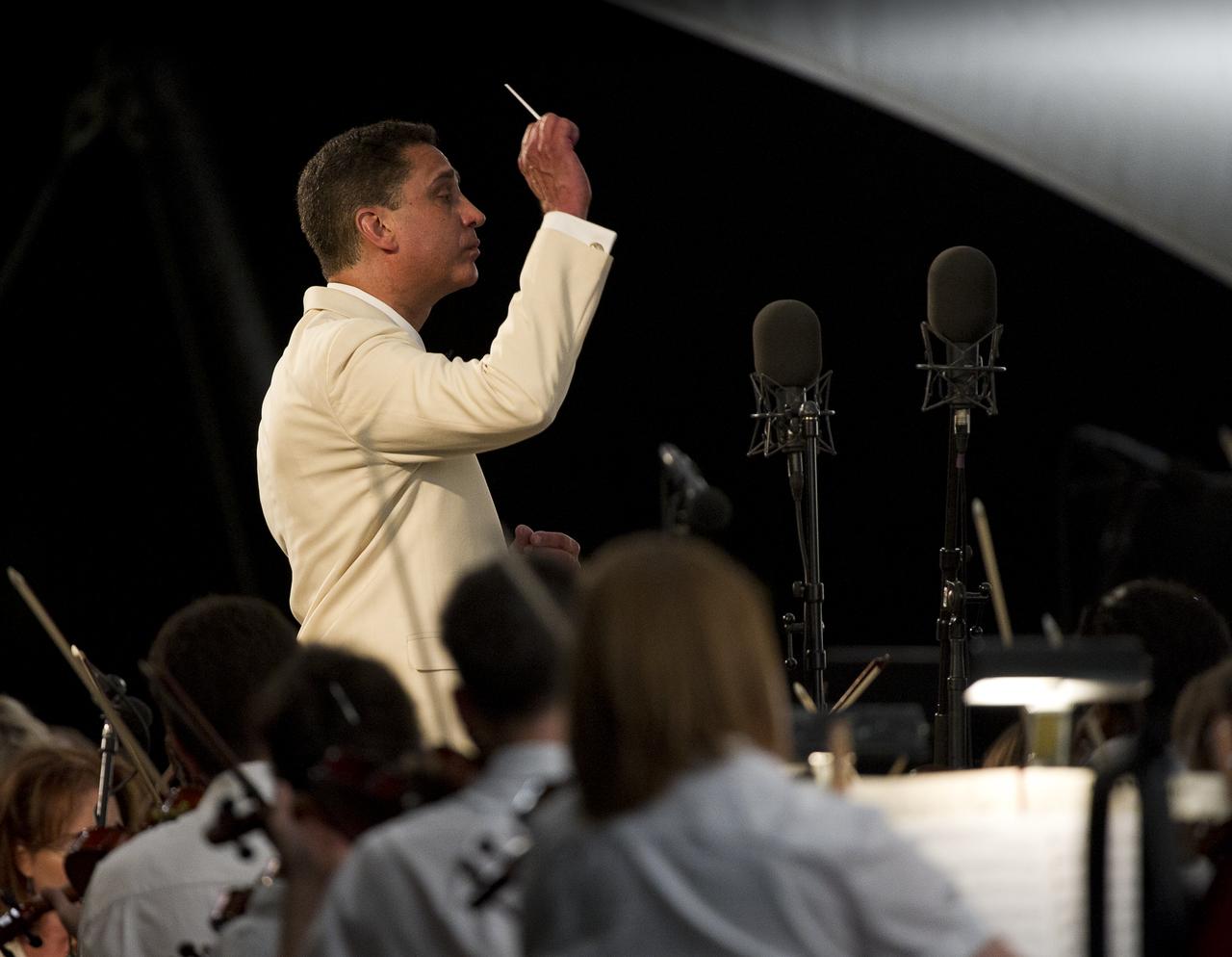
National Symphony Orchestra Conductor Emil de Cou leads the National Symphony Orchestra during the Labor Day Weekend concert on the West Lawn of the U.S. Capitol, Sunday, September 5, 2010 in Washington. NASA Administrator Charles Bolden joined the Orchestra to introduce one the program's segments, music from the film "Apollo 13". Photo Credit: (NASA/Bill Ingalls)
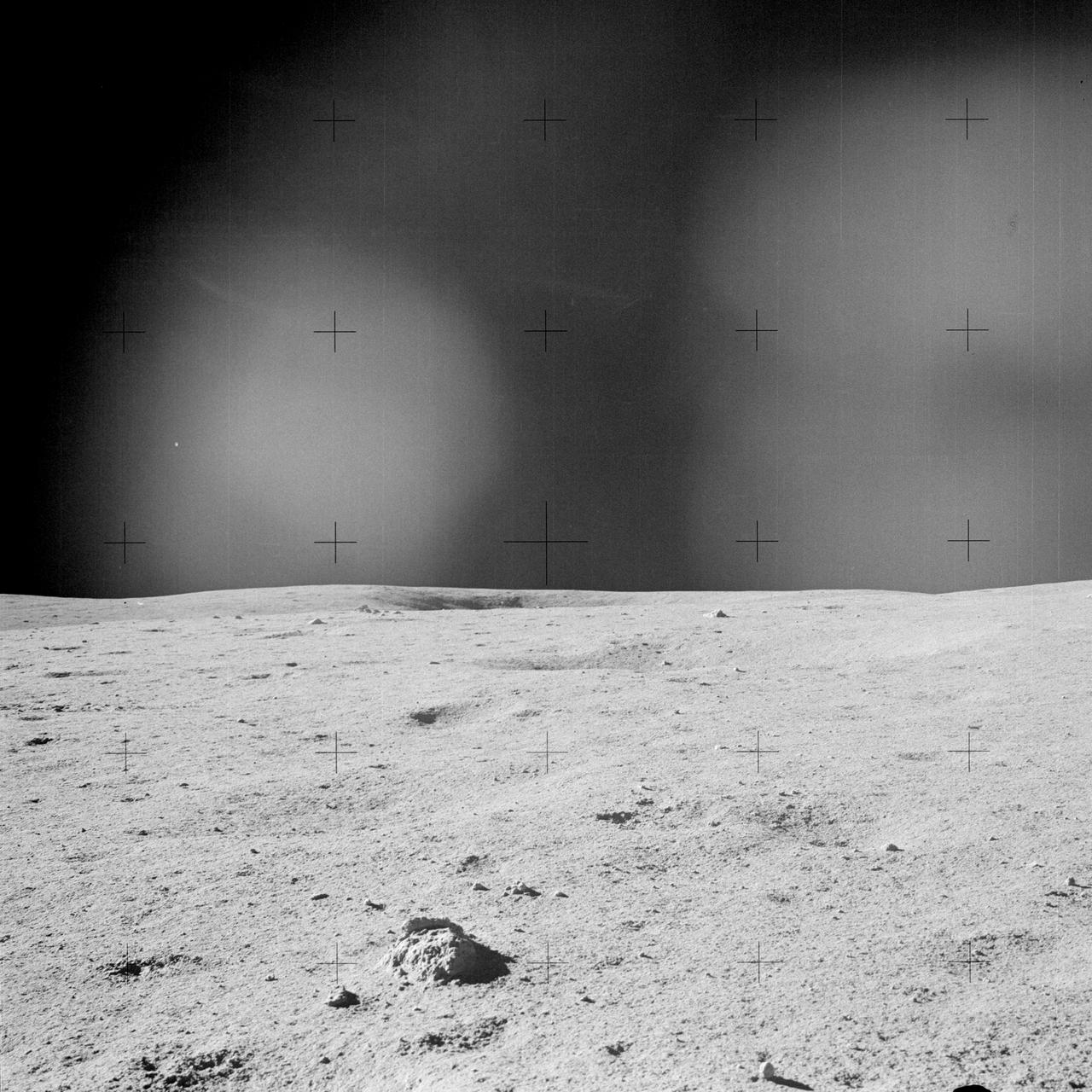
AS14-64-9181 (5-6 Feb. 1971) --- A view of the lunar terrain at the Apollo 14 Fra Mauro landing site as photographed through the left window of the Lunar Module (LM). Note the clump of lunar soil in the foreground, and a crater in the center on the horizon. While astronauts Alan B. Shepard Jr., commander; and Edgar D. Mitchell, lunar module pilot; descended in the LM to explore the moon, astronaut Stuart A. Roosa, command module pilot, remained with the Command and Service Modules (CSM) in lunar orbit.