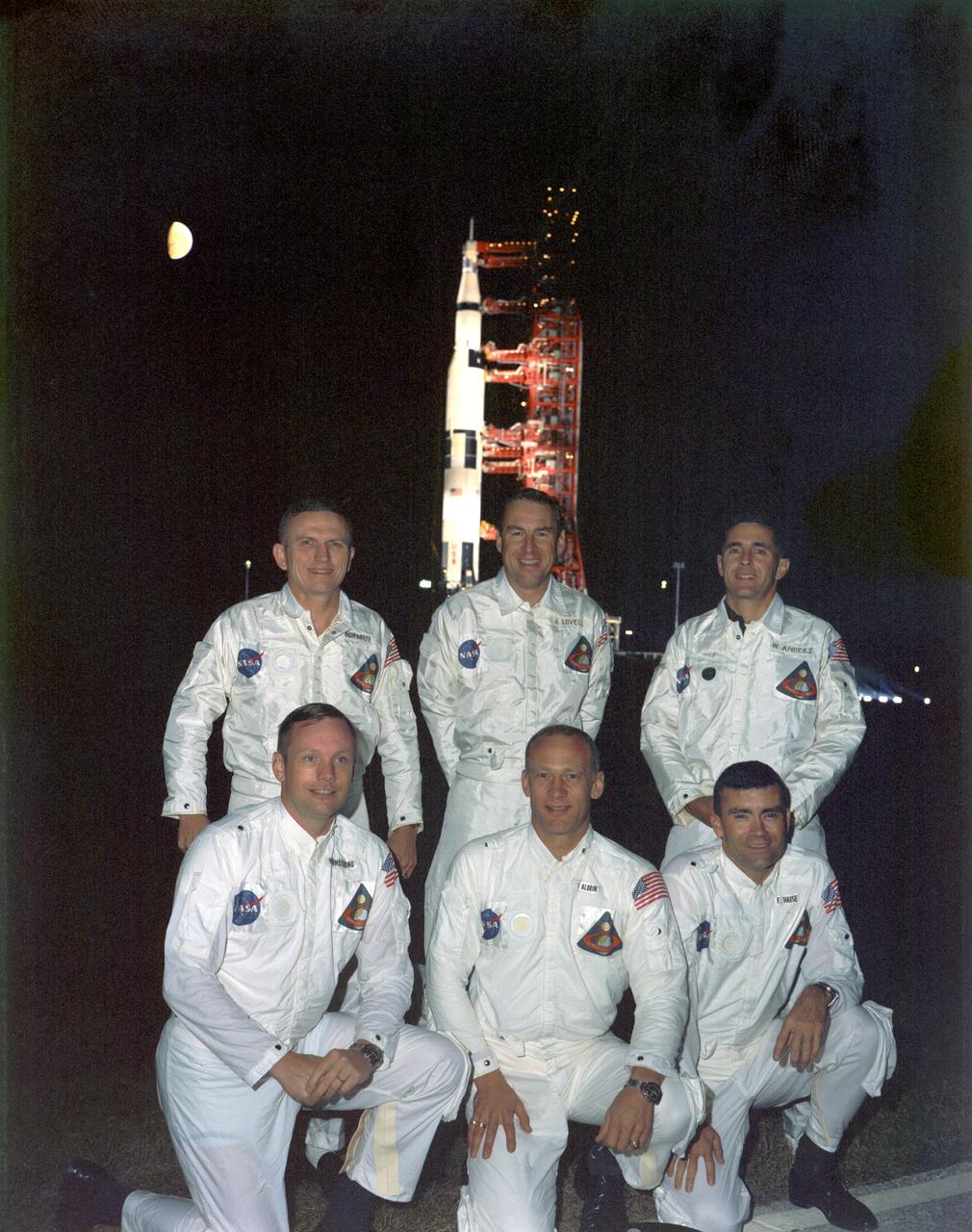
View of the Apollo 8 primary and backup crew portrait with the spacecraft at night in the background. Back row: (l.-r.) Frank Borman, commander, James A. Lovell, command module pilot and William A. Anders, lunar module pilot. Front row: (l.-r.) Neil A. Armstrong, commander, Edwin E. Aldrin, command module pilot and Fred W. Haise Jr., lunar module pilot. Original Photo number is KSC-68C-8017.
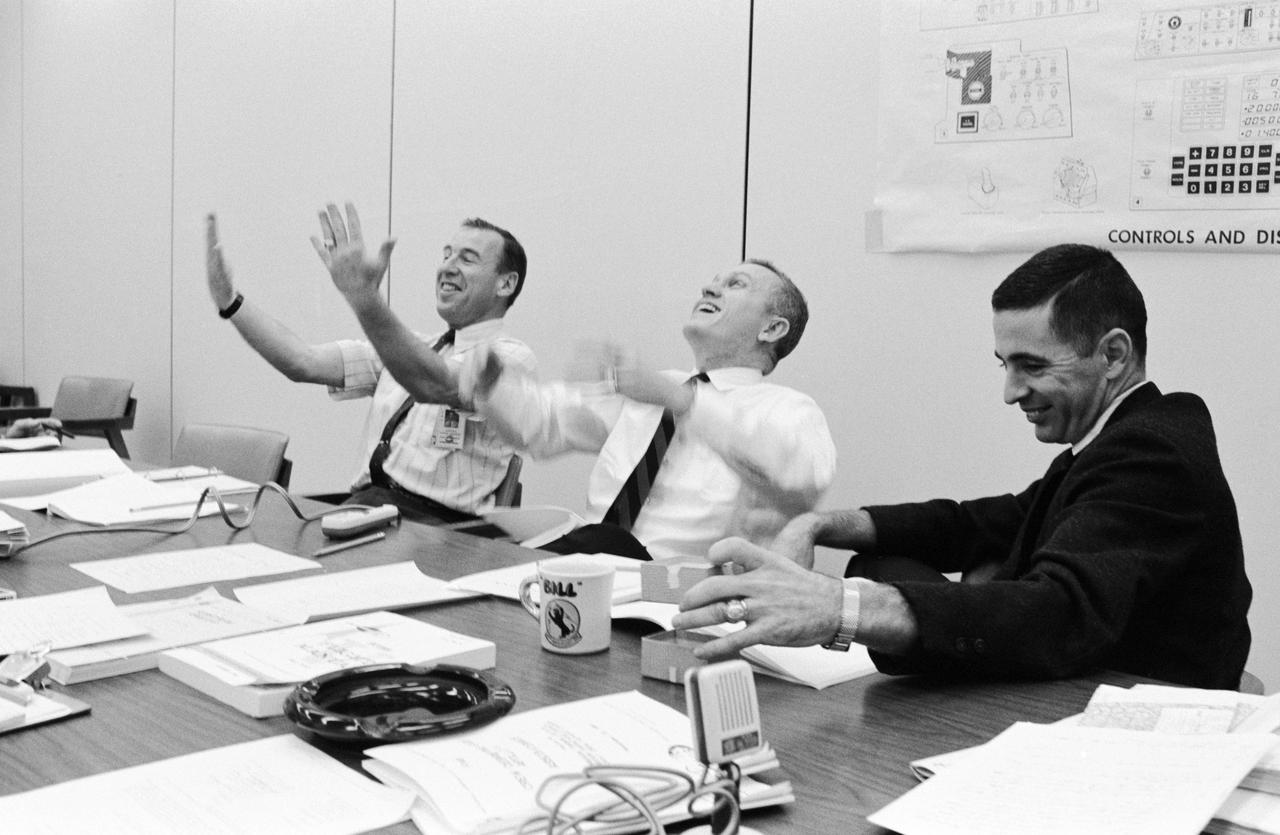
S68-56530 (30 Dec. 1968) --- The crew of the historic Apollo 8 lunar orbit mission participates in a technical de-briefing session in Building 4. Left to right, are astronauts James A. Lovell Jr., command module pilot; Frank Borman, commander; and William A. Anders, lunar module pilot.
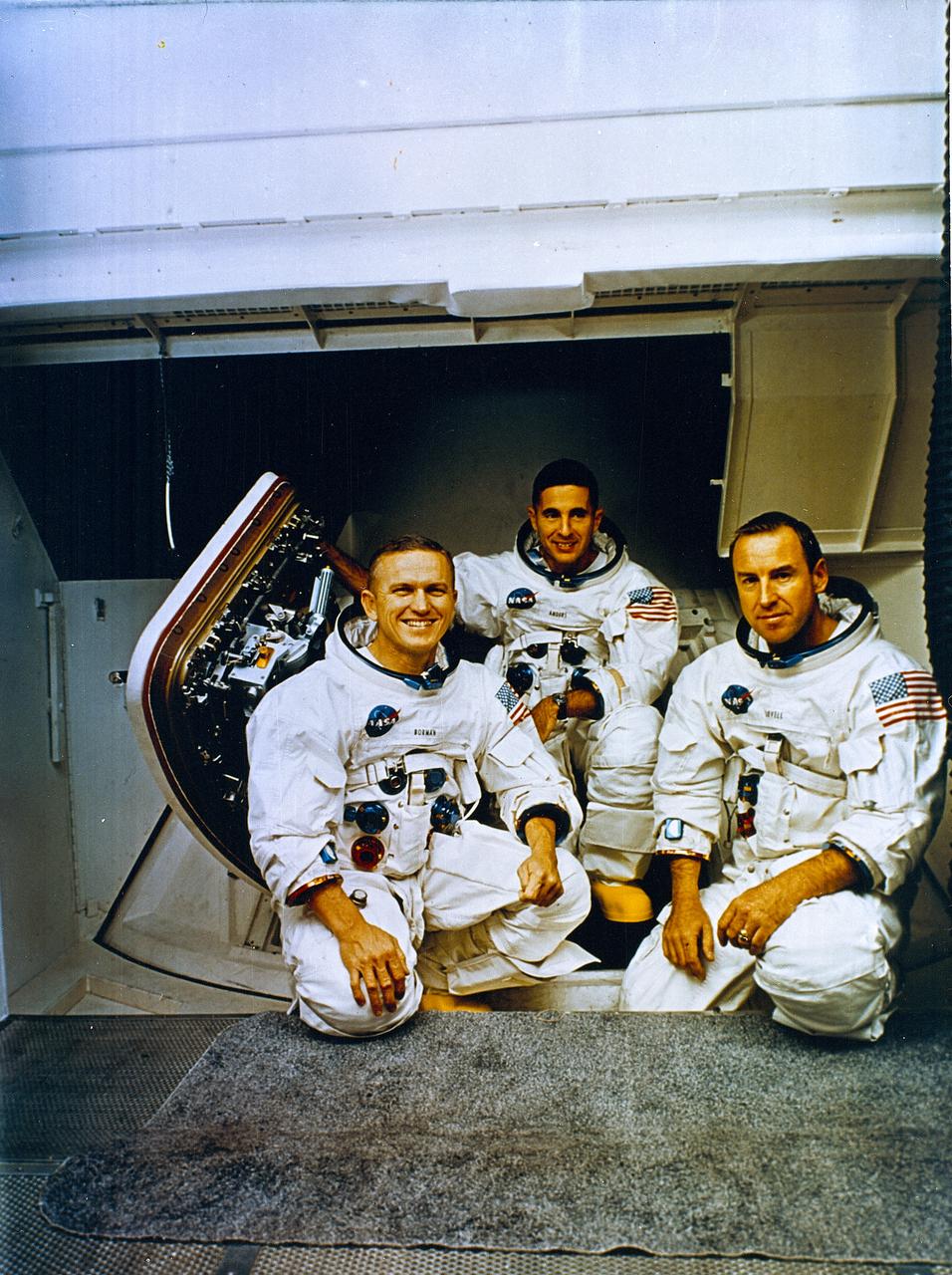
The Apollo 8 Crew included (L to R) James Lovell, Command Module (CM) pilot; William Anders, Lunar Module (LM) Pilot; and Frank Borman, Commander. The first manned Apollo mission launched aboard the Saturn V and first manned Apollo craft to enter lunar orbit, the SA-503, Apollo 8 mission liftoff occurred on December 21, 1968 and returned safely to Earth on December 27, 1968. The mission achieved operational experience and tested the Apollo command module systems, including communications, tracking, and life-support, in cis-lunar space and lunar orbit, and allowed evaluation of crew performance on a lunar orbiting mission. The crew photographed the lunar surface, both far side and near side, obtaining information on topography and landmarks as well as other scientific information necessary for future Apollo landings. All systems operated within allowable parameters and all objectives of the mission were achieved.
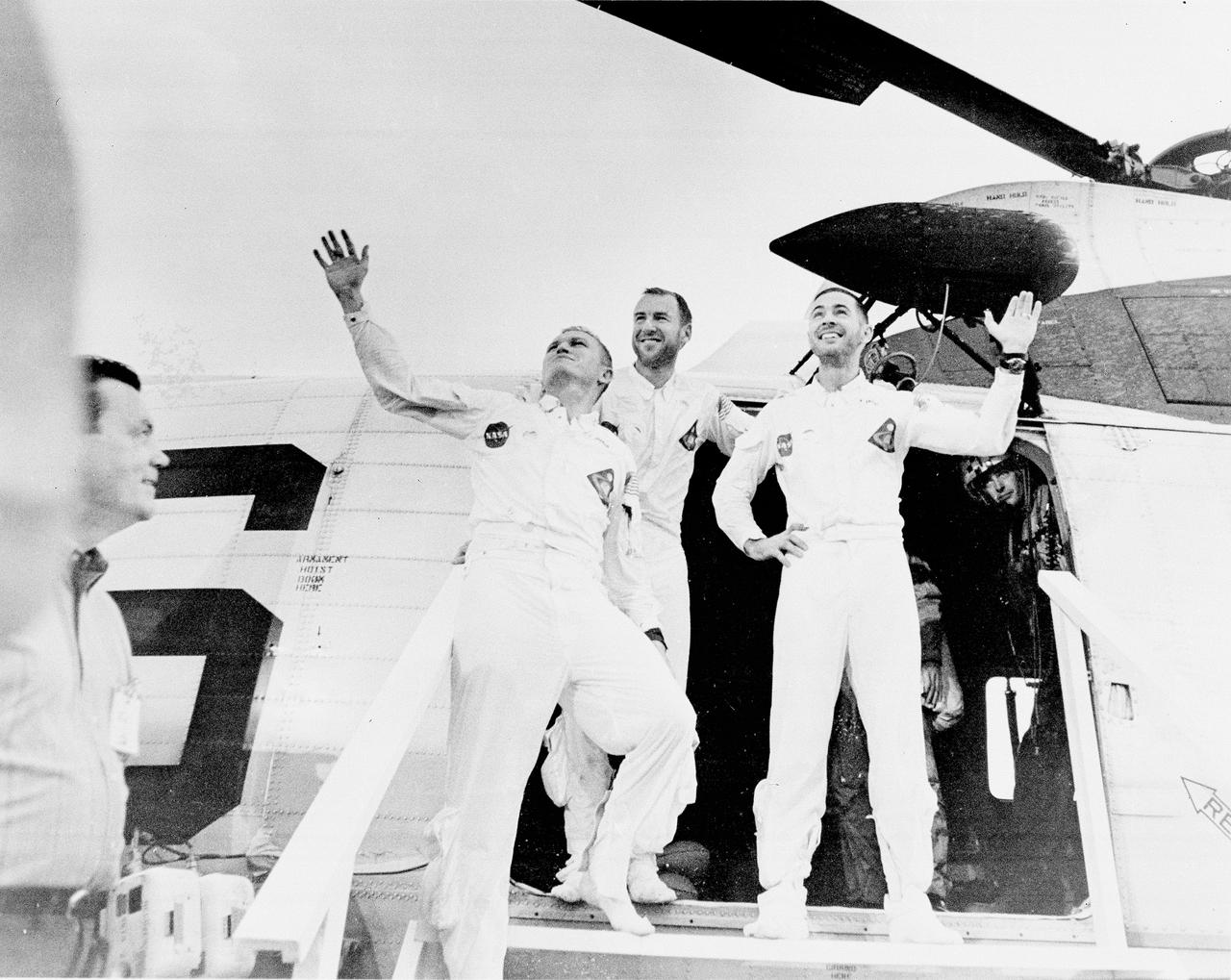
Apollo 8 served as the first manned lunar orbit mission. Liftoff occurred on December 21, 1968, carrying a three man crew consisting of astronauts Frank Borman, commander; William Anders, Lunar Module (LM) Pilot; and James Lovell, Command Module (CM) pilot. The three safely returned to Earth on December 27, 1968. In this photograph, the crew members are waving as they leave the recovery helicopter. The mission achieved operational experience and tested the Apollo command module systems, including communications, tracking, and life-support, in cis-lunar space and lunar orbit, and allowed evaluation of crew performance on a lunar orbiting mission. The crew photographed the lunar surface, both far side and near side, obtaining information on topography and landmarks as well as other scientific information necessary for future Apollo landings. All systems operated within allowable parameters and all objectives of the mission were achieved.
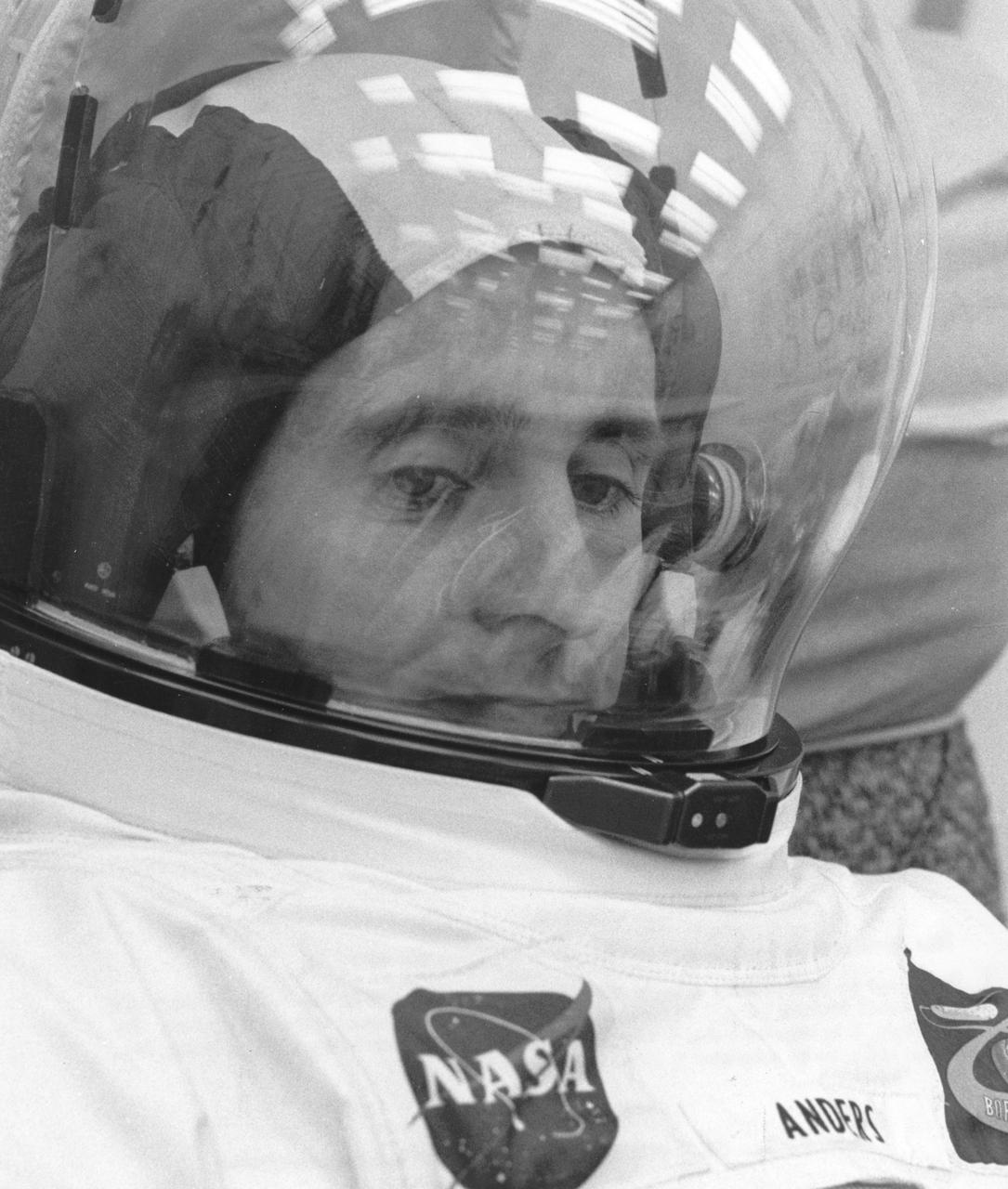
Apollo 8 astronaut William Anders, Lunar Module (LM) pilot, is suited up for the Apollo 8 mission countdown demonstration test. The first manned Apollo mission launched aboard the Saturn V and first manned Apollo craft to enter lunar orbit, the SA-503, Apollo 8 mission lift off occurred on December 21, 1968 and returned safely to Earth on December 27, 1968. Aboard were Anders and fellow astronauts James Lovell, Command Module (CM) pilot; and Frank Borman, commander. The mission achieved operational experience and tested the Apollo command module systems, including communications, tracking, and life-support, in cis-lunar space and lunar orbit, and allowed evaluation of crew performance on a lunar orbiting mission. The crew photographed the lunar surface, both far side and near side, obtaining information on topography and landmarks as well as other scientific information necessary for future Apollo landings. All systems operated within allowable parameters and all objectives of the mission were achieved.
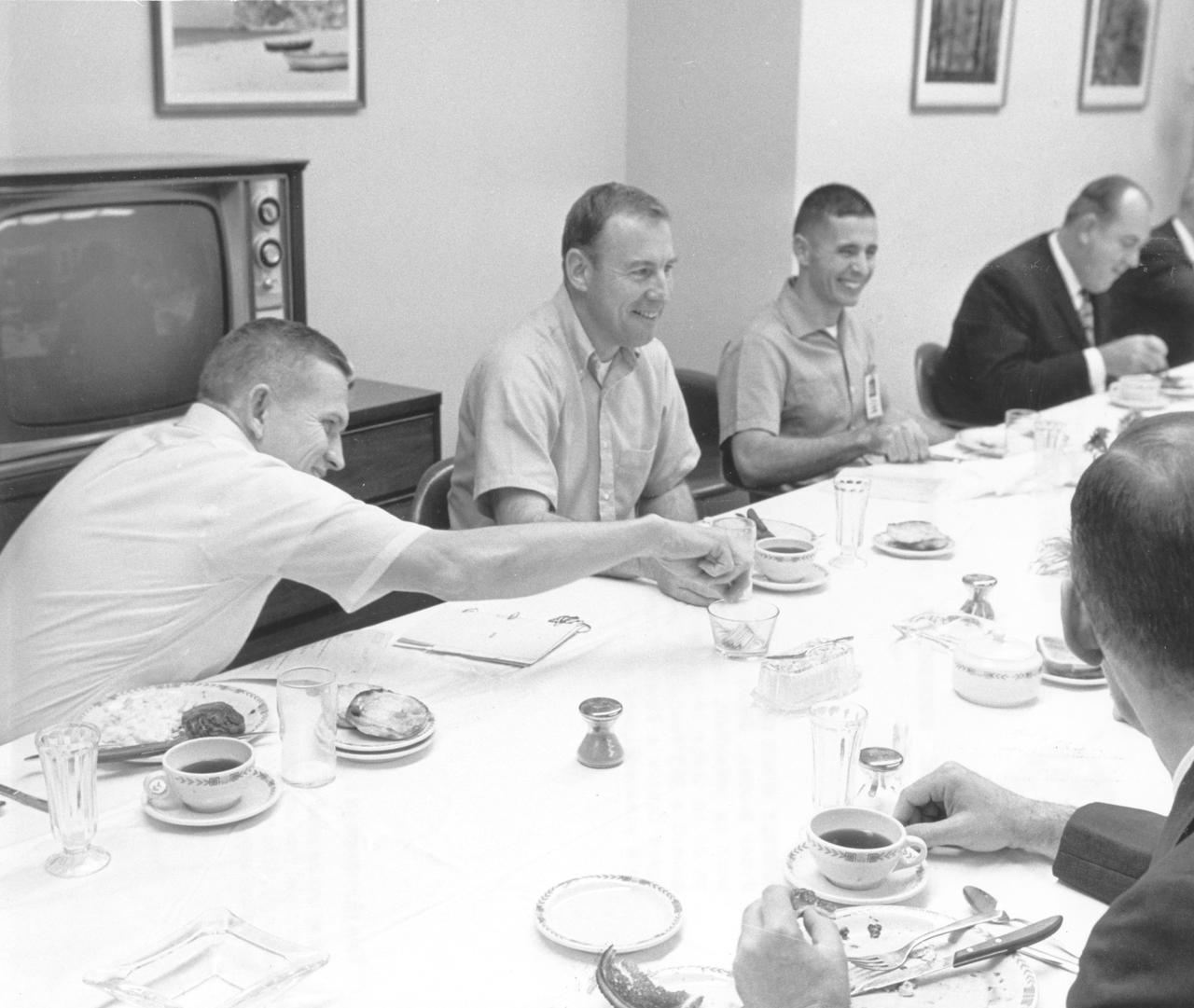
Pictured (left to right) are Apollo 8 crew members Frank Borman, commander; James Lovell, Command Module (CM) pilot; and William Anders, Lunar Module (LM) pilot, having breakfast on the day of launch. The three composed the first manned Apollo mission that launched aboard the Saturn V and the first manned Apollo craft to enter lunar orbit. Apollo 8 mission lift off occurred on December 21, 1968 and returned safely to Earth on December 27, 1968. The mission achieved operational experience and tested the Apollo command module systems, including communications, tracking, and life-support, in cis-lunar space and lunar orbit, and allowed evaluation of crew performance on a lunar orbiting mission. The crew photographed the lunar surface, both far side and near side, obtaining information on topography and landmarks as well as other scientific information necessary for future Apollo landings. All systems operated within allowable parameters and all objectives of the mission were achieved.
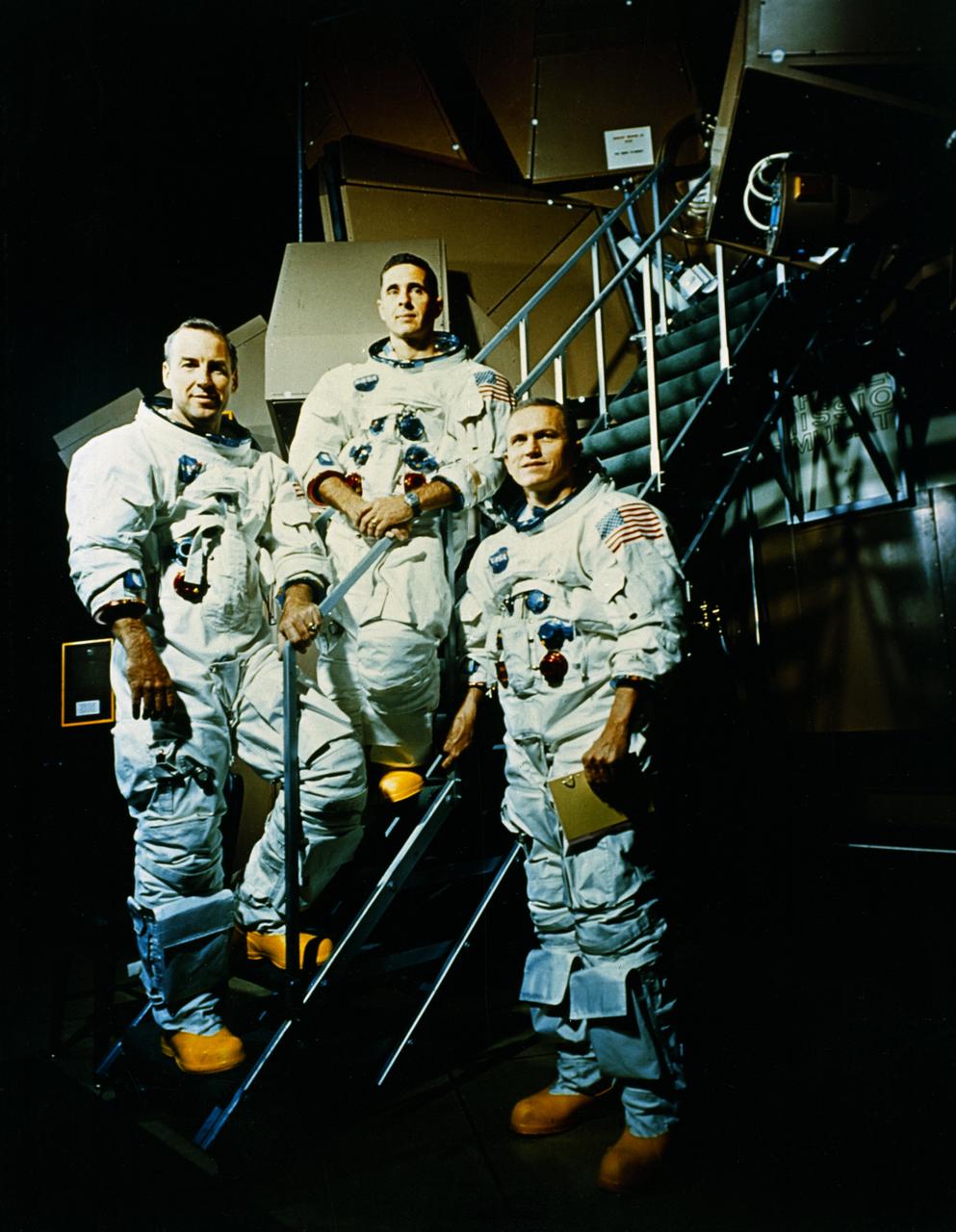
The Apollo 8 Crew (L to R) Frank Borman, commander; William Anders, Lunar Module (LM) Pilot; and James Lovell, Command Module (CM) pilot pose in front of the Apollo mission simulator during training. The three served as the crew for the first manned Apollo mission launched aboard the Saturn V and first manned Apollo craft to enter lunar orbit. Liftoff occurred on December 21, 1968 with a safe return to Earth on December 27, 1968. The mission achieved operational experience and tested the Apollo command module systems, including communications, tracking, and life-support, in cis-lunar space and lunar orbit, and allowed evaluation of crew performance on a lunar orbiting mission. The crew photographed the lunar surface, both far side and near side, obtaining information on topography and landmarks as well as other scientific information necessary for future Apollo landings. All systems operated within allowable parameters and all objectives of the mission were achieved.
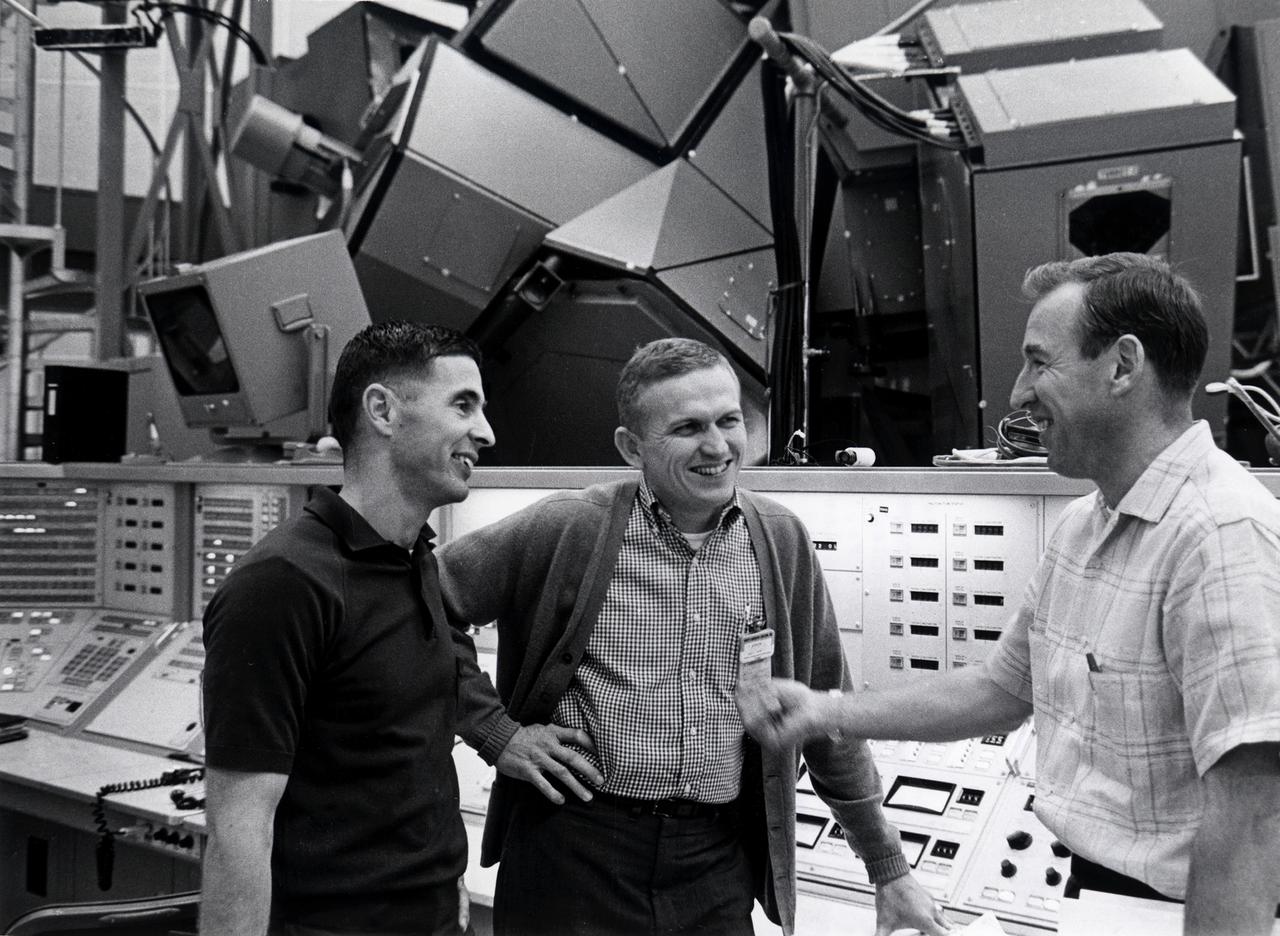
Apollo 8 crew members paused before the mission simulator during training for the first manned lunar orbital mission. Frank Borman, commander; James Lovell, Command Module (CM) pilot; and William Anders, Lunar Module (LM) pilot , were also the first humans to launch aboard the massive Saturn V space vehicle. Lift off occurred on December 21, 1968 and returned safely to Earth on December 27, 1968. The mission achieved operational experience and tested the Apollo command module systems, including communications, tracking, and life-support, in cis-lunar space and lunar orbit, and allowed evaluation of crew performance on a lunar orbiting mission. The crew photographed the lunar surface, both far side and near side, obtaining information on topography and landmarks as well as other scientific information necessary for future Apollo landings. All systems operated within allowable parameters and all objectives of the mission were achieved.
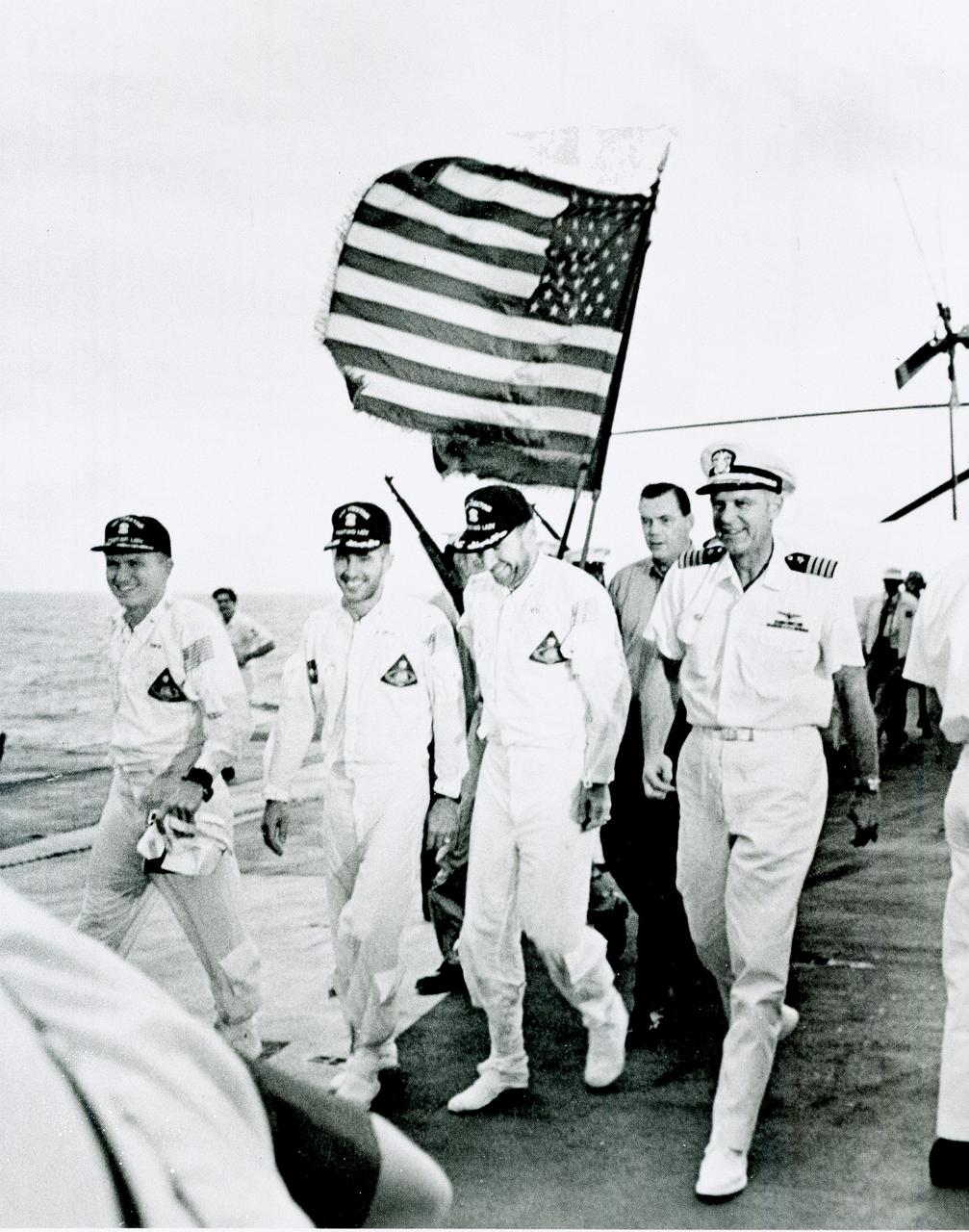
Apollo 8 astronauts and commanding officer of the recovery ship U.S.S. Yorktown walk the red carpet of the flight deck after splashdown recovery in the Pacific Ocean. Apollo 8 served as the first manned lunar orbit mission and the first manned flight of the Saturn V space vehicle, developed by the Marshall Space Flight Center (MSFC). Liftoff occurred on December 21, 1968, carrying astronauts Frank Borman, commander; William Anders, Lunar Module (LM) Pilot; and James Lovell, Command Module (CM) pilot. The three safely returned to Earth on December 27, 1968. The mission achieved operational experience and tested the Apollo command module systems, including communications, tracking, and life-support, in cis-lunar space and lunar orbit, and allowed evaluation of crew performance on a lunar orbiting mission. The crew photographed the lunar surface, both far side and near side, obtaining information on topography and landmarks as well as other scientific information necessary for future Apollo landings. All systems operated within allowable parameters and all objectives of the mission were achieved.
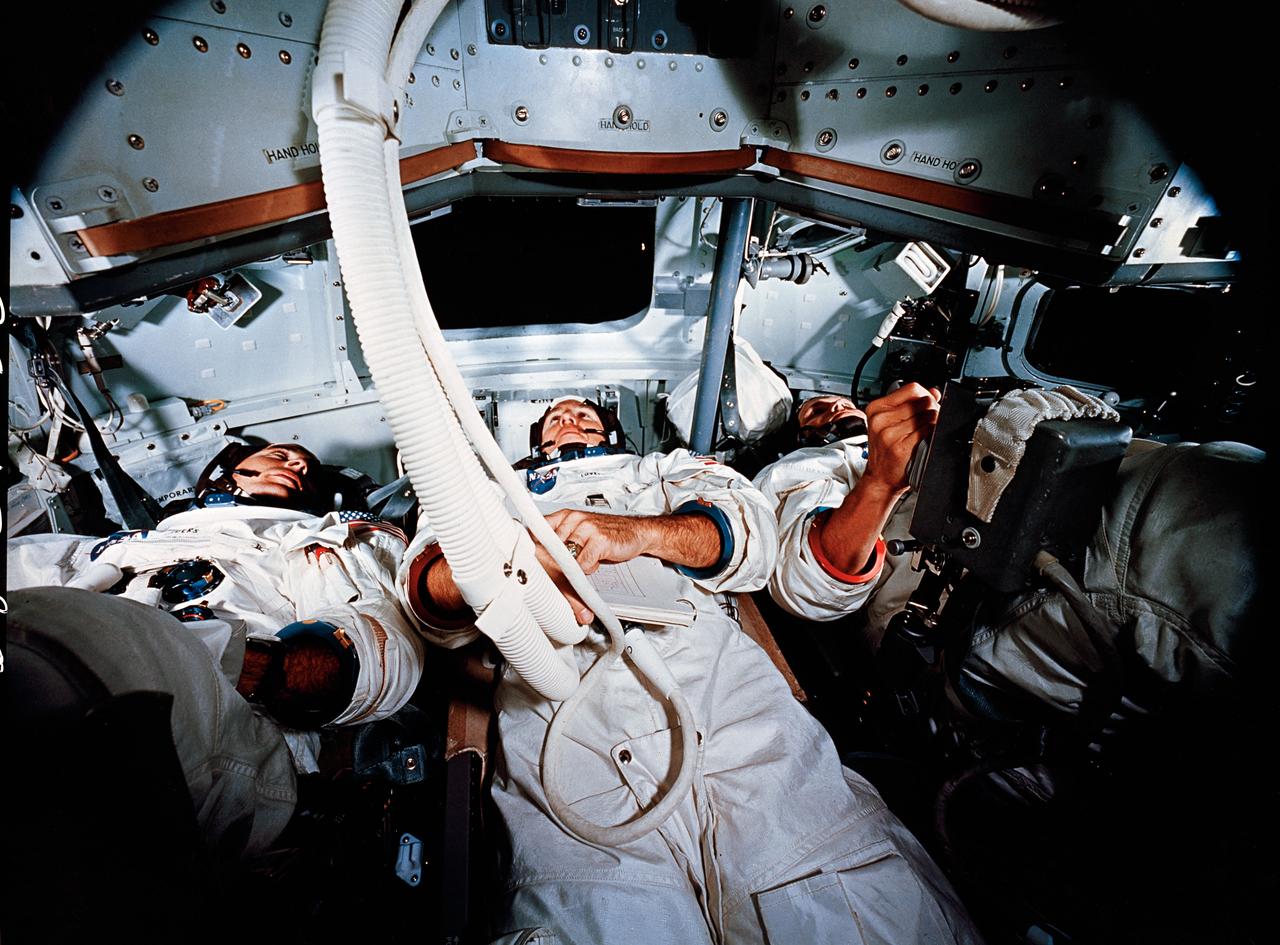
S68-54520 (13 Nov. 1968) --- The Apollo 8 prime crew is seen inside a simulator at the Kennedy Space Center (KSC) during training preparations for their forthcoming lunar orbit mission. Left to right, are astronauts William A. Anders, lunar module pilot; James A. Lovell Jr., command module pilot; and Frank Borman, commander.
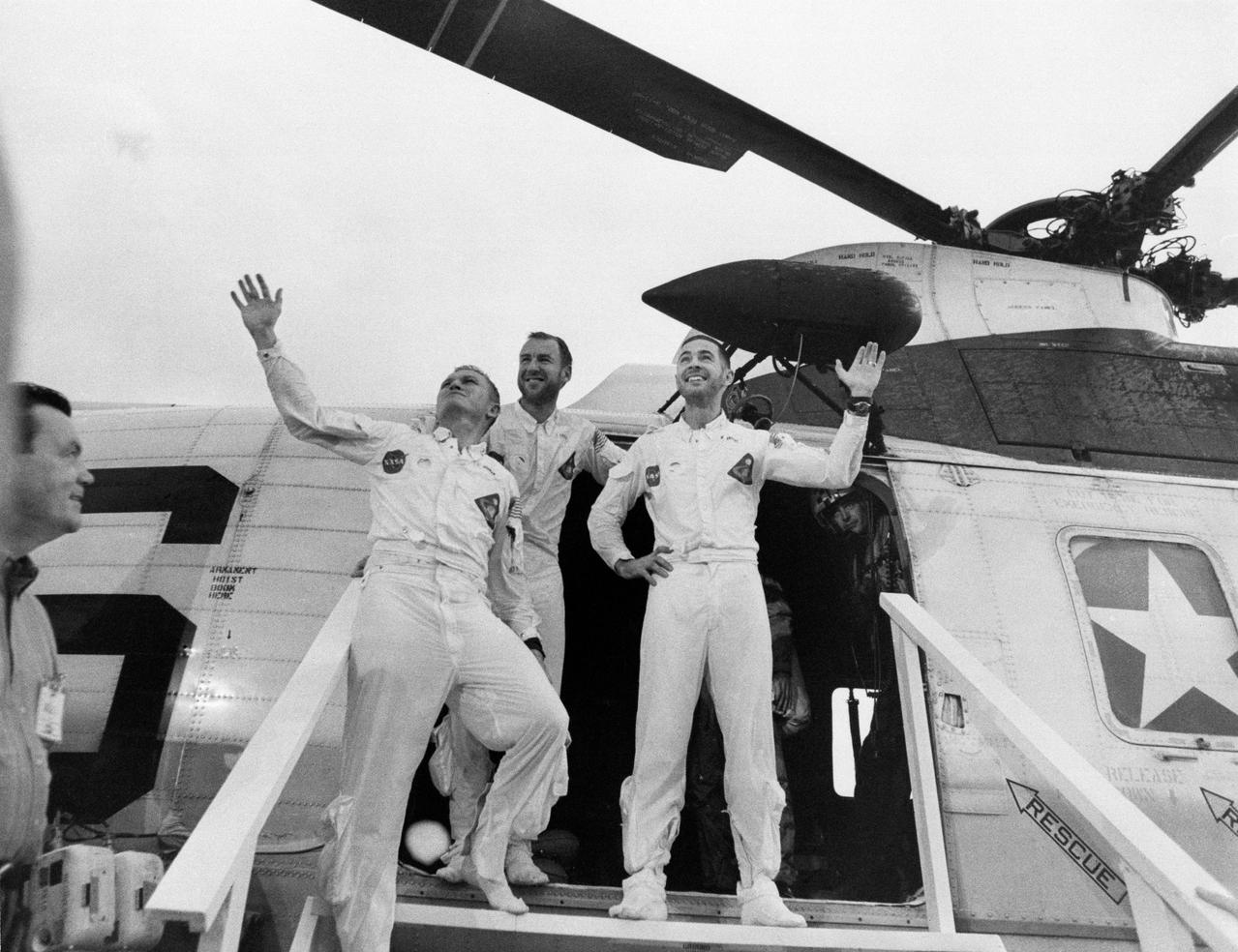
S69-15737 (27 Dec. 1968) --- The Apollo 8 crew stands in the doorway of a recovery helicopter after arriving aboard the carrier USS Yorktown, prime recovery ship for the historic Apollo 8 lunar orbit mission. Left to right, are astronauts Frank Borman, commander; James A. Lovell Jr., command module pilot; and William A. Anders, lunar module pilot. Apollo 8 splashed down at 10:51 a.m. (EST), Dec. 27, 1968, in the central Pacific approximately 1,000 miles south-southwest of Hawaii.

S68-50265 (13 Nov. 1968) --- These three astronauts are the prime crew of the Apollo 8 lunar orbit mission. Left to right, are James A. Lovell Jr., command module pilot; William A. Anders, lunar module pilot; and Frank Borman, commander. They are standing beside the Apollo Mission Simulator at the Kennedy Space Center (KSC).
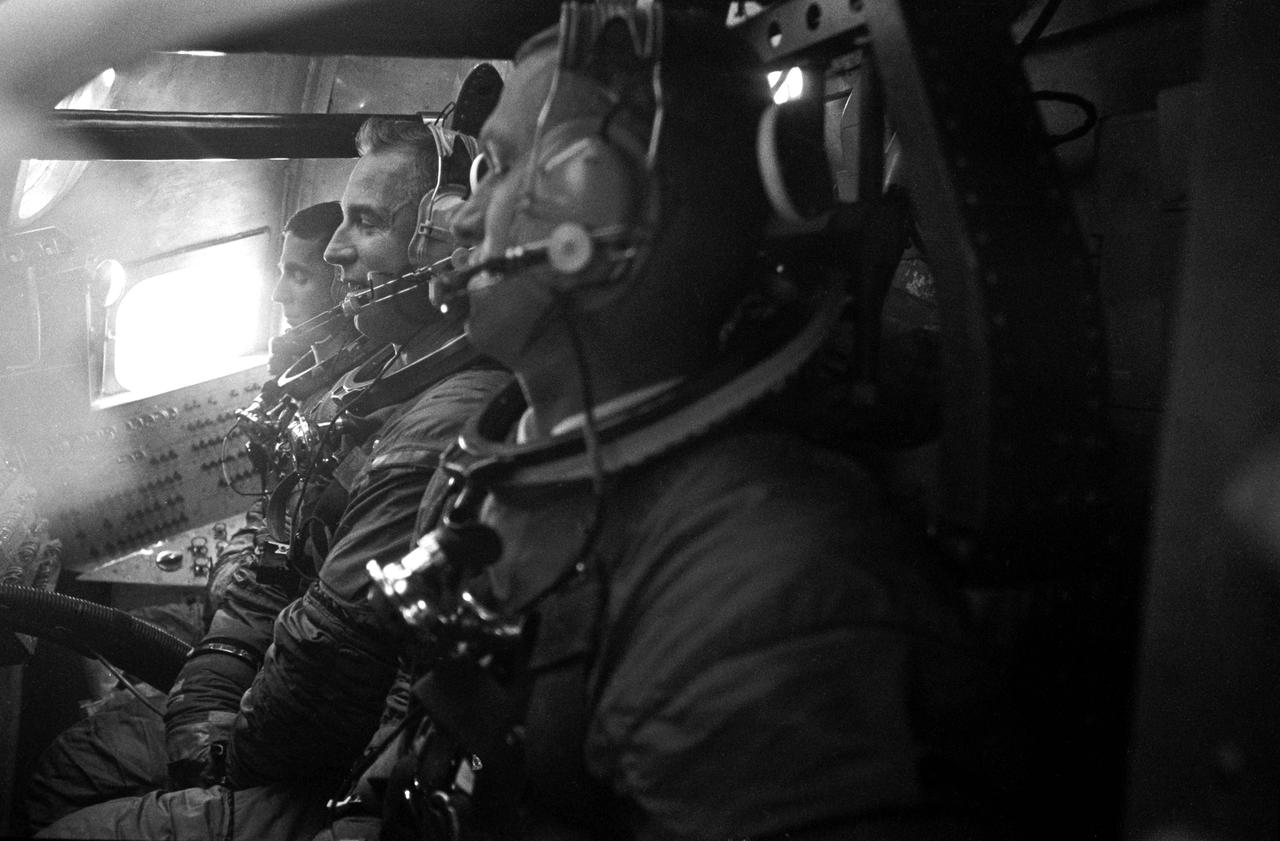
S68-52941 (25 Oct. 1968) --- The Apollo 8 prime crew is seen inside Apollo Boilerplate 1102A during water egress training in the Gulf of Mexico. From the foreground are astronauts Frank Borman, commander; James A. Lovell Jr., command module pilot; and William A. Anders, lunar module pilot. Photo credit: NASA
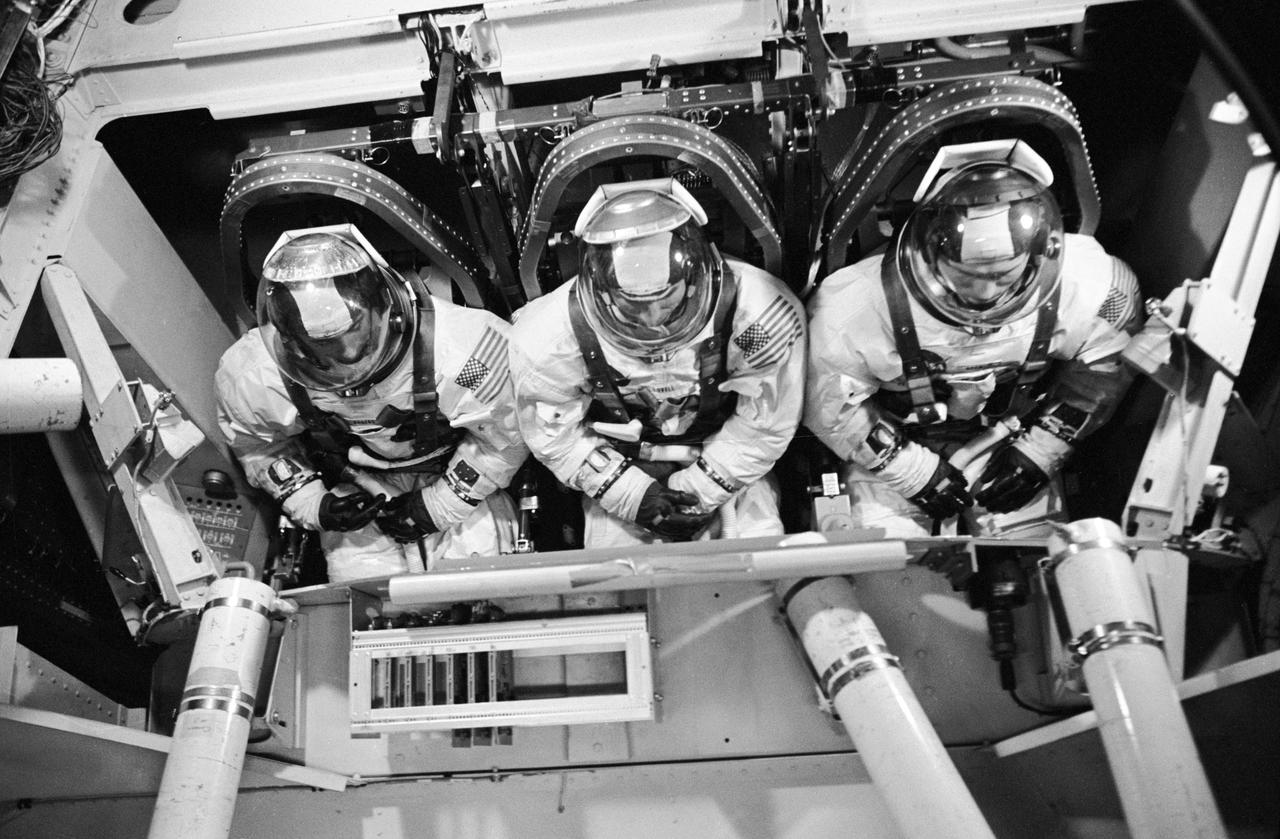
S68-53283 (1 Nov. 1968) --- The Apollo 8 prime crew is seen inside the gondola during centrifuge training in MSC's Flight Acceleration Facility, Building 29. Left to right, are astronauts William A. Anders, lunar module pilot, James A. Lovell Jr., command module pilot; and Frank Borman, commander. Photo credit: NASA
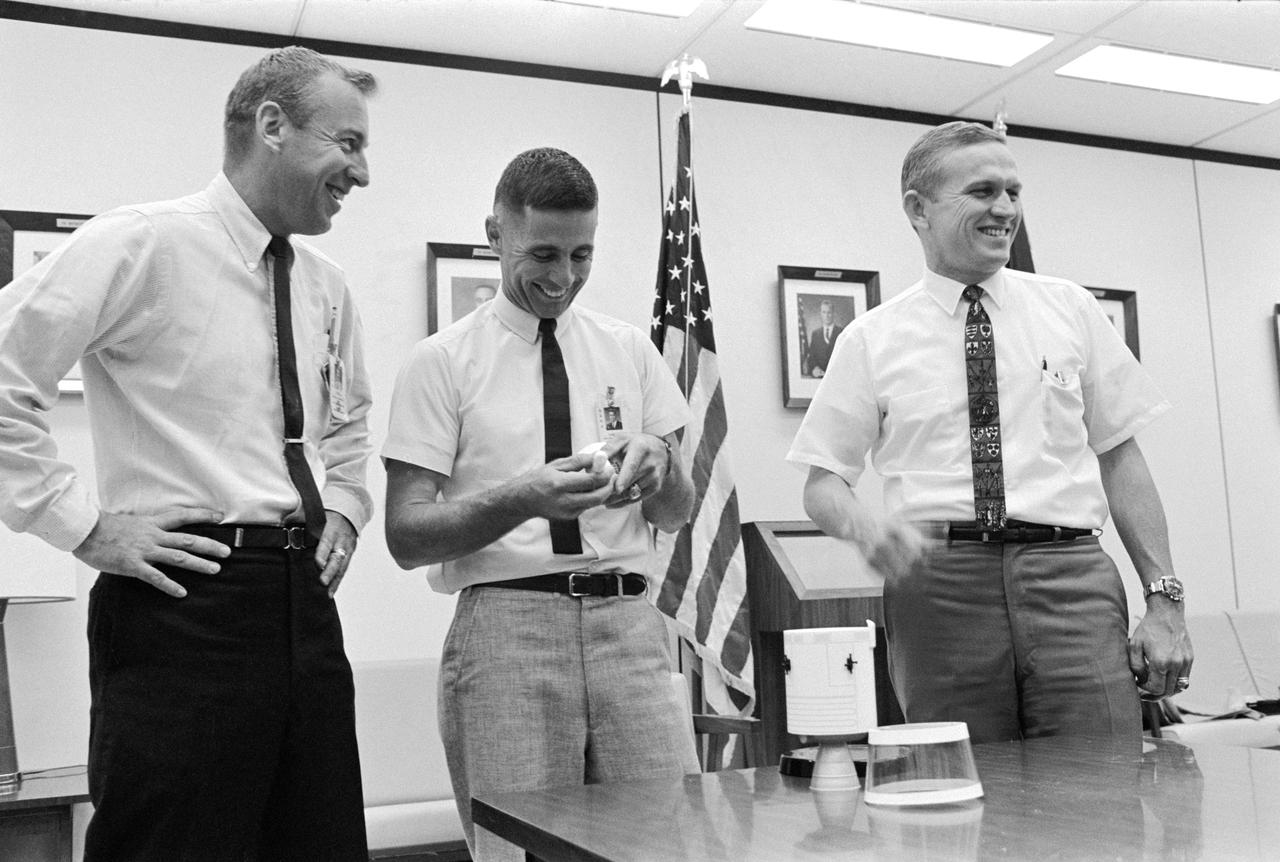
S68-50646 (18 Oct. 1968) --- The prime crew of the Apollo 8 mission is photographed in Building 4, at the Manned Spacecraft Center (MSC), where they are participating in classroom work in burn test review and procedures review. Left to right, are astronauts James A. Lovell Jr., William A. Anders, and Frank Borman.
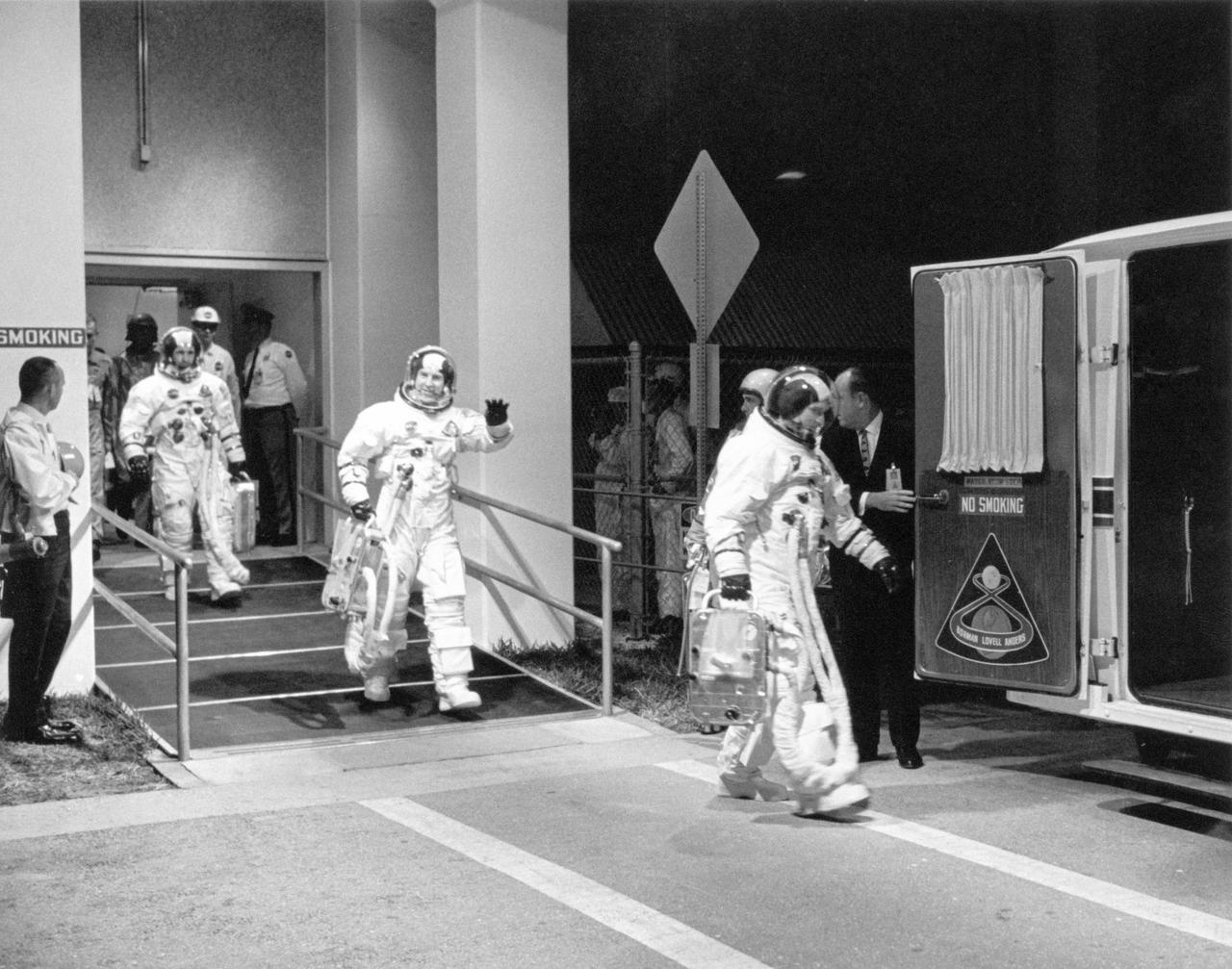
S68-55997 (21 Dec. 1968) --- Apollo 8 Command Module Pilot James Lovell waves to well-wishers during the pre-dawn departure to Launch Pad 39 for the six-day lunar orbital Apollo/Saturn V mission. Astronaut Lovell is accompanied by Commander Frank Borman, right, and Lunar Module Pilot William Anders, left.
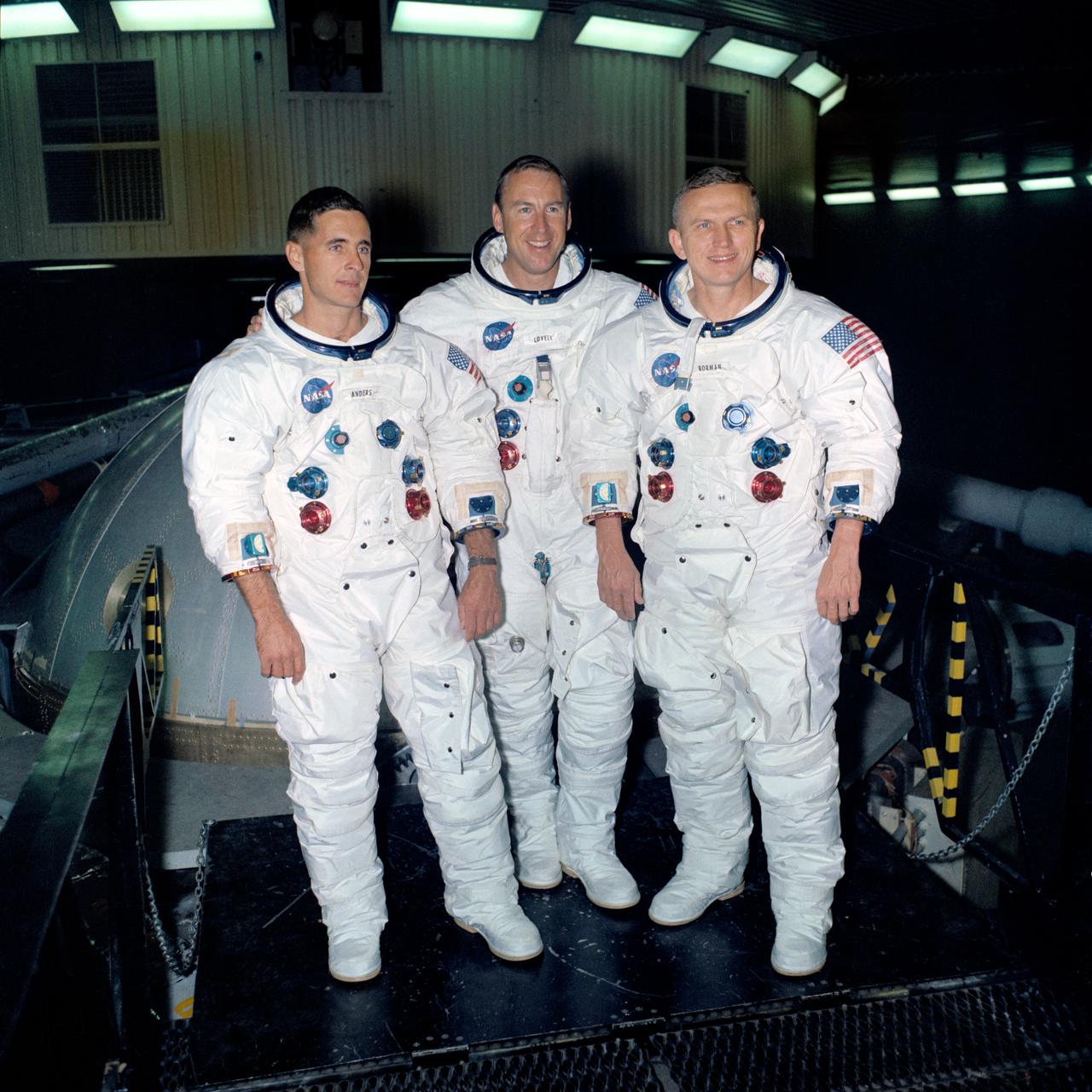
S68-53187 (1 Nov. 1968) --- The prime crew of the Apollo 8 lunar orbit mission stands beside the gondola in Building 29 after suiting up for centrifuge training in the Manned Spacecraft Center's (MSC) Flight Acceleration Facility (FAF). Left to right, are astronauts William A. Anders, lunar module pilot; James A. Lovell Jr., command module pilot; and Frank Borman, commander.
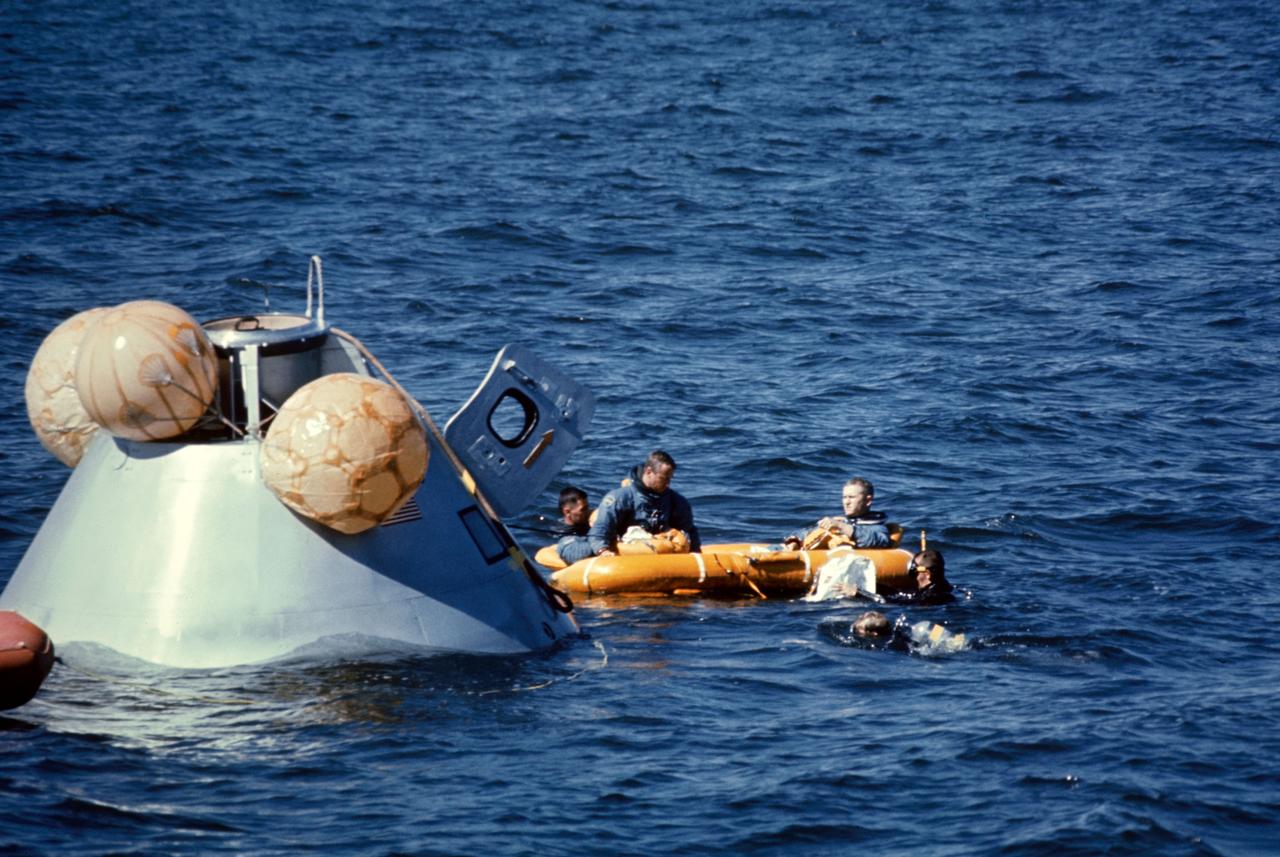
S68-53223 (19 Oct. 1968) --- The prime crew of the Apollo 8 mission in life raft awaiting pickup by U.S. Coast Guard helicopter during water egress training in the Gulf of Mexico. They had just egressed Apollo Boilerplate 1102A, at left. Inflated bags were used to upright the boilerplate. Left to right, are astronauts William A. Anders, lunar module pilot; and Frank Borman, commander. A team of MSC swimmers assisted with the training exercise.
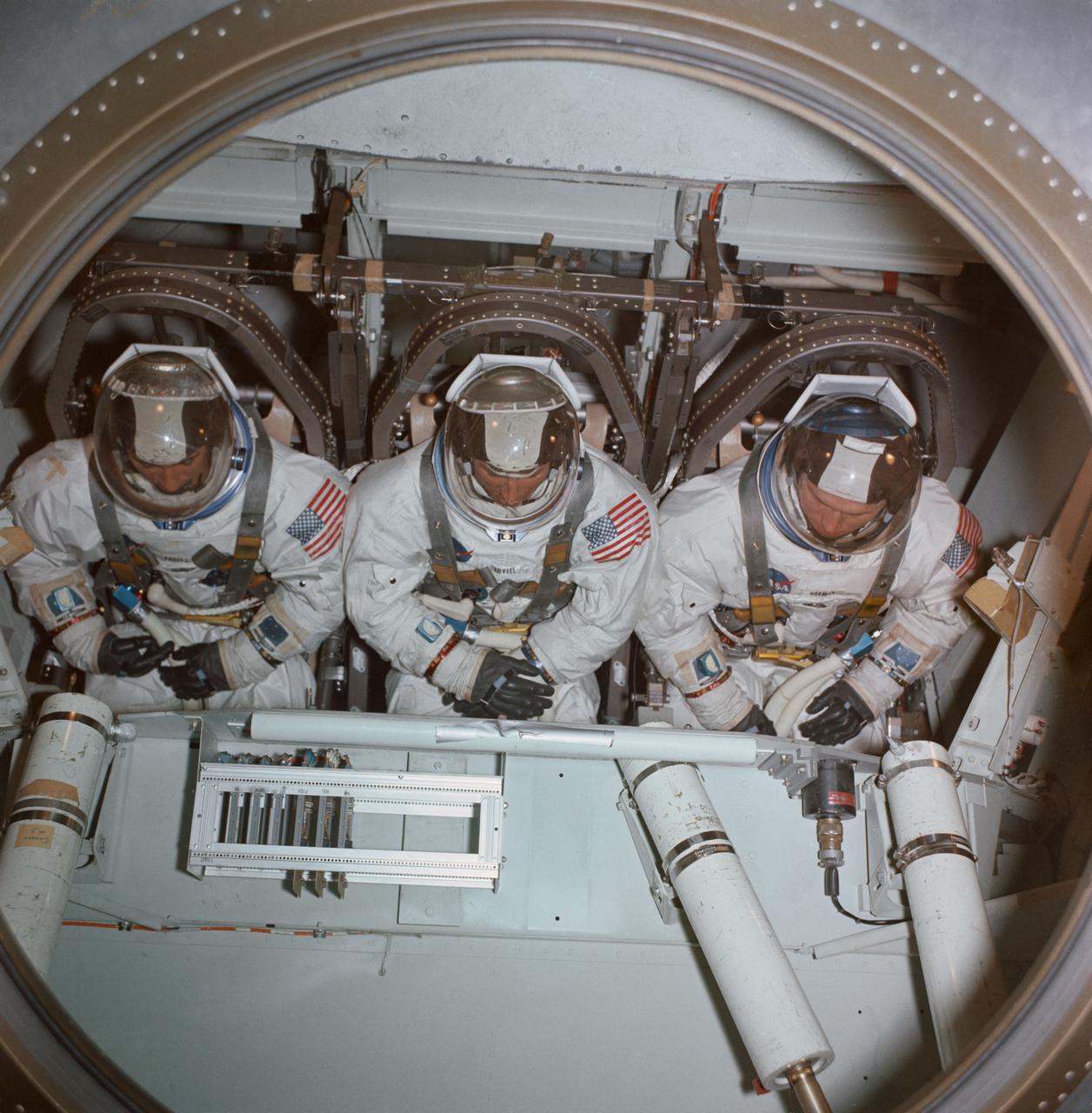
S68-53194 (1 Nov. 1968) --- The Apollo 8 prime crew inside the centrifuge gondola in Building 29 during centrifuge training in MSC's Flight Acceleration Facility. (View with crew lying on back) Left to right are astronauts William A. Anders, lunar module pilot; James A. Lovell Jr., command module pilot; and Frank Borman, commander. Photo credit: NASA
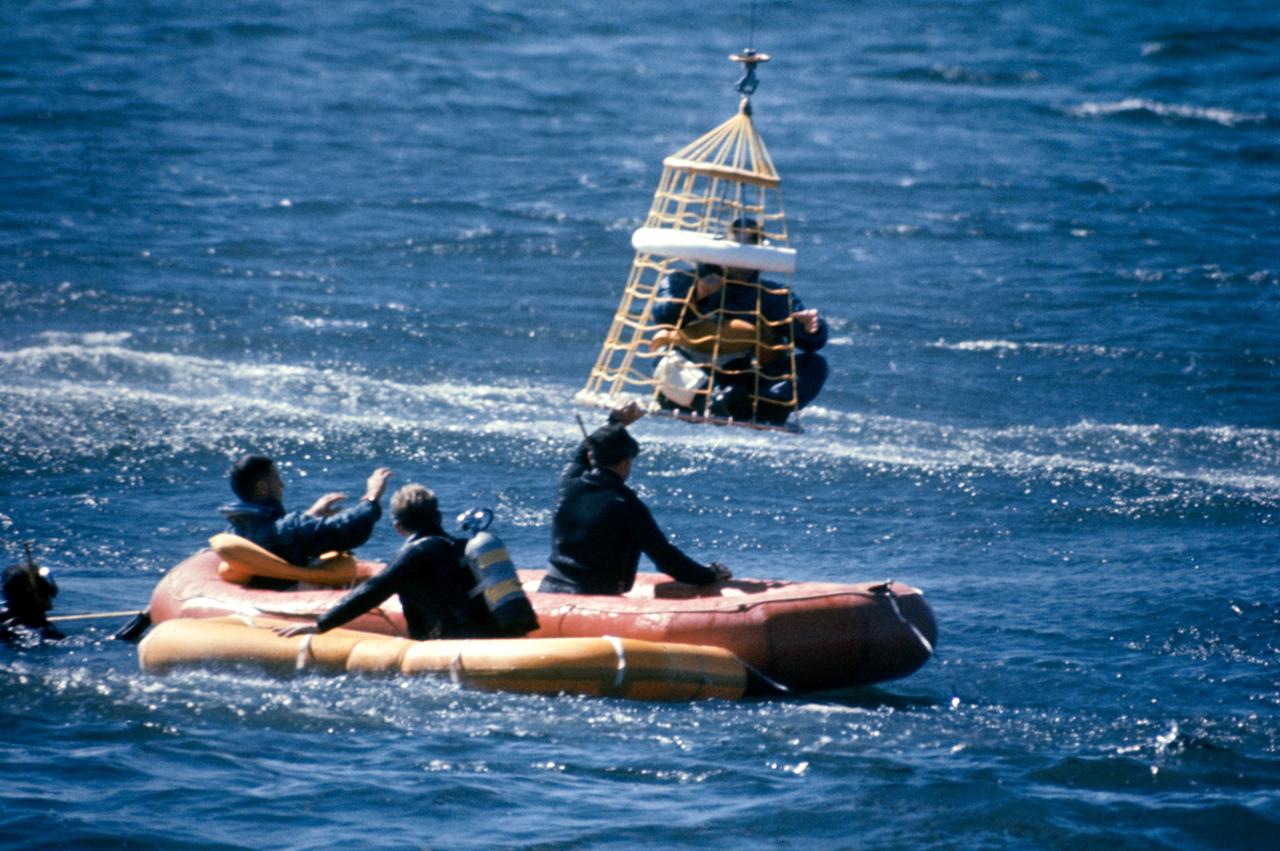
S68-53217 (19 Oct. 1968) --- Astronaut James A. Lovell Jr., command module pilot of the Apollo 8 prime crew, in special net being hoisted up to a U.S. Coast Guard helicopter during water egress training in the Gulf of Mexico. Awaiting his turn for helicopter pickup is astronaut William A. Anders (in raft), lunar module pilot. Astronaut Frank Borman, commander, had already been picked up. A team of Manned Spacecraft Center (MSC) swimmers assisted with the training exercise.
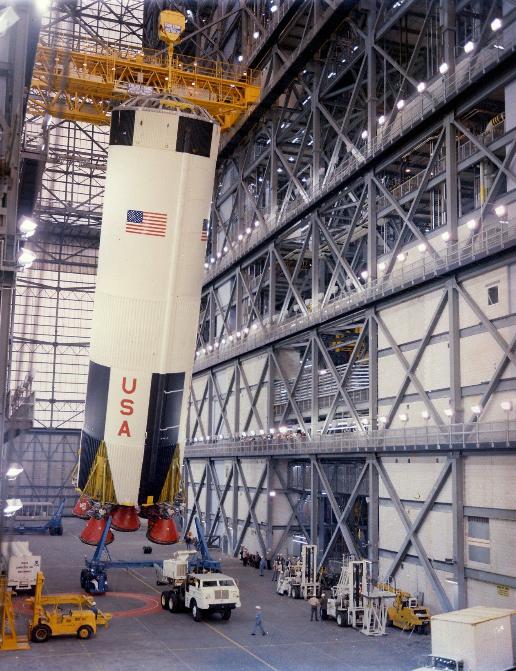
Teams lift the first stage of the Apollo 8 Saturn V rocket inside the transfer aisle of the Vehicle Assembly Building at NASA’s Kennedy Space Center in Florida on Feb. 1, 1968, and prepare to place it atop the mobile launcher. Apollo 8 was the first crewed spacecraft to successfully orbit the Moon and return to Earth, setting the stage for Apollo 11 – the first crewed lunar landing. Apollo 8 launched on Dec. 21, 1968, and the crew members consisted of Frank Borman, William A. Anders, and James A. Lovell Jr.

RECOVERY - APOLLO 8 - USS YORKTOWN Recovery activities of the Apollo 8 Crew and Command Module (CM)-103 Spacecraft inspection onboard the USS Yorktown. USS YORKTOWN
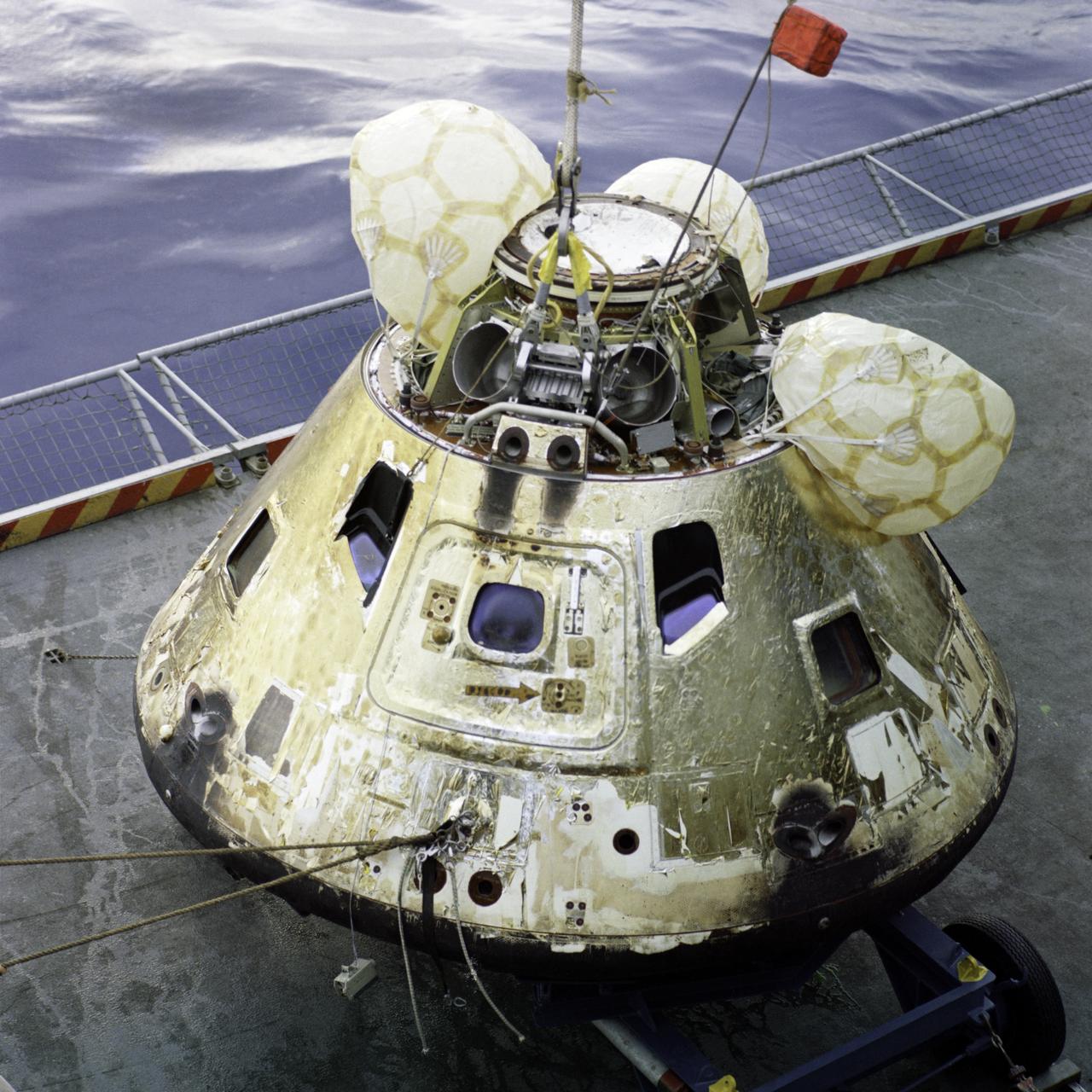
RECOVERY - APOLLO 8 - USS YORKTOWN Recovery activities of the Apollo 8 Crew and Command Module (CM)-103 Spacecraft inspection onboard the USS Yorktown. USS YORKTOWN
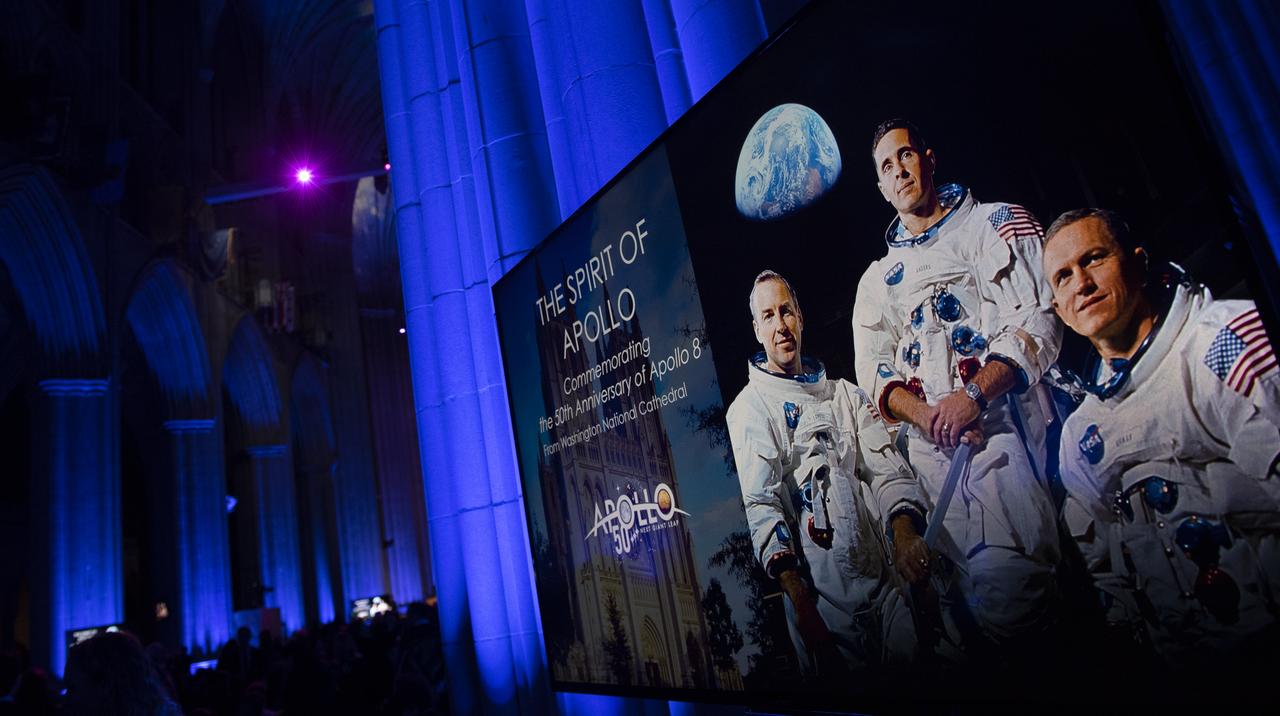
A monitor showing a portrait of the Apollo 8 crew is seen during the Smithsonian National Air and Space Museum's Spirit of Apollo event commemorating the 50th anniversary of Apollo 8, Tuesday, Dec. 11, 2018 at the Washington National Cathedral in Washington, DC. Apollo 8 was humanity's first journey to another world, taking astronauts Frank Borman, Jim Lovell, and William Anders to the Moon and back in December of 1968. Photo Credit: (NASA/Joel Kowsky)
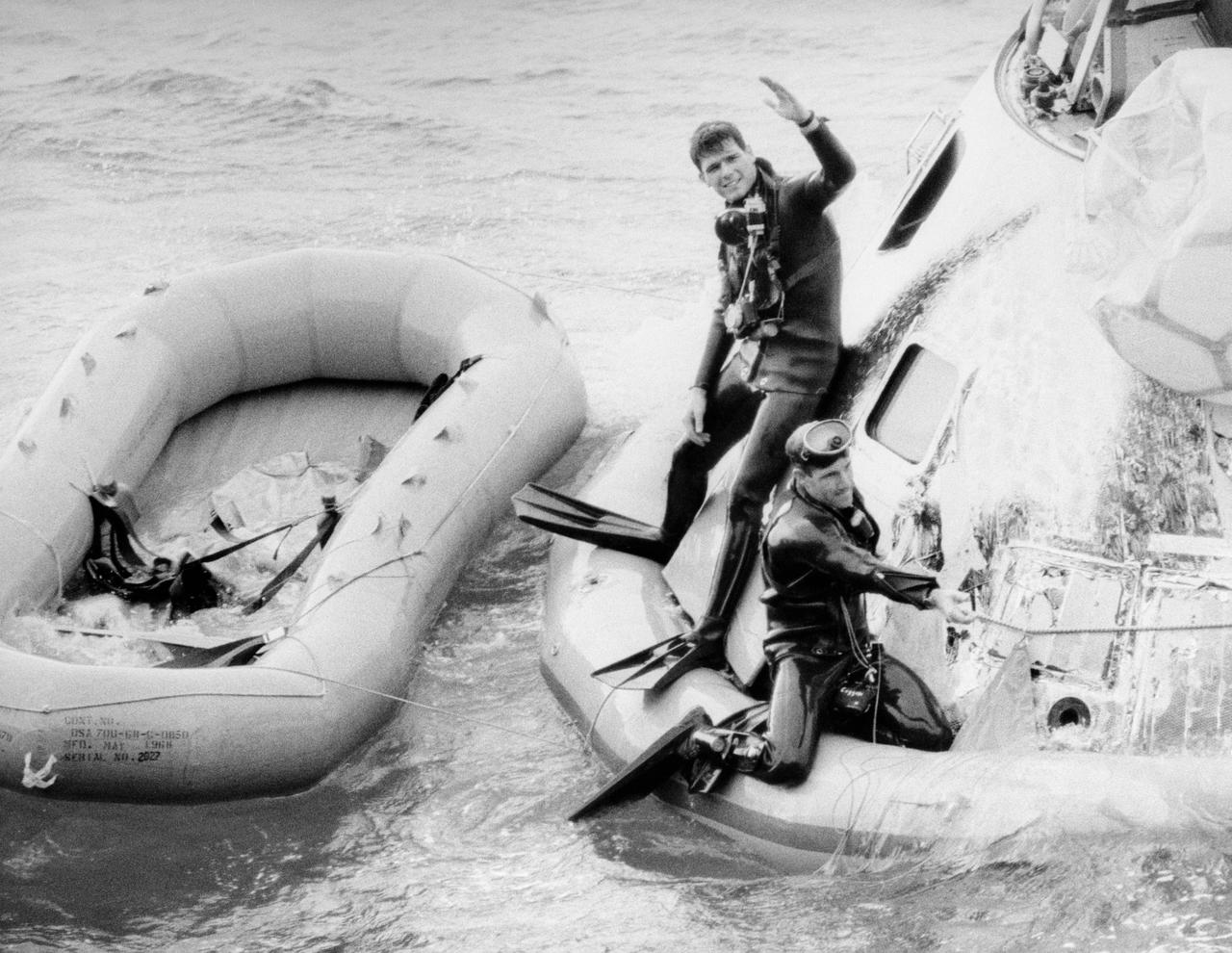
S69-15732 (27 Dec. 1968) --- A U.S. Navy frogman team participates in the Apollo 8 recovery operations. The Apollo crew, astronauts Frank Borman, James A. Lovell Jr., and William A. Anders, were recovered by helicopter and flown to the deck of the USS Yorktown, prime recovery ship for the historic Apollo 8 lunar orbit mission. Apollo 8 splashed down at 10:51 a.m. (EST), Dec. 27, 1968, about 1,000 miles south-southwest of Hawaii.

S68-56001 (21 Dec. 1968) --- The Apollo 8 (Spacecraft 103/Saturn 503) space vehicle is launched from Pad A, Launch Complex 39, Kennedy Space Center, at 7:51 a.m. (EST), Dec. 21, 1968. The crew of the Apollo 8 lunar orbit mission is astronauts Frank Borman, commander; James A. Lovell Jr., command module pilot; and William A. Anders, lunar module pilot. Apollo 8 was the first manned Saturn V launch. (Just after ignition)
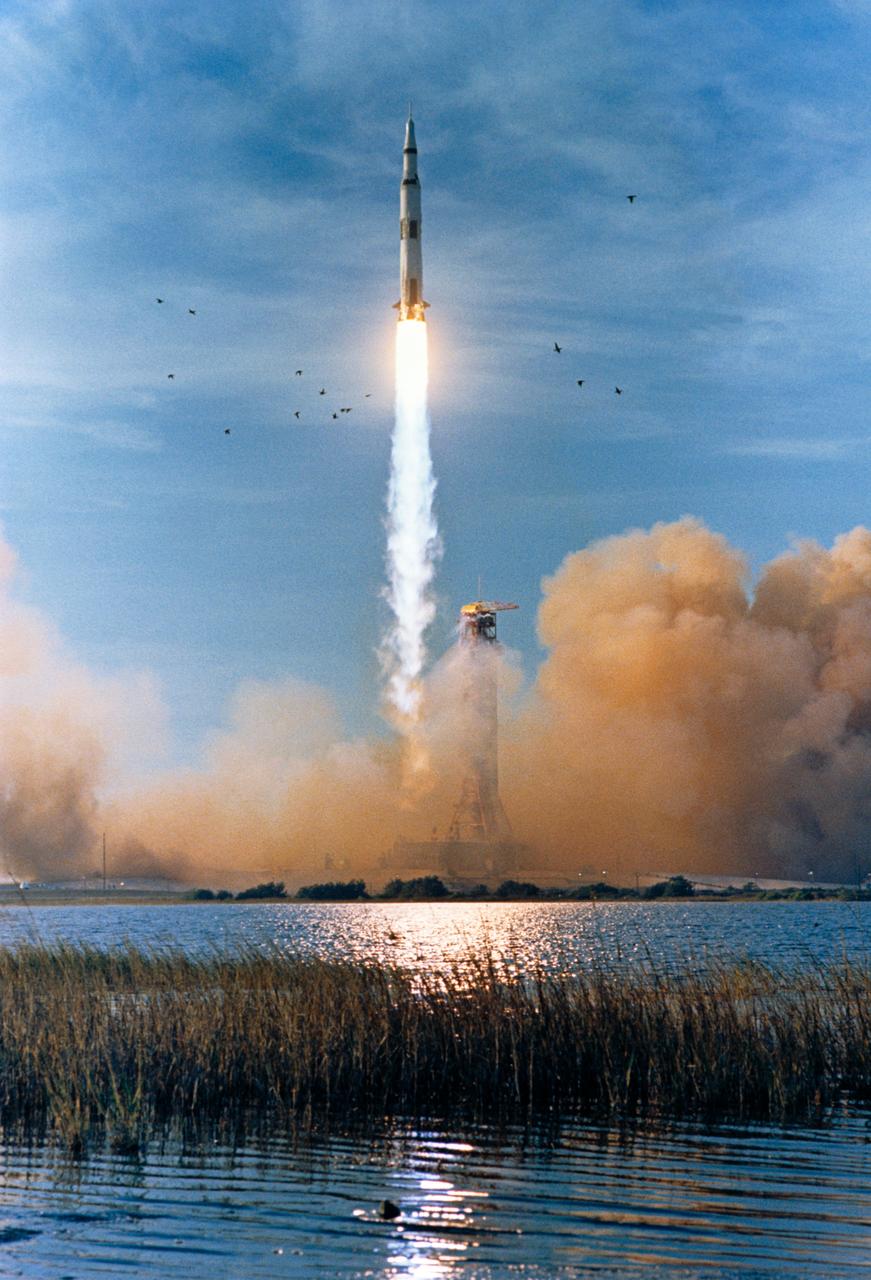
S68-56050 (21 Dec. 1968)--- The Apollo 8 (Spacecraft 103/Saturn 503) space vehicle is launched from Pad A, Launch Complex 39, Kennedy Space Center (KSC), at 7:51 a.m. (EST), Dec. 21, 1968. The crew of the Apollo 8 lunar orbit mission is astronauts Frank Borman, commander; James A. Lovell Jr., command module pilot; and William A. Anders, lunar module pilot. Apollo 8 is the first manned Saturn V launch. (water in foreground, seagulls)
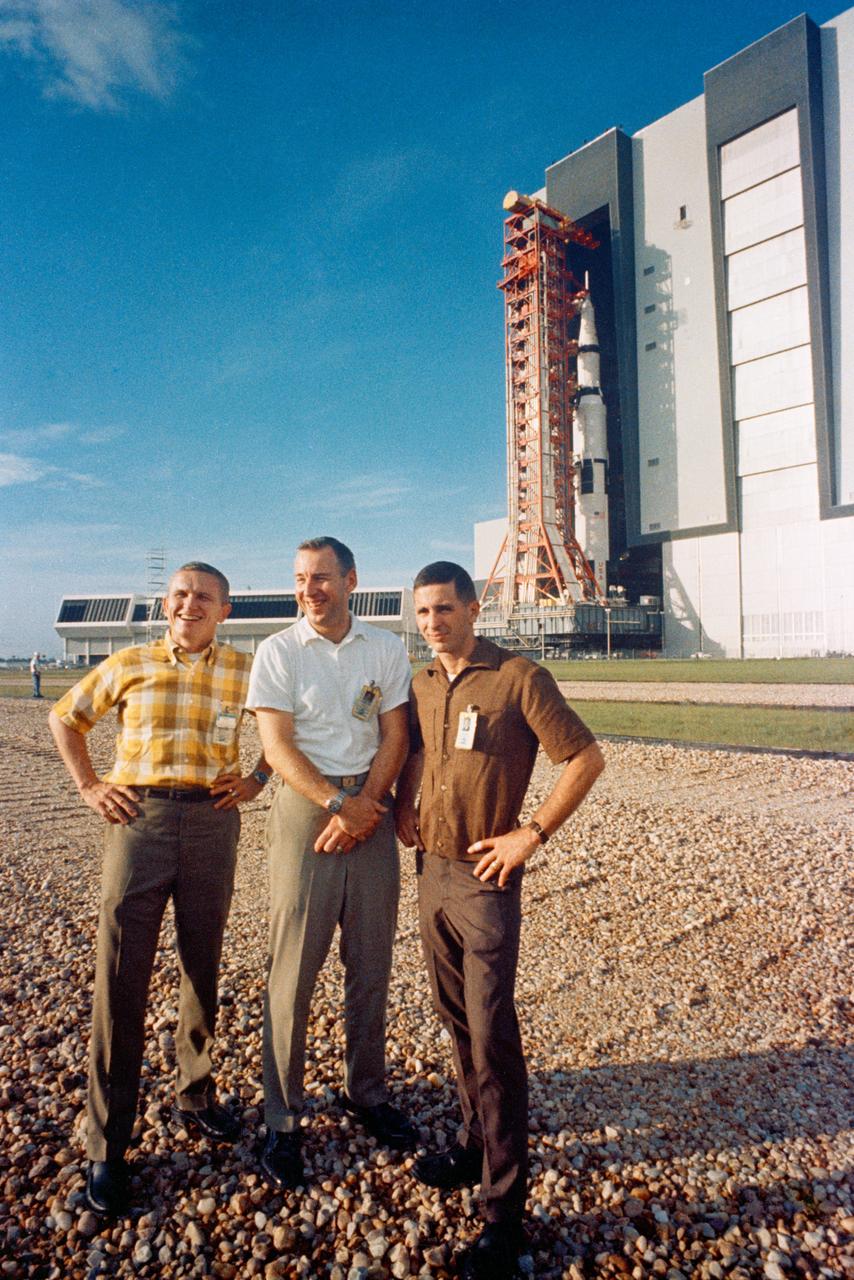
S68-49397 (9 Oct. 1968) --- The Apollo 8 prime crew stands in foreground as the Apollo (Spacecraft 103/Saturn 503) space vehicle leaves the Kennedy Space Center's Vehicle Assembly Building on way to Pad A, Launch Complex 39. The Saturn V stack and its mobile launch tower are atop a huge crawler-transporter. The Apollo 8 crew consists of (left to right) astronauts Frank Borman, commander; James A. Lovell Jr., command module pilot; and William A. Anders, lunar module pilot.
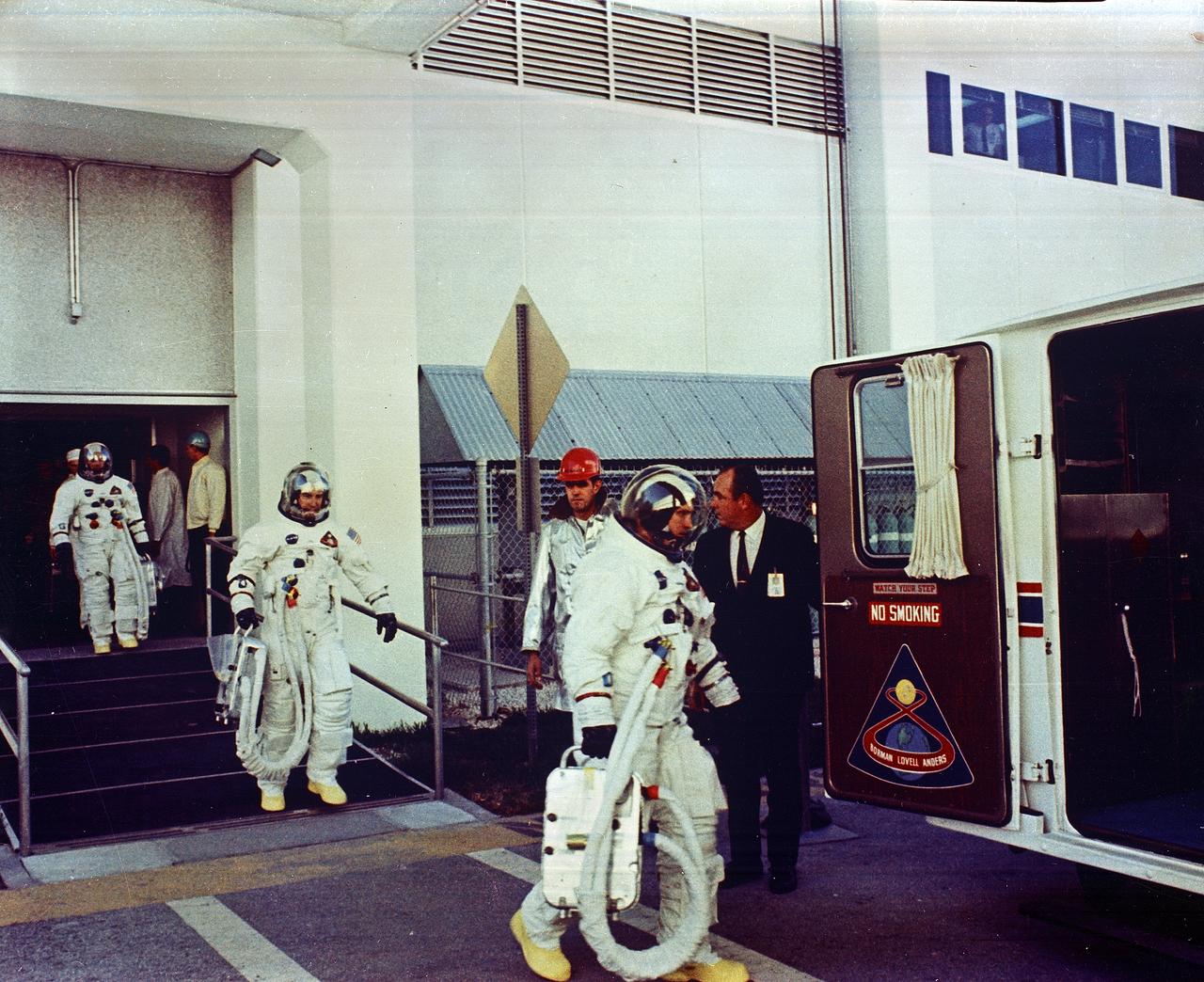
Apollo 8 Astronauts William Anders, Lunar Module (LM) Pilot; James Lovell, Command Module (CM) pilot; and Frank Borman, commander, transfer to the astronaut van for the trip to the launch pad. The first manned Apollo mission launched aboard the Saturn V and first manned Apollo craft to enter lunar orbit, the SA-503, Apollo 8 mission liftoff occurred on December 21, 1968 and returned safely to Earth on December 27, 1968. The mission achieved operational experience and tested the Apollo command module systems, including communications, tracking, and life-support, in cis-lunar space and lunar orbit, and allowed evaluation of crew performance on a lunar orbiting mission. The crew photographed the lunar surface, both far side and near side, obtaining information on topography and landmarks as well as other scientific information necessary for future Apollo landings. All systems operated within allowable parameters and all objectives of the mission were achieved.
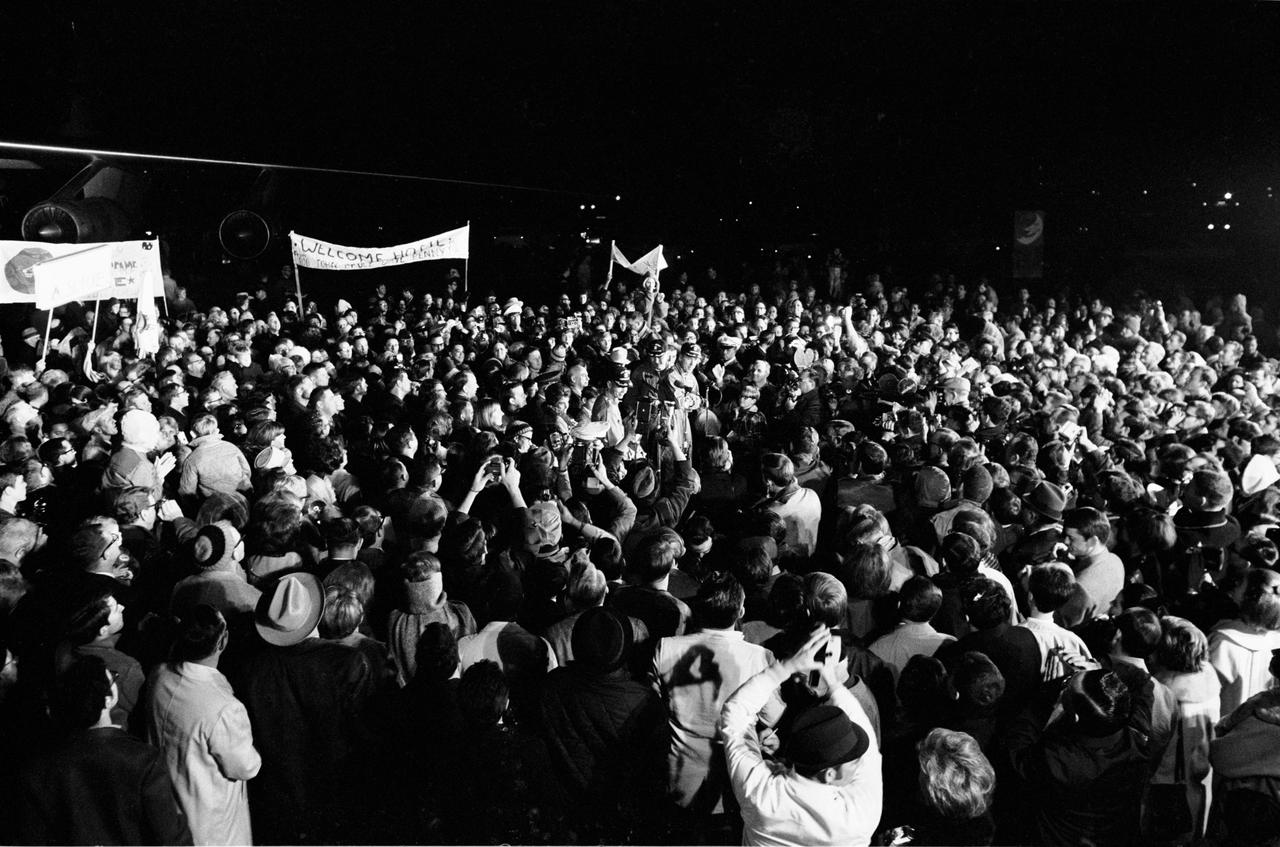
S69-16402 (29 Dec. 1968) --- Although it was past 2 a.m., a crew of more than 2,000 people were on hand at Ellington Air Force Base to welcome the members of the Apollo 8 crew back home. Astronauts Frank Borman, James A. Lovell Jr., and William A. Anders had just flown to Houston from the pacific recovery area by way of Hawaii. The three crewmen of the historic Apollo 8 lunar orbit mission are standing at the microphones in center of picture. Photo credit: NASA
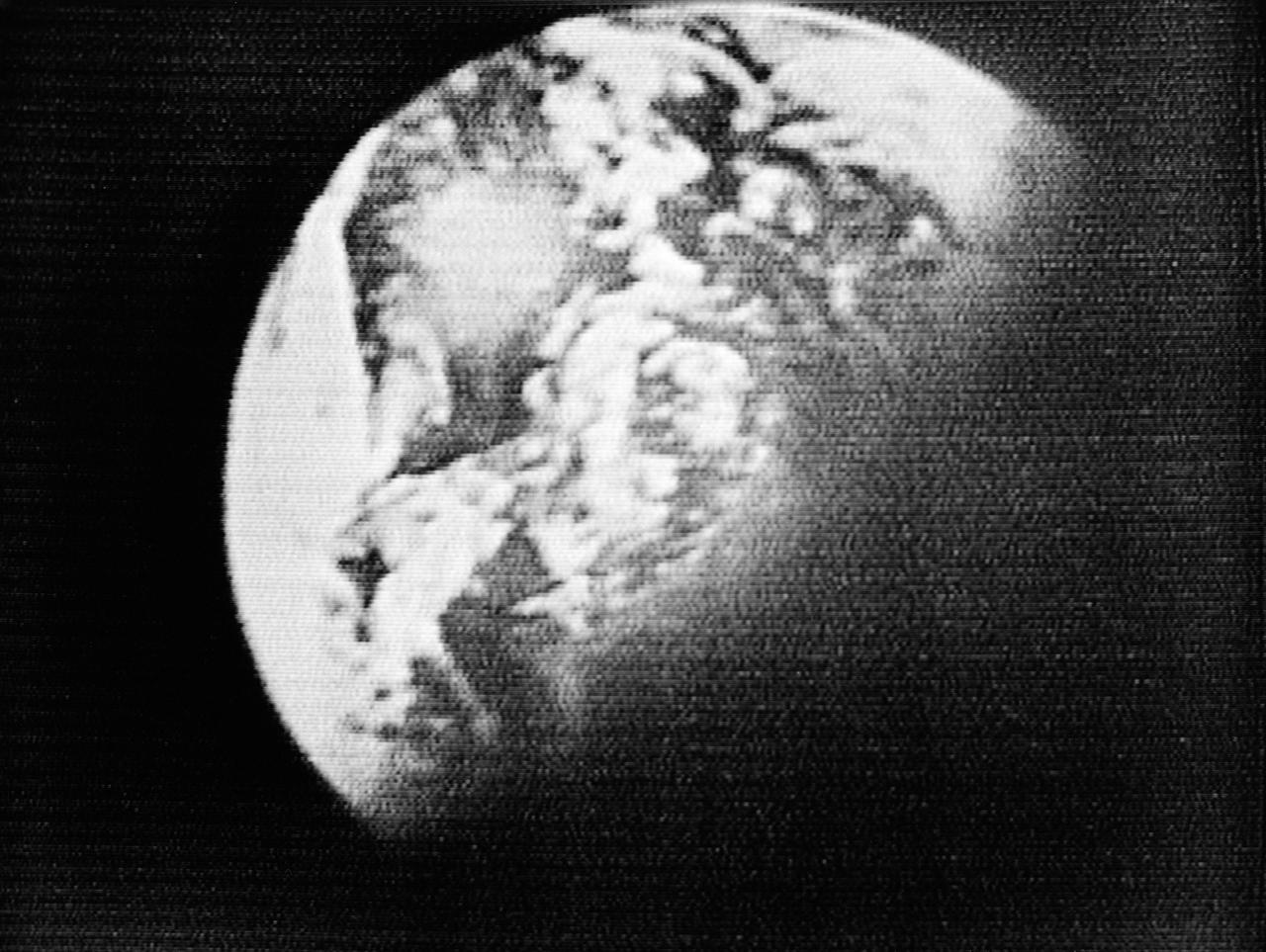
S68-56045 (26 Dec. 1968) --- Television viewers saw this picture of Earth during the sixth live telecast from the Apollo 8 spacecraft as it continued its journey home. At the time this picture was made, the Apollo 8 spacecraft, with astronauts Frank Borman, commander; James A. Lovell Jr., command module pilot; and William A. Anders, lunar module pilot, aboard, was about 97,000 nautical miles from Earth, and was traveling at a speed of 6,084 feet per second. As the spacecraft continued its trans-Earth course, the Apollo 8 crew noted that "Earth was getting larger" and that they were looking forward to being home.
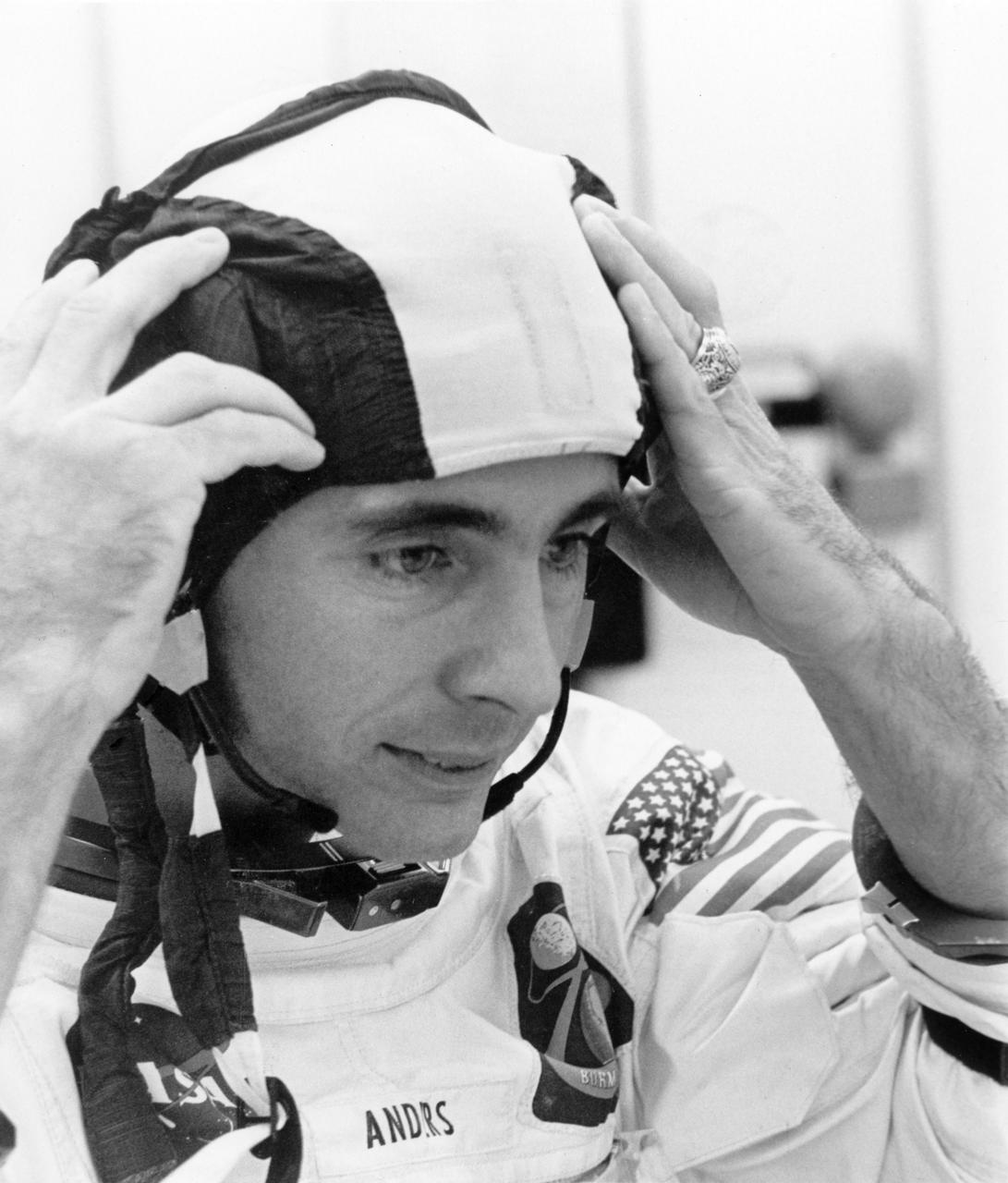
Apollo 8 Astronaut William Anders, Lunar Module (LM) pilot, adjusts his helmet as he suits up for the Apollo 8 mission. The first manned Apollo mission launched aboard the Saturn V and first manned Apollo craft to enter lunar orbit, the SA-503, Apollo 8 mission lift off occurred on December 21, 1968 and returned safely to Earth on December 27, 1968. Aboard were Anders and fellow astronauts James Lovell, Command Module (CM) pilot; and Frank Borman, commander. The mission achieved operational experience and tested the Apollo command module systems, including communications, tracking, and life-support, in cis-lunar space and lunar orbit, and allowed evaluation of crew performance on a lunar orbiting mission. The crew photographed the lunar surface, both far side and near side, obtaining information on topography and landmarks as well as other scientific information necessary for future Apollo landings. All systems operated within allowable parameters and all objectives of the mission were achieved.
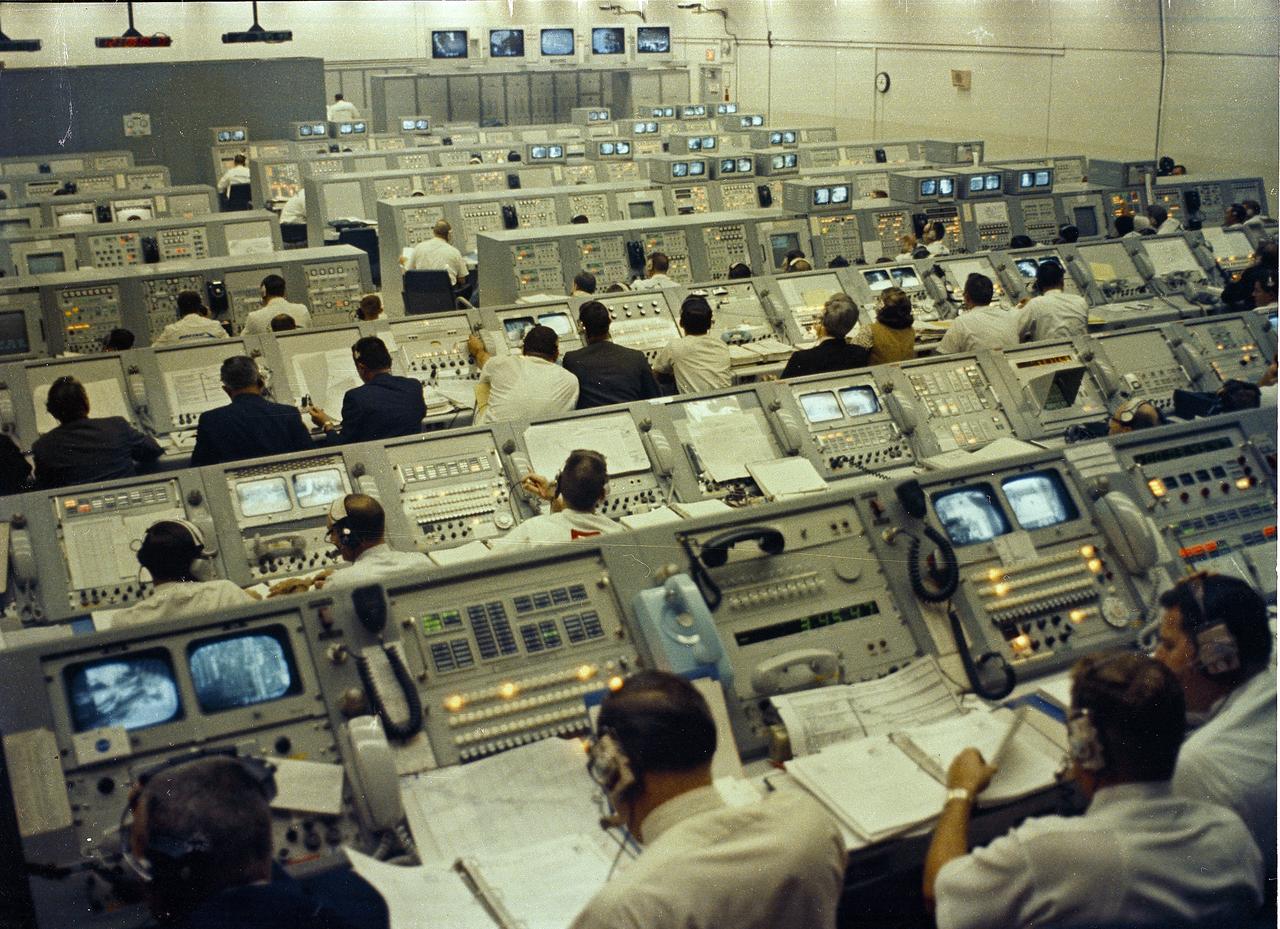
This photograph depicts a busy Launch Control Center at Kennedy Space Center during the Apollo 8 mission launch activities. Apollo 8 served as the first manned lunar orbit mission. Liftoff occurred on December 21, 1968 with a three man crew consiting of astronauts Frank Borman, commander; William Anders, Lunar Module (LM) Pilot; and James Lovell, Command Module (CM) pilot. The three safely returned to Earth on December 27, 1968. The mission achieved operational experience and tested the Apollo command module systems, including communications, tracking, and life-support, in cis-lunar space and lunar orbit, and allowed evaluation of crew performance on a lunar orbiting mission. The crew photographed the lunar surface, both far side and near side, obtaining information on topography and landmarks as well as other scientific information necessary for future Apollo landings. All systems operated within allowable parameters and all objectives of the mission were achieved.
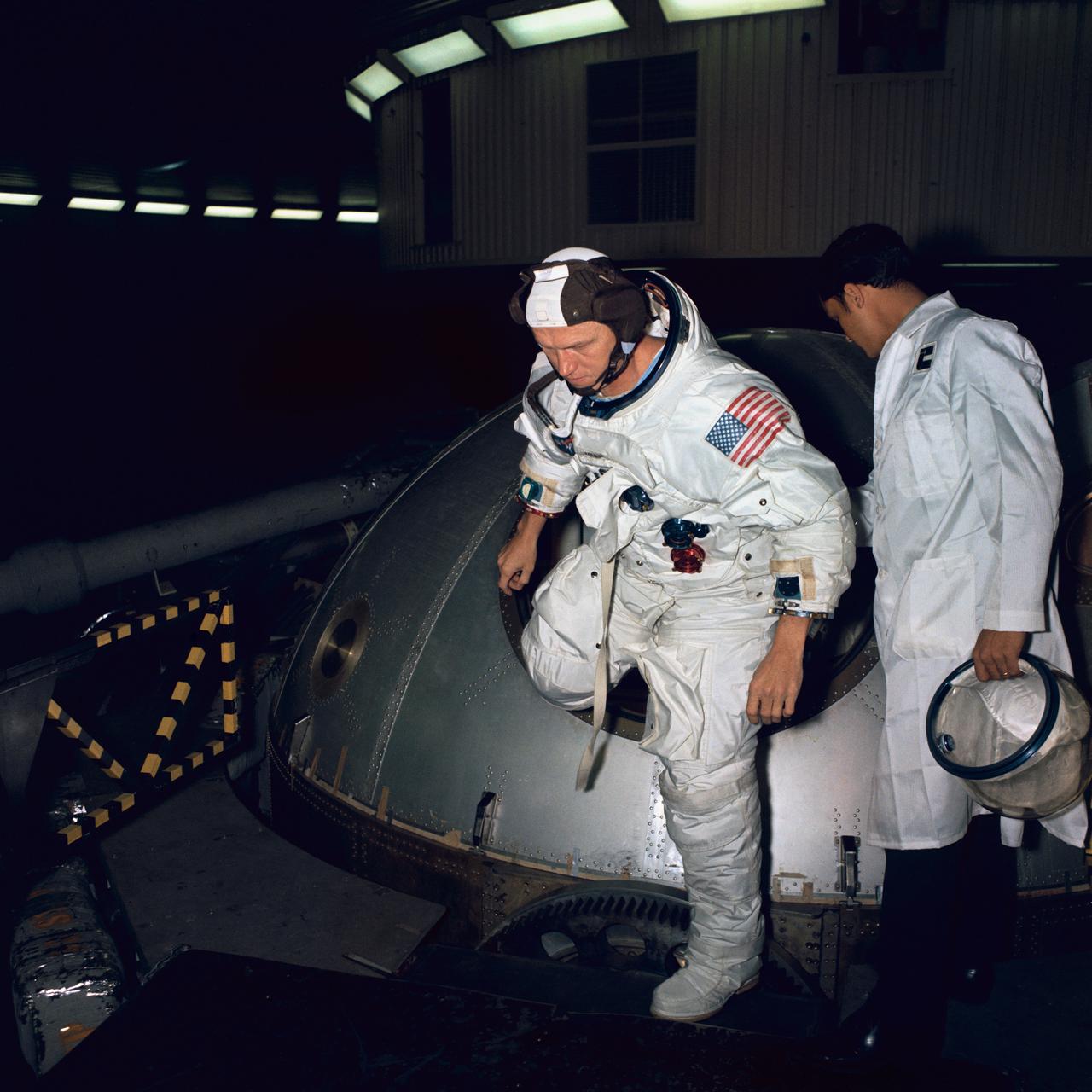
S68-53186 (1 Nov. 1968) --- Astronaut Frank Borman, Apollo 8 commander, egresses the gondola in Building 29 after centrifuge training in the Manned Spacecraft Center's (MSC) Flight Acceleration Facility (FAF).
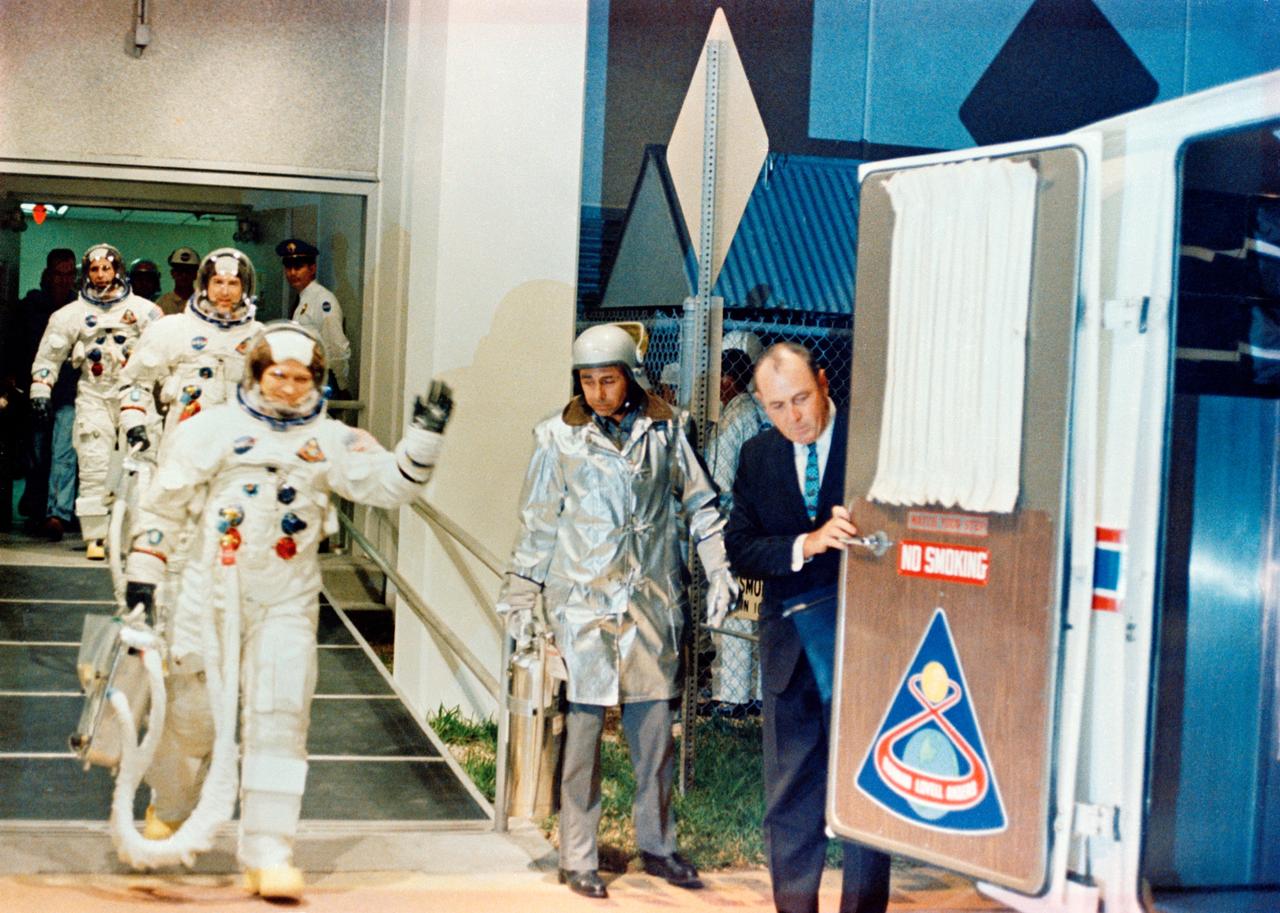
S68-55999 (21 Dec. 1968) --- The Apollo 8 crew leaves the Kennedy Space Center's (KSC) Manned Spacecraft Operations Building (MSOB) during the Apollo 8 prelaunch countdown. Astronaut Frank Borman (waving to well-wishers), commander, leads followed by astronauts James A. Lovell Jr., command module pilot; and William A. Anders, lunar module pilot. The crew is about to enter a special transfer van which transported them to Pad A, Launch Complex 39, where their Apollo 8 (Spacecraft 103/Saturn 503) space vehicle awaited them. Liftoff for the lunar orbit mission was at 7:51 a.m. (EST). Holding the door to the transfer van is Charles Buckley, KSC security chief.
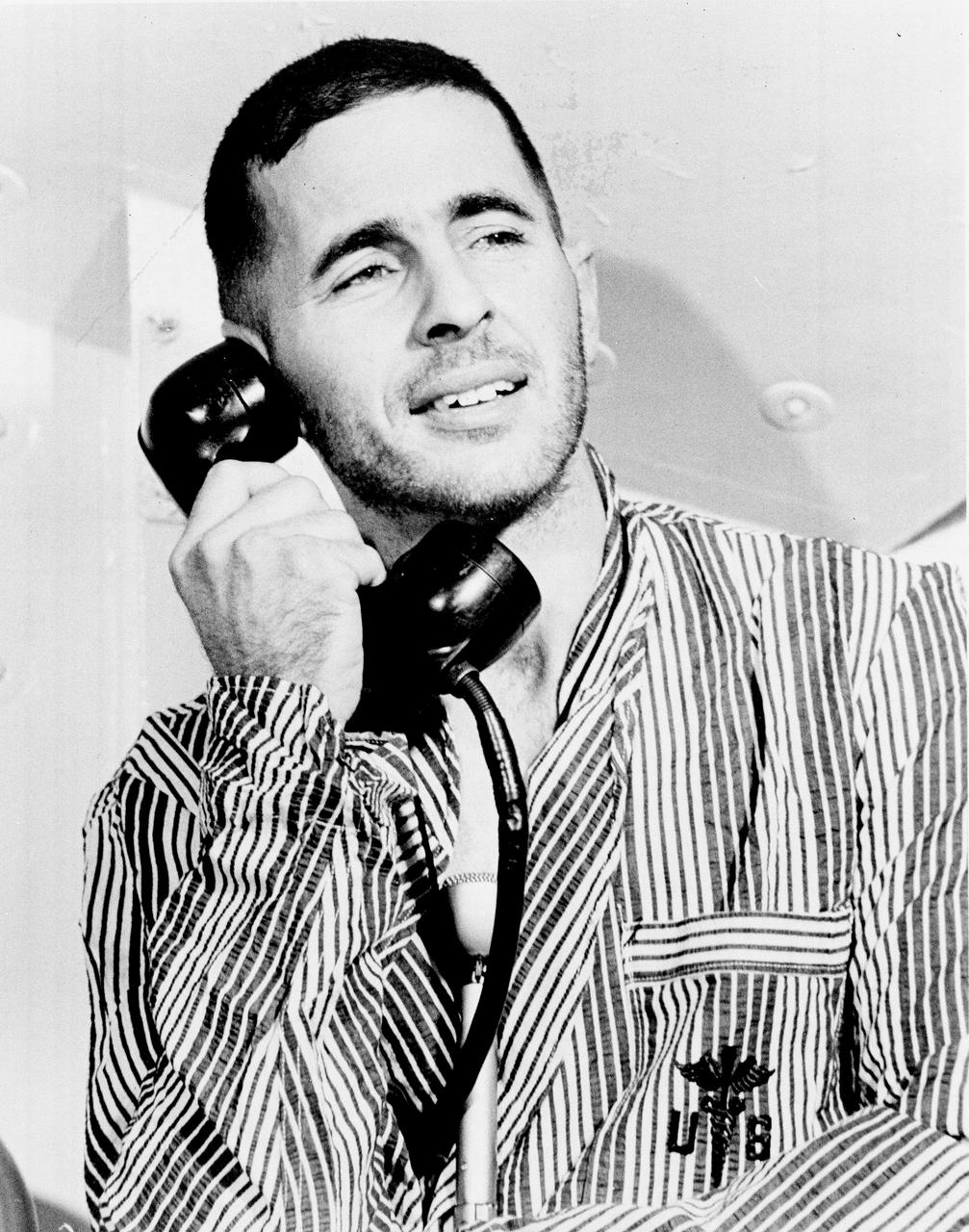
Apollo 8 Astronaut William Anders, Lunar Module (LM) pilot of the first manned Saturn V space flight into Lunar orbit, accepted a phone call from the U.S. President Lyndon B. Johnson prior to launch. Anders, along with astronauts James Lovell, Command Module (CM) pilot, and Frank Borman, commander, launched aboard the Apollo 8 mission on December 21, 1968 and returned safely to Earth on December 27, 1968. The mission achieved operational experience and tested the Apollo command module systems, including communications, tracking, and life-support, in cis-lunar space and lunar orbit, and allowed evaluation of crew performance on a lunar orbiting mission. The crew photographed the lunar surface, both far side and near side, obtaining information on topography and landmarks as well as other scientific information necessary for future Apollo landings. All systems operated within allowable parameters and all objectives of the mission were achieved.
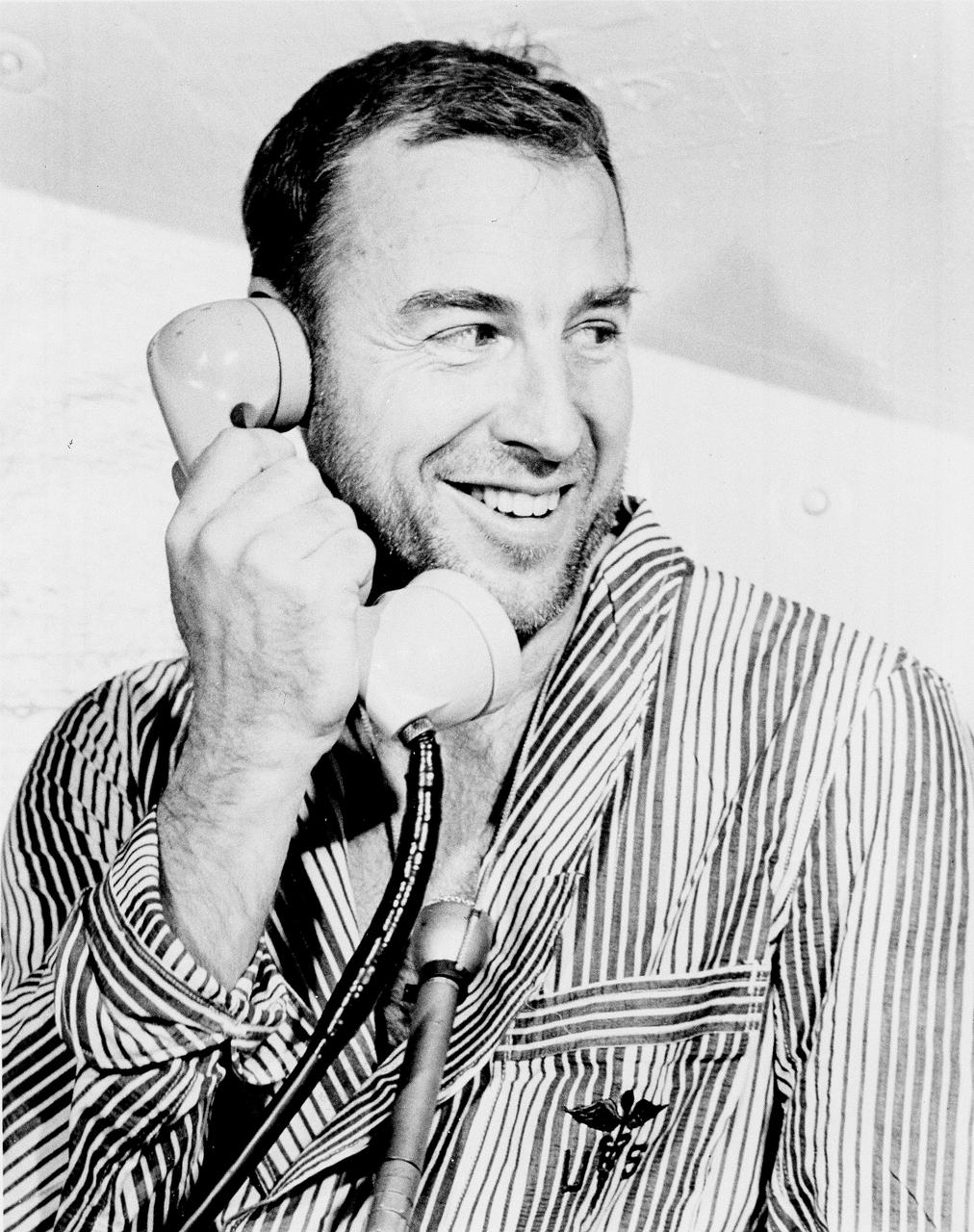
Apollo 8 Astronaut James Lovell, Command Module (CM) pilot of the first manned Saturn V space flight into Lunar orbit, accepted a phone call from the U.S. President Lyndon B. Johnson prior to launch. Lovell, along with astronauts William Anders, Lunar Module (LM) pilot, and Frank Borman, commander, launched aboard the Apollo 8 mission on December 21, 1968 and returned safely to Earth on December 27, 1968. The mission achieved operational experience and tested the Apollo command module systems, including communications, tracking, and life-support, in cis-lunar space and lunar orbit, and allowed evaluation of crew performance on a lunar orbiting mission. The crew photographed the lunar surface, both far side and near side, obtaining information on topography and landmarks as well as other scientific information necessary for future Apollo landings. All systems operated within allowable parameters and all objectives of the mission were achieved.

Apollo 8 Astronaut Frank Borman, commander of the first manned Saturn V space flight into Lunar orbit, accepted a phone call from the U.S. President Lyndon B. Johnson prior to launch. Borman, along with astronauts William Anders, Lunar Module (LM) pilot, and James Lovell, Command Module (CM) pilot, launched aboard the Apollo 8 mission on December 21, 1968 and returned safely to Earth on December 27, 1968. The mission achieved operational experience and tested the Apollo command module systems, including communications, tracking, and life-support, in cis-lunar space and lunar orbit, and allowed evaluation of crew performance on a lunar orbiting mission. The crew photographed the lunar surface, both far side and near side, obtaining information on topography and landmarks as well as other scientific information necessary for future Apollo landings. All systems operated within allowable parameters and all objectives of the mission were achieved.
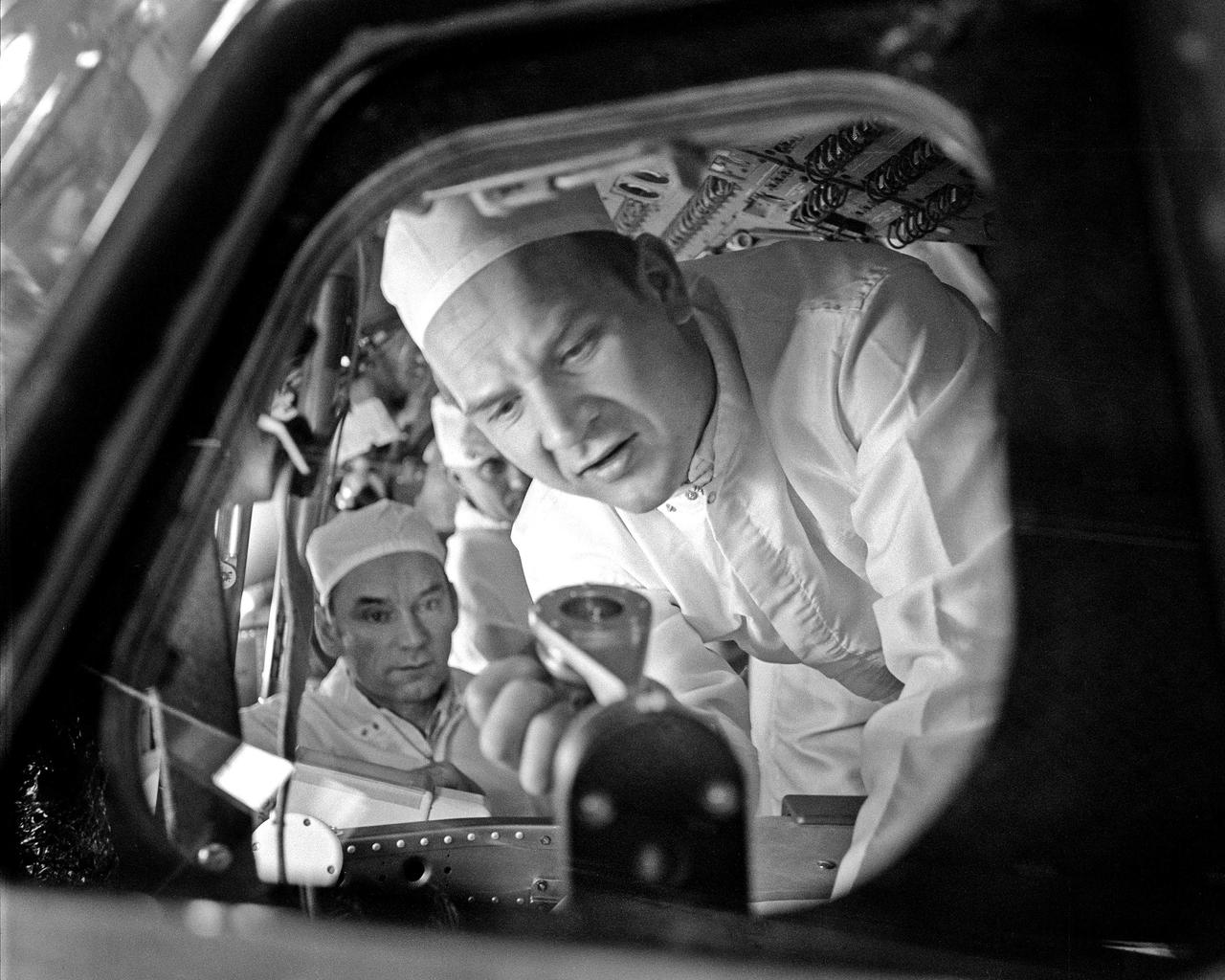
CAPE CANAVERAL, Fla. – Soviet Apollo Soyuz Test Project prime crew member Valeriy Kubasov inspects equipment inside the Apollo Command Module. The Soviet and American ASTP crews were at KSC February 8-10 to tour facilities and inspect equipment in preparation for the mid-July joint mission. The first international crewed spaceflight was a joint U.S.-U.S.S.R. rendezvous and docking mission. The Apollo-Soyuz Test Project, or ASTP, took its name from the spacecraft employed: the American Apollo and the Soviet Soyuz. The three-man Apollo crew lifted off from Kennedy Space Center aboard a Saturn IB rocket on July 15, 1975, to link up with the Soyuz that had launched a few hours earlier. A cylindrical docking module served as an airlock between the two spacecraft for transfer of the crew members. Photo credit: NASA
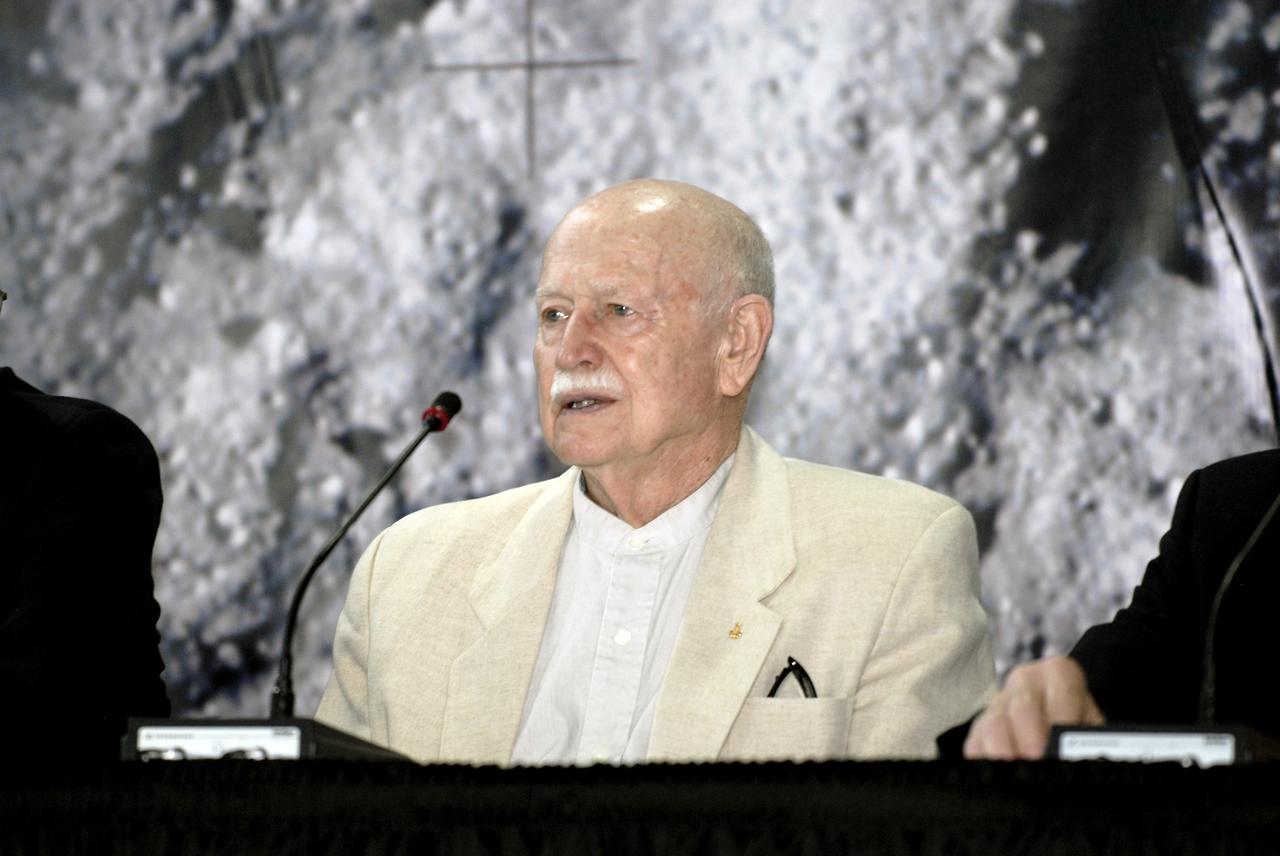
CAPE CANAVERAL, Fla. – At the Apollo/Saturn V Center at NASA's Kennedy Space Center in Florida, Apollo astronaut Gerald Carr shares his experiences with spectators crowd gathered for NASA's 40th Anniversary of Apollo Celebration of the July 1969 launch and landing on the moon. Carr served as CAPCOM for the Apollo 8 and 12 flights, and was involved in the development and testing of the lunar roving vehicle which was used on the lunar surface by Apollo flight crews. He also was commander of Skylab 4 launched in 1973 on the third and final manned visit to the Skylab Orbital Workshop. Photo credit: NASA/Kim Shiflett
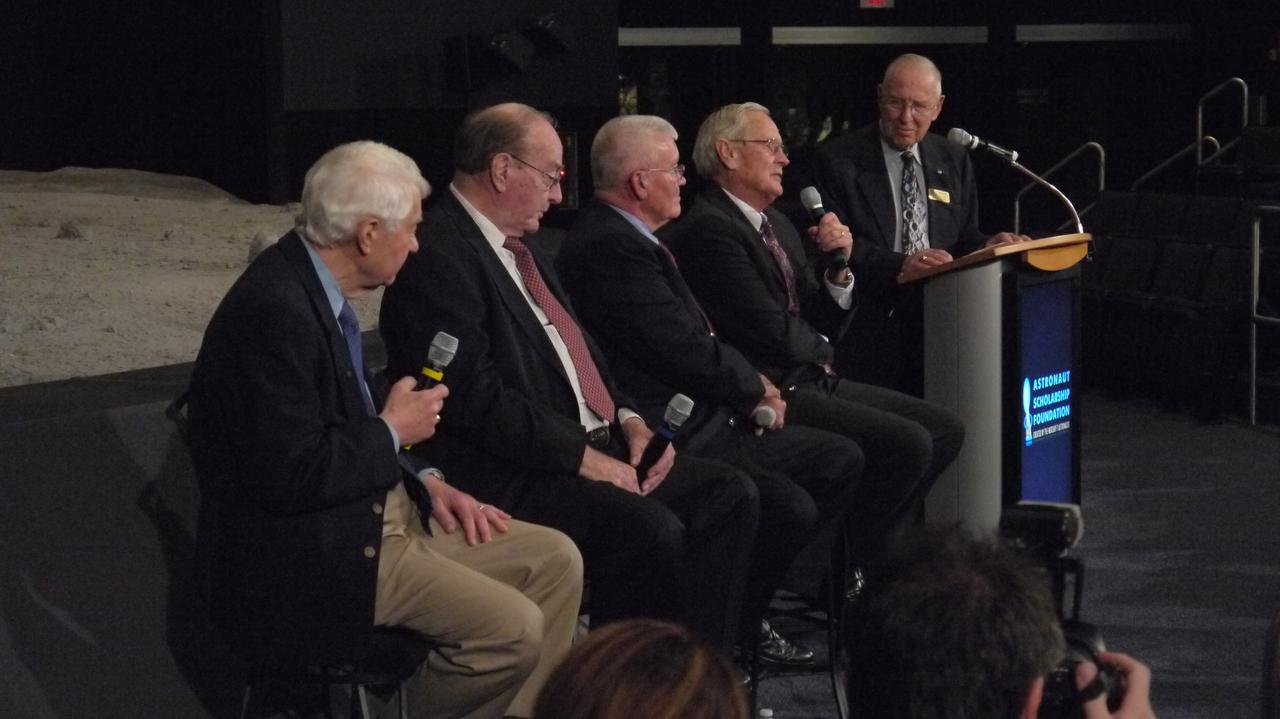
CAPE CANAVERAL, Fla. -- The Astronaut Scholarship Foundation helps celebrate the 40th anniversary of Apollo 16's lunar landing, which occurred April 20, 1972, with a soiree at the Kennedy Space Center Visitor Complex's Saturn V Center. Panel members who addressed the audience are, from left, astronaut support crew member for Apollo 16 Hank Hartsfield, Apollo 14 Lunar Module Pilot and Apollo 16 back-up crew member Edgar Mitchell, Apollo 13 Lunar Module Pilot and Apollo 16 back-up crew member Fred Haise, Apollo 16 Lunar Module Pilot Charlie Duke, and Apollo 8 Command Module Pilot and Apollo 13 Commander Jim Lovell. The 11-day Apollo 16 mission featured three moonwalks, including a nearly 17-mile lunar rover road trip to collect more than 200 pounds of moon rocks to return to Earth. Photo credit: NASA/Chris Chamberland

CAPE CANAVERAL, Fla. -- The Astronaut Scholarship Foundation helps celebrate the 40th anniversary of Apollo 16's lunar landing, which occurred April 20, 1972, with a soiree at the Kennedy Space Center Visitor Complex's Saturn V Center. Panel members who addressed the audience are, from left, astronaut support crew member for Apollo 16 Hank Hartsfield, Apollo 14 Lunar Module Pilot and Apollo 16 back-up crew member Edgar Mitchell, Apollo 13 Lunar Module Pilot and Apollo 16 back-up crew member Fred Haise, Apollo 16 Lunar Module Pilot Charlie Duke, and Apollo 8 Command Module Pilot and Apollo 13 Commander Jim Lovell. The 11-day Apollo 16 mission featured three moonwalks, including a nearly 17-mile lunar rover road trip to collect more than 200 pounds of moon rocks to return to Earth. Photo credit: NASA/Chris Chamberland
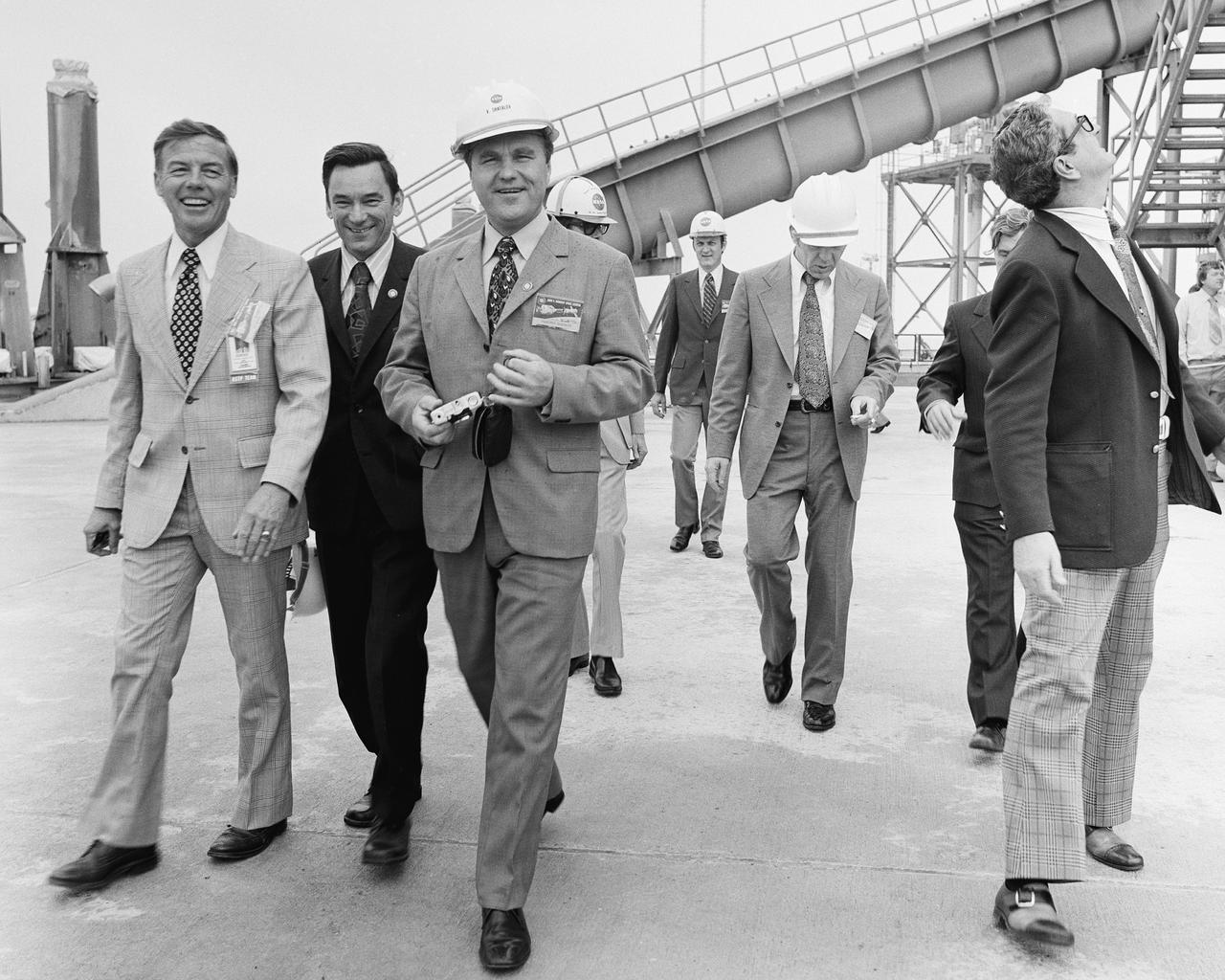
CAPE CANAVERAL, Fla. – KSC Director Lee Scherer, left, escorts a Soviet interpreter and Vladimir Shatalov, Soviet Cosmonaut Training Chief, on a tour of Pad 39B at the Spaceport. The Soviet and American personnel connected with July's Apollo Soyuz Test Project were at KSC February 8-10 to inspect equipment and tour facilities. The first international crewed spaceflight was a joint U.S.-U.S.S.R. rendezvous and docking mission. The Apollo-Soyuz Test Project, or ASTP, took its name from the spacecraft employed: the American Apollo and the Soviet Soyuz. The three-man Apollo crew lifted off from Kennedy Space Center aboard a Saturn IB rocket on July 15, 1975, to link up with the Soyuz that had launched a few hours earlier. A cylindrical docking module served as an airlock between the two spacecraft for transfer of the crew members. Photo credit: NASA
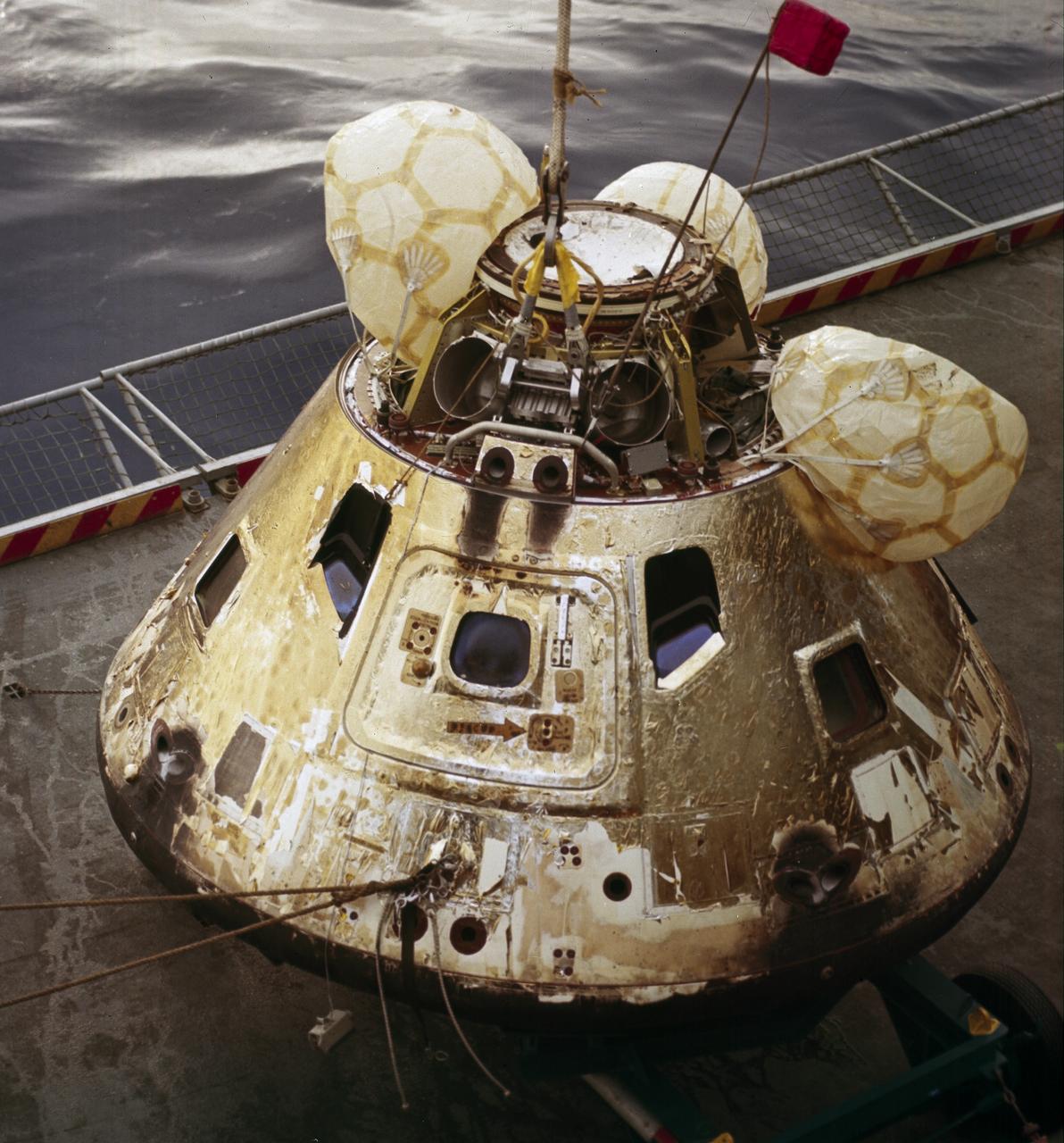
This is a photograph of the Apollo 8 Capsule being hoisted onto the recovery ship following splashdown on December 27, 1968. The first manned Apollo mission to escape Earth’s gravity and travel to the lunar vicinity, the Saturn V, SA-503, Apollo 8 mission liftoff occurred seven days prior, on December 21, 1968. Aboard were astronauts William Anders, Lunar Module (LM) Pilot; James Lovell, Command Module (CM) pilot; and Frank Borman, commander. The mission achieved operational experience and tested the Apollo command module systems, including communications, tracking, and life-support, in cis-lunar space and lunar orbit, and allowed evaluation of crew performance on a lunar orbiting mission. The crew photographed the lunar surface, both far side and near side, obtaining information on topography and landmarks as well as other scientific information necessary for future Apollo landings. All systems operated within allowable parameters and all objectives of the mission were achieved.
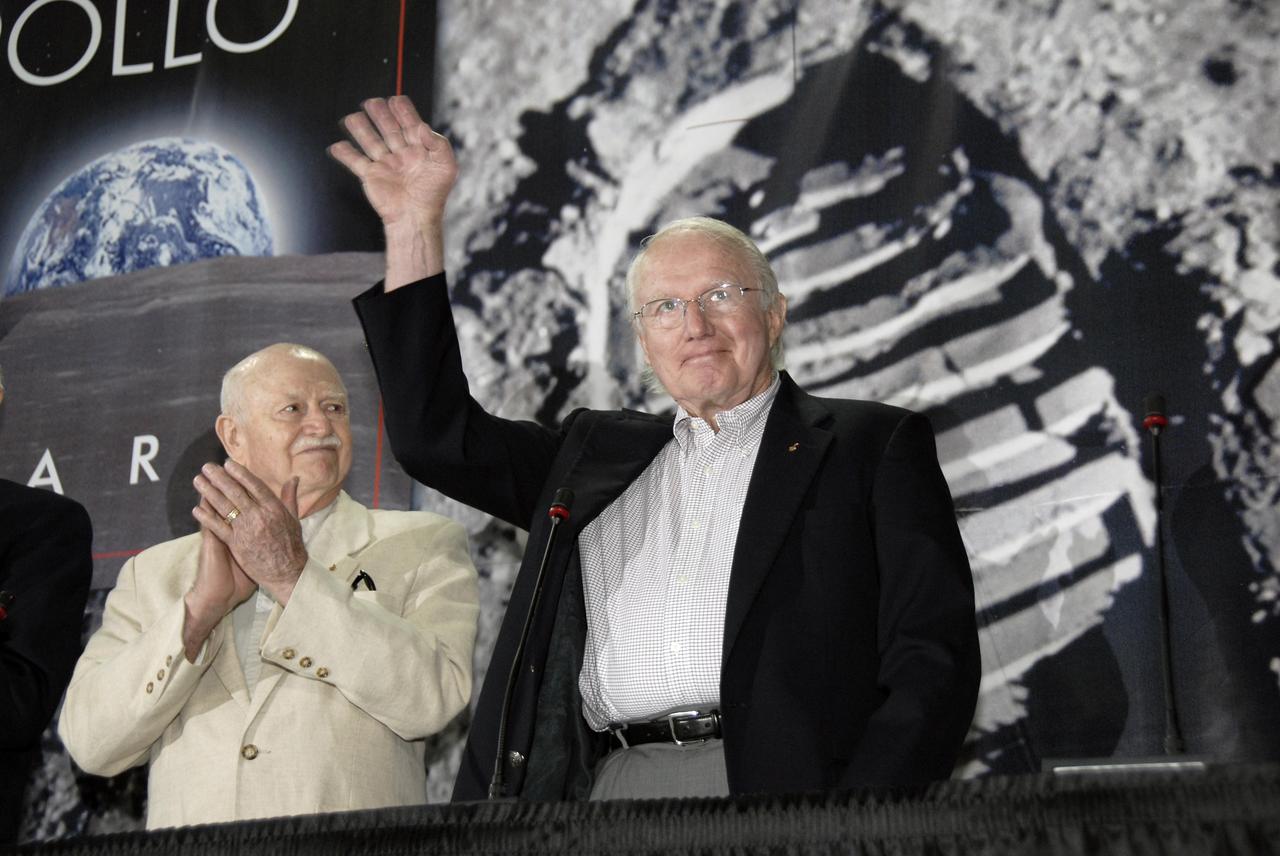
CAPE CANAVERAL, Fla. – At the Apollo/Saturn V Center at NASA's Kennedy Space Center in Florida, Apollo astronaut Gerald Carr (right) joins Vance Brand (left) and six other Apollo astronauts for NASA's 40th Anniversary of Apollo Celebration of the July 1969 launch and landing on the moon. Carr served as CAPCOM for the Apollo 8 and 12 flights, and was involved in the development and testing of the lunar roving vehicle which was used on the lunar surface by Apollo flight crews. He also was commander of Skylab 4 launched in 1973 on the third and final manned visit to the Skylab Orbital Workshop. It was the longest manned flight (84 days, 1 hour, 15minutes) in history at that date. Photo credit: NASA/Kim Shiflett
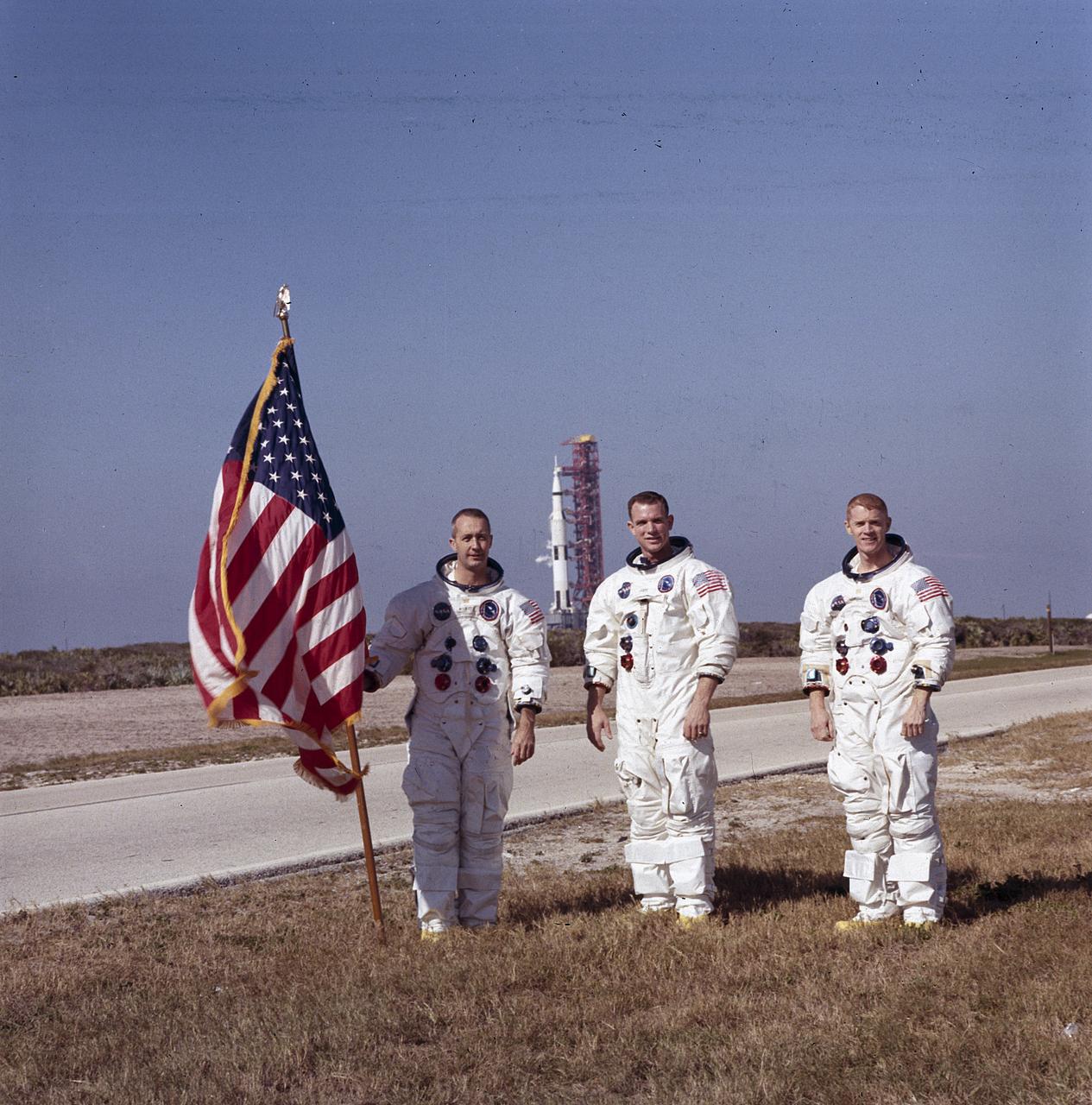
Pictured from left to right, the Apollo 9 astronauts, James A. McDivitt, David R. Scott, and Russell L. Schweickart, pause in front of the Apollo/Saturn V space vehicle that would launch the Apollo 8 crew. The launch of the Apollo 9 (Saturn V launch vehicle, SA-504) took place on March 3, 1968. The Apollo 9 spacecraft, in the lunar mission configuration, was tested in Earth orbit. The mission was designed to rehearse all the steps and reproduce all the events of the Apollo 11 mission with the exception of the lunar touchdown, stay, and liftoff. The command and service modules, and the lunar module were used in flight procedures identical to those that would later take similar vehicles to the Moon, and a landing. The flight mechanics, mission support systems, communications, and recording of data were tested in a final round of verification. Astronauts Scott and Schweickart conducted Extravehicular Activity during this mission.
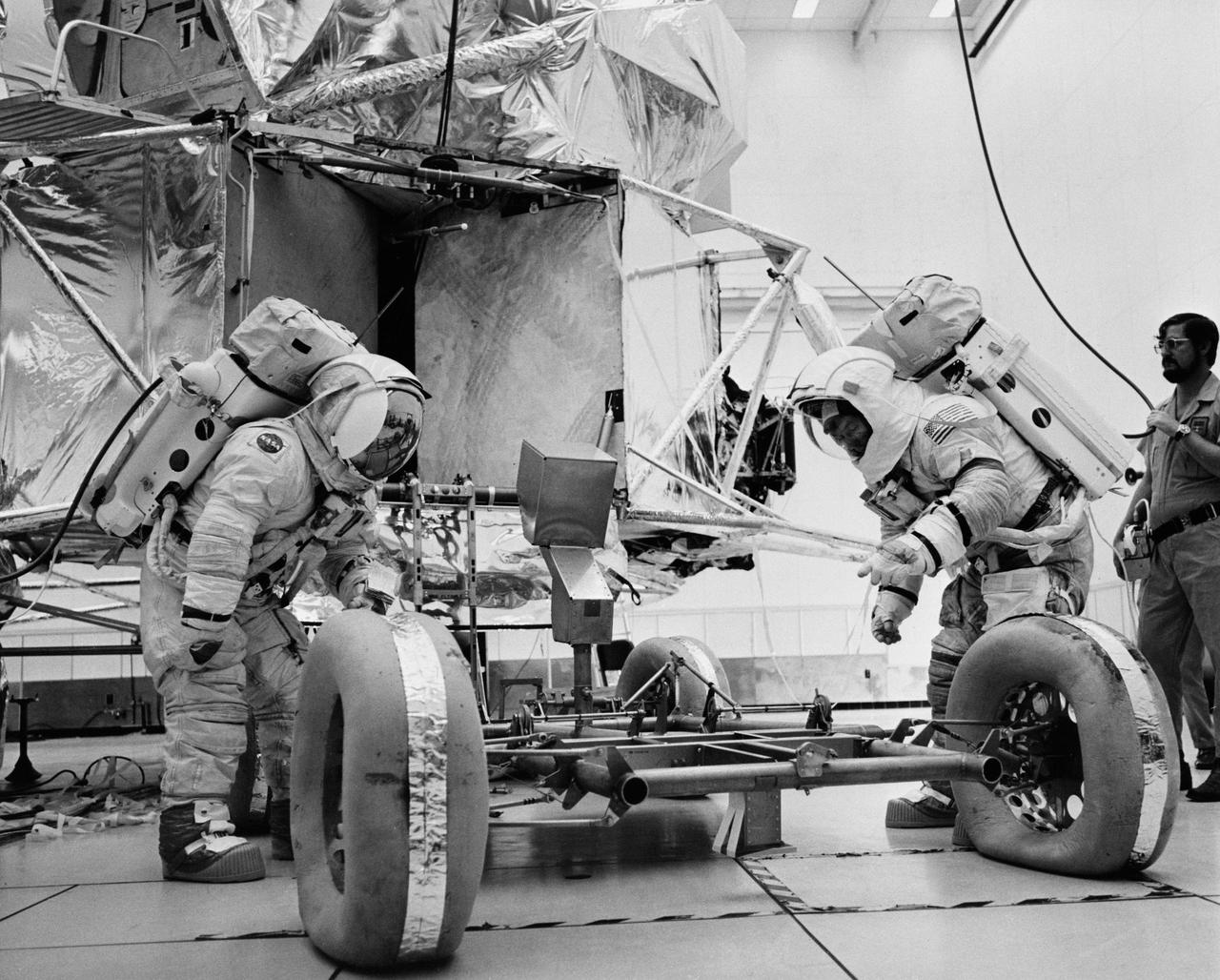
S72-44423 (8 Sept. 1972) --- Two Apollo 17 crewmen ready a Lunar Roving Vehicle trainer following its deployment from a Lunar Module trainer in the Flight Crew Training Building at the Kennedy Space Center, Florida. Taking part in the Apollo 17 training exercise were astronauts Eugene A. Cernan (right), commander; and Harrison H. "Jack" Schmitt, lunar module pilot.
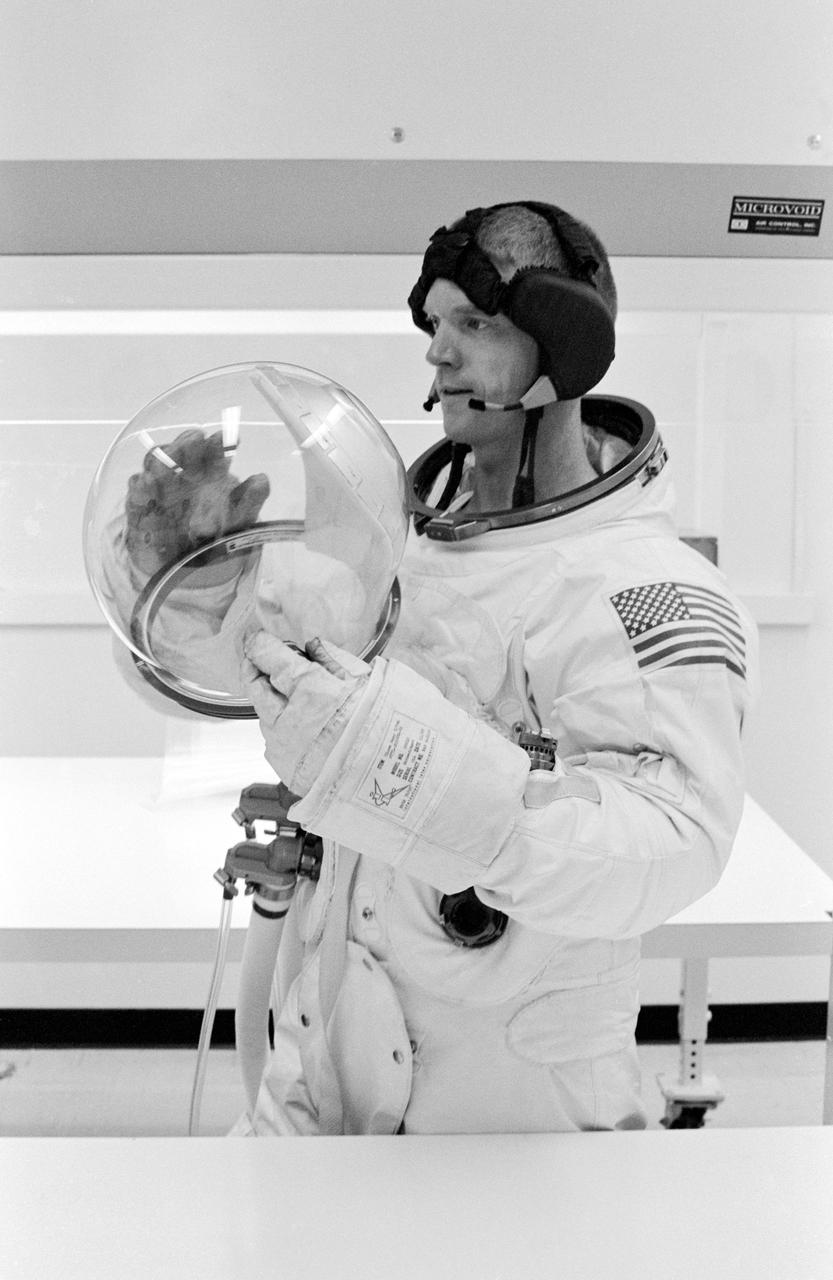
S68-38051 (29 June 1968) --- Astronaut Russell L. Schweickart suits up to participate in an altitude verification test of the Apollo Portable Life Support System flight unit in Crew Systems Division's 8-ft altitude chamber in Building 7.
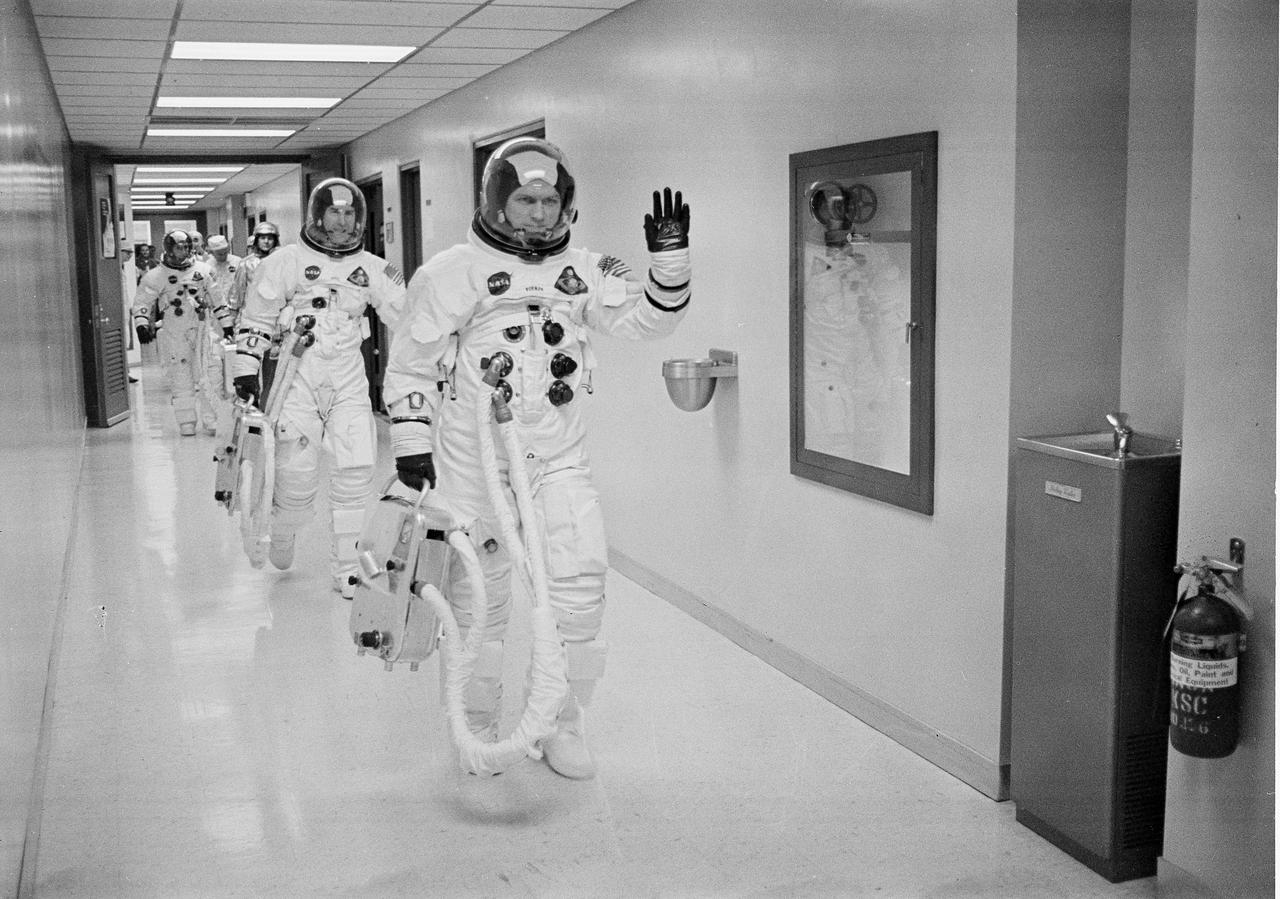
Apollo 8 Astronaut and commander Frank Borman leads the way as he and James Lovell, Command Module (CM) pilot; and William Anders, Lunar Module (LM) Pilot head out to the launch pad for the historical first manned Apollo mission to travel to the lunar vicinity, and first manned mission launched via the Saturn V vehicle. Liftoff occurred on December 21, 1968 and returned safely to Earth on December 27, 1968. The mission achieved operational experience and tested the Apollo command module systems, including communications, tracking, and life-support, in cis-lunar space and lunar orbit, and allowed evaluation of crew performance on a lunar orbiting mission. The crew photographed the lunar surface, both far side and near side, obtaining information on topography and landmarks as well as other scientific information necessary for future Apollo landings. All systems operated within allowable parameters and all objectives of the mission were achieved.
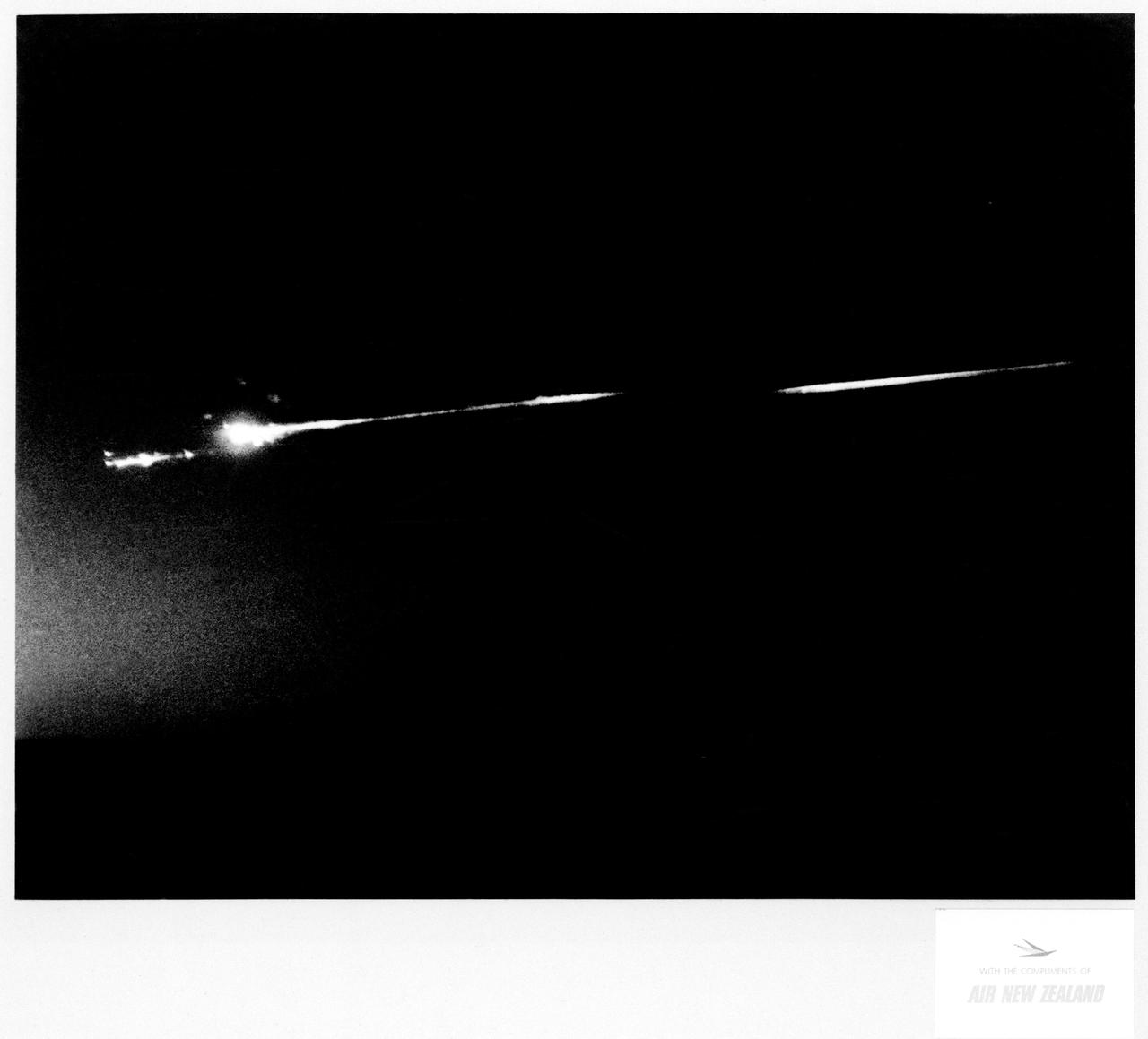
S70-17646 (18 April 1970) --- An unidentified airline passenger snapped these bright objects, believed to be the Apollo 13 Service Module (SM) and Lunar Module (LM) as they entered Earth's atmosphere over the Pacific Ocean on April 18, 1970. The aircraft, an Air New Zealand DC-8 was midway between the Fiji Islands (Nandi Island to be specific) and Auckland, New Zealand, when the photograph was taken. The crew men of the problem plagued Apollo 13 mission jettisoned the LM and SM prior to entering Earth's atmosphere in the Apollo 13 Command Module (CM).
![S68-56621 (18 Dec. 1968) --- These three astronauts are the prime crew of the Apollo 9 (Spacecraft 104/Lunar Module 3/Saturn 504) space mission. Left to right, are James A. McDivitt, commander; David R. Scott, command module pilot: and Russell L. Schweickart, lunar module pilot. The Apollo 9 launch is scheduled no earlier than February 28, 1969. In the background is the Apollo 8 space vehicle on Pad A, Launch Complex 39, Kennedy Space Center, which was launched on December 21, 1968. (Gaseous liquid oxygen is venting from the vehicle’s first [S-1C] stage during a countdown demonstration test). McDivitt holds a U.S. flag.](https://images-assets.nasa.gov/image/S68-56621/S68-56621~medium.jpg)
S68-56621 (18 Dec. 1968) --- These three astronauts are the prime crew of the Apollo 9 (Spacecraft 104/Lunar Module 3/Saturn 504) space mission. Left to right, are James A. McDivitt, commander; David R. Scott, command module pilot: and Russell L. Schweickart, lunar module pilot. The Apollo 9 launch is scheduled no earlier than February 28, 1969. In the background is the Apollo 8 space vehicle on Pad A, Launch Complex 39, Kennedy Space Center, which was launched on December 21, 1968. (Gaseous liquid oxygen is venting from the vehicle’s first [S-1C] stage during a countdown demonstration test). McDivitt holds a U.S. flag.
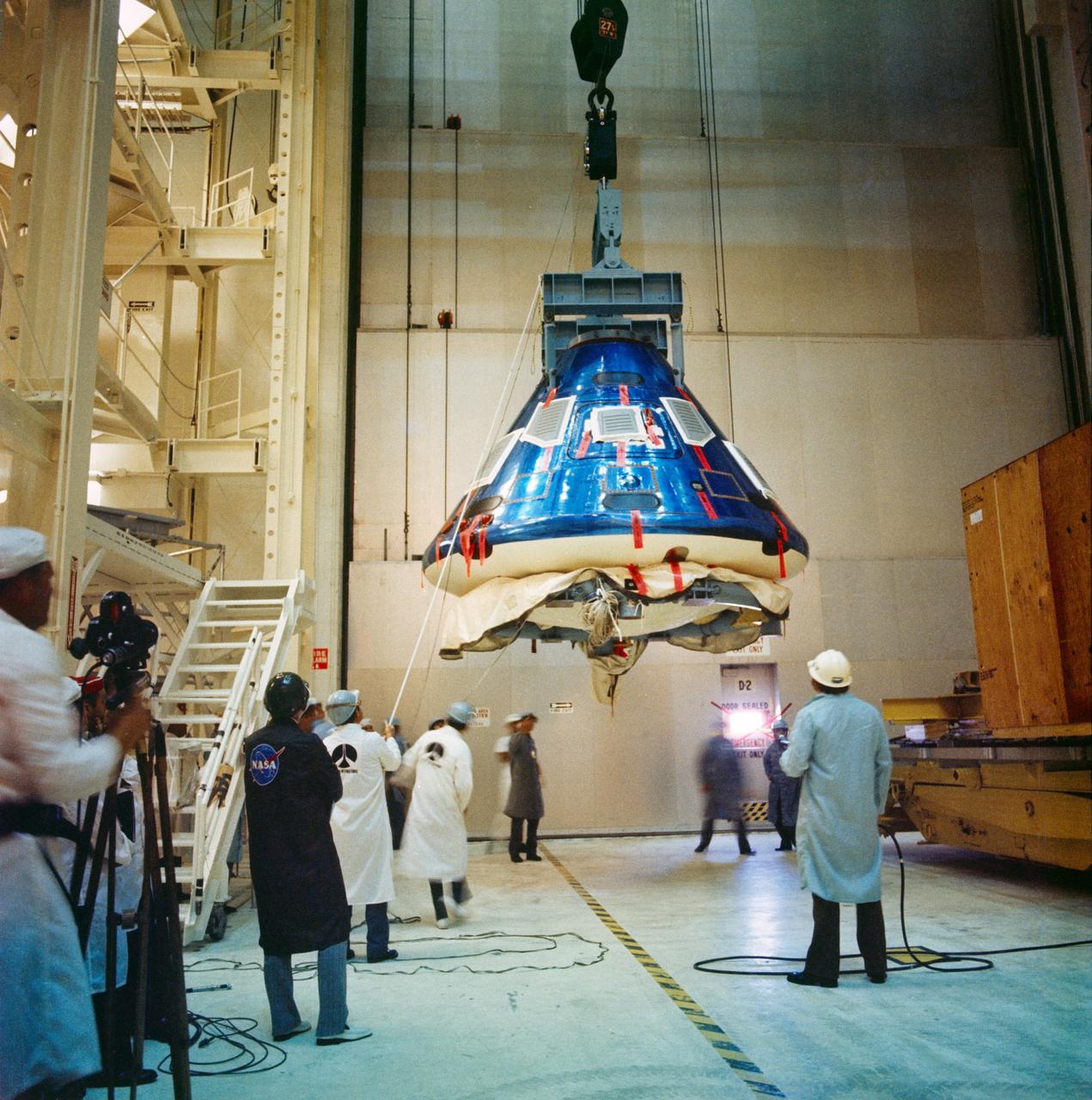
S74-32049 (8 Sept. 1974) --- The Apollo Command Module for the Apollo-Soyuz Test Project mission goes through receiving, inspection and checkout procedures in the Manned Spacecraft Operations Building at the Kennedy Space Center. The spacecraft had just arrived by air from the Rockwell International plant at Downey, California. The Apollo spacecraft (Command Module, Service Module and Docking Module), with astronauts Thomas P. Stafford, Vance D. Brand and Donald K. Slayton aboard, will dock in Earth orbit with a Soviet Soyuz spacecraft during the joint U.S.-USSR ASTP flight scheduled for July 1975. The Soviet and American crews will visit one another?s spacecraft.
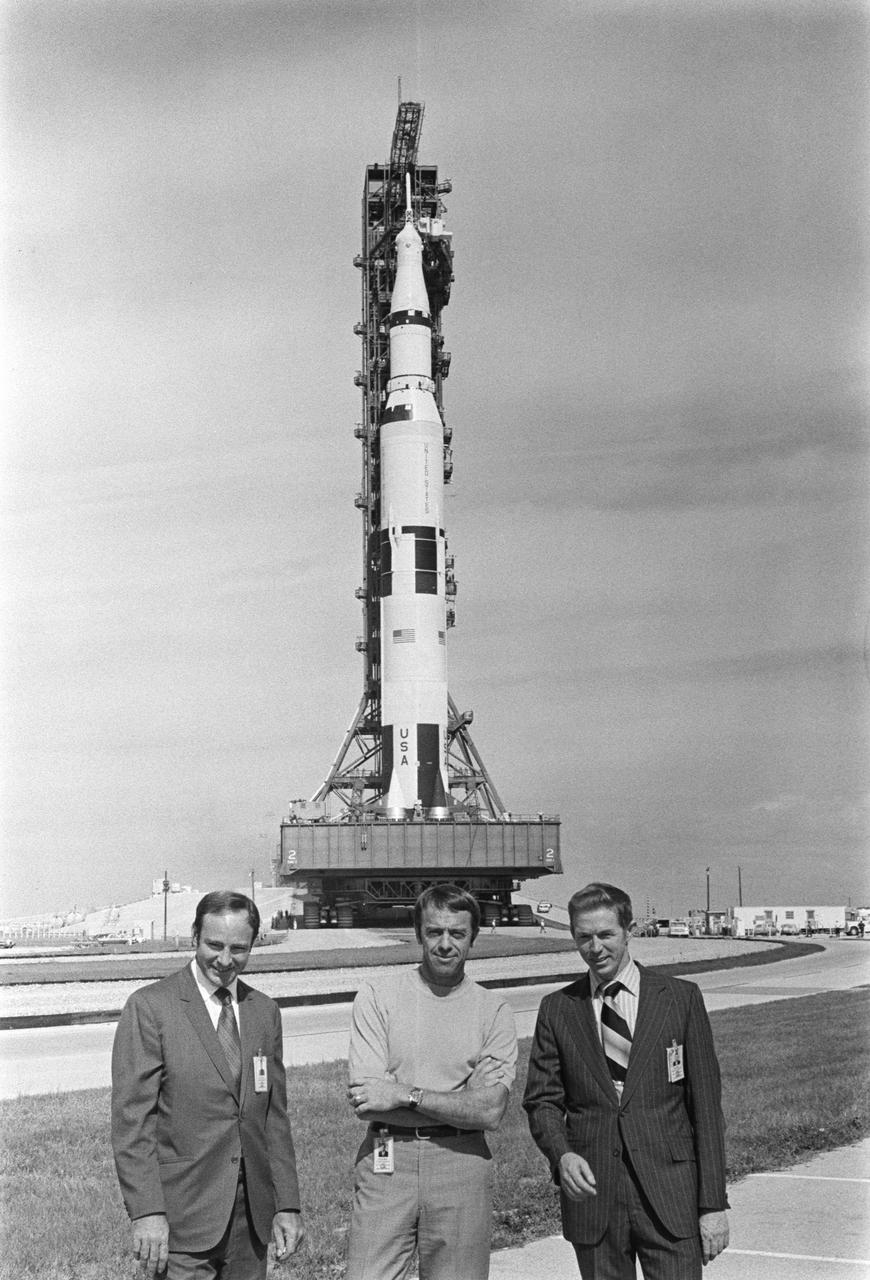
S70-55689 (9 Nov. 1970) --- The Apollo 14 (Spacecraft 110/Lunar Module 8/Saturn 509) space vehicle arrives at Pad A, Launch Complex 39, during the Apollo 14 roll out from the Kennedy Space Center's Vehicle Assembly Building. The Saturn V stack and its mobile launch tower atop a huge crawler-transporter. The three members of the Apollo 14 prime crew are in the foreground. They are (left to right) astronauts Edgar D. Mitchell, lunar module pilot; Alan B. Shepard Jr., commander; and Stuart A. Roosa, command module pilot.
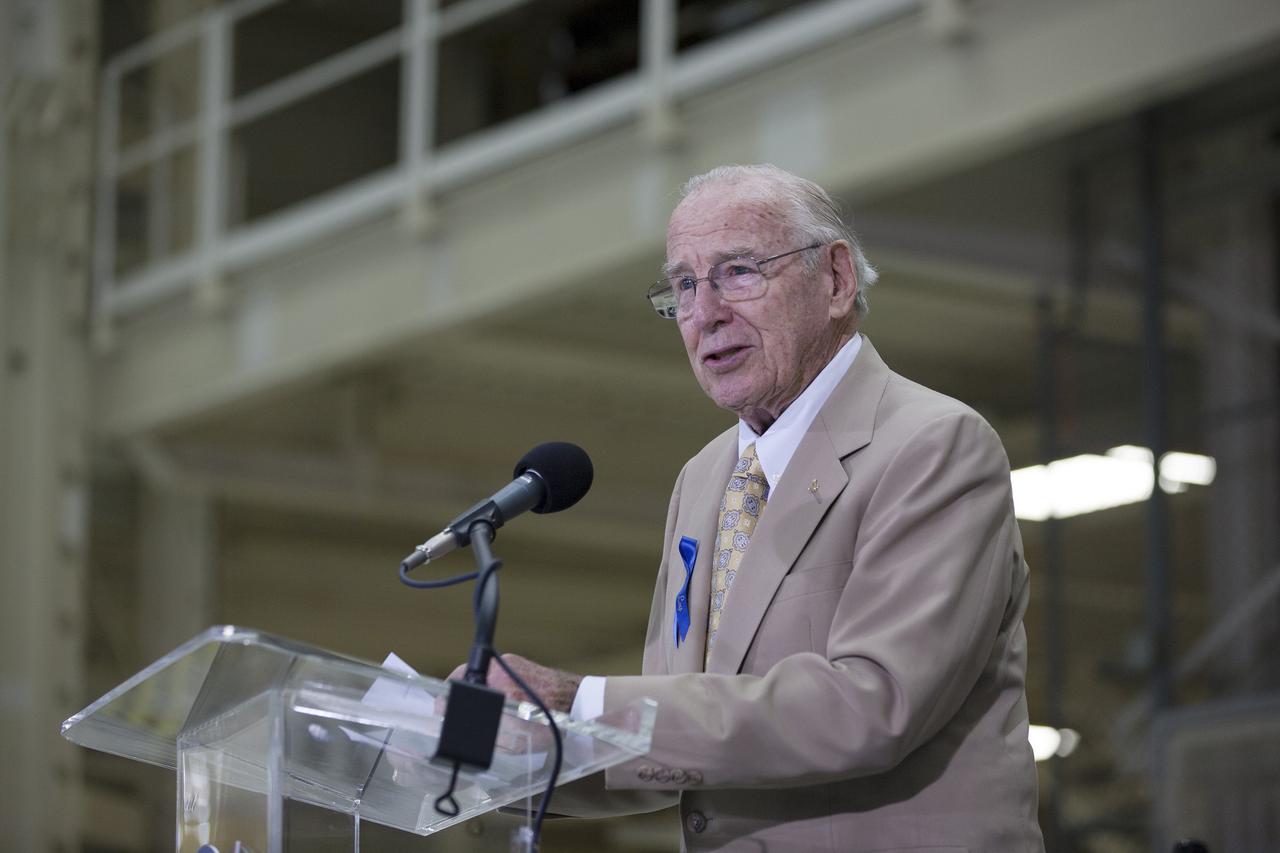
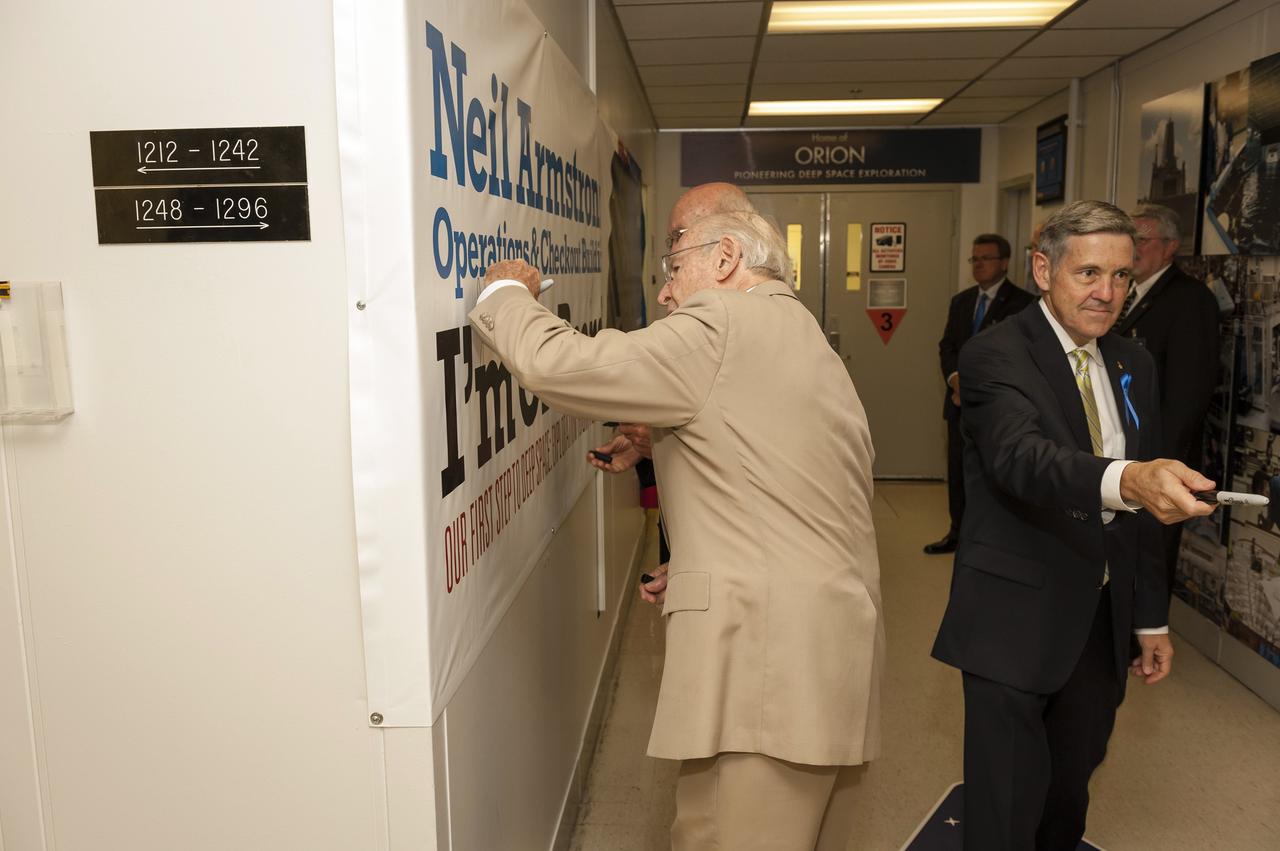
CAPE CANAVERAL, Fla. -- At the Kennedy Space Center in Florida, Apollo astronaut Jim Lovell addresses the audience at a ceremony renaming the refurbished Operations and Checkout Building for Apollo 11 astronaut Neil Armstrong, the first person to set foot on the moon. Lovell served on the crews of Apollo 8 and Apollo 13. The building's high bay is being used to support the agency's new Orion spacecraft and is the same spaceport facility where the Apollo 11 command/service module and lunar module were prepped for the first lunar landing mission in 1969. Orion is designed to take humans farther than they’ve ever gone before, serving as the exploration vehicle that will carry astronauts to deep space and sustain the crew during travel to destinations such as an asteroid or Mars. The ceremony was part of NASA's 45th anniversary celebration of the Apollo 11 moon landing. As the world watched, Neil Armstrong and Buzz Aldrin landed in the moon's Sea of Tranquility on July 20, 1969, aboard the lunar module Eagle. Meanwhile, crewmate Michael Collins orbited above in the command module Columbia. For more, visit http://www.nasa.gov/press/2014/july/nasa-honors-historic-first-moon-landing-eyes-first-mars-mission. Photo credit: NASA/Kim Shiflett
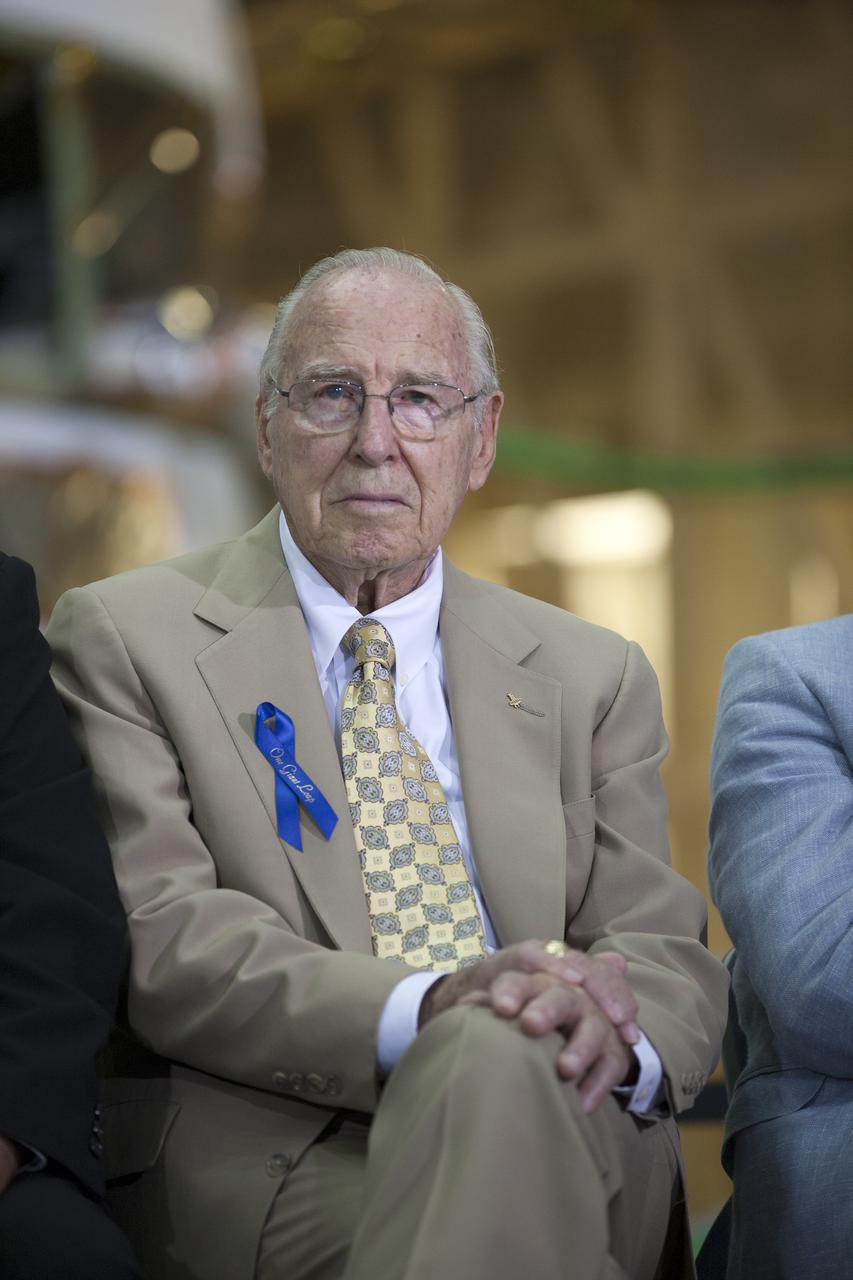
CAPE CANAVERAL, Fla. -- At the Kennedy Space Center in Florida, Apollo astronaut Jim Lovell participates in a ceremony renaming the refurbished Operations and Checkout Building for Apollo 11 astronaut Neil Armstrong, the first person to set foot on the moon. Lovell served on the crews of Apollo 8 and Apollo 13. The building's high bay is being used to support the agency's new Orion spacecraft and is the same spaceport facility where the Apollo 11 command_service module and lunar module were prepped for the first lunar landing mission in 1969. Orion is designed to take humans farther than they’ve ever gone before, serving as the exploration vehicle that will carry astronauts to deep space and sustain the crew during travel to destinations such as an asteroid or Mars. The ceremony was part of NASA's 45th anniversary celebration of the Apollo 11 moon landing. As the world watched, Neil Armstrong and Buzz Aldrin landed in the moon's Sea of Tranquility on July 20, 1969, aboard the lunar module Eagle. Meanwhile, crewmate Michael Collins orbited above in the command module Columbia. For more, visit http:__www.nasa.gov_press_2014_july_nasa-honors-historic-first-moon-landing-eyes-first-mars-mission. Photo credit: NASA_Kim Shiflett
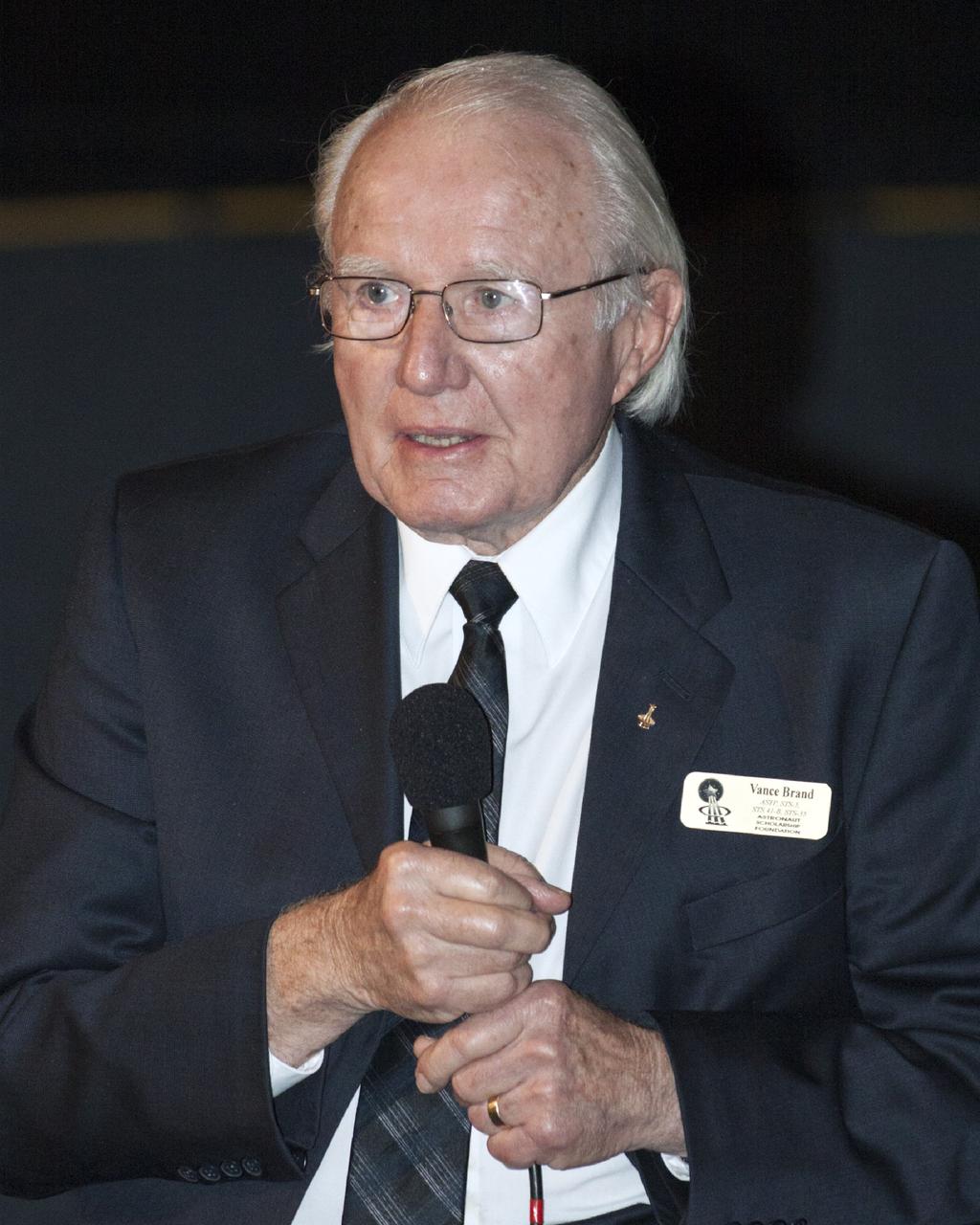
CAPE CANAVERAL, Fla. – At the Kennedy Space Center's Apollo/Saturn V Center, former NASA astronaut Vance Brand speaks to guests at the Astronaut Scholarship Foundation's event celebrating the 40th anniversary of Skylab. Brand, along with astronaut Don Lind, were prepared to fly a mission to rescue a Skylab crew if their Apollo command-service module was unusable. Brand went on to fly as pilot on the Apollo-Soyuz Test Project and missions aboard the space shuttle. The gala commemorating the 40th anniversary of Skylab included six of the nine astronauts who flew missions to America's first space station. The orbiting laboratory was launched unpiloted from Kennedy on May 14, 1973. Between May 25, 1973 and Feb. 8, 1974, crews of three spent 28, 59 and 84 days living and working in low-Earth orbit aboard the station. For more information, visit http://www.nasa.gov/mission_pages/skylab/ Photo credit: NASA/Kim Shiflett
CAPE CANAVERAL, Fla. -- Apollo astronauts and their families receive a briefing in one of the remodeled firing rooms in the Launch Control Center at NASA's Kennedy Space Center in Florida. The facility's firing rooms were used to conduct the Saturn V countdowns during the Apollo Program. The tour followed a ceremony renaming the refurbished Operations and Checkout Building for Apollo 11 astronaut Neil Armstrong, the first person to set foot on the moon. Second from left is Apollo 11 moonwalker Buzz Aldrin and former astronaut Jim Lovell, a member of the Apollo 8 and Apollo 13 crews, standing next to him, at center. The ceremony was part of NASA's 45th anniversary celebration of the Apollo 11 moon landing. As the world watched, Neil Armstrong and Buzz Aldrin landed in the moon's Sea of Tranquility on July 20, 1969, aboard the lunar module Eagle. Meanwhile, crewmate Michael Collins orbited above in the command module Columbia. For more, visit http://www.nasa.gov/press/2014/july/nasa-honors-historic-first-moon-landing-eyes-first-mars-mission. Photo credit: NASA/Kevin O'Connell

CAPE CANAVERAL, Fla. -- Apollo astronauts and their families receive a briefing in one of the remodeled firing rooms in the Launch Control Center at NASA's Kennedy Space Center in Florida. The facility's firing rooms were used to conduct the Saturn V countdowns during the Apollo Program. The tour followed a ceremony renaming the refurbished Operations and Checkout Building for Apollo 11 astronaut Neil Armstrong, the first person to set foot on the moon. Second from left is Apollo 11 moonwalker Buzz Aldrin and former astronaut Jim Lovell, a member of the Apollo 8 and Apollo 13 crews, standing next to him, at center. The ceremony was part of NASA's 45th anniversary celebration of the Apollo 11 moon landing. As the world watched, Neil Armstrong and Buzz Aldrin landed in the moon's Sea of Tranquility on July 20, 1969, aboard the lunar module Eagle. Meanwhile, crewmate Michael Collins orbited above in the command module Columbia. For more, visit http://www.nasa.gov/press/2014/july/nasa-honors-historic-first-moon-landing-eyes-first-mars-mission. Photo credit: NASA/Kim Shiflett
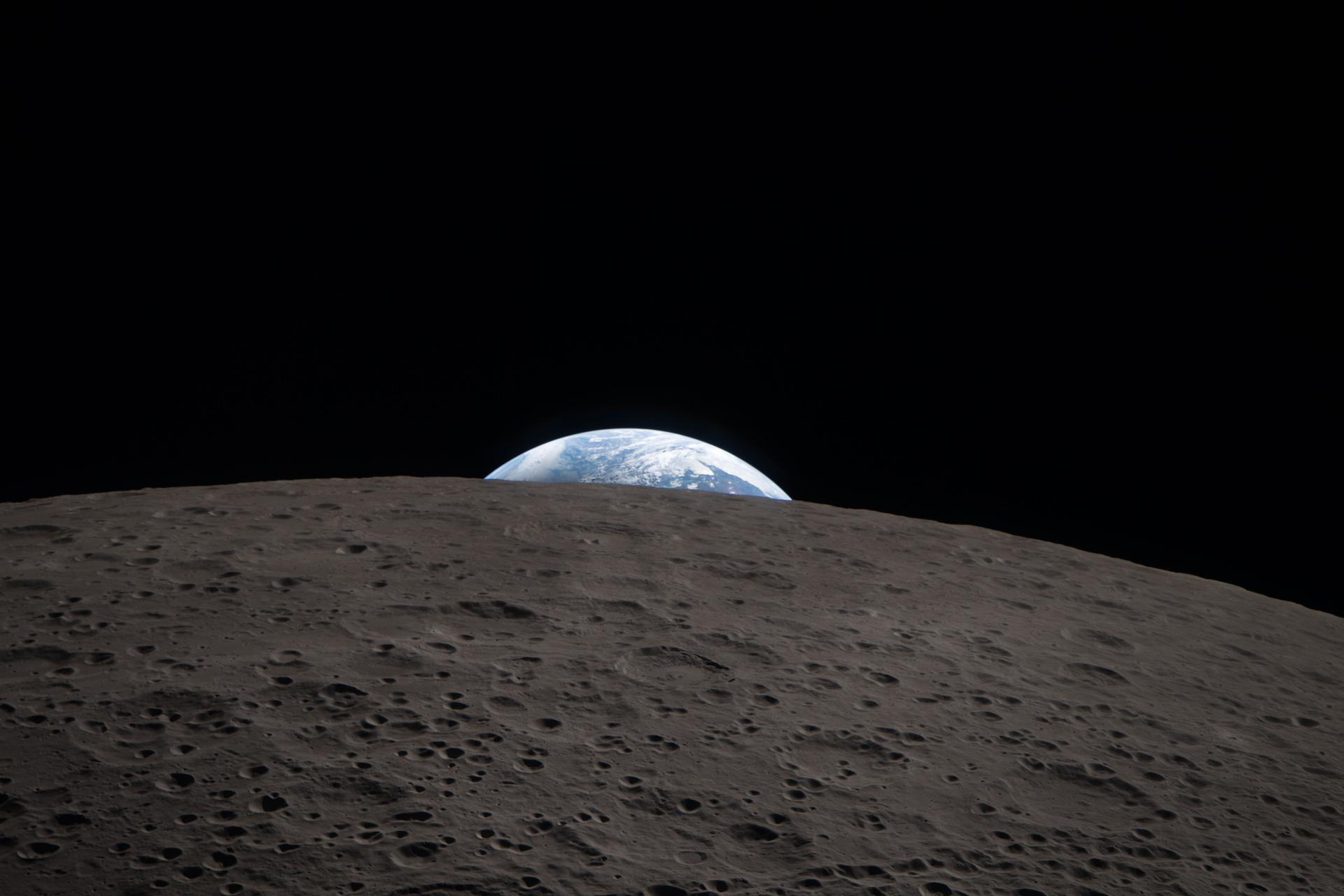
art002e021278 (April 6, 2026) – Echoing the iconic Earthrise photo captured by the Apollo 8 astronauts in 1968, during the lunar flyby, the Artemis II crew captured a shot of Earthset as they passed behind the Moon’s far side. It is one of many photos taken during the seven-hour lunar flyby by the Artemis II crew on the Orion spacecraft. Credit: NASA

S69-51299 (8 Sept. 1969) --- Ground-level view at Launch Complex 39, Kennedy Space Center (KSC), showing the Apollo 12 (Spacecraft 108/ Lunar Module 6/ Saturn 507) space vehicle on the way from the Vehicle Assembly Building (VAB) to Pad A. The Saturn V stack and its mobile launch tower are atop a huge crawler-transporter. The Launch Complex 39 service structure is on the right. Apollo 12 is scheduled as the second lunar landing mission. The crew will be astronauts Charles Conrad Jr., commander; Richard F. Gordon Jr., command module pilot; and Alan L. Bean, lunar module pilot.
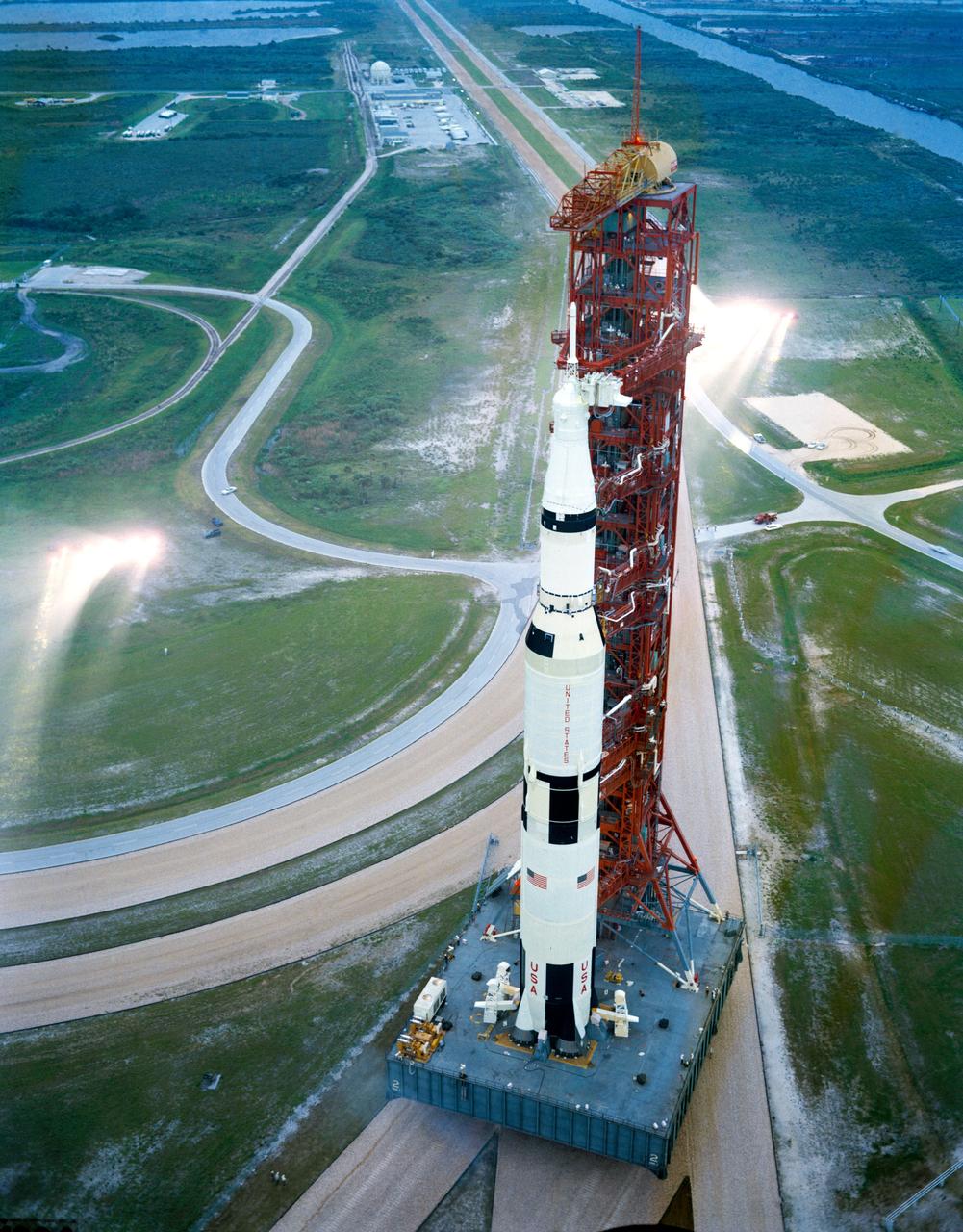
S69-51309 (8 Sept. 1969) --- High-angle view at Launch Complex 39, Kennedy Space Center (KSC), showing the Apollo 12 (Spacecraft 108/Lunar Module 6/Saturn 507) space vehicle on the way from the Vehicle Assembly Building (VAB) to Pad A. The Saturn V stack and its mobile launch tower are atop a huge crawler-transporter. Apollo 12 is scheduled as the second lunar landing mission. The crew will be astronauts Charles Conrad Jr., commander; Richard F. Gordon Jr., command module pilot; and Alan L. Bean, lunar module pilot.
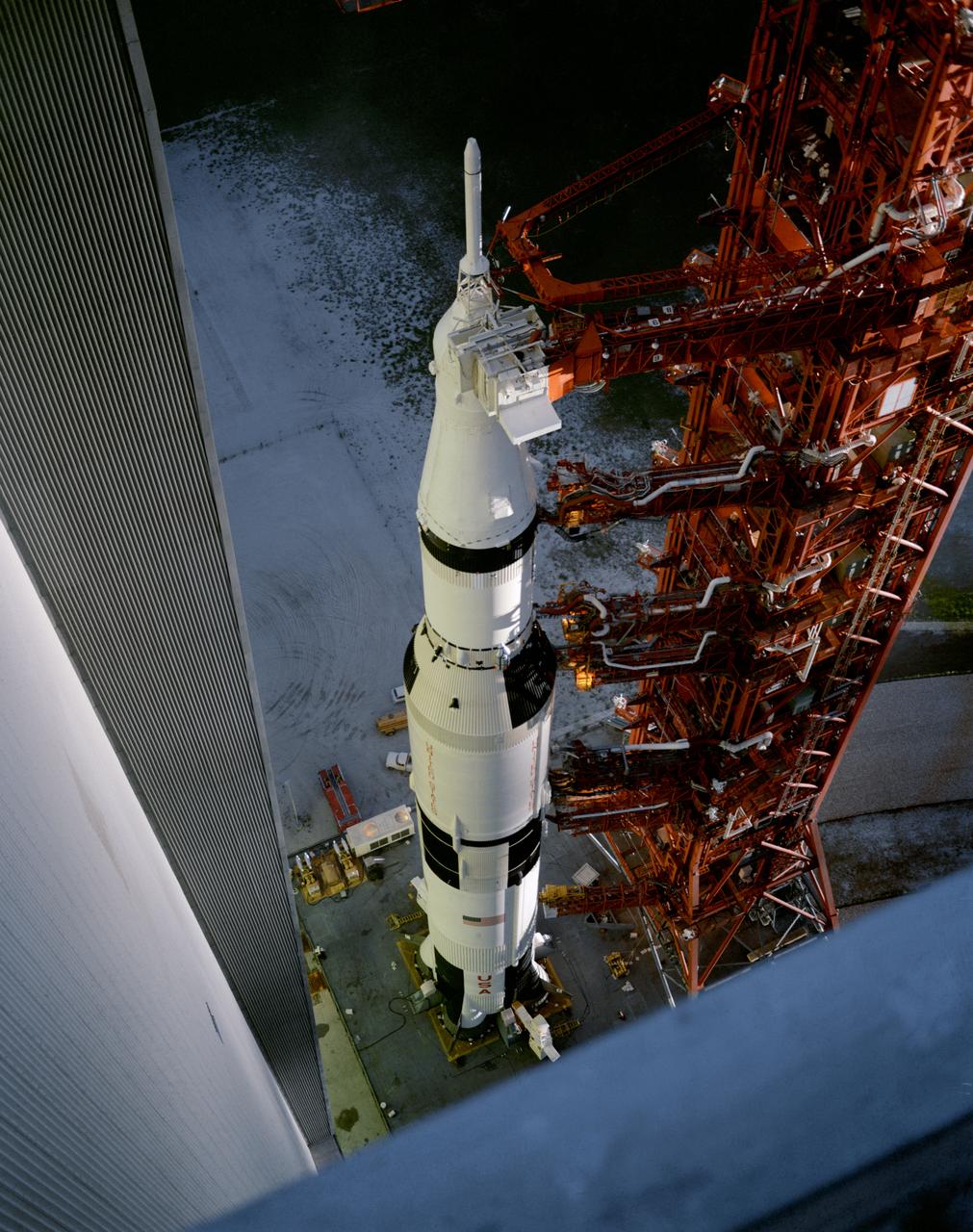
S69-51308 (8 Sept. 1969) --- High-angle view at Launch Complex 39, Kennedy Space Center (KSC), showing the Apollo 12 (Spacecraft 108/ Lunar Module 6/ Saturn 507) space vehicle leaving the Vehicle Assembly Building (VAB) on the way to Pad A. The Saturn V stack and its mobile launch tower are atop a huge crawler-transporter. Apollo 12 is scheduled as the second lunar landing mission. The crew will be astronauts Charles Conrad Jr., commander; Richard F. Gordon Jr., command module pilot; and Alan L. Bean, lunar module pilot.
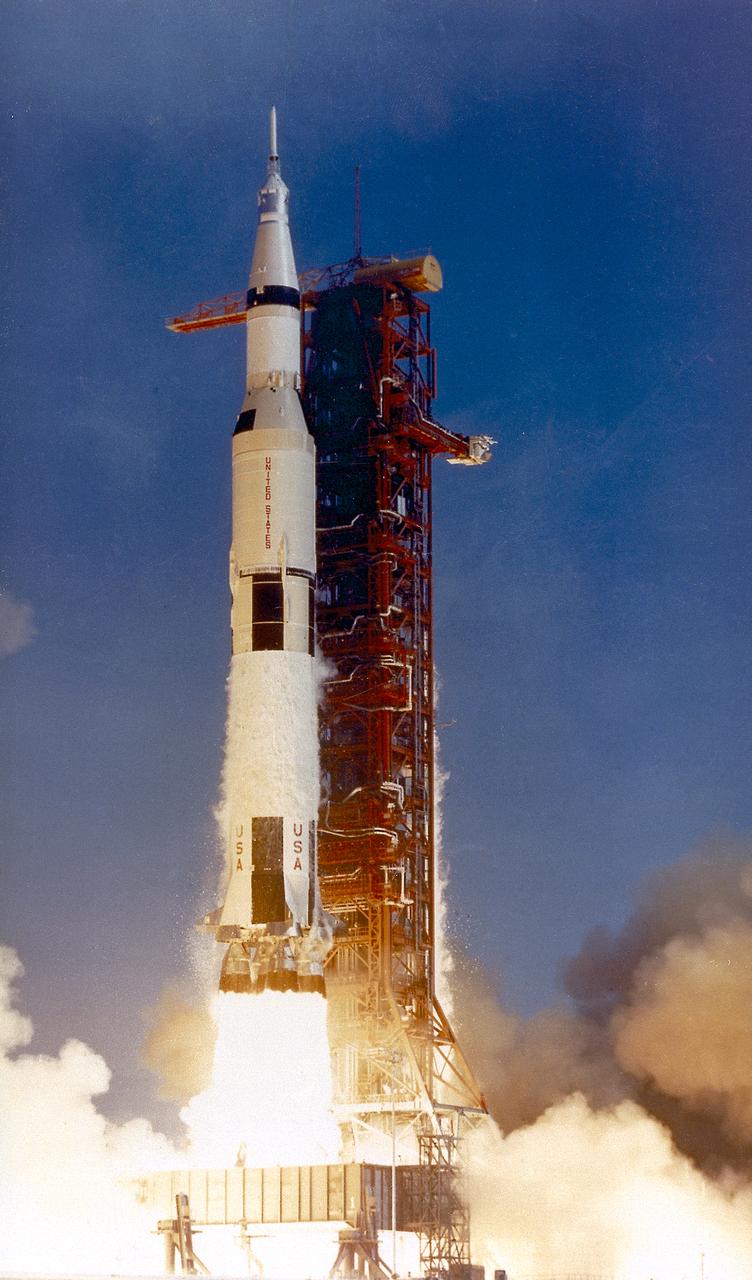
This photograph shows the Saturn V launch vehicle (SA-506) for the Apollo 11 mission liftoff at 8:32 am CDT, July 16, 1969, from launch complex 39A at the Kennedy Space Center. Apollo 11 was the first manned lunar landing mission with a crew of three astronauts: Mission commander Neil A. Armstrong, Command Module pilot Michael Collins, and Lunar Module pilot Edwin E. Aldrin, Jr. It placed the first humans on the surface of the moon and returned them back to Earth. Astronaut Armstrong became the first man on the lunar surface, and astronaut Aldrin became the second. Astronaut Collins piloted the Command Module in a parking orbit around the Moon.
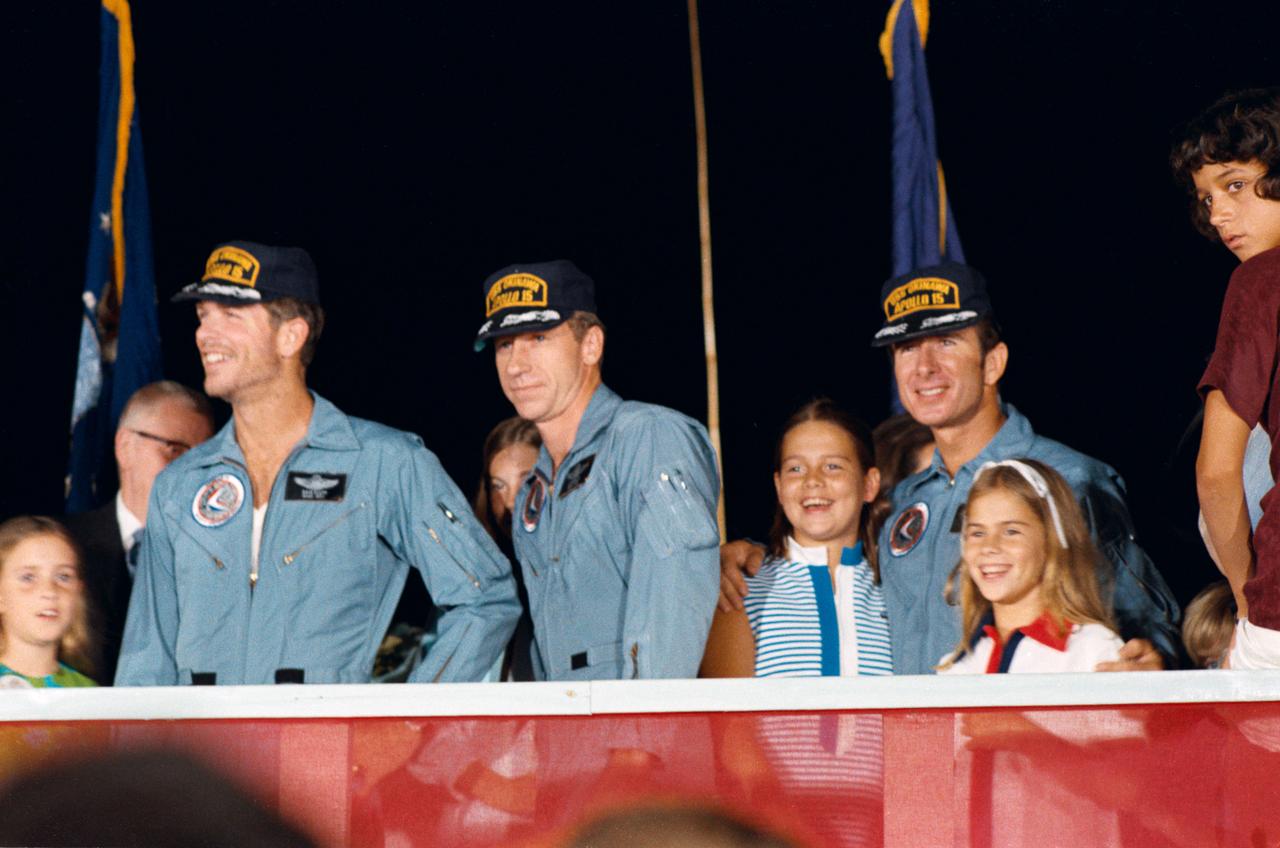
S71-43428 (8 Aug. 1971) --- The three crew men, of the highly successful Apollo 15 lunar landing mission, receive a warm welcome home at Ellington Air Force Base (EAFB), Houston, after an eight hour flight aboard a U.S. Air Force C-141 jet aircraft from Hawaii. Left to right, are astronauts David R. Scott, commander; Alfred M. Worden, command module pilot; and James B. Irwin, lunar module pilot. Apollo 15 splashdown in the mid-Pacific at 3:45 p.m. (CDT), Aug. 7, 1971, some 330 miles north of Honolulu. The C-141 landed at EAFB at 9 p.m. (CDT), Sunday, Aug. 8, 1971. Members of the astronauts' families identifiable in the picture are, left to right, Scott's daughter, Tracy; Worden's father, Merrill Worden; Worden's daughter, Merrill; and Irwin's two daughters, Joy and Jill.
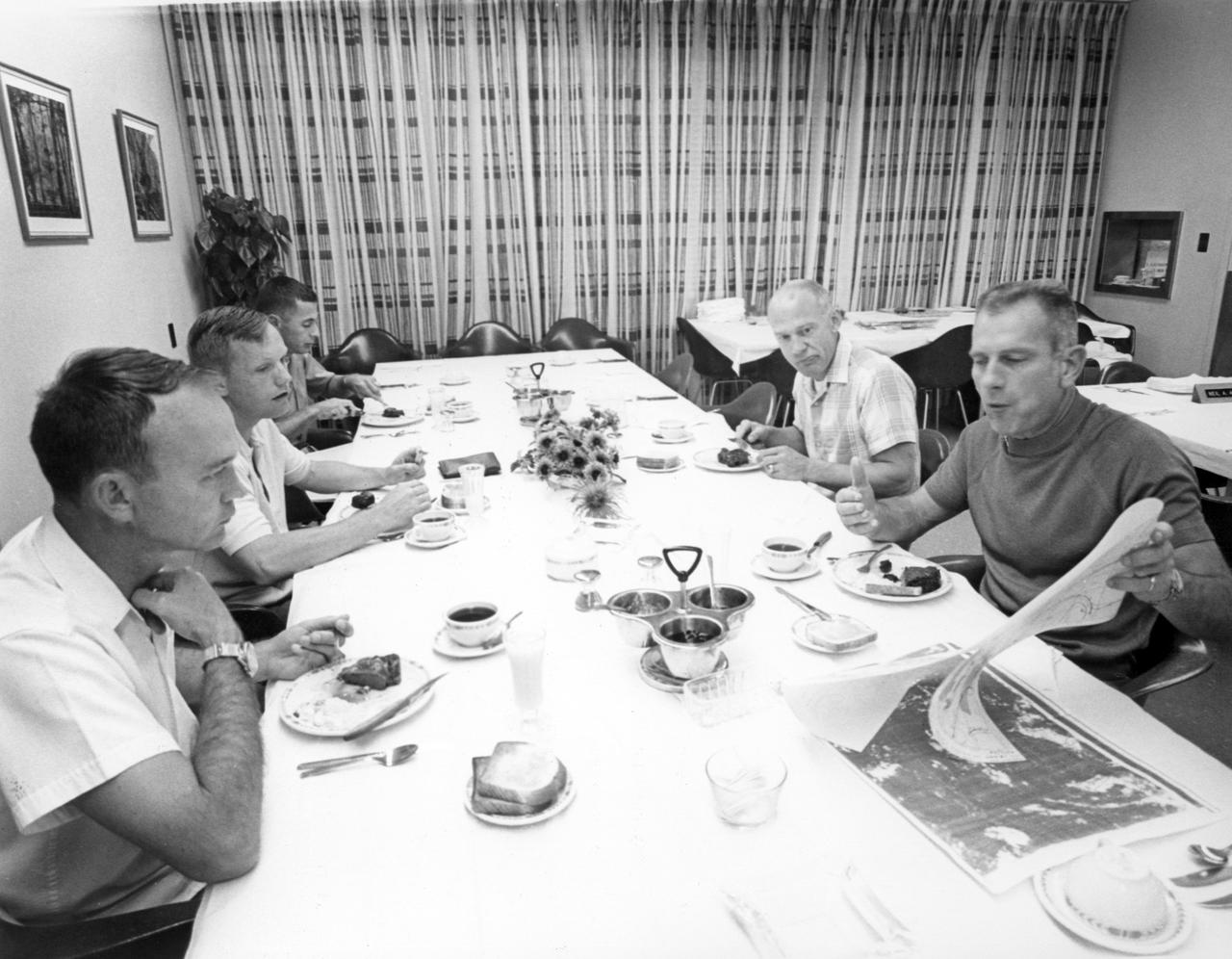
Chief astronaut and director of flight crew operations, Donald K. Slayton (right front) reviews lunar charts with Apollo 11 astronauts Michael Collins (left), Neil Armstrong, and Edwin Aldrin (next to Slayton) during breakfast a short time before the three men launched for the first Moon landing mission. Sharing breakfast with the crew was William Anders (left rear), Lunar Module pilot for the Apollo 8 lunar orbit mission. The Apollo 11 mission launched from the NASA Kennedy Space Center (KSC) in Florida via the Marshall Space Flight Center (MSFC) developed Saturn V launch vehicle on July 16, 1969 and safely returned to Earth on July 24, 1969. The CM, “Columbia”, piloted by Collins, remained in a parking orbit around the Moon while the LM, “Eagle’’, carrying astronauts Armstrong and Aldrin, landed on the Moon. On July 20, 1969, Armstrong was the first human to ever stand on the lunar surface, followed by Aldrin. During 2½ hours of surface exploration, the crew collected 47 pounds of lunar surface material for analysis back on Earth. With the success of Apollo 11, the national objective to land men on the Moon and return them safely to Earth had been accomplished.

CAPE CANAVERAL, Fla. -- Apollo astronauts and their families tour one of the remodeled firing rooms in the Launch Control Center at NASA's Kennedy Space Center in Florida. The facility's firing rooms were used to conduct the Saturn V countdowns during the Apollo Program. NASA Administrator Charles Bolden, at left, accompanied the astronauts on the tour which followed a ceremony renaming the refurbished Operations and Checkout Building for Apollo 11 astronaut Neil Armstrong, the first person to set foot on the moon. Former astronaut Jim Lovell, a member of the Apollo 8 and Apollo 13 crews, is at center. The ceremony was part of NASA's 45th anniversary celebration of the Apollo 11 moon landing. As the world watched, Neil Armstrong and Buzz Aldrin landed in the moon's Sea of Tranquility on July 20, 1969, aboard the lunar module Eagle. Meanwhile, crewmate Michael Collins orbited above in the command module Columbia. For more, visit http://www.nasa.gov/press/2014/july/nasa-honors-historic-first-moon-landing-eyes-first-mars-mission. Photo credit: NASA/Kim Shiflett

jsc2025e034457 (March 18, 2025) -- The official Artemis II mission crew patch. The Artemis II test flight begins when a mighty team launches the first crew of the Artemis generation. This patch designates the mission as “AII,” signifying not only the second major flight of the Artemis campaign, but also an endeavor of discovery that seeks to explore for all and by all. Framed in Apollo 8’s famous Earthrise photo, the scene of the Earth and the Moon represents the dual nature of human spaceflight, both equally compelling: The Moon represents our exploration destination, focused on discovery of the unknown. The Earth represents home, focused on the perspective we gain when we look back at our shared planet and learn what it is to be uniquely human. The orbit around Earth highlights the ongoing exploration missions that have enabled Artemis to set sights on a long-term presence on the Moon and soon, Mars. Credit: NASA
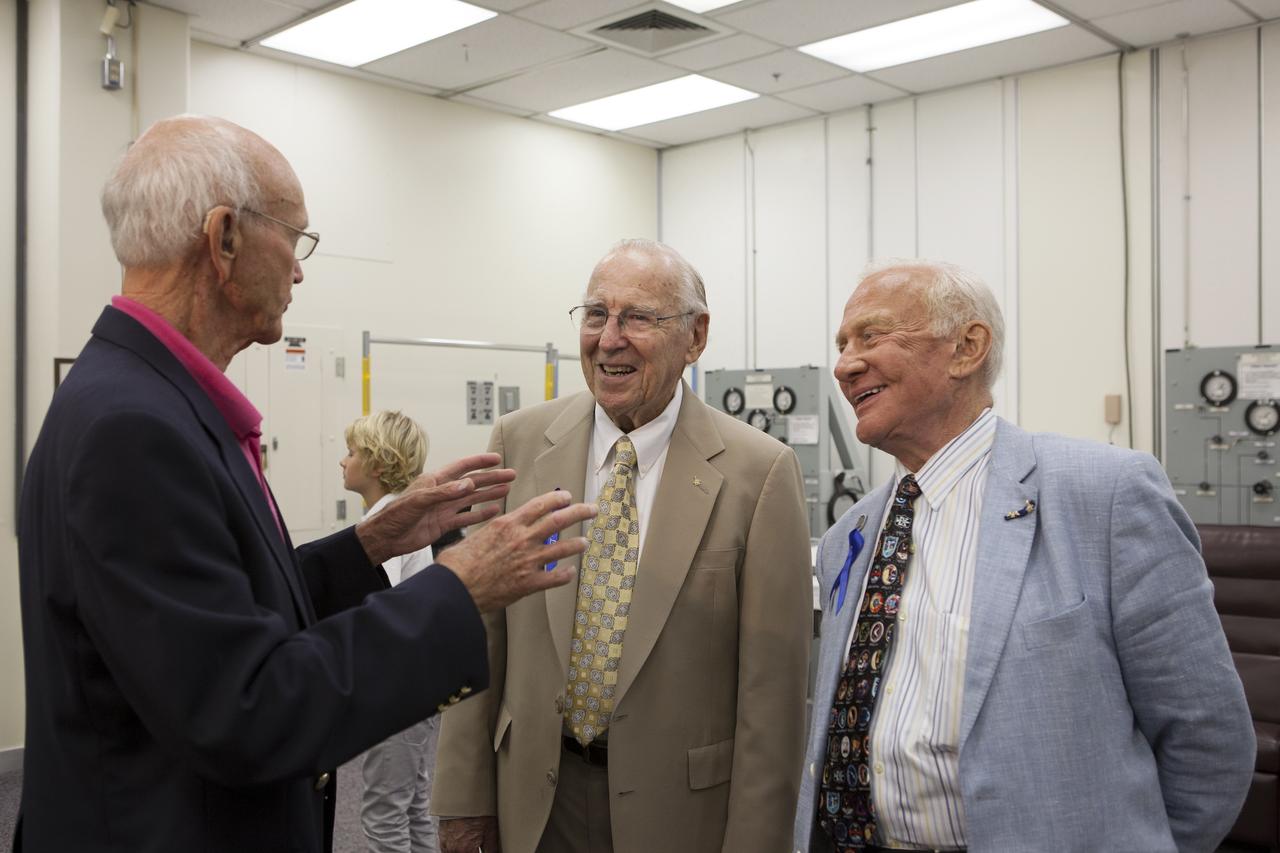
CAPE CANAVERAL, Fla. -- Apollo astronauts and their families tour the astronaut crew quarters in the Operations and Checkout Building at NASA's Kennedy Space Center in Florida. Here, from left, Apollo 11 command module pilot Michael Collins, Apollo 8 and Apollo 13 crew member Jim Lovell, and Apollo 11 moonwalker Buzz Aldrin share a light moment. The tour followed a ceremony renaming the refurbished Operations and Checkout Building for Apollo 11 astronaut Neil Armstrong, the first person to set foot on the moon. Besides housing the crew quarters, the building's high bay is being used to support the agency's new Orion spacecraft and is the same spaceport facility where the Apollo 11 command/service module and lunar module were prepped for the first lunar landing mission in 1969. Orion is designed to take humans farther than they’ve ever gone before, serving as the exploration vehicle that will carry astronauts to deep space and sustain the crew during travel to destinations such as an asteroid or Mars. The visit of the former astronauts was part of NASA's 45th anniversary celebration of the moon landing. As the world watched, Neil Armstrong and Aldrin landed in the moon's Sea of Tranquility aboard the lunar module Eagle on July 20, 1969. Meanwhile, crewmate Collins orbited above in the command module Columbia. For more, visit http://www.nasa.gov/press/2014/july/nasa-honors-historic-first-moon-landing-eyes-first-mars-mission. Photo credit: NASA/Kim Shiflett
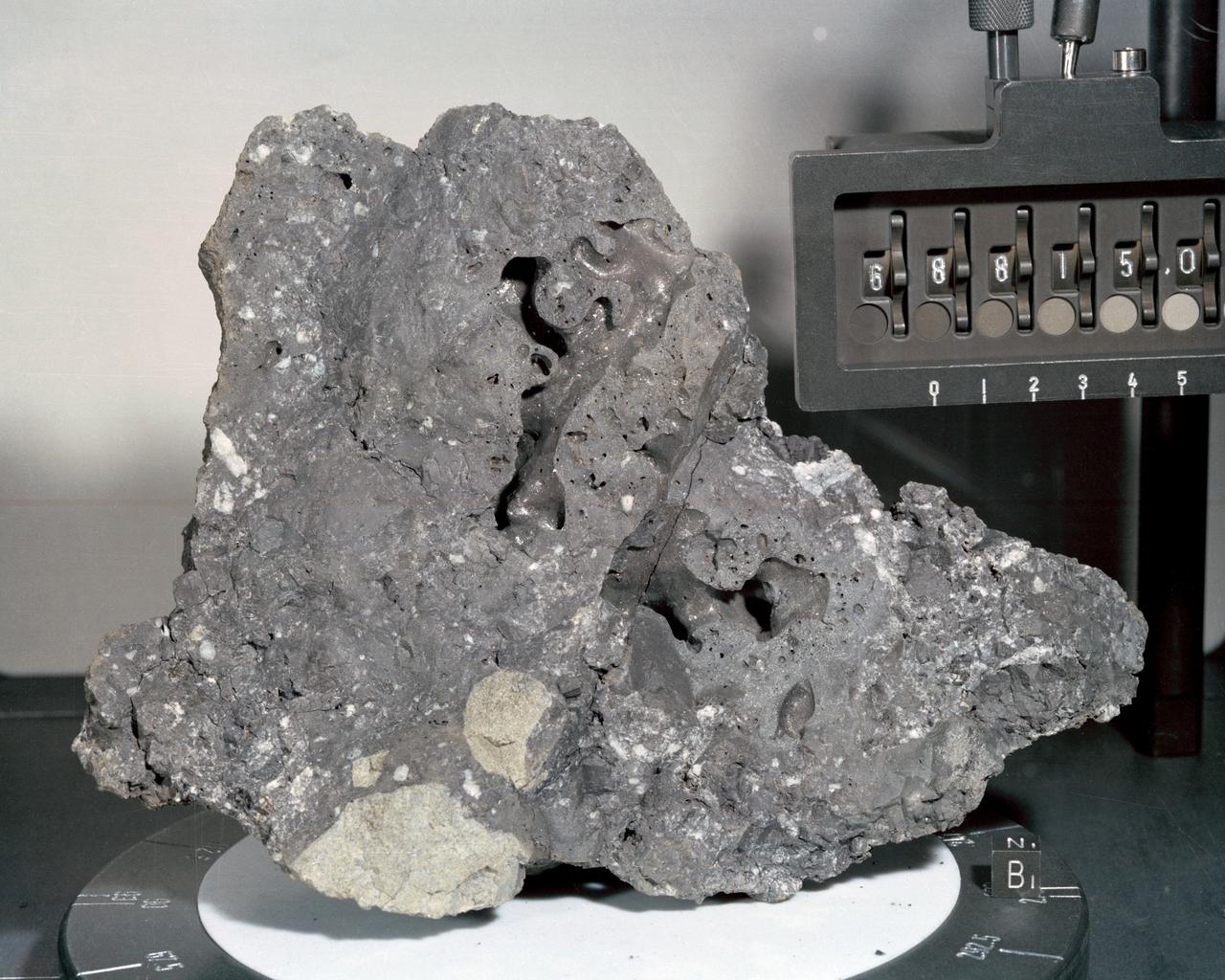
A closeup view or "mug shot" of Apollo 16 lunar sample no. 68815, a dislodged fragment from a parent boulder roughly four feet high and five feet long encountered at Station 8. The crew tried in vain to overturn the parent boulder. A fillet-soil sample was taken close to the boulder, allowing for study of the type and rate of erosion acting on lunar rocks. The fragment itself is very hard, has many veticles and a variety of inclusions. In addition, numerous metallic particles were observed in the black matrix.

The third Saturn V launch vehicle (SA-503) for the Apollo 8 mission lifted off from Launch Complex 39A at the Kennedy Space Center on December 21, 1968. The first manned Saturn V vehicle with a crew of three astronauts, Frank Borman, James A. Lovell, Jr., and William Anders, escaped Earth's gravity, traveled to the lunar vicinity, and orbited the Moon.
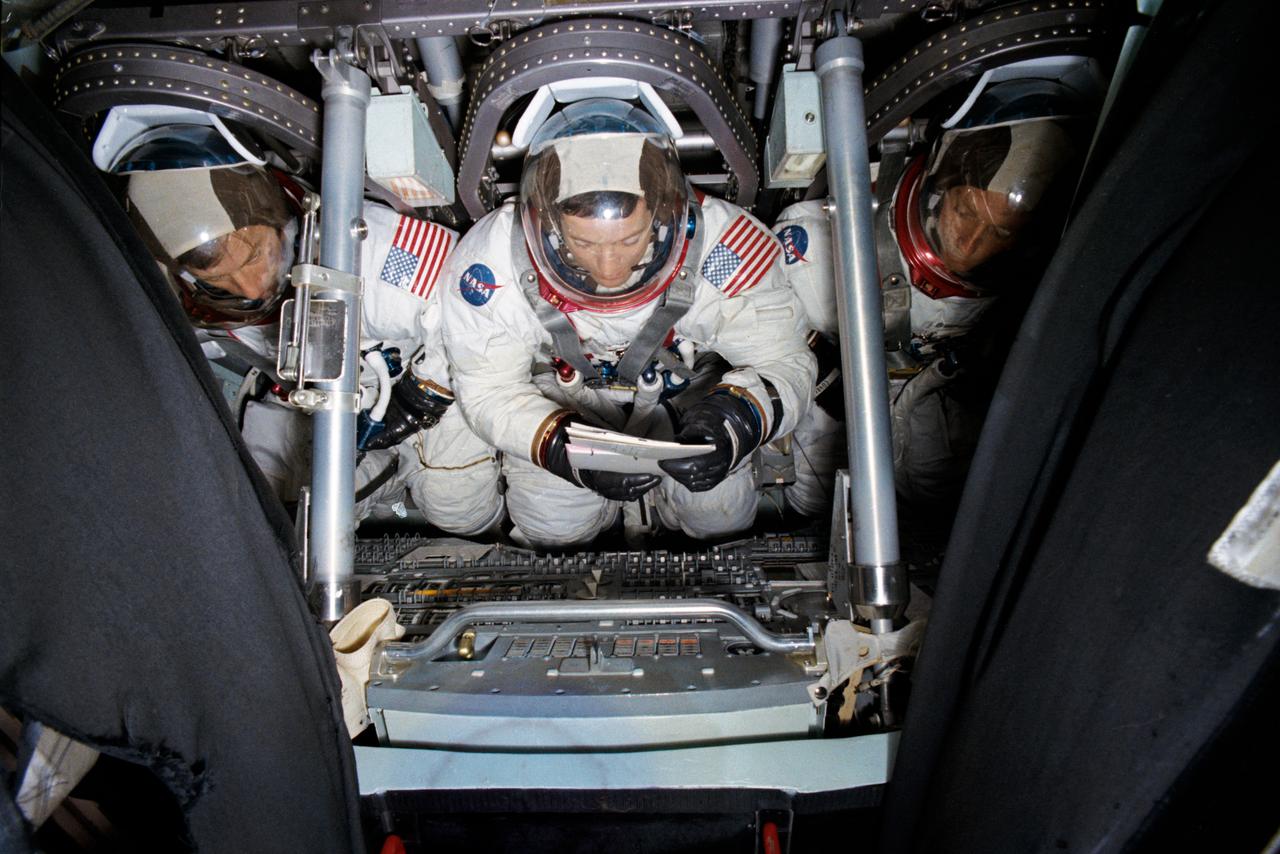
S73-25401 (8 May 1973) --- The members of the prime crew of the first manned Skylab mission go over a checklist during Skylab prelaunch training activity at Johnson Space Center. They are in the Apollo Command Module Mission Simulator in Bldg. 5 at JSC. They are, left to right, astronaut Charles Conrad Jr., commander; scientist-astronaut Joseph P. Kerwin, science pilot; and astronaut Paul J. Weitz, pilot. Photo credit: NASA
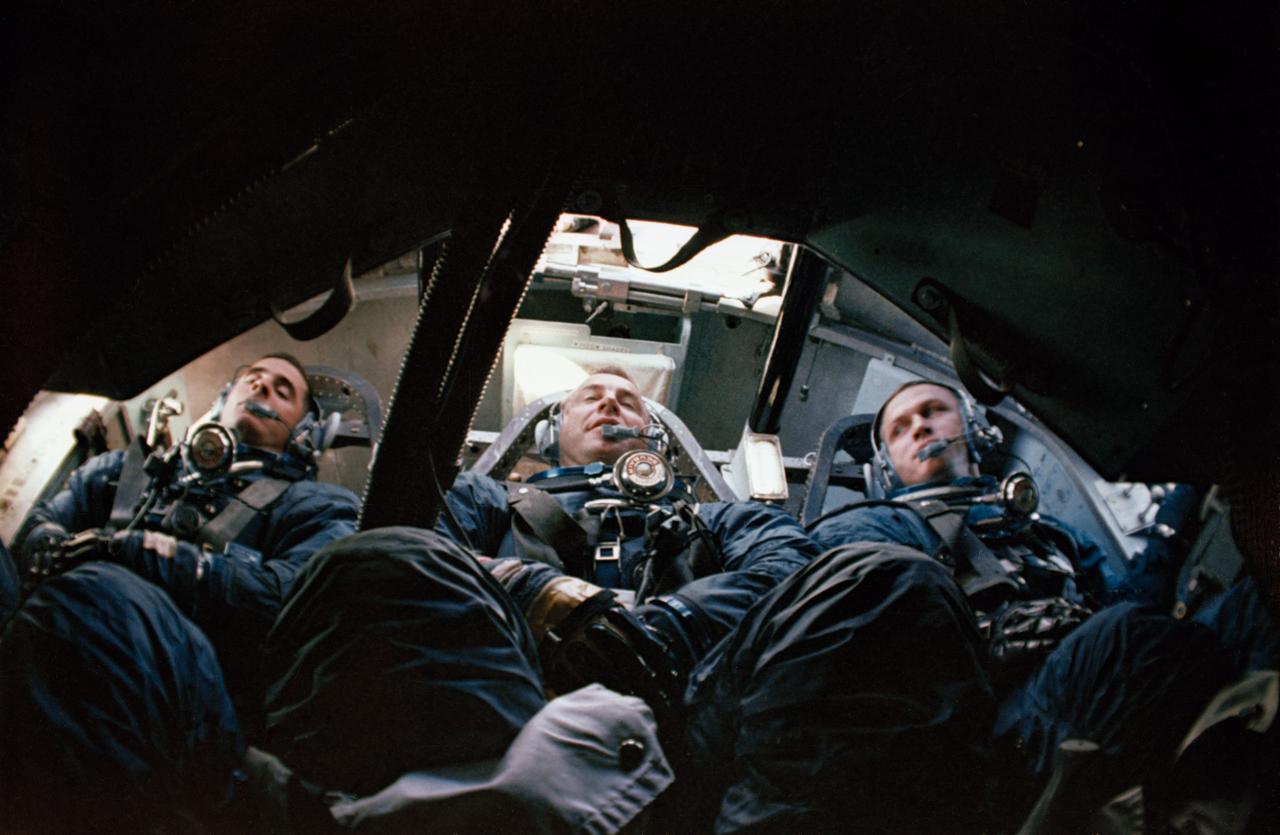
S68-53015 (25 Oct. 1968) --- Astronauts William A. Anders, James A. Lovell Jr., and Frank Borman, (left to right) are seen inside Apollo Boilerplate 1102A during water egress training in the Gulf of Mexico. Borman is Apollo 8 commander; with Lovell serving as command module pilot; and Anders as lunar module pilot. Photo credit: NASA
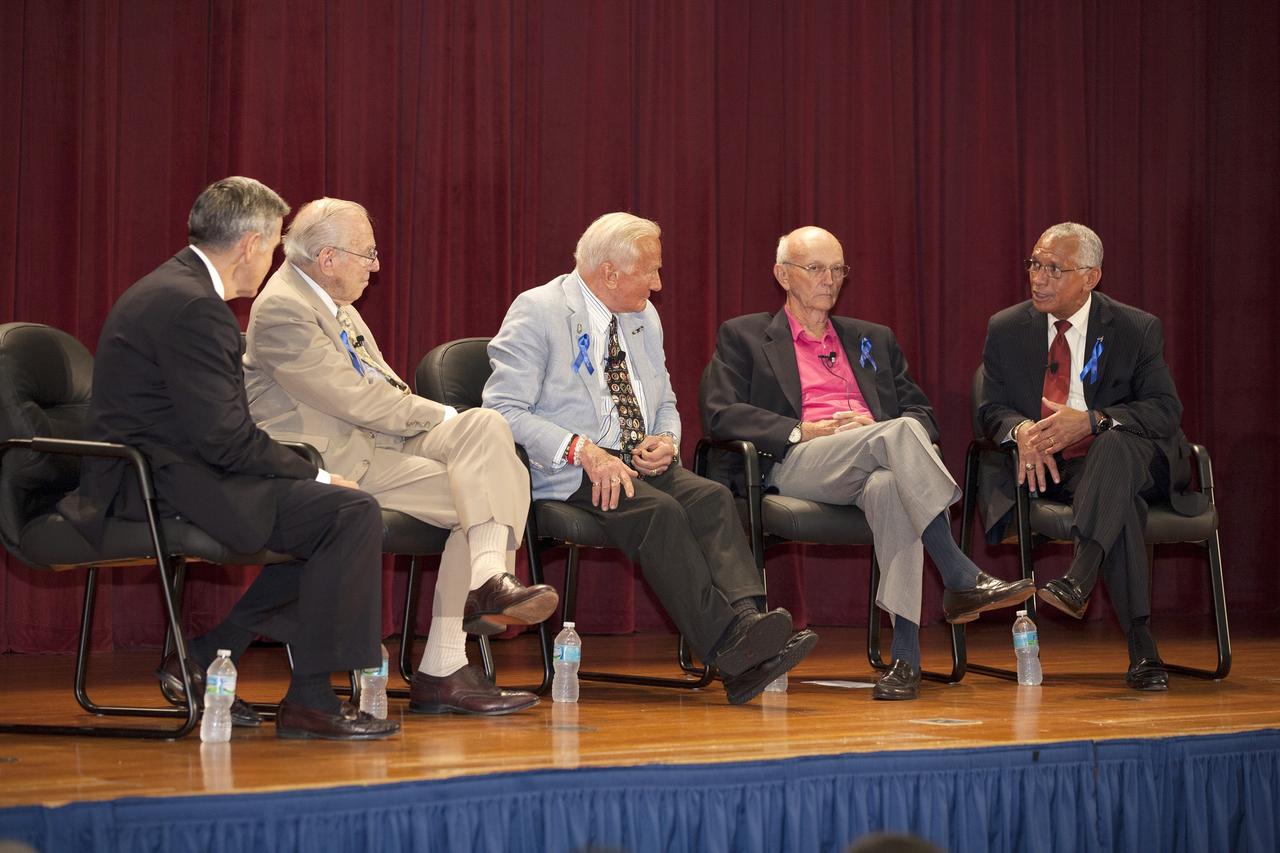
CAPE CANAVERAL, Fla. -- Apollo astronauts participate in a panel discussion held for employees in the KSC Training Auditorium at NASA's Kennedy Space Center in Florida. From left are Center Director Robert Cabana, Apollo 8 and Apollo 13 crew member Jim Lovell, Apollo 11 moonwalker Buzz Aldrin, Apollo 11 command module pilot Michael Collins, and NASA Administrator Charles Bolden. Cabana and Bolden, both shuttle astronauts, asked the questions to which the panel members responded. The panel discussion followed a ceremony renaming the refurbished Operations and Checkout Building for Apollo 11 astronaut Neil Armstrong, the first person to set foot on the moon. The building's high bay, the site for the ceremony, is being used to support the agency's new Orion spacecraft and is the same spaceport facility where the Apollo 11 command/service module and lunar module were prepped for the first lunar landing mission in 1969. Orion is designed to take humans farther than they’ve ever gone before, serving as the exploration vehicle that will carry astronauts to deep space and sustain the crew during travel to destinations such as an asteroid or Mars. The ceremony and panel discussion were part of NASA's 45th anniversary celebration of the Apollo 11 moon landing. As the world watched, Neil Armstrong and Buzz Aldrin landed in the moon's Sea of Tranquility on July 20, 1969, aboard the lunar module Eagle. Meanwhile, crewmate Michael Collins orbited above in the command module Columbia. For more, visit http://www.nasa.gov/press/2014/july/nasa-honors-historic-first-moon-landing-eyes-first-mars-mission. Photo credit: NASA/Kim Shiflett
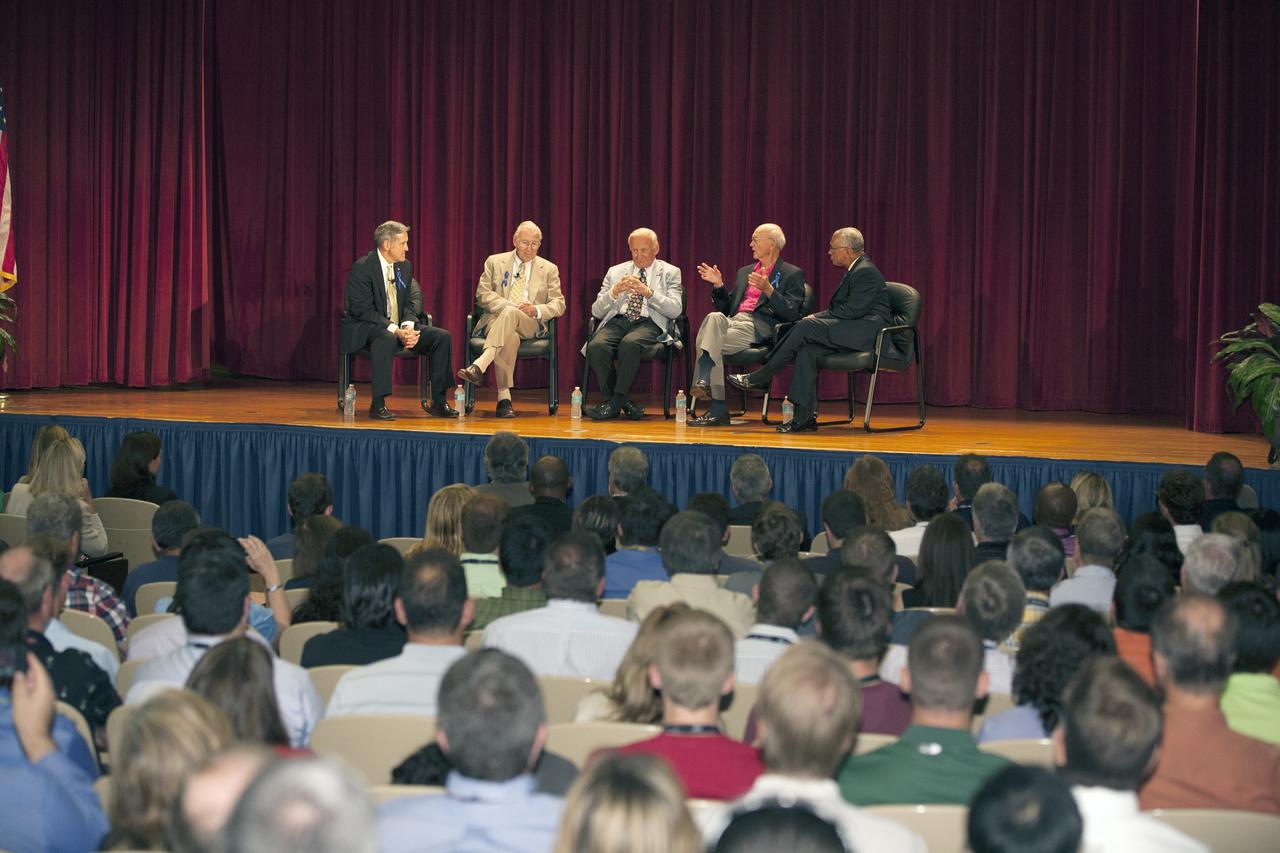
CAPE CANAVERAL, Fla. -- Apollo astronauts participate in a panel discussion held for employees in the KSC Training Auditorium at NASA's Kennedy Space Center in Florida. From left are Center Director Robert Cabana, Apollo 8 and Apollo 13 crew member Jim Lovell, Apollo 11 moonwalker Buzz Aldrin, Apollo 11 command module pilot Michael Collins, and NASA Administrator Charles Bolden. Cabana and Bolden, both shuttle astronauts, asked the questions to which the panel members responded. The panel discussion followed a ceremony renaming the refurbished Operations and Checkout Building for Apollo 11 astronaut Neil Armstrong, the first person to set foot on the moon. The building's high bay, the site for the ceremony, is being used to support the agency's new Orion spacecraft and is the same spaceport facility where the Apollo 11 command/service module and lunar module were prepped for the first lunar landing mission in 1969. Orion is designed to take humans farther than they’ve ever gone before, serving as the exploration vehicle that will carry astronauts to deep space and sustain the crew during travel to destinations such as an asteroid or Mars. The ceremony and panel discussion were part of NASA's 45th anniversary celebration of the Apollo 11 moon landing. As the world watched, Neil Armstrong and Buzz Aldrin landed in the moon's Sea of Tranquility on July 20, 1969, aboard the lunar module Eagle. Meanwhile, crewmate Michael Collins orbited above in the command module Columbia. For more, visit http://www.nasa.gov/press/2014/july/nasa-honors-historic-first-moon-landing-eyes-first-mars-mission. Photo credit: NASA/Kim Shiflett
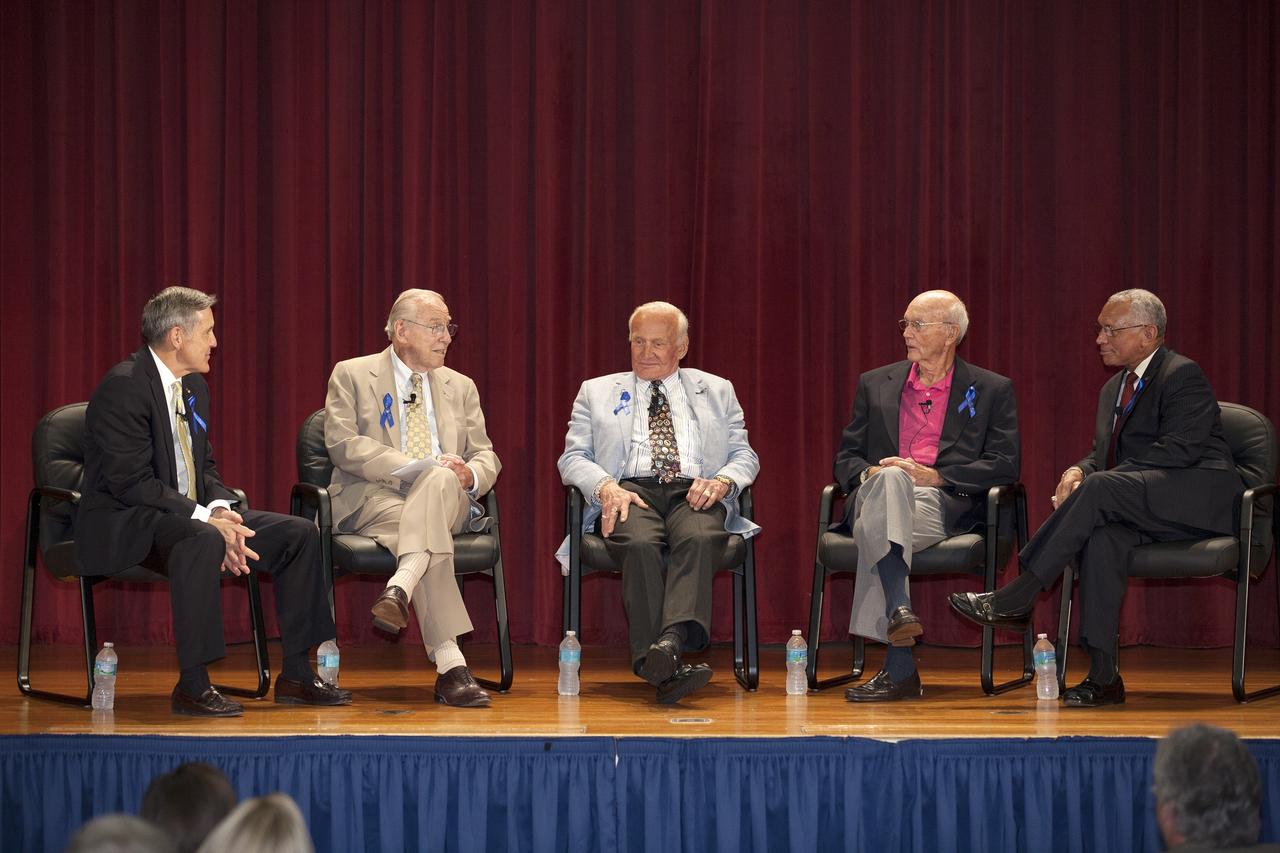
CAPE CANAVERAL, Fla. -- Apollo astronauts participate in a panel discussion held for employees in the KSC Training Auditorium at NASA's Kennedy Space Center in Florida. From left are Center Director Robert Cabana, Apollo 8 and Apollo 13 crew member Jim Lovell, Apollo 11 moonwalker Buzz Aldrin, Apollo 11 command module pilot Michael Collins, and NASA Administrator Charles Bolden. Cabana and Bolden, both shuttle astronauts, asked the questions to which the panel members responded. The panel discussion followed a ceremony renaming the refurbished Operations and Checkout Building for Apollo 11 astronaut Neil Armstrong, the first person to set foot on the moon. The building's high bay, the site for the ceremony, is being used to support the agency's new Orion spacecraft and is the same spaceport facility where the Apollo 11 command/service module and lunar module were prepped for the first lunar landing mission in 1969. Orion is designed to take humans farther than they’ve ever gone before, serving as the exploration vehicle that will carry astronauts to deep space and sustain the crew during travel to destinations such as an asteroid or Mars. The ceremony and panel discussion were part of NASA's 45th anniversary celebration of the Apollo 11 moon landing. As the world watched, Neil Armstrong and Buzz Aldrin landed in the moon's Sea of Tranquility on July 20, 1969, aboard the lunar module Eagle. Meanwhile, crewmate Michael Collins orbited above in the command module Columbia. For more, visit http://www.nasa.gov/press/2014/july/nasa-honors-historic-first-moon-landing-eyes-first-mars-mission. Photo credit: NASA/Kim Shiflett
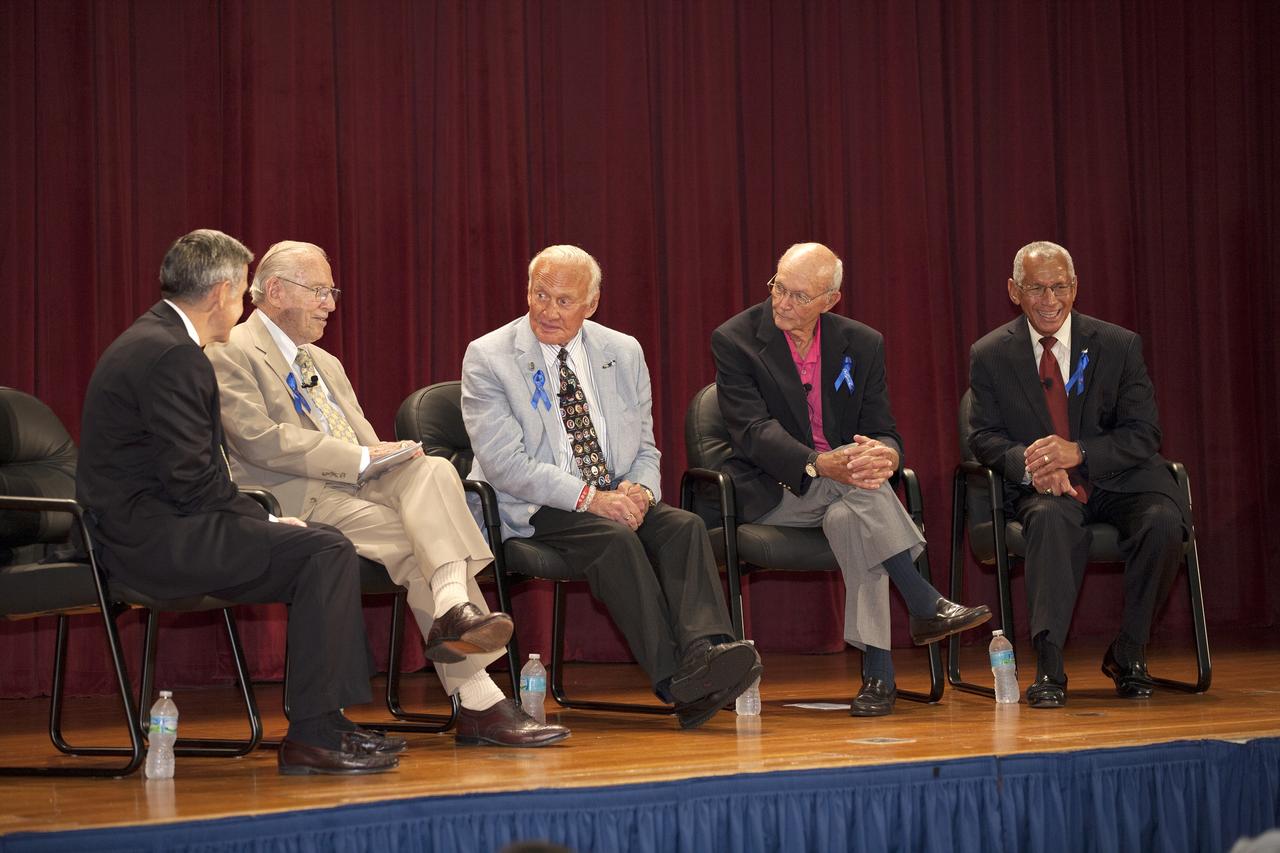
CAPE CANAVERAL, Fla. -- Apollo astronauts participate in a panel discussion held for employees in the KSC Training Auditorium at NASA's Kennedy Space Center in Florida. From left are Center Director Robert Cabana, Apollo 8 and Apollo 13 crew member Jim Lovell, Apollo 11 moonwalker Buzz Aldrin, Apollo 11 command module pilot Michael Collins, and NASA Administrator Charles Bolden. Cabana and Bolden, both shuttle astronauts, asked the questions to which the panel members responded. The panel discussion followed a ceremony renaming the refurbished Operations and Checkout Building for Apollo 11 astronaut Neil Armstrong, the first person to set foot on the moon. The building's high bay, the site for the ceremony, is being used to support the agency's new Orion spacecraft and is the same spaceport facility where the Apollo 11 command/service module and lunar module were prepped for the first lunar landing mission in 1969. Orion is designed to take humans farther than they’ve ever gone before, serving as the exploration vehicle that will carry astronauts to deep space and sustain the crew during travel to destinations such as an asteroid or Mars. The ceremony and panel discussion were part of NASA's 45th anniversary celebration of the Apollo 11 moon landing. As the world watched, Neil Armstrong and Buzz Aldrin landed in the moon's Sea of Tranquility on July 20, 1969, aboard the lunar module Eagle. Meanwhile, crewmate Michael Collins orbited above in the command module Columbia. For more, visit http://www.nasa.gov/press/2014/july/nasa-honors-historic-first-moon-landing-eyes-first-mars-mission. Photo credit: NASA/Kim Shiflett

CAPE CANAVERAL, Fla. -- Apollo astronauts and their families tour the astronaut crew quarters in the Operations and Checkout Building at NASA's Kennedy Space Center in Florida. Here, from left, Apollo 11 astronaut Michael Collins, NASA Administrator Charles Bolden, and Apollo 8 and Apollo 13 crew member Jim Lovell share a light moment. The tour followed a ceremony renaming the refurbished Operations and Checkout Building for Apollo 11 astronaut Neil Armstrong, the first person to set foot on the moon. Besides housing the crew quarters, the building's high bay is being used to support the agency's new Orion spacecraft and is the same spaceport facility where the Apollo 11 command/service module and lunar module were prepped for the first lunar landing mission in 1969. Orion is designed to take humans farther than they’ve ever gone before, serving as the exploration vehicle that will carry astronauts to deep space and sustain the crew during travel to destinations such as an asteroid or Mars. The visit of the former astronauts was part of NASA's 45th anniversary celebration of the moon landing. As the world watched, Neil Armstrong and Aldrin landed in the moon's Sea of Tranquility aboard the lunar module Eagle on July 20, 1969. Meanwhile, crewmate Collins orbited above in the command module Columbia. For more, visit http://www.nasa.gov/press/2014/july/nasa-honors-historic-first-moon-landing-eyes-first-mars-mission. Photo credit: NASA/Kim Shiflett
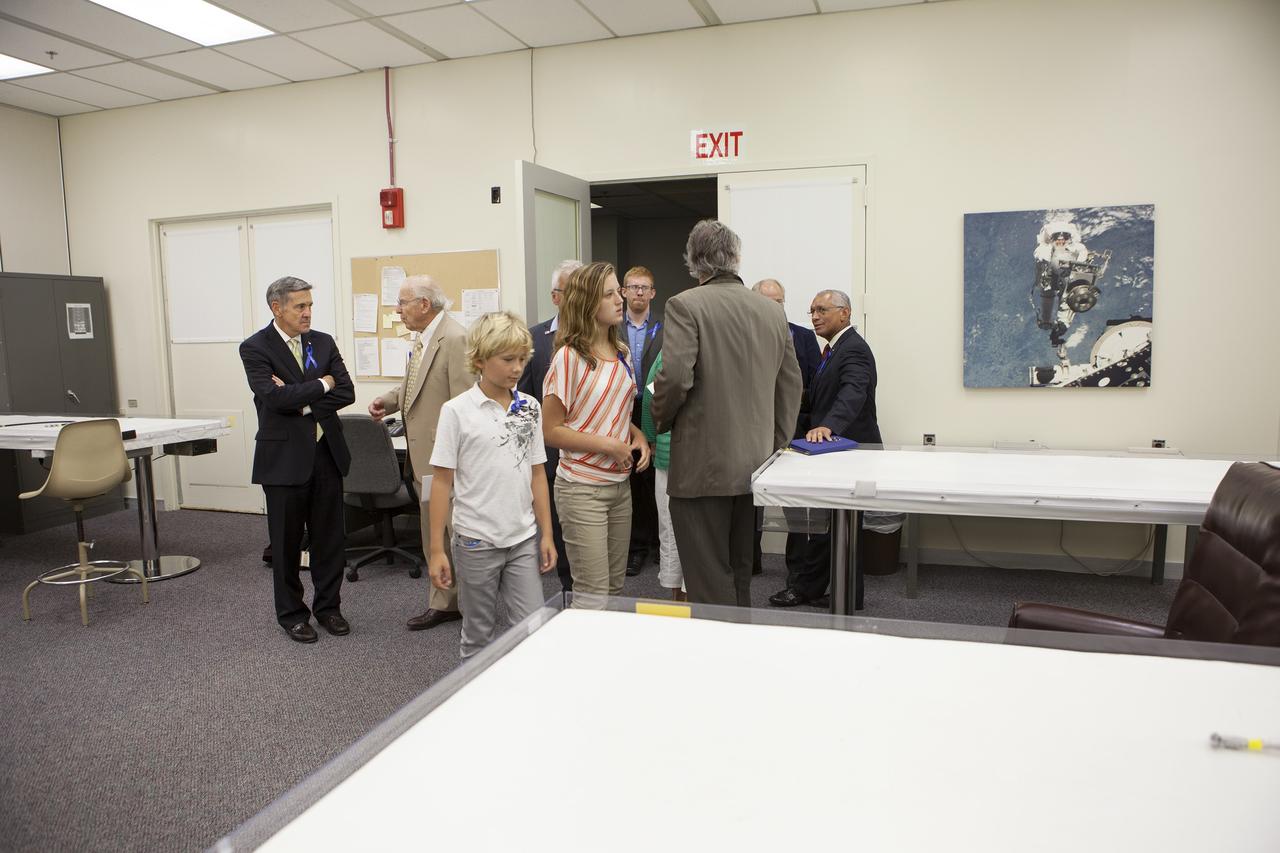
CAPE CANAVERAL, Fla. -- Apollo astronauts and their families tour the astronaut crew quarters in the Operations and Checkout Building at NASA's Kennedy Space Center in Florida. The tour followed a ceremony renaming the refurbished Operations and Checkout Building for Apollo 11 astronaut Neil Armstrong, the first person to set foot on the moon. Here, Armstrong's grandchildren, Bryce and Lily, in front, make their way into the room. Center Director Robert Cabana talks with Apollo 8 and Apollo 13 crew member Jim Lovell, at left, as NASA Administrator Charles Bolden talks with other Armstrong family members, at right. Besides housing the crew quarters, the building's high bay is being used to support the agency's new Orion spacecraft and is the same spaceport facility where the Apollo 11 command/service module and lunar module were prepped for the first lunar landing mission in 1969. Orion is designed to take humans farther than they’ve ever gone before, serving as the exploration vehicle that will carry astronauts to deep space and sustain the crew during travel to destinations such as an asteroid or Mars. The ceremony was part of NASA's 45th anniversary celebration of the Apollo 11 moon landing. As the world watched, Neil Armstrong and Buzz Aldrin landed in the moon's Sea of Tranquility on July 20, 1969, aboard the lunar module Eagle. Meanwhile, crewmate Michael Collins orbited above in the command module Columbia. For more, visit http://www.nasa.gov/press/2014/july/nasa-honors-historic-first-moon-landing-eyes-first-mars-mission. Photo credit: NASA/Kim Shiflett

CAPE CANAVERAL, Fla. -- At the Kennedy Space Center in Florida, NASA officials showcase the modifications underway at Launch Pad 39 B to Apollo astronauts visiting the center. From left are NASA Administrator Charles Bolden, Apollos 8 and 13 astronaut Jim Lovell, Apollo 11 astronauts Buzz Aldrin and Mike Collins, and Center Director Bob Cabana. The pad is being modified to support the agency's new Orion spacecraft which will lift off atop the Space Launch System rocket. Orion is designed to take humans farther than they’ve ever gone before, serving as the exploration vehicle that will carry astronauts to deep space and sustain the crew during travel to destinations such as an asteroid or Mars. The visit of the former astronauts was part of NASA's 45th anniversary celebration of the Apollo 11 moon landing. As the world watched, Neil Armstrong and Aldrin landed in the moon's Sea of Tranquility aboard the lunar module Eagle on July 20, 1969. Meanwhile, crewmate Collins orbited above in the command module Columbia. For more, visit http://www.nasa.gov/press/2014/july/nasa-honors-historic-first-moon-landing-eyes-first-mars-mission. Photo credit: NASA/Kim Shiflett
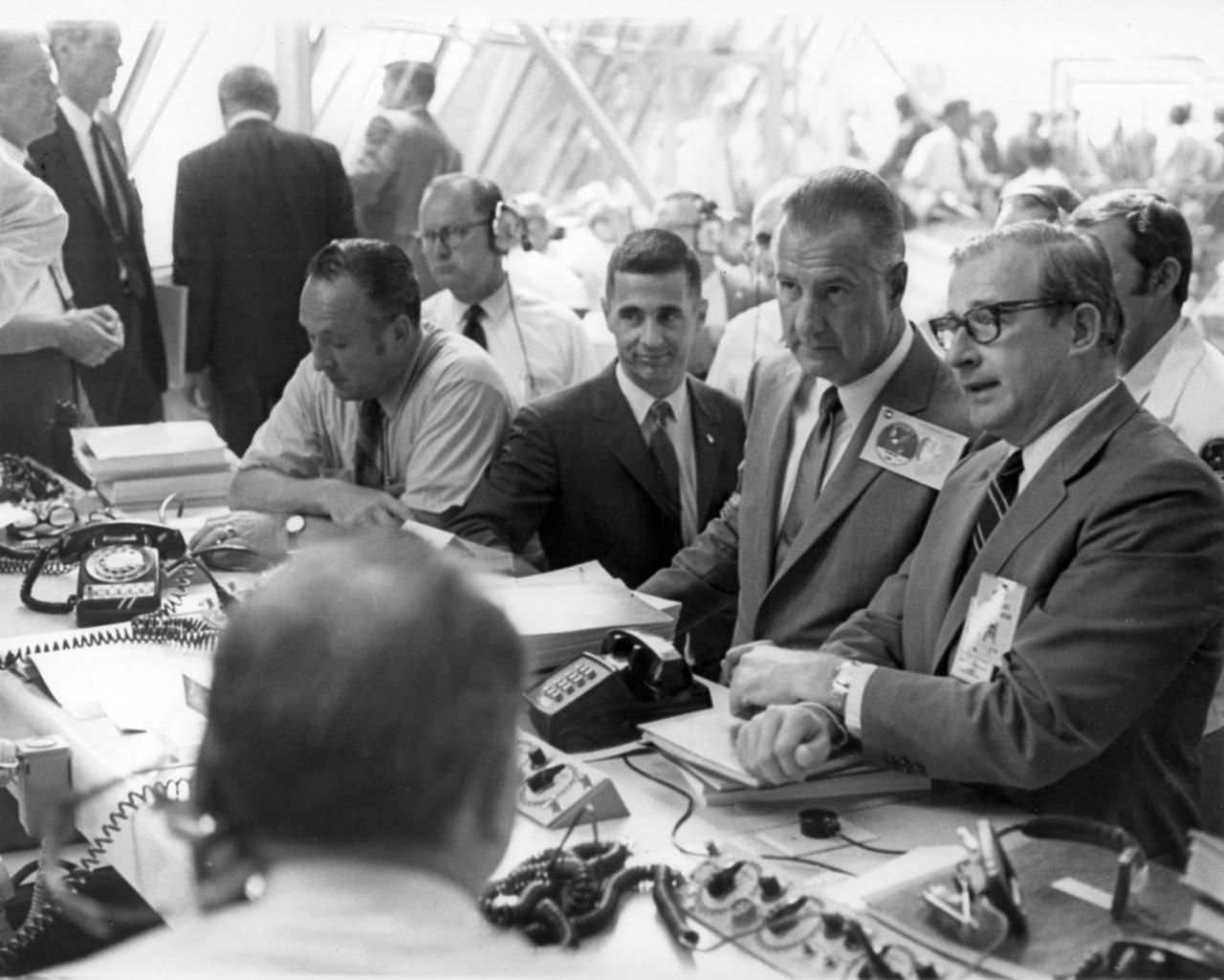
From the right, NASA administrator, Dr. Thomas O. Paine talks with U.S. Vice President Spiro T. Agnew while awaiting the launch of Saturn V (AS-506) that carried the Apollo 11 spacecraft to the Moon for man’s historic first landing on the lunar surface. At center is astronaut William Anders, a member of the first crew to orbit the moon during the Apollo 8 mission. At left is Lee B. James, director of Program Management at the NASA Marshall Space Flight Center (MSFC) where the Saturn V was developed. The craft lifted off from launch pad 39 at Kennedy Space Flight Center (KSC) on July 16, 1969. The moon bound crew included astronauts Neil A. Armstrong, commander; Michael Collins, Command Module (CM) pilot; and Edwin E. Aldrin Jr., Lunar Module (M) pilot. The mission finalized with splashdown in the Pacific Ocean on July 24, 1969. With the success of Apollo 11, the national objective to land men on the Moon and return them safely to Earth had been accomplished.
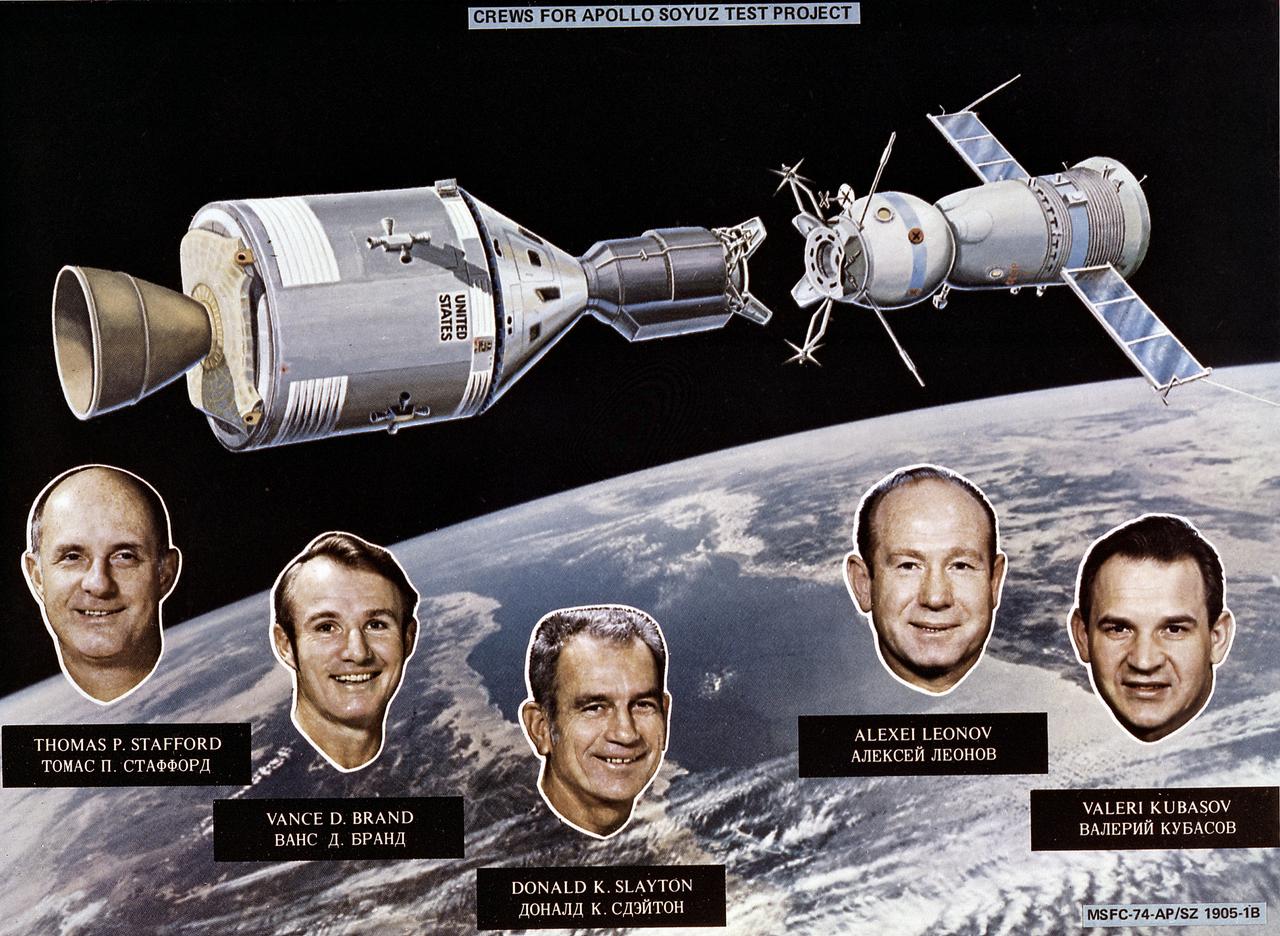
This artist's concept depicts the Apollo-Soyuz Test Project (ASTP) with insets of photographs of three U.S. astronauts (Thomas Stafford, Vance Brand, and Donald Slayton) and two U.S.S.R. cosmonauts (Alexei Leonov and Valeri Kubasov). The objective of the ASTP mission was to accomplish the first docking of a standardized international system, the U.S.'s Apollo spacecraft and the U.S.S.R.'s Soyuz spacecraft, in space. The Soyuz spacecraft was launched from the Baikonur Cosmodrome near Tyuratam in the Kazakh, Soviet Socialist Republic, at 8:20 a.m. (EDT) on July 15, 1975. The Apollo spacecraft was launched from Launch Complex 39B, Kennedy Space Center, Florida, at 3:50 p.m. (EDT) on July 15, 1975. The Primary objectives of the ASTP were achieved. They performed spacecraft rendezvous, docking and undocking, conducted intervehicular crew transfer, and demonstrated the interaction of U.S. and U.S.S.R. control centers and spacecraft crews. The mission marked the last use of a Saturn launch vehicle. The Marshall Space Flight Center was responsible for development and sustaining engineering of the Saturn IB launch vehicle during the mission.
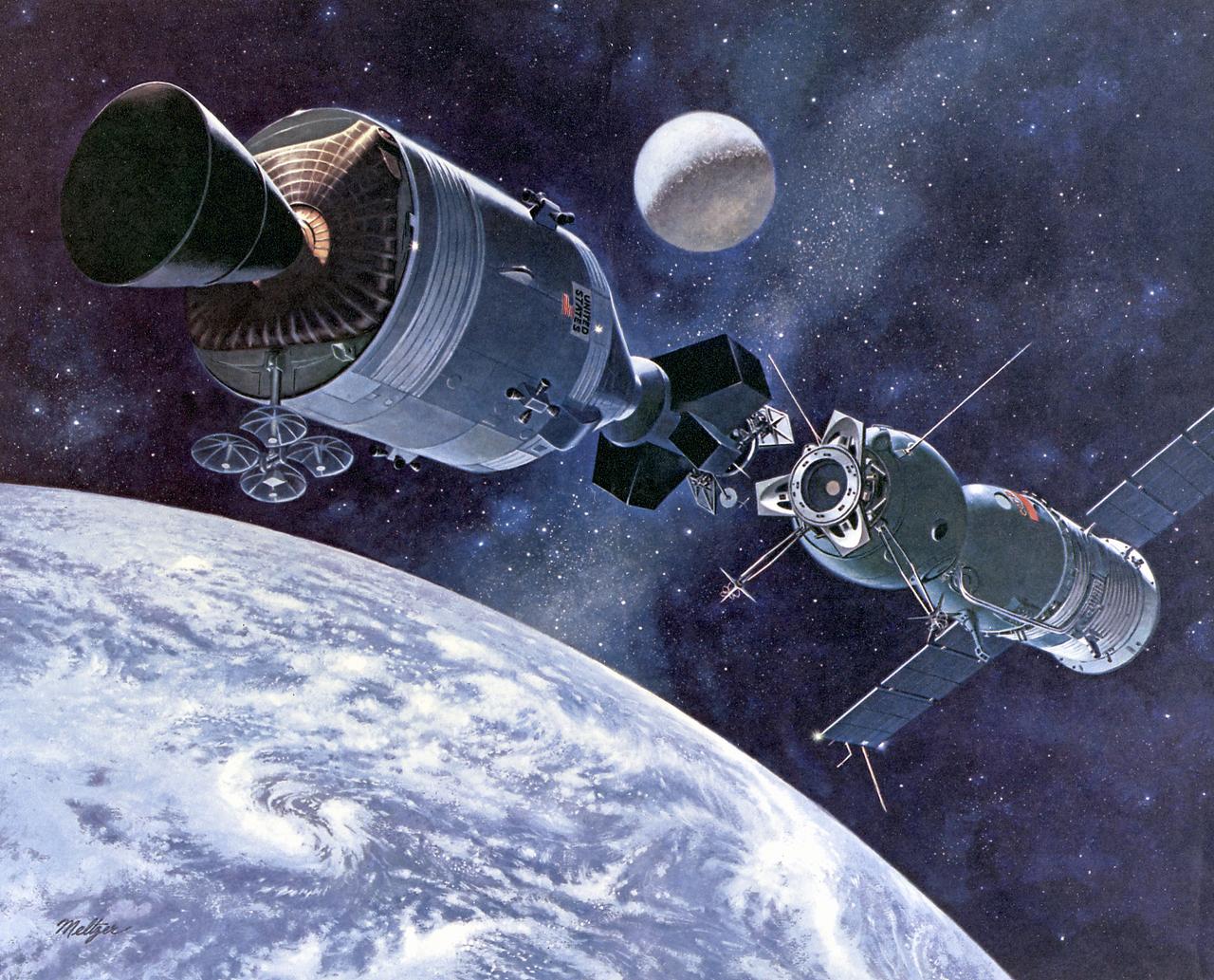
This artist's concept depicts the Apollo-Soyuz Test Project (ASTP), the first international docking of the U.S.'s Apollo spacecraft and the U.S.S.R.'s Soyuz spacecraft in space. The objective of the ASTP mission was to provide the basis for a standardized international system for docking of marned spacecraft. The Soyuz spacecraft, with Cosmonauts Alexei Leonov and Valeri Kubasov aboard, was launched from the Baikonur Cosmodrome near Tyuratam in the Kazakh, Soviet Socialist Republic, at 8:20 a.m. (EDT) on July 15, 1975. The Apollo spacecraft, with Astronauts Thomas Stafford, Vance Brand, and Donald Slayton aboard, was launched from Launch Complex 39B, Kennedy Space Center, Florida, at 3:50 p.m. (EDT) on July 15, 1975. The Primary objectives of the ASTP were achieved. They performed spacecraft rendezvous, docking and undocking, conducted intervehicular crew transfer, and demonstrated the interaction of U.S. and U.S.S.R. control centers and spacecraft crews. The mission marked the last use of a Saturn launch vehicle. The Marshall Space Flight Center was responsible for development and sustaining engineering of the Saturn IB launch vehicle during the mission.
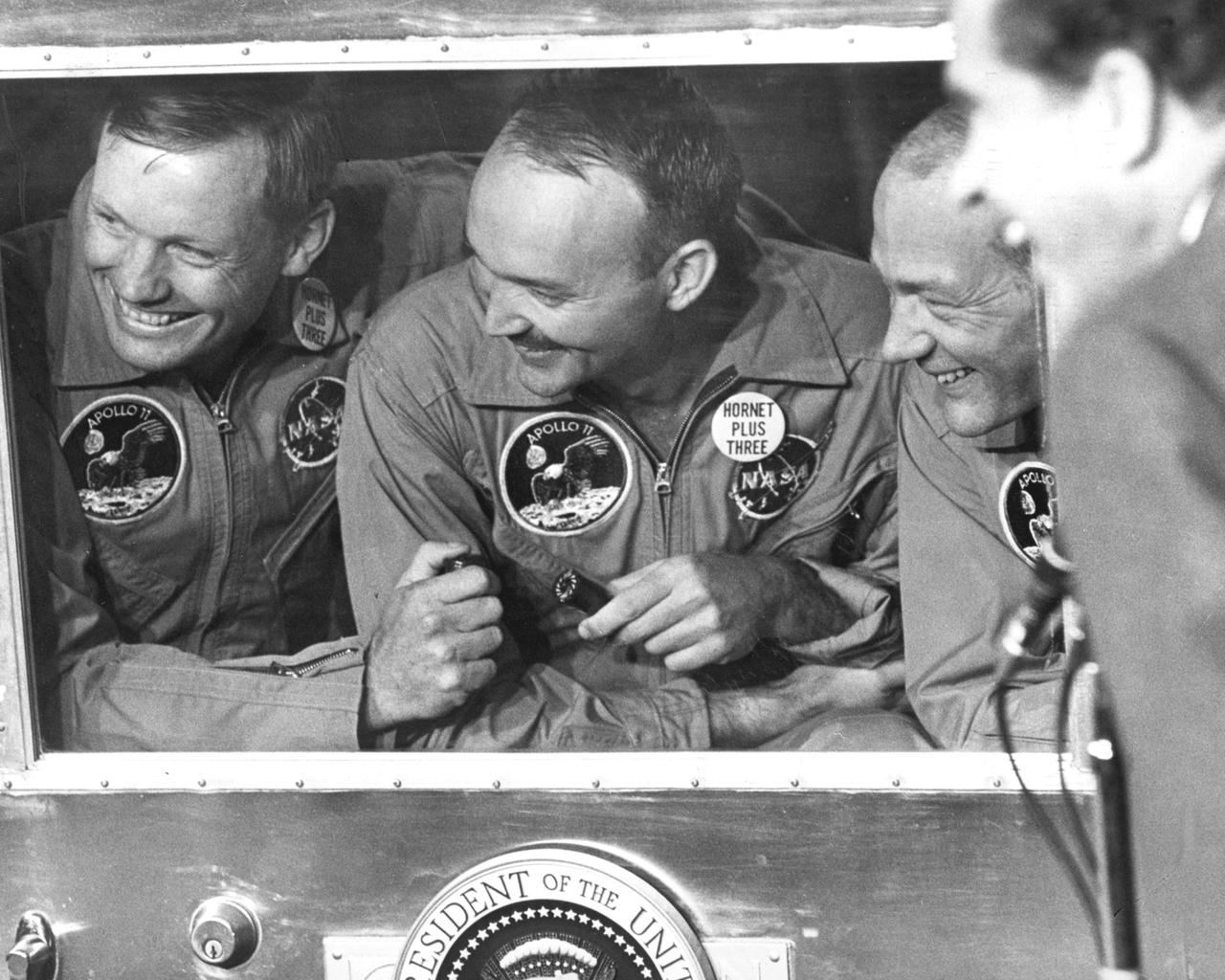
The Apollo 11 mission, the first manned lunar mission, launched from the Kennedy Space Center, Florida via the Saturn V launch vehicle on July 16, 1969 and safely returned to Earth on July 24, 1969. The Saturn V vehicle was developed by the Marshall Space Flight Center (MSFC) under the direction of Dr. Wernher von Braun. Aboard were Neil A. Armstrong, commander; Michael Collins, Command Module (CM) pilot; and Edwin E. Aldrin Jr., Lunar Module (LM) pilot. The CM, piloted by Michael Collins remained in a parking orbit around the Moon while the LM, named “Eagle’’, carrying astronauts Neil Armstrong and Edwin Aldrin, landed on the Moon. Armstrong was the first human to ever stand on the lunar surface, followed by Edwin (Buzz) Aldrin. During 2½ hours of surface exploration, the crew collected 47 pounds of lunar surface material for analysis back on Earth. The recovery operation took place in the Pacific Ocean where Navy para-rescue men recovered the capsule housing the 3-man Apollo 11 crew. The crew was airlifted to safety aboard the U.S.S. Hornet, where they were quartered in a Mobile Quarantine Facility (MQF). Here the quarantined Apollo 11 crew members (l to r) Armstrong, Collins, and Aldrin, and U.S. President Richard Milhous Nixon share laughs over a comment made by fellow astronaut Frank Borman, Apollo 8 commander. The president was aboard the recovery vessel awaiting return of the astronauts. With the success of Apollo 11, the national objective to land men on the Moon and return them safely to Earth had been accomplished.
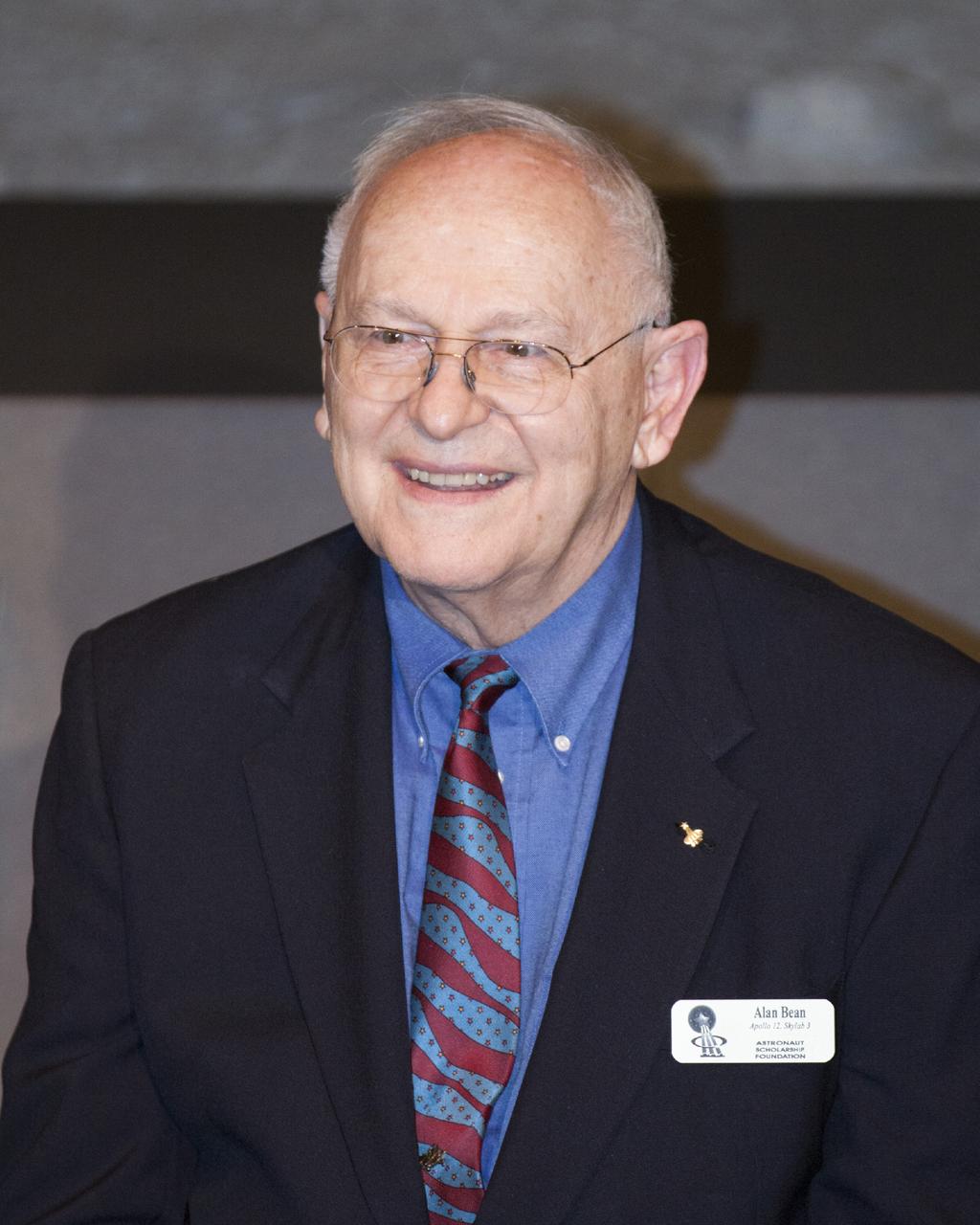
CAPE CANAVERAL, Fla. – At the Kennedy Space Center's Apollo/Saturn V Center, former NASA astronaut Alan Bean speaks to guests at the Astronaut Scholarship Foundation's event celebrating the 40th anniversary of Skylab. Bean served as commander of Skylab 3, the second piloted mission to the space station. In 1969, Bean was lunar module pilot on Apollo 12, the second mission to land on the moon. The gala commemorating the 40th anniversary of Skylab included six of the nine astronauts who flew missions to America's first space station. The orbiting laboratory was launched unpiloted from Kennedy on May 14, 1973. Between May 25, 1973 and Feb. 8, 1974, crews of three spent 28, 59 and 84 days living and working in low-Earth orbit aboard the station. For more information, visit http://www.nasa.gov/mission_pages/skylab/ Photo credit: NASA/Kim Shiflett
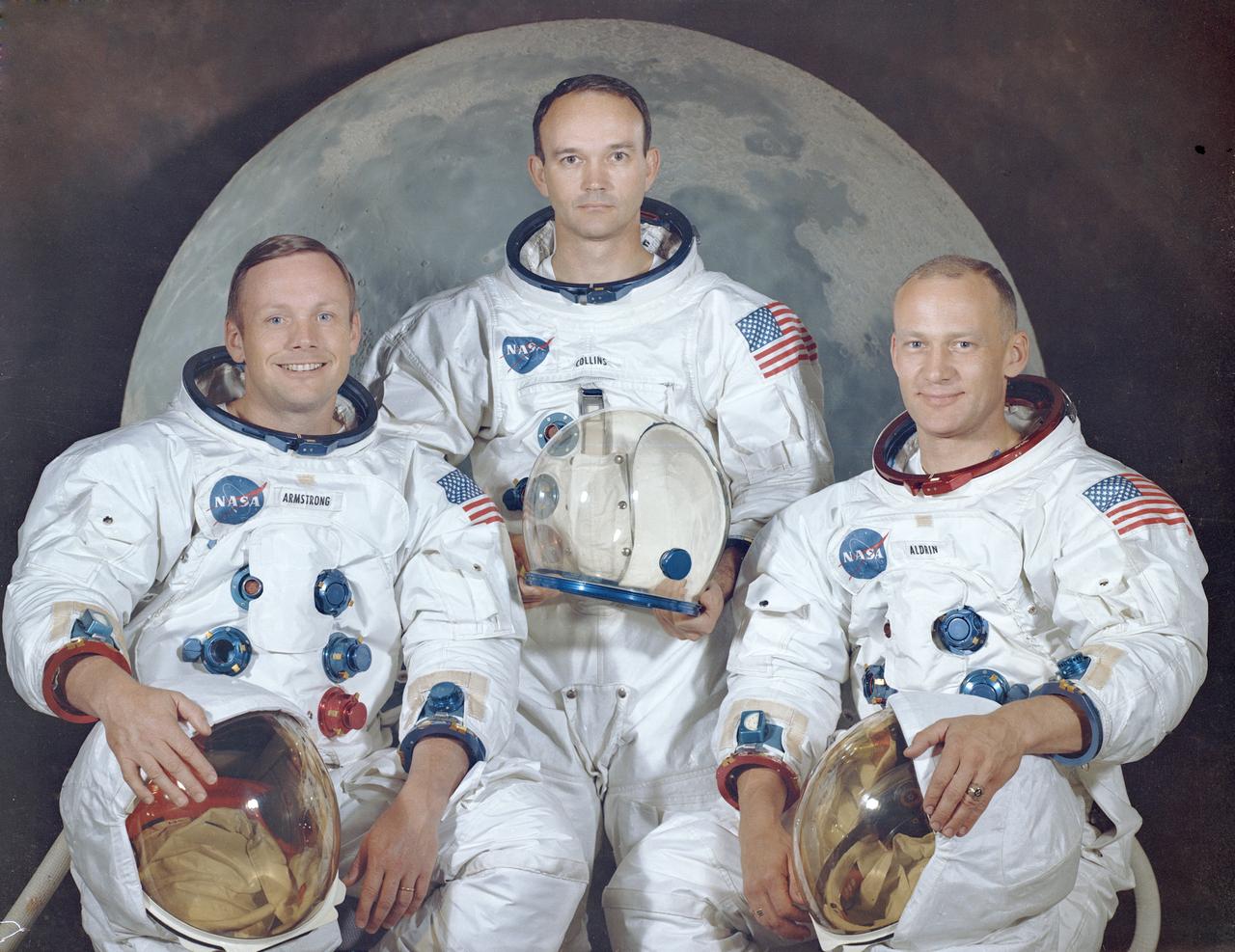
This is the official crew portrait of the Apollo 11 astronauts. Pictured from left to right are: Neil A. Armstrong, Commander; Michael Collins, Module Pilot; Edwin E. "Buzz" Aldrin, Lunar Module Pilot. Apollo 11 was the first marned lunar landing mission that placed the first humans on the surface of the moon and returned them back to Earth. Astronaut Armstrong became the first man on the lunar surface, and astronaut Aldrin became the second. Astronaut Collins piloted the Command Module in a parking orbit around the Moon. Launched aboard the Saturn V launch vehicle (SA-506), the three astronauts began their journey to the moon with liftoff from launch complex 39A at the Kennedy Space Center at 8:32 am CDT, July 16, 1969.
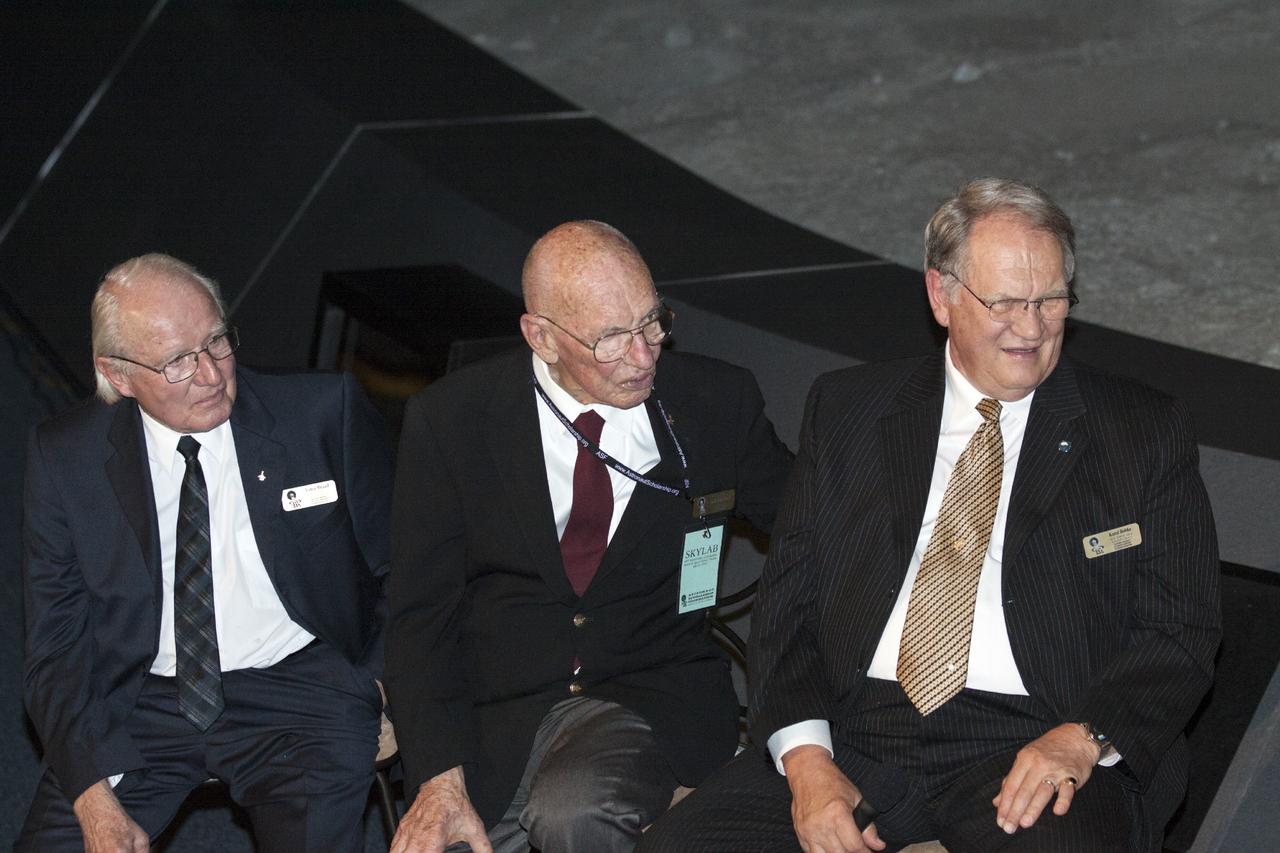
CAPE CANAVERAL, Fla. – At the Kennedy Space Center's Apollo/Saturn V Center, former NASA astronauts, from the left, Vance Brand, William Thornton and Karol Bobko recall experiences during the Astronaut Scholarship Foundation's event celebrating the 40th anniversary of Skylab. Each went on to fly missions during the Space Shuttle Program. Brand was also pilot on the Apollo-Soyuz Test Project. The gala commemorating the 40th anniversary of Skylab included six of the nine astronauts who flew missions to America's first space station. The orbiting laboratory was launched unpiloted from Kennedy on May 14, 1973. Between May 25, 1973 and Feb. 8, 1974, crews of three spent 28, 59 and 84 days living and working in low-Earth orbit aboard the station. For more information, visit http://www.nasa.gov/mission_pages/skylab/ Photo credit: NASA/Kim Shiflett
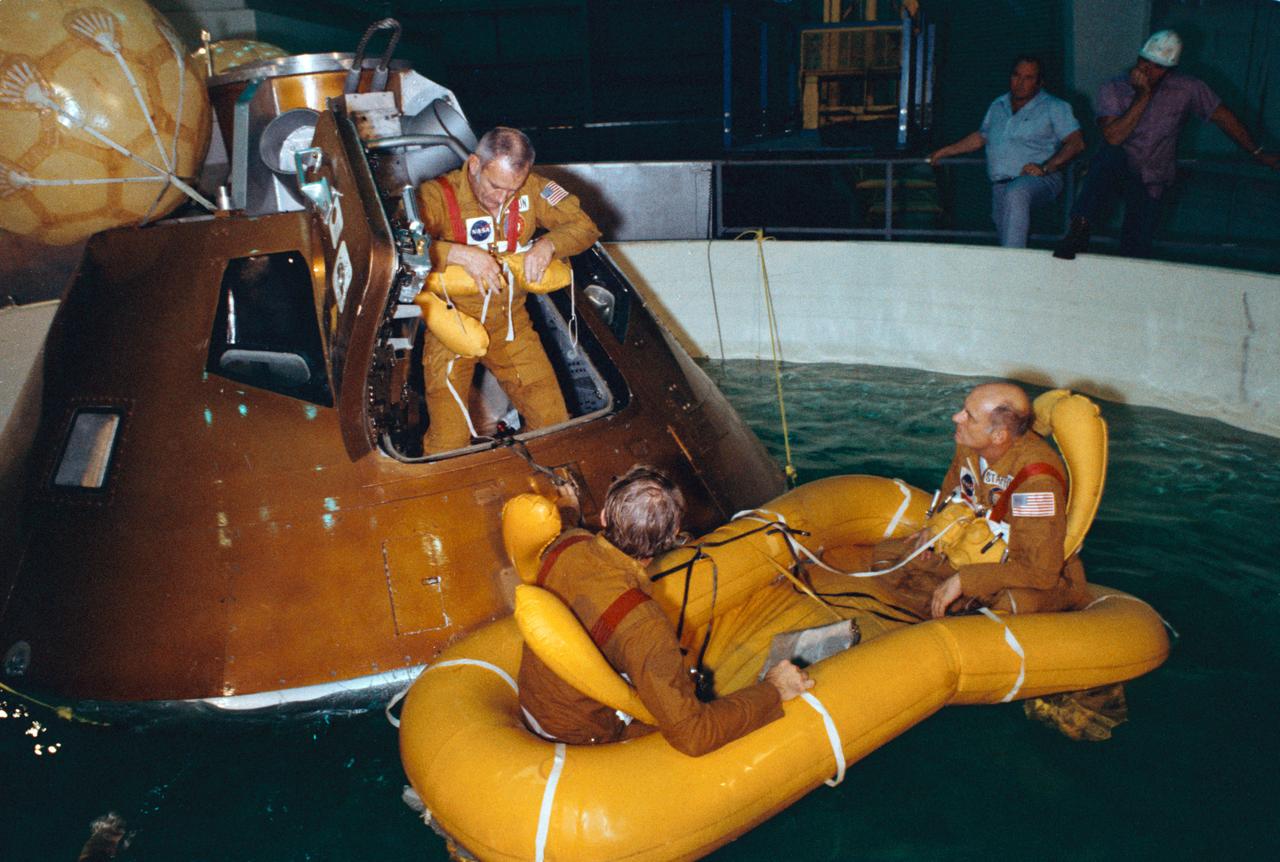
S75-23431 (8 March 1975) --- Astronaut Donald K. Slayton attaches his life preserver as he egresses an Apollo Command Module trainer in a water tank in Building 260 during water egress training at NASA's Johnson Space Center. The crewmen exit through the hatch when the CM is in this stable I (apex up) position; and they egress through the tunnel when the CM is in a stable II (apex down) position. Astronauts Vance D. Brand (on left) and Thomas P. Stafford have already egressed the trainer and are seated in a three-man life raft. This training session was part of the preparations for the joint U.S.-USSR Apollo-Soyuz Test Project docking mission in Earth orbit scheduled for July 1975. These three men compose the American ASTP prime crew. Stafford is the commander, Brand is the command module pilot, and Slayton is the docking module pilot.
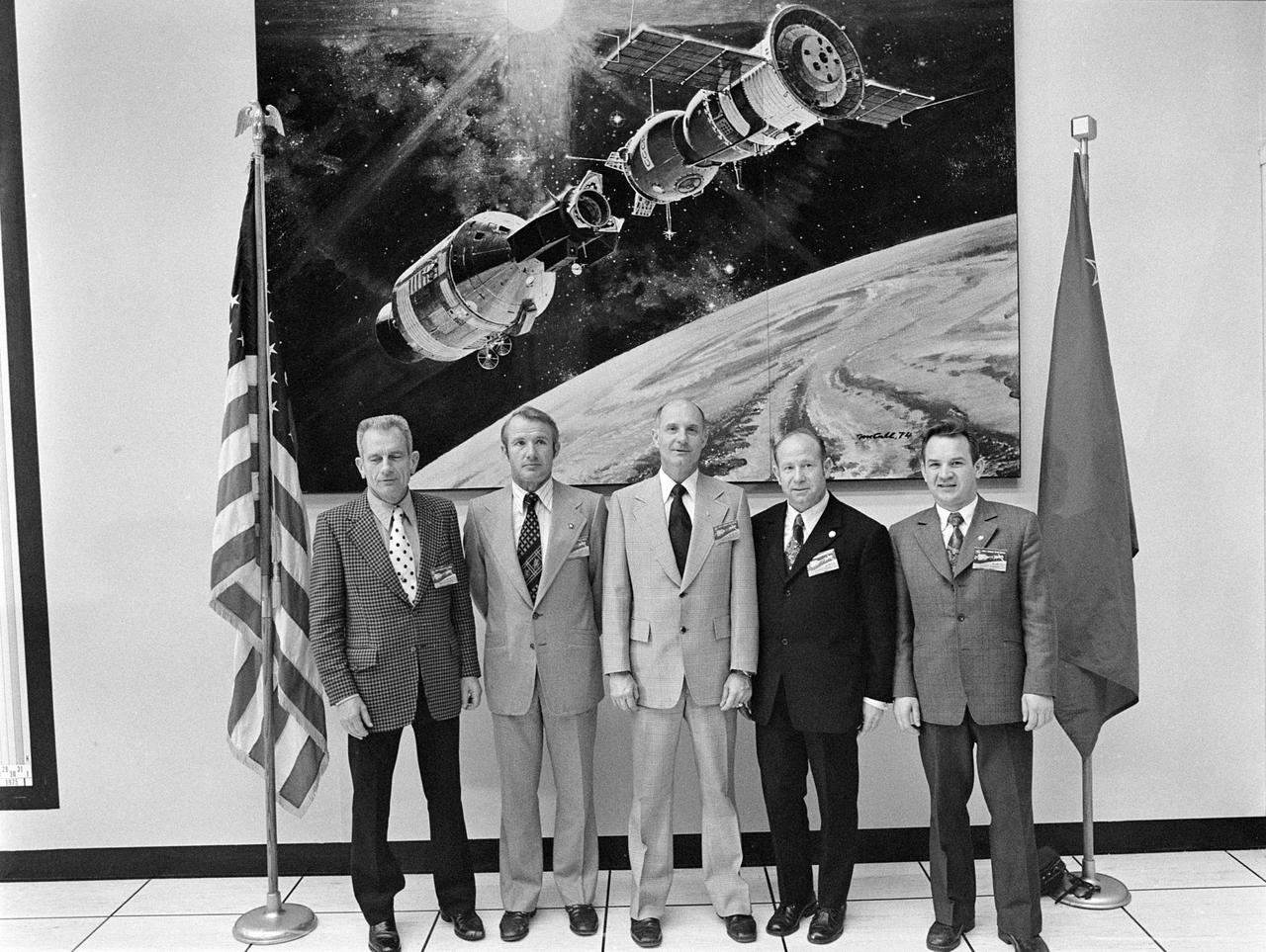
S75-24030 (8-10 Feb. 1975) --- The five prime crew members of the Apollo-Soyuz Test Project (ASTP) mission pose for a group photograph while at NASA's Kennedy Space Center (KSC) for a three-day inspection tour. They are, left to right, astronaut Donald K. (Deke) Slayton, docking module pilot of the American crew; astronaut Vance D. Brand, command module pilot of the American crew; astronaut Thomas P. Stafford, commander of the American crew; cosmonaut Aleksey A. Leonov, commander of the Soviet crew; and cosmonaut Valeriy N. Kubasov, engineer of the Soviet crew. They were at KSC to look over launch facilities and flight hardware. They are standing in front of artist Robert McCall?s painting of an ASTP docking in Earth orbit.
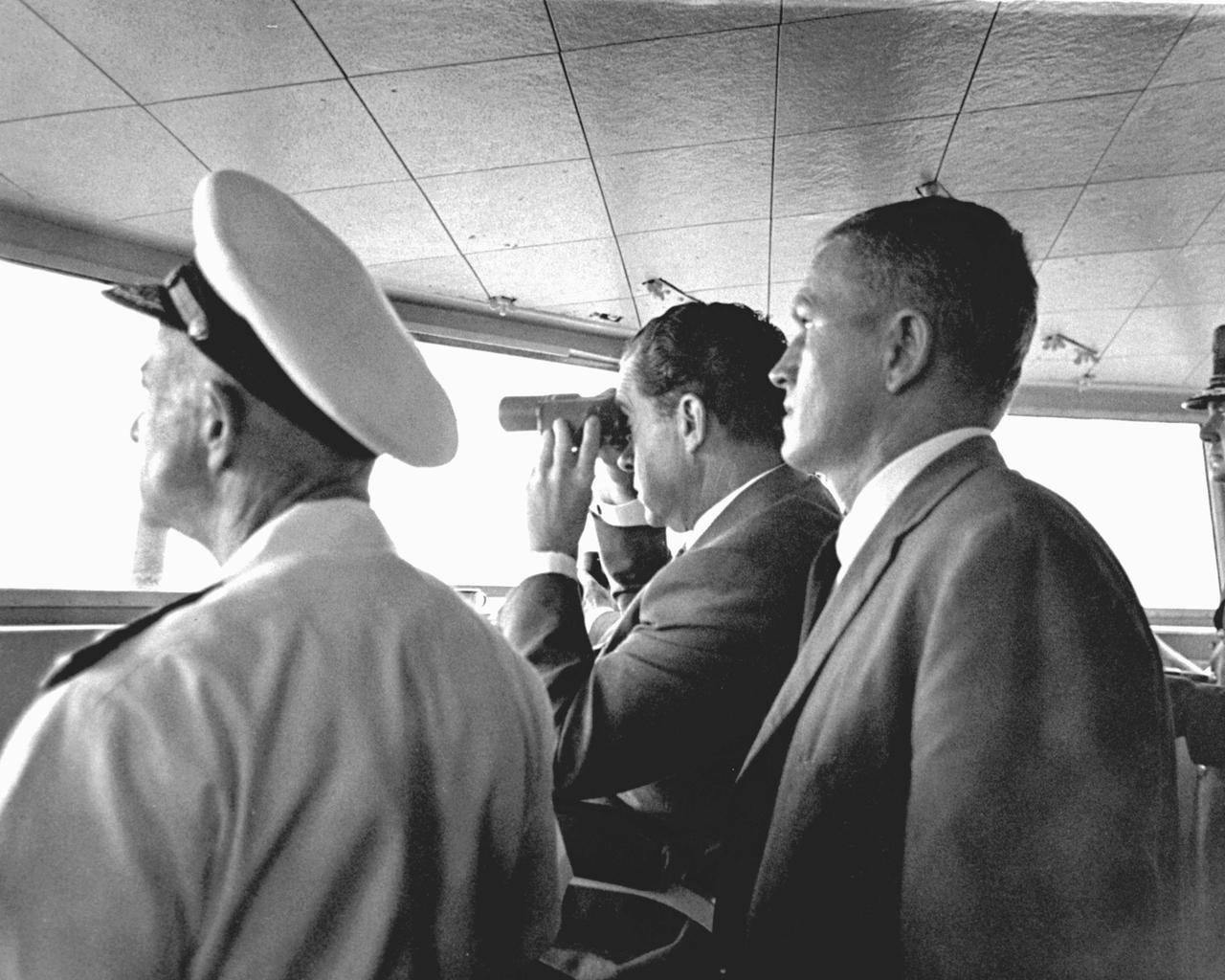
U.S. President Richard Milhous Nixon (center), aboard the U.S.S. Hornet aircraft carrier, used binoculars to watch the Apollo 11 Lunar Mission Recovery. Standing next to the President is astronaut Frank Borman, Apollo 8 Commander. The recovery operation took place in the Pacific Ocean where Navy para-rescue men recovered the capsule housing the 3-man Apollo 11 crew. The crew was airlifted to safety aboard the U.S.S. Hornet where they were quartered in a Mobile Quarantine Facility (MQF) for 21 days post mission. The Apollo 11 mission, the first manned lunar mission, launched from the Kennedy Space Center, Florida via the Saturn V launch vehicle on July 16, 1969 and safely returned to Earth on July 24, 1969. The Saturn V vehicle was developed by the Marshall Space Flight Center (MSFC) under the direction of Dr. Wernher von Braun. Aboard were Neil A. Armstrong, commander; Michael Collins, Command Module (CM) pilot; and Edwin E. Aldrin Jr., Lunar Module (LM) pilot. The CM, piloted by Michael Collins remained in a parking orbit around the Moon while the LM, named “Eagle’’, carrying astronauts Neil Armstrong and Edwin Aldrin, landed on the Moon. Armstrong was the first human to ever stand on the lunar surface, followed by Edwin (Buzz) Aldrin. During 2½ hours of surface exploration, the crew collected 47 pounds of lunar surface material for analysis back on Earth. With the success of Apollo 11, the national objective to land men on the Moon and return them safely to Earth had been accomplished.
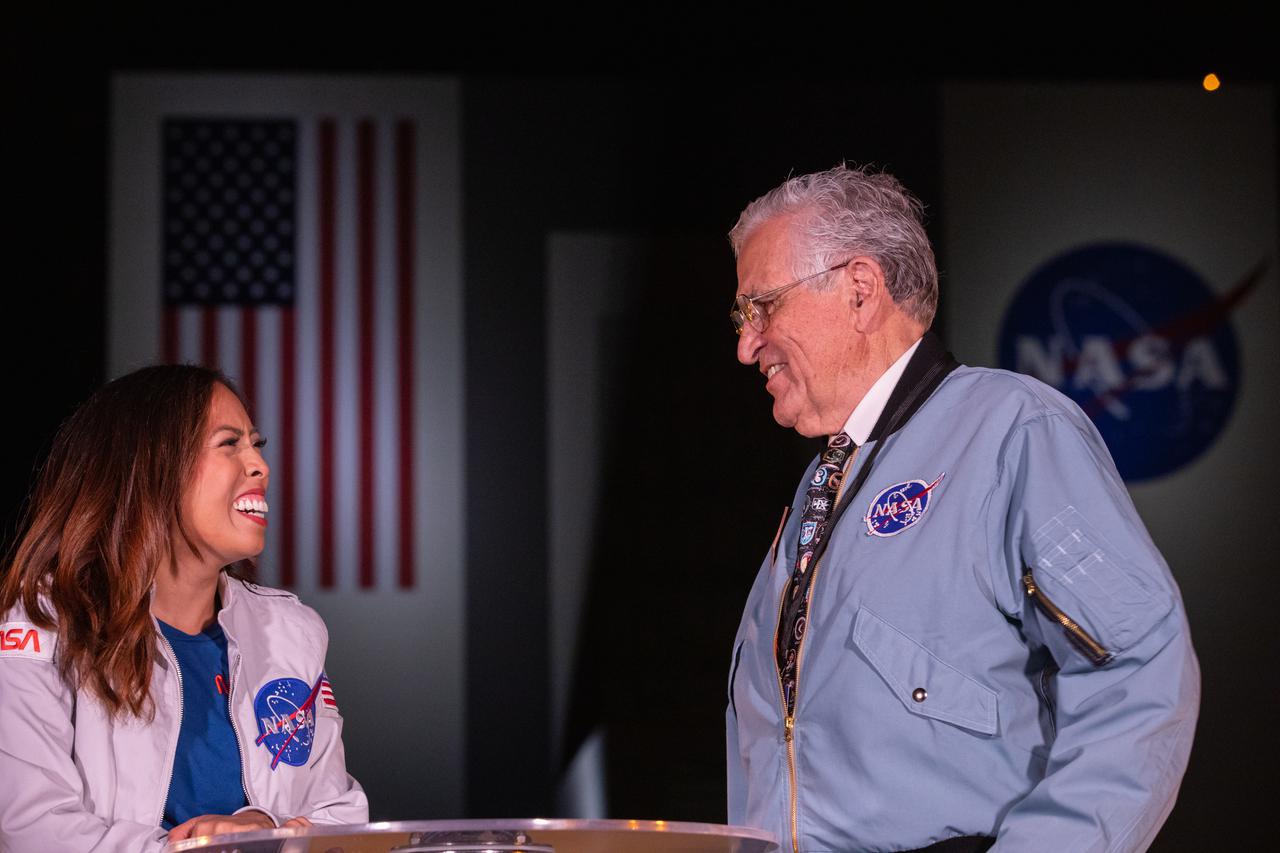
Megan Cruz of NASA Communications interviews Apollo 17 astronaut Harrison Schmitt at NASA’s Kennedy Space Center in Florida prior to liftoff of the Crew-4 mission from Kennedy’s Launch Complex 39A on April 27, 2022. The SpaceX Falcon 9 rocket, with the company’s Crew Dragon atop, launched at 3:52 a.m. EDT on April 27. Aboard the spacecraft are NASA astronauts Kjell Lindgren, commander; Bob Hines, pilot; and Jessica Watkins, mission specialist, along with ESA (European Space Agency) astronaut Samantha Cristoforetti, mission specialist. Nicknamed Freedom by the Crew-4 astronauts, Dragon will carry the crew to the International Space Station as part of NASA’s Commercial Crew Program. Freedom is scheduled to dock to the space station at 8:15 p.m. EDT today.
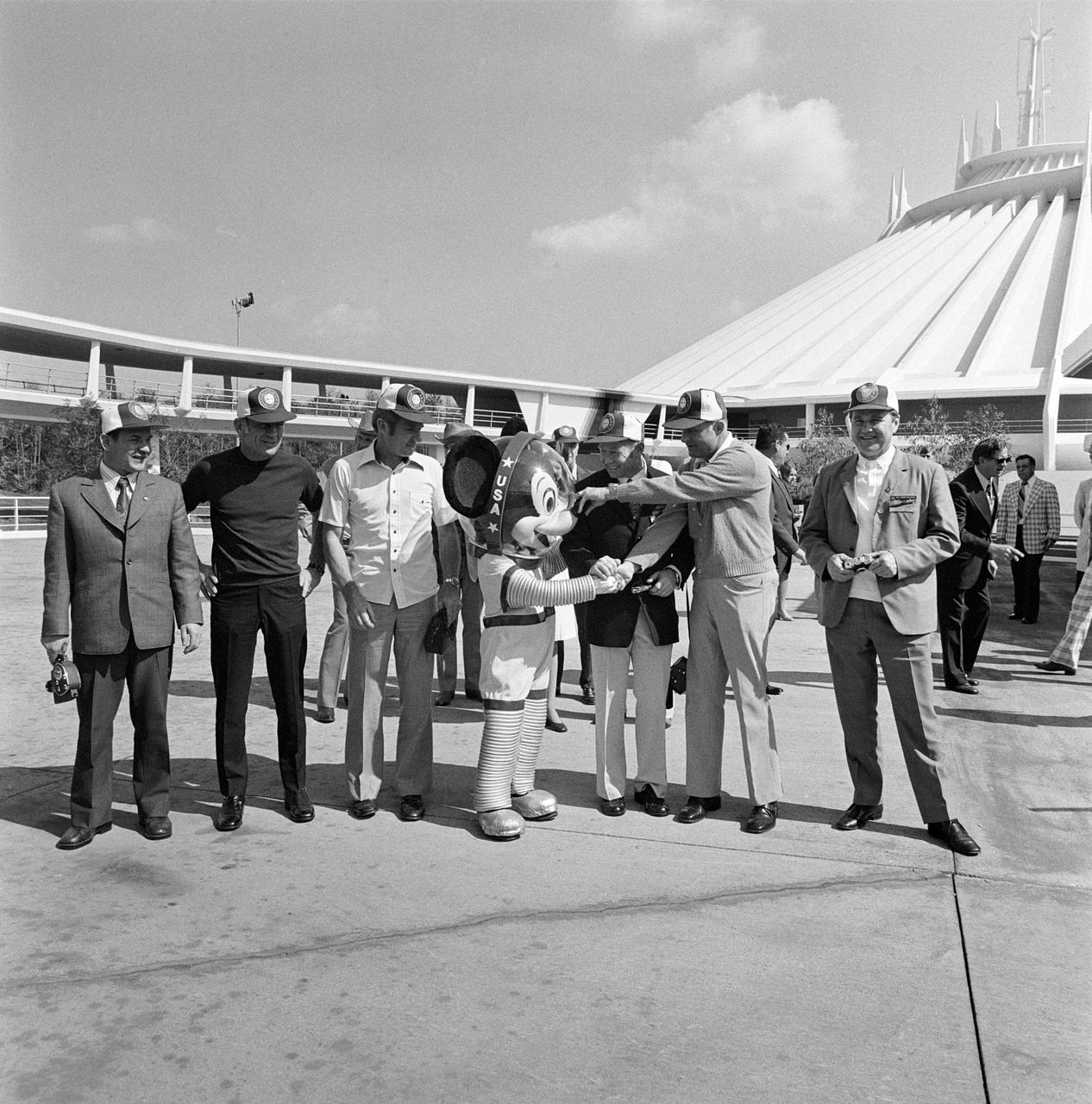
S75-24052 (8-10 Feb. 1975) --- A space-suited Mickey Mouse character welcomes the prime crewmen of the Apollo-Soyuz Test Project mission to Florida?s Disney World near Orlando. The crewmen made a side-trip to Disney World during a three-day inspection tour of NASA's Kennedy Space Center. The crewmen were at KSC to look over launch facilities and flight hardware. Receiving the jovial Disney World welcome are, left to right, cosmonaut Valeriy N. Kubasov, engineer on the Soviet crew; astronaut Donald K. Slayton, docking module pilot of the American crew; astronaut Vance D. Brand, command module pilot of the American crew; cosmonaut Aleksey A. Leonov, commander of the Soviet crew; astronaut Thomas P. Stafford, commander of the American crew; and cosmonaut Vladimir A. Shatalov, Chief of Cosmonaut Training for the USSR.
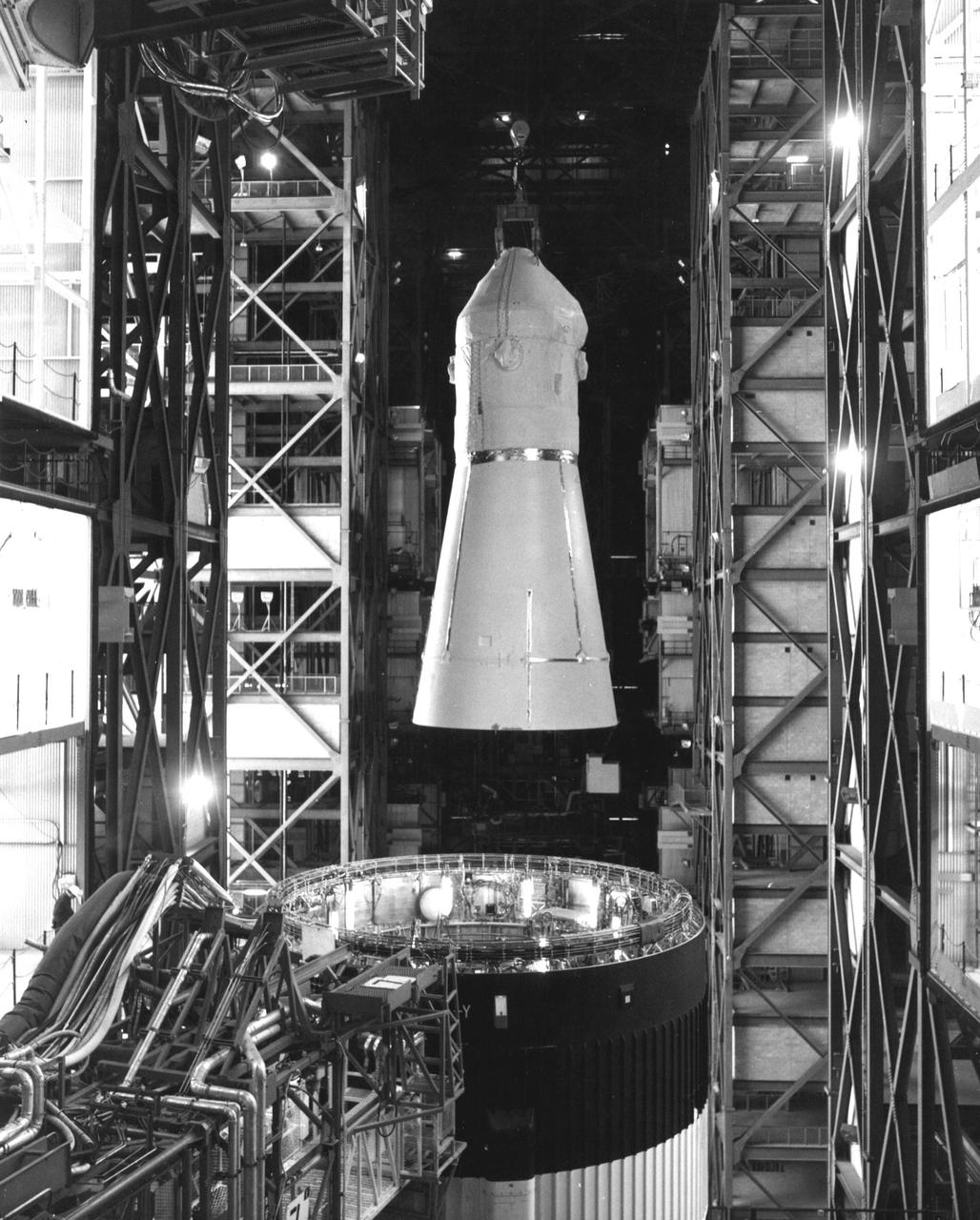
KENNEDY SPACE CENTER, FLA. -- The command_service module for the Skylab Rescue Vehicle was removed from its Saturn IB rocket in the Vehicle Assembly Building here today. The Skylab Program ended with splashdown of the Skylab 4 crew in the Pacific Ocean Feb. 8, ending the need for the rescue vehicle on Complex 39's Pad B since early December. The SaturnIB_Apollo was returned to the VAB last week and is now being dismantled. The spacecraft is to be taken to the Manned Spacecraft Operations Building in the KSC Industrial Area Feb. 20. Both the spacecraft and rocket will be stored at KSC as backup flight hardware for the Apollo-Soyuz Test Project in 1975.
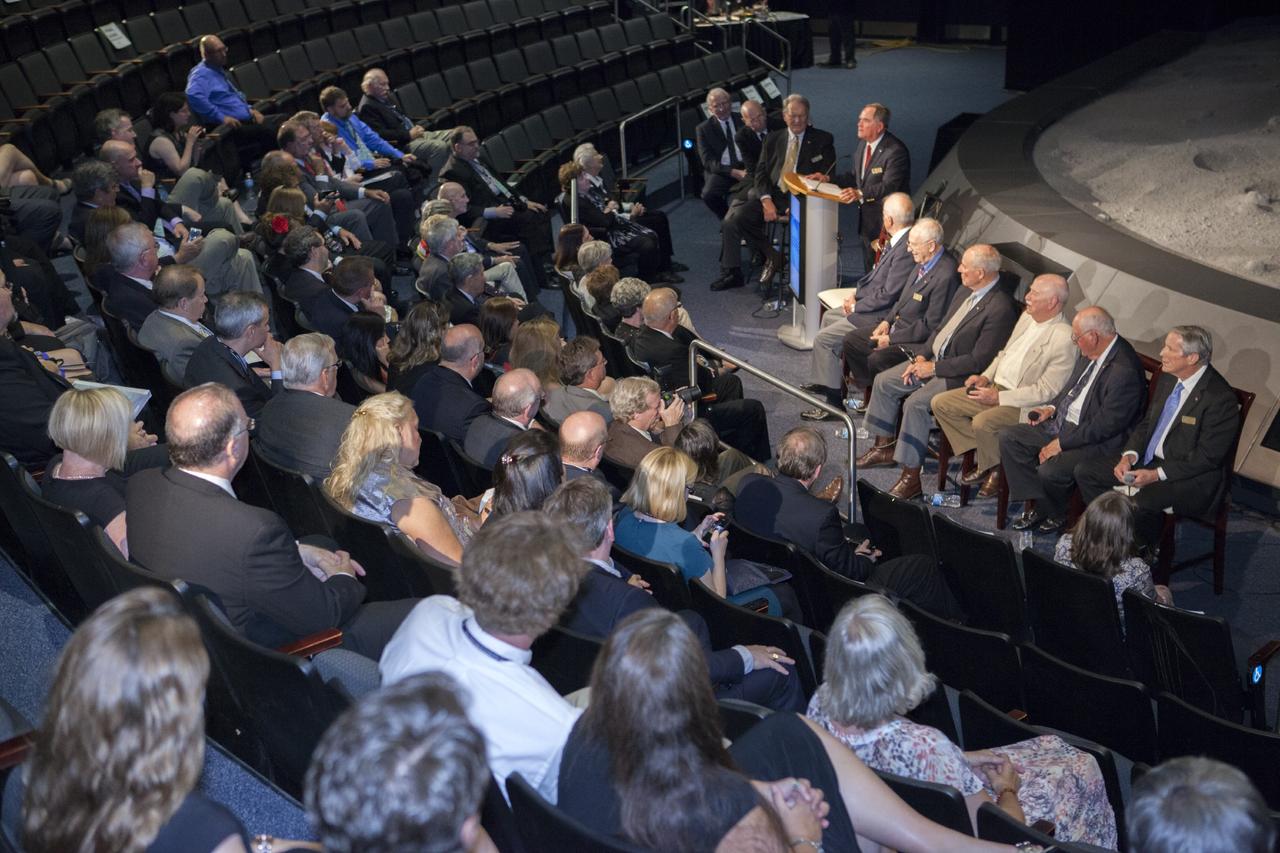
CAPE CANAVERAL, Fla. – Astronaut Scholarship Foundation guests at the Kennedy Space Center's Apollo/Saturn V Center listen as Skylab era astronauts celebrate the 40th anniversary of Skylab. The gala commemorating the 40th anniversary of Skylab included six of the nine astronauts who flew missions to America's first space station. The orbiting laboratory was launched unpiloted from Kennedy on May 14, 1973. Between May 25, 1973 and Feb. 8, 1974, crews of three spent 28, 59 and 84 days living and working in low-Earth orbit aboard the station. For more information, visit http://www.nasa.gov/mission_pages/skylab/ Photo credit: NASA/Kim Shiflett
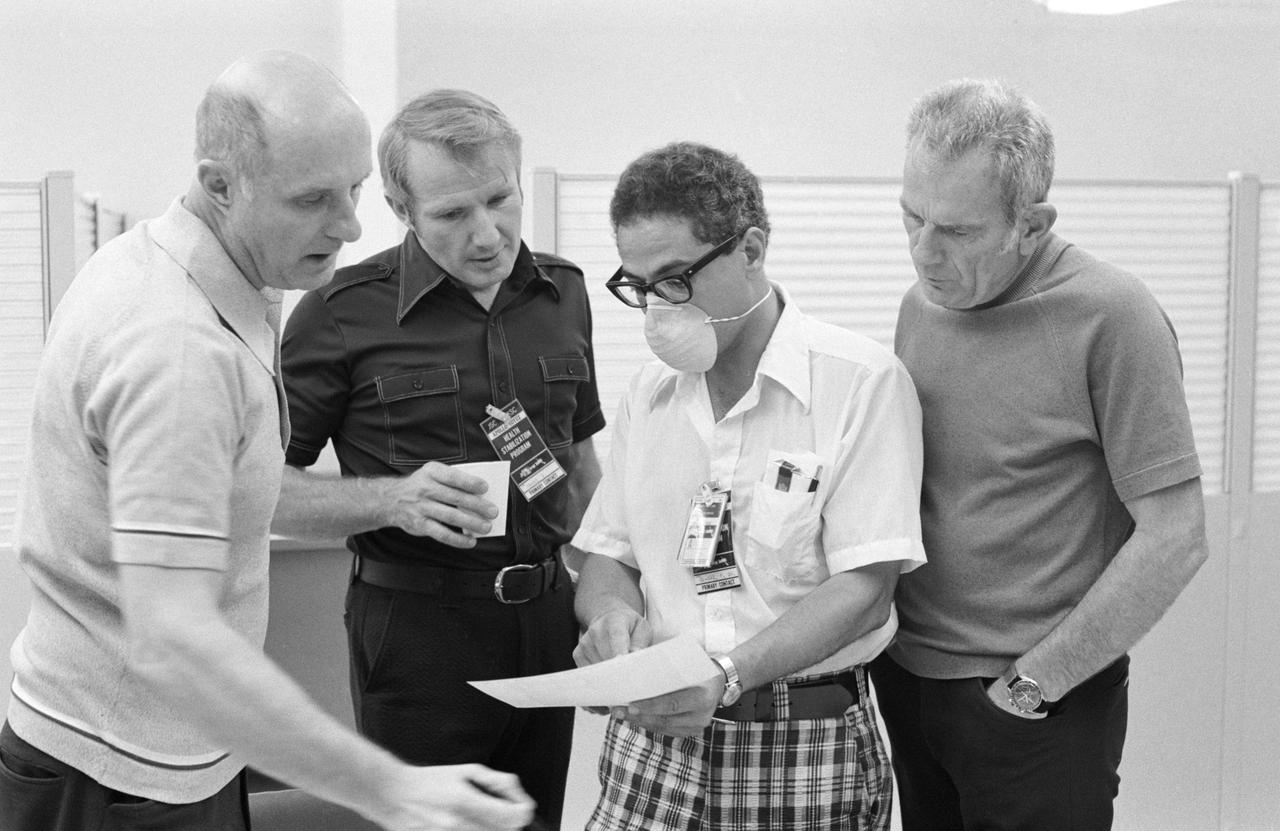
S75-28229 (8 July 1975) --- The three American ASTP prime crew astronauts participate in a photography mission briefing in Building 5 with Dr. Farouk El-Baz (wearing face mask) during Apollo-Soyuz Test Project preflight activity at NASA's Johnson Space Center. They are, left to right, Thomas P. Stafford, commander; Vance D. Brand, command module pilot; Dr. El-Baz; and Donald K. Slayton, docking module pilot. Dr. El-Baz is with the Center for Earth and Planetary Studies, National Air and Space Museum, Smithsonian Institution. The face mask is to protect the crewmen from possible exposure to disease prior to launch time. Photo credit: NASA
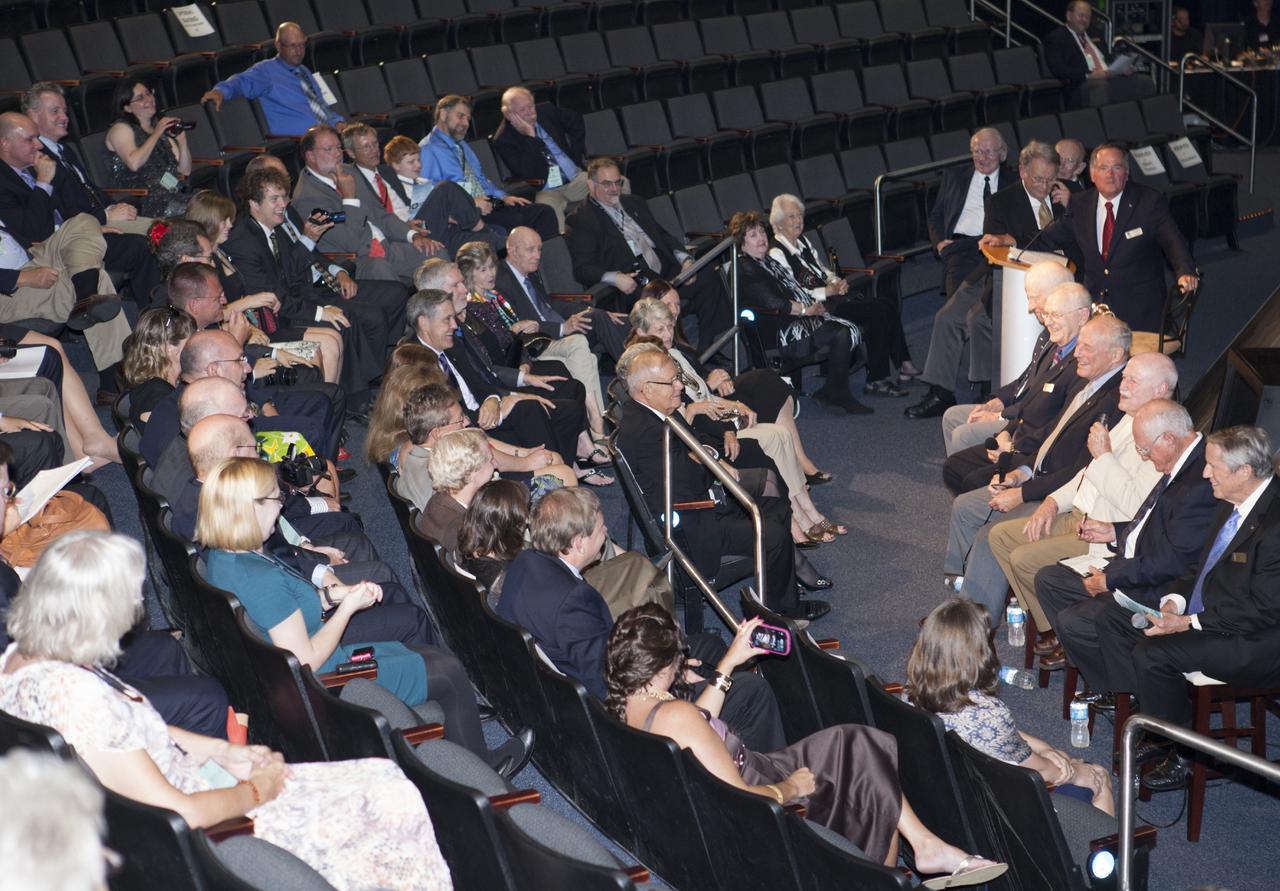
CAPE CANAVERAL, Fla. – Astronaut Scholarship Foundation guests at the Kennedy Space Center's Apollo/Saturn V Center listen as Skylab era astronauts celebrate the 40th anniversary of Skylab. The gala commemorating the 40th anniversary of Skylab included six of the nine astronauts who flew missions to America's first space station. The orbiting laboratory was launched unpiloted from Kennedy on May 14, 1973. Between May 25, 1973 and Feb. 8, 1974, crews of three spent 28, 59 and 84 days living and working in low-Earth orbit aboard the station. For more information, visit http://www.nasa.gov/mission_pages/skylab/ Photo credit: NASA/Kim Shiflett
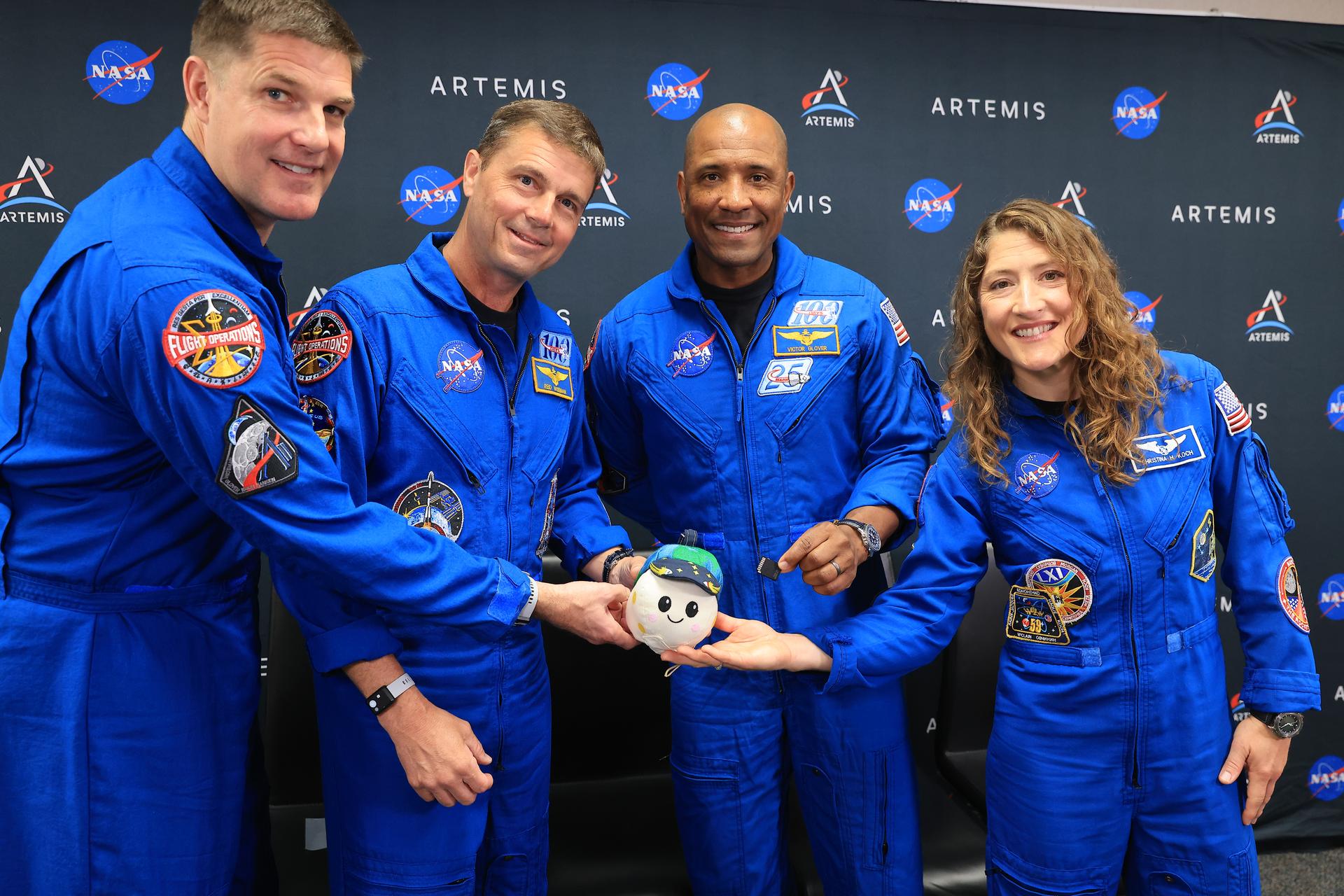
The Artemis II crew pose with the zero gravity indicator named Rise that also holds a SD card containing the names of millions who will fly with the crew around the Moon. “Rise” was inspired by the iconic Earthrise moment from the Apollo 8 mission. A zero gravity indicator is a small plush item that typically rides with a crew to visually indicate when they are in space. The Artemis II mission will take Artemis II Commander Reid Wiseman, Pilot Victor Glover, and Mission Specialist Christina Koch from NASA, and Mission Specialist Jeremy Hansen from the CSA (Canadian Space Agency) on a 10-day journey around the Moon and back aboard NASA’s SLS (Space Launch System) rocket and Orion spacecraft from Launch Complex 39B no earlier than 6:24 p.m. EDT on Wednesday, April 1.
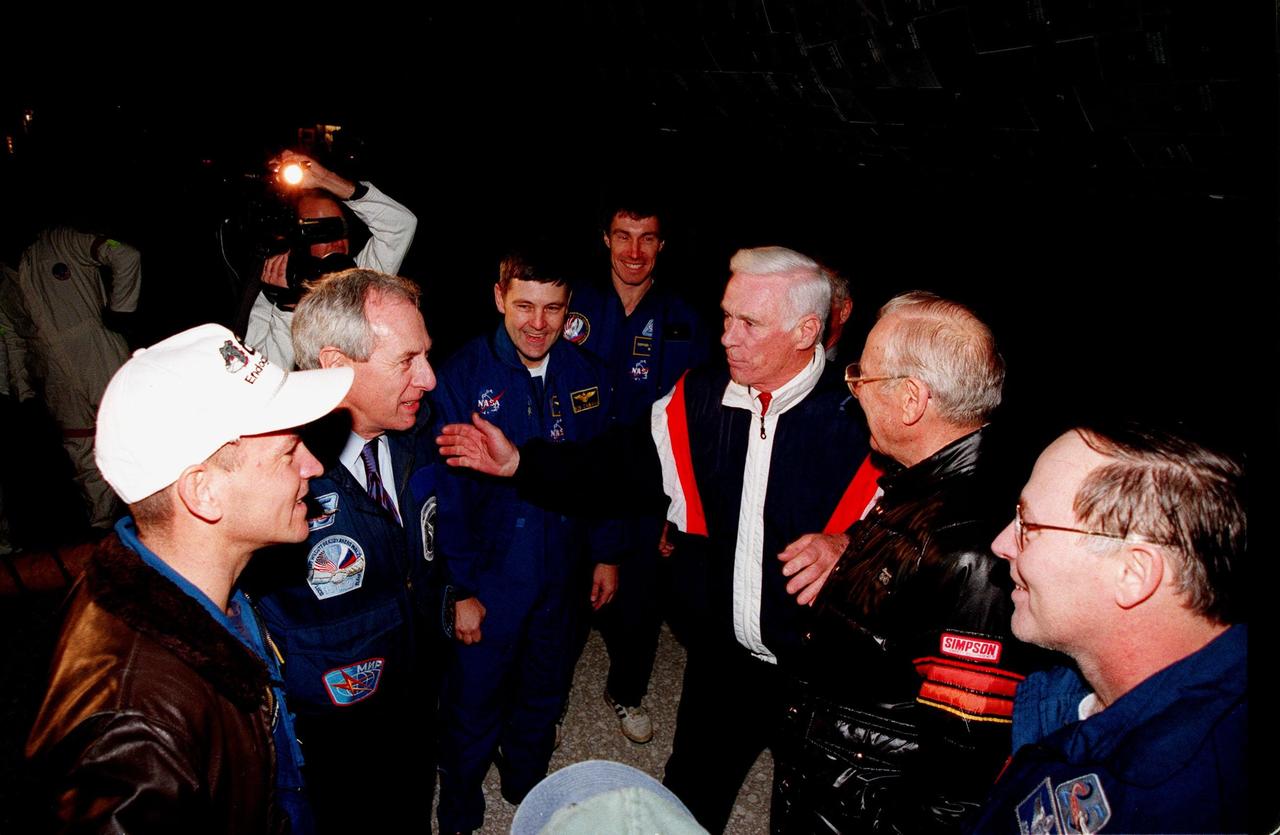
Following their touchdown on Runway 15 at 10:53:29 p.m. EST, STS-88 crew members are greeted by NASA Administrator Daniel Goldin and former astronauts Eugene A. Cernan and James A. Lovell Jr. From left are Pilot Frederick W. "Rick" Sturckow, Goldin , Commander Robert D. Cabana, Mission Specialist Sergei Konstantinovich Krikalev, Cernan, Lovell and Mission Specialist Jerry L. Ross. Cernan flew on Gemini 9, Apollo 10 and 17 and has more than 566 cumulative hours of space flight. Lovell flew on Gemini 7 and 12, Apollo 8 and 13. His cumulative hours of space flight are more than 715. On the 4.6-million-mile, nearly 12-day STS-88 mission, Endeavour carried the U.S.-built Unity connecting module to begin construction of the International Space Station. The crew successfully mated Unity with the Russian-built Zarya control module during three space walks. With this mission, Ross completed seven space walks totaling 44 hours and 9 minutes, more than any other American space walker. Newman moved into third place for U.S. space walks with a total of 28 hours and 27 minutes on four excursions
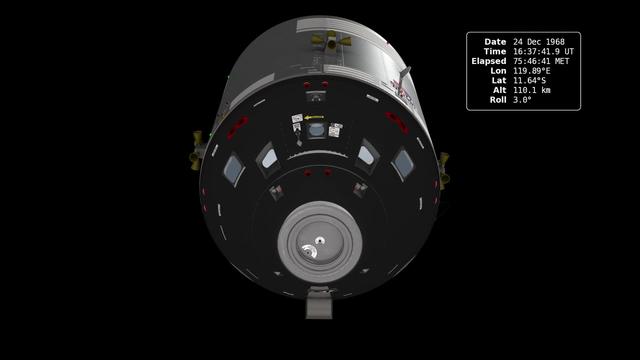
In December of 1968, the crew of Apollo 8 became the first people to leave our home planet and travel to another body in space. But as crew members Frank Borman, James Lovell, and William Anders all later recalled, the most important thing they discovered was Earth. Using photo mosaics and elevation data from Lunar Reconnaissance Orbiter (LRO), this video commemorates the 45th anniversary of Apollo 8's historic flight by recreating the moment when the crew first saw and photographed the Earth rising from behind the Moon. Narrator Andrew Chaikin, author of A Man on the Moon, sets the scene for a three-minute visualization of the view from both inside and outside the spacecraft accompanied by the onboard audio of the astronauts. The visualization draws on numerous historical sources, including the actual cloud pattern on Earth from the ESSA-7 satellite and dozens of photographs taken by Apollo 8, and it reveals new, historically significant information about the Earthrise photographs. It has not been widely known, for example, that the spacecraft was rolling when the photos were taken, and that it was this roll that brought the Earth into view. The visualization establishes the precise timing of the roll and, for the first time ever, identifies which window each photograph was taken from. The key to the new work is a set of vertical stereo photographs taken by a camera mounted in the Command Module's rendezvous window and pointing straight down onto the lunar surface. It automatically photographed the surface every 20 seconds. By registering each photograph to a model of the terrain based on LRO data, the orientation of the spacecraft can be precisely determined. Credit: NASA's Scientific Visualization Studio <b><a href="http://www.nasa.gov/audience/formedia/features/MP_Photo_Guidelines.html" rel="nofollow">NASA image use policy.</a></b> <b><a href="http://www.nasa.gov/centers/goddard/home/index.html" rel="nofollow">NASA Goddard Space Flight Center</a></b> enables NASA’s mission through four scientific endeavors: Earth Science, Heliophysics, Solar System Exploration, and Astrophysics. Goddard plays a leading role in NASA’s accomplishments by contributing compelling scientific knowledge to advance the Agency’s mission. <b>Follow us on <a href="http://twitter.com/NASA_GoddardPix" rel="nofollow">Twitter</a></b> <b>Like us on <a href="http://www.facebook.com/pages/Greenbelt-MD/NASA-Goddard/395013845897?ref=tsd" rel="nofollow">Facebook</a></b> <b>Find us on <a href="http://instagram.com/nasagoddard?vm=grid" rel="nofollow">Instagram</a></b>
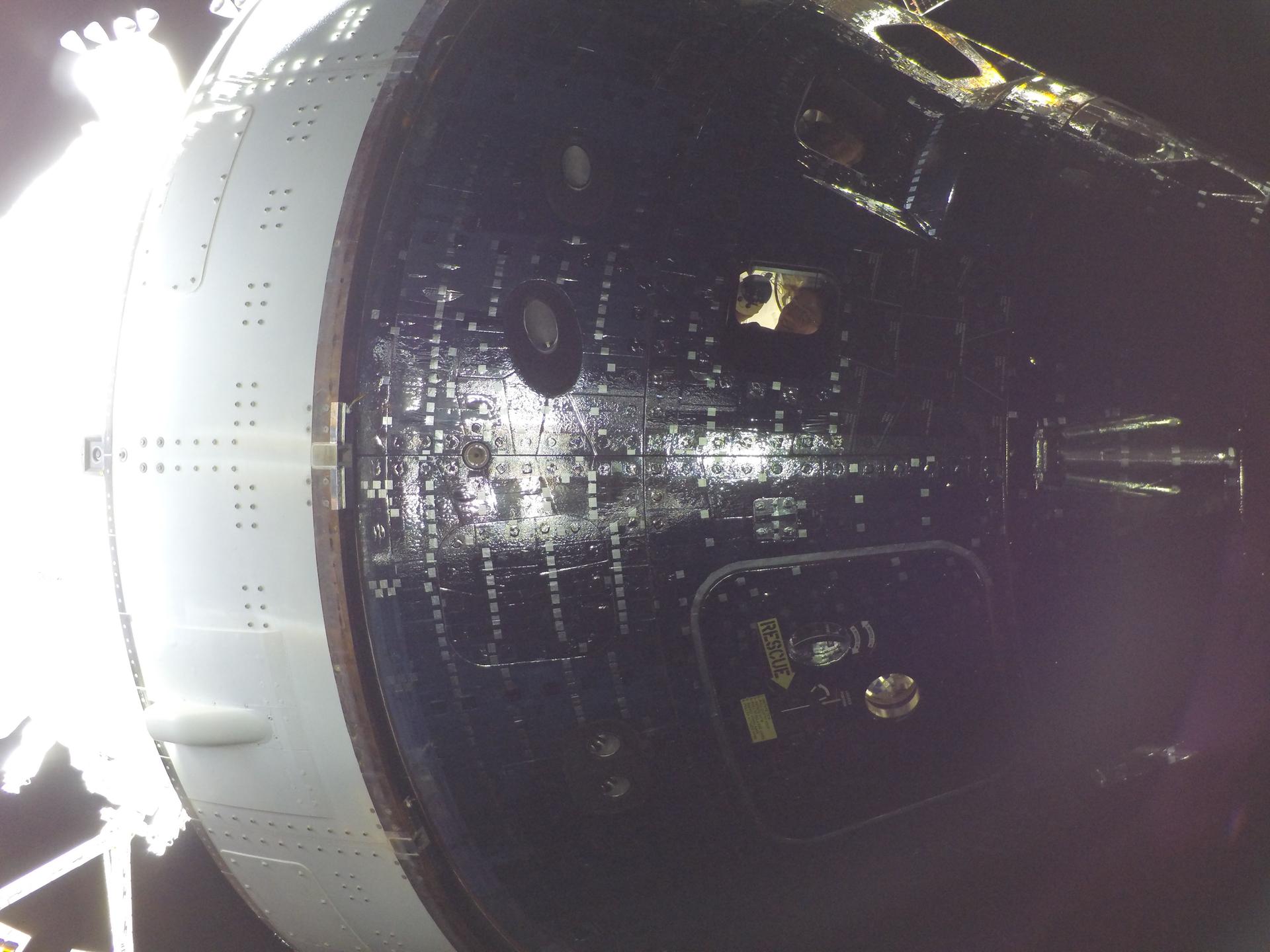
art002e009013 (April 4, 2026) - Artemis II Mission Specialist Christina Koch is seen through a window of the Orion spacecraft while on her way to the Moon. This selfie-style photo was taken using a camera on the end of one of Orion's solar array wings on flight day 4 of the approximately 10-day test flight, when Orion was more than halfway to the Moon. Koch is holding "Rise", the zero gravity indicator that launched with the crew after being selected from more than 2,600 original designs that were submitted from countries around the world. A zero gravity indicator is a small plush item that typically rides with a crew to visually indicate when they are in space. “Rise” was inspired by the iconic Earthrise moment from the Apollo 8 mission.
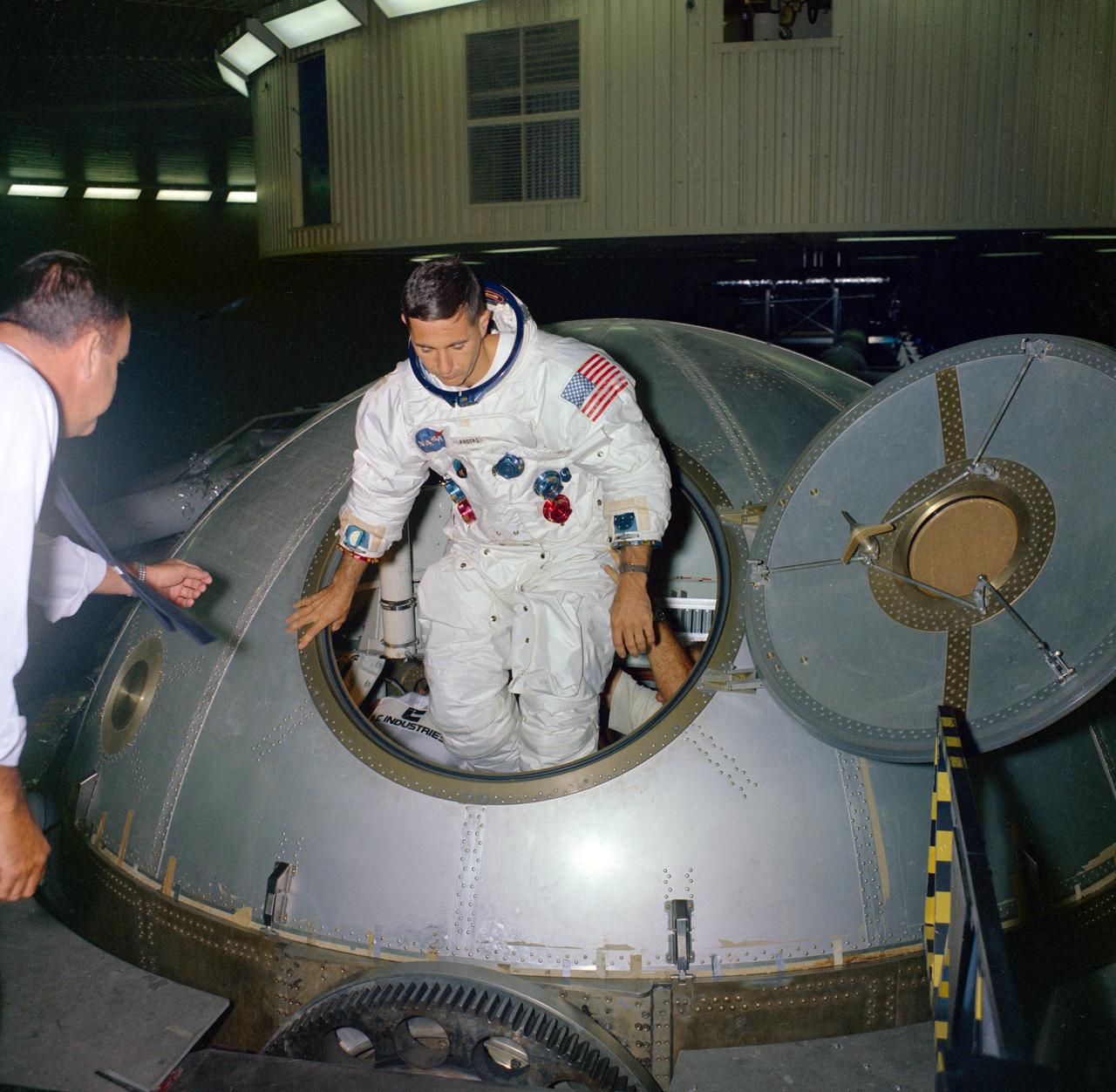
Apollo 8 astronaut William A. Anders, lunar module pilot, steps out of the centrifuge gondola in bldg 29 during centrifuge training in the Manned Spacecraft Center's (MSC) Flight Acceleration Facility.