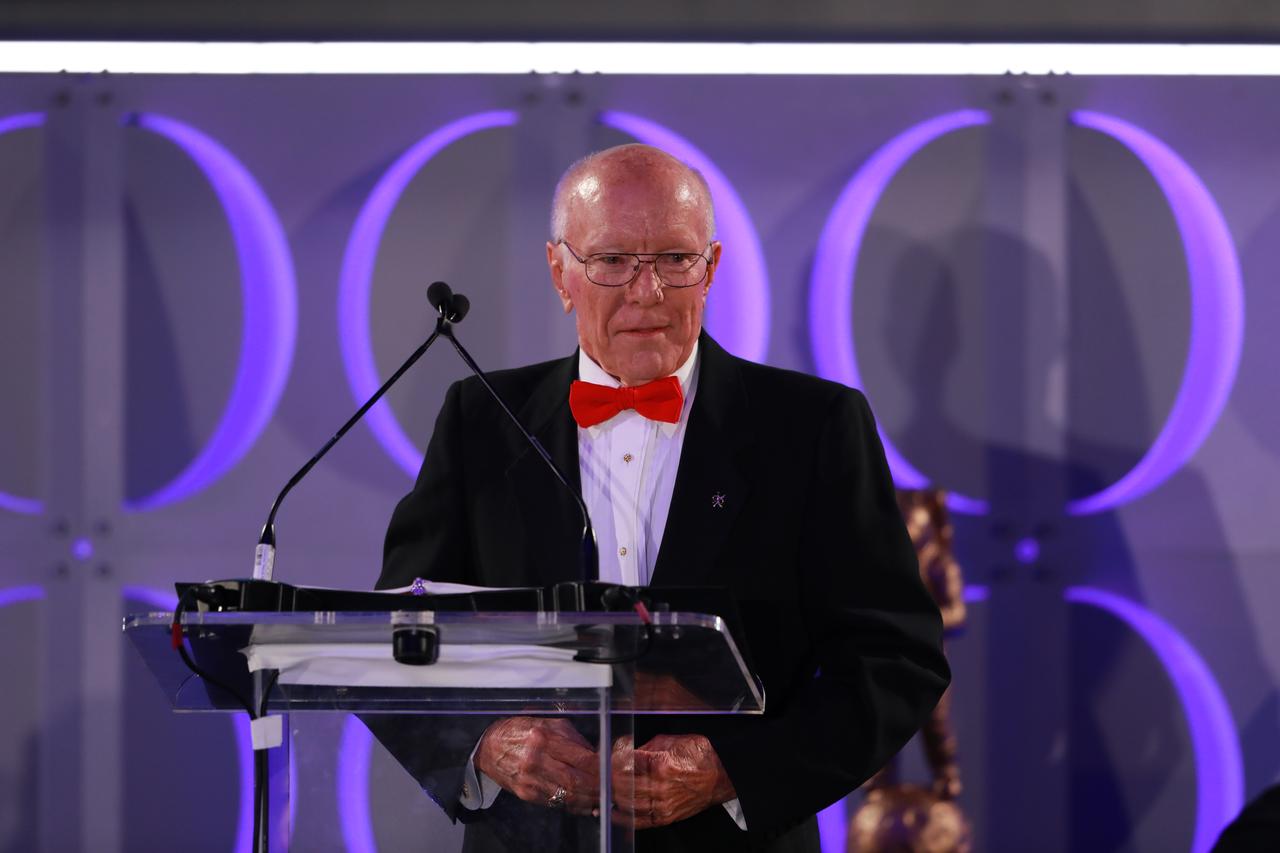
Gerry Griffin, Apollo flight director, makes remarks during the Apollo 11 50th Gala, pressented by Northrop Grumman, inside the Apollo/Saturn V Center at the Kennedy Space Center Visitor Complex on July 16, 2019
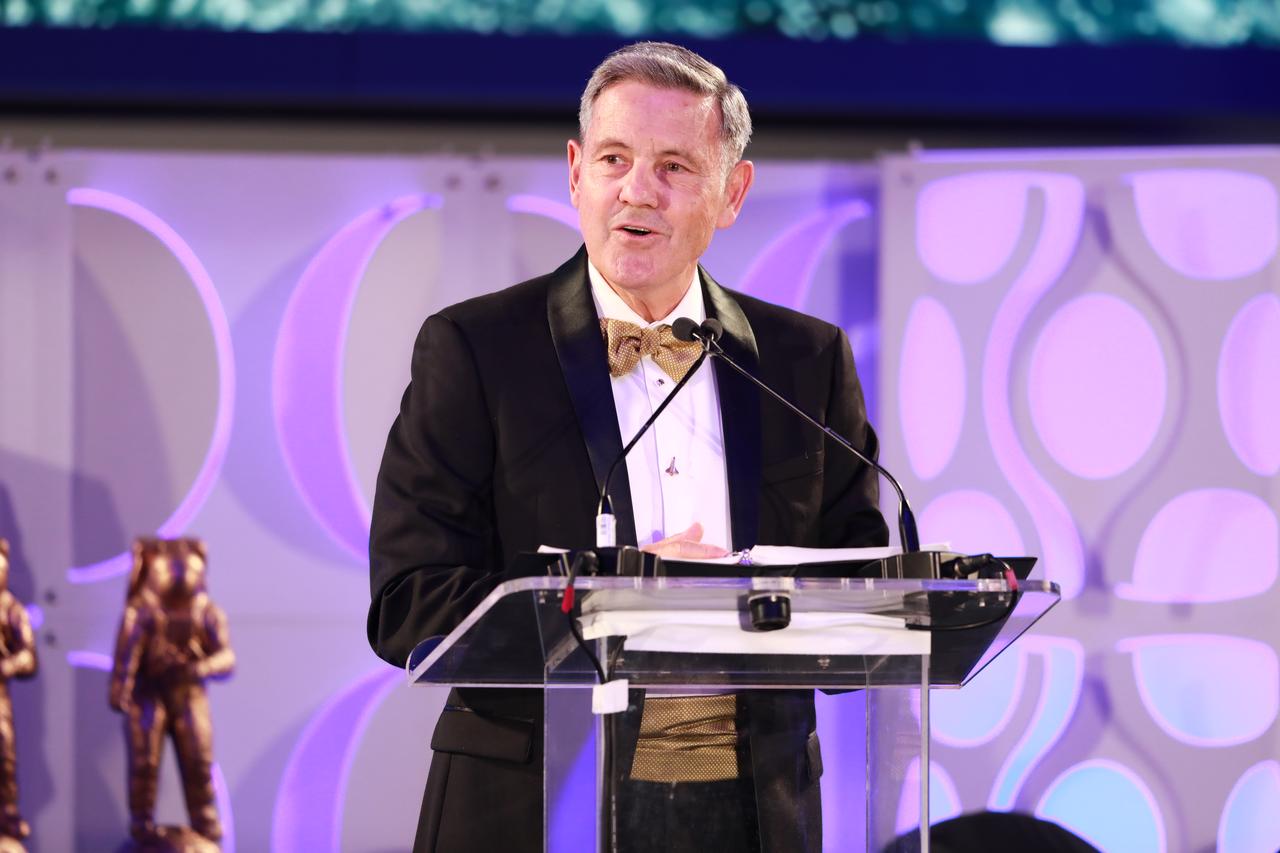
NASA Kennedy Space Center Director and retired astronaut Bob Cabana delivers remarks during the Apollo 50th Gala, presented by Northrop Grumman, inside the Apollo/Saturn V Center at the Kennedy Space Center Visitor Complex in Florida on July 16, 2019.
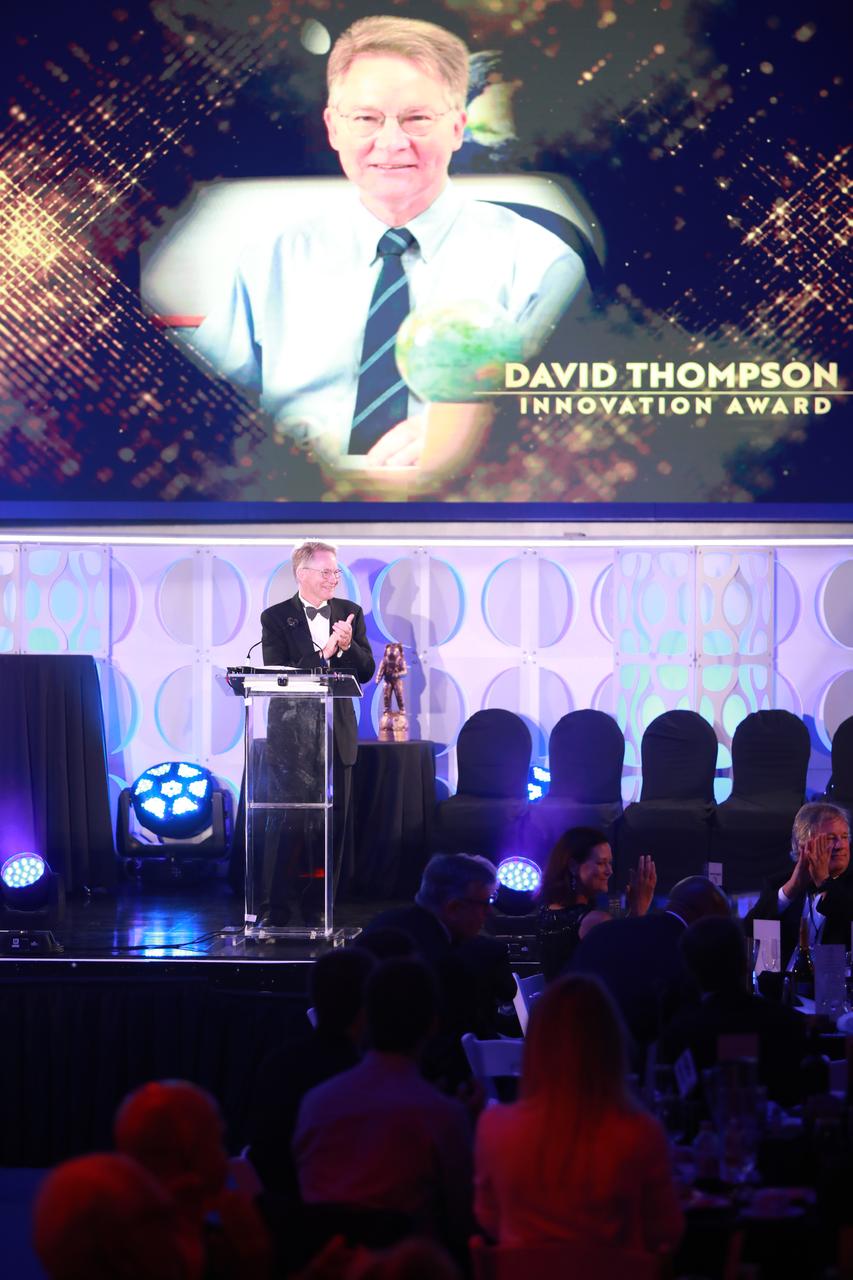
David Thompson, founder, presdient and CEO of Orbital Sciences Corp. (later known as Orbital ATK), makes remarks after receiving the Innovation Award at the Apollo 50th Gala on July 16, 2019. The gala, presented by Northrop Grumman, was held inside the Apollo/Saturn V Center at the Kennedy Space Center Visitor Complex in Florida.
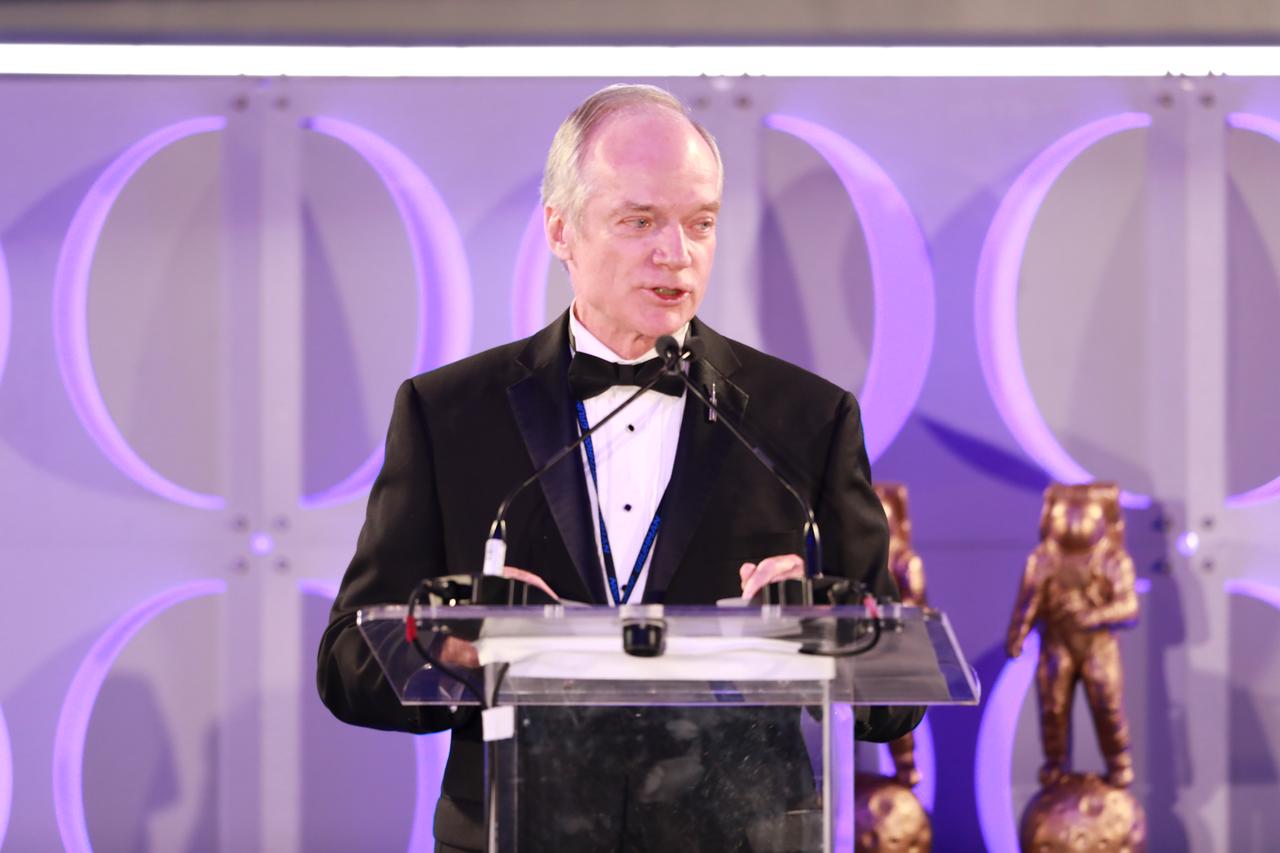
Retired NASA astronaut Charlie Precourt, vice president, propulsion systems, with Northrop Grumman, delivers remarks during the Apollo 11 50th Gala, presented by Northrop Grumman, inside the Apollo/Saturn V Center at the Kennedy Space Center Visitor Complex on July 16, 2019.
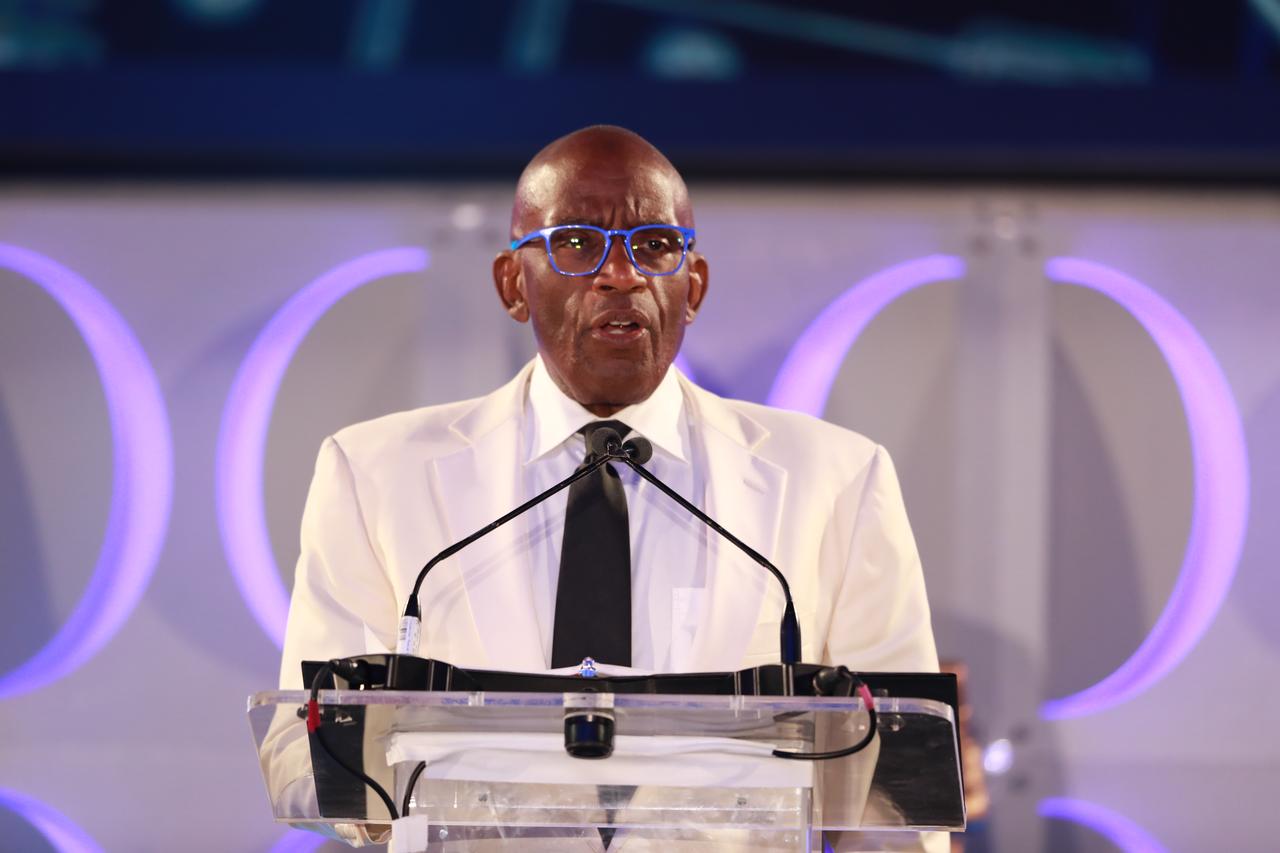
Al Roker, NBC TODAY Show co-host and weatherman, serves as the emcee for the Apollo 11 50th Gala, presented by Northrop Grumman, inside the Apollo/Saturn V Center at the Kennedy Space Center Visitor Complex on July 16, 2019.

During the Apollo 11 50th Gala, presented by Northrop Grumman, on July 16, 2019, last year's space-themed constume contest winner, left, helps the announcer preent this year's winners their awards. The gala was held inside the Apollo/Saturn V Center at the Kennedy Space Center Visitor Complex in Florida.
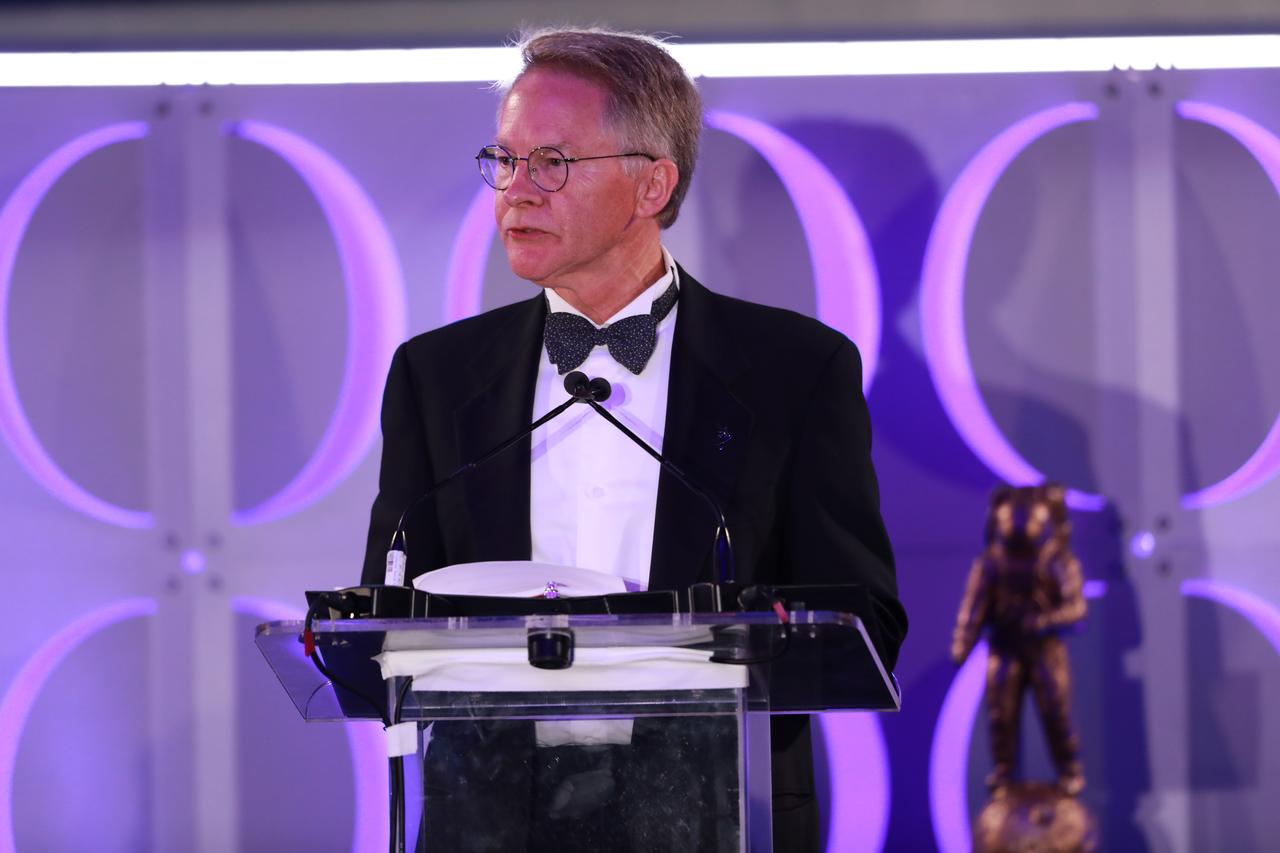
David Thompson, founder, presdient and CEO of Orbital Sciences Corp. (later known as Orbital ATK), makes remarks after receiving the Innovation Award at the Apollo 50th Gala on July 16, 2019. The gala, presented by Northrop Grumman, was held inside the Apollo/Saturn V Center at the Kennedy Space Center Visitor Complex in Florida.
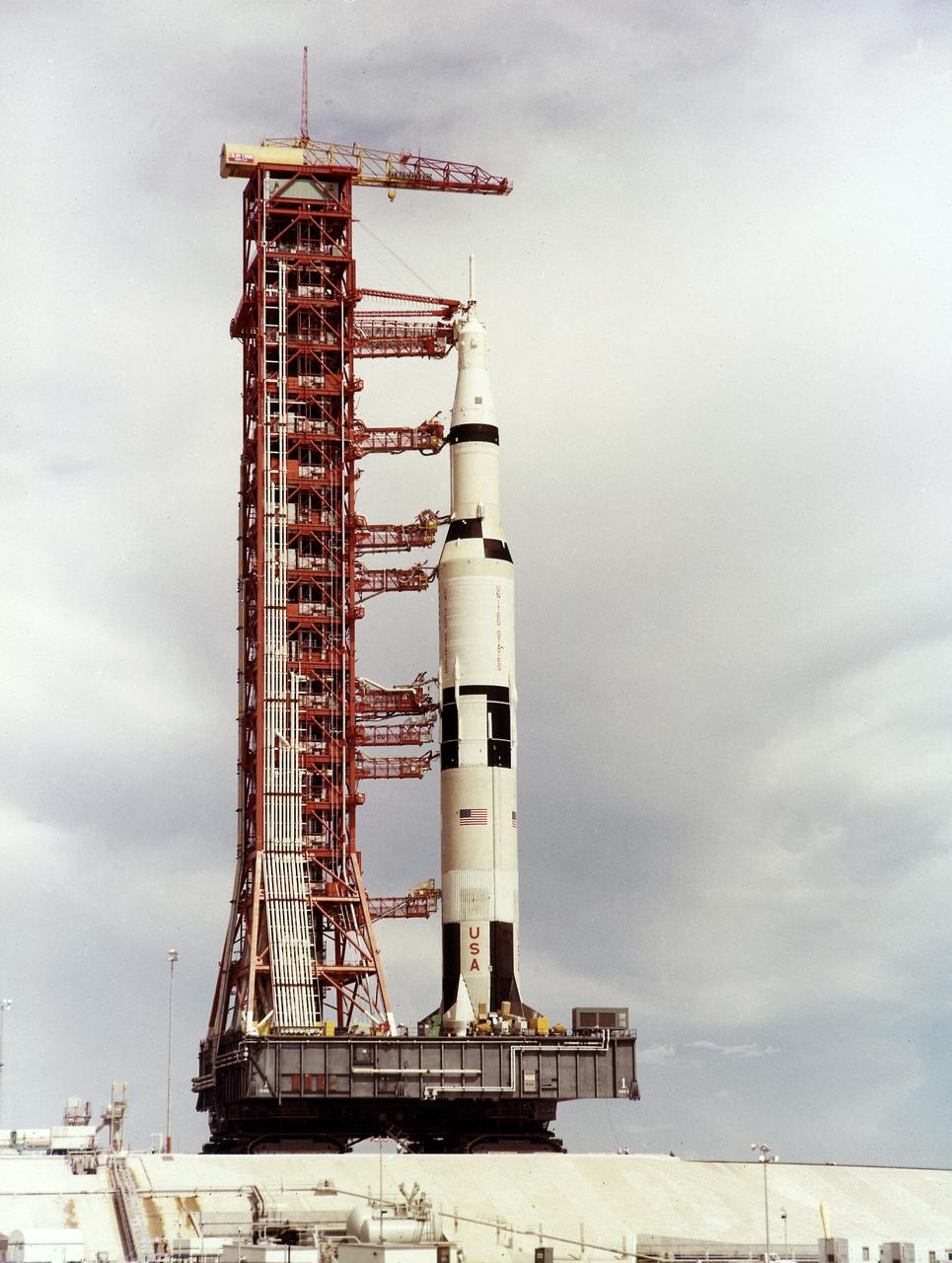
This is a view of the the first test flight of the Saturn V vehicle (SA-501) at the Kennedy Space Center (KSC) launch complex 39A, awaiting the scheduled launch on November 9, 1967. Designated as Apollo 4, this mission was the first launch of the Saturn V launch vehicle. Objectives of the unmanned Apollo 4 test flight were to obtain flight information on launch vehicle and spacecraft structural integrity and compatibility, flight loads, stage separation, and subsystems operation including testing of restart of the S-IVB stage, and to evaluate the Apollo command module heat shield.
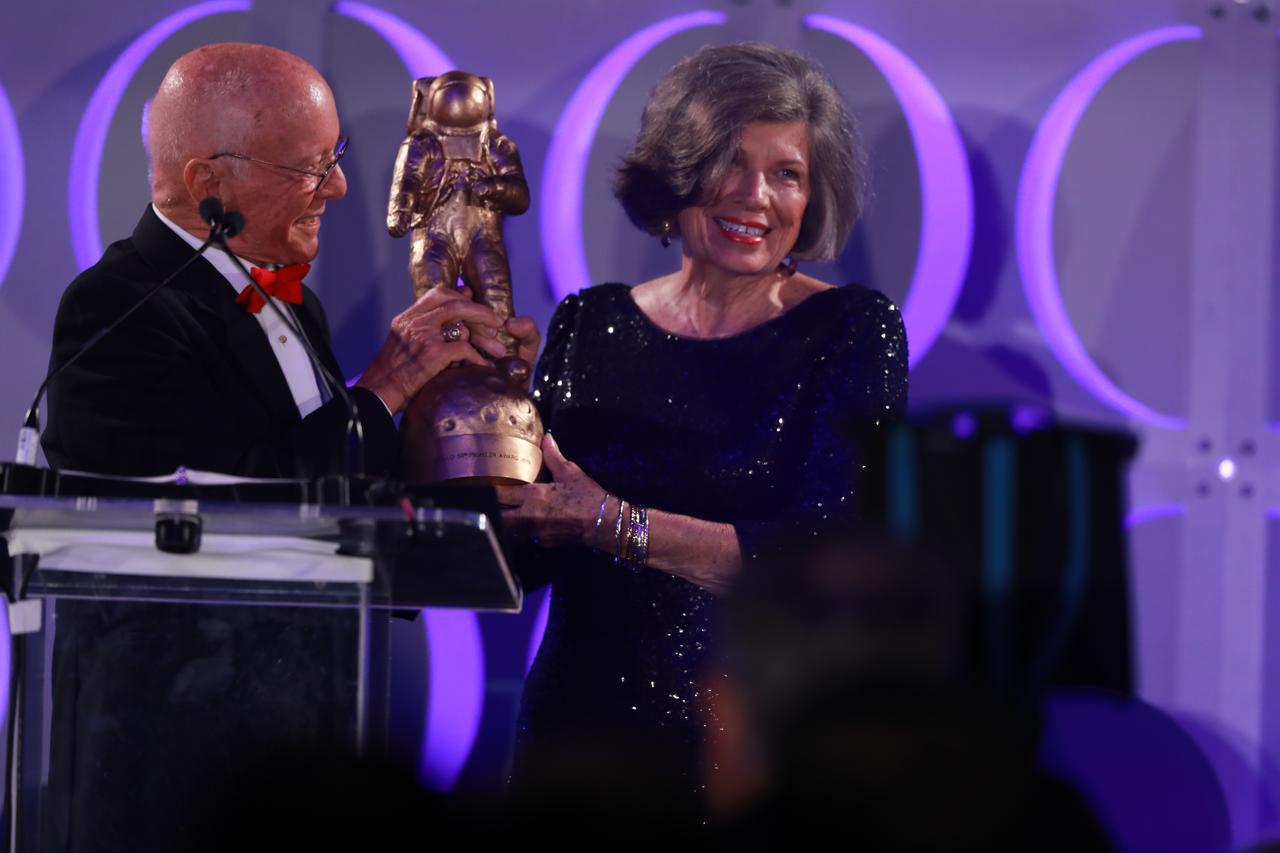
Gerry Griffin, Apollo flight director, left, presents the Pioneer Award to JoAnn Morgan, retired NASA engineer, during the Apollo 11 50th Gala, on July 16, 2019. The gala, presented by Northrop Grumman, was held inside the Apollo/Saturn V Center at the Kennedy Space Center Visitor Comples in Florida. Morgan was the first woman engineer on console at Kennedy Space Center and the only woman in the firing room during the Apollo 11 launch countdown and launch.
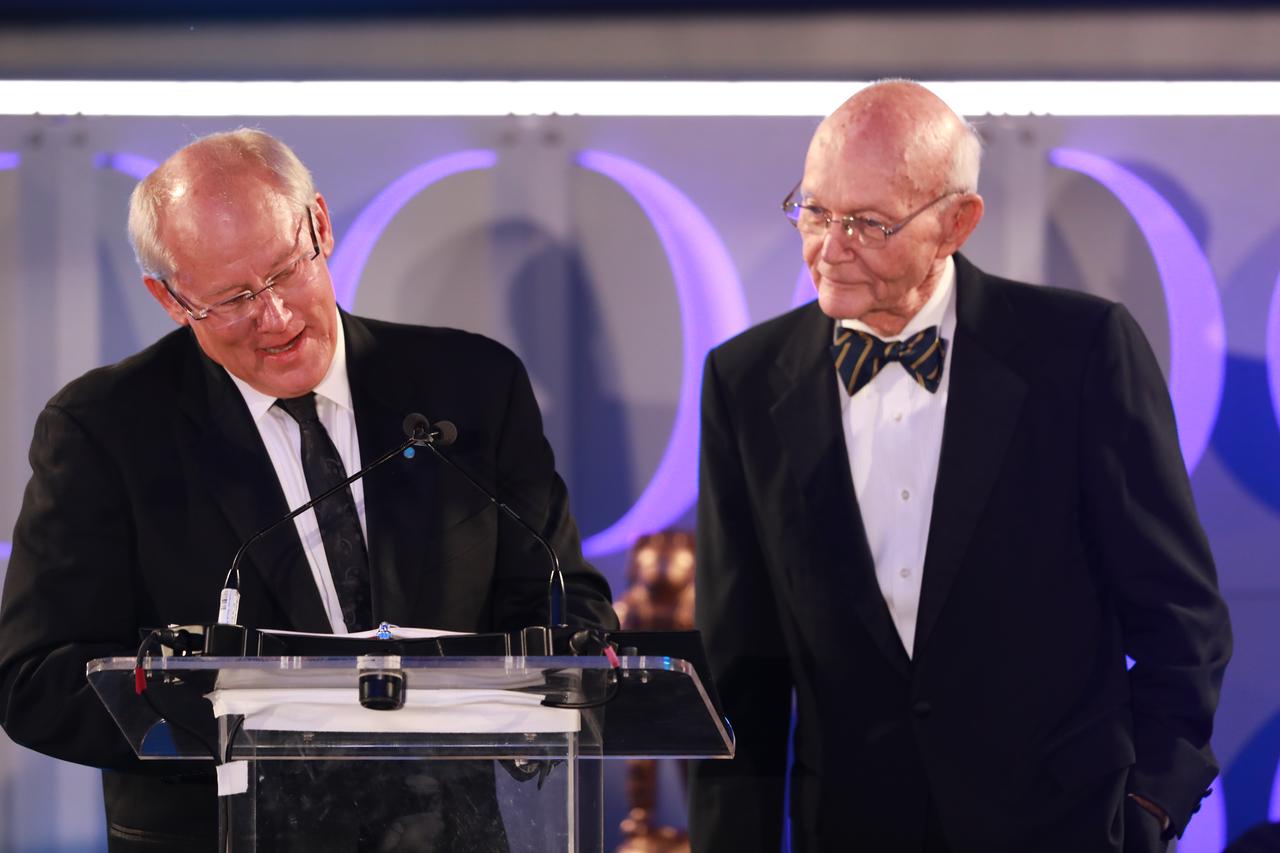
Andy Aldrin, son of Apollo 11 astronaut Buzz Aldrin, introduces Apollo 11 astronaut Michael Collins, during the Apollo 50th Gala, presented by Northrop Grumman. The event was held inside the Apollo/Saturn V Center at the Kennedy Space Center Visitor Complex in Florida on July 16, 2019.
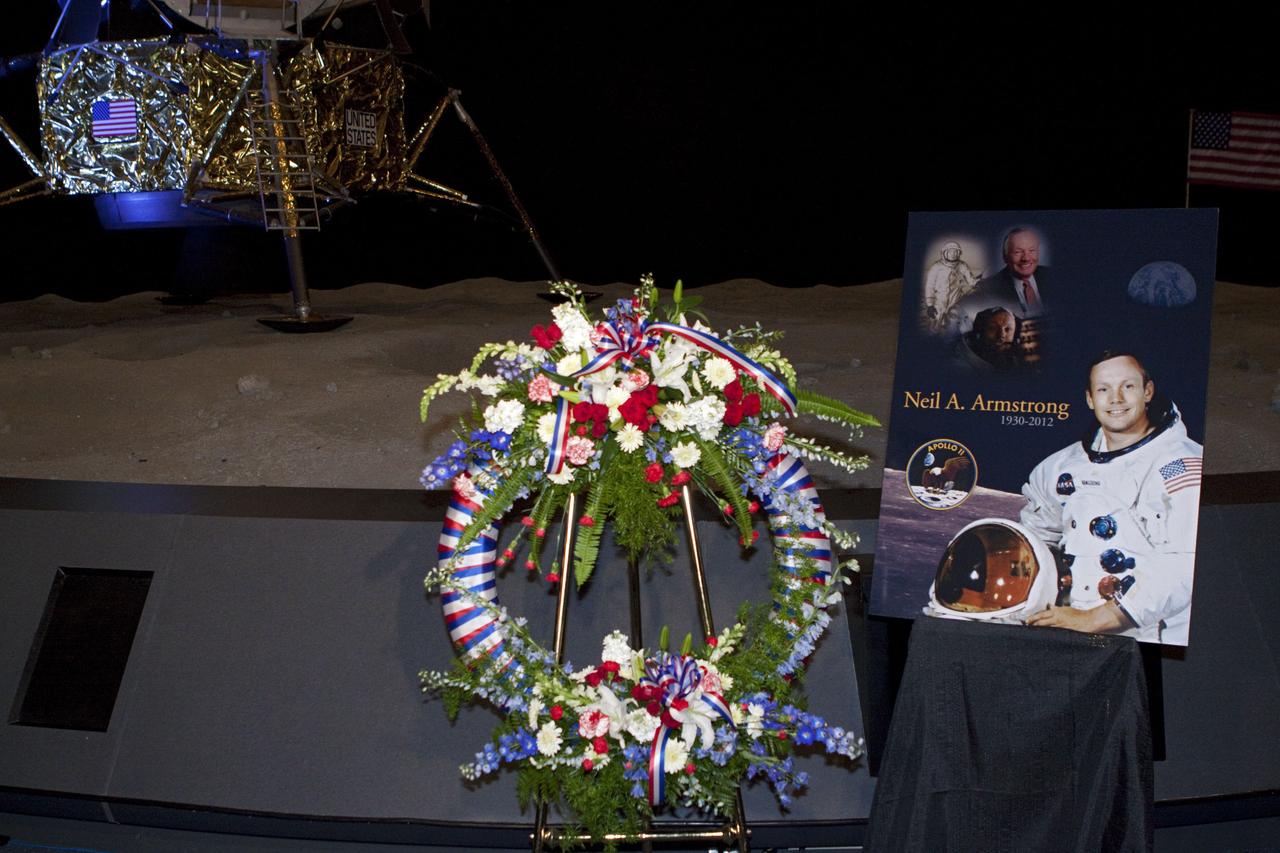
CAPE CANAVERAL, Fla. - Kennedy Space Center employees and guests gathered for a brief ceremony on Aug. 31, 2012 honoring Neil Armstrong, who died Aug. 25, 2012 at the age of 82. Armstrong was hailed by Center Director Bob Cabana as one of our heroes and a truly a great American. Cabana placed a wreath near a replica lunar module at the spaceport's Apollo-Saturn V Center. Selected as an astronaut in 1962, Neil Armstrong flew on NASA's Gemini 8 with David Scott in March 1966 and the first lunar landing mission, Apollo 11, with Mike Collins and Buzz Aldine in July 1969. On July 20, 1969, he became the first human to walk on the moon. For more information, visit: http://www.nasa.gov/centers/kennedy/news/neil_armstrong.html Photo credit: NASA/Kim Shiflett
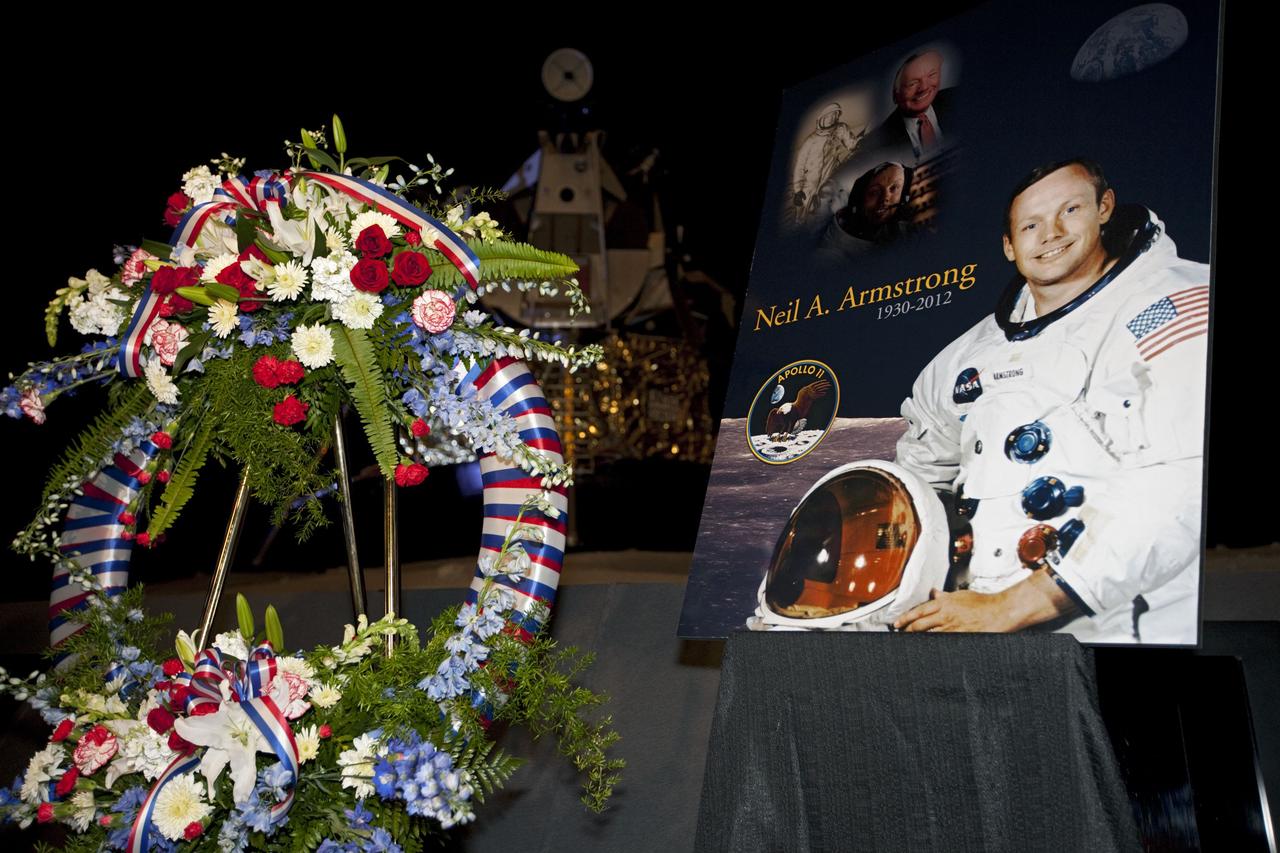
CAPE CANAVERAL, Fla. - Kennedy Space Center employees and guests gathered for a brief ceremony on Aug. 31, 2012 honoring Neil Armstrong, who died Aug. 25, 2012 at the age of 82. Armstrong was hailed by Center Director Bob Cabana as one of our heroes and a truly a great American. Cabana placed a wreath in the spaceport's Apollo-Saturn V Center. Selected as an astronaut in 1962, Neil Armstrong flew on NASA's Gemini 8 with David Scott in March 1966 and the first lunar landing mission, Apollo 11, with Mike Collins and Buzz Aldine in July 1969. On July 20, 1969, he became the first human to walk on the moon. For more information, visit: http://www.nasa.gov/centers/kennedy/news/neil_armstrong.html Photo credit: NASA/Kim Shiflett
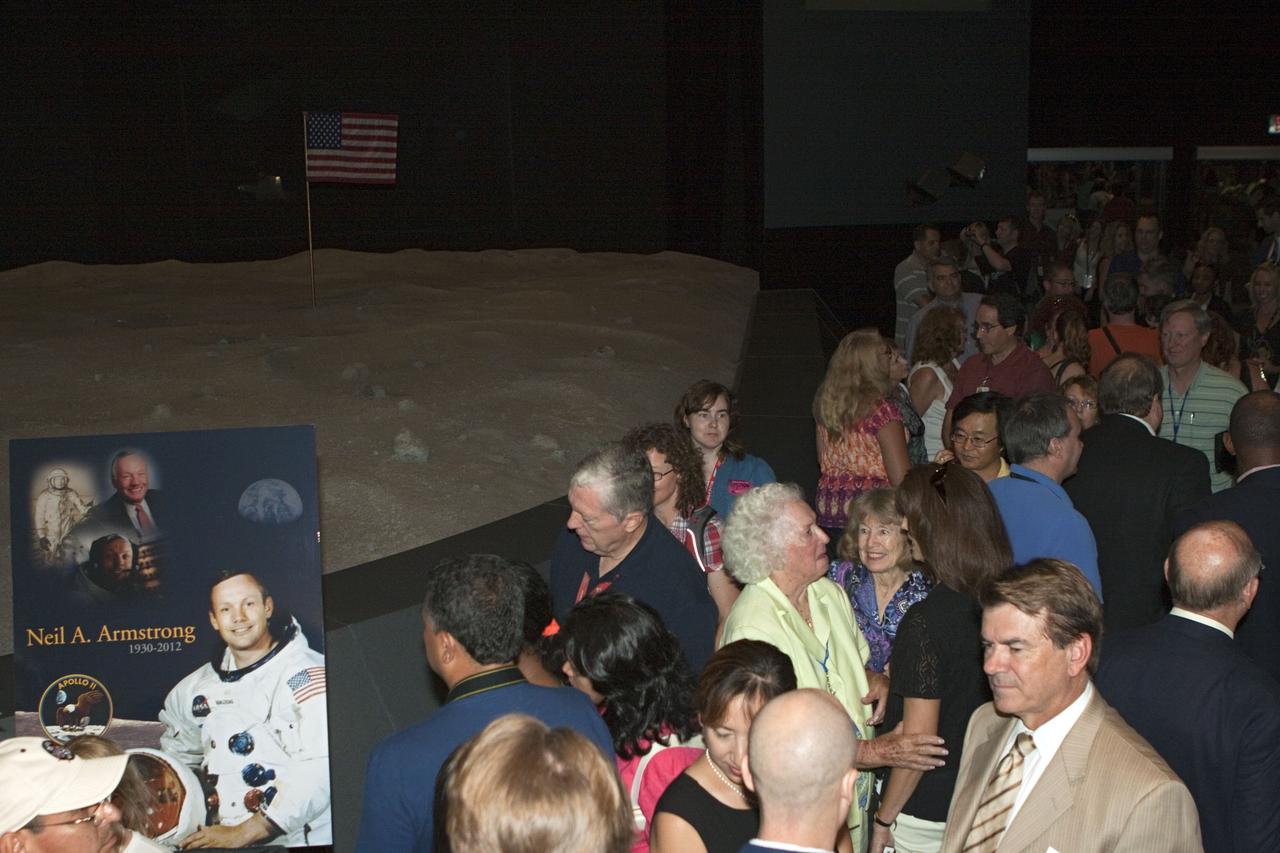
CAPE CANAVERAL, Fla. - Kennedy Space Center employees and guests gathered for a brief ceremony on Aug. 31, 2012 honoring Neil Armstrong, who died Aug. 25, 2012 at the age of 82. Armstrong was hailed by Center Director Bob Cabana as one of our heroes and a truly a great American. Cabana placed a wreath in the spaceport's Apollo-Saturn V Center. Selected as an astronaut in 1962, Neil Armstrong flew on NASA's Gemini 8 with David Scott in March 1966 and the first lunar landing mission, Apollo 11, with Mike Collins and Buzz Aldine in July 1969. On July 20, 1969, he became the first human to walk on the moon. For more information, visit: http://www.nasa.gov/centers/kennedy/news/neil_armstrong.html Photo credit: NASA/Kim Shiflett
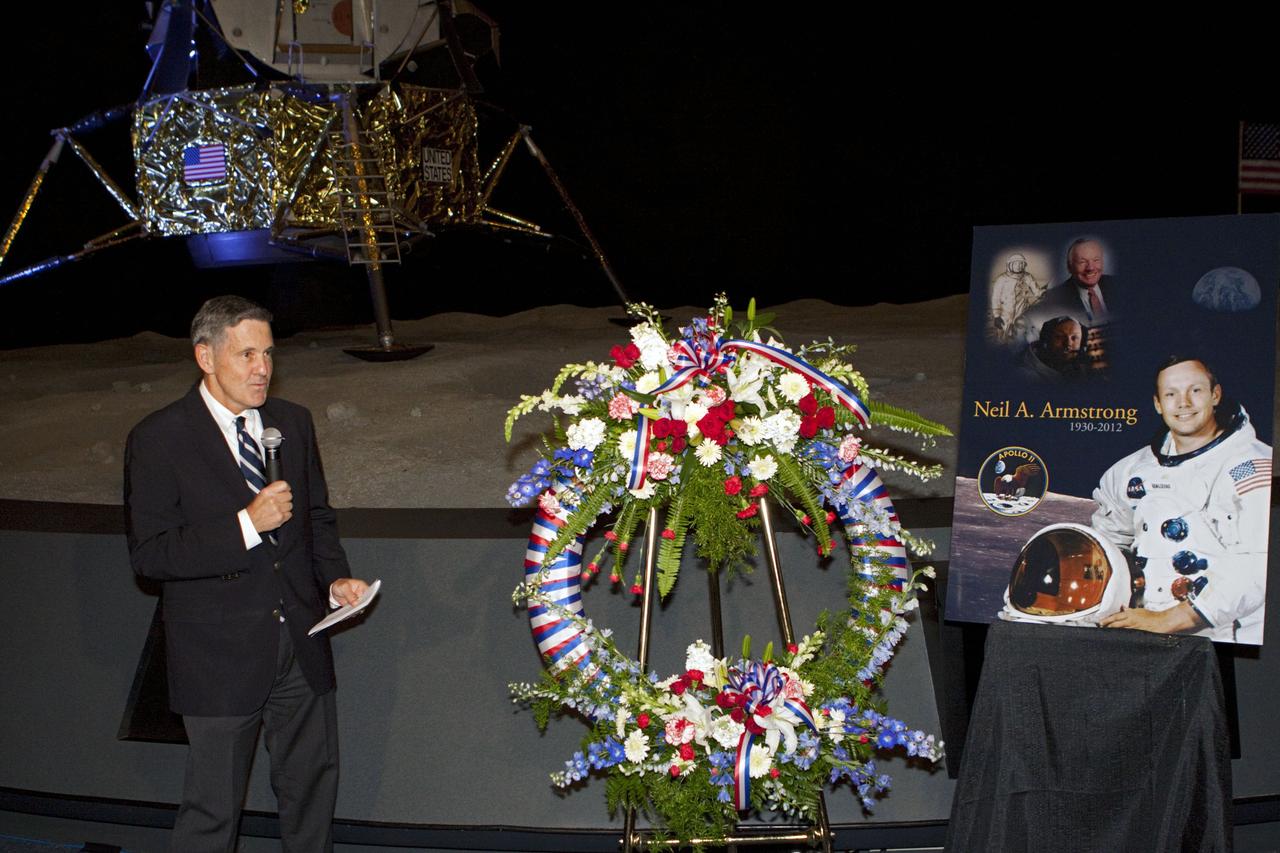
CAPE CANAVERAL, Fla. - Kennedy Space Center Director Bob Cabana spoke to spaceport employees and guests at a brief ceremony on Aug. 31, 2012 honoring Neil Armstrong, who died Aug. 25, 2012 at the age of 82. Armstrong was hailed by Cabana as one of our heroes and a truly a great American. Cabana, also a former astronaut, placed a wreath near a replica lunar module at the spaceport's Apollo-Saturn V Center. Selected as an astronaut in 1962, Neil Armstrong flew on NASA's Gemini 8 with David Scott in March 1966 and the first lunar landing mission, Apollo 11, with Mike Collins and Buzz Aldine in July 1969. On July 20, 1969, he became the first human to walk on the moon. For more information, visit: http://www.nasa.gov/centers/kennedy/news/neil_armstrong.html Photo credit: NASA/Kim Shiflett
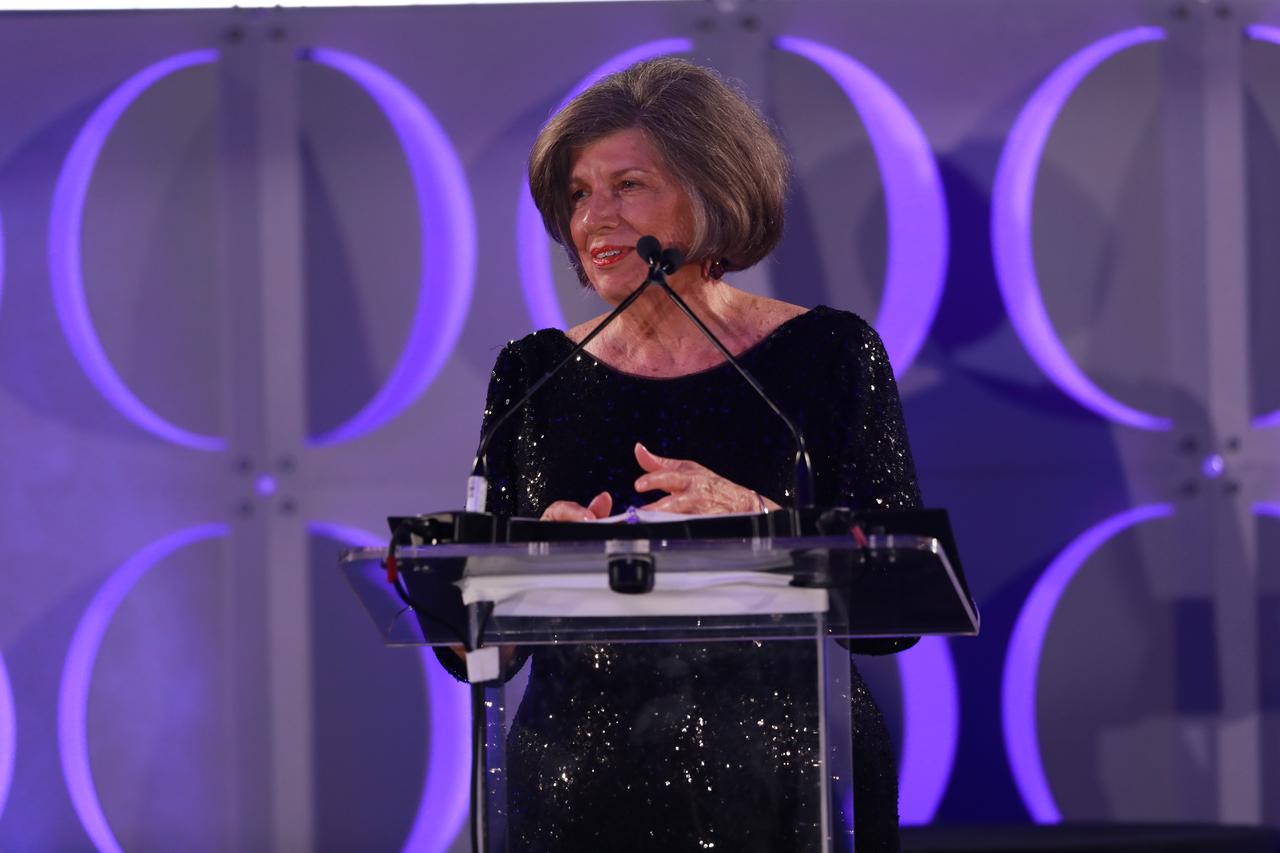
JoAnn Morgan, retired NASA engineer, makes remarks after receiving the Pioneer Award during the Apollo 11 50th Gala on July 16, 2019. The gala, presented by Northrop Grumman, was held inside the Apollo/Saturn V Center at the Kennedy Space Center Visitor Complex in Florida. Morgan was the first woman engineer on console at Kennedy Space Center and the only woman in the firing room during the Apollo 11 launch countdown and launch.
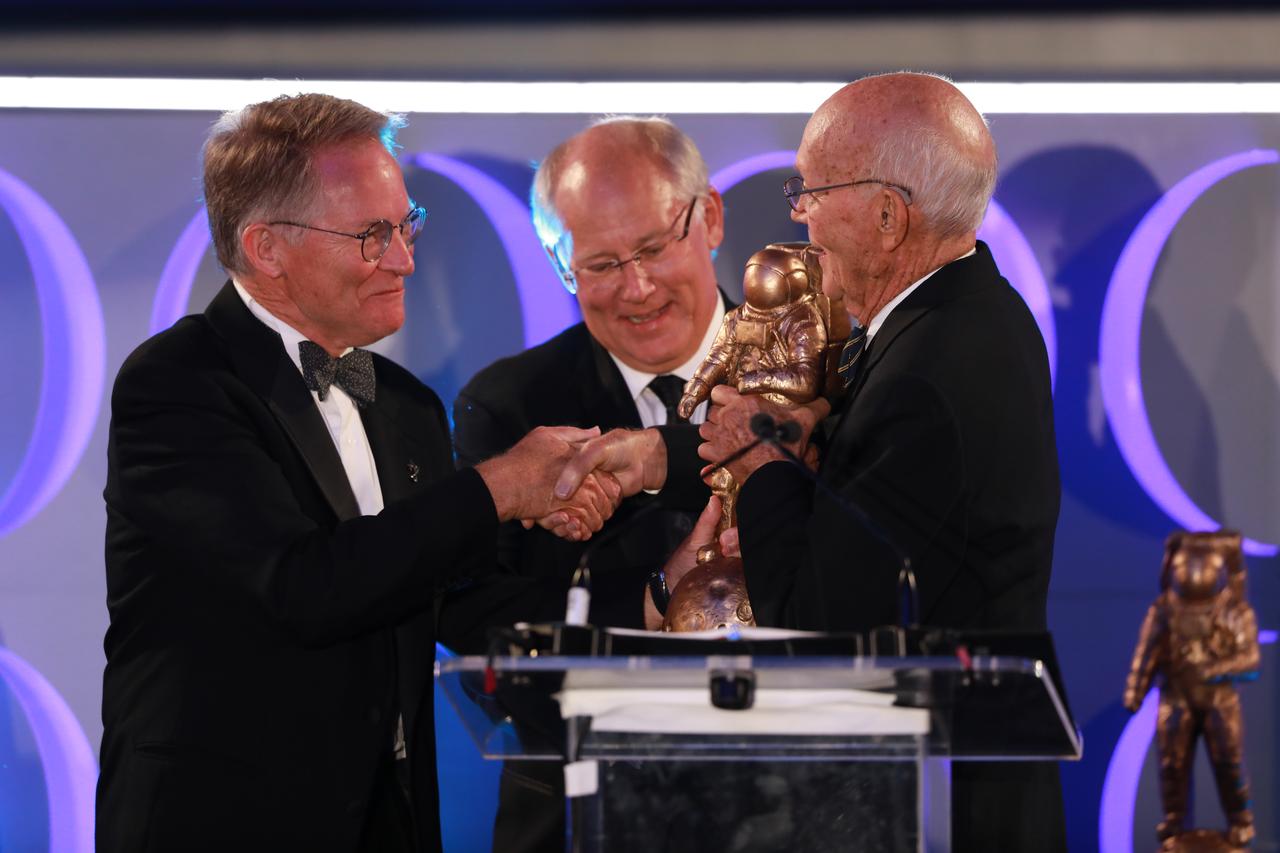
Michael Collins; right; Apollo 11 astronaut; presents the Innovation Award to David Thompson; left; founder; president and CEO of Orbital Sciences Corp (later known as Orbital ATK); during the Apollo 50th Gala on July 16; 2019. The event; presented by Northrop Grumman; was held inside the Apollo/Saturn V Center at the Kennedy Space Center Visitor Comples in Florida. In the center at the podium is Andy Aldrin; son of Apollo 11 astronaut Buzz Aldrin.
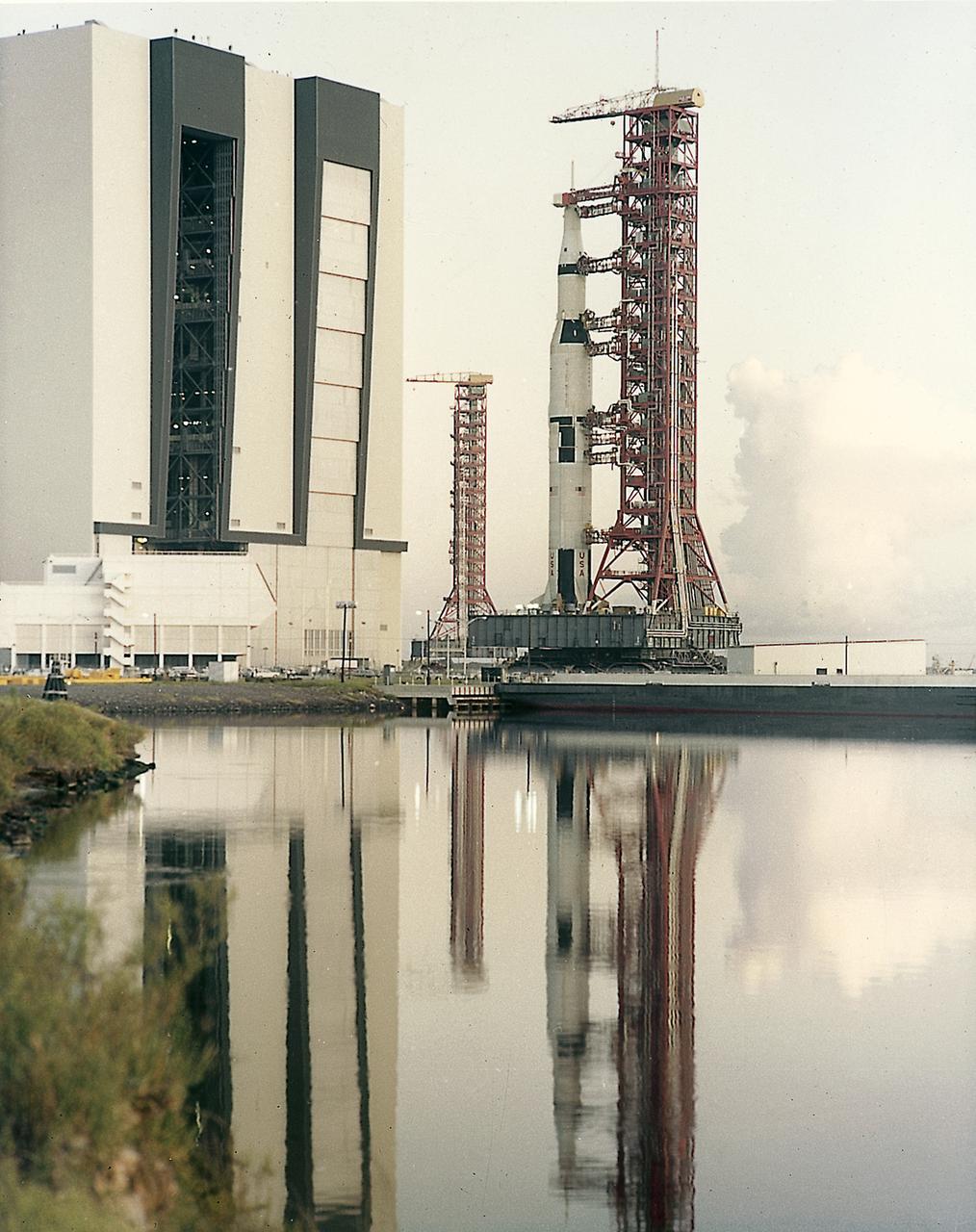
This picture shows the Saturn V vehicle (AS-501), for the Apollo 4 mission on the Crawler Transporter Vehicle. It was rolled out from the Vehicle Assembly Building and slowly (1 mph) moved to the launch pad at the Kennedy Space Center (KSC). The Apollo 4 mission was the first launch of the Saturn V launch vehicle. Objectives of the unmanned Apollo 4 test flight were to obtain flight information on launch vehicle and spacecraft structural integrity and compatibility, flight loads, stage separation, and subsystems operation including testing of restart of the S-IVB stage, and to evaluate the Apollo command module heat shield. The Apollo 4 was launched on November 9, 1967 from KSC.
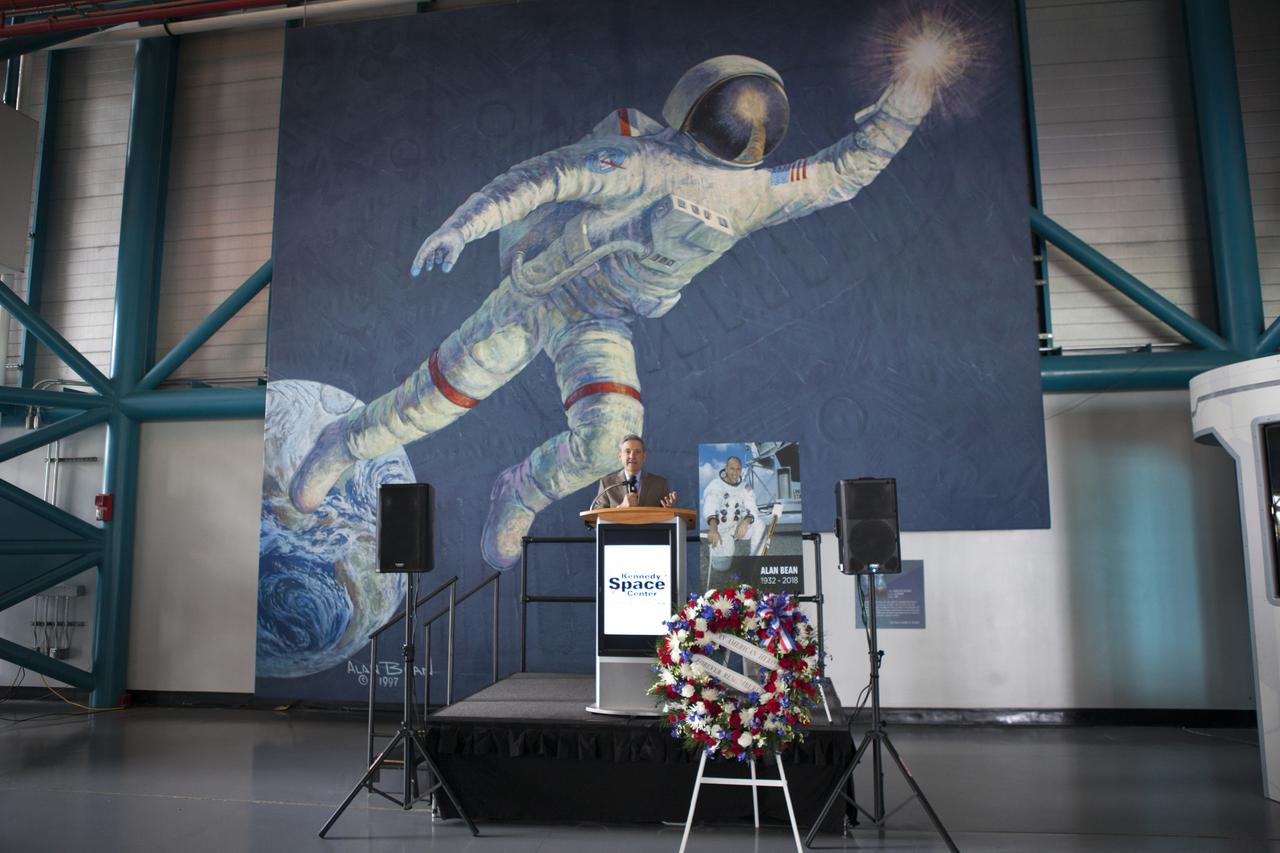
A memorial wreath placed in the Apollo-Saturn V Center of the Kennedy Space Center Visitor Complex on Wednesday, May 30, 2018, honors former NASA astronaut Alan Bean. He was the fourth person to walk on the Moon as lunar module pilot on Apollo 12 in November 1969. He went on to command the 59-day Skylab 3 mission in 1973. In the background is a large mural of a painting by Bean who became an accomplished artist after leaving NASA. He died in Houston on May 26, 2018, at the age of 86.
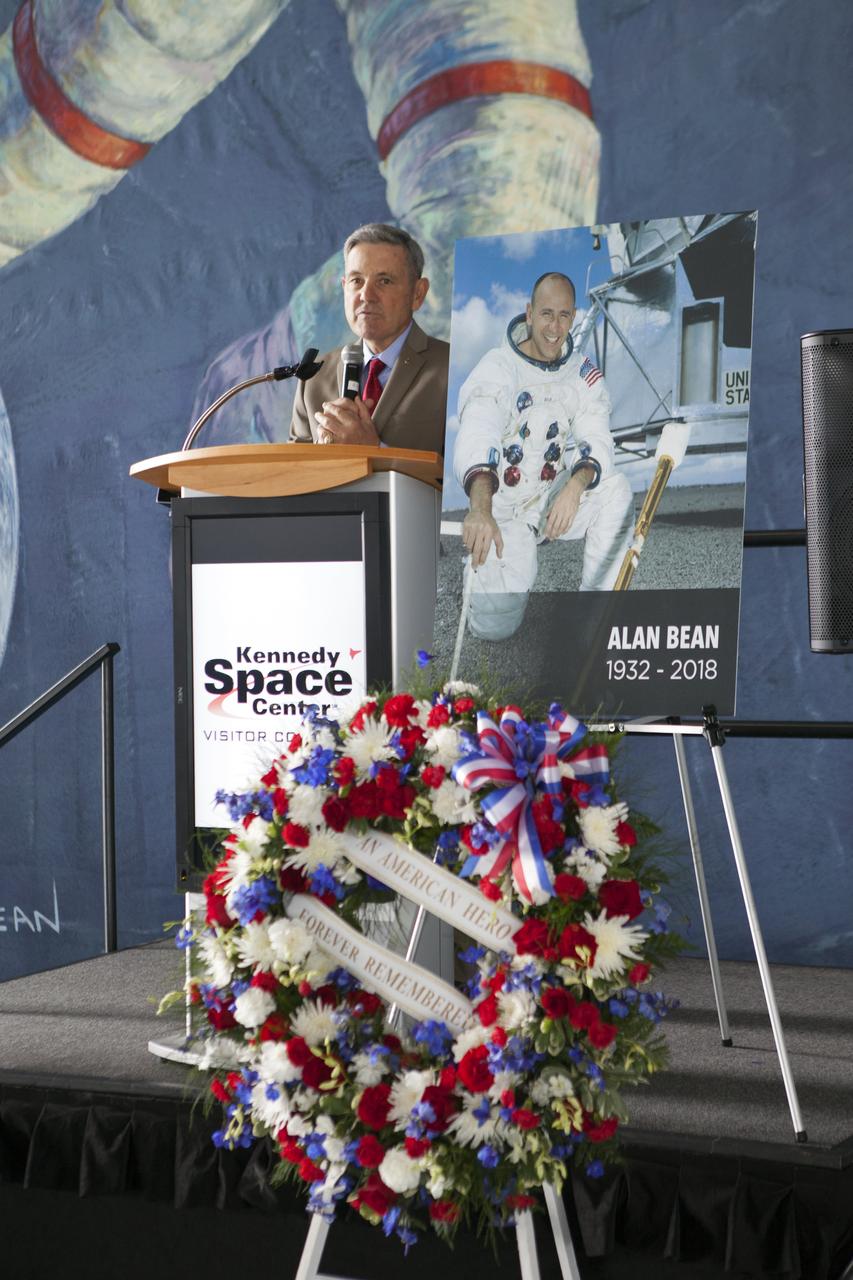
Kennedy Space Center Director Bob Cabana speaks to guests in the Apollo-Saturn V Center at the spaceport's visitor complex on Wednesday, May 30, 2018. The ceremony is honoring the memory of former NASA astronaut Alan Bean. As lunar module pilot on Apollo 12, Bean was the fourth person to walk on the Moon in November 1969. He went on to command the 59-day Skylab 3 mission in 1973. He died in Houston on May 26, 2018, at the age of 86.
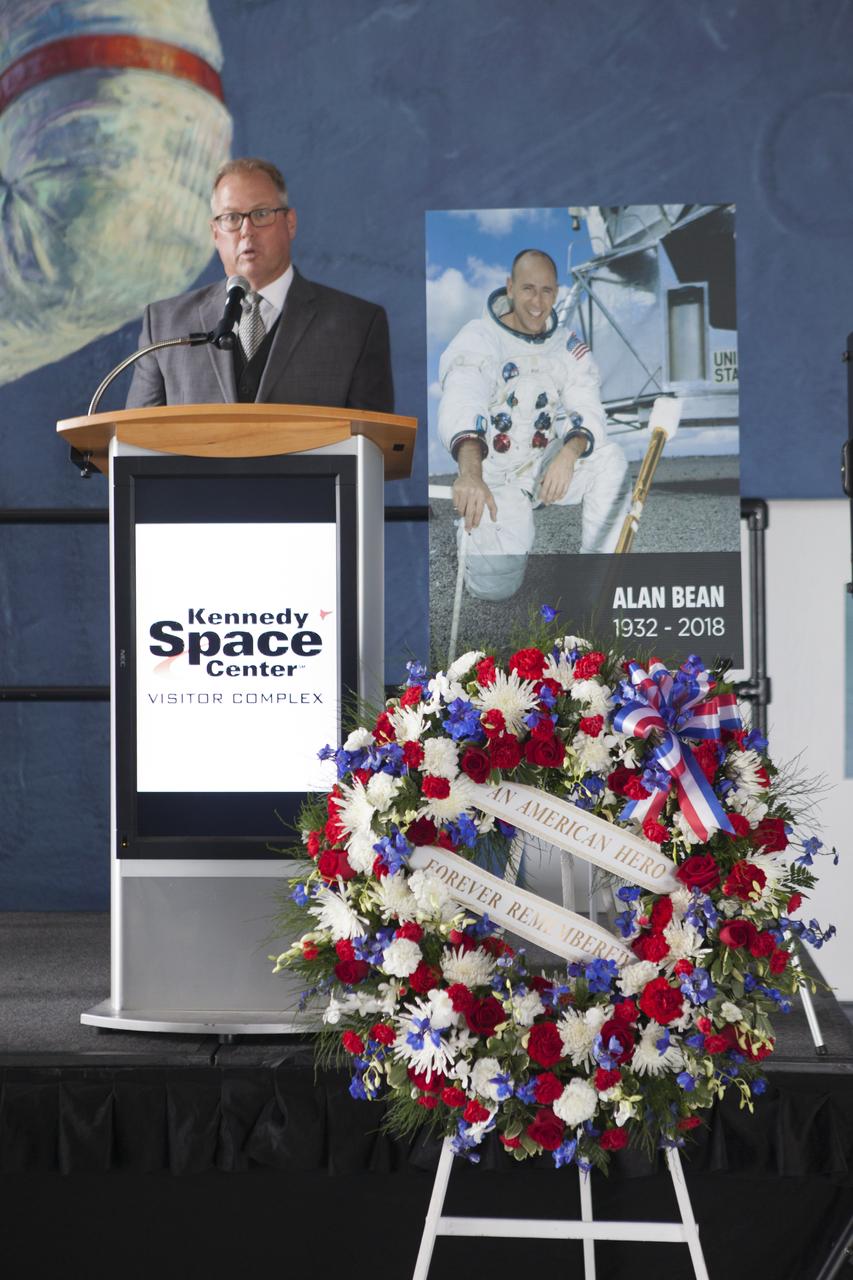
Therrin Protze, COO at the Kennedy Space Center Visitor Complex, speaks in the Apollo-Saturn V Center during a ceremony on Wednesday, May 30, 2018, honoring former NASA astronaut Alan Bean. As lunar module pilot on Apollo 12, Bean was the fourth person to walk on the Moon in November 1969. He went on to command the 59-day Skylab 3 mission in 1973. He died in Houston on May 26, 2018, at the age of 86.
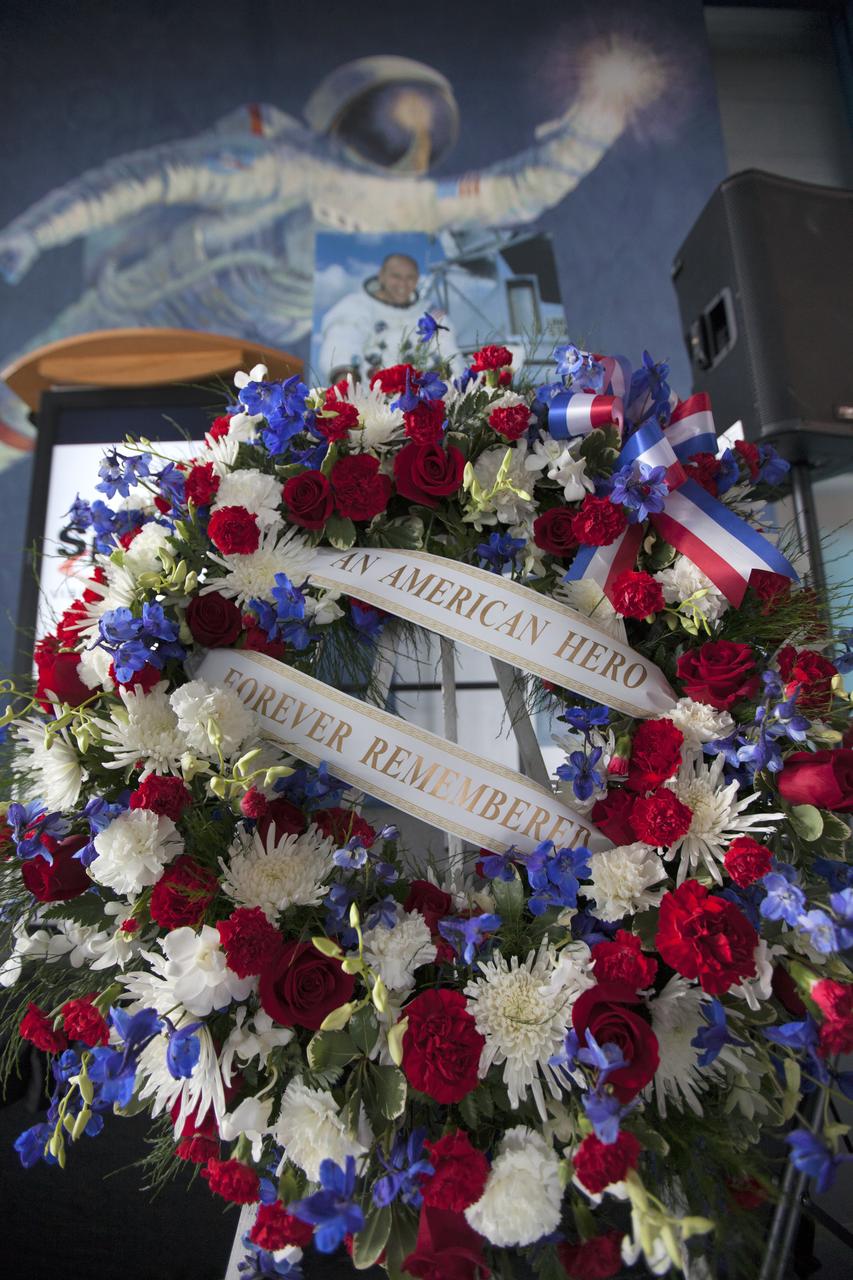
A memorial wreath placed in the Apollo-Saturn V Center of the Kennedy Space Center Visitor Complex on Wednesday, May 30, 2018, honors former NASA astronaut Alan Bean. He was the fourth person to walk on the Moon as lunar module pilot on Apollo 12 in November 1969. He went on to command the 59-day Skylab 3 mission in 1973. He died in Houston on May 26, 2018, at the age of 86.
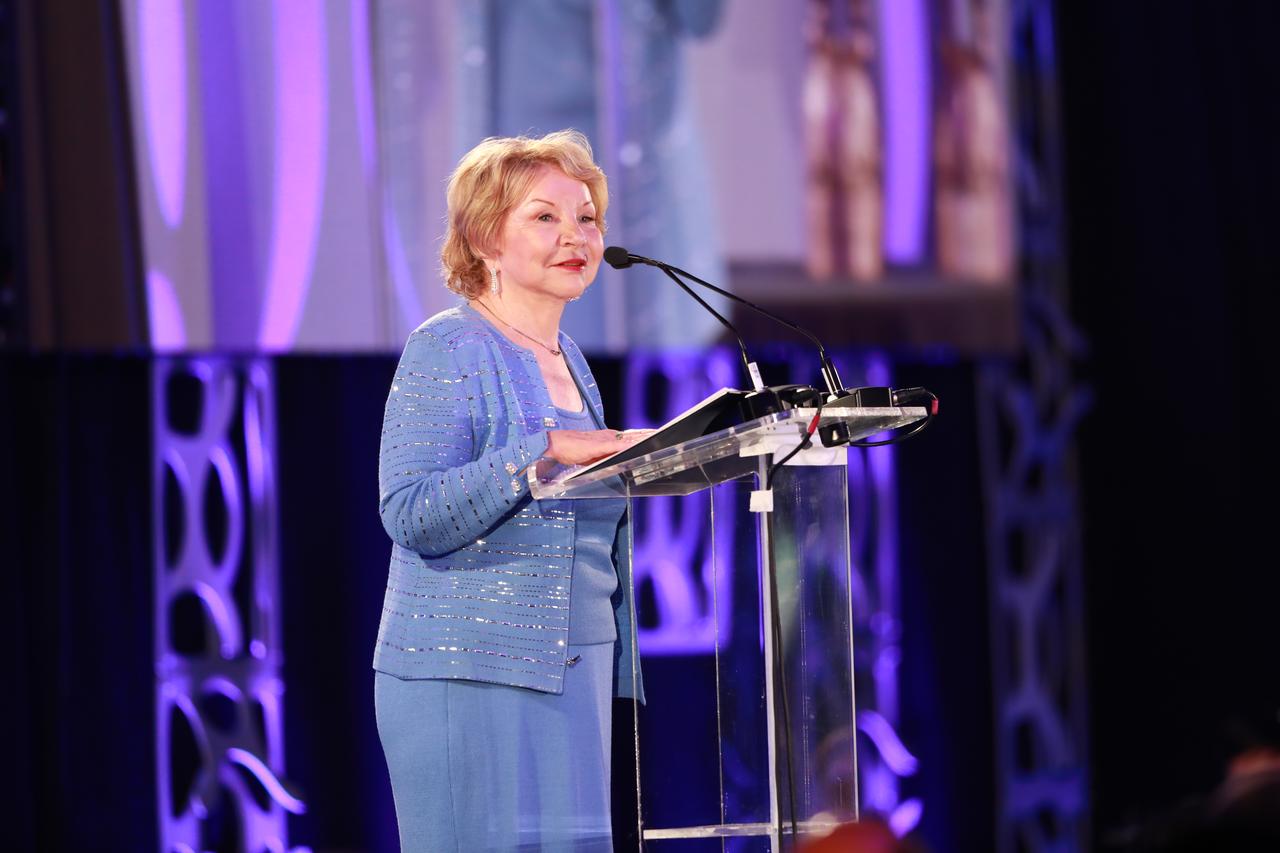
June Scobee Rodgers receives the Education Award during the Apollo 50th Gala, presented by Northrop Grumman, inside the Apollo/Saturn V Center at the Kennedy Space Center Visitor Complex in Florida on July 16, 2019. Scobbee Rodgers is the founding chairman of the Challenger Center for Space Science Education, established in 1986 following the Space Shuttle Challenger accident to continue the legacy of the Challenger crew.

Physicist Brian Cox serves as the moderator for a panel discussion with Apollo astronauts during the Apollo 11 50th Gala on July 16, 2019. The gala, presented by Northrop Grumman, was held inside the Apollo/Saturn V Center at the Kennedy Space Center Visitor Complex. From left, are Apollo 9 astronaut Rusty Schweichart, Apollo 11 astronaut Michael Collins, Apollo 16 astronaut Charlie Duke, and Apollo Flight Director Gerry Griffin.
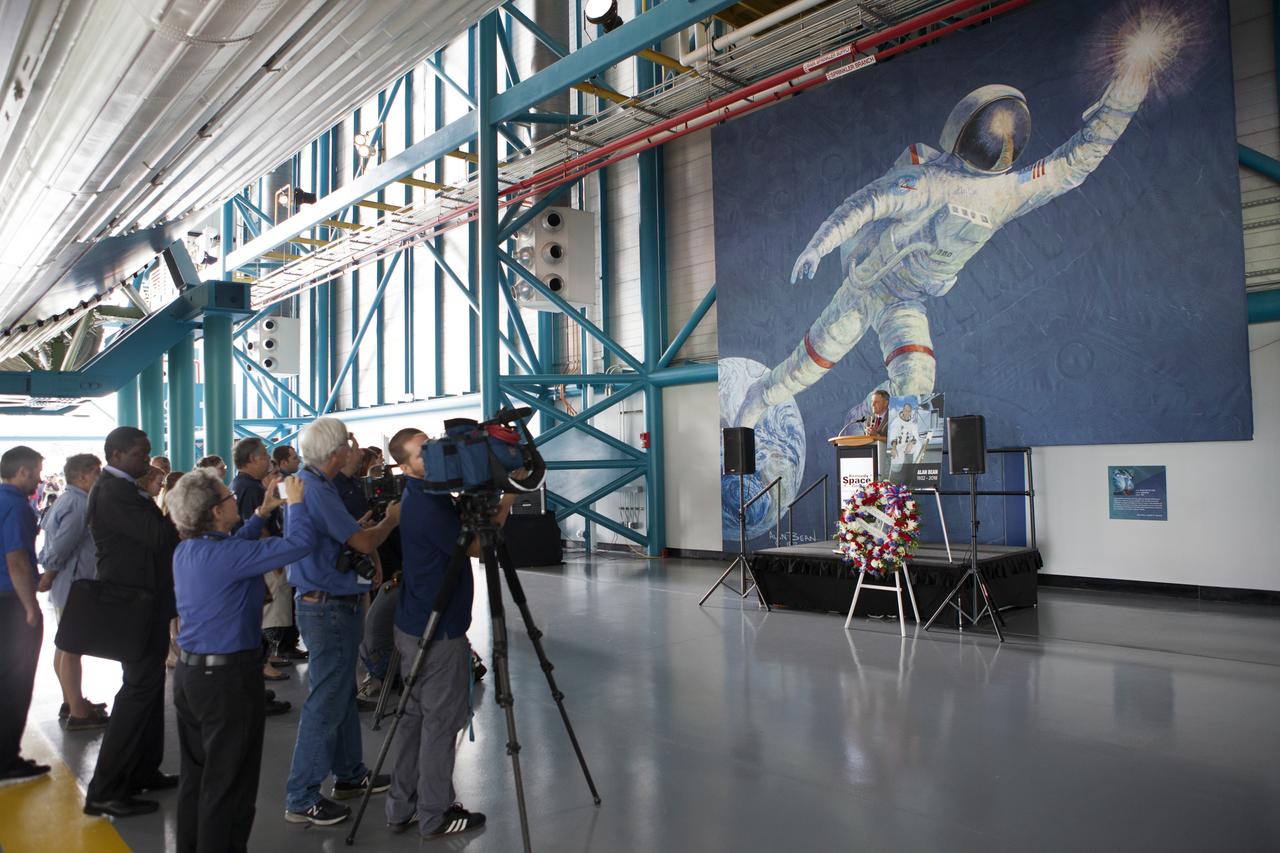
Members of the news media assemble to cover a ceremony on Wednesday, May 30, 2018, during which a memorial wreath is placed in the Apollo-Saturn V Center of the Kennedy Space Center Visitor Complex honoring former NASA astronaut Alan Bean. In the background is a large mural of a painting by Alan Bean who became an accomplished artist after leaving NASA. Bean was the fourth person to walk on the Moon as lunar module pilot on Apollo 12 in November 1969. He went on to command the 59-day Skylab 3 mission in 1973. He died in Houston on May 26, 2018, at the age of 86.
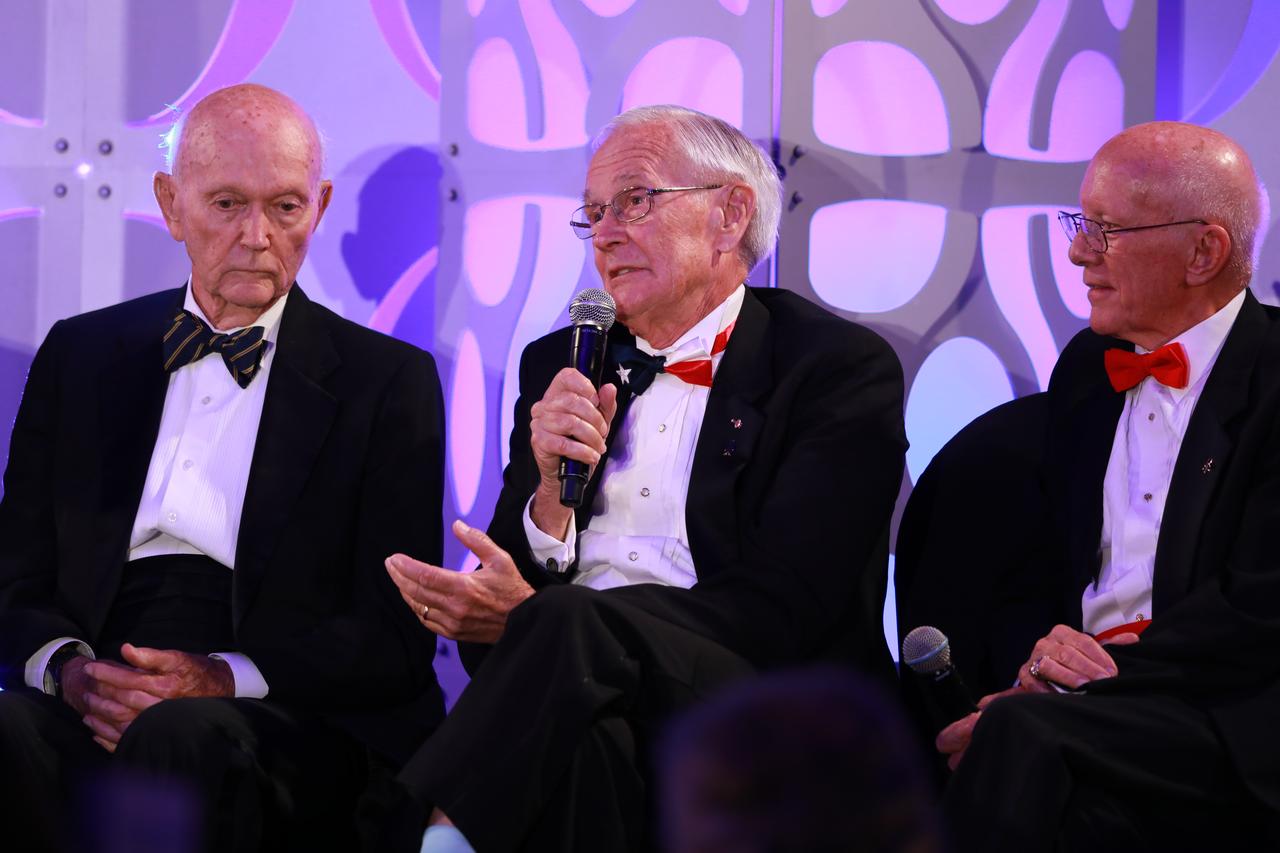
Retired NASA astronauts participate in a panel discussion during the Apollo 11 50th Gala, presented by Northrop Grumman, on July 16, 2019. The gala was held inside the Apollo/Saturn V Center at the Kennedy Space Center Visitor Complex in Florida. From left, are Apollo 11 astronaut Michael Collins, Apollo 16 astronaut Charlie Duke, and Apollo Flight Director Gerry Griffin.
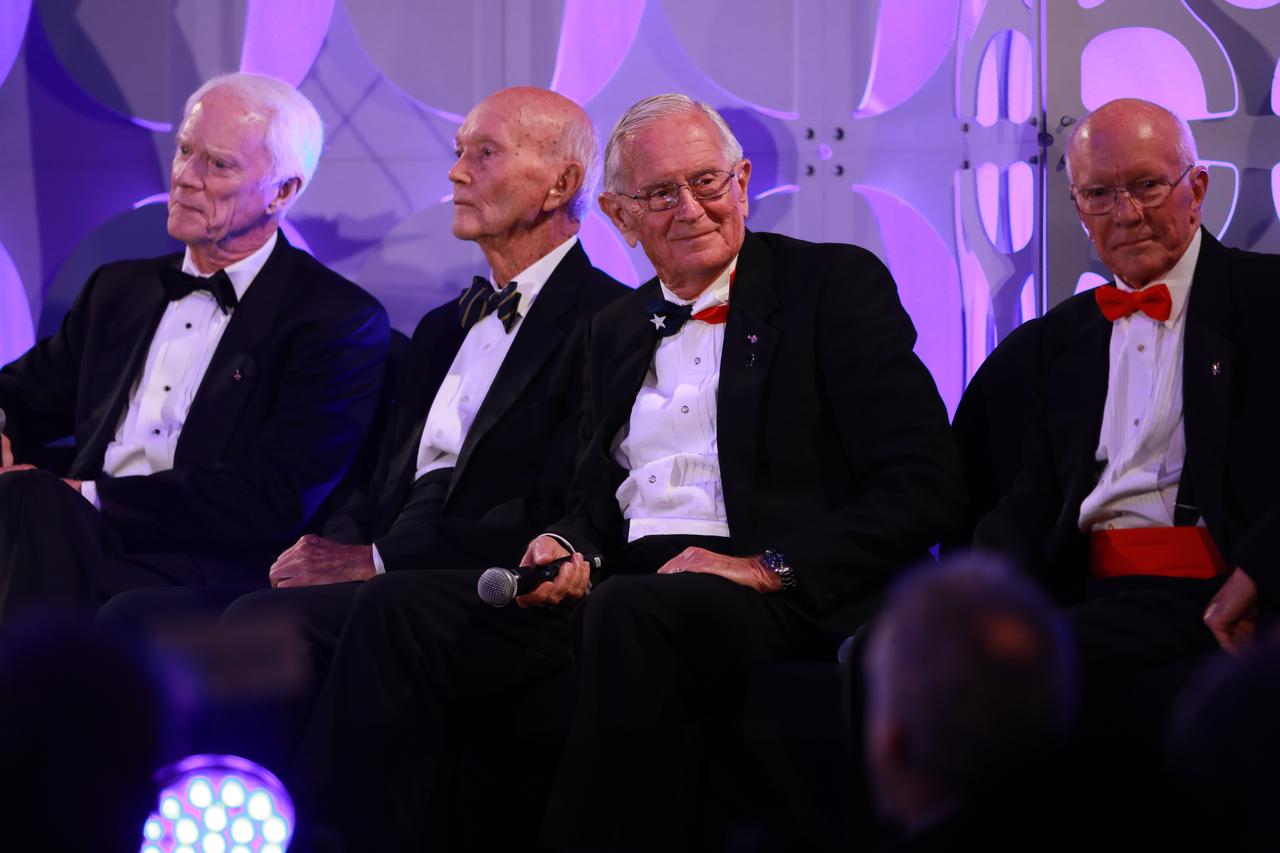
A panel discussion with Apollo astronauts took place during the Apollo 11 50th Gala, present by Northop Grumman, inside the Apollo/Saturn V Center at the Kennedy Space Center Visitor Complex in Florida on July 16, 2019. From left, are Apollo 9 astronaut Rusty Schweickart, Apollo 11 astronaut Michael Collins, Apollo 16 astronaut Charlie Duke, and Apollo Flight Director Gerry Griffin.
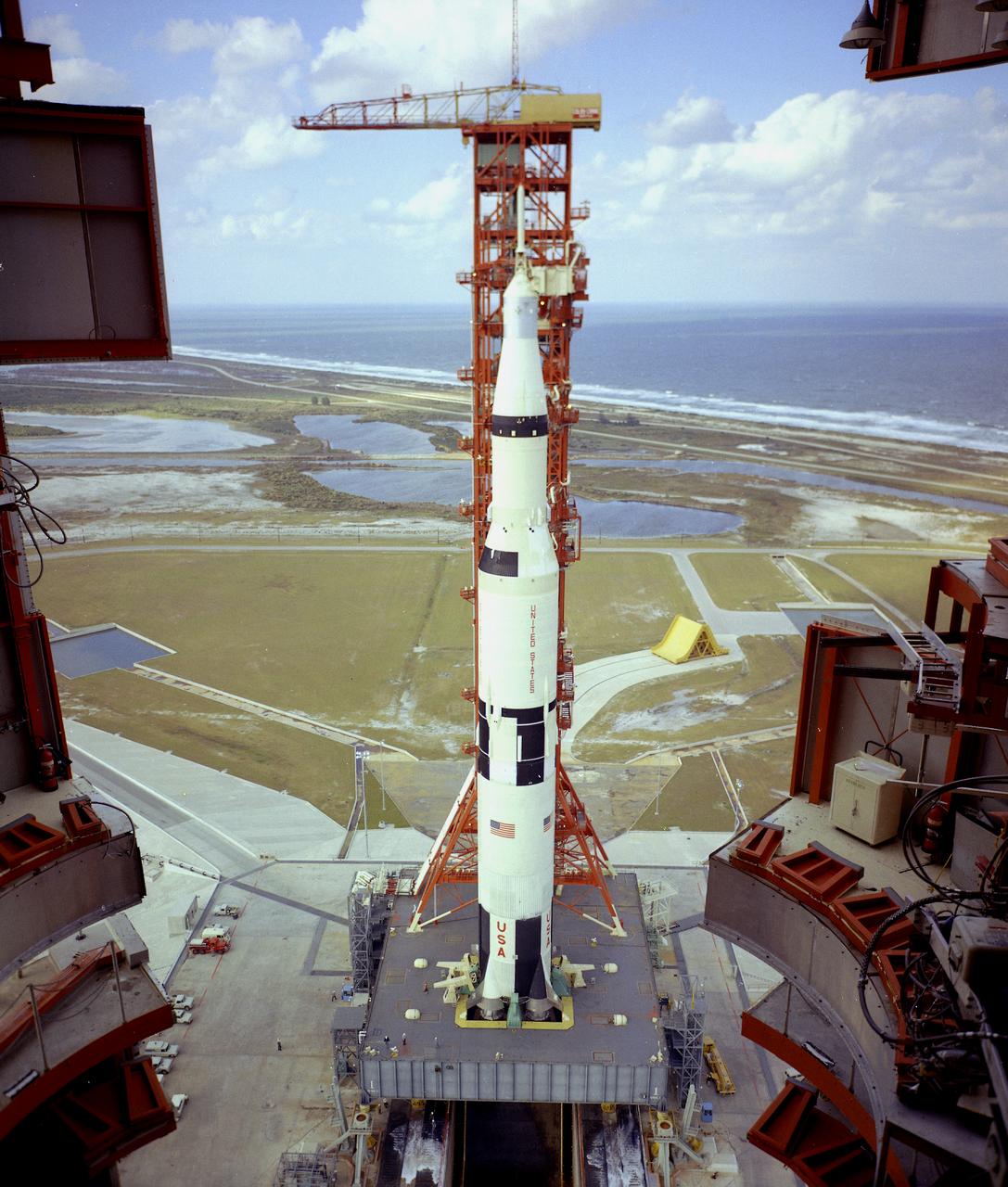
This is a view of the the first test flight of the Saturn V vehicle (SA-501) at the Kennedy Space Center (KSC) launch complex 39A. The thrust chambers of the first stage's five engines extend into the 45-foot-square hole in the mobile launcher platform. Until liftoff, the flames impinged downward onto a flame deflector that diverted the blast lengthwise in the flame trench. Here, a flame deflector, coated with a black ceramic, is in place below the opening, while a yellow (uncoated) spare deflector rests on its track in the background. It took a tremendous flow of water (28,000 gallons per minute) to cool the flame deflector and trench. The Apollo 4 was launched on November 9, 1967 from KSC.
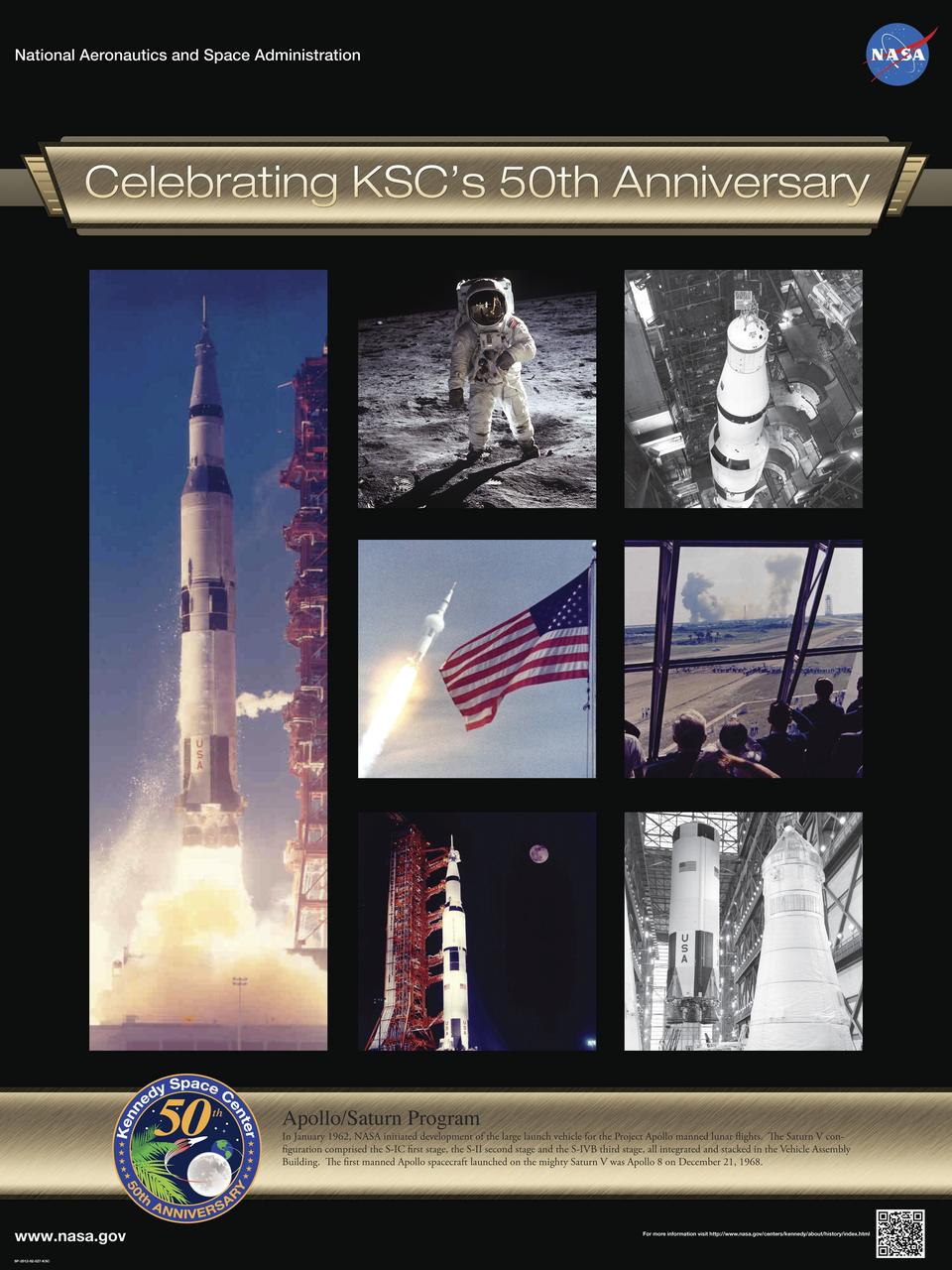
Apollo/Saturn Program: In January 1962, NASA initiated development of the large launch vehicle for the Project Apollo manned lunar flights. The Saturn V configuration comprised the S-IC first stage, the S-II second stage and the S-IVB third stage, all integrated and stacked in the Vehicle Assembly Building. The first manned Apollo spacecraft launched on the mighty Saturn V was Apollo 8 on December 21, 1968. Poster designed by Kennedy Space Center Graphics Department/Greg Lee. Credit: NASA
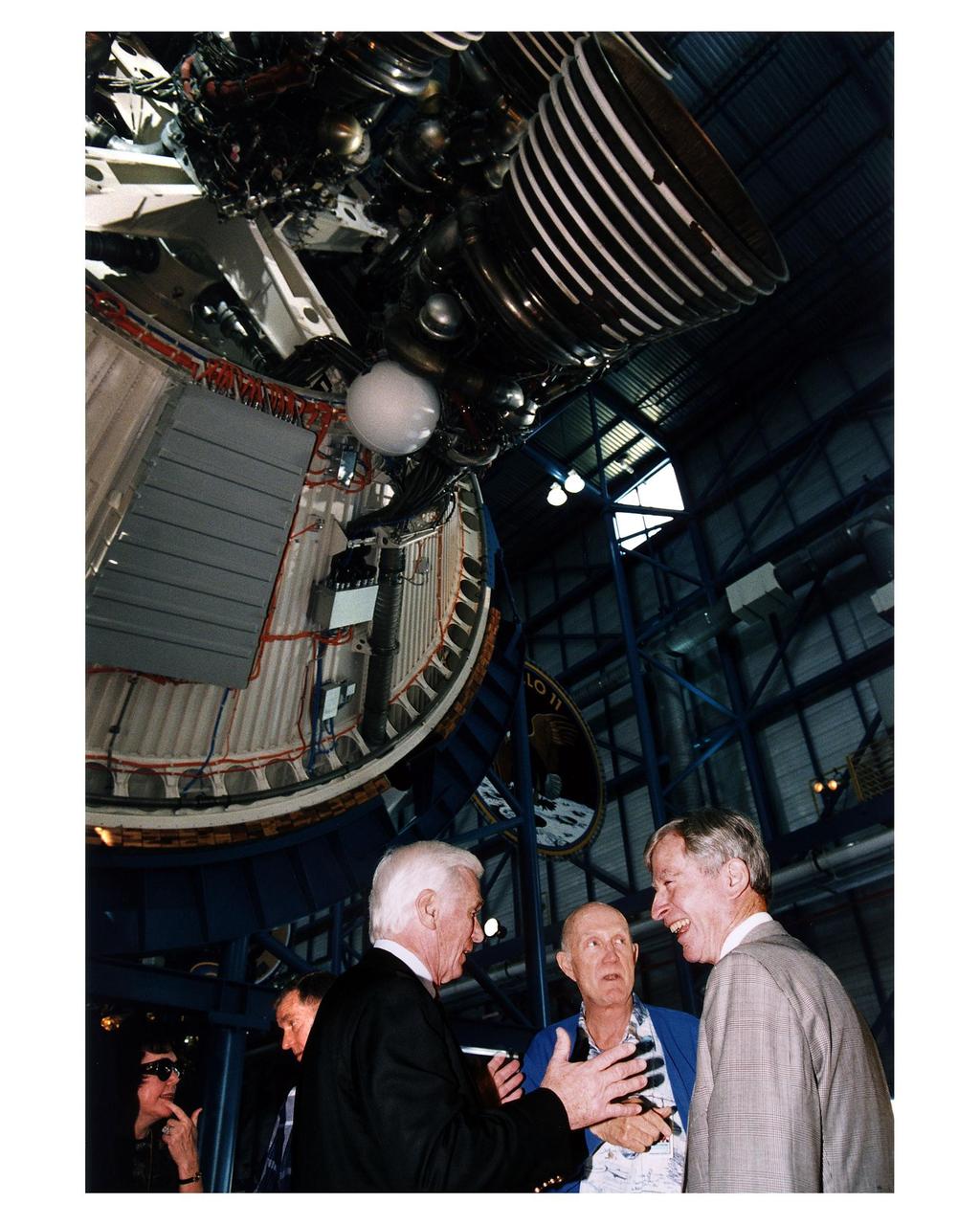
KENNEDY SPACE CENTER, FLA. -- Some of the former Apollo program astronauts tour the new Apollo/Saturn V Center (ASVC) at KSC prior to the gala grand opening ceremony for the facility that was held Jan. 8, 1997. The astronauts were invited to participate in the event, which also featured NASA Administrator Dan Goldin and KSC Director Jay Honeycutt. Discussing old times beneath the KSC Apollo/Saturn V rocket inside the building are (from left) Apollo 10 Lunar Module Pilot and Apollo 17 Commander Eugene A. Cernan; Apollo 10 Commander Thomas P. Stafford and Apollo 16 Commander John W. Young. The ASVC also features several other Apollo program spacecraft components, multimedia presentations and a simulated Apollo/ Saturn V liftoff. The facility will be a part of the KSC bus tour that embarks from the KSC Visitor Center
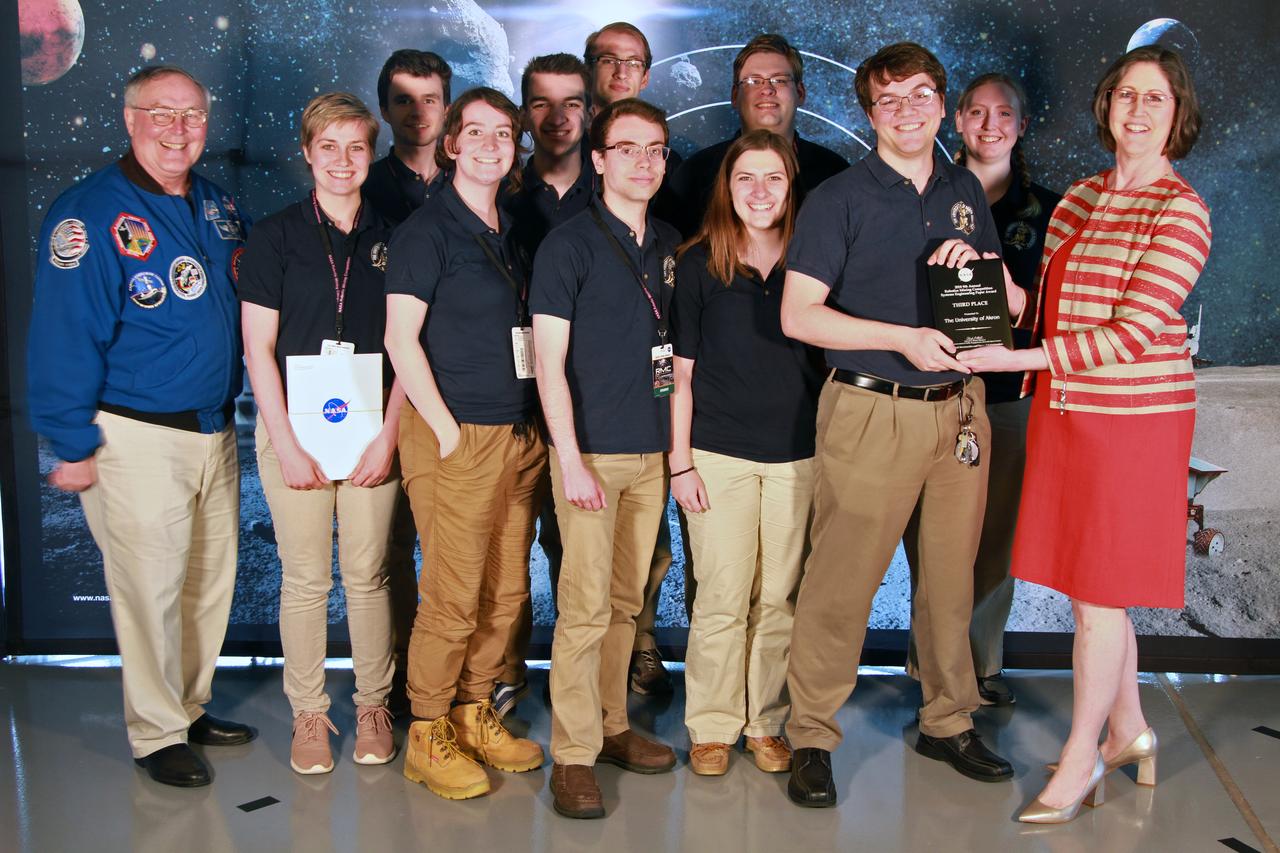
NASA's 9th Annual Robotic Mining Competition concludes with an awards ceremony May 18, 2018, at the Apollo/Saturn V Center at the Kennedy Space Center Visitor Complex in Florida. The team from The University of Akron received third place for their Systems Engineering Paper. At left is retired NASA astronaut Jerry Ross. At right is Jonette Stecklein, lead systems engineering paper judge. More than 40 student teams from colleges and universities around the U.S. participated in the competition, May 14-18, by using their mining robots to dig in a supersized sandbox filled with BP-1, or simulated lunar soil, gravel and rocks, and participate in other competition requirements. The Robotic Mining Competition is a NASA Human Exploration and Operations Mission Directorate project designed to encourage students in science, technology, engineering and math, or STEM fields. The project provides a competitive environment to foster innovative ideas and solutions that could be used on NASA's deep space missions.
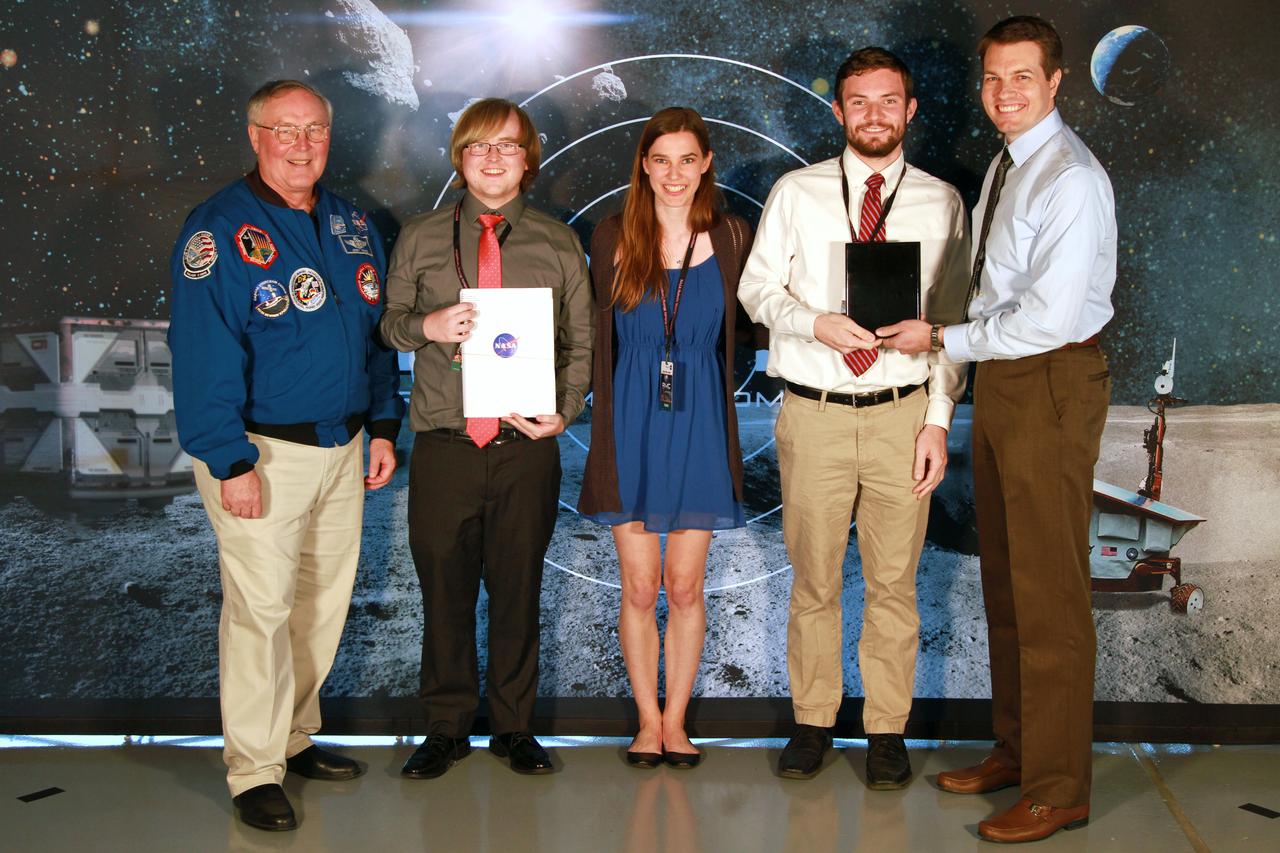
NASA's 9th Annual Robotic Mining Competition concludes with an awards ceremony May 18, 2018, at the Apollo/Saturn V Center at the Kennedy Space Center Visitor Complex in Florida. The University of Alabama Team Astrobotics received third place in the Slide Presentation and Demonstration award category. At left is retired NASA astronaut Jerry Ross. At right is Daniel Hull, lead presentation judge. More than 40 student teams from colleges and universities around the U.S. participated in the competition, May 14-18, by using their mining robots to dig in a supersized sandbox filled with BP-1, or simulated lunar soil, gravel and rocks, and participate in other competition requirements. The Robotic Mining Competition is a NASA Human Exploration and Operations Mission Directorate project designed to encourage students in science, technology, engineering and math, or STEM fields. The project provides a competitive environment to foster innovative ideas and solutions that could be used on NASA's deep space missions.
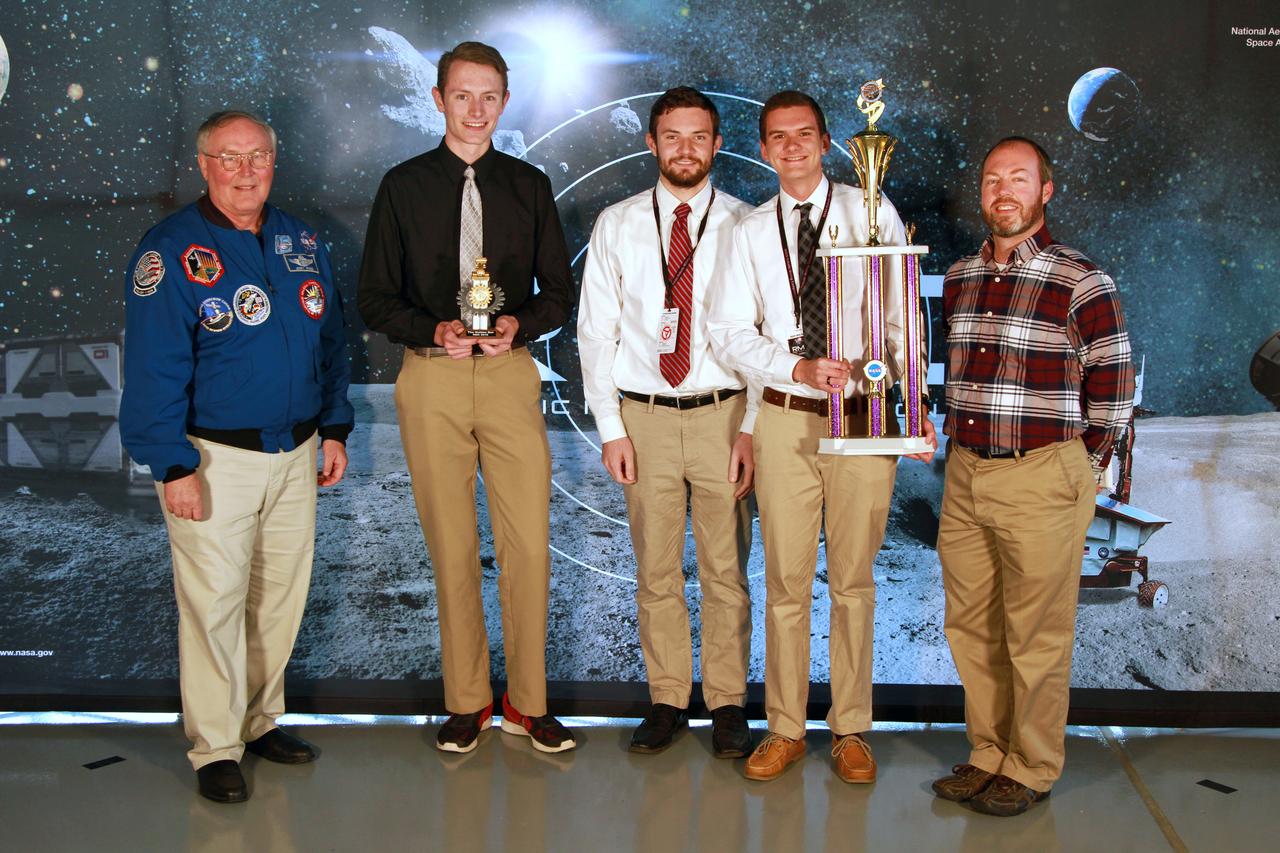
NASA's 9th Annual Robotic Mining Competition concludes with an awards ceremony May 18, 2018, at the Apollo/Saturn V Center at the Kennedy Space Center Visitor Complex in Florida. The University of Alabama Team Astrobotics received the Efficient Use of Communications Power Award. At left is retired NASA astronaut Jerry Ross. At right is Kurt Leucht, a NASA engineer in Swamp Works and event emcee. More than 40 student teams from colleges and universities around the U.S. participated in the competition, May 14-18, by using their mining robots to dig in a supersized sandbox filled with BP-1, or simulated lunar soil, gravel and rocks, and participate in other competition requirements. The Robotic Mining Competition is a NASA Human Exploration and Operations Mission Directorate project designed to encourage students in science, technology, engineering and math, or STEM fields. The project provides a competitive environment to foster innovative ideas and solutions that could be used on NASA's deep space missions.
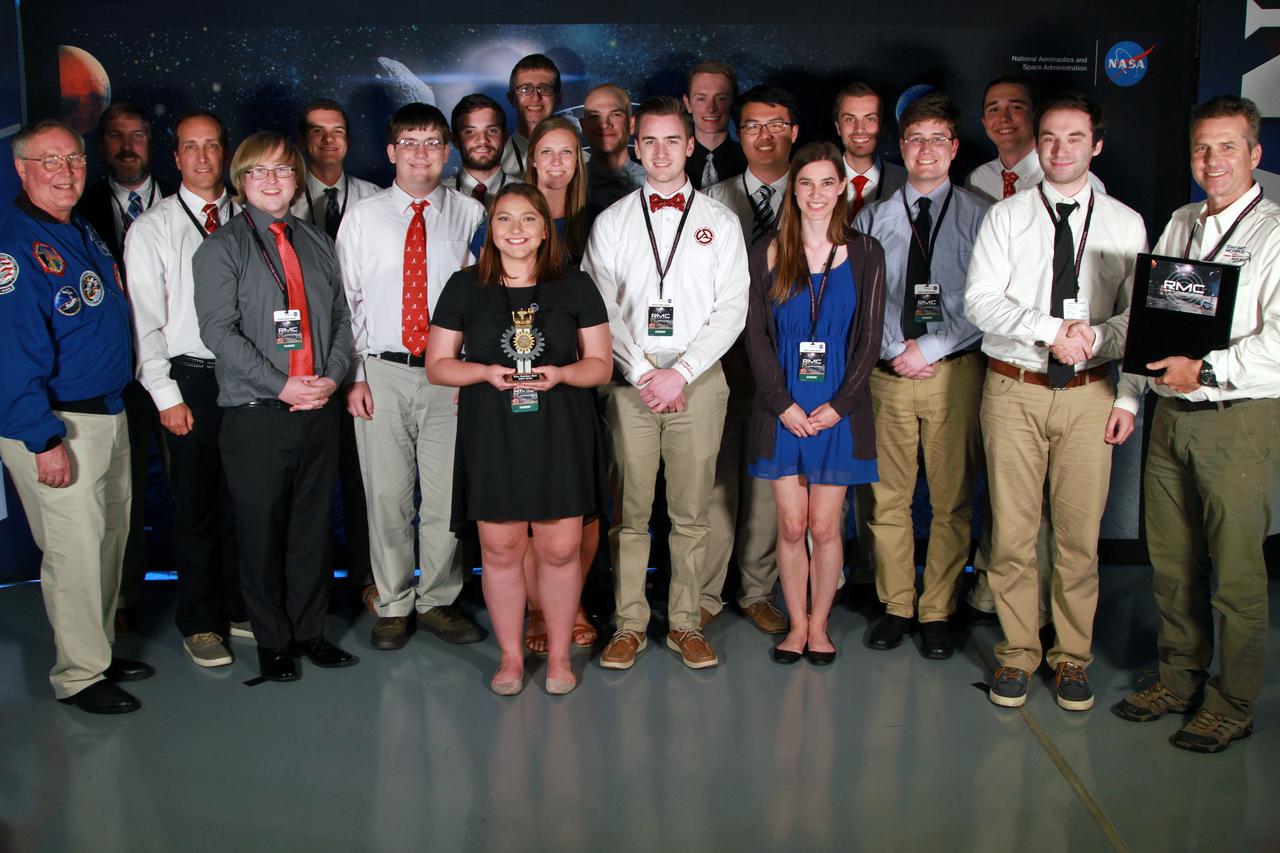
NASA's 9th Annual Robotic Mining Competition concludes with an awards ceremony May 18, 2018, at the Apollo/Saturn V Center at the Kennedy Space Center Visitor Complex in Florida. The University of Alabama Team Astrobotics received first place in the On-Site Mining Award. At left is retired NASA astronaut Jerry Ross. At right is Rob Mueller, lead mining judge. More than 40 student teams from colleges and universities around the U.S. participated in the competition, May 14-18, by using their mining robots to dig in a supersized sandbox filled with BP-1, or simulated lunar soil, gravel and rocks, and participate in other competition requirements. The Robotic Mining Competition is a NASA Human Exploration and Operations Mission Directorate project designed to encourage students in science, technology, engineering and math, or STEM fields. The project provides a competitive environment to foster innovative ideas and solutions that could be used on NASA's deep space missions.
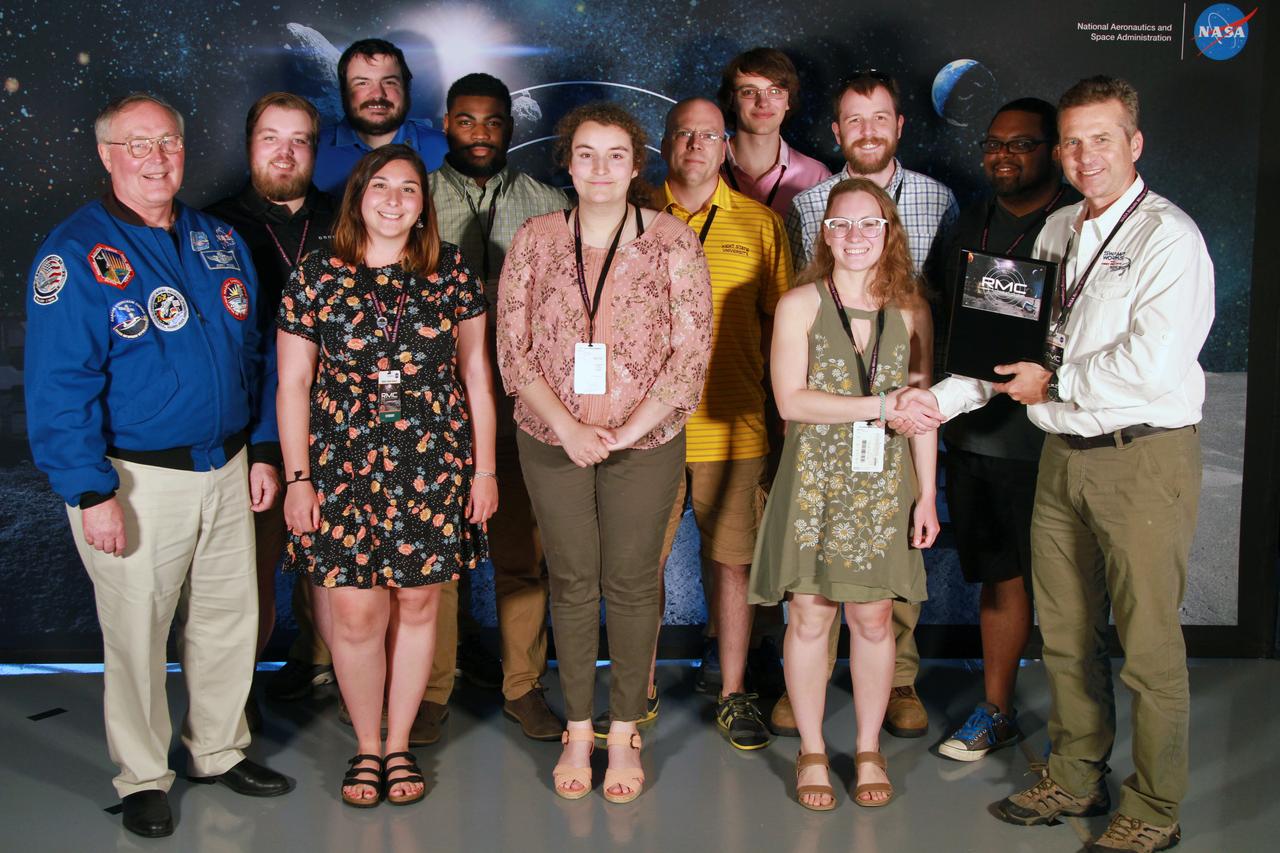
NASA's 9th Annual Robotic Mining Competition concludes with an awards ceremony May 18, 2018, at the Apollo/Saturn V Center at the Kennedy Space Center Visitor Complex in Florida. The team from Kent State University received third place in the On-Site Mining Award. At left is retired NASA astronaut Jerry Ross. At right is Rob Mueller, lead mining judge. More than 40 student teams from colleges and universities around the U.S. participated in the competition, May 14-18, by using their mining robots to dig in a supersized sandbox filled with BP-1, or simulated lunar soil, gravel and rocks, and participate in other competition requirements. The Robotic Mining Competition is a NASA Human Exploration and Operations Mission Directorate project designed to encourage students in science, technology, engineering and math, or STEM fields. The project provides a competitive environment to foster innovative ideas and solutions that could be used on NASA's deep space missions.
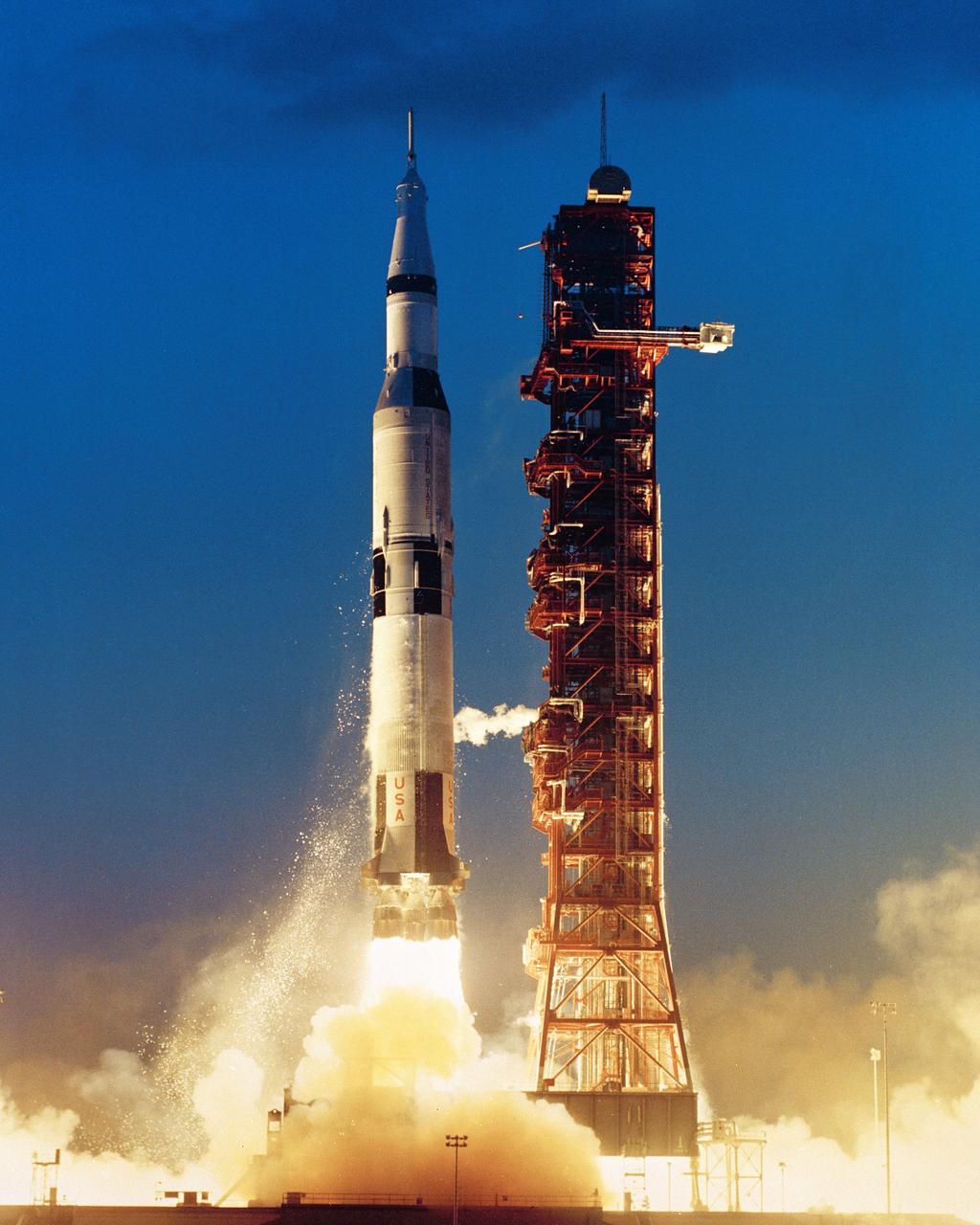
Saturn 501 - Apollo Saturn V liftoff from Complex 39A at 7 a.m. 9 November 1967 at Kennedy Space Center, Florida.
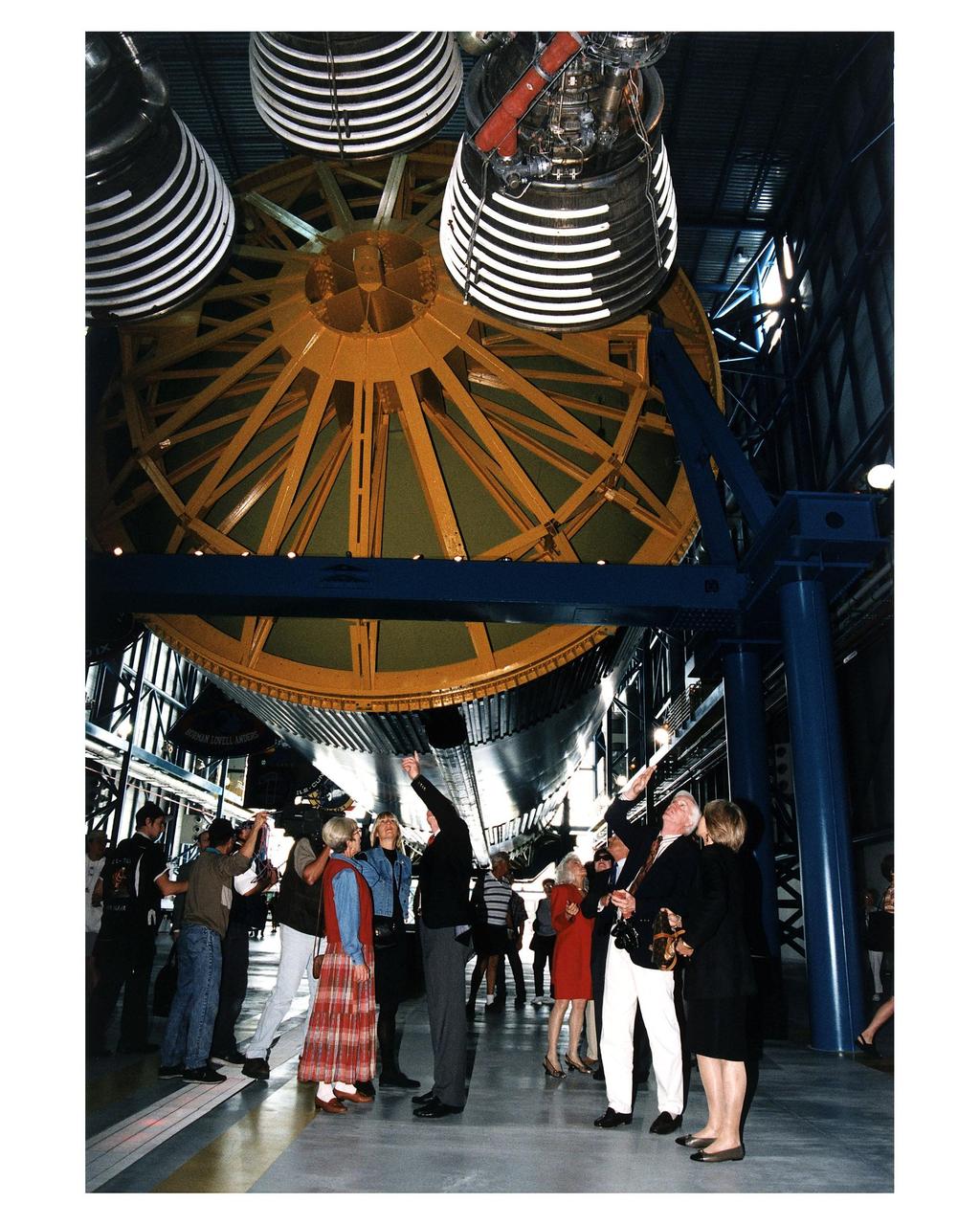
KENNEDY SPACE CENTER, FLA. -- Some of the former Apollo program astronauts tour the new Apollo/Saturn V Center (ASVC) at KSC prior to the gala grand opening ceremony for the facility that was held Jan. 8, 1997. The astronauts were invited to participate in the event, which also featured NASA Administrator Dan Goldin and KSC Director Jay Honeycutt. Apollo 10 Lunar Module Pilot and Apollo 17 Commander Eugene A. Cernan and Apollo 9 Lunar Module Pilot Russell L. Schweickart (second from right), are both pointing at the KSC Apollo/Saturn V rocket inside the building as they talk to other guests on the tour. The ASVC also features several other Apollo program spacecraft components, multimedia presentations and a simulated Apollo/Saturn V liftoff. The facility will be a part of the KSC bus tour that embarks from the KSC Visitor Center
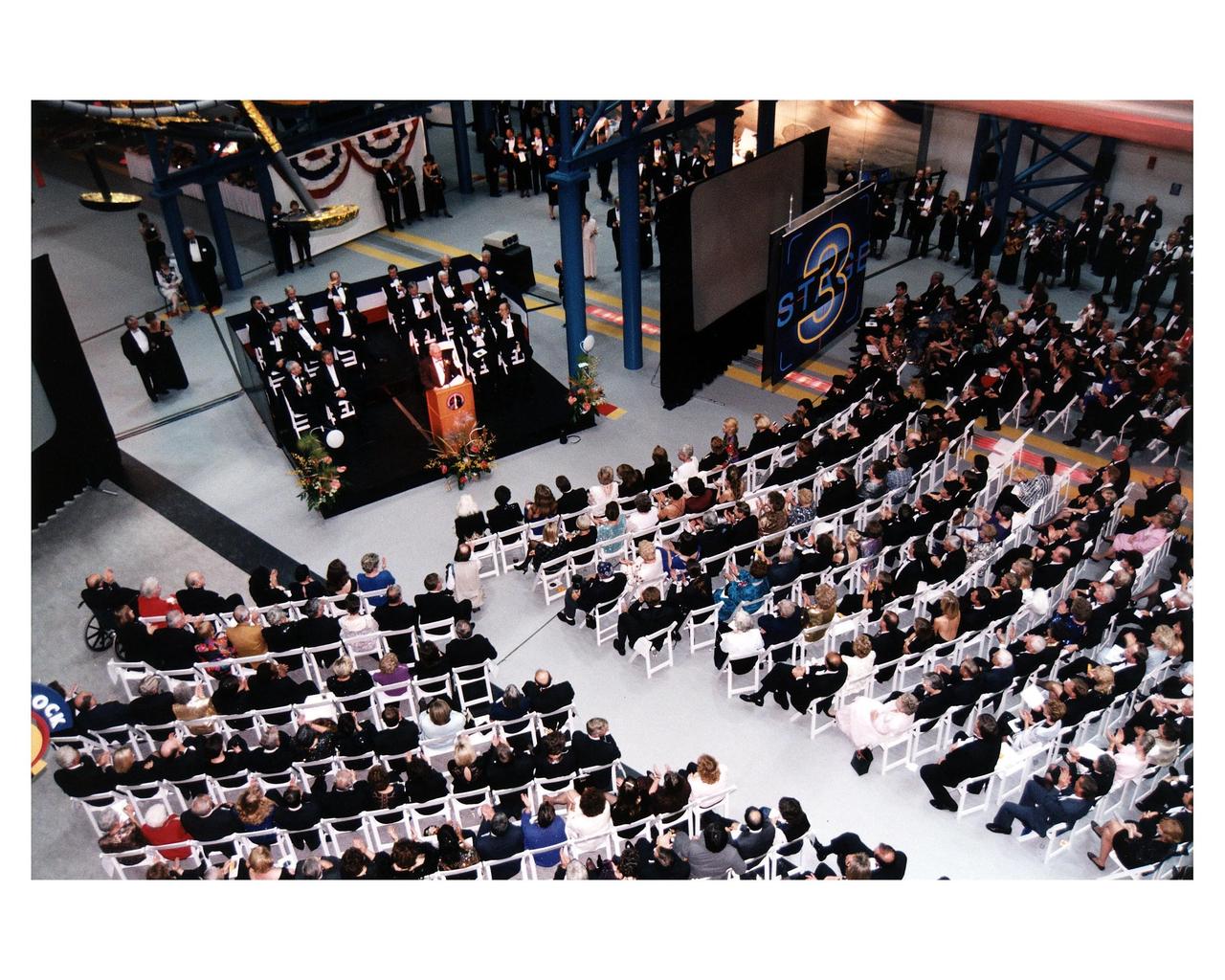
KENNEDY SPACE CENTER, FLA. -- Apollo/Saturn V Center Gala Grand Opening
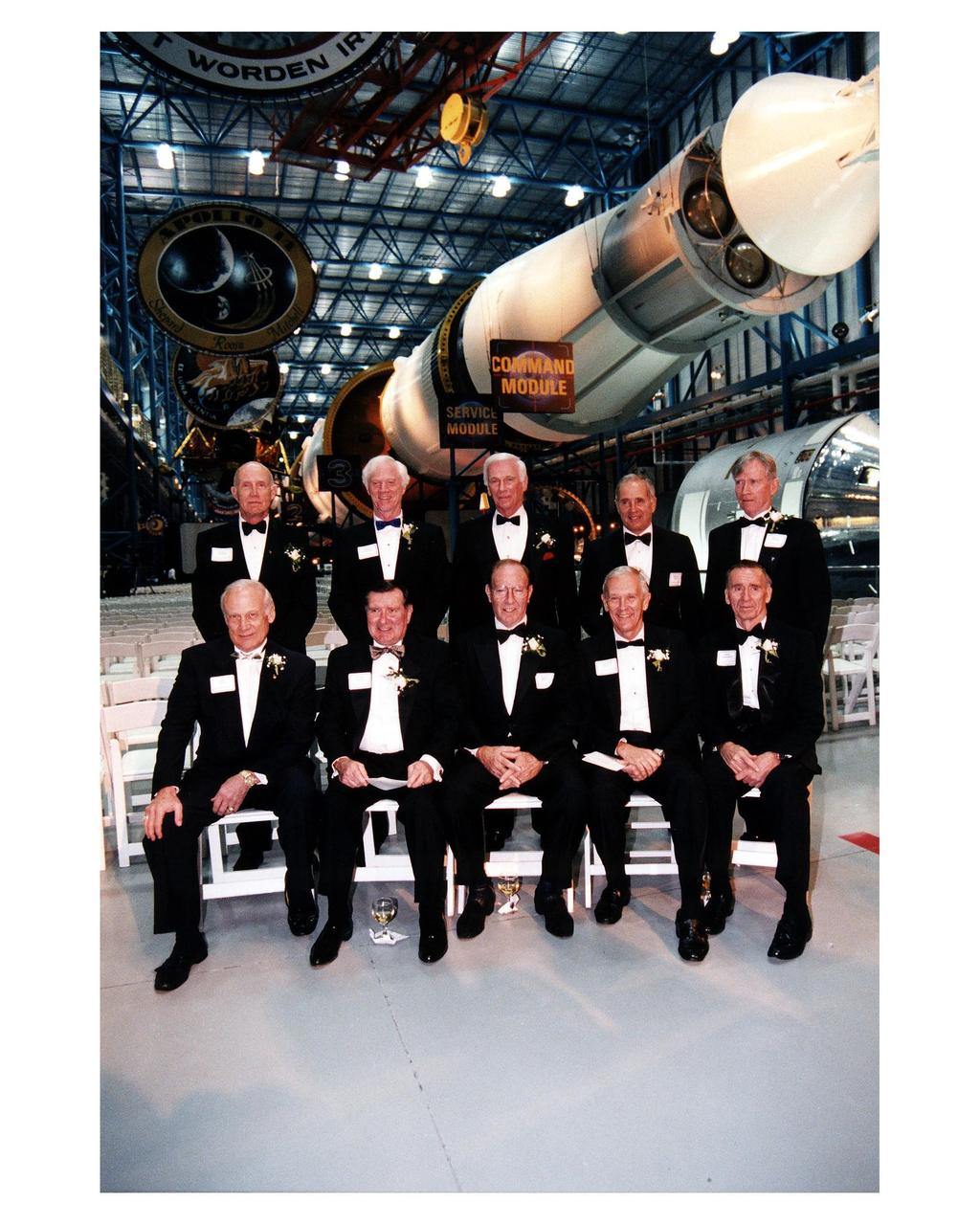
KENNEDY SPACE CENTER, FLA. -- Apollo/Saturn V Center Gala Grand Openin
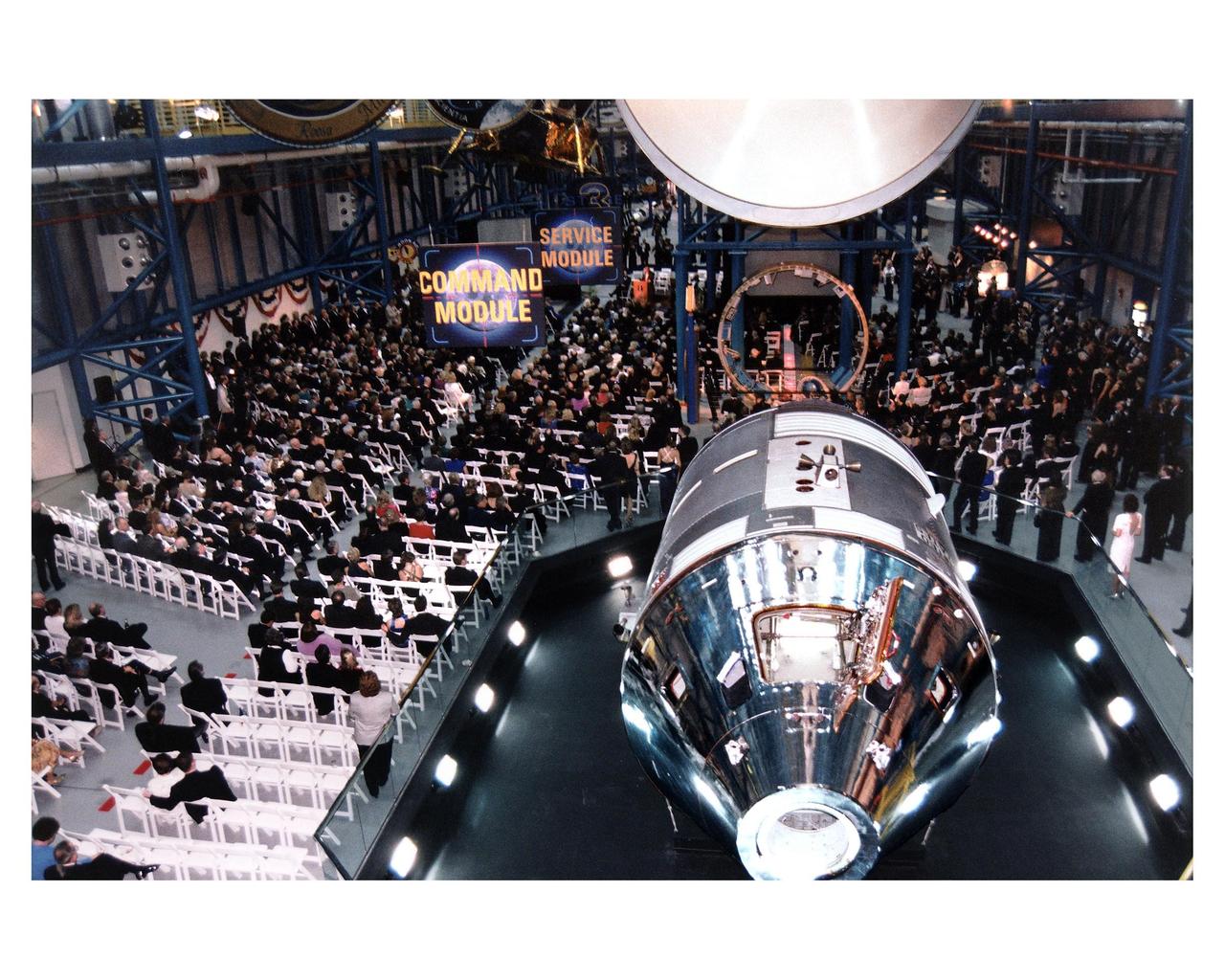
KENNEDY SPACE CENTER, FLA. -- Apollo/Saturn V Center Gala Grand Opening
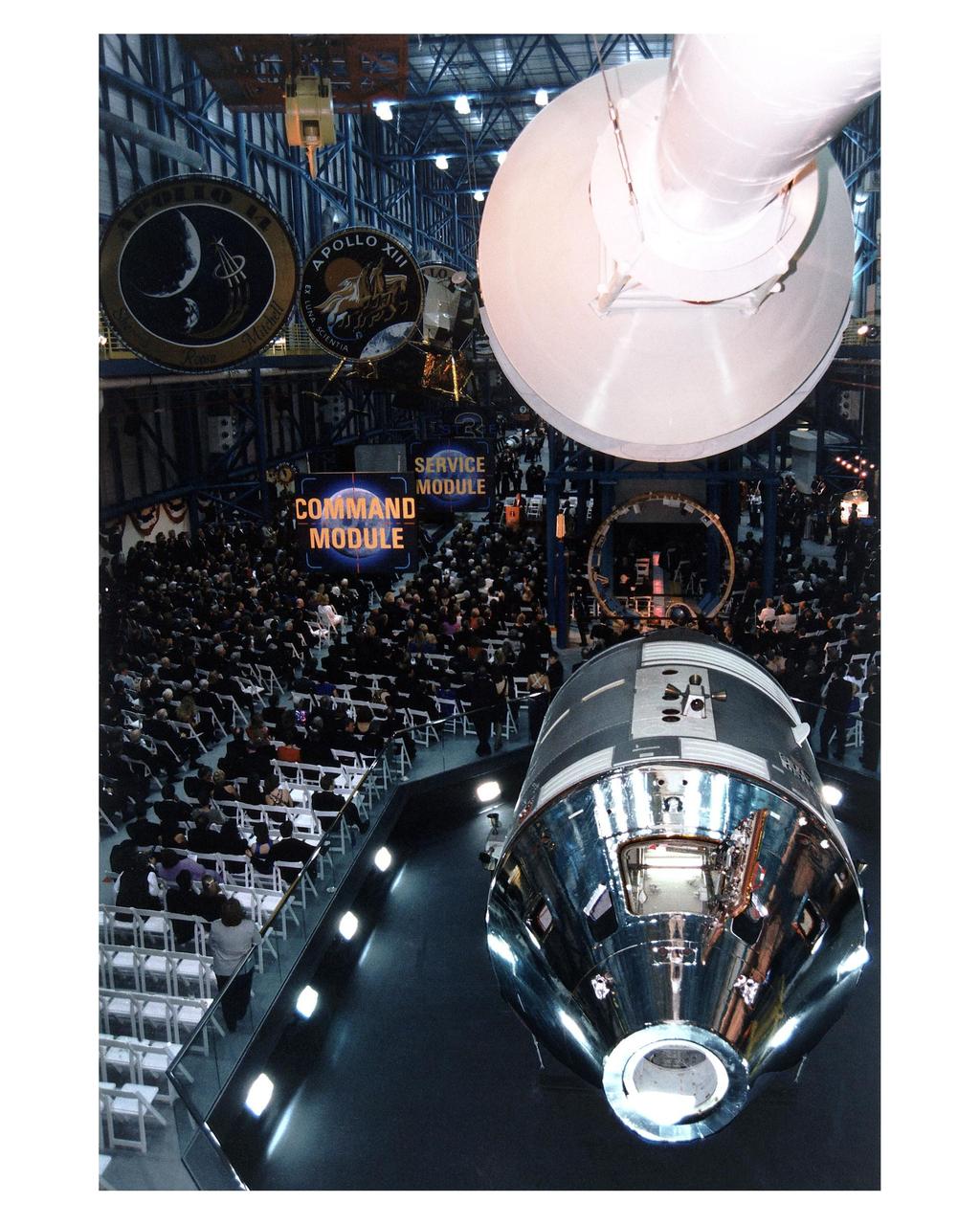
KENNEDY SPACE CENTER, FLA. -- Apollo/Saturn V Center Gala Grand Opening
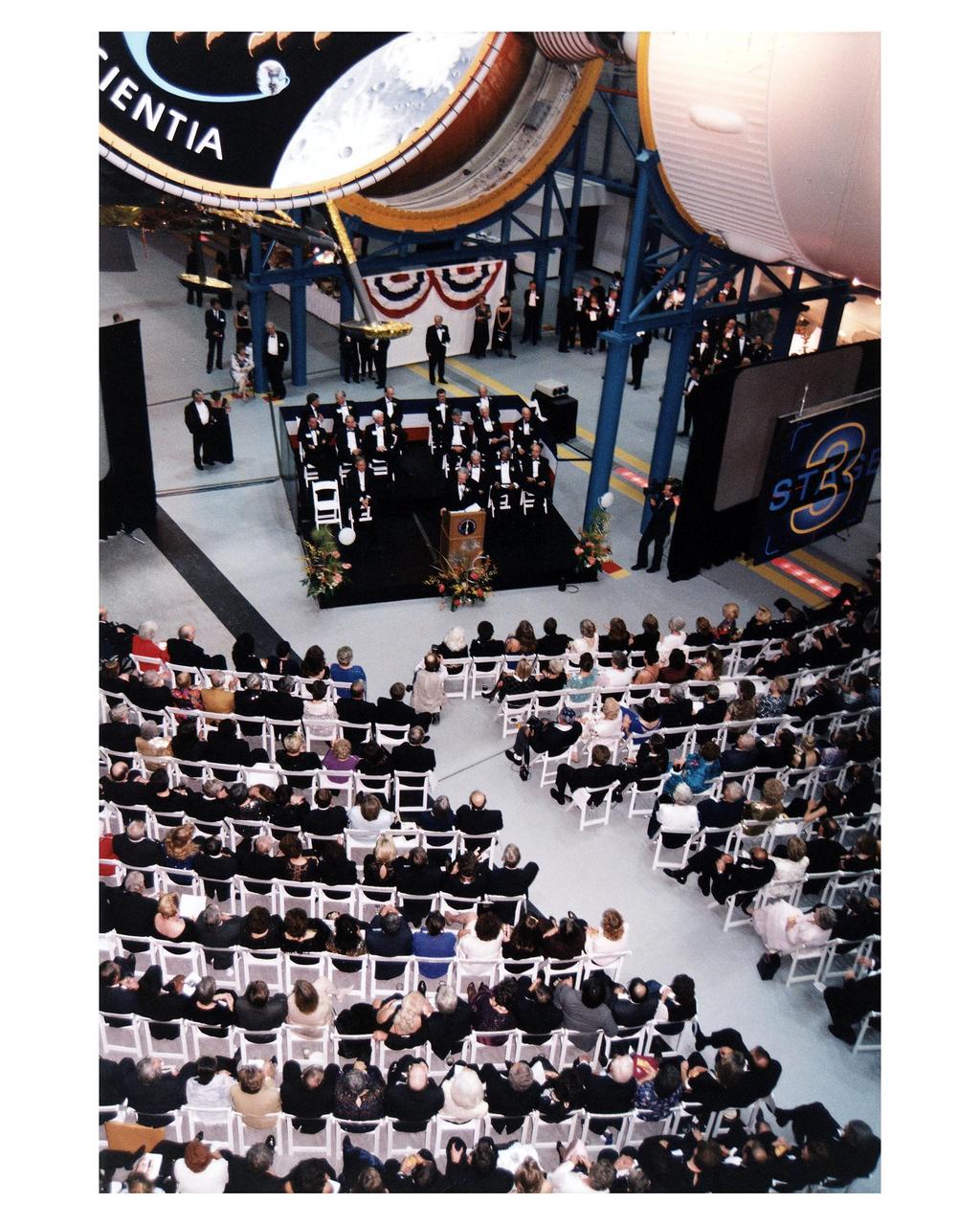
KENNEDY SPACE CENTER, FLA. -- Apollo/Saturn V Center Gala Grand Opening
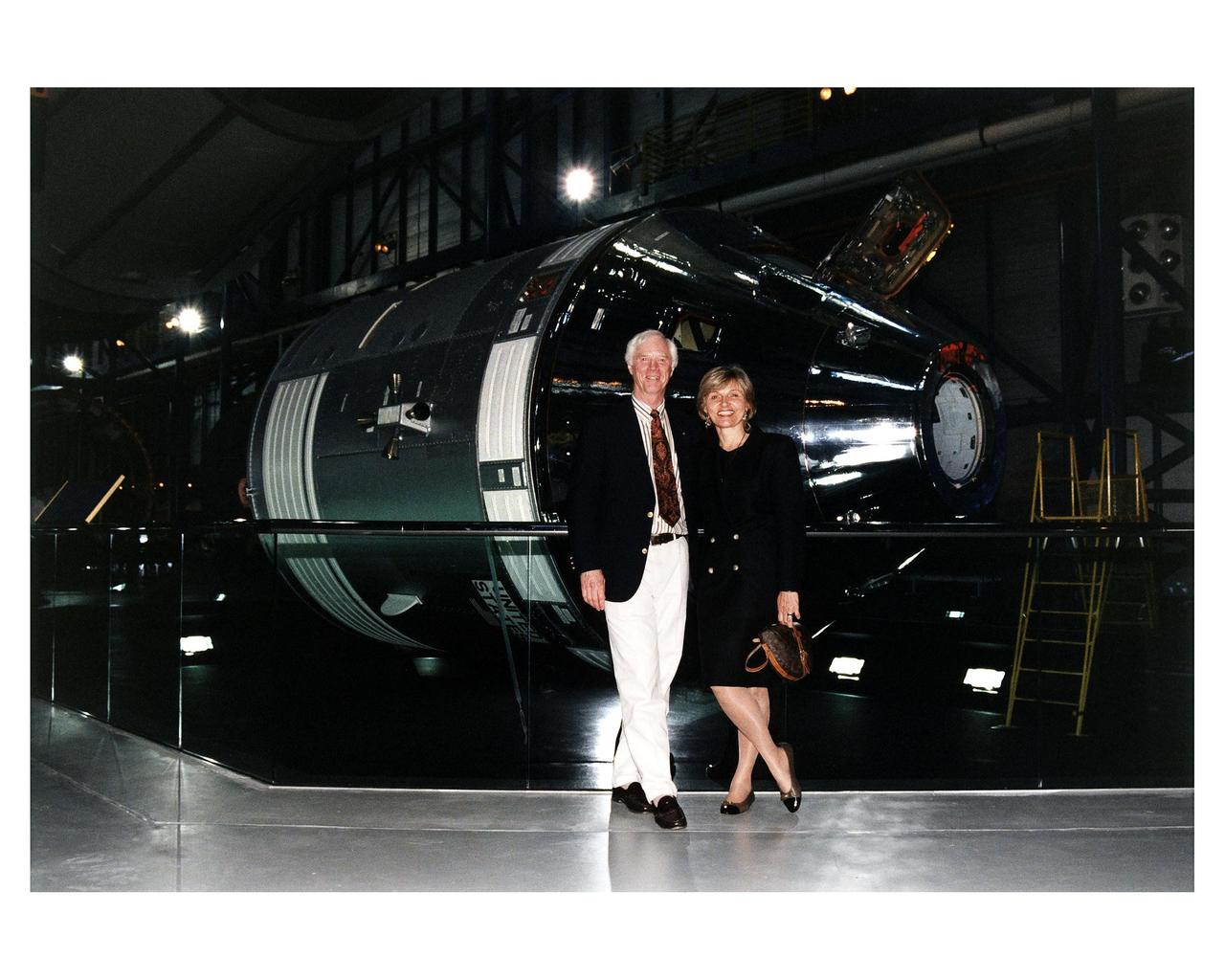
KENNEDY SPACE CENTER, FLA. -- Apollo 9 Lunar Module Pilot Russell L. Schweikart poses in front of an Apollo Command and Service Module in the the new Apollo/Saturn V Center (ASVC) at KSC prior to the gala grand opening ceremony for the facility that was held Jan. 8, 1997. Several Apollo astronauts were invited to participate in the event, which also featured NASA Administrator Dan Goldin and KSC Director Jay Honeycutt. The ASVC also features several other Apollo program spacecraft components, multimedia presentations and a simulated Apollo/Saturn V liftoff. The facility will be a part of the KSC bus tour that embarks from the KSC Visitor Center
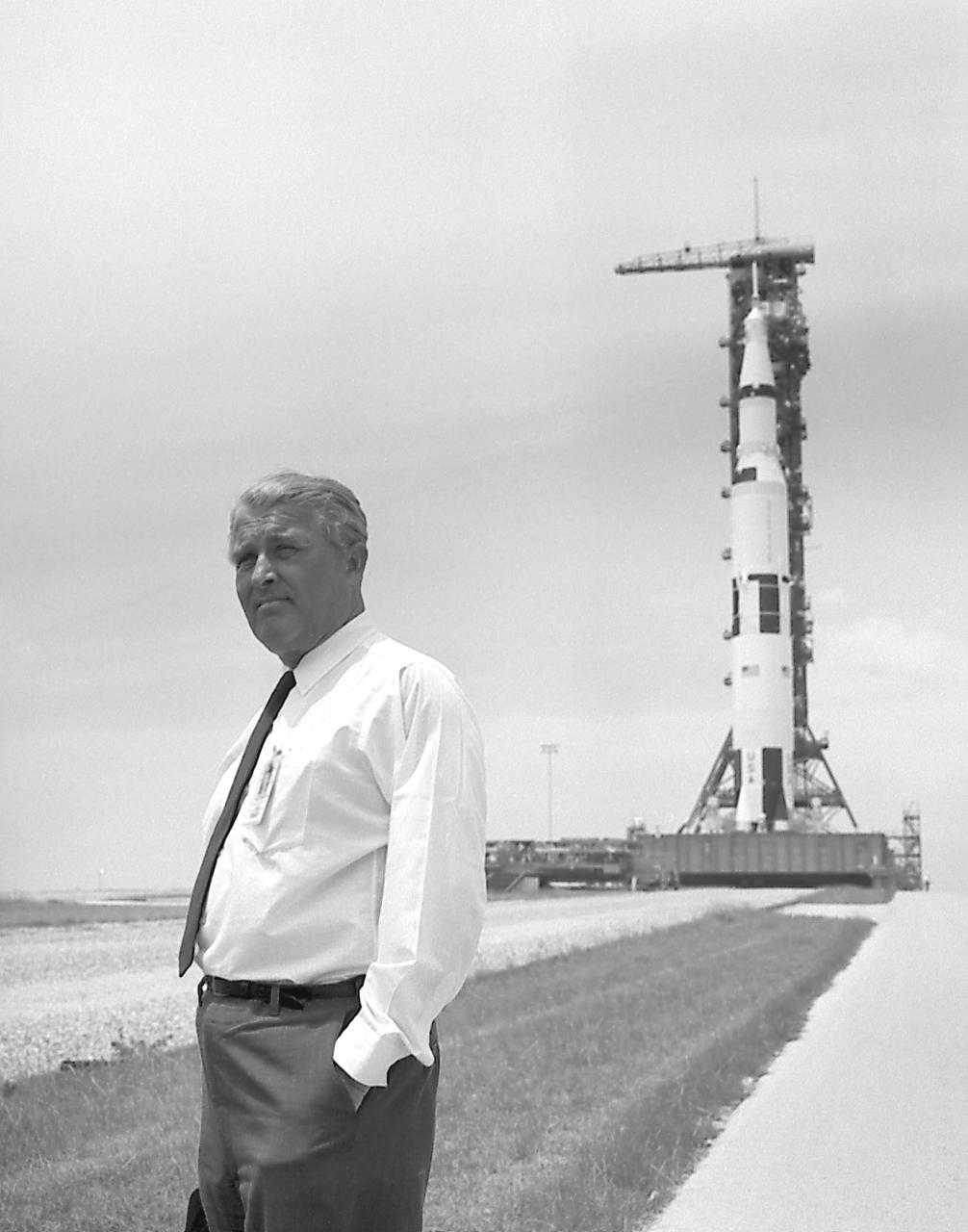
Dr. von Braun pauses in front of the Saturn V vehicle being readied for the historic Apollo 11 lunar landing mission at the Kennedy Space Center (KSC). The Saturn V vehicle was developed by the Marshall Space Flight Center (MSFC) under the direction of Dr. von Braun.
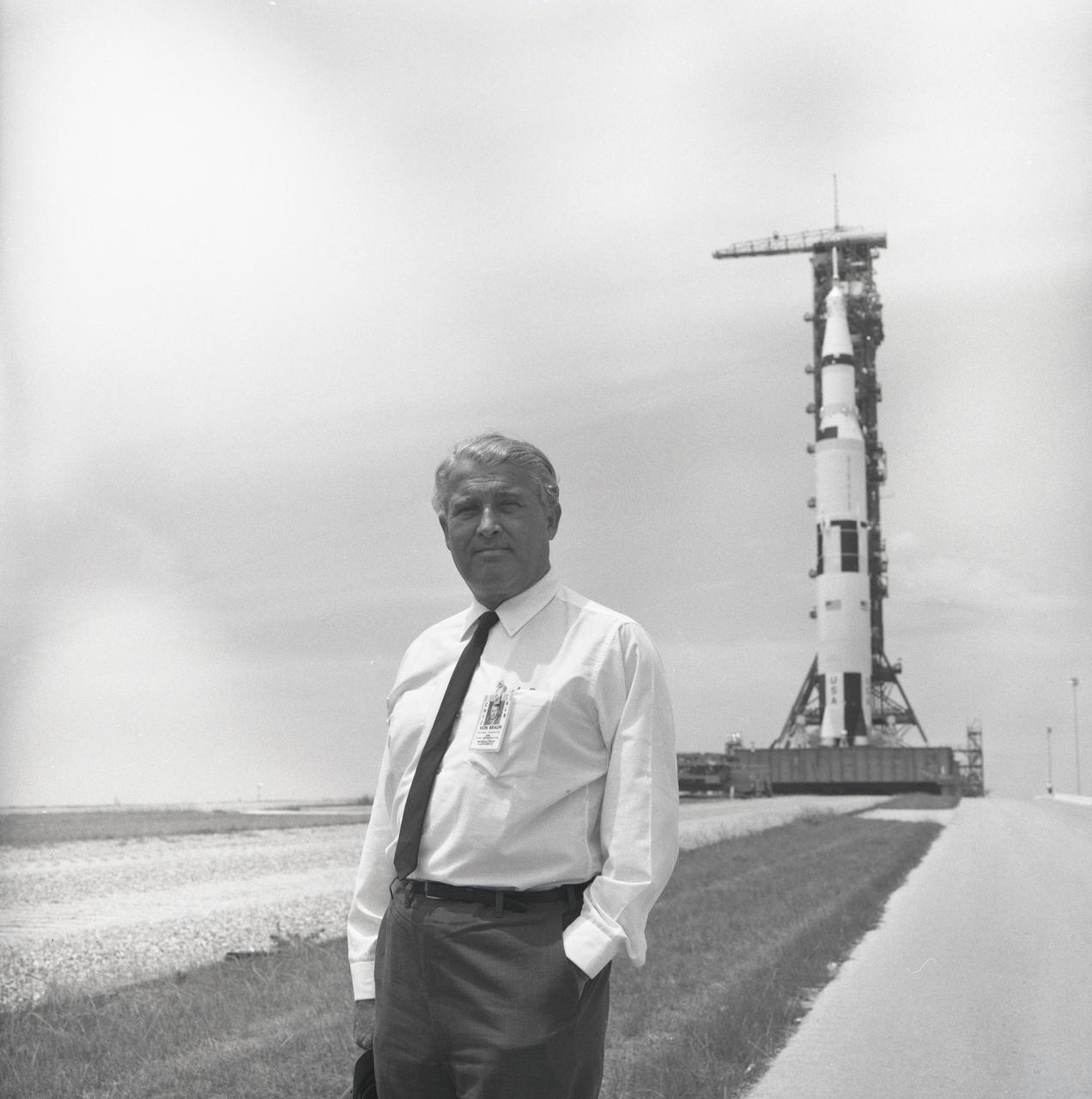
Dr. von Braun pauses in front of the Saturn V vehicle being readied for the historic Apollo 11 lunar landing mission at the Kennedy Space Center (KSC). The Saturn V vehicle was developed by the Marshall Space Flight Center (MSFC) under the direction of Dr. von Braun.
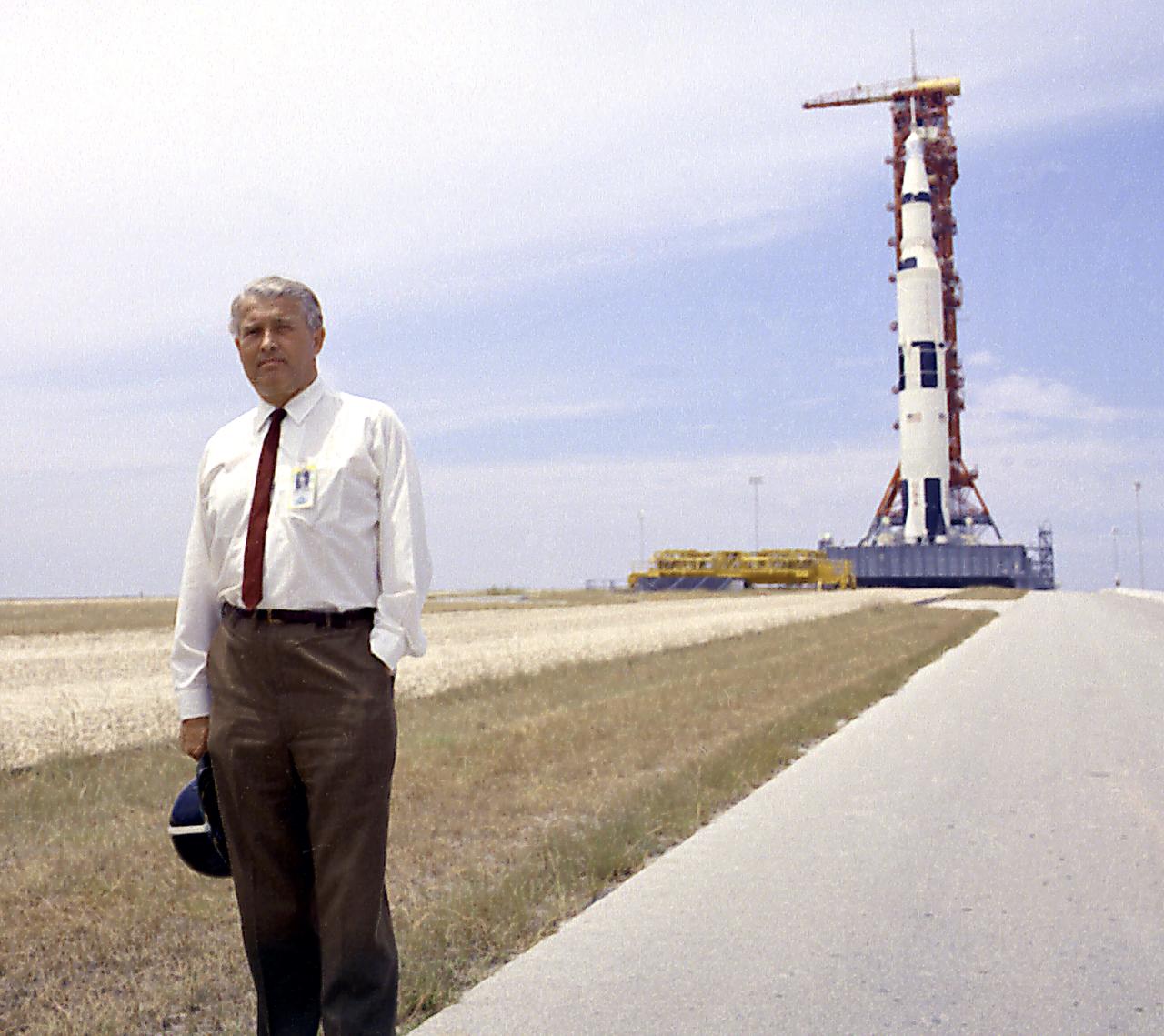
Dr. von Braun pauses in front of the Saturn V vehicle being readied for the historic Apollo 11 lunar landing mission at the Kennedy Space Center (KSC). The Saturn V vehicle was developed by the Marshall Space Flight Center (MSFC) under the direction of Dr. von Braun.
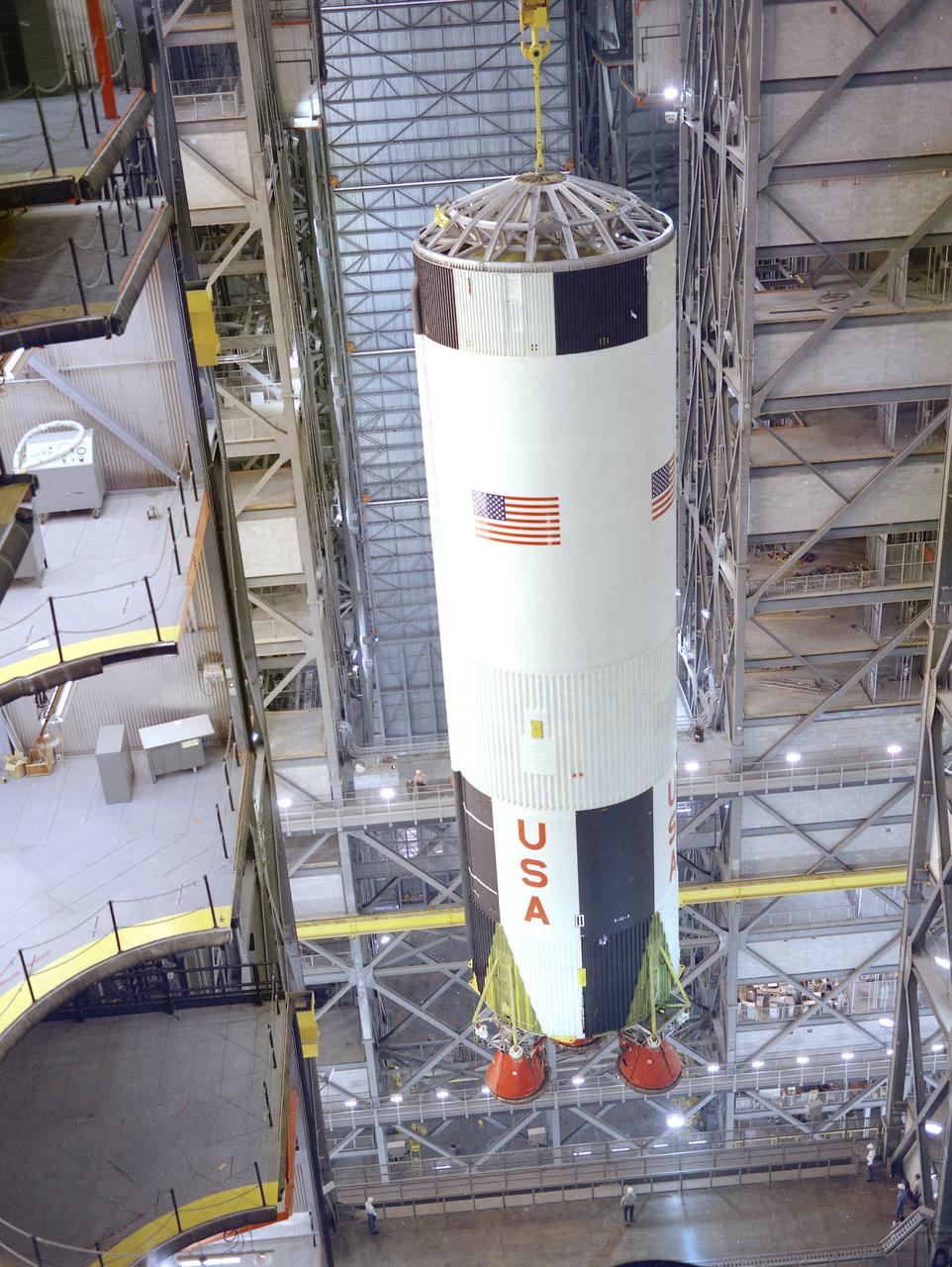
The S-IC stage being erected for the final assembly of the Saturn V launch vehicle for the Apollo 8 mission (AS-503), is photographed in the Vehicle Assembly Building (VAB) high bay at the Kennedy Space Center. The Apollo 8 mission was the first Saturn V manned mission with astronauts Frank Borman, James A. Lovell, and William Anders. They escaped Earth's gravity and traveled to lunar vicinity. The launch of Apollo 8 occurred on December 21, 1968.
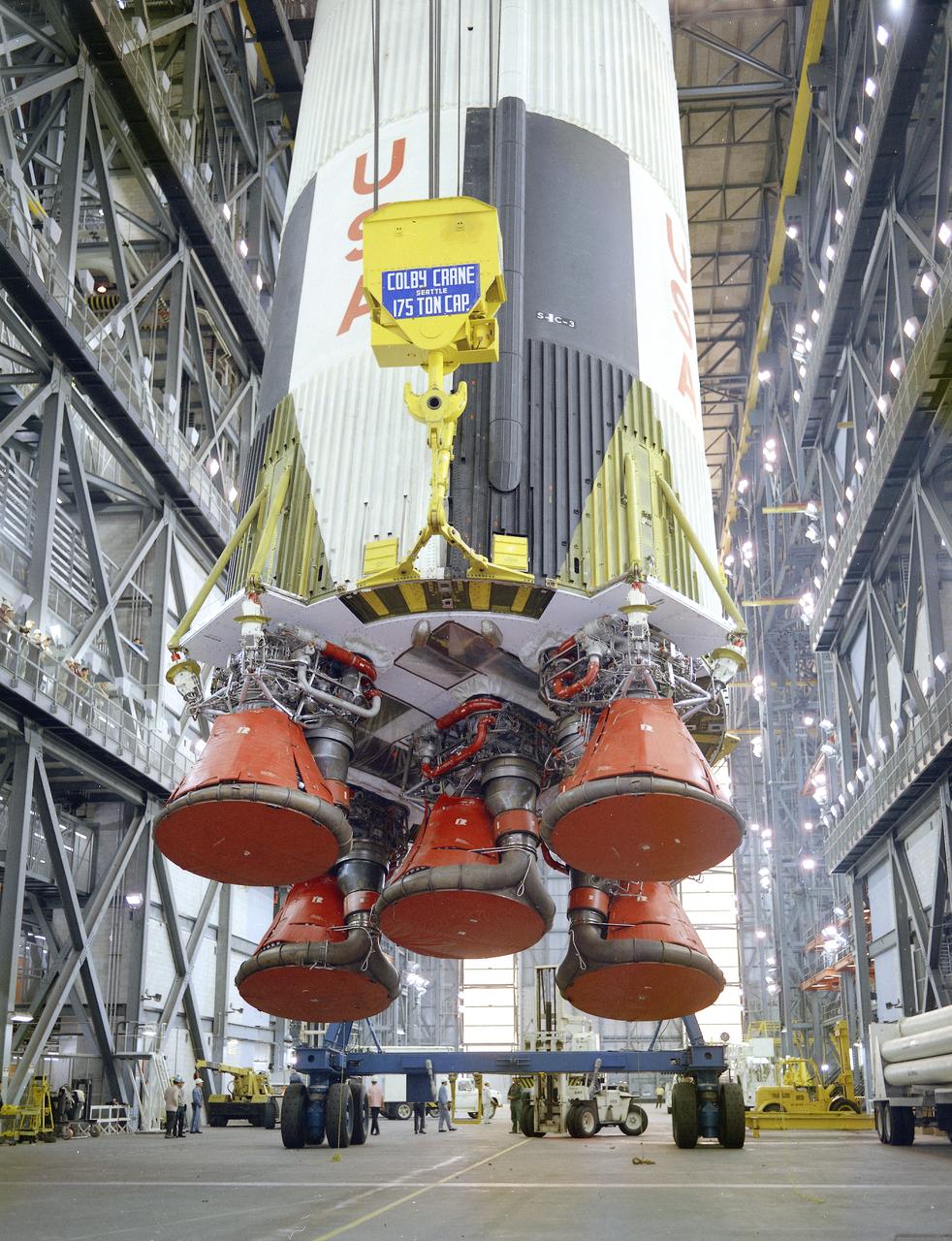
The S-IC stage being erected for the final assembly of the Saturn V launch vehicle for the Apollo 8 mission (AS-503), is photographed in the Vehicle Assembly Building (VAB) high bay at the Kennedy Space Center. The Apollo 8 mission was the first Saturn V manned mission with astronauts Frank Borman, James A. Lovell, and William Anders. They escaped Earth's gravity and traveled to lunar vicinity. The launch of Apollo 8 occurred on December 21, 1968.
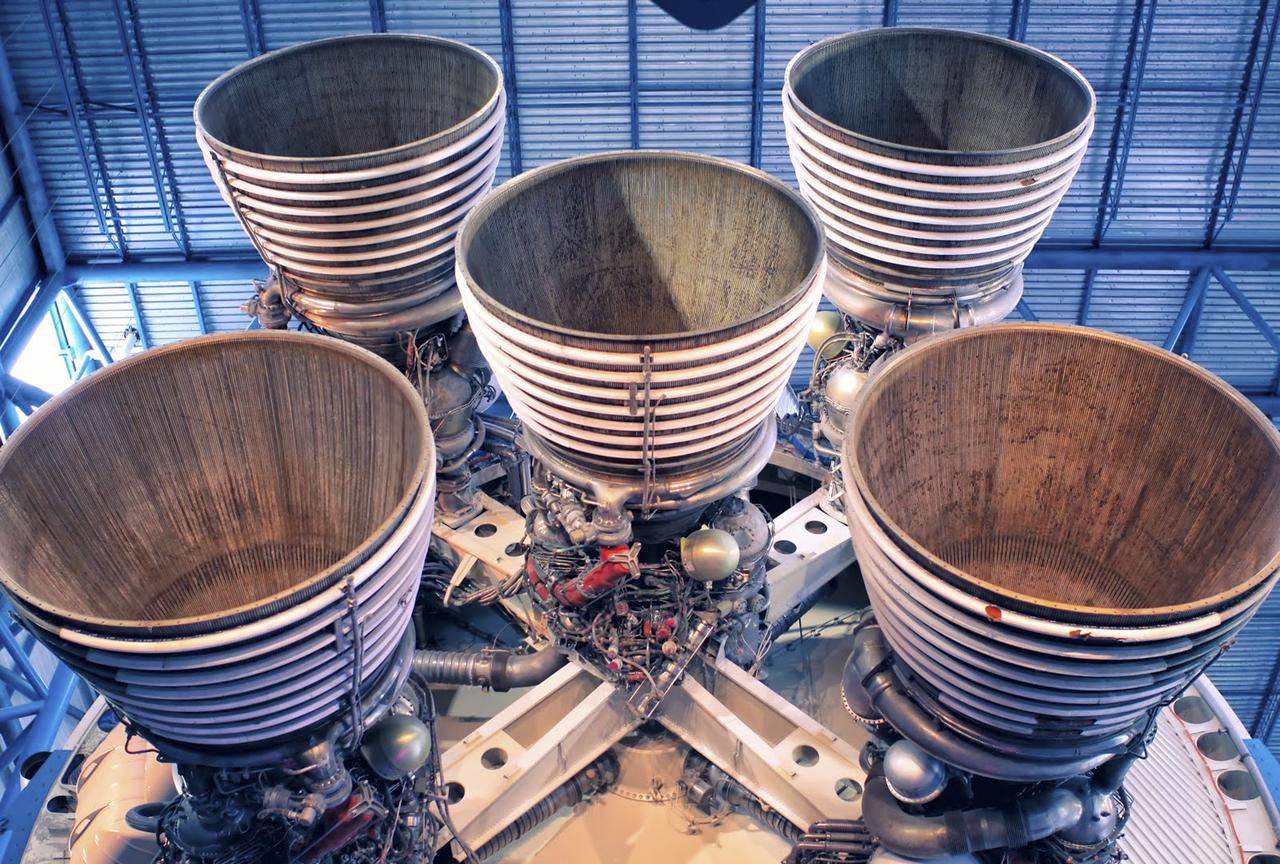
CAPE CANAVERAL, Fla. – As seen on Google Maps, the massive F-1 engines of the Saturn V's first stage on display inside the Apollo/Saturn V Center at the Kennedy Space Center Visitor Complex. Each engine stands 19 feet tall with a diameter of more than 12 feet. The five engines on the first stage produced 7.5 million pounds of thrust at liftoff. The Saturn V was used to launch NASA's Apollo missions to the moon which saw 12 astronauts land and work on the lunar surface. Google precisely mapped Kennedy Space Center and some of its historical facilities for the company's map page. Photo credit: Google/Wendy Wang
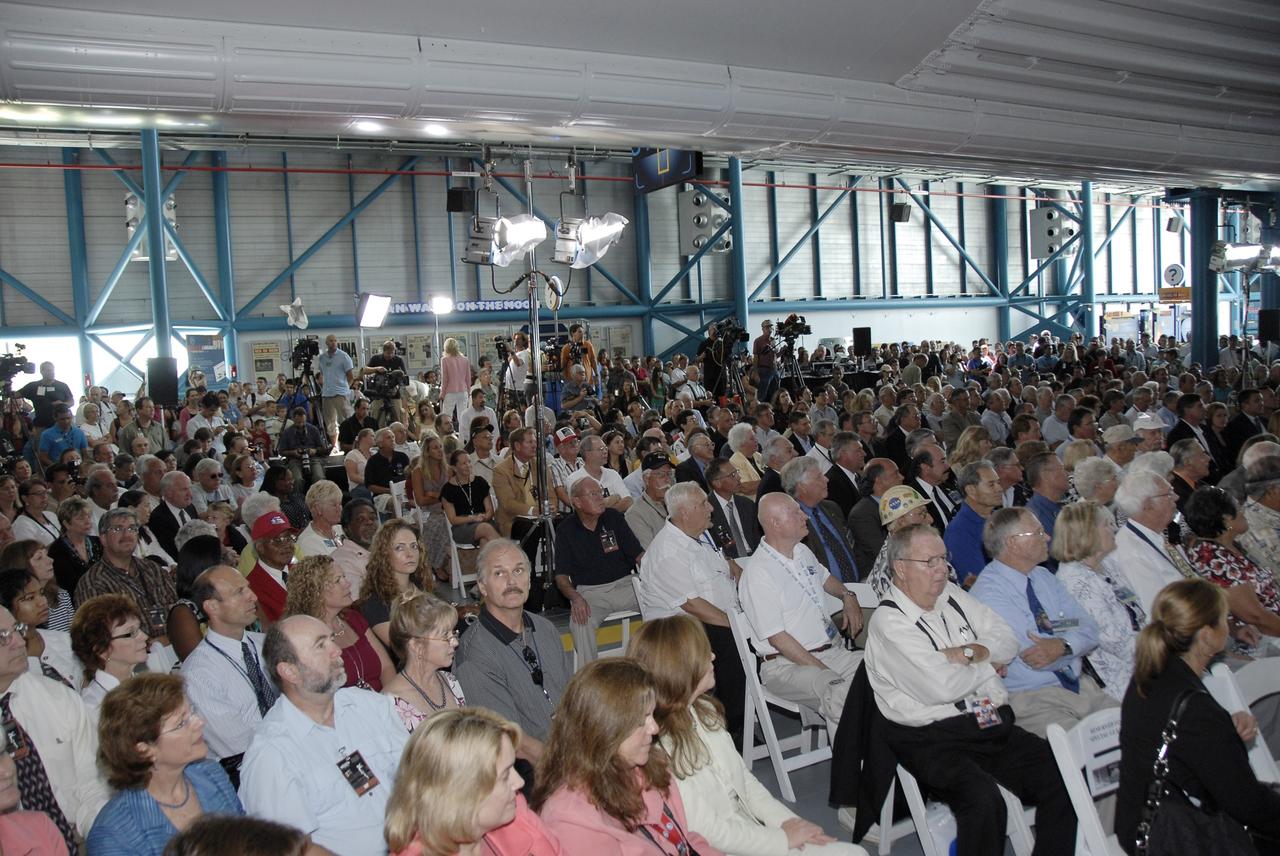
CAPE CANAVERAL, Fla. – The Apollo/Saturn V Center at NASA's Kennedy Space Center in Florida is filled with guests gathered to hear about the Apollo 11 launch and landing in July 1969 from eight Apollo astronauts. The event is part of NASA's 40th Anniversary of Apollo Celebration. Photo credit: NASA/Kim Shiflett
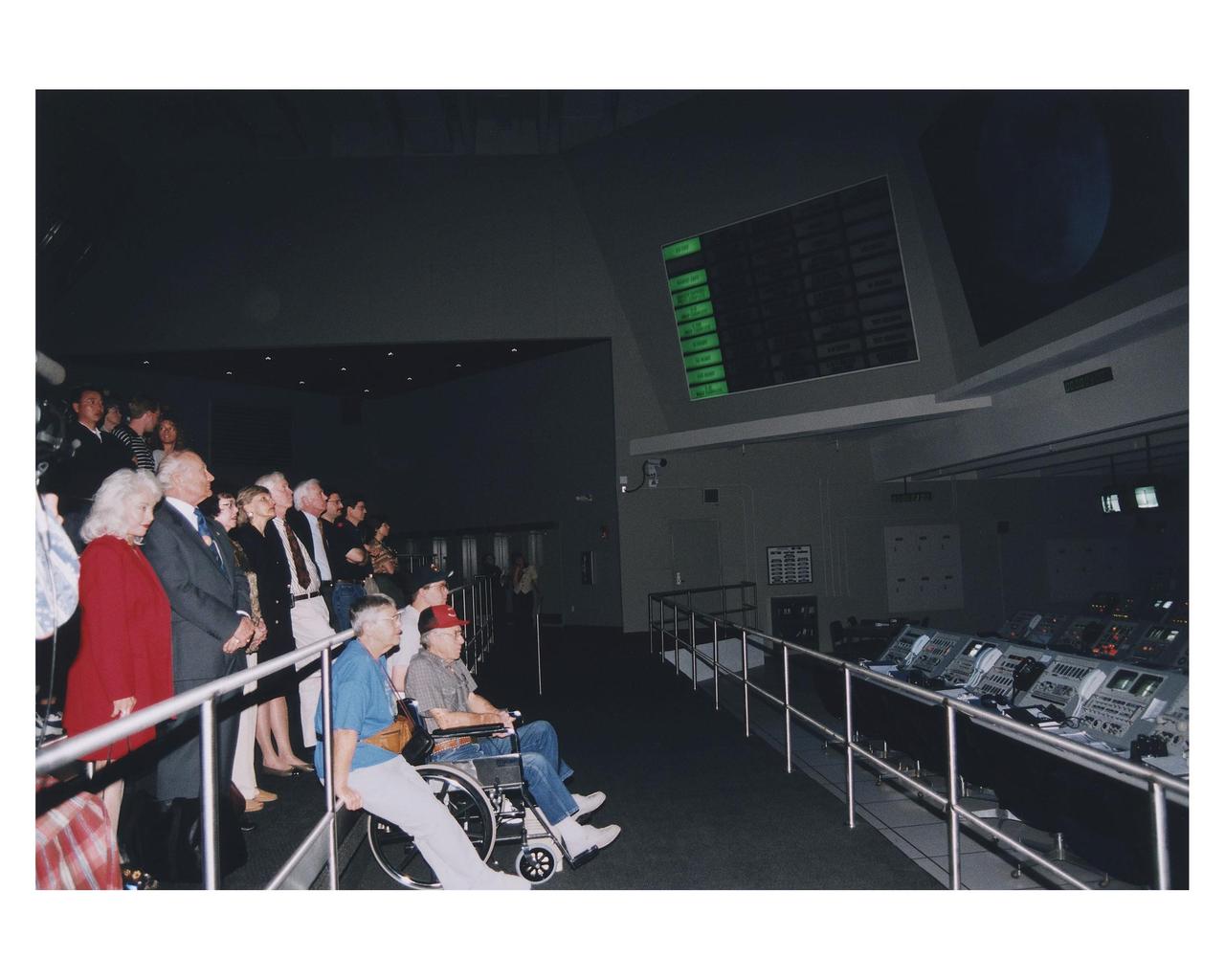
KENNEDY SPACE CENTER, FLA. -- Several Apollo program astronauts, along with their family members and friends, watch a simulation of an Apollo/Saturn V launch in a replica of a Launch Control Center firing room in the new Apollo/Saturn V Center (ASVC) at KSC prior to the gala grand opening ceremony for the facility that was held Jan. 8, 1997. The astronauts were invited to participate in the event, which also featured NASA Administrator Dan Goldin and KSC Director Jay Honeycutt. The ASVC also features several other Apollo program spacecraft component displays and multimedia presentations. The facility will be a part of the KSC bus tour that embarks from the KSC Visitor Center

KENNEDY SPACE CENTER, FLA. -- Several Apollo program astronauts, along with their family members and friends, watch a simulation of an Apollo/Saturn V launch in a replica of a Launch Control Center firing room in the new Apollo/Saturn V Center (ASVC) at KSC prior to the gala grand opening ceremony for the facility that was held Jan. 8, 1997. The astronauts were invited to participate in the event, which also featured NASA Administrator Dan Goldin and KSC Director Jay Honeycutt. The ASVC also features several other Apollo program spacecraft component displays and multimedia presentations. The facility will be a part of the KSC bus tour that embarks from the KSC Visitor Center
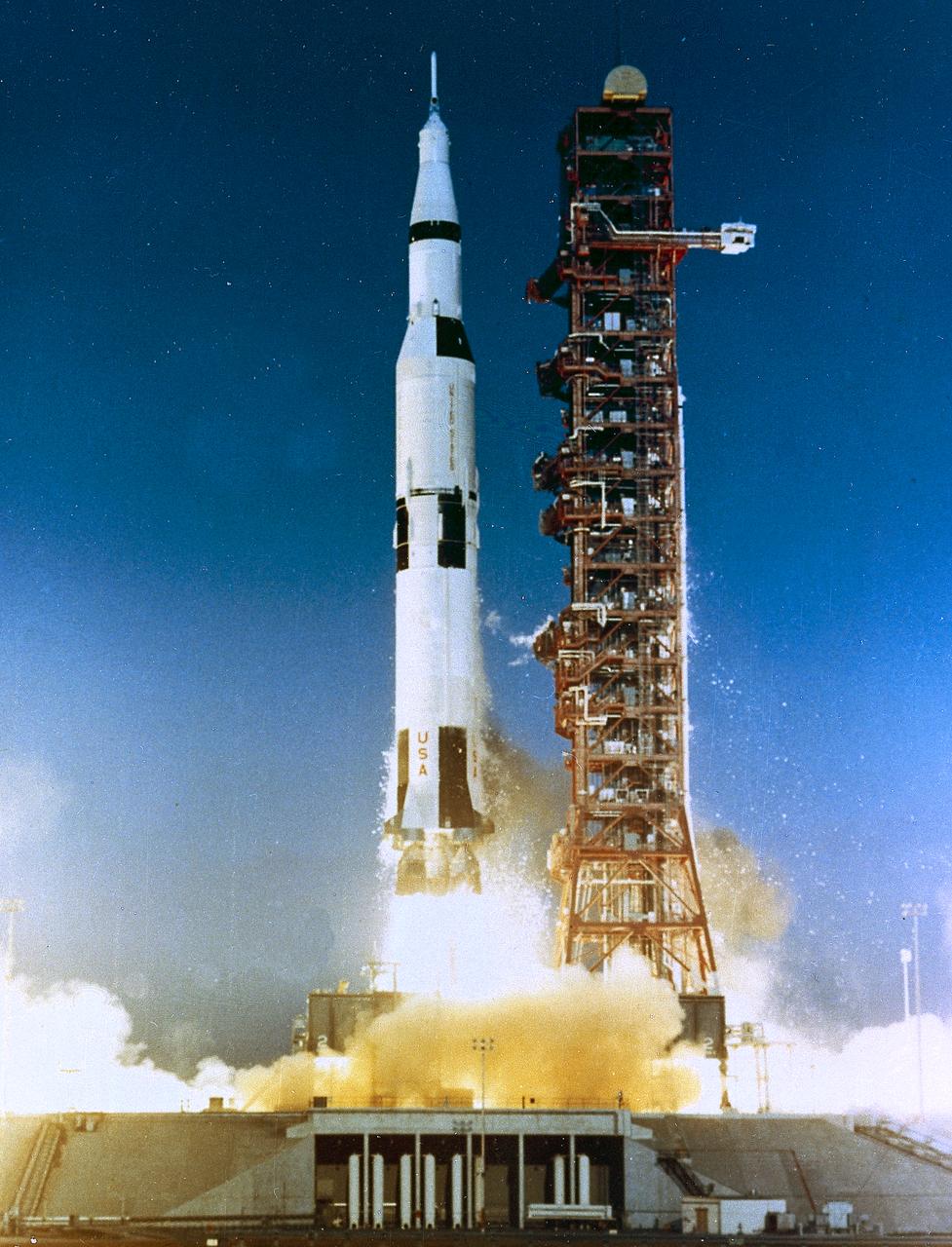
The second Saturn V launch vehicle (SA-502) for the Apollo 6 mission lifted off from the Kennedy Space Center launch complex on April 4, 1968. This unmanned Saturn V launch vehicle tested the emergency detection system in closed loop configuration.

KENNEDY SPACE CENTER, FLA. -- Several Apollo program astronauts, along with their family members and friends, pause before a painting of an Apollo/Saturn V launch vehicle at the pad in the new Apollo/Saturn V Center (ASVC) at KSC prior to the gala grand opening ceremony for the facility that was held Jan. 8, 1997. The astronauts were invited to participate in the event, which also featured NASA Administrator Dan Goldin and KSC Director Jay Honeycutt. The ASVC also features several other Apollo program spacecraft component displays and multimedia presentations. The facility will be a part of the KSC bus tour that embarks from the KSC Visitor Center
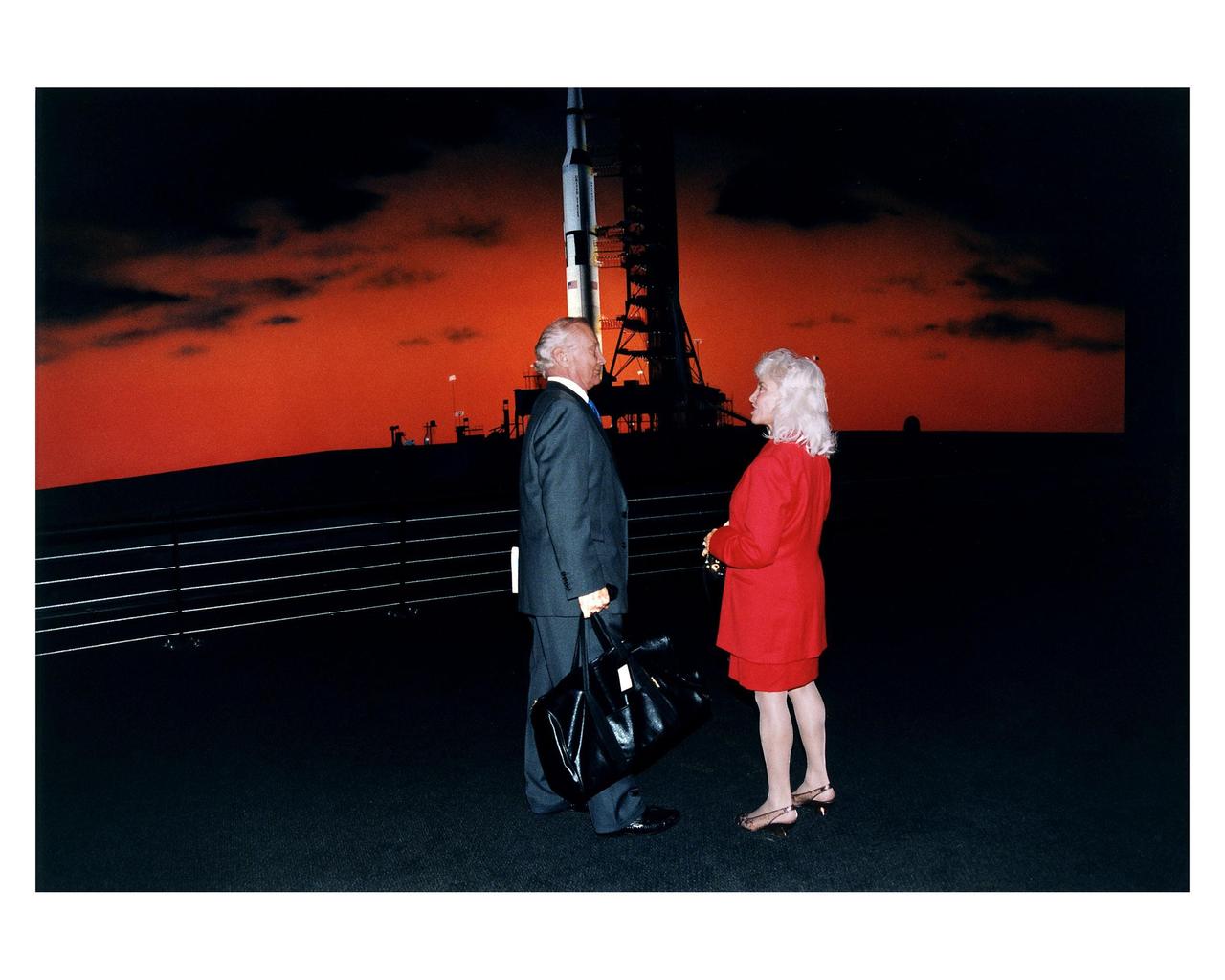
KENNEDY SPACE CENTER, FLA. -- Apollo 11 Lunar Module Pilot Edwin E. "Buzz" Aldrin, Jr. and his wife, Lois, stand before a painting of an Apollo/Saturn V launch vehicle at the pad in the new Apollo/Saturn V Center (ASVC) at KSC prior to the gala grand opening ceremony for the facility that was held Jan. 8, 1997. The astronauts were invited to participate in the event, which also featured NASA Administrator Dan Goldin and KSC Director Jay Honeycutt. The ASVC also features several other Apollo program spacecraft component displays and multimedia presentations. The facility will be a part of the KSC bus tour that embarks from the KSC Visitor Center
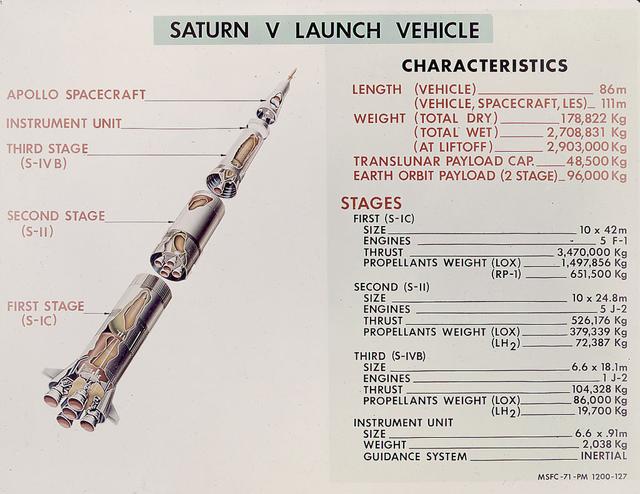
This is a good cutaway diagram of the Saturn V launch vehicle showing the three stages, the instrument unit, and the Apollo spacecraft. The chart on the right presents the basic technical data in clear metric detail. The Saturn V is the largest and most powerful launch vehicle in the United States. The towering, 111 meter, Saturn V was a multistage, multiengine launch vehicle standing taller than the Statue of Liberty. Altogether, the Saturn V engines produced as much power as 85 Hoover Dams. Development of the Saturn V was the responsibility of the Marshall Space Flight Center at Huntsville, Alabama, directed by Dr. Wernher von Braun.
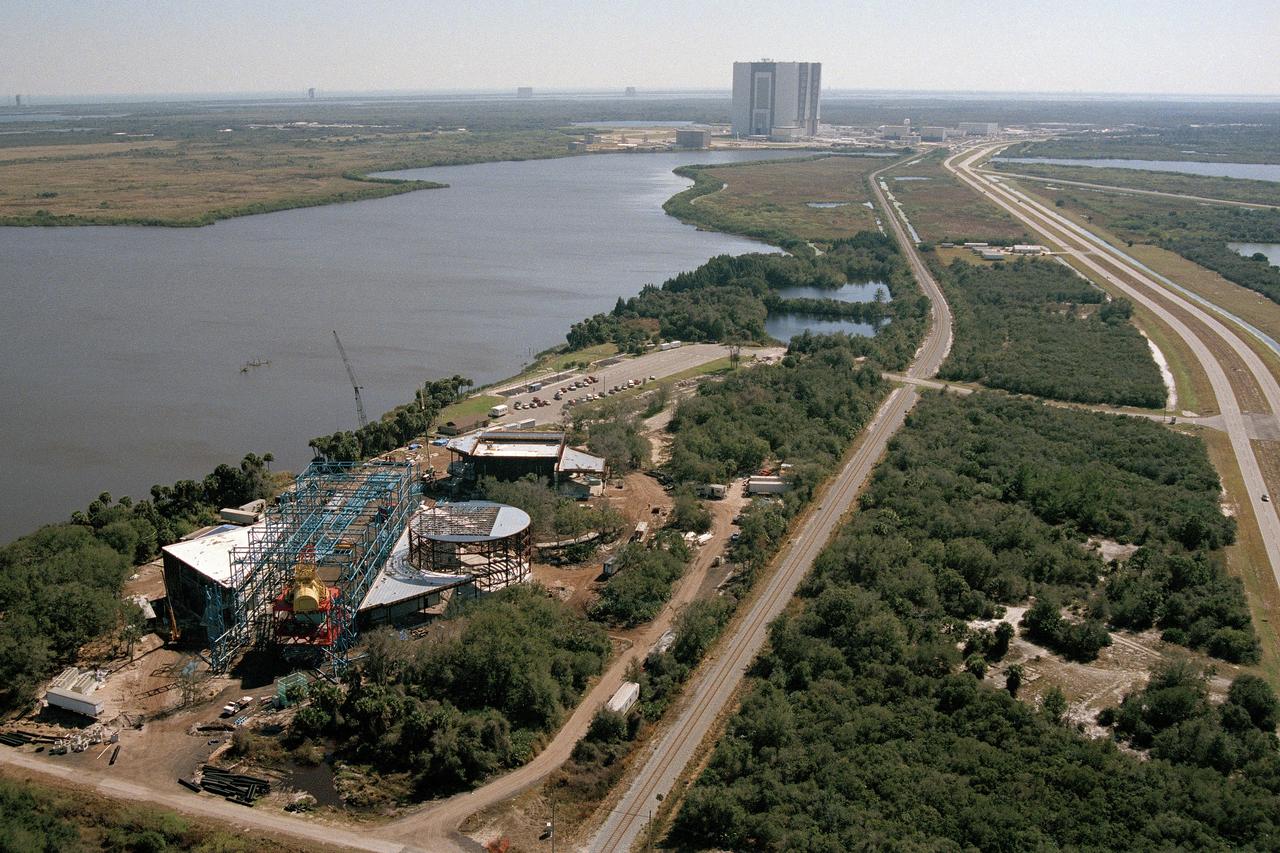
CAPE CANAVERAL, Fla. -- At NASA's Kennedy Space Center in Florida, construction continues on the facility that will house an Apollo era Saturn V rocket. Photo Credit: NASA
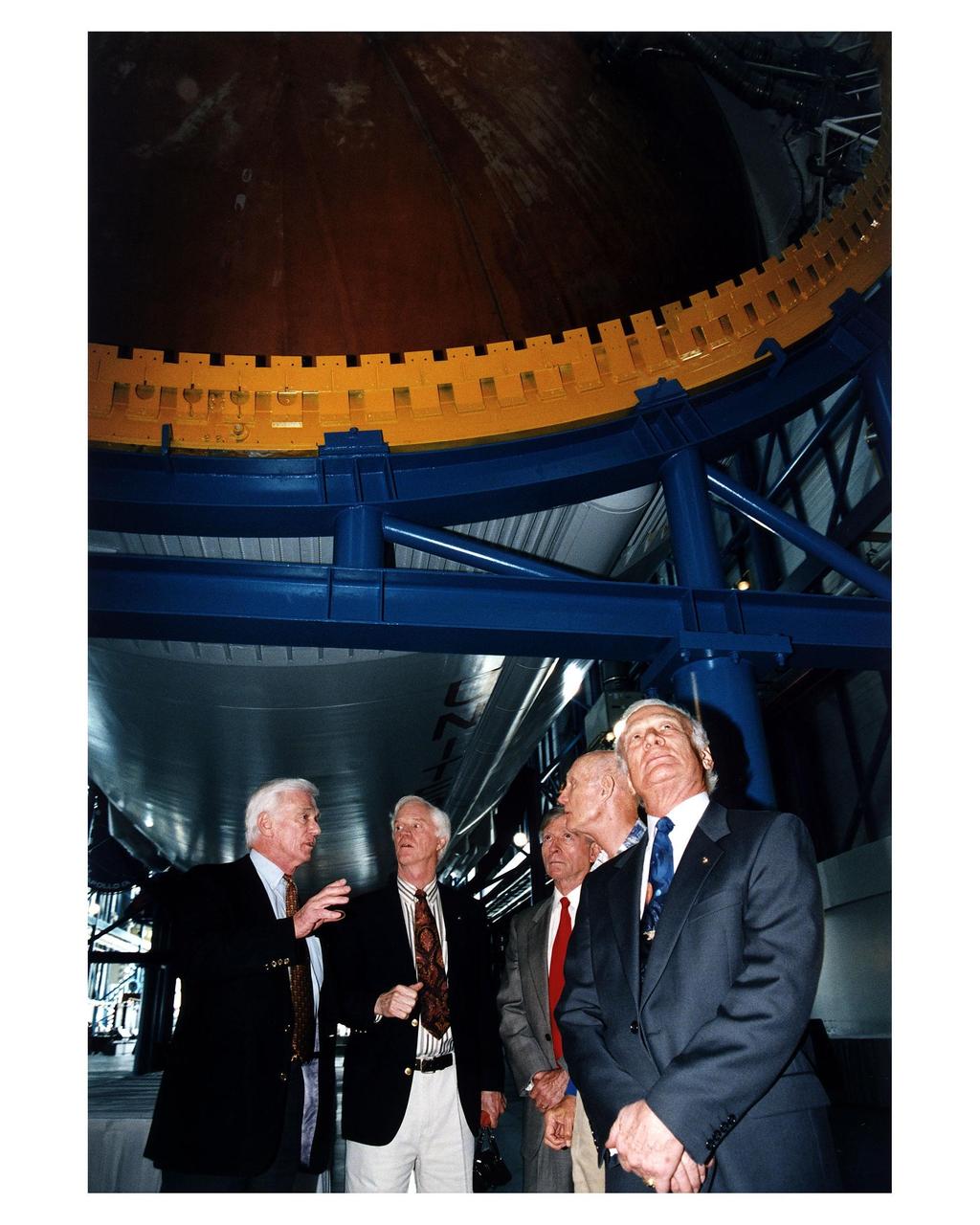
KENNEDY SPACE CENTER, FLA. -- Some of the former Apollo program astronauts tour the new Apollo/Saturn V Center (ASVC) at KSC prior to the gala grand opening ceremony for the facility that was held Jan. 8, 1997. The astronauts were invited to participate in the event, which also featured NASA Administrator Dan Goldin and KSC Director Jay Honeycutt. Passing underneath the KSC Apollo/Saturn V inside the building are (from left): Apollo 10 Lunar Module Pilot and Apollo 17 Commander Eugene A. Cernan; Apollo 9 Lunar Module Pilot Russell L. Schweikart; Apollo 10 Command Module Pilot and Apollo 16 Commander John W. Young; Apollo 10 Commander Thomas P. Stafford; and Apollo 11 Lunar Module Pilot Edwin E. "Buzz" Aldrin, Jr. The ASVC also features several other Apollo program spacecraft components, multimedia presentations and a simulated Apollo/Saturn V liftoff. The facility will be a part of the KSC bus tour that embarks from the KSC Visitor Center
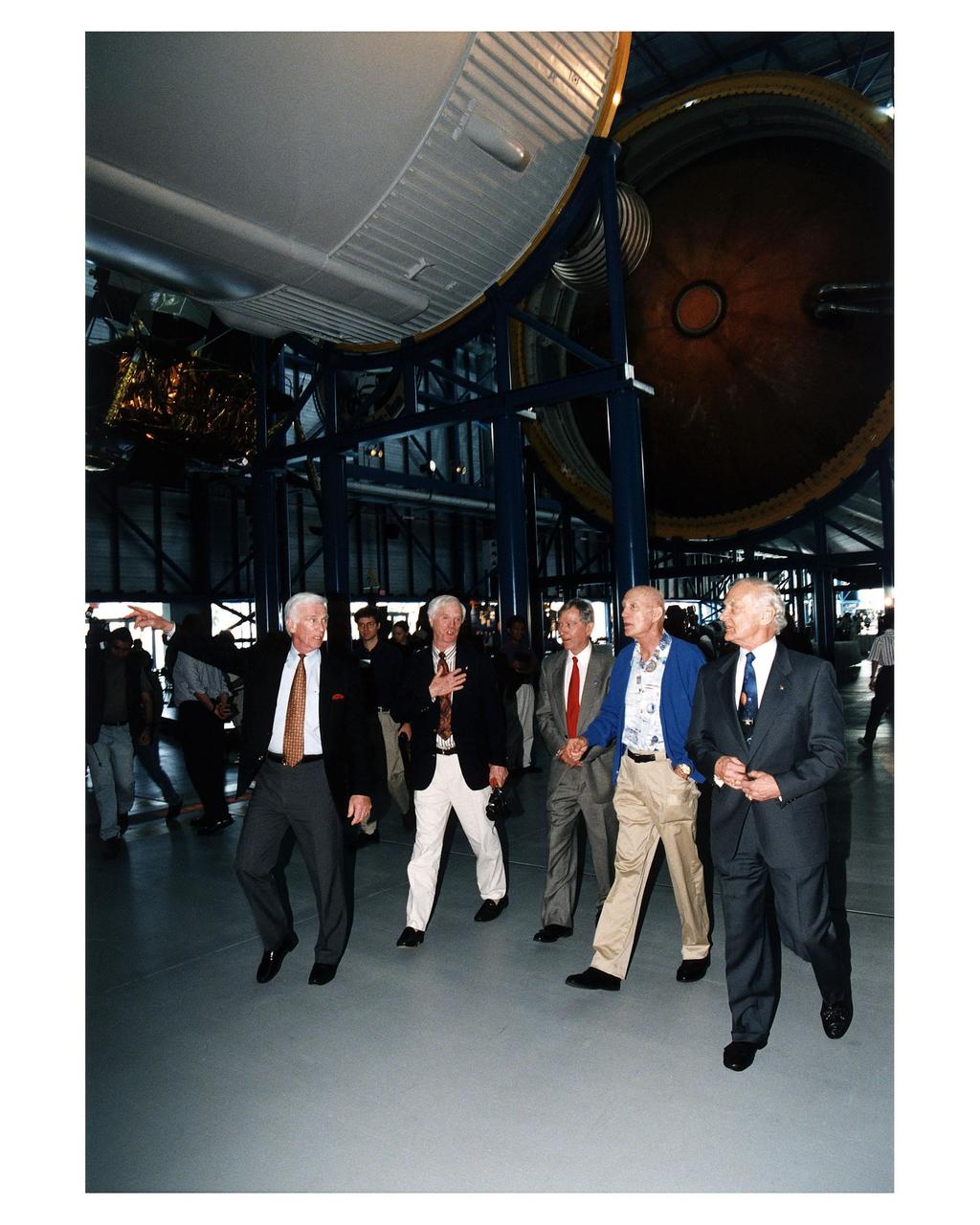
KENNEDY SPACE CENTER, FLA. -- Some of the former Apollo program astronauts tour the new Apollo/Saturn V Center (ASVC) at KSC prior to the gala grand opening ceremony for the facility that was held Jan. 8, 1997. The astronauts were invited to participate in the event, which also featured NASA Administrator Dan Goldin and KSC Director Jay Honeycutt. Passing underneath the KSC Apollo/Saturn V inside the building are (from left): Apollo 10 Lunar Module Pilot and Apollo 17 Commander Eugene A. Cernan; Apollo 9 Lunar Module Pilot Russell L. Schweikart; Apollo 10 Command Module Pilot and Apollo 16 Commander John W. Young; Apollo 10 Commander Thomas P. Stafford; and Apollo 11 Lunar Module Pilot Edwin E. "Buzz" Aldrin, Jr. The ASVC also features several other Apollo program spacecraft components, multimedia presentations and a simulated Apollo/Saturn V liftoff. The facility will be a part of the KSC bus tour that embarks from the KSC Visitor Center

This photograph depicts the Saturn V vehicle (SA-501) for the Apollo 4 mission in the Vehicle Assembly Building (VAB) at the Kennedy Space Center (KSC). After the completion of the assembly operation, the work platform was retracted and the vehicle was readied to rollout from the VAB to the launch pad. The Apollo 4 mission was the first launch of the Saturn V launch vehicle. Objectives of the unmanned Apollo 4 test flight were to obtain flight information on launch vehicle and spacecraft structural integrity and compatibility, flight loads, stage separation, and subsystems operation including testing of restart of the S-IVB stage, and to evaluate the Apollo command module heat shield. The Apollo 4 was launched on November 9, 1967 from KSC.
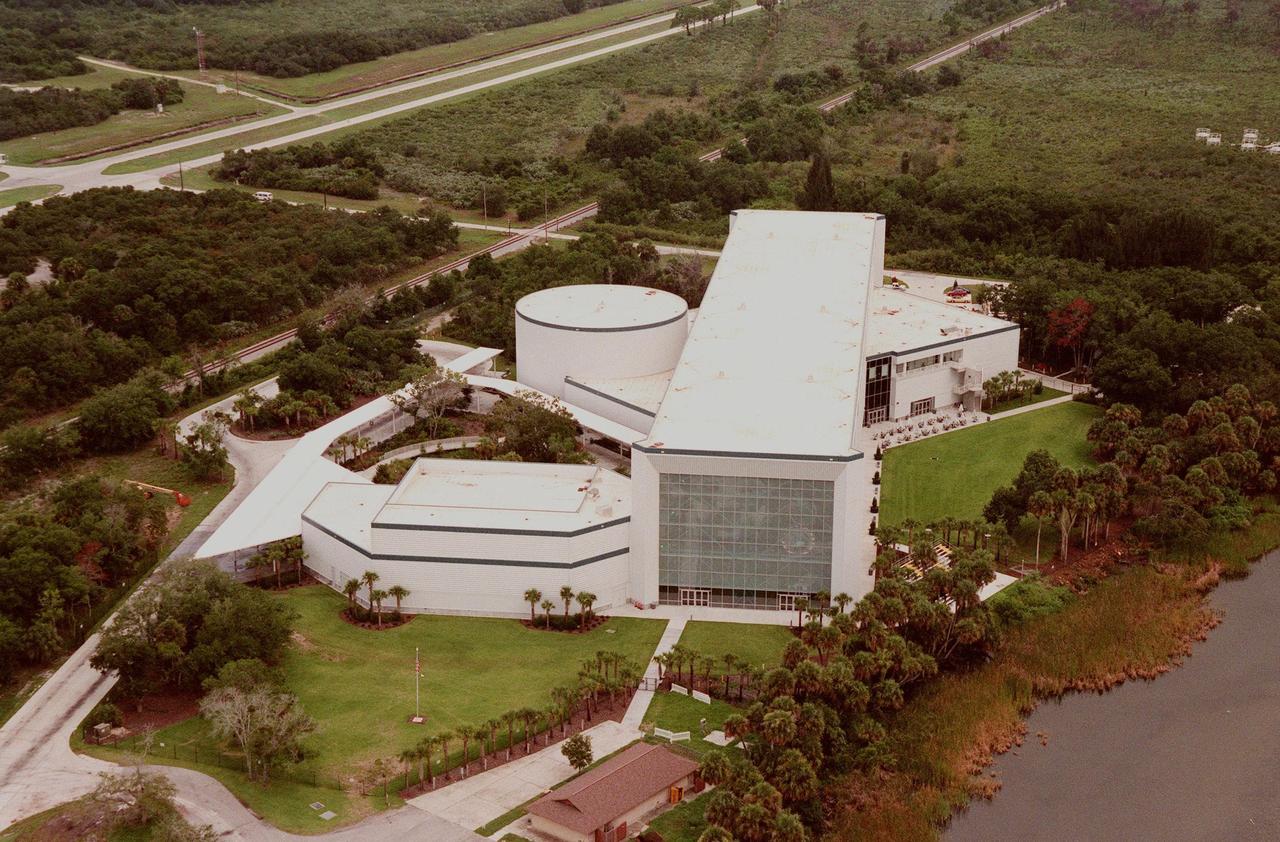
This aerial view, looking north, shows the Apollo/Saturn V Center, part of the KSC Visitor Complex. Located about 2 miles north of the Vehicle Assembly Building on the Kennedy Parkway, it is near the current Banana Creek VIP Shuttle launch viewing site. The 100,000-square-foot attraction includes a refurbished 363-foot-long Apollo-era Saturn V rocket that had been displayed previously near the VAB. Inside, the center includes artifacts and historical displays, plus two film theaters
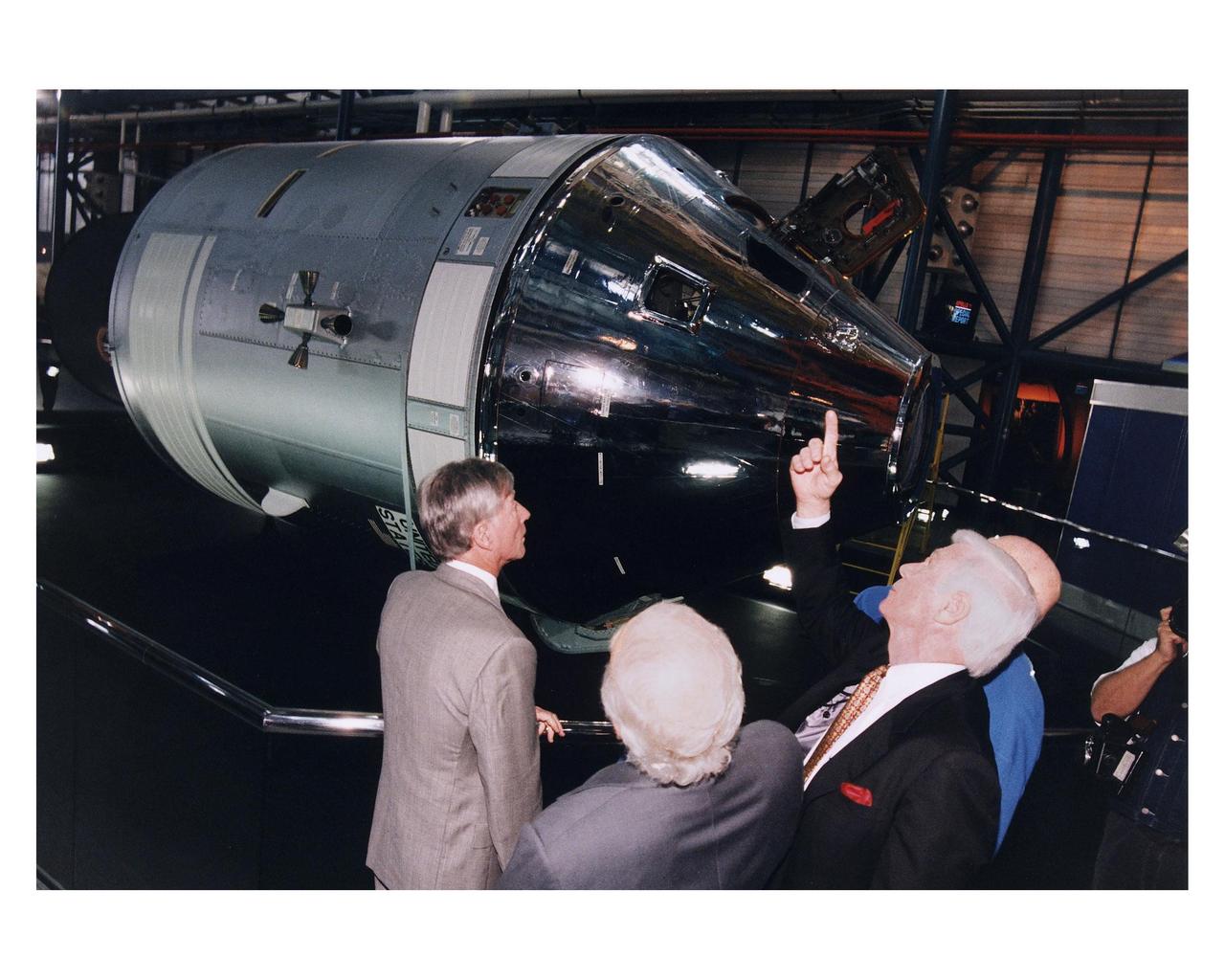
KENNEDY SPACE CENTER, FLA. -- Some of the former Apollo program astronauts admire an Apollo Command and Service Module during a tour the new Apollo/Saturn V Center (ASVC) at KSC prior to the gala grand opening ceremony for the facility that was held Jan. 8, 1997. The astronauts were invited to participate in the event, which also featured NASA Administrator Dan Goldin and KSC Director Jay Honeycutt. The astronauts are (from left): Apollo 10 Command Module Pilot and Apollo 16 Commander John W. Young;. Apollo 11 Lunar Module Pilot Edwin E. "Buzz" Aldrin, Jr.; Apollo 17 Commander Eugene A. Cernan; and Apollo 10 Commander Thomas P. Stafford. The ASVC also features several other Apollo program spacecraft components, multimedia presentations and a simulated Apollo/Saturn V liftoff. The facility will be a part of the KSC bus tour that embarks from the KSC Visitor Center
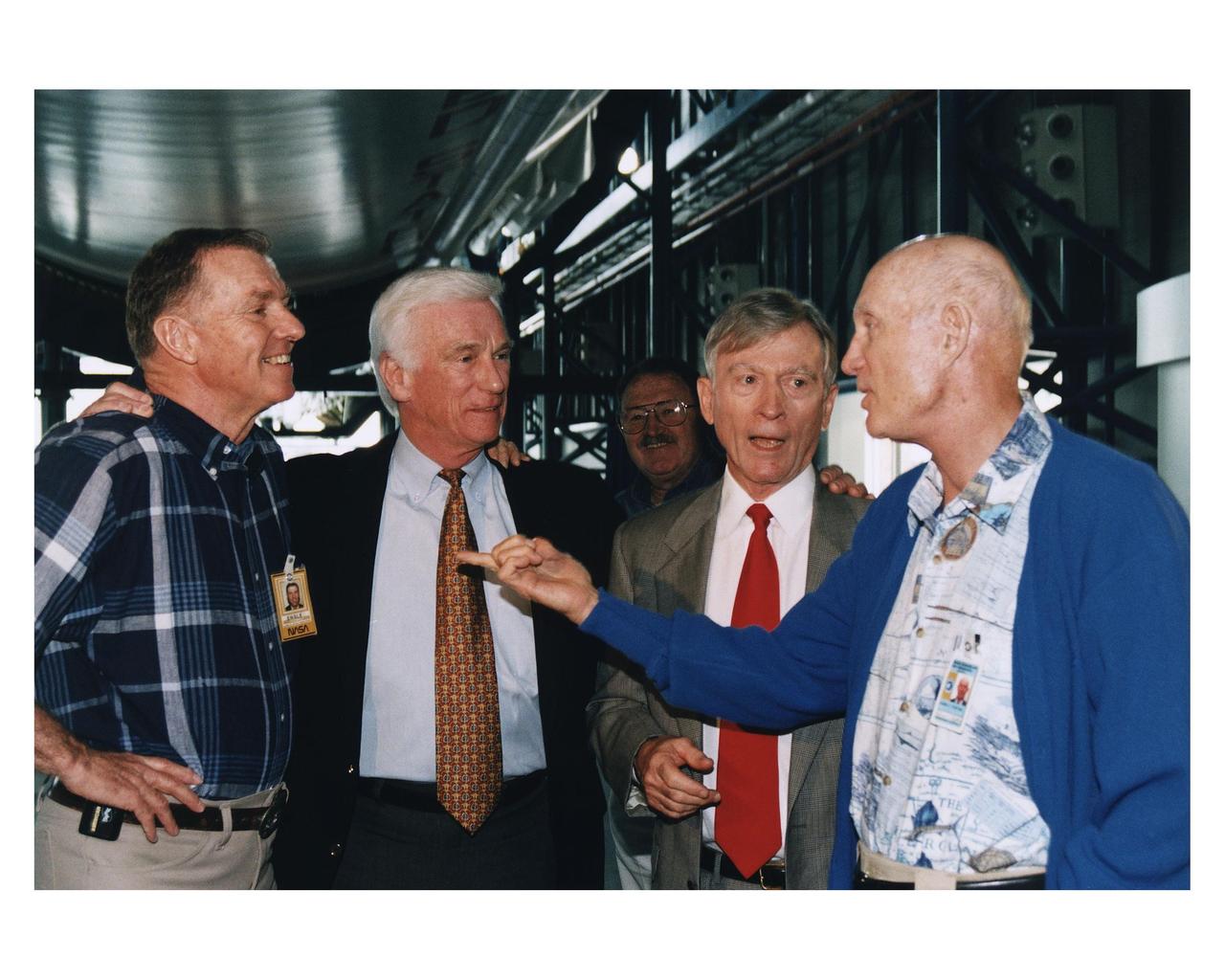
KENNEDY SPACE CENTER, FLA. -- Some of the former Apollo program astronauts recall the past as they tour the new Apollo/Saturn V Center (ASVC) at KSC prior to the gala grand opening ceremony for the facility that was held Jan. 8, 1997. The astronauts were invited to participate in the event, which also featured NASA Administrator Dan Goldin and KSC Director Jay Honeycutt. Standing underneath the KSC Apollo/Saturn V inside the building are (from left): Apollo 14 Back-up Lunar Module Pilot Joe H. Engle; Apollo 10 Lunar Module Pilot and Apollo 17 Commander Eugene A. Cernan; Apollo 10 Command Module Pilot and Apollo 16 Commander John W. Young; and Apollo 10 Commander Thomas P. Stafford. The ASVC also features several other Apollo program spacecraft components, multimedia presentations and a simulated Apollo/Saturn V liftoff. The facility will be a part of the KSC bus tour that embarks from the KSC Visitor Center
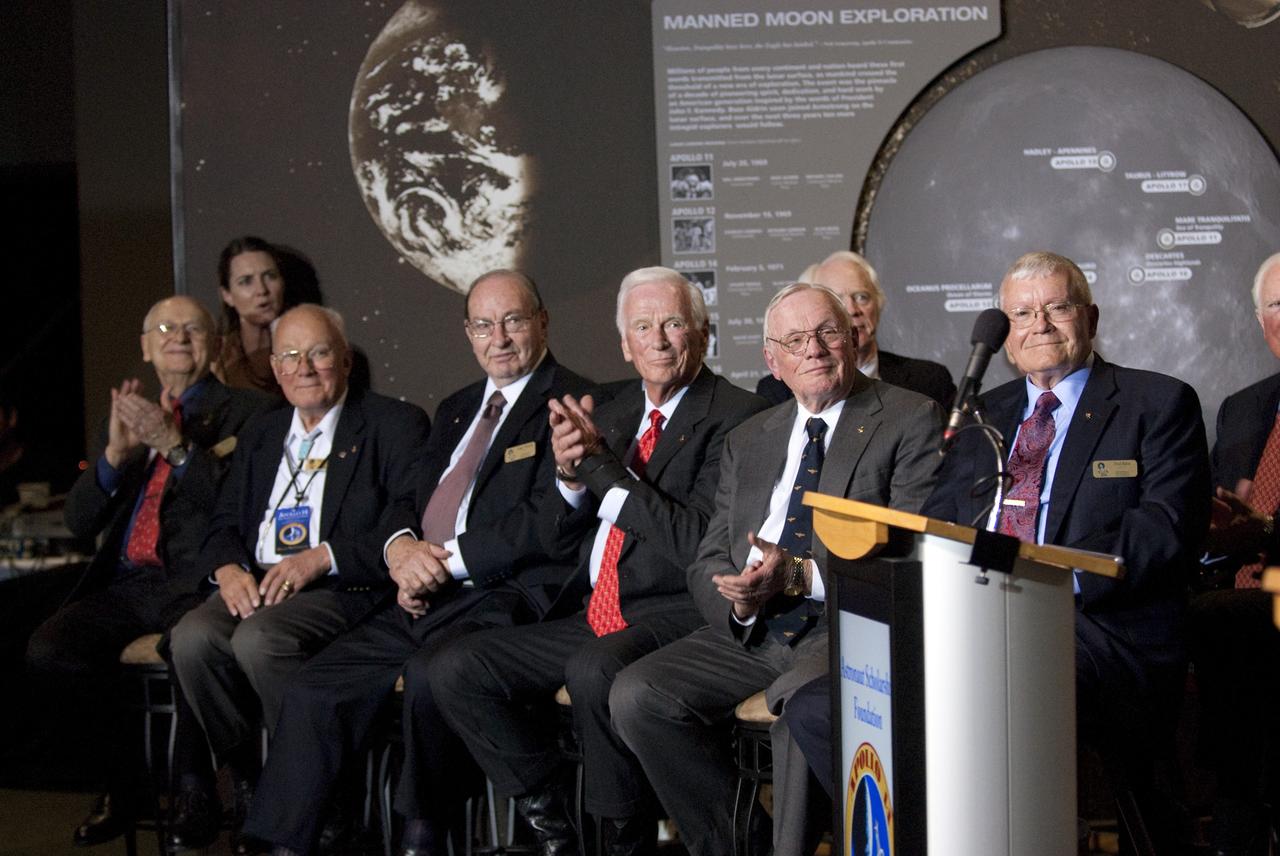
CAPE CANAVERAL, Fla. -- Apollo Program legends attend the Apollo 14 Anniversary Soirée at the Kennedy Space Center Visitor Complex's Saturn V Center. The celebration was hosted by the Astronaut Scholarship Foundation. Apollo 14 landed on the lunar surface 40 years ago on Feb. 5, 1971. Photo credit: NASA/Kim Shiflett
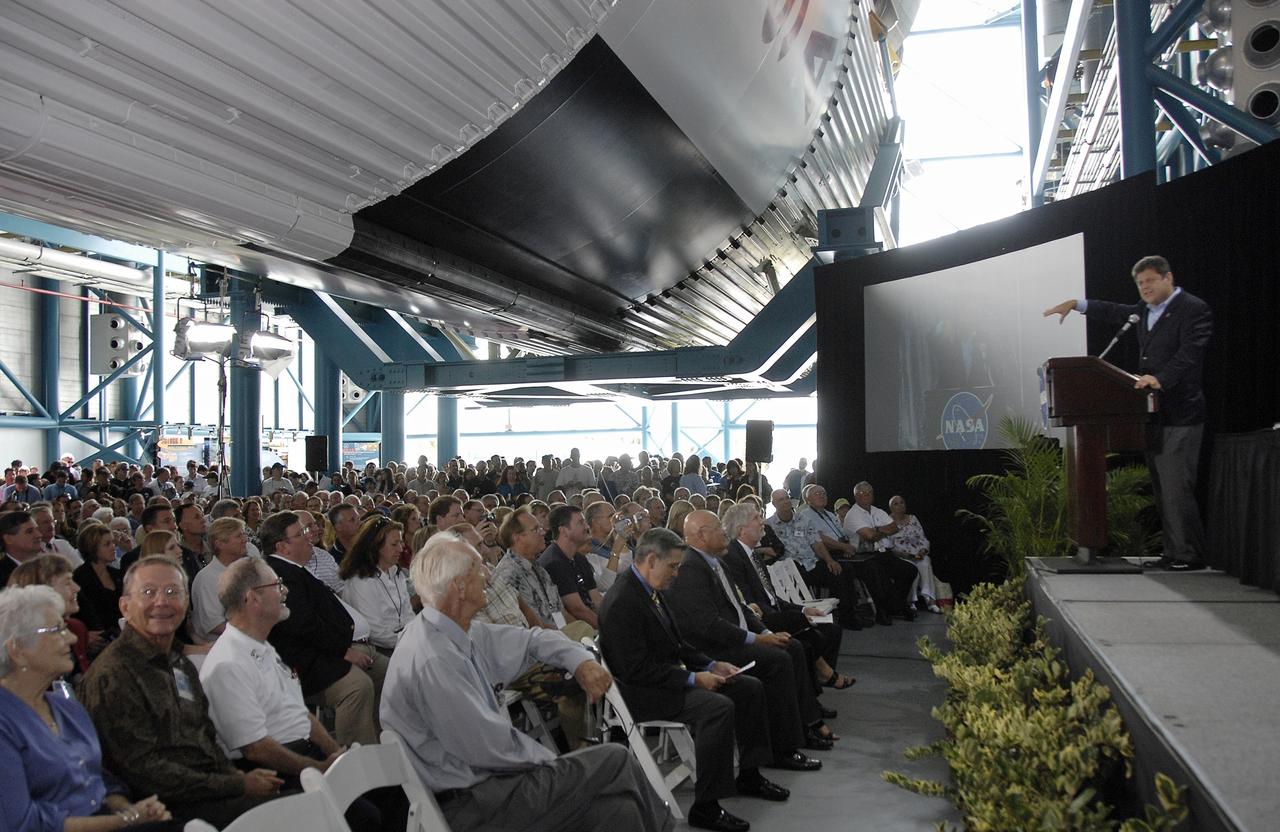
CAPE CANAVERAL, Fla. – CNN correspondent John Zarella moderates the 40th Anniversary of Apollo Celebration held in the Apollo/Saturn V Center at NASA's Kennedy Space Center in Florida. Celebrating the moon launch and landing in July 1969, eight Apollo astronauts shared their experiences with a crowd of guests. Photo credit: NASA/Kim Shiflett
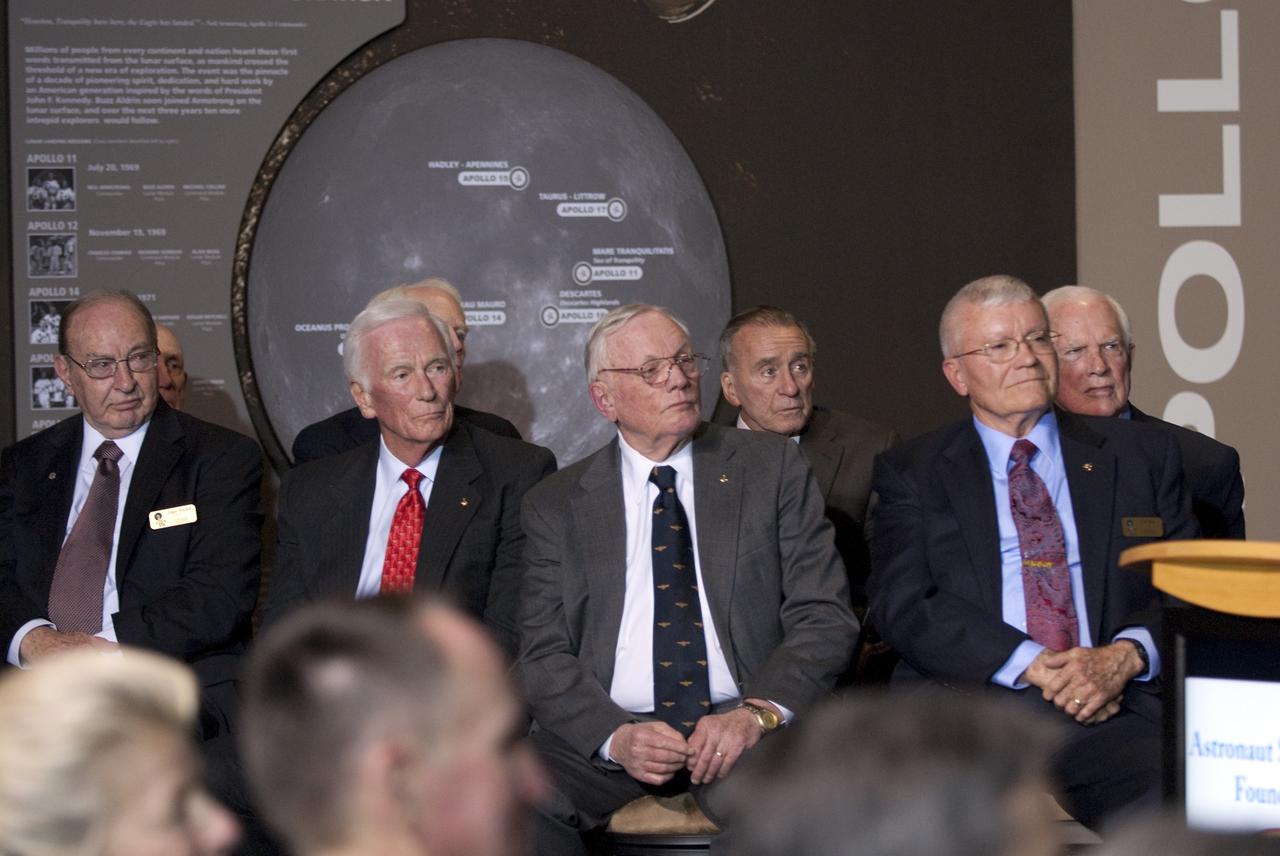
CAPE CANAVERAL, Fla. -- Apollo Program legends attend the Apollo 14 Anniversary Soirée at the Kennedy Space Center Visitor Complex's Saturn V Center. The celebration was hosted by the Astronaut Scholarship Foundation. Apollo 14 landed on the lunar surface 40 years ago on Feb. 5, 1971. Photo credit: NASA/Kim Shiflett
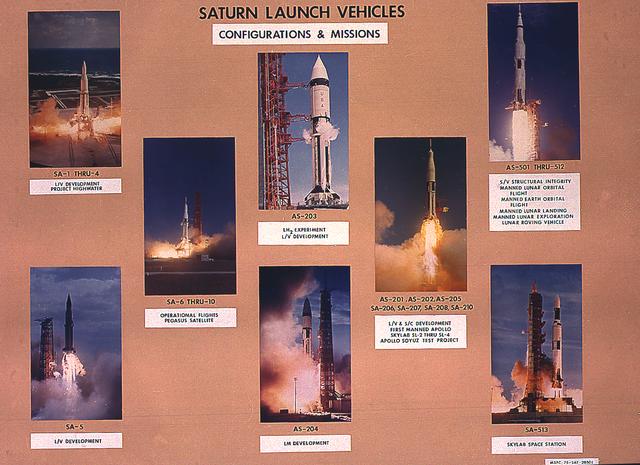
This montage illustrates the various configurations and missions of the three classes of the Saturn vehicles developed by the Marshall Space Flight Center. The missions for the Saturn I included atmospheric science investigations and the deployment of the Pegasus meteroid-detection satellite as well as launch vehicle development. The Saturn IB vehicle tested the Apollo spacecraft and launched the three marned Skylab missions as well as the Apollo Soyuz test project. The Saturn V vehicle launched the manned lunar orbital/landing missions, and the Skylab Orbital Workshop in 1973.
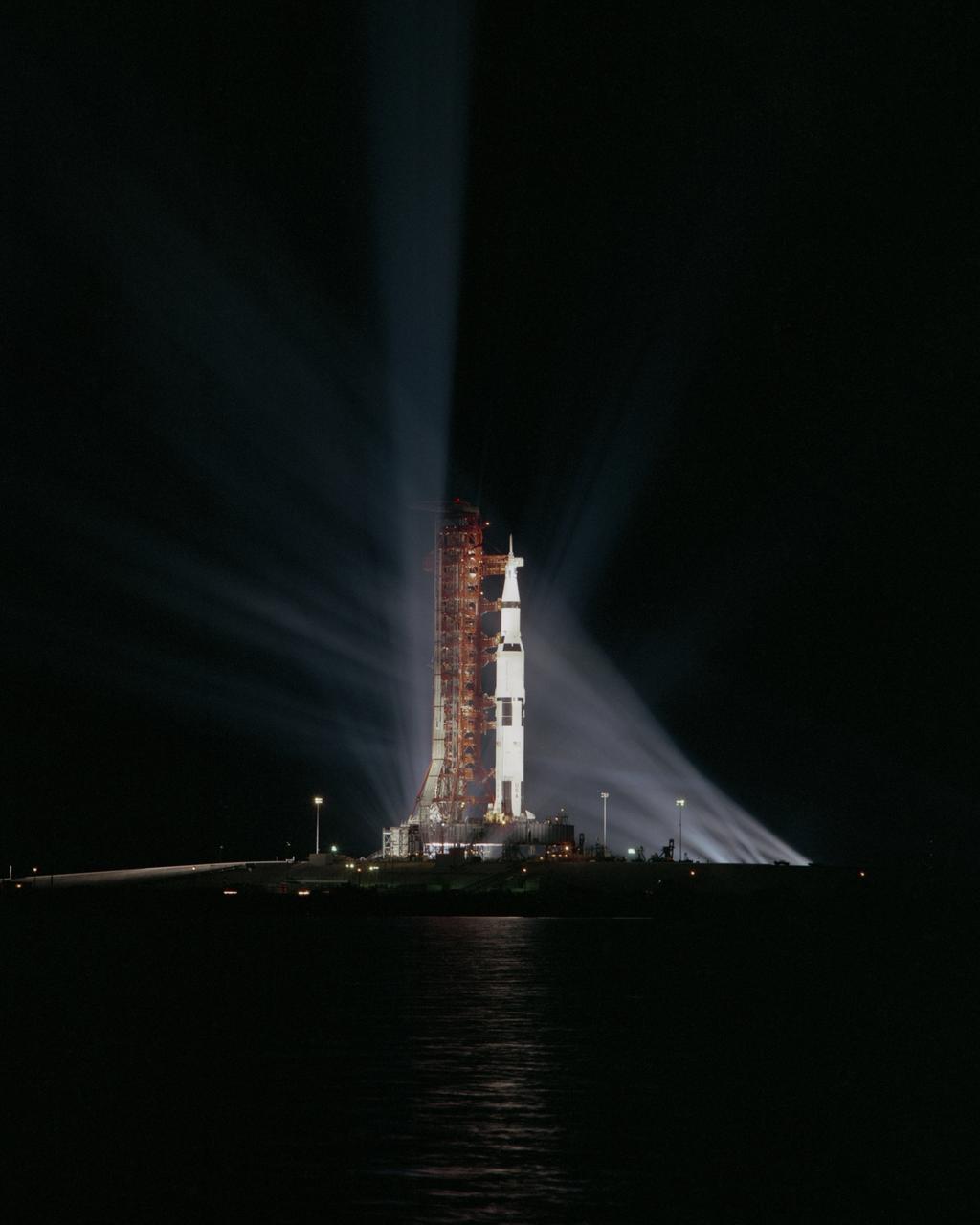
Searchlights penetrate the darkness surrounding Apollo 8 on Pad 39-A at Kennedy Space Center. This mission was the first manned flight using the Saturn V. The towering 363-foot Saturn V was a multi-stage, multi-engine launch vehicle standing taller than the Statue of Liberty. Altogether, the Saturn V engines produced as much power as 85 Hoover Dams.
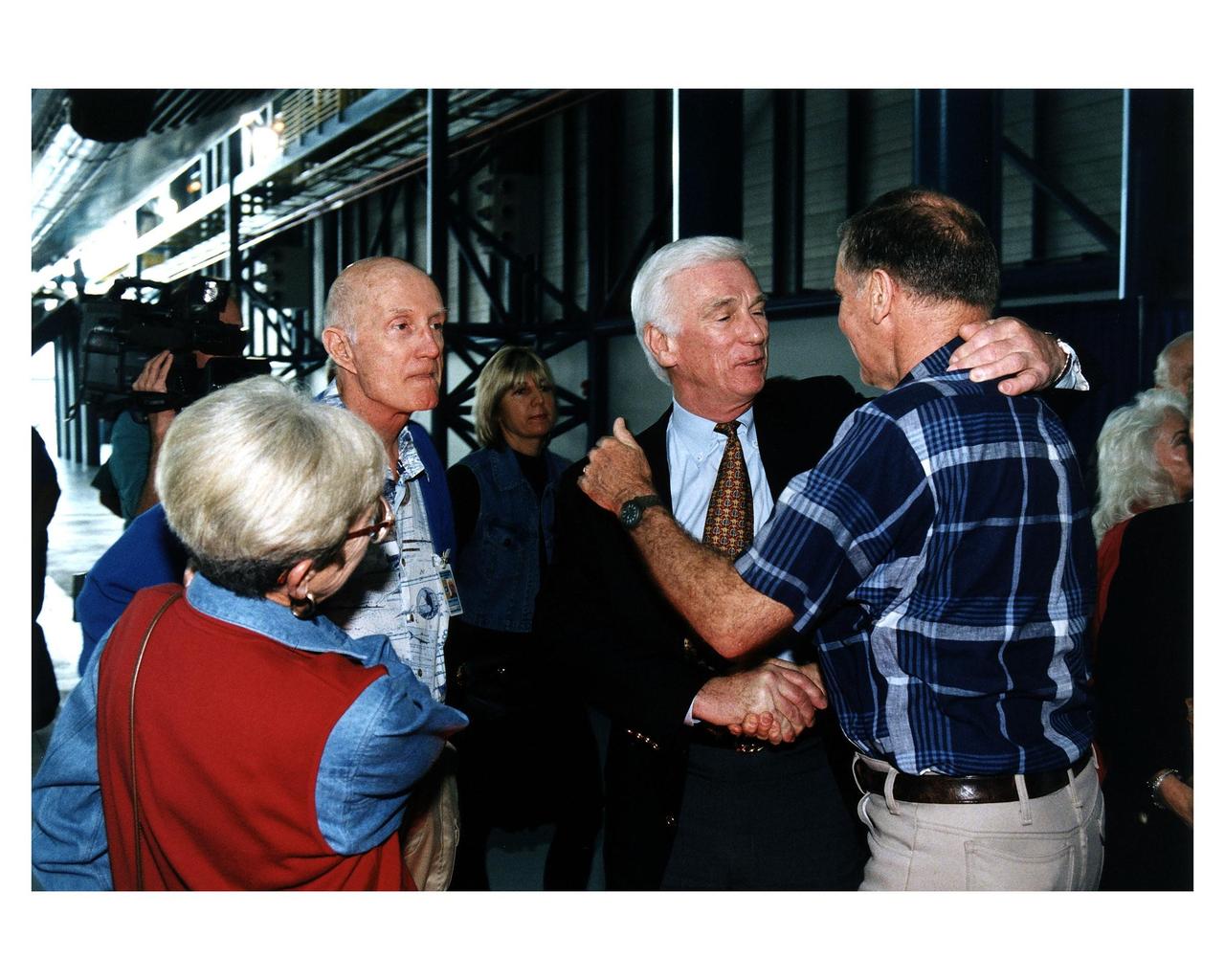
KENNEDY SPACE CENTER, FLA. -- Some of the former Apollo program astronauts tour the new Apollo/Saturn V Center (ASVC) at KSC prior to the gala grand opening ceremony for the facility that was held Jan. 8, 1997. The astronauts were invited to participate in the event, which also featured NASA Administrator Dan Goldin and KSC Director Jay Honeycutt. Greeting friends in the ASVC (left) is Apollo 10 Commander Thomas P. Stafford. Apollo 10 Lunar Module Pilot and Apollo 17 Commander Eugene A. Cernan shakes hands with Apollo 14 Back-up Lunar Module Pilot Joe H. Engle. The ASVC also features several other Apollo program spacecraft components, multimedia presentations and a simulated Apollo/ Saturn V liftoff. The facility will be a part of the KSC bus tour that embarks from the KSC Visitor Center
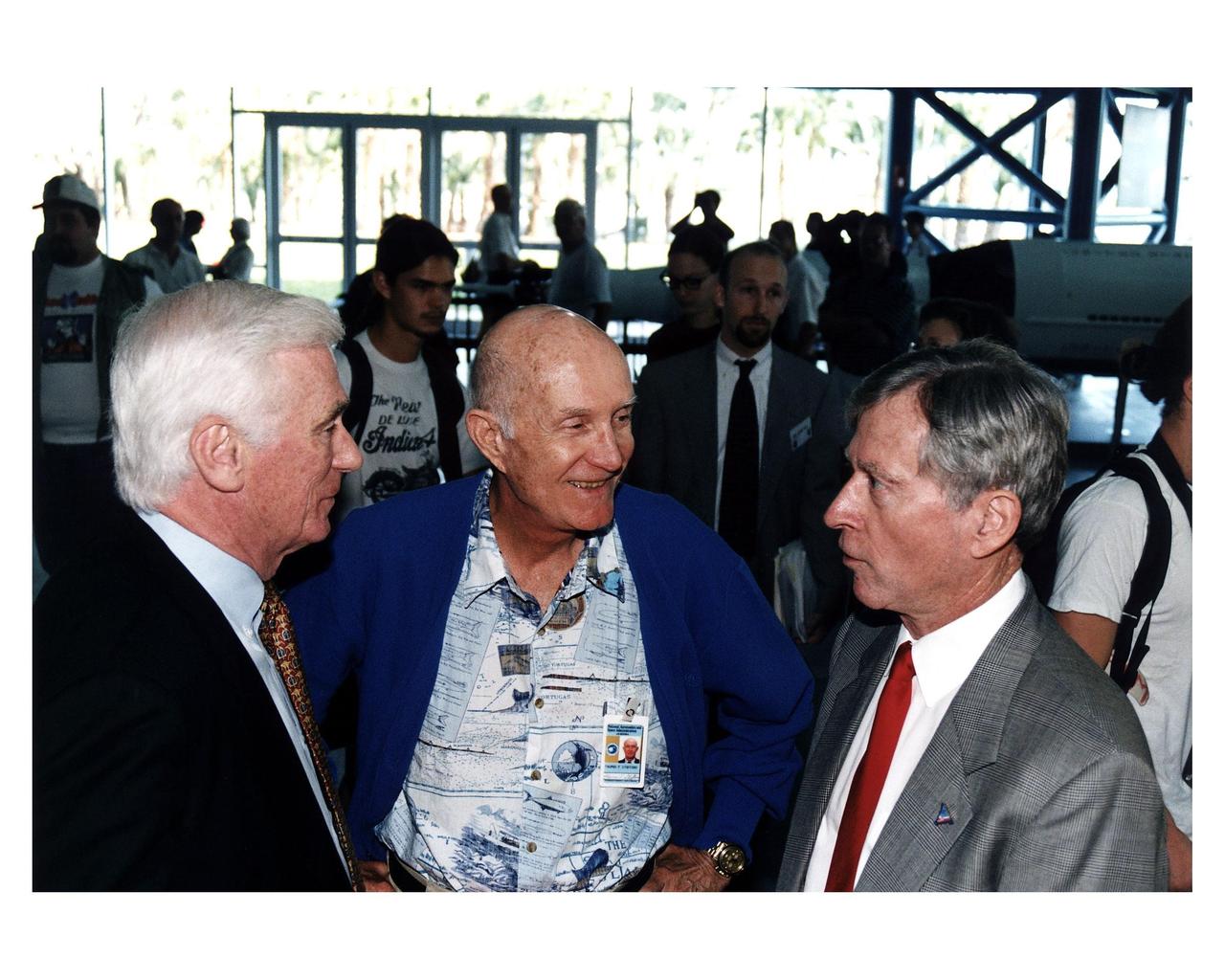
KENNEDY SPACE CENTER, FLA. -- Some of the former Apollo program astronauts tour the new Apollo/Saturn V Center (ASVC) at KSC prior to the gala grand opening ceremony for the facility that was held Jan. 8, 1997. The astronauts were invited to participate in the event, which also featured NASA Administrator Dan Goldin and KSC Director Jay Honeycutt. Discussing old times are (from left) Apollo 10 Lunar Module Pilot and Apollo 17 Commander Eugene A. Cernan; Apollo 10 Commander Thomas P. Stafford and Apollo 16 Commander John W. Young. The ASVC also features several other Apollo program spacecraft components, multimedia presentations and a simulated Apollo/ Saturn V liftoff. The facility will be a part of the KSC bus tour that embarks from the KSC Visitor Center
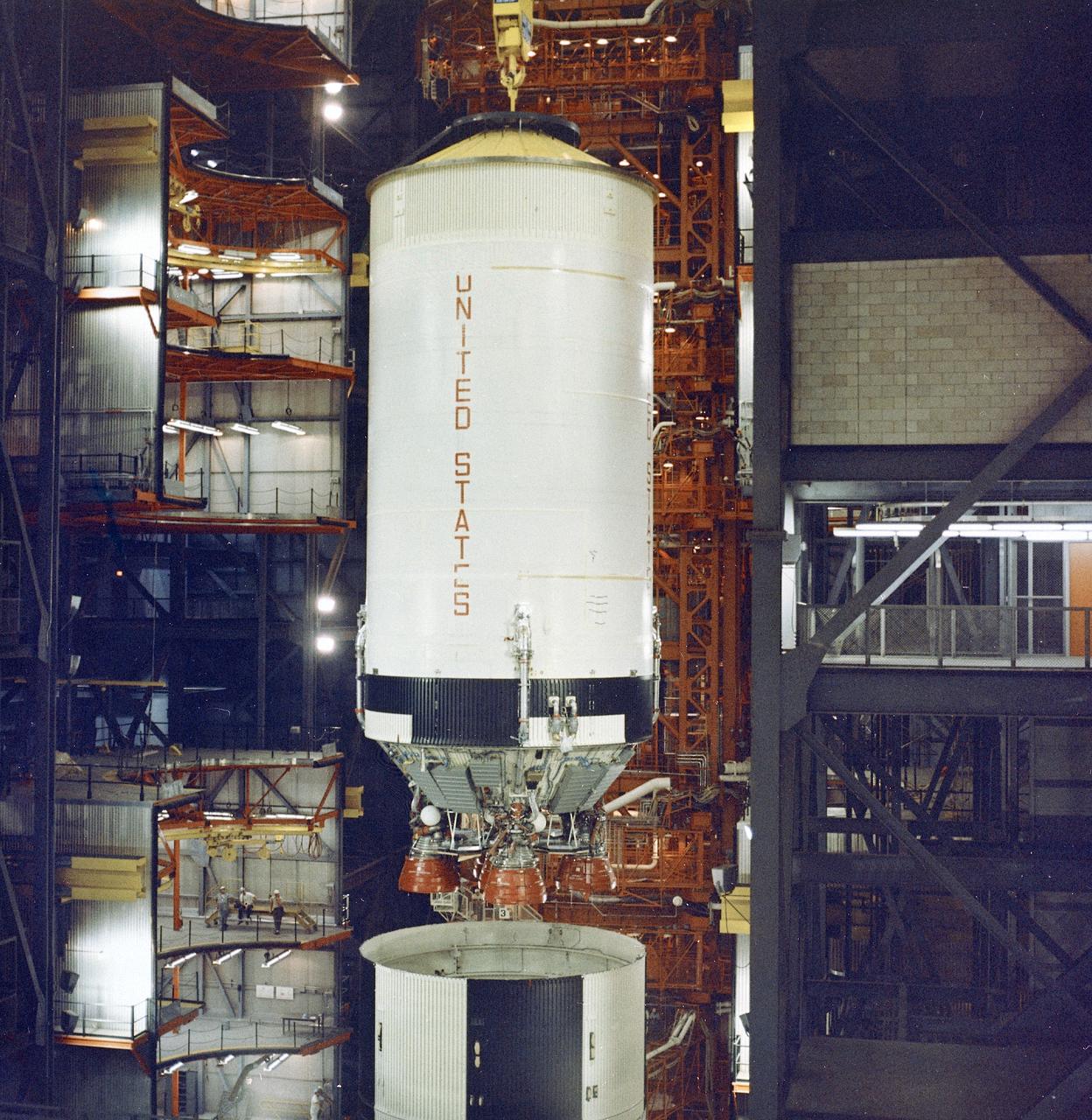
This photograph shows the Saturn V S-II (second) stage of the Apollo 6 mission being lowered atop of the S-IC (first) stage during the final assembly operations in the Vehicle Assembly Building (VAB) at the Kennedy Space Center. The Apollo 6 mission was the second Saturn V unmanned flight for testing an emergency detection system. The launch occurred on April 4, 1968.
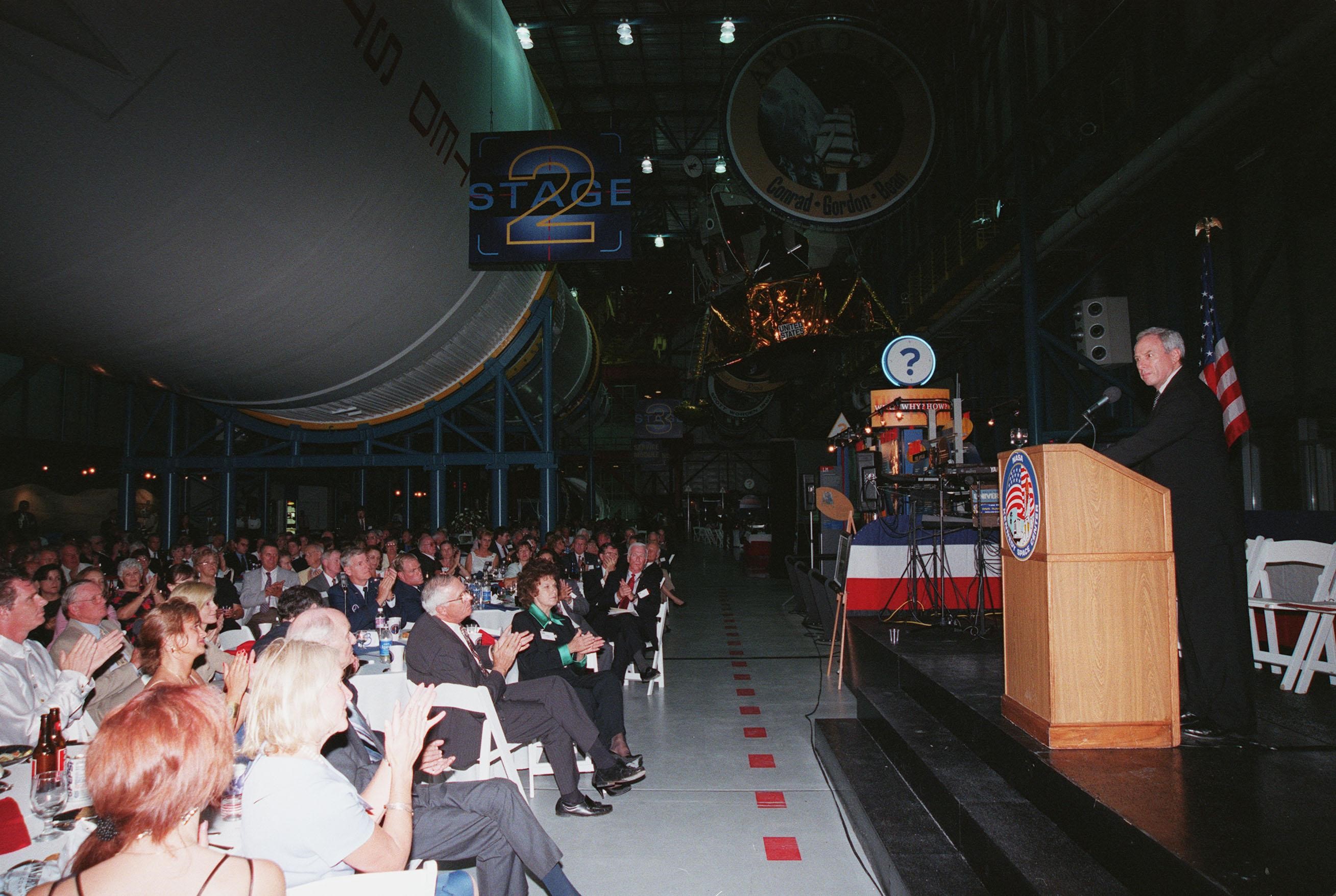
KENNEDY SPACE CENTER, FLA. -- NASA Administrator Daniel S. Goldin (right) addresses the audience at the Apollo 11 anniversary banquet honoring the Apollo team, the people who made the entire lunar landing program possible. The banquet was held in the Apollo/Saturn V Center, part of the KSC Visitor Complex, with seating under an unused Saturn V rocket like those that powered the Apollo launches . This is the 30th anniversary of the Apollo 11 launch and moon landing, July 16 and July 20, 1969. Among the guests at the banquet were former Apollo astronauts are Neil A. Armstrong and Edwin "Buzz" Aldrin who flew on Apollo 11, the launch of the first moon landing; Gene Cernan, who flew on Apollo 10 and 17 and was the last man to walk on the moon; and Walt Cunningham, who flew on Apollo 7
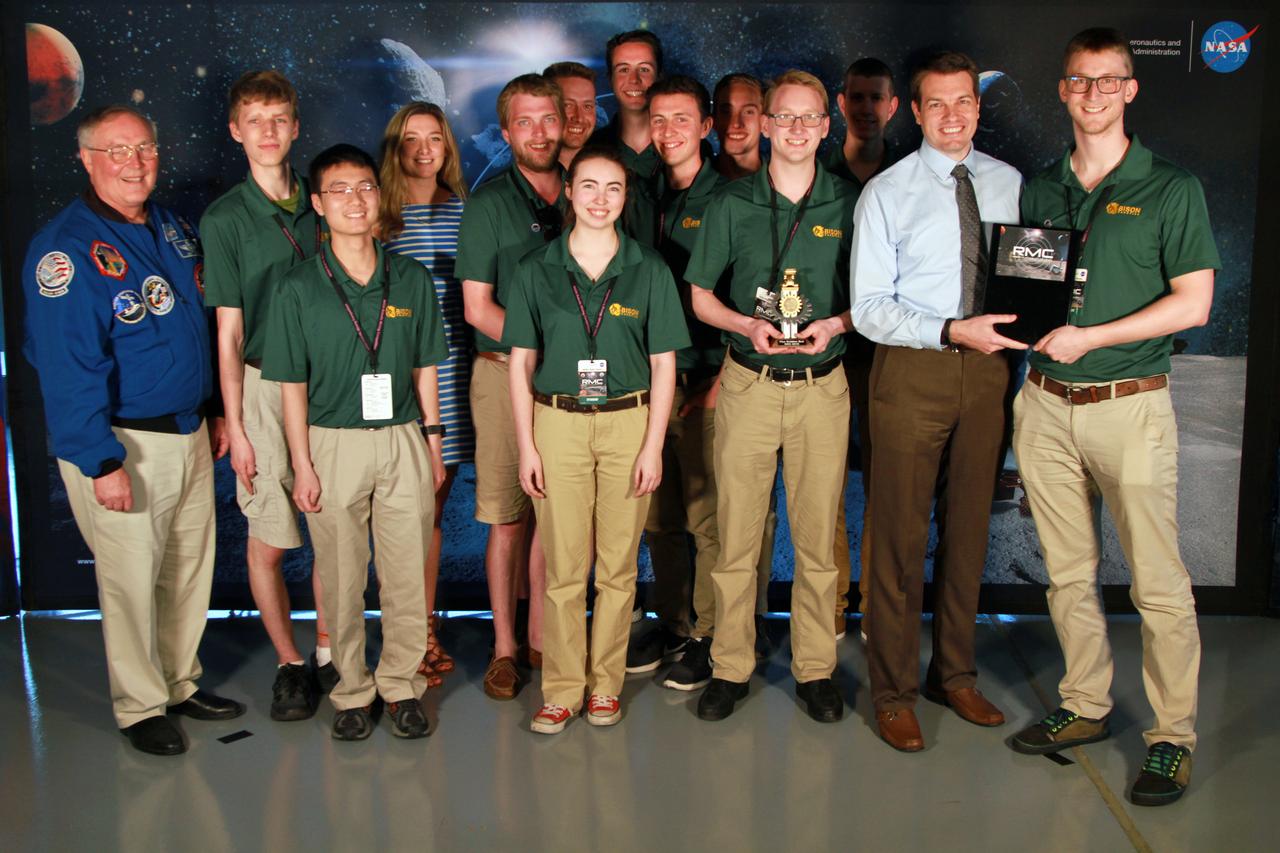
NASA's 9th Annual Robotic Mining Competition concludes with an awards ceremony May 18, 2018, at the Apollo/Saturn V Center at the Kennedy Space Center Visitor Complex in Florida. The team from North Dakota University in collaboration with James Madison University received first place in the Slide Presentation and Demonstration award category. At left is retired NASA astronaut Jerry Ross. At right is Daniel Hull, lead presentation judge. More than 40 student teams from colleges and universities around the U.S. participated in the competition, May 14-18, by using their mining robots to dig in a supersized sandbox filled with BP-1, or simulated lunar soil, gravel and rocks, and participate in other competition requirements. The Robotic Mining Competition is a NASA Human Exploration and Operations Mission Directorate project designed to encourage students in science, technology, engineering and math, or STEM fields. The project provides a competitive environment to foster innovative ideas and solutions that could be used on NASA's deep space missions.
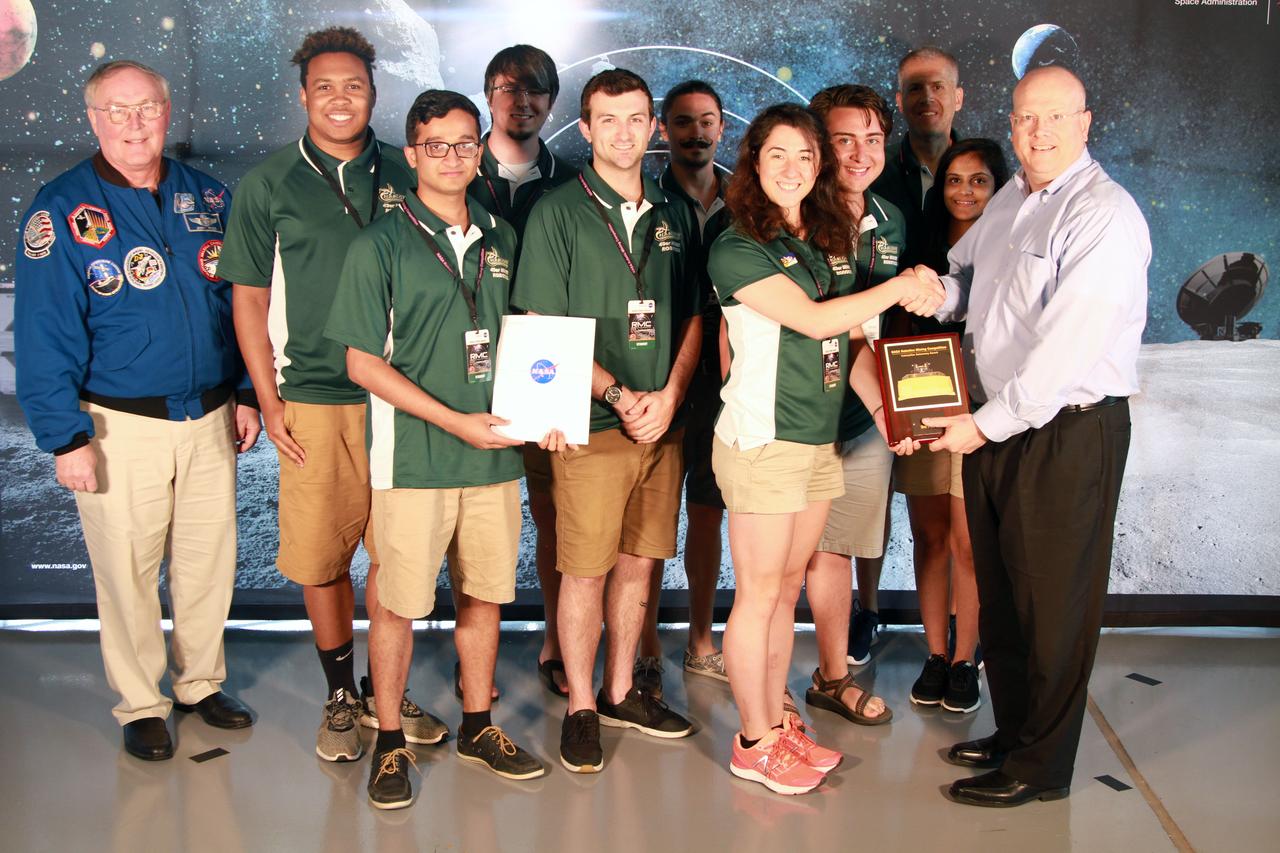
NASA's 9th Annual Robotic Mining Competition concludes with an awards ceremony May 18, 2018, at the Apollo/Saturn V Center at the Kennedy Space Center Visitor Complex in Florida. The team from the University of North Carolina at Charlotte received third place in the Caterpillar Award for Autonomy. At left is retired NASA astronaut Jerry Ross. At right is Eric Reiners, program manager with the Innovation & Technology Development Division of Caterpillar Inc. More than 40 student teams from colleges and universities around the U.S. participated in the competition, May 14-18, by using their mining robots to dig in a supersized sandbox filled with BP-1, or simulated lunar soil, gravel and rocks, and participate in other competition requirements. The Robotic Mining Competition is a NASA Human Exploration and Operations Mission Directorate project designed to encourage students in science, technology, engineering and math, or STEM fields. The project provides a competitive environment to foster innovative ideas and solutions that could be used on NASA's deep space missions.
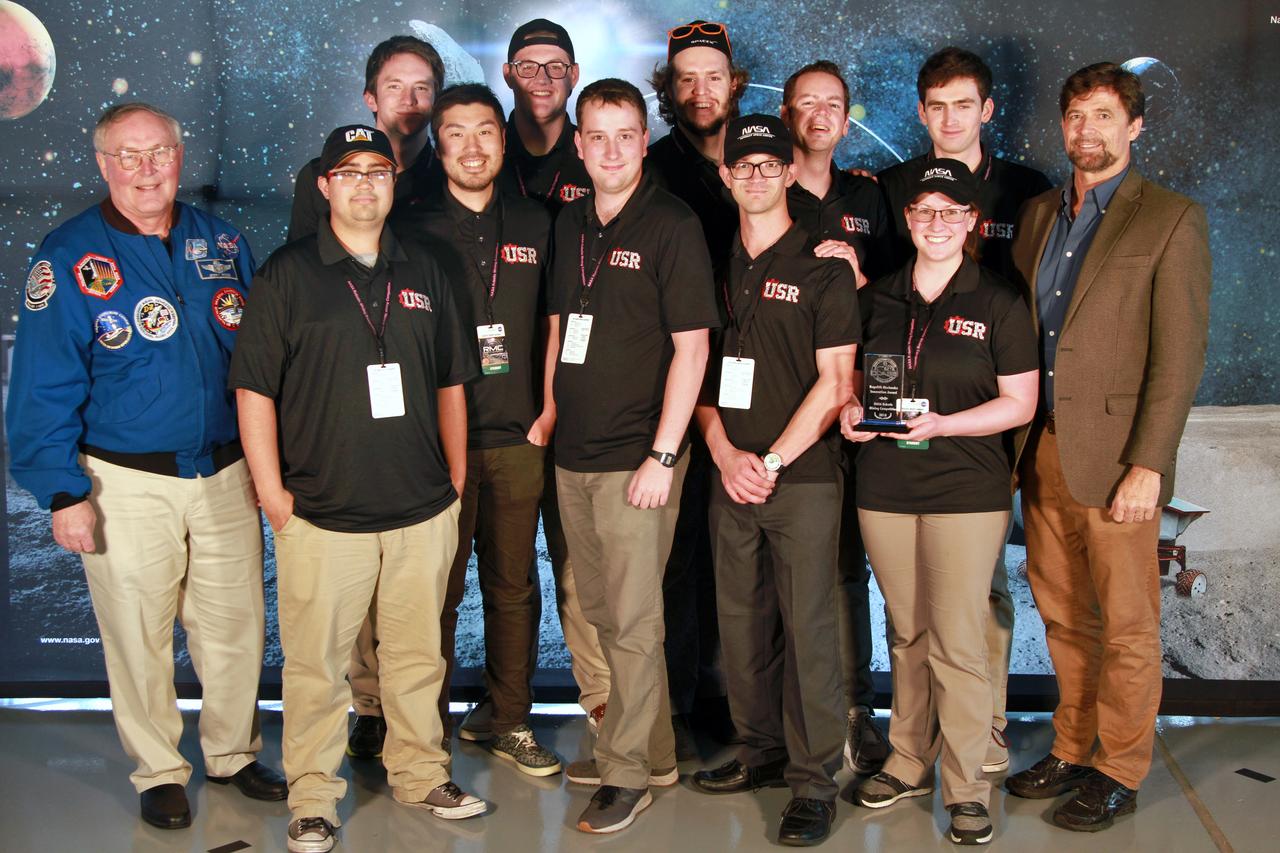
NASA's 9th Annual Robotic Mining Competition concludes with an awards ceremony May 18, 2018, at the Apollo/Saturn V Center at the Kennedy Space Center Visitor Complex in Florida. The Utah Student Robotics team from The University of Utah received The Regolith Mechanics Award for the best example of a real granular innovation that identified a specific regolith mechanics problem and intentionally improved their robot design to deal with it. At left is retired NASA astronaut Jerry Ross. At right is Phil Metzger, mining judge. More than 40 student teams from colleges and universities around the U.S. participated in the competition, May 14-18, by using their mining robots to dig in a supersized sandbox filled with BP-1, or simulated lunar soil, gravel and rocks, and participate in other competition requirements. The Robotic Mining Competition is a NASA Human Exploration and Operations Mission Directorate project designed to encourage students in science, technology, engineering and math, or STEM fields. The project provides a competitive environment to foster innovative ideas and solutions that could be used on NASA's deep space missions.
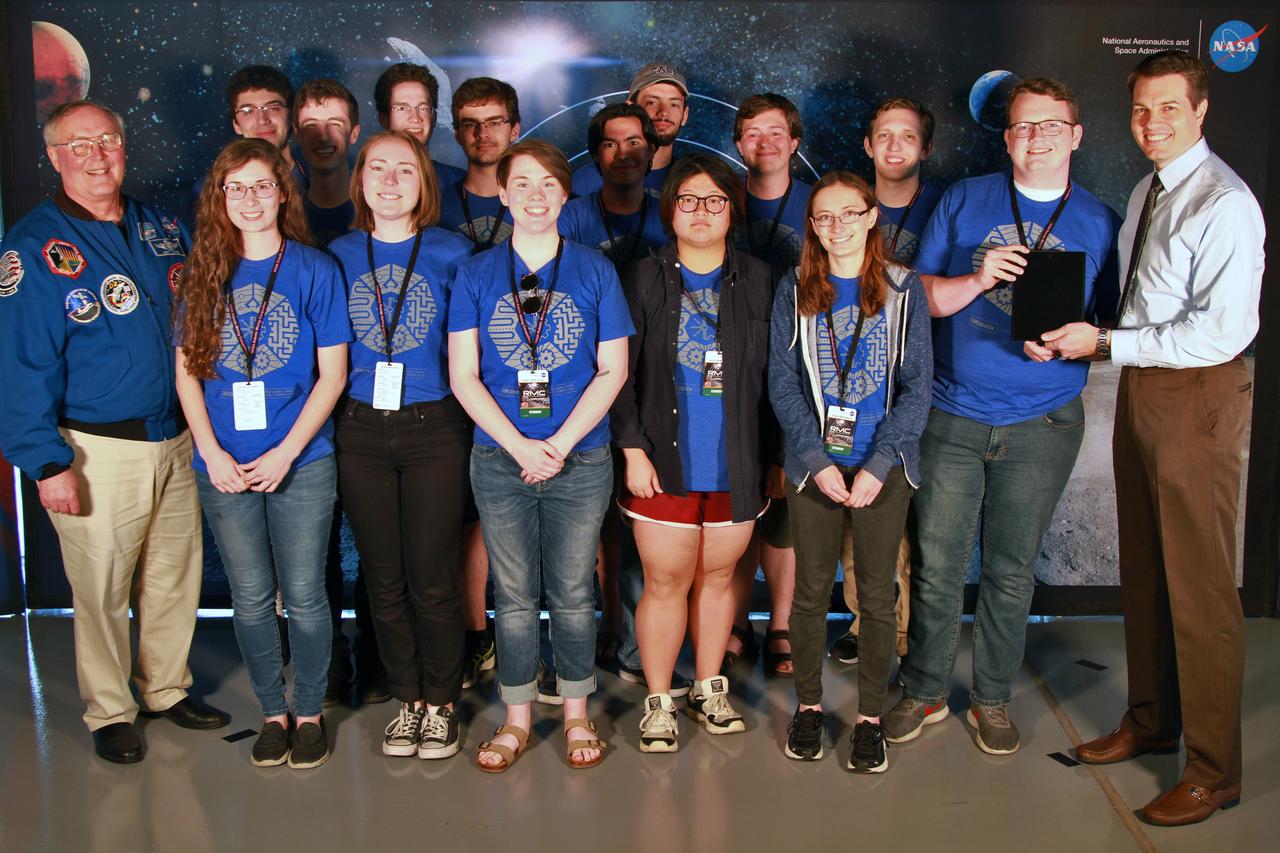
NASA's 9th Annual Robotic Mining Competition concludes with an awards ceremony May 18, 2018, at the Apollo/Saturn V Center at the Kennedy Space Center Visitor Complex in Florida. The team from Case Western Reserve University received third place in the Slide Presentation and Demonstration award category. At left is retired NASA astronaut Jerry Ross. At right is Daniel Hull, lead presentation judge. More than 40 student teams from colleges and universities around the U.S. participated in the competition, May 14-18, by using their mining robots to dig in a supersized sandbox filled with BP-1, or simulated lunar soil, gravel and rocks, and participate in other competition requirements. The Robotic Mining Competition is a NASA Human Exploration and Operations Mission Directorate project designed to encourage students in science, technology, engineering and math, or STEM fields. The project provides a competitive environment to foster innovative ideas and solutions that could be used on NASA's deep space missions.
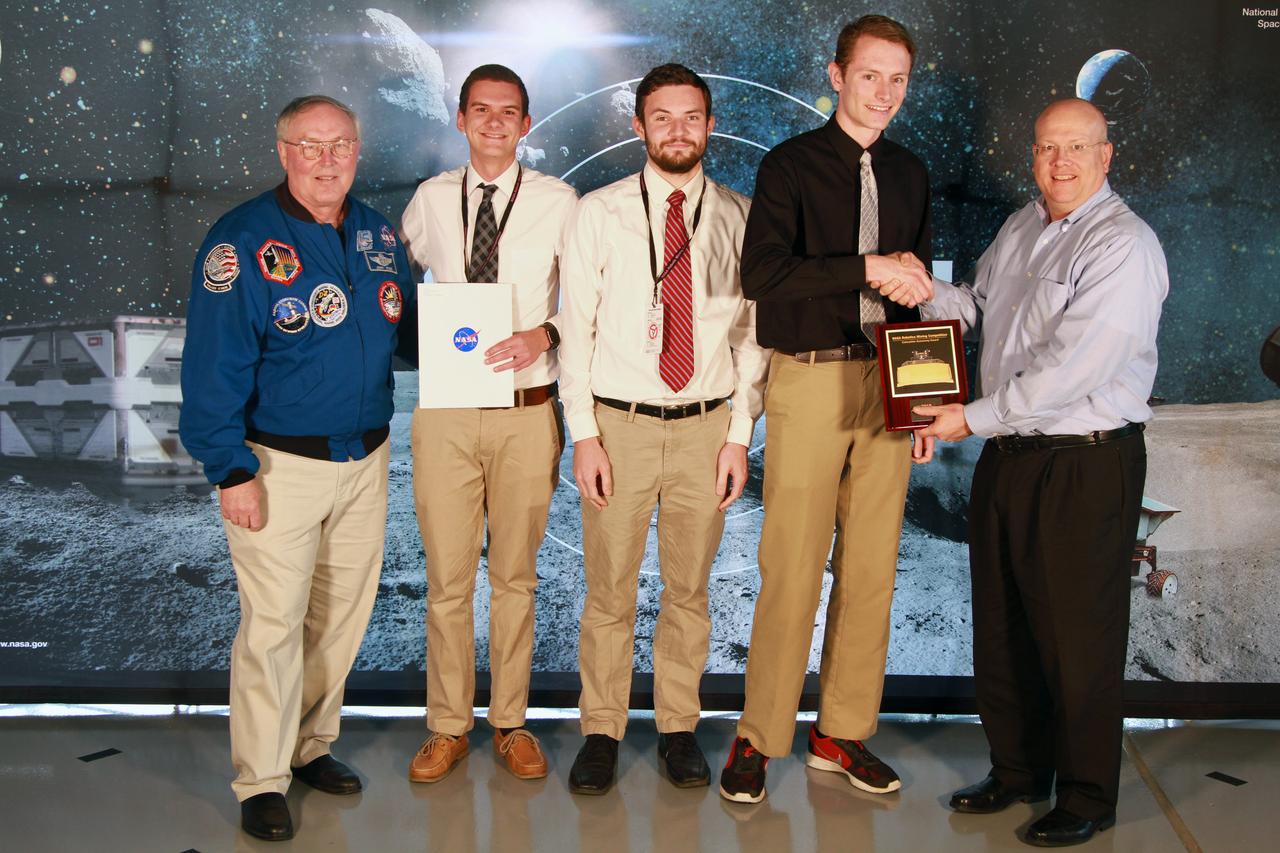
NASA's 9th Annual Robotic Mining Competition concludes with an awards ceremony May 18, 2018, at the Apollo/Saturn V Center at the Kennedy Space Center Visitor Complex in Florida. The University of Alabama Team Astrobotics received first place in the Caterpillar Award for Autonomy. At left is retired NASA astronaut Jerry Ross. At right is Eric Reiners, program manager with the Innovation & Technology Development Division of Caterpillar Inc. More than 40 student teams from colleges and universities around the U.S. participated in the competition, May 14-18, by using their mining robots to dig in a supersized sandbox filled with BP-1, or simulated lunar soil, gravel and rocks, and participate in other competition requirements. The Robotic Mining Competition is a NASA Human Exploration and Operations Mission Directorate project designed to encourage students in science, technology, engineering and math, or STEM fields. The project provides a competitive environment to foster innovative ideas and solutions that could be used on NASA's deep space missions.
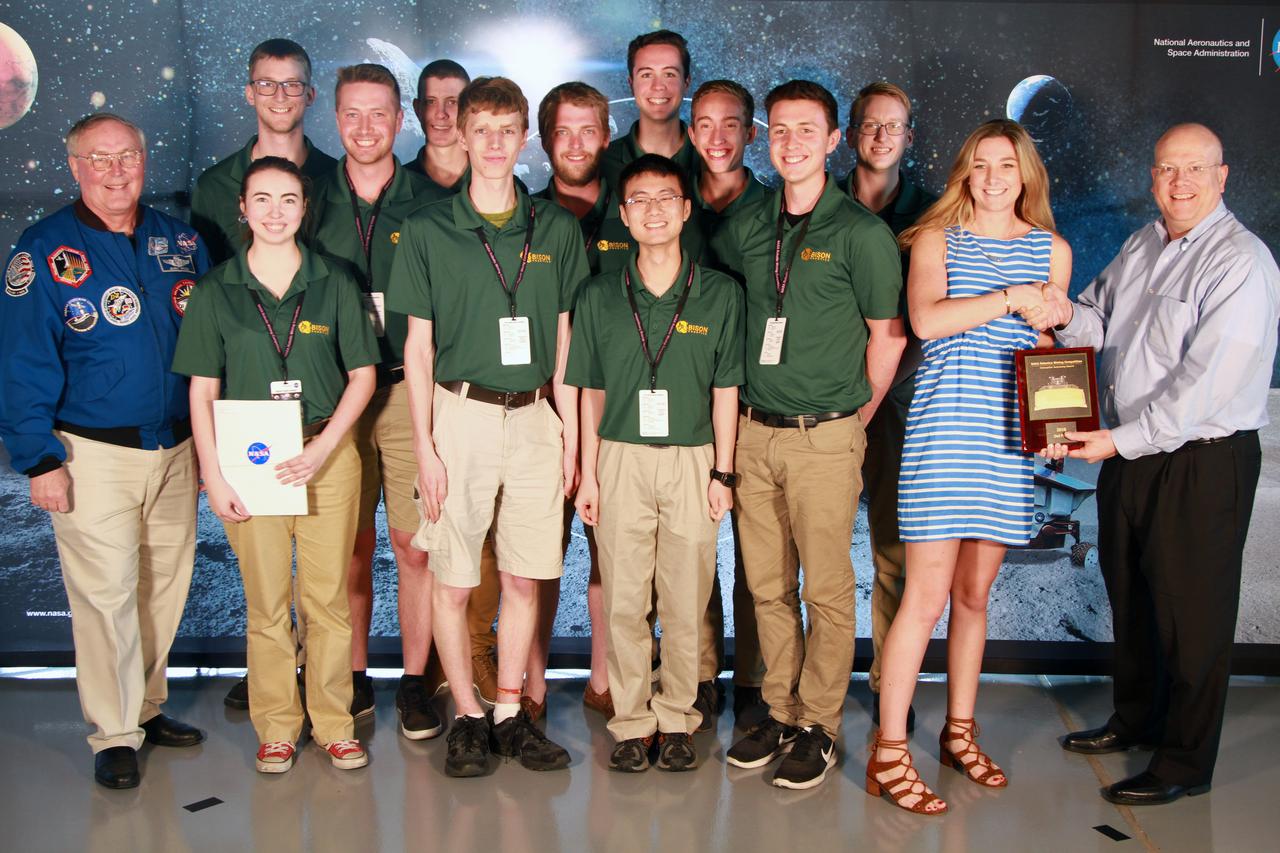
NASA's 9th Annual Robotic Mining Competition concludes with an awards ceremony May 18, 2018, at the Apollo/Saturn V Center at the Kennedy Space Center Visitor Complex in Florida. The team from North Dakota State University in collaboration with James Madison University received second place in the Caterpillar Award for Autonomy. At left is retired NASA astronaut Jerry Ross. At right is Eric Reiners, program manager with the Innovation & Technology Development Division of Caterpillar Inc. More than 40 student teams from colleges and universities around the U.S. participated in the competition, May 14-18, by using their mining robots to dig in a supersized sandbox filled with BP-1, or simulated lunar soil, gravel and rocks, and participate in other competition requirements. The Robotic Mining Competition is a NASA Human Exploration and Operations Mission Directorate project designed to encourage students in science, technology, engineering and math, or STEM fields. The project provides a competitive environment to foster innovative ideas and solutions that could be used on NASA's deep space missions.
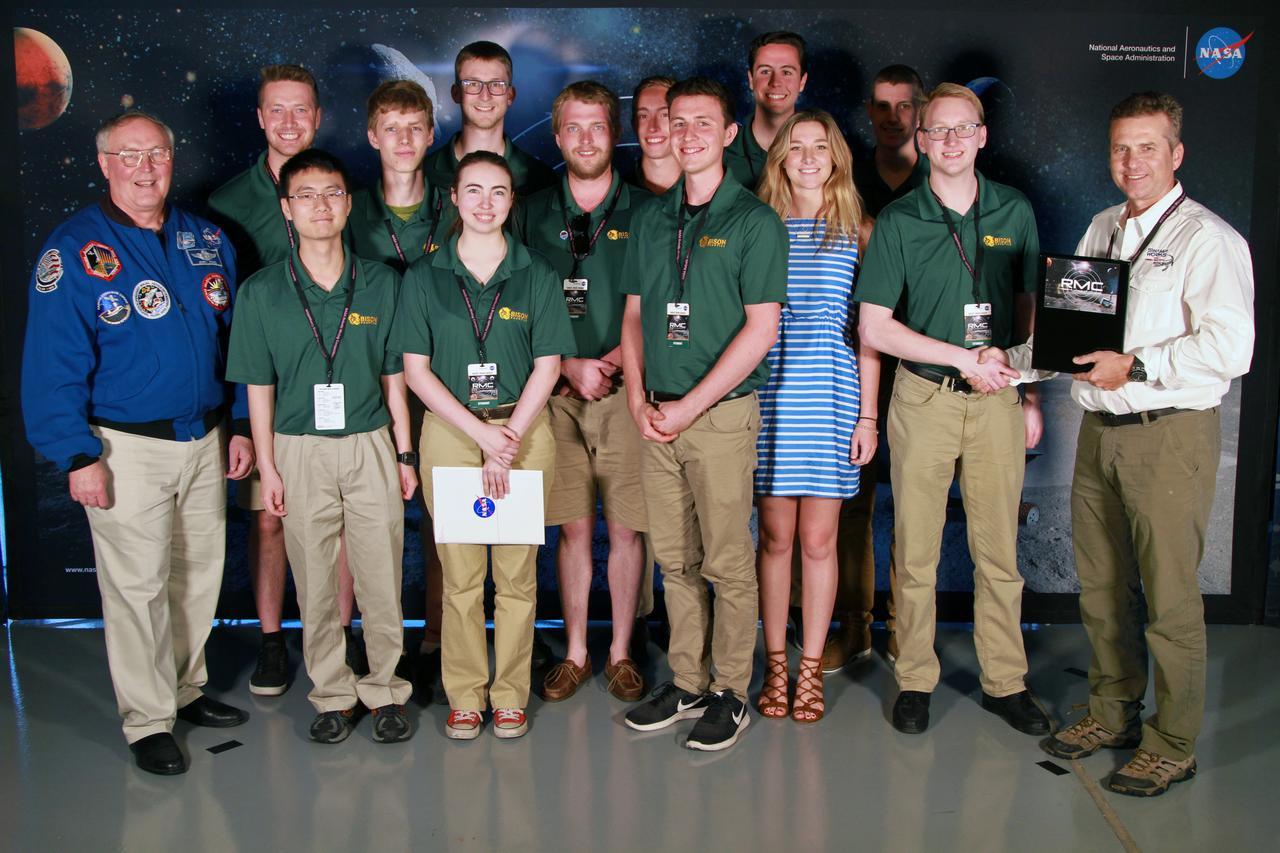
NASA's 9th Annual Robotic Mining Competition concludes with an awards ceremony May 18, 2018, at the Apollo/Saturn V Center at the Kennedy Space Center Visitor Complex in Florida. The team from North Dakota University in collaboration with James Madison University received second place in the On-Site Mining Award. At left is retired NASA astronaut Jerry Ross. At right is Rob Mueller, lead mining judge. More than 40 student teams from colleges and universities around the U.S. participated in the competition, May 14-18, by using their mining robots to dig in a supersized sandbox filled with BP-1, or simulated lunar soil, gravel and rocks, and participate in other competition requirements. The Robotic Mining Competition is a NASA Human Exploration and Operations Mission Directorate project designed to encourage students in science, technology, engineering and math, or STEM fields. The project provides a competitive environment to foster innovative ideas and solutions that could be used on NASA's deep space missions.
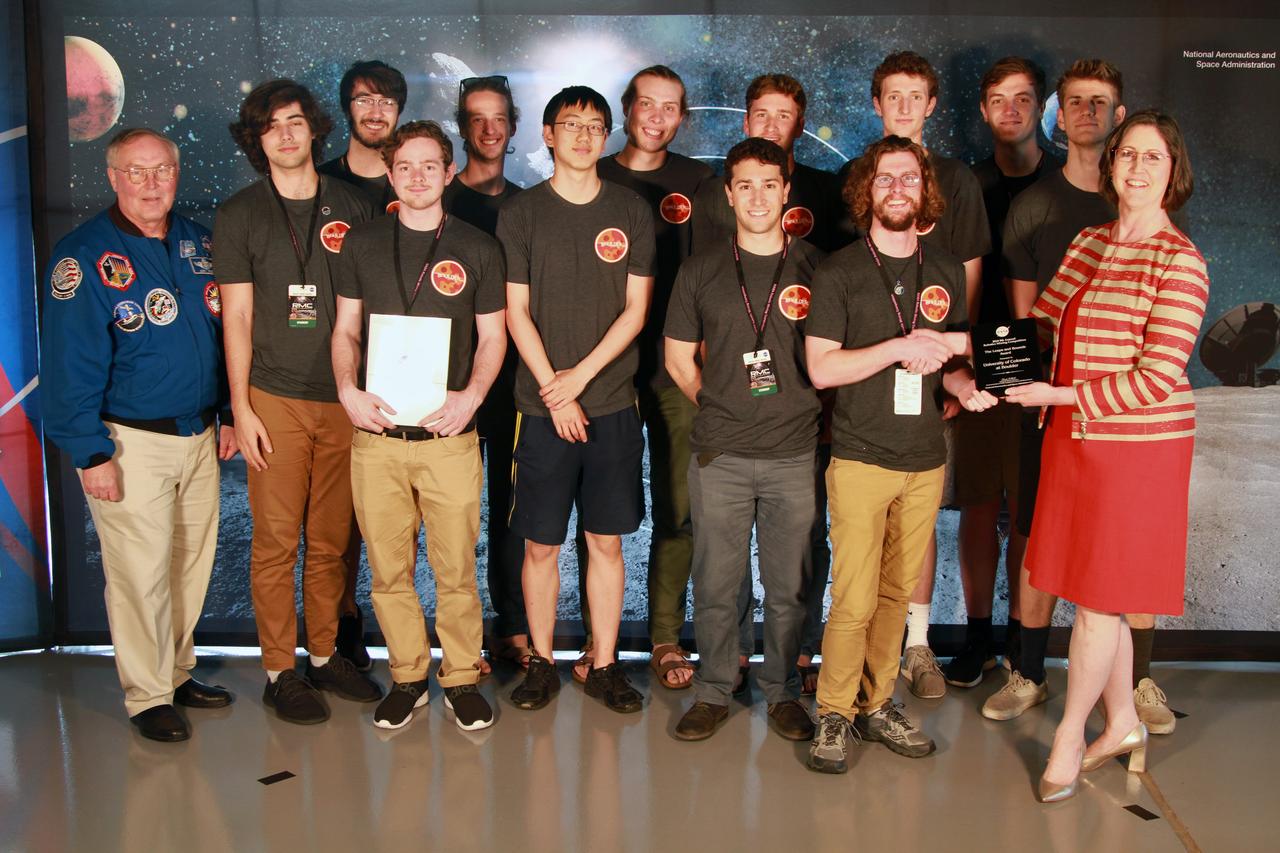
NASA's 9th Annual Robotic Mining Competition concludes with an awards ceremony May 18, 2018, at the Apollo/Saturn V Center at the Kennedy Space Center Visitor Complex in Florida. The team from the University of Colorado Boulder received the Leaps and Bounds Award for the most improvement in their Systems Engineering Paper. At left is retired NASA astronaut Jerry Ross. At right is Jonette Stecklein, lead systems engineering paper judge. More than 40 student teams from colleges and universities around the U.S. participated in the competition, May 14-18, by using their mining robots to dig in a supersized sandbox filled with BP-1, or simulated lunar soil, gravel and rocks, and participate in other competition requirements. The Robotic Mining Competition is a NASA Human Exploration and Operations Mission Directorate project designed to encourage students in science, technology, engineering and math, or STEM fields. The project provides a competitive environment to foster innovative ideas and solutions that could be used on NASA's deep space missions.
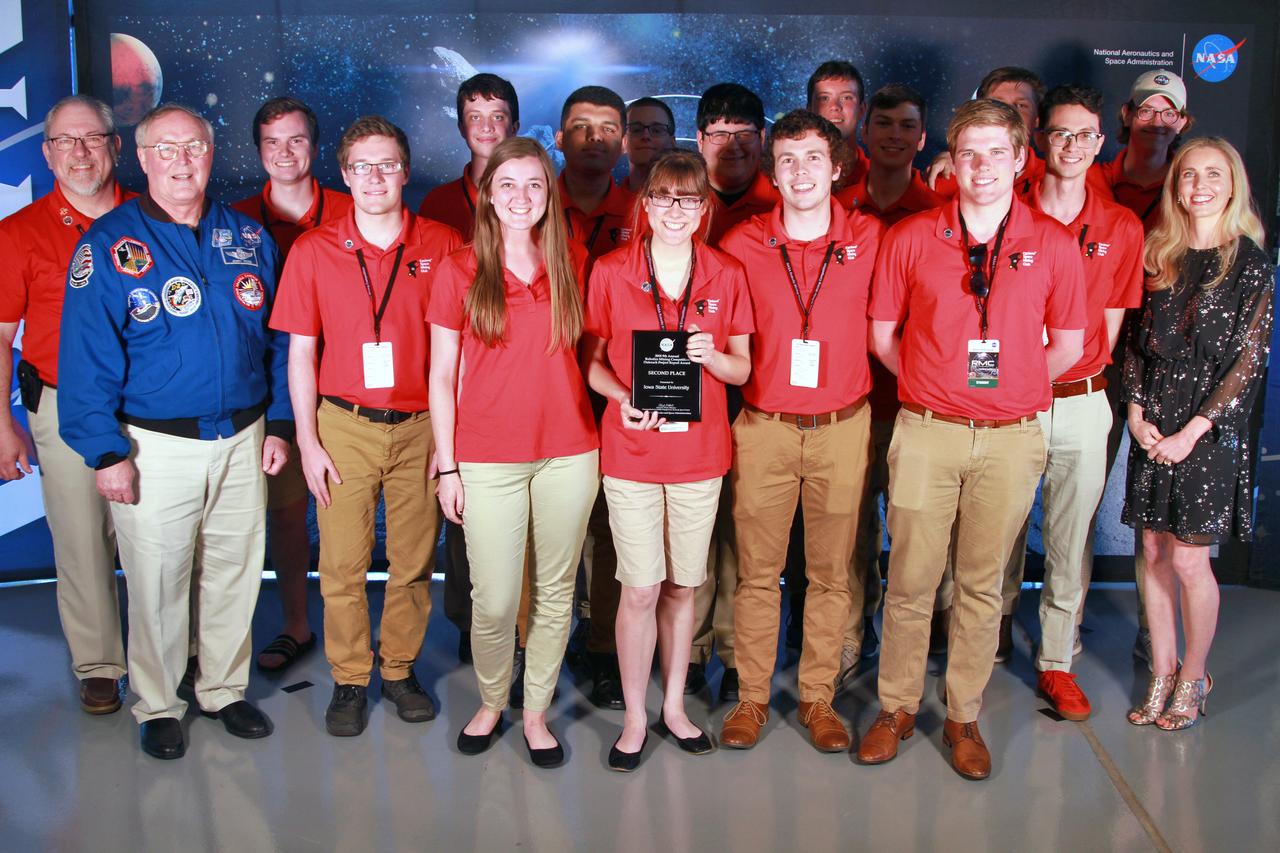
NASA's 9th Annual Robotic Mining Competition concludes with an awards ceremony May 18, 2018, at the Apollo/Saturn V Center at the Kennedy Space Center Visitor Complex in Florida. The team from Iowa State University received second place in the Outreach Project category. At left is retired NASA astronaut Jerry Ross. At right is Bethanne Hull, NASA Education specialist and lead Outreach Project judge. More than 40 student teams from colleges and universities around the U.S. participated in the competition, May 14-18, by using their mining robots to dig in a supersized sandbox filled with BP-1, or simulated lunar soil, gravel and rocks, and participate in other competition requirements. The Robotic Mining Competition is a NASA Human Exploration and Operations Mission Directorate project designed to encourage students in science, technology, engineering and math, or STEM fields. The project provides a competitive environment to foster innovative ideas and solutions that could be used on NASA's deep space missions.
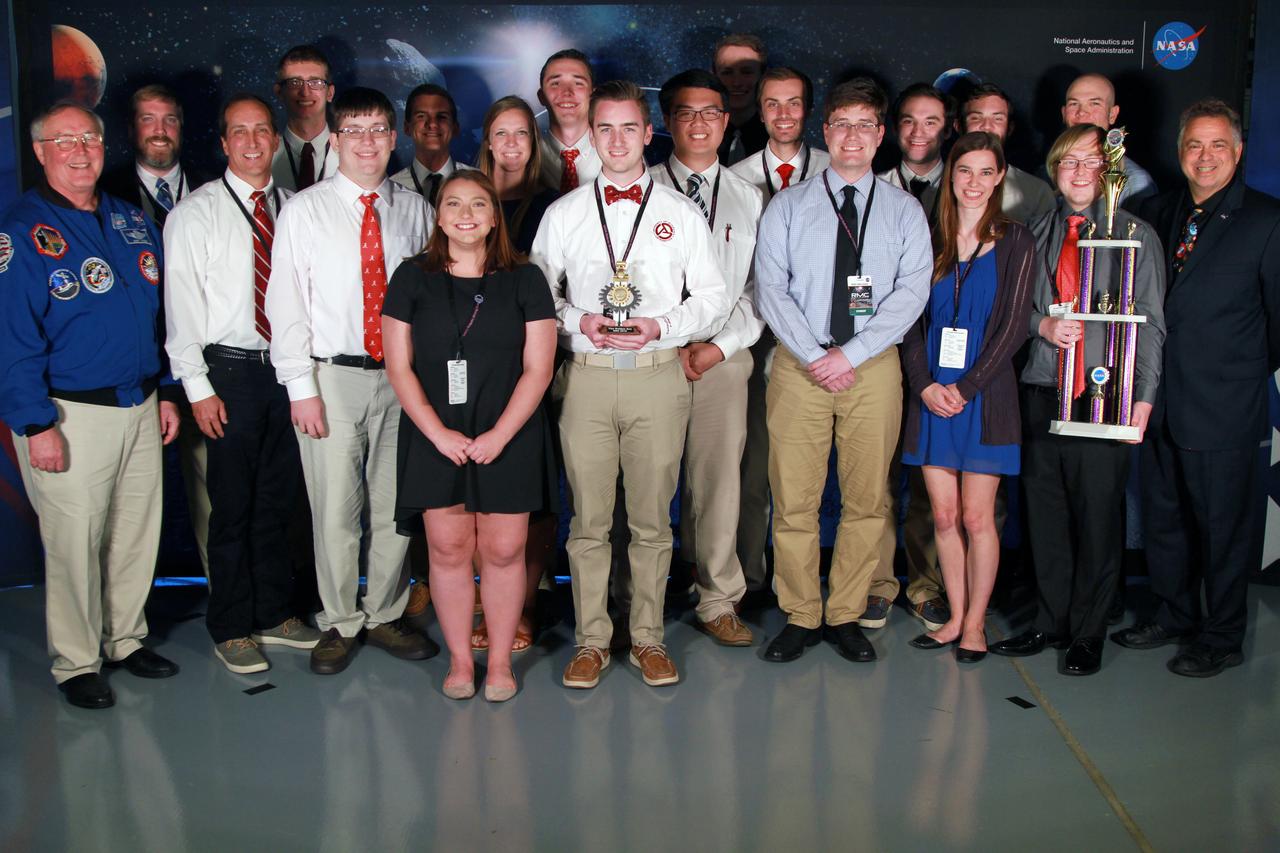
NASA's 9th Annual Robotic Mining Competition concludes with an awards ceremony May 18, 2018, at the Apollo/Saturn V Center at the Kennedy Space Center Visitor Complex in Florida. The University of Alabama Team Astrobotics received the top award, the Joe Kosmo Award for Excellence, which is given to the team that scores the most points during the competition. At far left in front is retired NASA astronaut Jerry Ross. At far right is Richard Johanboeke, NASA education specialist and project manager for the Robotic Mining Competition. More than 40 student teams from colleges and universities around the U.S. participated in the competition, May 14-18, by using their mining robots to dig in a supersized sandbox filled with BP-1, or simulated lunar soil, gravel and rocks, and participate in other competition requirements. The Robotic Mining Competition is a NASA Human Exploration and Operations Mission Directorate project designed to encourage students in science, technology, engineering and math, or STEM fields. The project provides a competitive environment to foster innovative ideas and solutions that could be used on NASA's deep space missions.
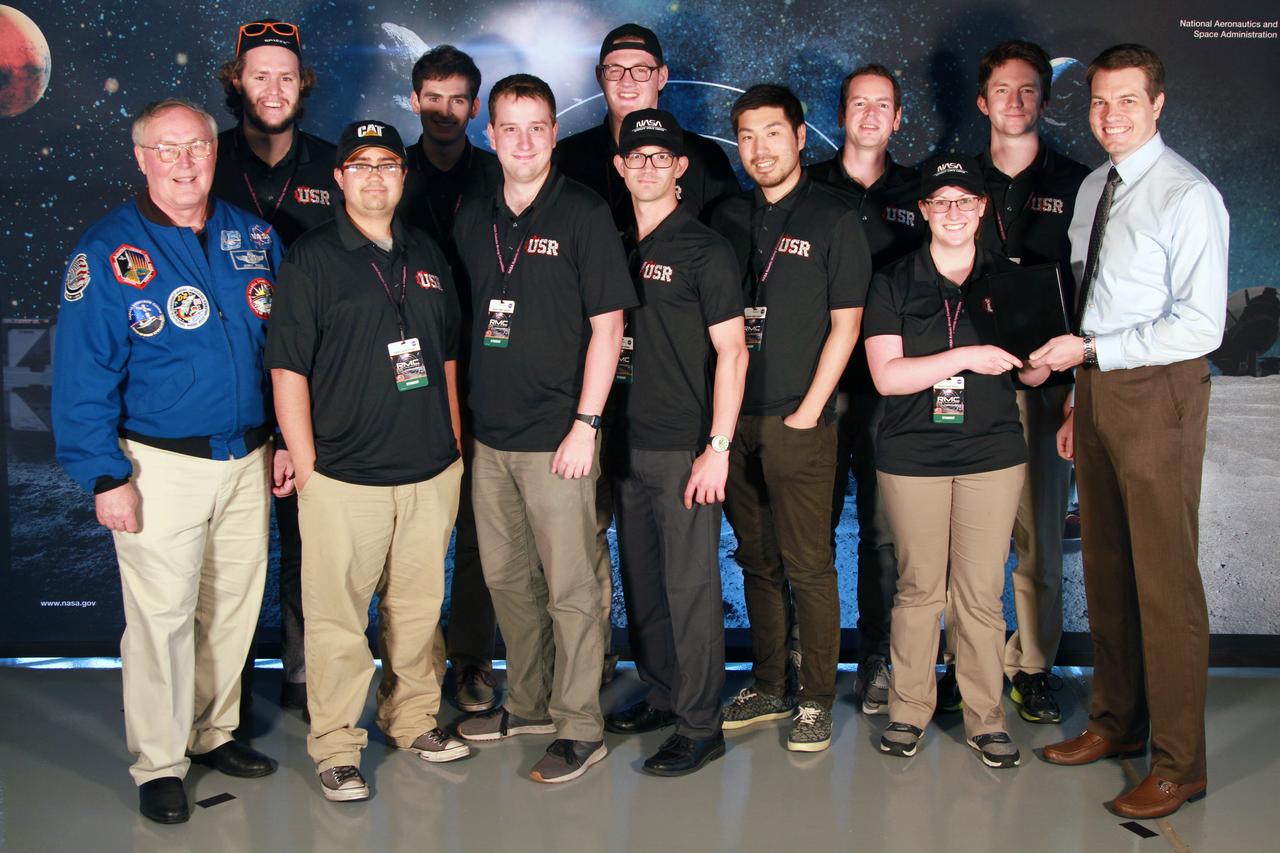
NASA's 9th Annual Robotic Mining Competition concludes with an awards ceremony May 18, 2018, at the Apollo/Saturn V Center at the Kennedy Space Center Visitor Complex in Florida. The Utah Student Robotics team from The University of Utah received second place in the Slide Presentation and Demonstration award category. At left is retired NASA astronaut Jerry Ross. At right is Daniel Hull, lead presentation judge. More than 40 student teams from colleges and universities around the U.S. participated in the competition, May 14-18, by using their mining robots to dig in a supersized sandbox filled with BP-1, or simulated lunar soil, gravel and rocks, and participate in other competition requirements. The Robotic Mining Competition is a NASA Human Exploration and Operations Mission Directorate project designed to encourage students in science, technology, engineering and math, or STEM fields. The project provides a competitive environment to foster innovative ideas and solutions that could be used on NASA's deep space missions.
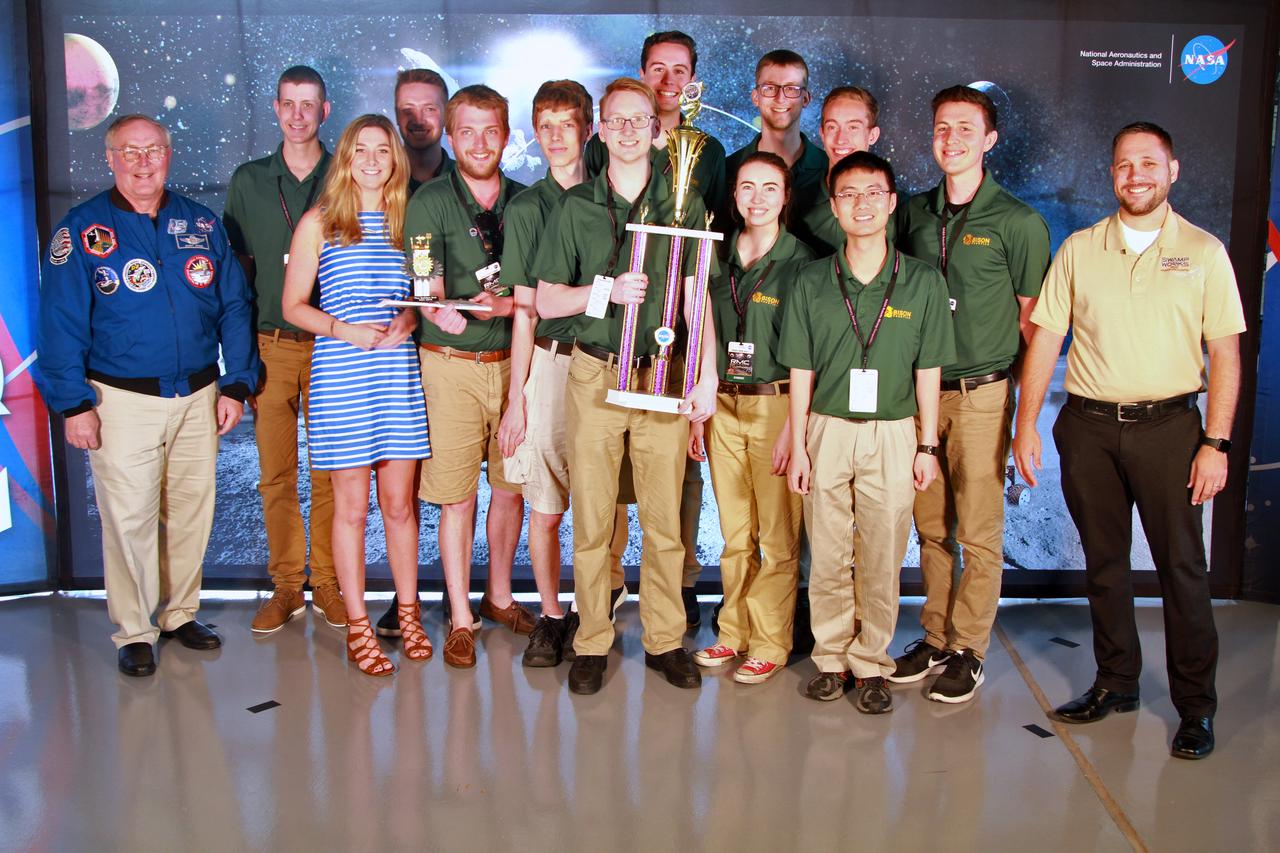
NASA's 9th Annual Robotic Mining Competition concludes with an awards ceremony May 18, 2018, at the Apollo/Saturn V Center at the Kennedy Space Center Visitor Complex in Florida. The team from North Dakota State University in collaboration with James Madison University received the IEEE Judges' Innovation Award for the most innovative design of a mining robot. At left is retired NASA astronaut Jerry Ross. At right is Michael Johansen, mining judge. More than 40 student teams from colleges and universities around the U.S. participated in the competition, May 14-18, by using their mining robots to dig in a supersized sandbox filled with BP-1, or simulated lunar soil, gravel and rocks, and participate in other competition requirements. The Robotic Mining Competition is a NASA Human Exploration and Operations Mission Directorate project designed to encourage students in science, technology, engineering and math, or STEM fields. The project provides a competitive environment to foster innovative ideas and solutions that could be used on NASA's deep space missions.
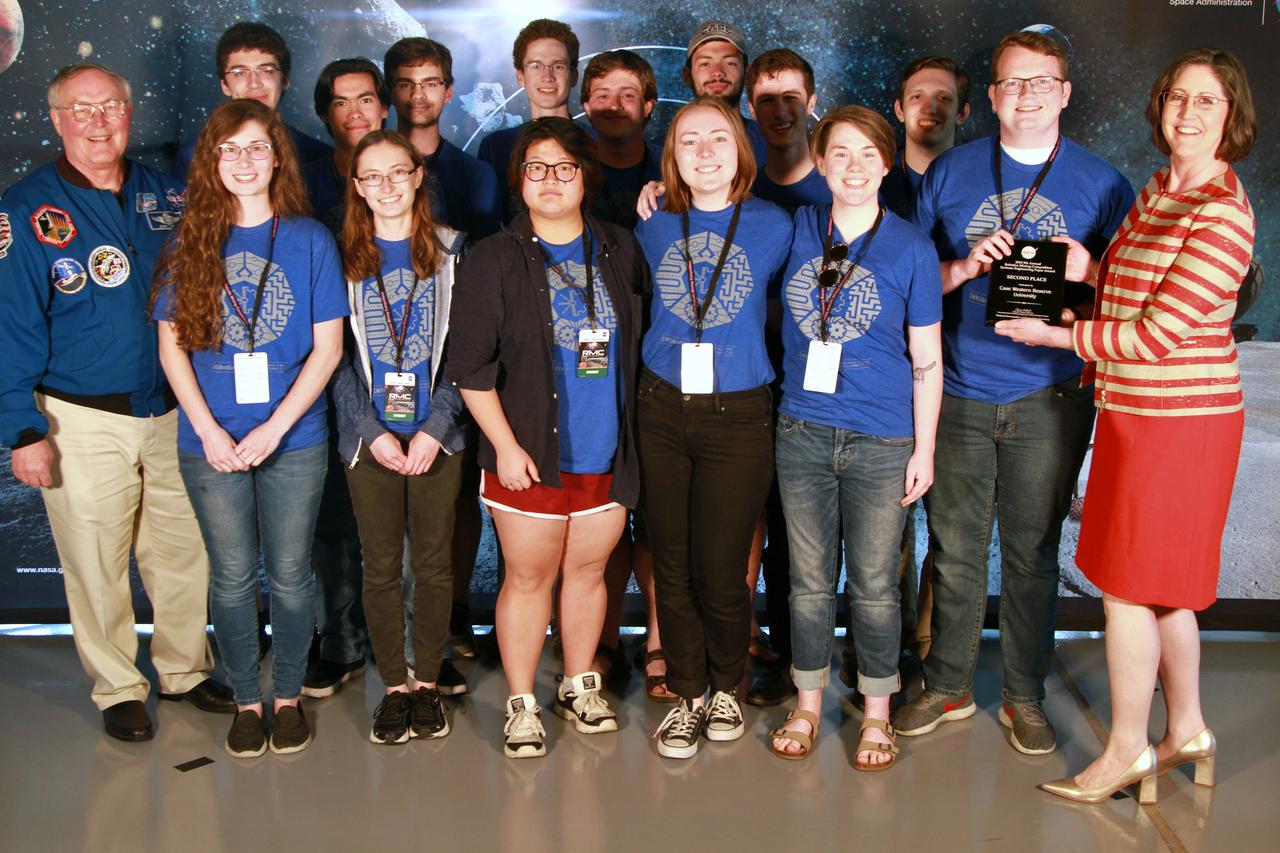
NASA's 9th Annual Robotic Mining Competition concludes with an awards ceremony May 18, 2018, at the Apollo/Saturn V Center at the Kennedy Space Center Visitor Complex in Florida. The team from Case Western Reserve University received second place for their Systems Engineering Paper. At left is retired NASA astronaut Jerry Ross. At right is Jonette Stecklein, lead systems engineering paper judge. More than 40 student teams from colleges and universities around the U.S. participated in the competition, May 14-18, by using their mining robots to dig in a supersized sandbox filled with BP-1, or simulated lunar soil, gravel and rocks, and participate in other competition requirements. The Robotic Mining Competition is a NASA Human Exploration and Operations Mission Directorate project designed to encourage students in science, technology, engineering and math, or STEM fields. The project provides a competitive environment to foster innovative ideas and solutions that could be used on NASA's deep space missions.
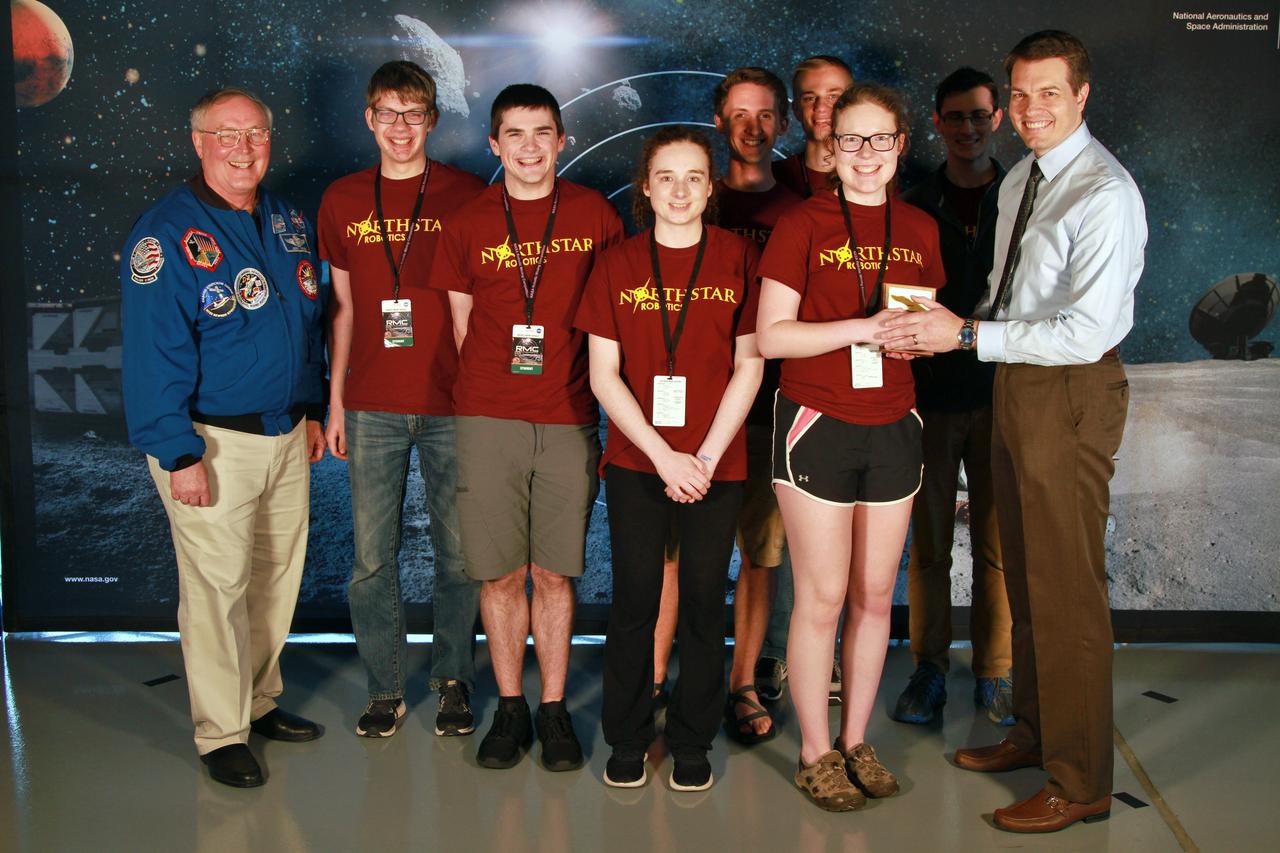
NASA's 9th Annual Robotic Mining Competition concludes with an awards ceremony May 18, 2018, at the Apollo/Saturn V Center at the Kennedy Space Center Visitor Complex in Florida. Team Northstar Robotics from the University of Minnesota - Twin Cities received the Golden E-Stop Award for their robot's safety system. At left is retired NASA astronaut Jerry Ross. At right is Daniel Hull, lead presentation judge. More than 40 student teams from colleges and universities around the U.S. participated in the competition, May 14-18, by using their mining robots to dig in a supersized sandbox filled with BP-1, or simulated lunar soil, gravel and rocks, and participate in other competition requirements. The Robotic Mining Competition is a NASA Human Exploration and Operations Mission Directorate project designed to encourage students in science, technology, engineering and math, or STEM fields. The project provides a competitive environment to foster innovative ideas and solutions that could be used on NASA's deep space missions.
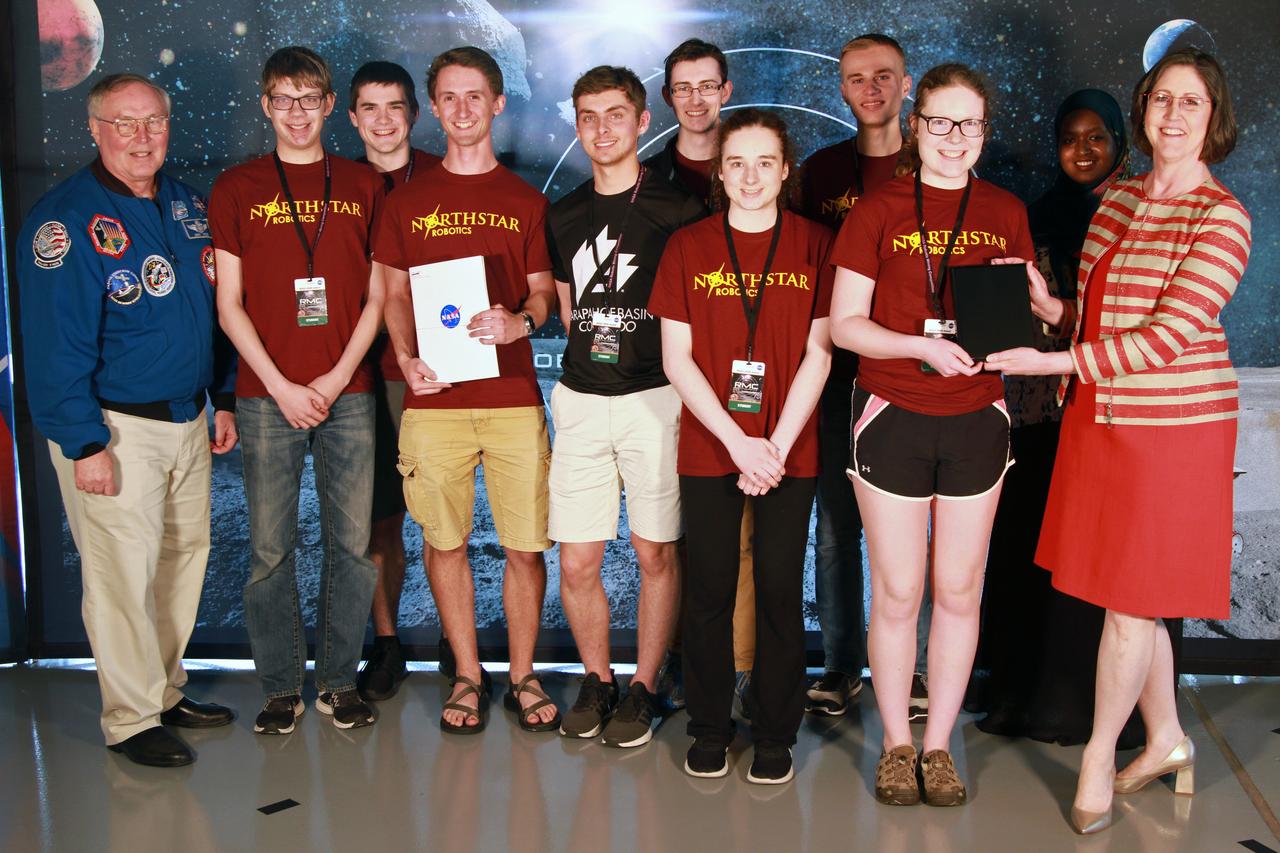
NASA's 9th Annual Robotic Mining Competition concludes with an awards ceremony May 18, 2018, at the Apollo/Saturn V Center at the Kennedy Space Center Visitor Complex in Florida. Team Northstar Robotics from the University of Minnesota - Twin Cities received an honorable mention award for their Systems Engineering Paper. At left is retired NASA astronaut Jerry Ross. At right is Jonette Stecklein, lead systems engineering paper judge. More than 40 student teams from colleges and universities around the U.S. participated in the competition, May 14-18, by using their mining robots to dig in a supersized sandbox filled with BP-1, or simulated lunar soil, gravel and rocks, and participate in other competition requirements. The Robotic Mining Competition is a NASA Human Exploration and Operations Mission Directorate project designed to encourage students in science, technology, engineering and math, or STEM fields. The project provides a competitive environment to foster innovative ideas and solutions that could be used on NASA's deep space missions.
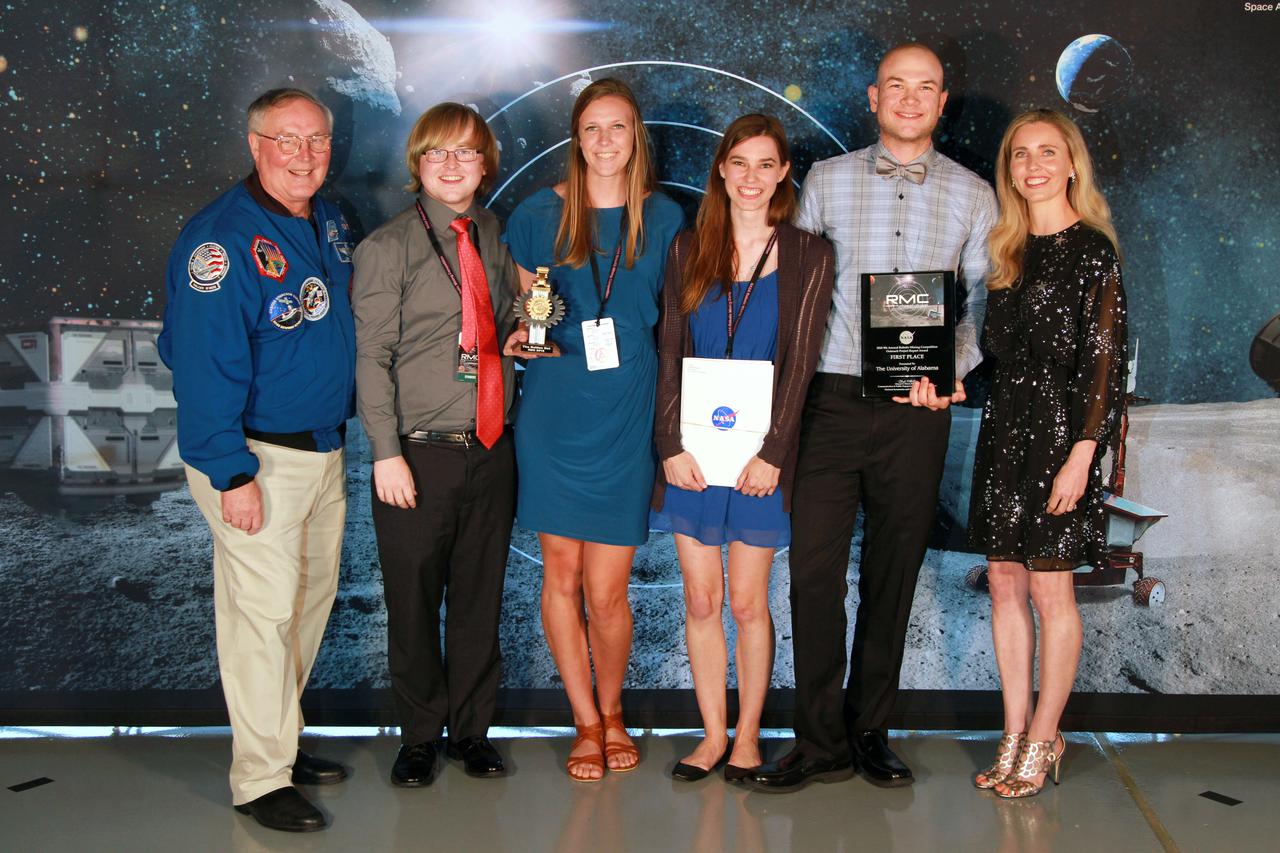
NASA's 9th Annual Robotic Mining Competition concludes with an awards ceremony May 18, 2018, at the Apollo/Saturn V Center at the Kennedy Space Center Visitor Complex in Florida. The University of Alabama Team Astrobotics received first place in the Outreach Project category. At left is retired NASA astronaut Jerry Ross. At right is Bethanne Hull, NASA Education specialist and lead Outreach Project judge. More than 40 student teams from colleges and universities around the U.S. participated in the competition, May 14-18, by using their mining robots to dig in a supersized sandbox filled with BP-1, or simulated lunar soil, gravel and rocks, and participate in other competition requirements. The Robotic Mining Competition is a NASA Human Exploration and Operations Mission Directorate project designed to encourage students in science, technology, engineering and math, or STEM fields. The project provides a competitive environment to foster innovative ideas and solutions that could be used on NASA's deep space missions.
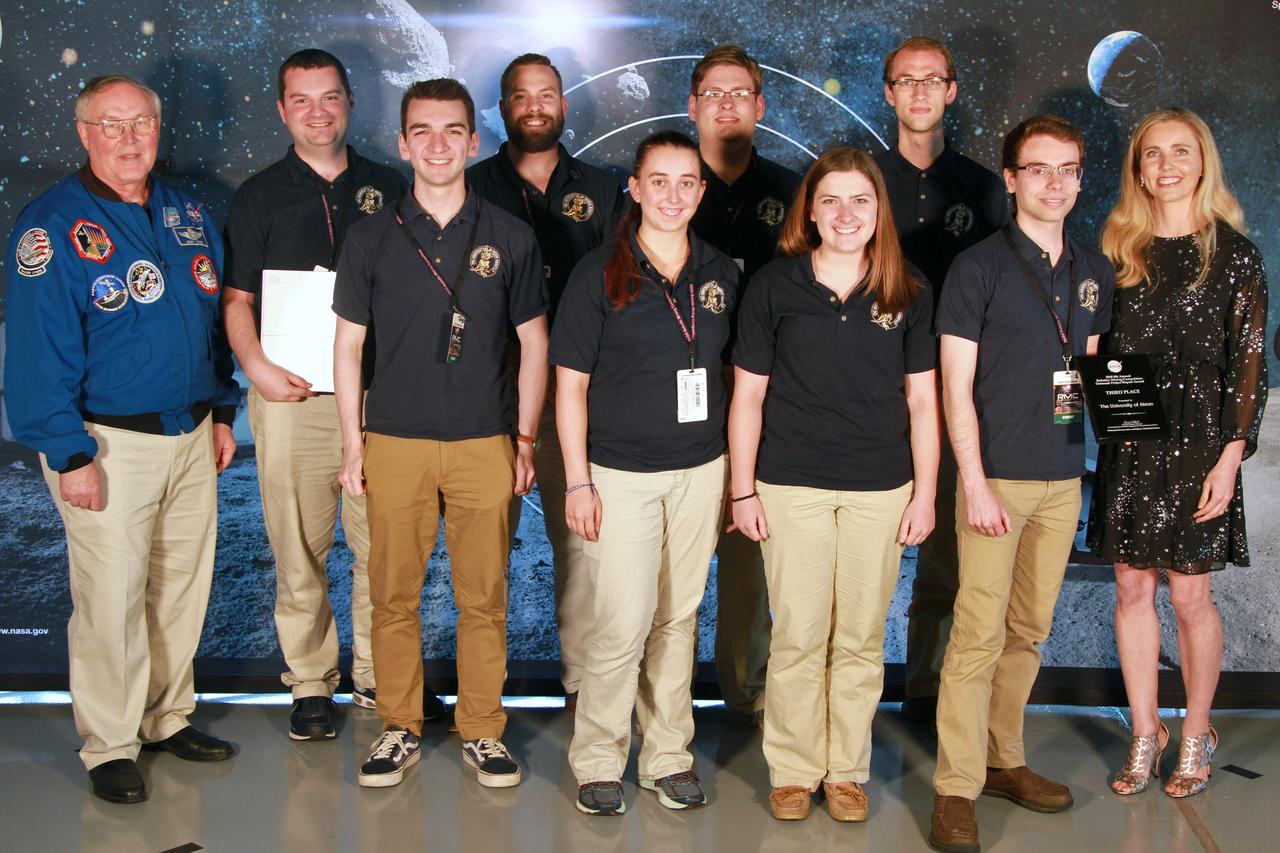
NASA's 9th Annual Robotic Mining Competition concludes with an awards ceremony May 18, 2018, at the Apollo/Saturn V Center at the Kennedy Space Center Visitor Complex in Florida. The team from The University of Akron received third place in the Outreach Project category. At left is retired NASA astronaut Jerry Ross. At right is Bethanne Hull, NASA Education specialist and lead Outreach Project judge. More than 40 student teams from colleges and universities around the U.S. participated in the competition, May 14-18, by using their mining robots to dig in a supersized sandbox filled with BP-1, or simulated lunar soil, gravel and rocks, and participate in other competition requirements. The Robotic Mining Competition is a NASA Human Exploration and Operations Mission Directorate project designed to encourage students in science, technology, engineering and math, or STEM fields. The project provides a competitive environment to foster innovative ideas and solutions that could be used on NASA's deep space missions.
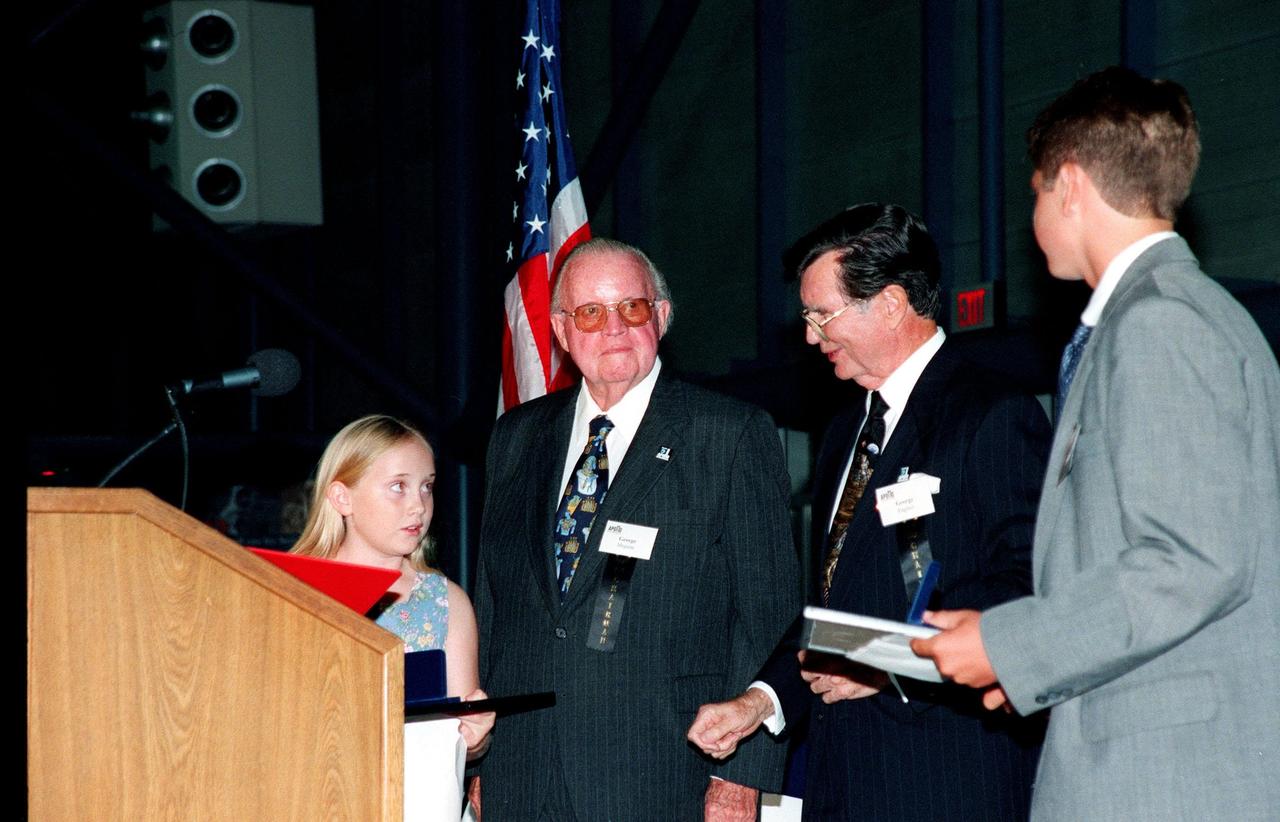
KENNEDY SPACE CENTER, FLA. -- At the Apollo/Saturn V Center, George Meguiar (center left) and George English (center right) present scholarships to two students who entered an essay contest in conjunction with the 30th Anniversary of Apollo 11. The winners shown are Kyla Davis Horn, of Cocoa Beach, and Kyle Rukaczewski, of Satellite Beach. A third winner, Jason Gagnon, of Viera, was unable to attend. Meguiar and English head the Apollo 11 Commemoration Association which sponsored the contest in conjunction with Florida Today newspaper. The presentation was made at the Apollo/Saturn V Center during an anniversary banquet that honored all the people who made the Apollo Program possible. Special guests included former Apollo astronauts Neil Armstrong, Edwin "Buzz" Aldrin, Gene Cernan and Walt Cunningham, who shared their experiences with the audience
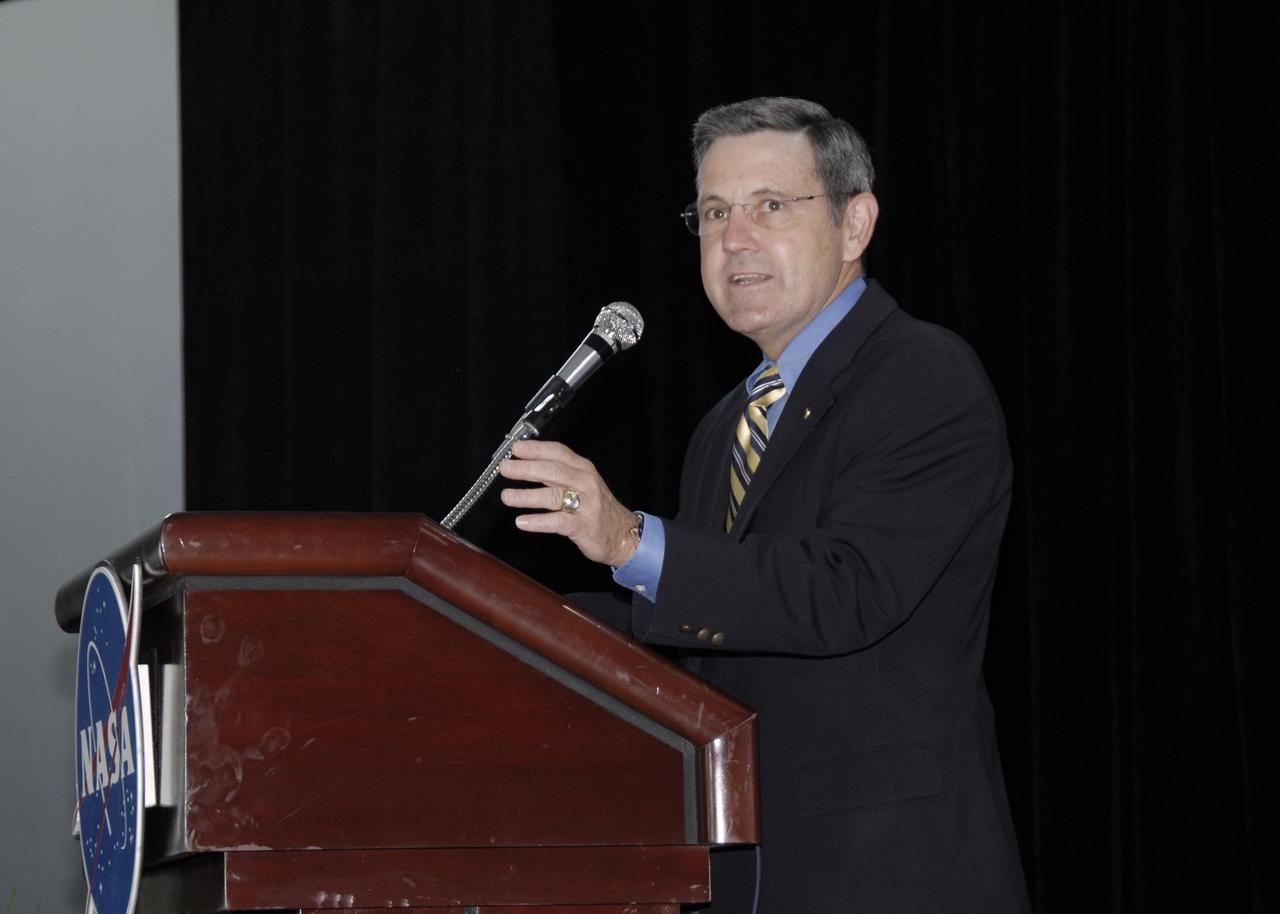
CAPE CANAVERAL, Fla. – At NASA's Kennedy Space Center in Florida, Center Director Bob Cabana speaks to the audience gathered to celebrate NASA's 40th anniversary of the Apollo 11 launch and landing in July 1969. The event was held in the Apollo/Saturn V Center at Kennedy. Photo credit: NASA/Kim Shiflett
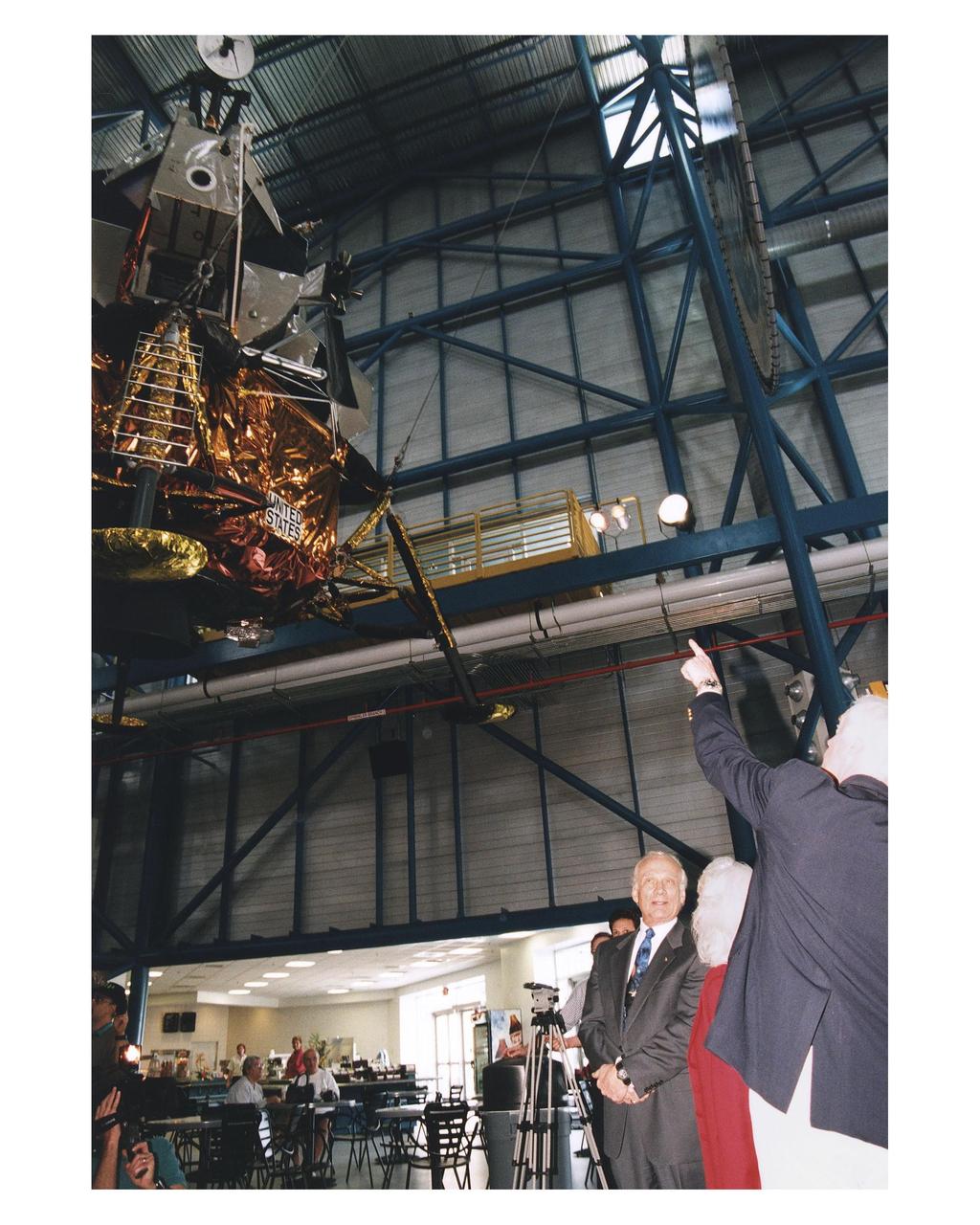
KENNEDY SPACE CENTER, FLA. -- Apollo 11 Lunar Module Pilot Edwin E. "Buzz" Aldrin, Jr. and his wife, Lois, stand near an Apollo Lunar Module suspended from the ceiling of the new Apollo/Saturn V Center (ASVC) at KSC prior to the gala grand opening ceremony for the facility that was held Jan. 8, 1997. Several Apollo astronauts were invited to participate in the event, which also featured NASA Administrator Dan Goldin and KSC Director Jay Honeycutt. The ASVC also features several other Apollo program spacecraft components, multimedia presentations and a simulated Apollo/ Saturn V liftoff. The facility will be a part of the KSC bus tour that embarks from the KSC Visitor Center

S68-56001 (21 Dec. 1968) --- The Apollo 8 (Spacecraft 103/Saturn 503) space vehicle is launched from Pad A, Launch Complex 39, Kennedy Space Center, at 7:51 a.m. (EST), Dec. 21, 1968. The crew of the Apollo 8 lunar orbit mission is astronauts Frank Borman, commander; James A. Lovell Jr., command module pilot; and William A. Anders, lunar module pilot. Apollo 8 was the first manned Saturn V launch. (Just after ignition)
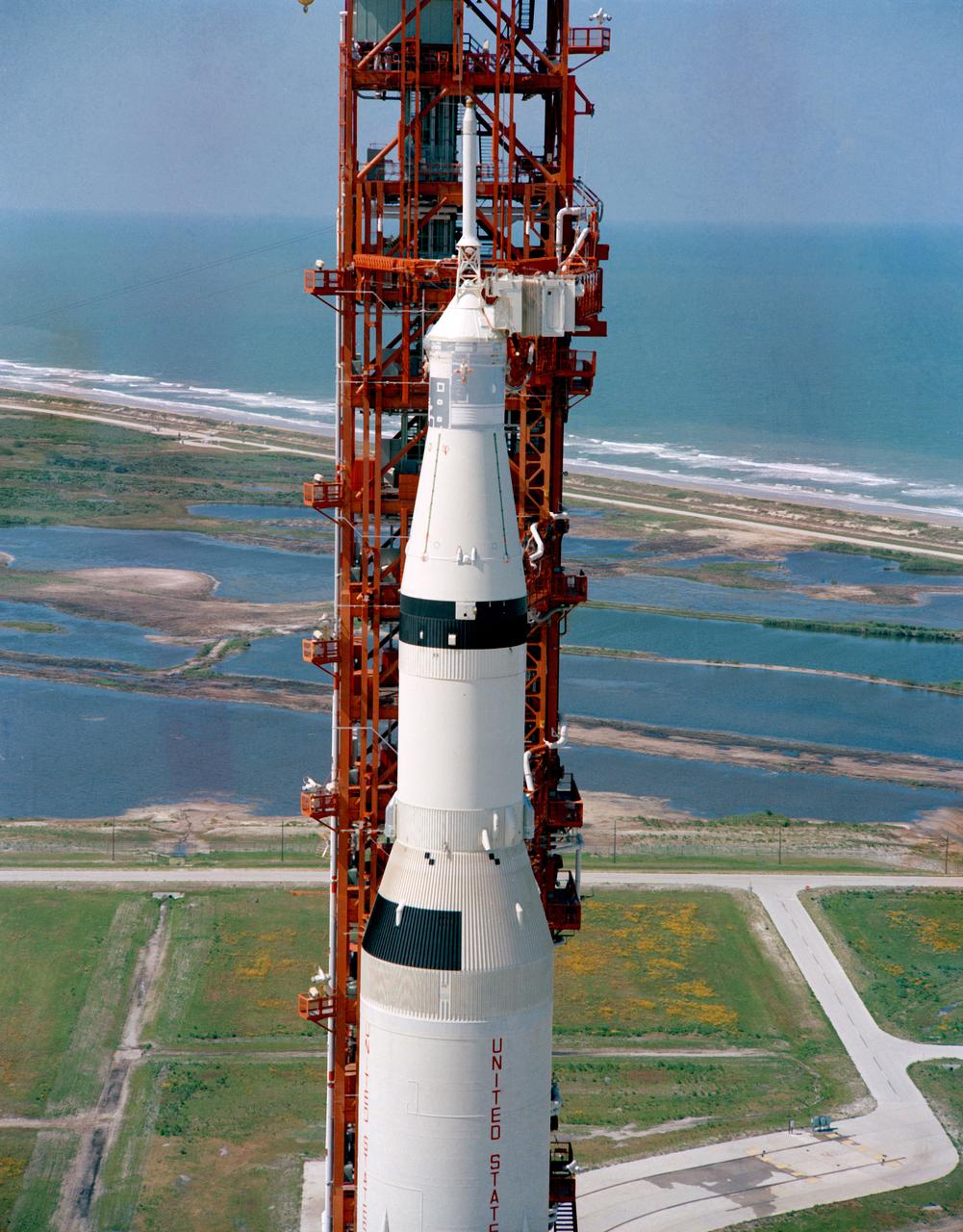
S69-33854 (4 May 1969) --- Aerial (high-angle, clasp) view of the Apollo 10 (Spacecraft 106/Lunar Module 4/Saturn 505) space vehicle on Pad B, Launch Complex 39, Kennedy Space Center. This photograph of the 363-feet tall Apollo/Saturn V stack was taken during pull back of the mobile service structure. The Apollo 10 crew will be astronauts Thomas P. Stafford, John W. Young, and Eugene A. Cernan.
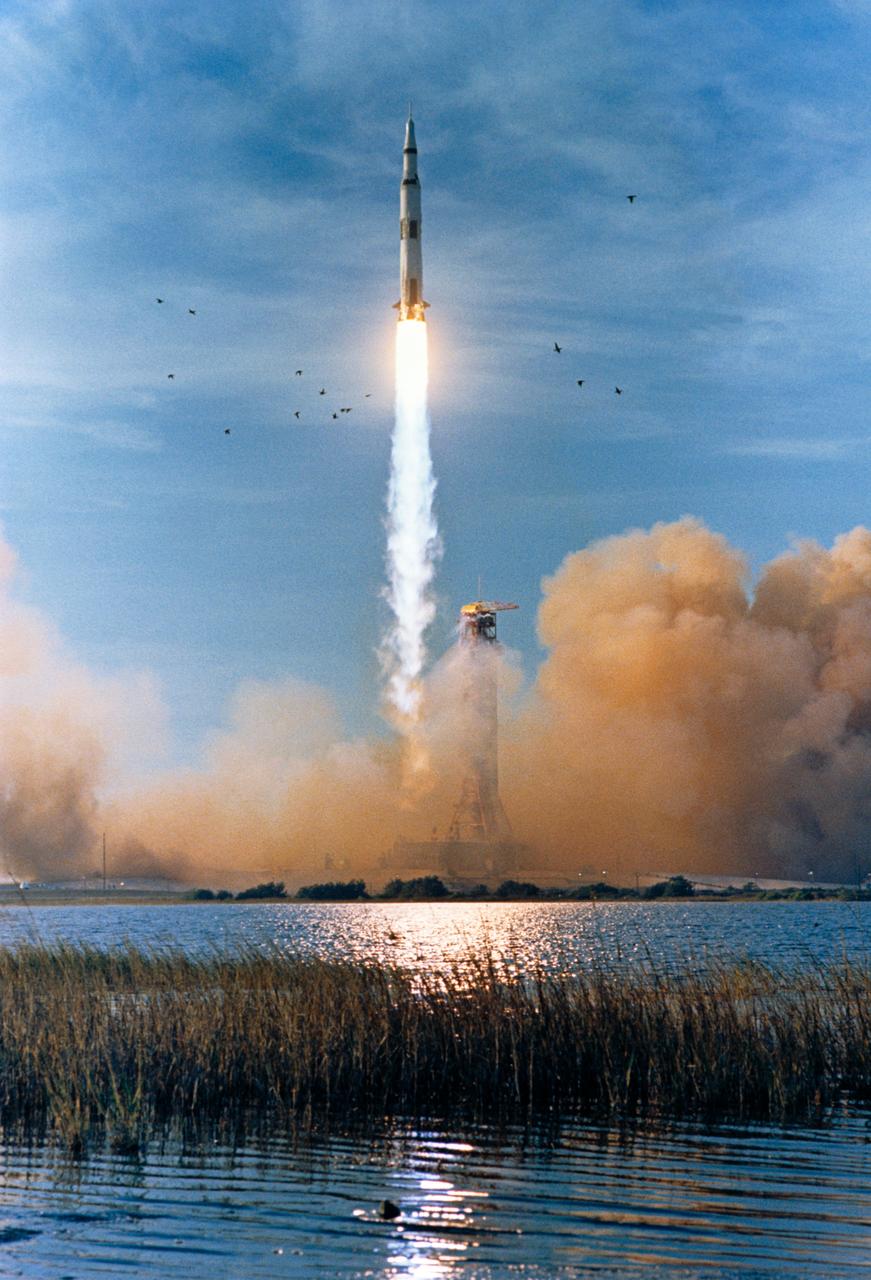
S68-56050 (21 Dec. 1968)--- The Apollo 8 (Spacecraft 103/Saturn 503) space vehicle is launched from Pad A, Launch Complex 39, Kennedy Space Center (KSC), at 7:51 a.m. (EST), Dec. 21, 1968. The crew of the Apollo 8 lunar orbit mission is astronauts Frank Borman, commander; James A. Lovell Jr., command module pilot; and William A. Anders, lunar module pilot. Apollo 8 is the first manned Saturn V launch. (water in foreground, seagulls)
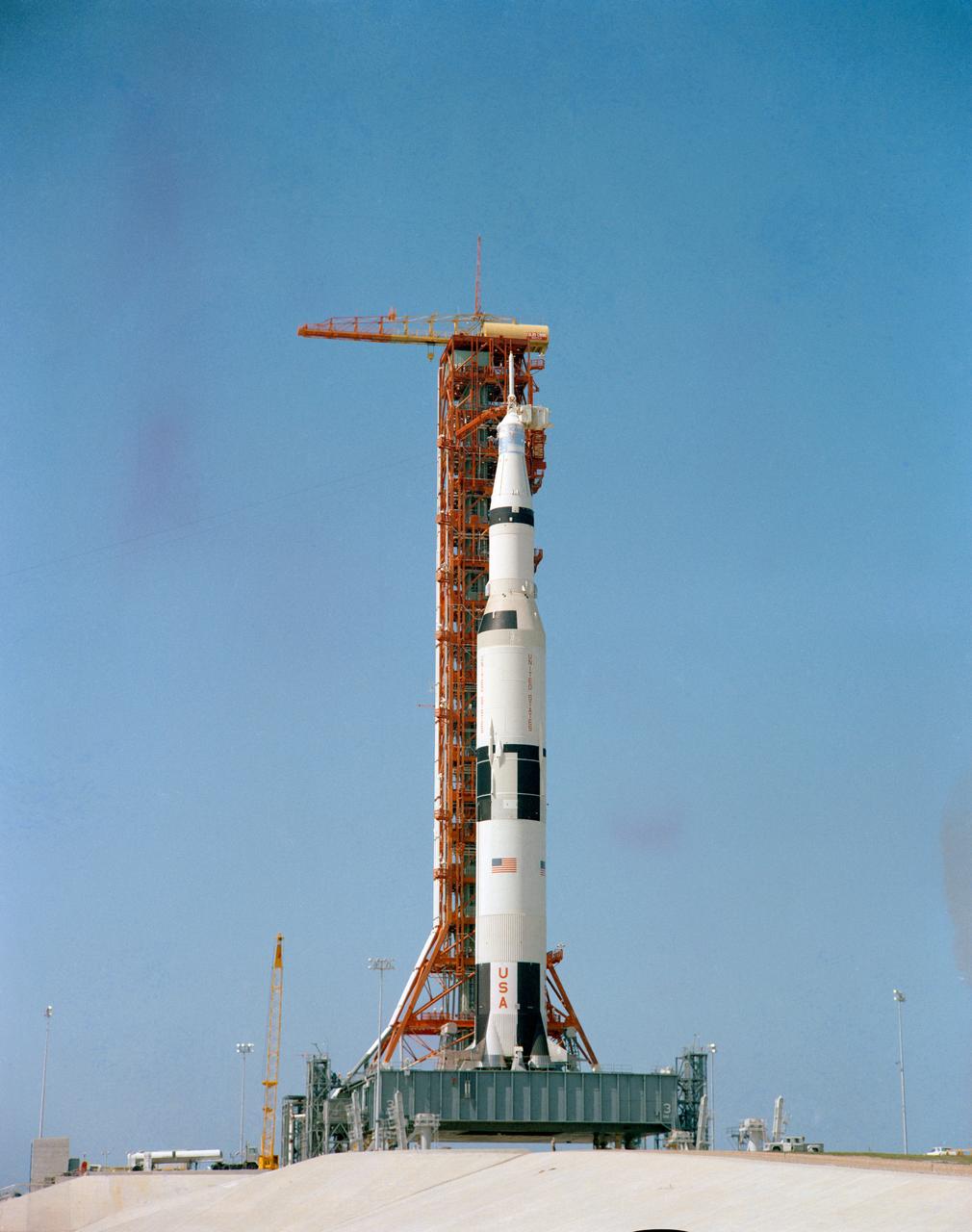
S69-33853 (4 May 1969) --- Ground-level view of the Apollo 10 (Spacecraft 106/Lunar Module 4/Saturn 505) space vehicle on Pad B, Launch Complex 39, Kennedy Space Center, Florida. This photograph of the 363-feet tall Apollo/Saturn V stack was taken during Countdown Demonstration Test (CDDT) activity. The Apollo 10 crew will be astronauts Thomas P. Stafford, commander; John W. Young, command module pilot; and Eugene A. Cernan, lunar module pilot.
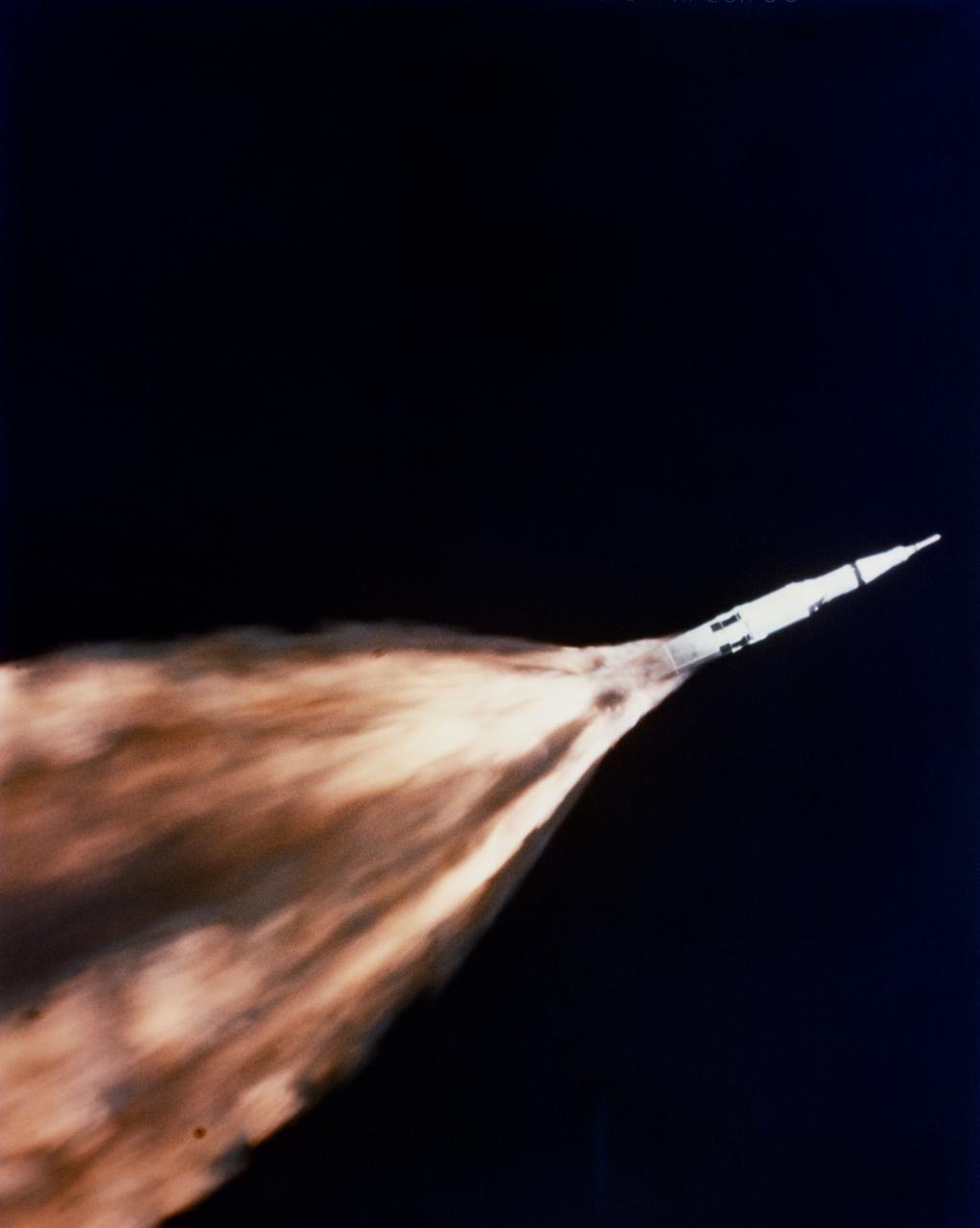
S68-27365 (4 April 1968) --- The five F-1 engines of the huge Apollo/Saturn V space vehicle's first (S-IC) stage leave a gigantic trail of flame in the sky above the Kennedy Space Center seconds after liftoff. The launch of the Apollo 6 (Spacecraft 020/Saturn 502) unmanned space mission occurred at 07:00:01.5 (EST), April 4, 1968. This view of the Apollo 6 launch was taken from a chase plane.
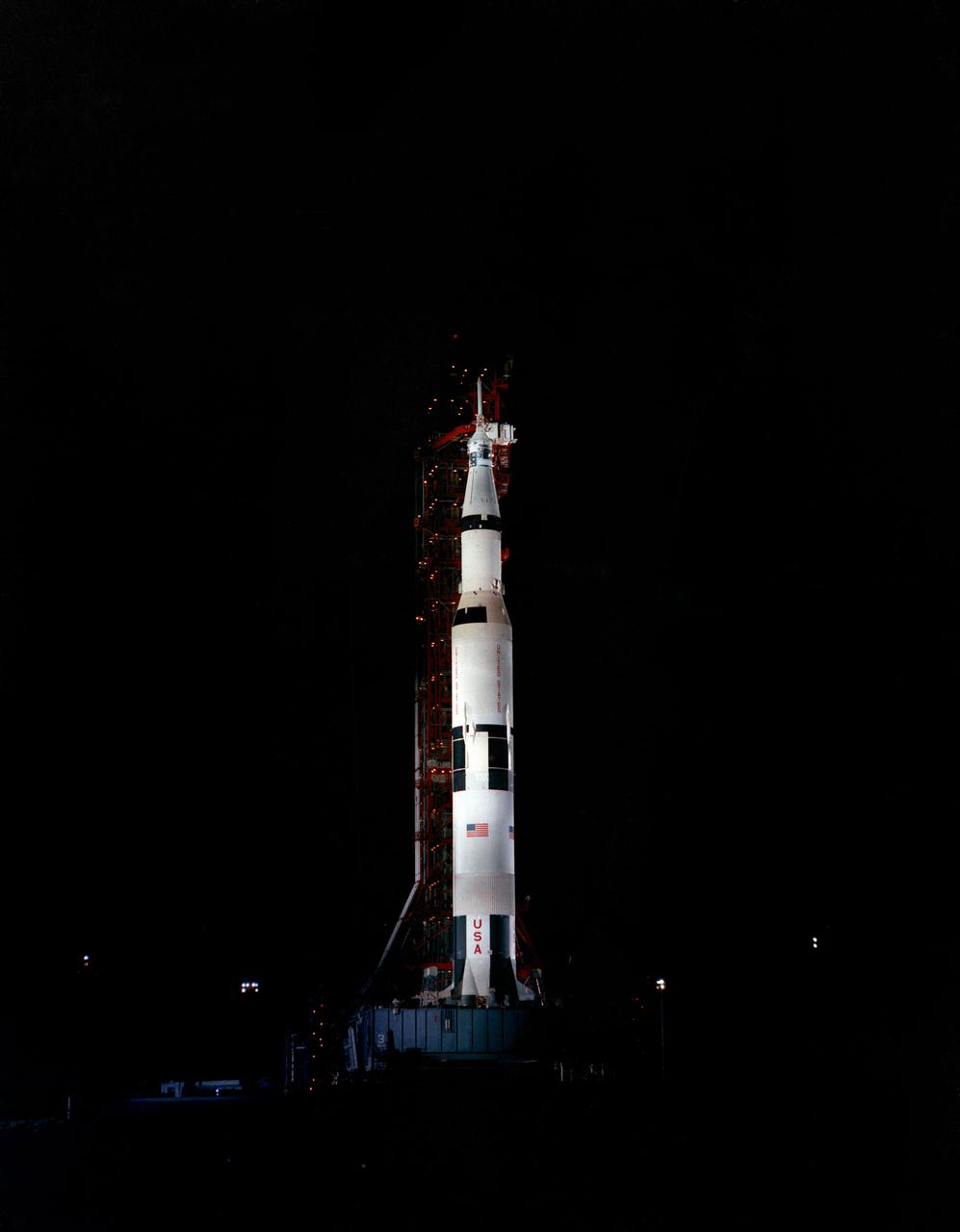
S69-33855 (4 May 1969) --- Nighttime, ground-level view of the Apollo 10 (Spacecraft 106/Lunar Module 4/Saturn 505) space vehicle on Pad B, Launch Complex 39, Kennedy Space Center. This photograph of the 363-feet tall Apollo/Saturn V stack was taken during pull back of the mobile service structure. The Apollo 10 crew will be astronauts Thomas P. Stafford, John W. Young, and Eugene A. Cernan.
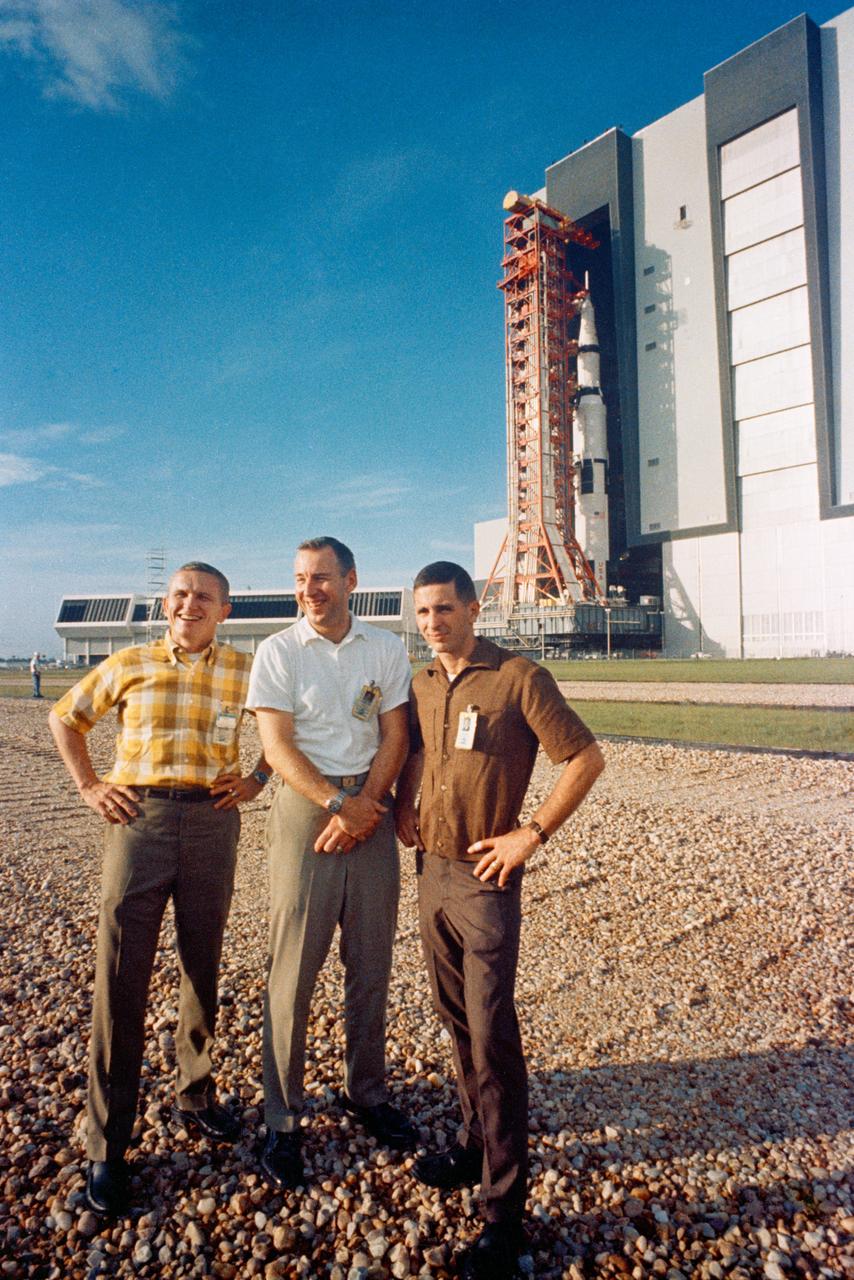
S68-49397 (9 Oct. 1968) --- The Apollo 8 prime crew stands in foreground as the Apollo (Spacecraft 103/Saturn 503) space vehicle leaves the Kennedy Space Center's Vehicle Assembly Building on way to Pad A, Launch Complex 39. The Saturn V stack and its mobile launch tower are atop a huge crawler-transporter. The Apollo 8 crew consists of (left to right) astronauts Frank Borman, commander; James A. Lovell Jr., command module pilot; and William A. Anders, lunar module pilot.
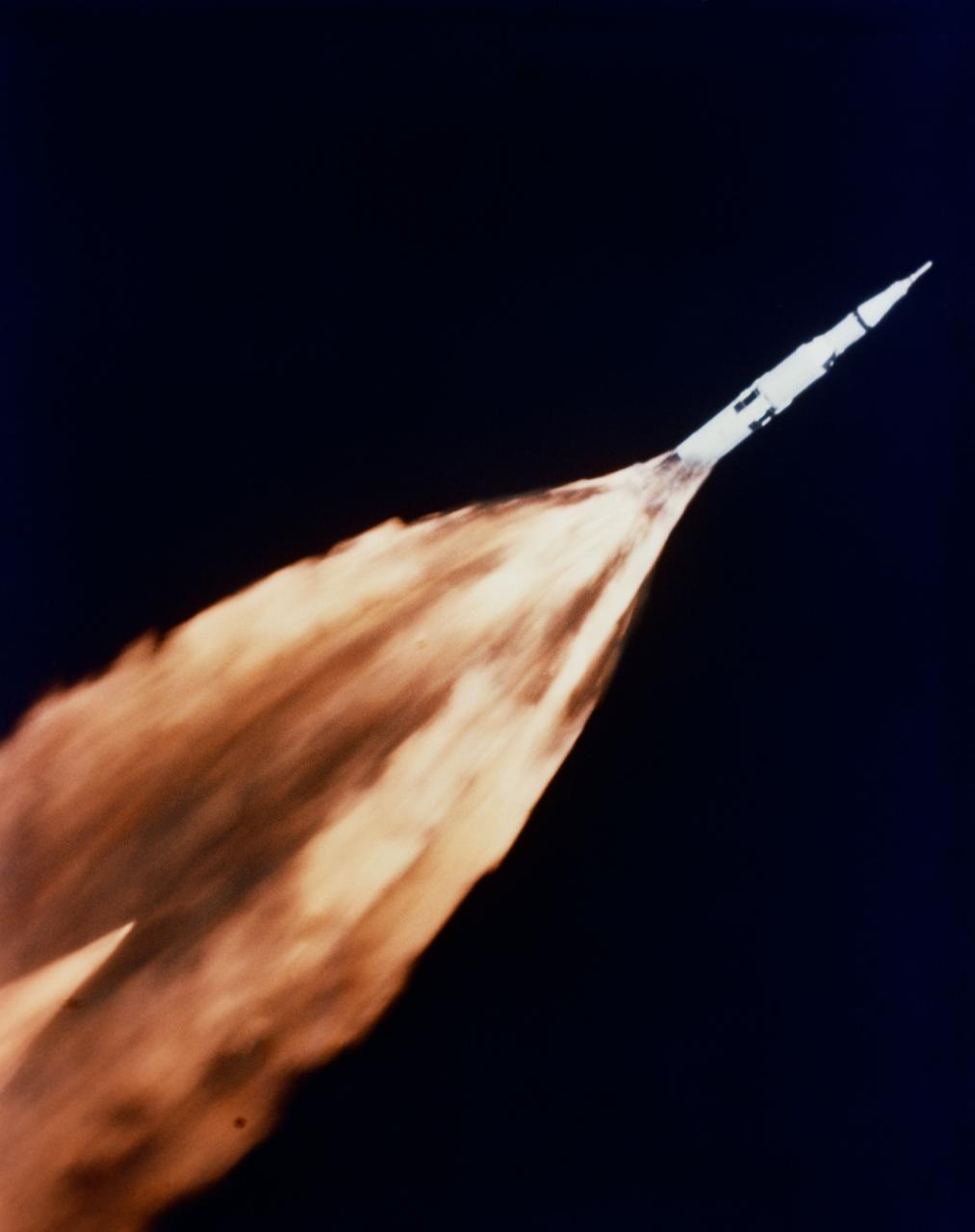
S68-27366 (4 April 1968) --- The five F-1 engines of the huge Apollo/Saturn V space vehicle's first (S-IC) stage leave a gigantic trail of flame in the sky above the Kennedy Space Center seconds after liftoff. The launch of the Apollo 6 (Spacecraft 020/Saturn 502) unmanned space mission occurred at 07:00:01.5 (EST), April 4, 1968. This view of the Apollo 6 launch was taken from a chase plane.
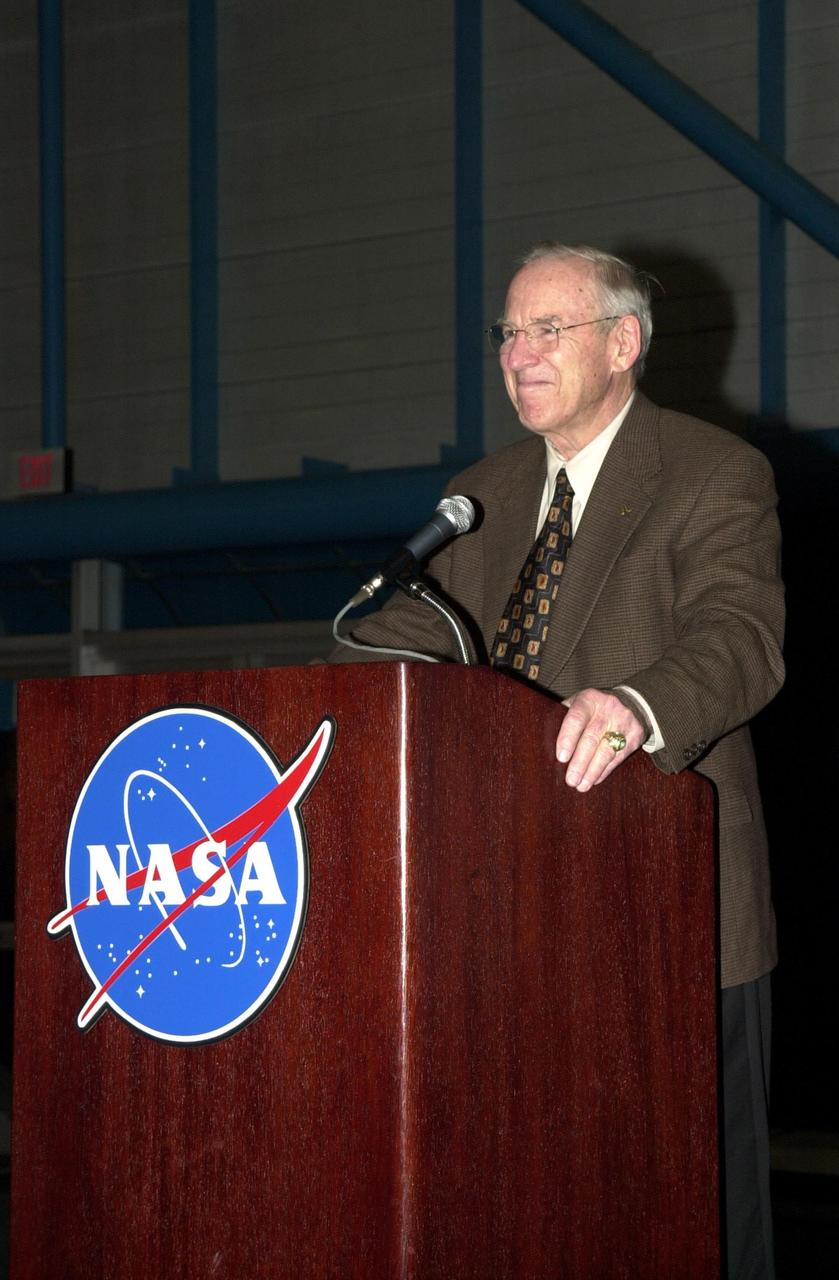
KENNEDY SPACE CENTER, FLA. -- Former astronaut James Lovell, who was commander of the Apollo 13 mission, addresses the audience at KSC's Apollo/Saturn V Center during the dinner celebration of the 40th anniversary of American spaceflight. Lovell served as host of the celebration