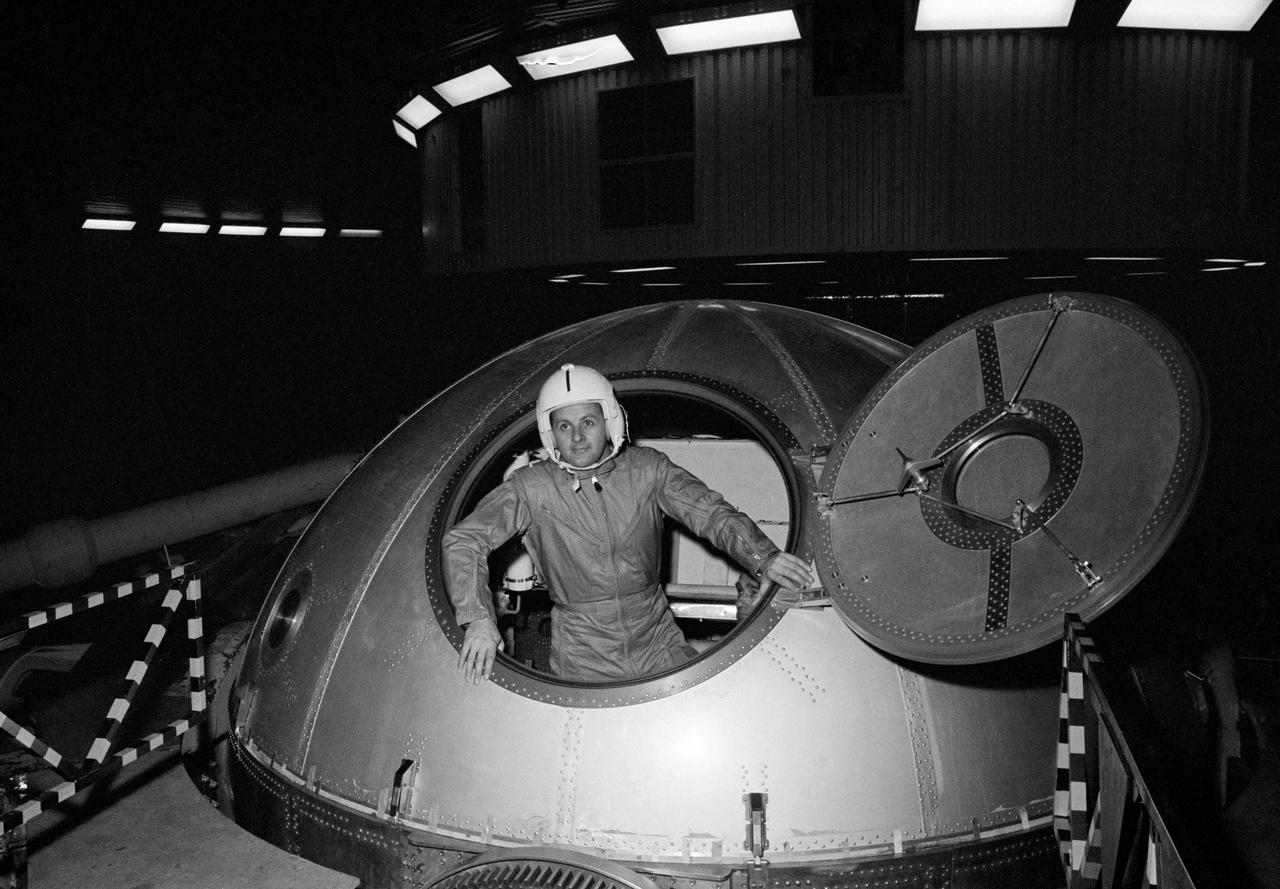
Views of Astronaut Dr. Philip K. Chapman training in the Lunar Module (LM) Simulator, Centrifuge, and the Apollo Mission Simulator. MSC
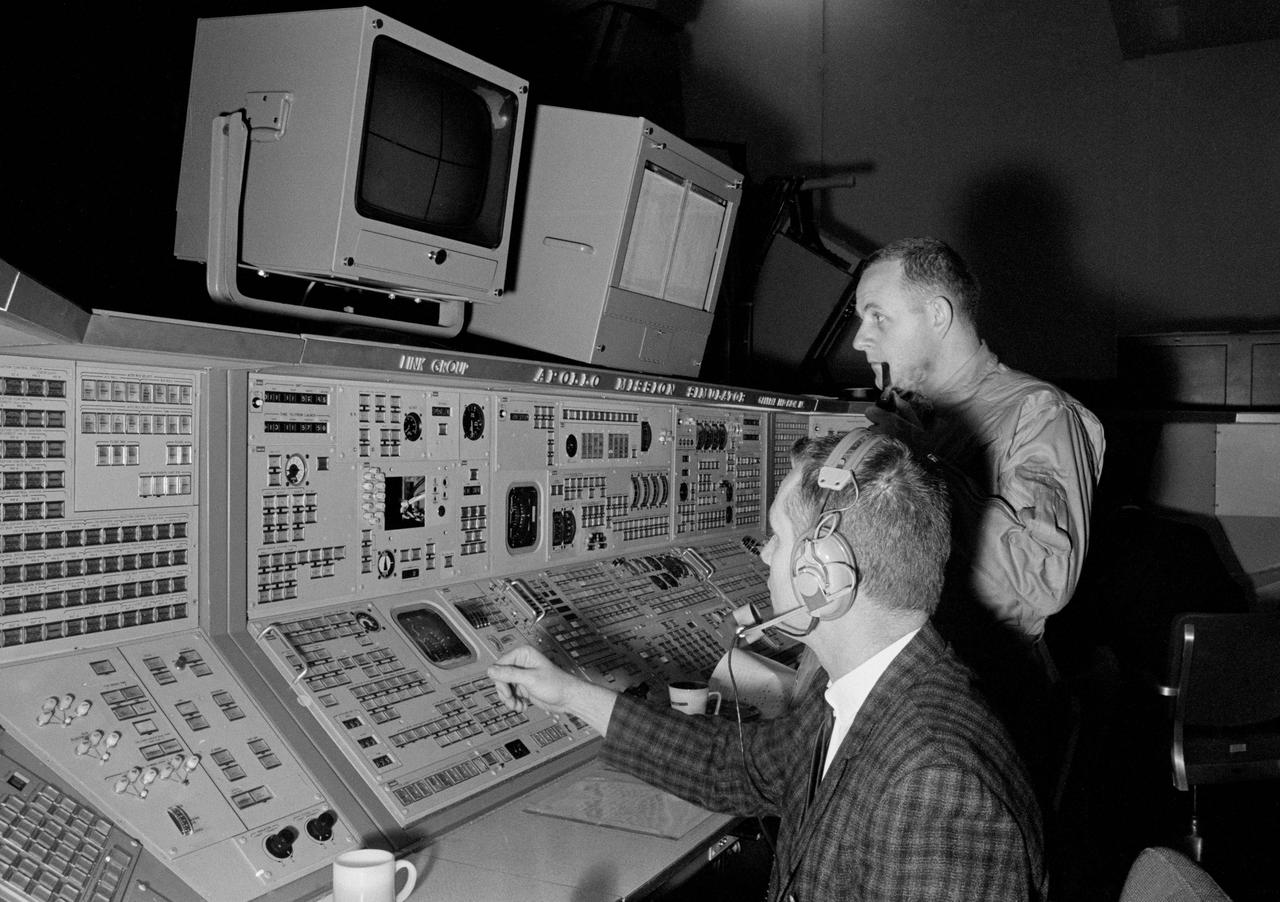
Views of Astronaut Dr. Philip K. Chapman training in the Lunar Module (LM) Simulator, Centrifuge, and the Apollo Mission Simulator. MSC
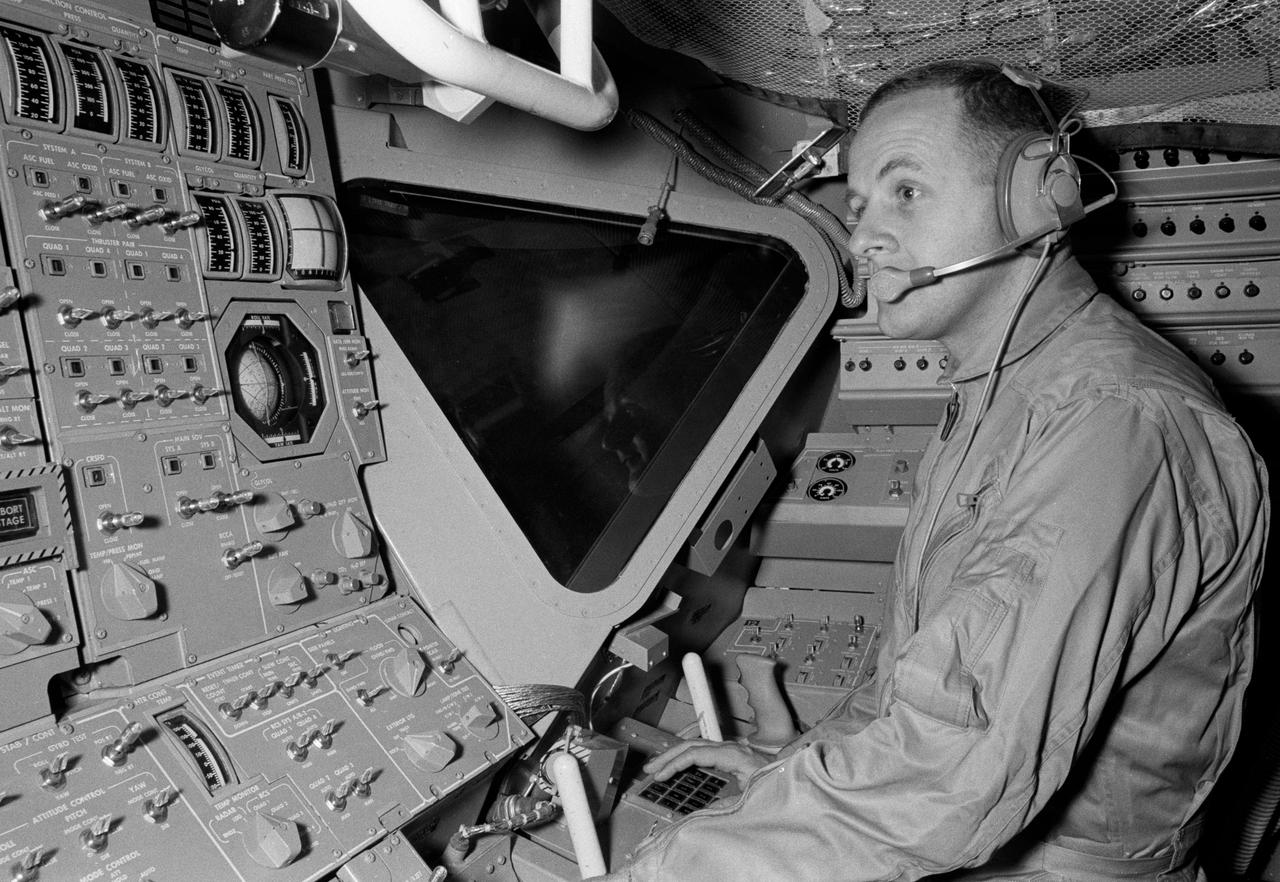
Views of Astronaut Dr. Philip K. Chapman training in the Lunar Module (LM) Simulator, Centrifuge, and the Apollo Mission Simulator. MSC
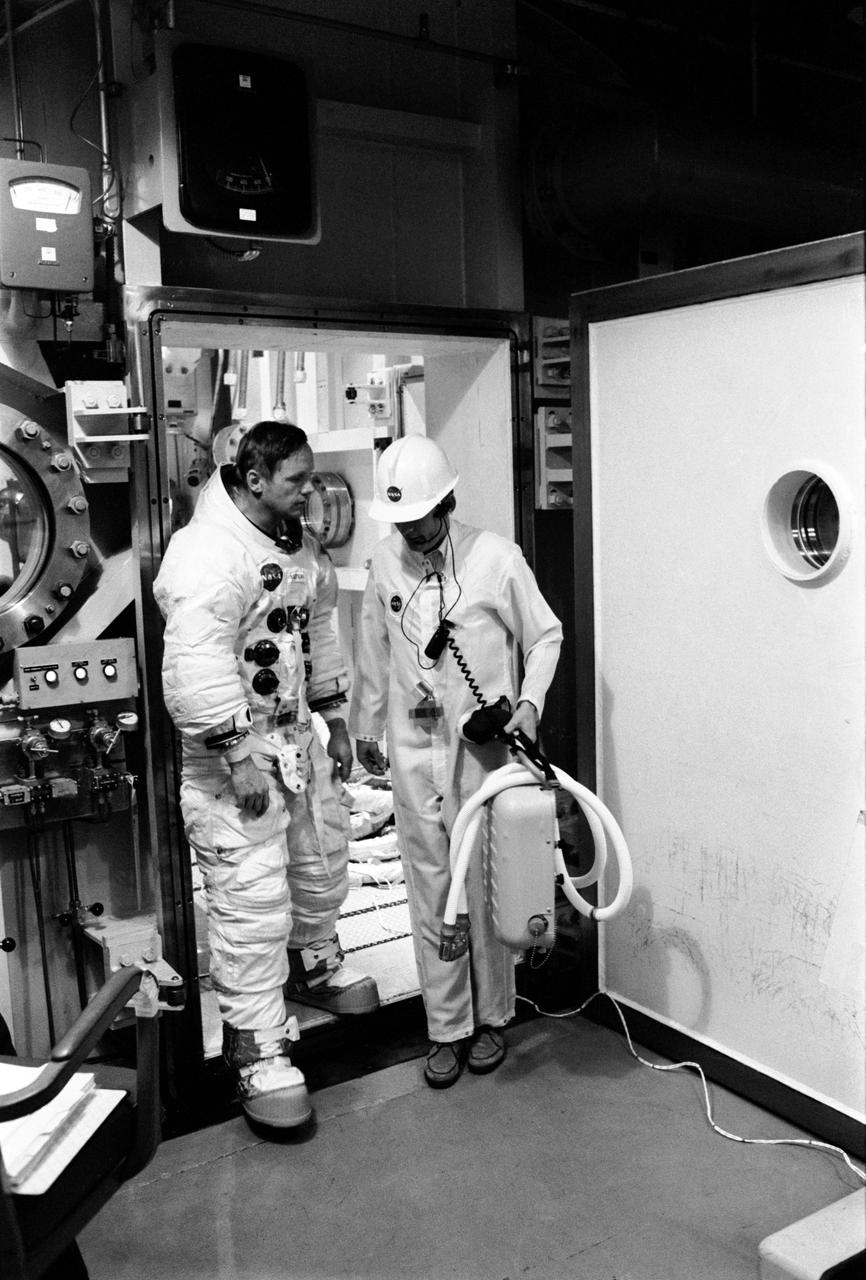
Apollo XI Astronaut Armstrong Thermal Vacuum Training in Chamber "B", Bldg. 32. MSC, Houston, TX

Astronaut John W. Young, Apollo 16 prime crew commander (right), takes a drive in the One-G Lunar Roving Vehicle (LRV) trainer in the Lunar Topgraphic Simulation area at the Manned Spacecraft Center (MSC). He is accompanied by John Omstead, with General Electric, MSC.
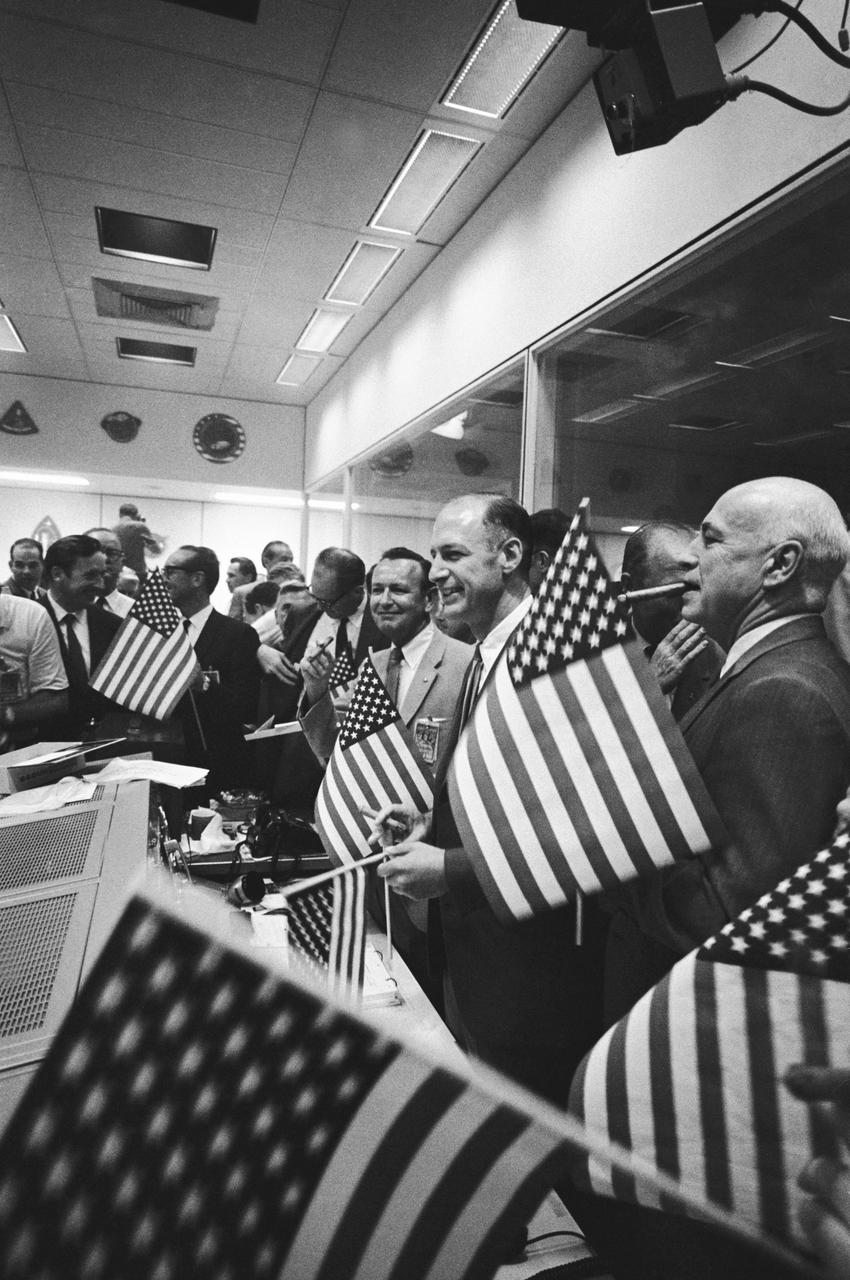
S69-40024 (24 July 1969) --- NASA and Manned Spacecraft Center (MSC) officials join in with the flight controllers, in the Mission Operations Control Room (MOCR) in the Mission Control Center (MCC), in celebrating the successful conclusion of the Apollo 11 lunar landing mission. Identifiable in the picture, starting in foreground, are Dr. Robert R. Gilruth, MSC Director; George M. Low, Manager, Apollo Spacecraft Program, MSC; Dr. Christopher C. Kraft Jr., MSC Director of Flight Operation; U.S. Air Force Lt. Gen. Samuel C. Phillips (with glasses, looking downward), Apollo Program Director, Office of Manned Space Flight, NASA Headquarters; and Dr. George E. Mueller (with glasses, looking toward left), Associate Administrator, Office of Manned Space Flight, NASA Headquarters. Former astronaut John H. Glenn Jr. is standing behind Mr. Low.
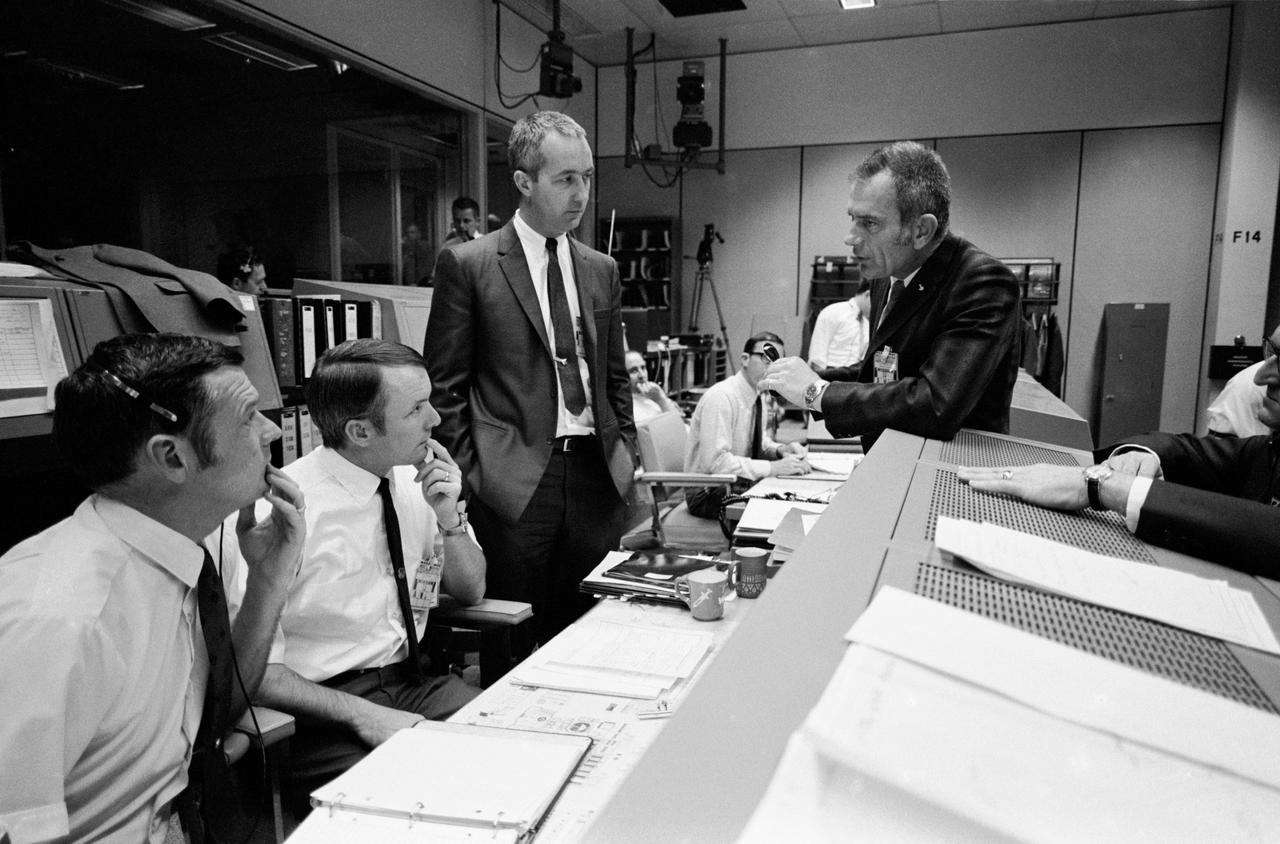
S70-35369 (16 April 1970) --- Discussion in the Mission Operations Control Room (MOCR) dealing with the Apollo 13 crewmen during their final day in space. From left to right are Glynn S. Lunney, Shift 4 flight director; Gerald D. Griffin, Shift 2 flight director; astronaut James A. McDivitt, manager, Apollo Spacecraft Program, MSC; Dr. Donald K. Slayton, director of Flight Crew Operations, MSC; and Dr. Willard R. Hawkins, M.D., Shift 1 flight surgeon.
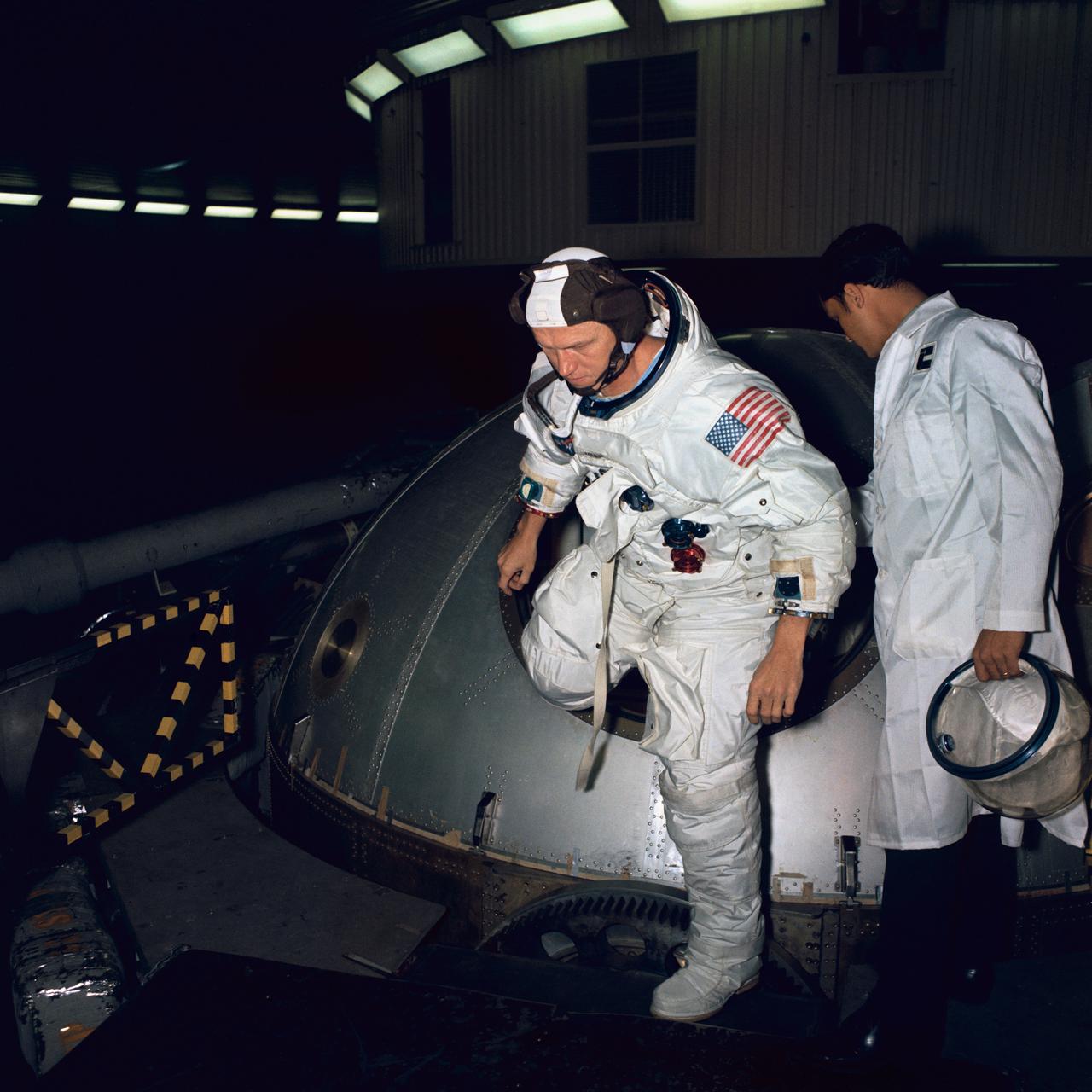
S68-53186 (1 Nov. 1968) --- Astronaut Frank Borman, Apollo 8 commander, egresses the gondola in Building 29 after centrifuge training in the Manned Spacecraft Center's (MSC) Flight Acceleration Facility (FAF).
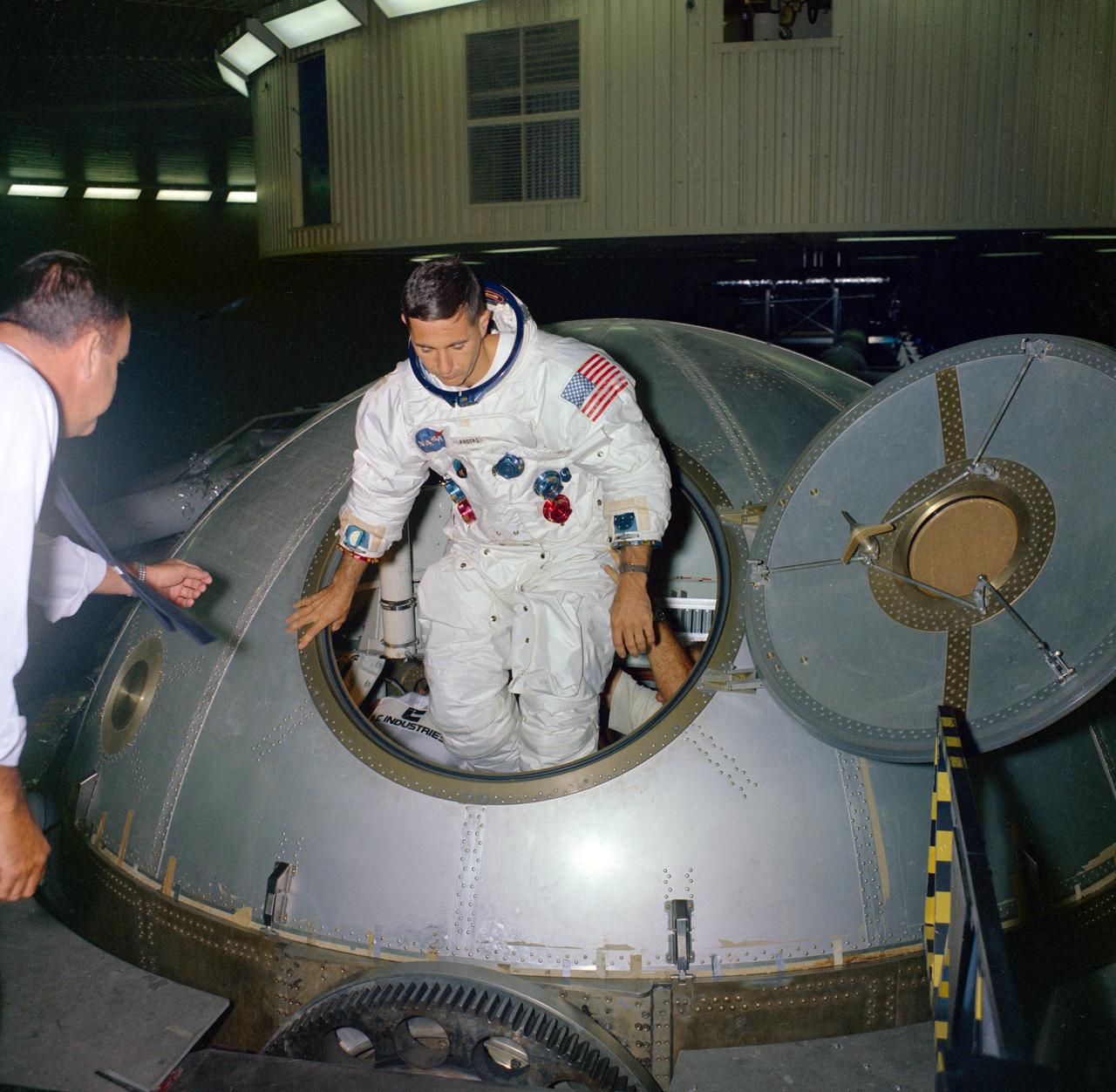
Apollo 8 astronaut William A. Anders, lunar module pilot, steps out of the centrifuge gondola in bldg 29 during centrifuge training in the Manned Spacecraft Center's (MSC) Flight Acceleration Facility.
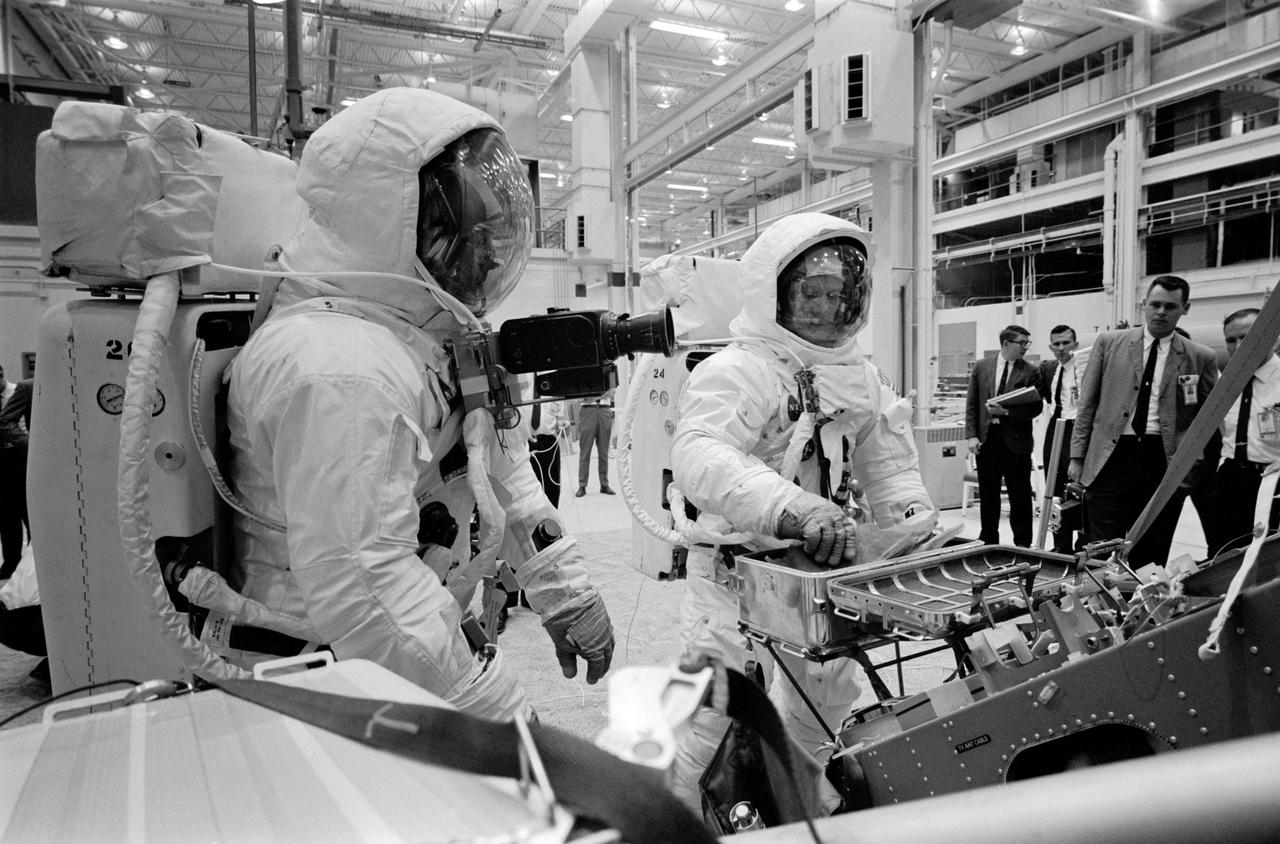
Suited Apollo XI Crewmen Armstrong and Aldrin training in Apollo Lunar Surface Experiments Package (ALSEP) deployment in Building 5, as Astronaut Mike Collins trains in the Building 20 Centrifuge. S-Band Antenna (31148 thru 31165, 31178 thru 31179) MSC, HOUSTON, TX
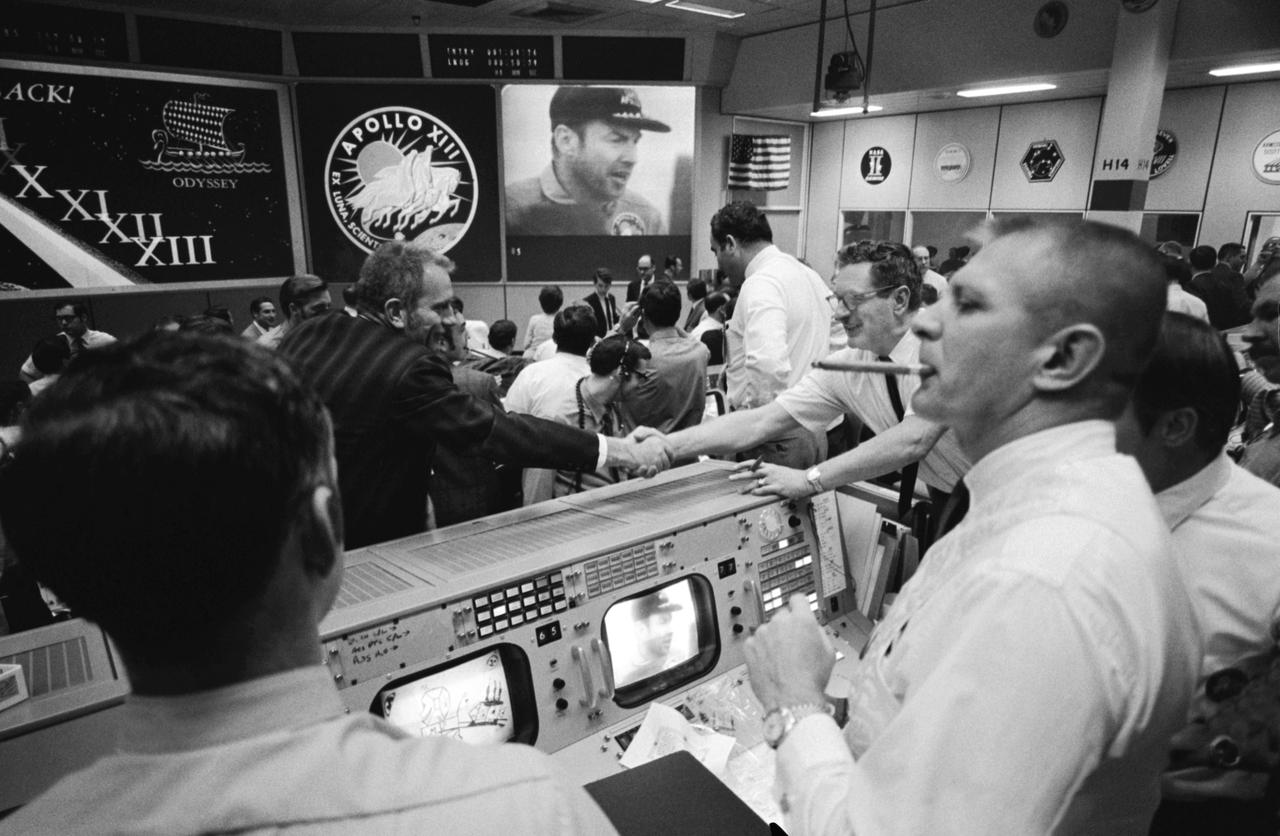
S70-35145 (17 April 1970) --- Overall view of Mission Operations Control Room in Mission Control Center at the Manned Spacecraft Center (MSC) during the ceremonies aboard the USS Iwo Jima, prime recovery ship for the Apollo 13 mission. Dr. Donald K. Slayton (in black shirt, left of center), director of Flight Crew Operations at MSC, and Chester M. Lee of the Apollo Program Directorate, Office of Manned Space Flight, NASA Headquarters, shake hands, while Dr. Rocco A. Petrone, Apollo program director, Office of Manned Space Flight, NASA Headquarters (standing, near Lee), watches the large screen showing astronaut James A. Lovell Jr., Apollo 13 commander, during the onboard ceremonies. In the foreground, Glynn S. Lunney (extreme left) and Eugene F. Kranz (smoking a cigar), two Apollo 13 flight directors, view the activity from their consoles.
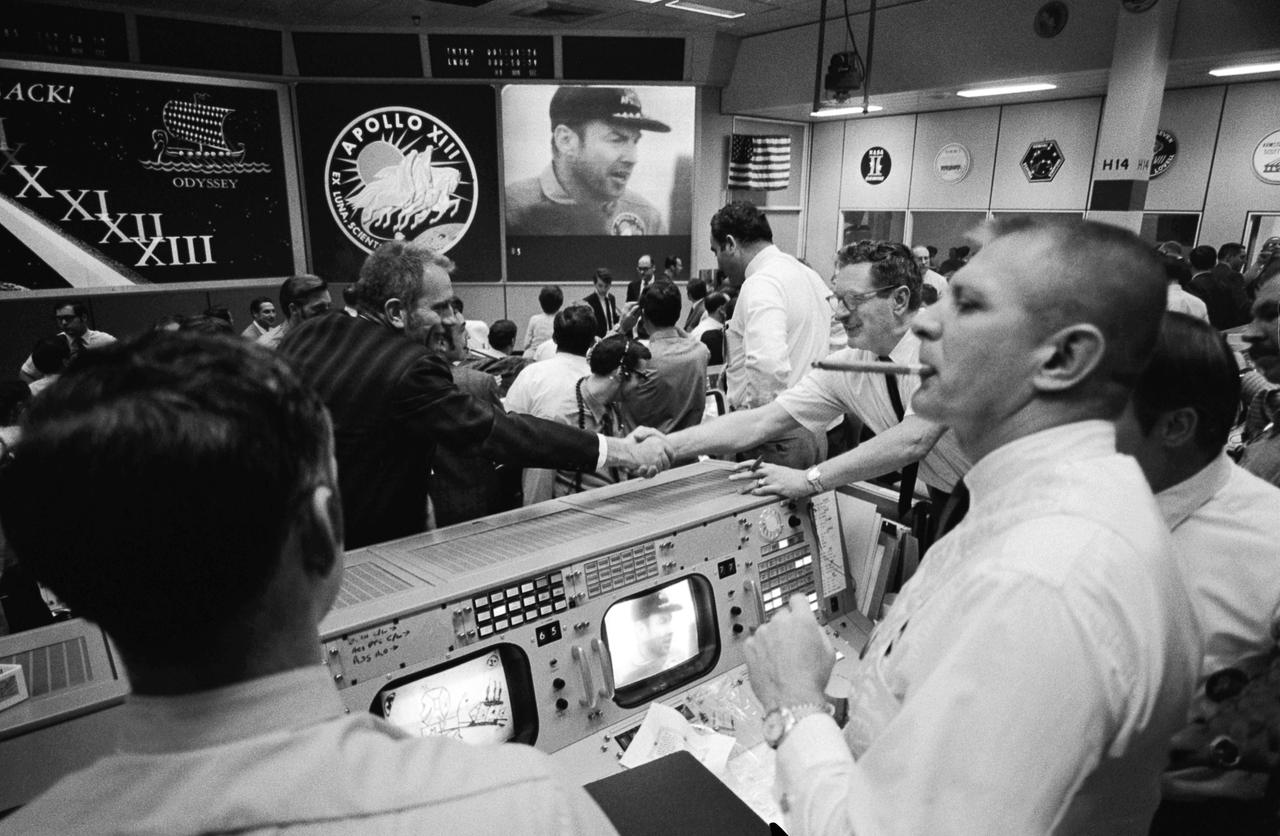
S70-35145 (17 April 1970) --- Overall view of Mission Operations Control Room in Mission Control Center at the Manned Spacecraft Center (MSC) during the ceremonies aboard the USS Iwo Jima, prime recovery ship for the Apollo 13 mission. Dr. Donald K. Slayton (in black shirt, left of center), director of Flight Crew Operations at MSC, and Chester M. Lee of the Apollo Program Directorate, Office of Manned Space Flight, NASA Headquarters, shake hands, while Dr. Rocco A. Petrone, Apollo program director, Office of Manned Space Flight, NASA Headquarters (standing, near Lee), watches the large screen showing astronaut James A. Lovell Jr., Apollo 13 commander, during the onboard ceremonies. In the foreground, Glynn S. Lunney (extreme left) and Eugene F. Kranz (smoking a cigar), two Apollo 13 flight directors, view the activity from their consoles.
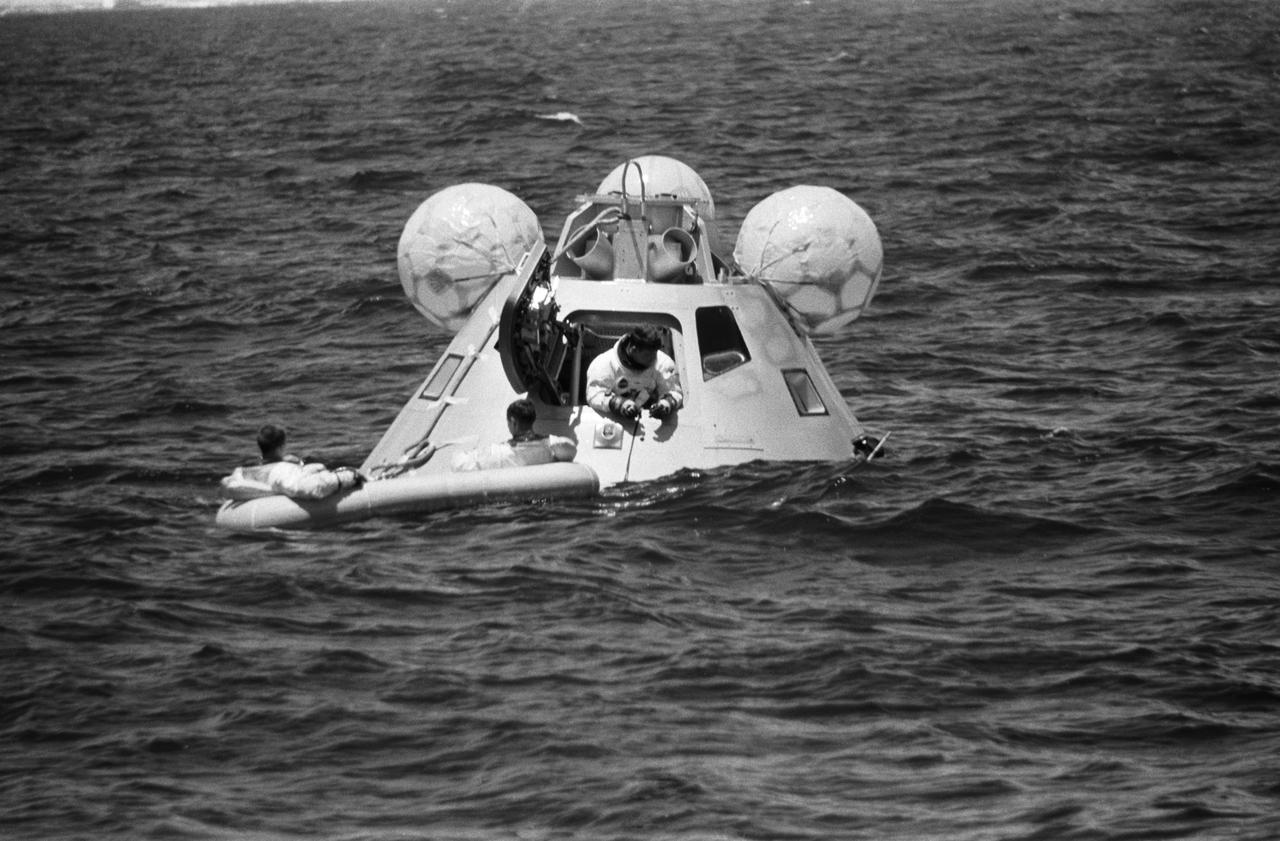
S68-42197 (5 Aug. 1968) --- The prime crew of the first manned Apollo space mission, Apollo 7, participates in water egress training in the Gulf of Mexico. In hatch of the Apollo egress trainer (command module) is astronaut Walter M. Schirra Jr. Sitting in life raft are astronauts Walter Cunningham (on left) and Donn F. Eisele. A team of MSC swimmers assisted with the training exercise. The inflated bags were used to upright the trainer prior to egress.

S70-35148 (17 April 1970) --- Staff members from NASA Headquarters (NASA HQ), Manned Spacecraft Center (MSC), and Dr. Thomas Paine (center of frame) applaud the successful splashdown of the Apollo 13 mission while Dr. George Low smokes a cigar (right), in the MSC Mission Control Center (MCC), located in Building 30. Apollo 13 crewmembers, astronauts James A. Lovell Jr., commander; John L. Swigert Jr., command module pilot; and Fred W. Haise Jr., lunar module pilot, splashed down at 12:07:44 p.m. (CST), April 17, 1970, in the south Pacific Ocean.
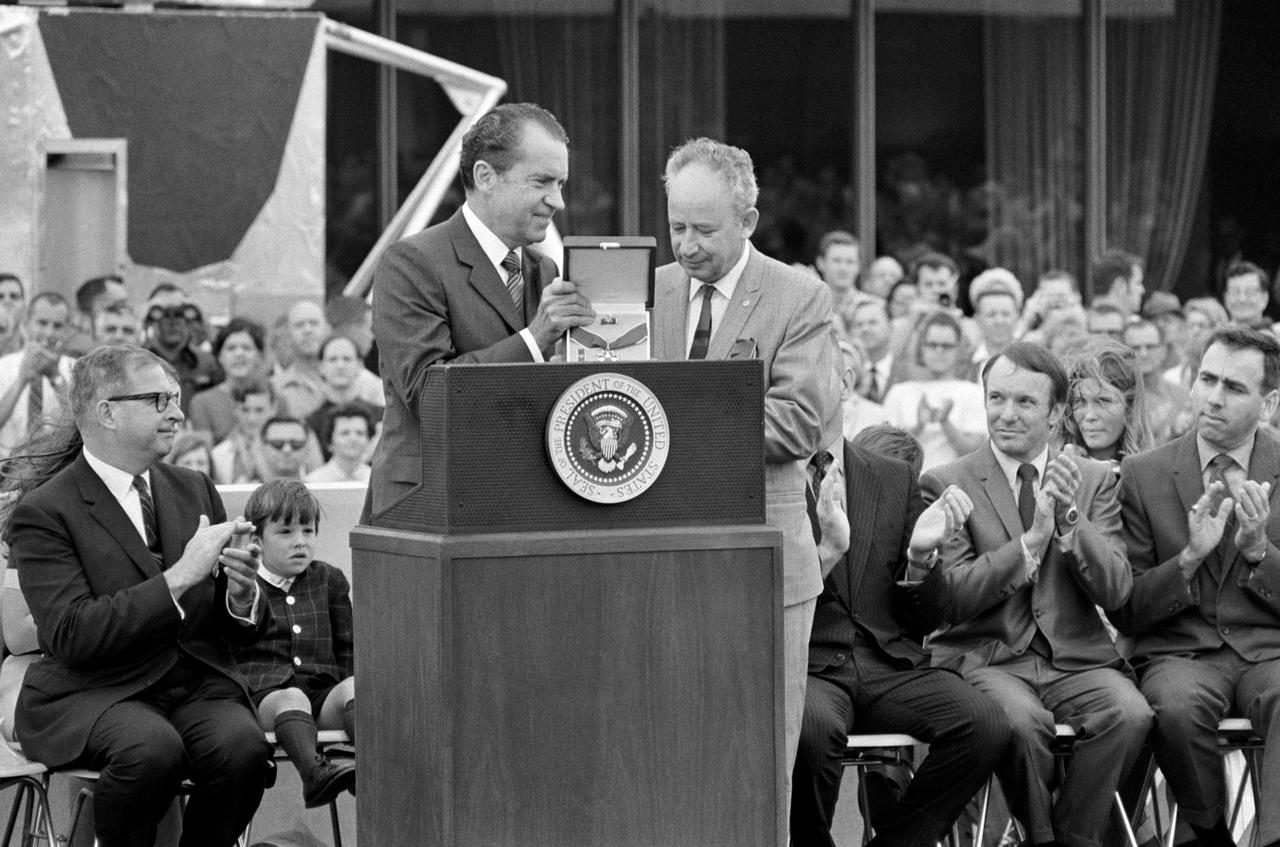
S70-35594 (18 April 1970) --- President Richard M. Nixon presents the Presidential Medal of Freedom to the Apollo 13 Mission Operations Team at Manned Spacecraft Center (MSC). Accepting for the team is Sigurd A. Sjoberg, director of Flight Operations at MSC. Dr. Thomas O. Paine, Administrator, National Aeronautics and Space Administration (NASA), is at left. Also seen here on the speaker's platform are Jeffrey C. Lovell, son of astronaut James A. Lovell Jr., commander of the Apollo 13 mission; Gerald D. Griffin (second from right) and Milton L. Windler, two of four flight directors who worked around the clock during the mission.
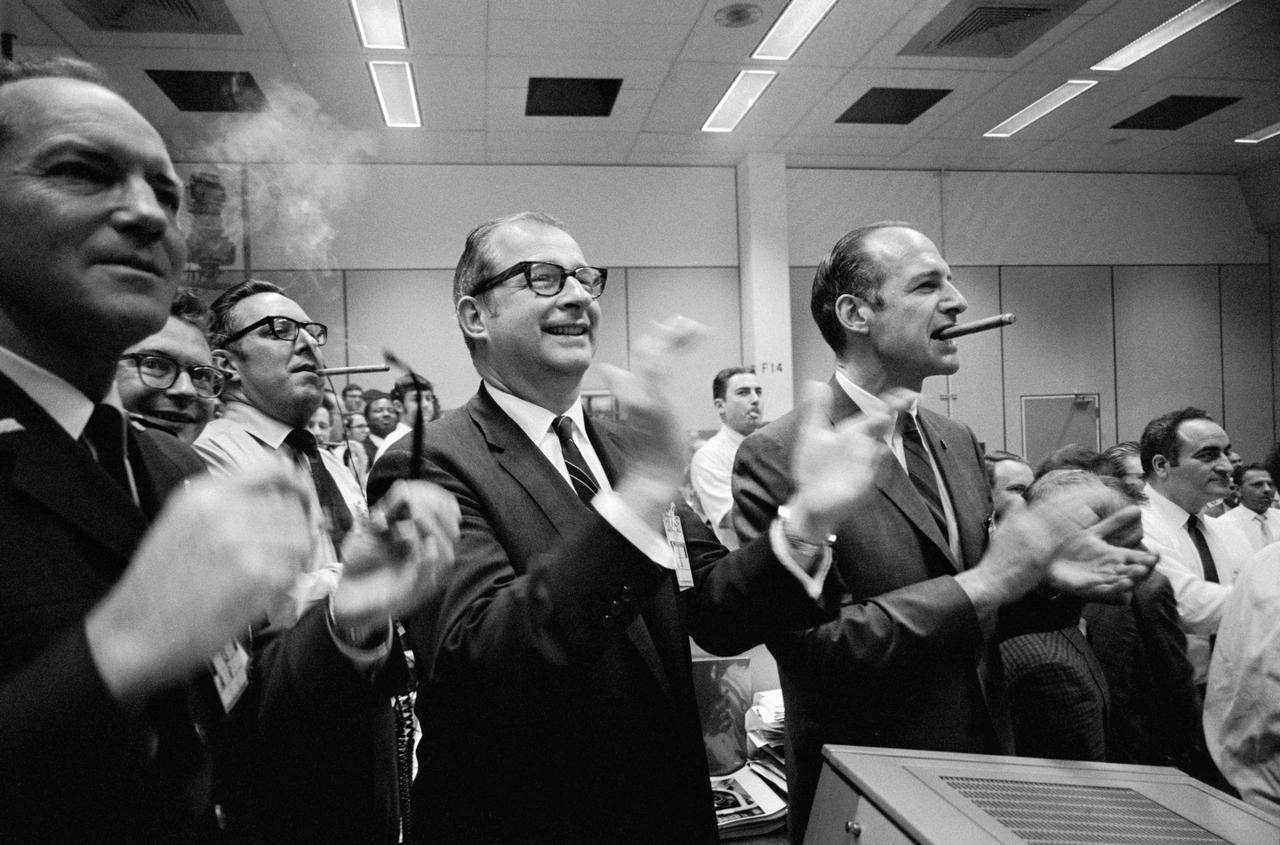
S70-35148 (17 April 1970) --- Staff members from NASA Headquarters (NASA HQ), Manned Spacecraft Center (MSC), and Dr. Thomas Paine (center of frame) applaud the successful splashdown of the Apollo 13 mission while Dr. George Low smokes a cigar (right), in the MSC Mission Control Center (MCC), located in Building 30. Apollo 13 crewmembers, astronauts James A. Lovell Jr., commander; John L. Swigert Jr., command module pilot; and Fred W. Haise Jr., lunar module pilot, splashed down at 12:07:44 p.m. (CST), April 17, 1970, in the south Pacific Ocean.
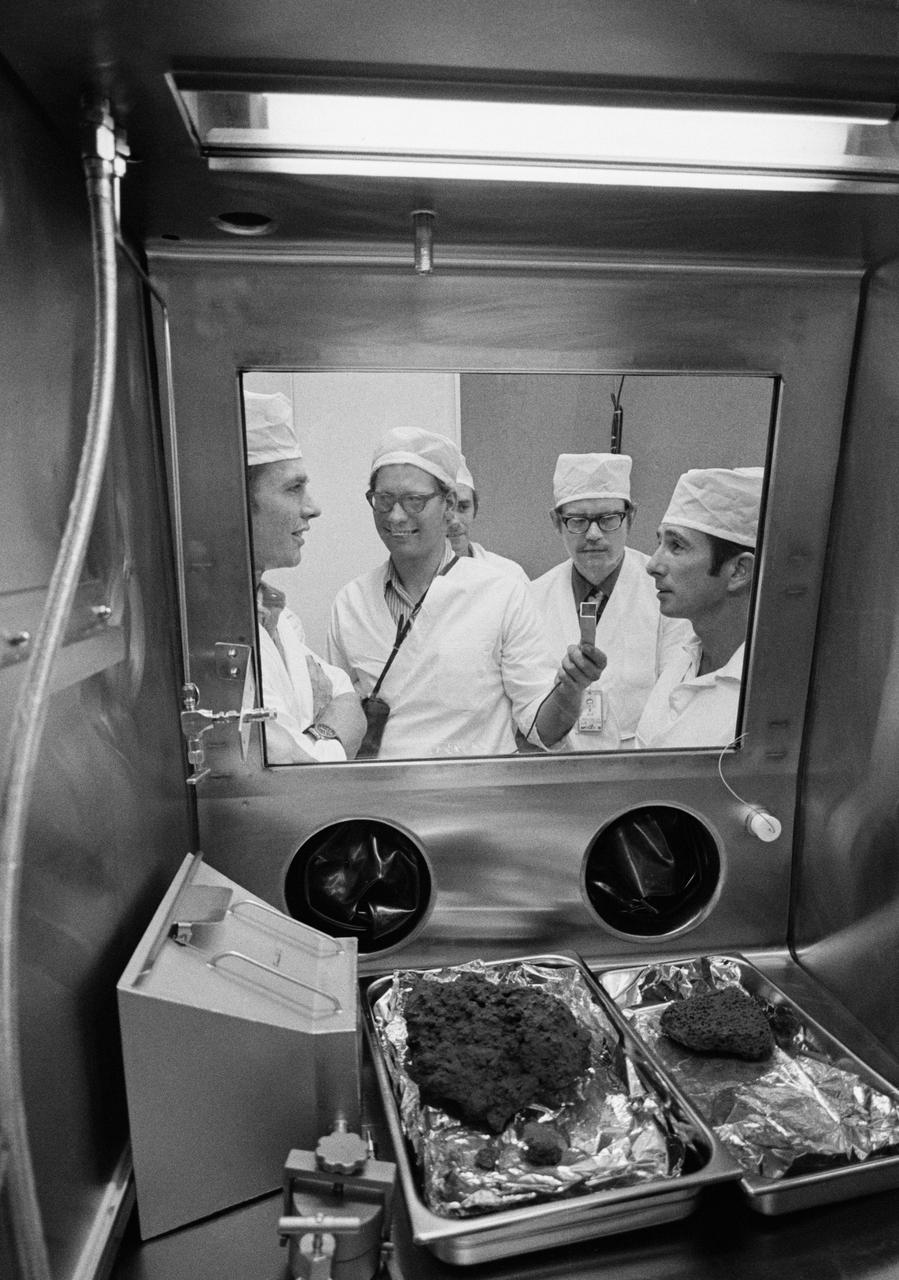
S71-43203 (9 Aug. 1971) --- Astronauts David R. Scott, left foreground, and James B. Irwin, right foreground, join the Manned Spacecraft Center's (MSC) geologists in getting first looks at some of the first Apollo 15 samples to be opened in the Non-Sterile Nitrogen Processing Line (NNPL) in the MSC Lunar Receiving Laboratory (LRL). Holding the microphone and making recorded tapes of the two Apollo 15 crew men's comments is Dr. Gary Lofgren. Partially obscured, near center of photo is Dr. William Phinney, and to his left is Dr. James W. Head.
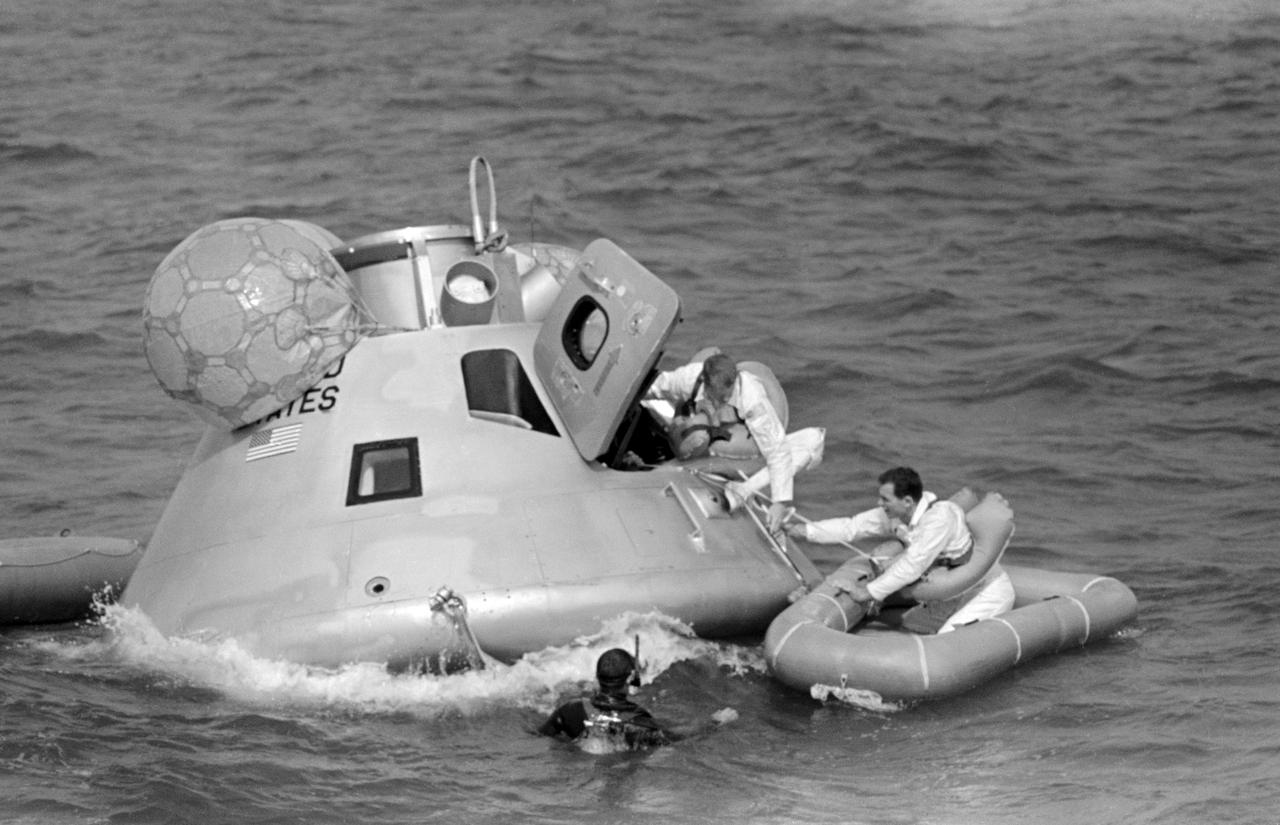
S68-50960 (20 Nov. 1968) --- The Apollo 9 prime crew participates in water egress training in the Gulf of Mexico. Apollo Command Module Boilerplate 1102 was used in the training. In life raft is astronaut David R. Scott, command module pilot. Egressing the boilerplate is astronaut Russell L. Schweickart, lunar module pilot. Still inside boilerplate, out of view, is astronaut James A. McDivitt, commander. A team of MSC swimmers assisted in the exercise. The inflated bags were used to upright the boilerplate prior to egress.
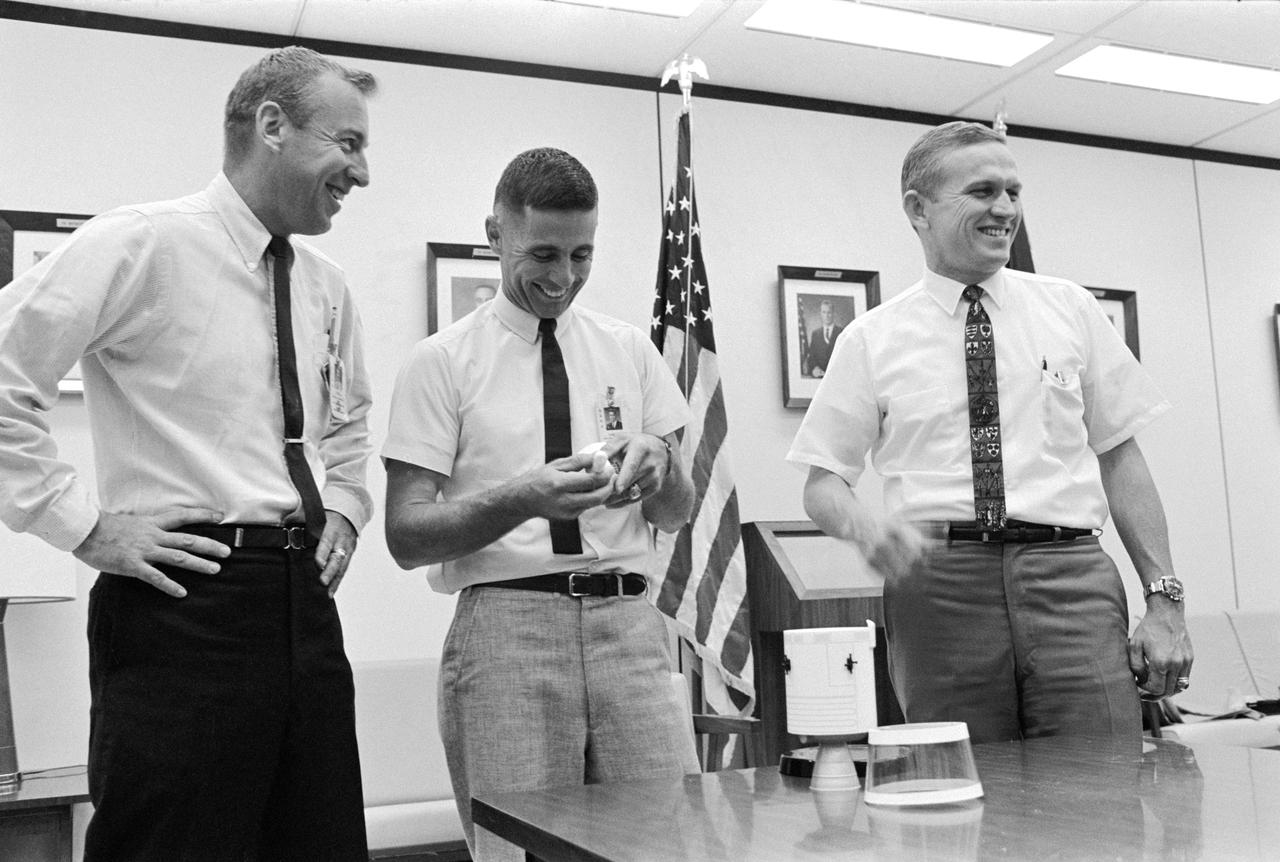
S68-50646 (18 Oct. 1968) --- The prime crew of the Apollo 8 mission is photographed in Building 4, at the Manned Spacecraft Center (MSC), where they are participating in classroom work in burn test review and procedures review. Left to right, are astronauts James A. Lovell Jr., William A. Anders, and Frank Borman.
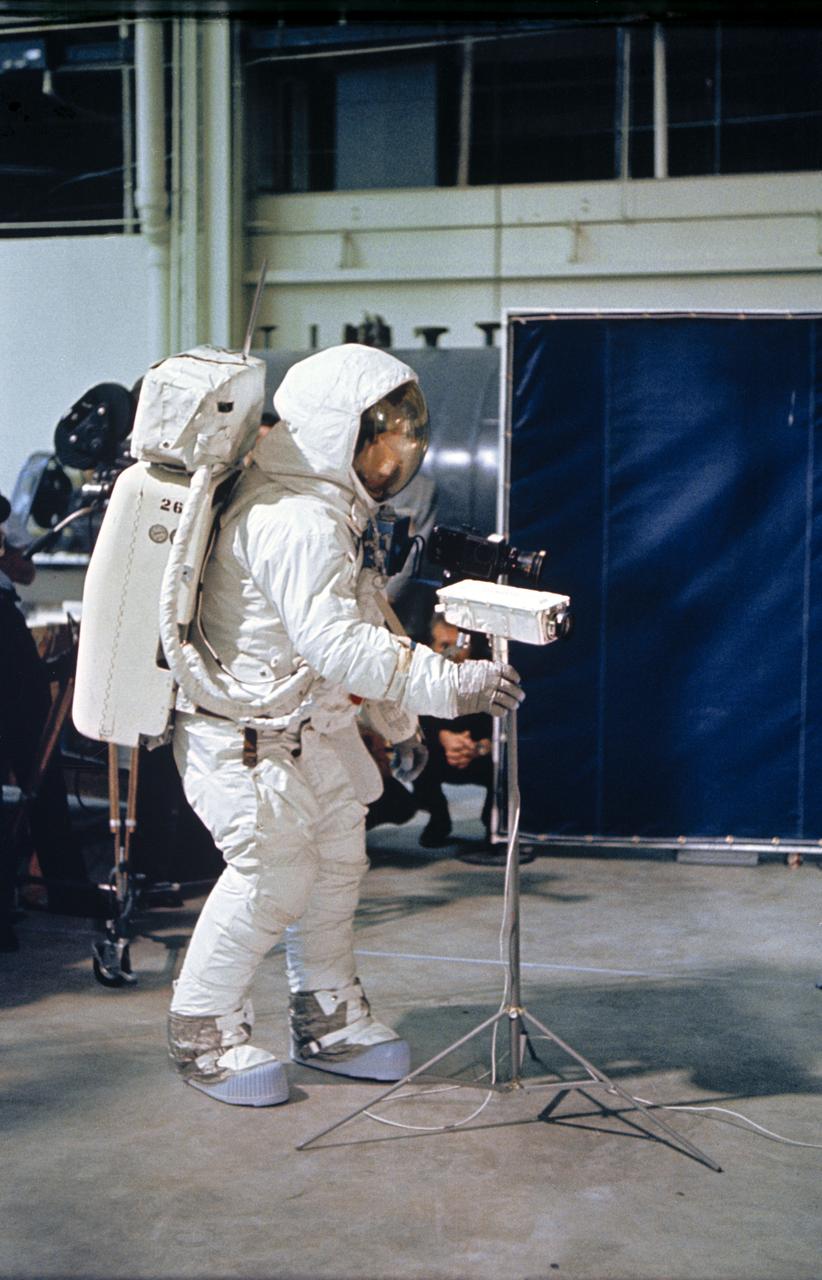
S69-33923 (April 1969) --- Astronaut Neil A. Armstrong, wearing an Extravehicular Mobility Unit (EMU), deploys a lunar surface television camera during lunar surface simulation training in Building 9, Manned Spacecraft Center (MSC). Armstrong is the prime crew commander of the Apollo 11 lunar landing mission.
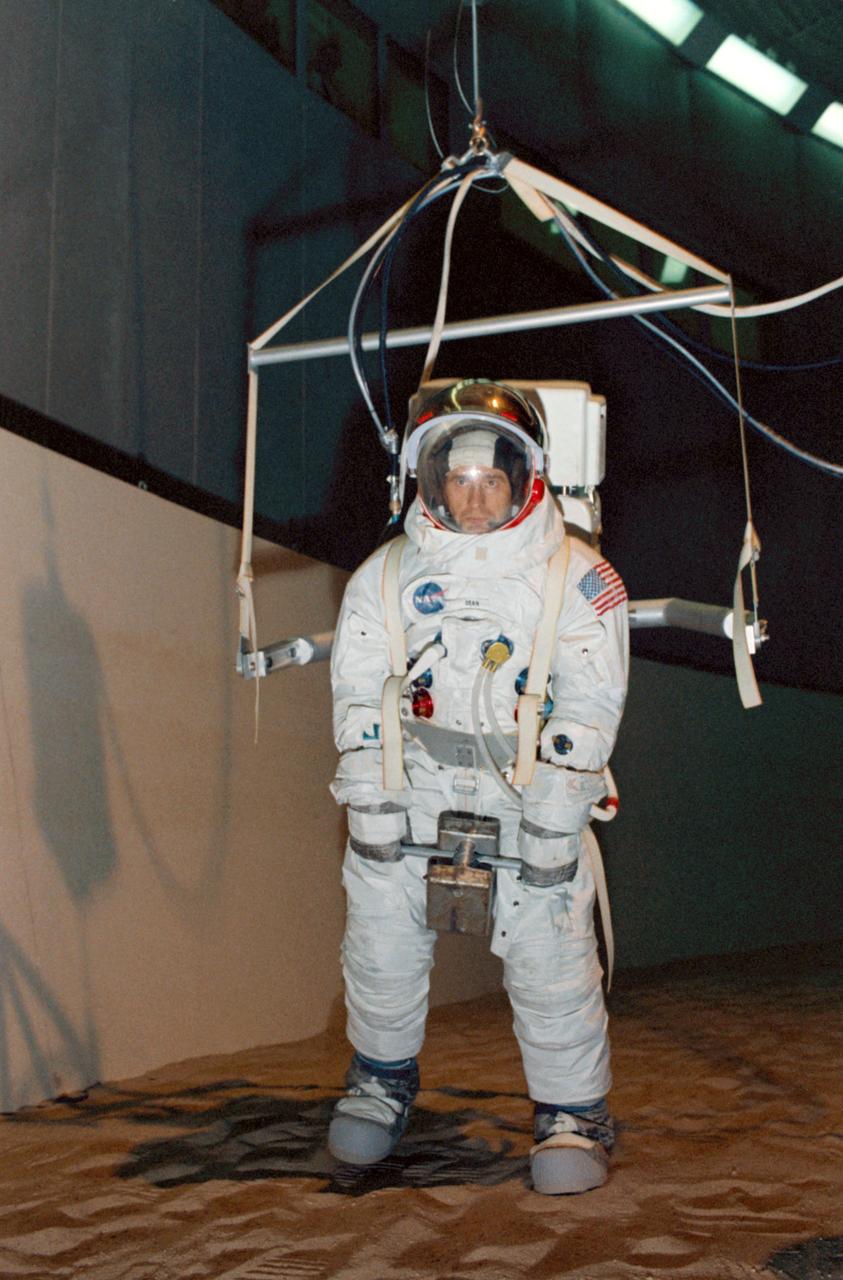
S69-56059 (24 Oct. 1969) --- Astronaut Alan L. Bean, lunar module pilot of the Apollo 12 lunar landing mission, participates in lunar surface simulation training in Building 29 at the Manned Spacecraft Center (MSC). Bean is strapped to a one-sixth gravity simulator.
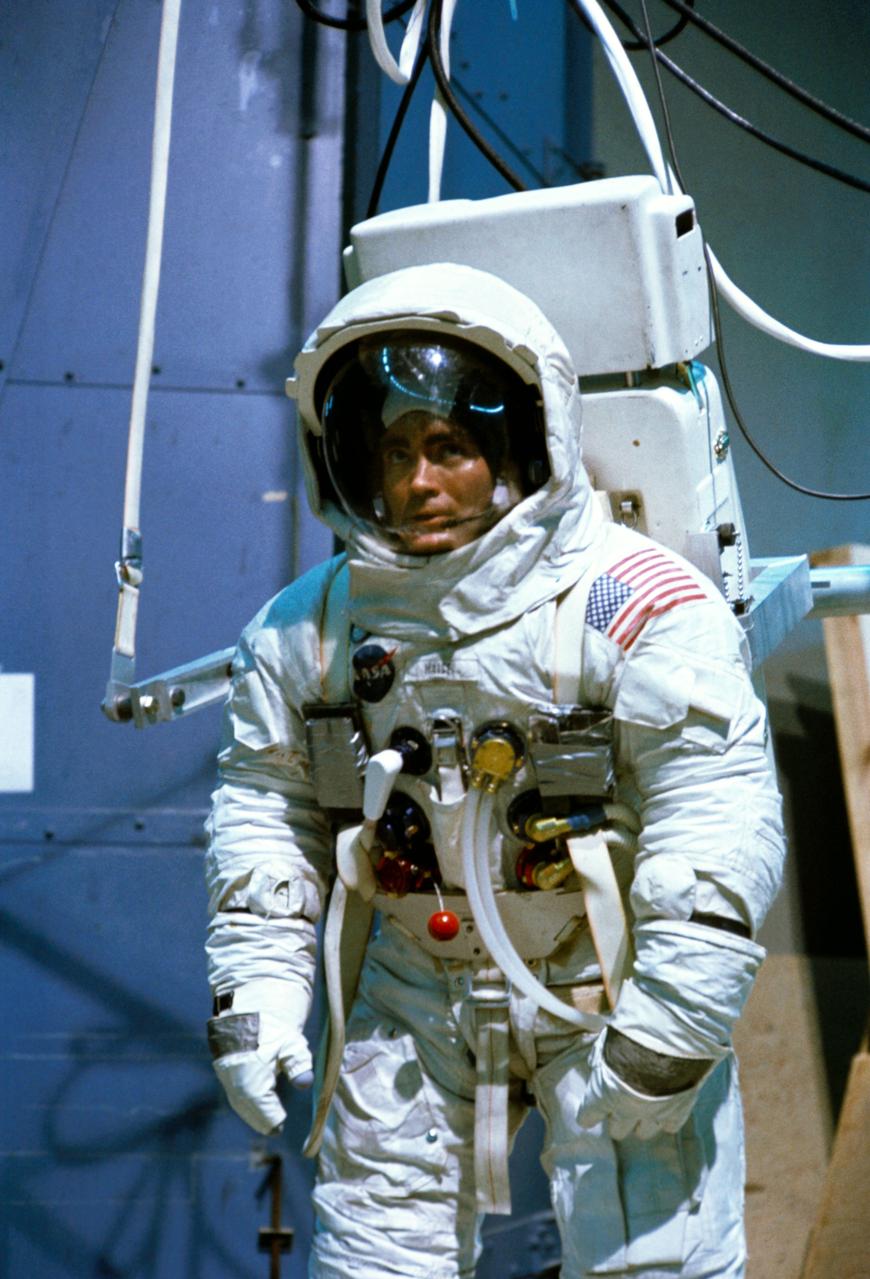
S70-24012 (19 Jan. 1970) --- Astronaut Fred W. Haise Jr., lunar module pilot of the Apollo 13 lunar landing mission, participates in lunar surface simulation training at the Manned Spacecraft Center (MSC). Haise is attached to a Six Degrees of Freedom Simulator.
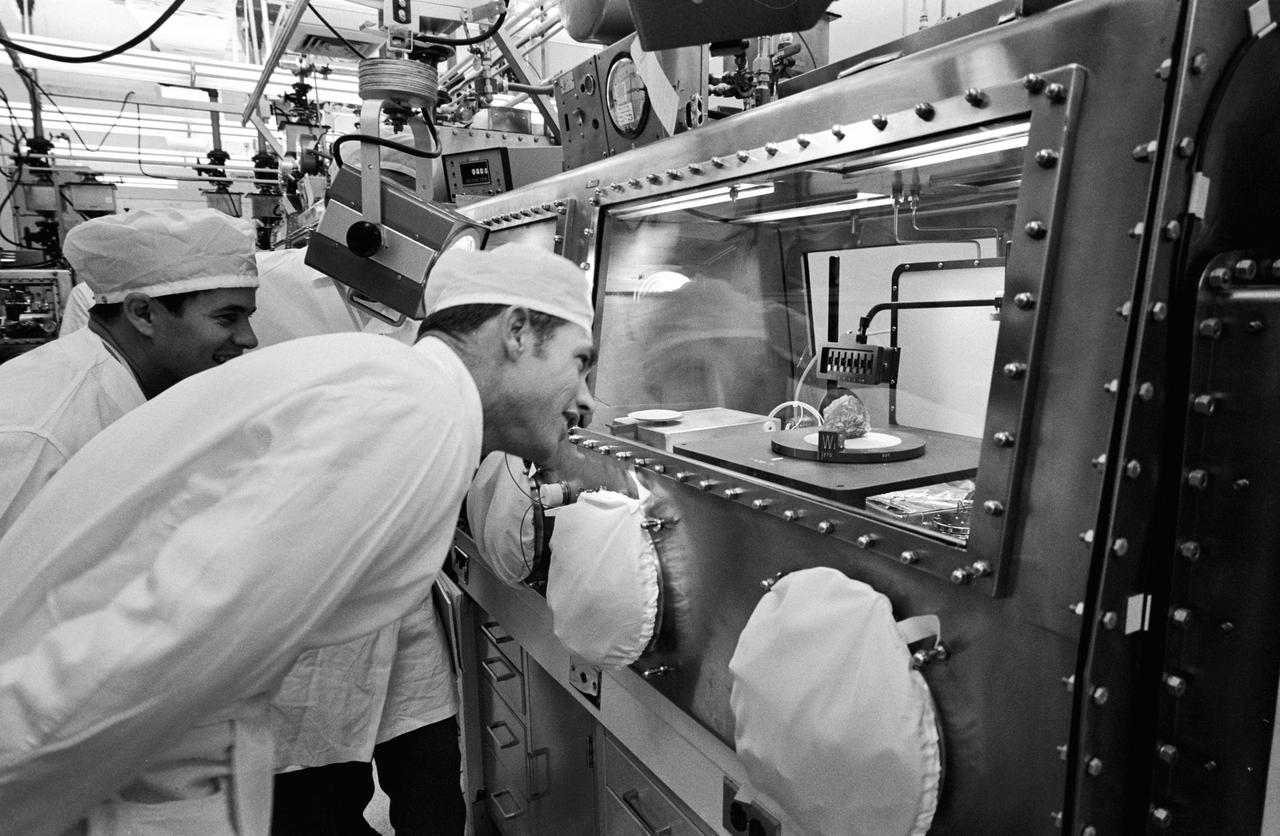
S71-43477 (12 Aug. 1971) --- Astronaut David R. Scott, right, commander of the Apollo 15 mission, gets a close look at the sample referred to as "Genesis rock" in the Non-Sterile Nitrogen Processing Line (NNPL) in the Lunar Receiving Laboratory (LRL) at the Manned Spacecraft Center (MSC). Scientist-astronaut Joseph P. Allen IV, left, an Apollo 15 spacecraft communicator, looks on with interest. The white-colored rock has been given the permanent identification of 15415.
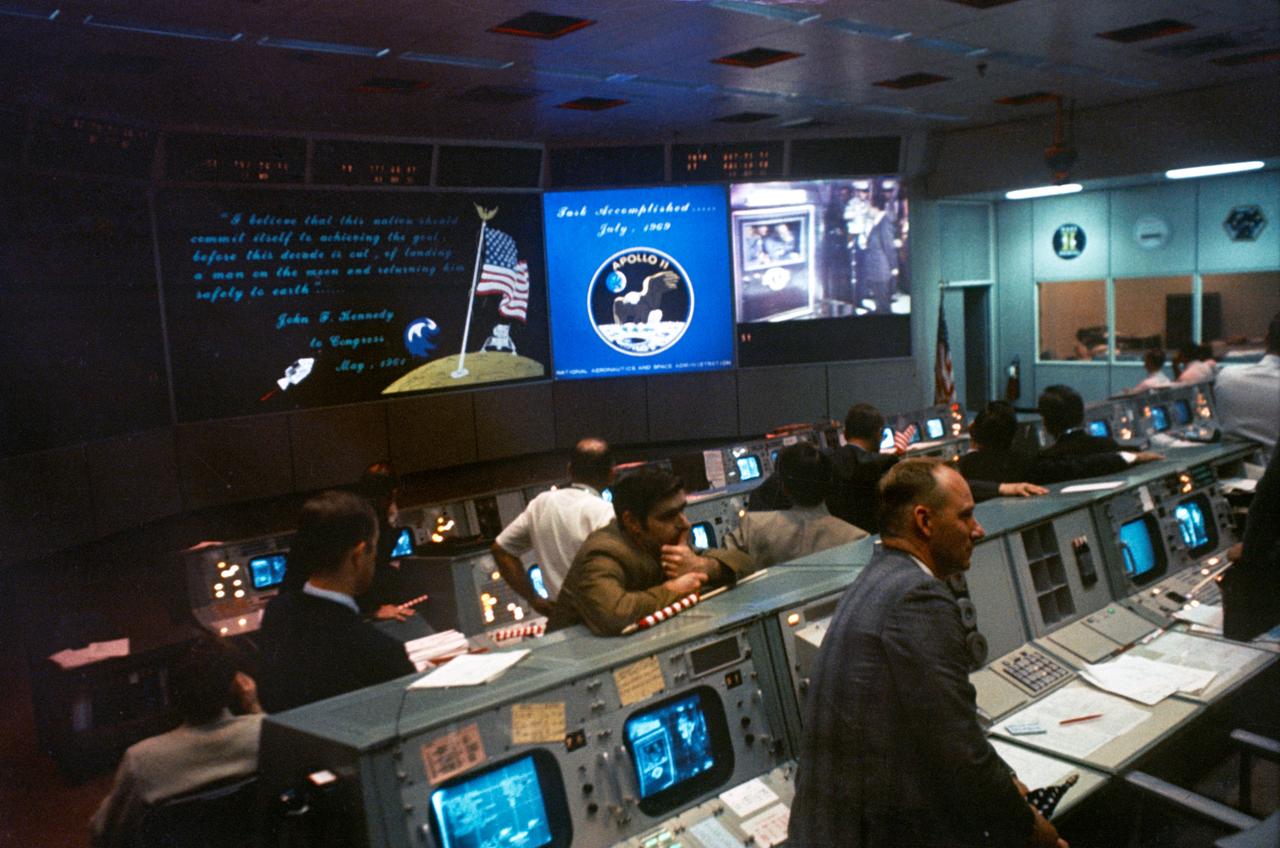
S69-40301 (24 July 1969) --- Overall view of the Mission Operations Control Room (MOCR) in the Mission Control Center (MCC), Building 30, Manned Spacecraft Center (MSC), at the conclusion of the Apollo 11 lunar landing mission. The television monitor shows President Richard M. Nixon greeting the Apollo 11 astronauts aboard the USS Hornet in the Pacific recovery area. Astronauts Neil A. Armstrong, Michael Collins, and Edwin E. Aldrin Jr. are inside the Mobile Quarantine Facility (MQF).

S68-50977 (20 Nov. 1968) --- The Apollo 9 prime crew participates in water egress training in the Gulf of Mexico. Apollo Command Module Boilerplate 1102 was used in the training. Egressing the boilerplate is astronaut David R. Scott, command module pilot. Inside the boilerplate, out of view, are astronauts James A. McDivitt, commander; and Russell L. Schweickart, lunar module pilot. A team of MSC swimmers assisted in the exercise. The inflated bags were used to upright the boilerplate prior to egress.
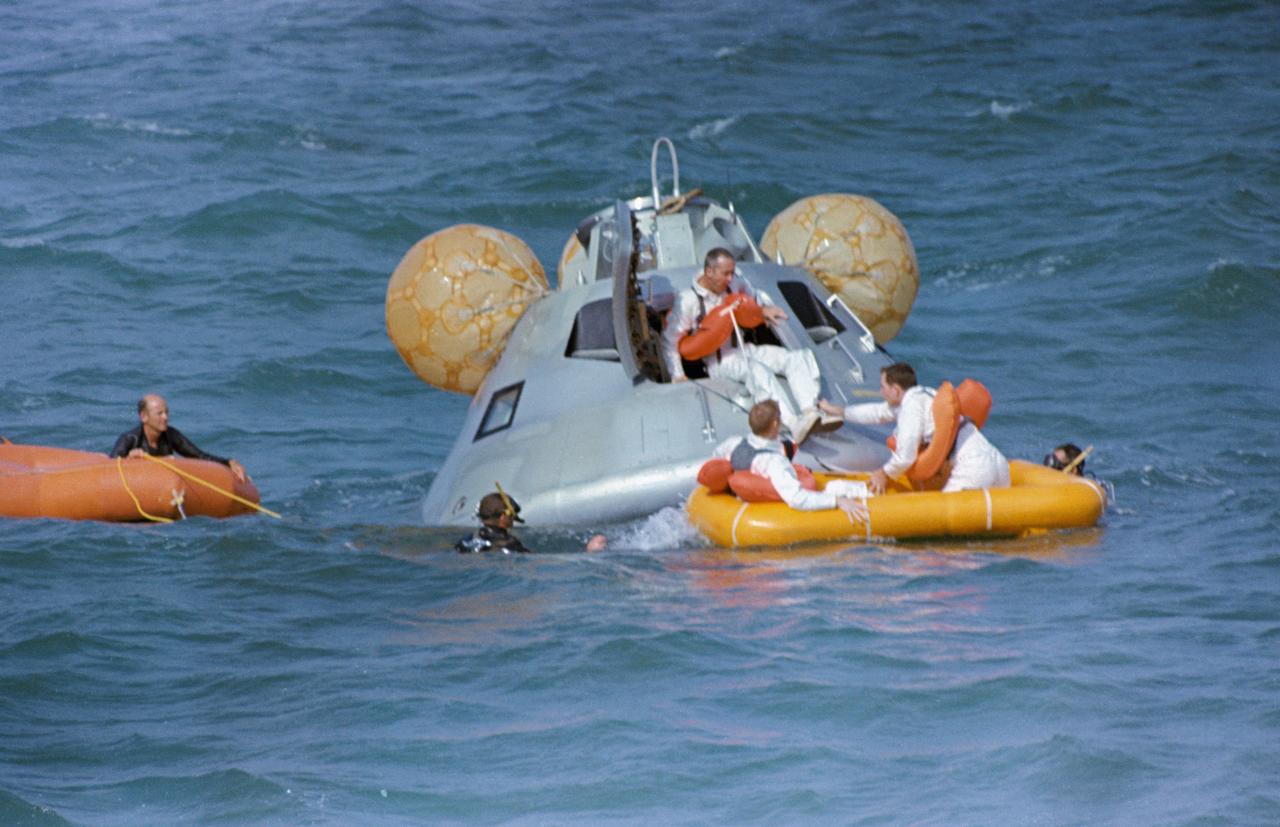
S68-50967 (20 Nov. 1968) --- The Apollo 9 prime crew participates in water egress training in the Gulf of Mexico. Apollo Command Module (CM) Boilerplate 1102 was used in the training. Egressing boilerplate is astronaut James A. McDivitt, commander. In life raft are astronauts Russell L. Schweickart (on left), lunar pilot; and David R. Scott, command pilot. A team of MSC swimmers assisted in the exercise. The inflated bags were used to upright the boilerplate prior to egress.
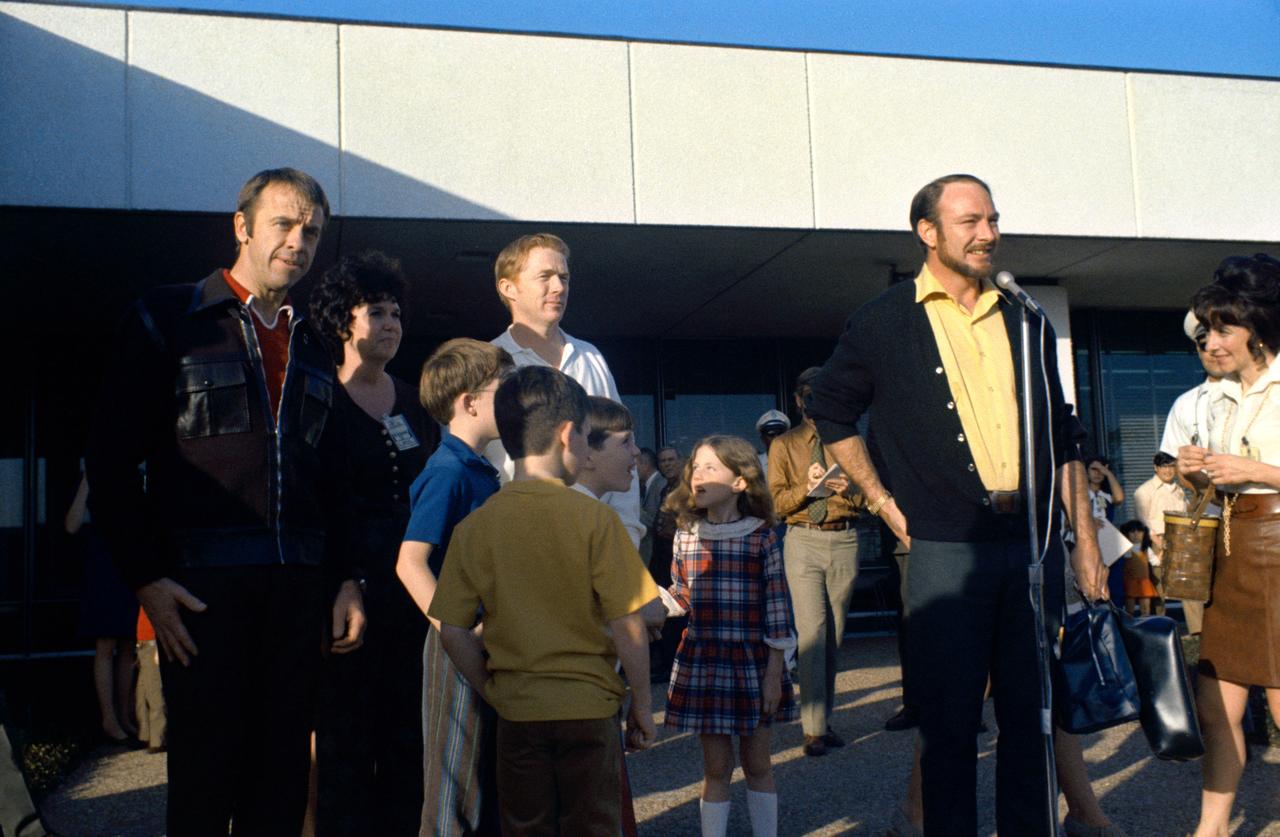
S71-22028 (26 Feb. 1971) --- Astronaut Edgar D. Mitchell, right, the Apollo 14 lunar module pilot, addresses NASA-MSC personnel and news media representatives and other visitors soon after he and his fellow crewmen were released from a 15-day confinement period in the Lunar Receiving Laboratory. Pictured with Mitchell in front of the LRL, MSC Building 37, are astronauts Alan B. Shepard Jr., left, commander; and Stuart A Roosa, command module pilot, Mrs. Mitchell is at right and Mrs. Roosa, near left. Roosa is flanked by his four children, left to right, Christopher A., Stuart A. Roosa Jr., John D. and Rosemary D.
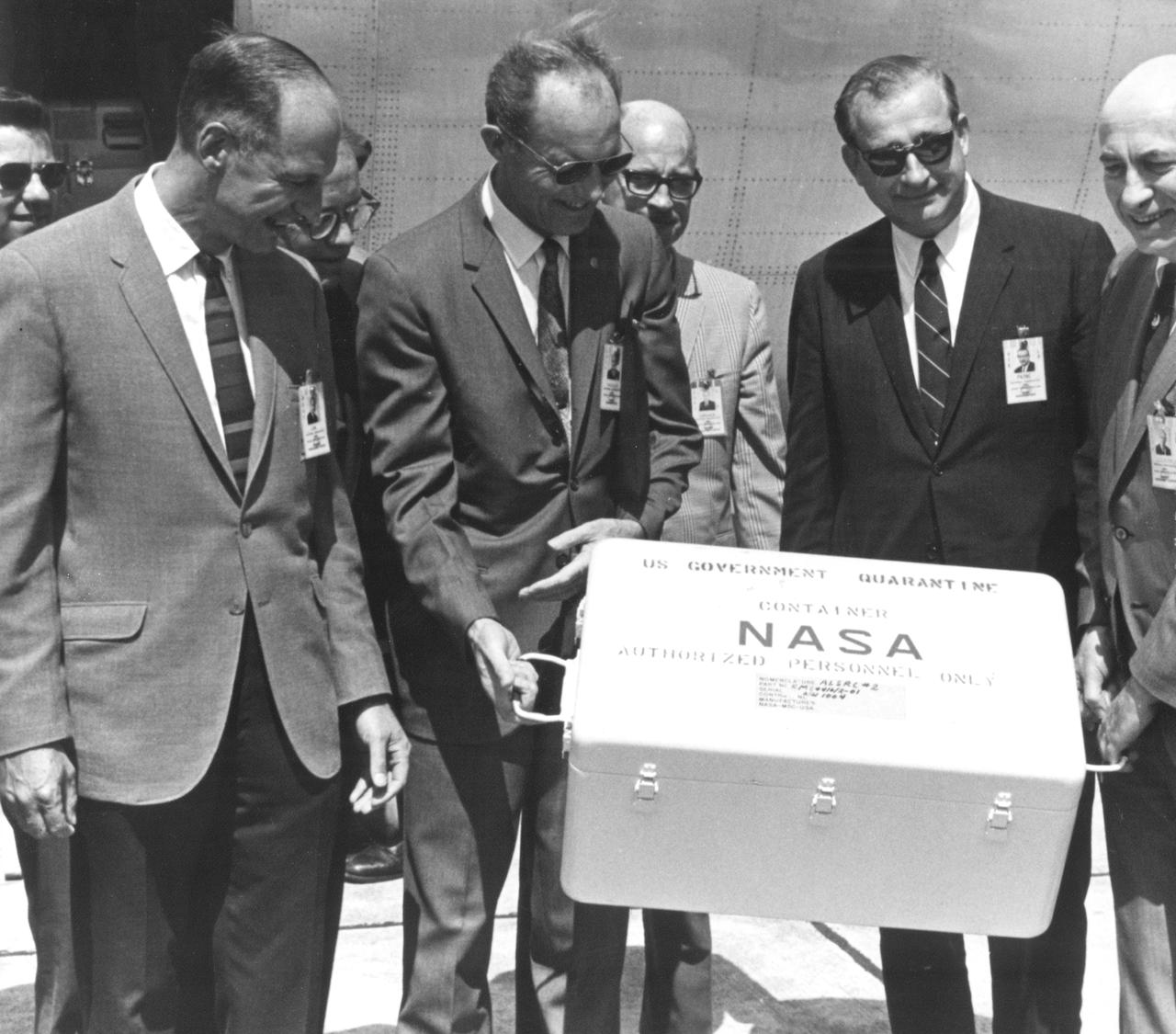
The Apollo 11 mission, the first manned lunar mission, launched from the Kennedy Space Center, Florida via the Marshall Space Flight Center (MSFC) developed Saturn V launch vehicle on July 16, 1969 and safely returned to Earth on July 24, 1969. Aboard the space craft were astronauts Neil A. Armstrong, commander; Michael Collins, Command Module (CM) pilot; and Edwin E. Aldrin Jr., Lunar Module (LM) pilot. The CM, piloted by Michael Collins remained in a parking orbit around the Moon while the LM, named “Eagle’’, carrying astronauts Neil Armstrong and Edwin Aldrin, landed on the Moon. During 2½ hours of surface exploration, the crew collected 47 pounds of lunar surface material for analysis back on Earth. This photograph was taken as the mission’s first loaded sample return container arrived at Ellington Air Force Base by air from the Pacific recovery area. The rock box was immediately taken to the Lunar Receiving Laboratory at the Manned Spacecraft Center (MSC) in Houston, Texas. Happily posing for the photograph with the rock container are (L-R) Richard S. Johnston (back), special assistant to the MSC Director; George M. Low, MSC Apollo Spacecraft Program manager; George S. Trimble (back), MSC Deputy Director; Lt. General Samuel C. Phillips, Apollo Program Director, Office of Manned Spaceflight at NASA headquarters; Eugene G. Edmonds, MSC Photographic Technology Laboratory; Dr. Thomas O. Paine, NASA Administrator; and Dr. Robert R. Gilruth, MSC Director.
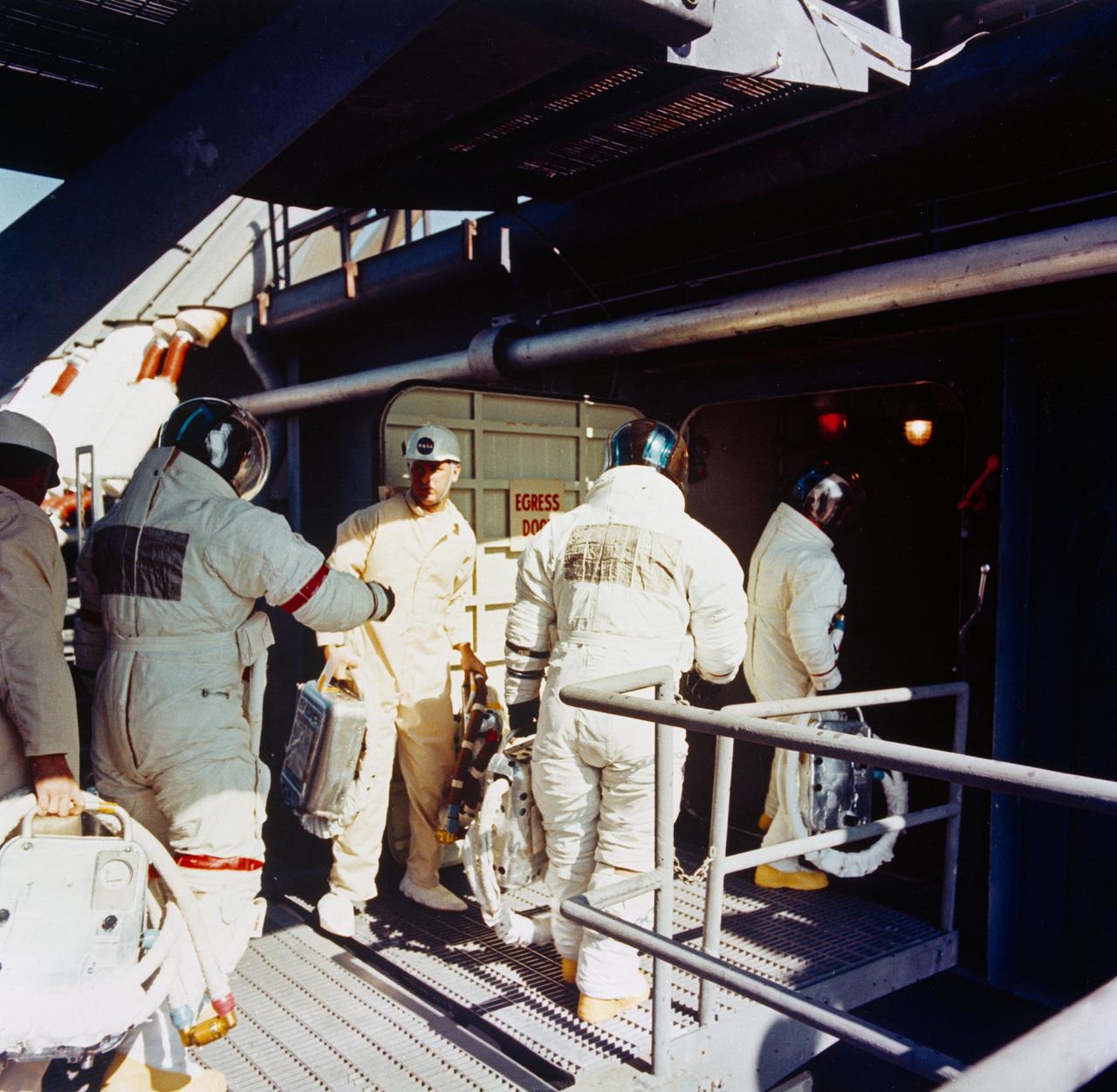
S71-16635 (31 Jan. 1971) --- The three Apollo 14 astronauts arrive at the White Room atop Pad A, Launch Complex 39, during the Apollo 14 prelaunch countdown. Apollo 14, with Alan B. Shepard Jr., commander; Stuart A. Roosa, command module pilot; and Edgar D. Mitchell, lunar module pilot, aboard was launched at 4:03:02 p.m. (EST), Jan. 31, 1971, on a lunar landing mission. Note identifying bands on the sleeve and leg of Shepard. Standing in the center foreground is astronaut Thomas P. Stafford, chief of the MSC Astronaut Office.
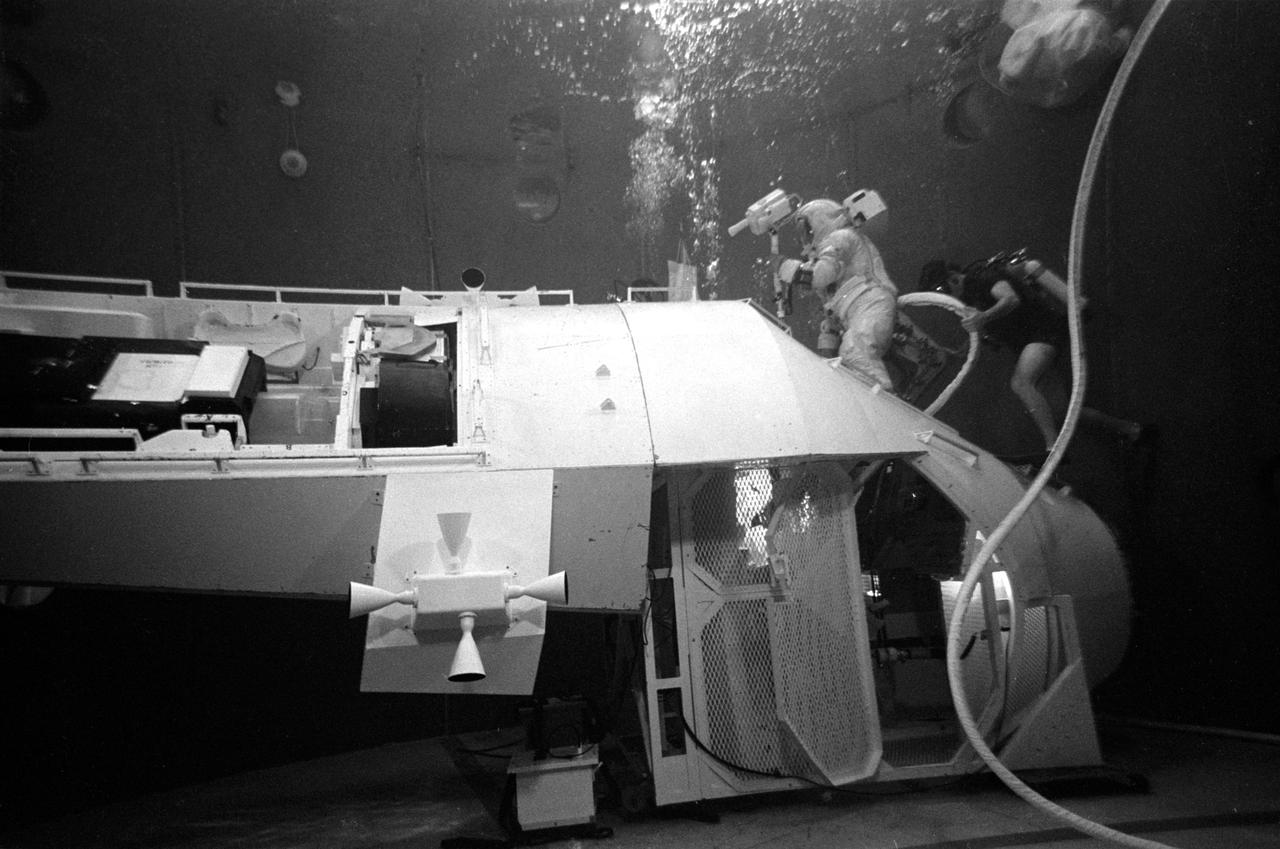
S71-58148 (1 Dec. 1971) --- Astronaut Thomas K. Mattingly II, command module pilot of the planned Apollo 16 lunar landing mission, participates in extravehicular activity (EVA) simulations in the water facility tank in Building 5 at the Manned Spacecraft Center (MSC), Houston, Texas, during training preparations for the forthcoming mission. Mattingly is scheduled to perform EVA during the trans-Earth journey of the Apollo 16 mission.
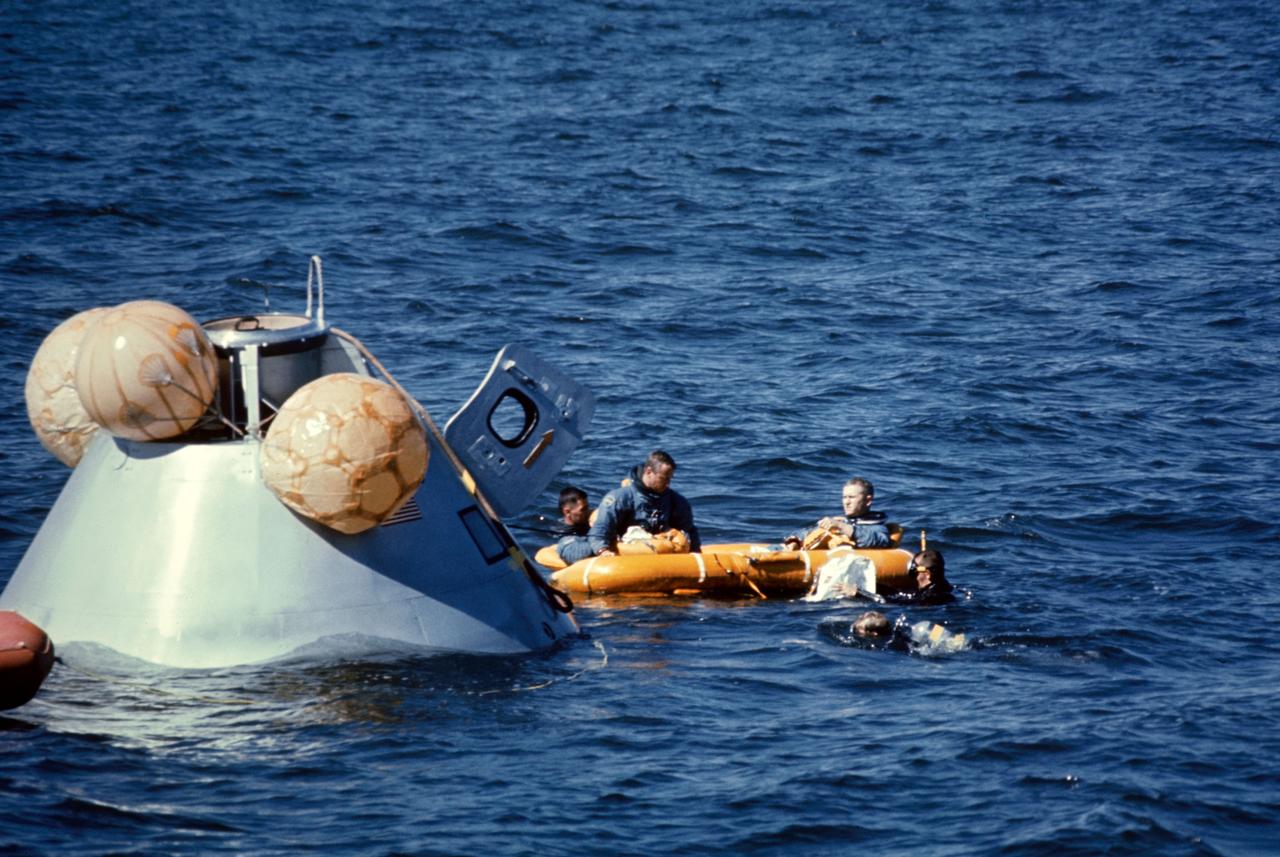
S68-53223 (19 Oct. 1968) --- The prime crew of the Apollo 8 mission in life raft awaiting pickup by U.S. Coast Guard helicopter during water egress training in the Gulf of Mexico. They had just egressed Apollo Boilerplate 1102A, at left. Inflated bags were used to upright the boilerplate. Left to right, are astronauts William A. Anders, lunar module pilot; and Frank Borman, commander. A team of MSC swimmers assisted with the training exercise.
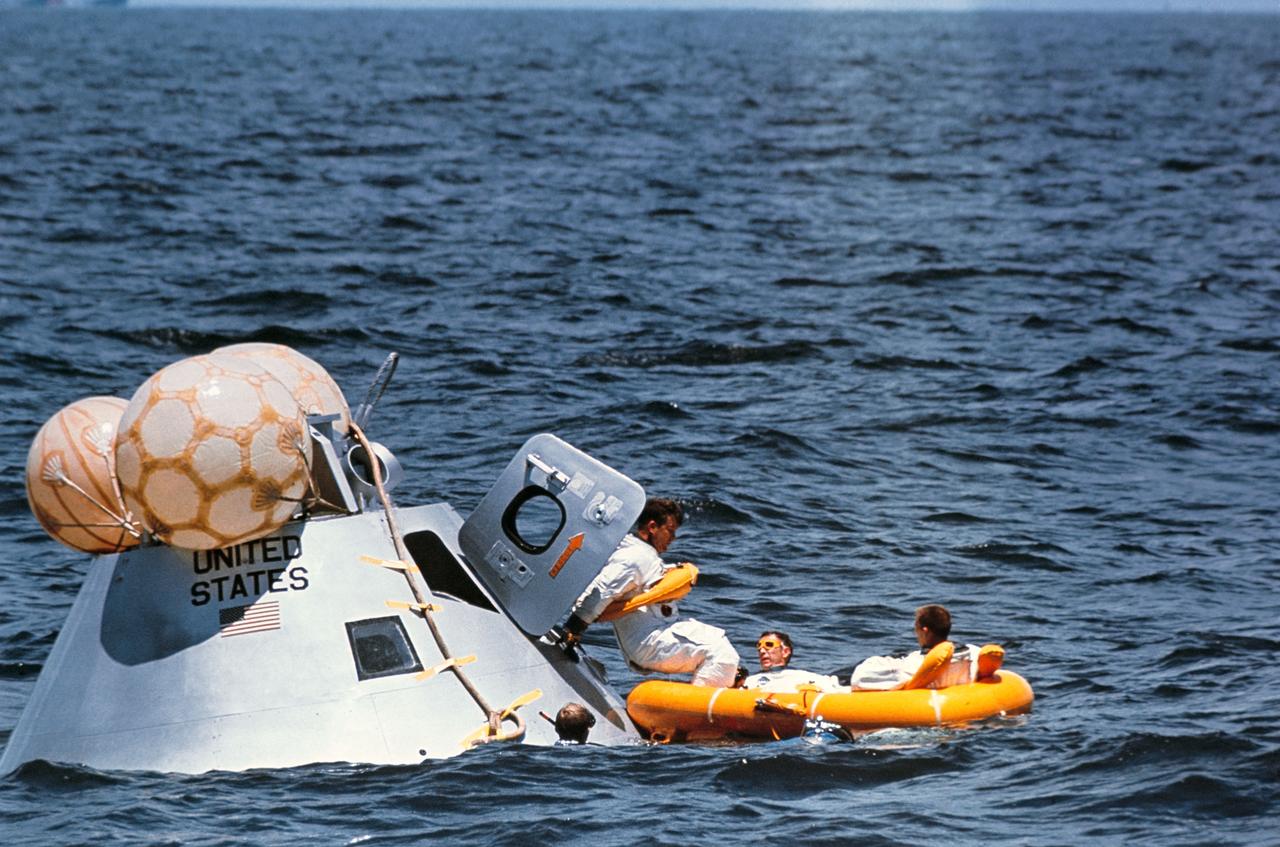
S68-46605 (5 Aug. 1968) --- The prime crew of the first manned Apollo mission (Spacecraft 101/Saturn 205) participates in water egress training in the Gulf of Mexico. Left to right, are astronauts Walter M. Schirra Jr. (stepping into life raft), Donn F. Eisele, and Walter Cunningham. They have just egressed Apollo Command Module Boilerplate 1102, and are awaiting helicopter pickup. Inflated bags were used to upright the boilerplate. MSC swimmers assisted in the training exercise.
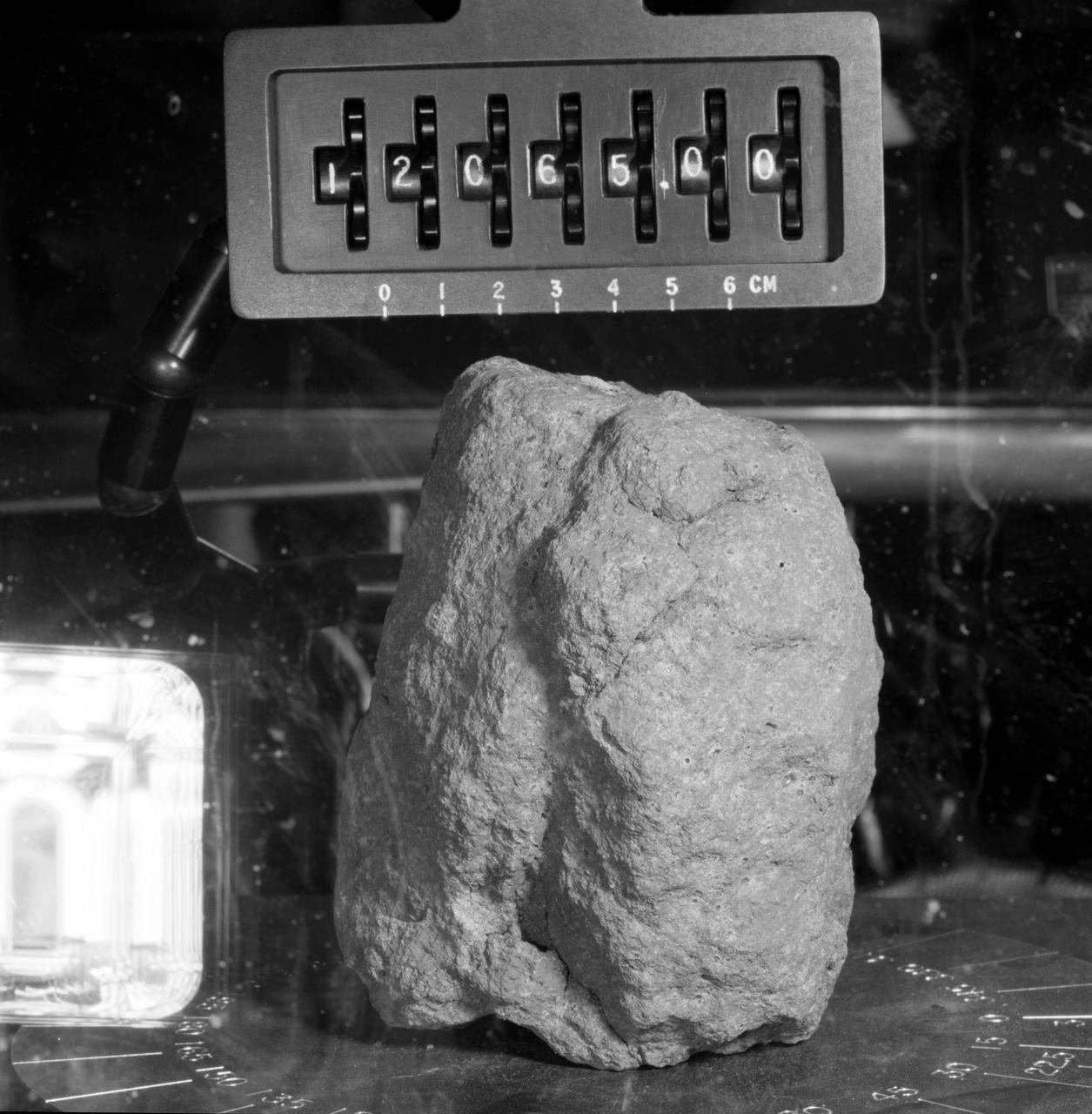
S69-60580 (November 1969) --- Close-up view of Apollo 12 sample 12,065 under observation in the Manned Spacecraft Center's (MSC) Lunar Receiving Laboratory (LRL). This sample, collected during the second Apollo 12 extravehicular activity (EVA) of astronauts Charles Conrad Jr. and Alan L. Bean, is a fine-grained rock. Note the glass-lined pits. Viewer can gain an idea of the size of the rock by reference to the gauge on the bottom portion of the number meter.
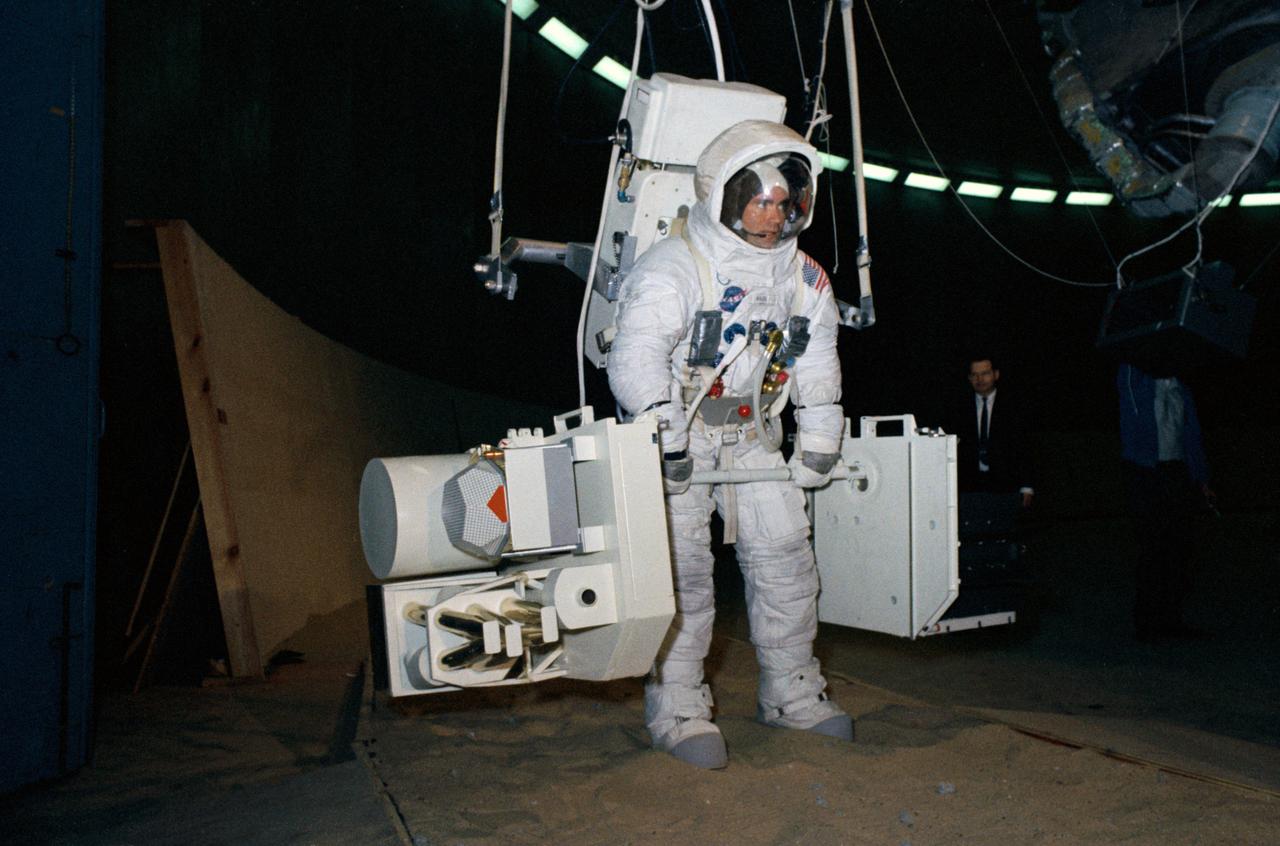
S70-24009 (19 Jan. 1970) --- Astronaut Fred W. Haise Jr., Apollo 13 lunar module pilot, trains for his scheduled April lunar space walk at the Manned Spacecraft Center (MSC). Haise carries a training version of the Apollo Lunar Surface Experiments Package (ALSEP), while connected to a "Six Degrees of Freedom" simulator. Out of frame is astronaut James A. Lovell Jr., commander, who will share the lunar extravehicular activity (EVA) with Haise. EDITOR'S NOTE: In April 1970 the Apollo 13 Service Module (SM) experienced an explosion en route to the moon. The three-man crew was forced to circumnavigate the moon and return to Earth.
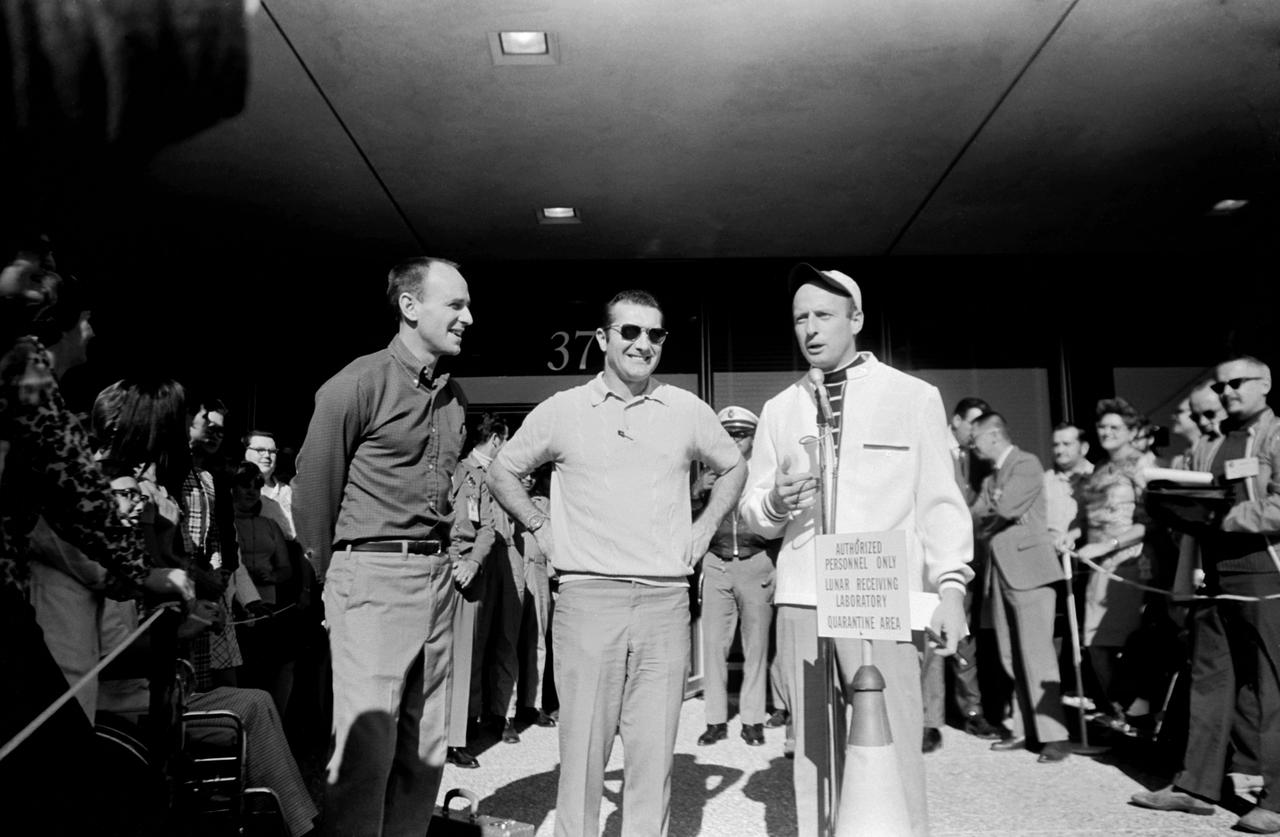
S69-62884 (10 Dec. 1969) --- Astronaut Charles Conrad Jr., commander of the Apollo 12 lunar landing mission, makes several remarks publicly in response to the welcome given him and other members of the Apollo 12 crew upon their release from post-mission isolation in the Manned Spacecraft Center's (MSC) Lunar Receiving Laboratory (LRL). Pictured with Conrad outside Building 37, which houses the LRL, are his fellow crewmembers for the Apollo 12 mission, astronauts Alan L. Bean (left), lunar module pilot; and Richard F. Gordon Jr. (center), command module pilot.
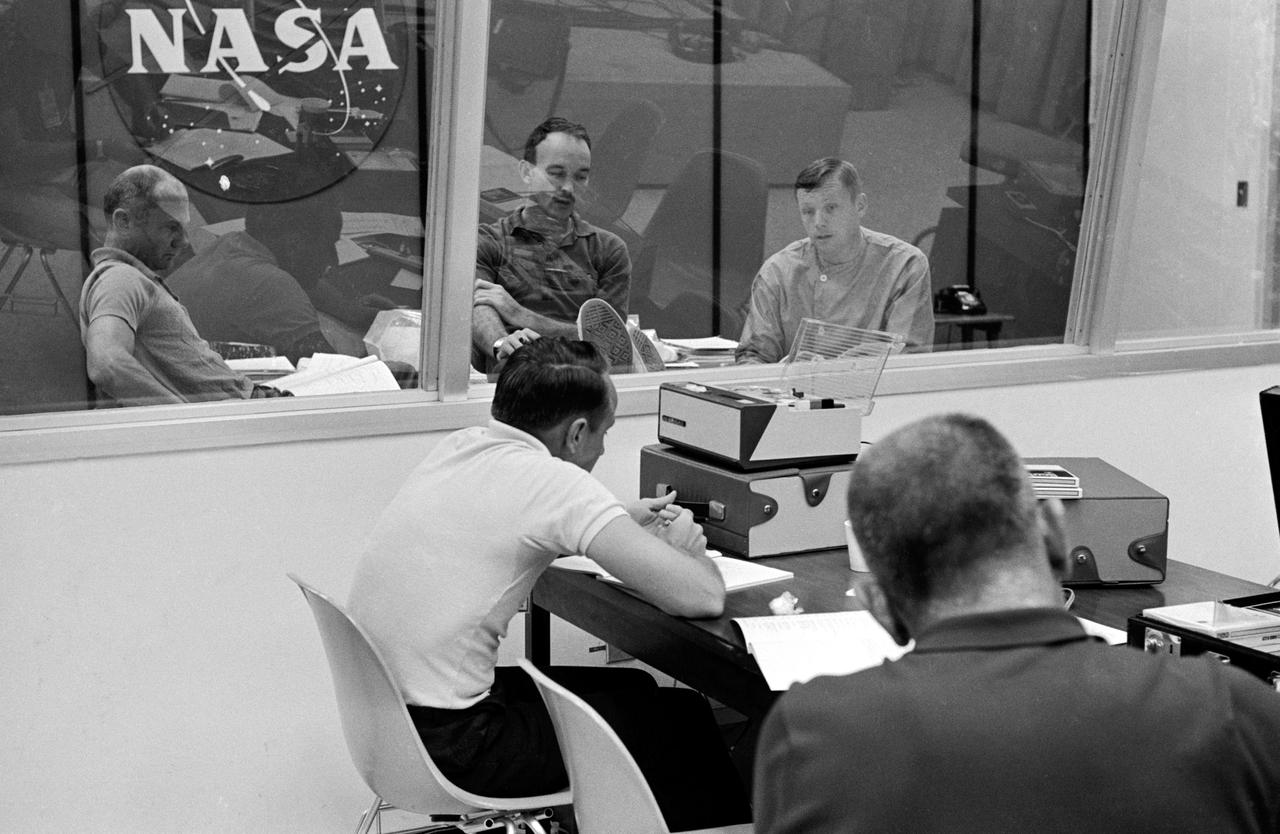
S69-40209 (27 July 1969) --- The crewmen of the Apollo 11 lunar landing mission go through their post flight debriefing session on Sunday, July 27, 1969. Left to right, are astronauts Edwin E. Aldrin Jr., lunar module pilot; Michael Collins, command module pilot; and Neil A. Armstrong, commander. They are seated in the debriefing room of the Crew Reception Area of the Lunar Receiving Laboratory at the Manned Spacecraft Center (MSC). In the foreground are Donald K. Slayton (right), MSC Director of Flight Crew Operations; and Lloyd Reeder, training coordinator.
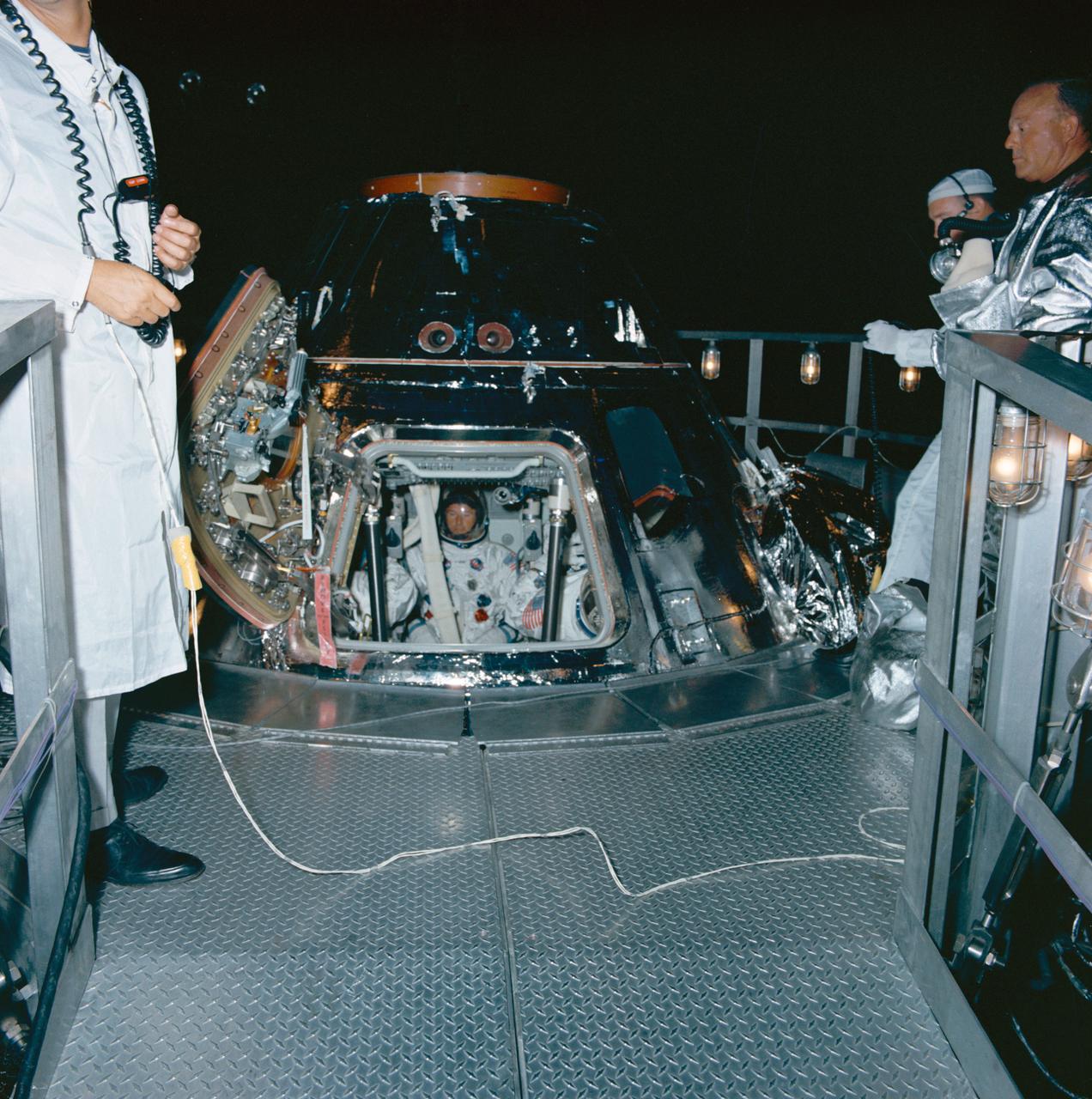
Crew ingress and beginnings of 7 1/2-day Manned Thermal Vacuum Test with Astronauts Joe Engle, Dr. Joseph Kerwin and Brand in the Apollo S/C-2TV-1, Chamber "A", Bldg. 32. Note - 35mm BW (S68-35881 thru S68-35882) - 120 CN (S68-35883 thru S68-35908) 1. ASTRONAUT BRAND, VANCE D. - VACUUM TEST 2. ASTRONAUT KERWIN, JOSEPH - VACUUM TEST 3. ASTRONAUT ENGLE, JOE - VACUUM MSC, HOUSTON, TX
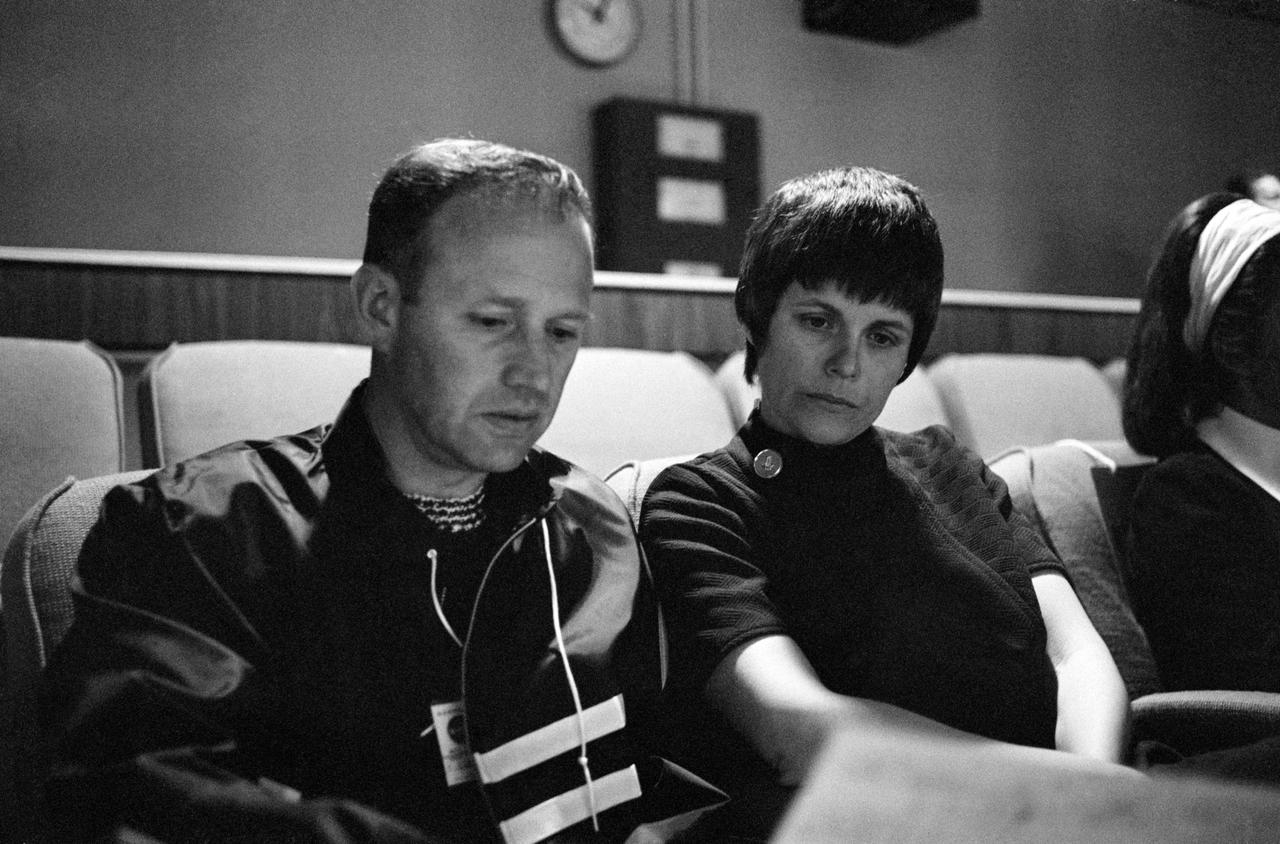
S70-34900 (14 April 1970) --- Mrs. Mary Haise receives an explanation of the revised flight plan of the Apollo 13 mission from astronaut Gerald P. Carr in the viewing room of the Mission Control Center (MCC), Building 30, at the Manned Spacecraft Center (MSC). Her husband, astronaut Fred W. Haise Jr., lunar module pilot for the Apollo 13 mission, was joining fellow crew members, astronauts James A. Lovell Jr., and John L. Swigert Jr. in making correction in their spacecraft following discovery of an oxygen cell failure several hours earlier.
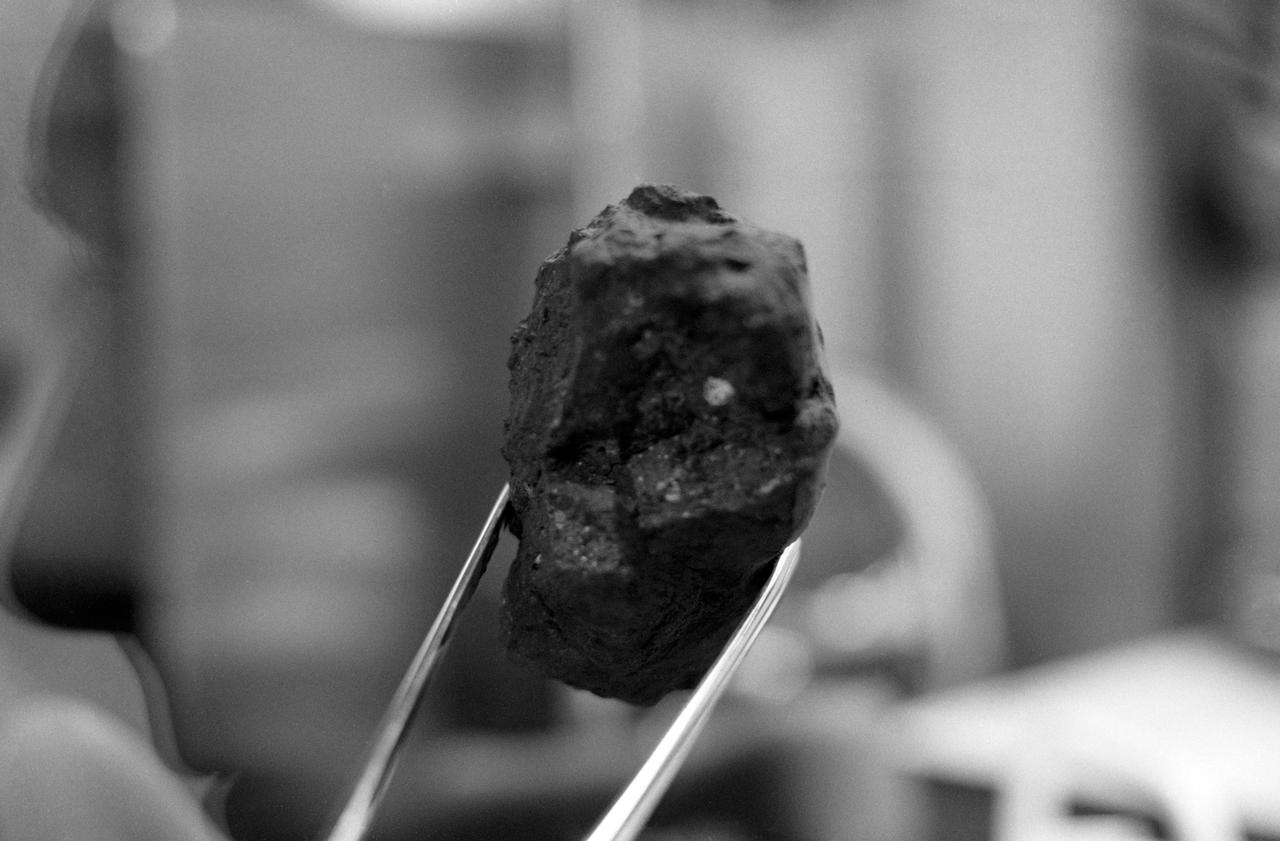
S69-60487 (1 Dec. 1969) --- A close-up view of one of the rocks brought back to Earth from the Apollo 12 lunar landing mission. The rock is under examination in the Physical-Chemical Test Laboratory in the Lunar Receiving Laboratory (LRL), Building 37, MSC. This rock is one of two breccia found in the contingency collection gathered by astronauts Charles Conrad Jr. and Alan L. Bean during their stay on the lunar surface. The breccia rocks, common in the collection of Apollo 11 lunar samples, have been rare in examinations of the Apollo 12 samples thus far.
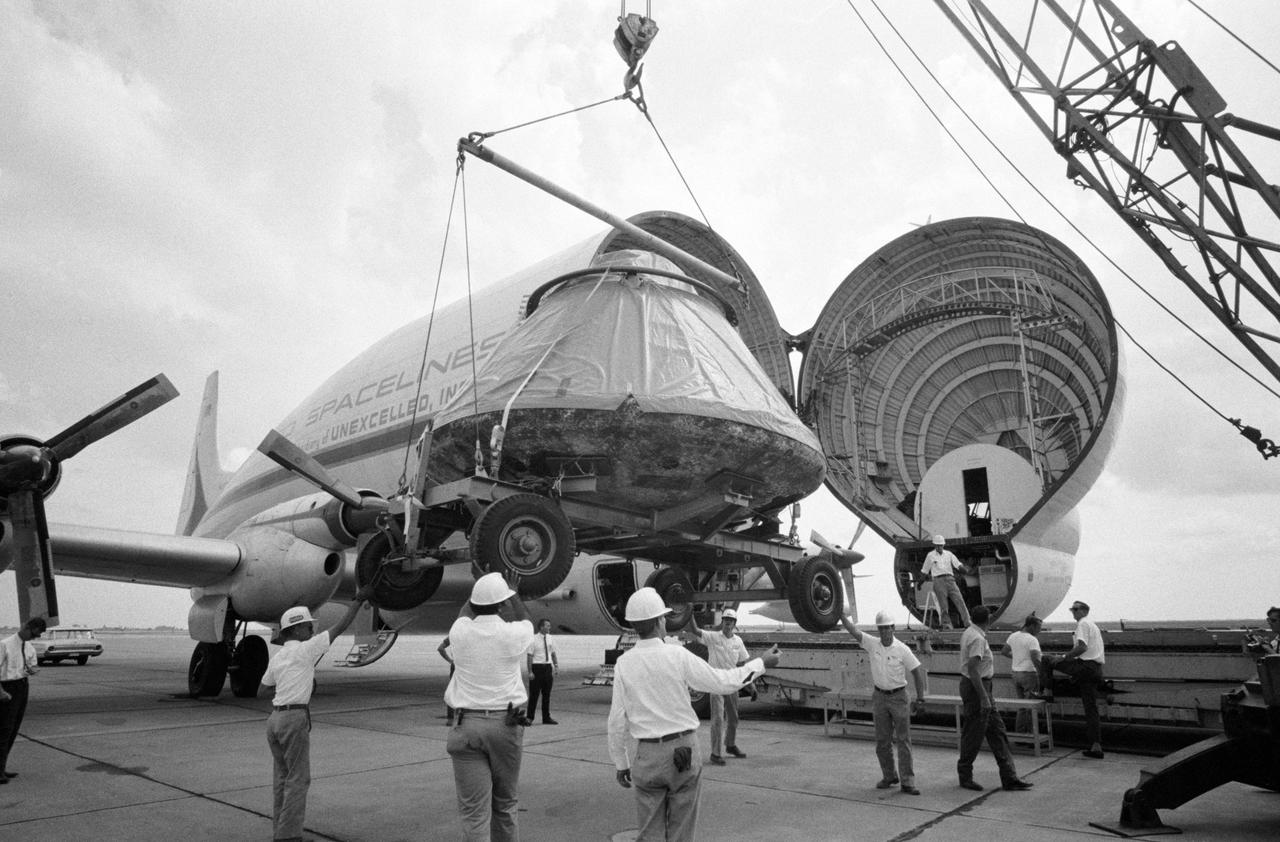
S69-41985 (14 Aug. 1969) --- The Apollo 11 spacecraft Command Module (CM) is loaded aboard a Super Guppy Aircraft at Ellington Air Force Base for shipment to the North American Rockwell Corporation at Downey, California. The CM was just released from its postflight quarantine at the Manned Spacecraft Center (MSC). The Apollo 11 spacecraft was flown by astronauts Neil A. Armstrong, commander; Michael Collins, command module pilot; and Edwin E. Aldrin Jr., lunar module pilot, during their lunar landing mission. Note damage to aft heat shield caused by extreme heat of Earth reentry. North American Rockwell is the prime contractor for the Apollo Command and Service Modules (CSM).
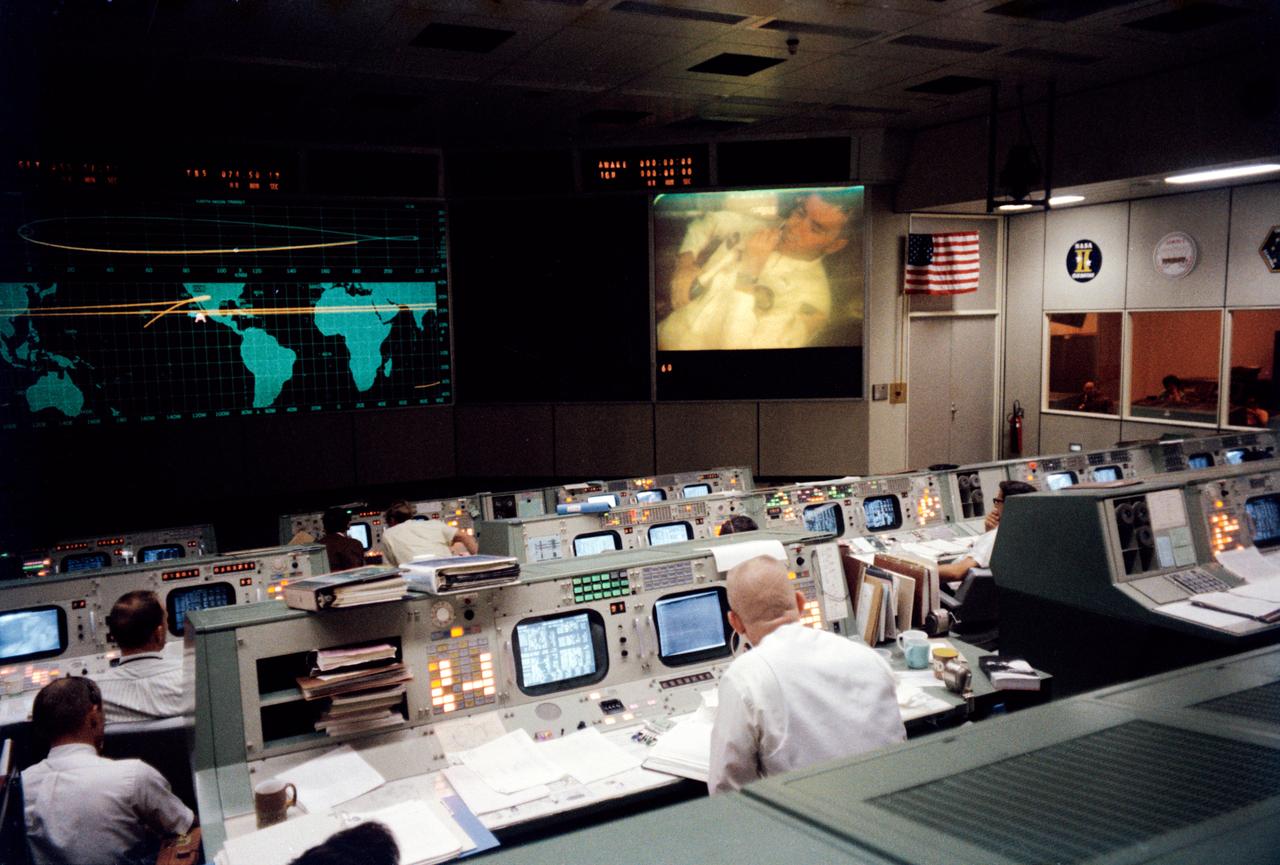
S70-35139 (13 April 1970) --- Overall view of the Mission Operations Control Room (MOCR) in the Mission Control Center (MCC) at Manned Spacecraft Center (MSC), during the fourth television transmission from the Apollo 13 mission in space. Eugene F. Kranz (foreground, back to camera), one of four Apollo 13 flight directors, views the large screen at front of MOCR, astronaut Fred W. Haise Jr., lunar module pilot, is seen on the screen. The fourth TV transmission from the Apollo 13 mission was on the evening of April 13, 1970.
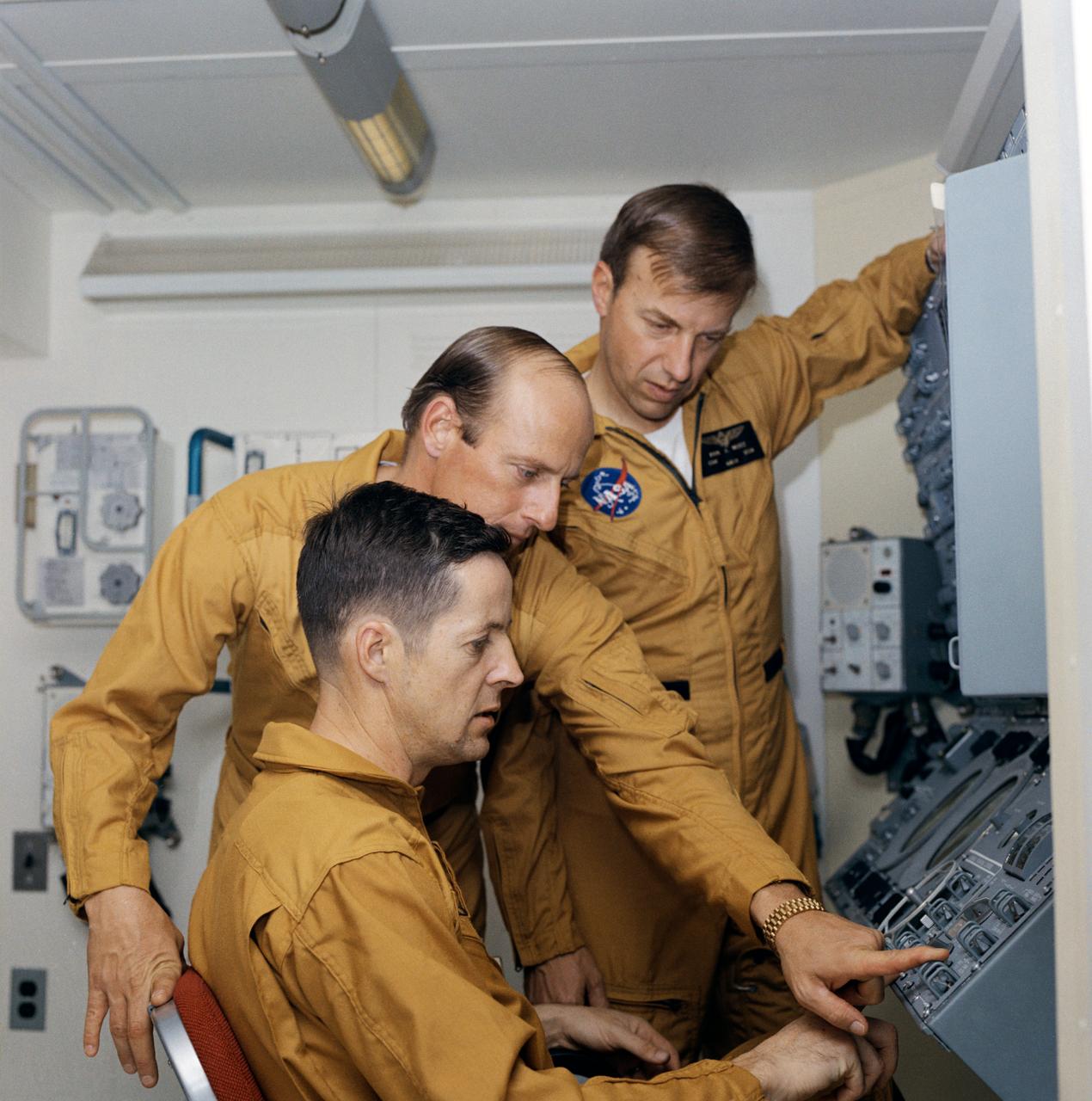
S72-17512 (19 Jan. 1972) --- These three men are the crewmen for the first manned Skylab mission. They are astronaut Charles Conrad Jr., commander, standing left; scientist-astronaut Joseph P. Kerwin, seated; and astronaut Paul J. Weitz, pilot. They were photographed and interviewed during an "open house" press day in the realistic atmosphere of the Multiple Docking Adapter (MDA) trainer in the Mission Simulation and Training Facility at the Manned Spacecraft Center (MSC). The control and display panel for the Apollo Telescope Mount (ATM) is at right. Photo credit: NASA
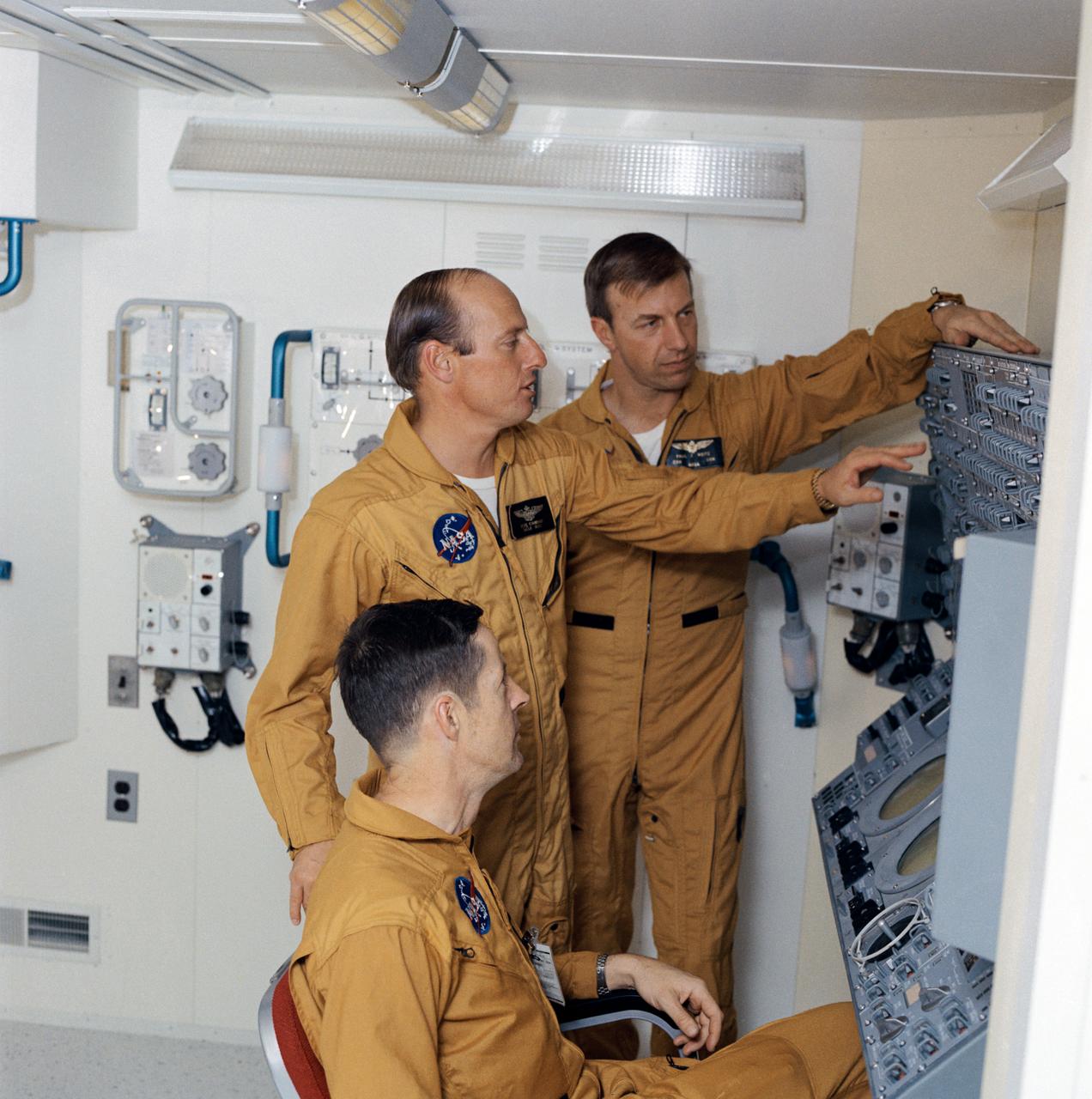
S72-17509 (19 Jan. 1972) --- These three men are the crewmen for the first manned Skylab mission. They are astronaut Charles Conrad Jr., commander, standing left; scientist-astronaut Joseph P. Kerwin, seated; and astronaut Paul J. Weitz, pilot. They were photographed and interviewed during an "open house" press day in the realistic atmosphere of the Multiple Docking Adapter (MDA) trainer in the Mission Simulation and Training Facility at the Manned Spacecraft Center (MSC). The control and display panel for the Apollo Telescope Mount (ATM) is at right. Photo credit: NASA
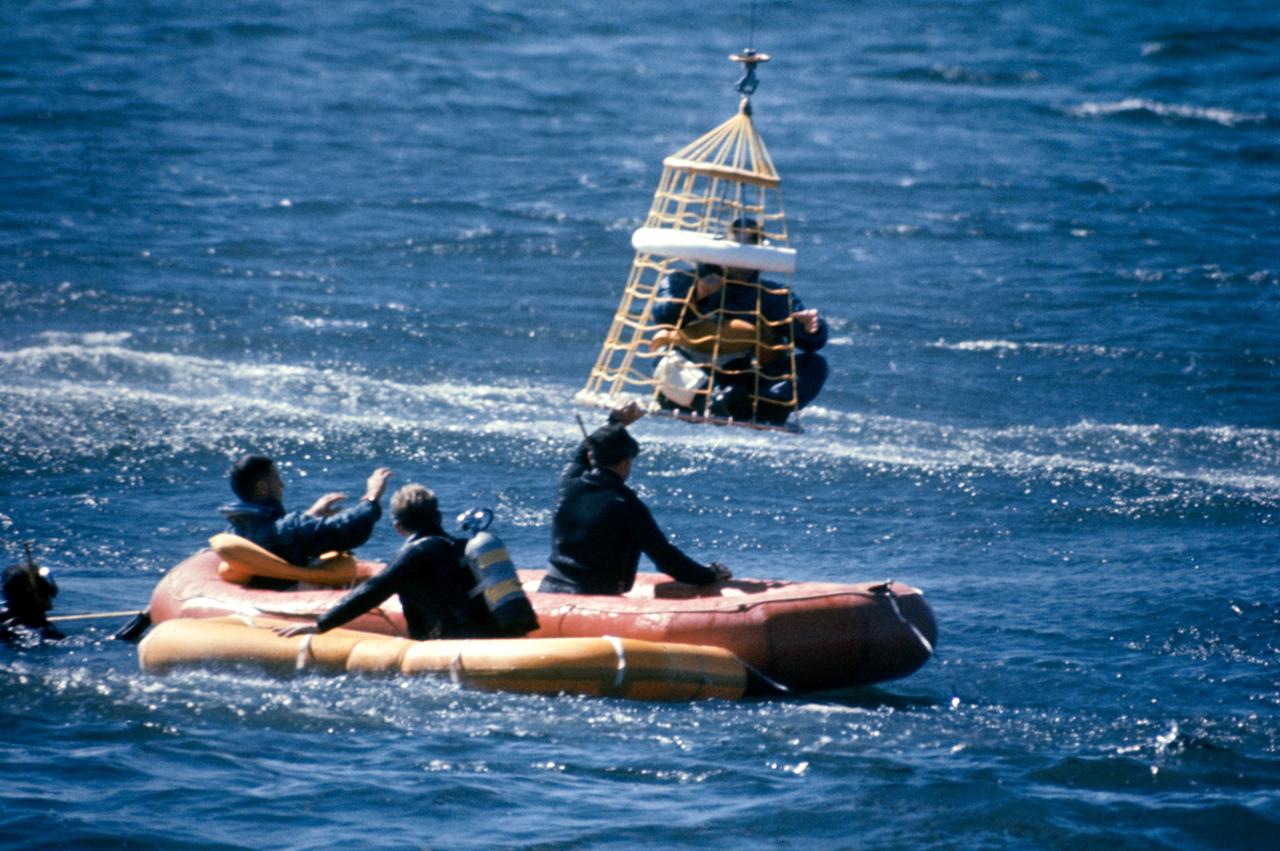
S68-53217 (19 Oct. 1968) --- Astronaut James A. Lovell Jr., command module pilot of the Apollo 8 prime crew, in special net being hoisted up to a U.S. Coast Guard helicopter during water egress training in the Gulf of Mexico. Awaiting his turn for helicopter pickup is astronaut William A. Anders (in raft), lunar module pilot. Astronaut Frank Borman, commander, had already been picked up. A team of Manned Spacecraft Center (MSC) swimmers assisted with the training exercise.
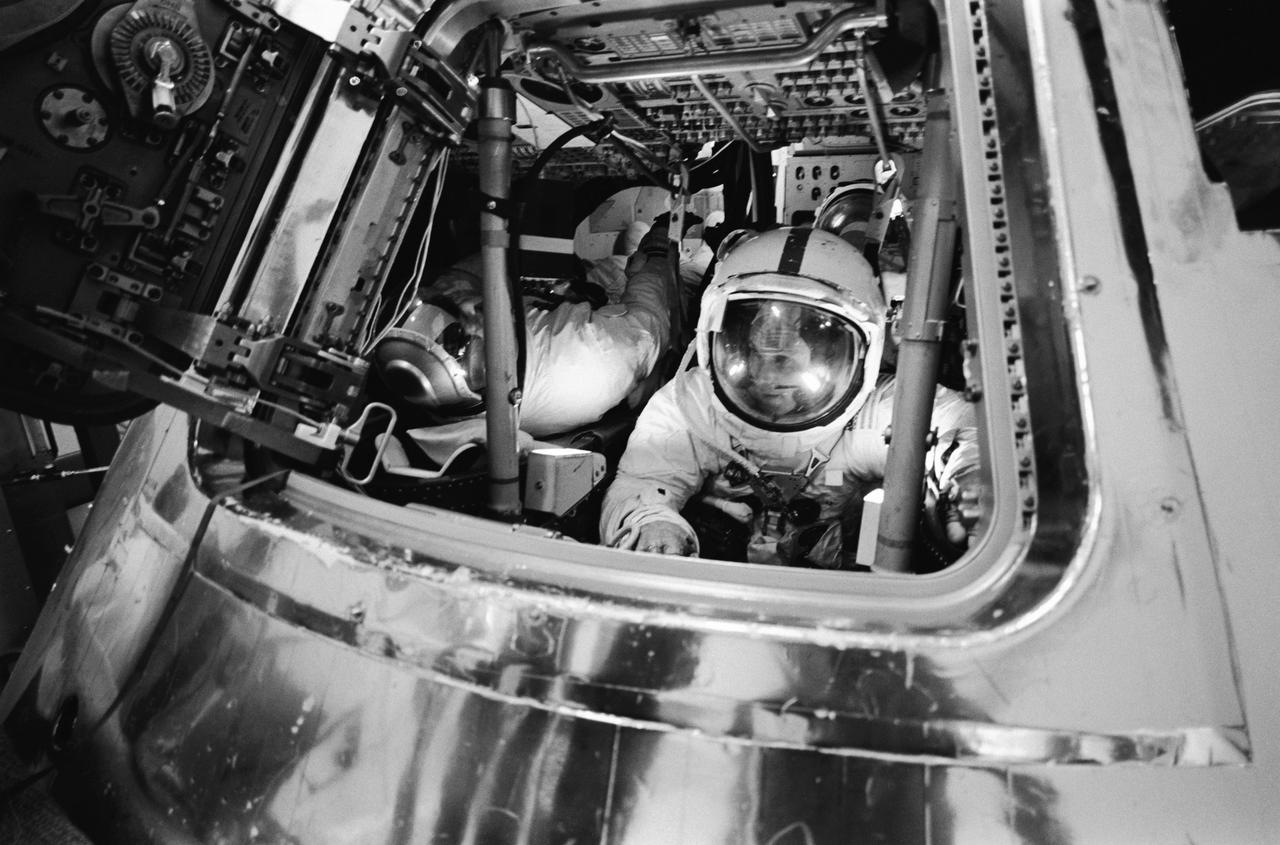
S72-31047 (March 1972) --- Astronaut Thomas K. Mattingly II (right foreground), command module pilot of the Apollo 16 lunar landing mission, participates in extravehicular activity (EVA) training in Building 5 at the Manned Spacecraft Center (MSC). Mattingly is scheduled to perform EVA during the Apollo 16 journey home from the moon. Astronaut John W. Young, commander, can be seen in the left background. In the right background is astronaut Charles M. Duke Jr., lunar module pilot. They are inside the Apollo Command Module Mission Simulator. While Mattingly remains with the Apollo 16 Command and Service Modules (CSM) in lunar orbit, Young and Duke will descend in the Lunar Module (LM) to the moon's Descartes landing site.
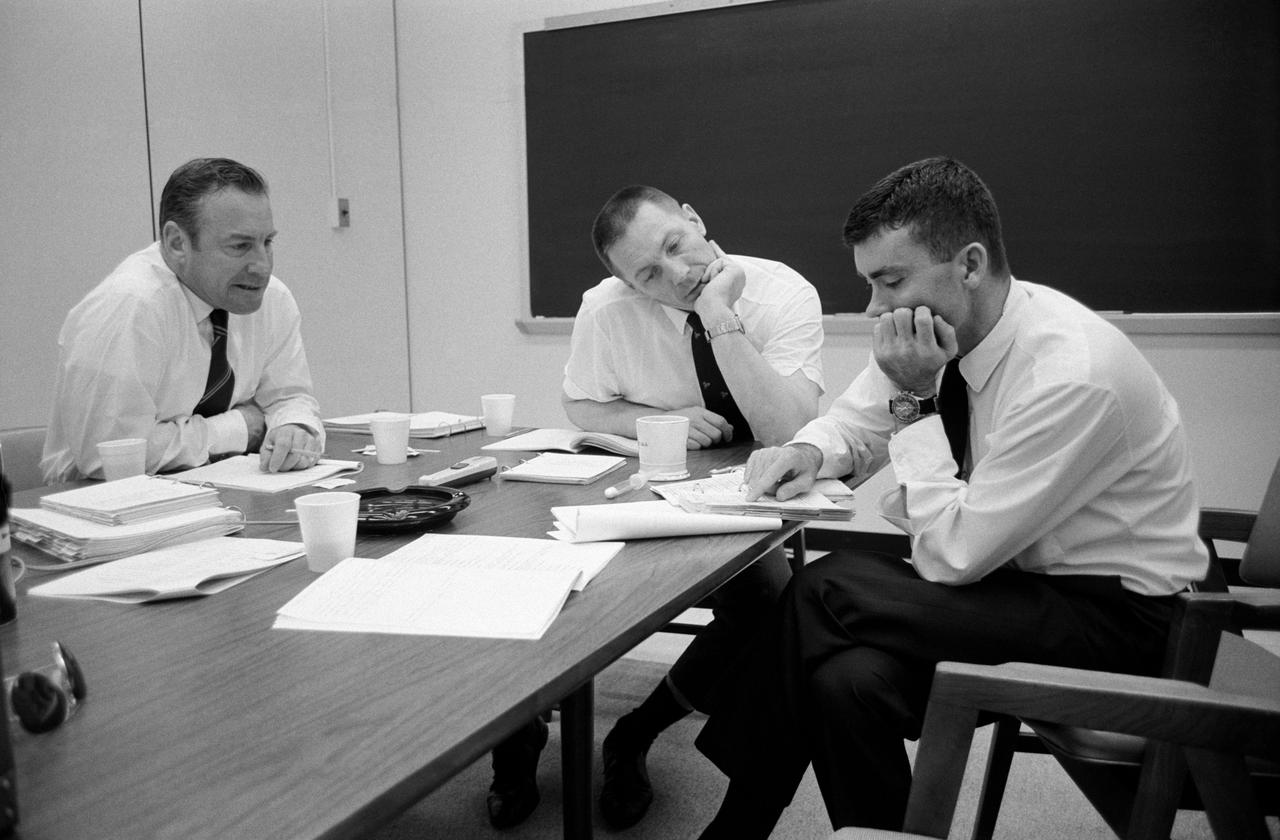
S70-35747 (20 April 1970) --- The three crew men of the problem plagued Apollo 13 mission are photographed during the first day of their postflight debriefing activity at the Manned Spacecraft Center (MSC). Left to right, are astronauts James A. Lovell Jr., commander; John L. Swigert Jr., command module pilot; and Fred W. Haise Jr., lunar module pilot. The apparent rupture of oxygen tank number two in the Apollo 13 Service Module (SM) and the subsequent damage forced the three astronauts to use the Lunar Module (LM) as a "lifeboat" to return home safely after their moon landing was canceled.
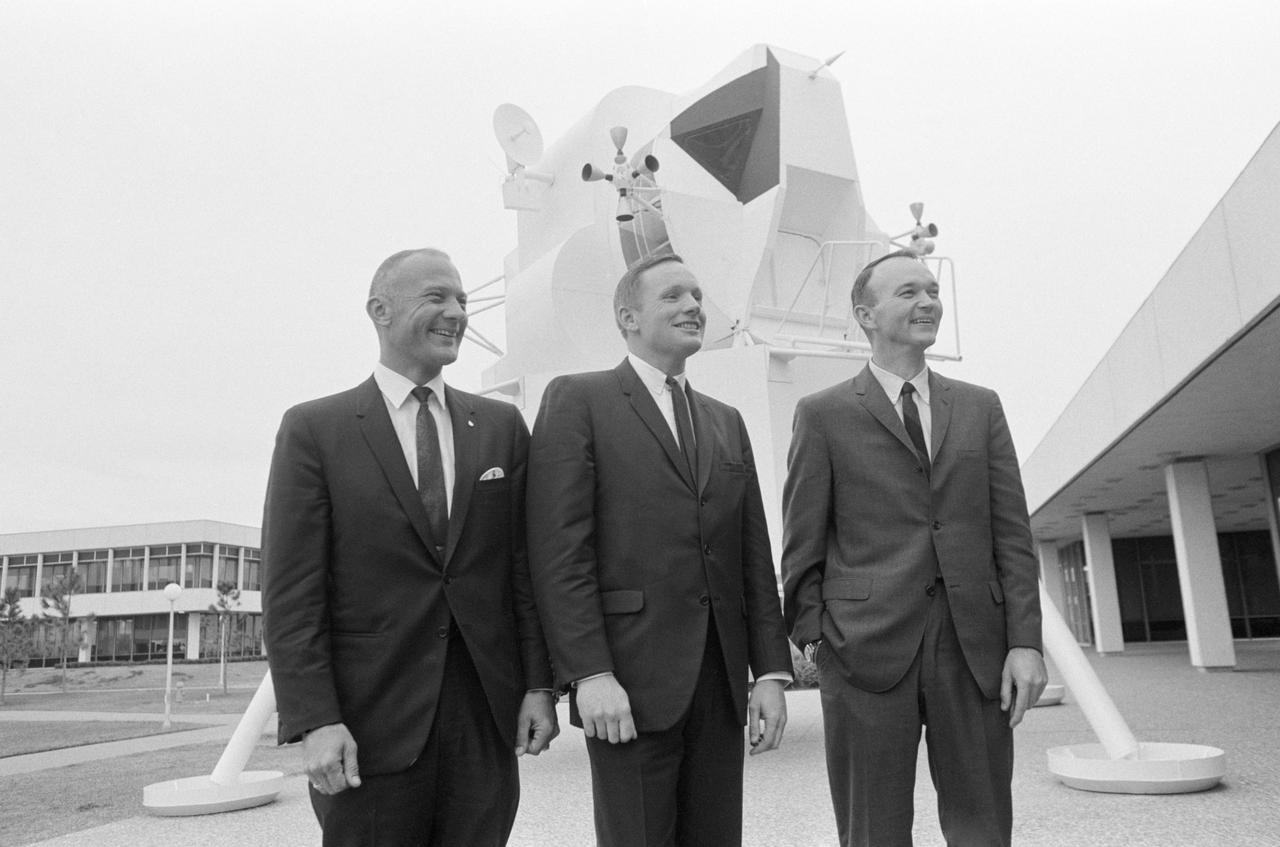
S69-16681 (10 Jan. 1969) --- These three astronauts have been selected by NASA as the prime crew of the Apollo 11 lunar landing mission. Left to right, are astronauts Edwin E. Aldrin Jr., lunar module pilot; Neil A. Armstrong, commander; and Michael Collins, command module pilot. They were photographed in front of a lunar module (LM) mock-up beside Building 1 following a press conference in the MSC Auditorium.
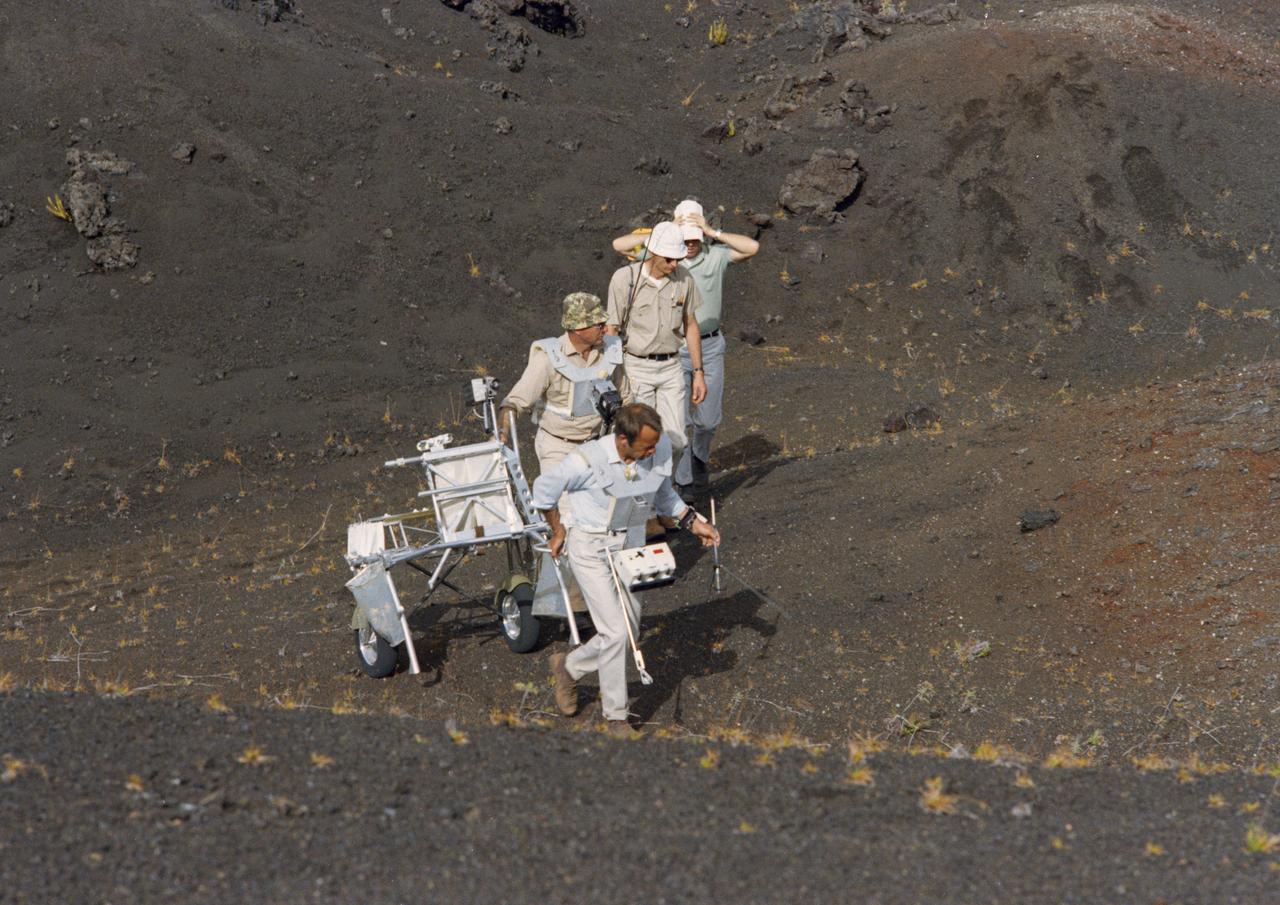
S70-34416 (April 1970) --- At Kapoho, Hawaii, two Apollo 14 prime crew members take part in a simulation of a lunar traverse while two persons from the Manned Spacecraft Center (MSC) observe. The prime and backup crews of the Apollo 14 mission were in Hawaii for several days in April 1970 to visit various sites having features similar to those on the lunar surface. Astronaut Alan B. Shepard Jr. (front), prime crew commander, carries a gnomon (from the Apollo Lunar Hand Tools - ALHT) in his left hand while pulling the Modular Equipment Transporter (MET) with his right hand. He is followed by astronaut Edgar D. Mitchell, prime lunar module pilot, with a Hasselblad lunar surface camera. Michael C. McEwen (second from rear) of the Geology Branch, Lunar and Earth Sciences Division, MSC; and Major William J. Wood of the Lunar Surface Operations Office observe the training activity. Photo credit: NASA
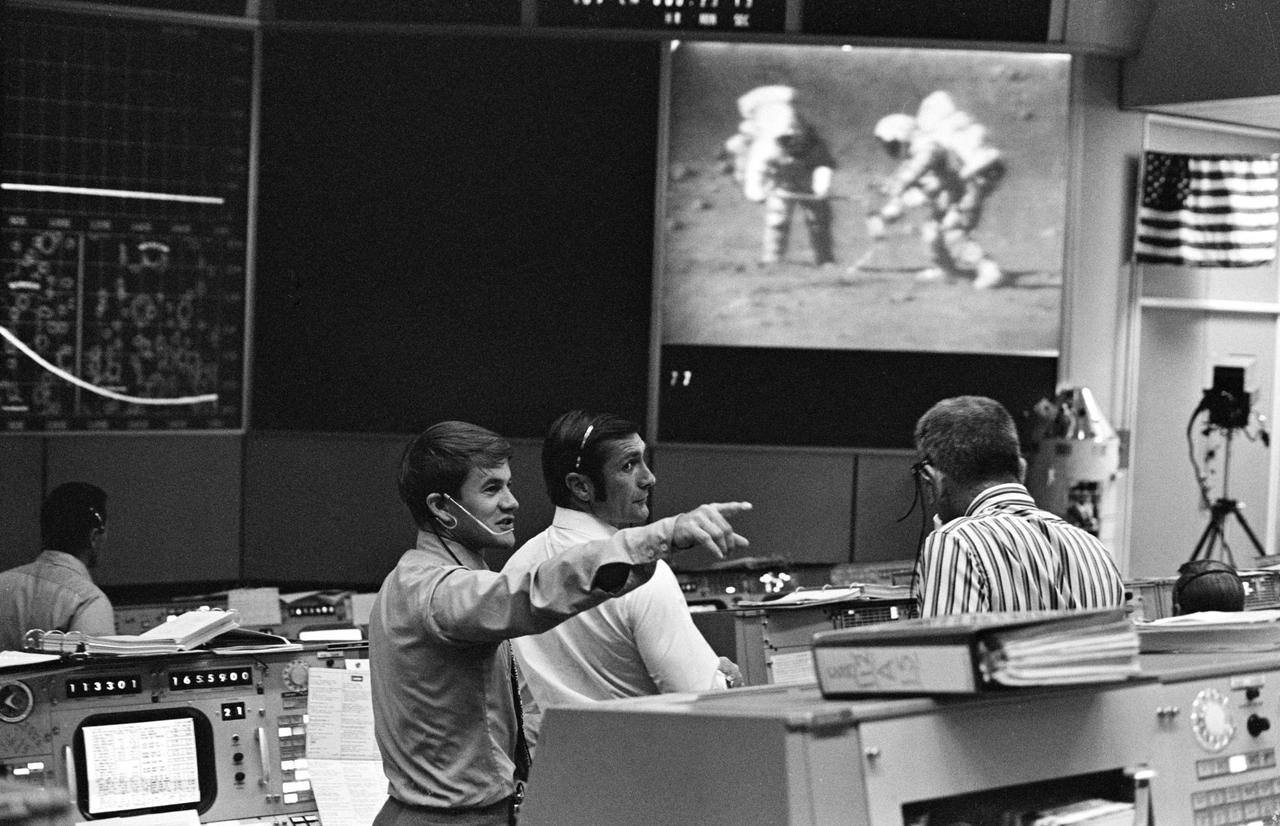
S71-41836 (2 Aug. 1971) --- Scientist-astronaut Joseph P. Allen, left, directs the attention of astronaut Richard F. Gordon Jr., to an occurrence out of view at right in the Mission Control Center's (MCC) Mission Operations Control Room (MOCR), while Dr. Donald K. (Deke) Slayton, on right with back to camera, views activity of Apollo 15 on a large screen at the front of the MOCR. Astronauts David R. Scott and James B. Irwin are seen on the screen performing tasks of the mission's third extravehicular activity (EVA), on Aug. 2, 1971. Dr. Slayton is director of Flight Crew Operations, NASA-MSC; Gordon is Apollo 15 backup commander; and Dr. Allen is an Apollo 15 spacecraft communicator.

S69-52990 (20 Sept. 1969) --- The three prime crew men of the Apollo 12 lunar landing mission participate in water egress training in the Gulf of Mexico. They have just egressed the Apollo Command Module (CM) trainer. The man standing at left is a Manned Spacecraft Center's (MSC) swimmer. The crew men await in life raft for helicopter pickup. All four persons are wearing biological isolation garments. Participating in the training exercise were astronauts Charles Conrad Jr., commander; Richard F. Gordon Jr., command module pilot; and Alan L. Bean, lunar module pilot.
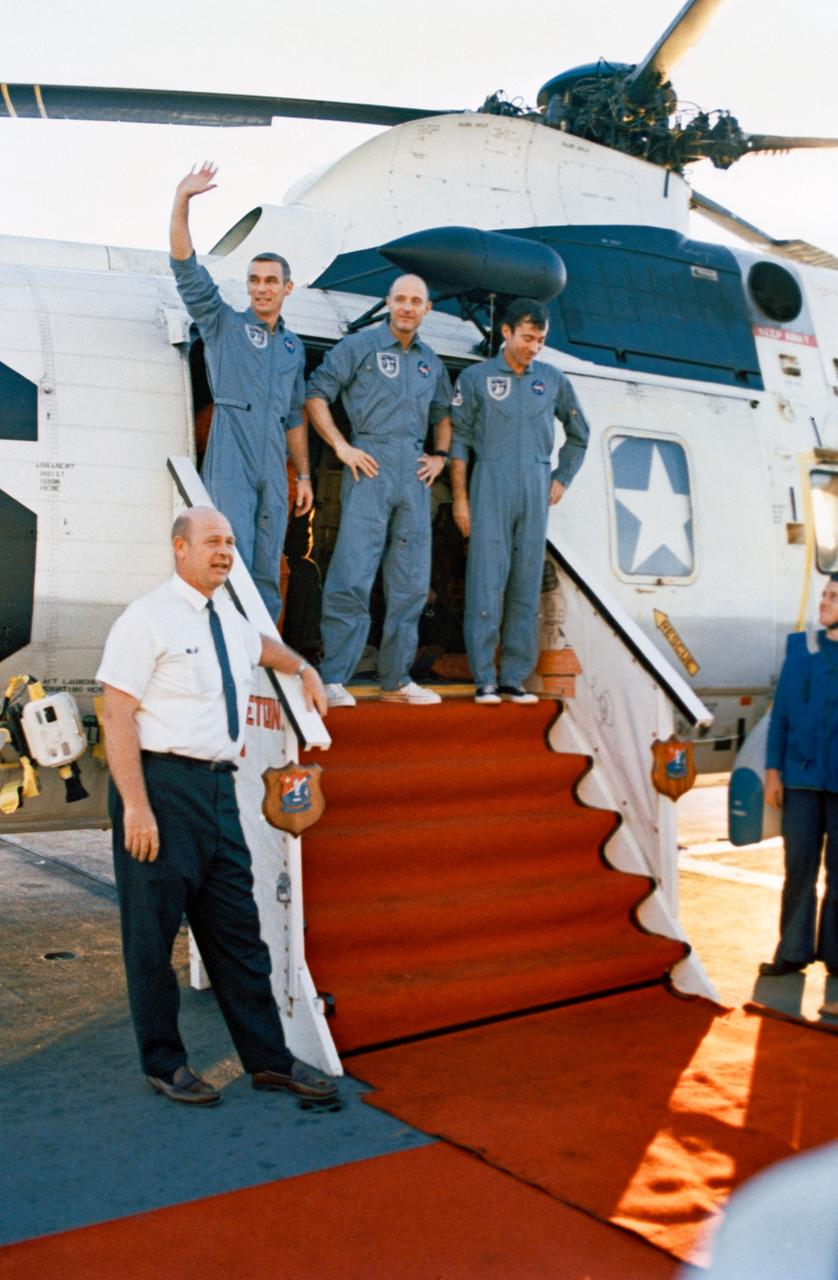
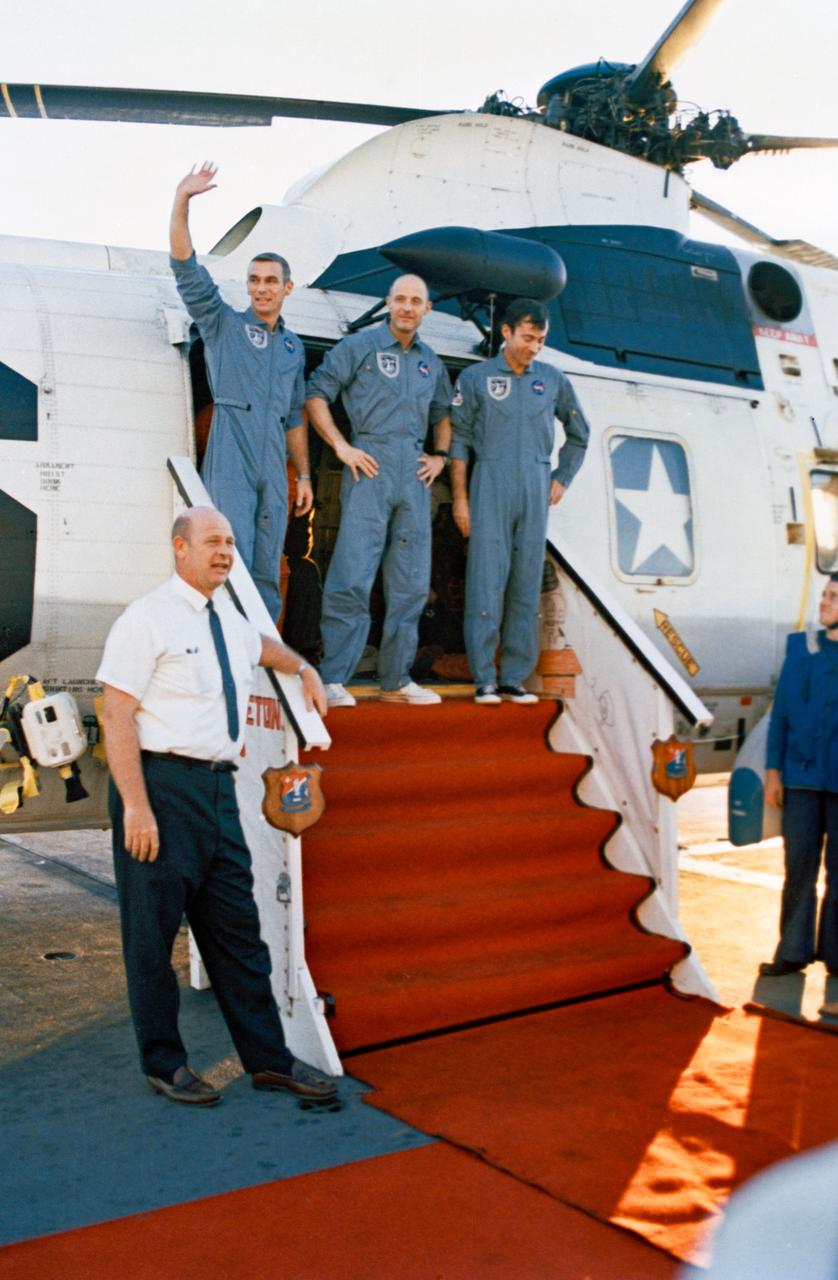
S69-36593 (26 May 1969) --- The Apollo 10 astronauts Thomas P. Stafford (center), John W. Young (left) and Eugene A. Cernan (waving) are greeted by Donald E. Stullken (lower left) of the Manned Space Center's (MSC) recovery operations team. The Apollo 10 crew splashed down in the South Pacific recovery area to conclude a successful eight-day lunar orbit mission. Splashdown occurred at 11:53 a.m. (CDT), May 26, 1969, about 400 miles east of American Samoa and about four miles from the prime recovery ship, USS Princeton.
S69-36593 (26 May 1969) --- The Apollo 10 astronauts Thomas P. Stafford (center), John W. Young (left) and Eugene A. Cernan (waving) are greeted by Donald E. Stullken (lower left) of the Manned Space Center's (MSC) recovery operations team. The Apollo 10 crew splashed down in the South Pacific recovery area to conclude a successful eight-day lunar orbit mission. Splashdown occurred at 11:53 a.m. (CDT), May 26, 1969, about 400 miles east of American Samoa and about four miles from the prime recovery ship, USS Princeton.
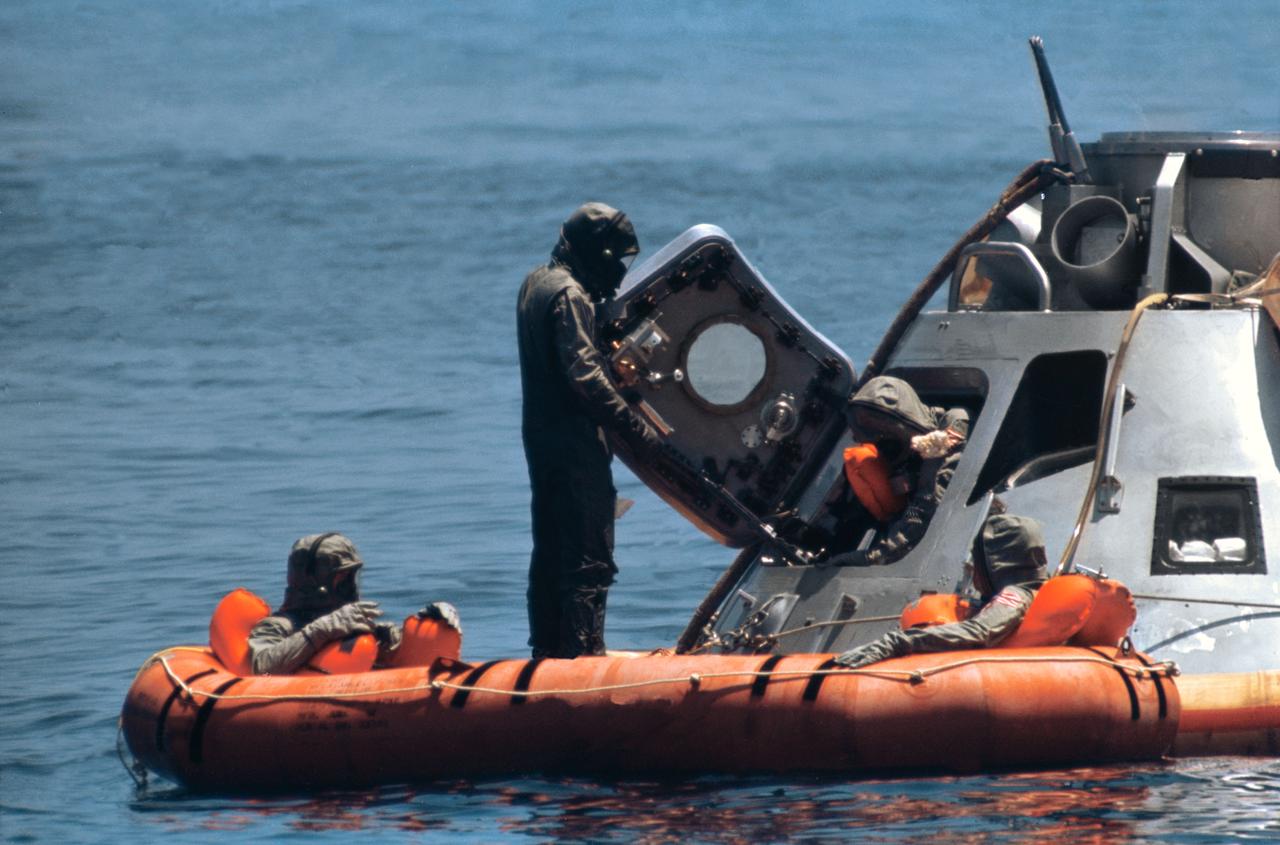
S69-34967 (24 May 1969) --- The third member of the prime crew of the Apollo 11 lunar landing mission egresses Apollo Boilerplate 1102 during water egress training in the Gulf of Mexico. The other two crewmen are in raft. Taking part in the training were astronauts Neil A. Armstrong, commander; Michael Collins, command module pilot; and Edwin E. Aldrin Jr., lunar module pilot. The three crewmen practiced donning and wearing biological isolation garments (B.I.G.) as a part of the exercise. The Manned Spacecraft Center (MSC) swimmer standing up, who assisted in the training, is also wearing a B.I.G.
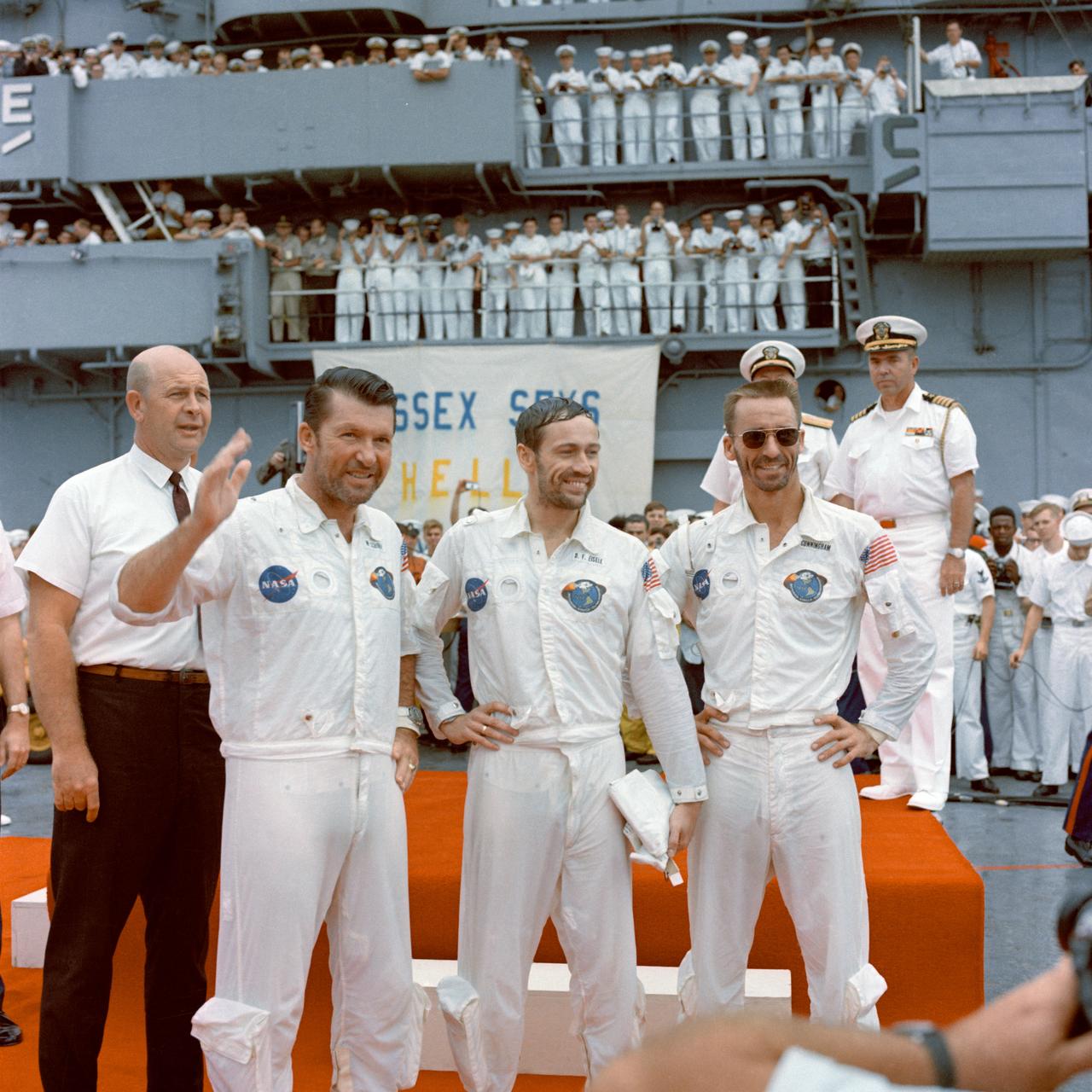
S68-49744 (22 Oct. 1968) --- The Apollo 7 crew is welcomed aboard the USS Essex, the prime recovery ship for the mission. Left to right, are astronauts Walter M. Schirra Jr., commander; Donn F. Eisele, command module pilot; and Walter Cunningham, lunar module pilot. In left background is Dr. Donald E. Stullken, NASA Recovery Team Leader from the Manned Spacecraft Center's (MSC) Landing and Recovery Division.
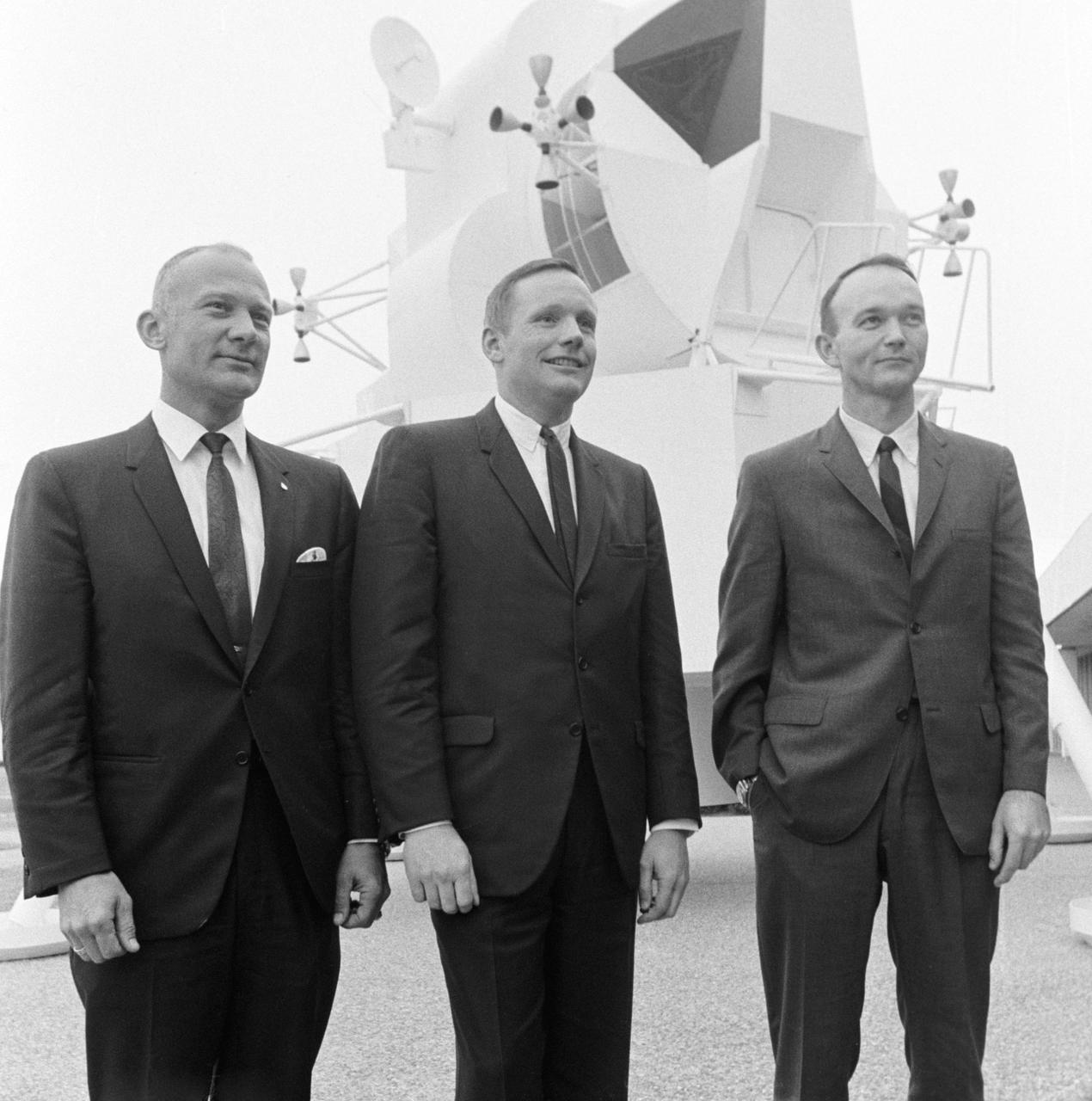
S69-16682 (10 Jan. 1969) --- These three astronauts have been selected by NASA as the prime crew of the Apollo 11 lunar landing mission. Left to right, are Edwin E. Aldrin Jr., lunar module pilot; Neil A. Armstrong, commander; and Michael Collins, command module pilot. They are photographed in front of a lunar module mock-up beside Building 1 following a press conference in the MSC Auditorium.
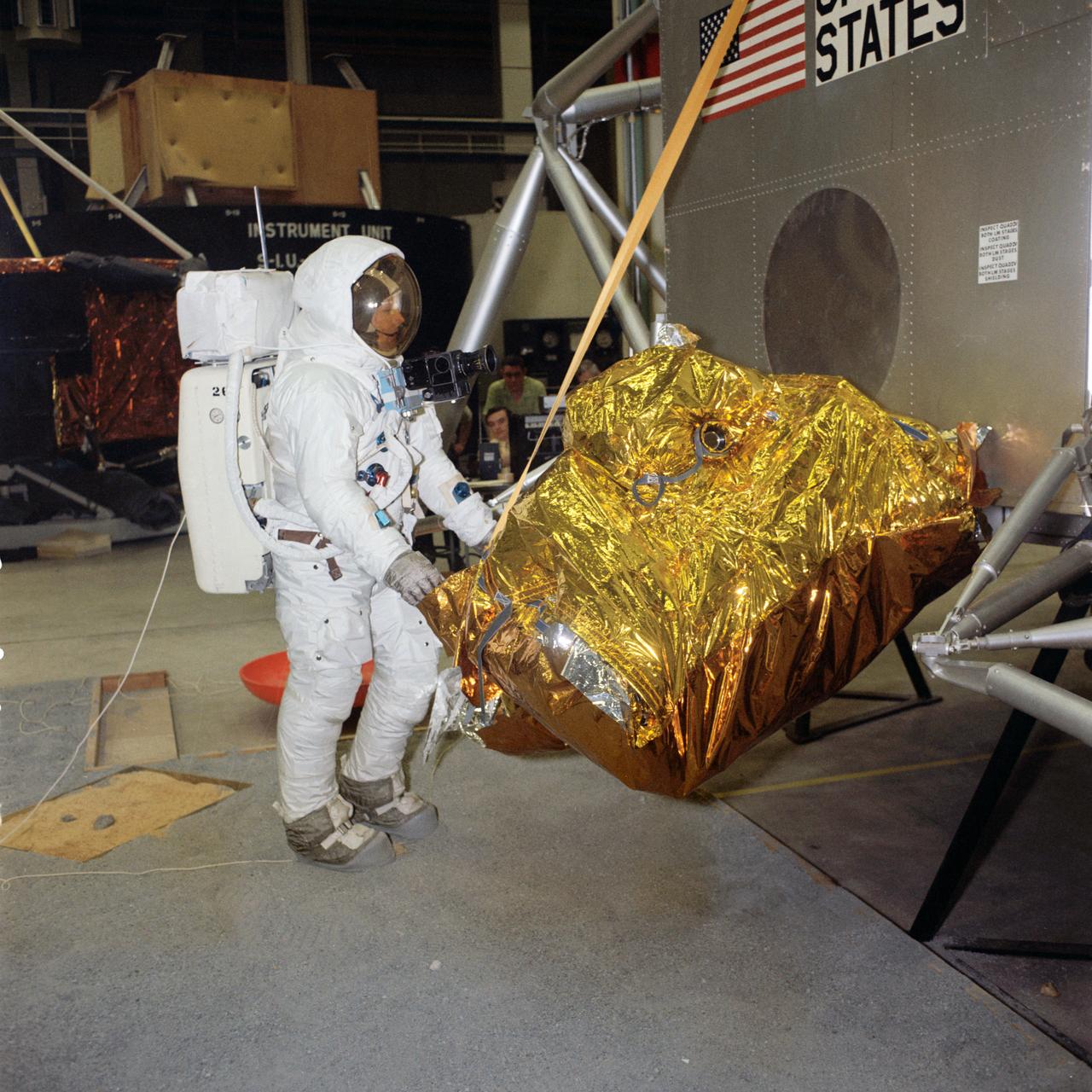
S69-31060 (18 April 1969) --- Suited astronaut Neil A. Armstrong, wearing an Extravehicular Mobility Unit (EMU), participates in lunar surface simulation training on April 18, 1969 in building 9, Manned Spacecraft Center (MSC). Armstrong is prime crew commander of the Apollo 11 lunar landing mission. Here, he is opening the Modularized Equipment Stowage Assembly ( MESA).
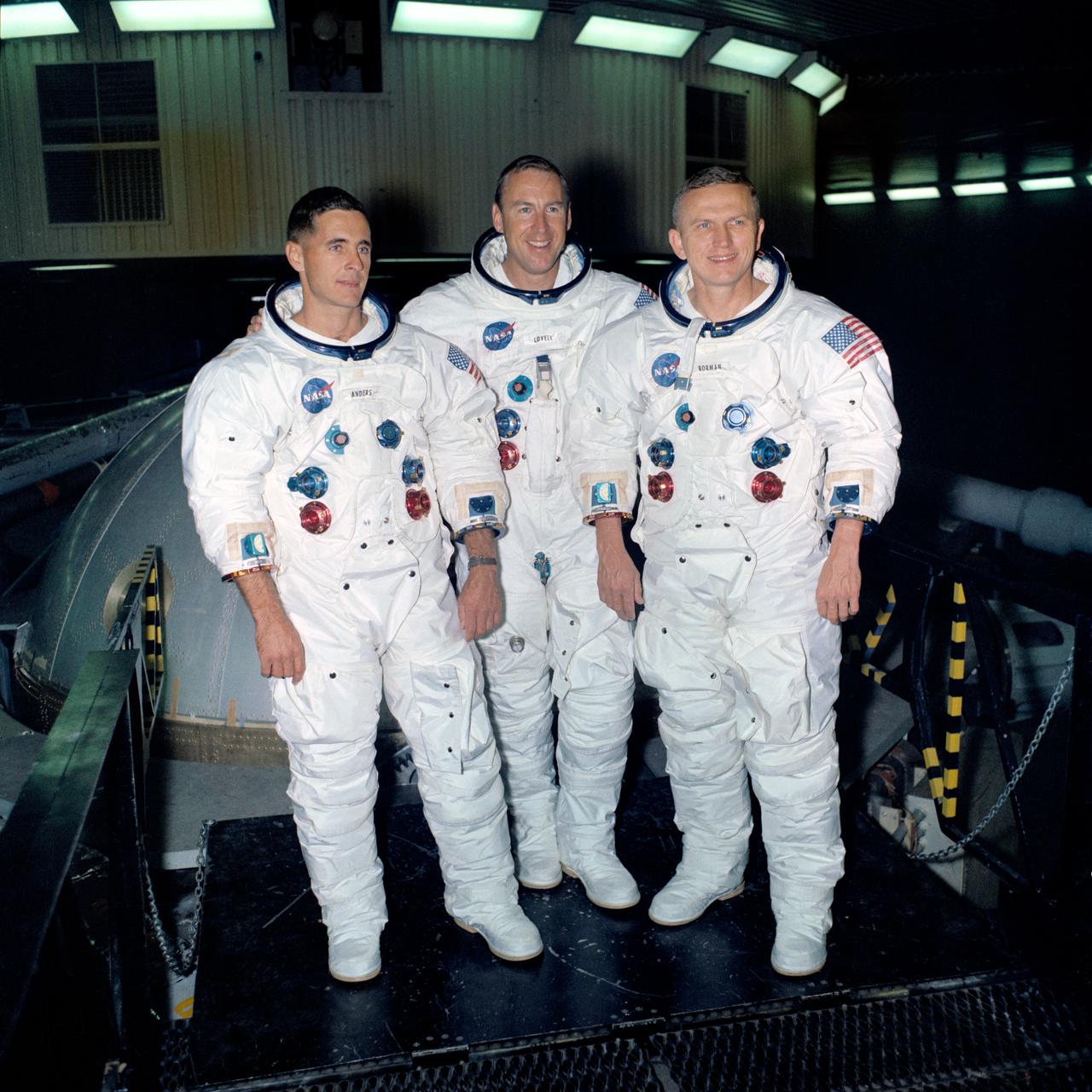
S68-53187 (1 Nov. 1968) --- The prime crew of the Apollo 8 lunar orbit mission stands beside the gondola in Building 29 after suiting up for centrifuge training in the Manned Spacecraft Center's (MSC) Flight Acceleration Facility (FAF). Left to right, are astronauts William A. Anders, lunar module pilot; James A. Lovell Jr., command module pilot; and Frank Borman, commander.
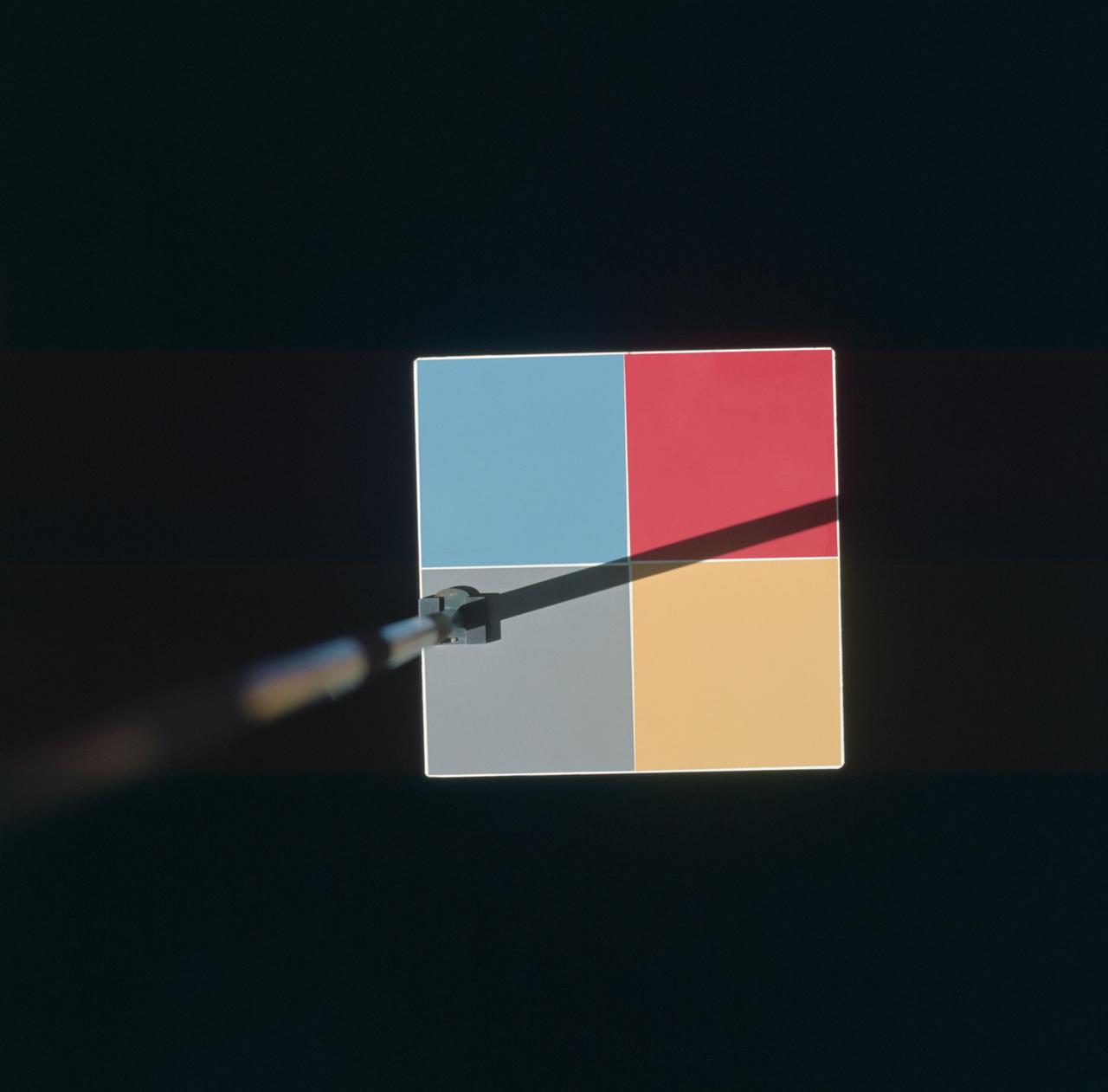
S66-46025 (18 July 1966) --- Astronaut Michael Collins, Gemini-10 pilot, photographed this MSC-8 color patch outside the spacecraft during the Gemini-10/Agena docking mission. The experiment was for the purpose of showing what effect the environment of space will have upon the color photography taken in cislunar space and on the lunar surface during an Apollo mission. Photo credit: NASA
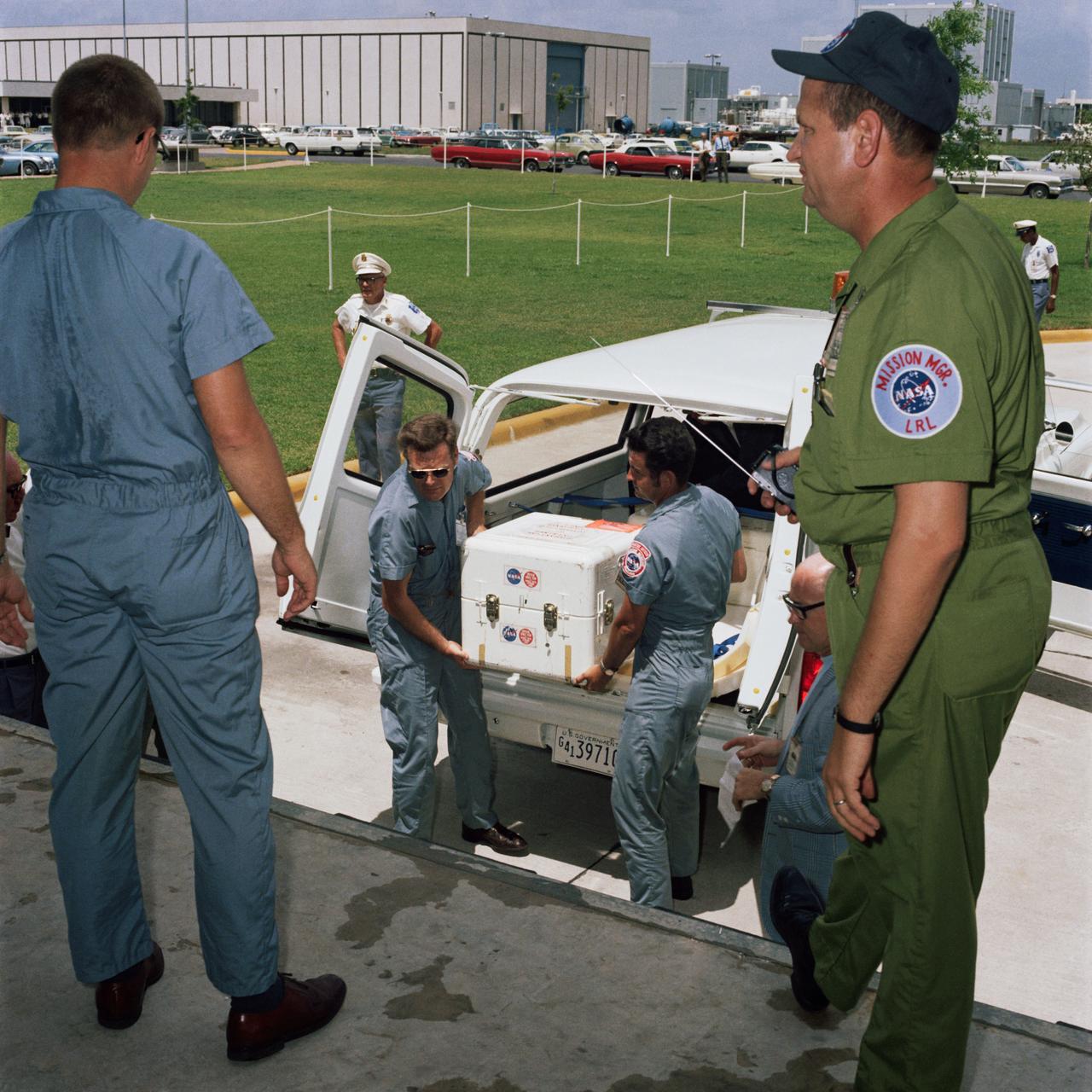
S69-39996 (25 July 1969) --- The first Apollo 11 sample return container, with lunar surface material inside, is unloaded at the Lunar Receiving Laboratory, Building 37, Manned Spacecraft Center (MSC). The rock box had arrived only minutes earlier at Ellington Air Force Base by air from the Pacific recovery area. The lunar samples were collected by astronauts Neil A. Armstrong and Edwin E. Aldrin Jr. during their lunar surface extravehicular activity.
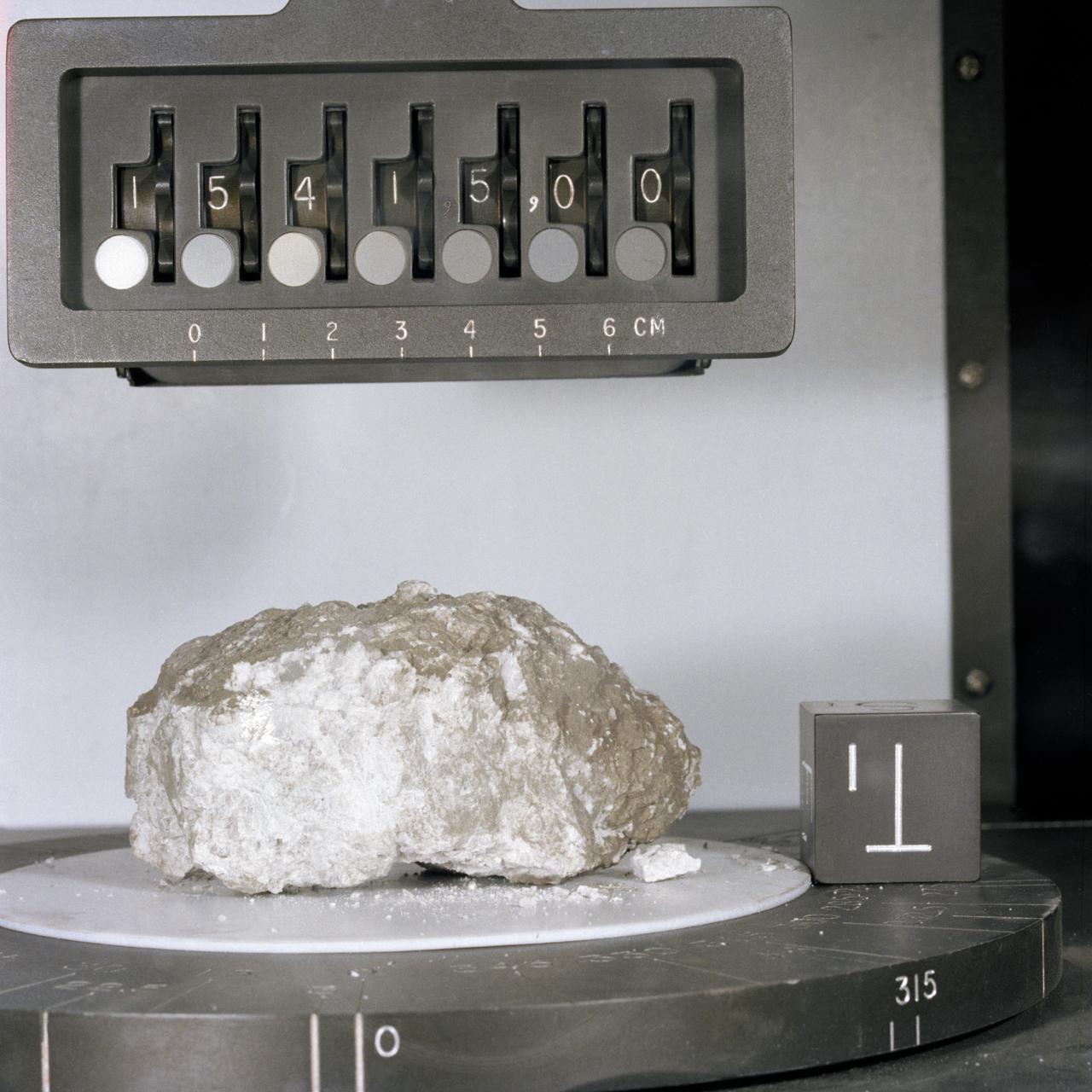
S71-42955 (August 1971) --- A close-up view of Apollo 15 lunar sample no. 15415 in the Non-Sterile Nitrogen Processing Line (NNPL) in the Lunar Receiving Laboratory (LRL) at the Manned Spacecraft Center (MSC). This sample is the white anorthositic rock (Genesis Rock) collected by astronauts David R. Scott and James B. Irwin in container no. 196 at Site no. 7 at a Ground Elapsed Time of 145 hours and 42 minutes, on the mission's second extravehicular activity (EVA).
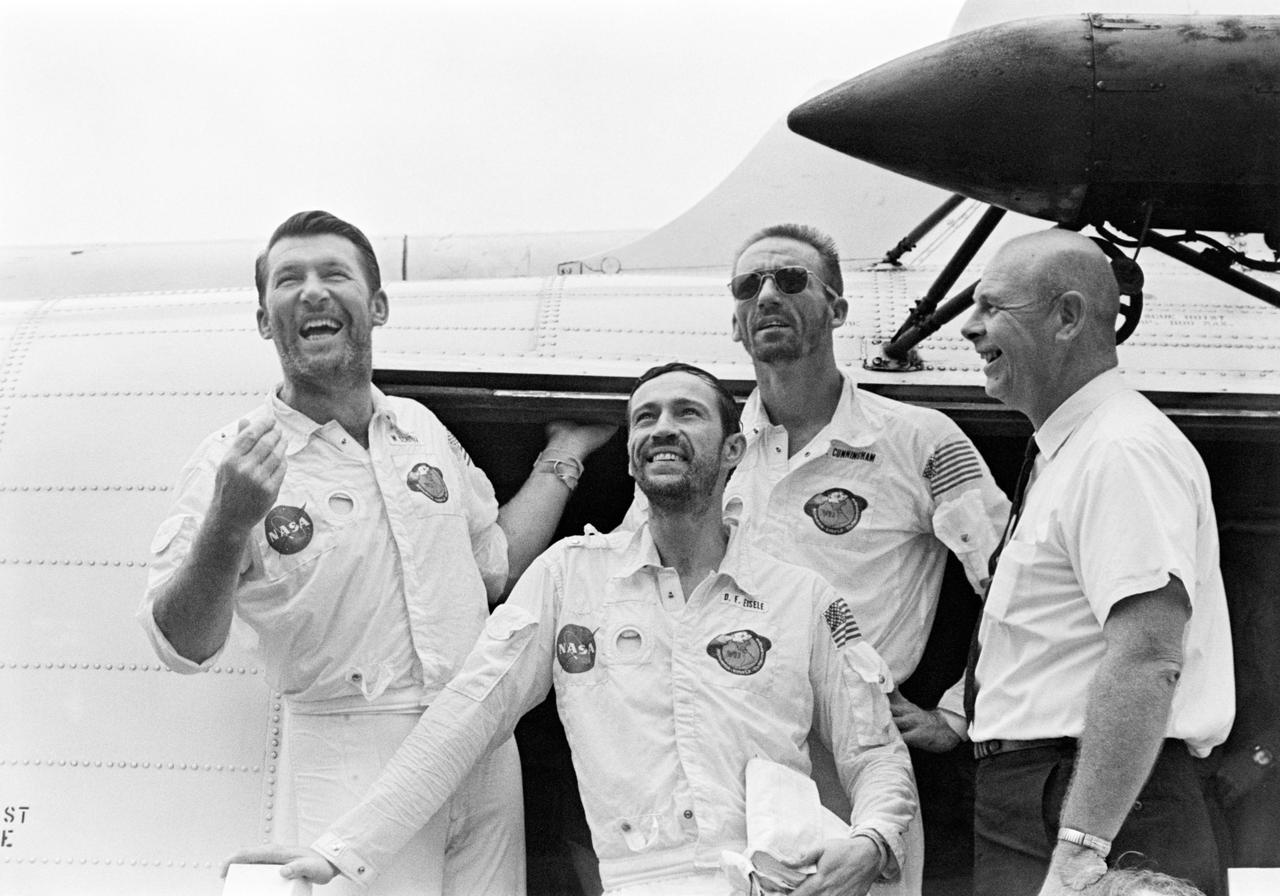
S68-52542 (22 Oct. 1968) --- The Apollo 7 crew arrives aboard the USS Essex, the prime recovery ship for the mission. Left to right, are astronauts Walter M. Schirra Jr., commander; Donn F. Eisele, command module pilot; Walter Cunningham, lunar module pilot; and Dr. Donald E. Stullken, NASA Recovery Team Leader from the Manned Spacecraft Center's (MSC) Landing and Recovery Division. The crew is pausing in the doorway of the recovery helicopter.
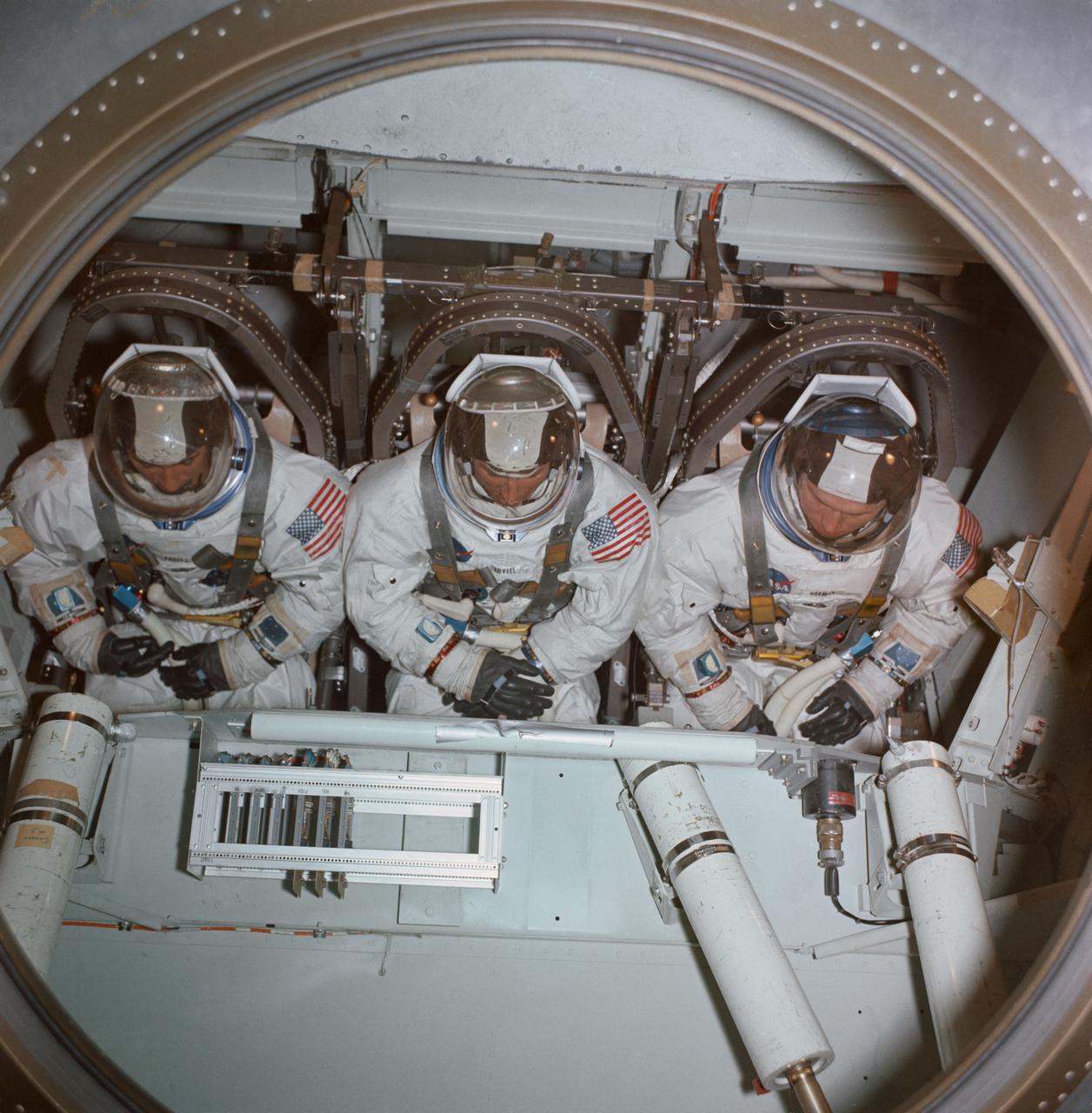
S68-53194 (1 Nov. 1968) --- The Apollo 8 prime crew inside the centrifuge gondola in Building 29 during centrifuge training in MSC's Flight Acceleration Facility. (View with crew lying on back) Left to right are astronauts William A. Anders, lunar module pilot; James A. Lovell Jr., command module pilot; and Frank Borman, commander. Photo credit: NASA
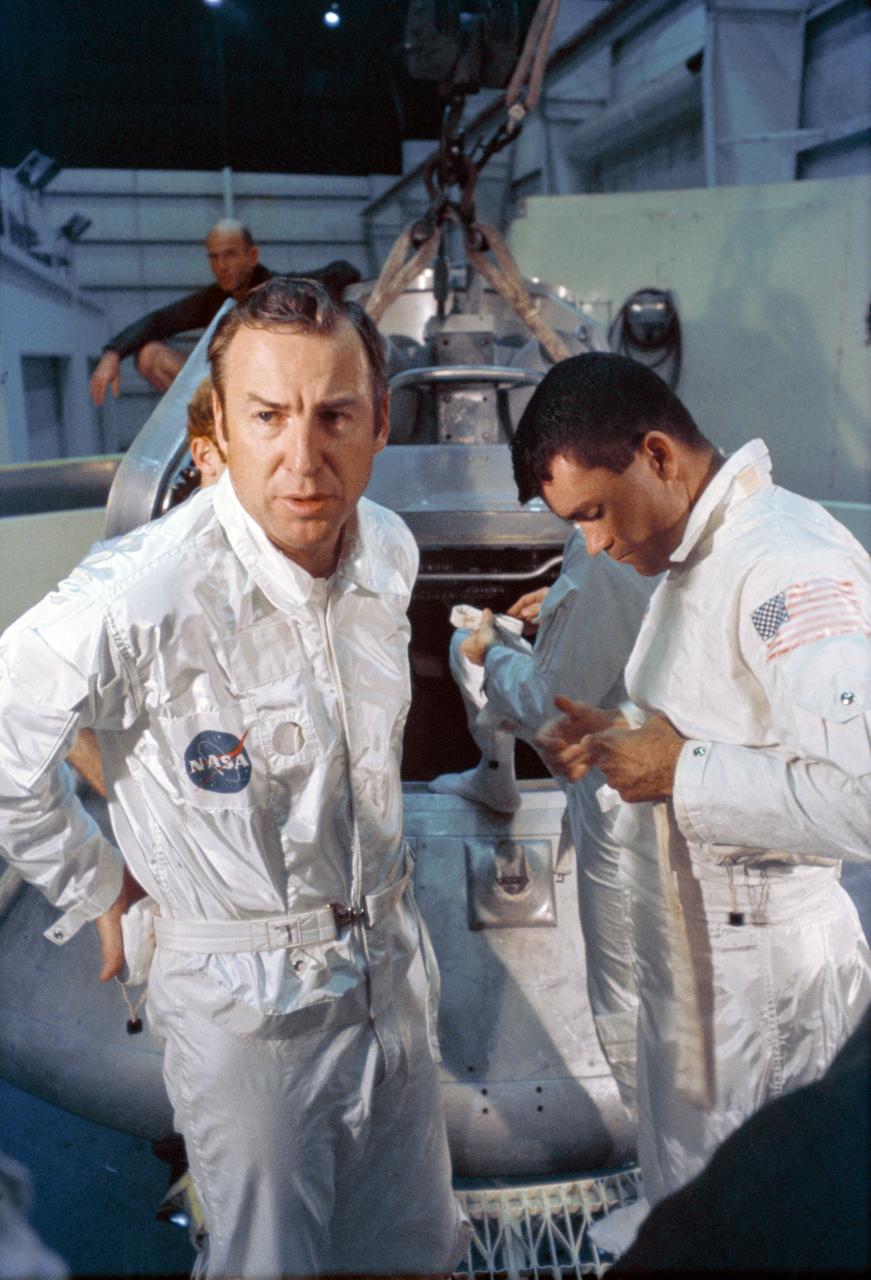
S70-24010 (17 Jan. 1970) --- The three prime crew members of the Apollo 13 lunar landing mission stand by to participate in water egress training in a water tank in Building 260 at the Manned Spacecraft Center (MSC). They are astronauts James A. Lovell Jr., (left) commander; Fred W. Haise Jr., (right) lunar module pilot; and Thomas K. Mattingly II (in background, obscured by Haise), command module pilot.
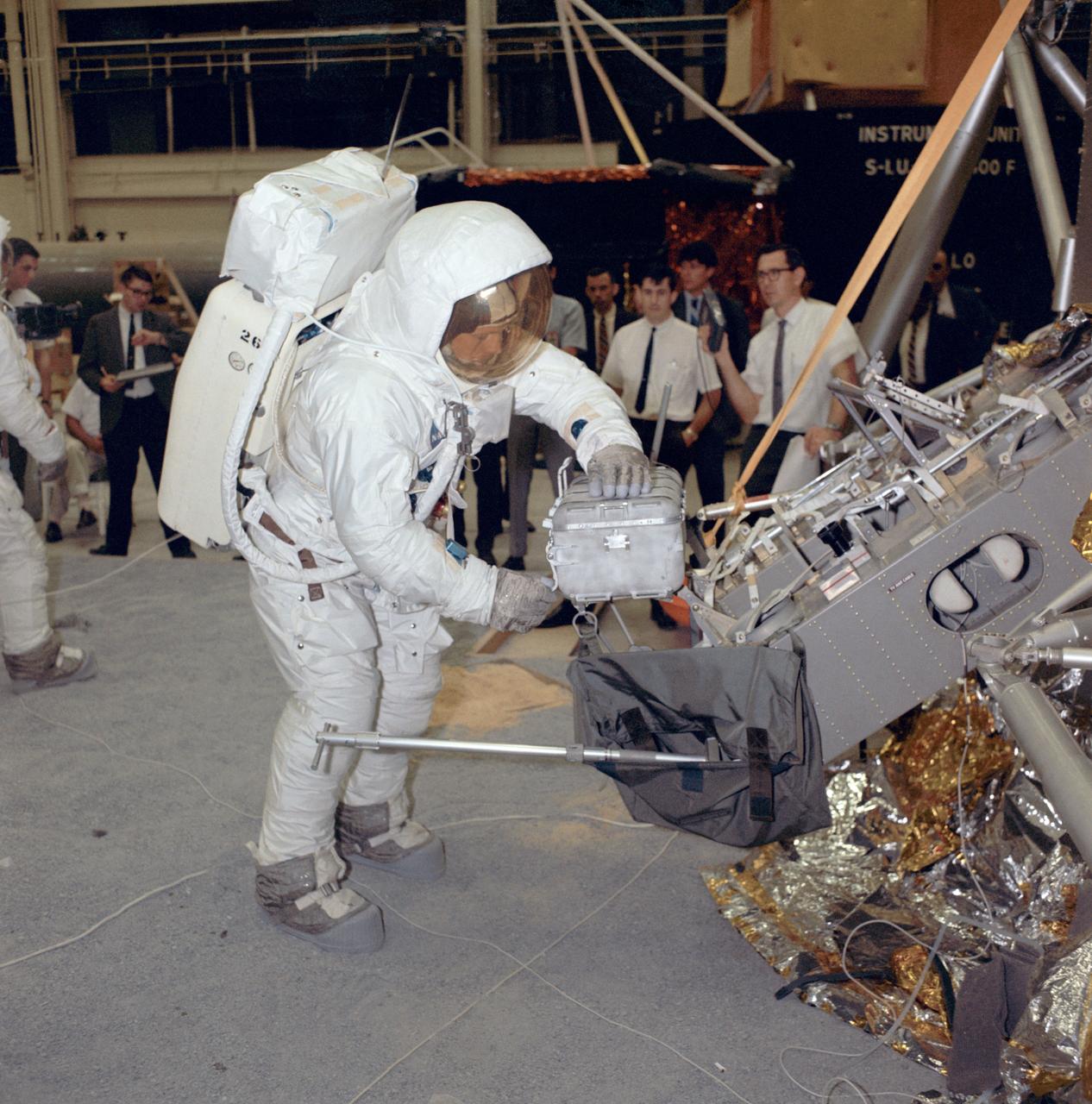
S69-31080 (18 April 1969) --- Suited astronaut Neil A. Armstrong, wearing an Extravehicular Mobility Unit (EMU), participates in lunar surface simulation training on April 18, 1969 in building 9, Manned Spacecraft Center (MSC). Armstrong is prime crew commander of the Apollo 11 lunar landing mission. Here, he is opening a sample return container. On the right is the Modular Equipment Stowage Assembly (MESA) and the Lunar Module (LM) mock-up.
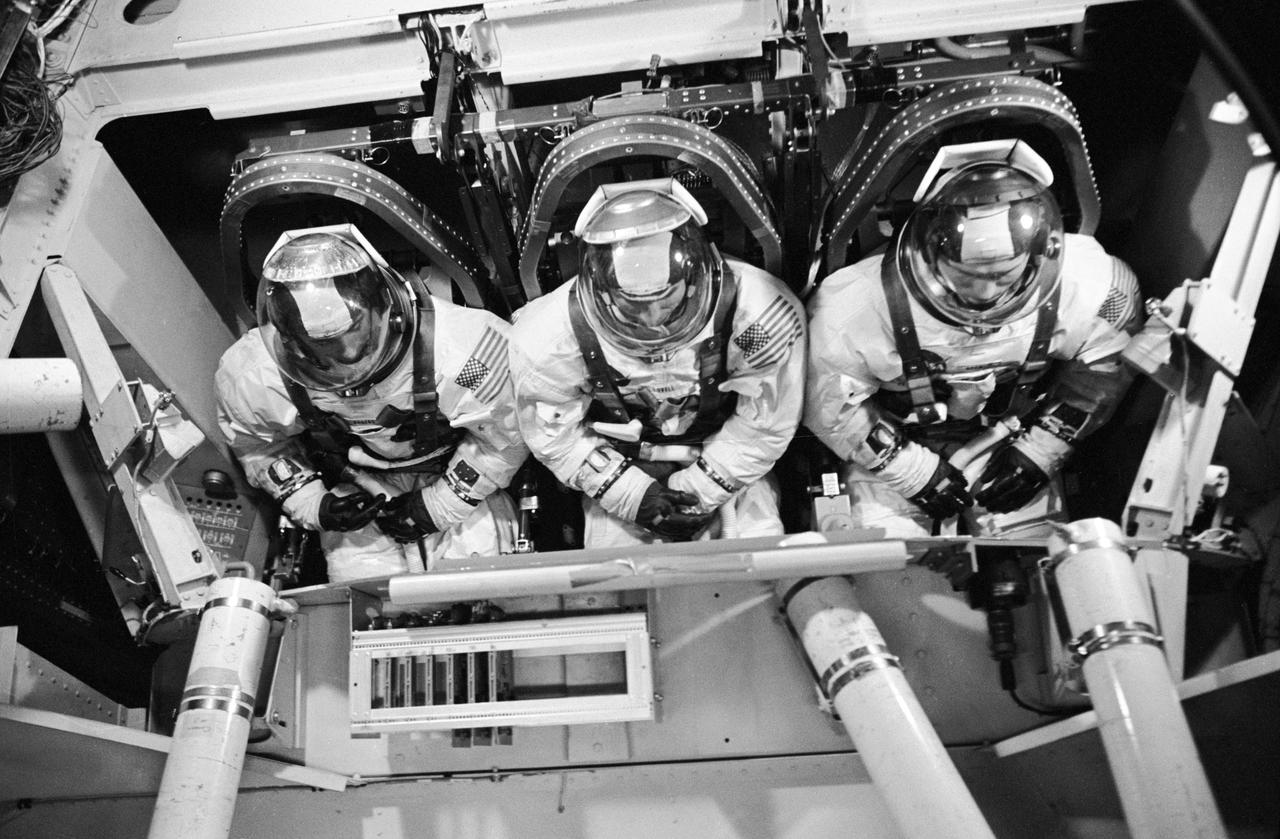
S68-53283 (1 Nov. 1968) --- The Apollo 8 prime crew is seen inside the gondola during centrifuge training in MSC's Flight Acceleration Facility, Building 29. Left to right, are astronauts William A. Anders, lunar module pilot, James A. Lovell Jr., command module pilot; and Frank Borman, commander. Photo credit: NASA
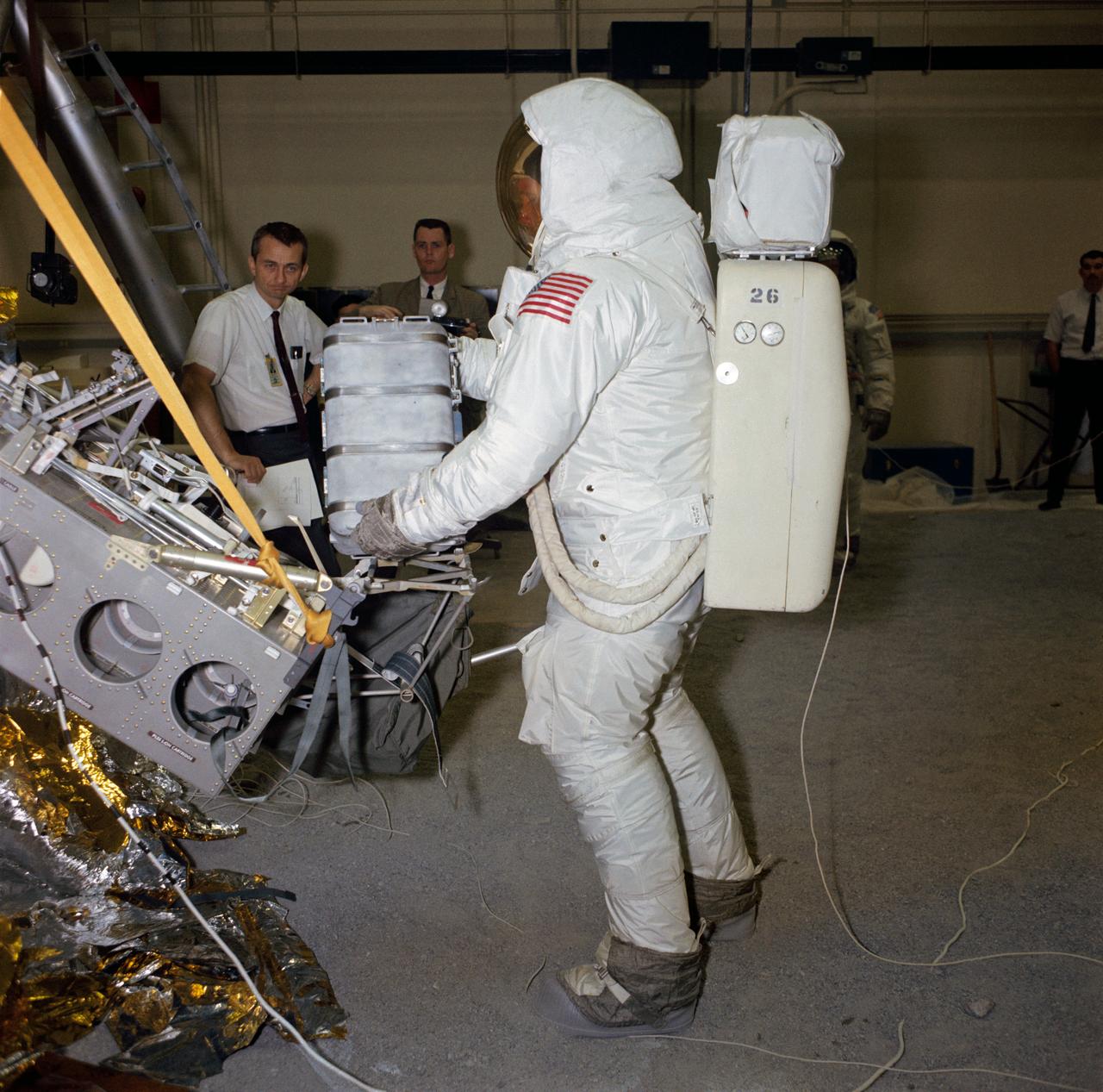
S69-31075 (18 April 1969) --- Suited astronaut Neil A. Armstrong, wearing an Extravehicular Mobility Unit (EMU), participates in lunar surface simulation training on April 18, 1969 in building 9, Manned Spacecraft Center (MSC). Armstrong is prime crew commander of the Apollo 11 lunar landing mission. Here, he is opening a sample return container. On the right is the Modular Equipment Stowage Assembly (MESA) and the Lunar Module (LM) mockup.
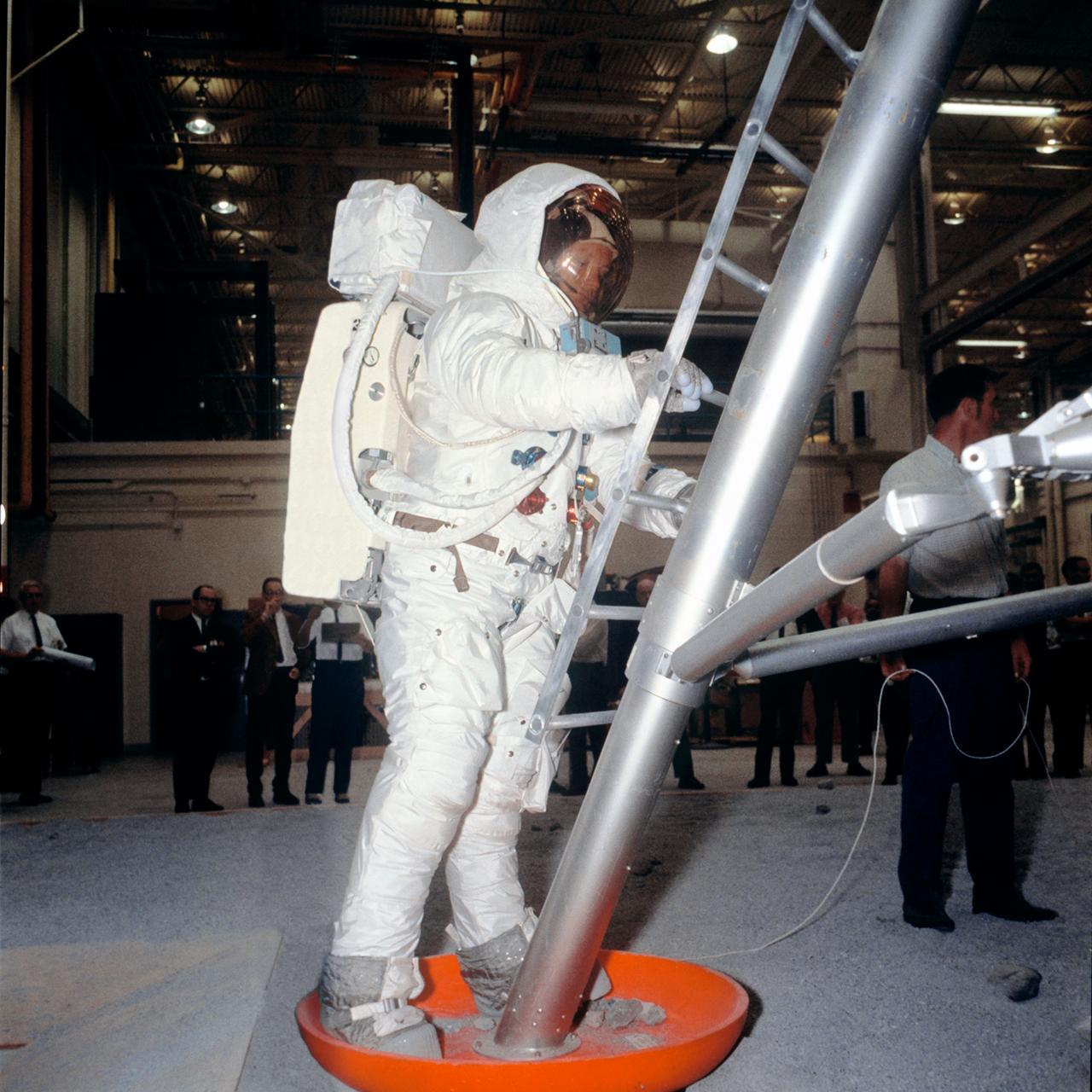
S69-31042 (18 April 1969) --- Suited astronaut Neil A. Armstrong, wearing an Extravehicular Mobility Unit (EMU), participates in lunar surface simulation training on April 18, 1969, in Building 9, Manned Spacecraft Center (MSC). Armstrong is the prime crew commander of the Apollo 11 lunar landing mission. Here, he is standing on Lunar Module (LM) mockup foot pad preparing to ascend steps.
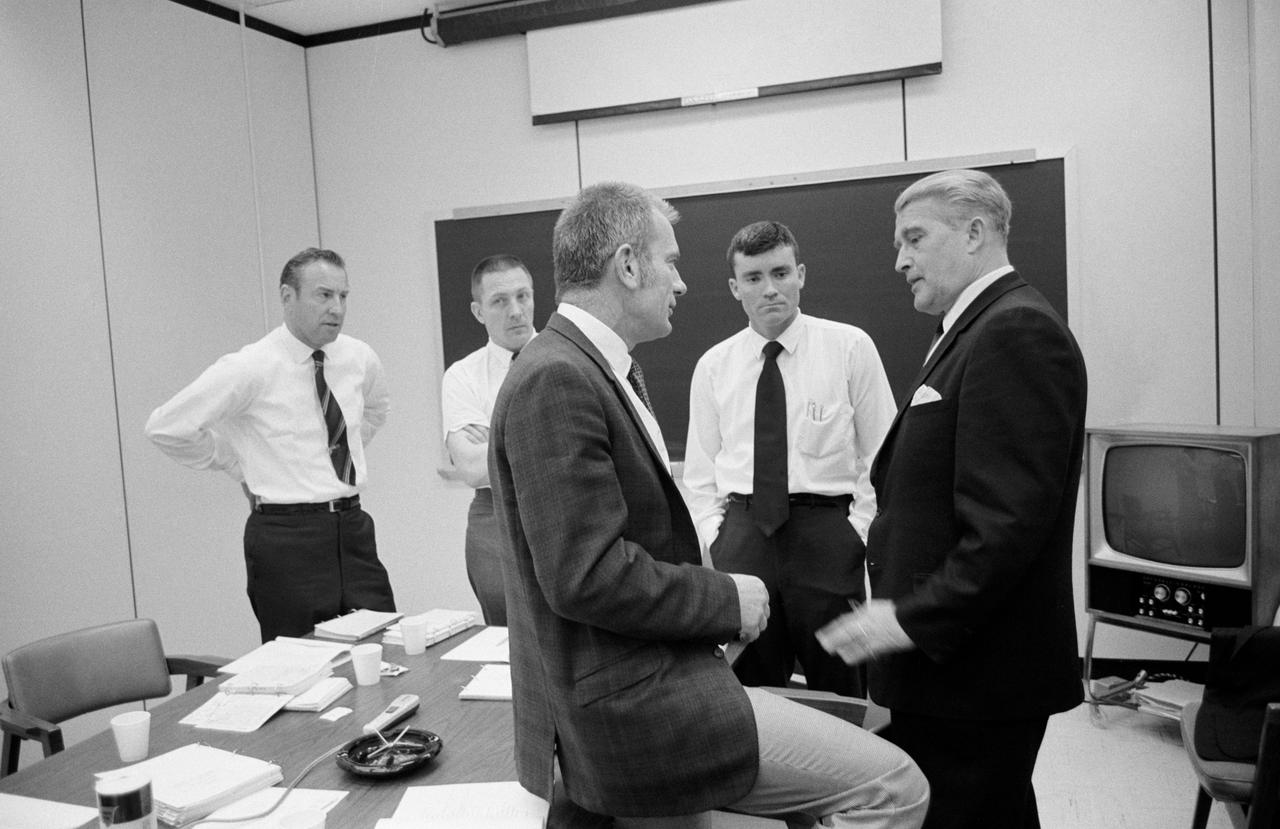
S70-35748 (20 April 1970) --- Dr. Donald K. Slayton (center foreground), MSC director of flight crew operations, talks with Dr. Wernher von Braun (right), famed rocket expert, at an Apollo 13 postflight debriefing session. The three crewmen of the problem-plagued Apollo 13 mission (left to right) in the background are astronauts James A Lovell Jr., commander; John L. Swigert Jr., command module pilot; and Fred W. Haise Jr., lunar module pilot. The apparent rupture of oxygen tank number two in the Apollo 13 Service Module (SM) and the subsequent damage forced the three astronauts to use the Lunar Module (LM) as a "lifeboat" to return home safely after their moon landing was canceled. Dr. von Braun is the deputy associate administrator for planning of the National Aeronautics and Space Administration (NASA).
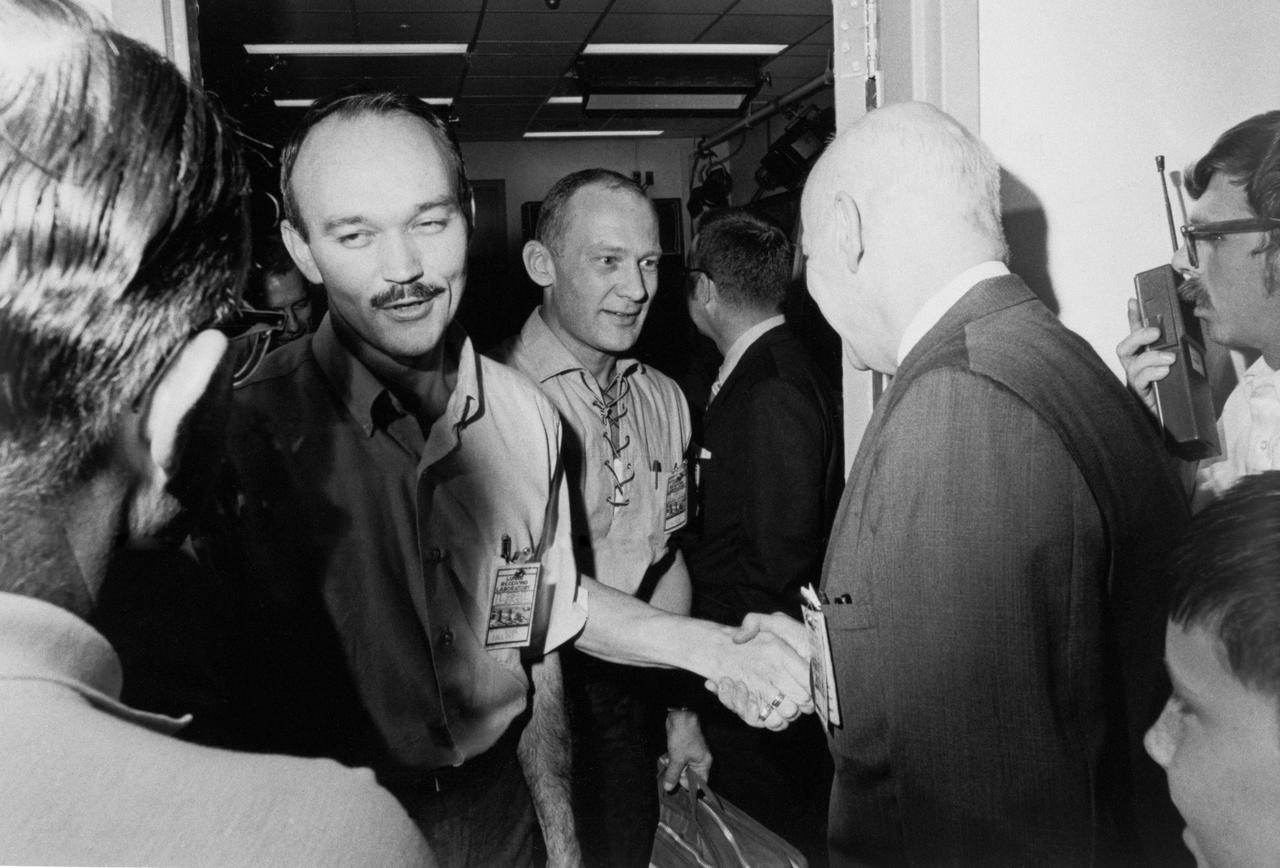
S69-41359 (10 Aug. 1969) --- Astronauts Michael Collins (left) and Edwin E. Aldrin Jr., are greeted by Dr. Robert R. Gilruth, director, Manned Spacecraft Center (MSC), and others upon their release from quarantine. The Apollo 11 crew left the Crew Reception Area (CRA) of the Lunar Receiving Laboratory (LRL) at 9 p.m., Aug. 10, 1969. While astronauts Neil A. Armstrong, commander, and Aldrin, lunar module pilot, descended in the Lunar Module (LM) "Eagle" to explore the Sea of Tranquility region of the moon, astronaut Collins, command module pilot, remained with the Command and Service Modules (CSM) "Columbia" in lunar orbit.
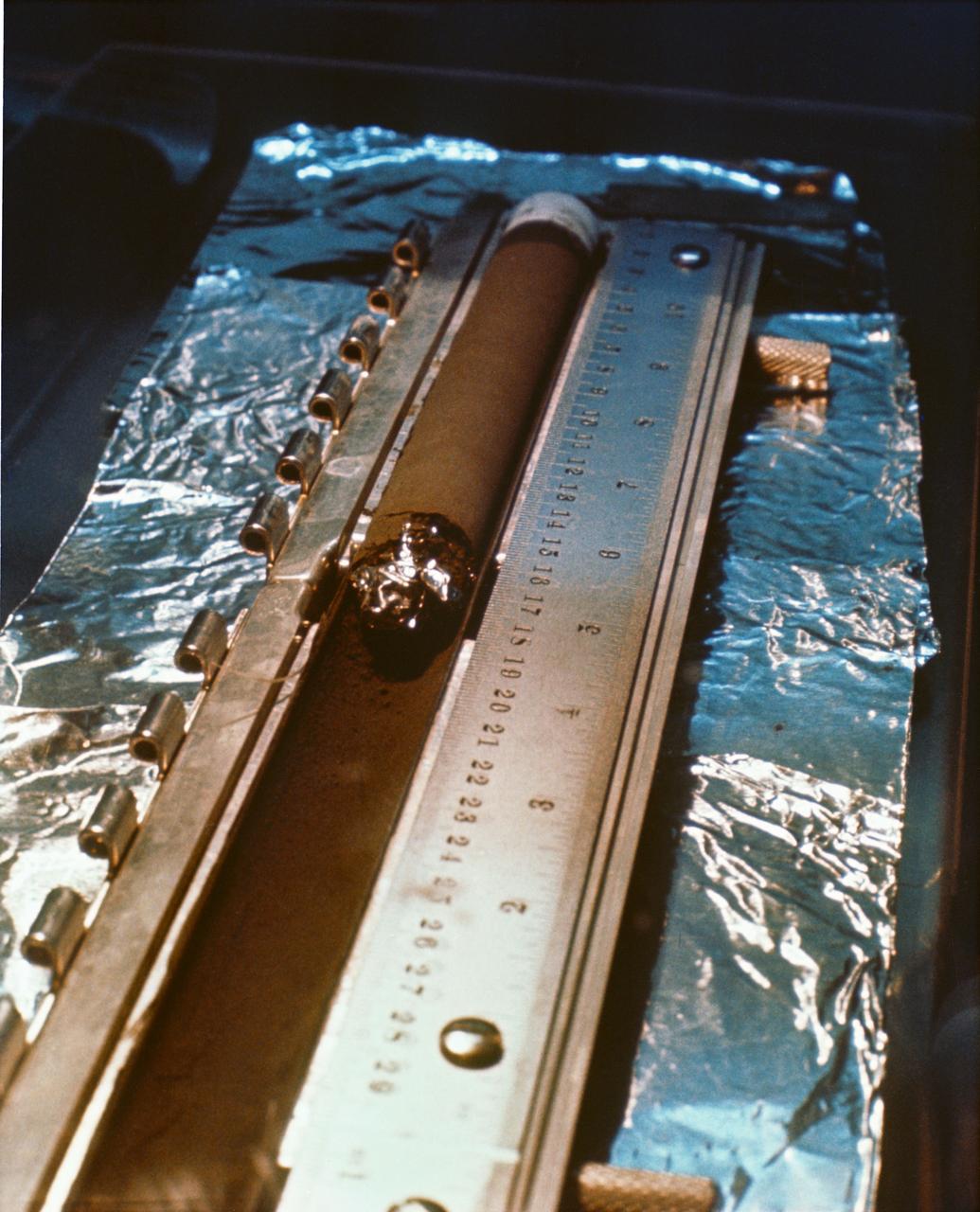
S69-40945 (August 1969) --- This is a core tube sample under study and examination in the Manned Spacecraft Center?s (MSC) Lunar Receiving Laboratory (LRL). The sample was among lunar soil and rock samples collected by astronauts Neil A. Armstrong and Edwin E. Aldrin Jr. during their extravehicular activity (EVA) on July 20, 1969. While astronauts Armstrong, commander; and Aldrin, lunar module pilot; descended in the Apollo 11 Lunar Module (LM) "Eagle" to explore the Sea of Tranquility landing site on the moon. Astronaut Michael Collins, command module pilot, remained with the Command and Service Modules (CSM) "Columbia" in lunar orbit.
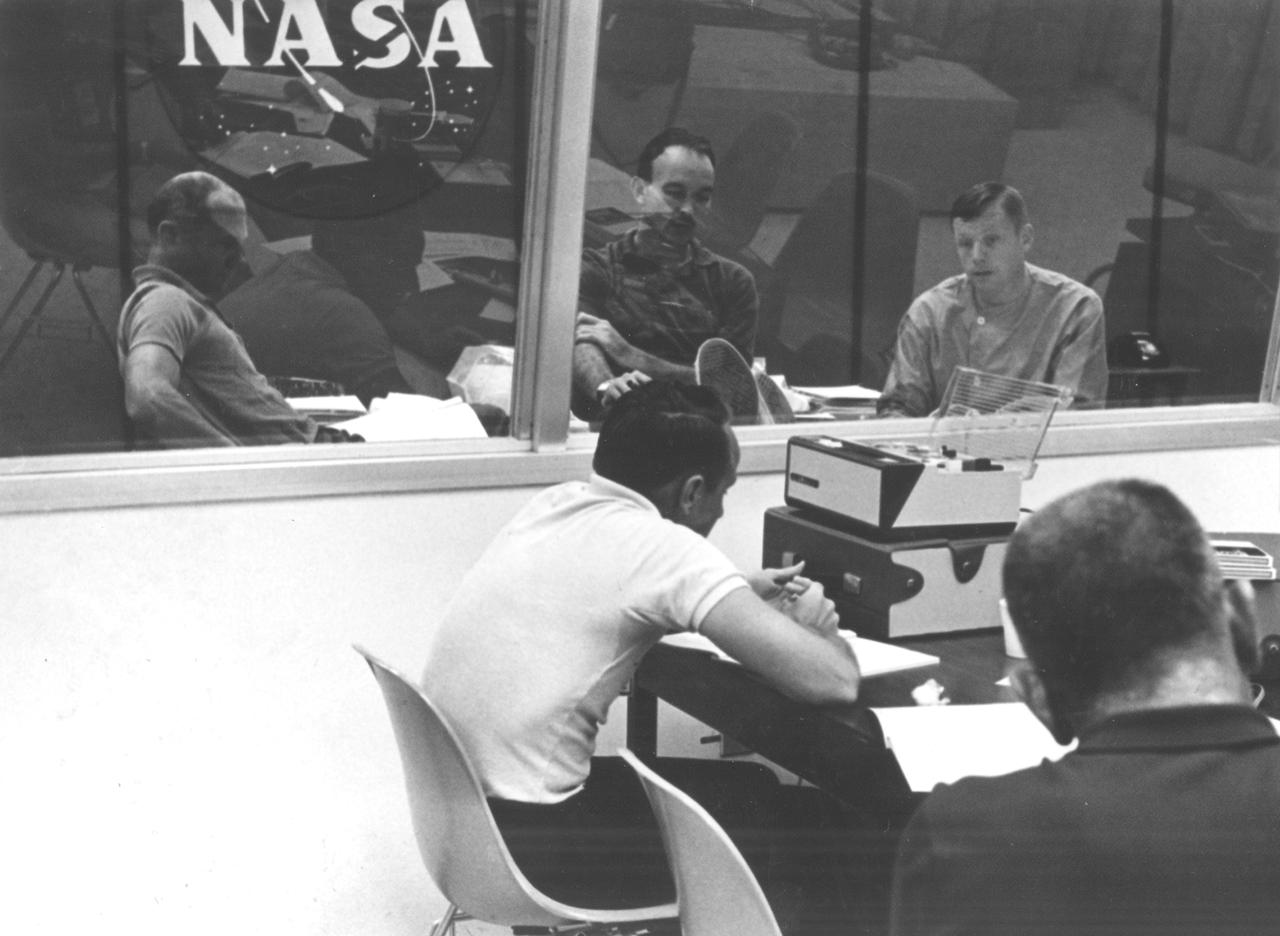
The Apollo 11 mission, the first manned lunar mission, launched from the Kennedy Space Center, Florida via the Marshall Space Flight Center (MSFC) developed Saturn V launch vehicle on July 16, 1969 and safely returned to Earth on July 24, 1969. Aboard the space craft were astronauts Neil A. Armstrong, commander; Michael Collins, Command Module (CM) pilot; and Edwin E. Aldrin Jr., Lunar Module (LM) pilot. The CM, piloted by Michael Collins remained in a parking orbit around the Moon while the LM, named “Eagle’’, carrying astronauts Neil Armstrong and Edwin Aldrin, landed on the Moon. During 2½ hours of surface exploration, the crew collected 47 pounds of lunar surface material for analysis back on Earth. The recovery operation took place in the Pacific Ocean where Navy para-rescue men recovered the capsule housing the 3-man Apollo 11 crew. The crew was airlifted to safety aboard the U.S.S. Hornet, where they were quartered in a Mobile Quarantine Facility (MQF) which served as their home until they reached the NASA Manned Spacecraft Center (MSC) Lunar Receiving Laboratory in Houston, Texas. The three are seen here at the MSC, still inside the MQF, undergoing their first debriefing on Sunday, August 3, 1969. Behind the glass are (L-R): Edwin Aldrin, Michael Collins, and Neil Armstrong.
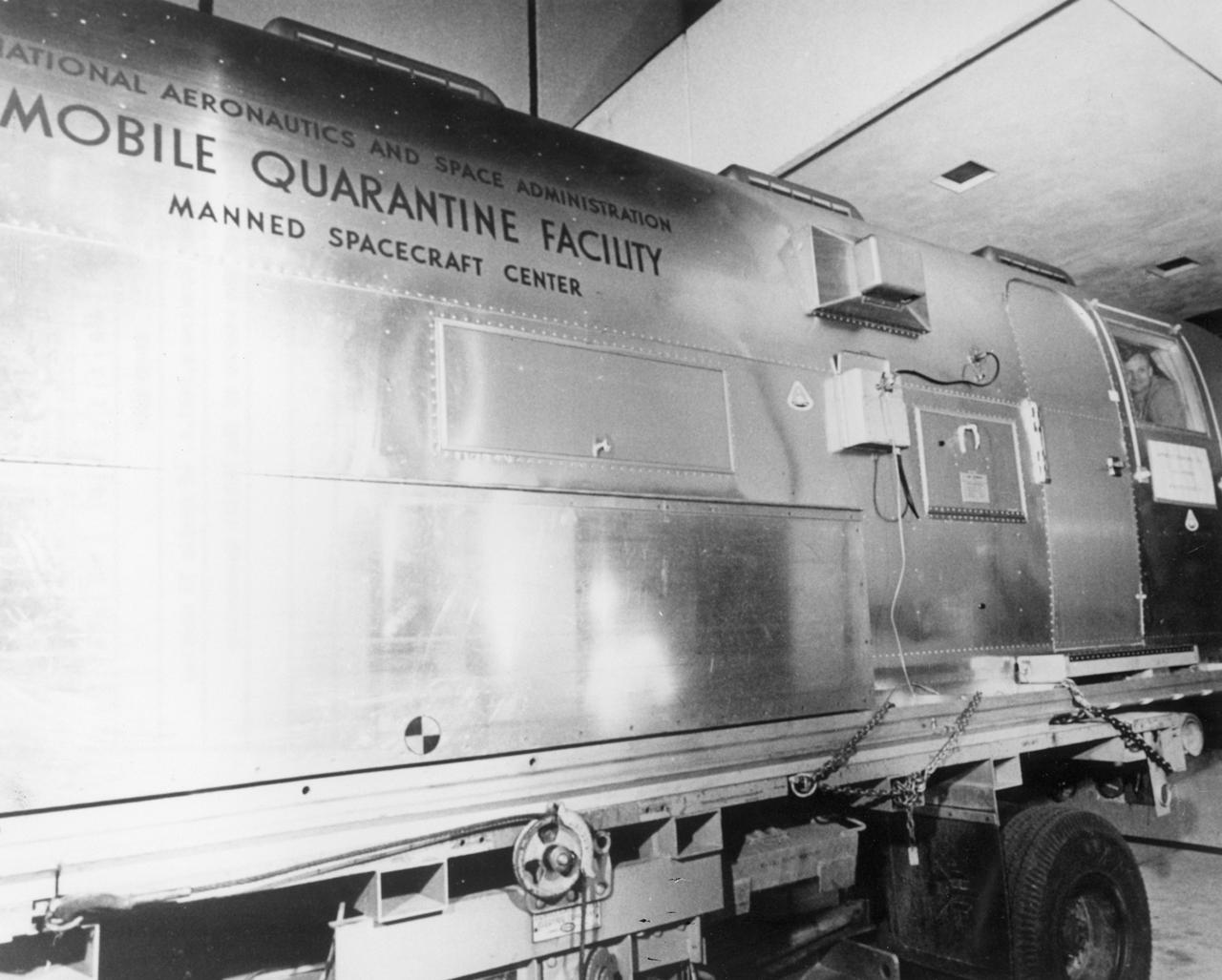
The Apollo 11 mission, the first manned lunar mission, launched from the Kennedy Space Center, Florida via the Marshall Space Flight Center (MSFC) developed Saturn V launch vehicle on July 16, 1969 and safely returned to Earth on July 24, 1969. Aboard the space craft were astronauts Neil A. Armstrong, commander; Michael Collins, Command Module (CM) pilot; and Edwin E. Aldrin Jr., Lunar Module (LM) pilot. The CM, piloted by Michael Collins remained in a parking orbit around the Moon while the LM, named “Eagle’’, carrying astronauts Neil Armstrong and Edwin Aldrin, landed on the Moon. During 2½ hours of surface exploration, the crew collected 47 pounds of lunar surface material for analysis back on Earth. The recovery operation took place in the Pacific Ocean where Navy para-rescue men recovered the capsule housing the 3-man Apollo 11 crew. The crew was airlifted to safety aboard the U.S.S. Hornet, where they were quartered in a Mobile Quarantine Facility (MQF) which served as their home until they reached the NASA Manned Spacecraft Center (MSC) Lunar Receiving Laboratory in Houston, Texas. In this close up of the MQF, commander Armstrong can be seen through the facility window after its arrival at the MSC.
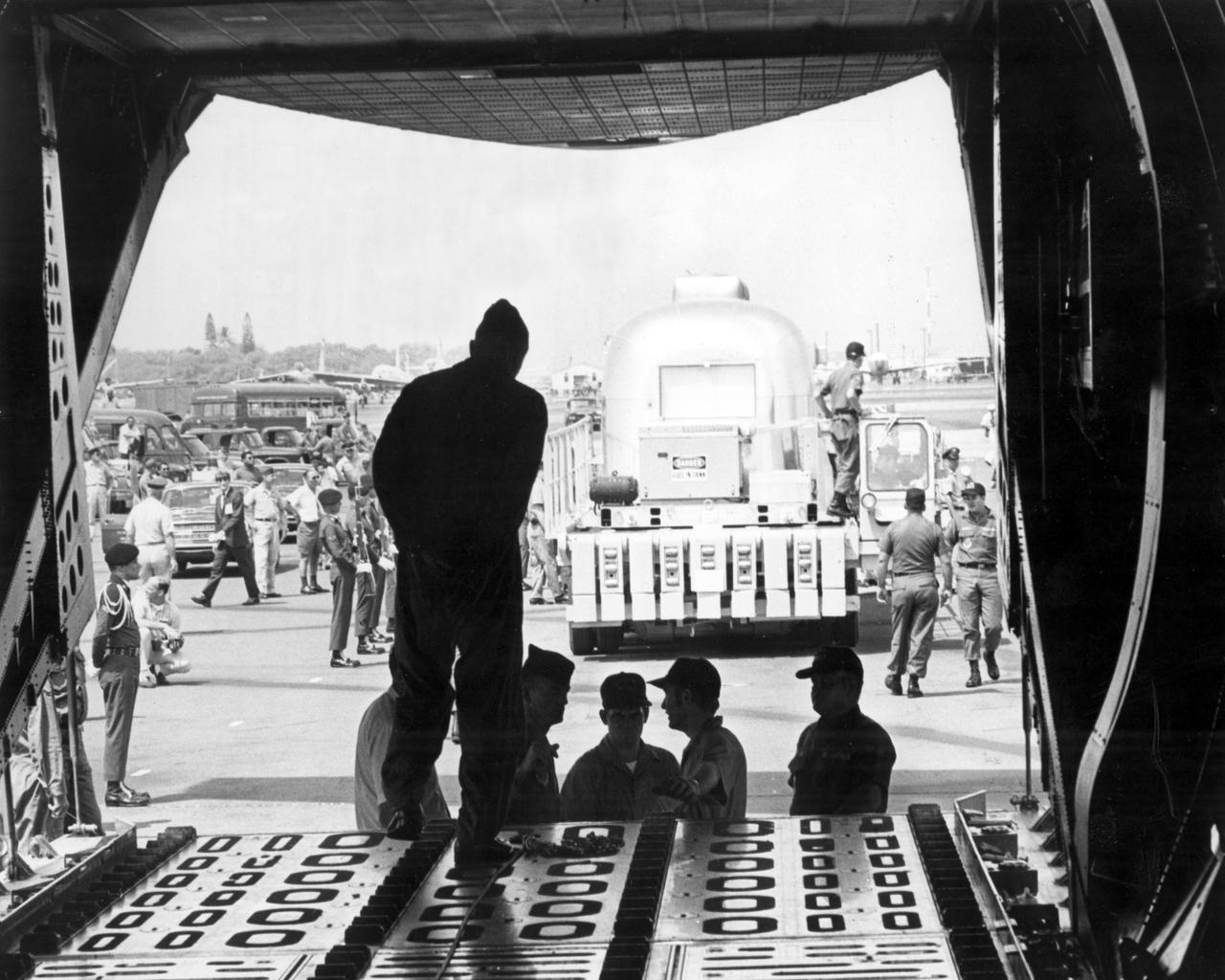
The Apollo 11 mission, the first manned lunar mission, launched from the Kennedy Space Center, Florida via the Marshall Space Flight Center (MSFC) developed Saturn V launch vehicle on July 16, 1969 and safely returned to Earth on July 24, 1969. Aboard the space craft were astronauts Neil A. Armstrong, commander; Michael Collins, Command Module (CM) pilot; and Edwin E. Aldrin Jr., Lunar Module (LM) pilot. The CM, piloted by Michael Collins remained in a parking orbit around the Moon while the LM, named “Eagle’’, carrying astronauts Neil Armstrong and Edwin Aldrin, landed on the Moon. During 2½ hours of surface exploration, the crew collected 47 pounds of lunar surface material for analysis back on Earth. The recovery operation took place in the Pacific Ocean where Navy para-rescue men recovered the capsule housing the 3-man Apollo 11 crew. The crew was airlifted to safety aboard the U.S.S. Hornet, where they were quartered in a Mobile Quarantine Facility (MQF) which served as their home until they reached the NASA Manned Spacecraft Center (MSC) Lunar Receiving Laboratory in Houston, Texas. In this photo taken at Pearl Harbor, Hawaii, the inhabited MQF is prepared for loading into an Air Force C-141 jet transport for the flight back to Ellington Air Force Base Texas and then on to the MSC.
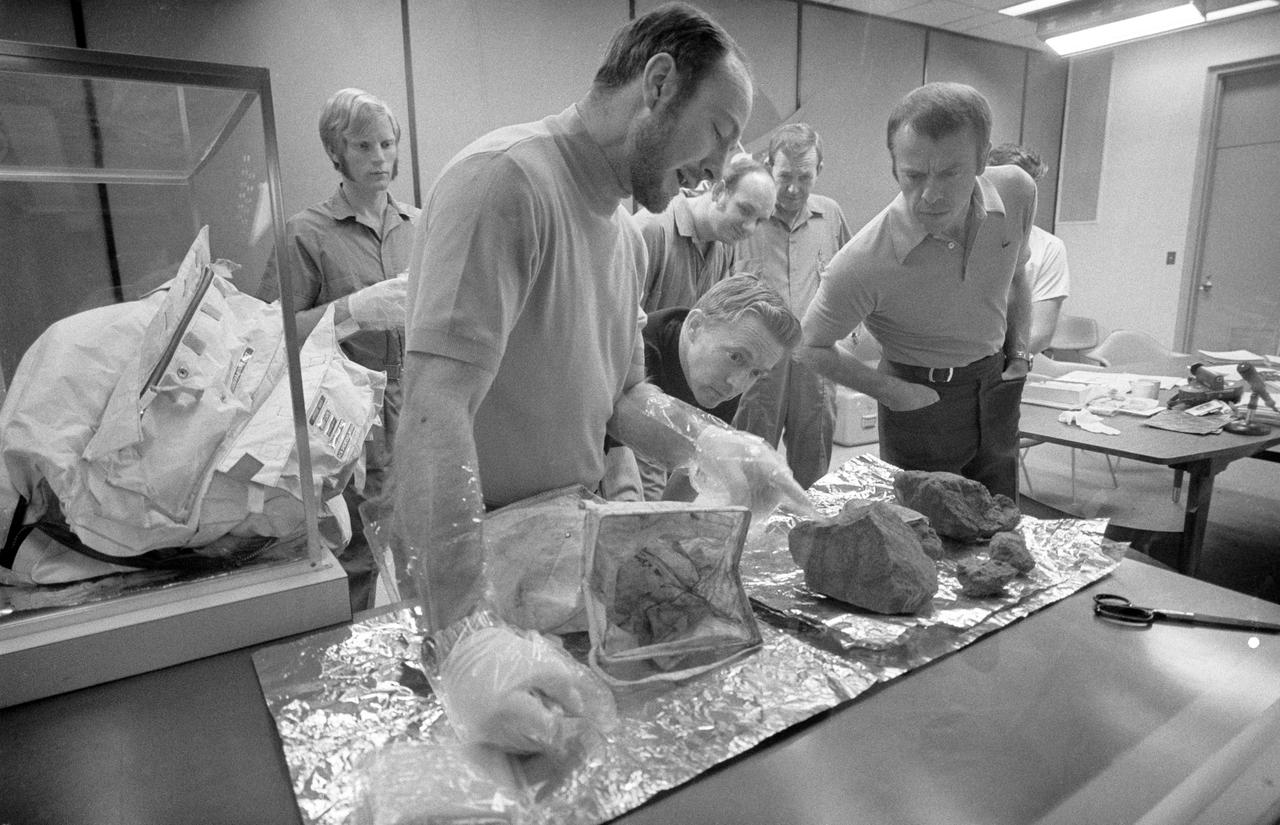
S71-20373 (19 Feb. 1971) --- The Apollo 14 crew men show off some of the largest of the lunar rocks which they brought back from the moon during a through-the-glass meeting with news men in the Crew Reception Area of the Lunar Receiving Laboratory (LRL) at the Manned Spacecraft Center (MSC). Astronaut Alan B. Shepard Jr. (right), mission commander, leans over to view a large basketball-size rock which astronaut Edgar D. Mitchell, lunar module pilot, points out. Astronaut Stuart A. Roosa, command module pilot, who circled the moon in the Command and Service Modules (CSM) while his two fellow crewmembers explored the moon, looks on (near the center of the photograph). Four of the 14 men quarantined with the Apollo 14 crew look on in the background.
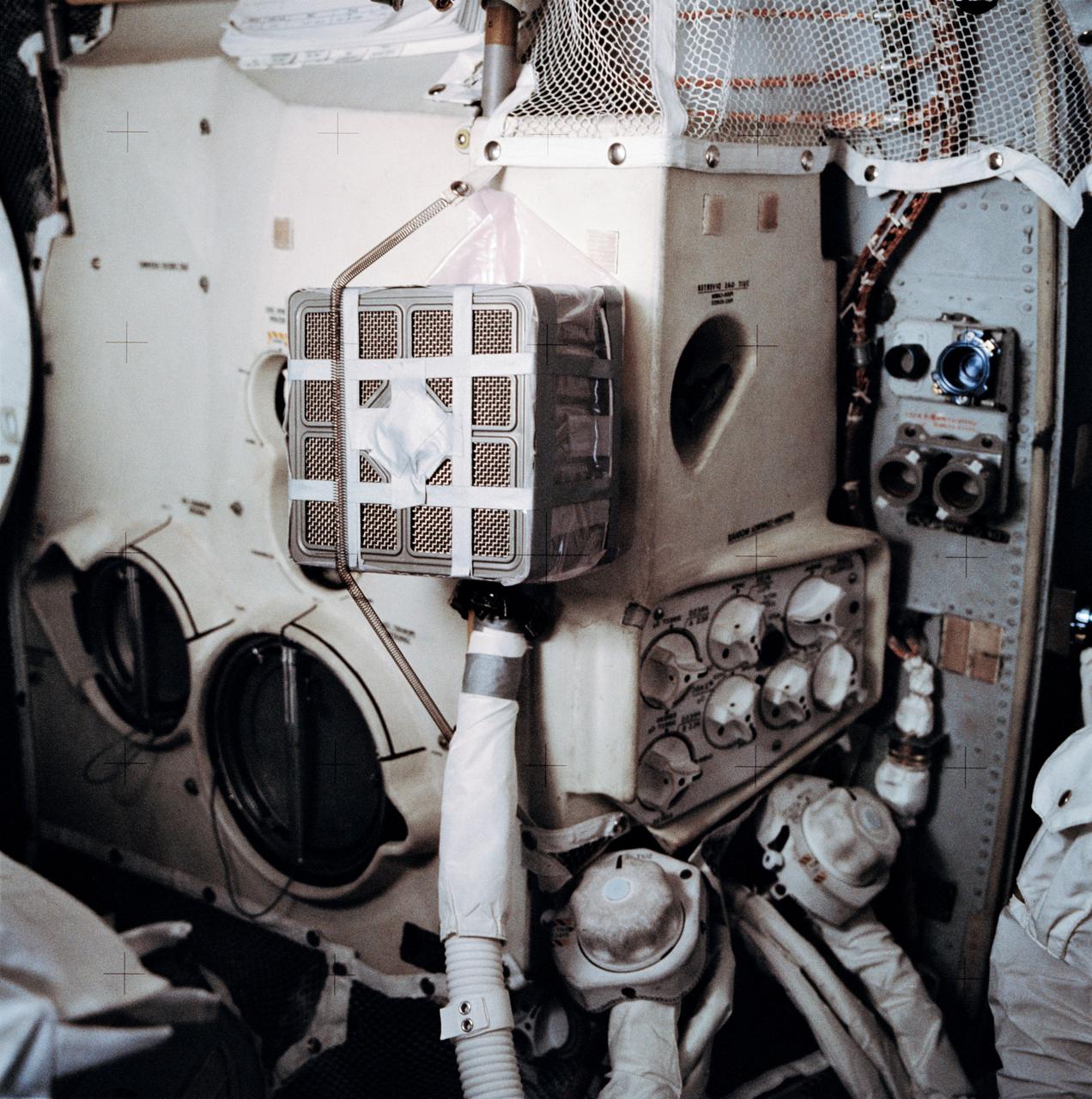
AS13-62-8929 (11-17 April 1970) --- Interior view of the Apollo 13 Lunar Module (LM) showing the "mail box," a jury-rigged arrangement which the Apollo 13 astronauts built to use the Command Module (CM) lithium hydroxide canisters to purge carbon dioxide from the LM. Lithium hydroxide is used to scrub CO2 from the spacecraft's atmosphere. Since there was a limited amount of lithium hydroxide in the LM, this arrangement was rigged up to utilize the canisters from the CM. The "mail box" was designed and tested on the ground at the Manned Spacecraft Center (MSC) before it was suggested to the problem-plagued Apollo 13 crew men. Because of the explosion of one of the oxygen tanks in the Service Module (SM), the three crew men had to use the LM as a "lifeboat".
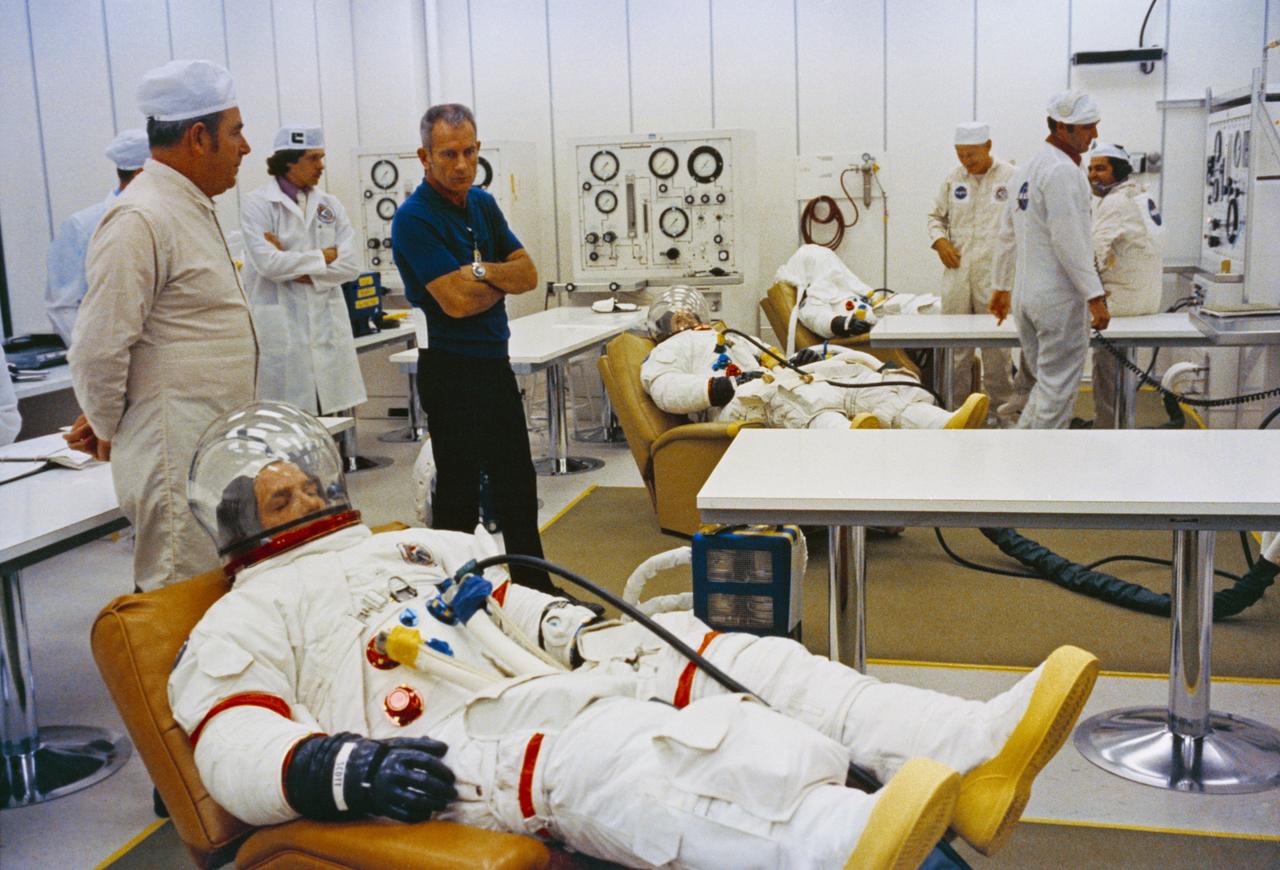
S71-41408 (26 July 1971) --- The three Apollo 15 astronauts go through suiting up operations in the Kennedy Space Center's (KSC) Manned Spacecraft Operations Building (MSOB) during the Apollo 15 prelaunch countdown. They are David R. Scott (foreground), commander; Alfred M. Worden (center), command module pilot; and James B. Irwin (background), lunar module pilot. Minutes later the crew rode a special transport van over to Pad A, Launch Complex 39, where their spacecraft awaited them. With the crew was Dr. Donald (Deke) K. Slayton (wearing dark blue sport shirt), director of Flight Crew Operations, Manned Spacecraft Center (MSC). The Apollo 15 space vehicle was launched at 9:34:00:79 a.m. (EDT), July 26, 1971, on a lunar landing mission.

S69-60644 (29 Nov. 1969) --- A Mobile Quarantine Facility (MQF), with the crew men of the Apollo 12 lunar landing mission aboard, arrived at the Manned Spacecraft Center (MSC) Saturday morning, Nov. 29, 1969. Astronauts Charles Conrad Jr., Richard F. Gordon Jr., and Alan L. Bean were on their way to the Lunar Receiving Laboratory (LRL) where they will remain in quarantines until Dec. 10, 1969. Minutes earlier the three astronauts had arrived at Ellington Air Force Base from Hawaii aboard a U.S. Air Force C-141 transport. The crewmen were confined to the MQF from splashdown until they arrived at the LRL.
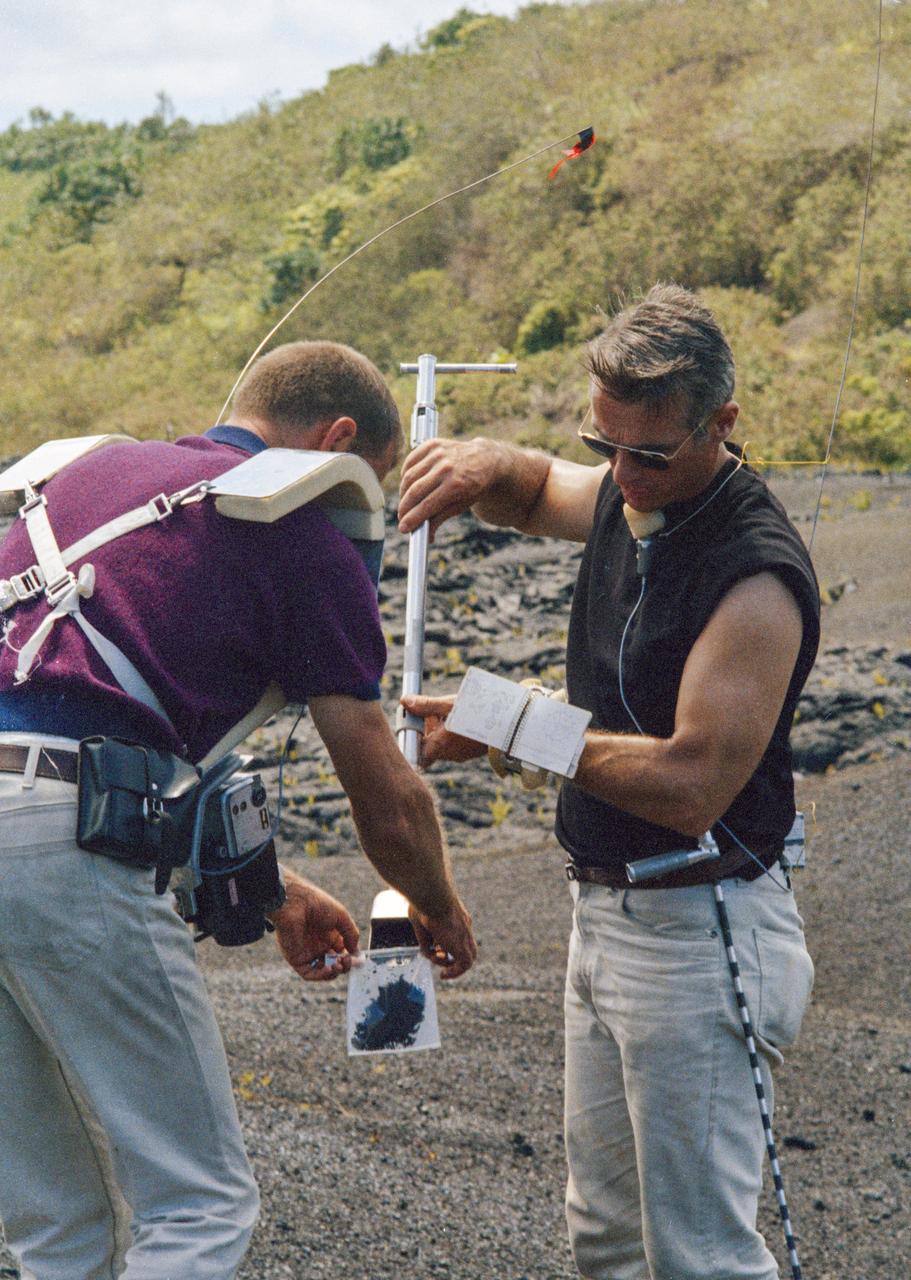
S70-34413 (April 1970) --- Astronaut Eugene A. Cernan (right), backup crew commander of the Apollo 14 lunar landing mission, pours a scoop-full of sample material into a bag held by astronaut Joe H. Engle, Apollo 14 backup crew lunar module pilot. The two joined the prime crew members and other Manned Spacecraft Center (MSC) personnel on a training trip to various areas of Hawaii. Here in Kapoho, the two backup crew members for NASA?s next lunar landing mission are taking part in a full simulation of a traverse on the lunar surface. Note the check-list on Cernan's left wrist. He carries a penetrometer in his belt. The terrain in this area bears many similarities to that on the lunar surface. Photo credit: NASA
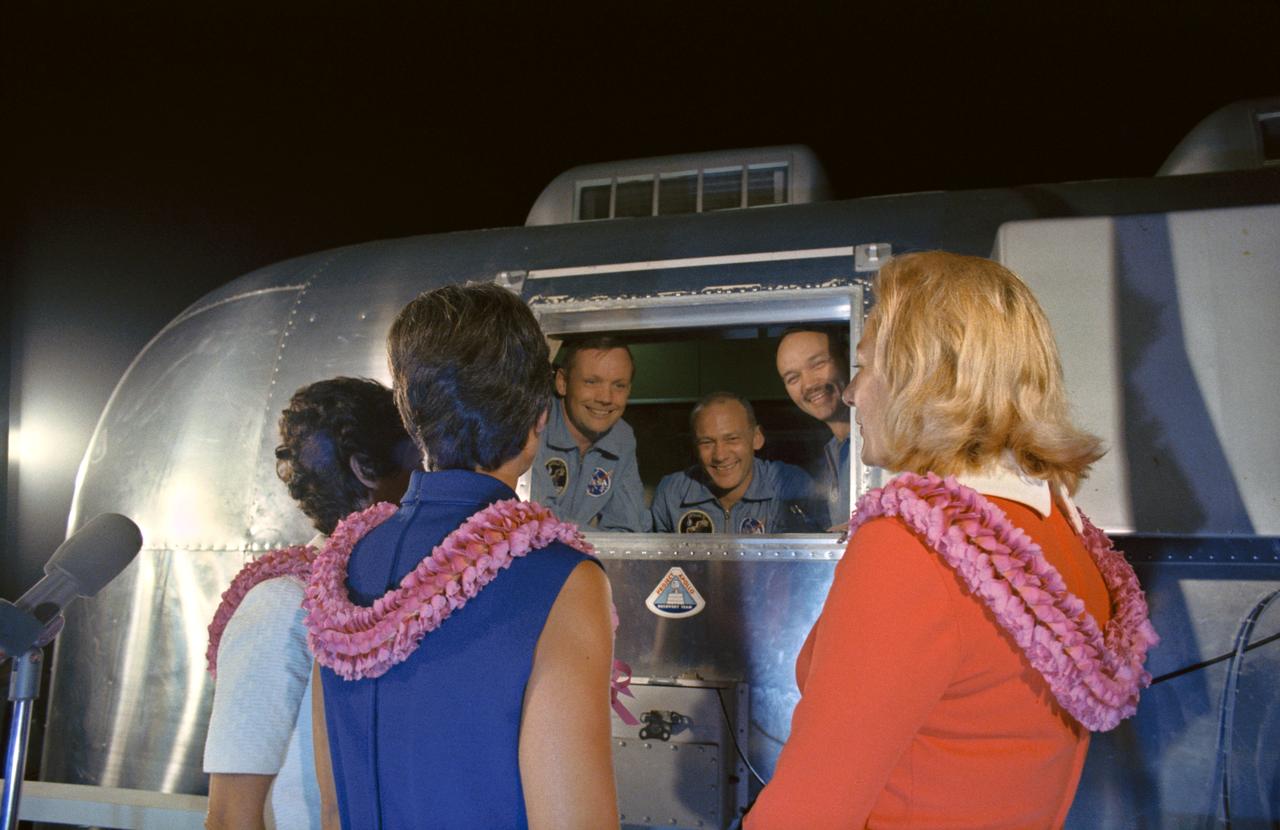
S69-40147 (27 July 1969) --- The Apollo 11 crewmen, still under a 21-day quarantine, are greeted by their wives. They arrived at Ellington Air Force Base very early Sunday after a flight aboard a U.S. Air Force C-141 transport from Hawaii. Looking through the window of a Mobile Quarantine Facility (MQF) are (left to right) astronauts Neil A. Armstrong, Edwin E. Aldrin Jr., and Michael Collins. The wives are (left to right) Mrs. Pat Collins, Mrs. Jan Armstrong, and Mrs. Joan Aldrin. The crew of the historic Apollo 11 lunar landing mission remained in the MQF until they arrived to the Crew Reception Area of the Lunar Receiving Laboratory at the Manned Spacecraft Center (MSC). The astronauts will be released from quarantine on Aug. 11, 1969.
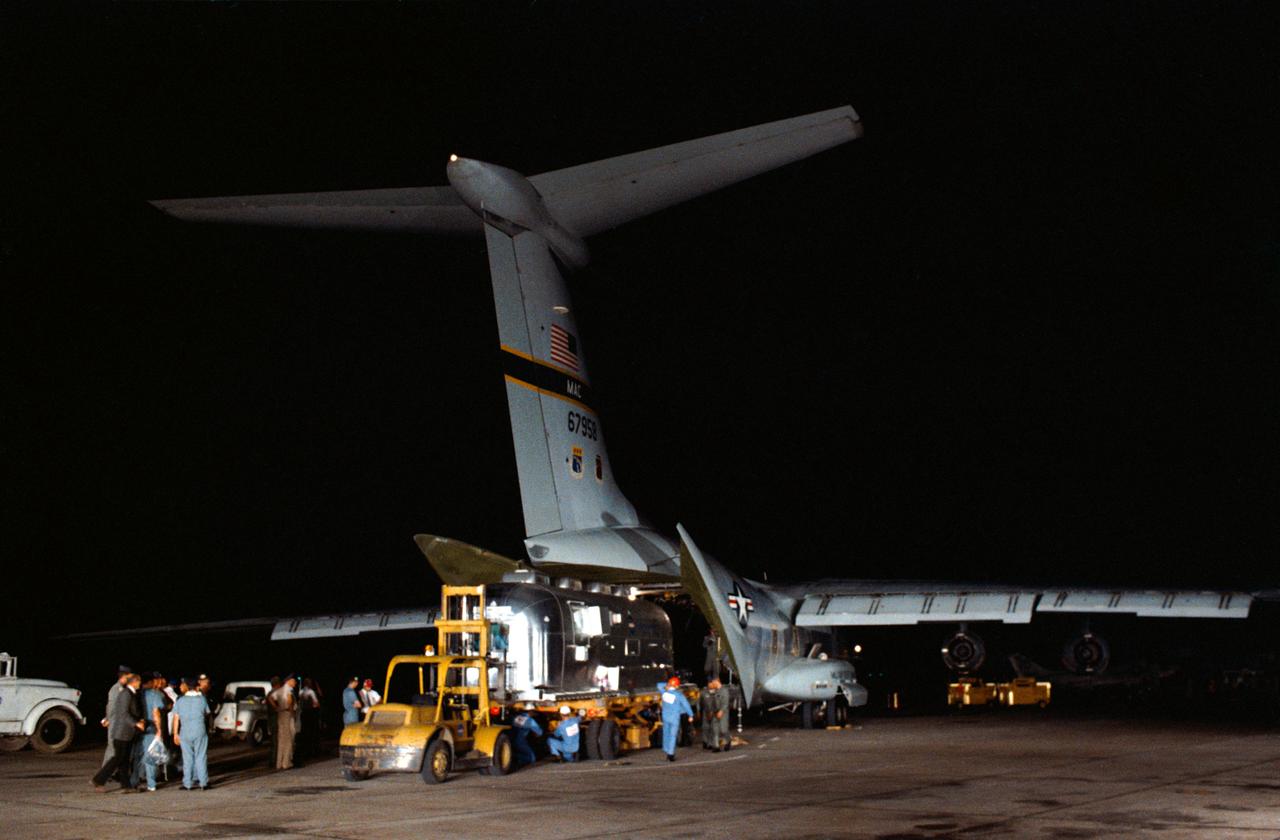
S69-40132 (27 July 1969) --- A Mobile Quarantine Facility (MQF), with the three Apollo 11 crewmembers inside, is unloaded from a United States Air Force C-141 transport at Ellington Air Force Base very early Sunday after a flight from Hawaii. A large crowd was present to welcome astronauts Neil A. Armstrong, Michael Collins, and Edwin E. Aldrin Jr. back to Houston following their historic lunar landing mission. The crew remained in the MQF until they arrived at the Crew Reception Area of the Lunar Receiving Laboratory (LRL) at the Manned Spacecraft Center (MSC). The crew will be released from quarantine on Aug. 11, 1969.

S69-40152 (27 July 1969) --- A Mobile Quarantine Facility (MQF), with the three Apollo 11 crewmen inside, is unloaded from a United States Air Force C-141 transport at Ellington Air Force Base very early Sunday after a flight from Hawaii. A large crowd was present to welcome astronauts Neil A. Armstrong, Michael Collins, and Edwin E. Aldrin Jr. back to Houston following their historic lunar landing mission. The crew remained in the MQF until they arrived at the Crew Reception Area of the Lunar Receiving Laboratory (LRL) at the Manned Spacecraft Center (MSC). The crew will be released from quarantine on Aug. 11, 1969.
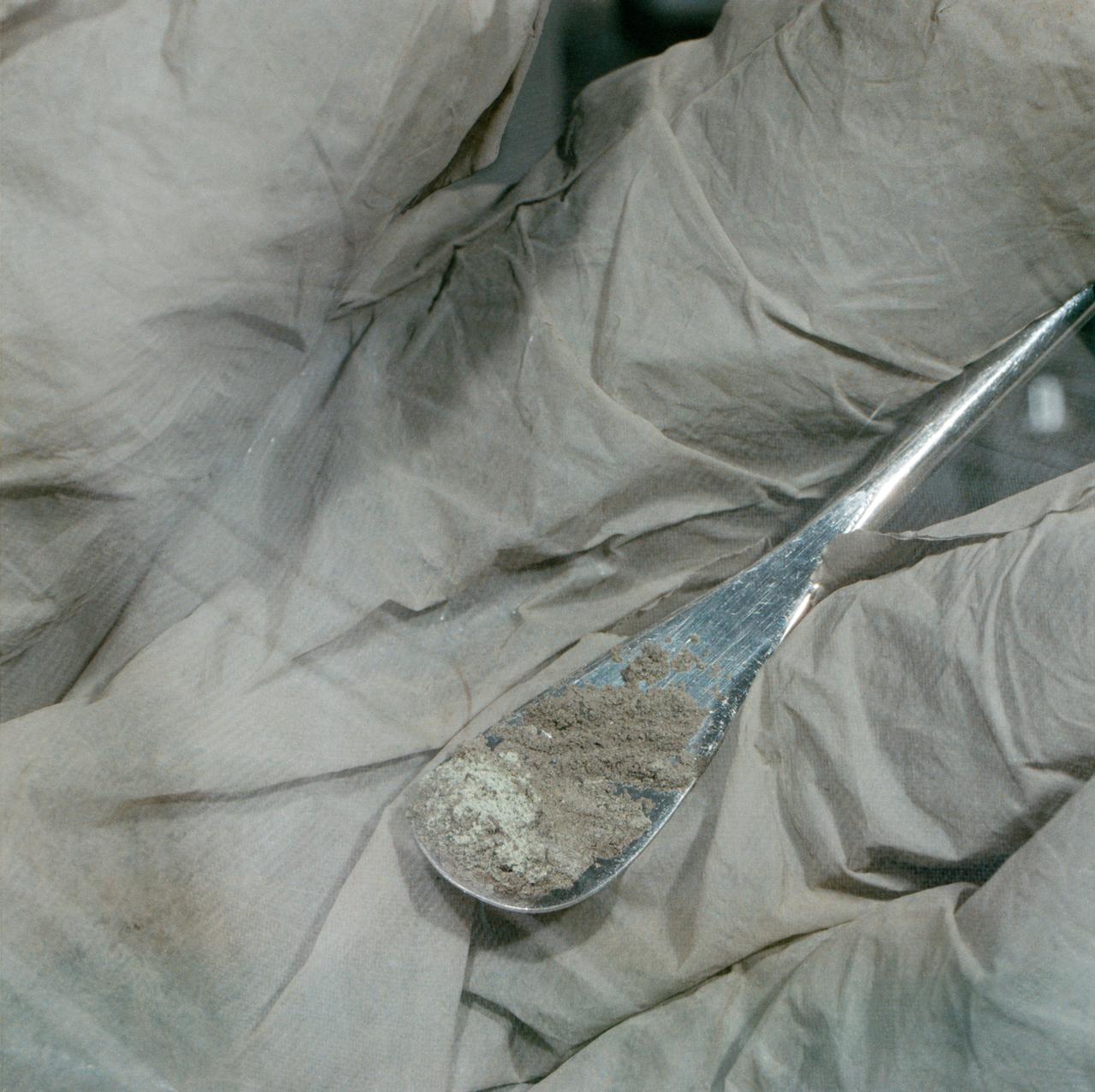
S71-43050 (August 1971) --- A close-up view of Apollo 15 lunar sample No. 15305 in the Non-sterile Nitrogen Processing Line (NNPL) in the Lunar Receiving Laboratory (LRL) at the Manned Spacecraft Center (MSC). This sample, pictured on a small spatula in a lab technician's glove, is green and is one of six recently taken from container No. 173, made up of comprehensive fines from the Apennine Front, Site No. 7. Astronauts David R. Scott, commander; and James B. Irwin, lunar module pilot, took the sample during their second extravehicular activity (EVA), at a ground elapsed time (GET) of 146:05 to 146:06.
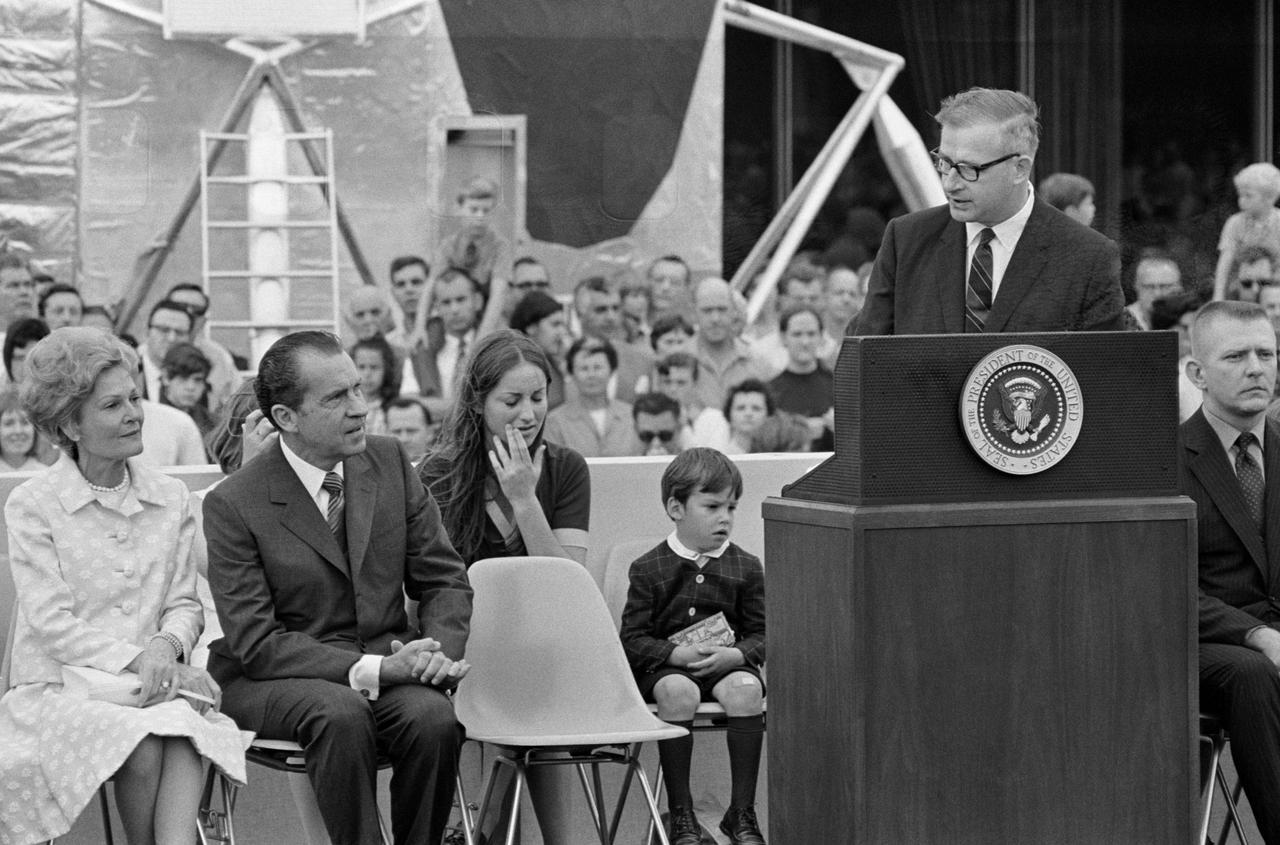
S70-35595 (18 April 1970) --- President Richard M. Nixon is welcomed to Manned Spacecraft Center (MSC) and introduced by Dr. Thomas O. Paine, Administrator, National Aeronautics and Space Administration (NASA). The First Lady is at extreme left. Others on the speakers platform in this view are Barbara and Jeffrey C. Lovell, children of astronaut James A. Lovell Jr., commander; and Eugene F. Kranz (extreme right), one of four flight directors on duty around the clock during the mission. President Nixon was on the site to present the Presidential Medal of Freedom to the Apollo 13 Mission Operations Team.

S69-40217 (27 July 1969) --- Neil A. Armstrong, commander of the Apollo 11 flight, greets his son Mark, on telephone intercom system, while his wife Jan and another son Eric look on. Armstrong had just arrived in early morning with the Mobile Quarantine Facility (MQF) at Ellington Air Force Base. Armstrong and fellow astronauts will remain in the MQF until arrival and confinement in the Crew Reception Area (CRA) of the Lunar Receiving Laboratory (LRL) at the Manned Spacecraft Center (MSC). Quarantine period will end on Aug. 11, 1969.
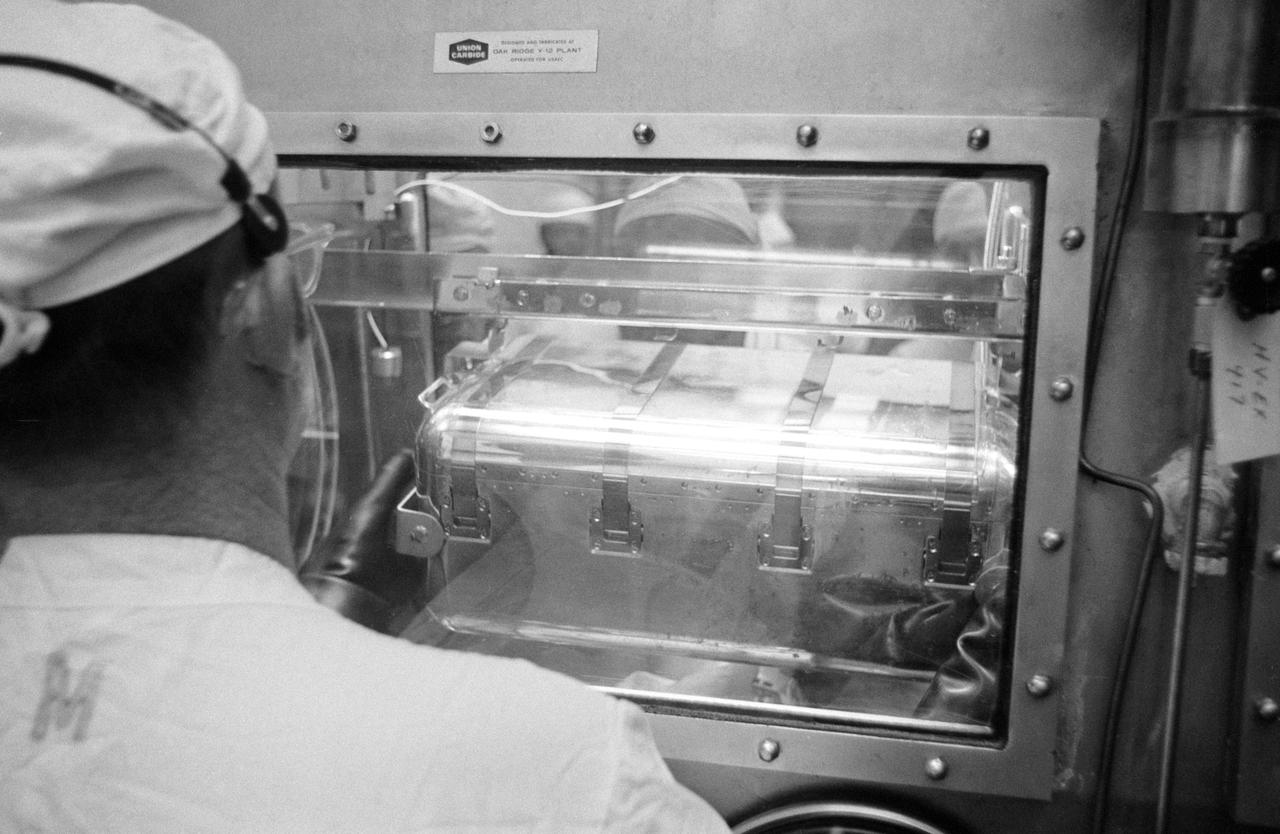
S69-40110 (25 July 1969) --- The first Apollo 11 sample return container, containing lunar surface material, is photographed just after it arrives at the Lunar Receiving Laboratory (LRL), Building 37, Manned Spacecraft Center (MSC). The box arrived by air at Ellington Air Force Base just before noon on Friday, July 25, 1969, from the Pacific recovery area. It was taken immediately to the Manned Spacecraft Center. The lunar samples were collected by astronauts Neil A. Armstrong and Edwin E. Aldrin Jr. during their lunar surface extravehicular activity (EVA).
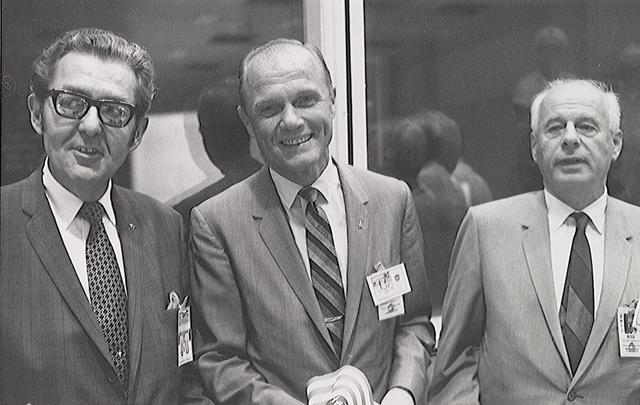
S69-44022 (7-24-69) --- On hand in Houston's mission control center to witness activity associated with the landing and recovery operations for the Apollo 11 mission were, from the left, Bob Kline, chief of the Mission Operations Procurement Branch at the Manned Spacecraft Center (MSC); astronaut John H. Glenn Jr.; and Eberhard Rees, deputy director of the Marshall Space Flight Center (MSFC). They were among a large number of personnel on hand in the MCC's mission operations control room (MOCR). Glenn holds one of the dozens of flags that were handed out for the return's celebration.
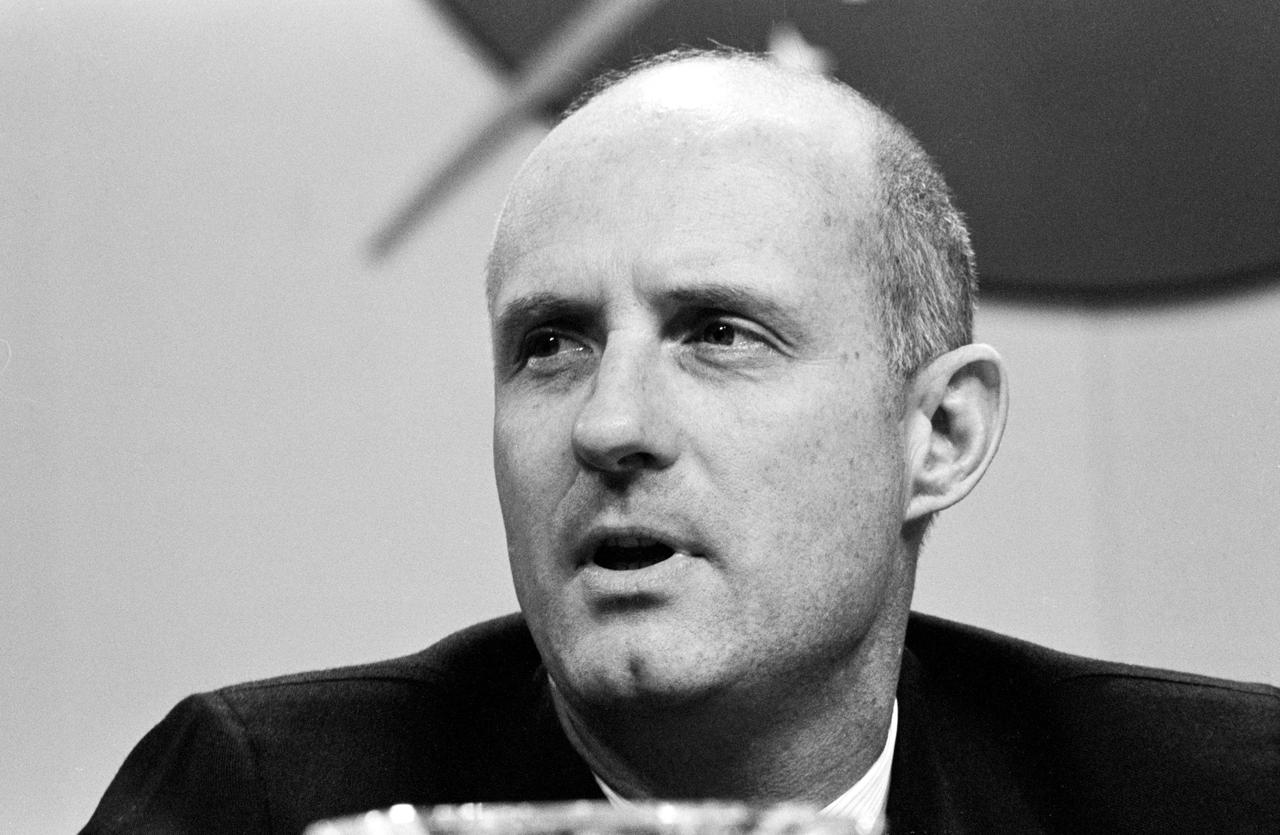
S69-32036 (26 April 1969) --- Astronaut Thomas P. Stafford, commander of the Apollo 10 prime crew, is seen at a press conference held at the Manned Spacecraft Center on April 26, 1969.
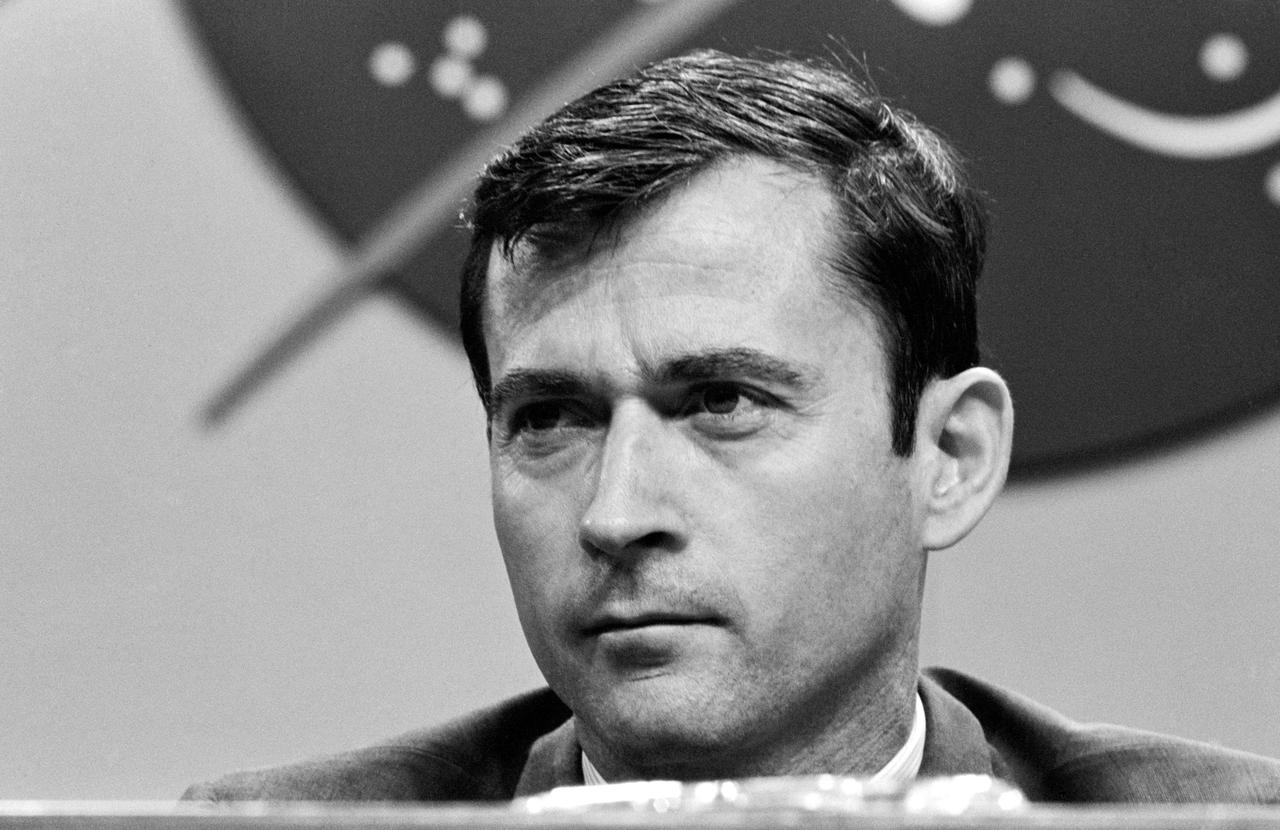
S69-32035 (26 April 1969) --- Astronaut John W. Young, command module pilot of the Apollo 10 prime crew, is seen at a press conference held at the Manned Spacecraft Center on April 26, 1969.
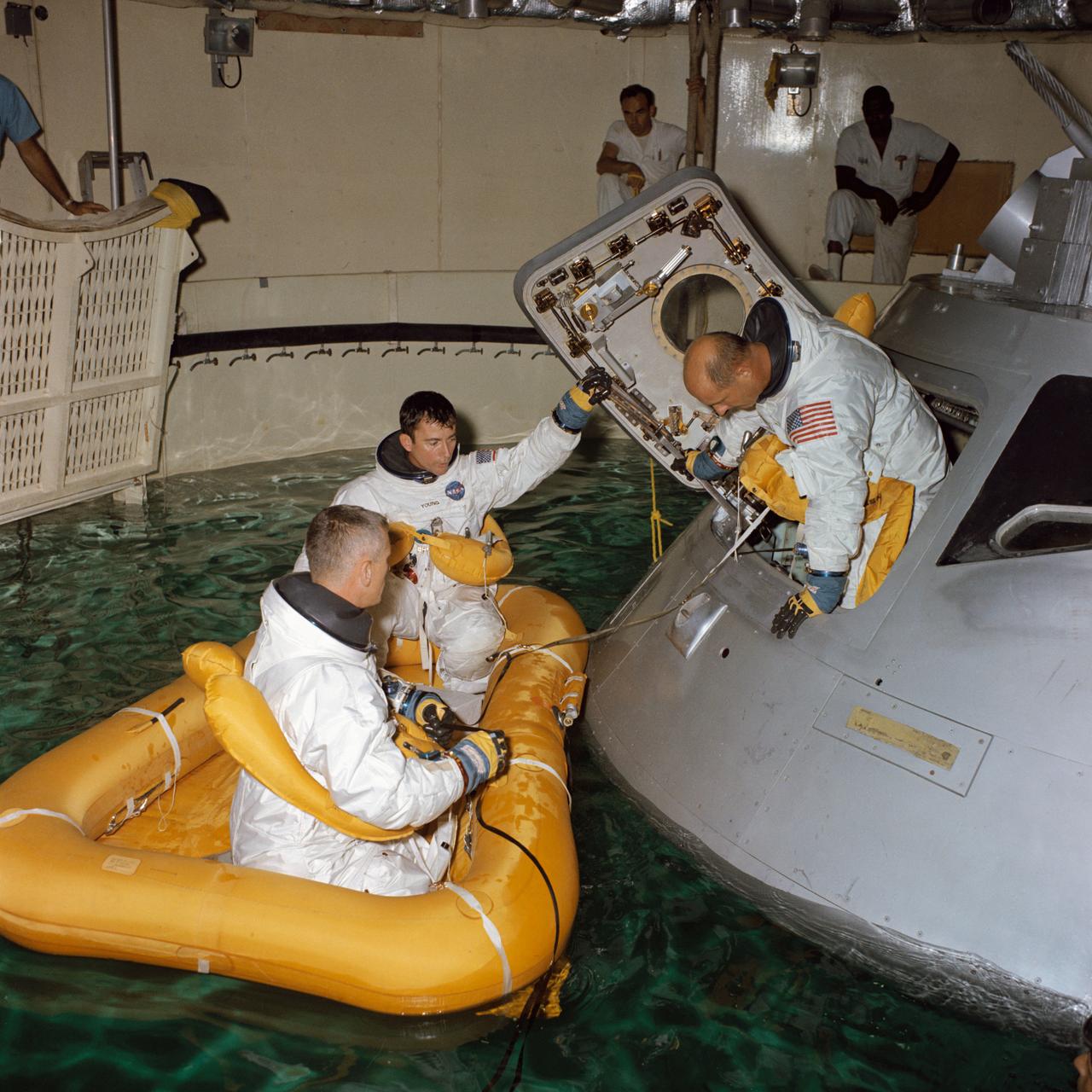
S68-41685 (August 1968) --- Three astronauts participate in Apollo water egress training in a tank in Building 260 at the Manned Spacecraft Center. Egressing the Apollo Command Module trainer is Thomas P. Stafford. Already in life raft are Eugene A. Cernan (in foreground) and John W. Young.
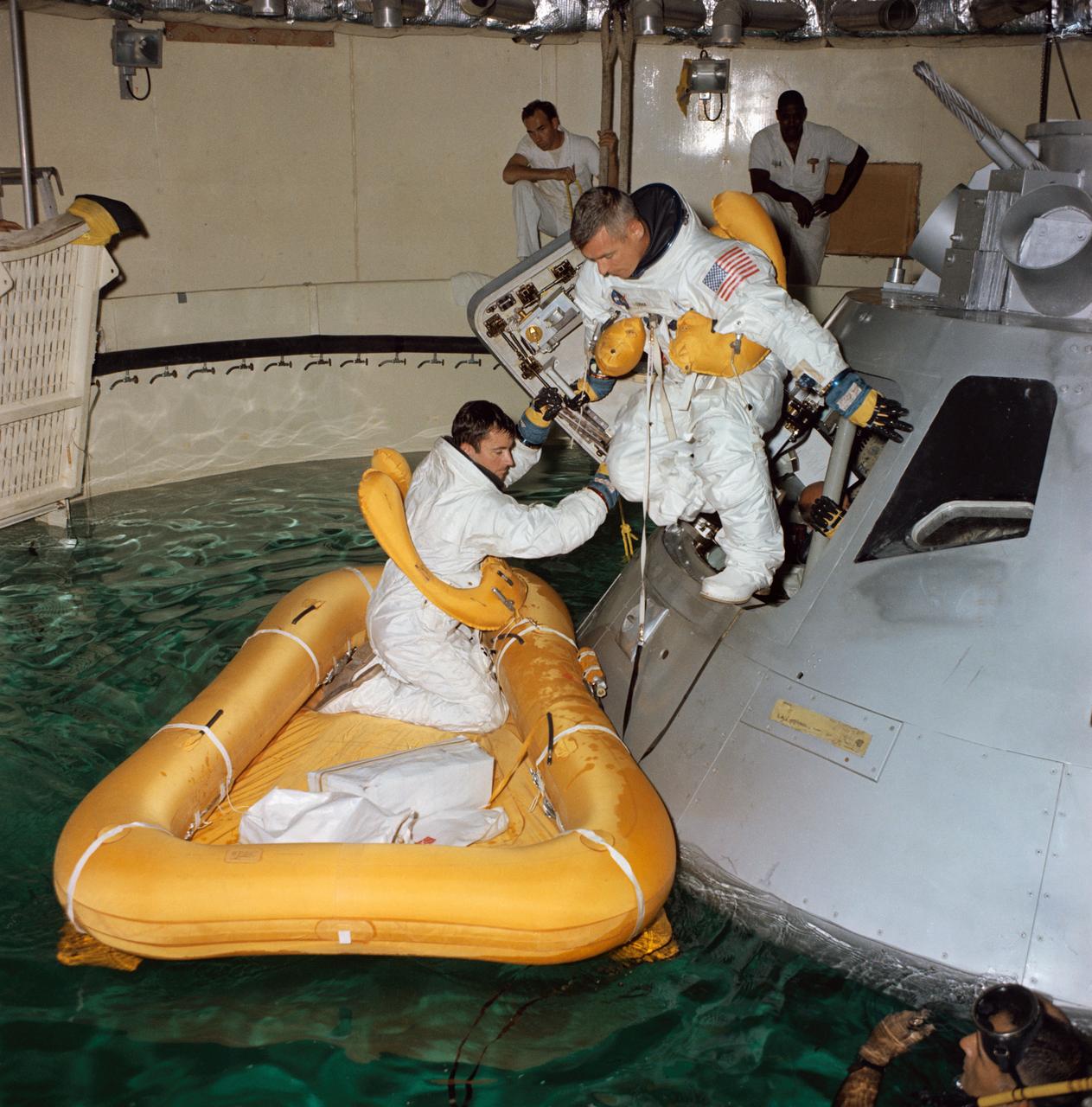
S68-41683 (August 1968) --- Three astronauts participate in Apollo water egress training in a tank in Building 260 at the Manned Spacecraft Center. Already in life raft is John W. Young. Eugene A. Cernan is egressing the Apollo Command Module trainer. Inside the trainer and almost obscured is Thomas P. Stafford.
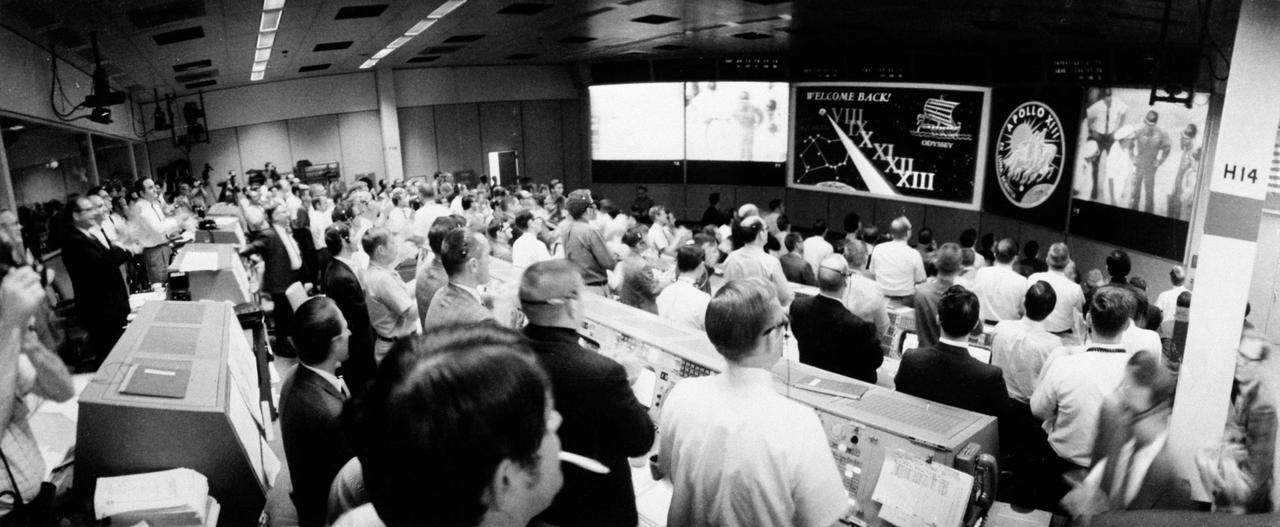
S70-35472 (17 April 1970) --- Overall view of the crowded Mission Operations Control Room (MOCR) in the Mission Control Center (MCC) at the Manned Spacecraft Center (MSC) during post-recovery ceremonies aboard the USS Iwo Jima, prime recovery ship for the Apollo 13 mission. The Apollo 13 spacecraft, with astronauts James A. Lovell Jr., commander; John L. Swigert Jr., command module pilot; and Fred W. Haise Jr., lunar module pilot, aboard, splashed down in the South Pacific at 12:07:44 p.m. (CST), April 17, 1970. The smooth splashdown and recovery operations brought an end to a perilous spaceflight for the crewmembers, and a tiring one for ground crew in MCC.

S69-40753 (24 July 1969) --- The Apollo 11 crewmen, wearing biological isolation garments, arrive aboard the USS Hornet during recovery operations in the central Pacific. They are walking toward the Mobile Quarantine Facility (MQF), in which they will be confined until they arrive at the Manned Spacecraft Center's (MSC), Lunar Receiving Laboratory (LRL). Apollo 11, with astronauts Neil A. Armstrong, commander; Michael Collins, command module pilot; and Edwin E. Aldrin Jr., lunar module pilot, onboard, splashed down at 11:49 a.m. (CDT), July 24, 1969, about 812 nautical miles southwest of Hawaii and only 12 nautical miles from the USS Hornet to conclude their historic lunar landing mission.
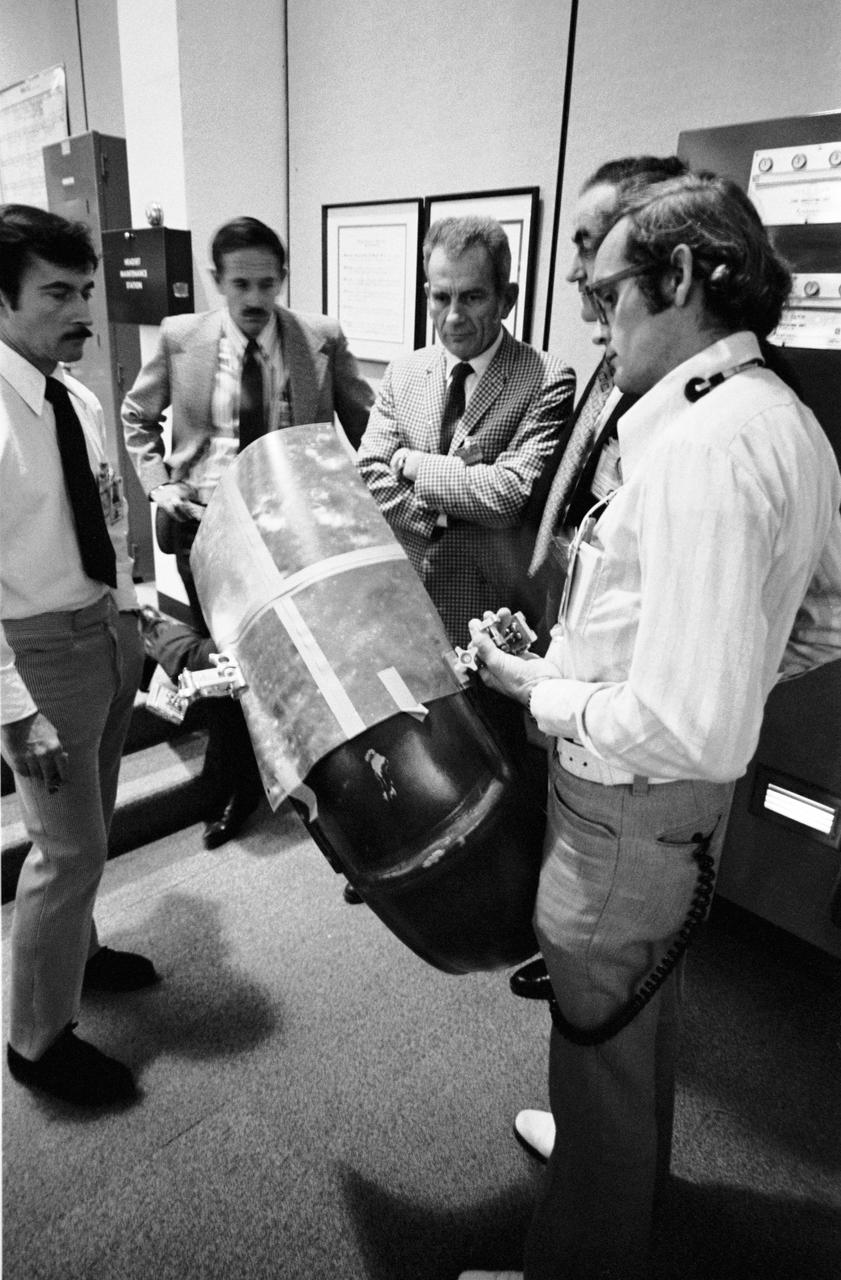
S72-55170 (11 Dec. 1972) --- These five men in the Mission Control Center ponder the solution to the problem of the damage to the right rear fender of the Apollo 17 Lunar Roving Vehicle at the Taurus-Littrow landing site. During the first lunar surface extravehicular activity a hammer got underneath the fender and a part of it was knocked off. Astronauts Eugene A. Cernan and Harrison H. Schmitt were reporting a problem with lunar dust because of the damaged fender. They sought some way to repair the broken fender. Clockwise are astronauts John W. Young and Charles M. Duke Jr., two Apollo 17 CAPCOM; Donald K. Slayton, director of flight crew operations at MSC; Dr. Roco A. Petrone, Apollo program director, Office of Manned Space Flight, NASA HQ; and Ronald V. Blevins, an EVA-1 flight controller with General Electric. They are looking over a makeshift repair arrangement which uses lunar maps and clamps from the optical alignment telescope lamp, a repair suggestion made by astronaut Young. The suggestion was relayed to Cernan and Schmitt and the repair made at the beginning of EVA-2. The problem was solved satisfactorily.
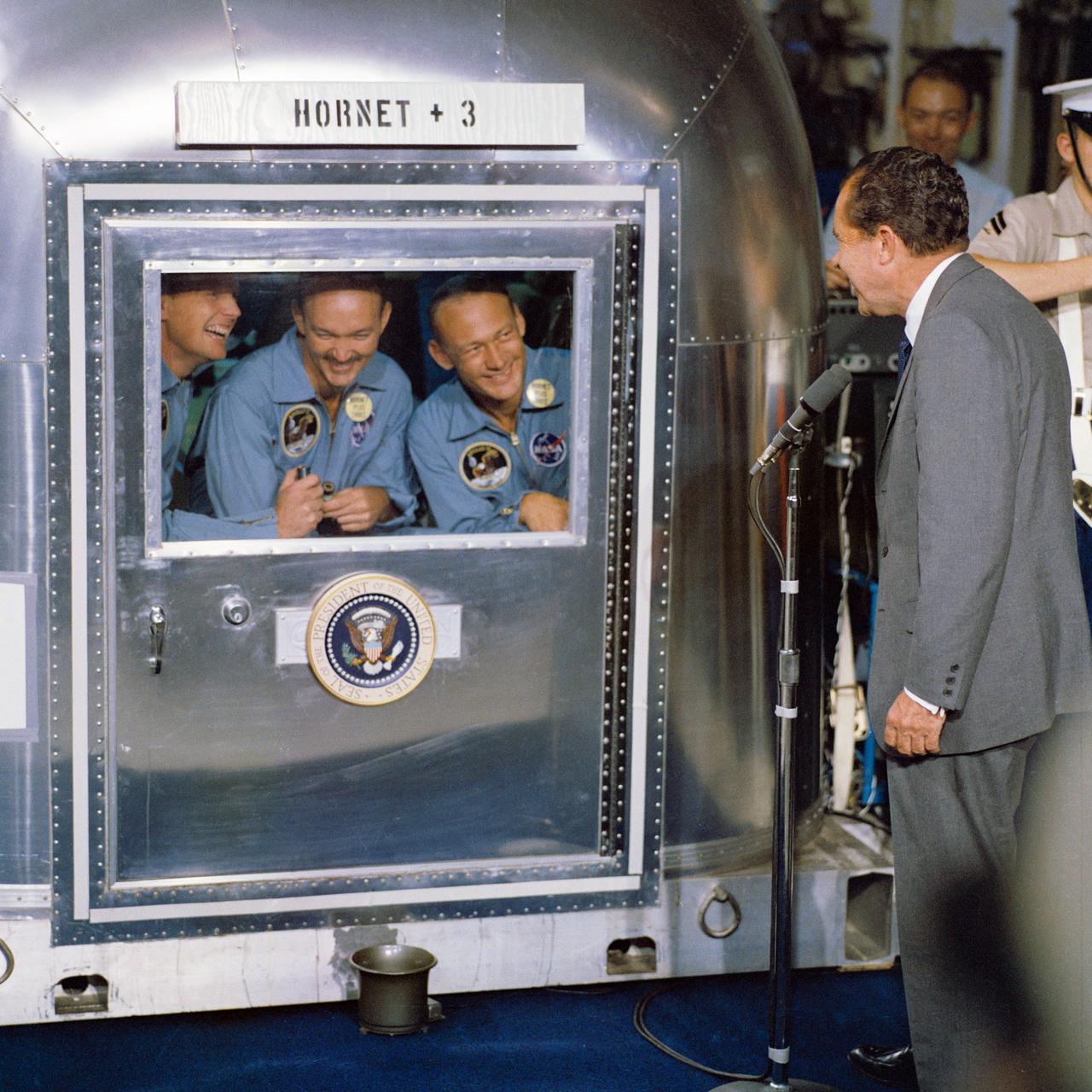
S69-21365 (24 July 1969) --- United States President Richard M. Nixon was in the central Pacific recovery area to welcome the Apollo 11 astronauts aboard the USS Hornet, prime recovery ship for the historic Apollo 11 lunar landing mission. Already confined to the Mobile Quarantine Facility (MQF) are (left to right) Neil A. Armstrong, commander; Michael Collins, command module pilot; and Edwin E. Aldrin Jr., lunar module pilot. Apollo 11 splashed down at 11:49 a.m. (CDT), July 24, 1969, about 812 nautical miles southwest of Hawaii and only 12 nautical miles from the USS Hornet. The three crewmen will remain in the MQF until they arrive at the Manned Spacecraft Center's (MSC) Lunar Receiving Laboratory (LRL). While astronauts Armstrong and Aldrin descended in the Lunar Module (LM) "Eagle" to explore the Sea of Tranquility region of the moon, astronaut Collins remained with the Command and Service Modules (CSM) "Columbia" in lunar orbit. Photo credit: NASA
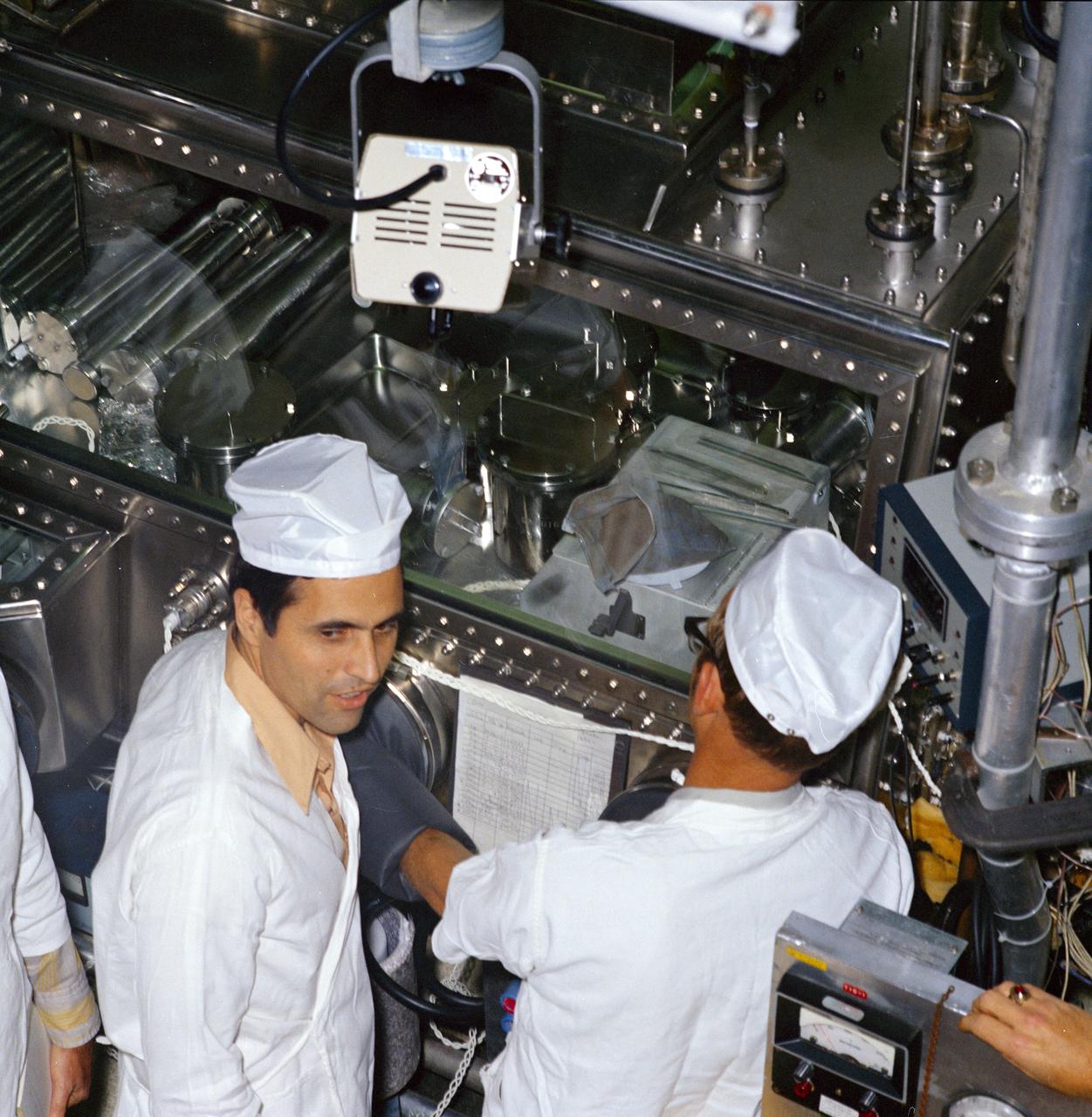
S72-56362 (27 Dec. 1972) --- Scientist-astronaut Harrison H. "Jack" Schmitt (facing camera), Apollo 17 lunar module pilot, was one of the first to look at the sample of "orange" soil which was brought back from the Taurus-Littrow landing site by the Apollo 17 crewmen. Schmitt discovered the material at Shorty Crater during the second Apollo 17 extravehicular activity (EVA). The "orange" sample, which was opened Wednesday, Dec. 27, 1972, is in the bag on a weighing platform in the sealed nitrogen cabinet in the upstairs processing line in the Lunar Receiving Laboratory at the Manned Spacecraft Center. Just before, the sample was removed from one of the bolt-top cans visible to the left in the cabinet. The first reaction of Schmitt was "It doesn't look the same." Most of the geologists and staff viewing the sample agreed that it was more tan and brown than orange. Closer comparison with color charts showed that the sample had a definite orange cast, according the MSC geology branch Chief William Phinney. After closer investigation and sieving, it was discovered that the orange color was caused by very fine spheres and fragments of orange glass in the midst of darker colored, larger grain material. Earlier in the day the "orange" soil was taken from the Apollo Lunar Sample Return Container No. 2 and placed in the bolt-top can (as was all the material in the ALSRC "rock box").
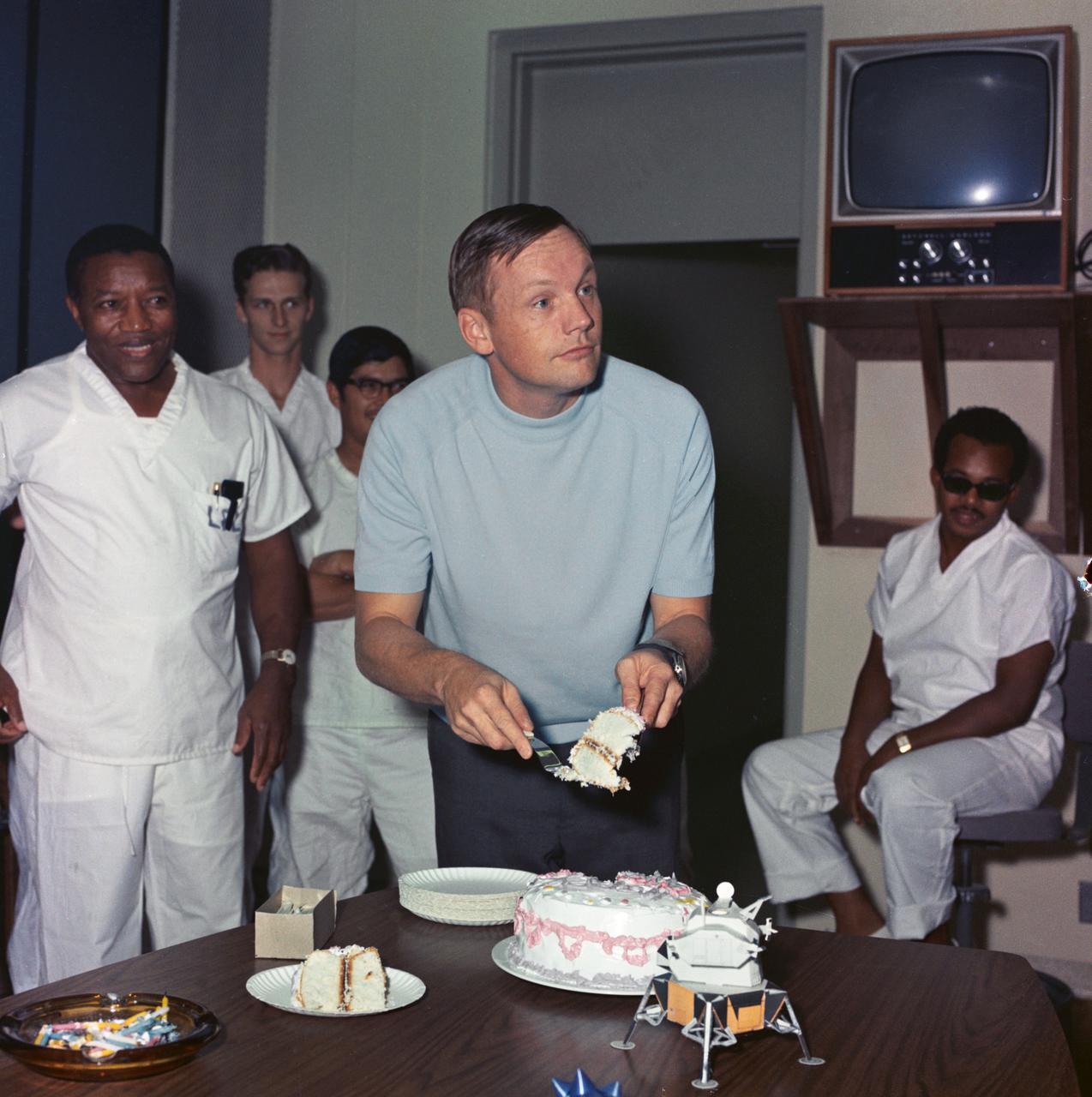
S69-40958 (5 August 1969) --- Astronaut Neil A. Armstrong, commander of the historic Apollo 11 lunar landing mission, and the first man to set foot on the Moon, cuts his birthday cake as he celebrated his 39th birthday. The crew still confined to the Crew Reception Area (CRA) of the Manned Spacecraft Center's (MSC) Lunar Receiving Laboratory (LRL). Armstrong was born on August 5, 1930, in Wapakoneta, Ohio. The cake was described as "standard two-layer, plain vanilla" on which was placed 39 candles. Eighteen of the persons quarantined with Armstrong assembled and sang happy birthday; and a champagne toast was offered. CRA support personnel are in the background. Astronauts Armstrong; Michael Collins, command module pilot; and Edwin E. Aldrin Jr., lunar module pilot, will be released from quarantine on August 11, 1969.

The two moon-exploring crewmen of the Apollo 14 lunar landing mission show off some of the largest of the lunar rocks they collected on their mission, during a through-the-glass meeting with newsmen in the Crew Reception Area of the Lunar Receiving Laboratory (LRL) at the Manned Spacecraft Center (MSC). Astronaut Edgar D. Mitchell (left), lunar module pilot, holds up a tote bag in which some of the lunar samples were stowed, while astronaut Alan B. Shepard Jr., commander, looks on. The largest sample brought back on the mission, a basketball-size rock (nicknamed "Big Bertha"), is said to be the largest lunar rock collected in three lunar landing missions for the National Aeronautics and Space Administration (NASA).
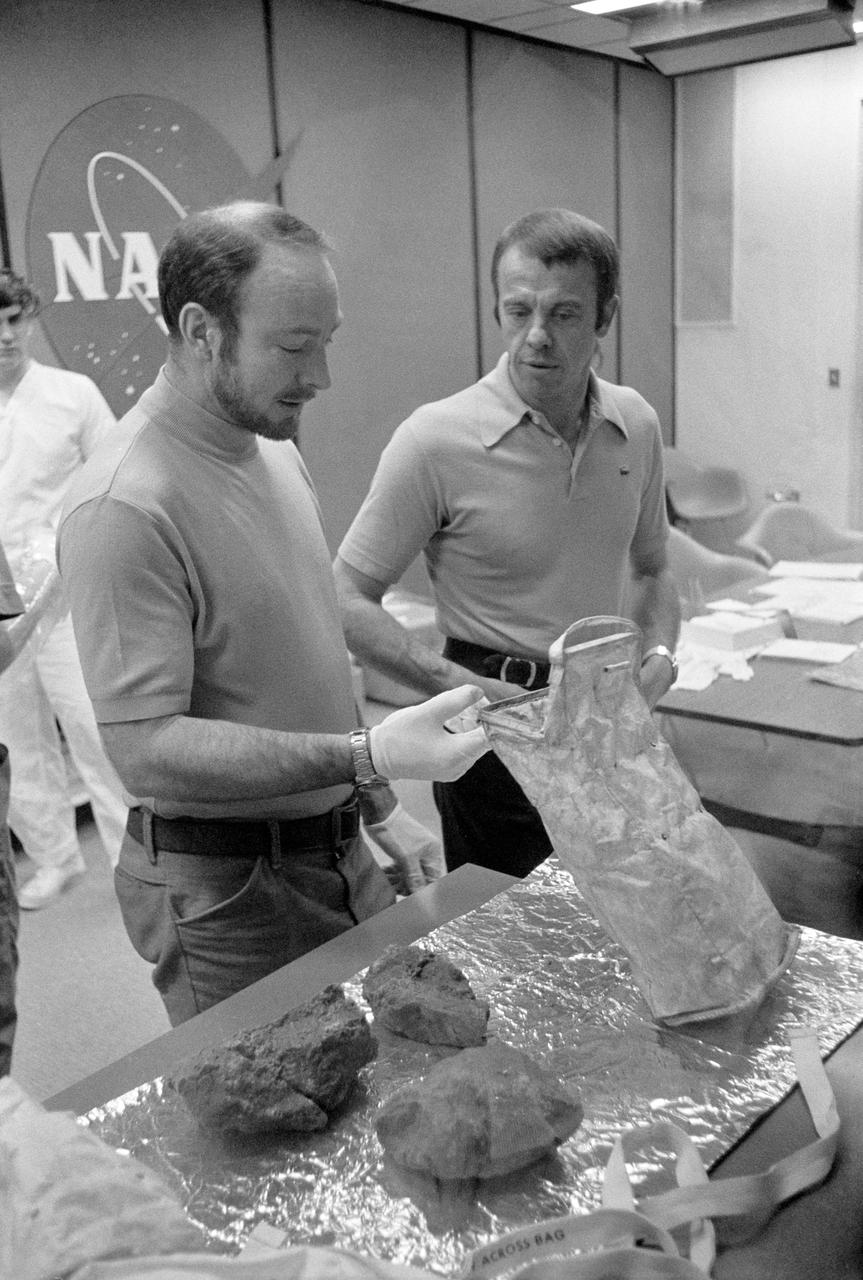
S71-20375 (19 Feb. 1971) --- The two moon-exploring crewmen of the Apollo 14 lunar landing mission show off some of the largest of the lunar rocks they collected on their mission, during a through-the-glass meeting with newsmen in the Crew Reception Area of the Lunar Receiving Laboratory (LRL) at the Manned Spacecraft Center (MSC). Astronaut Edgar D. Mitchell (left), lunar module pilot, holds up a tote bag in which some of the lunar samples were stowed, while astronaut Alan B. Shepard Jr., commander, looks on. The largest sample brought back on the mission, a basketball-size rock (nicknamed "Big Bertha"), is said to be the largest lunar rock collected in three lunar landing missions for the National Aeronautics and Space Administration (NASA).
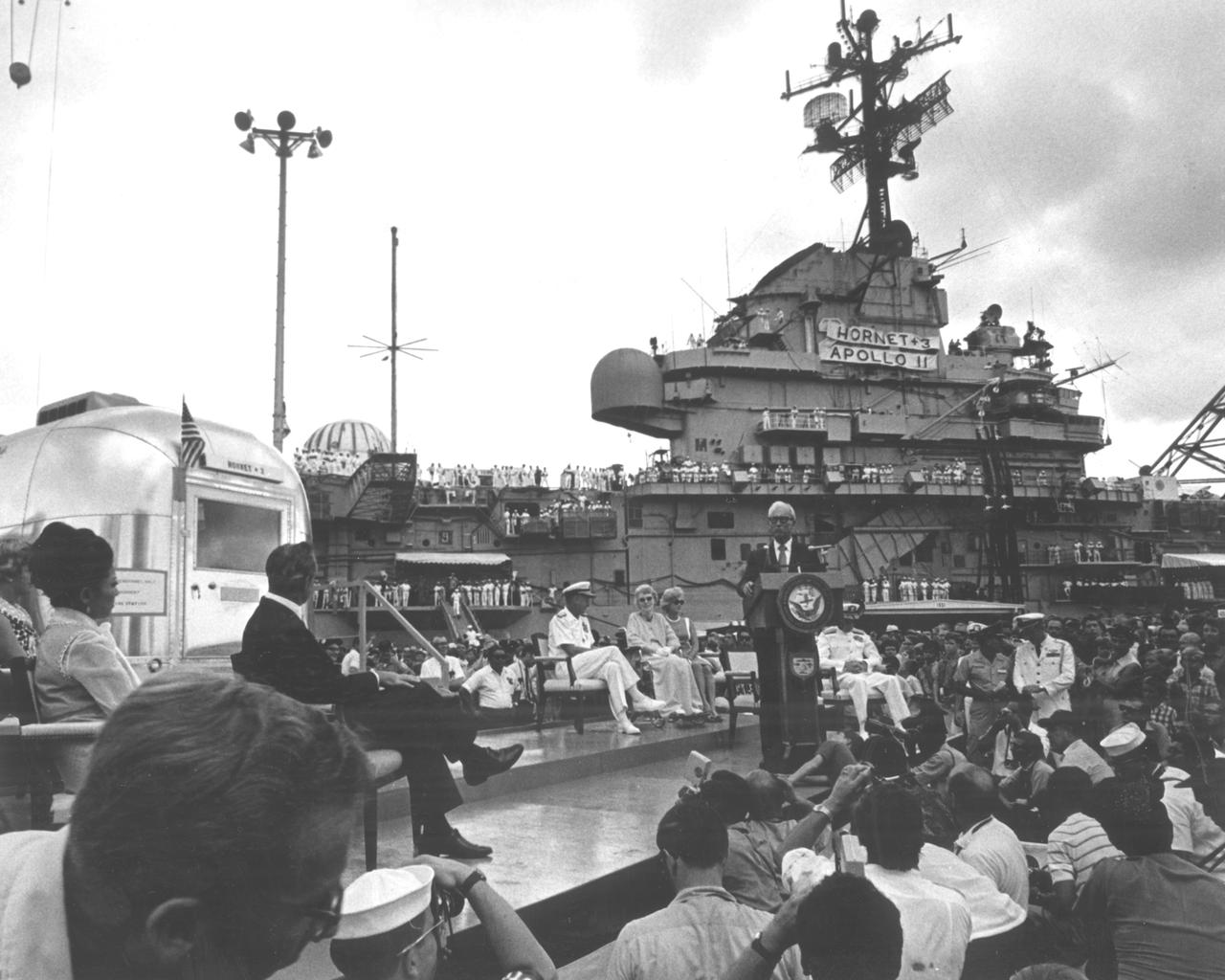
The Apollo 11 mission, the first manned lunar mission, launched from the Kennedy Space Center, Florida via the Marshall Space Flight Center (MSFC) developed Saturn V launch vehicle on July 16, 1969 and safely returned to Earth on July 24, 1969. Aboard the space craft were astronauts Neil A. Armstrong, commander; Michael Collins, Command Module (CM) pilot; and Edwin E. Aldrin Jr., Lunar Module (LM) pilot. The CM, piloted by Michael Collins remained in a parking orbit around the Moon while the LM, named “Eagle’’, carrying astronauts Neil Armstrong and Edwin Aldrin, landed on the Moon. During 2½ hours of surface exploration, the crew collected 47 pounds of lunar surface material for analysis back on Earth. The recovery operation took place in the Pacific Ocean where Navy para-rescue men recovered the capsule housing the 3-man Apollo 11 crew. The crew was airlifted to safety aboard the U.S.S. Hornet recovery ship, where they were quartered in a Mobile Quarantine Facility (MQF) for 21 days. The recovery vessel docked in Pearl Harbor Hawaii, where the occupied MQF was transferred for transport to the to NASA Manned Spacecraft Center (MSC) Lunar Receiving Laboratory in Houston, Texas. In this photo the quarantined astronauts are addressed by Hawaiian Governor John Burns upon their arrival at Pearl Harbor.
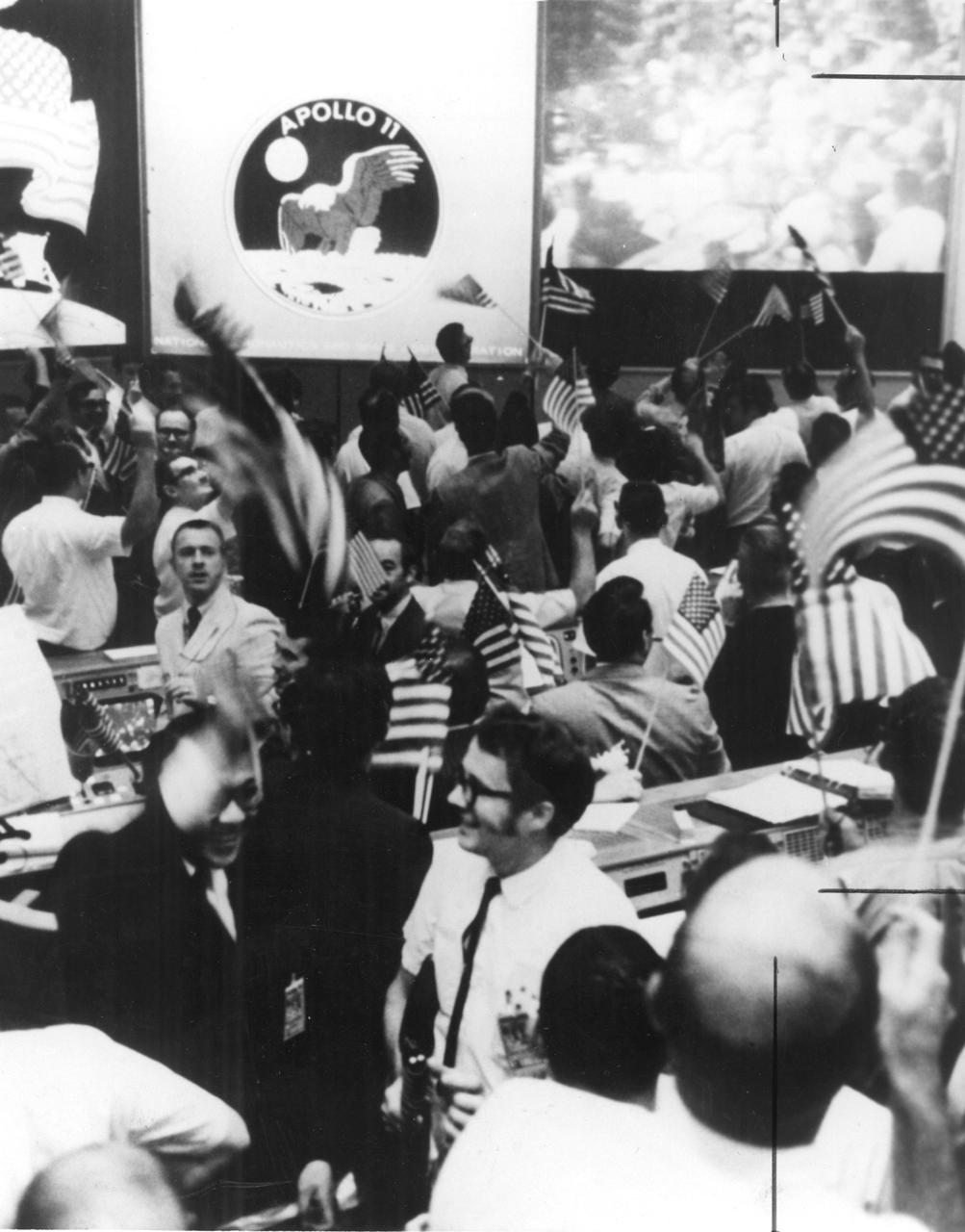
The Apollo 11 mission, the first manned lunar mission, launched from the Kennedy Space Center, Florida via the Marshall Space Flight Center (MSFC) developed Saturn V launch vehicle on July 16, 1969 and safely returned to Earth on July 24, 1969. Aboard he space craft were astronauts Neil A. Armstrong, commander; Michael Collins, Command Module (CM) pilot; and Edwin E. Aldrin Jr., Lunar Module (LM) pilot. The CM, piloted by Michael Collins remained in a parking orbit around the Moon while the LM, named “Eagle’’, carrying astronauts Neil Armstrong and Edwin Aldrin, landed on the Moon. During 2½ hours of surface exploration, the crew collected 47 pounds of lunar surface material for analysis back on Earth. Splashdown occurred in the Pacific Ocean on July 24, 1969. This overall view of the Mission Operations Control Room in the Mission Control Center at the NASA Manned Spacecraft Center (MSC) in Houston Texas shows the jubilation of the celebration of mission success. Mission controllers wave their American flags just after Apollo 11 had been recovered from the Pacific Ocean.