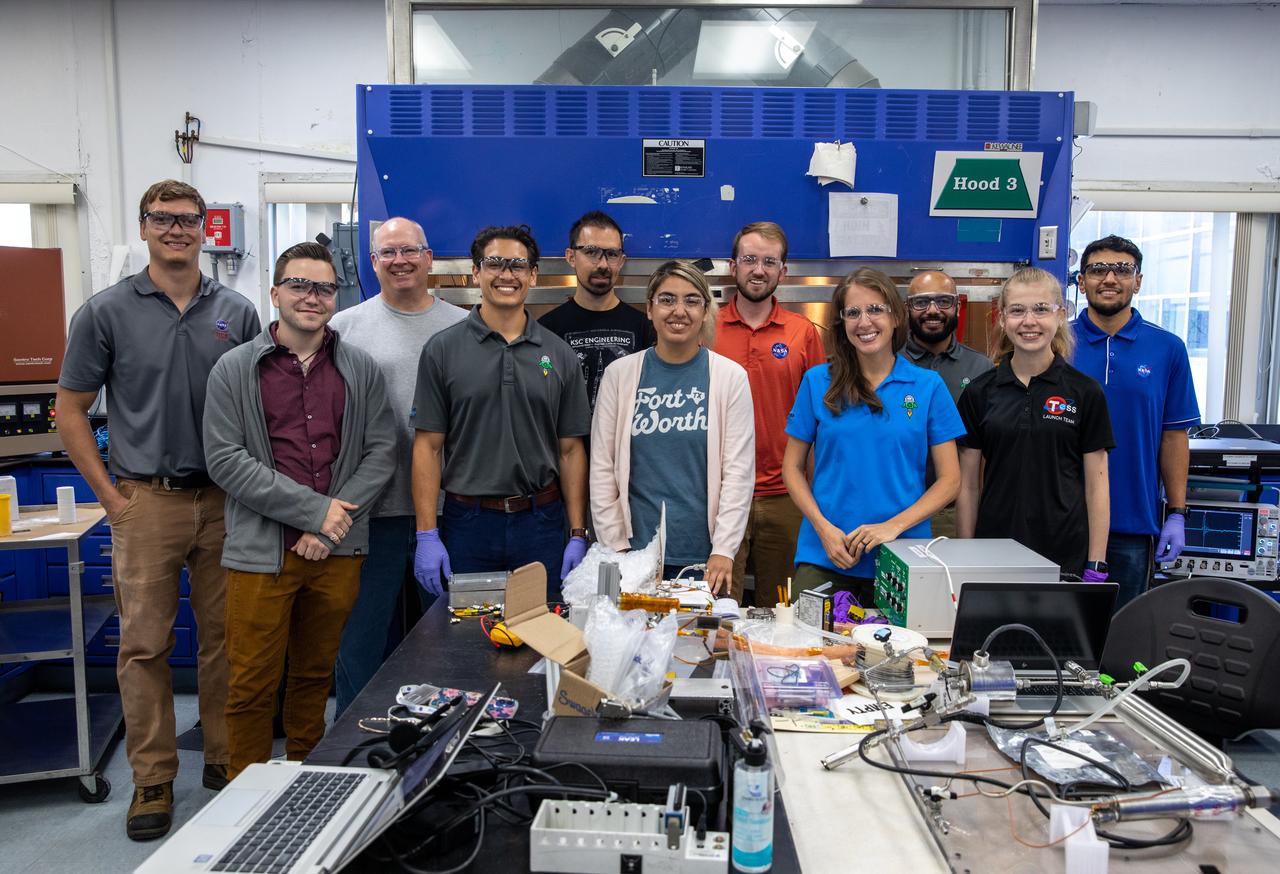
The In-Situ Resource Reutilization team gathers inside the Applied Physics Lab in the Neil Armstrong Operations and Checkout Facility at the agency’s Kennedy Space Center in Florida on July 21, 2022.
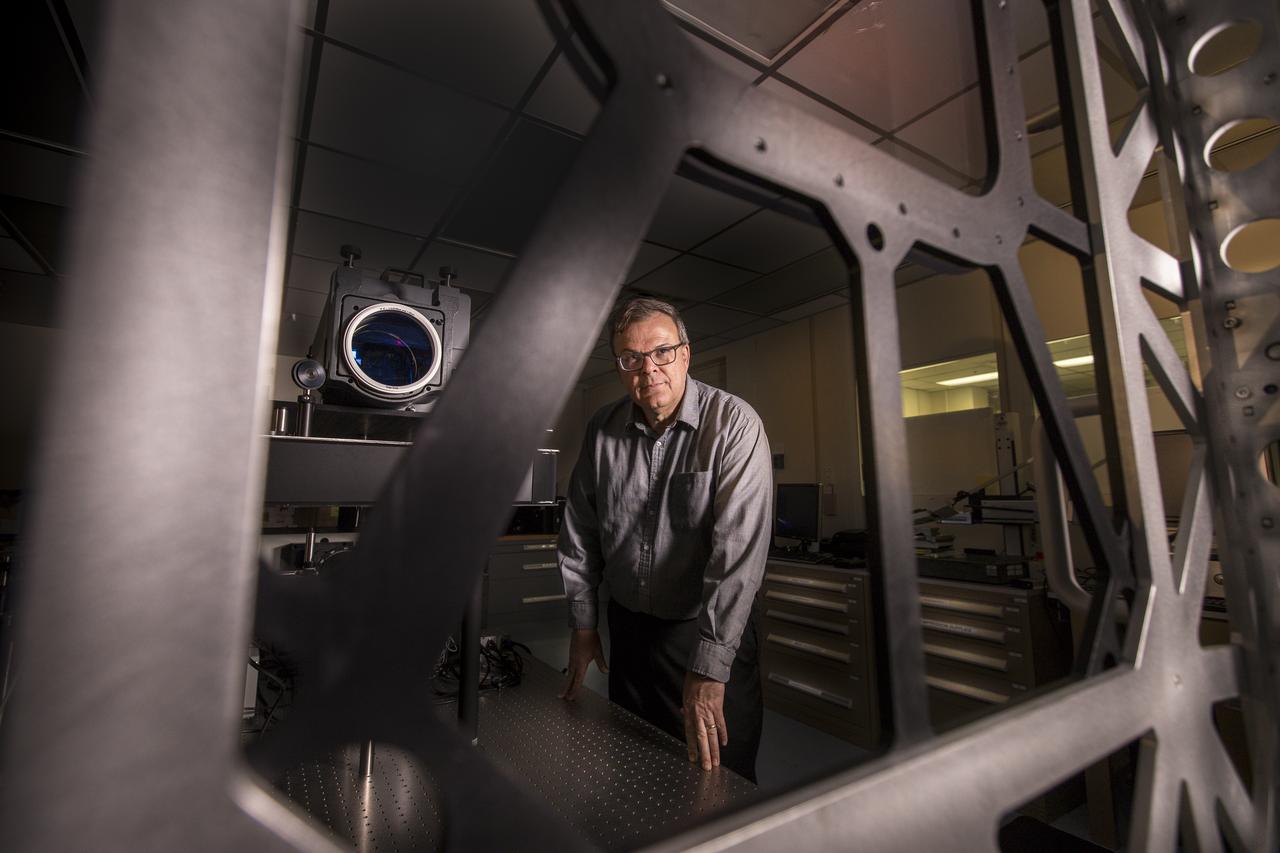
Mark Nurge, a physicist in Kennedy Space Center’s Applied Physics Lab, stands near a laser interferometer, which is used to determine if there are acceptable levels of distortion and imperfections in windows. Nurge recently completed optical metrology testing and evaluation of all flight windows on the Orion capsule for Artemis 1. The interferometer uses a laser source to do wavefront and transmission measurements, as well as evaluation of the color balance. Artemis 1 is an uncrewed flight that will pave the way for future crewed missions and enable future missions to the Moon, Mars, and beyond.
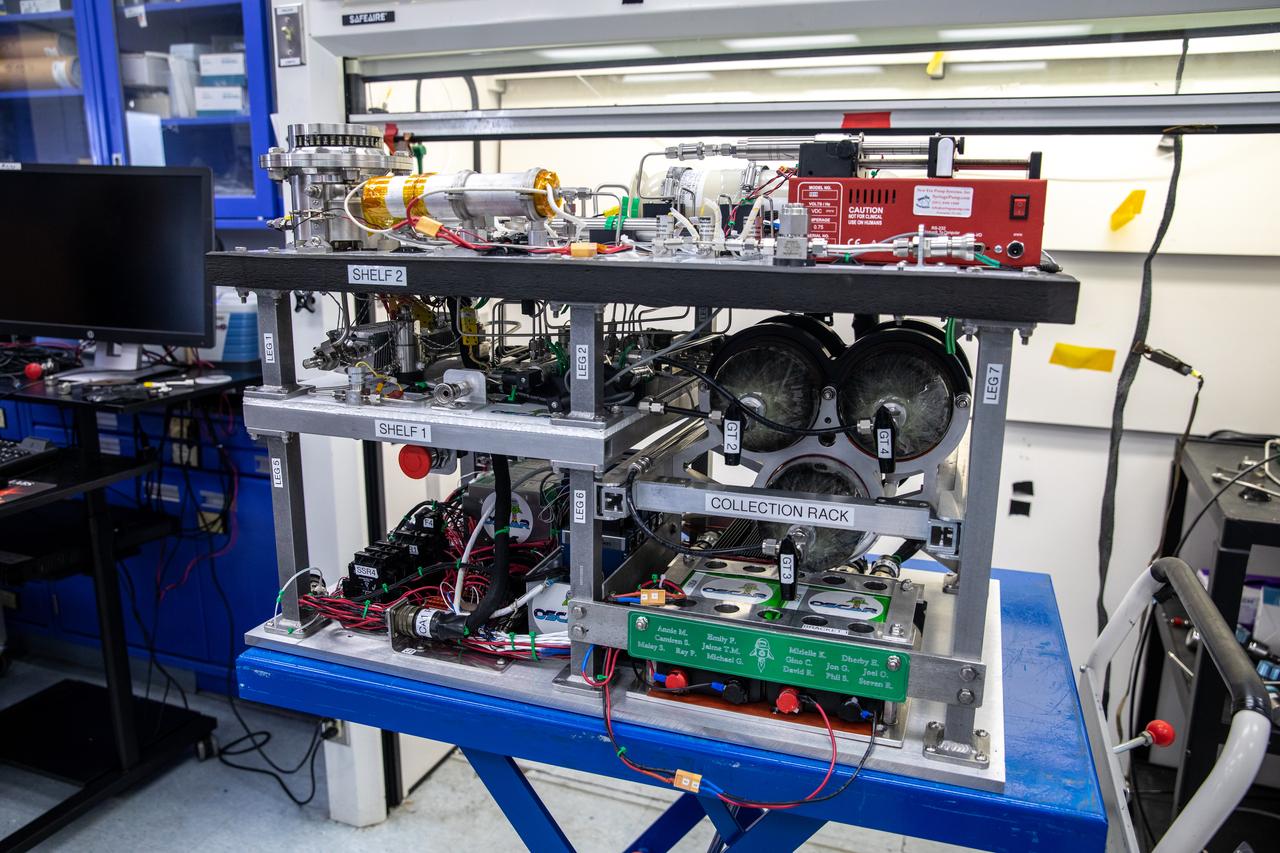
Flight hardware for NASA’s Orbital Syngas Commodity Augmentation Reactor, or OSCAR, is inside the Applied Physics Lab inside the Neil Armstrong Operations and Checkout Facility at the agency’s Kennedy Space Center in Florida on July 21, 2022. OSCAR began as an Early Career Initiative project at the spaceport that studies technology to convert trash and human waste into useful gasses such as methane, hydrogen, and carbon dioxide. By processing small pieces of trash in a high-temperature reactor, OSCAR is advancing new and innovative technology for managing waste in space.
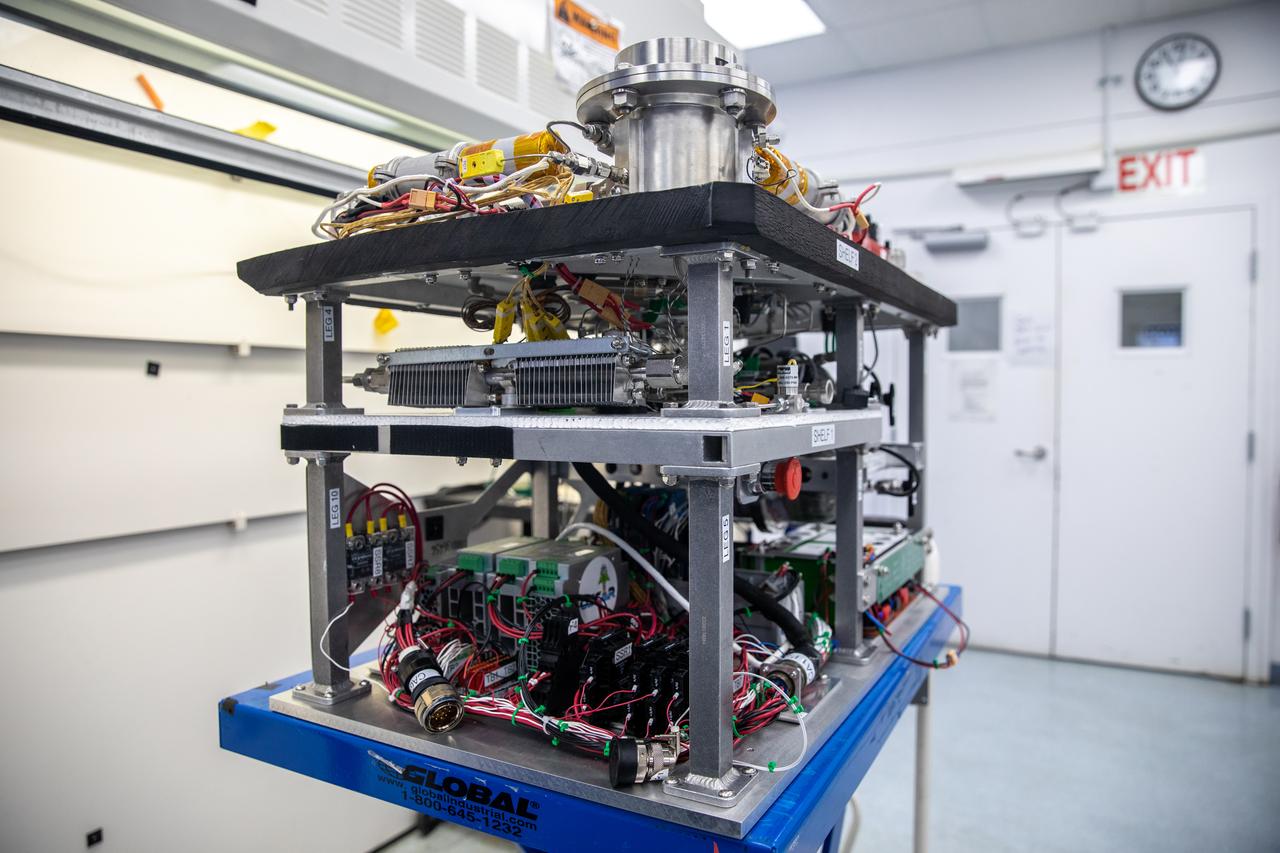
Flight hardware for NASA’s Orbital Syngas Commodity Augmentation Reactor, or OSCAR, is inside the Applied Physics Lab inside the Neil Armstrong Operations and Checkout Facility at the agency’s Kennedy Space Center in Florida on July 21, 2022. OSCAR began as an Early Career Initiative project at the spaceport that studies technology to convert trash and human waste into useful gasses such as methane, hydrogen, and carbon dioxide. By processing small pieces of trash in a high-temperature reactor, OSCAR is advancing new and innovative technology for managing waste in space.

Flight hardware for NASA’s Orbital Syngas Commodity Augmentation Reactor, or OSCAR, is inside the Applied Physics Lab inside the Neil Armstrong Operations and Checkout Facility at the agency’s Kennedy Space Center in Florida on July 21, 2022. OSCAR began as an Early Career Initiative project at the spaceport that studies technology to convert trash and human waste into useful gasses such as methane, hydrogen, and carbon dioxide. By processing small pieces of trash in a high-temperature reactor, OSCAR is advancing new and innovative technology for managing waste in space.

Flight hardware for NASA’s Orbital Syngas Commodity Augmentation Reactor, or OSCAR, is in view inside the Applied Physics Lab in the Neil Armstrong Operations and Checkout Facility at the agency’s Kennedy Space Center in Florida on July 21, 2022. OSCAR began as an Early Career Initiative project at the spaceport that studies technology to convert trash and human waste into useful gasses such as methane, hydrogen, and carbon dioxide. By processing small pieces of trash in a high-temperature reactor, OSCAR is advancing new and innovative technology for managing waste in space.
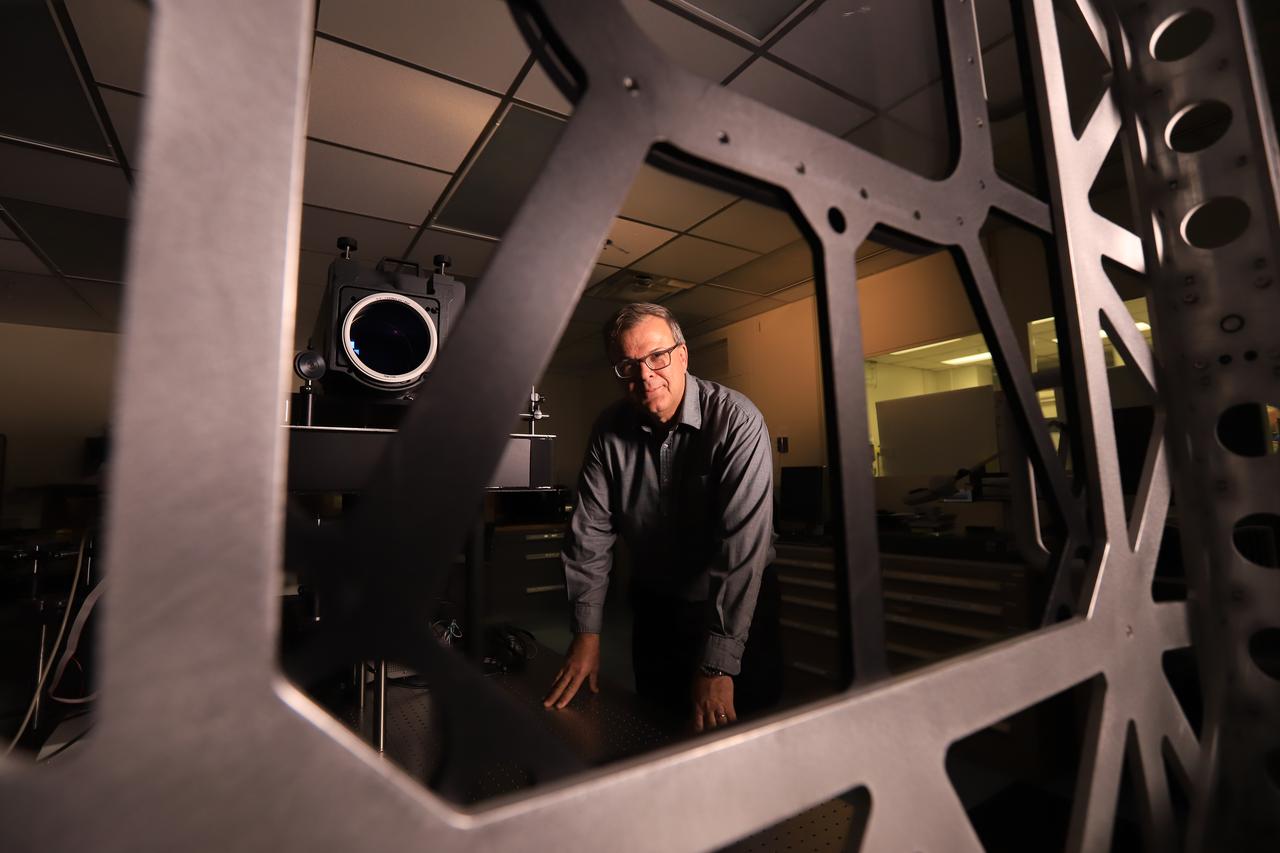
Mark Nurge, a physicist in Kennedy Space Center’s Applied Physics Lab, stands near a laser interferometer, which is used to determine if there are acceptable levels of distortion and imperfections in windows. Nurge recently completed optical metrology testing and evaluation of all flight windows on the Orion capsule for Artemis 1. The interferometer uses a laser source to do wavefront and transmission measurements, as well as evaluation of the color balance. Artemis 1 is an uncrewed flight that will pave the way for future crewed missions and enable future missions to the Moon, Mars, and beyond.
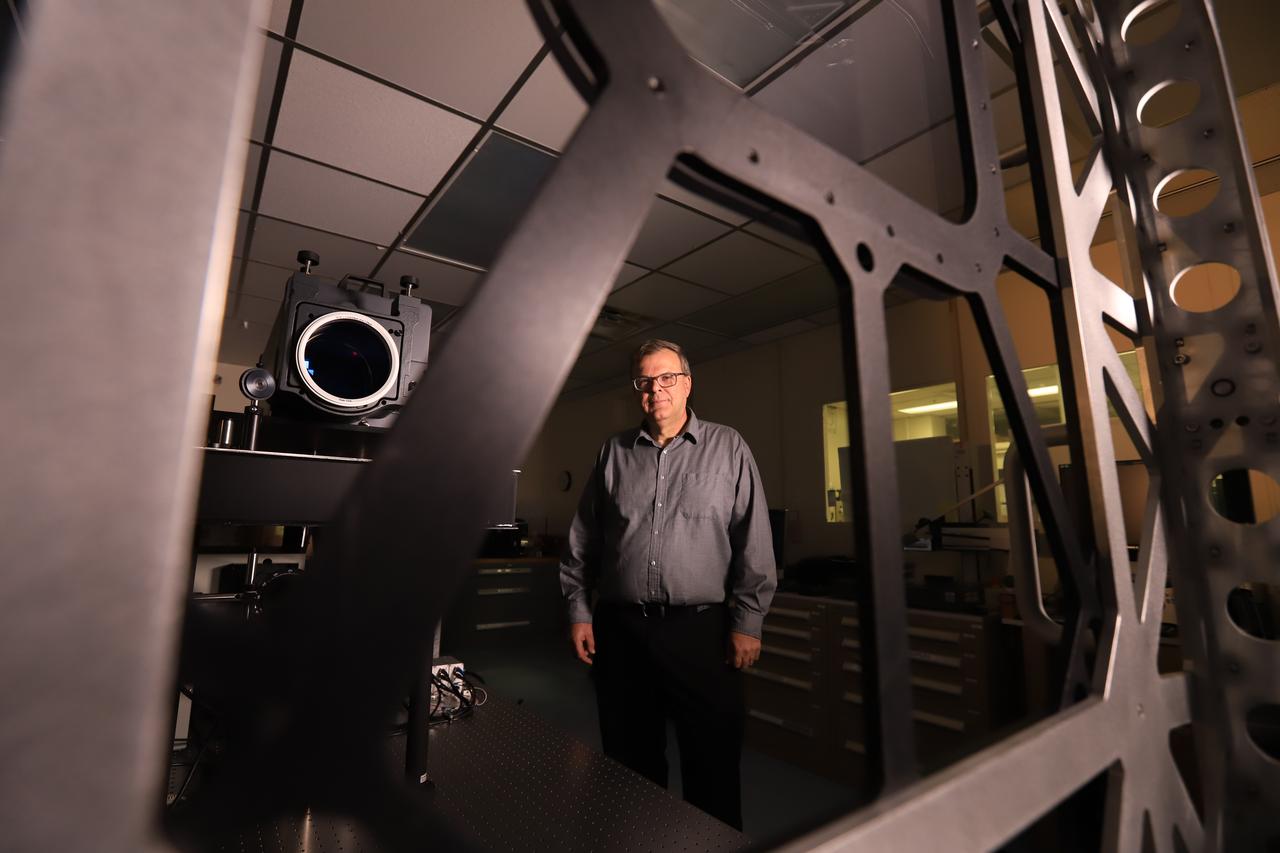
Mark Nurge, a physicist in Kennedy Space Center’s Applied Physics Lab, stands near a laser interferometer, which is used to determine if there are acceptable levels of distortion and imperfections in windows. Nurge recently completed optical metrology testing and evaluation of all flight windows on the Orion capsule for Artemis 1. The interferometer uses a laser source to do wavefront and transmission measurements, as well as evaluation of the color balance. Artemis 1 is an uncrewed flight that will pave the way for future crewed missions and enable future missions to the Moon, Mars, and beyond.
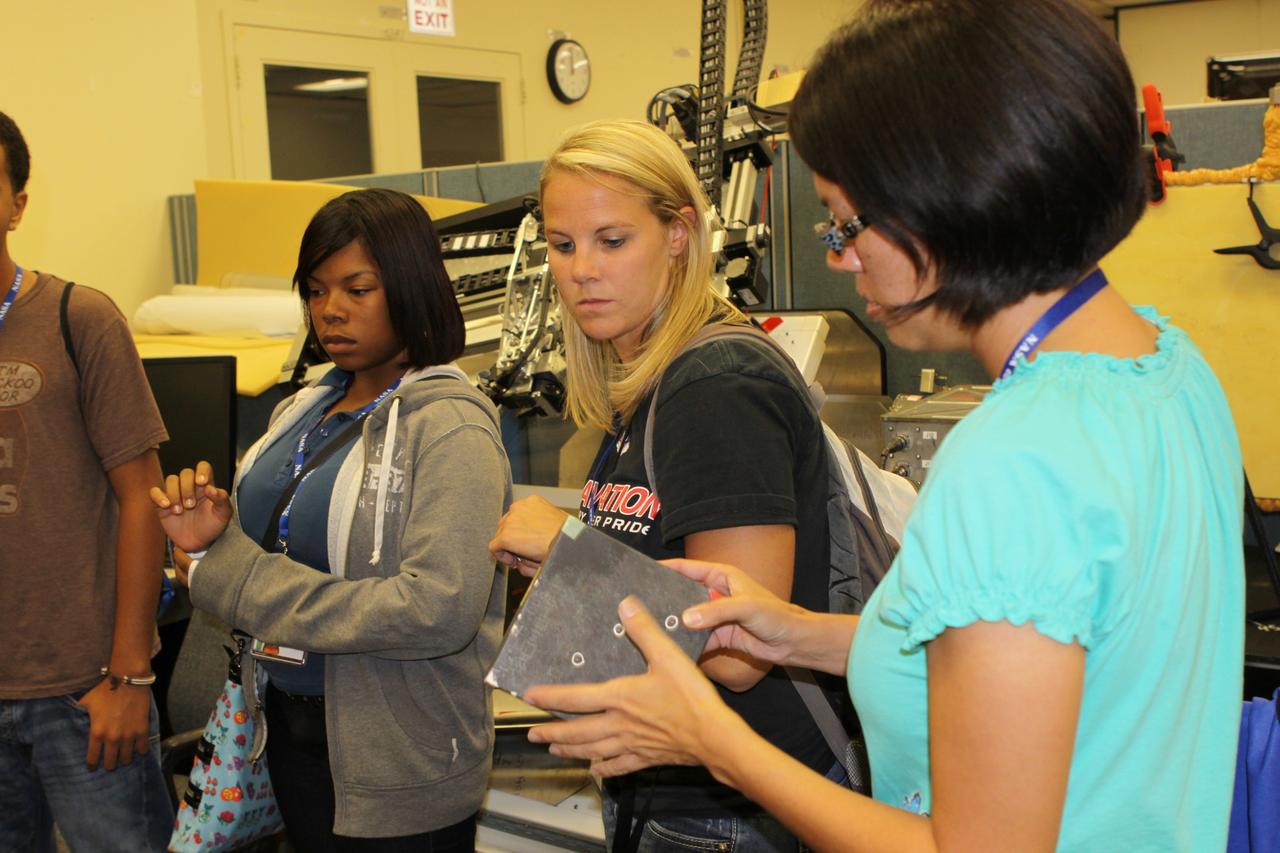
CAPE CANAVERAL, Fla. – Students and their teachers get some hands-on experience inside the applied physics lab in the Operations and Checkout Building. The 26 honor students in chemistry and biology and their teachers got a chance to visit a number of high-tech labs at Kennedy Space Center as part of an effort to encourage students in the areas of science, technology, engineering and math. The tenth and eleventh grade students from Terry Parker High School in Jacksonville, Fla., visited a number of vastly different labs during their one-day tour. The group's visit to Kennedy was hosted by the Education Office as part of a nationwide effort by the National Lab Network to help introduce the nation's students to science careers. Photo credit: NASA/Jim Grossmann
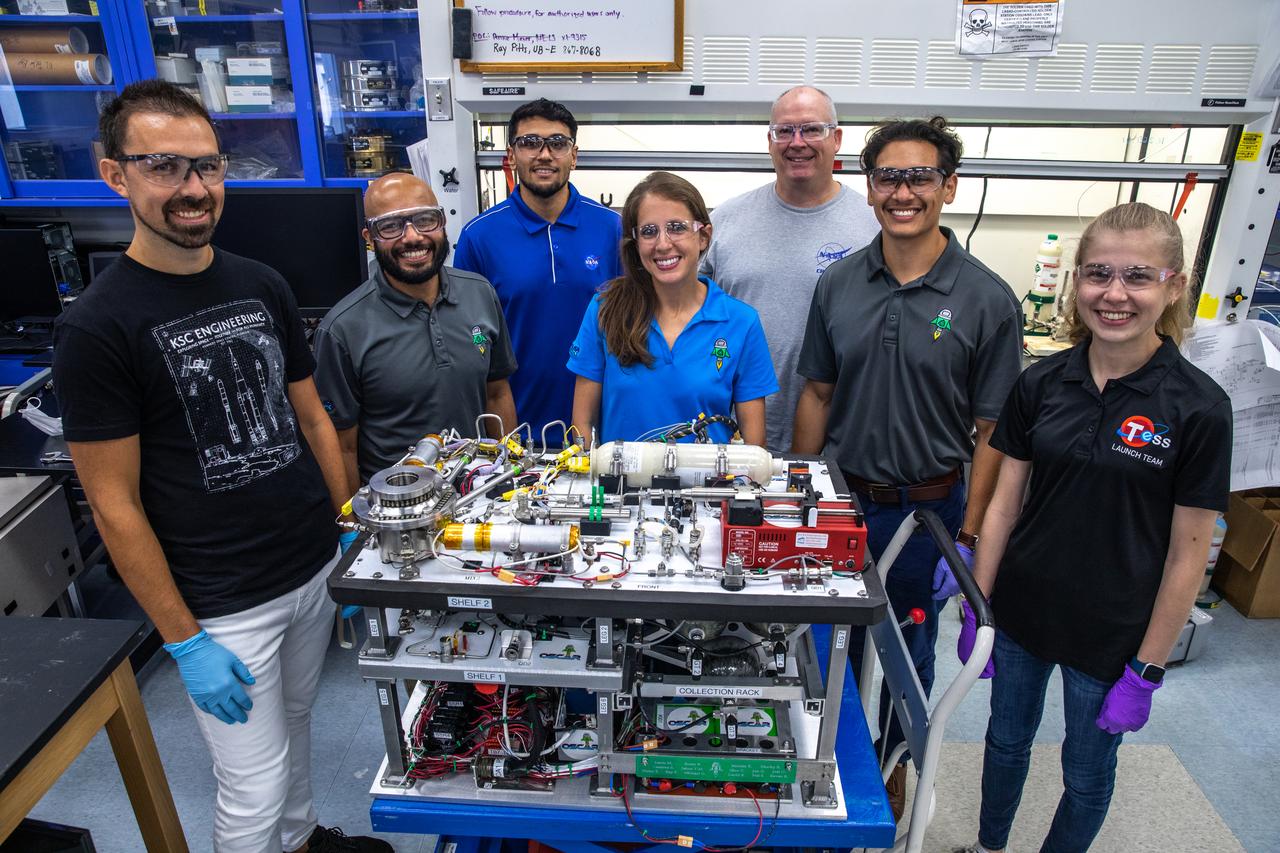
The Trash to Gas team members prepare flight hardware for NASA’s Orbital Syngas Commodity Augmentation Reactor, or OSCAR, inside the Applied Physics Lab in the Neil Armstrong Operations and Checkout Facility at the agency’s Kennedy Space Center in Florida on July 21, 2022. OSCAR began as an Early Career Initiative project at the spaceport that studies technology to convert trash and human waste into useful gasses such as methane, hydrogen, and carbon dioxide. By processing small pieces of trash in a high-temperature reactor, OSCAR is advancing new and innovative technology for managing waste in space.
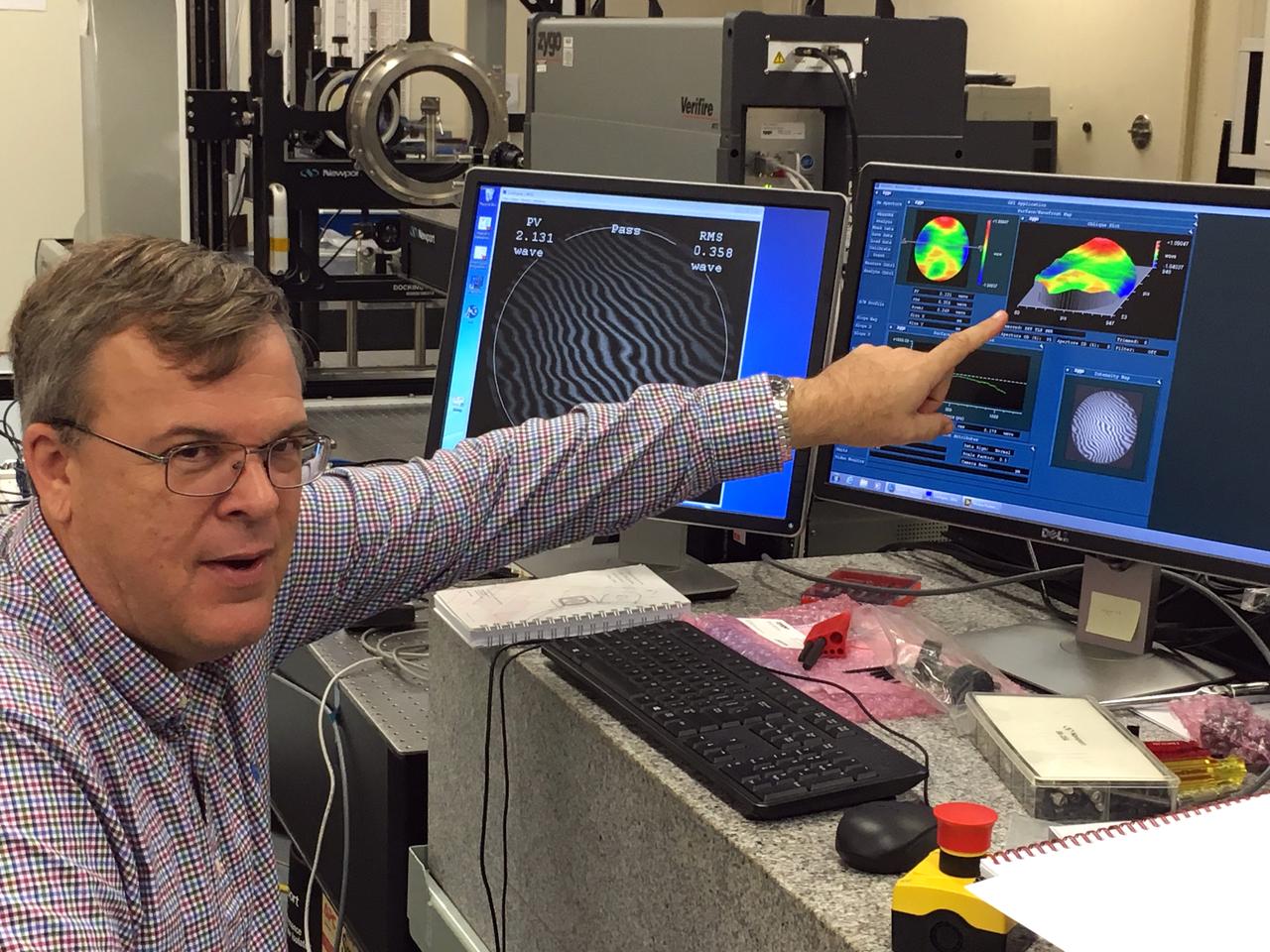
Mark Nurge, Ph.D., a physicist in the Applied Physics Lab with the Exploration Research and Technology Programs at NASA's Kennedy Space Center in Florida, looks at data during the first optical quality test on a full window stack that is ready for installation in the docking hatch of NASA's Orion spacecraft. The data from the tests will help improve the requirements for manufacturing tolerances on Orion's windows and verify how the window should perform in space. Orion is being prepared for its first integrated uncrewed flight atop NASA's Space Launch System rocket on Exploration Mission-1.
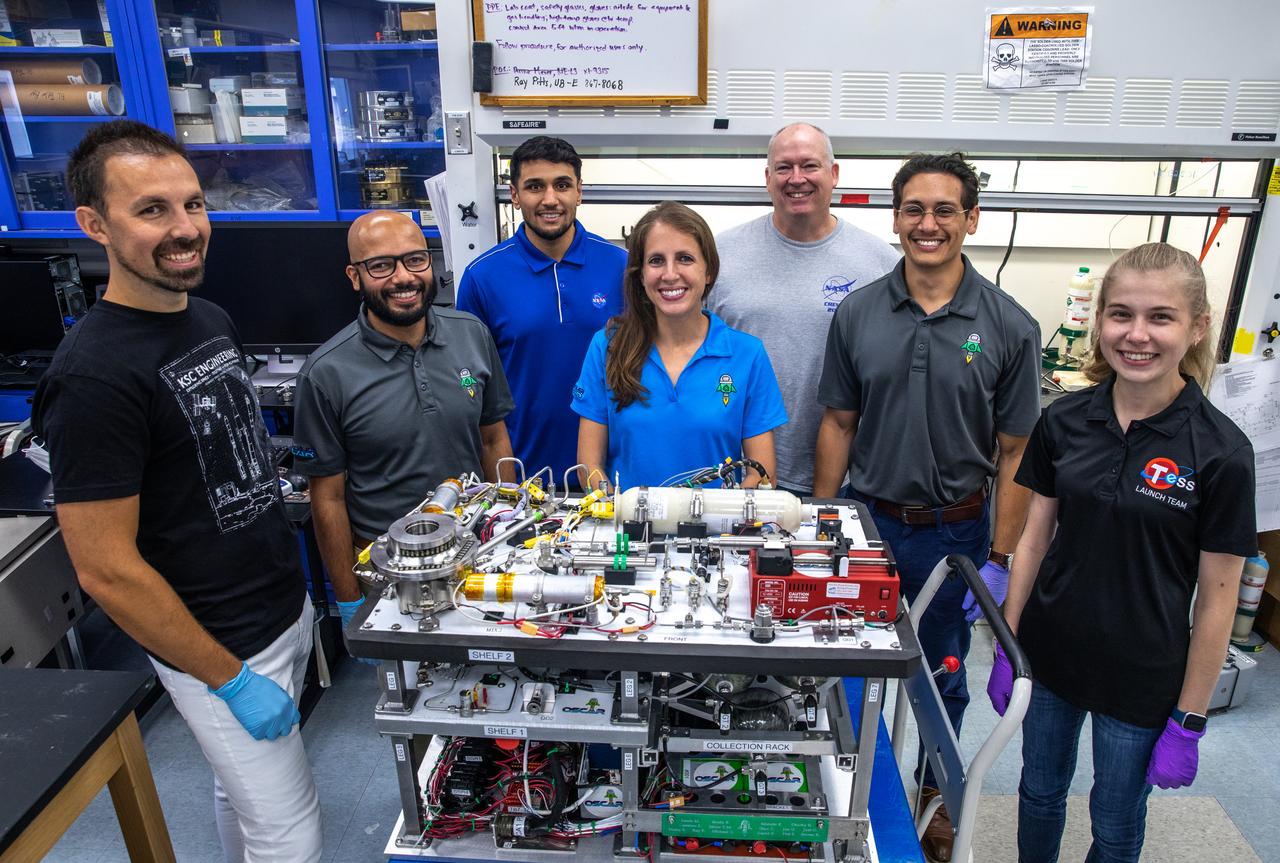
The Trash to Gas team members gather around the flight hardware for NASA’s Orbital Syngas Commodity Augmentation Reactor, or OSCAR, inside the Applied Physics Lab in the Neil Armstrong Operations and Checkout Facility at the agency’s Kennedy Space Center in Florida on July 21, 2022. OSCAR began as an Early Career Initiative project at the spaceport that studies technology to convert trash and human waste into useful gasses such as methane, hydrogen, and carbon dioxide. By processing small pieces of trash in a high-temperature reactor, OSCAR is advancing new and innovative technology for managing waste in space.
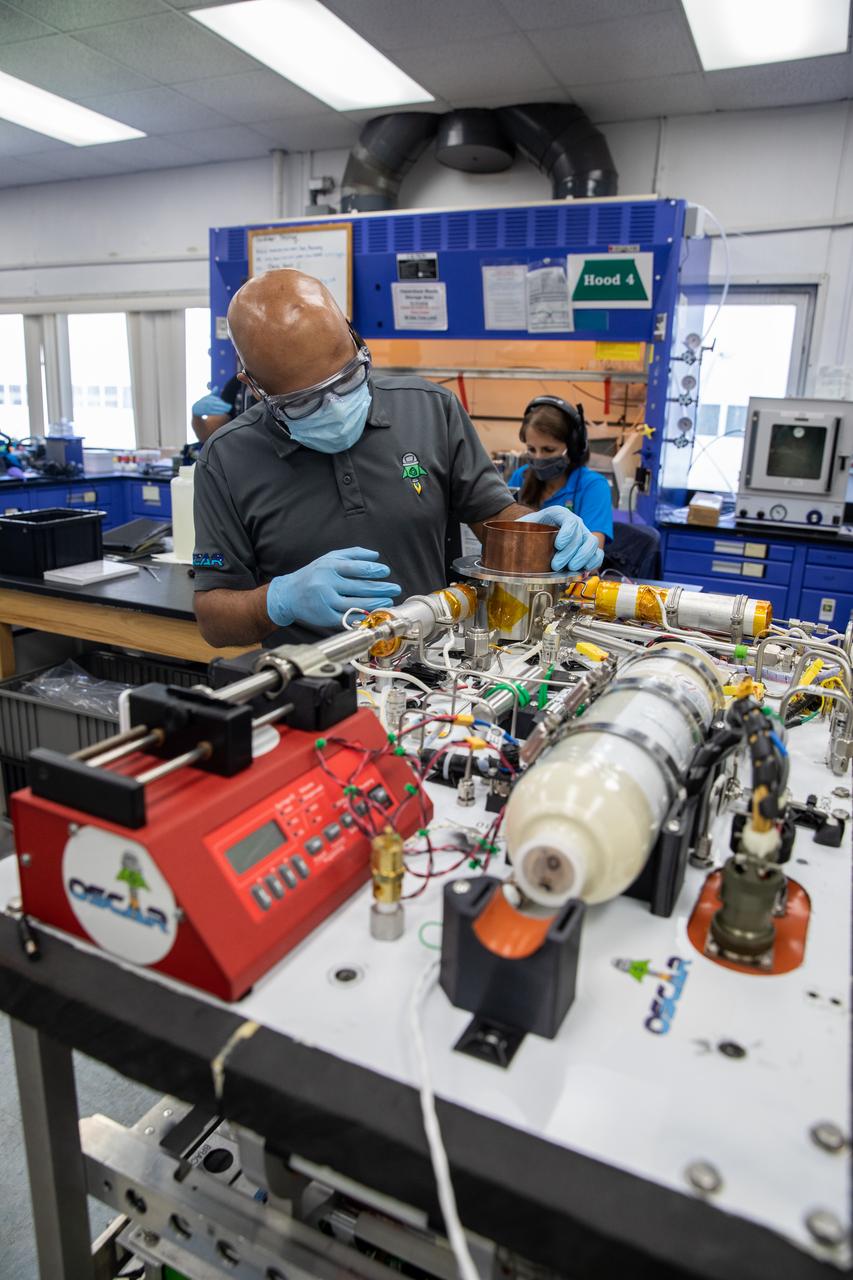
A Trash to Gas team member prepares flight hardware for NASA’s Orbital Syngas Commodity Augmentation Reactor, or OSCAR, inside the Applied Physics Lab in the Neil Armstrong Operations and Checkout Facility at the agency’s Kennedy Space Center in Florida on July 21, 2022. OSCAR began as an Early Career Initiative project at the spaceport that studies technology to convert trash and human waste into useful gasses such as methane, hydrogen, and carbon dioxide. By processing small pieces of trash in a high-temperature reactor, OSCAR is advancing new and innovative technology for managing waste in space.

The Trash to Gas team members prepare flight hardware for NASA’s Orbital Syngas Commodity Augmentation Reactor, or OSCAR, inside Applied Physics lab in the Neil Armstrong Operations and Checkout Facility at the agency’s Kennedy Space Center in Florida on July 21, 2022. OSCAR began as an Early Career Initiative project at the spaceport that studies technology to convert trash and human waste into useful gasses such as methane, hydrogen, and carbon dioxide. By processing small pieces of trash in a high-temperature reactor, OSCAR is advancing new and innovative technology for managing waste in space.
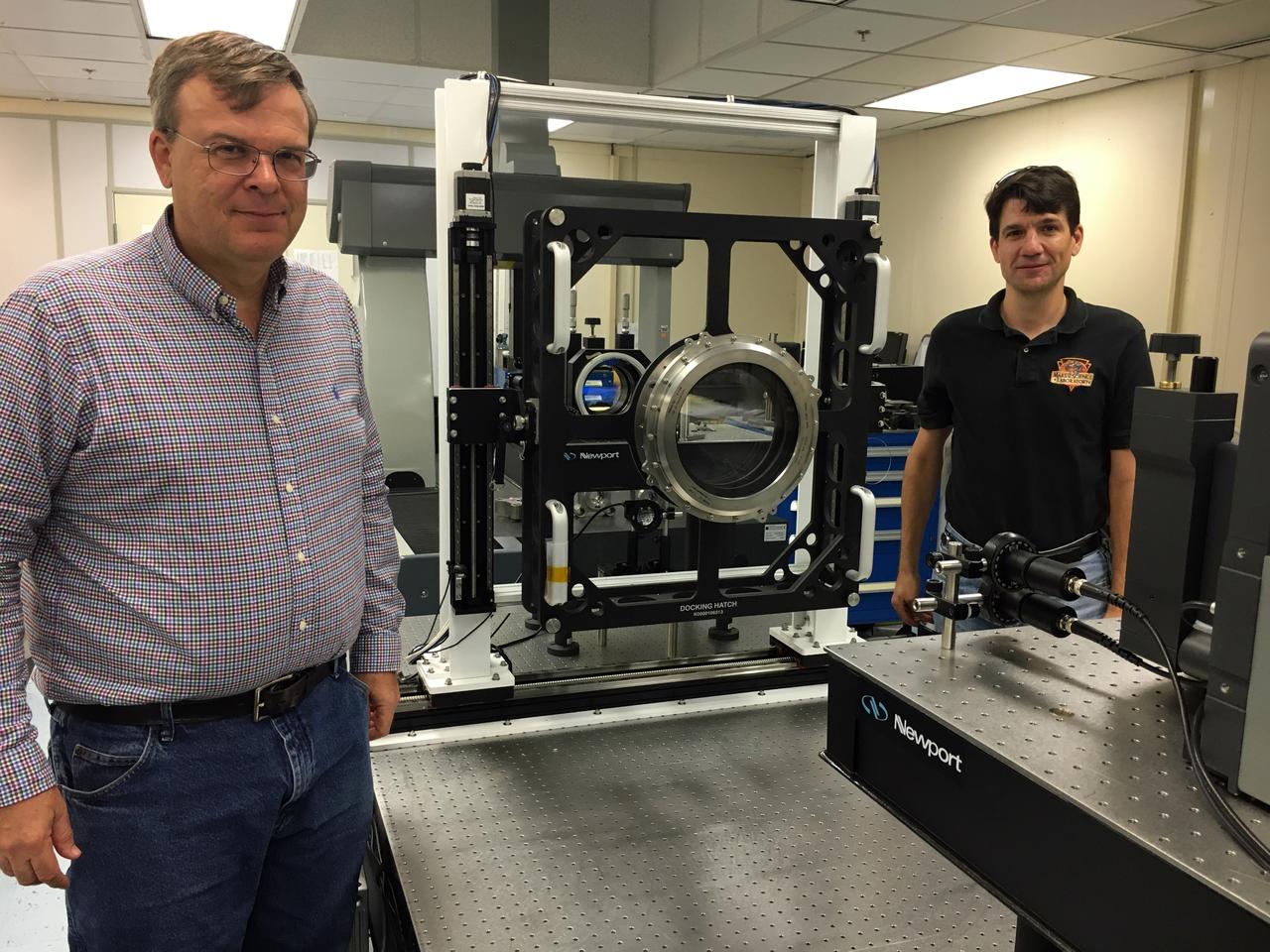
Inside a laboratory in the Neil Armstrong Operations and Checkout Building at NASA's Kennedy Space Center in Florida, Mark Nurge, Ph.D., at left, a physicist in the Applied Physics Lab with the center's Exploration Research and Technology Programs, and Bence Bartha, Ph.D., a specialist in non-destructive testing with URS Federal Services, are performing the first optical quality testing on a full window stack that is ready for installation in the docking hatch of NASA's Orion spacecraft. The data from the tests will help improve the requirements for manufacturing tolerances on Orion's windows and verify how the window should perform in space. Orion is being prepared for its first integrated uncrewed flight atop NASA's Space Launch System rocket on Exploration Mission-1.
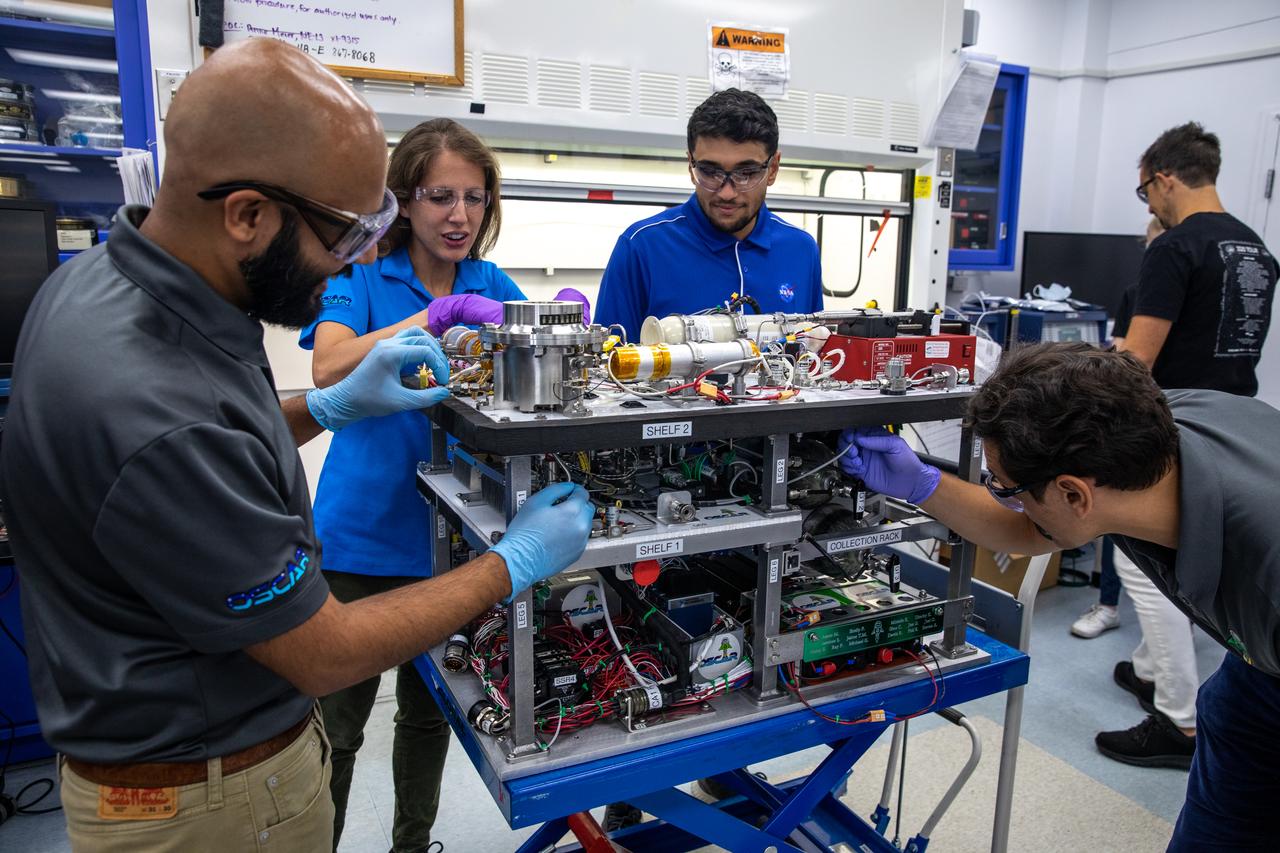
The Trash to Gas team members prepare flight hardware for NASA’s Orbital Syngas Commodity Augmentation Reactor, or OSCAR, inside the Applied Physics Lab in the Neil Armstrong Operations and Checkout Facility at the agency’s Kennedy Space Center in Florida on July 21, 2022. OSCAR began as an Early Career Initiative project at the spaceport that studies technology to convert trash and human waste into useful gasses such as methane, hydrogen, and carbon dioxide. By processing small pieces of trash in a high-temperature reactor, OSCAR is advancing new and innovative technology for managing waste in space.

Principal investigator, Dr. Janine Captain, attaches a mass spectrometer sensor to electronics inside a vacuum chamber in the Space Station Processing Facility high bay at NASA’s Kennedy Space Center on Dec. 12, 2018. The Mass Spectrometer observing lunar operations (MSolo) instrument is a commercial off-the-shelf mass instrument modified to work in space, and can identify molecules at lunar landing sites. These MSolo instruments are part of NASA’s efforts to return to the Moon with the Commercial Lunar Payload Services Landers Program.
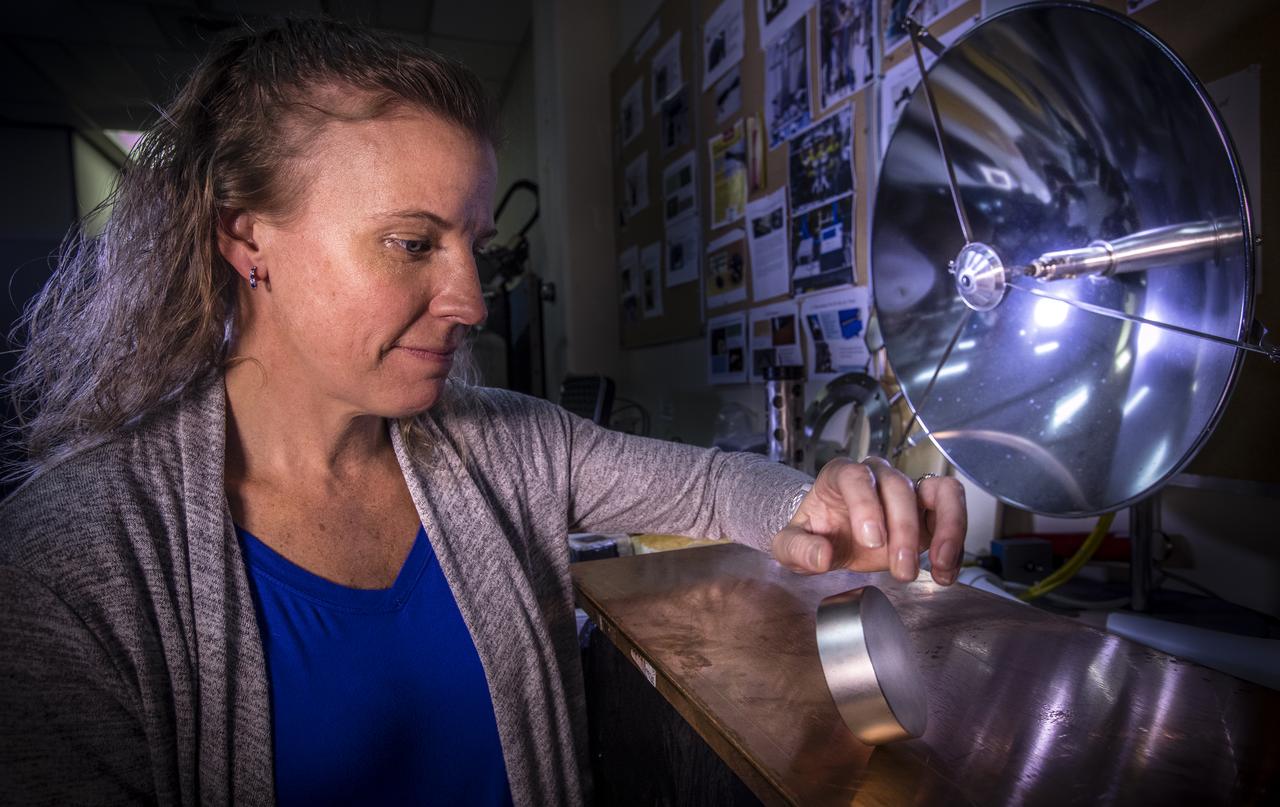
Principal investigator, Dr. Janine Captain, demonstrates the effects of moving a magnet against metal in the Applied Physics Laboratory at NASA’s Kennedy Space Center on Dec. 12, 2018. When dropped or tipped over on a plate of copper, the magnet decelerates and slowly touches down on the plate visually demonstrating the physics of the magnetic field.
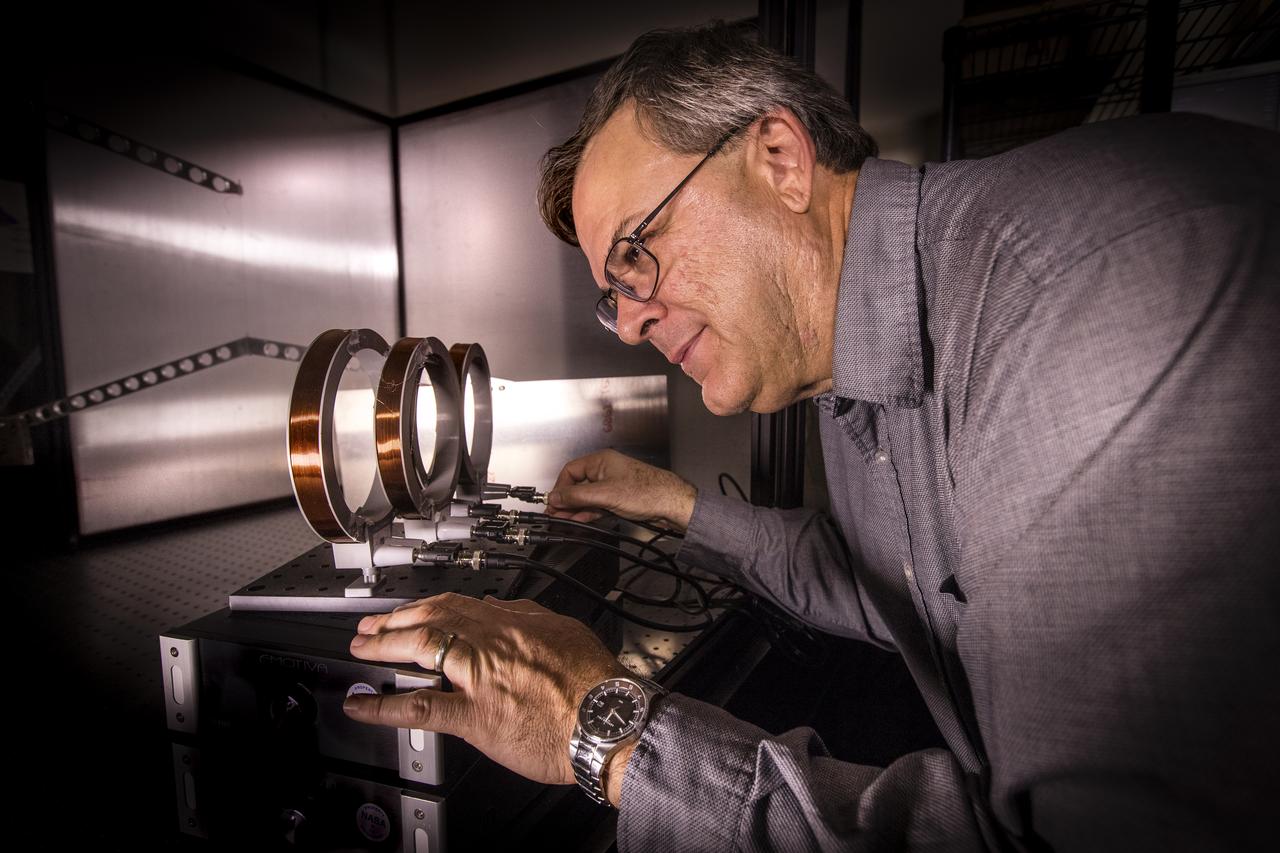
Dr. Mark Nurge, a physicist in the Applied Physics Laboratory at NASA’s Kennedy Space Center adjusted cables on an experiment setup on Dec. 12, 2018. The experiment seeks to find new methods of propulsion based on electromagnetism that could be used in robots to service the International Space Station.
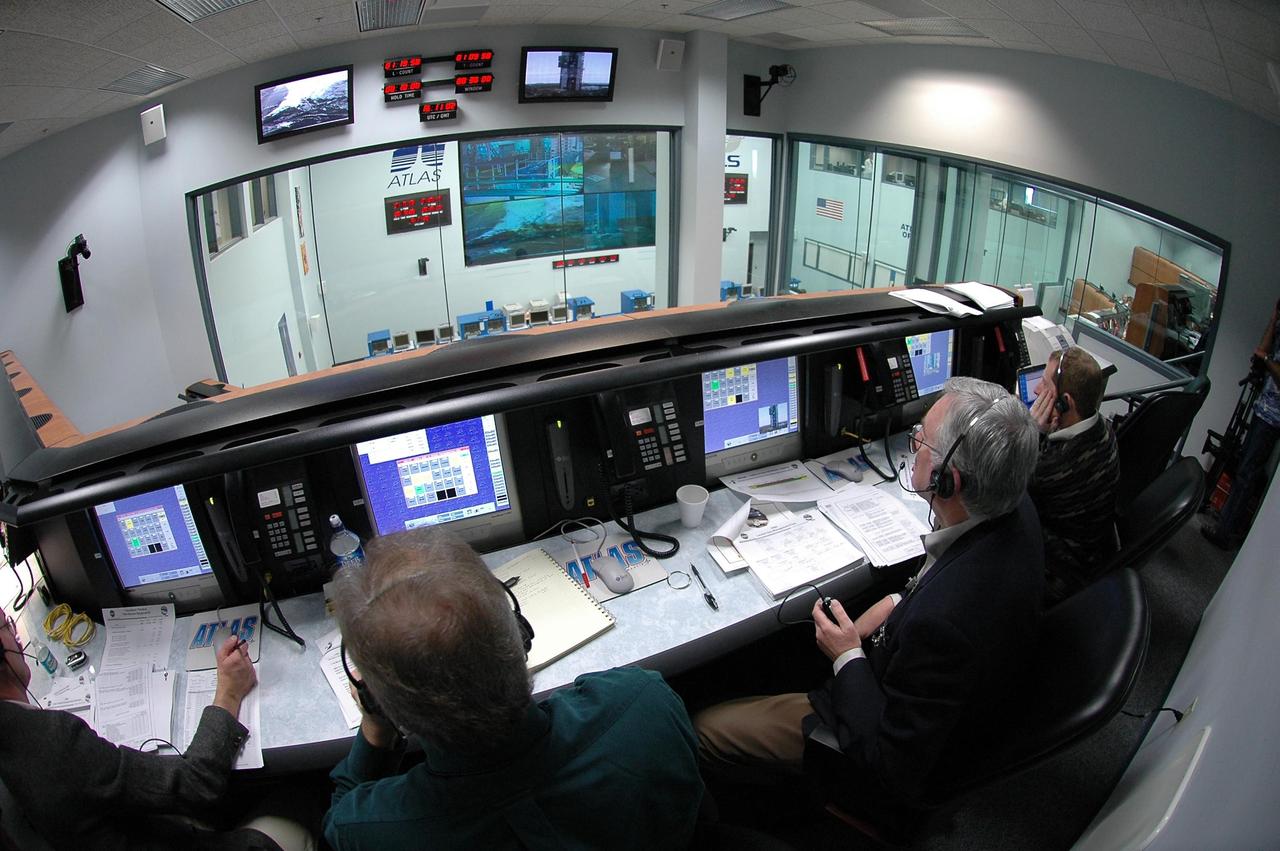
KENNEDY SPACE CENTER, FLA. - At their consoles in the Atlas V Spaceflight Operations Center on Cape Canaveral Air Force Station, members of the New Horizons team take part in a dress rehearsal for the launch scheduled in mid-January. Seen here (left to right) are David Kusnierkiewicz, New Horizons mission system engineer; Glen Fountain, Applied Physics Lab project manager; and Alan Stern, principal investigator from Southwest Research Institute. New Horizons carries seven scientific instruments that will characterize the global geology and geomorphology of Pluto and its moon Charon, map their surface compositions and temperatures, and examine Pluto's complex atmosphere. After that, flybys of Kuiper Belt objects from even farther in the solar system may be undertaken in an extended mission. New Horizons is the first mission in NASA's New Frontiers program of medium-class planetary missions. The spacecraft, designed for NASA by the Johns Hopkins University Applied Physics Laboratory in Laurel, Md., will launch aboard a Lockheed Martin Atlas V rocket and fly by Pluto and Charon as early as summer 2015.
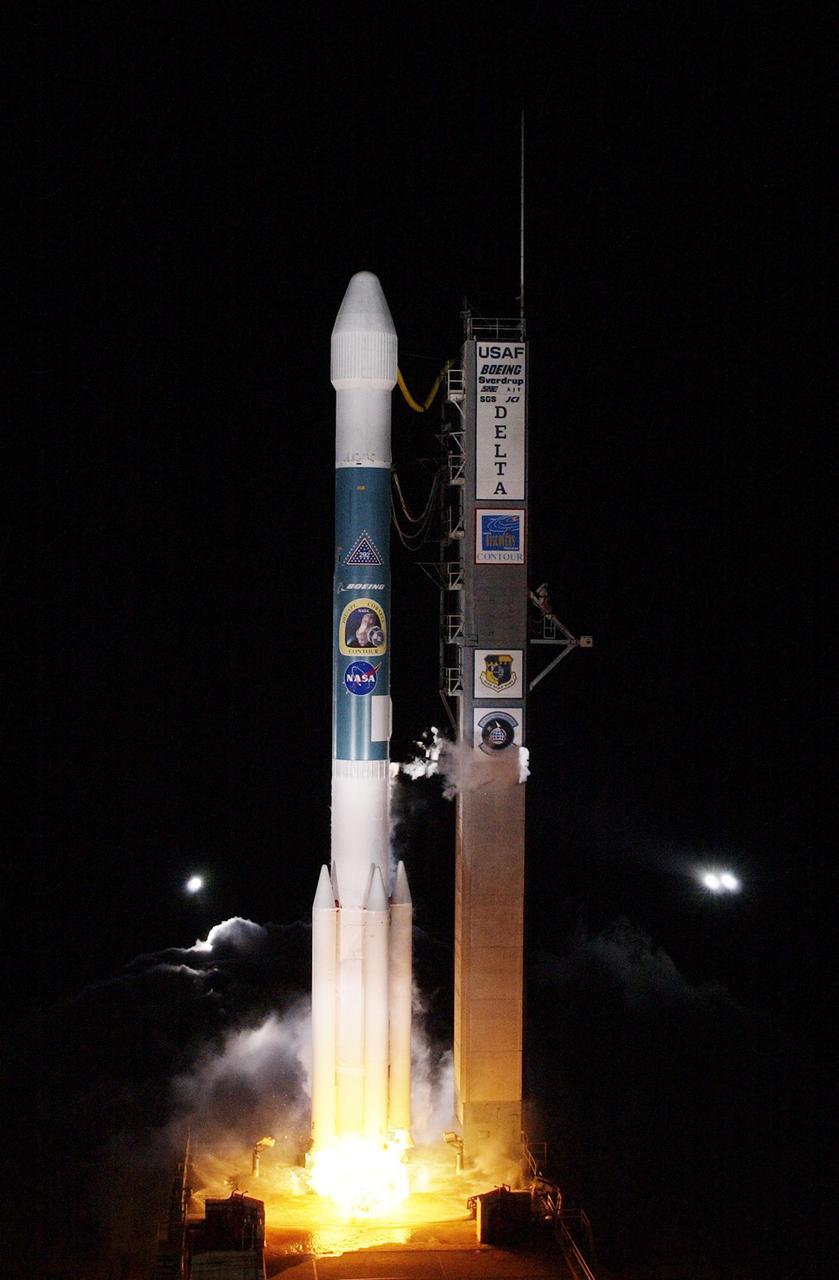
KENNEDY SPACE CENTER, FLA. -- NASA's Comet Nucleus Tour (CONTOUR) spacecraft successfully launches at 2:47 a.m. EDT aboard a Boeing Delta II rocket from Cape Canaveral Air Force Station, Fla. Designed and built by The Johns Hopkins University Applied Physics Laboratory (APL) in Laurel, Md., the 2,138-pound (970-kilogram) spacecraft was placed into an elliptical Earth orbit 63 minutes after launch. About 19 minutes later the mission operations team at APL acquired a signal from the spacecraft through the Deep Space Network antenna station in Goldstone, Calif., and by 5:45 a.m. EDT Mission Director Dr. Robert W. Farquhar of the Applied Physics Lab confirmed the craft was operating normally and ready to carry out its early orbit maneuvers. CONTOUR will orbit Earth until Aug. 15, when it is scheduled to fire its main engine and enter a comet-chasing orbit around the sun. The mission's flexible four-year plan includes encounters with comets Encke (Nov. 12, 2003) and Schwassmann-Wachmann 3 (June 19, 2006), though it can add an encounter with a "new" and scientifically valuable comet from the outer solar system, should one be discovered in time for CONTOUR to fly past it. CONTOUR's four scientific instruments will take detailed pictures and measure the chemical makeup of each comet's nucleus -- a chunk of ice and rock -- while analyzing the surrounding gas and dust.
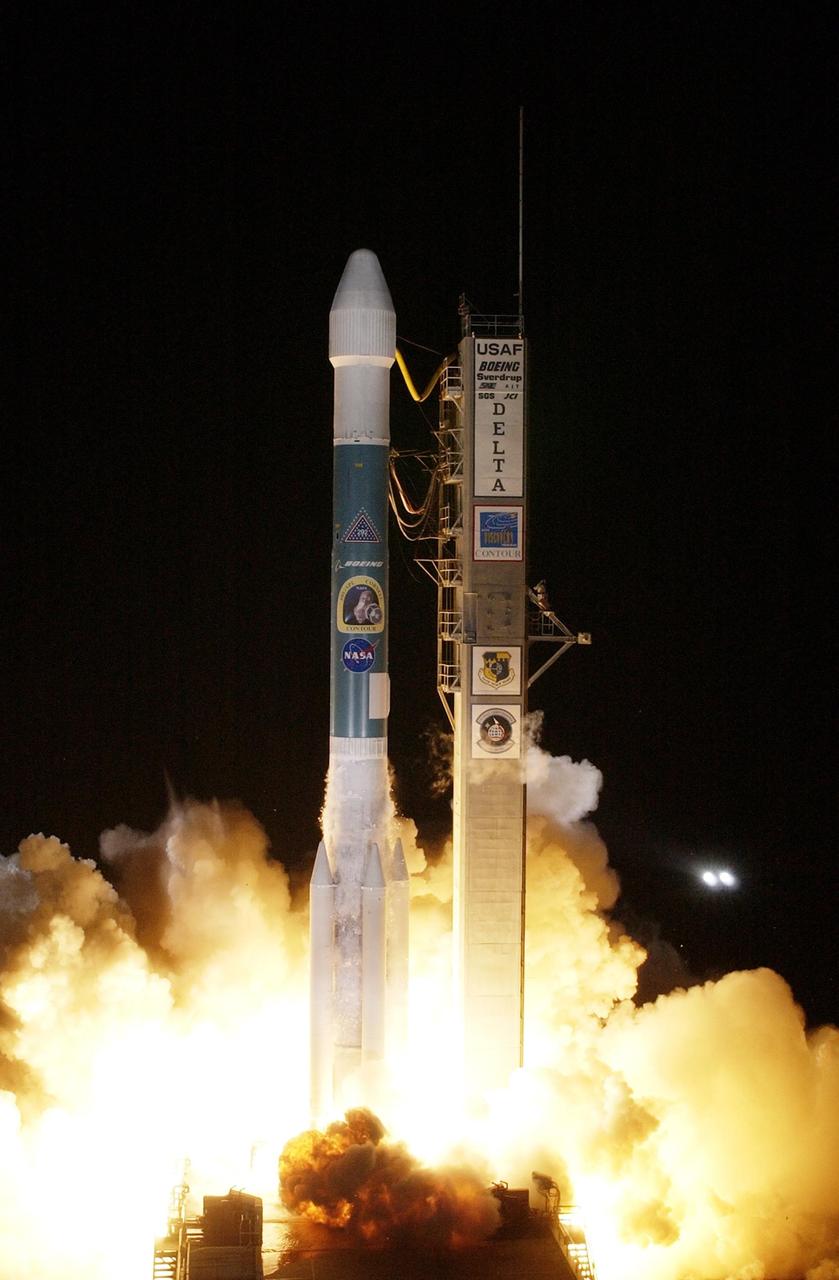
KENNEDY SPACE CENTER, FLA. -- NASA's Comet Nucleus Tour (CONTOUR) spacecraft successfully launches at 2:47 a.m. EDT aboard a Boeing Delta II rocket from Cape Canaveral Air Force Station, Fla. Designed and built by The Johns Hopkins University Applied Physics Laboratory (APL) in Laurel, Md., the 2,138-pound (970-kilogram) spacecraft was placed into an elliptical Earth orbit 63 minutes after launch. About 19 minutes later the mission operations team at APL acquired a signal from the spacecraft through the Deep Space Network antenna station in Goldstone, Calif., and by 5:45 a.m. EDT Mission Director Dr. Robert W. Farquhar of the Applied Physics Lab confirmed the craft was operating normally and ready to carry out its early orbit maneuvers. CONTOUR will orbit Earth until Aug. 15, when it is scheduled to fire its main engine and enter a comet-chasing orbit around the sun. The mission's flexible four-year plan includes encounters with comets Encke (Nov. 12, 2003) and Schwassmann-Wachmann 3 (June 19, 2006), though it can add an encounter with a "new" and scientifically valuable comet from the outer solar system, should one be discovered in time for CONTOUR to fly past it. CONTOUR's four scientific instruments will take detailed pictures and measure the chemical makeup of each comet's nucleus -- a chunk of ice and rock -- while analyzing the surrounding gas and dust.
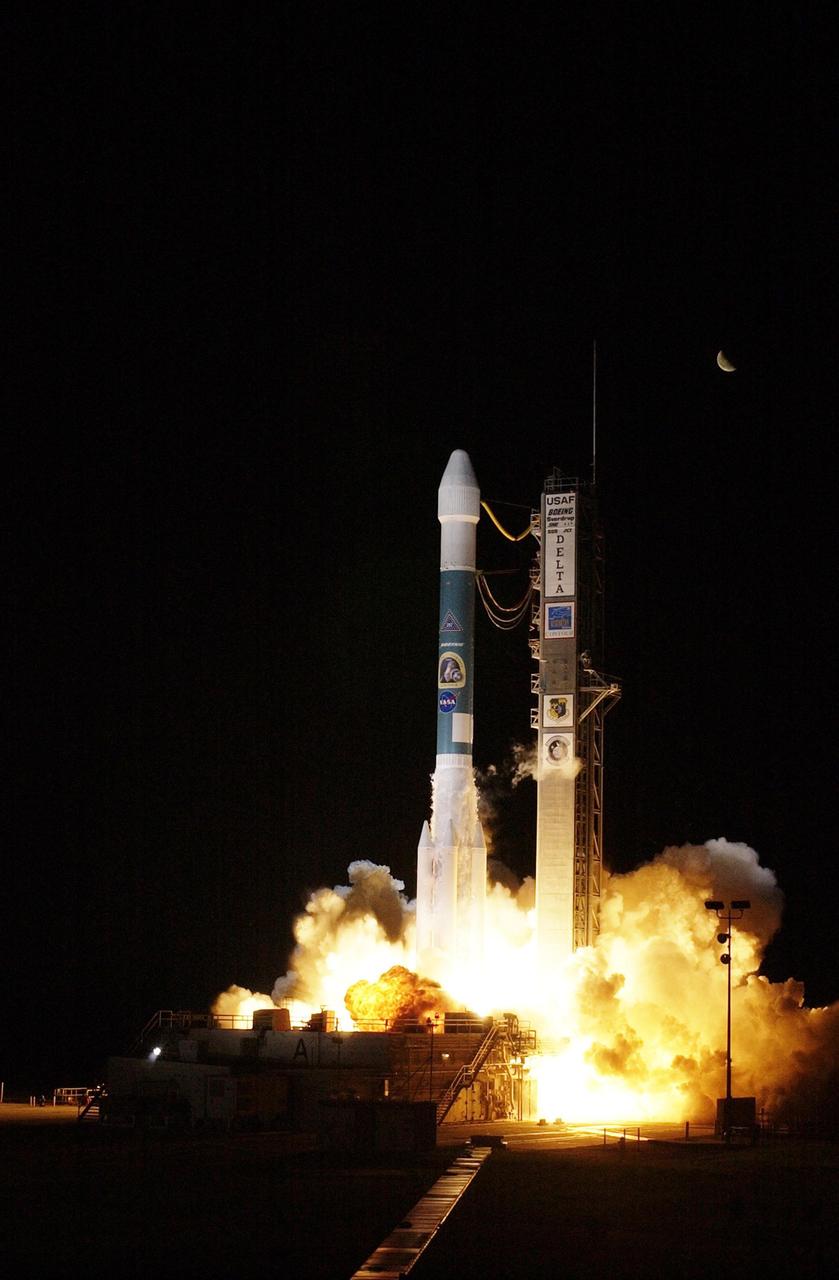
KENNEDY SPACE CENTER, FLA. - A third-quarter moon is the only visible element in the sky as NASA's Comet Nucleus Tour (CONTOUR) spacecraft successfully launches at 2:47 a.m. EDT aboard a Boeing Delta II rocket from Cape Canaveral Air Force Station, Fla. Designed and built by The Johns Hopkins University Applied Physics Laboratory (APL) in Laurel, Md., the 2,138-pound (970-kilogram) spacecraft was placed into an elliptical Earth orbit 63 minutes after launch. About 19 minutes later the mission operations team at APL acquired a signal from the spacecraft through the Deep Space Network antenna station in Goldstone, Calif., and by 5:45 a.m. EDT Mission Director Dr. Robert W. Farquhar of the Applied Physics Lab confirmed the craft was operating normally and ready to carry out its early orbit maneuvers. CONTOUR will orbit Earth until Aug. 15, when it is scheduled to fire its main engine and enter a comet-chasing orbit around the sun. The mission's flexible four-year plan includes encounters with comets Encke (Nov. 12, 2003) and Schwassmann-Wachmann 3 (June 19, 2006), though it can add an encounter with a "new" and scientifically valuable comet from the outer solar system, should one be discovered in time for CONTOUR to fly past it. CONTOUR's four scientific instruments will take detailed pictures and measure the chemical makeup of each comet's nucleus -- a chunk of ice and rock -- while analyzing the surrounding gas and dust.
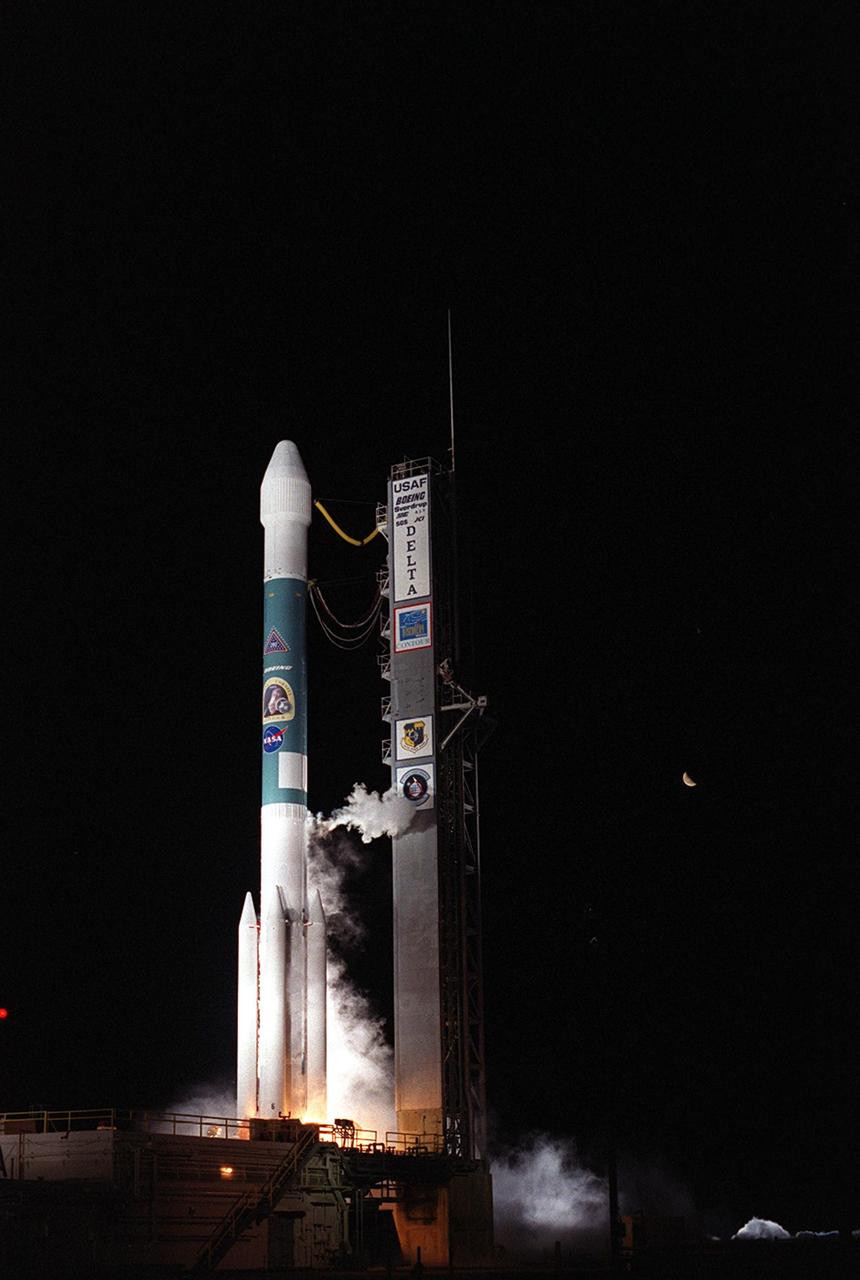
KENNEDY SPACE CENTER, FLA. -- NASA's Comet Nucleus Tour (CONTOUR) spacecraft successfully launches at 2:47:41 a.m. EDT aboard a Boeing Delta II rocket from Cape Canaveral Air Force Station, Fla. Designed and built by The Johns Hopkins University Applied Physics Laboratory (APL) in Laurel, Md., the 2,138-pound (970-kilogram) spacecraft was placed into an elliptical Earth orbit 63 minutes after launch. About 19 minutes later the mission operations team at APL acquired a signal from the spacecraft through the Deep Space Network antenna station in Goldstone, Calif., and by 5:45 a.m. EDT Mission Director Dr. Robert W. Farquhar of the Applied Physics Lab confirmed the craft was operating normally and ready to carry out its early orbit maneuvers. CONTOUR will orbit Earth until Aug. 15, when it is scheduled to fire its main engine and enter a comet-chasing orbit around the sun. The mission's flexible four-year plan includes encounters with comets Encke (Nov. 12, 2003) and Schwassmann-Wachmann 3 (June 19, 2006), though it can add an encounter with a "new" and scientifically valuable comet from the outer solar system, should one be discovered in time for CONTOUR to fly past it. CONTOUR's four scientific instruments will take detailed pictures and measure the chemical makeup of each comet's nucleus -- a chunk of ice and rock -- while analyzing the surrounding gas and dust.
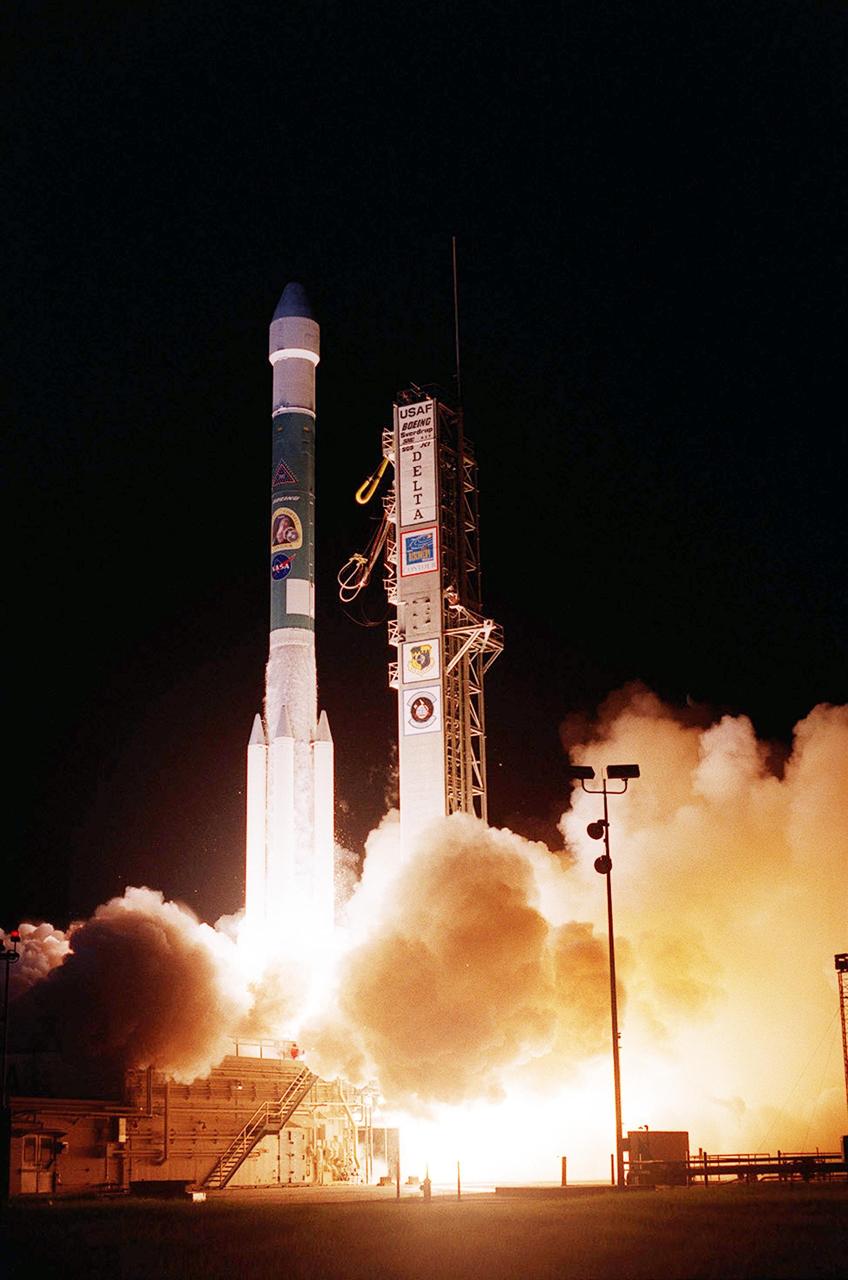
KENNEDY SPACE CENTER, FLA. -- NASA's Comet Nucleus Tour (CONTOUR) spacecraft successfully launches at 2:47:41 a.m. EDT aboard a Boeing Delta II rocket from Cape Canaveral Air Force Station, Fla. Designed and built by The Johns Hopkins University Applied Physics Laboratory (APL) in Laurel, Md., the 2,138-pound (970-kilogram) spacecraft was placed into an elliptical Earth orbit 63 minutes after launch. About 19 minutes later the mission operations team at APL acquired a signal from the spacecraft through the Deep Space Network antenna station in Goldstone, Calif., and by 5:45 a.m. EDT Mission Director Dr. Robert W. Farquhar of the Applied Physics Lab confirmed the craft was operating normally and ready to carry out its early orbit maneuvers. CONTOUR will orbit Earth until Aug. 15, when it is scheduled to fire its main engine and enter a comet-chasing orbit around the sun. The mission's flexible four-year plan includes encounters with comets Encke (Nov. 12, 2003) and Schwassmann-Wachmann 3 (June 19, 2006), though it can add an encounter with a "new" and scientifically valuable comet from the outer solar system, should one be discovered in time for CONTOUR to fly past it. CONTOUR's four scientific instruments will take detailed pictures and measure the chemical makeup of each comet's nucleus -- a chunk of ice and rock -- while analyzing the surrounding gas and dust.

A SpaceX Falcon Heavy rocket carrying NASA’s Europa Clipper spacecraft lifts off from Launch Complex 39A at NASA’s Kennedy Space Center in Florida at 12:06 p.m. EDT on Monday, Oct. 14, 2024. After launch, the spacecraft plans to fly by Mars in February 2025, then back by Earth in December 2026, using the gravity of each planet to increase its momentum. With help of these “gravity assists,” Europa Clipper will achieve the velocity needed to reach Jupiter in April 2030.
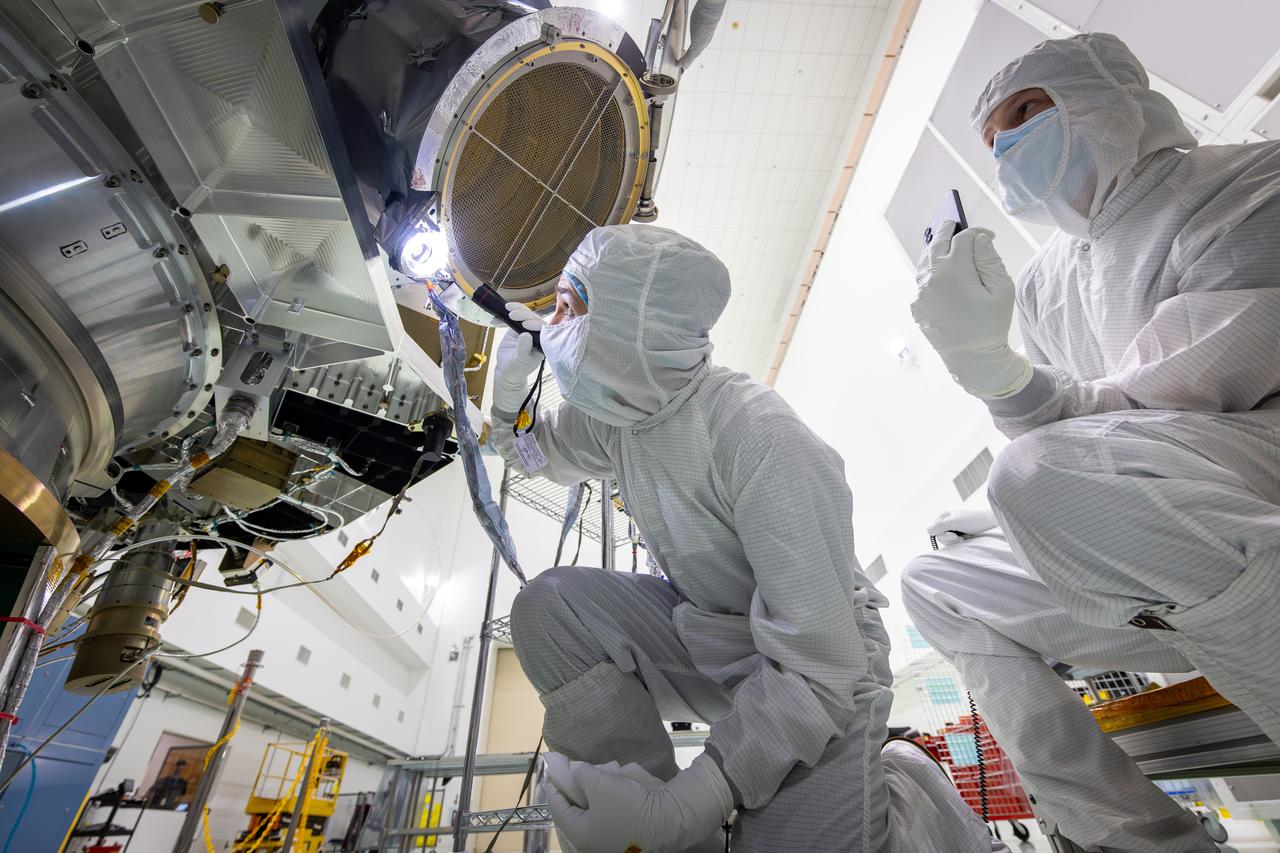
Technicians test the spring-activated door on the Interstellar Dust Experiment (IDEX) instrument of NASA’s IMAP (Interstellar Mapping and Acceleration Probe) observatory inside the high bay at the Astrotech Space Operations Facility near the agency’s Kennedy Space Center in Florida on Tuesday, June 3, 2025. The door will remain closed to protect IDEX from contamination during integration and launch. Once in space, the door will swing open permanently to allow interstellar and interplanetary dust to flow into the instrument for measurement. The IMAP observatory will study how the Sun shapes the boundaries of the heliosphere, the protective bubble around our solar system. Launch is targeted for no earlier than September 2025 aboard a SpaceX Falcon 9 rocket from Launch Complex 39A at NASA Kennedy.
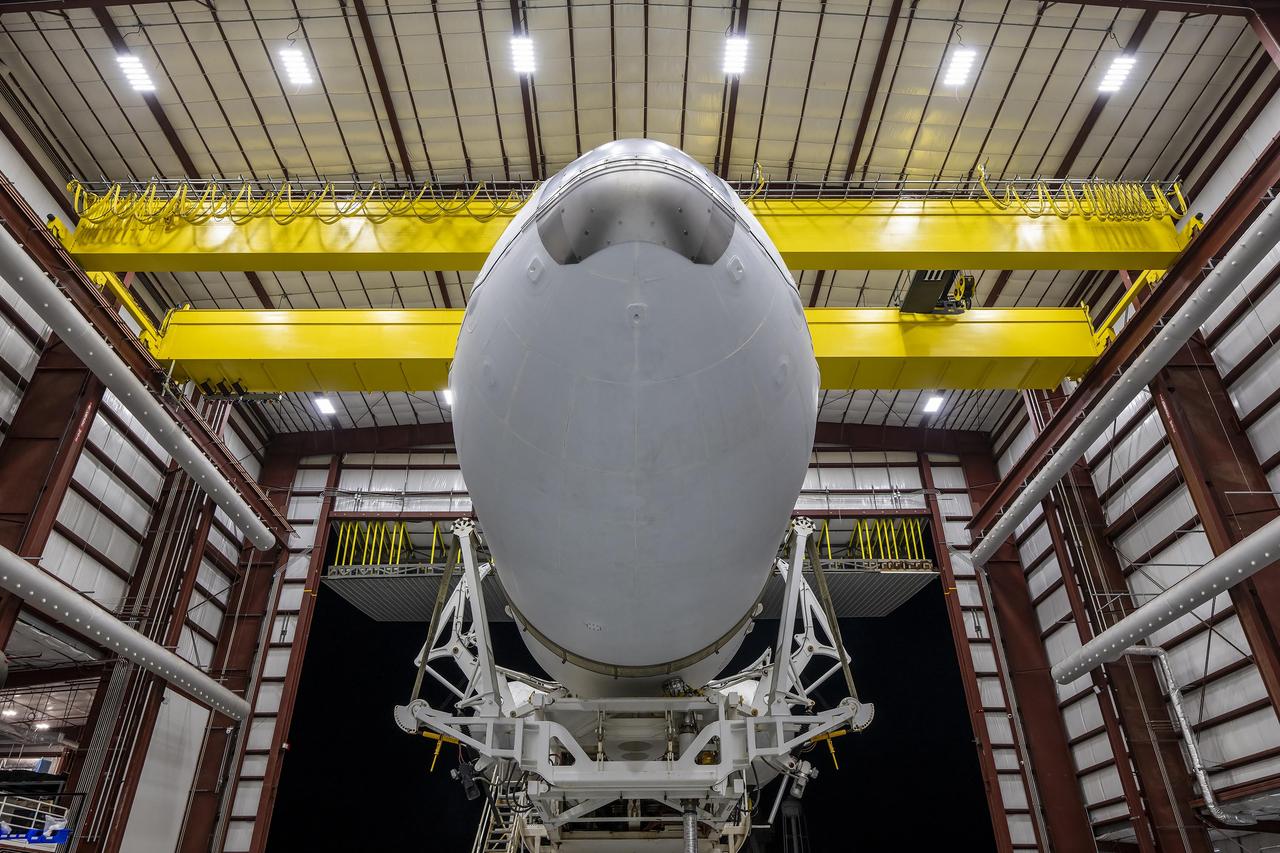
NASA’s Europa Clipper spacecraft attached to SpaceX’s Falcon Heavy rocket, rolls to Launch Pad 39A on Saturday, Oct. 12, 2024, at NASA’s Kennedy Space Center in Florida ahead of launch to Jupiter’s icy moon, Europa. The spacecraft will complete nearly 50 flybys of Europa to determine if there are conditions suitable for life beyond Earth. NASA and SpaceX are targeting launch for Europa Clipper at 12:06 p.m. EDT on Monday, Oct. 14, from Launch Complex 39A at Kennedy Space Center in Florida.
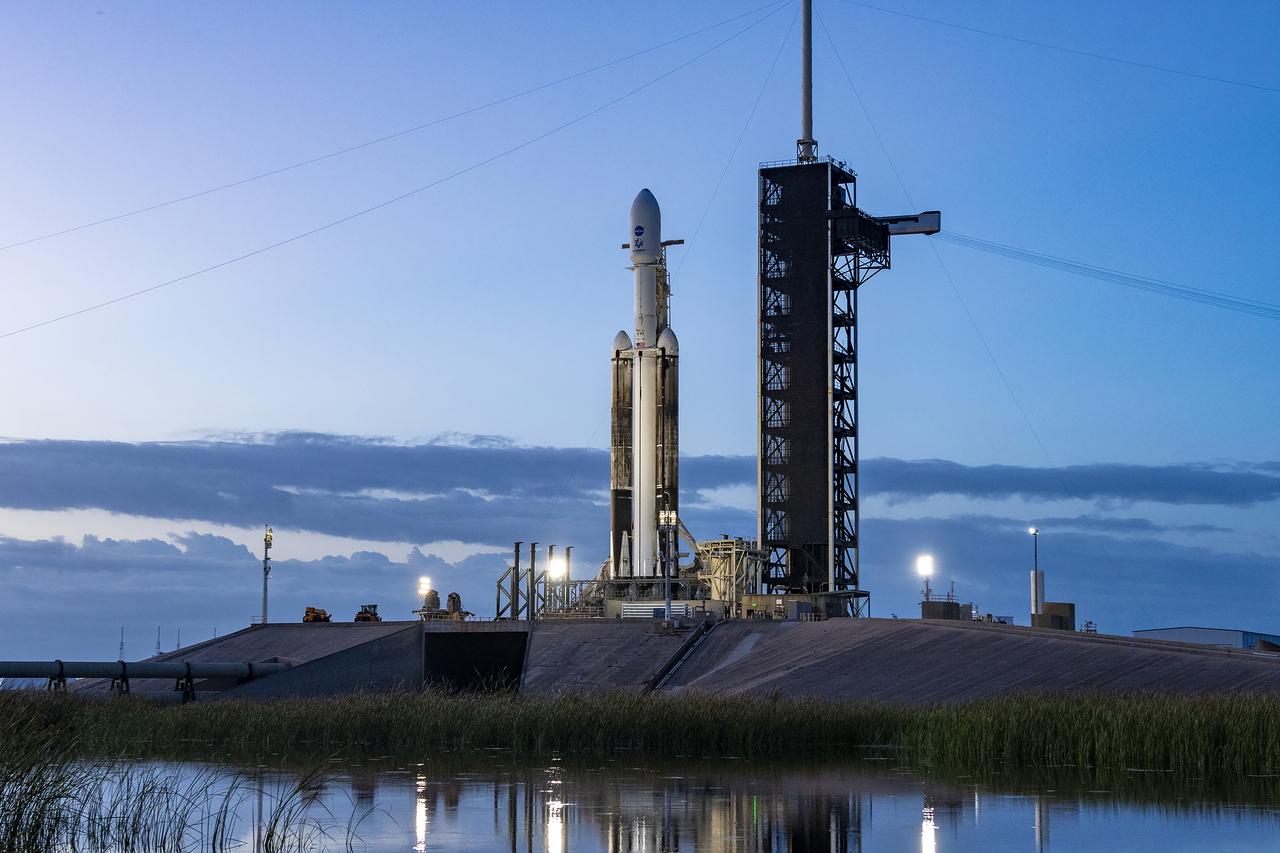
A reflection in the water shows NASA’s Europa Clipper spacecraft atop SpaceX’s Falcon Heavy rocket at Launch Pad 39A on Sunday, Oct. 13, 2024, at the agency’s Kennedy Space Center in Florida ahead of launch to Jupiter’s icy moon, Europa. The spacecraft will complete nearly 50 flybys of Europa to determine if there are conditions suitable for life beyond Earth. Launch is targeting 12:06 p.m. EDT on Monday, Oct. 14, from Launch Complex 39A at Kennedy Space Center in Florida.
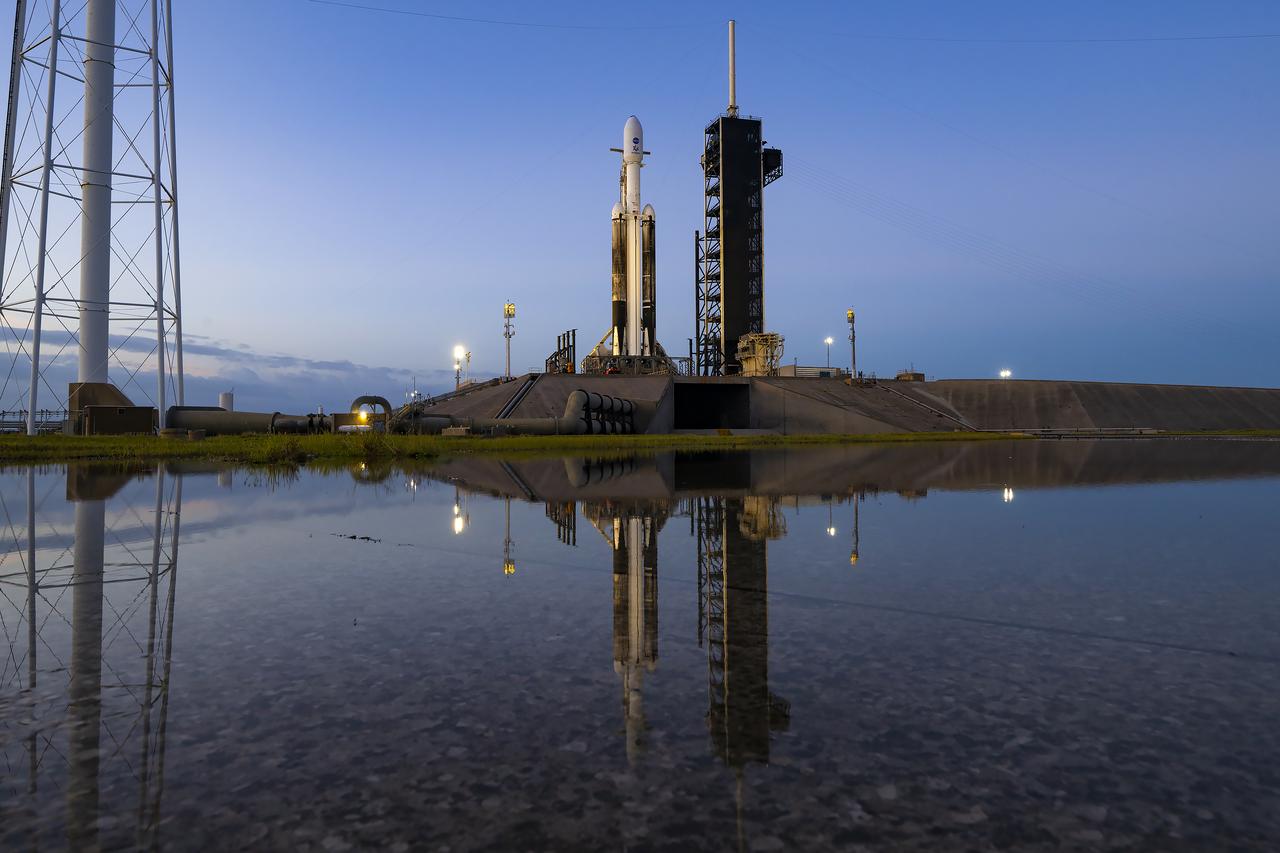
A reflection in the water shows NASA’s Europa Clipper spacecraft atop SpaceX’s Falcon Heavy rocket at Launch Pad 39A on Sunday, Oct. 13, 2024, at the agency’s Kennedy Space Center in Florida ahead of launch to Jupiter’s icy moon, Europa. The spacecraft will complete nearly 50 flybys of Europa to determine if there are conditions suitable for life beyond Earth. Launch is targeting 12:06 p.m. EDT on Monday, Oct. 14, from Launch Complex 39A at Kennedy Space Center in Florida.
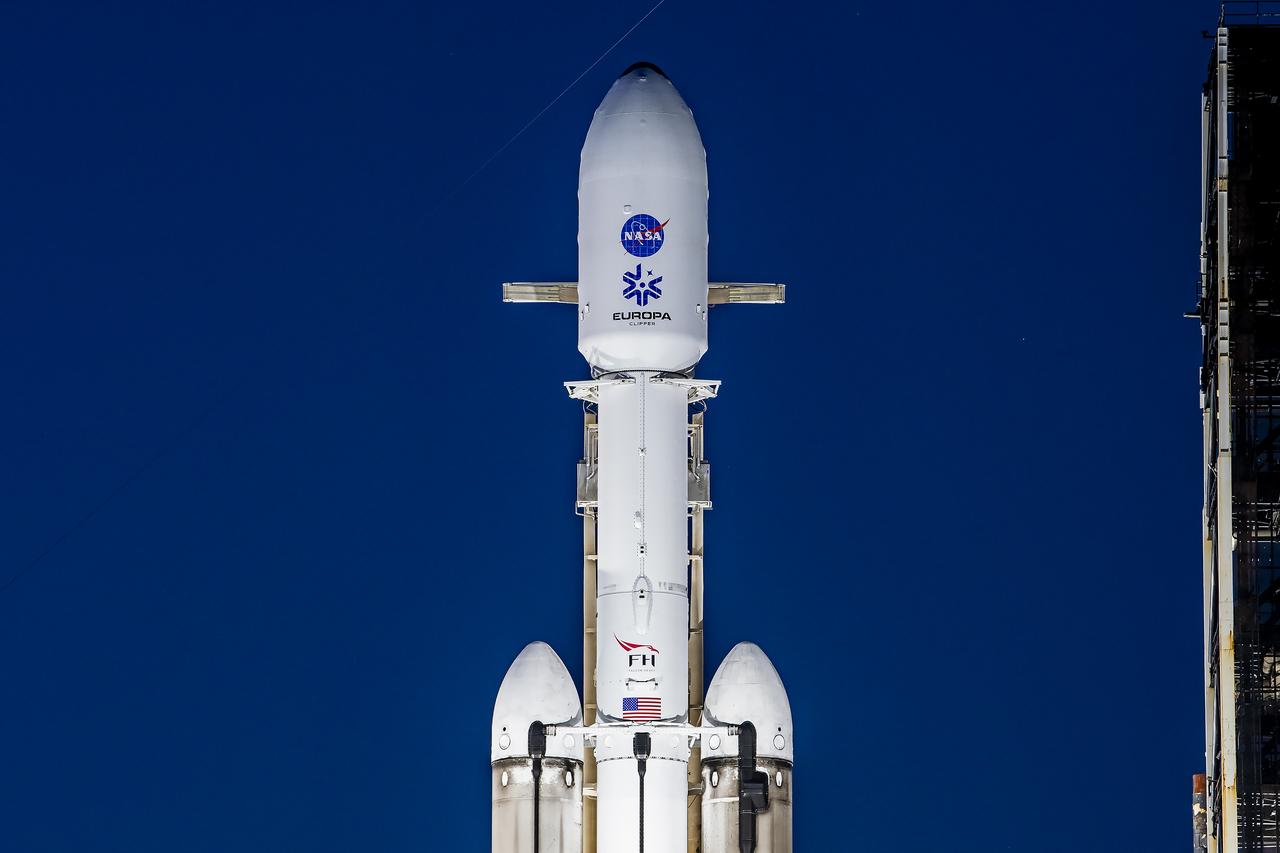
NASA’s Europa Clipper spacecraft sits atop SpaceX’s Falcon Heavy rocket at Launch Pad 39A on Sunday, Oct. 13, 2024, at the agency’s Kennedy Space Center in Florida ahead of launch to Jupiter’s icy moon, Europa. The spacecraft will complete nearly 50 flybys of Europa to determine if there are conditions suitable for life beyond Earth. Launch is targeting 12:06 p.m. EDT on Monday, Oct. 14, from Launch Complex 39A at Kennedy Space Center in Florida.

A SpaceX Falcon Heavy rocket carrying NASA’s Europa Clipper spacecraft lifts off from Launch Complex 39A at NASA’s Kennedy Space Center in Florida at 12:06 p.m. EDT on Monday, Oct. 14, 2024. After launch, the spacecraft plans to fly by Mars in February 2025, then back by Earth in December 2026, using the gravity of each planet to increase its momentum. With help of these “gravity assists,” Europa Clipper will achieve the velocity needed to reach Jupiter in April 2030.
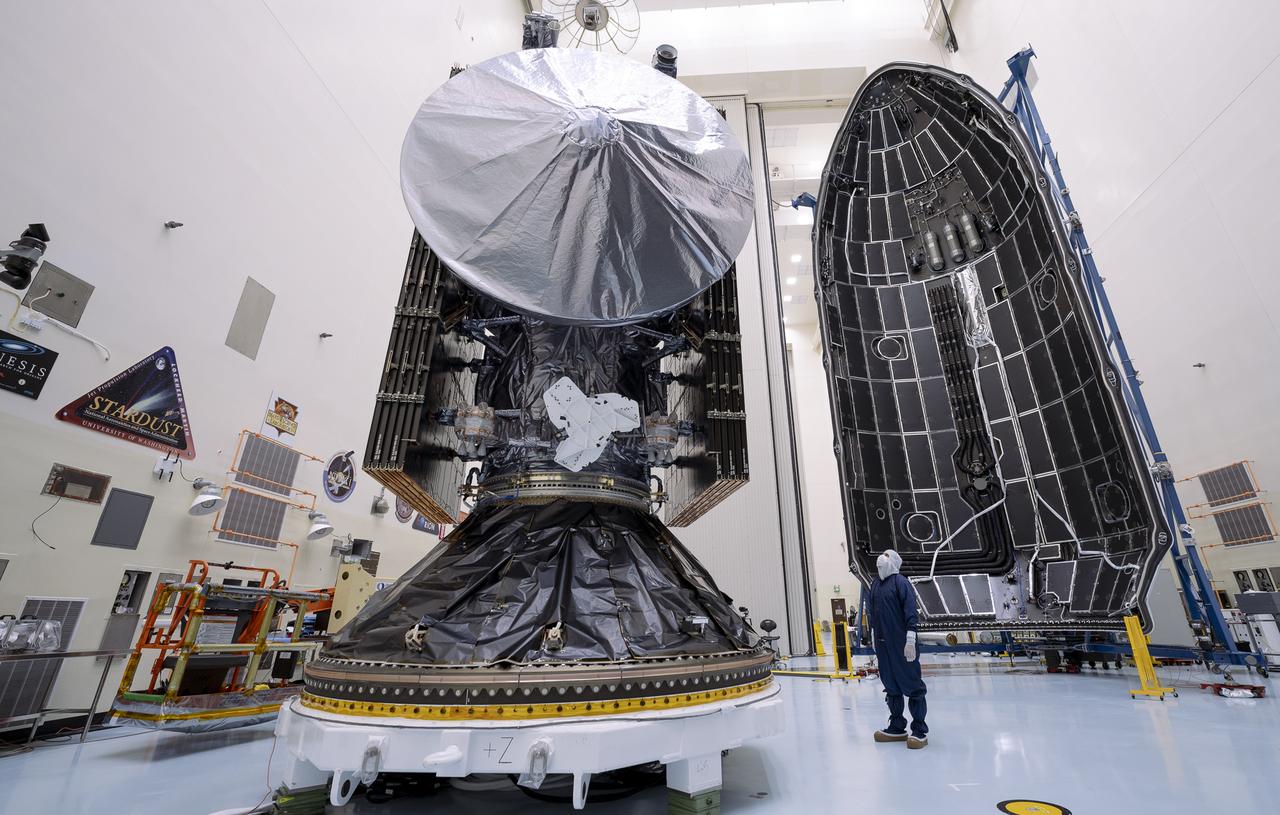
Technicians prepare to encapsulate NASA’s Europa Clipper spacecraft inside SpaceX’s Falcon Heavy payload fairing in the Payload Hazardous Servicing Facility at NASA’s Kennedy Space Center in Florida on Wednesday, Oct. 2, 2024. The payload fairing will protect the spacecraft during liftoff from Launch Complex 39A on its journey to explore Jupiter’s icy moon, Europa. The spacecraft will complete nearly 50 flybys of Jupiter’s icy moon, Europa, to determine if there are conditions suitable for life beyond Earth.
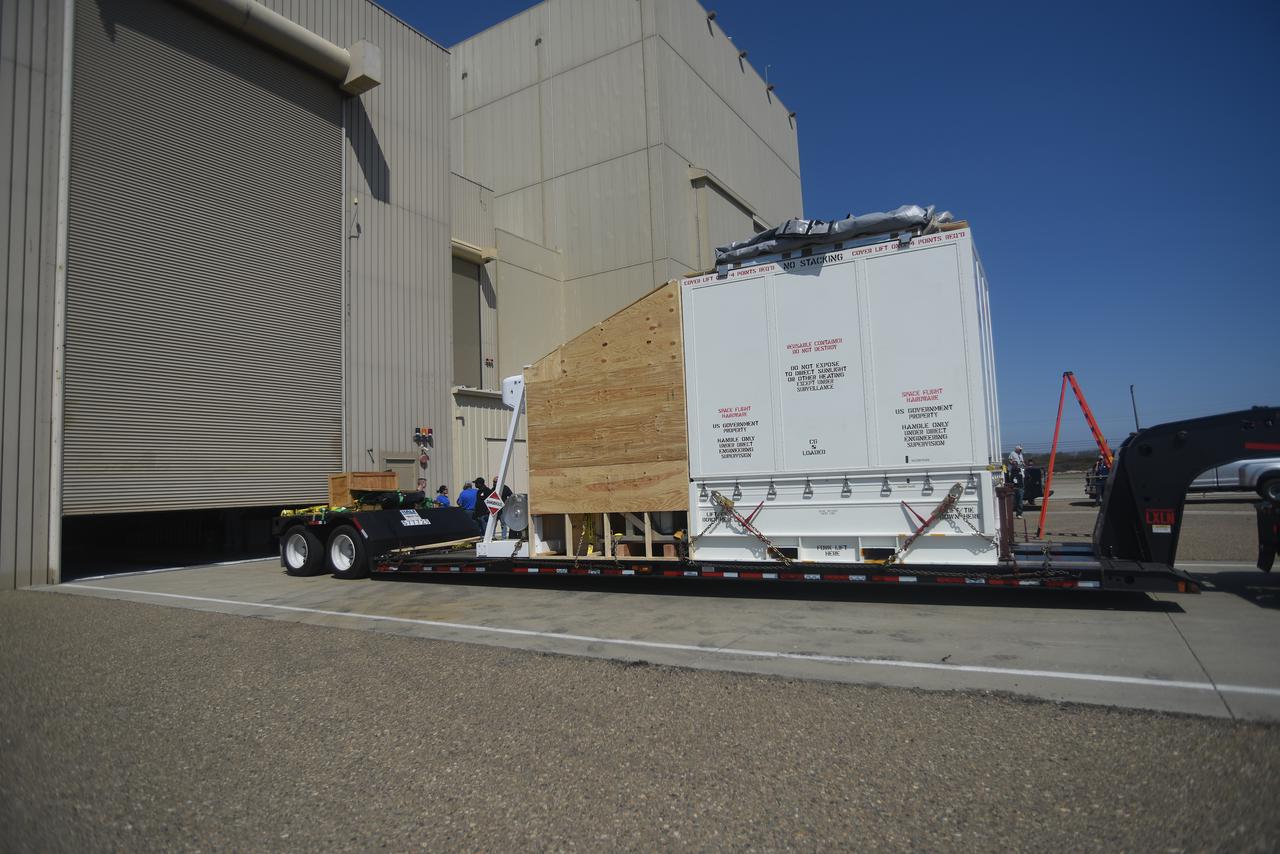
NASA’s Double Asteroid Redirection Test (DART) spacecraft, packed in its shipping container, arrives by truck at the entrance to the Astrotech Space Operations Facility at Vandenberg Space Force Base in California on Oct. 2, 2021. Inside the facility, workers will unpack the spacecraft and complete a series of final tests and checkouts to confirm it is ready for launch. DART is the first mission to test technologies for preventing an impact of Earth by a hazardous asteroid. The mission is targeted to launch on Nov. 23, 2021, aboard a SpaceX Falcon 9 rocket from Vandenberg. NASA’s Launch Services Program, based at Kennedy Space Center, America’s multi-user spaceport, is managing the launch.
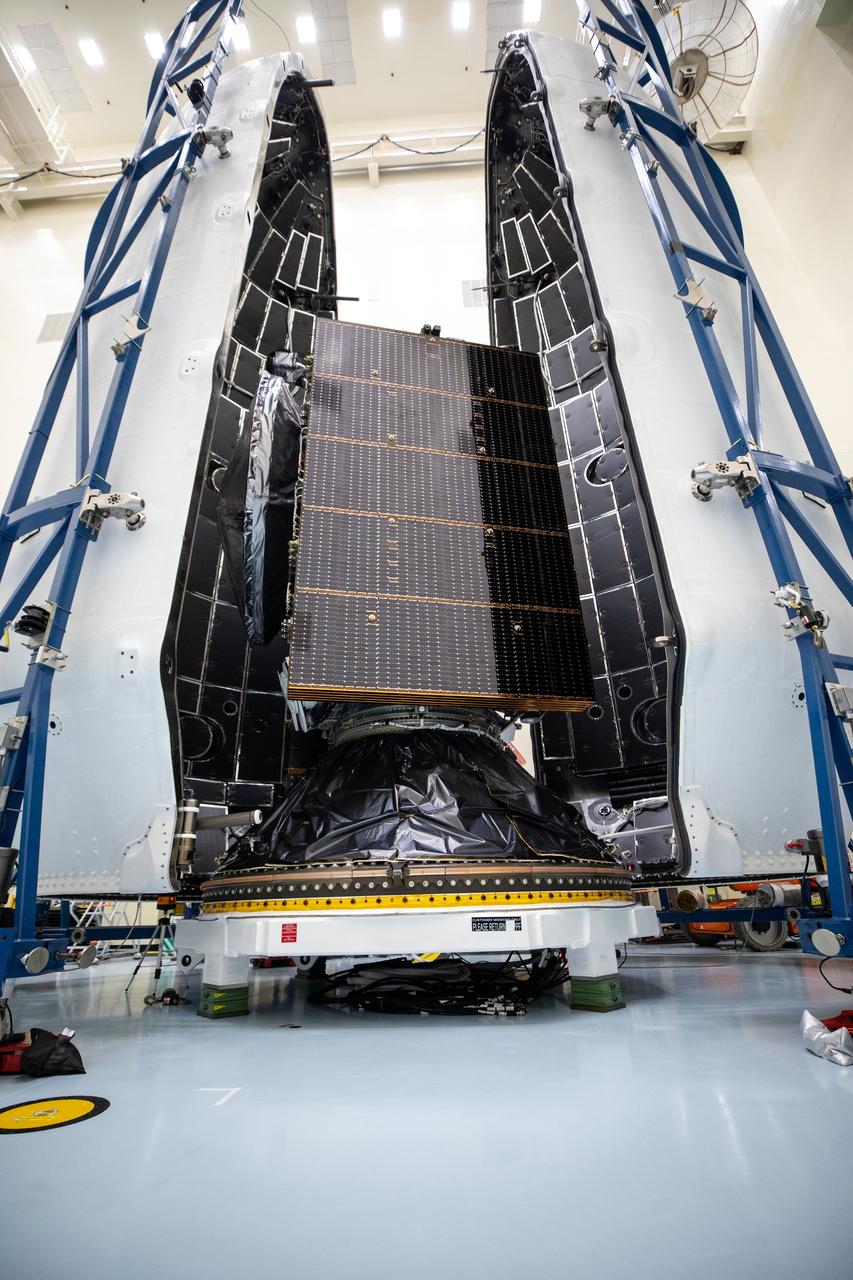
Technicians encapsulated NASA’s Europa Clipper spacecraft inside payload fairings on Wednesday, Oct. 2, 2024, in the Payload Hazardous Servicing Facility at NASA’s Kennedy Space Center in Florida. The fairings will protect the spacecraft during launch as it begins its journey to explore Jupiter’s icy moon, Europa. The mission will help scientists determine if the moon could support life. NASA and SpaceX are targeting launch at 12:31 p.m. EDT on Thursday, Oct. 10, 2024, from Launch Complex 39A at Kennedy Space Center in Florida.
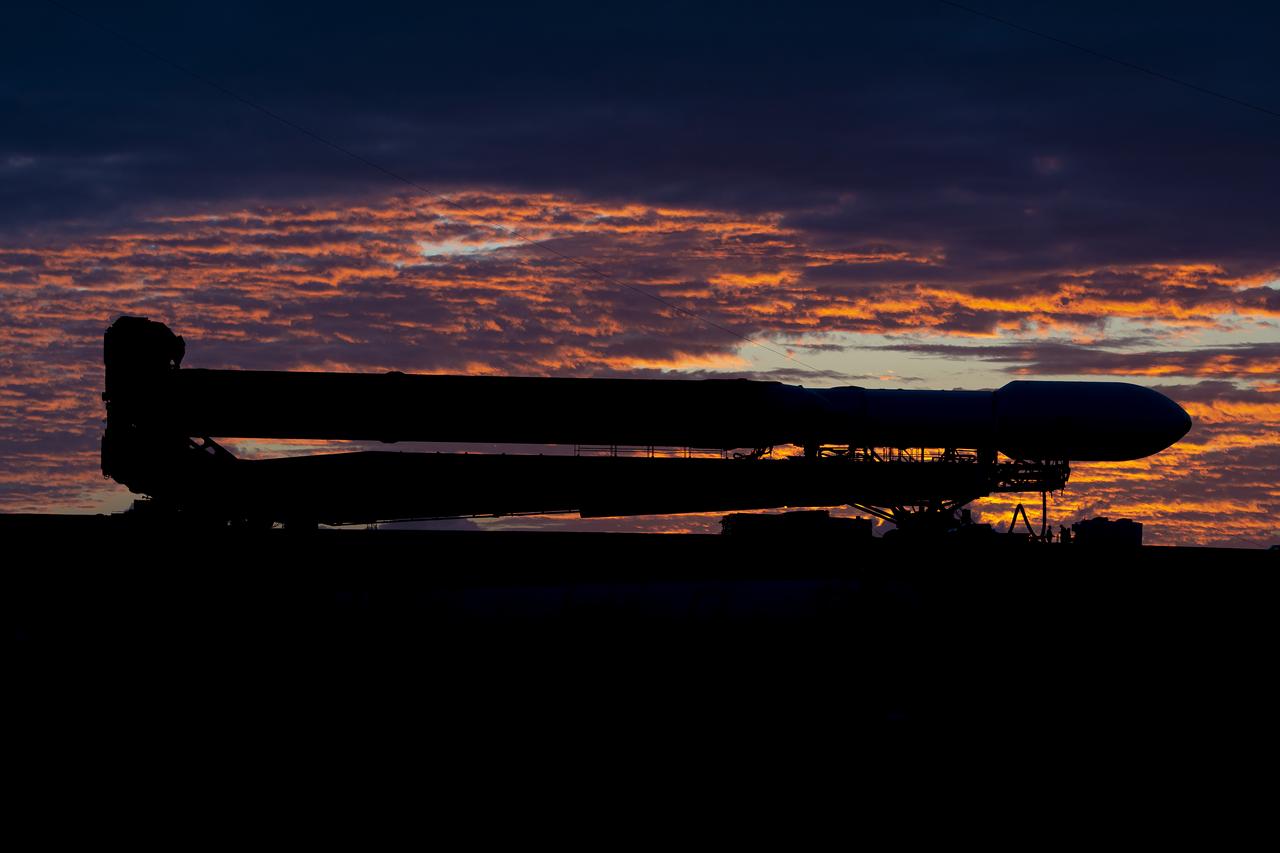
NASA’s Europa Clipper spacecraft attached to SpaceX’s Falcon Heavy rocket, rolls to Launch Pad 39A on Saturday, Oct. 12, 2024, at NASA’s Kennedy Space Center in Florida ahead of launch to Jupiter’s icy moon, Europa. The spacecraft will complete nearly 50 flybys of Europa to determine if there are conditions suitable for life beyond Earth. NASA and SpaceX are targeting launch for Europa Clipper at 12:06 p.m. EDT on Monday, Oct. 14, from Launch Complex 39A at Kennedy Space Center in Florida.

A SpaceX Falcon Heavy rocket carrying NASA’s Europa Clipper spacecraft lifts off from Launch Complex 39A at NASA’s Kennedy Space Center in Florida at 12:06 p.m. EDT on Monday, Oct. 14, 2024. After launch, the spacecraft plans to fly by Mars in February 2025, then back by Earth in December 2026, using the gravity of each planet to increase its momentum. With help of these “gravity assists,” Europa Clipper will achieve the velocity needed to reach Jupiter in April 2030.

A SpaceX Falcon Heavy rocket carrying NASA’s Europa Clipper spacecraft lifts off from Launch Complex 39A at NASA’s Kennedy Space Center in Florida at 12:06 p.m. EDT on Monday, Oct. 14, 2024. After launch, the spacecraft plans to fly by Mars in February 2025, then back by Earth in December 2026, using the gravity of each planet to increase its momentum. With help of these “gravity assists,” Europa Clipper will achieve the velocity needed to reach Jupiter in April 2030.
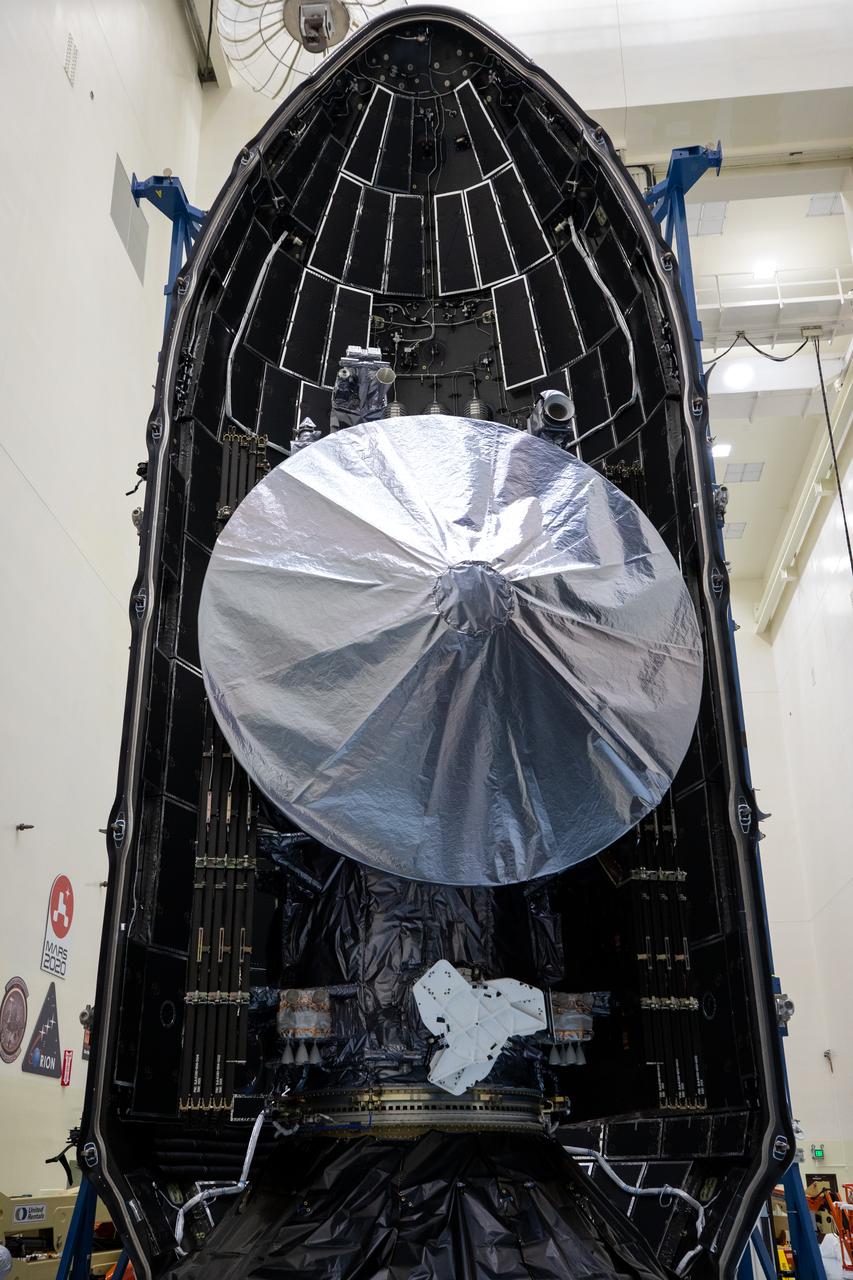
Technicians encapsulated NASA’s Europa Clipper spacecraft inside payload fairings on Wednesday, Oct. 2, 2024, in the Payload Hazardous Servicing Facility at NASA’s Kennedy Space Center in Florida. The fairings will protect the spacecraft during launch as it begins its journey to explore Jupiter’s icy moon, Europa. The mission will help scientists determine if the moon could support life. NASA and SpaceX are targeting launch at 12:31 p.m. EDT on Thursday, Oct. 10, 2024, from Launch Complex 39A at Kennedy Space Center in Florida.
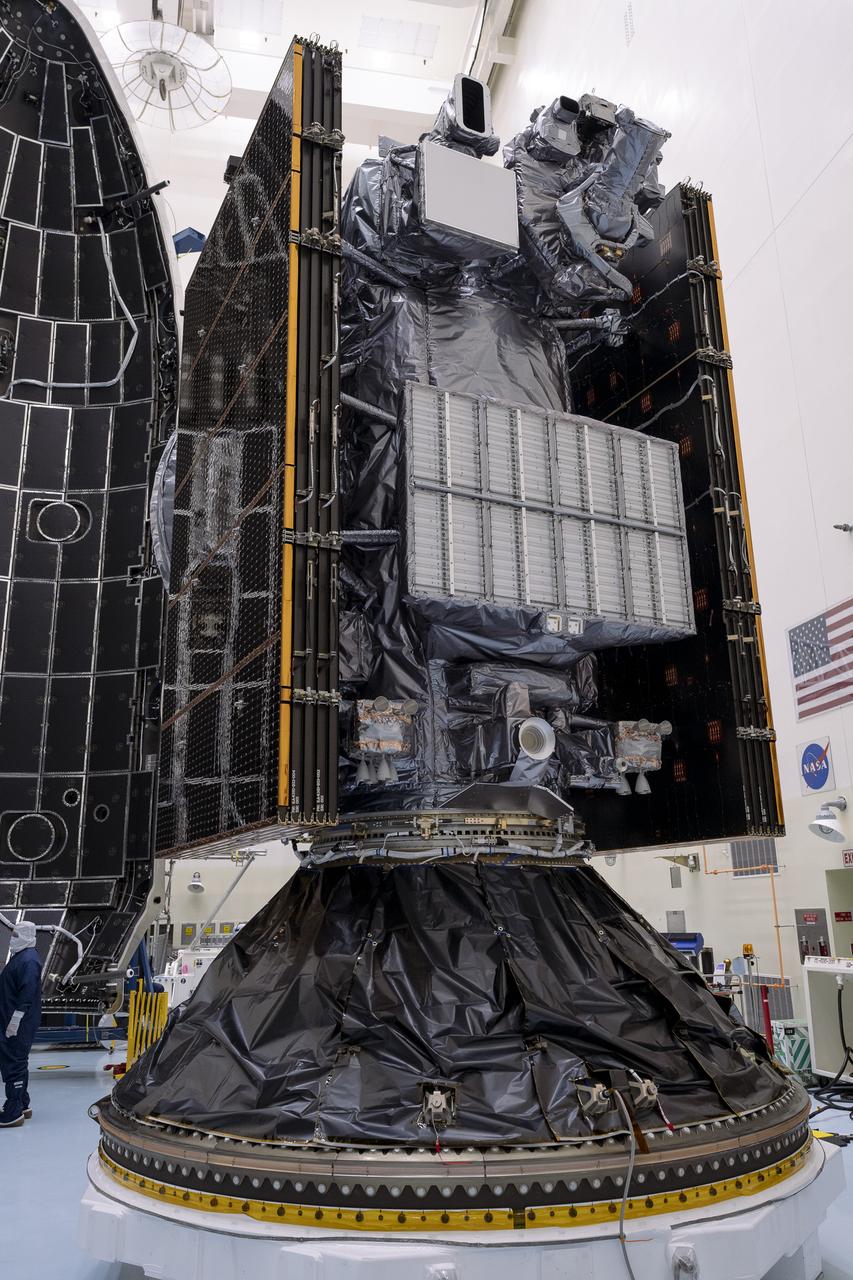
Technicians prepare to encapsulate NASA’s Europa Clipper spacecraft inside SpaceX’s Falcon Heavy payload fairing in the Payload Hazardous Servicing Facility at NASA’s Kennedy Space Center in Florida on Wednesday, Oct. 2, 2024. The payload fairing will protect the spacecraft during liftoff from Launch Complex 39A on its journey to explore Jupiter’s icy moon, Europa. The spacecraft will complete nearly 50 flybys of Jupiter’s icy moon, Europa, to determine if there are conditions suitable for life beyond Earth.

Comet C/2023 A3 (Tsuchinshan-Atlas) illuminates the sky behind NASA’s Europa Clipper spacecraft on the SpaceX Falcon Heavy rocket at Launch Complex 39A on Sunday, Oct. 13, 2024, at the agency’s Kennedy Space Center in Florida ahead of launch to Jupiter’s icy moon, Europa. The spacecraft will complete nearly 50 flybys of Europa to determine if there are conditions suitable for life beyond Earth.
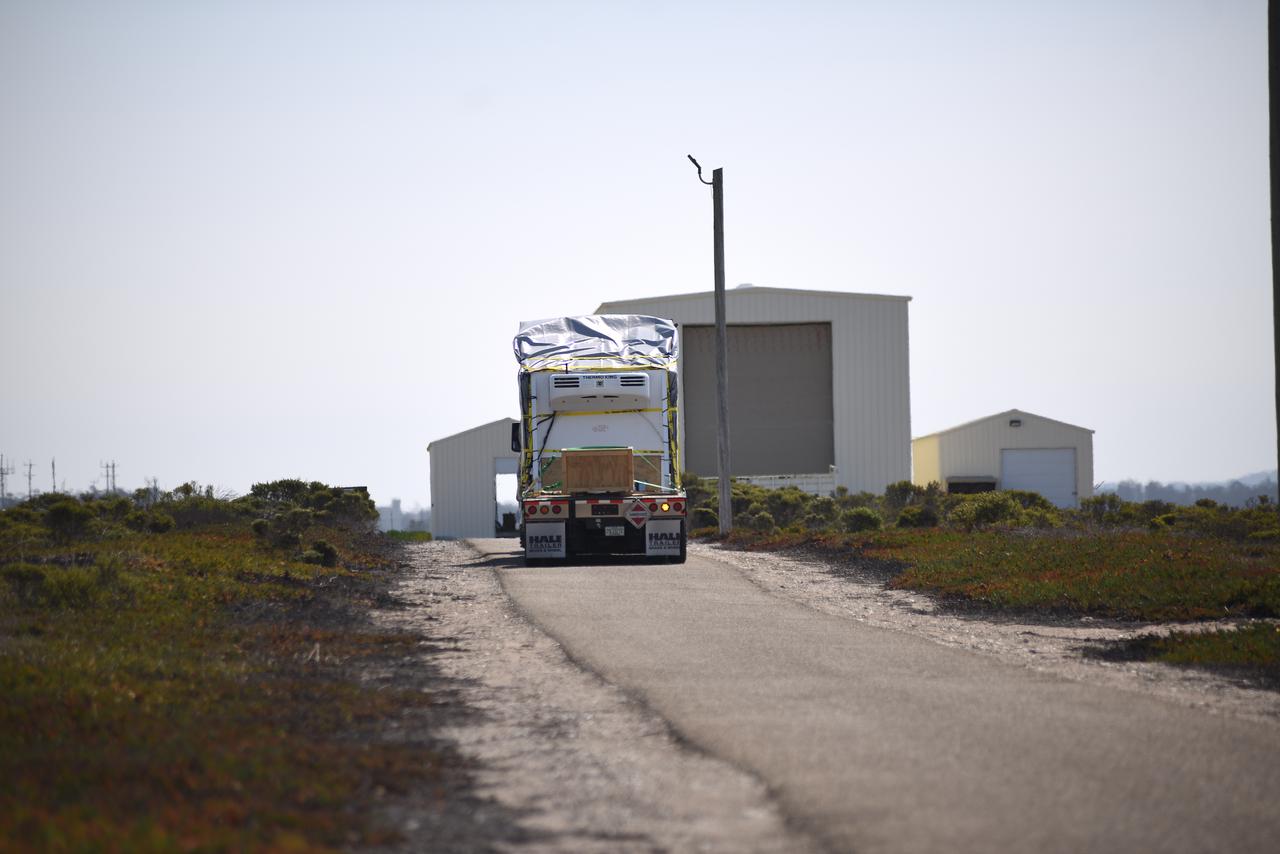
NASA’s Double Asteroid Redirection Test (DART) spacecraft, packed in its shipping container, arrives by truck at Vandenberg Space Force Base in California on Oct. 2, 2021. DART will be transported to the Astrotech Space Operations Facility where workers will put the spacecraft through a series of final tests and checkouts to confirm it is ready for launch. DART is the first mission to test technologies for preventing an impact of Earth by a hazardous asteroid. The mission is targeted to launch on Nov. 23, 2021, aboard a SpaceX Falcon 9 rocket from Vandenberg. NASA’s Launch Services Program, based at Kennedy Space Center, America’s multi-user spaceport, is managing the launch.
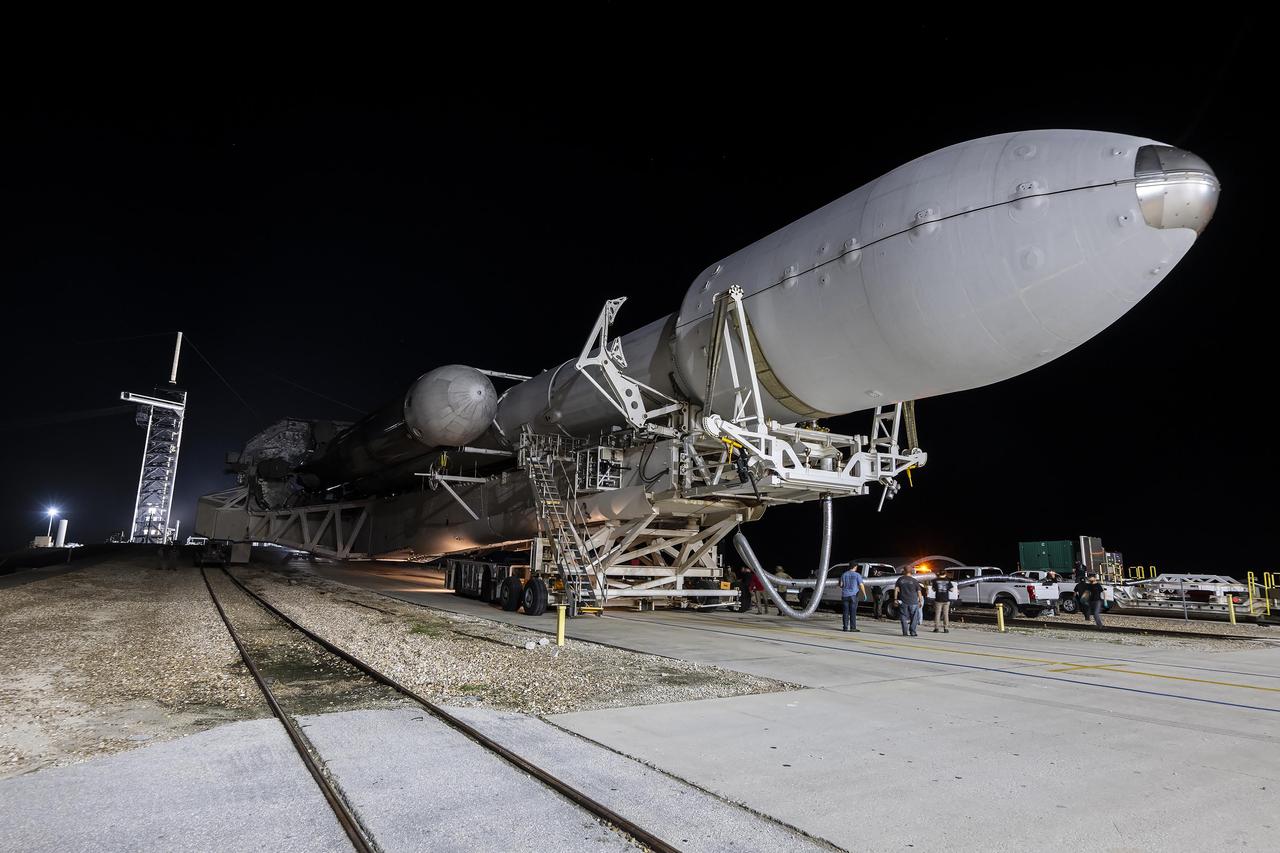
NASA’s Europa Clipper spacecraft attached to SpaceX’s Falcon Heavy rocket, rolls to Launch Pad 39A on Saturday, Oct. 12, 2024, at NASA’s Kennedy Space Center in Florida ahead of launch to Jupiter’s icy moon, Europa. The spacecraft will complete nearly 50 flybys of Europa to determine if there are conditions suitable for life beyond Earth. NASA and SpaceX are targeting launch for Europa Clipper at 12:06 p.m. EDT on Monday, Oct. 14, from Launch Complex 39A at Kennedy Space Center in Florida.
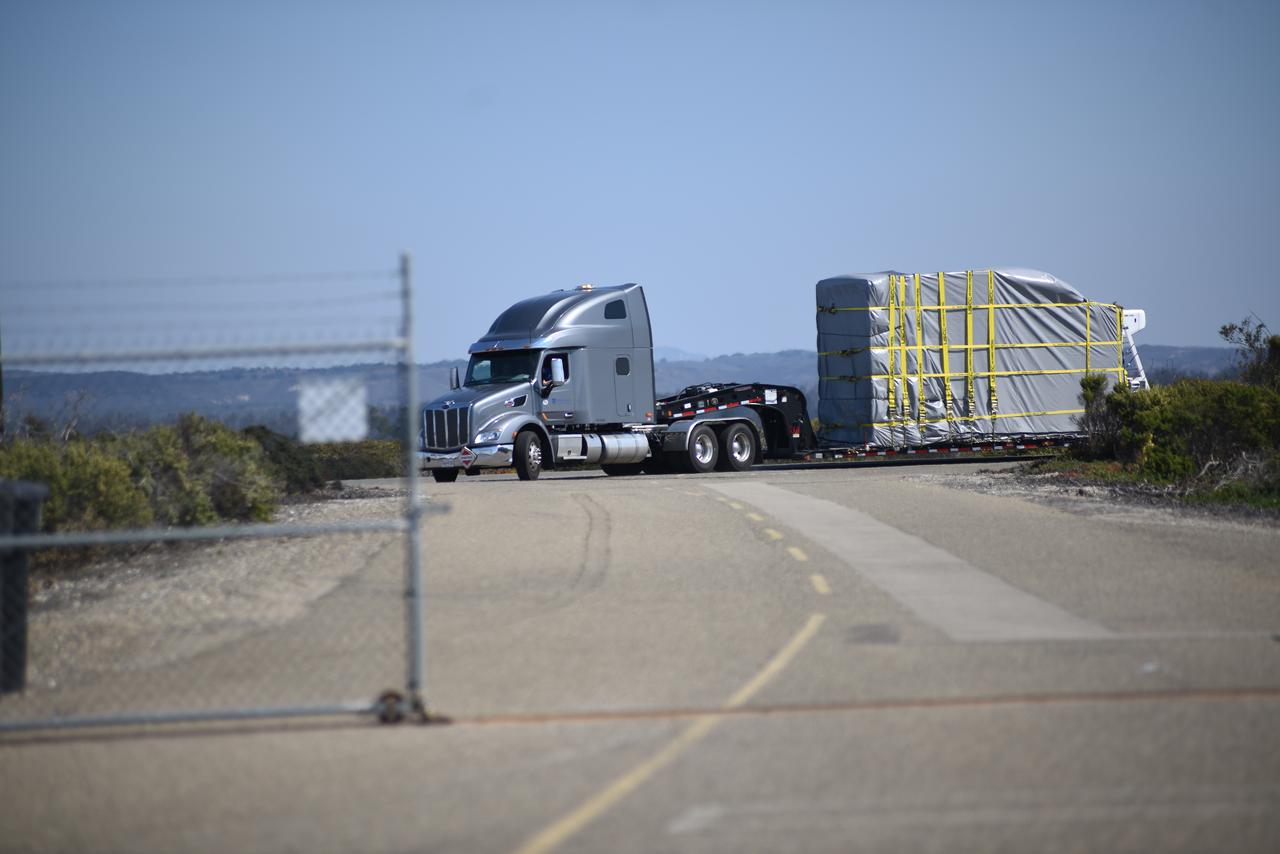
NASA’s Double Asteroid Redirection Test (DART) spacecraft, packed in its shipping container, arrives by truck at the entrance to Vandenberg Space Force Base in California on Oct. 2, 2021. DART will be transported to the Astrotech Space Operations Facility where workers will put the spacecraft through a series of final tests and checkouts to confirm it is ready for launch. DART is the first mission to test technologies for preventing an impact of Earth by a hazardous asteroid. The mission is targeted to launch on Nov. 23, 2021, aboard a SpaceX Falcon 9 rocket from Vandenberg. NASA’s Launch Services Program, based at Kennedy Space Center, America’s multi-user spaceport, is managing the launch.
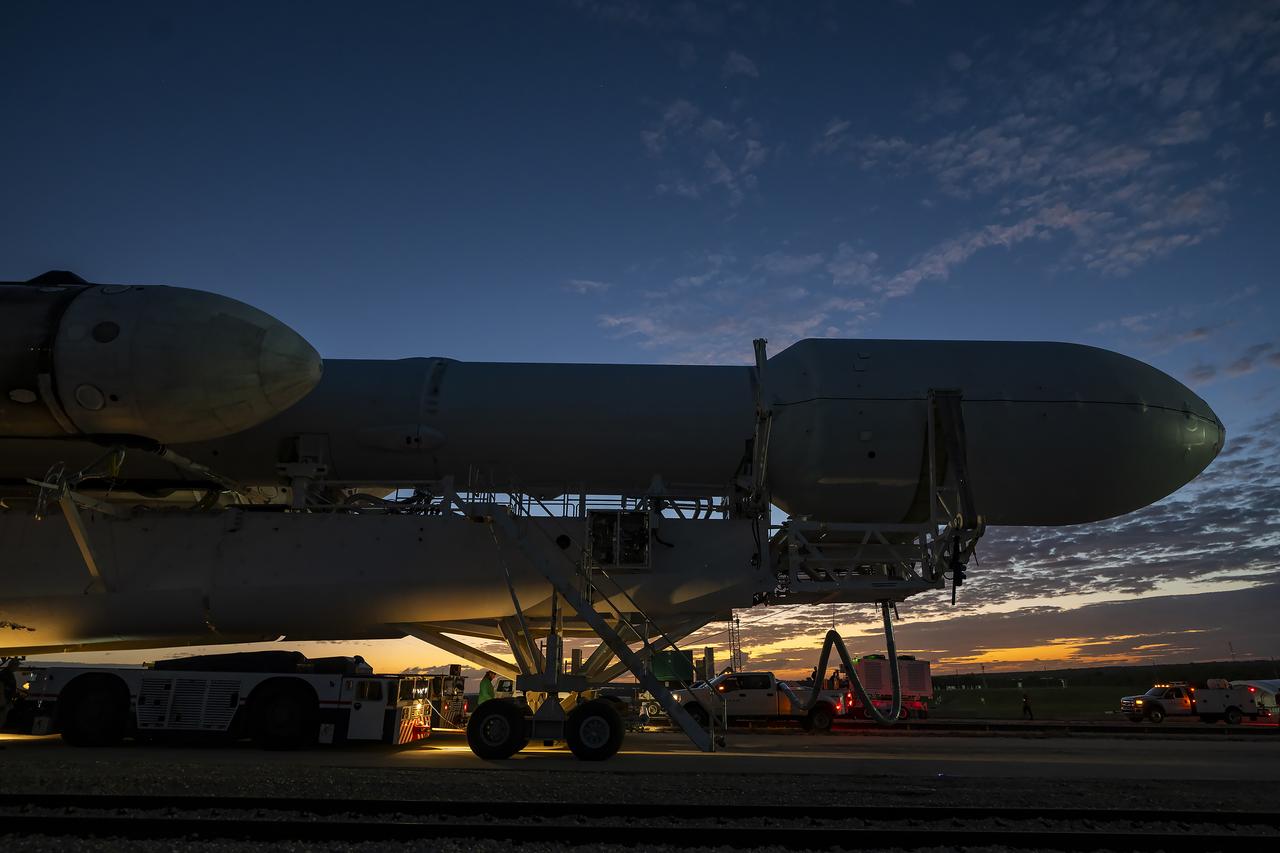
NASA’s Europa Clipper spacecraft attached to SpaceX’s Falcon Heavy rocket, rolls to Launch Pad 39A on Saturday, Oct. 12, 2024, at NASA’s Kennedy Space Center in Florida ahead of launch to Jupiter’s icy moon, Europa. The spacecraft will complete nearly 50 flybys of Europa to determine if there are conditions suitable for life beyond Earth. NASA and SpaceX are targeting launch for Europa Clipper at 12:06 p.m. EDT on Monday, Oct. 14, from Launch Complex 39A at Kennedy Space Center in Florida.

A SpaceX Falcon Heavy rocket carrying NASA’s Europa Clipper spacecraft lifts off from Launch Complex 39A at NASA’s Kennedy Space Center in Florida at 12:06 p.m. EDT on Monday, Oct. 14, 2024. After launch, the spacecraft plans to fly by Mars in February 2025, then back by Earth in December 2026, using the gravity of each planet to increase its momentum. With help of these “gravity assists,” Europa Clipper will achieve the velocity needed to reach Jupiter in April 2030.

Technicians test the spring-activated door on the Interstellar Dust Experiment (IDEX) instrument of NASA’s IMAP (Interstellar Mapping and Acceleration Probe) observatory inside the high bay at the Astrotech Space Operations Facility near the agency’s Kennedy Space Center in Florida on Tuesday, June 3, 2025. The door will remain closed to protect IDEX from contamination during integration and launch. Once in space, the door will swing open permanently to allow interstellar and interplanetary dust to flow into the instrument for measurement. The IMAP observatory will study how the Sun shapes the boundaries of the heliosphere, the protective bubble around our solar system. Launch is targeted for no earlier than September 2025 aboard a SpaceX Falcon 9 rocket from Launch Complex 39A at NASA Kennedy.
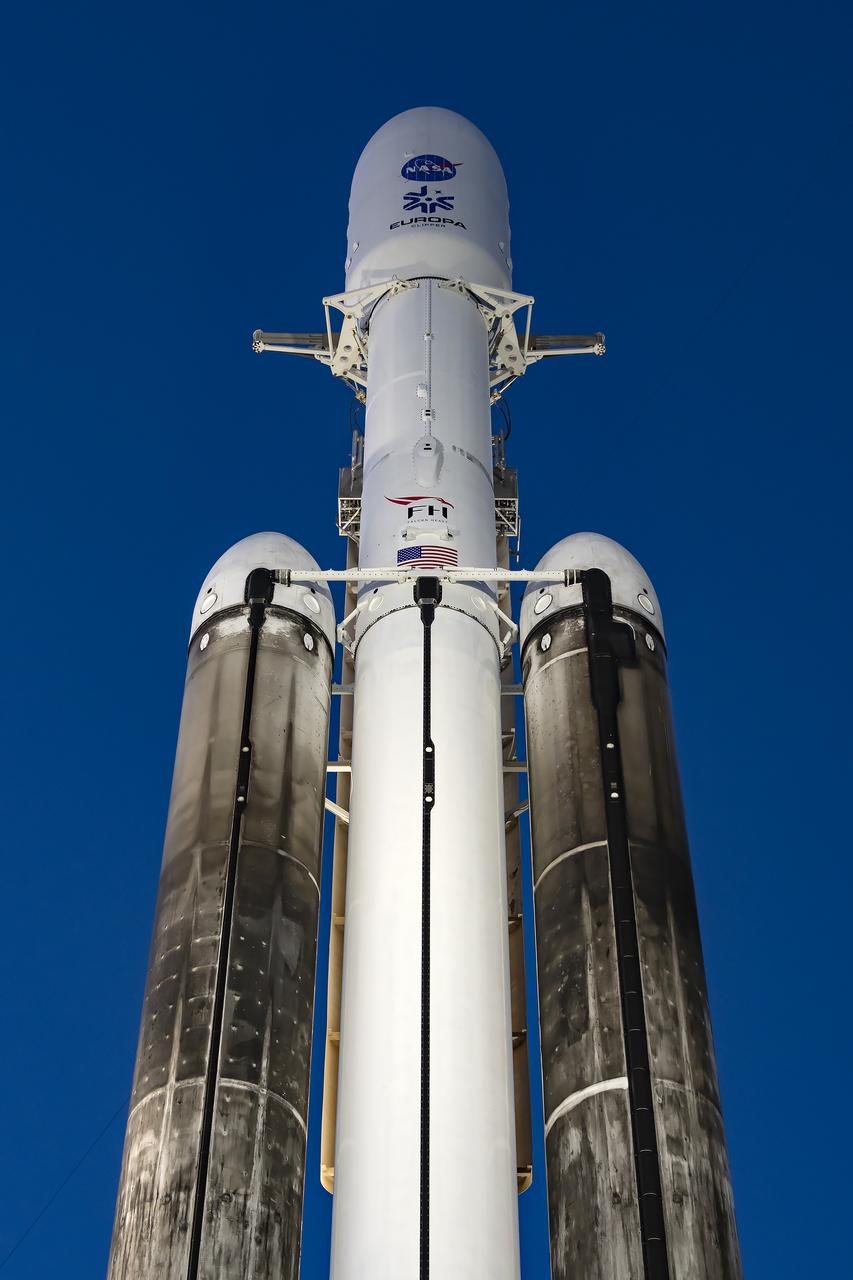
NASA’s Europa Clipper spacecraft and SpaceX’s Falcon Heavy rocket are vertical at Launch Pad 39A on Sunday, Oct. 13, 2024, at the agency’s Kennedy Space Center in Florida ahead of launch to Jupiter’s icy moon, Europa. The spacecraft will complete nearly 50 flybys of Europa to determine if there are conditions suitable for life beyond Earth. Launch is targeting 12:06 p.m. EDT on Monday, Oct. 14, from Launch Complex 39A at Kennedy Space Center in Florida.
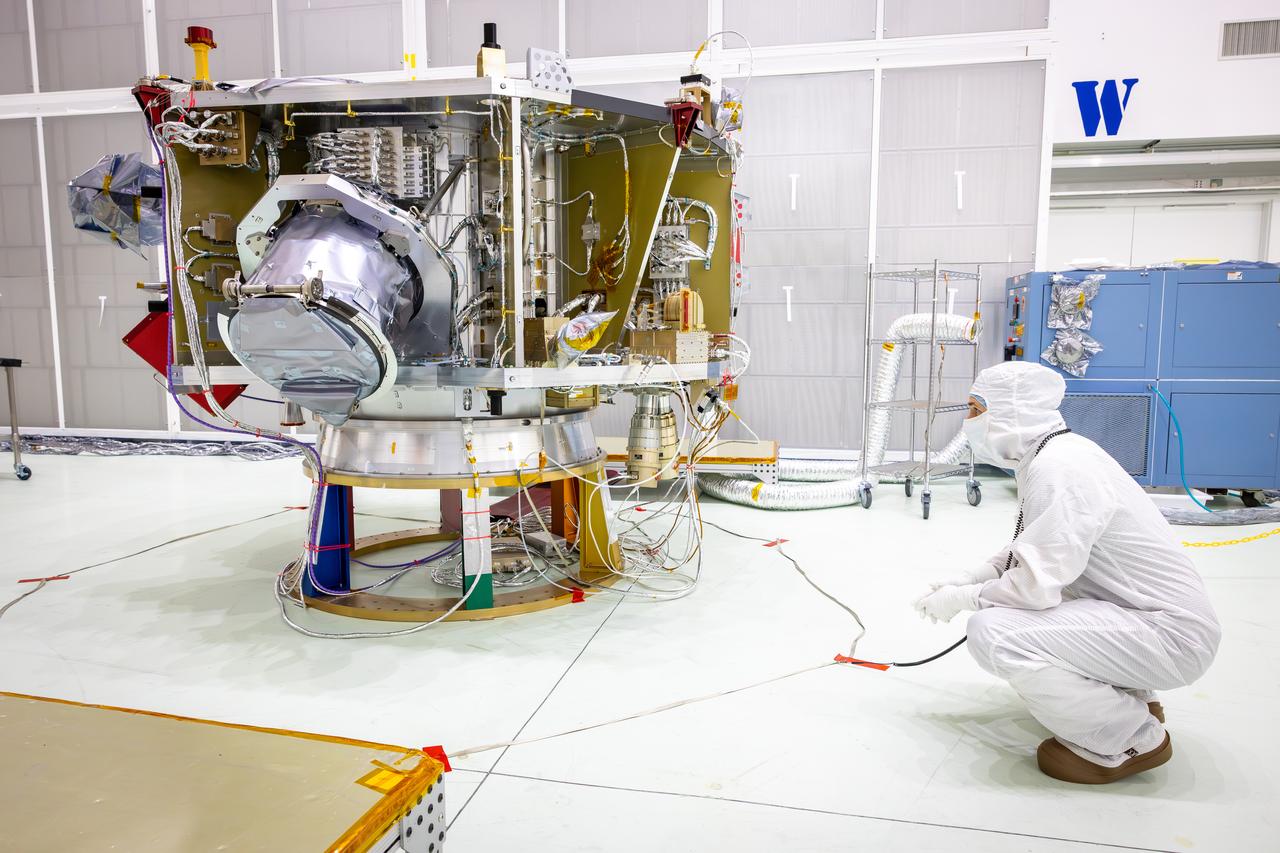
Technicians test the spring-activated door on the Interstellar Dust Experiment (IDEX) instrument of NASA’s IMAP (Interstellar Mapping and Acceleration Probe) observatory inside the high bay at the Astrotech Space Operations Facility near the agency’s Kennedy Space Center in Florida on Tuesday, June 3, 2025. The door will remain closed to protect IDEX from contamination during integration and launch. Once in space, the door will swing open permanently to allow interstellar and interplanetary dust to flow into the instrument for measurement. The IMAP observatory will study how the Sun shapes the boundaries of the heliosphere, the protective bubble around our solar system. Launch is targeted for no earlier than September 2025 aboard a SpaceX Falcon 9 rocket from Launch Complex 39A at NASA Kennedy.
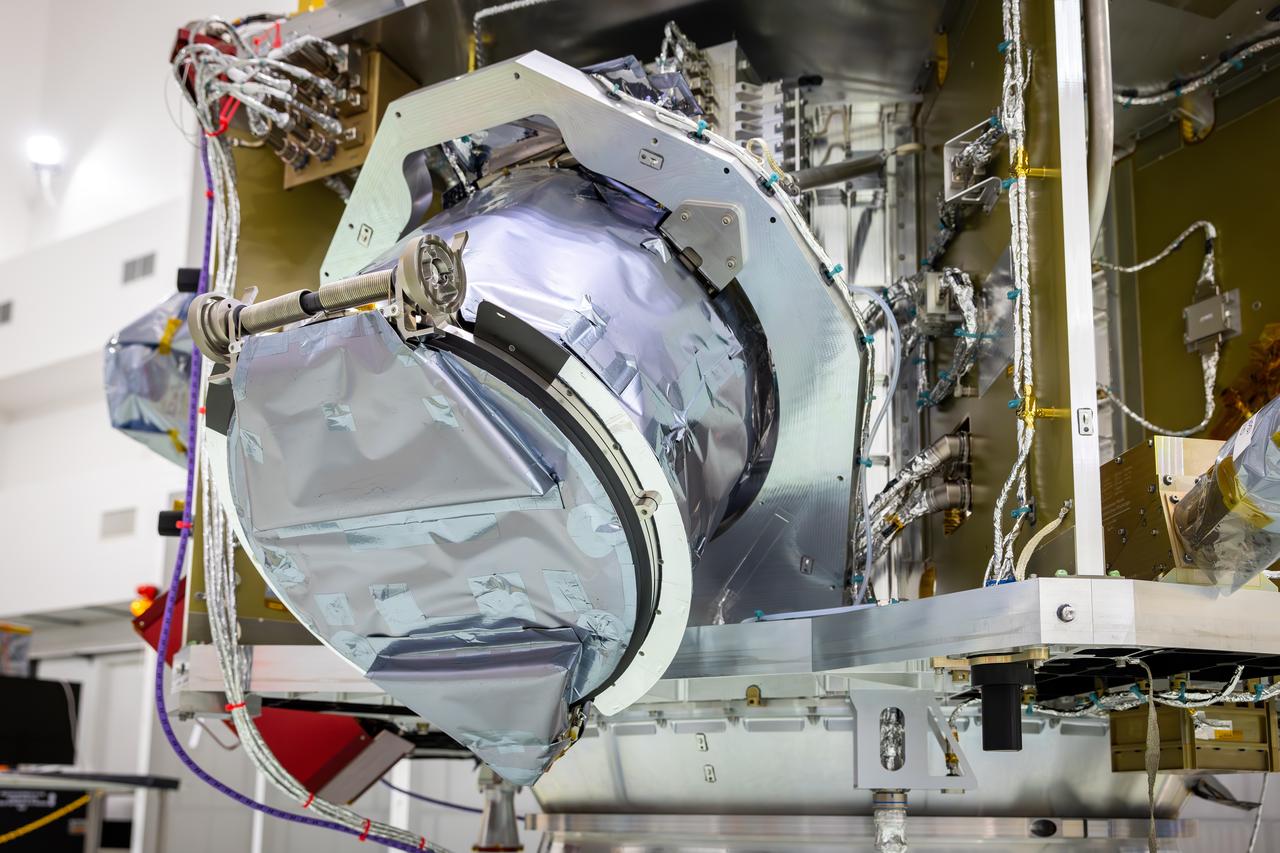
Technicians test the spring-activated door on the Interstellar Dust Experiment (IDEX) instrument of NASA’s IMAP (Interstellar Mapping and Acceleration Probe) observatory inside the high bay at the Astrotech Space Operations Facility near the agency’s Kennedy Space Center in Florida on Tuesday, June 3, 2025. The door will remain closed to protect IDEX from contamination during integration and launch. Once in space, the door will swing open permanently to allow interstellar and interplanetary dust to flow into the instrument for measurement. The IMAP observatory will study how the Sun shapes the boundaries of the heliosphere, the protective bubble around our solar system. Launch is targeted for no earlier than September 2025 aboard a SpaceX Falcon 9 rocket from Launch Complex 39A at NASA Kennedy.

A SpaceX Falcon Heavy rocket carrying NASA’s Europa Clipper spacecraft lifts off from Launch Complex 39A at NASA’s Kennedy Space Center in Florida at 12:06 p.m. EDT on Monday, Oct. 14, 2024. After launch, the spacecraft plans to fly by Mars in February 2025, then back by Earth in December 2026, using the gravity of each planet to increase its momentum. With help of these “gravity assists,” Europa Clipper will achieve the velocity needed to reach Jupiter in April 2030.
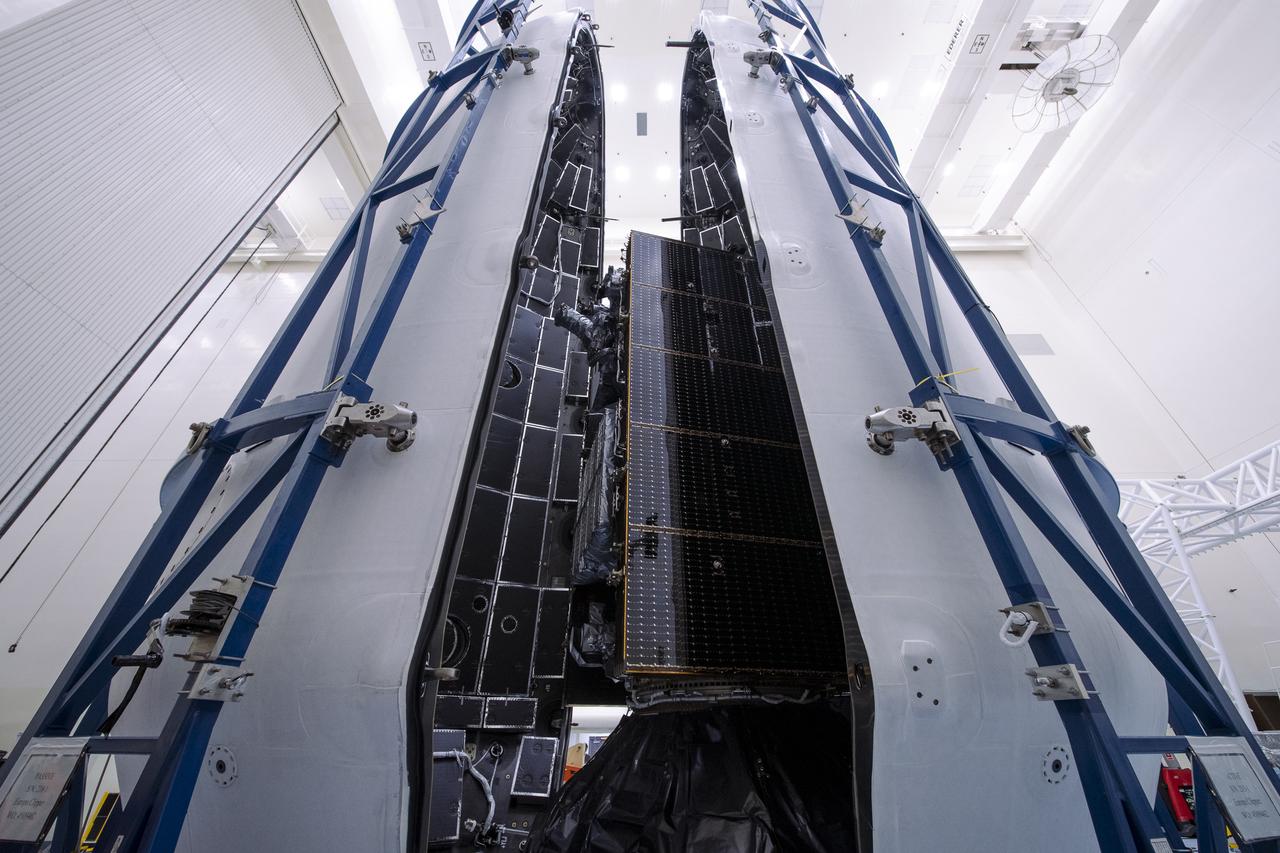
Technicians encapsulate NASA’s Europa Clipper spacecraft inside SpaceX’s Falcon Heavy payload fairing in the Payload Hazardous Servicing Facility at NASA’s Kennedy Space Center in Florida on Wednesday, Oct. 2, 2024. The payload fairing will protect the spacecraft during liftoff from Launch Complex 39A on its journey to explore Jupiter’s icy moon, Europa. The spacecraft will complete nearly 50 flybys of Jupiter’s icy moon, Europa, to determine if there are conditions suitable for life beyond Earth.

A SpaceX Falcon Heavy rocket carrying NASA’s Europa Clipper spacecraft lifts off from Launch Complex 39A at NASA’s Kennedy Space Center in Florida at 12:06 p.m. EDT on Monday, Oct. 14, 2024. After launch, the spacecraft plans to fly by Mars in February 2025, then back by Earth in December 2026, using the gravity of each planet to increase its momentum. With help of these “gravity assists,” Europa Clipper will achieve the velocity needed to reach Jupiter in April 2030.
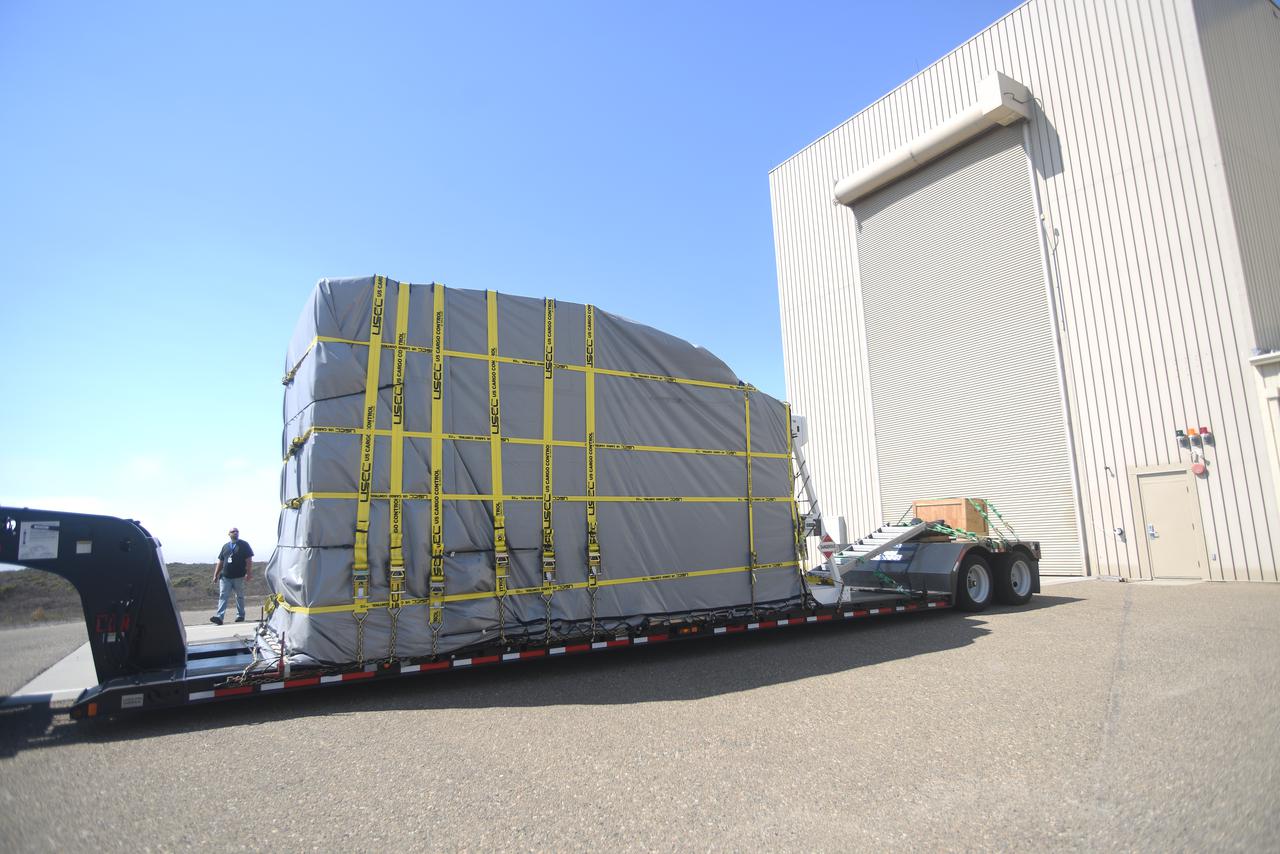
NASA’s Double Asteroid Redirection Test (DART) spacecraft, packed in its shipping container, arrives by truck at the entrance to the Astrotech Space Operations Facility at Vandenberg Space Force Base in California on Oct. 2, 2021. Inside the facility, workers will unpack the spacecraft and complete a series of final tests and checkouts to confirm it is ready for launch. DART is the first mission to test technologies for preventing an impact of Earth by a hazardous asteroid. The mission is targeted to launch on Nov. 23, 2021, aboard a SpaceX Falcon 9 rocket from Vandenberg. NASA’s Launch Services Program, based at Kennedy Space Center, America’s multi-user spaceport, is managing the launch.
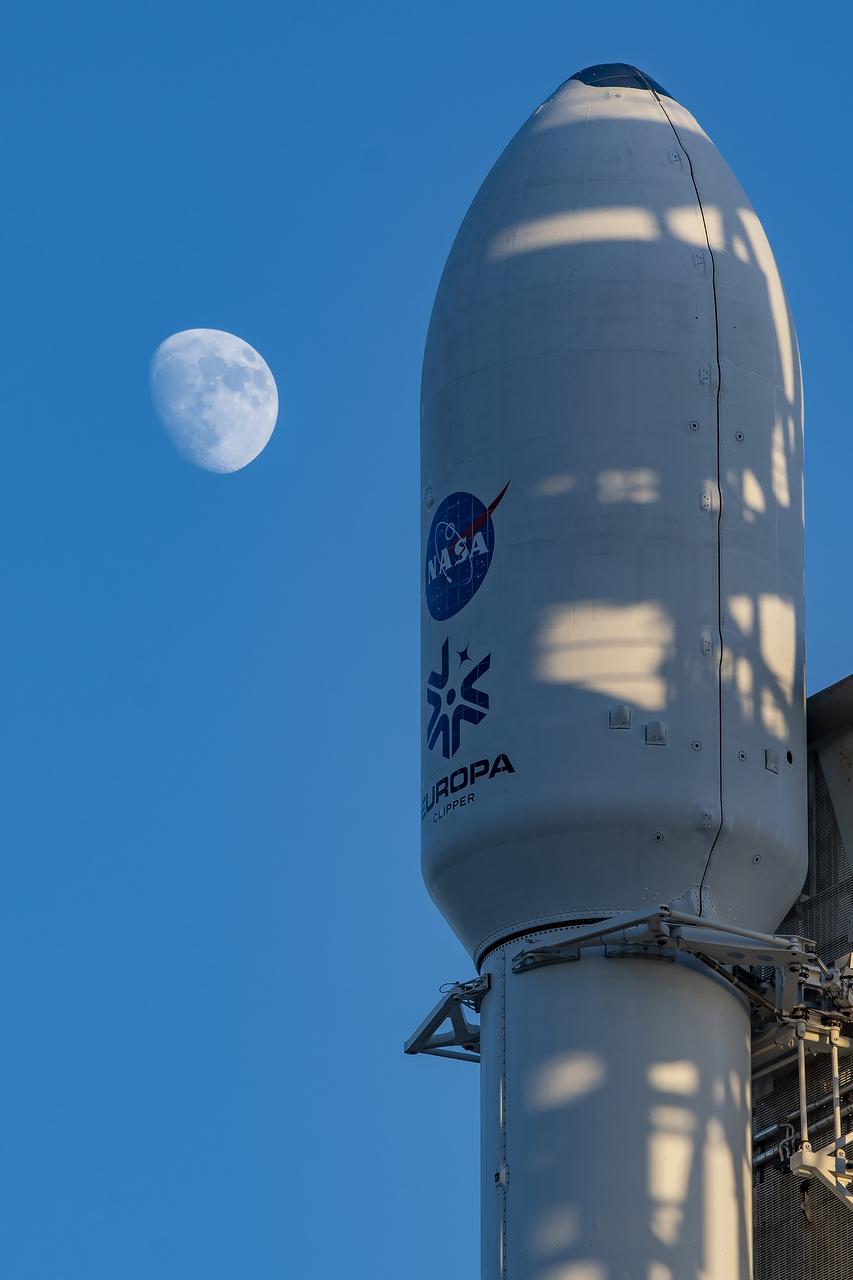
The Earth’s Moon appears with NASA’s Europa Clipper spacecraft encapsulated in a payload fairing atop SpaceX’s Heavy rocket at Launch Complex 39A on Sunday, Oct. 13, 2024, at the agency’s Kennedy Space Center in Florida. The Europa Clipper spacecraft will travel to Jupiter’s icy moon Europa to determine if there are conditions suitable for life beyond Earth.
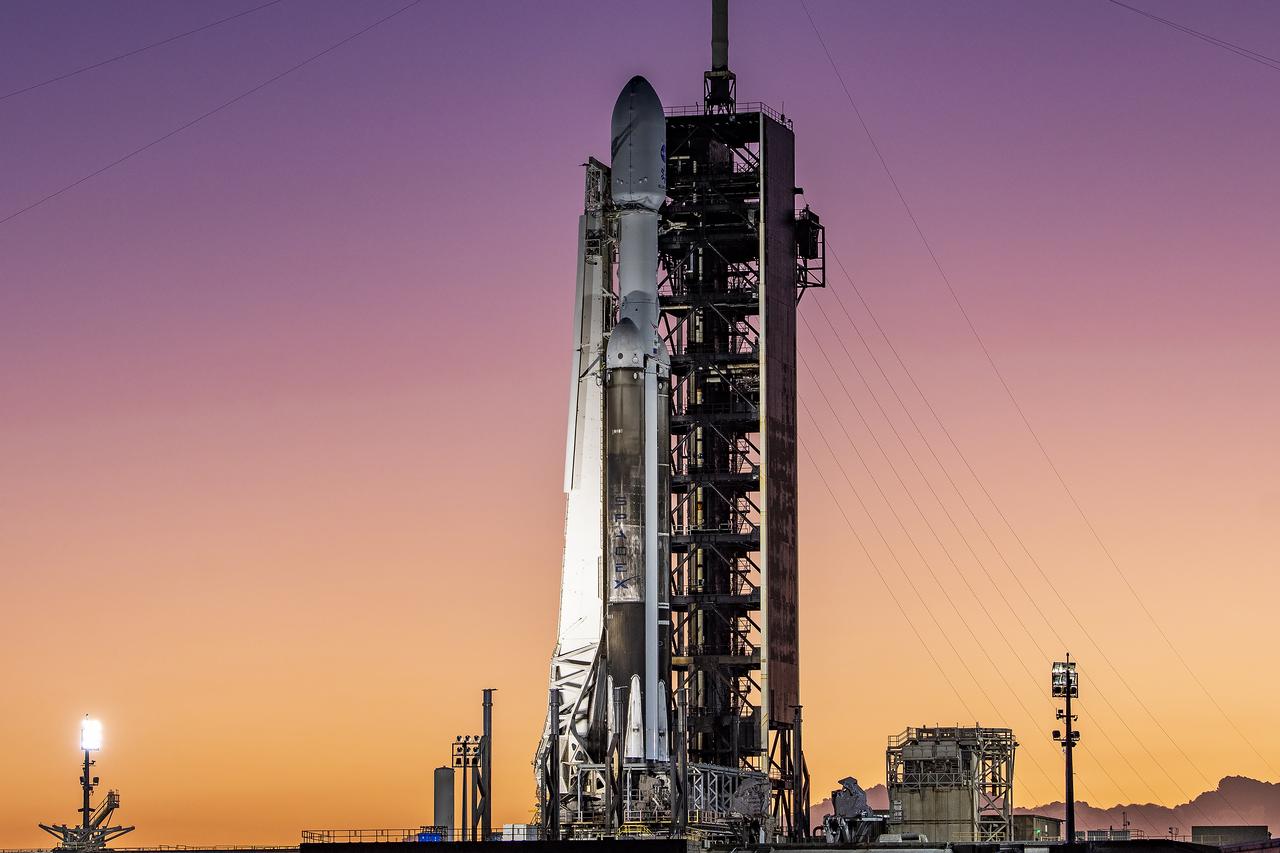
Europa Clipper spacecraft sits atop SpaceX’s Falcon Heavy rocket at Launch Complex 39A on Sunday, Oct. 13, 2024, at the agency’s Kennedy Space Center in Florida ahead of launch to Jupiter’s icy moon, Europa. The spacecraft will complete nearly 50 flybys of Europa to determine if there are conditions suitable for life beyond Earth.
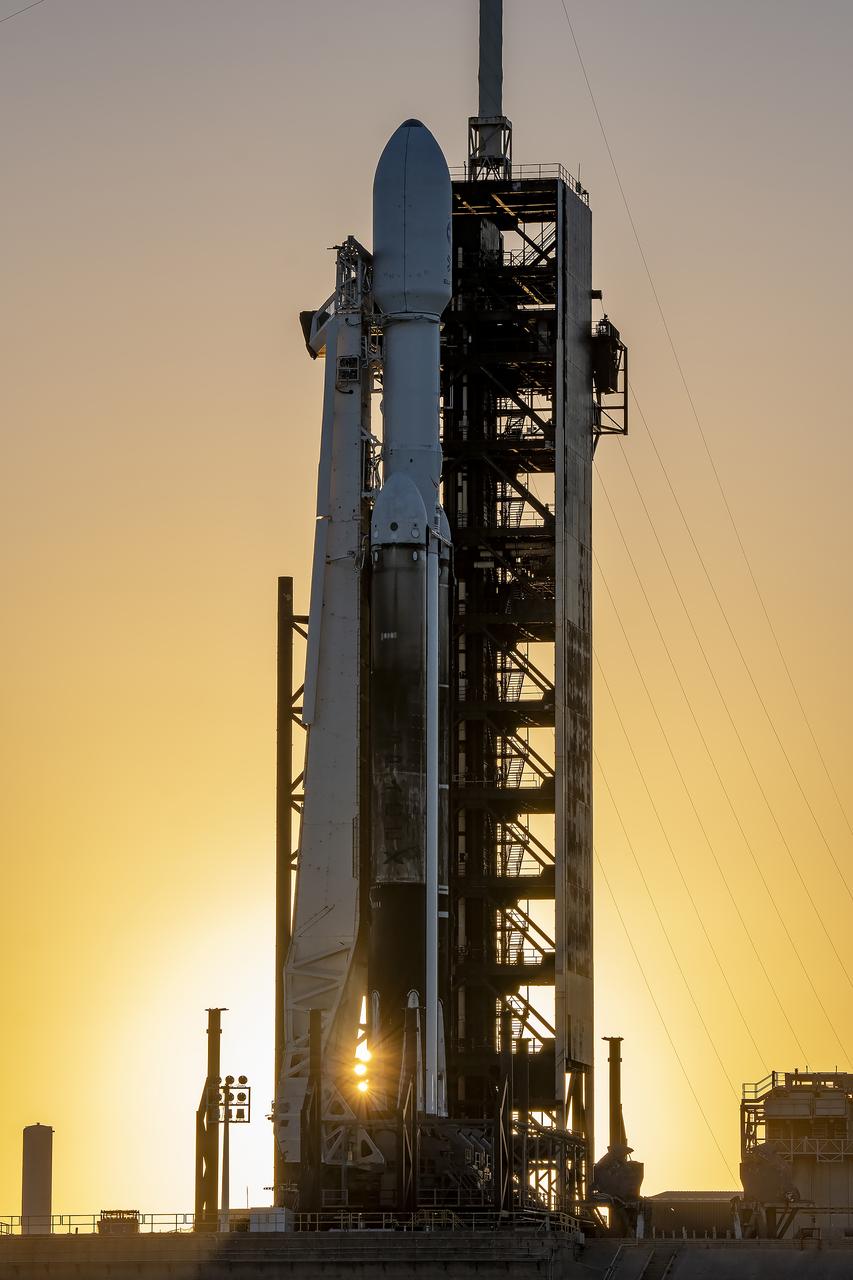
Europa Clipper spacecraft sits atop SpaceX’s Falcon Heavy rocket at Launch Complex 39A on Sunday, Oct. 13, 2024, at the agency’s Kennedy Space Center in Florida ahead of launch to Jupiter’s icy moon, Europa. The spacecraft will complete nearly 50 flybys of Europa to determine if there are conditions suitable for life beyond Earth.
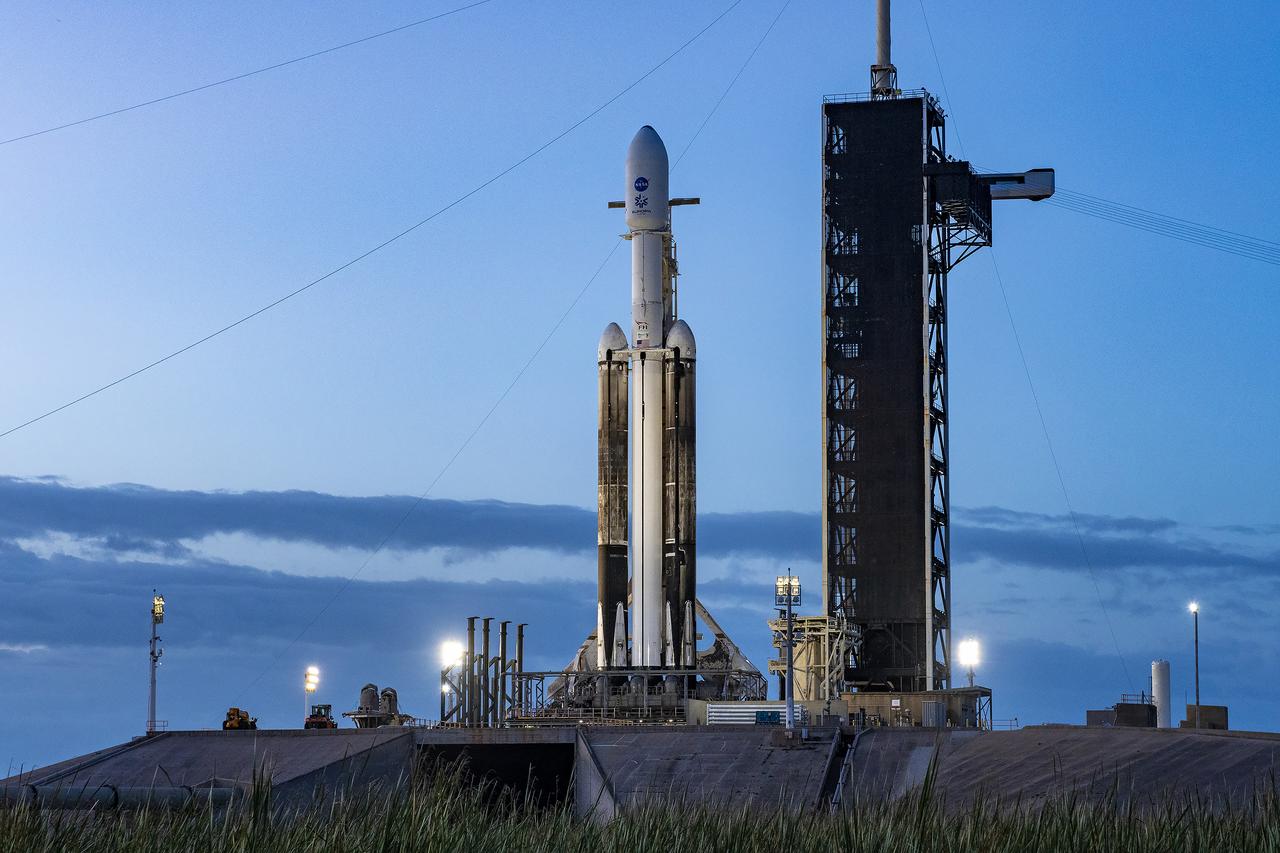
NASA’s Europa Clipper spacecraft and SpaceX’s Falcon Heavy rocket stands at Launch Pad 39A on Sunday, Oct. 13, 2024, at the agency’s Kennedy Space Center in Florida ahead of launch to Jupiter’s icy moon, Europa. The spacecraft will complete nearly 50 flybys of Europa to determine if there are conditions suitable for life beyond Earth. NASA and SpaceX are targeting launch for Europa Clipper at 12:06 p.m. EDT on Monday, Oct. 14, from Launch Complex 39A at Kennedy Space Center in Florida.
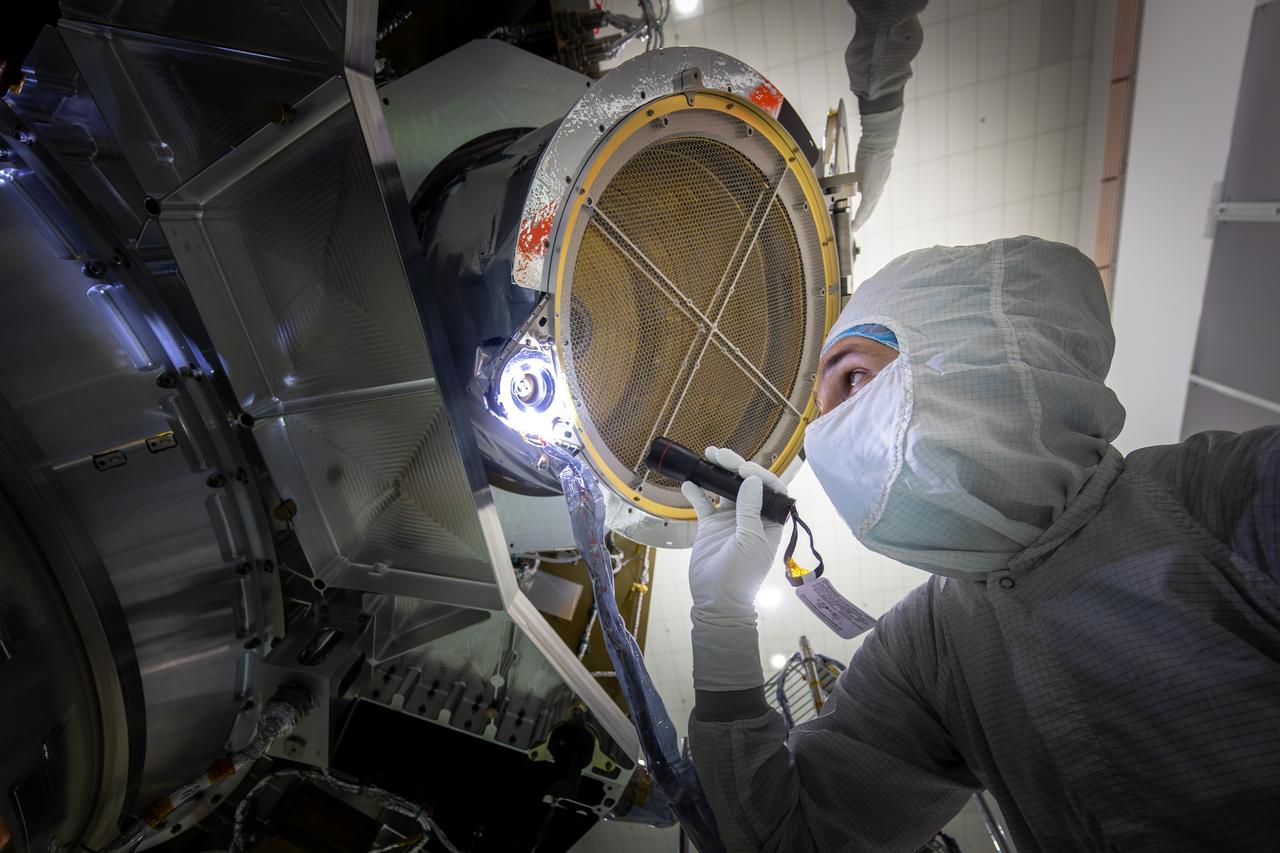
Technicians test the spring-activated door on the Interstellar Dust Experiment (IDEX) instrument of NASA’s IMAP (Interstellar Mapping and Acceleration Probe) observatory inside the high bay at the Astrotech Space Operations Facility near the agency’s Kennedy Space Center in Florida on Tuesday, June 3, 2025. The door will remain closed to protect IDEX from contamination during integration and launch. Once in space, the door will swing open permanently to allow interstellar and interplanetary dust to flow into the instrument for measurement. The IMAP observatory will study how the Sun shapes the boundaries of the heliosphere, the protective bubble around our solar system. Launch is targeted for no earlier than September 2025 aboard a SpaceX Falcon 9 rocket from Launch Complex 39A at NASA Kennedy.
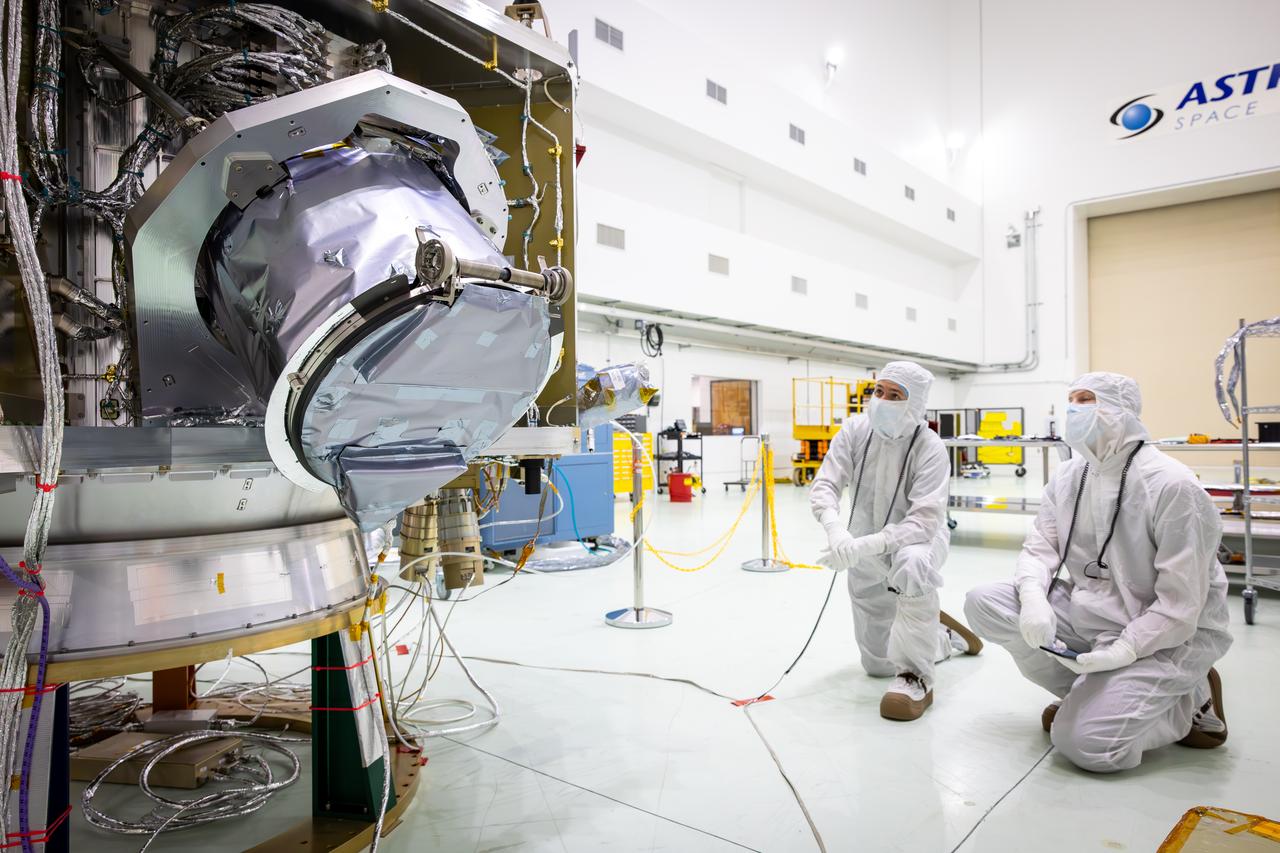
Technicians test the spring-activated door on the Interstellar Dust Experiment (IDEX) instrument of NASA’s IMAP (Interstellar Mapping and Acceleration Probe) observatory inside the high bay at the Astrotech Space Operations Facility near the agency’s Kennedy Space Center in Florida on Tuesday, June 3, 2025. The door will remain closed to protect IDEX from contamination during integration and launch. Once in space, the door will swing open permanently to allow interstellar and interplanetary dust to flow into the instrument for measurement. The IMAP observatory will study how the Sun shapes the boundaries of the heliosphere, the protective bubble around our solar system. Launch is targeted for no earlier than September 2025 aboard a SpaceX Falcon 9 rocket from Launch Complex 39A at NASA Kennedy.
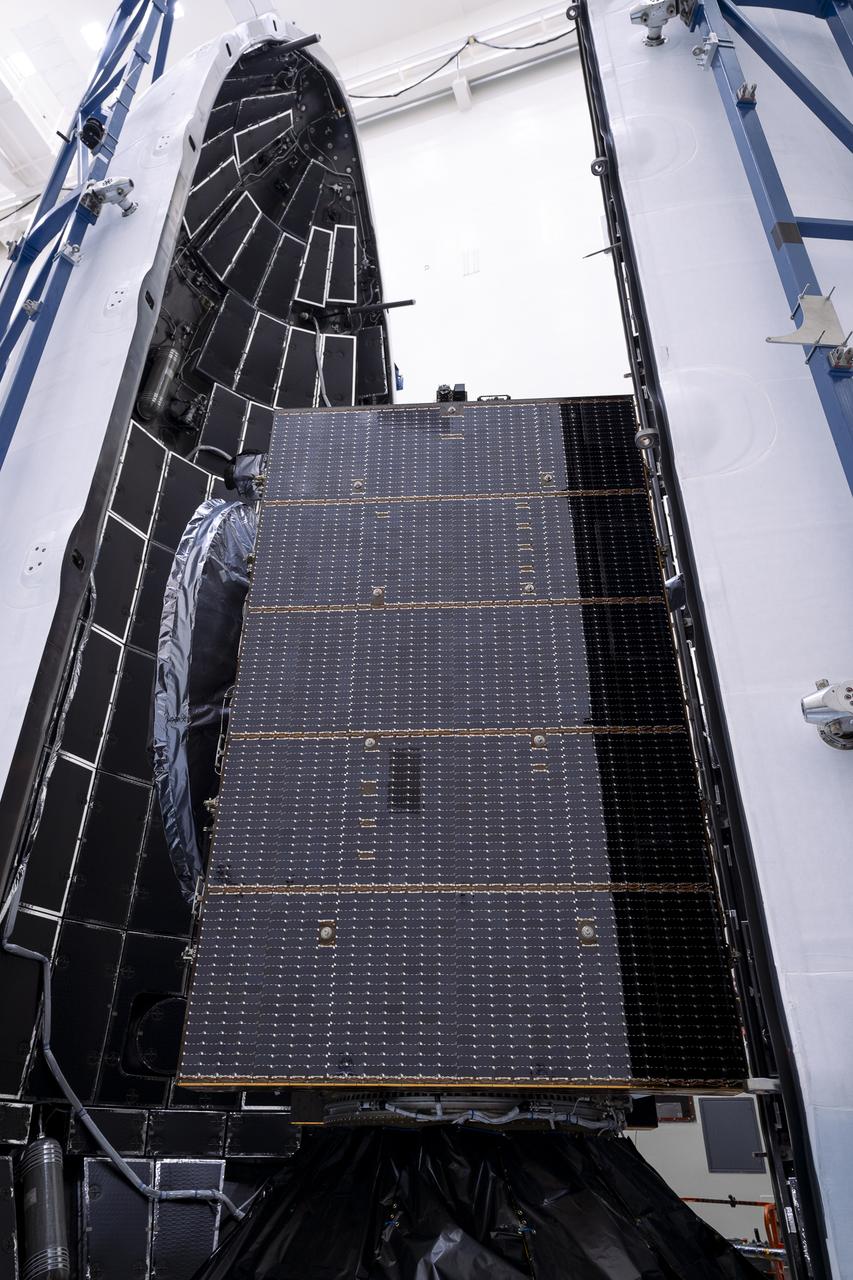
Technicians prepare to encapsulate NASA’s Europa Clipper spacecraft inside SpaceX’s Falcon Heavy payload fairing in the Payload Hazardous Servicing Facility at NASA’s Kennedy Space Center in Florida on Wednesday, Oct. 2, 2024. The payload fairing will protect the spacecraft during liftoff from Launch Complex 39A on its journey to explore Jupiter’s icy moon, Europa. The spacecraft will complete nearly 50 flybys of Jupiter’s icy moon, Europa, to determine if there are conditions suitable for life beyond Earth.
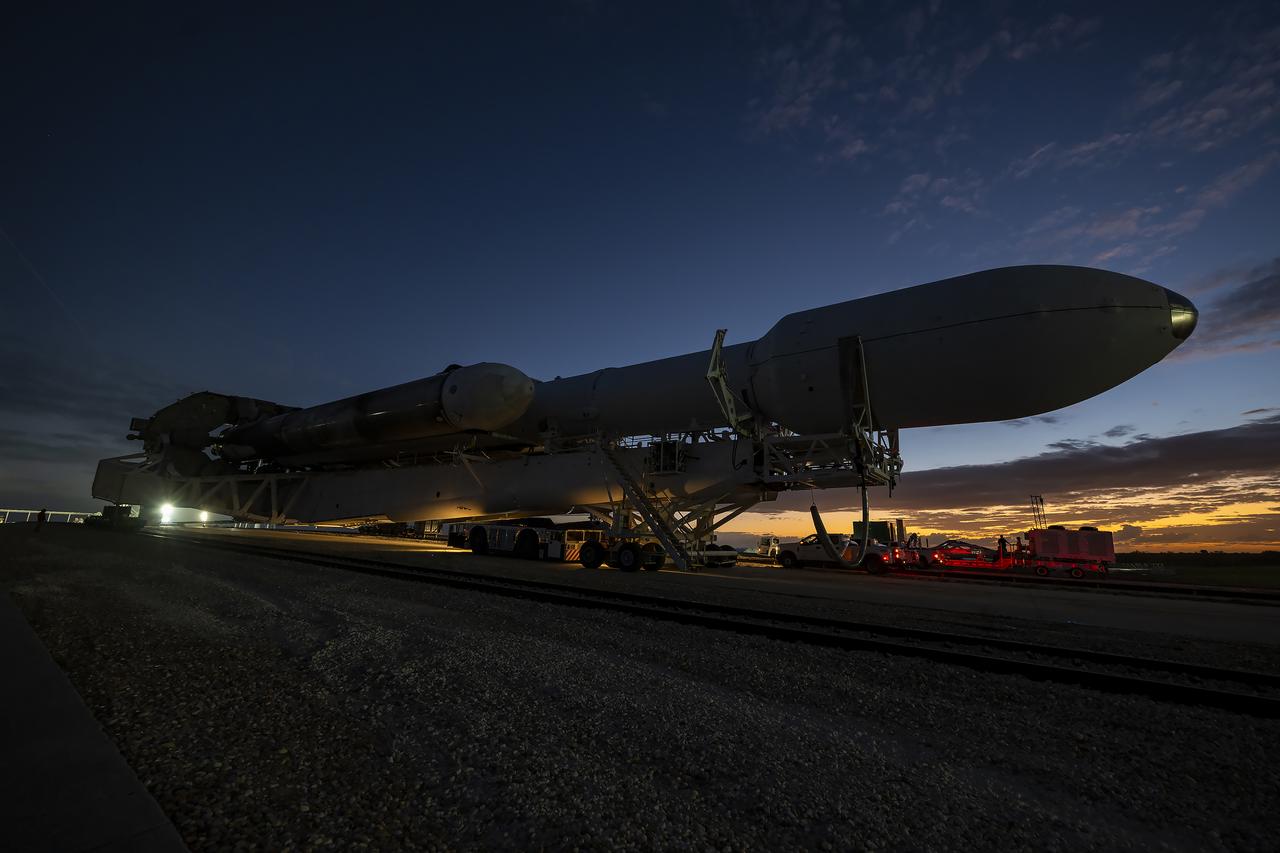
NASA’s Europa Clipper spacecraft attached to SpaceX’s Falcon Heavy rocket, rolls to Launch Pad 39A on Saturday, Oct. 12, 2024, at NASA’s Kennedy Space Center in Florida ahead of launch to Jupiter’s icy moon, Europa. The spacecraft will complete nearly 50 flybys of Europa to determine if there are conditions suitable for life beyond Earth. NASA and SpaceX are targeting launch for Europa Clipper at 12:06 p.m. EDT on Monday, Oct. 14, from Launch Complex 39A at Kennedy Space Center in Florida.
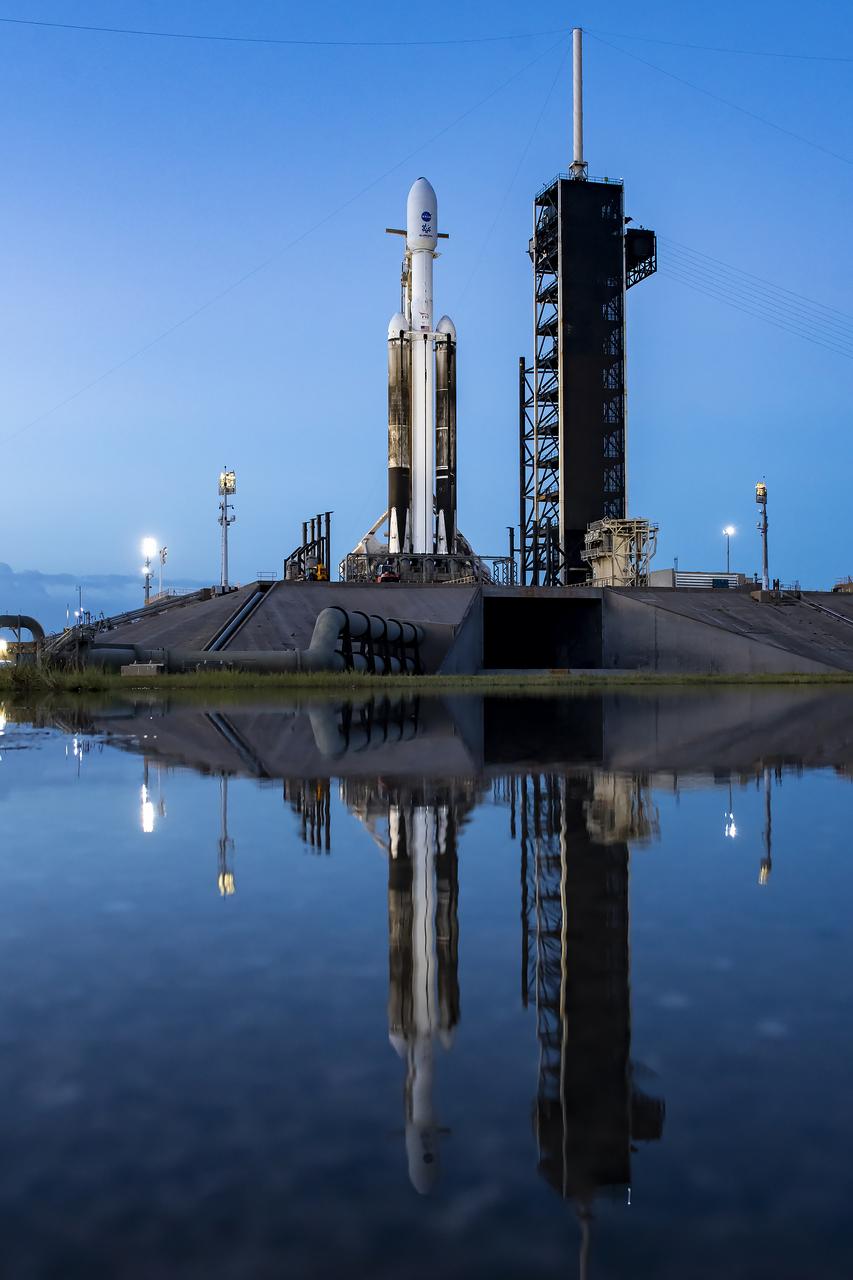
A reflection in the water shows NASA’s Europa Clipper spacecraft atop SpaceX’s Falcon Heavy rocket at Launch Pad 39A on Sunday, Oct. 13, 2024, at the agency’s Kennedy Space Center in Florida ahead of launch to Jupiter’s icy moon, Europa. The spacecraft will complete nearly 50 flybys of Europa to determine if there are conditions suitable for life beyond Earth. Launch is targeting 12:06 p.m. EDT on Monday, Oct. 14, from Launch Complex 39A at Kennedy Space Center in Florida.
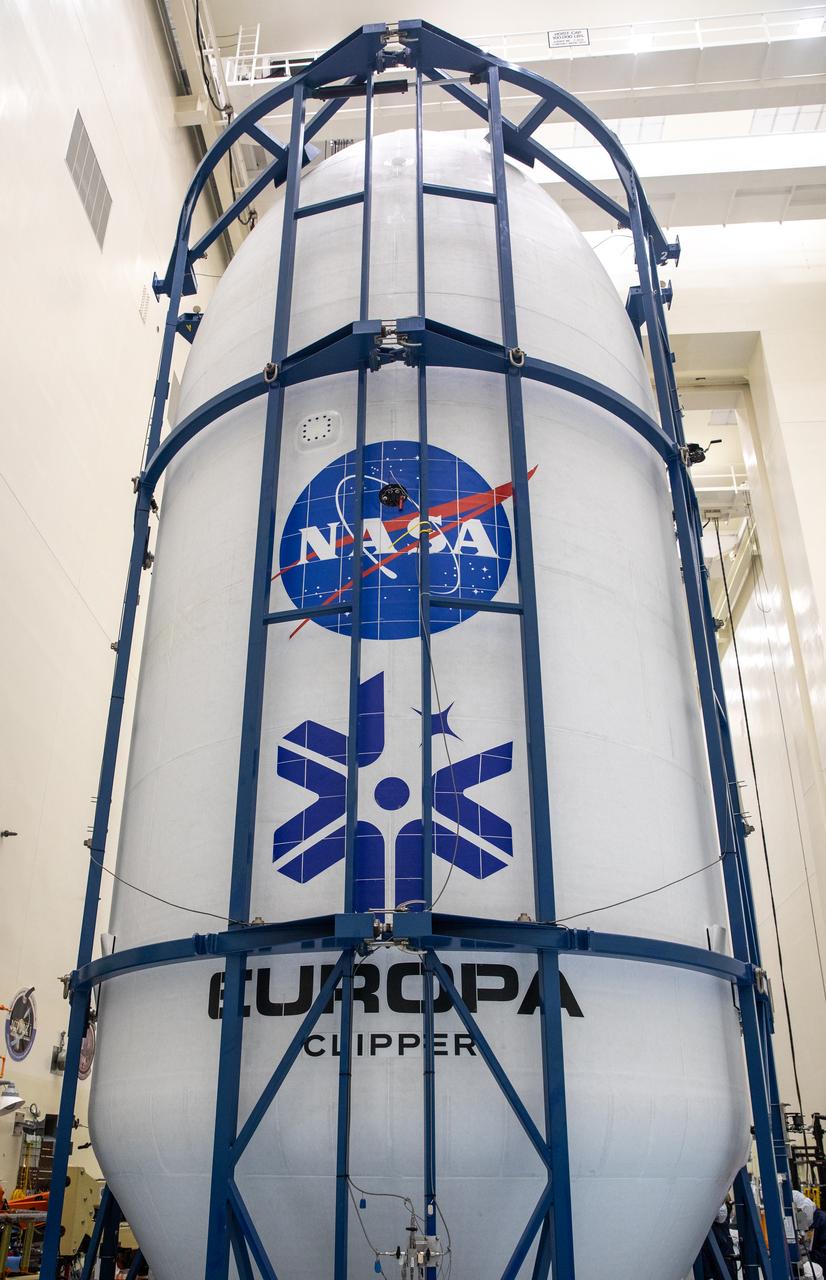
Technicians encapsulated NASA’s Europa Clipper spacecraft inside payload fairings on Wednesday, Oct. 2, 2024, in the Payload Hazardous Servicing Facility at NASA’s Kennedy Space Center in Florida. The fairings will protect the spacecraft during launch as it begins its journey to explore Jupiter’s icy moon, Europa. The mission will help scientists determine if the moon could support life. NASA and SpaceX are targeting launch at 12:31 p.m. EDT on Thursday, Oct. 10, 2024, from Launch Complex 39A at Kennedy Space Center in Florida.
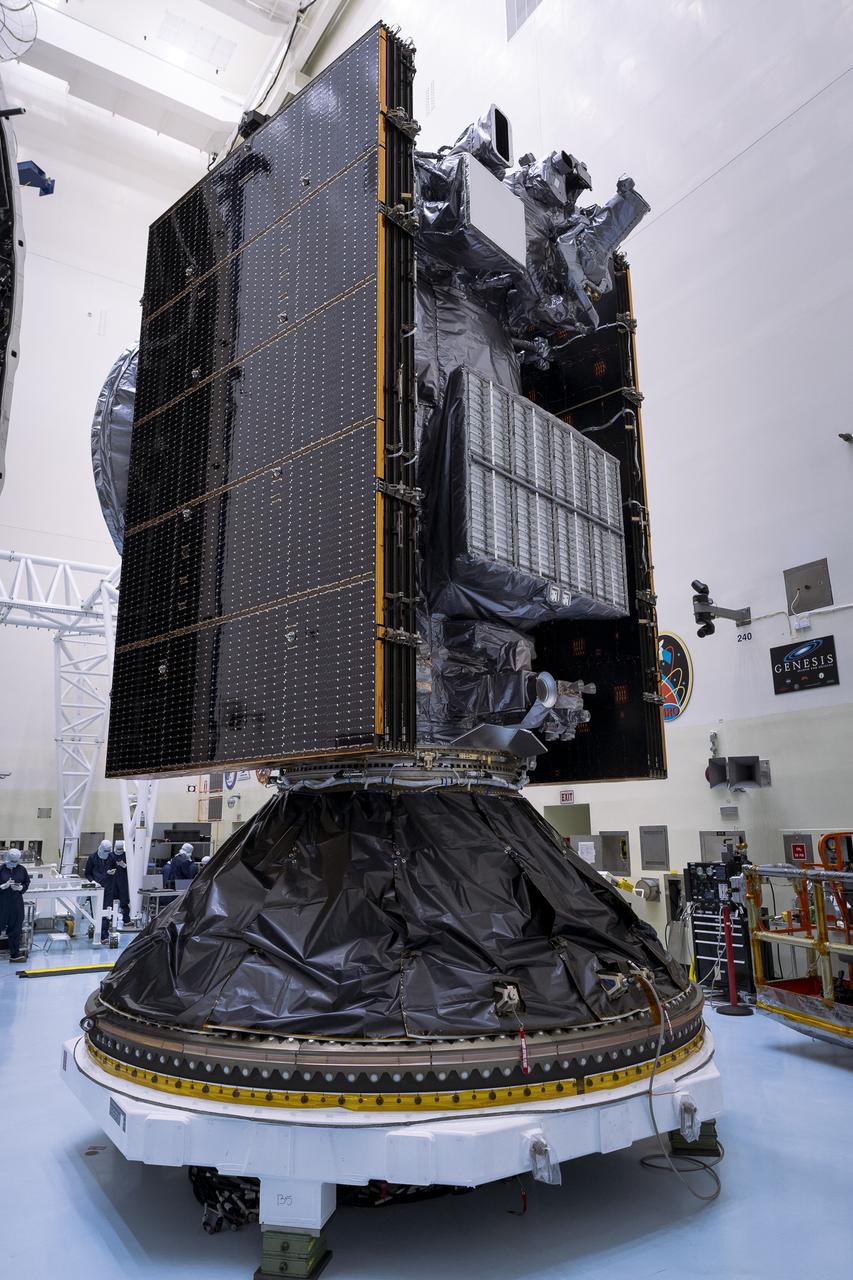
Technicians prepare to encapsulate NASA’s Europa Clipper spacecraft inside SpaceX’s Falcon Heavy payload fairing in the Payload Hazardous Servicing Facility at NASA’s Kennedy Space Center in Florida on Wednesday, Oct. 2, 2024. The payload fairing will protect the spacecraft during liftoff from Launch Complex 39A on its journey to explore Jupiter’s icy moon, Europa. The spacecraft will complete nearly 50 flybys of Jupiter’s icy moon, Europa, to determine if there are conditions suitable for life beyond Earth.

A SpaceX Falcon Heavy rocket carrying NASA’s Europa Clipper spacecraft lifts off from Launch Complex 39A at NASA’s Kennedy Space Center in Florida at 12:06 p.m. EDT on Monday, Oct. 14, 2024. After launch, the spacecraft plans to fly by Mars in February 2025, then back by Earth in December 2026, using the gravity of each planet to increase its momentum. With help of these “gravity assists,” Europa Clipper will achieve the velocity needed to reach Jupiter in April 2030.
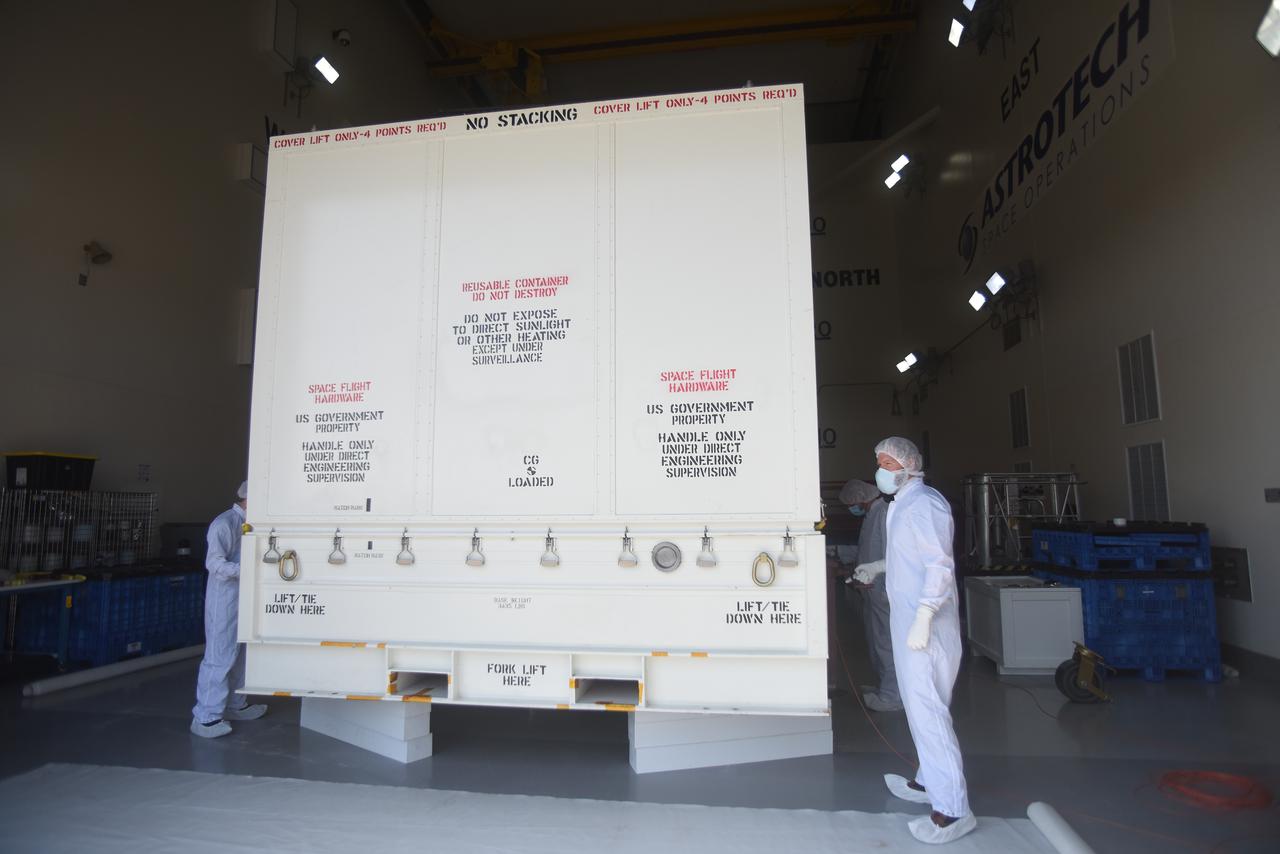
NASA’s Double Asteroid Redirection Test (DART) spacecraft, packed in its shipping container, is inside the Astrotech Space Operations Facility at Vandenberg Space Force Base in California on Oct. 2, 2021. Inside the facility, workers will unpack the spacecraft and complete a series of final tests and checkouts to confirm it is ready for launch. DART is the first mission to test technologies for preventing an impact of Earth by a hazardous asteroid. The mission is targeted to launch on Nov. 23, 2021, aboard a SpaceX Falcon 9 rocket from Vandenberg. NASA’s Launch Services Program, based at Kennedy Space Center, America’s multi-user spaceport, is managing the launch.
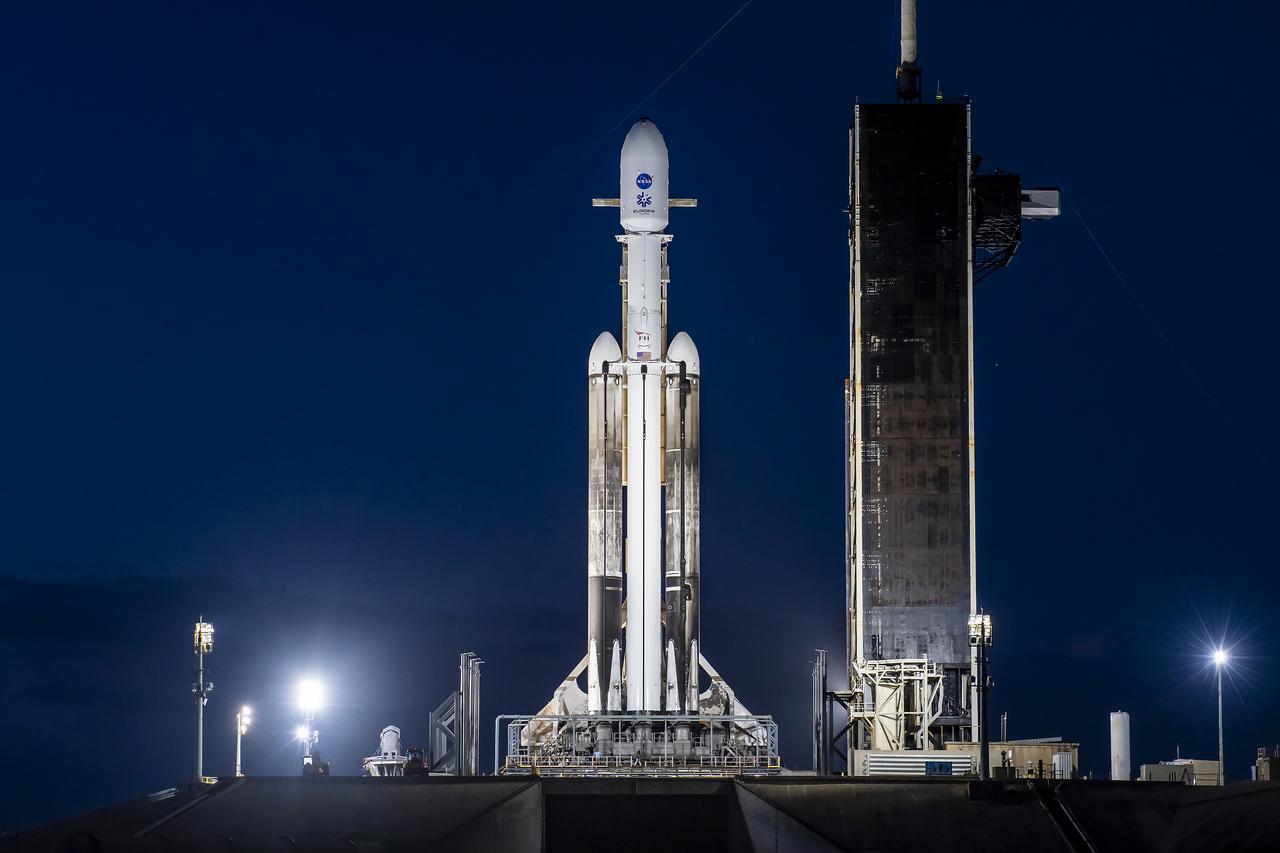
NASA’s Europa Clipper spacecraft and SpaceX’s Falcon Heavy rocket stands at Launch Pad 39A on Sunday, Oct. 13, 2024, at the agency’s Kennedy Space Center in Florida ahead of launch to Jupiter’s icy moon, Europa. The spacecraft will complete nearly 50 flybys of Europa to determine if there are conditions suitable for life beyond Earth. NASA and SpaceX are targeting launch for Europa Clipper at 12:06 p.m. EDT on Monday, Oct. 14, from Launch Complex 39A at Kennedy Space Center in Florida.

A SpaceX Falcon Heavy rocket carrying NASA’s Europa Clipper spacecraft lifts off from Launch Complex 39A at NASA’s Kennedy Space Center in Florida at 12:06 p.m. EDT on Monday, Oct. 14, 2024. After launch, the spacecraft plans to fly by Mars in February 2025, then back by Earth in December 2026, using the gravity of each planet to increase its momentum. With help of these “gravity assists,” Europa Clipper will achieve the velocity needed to reach Jupiter in April 2030.
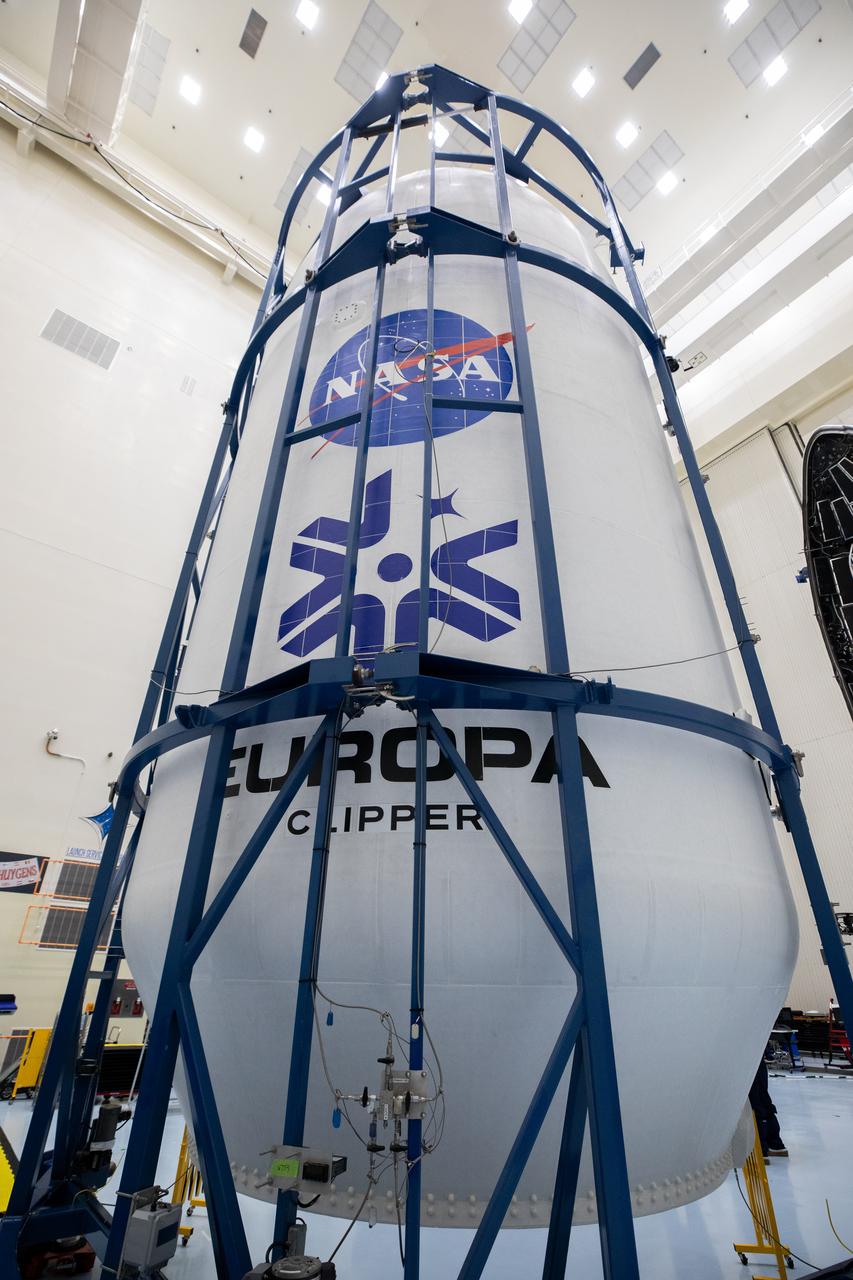
Technicians encapsulated NASA’s Europa Clipper spacecraft inside payload fairings on Wednesday, Oct. 2, 2024, in the Payload Hazardous Servicing Facility at NASA’s Kennedy Space Center in Florida. The fairings will protect the spacecraft during launch as it begins its journey to explore Jupiter’s icy moon, Europa. The mission will help scientists determine if the moon could support life. NASA and SpaceX are targeting launch at 12:31 p.m. EDT on Thursday, Oct. 10, 2024, from Launch Complex 39A at Kennedy Space Center in Florida.
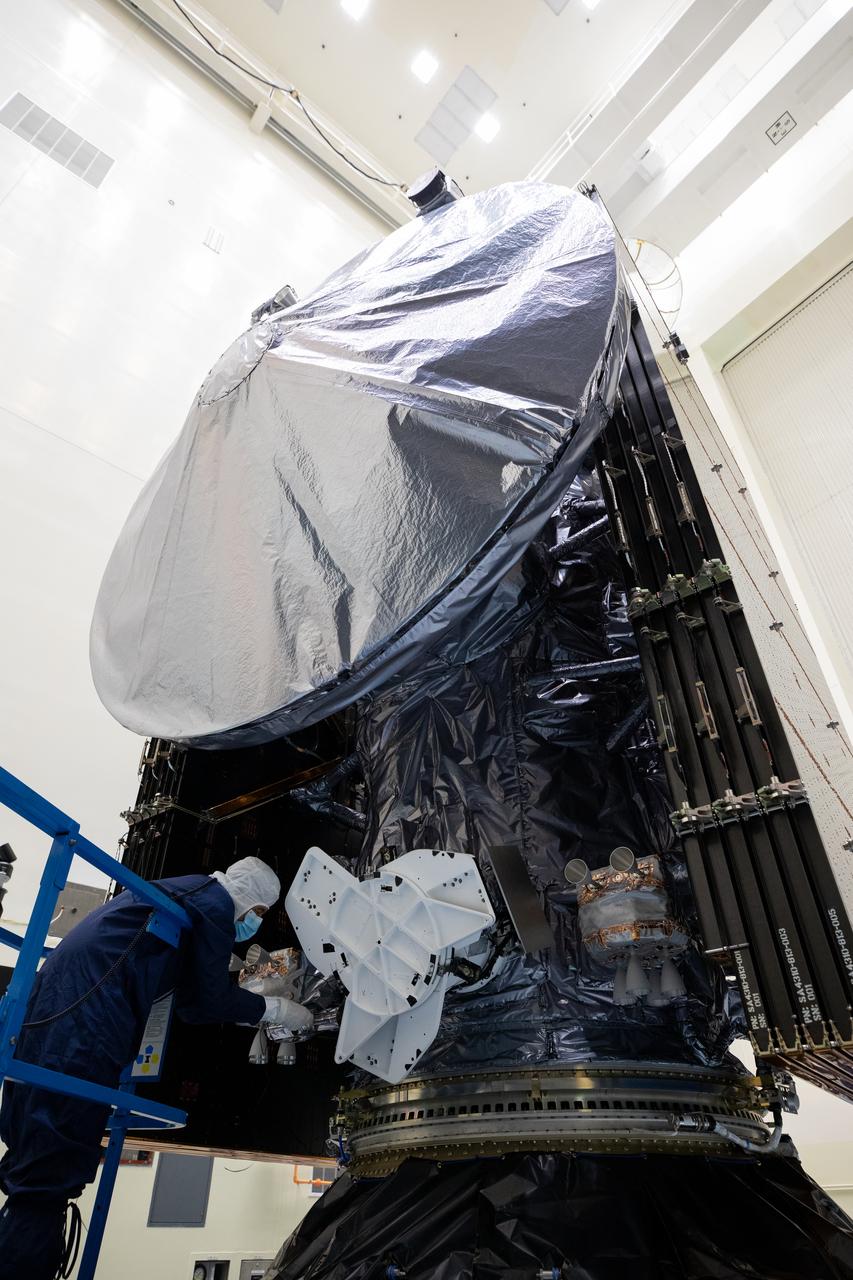
Technicians encapsulated NASA’s Europa Clipper spacecraft inside payload fairings on Wednesday, Oct. 2, 2024, in the Payload Hazardous Servicing Facility at NASA’s Kennedy Space Center in Florida. The fairings will protect the spacecraft during launch as it begins its journey to explore Jupiter’s icy moon, Europa. The mission will help scientists determine if the moon could support life. NASA and SpaceX are targeting launch at 12:31 p.m. EDT on Thursday, Oct. 10, 2024, from Launch Complex 39A at Kennedy Space Center in Florida.
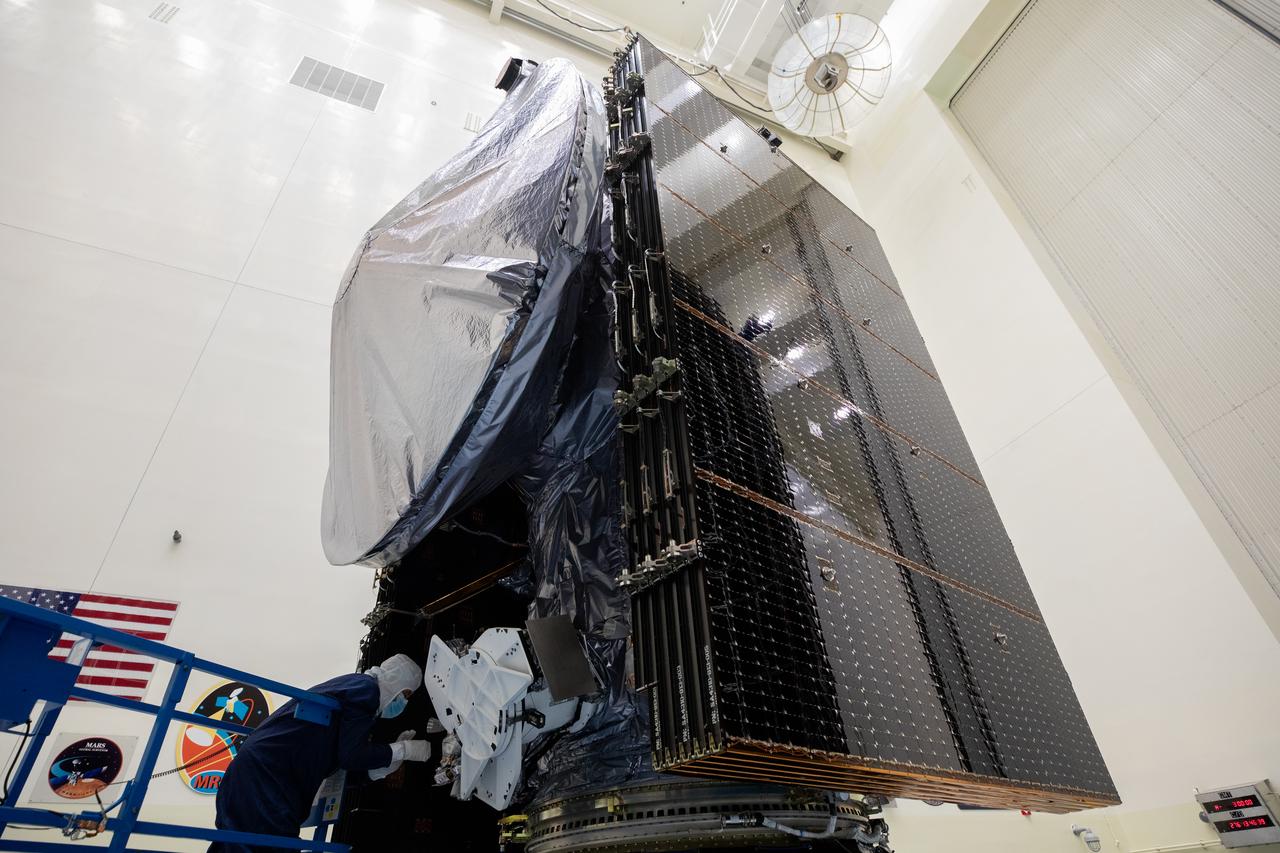
Technicians encapsulated NASA’s Europa Clipper spacecraft inside payload fairings on Wednesday, Oct. 2, 2024, in the Payload Hazardous Servicing Facility at NASA’s Kennedy Space Center in Florida. The fairings will protect the spacecraft during launch as it begins its journey to explore Jupiter’s icy moon, Europa. The mission will help scientists determine if the moon could support life. NASA and SpaceX are targeting launch at 12:31 p.m. EDT on Thursday, Oct. 10, 2024, from Launch Complex 39A at Kennedy Space Center in Florida.
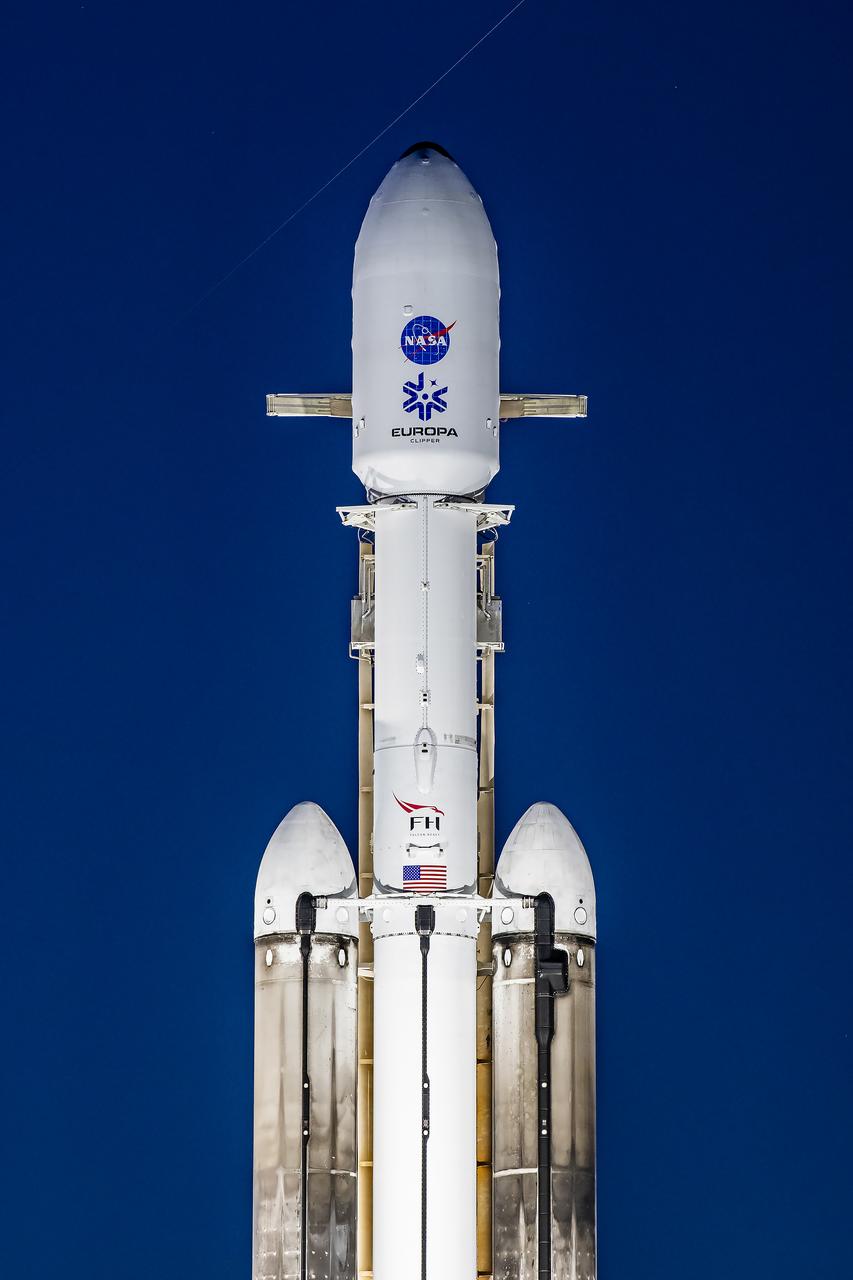
NASA’s Europa Clipper spacecraft sits atop SpaceX’s Falcon Heavy rocket at Launch Pad 39A on Sunday, Oct. 13, 2024, at the agency’s Kennedy Space Center in Florida ahead of launch to Jupiter’s icy moon, Europa. The spacecraft will complete nearly 50 flybys of Europa to determine if there are conditions suitable for life beyond Earth. Launch is targeting 12:06 p.m. EDT on Monday, Oct. 14, from Launch Complex 39A at Kennedy Space Center in Florida.
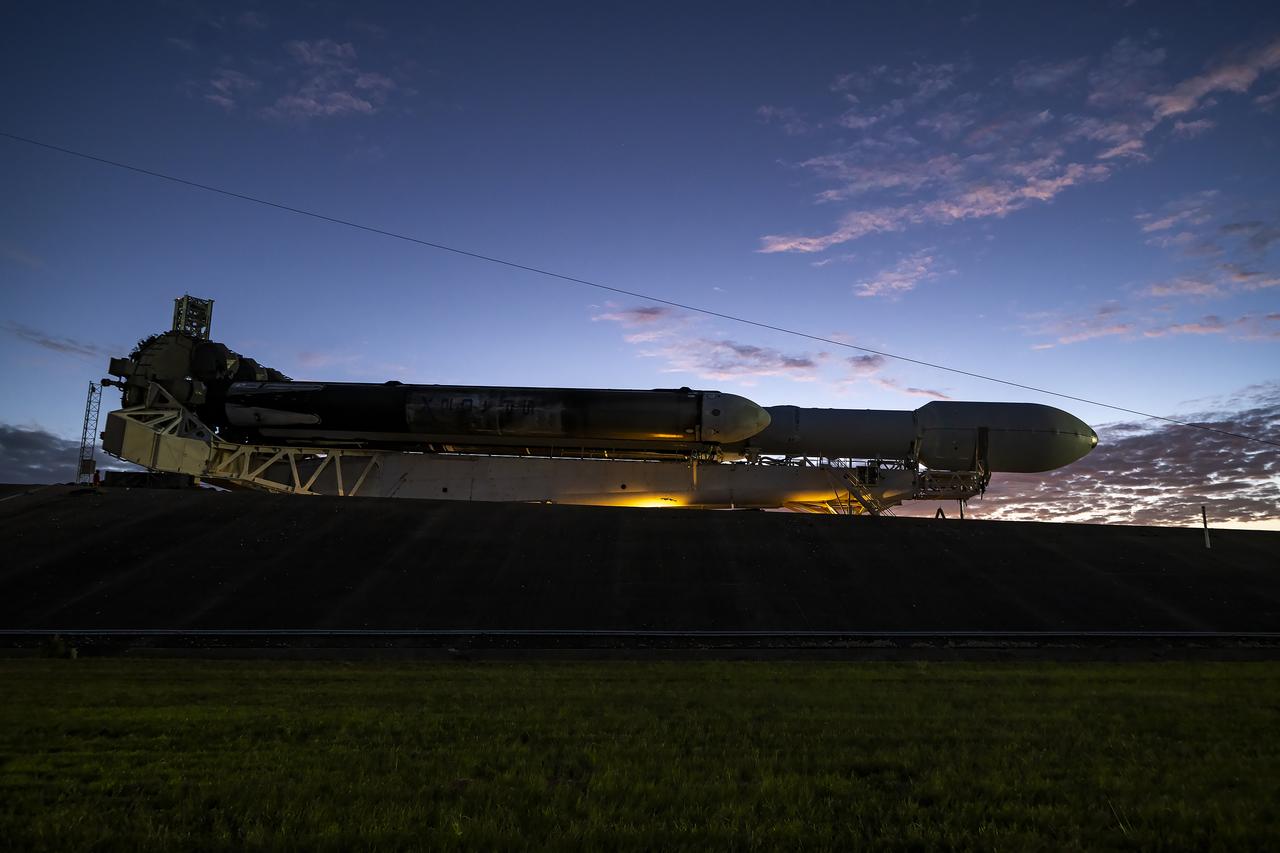
NASA’s Europa Clipper spacecraft attached to SpaceX’s Falcon Heavy rocket, rolls to Launch Pad 39A on Saturday, Oct. 12, 2024, at NASA’s Kennedy Space Center in Florida ahead of launch to Jupiter’s icy moon, Europa. The spacecraft will complete nearly 50 flybys of Europa to determine if there are conditions suitable for life beyond Earth. NASA and SpaceX are targeting launch for Europa Clipper at 12:06 p.m. EDT on Monday, Oct. 14, from Launch Complex 39A at Kennedy Space Center in Florida.
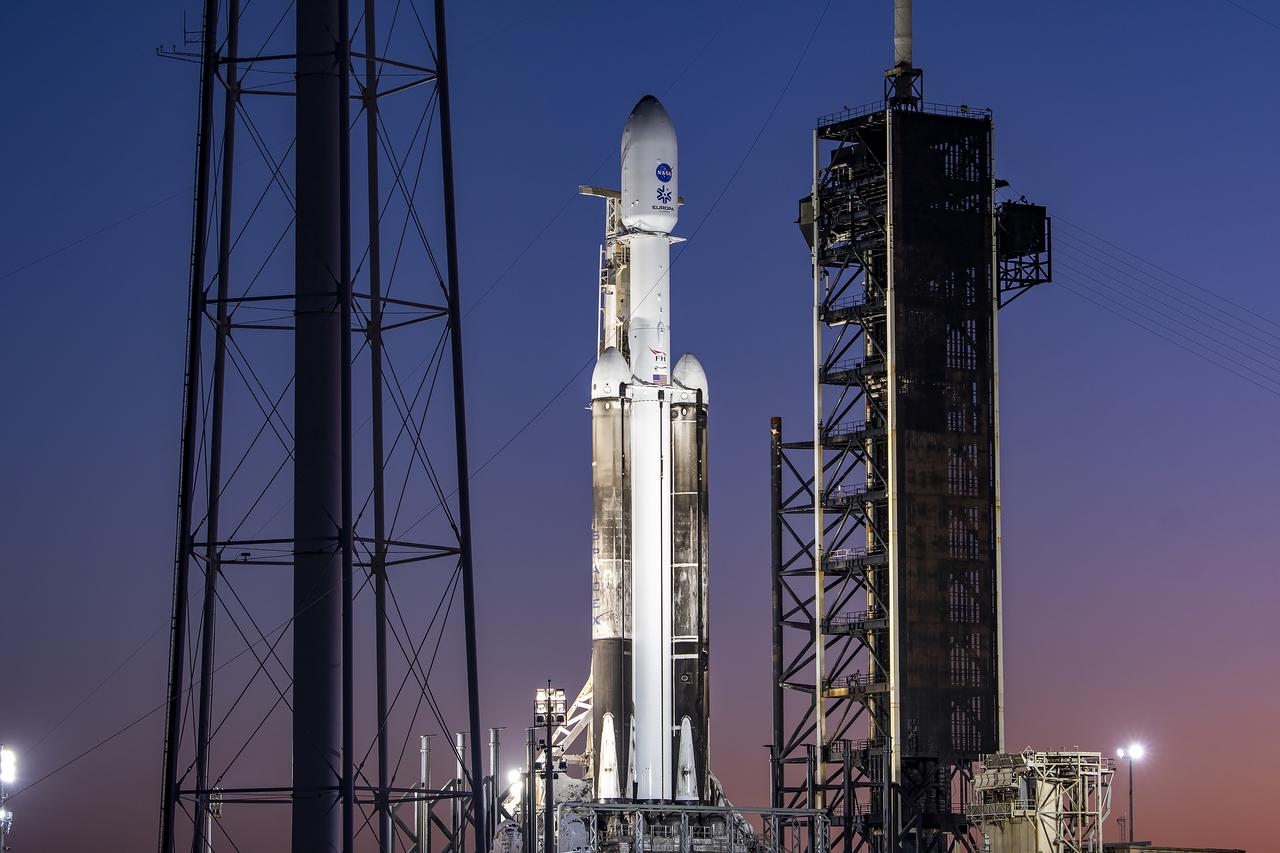
Europa Clipper spacecraft sits atop SpaceX’s Falcon Heavy rocket at Launch Complex 39A on Sunday, Oct. 13, 2024, at the agency’s Kennedy Space Center in Florida ahead of launch to Jupiter’s icy moon, Europa. The spacecraft will complete nearly 50 flybys of Europa to determine if there are conditions suitable for life beyond Earth.

A SpaceX Falcon Heavy rocket carrying NASA’s Europa Clipper spacecraft lifts off from Launch Complex 39A at NASA’s Kennedy Space Center in Florida at 12:06 p.m. EDT on Monday, Oct. 14, 2024. After launch, the spacecraft plans to fly by Mars in February 2025, then back by Earth in December 2026, using the gravity of each planet to increase its momentum. With help of these “gravity assists,” Europa Clipper will achieve the velocity needed to reach Jupiter in April 2030.
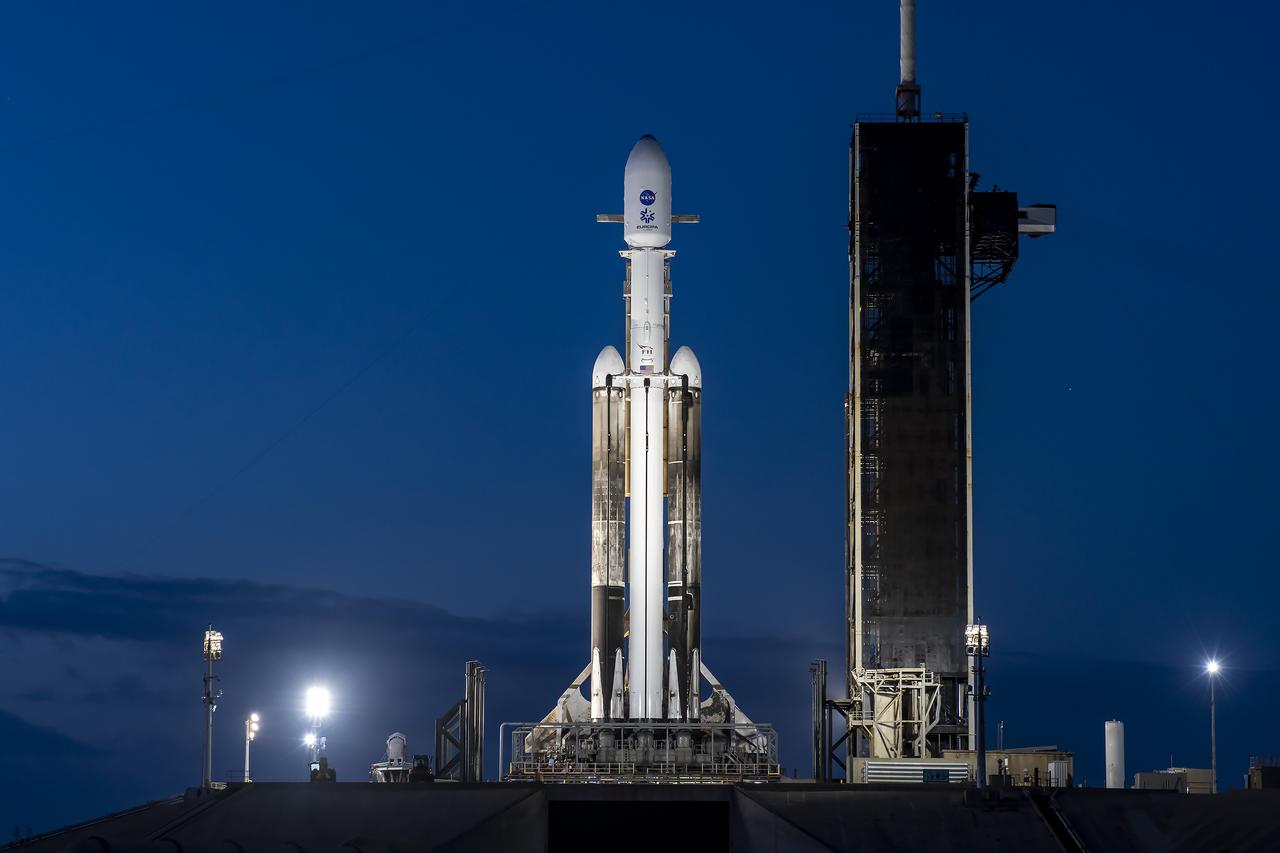
NASA’s Europa Clipper spacecraft and SpaceX’s Falcon Heavy rocket are vertical at Launch Pad 39A on Sunday, Oct. 13, 2024, at the agency’s Kennedy Space Center in Florida ahead of launch to Jupiter’s icy moon, Europa. The spacecraft will complete nearly 50 flybys of Europa to determine if there are conditions suitable for life beyond Earth. Launch is targeting 12:06 p.m. EDT on Monday, Oct. 14, from Launch Complex 39A at Kennedy Space Center in Florida.
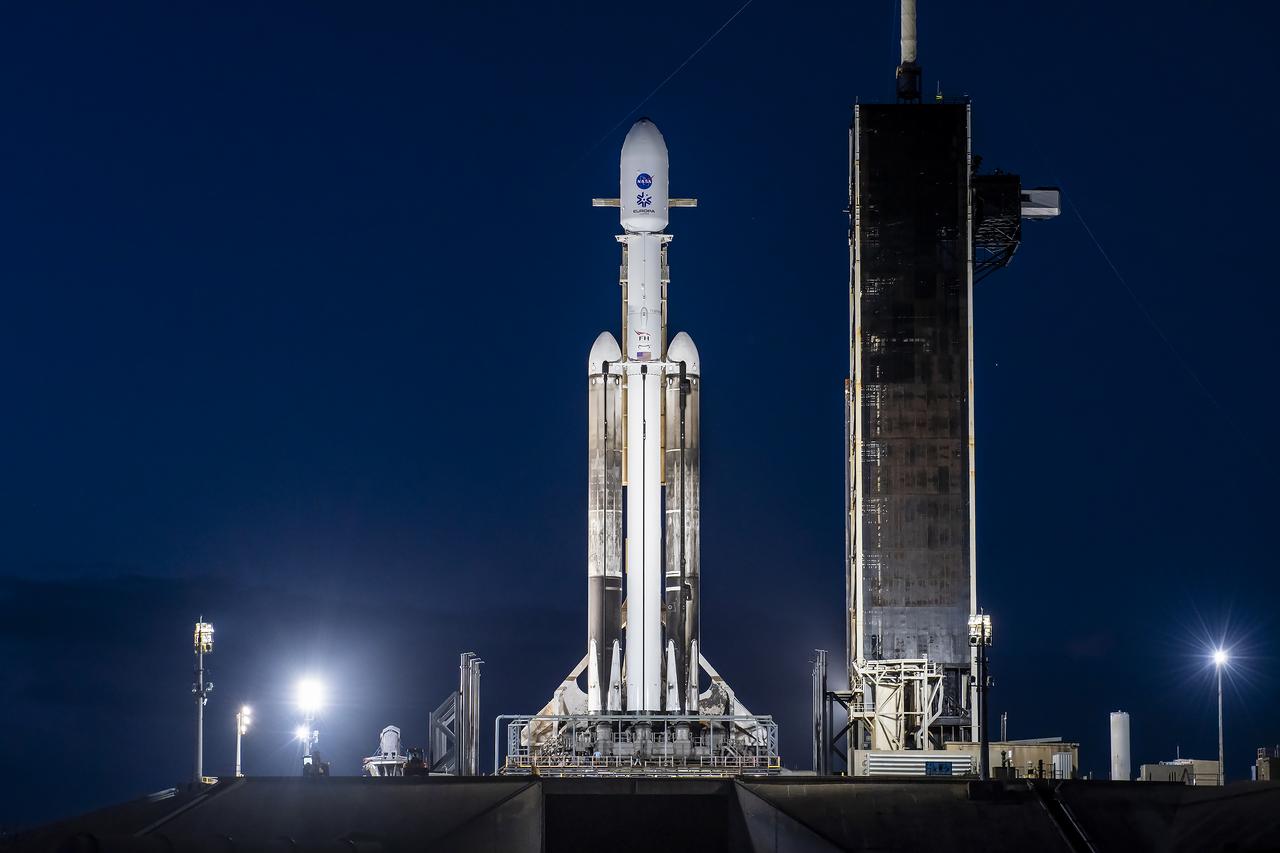
NASA’s Europa Clipper spacecraft and SpaceX’s Falcon Heavy rocket are vertical at Launch Pad 39A on Sunday, Oct. 13, 2024, at the agency’s Kennedy Space Center in Florida ahead of launch to Jupiter’s icy moon, Europa. The spacecraft will complete nearly 50 flybys of Europa to determine if there are conditions suitable for life beyond Earth. Launch is targeting 12:06 p.m. EDT on Monday, Oct. 14, from Launch Complex 39A at Kennedy Space Center in Florida.
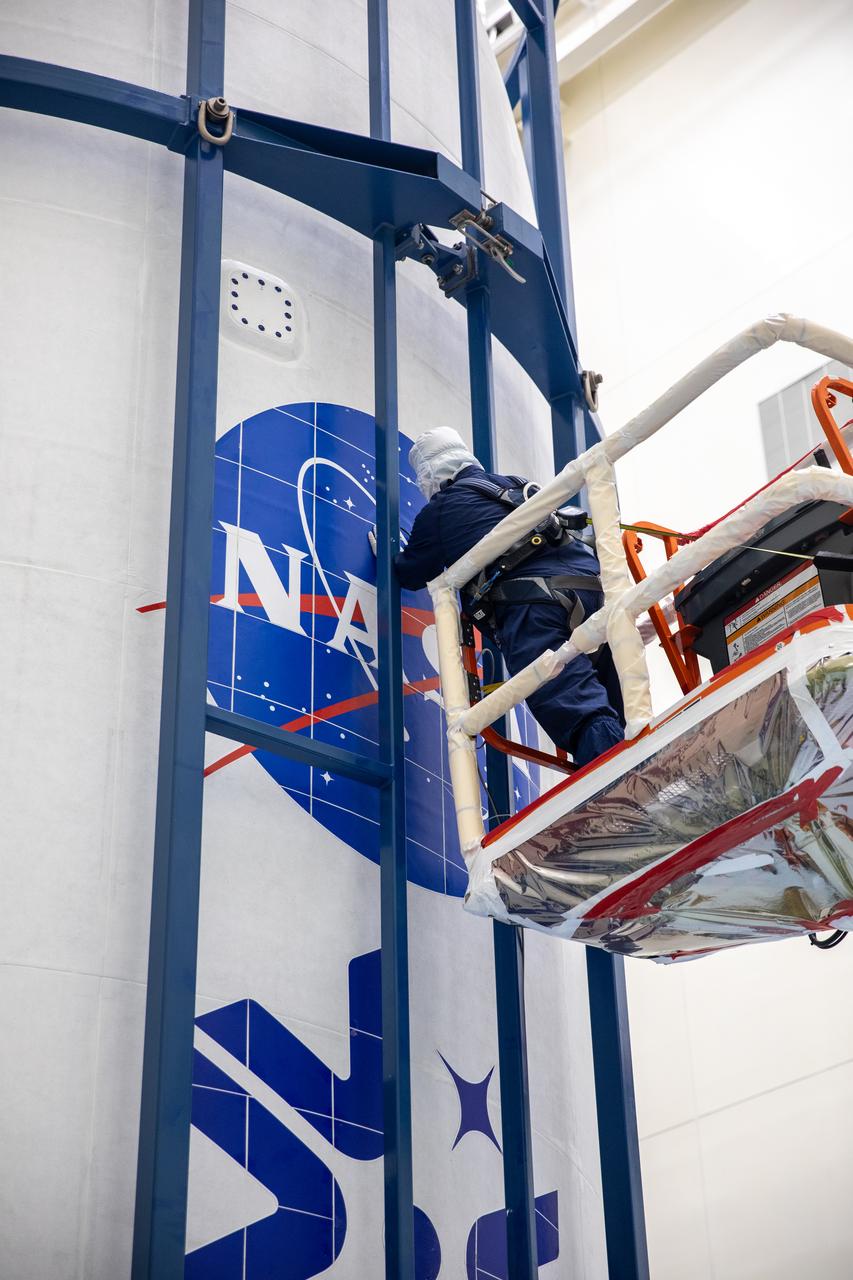
Technicians encapsulated NASA’s Europa Clipper spacecraft inside payload fairings on Wednesday, Oct. 2, 2024, in the Payload Hazardous Servicing Facility at NASA’s Kennedy Space Center in Florida. The fairings will protect the spacecraft during launch as it begins its journey to explore Jupiter’s icy moon, Europa. The mission will help scientists determine if the moon could support life. NASA and SpaceX are targeting launch at 12:31 p.m. EDT on Thursday, Oct. 10, 2024, from Launch Complex 39A at Kennedy Space Center in Florida.
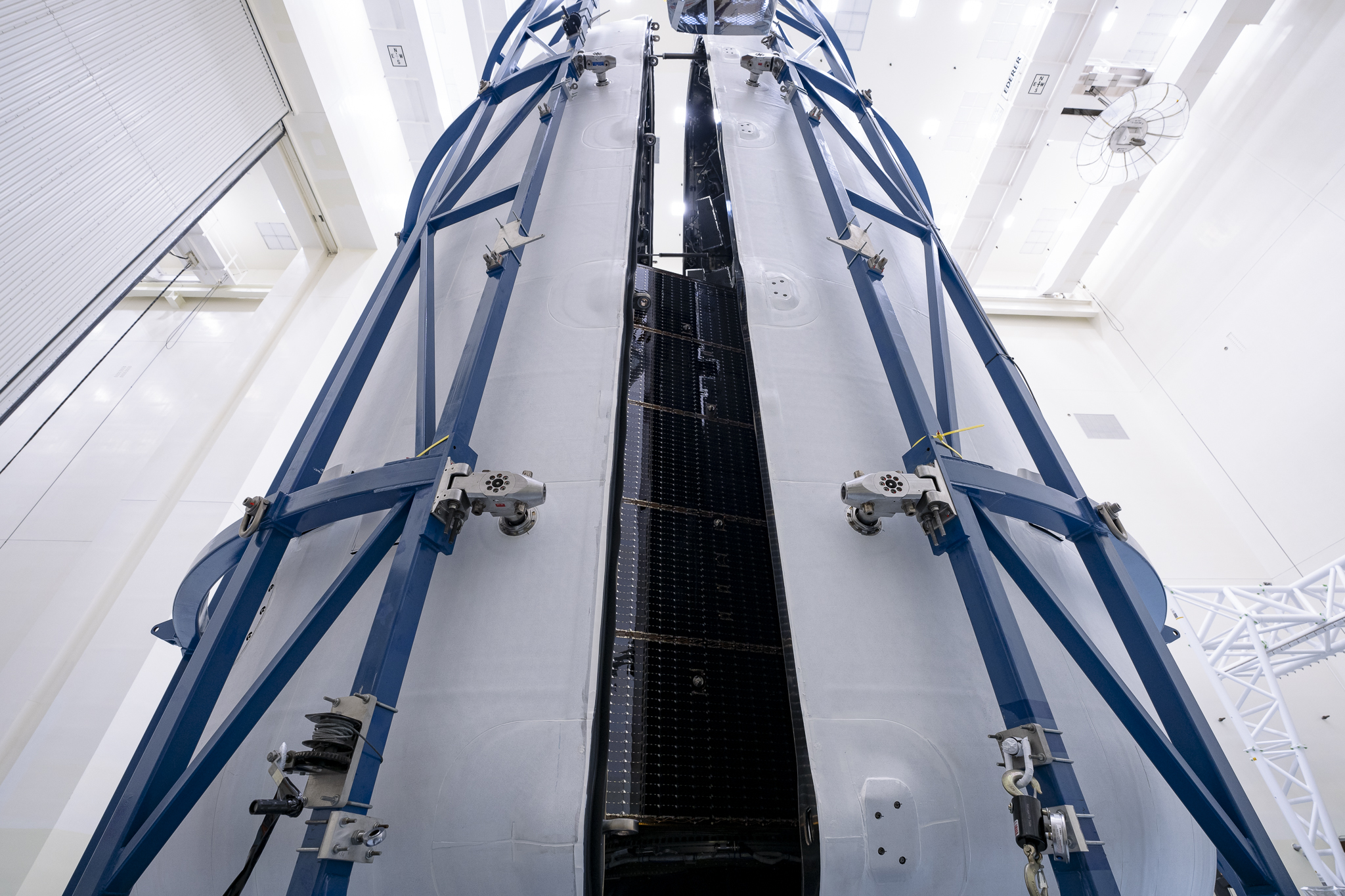
Technicians encapsulate NASA’s Europa Clipper spacecraft inside SpaceX’s Falcon Heavy payload fairing in the Payload Hazardous Servicing Facility at NASA’s Kennedy Space Center in Florida on Wednesday, Oct. 2, 2024. The payload fairing will protect the spacecraft during liftoff from Launch Complex 39A on its journey to explore Jupiter’s icy moon, Europa. The spacecraft will complete nearly 50 flybys of Jupiter’s icy moon, Europa, to determine if there are conditions suitable for life beyond Earth.

A SpaceX Falcon Heavy rocket carrying NASA’s Europa Clipper spacecraft lifts off from Launch Complex 39A at NASA’s Kennedy Space Center in Florida at 12:06 p.m. EDT on Monday, Oct. 14, 2024. After launch, the spacecraft plans to fly by Mars in February 2025, then back by Earth in December 2026, using the gravity of each planet to increase its momentum. With help of these “gravity assists,” Europa Clipper will achieve the velocity needed to reach Jupiter in April 2030.
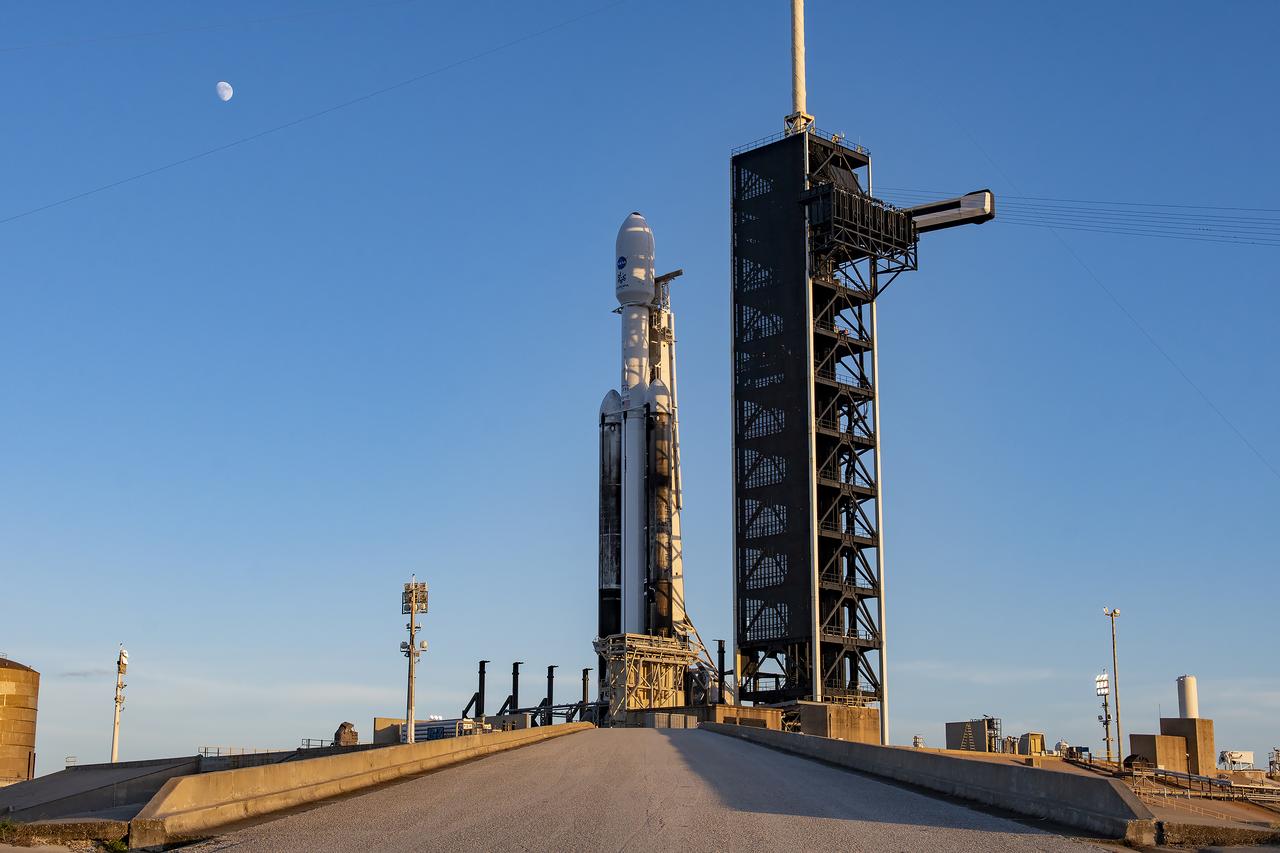
The Earth’s Moon appears with NASA’s Europa Clipper spacecraft encapsulated in a payload fairing atop SpaceX’s Heavy rocket at Launch Complex 39A on Sunday, Oct. 13, 2024, at the agency’s Kennedy Space Center in Florida. The Europa Clipper spacecraft will travel to Jupiter’s icy moon Europa to determine if there are conditions suitable for life beyond Earth.
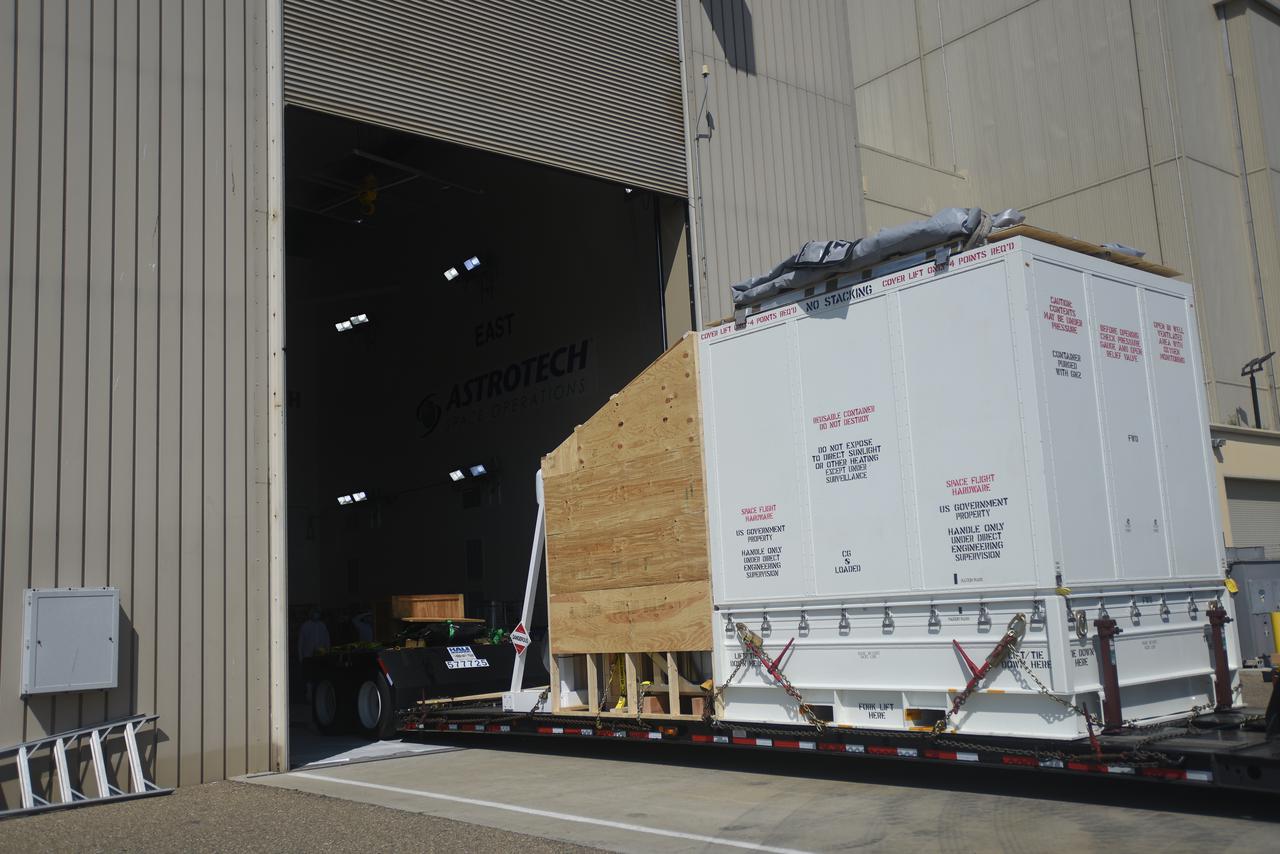
NASA’s Double Asteroid Redirection Test (DART) spacecraft, packed in its shipping container, is moved into the Astrotech Space Operations Facility at Vandenberg Space Force Base in California on Oct. 2, 2021. Inside the facility, workers will unpack the spacecraft and complete a series of final tests and checkouts to confirm it is ready for launch. DART is the first mission to test technologies for preventing an impact of Earth by a hazardous asteroid. The mission is targeted to launch on Nov. 23, 2021, aboard a SpaceX Falcon 9 rocket from Vandenberg. NASA’s Launch Services Program, based at Kennedy Space Center, America’s multi-user spaceport, is managing the launch.
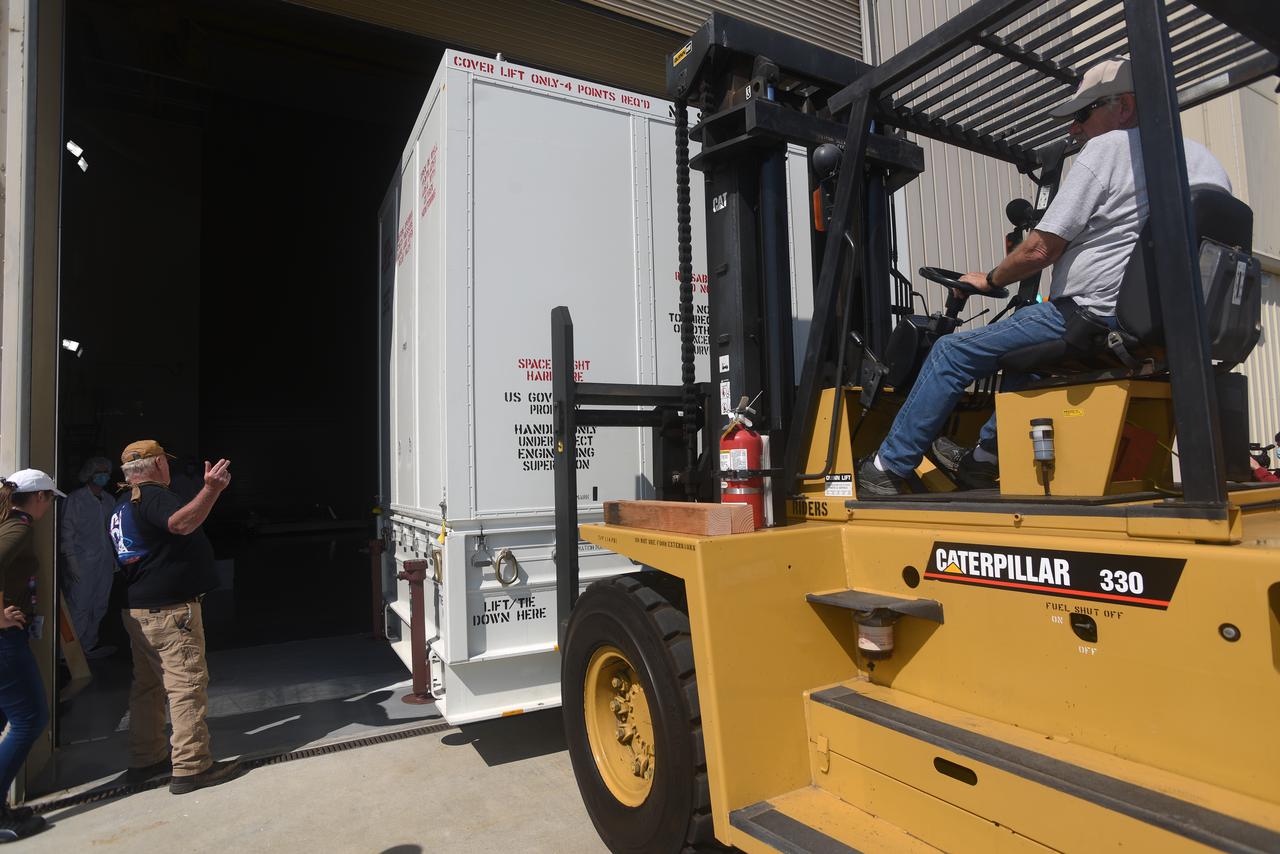
NASA’s Double Asteroid Redirection Test (DART) spacecraft is moved into the Astrotech Space Operations Facility at Vandenberg Space Force Base in California on Oct. 2, 2021. Inside the facility, workers will unpack the spacecraft and complete a series of final tests and checkouts to confirm it is ready for launch. DART is the first mission to test technologies for preventing an impact of Earth by a hazardous asteroid. The mission is targeted to launch on Nov. 23, 2021, aboard a SpaceX Falcon 9 rocket from Vandenberg. NASA’s Launch Services Program, based at Kennedy Space Center, America’s multi-user spaceport, is managing the launch.
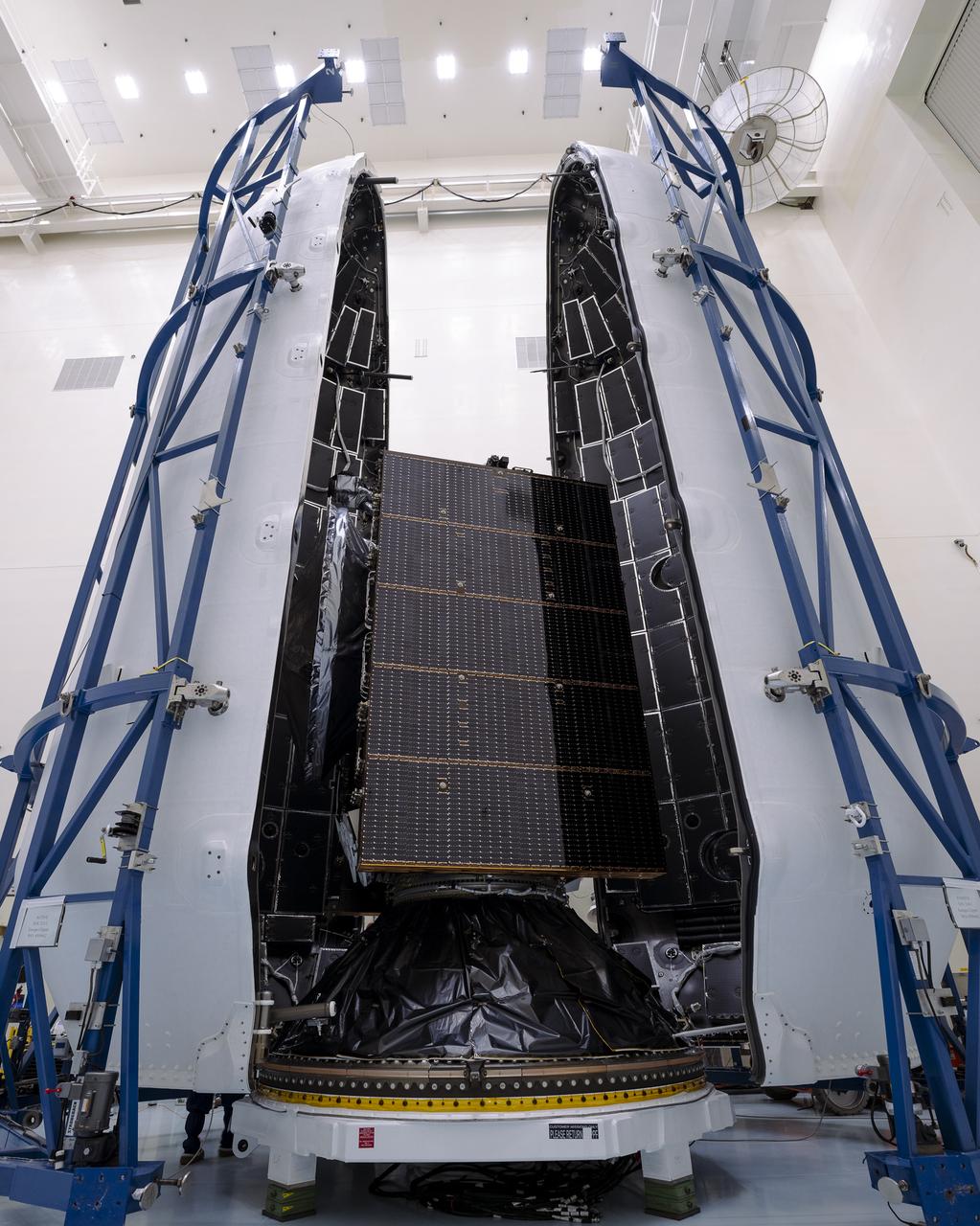
Technicians prepare to encapsulate NASA’s Europa Clipper spacecraft inside SpaceX’s Falcon Heavy payload fairing in the Payload Hazardous Servicing Facility at NASA’s Kennedy Space Center in Florida on Wednesday, Oct. 2, 2024. The payload fairing will protect the spacecraft during liftoff from Launch Complex 39A on its journey to explore Jupiter’s icy moon, Europa. The spacecraft will complete nearly 50 flybys of Jupiter’s icy moon, Europa, to determine if there are conditions suitable for life beyond Earth.
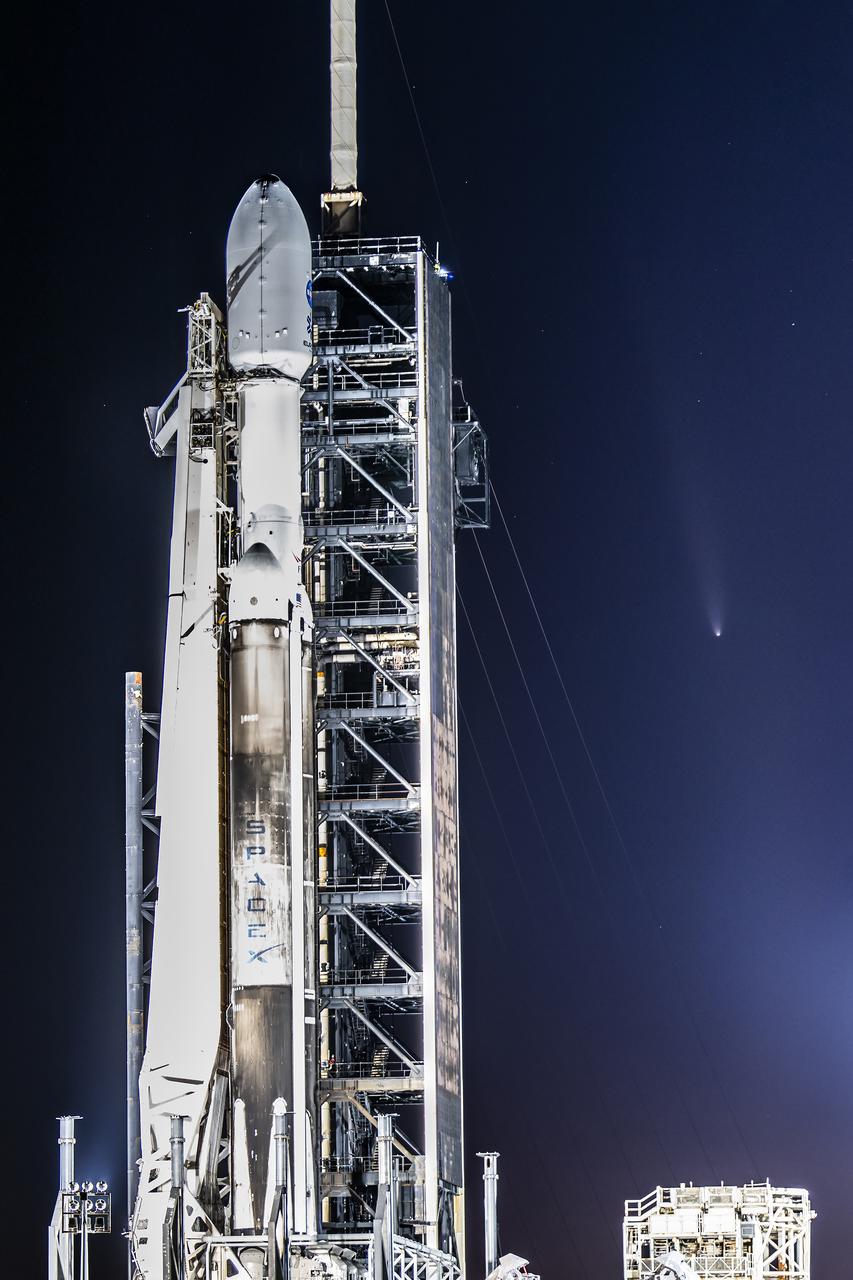
Comet C/2023 A3 (Tsuchinshan-Atlas) illuminates the sky behind NASA’s Europa Clipper spacecraft on the SpaceX Falcon Heavy rocket at Launch Complex 39A on Sunday, Oct. 13, 2024, at the agency’s Kennedy Space Center in Florida ahead of launch to Jupiter’s icy moon, Europa. The spacecraft will complete nearly 50 flybys of Europa to determine if there are conditions suitable for life beyond Earth.

Technicians test the spring-activated door on the Interstellar Dust Experiment (IDEX) instrument of NASA’s IMAP (Interstellar Mapping and Acceleration Probe) observatory inside the high bay at the Astrotech Space Operations Facility near the agency’s Kennedy Space Center in Florida on Tuesday, June 3, 2025. The door will remain closed to protect IDEX from contamination during integration and launch. Once in space, the door will swing open permanently to allow interstellar and interplanetary dust to flow into the instrument for measurement. The IMAP observatory will study how the Sun shapes the boundaries of the heliosphere, the protective bubble around our solar system. Launch is targeted for no earlier than September 2025 aboard a SpaceX Falcon 9 rocket from Launch Complex 39A at NASA Kennedy.

A SpaceX Falcon Heavy rocket carrying NASA’s Europa Clipper spacecraft lifts off from Launch Complex 39A at NASA’s Kennedy Space Center in Florida at 12:06 p.m. EDT on Monday, Oct. 14, 2024. After launch, the spacecraft plans to fly by Mars in February 2025, then back by Earth in December 2026, using the gravity of each planet to increase its momentum. With help of these “gravity assists,” Europa Clipper will achieve the velocity needed to reach Jupiter in April 2030.

A SpaceX Falcon Heavy rocket carrying NASA’s Europa Clipper spacecraft lifts off from Launch Complex 39A at NASA’s Kennedy Space Center in Florida at 12:06 p.m. EDT on Monday, Oct. 14, 2024. After launch, the spacecraft plans to fly by Mars in February 2025, then back by Earth in December 2026, using the gravity of each planet to increase its momentum. With help of these “gravity assists,” Europa Clipper will achieve the velocity needed to reach Jupiter in April 2030.
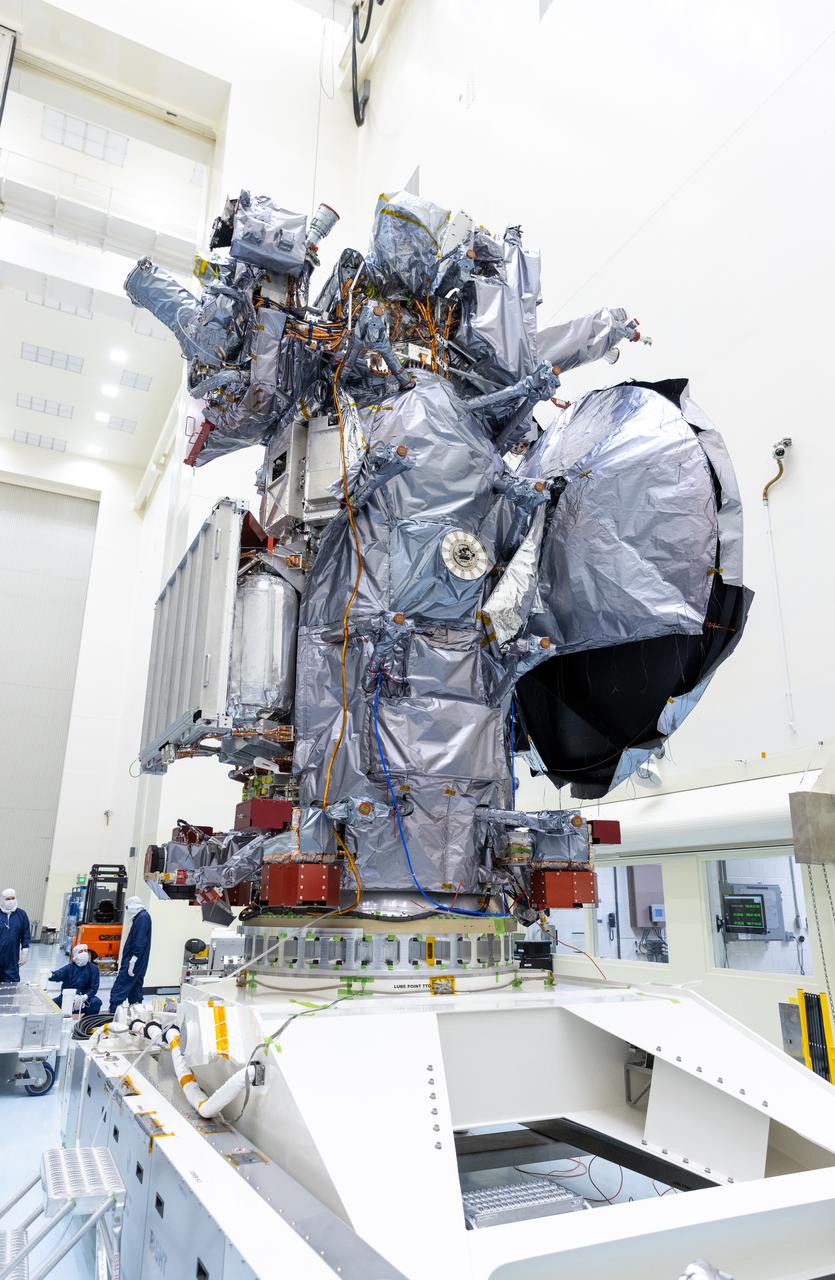
Technicians prepare to install the nearly 10 feet (3 meters) wide dish-shaped high-gain antenna to NASA’s Europa Clipper, a spacecraft to study Jupiter’s icy moon, at the agency’s Payload Hazardous Servicing Facility at Kennedy Space Center in Florida on Tuesday, June 18, 2024. The spacecraft will perform a series of flybys of the Jupiter moon Europa to gather data on its atmosphere, icy crust, and the ocean underneath, and the high-gain antenna will send the research data to scientists on Earth to determine if the moon can support habitable condition. The Europa Clipper spacecraft is scheduled to launch atop a SpaceX Falcon Heavy rocket from Kennedy’s Launch Complex 39A no earlier than October 2024.

A SpaceX Falcon Heavy rocket carrying NASA’s Europa Clipper spacecraft lifts off from Launch Complex 39A at NASA’s Kennedy Space Center in Florida at 12:06 p.m. EDT on Monday, Oct. 14, 2024. After launch, the spacecraft plans to fly by Mars in February 2025, then back by Earth in December 2026, using the gravity of each planet to increase its momentum. With help of these “gravity assists,” Europa Clipper will achieve the velocity needed to reach Jupiter in April 2030.
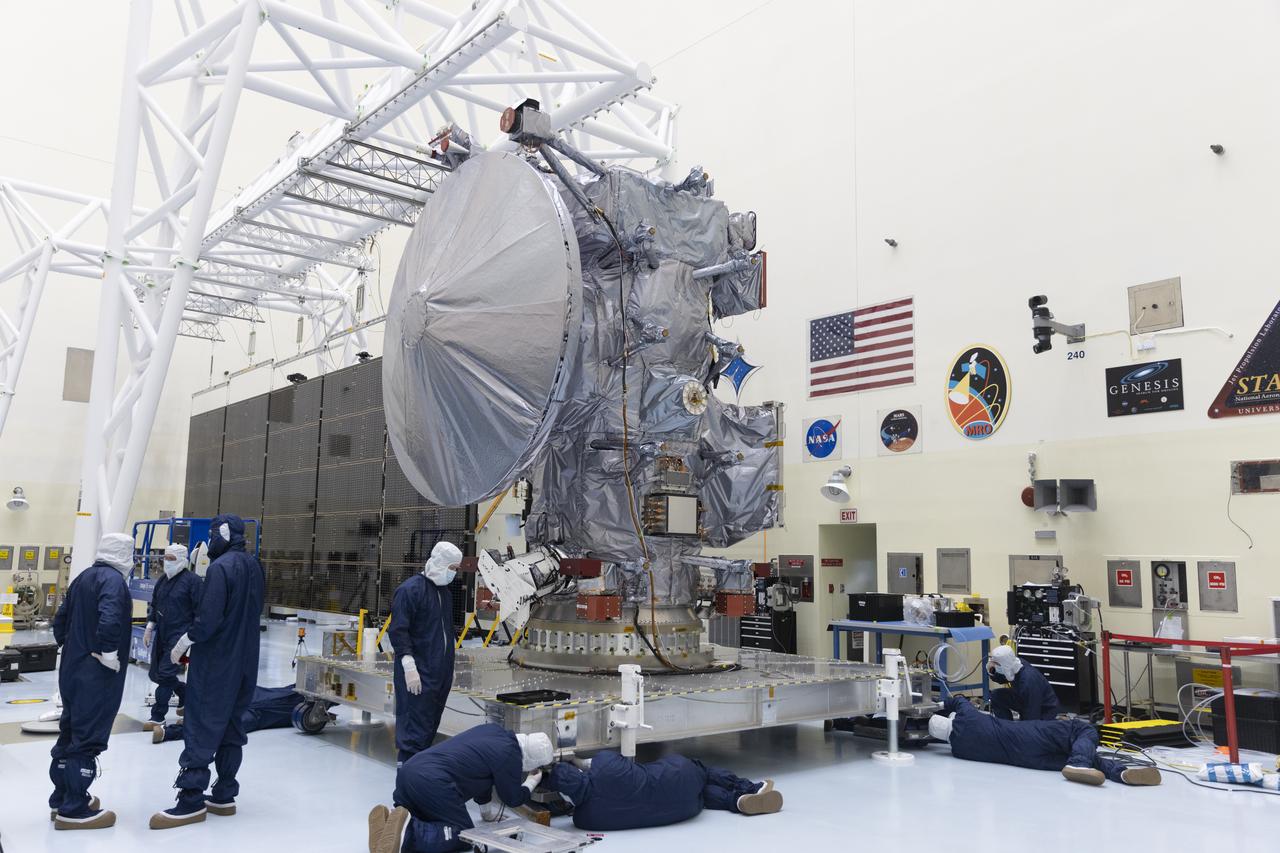
Technicians move NASA’s Europa Clipper spacecraft inside the Payload Hazardous Servicing Facility to accommodate installation of its five-panel solar array at the agency’s Kennedy Space Center in Florida on Thursday, Aug. 1, 2024. After moving the spacecraft, the team had to precisely align the spacecraft in preparation for the installation. The huge arrays – spanning more than 100 feet when fully deployed, or about the length of a basketball court – will collect sunlight to power the spacecraft as it flies multiple times around Jupiter’s icy moon, Europa, conducting science investigations to determine its potential to support life.

Technicians inside the Payload Hazardous Servicing Facility at NASA’s Kennedy Space Center in Florida prepare to rotate the agency’s largest planetary mission spacecraft, Europa Clipper, to a vertical position on Tuesday, May 28, 2024, as part of prelaunch processing. Slated to launch aboard a SpaceX Falcon Heavy rocket later this year from Launch Complex 39A at Kennedy, Europa Clipper will help determine if conditions exist below the surface Jupiter’s fourth largest moon, Europa, that could support life.
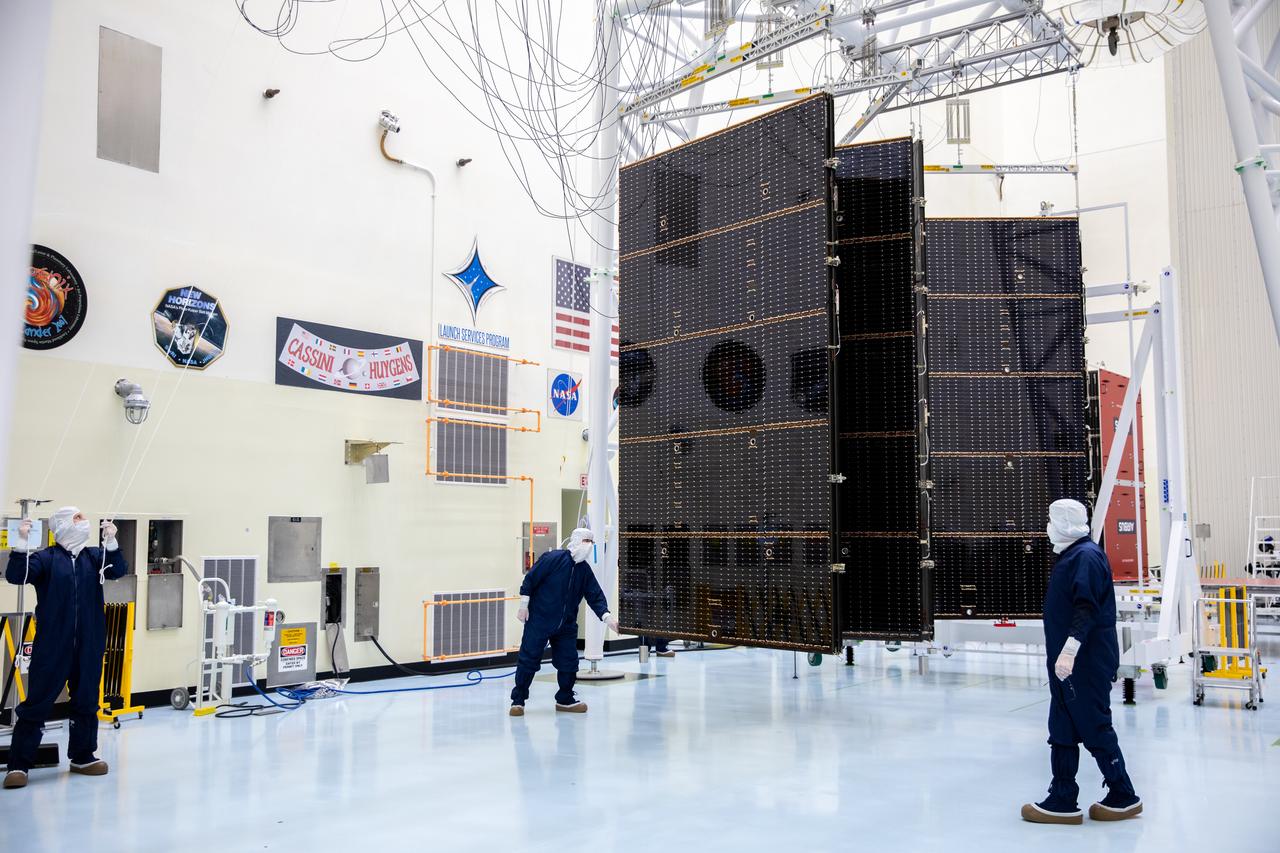
Technicians working inside the Payload Hazardous Servicing Facility at the agency’s Kennedy Space Center in Florida unfolded and fully extended the first of two five-panel solar arrays built for NASA’s Europa Clipper in preparation for inspection and cleaning as part of assembly, test, and launch operations on Wednesday, March 6, 2024. When both solar arrays are installed and deployed on Europa Clipper – the agency’s largest spacecraft ever developed for a planetary mission – the spacecraft will span a total length of more than 100 feet and weigh 7,145 pounds without the inclusion of propellants.
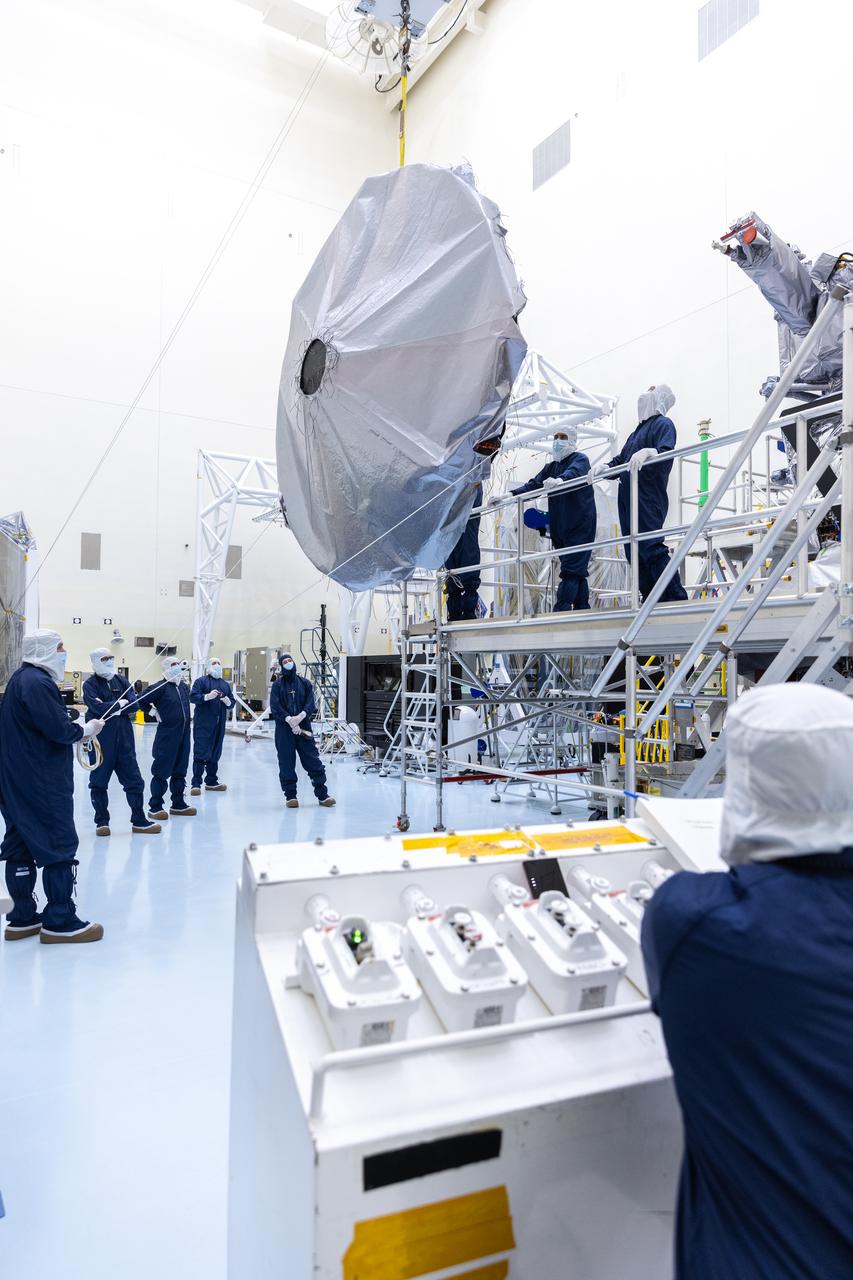
Technicians prepare to install the nearly 10 feet (3 meters) wide dish-shaped high-gain antenna to NASA’s Europa Clipper, a spacecraft to study Jupiter’s icy moon, at the agency’s Payload Hazardous Servicing Facility at Kennedy Space Center in Florida on Monday, June 17, 2024. The spacecraft will perform a series of flybys of the Jupiter moon Europa to gather data on its atmosphere, icy crust, and the ocean underneath, and the high-gain antenna will send the research data to scientists on Earth to determine if the moon can support habitable condition. The Europa Clipper spacecraft is scheduled to launch atop a SpaceX Falcon Heavy rocket from Kennedy’s Launch Complex 39A no earlier than October 2024.
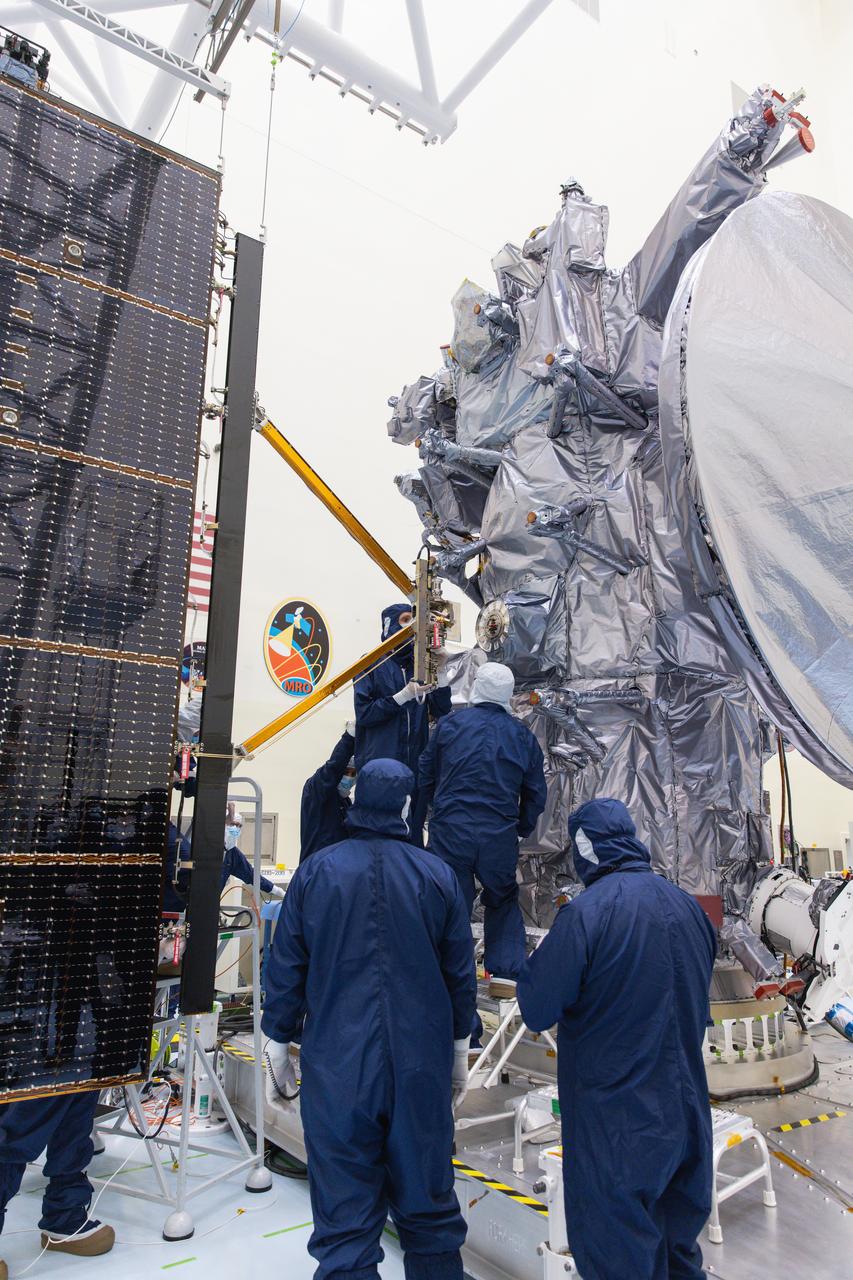
Technicians attach the five-panel solar arrays to NASA’s Europa Clipper spacecraft inside the Payload Hazardous Servicing Facility at the agency’s Kennedy Space Center in Florida on Friday, Aug. 2, 2024. The huge arrays – spanning more than 100 feet when fully deployed, or about the length of a basketball court – will collect sunlight to power the spacecraft as it explores Jupiter’s icy moon, Europa, conducting science investigations to determine its potential to support life.
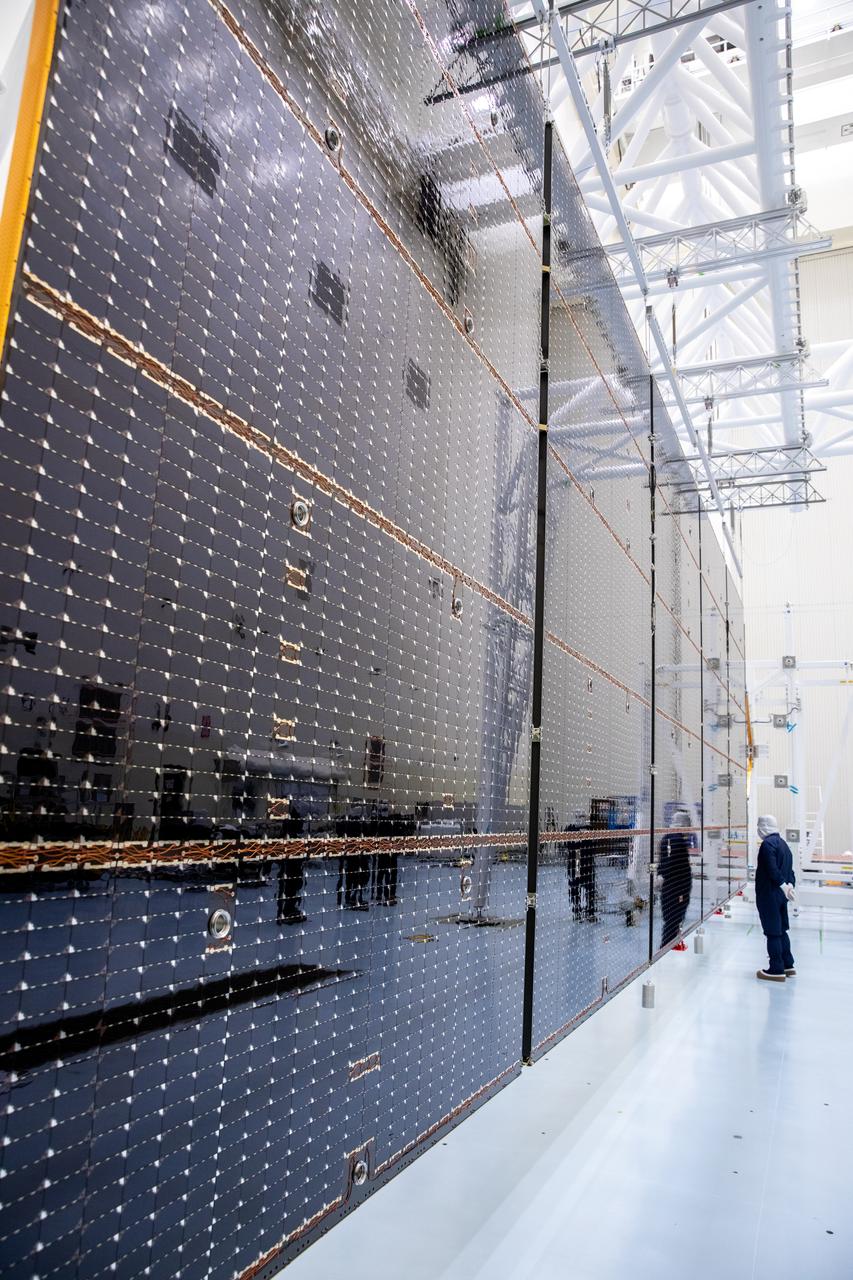
Technicians examine the first of two fully extended five-panel solar arrays built for NASA’s Europa Clipper suspended on a support system called a gravity offload fixture during inspection and cleaning as part of assembly, test, and launch operations inside the Payload Hazardous Servicing Facility at the agency’s Kennedy Space Center in Florida on Wednesday, March 6, 2024. Another name for the gravity offload fixture is the Transportable Large Envelope Deployment Facility (T-LEDF). When both solar arrays are installed and deployed on Europa Clipper – the agency’s largest spacecraft ever developed for a planetary mission – the spacecraft will span a total length of more than 100 feet and weigh 7,145 pounds without the inclusion of propellants.
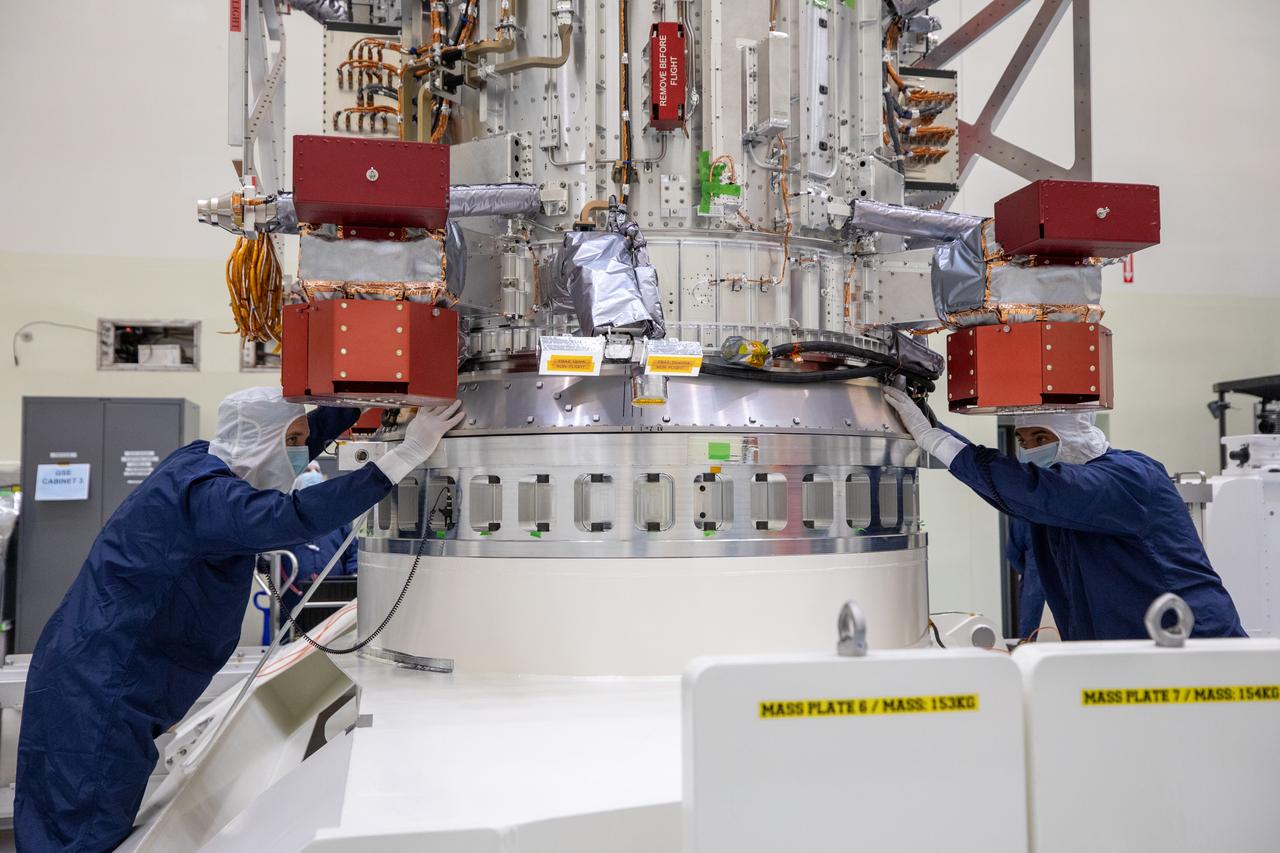
Technicians inside the Payload Hazardous Servicing Facility at NASA’s Kennedy Space Center in Florida monitor movement and guide the agency’s largest planetary mission spacecraft, Europa Clipper, as a crane hoists it on a stand as part of prelaunch processing on Tuesday, May 28, 2024. Slated to launch aboard a SpaceX Falcon Heavy rocket later this year from Launch Complex 39A at Kennedy, Europa Clipper will help determine if conditions exist below the surface Jupiter’s fourth largest moon, Europa that could support life.
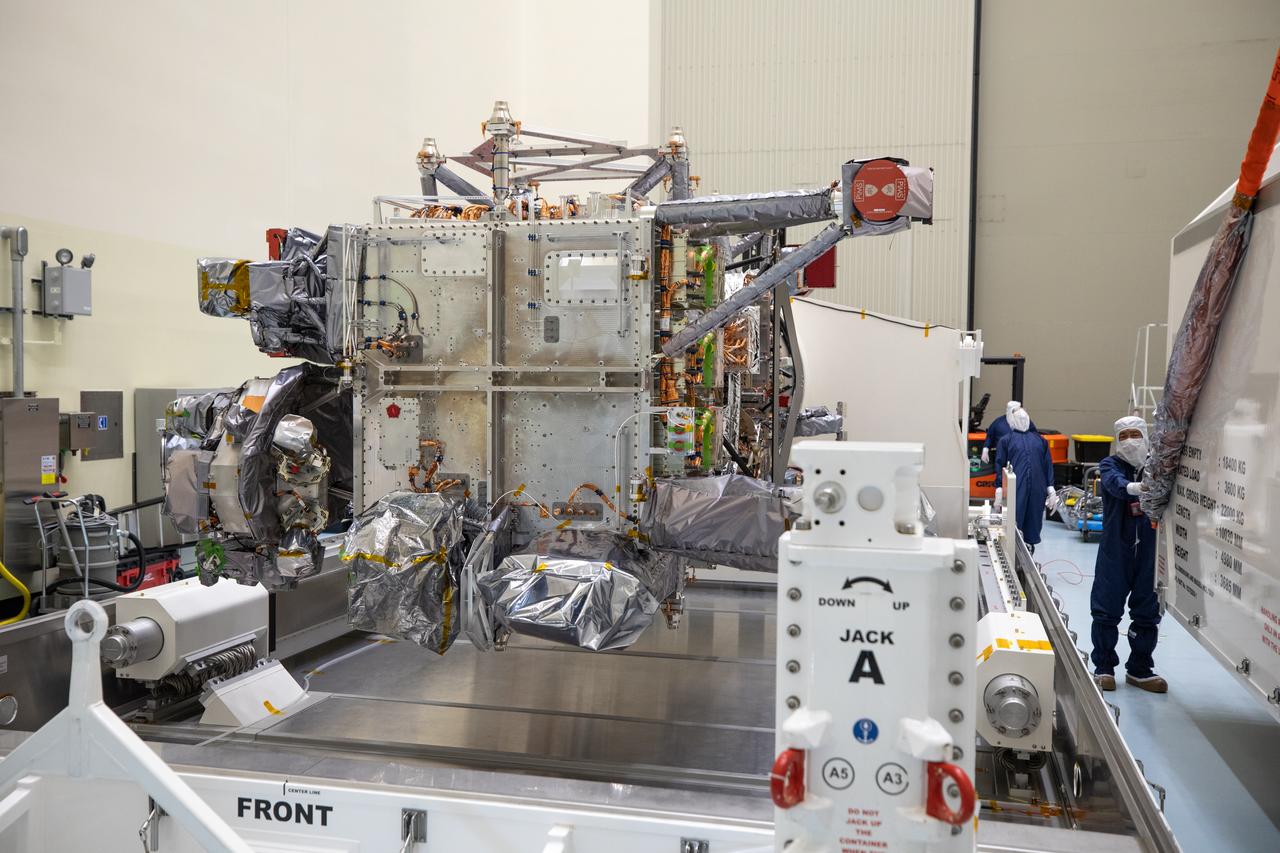
As part of prelaunch processing, crews inside the Payload Hazardous Servicing Facility at NASA’s Kennedy Space Center in Florida uncrate the agency’s largest planetary mission spacecraft, Europa Clipper, on Tuesday, May 28, 2024. Slated to launch aboard a SpaceX Falcon Heavy rocket later this year from Launch Complex 39A at Kennedy, Europa Clipper will help determine if conditions exist below the surface Jupiter’s fourth largest moon, Europa, that could support life.
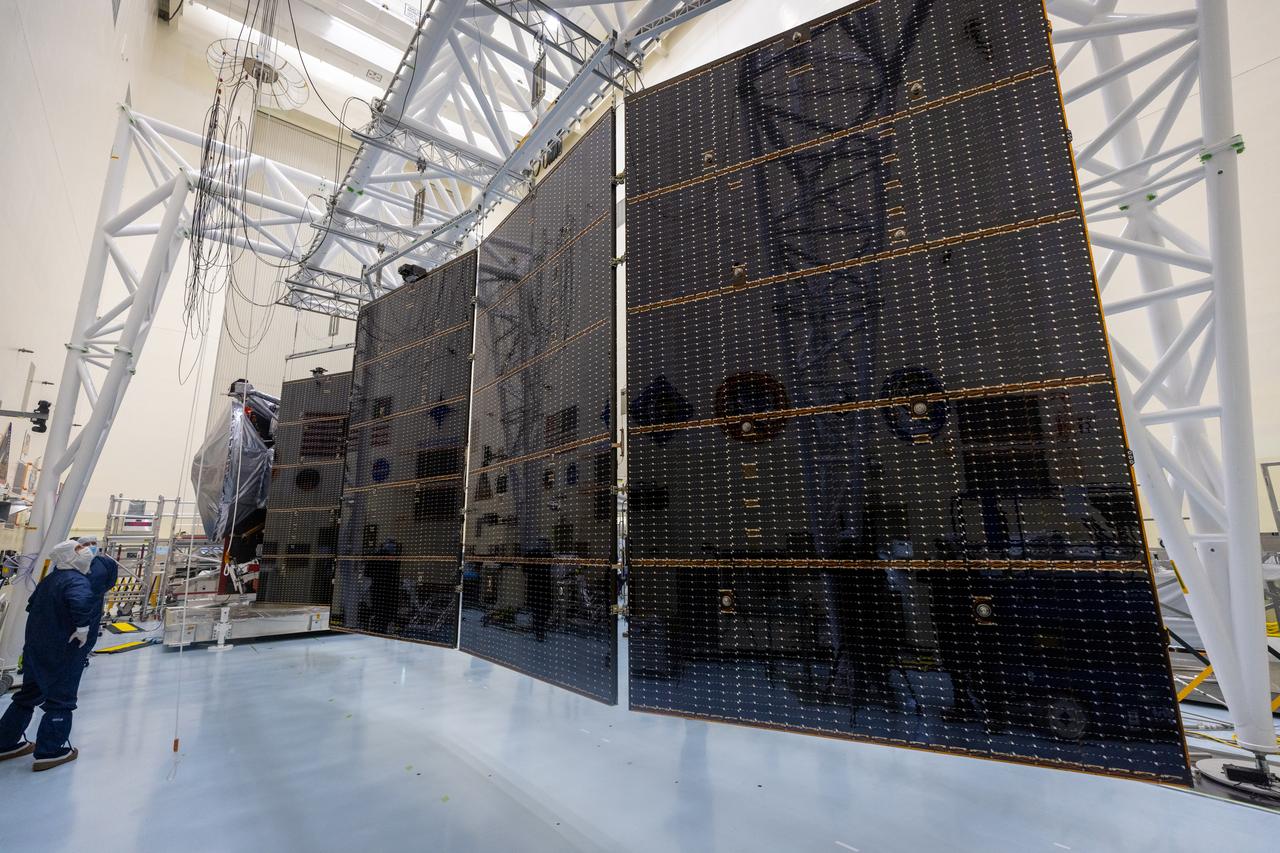
Technicians test the system to deploy NASA’s Europa Clipper spacecraft solar arrays, which uses “thermal knives” to cut the restraints holding the solar arrays in place inside the agency’s Payload Hazardous Servicing Facility at Kennedy Space Center in Florida on Wednesday, Aug. 21, 2024. The Europa Clipper spacecraft will travel to Jupiter’s icy moon to determine its potential to support life. After launch the thermal knives will cut the restraints, allowing the solar arrays to deploy and collect sunlight to power the spacecraft as it begins its journey to investigate Europa.