
A test block of Avcoat undergoes heat pulse testing inside an arc jet test chamber at NASA’s Ames Research Center in California. The test article, configured with both permeable (upper) and non-permeable (lower) Avcoat sections for comparison, helped to confirm understanding of the root cause of the loss of charred Avcoat material that engineers saw on the Orion spacecraft after the Artemis I test flight beyond the Moon.

NASA astronauts Victor J. Glover and Christina Koch tour the Ames Arc Jet Complex, N238.

Thermophysics Facilities Branch Chief George Raiche, right, leads NASA astronauts Victor J. Glover, left, and Christina Koch through the Arc Jet Complex in N238.
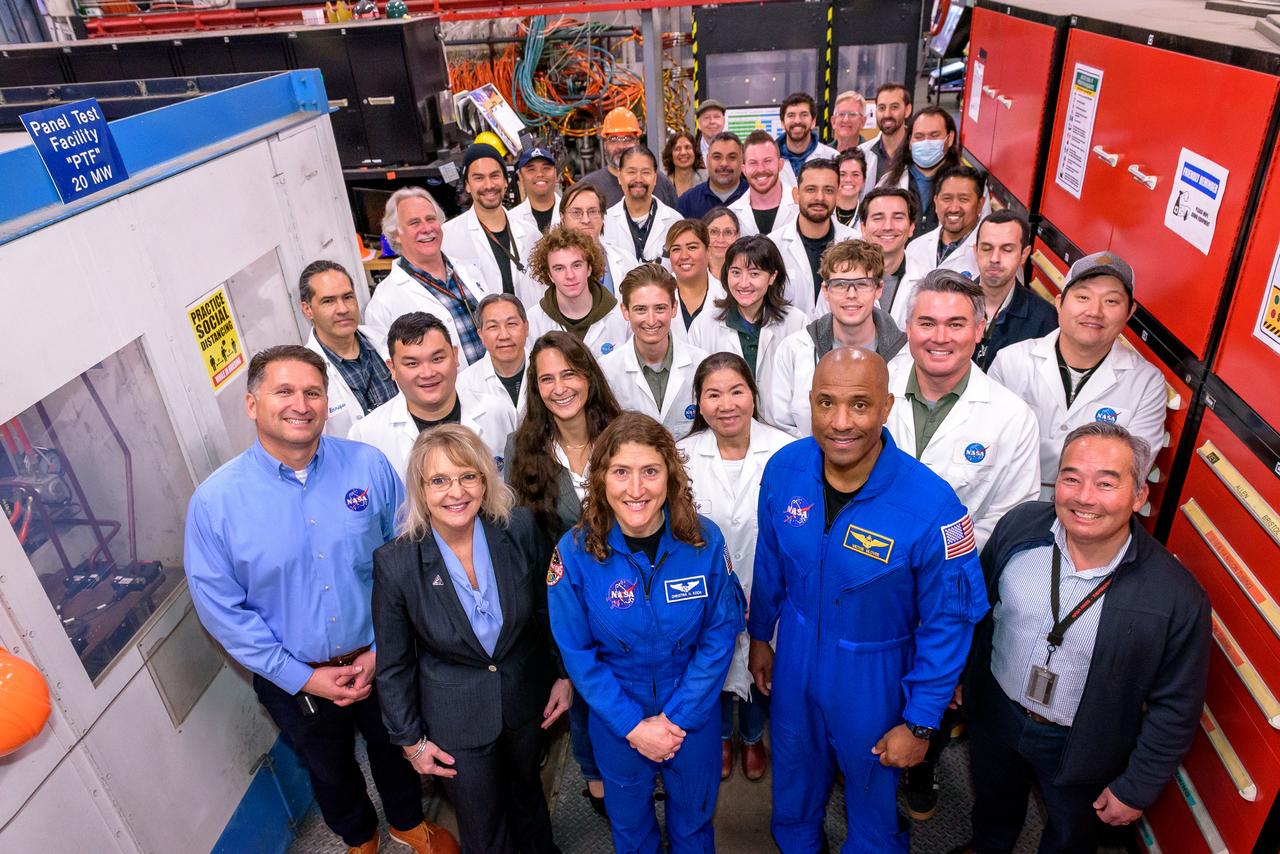
Group photo of the Orion astronauts with the staff of the Ames Arc Jet Complex in N238. Front row: Luis Saucedo, left, Debbie Korth, Christina Koch, Victor J. Glover, and George Raiche, right.

NASA astronaut Christina Koch exits the vacuum test chamber for the Interaction Heating Facility (IHF) of the Ames Arc Jet Complex, N238, following Victor J. Glover, left. During a test, a TPS test sample is suspended in the hypersonic flow produced by IHF’s arc heater. The shock heating produced by the interaction between the hypersonic flow and the stationary test sample simulates the heating and other forces the spacecraft will encounter during atmospheric hypersonic entry.
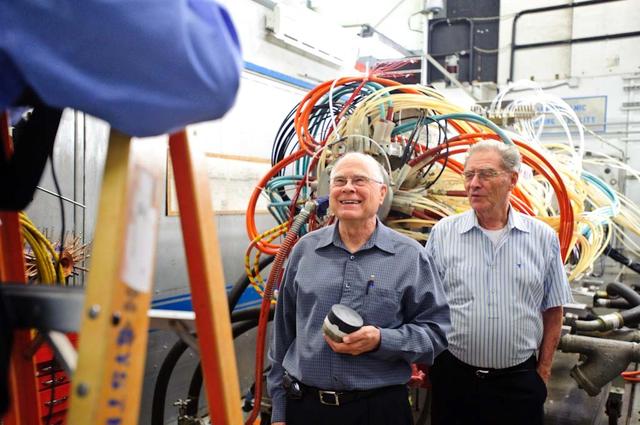
Dr William 'Bill' Borucki, NASA Ames Scientist on the Kepler Mission and John W. 'Jack' Boyd, NASA Ames Historian at the Ames Arc Jet Complex, Aerodynamic Heating Facility talking with a Mercury News photographer about the Kepler Mission and the 40th Anniversary of the Apollo 11 Mission.
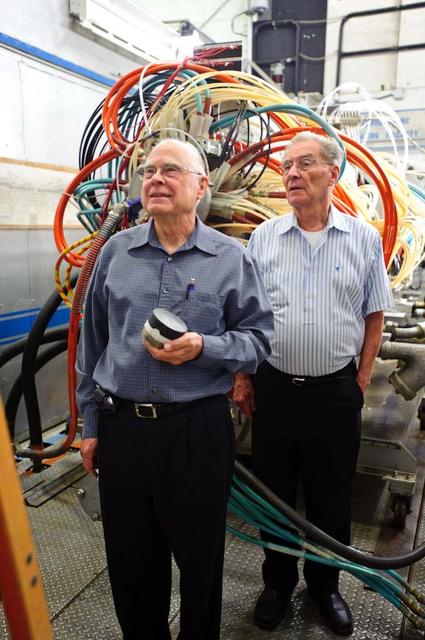
Dr William 'Bill' Borucki, NASA Ames Scientist on the Kepler Mission and John W. 'Jack' Boyd, NASA Ames Historian at the Ames Arc Jet Complex, Aerodynamic Heating Facility talking with a Mercury News photographer about the Kepler Mission and the 40th Anniversary of the Apollo 11 Mission.
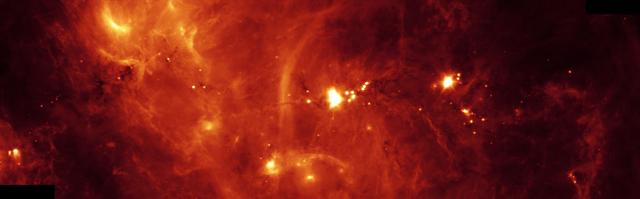
Hidden behind a shroud of dust in the constellation Cygnus is an exceptionally bright source of radio emission called DR21. Visible light images reveal no trace of what is happening in this region because of heavy dust obscuration. In fact, visible light is attenuated in DR21 by a factor of more than 10,000,000,000,000,000,000,000,000,000, 000,000,000,000 (ten thousand trillion heptillion). New images from NASA's Spitzer Space Telescope allow us to peek behind the cosmic veil and pinpoint one of the most massive natal stars yet seen in our Milky Way galaxy. The never-before-seen star is 100,000 times as bright as the Sun. Also revealed for the first time is a powerful outflow of hot gas emanating from this star and bursting through a giant molecular cloud. This image shows a 24-micron image mosaic, obtained with the Multiband Imaging Photometer aboard Spitzer (MIPS). This image maps the cooler infrared emission from interstellar dust found throughout the interstellar medium. The DR21 complex is clearly seen near the center of the strip, which covers about twice the area of the IRAC image. Perhaps the most fascinating feature in this image is a long and shadowy linear filament extending towards the 10 o'clock position of DR21. This jet of cold and dense gas, nearly 50 light-years in extent, appears in silhouette against a warmer background. This filament is too long and massive to be a stellar jet and may have formed from a pre-existing molecular cloud core sculpted by DR21's strong winds. Regardless of its true nature, this jet and the numerous other arcs and wisps of cool dust signify the interstellar turbulence normally unseen by the human eye. http://photojournal.jpl.nasa.gov/catalog/PIA05733
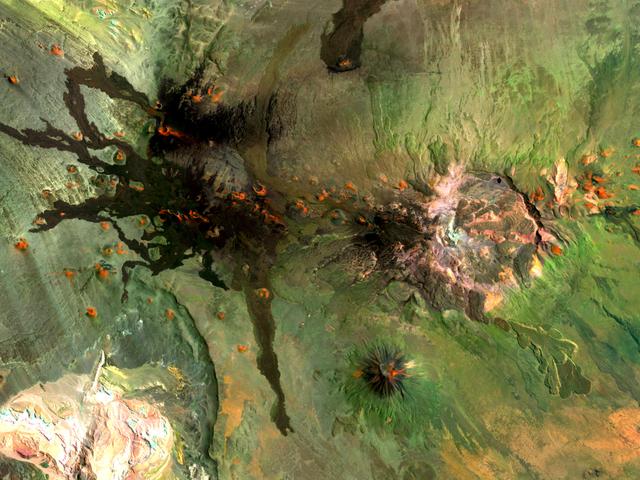
Situated in the southern Andes Mountains, the Payún volcanic field of Argentina is a complex landscape that formed over hundreds of thousands of years. Sprawling over 5,200 square kilometers (2,000 square miles), Payún is a massive shield volcano—a broad formation resembling an ancient warrior shield. This false-color image is a composite of observations acquired on February 7 and March 20, 2001 by the Enhanced Thematic Mapper Plus on the Landsat 7 satellite. It was made from a combination of visible and infrared light, where green indicates vegetation, black indicates lava flows, and orange is bare rock rich in iron oxides. Part of the back-arc volcanism of the Andes, Payún lies about 530 kilometers (330 miles) east from where the Nazca plate subducts below the South America plate. Not surprisingly, a volcanic zone extends over some 1,000 kilometers (600 miles) north-to-south in this region. According to a study published in 2010, the regional geology and chemical composition of the rocks indicate that the volcanic field likely formed within the past 300,000 years. The dominant feature of the volcanic field is Payún Matru, an elliptical caldera measuring roughly 9 by 7 kilometers (6 by 4 miles). Geologists surmise that the caldera formed after the old magma chamber emptied and the summit collapsed. Southwest of the caldera is a stratovolcano composed of alternating layers of compacted ash, hardened lava, and rocks ejected during previous eruptions. This stratovolcano, Payún, rises to 3,680 meters (12,073 feet) above sea level. (The entire volcanic field sits at 2,000 meters, or 6,600 feet.) The stratovolcano may be the most prominent feature in the volcanic field but it is by no means the only one. More than 300 eruptive features litter the shield volcano, most of them occupying an east-west line. West of Payún Matru is an area known as Los Volcanes, a mass of strombolian cones and basaltic lava flows. Image courtesy Michael P. Taylor, Landsat Data Continuity Mission Project Office, NASA Goddard Space Flight Center. Caption by Michon Scott with information from Michael Abrams, NASA Jet Propulsion Laboratory. Instrument: Landsat 7 - ETM+ To read more go to: <a href="http://1.usa.gov/UO8CbF" rel="nofollow">1.usa.gov/UO8CbF</a> Credit: <b><a href="http://www.earthobservatory.nasa.gov/" rel="nofollow"> NASA Earth Observatory</a></b> <b><a href="http://www.nasa.gov/audience/formedia/features/MP_Photo_Guidelines.html" rel="nofollow">NASA image use policy.</a></b> <b><a href="http://www.nasa.gov/centers/goddard/home/index.html" rel="nofollow">NASA Goddard Space Flight Center</a></b> enables NASA’s mission through four scientific endeavors: Earth Science, Heliophysics, Solar System Exploration, and Astrophysics. Goddard plays a leading role in NASA’s accomplishments by contributing compelling scientific knowledge to advance the Agency’s mission. <b>Follow us on <a href="http://twitter.com/NASA_GoddardPix" rel="nofollow">Twitter</a></b> <b>Like us on <a href="http://www.facebook.com/pages/Greenbelt-MD/NASA-Goddard/395013845897?ref=tsd" rel="nofollow">Facebook</a></b> <b>Find us on <a href="http://instagram.com/nasagoddard?vm=grid" rel="nofollow">Instagram</a></b>