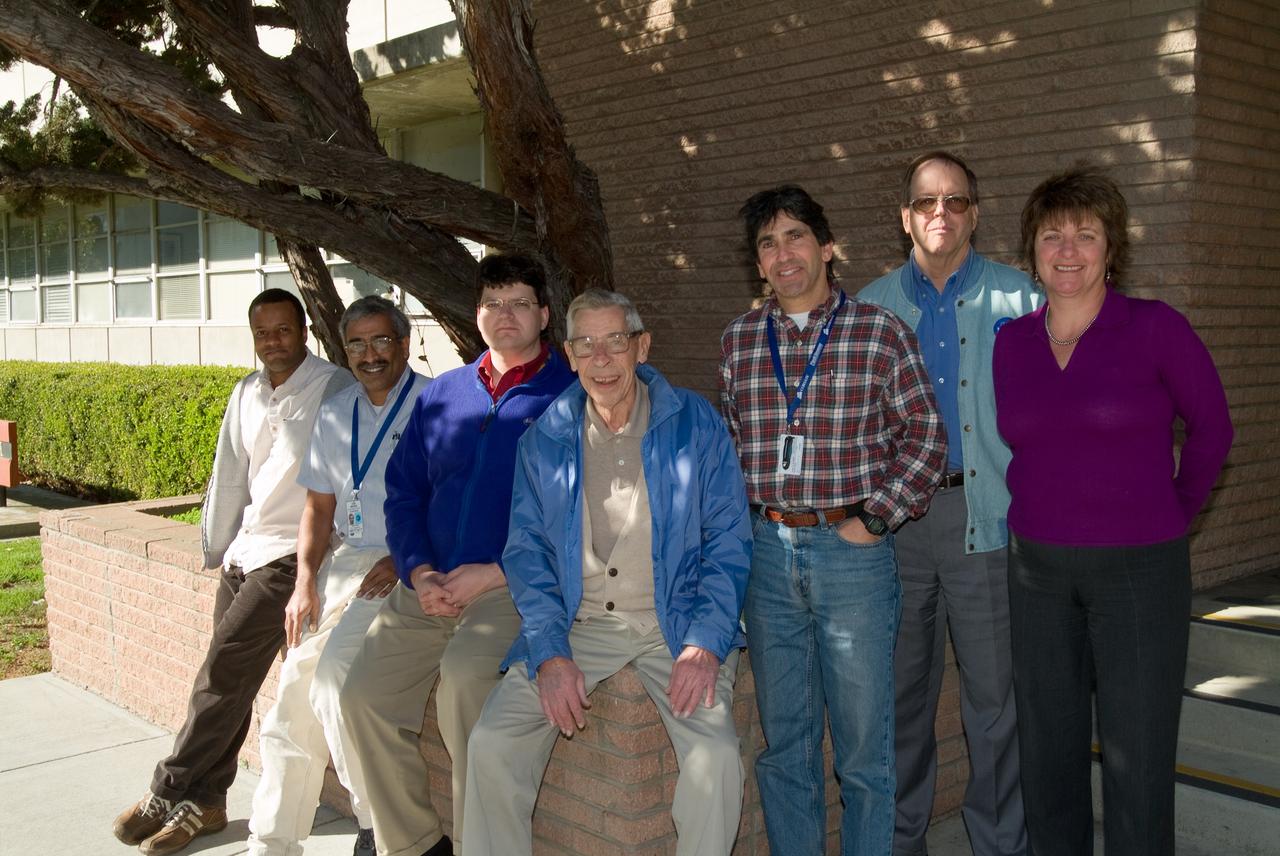
Dr. Alfred Eggers returns for a visit to Ames and the arc jet with (left to right); Ryan Mcdaniel, Dinesh Rabhu, Joe Olejnizak, Alfred Eggers, Jeff Brown, Joe Hartman, Sylvia Johnson.

A test block of Avcoat undergoes heat pulse testing inside an arc jet test chamber at NASA’s Ames Research Center in California. The test article, configured with both permeable (upper) and non-permeable (lower) Avcoat sections for comparison, helped to confirm understanding of the root cause of the loss of charred Avcoat material that engineers saw on the Orion spacecraft after the Artemis I test flight beyond the Moon.

ASTRONAUT STEVE ROBINSON & @ COMUMBIA IN N-258 W/RTF (Return to Flight) TEAMS Arc Jet Facilities with Frank Hue and other personnel.
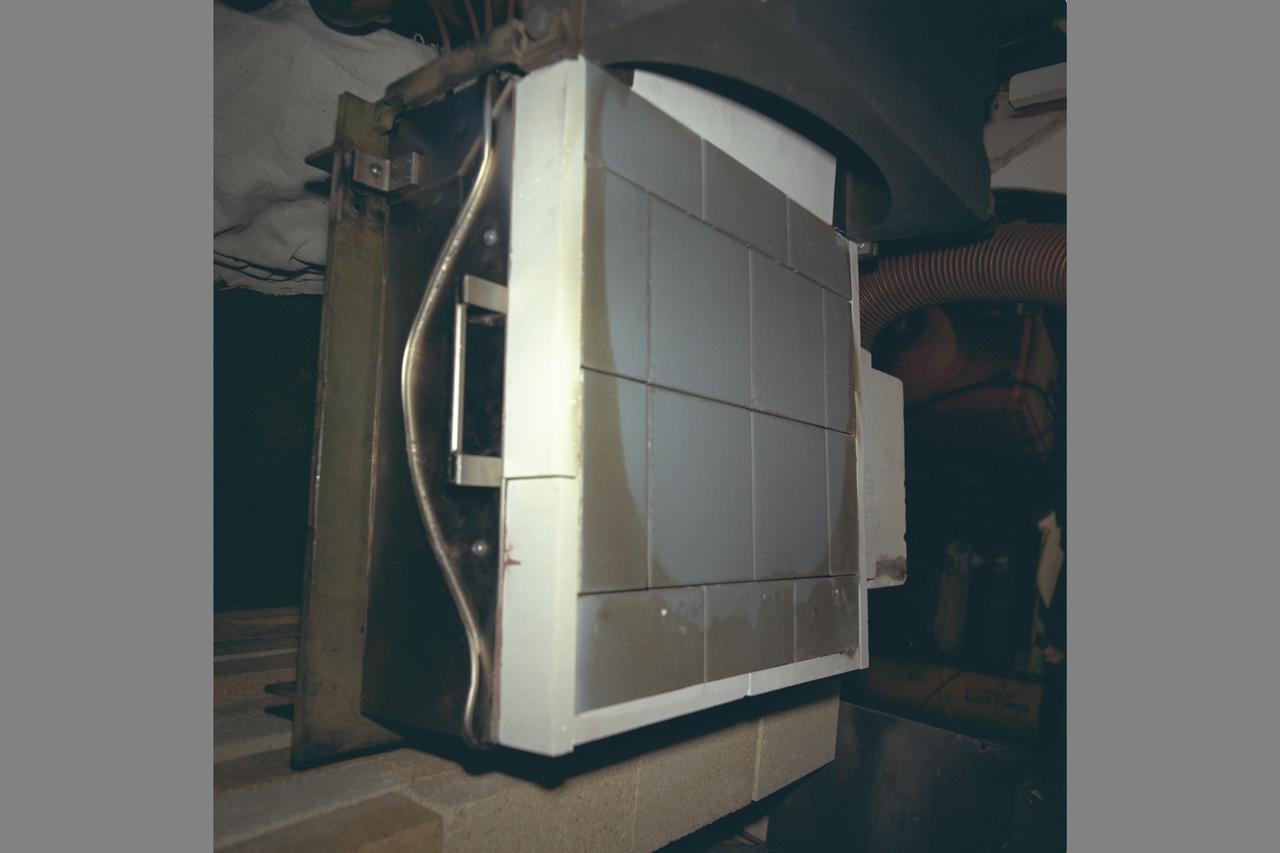
Space Shuttle Tile Thermal Protection System testing in Ames Arc Jet facilities
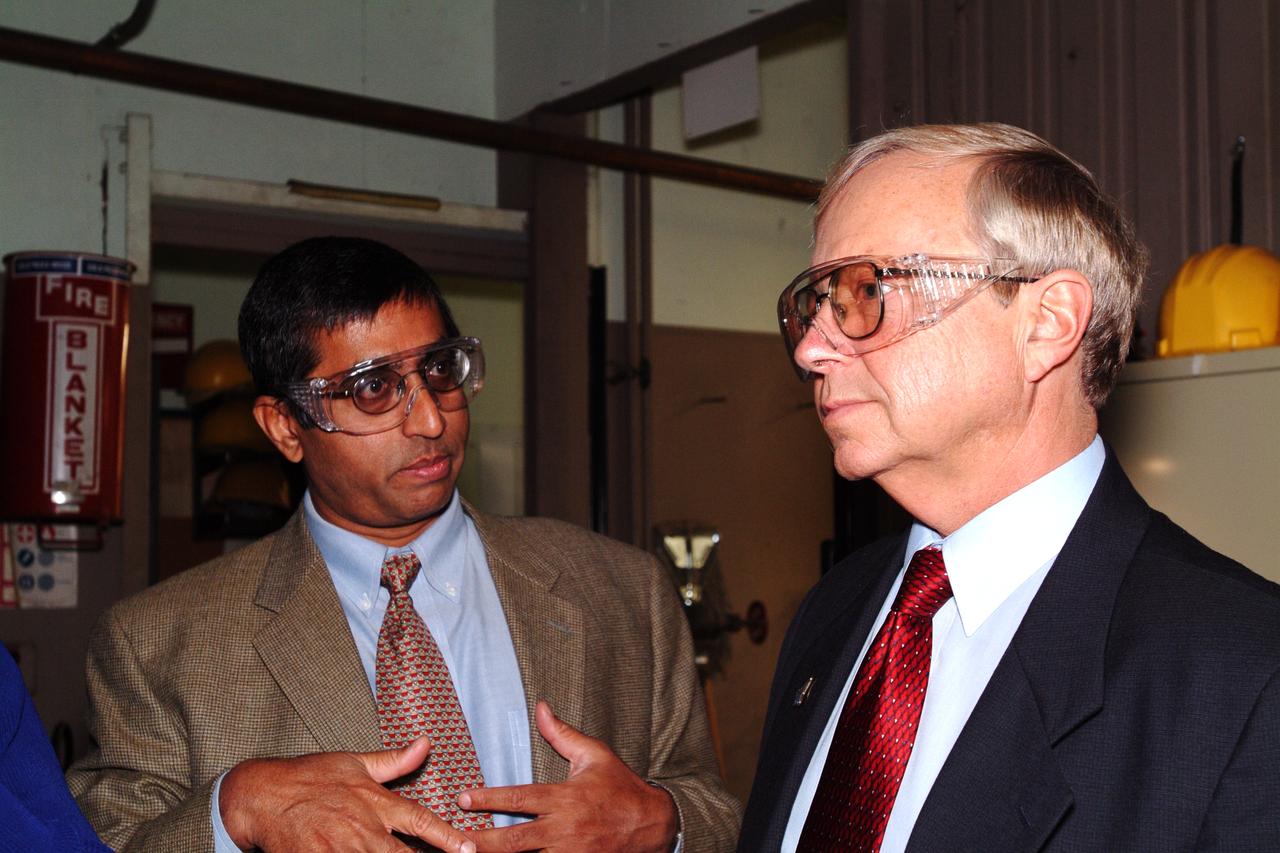
NASA Space Science Advisory Committee Chairman Ed Wiler (r) visit to Ames Research Center: on tour of the Arc Jet Facility with Ethiraj 'Raj' Venkatapathy presenting

NASA Space Science Advisory Committee Chairman Ed Wiler (c) visit to Ames Research Center: on tour of the Arc Jet Facility with G. Scott Hubbard, Raj Venkatapathy and entourage.
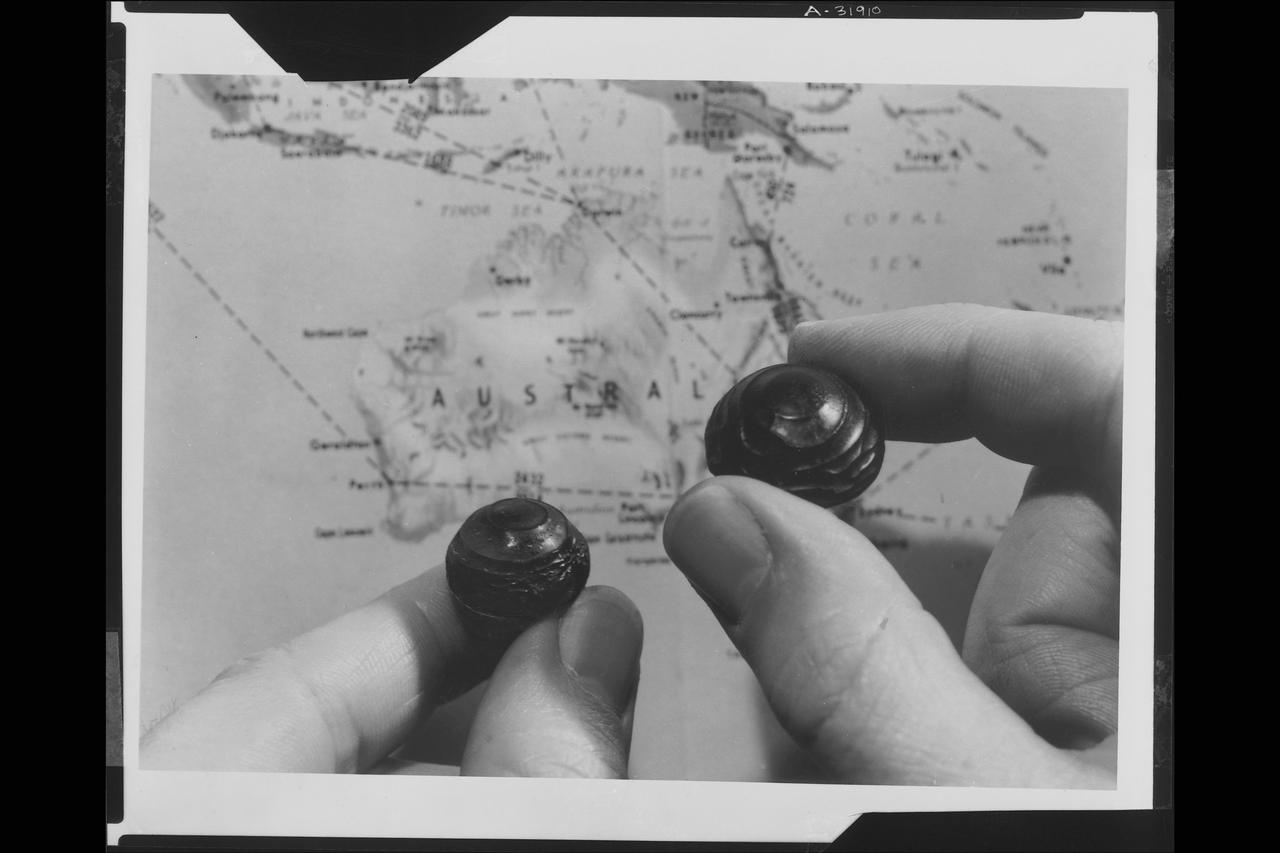
Dr. Dean R. Chapman a Ames Research Center scientists studing tektits, holding a simulated tektite created in the Ames arc jet facility (left) and authentic Australian tektite over a map of Australia.

NASA Space Science Advisory Committee Chairman Ed Wiler (r) visit to Ames Research Center: on tour of the Arc Jet Facility with G. Scott Hubbard, Raj Venkatapathy and entourage.
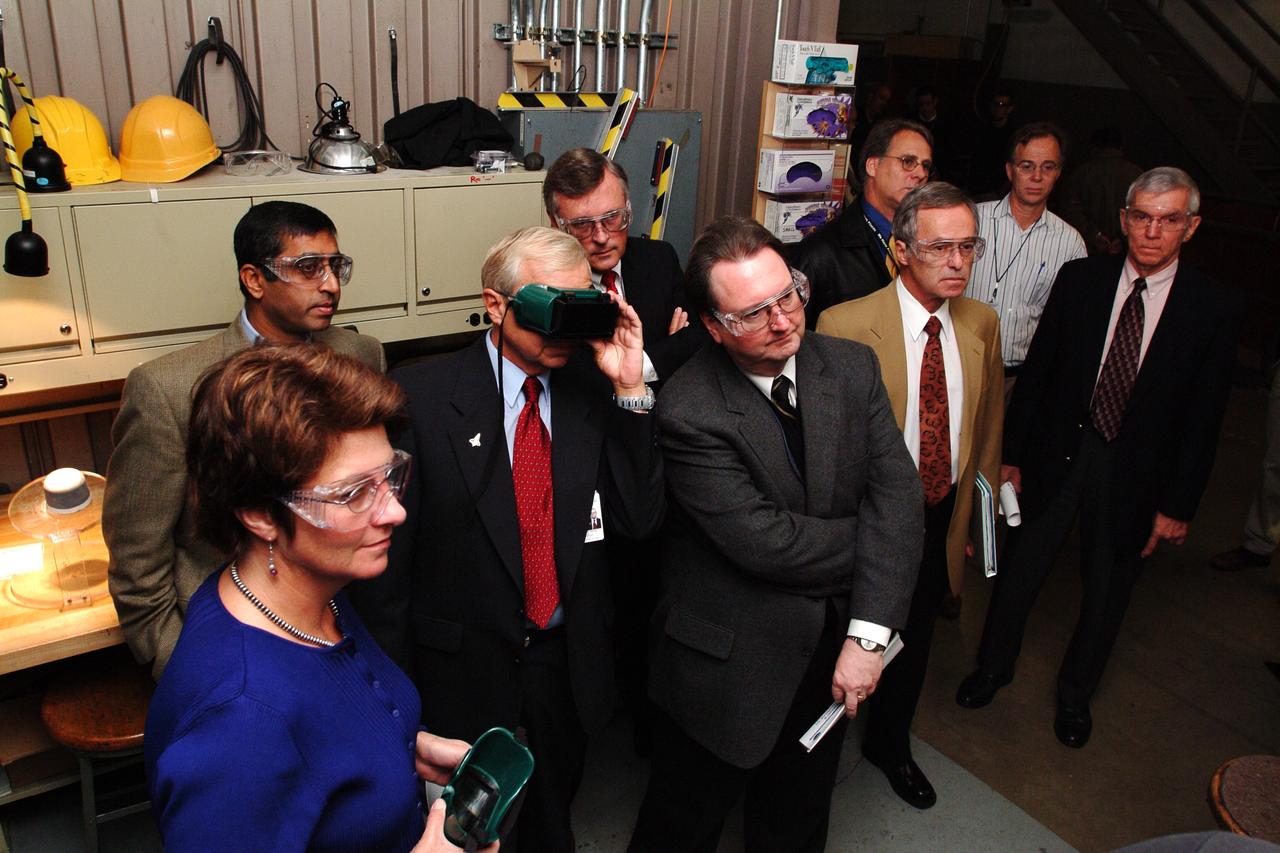
NASA Space Science Advisory Committee Chairman Ed Wiler (r) visit to Ames Research Center: on tour of the Arc Jet Facility with G. Scott Hubbard, Raj Venkatapathy and entourage
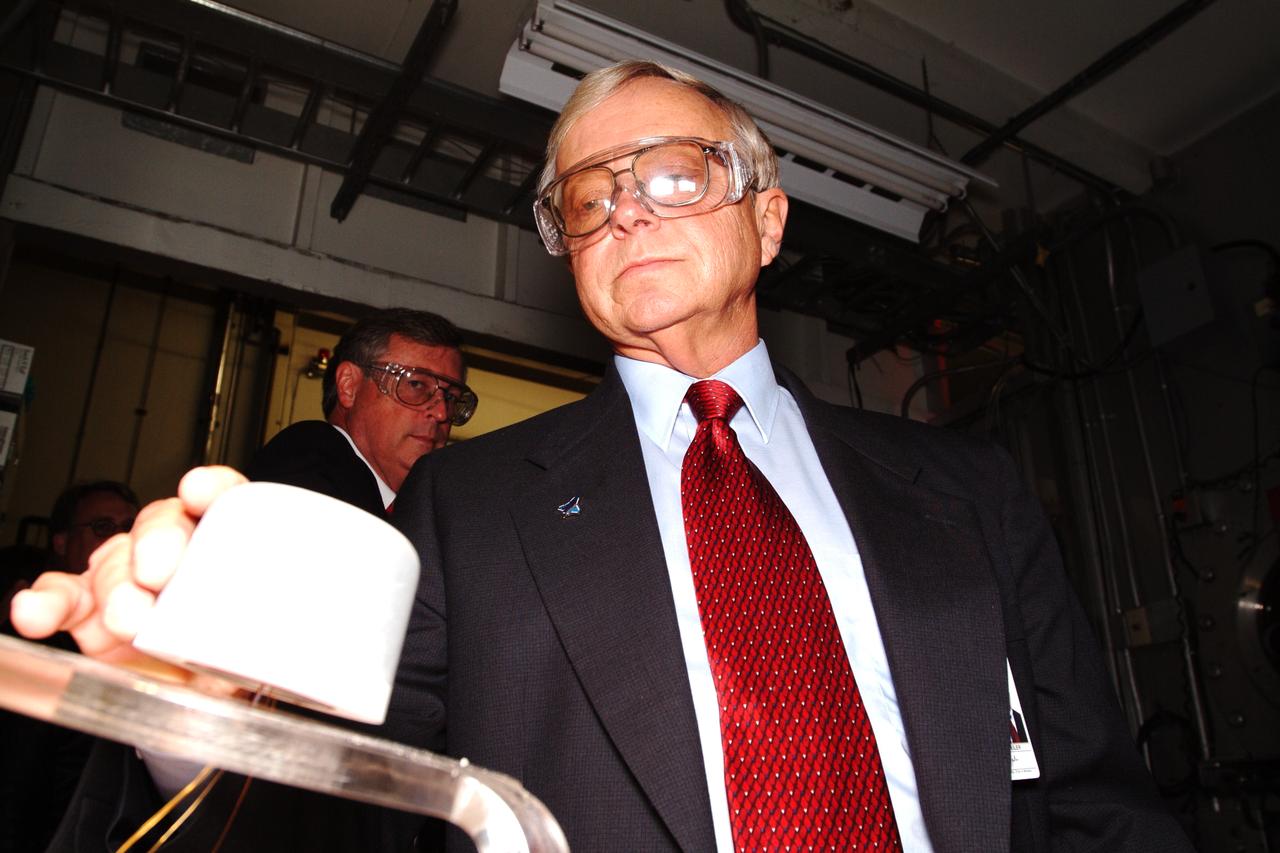
NASA Space Science Advisory Committee Chairman Ed Wiler visit to Ames Research Center: checks out test material while on tour of the Arc Jet Facility
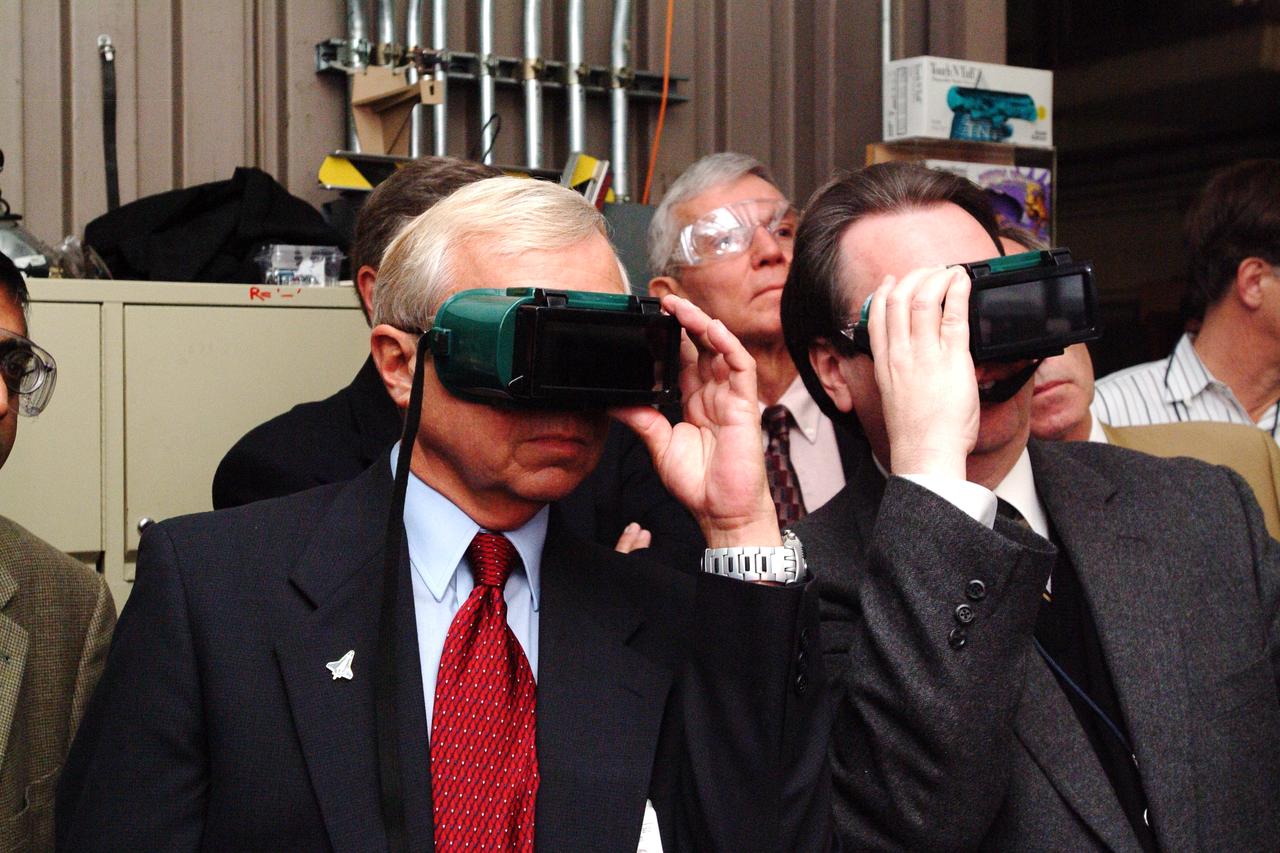
NASA Space Science Advisory Committee Chairman Ed Wiler (r) visit to Ames Research Center: on tour of the Arc Jet Facility with G. Scott Hubbard, Raj Venkatapathy and entourage. Wiler and Hubbard use special viewing glasses to observe a test run of Thermal Protection Materials.
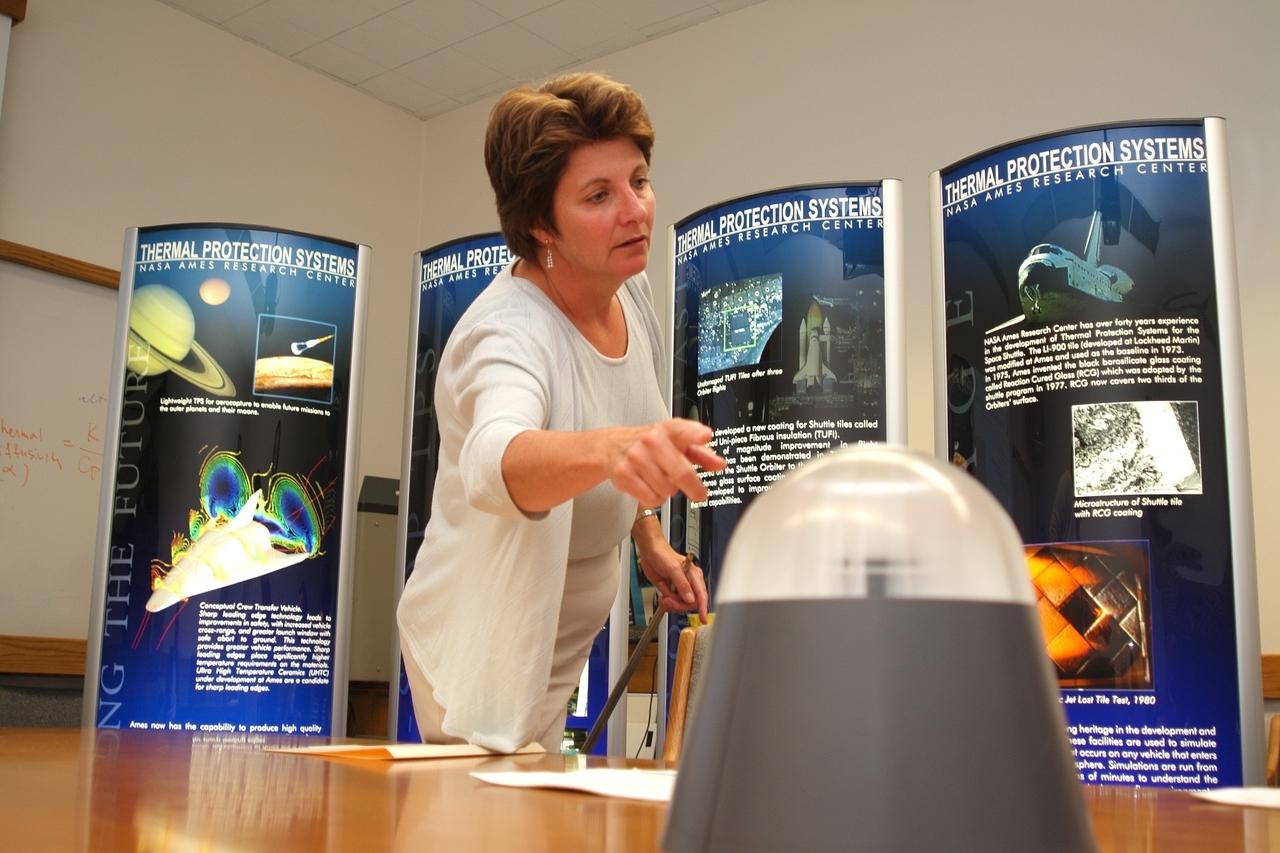
U. S. Congressman Culbertson, Texas and Mr John Webb, Webb & Associates visit and tour Ames Research Center with Center Director G. Scott Hubbard (pre-tour briefing at the Thermal Protection Facility - Arc Jet by Sylvia Johnson)
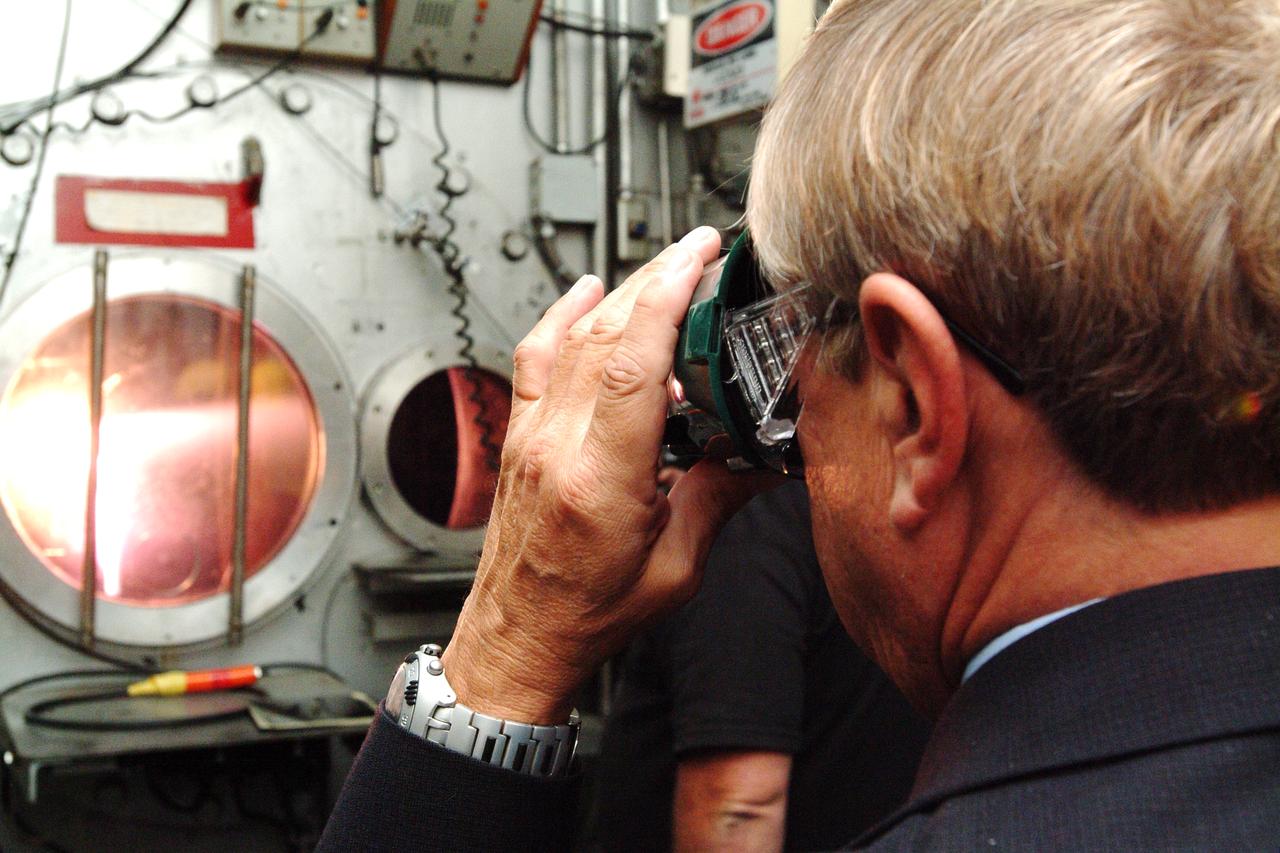
NASA Space Science Advisory Committee Chairman Ed Wiler (r) visit to Ames Research Center: while on tour of the Arc Jet Facility with G. Scott Hubbard, Raj Venkatapathy and entourage. Wiler uses special viewing glasses to observe a test run of Thermal Protection Materials.
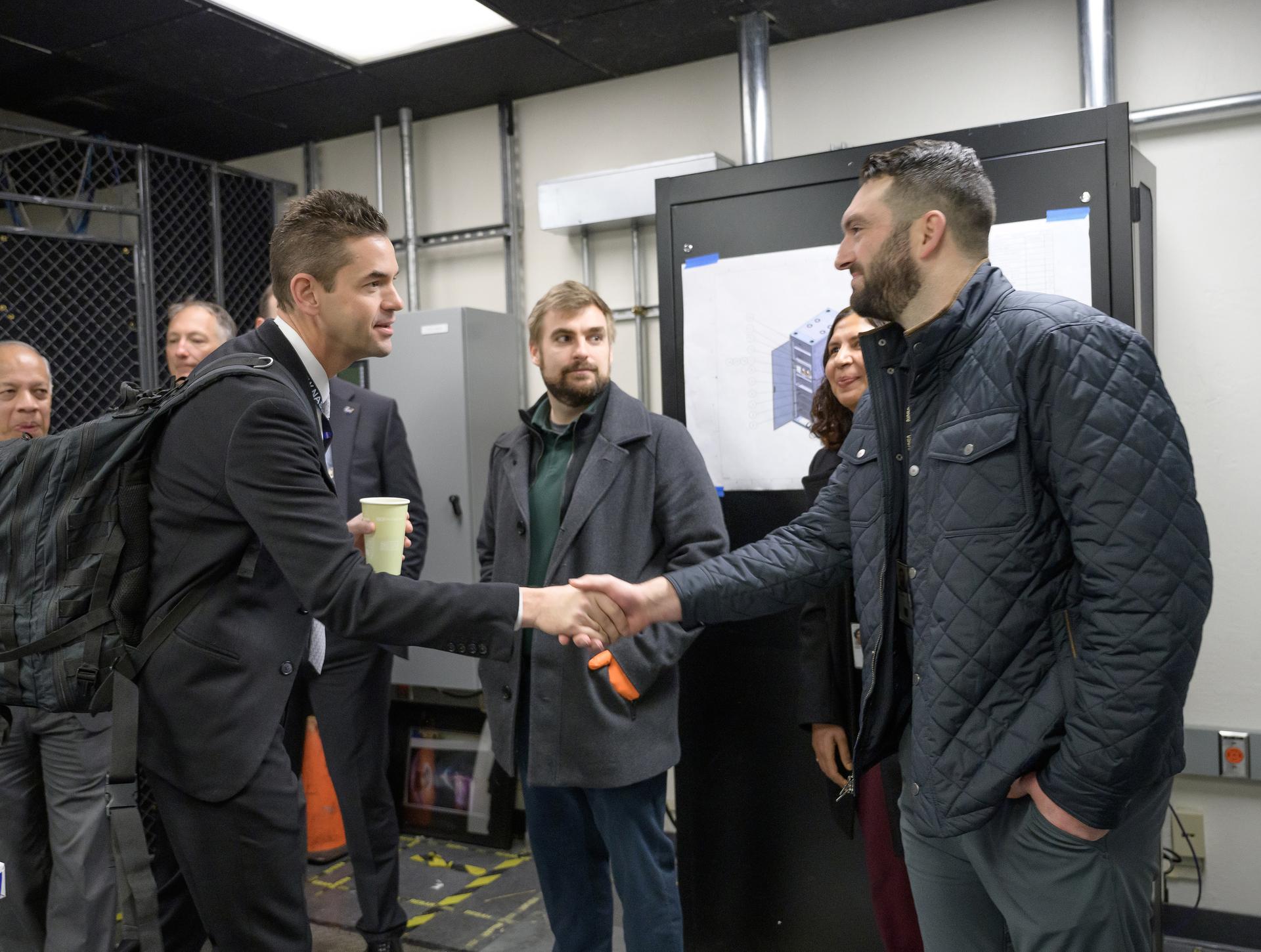
NASA Administrator Jared Isaacman visits the Arc Jet facility in N238.
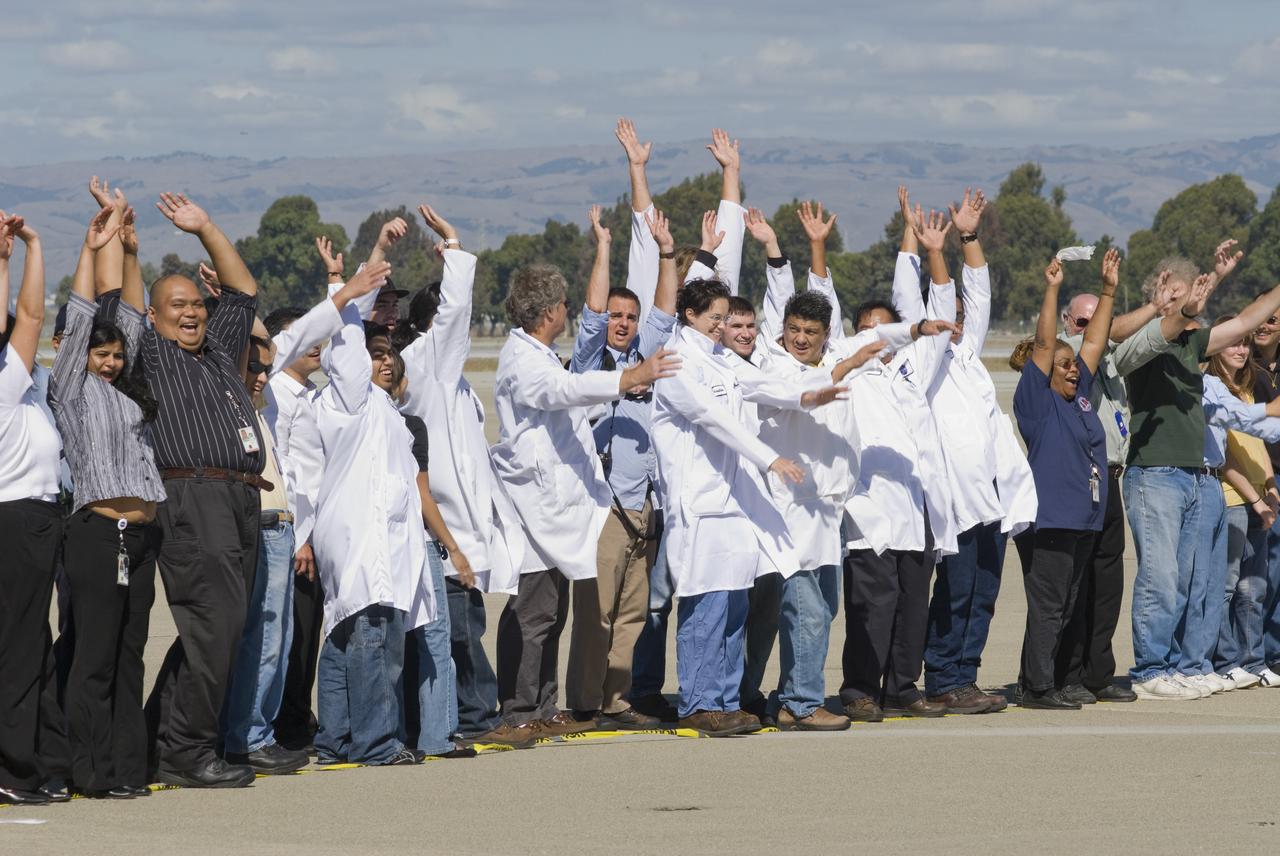
Ames 70_year picture day on Flight line. Arc Jet crew.
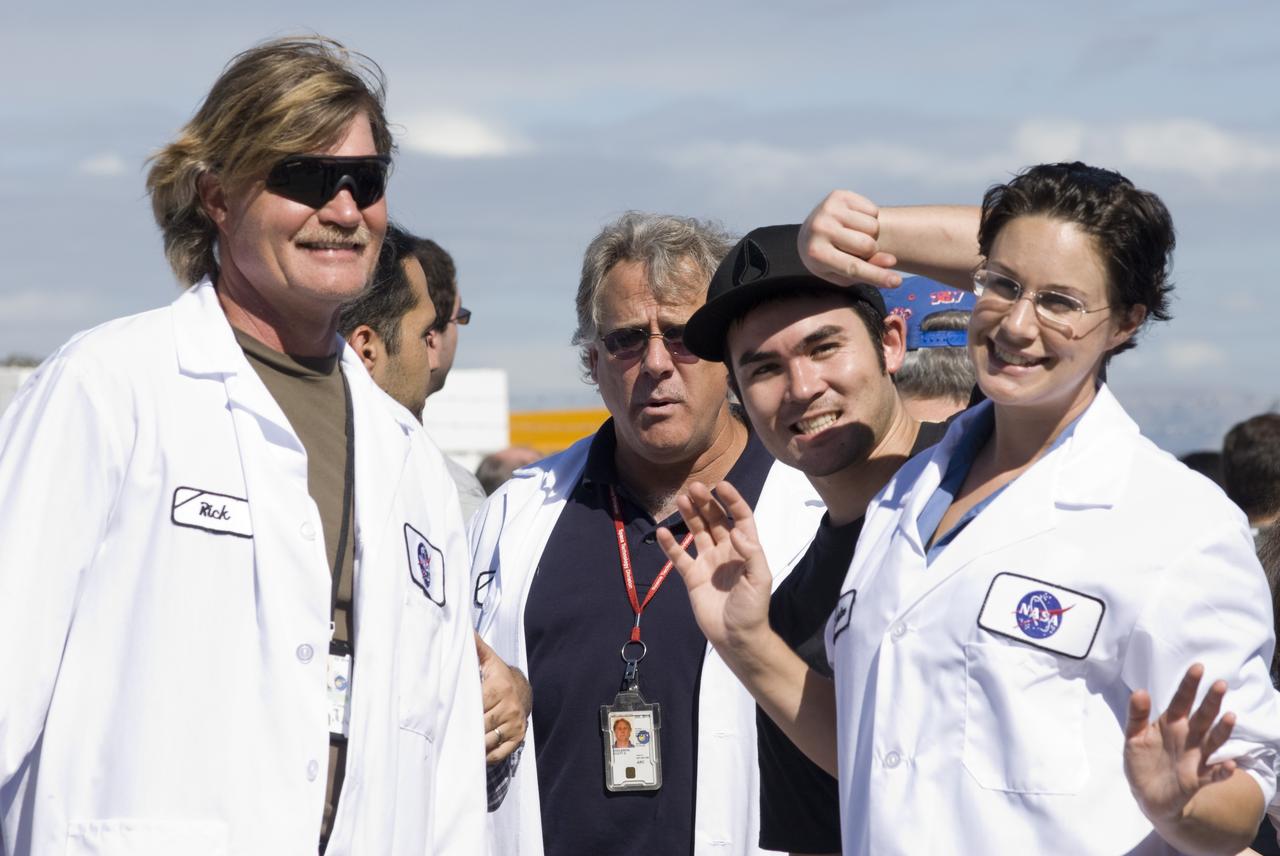
Ames 70_year picture day on Flight line. Arc Jet crew.

NASA Administrator Jared Isaacman visits the Arc Jet facility in N238.
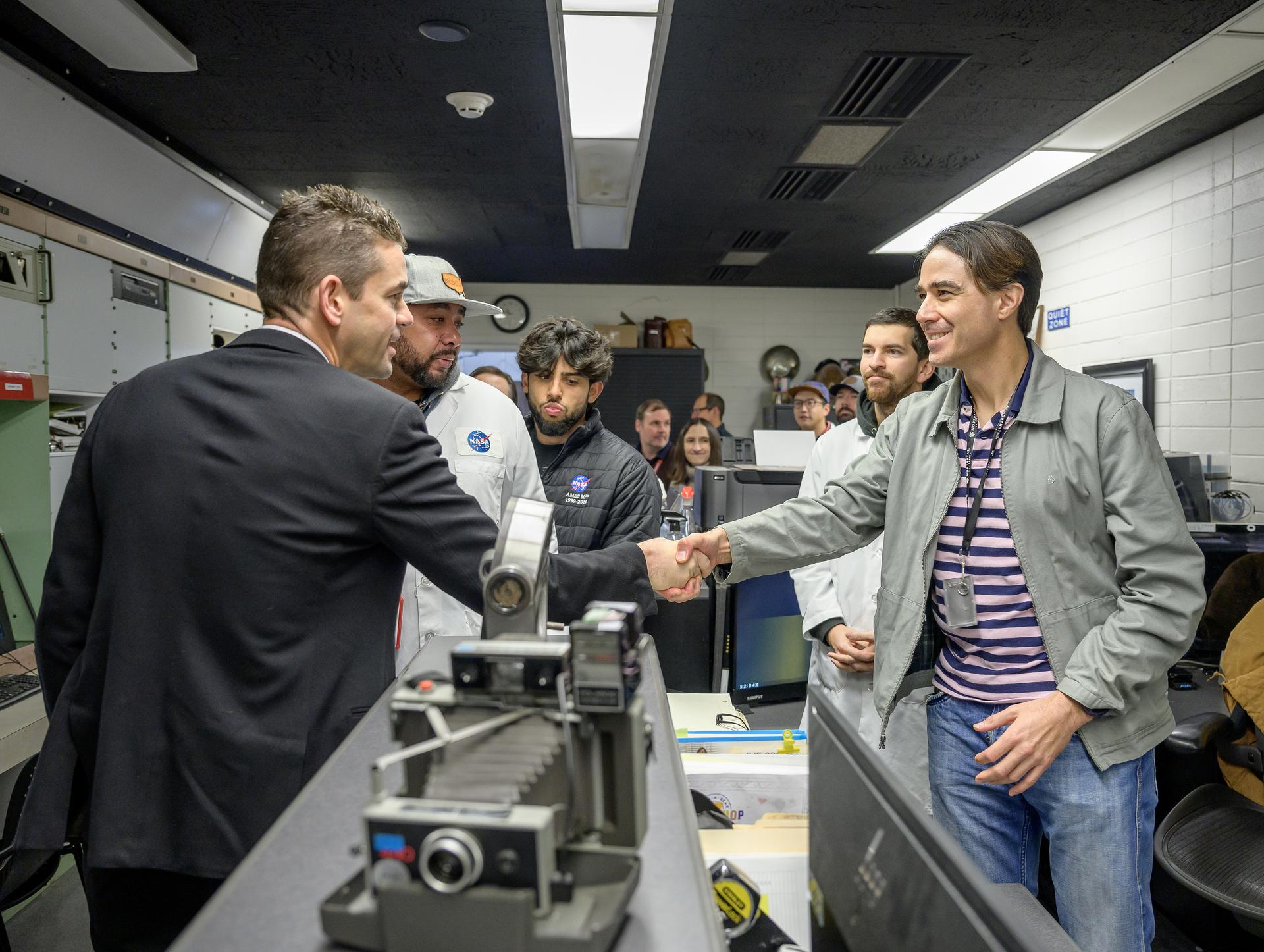
NASA Administrator Jared Isaacman visits the Arc Jet facility in N238.
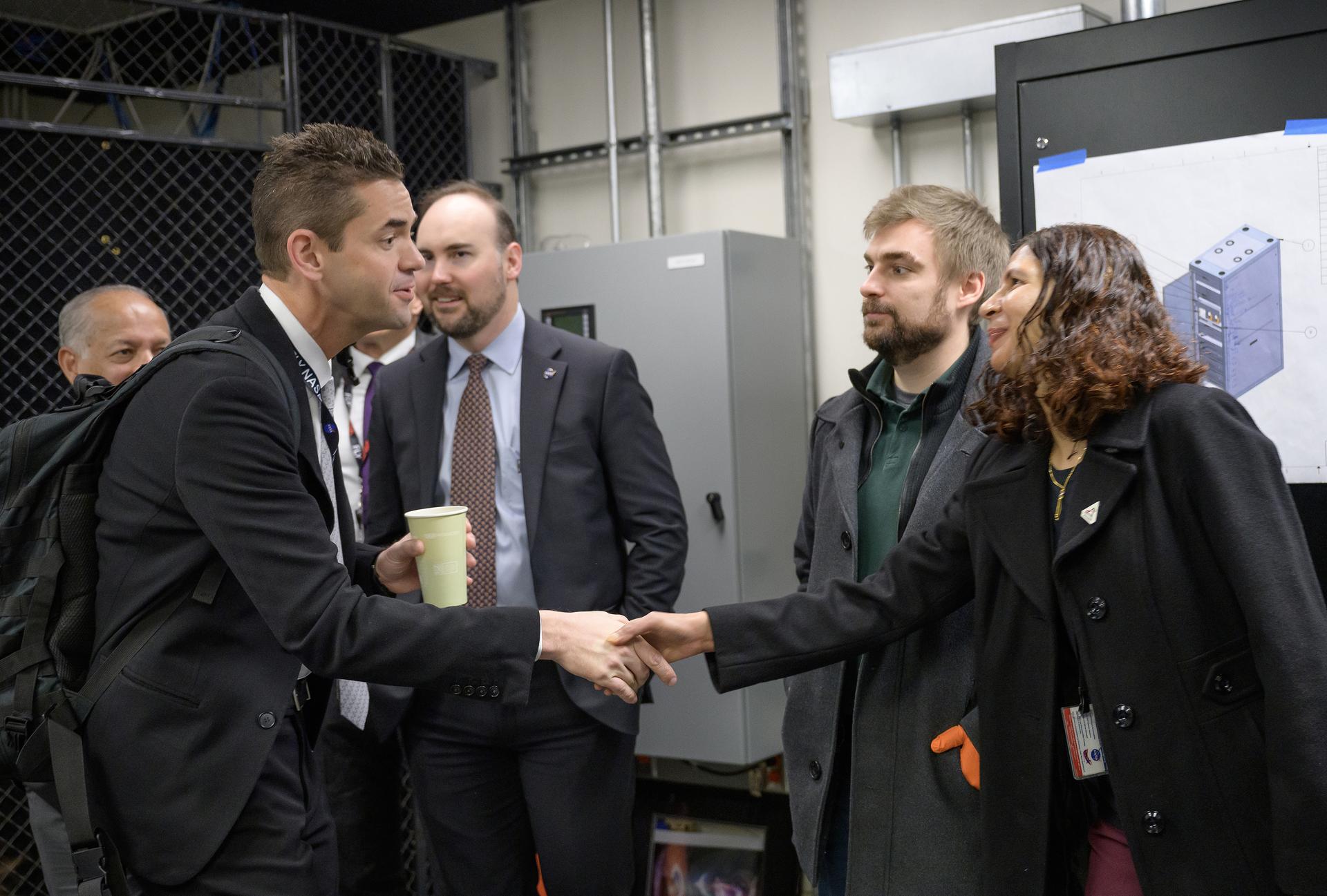
NASA Administrator Jared Isaacman visits the Arc Jet facility in N238.
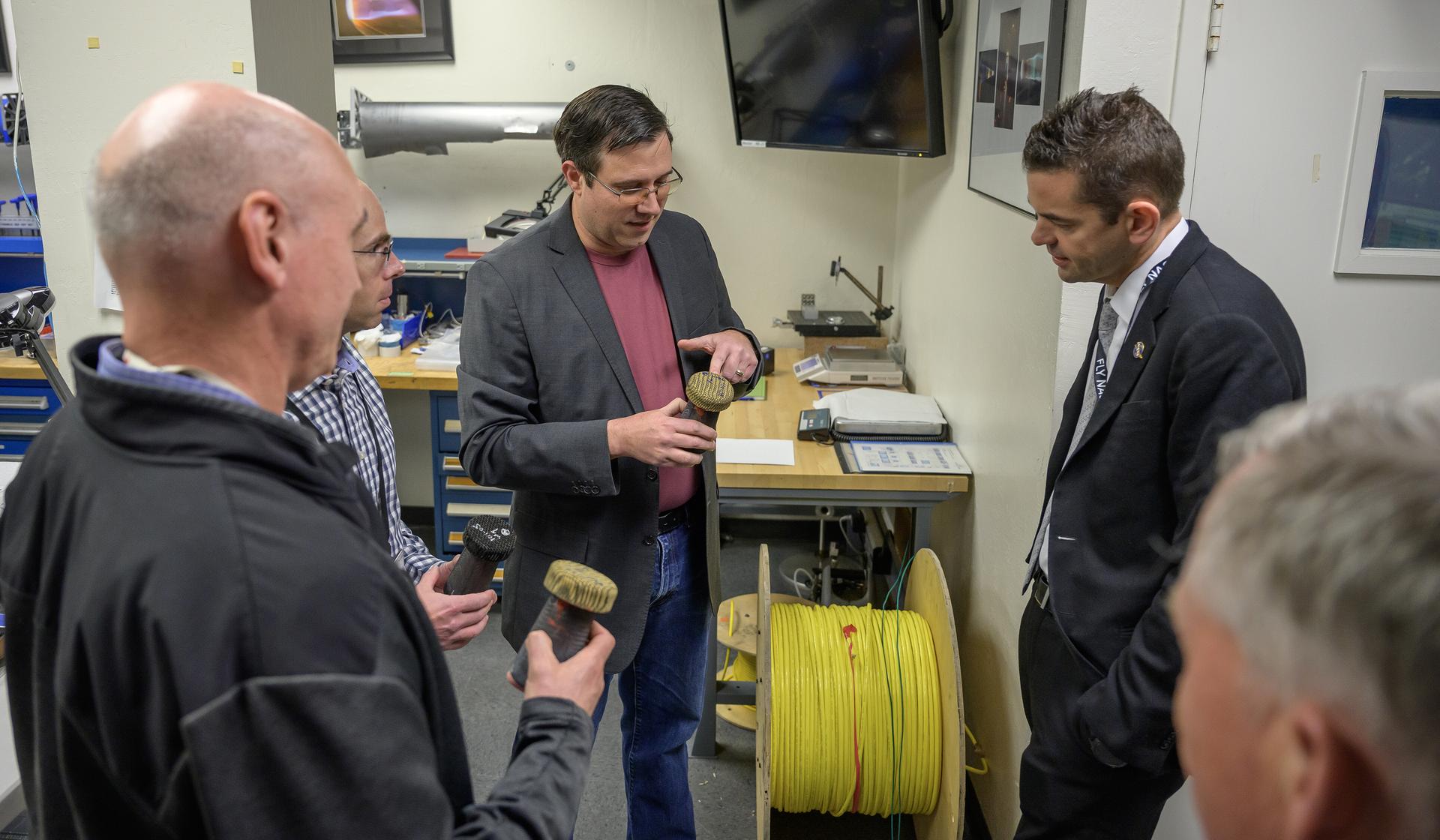
NASA Administrator Jared Isaacman visits the Arc Jet facility in N238.
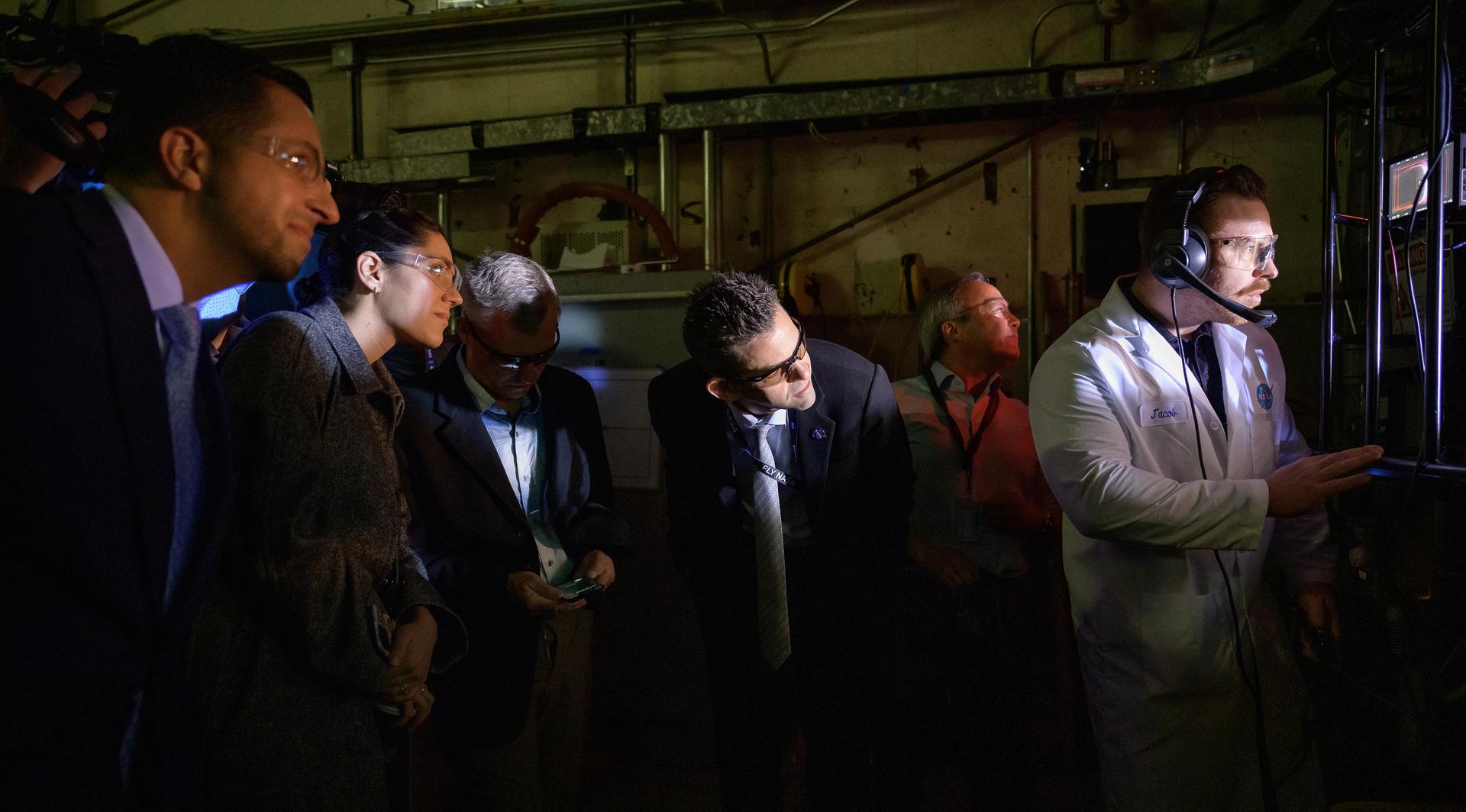
NASA Administrator Jared Isaacman views a test run in the Arc Jet facility in N238.
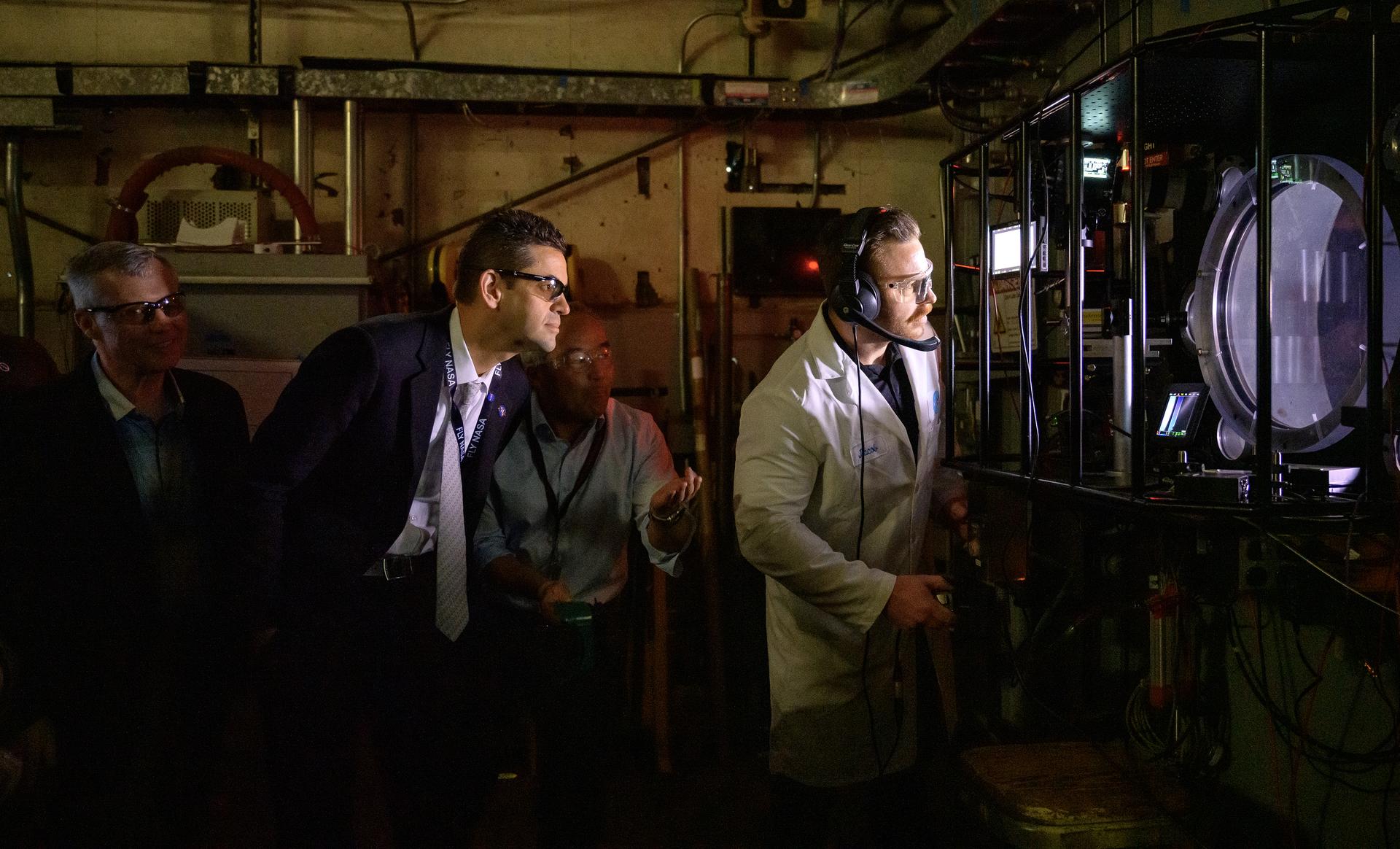
NASA Administrator Jared Isaacman views a test run in the Arc Jet facility in N238.
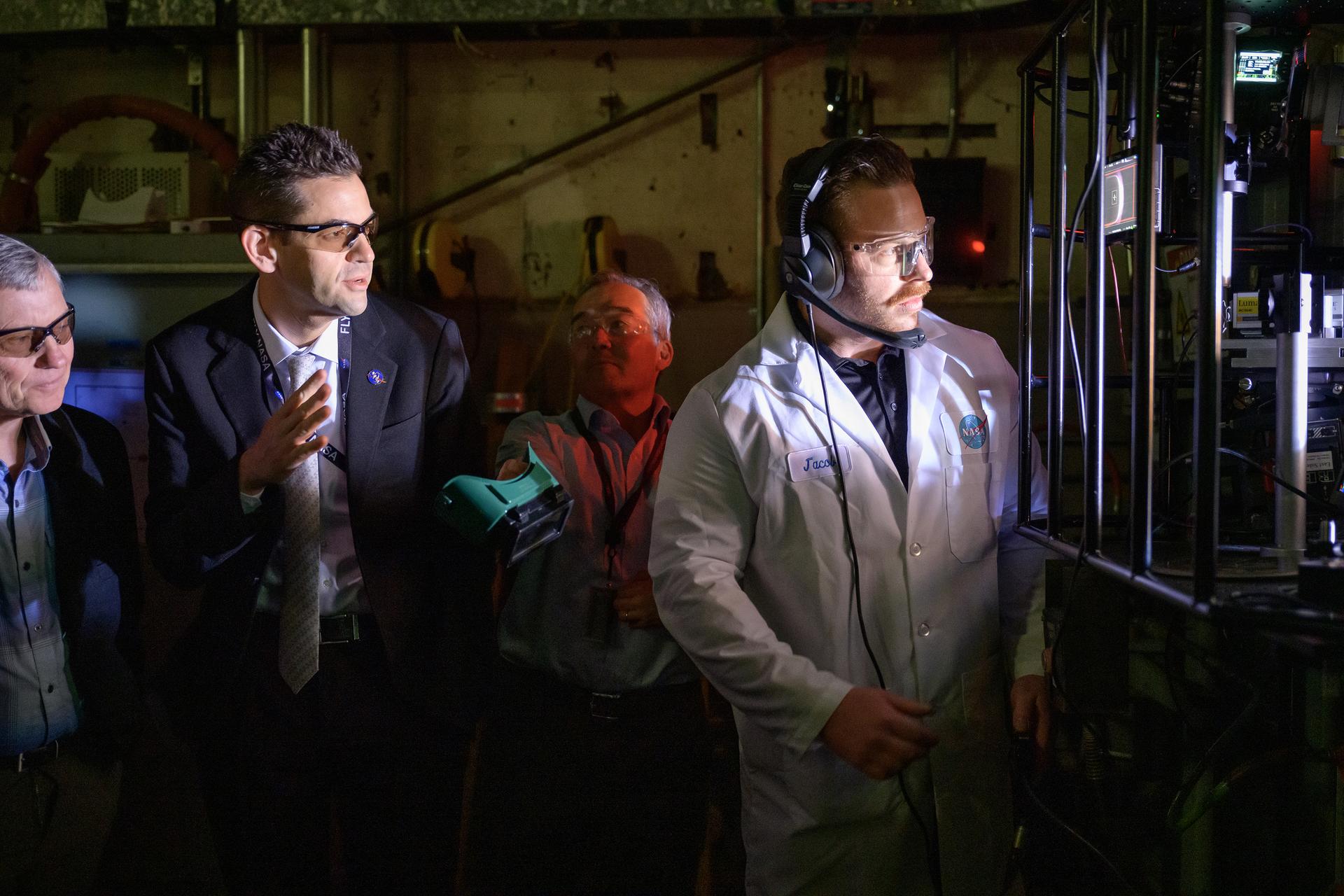
NASA Administrator Jared Isaacman views a test run in the Arc Jet facility in N238.
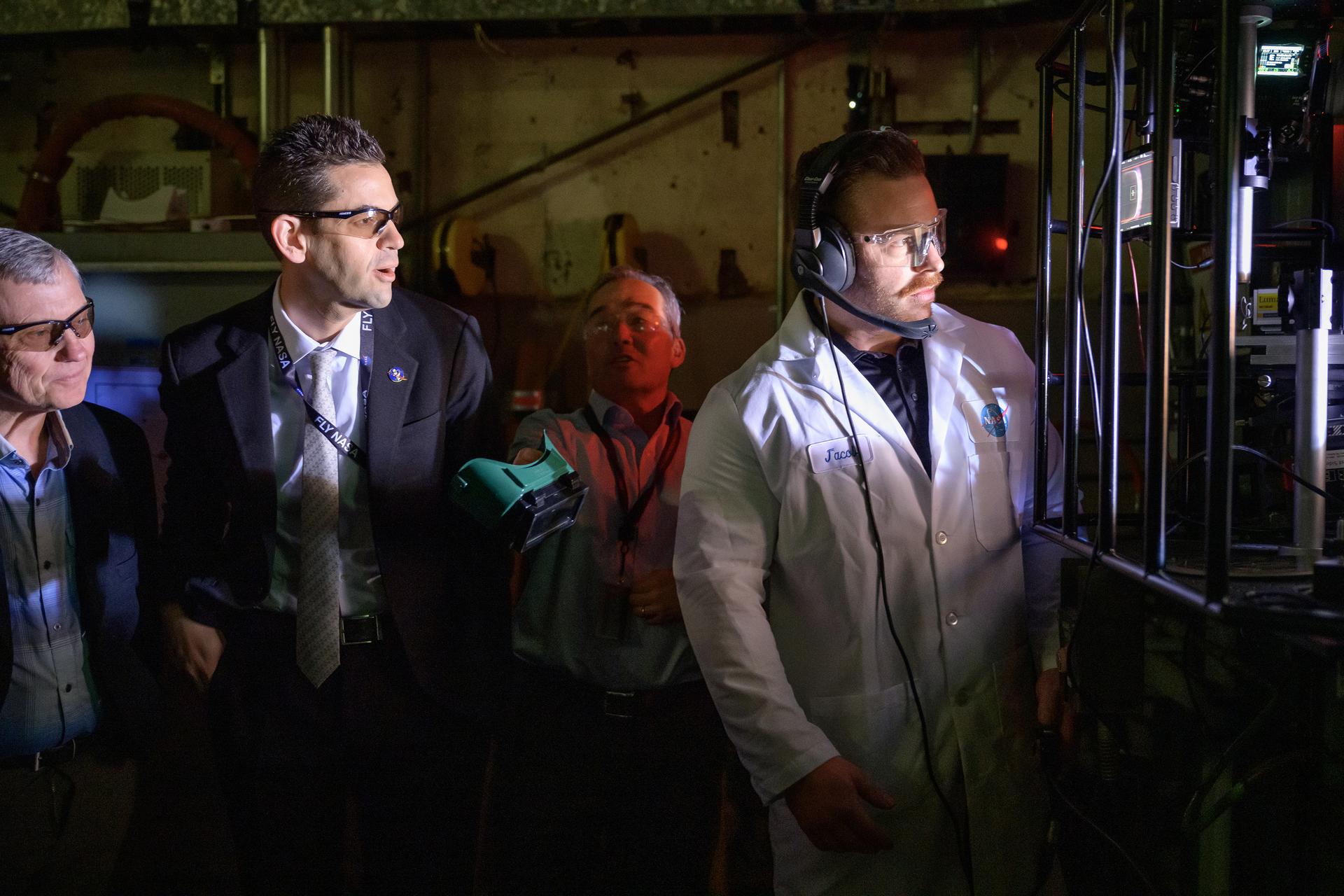
NASA Administrator Jared Isaacman views a test run in the Arc Jet facility in N238.
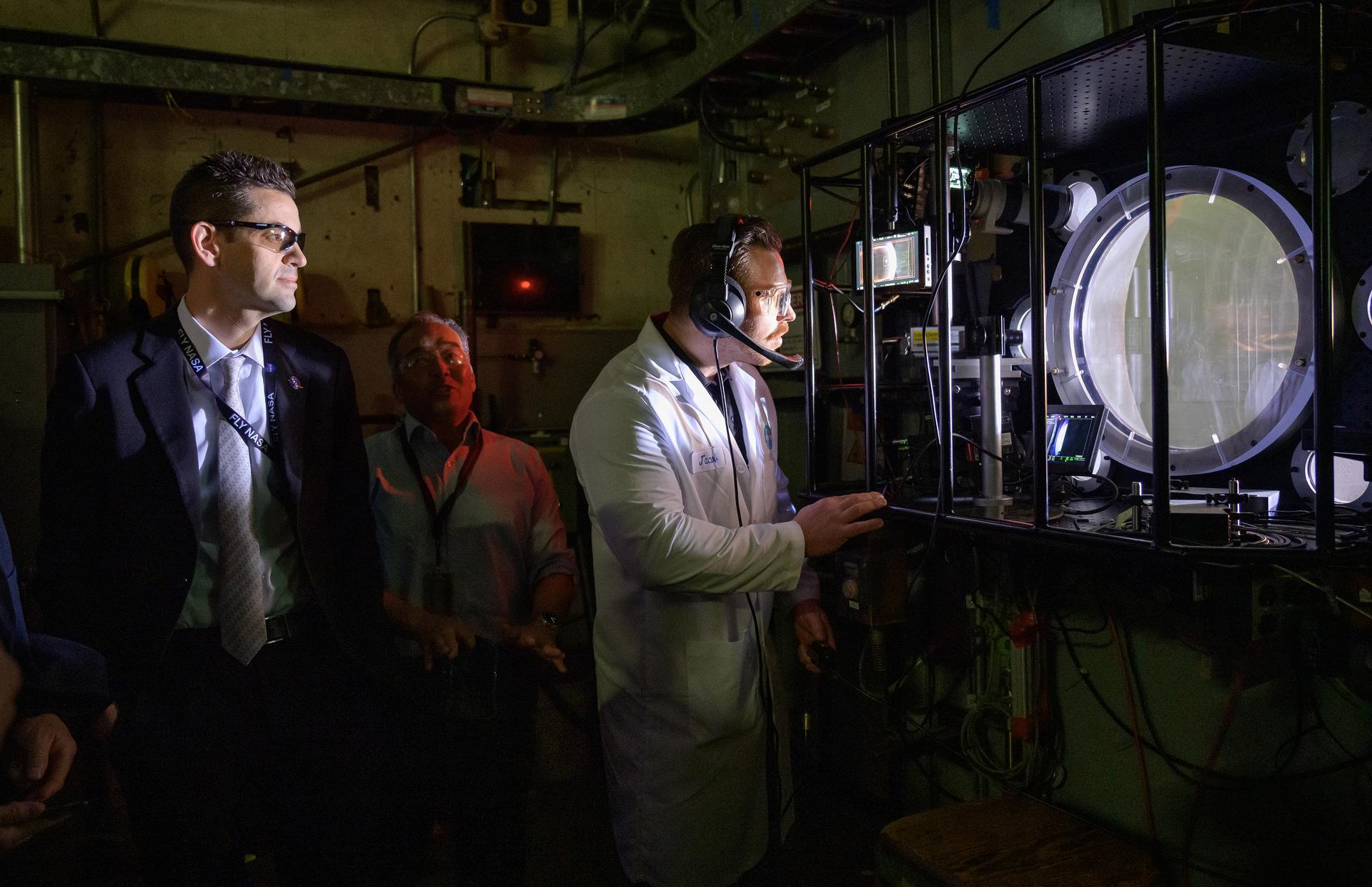
NASA Administrator Jared Isaacman views a test run in the Arc Jet facility in N238.
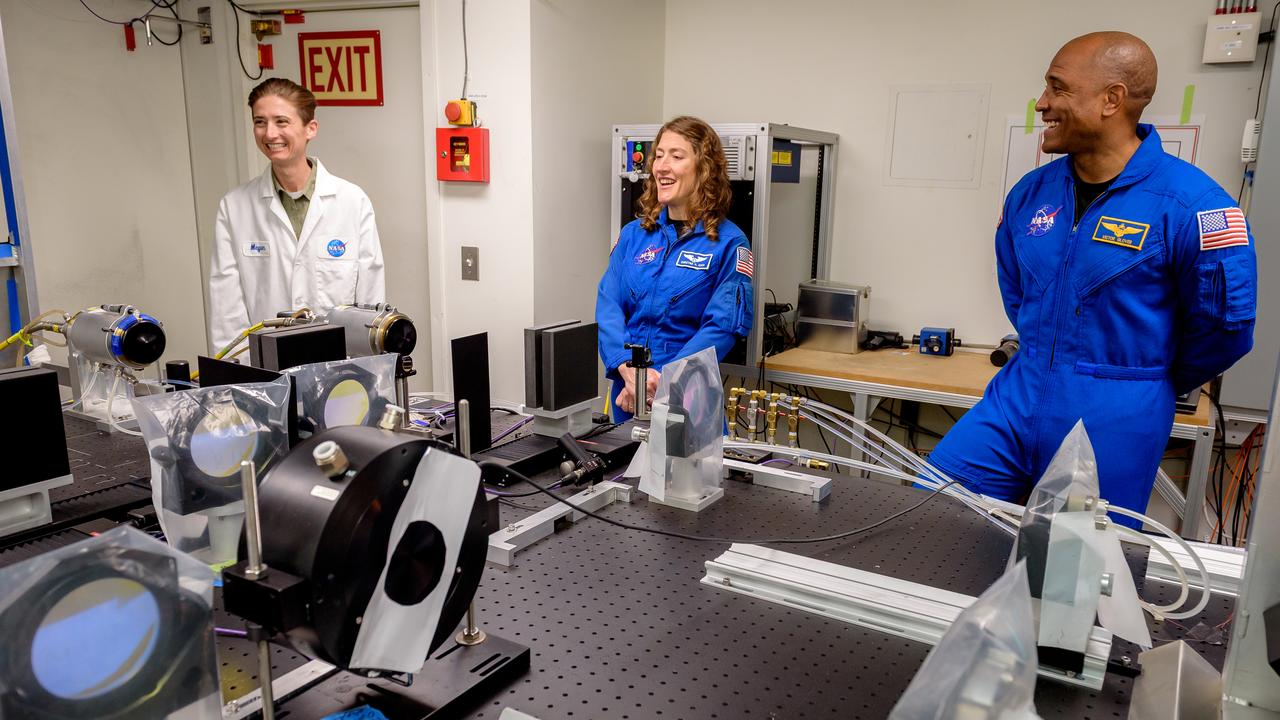
Megan MacDonald, left, leads NASA astronauts Christina Koch and Victor J. Glover, right, on a tour of the Laser Enhanced Arc Jet Facility (LEAF) laboratory, in N238. The LEAF laser augments the hypersonic shock heating experienced by a test sample during an arc jet test and provides improved test simulation quality by supplying an intense source of optical heating while the arc jet flow provides shock-driven convective heating.
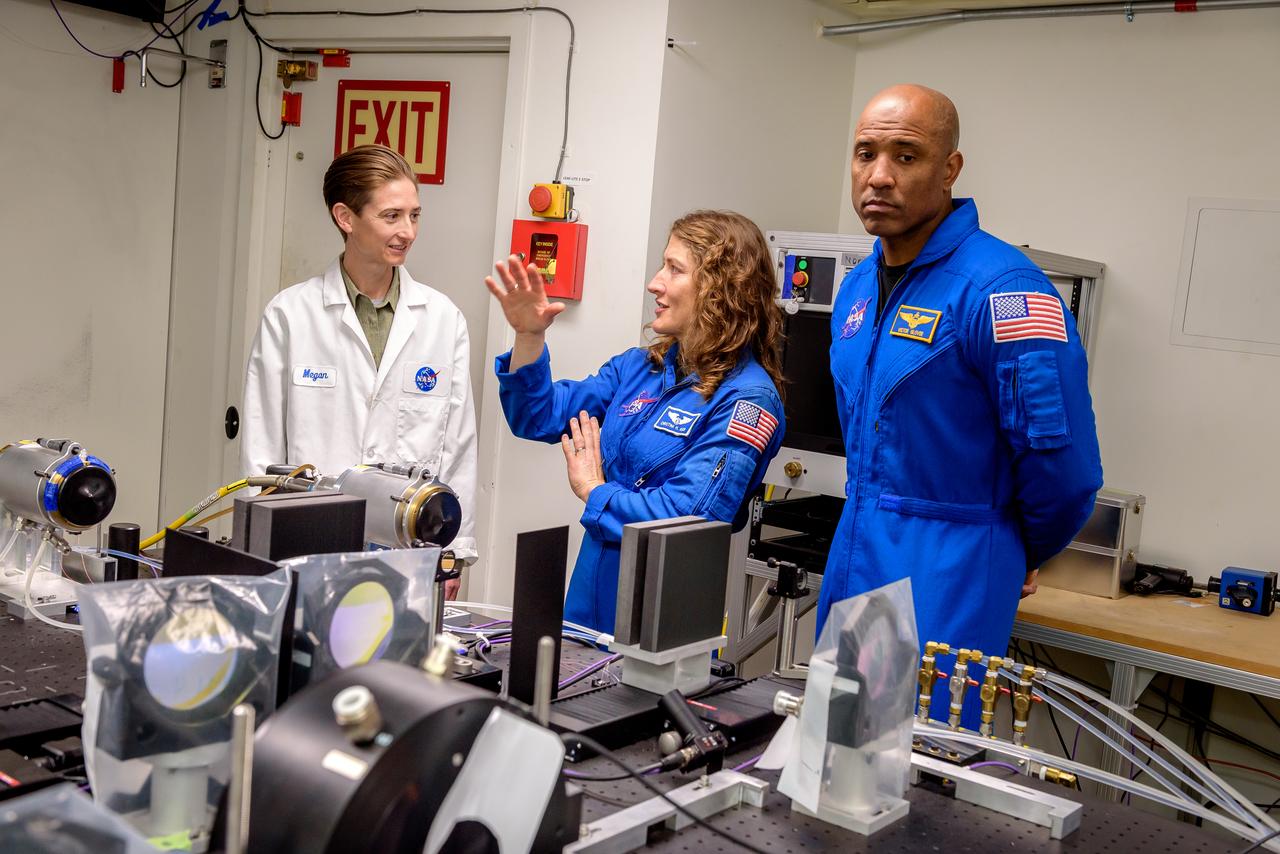
Megan MacDonald, left, leads NASA astronauts Christina Koch and Victor J. Glover, right, on a tour of the Laser Enhanced Arc Jet Facility (LEAF) laboratory, in N238. The LEAF laser augments the hypersonic shock heating experienced by a test sample during an arc jet test and provides improved test simulation quality by supplying an intense source of optical heating while the arc jet flow provides shock-driven convective heating.
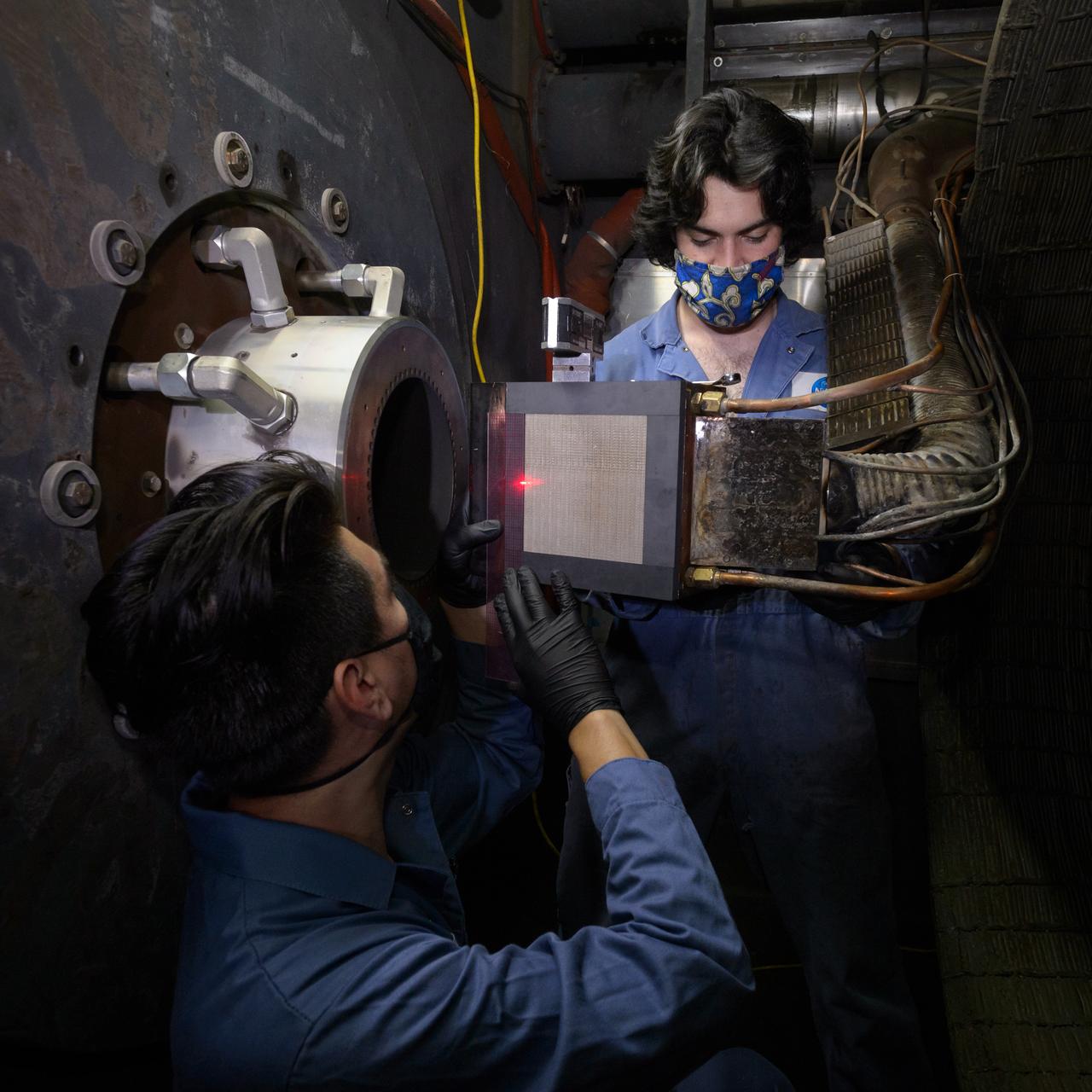
Engineering technicians Pedro Solano, left, and Aaron Poulin, right, verify alignment of an Orion heat shield test article in the Arc Jet Interaction Heating Facility, or IHF, test section. This test of Orion’s heat shield using a combination of the IHF and the Laser Enhanced Arc Jet Facility, or LEAF-Lite, capabilities will certify the heat shield for the Artemis I and Artemis II missions. This is also the first time the heat shield is tested in an environment combining the two forms of heating, radiant and convective, the spacecraft will experience on entering Earth’s atmosphere.
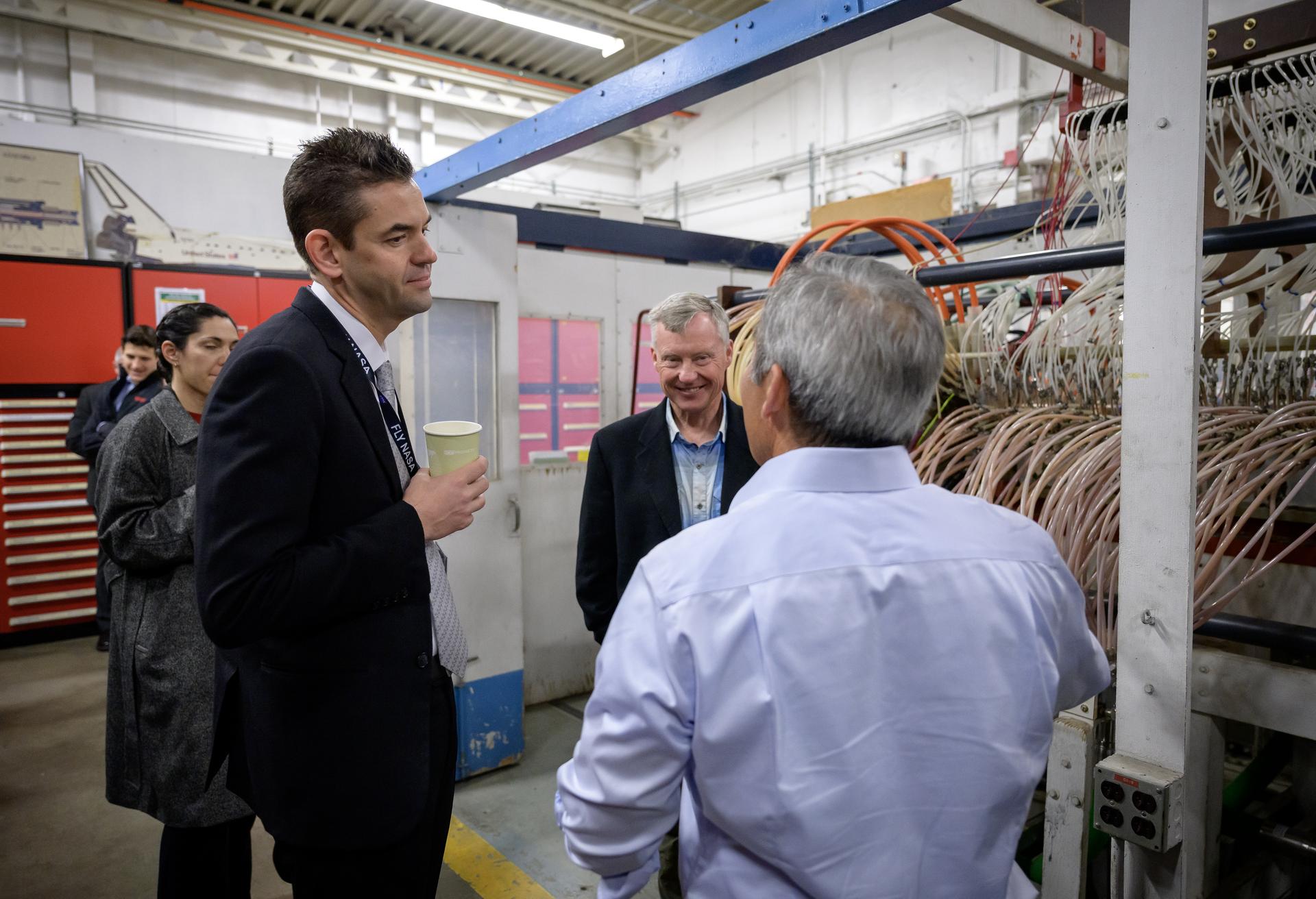
NASA Administrator Jared Isaacman speaks with Dr. George Raiche, Associate Director for Exploration Technology Infrastructure during his visit to the Arc Jet facility in N238.
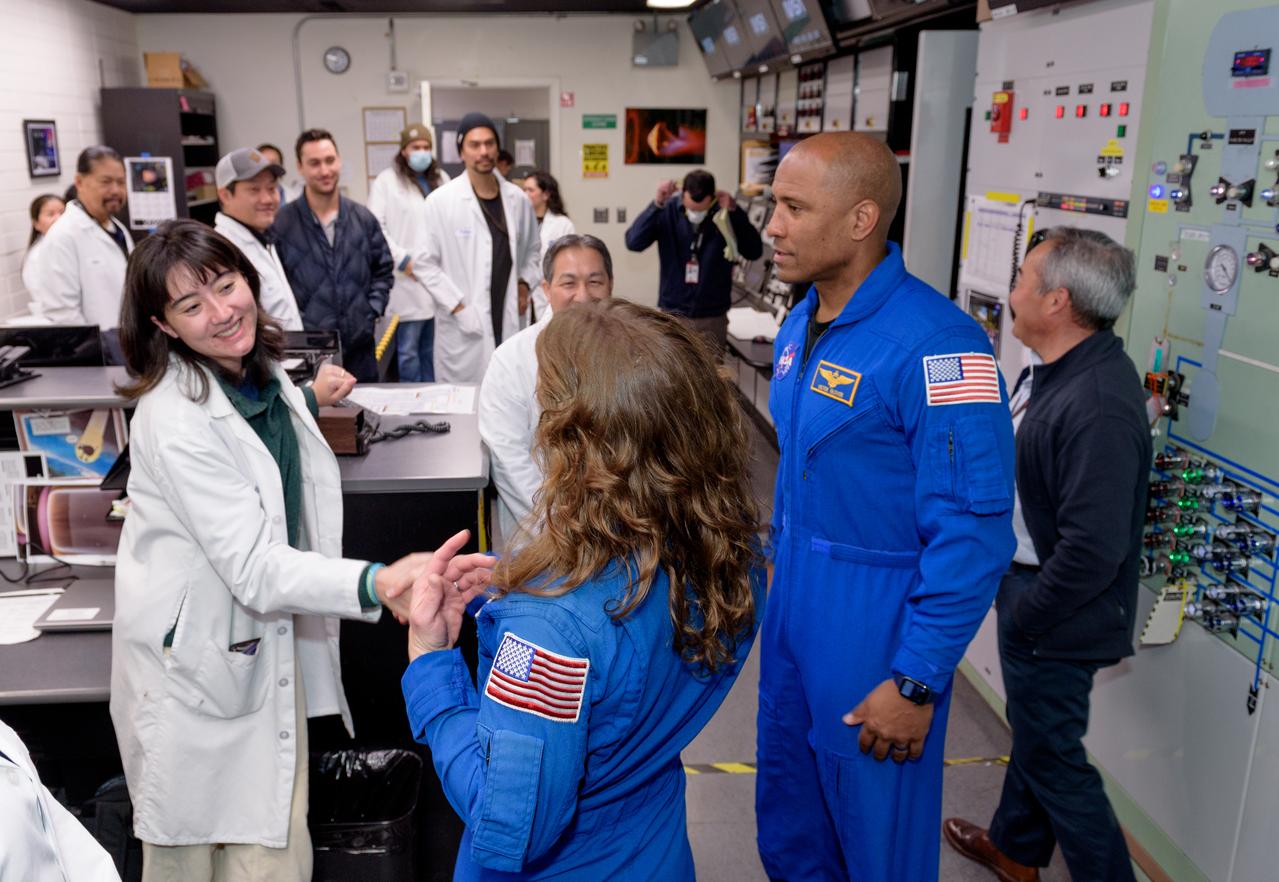
Amelia Kinsella, left, meets NASA astronauts Christina Koch and Victor J. Glover in the Ames Arc Jet control room for the Interaction Heating Facility (IHF), N238, where operators run the Arc Jet and review test data in real time.
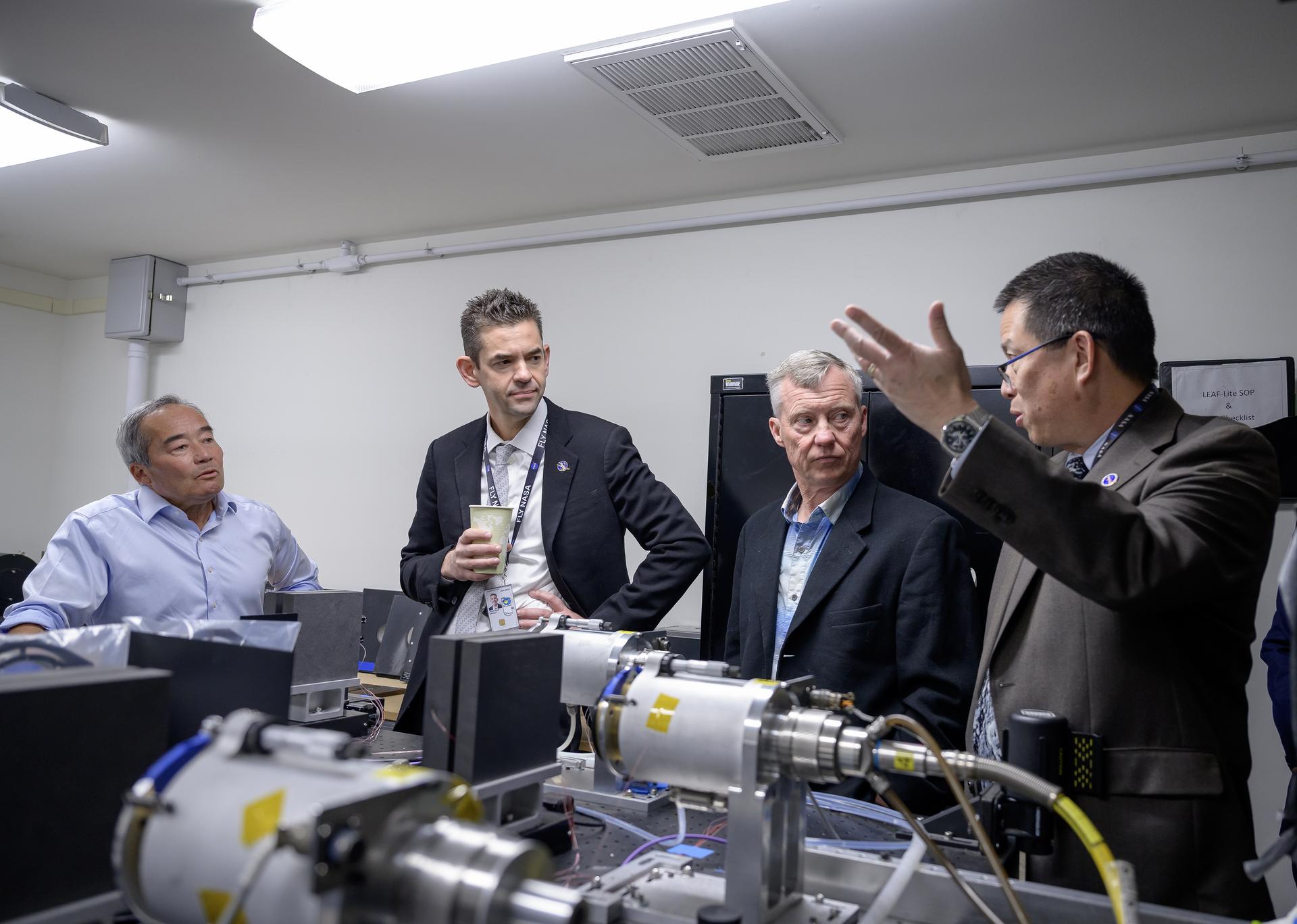
NASA Administrator Jared Isaacman visits the Arc Jet facility in N238.
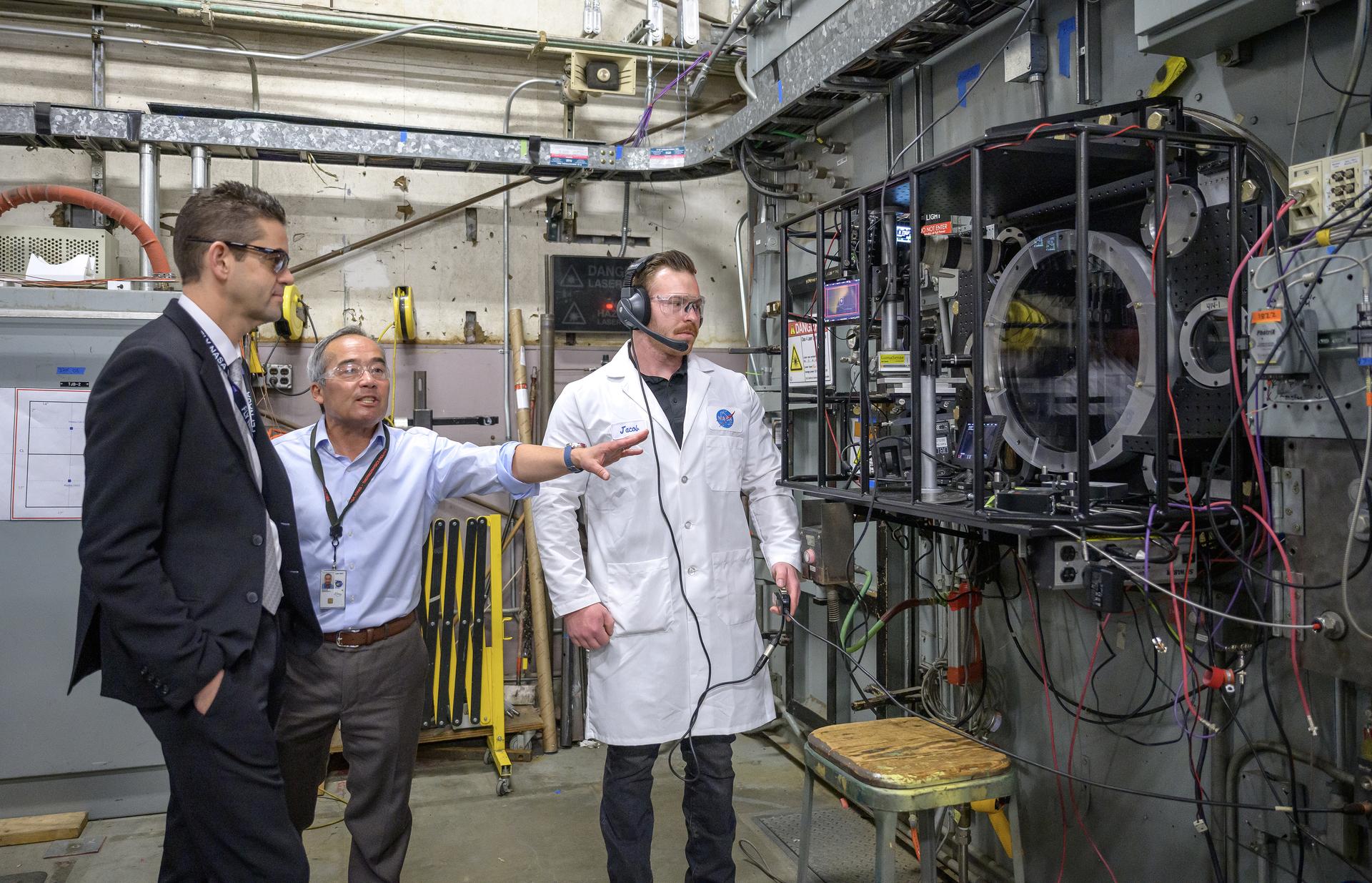
NASA Administrator Jared Isaacman visits the Arc Jet facility in N238.
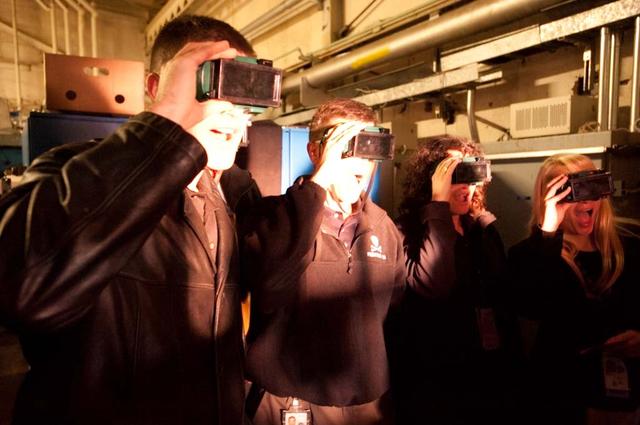
The 14 member 2009 class of NASA astronauts, Japan Aerospace Explortion Agency (JAXA) astronauts and Canadian Space Agency astronauts visit the Arc Jet Facilities at Ames Research Center. Jeremy Hansen, Gregory 'Reid' Wiseman, Serna Aunon, Kathleen (Kate) Rubins watch the test artical burn durning a test run.
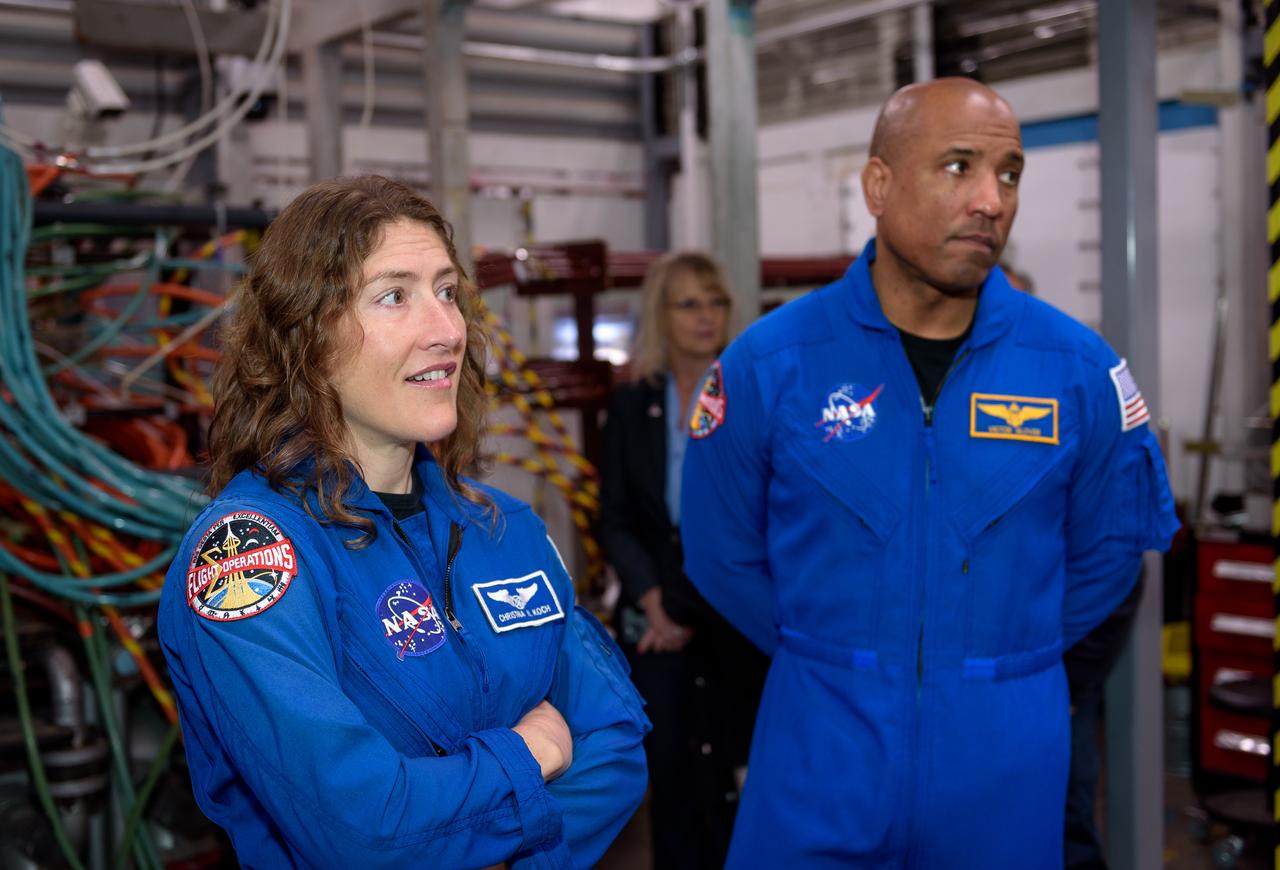
NASA astronauts Victor J. Glover and Christina Koch tour the Ames Arc Jet Complex, N238.
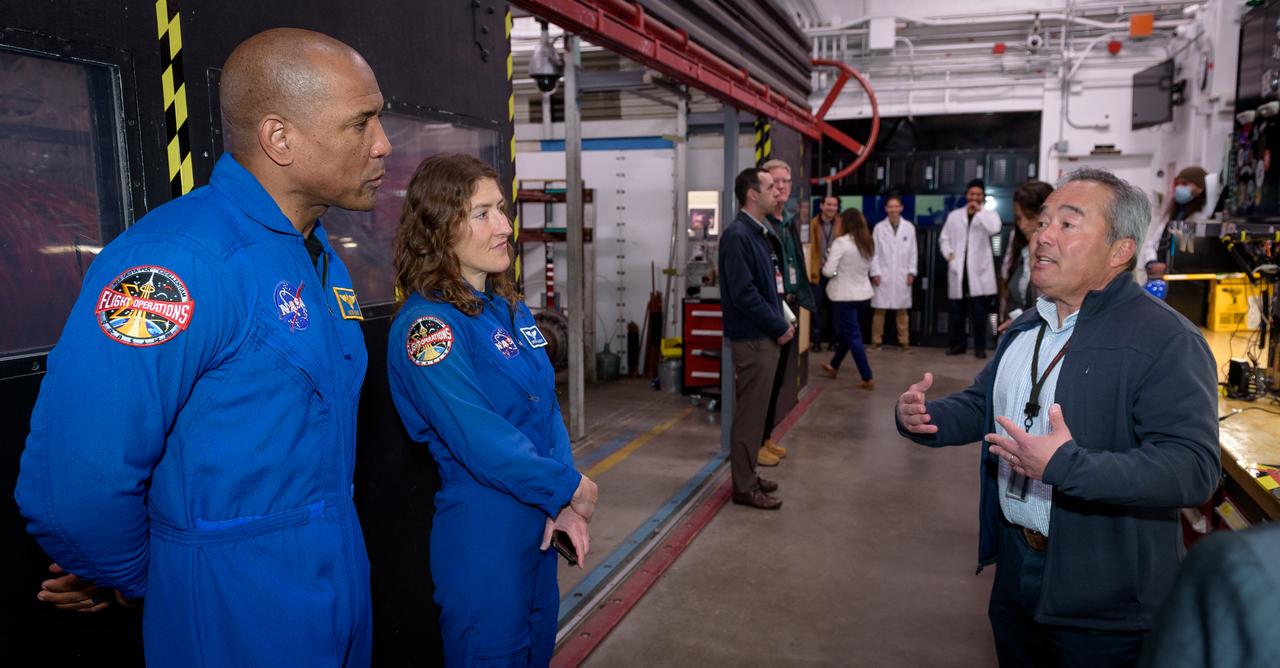
Thermophysics Facilities Branch Chief George Raiche, right, leads NASA astronauts Victor J. Glover, left, and Christina Koch through the Arc Jet Complex in N238.
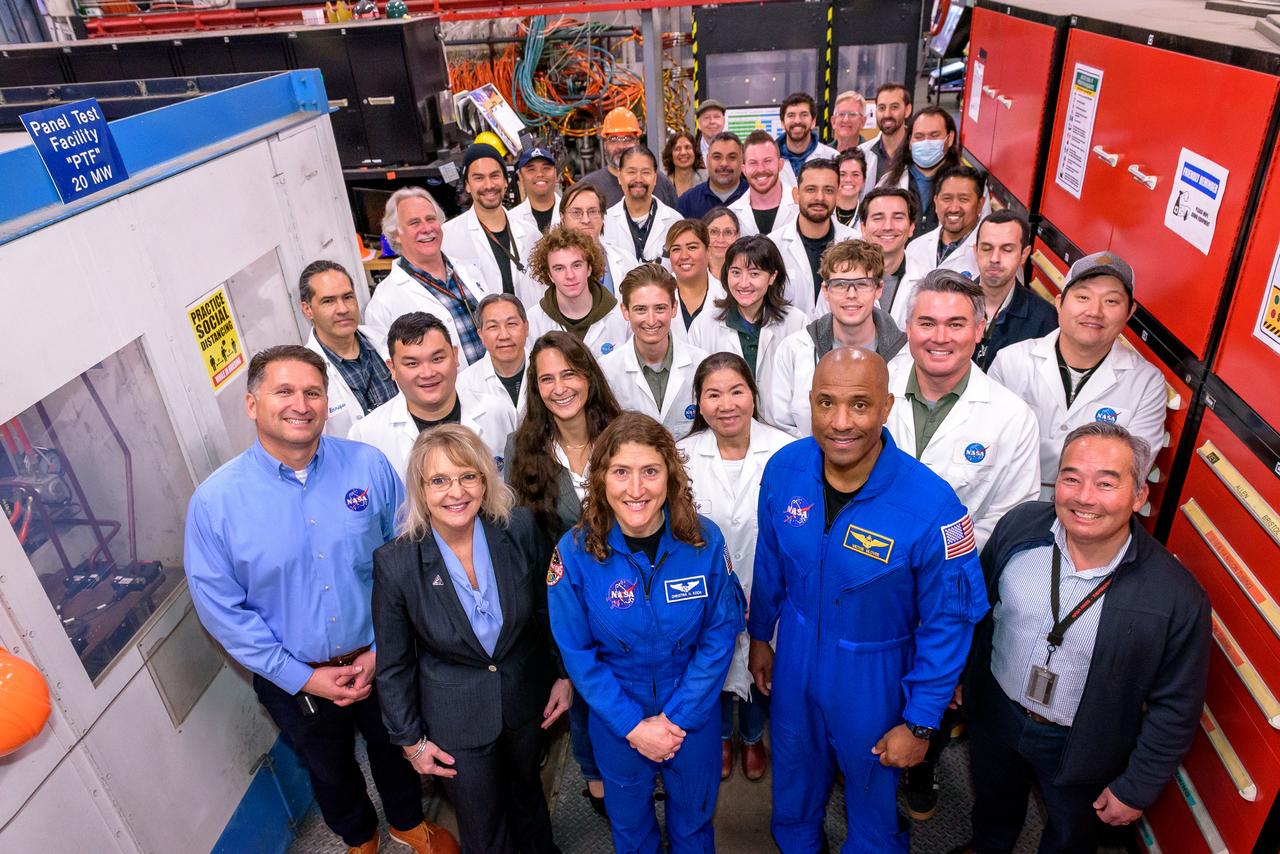
Group photo of the Orion astronauts with the staff of the Ames Arc Jet Complex in N238. Front row: Luis Saucedo, left, Debbie Korth, Christina Koch, Victor J. Glover, and George Raiche, right.
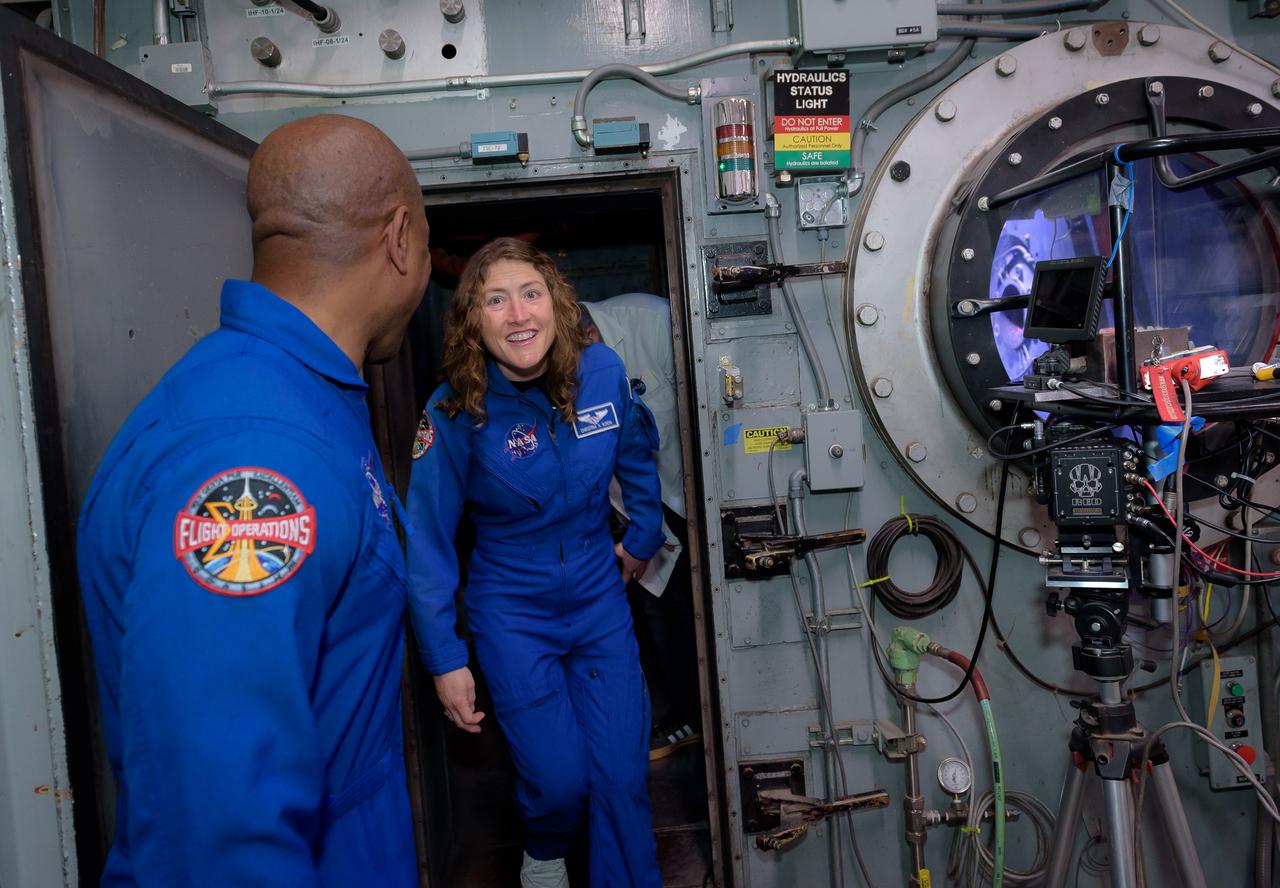
NASA astronaut Christina Koch exits the vacuum test chamber for the Interaction Heating Facility (IHF) of the Ames Arc Jet Complex, N238, following Victor J. Glover, left. During a test, a TPS test sample is suspended in the hypersonic flow produced by IHF’s arc heater. The shock heating produced by the interaction between the hypersonic flow and the stationary test sample simulates the heating and other forces the spacecraft will encounter during atmospheric hypersonic entry.
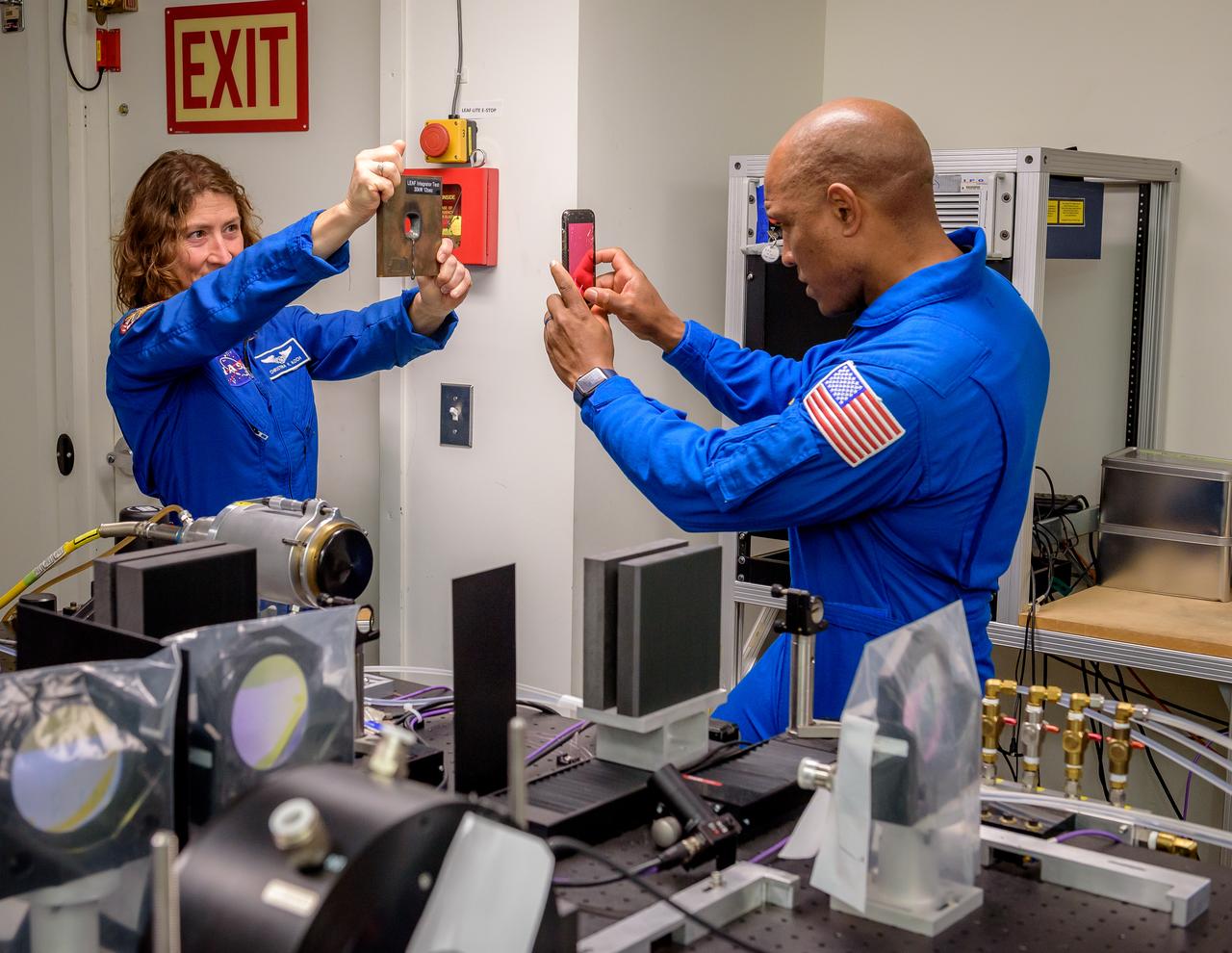
NASA Astronaut Christina Koch, left, holds a test sample for Victor J. Glover to photograph. The sample is a half-inch steel plate with a hole that was drilled by a 12-second burst from a 30kW laser in the Laser Enhanced Arc Jet Facility (LEAF) laboratory, N238.
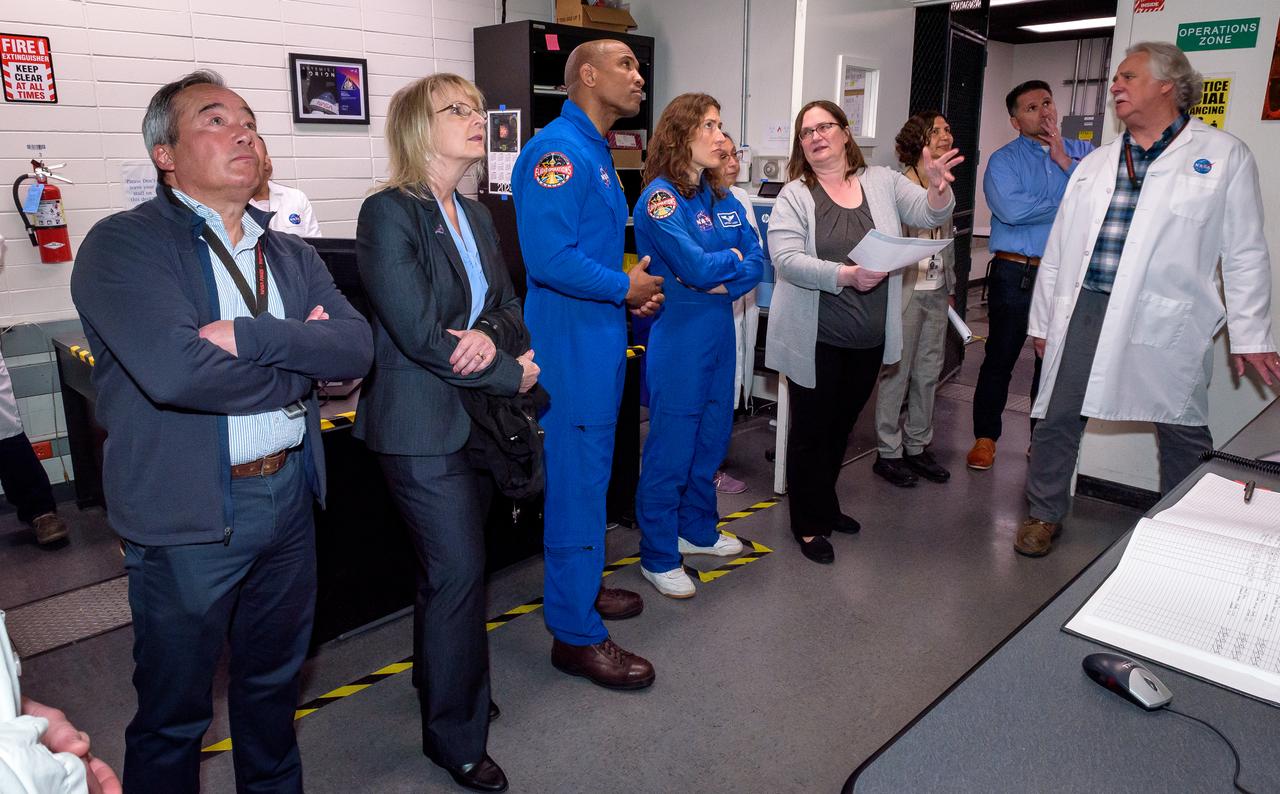
Thermophysics Facilities Branch Chief George Raiche, left, Orion Deputy Program Manager Debbie Korth, NASA astronauts Victor J. Glover, Christina Koch, Kristina A. Skokova, Parul Agrawal, Luis Saucedo, and Scott Eddlemon watch a video presentation in the Ames Arc Jet control room for the Interaction Heating Facility (IHF), N238.
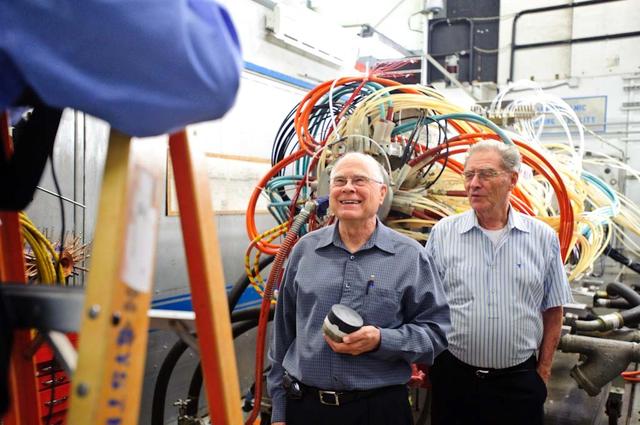
Dr William 'Bill' Borucki, NASA Ames Scientist on the Kepler Mission and John W. 'Jack' Boyd, NASA Ames Historian at the Ames Arc Jet Complex, Aerodynamic Heating Facility talking with a Mercury News photographer about the Kepler Mission and the 40th Anniversary of the Apollo 11 Mission.

NASA Administrator Jared Isaacman views an arc jet test, Monday, Jan. 26, 2026, at NASA’s Ames Research Center in Mountain View, Calif. Ames marks the tenth stop in Isaacman’s roadshow to visit NASA facilities and engage directly with the agency’s workforce. Photo Credit: (NASA/John Kraus)
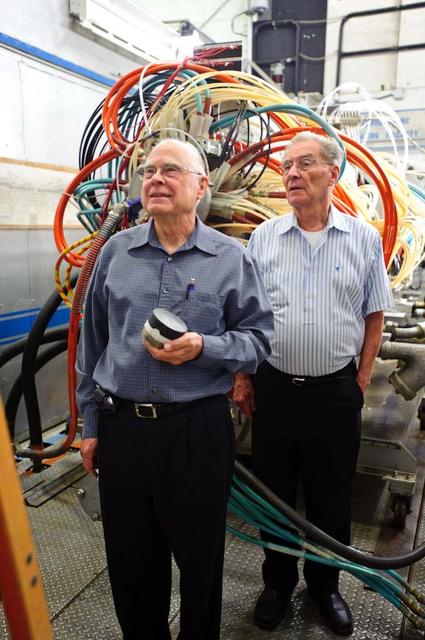
Dr William 'Bill' Borucki, NASA Ames Scientist on the Kepler Mission and John W. 'Jack' Boyd, NASA Ames Historian at the Ames Arc Jet Complex, Aerodynamic Heating Facility talking with a Mercury News photographer about the Kepler Mission and the 40th Anniversary of the Apollo 11 Mission.
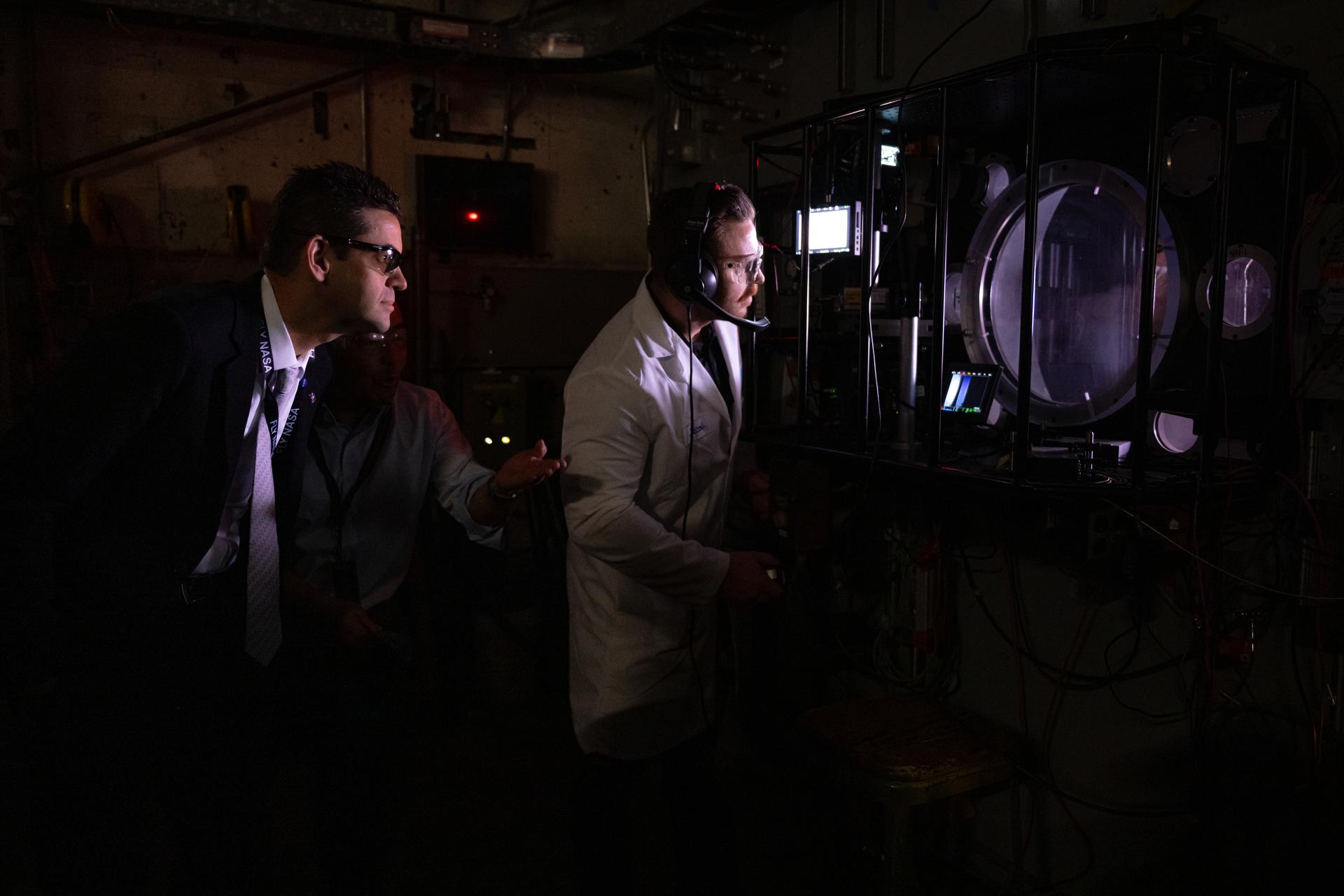
NASA Administrator Jared Isaacman, left, views an arc jet test, Monday, Jan. 26, 2026, at NASA’s Ames Research Center in Mountain View, Calif. Ames marks the tenth stop in Isaacman’s roadshow to visit NASA facilities and engage directly with the agency’s workforce. Photo Credit: (NASA/John Kraus)
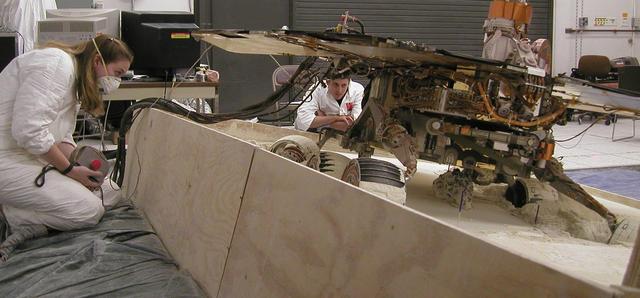
Rover team members Kim Lichtenberg and Joseph Carsten watch motions of a test rover at NASA Jet Propulsion Laboratory, Pasadena, Calif., as the rover carries out commands for driving forward with an arc toward the right.
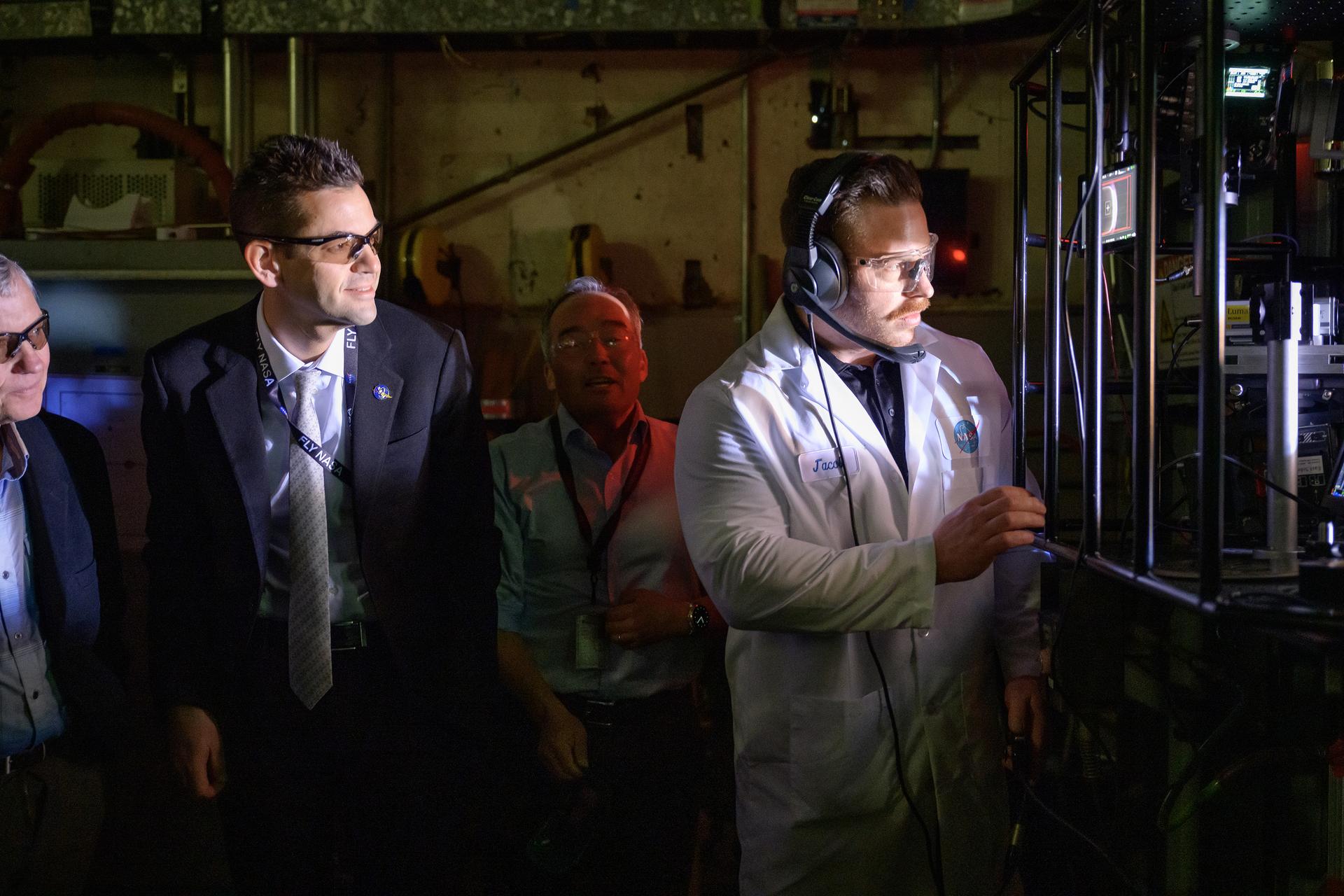
NASA Administrator Jared Isaacman views a test run in the Arc Jet facility in N238.
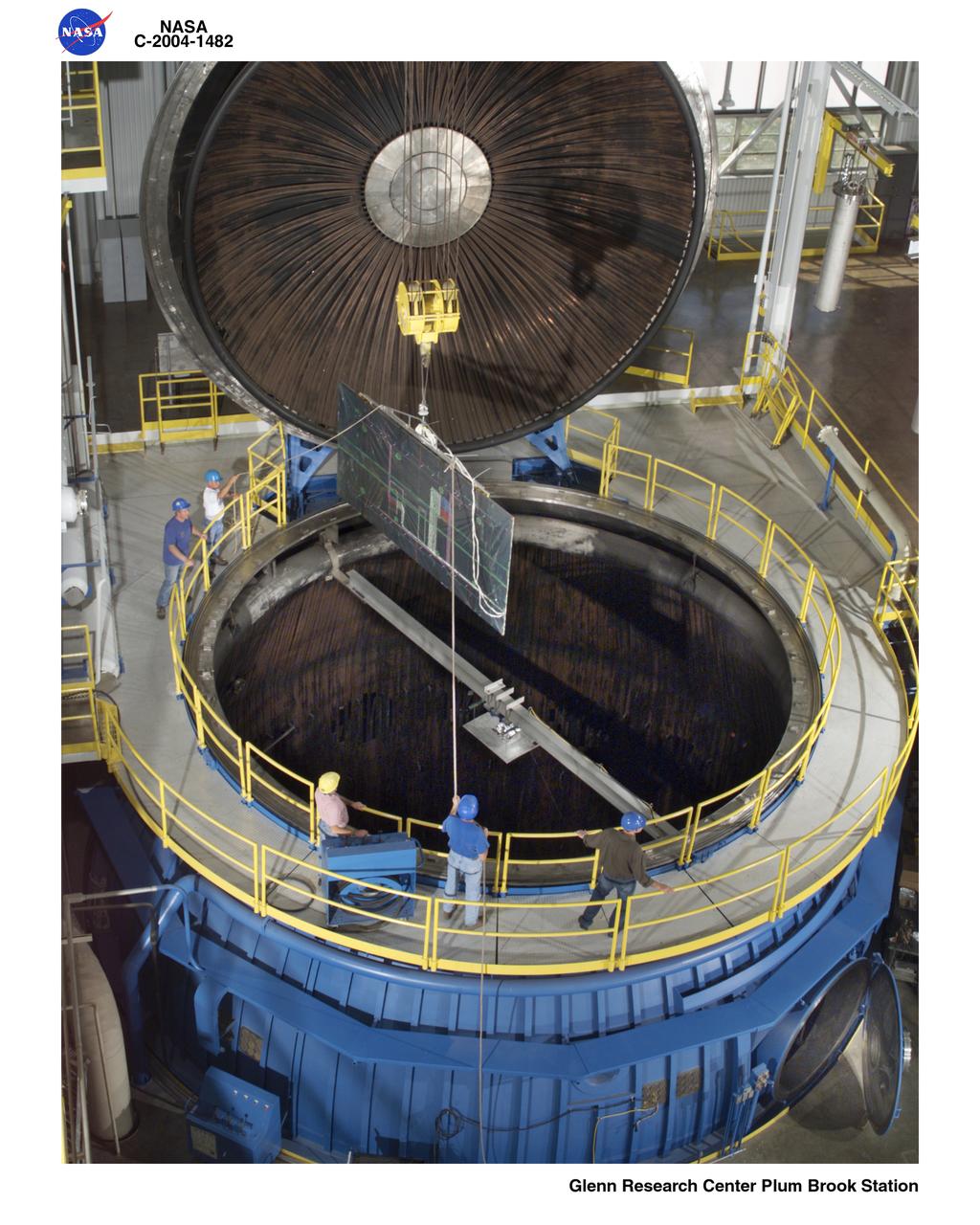
Solar array arc jet plume interaction test at B-2 facility at Plum Brook Station ( PB )
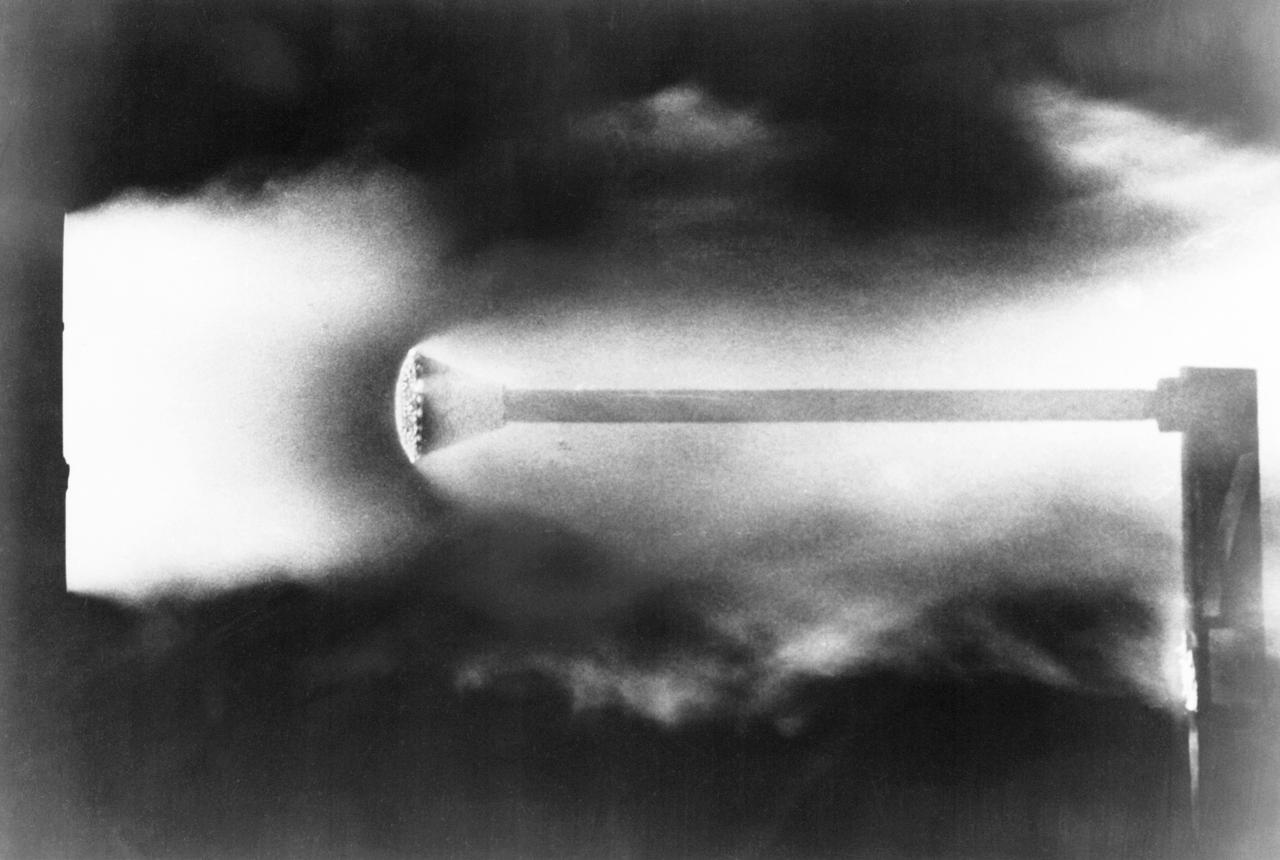
A hot jet research facility, used extensively in the design and development of the reentry heat shield on the Project Mercury spacecraft. The electrically-heated arc jet simulates the friction heating encountered by a space vehicle as it returns to the earth's atmosphere at high velocities. The arc jet was located in Langley's Structures Research Laboratory. It was capable of heating the air stream to about 9,000 degrees F. -- Published in Taken from an October 5, 1961 press release entitled: Hot Jet Research Facility used in Reentry Studies will be demonstrated at NASA Open House, October 7.
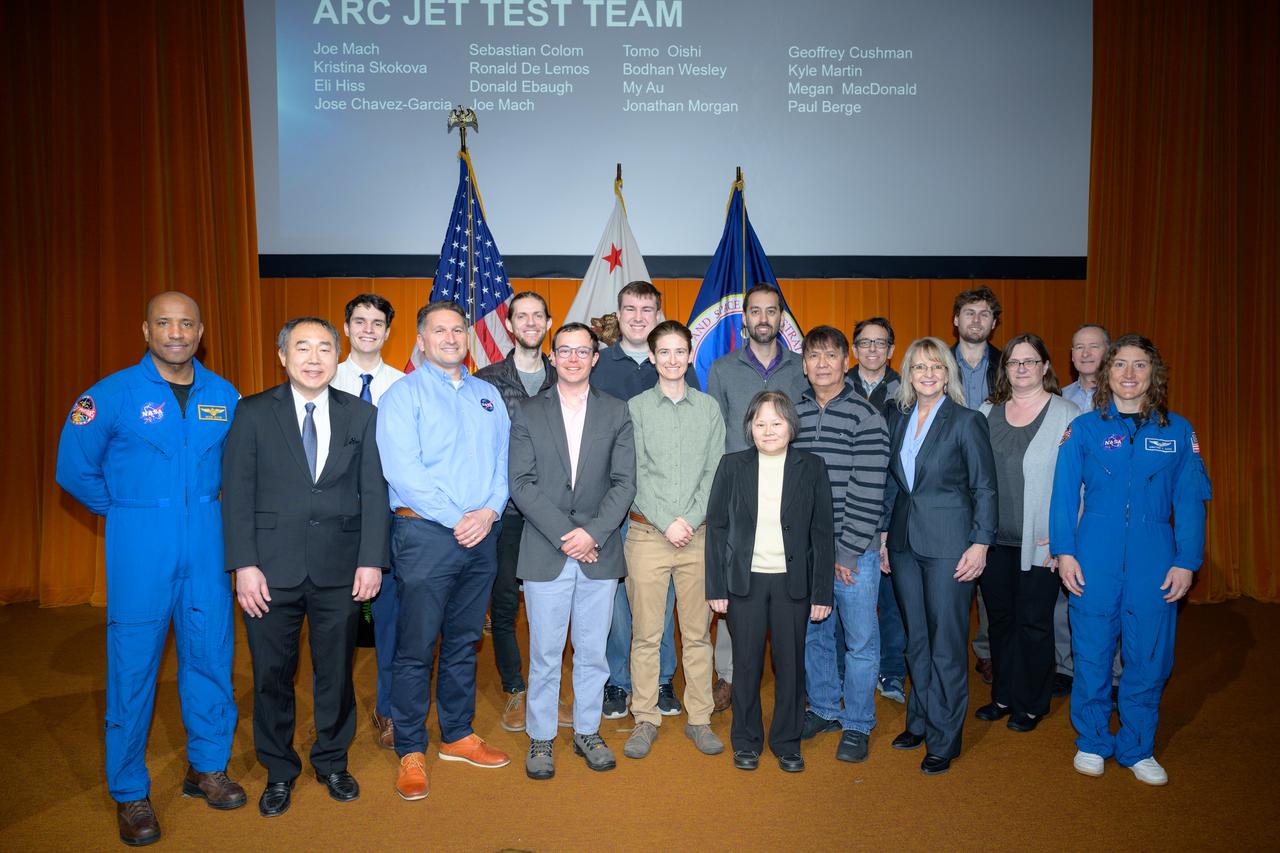
Artemis I Investigation Arc Jet Test team with NASA astronauts Victor J. Glover, left, and Christina Koch, right, in the N201 auditorium.
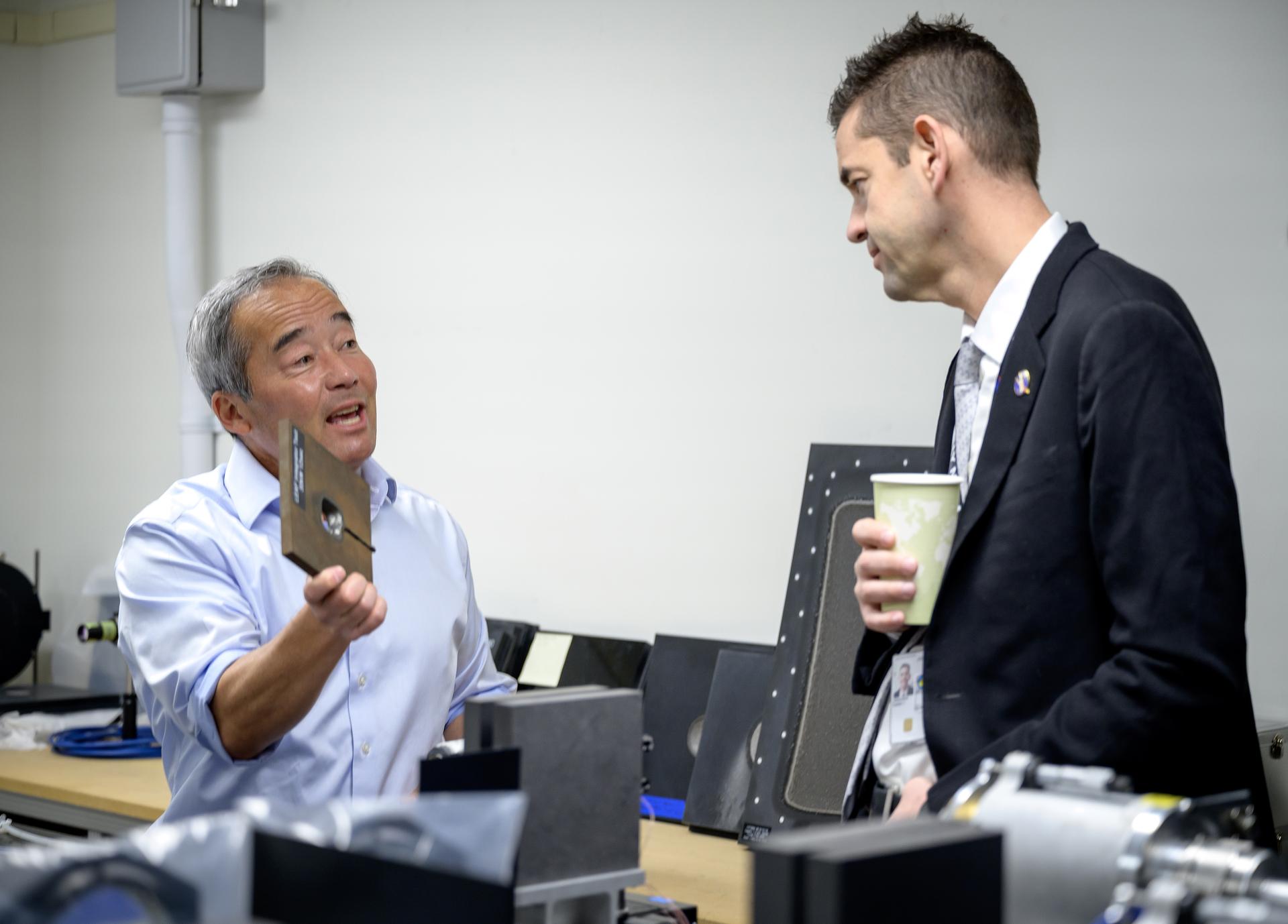
NASA Administrator Jared Isaacman speaks with Dr. George Raiche, Associate Director for Exploration Technology Infrastructure during his visit to the Arc Jet facility in N238.
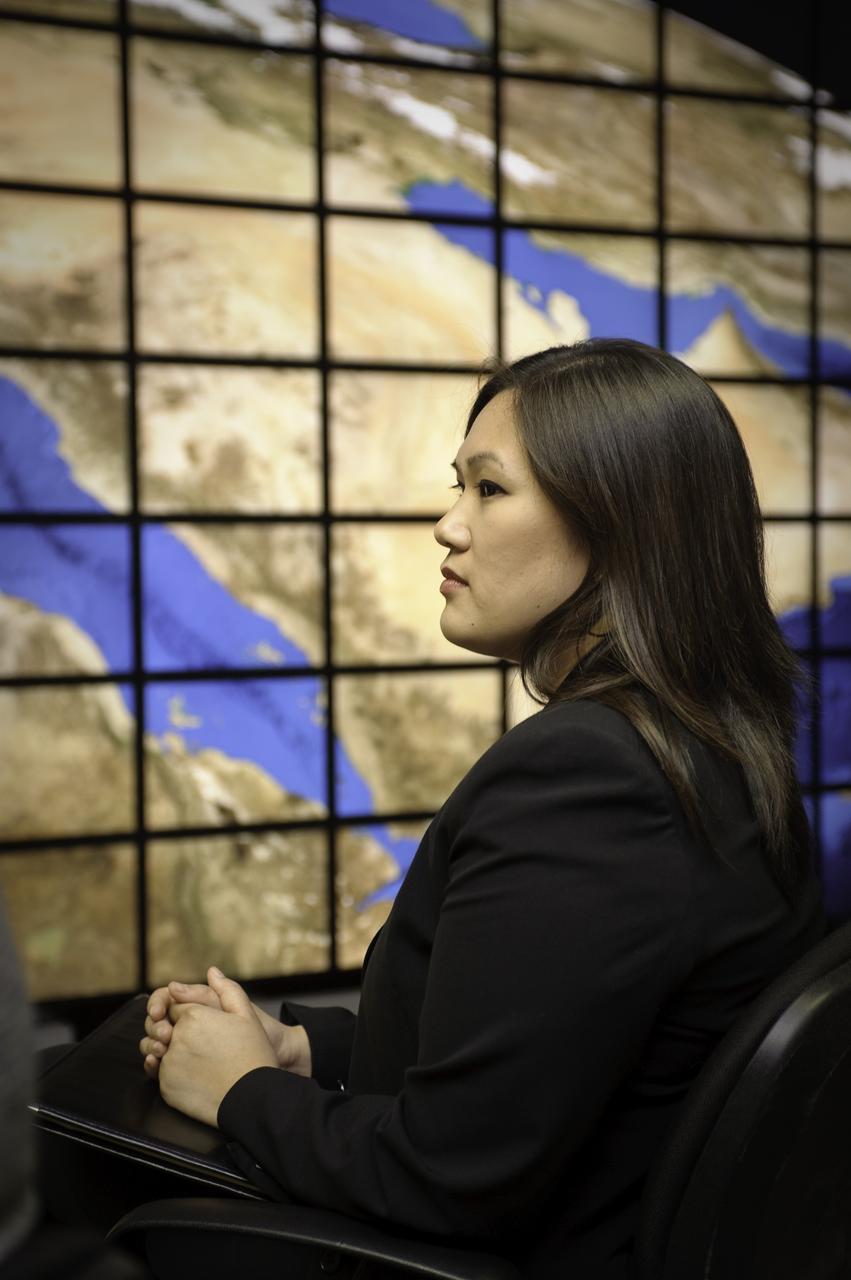
U.S. Senator Diane Feinstein of California staffer Christine Epres visits NASA Ames Research Center, Moffett Field, Calif.
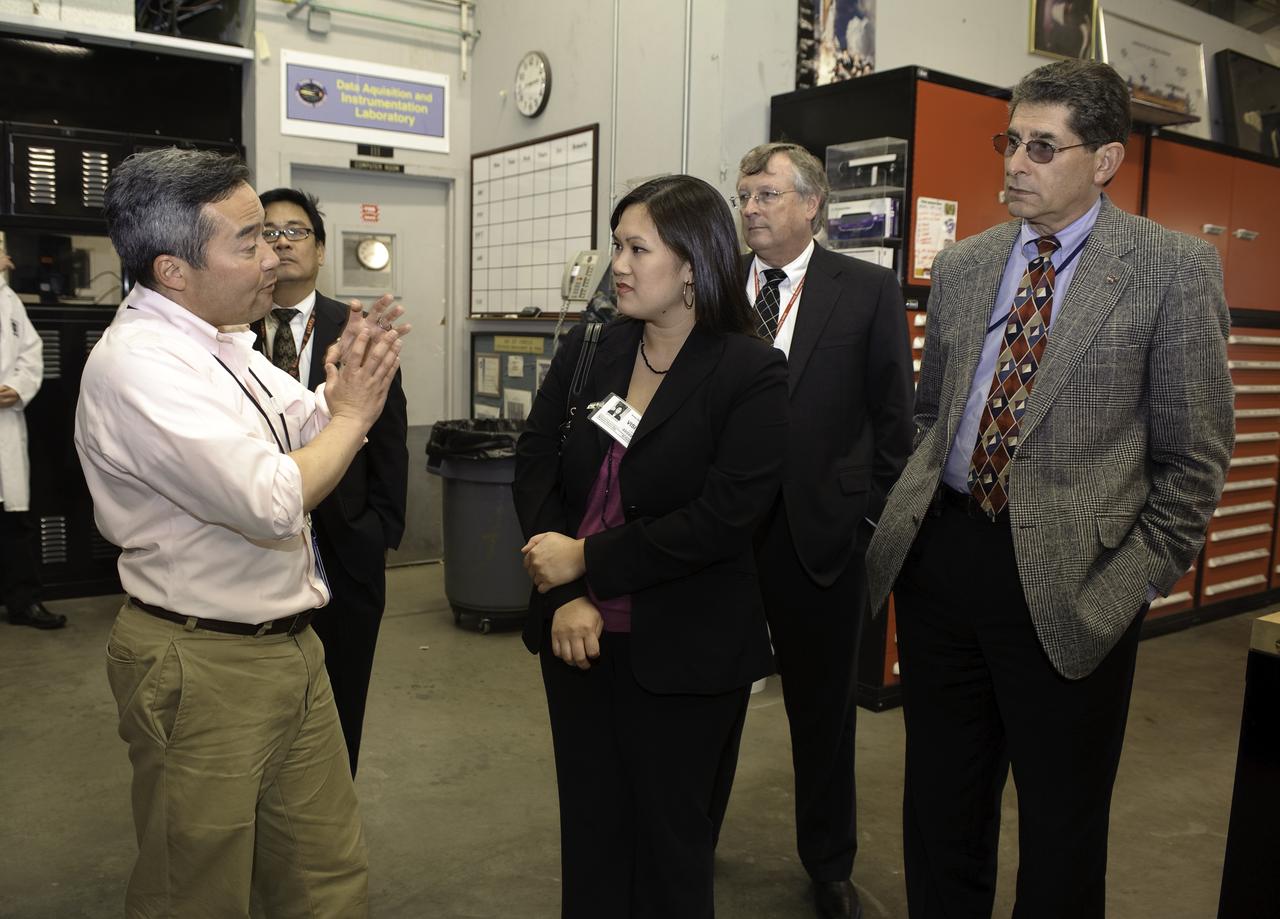
U.S. Senator Diane Feinstein of California staffer Christine Epres visits NASA Ames Research Center, Moffett Field, Calif.
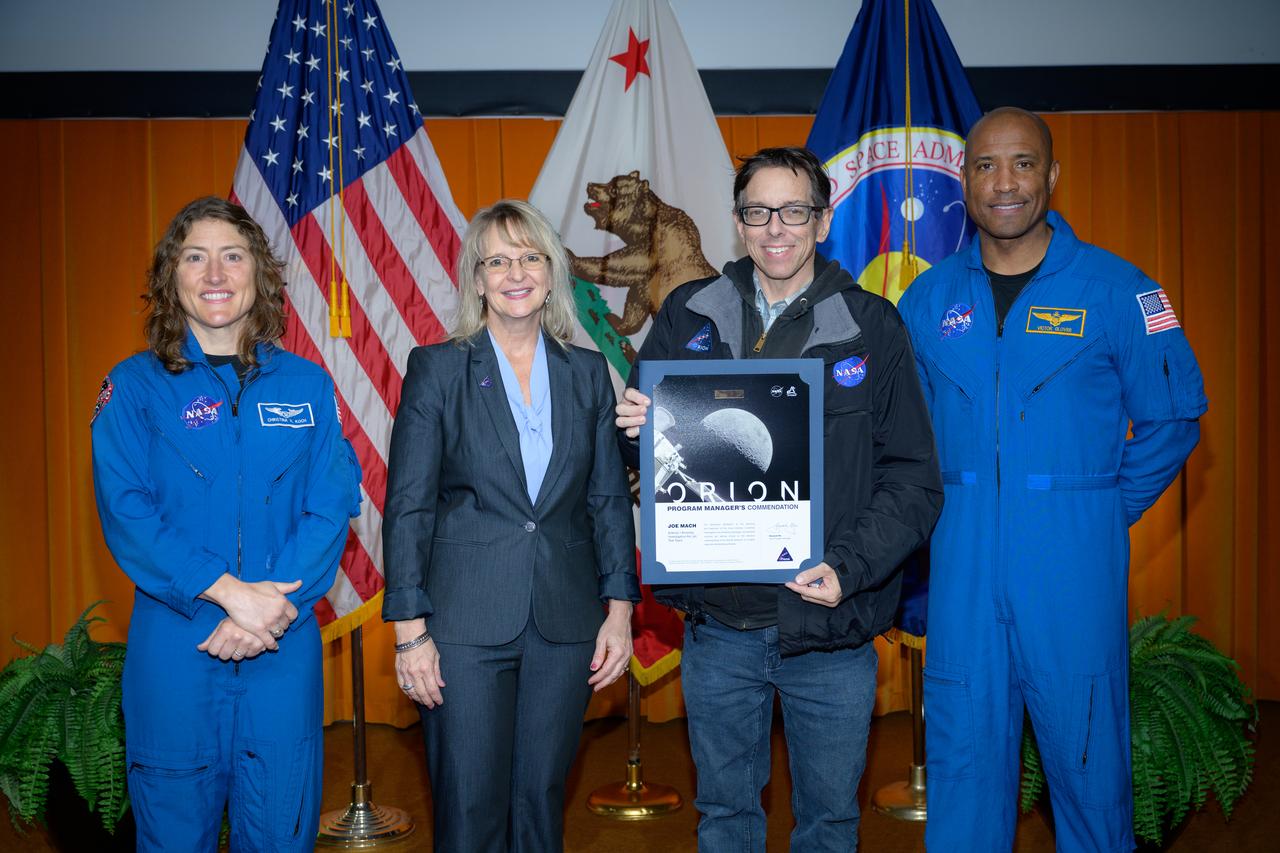
Artemis Orion program manager’s commendation team award presented to the Artemis I Investigation Arc Jet Test team accepted by Joe Mach, center, by Orion Deputy Program Manager Debbie Korth, left, NASA astronauts Victor J. Glover, right, and Christina Koch, left, in the N201 auditorium.
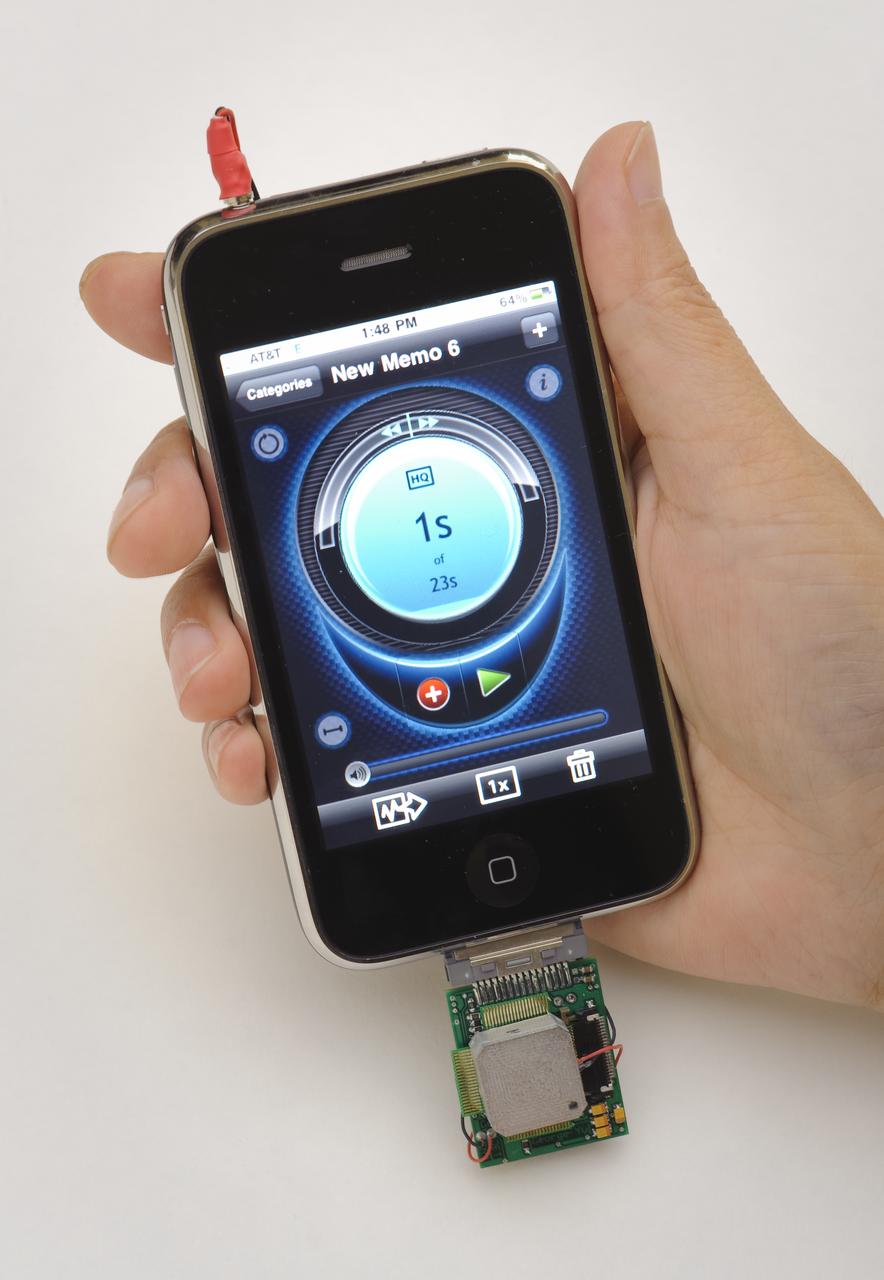
A Nanosensor Device for Cellphone Intergration and Chemical Sensing Network. iPhone with sensor chip, data aquisition board and sampling jet.(Note 4-4-2012:High Sensitive, Low Power and Compact Nano Sensors for Trache Chemical Detection' is the winner of the Government Invention of the Year Award 2012 (winning inventors Jing Li and Myya Meyyappan, NASA/ARC, and Yijiang Lu, University of California Santa Cruz. )
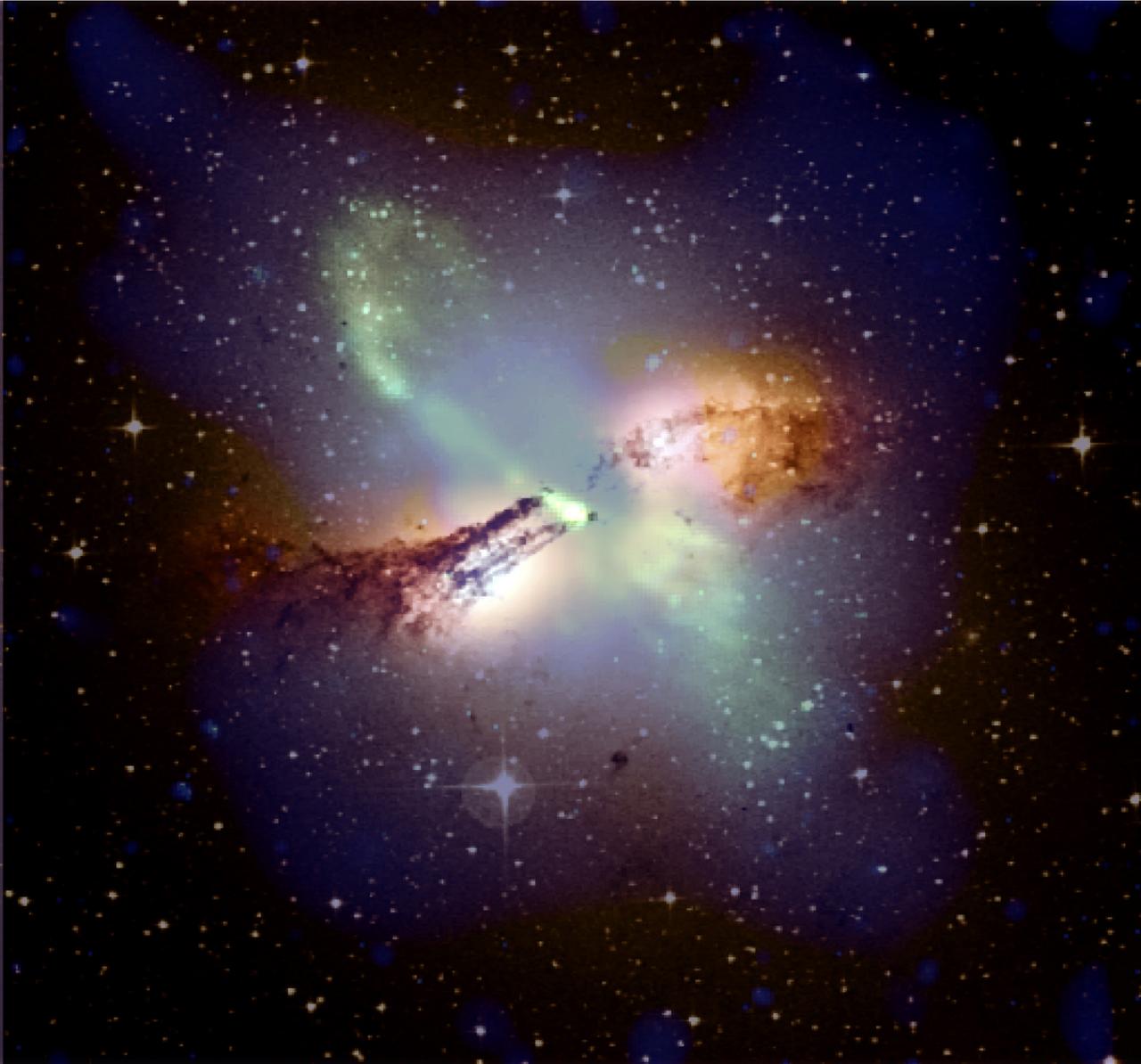
This is a photo taken by NASA's Chandra X-ray Observatory that reveals the remains of an explosion in the form of two enormous arcs of multimillion-degree gas in the galaxy Centaurus A that appear to be part of a ring 25,000 light years in diameter. The size and location of the ring suggest that it could have been an explosion that occurred about 10 million years ago. A composite image made with radio (red and green), optical (yellow-orange), and X-ray data (blue) presents a sturning tableau of a turbulent galaxy. A broad band of dust and cold gas is bisected at an angle by opposing jets of high-energy particles blasting away from the supermassive black hole in the nucleus. Lying in a plane perpendicular to the jets are the two large arcs of x-ray emitting multi-million degree gas. This discovery can help astronomers better understand the cause and effect of violent outbursts from the vicinity of supermassive black holes of active galaxies. The Chandra program is managed by the Marshall Space Flight Center in Huntsville, Alabama.
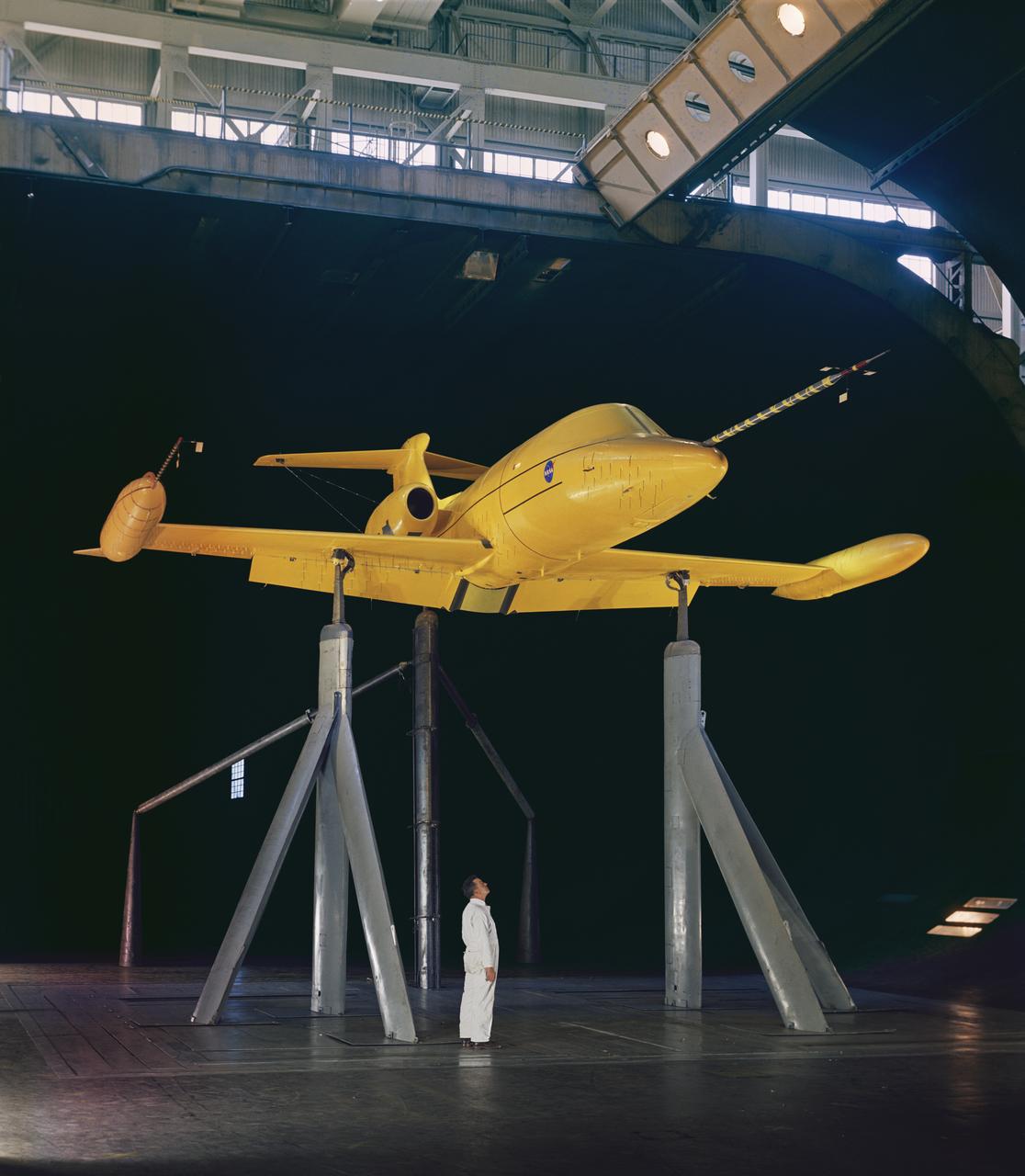
3/4 front view of Lear Jet with Boom installed at 0 degree of attack. Ed Varrette in Photo.
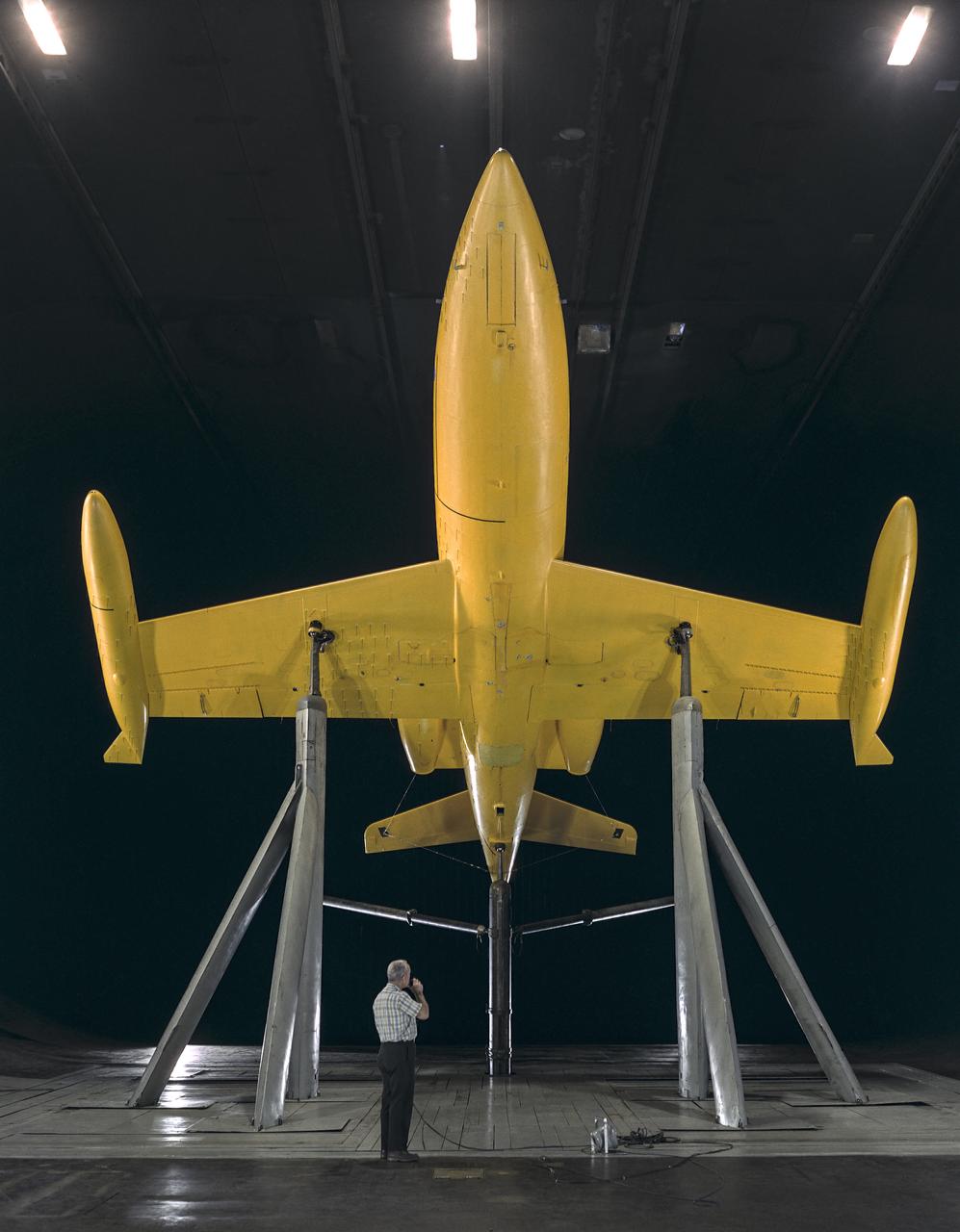
Front lower view of Gates Learjet in Ames 40x80 foot wind tunnel at high angel of attack. Test was part of a deep stall study.
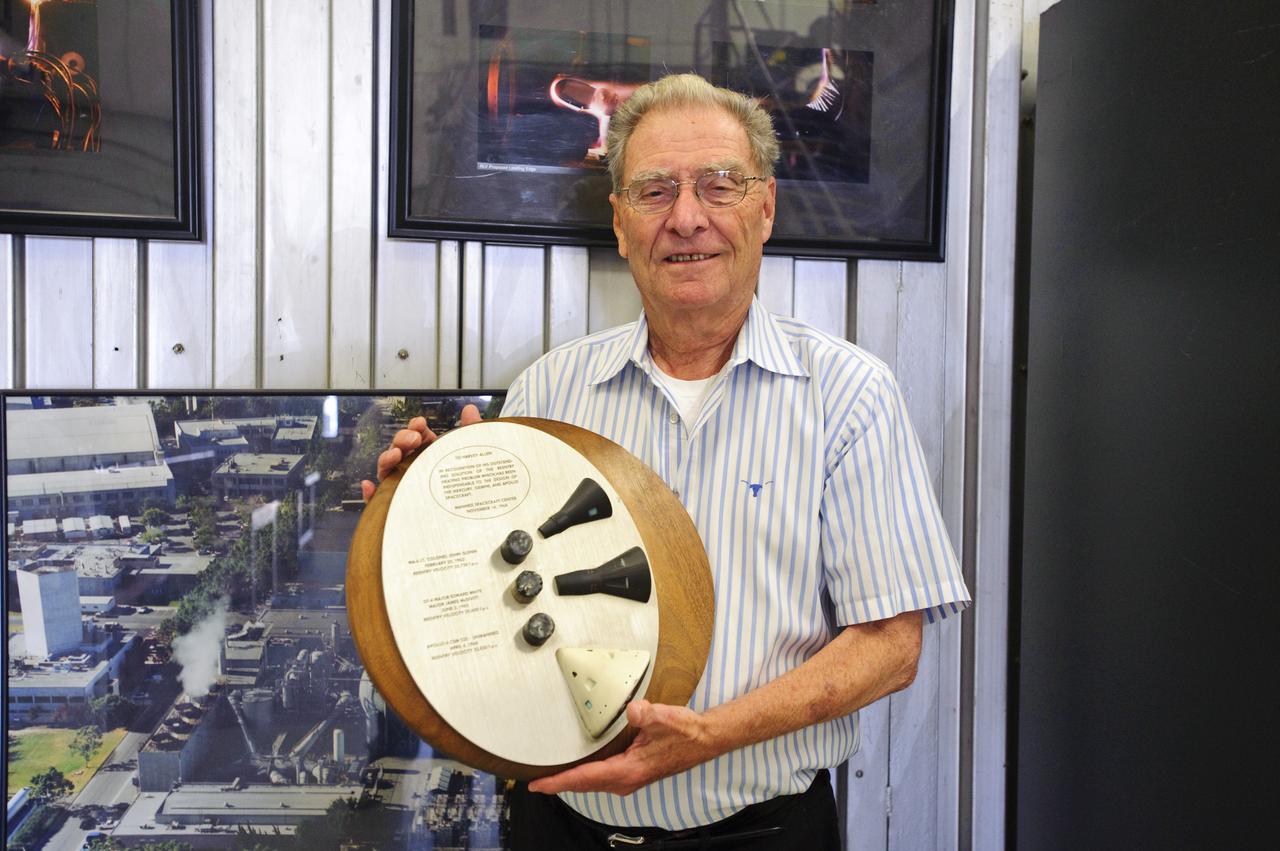
John W. 'Jack Boyd holds a plaque presented to Harvey Allen in recognition of his outstanding solution of the reentry heating problem which has been indispensable to the design of the Mercury, Gemini, and Apollo spacecraft (Manned Spacecraft Center, November 14, 1968) Plaque contains samples of tested materials and models of spacecraft.

Vice President Mike Pence right center, chatting with Jim Bridenstein, left, Tony Colaprete. left center and Dan Andrews, right in front of the VIPER robot at the Vertical Motion Simulator (VMS).
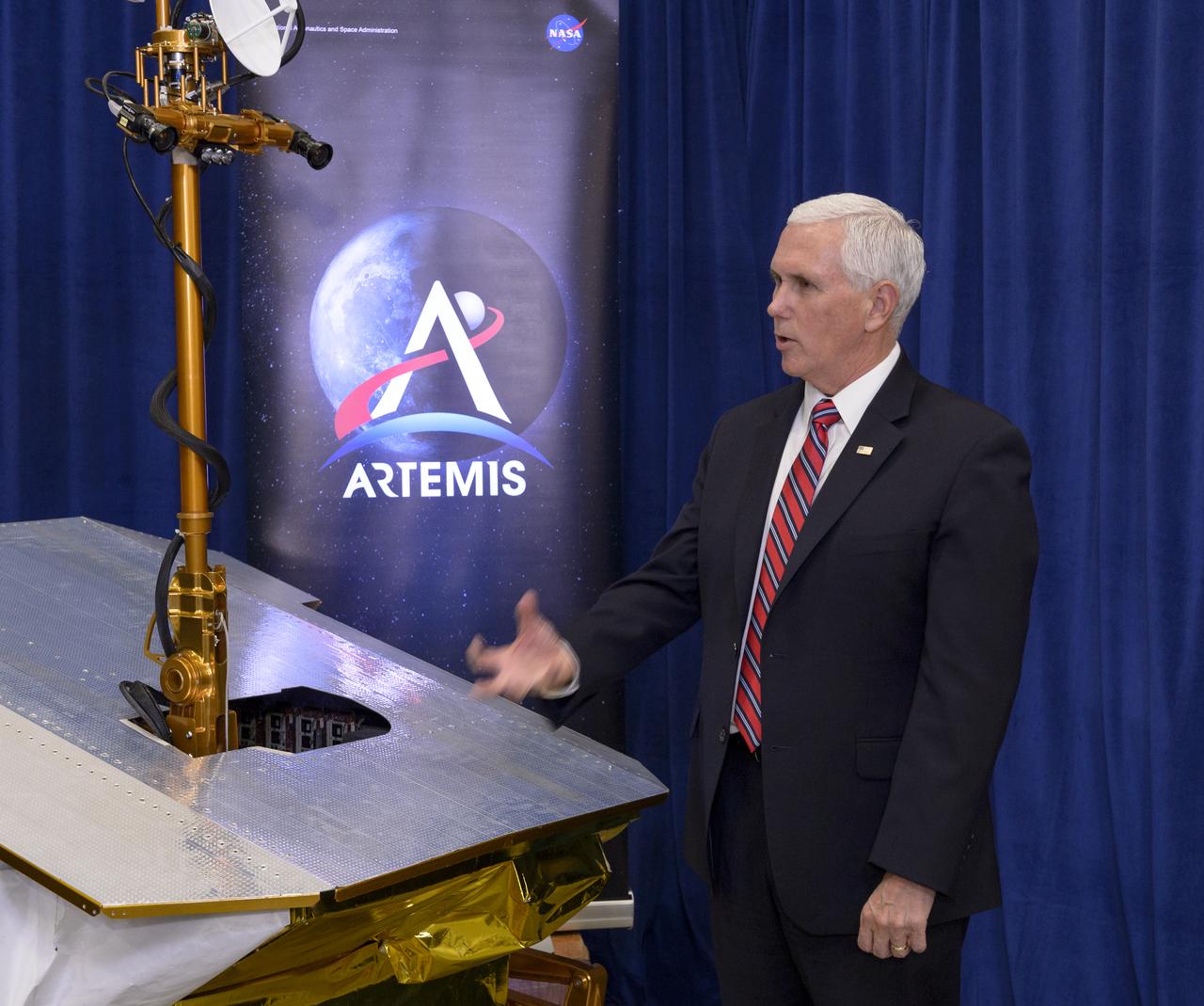
Vice President Mike Pence examines the Volatiles Investigating Polar Exploration Rover, or VIPER engineering test unit during his vist to NASA Ames Research Center, in California’s Silicon Valley.
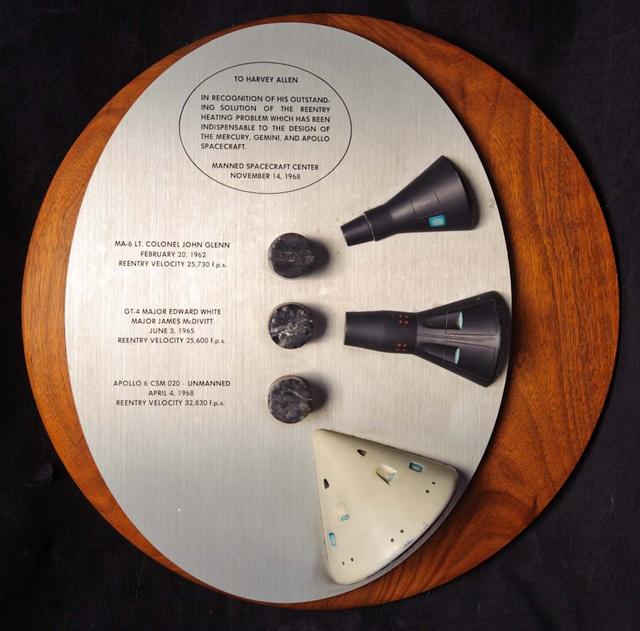
A plaque presented to Harvey Allen in recognition of his outstanding solution of the reentry heating problem which has been indispensable to the design of the Mercury, Gemini, and Apollo spacecraft (Manned Spacecraft Center, November 14, 1968) Plaque contains samples of tested materials and models of spacecraft.
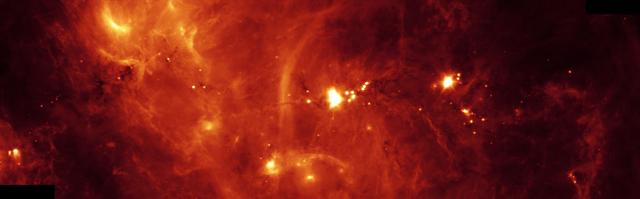
Hidden behind a shroud of dust in the constellation Cygnus is an exceptionally bright source of radio emission called DR21. Visible light images reveal no trace of what is happening in this region because of heavy dust obscuration. In fact, visible light is attenuated in DR21 by a factor of more than 10,000,000,000,000,000,000,000,000,000, 000,000,000,000 (ten thousand trillion heptillion). New images from NASA's Spitzer Space Telescope allow us to peek behind the cosmic veil and pinpoint one of the most massive natal stars yet seen in our Milky Way galaxy. The never-before-seen star is 100,000 times as bright as the Sun. Also revealed for the first time is a powerful outflow of hot gas emanating from this star and bursting through a giant molecular cloud. This image shows a 24-micron image mosaic, obtained with the Multiband Imaging Photometer aboard Spitzer (MIPS). This image maps the cooler infrared emission from interstellar dust found throughout the interstellar medium. The DR21 complex is clearly seen near the center of the strip, which covers about twice the area of the IRAC image. Perhaps the most fascinating feature in this image is a long and shadowy linear filament extending towards the 10 o'clock position of DR21. This jet of cold and dense gas, nearly 50 light-years in extent, appears in silhouette against a warmer background. This filament is too long and massive to be a stellar jet and may have formed from a pre-existing molecular cloud core sculpted by DR21's strong winds. Regardless of its true nature, this jet and the numerous other arcs and wisps of cool dust signify the interstellar turbulence normally unseen by the human eye. http://photojournal.jpl.nasa.gov/catalog/PIA05733

A NASA sounding rocket to be launched from the Poker Flat Research Range, Alaska, between February 13 and March 3, 2017, will form white artificial clouds during its brief, 10-minute flight. The rocket is one of five being launched January through March, each carrying instruments to explore the aurora and its interactions with Earth’s upper atmosphere and ionosphere. Scientists at NASA's Goddard Space Center in Greenbelt, Maryland, explain that electric fields drive the ionosphere, which, in turn, are predicted to set up enhanced neutral winds within an aurora arc. This experiment seeks to understand the height-dependent processes that create localized neutral jets within the aurora. For this mission, two 56-foot long Black Brant IX rockets will be launched nearly simultaneously. One rocket is expected to fly to an apogee of about 107 miles while the other is targeted for 201 miles apogee. Only the lower altitude rocket will form the white luminescent clouds during its flight. Read more: <a href="http://go.nasa.gov/2kYaBgV" rel="nofollow">go.nasa.gov/2kYaBgV</a> <b><a href="http://www.nasa.gov/audience/formedia/features/MP_Photo_Guidelines.html" rel="nofollow">NASA image use policy.</a></b> <b><a href="http://www.nasa.gov/centers/goddard/home/index.html" rel="nofollow">NASA Goddard Space Flight Center</a></b> enables NASA’s mission through four scientific endeavors: Earth Science, Heliophysics, Solar System Exploration, and Astrophysics. Goddard plays a leading role in NASA’s accomplishments by contributing compelling scientific knowledge to advance the Agency’s mission. <b>Follow us on <a href="http://twitter.com/NASAGoddardPix" rel="nofollow">Twitter</a></b> <b>Like us on <a href="http://www.facebook.com/pages/Greenbelt-MD/NASA-Goddard/395013845897?ref=tsd" rel="nofollow">Facebook</a></b> <b>Find us on <a href="http://instagrid.me/nasagoddard/?vm=grid" rel="nofollow">Instagram</a></b>
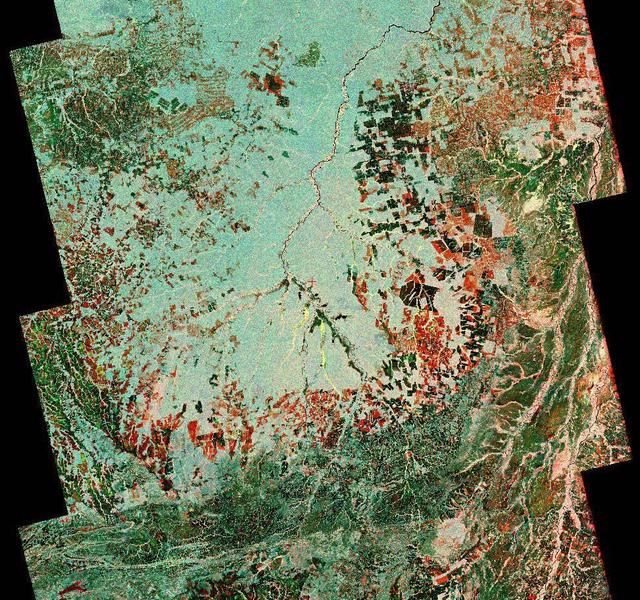
To show the kind of imagery that data from the NISAR (NASA-ISRO Synthetic Aperture Radar) satellite mission will produce, researchers pointed to this composite image of a portion of the so-called "arc of deforestation," a region on the southeast edge of the Amazonian jungle in Brazil where forests are being cleared at a fast pace through human activity. This three-color image shows change to the land cover in the Xingu River basin between 1996 (red) and 2007 (blue/green), using data from the Japanese L-band SAR satellites JERS-1 and ALOS-1, respectively. Black indicates areas converted from rainforest to agricultural land prior to 1996, and red shows the additional areas that had been cleared by 2007. NISAR will offer detailed insights into how the planet's forest ecosystems are changing over time, which will help researchers understand regional and global dynamics of deforestation and study the role of wooded areas in the global carbon cycle. NISAR could also help improve accounting of forest loss and growth, as countries that rely on logging try to shift toward more sustainable practices. NISAR is a joint mission of the U.S. and Indian space agencies. When in orbit, its sophisticated L- and S-band radar systems will scan nearly all of Earth's land and ice surfaces twice every 12 days with exquisite precision. Scheduled to launch in early 2024, NISAR is an equal collaboration between NASA and the Indian Space Research Organisation and marks the first time the two agencies have cooperated on hardware development for an Earth-observing mission. NASA's Jet Propulsion Laboratory, which is managed for the agency by Caltech in Pasadena, leads the U.S. component of the project and is providing the mission's L-band SAR. NASA is also providing the radar reflector antenna, the deployable boom, a high-rate communication subsystem for science data, GPS receivers, a solid-state recorder, and payload data subsystem. ISRO's U R Rao Satellite Centre in Bengaluru, which is leading the ISRO component of the mission, is providing the spacecraft bus, the S-band SAR electronics, the launch vehicle, and associated launch services and satellite mission operations. https://photojournal.jpl.nasa.gov/catalog/PIA26111

In preparation of the nation’s first lunar landing mission, Apollo 11 crew members underwent training to practice activities they would be performing during the mission. In this photograph, astronaut Collins (left) and chief astronaut and director of flight crew operations, Donald K. Slayton, walk away from a T-38 jet plane at Patrick Air Force Base. The two had been flying arcs to give Collins more time under weightless conditions. The Apollo 11 mission launched from the Kennedy Space Center (KSC) in Florida via the Marshall Space Flight Center (MSFC) developed Saturn V launch vehicle on July 16, 1969 and safely returned to Earth on July 24, 1969. Aboard the space craft were astronauts Neil A. Armstrong, commander; Michael Collins, Command Module (CM) pilot; and Edwin E. (Buzz) Aldrin Jr., Lunar Module (LM) pilot. The CM, “Columbia”, piloted by Collins, remained in a parking orbit around the Moon while the LM, “Eagle’’, carrying astronauts Armstrong and Aldrin, landed on the Moon. On July 20, 1969, Armstrong was the first human to ever stand on the lunar surface, followed by Aldrin. During 2½ hours of surface exploration, the crew collected 47 pounds of lunar surface material for analysis back on Earth. With the success of Apollo 11, the national objective to land men on the Moon and return them safely to Earth had been accomplished
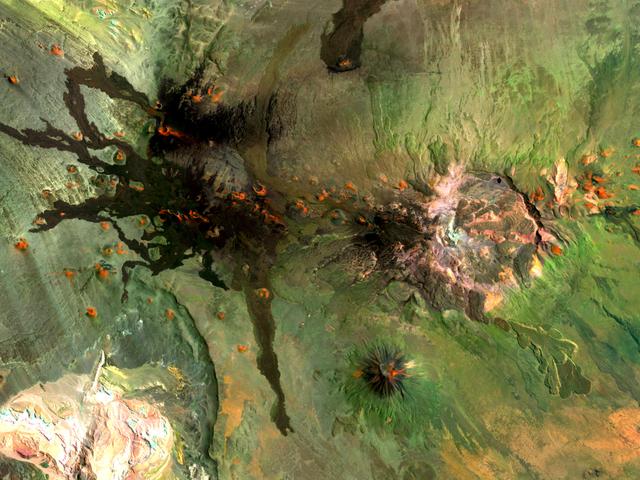
Situated in the southern Andes Mountains, the Payún volcanic field of Argentina is a complex landscape that formed over hundreds of thousands of years. Sprawling over 5,200 square kilometers (2,000 square miles), Payún is a massive shield volcano—a broad formation resembling an ancient warrior shield. This false-color image is a composite of observations acquired on February 7 and March 20, 2001 by the Enhanced Thematic Mapper Plus on the Landsat 7 satellite. It was made from a combination of visible and infrared light, where green indicates vegetation, black indicates lava flows, and orange is bare rock rich in iron oxides. Part of the back-arc volcanism of the Andes, Payún lies about 530 kilometers (330 miles) east from where the Nazca plate subducts below the South America plate. Not surprisingly, a volcanic zone extends over some 1,000 kilometers (600 miles) north-to-south in this region. According to a study published in 2010, the regional geology and chemical composition of the rocks indicate that the volcanic field likely formed within the past 300,000 years. The dominant feature of the volcanic field is Payún Matru, an elliptical caldera measuring roughly 9 by 7 kilometers (6 by 4 miles). Geologists surmise that the caldera formed after the old magma chamber emptied and the summit collapsed. Southwest of the caldera is a stratovolcano composed of alternating layers of compacted ash, hardened lava, and rocks ejected during previous eruptions. This stratovolcano, Payún, rises to 3,680 meters (12,073 feet) above sea level. (The entire volcanic field sits at 2,000 meters, or 6,600 feet.) The stratovolcano may be the most prominent feature in the volcanic field but it is by no means the only one. More than 300 eruptive features litter the shield volcano, most of them occupying an east-west line. West of Payún Matru is an area known as Los Volcanes, a mass of strombolian cones and basaltic lava flows. Image courtesy Michael P. Taylor, Landsat Data Continuity Mission Project Office, NASA Goddard Space Flight Center. Caption by Michon Scott with information from Michael Abrams, NASA Jet Propulsion Laboratory. Instrument: Landsat 7 - ETM+ To read more go to: <a href="http://1.usa.gov/UO8CbF" rel="nofollow">1.usa.gov/UO8CbF</a> Credit: <b><a href="http://www.earthobservatory.nasa.gov/" rel="nofollow"> NASA Earth Observatory</a></b> <b><a href="http://www.nasa.gov/audience/formedia/features/MP_Photo_Guidelines.html" rel="nofollow">NASA image use policy.</a></b> <b><a href="http://www.nasa.gov/centers/goddard/home/index.html" rel="nofollow">NASA Goddard Space Flight Center</a></b> enables NASA’s mission through four scientific endeavors: Earth Science, Heliophysics, Solar System Exploration, and Astrophysics. Goddard plays a leading role in NASA’s accomplishments by contributing compelling scientific knowledge to advance the Agency’s mission. <b>Follow us on <a href="http://twitter.com/NASA_GoddardPix" rel="nofollow">Twitter</a></b> <b>Like us on <a href="http://www.facebook.com/pages/Greenbelt-MD/NASA-Goddard/395013845897?ref=tsd" rel="nofollow">Facebook</a></b> <b>Find us on <a href="http://instagram.com/nasagoddard?vm=grid" rel="nofollow">Instagram</a></b>