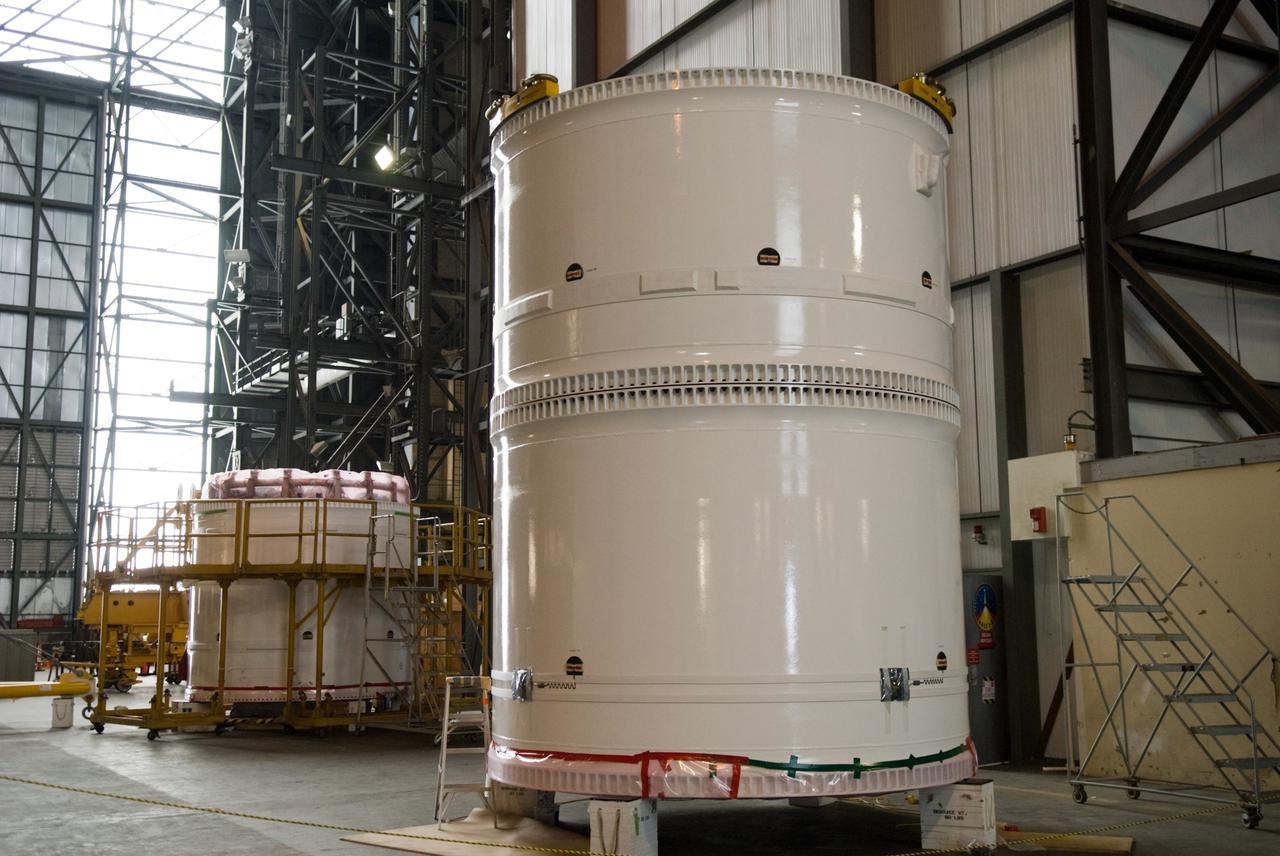
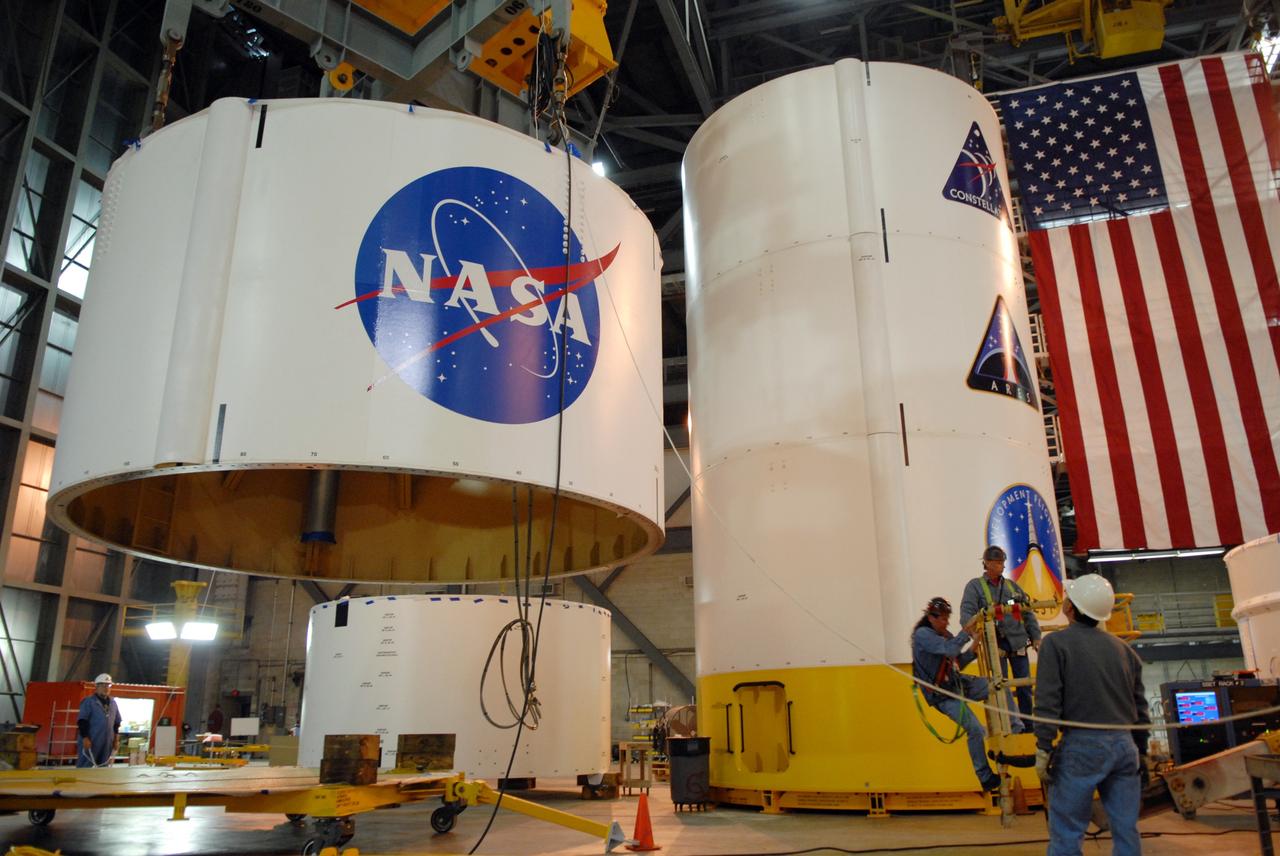
CAPE CANAVERAL, Fla. –– The fifth segment simulator segments of the Ares I-X rocket have been moved to the transfer aisle of the Vehicle Assembly Building at NASA's Kennedy Space Center in Florida. The stacking operations with other segments in the VAB in June. Ares I-X is the flight test for the Ares I. The I-X flight will provide NASA an early opportunity to test and prove hardware, facilities and ground operations associated with Ares I, which is part of the Constellation Program to return men to the moon and beyond. Launch of the Ares I-X flight test is targeted for August 2009. Photo credit: NASA/Jack Pfaller
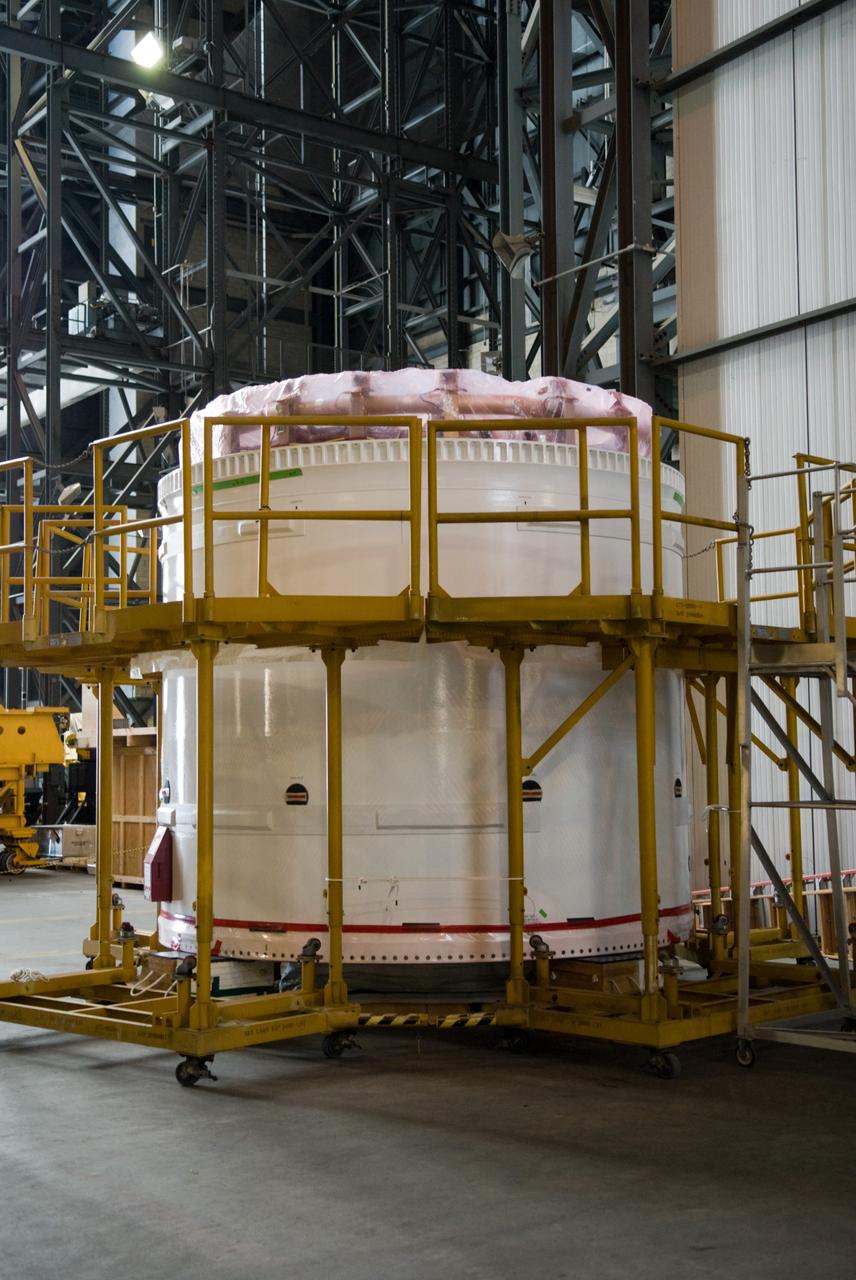
CAPE CANAVERAL, Fla. –– The fifth segment simulator segments of the Ares I-X rocket have been moved to the transfer aisle of the Vehicle Assembly Building at NASA's Kennedy Space Center in Florida. The stacking operations with other segments in the VAB in June. Ares I-X is the flight test for the Ares I. The I-X flight will provide NASA an early opportunity to test and prove hardware, facilities and ground operations associated with Ares I, which is part of the Constellation Program to return men to the moon and beyond. Launch of the Ares I-X flight test is targeted for August 2009. Photo credit: NASA/Jack Pfaller
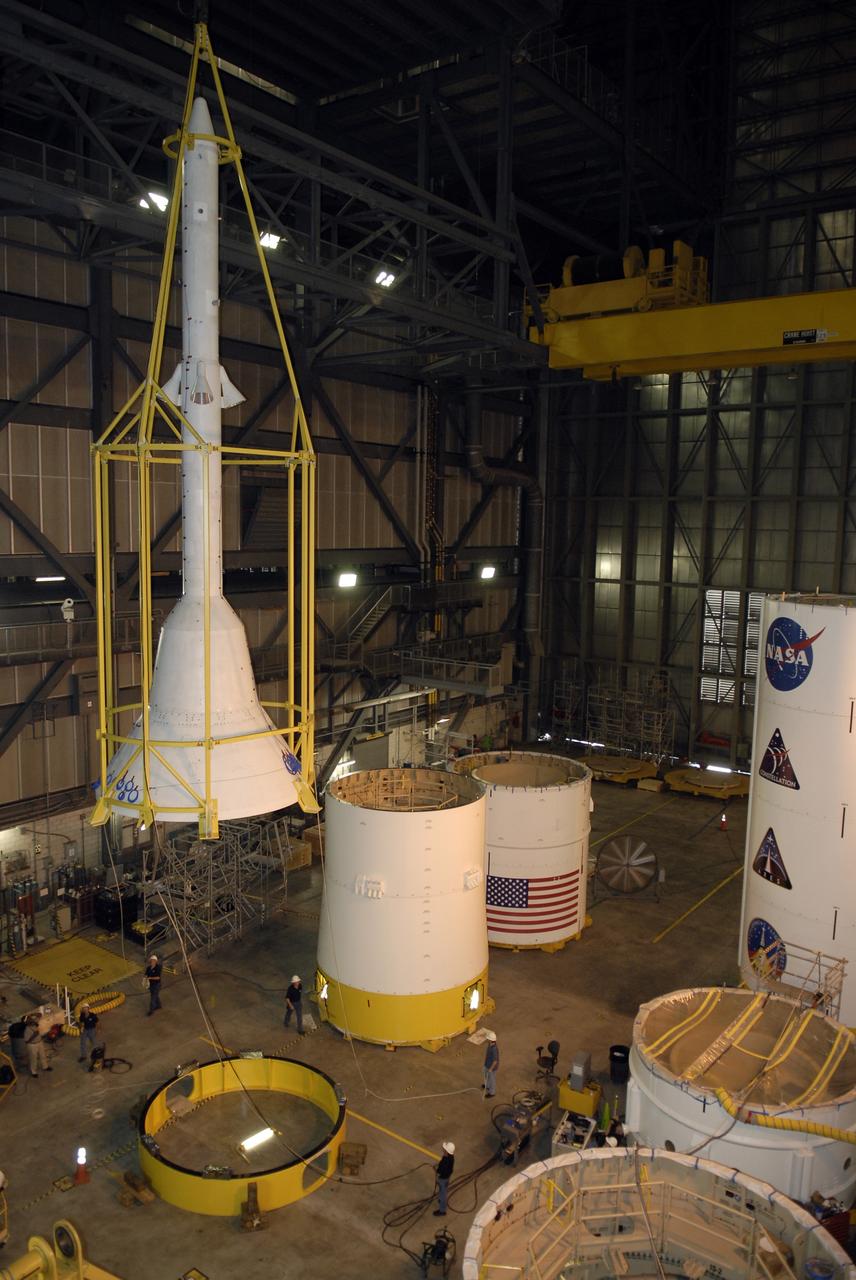
CAPE CANAVERAL, Fla. – In high bay 4 of the Vehicle Assembly Building at NASA's Kennedy Space Center in Florida, the framework known as the "birdcage" lifts the Ares I-X simulator crew module-launch abort system, or CM-LAS. The CM-LAS stack will be mated with the simulator service module-service adapter stack. Ares I-X is the flight test for the Ares I. The I-X flight will provide NASA an early opportunity to test and prove hardware, facilities and ground operations associated with Ares I. The launch of the 327-foot-tall, full-scale Ares I-X is targeted for August 2009. Photo credit: NASA/Kim Shiflett
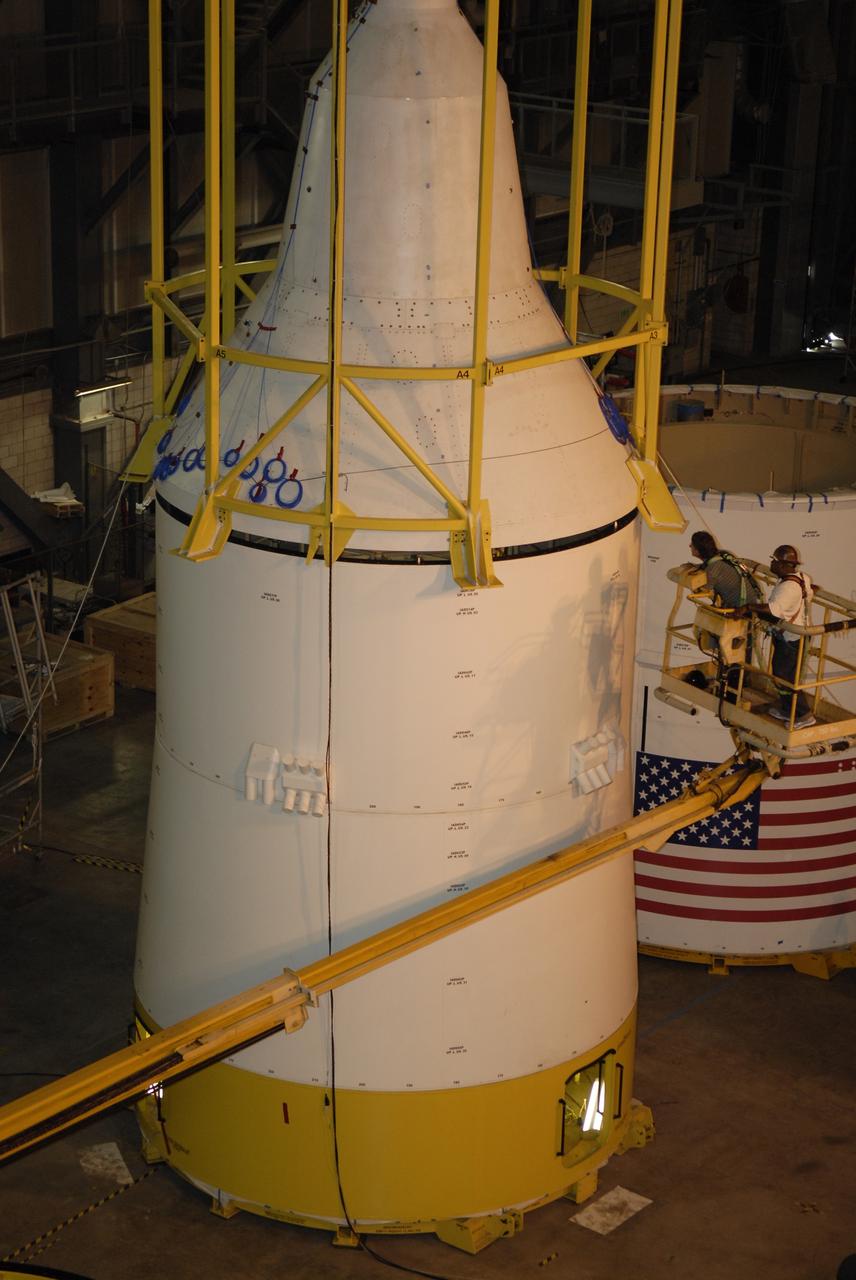
CAPE CANAVERAL, Fla. – In high bay 4 of the Vehicle Assembly Building at NASA's Kennedy Space Center in Florida, the framework known as the "birdcage" lowers the Ares I-X simulator crew module-launch abort system, or CM-LAS, onto the simulator service module-service adapter stack. Ares I-X is the flight test for the Ares I. The I-X flight will provide NASA an early opportunity to test and prove hardware, facilities and ground operations associated with Ares I. The launch of the 327-foot-tall, full-scale Ares I-X is targeted for August 2009. Photo credit: NASA/Kim Shiflett
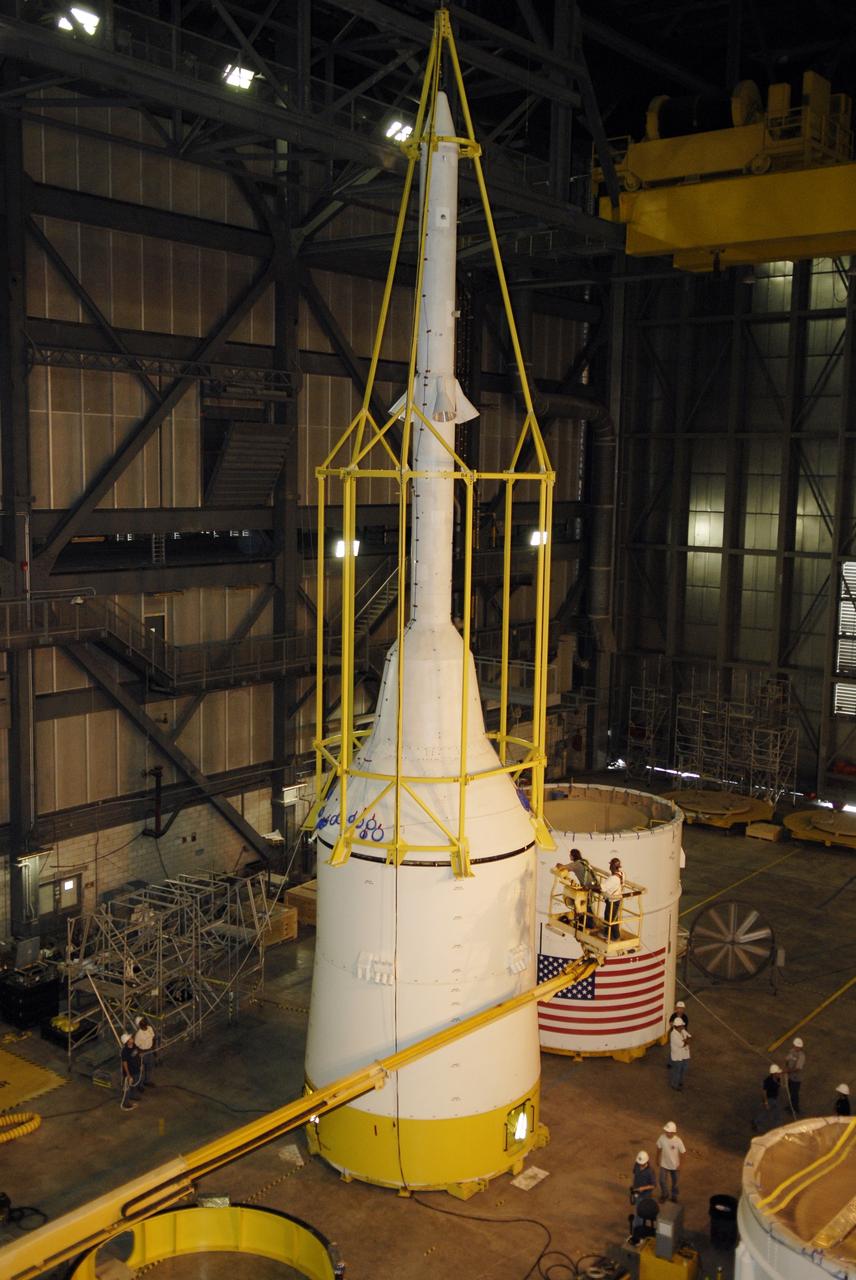
CAPE CANAVERAL, Fla. – In high bay 4 of the Vehicle Assembly Building at NASA's Kennedy Space Center in Florida, the framework known as the "birdcage" lowers the Ares I-X simulator crew module-launch abort system, or CM-LAS, onto the simulator service module-service adapter stack. Ares I-X is the flight test for the Ares I. The I-X flight will provide NASA an early opportunity to test and prove hardware, facilities and ground operations associated with Ares I. The launch of the 327-foot-tall, full-scale Ares I-X is targeted for August 2009. Photo credit: NASA/Kim Shiflett
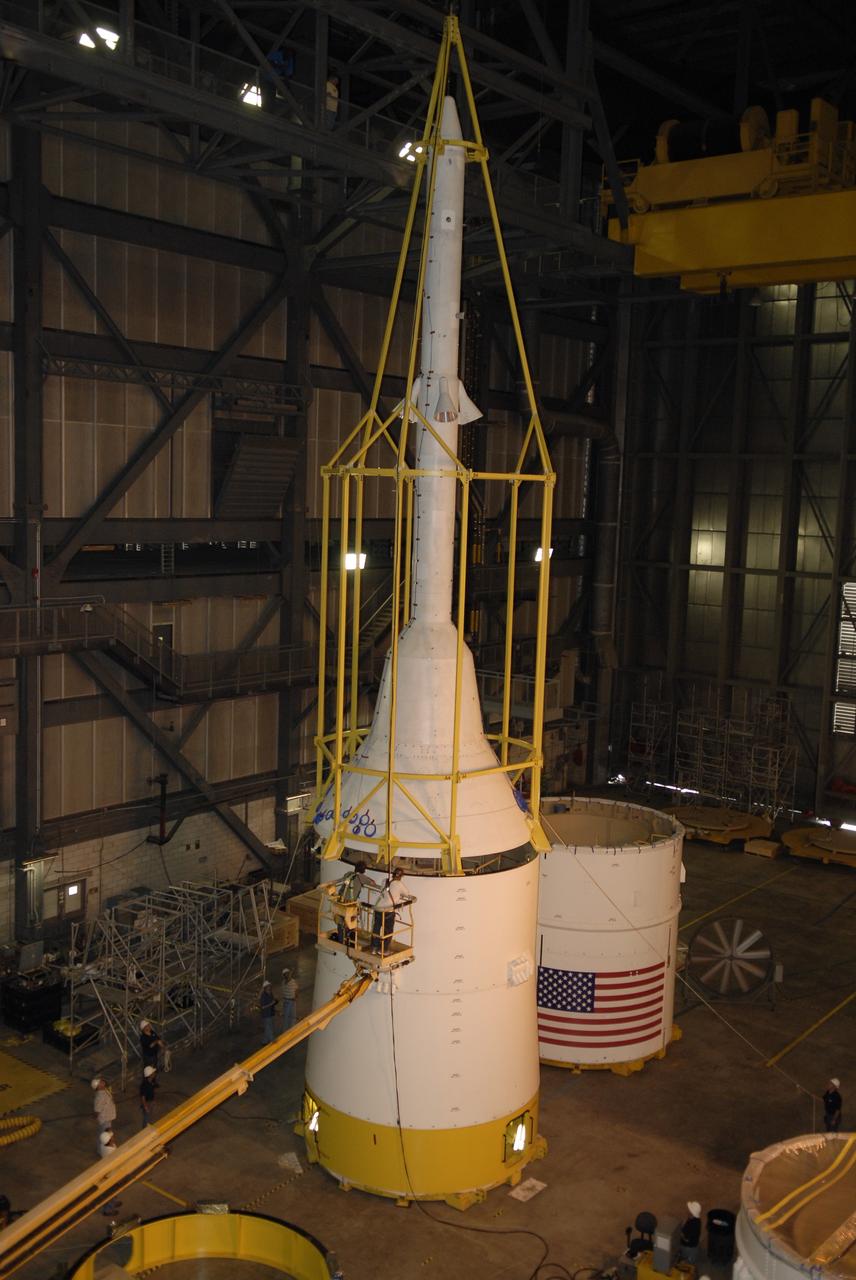
CAPE CANAVERAL, Fla. – In high bay 4 of the Vehicle Assembly Building at NASA's Kennedy Space Center in Florida, the framework known as the "birdcage" lowers the Ares I-X simulator crew module-launch abort system, or CM-LAS, onto the simulator service module-service adapter stack. Ares I-X is the flight test for the Ares I. The I-X flight will provide NASA an early opportunity to test and prove hardware, facilities and ground operations associated with Ares I. The launch of the 327-foot-tall, full-scale Ares I-X is targeted for August 2009. Photo credit: NASA/Kim Shiflett
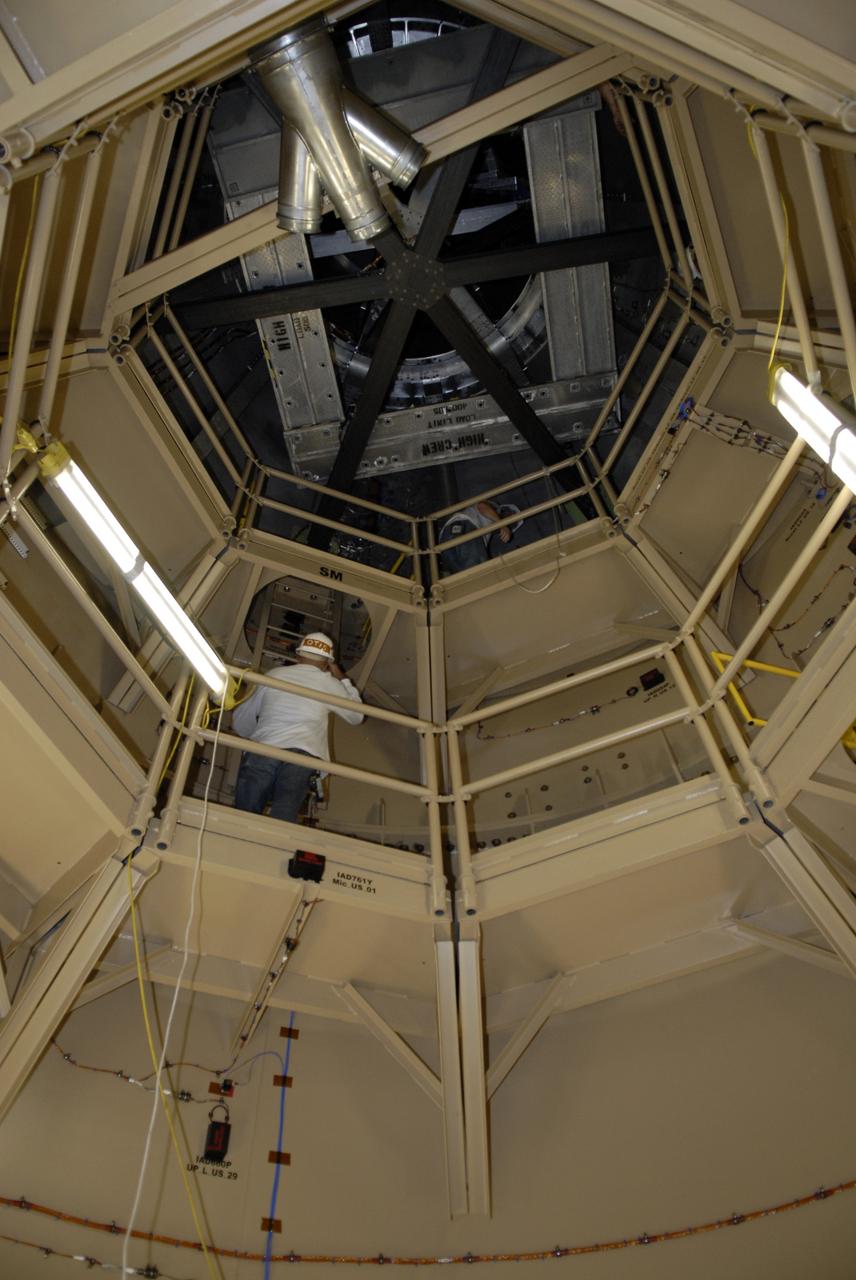
CAPE CANAVERAL, Fla. – In high bay 4 of the Vehicle Assembly Building at NASA's Kennedy Space Center in Florida, a technician checks the mating from the inside of the Ares I-X simulator crew module-launch abort system, or CM-LAS, with the simulator service module-service adapter stack. Ares I-X is the flight test for the Ares I. The I-X flight will provide NASA an early opportunity to test and prove hardware, facilities and ground operations associated with Ares I. The launch of the 327-foot-tall, full-scale Ares I-X is targeted for August 2009. Photo credit: NASA/Kim Shiflett
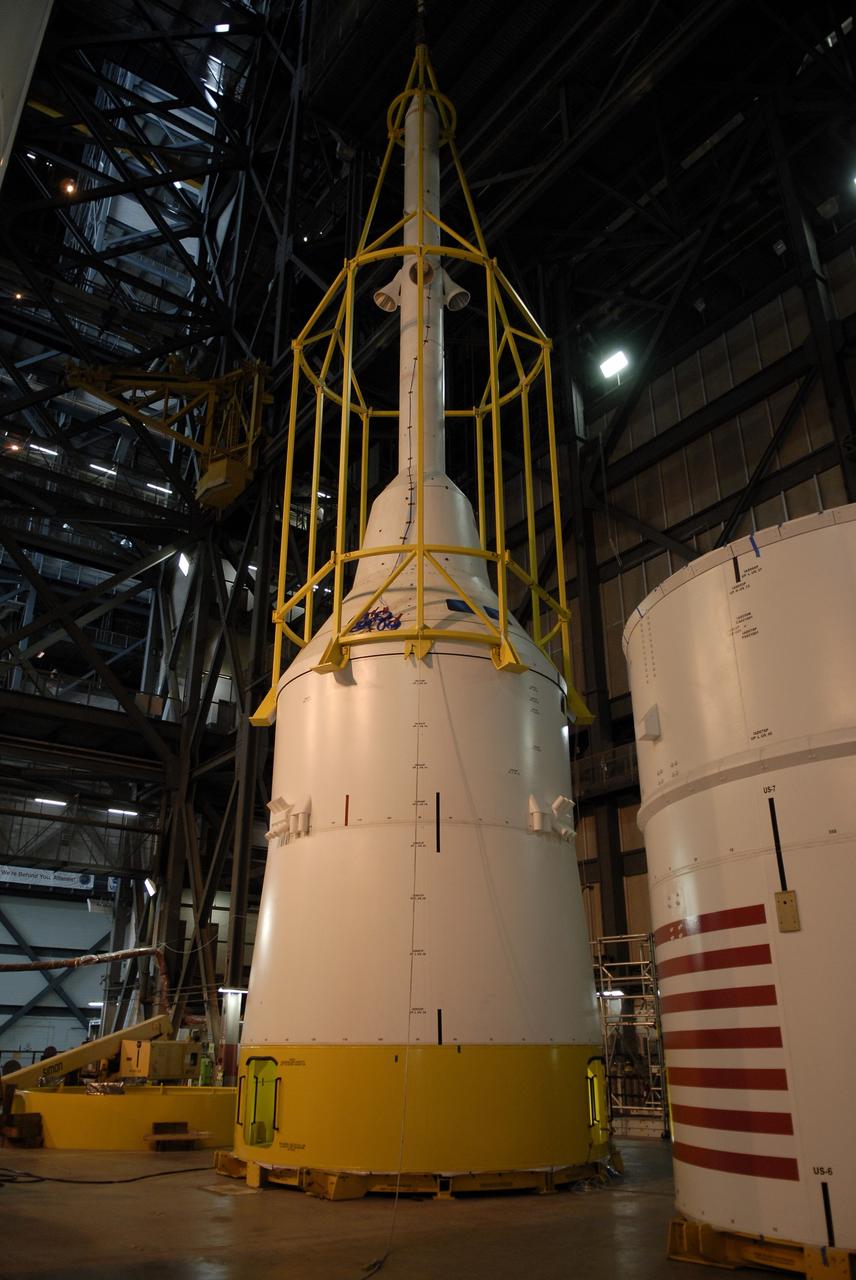
CAPE CANAVERAL, Fla. – In high bay 4 of the Vehicle Assembly Building at NASA's Kennedy Space Center in Florida, the framework known as the "birdcage" lowers the Ares I-X simulator crew module-launch abort system, or CM-LAS, onto the simulator service module-service adapter stack. Ares I-X is the flight test for the Ares I. The I-X flight will provide NASA an early opportunity to test and prove hardware, facilities and ground operations associated with Ares I. The launch of the 327-foot-tall, full-scale Ares I-X is targeted for August 2009. Photo credit: NASA/Kim Shiflett
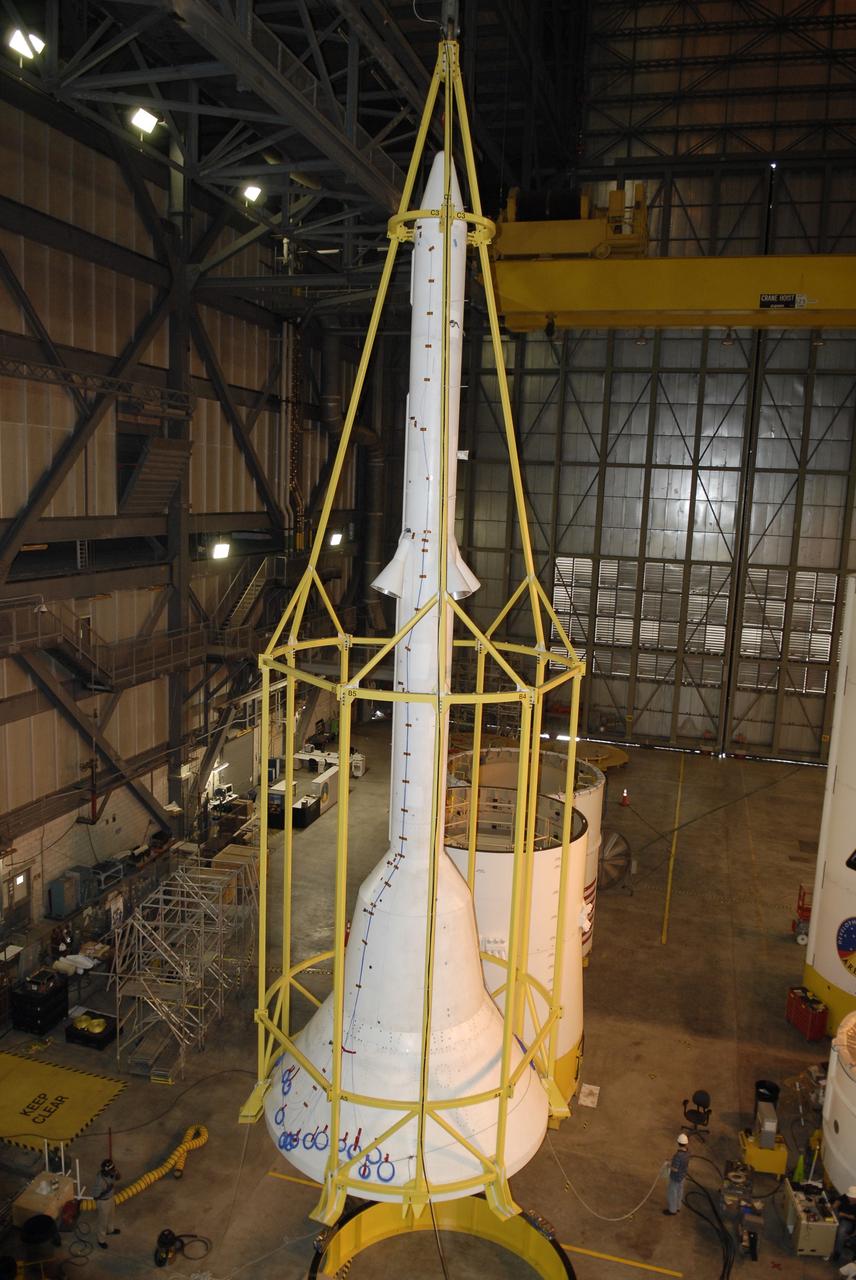
CAPE CANAVERAL, Fla. – In high bay 4 of the Vehicle Assembly Building at NASA's Kennedy Space Center in Florida, the framework known as the "birdcage" is placed over the Ares I-X simulator crew module-launch abort system, or CM-LAS. The birdcage will be used to lift the CM-LAS to mate the stack with the simulator service module-service adapter stack. Ares I-X is the flight test for the Ares I. The I-X flight will provide NASA an early opportunity to test and prove hardware, facilities and ground operations associated with Ares I. The launch of the 327-foot-tall, full-scale Ares I-X is targeted for August 2009. Photo credit: NASA/Kim Shiflett
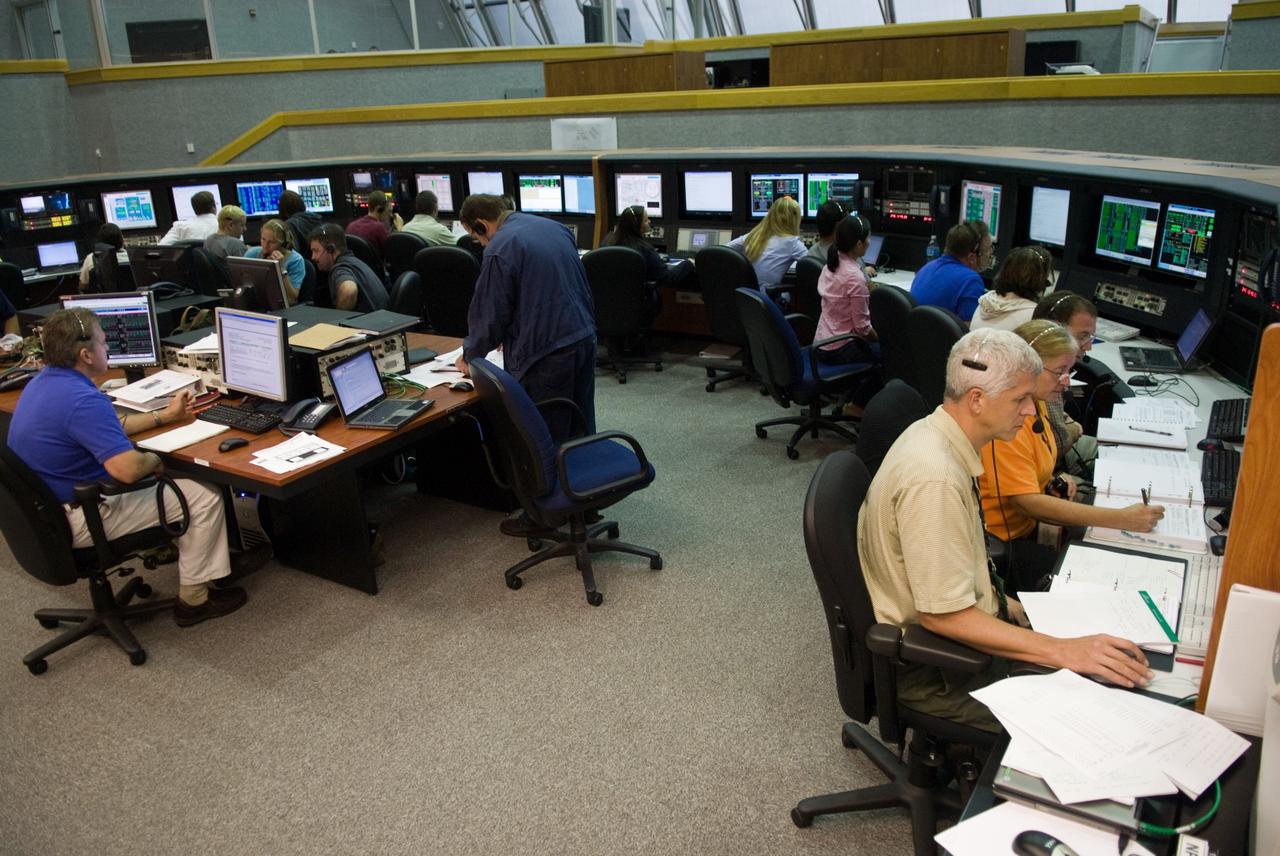
CAPE CANAVERAL, Fla. – In Firing Room 1 at NASA's Kennedy Space Center in Florida, mission engineers take part in a countdown simulation for the upcoming Ares I-X flight test. The test vehicle for the Ares I, Ares I-X is targeted for the test on Oct. 31. Photo credit: NASA/Kim Shiflett
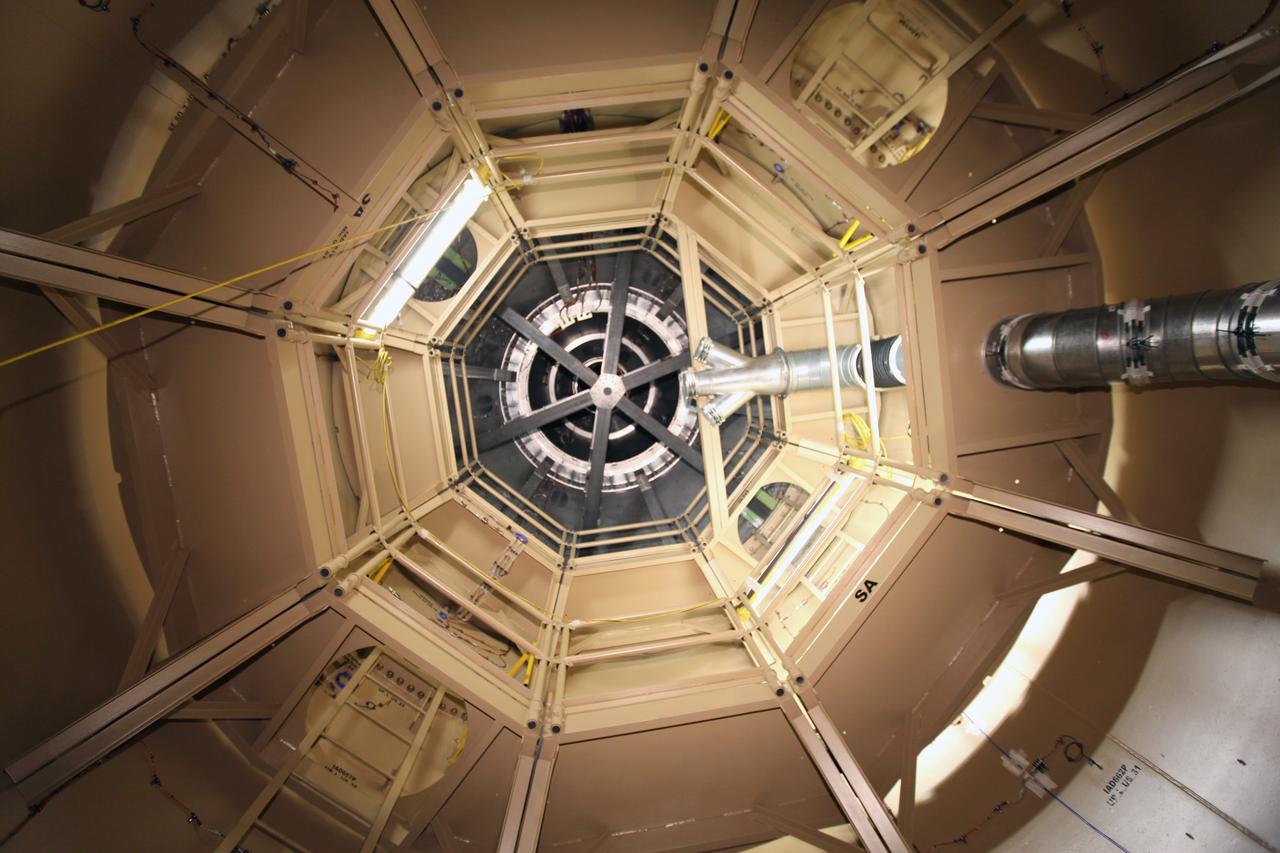
CAPE CANAVERAL, Fla. – Steep ladders mounted to opposing sides of the interior wall of the upper stage simulator of the Ares I-X rocket provide the only access inside the vehicle for the installation of instruments and equipment. Part of the Constellation Program, the Ares I-X is the test vehicle for the Ares I, which is the essential core of a space transportation system designed to carry crewed missions back to the moon, on to Mars and out into the solar system. The Ares I-X flight test is targeted for Oct. 27. For information on the Ares I-X vehicle and flight test, visit http://www.nasa.gov/mission_pages/constellation/ares/flighttests/aresIx/index.html. Photo credit: NASA/Glenn Benson
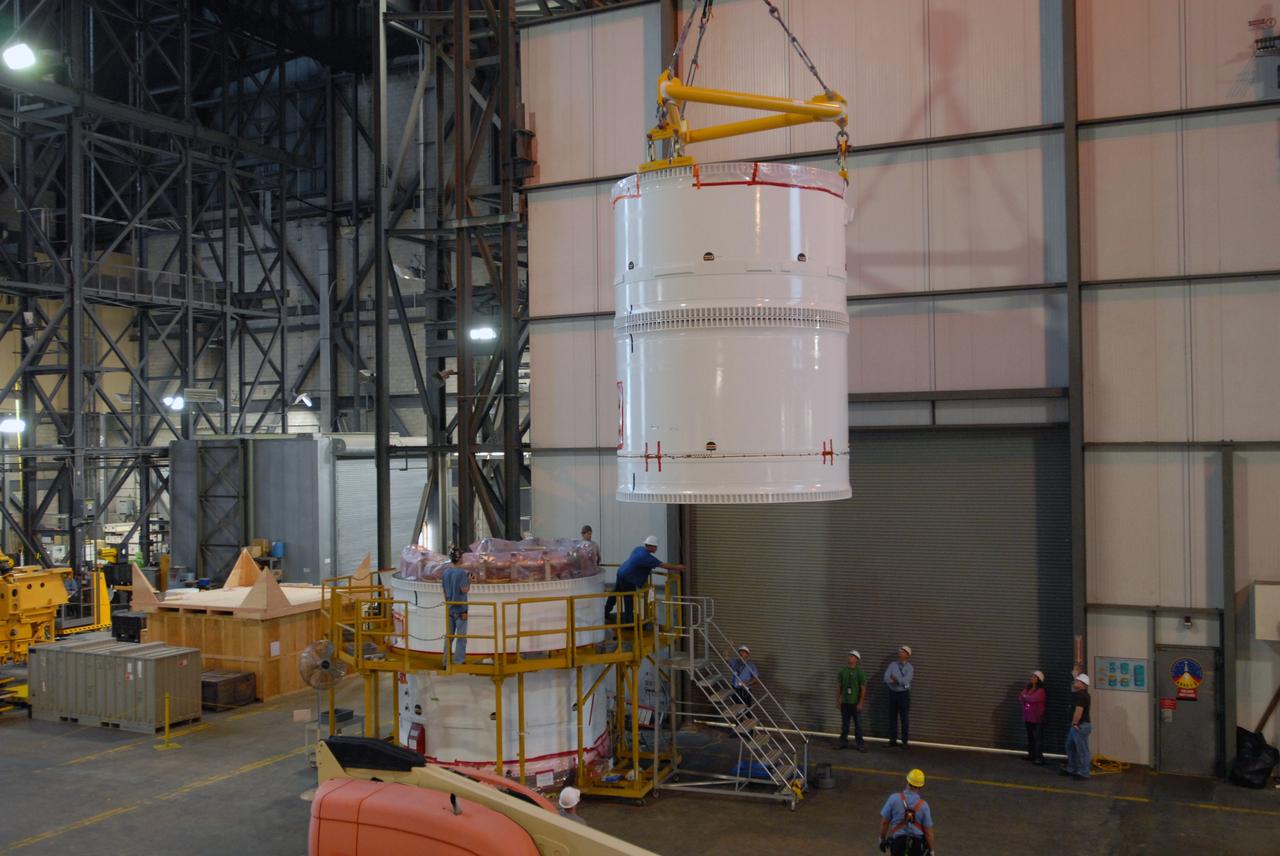
CAPE CANAVERAL, Fla. – In the transfer aisle of the Vehicle Assembly Building at NASA's Kennedy Space Center in Florida, workers monitor the conjoined forward and center segments of the fifth segment simulator for the Ares I-X as a crane lifts them toward the simulator’s aft segment. Ares I-X is the test vehicle for the Ares I, a component of the Constellation Program to return men to the moon and beyond. Ares I is the essential core of a safe, reliable, cost-effective space transportation system that eventually will carry crewed missions back to the moon, on to Mars and out into the solar system. The launch of the Ares I-X flight test is targeted for August 2009. Photo credit: NASA/Jim Grossmann
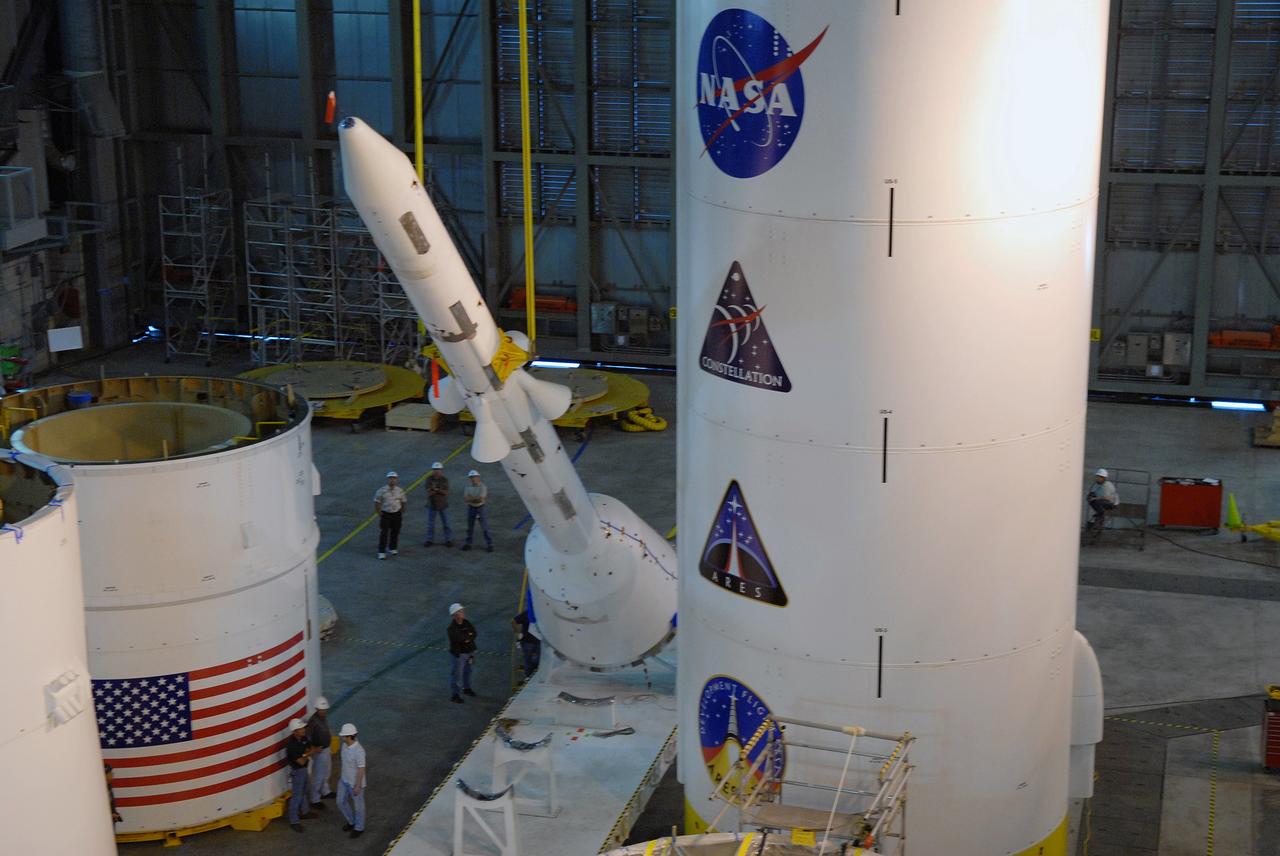
CAPE CANAVERAL, Fla. – In high bay 4 of the Vehicle Assembly Building at NASA's Kennedy Space Center in Florida, the crane raises the Ares I-X simulated launch abort system, or LAS, to a vertical position. The LAS will then be ready for assembly with the crew module simulator. Ares I-X is the flight test vehicle for the Ares I, which is part of the Constellation Program to return men to the moon and beyond. Ares I is the essential core of a safe, reliable, cost-effective space transportation system that eventually will carry crewed missions back to the moon, on to Mars and out into the solar system. Ares I-X is targeted for launch in July 2009. Photo credit: NASA/Jack Pfaller
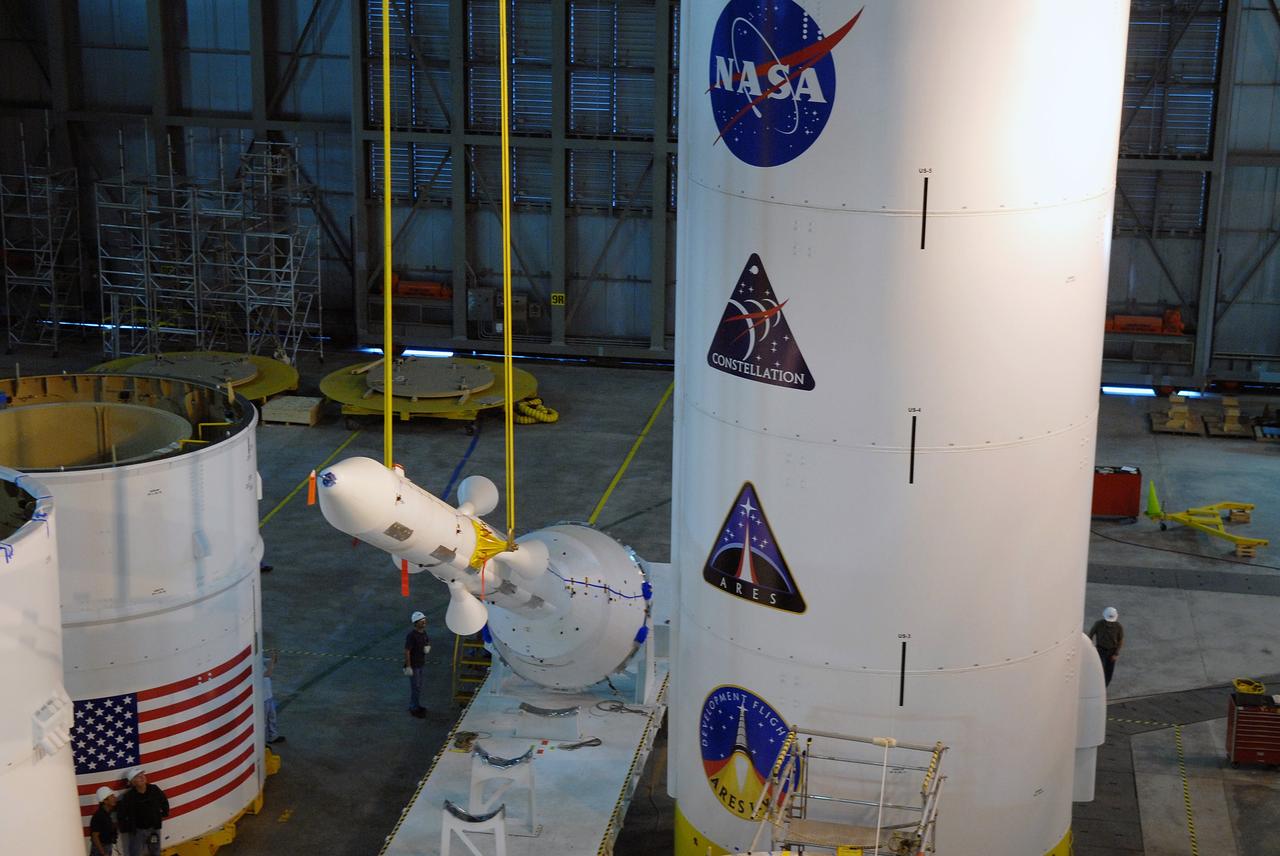
CAPE CANAVERAL, Fla. – In high bay 4 of the Vehicle Assembly Building at NASA's Kennedy Space Center in Florida, the crane begins to raise the Ares I-X simulated launch abort system, or LAS, to a vertical position. The LAS will then be ready for assembly with the crew module simulator. Ares I-X is the flight test vehicle for the Ares I, which is part of the Constellation Program to return men to the moon and beyond. Ares I is the essential core of a safe, reliable, cost-effective space transportation system that eventually will carry crewed missions back to the moon, on to Mars and out into the solar system. Ares I-X is targeted for launch in July 2009. Photo credit: NASA/Jack Pfaller
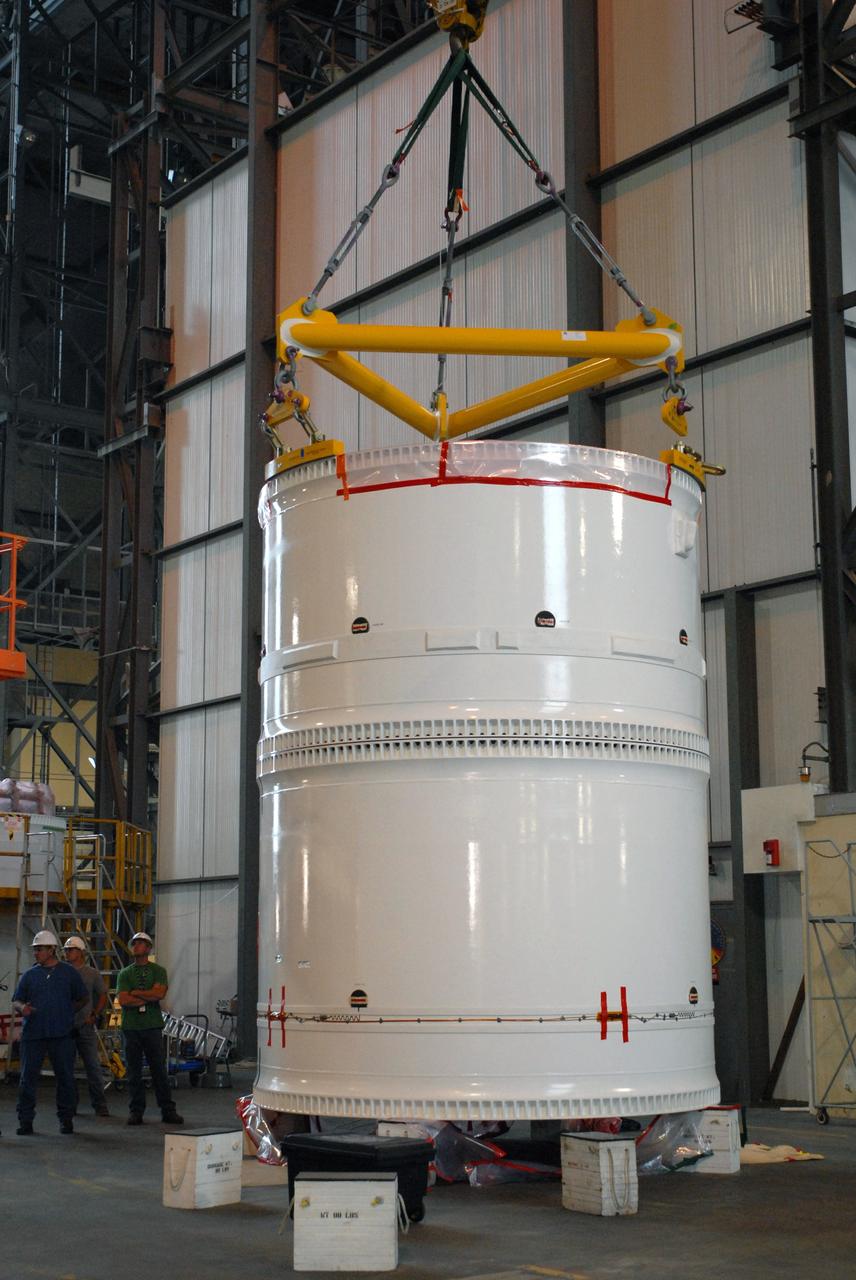
CAPE CANAVERAL, Fla. – In the transfer aisle of the Vehicle Assembly Building at NASA's Kennedy Space Center in Florida, the conjoined forward and center segments of the fifth segment simulator for the Ares I-X is attached to a crane prior to lifting operations. The segments will be mated to the simulator’s aft segment. Ares I-X is the test vehicle for the Ares I, a component of the Constellation Program to return men to the moon and beyond. Ares I is the essential core of a safe, reliable, cost-effective space transportation system that eventually will carry crewed missions back to the moon, on to Mars and out into the solar system. The launch of the Ares I-X flight test is targeted for August 2009. Photo credit: NASA/Jim Grossmann
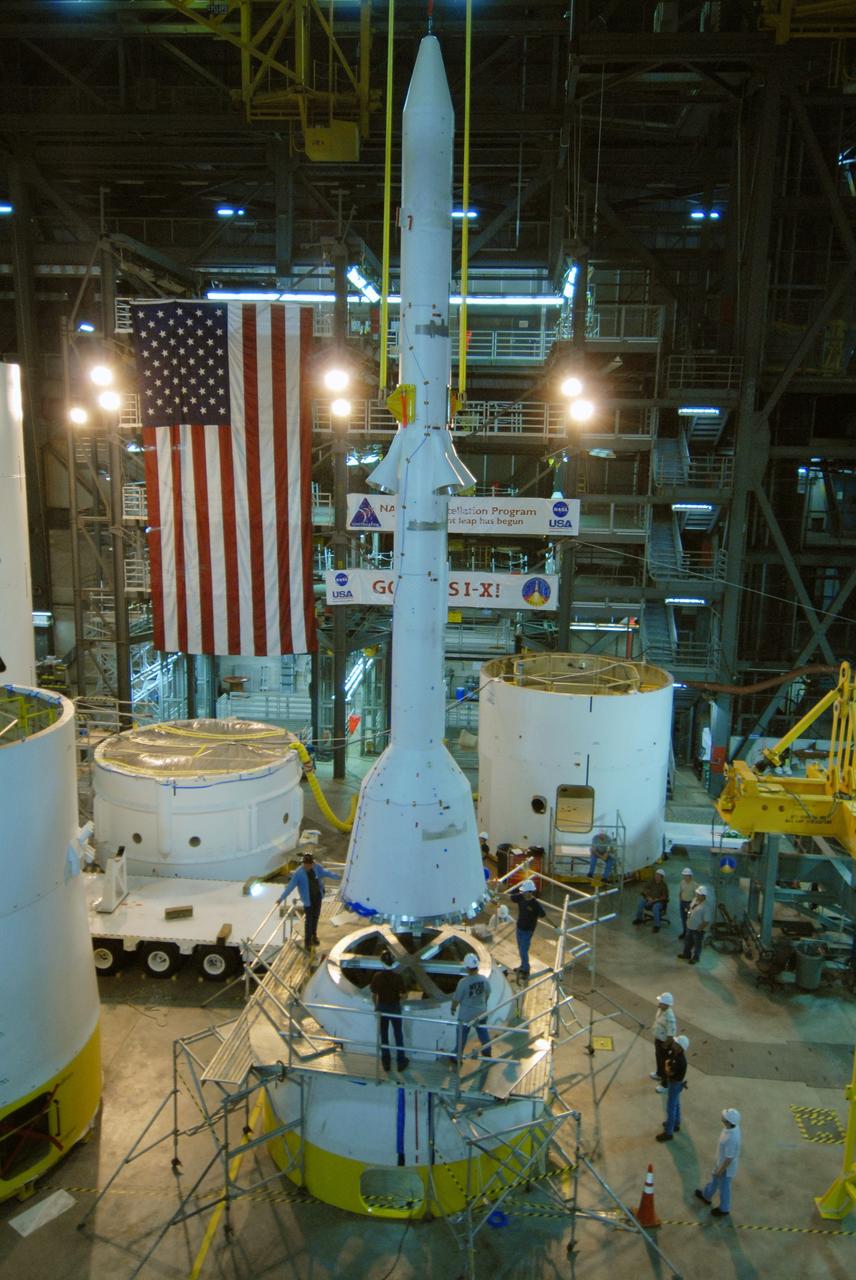
CAPE CANAVERAL, Fla. – In high bay 4 of the Vehicle Assembly Building at NASA's Kennedy Space Center in Florida, workers keep close watch on the Ares I-X simulated launch abort system, or LAS, as it is lowered toward the crew module simulator. Ares I-X is the flight test vehicle for the Ares I, which is part of the Constellation Program to return men to the moon and beyond. Ares I is the essential core of a safe, reliable, cost-effective space transportation system that eventually will carry crewed missions back to the moon, on to Mars and out into the solar system. Ares I-X is targeted for launch in July 2009. Photo credit: NASA/Jack Pfaller
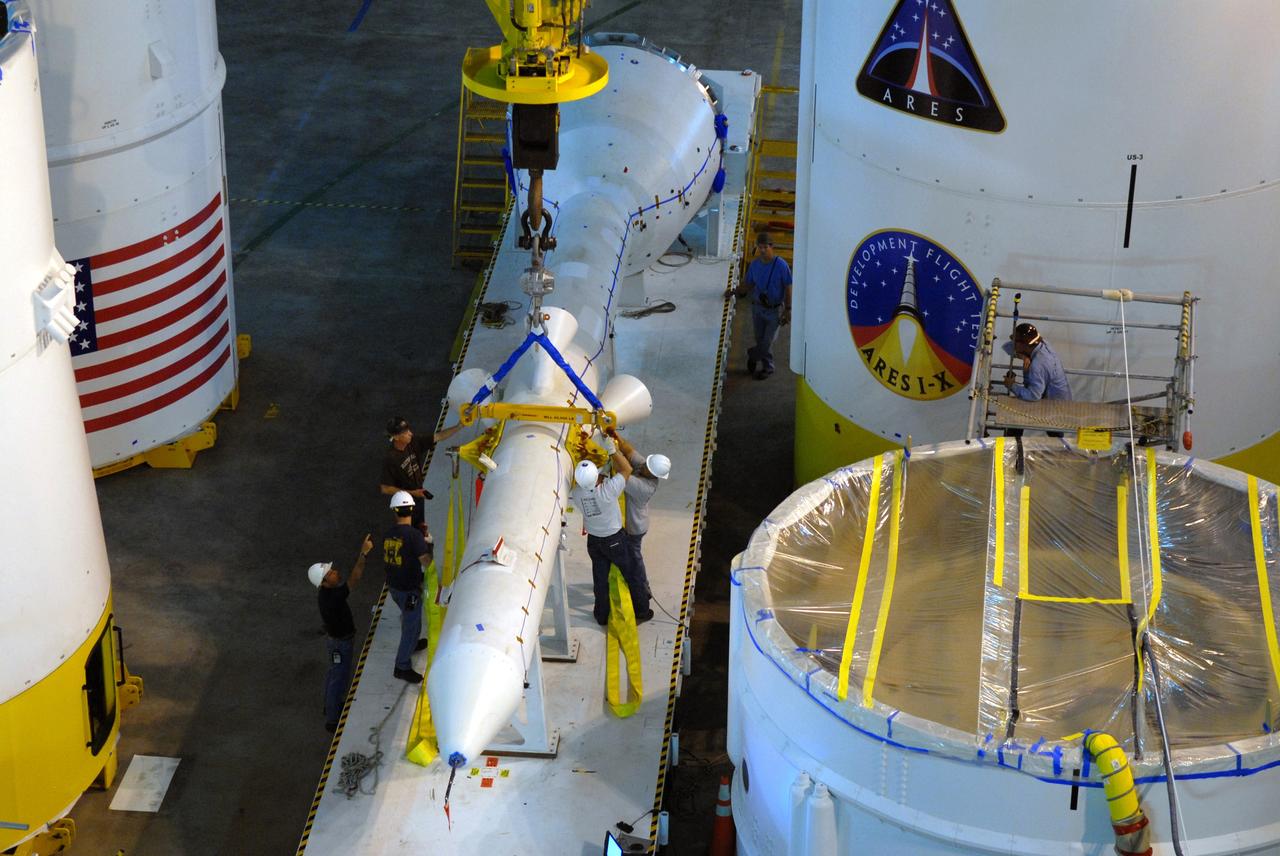
CAPE CANAVERAL, Fla. – In high bay 4 of the Vehicle Assembly Building at NASA's Kennedy Space Center in Florida, workers place a crane and straps on the Ares I-X simulated launch abort system to lift and rotate it for assembly with the crew module simulator. Ares I-X is the flight test vehicle for the Ares I, which is part of the Constellation Program to return men to the moon and beyond. Ares I is the essential core of a safe, reliable, cost-effective space transportation system that eventually will carry crewed missions back to the moon, on to Mars and out into the solar system. Ares I-X is targeted for launch in July 2009. Photo credit: NASA/Jack Pfaller
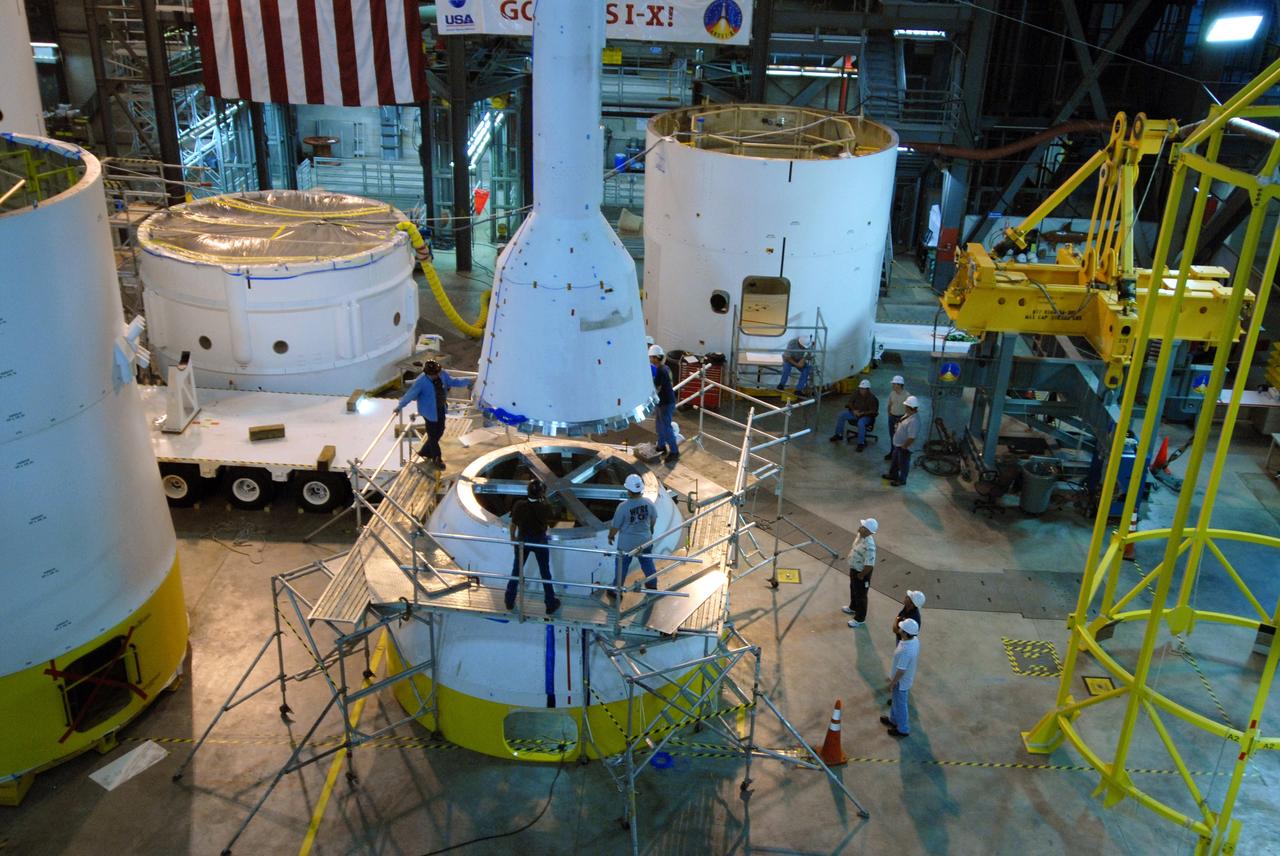
CAPE CANAVERAL, Fla. – In high bay 4 of the Vehicle Assembly Building at NASA's Kennedy Space Center in Florida, workers keep close watch on the Ares I-X simulated launch abort system, or LAS, as it is lowered toward the crew module simulator. Ares I-X is the flight test vehicle for the Ares I, which is part of the Constellation Program to return men to the moon and beyond. Ares I is the essential core of a safe, reliable, cost-effective space transportation system that eventually will carry crewed missions back to the moon, on to Mars and out into the solar system. Ares I-X is targeted for launch in July 2009. Photo credit: NASA/Jack Pfaller
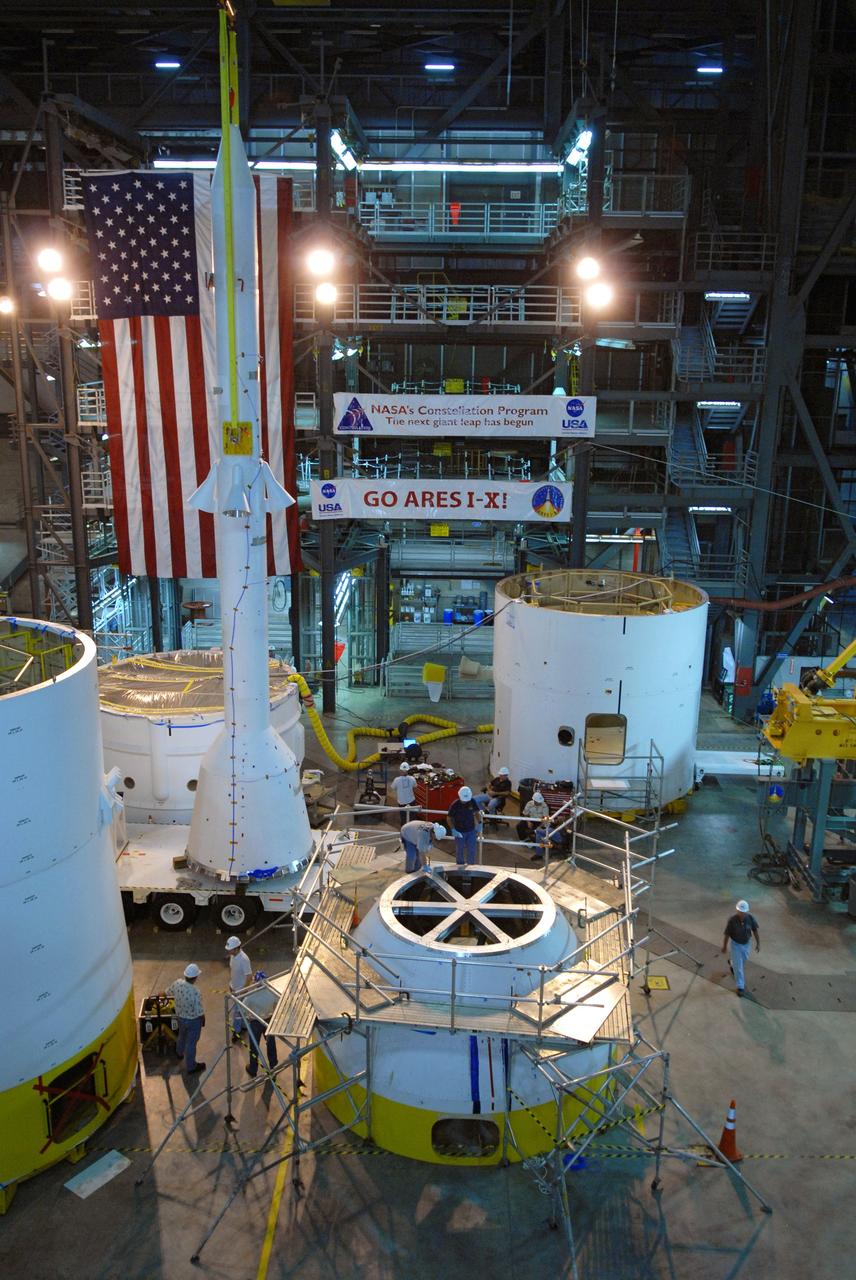
CAPE CANAVERAL, Fla. – In high bay 4 of the Vehicle Assembly Building at NASA's Kennedy Space Center in Florida, the Ares I-X simulated launch abort system, or LAS, (left of center) is being moved to the crew module simulator (center) for assembly. Ares I-X is the flight test vehicle for the Ares I, which is part of the Constellation Program to return men to the moon and beyond. Ares I is the essential core of a safe, reliable, cost-effective space transportation system that eventually will carry crewed missions back to the moon, on to Mars and out into the solar system. Ares I-X is targeted for launch in July 2009. Photo credit: NASA/Jack Pfaller
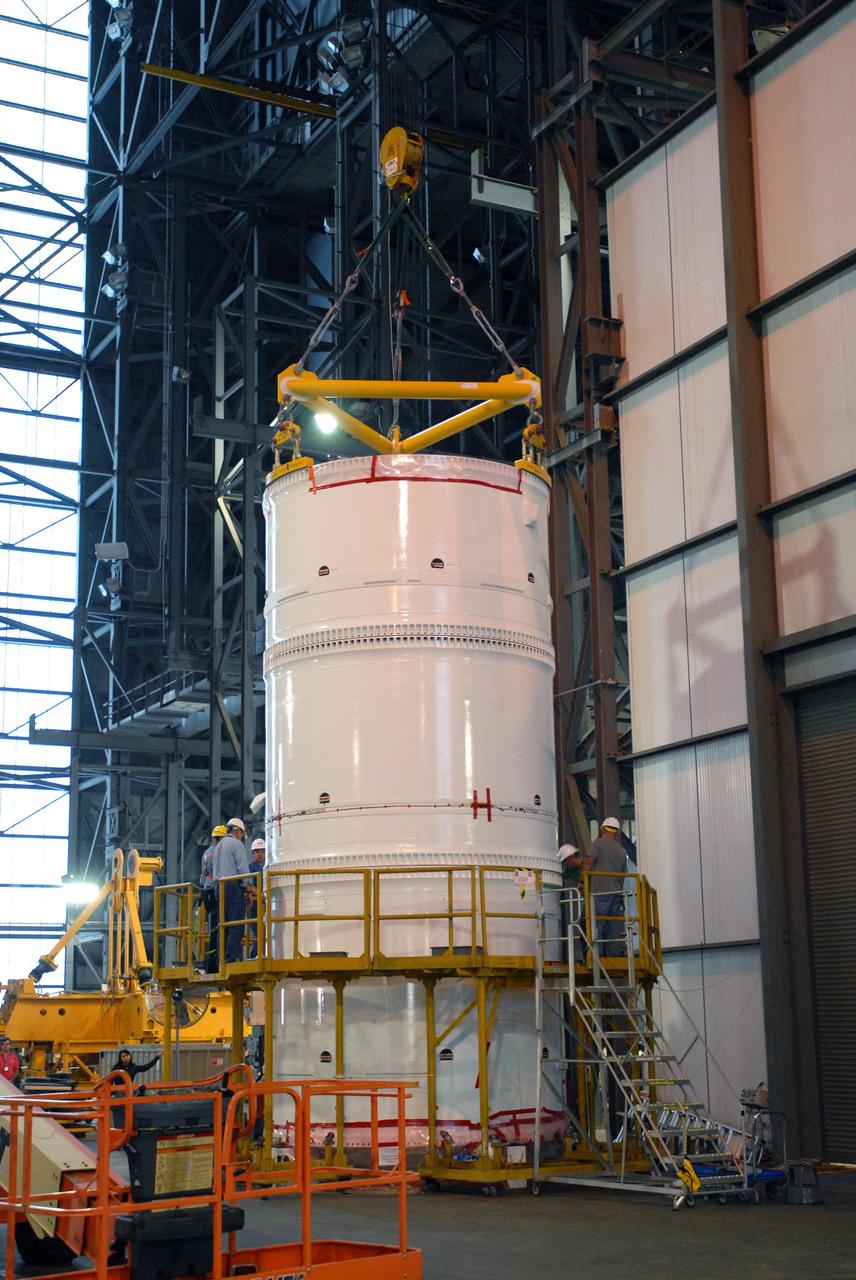
CAPE CANAVERAL, Fla. – In the transfer aisle of the Vehicle Assembly Building at NASA's Kennedy Space Center in Florida, the conjoined forward and center segments of the fifth segment simulator for the Ares I-X is secured to the simulator’s aft segment. Ares I-X is the test vehicle for the Ares I, a component of the Constellation Program to return men to the moon and beyond. Ares I is the essential core of a safe, reliable, cost-effective space transportation system that eventually will carry crewed missions back to the moon, on to Mars and out into the solar system. The launch of the Ares I-X flight test is targeted for August 2009. Photo credit: NASA/Jim Grossmann
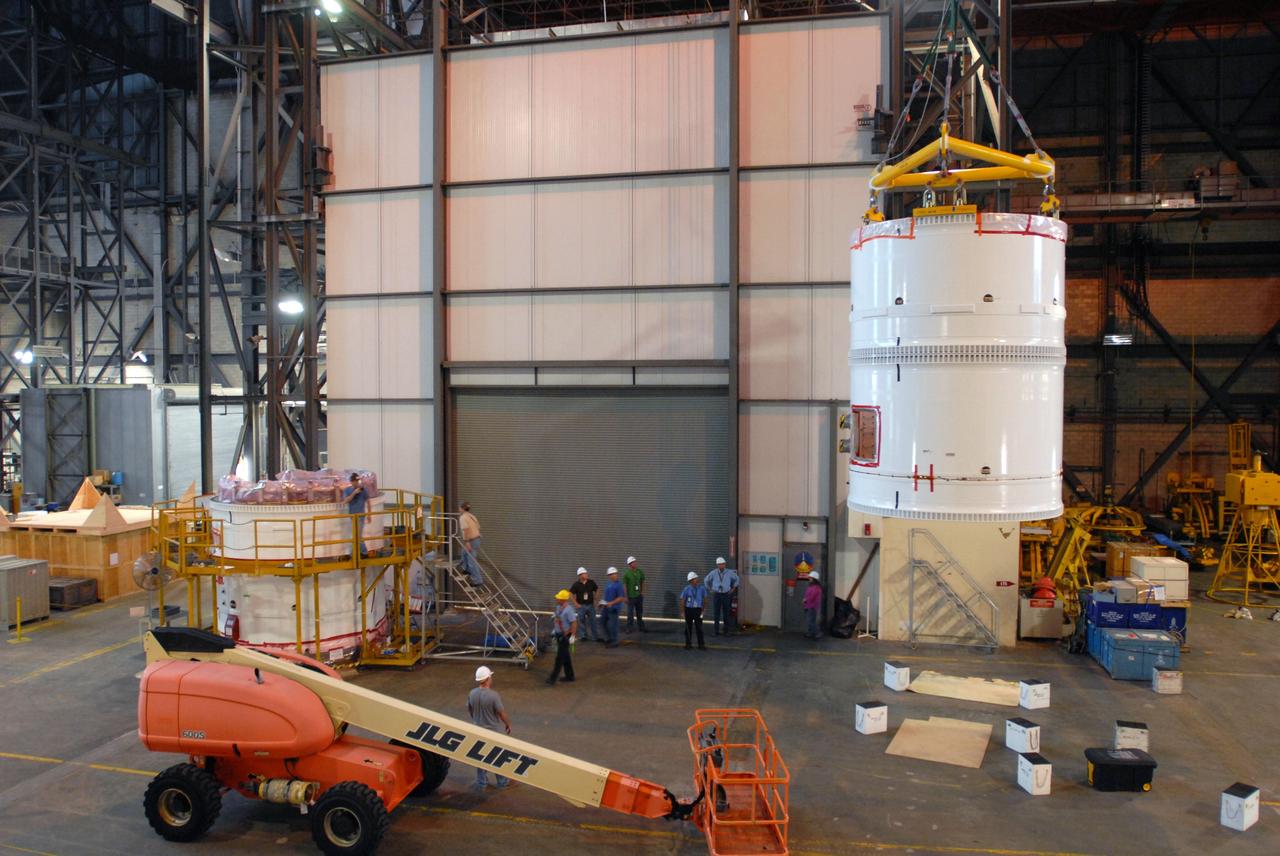
CAPE CANAVERAL, Fla. – In the transfer aisle of the Vehicle Assembly Building at NASA's Kennedy Space Center in Florida, a crane lifts the conjoined forward and center segments of the fifth segment simulator for the Ares I-X. The segments will be mated to the simulator’s aft segment, at left. Ares I-X is the test vehicle for the Ares I, a component of the Constellation Program to return men to the moon and beyond. Ares I is the essential core of a safe, reliable, cost-effective space transportation system that eventually will carry crewed missions back to the moon, on to Mars and out into the solar system. The launch of the Ares I-X flight test is targeted for August 2009. Photo credit: NASA/Jim Grossmann
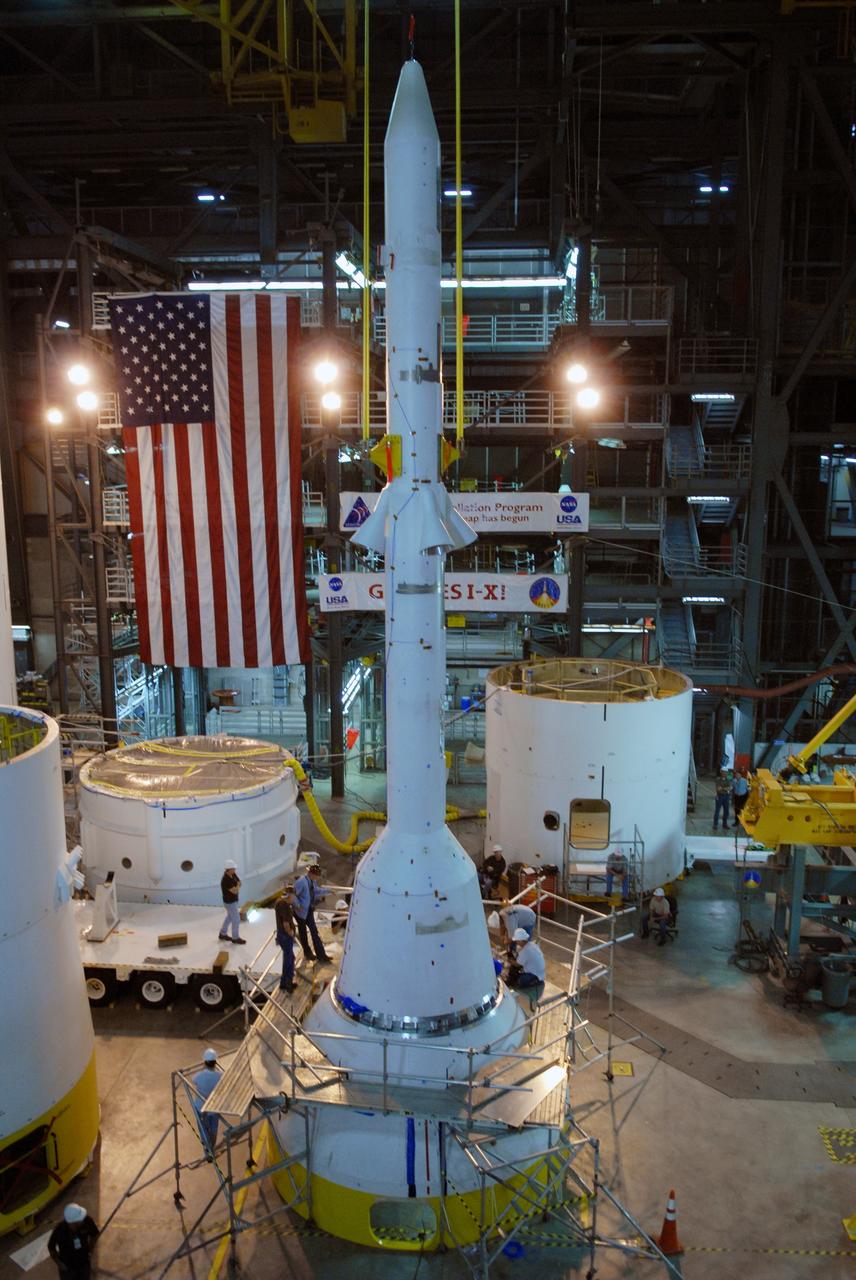
CAPE CANAVERAL, Fla. – In high bay 4 of the Vehicle Assembly Building at NASA's Kennedy Space Center in Florida, workers keep close watch on the Ares I-X simulated launch abort system, or LAS, as it is lowered onto the crew module simulator for assembly. Ares I-X is the flight test vehicle for the Ares I, which is part of the Constellation Program to return men to the moon and beyond. Ares I is the essential core of a safe, reliable, cost-effective space transportation system that eventually will carry crewed missions back to the moon, on to Mars and out into the solar system. Ares I-X is targeted for launch in July 2009. Photo credit: NASA/Jack Pfaller
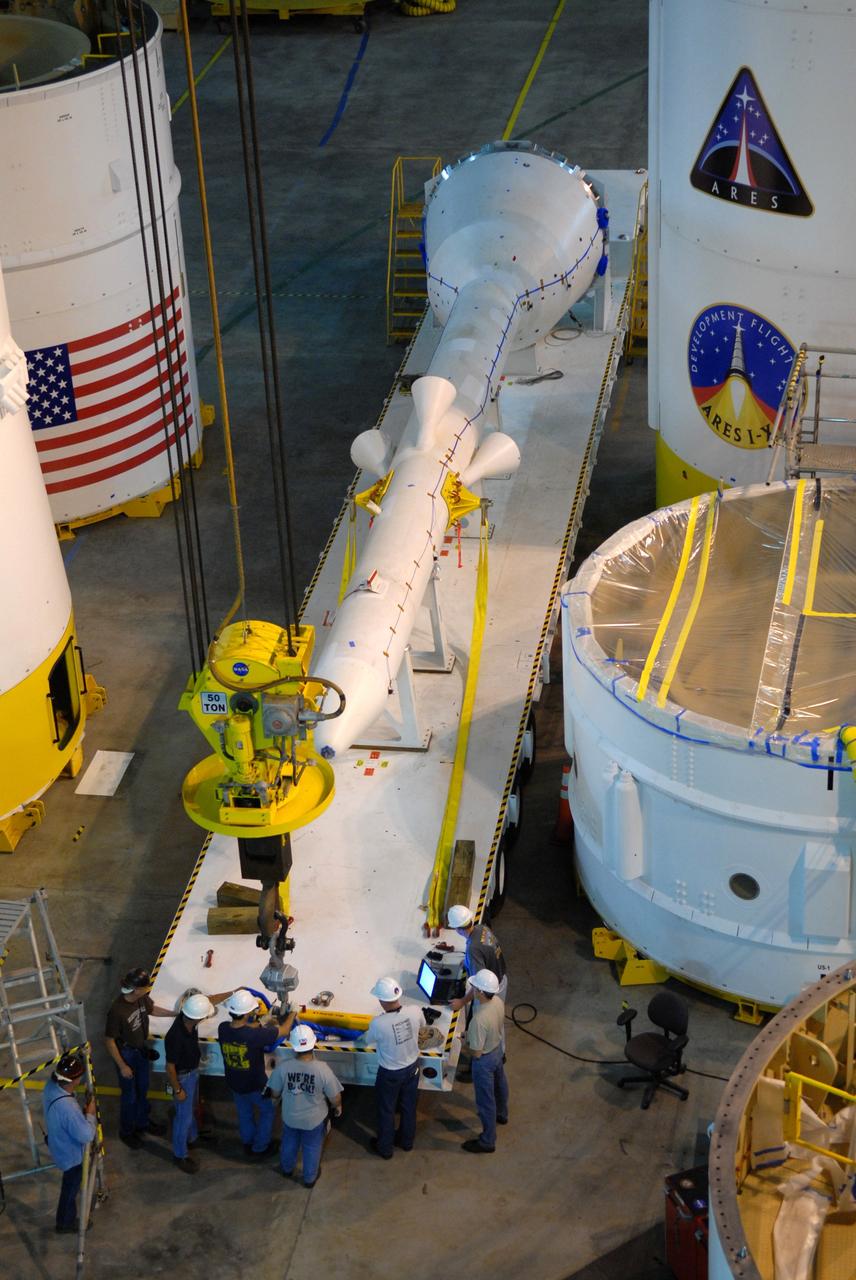
CAPE CANAVERAL, Fla. – In high bay 4 of the Vehicle Assembly Building at NASA's Kennedy Space Center in Florida, workers prepare the crane that will lift and rotate the Ares I-X simulated launch abort system (center) for assembly with the crew module simulator. Ares I-X is the flight test vehicle for the Ares I, which is part of the Constellation Program to return men to the moon and beyond. Ares I is the essential core of a safe, reliable, cost-effective space transportation system that eventually will carry crewed missions back to the moon, on to Mars and out into the solar system. Ares I-X is targeted for launch in July 2009. Photo credit: NASA/Jack Pfaller
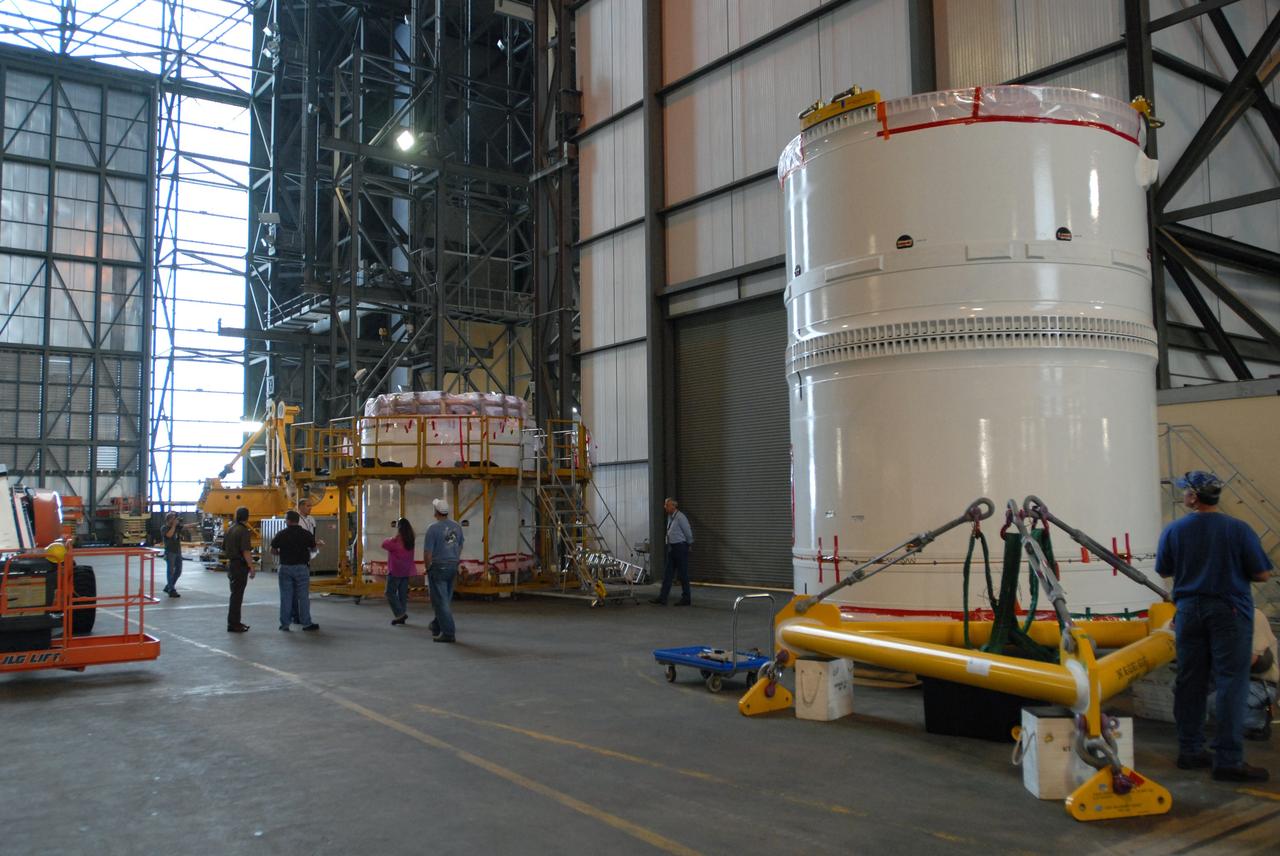
CAPE CANAVERAL, Fla. – In the transfer aisle of the Vehicle Assembly Building at NASA's Kennedy Space Center in Florida, workers prepare to lift the conjoined forward and center segments of the fifth segment simulator for the Ares I-X. The segments will be mated to the simulator’s aft segment, at left. Ares I-X is the test vehicle for the Ares I, a component of the Constellation Program to return men to the moon and beyond. Ares I is the essential core of a safe, reliable, cost-effective space transportation system that eventually will carry crewed missions back to the moon, on to Mars and out into the solar system. The launch of the Ares I-X flight test is targeted for August 2009. Photo credit: NASA/Jim Grossmann
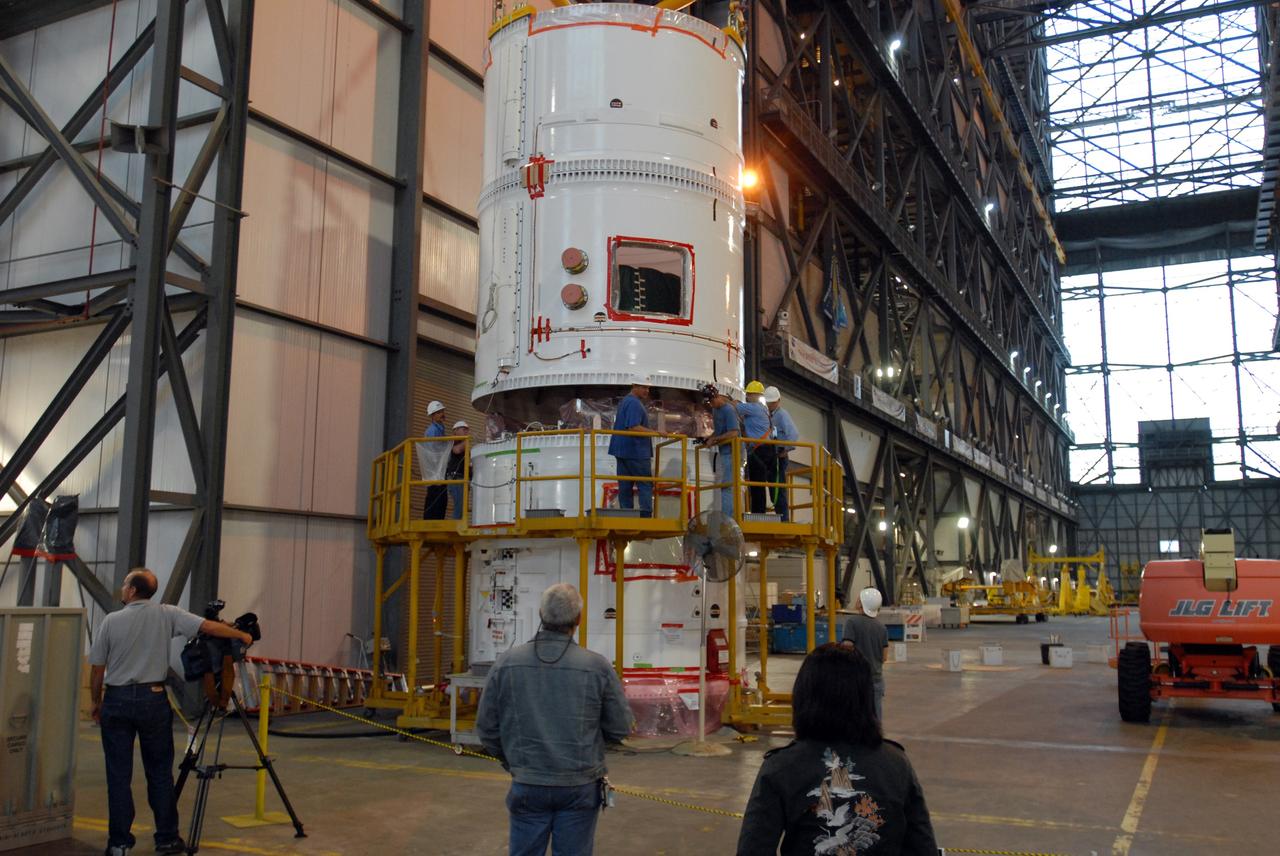
CAPE CANAVERAL, Fla. – In the transfer aisle of the Vehicle Assembly Building at NASA's Kennedy Space Center in Florida, a crane lowers the conjoined forward and center segments of the fifth segment simulator for the Ares I-X onto the simulator’s aft segment. Ares I-X is the test vehicle for the Ares I, a component of the Constellation Program to return men to the moon and beyond. Ares I is the essential core of a safe, reliable, cost-effective space transportation system that eventually will carry crewed missions back to the moon, on to Mars and out into the solar system. The launch of the Ares I-X flight test is targeted for August 2009. Photo credit: NASA/Jim Grossmann
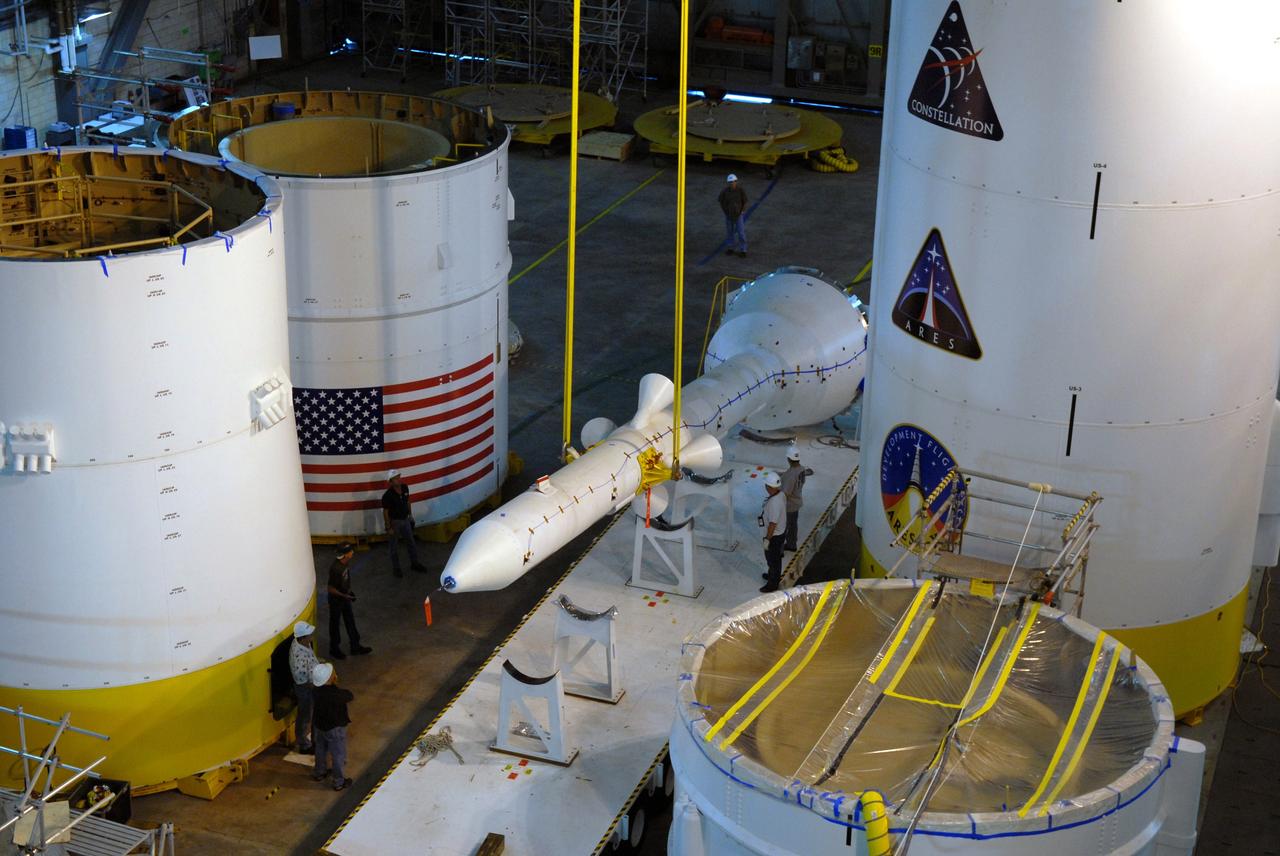
CAPE CANAVERAL, Fla. – In In high bay 4 of the Vehicle Assembly Building at NASA's Kennedy Space Center in Florida, the crane lifts the Ares I-X simulated launch abort system, or LAS, from its stand. The LAS will be rotated to vertical for assembly with the crew module simulator. Ares I-X is the flight test vehicle for the Ares I, which is part of the Constellation Program to return men to the moon and beyond. Ares I is the essential core of a safe, reliable, cost-effective space transportation system that eventually will carry crewed missions back to the moon, on to Mars and out into the solar system. Ares I-X is targeted for launch in July 2009. Photo credit: NASA/Jack Pfaller
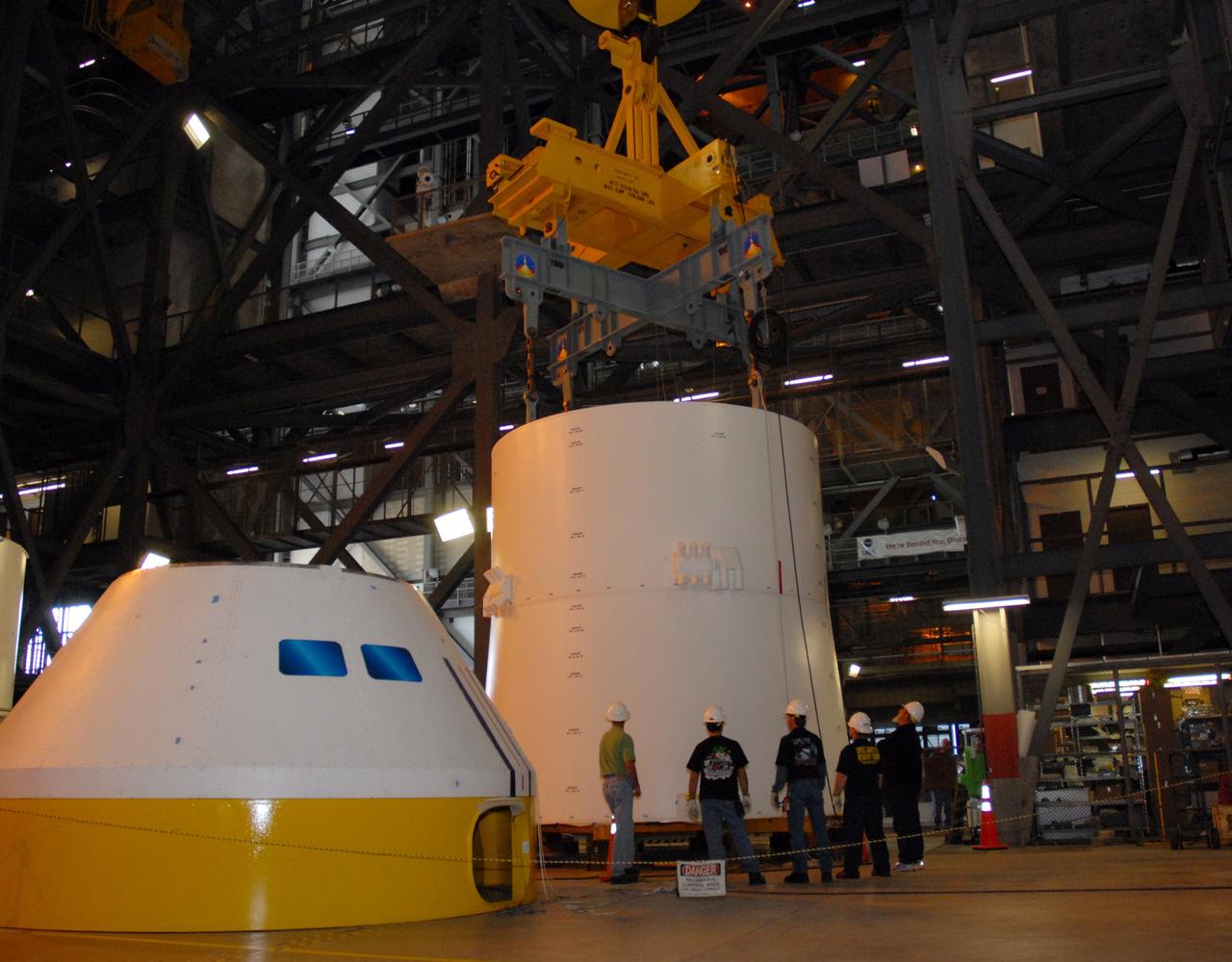
CAPE CANAVERAL, Fla. – In high bay 4 of the Vehicle Assembly Building at NASA's Kennedy Space Center in Florida, the installation of the Ares I-X service module onto the service adapter, at right, is complete. At left is the simulator crew module. Ares I-X is the test flight for the Ares I. The I-X flight will provide NASA an early opportunity to test and prove hardware, facilities and ground operations associated with Ares I. The launch of the 327-foot-tall, full-scale Ares I-X, targeted for July 2009, will be the first in a series of unpiloted rocket launches from Kennedy. Photo credit: NASA/Tim Jacobs
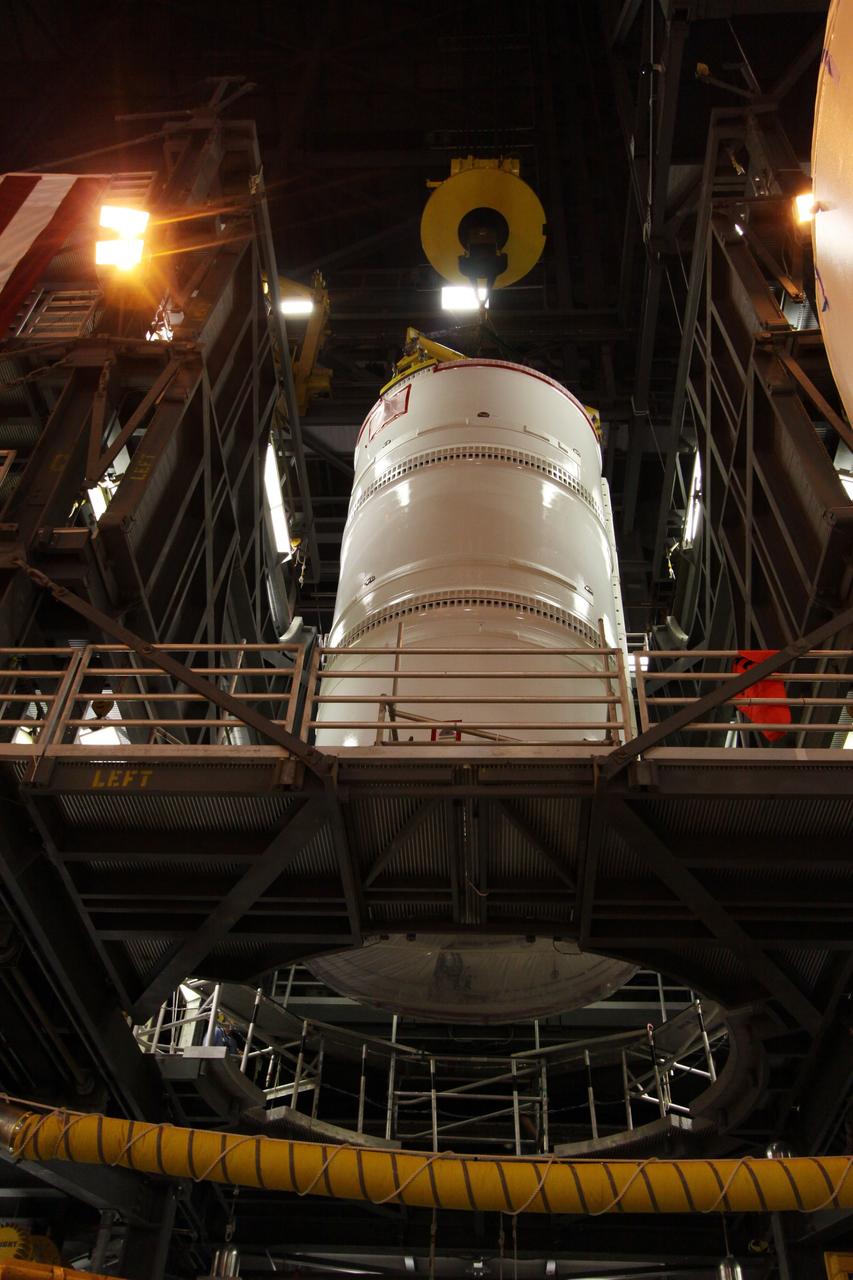
CAPE CANAVERAL, Fla. – In the Vehicle Assembly Building at NASA's Kennedy Space Center in Florida, the Ares I-X fifth segment simulator assembly is lowered through a work platform in High Bay 4. Ares I-X is the flight test vehicle for the Ares I, the essential core of a safe, reliable, cost-effective space transportation system that eventually will carry crewed missions back to the moon, on to Mars and out into the solar system. Ares I-X is targeted for launch in August 2009. Photo credit: NASA/Kim Shiflett
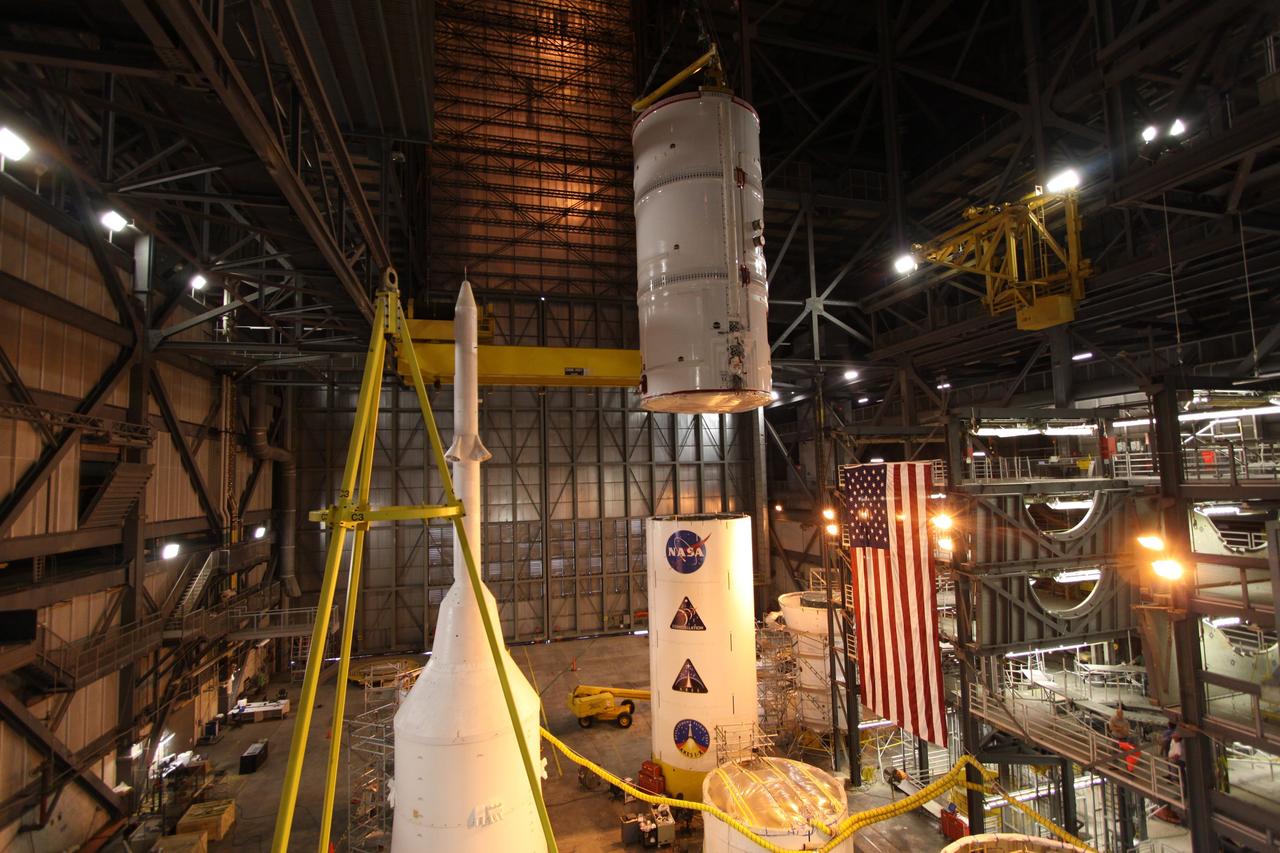
CAPE CANAVERAL, Fla. – In the Vehicle Assembly Building at NASA's Kennedy Space Center in Florida, the Ares I-X fifth segment simulator assembly is lowered into High Bay 4 where other Ares I-X segments are located. Ares I-X is the flight test vehicle for the Ares I, the essential core of a safe, reliable, cost-effective space transportation system that eventually will carry crewed missions back to the moon, on to Mars and out into the solar system. Ares I-X is targeted for launch in August 2009. Photo credit: NASA/Kim Shiflett
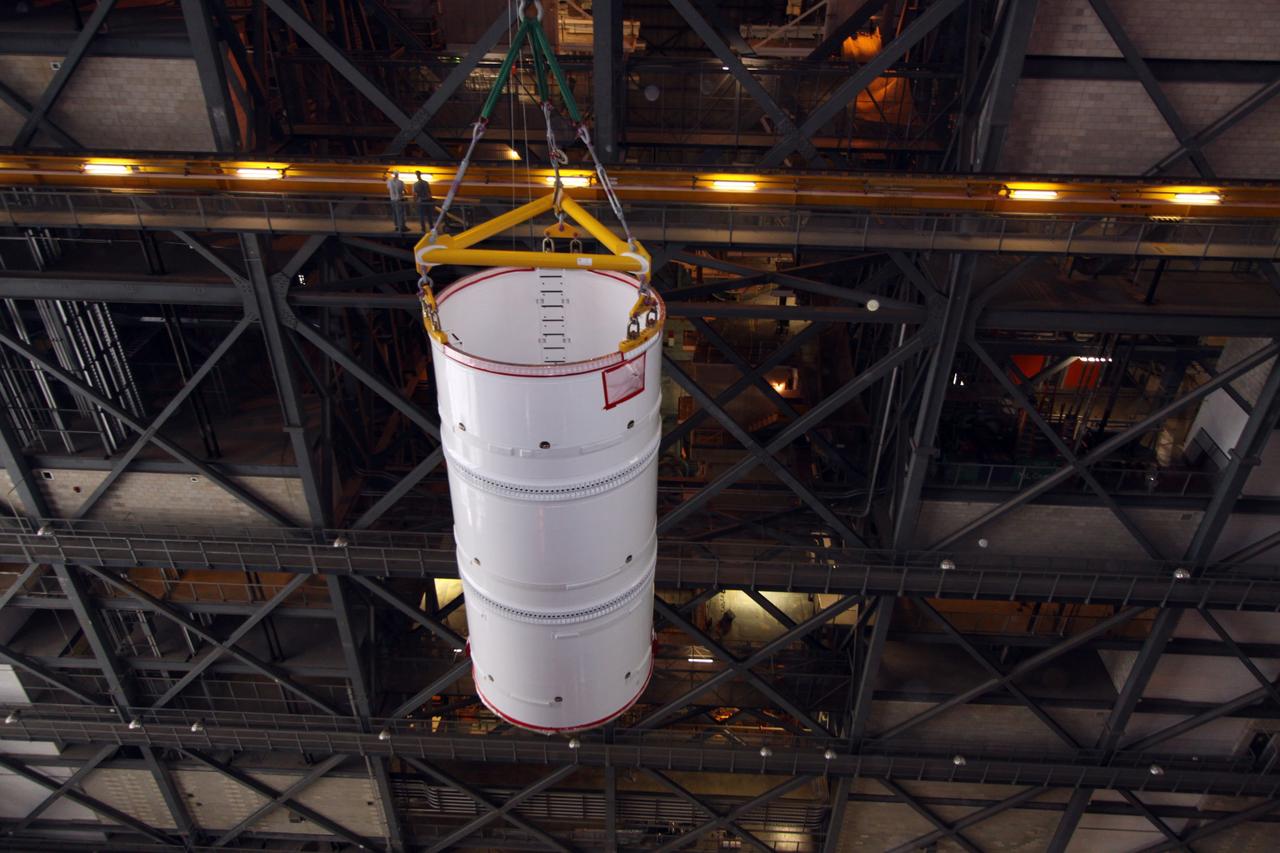
CAPE CANAVERAL, Fla. – In the Vehicle Assembly Building at NASA's Kennedy Space Center in Florida, the Ares I-X fifth segment simulator assembly is lifted from the transfer aisle. It will be moved into High Bay 4 with other Ares I-X segments. Ares I-X is the flight test vehicle for the Ares I, the essential core of a safe, reliable, cost-effective space transportation system that eventually will carry crewed missions back to the moon, on to Mars and out into the solar system. Ares I-X is targeted for launch in August 2009. Photo credit: NASA/Kim Shiflett
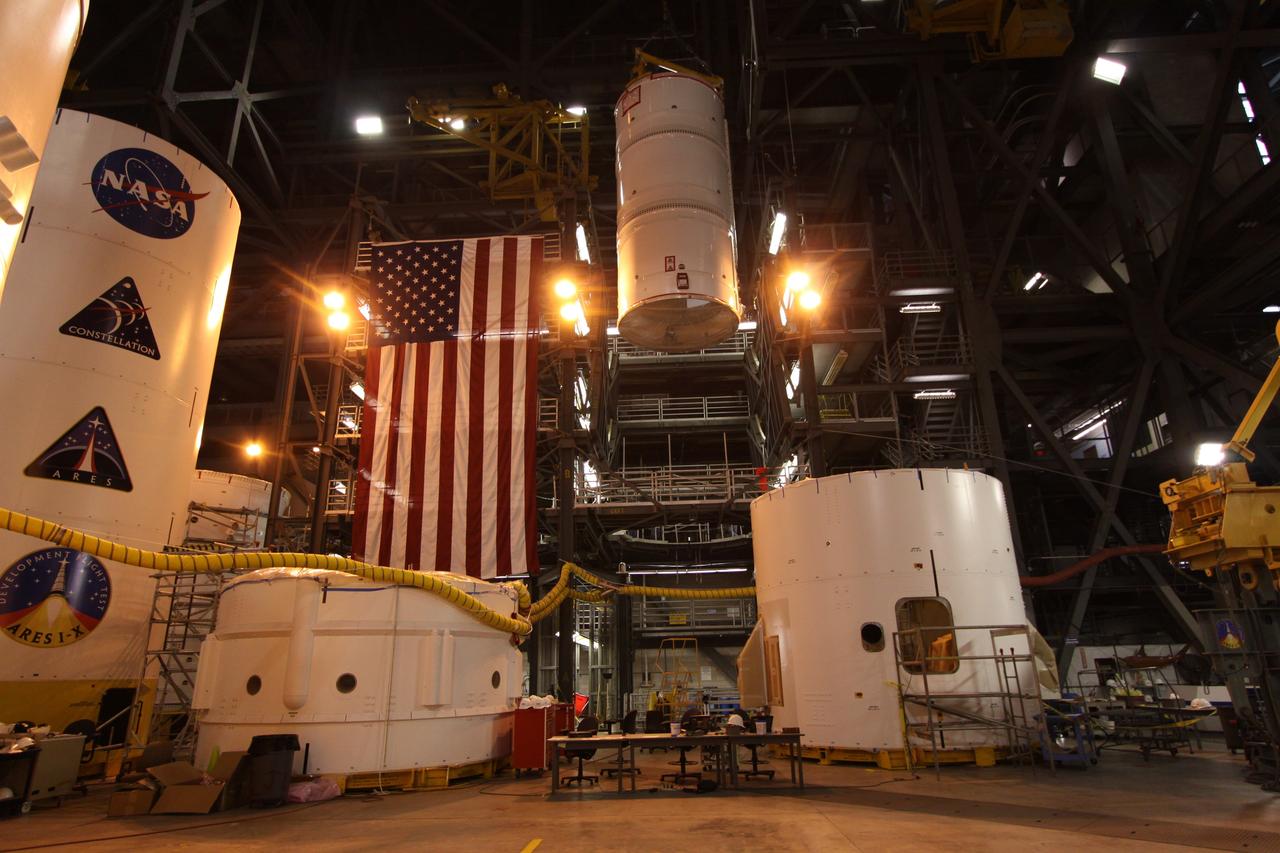
CAPE CANAVERAL, Fla. – In the Vehicle Assembly Building at NASA's Kennedy Space Center in Florida, the Ares I-X fifth segment simulator assembly is lowered into High Bay 4 where other Ares I-X segments are located. Ares I-X is the flight test vehicle for the Ares I, the essential core of a safe, reliable, cost-effective space transportation system that eventually will carry crewed missions back to the moon, on to Mars and out into the solar system. Ares I-X is targeted for launch in August 2009. Photo credit: NASA/Kim Shiflett
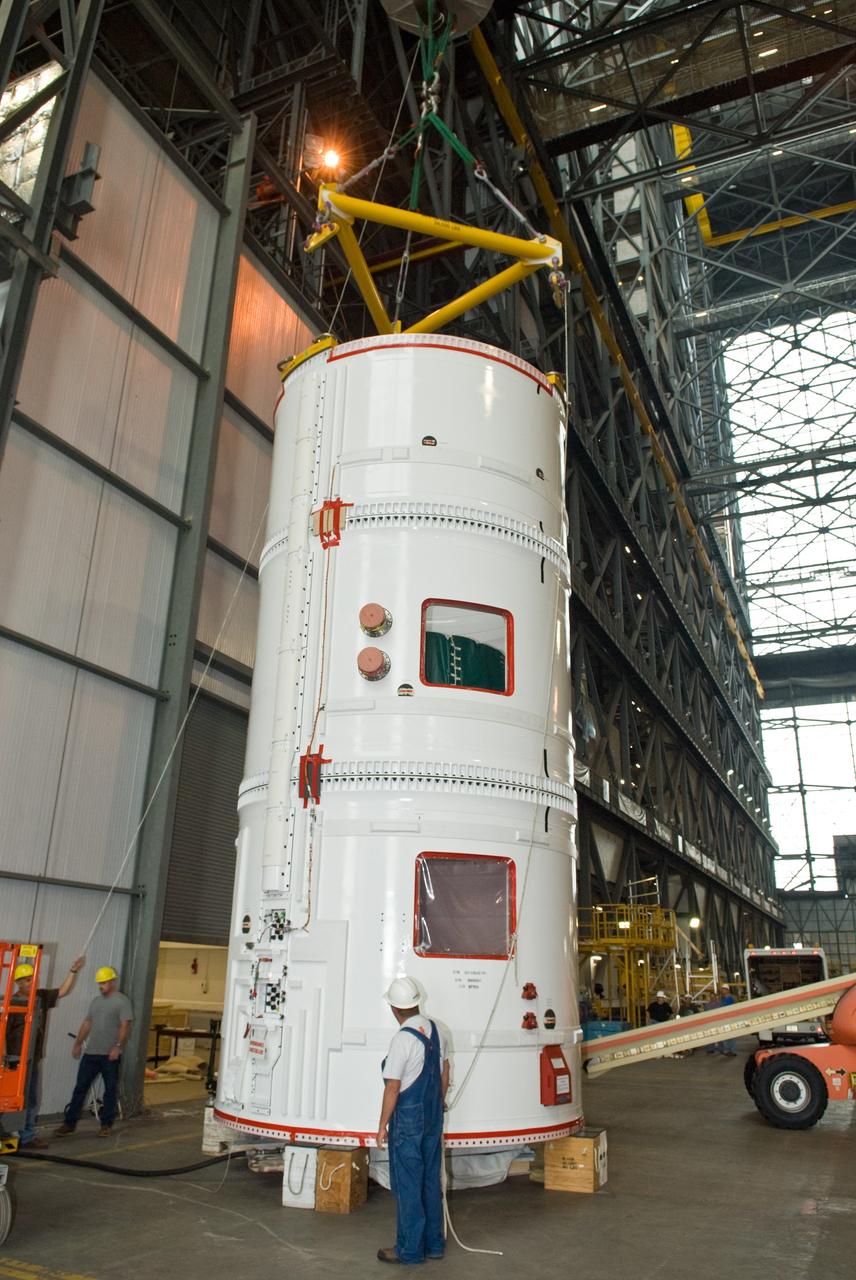
CAPE CANAVERAL, Fla. – In the transfer aisle of the Vehicle Assembly Building at NASA's Kennedy Space Center in Florida, a crane is attached to the fifth segment simulator assembly for the Ares I-X. The crane will lift and move the segment assembly into High Bay 4. Ares I-X is the flight test vehicle for the Ares I, a component of the Constellation Program. Ares I is the essential core of a safe, reliable, cost-effective space transportation system that eventually will carry crewed missions back to the moon, on to Mars and out into the solar system. The launch of the Ares I-X flight test is targeted for August 2009. Photo credit: NASA/Jim Grossmann
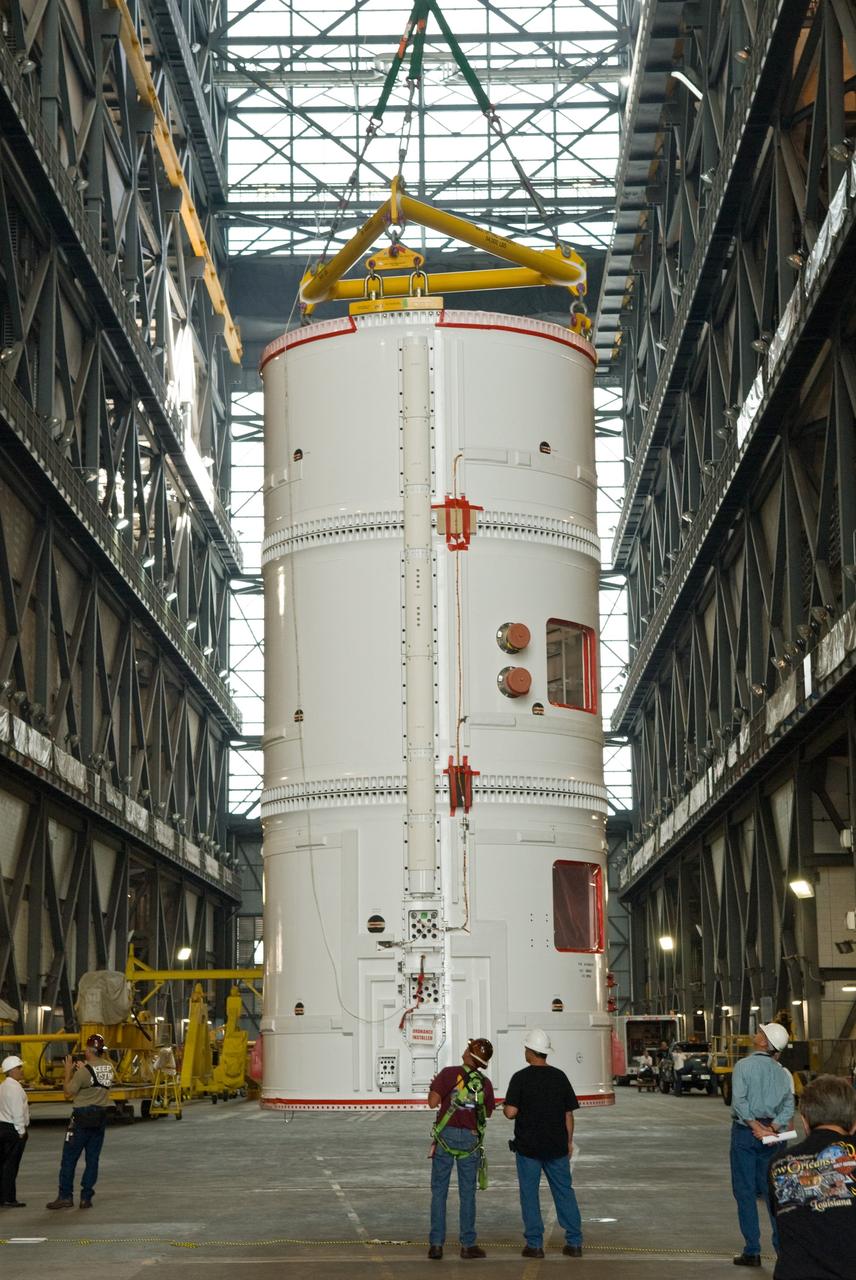
CAPE CANAVERAL, Fla. – In the transfer aisle of the Vehicle Assembly Building at NASA's Kennedy Space Center in Florida, a crane lifts the fifth segment simulator assembly for the Ares I-X to move it into High Bay 4. Ares I-X is the flight test vehicle for the Ares I, a component of the Constellation Program. Ares I is the essential core of a safe, reliable, cost-effective space transportation system that eventually will carry crewed missions back to the moon, on to Mars and out into the solar system. The launch of the Ares I-X flight test is targeted for August 2009. Photo credit: NASA/Jim Grossmann
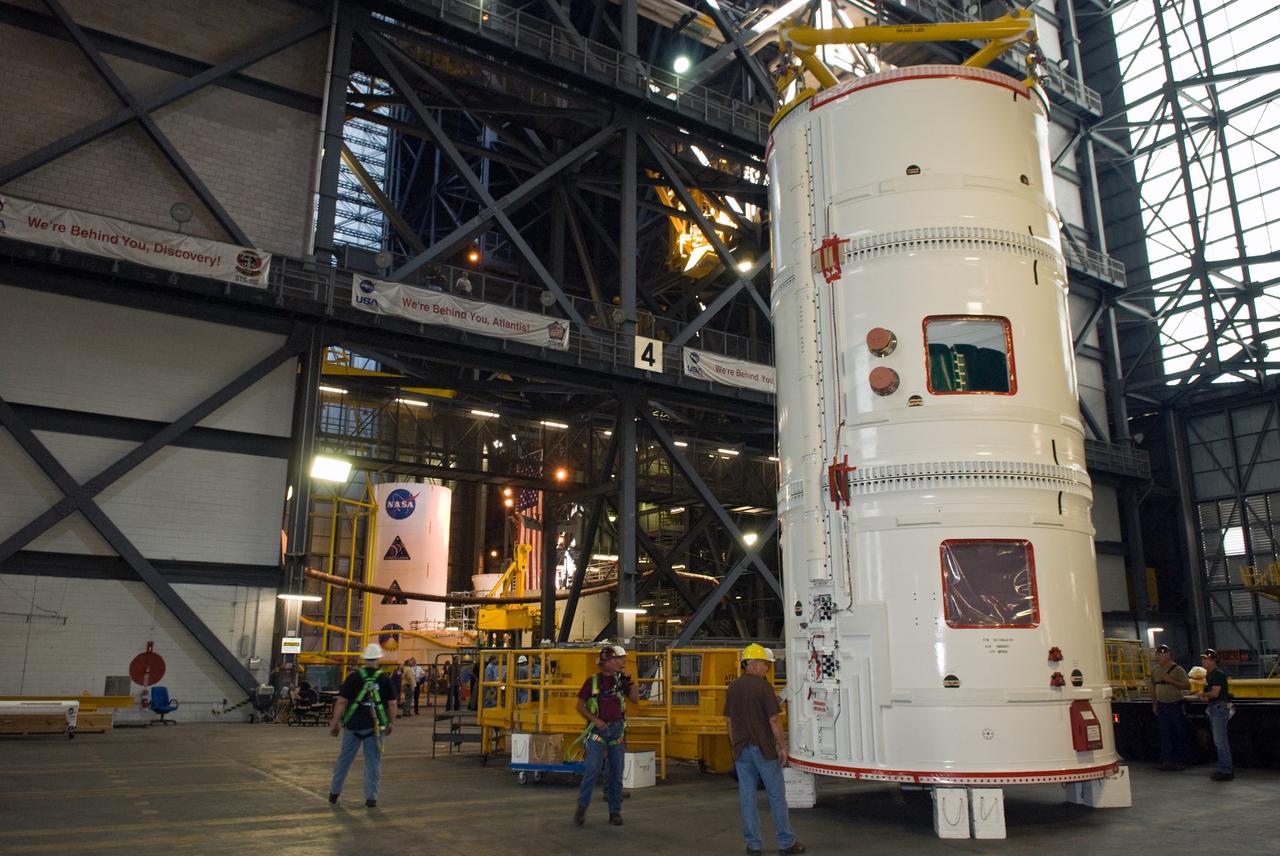
CAPE CANAVERAL, Fla. – The fifth segment simulator assembly for the Ares I-X is moved onto a stand in the Vehicle Assembly Building near High Bay 4 at NASA's Kennedy Space Center in Florida. Ares I-X is the flight test vehicle for the Ares I, a component of the Constellation Program. Ares I is the essential core of a safe, reliable, cost-effective space transportation system that eventually will carry crewed missions back to the moon, on to Mars and out into the solar system. The launch of the Ares I-X flight test is targeted for August 2009. Photo credit: NASA/Jim Grossmann
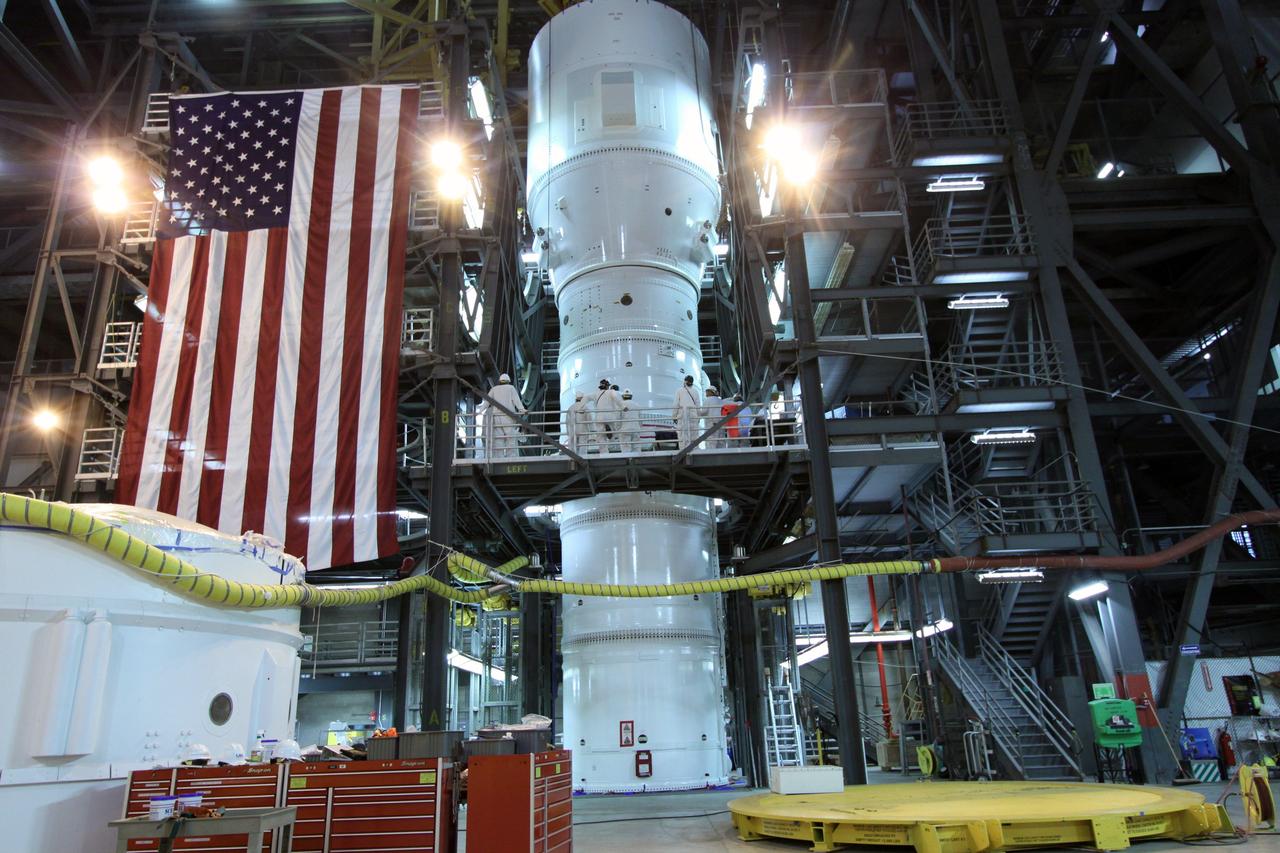
CAPE CANAVERAL, Fla. – In the Vehicle Assembly Building at NASA's Kennedy Space Center in Florida, segments of the Ares I-X first stage are mated to the fifth simulator segment, completing Super Stack 1. The super stack comprises the forward skirt, forward skirt extension, interstages 1 and 2 and the fifth segment simulator. Ares I-X is the test vehicle for the Ares I, which is part of the Constellation Program to return men to the moon and beyond. The Ares I-X flight test is targeted no earlier than Aug. 30 from Launch Pad 39B. Photo credit: NASA/Jack Pfaller
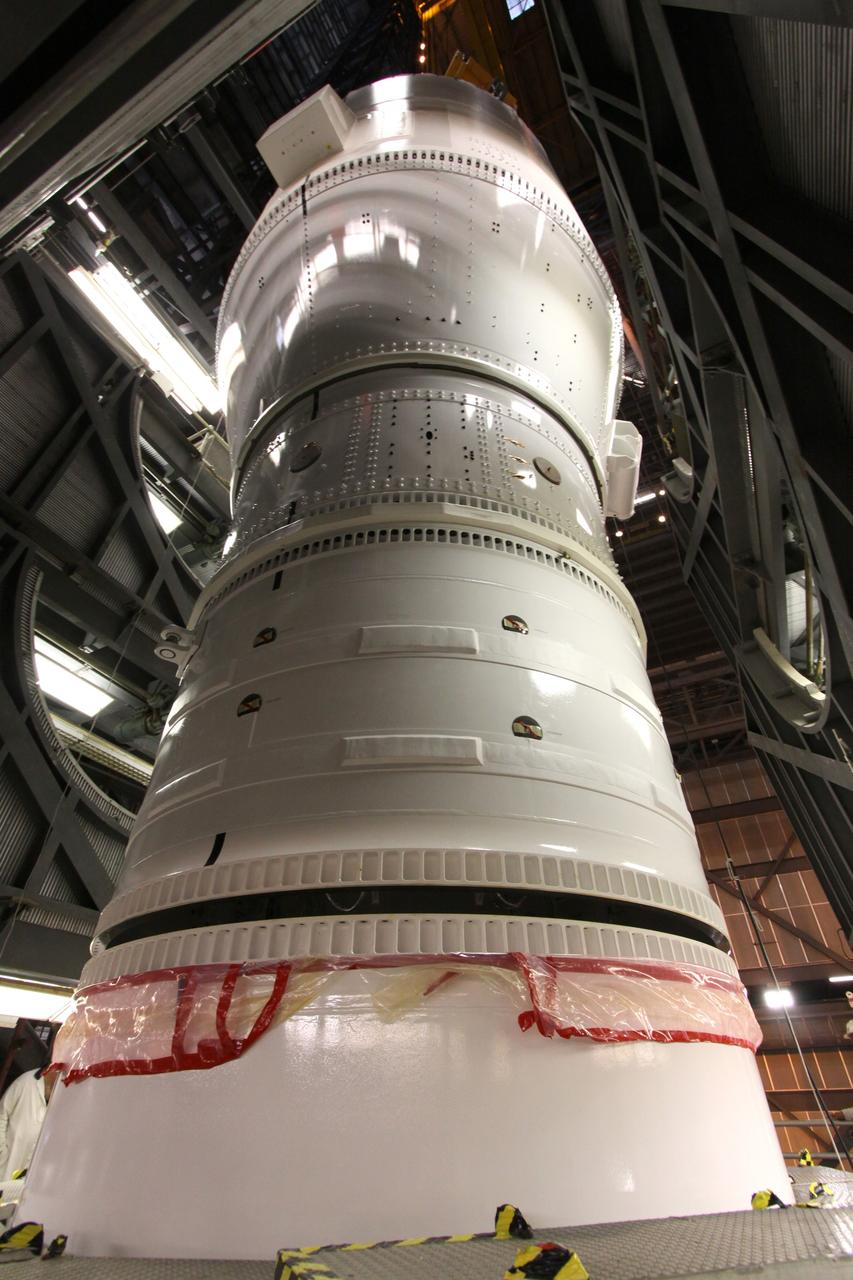
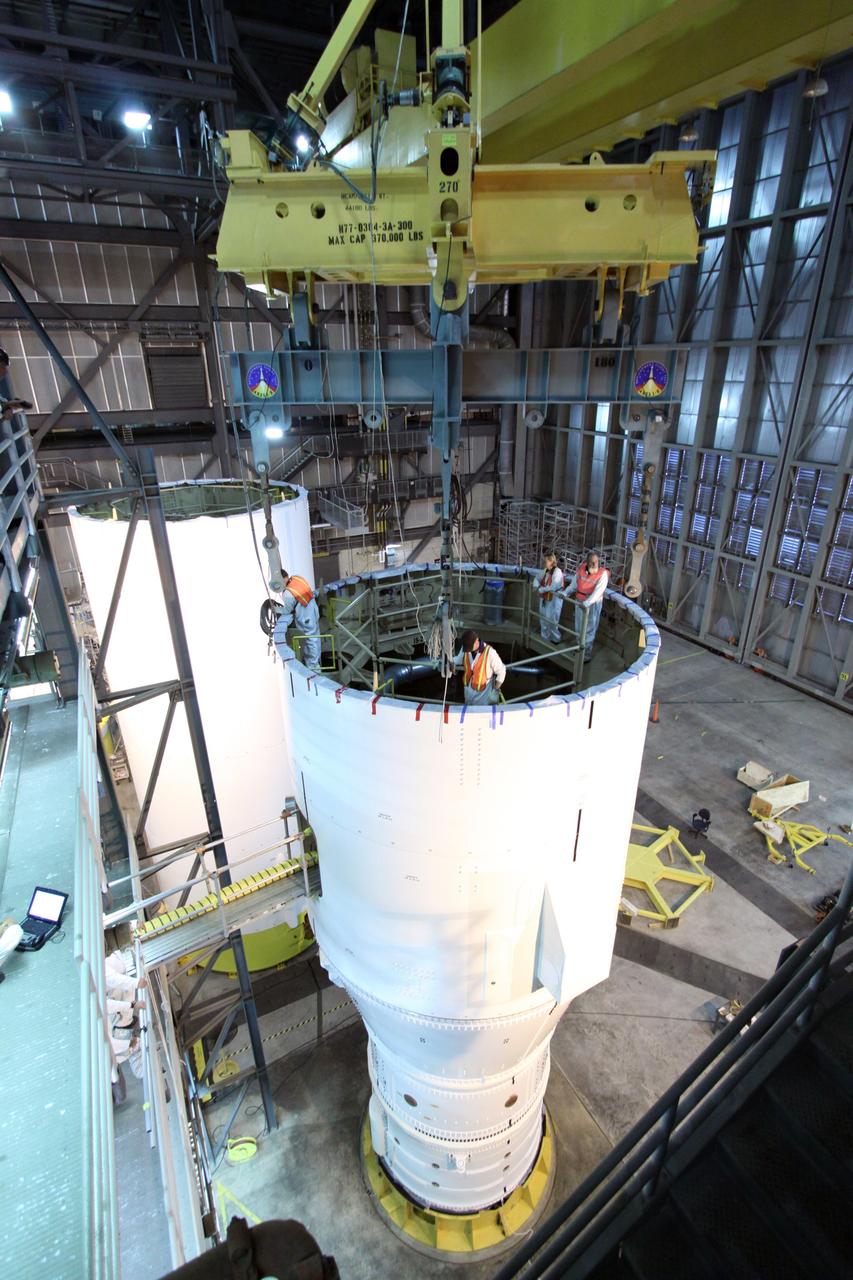
CAPE CANAVERAL, Fla. – In the Vehicle Assembly Building at NASA's Kennedy Space Center in Florida, segments of the Ares I-X first stage are lowered onto the fifth simulator segment for mating, to complete Super Stack 1. The super stack comprises the forward skirt, forward skirt extension, interstages 1 and 2 and the fifth segment simulator. Ares I-X is the test vehicle for the Ares I, which is part of the Constellation Program to return men to the moon and beyond. The Ares I-X flight test is targeted no earlier than Aug. 30 from Launch Pad 39B. Photo credit: NASA/Jack Pfaller
CAPE CANAVERAL, Fla. – In the Vehicle Assembly Building at NASA's Kennedy Space Center in Florida, the segments of the Ares I-X first stage are fitted with a crane to lift it to the fifth segment simulator for mating, completing Super Stack 1. The super stack comprises the forward skirt, forward skirt extension, interstages 1 and 2 and the fifth segment simulator. Ares I-X is the test vehicle for the Ares I, which is part of the Constellation Program to return men to the moon and beyond. The Ares I-X flight test is targeted no earlier than Aug. 30 from Launch Pad 39B. Photo credit: NASA/Jack Pfaller
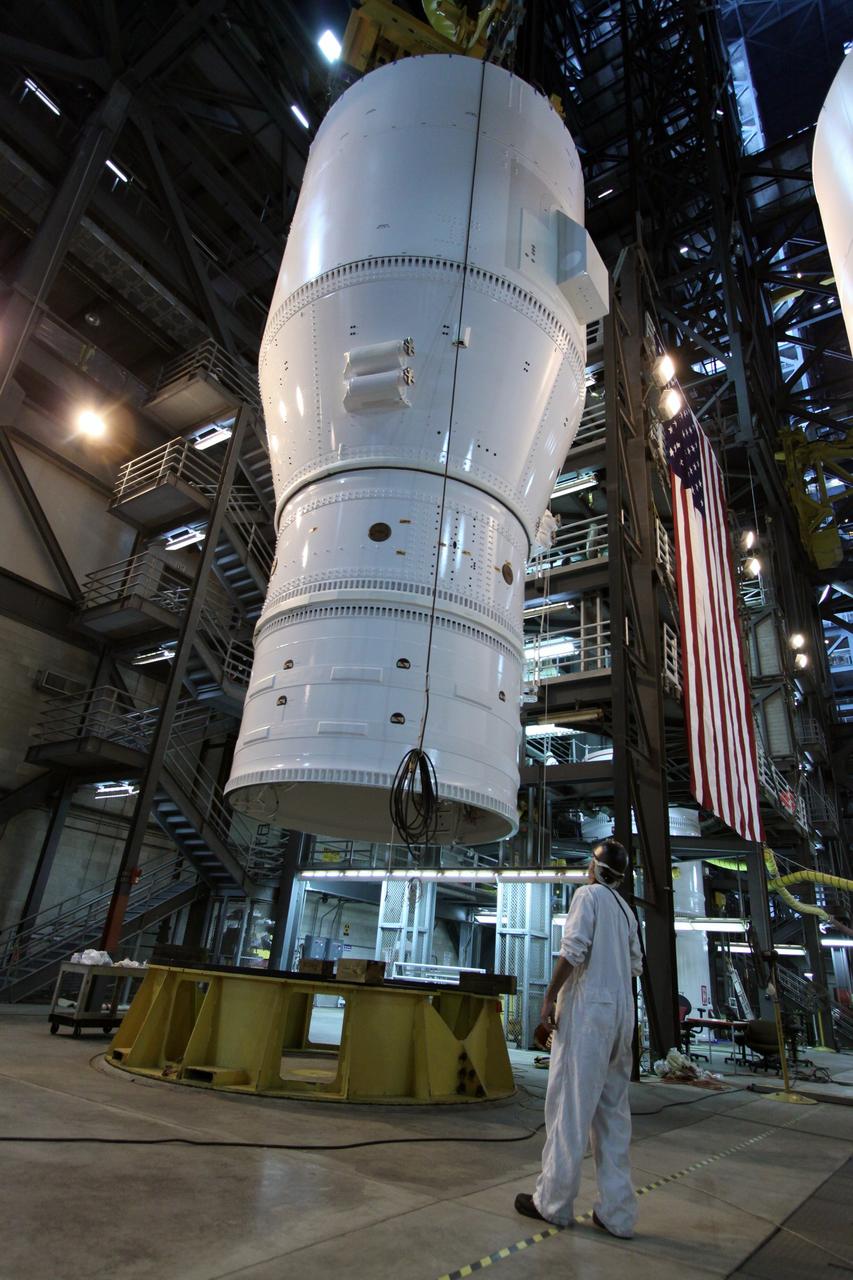
CAPE CANAVERAL, Fla. – In the Vehicle Assembly Building at NASA's Kennedy Space Center in Florida, segments of the Ares I-X first stage are lifted from the stand. The segments are being moved for stacking and mating to the fifth segment simulator, completing Super Stack 1. The super stack comprises the forward skirt, forward skirt extension, interstages 1 and 2 and the fifth segment simulator. Ares I-X is the test vehicle for the Ares I, which is part of the Constellation Program to return men to the moon and beyond. The Ares I-X flight test is targeted no earlier than Aug. 30 from Launch Pad 39B. Photo credit: NASA/Jack Pfaller
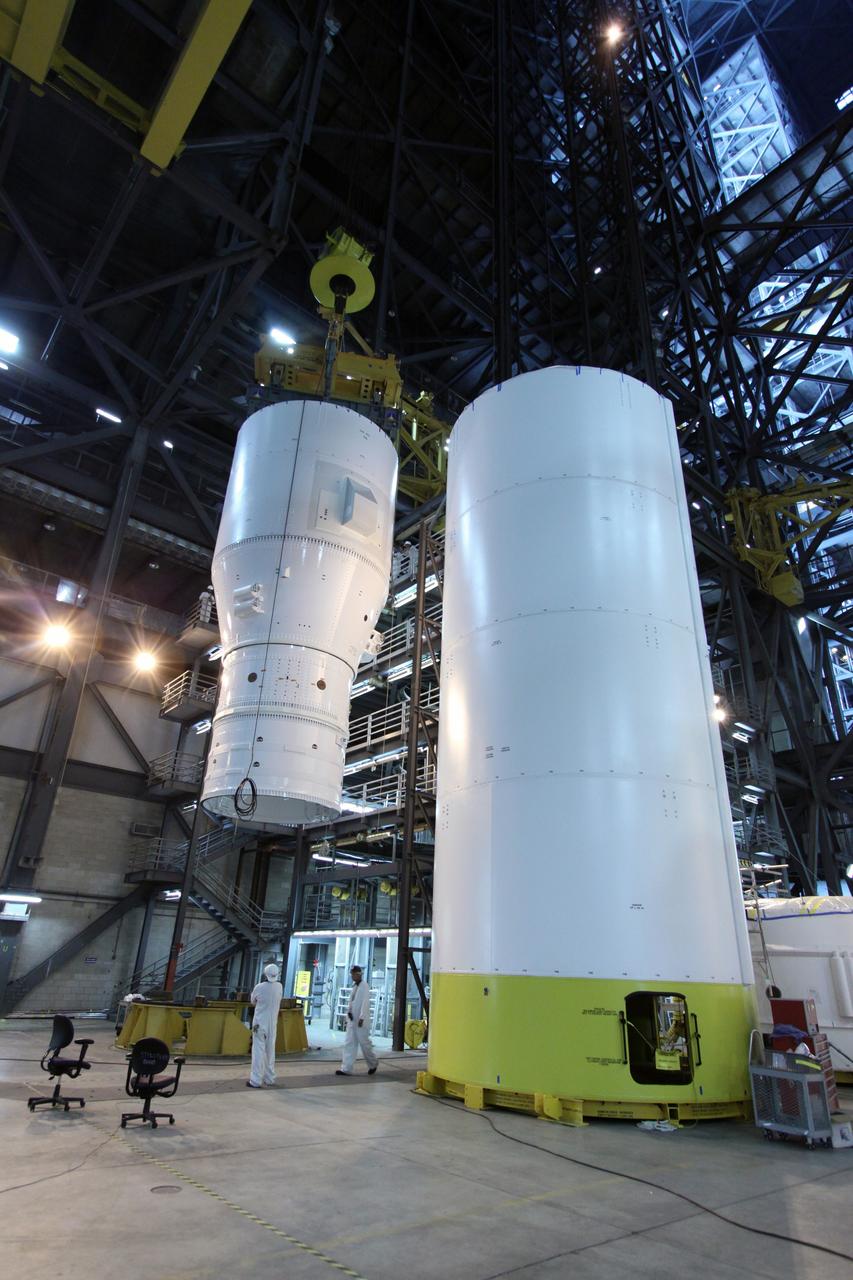
CAPE CANAVERAL, Fla. – In the Vehicle Assembly Building at NASA's Kennedy Space Center in Florida, segments of the Ares I-X first stage are moved across the bay. They will be stacked and mated to the fifth segment simulator, completing Super Stack 1. The super stack comprises the forward skirt, forward skirt extension, interstages 1 and 2 and the fifth segment simulator. Ares I-X is the test vehicle for the Ares I, which is part of the Constellation Program to return men to the moon and beyond. The Ares I-X flight test is targeted no earlier than Aug. 30 from Launch Pad 39B. Photo credit: NASA/Jack Pfaller
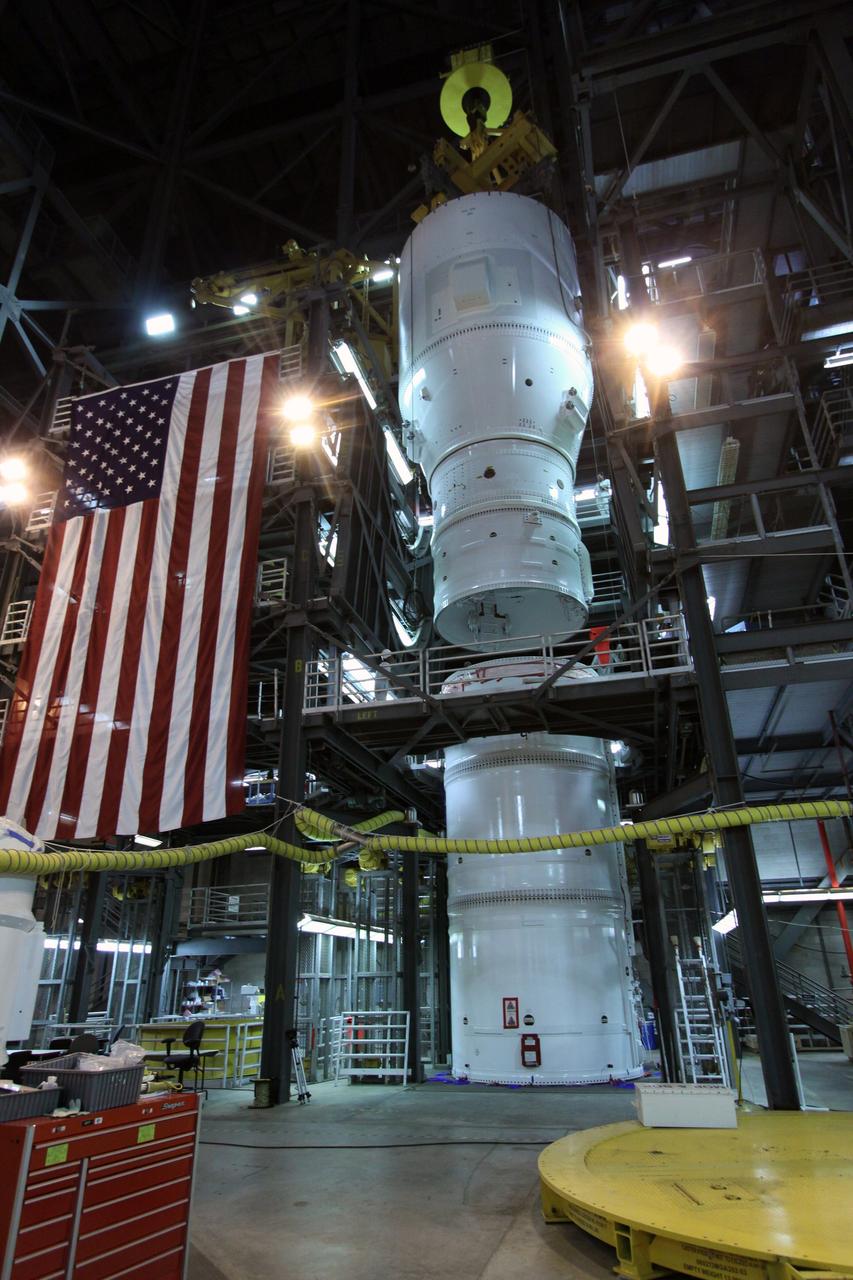
CAPE CANAVERAL, Fla. – In the Vehicle Assembly Building at NASA's Kennedy Space Center in Florida, segments of the Ares I-X first stage are lowered toward the fifth simulator segment for mating, to complete Super Stack 1. The super stack comprises the forward skirt, forward skirt extension, interstages 1 and 2 and the fifth segment simulator. Ares I-X is the test vehicle for the Ares I, which is part of the Constellation Program to return men to the moon and beyond. The Ares I-X flight test is targeted no earlier than Aug. 30 from Launch Pad 39B. Photo credit: NASA/Jack Pfaller
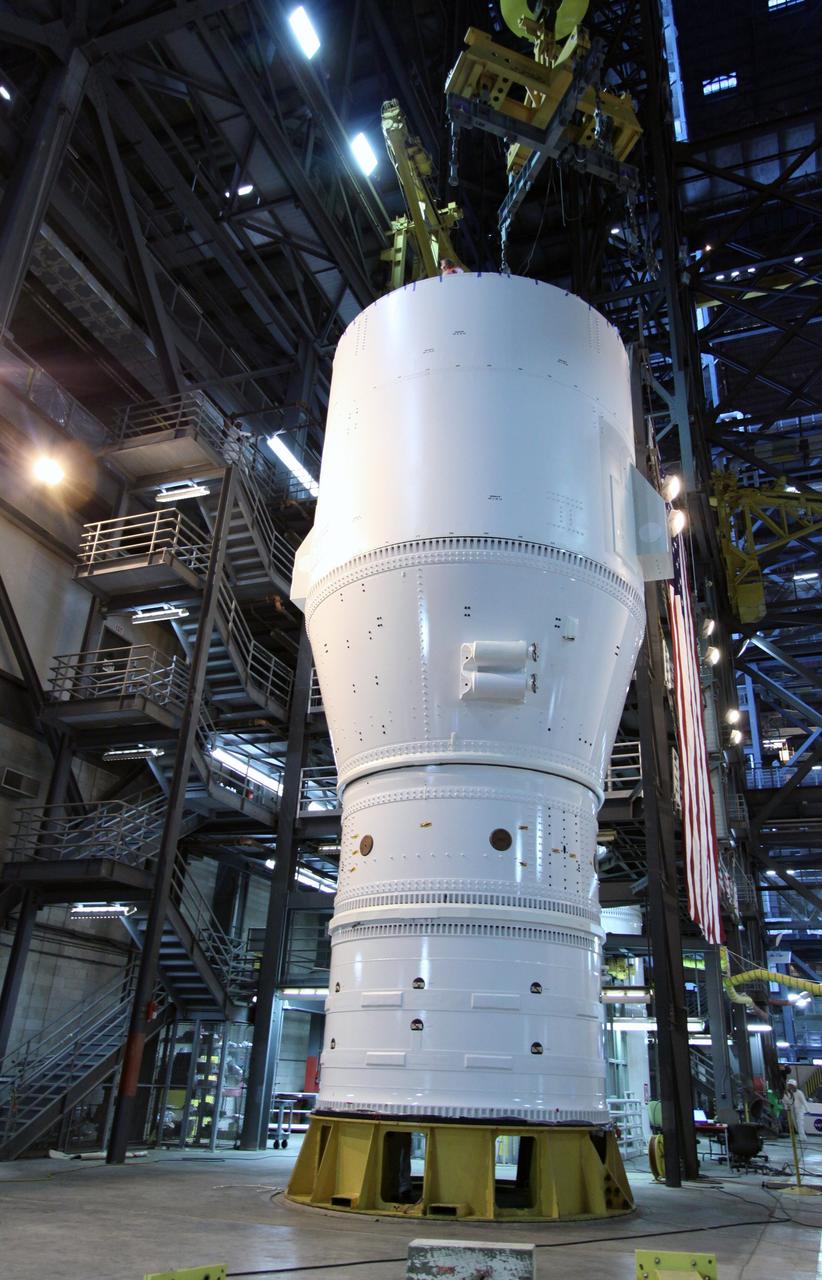
CAPE CANAVERAL, Fla. – In the Vehicle Assembly Building at NASA's Kennedy Space Center in Florida, segments of the Ares I-X first stage are fitted with a crane to lift it to the fifth segment simulator for mating, completing Super Stack 1. The super stack comprises the forward skirt, forward skirt extension, interstages 1 and 2 and the fifth segment simulator. Ares I-X is the test vehicle for the Ares I, which is part of the Constellation Program to return men to the moon and beyond. The Ares I-X flight test is targeted no earlier than Aug. 30 from Launch Pad 39B. Photo credit: NASA/Jack Pfaller
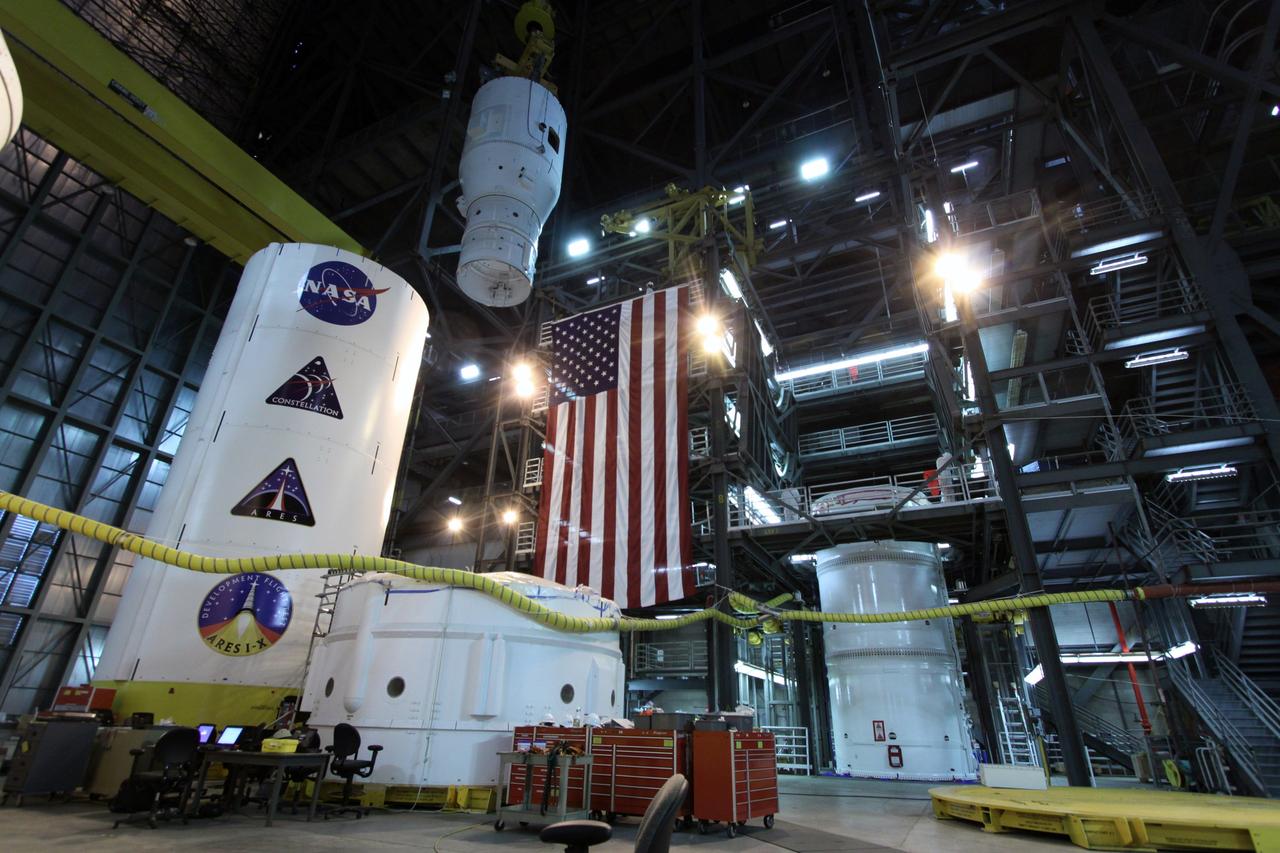
CAPE CANAVERAL, Fla. – In the Vehicle Assembly Building at NASA's Kennedy Space Center in Florida, segments of the Ares I-X first stage move past other stacks toward the fifth simulator segment stack at right. The two stacks will be mated, completing Super Stack 1. The super stack comprises the forward skirt, forward skirt extension, interstages 1 and 2 and the fifth segment simulator. Ares I-X is the test vehicle for the Ares I, which is part of the Constellation Program to return men to the moon and beyond. The Ares I-X flight test is targeted no earlier than Aug. 30 from Launch Pad 39B. Photo credit: NASA/Jack Pfaller

CAPE CANAVERAL, Fla. – In high bay 4 of the Vehicle Assembly Building at NASA's Kennedy Space Center in Florida, a large overhead crane lowers the Ares I-X service module toward the service adapter. Other Ares I-X segments are located around the bay, including the simulator crew module in the foreground (with the blue "windows"). Ares I-X is the test flight for the Ares I. The I-X flight will provide NASA an early opportunity to test and prove hardware, facilities and ground operations associated with Ares I. The launch of the 327-foot-tall, full-scale Ares I-X, targeted for July 2009, will be the first in a series of unpiloted rocket launches from Kennedy. Photo credit: NASA/Tim Jacobs
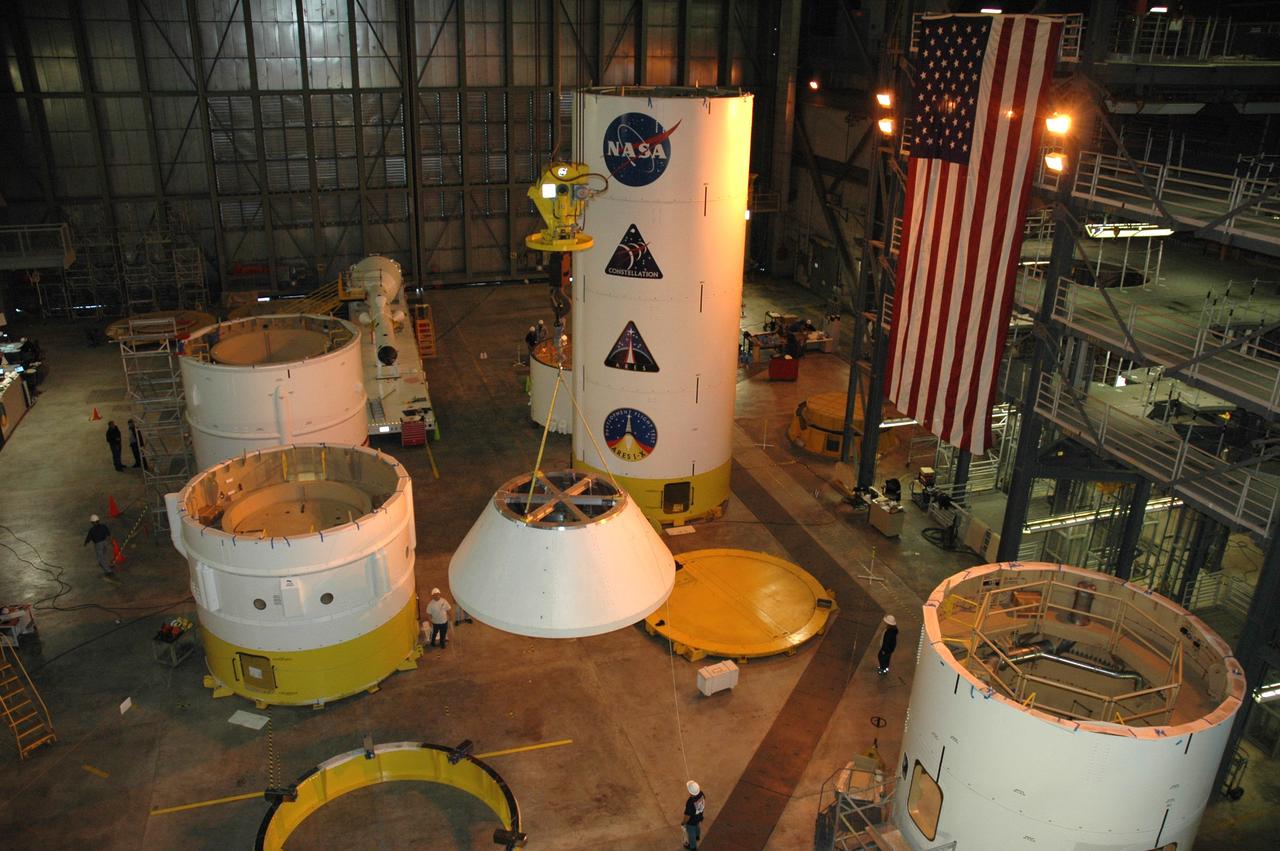
CAPE CANAVERAL, Fla. – In high bay 4 of the Vehicle Assembly Building at NASA's Kennedy Space Center in Florida, a crane moves the Ares I-X crew module simulator toward a stand at right. Other Ares I-X segments are stacked around the floor of the bay. Ares I-X is the test flight for the Ares I. The I-X flight will provide NASA an early opportunity to test and prove hardware, facilities and ground operations associated with Ares I. The launch of the 327-foot-tall, full-scale Ares I-X, targeted for July 2009, will be the first in a series of unpiloted rocket launches from Kennedy. When fully developed, the 16-foot diameter crew module will furnish living space and reentry protection for the astronauts. Photo credit: NASA/Tim Jacobs
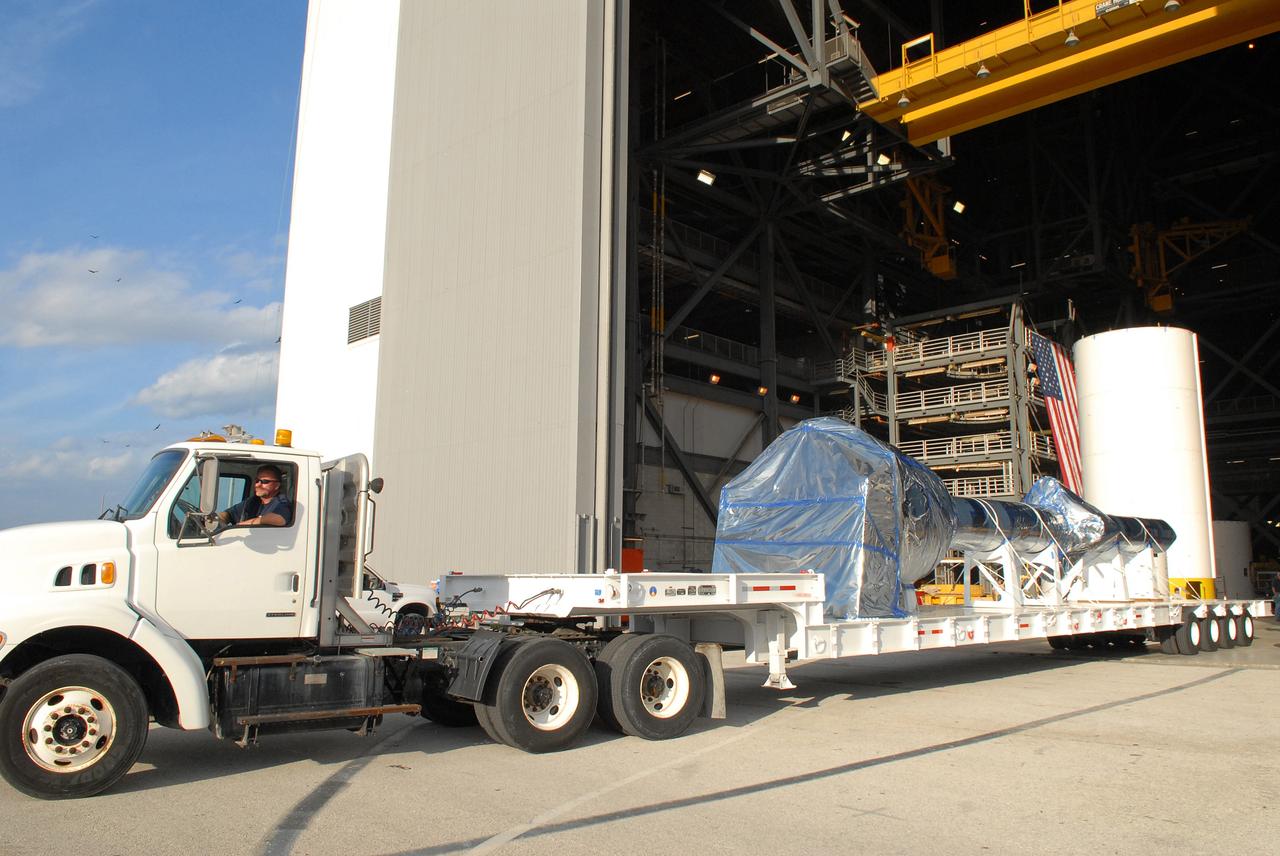
CAPE CANAVERAL, Fla. – The launch abort system for the Ares I-X rocket arrives in the Vehicle Assembly Building's high bay 4 at NASA's Kennedy Space Center in Florida. The launch abort system joins the precisely machined, full-scale simulator crew module, which, together, will form the tip of the Ares I-X. Ares I-X is the test flight for the Ares I. The I-X flight will provide NASA an early opportunity to test and prove hardware, facilities and ground operations associated with Ares I. The launch of the 321-foot-tall, full-scale Ares I-X, targeted for July 2009, will be the first in a series of unpiloted rocket launches from Kennedy. When fully developed, the 16-foot diameter crew module will furnish living space and reentry protection for the astronauts, while their launch abort system will provide safe evacuation if a launch vehicle failure occurs. Photo credit: NASA/Jack Pfaller
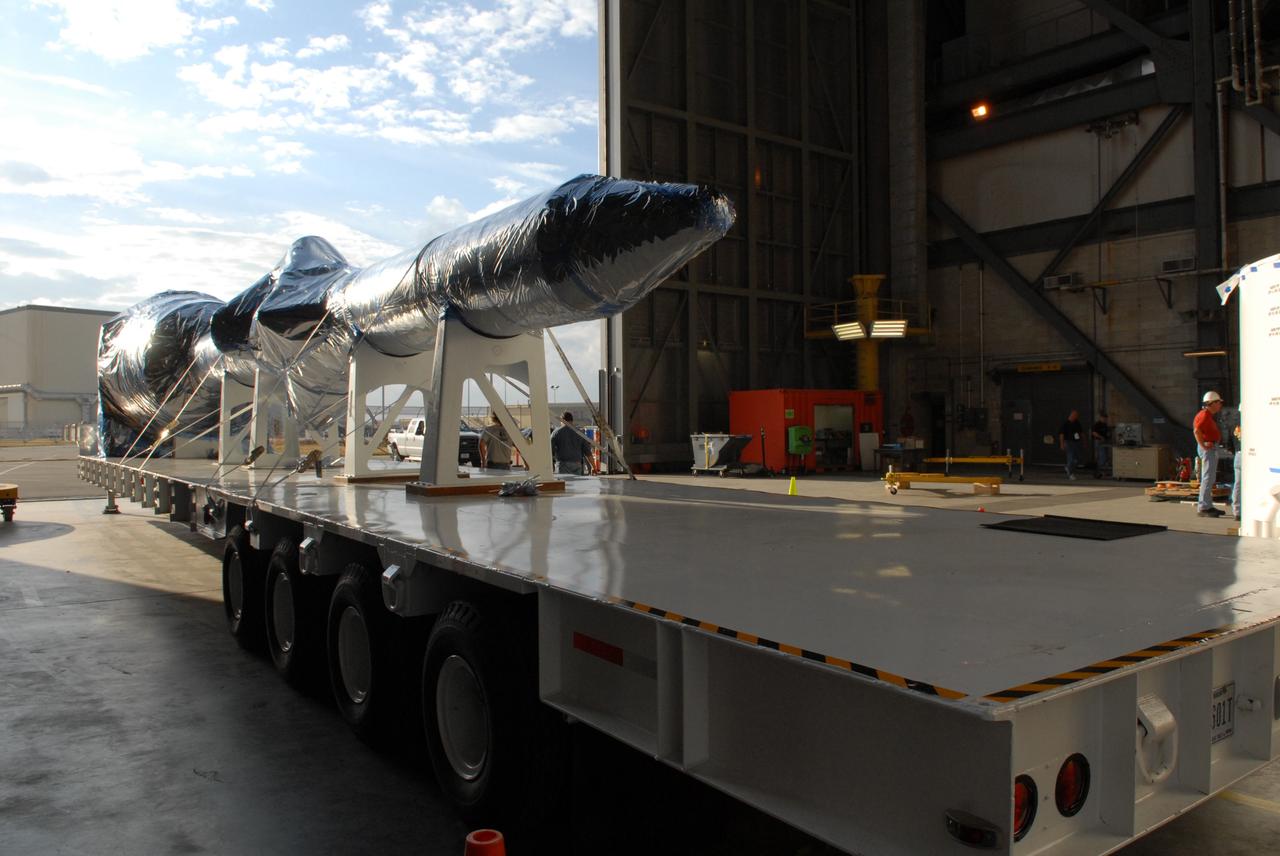
CAPE CANAVERAL, Fla. – The launch abort system for the Ares I-X rocket is moved inside the Vehicle Assembly Building's high bay 4 at NASA's Kennedy Space Center in Florida. The launch abort system joins the precisely machined, full-scale simulator crew module, which, together, will form the tip of the Ares I-X. Ares I-X is the test flight for the Ares I. The I-X flight will provide NASA an early opportunity to test and prove hardware, facilities and ground operations associated with Ares I. The launch of the 321-foot-tall, full-scale Ares I-X, targeted for July 2009, will be the first in a series of unpiloted rocket launches from Kennedy. When fully developed, the 16-foot diameter crew module will furnish living space and reentry protection for the astronauts, while their launch abort system will provide safe evacuation if a launch vehicle failure occurs. Photo credit: NASA/Jack Pfaller
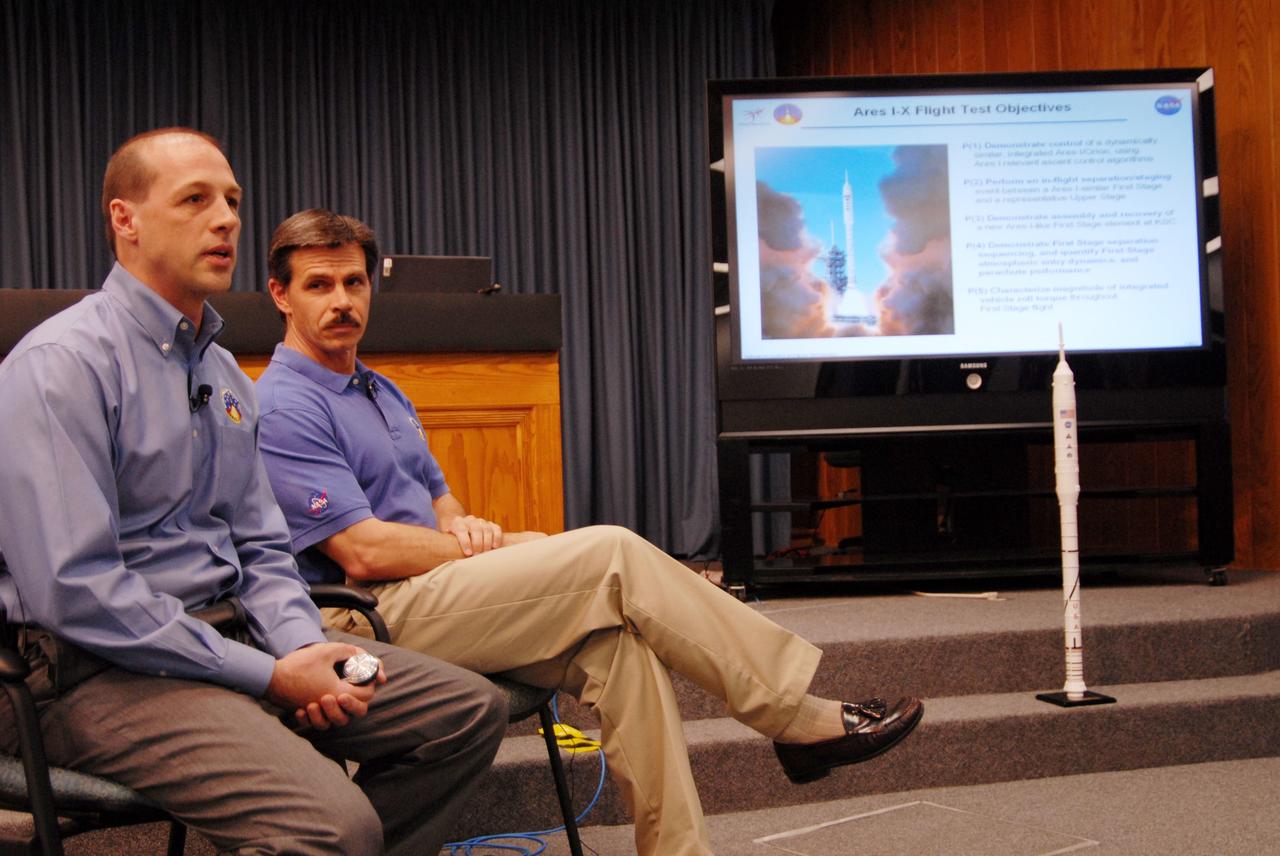
CAPE CANAVERAL, Fla. – Media were invited to a showing of the Ares I-X simulator rocket segments at NASA's Kennedy Space Center in Florida. Here, Bob Ess and Jon Cowart discuss the flight test objectives of the Ares I-X targeted for launch in July 2009. Ess is manager of the Ares I-X project. Cowart is Ares I-X deputy mission manager. The I-X flight will provide NASA an early opportunity to test and prove hardware, facilities and ground operations associated with Ares I, part of the Constellation Program to return men to the moon and beyond. Ares I is the essential core of a safe, reliable, cost-effective space transportation system that eventually will carry crewed missions back to the moon, on to Mars and out into the solar system. Photo credit: NASA/Jack Pfaller
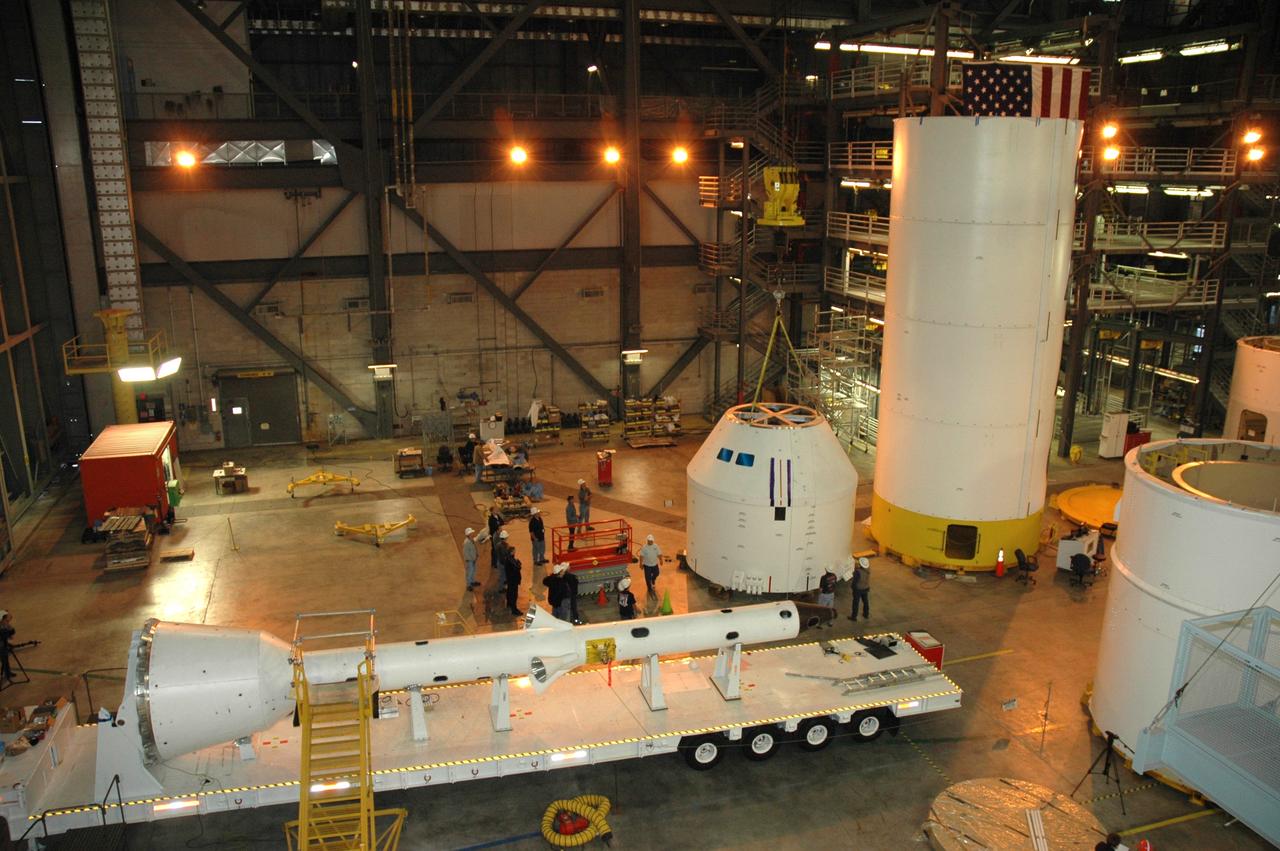
CAPE CANAVERAL, Fla. – In high bay 4 of the Vehicle Assembly Building at NASA's Kennedy Space Center in Florida, the Ares I-X crew/service module simulator (center right) is being moved following a fit check. Next to it are Ares I-X segments stacked. In the foreground is a launch abort system that, with the module, will form the tip of the rocket. Ares I-X is the test flight for the Ares I. The I-X flight will provide NASA an early opportunity to test and prove hardware, facilities and ground operations associated with Ares I. The launch of the 327-foot-tall, full-scale Ares I-X, targeted for July 2009, will be the first in a series of unpiloted rocket launches from Kennedy. When fully developed, the 16-foot diameter crew module will furnish living space and reentry protection for the astronauts. Photo credit: NASA/Tim Jacobs
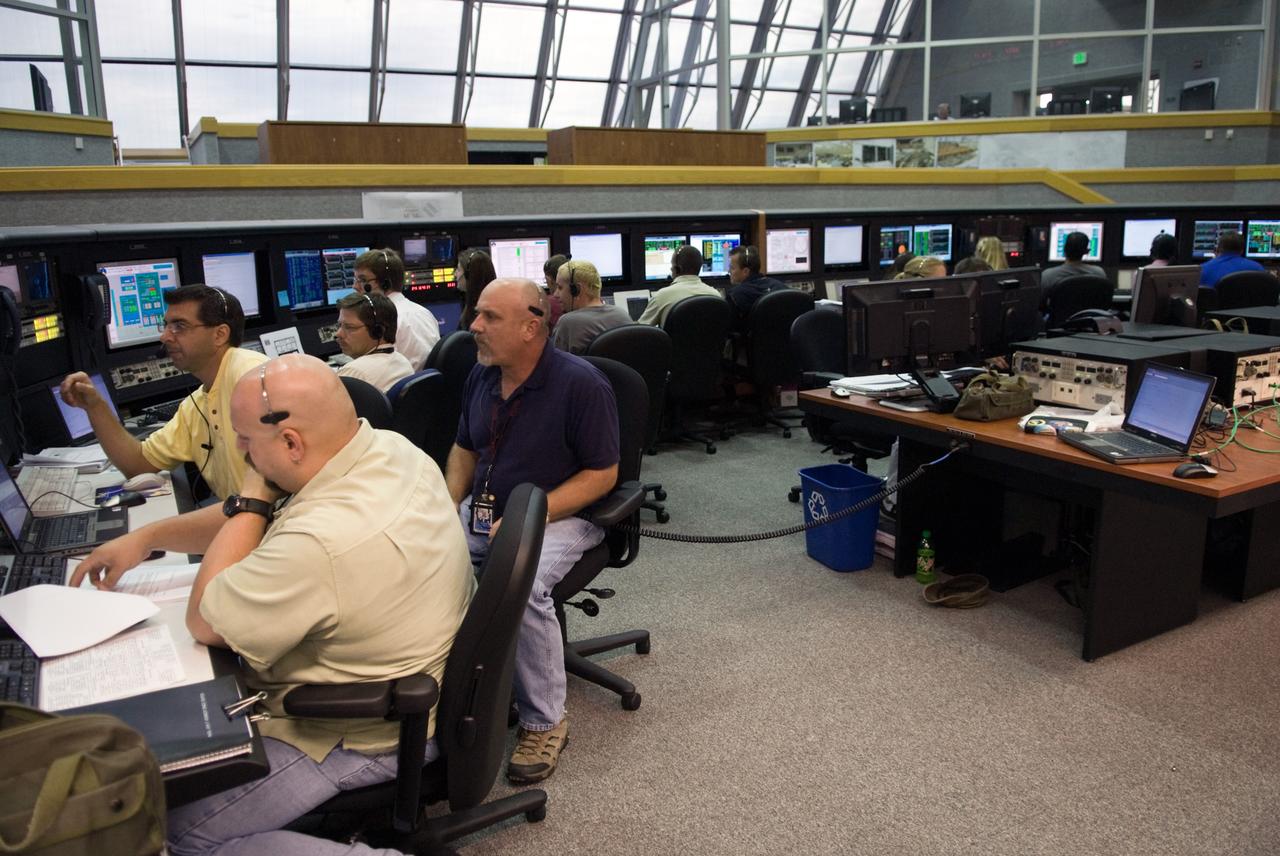
CAPE CANAVERAL, Fla. – In Firing Room 1 at NASA's Kennedy Space Center in Florida, mission engineers take part in a countdown simulation for the upcoming Ares I-X flight test. Ares I-X is targeted for the test on Oct. 31. Photo credit: NASA/Kim Shiflett
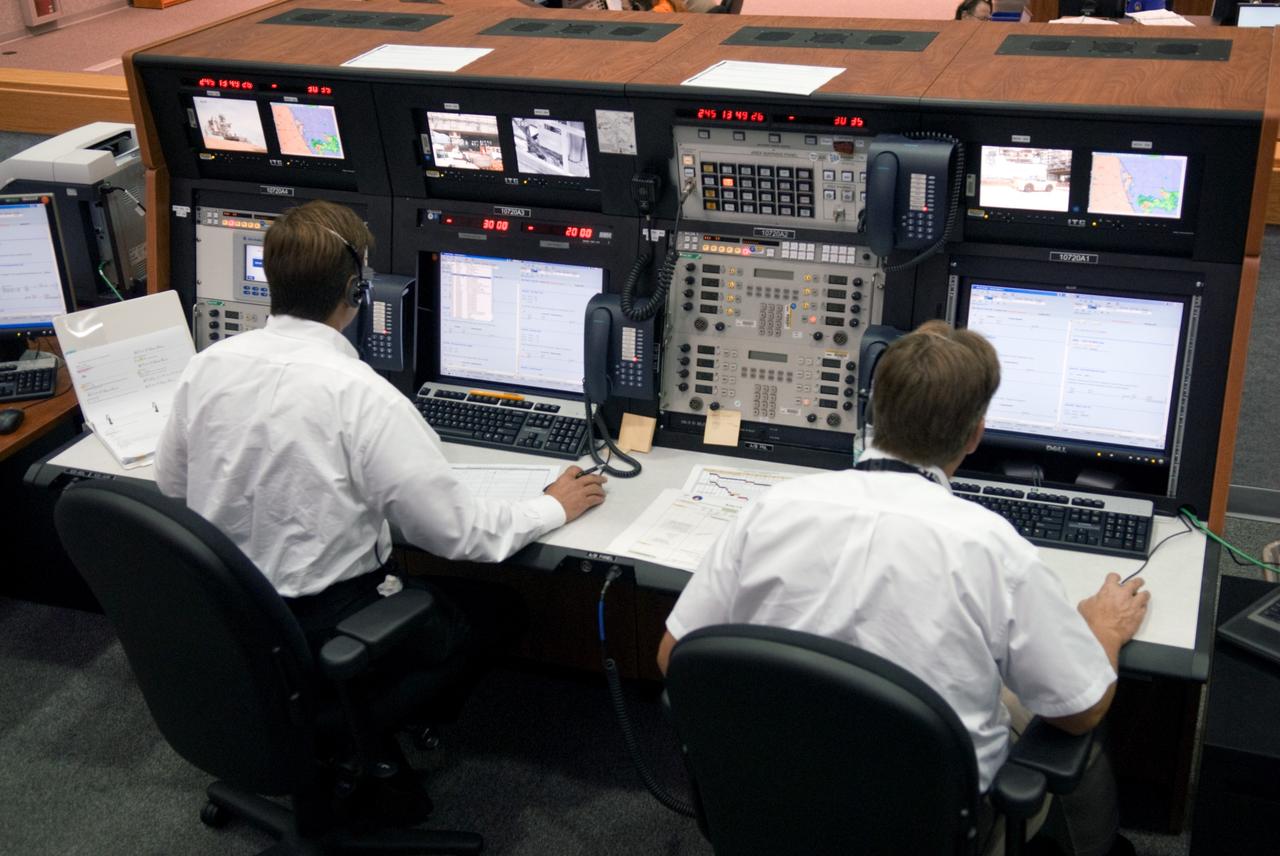
CAPE CANAVERAL, Fla. – In Firing Room 1 at NASA's Kennedy Space Center in Florida, Bob Holl and Jeff Spaulding take part in a countdown simulation for the upcoming Ares I-X flight test. Ares I-X is targeted for the test on Oct. 31. Photo credit: NASA/Kim Shiflett
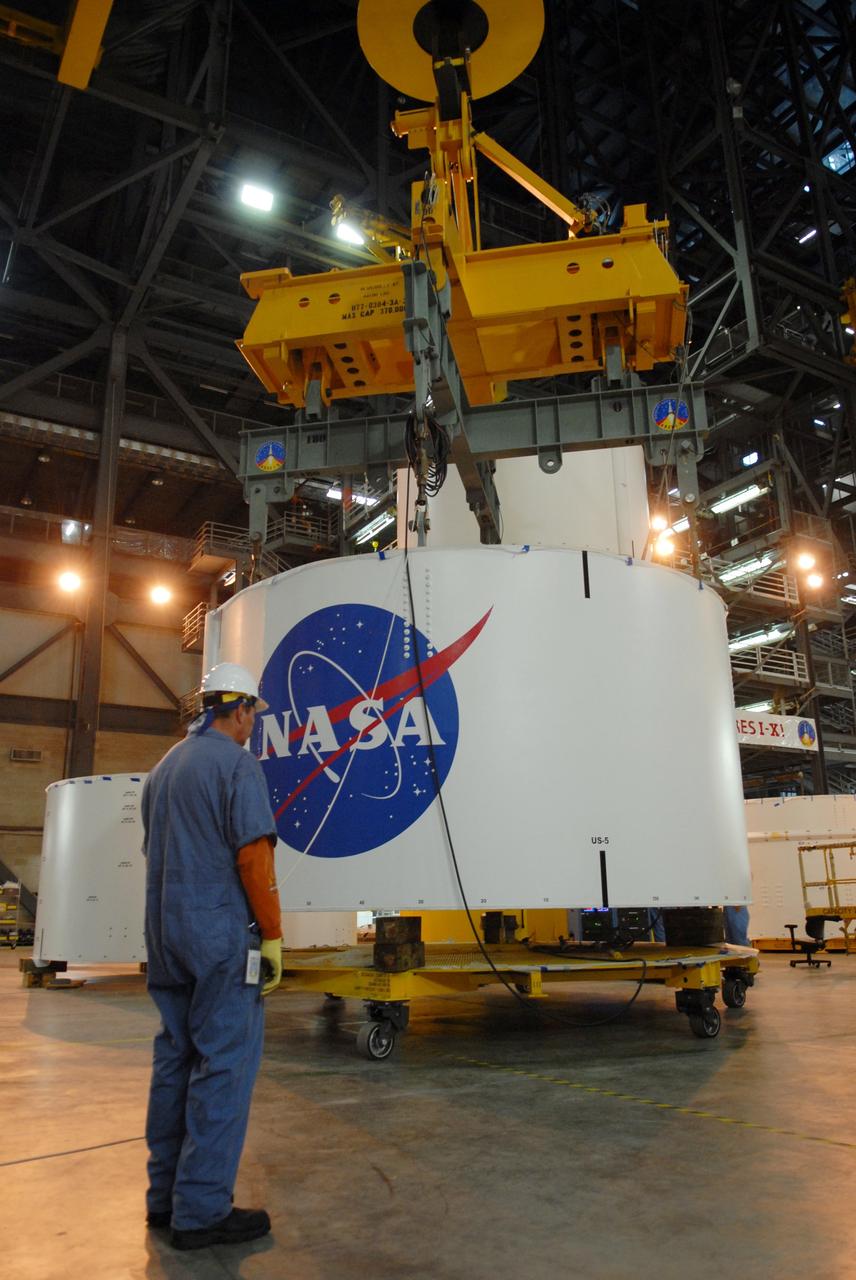
CAPE CANAVERAL, Fla. -- In high bay 4 of the Vehicle Assembly Building at NASA's Kennedy Space Center in Florida, a crane lifts segment 5 of the Ares I-X upper stage simulator segments. It will be placed on segment 4, at top of the tall stack behind it.The upper stage simulator comprises 11 segments, each approximately 18 feet in diameter, that will be used in the test flight known as Ares I-X in 2009. The simulator segments will simulate the mass and the outer mold line. The upper stage accounts for nearly one-quarter of the total height of the Ares I. It will take the Ares I on the second phase of its journey from Earth, providing the guidance, navigation and control needed for the second phase of the Ares I ascent flight. Photo credit: NASA/Troy Cryder
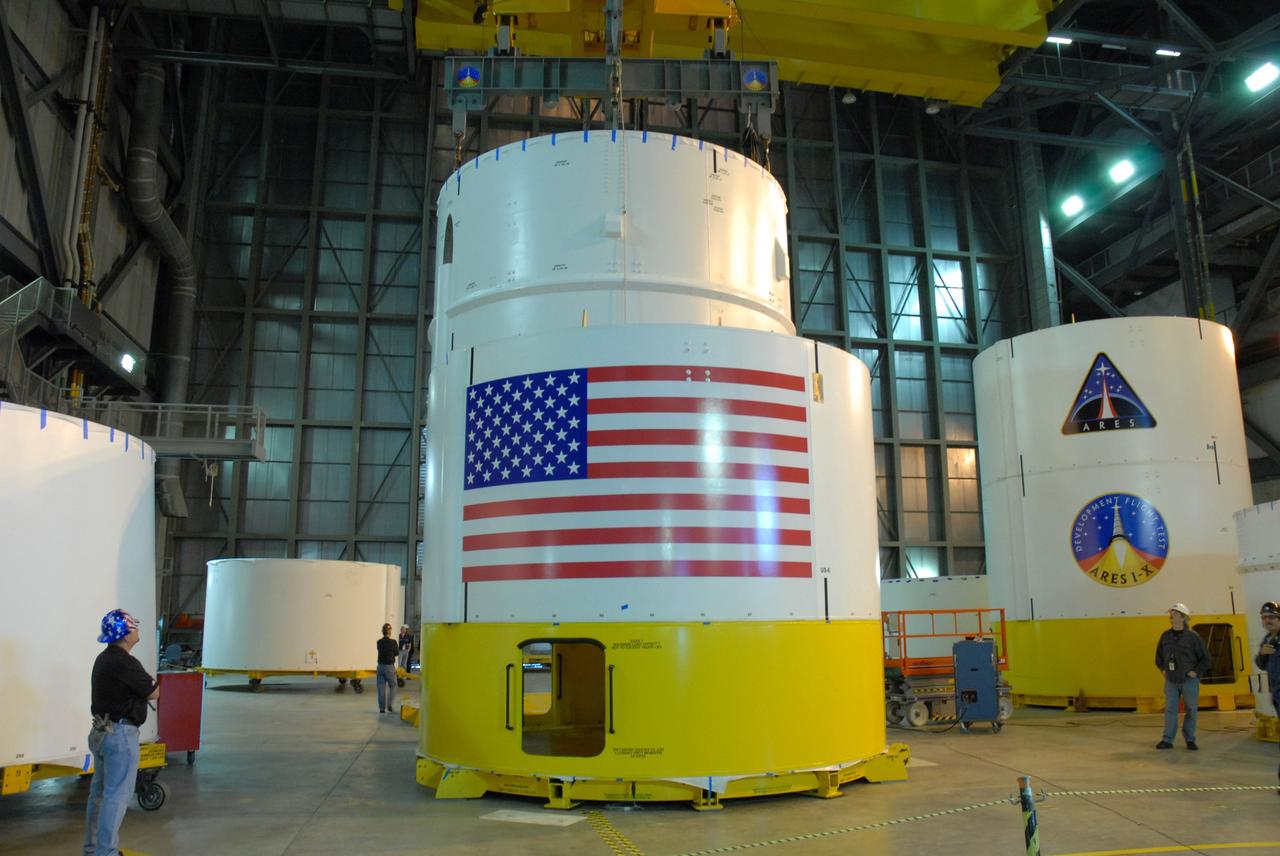
CAPE CANAVERAL, Fla. -- In high bay 4 of the Vehicle Assembly Building at NASA's Kennedy Space Center in Florida, a crane moves the Ares I-X upper stage simulator segment 7 toward segment 6 (in front, with U.S. flag decal). The upper stage simulator comprises 11 segments, each approximately 18 feet in diameter, that will be used in the test flight identified as Ares I-X in 2009. The simulator segments will simulate the mass and the outer mold line. The upper stage accounts for nearly one-quarter of the total height of the Ares I. It will take the Ares I on the second phase of its journey from Earth, providing the guidance, navigation and control needed for the second phase of the Ares I ascent flight. Photo credit: NASA/Kim Shiflett
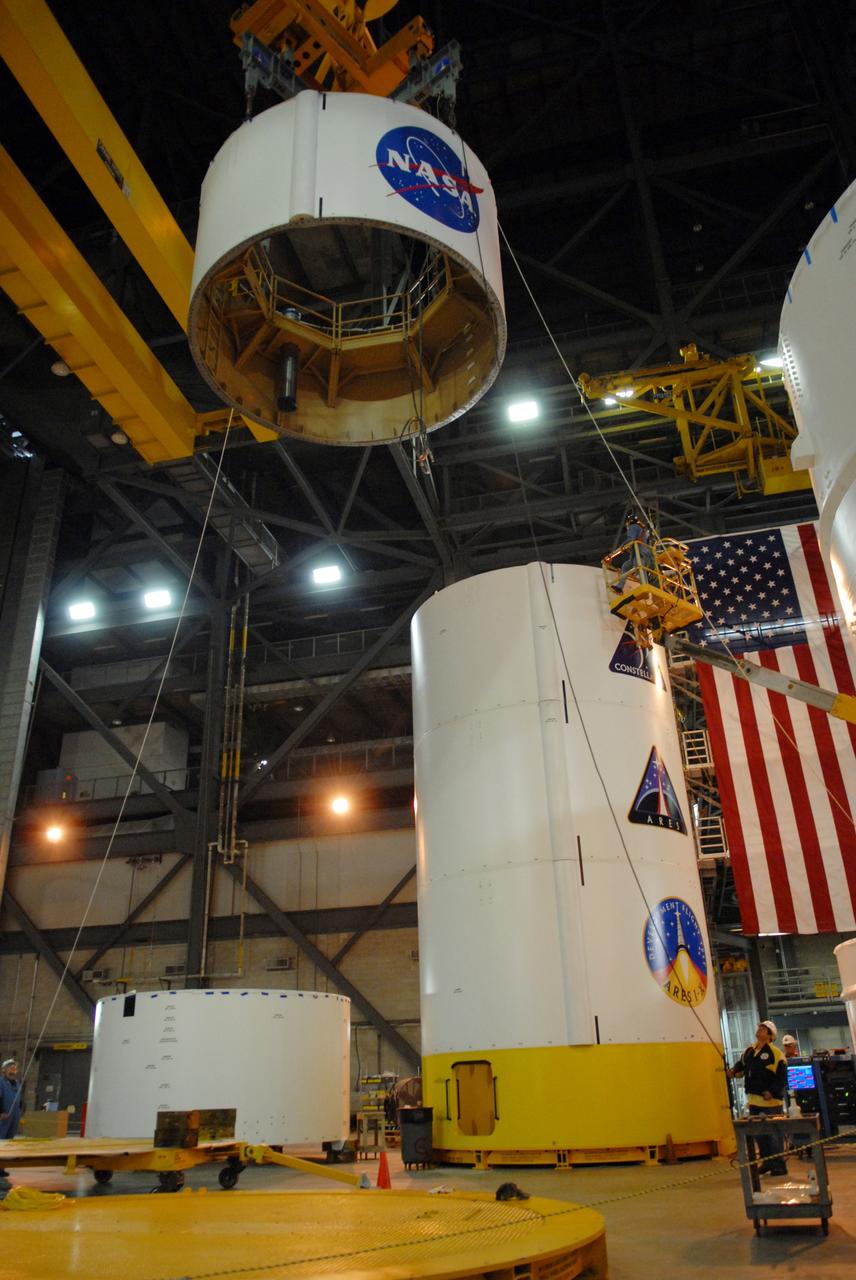
CAPE CANAVERAL, Fla. -- In high bay 4 of the Vehicle Assembly Building at NASA's Kennedy Space Center in Florida, a crane moves segment 5 of the Ares I-X upper stage simulator segments toward the tall stack behind it. Segment 5 will be placed on segment 4, at top of the tall stack. The upper stage simulator comprises 11 segments, each approximately 18 feet in diameter, that will be used in the test flight known as Ares I-X in 2009. The simulator segments will simulate the mass and the outer mold line. The upper stage accounts for nearly one-quarter of the total height of the Ares I. It will take the Ares I on the second phase of its journey from Earth, providing the guidance, navigation and control needed for the second phase of the Ares I ascent flight. Photo credit: NASA/Troy Cryder
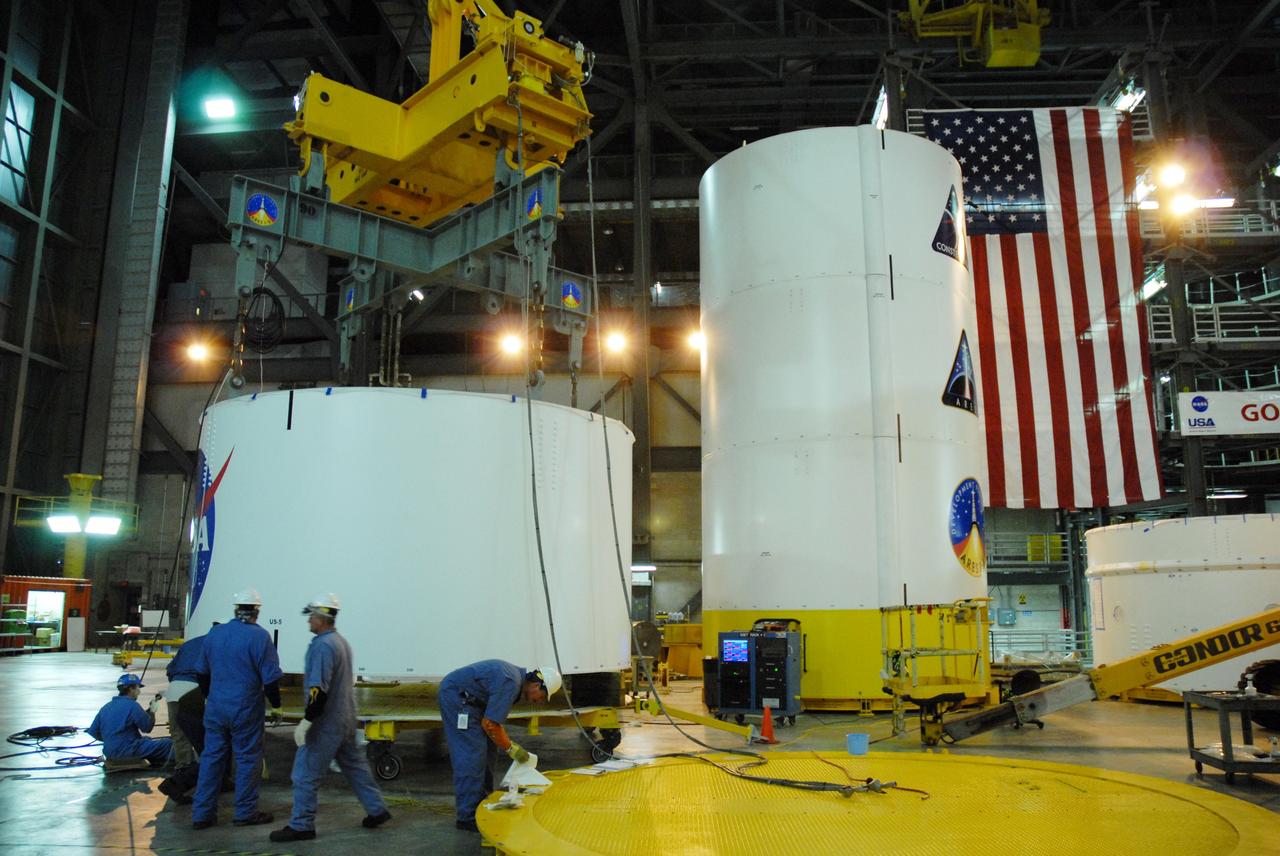
CAPE CANAVERAL, Fla. -- In high bay 4 of the Vehicle Assembly Building at NASA's Kennedy Space Center in Florida, a crane is attached to segment 5 of the Ares I-X upper stage simulator segments to lift it. Segment 5 will be stacked on to segment 4, at the top of the tall stack at right. The upper stage simulator comprises 11 segments, each approximately 18 feet in diameter, that will be used in the test flight known as Ares I-X in 2009. The simulator segments will simulate the mass and the outer mold line. The upper stage accounts for nearly one-quarter of the total height of the Ares I. It will take the Ares I on the second phase of its journey from Earth, providing the guidance, navigation and control needed for the second phase of the Ares I ascent flight. Photo credit: NASA/Jim Grossmann
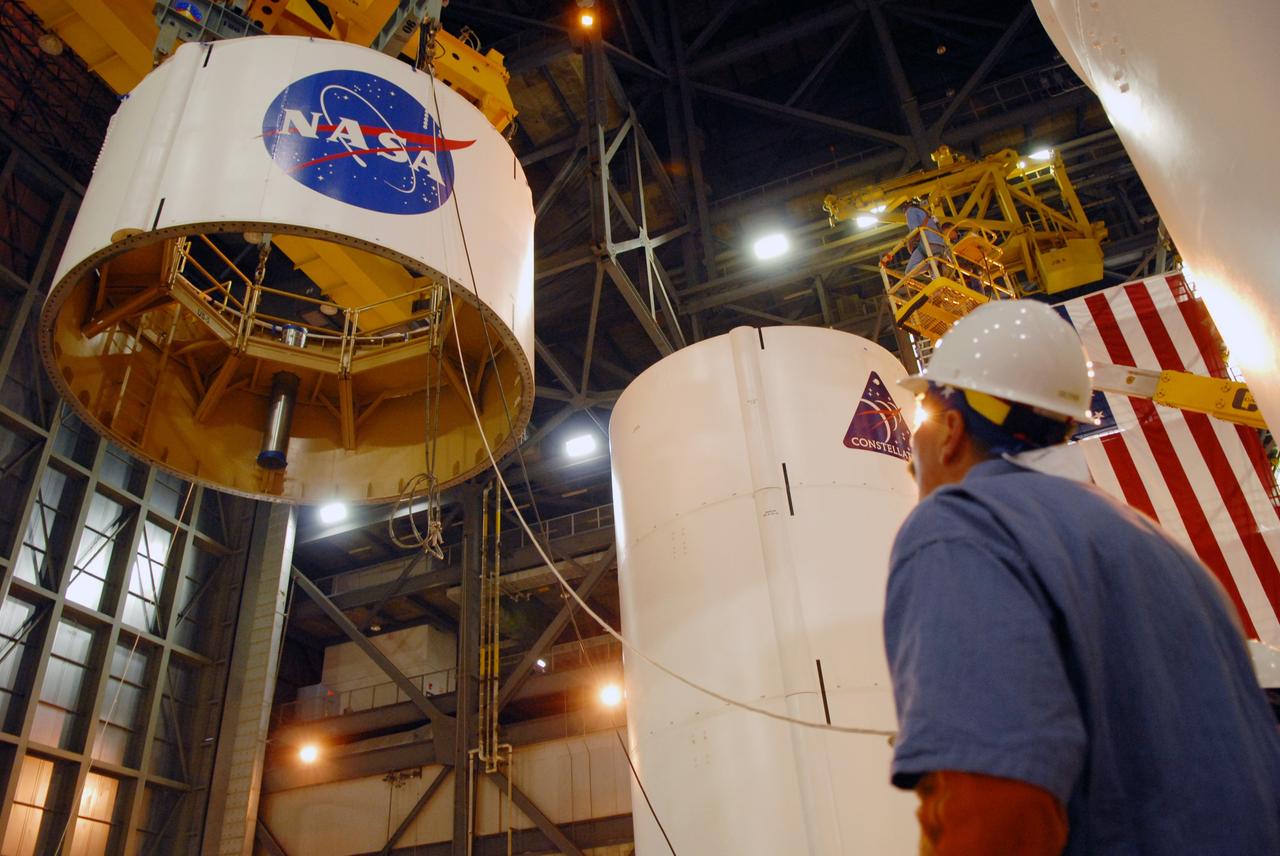
CAPE CANAVERAL, Fla. -- In high bay 4 of the Vehicle Assembly Building at NASA's Kennedy Space Center in Florida, a crane lifts segment 5 of the Ares I-X upper stage simulator segments toward the tall stack behind it. Segment 5 will be placed on segment 4, at top of the tall stack. The upper stage simulator comprises 11 segments, each approximately 18 feet in diameter, that will be used in the test flight known as Ares I-X in 2009. The simulator segments will simulate the mass and the outer mold line. The upper stage accounts for nearly one-quarter of the total height of the Ares I. It will take the Ares I on the second phase of its journey from Earth, providing the guidance, navigation and control needed for the second phase of the Ares I ascent flight. Photo credit: NASA/Troy Cryder
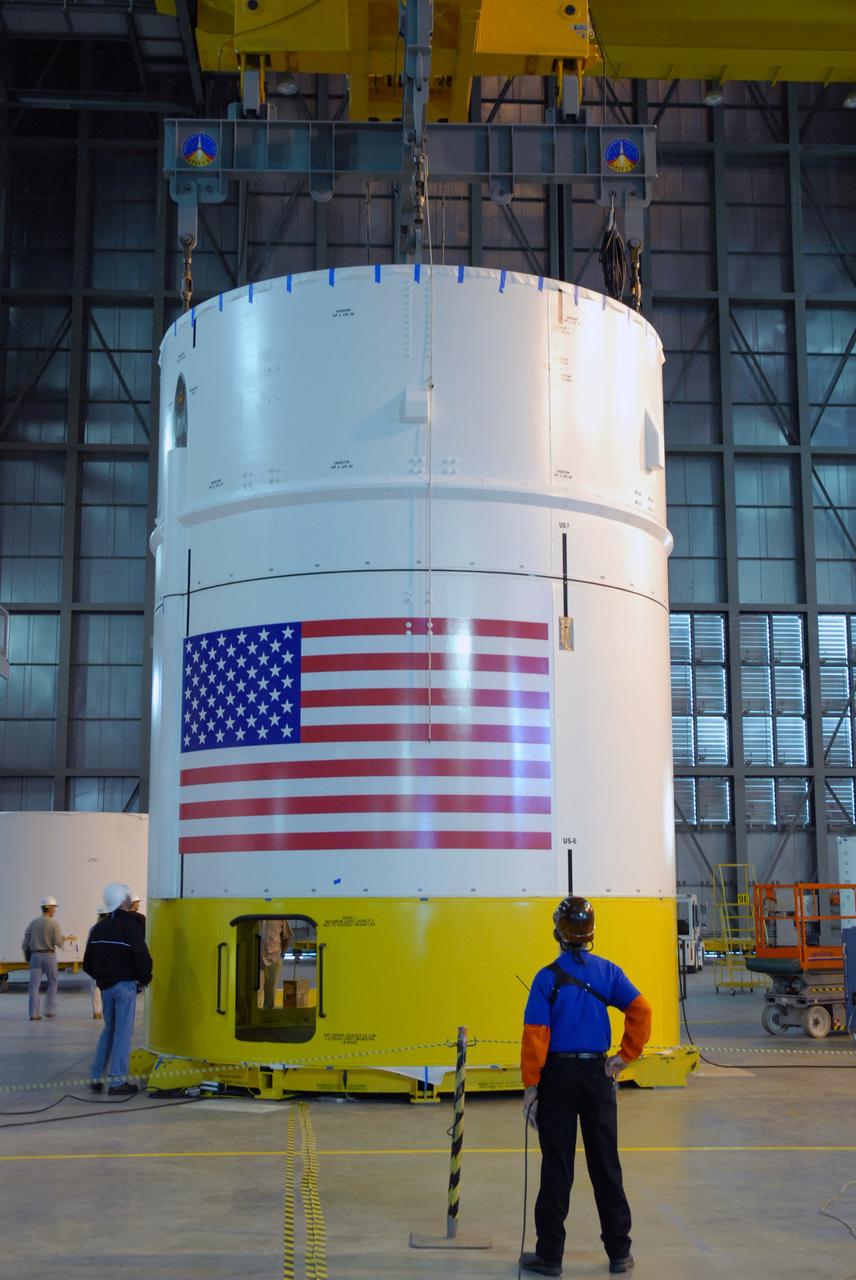
CAPE CANAVERAL, Fla. -- In high bay 4 of the Vehicle Assembly Building at NASA's Kennedy Space Center in Florida, a crane lowers the Ares I-X upper stage simulator segment 7 onto segment 6. The upper stage simulator comprises 11 segments, each approximately 18 feet in diameter, that will be used in the test flight identified as Ares I-X in 2009. The simulator segments will simulate the mass and the outer mold line. The upper stage accounts for nearly one-quarter of the total height of the Ares I. It will take the Ares I on the second phase of its journey from Earth, providing the guidance, navigation and control needed for the second phase of the Ares I ascent flight. Photo credit: NASA/Kim Shiflett
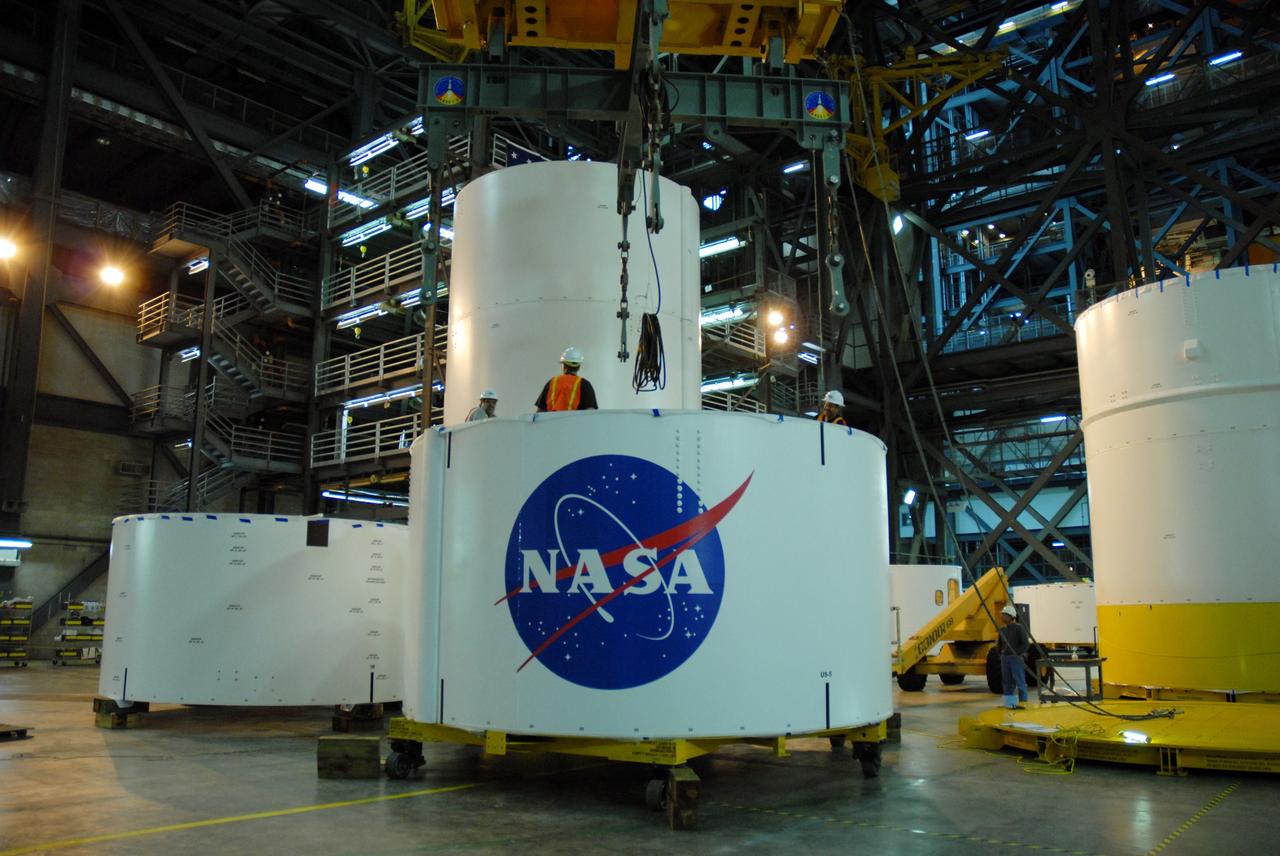
CAPE CANAVERAL, Fla. -- In high bay 4 of the Vehicle Assembly Building at NASA's Kennedy Space Center in Florida, work is under way to stack the Ares I-X upper stage simulator segment 5 to segment 4. The upper stage simulator comprises 11 segments, each approximately 18 feet in diameter, that will be used in the test flight known as Ares I-X in 2009. The simulator segments will simulate the mass and the outer mold line. The upper stage accounts for nearly one-quarter of the total height of the Ares I. It will take the Ares I on the second phase of its journey from Earth, providing the guidance, navigation and control needed for the second phase of the Ares I ascent flight. Photo credit: NASA/Jim Grossmann
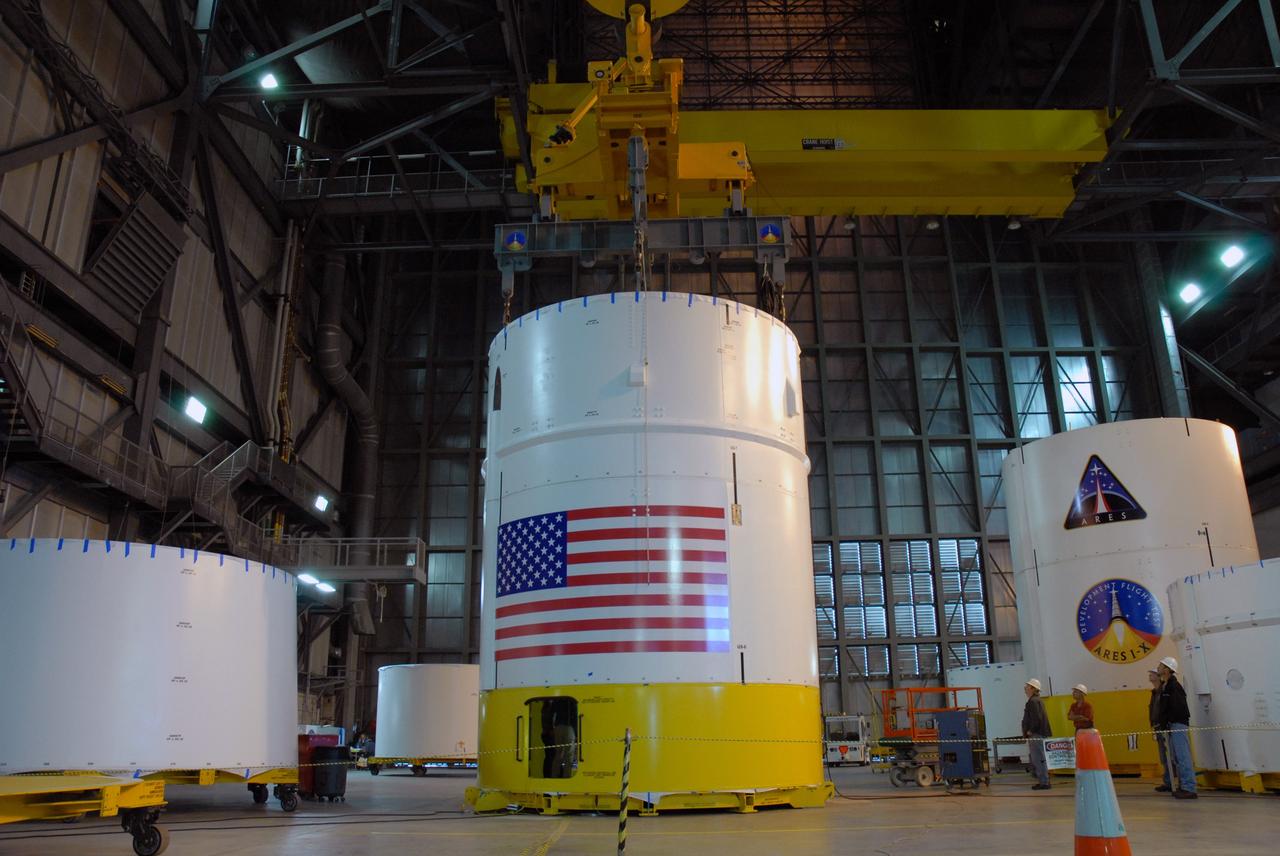
CAPE CANAVERAL, Fla. -- In high bay 4 of the Vehicle Assembly Building at NASA's Kennedy Space Center in Florida, the Ares I-X upper stage simulator segment 7 is stacked onto segment 6. The upper stage simulator comprises 11 segments, each approximately 18 feet in diameter, that will be used in the test flight identified as Ares I-X in 2009. The simulator segments will simulate the mass and the outer mold line. The upper stage accounts for nearly one-quarter of the total height of the Ares I. It will take the Ares I on the second phase of its journey from Earth, providing the guidance, navigation and control needed for the second phase of the Ares I ascent flight. Photo credit: NASA/Kim Shiflett
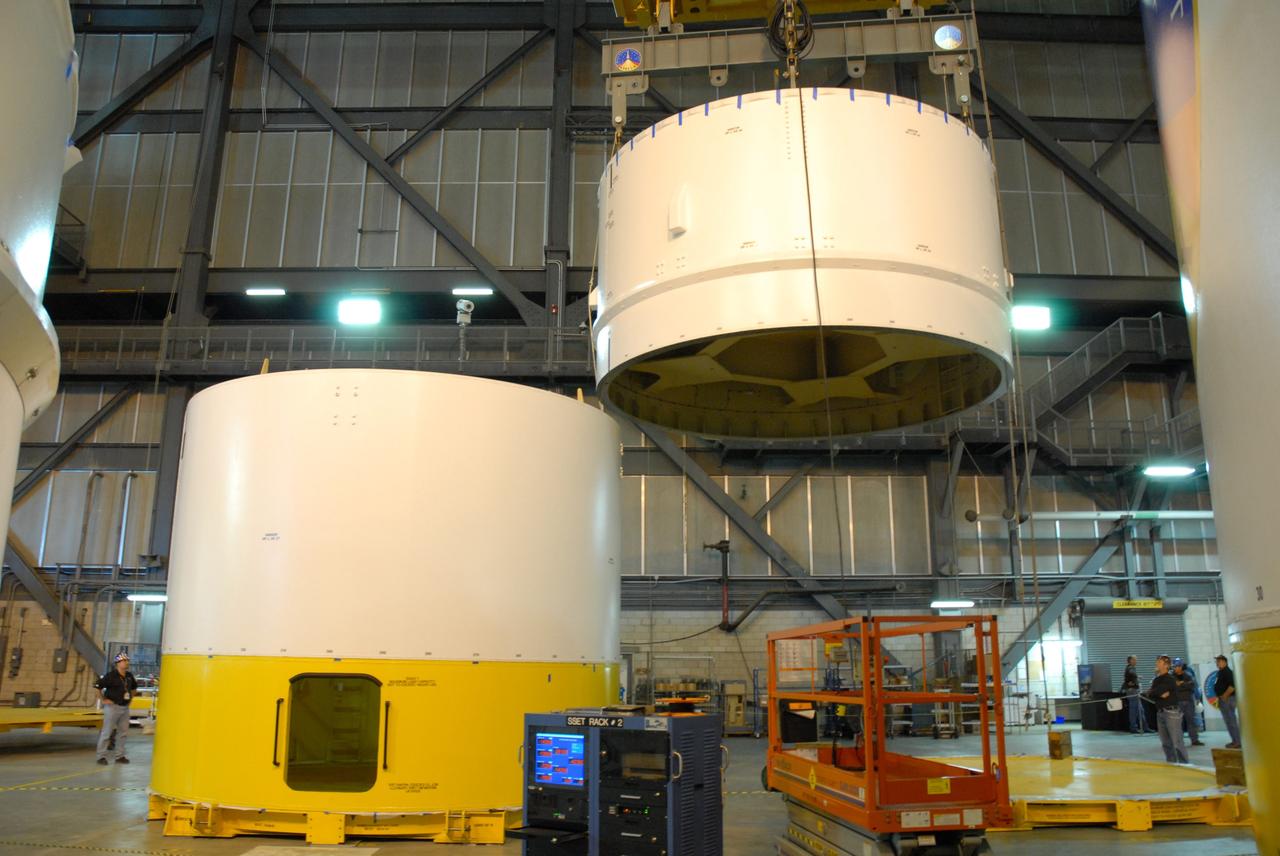
CAPE CANAVERAL, Fla. -- In high bay 4 of the Vehicle Assembly Building at NASA's Kennedy Space Center in Florida, a crane lifts the Ares I-X upper stage simulator segment 7. The segment will be stacked onto segment 6. The upper stage simulator comprises 11 segments, each approximately 18 feet in diameter, that will be used in the test flight identified as Ares I-X in 2009. The simulator segments will simulate the mass and the outer mold line. The upper stage accounts for nearly one-quarter of the total height of the Ares I. It will take the Ares I on the second phase of its journey from Earth, providing the guidance, navigation and control needed for the second phase of the Ares I ascent flight. Photo credit: NASA/Kim Shiflett
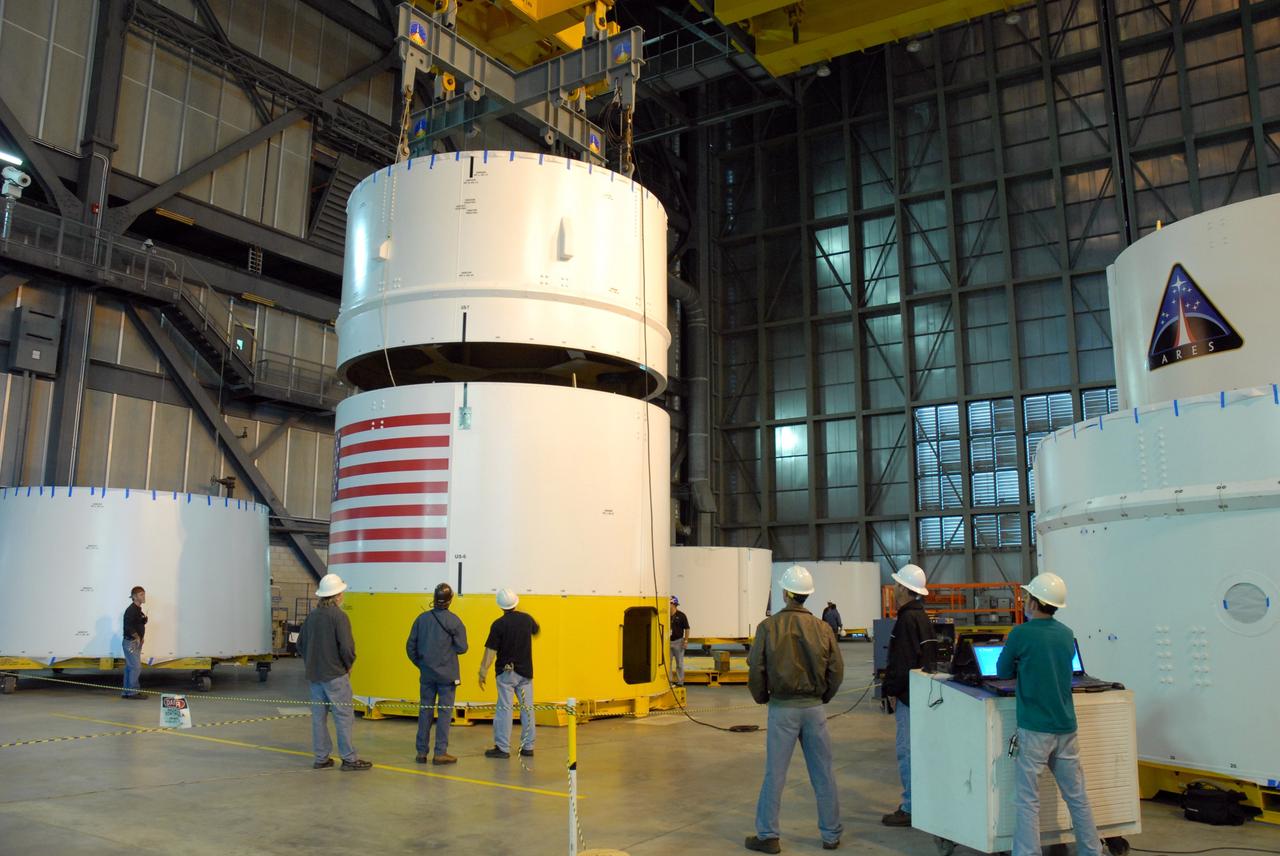
CAPE CANAVERAL, Fla. -- In high bay 4 of the Vehicle Assembly Building at NASA's Kennedy Space Center in Florida, a crane lowers the Ares I-X upper stage simulator segment 7 toward segment 6. The upper stage simulator comprises 11 segments, each approximately 18 feet in diameter, that will be used in the test flight identified as Ares I-X in 2009. The simulator segments will simulate the mass and the outer mold line. The upper stage accounts for nearly one-quarter of the total height of the Ares I. It will take the Ares I on the second phase of its journey from Earth, providing the guidance, navigation and control needed for the second phase of the Ares I ascent flight. Photo credit: NASA/Kim Shiflett
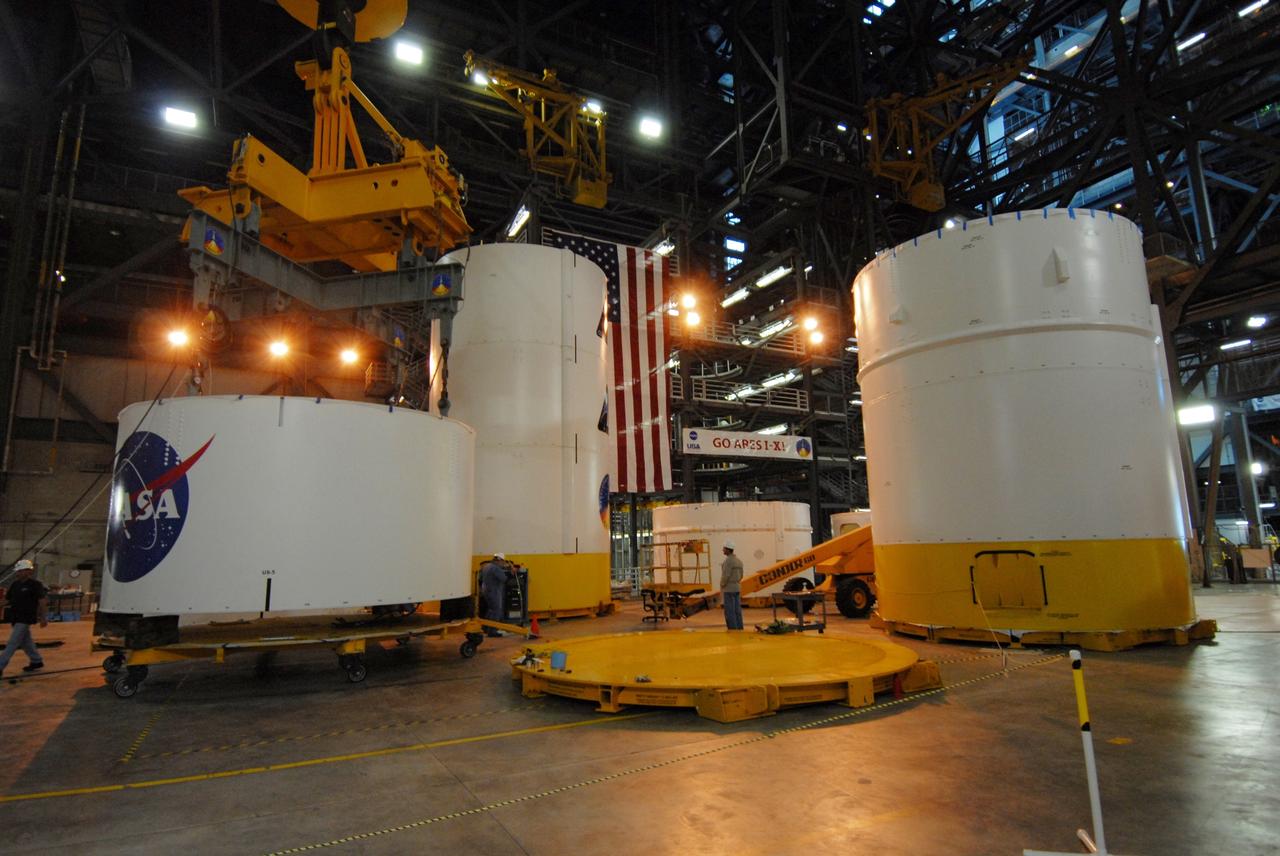
CAPE CANAVERAL, Fla. -- In high bay 4 of the Vehicle Assembly Building at NASA's Kennedy Space Center in Florida, a crane lifts segment 5 of the Ares I-X upper stage simulator segments. It will be placed on segment 4, at top of the tall stack behind it. The upper stage simulator comprises 11 segments, each approximately 18 feet in diameter, that will be used in the test flight known as Ares I-X in 2009. The simulator segments will simulate the mass and the outer mold line. The upper stage accounts for nearly one-quarter of the total height of the Ares I. It will take the Ares I on the second phase of its journey from Earth, providing the guidance, navigation and control needed for the second phase of the Ares I ascent flight. Photo credit: NASA/Troy Cryder
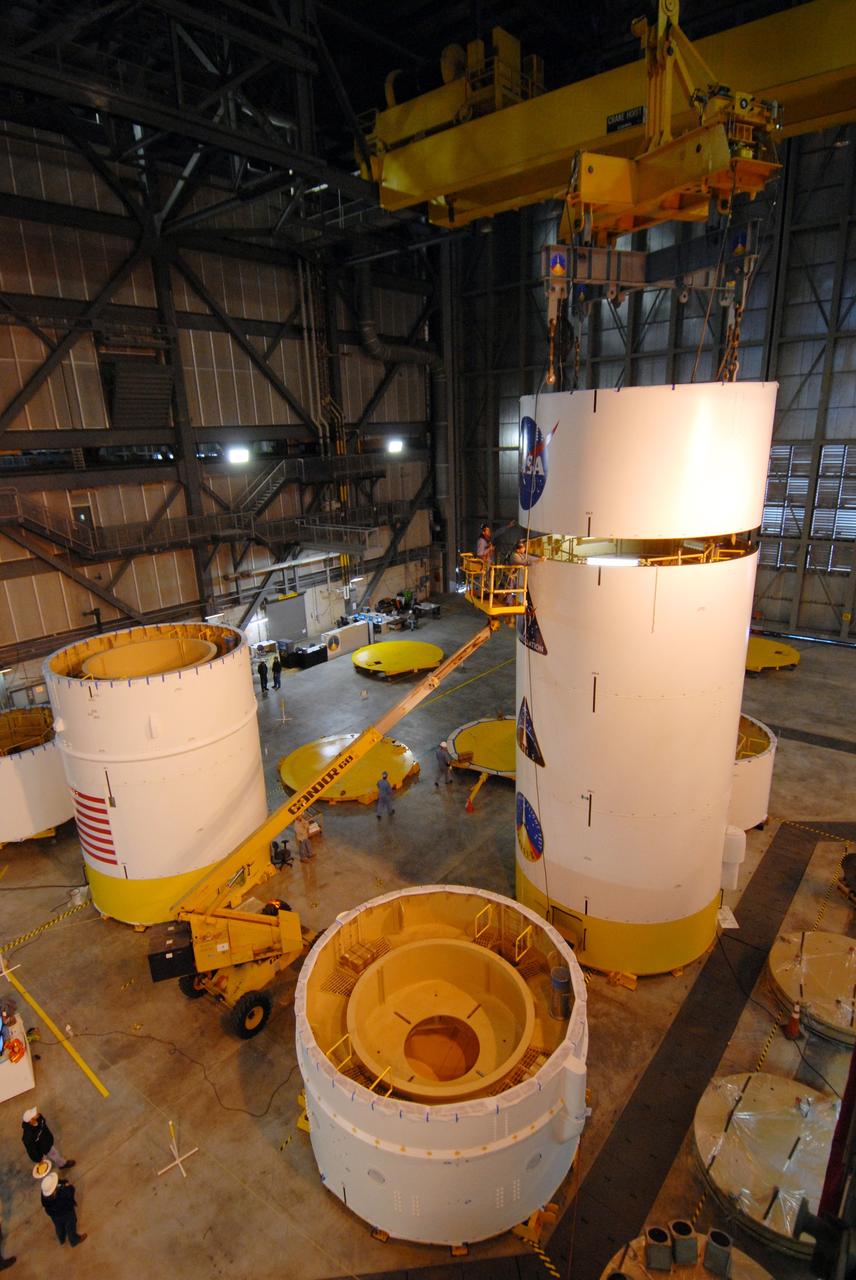
CAPE CANAVERAL, Fla. -- In high bay 4 of the Vehicle Assembly Building at NASA's Kennedy Space Center in Florida, a crane lowers segment 5 of the Ares I-X upper stage simulator segments onto segment 4, at top of the tall stack below. The upper stage simulator comprises 11 segments, each approximately 18 feet in diameter, that will be used in the test flight known as Ares I-X in 2009. The simulator segments will simulate the mass and the outer mold line. The upper stage accounts for nearly one-quarter of the total height of the Ares I. It will take the Ares I on the second phase of its journey from Earth, providing the guidance, navigation and control needed for the second phase of the Ares I ascent flight. Photo credit: NASA/Troy Cryder

CAPE CANAVERAL, Fla. -- In high bay 4 of the Vehicle Assembly Building at NASA's Kennedy Space Center in Florida, a crane is ready to lift the Ares I-X upper stage simulator segment 7. The segment will be stacked onto segment 6. The upper stage simulator comprises 11 segments, each approximately 18 feet in diameter, that will be used in the test flight identified as Ares I-X in 2009. The simulator segments will simulate the mass and the outer mold line. The upper stage accounts for nearly one-quarter of the total height of the Ares I. It will take the Ares I on the second phase of its journey from Earth, providing the guidance, navigation and control needed for the second phase of the Ares I ascent flight. Photo credit: NASA/Kim Shiflett
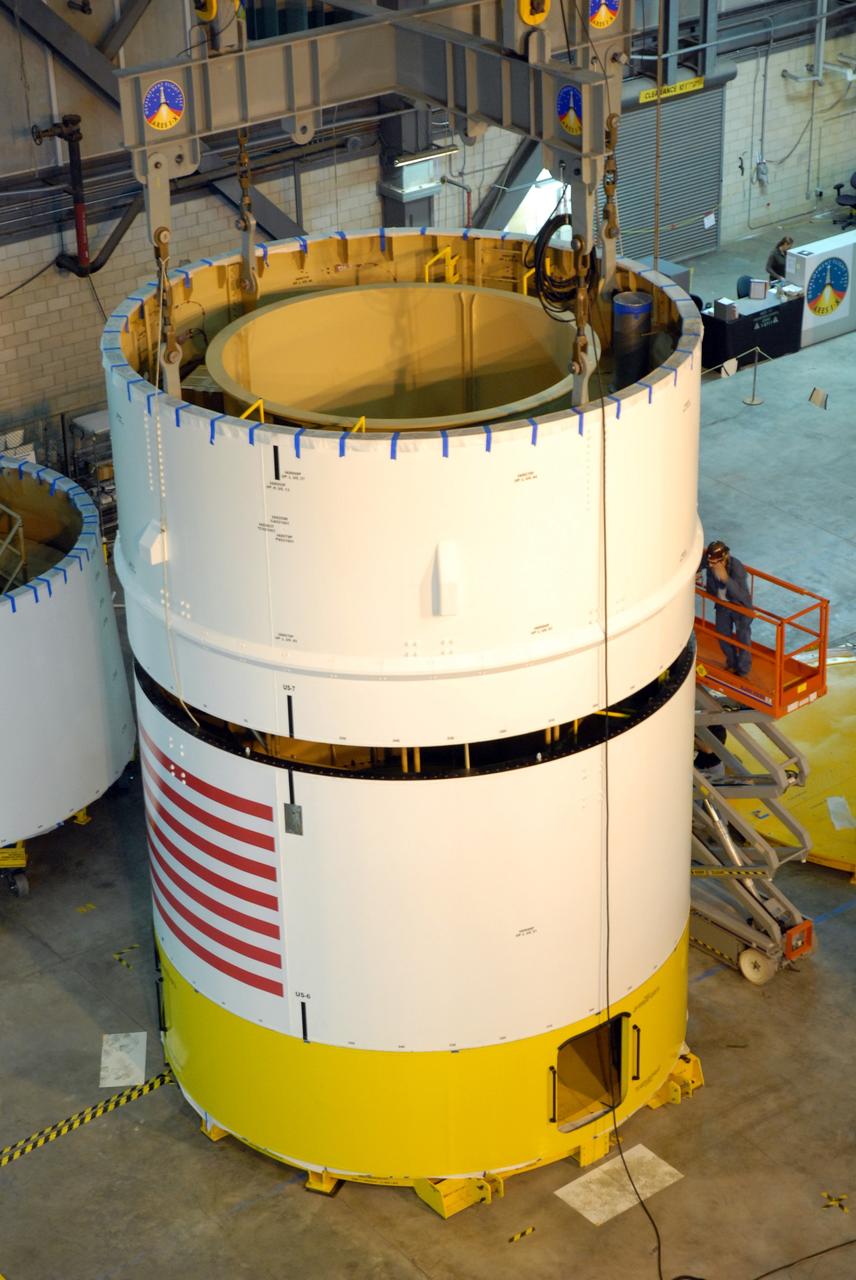
CAPE CANAVERAL, Fla. -- In high bay 4 of the Vehicle Assembly Building at NASA's Kennedy Space Center in Florida, a crane lowers the Ares I-X upper stage simulator segment 7 onto segment 6. The upper stage simulator comprises 11 segments, each approximately 18 feet in diameter, that will be used in the test flight identified as Ares I-X in 2009. The simulator segments will simulate the mass and the outer mold line. The upper stage accounts for nearly one-quarter of the total height of the Ares I. It will take the Ares I on the second phase of its journey from Earth, providing the guidance, navigation and control needed for the second phase of the Ares I ascent flight. Photo credit: NASA/Kim Shiflett
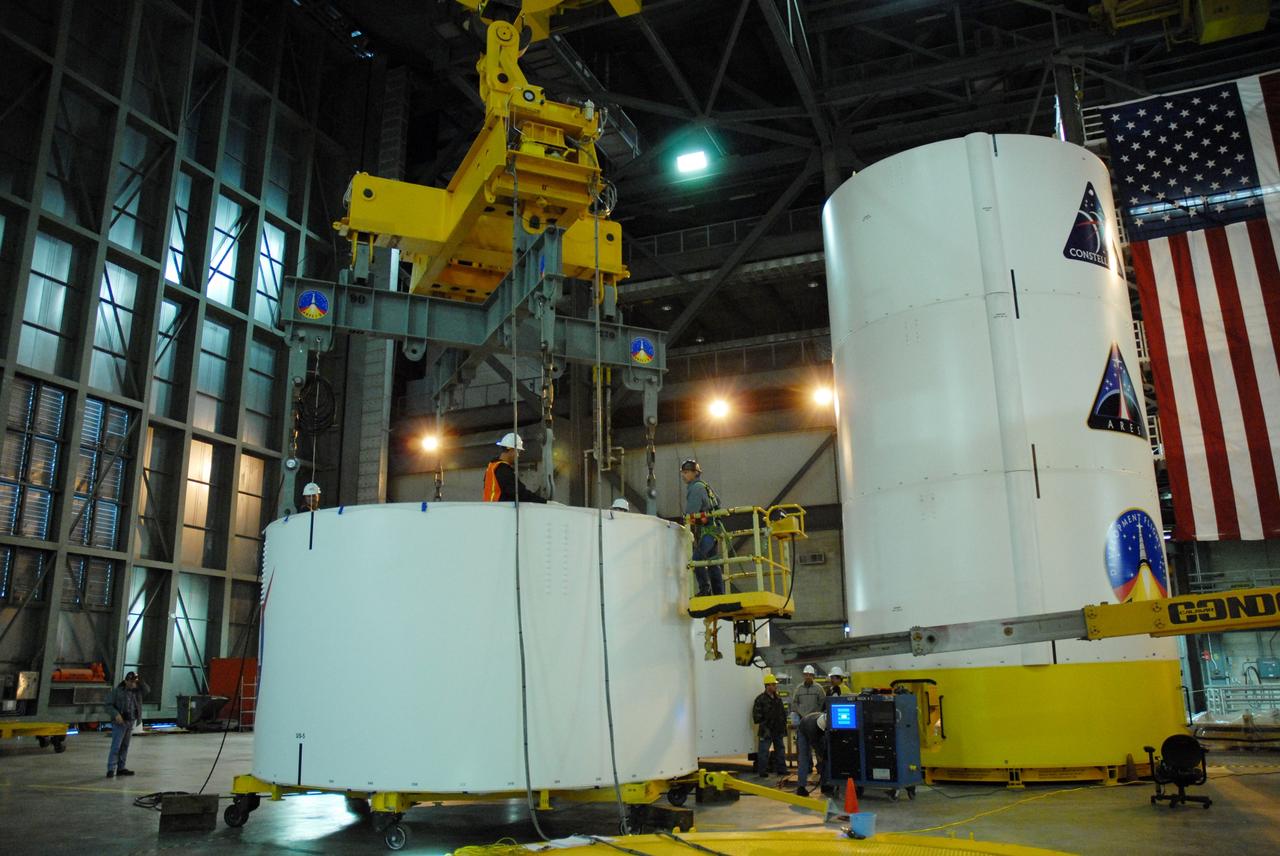
CAPE CANAVERAL, Fla. -- In high bay 4 of the Vehicle Assembly Building at NASA's Kennedy Space Center in Florida, a crane is attached to segment 5 of the Ares I-X upper stage simulator segments to lift it. Segment 5 will be stacked on to segment 4, at the top of the tall stack at right.The upper stage simulator comprises 11 segments, each approximately 18 feet in diameter, that will be used in the test flight known as Ares I-X in 2009. The simulator segments will simulate the mass and the outer mold line. The upper stage accounts for nearly one-quarter of the total height of the Ares I. It will take the Ares I on the second phase of its journey from Earth, providing the guidance, navigation and control needed for the second phase of the Ares I ascent flight. Photo credit: NASA/Jim Grossmann
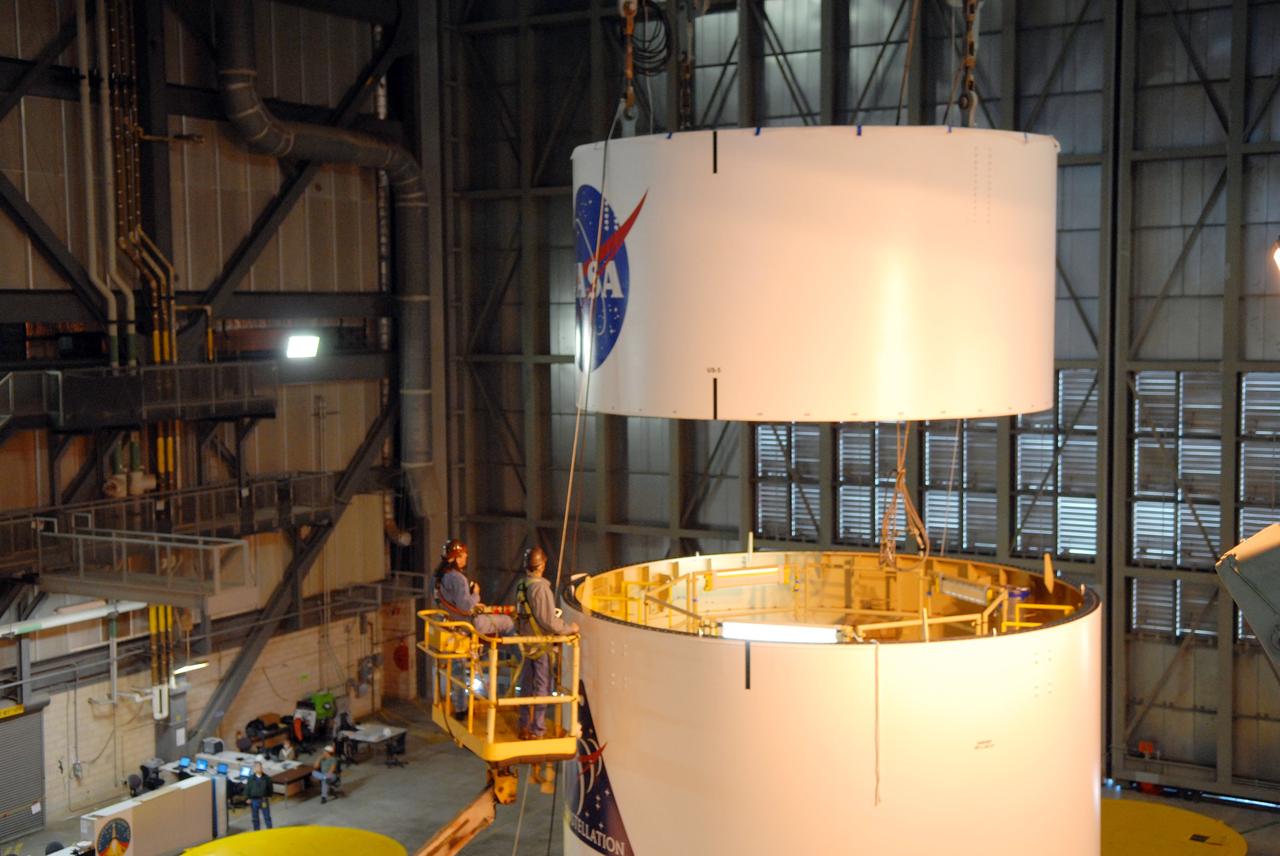
CAPE CANAVERAL, Fla. -- In high bay 4 of the Vehicle Assembly Building at NASA's Kennedy Space Center in Florida, a crane lowers segment 5 of the Ares I-X upper stage simulator segments toward segment 4, at top of the tall stack below. The upper stage simulator comprises 11 segments, each approximately 18 feet in diameter, that will be used in the test flight known as Ares I-X in 2009. The simulator segments will simulate the mass and the outer mold line. The upper stage accounts for nearly one-quarter of the total height of the Ares I. It will take the Ares I on the second phase of its journey from Earth, providing the guidance, navigation and control needed for the second phase of the Ares I ascent flight. Photo credit: NASA/Troy Cryder
CAPE CANAVERAL, Fla. -- In high bay 4 of the Vehicle Assembly Building at NASA's Kennedy Space Center in Florida, a crane lifts segment 5 of the Ares I-X upper stage simulator segments. It will be placed on segment 4, at top of the tall stack behind it. The upper stage simulator comprises 11 segments, each approximately 18 feet in diameter, that will be used in the test flight known as Ares I-X in 2009. The simulator segments will simulate the mass and the outer mold line. The upper stage accounts for nearly one-quarter of the total height of the Ares I. It will take the Ares I on the second phase of its journey from Earth, providing the guidance, navigation and control needed for the second phase of the Ares I ascent flight. Photo credit: NASA/Troy Cryder
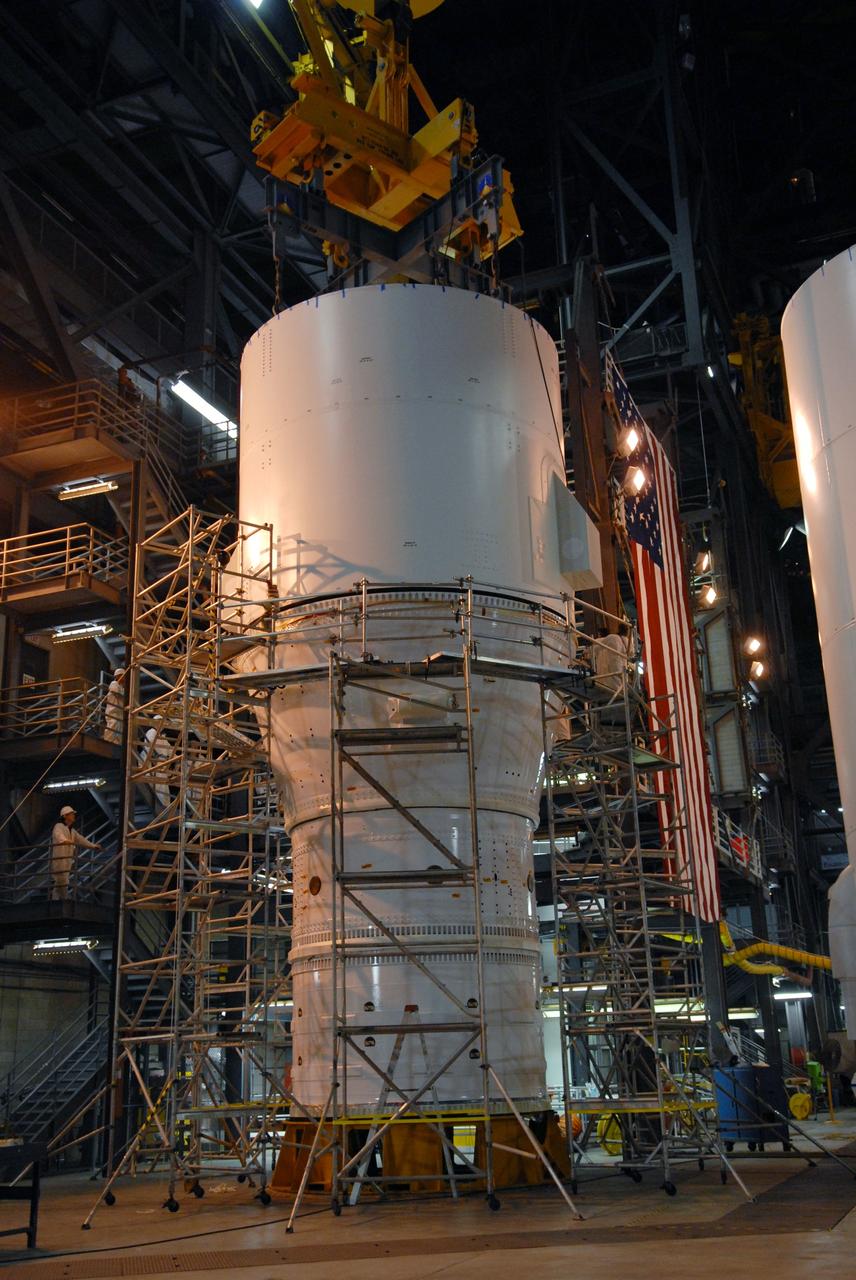
CAPE CANAVERAL, Fla. – In the Vehicle Assembly Building's High Bay 4 at NASA's Kennedy Space Center in Florida, the Ares I-X interstage 1 for the upper stage simulator is lowered onto the forward assembly. It will be mated with the frustum on top of the forward assembly. Ares I-X is the flight test vehicle for the Ares I, a component of the Constellation Program. Ares I is the essential core of a safe, reliable, cost-effective space transportation system that eventually will carry crewed missions back to the moon, on to Mars and out into the solar system. Ares I-X is targeted for launch in August 2009. Photo credit: NASA/Tim Jacobs
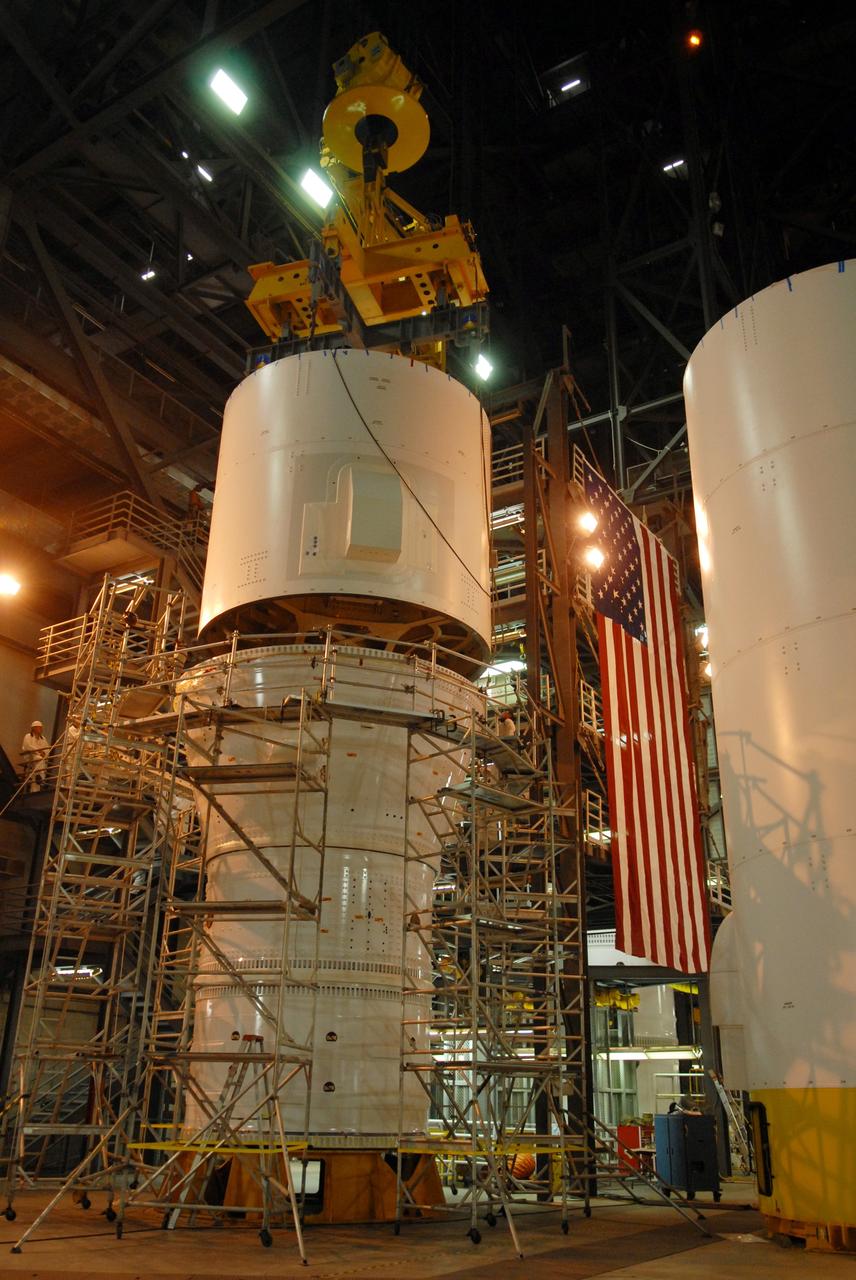
CAPE CANAVERAL, Fla. – In the Vehicle Assembly Building's High Bay 4 at NASA's Kennedy Space Center in Florida, the Ares I-X interstage 1 for the upper stage simulator is lowered onto the forward assembly. It will be mated with the frustum on top of the forward assembly. Ares I-X is the flight test vehicle for the Ares I, a component of the Constellation Program. Ares I is the essential core of a safe, reliable, cost-effective space transportation system that eventually will carry crewed missions back to the moon, on to Mars and out into the solar system. Ares I-X is targeted for launch in August 2009. Photo credit: NASA/Tim Jacobs
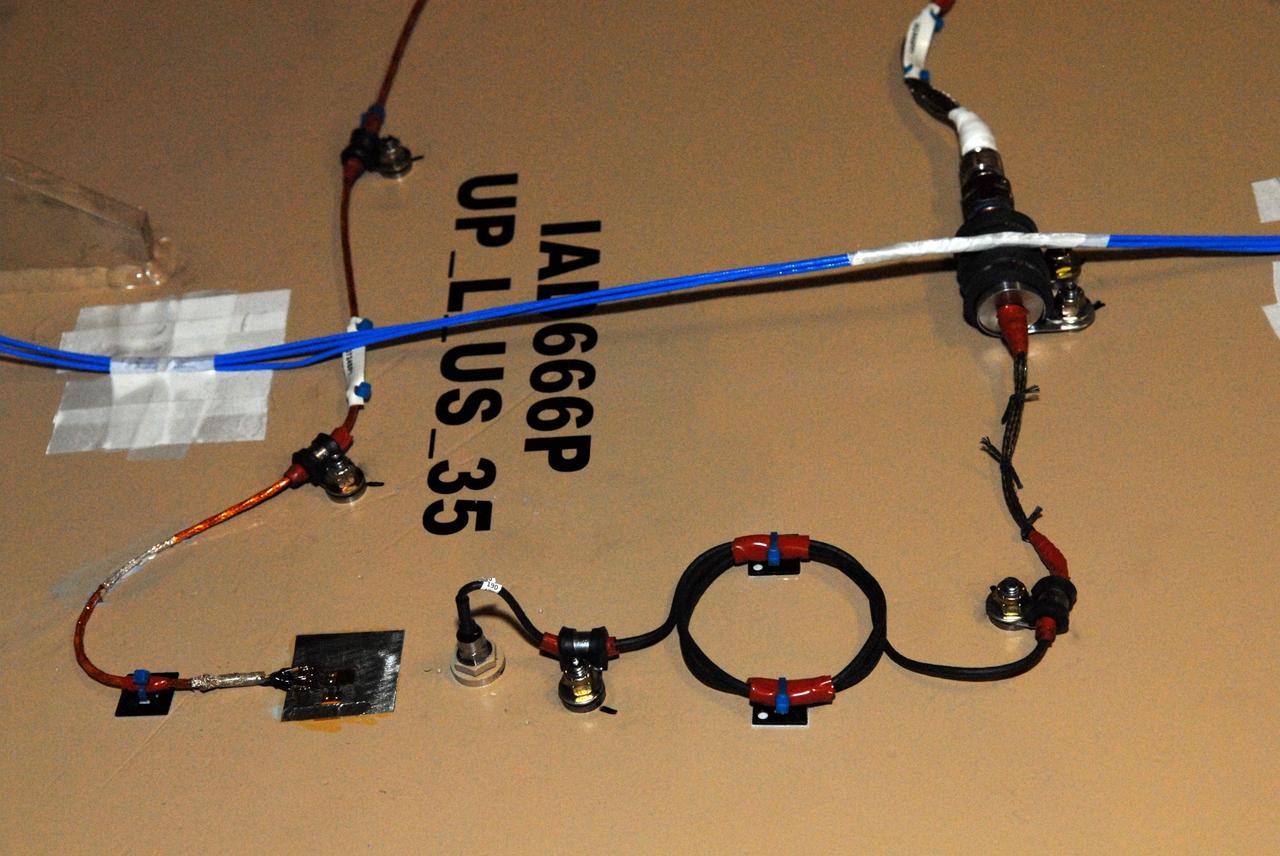
CAPE CANAVERAL, Fla. – In the Vehicle Assembly Building's High Bay 3 at Kennedy Space Center in Florida, Development Flight Instrumentation, or DFI, is mounted on the interior wall of the upper stage simulator of the 327-foot-tall Ares I-X rocket. More than 700 sensors will gather data during the two-and-a-half minute flight test. Part of the Constellation Program, the Ares I-X is the test vehicle for the Ares I, which is the essential core of a space transportation system designed to carry crewed missions back to the moon, on to Mars and out into the solar system. The Ares I-X flight test is targeted for Oct. 27. For information on the Ares I-X vehicle and flight test, visit http://www.nasa.gov/mission_pages/constellation/ares/flighttests/aresIx/index.html. Photo credit: NASA/Jim Grossmann
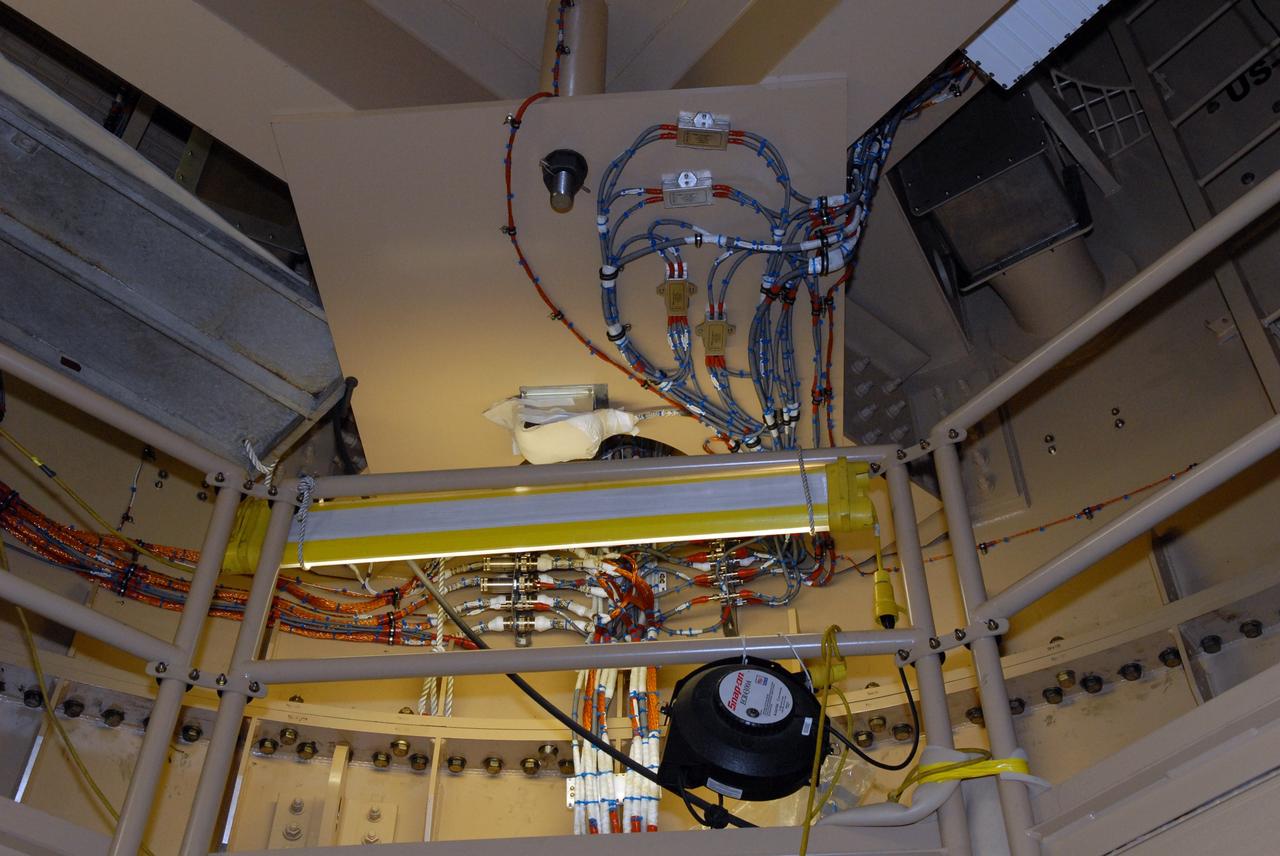
CAPE CANAVERAL, Fla. – In the Vehicle Assembly Building's High Bay 3 at Kennedy Space Center in Florida, Development Flight Instrumentation, or DFI, is mounted on the interior wall of the upper stage simulator of the 327-foot-tall Ares I-X rocket. More than 700 sensors will gather data during the two-and-a-half minute flight test. Part of the Constellation Program, the Ares I-X is the test vehicle for the Ares I, which is the essential core of a space transportation system designed to carry crewed missions back to the moon, on to Mars and out into the solar system. The Ares I-X flight test is targeted for Oct. 27. For information on the Ares I-X vehicle and flight test, visit http://www.nasa.gov/mission_pages/constellation/ares/flighttests/aresIx/index.html. Photo credit: NASA/Jim Grossmann
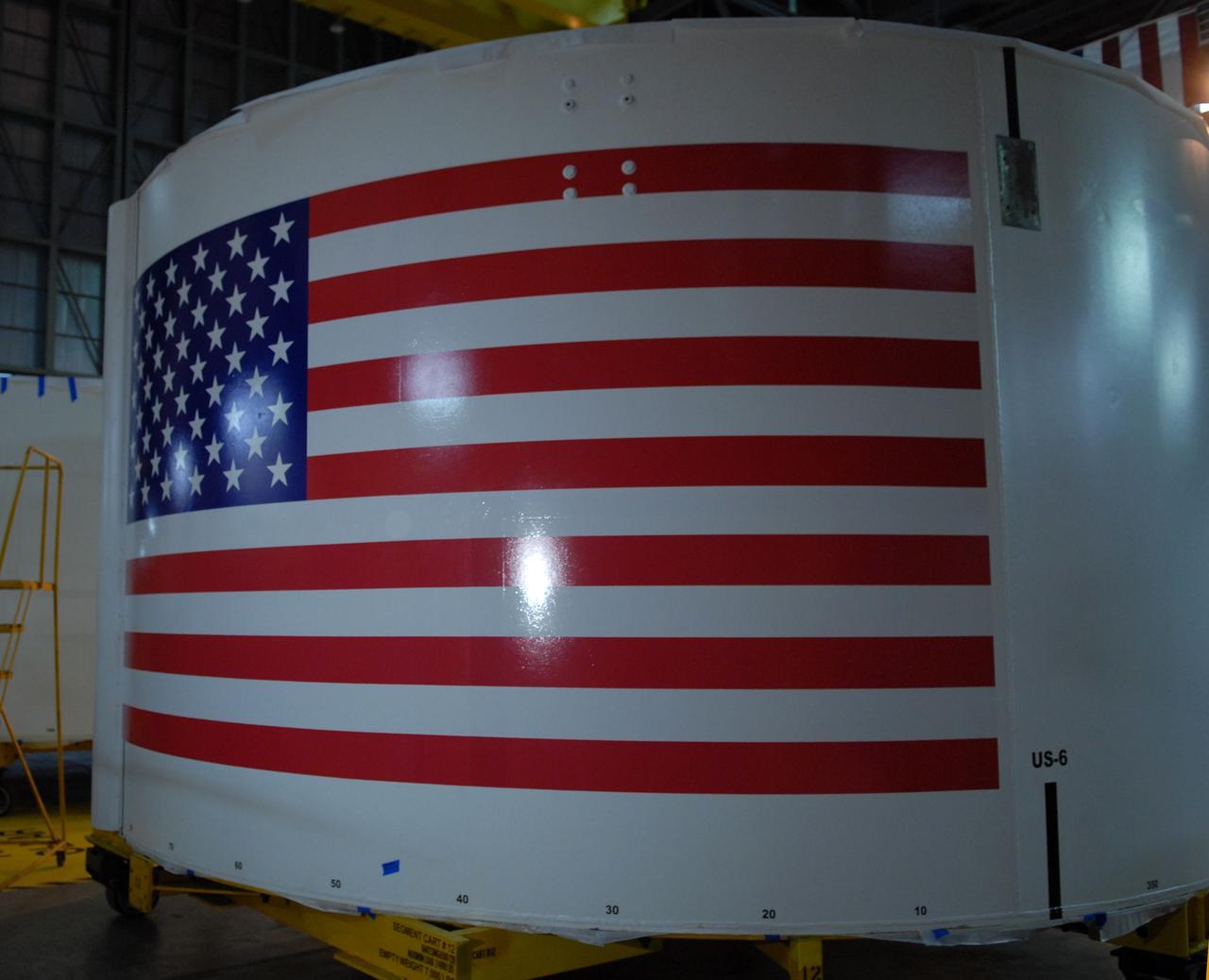
CAPE CANAVERAL, Fla. – In the Vehicle Assembly Building high bay 4 at NASA's Kennedy Space Center in Florida, one of the Ares I-X upper stage simulator segments bears the decal of the U.S. flag. The upper stage simulator will be used in the test flight identified as Ares I-X in 2009. Ares I-X is the test vehicle for the Ares I, which is part of the Constellation Program to return men to the moon and beyond. Ares I is the essential core of a safe, reliable, cost-effective space transportation system that eventually will carry crewed missions back to the moon, on to Mars and out into the solar system. Ares I may also use its 25-ton payload capacity to deliver resources and supplies to the International Space Station, or to "park" payloads in orbit for retrieval by other spacecraft bound for the moon or other destinations. Photo credit: NASA/Jack Pfaller
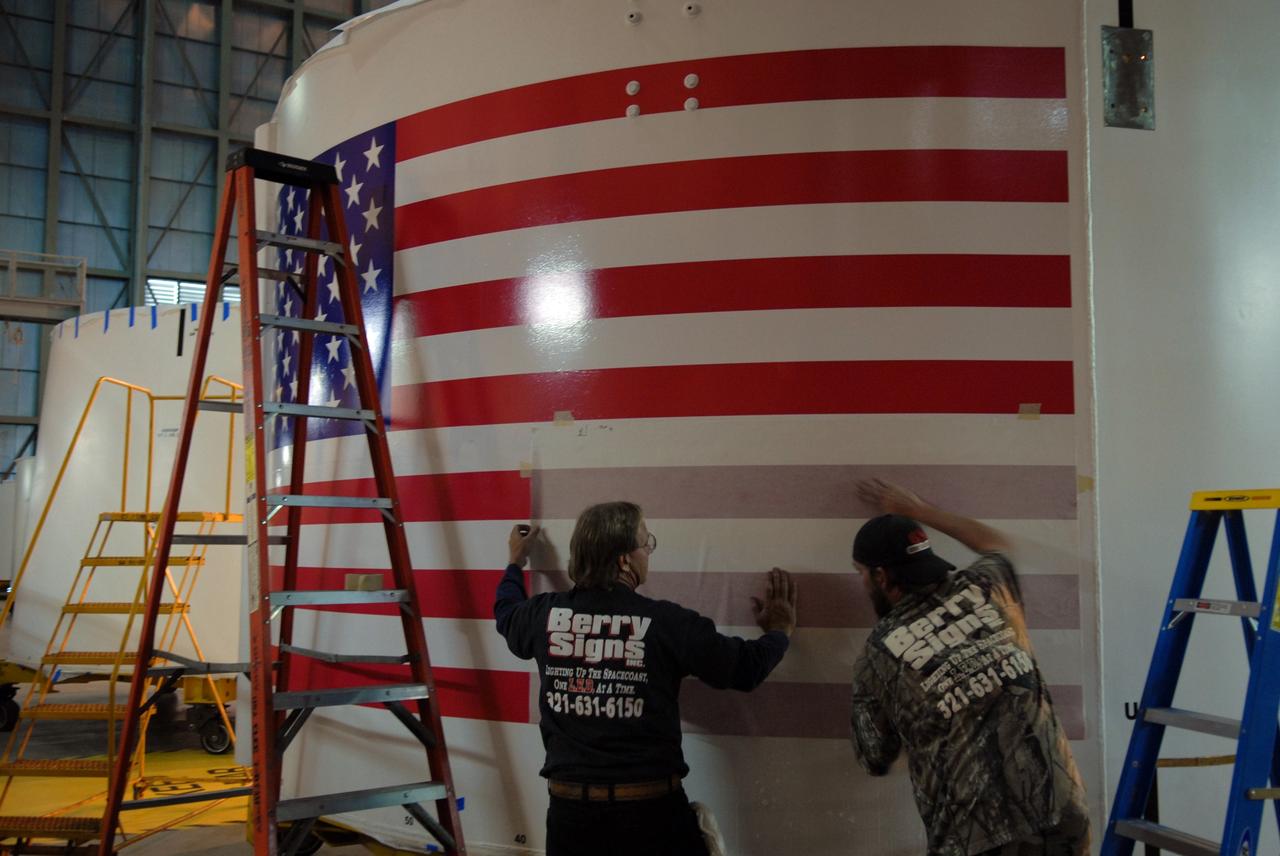
CAPE CANAVERAL, Fla. – In the Vehicle Assembly Building high bay 4 at NASA's Kennedy Space Center in Florida, workers remove the final cover from the U.S. flag decal affixed to one of the Ares I-X upper stage simulator segments. The upper stage simulator will be used in the test flight identified as Ares I-X in 2009. Ares I-X is the test vehicle for the Ares I, which is part of the Constellation Program to return men to the moon and beyond. Ares I is the essential core of a safe, reliable, cost-effective space transportation system that eventually will carry crewed missions back to the moon, on to Mars and out into the solar system. Ares I may also use its 25-ton payload capacity to deliver resources and supplies to the International Space Station, or to "park" payloads in orbit for retrieval by other spacecraft bound for the moon or other destinations. Photo credit: NASA/Jack Pfaller
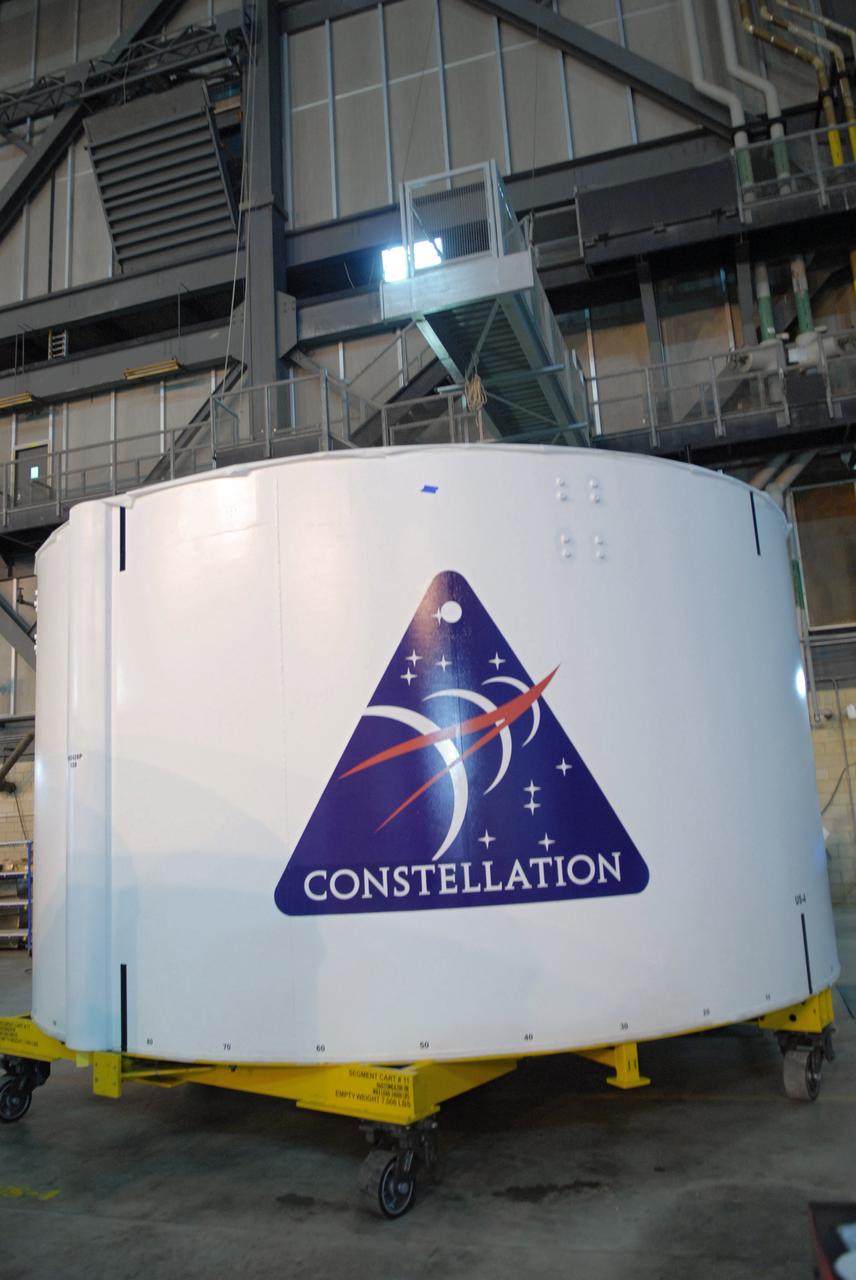
CAPE CANAVERAL, Fla. – In the Vehicle Assembly Building high bay 4 at NASA's Kennedy Space Center in Florida, one of the Ares I-X upper stage simulator segments bears the Constellation patch. The upper stage simulator will be used in the test flight identified as Ares I-X in 2009. Ares I-X is the test vehicle for the Ares I, which is part of the Constellation Program to return men to the moon and beyond. Ares I is the essential core of a safe, reliable, cost-effective space transportation system that eventually will carry crewed missions back to the moon, on to Mars and out into the solar system. Ares I may also use its 25-ton payload capacity to deliver resources and supplies to the International Space Station, or to "park" payloads in orbit for retrieval by other spacecraft bound for the moon or other destinations. Photo credit: NASA/Jack Pfaller
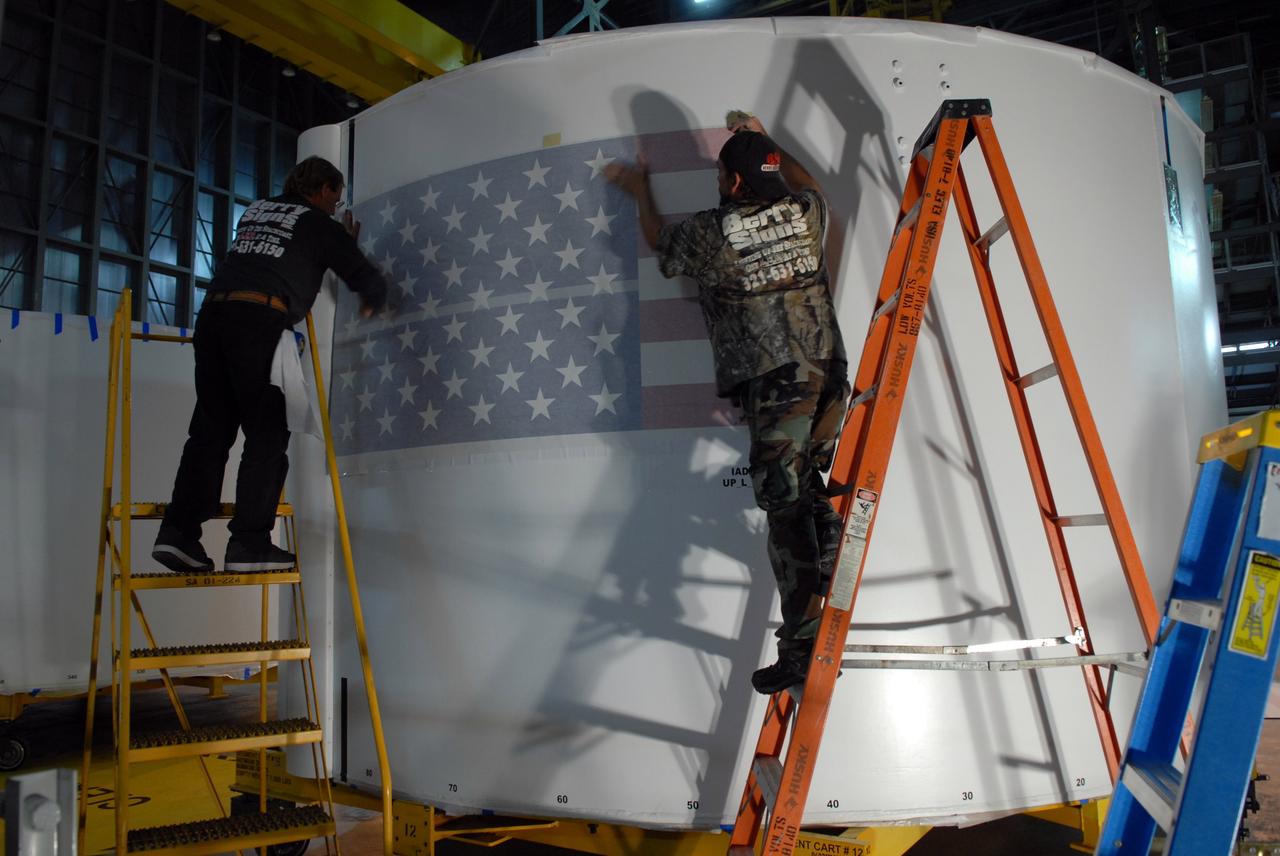
CAPE CANAVERAL, Fla. – In the Vehicle Assembly Building high bay 4 at NASA's Kennedy Space Center in Florida, workers adhere a decal of the U.S. flag on one of the Ares I-X upper stage simulator segments. The upper stage simulator will be used in the test flight identified as Ares I-X in 2009. Ares I-X is the test vehicle for the Ares I, which is part of the Constellation Program to return men to the moon and beyond. Ares I is the essential core of a safe, reliable, cost-effective space transportation system that eventually will carry crewed missions back to the moon, on to Mars and out into the solar system. Ares I may also use its 25-ton payload capacity to deliver resources and supplies to the International Space Station, or to "park" payloads in orbit for retrieval by other spacecraft bound for the moon or other destinations. Photo credit: NASA/Jack Pfaller
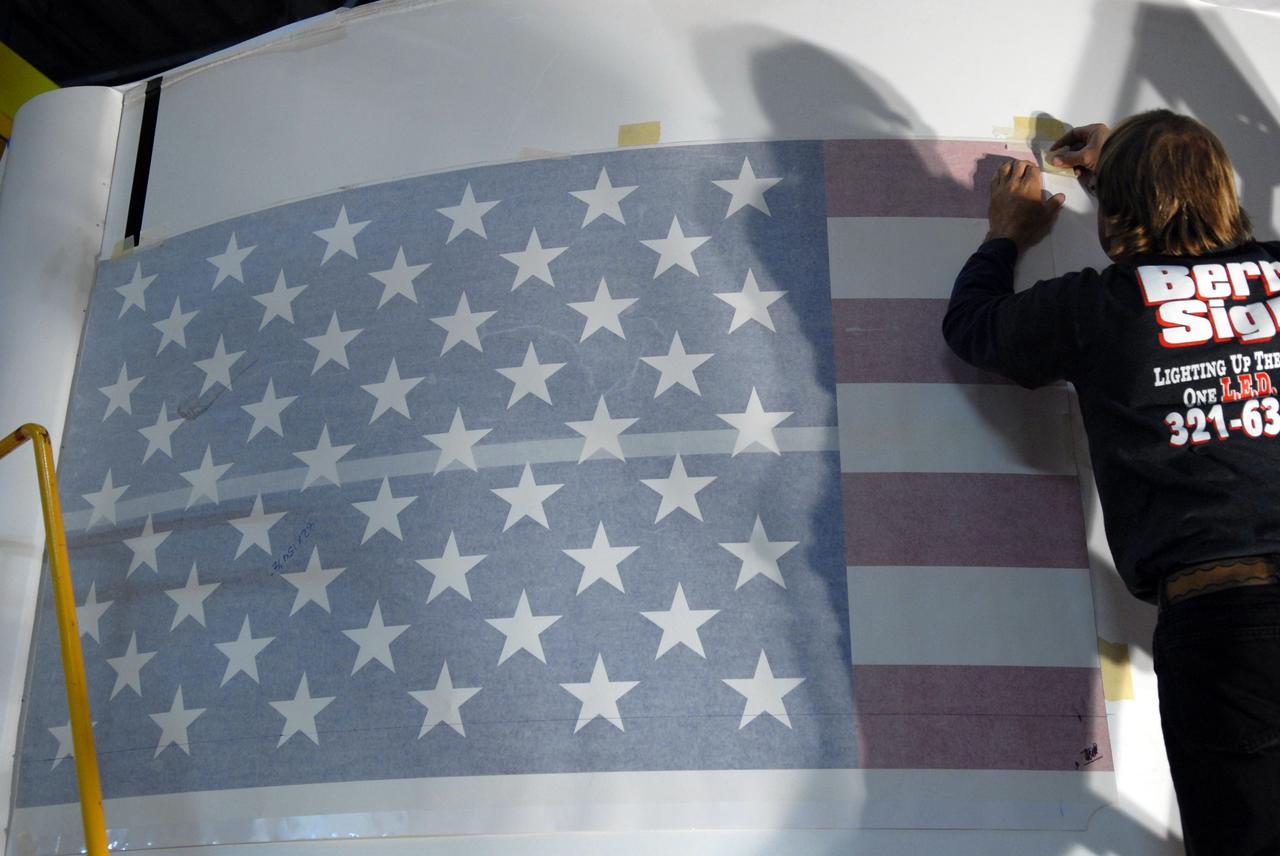
CAPE CANAVERAL, Fla. – In the Vehicle Assembly Building high bay 4 at NASA's Kennedy Space Center in Florida, workers begin adhering a decal of the U.S. flag on one of the Ares I-X upper stage simulator segments. The upper stage simulator will be used in the test flight identified as Ares I-X in 2009. Ares I-X is the test vehicle for the Ares I, which is part of the Constellation Program to return men to the moon and beyond. Ares I is the essential core of a safe, reliable, cost-effective space transportation system that eventually will carry crewed missions back to the moon, on to Mars and out into the solar system. Ares I may also use its 25-ton payload capacity to deliver resources and supplies to the International Space Station, or to "park" payloads in orbit for retrieval by other spacecraft bound for the moon or other destinations. Photo credit: NASA/Jack Pfaller
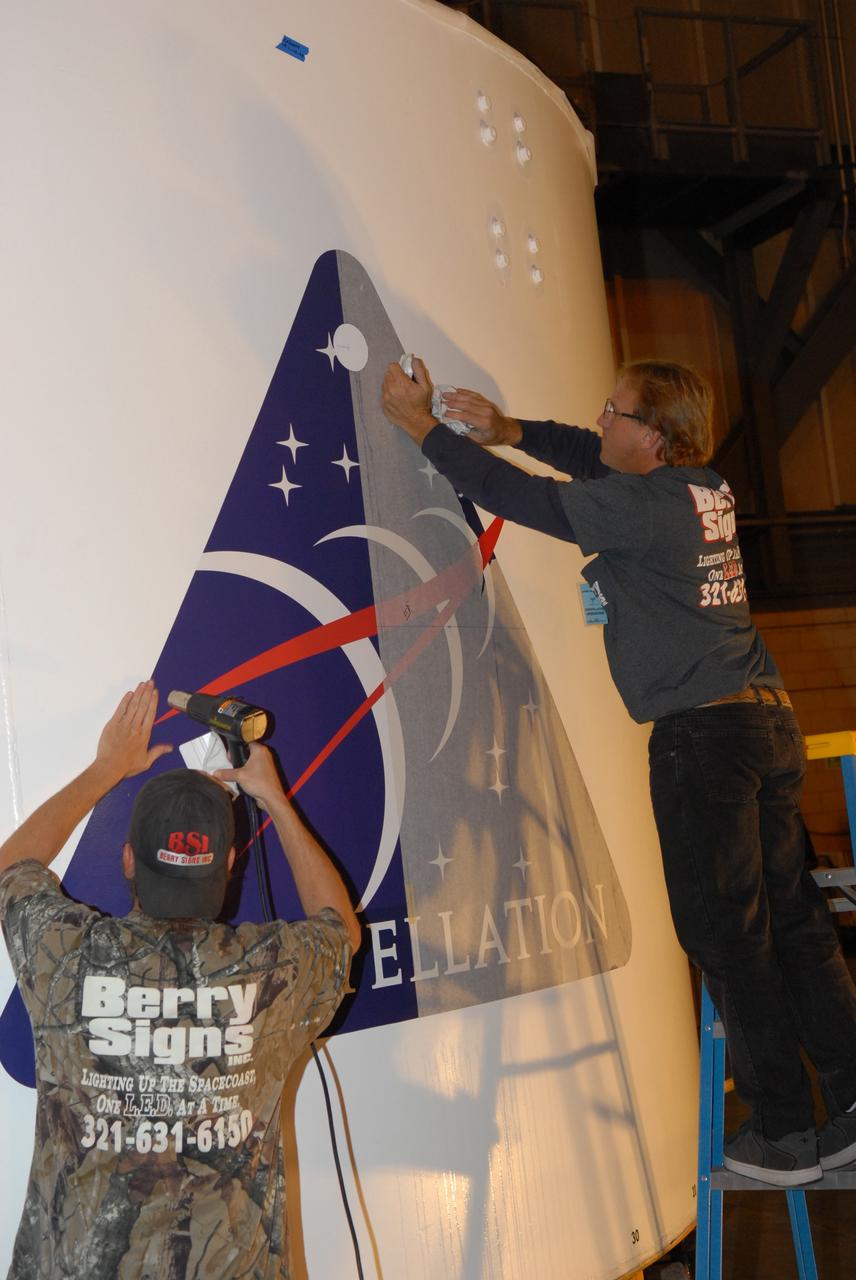
CAPE CANAVERAL, Fla. – In the Vehicle Assembly Building high bay 4 at NASA's Kennedy Space Center in Florida, workers begin adhering the Constellation patch on one of the Ares I-X upper stage simulator segments. The upper stage simulator will be used in the test flight identified as Ares I-X in 2009. Ares I-X is the test vehicle for the Ares I, which is part of the Constellation Program to return men to the moon and beyond. Ares I is the essential core of a safe, reliable, cost-effective space transportation system that eventually will carry crewed missions back to the moon, on to Mars and out into the solar system. Ares I may also use its 25-ton payload capacity to deliver resources and supplies to the International Space Station, or to "park" payloads in orbit for retrieval by other spacecraft bound for the moon or other destinations. Photo credit: NASA/Jack Pfaller

CAPE CANAVERAL, Fla. – In the Rotation, Processing and Surge Facility at NASA's Kennedy Space Center in Florida, cranes move the Ares I-X center forward segment toward a stand. The booster used for the Ares I-X launch is being modified by adding new forward structures and a fifth segment simulator. The stacking operations are scheduled to begin in the Vehicle Assembly Building in April. Launch of the Ares I-X flight test is targeted for July 2009. Photo credit: NASA/Troy Cryder
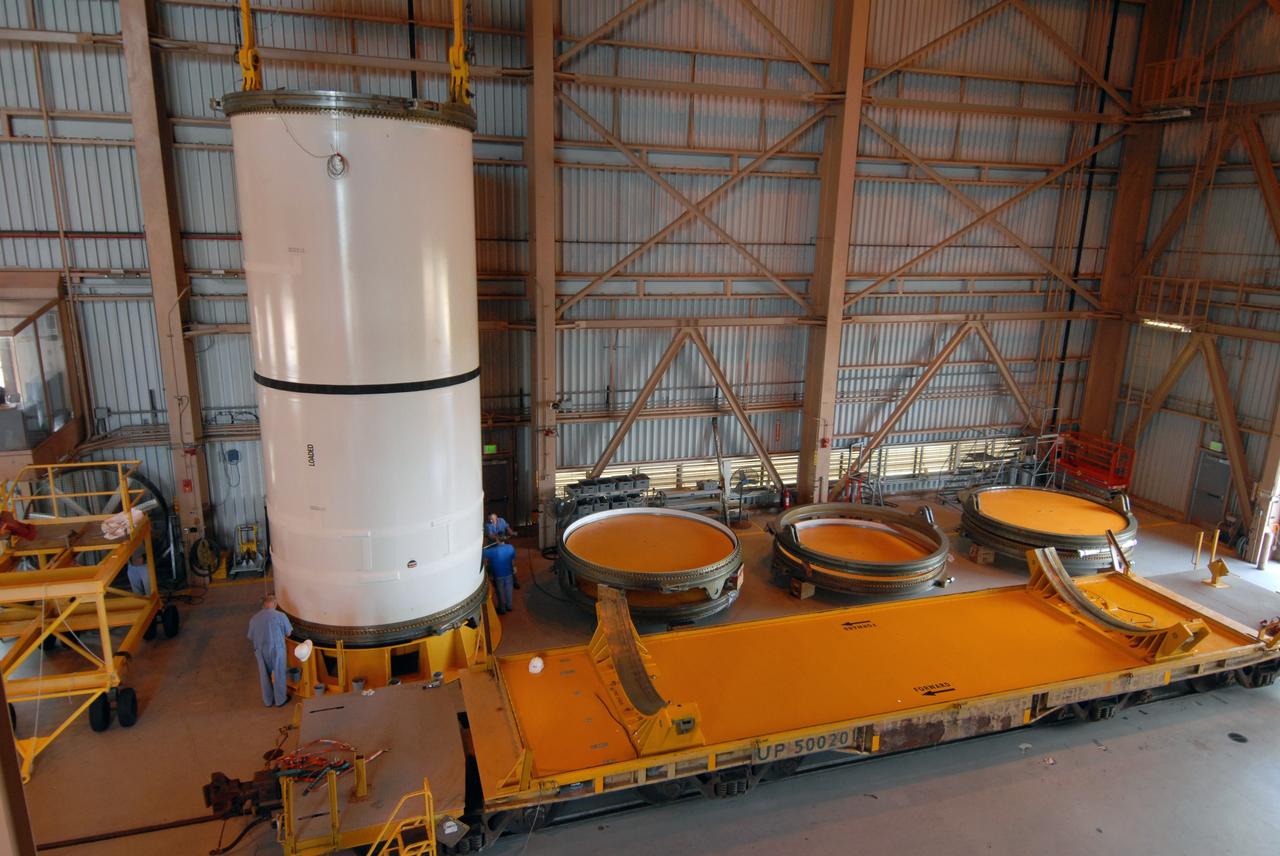
CAPE CANAVERAL, Fla. – In the Rotation, Processing and Surge Facility at NASA's Kennedy Space Center in Florida, the Ares I-X center forward segment is secured onto a stand after the segment's removal from the transporter in the foreground. The booster used for the Ares I-X launch is being modified by adding new forward structures and a fifth segment simulator. The stacking operations are scheduled to begin in the Vehicle Assembly Building in April. Launch of the Ares I-X flight test is targeted for July 2009. Photo credit: NASA/Troy Cryder
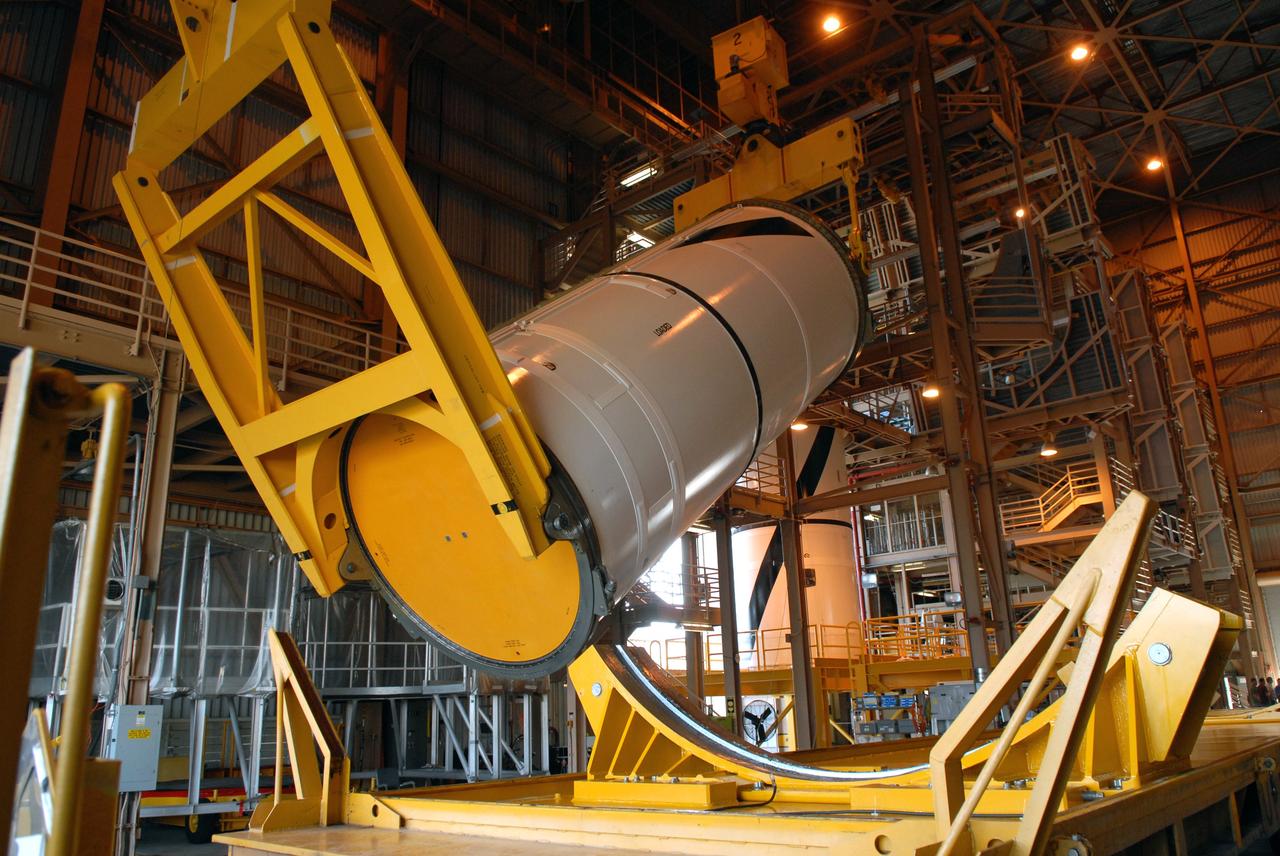
CAPE CANAVERAL, Fla. – In the Rotation, Processing and Surge Facility at NASA's Kennedy Space Center in Florida, cranes attached to the Ares I-X center forward segment raise it to vertical. Once vertical, the segment will be moved to a stand. The booster used for the Ares I-X launch is being modified by adding new forward structures and a fifth segment simulator. The stacking operations are scheduled to begin in the Vehicle Assembly Building in April. Launch of the Ares I-X flight test is targeted for July 2009. Photo credit: NASA/Troy Cryder
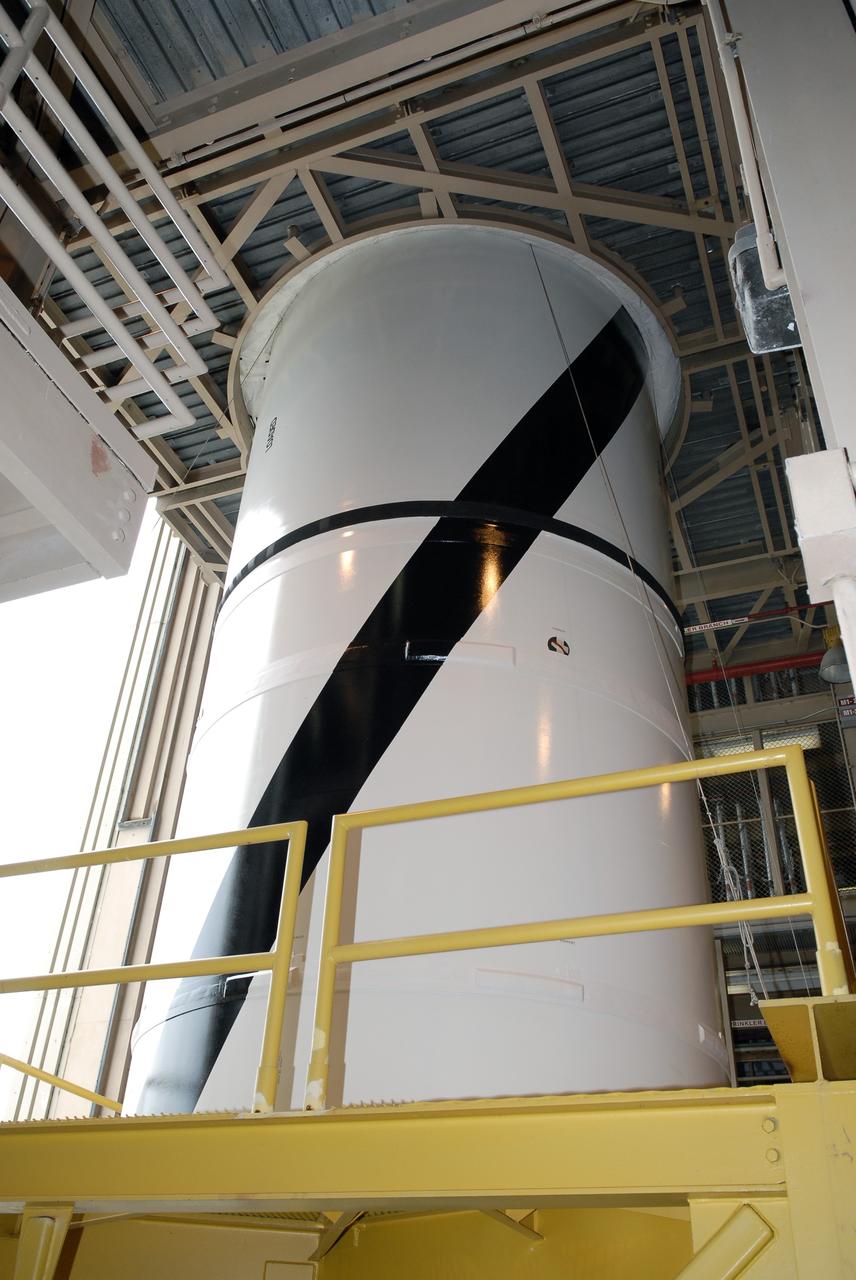
CAPE CANAVERAL, Fla. – In the Rotation, Processing and Surge Facility at NASA's Kennedy Space Center in Florida, the second of four Ares I-X segments waits for transfer to a work stand for final processing and integration in the facility. The booster used for the Ares I-X launch is being modified by adding new forward structures and a fifth segment simulator. The stacking operations are scheduled to begin in the Vehicle Assembly Building in April. Launch of the Ares I-X test flight is targeted for July 2009. Photo credit: NASA/Kim Shiflett
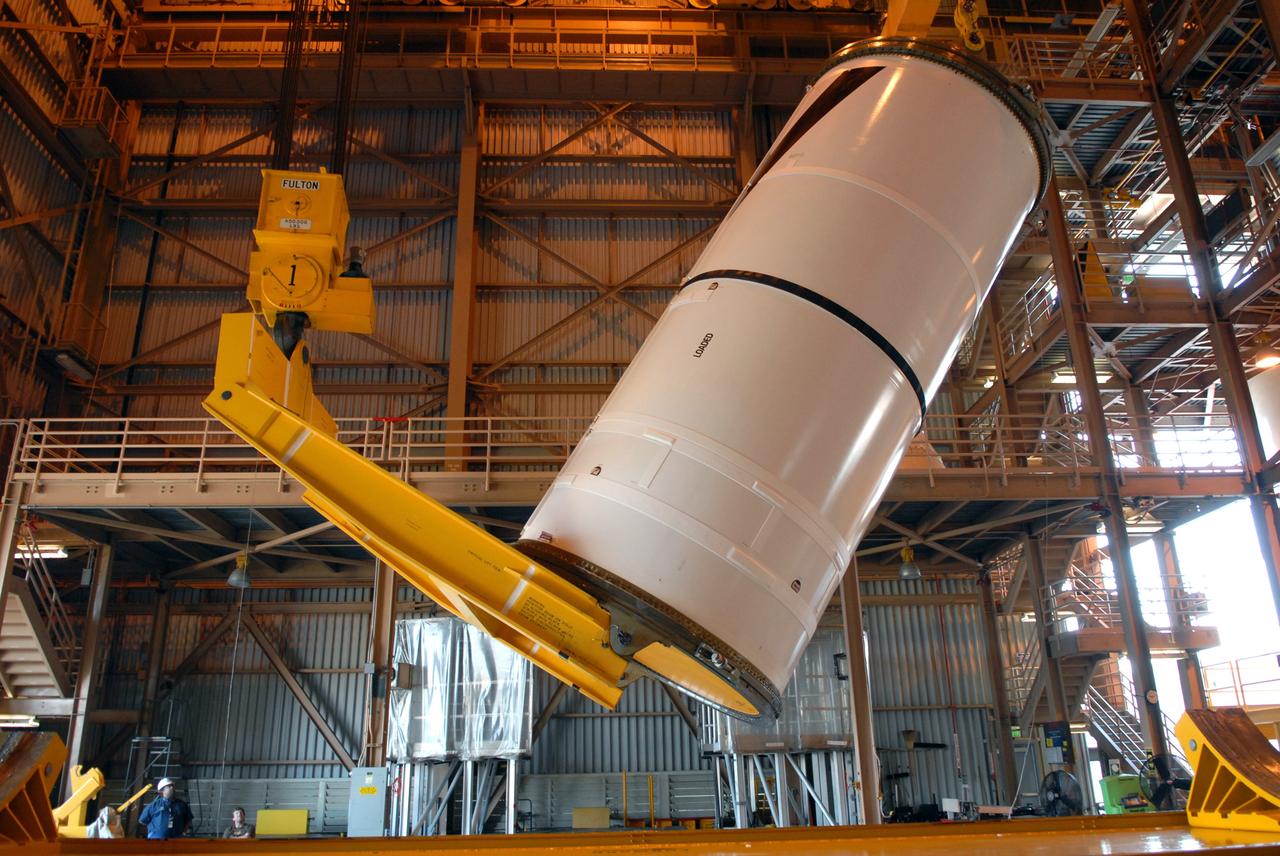
CAPE CANAVERAL, Fla. – In the Rotation, Processing and Surge Facility at NASA's Kennedy Space Center in Florida, the Ares I-X center forward segment is being raised to vertical. The segment will be moved to a stand. The booster used for the Ares I-X launch is being modified by adding new forward structures and a fifth segment simulator. The stacking operations are scheduled to begin in the Vehicle Assembly Building in April. Launch of the Ares I-X flight test is targeted for July 2009. Photo credit: NASA/Troy Cryder
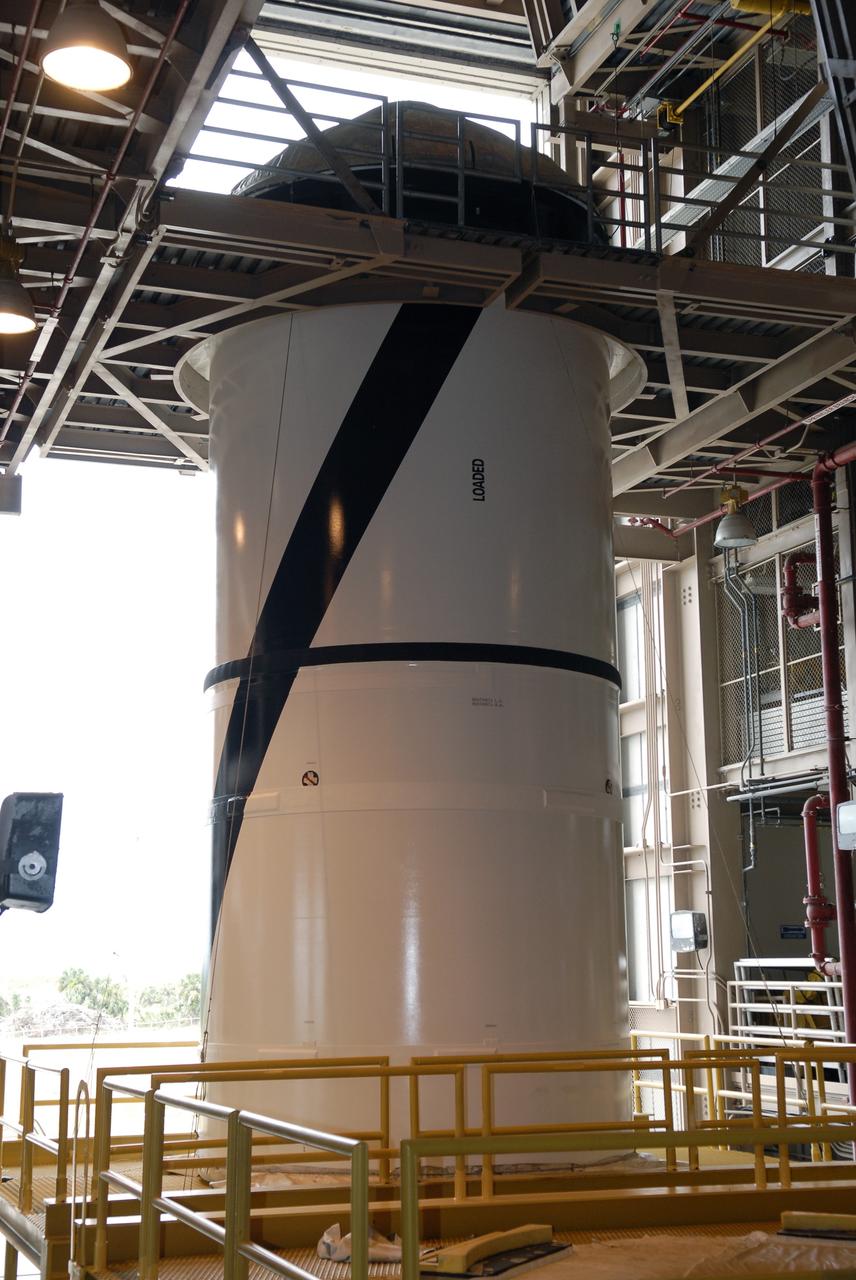
CAPE CANAVERAL, Fla. – In the Rotation, Processing and Surge Facility at NASA's Kennedy Space Center in Florida, the second of four Ares I-X segments waits for transfer to a work stand for final processing and integration in the facility. The booster used for the Ares I-X launch is being modified by adding new forward structures and a fifth segment simulator. The stacking operations are scheduled to begin in the Vehicle Assembly Building in April. Launch of the Ares I-X test flight is targeted for July 2009. Photo credit: NASA/Kim Shiflett
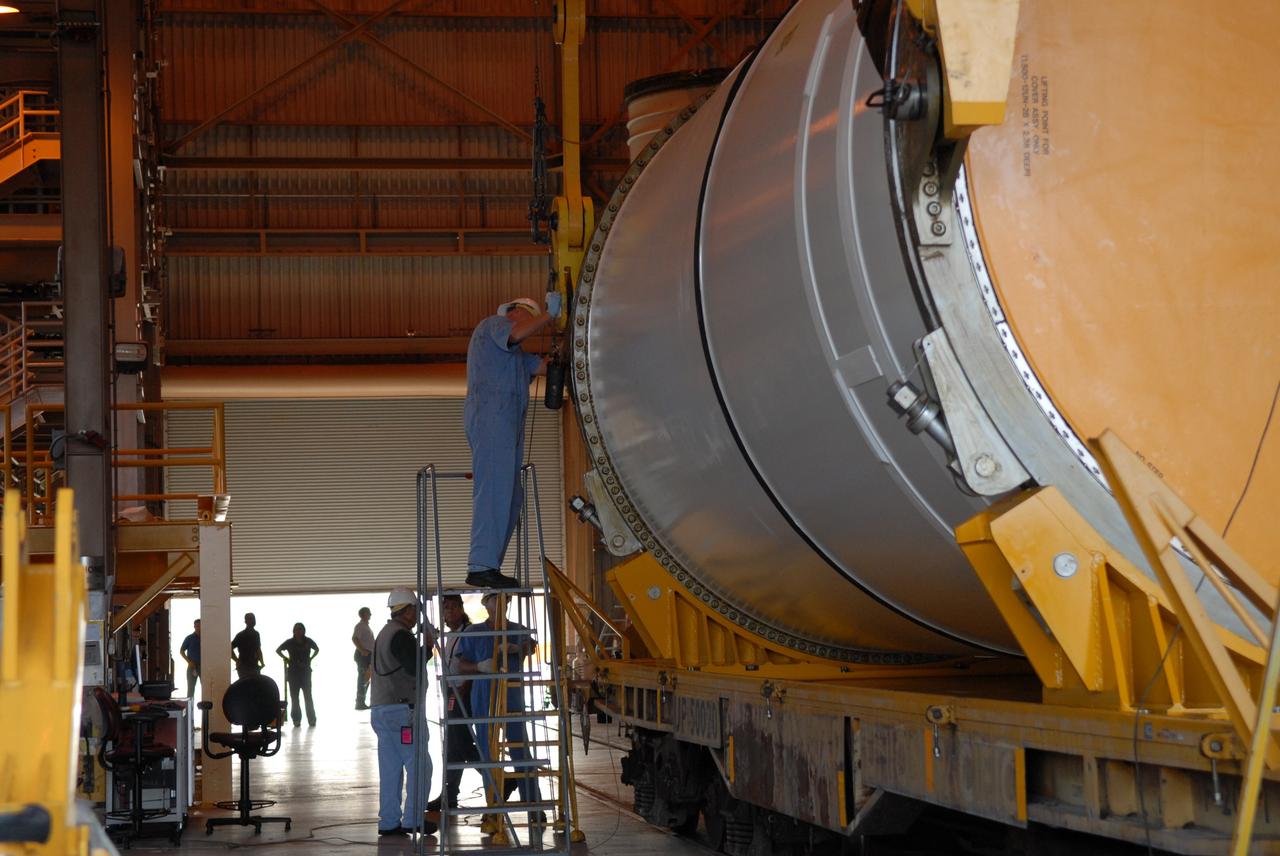
CAPE CANAVERAL, Fla. – In the Rotation, Processing and Surge Facility at NASA's Kennedy Space Center in Florida, the Ares I-X center forward segment is prepared for lifting from the transporter. Once vertical, the segment will be moved to a stand. The booster used for the Ares I-X launch is being modified by adding new forward structures and a fifth segment simulator. The stacking operations are scheduled to begin in the Vehicle Assembly Building in April. Launch of the Ares I-X flight test is targeted for July 2009. Photo credit: NASA/Troy Cryder
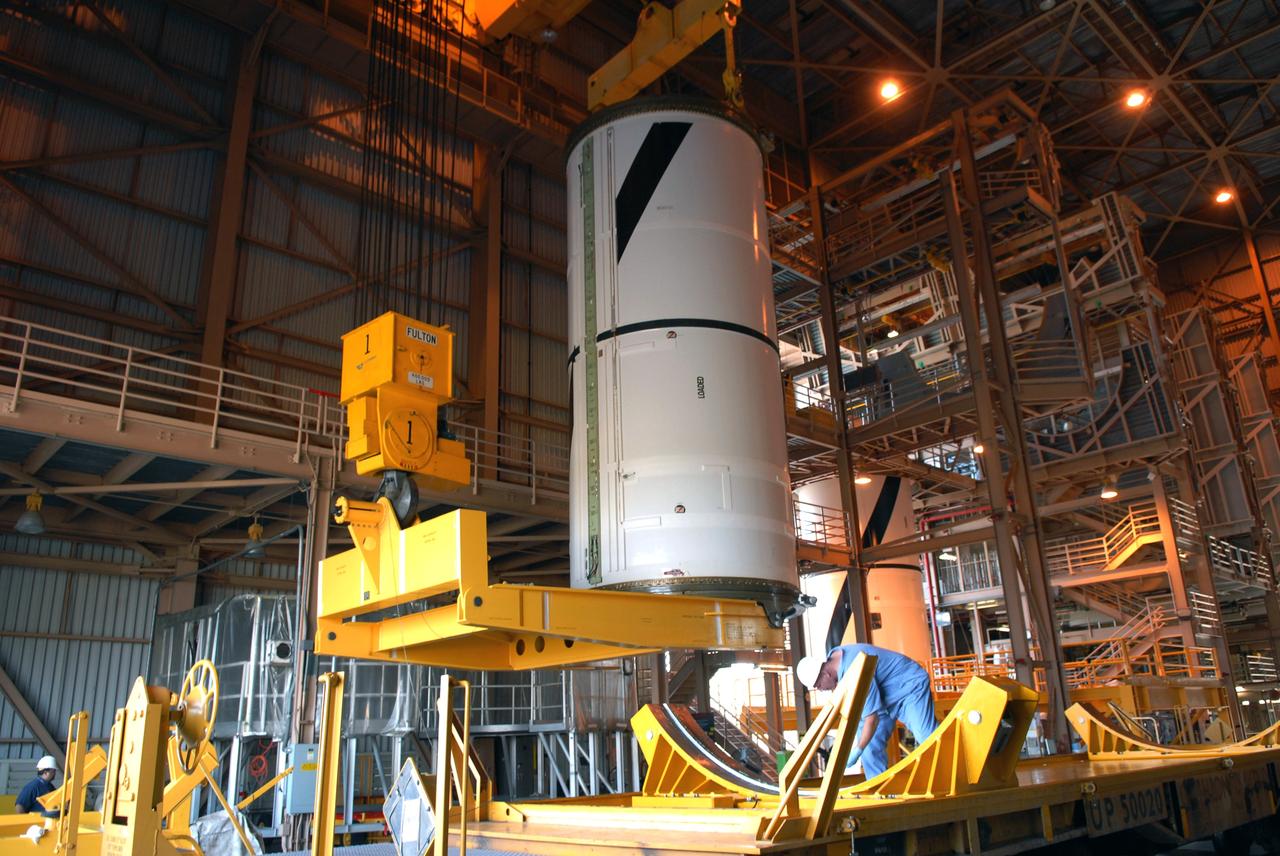
CAPE CANAVERAL, Fla. – In the Rotation, Processing and Surge Facility at NASA's Kennedy Space Center in Florida, the Ares I-X center forward segment has been raised to vertical. The segment will be moved to a stand. The booster used for the Ares I-X launch is being modified by adding new forward structures and a fifth segment simulator. The stacking operations are scheduled to begin in the Vehicle Assembly Building in April. Launch of the Ares I-X flight test is targeted for July 2009. Photo credit: NASA/Troy Cryder
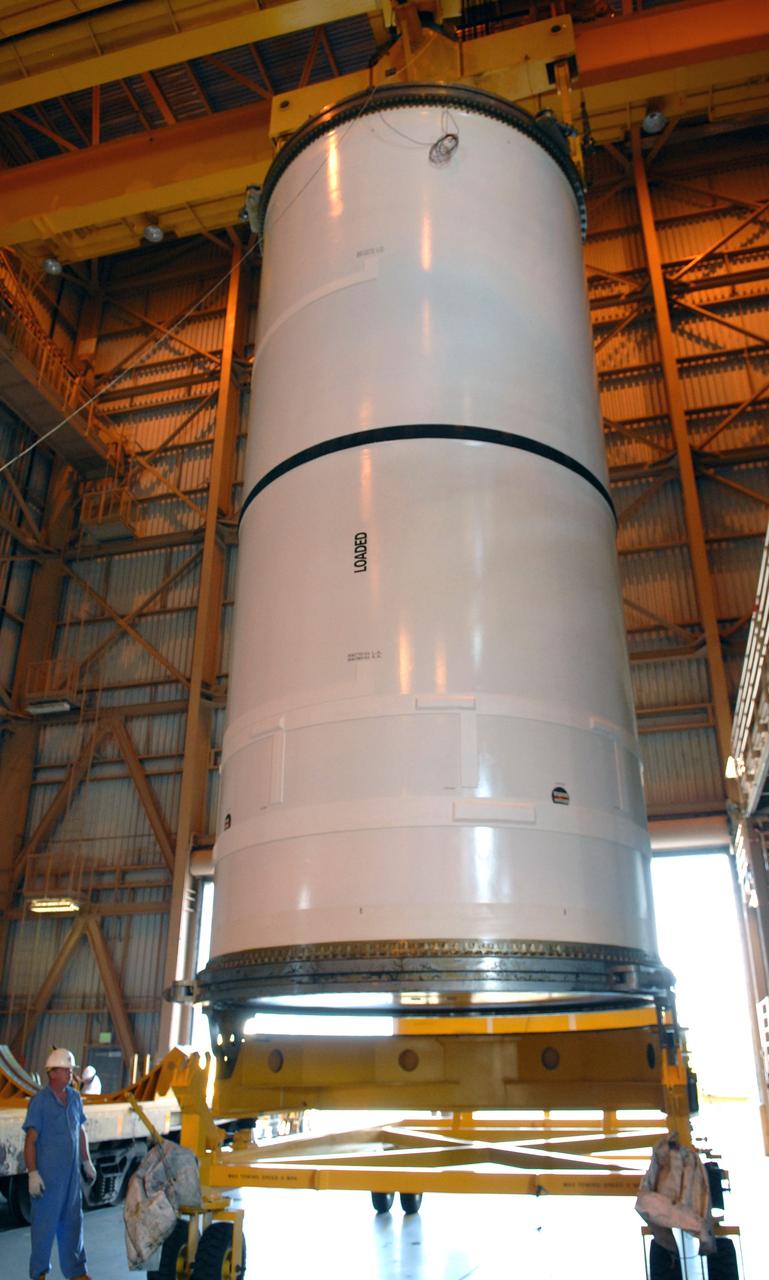
CAPE CANAVERAL, Fla. – In the Rotation, Processing and Surge Facility at NASA's Kennedy Space Center in Florida, cranes move the Ares I-X center forward segment after its removal from a transporter. The booster used for the Ares I-X launch is being modified by adding new forward structures and a fifth segment simulator. The stacking operations are scheduled to begin in the Vehicle Assembly Building in April. Launch of the Ares I-X flight test is targeted for July 2009. Photo credit: NASA/Troy Cryder

CAPE CANAVERAL, Fla. – In the Rotation, Processing and Surge Facility at NASA's Kennedy Space Center in Florida, the Ares I-X center forward segment is lowered onto a stand. The booster used for the Ares I-X launch is being modified by adding new forward structures and a fifth segment simulator. The stacking operations are scheduled to begin in the Vehicle Assembly Building in April. Launch of the Ares I-X flight test is targeted for July 2009. Photo credit: NASA/Troy Cryder
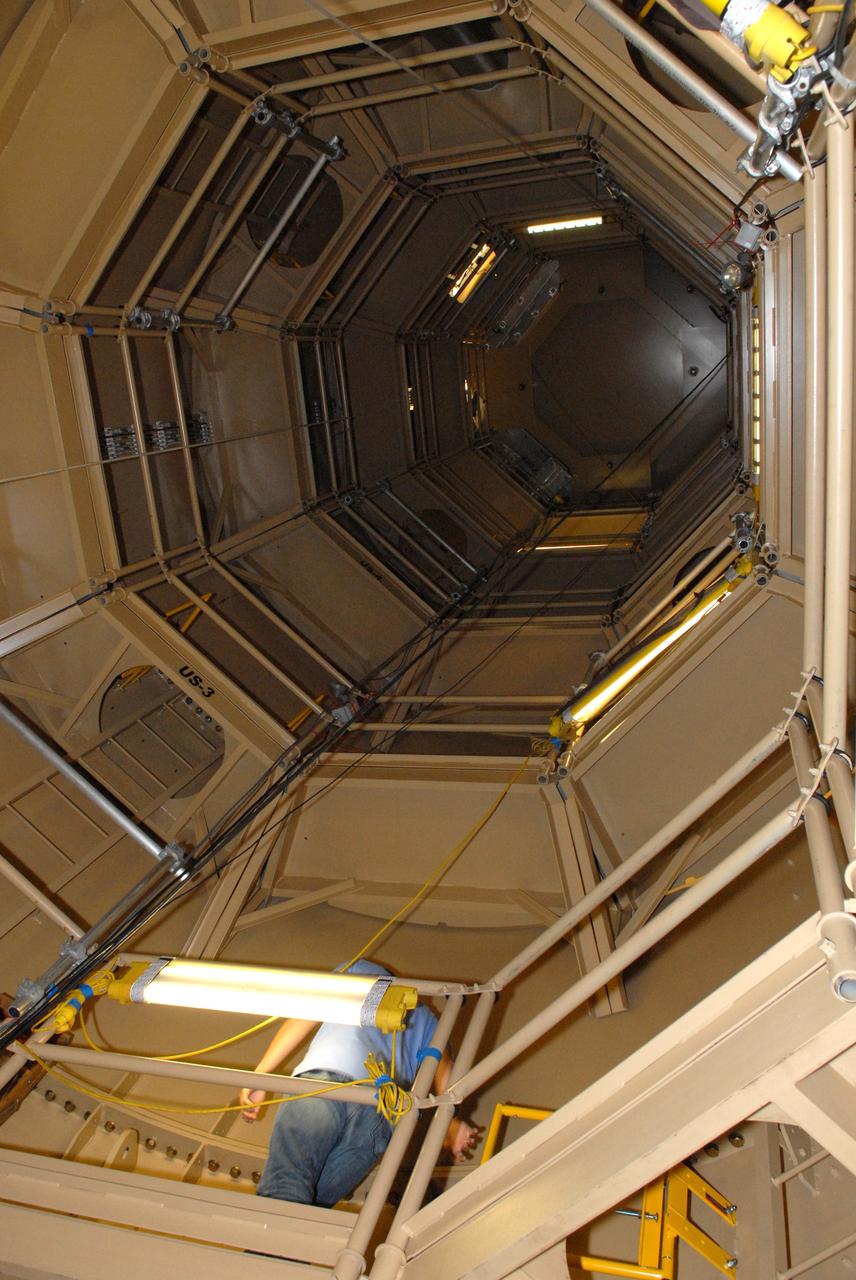
CAPE CANAVERAL, Fla. – In the Vehicle Assembly Building's High Bay 3 at Kennedy Space Center in Florida, a technician works on a platform mounted on the interior wall of the upper stage simulator of the 327-foot-tall Ares I-X rocket. Part of the Constellation Program, the Ares I-X is the test vehicle for the Ares I, which is the essential core of a space transportation system designed to carry crewed missions back to the moon, on to Mars and out into the solar system. The Ares I-X flight test is targeted for Oct. 27. For information on the Ares I-X vehicle and flight test, visit http://www.nasa.gov/mission_pages/constellation/ares/flighttests/aresIx/index.html. Photo credit: NASA/Jim Grossmann
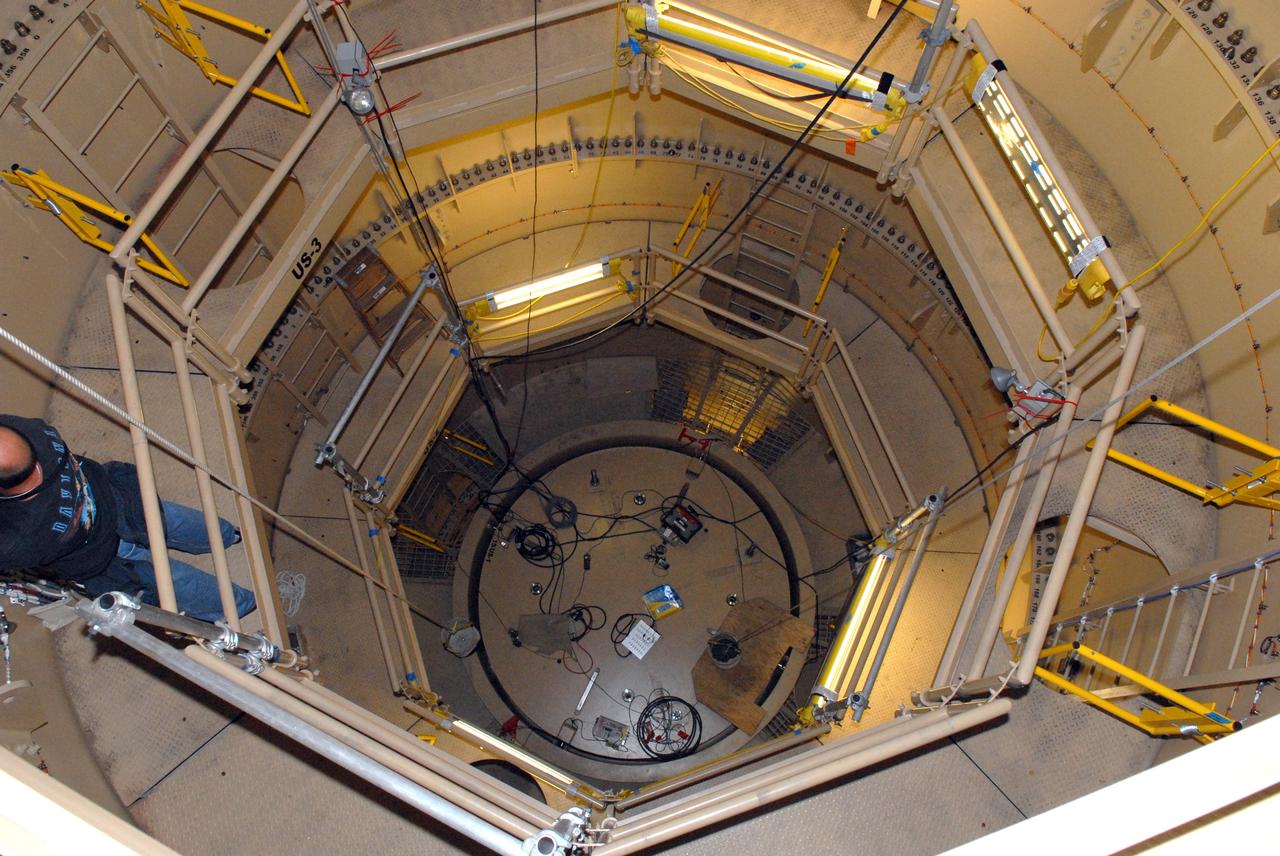
CAPE CANAVERAL, Fla. – In the Vehicle Assembly Building's High Bay 3 at Kennedy Space Center in Florida, a technician works on a platform mounted on the interior wall of the upper stage simulator of the 327-foot-tall Ares I-X rocket. Part of the Constellation Program, the Ares I-X is the test vehicle for the Ares I, which is the essential core of a space transportation system designed to carry crewed missions back to the moon, on to Mars and out into the solar system. The Ares I-X flight test is targeted for Oct. 27. For information on the Ares I-X vehicle and flight test, visit http://www.nasa.gov/mission_pages/constellation/ares/flighttests/aresIx/index.html. Photo credit: NASA/Jim Grossmann
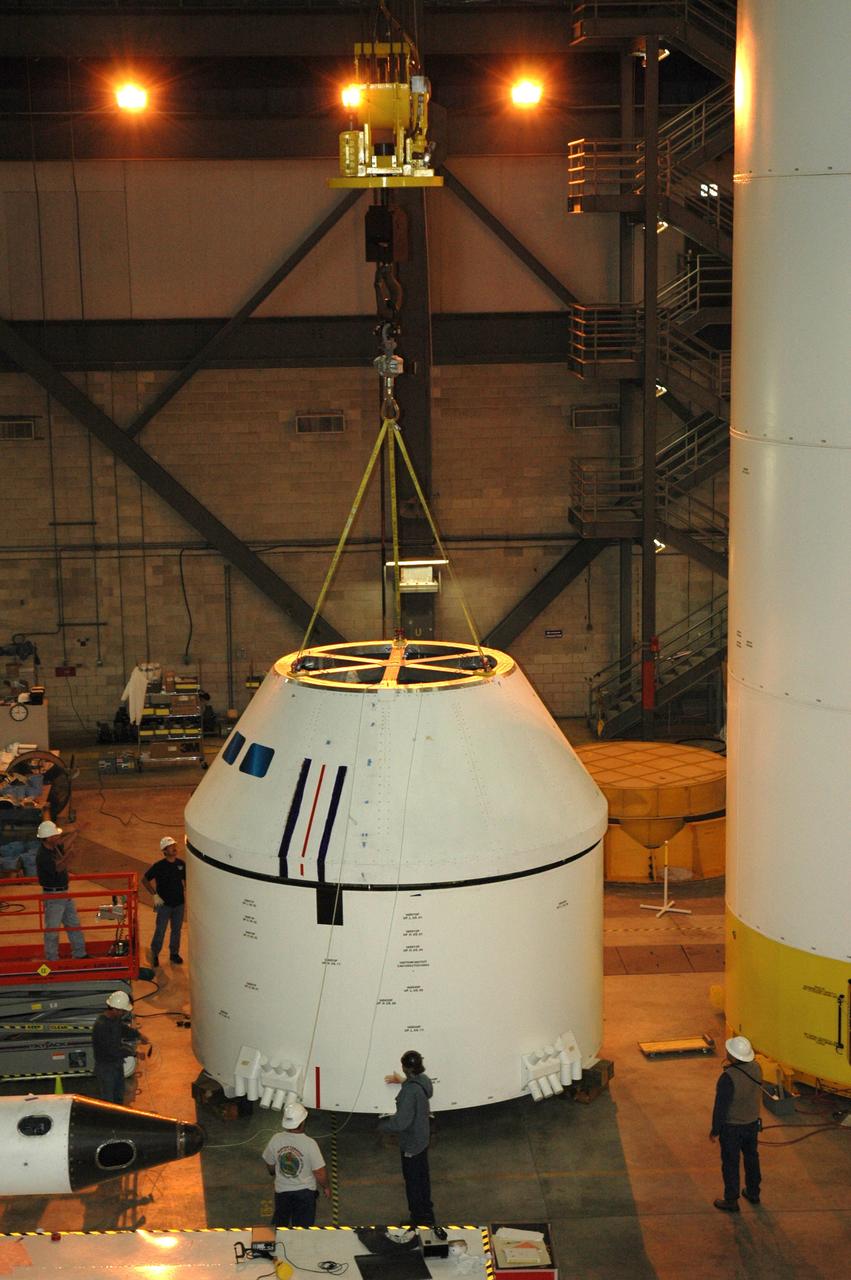
CAPE CANAVERAL, Fla. – In high bay 4 of the Vehicle Assembly Building at NASA's Kennedy Space Center in Florida, a crane removes the Ares I-X crew module simulator from the service module beneath. Ares I-X is the test flight for the Ares I. The I-X flight will provide NASA an early opportunity to test and prove hardware, facilities and ground operations associated with Ares I. The launch of the 327-foot-tall, full-scale Ares I-X, targeted for July 2009, will be the first in a series of unpiloted rocket launches from Kennedy. When fully developed, the 16-foot diameter crew module will furnish living space and reentry protection for the astronauts. Photo credit: NASA/Tim Jacobs
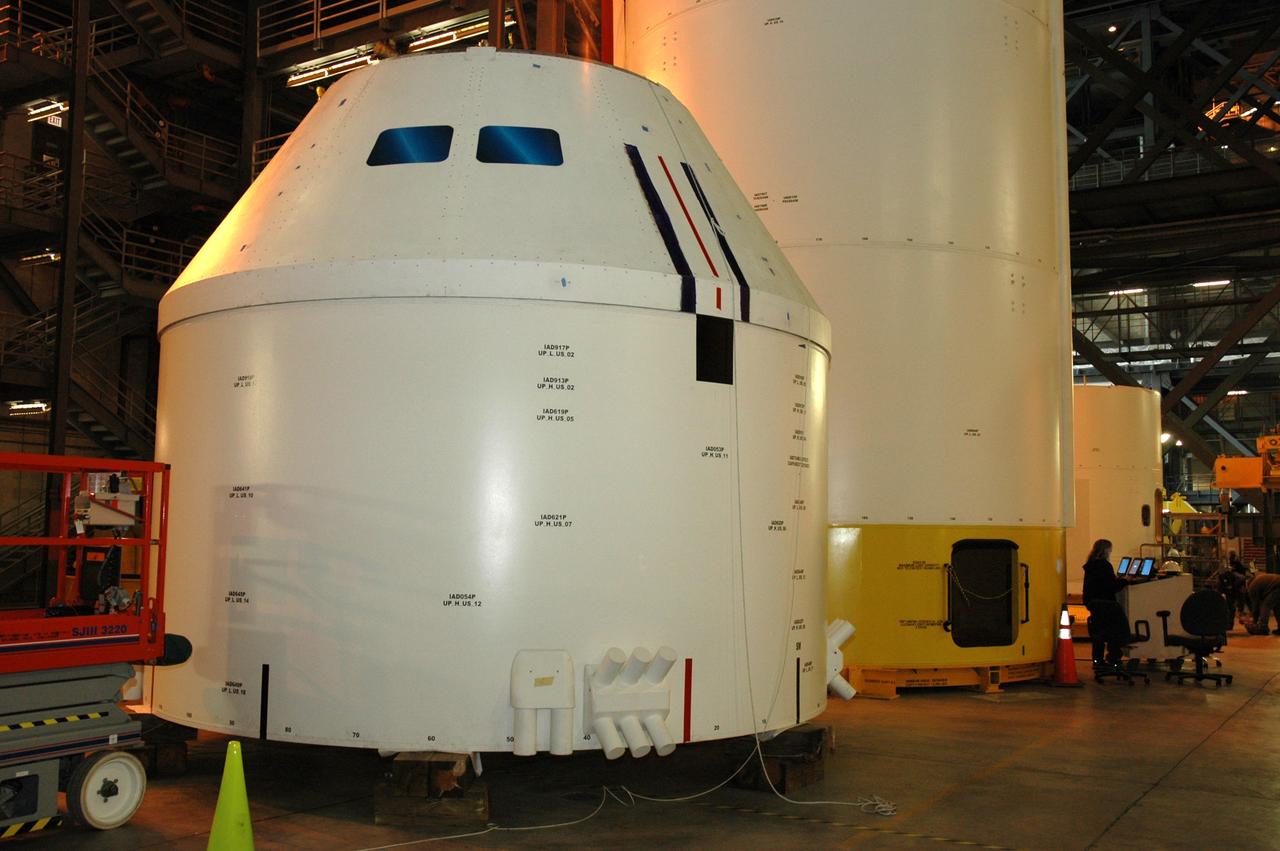
CAPE CANAVERAL, Fla. – In high bay 4 of the Vehicle Assembly Building at NASA's Kennedy Space Center in Florida, the Ares I-X crew/service module simulator (foreground) is being moved following a fit check. Ares I-X is the test flight for the Ares I. The I-X flight will provide NASA an early opportunity to test and prove hardware, facilities and ground operations associated with Ares I. The launch of the 327-foot-tall, full-scale Ares I-X, targeted for July 2009, will be the first in a series of unpiloted rocket launches from Kennedy. When fully developed, the 16-foot diameter crew module will furnish living space and reentry protection for the astronauts. Photo credit: NASA/Tim Jacobs
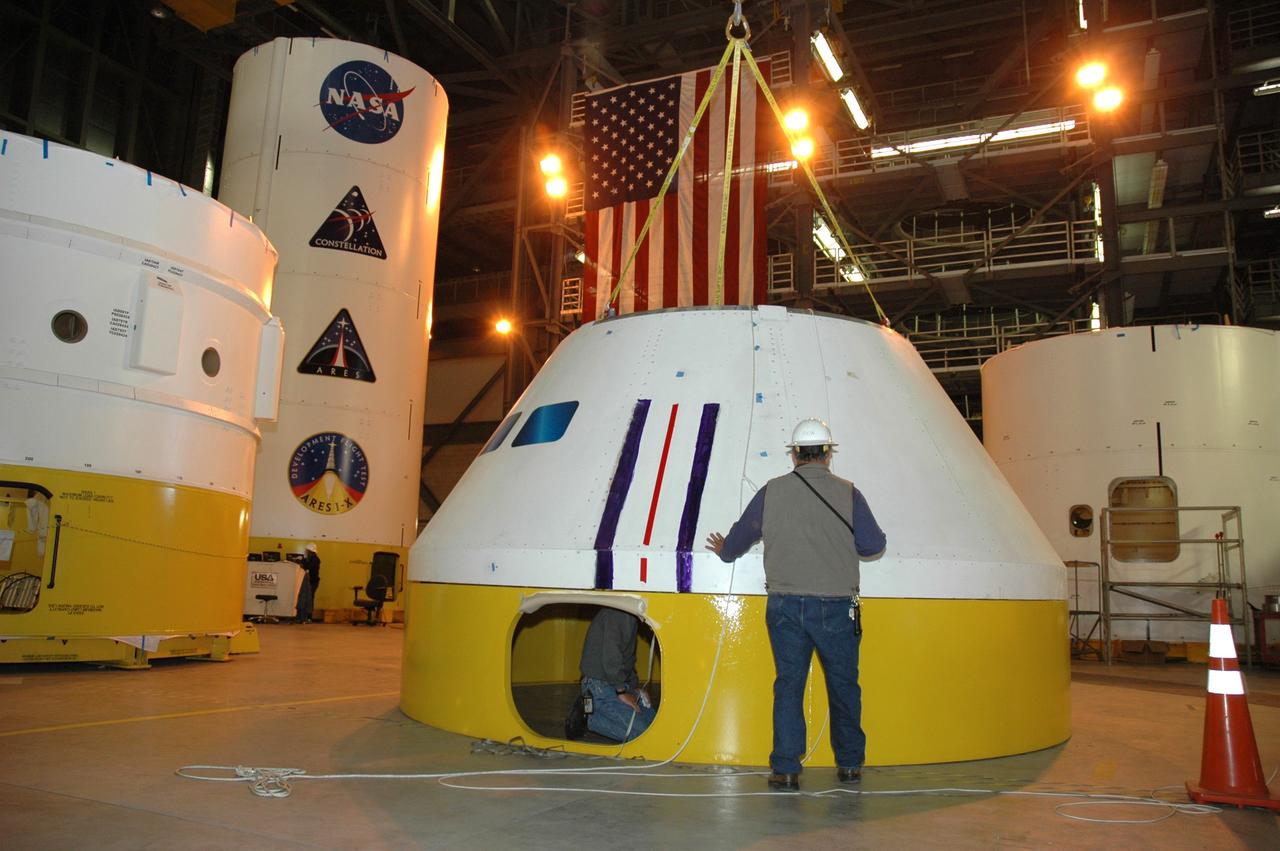
CAPE CANAVERAL, Fla. – In high bay 4 of the Vehicle Assembly Building at NASA's Kennedy Space Center in Florida, workers secure the Ares I-X crew module simulator onto its stand. Ares I-X is the test flight for the Ares I. The I-X flight will provide NASA an early opportunity to test and prove hardware, facilities and ground operations associated with Ares I. The launch of the 327-foot-tall, full-scale Ares I-X, targeted for July 2009, will be the first in a series of unpiloted rocket launches from Kennedy. When fully developed, the 16-foot diameter crew module will furnish living space and reentry protection for the astronauts. Photo credit: NASA/Tim Jacobs
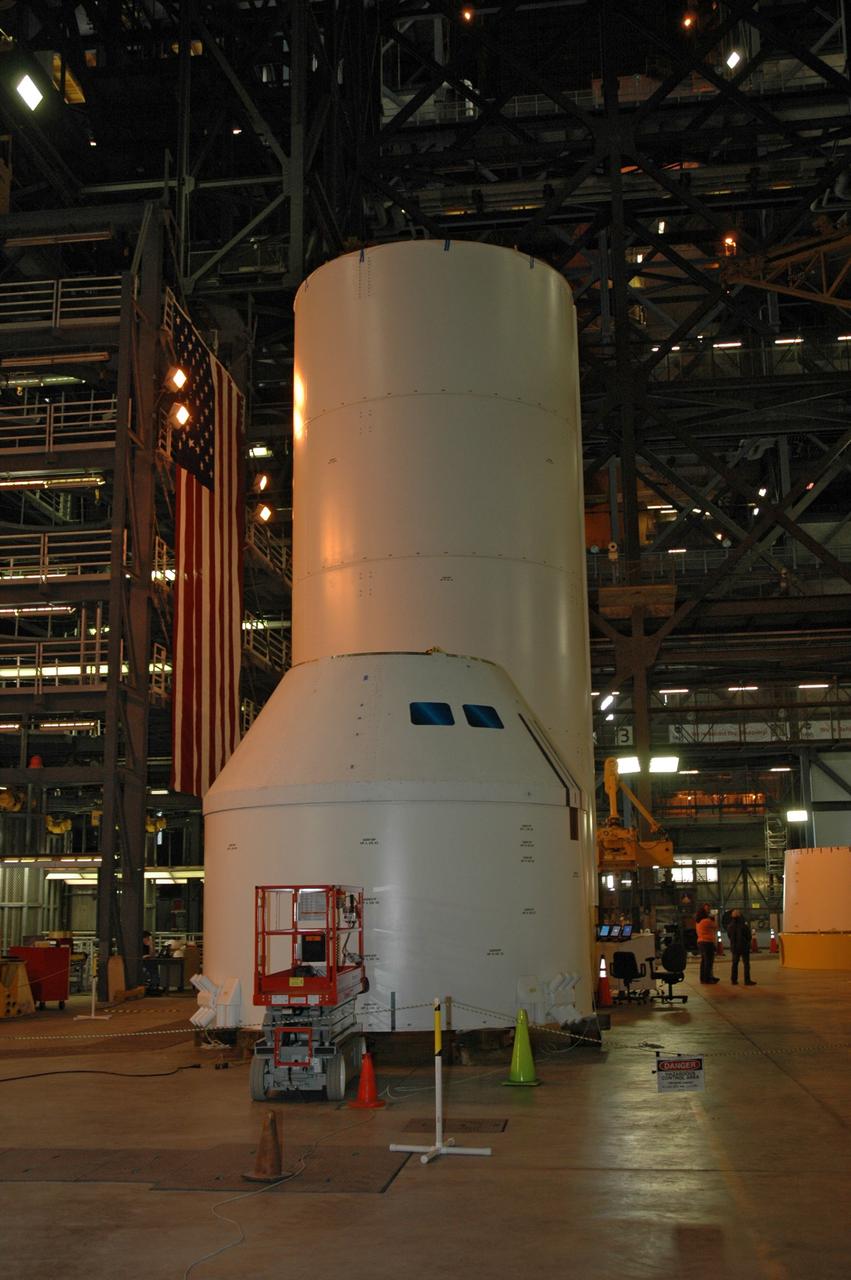
CAPE CANAVERAL, Fla. – In high bay 4 of the Vehicle Assembly Building at NASA's Kennedy Space Center in Florida, the Ares I-X crew/service module simulator (foreground) will be moved following a fit check. Ares I-X is the test flight for the Ares I. The I-X flight will provide NASA an early opportunity to test and prove hardware, facilities and ground operations associated with Ares I. The launch of the 327-foot-tall, full-scale Ares I-X, targeted for July 2009, will be the first in a series of unpiloted rocket launches from Kennedy. When fully developed, the 16-foot diameter crew module will furnish living space and reentry protection for the astronauts. Photo credit: NASA/Tim Jacobs
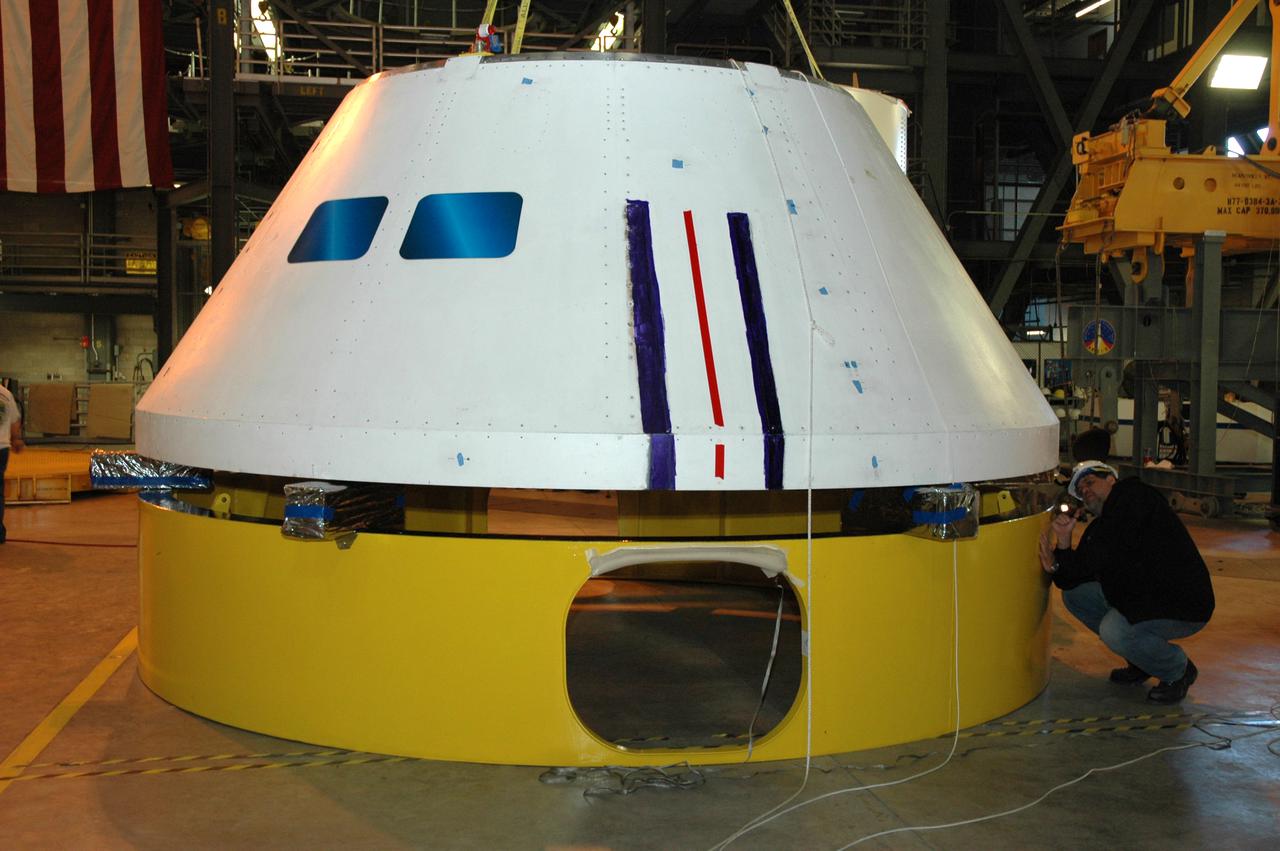
CAPE CANAVERAL, Fla. – – In high bay 4 of the Vehicle Assembly Building at NASA's Kennedy Space Center in Florida, a worker examines the Ares I-X crew module simulator as it is lowered onto a stand. Ares I-X is the test flight for the Ares I. The I-X flight will provide NASA an early opportunity to test and prove hardware, facilities and ground operations associated with Ares I. The launch of the 327-foot-tall, full-scale Ares I-X, targeted for July 2009, will be the first in a series of unpiloted rocket launches from Kennedy. When fully developed, the 16-foot diameter crew module will furnish living space and reentry protection for the astronauts. Photo credit: NASA_Tim Jacobs

CAPE CANAVERAL, Fla. – In high bay 4 of the Vehicle Assembly Building at NASA's Kennedy Space Center in Florida, the newly arrived simulator crew module for the Ares I-X rocket is moved to a work stand. Ares I-X is the test flight for the Ares I. The I-X flight will provide NASA an early opportunity to test and prove hardware, facilities and ground operations associated with Ares I. The launch of the 321-foot-tall, full-scale Ares I-X, targeted for July 2009, will be the first in a series of unpiloted rocket launches from Kennedy. When fully developed, the 16-foot diameter crew module will furnish living space and reentry protection for the astronauts. Photo credit: NASA/Jack Pfaller
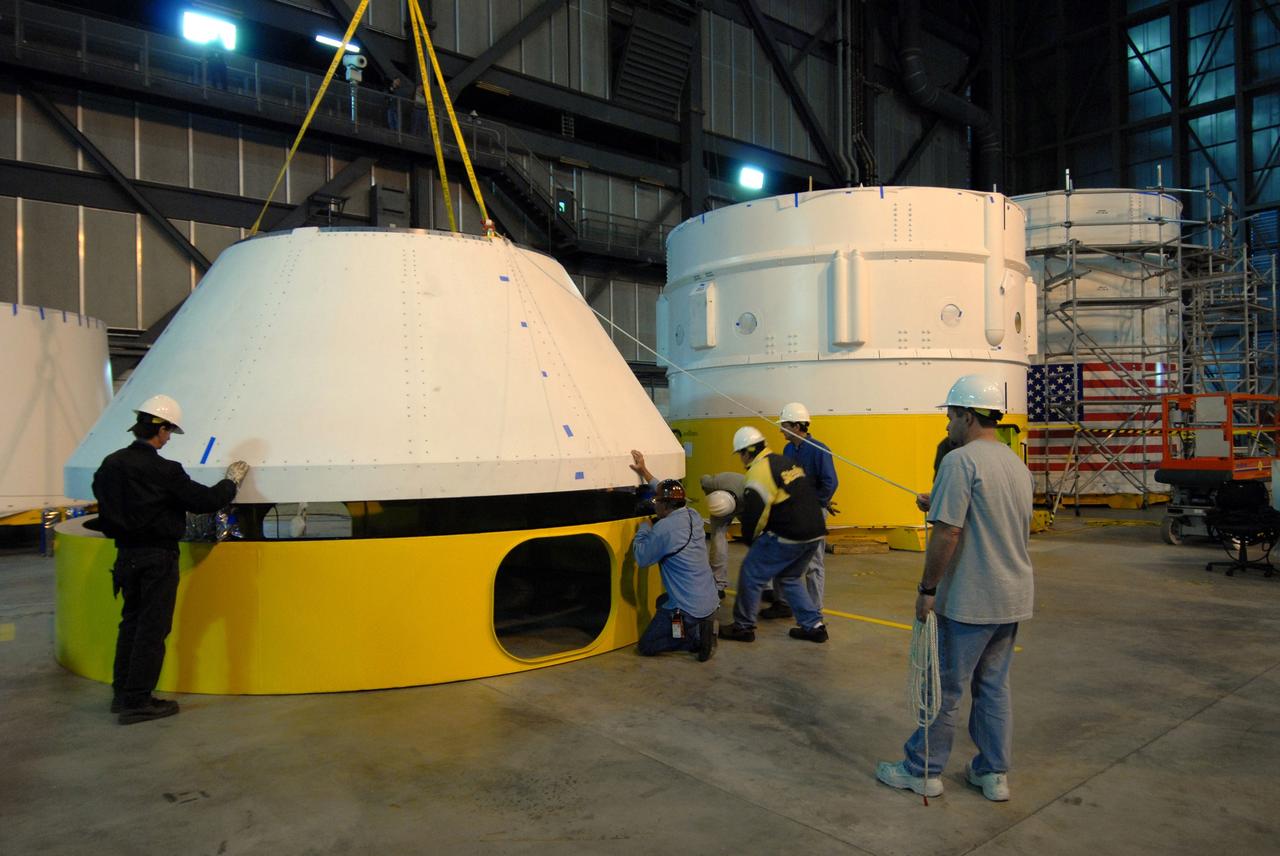
CAPE CANAVERAL, Fla. – In high bay 4 of the Vehicle Assembly Building at NASA's Kennedy Space Center in Florida, the newly arrived simulator crew module for the Ares I-X rocket is lowered onto a work stand. Ares I-X is the test flight for the Ares I. The I-X flight will provide NASA an early opportunity to test and prove hardware, facilities and ground operations associated with Ares I. The launch of the 321-foot-tall, full-scale Ares I-X, targeted for July 2009, will be the first in a series of unpiloted rocket launches from Kennedy. When fully developed, the 16-foot diameter crew module will furnish living space and reentry protection for the astronauts. Photo credit: NASA/Jack Pfaller

CAPE CANAVERAL, Fla. – In high bay 4 of the Vehicle Assembly Building at NASA's Kennedy Space Center in Florida, the newly arrived simulator crew module for the Ares I-X rocket is moved to a work stand. Ares I-X is the test flight for the Ares I. The I-X flight will provide NASA an early opportunity to test and prove hardware, facilities and ground operations associated with Ares I. The launch of the 321-foot-tall, full-scale Ares I-X, targeted for July 2009, will be the first in a series of unpiloted rocket launches from Kennedy. When fully developed, the 16-foot diameter crew module will furnish living space and reentry protection for the astronauts. Photo credit: NASA/Jack Pfaller
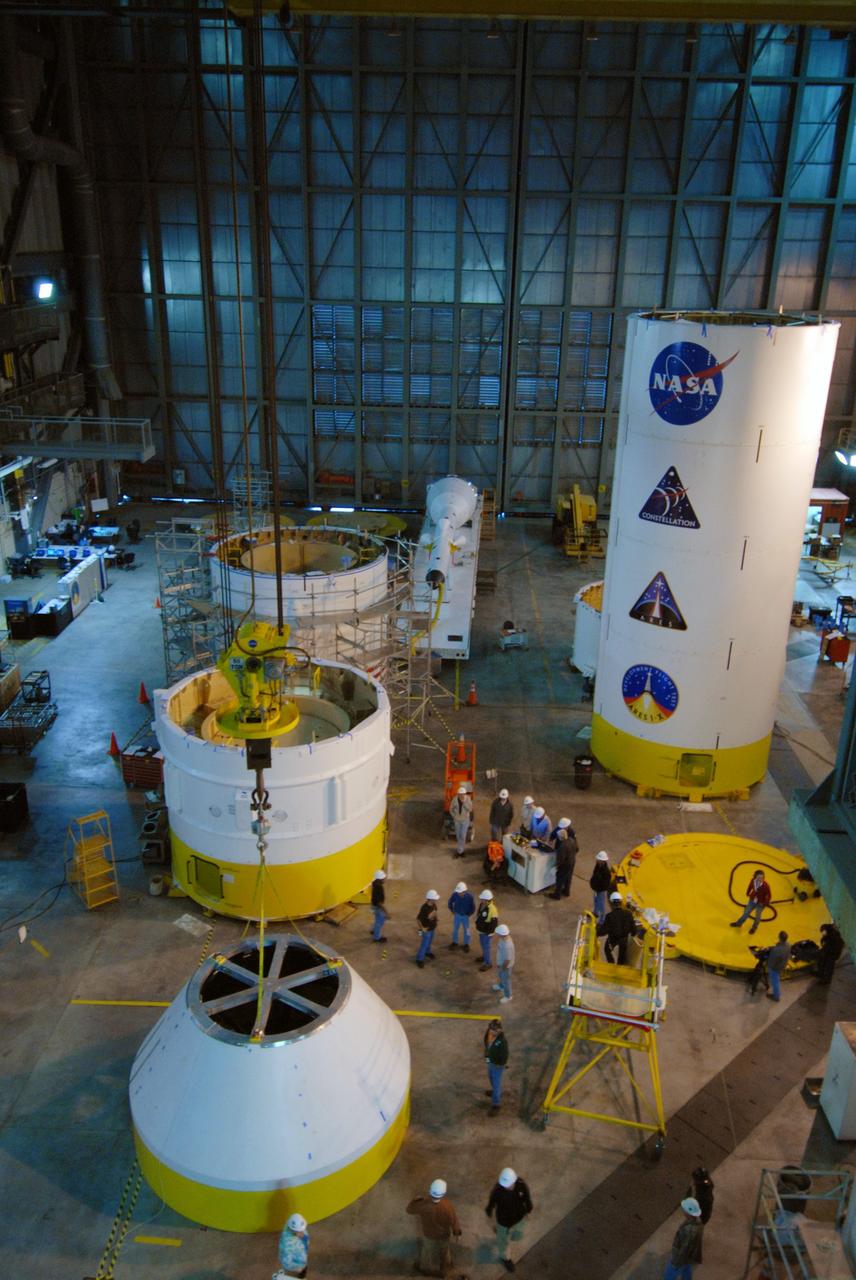
CAPE CANAVERAL, Fla. – In high bay 4 of the Vehicle Assembly Building at NASA's Kennedy Space Center in Florida, the newly arrived simulator crew module for the Ares I-X rocket rests on a work stand, surrounded by other segments stacked on the floor. Ares I-X is the test flight for the Ares I. The I-X flight will provide NASA an early opportunity to test and prove hardware, facilities and ground operations associated with Ares I. The launch of the 321-foot-tall, full-scale Ares I-X, targeted for July 2009, will be the first in a series of unpiloted rocket launches from Kennedy. When fully developed, the 16-foot diameter crew module will furnish living space and reentry protection for the astronauts. Photo credit: NASA/Jack Pfaller
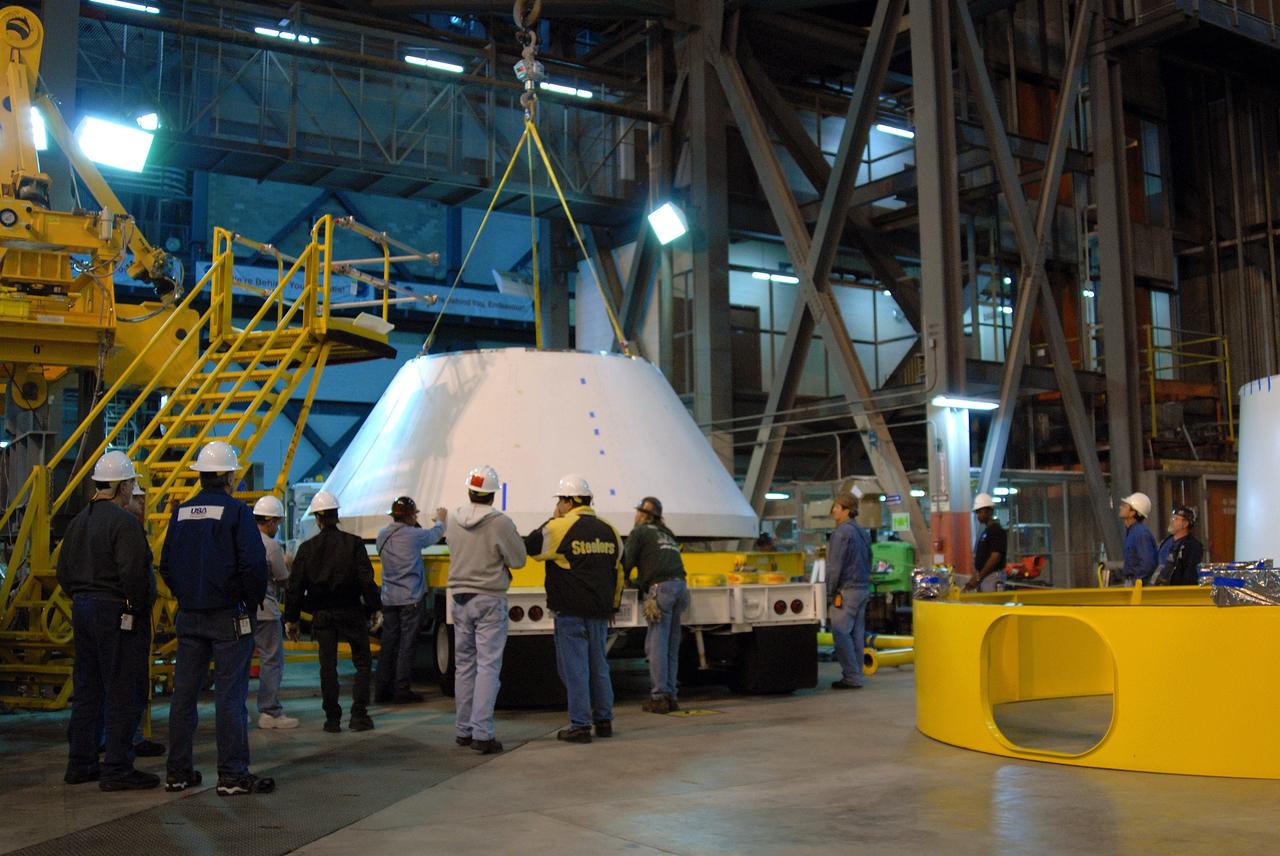
CAPE CANAVERAL, Fla. – In high bay 4 of the Vehicle Assembly Building at NASA's Kennedy Space Center in Florida, the newly arrived simulator crew module for the Ares I-X rocket is lifted off the truck. The module will be moved to a work stand. Ares I-X is the test flight for the Ares I. The I-X flight will provide NASA an early opportunity to test and prove hardware, facilities and ground operations associated with Ares I. The launch of the 321-foot-tall, full-scale Ares I-X, targeted for July 2009, will be the first in a series of unpiloted rocket launches from Kennedy. When fully developed, the 16-foot diameter crew module will furnish living space and reentry protection for the astronauts. Photo credit: NASA/Jack Pfaller
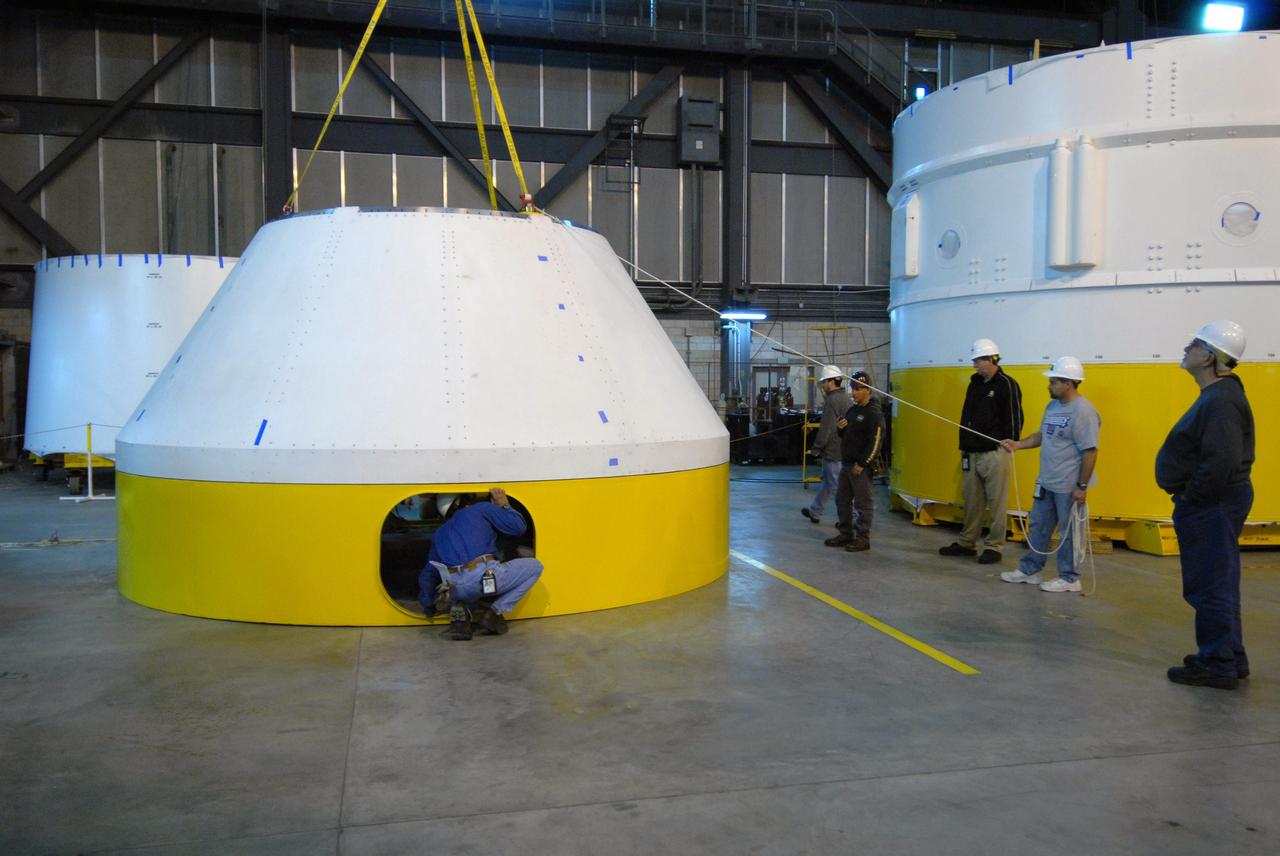
CAPE CANAVERAL, Fla. – In high bay 4 of the Vehicle Assembly Building at NASA's Kennedy Space Center in Florida, the newly arrived simulator crew module for the Ares I-X rocket is lowered onto a work stand. Ares I-X is the test flight for the Ares I. The I-X flight will provide NASA an early opportunity to test and prove hardware, facilities and ground operations associated with Ares I. The launch of the 321-foot-tall, full-scale Ares I-X, targeted for July 2009, will be the first in a series of unpiloted rocket launches from Kennedy. When fully developed, the 16-foot diameter crew module will furnish living space and reentry protection for the astronauts. Photo credit: NASA/Jack Pfaller