
Apollo 11 astronaut Buzz Aldrin and tour guide Mary Ann Harness check out models of the Ares 1 and Ares 5 space vehicles during Aldrin's tour of NASA Dryden.
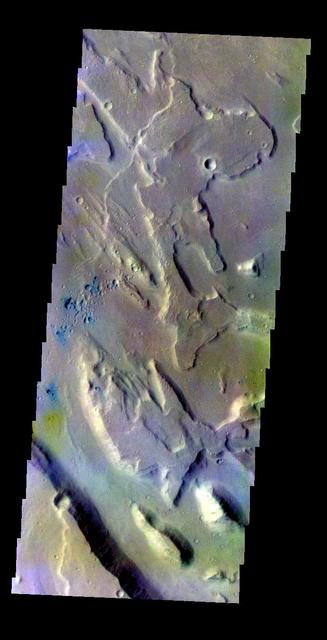
The THEMIS VIS camera contains 5 filters. The data from different filters can be combined in multiple ways to create a false color image. This false color image from NASA 2001 Mars Odyssey spacecraft shows part of of Ares Vallis.
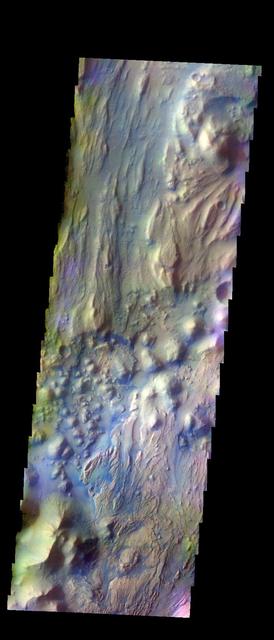
The THEMIS VIS camera contains 5 filters. The data from different filters can be combined in multiple ways to create a false color image. This image from NASA 2001 Mars Odyssey spacecraft shows the beginning of Ares Vallis at the edge of Iani Chaos.
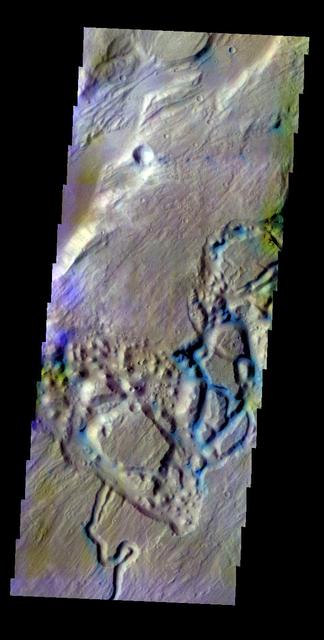
The THEMIS VIS camera contains 5 filters. The data from different filters can be combined to create a false color image. This false color image from NASA 2001 Mars Odyssey spacecraft shows part of a tributary channel that empties into Ares Vallis.
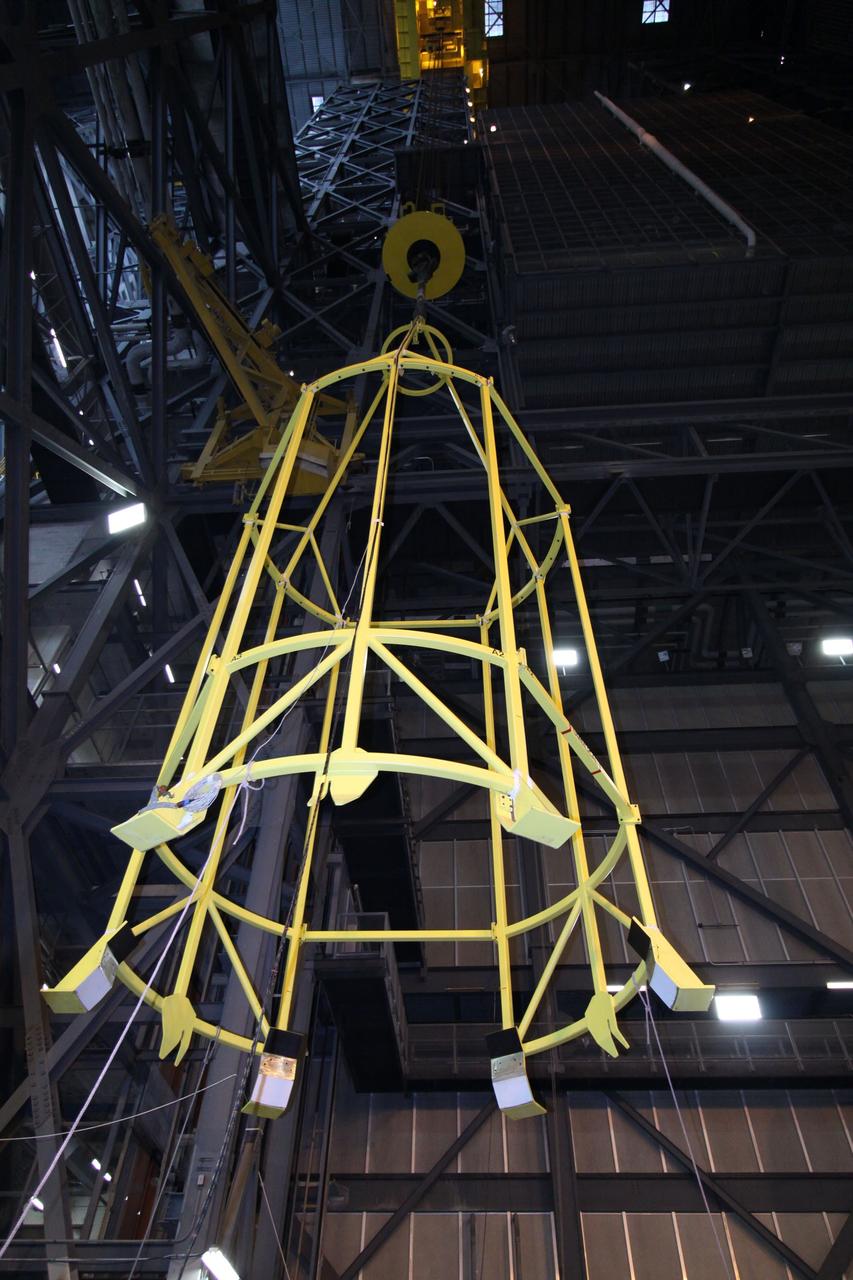
CAPE CANAVERAL, Fla. – In the Vehicle Assembly Building's High Bay 4, assembly of the Ares I-X rocket nears completion. The yellow framework, nicknamed the "birdcage," is lowered by crane toward Super Stack 5. The birdcage has the ability to lift and to stack and de-stack the Ares I-X rocket's Super Stack 5. Next, the stack will be lifted on top of the segments already in place on the mobile launcher platform, completing assembly of the rocket. Five super stacks make up the rocket's upper stage that will be integrated with the four-segment solid rocket booster first stage. Ares I-X is the test vehicle for the Ares I, which is part of the Constellation Program to return men to the moon and beyond. The Ares I-X flight test is targeted for Oct. 31, pending formal NASA Headquarters approval. Photo credit: NASA/Jack Pfaller
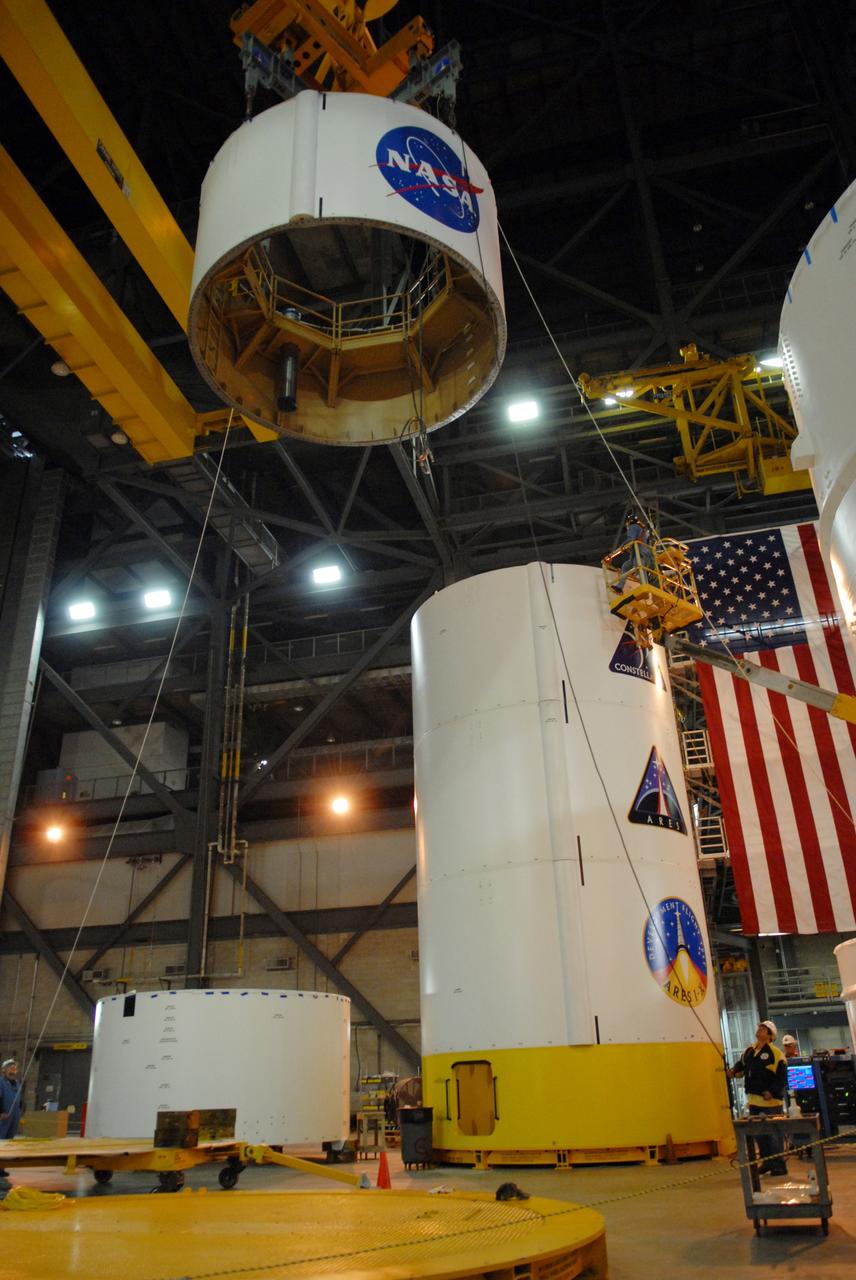
CAPE CANAVERAL, Fla. -- In high bay 4 of the Vehicle Assembly Building at NASA's Kennedy Space Center in Florida, a crane moves segment 5 of the Ares I-X upper stage simulator segments toward the tall stack behind it. Segment 5 will be placed on segment 4, at top of the tall stack. The upper stage simulator comprises 11 segments, each approximately 18 feet in diameter, that will be used in the test flight known as Ares I-X in 2009. The simulator segments will simulate the mass and the outer mold line. The upper stage accounts for nearly one-quarter of the total height of the Ares I. It will take the Ares I on the second phase of its journey from Earth, providing the guidance, navigation and control needed for the second phase of the Ares I ascent flight. Photo credit: NASA/Troy Cryder
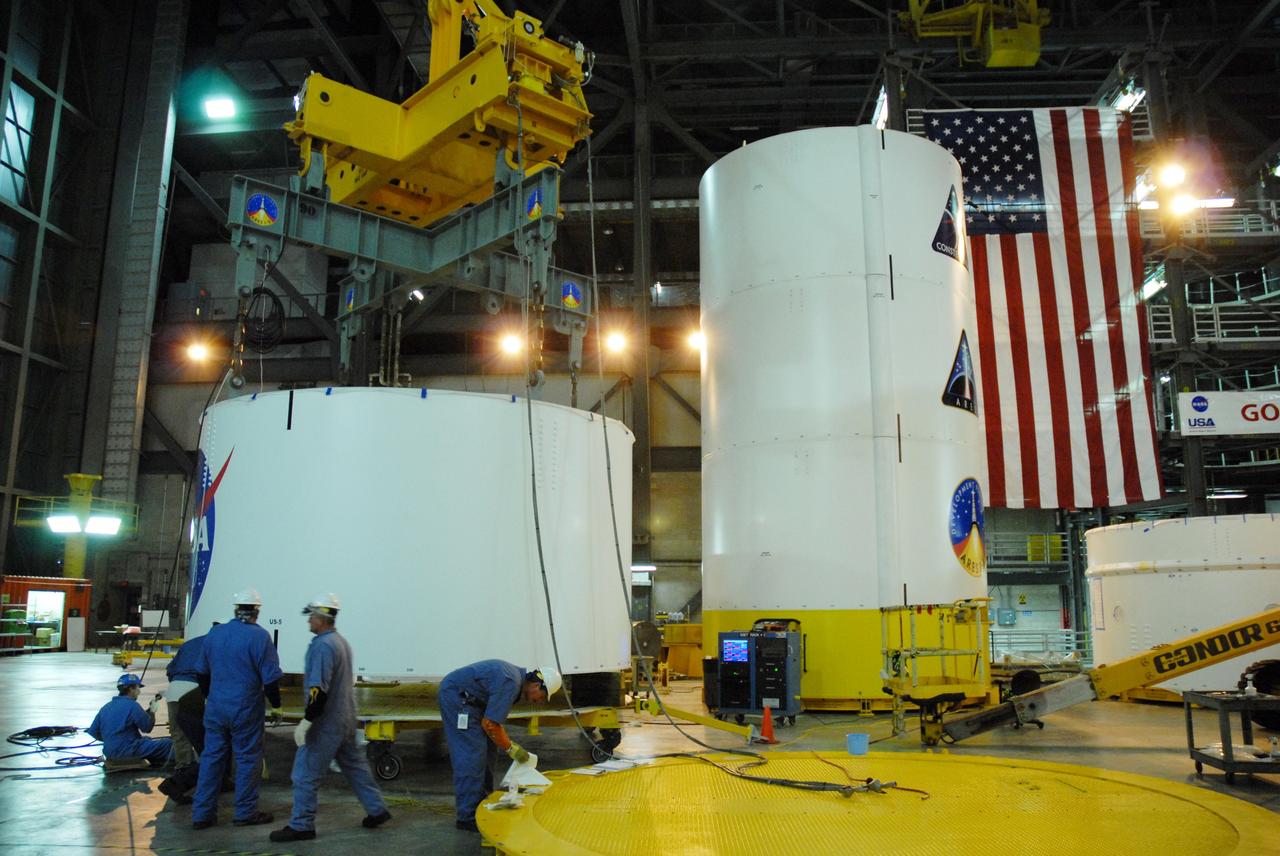
CAPE CANAVERAL, Fla. -- In high bay 4 of the Vehicle Assembly Building at NASA's Kennedy Space Center in Florida, a crane is attached to segment 5 of the Ares I-X upper stage simulator segments to lift it. Segment 5 will be stacked on to segment 4, at the top of the tall stack at right. The upper stage simulator comprises 11 segments, each approximately 18 feet in diameter, that will be used in the test flight known as Ares I-X in 2009. The simulator segments will simulate the mass and the outer mold line. The upper stage accounts for nearly one-quarter of the total height of the Ares I. It will take the Ares I on the second phase of its journey from Earth, providing the guidance, navigation and control needed for the second phase of the Ares I ascent flight. Photo credit: NASA/Jim Grossmann
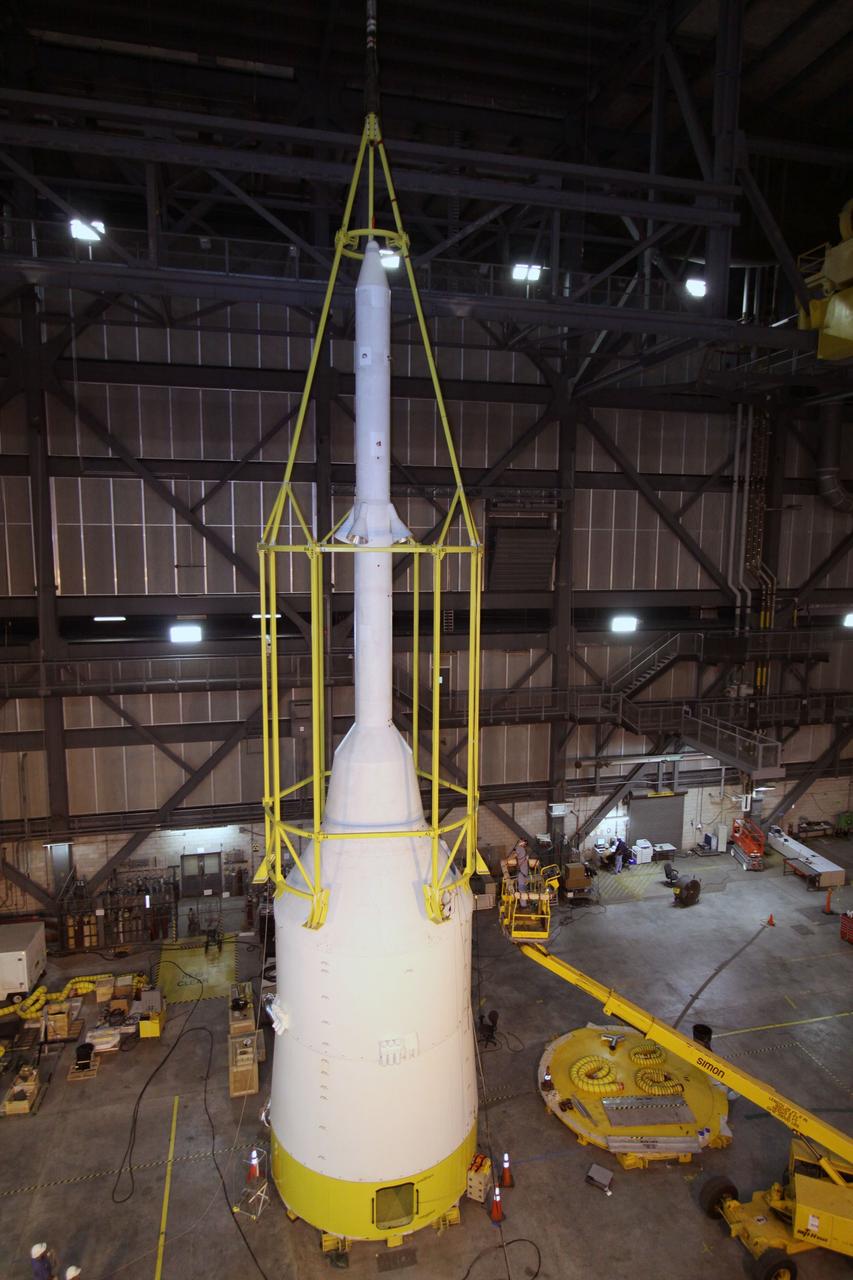
CAPE CANAVERAL, Fla. – In the Vehicle Assembly Building's High Bay 4, assembly of the Ares I-X rocket nears completion. The yellow framework, nicknamed the "birdcage," is lowered by crane over Super Stack 5. The birdcage has the ability to lift and to stack and de-stack the Ares I-X rocket's Super Stack 5. Next, the stack will be lifted on top of the segments already in place on the mobile launcher platform, completing assembly of the rocket. Five super stacks make up the rocket's upper stage that will be integrated with the four-segment solid rocket booster first stage. Ares I-X is the test vehicle for the Ares I, which is part of the Constellation Program to return men to the moon and beyond. The Ares I-X flight test is targeted for Oct. 31, pending formal NASA Headquarters approval. Photo credit: NASA/Jack Pfaller
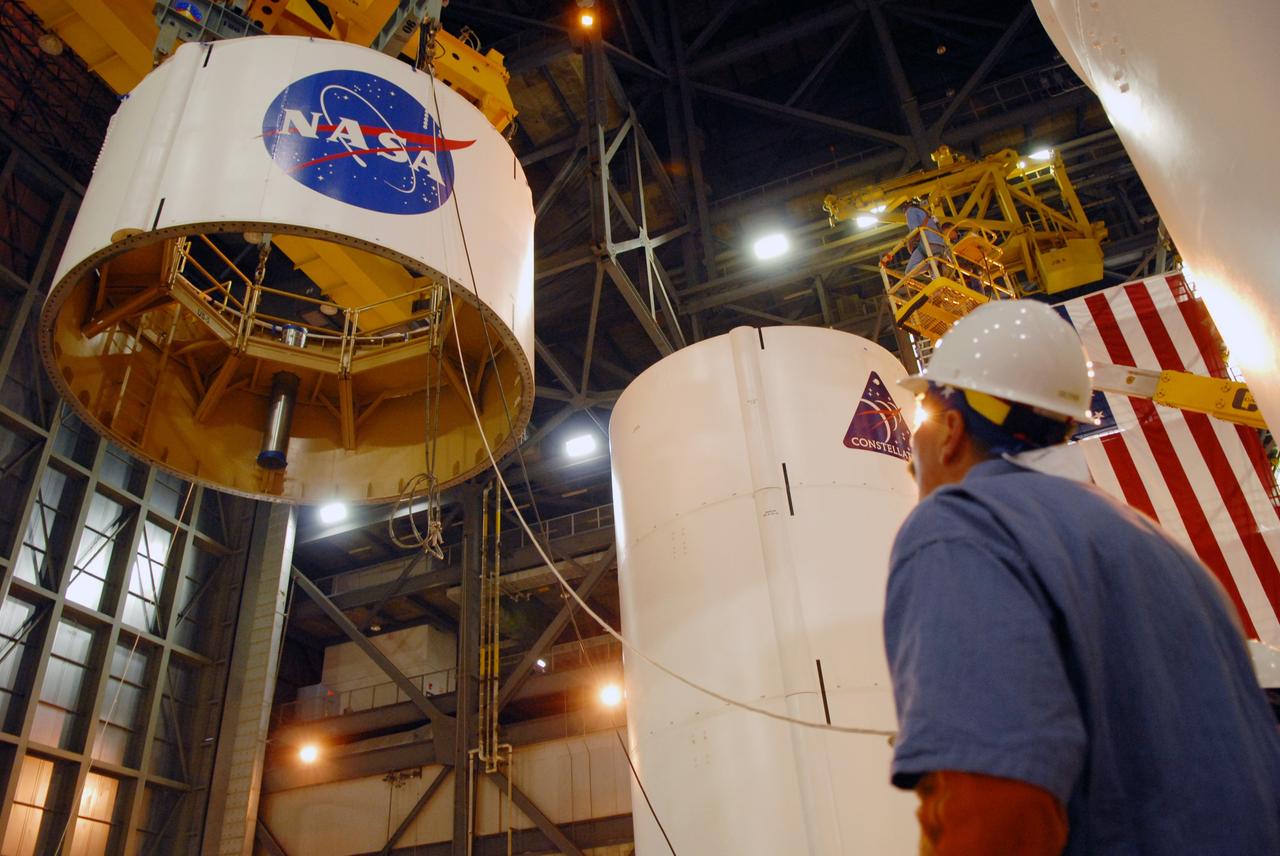
CAPE CANAVERAL, Fla. -- In high bay 4 of the Vehicle Assembly Building at NASA's Kennedy Space Center in Florida, a crane lifts segment 5 of the Ares I-X upper stage simulator segments toward the tall stack behind it. Segment 5 will be placed on segment 4, at top of the tall stack. The upper stage simulator comprises 11 segments, each approximately 18 feet in diameter, that will be used in the test flight known as Ares I-X in 2009. The simulator segments will simulate the mass and the outer mold line. The upper stage accounts for nearly one-quarter of the total height of the Ares I. It will take the Ares I on the second phase of its journey from Earth, providing the guidance, navigation and control needed for the second phase of the Ares I ascent flight. Photo credit: NASA/Troy Cryder
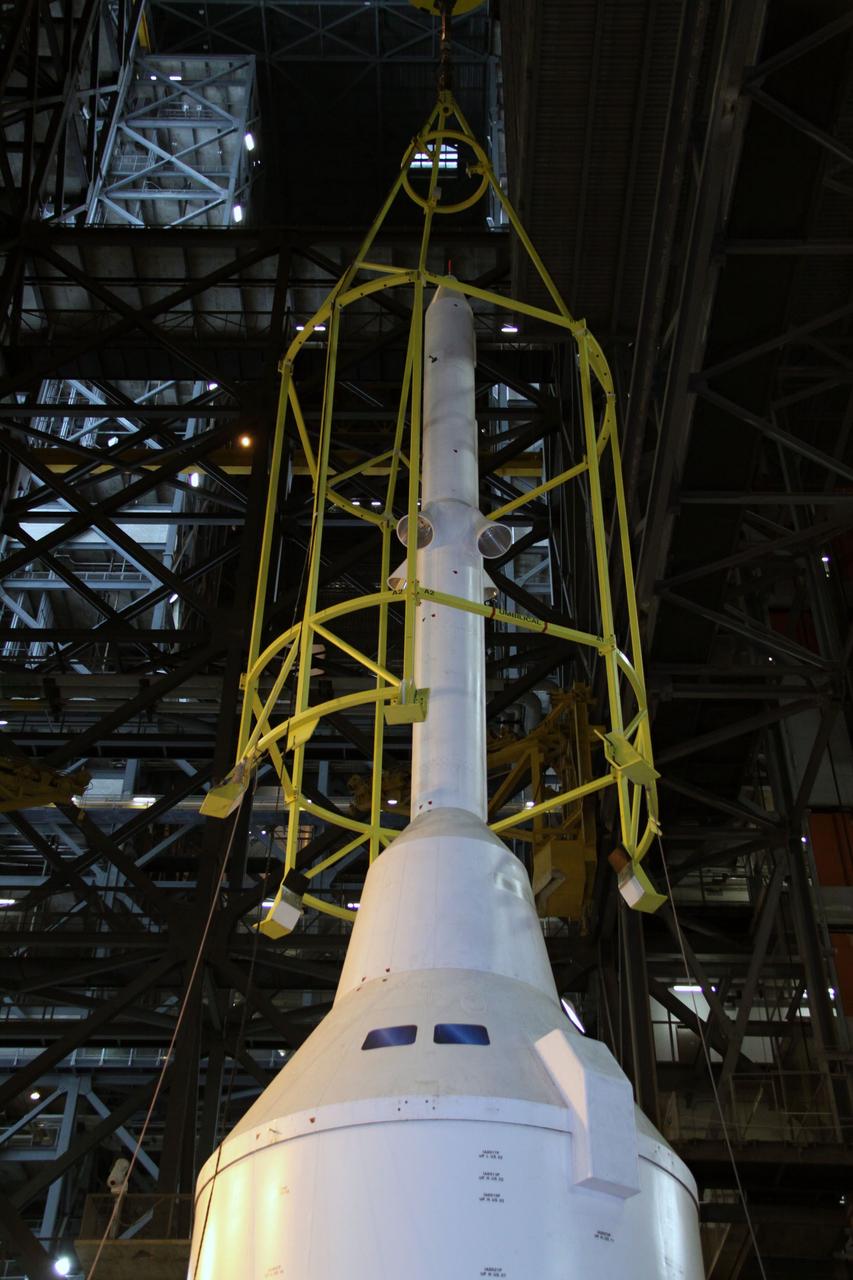
CAPE CANAVERAL, Fla. – In the Vehicle Assembly Building's High Bay 4, assembly of the Ares I-X rocket nears completion. The yellow framework, nicknamed the "birdcage," is lowered by crane over the Launch Abort System, or LAS, of Super Stack 5. The birdcage has the ability to lift and to stack and de-stack the Ares I-X rocket's Super Stack 5. Next, the stack will be lifted on top of the segments already in place on the mobile launcher platform, completing assembly of the rocket. Five super stacks make up the rocket's upper stage that will be integrated with the four-segment solid rocket booster first stage. Ares I-X is the test vehicle for the Ares I, which is part of the Constellation Program to return men to the moon and beyond. The Ares I-X flight test is targeted for Oct. 31, pending formal NASA Headquarters approval. Photo credit: NASA/Jack Pfaller
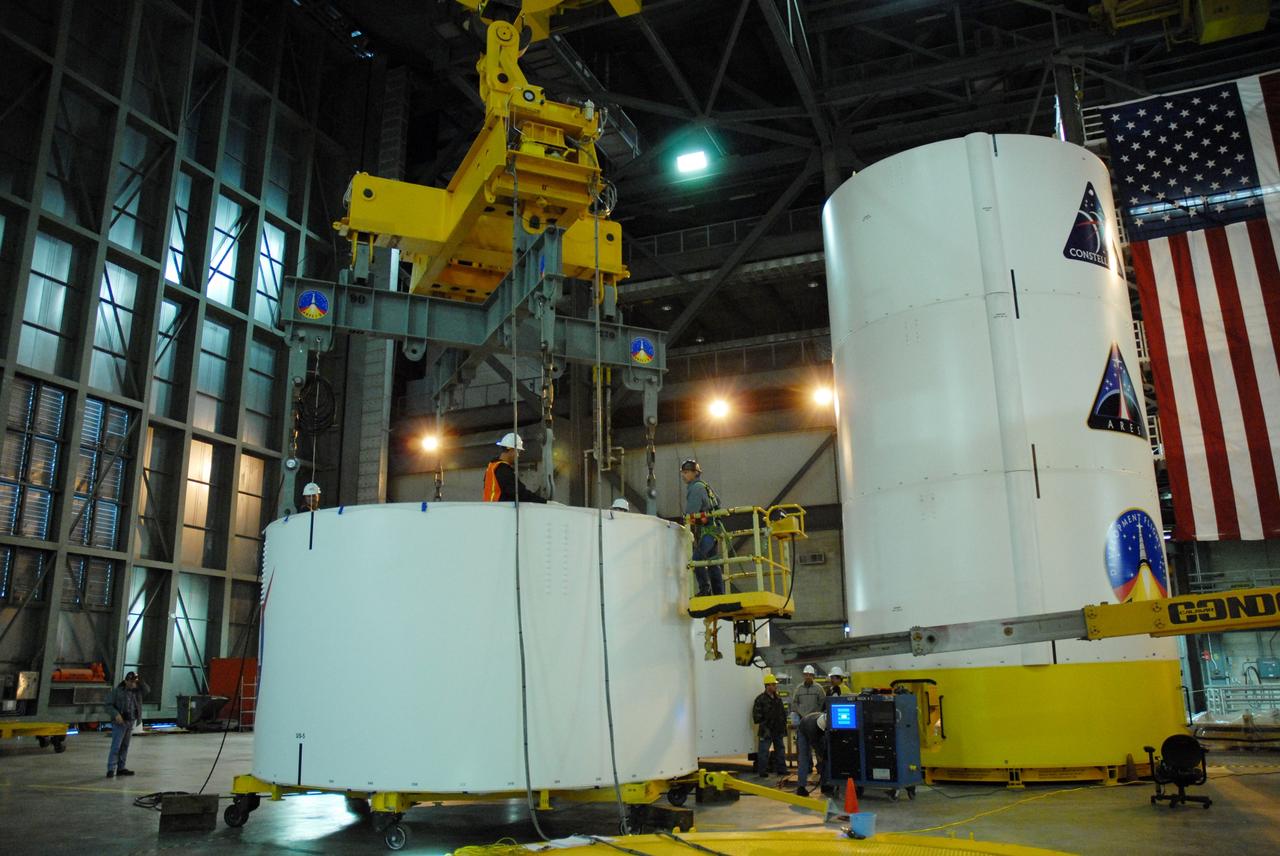
CAPE CANAVERAL, Fla. -- In high bay 4 of the Vehicle Assembly Building at NASA's Kennedy Space Center in Florida, a crane is attached to segment 5 of the Ares I-X upper stage simulator segments to lift it. Segment 5 will be stacked on to segment 4, at the top of the tall stack at right.The upper stage simulator comprises 11 segments, each approximately 18 feet in diameter, that will be used in the test flight known as Ares I-X in 2009. The simulator segments will simulate the mass and the outer mold line. The upper stage accounts for nearly one-quarter of the total height of the Ares I. It will take the Ares I on the second phase of its journey from Earth, providing the guidance, navigation and control needed for the second phase of the Ares I ascent flight. Photo credit: NASA/Jim Grossmann
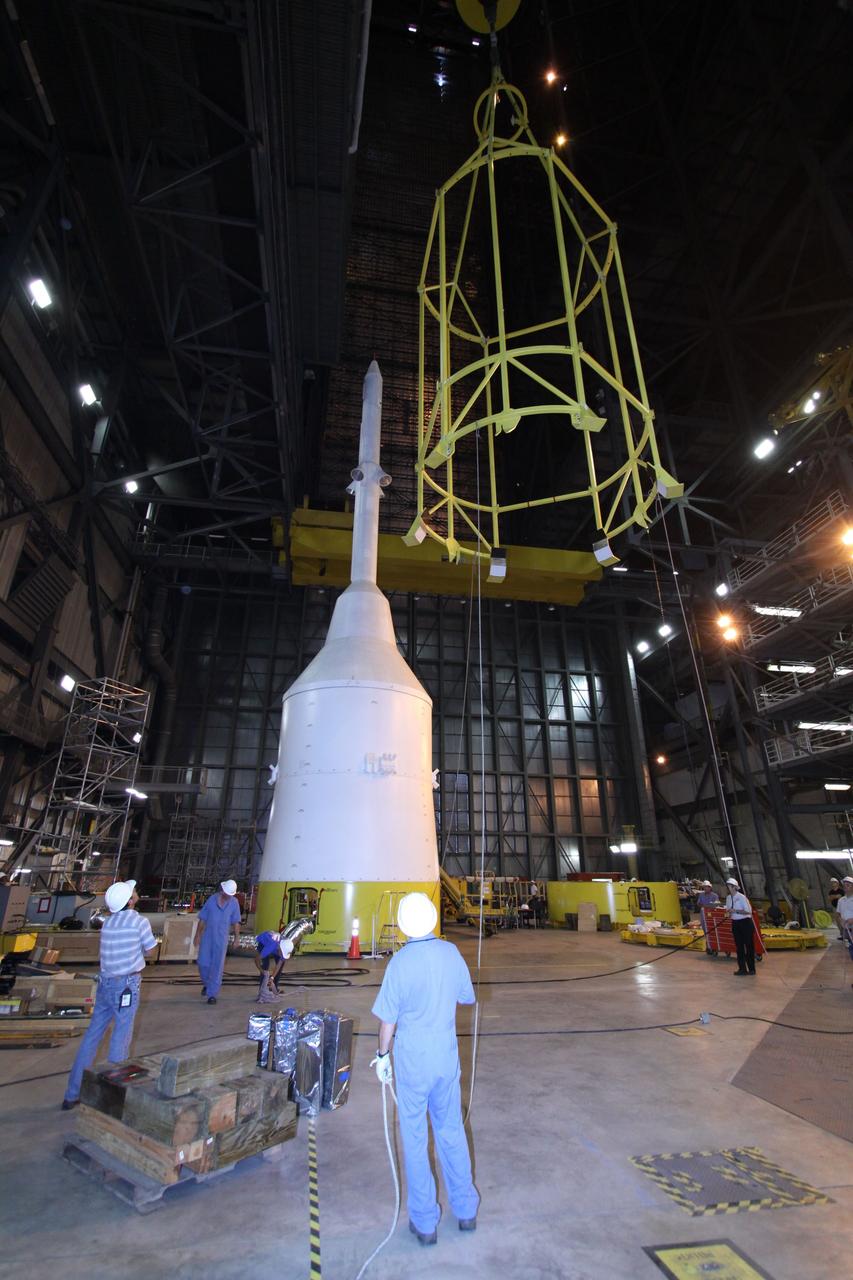
CAPE CANAVERAL, Fla. – In the Vehicle Assembly Building's High Bay 4, assembly of the Ares I-X rocket nears completion. Technicians monitor the yellow framework, nicknamed the "birdcage," as it is lowered by crane toward Super Stack 5. The birdcage has the ability to lift and to stack and de-stack the Ares I-X rocket's Super Stack 5. Next, the stack will be lifted on top of the segments already in place on the mobile launcher platform, completing assembly of the rocket. Five super stacks make up the rocket's upper stage that will be integrated with the four-segment solid rocket booster first stage. Ares I-X is the test vehicle for the Ares I, which is part of the Constellation Program to return men to the moon and beyond. The Ares I-X flight test is targeted for Oct. 31, pending formal NASA Headquarters approval. Photo credit: NASA/Jack Pfaller
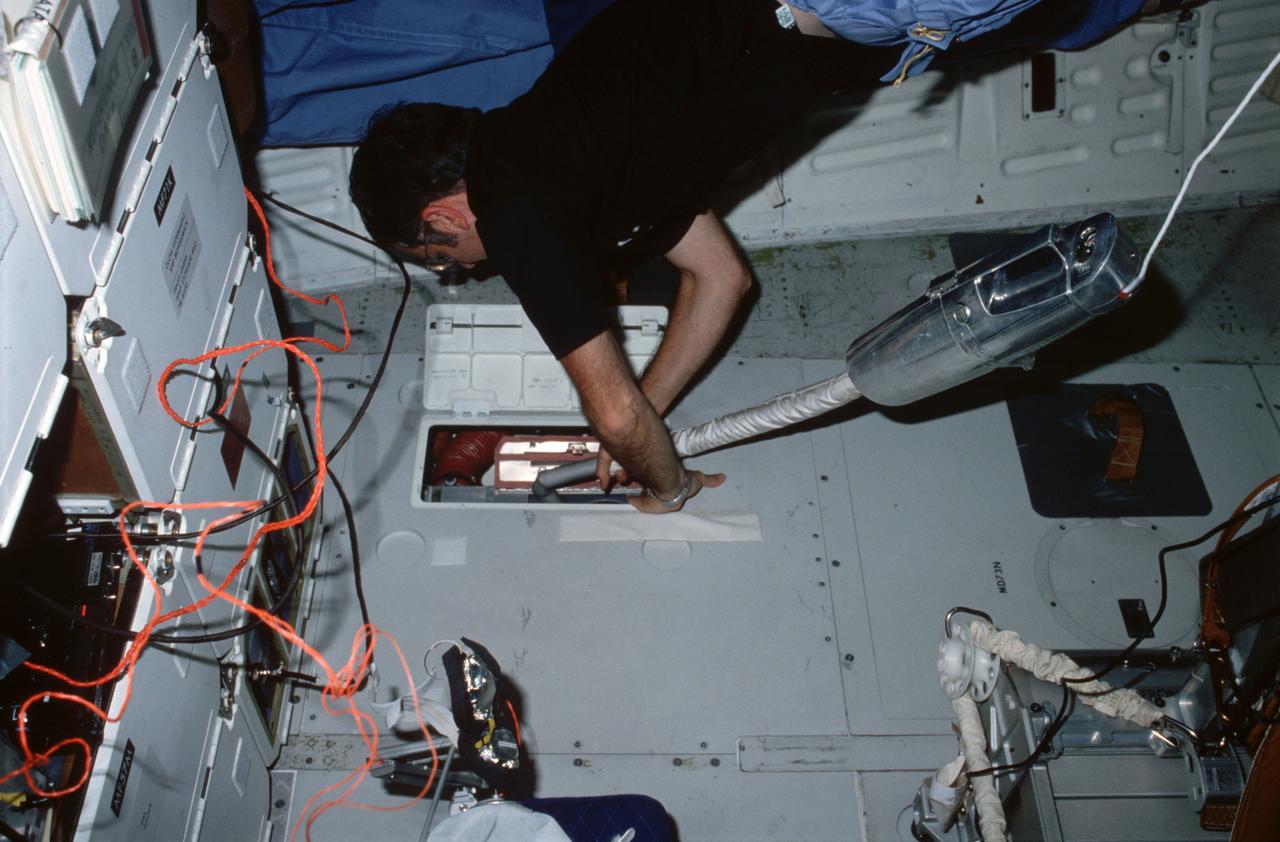
STS008-13-336 (5 Sept 1983) --- On middeck, Richard M. Truly, STS-8 commander, uses vacuum cleaner to remove debris from air revitalization system (ARS) filter assembly. Open panel on middeck floor is the ARS access panel.
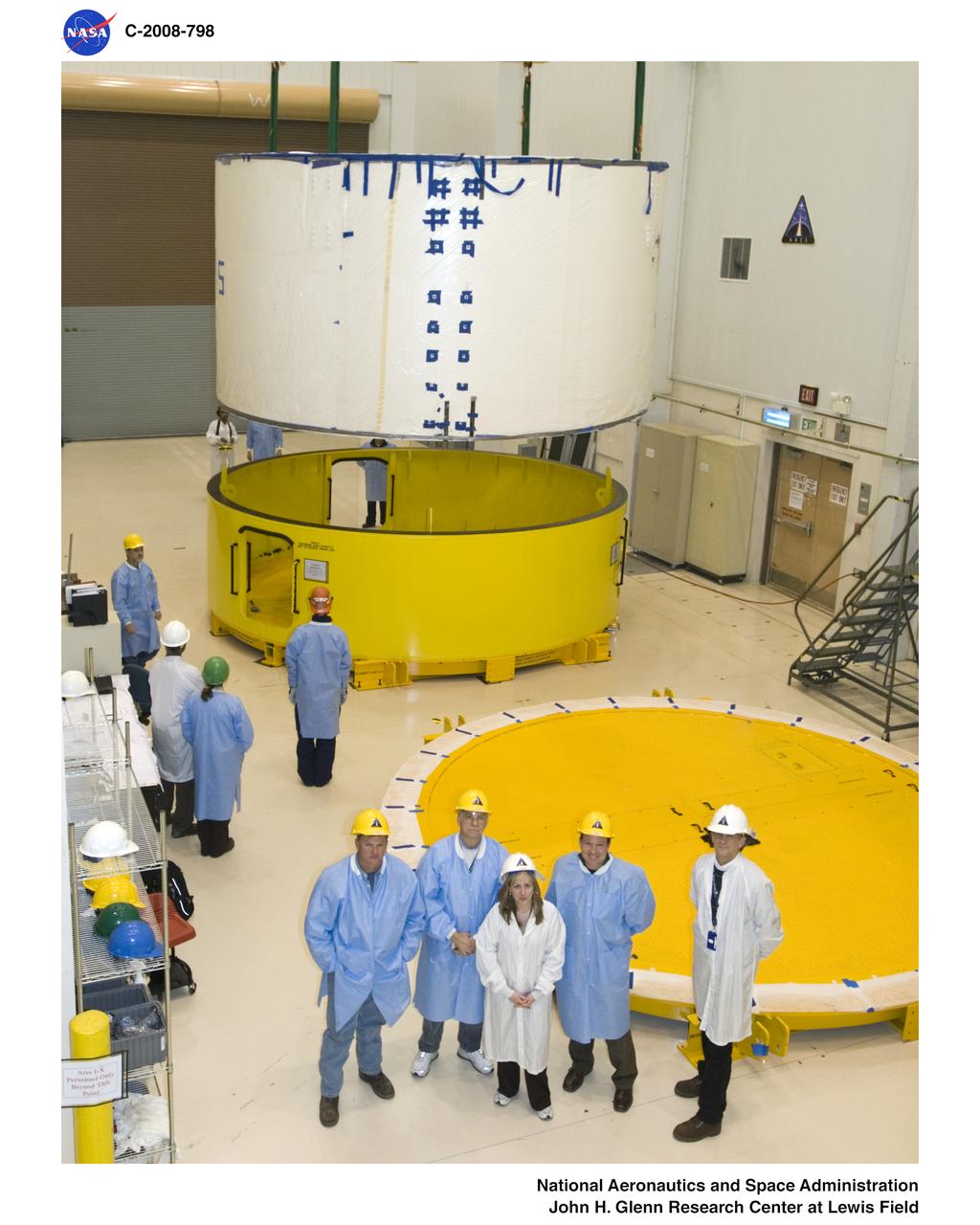
NASA Kennedy lift team observing the movement of Ares 1-X segment US-5 before its critical lift to the Super Stack
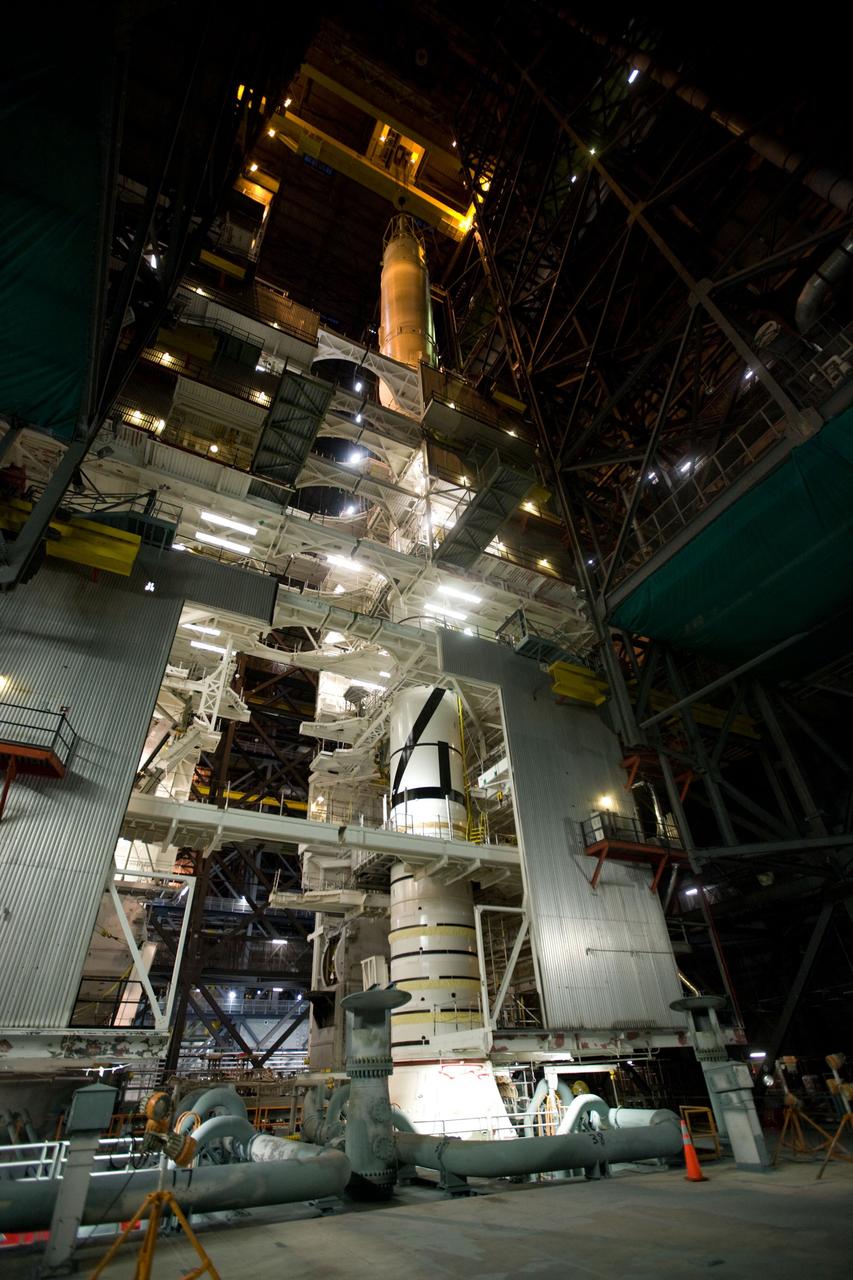
CAPE CANAVERAL, Fla. – In the Vehicle Assembly Building's High Bay 3, assembly of the Ares I-X rocket nears completion. The yellow framework, nicknamed the "birdcage," lowers Super Stack 5 onto the Ares I-X segments already in place on the mobile launcher platform. Once in position, assembly of the Ares I-X rocket will be complete. The 327-foot-tall rocket is one of the largest processed in the bay, rivaling the height of the Apollo Program's 364-foot-tall Saturn V. Five super stacks make up the rocket's upper stage that is integrated with the four-segment solid rocket booster first stage. Ares I-X is the test vehicle for the Ares I, which is part of the Constellation Program to return men to the moon and beyond. The Ares I-X flight test is targeted for Oct. 31, pending formal NASA Headquarters approval. Photo credit: NASA/Dimitri Gerondidakis
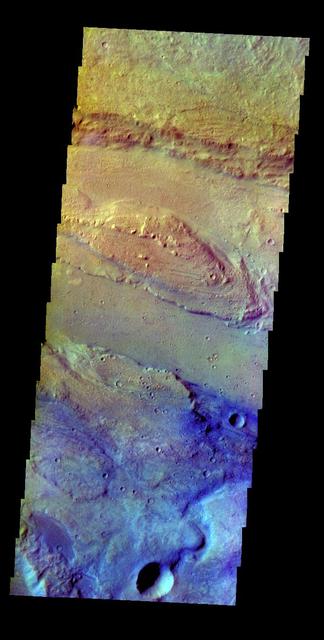
The THEMIS VIS camera contains 5 filters. The data from different filters can be combined in multiple ways to create a false color image. This false color image from NASA 2001 Mars Odyssey spacecraft shows part of Ares Vallis. Orbit Number: 4482 Latitude: 6.97956 Longitude: 339.713 Instrument: VIS Captured: 2002-12-18 13:46 http://photojournal.jpl.nasa.gov/catalog/PIA19215
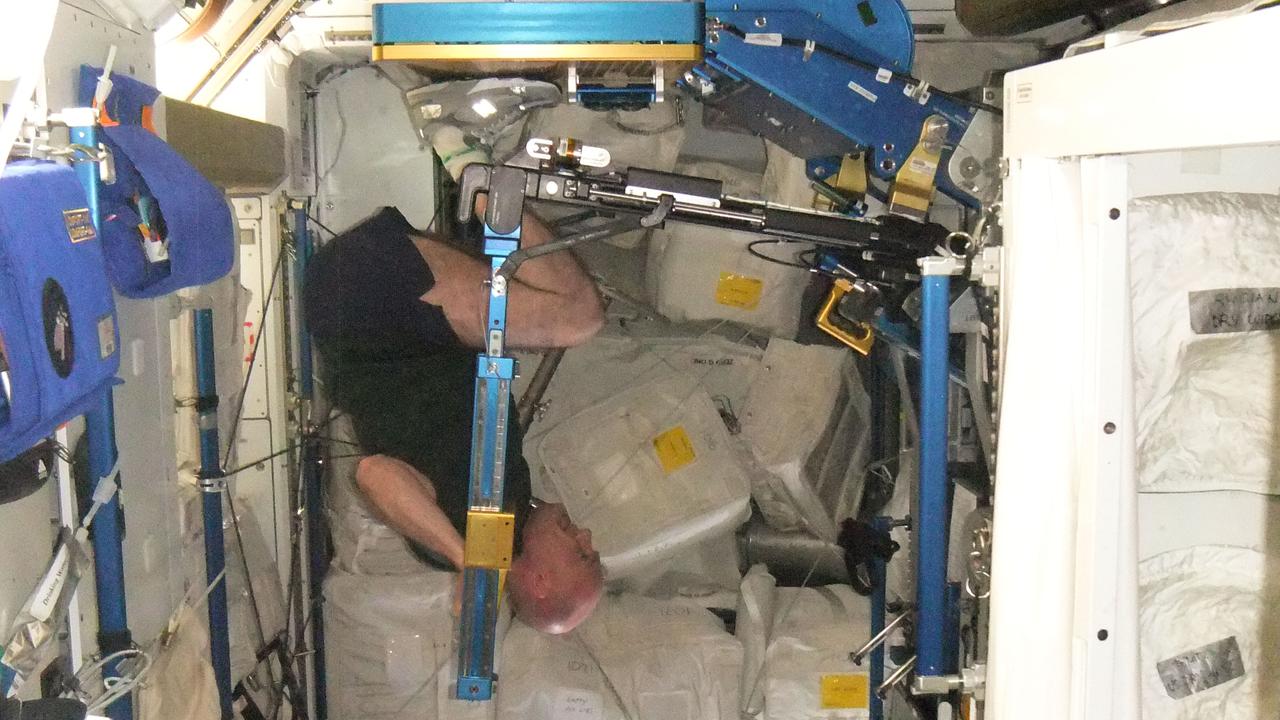
ISS031-E-157839 (5 June 2012) --- European Space Agency astronaut Andre Kuipers, Expedition 31 flight engineer, exercises using the advanced Resistive Exercise Device (aRED) in the Tranquility node of the International Space Station.
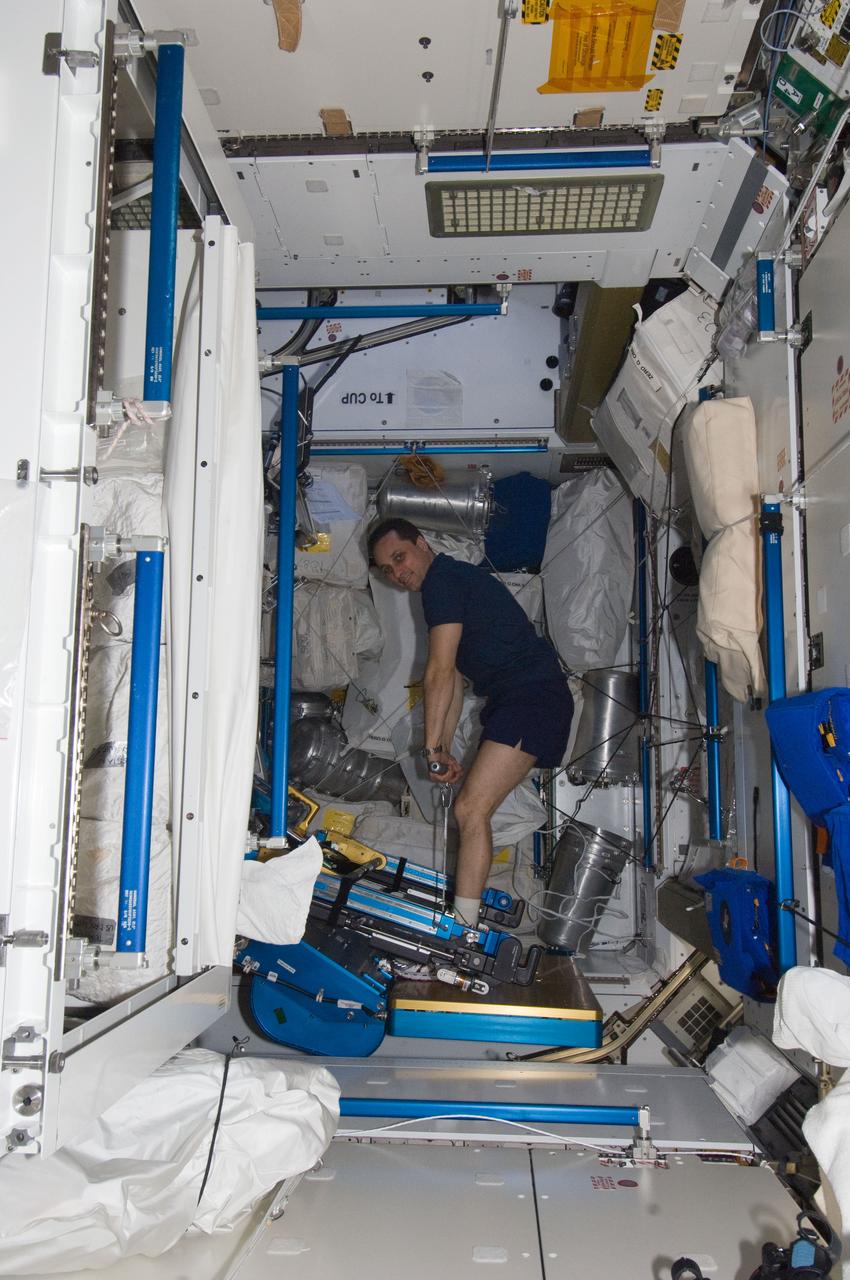
ISS030-E-235507 (5 Jan. 2012) --- Russian cosmonaut Anton Shkaplerov, Expedition 30 flight engineer, exercises using the advanced Resistive Exercise Device (aRED) in the Tranquility node of the International Space Station.
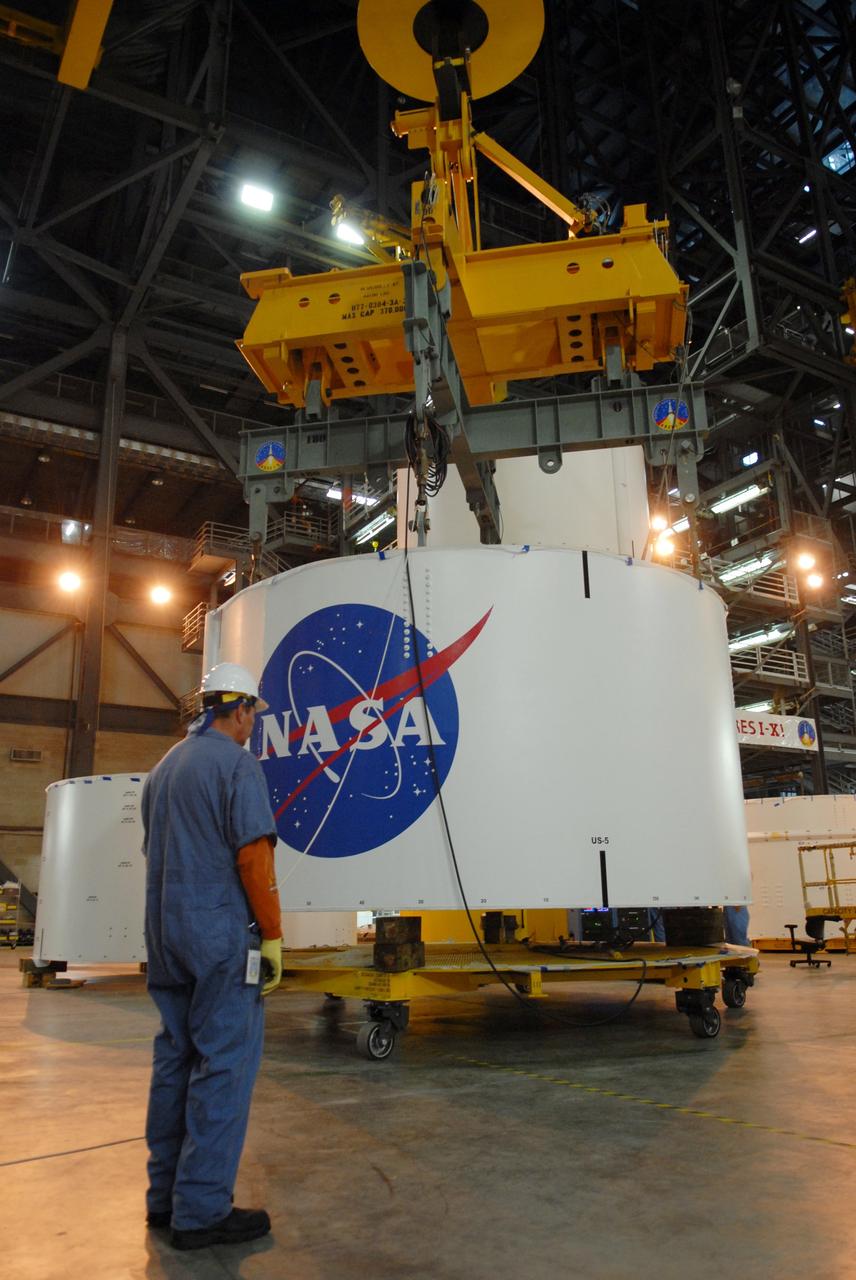
CAPE CANAVERAL, Fla. -- In high bay 4 of the Vehicle Assembly Building at NASA's Kennedy Space Center in Florida, a crane lifts segment 5 of the Ares I-X upper stage simulator segments. It will be placed on segment 4, at top of the tall stack behind it.The upper stage simulator comprises 11 segments, each approximately 18 feet in diameter, that will be used in the test flight known as Ares I-X in 2009. The simulator segments will simulate the mass and the outer mold line. The upper stage accounts for nearly one-quarter of the total height of the Ares I. It will take the Ares I on the second phase of its journey from Earth, providing the guidance, navigation and control needed for the second phase of the Ares I ascent flight. Photo credit: NASA/Troy Cryder
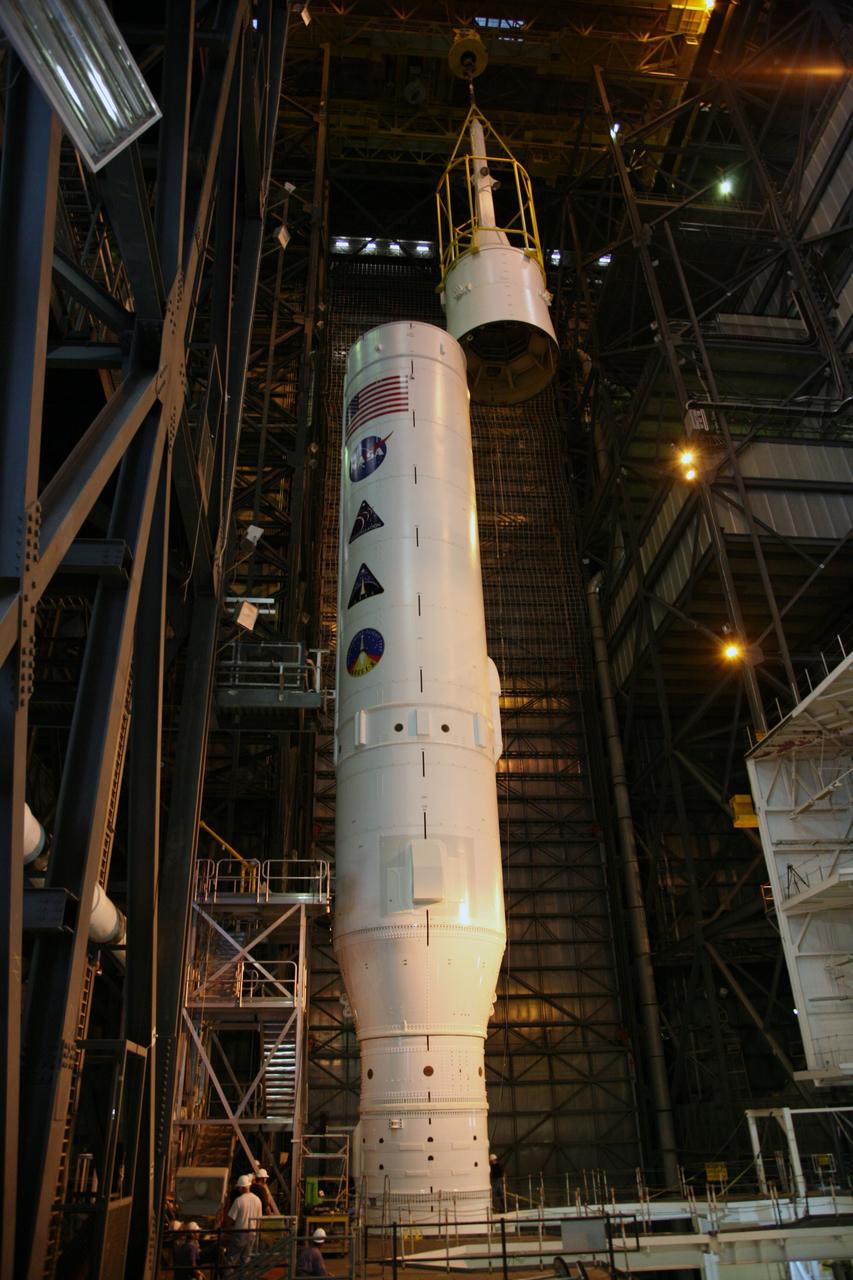
CAPE CANAVERAL, Fla. – In the Vehicle Assembly Building's High Bay 3, the yellow framework, nicknamed the "birdcage," lifts Super Stack 5 to the top of the Ares I-X segments already in place on the mobile launcher platform. Once in position, assembly of the Ares I-X rocket will be complete. The 327-foot-tall rocket is one of the largest processed in the bay, rivaling the height of the Apollo Program's 364-foot-tall Saturn V. Five super stacks make up the rocket's upper stage that is integrated with the four-segment solid rocket booster first stage. Ares I-X is the test vehicle for the Ares I, which is part of the Constellation Program to return men to the moon and beyond. The Ares I-X flight test is targeted for Oct. 31, pending formal NASA Headquarters approval. Photo credit: NASA/Dimitri Gerondidakis
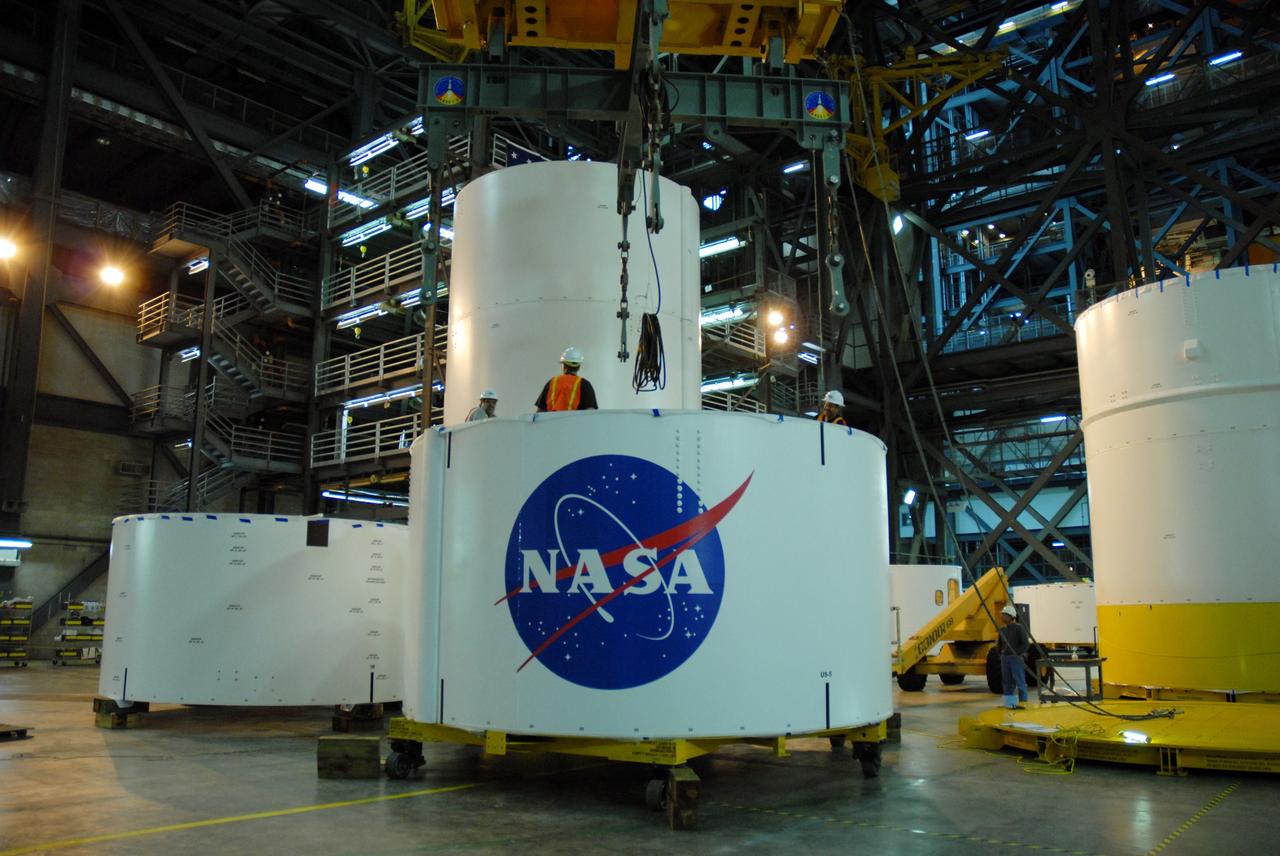
CAPE CANAVERAL, Fla. -- In high bay 4 of the Vehicle Assembly Building at NASA's Kennedy Space Center in Florida, work is under way to stack the Ares I-X upper stage simulator segment 5 to segment 4. The upper stage simulator comprises 11 segments, each approximately 18 feet in diameter, that will be used in the test flight known as Ares I-X in 2009. The simulator segments will simulate the mass and the outer mold line. The upper stage accounts for nearly one-quarter of the total height of the Ares I. It will take the Ares I on the second phase of its journey from Earth, providing the guidance, navigation and control needed for the second phase of the Ares I ascent flight. Photo credit: NASA/Jim Grossmann
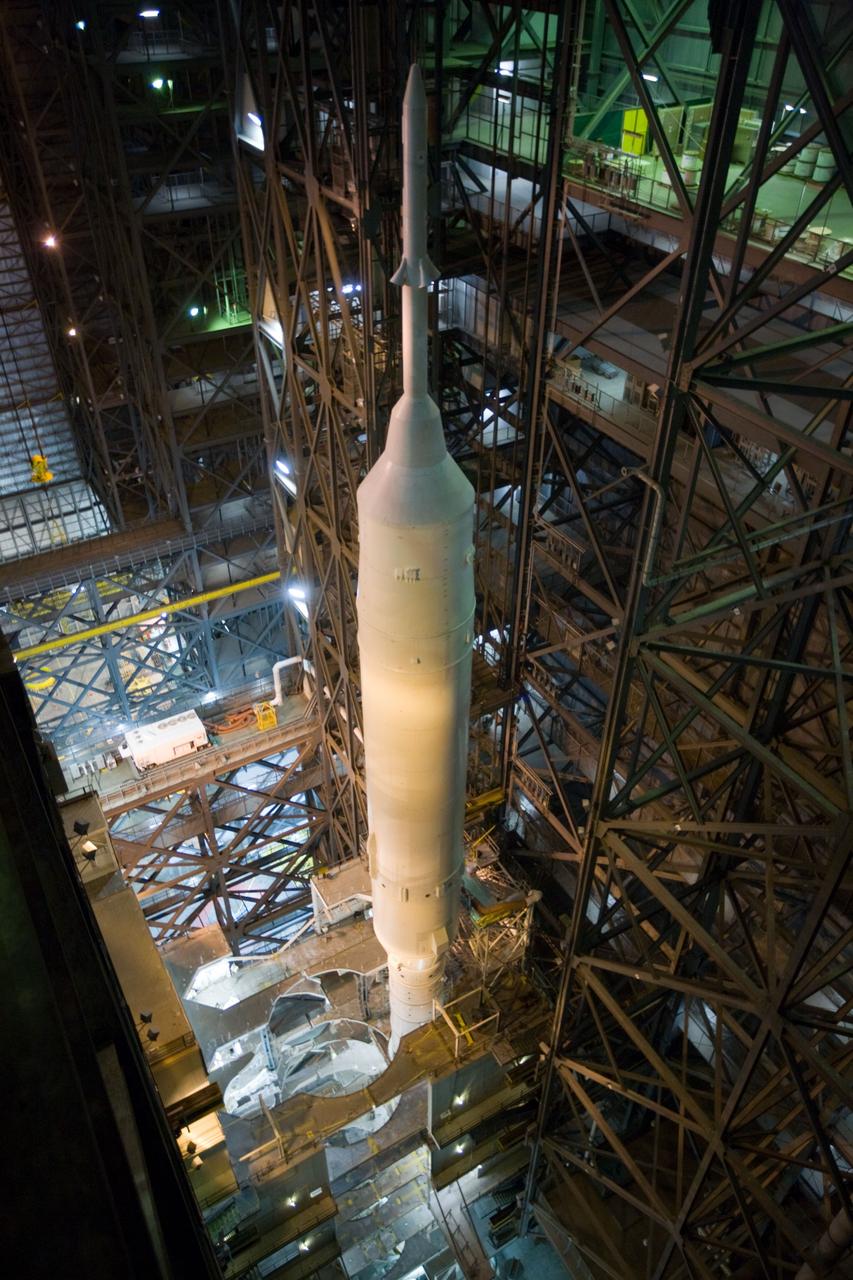
CAPE CANAVERAL, Fla. – In the Vehicle Assembly Building's High Bay 3, Super Stack 5 is secured to the Ares I-X segments already in place on the mobile launcher platform. Assembly of the Ares I-X rocket is complete. The 327-foot-tall rocket is one of the largest processed in the bay, rivaling the height of the Apollo Program's 364-foot-tall Saturn V. Five super stacks make up the rocket's upper stage that is integrated with the four-segment solid rocket booster first stage. Ares I-X is the test vehicle for the Ares I, which is part of the Constellation Program to return men to the moon and beyond. The Ares I-X flight test is targeted for Oct. 31, pending formal NASA Headquarters approval. Photo credit: NASA/Dimitri Gerondidakis
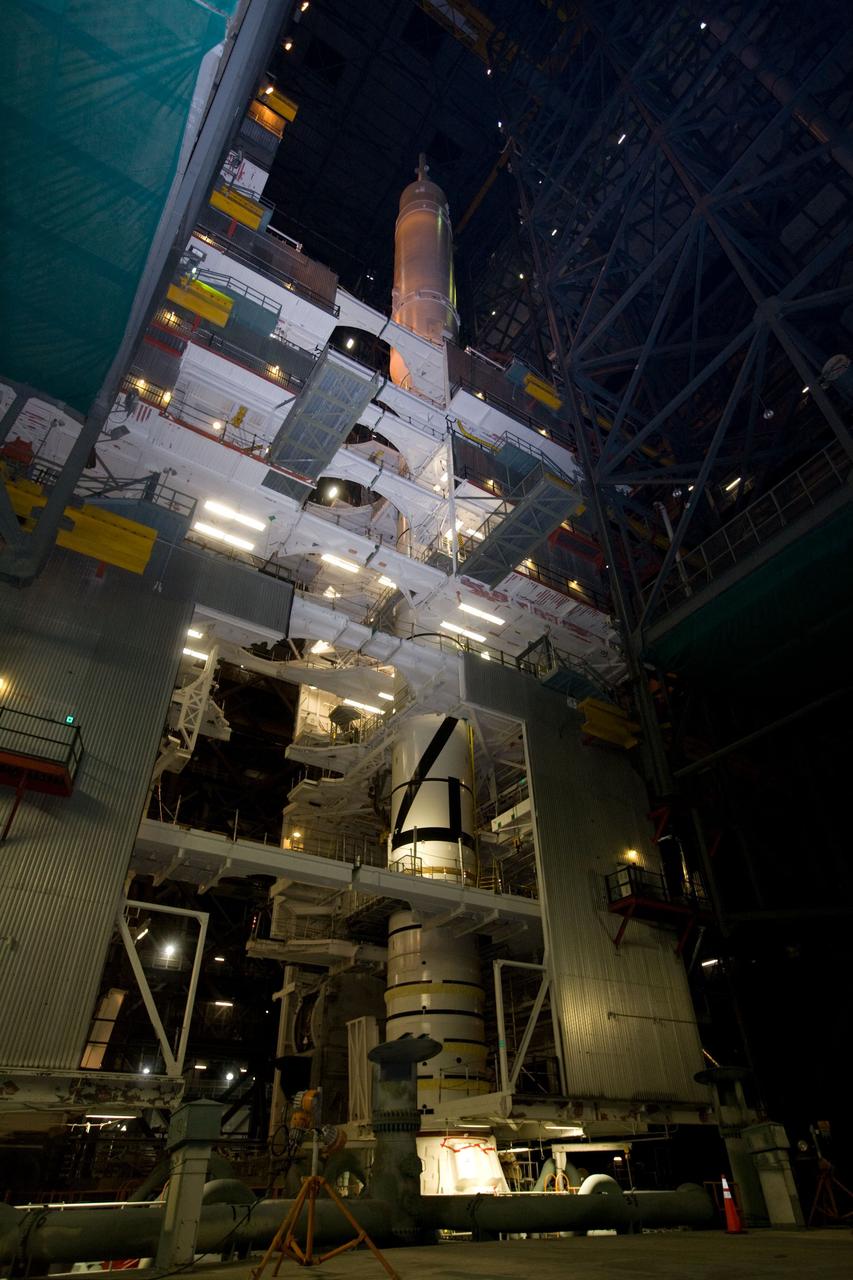
CAPE CANAVERAL, Fla. – In the Vehicle Assembly Building's High Bay 3, Super Stack 5 is secured to the Ares I-X segments already in place on the mobile launcher platform. Assembly of the Ares I-X rocket is complete. The 327-foot-tall rocket is one of the largest processed in the bay, rivaling the height of the Apollo Program's 364-foot-tall Saturn V. Five super stacks make up the rocket's upper stage that is integrated with the four-segment solid rocket booster first stage. Ares I-X is the test vehicle for the Ares I, which is part of the Constellation Program to return men to the moon and beyond. The Ares I-X flight test is targeted for Oct. 31, pending formal NASA Headquarters approval. Photo credit: NASA/Dimitri Gerondidakis
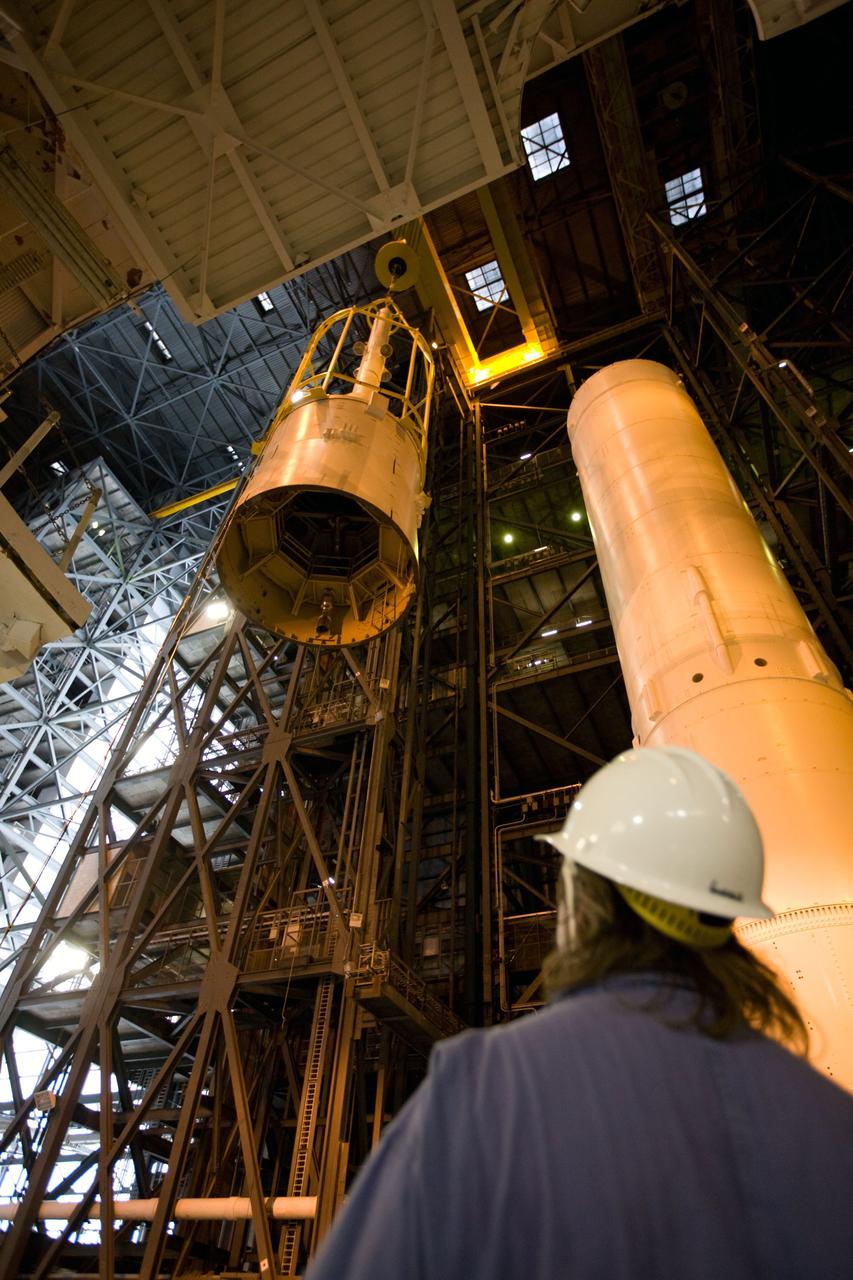
CAPE CANAVERAL, Fla. – In the Vehicle Assembly Building's High Bay 3, a technician monitors the lift of Super Stack 5 by the yellow framework, nicknamed the "birdcage," to the top of the Ares I-X segments already in place on the mobile launcher platform. Once in position, assembly of the Ares I-X rocket will be complete. The 327-foot-tall rocket is one of the largest processed in the bay, rivaling the height of the Apollo Program's 364-foot-tall Saturn V. Five super stacks make up the rocket's upper stage that is integrated with the four-segment solid rocket booster first stage. Ares I-X is the test vehicle for the Ares I, which is part of the Constellation Program to return men to the moon and beyond. The Ares I-X flight test is targeted for Oct. 31, pending formal NASA Headquarters approval. Photo credit: NASA/Dimitri Gerondidakis
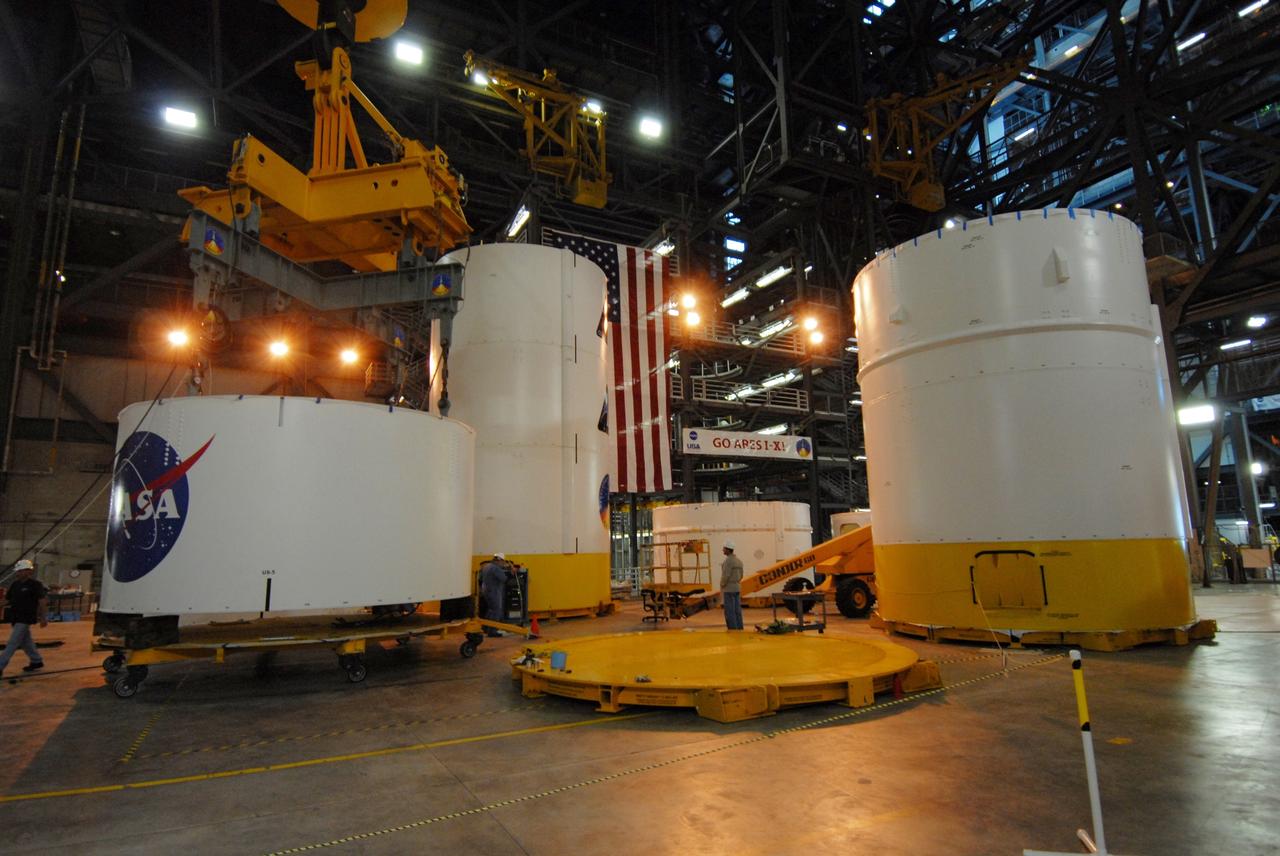
CAPE CANAVERAL, Fla. -- In high bay 4 of the Vehicle Assembly Building at NASA's Kennedy Space Center in Florida, a crane lifts segment 5 of the Ares I-X upper stage simulator segments. It will be placed on segment 4, at top of the tall stack behind it. The upper stage simulator comprises 11 segments, each approximately 18 feet in diameter, that will be used in the test flight known as Ares I-X in 2009. The simulator segments will simulate the mass and the outer mold line. The upper stage accounts for nearly one-quarter of the total height of the Ares I. It will take the Ares I on the second phase of its journey from Earth, providing the guidance, navigation and control needed for the second phase of the Ares I ascent flight. Photo credit: NASA/Troy Cryder
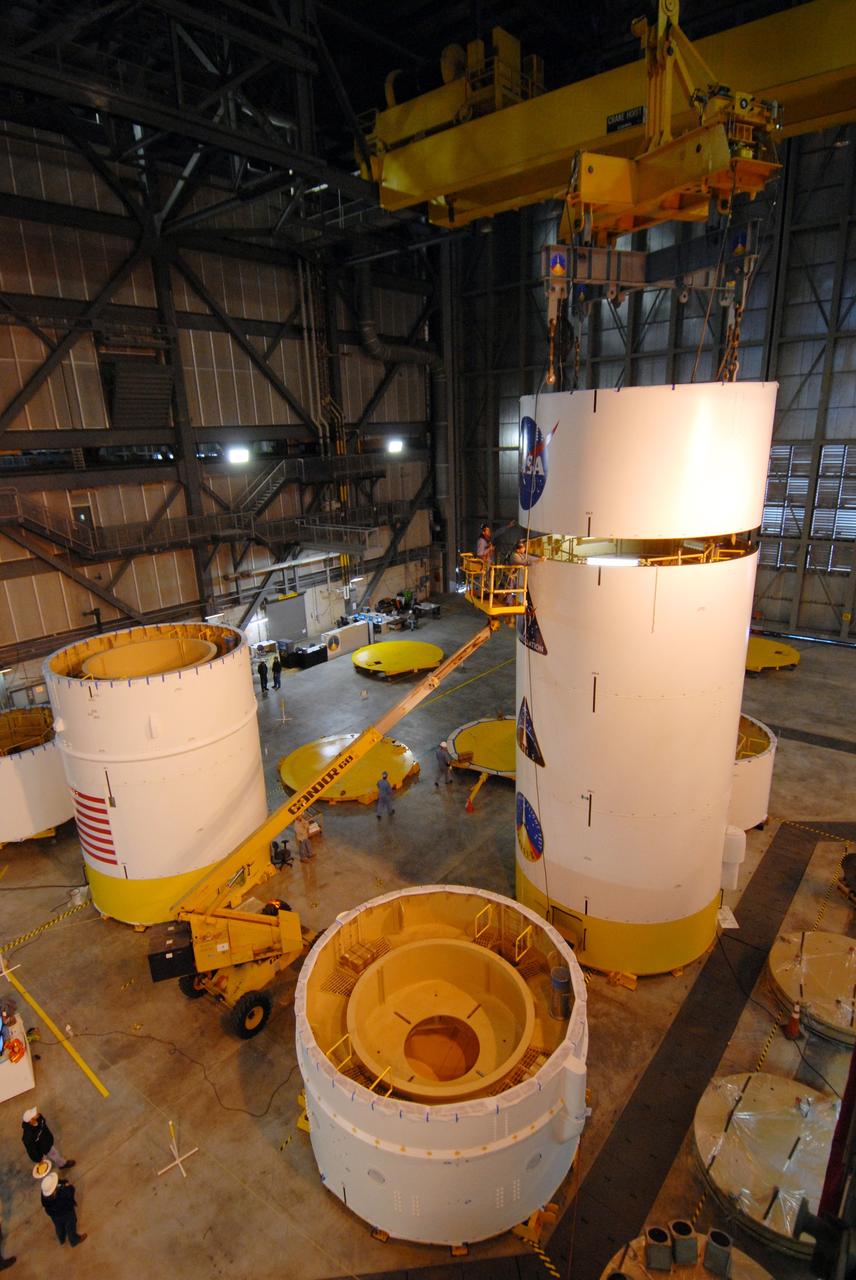
CAPE CANAVERAL, Fla. -- In high bay 4 of the Vehicle Assembly Building at NASA's Kennedy Space Center in Florida, a crane lowers segment 5 of the Ares I-X upper stage simulator segments onto segment 4, at top of the tall stack below. The upper stage simulator comprises 11 segments, each approximately 18 feet in diameter, that will be used in the test flight known as Ares I-X in 2009. The simulator segments will simulate the mass and the outer mold line. The upper stage accounts for nearly one-quarter of the total height of the Ares I. It will take the Ares I on the second phase of its journey from Earth, providing the guidance, navigation and control needed for the second phase of the Ares I ascent flight. Photo credit: NASA/Troy Cryder
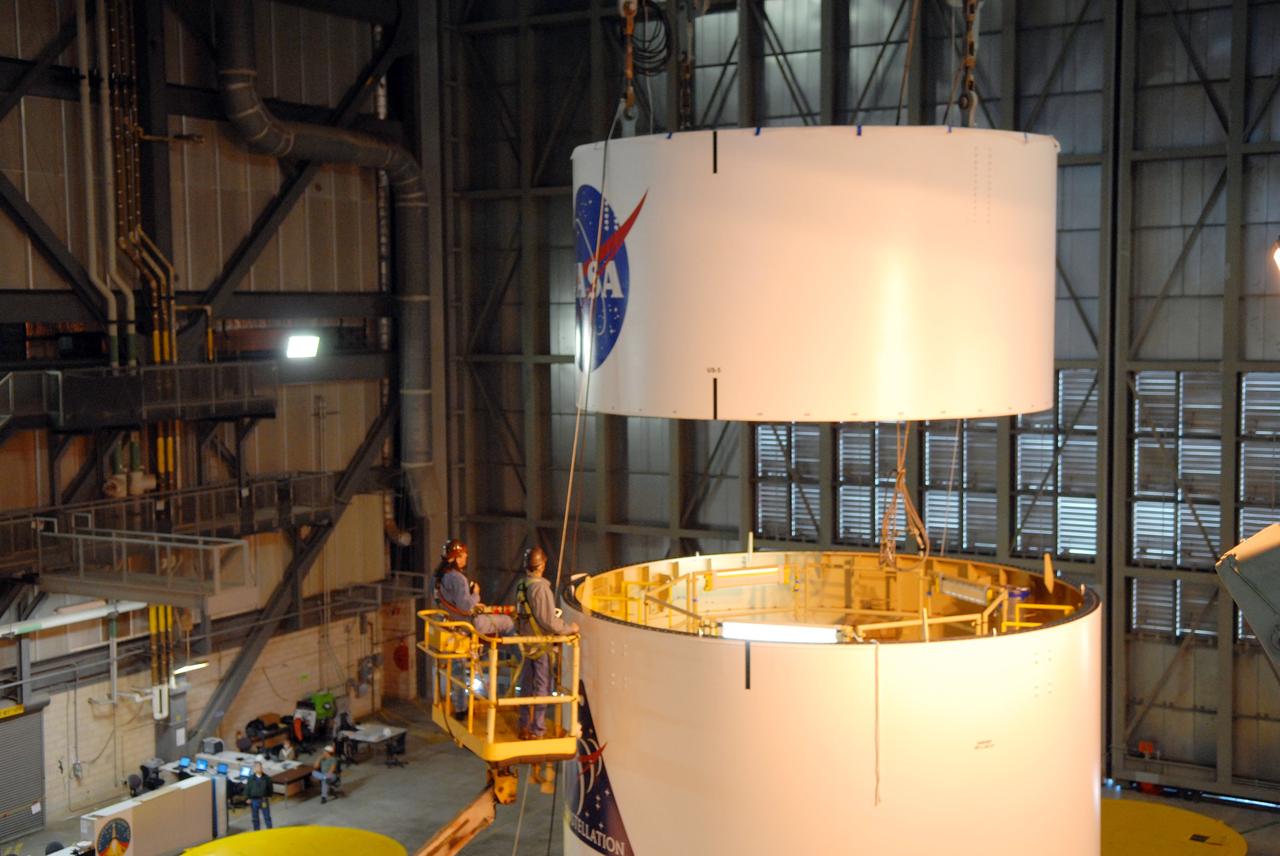
CAPE CANAVERAL, Fla. -- In high bay 4 of the Vehicle Assembly Building at NASA's Kennedy Space Center in Florida, a crane lowers segment 5 of the Ares I-X upper stage simulator segments toward segment 4, at top of the tall stack below. The upper stage simulator comprises 11 segments, each approximately 18 feet in diameter, that will be used in the test flight known as Ares I-X in 2009. The simulator segments will simulate the mass and the outer mold line. The upper stage accounts for nearly one-quarter of the total height of the Ares I. It will take the Ares I on the second phase of its journey from Earth, providing the guidance, navigation and control needed for the second phase of the Ares I ascent flight. Photo credit: NASA/Troy Cryder
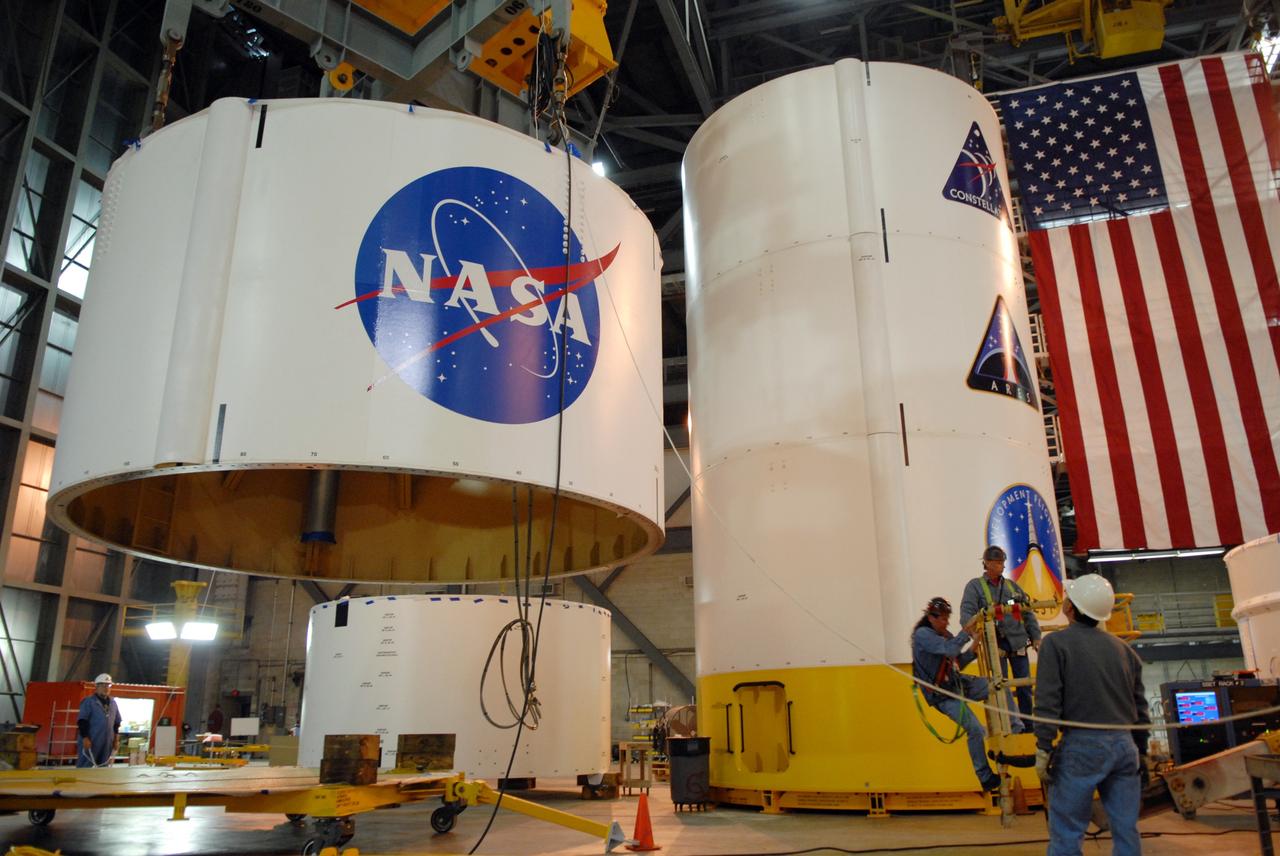
CAPE CANAVERAL, Fla. -- In high bay 4 of the Vehicle Assembly Building at NASA's Kennedy Space Center in Florida, a crane lifts segment 5 of the Ares I-X upper stage simulator segments. It will be placed on segment 4, at top of the tall stack behind it. The upper stage simulator comprises 11 segments, each approximately 18 feet in diameter, that will be used in the test flight known as Ares I-X in 2009. The simulator segments will simulate the mass and the outer mold line. The upper stage accounts for nearly one-quarter of the total height of the Ares I. It will take the Ares I on the second phase of its journey from Earth, providing the guidance, navigation and control needed for the second phase of the Ares I ascent flight. Photo credit: NASA/Troy Cryder
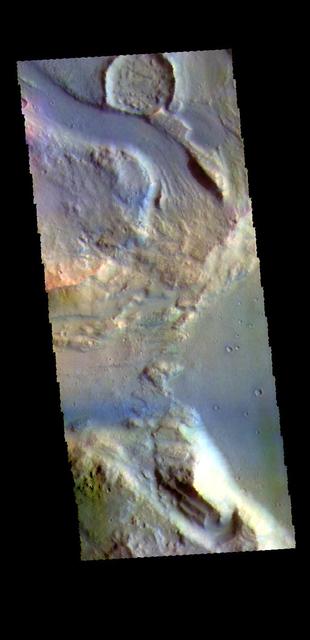
This false color image shows a tributary channel that empties into the main Ares Vallis channel. This tributary channel is located east of Ares Vallis. Located in Margaritifer Terra, Ares Vallis is part of a large system of channels that arise from Vallis Marineris and empty into Chryse Planitia. The THEMIS VIS camera contains 5 filters. The data from different filters can be combined in multiple ways to create a false color image. These false color images may reveal subtle variations of the surface not easily identified in a single band image. Orbit Number: 63809 Latitude: 4.17241 Longitude: 343.459 Instrument: VIS Captured: 2016-05-02 20:09
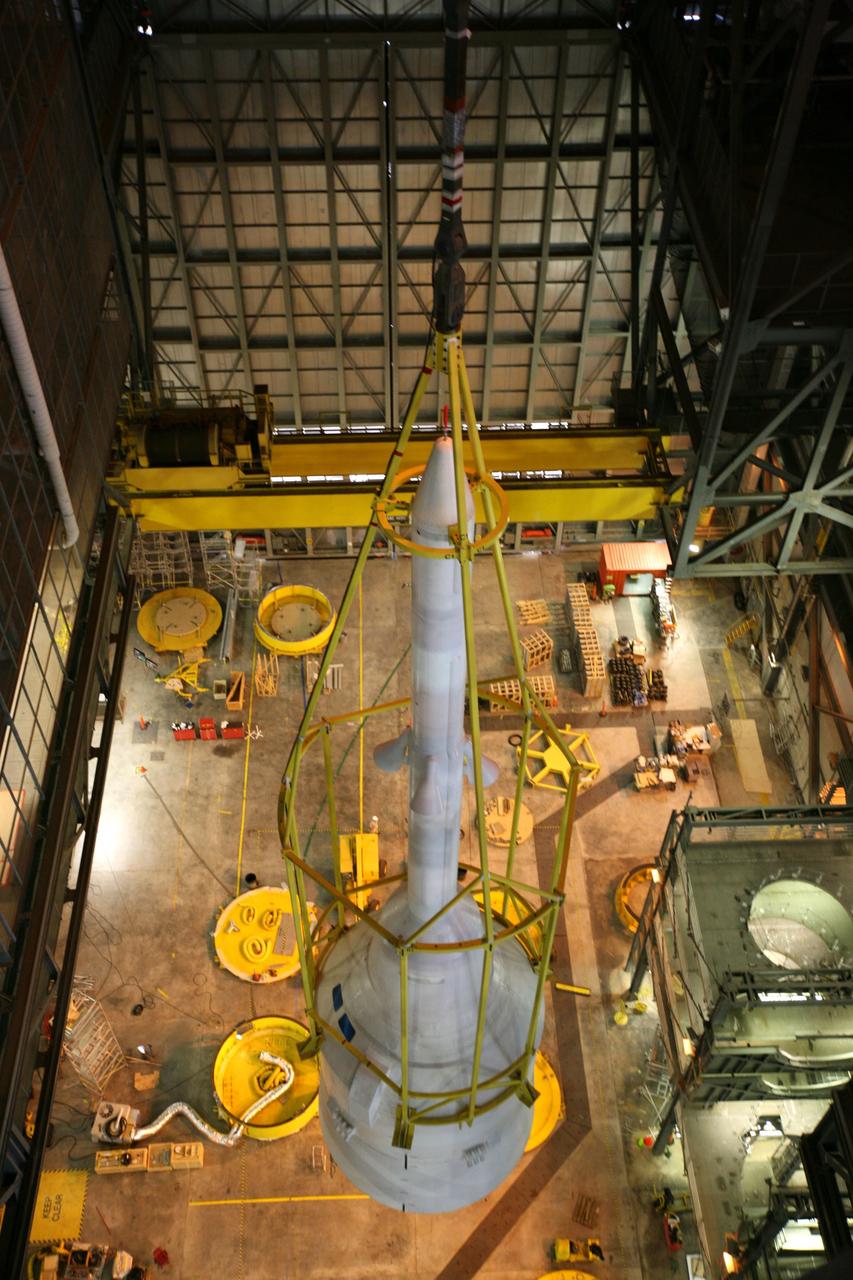
CAPE CANAVERAL, Fla. – In the Vehicle Assembly Building's High Bay 4, assembly of the Ares I-X rocket nears completion. The yellow framework, nicknamed the "birdcage," lifts Super Stack 5. The stack will be positioned on top of the segments already in place on the mobile launcher platform in High Bay 3, completing assembly of the 327-foot-tall rocket. Five super stacks make up the rocket's upper stage that is integrated with the four-segment solid rocket booster first stage. Ares I-X is the test vehicle for the Ares I, which is part of the Constellation Program to return men to the moon and beyond. The Ares I-X flight test is targeted for Oct. 31, pending formal NASA Headquarters approval. Photo credit: NASA/Dimitri Gerondidakis
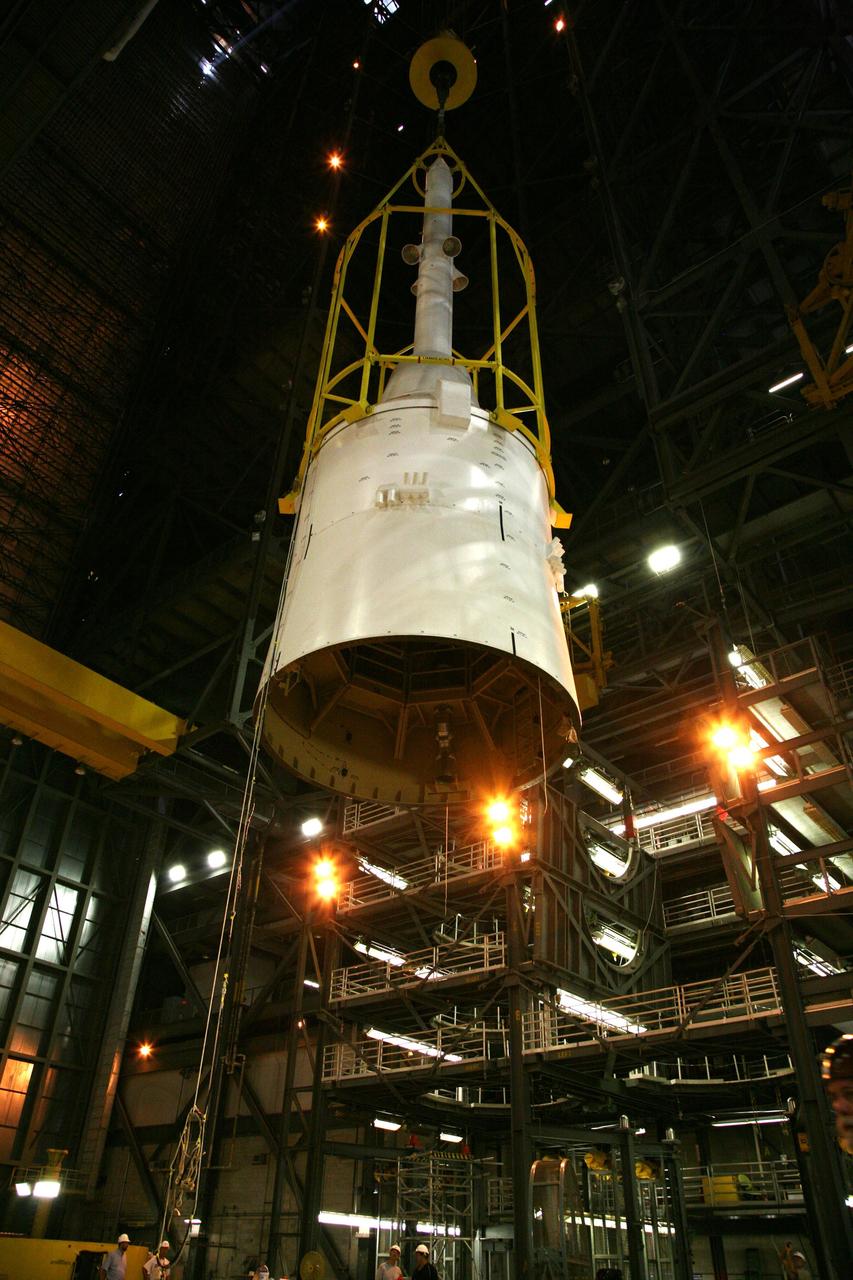
CAPE CANAVERAL, Fla. – In the Vehicle Assembly Building's High Bay 4, assembly of the Ares I-X rocket nears completion. The yellow framework, nicknamed the "birdcage," lifts Super Stack 5. The stack will be positioned on top of the segments already in place on the mobile launcher platform in High Bay 3, completing assembly of the 327-foot-tall rocket. Five super stacks make up the rocket's upper stage that is integrated with the four-segment solid rocket booster first stage. Ares I-X is the test vehicle for the Ares I, which is part of the Constellation Program to return men to the moon and beyond. The Ares I-X flight test is targeted for Oct. 31, pending formal NASA Headquarters approval. Photo credit: NASA/Dimitri Gerondidakis
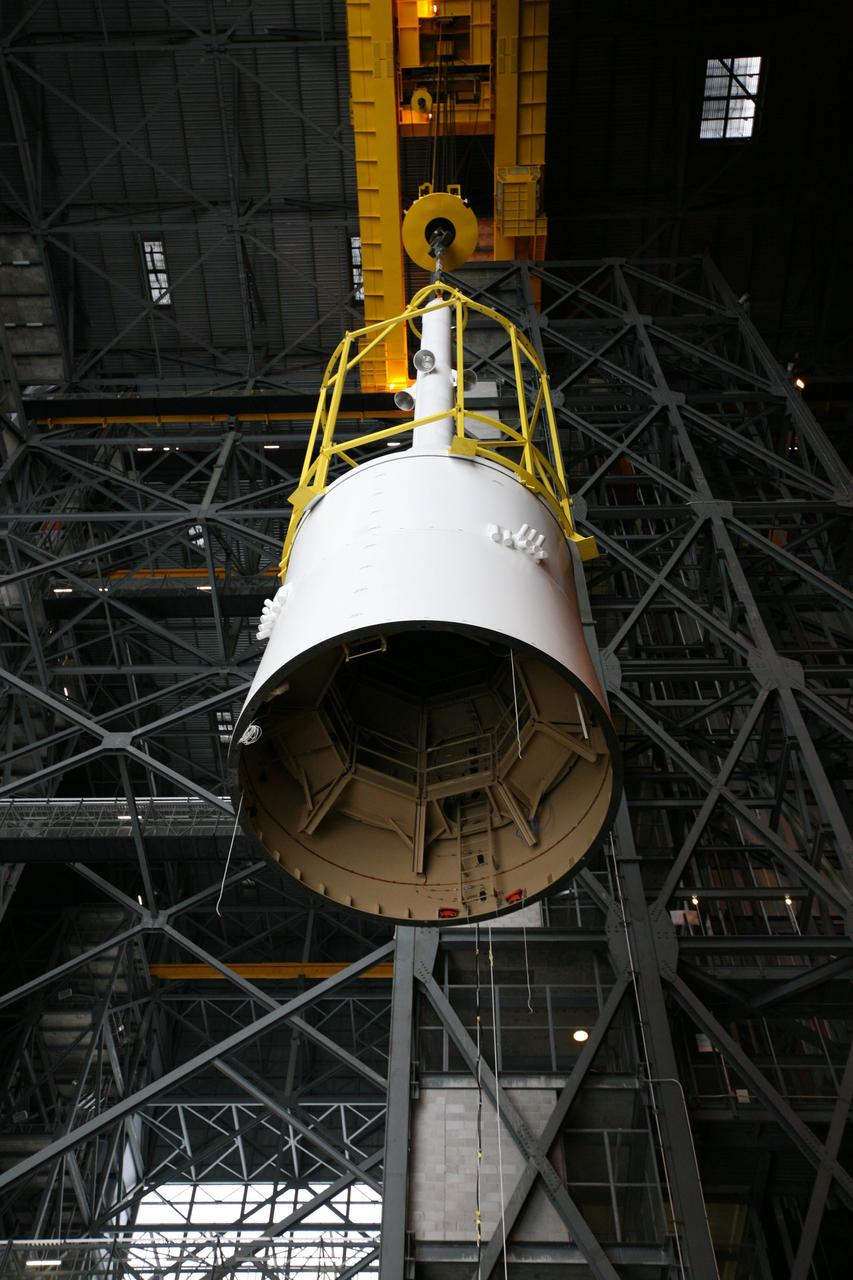
CAPE CANAVERAL, Fla. – In the Vehicle Assembly Building's High Bay 4, assembly of the Ares I-X rocket nears completion. The yellow framework, nicknamed the "birdcage," lifts Super Stack 5 toward an opening at the 16th floor crossover into the transfer aisle. The stack will be positioned on top of the segments already in place on the mobile launcher platform in High Bay 3, completing assembly of the 327-foot-tall rocket. Five super stacks make up the rocket's upper stage that is integrated with the four-segment solid rocket booster first stage. Ares I-X is the test vehicle for the Ares I, which is part of the Constellation Program to return men to the moon and beyond. The Ares I-X flight test is targeted for Oct. 31, pending formal NASA Headquarters approval. Photo credit: NASA/Dimitri Gerondidakis
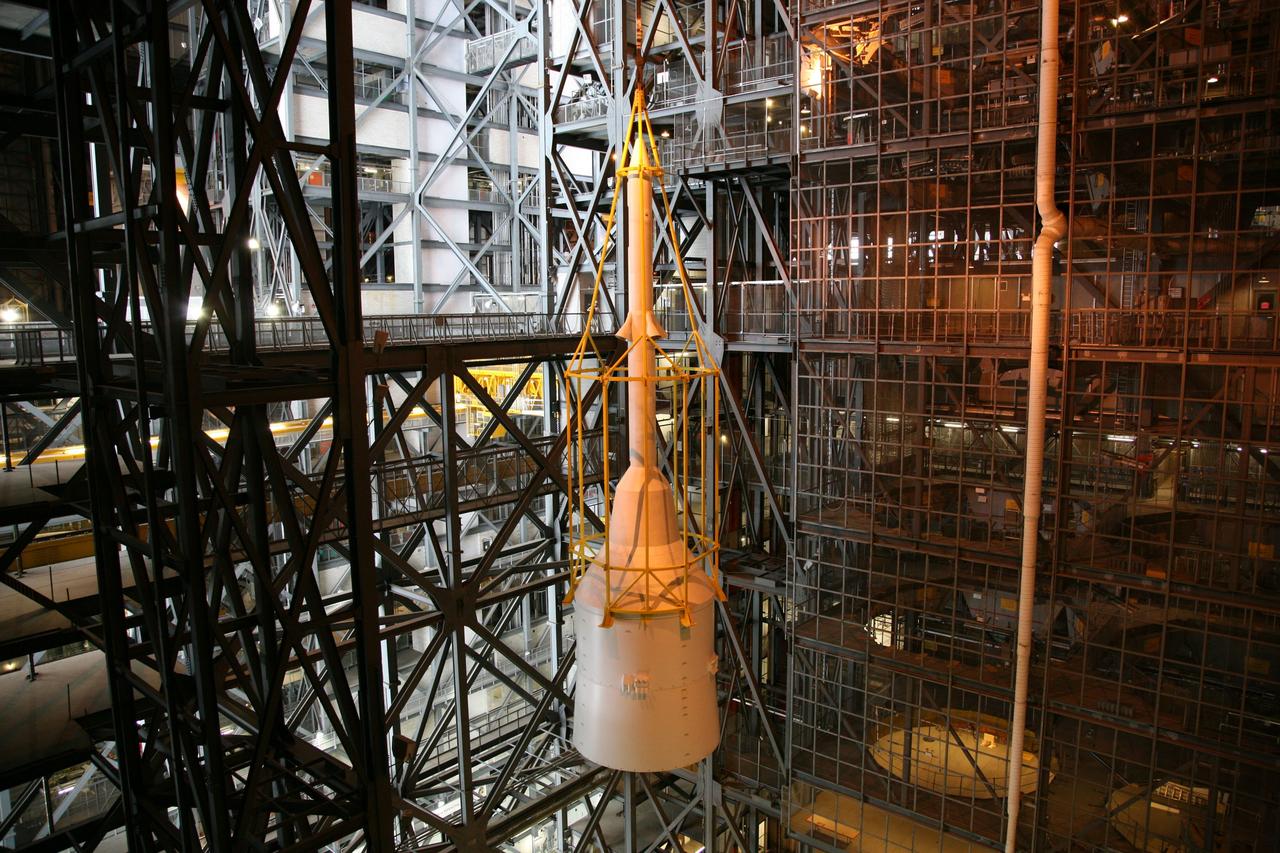
CAPE CANAVERAL, Fla. – In the Vehicle Assembly Building's transfer aisle, assembly of the Ares I-X rocket nears completion. The yellow framework, nicknamed the "birdcage," moves Super Stack 5 from High Bay 4 over the transfer aisle. The stack will be positioned on top of the segments already in place on the mobile launcher platform in High Bay 3, completing assembly of the 327-foot-tall rocket. Five super stacks make up the rocket's upper stage that is integrated with the four-segment solid rocket booster first stage. Ares I-X is the test vehicle for the Ares I, which is part of the Constellation Program to return men to the moon and beyond. The Ares I-X flight test is targeted for Oct. 31, pending formal NASA Headquarters approval. Photo credit: NASA/Dimitri Gerondidakis
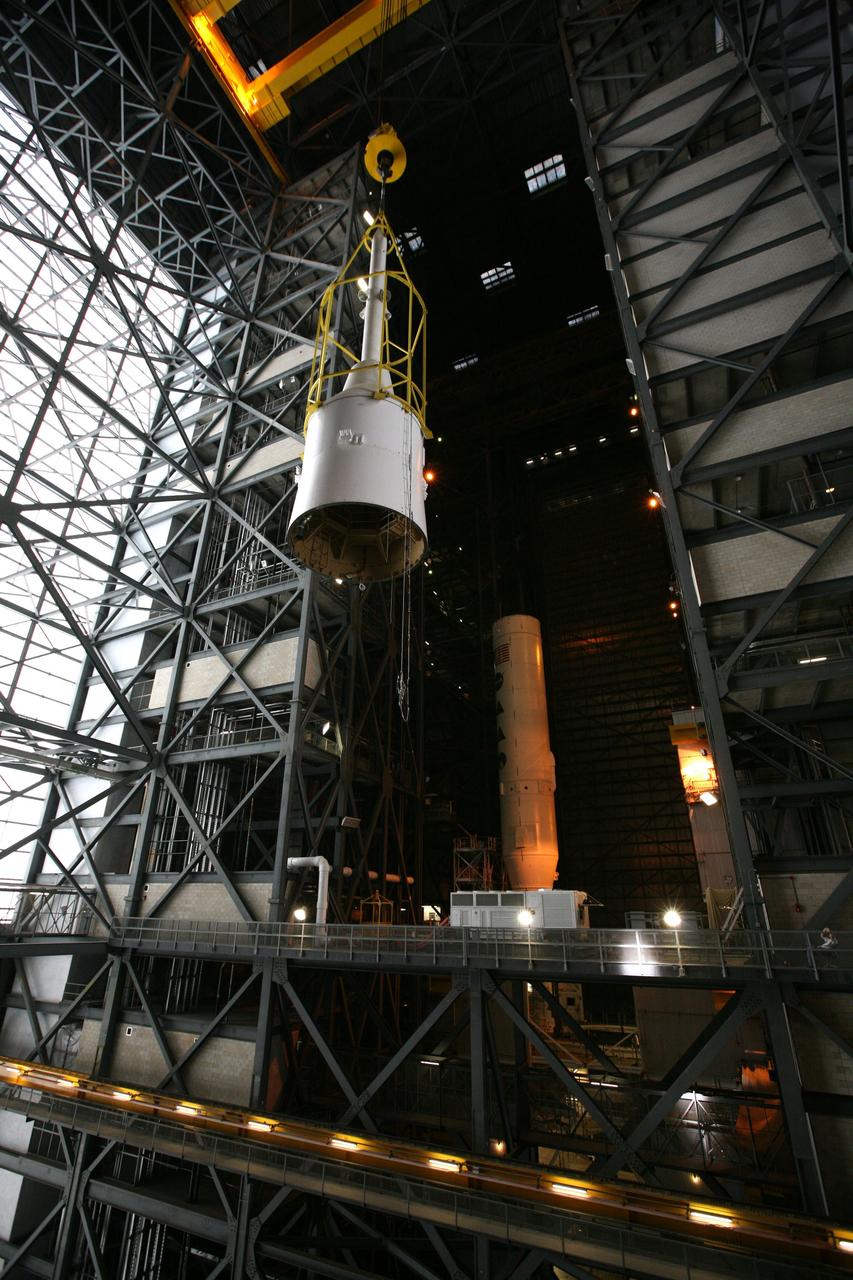
CAPE CANAVERAL, Fla. – In the Vehicle Assembly Building's transfer aisle, assembly of the Ares I-X rocket nears completion. The yellow framework, nicknamed the "birdcage," moves Super Stack 5 from High Bay 4 over the transfer aisle toward an opening at the 16th floor crossover in High Bay 3. The stack will be positioned on top of the segments already in place on the mobile launcher platform in High Bay 3, in the background, completing assembly of the 327-foot-tall rocket. Five super stacks make up the rocket's upper stage that is integrated with the four-segment solid rocket booster first stage. Ares I-X is the test vehicle for the Ares I, which is part of the Constellation Program to return men to the moon and beyond. The Ares I-X flight test is targeted for Oct. 31, pending formal NASA Headquarters approval. Photo credit: NASA/Dimitri Gerondidakis
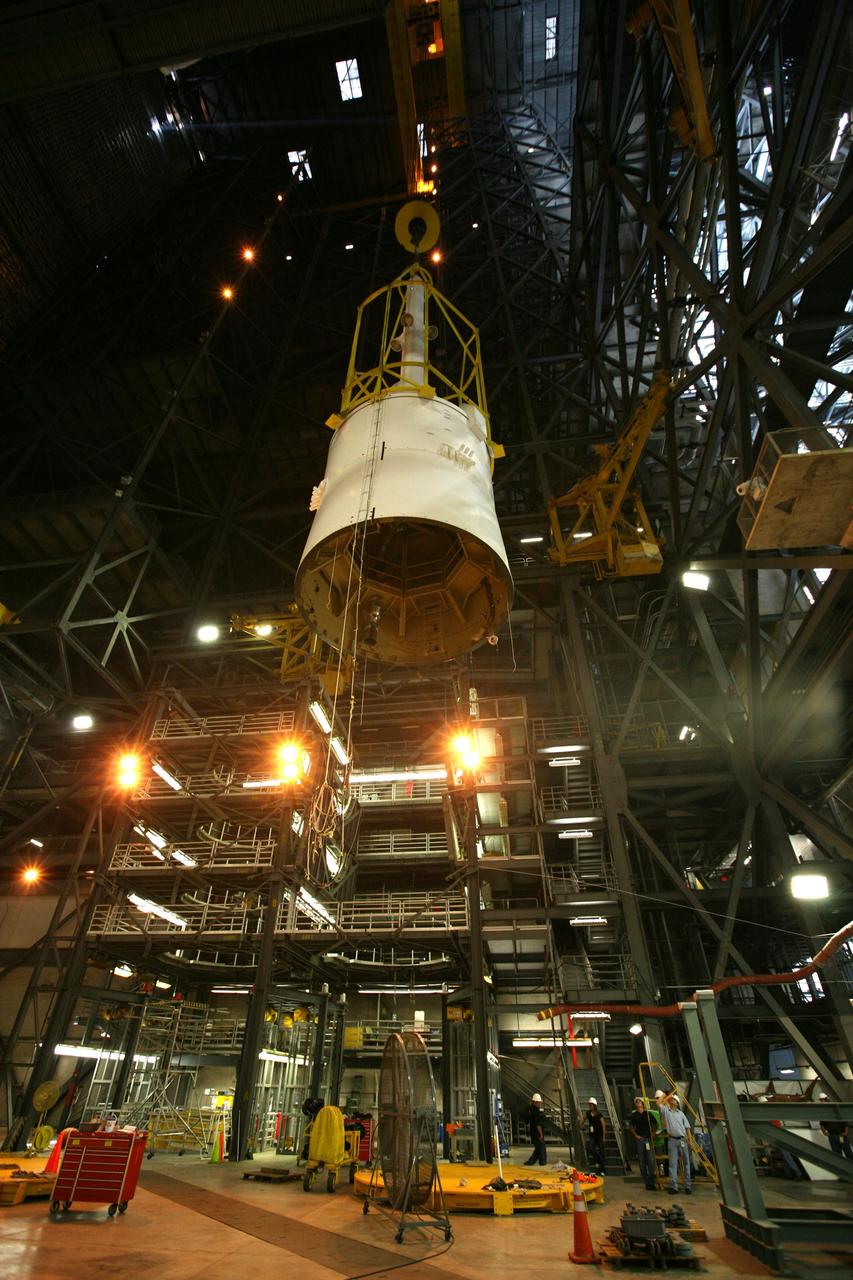
CAPE CANAVERAL, Fla. – In the Vehicle Assembly Building's High Bay 4, assembly of the Ares I-X rocket nears completion. The yellow framework, nicknamed the "birdcage," lifts Super Stack 5. The stack will be positioned on top of the segments already in place on the mobile launcher platform in High Bay 3, completing assembly of the 327-foot-tall rocket. Five super stacks make up the rocket's upper stage that is integrated with the four-segment solid rocket booster first stage. Ares I-X is the test vehicle for the Ares I, which is part of the Constellation Program to return men to the moon and beyond. The Ares I-X flight test is targeted for Oct. 31, pending formal NASA Headquarters approval. Photo credit: NASA/Dimitri Gerondidakis
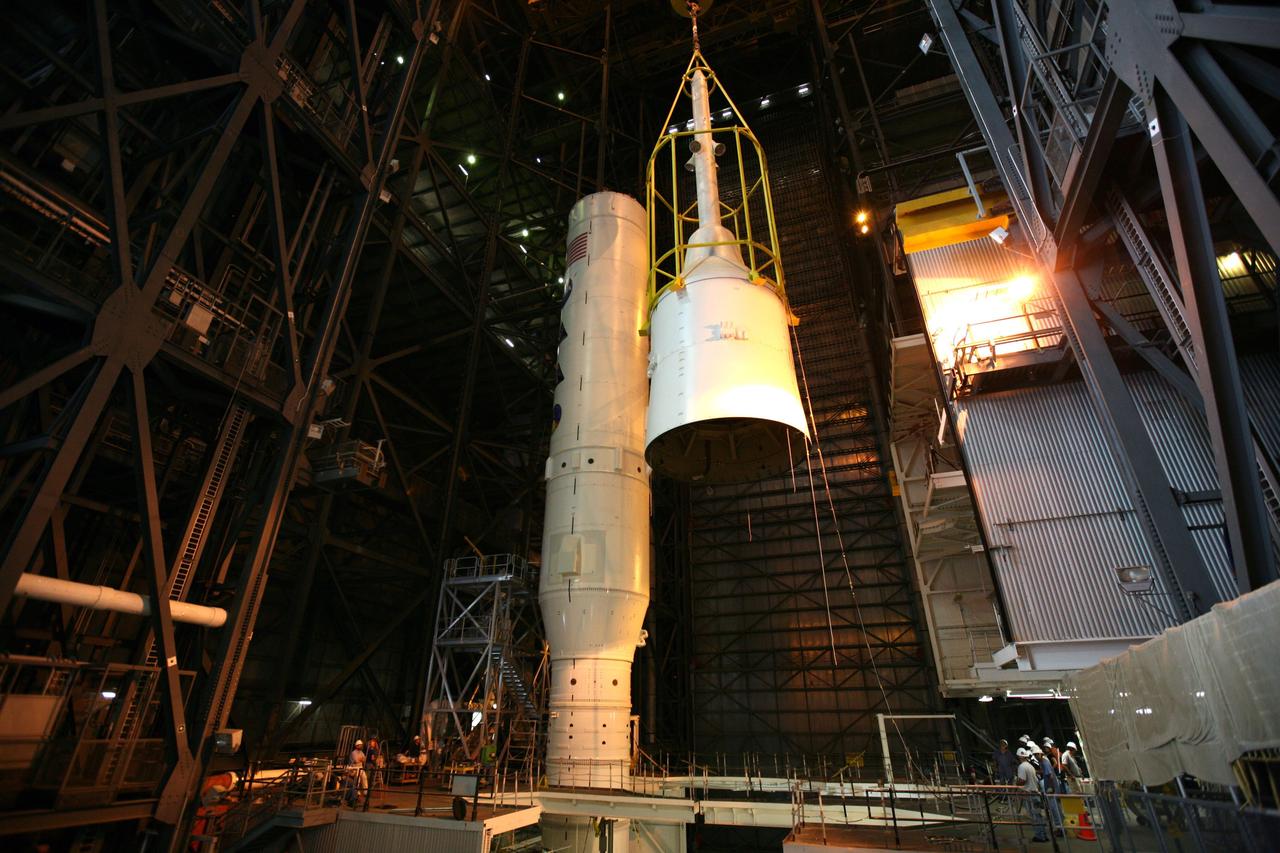
CAPE CANAVERAL, Fla. – In the Vehicle Assembly Building's High Bay 3, assembly of the Ares I-X rocket nears completion. The yellow framework, nicknamed the "birdcage," lifts Super Stack 5 to the top of the segments already in place on the mobile launcher platform. Once in place, assembly of the rocket will be complete. The 327-foot-tall rocket is one of the largest processed in the bay, rivaling the height of the Apollo Program's 364-foot-tall Saturn V. Five super stacks make up the rocket's upper stage that is integrated with the four-segment solid rocket booster first stage. Ares I-X is the test vehicle for the Ares I, which is part of the Constellation Program to return men to the moon and beyond. The Ares I-X flight test is targeted for Oct. 31, pending formal NASA Headquarters approval. Photo credit: NASA/Dimitri Gerondidakis
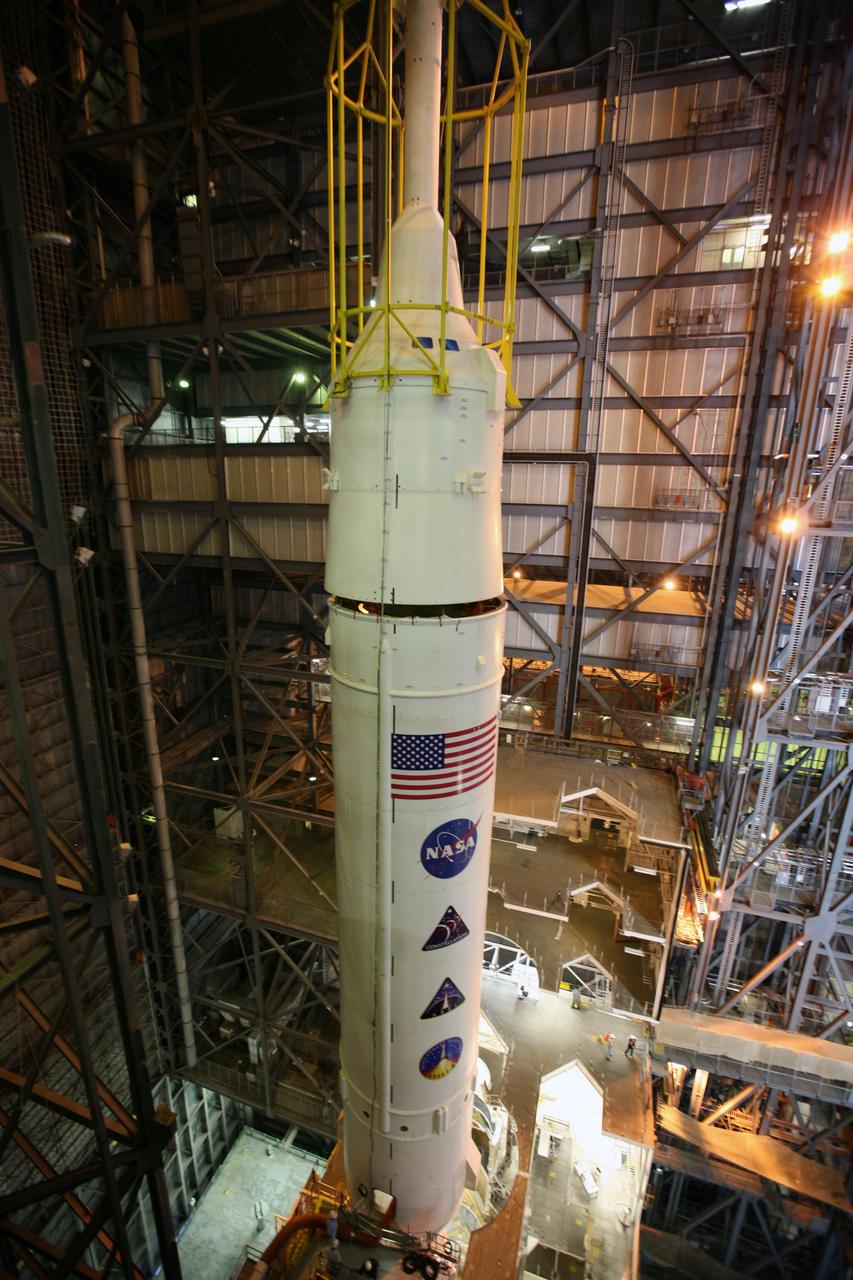
CAPE CANAVERAL, Fla. – In the Vehicle Assembly Building's High Bay 3, the yellow framework, nicknamed the "birdcage," lowers Super Stack 5 onto Super Stack 4. Once in position, assembly of the Ares I-X rocket will be complete. The 327-foot-tall rocket is one of the largest processed in the bay, rivaling the height of the Apollo Program's 364-foot-tall Saturn V. Five super stacks make up the rocket's upper stage that is integrated with the four-segment solid rocket booster first stage. Ares I-X is the test vehicle for the Ares I, which is part of the Constellation Program to return men to the moon and beyond. The Ares I-X flight test is targeted for Oct. 31, pending formal NASA Headquarters approval. Photo credit: NASA/Dimitri Gerondidakis
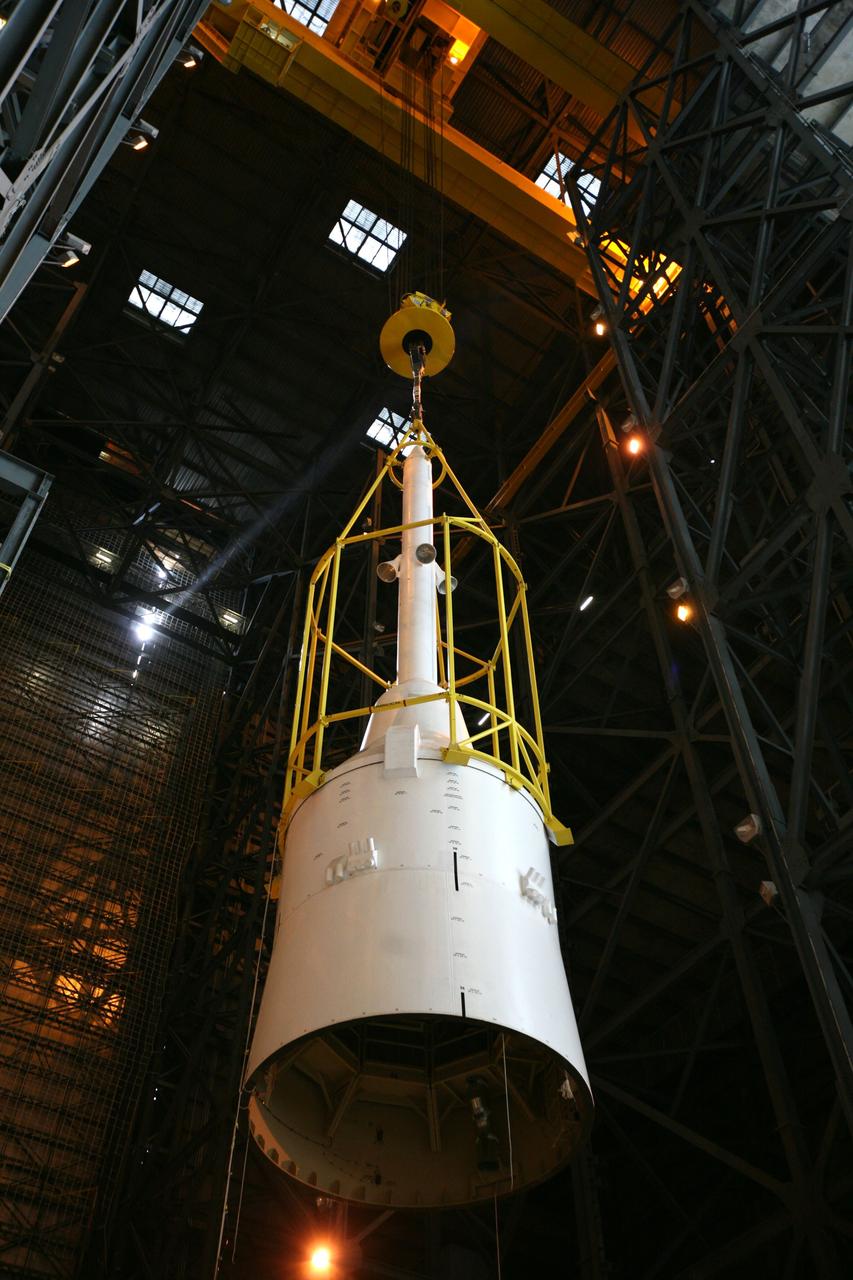
CAPE CANAVERAL, Fla. – In the Vehicle Assembly Building's High Bay 4, assembly of the Ares I-X rocket nears completion. The yellow framework, nicknamed the "birdcage," lifts Super Stack 5 toward an opening at the 16th floor crossover into the transfer aisle. The stack will be positioned on top of the segments already in place on the mobile launcher platform in High Bay 3, completing assembly of the 327-foot-tall rocket. Five super stacks make up the rocket's upper stage that is integrated with the four-segment solid rocket booster first stage. Ares I-X is the test vehicle for the Ares I, which is part of the Constellation Program to return men to the moon and beyond. The Ares I-X flight test is targeted for Oct. 31, pending formal NASA Headquarters approval. Photo credit: NASA/Dimitri Gerondidakis
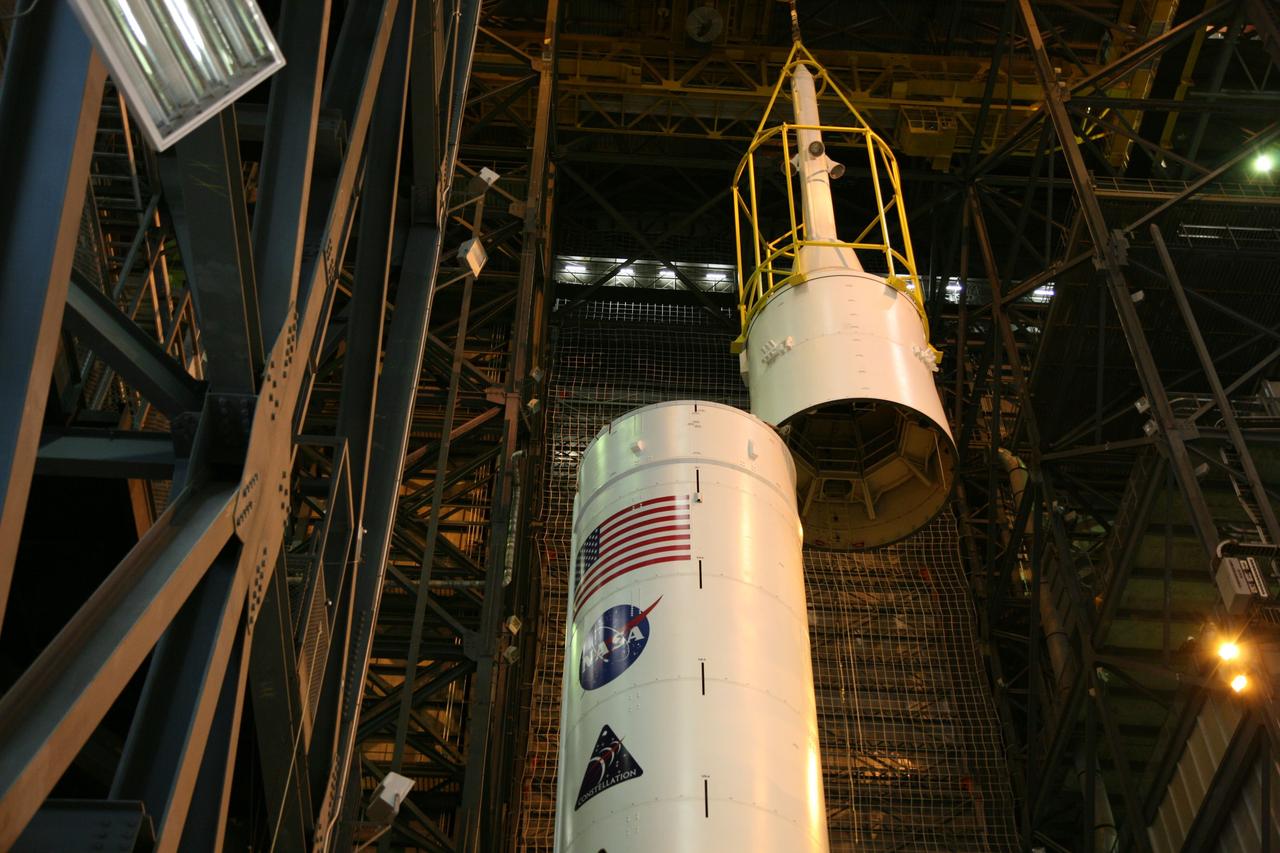
CAPE CANAVERAL, Fla. – In the Vehicle Assembly Building's High Bay 3, the yellow framework, nicknamed the "birdcage," lifts Super Stack 5 atop Super Stack 4. Once in position, assembly of the Ares I-X rocket will be complete. The 327-foot-tall rocket is one of the largest processed in the bay, rivaling the height of the Apollo Program's 364-foot-tall Saturn V. Five super stacks make up the rocket's upper stage that is integrated with the four-segment solid rocket booster first stage. Ares I-X is the test vehicle for the Ares I, which is part of the Constellation Program to return men to the moon and beyond. The Ares I-X flight test is targeted for Oct. 31, pending formal NASA Headquarters approval. Photo credit: NASA/Dimitri Gerondidakis
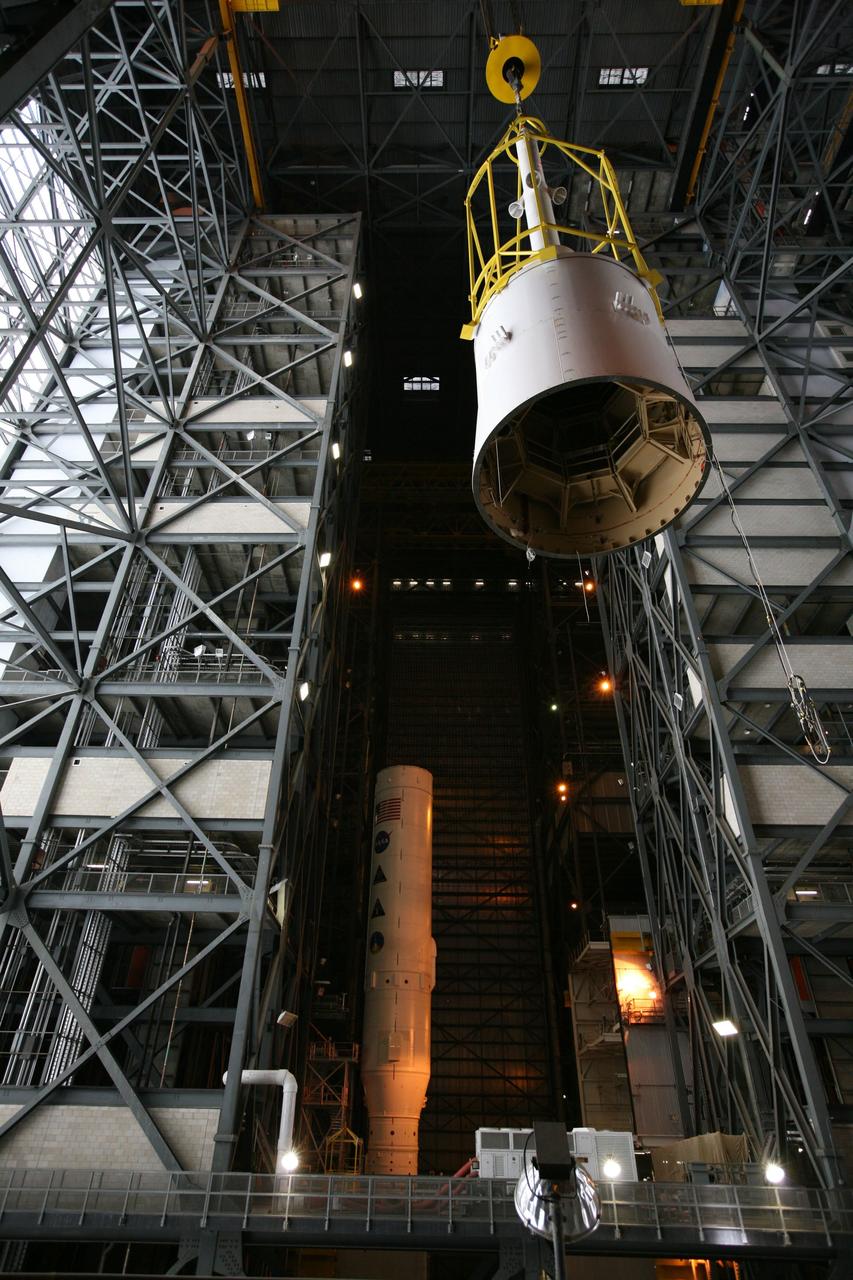
CAPE CANAVERAL, Fla. – In the Vehicle Assembly Building's transfer aisle, assembly of the Ares I-X rocket nears completion. The yellow framework, nicknamed the "birdcage," moves Super Stack 5 from High Bay 4 over the transfer aisle toward an opening at the 16th floor crossover in High Bay 3. The stack will be positioned on top of the segments already in place on the mobile launcher platform in High Bay 3, in the background, completing assembly of the 327-foot-tall rocket. Five super stacks make up the rocket's upper stage that is integrated with the four-segment solid rocket booster first stage. Ares I-X is the test vehicle for the Ares I, which is part of the Constellation Program to return men to the moon and beyond. The Ares I-X flight test is targeted for Oct. 31, pending formal NASA Headquarters approval. Photo credit: NASA/Dimitri Gerondidakis
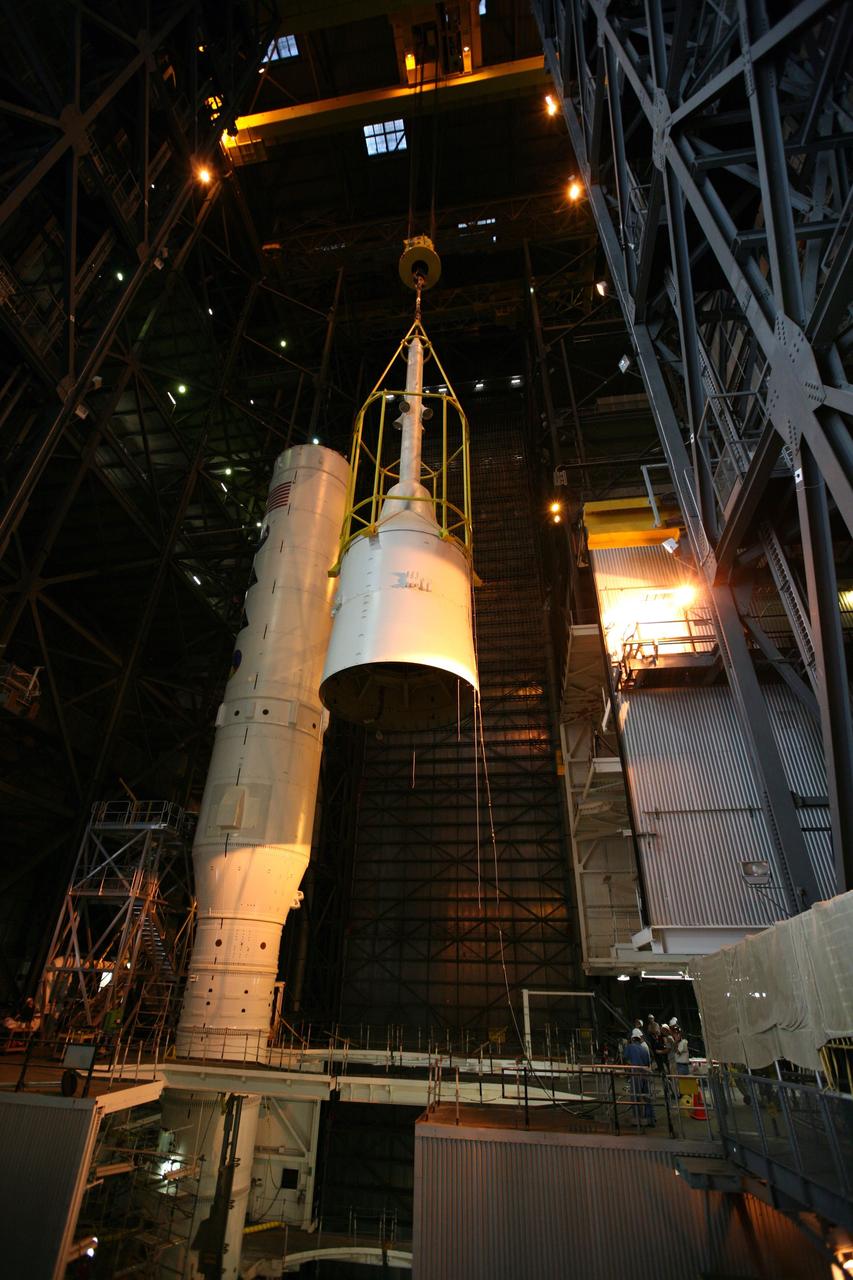
CAPE CANAVERAL, Fla. – In the Vehicle Assembly Building's High Bay 3, assembly of the Ares I-X rocket nears completion. The yellow framework, nicknamed the "birdcage," lifts Super Stack 5 to the top of the segments already in place on the mobile launcher platform. Once in position, assembly of the rocket will be complete. The 327-foot-tall rocket is one of the largest processed in the bay, rivaling the height of the Apollo Program's 364-foot-tall Saturn V. Five super stacks make up the rocket's upper stage that is integrated with the four-segment solid rocket booster first stage. Ares I-X is the test vehicle for the Ares I, which is part of the Constellation Program to return men to the moon and beyond. The Ares I-X flight test is targeted for Oct. 31, pending formal NASA Headquarters approval. Photo credit: NASA/Dimitri Gerondidakis
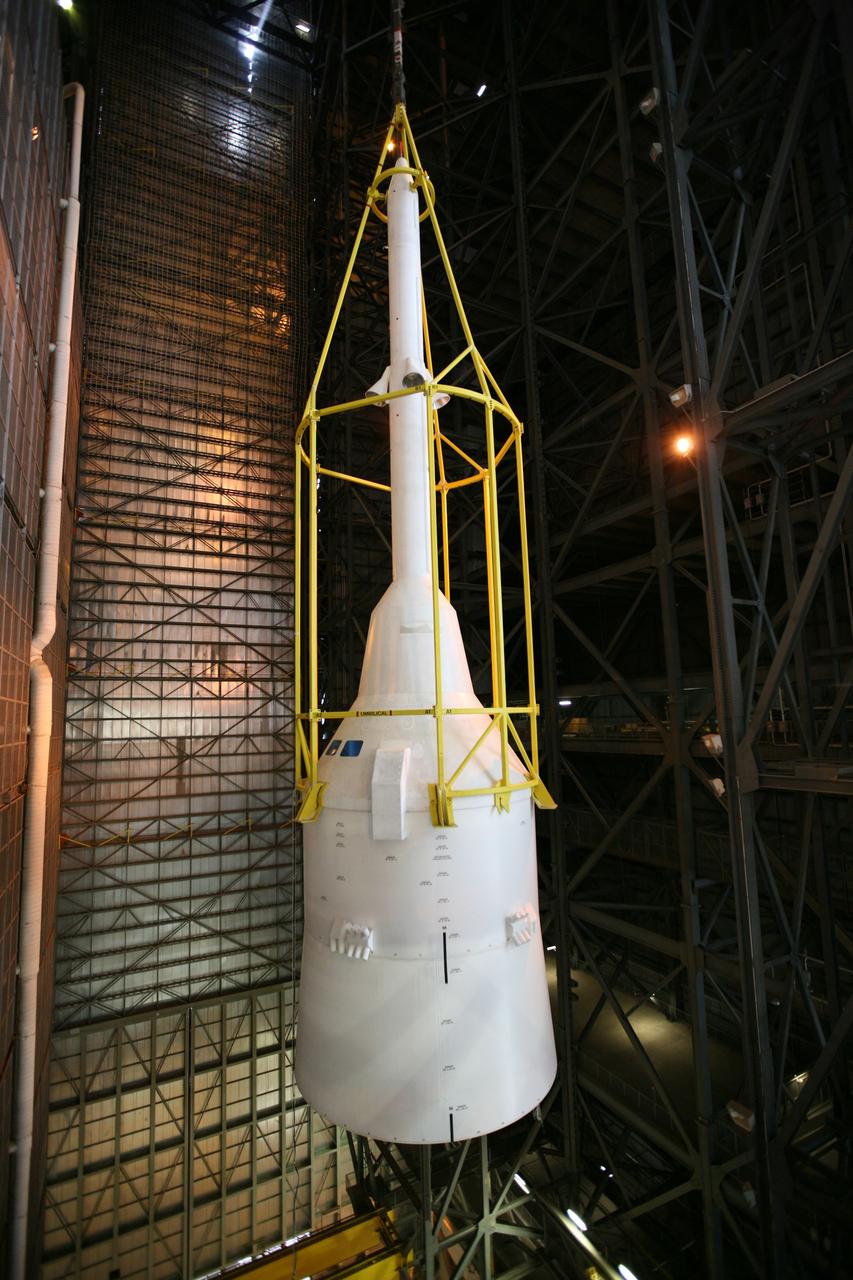
CAPE CANAVERAL, Fla. – In the Vehicle Assembly Building's High Bay 4, assembly of the Ares I-X rocket nears completion. The yellow framework, nicknamed the "birdcage," lifts Super Stack 5 toward an opening at the 16th floor crossover into the transfer aisle. The stack will be positioned on top of the segments already in place on the mobile launcher platform in High Bay 3, completing assembly of the 327-foot-tall rocket. Five super stacks make up the rocket's upper stage that is integrated with the four-segment solid rocket booster first stage. Ares I-X is the test vehicle for the Ares I, which is part of the Constellation Program to return men to the moon and beyond. The Ares I-X flight test is targeted for Oct. 31, pending formal NASA Headquarters approval. Photo credit: NASA/Dimitri Gerondidakis
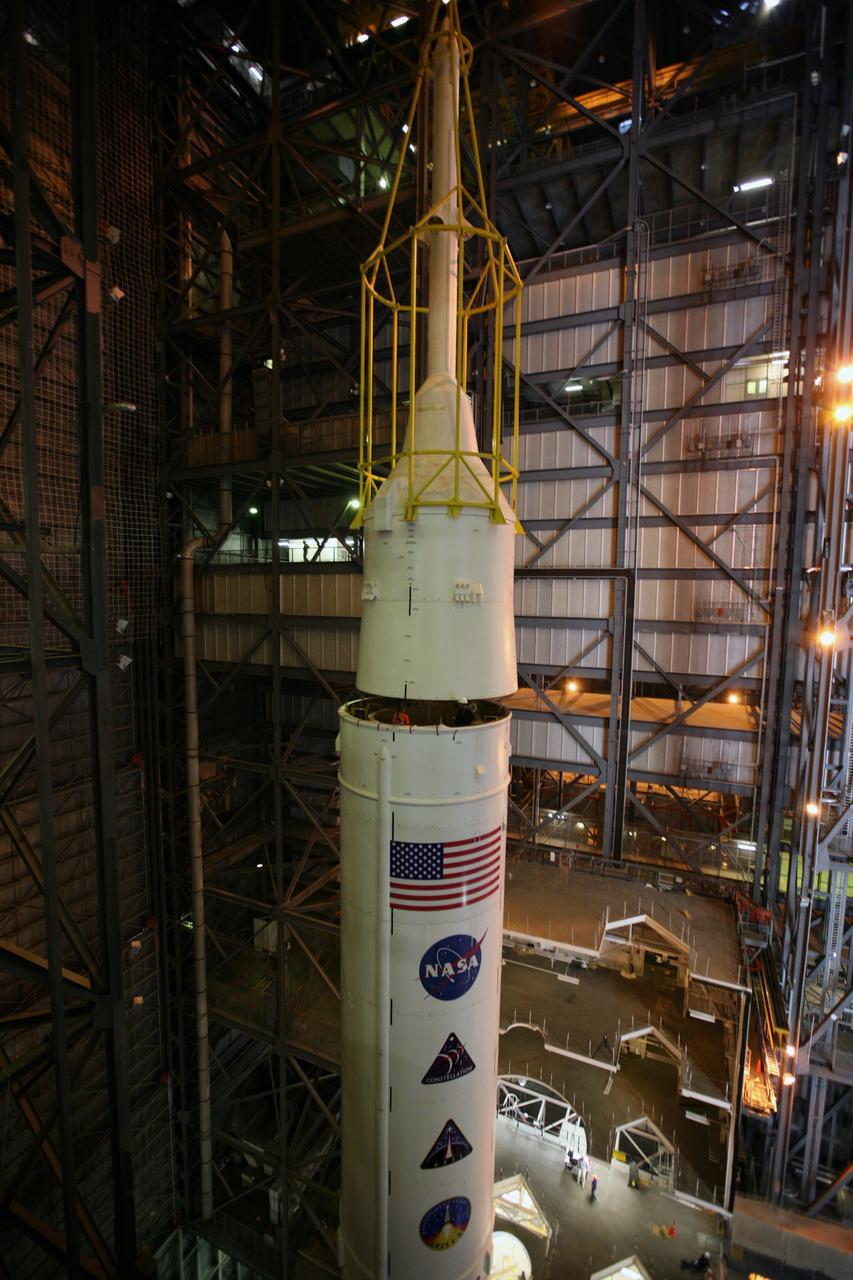
CAPE CANAVERAL, Fla. – In the Vehicle Assembly Building's High Bay 3, the yellow framework, nicknamed the "birdcage," lifts Super Stack 5 atop Super Stack 4. Once in position, assembly of the Ares I-X rocket will be complete. The 327-foot-tall rocket is one of the largest processed in the bay, rivaling the height of the Apollo Program's 364-foot-tall Saturn V. Five super stacks make up the rocket's upper stage that is integrated with the four-segment solid rocket booster first stage. Ares I-X is the test vehicle for the Ares I, which is part of the Constellation Program to return men to the moon and beyond. The Ares I-X flight test is targeted for Oct. 31, pending formal NASA Headquarters approval. Photo credit: NASA/Dimitri Gerondidakis
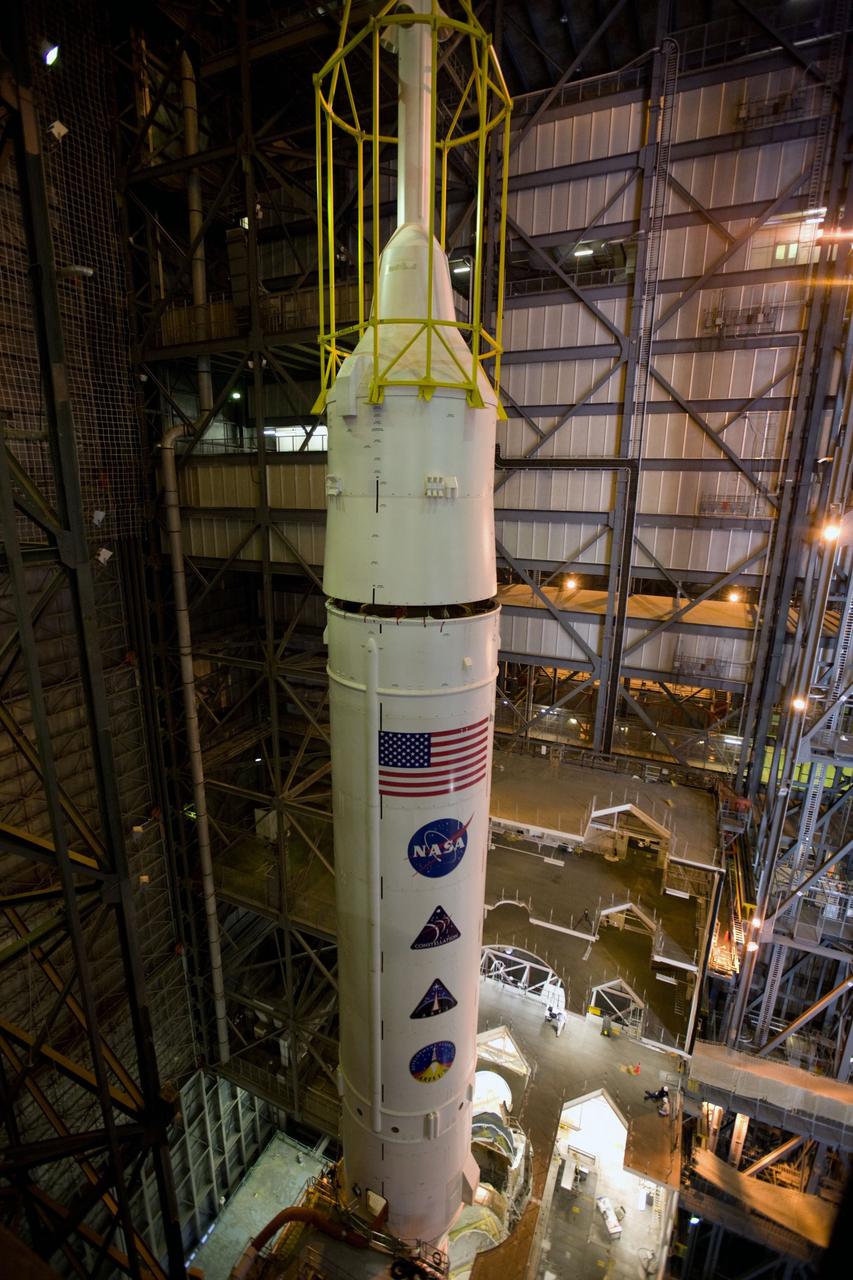
CAPE CANAVERAL, Fla. – In the Vehicle Assembly Building's High Bay 3, the yellow framework, nicknamed the "birdcage," lowers Super Stack 5 onto Super Stack 4. Once in position, assembly of the Ares I-X rocket will be complete. The 327-foot-tall rocket is one of the largest processed in the bay, rivaling the height of the Apollo Program's 364-foot-tall Saturn V. Five super stacks make up the rocket's upper stage that is integrated with the four-segment solid rocket booster first stage. Ares I-X is the test vehicle for the Ares I, which is part of the Constellation Program to return men to the moon and beyond. The Ares I-X flight test is targeted for Oct. 31, pending formal NASA Headquarters approval. Photo credit: NASA/Dimitri Gerondidakis
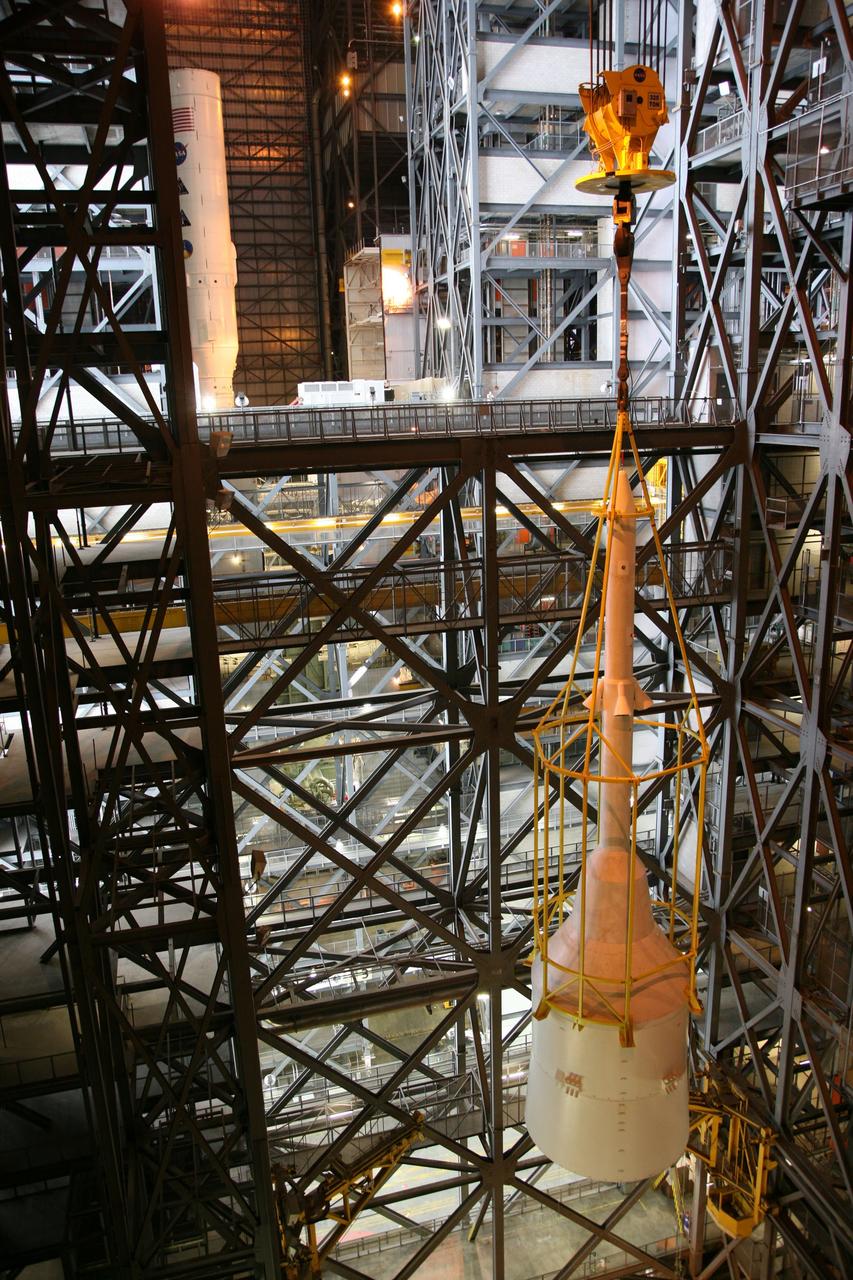
CAPE CANAVERAL, Fla. – In the Vehicle Assembly Building's High Bay 4, assembly of the Ares I-X rocket nears completion. The yellow framework, nicknamed the "birdcage," lifts Super Stack 5 toward an opening at the 16th floor crossover into the transfer aisle. The stack will be positioned on top of the segments already in place on the mobile launcher platform in High Bay 3, completing assembly of the 327-foot-tall rocket. Five super stacks make up the rocket's upper stage that is integrated with the four-segment solid rocket booster first stage. Ares I-X is the test vehicle for the Ares I, which is part of the Constellation Program to return men to the moon and beyond. The Ares I-X flight test is targeted for Oct. 31, pending formal NASA Headquarters approval. Photo credit: NASA/Dimitri Gerondidakis
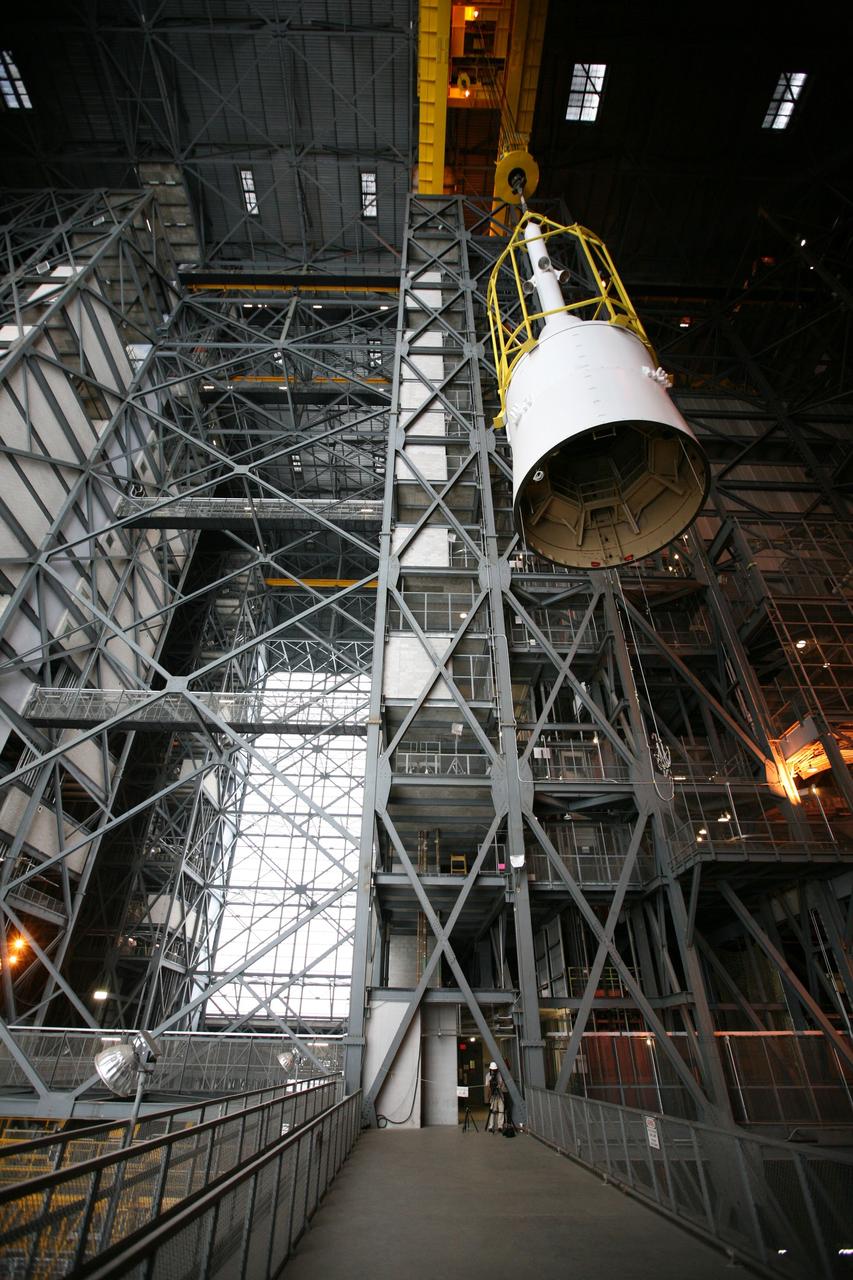
CAPE CANAVERAL, Fla. – In the Vehicle Assembly Building's High Bay 4, assembly of the Ares I-X rocket nears completion. The yellow framework, nicknamed the "birdcage," lifts Super Stack 5 through an opening at the 16th floor crossover into the transfer aisle. The stack will be positioned on top of the segments already in place on the mobile launcher platform in High Bay 3, completing assembly of the 327-foot-tall rocket. Five super stacks make up the rocket's upper stage that is integrated with the four-segment solid rocket booster first stage. Ares I-X is the test vehicle for the Ares I, which is part of the Constellation Program to return men to the moon and beyond. The Ares I-X flight test is targeted for Oct. 31, pending formal NASA Headquarters approval. Photo credit: NASA/Dimitri Gerondidakis
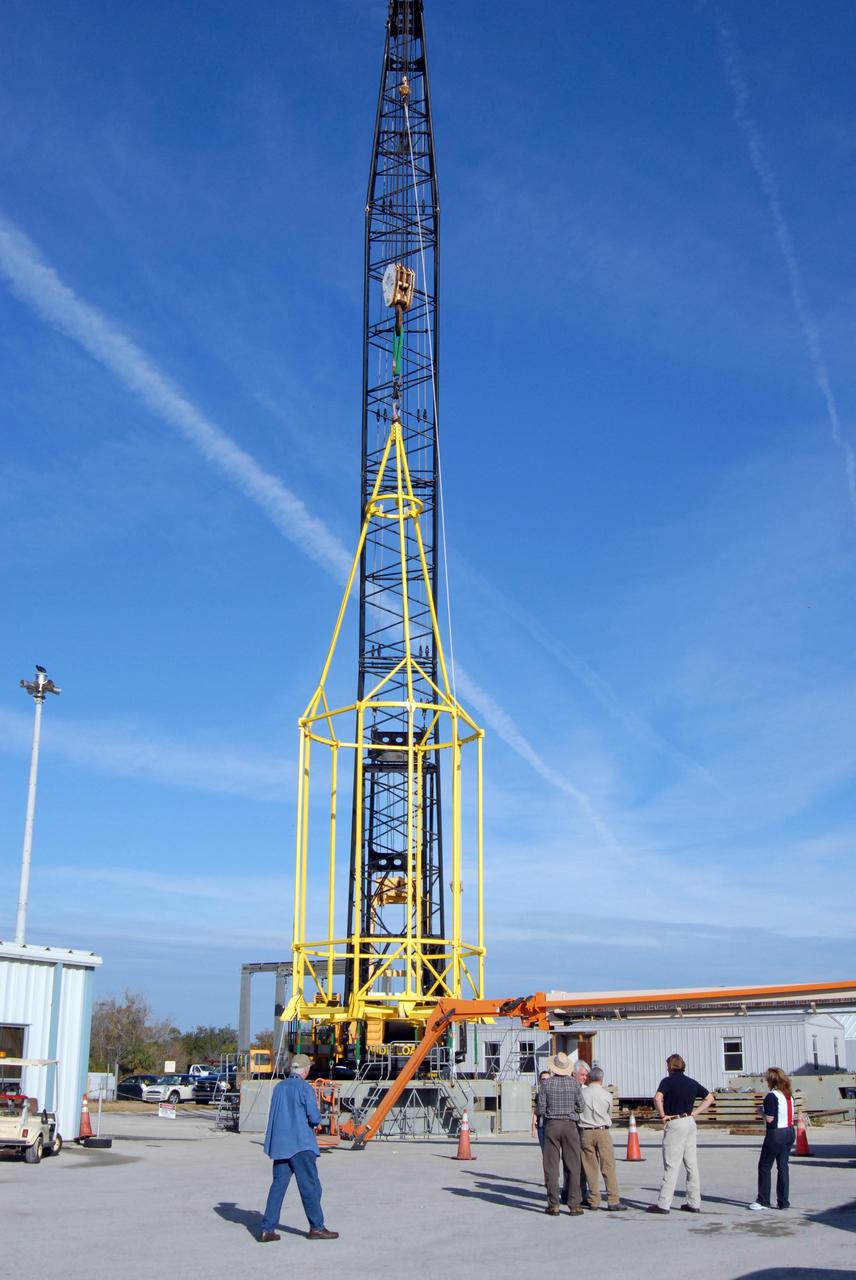
CAPE CANAVERAL, Fla. – The lifting fixture nicknamed the "Birdcage" is lifted by a crane to test the load capability. The Birdcage will be used to lift the Crew Module, or CM, and Launch Abort System, or LAS, assembly for the Ares I-X rocket and to stack and de-stack the assembly from the Service Module/Spacecraft Adapter assembly. It will also have the ability to lift and to stack and de-stack Stack-5 (all of the above components) from the Ares I-X in the Vehicle Assembly Building at NASA's Kennedy Space Center in Florida. Ares I-X is the test flight for the Ares I. The I-X flight will provide NASA an early opportunity to test and prove hardware, facilities and ground operations associated with Ares I. The launch of the 321-foot-tall, full-scale Ares I-X, targeted for July 2009, will be the first in a series of unpiloted rocket launches from Kennedy. When fully developed, the 16-foot diameter crew module will furnish living space and reentry protection for the astronauts, while their launch abort system will provide safe evacuation if a launch vehicle failure occurs. Photo credit: NASA/Jack Pfaller
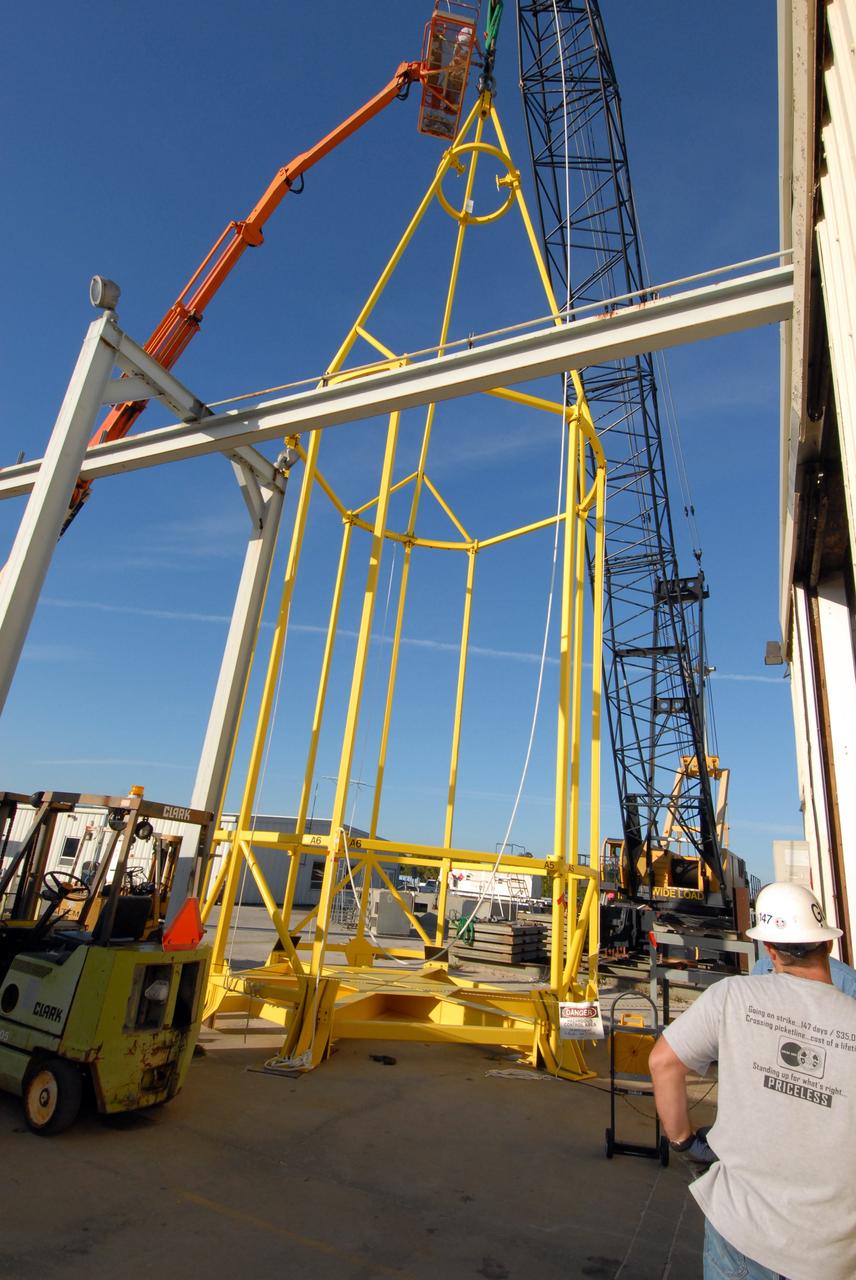
CAPE CANAVERAL, Fla. – The yellow framework seen here is the lifting fixture nicknamed the "Birdcage" that will have the ability to lift the Crew Module, or CM, and Launch Abort System, or LAS, assembly for the Ares I-X rocket and to stack and de-stack the assembly from the Service Module/Spacecraft Adapter assembly. It will also have the ability to lift and to stack and de-stack Stack-5 (all of the above components) from the Ares I-X in the Vehicle Assembly Building at NASA's Kennedy Space Center in Florida. Ares I-X is the test flight for the Ares I. The I-X flight will provide NASA an early opportunity to test and prove hardware, facilities and ground operations associated with Ares I. The launch of the 321-foot-tall, full-scale Ares I-X, targeted for July 2009, will be the first in a series of unpiloted rocket launches from Kennedy. When fully developed, the 16-foot diameter crew module will furnish living space and reentry protection for the astronauts, while their launch abort system will provide safe evacuation if a launch vehicle failure occurs. Photo credit: NASA/Jack Pfaller
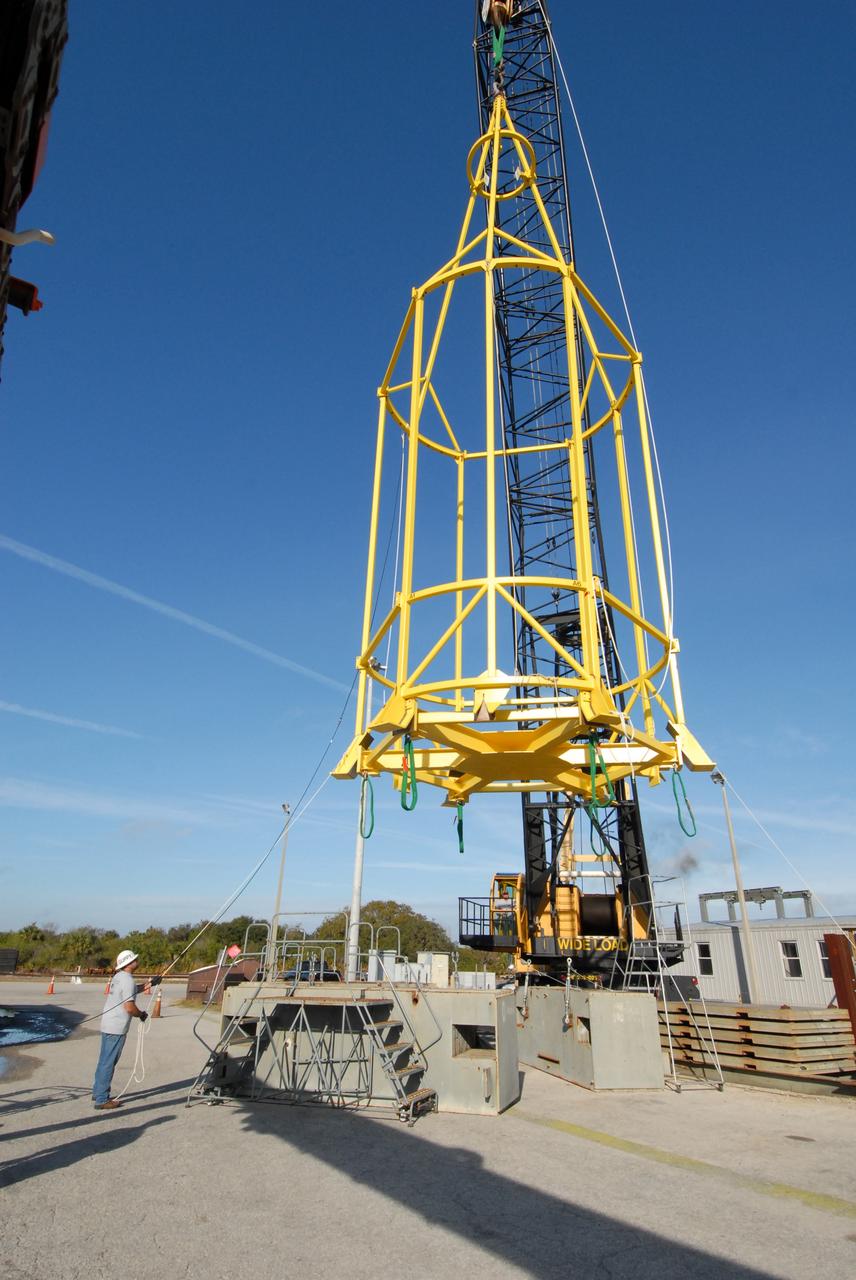
CAPE CANAVERAL, Fla. – The lifting fixture nicknamed the "Birdcage" is lifted by a crane to test the load capability. The Birdcage will be used to lift the Crew Module, or CM, and Launch Abort System, or LAS, assembly for the Ares I-X rocket and to stack and de-stack the assembly from the Service Module/Spacecraft Adapter assembly. It will also have the ability to lift and to stack and de-stack Stack-5 (all of the above components) from the Ares I-X in the Vehicle Assembly Building at NASA's Kennedy Space Center in Florida. Ares I-X is the test flight for the Ares I. The I-X flight will provide NASA an early opportunity to test and prove hardware, facilities and ground operations associated with Ares I. The launch of the 321-foot-tall, full-scale Ares I-X, targeted for July 2009, will be the first in a series of unpiloted rocket launches from Kennedy. When fully developed, the 16-foot diameter crew module will furnish living space and reentry protection for the astronauts, while their launch abort system will provide safe evacuation if a launch vehicle failure occurs. Photo credit: NASA/Jack Pfaller
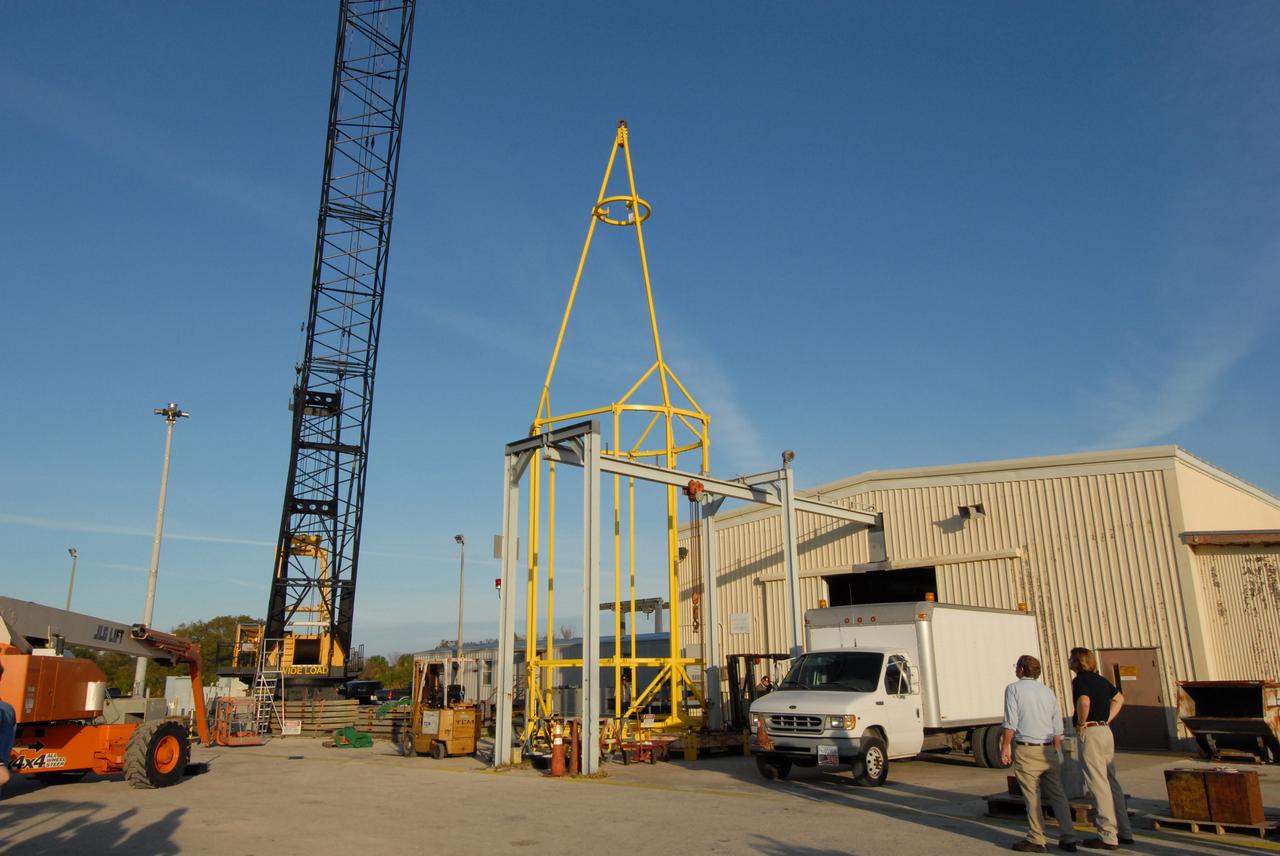
CAPE CANAVERAL, Fla. – The yellow framework at center is the lifting fixture nicknamed the "Birdcage" that will have the ability to lift the Crew Module, or CM, and Launch Abort System, or LAS, assembly for the Ares I-X rocket and to stack and de-stack the assembly from the Service Module/Spacecraft Adapter assembly. It will also have the ability to lift and to stack and de-stack Stack-5 (all of the above components) from the Ares I-X flight test vehicle in the Vehicle Assembly Building at NASA's Kennedy Space Center in Florida. Ares I-X is the test flight for the Ares I. The I-X flight will provide NASA an early opportunity to test and prove hardware, facilities and ground operations associated with Ares I. The launch of the 321-foot-tall, full-scale Ares I-X, targeted for July 2009, will be the first in a series of unpiloted rocket launches from Kennedy. When fully developed, the 16-foot diameter crew module will furnish living space and reentry protection for the astronauts, while their launch abort system will provide safe evacuation if a launch vehicle failure occurs. Photo credit: NASA/Jack Pfaller
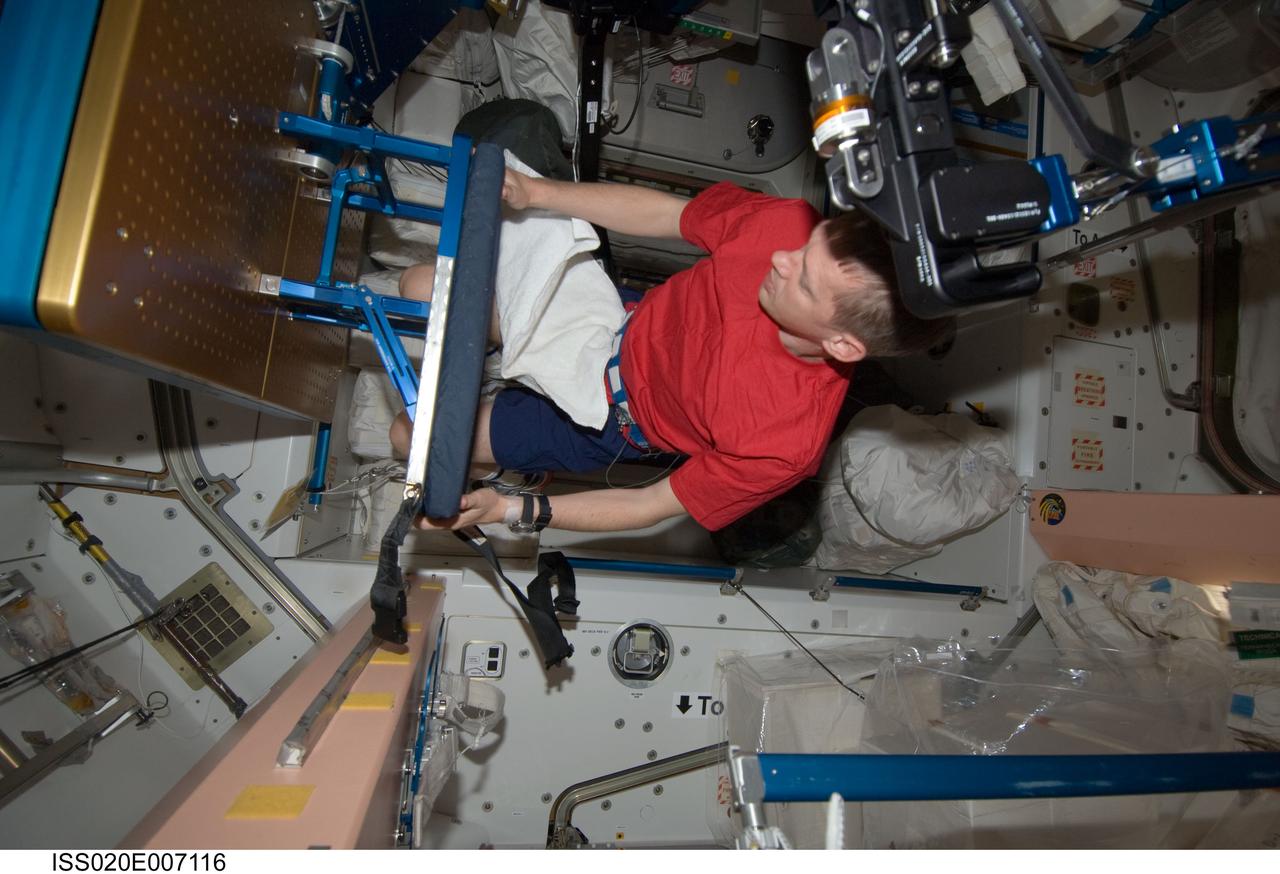
ISS020-E-007116 (5 June 2009) --- European Space Agency astronaut Frank De Winne, Expedition 20 flight engineer, prepares to use the advanced Resistive Exercise Device (aRED) in the Unity node of the International Space Station.

ISS020-E-007087 (5 June 2009) --- European Space Agency astronaut Frank De Winne, Expedition 20 flight engineer, prepares to use the advanced Resistive Exercise Device (aRED) in the Unity node of the International Space Station.
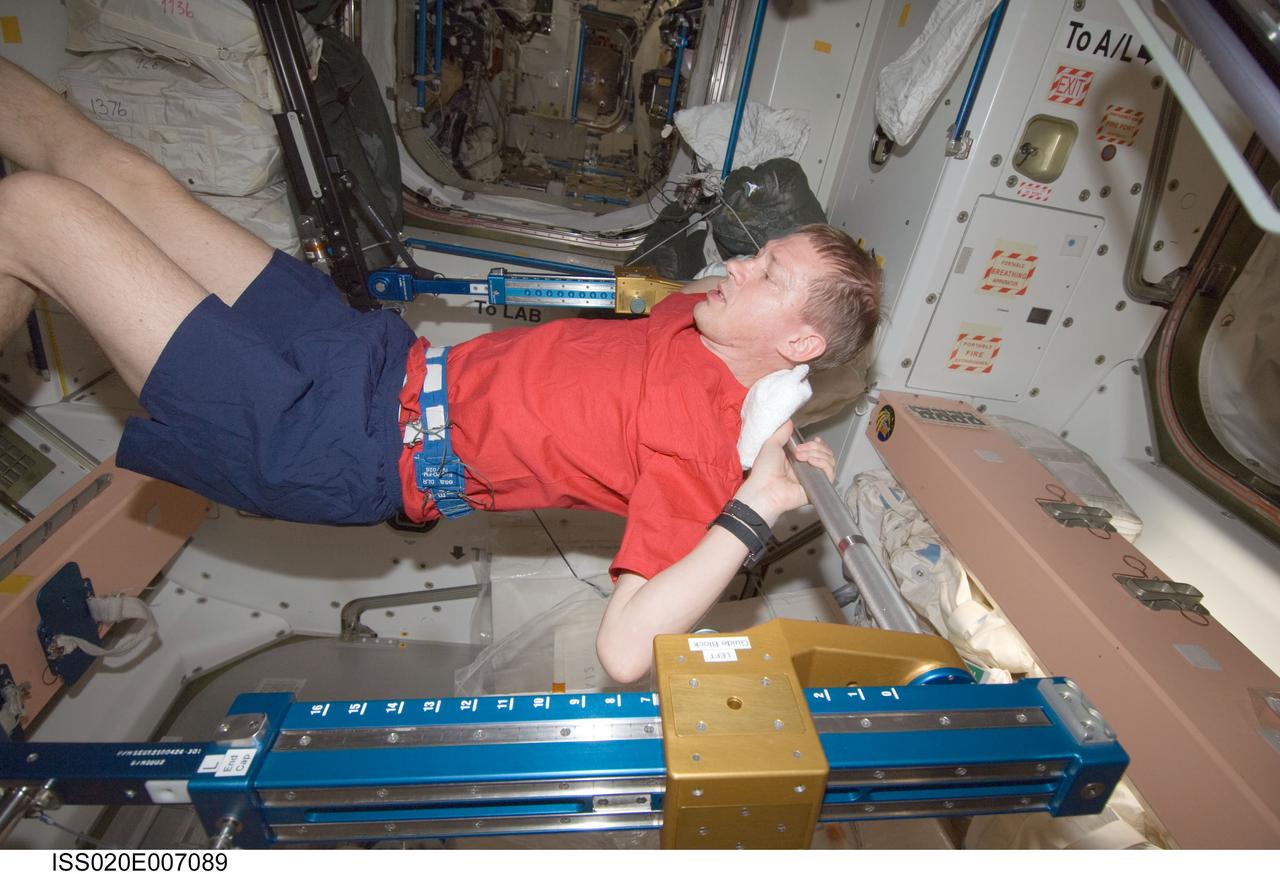
ISS020-E-007089 (5 June 2009) --- European Space Agency astronaut Frank De Winne, Expedition 20 flight engineer, exercises using the advanced Resistive Exercise Device (aRED) in the Unity node of the International Space Station.
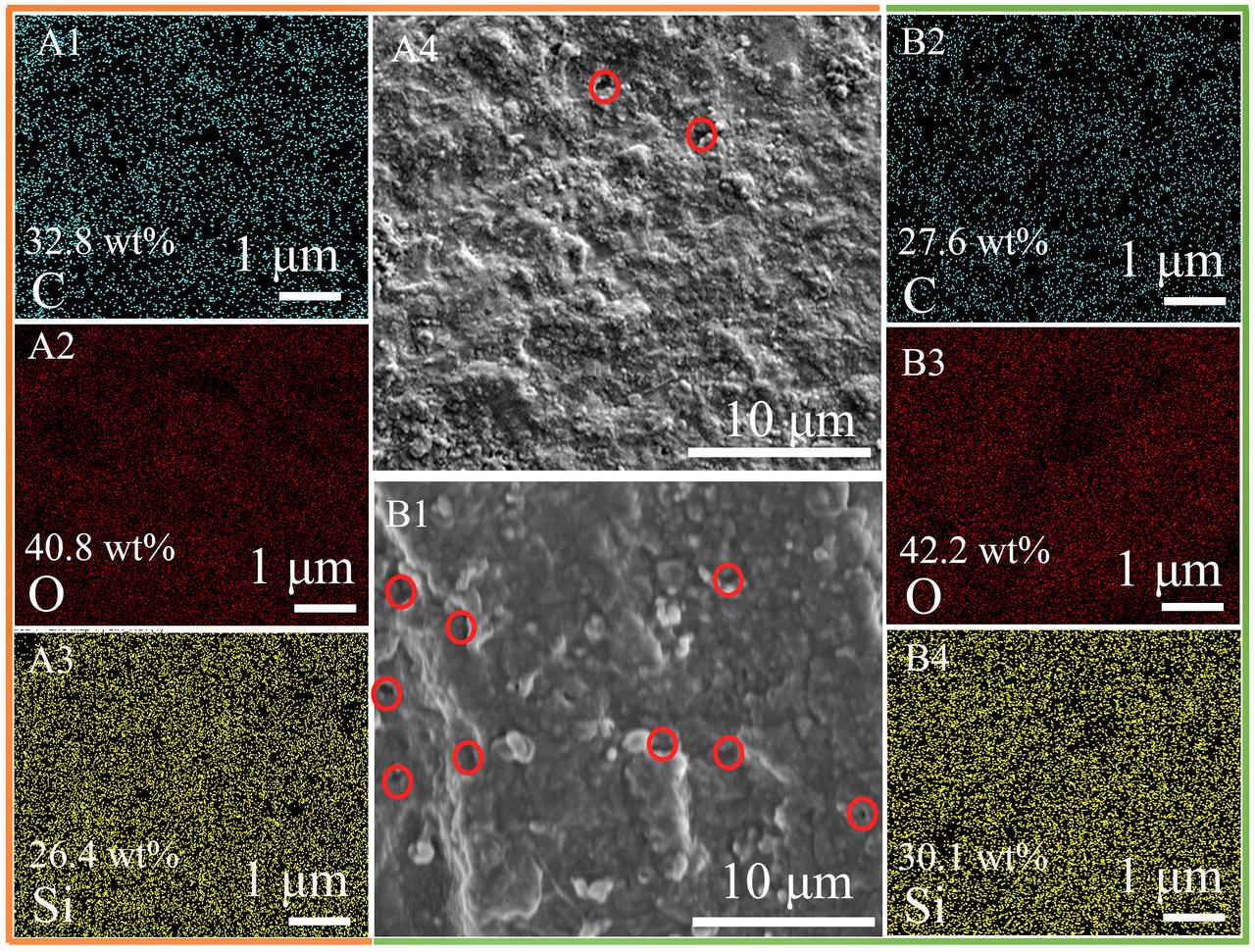
jsc2025e064333 (5/31/2024) --- Scanning electron microscope (SEM) image graphs and elemental mappings of the samples pyrolyzed at 1200 oC in the Ar (A1-A4) and microgravity (B1-B4). (The red circles in the SEM images represent obvious pores).
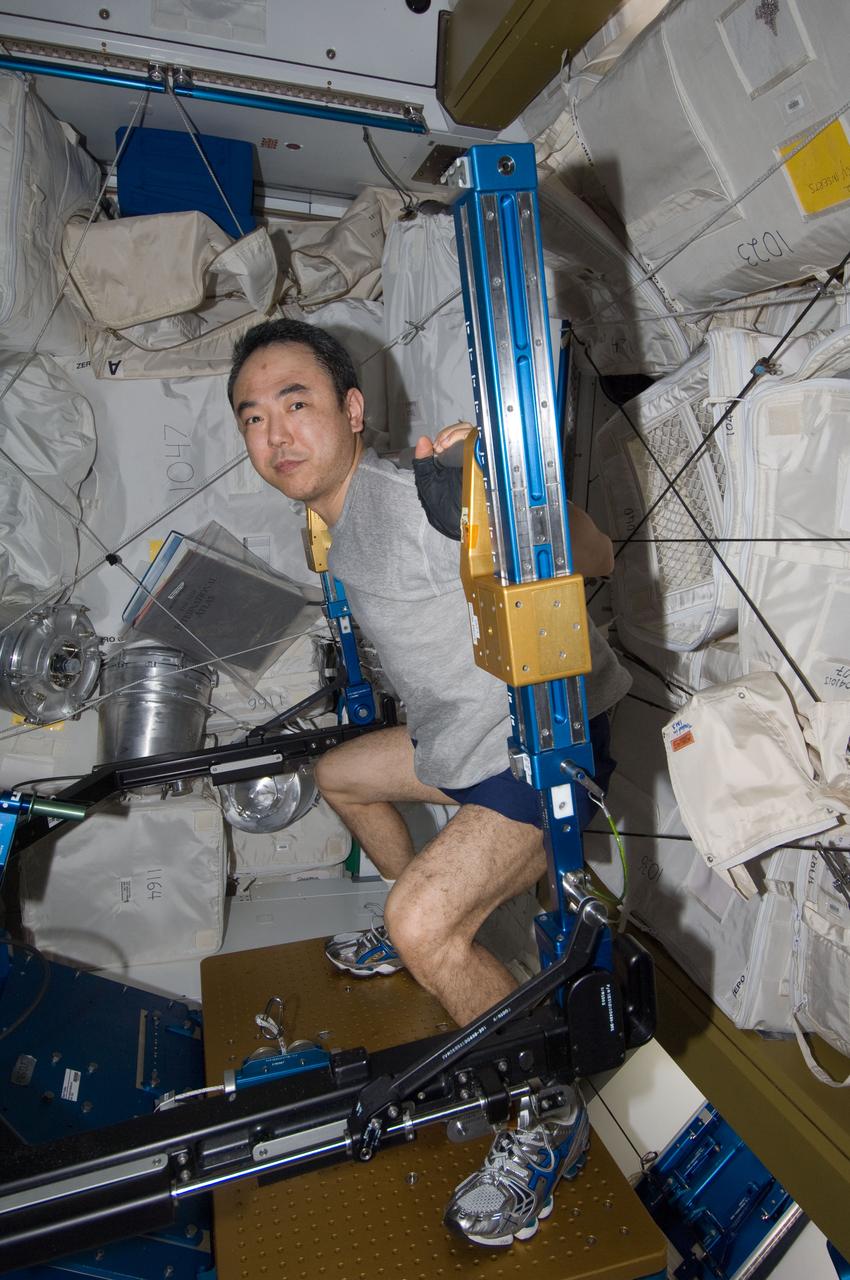
ISS029-E-039869 (5 Nov. 2011) --- Japan Aerospace Exploration Agency astronaut Satoshi Furukawa, Expedition 29 flight engineer, exercises using the advanced Resistive Exercise Device (aRED) in the Tranquility node of the International Space Station.
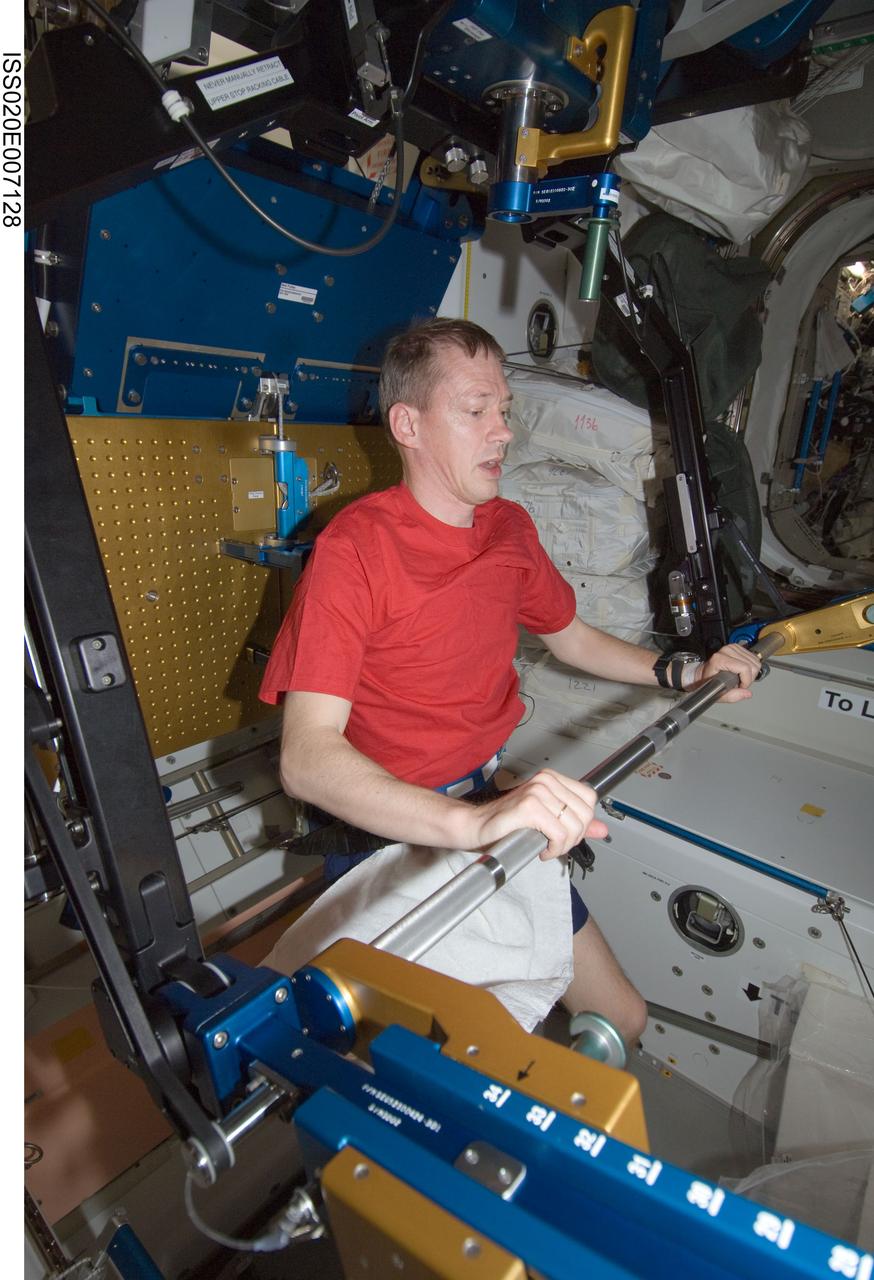
ISS020-E-007128 (5 June 2009) --- European Space Agency astronaut Frank De Winne, Expedition 20 flight engineer, exercises using the advanced Resistive Exercise Device (aRED) in the Unity node of the International Space Station.

CAPE CANAVERAL, Fla. – A C-5 aircraft arrives at the Shuttle Landing Facility at NASA's Kennedy Space Center in Florida carrying hardware that will be used in the launch of the Ares I-X rocket. The hardware consists of a precisely machined, full-scale simulator crew module and launch abort system to form the tip of NASA's Ares I-X rocket. The launch of the 321-foot-tall, full-scale Ares I-X, targeted for July 2009, will be the first in a series of unpiloted rocket launches from Kennedy. When fully developed, the 16-foot diameter crew module will furnish living space and reentry protection for the astronauts, while their launch abort system will provide safe evacuation if a launch vehicle failure occurs. Photo credit: NASA/Jack Pfaller
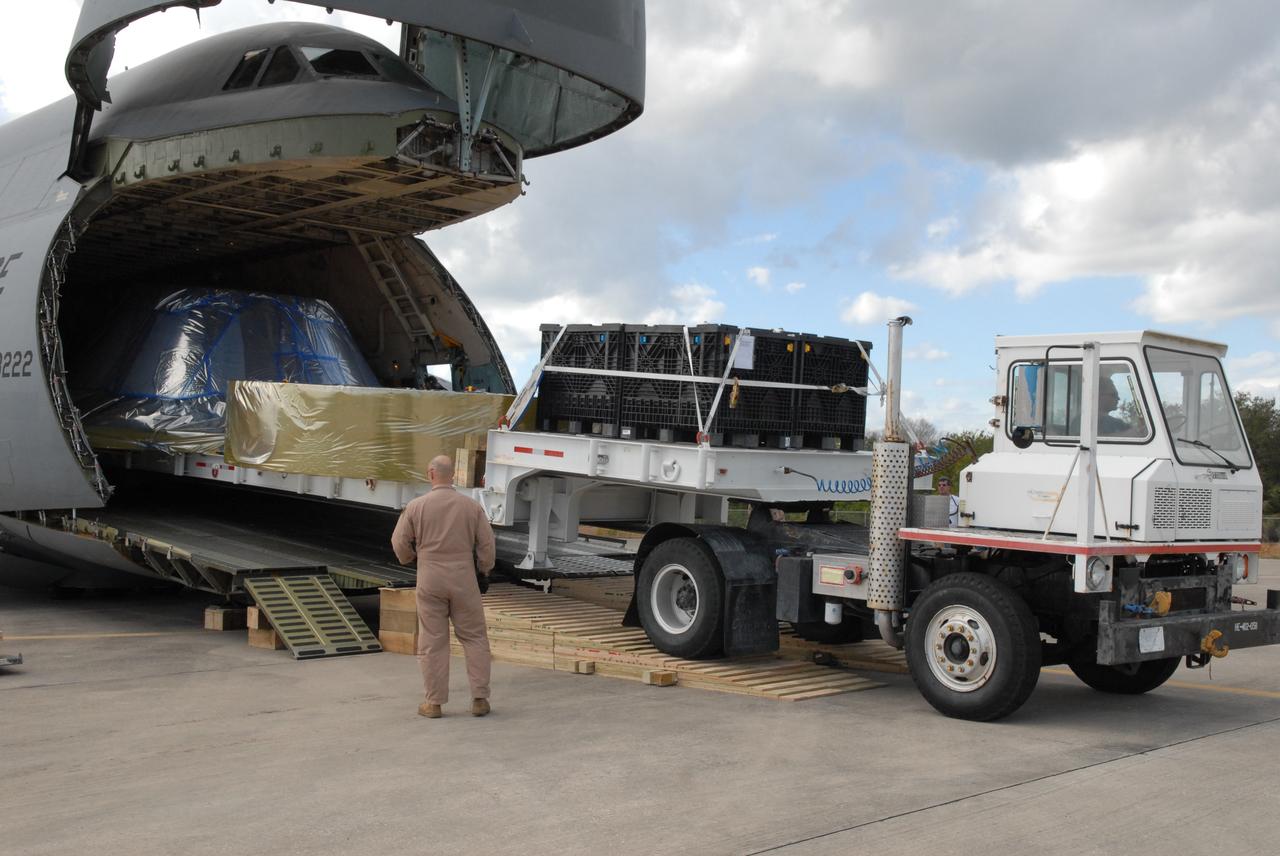
CAPE CANAVERAL, Fla. – At the Shuttle Landing Facility at NASA's Kennedy Space Center in Florida, hardware that will be used in the launch of the Ares I-X rocket is being offloaded from the C-5 aircraft. The hardware consists of a precisely machined, full-scale simulator crew module and launch abort system to form the tip of NASA's Ares I-X rocket. The launch of the 321-foot-tall, full-scale Ares I-X, targeted for July 2009, will be the first in a series of unpiloted rocket launches from Kennedy. When fully developed, the 16-foot diameter crew module will furnish living space and reentry protection for the astronauts, while their launch abort system will provide safe evacuation if a launch vehicle failure occurs. Photo credit: NASA/Jack Pfaller
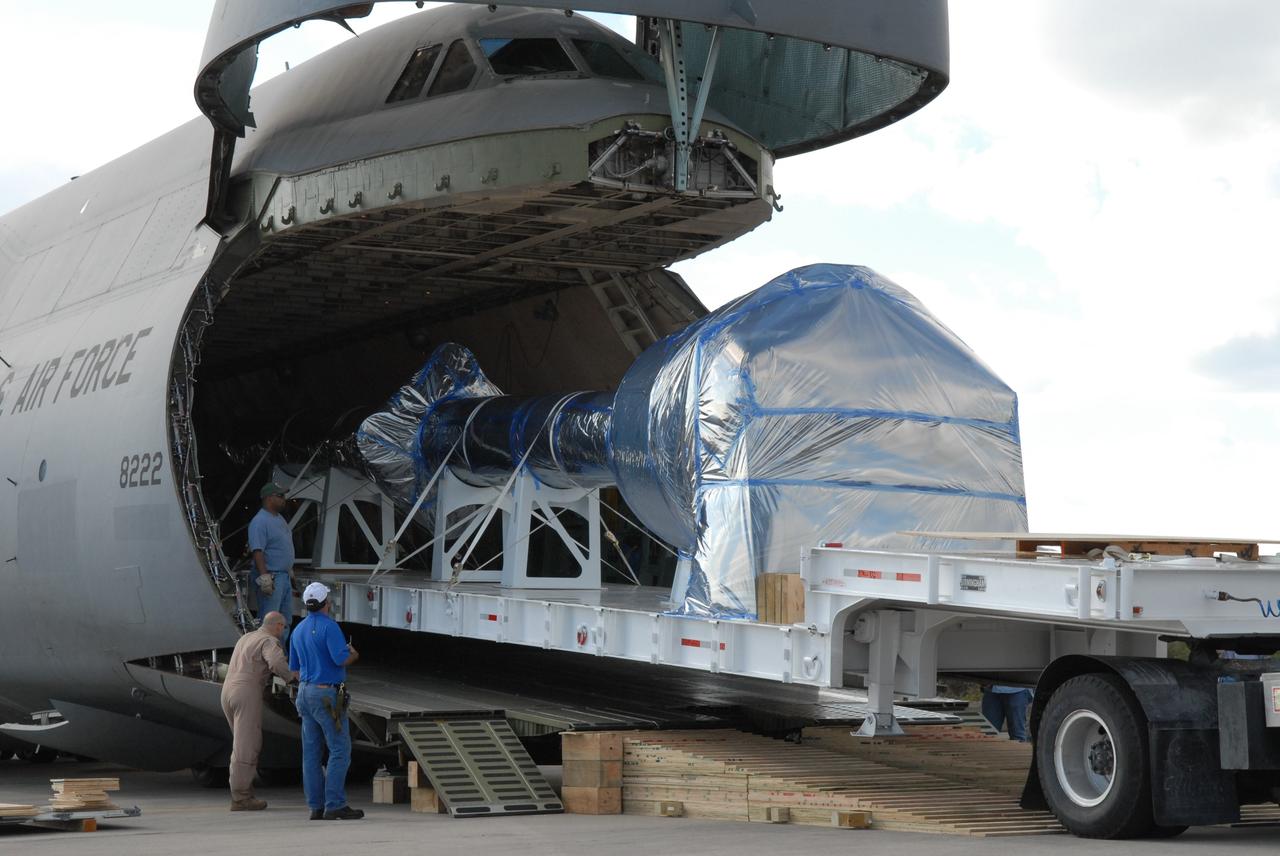
CAPE CANAVERAL, Fla. – At the Shuttle Landing Facility at NASA's Kennedy Space Center in Florida, hardware that will be used in the launch of the Ares I-X rocket is being offloaded from the C-5 aircraft. The hardware consists of a precisely machined, full-scale simulator crew module and launch abort system to form the tip of NASA's Ares I-X rocket. The launch of the 321-foot-tall, full-scale Ares I-X, targeted for July 2009, will be the first in a series of unpiloted rocket launches from Kennedy. When fully developed, the 16-foot diameter crew module will furnish living space and reentry protection for the astronauts, while their launch abort system will provide safe evacuation if a launch vehicle failure occurs. Photo credit: NASA/Jack Pfaller
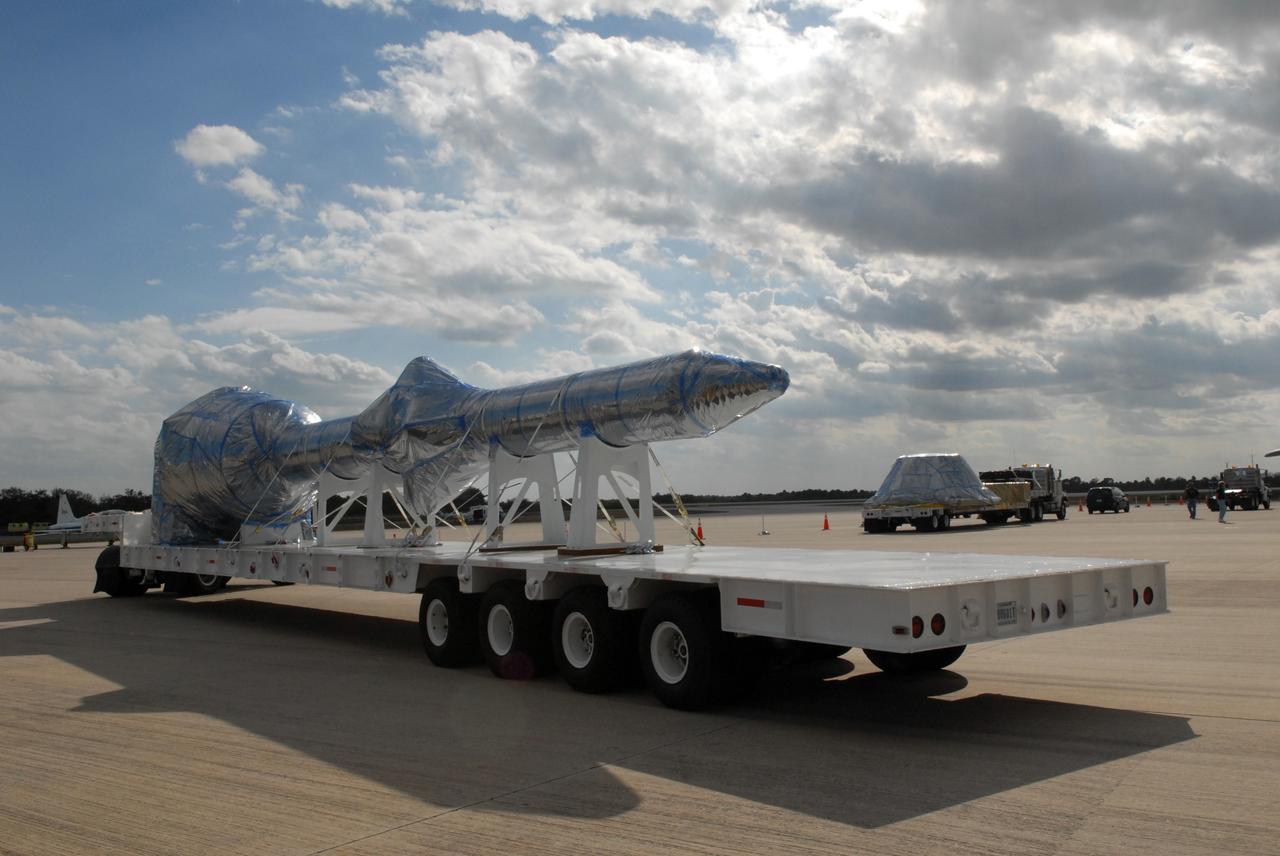
CAPE CANAVERAL, Fla. – At the Shuttle Landing Facility at NASA's Kennedy Space Center in Florida, hardware that will be used in the launch of the Ares I-X rocket is being offloaded from the C-5 aircraft. The hardware consists of a precisely machined, full-scale simulator crew module and launch abort system to form the tip of NASA's Ares I-X rocket. The launch of the 321-foot-tall, full-scale Ares I-X, targeted for July 2009, will be the first in a series of unpiloted rocket launches from Kennedy. When fully developed, the 16-foot diameter crew module will furnish living space and reentry protection for the astronauts, while their launch abort system will provide safe evacuation if a launch vehicle failure occurs. Photo credit: NASA/Jack Pfaller
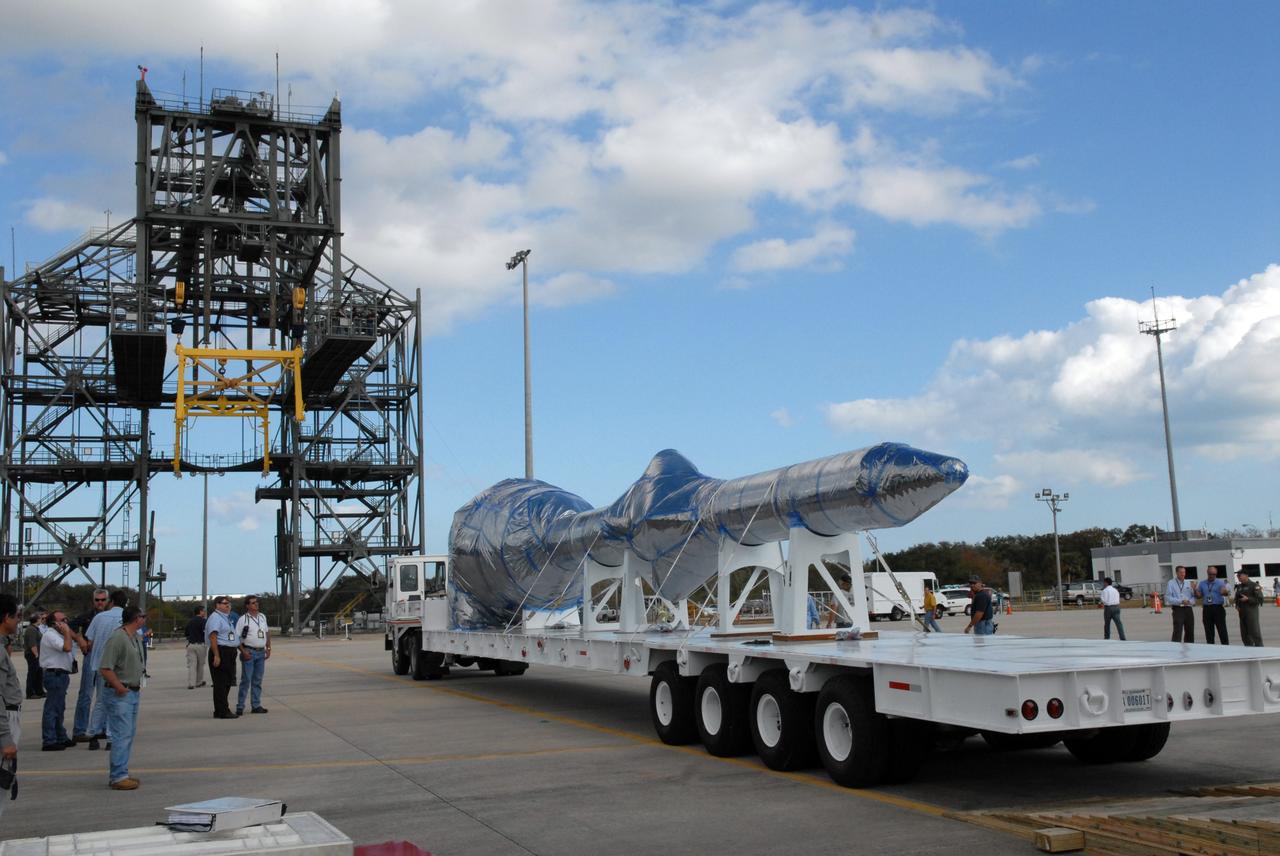
CAPE CANAVERAL, Fla. – At the Shuttle Landing Facility at NASA's Kennedy Space Center in Florida, hardware that will be used in the launch of the Ares I-X rocket is being offloaded from the C-5 aircraft. The hardware consists of a precisely machined, full-scale simulator crew module and launch abort system to form the tip of NASA's Ares I-X rocket. The launch of the 321-foot-tall, full-scale Ares I-X, targeted for July 2009, will be the first in a series of unpiloted rocket launches from Kennedy. When fully developed, the 16-foot diameter crew module will furnish living space and reentry protection for the astronauts, while their launch abort system will provide safe evacuation if a launch vehicle failure occurs. Photo credit: NASA/Jack Pfaller

CAPE CANAVERAL, Fla. – At the Shuttle Landing Facility at NASA's Kennedy Space Center in Florida, hardware that will be used in the launch of the Ares I-X rocket is being offloaded from the C-5 aircraft. The hardware consists of a precisely machined, full-scale simulator crew module and launch abort system to form the tip of NASA's Ares I-X rocket. The launch of the 321-foot-tall, full-scale Ares I-X, targeted for July 2009, will be the first in a series of unpiloted rocket launches from Kennedy. When fully developed, the 16-foot diameter crew module will furnish living space and reentry protection for the astronauts, while their launch abort system will provide safe evacuation if a launch vehicle failure occurs. Photo credit: NASA/Jack Pfaller
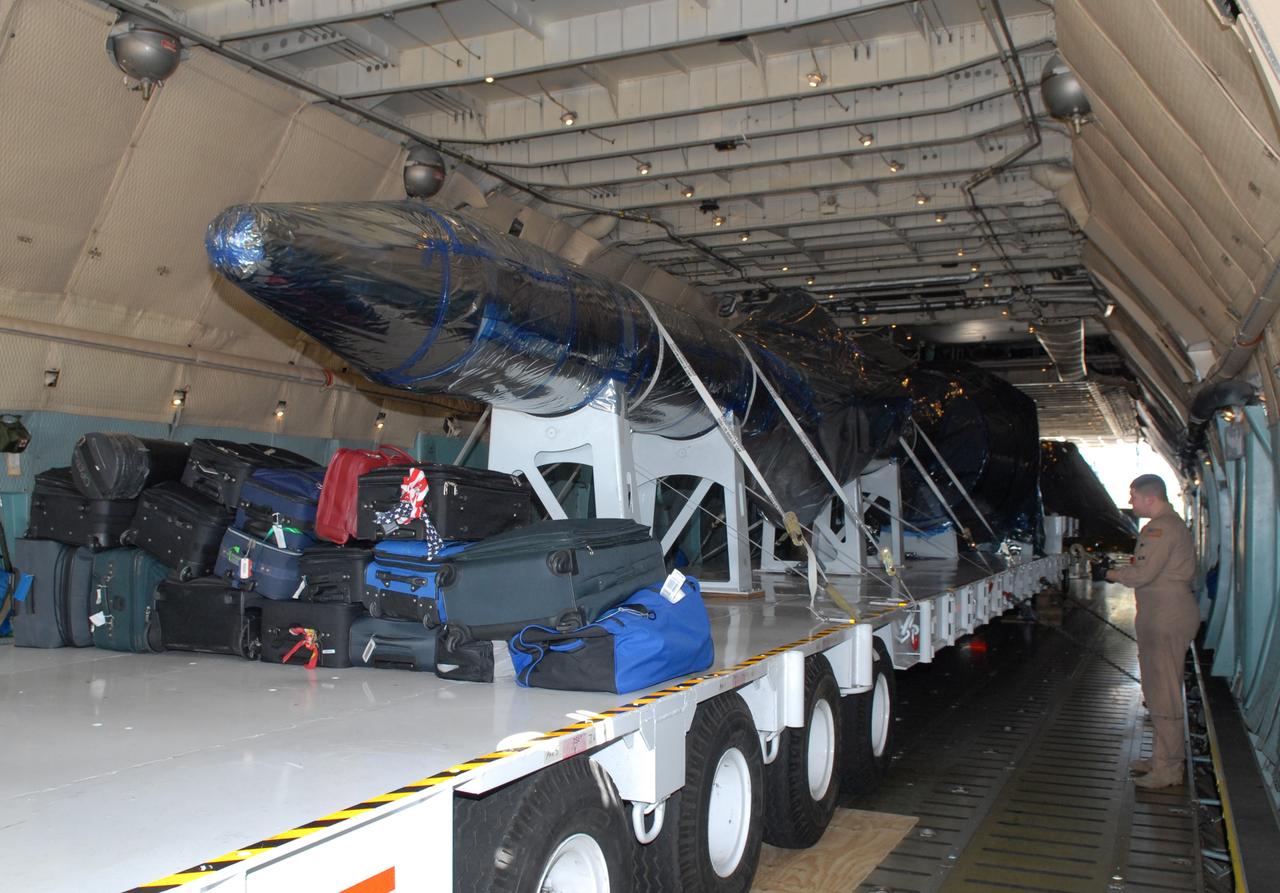
CAPE CANAVERAL, Fla. – Inside a C-5 aircraft, hardware that will be used in the launch of the Ares I-X rocket is being offloaded at the Shuttle Landing Facility at NASA's Kennedy Space Center in Florida. The hardware consists of a precisely machined, full-scale simulator crew module and launch abort system to form the tip of NASA's Ares I-X rocket. The launch of the 321-foot-tall, full-scale Ares I-X, targeted for July 2009, will be the first in a series of unpiloted rocket launches from Kennedy. When fully developed, the 16-foot diameter crew module will furnish living space and reentry protection for the astronauts, while their launch abort system will provide safe evacuation if a launch vehicle failure occurs. Photo credit: NASA/Jack Pfaller
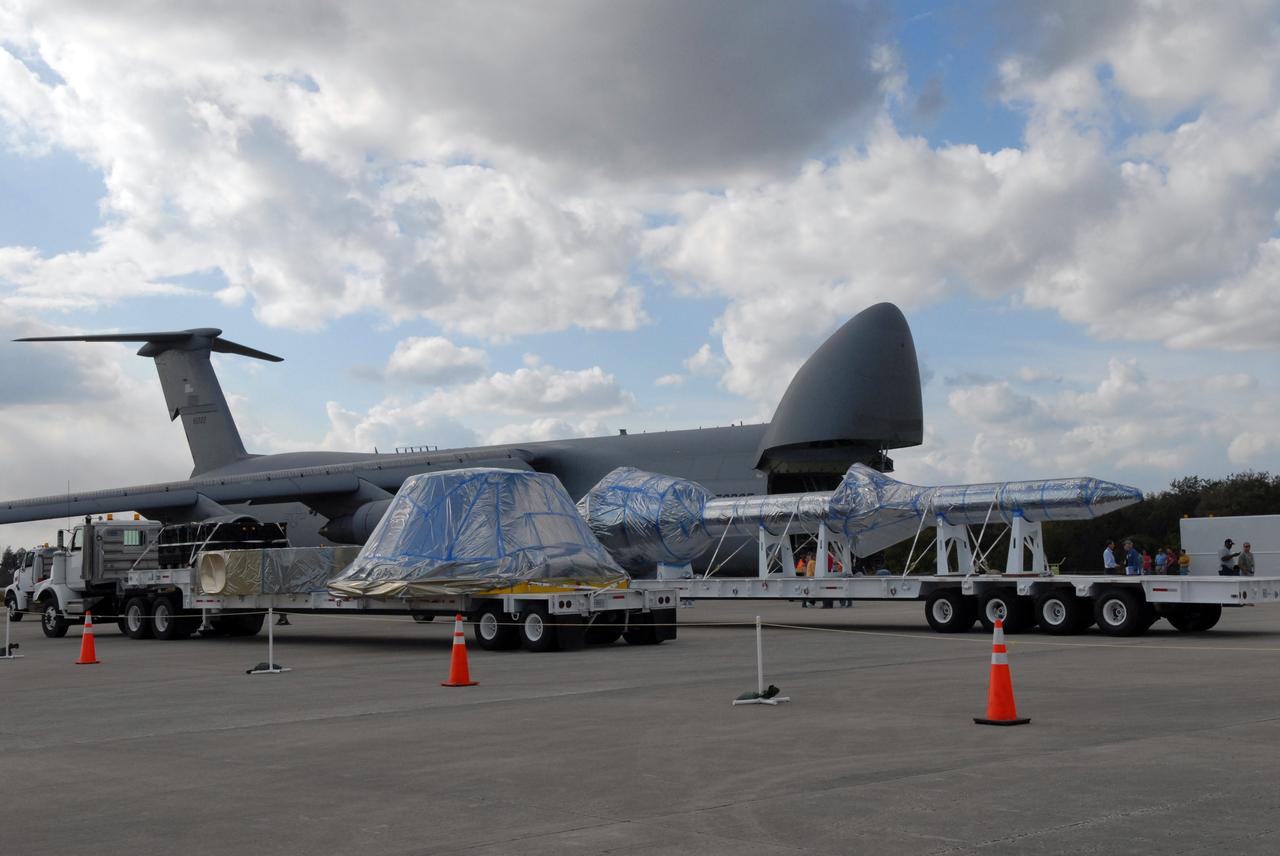
CAPE CANAVERAL, Fla. – At the Shuttle Landing Facility at NASA's Kennedy Space Center in Florida, hardware that will be used in the launch of the Ares I-X rocket is being offloaded from the C-5 aircraft. The hardware consists of a precisely machined, full-scale simulator crew module and launch abort system to form the tip of NASA's Ares I-X rocket. The launch of the 321-foot-tall, full-scale Ares I-X, targeted for July 2009, will be the first in a series of unpiloted rocket launches from Kennedy. When fully developed, the 16-foot diameter crew module will furnish living space and reentry protection for the astronauts, while their launch abort system will provide safe evacuation if a launch vehicle failure occurs. Photo credit: NASA/Jack Pfaller

CAPE CANAVERAL, Fla. – At the Shuttle Landing Facility at NASA's Kennedy Space Center in Florida, hardware that will be used in the launch of the Ares I-X rocket is being offloaded from the C-5 aircraft. The hardware consists of a precisely machined, full-scale simulator crew module and launch abort system to form the tip of NASA's Ares I-X rocket. The launch of the 321-foot-tall, full-scale Ares I-X, targeted for July 2009, will be the first in a series of unpiloted rocket launches from Kennedy. When fully developed, the 16-foot diameter crew module will furnish living space and reentry protection for the astronauts, while their launch abort system will provide safe evacuation if a launch vehicle failure occurs. Photo credit: NASA/Jack Pfaller
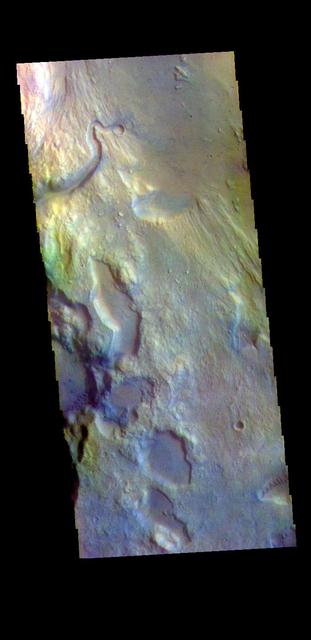
The THEMIS VIS camera contains 5 filters. The data from different filters can be combined in multiple ways to create a false color image. These false color images may reveal subtle variations of the surface not easily identified in a single band image. Today's false color image shows part of the main channel of Ares Vallis, as well as a small side tributary. Located in Margaritifer Terra, Ares Vallis is part of a large system of channels that arise in Valles Marineris and flow northward into Chryse Planitia. Orbit Number: 79239 Latitude: 7.64196 Longitude: 338.056 Instrument: VIS Captured: 2019-10-25 20:37 https://photojournal.jpl.nasa.gov/catalog/PIA24660
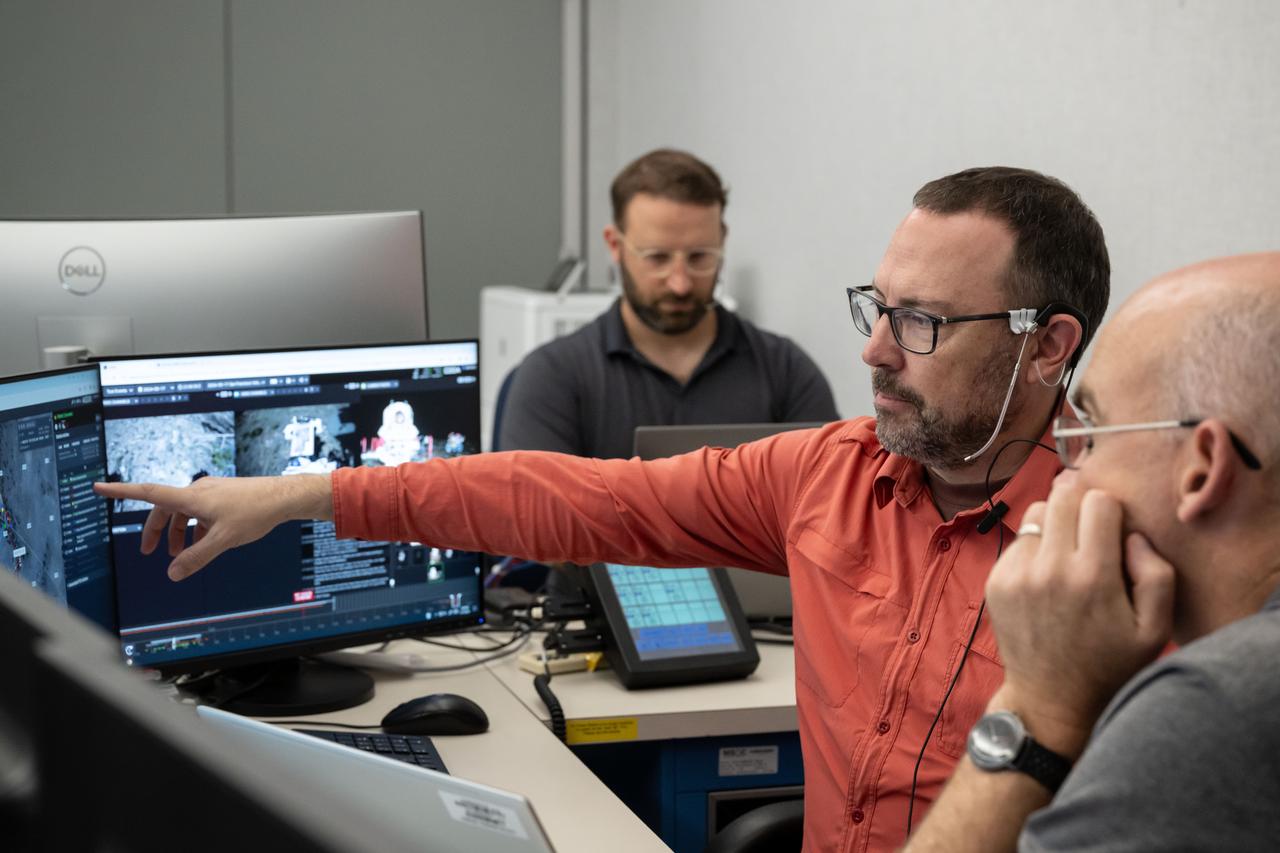
Ben Feist, software engineer on the Extravehicular Activity Mission System Software (EMSS) team, uses the suite of software he and other members of the Astromaterials Research and Exploration Science (ARES) division at NASA's Johnson Space Center in Houston developed to plan and monitor spacewalks. The JETT 5 field test was the first time this software was fully integrated into a simulated mission, supporting both science and mission control operations. JETT 5 was a week-long field test conducted in the lunar-like landscape of the San Francisco Volcanic Field near Flagstaff, Arizona, with a team of flight controllers and scientists at Johnson monitoring and guiding the activities. Credit: NASA/Helen Arase Vargas
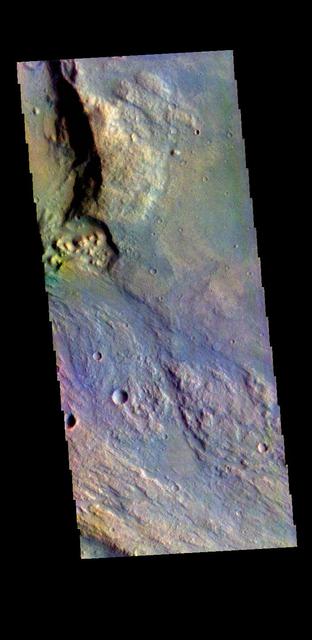
The THEMIS VIS camera contains 5 filters. The data from different filters can be combined in multiple ways to create a false color image. These false color images may reveal subtle variations of the surface not easily identified in a single band image. Today's false color image shows part of Margartifier Terra near Ares Vallis. Orbit Number: 80961 Latitude: 7.61436 Longitude: 339.521 Instrument: VIS Captured: 2020-03-15 15:33 https://photojournal.jpl.nasa.gov/catalog/PIA24679

The sun emitted a significant solar flare, peaking at 5:40 p.m. EDT on Oct. 24, 2014. The flare erupted from a particularly large active region -- labeled AR 12192 -- on the sun that is the largest in 24 years. This is the fourth substantial flare from this active region since Oct. 19. Read more: <a href="http://www.nasa.gov/content/goddard/giant-sunspot-erupts-with-4th-substantial-flare" rel="nofollow">www.nasa.gov/content/goddard/giant-sunspot-erupts-with-4t...</a>
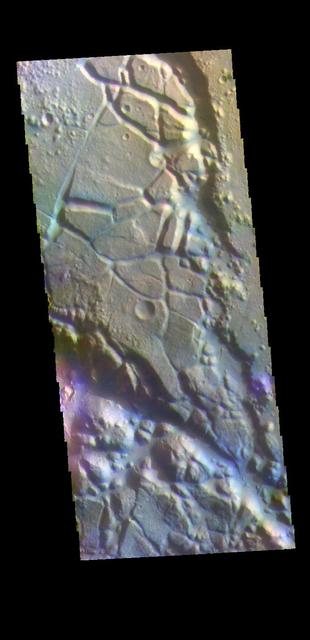
Today's VIS image is located in Aram Chaos. Aram Chaos was initially formed by a large impact. Over time the crater interior was modified by several different processes, including liquid water. Located near Ares Vallis, a narrow channel links the Aram Chaos crater with Ares Vallis indicating a substantial amount of water was located in the crater. Chaos forms from erosion of the surface into mesa features. With time the valleys expand creating the jumble of hills seen in the image. The THEMIS VIS camera contains 5 filters. The data from different filters can be combined in multiple ways to create a false color image. These false color images may reveal subtle variations of the surface not easily identified in a single band image. Orbit Number: 62100 Latitude: 4.04973 Longitude: 340.137 Instrument: VIS Captured: 2015-12-14 01:59 https://photojournal.jpl.nasa.gov/catalog/PIA23107

The THEMIS VIS camera contains 5 filters. The data from different filters can be combined in multiple ways to create a false color image. These false color images may reveal subtle variations of the surface not easily identified in a single band image. Today's false color image is located in Aram Chaos. Aram Chaos was initially formed by a large impact. Over time the crater interior was modified by several different processes, including liquid water. Located near Ares Vallis, a narrow channel links the Aram Chaos crater with Ares Vallis indicating a substantial amount of water was located in the crater. Chaos forms from erosion of the surface into mesa features. With time the valleys expand creating the jumble of hills seen in the image. Orbit Number: 79214 Latitude: 2.40411 Longitude: 340.023 Instrument: VIS Captured: 2019-10-23 19:10 https://photojournal.jpl.nasa.gov/catalog/PIA24659
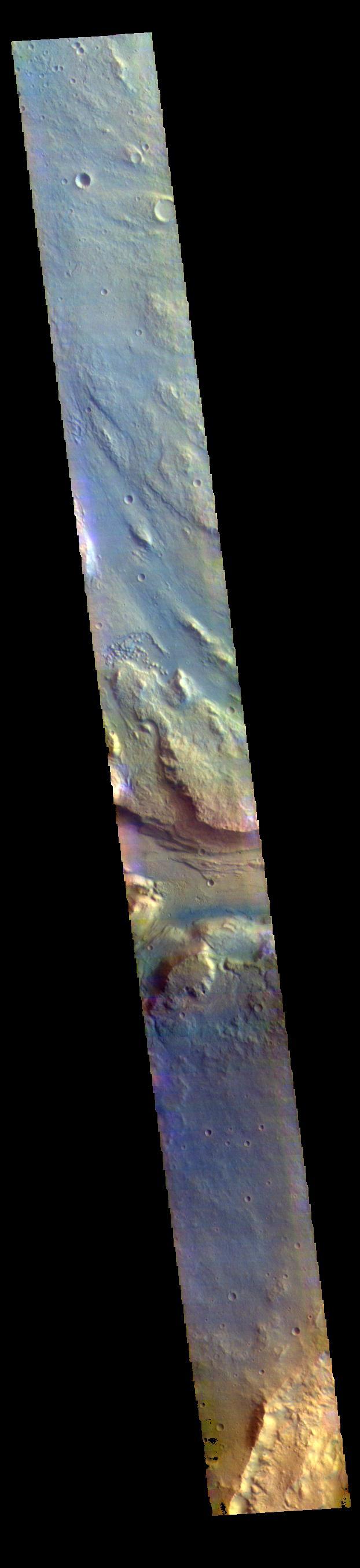
This false color image contains several channel features. Towards the top of the image are several stream-lined islands, created by liquid flow eroding preexisting rock. The islands have a tear-drop shape, with the pointy end down stream from the rounded end. In this case the fluid flowed from the bottom right of the frame towards the upper left. Just below the center of the image is a larger, deeper channel. All these channel features merge into Ares Vallis, a huge outflow channel that empties into Chryse Planitia. The THEMIS VIS camera contains 5 filters. The data from different filters can be combined in multiple ways to create a false color image. These false color images may reveal subtle variations of the surface not easily identified in a single band image. Orbit Number: 61501 Latitude: 4.31188 Longitude: 343.17 Instrument: VIS Captured: 2015-10-25 18:03 https://photojournal.jpl.nasa.gov/catalog/PIA23066

Active region AR 12192 on the sun erupted with a strong flare on Oct. 24, 2014, as seen in the bright light of this image captured by NASA's Solar Dynamics Observatory. This image shows extreme ultraviolet light that highlights the hot solar material in the sun's atmosphere. Credit: NASA/GSFC/SDO More info: The sun emitted a significant solar flare, peaking at 5:40 p.m. EDT on Oct. 24, 2014. NASA's Solar Dynamics Observatory, which watches the sun constantly, captured images of the event. Solar flares are powerful bursts of radiation. Harmful radiation from a flare cannot pass through Earth's atmosphere to physically affect humans on the ground, however -- when intense enough -- they can disturb the atmosphere in the layer where GPS and communications signals travel. This flare is classified as an X3.1-class flare. X-class denotes the most intense flares, while the number provides more information about its strength. An X2 is twice as intense as an X1, an X3 is three times as intense, etc. The flare erupted from a particularly large active region -- labeled AR 12192 -- on the sun that is the largest in 24 years. This is the fourth substantial flare from this active region since Oct. 19. Credit: NASA's Goddard Space Flight Center <b><a href="http://www.nasa.gov/audience/formedia/features/MP_Photo_Guidelines.html" rel="nofollow">NASA image use policy.</a></b> <b><a href="http://www.nasa.gov/centers/goddard/home/index.html" rel="nofollow">NASA Goddard Space Flight Center</a></b> enables NASA’s mission through four scientific endeavors: Earth Science, Heliophysics, Solar System Exploration, and Astrophysics. Goddard plays a leading role in NASA’s accomplishments by contributing compelling scientific knowledge to advance the Agency’s mission. <b>Follow us on <a href="http://twitter.com/NASAGoddardPix" rel="nofollow">Twitter</a></b> <b>Like us on <a href="http://www.facebook.com/pages/Greenbelt-MD/NASA-Goddard/395013845897?ref=tsd" rel="nofollow">Facebook</a></b> <b>Find us on <a href="http://instagrid.me/nasagoddard/?vm=grid" rel="nofollow">Instagram</a></b>
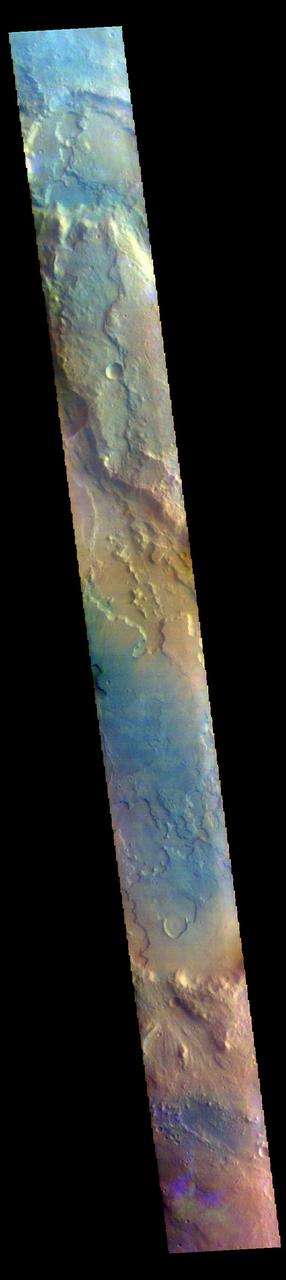
The THEMIS VIS camera contains 5 filters. The data from different filters can be combined in multiple ways to create a false color image. These false color images may reveal subtle variations of the surface not easily identified in a single band image. Today's false color image shows part of Margaritifer Terra just east of Ares Vallis. If you look closely at the bottom of the image, you will see spots of purple and yellow, with similar 'shapes'. These features are not image artifacts. These are clouds. When this image was collected there were high altitude ice clouds being blown across the sky, moving fast enough to reach a different location between the time each filter was collected. Color VIS images are typically the only image type where ice clouds can be identified. The THEMIS VIS camera is capable of capturing color images of the Martian surface using five different color filters. In this mode of operation, the spatial resolution and coverage of the image must be reduced to accommodate the additional data volume produced from using multiple filters. To make a color image, three of the five filter images (each in grayscale) are selected. Each is contrast enhanced and then converted to a red, green, or blue intensity image. These three images are then combined to produce a full color, single image. Because the THEMIS color filters don't span the full range of colors seen by the human eye, a color THEMIS image does not represent true color. Also, because each single-filter image is contrast enhanced before inclusion in the three-color image, the apparent color variation of the scene is exaggerated. Nevertheless, the color variation that does appear is representative of some change in color, however subtle, in the actual scene. Note that the long edges of THEMIS color images typically contain color artifacts that do not represent surface variation. Orbit Number: 85890 Latitude: 2.8487 Longitude: 344.415 Instrument: VIS Captured: 2021-04-25 11:47 https://photojournal.jpl.nasa.gov/catalog/PIA25097

SDO AIA image of the X3.1 flare in 131 angstrom light from 21:43 UT on October 24, 2014. Credit:NASA/SDO More info: The sun emitted a significant solar flare, peaking at 5:40 p.m. EDT on Oct. 24, 2014. NASA's Solar Dynamics Observatory, which watches the sun constantly, captured images of the event. Solar flares are powerful bursts of radiation. Harmful radiation from a flare cannot pass through Earth's atmosphere to physically affect humans on the ground, however -- when intense enough -- they can disturb the atmosphere in the layer where GPS and communications signals travel. This flare is classified as an X3.1-class flare. X-class denotes the most intense flares, while the number provides more information about its strength. An X2 is twice as intense as an X1, an X3 is three times as intense, etc. The flare erupted from a particularly large active region -- labeled AR 12192 -- on the sun that is the largest in 24 years. This is the fourth substantial flare from this active region since Oct. 19. Credit: NASA's Goddard Space Flight Center <b><a href="http://www.nasa.gov/audience/formedia/features/MP_Photo_Guidelines.html" rel="nofollow">NASA image use policy.</a></b> <b><a href="http://www.nasa.gov/centers/goddard/home/index.html" rel="nofollow">NASA Goddard Space Flight Center</a></b> enables NASA’s mission through four scientific endeavors: Earth Science, Heliophysics, Solar System Exploration, and Astrophysics. Goddard plays a leading role in NASA’s accomplishments by contributing compelling scientific knowledge to advance the Agency’s mission. <b>Follow us on <a href="http://twitter.com/NASAGoddardPix" rel="nofollow">Twitter</a></b> <b>Like us on <a href="http://www.facebook.com/pages/Greenbelt-MD/NASA-Goddard/395013845897?ref=tsd" rel="nofollow">Facebook</a></b> <b>Find us on <a href="http://instagrid.me/nasagoddard/?vm=grid" rel="nofollow">Instagram</a></b>